The remarks quoted below on Nature and the clipping shears are not from
Josh Billings, but from The Formal Garden, of which the literary
merit, we are told in the preface, belongs to Mr. Blomfield.
A clipped Yew tree is as much a part of
Nature—that is, subject to natural laws—as a forest Oak; but
the landscapist, by appealing to associations which surround the
personification of Nature, holds up the clipped Yew tree to obloquy as
something against Nature. So far as that goes, it is no more unnatural
to clip a Yew tree than to cut Grass.
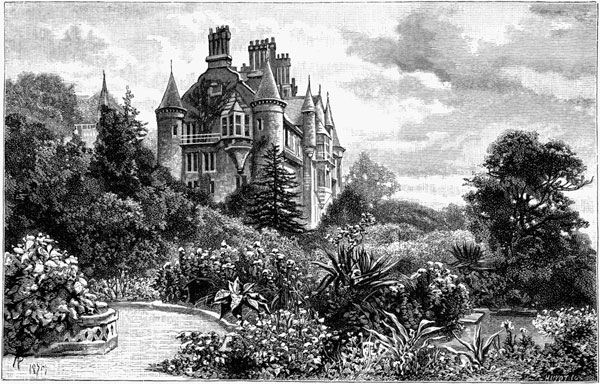
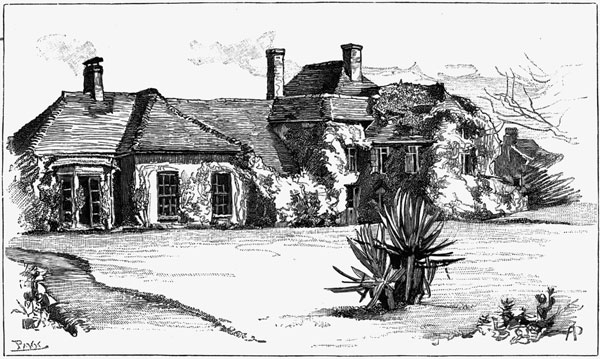
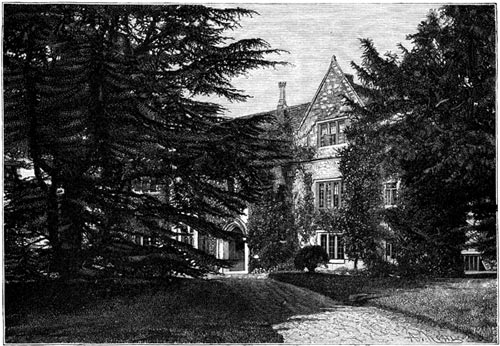
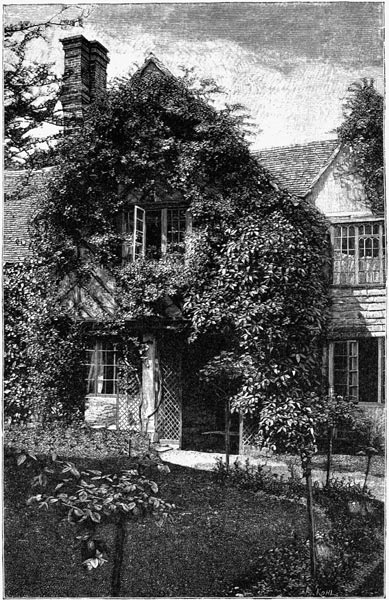
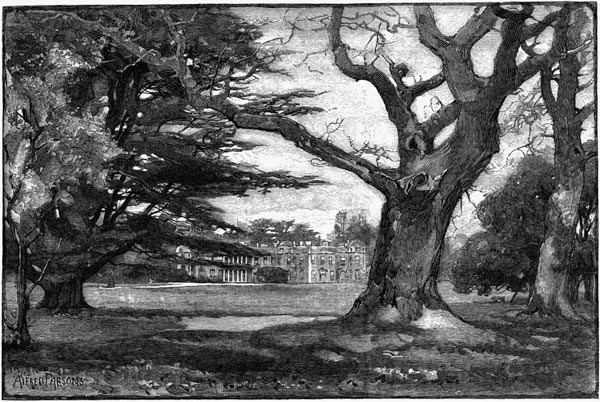
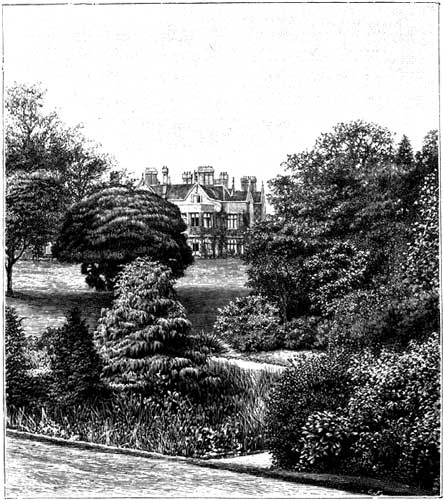
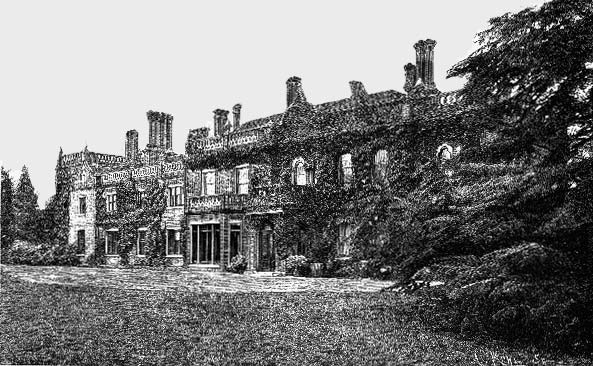 The "Grange," Hartley Wintney
I believe we cut Grass when we want hay, or soft turf to play on, but
disfiguring a noble tree is not a necessary part of our work either for
our profit or pleasure. Perhaps, as is probable, Mr. Blomfield has never
noticed what a beautiful tree a Yew in its natural form is. It is not
only on the hills he may see them. If he will come and see them in my
own garden in a high wind some day, or when bronzed a little with a hard
winter, he may change his amusing notions about clipped Yews.
I think I can give Mr. Blomfield a rational explanation of why it is
foolish to clip so fair a tree or any tree.
I clip Yews when I want to make a hedge of them, but then I am
clipping a hedge, and not a tree. I hold up "the clipped Yew tree to
obloquy," as the tree in its natural form is the most beautiful
evergreen tree of our western world—as fine as the Cedar in its plumy
branches, and more beautiful than any Cedar in the colour of its stem.
In our own day we have seen trees of the same great order as the Yew
gathered from a thousand hills—from British Columbia, through North
America and Europe to the Atlas Mountains, and not one of them has yet
proved to be so beautiful as our native Yew when it is allowed to grow
unclipped root or branch. But in gardens the quest for the strange and
exotic is so constant, that few give a fair chance to the Yew as a tree,
while in graveyards where it is so often seen in a very old state, the
frequent destruction of the roots in grave-digging prevents the tree
from reaching its full stature and beauty, though there are Yews in
English churchyards that have lived through a thousand winters.
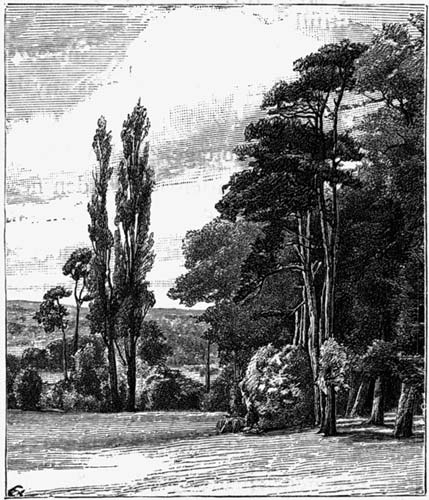
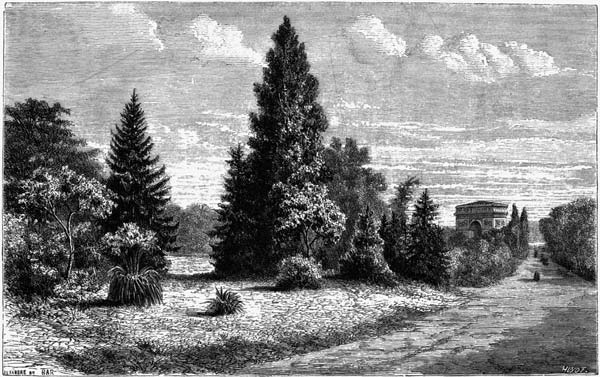
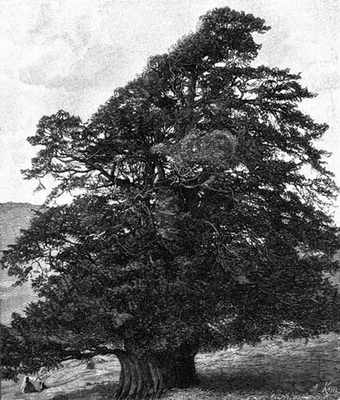 A Yew Tree on Mountain, N. England
I do not clip my Yews, because clipping destroys the shape of one of
the most delightful in form of all trees, beautiful, too, in its plumy
branching. It is not my own idea only that I urge here, but that of all
who have ever
thought of form, foremost among whom we must place artists
who have the happiness of always drawing natural forms. Let Mr.
Blomfield stand near one of the Cedar-like Yews by the Pilgrim's Way on
the North Downs, and, comparing it with trees cut in the shape of an
extinguisher, consider what the difference means to the artist who seeks
beauty of form. Clipping such trees does not merely deserve "obloquy";
it is worse than idiotic, as there is a sad reason for the idiot's ways.
If I use what in the Surrey nurseries are called "hedging Yews" to form
a hedge, high or low, I must clip them to form my hedge, and go on doing
so if I wish to keep it, or the hedge would soon show me that it was
"subject to natural laws," and escape from the shears.
What right have we to deform things given us so perfect and lovely
in form? No cramming of Chinese feet into impossible shoes is half so
wicked as the wilful distortion of the divinely beautiful forms of
trees. The cost of this hideous distortion alone is one reason against
it, as one may soon find out in places where miles of trees cut into
wall-like shape have to be clipped, as at Versailles and Schönbrunn!
This clipping is a mere survival of the day when gardens had very few
trees, and it was necessary to clip the few they had to fit certain
situations to conform to the architect's notion of "garden design." This
is not design at all from any landscape point of view; and though the
elements which go to form beautiful landscape, whether home landscape or
the often higher landscape beauty of the open country, are often subtle,
and though they are infinitely varied, they are none the less real. The
fact that men when we had few trees clipped them into walls and
grotesque shapes to make them serve their notions of "design" is surely
not a reason why we, who have the trees of a thousand hills with trees
of almost every size and shape among them, should violate and mutilate
some of the finest natural forms!
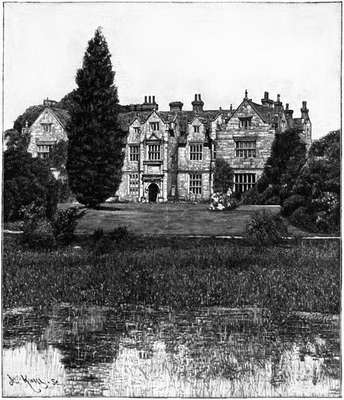
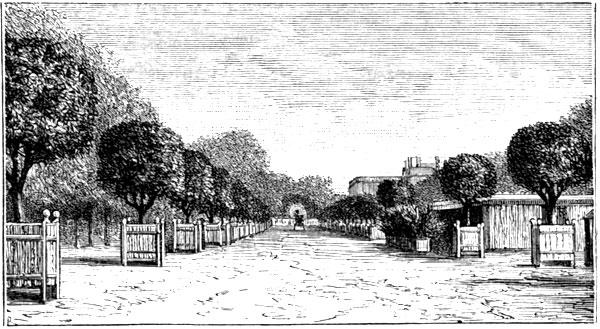
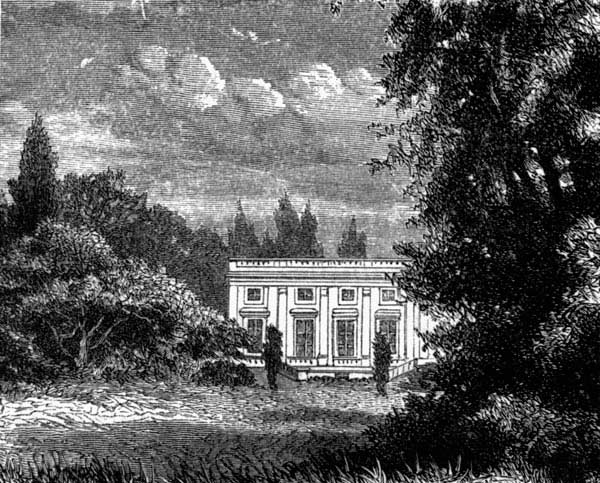
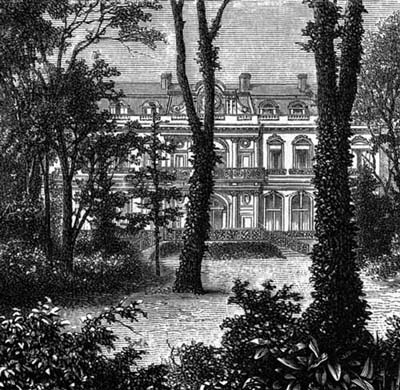
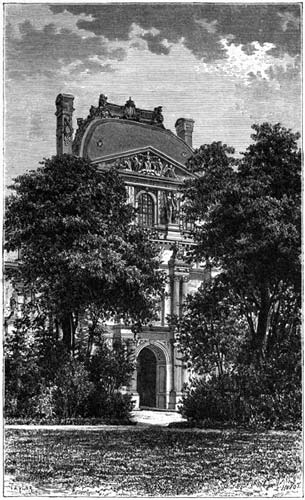 Building in Paris. Showing that intimate association
with buildings does not necessitate clipping or distortion of trees
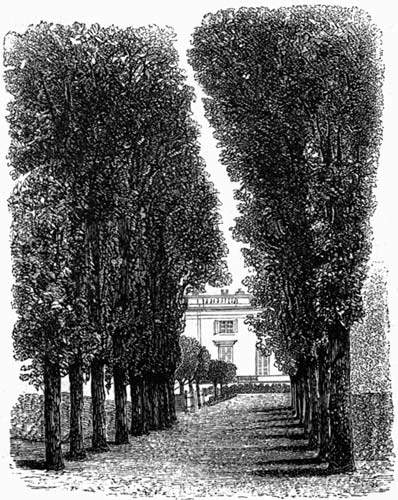
Building in Paris. Showing that intimate association
with buildings does not necessitate clipping or distortion of trees
Thus while it may be right to clip a tree to form a wall,
dividing-line, or hedge, it is never so to clip trees grown as single
specimens or groups, as by clipping such we only get ugly
forms—unnatural, too. Last autumn, in Hyde Park, I saw a man clipping
Hollies at the Rotten Row end of the Serpentine, and asking him why it
was done, he said it was to "keep them in shape," though, to do him
justice, he added that he thought it would be better to let them alone.
Men who clip so handsome a tree as the Holly when taking no part in a
hedge or formal line are blind to beauty of form. To tolerate such
clipped forms is to prove oneself callous to natural beauty of tree
form, and to show that we cannot even see ugliness.
Take, again, the clipped Laurels by which many gardens and drives are
disfigured. Laurel in its natural shape in the woods of west country or
other places, where it is let alone, is often fine in form, though we
may have too much of it. But it is planted everywhere without thought of
its stature or fitness for the spot, and then it grows until the shears
are called in, and we see nearly every day its fine leaves and free
shoots cut short back into ugly banks and sharp, wall-like, or formless
masses, disfiguring many gardens without the slightest necessity. There
is no place in which it is used clipped for which we could not get
shrubs quite suitable that would not need mutilation. It is not only
clipped trees that are ugly, but even trees like the Irish Yew,
Wellingtonia,
and some Arbor-vitæ, which frequently assume shapes like extinguishers
or the forms of clipped trees. It often happens that these, when
over-planted or planted near houses, so emphasise ugly forms about the
house, that there is no beauty possible in the home landscape. Many of
such ugly, formless trees have been planted within the last generation,
greatly to the injury of the garden landscape.
In the old gardens, where, from other motives, trees were clipped when
people had very few Evergreens or shrubs of any kind, or where they
wanted an object of a certain height, they had to clip. It is well to
preserve such gardens, but never to imitate them, as has been done in
various English and American gardens. If we want shelter, we can get it
in various delightful ways without clipping, and, while getting it, we
can enjoy the beautiful natural forms of the finest Evergreens. Hedges
and wall-like dividing lines of green living things will now and then be
useful, and even may be artistically used; they are sometimes, however,
used where a wall would be better, walls having the great advantage of
not robbing the ground near. A wall is easily made into a beautiful
garden with so many lovely things, too, from great scrambling yellow
Roses to alpine flowers. To any one with the slightest sympathy with
Nature or art these things need not be said.