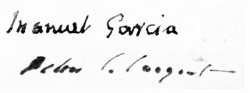
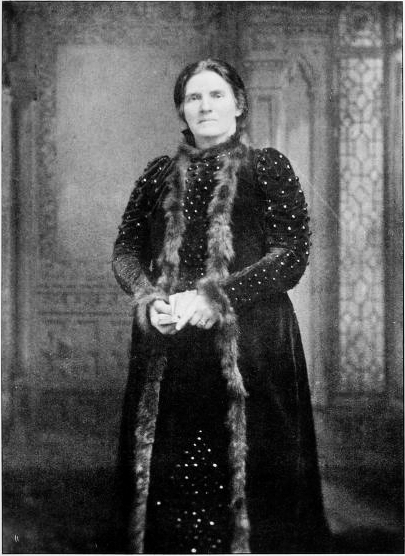
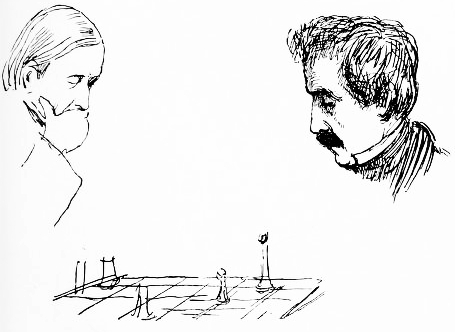
IN commencing this chapter I must apologise for the personal tone, which
is almost unavoidable, since I am giving purely personal reminiscences
of the years of study that I spent under Manuel Garcia.
It was early in the May of 1895 that my mother (Antoinette Sterling)
took me up to see her old master, in order that he might give his
decision as to the advisability of my entering the musical profession.
When we had driven out to his house on Shoot-up-hill, we rang the bell,
and a maid came to the door. "Is Señor Garcia well enough to see us? If
he is sleeping, do not disturb him. We can wait till he is rested." The
servant raised her eyebrows in slight wonderment. "Mr Garcia is out
gardening, Madame. I will tell him of your arrival."
This astonishing information was uttered in the most ordinary tone, as
though such a thing were a mere episode of everyday life. We were
ushered into the drawing-room, but were not kept waiting long, for in a
few minutes the door opened and Manuel Garcia entered. With a genial
smile and an exclamation of pleasure he came rapidly across the room,
taking short, quick steps, and was shaking hands with his old pupil
almost before she had time to rise from her seat. The next quarter of an
hour passed swiftly enough. A stream of questions fell from the lips of
the wonderful nonagenarian as to what she had been doing, where she had
been, what were her latest songs, what she thought of the pianist who
had recently come out, what of the political situation, when could she
come to lunch,—and so on.
He was short of stature, a little bent with age, frail-looking perhaps,
but wiry. His eyes were bright and piercing, his profile clear-cut and
distinguished. He had an olive complexion, a gift of his native Spain
which fifty years of London fog and de-oxygenised air had been unable to
take from him.
His white hair was partially covered by a red skull-cap, and his
moustache was closely cut. He spoke in rapid tones, yet with absolute
distinctness of clear enunciation.
Every word gave proof of that keen interest which he felt in all that
was going on around him. In expression, voice, and gesture there was an
amazing alertness, vigour, and mental activity which few men of seventy
could equal, fewer still surpass. His conversation gave evidence of the
fire of youth, tempered with the tolerance of old age.
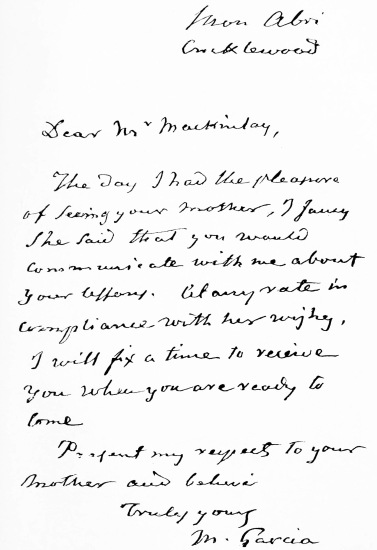 FACSIMILE OF A LETTER WRITTEN BY MANUEL GARCIA AT THE AGE
OF NINETY-ONE.
FACSIMILE OF A LETTER WRITTEN BY MANUEL GARCIA AT THE AGE
OF NINETY-ONE.
A more intimate acquaintance with the great teacher revealed further
qualities which made him loved, nay, worshipped, by all his pupils.
Loyal and staunch, he had an old-world courtesy, a charm of manner, and
a patience which was quite remarkable.
When Manuel Garcia had heard me sing he asked a few penetrating
questions. Then he turned to my mother and said that he would take me as
a pupil: he thought, however, that it would be better for me to wait a
year before starting work.
There was something almost uncanny in being told by a man ninety years
of age to come back in twelve months and commence singing-lessons. But
seeing and hearing him, one could not doubt that he would be ready and
waiting at the appointed time.
Nor was the supposition wrong. In the first week of April of the
following year, when he was approaching his ninety-second birthday, the
first lesson took place. From that time on, my studies continued under
his care and guidance until April 1900, when he was in his ninety-sixth
year. In this I had the honour of being the last pupil to be regularly
trained by him for the musical profession with the full four-years'
course of tuition.
That he should have been able to continue teaching at all at such an age
is sufficiently astonishing. That during those years he should have
postponed lessons through indisposition upon only some three or four
occasions gives a still keener insight into the extraordinary life led
by him as a nonagenarian.
What a wonderful experience those lessons proved, lasting sometimes
nearly two hours! When he was interested in explaining certain effects
in singing or in recounting stories of artists and operas apropos of
the work in hand, time ceased to exist. The luncheon-bell would ring
three or four times without having any apparent effect, so engrossed was
he in his subject. At the end of the lesson he would, with the old
courtliness of his youth, insist on seeing one out himself. If one
opened the door and stood aside for him to pass, the manœuvre proved
perfectly useless. With a delightful gesture he insisted on his guest
preceding him, saying, "Ici je suis chez moi." Then he would skilfully
slip along the hall and open the front door. There he would
stand—oblivious, and apparently impervious, to draughts and
cold—chatting for several minutes or giving some parting advice before
holding out his hand and wishing one au revoir.
Almost more surprising is it that he should have continued to carry on
his correspondence. Many a long letter was received from him during
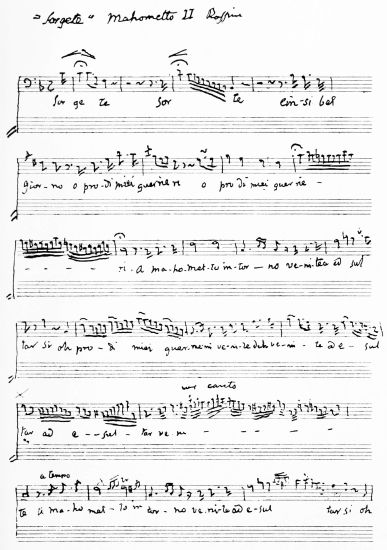
those years; while on one occasion he actually wrote out the entire
music of an Italian aria, "Liete voci," giving his own elaborations of
the original melody.
During the lessons he would remain seated at the piano, undertaking all
accompaniments himself. These would be given quietly, but with a firm,
rhythmical precision. In the case of the old Italian arie, they would
generally be played from memory. His white expressive hands would weave
elaborate preludes and harmonies into the music, and as one sang he
would sit with closed eyes as though his thoughts were far away. But
they were not, they were very much present. If a mistake were made the
music would cease, the error be pointed out, and a suggestion given for
its correction. This would take the form either of some helpful little
observation, made in clear, precise terms, or of personal illustration,
given in English, or more often French. Though over ninety years old, he
was quite equal to showing how he wanted notes taken or an effect given
by singing the passage himself. On one memorable occasion he sang two
entire octaves, commencing at the low A flat, and ending with a high
baritone G sharp. It sounds an almost incredible tour de force, but is
an absolute fact. The voice naturally trembled with age, though in a
surprisingly slight degree. But the timbre, enunciation, and dramatic
power were still there, while every phrase revealed the extraordinary
fire of his Spanish temperament.
When he had been singing thus one day he laughed and said, "I cannot
sing any more. You see how the voice trembles. That, you must not
imitate. The tremolo is an abomination—it is execrable. Never allow it
to appear, even for a moment, in your voice. It blurs the tone and gives
a false effect. Many French singers cultivate it, and I will tell you
why."
There had been at one time, he said, an eminent vocalist worshipped by
the Parisian public. His voice was beautiful in quality, faultless in
intonation, and absolutely steady in emission. At last, however, he
began to grow old. With increasing years the voice commenced to shake.
But he was a great artist. Realising that the tremolo was a fault, but
one which could not then be avoided, he brought his mind to bear upon
the problem before him. As a result, he adopted a style of song in which
he had to display intense emotion throughout. Since in life the voice
trembles at such moments, he was able to hide his failing in this way by
a quality of voice which appeared natural to the situation. The
Parisians did not grasp the workings of his brain, and the clever way in
which he had hidden his fault. They only heard that in every song which
he sang his voice trembled. At once, therefore, they concluded that if
so fine an effect could be obtained, it was evidently something to be
imitated. Hence the singers deliberately began to cultivate a tremolo.
The custom grew and grew until it became almost a canon in French
singing.
The maestro told another story to illustrate the strange way in which
effects were sometimes produced by the old vocalists. A certain artist
was singing Secchi's "Lungi dal caro." Something in his voice gripped
the audience from the first bar. There was an indefinable quality which
they had never experienced before, something which thrilled and stirred
them with an inexpressible weirdness, something which almost made the
blood run cold. When the music ceased, every one drew a deep breath and
remained silent for a few moments. Then came a burst of rapturous
applause. Later on, a fellow musician went up to the singer,
congratulated him, and then said, "Tell me how you were able to produce
that effect upon your audience."
"Did you not hear? No? Then I will tell you how I did it. Throughout the
music I sang the least shade flat. The result you observed."
And now a few words as to Manuel Garcia's Method of Teaching.
He always impressed on singers and teachers alike that the Art of
Singing was not voice-production, a term which he loathed, but
guidance in voice-emission.
His Method may be perhaps summed up in the doctrine that it was not a
method—in the sense that he had no hard and fast rules,—his object
always being to make each pupil sing in the way most natural and
involving the least effort. He was careful to impress on one the fact
that any visible effort took away from the charm of the singer. If one
gave too free play to the lungs, and sang beyond oneself, he would
remark, "You must not forget the advice my father gave me: 'Do not let
anybody see the bottom of your purse; never spend all you possess, nor
have it noticed that you are at your last resource.'"
The first lesson for all pupils would be practically a chat on the
singer's aims and on the instrument at his disposal: he would explain in
clear language the different parts of the instrument, and show that the
lungs had to be properly filled; then in the first attempt at emission a
steady gentle stream was to be sent out, while one guarded against the
natural tendency to empty the lungs quickly. At the larynx the air in
passing through the little lips of the glottis received pitch, which
varied according to the rapidity with which these opened and allowed
puffs of air to pass through; then in passing through the passage from
the larynx to the front of the mouth they received timbre and
vowel-tone, which varied according to the shape of the pharynx and the
height of the soft palate.
The tone was then to be directed to the front of the mouth, and here the
consonants were made, but these latter were not to interfere with the
flow of sound or cause any jerkiness. When a phrase was commenced the
tone was to flow on evenly, smoothly, steadily, with greater or less
sustaining power as desired, until the end was reached. He would further
explain something of the theory of registers, and the causes of various
kinds of tones, good and bad. Finally, before telling the pupil to make
his first tones, he would impress on him this: "If you do not understand
anything perfectly, ask me at once, and I will endeavour to clear up the
point and show you how to get over the difficulty. And remember that we
must have the knowledge to guide the emission of the voice with our
brains. When the tone has once been emitted it is too late to correct a
fault. We must be aware beforehand exactly what we are going to do. We
must know what is right and how to do it. That is the secret."
After this preliminary explanation the first step invariably consisted
in the emission of a steady tone, deep breathing being insisted on for
the purpose. At the first sign of unsteadiness in the tone the pupil was
directed to stop and begin again. In the intervals of rest the
physiology of the voice was clearly and carefully explained, and the
proper position of the various parts of the body and throat, and the
management of the vocal cords necessary for the emission of resonant
tone, were the first laws laid down. When once the pupil could sing a
scale slowly and steadily, the way was open to the practice of
exercises; and very often in the case of a voice of promise these
exercises constituted the whole course of study for a considerable
period.
The famous coup de la glotte, or shock of the glottis, with which his
name is associated, has often been misapplied from ignorance of its real
object, which was to secure that the vocal cords were closed at the
commencement of the tone, and that there was consequently no preliminary
escape of the breath. How far his methods, which also included the
imparting of a remarkable grasp of every phase of vocal expression, were
successful, is to be gathered from the list of his direct or indirect
pupils, which, as we have seen, includes a great many of the most
prominent representatives in the world of song.
At the lessons the maestro did not, as a rule, offer either praise or
blame. He was, however, always encouraging, and treated pupils according
to their individual powers. He seemed to know instinctively what they
could manage and what was beyond them. His remarks might be made in
English, French, or Italian, so that the pupil had to keep his wits
about him. In them there was a directness and penetration which filled
one with implicit confidence in his keen mind and extraordinary
experience. Hardly a lesson passed in which he did not, during the
intervals for rest, tell some anecdotes of the most engrossing interest.
These would have as their subject the elder Garcia, Malibran, Jenny
Lind, Meyerbeer, Rossini, Mario, Pasta, or some other of the great
musicians of the past. Often, too, he would speak of his memories of
Spain, of the Peninsular War, the French Revolution, the first New York
season of Italian opera, his tour in Mexico, the discovery of the
laryngoscope, or other memories of his long career. But though related
with delightful readiness, these stories always displayed extreme
modesty in reference to the part played by himself in the various
episodes.
It was in the same spirit, too, that he would speak of his efforts as a
teacher. "I only tell you how to sing, what tone is good, what faults
are to be avoided, what is artistic, what inartistic. I try to awaken
your intelligence, so that you may be able to criticise your own singing
as severely as I do. I want you to listen to your voice, and use your
brain. If you find a difficulty, do not shirk it. Make up your mind to
master it. So many singers give up what they find hard. They think they
are better off by leaving it, and turning their attention to other
things which come more easily. Do not be like them.
"In Paris once a number of boys were set some problems whilst competing
for a prize at the Gymnase. One of them was seen to cry, and on being
asked why he did so, replied that the problems were too easy. He was
afraid that all the others would be able to do them as well as himself,
so that he would be prevented from carrying off the prize. The master
smiled, and told him to answer the questions by a more difficult method,
if he knew one. He did so, and gained the first place.
"Many singers do the opposite. They burst into tears because they find a
thing too hard. Do not be afraid to face a difficulty. Make up your mind
to conquer it. I only direct you. If you do a thing badly, it is your
fault, not mine. If you do it well, all praise to you, not to me. I show
pupils how to sing, and the proper way to study. Suppose some one meets
me out of doors and says, 'Can you tell me the way to Hampstead Heath?'
I answer, 'I will walk there with you.' We set out, and I keep by his
side, saying, 'This is the street we have to pass through. Do not turn
down there. That goes in the wrong direction. Follow my instruction, and
you will arrive at your destination. I know the road well.' If he takes
the wrong turning, that is his fault, not mine. I cannot prevent him
from going off into the slums. I can only say 'Do not go there—that is
wrong.' He must follow my advice or not, as he chooses. Again, if we
come to a very steep hill, and he says, 'I can't climb that. It is too
difficult. Let us not go up—I am tired'; I can only reply, 'If you wish
to reach the Heath, you must climb it. There is no other way of
getting to your destination.' But if he is lazy, and will not mount it
by his own endeavour, I cannot lift him and carry him upon my
shoulders."
How characteristic it was of the master's innate modesty to speak of his
work in this simple way! How he ignored the times when he pulled the
pupils back by main force from that wrong path; when he cheered them on,
should they get discouraged; when he described in concise terms the
easiest way of climbing up that hill! If they failed to mount the ascent
on the first occasion, he explained the reason for their failure. Then
he bade them be of good courage and try again. If they failed ten times,
he would once more carefully repeat exactly what had to be done, and
seek for fresh illustrations which might perhaps put the matter in a
clearer light. Truly, if he did not actually carry them up the steep
path, he came very near doing so. He was like a friend offering
assistance rather than a teacher paid to instruct. Ah, dear maestro!
never shall I forget the infinite patience and gentleness which you
displayed in those hours of study.
When a difficulty had been overcome, he would smile and say, "That was
as I wish. Do it again. Good! Now try and impress upon your mind exactly
what you did. Sing it once again. C'est ça! Do not let the old mistake
occur again." If one did allow it to reappear, he would shake his head
sorrowfully and say, "Jenny Lind would have cut her throat sooner than
have given me reason to say, 'We corrected that mistake last time.'" It
seemed at first strange, to say the least, to hear these comparisons
made between oneself and a pupil who had studied under the same master
fifty years previously. However, after studying for three years, I grew
used to hearing him speak of musicians who had been dead forty years or
more; of a sister who, after a brilliant career, had died in 1836; of a
father who had come into the world a hundred and twenty years
previously; and of his first singing-master, Ansani, who was born early
in the eighteenth century. At any rate, during the last year of study I
was able to hear such casual remarks as "Ah, yes, I remember teaching
this song to Stockhausen for his début" (the great German vocalist
being at the time somewhere about seventy years of age), without
evincing more than a momentary surprise.
Wagner's compositions never attracted Manuel Garcia. The heavy
orchestration of the German music did not appeal to him, though he
raised no objection to going through Wolfram's song, "O Star of Eve," in
the Italian version, "O tu bel astro incantator." "Tannhäuser" was
written in a lyrical style: one shudders to think what he would have
said to anything like Wotan's "Abschied."
He did not believe in "vocalises," such as are used by most teachers in
earlier lessons. Instead of these, he preferred to give simple Italian
arias. He pointed out that with them one began at once to learn the
value of articulation and expression. Exercises he looked on as the
foundations of all good singing. They would take the form of sustained
and swelled notes, scales, passages of combined intervals, arpeggios,
chromatics, and shakes. The acquirement of agility in execution, he used
to say, required at least two years' study, the result being that the
voice became flexible, even mellow and strong. In the elucidation of
difficulties he used to make use of many similes and illustrations,
which threw a vivid and illuminating light upon the matter in hand.
These, together with the various maxims of artistic singing which he
would impart, I used to write down in a book after each lesson, and as a
teacher of singing I have found them of the most inestimable value and
assistance.
When one day I told the maestro that I had decided to devote my whole
attention in the future to teaching, he at once sat down and wrote a
letter of recommendation, though in his ninety-eighth year,—a typical
example of his kindness and thought for the benefit of others.
It was an inestimable advantage to hear him teach singers of various
capacities. During the period I was under him I had the privilege of
hearing him give many lessons; for though I was the last pupil to
receive the full four years' training, he was still teaching a few
specially favoured amateurs,—in most cases the children or
grand-children of former pupils.
His ear was most accurate and unerring, while he was exceedingly quick
of observation, and equally ready with a helpful remark, given in
precise terms, a simile, a little anecdote, or even a slight gesture or
a look.
In his lessons he was ever ready to give the most interesting
information on any scientific questions or theories, and would discuss a
point with the greatest animation. He was particularly annoyed at the
way the coup de la glotte was misunderstood and exaggerated beyond all
recognition by many musicians. In his 'Hints on Singing' he defines the
coup as the neat articulation of the glottis that gives a precise and
clear start to a sound. In reality, as taught by him, it simply meant
that he wished one to get straight on to a note, without any uncertainty
or feeling about for it, instead of slurring up to it (a very common
fault), or taking it too sharp and having to sink to the proper pitch.
His works mark an epoch in a branch of human knowledge which one day may
be called a science. They deserve to be most carefully studied by any
one who wishes to gain a clear insight into that interesting
subject—the human voice. They are the fruit of a great mind and of
wonderful experience, written in a very lucid style, simple and terse,
full of interest to the musician as well as to the voice trainer.
He expounds his views fearlessly but modestly, with logical cogency.
Nearly every page bears evidence how cautious, discerning, and
progressive a teacher he was.
As showing the importance which Manuel Garcia attached to poetic
interpretation of all vocal music, I give three quotations from his
'Hints on Singing,' the extracts being taken from the section headed
"Preparation of a piece."
"The pupil must read the words of the piece again and again till
each finest shadow of meaning has been mastered. He must next
recite them with perfect simplicity and self-abandonment. The
accent of truth apparent in the voice when speaking naturally is
the basis of expression in singing. Light and shade, accent,
sentiment, all become eloquent and persuasive. The imitation of
instinctive impulse must, therefore, be the object of this special
preparation."
"A powerful means of exciting the mind to a vivid conception of the
subject is to imagine the personage as standing before one, and let
the phantom sing and act, criticising closely both efforts; then,
when satisfied with the results, to imitate them exactly. By
faithfully reproducing the impressions suggested by this creature
of fancy, the artist will obtain more striking effects than at once
rendering a piece."
"Another way is to recall some analogous situation in a work of
art: for example, if we have to study the scene of Desdemona in the
second act of Rossini's 'Otello,' 'L'error d'un infelice,' one of
the fine paintings of the Magdalene at the feet of Christ might
occur to the mind. Grief and repentance could not assume a more
pathetic form."
He was always careful to secure the proper use of the registers on the
part of the pupil, for, as he would point out, more female voices have
been ruined by carrying the chest register too high (that is to say,
beyond the E or F above middle C) than by anything else.
He had a wonderful insight into the capabilities of those whom he
taught. Indeed, I remember his saying once that throughout his career he
had very rarely failed in reading from the eyes of an intending pupil
the prophecy as to his or her future success in the profession of music.
He disliked, he said, to be associated with failures, and the moment he
found that he had made a mistake in his estimate of a pupil's
capacities, he at once disillusioned him and declined to continue his
training.
His mannerisms while playing accompaniments were quite characteristic of
the man. He would strike the chords with the greatest vivacity, and
almost leap into the air from his piano-stool in his excitement at any
wrong trick of vocalisation; or again, he would make a dash for the
metronome, snatch it up and set it to time, and for the space of perhaps
ten minutes compel one to go on counting mentally, or beating time with
the hand in unison with the rhythmic movements of the guiding
instrument, until the time difficulty had been mastered. When he had
succeeded in preparing the voice for use like a beautifully toned
instrument, his teaching spread over the whole extension of every style
of music,—opera, oratorio, and song.
To his charm of courtly manners was added a never-failing wit and love
of fun: of this he gave constant proof. For instance, an old pupil
recounts how one day Manuel Garcia was seized with a fit of coughing.
"Ah, maestro, I'm afraid it's the spring," he commiserated, and was met
with the half-laughing, half-pathetic retort, "No, no; it is too many
springs."
A further illustration of his keen sense of humour, even in extreme old
age, is found in a letter which, as a nonagenarian, he wrote to a friend
some seventy years his junior.
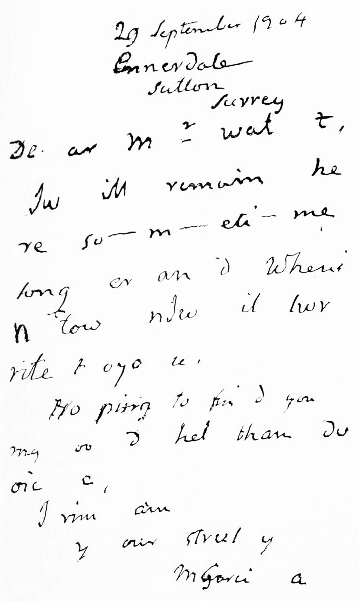
The young man was famous among his acquaintances for a rather eccentric
handwriting, and no one was fonder of twitting him about it than the
maestro. The chaff on one occasion took the form of a letter, which I am
enabled to reproduce in facsimile. Señor Garcia wished to convey the
following information:—
"I will remain here sometime longer, and when in town I will write
to you.
"Hoping to find you in good health and voice,—I remain, yours
truly, M. GARCIA.."
Remembering, however, to whom he was writing, he took the trouble to
make his communication as bewildering as possible by dividing the words
thus:—
"Iw ill remain he re so—m—eti—me long er an d wheni n tow nIw il
lw rite t oyo u.
"Ho ping to fin d you ing oo d hel than dv oic e, I rem ain y our
strul y M. GARCI A.."
Often at the close of a lesson he used to ask me to stay to tea, and in
the summer we would adjourn to the garden, where the table would be
spread beneath the inviting shadow of the trees. Those would be
red-letter days indeed.
On these occasions the maestro would leave thoughts of singing behind
him, and show his wide interests and deep insight into all the questions
of the day. Once when conversation had turned upon violin-playing, there
came up the name of Kubelik, who had come out in London a few weeks
previously. After four years' pupilage, I was not surprised to learn
that he had already been to hear the new instrumentalist. I must,
however, confess to having been somewhat startled when, with the
greatest sangfroid, he began comparing the execution with that of
Paganini. At other times he would speak of Joseph Chamberlain and the
newest developments of Fiscalities, the building of sky-scrapers in New
York, the drama of the day, or the Spanish War. One day he even showed
himself quite ready to discuss the pros and cons of Christian science.
 FACSIMILE OF A LETTER WRITTEN BY MANUEL GARCIA AT THE AGE
OF NINETY-NINE.
FACSIMILE OF A LETTER WRITTEN BY MANUEL GARCIA AT THE AGE
OF NINETY-NINE.
My lessons came to a close in April of 1900, when the maestro was in his
ninety-sixth year.
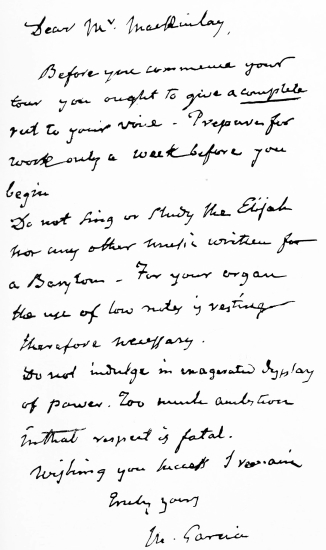
When in due course the time came for making my first provincial tour, he
wrote several letters on the subject, of which I quote three, as being
typical of the trouble which he was ever ready to take, and the wisdom
of the advice which he would give.
"MON ABRI," CRICKLEWOOD.
I am a very bad maker of programmes. If I had to deal with that
sort of work, I should have to take the advice of an expert who
could tell what sort of music would meet the taste of every
individual public. Your mother might be your best adviser.
Wishing you every success. M. GARCIA..
Again he writes:—
Before you commence your tour you ought to give a complete rest
to your voice. Prepare for work only a week before you begin.
Do not sing or study the "Elijah" nor any other music written for a
baritone. For your organ the use of low notes is resting, therefore
necessary.
Do not indulge in exaggerated display of power. Too much ambition
in that respect is fatal.
A third runs as follows:—
You will do well not to limit yourself to singing easy songs, but
also to attempt upon occasion such pieces as require the full use
of your means. This will be an excellent preparation for your
appearance in London, and it will give you the confidence in your
powers and the facilities in using them necessary to enable you to
take a place among the best of the profession. It will always give
me pleasure to hear of your successes. Give my kindest regards to
your mother.
After this I continued to see the maestro fairly often, and was not
surprised to hear of his setting off in his ninety-seventh year to spend
the winter in Egypt, or of his staying with his sister in Paris for a
few days on his way home.
In the early winter of 1903 my mother was taken seriously ill, and
Manuel Garcia on hearing of this at once wrote a sympathetic letter.
On January 10, 1904, the end came, and with the announcement in the
papers, one of the first tokens of sympathy was a beautiful wreath from
the maestro, followed by a telegram expressing his desire to be present
at the closing scene in the career of his old pupil. Despite the
distance, for the service was held at Golder's Hill, the maestro drove
over, stayed for the entire service, and remained behind afterwards to
offer a few simple but never-to-be-forgotten words of sympathy.
Two months after this he entered his 100th year. To celebrate the
occasion, an address of congratulation was presented to him, signed by
127 professors of the Royal College and Royal Academy of Music.
 FACSIMILE OF A LETTER WRITTEN BY MANUEL GARCIA AT THE AGE
OF NINETY-FOUR.
FACSIMILE OF A LETTER WRITTEN BY MANUEL GARCIA AT THE AGE
OF NINETY-FOUR.
At the end of the year it was suggested by the editor of 'The Strand
Magazine' that I should prepare an article on "Manuel Garcia and his
Friends" for publication in the month of his centenary. On my
communicating with the maestro, he wrote at once offering to render
assistance, and asked me to bring the MS. up when ready. Accordingly, in
the January, two months before his 100th birthday, I spent the afternoon
with him, and was requested to read aloud the proofs of the article.
It was astonishing how memory enabled him to correct immediately any
mistake. He would suddenly stop and say, "No, no; it was in 1827, not
1825." Again, in the case of a story in which some details were wrong,
he said, "No, that is not right. I will tell it you again"; with which
words he recounted in French the tale of how his sister, Malibran, came
to make her début at Paris. And so the afternoon passed, until
finally, after signing a photo, he insisted on coming to the door to see
me out. This experience served to prepare me for the astonishing ease
and energy with which, a few weeks later, he went through the Centenary
festivities.
UPON St Patrick's Day, 1905, Manuel Garcia entered on the "second
century of his immortality," as Professor Fränkel felicitously put it.
That 17th of March has become red-lettered in the annals of music by
reason of its international character, and the fact that the two
professions of music and medicine joined hands with the royalty of three
countries, England, Spain, and Germany, in paying honour to whom honour
was due.
Sir George Cornewall Lewis was a firm disbeliever in centenarians, but
his scepticism must have suffered a severe shock could he have been
present at the celebrations. He would then have seen not merely a man
whose years beyond all question numbered a century, but one who at that
great age showed no sign of senility, and could still take an active
part in a series of trying ceremonies, and bear with dignity, if not
altogether without fatigue, a load of honours and congratulations, a
flood of speeches like the rushing of great waters, and repeated
thunderstorms of applause that would have overwhelmed many men in the
full vigour of life. Manuel Garcia went through the trying ordeal
without apparently feeling any ill effect, and seemed thoroughly to
enjoy the whole thing. It was difficult indeed to believe that the
venerable figure on the right of the chairman at the banquet, whom one
saw light a cigarette and smoke it with relish in defiance of the
Anti-Tobacco League, was born seven months before the battle of
Trafalgar!
It was passing strange, as one saw him giving the lie in every point to
Shakespeare's picture of extreme age, to think that he might not only
have "seen Shelley plain," but have been one of the students who
modelled their collars and their scowls on those of Byron; that he had
finished his education before Pasteur was born, and had come to man's
estate before Lister saw the light; that he had made his name known on
two continents while Scott and Goethe were still alive, and Darwin was
at school; and that he had made the discovery that will make his name
immortal while many of those whose names are now illustrious were yet
unborn. How quick were his senses and how alert his intelligence was
shown in many ways, trifling, perhaps, but significant, in the course of
what must have been the most trying day of his long life. His
extraordinary vitality was put to a very severe test in the functions
held in honour of the occasion, but he passed through them with the most
wonderful fortitude and genial courtliness.
When the King heard of the approaching birthday, he made inquiries as to
whether the aged maestro could stand the strain of personal investiture
of the honour which his Majesty had already decided to bestow. The
answer came back that he was quite ready, and anxious to show his
gratitude for this royal compliment by going to the palace.
An interview was accordingly arranged, and Señor Garcia, having risen
between nine and ten o'clock on the morning of that day of days, was
driven to Buckingham Palace, where he was ushered without delay into the
King's presence. His Majesty entered into conversation with the old
musician, showing his acquaintance with his long record of fame, and,
ever interested in aged people, questioned him as to his health with the
most sympathetic solicitude, being absolutely amazed at the vitality
displayed. The King expressed to the maestro his congratulations and his
recognition of all that he had done for medicine and music, and finally
invested him with the insignia of a Commander of the Royal Victorian
Order, at the same time signifying a wish to be personally represented
at the banquet which was to take place in the evening. Needless to say
that this characteristic kind-heartedness of King Edward, shown towards
the hero of the day, acted as a splendid tonic to the Centenary
celebrations.
From the Palace Señor Garcia drove to the rooms of the Royal Medical and
Chirurgical Society in Hanover Square, where by noon the fine saloon was
thronged by his old pupils and various deputations, representative of
many departments of learning and research.
The reception-room had been decorated for the occasion with palms and
foliage plants. In the centre of a carpeted dais at one end of the
apartment had been placed a high-backed chair, upholstered in crimson,
and on the extreme left was the still veiled portrait of the
centenarian, which had been painted by Sargent. In front of the seat
there were some beautiful floral tributes. The largest bore on its
ribbons the inscription, "À leur cher et venéré Professeur, Manuel
Garcia—Salvatore et Mathilde Marchesi, Paris, Mars 17, 1905." Another
came from Blanche Marchesi, and was addressed "To the Christopher
Columbus of the Larynx"; while yet another had been sent by the Glasgow
Society of Physicians.
Punctually at twelve o'clock, amid volleys of applause, Manuel Garcia,
looking amazingly bright and hale, entered the room with short, quick
steps, wearing the insignia of the Royal Victorian Order, conferred an
hour before, and walked unaided to the dais. This he mounted with
agility, and took his seat upon the crimson throne, a magnificent basket
of flowers on either side. There he sat for an hour, upright and
smiling, in full view of the spectators, during the proceedings which
ensued.
It fell naturally to the lot of Sir Felix Semon, both as Physician
Extraordinary to the King and chairman of the Garcia Committee, to
convey the intelligence of the earlier ceremony which had taken place
that morning.
"Ladies and Gentlemen," Sir Felix said, "the auspicious proceedings
of to-day's memorable occasion could not have been more joyously
opened than they have just been. His Majesty the King, with the
kindness of heart which endears him to us all, has just been
pleased to receive Señor Garcia at Buckingham Palace, in order to
express to him his congratulations and his recognition of all that
Señor Garcia has done for medicine and music. At the same time the
King has conferred upon him the honorary Commandership of the Royal
Victorian Order. His Majesty, at the conclusion of the interview,
expressed a wish to be personally represented at the banquet
to-night, and said that he would desire his Lord-in-Waiting, Lord
Suffield, to attend as his representative. I feel quite sure that
this whole assembly has already shown by its applause that it
recognises in this act a new token of the King's invariable
kindness and his appreciation of all that is good and high."
Next came the Spanish Chargé d'Affaires, the Marquis de Villalobar, who
delivered a special message of congratulation from King Alfonso.
"I have been honoured by his Majesty the King, Don Alphonse XIII.,
with his august representation to congratulate you on the day of
your centenary, and in the presence of the learned men who have
assembled in this great metropolis for its celebration. In obeying
the King's command, in which his Government and the Spanish people
join, I honour myself, investing you, in the name of his Majesty
and your motherland, with the Royal Order of Alphonse XII., as a
high reward to your merits and the services rendered to mankind
through your science and your labour. I feel it is also my duty to
avail myself of this opportunity in order to make public the
sentiments of my beloved Sovereign and of his Government, conveying
sincere thanks, first to his Majesty King Edward VII., who I have
just learned has most graciously conferred upon our compatriot a
high distinction of this noble and hospitable country, and also to
all the representatives of England and those of the learned
societies here assembled to commemorate this centenary. Hearty
gratefulness on behalf of Spain to all who have come and are
represented here to-day to honour Don Manuel Garcia as a glory to
modern science."
The Marquis de Villalobar then invested Señor Garcia with the Order,
amid loud cheers. After this glowing tribute came Professor Fränkel, who
said that they were assembled to honour one who had devoted his best
days to the teaching of singing,—had not been content with attempting
to discover the secrets of voice-culture by sound alone, but had
proceeded in a thoroughly scientific way. Through his genius he had
thrown light on the hitherto dark places of the larynx and the source of
the living human voice. He had thereby laid the sure foundations of the
physiology of the voice.
In recognition of his merits the German Emperor had conferred on him the
Great Gold Medal for Science. The Minister for Public Instruction had
requested him (Dr Fränkel) to present that rarely awarded distinction to
Señor Garcia that day when he completed the first century of his
immortality. He did so with the greatest pleasure, as one who owed a
very great debt of gratitude to the method of laryngoscopy invented by
their honoured friend.
An address from the Royal Society was then presented by Sir Archibald
Geikie (principal secretary), Professor Francis Darwin (foreign
secretary), and Professor Halliburton, F.R.S. The address, which was
read by Professor Halliburton, was as follows:—
The Royal Society of London join very cordially in congratulating
Manuel Garcia on the celebration of his 100th birthday.
The President and Council recall with much pleasure the
circumstance that the Royal Society afforded in their 'Proceedings'
the medium for publishing to the scientific world the memorable
paper in which Señor Garcia laid the foundation of the experimental
study of voice-production, and at the same time, through the
laryngoscope, provided the starting-point for a new department of
practical medical science.
The Royal Society trust that Señor Garcia may still continue for
years to come to enjoy in good health the esteem which his
scientific achievement and his high personal character have brought
him.
Signed and sealed on behalf of the Royal Society for Promoting
Natural Knowledge,
WILLIAM HUGGINS, President.
Sir Archibald Geikie (as a corresponding member of the Prussian Academy
of Sciences) read the following telegram from that Academy:—
To the first investigator of the human voice by a new method which
for all time has bestowed a signal service on art, on science, and
on suffering humanity, the Royal Prussian Academy of Sciences sends
on his 100th birthday its most respectful congratulations.
Waldeyer, Secretary.
An address was next read from the University of Königsberg, which in
1862 had conferred on Señor Garcia the honorary degree of Doctor of
Medicine. A hope was expressed that he would live to receive the fresh
diploma which it is the custom to confer on doctors of fifty years'
standing.
The next address was from the Victoria University of Manchester,
presented by Professor Stirling, F.R.S., Dr Milligan, and Dr S. Moritz,
followed by one from the Medical Faculty of Heidelberg.
The address from his old pupils was read by Mr Ballin. In offering their
sincere congratulations they said: "The services you have rendered to
the art of singing are very great, and the large number of your pupils
who have become famous is incontestable proof of your genius." Madame
Blanche Marchesi spoke in the name of her parents, who were unavoidably
absent, expressing their gratitude for everything he had done for them.
Their method and their success were due to Señor Garcia, who had laid
the basis of their artistic career.
Mr Otto Goldschmidt, the husband of Jenny Lind, said that his late wife,
to the end of her days, continued to have respect, regard, and
veneration for Señor Garcia, who helped her to take the position in the
musical world which she attained; and he was very happy indeed to be
able to make that statement, and to congratulate the old master on what
he had done for the great art of singing.
An address from the Royal Academy of Music was followed by one from the
Royal College of Music.
Addresses and messages from Laryngological societies and associations
were then read, the following being among the bodies represented: The
American Laryngological Association; the Belgian Society of
Oto-Rhino-Laryngology (Dr Delsaux, Dr Goris, Dr Broeckkaert); the Berlin
Laryngological Society (Dr Landgraf, Professor Kuttner, Professor
Gluck); the British Laryngo-Oto-Rhinological Association (Mr Chichele
Nourse, Dr Percy Jakins, Mr Stuart-Low, Mr Dennis Vinrace, Dr Andrew
Wyld); the Danish Laryngological Society; the French
Laryngo-Rhino-Otological Society (Dr Moure, Dr Lermoyez, Dr Toxier, Dr
Molinié); the Italian Laryngo-Rhino-Otological Society and Neapolitan
School of Laryngology (Sir Felix Semon, hon. member, Professor Poli);
the London Laryngological Society (Mr Charters Symonds, Mr de Santi, Dr
Davis, and Mr H. B. Robinson); the Netherlands Laryngo-Oto-Rhinological
Society (Dr Moll, Dr Burger, Dr Kan, Dr Zaalberg); the New York Academy
of Medicine, Section of Laryngology (Dr Harman Smith); the Paris
Laryngological Society (Dr C. J. Koenig, Dr Mahu); the
Rhenish-Westphalian Laryngological Society (Dr Hirschland); the St
Petersburg Laryngological Society; the South-German Laryngological
Society (Dr Avelis); the Spanish Laryngo-Oto-Rhinological Society and
Academy of Medicine and Surgery (Dr Botella, Dr Tapia); the Vienna
Laryngological Society (Professor Chiari); the Warsaw Laryngological
Society; the West-German Laryngological Society (Dr Fackeldey, Dr
Lieven); and the Hungarian Laryngological Society. Congratulatory
telegrams were received from the Laryngological Societies of Sweden,
Moscow, and Cracow; from the Amsterdam Medical Society; from the Medical
Society of Japan; from Professor Moritz Schmidt, as President of the New
German Laryngological Society; from Dr Birkett of Montreal, in the name
of the students of M'Gill University; from Dr French, of Brooklyn, and
hundreds of others.
The next speech brought a touching note to the scene, for in it Dr
Botella, of Madrid, as the official delegate of the Spanish Government
and of the Spanish Laryngological Society, addressed the maestro in his
mother-tongue. A new light came into the centenarian's eyes, and he bent
forward in an attitude of the closest attention, as if he feared to lose
a single note of the beloved speech, whose sound on such an occasion
must have carried him back over that great gulf of years to the far-off
days of his childhood.
Dr Botella said that before the discovery of the laryngoscope the sense
of touch was the only means of knowing of the existence of tumorous
growths in the larynx. The invention of the laryngoscope had opened
immense horizons to science, had put within its range many diseases the
existence of which could never have been suspected, had made possible
their treatment, and had saved from suffering and death numberless
lives. The Spanish Government sent Señor Garcia its enthusiastic
congratulations, and the Spanish Laryngological Society begged his
acceptance of the diploma of "President of Honour." He brought a kind
greeting from Spain to England, from Señor Garcia's native land to his
adopted one. If the former gave him birth, the latter gave him shelter,
and on that occasion both felt equally proud to have him as a son.
The following was the address of the Laryngological Society of London:—
Dear and Revered Master,—Amongst the many friends assembled to-day
to lay a tribute of gratitude and admiration at your feet, and a
greater number far away who are celebrating to-day's unique event
in spirit, there can be none whose congratulations are more sincere
or more cordial than those of the members of the Laryngological
Society of London. We yield to none in our gratitude for your
precious invention, the Laryngoscope, which will keep your memory
green through all ages. We, with the rest of mankind, admire in you
the distinguished physiologist, the great musician, the teacher of
so many celebrated singers: and we, amongst whom you have dwelt for
so many years, have in addition had the great privilege of seeing
you, our oldest honorary member, with us on many occasions, and
have learned to appreciate in you the true friend, the courteous
gentleman, the charming speaker. You have been permitted to retain
all your brilliant faculties to patriarchal age, and to-day to
celebrate your 100th birthday in undiminished vigour of mind and
body. That this happy state may continue for many years to come,
and that we may often have the pleasure and privilege of seeing the
venerable father of laryngoscope amongst us, is the sincere wish of
your devoted friends, the members of the Laryngological Society of
London.
CHARTERS J. SYMONDS (President).
PHILIP R. W. DE SANTI (Secretary).
Sir F. Semon said there was a large number of telegrams of
congratulation, and that in the midst of the great strife which was
going on between two great nations, neither of them had forgotten a
great benefactor. In addition to the congratulations from St Petersburg
and Warsaw, already announced, telegrams had been received from the
Moscow Laryngological Society and from the Medical Society of Japan.
Several of the foreign societies, including the Netherlands and the
Vienna societies, announced that they had conferred their honorary
membership upon Señor Garcia.
The programme was brought to a conclusion by the presentation to Señor
Garcia of his portrait, painted by Mr Sargent, R.A., and subscribed for
by international contributions of the friends and admirers of the
centenarian. The members of the Garcia Centenary Celebration Committee
came forward to make the presentation. They were Sir F. Semon
(chairman); Mr E. Furniss Potter, M.D., and Mr P. de Santi, F.R.C.S.
(hon. secretaries); Mr E. Cresswell Baber, M.D., Mr J. Barry Ball, M.D.,
Mr J. S. Ballin, Mr A. Bowlby, F.R.C.S., Mr H. T. Butlin, F.R.C.S., Mr
H. J. Davis, M.B., Mr J. Donelan, M.B., Mr J. Walker Downie, M.B., Mr F.
de Havilland Hall, M.D., Mr W. Hill, M.D., Mr Percy Kidd, M.D., Mr L. A.
Lawrence, F.R.C.S., Mr P. M'Bride, M.D., Mr W. Milligan, M.D., Mr L. H.
Pegler, M.D., Mr W. Permewan, M.D., Mr H. B. Robinson, F.R.C.S., Mr C.
J. Symonds, F.R.C.S., Mr St Clair Thomson, M.D., and Mr F. Willcocks,
M.D. Mr W. R. H. Stewart, F.R.C.S. (Ed.), the hon. treasurer, was
prevented by illness from attending.
Sir F. Semon made the presentation, and announced that the album
containing the names of the subscribers would be handed to Señor Garcia
subsequently. About twenty laryngological societies and about 800
persons had united to offer that testimonial.
The portrait was then unveiled amid loud cheers, which were renewed when
the aged maestro rose to return thanks. His voice trembled with emotion,
for he had been deeply touched by all this loyal recognition and
affection. His opening words were addressed to the Spanish Chargé
d'Affaires.
"Sir, will you tell my king for me how deeply grateful I am to him
for thus remembering that in this country, which has sheltered me
so long, he has a loyal and a loving subject? Will you express,
what I am not able to say in fitting words, my overwhelming sense
of this great honour, and convey to him my reverent—if a subject
may be so bold—my loving thanks. You, sir [addressing Professor
Fränkel], will undertake of your great courtesy to make known to
his Majesty the German Emperor my deep sense of the honour he has
conferred on a stranger, and you will ask him to accept my grateful
thanks. You, sir [Sir A. Geikie], who represent the illustrious
English society that first gave me a hearing [the Royal Society];
you [Professor Stirling], by whom the learning of England's second
capital [the Manchester University] sends me greeting." At this
point Señor Garcia handed the MS. of his reply to Sir Felix Semon,
requesting him to finish reading it. "You who have come from
distant Königsberg to recall the grateful memory of those who gave
the unknown man a place among them. You, who represent the
world-renowned Academy of Sciences of Berlin, among the members of
which are some I count dear friends. And you, dear sir, who bring
me the greeting of a city of youth whose very name seems to set
joy-bells ringing; you, sir, from Heidelberg, how shall I thank you
all, if your goodwill should fail to interpret my poor faltering
words? But that goodwill is my most trusty staff. You, doctors,
laryngologists, dear friends, to whom the little instrument to
which such kind allusion has been made owes all its power for good.
You, representatives of the great music schools of London, in one
of which I passed so many years, working happily beside brother
musicians, and to the other of which I have so often come to mark
with pride our own great art of music prospering beyond belief
under the care of a beloved chief and genial staff. You, too, my
pupils, among whom it rejoices me so keenly to welcome faces missed
for many years and found again to-day, while others have been with
me, near and dear. To you all, thanks, from an old heart that did
not know what youth it still possessed till it expanded to embrace
you all. This portrait, from the hand of this great master, which
grew in happy hours too few for me since they passed so rapidly in
his companionship, shall be my pride and joy in the days to come."
When Sir Felix hesitated at this point because he saw that he was coming
to a passage about himself, Señor Garcia at once cried, "Yes, yes! read
that!" Then, as the Chairman of the Committee looked somewhat
embarrassed, the centenarian said with great vivacity, "Well, give it to
me; I will read it." With these words he took over the paper once again
and read the concluding words of the speech.
"If you will bear with me a moment longer, I should like to say one
little inadequate word of thanks to him from whose initiative this
wonderful demonstration has sprung,—my friend Sir Felix Semon,
with whose name link that of an institution dear to me beyond all
others,—the Laryngological Society of London, and its chosen
representative, that social Atlas, the Garcia Committee."
This brought the first part of the programme to a close, and the
centenarian returned to his home, which was inundated with telegrams and
baskets of flowers. Here he gave himself up to rest and preparation for
that still more trying ordeal which was still to come.
That same evening Señor Garcia set out for the Hotel Cecil, where a
complimentary birthday banquet had been arranged by the committee.
When the carriage had driven into the courtyard of the hotel he alighted
without assistance, entered the outer hall, and walked nimbly down two
or three flights of stairs to the cloak-room.
There was a very large attendance, the Grand Hall being filled with
eminent musicians and scientists anxious to do honour to the
distinguished guest.
 Opening Bars of an Aria Written out by Manuel Garcia when
in his Hundredth Year, giving his Elaborations of the Original
Melody.
Opening Bars of an Aria Written out by Manuel Garcia when
in his Hundredth Year, giving his Elaborations of the Original
Melody.
Mr Charters J. Symonds was in the chair.
In proposing the first toast, "The King," he said that his Majesty was
always the foremost in every way in the recognition of merit, and that
day he had anticipated their function, and had received Señor Garcia
personally, conferring upon him a great honour—the Commandership of the
Royal Victorian Order. His Majesty, in honour of Señor Garcia, had also
sent Lord Suffield there as his representative.
The toast having been loyally honoured, the chairman said that two other
European sovereigns had combined with our own King to confer honour on
their guest. His Majesty the King of Spain had sent Señor Garcia the
Grand Cross of the Order of Alfonso XII., and also a message which he
would call on the Spanish Chargé d'Affaires to read.
The Marquis de Villalobar said it gave him great pleasure to convey to
his illustrious compatriot the message which his Majesty, the King of
Spain, had sent to him just now through his Minister of Foreign Affairs.
It was as follows: "By command of his Majesty the King, congratulate
personally Señor Garcia on the day of the celebration of his 100th
birthday. Convey his royal best wishes to the grand old Spaniard who, by
his invention and works, has glorified and exalted the name of Spain."
The chairman, resuming, said he had heard a whisper that the honour
conferred by the King of Spain carried with it the title of His
Excellency, so that in future they might regard their dear old friend
as His Excellency, Señor Garcia. Again, his Majesty the German Emperor,
mindful of the benefit which he himself not long since obtained from the
knowledge of the instrument invented by Señor Garcia, had conferred upon
him a great distinction. It had been brought to London by the most
distinguished laryngologist in Germany, Professor Fränkel. It was the
medal which was called the Great Gold Medal for Science. They would
appreciate its importance when he said that previously it had only been
conferred upon Professor Virchow, Professor Koch, Ehrlich, and Mommsen.
These three Sovereigns had that day combined to recognise in Señor
Garcia the ability which had influenced science and art in all
countries. He gave them the toast of the King of Spain, and then of the
German Emperor.
The toasts having been honoured, Sir Felix Semon proposed the health of
the hero of the evening in a long and eloquent speech.
The toast was drunk with enthusiasm, and the company sang, "For he's a
jolly good fellow."
Then, in an atmosphere of electrical excitement, Manuel Garcia stood up,
and amid a thrilling silence made his response.
It was almost the only occasion in the world's history that a man of
world-wide fame had ever attained his 100th anniversary. It was,
moreover, the first time that any centenarian, whether illustrious or
"born to blush unseen," had been in such full possession of his
faculties and bodily strength as to make his own reply to the hundreds
assembled to do honour to his birthday. He was almost overcome by
emotion in making his response in English.
"Sir Felix Semon, Ladies and Gentlemen,—Words, it is said, are
given us to conceal our thoughts. They will admirably fulfil that
purpose if you take mine as a full and complete expression of my
feelings on this extraordinary occasion. But words, whatever use we
make of them, are not mere masks. They are living things, intensely
living things to some—to those of us who hold the magic ring that
makes them slaves. They are as mighty friends, friends such as you
to me, who from the ocean depths of your indulgence fling back to
me my own poor and trivial deeds, transfigured into something 'rich
and strange.'"
At this point Señor Garcia, who had become almost inaudible, and who was
evidently somewhat exhausted by fatigue and excitement, handed the MS.
of his speech to the chairman, who read the remainder. It ran as
follows:—
"There are so many of you to be greeted,—old friends out of the
past, old pupils, comrades, children! Ah, children! Sixteen
societies of laryngologists, and mostly come of age, calling me
'Father'! They will have it so, and I am pretty proud of the title,
I can tell you. Well, do you think one solitary man could find fit
word to answer all these voices? But you can do it for me. There is
an old story some of you may remember, which, when I read it,
changed the aspect of things for me by its very name, for that was
a stroke of genius: 'Put yourself in his place.' What a different
world it would be if we all did that! Well, you try now. Try hard.
Think yourself each one hundred years old to-day. Not the ladies. I
will not ask them. Though they may come to that they will never
look it, and they will never know it, and no one will ever believe
it. But you men can try. Fancy you each lived one hundred years and
woke to-day to find yourself surrounded by kindly clamorous voices,
'troops of friends'! What would you say? I think you would say
nought. Only the infinite nought which circles all things could
give an adequate answer to you all. I shall say nought to this
great master of the brush, Mr Sargent, who with his creative
touches in a moment brought life from void. It is a strange
experience to see one's very self spring out at one from nothing in
a flash. I shall say nought to this rash friend of mine, Sir Felix
Semon, who into the midst of a busy life crammed all the work and
worry of the labour of love that has brought you here to-day.
Nought, nought to the friends so very near my heart, the
Laryngological Society of London, and the chosen band whose
terrible labours fill me with remorse whenever I think of them, the
Members of the Garcia Committee. I shall say nought, nought, nought
to all of you, except just this, 'God bless you every one!'"
The chairman next proposed "Our Foreign Guests," for whom Herr Emanuel
Stockhausen (son of one of his most distinguished pupils), Dr Puttner,
Dr Harman Smith, Dr Goris, Dr Lermoyez, Dr Poli, Dr Botella, Dr Burger,
and Professor Chiari responded. During the dinner a number of
congratulatory telegrams were received. Among them was one from the
Prime Minister.
Between the speeches of foreign delegates, which were delivered in
various tongues, Mme. Blanche Marchesi, Mme. Ada Crossley, Mr Ben
Davies, and Mr Arthur Oswald sang, and then that wonderful evening came
to an end.
ON the Sunday evening after the Centenary Banquet, Señor Garcia was
present at a more private dinner, attended by the laryngologists, who
had come together to do homage to the founder of their art. He was
brighter than at the larger gathering, while he not only smoked a
cigarette, as he had done at the banquet, but drank a glass of lager
beer with relish. He told many interesting stories of his early days;
and once, in trying to fix the time of some reminiscence, he said, "Oh,
about twenty-three or thirty years ago: I do not like these little
dates"! With the greatest good nature he signed his name on some forty
menu cards. The following is the text of his speech in French:—
"Vous ne vous attendez pas, sans doute, à ce que je fasse un
discours. Si j'ose prendre la parole, c'est pour vous exposer, en
quelques mots, une pensée qui m'obsède et que le grand éclat donne
à la presentation qui a eu lieu a fait naître dans mon esprit.
"Le rôle des personnages qui ont figuré dans cette célébration
aurait du être interverti; les félicitations, les compliments vous
appartiennent, et c'est à vous et à vos sociétés qu'ils auraient du
être adressés.
"Il est de tout évidence que le petit instrument doit les succès
qu'il a obtenus absolument et uniquement à vous, Messieurs, et aux
associations sur lesquelles vous présidez. Privé du puissant appui
de votre science, il serait tombé dans un oubli complet (et ego
quoque).
"Par suite je me considère comme un usurpateur insigne qui accepte
ce qui, en réalité, vous appartient, et c'est par acquit de
conscience que je le confesse.
"Ne pouvant pas changer ce qui est, je termine ces mots en
exprimant ma très vive reconnaissance aux sociétés laryngologiques
que vous représentez, et à vous, Messieurs, qui, sans souci des
inconvénients des voyages, êtes venus de tous pays, même les plus
lointains, pour féliciter le centenaire et, plus encore, pour
l'honorer de leur approbation scientifique. Ainsi comblé,
saura-t'il jamais manifester l'intensité de son appréciation, de sa
reconnaissance?
"Je ne pourrais conclure ces remarques sans exprimer mon admiration
pour Sir Felix Semon, dont l'infatigable persévérance, unie à une
rare puissance d'organization, a réussi, à travers de nombreux
obstacles, à organizer cette grande démonstration, inspirée
uniquement par le désir d'honorer un vieil ami. Merci! Encore,
Merci!"
A few days later Señor Manuel Garcia went to dine with Hermann Klein,
who had come over from New York for a few weeks, and here the
centenarian renewed his acquaintance with his pupil's younger brother,
Charles. The meeting took him back over thirty years, to those days in
Bentinck Street when Charles Klein, then a sturdy, dark little fellow of
eight, used to go out regularly to fetch the maestro's lunch of
sponge-cake from a baker's round the corner in Welbeck Street. Much
water had passed under the bridge since these days, and he had now come
over from a sojourn of many years in America, a man of forty, and one of
New York's most successful playwrights.
In the following July I went up to spend a Sunday afternoon with the
centenarian. It was quite impossible to believe that he was indeed in
his 101st year. He actually displayed more vivacity than at the time
when I was commencing lessons with him, while even in those days my
mother had asserted that he seemed more hale and active than he had been
when she in her turn was studying under him twenty-five years before.
Truly as he grew older he appeared to become younger.
Charles Klein came to call on the maestro on this same afternoon, and
was put through many searching questions with regard to the latest
phases of American thought and character. When tea arrived our host
displayed the most extraordinary energy, jumping up and insisting upon
getting a small table upon which the playwright might rest his cup and
plate. The latter he watched with anxiety. When it was empty, he
promptly fetched a plate of scones, and with the most wonderful humour
and good spirits pressed the guest to take some more. As for his own
wants, it was perfectly futile for one to offer to take charge of his
cup. Nothing would satisfy him but that he should himself take it over
to be refilled. When I rose to go, the maestro insisted on coming to the
front door, as in the old days, and in shaking hands said, "I shall hope
to see you here soon again."
For the next nine months Manuel Garcia led a life almost incredible in
one of such age. He continued to rise early, go to bed late, and enjoy
walks, drives, theatres, concerts, and dinners as thoroughly as a man
forty years his junior.
His hale old age he would ascribe to his mental and physical activity,
his moderate living (he did not touch wine or spirits until he was
ninety), and his good digestion.
His piano continued to be a favourite friend, and frequently he would
play for an hour in the forenoon and again in the evening. The
selections would be mostly snatches from the old Italian
operas—especially Rossini, Meyerbeer, and Mozart,—played from memory.
His hearing was excellent, and his sight still comparatively good;
indeed, he spent a great deal of time in reading, for he took an
interest in everything that went on in the world. His evenings would be
passed in conversation, or a bout at chess—a game in which he had many
a time in the old days tried conclusions with Sir Charles Hallé.
Sometimes he would go out for a game of cards with his neighbours.
He went to visit many old friends, and one day actually walked up to the
fourth floor in a block of flats, disdaining the lift. He went to
register his vote at the general election. During his walks he used to
offer adverse criticisms of the motor-omnibuses which were beginning to
make their appearance. 'Bus conductors used to get their own back
without knowing it, for they would point to "Mon Abri" as they passed,
and remark to the passengers, "That's where the Centurion lives."
In the following autumn I was at work on the little book of
reminiscences of my mother and her circle of friends, and at the close
of November wrote to Señor Garcia telling him that I wished to devote a
portion to his own career, as her chief instructor in singing. This
letter at once brought a reply that he would like to see the MS. of that
part of the memoir.
Hence there came about what must have been unique in the experience of
book publishers, for when the manuscript was finally returned to them
after revision, marked for press, it contained some corrections in the
handwriting of one who was within three months of entering his 102nd
year.
The coming of the new year appeared to bring with it little visible
diminution in the maestro's mental and bodily activity. Indeed, during
the winter of 1905-06 he attended quite a number of public dinners,
including one at the Savage Club, another given by the "Vagabonds" to Mr
and Mrs H. B. Irving, and a third at the Mansion House in honour of the
King of Spain, by whose special request the Centenarian was invited to
be present.
 FACSIMILE OF A LETTER WRITTEN BY MANUEL GARCIA IN HIS
HUNDRED-AND-SECOND YEAR.
FACSIMILE OF A LETTER WRITTEN BY MANUEL GARCIA IN HIS
HUNDRED-AND-SECOND YEAR.
On March 17, 1906, he celebrated the entrance into his 102nd year by
taking up a guitar and singing a Spanish song, while a few days after
this he attended the Philharmonic Concert at the Queen's Hall and keenly
enjoyed the music. So active was he still, that he refused with
indignation an offer to be helped up or down stairs; but the candle was
burning with an unnatural brightness, which could not last.
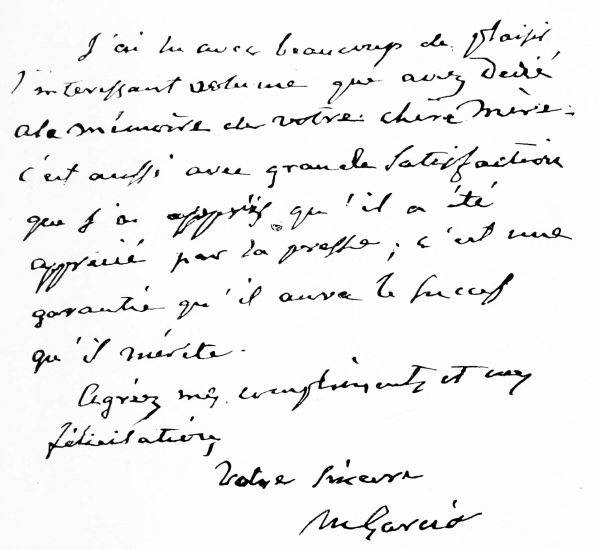
In the middle of April a letter arrived from the maestro, the perusal of
which brought fresh wonder at his amazing vigour. It had been written on
the 16th April, and ran as follows:—
Cher Mr Mackinlay.—J'ai lu avec beaucoup de plaisir l'interessant
volume qu'avez (sic) dédié à la mémoire de votre chère mère.
C'est aussi avec grande satisfaction que j'ai appris qu'il a été
apprecié par la presse; c'est une garantie qu'il aura le succès
qu'il mérite.
Agréez mes compliments et mes félicitations.—Votre sincère
M. GARCIA.
About the same time Hermann Klein received a letter from the old
teacher, and the handwriting, he tells me, was not quite so firm as
usual. Indeed it is evident that Señor Garcia was not feeling at all
himself at this time, for in the note he says—
"As to my health, it is less brilliant than I should like, but it
is passable;" while a postscript is added showing that he himself
realised that his hand was rather shaky: "Can you read this
scribble (ce barbouillage)?"
After this there appears to have been considerable improvement, for on
May 24 he wrote to congratulate Charles Klein on the success of his new
piece at the Duke of York's Theatre, and on this occasion the
handwriting was much clearer and steadier than it had been five weeks
earlier.
(Translation.)
"MON ABRI," CRICKLEWOOD,
LONDON, 24th May 1906.
Dear Mr Klein,—My paper informs me that you have just obtained a
great theatrical success. I congratulate you with all my heart.
Would you have the kindness to send me your actual London address?
I have a little parcel for your brother, which I beg you will
convey to him. It is a portrait that he has asked of me, which he
desires to present to Mme. Sembrich.
One of these days, when I feel in the mood (en train), I shall go
to see "The Lion and The Mouse."
My respects to Mrs Klein, and to yourself a hearty and cordial
handshake. M. GARCIA.
In June Charles Klein sent a box for the Duke of York's Theatre, and
Señor Garcia went to see the piece, which he thoroughly enjoyed. This
was the last dramatic performance which he attended, and indeed the
drama of his own life was drawing to a close.
* * *
* * *
On Sunday, July 1, the end came: the beloved maestro passed away in his
sleep, calmly and peacefully, at the age of 101.
A,
B,
C,
D,
E,
F,
G,
H,
J,
K,
L,
M,
N,
O,
P,
R,
S,
T,
U,
V,
W,
Y,
Z
A
Abramoff, 269
Adam, Adolphe, 175
Adams, John, 78
Adams, Suzanne, 163
Agnesi, 235
Agrisani, 42
Albani, 236, 264, 266, 268, 269, 271
Albert, 48
Albert, Prince, 8, 226
Alboni, 111, 184, 191, 192, 228, 235
Alexander I., 73
Alfonso, King, 302, 313, 322
Alibaud, Louis, 172
Almarcha, Juan, 9
Alvary, 271
Ambrogetti, 42
Ancona, 272
d'Angri, 163
d'Angrisani, 59, 62, 66
Ansani, Giovanni, 25, 26, 27, 28, 100, 289
Arditi, 233, 234, 271
Arnold (composer), 57
Arnold (writer), 185
Arnoldson, 269
Artot, Désiré, 134, 135, 230
Ascherberg, Mr, 259, 260, 262
Astley, 188
Auber, 47, 115, 174, 175, 176, 187, 234
Aumale, Duke of, 172
Aumer, 48
Austria, Emperor of, 77
Avelis, Dr, 306
Avery, 203
B
Baber, Dr E. C., 309
Babington, B. G., 192
Bach, 26
Balfe, 192, 228, 234
Balfour, A. J., 317
Ball, Dr J. B., 309
Ballin, J. S., 305, 309
Balzac, 178
Bancrofts, The, 234
Banderali, 161
Barbieri, Mme., 58, 65, 66, 67
Barbot, 156, 159
Barnby, Sir Joseph, 258
Barretta, 236
Bartet, 236
Basbereau, 40
Battaille, 156, 159, 160, 208, 217
Bauermeister, Mdlle., 269, 271
Baumès, 203
Bayley, P., 185
Beaconsfield, Lord (see Disraeli).
Beecher, Henry Ward, 221
Beethoven, 13, 53, 189, 238, 241
Begnis, Signor and Mme. di, 43, 46, 48, 49, 52, 53
Begrez, 52
Bellamy, 53
Belletti, 189
Bellini, 108, 112, 161, 174, 175
Benedict, Sir J., 189, 190, 194
Benetti, 48
Bennati, 202
Bennett, Sterndale, 263
Benton, Senator, 77
Béranger, 178
Beriot, Ch. de, 112, 116, 119, 120, 126, 133
Berlioz, 152, 173, 175, 189
Bernadotte, Maréchal (see Karl XIV., Johann).
Bernhardt, Sarah, 236
Bernstoff, 77
Bettini, 235, 236
Billington, Mrs, 54
Birkett, Dr, 307
Bishop, Sir Henry, 54, 55, 194
Bismarck, 8
Bispham, David, 270
Bizet, 177, 264
Blücher, 77
Blumm, Herr, 157, 158
Boieldieu, 46, 47, 82
Boito, 268
Bonaparte, Joseph, 21, 22, 23, 24, 62
Bonheur, Rosa, 179
Bonjour, Casimir, 47
Bordogni, 161
Botella, Dr, 306, 307, 316
Botticelli, Signor, 32
Boucicault, Dion, 236
Bourmont, 98
Bowlby, A., 309
Bozzini, 202
Broeckkaert, Dr, 306
Braham, Henry, 53, 225
Brahms, Johannes, 13, 135, 136, 175, 195, 241
Brangaene, 134, 268
Brema, Marie, 271
Brewer, Dr, 98
Brewster, 184
Brizzi, 189
Brombara, 271
Brontë, Charlotte, 184
Brough, Lionel, 234, 236
Brown, Sir Thomas, 209
Brown, Miss (see Kate Crichton).
Browning, Robert, 185
Browning, Miss, 185
Buckstone, 227
Bunn, Alfred, 184
Burger, Dr, 306, 316
Burney, Dr Charles, 26
Bussine, 156, 159, 160
Butlin, H. T., 309
Butt, Clara, 271
Byron, Lord, 55, 299
C
Calecot, 13
Caletti, 189
Calvè, 4, 163, 271, 272
Camidge, Dr, 53
Campanini, 265
Campbell, Sir Archibald, 76
Camporese, Mme., 42, 45
Capoul, 235
Caradori, 45, 46, 50, 52, 53
Cardignac, 170
Carlyle, 184
Caroline, Queen of Great Britain, 77
Carroll, Lewis, 68
Carte, D'Oyly, 270
Carvallo, 230
Castellani, Mme., 189, 191, 192
Catalani, 40, 41, 42, 43, 49, 51, 52
Cazalet, 199
Celeste, Mme., 187, 234
Cerito, 225
Cervetto, Giacomo, 4
Chamberlain, Joseph, 295
Chappell, Thomas, 228
Charles V. of Germany and I. of Spain, 18
Charles IV. of Spain, 14, 16, 21
Charles X. of France, 7, 75, 99, 171, 178
Charrière, 204
Chateaubriand, 185
Chatterton, 194
Chatterton, F. B., 232
Cherubini, 13, 115
Chiari, Dr, 306, 316
Chippendale, Mrs, 234
Chopin, 13, 157, 174, 176, 189, 196
Chorley, 60, 214, 215, 217, 226
Ciabatta, 189
Cimarosa, 47, 49, 61
Cinti, 46
Clay, Henry, 77
Clive, Franklin, 270
Clough, 185
Coccia, 48
Cooke, T. P., 226
Cooper, Fenimore, 62, 79
Copland, Charles, 270
Coppée, François, 179
Coquelins, The, 236
Corot, 179
Costa, Sir M., 184, 189, 191, 226, 230, 233, 234, 268
Cotogni, 235, 236, 264
Coutiau, 113
Cox, Frank, 199
Cramer, J. B., 194
Crichton, Kate, 196, 197
Crivelli, 42, 52, 58, 59, 62, 66, 194, 199
Crivelli (the younger), 58
Croelius, Herr, 140
Crossley, Ada, 163, 317
Cruvelli, 189
Curioni, 45, 48, 52
Czermak, 207, 208, 210, 212, 218
D
Dalmatie, Duchesse de (see Madame Soult).
Damian, Grace, 271
Damoreau-Cinti, Mme., 106
Daponte, Signor, 59, 60
Darmès, 172
Darwin, 184, 299
Darwin, Prof. F., 304
Davenport, Mrs, 55
David, Félicien, 177
David, Ferdinand, 135
Davies, Ben, 270, 317
Davies, Ffrangçon, 270
Davies, Llewellyn, 242
Davis, Dr, 306, 309
Decamps, 179
Delacroix, 179
Delafield, 191
Delaroche, 179
Delauny, 236
Delavigne, 178
Deloffre, 190
Delsaux, Dr, 306
Demosthenes, 127
Denuri, 46
Dérivis, M., 176
Desideria, Queen of Norway and Sweden, 142
Devonshire, Duke of, 52
Diaz, 179
Dibdin, 13, 57
Dickens, Charles, 184
Diday, 131
Didiée, 226
Didier, 230
Disraeli, 184, 219
Dolby, Miss, 189
Donelan, Dr J., 309
Donizetti, 109, 161, 175, 176, 177, 183, 192
Doras-Gras, Mme., 176, 189
Downie, Dr J. W., 309
Duc, 160
Dudevant, Mme. (see Sand, George).
Dufriche, 272
Dulcken, Mme., 194
Dumas (the elder), 179
Dumas (the younger), 179
Duperré, 98
Dupre, 179
Duprez, 94
Dutrochet, 131
Dyck, van, 271
E
Eames, Emma, 41, 163, 271
Ebers, 50
Edward VII., H.M. King, 5, 183, 299, 300, 301, 302, 303, 313
Edwin, Mrs, 55
Ehrlich, Dr, 314
Elen, 44
Elliston, 55
Elson, 57
Emerson, Ralph Waldo, 185
Emmanuel, King Victor, 109
Etherington, Miss (see Tempest, Marie).
Etienne, M., 70, 82
Etruria, King of, 14
F
Fackeldey, Dr, 306
Falcon, Mdlle., 176
Faraday, 184
Farrar, Miss, 53
Faure, 227, 228, 230, 233, 234,235, 236, 267
Favelli, 93
Febvre, 236
Ferdinand IV. of Naples, 36
Ferdinand VII., 14, 21, 24
Ferdinand, M., 48
Fétis, François, 44, 100
Fieschi, 171
Flécheux, Mdlle., 176
Florence, Evangeline, 163
Flotow, 176, 177, 226
Fodor, Mme., 42, 68
Foli, Signor, 231, 234, 235
Formes, Herr, 198, 226, 228, 235
Forsberg, Herr, 147
Forsyth, Neil, 272
Franceschi, 48
Fränkel, Prof., 298, 303, 310, 314
Frederick William IV., 164
French, Dr, 307
Fricci, 163
G
Gabriel, Virginia, 217
Galitzin, Princess, 44
Galletti, 184
Galli, 87, 105
Gallo, Giovanni, 115, 116, 117
Garcia (the elder), 8, 9, 10, 11, 13, 14, 15, 16, 25, 27, 28, 29, 30,
31, 32, 33, 34, 35, 38, 40, 42, 43, 44, 45, 46, 47, 48, 49, 50, 52, 58, 59, 60, 61, 62, 63, 65, 66, 67, 69, 73, 77, 79, 80, 82, 83, 84, 85, 91, 92, 93, 94, 95, 96, 111
Garcia, Manuel—
Triple claim to distinction, 4
First scientific teacher of singing, 4, 6
Inventor of laryngoscope, 4, 6
Centenarian, 4, 7
Born at Zafra, 13
Sees Joseph Bonaparte placed on throne of Spain, 21
Sees Napoleon enter Madrid, 23
Sees Wellington enter the capital, 23
Joins parents in Naples, 24
Lessons from Ansani, 25
Lessons from father, 27
Memory of Murat's execution, 37
Arrives in Paris, 40
Pays last visit to Spain, 44
Studies harmony under Fétis, 44
Sings at Manchester, 52
Takes part in first New York season of Italian opera, 59
Plays title-rôle in the "Barber of Seville," 62, 64
Plays Iago in "Otello," 66
Plays Leporello in "Don Giovanni," 67
Has benefit performance, 69
Leaves for Mexico, 79
Splendid memory, 83
Sings the elder Garcia's operatic rôles, 85
Injury to voice, through over-work, 85
Joins Malibran in Paris, 86
Helps her with her vocal studies, 86
Friendship with Rossini, 86
His advice to Malibran after début, 87
Goes to Italy, 90
Meets Lablache, 90
Makes début in Naples, 90
Abandons operatic career, 91
Returns to Paris, 91
Prepares for seafaring career, 96
Gives it up at entreaty of mother, 96
Assists elder Gracia in his teaching, 96
Takes part in expedition against Algiers, 98
On his return finds Paris in uproar of the July Revolution, 98
Attaches himself to military hospital, 99
Specialises in study of throat, 99
Summary of preparation for career as first scientific teacher, 100
Receives first recognition as teacher, 114
Appointed to Conservatoire of Music, 115
Memories of Malibran, 122
Submits his "Mémoire sur la voix humaine" to the Académie des Sciences, 130
Officially thanked for his services to vocal Art, 131
Recollections of Jenny Lind, 139, 154
Counsels her to delay début in London, 152
Made correspondent of Stockholm University, 155
Created Chevalier de l'Ordre de Mérite, 155
Teaches Henrietta Nissen, 157
Catherine Hayes, 159
Barbot, 159
Battaille, 160
Bussine, 160
Mathilde Marchesi, 161
Johanna Wagner, 163
Invited by Richard Wagner to train singers for first Bayreuth
Festival, 165
Publishes his famous 'Traité complet,' 166
Teaches Stockhausen, 167
Member of National Guard, 170
Arrival in London, 183
Appointed to staff of R.A.M., 193
Teaches Kate Crichton, 196
Bessie Palmer, 198
Invention of laryngoscope, 201-213
Relates story of the invention, 203
Presents paper to Royal Society, 205
Teaches Santley, 214
Presents memoir to Montyon Committee, 218
Made M.D. of Königsberg, 219
Teaches Antoinette Sterling, 219
Election to Committee of R.A.M., 222
Episode with Saint-Saëns, 222
Memories of Mario, 234
Takes rooms at Kleins', 237
Intimacy with Joachim, 241
Teaches Miss Orridge, 242
Huxley testifies to importance of his invention, 243
Elected to Board of Directors R.A.M., 244
Teaches Miss Thudicum, 244
Invited to read paper before Medical Congress, 245
At a Royal Institution Lecture, 246
Teaches Miss Macintyre, 246
Marie Tempest, 247
Agnes Larkcom, 249
Arthur Oswald, 249
Other pupils' memories of lessons with, 249-255
Attacked by Maurel over the coup de la glotte, 256
Receives presentation on entering 90th year, 257
Publishes last text-book, 258-263
Resigns professorship, 263
Method of teaching, 283
Compares Kubelik with Paganini, 295
Winters in Egypt, 296
Attends funeral of Antoinette Sterling, 296
Enters 100th year, 296
Receives address from R.A.M. and R.C.M., 297
Audience with the King, 300
Attends meeting at Royal Society, 300
Decorated with Royal Order of Alphonse XII., 302
Great Gold Medal for Science, 303
Speech of thanks, 310
Attends banquet, 312
Replies to toast, 315
Life at 100, 316
Dines with Laryngologists, 318
Attends various dinners, 322
Celebrates 101st birthday, 322
Passes away, 324
Garcia, Maria, 3, 4, 16, 25, 35, 36, 42, 45, 49, 50, 51, 52, 53, 58, 62, 63, 65, 66, 68, 69, 79, 80, 81, 82, 84, 86, 87, 88, 89, 90, 93, 95, 98, 105, 106, 107, 108, 109, 110, 111, 112, 113, 115, 116, 117, 118, 119, 120, 121, 122, 123, 124, 125, 127, 156, 193
Garcia, Pauline, 3, 4, 44, 64, 90, 91, 94, 95, 100, 113, 125, 126, 127, 128, 129, 132, 133, 134, 135, 136, 137, 138, 156, 160, 173, 190, 191, 192, 193, 197, 216, 217, 222, 226, 230, 244, 286, 297
Garcia, Joaquina, 11, 12, 16, 62, 66, 69, 219
Gardoni, 235
Garibaldi, 230
Gassier, 230, 234
Gautier, Théophile, 178
Gazaré, 264, 267
Geikie, Sir A., 304, 310
George III., 7
George IV., 44, 52, 55, 75, 77, 183
Georges, Mdlle., 46
Geraldy, Jean, 93
Gericault, 179
German, Edward, 247
Germany, Emperor of, 310, 314
Gerster, Fran, 163, 264
Gervasoni, 27
Giuglini, 228, 230, 231
Gluck, 226
Gluck, Prof., 306
Glyn, Miss, 226
Godoy, Manuel, 14, 21
Goethe, 174, 299
Goldschmidt, Otto, 305
Goodall, Miss, 53
Gordoni, 189, 228, 231
Goris, Dr, 306, 316
Goss, 194
Got, 236
Gounod, Ch., 13, 54, 69, 134, 160, 177, 230, 231, 272
Grassari, Mme., 46
Grassot, 187
Graumann, Mdlle. (see Marchesi, Mme.)
Graziani, 43, 230, 231, 236
Graziani, Mme., 45
Greatorex, 53
Green, Richard, 270
Grener, 48
Gretry, 47
Greuze, 13
Grey, Earl de, 272
Grimaldi, 54
Grisi, 111, 128, 184, 191, 226, 227, 231, 234
Gros, 179
Grote, 184
Gruneisen, 198
Guerrabella, Ginevra (see Ward, Geneviève).
Guerrero, General, 91
Guglielmi, 29, 53
Guizot, 169
Gura, 268
Gye, Ernest, 191, 266
Gye, Frederick, 198, 225, 228, 230, 233, 236, 264
H
Haigh, 227
Halévy, 13, 94, 132, 174, 175, 198
Hall, Dr de Havilland, 245, 309
Hallé, Sir Charles, 190, 226, 227, 321
Hallé, Lady, 136, 222, 235
Halleck, Fitz-Greene, 59, 62, 79, 80
Halliburton, Prof., 304
Handel, 58, 133
Harley, 55
Harris, Sir Augustus, 228, 267, 268, 271, 272
Harrison, W., 226, 227
Hassein, Dey of Algiers, 98
Hauk, Minnie, 233
Haydn, 13, 58
Hayes, Catherine, 156, 159, 226, 227
Hemans, Mrs, 55
Henri, 171, 172
Henschel, George, 4, 195
Hermann, 190
Hérold, 36, 47, 174, 175
Herschel, Sir John, 184
Higgins, H. V., 272
Hill, 190, 267
Hill, Lucile, 270
Hill, Dr W., 309
Hilson, Mrs, 65
Hirschland, Dr, 306
Hogarth, Mr, 88
Holland, Canon Scott, 139, 140, 142, 157
Honey, George, 226, 227, 228
Hood, Tom, 177, 185
Horner, 185
Howe, Lord, 11
Huggins, Sir W., 304
Hugo, Victor, 179, 188
Hullah, John, 190, 217
Huxley, Prof., 4, 184, 243
"Ingoldsby, Tom," 122
Irving, Sir Henry, 227, 266
Irving, H. B., 322
Isnardon, M., 269
J
Jackmann, Herr, 164
Jakins, Dr, 306
James, G. P. R., 184
Jarret, 232
Jefferson, 78
Jerrold, Douglas, 184
Joachim, Joseph, 133, 135, 235, 241, 272
Johnson, Dr George, 245
Joran, Pauline, 272
Jordan, Mrs, 56
Joseph, 195
Jourdan, 166
Jullien, M., 190
Junot, General, 15
K
Kan, Dr, 306
Karl XIV., Johann, of Sweden and Norway, 142
Kean, Charles, 54, 55, 65, 66, 186
Kean, Mrs Charles, 186
Keeley, Mrs, 186
Kellogg, Clara, 231
Kemble, Adelaide, 217
Kemble, Charles, 54, 55
Kemble, Gertrude, 217
Kemble, John, 54, 56
Kidd, Dr Percy, 309
Killian, 212
Kingsley, Charles, 185
Kirstein, 212
Klein, Charles, 238, 320, 323, 324
Klein, Hermann, 237, 256, 258, 259, 260, 261, 262, 263, 265, 267, 319, 323, 324
Knight, 55
Kuttner, Dr, 306
Knyvett, 53
Koch, Prof., 314
Kock, Paul de, 179
Koenig, Dr, 306
Kraus, 163
Kubelik, 294
L
Labarre, 113
Lablache, Luigi, 90, 110, 123, 124, 128, 159, 189, 225, 226
Lablache, Mme., 189
Lago, Signor, 271
Lamartine, A. de, 178
Lamercier, 178
Lamoricière, 170
Landgraf, Dr, 306
Laporte, 105
Lara, Isidore de, 272
Larkcom, Agnes, 249
Lassalle, Jean, 266, 267, 269, 271
Latour, Cagniard de, 202
Lawrence, L. A., 309
Lawrence, Sir Thomas, 77
Lecompte, 172
Legras, 48
Lehmann, Lilli, 267
Lemmens-Sherrington, Mme., 227, 230
Leoncavallo, 272
Lermoyez, Dr, 306, 316
Leslie, Henry, 217
Leslie, Mrs, 217
Lesueur, 46, 47
Levasseur, 176
Lever, Charles, 185
Levret, 202
Lewis, Sir George Cornewall, 298
Lieven, Dr, 306
Lind, Jenny, 4, 29, 139, 155, 156, 157, 158, 165, 184, 190, 191, 193, 198, 214, 240, 286, 288
Lindblad, Herr, 152
Lindblad, Mme., 146
Lindley, 194
Lister, 299
Liston, 55
Liszt, Abbé, 49, 126, 128, 173, 176, 177, 246, 268, 269
Longfellow, 185
Louis XVI., 10
Louis XVIII., 7, 40, 41, 178
Low, Mr Stuart-, 306
Lucas, Charles, 263
Lucca, Pauline, 230, 234, 235, 236, 266, 268
Lucca, Duke of, 113
Luce, de, 70
Lucia, de, 272
Lucia, Mme., 230
Lumley, 184, 192, 198
Lundberg, Mdlle., 140
Lussan, Zélie de, 269, 271
Lynch, Dominick, 59
Lytton, Bulwer, 185
M
Maas, Joseph, 236, 268
Macaulay, Lord, 185
Maccherini, 27
Macfarren, Sir George, 194, 263
Macfarren, Walter, 194, 258
Macintyre, General, 246
Macintyre, Margaret, 244, 246, 269, 270
Mackenzie, Sir A. C., 258, 263, 268
Macready, 54, 55, 71, 72, 186, 187
Majendie, 131
Mahu, Dr, 306
Malibran, Maria (see Garcia, Maria).
Malibran, M., 79, 80, 112, 119
Mapleson, Colonel, 227, 228, 231, 232, 233, 265, 268
Marchesi, Blanche, 163, 301, 305, 317
Marchesi, Mathilde, 4, 156, 161, 162, 163, 195, 218, 219, 301
Marchesi, M., 230, 301
Maria I. of Portugal, 15
Marini, 191, 192
Mario, 184, 189, 191, 192, 226, 228, 230, 231, 233, 234, 235, 264, 286
Marimon, 235
Marras, 189
Mars, Mdlle., 46
Martin, M., 46
Martineau, 185
Mascagni, Pietro, 271, 272
Massenet, 177
Mathews, Charles, 54, 56, 75, 227, 234, 264
Mathews, Mrs, 234
Maurel, Victor, 236, 256, 257, 267, 271
M'Bride, Dr, 309
Meissonier, Jean, 179
Melba, 4, 163, 269, 271, 272
Mellon, Alfred, 190, 226
Mellon, Mrs, 226, 234
Mendelssohn, 13, 161, 168, 174, 176, 183, 189
Mendi, de, 189, 190
Meric-Lalande, 93
Merlin, Countess, 93, 106
Messent, Miss, 215
Meyerbeer, 13, 50, 94, 134, 151, 152, 160, 164, 174, 176, 177,
191, 192, 193, 226, 227, 230, 286, 321
Meyssenberg, 126
Mierzwinski, 267
Mill, John Stuart, 185
Miller, 184
Millet, Jean François, 179
Millico, 58
Milligan, Dr, 308, 309
Mimaut, 47
Molique, 190
Molinié, Dr, 306
Moll, Dr, 306
Mommsen, 314
Monbelli, 236
Mongini, 231, 234, 235
Montarid, 269, 271
Montyon, 218
Moritz, Dr, 305
Moscheles, 134, 194
Mounet-Sully, 236
Mount-Edgcumbe, Lord, 34, 35
Moure, Dr, 306
Mozart, 47, 53, 59, 61, 67, 68, 160, 321
Munden, 55
Murat, King of Naples, 7, 22, 23, 30, 36, 37
Mürger, Henry, 96, 97, 178
Murillo, 20
Murska, Ilma di, 163, 231, 234, 235
Musiani, Adelaide, 271
Musset, Alfred de, 117, 129, 175, 178
Musset, Paul de, 175
N
Napoleon, 7, 14, 16, 23, 29, 40, 44
Naudin, 231
Nava, 215
Neruda (see Hallé, Lady).
Neumann, Dr, 267
Nevada, Emma, 163
Nicholl, William, 249
Nicolai, 161, 177
Nicolini, 231, 236, 264, 267
Niemann, 267
Nillson, Christine, 231, 233, 234, 235, 243
Nissen, Henriette, 4, 156, 157
Noblet, 48
Nordica, 271
Noufflard, Mme., 136, 222, 223
Nourrit, Adolph, 93, 94, 176
Nourse, 306
O
Offenbach, 177
O'Mara, Joseph, 270
O'Neill, Miss, 55, 56
Onorati, Cardinal, 40
Orridge, Miss, 242, 243
Oscar I., King of Sweden, 166
Osler, Prof., 210
Oswald, Arthur, 249, 317
Oudin, Eugene, 270
Owen, 184
P
Pacchierotti, 34
Paderewski, 258, 269
Paër, Ferdinand, 15, 35, 44
Paganini, 13, 176, 295
Paget, Sir James, 245
Paisiello, 30, 32, 43, 47, 61
Palliser, Esther, 270
Palmer, Bessie, 197, 198
Palmerston, Lord, 8
Panseron, 36, 47
Parepa, 226, 227
Parry, John, 123, 189, 190
Pasta, 42, 46, 48, 49, 50, 51, 75, 88, 107, 108, 112, 286
Pasteur, 299
Patey, J. G., 227
Patti, Adelina, 227, 228, 230, 231, 233, 235, 236, 266, 268, 272
Patti, Carlotta, 231, 235
Paul, Mrs Howard, 236
Payne, Howard, 55
Pedraza, General, 91
Peel, Sir Robert, 198
Pegler, Dr L. H., 309
Pellegrini, 43
Pepusch, 53
Pergolesi, 42
Perkins, 74
Permewan, Dr, 309
Persiani, 128, 133, 183, 184, 191
Pétrequin, 131
Phelps, 226
Philip II. of Spain, 18
Philippe, Louis, 8, 99, 166, 169, 170, 171, 172
Phillips, 53
Piatti, 190, 235, 258, 272
Pierson, Blanche, 236
Pisaroni, 87
Pischek, 189
Planché, 236
Plançon, 271
Poli, Prof., 306, 316
Polignac, 99
Pollini, Herr, 267
Ponchielli, 268
Poniatowski, Prince, 113, 114
Porpora, 25, 26
Porto, 45, 48
Potter, Cipriani, 194, 263
Potter, Dr Furniss, 309
Pounds, Courtice, 247
Price, Stephen, 59, 60
Princess Royal, 226
Prud'hon, 179
Prussia, King of, 8, 77
Puccini, 272
Puente, del, 265
Puget, Mdlle. de, 158
Puke, Count, 141
Purcell, 190
Puttner, Dr, 316
Puzzi, 52, 194
Pyne, Louisa, 226, 227
R
Raff, 195
Rainforth, Miss, 186
Randegger, Chevalier Alberto, 249, 263
Randolph, John, 77
Ravell, 187, 271
Ravogli, Giulia, 271
Rees, Eleanor, 247
Reeves, Sims, 190, 196, 197, 226, 227, 230, 235, 243
Reicha, 40, 126
Reicher-Kindermann, 267
Reichemberg, 236
Reina, 45, 46
Reiter, Frau, 167
Remorini, 48, 51, 52
Reynolds, Miss, 186
Rezké, Edouard de, 266, 268, 269, 271
Rezké, Jean de, 264, 268, 269, 271, 272
Rhodes, John, 188
Richard, Mme., 271
Richelieu, 77
Richter, Hans, 266, 267
Righetti, Giorgi, 32
Righi, 45
Rimbault, 93
Ripa, Antonio, 9
Robespierre, 11
Robinson, H. B., 306, 309
Rochefort, Henri, 179
Rodriguez (see Garcia).
Rolla, 271
Roncaglia, 26
Ronconi, 191, 231
Ronzi, 50
Rooy, van, 4, 195
Rosa, Carl, 269
Rosebery, Countess of, 242
Rosich, 59, 62
Rossi, Signorina, 32
Rossi, 106, 226
Rossini, 13, 32, 43, 45, 46, 47, 48, 49, 61, 66, 67, 69, 86, 88, 93, 94, 111, 133, 161, 173, 186, 191, 233, 286, 292, 321
Rossini, Mme. Colbran, 46, 48
Rota, 235
Rothschild, Baroness Lionel de, 242
Rousseau, 179
Rubini, 128
Rubinstein, 177, 239, 258, 266, 268, 269, 270
Ruckman, Marie, 146
Ruiz-Garcia, Mme., 93
Ruskin, 185
Russell, Ella, 268, 269
Rye, Lieutenant, 76
S
Sabatier, 189
Sainton, Prof., 184, 190, 194
Saint-Saëns, 175, 222
Sainville, 187
Salieri, 53
Salmon, Mrs, 51
Salmond, Norman, 270
Salomon, Mme. Siegfried (see Nissen, Henriette).
Samary, 236
Sand, George, 128, 170, 175, 176, 177
Sanderson, Sybil, 163, 271
Santi, P. de, 306, 308, 309
Santley, Sir Charles, 4, 197, 214, 215, 216, 217, 226, 227, 228, 230, 231, 234, 235
Sapio, 51, 53
Sarasate, 264
Sargent, John S., 301, 309, 316
Savart, 131
Saville, Francis, 163
Saxon, Avon, 270
Saxony, King of, 164
Scalchi, Mme., 233, 234, 235, 236
Scheffer, 179
Scheidemantel, 4, 195
Schlosser, 267
Schmidt, Prof. M., 307
Schubert, 13, 94, 174, 241
Schumann, Robert, 13, 136, 225
Schumann, Mme., 133, 195, 235
Schwartz, 189
Scott, Sir Walter, 54, 75, 174, 299
Sedie, Delle, 227
Seidl, Anton, 267
Sembrich, Mme., 266, 324
Semon, Sir Felix, 245, 301, 306, 308, 309, 310, 311, 312, 314, 315, 316, 319
Senn, 202
Serda, 176
Shakespeare, 299
Sharpey, Prof., 205
Shelley, 55, 299
Siddons, Mrs Sarah, 54, 77
Sinico, 231, 234, 236
Sitchès, Joaquina (see Garcia, Joaquina).
Sivori, 235
Smart, Sir George, 194, 231
Smith, Alexander, 185
Smith, Dr Harman, 306, 316
"Smith, Mr" (see Philippe, Louis).
Sontag, Mme., 106, 111
Soulacroix, 267
Soult, Mme., 142, 144
Spagnoletti, 48
Spicer, H., 187
Spohr, 13
Spontini, 53, 174
Stanford, Sir C. V., 241, 272
Stephens, Miss, 53, 55
Sterling, Antoinette, 4, 134, 135, 163, 219, 220, 277, 296
Stern, 195
Stewart, W. R. H., 309
Stirling, Prof., 305, 310
Stockhausen, Julius, 4, 156, 166, 167, 168, 194, 197, 214, 289, 316
Storace, 57
Sucher, Rosa, 267, 271
Sue, Eugène, 179
Suffield, Lord, 302, 313
Sullivan, Sir Arthur, 230, 258, 266, 270
Sullivan, Barry, 234
Symonds, C. J., 306, 308, 309, 313
Szymanowska, 52
T
Tadolini, 189
Tagliafico, 192, 235
Taglioni, 225
Talma, 46, 118
Tamberlik, 226, 228, 230, 234, 235
Tamburini, 128, 184, 192
Tapia, Dr, 306
Taylor, Sir H., 185
Tempest, Marie, 246, 247, 248, 249
Tennyson, Lord, 185
Terrail, 53
Terry, Ellen, 266
Terry, 55
Thackeray, 185
Thalberg, 190
Thomas, Ambroise, 233, 234
Thomas, Goring, 268
Thomas, J., 194
Thompson, Alderman, 75
Thomson, Dr St Clair, 309
Thudicum, Miss, 244, 246, 247, 270
Tietjens, 228, 230, 231, 233, 235
Toole, J. L., 226
Toxier, Dr, 306
Travis, Miss, 53
Trebelli, 230, 235, 266, 269
Tremelli, 163, 268
Treviso, Duke of, 172
Trouseau, 203
Troyon, 179
Türck, 206, 207, 212, 218
Turner, 198
Tyndall, Prof., 184
U
Uhl, L., 129
Unger, 267
V
Valleria, Mdlle., 265, 266
Vasa, Gustavus, 155
Vaughan, 53
Vega, Marcus, 125
Velluti, 52
Vera, 189
Verdi, 13, 66, 67, 69, 234, 272
Vernet, Horace, 47, 179
Vestris, Charles, 48
Vestris, Mme., 45, 46, 48, 49, 50, 55, 186, 225
Vestris, Mme. Ronzi, 48
Vestris, Signor, 48
Vianesi, 233
Viardot-Garcia, Mme. (see Garcia, Pauline).
Viardot, Louis, 128
Viardot, Mme. Pauline (see Garcia, Pauline).
Victoire, 226
Victoria, H. M. Queen, 125, 183, 226
Vieuxtemps, 235
Vignas, Francesco, 271
Vigny, Alfred de, 178
Villalobar, Marquis de, 302, 303, 313
Vinrace, Dennis, 306
Virchow, Prof., 314
Visconti, Duke of, 117, 118
Vitarelli, 32
Vogls, The, 267
W
Wachtel, 231, 235
Wagner, Johanna, 4, 156, 163, 164, 165, 198
Wagner, Richard, 13, 129, 163, 165, 176, 177, 243, 264, 266, 267, 271, 289
Waldeyer, 304
Walker, Dr T. J., 245
Wallace, 226
Ward, Geneviève, 164, 227
Warden, 203
Warner, Mrs, 187
Warren, 188
Warton, Mme., 188
Weber, 13, 55, 90, 189
Webster, Ben, 186, 226, 234
Weiss, 226
Wellington, 23, 24, 74, 77
Wesley, Samuel, 54
Wieniawski, 235
Wilkinson, Miss, 53
Willcocks, Dr, 307
William I., 8
William IV., 164, 183
Williams, the Misses, 189
Wilson, General J. G., 59, 62
Winogradon, 269
Winter, 141
Wordsworth, 198
Worms, 236
Wotan, 289
Wrottesley, Lord, 205
Wyld, Dr, 246, 306
Y
Young, 55
Z
Zaalberg, Dr, 306
Zamboni, Luigi, 32
Zingarelli, 28, 29, 48, 58, 69, 100
Zola, 179
THE END
PRINTED BY WILLIAM BLACKWOOD AND SONS.