1.
LAYING THE BREAKFAST-TABLE
1. Spread the cloth—this is the way,
Cups and saucers, where are they?
2. Put them at one end in rows,
See, a spoon with each one goes.
3. One plate for each person bring,
And a napkin in a ring.
4. Here's a jug of milk so hot,
Sugar next, and coffee-pot.
5. Bread and butter place we here,
Then we get the chairs, my dear.
6. Ring the bell, and all sit round,
Each should in his place be found.
Directions.—The table may be laid by
two children only, or several may be employed,
but different children should take
part each time the game is played, so that
all may learn how to carry the cups, &c.,
and how to place them.
Verse 1. Two little girls step forward and
lay the cloth.
Verse 2. The cups and saucers are
brought on a tray, and placed in rows at one
end of the table.
Verse 3. One child brings plates on a
tray and places them one by one round the
table, while another follows with serviettes
on a small tray, and places one to the right
of each plate.
Verse 4. The sugar, milk, &c., are placed
in position.
Verse 5. One or two plates of bread and
butter are put on the table, and then the
chairs are placed ready.
Verse 6. The bell is rung, and the children
who are to sit at table take their
places.
2. THE BREAKFAST PARTY
This game may be played immediately
after the one preceding, or it may be used
alone. The children seat themselves at the
table, the 'Mother' sitting at one end and
the 'Father' at the other. When all the
cups are filled and passed, the following
lines are repeated:
1.
[1]Little hands are folded while the grace is said,
'Father, God, we thank Thee for our daily bread.'
2.
[2]Let us stir our coffee, softly, gently, so,
[3]Then the spoon in saucer quietly must go.
3. When you eat and drink, dears, do not make a noise,
[4]Pass things to each other, little girls and boys.
[If there is a piano in school, a little music
might be played while breakfast is in progress.]
4. When we finish breakfast,
[5]hands in lap lay we,
Elbows on the table, that should never be!
3.
CLEARING THE TABLE
(For directions as to laying the table, see
game
No. 1.)
1. Breakfast over, off we go,
To remove the cloth, you know.
2. Put the napkins on the tray,
And the plates, too, take away.
3. Cups and saucers next we take,
Carefully, lest them we break.
4. Bring the milk and sugar here,
Soon the table will be clear.
5. Shake the cloth and fold it straight,
Then we'll wash each cup and plate.[A]
Instructions.—Verse 1. Children rise
from table, and each carries chair to the
place where it should go.
Verse 2. A child brings a little tray, and,
walking round the table, takes up all the
napkins, putting them on the tray one by
one. A second child follows with another
tray, and takes up the plates in the same
manner.
Verse 3. Two children remove the cups
and saucers, each having a tray.
Verse 4. The coffee-pot, milk-jug, and
sugar-basin are taken away on a tray.
Verse 5. The cloth should be taken off
carefully, so that the crumbs are not spilt,
or if a toy crumb brush and tray can be
obtained, the crumbs may be removed before
the cloth is taken up.
4. WEIGHING
Scales and weights are required for this
game.
Before commencing let the children see
the different weights, and hold them one
after the other in their hands.
The following rhymes may assist the
scholars to remember the various weights:
1. First comes the
[1]ounce weight, small and round,
Sixteen of these do make a [2]pound.
2. Four ounces
[3]quarter-pound will be;
[4]Half-pound has eight ounces, you see.
The four weights given above will be
sufficient at first for little children, but more
may be added as they become familiar with
these. When the scholars have learnt to
distinguish the pound, ounce, &c., they may
come out in turn and weigh various objects.
It would be well to explain that solid
objects occupy less room than lighter substances—that
a pound of feathers, e.g.,
would take up a large space, while a pound
of lead would go into a very small compass.
Guessing Game.—When the object to
be weighed has been chosen, a number of
children are allowed to come out and hold
it in turn, and say what they think is its
weight. As the object is handed to the first
child, the teacher says:
Can you tell the weight of this?
Mind you do not guess amiss.
Each child takes the object in its hand
and guesses. The article is then weighed,
and the child who has guessed most nearly
its correct weight is allowed to choose the
next object for weighing, and to call out the
children who are to guess. He hands it to
the first child, repeating the words of the
rhyme.
5. MEASURING GAME
Before playing this game, the children
should be well accustomed to the use of the
foot-rule, marked with inches (cost, &c.[1]).
Each child should have a foot-rule and
measure its book, pencil, desk, &c.; it should
also be taught to draw lines of different
lengths with the rule on its slate; thus,
teacher might say, 'Draw a standing-up
(vertical) line six inches long,' or, 'Draw a
lying-down (horizontal) line four inches
long,' and so on. The children will thus
get accustomed to estimating the length
and breadth of objects, and will be able to
play the game.
Suppose the slate to be the object chosen,
the teacher holds it up so that all may see
it, and then repeats the lines:
Think it over carefully,
And tell me what the length may be
Of this slate.
The children who are ready to answer
then put their hands out, and the one who
guesses correctly (or most nearly correctly)
has the privilege of asking the next question,
and stands in front of the class in readiness.
Before proceeding, however, the first object
should be measured, so that all may see
that the answer was correct.
Perhaps the pencil may be the next
object chosen, or a window-pane, ball-frame,
desk, duster, book, &c., and instead of length,
we may have breadth. The words would
then be:
Think it over carefully,
And tell me what the breadth may be
Of this window-pane.
The children should be taught to listen
attentively, so that they may know whether
length or breadth is to be guessed; the
meaning of the two terms should, of course,
be explained previously.
If circular objects are chosen for
measurement, the word 'girth' must be
substituted for 'length.' This form of
object should only be used for the older
children, as it is much more difficult. To
measure a circular object, a string should be
passed round it, and the string should then
be measured with the foot-rule.
Sometimes the word height may be substituted,
as, for instance, in measuring the
height of a plant or a child. The children
will enjoy the latter very much.
Twelve inches make a foot,
And nine a quarter-yard,
The half-yard eighteen inches takes,
To learn this is not hard.
6. SHOPPING
The shopman should stand behind a
table or desk, and have articles made up in
parcels ready for sale. 'The Shop' described
in 'Kindergarten Guide,' p. 230,[1]
would do nicely for this game.
The children who go shopping should be
dressed in outdoor costume, and each carry
a basket. They should also have money;
imitation cardboard coins (for cost[2]) would
do. (Customer walks up to the counter.)
Shopman
Good morning, ma'am, how do you do?
And pray what can I get for you?
Customer
Good morning, shopman, will you please
To weigh for me a pound of cheese?
[The packet is handed to customer.]
Customer
Here is a shilling [handing it], eightpence take,
Shopman
And fourpence change [giving fourpence to customer] just twelvepence make.
The children should also ask for other
articles, without using the rhymes, and they
should be encouraged to speak clearly and
distinctly, and to address the shopman
civilly. This will be likely to assist them in
going errands for mother.
7. TYING A BOW
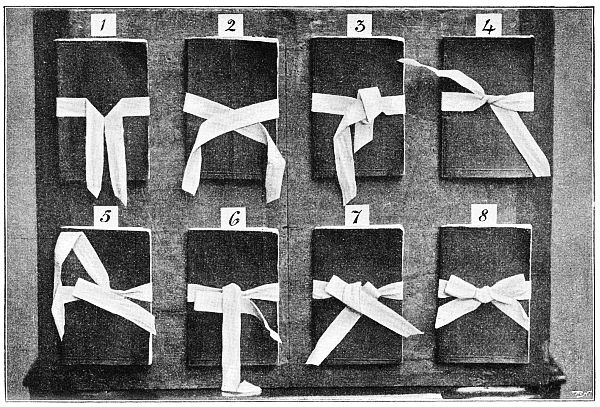
Instructions.—The children should be
sitting at desks or tables, and each child
should have a ¾ yard length of tape or
ribbon, one inch in width, and a book with
stiff cover. The teacher should first show
how to tie the bow by passing her ribbon
round the neck or wrist of a child, and
performing the various movements as they
are mentioned in the rhymes and shown in
the illustrations. This should be done
several times very slowly, the words being
repeated either by teacher only or by all.
When the children begin to tie the ribbon
each round its own book, the teacher should
show the various movements as they occur,
performing them simultaneously with the
scholars. (The numbers refer to fig. 1,
which shows the various steps in order.)
[1]Place your ribbon round the book,
[2]Cross it—left end at the top;
[3]Now the right end take and pass
Over, [4]draw it tight, then stop.
[5]With the right end make a loop.
[6]Draw the left across it, so;
[7]Now another loop we make
With the left, and [8]pull it through.
'Tying a Knot' (which is more simple than 'Tying
a Bow') is given in the 'Kindergarten Guide,' p. 105.[A]
Each child should have a thimble, and
the teacher should have one also. A short
conversation about the thimble should precede
the game—how it is smooth inside and
rough outside. What makes it rough?
What are the little holes for? Which is
the rim? &c.
(The teacher, if facing the children,
should use the left hand for right.)
[1]Pretty little thimble,
[2]In your cradle go,
[3]I will rock you gently,
Gently to and fro.
Now I
[4]toss and
[5]catch you,
[6]Up and down and [7]up;
[8]Next I hold my thimble
Like a little cup.
[9]On the right thumb place it,
Is that right? [10]oh, no!
[11]On your longest finger
[12]Should the thimble go.
9. SEWING GAME
(N.B. In this game, as in No. 8, the
teacher, as she faces the scholars, should
use her left hand each time the children
use the right.)
If the children have been taught the use
of the thimble (Game No. 8), they should
wear it during this game.
Teacher
Little children, clean and bright,
Show your
[1]left hand, show your
[2]right,
[3]Left forefinger, that will do,
[4]Place your sewing round it, so.
[5]Needle in your right hand hold,
All should do just what is told;
When the number
One I call,
[6]Take a stitch, dear children all.
[7]Two, we show the stitch so neat,
[8]Just to see it is a treat.
[9]Three, we push the needle's eye
With our thimble carefully.
[10]Four, we draw the needle out,
Minding well what we're about.
Thread from needle need not slip,
If a good look-out we keep.
After practising this game several times,
the children will be ready for the sewing
drill given on p. 270, 'Kindergarten Guide.'
10. KNITTING GAME
Each child should have a pair of knitting-pins
([A]wooden ones are the best for
learning), and the teacher should have a
pair also. As the teacher stands facing the
children, her left hand is opposite to their
right, and she should, consequently, use her
left needle to take the stitch, &c., otherwise
the children will be confused.
Teacher
I will teach you how to knit,
If you listen, dears, to me;
And I'm sure you will admit
It is easy as can be.
Put the pins all ready,
[1] so,
Hold one firmly with each hand;
Then the knitting drill I give
You must try to understand.
[2]Take a stitch at number
One,
And when I say, 'Number Two,'
[3]Hold the wool in your right hand,
And then throw it over, so.
[4]Now the pin that's underneath
To the top must come at Three,
[5]Slip the loop at number
Four
From the left pin carefully.
When the above game has been repeated
several times, the children will be ready for
the Knitting Drill given on p. 274 of 'Kindergarten
Guide.'
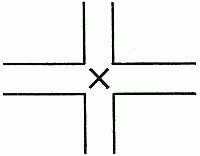
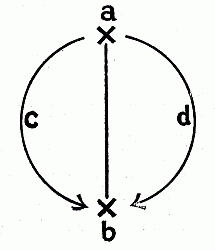
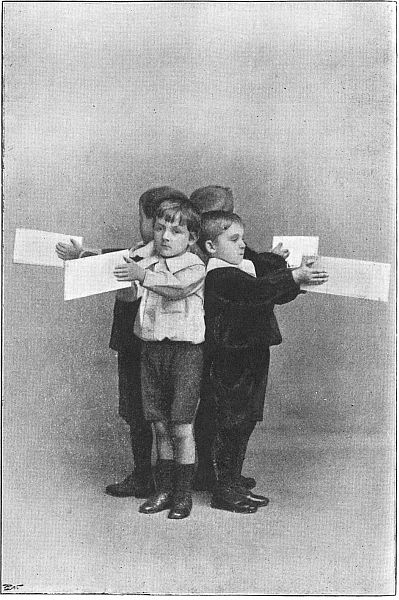 Fig. 2.—the sign-post
11. THE SIGN-POST
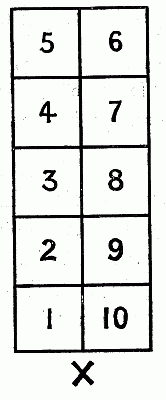
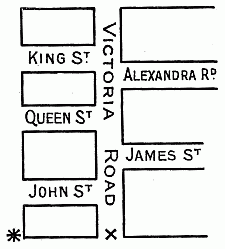
Directions.—The children make roads by
standing in lines (see diagram). Four
children should stand at the place marked
× (see fig. 2), one child facing each road,
and holding in its two hands a good-sized
strip of cardboard, with the name of a town
or village to which the road is supposed to
lead printed thereon. It would be well to
use the names of places in the district with
which the children are familiar. Some of
the children must be little travellers, and
come walking up the different roads until
they reach the sign-post, then all repeat the
lines:
The little travellers do not know
Which way to go, which way to go,
But here's a sign-post that will tell;
Ah! now they know the way quite well.
The travellers should be told the names
on the sign-post before starting, and each
should choose the place to which he will
journey. After the lines are repeated, each
traveller takes the road that leads to his
destination.
Preliminary.—One of her Majesty's
inspectors remarked on one occasion that
he could judge of the intelligence and
manners of a school by the way in which its
scholars playing in the street would reply if
asked a question as to the whereabouts of
any particular place in the locality.
It is doubtless desirable that children
should know something of the streets and
roads of the district in which they live, and
if they have clear ideas as to the meaning
of 'right' and 'left,' the following game
should help them in describing the position
of places.
The streets may be made by the children
themselves standing in rows, as in the
preceding game; or if the space available
be small, the children may stand round the
room, while the plan of the streets is chalked
on the floor. There should be one central
street, with others branching out of it right
and left, and each should be named. It
may be possible to arrange and name the
streets of some district with which the
children are familiar. The name of each
should be written on a card and placed at
the end of the street. The accompanying
diagram will illustrate the playing of the
game. We will suppose that a little girl
comes walking up Victoria Road, and at the
point × meets a gentleman (a little boy),
who asks, 'Can you please direct me to
Queen Street?' 'Yes,' she replies, 'it is
the second turning on the left.' The place
of meeting may be varied, and the children
will then see that the terms 'right' and
'left' are interchangeable, according to the
direction in which we are walking. In the
following instance, e.g. Queen Street is on
the right instead of left. More difficult
questions may be asked as the children get
to understand better, such as, 'Which is the
way to Alexandra Road?' (starting from *).
'Take the second turning to the right, then
turn to left, and it is the first street on the
right.'
13. POLITENESS IN STREETS
The streets (p. 26) of Game No. 12 may
be utilised for this game. The children
should have on their hats and caps, and
walk along the streets. The game is intended
to teach them how to behave when walking;
they should keep to the right, not speak
loudly, and the boys should raise their caps
when they meet anyone who acknowledges
them.
When the game is fairly started, the
two verses which follow may be repeated by
all the children:
Keep always to the right
When in the street you walk,
And please remember this—
Do not too loudly talk.
We must not stare at folks,
Or turn to look behind;
Be kind, but never rude—
A good rule you will find.
A little girl who is walking drops her
handkerchief; then, after going a few yards
further, stops and says:
Where is my handkerchief? oh dear!
I must have dropped it somewhere near.
A boy who has picked it up advances
and offers it to the lady, at the same time
raising his cap, and the lady says 'Thank
you.' The game may be continued at the
teacher's discretion, and the verses again
repeated.
14. DRESSING CHILDREN
About a dozen of the older children stand
in the centre of the room, and a number of
the little ones come in with coat and hat
in hand. The older children repeat the
verse:
Ready for the babies stand,
See they come with hat in hand.
Bigger children always should
To little ones be kind and good.
The younger children then advance, and
the others proceed with the dressing. First
the coat is put on and carefully buttoned,
then the hats or hoods are tied on, and the
little child says 'Thank you.'
This game should be played just before
the children are dismissed, or before playtime.
N.B.—How to tie a bow may be learnt
from Game No. 7, p. 12.
15.
FATHER BRINGING PRESENTSObject of Game.—Anyone who has
observed children cannot fail to have
noticed how very often they have to be
prompted to express their thanks for kindnesses
received. It is hoped that this little
game may be of use in impressing the lesson,
so often reiterated by parents and others.
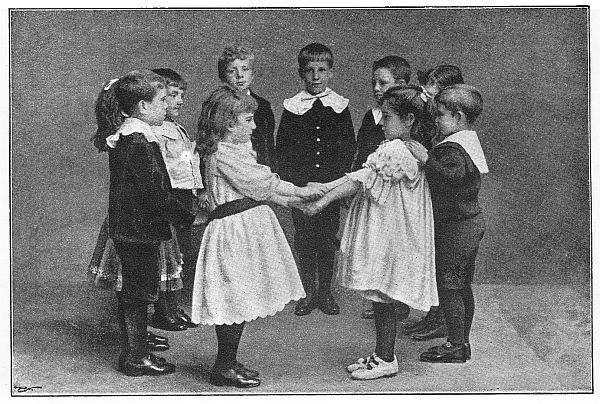
A 'house' is formed by a ring of children
(see Frontispiece, and description of same
on p. 31). There should be three children
in the ring to represent 'John,' 'Maud,'
and the 'Baby,' also an older girl for the
'Mother.' The 'Father' is supposed to be
away on a journey, and preparations are
being made for his return. The 'Mother'
and 'Maud' lay the table for tea (see Game
No. 1, which is similar), and the other two
children may be looking at a picture-book
or watching for Father's return at the door
or window. When he arrives, each member
of the family greets him; one takes his
hat, another his bag, and a chair is placed
for him at the table. Then the children take
their places, and the Mother pours the tea.
After the meal is finished, the Father
opens his portmanteau, and looking into it,
says:
A ball for baby should be here,
[Takes out the ball and gives it.]
Baby
Oh, thank you, thank you, Father dear.
Father
A skipping-rope for Maud is this,
[Presents it to Maud.]
Maud
I thank you, Father, with a kiss.
[Kisses Father.]
Father
This cricket-ball for John will do.
[Hands John the ball.]
John
Thank you, Papa, 'tis kind of you.
Frontispiece.—Twenty or thirty children
might very well combine to make the 'house,'
instead of ten as shown here. The two girls
who cross hands form the 'door.' The boy
on the left of the door grasps the girdle of
the girl with his right hand, while the boy
on the right places his left hand on the girl's
shoulder to make the 'latch.' To open the
'door' we lift the 'latch,' and then push the
girl on the right gently inside the ring, the
girl on the left moving with her.
To knock at the 'door' we rap on the
floor.
16. GOING ERRANDS
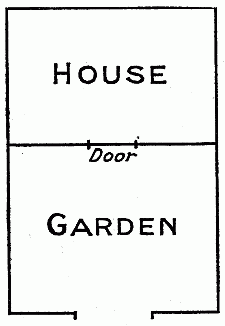
The children join hands and stand
round to form a 'house' and 'garden' (see
diagram). A space is left for the gateway
of the 'garden.' For 'door' of house see
Frontispiece.
In the 'house' stands one of the bigger
girls to represent the 'mother,' and there
should also be a little chair, and a doll's
cradle with a doll in it.
In the 'garden' eight or ten children are
engaged in playing a game. ('Drop, Drop,
Drop,' No. 41, p. 74, would do nicely.) One
of the girls must represent 'Nellie,' and one
of the boys 'Johnnie.' As the game
proceeds, the 'mother' comes to the door
and calls:
'Nellie, Nellie!'
[Nellie at once answers:
'Yes, mother.'
[Leaves game immediately and runs to mother.]
Mother
Baby cries, just soothe her, Nell.
Rock the cradle; that is well.
[Nellie sits down and rocks the cradle.]
The game proceeds for a little while, and
then the 'mother' calls again:
'Johnnie!' [Children say], 'Mother calls you, see.'
[Johnnie runs quickly to the 'mother.']
Mother
Go round to the shop for me.
[Gives him money and a basket.]
Johnnie may go outside the room and
come back again, or the game 'Shopping'
(No. 6, p. 10) may be played, having been
previously prepared in another part of the
room, and Johnnie may go to the shop for
what his mother requires. When he has
returned, all the children say:
Little children, always run
When your mother's voice is heard,
Leave your play whene'er she calls
Quickly mind her every word.
17. TAKING FATHER'S TEA
A classroom may be used for the 'house'
and another for the 'workshop,' or they
may both be made by rings of children (see
Frontispiece, and description of same on
p. 31). Between the 'house' and the
'workshop' there should be a 'street' (see
Game No. 12, p. 24). In the workshop
there should be 'joiners' planing, hammering,
sawing, &c. (a set of toy tools might be
used for this), and in the 'house' a little
girl should represent the 'mother.'
Two children come walking quickly
down the 'street' towards the 'house,'
saying:
Straight away from school we go,
To take our father's tea, you know.
They enter the 'house,' and the 'mother'
gives a jug to one and a basket to the other,
and says:
With care the jug of tea you'll hold,
And make good haste lest it get cold.
Children reply:
Oh yes, dear mother, all you say
We'll mind right well—and now, away.
They walk up the 'street' to the 'workshop,'
and the 'father'—a joiner with
sleeves rolled up—comes to the door.
Father
Ah! my children, here you come,
Children
Yes, we've brought your tea from home.
Father takes the jug and basket, saying:
Thank you, now run home and play;
I am working late to-day.
Children say 'Good-bye,' and run off.
INVITATIONS
Preliminary.—Children should be taught
to express thanks not only for tangible
presents, as in Game No. 15, but also for
kindness or favours received. The two games
which follow are intended to teach this.
18. INVITATION TO PLAY
A house with garden is needed; to make
this the children join hands and stand as
shown in diagram, p. 32. In the 'house'
there should be a 'mother,' and in the
'garden' a number of children playing with
ball or skipping-rope. A smaller 'house' is
required at some distance from the first.
In this, also, there should be a 'mother'—(Mrs.
Day), and a little girl—(Nell). A
classroom may be used for this 'house' if
more convenient.
As the play proceeds the 'mother' comes
to the 'door' to watch the children's game.
Presently one of them—a boy—runs up to
her and says:
Mamma, please, may we ask Nell Day
To come and have a game of play?
[The other children come and cluster round.]
Mother
Oh, yes! I will a message send—
An invitation for your friend.
Just go and ask if Mrs. Day
Can spare Nellie to come all day.
All the Children
Thank you, mother.
The boy runs off to Mrs. Day's house
and knocks. Mrs. Day answers the door.
Child
Please, Mrs. Day, may Nellie come
To play all day with us at home?
If Mrs. Day says 'Yes,' Nell should
reply, 'Thank you, mother,' and Mrs. Day
should also send a message of thanks to the
boy's mother. When Nell is ready, they
run off hand in hand.
19. INVITATION TO DRIVE
The house and garden described in
Game No. 16, p. 32, will do quite well for
this also, but the children are to be at work
instead of play. One child may be fetching
water, another minding the baby, and
another watering the garden or going
errands. A gentleman (boy) comes to the
garden-gate (a space is left for the gateway),
with 'carriage' and 'horses'; the 'carriage'
is made in the same way as the 'coach'
(Game No. 24, p. 48), and has two horses
instead of four. Gentleman walks through
the 'garden,' knocks at the door, and says:
Good morning, madam; if I may,
I'll drive your children out to-day.
Mother
I thank you, sir [beckons children to her]; come children! [children run to her].
Gentleman
Such busy, happy children, they
Shall drive with me far, far away.
Children
Oh, thank you, sir, 'twill pleasant be
To ride with you nice things to see.
Children enter carriage, waving hands to
'mother,' and saying:
Good-bye, dear mother, off we go,
The horses gallop fast, we know.
20.
GETTING READY FOR BEDThis game may be used for a class of
children, or for a few only. In the former
case, the majority of the scholars would, of
course, be lookers-on.
Half a dozen boys and girls should be
playing in different parts of the room; one
might be drawing, another building, and a
third looking at a picture-book; or they
might all be joining to play a game together.
A big girl or the teacher represents the elder
sister, who repeats (or sings to the tune of
'The Campbells are Coming') the four lines
following:
Come, children, get ready for bed, bed, bed,
And sister must wash you, as mother said,
The hands and the faces will all be clean,
Such nice, happy children, shall ne'er be seen.
The children instantly put toys and
books away in their proper places, and
reply:
Some folks they do cry, when they're washed, oh dear! dear!
Pray where do they live? We do not want them here.
Merry, happy little children, come and get well scrubbed,
But do not cry when you are washed and rubbed.
The 'sister' pretends to wash all the
children; then they say:
Some folks they do cry when they're told, 'Time for bed,'
Some folks pout and say, 'Oh! let me play instead.'
Merry, happy little children, laughing go away,
Good-night, good-night, we'll play another day.
The children go out of the room kissing
hands to those who are left, or to the elder
'sister.'
21. WASHING ONE'S SELF
The teacher may repeat the lines,
accompanying them with the actions, which
the children imitate, or the children may
learn and repeat the words themselves.
[1]Wash your hands, dear children all,
[2]Palms we rub and [3]backs as well,
[4]Round the wrist we leave no mark,
Else a sad tale that would tell;
[5]Rub the knuckles,
[6]brush nails, too,
Clean, bright[7] hands nice work can do.
Now 'tis time to
[8]wash your face,
[9]Soap your hands, and [10]rub away,
[11]Gently round the ears we go,
[12]Don't forget your eyes, I say;
[13]Nose, and
[14]mouth, and
[15]forehead high,
[16]All to make quite clean we try.
22. ASKING FOR DRINK OF WATER
Preliminary.—This little game may be
used to teach children to be courteous to
strangers, and it should also teach them how
to carry liquid without spilling.
Directions.—The school or classroom
should be the 'house,' and a boy (representing
the man who asks for water) should go
outside. One child is required to answer
the door, and another may carry the glass of
water, or the same child may do both.
The 'man' comes and knocks at the
door, which is opened by a little girl; he
then says:
A drink of water, please, I pray,
You'll give me, madam, this hot day.
A child walks across the room with the
glass of water, which should be carried on a
plate or small tray, without spilling, and
hands it to the man, who takes it, saying,
'Thank you.' When he has finished drinking,
he returns the glass, and the child says
'Good-day,' and closes the door.
23. THE FOX AND THE TIGER
Directions.—The 'tiger' (a boy) hides in
a 'forest,' which the children make by
standing at irregular intervals and representing
trees. Each child should name the
tree it chooses, the following rhyme gives
the names of a few common trees:
Beech and chestnut, birch and oak
Are the names of English trees,
Elm and willow, poplar, ash,
Soon you will remember these.
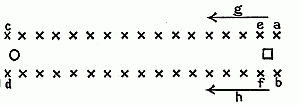
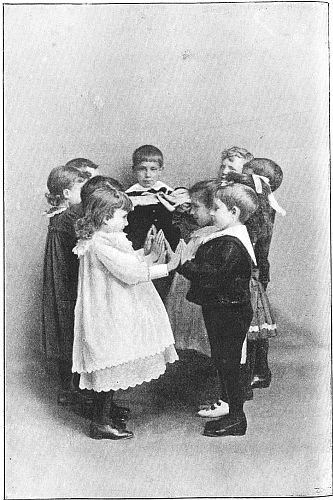 Fig. 3.—fox's den
The children should see leaves from each
tree, and country children should be shown
the trees themselves with the leaves growing
on them. The 'den' of the 'fox' is at the edge
of the 'forest,' and is made by ten children
standing as shown in fig. 3. The four
children who form the entrance join hands
as shown, and the other six meet hands in
centre. A better way of making the den
would be for each child to hold a branch of
a tree, then the branches would meet instead
of the hands. The children who stand for
'trees' in the 'forest' wave branches, if the
latter are obtainable; if not, the arms are
waved for branches. One of the bigger girls
should be the 'fox,' and two or three of the
smallest children should be cubs, and go into
the den with the fox. Then the fox comes
walking out of the den, and says:
I go to find a duck
For dinner this fine day,
And you, my pretty cubs,
Will stay at home and play.
While she is absent, the tiger comes
softly into the den and takes one of the cubs
(leading the child away by the hand).
Presently the fox returns, goes into the den,
misses the cub, and chases the tiger.
24. THE COACH GAME
The 'coach' is formed by children
standing in position as shown on diagram.
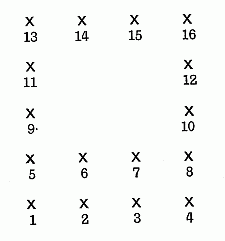
All the children face the same way. 1, 2, 3, 4
are 'horses' and join hands behind, as in
'Bell-horses'; 5, 6, 7, 8 join hands to make
the front part of the 'coach'; '5' holds the
coat of 'horse' No. 1 with right hand, while
'8' holds coat of '4' with left; 9, 10, 11,
12 each hold the dress of the child standing
in front; 13, 14, 15, 16 join hands; '13'
catches hold of No. 11 with right hand, and
'16' holds the dress of No. 12 with left.
When the 'coach' is ready, the 'driver' (a
boy) repeats the lines:
Here is my coach, who'll come and ride?
The door, you see, is open wide.
Four 'passengers' advance, and the
'driver' makes way for them to enter the
'coach' between '10' and '12,' saying:
Jump in quick! quick! not long we stay,
Then ready! steady! right away!
The 'door' is closed by '12' again grasping
the dress of '10,' and the 'coach' moves
off. The 'horses' should not go very quickly,
else the 'coach' will probably lose its shape.
The 'passengers' walk along with the
'coach' until their destination is reached,
when the 'driver' opens the door and allows
them to alight.
The above game may be played in conjunction
with Nos. 25, 26 and 27.
This game may be played immediately
after 'The Coach,' or it may be played
alone.
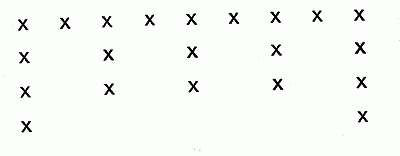
Directions.—The 'stable' is formed by a
number of children who stand in rows (see
diagram) and join hands.
The 'hostler' (a boy) should stand near
the 'stable.' When the 'coach' (Game
No. 24, p. 48) drives up, he goes to the
driver and asks:
Hostler
Shall I take your horses for a rest and feed?
They are tired, I think, sir, and a drink they need.
Driver
Yes, good hostler, take and give them nice fresh corn,
With a pail of water; they have worked since morn.
The 'hostler' leads one horse into each
stall, and pretends to give them hay or corn.
Then he carries water to them in a pail
(a toy pail, price 1d., would do), and each
drinks. After this he rubs them down, using
a brush or his hand.
Directions.—Four little girls are selected
to visit grandmamma, and to carry messages
and presents to her. Grandma's 'house' is
made by a ring of children (see Frontispiece,
and description of same on p. 31), and the
girl who is to be 'Grandma' sits in the ring
knitting. An old-fashioned kerchief and
cap help to make the 'grandma' more real,
and a pair of spectacles adds further to the
effect. If the 'coach' game be used in conjunction
with this, the little girls may be
the 'passengers' and go in the 'coach' to
grandma's house. The 'door' (see description
of Frontispiece on p. 31) should be
opened by a little maid, then the four
children enter and repeat the lines:
Children altogether
Good morning, grandma, we have come
With messages from all at home.
First Child
Mamma sends love, and I'm to say
She hopes you are quite well to-day.
[Grandma replies suitably.]
Second Child
These flowers, dear grandma, are for you,
[Gives her flowers.]
In my small garden bed they grew.
Grandma
Thank you, my dear.
Third Child [handing a basket]
And here are cakes that Nellie made
To send to grandmamma, she said.
Fourth Child [giving basket to grandma]
Ripe fruit I bring for grandmamma,
These pears and plums are from papa.
When 'grandma' has thanked each of
the children, they take leave of her and
return home.
The Guessing Rhyme, No. 92, might be
given after playing the above game.
Directions.—A ring of children form the
'house' (see Frontispiece, and description of
same on p. 31) or a classroom may be used
for it. A few chairs and a table should be
placed in the 'house,' and there should be a
'mother' and 'children.' A 'lady' (represented
by a little girl) comes and knocks at
the 'door,' and the 'mother' opens it.
Visitor
How do you do, dear Mrs. Brown?
I've called upon you going to town.
Mother
I'm quite well, thank you, Mrs. May,
And glad to see you this fine day.
The visitor then walks in and speaks to
the children one by one; they should answer
without hesitation. Children are generally
very shy and awkward when addressed by
strangers, but they should be encouraged to
reply with confidence and ease. Perhaps
these little games may help to give them
confidence.
The game 'Paying Calls' might appropriately
be followed by 'Afternoon Tea';
both these are played with great glee by the
little girls.
28. AFTERNOON TEA
The tea-tray is brought in by one of the
children and placed on a table near the
'mother,' who pours out the tea. One of
the children carries a cup to the visitor,
and hands it to her, asking:—
Will you take a cup of tea?
Visitor
Yes, refreshing it will be.
[Takes the cup and says 'Thank you.']
A plate or d'oyley may be placed in the
lap of the visitor for the bread or biscuit,
which the child hands, saying:—
Bread and butter, biscuits, cake.
Visitor
Please a biscuit I will take.
The 'mother' may serve the children
with tea, or there may be other visitors
calling, then the time of the children will
be occupied in attending to them.
When Mrs. May has finished, the child
says:—
Shall I take your cup away,
And your plate, too, Mrs. May?
[Takes them away.]
By-and-by the visitor takes leave of the
'mother' and children, bidding each 'Good-day,'
and the 'door' is opened for her by
one of the children.
29. SPRING FLOWERS
All the children join to form a large ring,
and one of the taller girls stands in the
centre to represent 'Spring.' The twelve
flowers mentioned in the verses should be
represented by twelve children standing at
intervals in the ring. Before commencing
the game, the child who represents 'Spring'
might appropriately repeat the lines of
Guessing Rhyme No. 74, p. 95.
The 'Flowers' step forward from the
larger ring as the name of each is mentioned
in the verses, and form a smaller circle
round 'Spring.' The children should join
hands to close up the gap which is left by
each 'Flower' as it steps forward to join the
small circle.
A Daffodil am I,
And I a Daisy small;
A Bluebell I come here,
I'm Buttercup so tall.
The Cowslip should come next,
And then the Violet sweet,
The Snowdrop fair and white,
The Crocus trim and neat.
The starry Celandine,
Anemone, so fair,
The yellow Primrose, sweet,
Lily, with fragrance rare.
The 'Flowers' then join hands and
repeat the verse following:—
Whene'er Spring shows her face
The flowers all come again,
We cluster round the 'Spring,'
[All the Flowers bow.]
We follow in her train.
[Flowers turn to right.]
'Spring' marches round inside the larger
ring, and the 'Flowers' follow in order.
30. SUMMER FLOWERS
This game is played like the game of
'Spring Flowers' (see instructions on p. 56).
The girl chosen to represent 'Summer'
may repeat the verse given in Guessing
Rhyme No. 75, p. 95, and then the 'Flowers'
step forward as their names are mentioned in
the rhymes which follow.
First comes the Pink Wild Rose,
[Rose steps forward.]
The White rose, too, is here
Next Honeysuckle sweet,
And Foxglove standing near.
The scented Mignonette,
Dog-daisy gold and white,
The pretty Cornflower blue,
And Marigold so bright.
A Campion white grows here,
And next a Campion pink,
Here's Clover from the field,
Harebell comes next, I think.
The 'Flowers' then join hands and
repeat the following rhyme:—
A ring we make round Summer sweet,
Oh Summer, Summer, thee we greet:
[All bow.]
For bright and happy is our play
All through the livelong Summer day.
The 'Flowers' then dance round
'Summer.'
31. THE THREE BEARS
This game may be played either in
the home, schoolroom or classroom. The
words should be learnt previously as a
recitation.
Materials required.—Three mugs or
basins of various sizes, with a spoon in each;
three stools or chairs of various sizes, and
three beds. The latter may be made by
laying shawls or coats on the forms or floor.
The 'beds' should vary in size, the first
being the largest, the next smaller, the third
smaller still.
Three boys or girls should be chosen to
represent the Three Bears, and these also
should vary in size. The 'Bears' go outside
the room.
The child who represents the little girl
should know the rhymes well. When all is
ready she comes in and, standing near the
open door, says:—
What a funny house I see!
Surely I may step inside,
All is quiet as can be,
And the door is open wide.
[Walks slowly towards the mugs.]
Pots of food are near the fire.
I must taste them, one [tastes the first], two [tastes the second], three [tastes the third];
Oh, how good, I'll eat it all,
For my breakfast it shall be.
[Puts the mug down and turns to stools.]
Three stools! first [sits on first] and next [sits on it] too high,
Tiny one is just for me.
[Sits on third.]
Oh, 'tis broken [tumbles off], off I go,
What else is there yet to see?
[Walks towards beds.]
Beds, a large one [lies down], that is hard, [Rises.]
This one [pointing to middle bed] is too long, I fear,
Oh, how soft [lies down in little bed], I'll take a rest,
In the little bed just here.
[Pretends to sleep.]
The three bears come tramping in. The
big one takes up his mug and says, 'Who
has been at my porridge?' The second bear
says the same; and then the little bear takes
up his mug and says, 'Who has been at my
porridge and eaten it all up?'
They proceed in the same way with the
stools, the little bear finishing with 'Who
has been sitting on my stool, and broken
it?'
Then they go to the beds in order, asking
one after the other, 'Who has been at my
bed?' until it comes to the little bear's turn,
when he says, 'Who has been at my bed?
and here she is still!'
The little girl now opens her eyes, and,
seeing the bears, jumps up quickly and
runs off.
32. IMITATING CRIES OF ANIMALS
(A simple game for the very smallest
children.)
One child comes out to stand in front of
the class and says:—
Listen to the cry I make,
Then, if you the trouble take,
You may guess my name.
He then imitates the cry of some animal,
the 'bark' of a dog, the 'mew' of a cat, or
the 'crowing' of the cock, and the children
who wish to answer hold out the hand.
The child who is allowed to give the name
of the animal represented by the cry comes
out (if the answer is correct) and makes the
cry of another animal, first repeating the
lines as before. The following are some of
the cries that the children may be able to
imitate, 'cluck, cluck' (hen), 'quacking'
(duck), 'hissing' (goose), 'neighing' (horse),
'braying' (donkey), 'grunting' (pig), 'chirping'
(bird) or talking like the parrot.
33. CHARADES
Preliminary.—Everyone knows how fond
children are of representing ideas by action.
It is for this reason that charades are
recommended here. It will, of course, be
necessary for the teacher to assist and
suggest, but the children soon acquire confidence,
and their acting, being perfectly
natural, is often remarkably good.
A very simple little charade is given as
an example.
The children who are to take part go out
of the room for a few minutes with the
teacher. We will suppose the word chosen
is
Tea-cake
Act I.—The teacher is to be the 'mother'
and the rest are children. The 'mother'
enters and sits down; presently the children
come trooping in from school and gather
round her. She asks what they have been
doing at school, each one tells her something
about its work or play, and then one child
asks, 'May we have tea, mother, please?'
'Yes,' says the mother, 'go and take off
your hats and we will get it ready.' (End
of Act I.)
Act II.—The tea-table is prepared (see
Game No. 1, which is similar) and the
children sit down to tea. (The 'guessing'
children should be told to listen carefully to
what is said during tea.) One child asks
for the cake to be passed, another for bread
and butter, and so on. (End of Act II.)
Act III.—In the last act the whole word
is to be given. The children pretend to
have a baker's shop (see 'Shopping Game,'
No. 6), one child keeps the shop, and the
rest come to buy. One asks for a loaf,
another for rolls, a third buys a tea-cake,
and so on.
Bricks and tablets may be used for the
loaves and cakes, or they may be made in
the clay-modelling lesson and kept for this
game.
Finding the word.—The children who
have been listening are now asked to guess,
and may be encouraged by remarks, such as,
'Think of the first act, and what the
children said to their mother.'
'Remember the tea-table and what was
said there.'
Some of the words thus obtained may
be written on the blackboard, words for each
act being put in separate columns.
'Now what did the baker sell?' In this
way the answer is soon obtained.
It is well worth while to help the children
to learn how to play charades, because it
makes such a pleasant home-play for them
in wintry and wet weather.
34. PASSING THE STICK
The children sit round the room, or
stand in a semi-circle. The teacher should
start the game, standing at the left extremity
of the semi-circle, with the stick in her right
hand, and repeat the lines:—
On the floor you see I
[1]tap my
[1]stick,
[1]stick,
[1]stick,
Then I
[2]pass it to my
[3]neighbour quick, quick, quick,
If you know it, then please do the trick, trick, trick.
The children who do not know the game
will probably omit to pass the stick into the
left hand; as each one tries to do the trick,
the teacher says 'right' or 'wrong' as the
case may be, and those who are wrong are
told to notice particularly how the teacher
does it.
35. FINDING THE THIMBLE
This is a favourite game and can be
played with very little noise. At home, all
the children would go out of the room
except the one who remains behind to hide
the thimble, but when played in the school
or classroom, it will be sufficient if six
children are sent out.
The thimble is to be placed where it can
be seen, the children are then called in, and
the one who has hid it says:—
Try to find the thimble out,
Use your eyes and look about,
Look before and look behind,
And when you the thimble find,
Just sit down.
As soon as any child sees the thimble,
he takes a seat and remains quite still until
all the seekers have seen it, and each in
turn has sat down. Then the child who
first saw the thimble takes it from its hiding-place,
and has the privilege of remaining
behind to hide it next time. Different
children should go out each time, so that all
may have a turn.
36. THROWING THE HANDKERCHIEF
The children stand in a ring, or sit round
the room, one child standing in the middle.
The handkerchief is thrown from one to
another, and the one who is 'out' tries to
find a child with the handkerchief in its
hand. As soon as he can do this, the child
who was caught with the handkerchief has
to stand in the centre, and the other one
sits down, or stands in the ring, as the case
may be.
As the game begins, the children say:—
The handkerchief is thrown,
Find quickly where 'tis gone:
From you to me, from me to you,
To keep it long will never do.
37. PICKING UP POTATOES
Take twelve potatoes and place them in
two rows of six each, thus:—
Two medium-sized spoons are required
with which to take up the potatoes, and a
basket is placed two or three yards away to
receive them.
Two children are chosen to pick up the
potatoes, one standing at the end of each
row. The rest of the children may be
grouped on the gallery, or may stand round
in a ring.
The following verse is repeated either by
teacher alone, or by all the children, as the
spoon is handed to each child.
Take this spoon, and with it see
That you lift so carefully
These potatoes. One! two! three!
The last three words are said slowly, and
the game is to begin immediately 'three' is
said. The child who gets his row of
potatoes first picked up and deposited in the
basket wins the game. The potatoes are
not to be touched, except by the spoon, and
they are to be carried one by one in the
spoon to the basket.