The following is a list of collections of popular games of children, or collections
containing such, consulted in preparing the present volume, and referred to in the
notes by the names of the editors:
The object of the following notes is to exhibit, in a clear manner, the extent of
the correspondence between the games of American children and those belonging
to children in other countries. This volume is not intended to include all games of
children, but (with some exceptions in favor of certain amusements which possess
interest as folk-lore) only such as are played with words or quaint formulas. Of
games of this class, we find in the collections very few known to children in Great
Britain, and possessing European diffusion, which are not represented in this series
by independent American versions (see No. 160, note, end). With these exceptions,
the British game-formulas to which American usage does not offer equivalents
are local and of trifling interest. The references given below may, therefore, be
considered as a comparative account of English children's games in general.
The coincidence which this comparison shows to exist between English and German
games is very close. Taking three German collections—belonging respectively
to Switzerland (Rochholz), to Suabia (Meier), and to Schleswig-Holstein (Handelmann)—and
leaving out of account songs and ballads, we have about eighty games
played with rhymes or formulas. Of this number, considering only cases of obvious
identity, we estimate that forty-five have equivalents in the present series, and
thirty-three are not so paralleled. But of the latter class, six are known to have
been played in Great Britain, while thirteen others appear to be variations of
types represented in this collection. Of the small number remaining, few seem
to be ancient, it being impossible to point out more than three or four really curious
games which are not played also in an English form. This agreement cannot
be explained by inheritance from a common stock, a theory which research has also
discredited in other branches of folk-lore. The relationship is only a degree less
near in other countries; thus, in a collection of Spanish games belonging to Catalonia
(Maspons y Labrós), we find that, out of thirty-eight games, twenty-five have
English equivalents.
No. 1. English versions are numerous. Halliwell, Nurs. Rh. (6th ed.), Nos. 332, 333.
Pop. Rh., pp. 123, 124. Chambers, p. 143; p. 141, "Janet jo." Notes and Queries,
1st ser. VI. 241; 5th ser. IV. 51, 157.—German, Meier, p. 107 (cited), 109:
Handelmann, p. 62. Vernaleken, p. 55, etc.—Swedish, Arwiddson, iii. 175 f.—Icelandic,
Arwiddson, iii. 182. Lyngbye, Faeröiske Quaeder, p. 37, introd. note.—Faroese,
Antiq. Tids., 1849-51, p. 310, "Princes riding," compare No. 3.—Italian,
Bernoni, p. 43, "L'Imbasciatore." Gianandrea, No. 23, "Il bel Castello."—Spanish
(Catalan), Maspons y Labrós, p. 47, "La Conversa del rey Moro."—French, Ch.
du Cambresis, i. 80.
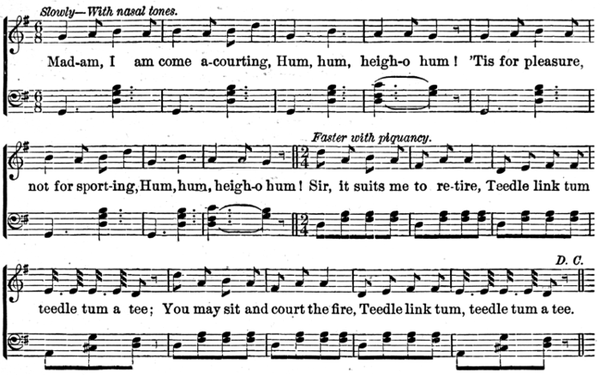
2. A variety of No. 1. Corresponding is the Faroese version referred to, in which the
suitors, after rejection as thralls, smiths, etc., are finally accepted as princes, with
the expression "tak vid" (literally "take with"), be welcome, which may explain
the peculiar use of the word "take" in our rhyme.
3. Also a variety of No. 1. Folk-lore Record, iii. 170. Chambers, p. 139 (cited).
"I am a lusty wooer" (the version referred to, p. 49, note) is said to have been
played by Charles II. See the Gentleman's Magazine, Feb. 1738; Nurs. Rh.,
No. 491.
4. Henderson, Folk-lore of the Northern Counties (Lond. 1879), p. 27. Compare
French round in Celnart, p. 24.
5. Nurs. Rh., No. 479. Compare No. 31.
6. Nurs. Rh., No. 466, "The Keys of Canterbury." Chambers, p. 61, "The Tempted
Lady."
7. French, Celnart, p. 15, sixth round, presents verbal correspondence.
8. These versions belong to a game, widely diffused through Europe, in which a
"rich" mother begs away, one by one, the daughters of a "poor" mother, until
she has secured them all.—German, Frischbier, No. 657.—French, Chabreul, p. 175,
"Riche et Pauvre." Celnart, p. 382, "Olivé Beauvé et la voisine." Ch. du
Camb., i. 77, "La Boiteuse." The celebrated song "Giroflé Giroflà" is of the
same origin. In the Canadian round (Gagnon, p. 149), and in the English rhyme,
for the sake of the dance, the mother whose daughters are begged away or stolen
is turned into a mother whose object is to marry her many daughters; so the
Swedish (Arwiddson, iii. 203), which presents verbal correspondence to the English
song of our collection. Arwiddson, iii. 167, game of "Rich and Poor Birds."
The first comes in limping, leaning on a cane, and with piteous gestures begs the
train of the other. By comparing No. 154, and note, it will be seen that all
the above games make up a single branch of the numerous outgrowths of a primitive
root, which is responsible for no small part of the amusements of youth in
Europe. Compare Nurs. Rh., No. 343.
10. Connected is a European game representing courtship—meeting, saluting, parting,
etc.—German, Frischbier, No. 674.—Swedish, Arwiddson, iii. 257.—Flemish,
Looten and Feys, No. 113. A different but related game is French, Celnart,
p. 14 (cited). Chabreul, p. 157. Gagnon, p. 151.—Italian, Corazzini, p. 84.—The
words "Rowe the boat" begin a waterman's roundel, A.D. 1453; see Chappell's
Pop. Music of the Olden Time, p. 482.—(4.) French, Ch. du Camb., i. 221 (cited).
11. Chambers, p. 140, "Janet jo." Folk-lore Record, iii. 171, "Jenny Jones." See
Coussemaker, p. 100, Flemish "Maiden's Dance."—Bernoni, Cant. Pop. Venez. xi.
2, "Rosetina."—Roxburghe Coll. i. 186-189, Ballad of "The Bride's Buriall."
12. Compare N. and Q., 3d ser. VII. 353.
13. Halliwell, Pop. Rh., p. 133. Henderson, Folk-lore, p. 26.
15. N. and Q., 5th ser. III. 482.—French round cited, Ch. du Camb., ii. 58. Gagnon,
p. 303 (cited, p. 8). Bugeaud, i. 202.
16. Chambers, p. 118.—French, Ch. du Camb., ii. 42.
17. Danish and Swedish ballads, Sv. Grundtvig, Danmarks Gamle Folkeviser, Nos.
180, 181.
18. Child, Eng. and Scot. Ballads, 1857, iii. 136.
19. Child, ii. 154.
20. Swedish, Arwiddson, iii. 196.
21. French, Celnart, p. 21, etc.—Provençal, see Fauriel, Hist. de la Poésie Prov., ii. 87.—Spanish
(Catalan), Mila y Fontanals, Romanc. Cat., p. 173.—Italian, Bernoni, p. 37.
(Sicily) Pitrè, ii. 33.—German, Meier, pp. 136, 137.—Swedish, Arwiddson, iii. 326.—Rounds
of a similar type, Chabreul, p. 146, "Salade." Bugeaud, i. 48, "Plantons
la Vigne."
22. German, Dunger, pp. 184-186. Mullenhoff, p. 484, No. 2. "Aus dem Kinderleben,"
p. 33.—Finnish, Neus, p. 387.
23. Halliwell, Pop. Rh., p. 127. Chambers, p. 134.
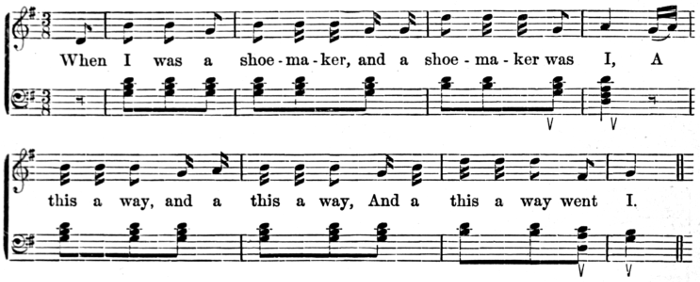
25. A variation of 23, 24. Halliwell, Pop. Rh., p. 130. Chambers, p. 135.—French,
Gagnon, p. 99. Chabreul, p. 141, etc.—Spanish, Marin, i. 96, "Thus do the Shoemakers."
26. Folk-lore Rec., iii. 170. Compare French game, Ch. du Camb., i. 223.
28. Nurs. Rh., No. 287.
29. Folk-lore Rec., iii. 169. For French game referred to, see Laisnel de la Salle, ii.
151.—French, Celnart, p. 53, "L'Anguille Enfilée."
30. Compare Provençal nurse-songs, in Chants Pop. du Languedoc, "Chants énumeratifs,"
especially p. 432.
31. Compare No. 5.
32. Halliwell, Pop. Rh., p. 119, "Mary Brown." N. and Q., 6th ser. II. 248.—Swedish,
Arwiddson, iii. 233.—Finnish, Neus, p. 388.—Italian, Comparetti, iv. 263.—French,
Mélusine, p. 542.
33. Chambers, p. 25. N. and Q., 4th ser. II. 274.—Flemish, Dutch, German, Hor.
Belg., ii., Nos. 143, 145.—French (Canada), Gagnon, p. 129.
34. Nurs. Rh., No. 290. To this class of jests belongs the German tale, Grimm, No.
119, "Die sieben Schwaben."
35. Chambers, p. 344. Halliwell, Pop. Rh., p. 218, quotes the first lines of this rhyme
from Aubrey's Miscellanies, ed. 1696.
36. Compare Chambers, p. 137, "A Courtship Dance."—French, Celnart, p. 19.—Canadian
song of Perrette, Gagnon, p. 286.
38. For way of playing, compare No. 22.
40. Chappell, Pop. Music of the Olden Time, p. 589.—French (Canada), Gagnon,
p. 223.—Swedish, Arwiddson, iii. 369.
42. German usages, Rochholz, pp. 172-174. Meier, p. 93.—In Middle Ages, Zingerle,
pp. 32, 33.—Italian, Corazzini, pp. 93, 94.—Drawing lots by spires of grass is
probably the "Erbelette" of Froissart; see Celnart, p. 105, "L'Herbette Joliette."—Spanish,
Marin, i. 123.
43. German usages, Rochholz, pp. 174-183.
45. Compare French of Gagnon, p. 147.
46. French, Ch. du Camb., i. 119, etc.—German, Peter, p. 49, etc.—Flemish, Willems,
p. 522.—Breton, Mélusine, p. 462.
47. French, Rabelais, Gargantua, ch. xxii. Laisnel de la Salle, ii. 156.
48. Halliwell, Pop. Rh., pp. 263-265. Chambers, p. 31.—German, Rochholz, pp. 156-170;
he refers to the Rigsmál of the poetic Edda. Schuster, p. 364, etc.—Provençal,
Ch. Pop. du Languedoc, p. 517, "Las Bestios."
50. Nurs. Rh., No. 278. Compare Finnish game, Neus, p. 417.
52. German, Vernaleken, p. 94. Meier, p. 135.—French, Chabreul, p. 183.—Swedish,
Arwiddson, iii. 400.
53. Strutt, p. 294. Brand, ii. 287.—German, Vernaleken, p. 86, "Ritterschlagen."
Rochholz, p. 435.—French, "Les Ambassadeurs," Celnart, p. 131. Old English
game of "Questions and Commands," Gent.'s Mag., Feb. 1738; Rochholz, p. 413.
55. Perhaps the "Roi qui ne ment" of Froissart, which he mentions as a game of his
childhood (see p. 34), and also as played by great personages.
56. French, Celnart, p. 125.
57. Similarly, in a French game, "Le Roi Dépouillé" (Celnart, p. 139), the player
must say "Oserais-je?" at every movement.
58. See the round in Chappell, Pop. Mus., p. 77.
60. Perhaps connected with No. 154. Compare German, Vernaleken, p. 52, No. 8.
61. Very likely the "Derision" (Risées) of Froissart.
62. German, Rochholz, p. 183. Vernaleken, p. 47, etc.—Provençal, "Lou brandet de
Roso," Ch. Pop. du Languedoc, p. 577.
64. German, Dunger, p. 176, played also in New York. The rhyme in the text seems
a recent translation.
68. Nurs. Rh., No. 352. Chambers, p. 137.—French, Celnart, p. 19.—Spanish, Maspons
y Labrós, p. 100, "Jan petit."
71. Nurs. Rh., No. 218.
74. Chambers, p. 139, "Curcuddie."—French, Celnart, p. 353, "Les Jarcotons."—Among
games of motion might have been mentioned the familiar "Puss in the
Corner," Gent.'s Mag., Feb. 1738.—French, Celnart, p. 57, "Les Quatre Coins," etc.
75. Halliwell, Pop. Rh., p. 128.—Danish, Grundtvig, Dansk. Folk., 2d ser. p. 142.—Italian,
Bernoni, p. 19, No. 18.—Spanish, Marin, I. 52, No. 84.
76. Halliwell, Pop. Rh., p. 112.—French, Chabreul, p. 8, "Petit bonhomme vist encore,
car il n'est pas mort."—German, Handelmann, p. 31, "Little man still lives."—The
High-German formula is, "Stirbt der Fuchs, so gilt der Balg." Like the English
phrase is a Danish game, "Do not let my master's bird die", Syv, "Adagia Danica,"
p. xlvii.—Russian (Kazan), Mozarowski, p. 88, "Kurilka lives, she is not dead."
77. (a) German, Vernaleken, p. 89.—French, Celnart, p. 307—(b) Nurs. Rh., No. 282.—German,
Vernaleken, p. 88, "Vater Eberhard."—(c) German, Rochholz, p. 430,
No. 50.—French, Rabelais, Gargantua, ch. xxii. Celnart, p. 124, "Pince-sans-rire."
79. Compare finger-game in Chambers, p. 116. Italian finger-game referred to, Bernoni,
p. 22, No. 25.
81. Strutt, p. 290, "Hammer and Block."
83. French.—Celnart, p. 162, "Le Chevalier Gentil."
86. Nurs. Rh., Nos. 297, 307.—German, Meier, p. 138; Handelmann, p. 40.—French,
Mélusine, p. 198.
87. Italian (the game, not the rhyme), Ferraro, G. Monfer., No. 10.—Spanish, Marin,
i. 48, No. 71. Compare Nurs. Rh., No. 293; Chambers, p. 159.
88. Celnart (2d ed., A.D. 1830) gives sixty kinds of "pénitences," consisting in kissing,
as then usual in French society (see p. 6).—French, Celnart, p. 302, "Les Aunes
d'Amour," the same as "Measuring yards of tape."—German, Frischbier, p. 201,
"Aus dem Brunnen erretten," equivalent to "I'm in the well." "Redeeming forfeits
in Germany," Frischbier, p. 199.
89. With the dialogue at the end of the second version, compare No. 154, B. An
Italian game, Corazzini, p. 104, has a similar theme.
90. Spectator, No. 268.—German, Rochholz, p. 440.
91. Strutt, p. 386. "Even or Odd." A universal game.—Ancient Egyptian, Wilkinson,
ii. 416.—Ancient Greek, Aristotle, Rhet. iii. 5. The formula is ἄρτια ἢ περισσά—Latin,
"par impar."—German, "grad oder ungrad," or "effen oder uneffen."—Spanish,
Marin, i. 51, "Pares ó Nones" ("par est, non est").
92. The similar Italian game begins, "Galota, galota," whence, no doubt, our "Hulgul,"
Gianandrea, No. 20.—Ancient Greek, Scholiast to Aristophanes, Plut. 1057,
πόσα ἐν χερσὶν ἔχω; "How many have I in my hands?" Suidas (10th century),
Lexicon, under παιδιά, writes: "There is a game of the following character among
the Athenians: Having taken up a number of nuts and holding out his hand, one
asks, 'How many have I?' And if [the other] guesses the number, he takes as
many as he has in his hand; but if he fails to guess, he loses as many as the asker
holds in his hand."—Latin, given by Helenius Acron (4th century), "quot in
sunt?" See Marin, note to preceding game.—German, Meier, p. 123, "Wie viel
sollen Kerner in meiner Hand sein?" Handelmann, p. 35, etc.
93. A child rests his head in the lap of another, while a third claps the back of the
first, keeping time to the words of the rhyme, and finally raises a certain number
of fingers; if the kneeling child can guess the number, he takes the other's place.—Spanish,
Marin, i. 51, No. 81. The rhyme closely resembles the English given
in the text.—Italian, Imbriani, No. 30, where the question is, "How many horns
do I hold up?"—German, Meier, pp. 135, 136, where it is asked, "Wie viel Hörner
hat der Bock?" This allusion to the goat (as a leaping animal) refers to the usual
practice of riding on the back of the stooping child while putting the question.—German,
Rochholz, p. 434.—Dutch, Hor. Belg., vi. 182. The formulas differ.
Tylor, Primitive Culture, i. 67. The Latin formula of Petronius is curiously
translated by F. Nodot, A.D. 1694: "Étant à cheval sur luy, il luy donna plusieurs
coups du plat de la main sur les épaules, disant tout haut en riant, Quatre cornes
dans un sac, combien font-ils? ce jeu fini," etc. Nodot remarks of his free translation,
that it is still a boys' game in France.
94. Halliwell, Pop. Rh., p. 116, "Handy-Dandy."—German (Austria), Vernaleken,
p. 41. The formula is the exact counterpart of the English: "Windle, wandle, in
welchen Handle, oben oder unt?" Handelmann, p. 35 (Schleswig-Holstein), "Where
dwells the smith? Above or below?"—Spanish, Marin, p. 50, No. 77.
95. German, Meier, p. 124, "Under which finger sits the hare?"
97. Halliwell, Pop. Rh., p. 125, "My Lady's lost her diamond ring."—Low-German
formulas exactly correspond to our "Hold fast what I give you." Thus the
North Frisian, "Biwari wel, wat ik di du," Handelmann, p. 38. Corresponding
to "Button, button, who's got the button?" is the Italian "Anello, anello, chi
ha mi anello?" Gianandrea, No. 14.—Spanish, Maspons y Labrós, p. 86.
98. Halliwell, Pop. Rh., p. 133.
99. German, Frischbier, p. 195.
100. A universal game.
101. Halliwell, Nurs. Rh., Nos. 328, 357; Pop. Rh., p. 118; Chambers, p. 123, "The
King and Queen of Cantelon."—German, Rochholz, p. 414, No. 32.
102. Halliwell, Pop. Rh., p. 132, "The Old Dame," like our B. The Scotch of Chambers,
p. 130, "Gled Wylie" (wily hawk) corresponds to our first version.—German,
Mullenhoff, p. 488; Handelmann, p. 76, etc.—Swedish, Arwiddson, iii. 164.—Italian,
Bernoni, p. 34, No. 40, here a game of a witch like our second version.—Finnish,
Neus, p. 418, begins like the Scotch.—Russian, Bezsonoff, p. 195, probably
borrowed from the German.
103. The name, "Tag," in Gent.'s Mag., Feb. 1738.—German, Handelmann, p. 66, "Eisen
anfassen;" "Eisenzech" in Berlin; "Eisenziggi" in Switzerland.—Italian,
Bernoni, p. 62, "Toca fero."—"Squat-tag" is also Spanish, Maspons y Labrós,
p. 81.
105. Ancient Greek, Pollux, ix. 117, Ἀποδιδρασκίνδα, "Game of Running Away."—German,
Vernaleken, p. 89, "Verstecherlspiel," "Einschauen."—Italian, Bernoni,
p. 61, "Chi se vede, eh!"—French, Celnart, p. 55, "Cligne-musette" or "Cache-cache."
106. French, Chabreul, p. 1, "La Queue Leuleu," mentioned by Froissart.—German,
Rochholz, p. 408, etc.; Schuster, p. 392, a game of wolf and geese; so Russian,
Bezsonoff, p. 205.
107. Spanish, Marin, i. 169. The seeker must wait until the hiders, who go off one by
one as they are counted out, cry "Jilo bianco, jilo negro," etc. Hence, probably,
the cry "Blancalilo," etc., of the English game. The rest proceeds like No. 105.
In the Spanish sport, a player reaching goal must spit three times; this seems to have
been originally a conjuration against the Evil Spirit, whom the seeker represented.
108. Ancient Greek, Pollux, ix. 113, 123. The game is universal. See Handelmann,
p. 71. Child, Eng. and Scot. Pop. Bal., 1882, i. 67.
109. German, Handelmann, p. 65, "Die Hexe." The games are identical; yet the
children, from whom the version in the text was learned, imagined that they had
"made it up!"
110. Strutt, p. 61.—German, Vernaleken, p. 63, "Das Barlaufen."—French, Celnart,
p. 58, "Les Barres."—Italian, Bernoni, p. 87. The French word barres is probably
only a false interpretation of an older word bar, a form of our base, meaning
goal; so Swiss "Bahre," Basle. Kindr., p. 30.—Flemish, in Hor. Belg., vi. 181.
111. N. and Q., 2d ser. VIII. pp. 70, 132. Brand, ii. 316.—German, Handelmann, p. 81,
"Die Katzen von dem Berge." The phrase is "Cat, cat, off my hill!"—French,
Belèze, p. 42, "Le Roi Détroné."
113. Chambers, p. 122, "Hickety Bickety."—German, Aus dem Kinderleben, p. 24.
Rochholz, p. 442.
114. Folk-lore Rec., iii. 169; Chambers, p. 36. See No. 89.
115. German, Vernaleken, p. 74, "Weinbeer-Schneiden."—Italian, Bernoni, p. 50. This
is a variation of No. 156; compare Frischbier, p. 186.
116. Chambers, p. 127, "Scots and English."
117. This number includes the remains of two ancient games: (a) Ancient Greek, σχοινοφιλίνδα,
Pollux, ix. 115, in which a player must be whipped round the ring with
the cord he has dropped at the back of another.—German, in 14th century, Mone,
Anzeiger, 1839, p. 395.—Spanish, Maspons y Labrós, p. 22.—French, Celnart, p. 55.
(b) Strutt, p. 285, "Cat and Mouse, or Kiss in the Ring," where a player pursues
another round and through the circle.—French, Celnart, p. 39, "Le Chat et la
Souris."—Italian, Gianandrea, No. 6.—German, Handelmann, p. 78.
122. Variation of No. 121. The name connects it with the old English game of "Frog in
the Middle," Strutt, p. 293; the ancient Greek, χυτρίνδα," pot-game," see p. 31, note.
123. German, Vernaleken, p. 75. Handelmann, p. 80. Meier, p. 105. See No. 89.
124. French, Chabreul, p. 22, "La Toilette de Madame."
125. Nurs. Rh., No. 131.
127. German, Rochholz, p. 430, No. 50. See Nos. 77, 152, 153.
128. "Marble-day" in Sussex is Good Friday, N. and Q., 5th ser. XII. 18. "Times"
of German sports, Basle. Kindr., p. 30. Meier, p. 92, 8.
129. Brand, ii. 302, "Camp." Strutt, p. 78.—Ancient Greek, Pollux, ix. 104.—Icelandic
and Low-German, Weinhold, Altnord. Leben, p. 292. Egils Saga, ch. 40.
130. Games of ball played with the hand are, of course, universal.
131. Strutt, p. 381 (new ed.). Strutt, p. 76. Bradford's History of Plymouth (ed. by
Ch. Deane, Boston, 1856), p. 112. Ducange, under Pelota. Wirt Sikes, British
Goblins, p. 272.
132. German (Austria), Vernaleken, p. 2. (Schleswig-Holstein), Handelmann, p. 88,
"Stehball." (Switzerland), Rochholz, p. 388.
136. Jamieson gives Scotch name as "Shinty."—Italian, Ferraro, G. Monfer., No. 38.
137. German, Vernaleken, p. 9.—French, Celnart, p. 69.—Italian, Ferraro, G. Monfer.,
No. 23, "Le Pietruzze."
138. German, Vernaleken, p. 10. Rochholz, p. 389.
139. German, Vernaleken, p. 11. Rochholz, p. 399.
140. German, Vernaleken, p. 15.—The American word "Cat" ("one old cat," "two
old cat," etc.) is explained by the Flemish "Caetsen, Ketsen," the common name
of the game of ball in the Netherlands, Hor. Belg., vi. 177.
141. German, names of "marbles." "Schnell-Kügelchen" (15th century), "Schusser,"
"Löper," also "Marmeln," the latter when made of marble. A MS. of the 15th
century mentions "the yellow glass used for the little yellow balls with which
schoolboys play, and which are very cheap," Rochholz, p. 421.—Playing marbles
(kluckern) in the streets was forbidden on pain of torture, by the Reformers
in Zurich, A.D. 1530.—The general name in North Friesland is "Rollkugle,"
"rollballs."—French name, "billes;" see Celnart and Belèze for description of
games. The game of Roman boys with nuts, from which marbles is probably
derived, is still played in the Netherlands, Hor. Belg., vi. 182. Nuts are also
used instead of marbles in Italy, Gianandrea, No. 20.
142. Strutt, p. 86, "Tip-cat." Brand, ii. 303, "Kit-cat." The game, which is played
in Hindostan, N. and Q., 4th ser. IV. 93, may probably have made its way into
Europe from the East.—German, Handelmann, p. 89, "Kipseln." Vernaleken,
p. 29, "Titschkerln."—Italian, Bernoni, p. 81; p. 82, "Chiba e Cheba."
143. Brand, ii. 305.
144. (a) German, Rochholz, p. 426. Vernaleken, p. 25.—French, Celnart, p. 379, "La
Fossette aux Noyaux," played with cherry-stones or plum-stones. The fillip
given to the stone is called poguer, poke. Froissart appears to allude to this
game, (b) Also ancient.—Italian, Gianandrea, No. 20, "Battemuro."
145. German, Handelmann, p. 92, "Kaak."—Italian, Gianandrea, No. 17, "La
Checca."
146. Strutt, p. 266. Brand, ii. 330, "Scotch-hoppers" mentioned A.D. 1677.—German,
Vernaleken, p. 38, "Tempelhupfen."—Italian, Bernoni, p. 84, "El Campanon."—French,
Celnart, p. 379, "La Marelle."—Hindostan, N. and Q., 4th ser. IV. 93.
147. German, Handelmann, p. 96, "Stickmest."
148. Though played in Great Britain, the game is not (so far as we know) mentioned
by writers.—French, Celnart, p. 375 f., "Les Osselets."—Spanish, Marin, pp. 80-95,
150-159, "Juego de las Chinas," "Game of the Stones."—German, Meier, p. 145.—Japanese,
Tedama, "Hand-balls."
149. Rhymes for counting out are used throughout Europe, and examples could be
cited of types corresponding to most of the English forms, and sometimes evidently
related. Peculiar is the usage in Spain, where the syllables are told off alternately
on the closed hands of a player, who holds a pebble; if the last syllable
falls on the hand containing the stone, the lad proving his fortune is free, and so
on until only one child remains. The custom has given a proverb to the language.
Marin, i. 117. A like usage (without the rhymes) we have found to be the usual
way of selection in a town of Pennsylvania (Bethlehem).
150. First printed in Ritson's "Gammer Gurton's Garland." Other original versions:
(1) Gent.'s Mag., Sept. 1823; (2), (3) The Critic, Jan. 15, 1857, and (4) Feb. 2, 1857.
The last mentioned is nearly identical with our B. The communicator of (1)
refers it, through an aged informant, to a lady born in the reign of Charles II.;
it has several more verses than the last, generally agreeing with our E, but lacks
the ending. The rhyme, in England, appears at present to be known as a song
only. The European rhyme is properly a dialogue, the verses being sung alternately
by the warders and the approaching party; the former, whose joined and lowered
arms represent the fallen bridge, do not elevate them until the negotiations are
concluded. The game is, no doubt, that mentioned under the name of "Coda
Romana," by G. Villani, Istorie Fiorent., A.D. 1328, ch. xcvi., as played by the
boys of Florence, in which the question put to the imprisoned player is said to
have been, "Guelf or Ghibelline?"—German, Meier, p. 101 (cited), etc. Mannhardt
in Zeitschr. f. d. Myth., iv. 301-320, gives twenty-seven versions, including
Slavic, Hungarian, Scandinavian.—Swedish, Arwiddson, iii. 250.—French, Chabreul,
p. 117, "Le Ciel et l'Enfer." Celnart, p. 52, 'Le Pontlevis.'—Italian,
Bernoni, p. 46, "Le Porte." Corazzini, pp. 90-93; p. 87 (a mixed form with No.
154).—Spanish, A. de Ledesma, A.D. 1605, beginning "Fallen is the bridge." See
Marin, i. 166-168.—For the English rhyme, see also N. and Q., 1st Ser. II. p. 338.
The name "Lady Lee" in the song may imply a legend. We read in Nature,
June 15, 1871, p. 118: "It is not, for example, many years since the present
Lord Leigh was accused of having built an obnoxious person—one account, if
we remember right, said eight obnoxious persons—into the foundation of a
bridge at Stoneleigh." The communicator of version (2) (The Critic, Jan. 15, 1857)
spelt the name Leigh, and took "the Lady Leigh of the song to be the wife
of Sir Thomas Leigh, who was Lord Mayor of London in 1558, ... ancestor
of the noble family of Leigh of Stoneleigh, Warwickshire." Compare the ballad
of "The Bridge of Arta," Passow, Pop. Carmina Græciæ Recent., No. 511;
Tommaseo, Cant. Pop. Toscani, iii. 174 f.; F. Liebrecht, Zur Volkskunde, 1879,
p. 284.
151. A variation of No. 150.—Italian, Corazzini, pp. 91-93, beginning, "Open, open
the gates." Gianandrea, No. 3, "Le Porte del Paradiso." The dialogue ends,
"Let the King of France with all his soldiers pass."
152. Italian, Bernoni, p. 54.—French, Ch. du Camb. i. 133.—German, Vernaleken, p. 55.
153. German, Meier, p, 117, "Farben aufgeben," etc.—Italian, Bernoni, p. 51, "I
colori." This version is identical with the German and our A, as is also the
Spanish (or Catalan), Maspons y Labrós, p. 91. The game of "Los Colores" is
mentioned by A. de Ledesma, A.D. 1605.—French, Belèze, p. 40 (cited).
Intermediate between this number and the following are games of selling birds,
Frischbier, p. 184; of catching birds, Rochholz, p. 449.
Greek game of the shell, Ὀστρακίνδα, Pollux, ix. 111.
154. The following is our classification of the numerous games (not before noticed as
connected) belonging to this cycle of childish tradition:
(1.) Versions preserving the original idea of the child-stealing witch (as in our
A, B, and C).—Halliwell, Pop. Rh., p. 131 (cited).—German, Meier, p. 117 (cited).—Italian,
Corazzini, p. 110, a fragment.
(2.) Versions in which (as in our D) the mother is represented as present, and
the game becomes one of begging instead of stealing children. This is the case in
most German versions. The tests described in No. 152 are introduced and become
the leading feature of the game.—German, Frischbier, p. 183. Rochholz, p. 436,
and p. 444, where the mother is called "Maria, mother of God," and the game "Getting
Angels." Mullenhoff, p. 486, No. 7.—Swedish, Arwiddson, iii. p. 437 (cited).
Mannhardt, Germanische Mythologie, pp. 273-321, gives fourteen versions, with a
long discussion of this game, and concludes (p. 297) that the last girl of the row
(who in our A is the eldest daughter, but here represents the "Mother Rose")
"personates the goddess Freya cherishing in or behind the clouds the souls of the
dead, who, renewed through the heavenly waters (the fountain of youth), are
destined to return to earth at new birth as the souls of children!"
It is very curious to observe that several Prussian versions contain traits only
explained by the American games, the form of which they thus imply as more
original. Thus the mother is invited to a meal by the witch, Frischbier, p. 182,
and the person invited sends excuses (see our A).
(3.) The mother and children are represented in childish fashion as a hen and
her brood (see our B, and No. 101). Hence the game of the "Rich and Poor
Birds;" see references in No. 8, note.—Italian, Corazzini, pp. 86-88. Gianandrea,
No. 19, "Madonna Pollinara."
(4.) The children are denoted by the names of leaves or flowers.—German, Vernaleken,
p. 58, "Die Grossmutter." The visitor begs for a leaf as balsam to heal
her injury, and the girls are gathered under the name of leaves. So Frischbier,
p. 181. Feifalik, No. 81.—Spanish, Maspons y Labrós, pp. 87-89, game of "Pulling
Leeks."
(5.) The game has become a representation of selling pottery.—German, Frischbier,
p. 183. Mannhardt, p. 284.—Swedish, Arwiddson, iii. 169, "Selling Pots," a
dance, has become a mere mercenary transaction.—The English game of "Honey-pots"
is a version of this, where the weighing feature is to be explained as in No.
152.—Italian, Bernoni, p. 57, "I Piteri," where the original idea reappears. The
purchaser advances limping (a characteristic of witches), and the game is one of
stealing and recovery (like our London version E).—Italian, Gianandrea, No. 19.
The first part of the game is played as in (3). The "pots" are weighed, as in the
English game mentioned. Ferraro, G. Monfer., No. 43, where the purchaser is the
devil, and the game thus passes over into the form of No. 153.—Spanish, Maspons
y Labrós, p. 87, "Las Gerras."
(6.) A game of stealing or measuring cloth.—German, Rochholz, p. 437, "Tuch
anmessen." In this game, mentioned by the mother of Goethe (Düntzer, Frauenbilder
aus Goethe's Jugendzeit, p. 506), the children are arranged against the wall
to represent cloth, which the dealer measures and names by the color of the stockings
of the children. A thief steals the cloth bit by bit, which the dealer must
recover by guessing the color, a task of some difficulty, the stockings having been
taken off in the interval. A very curious Low-German version, Brem. Wiegenlieder,
p. 61, removes any doubt as to the relation of the amusement to the original
game. In this version the colored cloths are only names for children. There
are verbal coincidences with forms given in the text, the dialogue beginning
"Mother, the broth is boiling over!" (as in our version B), put (as in our version
C) into the mouth of the watcher left in charge by the absent mother; so Aus dem
Kinderleben, p. 39, "Leinendieb." The remainder of the first paragraph of C
will be found almost word for word in Handelmann, p. 57, No. 80, "Frau Rosen,"
a version of the form (2).—Italian, Bernoni, p. 55, "I Brazzi de Tela," "the
measures of cloth." The thief advances limping, the owner having departed,
steals the cloth, but is pursued, and the goods recovered, as in the game of pots
described above. Ferraro, G. Monfer., No. 3.—French, Celnart, p. 43, "La
Toile," has become a kissing romp of grown people.
(7.) Finally, to the same root belong various rounds and dances which represent
a mother who wishes to marry her many daughters, or of a poor widow who has
but one daughter; see our No. 8, and note.
155. German, Grimm, No. 15, "Hansel und Grethel."
156. Gent.'s Mag., Feb. 1738, "Fryar's Ground."—Spanish, Maspons y Labrós, p. 92.—French,
Celnart, p. 53, "Chateau du Corbeau;" "Je suis dans ton château, corbeau,
et j'y serai toujours."—German, Meier, p. 98, "Ist der Kukuk zu Haus?" see No.
115, note. German games based on this idea are numerous. Vernaleken, p. 77,
"The Black Man;" p. 62, "Dead man, arise;" p. 73, "Wassermannspiel." The
child representing the Water-spirit lies in the dry bed of a brook and pretends
to sleep. The rest approach to tease him, when he endeavors to seize one without
leaving the brook or pit. The first so caught must assist him to capture the
rest. The superstition about a treasure buried at the foot of the rainbow is also
Swiss, see Lütolf, Sagen, etc., Von Lutzern, p. 384.
157. A variation of 156.—German, Meier, p. 121. Rochholz, p. 415.
158. German, Meier, p. 102, "Der Böse Geist."
159. French, Celnart, p. 365, etc.—German, Vernaleken, p. 52, etc. See Mannhardt,
Germ. Myth., pp. 492-511, who gives twenty-three versions, including a Spanish
(Catalan) one. He imagines, as usual, a good deal of mythology in the game.
The mythologic character belongs, not to the details of the children's rounds, but
to the cycle of traditions on which these are founded. The name in Suabia is
"Prinzessin erlösen," "to disenchant the princess."
160. Provençal, Arbaud, ii. 207.—French, Puymaigre, p. 334. Bugeaud, i. 126. Tarbé,
ii. 178.