E-text prepared by Richard Tonsing, David Edwards, and the Online Distributed Proofreading Team ( http://www.pgdp.net ) from page images generously made available by Internet Archive ( https://archive.org ) — GAMBOLLING WITH GALATEA: A BUCOLIC ROMANCE
Author of “The Casino Girl in London,” “Two in a Zoo,” “The Golden Goblin,” etc.
WITH ILLUSTRATIONS
BY OLIVER HERFORD
HOUGHTON MIFFLIN COMPANY BOSTON & NEW YORK ⁘ THE RIVERSIDE PRESS CAMBRIDGE
MDCCCCIX
COPYRIGHT, 1909, BY CURTIS DUNHAM AND HOUGHTON MIFFLIN COMPANY
ALL RIGHTS RESERVED
Published May 1909
Preliminary and Confidential
vii
Fair reader (and unfair one, of
either sex), I pray you be not
dismayed by the profundity
of this discourse. Doubtless
there are some light-minded
observers who would have seen in the natural
phenomena herein recorded the very quintessence
of humor, the apotheosis of the comical.
Such pretenders to scientific and literary eminence
would entertain the same view of the
noble Titanotherium Robustum, or the sublime
Stegosaurus Ungulatus. They would have cast
merry doubts upon the improving conversation
between Balaam and his Ass; ridiculed the
psychic resources of the Birds of St. Francis
d’Assisi; scoffed at the gratitude of Æsop’s
viiiLion; denied the acumen of the Jumping
Frog of Calaveras; yea, and presumed to say
“scat” to the sacred Cat of Bubastis.
Fair reader (or unfair one), be warned against
all such triflers with the important truths of
nature. Life is earnest. Turn the page—read,
ponder, and be wise.
The thing was incredible. It
was intolerable—just cause for
mutiny. Talk about injustice,
arrogant denial of the equal
rights of man and beast! Well,
here was a spectacle calculated to make the
heavens weep. Yet never had a June sky revealed
a deeper shade of blue for fleecy clouds
to sail upon. The wind that should have risen
in a shriek of indignation blew softly around
the corner of the barn, and was laden with fragrance
from all the flowers that bloom. In the
meadow just beyond the stone fence, the tall
grass waved gently, whispering contentment to
the brook that gurgled with happiness. Birds
sang, grasshoppers chirped—
4Clarence could stand it no longer. With his
neck stretched far out of his stall window, the
colt lifted up his voice and whinnied remonstrance.
“O Amanda! Why are we still prisoners, and
the sun half-way up the roof of heaven? It is
an outrage, Amanda. Come quickly and let us
out.”
Reginald—the round fat one with the tight
kink in his tail—stood on his hind-legs inside
the barnyard fence under the colt’s nose, and
voiced his personal grievance in short sharp
squeaks.
“Let me out, let me out, let me out! My
trough is empty. My flattened belly cleaves to
my backbone.”
On either side of him were Mrs. Cowslip and
Gustavius, with their heads over the fence and
their noses in the air.
“Amanda, O Amanda!” bawled the bull-calf,
5while his mother—she of the liquid eyes
and the crumpled horn—lowed her gentle
reminder:—
“Good, kind Amanda, this yard is barren;
in the pasture the long grass is luscious.
Amanda, O Amanda!”
And William, the big-horned and bearded
one, butted foolishly at the hinges of the barnyard
gate.
The others gave no heed to William’s puerile
devices. He was only an addle-pated goat anyway,
devoid of reasoning power and puffed up
with vanity. They put their noses together and
considered the matter, the bull-calf wrinkling
his yellow muzzle at Clarence’s ear and dropping
now and then a superfluous comment.
Ordinarily the colt, having an exalted sense of
his own superiority, would have indulged in no
such familiarity with a placid old cow and her
lubberly calf; but it was plain that the present
6occasion was one demanding the sinking of the
individual in the organization. So Clarence
patiently reviewed the situation, inviting their
suggestions.
To go back to the events of the early morning.
Why had that two-legged tyrant, who
always responded so promptly to the vulgar
name of Gabe whenever Amanda hailed him
from the kitchen door, harnessed the mare and
driven off, leaving them deprived of their customary
liberty, and without a word of explanation?
The act was contrary to the Professor’s
most sacred principle of equity for all living
creatures, whether having four legs or only
two.
“And yet just now you led us in our supplications
to Amanda,” observed Mrs. Cowslip.
“Why did you not remind the Professor of
our—”
“Ah!” broke in Gustavius, “you can trust
7the Professor to understand the needs of a bull-calf.”
“You don’t have to ask the Professor twice
when you want your back scratched,” grunted
Reginald, his tail kinking tighter than ever
with delicious memories.
“The Professor has a large, round, and
most inviting stomach,” commented William.
“Never before have I spared such a stomach.
Yet never have I felt the slightest inclination
to butt the Professor.”
Mrs. Cowslip turned her mild eyes inquiringly
on the colt. “I suggest,” she said, “that
we remind the Professor—”
“My gracious!” interrupted Clarence with
impatience. “Can’t you fellows remember anything
over-night? The Professor drove off behind
my mother yesterday morning. There was
a box beside him in the wagon. He wore his
high hat. Mother came home without him.
8There’s nobody left in the house but Amanda
and that two-legged Gabe.”
Just then Gustavius tossed his immature horns
and bellowed:—
“Amanda! Amanda!”
With an apron over her head and a tin pail
on her arm, Amanda had come into view beyond
the angle of the barn.
“She’s going to the strawberry-patch over
beyond the orchard,” said Clarence, excitedly.
“Quick! Now, all together!”
Amanda had not the hardihood to ignore
the resulting chorus of appeals to her. But she
passed quickly on out of sight, after turning
long enough to wave her hand and answer:—
“Jest be patient, you critters. Gabe’ll ’tend
to you when he gits home.”
The colt nearly burst with indignation.
“That settles it,” he shrieked, lashing out
with his heels so that there was a great clatter
9of things loose in the barn. Then he drew back
his lips, baring his teeth, and began snapping
at the latch-string of the barn-door, which was
just beyond his reach.
“It’s a pity,” said Mrs. Cowslip. “I’ve
seen your mother let herself in that way many
a time, when she was full of grass and eager for
her midday nap.”
“If I was only out of here, I could
reach that string,” grunted Reginald, with one
thought for the colt and two for himself.
“Oh, we know all about you,” retorted Clarence
with exasperation. “If you could get out
you’d scoot for those artichokes down by the
brook and never look behind you, you fat, selfish,
kink-tailed little beast.”
“Just you try me,” urged the pig, for he had
great confidence in the colt’s resources.
Once more their noses were close together,
while Clarence instructed them in the details of
10a desperate effort designed to gain freedom for
them all.
To contend with the smug incredulity of
those millions of human kind who spend their
lives in little brick-and-mortar boxes set one on
top of another in long double rows is the fate
of all chroniclers of the important aspects of
nature. But truth is mighty and will prevail.
Let us therefore proceed calmly with the facts.
When Clarence had repeated his instructions
several times, Reginald gave three sharp, intelligent
grunts and ran straight to the barnyard
gate. With his stiffened snout he began furiously
attacking the hard earth beneath the lower
bar.
“Not there, you idiot!” squealed the colt.
“The other end. The other end, where the iron
hinges are!”
Reginald stood corrected. While the dirt flew
from under the hinged end of the gate, Gustavius
11galloped foolishly around the yard with his
tail aloft, and William, with a coolly calculating
eye on those hinges, backed away slowly, with
significance understood by all the other conspirators.
Mrs. Cowslip looked on benignantly.
Presently the pig got his sturdy shoulders under
the gate and heaved with all his might. William,
with head down, leaped to the assault.
The crash of his horns on those hinges reëchoed
between orchard and wooded hills. But the gate
was raised only an inch or two, and Reginald
stuck fast. His squeals as he struggled would
have melted a heart of stone. William backed
away for another assault. It was while he was
in mid-air that Clarence shrilled:—
“Not the hinges! The pig, the pig!”
William understood. This time all the weight
behind his horns landed with a resounding smack
on Reginald’s inviting posterior. In the midst
of heart-rending squeals the gate rose in the air
12and the barnyard prisoners looked out on liberty.
Instantly Reginald was off in the direction
of the artichokes.
“Stop!” shrieked Clarence. “As I’m a
thoroughbred, you shall feel my heels among
your spareribs!”
Reginald looked back, and seeing immediate
menace in the lowered horns of Mrs. Cowslip
and Gustavius, turned about, ran to the barn-door,
stood on his hind-legs, seized with his
teeth the leather string at which the colt was
frantically snapping, gave one sharp pull—and
the deed was done. If Amanda, a moment later,
had looked up from her strawberry-picking, she
would have seen, circling over the half-lawn,
half-pasture between the barn and the house, all
tails in the air, a triumphant procession consisting
of one yearling colt, one cow with a crumpled
horn, one bull-calf, one he-goat making
short stiff-legged jumps with horns lowered, and
13one pig bringing up the rear with a tail now so
tightly kinked that it lifted his hind-quarters
clear of the ground at every second leap.
But Amanda’s mind was glued on strawberries;
and for the present other matters of moment
require us, too, to leave the escaped prisoners
to their own devices.
Half a mile away the Poet and his sister sat
on a boulder beside the road. It was a semi-public
road winding around the foot of a
wooded hill. Behind them, a mile away, was
the railway station. That mile had been mostly
uphill, and the Poet did not love physical exercise.
He was tall and lean, with a geometrical
figure composed mainly of acute angles. When
in a state of repose, it resembled a carpenter’s
pocket rule which protested at being entirely
shut up. The Poet’s sister, on the contrary, was
mainly curves—those delicate, subtle curves
14that deny the presence of bones, yet repel any
suggestion of fat. She was young; not too
young—just young enough to have won the
crowning glory of spinsterhood. She had quantities
of red hair, the kind of red hair that always
goes with that astonishingly transparent skin
underneath which scattering amber freckles
come and go over-night. There was one now
on the side of her nose, which had a becomingly
mirthful tilt at the end. Her lips were full
at the centre, carmine, and with finely shaped
corners which could not by any possibility be
drawn downward. She wore a solid pair of calfskin
boots, with military heels which looked
small while being ample in size. Her dark walking-skirt
barely reached the interesting spot
where her bootlaces were tied. Her waist, of a
soft, cream-tinted material, left her neck and
throat bare—for which the Lord be praised!—and
a shapeless, yet shapely, fluffy white
15thing resting on the coils of her hair seemed to
absorb warmth from them. In short, you will
make no mistake when you keep your mind
fixed on the Poet’s sister.
“Just around the next turn of the road,
George,” she was saying, “our little summer
Elysium will burst upon your view.”
The Poet mopped the long, solemn countenance
that was belied by his eyes and his manner
of speech.
“Galatea, I have observed that most things
elysian in this life are generally just around the
corner. I am not impatient. I can wait. In
fact, I should prefer to have that first view burst
upon me while I am comfortably seated in the
spring wagon of—What did I understand you
to say the gentleman’s name was, Galatea?”
“He is called Gabe.”
“Doubtless a corruption of Gabriel. I wonder
if Gabriel blows his trumpet for breakfast?”
16Galatea’s lips parted in a musical ripple of
laughter. The sight would have caused a dentist
to pass on, with misgivings about his future.
The Poet merely remarked:—
“Galatea, are you sure we brought our toothbrushes?”
Whereupon the dentist would have
been heartened by the sight of a tiny point
of gold shining out of the crown of her left
bicuspid.
“George, you lazy thing, come on. It’s only
half a mile further. Gabriel probably missed us
at the station, and has returned by the main
road.”
“Oh, well, if all roads lead to Elysium, I
suppose it’s no use waiting here.”
Slowly the Poet’s angles adjusted themselves
to the upright position, and he strode on beside
his sister.
“So you really like the place, Galatea?”
“It’s lovely—just the spot to give you inspiration,
17George. I shall expect great things
of you, dear.”
“Will it inspire me to reduce the rhythm of
Anacreon to ragtime, do you think?”
“O George! And there are the Professor’s
pets, you know—Mrs. Cowslip, Clarence,
Reginald, Gustavius, and William. I told you
about them. The Professor has the most wonderful
knack of understanding domestic animals
and making them understand him. Really,
they look upon him as one of themselves. The
Professor says we do our domestic animal pets
great injustice when we overlook their loyalty
and intelligence, refusing to meet them half-way
in friendly companionship. Why, with
only a little encouragement they develop the
most remarkable emotions, almost human in
their complexity; while their powers of expression
develop correspondingly. Positively
the Professor and his cow, and colt, and pig,
18and bull-calf,—William the goat, Napoleon
the dog, and Cleopatra the mare were away the
day I called to arrange about the lease for the
summer,—are just one big happy family.”
Galatea’s cheeks were flushed with enthusiasm.
The Poet’s eyes twinkled, but his face
remained long and solemn.
“What name does the pig answer to?”
“Reginald; but he’s a nice, clean pig.”
“Yes, of course, being a member of the Professor’s
family. By the way, did you have an
opportunity to note Reginald’s table manners?”
“O George, how perfectly absurd!”
“Not necessarily. I give way to no man in
my determination to do justice to my fellow
creatures, irrespective of the number of legs
with which they are equipped. As the Professor
has left us in undisputed possession for the next
six months, there’s no telling what we may accomplish.
What sort of voice has Reginald?”
19“George, I shan’t tell you another thing!”
“There, there. It merely occurred to me
that, as neither you nor I nor Arthur sings—By
the way, Galatea, I suppose Arthur will run
over occasionally in his new automobile, the
lucky beggar?”
“I lay claim to no advance information
respecting Arthur’s intentions,” answered the
Poet’s sister, in cool, even tones. The flapping
brim of her headgear was between the Poet’s
eyes and her cheek, suddenly turned pink.
“Oh, well, I was only thinking what a boon
Arthur’s banjo and my guitar would turn out to
be if the pig should develop a romantic tenor
voice. By Jove, Galatea! If that’s the place, I
apologize for everything.”
They had reached the turn of the road that
overlooked their summer Elysium. The Poet
distributed his joints over another roadside
boulder, while Galatea stood by his side, and
20gave his attention to the charming scene in
detail.
“Really, a fine, rambling old house surrounded
by shaded verandas below, and not too near the
road. A stone-walled inclosure of half a dozen
acres sloping down to a pretty brook that flows
under the lower wall just below the barn—a
comfortable red barn; a barn that isn’t red
is only half a barn. A kitchen-garden and an
orchard, and the rest pasture that is neat enough
for a lawn. What romps we shall have, Galatea,
with the colt and the bull-calf! What’s
that vine-covered affair reared against the west
gable of the house? Oh, a water-tank. Just so;
there’s a pipe connecting underground with
the brook, and that wind-wheel on the barn
roof does the pumping. Good! I anticipate the
luxury of an occasional tub. I was afraid Elysium
was like Germany—lots of romance and
no bathtubs. Galatea, we shall do—we shall
21do beautifully. But I say, what’s that funny-looking
thing on the peak of the house
roof?”
“Isn’t it the chimney?”
“It looks to me like a saw-horse.”
They walked on. After passing through a
grove of chestnuts, they had a nearer and better
view of the house.
“No, it isn’t a saw-horse,” said the Poet.
“It moves. Did you see it?”
Galatea looked embarrassed.
“Galatea, the thing on our roof looks to me
uncommonly like a billy-goat. Galatea, it is a
billy-goat—I can make out his whiskers.”
“Yes,” Galatea admitted reluctantly, “it
must be William.”
“Very well, I foresee trouble for William.
I am quite willing to collaborate with the Professor
and take William to my bosom on equal
terms as a brother, but no billy-goat shall be
22the man higher up in my family. William has
got to get down off that roof.”
Presently they turned in at the gate—and
then the Poet doubled up like a jack-knife.
Galatea plumped down on the grass and laughed
till she cried. A nice clean fat pig, with a sort
of Elizabethan ruffle about his neck, raised himself
on his forelegs and sat at a little distance
from Galatea, grunting mild inquiries respecting
the object of her call. The ruffle was explained
by the presence of several other articles
of feminine wearing apparel scattered about
on the grass, evidently undergoing the bleaching
process. In making a selection for his own
adornment, the pig had not been quite discreet.
A sleek and motherly cow, with one crumpled
horn, lay in the soft earth of a tulip-bed, chewing
her cud. Her total lack of humor was
manifest in the complacent glances which she
bestowed upon her offspring, a reckless-looking
23bull-calf, which wore a peach-basket unnecessarily
on one of his hind-legs. This scene of
domestic contentment was further enhanced
when a saucy yearling colt put his head out
through the kitchen window and shook it
knowingly at the intruders, as much as to
say:—
“Go away, strangers. We are at home, and
you ought to be.”
And then the colt, the cow, the bull-calf, the
pig wearing the improvised ruffle, and the goat
from his perch on the roof, united in a glance
of intense astonishment at the girl seated on the
grass. Why was she swaying her body up and
down in that foolish fashion, while her hands
beat the air aimlessly and her throat emitted
incomprehensible gurgles, like the bull-calf
with a turnip stuck in his gullet?
“Oh dear, oh dear!” choked Galatea.
“Amanda’s stepped out somewhere, and Bos,
24Equus and Co. are in full charge. The cow
chewing her cud in the tulip-bed—oh dear,
oh dear! The bull-calf picking up stray peach-baskets,
and the colt in the kitchen—oh dear,
oh dear! The pig wearing one of Amanda’s—ha!
ha! he! he!—one of Amanda’s newest
aramatums for a collar! Slap me on the
back, George; I shall die—oh dear, oh dear!
And the goat overlooking things from the roof!
Come and fan me, George. Oh dear, oh dear!”
But the Poet had recovered his accustomed
solemnity of visage. He stood with arms folded,
contemplating the goat.
“Bos, Equus and Co. are plainly within
their rights,” he said, “excepting the goat.
The roof of our house is not a proper place
for any member of our family, two-legged or
otherwise. William, come down from there!”
The goat wrinkled his nose at the Poet. It
was as though he had said:—
25“Why should I waste words on a stranger
and an interloper?”
“Come down, William. Come down, or I’ll
assert the last remnant of my authority as a two-legged
person.”
William stamped his foot on the shingles in
a manner plainly hostile. The Poet picked up
a good-sized cobble-stone.
“William, for the last time I warn you.
Come down!”
The goat backed up two or three steps and
shook his horns.
“Very well, William, your blood be on
your own head”; and the Poet threw the
cobble-stone.
Now, as is well known, a goat has only one
really vulnerable spot, namely, his curved and
bony nose. Furthermore, a goat’s nose—like
the beard of the prophet—is sacred. Therefore,
when the cobble-stone, flying straight
26from the Poet’s incautious hand, struck William
forcibly upon his most honored feature,
the situation became grave. Stopping only to
make one grimace of anguish, partly physical
but mainly of his outraged soul, he ran to the
west gable, leaped down upon the water-tank,
thence to the woodshed roof, and from there
one leap landed him on the ground. Measuring
with his inflamed and malevolent eye his
distance from the Poet, he began backing
slowly, with portent that could not be misunderstood.
“O George, he’s going to butt you!”
screamed Galatea. “Sit down! sit down!”
But the Poet stood gazing at William like
one fascinated. Having backed to a distance
satisfactory to his nice discrimination in such
matters, the goat lowered his nose and launched
himself forward straight as an arrow aimed
for the lank, concave surface which indicated
27the Poet’s stomachic region. Perhaps it was
the goat’s waning enthusiasm over a mark so
little inviting,—at any rate the impact of his
horns was only sufficient to cause the Poet to
sit down with promptness.
“O George, did he hurt you?” asked Galatea
anxiously. “I told you to sit down.”
“I believe I took your advice, Galatea,” said
the Poet, looking about him in a dazed manner.
The goat was slowly backing again. There
was a look in his eye which said more plainly
than words:—
“Perchance you’ve had enough? If not,
there’s more where that came from.”
“Don’t get up, George,” said Galatea.
“Don’t move. Sit where you are and he’ll
go away.”
“I’ve no intention of getting up,” answered
the Poet. “I’m perfectly comfortable where
I am, thank you. Besides, I’m not one of those
28low-spirited, truckling persons who insist on
standing in the presence of a superior.”
The cow, the bull-calf, the pig in his ruffle,
and the colt looking out of the kitchen window,
were regarding the spectacle with evident satisfaction.
The goat, as though satisfied that his
wounded honor had been sufficiently avenged,
began slowly consuming one of the white garments
bleaching on the grass.
In her excitement Galatea’s hat had escaped
from its fastening and fallen to the ground.
Just now the sun shone through the branches
of an old cherry tree, converting her loosened
coils of dark red hair into a scarlet taunt which
the bull-calf could not ignore. With hind-legs
wide apart, because of the peach-basket, he was
pawing the earth with his forefeet and uttering
adolescent bellows of rage.
“Do you think, dear, that he means me?”
asked the girl anxiously, starting to rise.
29“Yes, dear, it’s your turn,” replied the Poet
complacently.
“But I’m—I’m sitting down.”
“It’s that red badge of provocation you
carry about under your hat, Galatea. Why in
thunder did you take it off? Look out! He’s
coming!”
The Poet rose, intending to intercept the
bull-calf, whose progress was somewhat impeded
by the peach-basket; but, noticing the
goat backing away for another assault, he sat
down again.
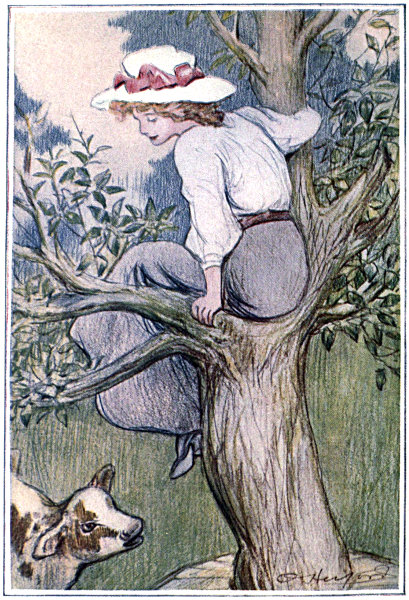
“Quick, Galatea! The cherry tree!”
There was a comfortable branch at about
the height of a man’s shoulder, with a wooden
bench under it. With the bellowing bull-calf
close at her heels, Galatea ran to the bench and—not
without a generous display of striped
hose—swung herself up to the branch, leaving
the enemy pawing the earth innocuously below.
30“Galatea,” remarked the Poet solemnly, “I
always said that those striped ones of yours
were unlucky. Do you remember?”
“Shut up, George!” Galatea tucked her
little boots under her on the branch, smoothed
out her walking-skirt, and leaned against the
trunk of the tree with the manner of a young
lady accustomed to the usages of the very best
society. George had the indecency to laugh.
“George, if I were a full-grown man I
wouldn’t sit on the grass the whole afternoon
just because of a poor, innocent little billy-goat.”
“Galatea, if I were a perfectly proper, highly
educated and accomplished young lady just out
of Vassar, I wouldn’t roost in a cherry tree just
because of an innocently inquiring bull-calf.”
Then they both laughed.
Just then the colt whinnied long and joyously.
31“Giddap,” sounded a voice from the
road.
A sleek-coated young bull-terrier, very much
alert, bounded down the path and stopped suddenly,
as though divided between astonishment
and indignation at the sight of the cow in the
tulip-bed.
“That must be Napoleon,” said Galatea.
“Gabriel is returning.”
A spring-wagon, loaded with trunks and
boxes, and drawn by an extremely well-fed bay
mare, whose driver, stoop-shouldered and sunburnt,
perspired uncomfortably in his Sunday
clothes, came into view on the driveway beyond
the cherry tree, and stopped.
“How do you do, Gabriel?” said Galatea,
smiling upon him from the cherry tree.
“Pleased to meet you, Gabriel,” said the
Poet affably, from his seat on the grass.
For at least a minute the man in the wagon
32gazed upon the scene in silence, slowly opening
and closing his mouth. Then he jumped
down, remarking:—
“Jumpin’ Jehosephat! Sic’em, Napoleon!”
The terrier jumped for Mrs. Cowslip’s nose.
She rose from the tulip-bed, but stood at bay.
There was a great clatter of hoofs in the
kitchen, and the colt ran out through the open
door and began kicking up his heels gleefully
under his mother’s nose. The bull-calf, the
goat, and the pig arrayed themselves, as for an
argument, beside the cow.
“Amanda!” bawled Gabriel. And then to
the Poet: “Be you folks hurt, or only skeered?
I must a’ missed ye, waitin’ for t’ other
train.”
“We’re only scared, I think,” answered the
Poet, rising cautiously, with one eye on the goat.
Galatea slid down from her perch and joined
them.
33“Darn the critters!” said Gabriel. “It’s all
Amanda’s fault. Of course she had to go trapsin’
off somewhere. Amanda! O Amanda!”
Amanda appeared in the edge of the orchard,
with a tin pail in her hand, indicating with
a wave of her apron that she was coming as fast
as she could with her heaping pail of strawberries.
“I locked ’em up,” said Gabriel. “But, laws,
’t aint no use lockin’ up critters edicated by a
college perfessor.”
“Fer th’ land sakes!” ejaculated Amanda,
arriving breathlessly and taking in the whole
scene at a glance.
The pig went up to her, grunting amiably in
his white ruffle.
“You shameless critter!” said Amanda, with
her face aflame, as she tore the indecorous garment
from Reginald’s neck.
“Ha! ha! ho! ho! ho!” laughed Gabriel.
34“Serves ye right, Amanda, for goin’ off
an’ leavin’ edicated critters loose around th’
house.”
“Shoo!” said Amanda, waving her apron at
Mrs. Cowslip, who merely gave her a mild look
of reproach.
“Git back to th’ barn, all of ye,” commanded
Gabriel, with no better result.
“Say it, Gabe,” said Amanda, stamping her
foot.
“No,” answered Gabriel, “I mustn’t. It
keeps their feelin’s hurt for a hull day. Th’
Perfessor wouldn’t like it.”
“I don’t care, Gabe, you jest say it.”
“Say what?” asked the Poet, overcome with
curiosity.
“W’y,” explained Gabriel, “ye see, it’s th’
Perfessor’s idee that these critters are jest as
good as he is. Ekel rights for man an’ beast,
he calls it. You bet they’re willin’, consarn
35’em! It’s only when they want to run th’ hull
place that he resorts to extreme measures, as he
says. Then he shouts a queer, heathen word at
’em, an’ they sneak off like a dog caught suckin’
eggs.”
Out of regard for the Professor’s feelings
Gabriel proceeded with such comparatively
mild measures as flicking Mrs. Cowslip with
his whip, and trying ineffectually to push the
bull-calf toward the barn. The colt danced
about, nipping at him with bared teeth. But it
was Reginald who brought things to a climax.
The pig, escaping the teeth of the terrier, ran
between Gabriel’s legs, sending him sprawling
on his back.
“Say it, Gabe,” called out Amanda.
“You bet I’ll say it!” Gabriel replied, rising
and confronting the four-footed mutineers,
now grouped as though conscious that they
had carried matters a trifle too far. Throwing
36out his chest, Gabriel thundered the single
word:—
“ABRACADABRA!”
The effect was magical. The Poet and his
sister could hardly believe their eyes. Instantly,
with head drooping in the most dejected manner,
the colt started toward the barn, followed
by Mrs. Cowslip and the bull-calf, their tails
now drooping and sorrowful. Next went the
goat with conscience-smitten mien, and at the
end of the melancholy file was the pig, squealing
plaintively, all the kink out of his tail.
“Wait a bit, this won’t do at all!” suddenly
exclaimed the Poet, with more excitement in
his voice than his sister had ever before noted.
“Do ye want to be a friend to th’ critters?”
inquired Gabriel.
“I’m going to be a brother to them,” said
the Poet.
“And I’m going to be a sister to them, poor
37things!” said Galatea. “Didn’t the Professor
have some word with which he expressed his
forgiveness, and his love, with a gentle reproof
and warning to be more careful in the future?”
she added, looking at Gabriel with soft appeal
in her eyes.
“Sartin’, sartin’.” Gabriel scratched his head.
“I can’t jest remember. It begun the same,
with a-b ab—”
“Of course,” broke in the Poet. “The canonical
form of pronouncing absolution.”
He ran after the delinquents, calling them
by name: “O Mrs. Cowslip! Clarence! Gustavius!
William! Reginald!”
They stopped and looked back penitently.
Galatea ran to her brother’s side. He held out
his hands and cried:—
“ABSOLVO!”
“Absolvo, absolvo!” echoed Galatea.
Cheerfully, but with subdued spirits, Bos,
38Equus and Co. gathered about their new friends,
accepting their forgiveness with various tokens
of gratitude. The pig lay down at Galatea’s
feet, grunting contentedly, while the colt
brushed her cheek with his velvet muzzle.
The Poet felt a warm nose in his hand, and
was not amazed to find it was his late enemy’s,
the goat’s.
“Well, darn my skin!” said Gabriel.
“Galatea, I think we shall do very well—very
well indeed,” said the Poet.
II Fair Warning to the Horseless
39
Seated on the veranda, in a
low lawn-chair which caused
his long shanks to thrust his
angular knees up to the level of
his chin, the Poet was perusing
the Odes of Horace in the original text, and
pencilling their English equivalent on the leaves
of a small writing-pad. His handwriting was
large and careless. Every minute or two he tore
a filled sheet from the pad and dropped it on
the edge of the veranda floor at his side. A
straggling honeysuckle vine concealed from
him the fact that William was present, and that,
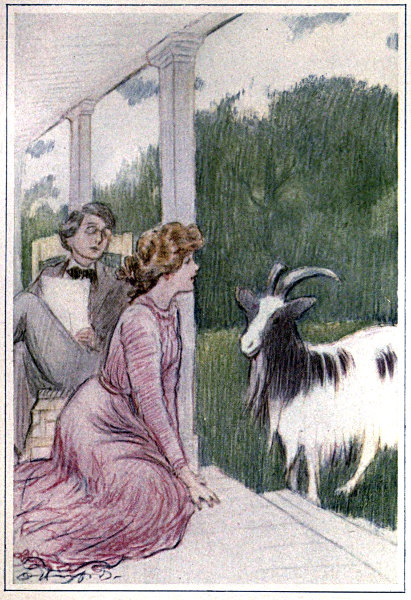
as each sheet fell to the floor, the goat was consuming
it with every evidence of appreciation.
40Probably never before had a translation of Horace
met with such instant success.
But presently William, becoming impatient
at the Poet’s deliberation, seized a sheet out of
his hand and stood detected. At the same instant
a musical peal of laughter from the open
window of the breakfast room proved that the
Poet’s sister had been a delighted witness of
the disaster. After one startled look about him,
the Poet realized that the goat’s attentions had
been indeed thorough. He had recourse to his
customary whimsical philosophy.
“Galatea,” said the Poet gravely, “do you
observe that the whole of my manuscript has
been accepted without reading? That is the
highest compliment possible to pay a poet.”
“And yet you hear it everywhere that the
classic poets are not appreciated nowadays.”
The girl, still laughing, joined her brother
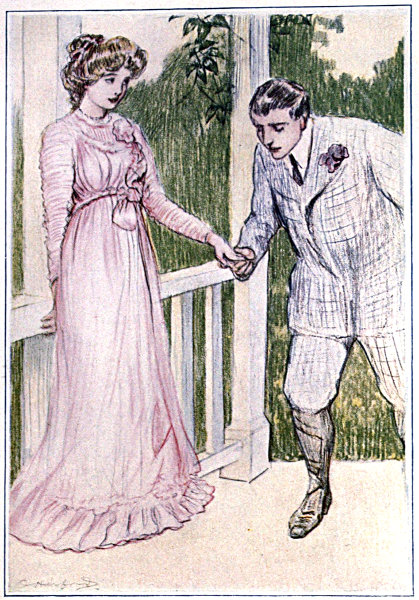
on the veranda. She was all in pink—fluffy
41pink, with a fluffy pink thing flapping above her
mahogany tresses, producing an effect impossible
to describe, fatal to another woman, in
her case charming. The goat put his forefeet
on the veranda and seemed to nod his approval.
“William,” said the Poet, “you have given
me an idea—an idea which may influence my
whole career.”
“Why not?” commented Galatea. “Haven’t
you and I been duly initiated as members of
the firm of Bos, Equus and Co.? Aren’t all our
interests mutual?” And again she laughed.
“I have long been undecided,” resumed the
Poet, “as to whether my muse is classical and
for the few, or modern and for the many; or,
indeed, whether I should not give up poetry for
the plough. William, it shall be for you to decide.
I will now compose something for the
masses. If you accept it instantly, as you have
accepted my Horatian Odes—not for publication,
42it is true, but—er—but for purposes
best known to yourself, I shall at once take
steps to become an honest husbandman. If,
however, you decline what I am about to offer
you, I shall consider myself a properly ordained
Poet of the People, and shall act accordingly.
William, a grave responsibility rests upon your
discrimination.”
The goat nodded with an intelligent expression,
his venerable beard sweeping the floor.
“O George, how perfectly absurd!” laughed
Galatea.
The Poet scribbled on his pad for a couple
of minutes, tore off the sheet, and offered it to
William. The goat sniffed at it, and appeared
doubtful.
“You are quite right, William. Others have
found my handwriting illegible. I will read it
to you.”
The Poet read:—
43“Sir Mortimer’s poems of note
Were despised by his lady’s pet goat.
The goat said, ‘Oh pschutt!’
And proceeded to butt
Sir Mortimer into the moat.”
“Now, William, it’s up to you,” said the
Poet, as his sister, regardless of her fluffy pink
finery, sat down on the floor and shrieked.
But already the goat, looking deeply embarrassed,
was trotting off toward the barn.
“That settles it,” said the Poet solemnly.
“I am ordained Poet of the People.”
Galatea got up, gurgling, and rested her
flushed cheek on her brother’s collar.
“George, you’re the most delicious old thing
ever created.”
He held her off, regarding her curiously.
“All in pink? Nothing like pink to show
dirt. Wherefore all this regardlessness of expense,
Galatea?”
44She took a letter from her bosom and gave
it to him.
“It’s from Arthur. It came in the morning
mail. I didn’t want to disturb you—and William—in
your literary labors. You’d better
read it now.”
The Poet read:—
“‘I’m taking a little spin out your way in my
new Red Ripper. Will reach your place about
noon. If you’ve nothing else to do, we can
have a whirl down the old Post Road and back
before two o’clock. Then I must be off to
Stamford on an important engagement about a
portrait—in fact, it means the price of this
modest luxury on wheels. But do give me the
two hours. Think what poetic wonders George
may accomplish in that time, undistracted by
your luminous presence.’”
THE GOAT SEEMED TO NOD HIS APPROVAL
“‘Luminous presence’ isn’t bad,” commented
the Poet. “That is, for Arthur. Don’t
45you give him any of your impudence, Galatea.
We can’t afford to quarrel with people who
can own Red Rippers.”
“Rubbish, George. Arthur is sometimes
very trying. He isn’t half as handsome as he
thinks he is.”
“But you are, Galatea. Be charitable. You
could do much worse than go through life in—in
a Red Ripper. Noon, did you say?”
The Poet looked at his watch. “Why, it’s
eleven-forty already. Hello! What’s the matter
with our four-legged partners?”
Cleopatra, with Clarence at her side, had
galloped up the driveway from the bottom of
the pasture, and stopped, with head up, snorting
loudly at something down the road. The
colt could not snort as loudly as his mother,
but he made up by snorting twice as often.
Mrs. Cowslip and Gustavius, the bull-calf, quite
in the dark as to the cause of the excitement,
46but willing to become excited themselves, were
stopping en route to snatch an occasional
mouthful of grass. Reginald’s short legs were
flying in the distance, while he uttered plaintive
squeaks at being left behind. The goat was
giving him the assistance of an occasional butt
in the right direction. Napoleon, rudely awakened
out of a deep dream of peace, barked
wildly from the edge of the veranda. Amanda
came out of the kitchen, wiping her hands on
her apron.
“For the land sakes, what ails the critters?”
she asked of Gabriel, who had run up from the
potato-patch, armed with his hoe.
Gabriel ran to the side of the colt, glanced
down the road, and came back laughing.
“It’s one of them there hossless buggies,”
he said. “The mare never could stand the
sight of ’em, and the colt takes after her. They
take it as a personal insult for a buggy to go
47humpin’ along like that without a hoss to pull
it.”
“It’s Arthur,” said Galatea. “He’s made
better time than he expected to, and he’ll be
unbearable.”
The whirr of the wheels was now audible.
Cleopatra and Clarence, with a final snort of
rage, put their heads between their forelegs,
slashed out vindictively behind, and galloped
off to the far side of the driveway. The Red
Ripper turned in swiftly from the road, giving
Mrs. Cowslip the fright of her life as she
plunged, bellowing, to the rear of her defiant
equine comrades. At sight of the shining red
enamel, Gustavius, for one instant, contemplated
a valiant charge, but thought better of
it barely in time to save his skin, if not his
dignity.
As though to make the affront beyond all
forgiveness, the driver of the red thing steered
48straight on toward the barn, then, describing a
graceful circle about his outraged spectators,
returned and came to an abrupt halt near the
gateway. He lifted his cap to Galatea with easy
grace, and jumped from his seat to take the
Poet’s outstretched hand.
“Good boy. You did that with almost human
intelligence.” The Poet’s eyes twinkled—the
nearest approach to a smile in which he
had ever been known to indulge.
“Yes; rather neat, I call it. Isn’t she a
beauty? Only two tons weight and forty horsepower;
maximum of sixty-nine miles an hour
on a level road; climbs hills like a goat; the
only sparking device that never hitches—”
“Kind to women and children and stands
without hitchin’,” drawled the Poet.
“Quit your kidding, George,” and then, at
a loud snort from Cleopatra: “I say, George,
who’re your friends?”
49“Including Galatea and myself, they’re Bos,
Equus and Co.”
“Oh, freedom of the place—part of the
family, eh? You’re a queer chap, George. They
don’t seem quite friendly. I hate to break up a
happy home, you know.”
“It does look like it, Arthur. The mare
can’t bear the sight of a vehicle that is independent
of her services. The bull-calf resents
its brilliant color. Besides, they all hang together
on general principles. However, Galatea
and I still retain a few of our characteristics
unchanged by these associations. We forgive
you.”
Gabriel and Amanda returned to their duties
in potato-patch and kitchen. The Poet went
into the house, leaving the Artist with Galatea
on the veranda. She had given him her hand
with a bewildering smile, but as he immediately
began to chatter interminably about his automobile
50and the great things he was going to do
in the way of speed, her red lips shaped themselves
into a curl that was not so pleasant, and
if he had noticed the satirical little side glances
she gave him now and then, his tone would
have been much less complacent.
The Artist was really an excellent fellow,
stalwart, straight-limbed, and undeniably handsome.
His type originated with the new generation
of popular fiction illustrators. You would
instantly recognize his smooth-shaven face, his
straight nose, and his determined chin for those
of the plain American young hero who walks
unconcernedly into the boudoir of the Crown
Princess of Grossbock (who falls desperately
in love with him at first sight), and presently
rescues her from the very foot of the throne,
dashing with her in his arms through a whole
regiment of Hussars, without turning a hair.
It was not to be expected that such a hero
51would remain sacred to the romances over
which little girls weep tears of joy and longing.
The daughter of Isaac Ickleheimer called her
father’s attention to him one day, and ever since
then he has adorned the advertising pages of
the magazines, attired in the most lovely ready-to-wear
clothes, with shoulders more than human.
But the Artist couldn’t help this, any more
than he could help chattering about his new
automobile to a girl who was dying to have
soft nothings whispered in her ear. After a
while Galatea, realizing that such hopes were
doomed to disappointment for the present,
abruptly choked off the dissertation on Red
Rippers by dragging the Artist in to luncheon.
With the human element thus eliminated,
now occurred one of those scenes which gave
to the present chronicler his chief inspiration.
The red thing being quiescent, Cleopatra and
52Clarence had ceased their snorting and were
approaching cautiously, with occasional coy
side-prancings, yet with a curiosity in their eyes
that was not unmixed with vindictiveness. Mrs.
Cowslip and Gustavius grazed near by, with one
eye open to developments. William surveyed
the red thing speculatively, evidently wondering
whether it offered a profitable opportunity
for butting, while Reginald, the pig, less imaginative
than the others, rubbed one of his fat
sides tentatively against a rubber tire.
“Not so bad,” grunted Reginald. “A bit
too smooth, that’s all; don’t seem to take hold
like the Professor’s finger-nails—”
“Look at that fool pig,” whinnied Clarence
to his mother. “Reginald has no dignity. I
wouldn’t demean myself by such condescension
to an enemy with such a vile-smelling
breath.”
“That proves that the thing is really alive,”
53commented Cleopatra. “It’s eaten something
that don’t agree with it.”
“It’s breath smells just like Gabe’s lantern
when he’s late with his work in the barn,”
said Mrs. Cowslip, coming up, with Gustavius
by her side, shaking his sharp sprouts of horns
truculently.
The pig braced himself against a corner of
the metal framework in front, and grunted
with more unction:—
“Ah! this is better.”
“Why don’t the thing show signs of life?”
complained Cleopatra. “Then I’d know
where to plant my heels. It was lively enough
a little while ago.”
Gustavius, with calf-like bellows of provocation,
was exercising his sharp little horns on
one of the rubber tires.
“Why should you be so incensed against
such a lumbering old thing?” asked Mrs. Cowslip,
54with a placid glance at the mare. “Seems
to me you ought to be grateful to any sort of
wagon that would leave you free to enjoy yourself.”
“Trust an old cow not to see an inch beyond
her own nose,” snorted Cleopatra contemptuously.
“Do you suppose I’d be welcome
in this family if I wasn’t useful? There’s
nothing for me to do except pull the buggy,
or Gabe’s wagon. Why, even that delightful
red-headed girl, who always has sugar in her
pocket, helps Amanda in the garden.”
“True,” admitted Mrs. Cowslip. “And I
give milk.”
“Lucky for you,” said Cleopatra significantly.
“When I think of my Clarence and
your Gustavius, I tremble.”
Mrs. Cowslip looked startled. “What do
you mean, Cleopatra?”
“I don’t want to alarm you, my dear, but I
55can’t forget that day when Gabe got into the
calf’s pen with a sharp knife in his hand.”
“I’ve heard of such calamities to my race,”
whimpered Mrs. Cowslip, her moist nose turning
pale; “but it never occurred to me that
a child of mine—”
“It was Amanda who dragged Gabe and his
knife away,” continued Cleopatra. “Her words
ring in my ears yet. She said: ‘O Gabe, wait
till he’s older and we can roast him. I do love
roast beef’; that’s what Amanda said.”
Mrs. Cowslip sidled affectionately up to Gustavius,
who was still worrying the rubber tire
with his sharp sprouts of horns, and licked his
cheek tenderly.
“Don’t bother me, mother,” said the
thoughtless bull-calf. “I feel that I’m making
an impression on this thing.”
“If you do,” said Cleopatra, “and it shows
signs of life, just you watch me, that’s all;”
56and, laying back her ears, she experimented
with her heels to be sure that they were in
good working order.
“Me, too,” said Clarence, following his
mother’s example with a significance not to be
misunderstood.
“If you’re really making an impression,”
bleated William to Gustavius, backing away
and shaking his horns, “one good, swift butt
ought to do the business.”
Gustavius moved his hind quarters to one
side, and bored away with one horn as hard as
he could.
“Clear the track,” bleated the goat; “I’m
coming!”
On came William with a rush that astonished
even himself. The last leap was twelve
good feet in mid-air. With his neck stiffened
like a rod of steel, the roots of his horns struck
the rubber tire squarely just below the boring
57sprout of Gustavius. There was an explosion
and a fierce puff of something in their faces that
sent both the goat and the bull-calf back on
their haunches.
“It’s alive! It’s alive!” shrieked Cleopatra,
as she wheeled about, filled with the joy of
battle.
Lashing out with her heels at the red thing
amidships, the mare’s heels clattered among
the driving-levers most ominously. Clarence’s
heels, being out of range in his excitement, did
no damage. They looked around, snorting,
awaiting the enemy’s retort. To their surprise
the red thing remained motionless.
“Pshaw!” exclaimed Cleopatra, “what’s
the use of attacking such a spiritless creature,
anyway?”
“In my opinion you’ve killed it,” said Mrs.
Cowslip. “I never saw such a smash in my
life.”
58“It was I who finished the thing,” boasted
Gustavius, finding himself unhurt. “I felt its
last breath in my face.”
William turned away in disgust.
The pig, engrossed with his own selfish pursuit
of new dermatological sensations, had been
only momentarily disturbed by these events.
He felt that something was lacking.
“If I could only get my back under something,”
he complained. “I wonder if it’s safe
to crawl under the thing?”
Reginald investigated, and was interested.
“There’s a lot of little jiggers under there that
look as though they’d just fit my back.”
He got down on his fore-knees and wriggled
under the red thing, grunting, while the others
still debated together on ways and means.
During luncheon Galatea’s mood had softened.
She was no longer piqued at the Artist’s
detailed accounts of the wonders of his new automobile.
59Arthur, in a moment of intelligence,
had squeezed her hand under the table.
“In case of a break-down of any kind,” observed
the Poet, “I suppose you carry all sorts
of tools and materials for repairs?”
“I never give the matter a thought,” said the
Artist. “She’s such a perfect piece of mechanism
that she can’t break down.”
“But suppose you should run over a pig, or
a cow, and—”
“Oh, in that case I dare say the tool box
might come handy.”
“Or punctured a tire?”
“The Red Ripper’s tires are warranted puncture-proof”;
and the Artist entered into a long
technical description of the new and improved
process which had produced the Red Ripper’s
impregnable tires. Galatea sighed several times,
but it was useless.
“After all,” drawled the Poet at the first
60opening caused by a fish-bone sticking in the
Artist’s throat, “you can’t make a sympathetic
companion of an automobile as you can of a
horse. Why, Galatea and I have the most improving
conversations with Cleopatra and the
pig.”
“Yes,” chimed in Galatea eagerly, “even
Gustavius, the bull-calf, understands everything
we say to him. It all proves the Professor’s
theory that we don’t give these domestic pets
half the credit they deserve for intelligent and
affectionate interest in us and our affairs.”
“I’ve heard of your Professor and his crazy
theories about animals,” said the Artist, having
swallowed the fish-bone. “I’ll bet you do just
as he did—you keep your pockets full of sugar
for the mare, and you scratch the pig’s back.”
“Arthur, you haven’t the first conception—”
“No, Arthur,” broke in the Poet, seeing the
61fire in his sister’s eyes, “you couldn’t even see
that Cleopatra was aware that your Red Ripper
is a menace to her means of livelihood.”
“Pooh! George, the mare isn’t used to
automobiles, that’s all.”
The Artist looked at his watch. “I think
we had better be going, Galatea; I’ve just
twenty-five minutes in which to whirl you
thirty miles and back.”
Galatea disappeared, and returned in a moment
with her fluffy pink costume, hat and all,
covered by a hooded cloak of gray silk which
became her exceedingly. The Artist put on his
cap and gloves. At that instant a series of heart-rending
squeals filled the air.
“Something has happened to Reginald!”
exclaimed the Poet, and his long legs flew as
he rushed to the rescue.
When Galatea and the Artist caught up with
him, he was on his stomach half under the
62Red Ripper, tugging with all his might at one
of Reginald’s hind legs. The pig’s squeals grew
louder and more hopeless. Cleopatra, the colt,
the cow, the bull-calf, and the goat, huddled
together, looked on from a distance with expressions
of wondering innocence. Napoleon
barked furiously at the Poet’s waving legs.
Gabriel came running up with a fence-rail on
his shoulder. The Poet emerged, perspiring
and baffled.
“The critter’s stuck, darn him!” said Gabriel.
“We must lift the machine.”
He thrust one end of the rail under the Red
Ripper’s frame. “Now, all together!”
The Poet and the Artist joined Gabriel with
their shoulders under the rail, the machine
rose an inch or two, and Reginald, choking
a final squeal in his throat, scrambled out.
At least three square inches of his back were
ravished of their bristles. Not a particle of
63kink remained in Reginald’s tail. Straight for
the barn he ran, emitting short grunts of relief
and contrition.
“Great snakes!” exclaimed the Artist.
“Look at that rear tire. There’s a hole in it
you could throw a dog into.”
Nobody could offer any explanation, the bull-calf
having forgotten all about it. The Artist’s
eye suddenly lighted on the bent driving-levers,
and for half a minute his language was far from
polite.
“I warned you about Cleopatra,” said the
Poet; “but you wouldn’t give the mare credit
for sufficient intelligence to protect her personal
interests.”
“Do you think, Arthur, that we will be able
to whirl thirty miles and back in twenty-five
minutes with a flat tire?” inquired Galatea
innocently.
“Of course you can,” said the Poet solemnly.
64“The Red Ripper is such a perfect piece
of mechanism that she can do it on three
wheels.”
“That’s right, rub it in,” said the Artist.
“When I came out here I didn’t count on
being hoodooed by these four-legged friends
of yours that can do everything but talk.”
“They can talk too,” retorted Galatea wickedly;
“and they don’t confine their harangues
to automobiles, either.”
The Artist winced. Galatea had one more
shot for him.
“If you positively must be in Stamford at
three o’clock, I’m sure Cleopatra will be only
too glad to oblige you.”
“The blacksmith down to the station can
fix you up in ten minutes,” spoke up Gabriel.
“He’s a reg’lar genius at tinkerin’ up hossless
buggies.”
“It’s mostly down-hill to the station,” said
65the Poet; “I’m sure Cleopatra will be charmed
to assist the Red Ripper that far.”
Galatea sat down on the ground and laughed.
“Gosh, yes,” said Gabriel, starting for the
barn. “I’ll go an’ git her harness.”
The Artist surrendered. He sat down beside
Galatea, while the Poet looked the other way,
and whispered things that made her eyes shine.
When Gabriel reappeared with the harness,
a whiffletree and a stout chain, Cleopatra’s complete
understanding of the situation could not
be doubted. She thrust out her head for the
collar, welcomed the bridle, and before the
straps were buckled trotted proudly into position
before the vehicle, which was now no better
than an ordinary buggy.
“Isn’t she a dear?” said Galatea.
“All aboard; git in,” said Gabriel. “Mind
and be careful about the brake—it’s down-hill.”
66With a grimace the Artist placed himself in
the chauffeur’s seat. Gabriel handed him the
reins.
“I’ll foller an’ bring back the mare,” he
said. “Giddap, old gal.”
Cleopatra looked around, shook her head,
and refused to budge. Gabriel laughed, and
looked at Galatea.
“You’ll have to git in. You can’t fool the
mare; she sees you’re dressed for drivin’.”
The Poet, with great gravity, helped his sister
up beside the Artist. Galatea took the reins.
At her cheerful, familiar chirrup Cleopatra
stretched her fine muscles, and, while the colt
pranced about, kicking up his heels in irrepressible
joy at this warning to the horseless, dragged
the ponderous, vanquished enemy into the road
and away. Never before stepped a mare of pedigree
so proudly, nor trailed along a Red Ripper
so ignobly.
III Pig-Malion and Galatea
67
“Galatea!” hailed the Poet
from the bottom of the stairs.
“Yes, George?”
“There’s a letter from Arthur.
Come down.”
“I can’t, this moment. Je suis en déshabillé.”
“I thought so; your voice sounds full of
pins. But you don’t need to air your Vassar
French. The pig isn’t listening.”
“My French prose is better than your English
verse. What does Arthur say?”
“He’ll be out here early.”
“What for?”
“Girl, have a care! While you are about it,
make the most of the small charms with which
the good Lord has endowed you.”
68“I will, brother mine; I’m expecting Reginald
to have his back scratched.”
Truth to tell, the pig was already contemplating
a call with that object in view. Since
early morning Cleopatra and her yearling colt,
Mrs. Cowslip and Gustavius, and William, the
big-horned one, had diligently cropped the
dewy grass of the lower lawn until their sides
bulged, while Reginald was so replete with
artichokes that he was constrained to sit on
his haunches and grunt stuffily while making
occasional rude comments on the gluttony of
his comrades.
“You have often reproved me for being
greedy,” grunted Reginald as the colt harvested
a luscious bunch a yard from where he sat,
“yet I have never tried to eat up the whole
pasture between sunrise and noon.”
“Don’t give me any of your impudence,” retorted
Clarence, with his mouth full, “or I’ll
69shut my teeth on one of your ridiculous, flapping
ears.”
“If you gave milk,” commented Mrs. Cowslip,
“you would understand the necessity of a
stomach filled with something better than artichokes.”
“Ha! ha!” laughed the pig, with his mouth
wide open. “The sides of your son bulge like
the sides of the barrel in which Gabe keeps your
breakfast of bran. Ha! ha! does Gustavius give
milk?”
“Let me at him, mother,” said the bull-calf,
waving his tail aloft and lowering his horns.
“I’ll teach him!”
“No, you don’t,” said the pig, showing surprising
agility. “You greedy fellows annoy me;
I’m going to the house and get that red-headed
girl to scratch my back.”
So intensely satisfied with himself that the
kink in his tail tightened to the verge of discomfort,
70Reginald scampered across the lawn
and up the steps leading to the veranda. With
his forefeet on the top step he halted at a gruff
challenge from Napoleon. The bull-terrier,
with teeth unpleasantly visible, barred his way
to the door.
“My goodness,” said the pig, with easy assurance,
“how you startled me! You were
always such a joker.” And Reginald got his
forefeet on the veranda floor.
“Now, that’s the limit,” growled Napoleon.
“One step farther, and I’ll have your ears in
ribbons.”
“You don’t know how handsome you are
when you put on that fierce look,” said the pig in
flattering tones. “Any stranger would believe
you in earnest. But you and I know each other.”
“What do you want?” growled Napoleon,
somewhat mollified in spite of himself by the
pig’s flattery.
71“I’ve nothing to conceal from you, Napoleon.
I never have. I’ve come to get that
lovely red-headed girl to scratch my back.”
“You’ll have to wait; she’s inside.”
“I’ll go right in,” grunted Reginald complacently;
“no trouble at all, I assure you.
Just step one side, Napoleon, and I won’t disturb
you in the least.”
“You’ll come right in?” Napoleon was
boiling with indignation. “Who ever heard of
a pig in the parlor? You’ll get right out of
here before I make you.”
Reginald assumed a look of injured amazement
as he replied: “Is it possible, Napoleon,
that you really mean to do me this injustice?
Have you forgotten that we are all on terms of
equality here?”
“Not in the parlor,” growled Napoleon.
“No pig gets into our parlor, not if I know
it.”
72“But you go into the parlor whenever you
please,” grumbled Reginald.
“It’s part of my business to go all over
the house and see that there’s no trespassing.
That’s what’s been expected of us dogs ever
since the world began. Amanda raised an awful
row that time the colt got in the kitchen. But
I wasn’t to blame, being away from home with
Gabe and Cleopatra.”
The pig, with all the stubbornness of his race,
refused to be convinced.
“The Professor used to invite me in often,”
he complained. “The red-headed girl would,
too, I’m sure, if she knew I was here.”
“No, she wouldn’t. She’s busy with that
automobile chap. Can’t you hear their voices
through the window?”
Reginald listened. Yes, it was the voice he
loved so well—when accompanied by the delicious
sensation of one of Amanda’s cast-off
73nutmeg-graters being rubbed smartly up and
down his spine. It was cool and even, and was
saying:—
“No, Arthur, I won’t go for a walk, thank
you. I don’t think I like you very well to-day.
You explain that you walked over from the
station out of regard for the feelings of Cleopatra
and Clarence, and yet you are wholly
oblivious of my feelings. You come out here
without your Red Ripper on an ideal day for
a spin, and then you add insult to injury by
talking of nothing else. Arthur, I hate your
Red Ripper, I despise its phenomenally perfect
sparking device, I loathe its triple-speed
gear—”
The pig lifted up his voice in supplication.
It was not in vain. Galatea emerged upon the
veranda, smiling a welcome to Reginald, whom
the Artist regarded with dark looks of resentment.
74“Good-morning, Reginald; won’t you be
seated?” she said brightly, dragging forward
an easy-chair.
The intelligent pig scrambled into the chair,
making confidential little throaty grunts out
of the side of his mouth into the ear of his
hostess. The bull-terrier satisfied his dignity
by barking one brief comment for Reginald’s
benefit:—
“Now what do you think? This isn’t the
parlor. Perhaps you’ll understand after this
that the veranda is the limit, for a pig.”
“Hush, Napoleon,” commanded the red-headed
girl. “Here, get up beside Reginald
and make him feel at home.”
It was a wide chair. After but one instant
of disgusted hesitation, the bull-terrier
obeyed.
“What has the terrier done that he should
be so humiliated?” asked the Artist, who
75had even more than the average man’s respect
for dogs as compared with other domestic animals.
The girl ignored the question. There was
something odd and unfamiliar in her manner,
a peculiar glint in her eye, her full lips were
drawn in a straighter line than usual. Having
no professional interest in the scene, the Artist—unluckily
for him—observed none of these
ominous signs. Galatea shook her finger in the
terrier’s face.
“Napoleon, your manner toward Reginald
is not cordial. Sit closer!”
The terrier meekly obeyed. The pig gave
him an expansive smile. The Artist began an
impulsive protest:—
“Oh, now, I say, Galatea—”
“Napoleon! Reginald! Salute each other!”
The dog thumped the chair with his tail,
the pig grunted amiably, and they pressed their
76cheeks together like affectionate children. The
lank figure and solemn visage of the Poet appeared
in the door.
“What is Napoleon’s crime that he should
suffer such punishment?” he inquired.
“Just as I was remarking,” began the Artist;
“but—”
“That will do,” said the girl, taking no notice
of these comments. “Now sit up and look
pleasant; you are about to have your pictures
taken by a very celebrated artist.”
Both Reginald and Napoleon assumed attitudes
really remarkable for their ease and
naturalness.
“Ahem!” began the Artist, growing very
red in the face, and stopped abruptly at a coolly
inquiring glance from Galatea.
“Do I understand,” she inquired frigidly,
“that you take the absurd position of Paderewski,
Calvé, Jean de Reszke, and other public
77favorites, and disdain to exhibit your art upon
social occasions?”
“Not at all,” answered the Artist hastily,
while the Poet regarded them solemnly, but
with a twinkle in his eye. “No, but—Well,
you see, I—I am not accustomed to have pigs
sit to me for their portraits—at least, not upon
social occasions.”
“It is perhaps as well that you should understand
fully that Reginald is a personal friend
of mine, and that we are on terms, not only of
sympathetic affection, but of perfect equality.”
And the girl placed her arm about the pig’s
neck with a caressing touch that sent him into
a transport of appreciative grunts.
“If I thought that you were guying me—”
The girl turned upon him sharply. “Have
I ever insinuated that you were guying me
when you compelled me to listen for hours to
mechanical details about your Red Ripper? I,
78to whom poets are proud to read their original
manuscripts in advance of publication?”
“Arthur,” said the Poet gravely, “Galatea
is right. This is a case of love me, love my pig.
Your professional pride need not suffer. In fact,
the result of your labors may bear appropriately
a title that is classical.” He turned to his sister.
“Galatea, I assume that you are to be in the
picture—you will sit with the pig?”
“Certainly,” said the girl, as a swift glance
of understanding passed between brother and
sister.
“Why, then, just consider, Arthur,” said the
Poet cheerfully, “you can send your picture to
the Fall Exhibition catalogued as, ‘Pig-Malion
and Galatea.’”
The girl laughed in spite of herself. Even
the over-serious Artist was not proof against a
conceit so pungent. But Galatea’s mood puzzled
and disturbed him, for he really loved her as
79self-complacent young men often do love girls
of keen wit and analytical minds.
“Unfortunately,” he said, “I have no drawing
materials with me.”
“I can supply them,” replied the girl, rising.
Reginald grunted reproachfully and started
to scramble down from the chair.
“O Reginald, forgive me. I had forgotten
you came to have your poor back scratched.”
She turned to the Artist. “Arthur, kindly
hand me that nutmeg-grater over by the honeysuckle
vine.”
The Artist obeyed. The pig grunted in
grateful anticipation. Galatea applied the nutmeg-grater
where she knew by experience it
would do the most good. Napoleon sniffed disgustedly,
jumped down from the chair, and
went to the Poet for consolation.
“Now, Arthur,” said the girl presently,
handing him the nutmeg-grater, “you attend
80to Reginald while I go for the drawing materials.”
The Artist took the unfamiliar instrument,
looked at it, and then at the pig, and then at
Galatea. He seemed dazed. As has been remarked
before in this truthful narrative, the
Artist was a most correct and proper young
man. He was fashionably dressed, and with
excellent taste. He would have considered it
a crime to wear a cravat that disagreed by so
much as a single dot or stripe from the prevailing
mode. The thought of having in any way
transgressed the rules of good form, as laid
down in the exclusive club of which he was a
member, would have tortured him for weeks.
Could he conscientiously scratch a pig’s back—with
a cast-off nutmeg-grater?
Galatea drew up a chair close to that occupied
by Reginald. “Come, Arthur; you will
not find Reginald ungrateful.”
81“Galatea,” said the Artist, with a supplicating
glance into the girl’s eyes as he moved
toward the vacant chair, “when I leave this
evening will you walk part way to the station
with me?”
“Are you going to be a true friend to my
friend—to Reginald?”
The Poet had strolled to the other end of
the veranda.
“Yes, Galatea. You could have no friend
who would be unworthy of my friendship.”
In spite of the nutmeg-grater in his hand, in
spite of the waiting pig, his manner and his
voice were romantic.
“Yes, Arthur, then I will walk with you to
the station.” But the smile she gave him was
reflective, and at least half of it rested on the pig.
The Artist sat down obediently and applied
the nutmeg-grater with a will to Reginald’s
back. Galatea disappeared within the house.
82Presently she was heard calling to her brother.
The Poet followed her. He found her in the
library, sitting limply in a straight-backed chair
and holding her handkerchief to her mouth.
With a gesture of warning she dragged him
into her own little den off the library, closed
the door, and gave her merriment full rein.
The Poet regarded her solemnly. Presently she
was able to speak, though her phrases were
interrupted by convulsions of cachinnation.
“George, it is perfectly clear—that in one
respect Arthur—is hopeless—Never, never,
never—never in this world will he acquire the
slightest sense of humor. Think of it! At this
moment—with an old nutmeg-grater, he is
scratching a pig’s back—with all the seriousness—and
attention to detail—that he would
give to a portrait of—the Empress of Russia—George,
a little while ago I was angry with
Arthur. I thought him stupid, self-sufficient,
83insufferable. But now, when I think of him
out there—irreproachably attired—scratching
Reginald’s back—with all the grave politeness—and
earnestness—with which he
would hand around cups of tea at one of Mrs.
Van Rensellaer’s afternoons—I—I almost
love him.”
The Poet had not even smiled.
“Galatea,” he said, without a trace of his
customary solemn banter, “don’t you carry this
thing too far with Arthur. He’s as good as
gold. He’s a young man among a million.”
“George, Arthur is more than human. I
won’t have it. He’s got to let himself down,
like ordinary people.”
“He is a man of honor—honor that is deep-rooted,
ancestral.”
“He is a slave to the perfectly correct forms
endorsed by the Knickerbocker Club.”
“He is a gentleman. He lives in the country
84upon acres that are his own, and is a father
to those who serve him.”
“He is sacred to the memory of ‘noblesse
oblige,’ and he rubs it in.”
“Galatea, you are an impudent and improvident
young woman. As your legal guardian I
would feel justified in locking you in your
room, and keeping you there until you could
realize the blessings you have and the opportunities
that are open to you.”
“George, you are becoming almost as stupid
as Arthur is. I wouldn’t have thought it of
you. Listen. I am going to reform Arthur. I
admit he’s worth saving. It is hopeless ever to
expect him to develop a sense of humor, but
he shall at least cultivate a sympathetic interest
in Bos, Equus and Co.”
She took from her desk and thrust into the
Poet’s hands pencils and a sheet of Bristol
board.
85“Take these to Arthur, please. I’ll join you
in a minute.”
The Poet shook his head doubtfully, but
obeyed. The girl stood for a moment with her
finger on her lip, smiling. Then she took from
a work-basket needles and thread and a yard or
two of faded pink ribbon, and, picking up a
somewhat dilapidated specimen of the fluffy
chiffon headgear which she affected, she returned
demurely to the veranda where the Artist
was still painstakingly exercising the nutmeg-grater
on Reginald’s back. The pig lifted
his nose and grunted in her face, with language
that could not be misunderstood:—
“Ah, at last! Our mutual friend here has
been doing his best, but he falls short of exactly
the right touch. Evidently he’s inexperienced.”
“Thank you, Arthur,” said Galatea amiably,
accepting the post which the Artist surrendered
86to her. “Reginald says you have been
very attentive. Now he will reciprocate by
posing in his very best manner. Attention,
Reginald!”
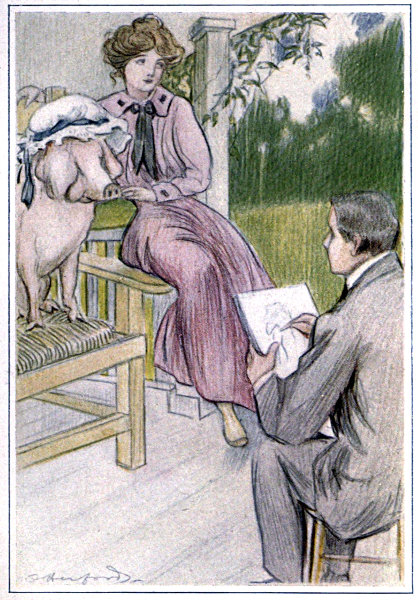
The pig assumed a serious and dignified expression.
The girl sat beside him, placing the
chiffon affair daintily over his ears. The Artist
seated himself opposite with pencils and drawing-board.
The Poet leaned against the veranda
rail and looked over the Artist’s shoulder. His
long visage had resumed its customary expression
of whimsical solemnity. The Artist’s manner
was unaffectedly professional.
“Does the hat belong to the pose?” he asked.
“Yes,” said Galatea. “The idea is that of a
girl thoughtful for the comfort of her dumb
friend. To protect his head from the rays of
the July sun she places upon it the hat taken
from her own head, already well protected by
nature.”
87“True,” commented the Poet. “I’ve often
thought how chagrined the July sun must feel
when he attempts to vie with your blazing topknot.”
“As a matter of fact,” went on Galatea composedly,
“the flies have been worrying poor
Reginald’s ears terribly. Hereafter he shall have
the same protection as other civilized beings.”
The Artist’s pencil moved swiftly. With
needle and thread Galatea attached a pink ribbon
to each side of the hat,—while Reginald
grunted confidential inquiries in her ear,—and
then tied them in a bow under his fat chin.
“There, Reginald, you’re perfectly lovely.
Now if you’ll promise to sit perfectly still for
five minutes, while the gentleman takes your
picture, I’ll give your back my personal attention.”
And she showed him the nutmeg-grater.
“Your goodness of heart is only exceeded by
your beauty,” grunted the grateful pig as plainly
88as words could have said it. “Believe me, I
shall always be responsive to your slightest
wish.”
“I have an idea,” said the Poet. “If you
will excuse me I will go and indite a Dissertation
on a Pig That was Not Roasted.” And he
disappeared into the house.
From time to time Galatea stole a glance at
the Artist’s face. It had the composure of a
painter whose mind is concentrated on his subject
and who feels that he is doing conscientious
work. A look of more than admiration came
into the girl’s eyes. They grew tender. The
nutmeg-grater had dropped from her hand, and
she was deaf to the wheedling grunts of Reginald.
Presently she seemed troubled, as though
dissatisfied with herself.
“Arthur,” she said gently, “I didn’t expect
you to do more than make a rough sketch.”
“Oh, that’s all right, Galatea. This is a new
89and valuable experience to me. I’ve neglected
animals. I couldn’t have a better chance than
this. Would you mind asking Reginald to turn
his face a trifle to the left? There—that’s
splendid.”
The girl bit her lip and tapped with her foot
on the floor. She even gave Reginald an impatient
glance.
“I never realized until now,” said the Artist,
as he took a steady look at Reginald’s profile,
“how much expression there is in a pig’s face.”
“Indeed?” said Galatea shortly.
“Of course Reginald is an exceptional pig.
He has advantages, and associations, which few
pigs enjoy.”
A sharp retort leaped to the girl’s lips, but a
glance at the Artist’s perfectly serious and preoccupied
expression caused her to stifle it.
“I had a horse once,” he went on, as he
limned Reginald’s snout with a sure hand,
90“who actually smiled in the most convincing
manner. There was no mistaking it. I suppose
that was because I spent so much time with
him. After all, it is not so wonderful if domestic
animals do acquire traits of some human
friend who gains their confidence and their
affection.”
Now this was one of Galatea’s favorite arguments.
But, strangely enough, the Artist’s endorsement
of it in the present situation did not
seem to appeal to her. She drew her chair away
from Reginald’s, ignoring his reproaches, and
asked:—
“Wouldn’t you rather finish your sketch
some other time?”
“No; I am ashamed now that I did not
accept your suggestion with greater enthusiasm—Look
up, Reginald! that’s the idea—in
the beginning. That double curve where the
jowl meets the neck is different from anything
91I’ve seen in another subject. Unless you’re
tired, I’ll be grateful for four or five minutes
longer.”
He had hardly glanced at the girl. Clearly
the pig was claiming his whole attention. She
turned upon Reginald a look that paralyzed him
with amazement, and then addressed the Artist
in her softest voice:—
“Do you think your automobile will be safe
where you left it, Arthur?”
“Oh, yes, perfectly. Look! the intelligence
of Reginald is wonderful. I was just wishing for
a more serious expression, and he has already
assumed it. Wonderful, really wonderful!”
“If some mischievous boy should tamper
with the rubber tires, I should feel to blame,”
said Galatea. “There are no boys about here.”
“No danger. Now if you’ll lift that bit
of chiffon out of Reginald’s eyes—Oh, you
frightened the poor chap!”
92Galatea turned her back on the pig. Once
more she tried to show her amicable intentions.
“I didn’t quite understand your explanation
of your new sparking device, Arthur. Does the
spark ignite the gasolene? Or does the gasolene
ignite the—”
“Yes, that’s right—Would you mind giving
me one look at Reginald with the hat off?
I want to be sure about that right ear.”
Galatea snatched the hat off so rudely that
the pig squeaked his sense of unmerited rebuke.
The Artist drew a few rapid lines and heaved
a sigh of satisfaction. He held up the sketch
for Galatea’s inspection.
“Do you think it will pass?”
“Magnificent,” she said, barely glancing at
it. “Thank you so much. Now, if you must
go, I’ll get my hat and walk with you.”
SIT PERFECTLY STILL FOR FIVE MINUTES WHILE THE GENTLEMAN TAKES YOUR PICTURE
“Oh, will you? It is early. We can turn into
93that picturesque old wood-road, and you can
easily get back before dusk.”
Galatea took the sketch into the house, and
presently returned wearing a hat which was
merely a fresher copy of the one which the
Artist had replaced on Reginald’s ears.
“Shall we invite Reginald to accompany
us?” he asked. “He’s been so good.”
Galatea’s indignant surprise nearly betrayed
her. She managed to nod assent.
“Come, Reginald,” said the Artist, cheerily.
The pig scrambled down, squeaking his delight,
and the odd trio, all at cross-purposes and
none aware of it but the girl, passed out through
the gate and strolled down the road. Galatea
was silent. The Artist glanced at her with a
troubled look, but her head was bent and the
flapping chiffon thing on her coils of mahogany-colored
hair concealed her eyes from his
view. The Artist’s star was in the ascendant,
94but he was the last who would have known
it. It was a situation that called for blundering—and
the Artist could be trusted to blunder.
“It was good of you to give me that chance
with the pig,” he said.
“Reginald!” exclaimed the girl. “Reginald,
run home, at once,” and she stamped her
foot at the astonished pig.
With plaintive squeaks Reginald obeyed,
making his short legs fly back over the road.
They walked on in silence until they had
entered the shadows of the wood-road. Suddenly
Galatea sat down on a stump, put her
handkerchief to her eyes, and began to sob.
“Why, Galatea, what have I done!” The
Artist turned pale. “Are you ill? Shall I go
for help—for a doctor?”
An emphatic shake from the shapeless chiffon
thing.
95“Do you want to be alone? Shall I leave
you?”
Another shake—and more sobs.
The Artist fell on his knees beside the stump
and dared to take her hand.
“Galatea, never in this world could I knowingly
give you one moment’s pain. You know
how I love you, and I know how hopeless is
my love. I shall continue to love you to my
dying day, and there is no sacrifice I would not
make to see you happy. Tell me, Galatea, how
I have offended you.”
She raised her head and looked at him steadily.
He wondered that she did not look her
displeasure. Instead, there was something in her
expression—he could not think what—that
made his heart thump.
“Arthur,” she said, “will you do just as I
tell you?”
“Only try me, Galatea.”
96“Stand out there, in the middle of the road.”
He did so. She rose and faced him at arm’s
length.
“In the first place, don’t you dare to interrupt
or contradict me.”
He bowed, wondering.
“Arthur, I’m a mean, low, deceitful creature,
and I don’t deserve any consideration
whatever from anybody. Just now I’ve made
up my mind to reform—but that will take
time. I want you to come out to see us often
and note how I’m getting on. Now, look over
your left shoulder.”
He turned his face from her. Quick as a
flash she leaned forward, her lips brushed his
cheek, and the next instant she had turned
and was flying down the road homeward. He
stretched out his arms and started in pursuit of
her, crying out:—
“Galatea! Stop! Come back!”
97Then he remembered her commands, and,
seeing that she ran faster than ever, prudently
turned his steps in the opposite direction. But
he couldn’t feel his feet touch the ground.
Yet, in the midst of his tumult of exultation,
he was puzzled. Suddenly he smote himself on
the chest and exclaimed:—
“Of course. It’s because I had sense enough
to be polite to the pig.”
IV The Obsequies of Bos Nemo
98
Not all was gladness and light
in the entwined lives of Bos,
Equus and Co. There came a
day early in July when the
confidence of Galatea and the
Poet in their four-legged partners was stretched
almost to the breaking-point. But for the wisdom
of the Poet, which assured him that, after
all, civilization is only a thin veneer which is
liable to crack open under stress of provocation
and reveal the savage man or the unenlightened
beast, Mrs. Cowslip and her bull-calf, on that
memorable day, would have been condemned
to solitary confinement in the barn, while Napoleon,
the bull-terrier, would have fallen victim
to the flimsiest of circumstantial evidence.
99Ordinarily the activities of Bos, Equus and
Co. did not have their daily awakening until
at least an hour of sunshine had striven with
the dew-laden meadow. Gabriel’s duties were
light, and rheumatic warnings urged him against
braving early damps. Amanda, most energetic
of housewives, refrained from disturbing her
pots and pans out of regard for the Poet and his
sister, who dearly loved that last hour of slumber
made more sweet by the chirpings of early
birds under their windows.
On this particular morning the dozing Poet
was conscious that the voices of the birds were
eclipsed by ominous rumblings which, instead
of arousing him to complete consciousness,
plunged him into the midst of a perilous adventure.
He was on the deck of an ocean liner
enveloped in the dense fogs of that awesome
region off the Banks of Newfoundland. His
body and soul were shaken by the vibrations of
100the siren, whose long-drawn warning was being
echoed from out of the mists. No, it was not
an echo—it was another siren. Its menace was
growing louder! A ghastly gray shape hove
near. The officer on the bridge seemed frozen
with terror. The relentless ocean, scoffing at
sirens and rudders, was hurling two ships into
a fatal embrace. The Poet jumped for a life-preserver,
striking his head violently upon—upon
an old-fashioned walnut bedpost.
Then he realized that it was the melancholy
voice of Mrs. Cowslip, interrupted by lamenting
bellows from Gustavius, that had so nearly
brought him to a watery grave. He ran to the
open window, and heard Amanda complaining:
“Gabe, what on earth is the matter with the
critters? For the land sakes do git up!”
From his window the Poet could see Mrs.
Cowslip and the bull-calf side by side, with
their necks stretched out over the barnyard
101gate, sending forth their lamentations toward
the bottom of the pasture, where the brook ran
under the stone-wall into a thicket of old willow
trees heavily encumbered with wild grapevines.
He could hear Cleopatra and Clarence
clattering about uneasily on the floor of their
stalls, while Reginald squealed for his breakfast
with more than his usual insistence, and their
neighbors in the hennery cackled inquiringly.
Gabriel was kicking on his boots outside the
kitchen door when the Poet and Galatea hurried
down, eager to know how they could calm
the feelings of their four-legged partners.
“Oh, pshaw!” said Gabriel, seizing a tin
milk-pail, “critters are like folks; they have
their ornery spells without knowin’ what’s the
matter with ’em.”
“I never saw Mrs. Cowslip paw the dust
up over her head before,” said Galatea. “See!
Now Gustavius is doing it.”
102“She’s giving her offspring lessons in some
mysterious rites of her species,” said the Poet
oracularly. “I shall investigate and make a
note of it.”
“No, it’s instinct,” said Gabriel, as the
Poet and his sister accompanied him to the
barnyard. “You can edicate critters till you’re
blue in the face. You can teach ’em to act like
human folks almost, and then some day, all of
a sudden, they’ll forgit everything and do the
same fool things their great-grandmothers did.”
Gabriel entered the barnyard with a three-legged
stool, butted his head into the flank of
Mrs. Cowslip, and proceeded to play a pleasant
tune on the bottom of the tin pail. Gustavius
was not distracted by this familiar operation.
Suddenly he redoubled his bellowings over the
barnyard gate. Mrs. Cowslip wavered between
surges of emotion and her respect for Gabriel.
“So, boss,” commanded the man with the
103half-filled pail between his knees. And then, as
Mrs. Cowslip switched her tail in his face:
“Stand still, darn ye!”
Such language at such a time was not wise.
Mrs. Cowslip, ignoring intervening obstacles,
rushed to join Gustavius in a duet of lamentation,
leaving Gabriel on his back with the milk-pail
overturned into his protesting bosom. He
rose, gasping, with arms hanging limp like a
man trying to get as far away from his clothes
as possible. At that moment Amanda emerged
wildly from the hennery, screaming:—
“Gabe! Gabe! They’s only four eggs under
the speckled hen!”
“What’s that?” asked Gabriel, startled out
of his fury at Mrs. Cowslip, although he could
feel streams of warm milk trickling down into
his boots. “Only four, Amanda? The hull
dozen was there, yesterday. I took the hen off
an’ counted ’em.”
104They looked at each other as though stunned
by a calamity too dreadful for words. Amanda
was first to recover her speech. Her eye traveled
down Gabriel’s soaking garments to the tin pail
bottom up on the ground, and, with the genuine
feminine logic which men find so charming
in such moments, she said:—
“Gabe, I do believe you’ve spilled all the
morning’s milk!”
“No,” drawled the Poet soothingly, “he has
it all in his pockets.”
“Hush, George,” said Galatea. And then to
Amanda:—
“Were the eggs valuable ones?”
“Valuable!” exclaimed Gabriel. “They
was only one settin’ of ’em in th’ hull county.
Amanda was crazy for ’em, and so was Si
Blodgett, darn the old hypocrite! He and
Amanda bid against each other till I had to pay
fifty cents apiece for them eggs!”
105“Oh dear!” said Galatea. “Then they
weren’t hen’s eggs at all?”
“Hen eggs? I should say not. They were
Golden Guinea eggs, and no more to be had
for love or money.”
Mrs. Cowslip and Gustavius lowed dismally,
casting dust upon their heads.
“There’s sympathy for you,” observed the
Poet. “Never tell me again that a cow lacks
intelligence, or a bull-calf perspicacity. Any
one can see that they’re bemoaning disaster to
those eggs.”
“For the land sakes, Gabe, turn the critters
out,” said Amanda.
“No,” said the Poet solemnly, disregarding
Galatea’s warnings not to trifle with disaster,
“they must be held as witnesses; a crime has
been committed.”
Just then Napoleon crawled under the fence,
lifted one front paw, cocked one ear, and looked
106inquiringly in the face of the dripping Gabriel.
Amanda seemed startled by a sudden suspicion.
“Gabe,” she said, “do you suppose the
dog—”
“I’ll settle that in two shakes of a lamb’s
tail,” said Gabriel, who had already divined
Amanda’s suspicion.
He took the whimpering terrier by the collar
and dragged him toward the gate.
“Wait a bit; not so fast,” said the Poet.
“Where’s your evidence against Napoleon?”
Gabriel pointed to certain yellow stains
about the terrier’s muzzle.
“That’s egg—Golden Guinea egg at fifty
cents apiece. Open the gate, Mandy.”
“What are you going to do?” demanded
the Poet. “You can’t condemn and execute
a member of the firm of Bos, Equus and Co.
on one little bit of circumstantial evidence.”
107“No, indeed not,” said Galatea.
“But I can give him the third degree, darn
him, an’ make him confess,” declared Gabriel,
who, as constable of the township, had taken
pains to post himself on the latest police methods.
The suspected criminal, his accusers, and his
two champions, proceeded to the hennery and
to the nest of the incubating speckled hen, amid
a chorus of cackling inquiries. Straight up
to the ravished nest Napoleon was led. The
speckled hen pecked him sharply on the nose.
Napoleon yelped.
“There!” exclaimed Galatea. “It’s perfectly
plain that the hen could defend herself
against a small dog like Napoleon.”
“Lift her off the nest,” said Gabriel.
The speckled hen squawked, but Amanda
was firm. Galatea lifted up the terrier and
rubbed his nose in the nest.
“What did I tell ye?” said Gabriel in triumph.
108“D’ye see the guilty look in his
face?”
“It isn’t guilt,” declared Galatea hotly;
“it’s reproach—reproach for your unjust
suspicions.”
“It’s righteous indignation,” said the Poet.
“It’s guilt,” said Amanda, restoring the
hen to her four eggs. “When a dog has been
stealin’ eggs, an’ you rub his nose in the nest,
he always looks that way.”
“Besides, there’s the yaller on his nose,”
said Gabriel. “Napoleon, you’re goin’ to git
th’ lickin’ of your lifetime.”
“Wait,” said Galatea. “That’s yellow paint
on Napoleon’s nose. I repainted some croquet
balls yesterday, and he’s been playing with
them.”
“Ah,” said the Poet, “think of all the innocent
men who have been hanged on circumstantial
evidence.”
109“It’s egg,” said Gabriel stubbornly.
“It’s paint,” said Galatea. “Gabriel, don’t
you dare punish Napoleon.”
“At least it’s a case for the experts,” observed
the Poet. “We must have a chemical
analysis of Napoleon’s nose before he can be
convicted.”
“Gosh!” said Gabriel, “what a lot of fuss
all on account of a dog.”
“You forget,” said Galatea. “Napoleon is
a member of our family; we’re all on terms
of equality here.”
During this argument for and against the
guilt of Napoleon, Clarence, with his head
through a small window in the wall which
separated his stall from the hennery, had been
an interested spectator. As though to indicate
his approval of Galatea’s last remark, he bared
his teeth and nipped Gabriel sharply in the region
of his hip pocket.
110“Ouch!” said Gabriel.
“One more witness for the defense,” said
the Poet. “Hello, what’s this?”
A ragged-edged square of dark woolen cloth,
with a blue stripe, hung from a rusty nail in
the ledge of the window through which Clarence
had withdrawn his head in dodging a slap
from Gabriel.
“Behold!” said the Poet, displaying the bit of
cloth, which was about the size of a man’s hand.
“Behold proof of Napoleon’s innocence!”
“How d’ye make that out?” demanded
Gabriel.
“By the process known as inductive reasoning;
the same kind of reasoning which enabled
Edgar Allan Poe to solve the Nassau Street
murder mystery after the police had given
it up. It is perfectly plain that the thief who
stole those eight expensive eggs wore trousers
of the same pattern as this bit of cloth. In
111taking the eggs from the nest he stood where
you were standing, Gabriel, when Clarence
nipped you. The speckled hen was not to be
ravished of her eggs without a struggle. She
pecked and she squawked. Clarence heard
her and flew to the rescue. He put his head
through the window, as he did just now, and
he nipped the thief just as he nipped you, Gabriel—that
is, in the region of the hip pocket.
Only in this case Clarence knew that he was
dealing with a violator of the law, and he
nipped deep. His teeth tore away and hung
upon that waiting nail the clue which will one
day convict the criminal. Look for the man
whose dark, blue-striped trousers have a patch
over or near the hip pocket. How strange are
the ways of justice!”
“Well, I swan to man!” said Gabriel.
Amanda was twisting the corners of her apron
nervously. Gabriel gave her a stern glance.
112“Mandy, have you been losin’ any more keys
of the henhouse?”
“I missed one yesterday,” said Amanda
meekly. “Maybe I left it in the lock, havin’
my hands full of fresh eggs.”
Gabriel snorted. He released Napoleon, who
ran to Galatea for consolation, and got it; and
then the court adjourned to the barnyard, where
Mrs. Cowslip and Gustavius were still lamenting.
“I suggest,” said the Poet, “that, as the case
is tolerably clear against the man with the blue-striped
trousers, we excuse these somewhat
doubtful witnesses, who seem to have troubles
of their own.”
Thereupon all the four-legged members of
Bos, Equus and Co. were turned loose, and the
two-legged members repaired to the house in
search of their belated breakfast.
During the next hour the agony of mind
113displayed by Mrs. Cowslip and Gustavius was
somewhat eased by the fresh flavor of the dew-washed
grass with which they set about restoring
the rotundity of their sleek bodies. But they
grazed always in the direction of the stone fence
where the brook ran under it, and ever and anon
they lifted up their half-filled mouths and
mourned as eloquently as could be expected of
a cow and a bull-calf in such circumstances.
William, he of the big horns and whiskers,
who was similarly employed,—there being no
succulent sheets or pillow-slips left out to bleach
at so early an hour,—regarded his melancholy
companions with a coldly critical eye. Reginald
could be heard grunting thankfully among
the artichokes. It was Cleopatra and Clarence
who, alone, had sufficient good breeding to
accompany their morning repast with amiable
conversation.
“Mother,” the colt was saying, “what do
114you make of the extraordinary conduct of Mrs.
Cowslip and her offspring? Is it colic, or is the
weather going to change?”
“My son,” replied Cleopatra between nibbles,
“when you have lived as long as I have,
you will cease all attempts to discover the motives
which actuate the cow kind. Beings of
that species have no intelligence. They have
only a sort of blind instinct and an emotional
capacity which stamps them as primitive in the
extreme, and therefore unworthy to associate
on equal terms with our highly intellectual
race.”
Clarence turned this chunk of wisdom over
in his mind several times, and, being unable to
assimilate it, observed:—
“I overheard Mrs. Cowslip saying something
to Gustavius about smelling death in the air this
morning. I at once counted noses, and none of
the family was missing.”
115“That reminds me, my son, that the cow
kind have a strange custom which probably
dates back to some prehistoric ancestor as superstitious
and unphilosophic as themselves. I
refer to their custom of holding unseemly ceremonies
over their dead. I remember once—”
“But, mother,” interrupted Clarence,—for
the colt was young and Cleopatra was an indulgent
parent,—“there are none of the cow kind
in our family except Mrs. Cowslip and Gustavius.
You can see for yourself that they are
both alive.”
“Haven’t I told you, my son, that out
in the great world beyond the stone fence—which
you may visit some day when you are
older—there are many families like ours, including
the cow kind?”
“Now I understand, mother; perhaps some
Gustavius of the great world beyond the stone
fence has met with a violent death, and our Gustavius
116and his mother feel some intimation of
it in the breeze which comes from that direction.”
“My son,” said Cleopatra, with a proud
glance at her offspring, “I see daily evidences
that the development of your intelligence does
credit to my teaching. Doubtless you have hit
upon the right solution of this mystery. Observe:
Mrs. Cowslip and her son, as they graze,
proceed steadily in the direction of the stone
fence. It would not surprise me if you should
soon see with your own eyes some such ceremony
as I have mentioned.”
Cleopatra and Clarence continued their nibbling
in silence, while each kept one speculative
eye upon the comrades whom they considered
so far beneath them. William evidently
had pleasurable anticipations, also, for he postponed
his usual morning observation of the
surrounding country from the woodshed roof.
117Presently he was observed to rear his horns aloft
and stamp one foot menacingly.
“Look at that fool goat, mother,” said Clarence.
“He’s forever looking for trouble.”
Cleopatra raised her head and looked off
down the road. Then she went on quietly nibbling.
“Can you see anything, mother?” asked
Clarence, who was thrilling with curiosity.
“Nothing, my son—nothing but that
strange young man in the buggy that runs
without my assistance.”
“Gracious!” exclaimed the colt, kicking up
his heels gleefully. “Now we’ll have fun.”
“No, my son, the uncanny thing is beneath
our notice.”
Clarence looked at his mother in astonishment.
“The other time that evil-smelling red thing
came swooping into our front yard,” he said,
118“you kicked two ribs out of it because you said
it was a menace to our means of livelihood.”
“Hush, my son. Were they not compelled,
after all, to rely on my services to get the thing
off the premises? With a slight injury it had
no more life in it than an ordinary buggy. I
thought of this while I was dragging the clumsy
affair to the blacksmith shop. No, my son, that
sputtering red thing with the shocking bad
breath is a false alarm. Our occupation is
safe.”
Indeed, the Artist, as he gracefully turned his
Red Ripper into the driveway and stopped near
the veranda, was relieved to notice that its late
enemies gave it only an indifferent glance. He
was attired from top to toe in the most irreproachable
new automobile togs, and in his
buttonhole was an orchid of price—purple,
shading delicately into pink. The Artist’s spirits
appeared to be as high as his boutonnière was
119high-priced. It was as though some invisible
herald had announced: “Lo, the bridegroom
cometh.” The truth is, it was the Artist’s first
visit since the day of Galatea’s impulsive act
of penitence in the wood-road, and he still
thrilled with the memory of the swift kiss she
had left upon his cheek the instant before she
sped away. All this was well enough; but it
was impossible for the Artist not to blunder.
His present blunder was in being over-confident
in the memory of that kiss.
The moment the Poet’s mahogany-haired
sister, in a trig costume of glossy white linen,
including the prettiest of high-heeled little slippers,
came out upon the veranda and cast her
eye over the immaculate, exultant visitor, you
would have been sorry for him—sorry that
God had not gifted him with a modicum of
subtlety in matters feminine.
“Good-morning, Arthur.”
120Galatea’s voice was as cool as one of Amanda’s
unplucked cucumbers.
Arthur sprang lightly up the steps, and,
screened by the honeysuckle vine, seized her
hand and kissed it ardently.
“Why, Arthur! Are you ill? Has the sun
affected your head?”
“Don’t play with me, Galatea, I’m too
happy—so happy that I’m serious. The time
has come for us to understand each other.”
Galatea looked curiously at the much-kissed
hand.
“Arthur, you’ll forgive me if I confess to
doubts about ever being able to understand
you.”
“Dear—don’t, don’t say that, after that
moment in the wood-road.”
“The wood-road?” She put her finger pensively
to her lip. “Oh, yes, now I remember.
I brushed a mosquito off your cheek.”
121The Artist would not be warned—it was
not his fault, he was built that way. He took
her hand again.
“Galatea! Galatea! For the first time
you let me tell you how much I love you.
You confessed that you had not treated me with
consideration, and you asked me to come often
and note the progress of your reformation.”
Here the Artist paused and kissed Galatea’s
hand a great many more times. He did not see
the mischief in her eyes as she drew her hand
away and asked:—
“Arthur, tell me, why do you do that?”
“Why do I kiss your hand?”
“Yes.”
“Perhaps it is because I have not courage to
kiss your—Galatea, why did you kiss my cheek
in the wood-road?”
A series of throaty bellows were wafted to
their ears from the direction of the stone fence
122at the bottom of the meadow. Galatea drew
the Artist toward the end of the veranda where
there was a clear view.
“Oh, Arthur! Look at Mrs. Cowslip!
She’ll kill poor Gustavius!”
The bull-calf’s situation was indeed precarious.
He was neatly balanced on his stomach on
top of the stone fence, while his mother, with
frantic bellows, after the manner of her kind
was endeavoring to boost him over with her
horns. Gabriel was hastening to the scene, with
a pitchfork in his hand, and Napoleon, forgetful
of late humiliations, barking at his
heels. Cleopatra and Clarence were snorting
their alarm from a little distance. It remained
for William to relieve the general tension by
planting a terrific butt with such precision that
Gustavius, launched headlong from the fence,
made his first actual acquaintance with the great
world beyond. Before Gabriel with his pitchfork
123could head off Mrs. Cowslip, she, with a
mighty leap and scramble, joined her offspring,
and together, bellowing, they rushed into the
tangle of willows and wild grapevines. Gabriel
followed with Napoleon.
Galatea, having alarmed the Poet, hurried
with her brother and the Artist down the
meadow. Before they reached the fence, Gabriel’s
head appeared over it. He waved the
pitchfork, addressing Galatea.
“Git back! Git back! A cow funeral ain’t
no place for wimmen folks!”
“Oh, Mrs. Cowslip must be dead,” sobbed
Galatea, restraining the Artist as the Poet
hurried on and shot his long legs over the
stone fence. “Poor, dear, good Mrs. Cowslip!
Promise me, Arthur, that you’ll save Gustavius.”
She was clinging to his arm beseechingly.
Arthur experienced one of his rare moments
124of real intelligence. He drew a long breath,
and thrust out his chest.
“And if I succeed, Galatea?”
“Oh, if you succeed, Arthur,—dear Arthur,—I
shall try and remember, some day,
to tell you how much I—how much I really
love you.”
The Artist had the most excellent good sense
to kiss her fervently, on the lips, and the superlative
intelligence thereon to leave her and
rush to the rescue of Gustavius. Galatea returned
to the house, went into the library, and
for quite half an hour kept her eyes fixed on
one page of a book that was upside down.
The spectacle that met the Poet’s gaze as he
burst through the grapevine thicket caused him
to exclaim:—
“The obsequies of Bos Nemo, as I’m a sinner!”
The truth of this remark was obvious. On
125the margin of the brook, whither his instinct
had prompted him to crawl when fatally stricken
with what Gabriel explained was “the black
leg,” lay the lifeless body of a strange steer,
nameless so far as any one present knew; and
near by, with their noses to the ground while
they pawed dust over their shoulders, Mrs.
Cowslip and Gustavius, according to the custom
of their kind, were bellowing and mooing
the last rites for the dead. In vain Gabriel
prodded them with his pitchfork; the obsequies
continued with an increasing display of
emotion.
“This is news to me,” said the Artist, when
Gabriel had explained that horned cattle never
neglect to hold funeral ceremonies over the dead
of their kind. “It’s like a wake—barring the
pipes and bottles.”
“Darn the critters’ skins,” said Gabriel;
“when that cow an’ bull-calf come out of their
126tantrum they’re goin’ to be locked in the barn
to think it over the rest of the day.”
“No,” said the Poet, “that’s not according
to the rules and regulations that govern the firm
of Bos, Equus and Co. Equal rights and privileges
to all, irrespective of the individual equipment
as to legs—that’s our constitution, Gabriel.
Mrs. Cowslip has just as much right to
her funeral as I have to mine. Besides, can’t
you see, she’s teaching Gustavius the orthodox
bovine ceremony.”
Leaving the Poet and Gabriel in charge of
the mourners, being assured that their grief
would presently wear itself out, the Artist hastened
back to Galatea. He found her in the
library, and his thrilling tale of how he saved
the life of Gustavius merited all the reward it
inspired.
SEIZED HER HAND AND KISSED IT ARDENTLY
V Equus Minor, Detective
127
“Of all the crazy notions!” sniffed
Amanda.
She was filling glass jars with
raspberries out of a kettle on the
roaring kitchen stove, while
Gabriel screwed down the metal tops, perspiring
freely in the super-heated midsummer temperature.
“Pshaw!” said Gabriel, “this here Poet an’
his sister ain’t a bit crazier’n the Professor was.
D’ye recollect what the Professor said ’bout
‘the emotional capacities of so-called dumb
animals,’—I seem to hear his lingo now,—jest
before he went away, after playin’ his flute
in the barnyard till pretty near midnight?”
“The Professor was a nice man,” admitted
128Amanda, “but when it came to dealin’ with
critters he was crazy as a bedbug.”
“I dunno, Mandy. I sneaked out to th’ barn
that night, an’ th’ way th’ cow an’ calf took to
th’ Professor’s music made my flesh creep. You
know, Mandy, they ain’t nothin’ in natur’ so
doggone stubborn an’ foolish as a bull-calf—not
even a pig. Well, you ought ‘a’ seen th’
ca’m an’ peaceful way that bull-calf laid his
chin on the Professor’s shoulder an’ bla-a-ted
softly to himself when th’ slow an’ solemn tunes
was bein’ played.”
“Gabe, you tend to them jars an’ quit your
jokin’.”
“Honest, Mandy, true as I live an’ breathe.
An’ when the Professor see I was lookin’ on,
he stopped playin’ an said to me: ‘Gabriel,’
says he, ‘give me time, an’ I’ll teach this bull-calf
to sing the doxology.’ An’ I’m darned if
I don’t believe he’d ‘a’ done it.”
129“I’ve heard dogs howl when somebody
played the fiddle,” observed Amanda, “an’
that’s all there was to it. You can’t say the
Professor ever had the crazy notion this here
Poet has of givin’ a birthday party to a yearlin’
colt.”
“’T ain’t th’ Poet, Mandy; it’s his red-headed
sister. She was out to th’ barn th’ first
thing this mornin’, while I was milkin’, an’
braided th’ colt’s mane full of red and blue
ribbons. I saw her kiss Clarence on the nose
an’ wish him many happy returns o’ th’ day.”
“For the land sakes!” said Amanda.
“She got me to fix up a table in the shade
of the old chestnut on th’ lawn, out of a barn
door an’ a couple of sawhorses. There’s goin’
to be a birthday dinner at two o’clock, an’ all
th’ critters are invited.”
“Be you goin’, Gabe?” inquired Amanda,
with subtle sarcasm.
130“Gosh, no! The dog an’ I ain’t speakin’
since that trouble ’bout th’ Golden Guinea
eggs. You know it’s reely Napoleon that’s
givin’ th’ party.”
“Gabe, you jest go ’long!”
“Honest, Mandy. That’s th’ Poet’s idee.
He says th’ dog couldn’t do less after th’ colt
savin’ him from that lickin’, ‘count o’ them
eggs.”
“Well, I never!” Amanda sat down and
fanned herself with her apron.
“Yes; an’ they’s goin’ to be speech-makin’
an’ music. That there artist chap is comin’ out
with his banjo, an’ while the critters are eatin’
an’ drinkin’ he an’ th’ Poet with his guitar are
goin’ to play duets, jest like they do in them
high-toned restaurants down to New York. I
heard ’em talkin’ it over when I was fixin’ up
the table out under the chestnut.”
“Be you sure the artist-chap’s comin’,
131Gabe?” asked Amanda, all at once losing interest
in the main topic.
“W’y, yes. W’y not? Anything wrong,
Mandy?”
“I dunno; she’s been treatin’ him awful
cool the last few days.”
Gabriel laughed. “I was awful gone on a
red-headed girl once myself,—long ’fore I met
you, Mandy,—an’ I tell you they keep you
guessin’. You never know how to take ’em.
It’s always a toss-up what to say or do when
you court a red-headed girl. One day you can
grab her and kiss her behind the door, an’ she’ll
act as if she wanted to thank you for it, an’ the
very next day she’ll go into tantrums if you
even wink at her. I tell ye, Mandy, my red-headed
girl kept me guessin’ which way she’d
jump till I got so thin I couldn’t cast a shadder.”
“Served you right,” snapped Amanda. “Men
132are so stupid. I s’pose when you got so thin she
could see right through you, she was thankful
to settle down as an old maid.”
“No,” said Gabriel solemnly, “she married
and proved a great blessin’ to her husband.”
“You don’t say! How could that be?”
“W’y, ye see,” drawled Gabriel, “he was
th’ livin’ skeleton in a circus, an’ a month after
th’ weddin’ he’d lost so much flesh that they
doubled his salary.”
Then they both jumped guiltily at the sound
of another voice:—
“May I come into your kitchen, Amanda?”
It was Galatea. She was biting her lips,
which were hardly more brilliant than her mass
of mahogany hair, and her eyes twinkled.
“I merely wanted to ask Gabriel if he has
time to pull some young carrots, turnips, and
red beets for our birthday party. George has
dug some artichokes for Reginald.” Then she
133added: “Of course you’re coming to the
party? There’ll be music, you know—guitar
and banjo duets.”
“Sartin, sartin,” said Gabriel with alacrity.
“You’ll want some loaf-sugar for the mare
and her colt,” said Amanda, bustling about.
“How good of you! Now I’ll go and give
Napoleon his instructions as host of the occasion.”
With the exception of the bull-terrier, all the
four-legged members of the family had their
noses together in the shade of some willows
down by the brook. They were exchanging
views on a matter that puzzled them greatly.
Cleopatra was apprehensive about the ribbons
entwined in Clarence’s mane.
“I’ve half a notion,” she was saying to her
gayly decorated colt, “that you and I had better
take to our heels till this thing’s over, whatever
it means. It’s too much like what I’ve
134seen at the County Fair in my time—yearling
colts fixed up that way led off by some strange
man and never heard of again.”
“It’s all right, mother,” said Clarence, who
was very proud of his ribbons. “You can trust
that red-headed girl. When she put these pretty
things on me, she laughed and kissed me on the
nose. Besides, look at that fool pig.”
Truly, Reginald did look rather foolish with
the fine bouquet that was tied in the kink of
his tail with a bit of yellow ribbon.
“That’s all I got when I went up to the
house to get my back scratched,” grunted Reginald.
“But Gustavius was no better off. He
wanted that long-legged chap to rub his silly
little horns, but was sent away with that jimcrack
over his ears.”
Reginald referred to a garland which had
given the bull-calf quite an ancient Roman look
until Mrs. Cowslip had eaten half of it. But
135this was no more than fair, as Gustavius had
done as much for his mother, whose crumpled
horn still retained some twisted stems of daisies
and dandelions. As for William, no amount of
butting could have freed him from the trelliswork
of wire, silver foil, and sunflowers of
which his sturdy horns were the foundation.
He seemed grieved and humiliated over it.
“And you, yourself, mother,” resumed Clarence,
“are included in some scheme of general
festivity. Never have I seen the luxuriant hair
of your tail crimped so beautifully.”
“It may be that the Professor is returning,”
suggested Mrs. Cowslip. “I, for my part, shall
welcome him warmly.”
“Ah,” said Reginald, “when you mention
the Professor I am thrilled by the most delicious
memories. I seem to feel his highly cultivated
fingers along my grateful spine at this
moment.”
136Suddenly Gustavius gave a truculent little
bellow, and shook his horns.
“By the fat on my ribs, it’s the dog!” said
Reginald, who secretly liked Napoleon as little
as did the bull-calf, with memories of sharp
teeth nipping his heels; “I marvel at his condescension!”
“What did I tell you, mother?” said
Clarence. “No one ever heard of a dog
being led off, yet look at the ribbons on
Napoleon.”
The terrier was truly a gorgeous spectacle as
he trotted proudly down the pasture. A decoration
of red, white, and blue ribbons crossed his
broad chest diagonally, passing under one foreleg,
the two ends being tied in a large bow on
his shoulders. The colt advanced to meet him.
They had always been staunch friends from
their mutual infancy; so friendly, in fact, that
when Amanda was away and Clarence expressed
137a desire to go into the kitchen in search of
stray tidbits, Napoleon always managed to be
looking the other way. Now, as they met, the
colt with head lowered and ears pointed forward
in token of the utmost amiability and good
will, the terrier leaped up, licking his velvet nose
and barking eagerly:—
“You are to come up to the house at once,
old chum; everything is ready.”
“Is Amanda away, and the kitchen door
open?” asked Clarence.
“Oh, this is different,” said Napoleon hastily.
“It’s the red-headed girl’s affair. What do
you say to young turnips, and carrots, and lumps
of sugar afterwards?”
“Will there be enough for mother, too?”
asked Clarence, taking care not to speak loud
enough to excite anticipations liable to disappointment.
“Yes, for everybody,” barked Napoleon so
138that all could hear; “you’re all to come at
once.”
“Well,” grumbled Gustavius, with a shake of
his sprouting horns, “you needn’t be so stuck
up about it.”
“I had an engagement with the red-headed
girl, anyway,” grunted Reginald, starting for
the house at a fast trot.
“You just head off that pig, Napoleon, or
he’ll make a mess of everything,” said the colt.
“Come on, mother!”
With Clarence and Cleopatra in the lead, and
Reginald sent squealing back to the rear with
Napoleon’s teeth at his heels, the summoned
guests proceeded, with rather more decorum
than was to be expected, to the banquet table
under the old chestnut, where Galatea awaited
them smilingly, with outstretched hands.
Catching sight of several inviting peck measures
on the table, Mrs. Cowslip and Gustavius
139broke into a trot, with the result that the last
dozen yards were a neck-and-neck race, except
for Reginald, whose fat legs forced him to
squeal plaintively along behind. As the guests
arrived, Gabriel and Amanda hastened out from
the kitchen, while the Poet, doubled up over
his guitar, and the Artist, holding his banjo
gracefully, with their backs to the chestnut tree,
strummed forth a spirited march.
“Napoleon,” said Galatea, “take your place
at the head of the table.”
The terrier leaped into the host’s chair, put
his paws on the cloth, and awaited further instructions.
“Come, Clarence; as the guest of honor you
will stand on Napoleon’s right, and, Cleopatra,
your place is by the side of your son.”
With a pat on the nose for each, the girl
brought them to their places. Meanwhile
Gabriel had coaxed Mrs. Cowslip and Gustavius,
140with William, to places opposite them,
while Amanda prudently stood guard over the
peck measures. Galatea poured balm upon the
wounded feelings of Reginald by inviting him
to take the chair at the foot of the table. It
was a most fortunate arrangement. The pig
would have died rather than show himself inferior
to Napoleon in the matter of table manners.
“Galatea, what’s the first course?” sang out
the Poet.
“Turnips au naturel, George, with chicken
à la Marengo for Napoleon.”
The Poet, for the first time in his life, almost
smiled.
“Arthur,” he said, “I think ‘The Battle of
Waterloo with Variations’ will go well with
Napoleon’s chicken à la Marengo.”
Rendered more than usually docile by the
music, the guests ate their turnips decorously
141from the hands of Galatea, Amanda, and Gabriel,
while Napoleon, as host, nibbled daintily
at his special dish. When the chicken and
the turnips had disappeared, the host and his
guests looked expectantly at Galatea. Napoleon
thumped his short tail against the back of his
chair. The music ended with a flourish.
“George,” said Galatea, “Napoleon requests
you to make a few appropriate remarks.”
The Poet laid aside his instrument, unfolded
his lank limbs, and strode to the side of Napoleon,
fixing his earnest gaze on Clarence, the
guest of honor, who pricked up his ears. The
other guests—whose usual morning indulgence
in grass and artichokes had eliminated the
fiercer gustatory pangs—were round-eyed and
attentive. Amanda caressed Mrs. Cowslip’s
crumpled horn to hide her embarrassment at
being a party to such foolishness, while Gabriel
chuckled inwardly.
142“Clarence,” began the Poet, “and fellow
members of the flourishing firm of Bos, Equus
and Co., we have come together upon this happy
occasion to declare a dividend of mutual confidence
and esteem. The occasion—which may
have escaped the notice of some of you—is
the first anniversary of the birth of one of our
youngest, yet most enthusiastic members. Clarence,
many happy returns of this day. We salute
you.”
The Poet bowed to the colt, who nodded his
head intelligently.
“Yes, yes!” barked Napoleon excitedly;
words could not have said it plainer.
“Gosh!” whispered Gabriel to Amanda,
“who would have believed it?”
“Clarence,” resumed the speaker, “the host
of this joyful occasion”—he turned to Napoleon,
who nearly wagged himself off his chair—“desires
to express publicly his thanks for
143the great service you rendered him in that dark
hour”—here the Poet frowned and shook a
reproving finger at the chuckling Gabriel—“when
he faced unjust punishment on the
monstrous charge of having ravished the nest
of the speckled hen. Then and there, Clarence,
you rebuked the short-sighted minion
of the law by nipping him smartly in the
same sensitive region where you had nipped
the real marauder, tearing from him the
clue which will sooner or later bring him to
justice.”
The Poet took from his pocket a ragged
square of blue-striped dark cloth and submitted
it for Clarence’s inspection. The colt laid back
his ears and nipped at it. The Poet cast a glance
of solemn triumph around the table.
“Friends and partners,” he said, “do we
need any further evidence that it was indeed
Clarence who was a witness of the crime, and
144performed this service for Napoleon and for
justice?”
The point was overwhelmingly conceded.
“Doggone my skin!” whispered Gabriel to
Amanda, “th’ colt remembers that rag by th’
smell!”
The Poet put the damning evidence back in
his pocket. Suddenly Amanda nudged Gabriel.
“Of all things, Gabe, here comes Si Blodgett
with a basket on his arm!”
An undersized, sanctimonious person, with a
smooth upper lip and a tuft on his chin, carrying
a covered basket, was approaching from the
driveway. He seemed pained at the evidences
of festivities progressing. When he had approached
within a few yards of the banquet-table
he put down the basket carefully and said:
“Brother Gabriel, Sister Amanda, what is
the meaning of this unseemly scene of levity?”
The Poet looked interested.
145“If, as your manner indicates,” he said
suavely, “you don’t approve of this little celebration,
I recommend that you address your
remarks to headquarters. I speak for the host,—Napoleon,
here at the head of the table,—who
is giving a birthday party to our friend and
comrade, Clarence.”
He waved his hand at the colt, and paused
expectantly. The visitor rolled up his eyes and
raised his hands.
“Vanity, vanity, all is vanity!”
“Oh, your name must be Blodgett,” said
the Poet. “I’ve often heard you mentioned.
Won’t you join us?”
“I would join you in prayer,” groaned Si
Blodgett. “Would that I might snatch you
from the seat of the scornful.”
Gabriel chuckled. The Poet turned to the
guest of honor, and continued:—
“In conclusion, Clarence, and fellow members
146of Bos, Equus and Co., I wish to say for
those of us to whom nature has given but two
legs instead of four, but has made partial compensation
by bestowing upon us the power of
speech, that we are proud to claim you as
friends, as partners, as equals—”
“Stop!” groaned Si Blodgett, with hand
upraised. “Remember Moses and the golden
calf!”
“Look here, Si,” said Gabriel, “don’t you
slander our bull-calf. He ain’t gold. He’ll be
doggone good beef some day.”
“Oh, ye unregenerate!” almost screamed Si
Blodgett. “Soon ye will be bowing down to
wood and stone!”
“Galatea,” said the Poet, “what’s the next
course?”
“Carrots, George.”
While Si Blodgett continued to groan unavailingly,
the carrots were served. The Poet
147resumed his instrument, and never before was
that classic, “Hiawatha,” adapted for banjo and
guitar, so inspiringly rendered. It was repeated
until Galatea produced the dessert of loaf sugar,
and Si Blodgett showed signs of frothing at
the mouth over the ungodliness of the scene.
As Galatea tripped around the table, dropping
lumps of sugar into grateful mouths,
Si Blodgett came forward, stretching his
arms across the table to Gabriel. He had
failed to notice that the colt was keeping one
eye on him, with the accompanying ear laid
back.
“Oh, brother, brother,” he said, “beware—”
Whatever the warning was to be, it was cut
short by a grunt caused by the colt thrusting
his hind quarters brusquely into Si Blodgett’s
stomach.
“Darn th’ critter!” exclaimed the exhorter,
148with an astonishing change of voice and sentiment.
And he slapped Clarence smartly on the
flank.
“Lookout, Si!” shouted Gabriel. “Th’
colt don’t like ye.”
Si Blodgett dodged barely in time to escape
Clarence’s heels. The other guests were becoming
restless. The Poet and the Artist joined
Galatea beside Napoleon’s chair. The exhorter
went and picked up his basket, and, approaching
Gabriel, said:—
“It is our duty to be good to those who
despitefully use us. Brother Gabriel, hearin’
you’ve been disapp’inted in your hatchin’ of
Golden Guinea eggs, and havin’ a couple o’
pair of the chicks to sell, I came over to offer
you the first chance. They’re scarce, you know.
I’ll take four dollars a pair.”
For the space of at least a minute there was
amazed and breathless silence. Even the Poet
149found himself speechless. Amanda stared at Si
Blodgett, and then at Gabriel, whose eyes were
fixed on the basket while he opened and closed
his mouth dumbly. At length speech burst from
him.
“Si Blodgett, where’d ye git the eggs to
hatch out them Golden Guinea chicks o’
yourn?”
“The Lord cares for them that serve Him,”
said the prudent exhorter. “I got them eggs
where you got yourn, an’ what’s more, I only
paid twenty cents apiece for ’em.”
“You was there, Si Blodgett, biddin’ agin’
me,” said Gabriel, doubling up his huge fists,
“an’ you heard th’ guarantee that there wa’n’t
no more Golden Guinea eggs for sale in th’
hull county.”
“That was true, Brother Gabriel; but, ye
see, I’d already bought mine three days before,
an’ they wa’n’t for sale, neither.”
150Gabriel gurgled and managed to swallow
part of his wrath.
“Give us a look at them chicks,” he
said.
Si Blodgett knelt down on the grass and
picked at the knot of the string that held the
cloth over his basket.
“George!” exclaimed Galatea in a startled
whisper, “look! That man’s trousers are of
dark cloth with a blue stripe!”
“Yes, but wait a bit. Look at Napoleon and
the colt.”
The terrier had jumped down from his chair
and was growling, with bristling crest. Clarence,
with ears laid back, had turned about and
was shaking his head at the man on his knees,
whose back was toward him.
The knot was refractory. Si Blodgett’s coat-tails
fell apart, revealing a key-chain, one end
of which disappeared in his hip pocket.
THE GUESTS ATE THEIR TURNIPS DECOROUSLY
151“There!” whispered Galatea. “See that
patch!”
“Wait!” said the Poet. “The psychological
moment approaches—Ah!”
With a sudden rush the colt fell upon Si
Blodgett’s rear, nipped savagely at the region
of his hip pocket, and backed away triumphantly
with his teeth closed on a chain from
which a bunch of keys dangled. The man
yelled in fright, then, seeing what was in the
colt’s mouth, as Gabriel sprang forward to capture
the aggressor, he jumped up, exclaiming:
“Never mind, Gabe; he’ll drop ’em in a
minute.”
“Clarence!” said Galatea softly.
The colt took a high-kicking turn about the
chestnut tree, swinging the keys from his teeth,
and then trotted up to the girl and dropped
them in her hand. Si Blodgett reached for
them, but Amanda was too quick for him.
152“W’y, of all things,” she said, holding one
of the keys in a firm grip, “if here ain’t that
lost key of our henhouse!”
Si Blodgett’s face turned red, then pale, and
then he laughed nervously.
“Ye don’t say, Sister Amanda. I was wonderin’
if it was yourn, the day I found it in—in
th’ road.”
Gabriel was beginning to look dangerous, but
he couldn’t resist a thrust at Amanda.
“What do ye go ’round sowin’ henhouse
keys for, Mandy? Expect to raise a crop of
’em?”
“I left that key in the henhouse door,” said
Amanda stubbornly, “an’ that’s all there is to
it.”
“O Lord, how long, how long!” groaned
Si Blodgett, returning to his exhorter manner.
“But I don’t bear malice. I’ll take my basket
and go on my way in peace.”
153“You’ll stop right where you are, Si Blodgett!”
thundered Gabriel.
“Oh—er—Mr. Blodgett,” drawled the
Poet, coming forward amiably. “I believe you
have the reputation of being an earnest worker
in—er—in the Lord’s vineyard?”
“If some have been brought to the throne
of grace through my exhortations, it’s only
the Lord’s mercy. I make no boast. I will be
humble. I will take my basket and go.”
He stooped to pick up the basket, above
whose rim peeped four little Guinea chicks.
The Poet’s gentle hand restrained him.
“Perhaps you’d better go, Mr. Blodgett—presently.
But if I were you I’d leave the basket,
and—er—its contents.”
“I—I don’t quite understand,” said Si
Blodgett weakly.
“Why,” said the Poet mildly, “one who is
engaged in your chosen work of—er—of
154saving souls ought to neglect no opportunity
of pointing a useful moral. Now, here is this
little matter of circumstantial evidence which
seems to convict a—er—a holy man of robbing
his neighbor’s hennery.”
“Prove it! prove it! I defy ye!” snarled Si
Blodgett.
“Be calm, Mr. Blodgett. Let us consider the
subject from the standpoint of the exhorter.
Imagine yourself addressing an assemblage of
young men—young men who are a little wild,
we will say, who have raided watermelon
patches, and are in a fair way to break into
their neighbors’ henneries. Think of the effect
upon those young minds when you tell them
about the lost key of a looted henroost found
in your pocket!”
Si Blodgett laughed. “What does a key
prove?”
“Then,” continued the Poet, “you go on to
155tell about the contributory evidence—the fact
that the real thief wore dark trousers with a
blue stripe, just like your own.”
“How do ye know he did?” snarled Si
Blodgett, casting an uneasy glance down the legs
of his dark trousers with their blue stripe.
“Just like your own,” the Poet went on,
“because, as the real thief was carrying off the
valuable eggs he’d come for, a yearling colt put
his head through a window into the hennery
and playfully nipped him in the region of his
hip pocket, tearing away a ragged square of
cloth, which was found hanging to a nail on the
window-ledge the next morning.”
The Poet took Clarence’s trophy from his
pocket and examined it reflectively. Si Blodgett’s
knees shook, and his mouth hung open.
“Finally,” said the Poet, “you might drive
home your useful moral by explaining to your
young hearers that your own dark trousers with
156their blue stripe bore a patch the exact size and
shape of the square of cloth torn from those of
the robber of henroosts—Why, Mr. Blodgett!”
At mention of the patch, the exhorter had
turned and fled toward the road.
“Hi, there! Si! Si Blodgett!” yelled Gabriel.
“No,” said the Poet, restraining him. “You
have a good, serviceable basket, and four fine,
lusty Golden Guinea chicks—worth four dollars
a pair. Don’t be greedy.”
“Clarence, you’re a wonder!” said Galatea,
with her arm about the colt’s neck.
“Mandy,” said Gabriel, “you put these here
chicks with their brothers an’ sisters in th’ henhouse—an’
don’t go ’round sowin’ no more
keys.”
VI Taurus Cupid, Esq.
157
As jocund Summer merged into
placid Autumn, Gustavius
throve mightily and waxed
fat. His shoulders broadened,
his voice deepened, his sharp-pointed
horns acquired a high polish through
painstaking friction upon every available object,
and became rigidly embedded in his thickening
skull. He could summon the red glow to his
eyes in moments of anger, and he exulted in the
knowledge that his stout heart was bursting with
courage. Gustavius was putting bull-calfhood
forever behind him, and each day brought him
increased yearnings for valorous deeds.
In view of this physical and moral transformation,
Gustavius wondered at his tolerance of
158the familiarities still recklessly practiced by his
comrades. But how could he stoop so low as to
enforce respect from a pig or a goat? The dog
was eliminated from the problem, because it was
a dog’s natural prerogative to nip at the heels of
superiority and avoid punishment by flight. As
for the mare, she was uniformly courteous, and
the playfulness of the colt disarmed him.
Concerning the two-legged members of the
family, Gustavius felt himself the victim of
hereditary respect for the sternly authoritative
person called Gabe, and there was something
so soothing in the manner of the lank, long-limbed
man who spent most of his time lounging
about the veranda that it was impossible to
offer him any sort of challenge. The red-headed
girl—ah! Gustavius was not ashamed to confess
to himself that the bare sight of her made
him glow with docile affection.
“And yet,” said Reginald impudently,—for
159Gustavius’s later reflections had unconsciously
resolved themselves into speech, as he
stood with his comrades in the afternoon
shade of the willows,—“and yet a bit of
anything else as red as that girl’s hair sends you
into convulsions of rage. Talk about inconsistency—”
“Shut up, pig!” said Clarence. “You’re
jealous.”
Suddenly Gustavius began to bellow and paw
the earth.
“What disturbs you, my son?” inquired
Mrs. Cowslip, between the finish of one cud
and the beginning of another.
“It’s that rank outsider again, who is forever
butting in with that vile-smelling red
wagon,” said Gustavius, lifting his nose toward
the lawn. “He angers me beyond words. I’ve
laid for him a hundred times, but he hasn’t a
drop of sporting blood in his body; he’s forever
160hanging on to the skirts of the red-headed
girl.”
Galatea and the Artist, carrying a long, flat
box between them, were walking about the
lawn midway between the house and the willows.
Presently they found a smooth, level
space, opened the box, and proceeded to drive
into the ground two gaudily painted stakes and
some arches of wire.
“It’s very annoying the way that chap’s
always about nowadays,” admitted Reginald.
“I was just thinking of going up to get my back
scratched, but it’s no use now.”
“My time will come one of these days,”
said Gustavius. “Just let me catch that chap
alone once, that’s all!” And he began industriously
sharpening his horns on the stone
fence.
It was nothing short of wonderful, the influence
unconsciously exerted by the Poet’s sister
161over these four-legged comrades whom she had
captivated on the very day of her arrival, as you
cannot fail to remember. Now Mrs. Cowslip,
Cleopatra, Clarence, Reginald, and William,
who ordinarily prided himself on his independence
of action, left the grateful shade of the
willows, and, with perfunctory nibblings at
grass, of which they were already over-full,
slowly approached the scene of preparations for
that ancient and honorable game called croquet.
Soon that influence was too powerful even to be
resisted by Gustavius, notwithstanding the hated
presence of the Artist, and he moved sulkily
after the others.
The Artist was pensive, and occasionally, as
his adoring glance rested on Galatea’s graceful
figure, he sighed. His attention being thus divided,
it was not strange that he should miss the
second arch.
“How foolish of you!” she said. “I can
162now save you further exertions by taking your
ball around with me.”
Being already past the first side arch and in
position for the middle one, with the Artist’s
ball an easy victim, she was able to make good
her promise. The Artist could not regret his
inevitable defeat; it left him free to follow
Galatea about and pour into her ears a lover’s
woes.
“Sweetheart, why do you continue so cold
and distant to me? One would suppose that
when a girl is engaged—”
“Arthur, take your foot away from that
arch!”
With beautiful precision she made the long
“split” stroke, and was safe for the first stake.
“As I was saying, dear, when a girl is engaged—”
“Arthur! you are trying to make me miss
the stake! Can’t you play fair?”
163“I’m not playing at all, darling. I can’t
play. I can’t eat. I can’t sleep. One would
expect a little mercy from a girl who wears
his engagement—”
“There! you moved your ball just as I was
about to strike for it!”
The Artist groaned and replaced the ball.
She plumped her own into it dexterously from
half-way across the field, and proceeded on the
home stretch.
“I don’t know how long I’m going to stand
this suspense,” sighed the Artist, “and yet you
resist all my pleadings to name the day—”
“Arthur, I am playing croquet. Will you
kindly stand one side?”
She played safely up to the last arch.
“If the date was fixed, dear, I think I could
bear your lack of—enthusiasm; that is, if the
date were reasonably near—”
“Can’t you keep away from the handle of
164my mallet, Arthur? Now I’m staked on your
ball, and must risk all on one last stroke.”
“Oh, you’ll make it,” groaned the Artist.
“I wish that ball was my head. Any sort of
attention would be better than none at all. I’ve
lost all hope of getting another kiss—”
“Ha! Whitewashed! whitewashed!” sang
the girl, dancing about the stake. “Perhaps
there’s some other game you play?”
The Artist sat down on the grass with his
head in his hands.
“Does your head ache, Arthur?”
“My heart aches. Darling, have pity on me
and name the day when we two—”
“Why, certainly—Wednesday.”
The Artist leaped to his feet.
“Day after to-morrow—how happy you
make me!”
“Oh, I haven’t decided on any particular
Wednesday.”
165He threw himself back on the grass.
“But I’ve a feeling that it will be some
Wednesday, Arthur, dear.”
Then she stooped over quickly and kissed
him.
“I wondered whether Arthur would have
sufficient diplomacy to let you win, Galatea,”
said the Poet, with a perfectly straight face,
his approach having been unobserved; “but it
seems that I did him an injustice.”
“I don’t know what you mean,” said Galatea
with dignity; “but if you want to make it
a three-handed game, I’ll undertake to whitewash
you both.”
“Oh, there’s nothing in it for me,” drawled
the Poet aggravatingly; “however, I’m obliging
by nature; I don’t mind simplifying things
for Arthur.”
Galatea, with her nose in the air, sent her
ball through the first two arches with a single
166stroke, and with the two thus gained took
position, made the third arch, and with a swift
safe drive for the middle one, which she missed,
found herself well out of the way of hostile
balls.
“There,” she said; “I don’t mind giving
you the advantage by starting first.”
“Your generosity deserves a better reward,”
said the Poet, as he selected a mallet with great
care, “but some twenty years’ observation of
the game has taught me that the croquet field
is where friendship ceases.”
The Poet’s lank, knobby figure was about as
symmetrical as that of a daddy-longlegs, but
he had the eye of a champion marksman, and
no nerves at all. He followed his sister’s tactics,
and improved upon them. He took his position
at the third arch with such nicety that in
striking through it he sent his ball to within a
yard of where Galatea’s lay.
167“Any odds?” he asked coolly, as he clicked
them together.
Galatea was scornfully silent. The Poet’s
“split” for position at the centre arch was defective,
and with brutal disregard of the Artist’s
feelings he took position directly in line
with the two first arches.
“Arthur,” ordered Galatea, “come straight
through and use your two strokes to get
George’s ball.”
“Oh, well, if you’re going to play partners
against me!” And the Poet threw down his
mallet.
“There’s no rule against coaching,” snapped
Galatea.
But the Artist’s mind was not on croquet.
The game resolved itself into a contest between
the Poet and his sister as to which should take
the greatest liberties with his ball. Thus they
were neck and neck at the centre arch on the
168home stretch, with the Artist still at his second
arch. Galatea missed, and the Poet found himself
in cocksure position for the last two arches
and the stake.
By this time all the four-legged members of
the firm of Bos, Equus and Co. had drawn near
and were watching the progress of the game
with lively curiosity. Reginald, with his customary
assurance, now advanced with ingratiating
grunts out of the side of his mouth, and
rubbed his side against the Poet’s leg, who had
a sudden inspiration.
“Two to one I can make it with the pig’s
legs for arches,” he said.
Galatea experienced renewed hope. The
Poet cajoled Reginald into standing between
the two arches with his kinked tail resting upon
the one nearest the stake. There was a narrow,
though clear, space between his legs, in line
with the arches.
169
ALL THE FOUR-LEGGED MEMBERS OF THE FIRM HAD DRAWN NEAR
171“Attention, Reginald!” and the Poet struck
his ball with just the requisite force to send it
through the two arches.
Unfortunately, at that instant Reginald sat
down, and the ball, striking his fat stomach,
bounced hopelessly out of position. Galatea
dropped on the grass and shrieked.
“I’ll give you the game,” said the Poet.
“It’s an antiquated pastime, anyhow.”
“Sour grapes,” laughed Galatea.
“Not at all. I’ve thought of an improvement,
that’s all,” said the Poet. “Stay where
you are, Reginald. William, come here.”
The goat put his nose in the Poet’s hand and
followed him to the other end of the field,
where he suffered himself to be stationed between
the two arches opposite the pig. Over the
two arches on one side the Poet stationed Cleopatra
and Clarence, and opposite them Mrs.
Cowslip and Gustavius. The bull-calf wrinkled
172his yellow nose and looked mutinous, while his
comrades seemed much gratified. Then the
Poet went calmly around the field and pulled
up all the arches, except the centre one, and
said:—
“There, all we lack is a camel or an elephant
for the centre—but nothing is perfect in this
world, at the start.”
“George,” said Galatea, wiping her eyes,
“for out-and-out idiocy you certainly take the
prize.”
“Not at all. That’s what’s said at first
about every great discoverer. There hasn’t been
a single improvement in this game in seven
hundred years. Now for the first time in history
you’re going to see croquet played with
living arches—Ouch!”
Clarence had made a sudden playful leap
from his position and nipped the Poet’s lean
thigh. He was led back and admonished so
173severely that he meekly refrained from making
any further demonstrations.
With perfect gravity the Poet led Galatea
and the Artist in a game of croquet calculated
to make history. If Mrs. Cowslip had not
kicked the Poet’s ball clear off the field when it
bounced smartly against her tenderest pastern,
and if Gustavius had not destroyed the Artist’s
nerve by bellowing hoarsely in his ear at a critical
moment, it would have been a bewildering
success.
“Anyway,” said the Poet, when Galatea had
won through rank favoritism on the part of
Reginald, who refrained from sitting down in
her critical moment, “anyway, we’ve given one
more demonstration that all are born free and
equal in the firm of Bos, Equus and Co., even
when it comes to croquet.”
“One thing I don’t understand,” said the Artist,
who, being in love, was quite hopelessly
174serious, “and that is how you manage these
animals turned out loose this way, when they
become unruly, as all animals are apt to at
times.”
“The learned Professor of whom we rented
this place, and who attended to their early education,
didn’t neglect that point,” answered the
Poet, with a solemn glance at Galatea which
brought before her mind’s eye a vision of their
first exciting experience with William and Gustavius.
“In times of mutiny one magic word
uttered by the Professor brought them to their
senses completely humbled.”
“Indeed!” said the Artist. “This is most
interesting. I’ve heard of such methods being
used by animal trainers. What is that word,
George?”
“Its efficacy, Arthur, consists in the rarity
of its use. It is pronounced only as a last resort,
as familiarity would breed contempt for it.
175The word, Arthur, is”—and he whispered in
the Artist’s ear—“Abracadabra.”
And Galatea related the circumstances of
their single observation of its potency,—as
recorded in the early part of this veracious
chronicle,—with special stress on the advantages
offered by a low-limbed cherry tree in case
of pursuit by an enraged bull-calf.
“What you have told me is really wonderful,”
said the Artist. “Never again will I doubt
that domestic animals are possessed of reasoning
powers, as well as capacity for affection.”
“Here comes Gabriel,” said Galatea. “He
looks alarmed. I wonder what has happened?”
Gabriel caught his breath and said, addressing
the Poet:—
“Si Blodgett fell off a haystack an’ thinks
he’s goin’ to die. He wants to confess about
them eggs.”
“Oh, the poor man!” said Galatea.
176“This isn’t the first time I’ve been mistaken
for a clergyman—that is, at first sight,”
said the Poet. “Is he really badly hurt, Gabriel?”
“They ain’t no bones broke, but Si’s groanin’
somethin’ terrible an’ says it’s his insides.”
“But he can’t want me,” said the Poet.
“Why, I put together the links of circumstantial
evidence that proved he stole the
eggs.”
“That’s jest it. Si says you’re th’ Lord’s instrument
sent to awaken his sleepin’ conscience—darn
him!—an’ he’s afraid of hell-fire if
you don’t come an’ hear his confession.”
“Poor man!” said Galatea, with tears in
her eyes. “Come, George, I’ll go with you.
It’s only a step. Arthur, you wait here; we’ll
soon be back.”
Conducted by Gabriel, they disappeared down
the road, and the Artist was alone with his fate.
177He had no premonition of disaster. He lay on
the grass with his eyes closed, wrapped in the
joys and miseries of being in love.
The living croquet-arches, with one impulse,
got their heads together and considered
the situation.
“I, for one, shall go and take a look around
the kitchen,” said Clarence.
“It’s the roof of the house for me,” said
William; “I haven’t had a good view of the
surrounding country since strawberry-time.”
“What about that chap on the grass?” asked
Gustavius. “What will he be doing?”
“That reminds me,” said Reginald; “now’s
your chance, Gustavius. You’ve been longing
to catch him alone.”
The bull-calf shook his horns sulkily. “I
kind of hate to do it. He seems to be a friend
of the red-headed girl.”
“Besides, my son,” observed Mrs. Cowslip,
178“none of our race ever attacks a sleeping person.”
“Leave that to me,” said Reginald; “it’s
time an example should be made of these outsiders.”
Clarence agreed with him. They began circling
around the prostrate enemy, gradually
drawing nearer, nipping at his legs or arms and
darting away, until at length Clarence’s teeth
brought their victim to his feet with a yell of
mingled surprise and pain. But the Artist was
not of a vengeful disposition.
“Ha! ha!” he laughed, “you’re spoiling
for a frolic, I see!”
He ran toward the colt and then turned, as
though inviting pursuit. The invitation was
accepted with a unanimity that thoroughly
alarmed the Artist. Even Mrs. Cowslip and
Cleopatra were making hostile demonstrations,
while William was backing away with a significance
179that caused the Artist to seize a croquet
mallet as he dodged about the field. This was
enough for the bull-calf, who began bellowing
and pawing the earth, while his eyes turned
red.
“Good fellows! good boys!” said the Artist,
holding out his hand.
But they gathered about him closer yet, with
snorts, bellows, and grunts which convinced the
Artist it was time to exert authority. So he
shouted in a stern voice:—
“Away! To the barn, all of you!”
For answer the indignant pig ran between
his legs, all but upsetting him, and the others
crowded in closer yet. Thoroughly frightened,
the Artist decided that extreme measures were
justifiable. Recalling the magic word whispered
in his ear by the Poet, he raised his hand
and thundered:—
“ABRACADABRA!”
180The effect was instantaneous, but disconcerting.
After one instant of general stupefaction,
Clarence stood on his hind-legs with his forefeet
beating the air, and addressed his companions
in a shrill whinny, which they readily
understood to mean:—
“What! Shall a miserable interloper presume
so far!”
“Let me at him!” roared the bull-calf, with
horns low and tail high.
The Artist turned and fled, with Gustavius
bellowing at his heels, urged on by his comrades
following close behind. Straight for the
house sped the fugitive. The low-limbed cherry
tree was nearer, and, luckily, he remembered
it in time. Having sufficient presence of mind
at the last moment to fling his forty-dollar
Panama hat into Gustavius’s face, he swung
himself into the tree, and was safe.
Gustavius kept one eye on him while practicing
181on the hat, which was presently only an
expensive memory.
Clarence, finding the kitchen door open,
walked in. By way of a rain-water barrel, the
woodshed, and the water-tank, William mounted
to the peak of the house roof and proceeded
to enjoy the prospect. Reginald made himself
comfortable in a veranda rocker. Mrs. Cowslip
found the soft earth of the tulip-bed conducive
to somnolence and cud-chewing, while Cleopatra
grazed near by on some late pansies. Such
was the scene that presented itself to Galatea
when she returned alone, having found Si
Blodgett more scared than hurt.
“Why, Arthur!” she exclaimed. “What
are you doing up there?”
“Call off your bull-calf, and I’ll come down
and tell you.” The Artist was annoyed.
“Gustavius? Why, he wouldn’t hurt a
fly.”
182“Wouldn’t he? Just look at my forty-dollar
Panama!”
“Oh, Arthur, surely there must be some
mistake—some misunderstanding.”
“It’s past the misunderstanding stage when
I’m treed like this.”
“You must have said something that offended
Gustavius. He’s terribly sensitive, poor fellow!”
“Said something! I treated them like friends
and fellow citizens till they all set upon me at
once; then, seeing it was a conspiracy, I said
‘Abracadabra,’ of course.”
“Oh, Arthur! You forgot that you had no
right—that you were not a member of our
family—yet.”
“They seemed to remember it all right—especially
the bull-calf. I nearly burst a blood-vessel
getting up here.”
“It is really most unfortunate, Arthur.” She
183looked about her, at the late pansies, at the
tulip-bed, and at the house roof, and said reproachfully:
“William! Mrs. Cowslip! Cleopatra!”
The goat came meekly down from the roof.
The cow and the mare walked slowly off toward
the barn, much mortified.
“You don’t seem to mind Gustavius—and
me,” complained the Artist.
Galatea sat on the grass and took off her
hat.
“You may come down presently, Arthur. I
have long wanted to say certain things to you,
but you are so impulsive in your—in various
ways, that it seemed necessary for me to wait
for some such opportunity as this, when you
are—otherwise occupied. Arthur, you have
pressed me to name a day for a certain ceremony—”
She was interrupted by a bellow from Gustavius,
184consequent upon a sudden movement of
the Artist, who immediately concluded not to
forsake his perch.
“Must you interrupt me, Arthur?”
“I didn’t; it was the bull-calf; I don’t
bellow.”
“Well, Arthur, I would oblige you and set a
date for our wedding if I were quite sure that
we understand each other.”
“Galatea, there’s nothing to understand except
that I love you to the extinction of every
other thought or feeling, and always shall.”
He paused to regain his balance, for the tree
was a small one, and swayed under the stress of
his emotion.
“Then, dear, if I set an early date, will you
promise faithfully to love me in all my moods,
no matter what I say or do, and never be angry,
or dispute with me about anything?”
“Bless you, my darling! I swear it!”
185“Have you no misgivings, Arthur?”
“None, none! Not one!”
“Not even when you remember that my
hair is red?”
“I adore red hair!”
“But not on other girls, Arthur?”
“No; only on you, darling.”
“Thank you, Arthur, dear. If the second
Wednesday in October, five weeks hence, will
suit you, then you may come down and kiss
me.”
“Galatea!”
Gustavius pawed the earth, and he hesitated.
“Can a bull-calf stand between you and me,
Arthur?”
“Never!” He leaped far out from the tree
and took her in his arms.
Gustavius gave them one glance and walked
away in disgust. Being only a bull-calf, he
did not realize that he had accomplished in a
186single afternoon something which had baffled
the little rosy god himself for more than a
year.
The sound of voices in the road brought the
lovers back to earth.
“It’s all over,” said the Poet, catching sight
of them. “Si Blodgett has confessed everything,
and his insides don’t hurt him any
more.”
Gabriel had intercepted the rural delivery;
he gave Galatea a letter bearing a foreign postmark.
She tore open the envelope, read two
pages, and exclaimed:—
“O George, it’s from the Professor! Just
listen to this:—
“‘Finding the cause of the higher education
of domestic animals much farther advanced in
Germany than in America, I have decided to
locate permanently in Berlin, where some promising
pupils have been placed in my charge, including
187a young ram with a wonderful talent
for algebra. I am therefore offering for sale the
place which you leased from me, at the very
reasonable price of seven thousand five hundred
to you, knowing that my former pupils will
thus continue in good hands.’”
“Too bad,” sighed the Poet; “I’ve often
wished I’d been born a plumber.”
“Galatea,” said the Artist, “would you really
like to have this place for your own?”
“Oh, Arthur, it makes me weep to think
of leaving Gustavius, and Clarence, and Reginald—”
“And Cleopatra, and Mrs. Cowslip, and
William, and Napoleon,” added the Poet.
“You shall not leave them,” said the Artist,
beaming upon them both. “Give me the Professor’s
address, Galatea, and you shall have a
deed of the place on the second Wednesday in
October.”
188“Eh, what’s that—the second Wednesday
in October?” said the Poet.
“Why, on that happy date,” said the Artist,
as Galatea flung her arms about his neck,
“Bos, Equus and Co. are to take in a new
partner.”
The Riverside Press
CAMBRIDGE, MASSACHUSETTS
U. S. A.
TRANSCRIBER’S NOTE
Silently corrected typographical errors.
Retained anachronistic and non-standard spellings as printed.