“What should we speak of
When we are as old as you? When we shall hear
The rain and wind beat dark December, how
In this our pinching cave, shall we discourse
The freezing hours away? We have seen nothing.”
Even the motion of driving in a post-chaise
captivated the fancy of Dr. Johnson, for he said,
“If I had no duties, and no reference to futurity,
I would spend my life in driving briskly in
a post-chaise with a pretty woman; but she
should be one who could understand me, and
would add something to the conversation.” Mrs.
Piozzi, who, except for that of prettiness, fulfilled
these requirements both as a brilliant conversationalist
and owner of a post-chaise, asked
her beloved Doctor why he doted on a coach.
Johnson’s reply was, that in the first place the
company was shut in with him “and could not
escape as out of a room,” and that in the second
place, he could hear all the conversation in a
carriage. Any lamentations while travelling thus
he considered proof of an empty head or tongue
that wished to talk and had nothing about which
to talk. “A mill that goes without grist,” he exclaimed,
“is as good a companion as such creatures.”
As for himself, he felt no inconvenience
upon the road and he expected others to feel
none. He allowed nobody to complain of rain,
sun, or dust. And so greatly did he love this
act of going forward that Mrs. Thrale (Mrs.
Piozzi) said she could not tell how far he might
be taken before he would think of refreshments.
Yet the impression which Macaulay gave of
Johnson’s attitude towards travelling is the one
generally held: “Of foreign travel and of history
he spoke with the fierce and boisterous contempt
of ignorance. ‘What does a man learn by travelling?
Is Beauclerk the better for travelling?
What did Lord Claremount learn in his travels,
except that there was a snake in one of the
pyramids of Egypt?’” History has proved that
Macaulay could be brilliantly inaccurate; certainly
in this estimate of Johnson he was so. In
still another passage Macaulay says that Dr.
Johnson “took it for granted that everybody
who lived in the country was either stupid or
miserable.” The first twenty-seven years of his
life Johnson spent in small country towns and,
although he was sometimes miserable, because
he was wretchedly poor, he was never stupid.
It was the young traveller whom he censured,
not the mature traveller or travelling in general.
It was characteristic of him to say, “I never
like young travellers; they go too raw to make
any great remarks.” Indeed, so grave was his
sense of the value of travel that he took it upon
himself to rebuke Boswell, as Boswell records:
“Dr. Johnson expressed a particular enthusiasm
with respect to visiting the Wall of China. I
catched it for the moment, and said I really believed
I should go and see the Wall of China
had I not children, of whom it was my duty to
take care. ‘Sir,’ (said he), ‘by doing so you
would do what would be of importance in raising
your children to eminence. There would be
a lustre reflected upon them from your spirit and
curiosity. They would be at all times as the
children of a man who had gone to view the
Wall of China. I am serious, sir.’”
In his college days Johnson may not have
had the same reasons as the young poet Keats
for going “wonder-ways,” but reasons he had.
With the Doctor, perhaps even more truly than
with Keats, curiosity was “the first passion and
the last.” While an undergraduate he was heard
to say, “I have a mind to see what is done in
other places of learning. I’ll go and visit the
universities abroad. I’ll go to France and Italy.
I’ll go to Padua.” Twice he urged Boswell “to
perambulate Spain,” and of their tour to the
Hebrides everybody knows. There was talk of
his going to Iceland, and for a time the great
Doctor discussed travelling around the world
with two friends.
Of the existence of the journal of Johnson’s
tour in North Wales even Boswell did not know.
This journey was begun by the Thrales and
the Doctor leaving Streatham at eleven o’clock
on Tuesday morning of July 15, 1774. On their
way they stopped at Litchfield at the house of
Dr. Darwin, psychologist, poet, and grandfather
of Charles Darwin, of whose roses Mrs. Piozzi
wrote, “I have no roses equal to those at Litchfield,
where on one tree I recollect counting
eighty-four within my own reach; it grew against
the house of Dr. Darwin.”
After passing through several towns on their
route to North Wales they came, a party of
four, Mr. and Mrs. Thrale, little Queenie and
Johnson, to Chester on July twenty-seventh.
Of Chester the Doctor made short work. He
was more interested in a grammar school held
in part of the Abbey refectory than in aught
else, and wrote particularly, “The Master seemed
glad to see me.” Of course the Master was glad,
for was not Johnson the greatest man of his day?
There is not one word for the quiet beauty of
the Dee, no mention of Cheshire cheese, and
nothing about Chester ale, which perhaps Johnson
found as bad as did Sion Tudor. Of their
sojourn in Chester we get a more lively picture
from Mrs. Thrale’s comment on the entry in
the Doctor’s journal than from the journal itself.
Johnson wrote, “We walked round the walls,
which are compleat.” Mrs. Piozzi observed,
“Of those ill-fated walls Dr. Johnson might
have learned the extent from any one. He has
since put me fairly out of countenance by saying,
‘I have known my mistress fifteen years,
and never saw her fairly out of humour but on
Chester wall’; it was because he would keep
Miss Thrale beyond her hour of going to bed
to walk on the wall, where from the want of
light, I apprehended some accident to her,—perhaps
to him.” Probably nine-year-old “Miss
Thrale” did not mind being kept beyond her
hour of going to bed by a stout gentleman who
was her devoted slave!
The next day they entered Wales, dined at
Mold and came to Llewenni. Mrs. Thrale’s
cousin, Robert Cotton, was living at Llewenni
Hall, which in 1817, after having been one thousand
years in possession of the family, was torn
down. At Whitchurch, a few miles away, is an alabaster
altar monument to one of the Salusbury’s
who owned this hall, Sir John, or Syr John y
Bodiau (“Sir John of the Thumbs”). This ancestor
of Mrs. Piozzi was not only distinguished
by two thumbs on either hand, but also by a
giant’s strength. With his bare fist he is supposed
to have slain a white lioness in the Tower
of London. Since then white lionesses have all
disappeared. Sir John of the Thumbs also killed
a mythical beast in a lair below a near-by castle,
and overthrew a famous giant. Is it any wonder
that Mrs. Thrale, with such a forefather,
should sometimes have painted things plus beau
que le vérité, and that, even as her ancestor was
fond of pulling up trees by the roots when he
had nothing better to do, his descendant should
once in a while give truth a little tug?
But if Mrs. Thrale had a distinguished progenitor,
she had an even more distinguished ancestress,
for there at Llewenni Hall lived “Mam
Cymru,” the Mother of Wales. This Catherine
de Berain’s first husband was a Salusbury, her
second husband was Sir Richard Clough. The
second daughter of the second marriage married
Salusbury of Bachycraig, and from this marriage
Mrs. Piozzi was descended. Later, Catherine de
Berain became the third wife of Maurice Wynne,
who was her third husband. It is said that on
the way home from the funeral of her first husband,
Wynne asked her to marry him. She had
to refuse, however, as Sir Richard Clough had
asked her on the way to the church. But she
assured him that she was not superstitious about
the number 3, and agreed to give Wynne the
next opportunity. She kept her word.
When the Welsh used to speak of a rich
person, they did not say “rich as Crœsus” but
“rich as a Clough.” On July thirtieth, Johnson
and the Thrales visited a remarkable house
built by Sir Richard, the second husband of
“Mam Cymru.” On the thirty-first day they
drove to the Cathedral of St. Asaph, once the
even smaller church of Llanelwy, to which
Giraldus Cambrensis in his tour in 1188 referred
as “paupercula.” About that time this tiny
cathedral was changed from wickerwork or
wood to stone. On the same day they saw the
Chapel of Llewenni, founded by one of the
Salusburys, where Johnson was surprised because
the service, read thrice on Sundays, was
read only once in English.
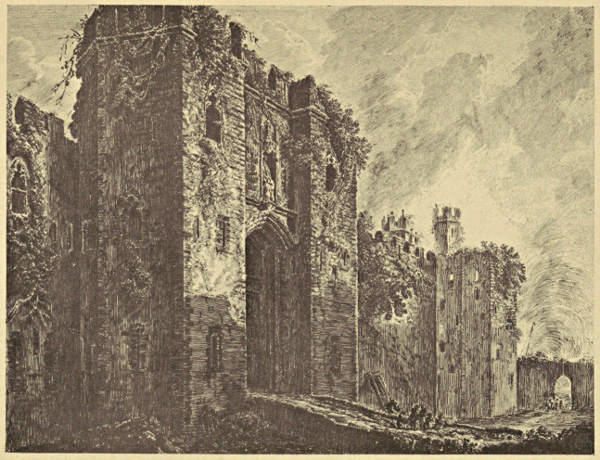
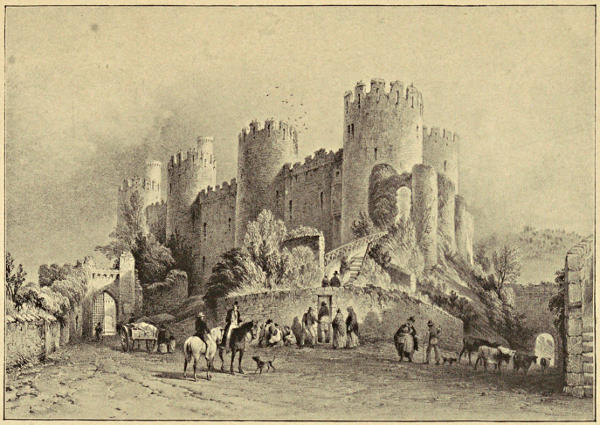
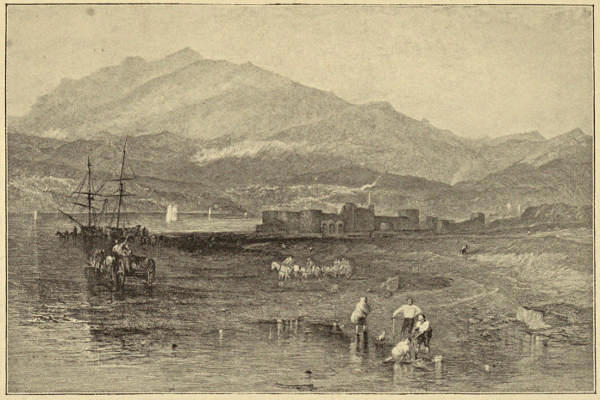
GATEWAY OF CARNARVON CASTLE
From an engraving by Cuitt
He was dissatisfied not only with the order of
Welsh services, but also with the behaviour of
Welsh rivers. On this day he writes: “The
rivers here are mere torrents which are suddenly
swelled by the rain to great breadth and great
violence, but have very little constant stream;
such are the Clwyd and the Elwy.” About
Welsh rivers Johnson makes a great many remarks.
He is as scornful of them as an American
is of the Thames. Mrs. Piozzi says that his
“ideas of anything not positively large were
ever mingled with contempt.” He asked of one
of the sharp currents in North Wales, “Has
this brook e’er a name?” “Why, dear Sir, this
is the River Ustrad.” “Let us,” said Dr. Johnson,
turning to his friend, “jump over it directly,
and show them how an Englishman
should treat a Welsh river.” Johnson was always
of opinion that when one had seen the
ocean, cascades were but little things. He used
to laugh at Shenstone most unmercifully for not
caring whether there was anything good to eat
in the streams he was so fond of. “As if,”
says Johnson, “one could fill one’s belly with
hearing soft murmurs, or looking at rough
cascades!”
It would be difficult to make a summary of
all the objects Johnson called “mean” in North
Wales. Among them were towns, rivers, inns,
dinners, churches, houses, choirs. It is safe to
say that the great Doctor could not rid himself
altogether of English prejudices against the
Welsh and all things Welsh. George Borrow’s
experience on the summit of Snowdon was not
at all unusual, except that in this instance an
Englishman in the presence of English people
became the champion of the Welsh. Undoubtedly
Johnson was influenced in his contempt
not only by his English feeling, but also by the
fact that he was a true son of the eighteenth
century, with all that century’s emphasis on
power, on size, on utility.
Yet Johnson was not totally incapable of appreciating
the romantic scenery of Wales. Some
part of it, the more cultivated, he seems to have
felt, for on the very next day there is this record:
“The way lay through pleasant lanes,
and overlooked a region beautifully diversified
with trees and grass.” It mortified Mrs. Thrale
because Mr. Thrale, a lover of landscapes, could
not enjoy them with the great Doctor, who would
say, “Never heed such nonsense, a blade of grass
is always a blade of grass, whether in one country
or another. Let us, if we do talk, talk about
something; men and women are my subject of
enquiry; let us see how these differ from those
we have left behind.” However, Johnson was
certainly not insensible to the beauty of nature.
In describing his emotions at the sight
of Iona, he wrote: “Whatever withdraws us
from the power of our senses, whatever makes
the past, the distant, or the future predominate
over the present, advances us in the dignity
of thinking beings.” In his tour in the Hebrides
he welcomed even the inconveniences
of travelling, such as wind and rain, when they
meant finer scenery and more pictures for the
mind.
Much on this same August second was found
“mean,” including Mrs. Thrale’s gift to the romantic
old clerk of the parish church of Bachycraig
where Mrs. Thrale’s father was buried. The
day following, on their arrival in Holywell,
Johnson had to admit that the town was “neither
very small nor very mean.” He was amazed
and impressed by the yield of water from St.
Winifred’s Well, and the number of mill wheels
the water turned. But when they went down
by the stream to see a prospect, Johnson adds
very specifically that he “had no part” in it.
He was vastly more interested in some brass and
copper works, in lapis calaminaris, in pigs of
copper, and in some ironworks where he saw
iron half an inch thick “square-cut with shears
worked by water,” and hammers that moved as
quick “as by the hand.” One has a curious feeling
that, were the Doctor suddenly translated
to this world again, foundries would interest
him vastly more than any natural panorama.
In this Johnson was truly a man of his times,
which were epoch-making because of their new
interest in the mechanics of industry, their gigantic
industrial impulse. Without a word for
the singular beauties of Holywell, without reference
to the legend of St. Winifred or mention
of the ruins of the Abbey, he concludes his
journal for August third: “I then saw wire
drawn, and gave a shilling. I have enlarged
my notion, though not being able to see the
movements, and not having time to peep
closely, I know less than I might.”
Another feature of the land impressed him
favourably, the houses of country gentlemen.
“This country seems full of very splendid houses,”
he notes on August fourth, after visiting a Mr.
Lloyd’s house near Ruthin, where he had been to
see the castle. He writes quite at length on the
ruins of Ruthin and ends characteristically, “Only
one tower had a chimney, so that there was [little]
commodity of living. It was only a place of
strength.” It was on this day that the keep of the
castle, when he heard that Mrs. Thrale was a
native of North Wales, told her that his wife had
been a Welshwoman, and had desired to be
buried at Ruthin. “So,” said the man, “I went
with the corpse myself, because I thought it
would be a pleasant journey, and indeed I found
Ruthin a very beautiful place.”
Two days later they dined at Mr. Myddleton’s,
of Gwaenynog, the gentleman who raised
the unwelcome monument to Johnson’s memory
before the Doctor had had a chance to die, and
while he still considered himself very much alive.
This memorial is on the site at Gwaenynog
where Johnson used to stroll up and down. It
reads: “This spot was often dignified by the presence
of Samuel Johnson, LL.D., whose moral
writings, exactly conformable to the precepts
of Christianity, gave ardour to Virtue and confidence
to Truth.” Perhaps it is not strange that
Johnson was not pleased with the monument.
He wrote to Mrs. Thrale, “Mr. Myddleton’s
attention looks like an intention to bury me
alive. I would as willingly see my friend, however
benevolent and hospitable, quietly inurned.
Let him think, for the present, of some more
acceptable memorial.”
To the Doctor death was always an enemy
who would, he knew, outwit him in the end, a
terrifying presence against which he struggled.
“But who can run the race with death?” he
cries despairingly. This premature memorial
must have revolted everything in him, for to
him “the whole of life” was but keeping away
the thoughts of death. Even a dark road troubled
him.
Leaving Llewenni on August eighteenth, they
started definitely forward on their journey. They
passed through Abergele, “a mean little town,”
to Bangor, where they found “a very mean
inn.” Certainly meanness is accumulating in
Wales! Johnson had the instinctive contempt
for things Welsh which so many English people
hold. But, after finding Lord Bulkely’s house
at Bangor also “very mean,” this is the point in
the great Doctor’s journal where the lover of
Wales may take heart.
There was one contrivance of the hand and
mind of man which impressed Dr. Johnson tremendously.
Where such works of the Creator
as Snowdon, for example, failed, where the mystery
of this land of legend passed him by,
castles succeeded by virtue of their size, the
strength of their walls, the completeness of their
equipment. In Denbigh, Johnson had eagerly
tried to trace the lines of that “prodigious pile”
of a castle. So much of the comment we get in
this neglected Welsh journal and in Johnson’s
other writings seems to summarize itself in two
words: size and power. He told Mrs. Piozzi to
get a book on gardening, since she would stay
in the country, feed the chickens, and starve
her intellect, “and learn,” he said, “to raise the
largest turnips, and to breed the biggest fowls.”
It was in vain that Mrs. Piozzi told him that
the goodness of these dishes did not depend
upon their size.
From Beaumaris Castle to Carnarvon there
is a crescendo of praise, ending in the memorable
words about Carnarvon: “To survey this
place would take much time. I did not think
there had been such buildings; it surpassed my
ideas.” Of Beaumaris, Johnson wrote: “The
Castle is a mighty pile.… This Castle corresponds
with all the representatives of romancing
narratives. Here is not wanting the private
passage, the dark cavity, the deep dungeon, or
the lofty tower. We did not discover the well.
This is the most compleat view that I have yet
had of an old Castle.” And then came four last
delighted words, “It had a moat.”
Nor was the next day, August twentieth, less
of a success. After meeting with some friends
they went to see the castle in Carnarvon, which
Johnson describes as “an edifice of stupendous
magnitude and strength; it has in it all that we
observed at Beaumaris, and much greater dimensions,
many of the smaller rooms floored
with stone are entire; of the larger rooms, the
beams and planks are all left; this is the state
of all buildings left to time. We mounted the
Eagle Tower by one hundred and sixty-nine
steps, each of ten inches. We did not find the
well; nor did I trace the moat; but moats there
were, I believe, to all castles on the plain, which
not only hindered access, but prevented mines.
We saw but a very small part of the mighty
ruin, and in all these old buildings, the subterraneous
works are concealed by the rubbish.”
When Johnson and the Thrales were on their
way from Llewenni to Bangor, they passed
through Conway. The Doctor was much exercised
in Conway because of the plight of an
Irish gentlewoman and her young family who
could get no beds to sleep in, but the one feature
in this rare old town which might have
impressed him, its castle, he did not notice in
the journal. Built by the same architect who
planned Carnarvon, it has much of its grace and
is in some respects even more beautifully placed.
With its machicolated towers, its vast banqueting-hall,
Queen Eleanor’s oratory, and the river
washing at its foundations, it is still a wonderful
old pile. On the return trip Johnson makes
a short, practical note to the effect that the
castle afforded them nothing new, and that if it
was larger than that of Beaumaris, it was smaller
than that of Carnarvon. Carnarvon was the
largest, and the Doctor was not to be weaned
from it any more than from the idea that Mrs.
Thrale ought to raise the largest turnips.
The day following this memorable inspection
of Carnarvon Castle, they dined with Sir Thomas
Wynne and his Lady. Johnson’s comment was
brief,—“the dinner mean, Sir Thomas civil,
his Lady nothing.” It would seem that Lady
Wynne failed to recognize the greatness of her
visitor, and, accustomed to a distinguished reception,
the great man’s vanity was hurt. Afterwards
he made remarks about Sir Thomas’s
Lady, in which she was compared to “sour small
beer” and “run tea.” Of a lady in Scotland he
had said “that she resembled a dead nettle;
were she alive she would sting.”
This mean dinner and, we presume, its
meaner hostess were but a sorry prelude to a
melancholy journey which the party had to
take to Mrs. Thrale’s old home at Bodvel.
They found nothing there as in Mrs. Thrale’s
childhood; the walk was cut down, the pond
was dry. The near-by churches which Mrs.
Thrale held by impropriation Johnson thought
“mean and neglected to a degree scarcely
imaginable. They have no pavement, and the
earth is full of holes. The seats are rude
benches; the altars have no rails. One of them
has a breach in the roof. On the desk, I think,
of each lay a folio Welsh Bible of the black
letter, which the curate cannot easily read.”
Over one hundred and thirty years later it was
that I made the tour, which I have described
for you, of these Welsh churches of early foundation.
Mysterious, desolate, dilapidated old
places they are; in comparison with the ugly,
comfortable nonconformist chapels, spectacles
for the prosperous to jeer at.
Mrs. Piozzi tells a story which shows that
the great Doctor brought terror to the hearts of
the Welsh parsons. “It was impossible not to
laugh at the patience Dr. Johnson showed, when
a Welsh parson of mean abilities, though a good
heart, struck with reverence at the sight of Dr.
Johnson, whom he had heard of as the greatest
man living, could not find any words to answer
his enquiries concerning a motto around
somebody’s arms which adorned a tombstone
in Ruabon Churchyard. If I remember right,
the words were,—
Heb Dw, Heb Dym (Without God, without all)
Dw o’ diggon (God is all sufficient).
[1]
And though of not very difficult construction,
the gentleman seemed wholly confounded, and
unable to explain them; till Dr. Johnson, having
picked out the meaning by little and little, said
to the man, ‘Heb is a preposition, I believe,
Sir, is it not?’ My countryman, recovering some
spirits upon the sudden question, cried out, ‘So
I humbly presume, Sir,’ very comically.”
About Bodvel they found the Methodist
“prevalent,” which could not have been a pleasant
circumstance to Johnson. With nonconformity
the great Doctor had no sympathy.
Boswell says that Johnson thought them “too
sanguine in their accounts of their success among
savages, and that much of what they tell is not
to be believed. He owned that the Methodists
had done good; had spread religious impressions
among the vulgar part of mankind; but,
he said, they had great bitterness against other
Christians, and that he never could get a Methodist
to explain in what he excelled others.”
This unhappy day they concluded suitably
by going to Pwllheli, “a mean old town at the
extremity of the country,” where they bought
something by which to remember its meanness.
Pwllheli is still mean, but in a different way,
for it has become a noisy watering-resort from
which the quiet traveller longs to escape at the
first moment to quiet Abersoch or to Llanengan
or Aberdaron, where “trippers” cease from
troubling and tourists are at rest.
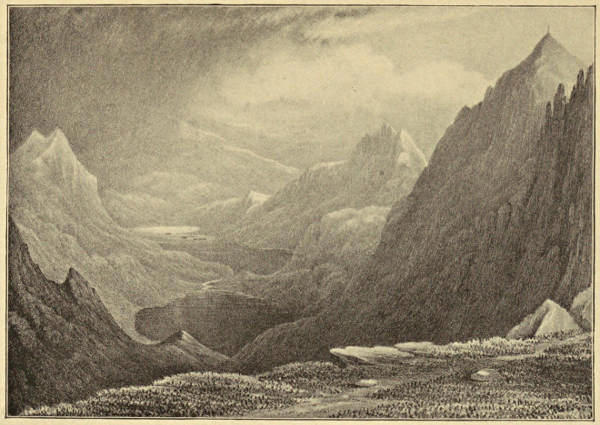
Nowadays, even the most breathless will grant
Snowdon a few words of praise—praise for its
lakes, awe for its rock-strewn valleys like the
valley of the shadow of death. Of the two lakes,
Llyn Beris and Llyn Padarn, which receive the
waters on the northern slope of Snowdon, Johnson
did not think much, for he complained that
“the boat is always near one bank or the other.”
As for Snowdon itself, the record is, “We
climbed with great labour. I was breathless and
harassed.” There is no word for all that is romantic
or awe-inspiring, not an exclamation for
the summit to which have mounted king, poet,
priest, bard, wise men, through countless ages—only
a record of Queenie’s goats, “one hundred
and forty-nine, I think.” Mr. Thrale, Queenie’s
father, was near-sighted and could not see the
goats, so he had promised the child a penny for
every one she showed him. Dr. Johnson, the
devoted friend of Queenie, kept the account.
On their way back to the English border
again, they passed through Bangor, where Johnson
must have been happy in finding that “the
quire is mean!” On August twenty-eighth they
were once more with hospitable Mr. Myddleton.
Here they stayed for over a week, and the
journal contains, among other things, a long
note about a Mr. Griffiths. The addition of the
name of his estate or village fails to identify him
now; looking for a Griffiths or a Jones in Wales,
even a particular Jones or Griffiths, is like
looking for a needle in a haystack. Perhaps the
present limitation to a dozen patronymics is a
blessing for courts of law, but it is baffling for
the curious-minded man. The historian finds
the old Welsh John ap Robert ap David ap
Griffith ap Meredith ap David ap Vauchan ap
Blethyn ap Griffith ap Meredith, and so on for
a dozen more “aps,” easier for purposes of identification.
On their homeward way Johnson was enthusiastic
about Wrexham and its “large and magnificent”
church, one of the Seven Wonders of
Wales. On the seventh of September they
came to Chirk Castle, but I cannot find that
they went into this residence, a place which undoubtedly
would have delighted Johnson more
on account of its “commodity of living” and
solid grandeur than because one of its heiresses
was the unamiable Warwick Dowager who had
married Addison. They left for Shrewsbury
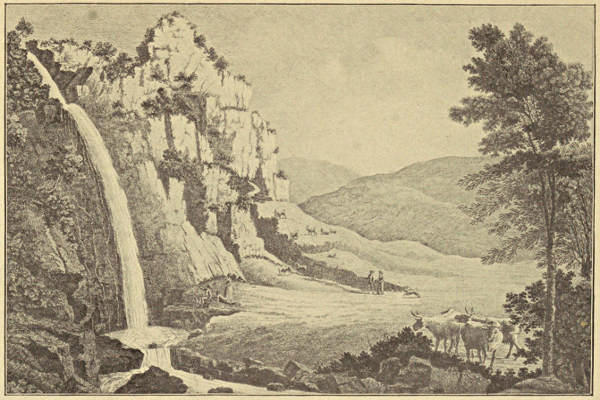
after they had viewed the little waterfall of
Pistyll Rhaiadr, where the Doctor remarked
only upon its height and the copiousness of its
fall. If Johnson had been an up-to-date Cambrian
railway tourist, he could not have entered
and left North Wales in more approved
style, for he came in by way of Chester and left
by way of Shrewsbury. Safely out of Wales
they journeyed homeward through Worcester,
probably Birmingham, and Oxford. On September
twenty-fourth there is this simple record:
“We went home.”
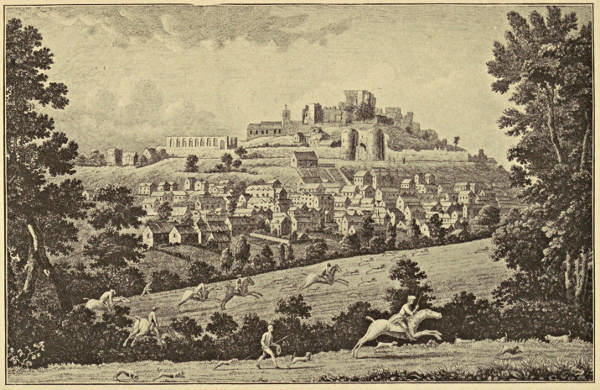
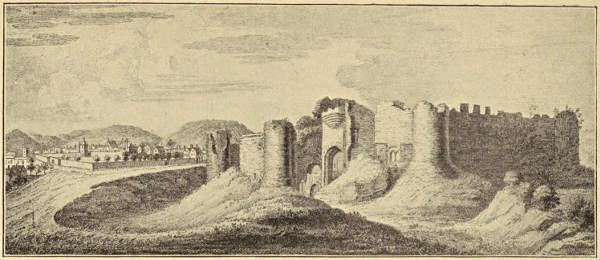
A VIEW OF DENBIGH CASTLE
From an engraving by Boydell, 1750
It is to be remembered that on this tour
Johnson lacked the companionship of the faithful
Boswell. Yet the scantiness of the diary and
its critical attitude cannot be accounted for
wholly on this ground, but were due, I think,
far more to the fact that the Doctor was thoroughly
English in prejudice. Tobias Smollett’s
feeling in “Humphrey Clinker,” for example,
is even more English and uncomplimentary. All
through his tour of the Hebrides, though he
denounced Scotland and all things Scottish,
called the Scotch liars and their country naked,
yet the Doctor had an uneasy conviction of
their superiority. As far as Wales was concerned,
he simply did not consider this country
of Arthur, of bard and of poet, this country of
an indestructible nationalism, worthy his serious
interest. Had he lived in Shakespeare’s day his
concern would have been much greater, his respect
more solicitous.
On the first visit to Mr. Myddleton the preservation
of the Welsh language had been discussed.
In his journal for that date Dr. Johnson
wrote, “Myddleton is the only man, who, in
Wales, has talked to me of literature.” He was
visiting people who, almost universally, were
supremely indifferent to Wales and all things
Welsh. In other words, he was visiting the
upper or ruling classes. It is not so many years
ago that the children of the gentry were still
not allowed to learn Welsh for fear their English
accent might be spoiled. Now, happily,
they are taught Welsh, a fact which not only
improves the relationship between them and
the working classes, but also is contributing
generously to a revival of all that is best in
Welsh song and literature. Even a prince of the
blood royal learns Welsh and speaks it.
Dr. Johnson was in Wales at a time when
the intellectual interests of Welshmen were
most flagging, that is, just before the introduction
of the Welsh Sunday Schools which, with
their educational rather than exclusively religious
function, gave impulse to a period of
modern Welsh literature. Not only in chronology
but also in importance, the establishment
of the Welsh Sunday School must take
precedence of Lady Charlotte Guest’s translations
of the “Mabinogion.” Yet what Macpherson’s
“Ossian” did for Scotland in the seventies
in arousing interest, Lady Guest did for Wales
in 1838. It is possible, if one can presuppose
the impossible, that with these translations in
hand Dr. Johnson’s journal would have been
very different. However, one is fearful that, fortified
even with Lady Charlotte’s beautiful translations,
there would have been passages in the
authentic Welsh “Mabinogion” as angrily rejected
by him as Macpherson’s imposture was.
Johnson said that he never could get the meaning
of an Erse song explained to him. He asked
a young lady who had sung such a song what
it was about, and she replied that it was for the
entertainment of the company. He explained
that it was its meaning he could not understand,
whereupon she answered that it was a love
song. And that was all the intelligence, Johnson
said, that he could get.
There was strong probability, as a Welsh
traveller in 1682 expressed it, of Welsh being
“English’d out of Wales, as Latin was barbarously
Goth’d out of Italy.” From the time of
the Great Rebellion, however, the condition of
the Welsh language began to improve, and it
is possible greatly to overrate the difficulties
with which Johnson met in coming to know the
life of the people. Impatiently he had exclaimed,
“Let us, if we do talk, talk about something;
men and women are my subject of enquiry; let
us see how these differ from those we have left
behind.” But from any evidence in his journal
Johnson did not consider it worth his while to
discover how much the Welsh really do differ
from the English. The visible physical fact with
which he was confronted was the dark-haired,
dark-eyed, dark-complexioned Welshman of
medium stature, very Spanish-looking, sometimes
almost Oriental. What he heard were
voices quite distinct from the English, quiet and
pure in enunciation. What he must have felt—if
he felt the Welsh as distinct, except in inferiority—was
a race as different as the south
is from the north, sensitive, imaginative, excitable,
deeply impressionable to everything that is
beautiful, as capable of the “howl” as the Irish,
yet more critical, of an intellectual independence
which makes Roman Catholicism unwelcome
to the Welsh, with a shrewdness that is
the logic of success in money-getting, a captive
race with minds which can never be servile.
Yet in a letter to Boswell announcing that he
had visited five out of the six counties of North
Wales, Dr. Johnson wrote: “Wales is so little
different from England, that it offers nothing to
the speculation of the traveller.” Johnson was
capable, too, of taunting Boswell with the sterility
of Scotland. He had a certain strain of contrariness
in him, “tonic” some call it, which made
him emphasize the undesirable features of a
country or a personality. Three years after this
journey, forgetting even his interest in castles,
he was able to say: “Except the woods of Bachycraigh,
what is there in Wales that can fill the
hunger of ignorance, or quench the thirst of
curiosity?”