In spite of Chesterton's liberal production of
books, it is not altogether simple to classify
them into "periods," in the manner beloved
of the critic, nor even to sort them out according
to subjects. G.K.C. can (and generally
does) inscribe an Essay on the Nature of
Religion into his novels, together with other
confusing ingredients to such an extent that
most readers would consider it pure pedantry
on the part of anybody to insist that a Chestertonian
romance need differ appreciably from
a Chestertonian essay, poem, or criticism. That
a book by G.K.C. should describe itself as a
novel means little more than that its original
purchasing price was four shillings and sixpence.
It might also contain passages of love,
hate, and other human emotions, but then again,
it might not. But one thing it would contain,
and that is war. G.K.C. would be pugnacious,
even when there was nothing to fight. His
characters would wage their wars, even when
the bone of contention mattered as little as
the handle of an old toothbrush. That, we
should say, is the first factor in the formula
of the Chestertonian romance—and all the rest
are the inventor's secret. Imprimis, a body
of men and an idea, and the rest must follow,
if only the idea be big enough for a man to
fight about, or if need be, even to make himself
ridiculous about.
In The Napoleon of Notting Hill we have this
view of romance stated in a manner entirely
typical of its author. King Auberon and the
Provost of Notting Hill, Adam Wayne, are
speaking. The latter says:
"I know of a magic wand, but it is a wand that
only one or two may rightly use, and only seldom.
It is a fairy wand of great fear, stronger than those
who use it—often frightful, often wicked to use. But
whatever is touched with it is never again wholly
common; whatever is touched with it takes a magic
from outside the world. If I touch, with this fairy
wand, the railways and the roads of Notting Hill,
men will love them, and be afraid of them for ever."
"What the devil are you talking about?" asked
the King.
"It has made mean landscapes magnificent, and
hovels outlast cathedrals," went on the madman.
"Why should it not make lamp-posts fairer than
Greek lamps, and an omnibus-ride like a painted
ship? The touch of it is the finger of a strange
perfection."
"What is your wand?" cried the King, impatiently.
"There it is," said Wayne; and pointed to the
floor, where his sword lay flat and shining.
If all the dragons of old romance were loosed
upon the fiction of our day, the result, one
would imagine, would be something like that
of a Chestertonian novel. But the dragons
are dead and converted into poor fossil ichthyosauruses,
incapable of biting the timidest
damsel or the most corpulent knight that ever
came out of the Stock Exchange. That is the
tragedy of G.K.C.'s ideas, but it is also his
opportunity. "Man is a creature who lives
not upon bread alone, but principally by
catch-words," says Stevenson. "Give me my
dragons," says G.K.C. in effect, "and I will
give you your catch-words. You may have
them in any one of a hundred different ways.
I will drop them on you when you least expect
them, and their disguises will outrange all
those known to Scotland Yard and to Drury
Lane combined. You may have catastrophes
and comets and camels, if you will, but you
will certainly have your catch-words."
The first of Chesterton's novels, in order of
their publication, is The Napoleon of Notting
Hill (1904). This is extravagance itself;
fiction in the sense only that the events never
happened and never could have happened.
The scene is placed in London, the time, about
a.d. 1984. "This 'ere progress, it keeps on
goin' on," somebody remarks in one of the
novels of Mr. H. G. Wells. But it never goes
on as the prophets said it would, and consequently
England in those days does not greatly
differ from the England of to-day. There have
been changes, of course. Kings are now chosen
in alphabetical rotation, and the choice falls
upon a civil servant, Auberon Quin by name.
Now Quin has a sense of humour, of absolute
humour, as the Watts-Dunton definition already
cited would have it called. He has two bosom
friends who are also civil servants and whose
humour is of the official variety, and whose
outlook upon life is that of a Times leader.
Quin's first official act is the publication of a
proclamation ordering every London borough
to build itself city walls, with gates to be closed
at sunset, and to become possessed of Provosts
in mediæval attire, with guards of halberdiers.
From his throne he attends to some of the
picturesque details of the scheme, and enjoys
the joke in silence. But after a few years of
this a young man named Adam Wayne becomes
Provost of Notting Hill, and to him his
borough, and more especially the little street
in which he has spent his life, are things of
immense importance. Rather than allow that
street to make way for a new thoroughfare,
Wayne rallies his halberdiers to the defence
of their borough. The Provosts of North
Kensington and South Kensington, of West
Kensington and Bayswater, rally their guards
too, and attack Notting Hill, purposing to
clear Wayne out of the way and to break down
the offending street. Wayne is surrounded at
night but converts defeat into victory by
seizing the offices of a Gas Company and turning
off the street lights. The next day he is
besieged in his own street. By a sudden sortie
he and his army escape to Campden Hill.
Here a great battle rages for many hours, while
one of the opposing Provosts gathers a large
army for a final attack. At last Wayne and
the remnants of his men are hopelessly outnumbered,
but once more he turns defeat into
victory. He threatens, unless the opposing
forces instantly surrender, to open the great
reservoir and flood the whole of Notting Hill.
The allied generals surrender, and the Empire
of Notting Hill comes into being. Twenty
years later the spirit of Adam Wayne has gone
beyond his own city walls. London is a wild
romance, a mass of cities filled with citizens
of great pride. But the Empire, which has
been the Nazareth of the new idea, has waxed
fat and kicked. In righteous anger the other
boroughs attack it, and win, because their
cause is just. King Auberon, a recruit in
Wayne's army, falls with his leader in the
great battle of Kensington Gardens. But they
recover in the morning.
"It was all a joke," says the King in apology.
"No," says Wayne; "we are two lobes of the same
brain . . . you, the humorist . . . I, the fanatic. . . . You
have a halberd and I have a sword, let us
start our wanderings over the world. For we are its
two essentials."
So ends the story.
Consider the preposterous elements of the
book. A London with blue horse-'buses.
Bloodthirsty battles chiefly fought with halberds.
A King who acts as a war correspondent
and parodies G. W. Stevens. It is preposterous
because it is romantic and we are
not used to romance. But to Chaucer let us
say it would have appeared preposterous
because he could not have realized the initial
premises. Before such a book the average
reader is helpless. His scale of values is
knocked out of working order by the very first
page, almost by the very first sentence.
("The human race, to which so many of my
readers belong, has been playing at children's
games from the beginning, and will probably
do it till the end, which is a nuisance for the
few people who grow up.") The absence of a
love affair will deprive him of the only "human
interest" he can be really sure of. The Chestertonian
idiom, above all, will soon lead him
to expect nothing, because he can never get
any idea of what he is to receive, and will
bring him to a proper submissiveness. The
later stages are simple. The reader will wonder
why it never before occurred to him that area-railings
are very like spears, and that a distant
tramcar may at night distinctly resemble a
dragon. He may travel far, once his imagination
has been started on these lines. When
romantic possibilities have once shed a glow
on the offices of the Gas Light and Coke Company
and on the erections of the Metropolitan
Water Board, the rest of life may well seem
filled with wonder and wild desires.
Chesterton may be held to have invented a
new species of detective story—the sort that
has no crime, no criminal, and a detective
whose processes are transcendental. The Club
of Queer Trades is the first batch of such stories.
The Man who was Thursday is another specimen
of some length. More recently, Chesterton has
repeated the type in some of the Father Brown
stories. In The Club of Queer Trades, the transcendental
detective is Basil Grant, to describe
whom with accuracy is difficult, because of
his author's inconsistencies. Basil Grant, for
instance, is "a man who scarcely stirred out
of his attic," yet it would appear elsewhere
that he walked abroad often enough. The
essentials of this unprecedented detective are,
however, sufficiently tangible. He had been a
K.C. and a judge. He had left the Bench
because it annoyed him, and because he held
the very human but not legitimate belief that
some criminals would be better off with a trip
to the seaside than with a sentence of imprisonment.
After his retirement from public life
he stuck to his old trade as the judge of a
Voluntary Criminal Court. "My criminals
were tried for the faults which really make
social life impossible. They were tried before
me for selfishness, or for an impossible vanity,
or for scandal-mongering, or for stinginess to
guests or dependents." It is regrettable that
Chesterton does not grant us a glimpse of this
fascinating tribunal at work. However, it is
Grant's job, on the strength of which he becomes
the president and founder of the C.Q.T.—Club
of Queer Trades. Among the members of this
Club are a gentleman who runs an Adventure
and Romance Agency for supplying thrills to
the bourgeois, two Professional Detainers, and
an Agent for Arboreal Villas, who lets off a
variety of birds' nest. The way in which these
people go about their curious tasks invariably
suggests a crime to Rupert Grant, Basil's
amateur detective brother, whereupon Basil
has to intervene to put matters right. The
author does not appear to have been struck
by the inconsistency of setting Basil to work
to ferret out the doings of his fellow club-members.
The book is, in fact, full of joyous
inconsistencies. The Agent for Arboreal Villas
is clearly unqualified for the membership of
the Club. Professor Chadd has no business
there either. He is elected on the strength of
having invented a language expressed by
dancing, but it appears that he is really an
employee in the Asiatic MSS. Department
of the British Museum. Things are extremely
absurd in The Eccentric Seclusion of the Old
Lady. At the instigation of Rupert, who has
heard sighs of pain coming out of a South
Kensington basement, Basil, Rupert, and the
man who tells the story, break into the house
and violently assault those whom they meet.
Basil sprang up with dancing eyes, and with three
blows like battering-rams knocked the footman into
a cocked hat. Then he sprang on top of Burrows,
with one antimacassar in his hand and another in his
teeth, and bound him hand and foot almost before he
knew clearly that his head had struck the floor. Then
Basil sprang at Greenwood . . . etc. etc.
There is a good deal more like this. Having
taken the citadel and captured the defenders
(as Cæsar might say), Basil and company reach
the sighing lady of the basement. But she
refuses to be released. Whereupon Basil
explains his own queer trade, and that the
lady is voluntarily undergoing a sentence for
backbiting. No explanation is vouchsafed of
the strange behaviour of Basil Grant in attacking
men who, as he knew, were doing nothing
they should not. Presumably it was due to
a Chestertonian theory that there should be
at least one good physical fight in each book.
It will be seen that The Club of Queer Trades
tends to curl up somewhat (quite literally, in
the sense that the end comes almost where the
beginning ought to be) when it receives heavy
and serious treatment. I should therefore
explain that this serious treatment has been
given under protest, and that its primary
intention has been to deal with those well-meaning
critics who believe that Chesterton
can write fiction, in the ordinary sense of the
word. His own excellent definition of fictitious
narrative (in The Victorian Age in Literature)
is that essentially "the story is told . . . for
the sake of some study of the difference
between human beings." This alone is enough
to exculpate him of the charge of writing
novels. The Chestertonian short story is also
in its way unique. If we applied the methods
of the Higher Criticism to the story just
described, we might base all manner of odd
theories upon the defeat (inter alios) of
Burrows, a big and burly youth, by Basil
Grant, aged sixty at the very least, and armed
with antimacassars. But there is no necessity.
If Chesterton invents a fantastic world, full of
fantastic people who speak Chestertonese,
then he is quite entitled to waive any trifling
conventions which hinder the liberty of his
subjects. As already pointed out, such is his
humour. The only disadvantage, as somebody
once complained of the Arabian Nights,
is that one is apt to lose one's interest in a
hero who is liable at any moment to turn into
a camel. None of Chesterton's heroes do, as a
matter of fact, become camels, but I would
nevertheless strongly advise any young woman
about to marry one of them to take out an
insurance policy against unforeseen transformations.
Although it appears that a few reviewers
went to the length of reading the whole of
The Man who was Thursday (1908), it is obvious
by their subsequent guesswork that they did
not notice the second part of the title, which
is, very simply, A Nightmare. The story takes
its name from the Supreme Council of Anarchists,
which has seven members, named after
the days of the week. Sunday is the Chairman.
The others, one after the other, turn out to be
detectives. Syme, the nearest approach to the
what might be called the hero, is a poet whom
mysterious hands thrust into an Anarchists'
meeting, at which he is elected to fill the
vacancy caused by the death of last Thursday.
A little earlier other mysterious hands had
taken him into a dark room in Scotland Yard
where the voice of an unseen man had told him
that henceforth he was a member of the anti-anarchist
corps, a new body which was to
deal with the new anarchists—not the comparatively
harmless people who threw bombs,
but the intellectual anarchist. "We say that
the most dangerous criminal now is the entirely
lawless modern philosopher," somebody
explains to him. The bewildered Syme walks
straight into further bewilderments, as, one
after the other, the week-days of the committee
are revealed. But who is Sunday? Chesterton
makes no reply. It was he who in a darkened
room of Scotland Yard had enrolled the
detectives. He is the Nightmare of the story.
The first few chapters are perfectly straightforward,
and lifelike to the extent of describing
personal details in a somewhat exceptional
manner for Chesterton. But, gradually, wilder
and wilder things begin to happen—until, at
last, Syme wakes up.
The trouble about The Man who was Thursday
is not its incomprehensibility, but its
author's gradual decline of interest in the
book as it lengthened out. It begins excellently.
There is real humour and a good deal
of it in the earlier stages of Syme. And there
are passages like this one on the "lawless
modern philosopher":
Compared to him, burglars and bigamists are
essentially moral men; my heart goes out to them. . . . Thieves
respect property. They merely wish
the property to become their property that they may
more perfectly respect it. But philosophers dislike
property as property; they wish to destroy the very
idea of personal possession. Bigamists respect
marriage, or they would not go through the highly
ceremonial and even ritualistic formality of bigamy.
But philosophers despise marriage as marriage.
But his amiable flow of paradox soon runs out.
The end of the book is just a wild whirl, a
nightmare with a touch of the cinematograph.
People chase one another, in one instance they
quite literally chase themselves. And the ending
has all the effect of a damaged film that
cannot be stopped, on the large blank spaces
of which some idiot has been drawing absurd
pictures which appear on the screen, to the
confusion of the story. One remembers the
immense and dominating figure of Sunday,
only because the description of him reads very
much like a description of Chesterton himself.
But if the person is recognizable, the personality
remains deliberately incomprehensible.
He is just an outline in space, who rode down
Albany Street on an elephant abducted from
the Zoological Gardens, and who spoke sadly
to his guests when they had run their last race
against him.
Until recent years the word mysticism was
sufficiently true to its derivation to imply
mystery, the relation of God to man. But
since the cheaper sort of journalist seized hold
of the unhappy word, its demoralization has
been complete. It now indicates, generally
speaking, an intellectual defect which expresses
itself in a literary quality one can only
call woolliness. There is a genuine mysticism,
expressed in Blake's lines:
To see the world in a grain of sand
And a Heaven in a wild flower,
Hold Infinity in the palm of your hand
And Eternity in an hour.
And there is a spurious mysticism, meaningless
rubbish of which Rossetti's Sister Helen
is a specimen. What could be more idiotic
than the verse:
"He has made a sign and called Halloo!
Sister Helen,
And he says that he would speak with you."
"Oh tell him I fear the frozen dew,
Little brother."
(O Mother, Mary Mother,
Why laughs she thus between Hell and Heaven?)
The trouble about the latter variety is its
extreme simplicity. Anybody with the gift of
being able to make lines scan and rhyme can
produce similar effects in a similar way. Hence
the enormous temptation exercised by this
form of mysticism gone wrong. There is a
naughty little story of a little girl, relating to
her mother the mishaps of the family coal
merchant, as seen from the dining-room window.
He slipped on a piece of orange-peel,
the child had explained. "And what happened
then?" "Why, mummy, he sat down on the
pavement and talked about God." Chesterton
(and he is not alone in this respect) behaves
exactly like this coal-heaver. When he is at
a loss, he talks about God. In each case one
is given to suspect that the invocation is due
to a temporarily overworked imagination.
This leads us to The Ball and the Cross (1906).
In The Man who was Thursday, when the
author had tired of his story, he brought in
the universe at large. But its successor is
dominated by God, and discussions on him by
beings celestial, terrestrial, and merely infernal.
And yet The Ball and the Cross is in many
respects Chesterton's greatest novel. The first
few chapters are things of joy. There is much
said in them about religion, but it is all sincere
and bracing. The first chapter consists, in
the main, of a dialogue on religion, between
Professor Lucifer, the inventor and the driver
of an eccentric airship, and Father Michael, a
theologian acquired by the Professor in Western
Bulgaria. As the airship dives into the ball
and the cross of Saint Paul's Cathedral, its
passengers naturally find themselves taking a
deep interest in the cross, considered as symbol
and anchor. Lucifer plumps for the ball, the
symbol of all that is rational and united. The
cross
"is the conflict of two hostile lines, of irreconcilable
direction. . . . The very shape of it is a contradiction
in terms." Michael replies, "But we like contradictions
in terms. Man is a contradiction in terms;
he is a beast whose superiority to other beasts consists
in having fallen."
Defeated on points, Lucifer leaves the Father
clinging literally to the cross and flies away.
Michael meets a policeman on the upper gallery
and is conducted downwards. The scene
changes to Ludgate Circus, but Michael is no
longer in the centre of it. A Scot named Turnbull
keeps a shop here, apparently in the
endeavour to counterbalance the influence of
St. Paul's across the way. He is an atheist,
selling atheist literature, editing an atheist
paper. Another Scot arrives, young Evan
MacIan, straight from the Highlands. Unlike
the habitual Londoner, MacIan takes the little
shop seriously. In its window he sees a copy
of The Atheist, the leading article of which
contains an insult to the Virgin Mary. MacIan
thereupon puts his stick through the window.
Turnbull comes out, there is a scuffle, and
both are arrested and taken before a Dickensian
magistrate. The sketch of Mr. Cumberland
Vane is very pleasing: it is clear that the
author knew what he was copying. Lord
Melbourne is alleged to have said, "No one
has more respect for the Christian religion
than I have; but really, when it comes to intruding
it into private life. . . ." Mr. Vane
felt much the same way when he heard
MacIan's simple explanation: "He is my
enemy. He is the enemy of God." He said,
"It is most undesirable that things of that
sort should be spoken about—a—in public,
and in an ordinary Court of Justice. Religion
is—a—too personal a matter to be mentioned
in such a place." However, MacIan is fined.
After which he and Turnbull, as men of honour,
buy themselves swords and proceed to fight
the matter out. With interruptions due to
argument and the police, the fight lasts several
weeks. Turnbull and MacIan fight in the back
garden of the man from whom they bought
the swords,[1] until the police intervene. They
escape the police and gain the Northern
Heights of London, and fight once more, with
a madness renewed and stimulated by the
peace-making efforts of a stray and silly
Tolstoyan. Then the police come again, and
are once more outdistanced. This time mortal
combat is postponed on account of the sanguinolence
of a casual lunatic who worshipped
blood to such a nauseating extent that the
duellists deferred operations in order to chase
him into a pond. Then follows an interminable
dialogue, paradoxical, thoroughly Shavian,
while the only two men in England to whom
God literally is a matter of life and death find
that they begin to regard the slaughter of one
by the other as an unpleasant duty. Again
they fight and are separated. They are motored
by a lady to the Hampshire coast, and there
they fight on the sands until the rising tide
cuts them off. An empty boat turns up to
rescue them from drowning; in it they reach
one of the Channel Islands. Again they fight,
and again the police come. They escape from
them, but remain on the island in disguise,
and make themselves an opportunity to pick
a quarrel and so fight a duel upon a matter
in keeping with local prejudice. But Turnbull
has fallen in love. His irritatingly
calm and beautiful devotee argues with him
on religion until he is driven to cast off his
disguise. Then the police are on his tracks
again. A lunatic lends Turnbull and MacIan
his yacht and so the chase continues. But by
this time Chesterton is getting just a trifle
bored. He realizes that no matter how many
adventures his heroes get into, or how many
paradoxes they fling down each other's throats,
the end of the story, the final inevitable end
which alone makes a series of rapid adventures
worth while, is not even on the horizon. An
element of that spurious mysticism already
described invades the book. It begins to be
clear that Chesterton is trying to drag in a
moral somehow, if need be, by the hair of its
head. The two yachters spend two weeks of
geographical perplexity and come to a desert
island. They land, but think it wiser, on the
whole, to postpone fighting until they have
finished the champagne and cigars with which
their vessel is liberally stored. This takes a
week. Just as they are about to begin the
definitive duel they discover that they are not
upon a desert island at all, they are near
Margate. And the police are there, too. So
once more they are chased. They land in a
large garden in front of an old gentleman who
assures them that he is God. He turns out to
be a lunatic, and the place an asylum. There
follows a characteristic piece of that abuse of
science for which Chesterton has never attempted
to suggest a substitute. MacIan and
Turnbull find themselves prisoners, unable to
get out. Then they dream dreams. Each sees
himself in an aeroplane flying over Fleet Street
and Ludgate Hill, where a battle is raging.
But the woolly element is very pronounced by
this time, and we can make neither head nor
tail of these dreams and the conversations
which accompany them. The duellists are
imprisoned for a month in horrible cells. They
find their way into the garden, and are told
that all England is now in the hands of the
alienists, by a new Act of Parliament: this
has been the only possible manner of putting
a stop to the revolution started by MacIan
and Turnbull. These two find all the persons
they had met with during their odyssey,
packed away in the asylum, which is a wonderful
place worked by petroleum machinery.
But the matter-of-fact grocer from the Channel
Island, regarding the whole affair as an infringement
of the Rights of Man, sets the
petroleum alight. Michael, the celestial being
who had appeared in the first chapter and
disappeared at the end of it, is dragged out
of a cell in an imbecile condition. Lucifer
comes down in his airship to collect the doctors,
whose bodies he drops out, a little later on.
The buildings vanish in the flames, the keepers
bolt, the inmates talk about their souls.
MacIan is reunited to the lady of the Channel
Island, and the story ends.
When a stone has been tossed into a pond,
the ripples gradually and symmetrically grow
smaller. A Chesterton novel is like an adventurous
voyage of discovery, which begins on
smooth water and is made with the object of
finding the causes of the ripples. As ripple
succeeds ripple—or chapter follows chapter—so
we have to keep a tighter hold on such
tangible things as are within our reach. Finally
we reach the centre of the excitement and are
either sucked into a whirlpool, or hit on the
head with a stone. When we recover consciousness
we feebly remember we have had a thrilling
journey and that we had started out with
a misapprehension of the quality of Chestertonian
fiction. A man whose memory is
normal should be able to give an accurate
synopsis of a novel six months after he has
read it. But I should be greatly surprised if
any reader of The Ball and the Cross could tell
exactly what it was all about, within a month
or two of reading it. The discontinuity of it
makes one difficulty; the substitution of
paradox for incident makes another. Yet it
is difficult to avoid the conviction that this
novel will survive its day and the generation
that begot it. If it was Chesterton's endeavour
(as one is bound to suspect) to show that the
triumph of atheism would lead to the triumph
of a callous and inhuman body of scientists,
then he has failed miserably. But if he was
attempting to prove that the uncertainties of
religion were trivial things when compared
with the uncertainties of atheism, then the
verdict must be reversed. The dialogues on
religion contained in The Ball and the Cross
are alone enough and more than enough to
place it among the few books on religion which
could be safely placed in the hands of an
atheist or an agnostic with an intelligence.
If we consider Manalive (1912) now we shall
be departing from strict chronological order,
as it was preceded by The Innocence of Father
Brown. It will, however, be more satisfactory
to take the two Father Brown books together.
In the first of these and Manalive, a change
can be distinctly felt. It is not a simple
weakening of the power of employing instruments,
such as befell Ibsen when, after writing
The Lady from the Sea, he could no longer keep
his symbols and his characters apart. It is a
more subtle change, a combination of several
small changes, which cannot be studied fairly
in relation only to one side of Chesterton's
work. In the last chapter an attempt will be
made to analyze these, for the present I can
only indicate some of the fallings-off noticeable
in Manalive, and leave it at that. Chesterton's
previous romances were not constructed, the
reader may have gathered, with that minute
attention to detail which makes some modern
novels read like the report of a newly promoted
detective. But a man may do such things and
yet be considered spotless. Shakespeare, after
all, went astray on several points of history
and geography. The authors of the Old
Testament talked about "the hare that cheweth
the cud." And, if any reader should fail to
see the application of these instances to
modern fiction, I can only recommend him to
read Vanity Fair and find out how many
children had the Rev. Bute Crawley, and what
were their names. No, the trouble with
Manalive is not in its casual, happy-go-lucky
construction. It is rather in a certain lack of
ease, a tendency to exaggerate effects, a continual
stirring up of inconsiderable points.
But let us come to the story.
There is a boarding-house situated on one
of the summits of the Northern Heights. A
great wind happens, and a large man, quite
literally, blows in. His name is Innocent
Smith and he is naturally considered insane.
But he is really almost excessively sane. His
presence makes life at the house a sort of
holiday for the inmates, male and female.
Smith is about to run for a special licence in
order to marry one of the women in the house,
and the other boarders have just paired off
when a telegram posted by one of the ladies
in a misapprehension brings two lunacy experts
around in a cab. Smith adds to the excitement
of the moment by putting a couple of
bullets through a doctor's hat.
Now Smith is what somebody calls "an
allegorical practical joker." But Chesterton
gives a better description of him than
that.
He's comic just because he's so startlingly commonplace.
Don't you know what it is to be in all one
family circle, with aunts and uncles, when a schoolboy
comes home for the holidays? That bag there
on the cab is only a schoolboy's hamper. This tree
here in the garden is only the sort of tree that any
schoolboy would have climbed. Yes, that's the sort
of thing that has haunted us all about him, the thing
we could never fit a word to. Whether he is my old
schoolfellow or no, at least he is all my old schoolfellows.
He is the endless bun-eating, ball-throwing
animal that we have all been.
Innocent has an idea about every few
minutes, but so far as the book is concerned
we need mention only one of them. That one
is—local autonomy for Beacon House. This
may be recommended as a game to be played
en famille. Establish a High Court, call in a
legal member, and get a constitution. The
rest will be very hilarious. The legal member
of the Beacon House ménage is an Irish ex-barrister,
one Michael Moon, who plans as
follows:
The High Court of Beacon, he declared, was a
splendid example of our free and sensible constitution.
It had been founded by King John in defiance
of Magna Carta, and now held absolute power over
windmills, wine and spirit licences, ladies travelling
in Turkey, revision of sentences for dog-stealing and
parricide, as well as anything whatever that happened
in the town of Market Bosworth. The whole
hundred and nine seneschals of the High Court of
Beacon met about once in every four centuries; but
in the intervals (as Mr. Moon explained) the whole
powers of the institution were vested in Mrs. Duke
[the landlady]. Tossed about among the rest of the
company, however, the High Court did not retain its
historical and legal seriousness, but was used somewhat
unscrupulously in a riot of domestic detail. If
somebody spilt the Worcester Sauce on the tablecloth,
he was quite sure it was a rite without which
the sittings and findings of the Court would be
invalid; and if somebody wanted a window to
remain shut, he would suddenly remember that none
but the third son of the lord of the manor of Penge
had the right to open it. They even went the length
of making arrests and conducting criminal inquiries.
Before this tribunal Innocent Smith is
brought. One alienist is an American, who is
quite prepared to acknowledge its jurisdiction,
being by reason of his nationality not easily
daunted by mere constitutional queerness.
The other doctor, being the prosecutor and a
boarder, has no choice in the matter. The
doctors, it should be added, have brought with
them a mass of documentary evidence, incriminating
Smith.
How the defence has time to collect this
evidence is not explained, but this is just one
of the all-important details which do not
matter in the Chestertonian plane. Smith is
tried for attempted murder. The prosecution
fails because the evidence shows Smith to be
a first-class shot, who has on occasion fired life
into people by frightening them. Then he is
tried for burglary on the basis of a clergyman's
letter from which it is gathered that Smith
tried one night to induce him and another
cleric to enter a house burglariously in the
dark. This charge breaks down because a
letter is produced from the other clergyman
who did actually accompany Smith over housetops
and down through trap-doors—into his own
house! Smith, it is explained, is in the habit
of keeping himself awake to the romance and
wonder of everyday existence by such courses.
From the second letter, however, it appears
that there is a Mrs. Smith, so the next charge
is one of desertion and attempted bigamy. A
series of documents is produced, from persons
in France, Russia, China, and California recounting
conversations with Smith, a man
with a garden-rake, who left his house so that
he might find it, and at the end leapt over the
hedge into the garden where Mrs. Smith was
having tea. In the words of the servant "he
looked round at the garden and said, very loud
and strong: 'Oh, what a lovely place you've
got,' just as if he'd never seen it before." After
which the court proceeds to try Smith on
a polygamy charge. Documentary evidence
shows that Smith has at one time or another
married a Miss Green, a Miss Brown, a Miss
Black, just as he is now about to marry a Miss
Gray, Moon points out that these are all the
same lady. Innocent Smith has merely broken
the conventions, he has religiously kept the
commandments. He has burgled his own
house, and married his own wife. He has been
perfectly innocent, and therefore he has been
perfectly merry. Innocent is acquitted, and
the book ends.
In the course of Manalive, somebody says,
"Going right round the world is the shortest
way to where you are already." These are the
words of an overworked epigrammatist, and
upon them hangs the whole story. If Manalive
is amusing, it is because Chesterton has a style
which could make even a debilitated paradox
of great length seem amusing. The book has
a few gorgeous passages. Among the documents
read at the trial of Innocent Smith, for
example, is a statement made by a Trans-Siberian
station-master, which is a perfectly
exquisite burlesque at the expense of the
Russian intelligenzia. The whole series of
documents, in fact, are delightful bits of self-expression
on the part of a very varied team
of selves. While Chesterton is able to turn out
such things we must be content to take the
page, and not the story, as his unit of work.
Manalive, by the way, is the first of the
author's stories in which women are represented
as talking to one another. Chesterton
seems extraordinarily shy with his feminine
characters. He is a little afraid of woman.
"The average woman is a despot, the average
man is a serf."[2] Mrs. Innocent Smith's view
of men is in keeping with this peculiar notion.
"At certain curious times they're just fit to
take care of us, and they're never fit to take
care of themselves." Smith is the Chestertonian
Parsifal, just as Prince Muishkin is
Dostoievsky's.
The transcendental type of detective, first
sketched out in The Club of Queer Trades, is
developed more fully in the two Father Brown
books. In the little Roman priest who has
such a wonderful instinct for placing the
diseased spots in people's souls, we have
Chesterton's completest and most human creation.
Yet, with all their cleverness, and in
spite of the fact that from internal evidence it
is almost blatantly obvious that the author
enjoyed writing these stories, they bear marks
which put the books on a lower plane than
either The Napoleon of Notting Hill or The Ball
and the Cross. In the latter book Chesterton
spoke of "the mere healthy and heathen horror
of the unclean; the mere inhuman hatred of
the inhuman state of madness." His own
critical work had been a long protest against
the introduction of artificial horrors, a plea for
sanity and the exercise of sanity. But in The
Innocence of Father Brown these principles,
almost the fundamental ones of literary decency,
were put on the shelf. Chesterton's criminals
are lunatics, perhaps it is his belief that crime
and insanity are inseparable. But even if this
last supposition is correct, its approval would
not necessarily license the introduction of some
of the characters. There is Israel Gow, who
suffers from a peculiar mania which drives him
to collect gold from places seemly and unseemly,
even to the point of digging up a
corpse in order to extract the gold filling from
its teeth. There is the insane French Chief of
Police, who commits a murder and attempts
to disguise the body, and the nature of the
crime, by substituting the head of a guillotined
criminal for that of the victim. In another
story we have the picture of a cheerful teetotaller
who suffers from drink and suicidal
mania. There is also a doctor who kills a mad
poet, and a mad priest who drops a hammer
from the top of his church-tower upon his
brother. Another story is about the loathsome
treachery of an English general. It is, of course,
difficult to write about crime without touching
on features which revolt the squeamish reader,
but it can be done, and it has been done, as in
the Sherlock Holmes stories. There are subjects
about which one instinctively feels it is
not good to know too much. Sex, for example,
is one of them. Strindberg, Weininger, Maupassant,
Jules de Goncourt, knew too much
about sex, and they all went mad, although it
is usual to disguise the fact in the less familiar
terms of medical science. Madness itself is
another such subject. There are writers who
dwell on madness because they cannot help
themselves—Strindberg, Edgar Allan Poe,
Gogol, and many others—but they scarcely
produce the same nauseating sensation as the
sudden introduction of the note of insanity
into a hitherto normal setting. The harnessing
of the horror into which the discovery of insanity
reacts is a favourite device of the feeble
craftsman, but it is illegitimate. It is absolutely
opposed to those elementary canons of
good taste which decree that we may not jest
at the expense of certain things, either because
they are too sacred or not sacred enough. The
opposite of a decadent author is not necessarily
a writer who attacks decadents. Many
decadents have attacked themselves, by committing
suicide, for example. The opposite of
a decadent author is one to whom decadent
ideas and imagery are alien, which is a very
different thing. For example, the whole story
The Wrong Shape is filled with decadent ideas;
one is sure that Baudelaire would have entirely
approved of it. It includes a decadent
poet, living in wildly Oriental surroundings,
attended by a Hindoo servant. Even the air
of the place is decadent; Father Brown on
entering the house learns instinctively from it
that a crime is to be committed.
Considered purely as detective stories, these
cannot be granted a very good mark. There
is scarcely a story that has not a serious flaw
in it. A man—Flambeau, of whom more later—gains
admittance to a small and select dinner
party and almost succeeds in stealing the silver,
by the device of turning up and pretending to
be a guest when among the waiters, and a
waiter when among the guests. But it is not
explained what he did during the first two
courses of that dinner, when he obviously had
to be either a waiter or a guest, and could not
keep up both parts, as when the guests were
arriving. Another man, a "Priest of Apollo,"
is worshipping the sun on the top of a "sky-scraping"
block of offices in Westminster, while
a woman falls down a lift-shaft and is killed.
Father Brown immediately concludes that the
priest is guilty of the murder because, had he
been unprepared, he would have started and
looked round at the scream and the crash of
the victim falling. But a man absorbed in
prayer on, let us say, a tenth floor, is, in point
of fact, quite unlikely to hear a crash in the
basement, or a scream even nearer to him.
But the most astonishing thing about The Eye
of Apollo is the staging. In order to provide
the essentials, Mr. Chesterton has to place "the
heiress of a crest and half a county, as well as
great wealth," who is blind, in a typist's
office! The collocation is somewhat too singular.
One might go right through the Father
Brown stories in this manner. But, if the
reader wishes to draw the maximum of enjoyment
out of them, he will do nothing of the
sort. He will believe, as fervently as Alfred
de Vigny, that L'Idée C'est Tout, and lay down
all petty regard for detail at the feet of Father
Brown. This little Roman cleric has listened
to so many confessions (he calls himself "a man
who does next to nothing but hear men's real
sins," but this seems to be excessive, even for
a Roman Catholic) that he is really well
acquainted with the human soul. He is also
extremely observant. And his greatest friend
is Flambeau, whom he once brings to judgment,
twice hinders in crime, and thenceforward
accompanies on detective expeditions.
The Innocence of Father Brown had a sequel,
The Wisdom of Father Brown, distinctly less
effective, as sequels always are, than the predecessor.
But the underlying ideas are the
same. In the first place there is a deep detestation
of "Science" (whatever that is) and
the maintenance of the theory incarnate in
Father Brown, that he who can read the human
soul knows all things. The detestation of
science (of which, one gathers, Chesterton
knows nothing) is carried to the same absurd
length as in The Ball and the Cross. In the
very first story, Father Brown calls on a
criminologist ostensibly in order to consult
him, actually in order to show the unfortunate
man, who had retired from business fourteen
years ago, what an extraordinary fool he was.
The Father Brown of these stories—moon-faced
little man—is a peculiar creation. No
other author would have taken the trouble to
excogitate him, and then treat him so badly.
As a detective he never gets a fair chance. He
is always on the spot when a murder is due to
be committed, generally speaking he is there
before time. When an absconding banker
commits suicide under peculiar circumstances
in Italian mountains, when a French publicist
advertises himself by fighting duels with himself
(very nearly), when a murder is committed
in the dressing-room corridor of a theatre,
when a miser and blackmailer kills himself,
when a lunatic admiral attempts murder and
then commits suicide, when amid much incoherence
a Voodoo murder takes place, when
somebody tries to kill a colonel by playing on
his superstitions (and by other methods), and
when a gentleman commits suicide from envy,
Father Brown is always there. One might
almost interpret the Father Brown stories by
suggesting that their author had written them
in order to illustrate the sudden impetus given
to murder and suicide by the appearance of
a Roman priest.
Here we may suspend our reviews of Chestertonian
romance. There remains yet The
Flying Inn, which shall be duly considered
along with the other débris of its author. In
summing up, it may be said of Chesterton that
at his best he invented new possibilities of
romance and a new and hearty laugh. It may
be said of the decadents of the eighteen
nineties, that if their motto wasn't "Let's all
go bad," it should have been. So one may
say of Chesterton that if he has not selected
"Let's all go mad" as a text, he should have
done. Madness, in the Chestertonian, whatever
it is in the pathological sense, is a defiance
of convention, a loosening of visible bonds in
order to show the strength of the invisible
ones; perhaps, as savages are said to regard
lunatics with great respect, holding them to be
nearer the Deity than most, so Chesterton
believes of his own madmen. Innocent Smith,
of course, the simple fool, the blithering idiot,
is a truly wise man.
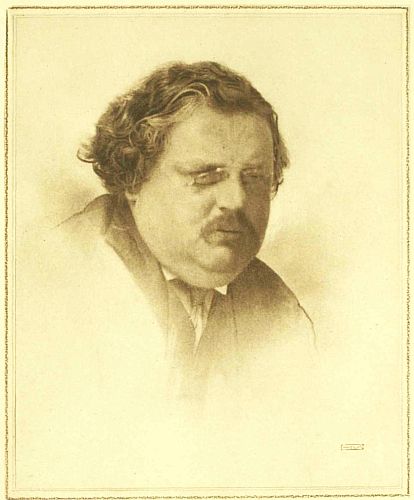 G. K. Chesterton.