The Somme campaign, 1916, had been begun
with very high hopes. The main conception of
it was a sound one, to attack the German line at
the point of junction between the French and
British forces, the point where, according to
all the accepted principles, the Allied line
should have been weakest but actually was not.
That was the only way to bring an element of
the unexpected into a grand attack in those days
of long and laborious artillery preparations.
(The Tank did not appear on the scene until
the Battle of the Somme was two months old
and did not develop its usefulness as a substitute
for artillery preparation until nearly a year
later).
For the Somme battle an enormous artillery
concentration was made, and a special "Army
of Pursuit" was trained in the rear of our lines
to follow through when the German line had
been breached. Then there was a preliminary
bombardment of the German positions from the
sea to beyond the Somme, and, amidst many
feint attacks, the British and the French
offensive north and south of the Somme was
launched.
The First Battle of the Somme made the walls
of Jericho quake but just failed to bring them
down. The Army of Pursuit was given no
chance of pushing to the Rhine; its energies
had to be diverted towards sustaining the
attack. The fighting season closed in 1916
with the Germans still holding their main
defences but convinced, so far as the reasonable
section of their leaders were concerned, that the
game was up and that the best thing to do was
to work for a peace on the best terms possible.
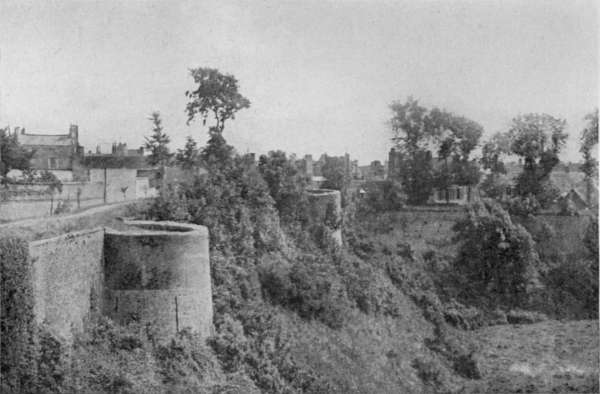
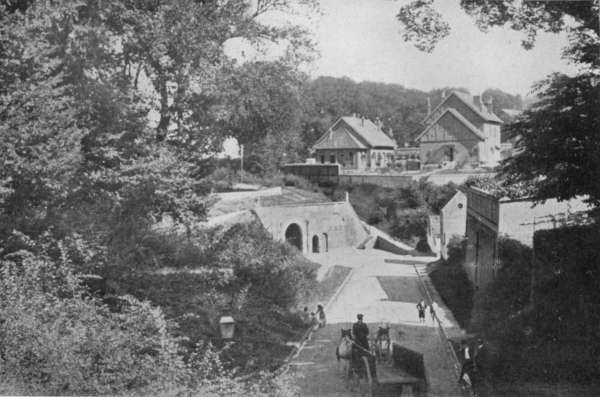
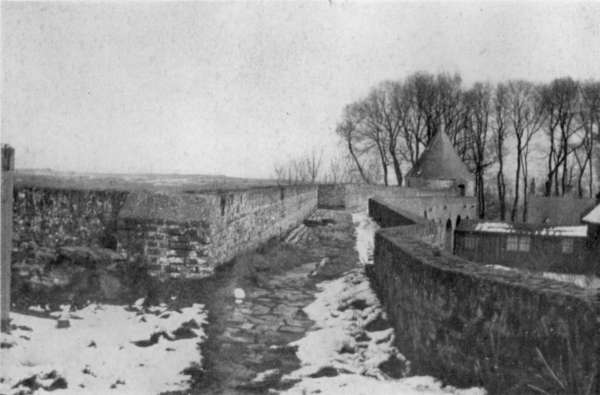 ON THE RAMPARTS
Thus 1916 was a somewhat disappointing
year; 1917 was even more so. The fighting
season, that year, closed with the Allied cause
in a worse position than in 1916 and with
Germany correspondingly encouraged. There
would have been some reasonable excuse if in the
winter of 1917-18 tails drooped at G.H.Q.
The weather was particularly vile. Every day
the winds that howled over the bleak hill-top
seemed to have come straight from Russia and
Germany, bringing with them a moral as well
as a physical cold. The casualty lists of the
Autumn were not cheerful to ponder over; and
it was singularly depressing to hear from Home
that in some political circles those casualty
lists were being conned over with the idea of
founding on them a case against the Army.
Nobody was inclined to try to represent
the late Autumn campaign as altogether
satisfactory. But it was felt by the soldiers
that "they had done their durn'dest, angels
can do no more;" and that there was not
sufficient appreciation of the fact at Home that
with Russia down and out, France in a very bad
way, Italy tottering, the British Army had had
to step into the breach, had had to take a
gruelling without being able to accomplish
much more than defence.
It had seemed in 1916 that the time had
arrived for Germany to pay the penalty. But
a triumph not of a military kind came to her
rescue. The German methods of espionage and
civil corruption were on the whole as blundering
and as disastrous as her other methods during
the Great War. They helped to alienate
practically all the civilised neutral world. But
in Russia—mystic, generous, trusting Russia—they
had an unhappy success. In the Autumn
of 1916 this first showed. Roumania at that
time joined in the war against Germany, and
this new accession of strength apparently
marked the near end of the war. But Russia
mysteriously collapsed owing to the effects of
German corruption. Roumania was left "in
the air," and a large part of her territory was
over-run. From this date, though many of the
gallant soldiers of Russia made heroic efforts to
safeguard their country's honour, that great
Ally was practically out of the fight. By the
winter of 1917-18 she was quite out. The
French had had grave troubles. The Italians
had had to send out an S.O.S. signal.
We should have been more cheerful if the
Cambrai attack, 1917, had had the full success
it deserved. That really was in its conception
and execution a very fine affair. At the time
Germany was drawing troops and guns from the
Russian Front and pouring them on to our
Front in wholesale fashion. Both France and
Great Britain had had to send Armies to the
help of Italy. Our Battle of Passchendaele
was not exactly flourishing. To undertake a
new battle was the last development the enemy
expected of us; and to do what is absolutely
unexpected is to do the big thing in war. The
British command collected an Army ostensibly
for Italy, made a great secret assemblage of
Tanks, and suddenly attacked the Germans in
the strongest part of their Hindenburg line.
Their line was particularly strong at that point.
It comprised three series of defences each one
covered by triple barriers of wire from 50 to 60
yards deep. A system of dug-outs (constructed
with the labour of Russian prisoners) at a depth
of 50 feet below the surface made an underground
city with water and electric light
installations, kitchens, drying-rooms and the
like. Above the surface the houses were
closely packed with the earth removed from the
excavations, and thus became great earthworks
indestructible by any shell-fire.
All this the British Third Army, in a surprise
attack carried out by the Tanks and the
Infantry, over-ran and captured in a day's
attack. So fierce was the British advance and
so feeble the German defence when taken by
surprise that we almost got into Cambrai. If
that centre had been won the German Front in
the West would have been deprived of its central
pillar. The German defence, however, rallied
in time to avoid absolute disaster. When the
German military mind was given time to think
it could always make a good show, and the
riposte to our Cambrai attack was a good one.
We lost most of the fruits of a dramatic coup.
It was more than annoying to think that just
when we had successfully solved the problem of
a break-through we had not the means, owing to
commitments elsewhere, to push the thrust
home.
Cambrai was a good deal "boomed" in the
English Press at the time on "popular" lines.
But I do not think that the skill of generalship
and organisation that it showed were quite
appreciated. The favourite British pose of
being a complete ass, altogether inferior to the
"other fellow," used to be pushed to the
extreme point in regard to military matters.
The British had a quaint humility in respect to
their military skill. In a shame-faced kind of
way they admitted that their soldiers were
brave; but for examples of military genius they
always referred to the "other fellow." Yet
one may be daring enough, perhaps, to say
something on the other side; and to suggest that
in the Great War the German was really
surpassed in most points of military skill by
the British. The difference was not always
great, but where the difference was greatest was
just in those points of invention, of new tactics
and new strategy, which show the better brain.
Heresy it will seem; but the truth is that from
1914 to 1918 the British military system showed
itself superior to the German in resource and
sagacity. Perhaps it would be better to say the
British-French military system, for it is
difficult to separate the achievement of one from
the other.
Consider one by one the main features of the
great campaign. The warfare in the air was
its most dramatic feature. Everything of air
tactics and strategy that the German used he
copied from the British and French. It was
the British who originated aeroplane attack
with incendiary bullets on captive balloons,
aeroplane escort of attacking infantry,
aeroplane sallies at low altitude on enemy
trenches, and the various combinations of
observing machines with fighting machines.
In the first battle of the Somme, when the
British and French first disclosed their sky
tactics, the German was absolutely driven out of
the air. He had then to learn to copy all our
methods; and he originated none of his own.
Another dramatic feature, the complicated
and terribly effective artillery curtain fire, was
evolved by the British-French command. It
was copied by the Germans, who themselves
contributed nothing new to artillery science
during the war. Yet another leading feature
was the Tank, the Tank which made its real
value first felt at Cambrai. This was a purely
British invention, evolved during this war for
the needs of this war.
Our "Winter of discontent" was not made
any sweeter by the suspicion that existed of a
possible yielding on the part of the political
powers at Home to German propaganda. This
German propaganda took the form of blazoning
the preparations for a sensational Spring
offensive in 1918; it was trumpeted like a Fat
Woman at a Fair, and supplemented by an
almost equally strident advertisement of a
gigantic defensive. In addition to preparing a
great on-rush in which Calais, Paris, Rome,
and perhaps London were to be captured, the
German High Command wished the world to
know that it was also preparing a mighty series
of defensive positions back to the Rhine.
Wonderful showmen! They had not only the
most marvellous Fat Woman, but also a
miraculous Skeleton Man. And the prize they
wished to win, by bluff if not by fighting, was
agreement to an inconclusive peace.
The soldiers were not affected much by these
tactics. They took solid comfort from two
facts. The first fact was expressed in the
homely proverb "Much cry, little wool." Had
the Germans been confident that they could
smash through the steel wall which barred them
on the West from the sea, from the capitals of
civilisation, and from the supplies of raw
material for which they were starving, there
would have been no preliminary advertisement.
The effort would have been made, and
Germany's enemies would have had to abide by
the result. There would not have been any
compunction at the consequent cost in blood.
The mere extravagance of the advertisement of
the German plans was proof to the soldiers at
G.H.Q. that those plans were recognised not to
have a solid enough military foundation, and
had to be reinforced by showy bluff.
The second fact which gave solid comfort was
that in any comparison at all of forces the
German group was inferior to the West
European-American group. There was not any
doubt at G.H.Q. Indeed the more the
Germans protested of what they were going to
do in the Spring of 1918 the more firm was
G.H.Q. in believing that the enemy was at last
coming to the end of his resources and was
anxious to "bluff" a peace rather than
"show" a weak hand.
But it was feared that the people at Home
might take the other view, and it had to be
admitted that the German put up a very strong
bluff. Perhaps its cleverest form at the time
was in the discussion of "peace terms"—a
discussion in which it was presumed that the
German would impose a victorious peace before
the summer of 1918. A characteristic discussion—G.H.Q.
kept a close eye on the German press
and minutely examined every German paper
published during the war—would begin with
some Prince pointing out the minimum
indemnity that Germany should exact from her
foes, and explaining in what form it should be
exacted. Germany's need, it would be pointed
out, would be for raw materials, food, cotton,
wool, rubber, tobacco, silk and the like. It
was these that must be supplied to Germany by
way of indemnity. They would have to be
supplied not free, but at a price 20 per cent.
lower than the current market price, and the
annual value of this discount would only
reach the modest sum of £50,000,000 a year.
To have had to provide yearly a tribute of any
kind to Germany would of course have taken
away the independence of the Allies completely.
They would have been put in the position of
admitting a German
suzerainity,
and would
have become as the oppressed Christian
provinces of the old Turkish Empire. But to
provide this tribute of raw material, the
discount on which at 20 per cent. would be
£50,000,000 a year, would have been to engage
to send to Germany yearly raw materials of her
choice to the value of £250,000,000. This would
have been the first call on the farms, the mines,
the shipping of the Allies, and only after that
call was met would the Allies have been able to
begin to supply their own larders and their own
factories.
That was one direction the German Peace
Propaganda took. The idea of it was,
presumably, to strike terror into our hearts,
to make us welcome with something like relief
the actual official terms of a peace negotiation
when they came to be promulgated.
Then someone in Germany would take
the other side. Assuming with absolute
cock-sureness that Germany must win the
war in the Spring of 1918, this publicist
would affect to regret the savage terms
of peace imposed upon Russia. These terms,
it was argued, did not represent the considered
wishes of the German people. But
in war the wisdom of the statesmen was
pushed aside by the eagerness of the soldiers.
The German politicians were overwhelmed in
regard to the Russian peace because the Russian
had allowed things to go too far. But if only
the Western Powers would agree to negotiate
for peace now, the "reasonable German
politicians" would be able to assert their
authority. There would be no ruthless military
conditions such as were imposed upon Russia.
Sweetly and moderately the Germans would
frame their terms; but the Powers of the
Entente must "put the war into liquidation at
once." Delay would mean that the "reasonable
German politicians" would lose their power to
restrain the military party.
G.H.Q. remembered the old fable about
certain trustful animals being invited to pay
friendly visits to the cave of a beast of prey.
One wise animal noticed that whilst there were
many tracks of visitors going into the cave there
were no tracks of visitors coming out. We
had noticed that a free Russia went into
negotiation with Germany to conclude a
friendly and reasonable peace on terms of "no
annexations and no indemnities." No free
Russia came out.
But G.H.Q. was honestly alarmed for a time
that resolution would be shaken at Home, and
welcomed with joy (as the Germans did with
rage), the firm declarations of the Versailles
Council of the Allies and the unshaken
confidence and resolution shown in the speech
from the Throne at the prorogation of the
British Parliament.
As soon as the Home political situation was
seen to be clear, G.H.Q. set about preparing for
the "wrath to come" with a good deal of
cheerfulness and with some amusement that the
German propaganda should, as a final kick,
make a strong though forlorn effort to revive
the old story that Great Britain contemplated
the seizure from France of Calais and the
department of Pas-de-Calais. "Even," said
the German Wireless about this time, "if it is
not openly admitted that the English will never
voluntarily evacuate the French port of Calais,
which they have occupied—" etc., etc.
This lie revived in our Mess between British
and French liaison officers an old topic of
humorous conversation. For when this
particular lie was burdening the German
Wireless some time before, a British General
was showing to a French General the
arrangements of the British Base at Etaples.
He exhibited with pride the great bath houses
for the men, built of concrete and "good for a
hundred years." "Ah yes, very solid—good
for a hundred years," said the French General,
laughing. Then they both laughed.
Christmas, 1917, was celebrated with the
usual British merriment at G.H.Q., and on
New Year's Day everybody's cheerful greeting
was "That this year may see the end of the
war." But I think there were few officers of
standing who thought that a peace Christmas
was possible in 1918. No one would contemplate
the possibility of losing the war, of stopping on
any terms short of a German surrender; but
few could see any possibility of victory near
ahead. There were thick clouds all round the
horizon. Russia was finished. Italy was not
cheerful. France was recovering but not yet
showing sure signs of emergence from that
fit of depression out of which M. Clemenceau
was to pull her—the soul of a Richelieu in his
frail body.
The worst symptom of all from the point of
view of the British Army was the threat of a
shortness of supplies. Just when the collapse
of Russia had allowed the enemy to concentrate
his full strength on the Western Front, the
great reservoir of British wealth, which was the
main financial resource of the Alliance, showed
signs of not being inexhaustible. There was a
call at the same time for greater preparation
and greater economy. From the beginning of
1918 there were two great cross-currents of
correspondence between G.H.Q. and the Home
Government, one demanding new weapons, new
defences, new equipment, the other demanding
rigid economy in steel, in timber, in shipping
space, in food, in oil, in expenditure generally.
This was partly due to actual lack of money and
of credit. But in the main it was the result of
the submarine war.
It was at the end of 1915 that the German
Admiralty prepared a memorandum arguing
that if unrestricted submarine war were adopted
as a policy (i.e., sinking everything, hostile or
neutral, warship or passenger ship), then
Great Britain would be compelled to sue for
peace within six months. The memorandum
gave various statistics regarding food supplies,
tonnage, etc., to prove this hypothesis. The
memorandum was forwarded to the Imperial
Chancellor, and by him sent to Dr. Helfferich,
Secretary of State for Finance, for a report.
Dr. Helfferich reported adversely. He was not
convinced that Great Britain would be brought
to her knees. He feared the effect upon neutral
nations of such a policy.
The German Admiralty persisted in its view.
Thereupon the matter was submitted for report
to ten experts representing finance, commerce,
mining, and agriculture. These experts were
asked to advise (1) as to the probable effect upon
Great Britain (2) as to the probable effect upon
Germany's relations with neutrals and (3) as to
how far the situation in Germany demanded
the employment of such a weapon.
All these experts agreed that the effect on
Great Britain would be to force her to sue
for peace within six months or less. Indeed,
Herr Müller, President of the Dresden Bank,
thought that Great Britain would collapse
within three months. All the experts also
agreed as to the third point of reference,
arguing that Germany's position was so
difficult that the most desperate measures were
necessary to end the war. Herr Engelhardt, of
Mannheim, Councillor of Commerce, thought
the economic position of Germany so bad that
a few weeks' delay might render even ruthless
submarine war useless. On the second point,
the effect on relations with neutrals, the experts
were divided. Some thought that the United
States would be driven to war, others thought
not. In all cases they did not see a reason
against ruthless submarine war in their possible
relations with any neutral.
But the fateful decision was not taken until
February, 1917, when the destruction of
peaceful shipping, whether of enemy or of
neutral countries, was ordered. It did not end
the war in six months, nor in twelve months;
but by the beginning of 1918 there were some
very serious difficulties of supply just when the
strictly military position demanded the most
generous effort.
I wonder if those experts who bandy to and
fro explanations and accusations in regard to
the German break-through in the Spring of
1918 ever have looked at the matter from the
point of view of supply, of the supply, say, of
one sternly necessary item of defence, wire?
At a careful computation we wanted 12,000
tons of barbed wire in January, 1918, and
10,000 more tons in February, 1918, to give our
men a reasonable chance of holding the line
which we knew to be threatened. Of that total
of 22,000 tons we actually got 7,700 tons, i.e.,
35 per cent. of what was needed.
I do not quote this fact to start another
quarrel, shuttle-cocking blame from soldier to
politician. I am more than ready to believe
that the people at Home were then doing their
best (as, pace all grousers, I believe they did
their best from August, 1914, to November,
1918). But you cannot spin out wire like you
spin out talk, especially barbed wire. The
British soldier can, with his mere flesh and
blood, and that gay courage of his, do wonders
in the way of making up for want of material.
But he could not hold up the attacked sector in
the Spring of 1918 against overwhelming odds;
and one of the reasons was that he had not
enough wire in front of him. He had not the
wire in front of him because it had not been,
could not be, supplied.
How anxious was the task of G.H.Q.
at the dawn of 1918 may be illustrated
with these heads of correspondence, in and
out.
To G.H.Q. from Home.
The greatest economy
in steel is urged.
The position in
regard to shipping is
serious; the strictest
economy in everything
is necessary.
Lubricants are hard
to get. We urge the
greatest economy.
From G.H.Q. to Home.
More machine-guns
are urgently needed.
There is a shortage
of blankets; there is a
shortage of 8,000 tons
of barbed wire. New
searchlights are
needed; 300,000 box
respirators are needed
for the American
Forces.
I could fill many pages with matter of the
same sort. The poison of the submarine war
began to have its cumulative effect just when
we were getting the most peremptory reminders
that Supply was going to be the determining
factor of the final struggle, that war had become
more and more a matter of striking at the
enemy's life by striking at "the means whereby
he lives." Munitions, food, equipment,
railways, roads, ships—these had become the
most important factors, and victory would
incline to the Force which could best concentrate
the means to maintain an overwhelming force
at some particular point, which could best
develop, conserve, and transport its material.
The field for the strategist had moved more and
more from the Front line towards the Base.
Fortunately, the British Army in France had
for its Q.M.G. at this crisis a man with the
courage and the knowledge to carry through a
drastic reorganisation of the Supply and
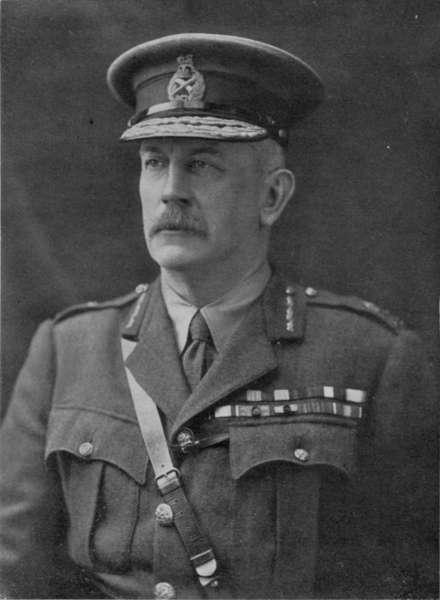
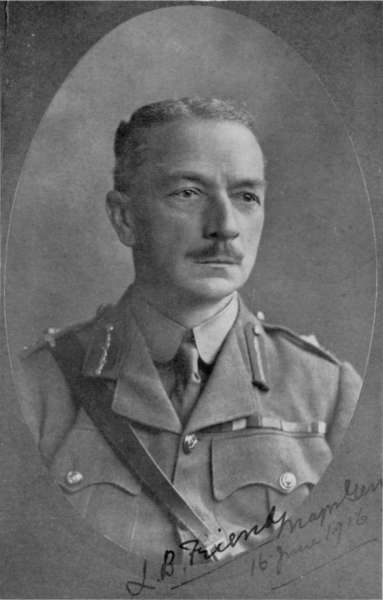
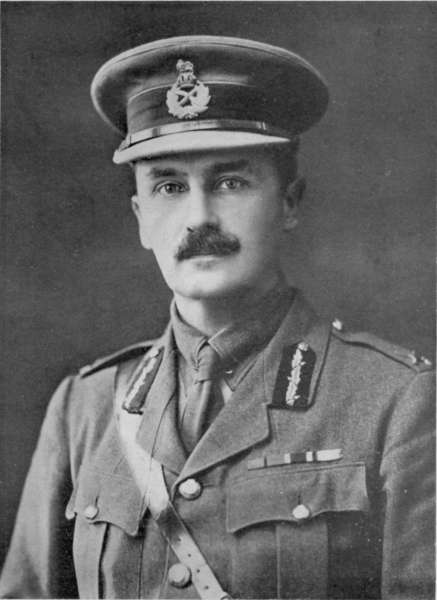
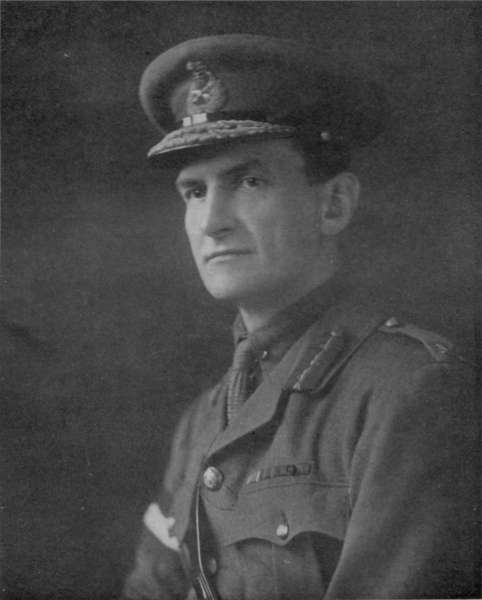
Transport services. Lieutenant-General Sir
Travers Clarke, who took over as Q.M.G.,
France, at the end of 1917, was a daring experiment
on Lord Haig's part; for he was a comparative
youngster to be put into a post which
was then the most anxious and onerous in the
Army, and his actual substantive rank was that
of a major; but he was an acting Major-General
with a fine record in a minor theatre of the war.
Lord Haig knew his man well, though, and,
what was just as necessary, knew how to back
his man. He put Sir Travers Clarke in the
saddle and kept him there in spite, I have no
doubt, of many thunderous protests from
influential quarters, for Sir Travers Clarke
was a ruthless reformer and a stubborn upholder
of any course of action he thought necessary.
A character sketch of him that appeared in the
Morning Post in 1919 is worth quoting in part:
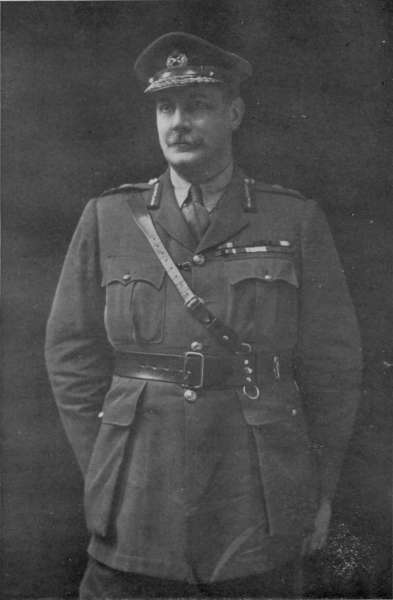 LIEUT-GENERAL SIR TRAVERS CLARKE
"'That big young man,' was a leading
American officer's term to describe Sir Travers
Clarke after he had met him in France in
Conference, and had not caught his name.
British G.H.Q. perhaps only learned to
appreciate the Q.M.G. fully from the comments
of foreign officers who came into touch with him
in 1918. The masterful man took his power so
quietly, came to big decisions with such an air
of ease, such an absence of anything dramatic or
violent, that it was a little difficult to understand
his full strength.
"'T.C.'—as often before remarked, the
British Army must reduce everything and
everyone to initials—as a regimental officer in
the 'Nineties never seemed to get an opening.
Nor did his early Staff work bring him much
recognition. But an officer of his to-day, who
was a clerk under him when he was first a
Staff Captain, insists that he always gave the
impression of great power in reserve. 'He
believed in the British Army, in hard work, and
in himself.' That was the foundation of the
career of a man who, once an opening showed,
forged ahead with marvellous speed to his
destiny.
"It took 'T.C.' ten years to become a major;
within the next ten years he had become
Lieutenant-General and Quartermaster-General
to the British Armies in France. One year in
that post, a year in which were crowded all the
experiences that a great Army could have,
marked him as a great leader of men and a
superb organiser. How much the Allied victory
owes to him a grateful country will not
appreciate fully until not only the British but
also the French and American campaigns are
analysed.
"'T.C.' had the ideal personality for a
military leader. You were always dreadfully
afraid of him and sincerely fond of him. No
general ever made sterner demands on his
officers and men. If you could not stand up to
a gruelling day's work and come up smiling for
the next day's and the next day's, until the
need had passed, you were no use, and you
moved on to some less exacting sphere. But
you were working under a worker, and you
found yourself part of a massive machine which
was rolling flat all obstacles. That made it
easy. Further, there was the most generous
appreciation of good work and a keen personal
sympathy.
"Sir Travers Clarke has one rule to which he
never permitted an exception: that it is the
fighting man who has to be considered first and
last. In France he was quite willing that the
Staff should labour to the extreme point of
endurance to take any of the load off the man in
the trenches. He did not like about him men,
however clever, who had not seen fighting. It
was the first duty of the Staff, he insisted, to
enter with the completest sympathy into the
feelings and the difficulties of the fighting man.
'Bad Staff work mostly arises from not knowing
the differences between an office and a trench,'
was one of his aphorisms."
This is not a history of the war; nor a
contribution to any of the numerous war
controversies; it is merely a sketch of life at
G.H.Q. as it appeared to a Staff Officer; but
I cannot help obtruding a reply to some current
criticisms of Lord Haig: that he was too
inclined to stand by his officers, that he was
reluctant to "butcher" a man, and that in
consequence he did not get the highest standard
of efficiency. Faithfulness to his friends and
servants was certainly a marked characteristic
of Lord Haig as Commander-in-Chief. He
chose his men cautiously and, I believe, with
brilliant insight. Having chosen them he stood
by them faithfully in spite of press or political
or service thunderings, unless he was convinced
that they were not equal to their work.
It is a characteristic which, even allowing
that there was an odd case of over-indulgence,
of giving a man a little too much benefit of the
doubt, worked on the whole for the good. Men
do not do their best work with ropes round their
necks; and I believe that a great newspaper
magnate whose motto at first was "Sack, Sack,
Sack," very soon found out that it was a
mistake.
In this particular instance I suppose the
Commander-in-Chief had powerful urging
often enough to "butcher" his Q.M.G., who
did things of so disturbing a character. He
did not; and the event proved him right, as it
did in practically every one of his great trusts
during the war.
Reorganisation of Supply and Transport
filled the attention of G.H.Q. during the early
months of 1918. Over a curiously wide range
of subjects swept a wave of reform and
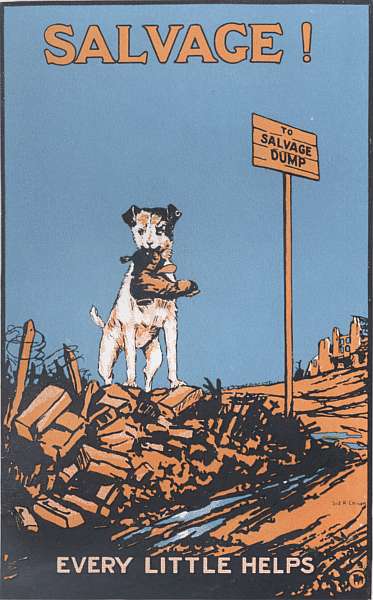
retrenchment. As I have already told, there
was a definite organisation to collect the salvage
of the battlefields, an organisation which saved
millions of money in rags, bottles, waste-paper,
swill, bones and grease as well as in the more
obvious matters of shell-cases and derelict arms
and ammunition. An Agricultural Directorate
was set to work to grow potatoes and oats and
vegetables and other food stuffs behind the lines.
Rations were judiciously reduced, a substantial
difference being left in favour of the man in
the actual fighting line as compared with the
man at the Base. The supply of certain
luxuries at the E.F. canteens was stopped or
limited, but it was provided that the man in the
fighting line should suffer less from this than
the man at the Base. Weekly conferences were
instituted to discuss the most economical use of
labour, of material and of plant. Every matter
great and small had searching attention, and
the British Army began to be run like an up-to-date
competitive business. Some of the
injudicious laughed. They christened the
General in charge of Salvage "O.C. Swills"
and "Rags and Bones." They could not
"see" a Colonel whose mission in life was to
cut down laundry costs and arrange for the
darning of the men's socks when they came out
of the wash.
But all these things had to do with the
winning of the war. It is a fact that if the
lavishness of 1914-15-16-17 had been carried
into 1918 we could not have won the war,
because we should have been bankrupt of
material.
G.H.Q. at the dawn of the Spring of 1918
was very serious in mind, but not so much so as
to fail to get some amusement as well as interest
out of the various new ideas in military
administration; and fully confident now that
the people at Home were going to stick it out.
In this connection there was often mentioned
with cheerfulness a London bye-election towards
the end of 1917 for an area which had had
special attention from the German air-raids.
Some rather expected to see a candidate come
forward from among the little group known as
"Pacifists," who would seek votes on the plea
that the best way to stop air-raids quickly and
to get out of the discomforts of the war would
be to meet half-way the proposals of the
Germans who were trying for an inconclusive
peace.
What actually happened was quite different.
A candidate came forward under the banner of
the Government, pledged to the Government's
programme of carrying on the war until German
militarism was crushed and Germany made
reparation for the ruin she had wrought in
Europe. This candidate had the support of
both the old political parties. Against him
there came out another candidate. Did this
candidate seek to win votes by pleading
for a friendly consideration of Germany's
hypocritical peace proposals? He did not.
From what one could gather of the feeling of
the electorate, if he had done so he would have
been ducked in the nearest pond. No, his
appeal was based on the plea that the Government
candidate did not go far enough in
hostility to Germany, and that that gentleman
was not fully in favour of carrying to German
homes the dastardly air-war which Germany
waged on a civilian population.
Then a third candidate appeared on the
scene. He was not for any half-hearted policy.
His cry to the electors was that neither of the
other two candidates was sufficiently earnest in
regard to the war against Germany. His
programme was of one clause only, the necessity
of bombing Germany out of her barbarism.
He did not believe that any method of sweet
reasonableness was of any use. A thousand
tons of bombs daily on Berlin, and a ration in
proportionate scale on other German towns, was
his idea.
Women speakers came to take part in the
contest. Did they advocate making concessions
to the German desire to sneak away from the
consequences of the crime of 1914? They did
not. They were more vigorous than any of the
men speakers in demanding a full measure of
reprisal on Germany. No one throughout the
whole contest whispered "peace."
It was altogether inspiriting. Here was a
chance to see what the people of England, the
people who stood behind the Army and the
Navy and were our ultimate supports, felt about
the war. We could see that they were utterly
resolute, with not a sign of weariness, nor of
fear, nor of tolerance for a craven peace. Their
message was "Fight on, Fight on. Bring us
home a real peace. We will put up with
everything the Boche can do; we will carry on.
But no palter, no surrender. Finish the job
you are at."
The English people terrorised? Not a bit of
it. They were only getting their blood up.
And G.H.Q. saw that and was comforted.
There was also a good deal of solid comfort
in the way that London took the bitter
experience of "rations." We never had any
food scarcity in the Army and, going on leave,
officer or soldier had a food card that guaranteed
him a good holiday supply. So we were in the
best position to appreciate the cheerful way in
which Great Britain took the very thin gruel of
ration times. Every officer coming back from
leave expressed his glowing admiration of
civilian patience.
Those German agents in London who relieved
the tedium of the war for the Allies by reporting
to Berlin such "happenings" as the Battle of
Oxford Street and the destruction of whole
quarters of London by air attacks, set out, for the
fooling of the German public, some fine accounts
of dismay and discontent caused by food tickets.
But as a matter of truth, London on rations
surprised and gratified the most cheerful
optimists. The old city "took her medicine"
not only with patience but with an actual
gaiety.
To sum up: between the close of the fighting
season of 1917 and the beginning of that of 1918,
G.H.Q. was at first a little depressed at the
thought that political developments would
prevent the Army from seeing the job through
in a satisfactory way; was subsequently
reassured as to the feeling of the civilian
population; and thereafter faced the future
with complete confidence.