It has been said by an excellent authority that children and dogs spoil
conversation. I can confidently say that had Madame de Sévigné and Dr.
Johnson joined me and my family on our wonted Sunday afternoon walk to
the kennels, they would have known what it was to be ignored. This
reflection bears but remotely on the matter in hand, but is, I think,
worthy of record. I pass on to a certain still and steamy afternoon in
late September, when my wife and I headed forth in the accustomed way,
accompanied by, or (to be accurate), in pursuit of, my two sons, my two
dogs, and a couple of hound puppies, to view that spectacle of not
unmixed attractiveness, the feeding of the hounds.
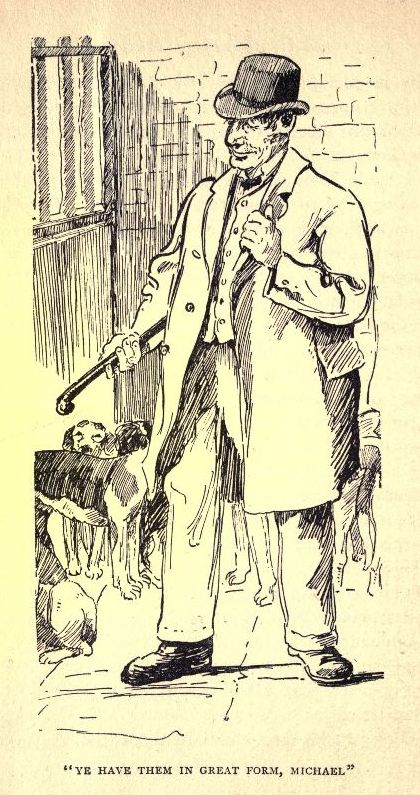
Flurry Knox and Michael were superintending the operation when we
arrived, coldly observing the gobbling line at the trough, like
reporters at a public dinner. It was while the last horrid remnants of
the repast were being wolfed that my wife hesitatingly addressed Mr.
Knox's First Whip and Kennel Huntsman.
"Michael," she said, lowering her voice, "you know the children's old
donkey that I spoke to you about last week—I'm afraid you had
better——"
"Sure he's boiled, ma'am," said Michael with swift and awful brevity,
"that's him in the throch now!"
Philippa hastily withdrew from the vicinity of the trough, murmuring
something incoherent about cannibals or parricides, I am not sure
which, and her eldest son burst into tears that were only assuaged by
the tactful intervention of the kennel-boy with the jawbone of a horse,
used for propping open the window of the boiler-house.
"Never mind, Mrs. Yeates," said Flurry consolingly, "the new hounds
that I'm getting won't be bothered with donkeys as long as there's a
sheep left in the country, if the half I hear of them is true!" He
turned to me. "Major, I didn't tell you I have three couple of
O'Reilly's old Irish hounds bought. They're the old white breed
y'know, and they say they're terrors to hunt."
"They'd steal a thing out of your eye," said Michael, evidently
reverting to an interrupted discussion between himself and his master.
"There's a woman of the O'Reillys married back in the country here, and
she says they killed two cows last season."
"If they kill any cows with me, I'll stop the price of them out of your
wages, Michael, my lad!" said Flurry to his henchman's back. "Look
here, Major, come on with me to-morrow to bring them home!"
It was, I believe, no more than fifty miles across country to the
mountain fastness of the O'Reillys, and a certain chord of romance
thrilled at the thought of the old Irish breed of white hounds, with
their truly national qualities of talent, rebelliousness, and love of
sport. Playboy was one of the same race—Playboy, over whose
recapture, it may be remembered, I had considerably distinguished
myself during my term of office as M.F.H.
I went. At one o'clock next day two lines of rail had done their
uttermost for us, and had ceded the task of conveying us to Fahoura to
the inevitable outside car. And still there remained a long flank of
mountain to be climbed; the good little slave in the shafts made no
complaint, but save for the honour and glory of the thing we might as
well have walked; certainly of the seven Irish miles of road, thrown
over the pass like a strap over a trunk, our consciences compelled us
to tramp at least three. A stream, tawny and translucent as audit ale,
foamed and slid among its brown boulders beside us at the side of the
road; as we crawled upwards the fields became smaller, and the lonely
whitewashed cottages ceased. The heather came down to the wheel marks,
and a pack of grouse suddenly whizzed across the road like a shot fired
across our bows to warn us off.
At the top of the pass we stood, and looked out over half a county to
the pale peaks of Killarney.
"There's Fahoura now, gentlemen," said the carman, pointing downwards
with his whip to a group of whitewashed farm buildings, that had
gathered themselves incongruously about a square grey tower. "I'm told
old Mr. O'Reilly's sick this good while."
"What ails him?" said Flurry.
"You wouldn't know," said the carman, "sure he's very old, and that
'fluenzy has the country destroyed; there's people dying now that never
died before."
"That's bad," said Flurry sympathetically, "I had a letter from him a
week ago, and he only said he was parting the hounds because he
couldn't run with them any more."
"Ah, don't mind him!" said the carman, "it's what it is he'd sooner
sell them now, than to give the nephew the satisfaction of them, after
himself'd be dead."
"Is that the chap that's been hunting them for him?" said Flurry, while
I, for the hundredth time, longed for Flurry's incommunicable gift of
being talked to.
"It is, sir; Lukey O'Reilly—" the carman gave a short laugh. "That's
the lad! They say he often thried to go to America, but he never got
south of Mallow; he gets that drunk sayin' good-bye to his friends!"
"Maybe the old fellow will live a while yet, just to spite him,"
suggested Flurry.
"Well, maybe he would, faith!" agreed the carman, "didn't the docthor
say to meself that maybe it's walking the road I'd be, and I to fall
down dead!" he continued complacently, "but sure them docthors, when
they wouldn't know what was in it, they should be saying something!"
We here turned into the lane that led to Mr. O'Reilly's house.
We pulled up at the gate of a wide farmyard, with outcrops of the brown
mountain rock in it, and were assailed in the inevitable way by the
inevitable mongrel collies. Blent with their vulgar abuse was the
mellow baying of hounds, coming, seemingly, from the sky. The carman
pointed to the tower which filled an angle of the yard, and I saw,
about twenty feet from the ground, an arrow-slit, through which
protruded white muzzles, uttering loud and tuneful threats.
"The kitchen door's the handiest way," said Flurry, "but I suppose for
grandeur we'd better go to the front of the house."
He opened a side gate, and I followed him through a wind-swept
enclosure that by virtue of two ragged rose-bushes, and a walk edged
with white stones, probably took rank as a garden. At the front door
we knocked; a long pause ensued, and finally bare feet thudded down a
passage, a crack of the door was opened, and an eye glistened for a
moment in the crack. It was slammed again, and after a further delay
it was reopened, this time by a large elderly woman with crinkled black
and grey hair and one long and commanding tooth in the front of her
mouth.
"Why then I wasn't looking to see ye till to-morrow, Mr. Knox!" she
began, beaming upon Flurry, "but sure ye're welcome any day and all
day, and the gentleman too!"
The gentleman was introduced, and felt himself being summed up in a
single glance of Miss O'Reilly's nimble brown eyes. With many
apologies, she asked us if we would come and see her brother in the
kitchen, as he did not feel well enough to walk out to the parlour, and
she couldn't keep him in the bed at all.
The kitchen differed more in size than in degree from that of the
average cabin. There was the same hummocky earthen floor, the same
sallow whitewashed walls, the same all-pervading turf smoke—the
difference was in the master of the house. He was seated by the fire
in an angular armchair, with an old horse-blanket over his knees, and a
stick in his hand, and beside him lay an ancient white hound, who
scarcely lifted her head at our entrance. The old man laboured to his
feet, and, bent as he was, he towered over Flurry as he took his hand.
"Your father's son is welcome, Mr. Florence Knox, and your friend—"
He was short of breath, and he lowered his great frame into his chair
again. "Sit down, gentlemen, sit down!" he commanded. "Joanna! These
gentlemen are after having a long drive——"
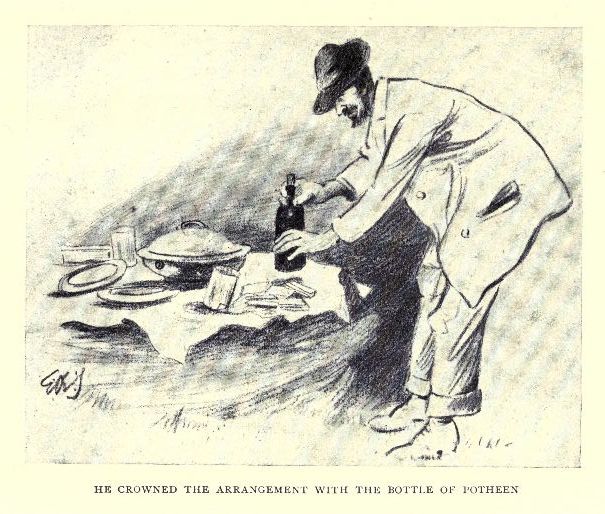
The clink of glasses told that the same fact had occurred to Miss
O'Reilly, and a bottle of port, and another of what looked like water,
but was in effect old potheen, were immediately upon the table.
"How well ye wouldn't put down a glass for me!" thundered old O'Reilly,
"I suppose it's saving it for my wake you are!"
"Or her own wedding, maybe!" said Flurry, shamelessly ogling Miss
O'Reilly, "we'll see that before the wake, I'm thinking!"
"Well, well, isn't he the dead spit of his father!" said Miss O'Reilly
to the rafters.
"Here, woman, give me the kettle," said her brother, "I'll drink my
glass of punch with Mr. Florence Knox, the way I did with his father
before him! The doctor says I might carry out six months, and I think
myself I won't carry out the week, but what the divil do I care! I'm
going to give Mr. Knox his pick of my hounds this day, and that's what
no other man in Ireland would get, and be dam we'll wet our bargain!"
"Well, well," said Miss O'Reilly, remonstratingly, bringing the kettle,
"and you that was that weak last night that if you got Ireland's crown
you couldn't lift the bedclothes off your arms!"
"Them hounds are in my family, seed and breed, this hundred years and
more," continued old O'Reilly, silencing his sister with one black
glance from under his thick grey brows, "and if I had e'er a one that
was fit to come after me they'd never leave it!" He took a gulp of the
hot punch. "Did ye ever hear of my brother Phil that was huntsman to
the Charlevilles long ago, Mr. Knox? Your father knew him well.
Many's the good hunt they rode together. He wasn't up to forty years
when he was killed, broke his neck jumping a hurl, and when they went
to bury him it's straight in over the churchyard wall they took him!
They said he never was one to go round looking for a gate!"
![[Illustration: ]](https://openoldbooks.sgp1.digitaloceanspaces.com/books/further-experiences-of-an-irish-r-m/images/img-292.jpg)
"THEM HOUNDS ARE IN MY FAMILY, SEED AND BREED, THIS HUNDRED YEARS."
"May the Lord have mercy on him!" murmured Miss O'Reilly in the
background.
"Amen!" growled the old man, taking another pull at his steaming
tumbler, as if he were drinking his brother's health. "And look at me
here," he went on, reddening slowly through the white stubble on his
cheeks, "dying as soft as any owld cow in a boghole, and all they'll be
saying afther me is asking would they get their bellyful of whisky at
my wake! I tell you this—and let you be listening to me,
Joanna!—what hounds Mr. Knox doesn't take, I'll not leave them afther
me to be disgraced in the counthry, running rabbits on Sunday
afternoons with them poaching blackguards up out of the town! No! But
they'll have a stone round their neck and to be thrown below in the
lough!"
I thought of the nephew Luke, whose friends had so frequently failed to
see him off, and I felt very sorry for old O'Reilly.
"They will, they will, to be sure!" said Miss O'Reilly soothingly, "and
look at you now, the way you are! Didn't I know well you had no call
to be drinking punch, you that was coughing all night. On the face of
God's earth, Mr. Knox, I never heard such a cough! 'Tis like a sheep's
cough! I declare it's like the sound of the beating of the drum!"
"Well, Mr. O'Reilly," said Flurry, ignoring these remarkable symptoms,
but none the less playing to her lead, "I suppose we might have a look
at the hounds now."
"Go, tell Tom to open the tower door," said old O'Reilly to his sister,
after a moment's silence. He handed her a key. "And shut the gate
you."
As soon as she had gone he got on to his feet. "Mr. Knox, sir," he
said, "might I put as much trouble on you as to move out this chair to
the door? I'll sit there the way I can see them. Maybe the other
gentleman would reach me down the horn that's up on the wall. He's
near as tall as meself."
Flurry did as he asked, and helped him across the room.
"Close out the half door if you please, Mr. Knox, and give me the old
rug that's there, my feet is destroyed with the rheumatics."
He dropped groaningly into his chair, and I handed him the horn, an old
brass one, bent and dinted.
Already the clamour of the hounds in the tower had broken out like
bells in a steeple, as they heard the footsteps of their jailor on the
stone steps of their prison.
Then Tom's voice, shouting at them in Irish to stand back, and then
through the narrow door of the tower the hounds themselves, a striving
torrent of white flecked with pale yellow, like one of their own
mountain streams. There were about seven couples of them, and in a
moment they overran the yard like spilt quicksilver.
"Look at them now, Mr. Knox!" said their owner, "they'd take a line
over the hob of hell this minute!"
Pending this feat they took a very good line into what was apparently
the hen-house, judging by the hysterics that proceeded from within.
Almost immediately one of them reappeared with an egg in his mouth.
Old O'Reilly gave a laugh and an attempt at a holloa. "Ah ha! That's
Whiteboy! The rogue!" he said, and putting the horn to his lips he
blew a thin and broken note, that was cut short by a cough.
Speechlessly he handed the horn to Flurry, but no further summons was
needed; the hounds had heard him. They converged upon the doorway with
a rush, and Flurry and I were put to it to keep them from jumping in
over the half-door.
I had never seen hounds like them before. One or two were pure white,
but most had some touch of faded yellow or pale grey about them; they
were something smaller than the average foxhound, and were strongly
built, and active as terriers. Their heads were broad, their ears
unrounded, and their legs and feet were far from complying with the
prescribed bedpost standard; but wherein, to the un-professional eye,
they chiefly differed from the established pattern, was in the human
lawlessness of their expression. The old hound by the fire had
struggled up at the note of the horn, and stood staring in perplexity
at her master, and growling, with all the arrogance of the favourite,
at her descendants, who yelped, and clawed, and strove, and thrust
their muzzles over the half-door.
Flurry regarded them in silence.
"There's not a straight one among them," he whispered in my ear through
the din.
"There they are for you now, Mr. Knox," said old O'Reilly, still
panting after his fit of coughing. "There isn't another man in Ireland
would get them but yourself, and you've got them, as I might say, a
present!"
Flurry and I went out into the yard, and the door was closed behind us.
The examination—I may say the cross-examination—of the hounds that
followed, was conducted by Flurry and Michael to the accompaniment of a
saga from Tom, setting forth their miraculous merits and achievements,
to which, at suitable points, the carman shouted "Selah," or words to
that effect, through the bars of the gate. At the end of half-an-hour
Flurry had sorted out six of them; these were then coupled, and by dint
of the exertions of all present, were bestowed in a cart with sides
like a crate, in which pigs went to the fair.
We did not see our host again. His sister told us that he had gone to
bed and wasn't fit to see any one, but he wished Mr. Knox luck with his
bargain, and he sent him this for a luck-penny. She handed Flurry the
dinted horn.
"I'm thinking it's fretting after the hounds he is," she said, turning
her head away to hide the tears in her brown eyes. I have never until
then known Flurry completely at a loss for an answer.
A fortnight afterwards—to be precise, it was the 10th of October—I
saw the white hounds in the field. I had gone through the dreary
routine of the cub-hunter. The alarm clock had shrilled its exulting
and age-long summons in the pitchy dark. I had burnt my fingers with
the spirit-lamp, and my mouth with hot cocoa; I had accomplished my
bathless toilet, I had groped my way through the puddles in the stable
yard, and got on to my horse by the light of a lantern, and at 5.30
A.M. I was over the worst, and had met Flurry and the hounds, with
Michael and Dr. Jerome Hickey, at the appointed cross-roads. The meet
was nine miles away, in a comparatively unknown land, to which Flurry
had been summoned by tales of what appeared to be an absolute epidemic
of foxes, accompanied by bills for poultry and threats of poison. It
was still an hour before sunrise, but a pallor was in the sky, and the
hounds, that had at first been like a gliding shoal of fish round the
horses' feet, began to take on their own shapes and colours.
The white Irish hounds were the first to disclose themselves, each
coupled up with a tried old stager. I had been away from home for the
past ten days, and knew nothing of their conduct in their new quarters,
and finding Flurry uncommunicative, I fell back presently to talk about
them to Michael.
"Is it settling down they are?" said Michael derisively. "That's the
fine settling down! Roaring and screeching every minute since they
came into the place! And as for fighting! They weren't in the kennel
three days before they had Rampant ate, and nothing only his paws left
before me in the morning! I didn't give one night in my bed since,
with running down to them. The like o' them trash isn't fit for a
gentleman's kennels. Them O'Reillys had them rared very pettish; it'd
be as good for me to be trying to turn curlews as them!"
The indictment of "The Whiteboys" (a title sarcastically bestowed by
Dr. Hickey), their sheep-killing, their dog-hunting, with the setting
forth of Michael's trials, talents, and unrequited virtues, lasted,
like an Arabian night's tale, till the rising of the sun, and also
until our arrival at the place we were first to draw. This was a long
and deep ravine, red with bracken, bushy with hazel and alders; a black
stream raced downwards through it, spreading at the lower end into bog,
green, undefined, entirely treacherous; a place that instantly assures
the rider that if hounds get away on its farther side he will not be
with them.
A couple of men were waiting for us at the lower end of the ravine.
"They're in it surely!" they said, shoving down a stone gap for our
benefit; "there isn't a morning but we'll see the owld fellow and his
pups funning away for themselves down by the river. My little fellows,
when they does be going to school in the morning, couldn't hardly pass
his nest for the fume that'd be from it."
The first ten minutes proved that the foxes were certainly there, and
during the following half-hour pandemonium itself raged in the ravine.
There were, I believe, a brace and a-half of cubs on foot; they were to
me invisible, but they were viewed about twice in every minute by
Flurry and his subordinates, and continuously by a few early rising
countrymen, who had posted themselves along the edges of the ravine.
The yells of the latter went up like steam whistles, and the hounds,
among whom were five couple of newly entered puppies, were wilder than
I had ever known them. They burst through the bracken and strove in
the furze, in incessant full cry, and still the cubs doubled and
dodged, and made detours round the valley, and Flurry and Michael
roared themselves inside out, without producing the smallest effect
upon anything save their own larynxes. No less than three times a fox
was frantically holloaed away, and when, by incredible exertions on all
our parts, the hounds, or a fair proportion of them, had been got
together on to the line, a fresh outburst of yells announced that,
having run a ring, he had returned to the covert.
Each of these excursions involved—
1. Scrambling at best speed down a rocky hill-side.
2. Coercing a diffident horse across a noisy stream, masked by briars,
out of bog, on to rock.
3. Reverse of the first proceedings.
4. Arrival, blown and heated, at the boggy end of the valley, to find
the original conditions prevailing as before.
I should, perhaps, have already mentioned that I was riding a young
horse, to whom I was showing hounds for the first time. My idea had
been to permit him, strictly as an onlooker, to gather some idea of the
rudiments of the game. He was a good young horse, with the large
gravity of demeanour that is often the result of a domestic bringing up
in the family of a small farmer; and when the moment came, and I was
inexorably hustled into acting as Third Whip, he followed in the wake
of Dr. Hickey with an anxious goodwill that made even his awkwardness
attractive.
Throughout these excursions I noticed, as far as I was able to notice
anything, the independent methods of the O'Reilly draft. They ignored
the horn, eluded Michael, and laughed at Hickey and me; they hunted
with bloodthirsty intentness and entirely after their own devices.
Their first achievement was to run the earth-stopper's dog, and having
killed him, to eat him. This horrid feat they accomplished, secure
from interruption, in the briary depths of the ravine, and while the
main body of the pack were industriously tow-rowing up and down the
stream after their lawful fox, a couple of goats were only saved from
"The Whiteboys" by miracles of agility and courage on the part of the
countrymen. The best that could be said for them was that, "linking
one virtue to a thousand crimes," whenever the hounds got fairly out of
covert, the Whiteboys were together, and were in front.
It was about eight o'clock, and the fierce red and grey sunrise had
been over-ridden by a regiment of stormy clouds, when one of the foxes
met his fate, amid ear-piercing whoops, and ecstatic comments from the
onlookers, who had descended from the hill-tops with the speed of
ski-runners.
"Aha! that's the lad had many a fat duck under his rib!"
"He had, faith! I'll go bail 'twas him that picked me wife's
fashionable cocks!"
![[Illustration: ]](https://openoldbooks.sgp1.digitaloceanspaces.com/books/further-experiences-of-an-irish-r-m/images/img-302.jpg)
"I'LL GO BAIL 'TWAS HIM THAT PICKED ME WIFE'S FASHIONABLE COCKS"
"Well, I'm told that if ye'll see a fox taking a hen or a goose, and
ye'll call to him in Irish, that he'll drop it," remarked an older man
to me, as we waited while Flurry and Hickey, in their capacity of
butler and footman to the hounds' repast, snatched the few remaining
morsels from the elder revellers and endeavoured to force them upon the
deeply-reluctant young entry, who, having hunted with the innocent
enthusiasm of the débutante, thought as little of the ensuing meal as
the débutante thinks of supper at her first ball.
"I wonder why the deuce Michael can't get those Irish hounds," said
Flurry, catching at the word and looking round. "I only have Lily
here."
(Lily, I should say, was the romantic name of one of the Whiteboys.)
"I believe I seen a two-three of the white dogs running east awhile
ago," said the elderly farmer, "and they yowling!"
"They're likely killing a sheep now," murmured Hickey to me.
At the same moment I chanced to look up towards the western end of the
ravine, and saw what seemed to be five seagulls gliding up a rift of
grass that showed green between rocks and heather.
"There are your white hounds, Flurry," I called out, "and they're
hunting."
"Well, well," said the farmer, "they're afther wheeling round the
length of the valley in the minute! They're nearly able to fly!"
A distant holloa from Michael, whose head alone was visible above a
forest of furze, rose like a rocket at the end of the sentence, and
every hound sprang to attention.
Once more we traversed the valley at full speed, and tackled the ladder
of mud that formed the cattle track up the ravine; slough up to the
horses' knees, furze bushes and briars meeting over their heads and
ours, hounds and country boys jostling to get forward, with pistol
shots behind from Hickey's thong, and the insistent doubling of
Flurry's horn in front. Up that green rift I went on foot, and, as it
were, hand in hand with my admirable young horse. The rift, on closer
acquaintance, proved to be green with the deceitful verdure of swampy
grass; (in Ireland, it may be noted, water runs up hill, and the
subtlest bog holes lie in wait for their prey on the mountain tops).
As we ascended, the wind that had risen with the sun, fought us every
inch of the way, and by the time I had won to level ground, I was
speechless, and blowing like the bellows of a forge. A country boy,
whose grinning purple face remains a fond and imperishable memory,
caught me by the leg and rammed me into my saddle; just in front of me
Flurry, also speechless, with his foot not as yet in his off stirrup,
was getting up to his hounds. These were casting themselves
uncertainly over a sedgy and heathery slope, on which, in this wind,
the hottest scent would soon be chilled to its marrow. Of Michael and
the Whiteboys nothing was to be seen.
At a little distance a young man was grasping by the ears and nose a
donkey with a back-load of bracken, and a misplaced ardour for the
chase.
"Did ye see the fox?" bellowed Flurry.
"I did! I did!"
"Which way did he go?"
"Yerrah! aren't yer dogs after ateing him below!" shouted the young
man, waltzing strenuously with the donkey.
"Well, there's a pair of you!" replied Flurry, cracking his whip
viciously at the donkey's tail, and thereby much stimulating the dance,
"and if I was given my choice of ye it's the ass I'd take! Here, come
on out of this, Hickey!" He shoved ahead. "Put those hounds on to me,
can't you!"
During this interchange of amenities Lily had wandered aside, and now,
far to the left of the rest of the pack, was thoughtfully nosing along
through tufts of rushes; she worked her way down to a fence, and then,
mute as a wraith, slid over it and slipped away across a grass field,
still in jealous silence.
"Hark forrad to Lily, hounds!" roared Flurry, with electrical
suddenness. "Put them on to her, Jerome!"
"Well, those white hounds are the divil!" said Dr. Hickey, with a break
of admiration in his voice, as the hounds, suddenly driving ahead,
proclaimed to heaven that they had got the line. They were running up
a fierce north-westerly wind, and their cry came brokenly back to us
through it like the fragments of the chimes through the turmoil of
Tschaikowsky's "1812" symphony. The young horse began to realise that
there was something in it, and, with a monster and frog-like leap, flew
over the ensuing heathery bank, landing, shatteringly, on all fours.
We were travelling down hill, a fact that involved heavy drops, but
involved also the privilege, rare for me, of seeing the hounds
comfortably. Lily, leading the rest by half a field, was going great
guns, so were Flurry and Hickey, so, I may say with all modesty, were
the young horse and I. After an eventful and entirely satisfactory ten
minutes of racing over the class of country that has, on a low average,
seventeen jumps to the mile, we skated down a greasy path, and found
ourselves in a deep lane, with the hounds at fault, casting themselves
eagerly right and left. It was here that we came upon Michael, a
dolorous spectacle, leading his mare towards us. She was dead lame.
"What happened her?" shouted Flurry through the rioting wind.
"The foot's dropping off her, sir," replied Michael, with his usual
optimism.
"Well, get away home with her as quick as you can," interrupted Flurry,
accepting the diagnosis with the usual discount of 90 per cent. "What
way did those white hounds go?"
"The last I seen o' them they were heading west over the hill beyond
for Drummig. It might be he was making for an old fort that's back in
the land there behind Donovan's farm. There was a fellow driving a
bread van above in the road there that told me if the hounds got inside
in the fort we'd never see them again. He said there were holes down
in it that'd go from here to the sea."
"What the devil good were you that you didn't stop those hounds?" said
Flurry, cutting short this harangue with a countenance as black as the
weather. "Here, come on!" he called to Hickey and me, "the road'll be
the quickest for us."
It was about a mile by the road to Donovan's farm, and as Hickey and I
pounded along in the rear of the disgusted hounds, big pellets of rain
were flung in our faces, and I began to realise, not for the first
time, that to turn up the collar of one's coat is more of a protest
than a protection.
The farmhouse of Donovan of Drummig was connected with the high road by
the usual narrow and stony lane; as we neared the entrance of the lane
we saw through the swirls of rain a baker's van bumping down it. There
were two men on the van, and in the shafts was a raking young brown
horse, who, having espied the approach of the hounds, was honouring
them with what is politically known as a demonstration. One of the men
held up his hand, and called out a request to "hold on awhile till they
were out on to the road."
"Did you see any hounds?" shouted Flurry, holding back the hounds, as
the van bounded round the corner and into the main road, with an
activity rare in its species.
"We did, sir," returned the men in chorus, clinging to the rail of
their knifeboard seat, like the crew of a racing yacht, "they have him
back in the fort above this minute! Ye can take your time, faith!"
The van horse reared and backed, and Flurry turned in his saddle to eye
him as he ramped ahead in response to a slash from the driver; so did
Dr. Hickey, and so also did Lily, who, with her white nose in the air,
snuffed inquisitively in the wake of the departing van.
"You'd say she knew a good one when she saw him," said Hickey as we
turned the hounds into the lane.
"Or a good loaf of bread," I suggested.
"It's little bread that lad carries!" answered Hickey, thonging the
reluctant Lily on; "I'll go bail, there's as much bottled porter as
bread in that van! He supplies half the shebeens in the country."
As we splashed into the farmyard a young man threw open a gate at its
farther side, shouting to Flurry to hurry on. He waved us on across a
wide field, towards a low hill or mound, red with wet withered bracken,
and crested by a group of lean fir trees, flinging their arms about in
the wild gusts of wind and rain.
"The fox wasn't the length of himself in front of them!" shouted the
young man, running beside us, "and he as big as a donkey! The whole
kit of them is inside in the fort together!"
Flurry turned his horse suddenly.
"Two and a half couple underground is enough for one while," he said,
riding back into the farmyard. "Have you any place I could shove these
hounds into?"
The door of a cow-house was open, and as if in anticipation of his
wishes, the hounds jostled emulously into the darkness within. Again,
guided by the young man, we faced the storm and rain. What Flurry's
intentions were we neither knew nor dared to ask, and, as we followed
him over the soaked fields, a back more expressive of profound and
wrathful gloom it has never been my lot to contemplate.
The place in which the fox and the Irish hounds had entombed
themselves, was one of the prehistoric earthen fortresses that abound
in the south-west of Ireland. The fort at Drummig was like a giant
flat-topped molehill; the spade work of a forgotten race had turned it
into a place of defence, and, like moles, they had burrowed into its
depths. The tongue of the young man who guided us did not weary in the
recital of the ways, and the passages, and the little rooms that was
within in it. He said that a calf belonging to himself was back in it
for a week, and she came out three times fatter than the day she went
in. He also, but with a certain diffidence, mentioned fairies.
Round and about this place of mystery went Flurry, blowing long and
dreary blasts at the mouths of its many holes, uttering "Gone-away"
screeches, of a gaiety deplorably at variance with his furious
countenance. A more pessimistic priest never trumpeted round the walls
of a more impracticable Jericho.
Hickey led the dripping horses to and fro in the lee of the fort, and I
was deputed to listen at a rabbit hole from which the calf was said to
have emerged. After a period of time which I was too much deadened by
misery to compute, Flurry appeared, and told me that he was going home.
Judging from his appearance, he had himself been to ground; what he
said about the white hounds and the weather was very suitable, but
would not read as well as it sounded.
We returned to the farmyard with the wind and rain chivying us from
behind.
"I asked a man, one time," said Dr. Hickey, as side by side, and at a
well-maintained distance, we followed our leader across the field, "why
his father had committed suicide, and he said, 'well, your honour, he
was a little annoyed.' I'm thinking, Major, it'd be no harm for us to
keep an eye on Flurry."
I stooped my head to let the water flow out of the brim of my hat.
"You needn't neglect me either," I said.
While Hickey was getting the hounds out of the cow-house, my young
horse shivered with cold, and gave an ominous cough. I reflected upon
the twelve long miles that lay between him and home, and asked our
saturated guide if I could get a warm drink for him. There was no
difficulty about that; to be sure I could and welcome. I abandoned my
comrades; regret, if it were felt, was not expressed by Flurry. When
the hounds had paddled forth from the cow-house I put my horse into it,
and before they had accomplished half a mile of their direful progress,
I was standing with my back to a glowing turf fire, with my coat
hanging on a chair, and a cup of scalding tea irradiating the inmost
recesses of my person.
My hostess, Mrs. Jeremiah Donovan, was a handsome young woman, tall,
fair, and flushed, agonised with hospitality, shy to ferocity. The
family dog was lifted from the hearth with a side kick worthy of an
International football match; her offspring, clustered, staring, in the
chimney-corner, were dispersed with a scorching whisper, of which the
words, "ye brazen tinkers," gave some clue to its general trend.
Having immured them in an inner room she withdrew, muttering something
about another "goleen o' turf," and I was left alone with an excellent
cake of soda-bread and two boiled eggs.
Presently a slight and mouse-like rattle made me aware that one of the
offspring, aged about five, had escaped from captivity, and was
secretly drawing my whip to him along the floor by the thong.
"What have ye the whip for?" said the offspring, undaunted by discovery.
"To bate the dogs with," I replied, attuning my speech to his as best I
could.
"Is it the big white dogs?" pursued the offspring.
I paused midway in a mouthful of soda-bread.
"Did you see the white dogs?" I asked very gently.
"God knows I did!" said the offspring, warming to his work, "an' they
snapped the bit o' bread out of Joola's hand within in the cow-house!
And Joola said they were a fright!"
I sat still and waited while one might count five, fearful of scaring
the bird that had perched so near me.
"Are the white dogs here now?" I ventured, wooingly.
"They are not."
The crook of my crop was beginning to prove dangerously engrossing, and
the time was short.
"Where did they go?" I persevered.
"Jimmy Mahony and me uncle Lukey took them away in the van," said the
offspring with clearness and simplicity, slashing with my whip at a
member of the guild of Brazen Tinkers whom I assumed to be the already
injured Julia.
As I bestowed at parting a benefaction upon Jeremiah Donovan, I said
that I hoped he would let Mr. Knox know if any of the white hounds came
out of the fort. He assured me that he would do so. He was, like his
wife, a thoroughly good fellow, and he had wisped the young horse until
one would have said he had never been out of the stable.
The storm had blown itself away, and the rain was nearly over. I rode
home quietly, and in peace and goodwill towards all men; after all,
there was no hurry. This was a thing that was going to last me for the
rest of my life, and Flurry's.
I overtook Michael on the way home. Michael said that sure he knew all
through it was a drag, and if Mr. Flurry had been said by him, he'd
have had neither cut, shuffle, nor deal with them O'Reillys. In the
course of his life Michael had never been known to be in the wrong.
Dr. Hickey told me (but this was some time afterwards) that often he
had to get out of his bed to laugh, when he thought of Flurry getting
Jeremiah Donovan to screech in Irish down the holes in the fort, for
fear old O'Reilly's hounds had no English. It is hardly necessary to
say that Dr. Hickey also had been convinced by the way the hounds ran
that it was a drag, but had omitted to mention the fact at the time.
Flurry was lost to home and country for three days. It was darkly said
that he had gone to Fahoura to break every bone in young O'Reilly's
body, and, incidentally, to bring back the white hounds. At the end of
the three days he telegraphed for a man and a saddle to meet the
afternoon train. There was nothing in the telegram about hounds. Next
day I met him riding a young brown horse, with a wildish eye, and a
nasty rub from a misfitting collar.
"I got him in a sort of a swap," said Flurry tranquilly.
"I suppose he got that rub in the bread-van?" I remarked drawing a bow
at a venture.
"Well, that might be, too," assented Flurry, regarding me with an eye
that was like a stone wall with broken glass on the top.
THE END
Printed by BALLANTYNE, HANSON & Co.
Edinburgh & London
Crown 8vo, 6s.
SOME EXPERIENCES OF
AN IRISH R.M.
BY
E. Œ. SOMERVILLE AND MARTIN ROSS
With 31 Illustrations by E. Œ. SOMERVILLE.
Speaker.—"There are in its pages more good stories, quaint characters,
and humorous incidents than we remember to have seen since the days of
Lever."
Academy.—"Sheer unadulterated laughter is one of the best things that
even literature can give, and we are hard put to it to remember a book
of these latter days to which we owe more of it than we do to the Irish
R.M."
Pall Mall Gazette.—"We can warmly recommend this book as a sure
antidote for melancholy; it is brimful of brilliant wit and harmless
mirth; it is a tonic for the dyspeptic and a stimulant to the healthy
mind. A more amusing book has not been written for many a year."
Mr. Stephen Gwynn in the "Cornhill Magazine."—"There are few greater
attractions than that of open healthy laughter of the contagious sort;
and it would be black ingratitude not to pay tribute to the authoresses
of 'Some Experiences of an Irish R.M.'—a book that no decorous person
can read with comfort in a railway carriage."
The Baron de Book Worms in "Punch."—"Dulness is banished from the
opening of the book to the close thereof.... Since Charles Lever was
at his best, with 'Harry Lorrequer,' 'Charles O'Malley,' 'Tom Burke of
Ours,' and, may be, 'The Knight of Gwynne,' no such rollicking Irish
book as this has appeared, at least not within the period whereunto the
memory of the Baron runneth not to the contrary.... Nothing of a
sedate or gentle character is to be found here; nearly every story is
calculated to set the table in a roar."
THE REAL CHARLOTTE
BY
E. Œ. SOMERVILLE AND MARTIN ROSS
Graphic.—"'The Real Charlotte' is indeed a book to enjoy at leisure.
It is full of fascinating actuality; and it should be added that the
authors have united their work without leaving a single visible seam."
Daily News.—"The story provides a liberal entertainment of pathos and
humour. All the actors therein, whether sketched with a few pregnant
strokes, or minutely elaborated, are very much alive."
Athenaeum.—"The book may be too long, but there are so many amusing
and delightful passages, humorous sayings and doings, with here and
there a word or a line which gives away the very heart of an Irish
landscape, or a man or woman, that we really cannot complain."
Pall Mall Gazette.—"'The Real Charlotte' is perhaps one of the best
modern examples of an English (or rather an Irish) realistic novel
extant."
THE SILVER FOX
BY
E. Œ. SOMERVILLE AND MARTIN ROSS
Queen.—"The book is written in a bright and breezy tone, with
ever-restrained humour. It displays nice sense of light and shadow and
power of characterisation."
Spectator.—"Broadly speaking the novel may be said to exhibit in a
dramatic form the extraordinary hold which superstition still possesses
on the minds of the Irish peasantry and the drawbacks, and even
dangers, which may result from an unsympathetic or intolerant disregard
of such prejudices."
Daily Chronicle.—"We cannot do justice to this book by quotation. Its
method and its writing are so good that they tempt us to say its
authors have nothing to learn from the French novelists."
ALL ON THE IRISH SHORE
BY
E. Œ. SOMERVILLE AND MARTIN ROSS
With 10 Illustrations by E. Œ. SOMERVILLE.
Academy.—"A volume to dispel melancholy and arouse the healthiest
laughter."
Badminton Magazine.—"Excellent tales, racy of the soil, full of humour
and quaint fancy."
Daily Graphic.—"The world is a good deal gayer for a book of sketches
like 'All on the Irish Shore.'"
Daily Telegraph.—"It is fairly safe to predict that the reader who
takes up this book will have no inclination to put it down until he has
read it through from cover to cover."
Times.—"These stories rise far above the mere sporting level, and
exhibit gifts of perception, literary perception, much higher than
anything that has yet appeared from the same clever pens."
Scotsman.—"'All on the Irish Shore' has hardly a page between its
covers that does not contain some touch of rollicking Irish humour that
is calculated to provoke the most serious-minded person to mirth."
Spectator.—"The paramount duty of a reviewer in dealing with this
happily-named volume is one of extreme simplicity—namely, to advise
any one who loves wit, humour, horses, and Ireland to procure it
without delay. The mere fact that it is by the joint authors of 'Some
Experiences of an Irish R.M.' will doubtless prove a ready passport in
the affections of all who have read and re-read that modern classic."
AN IRISH COUSIN
BY
E. Œ. SOMERVILLE AND MARTIN ROSS
World.—"A clever story brimful of humour."
Irish Monthly.—"This story is very clever and very well written with
fine bits of description and proof of keen observation."
LONGMANS, GREEN, AND CO., 39 PATERNOSTER Row, LONDON
NEW YORK, BOMBAY, AND CALCUTTA
![[Illustration: ]](https://openoldbooks.sgp1.digitaloceanspaces.com/books/further-experiences-of-an-irish-r-m/images/img-front.jpg)
![[Illustration: ]](https://openoldbooks.sgp1.digitaloceanspaces.com/books/further-experiences-of-an-irish-r-m/images/img-192.jpg)
![[Illustration: ]](https://openoldbooks.sgp1.digitaloceanspaces.com/books/further-experiences-of-an-irish-r-m/images/img-208.jpg)
![[Illustration: ]](https://openoldbooks.sgp1.digitaloceanspaces.com/books/further-experiences-of-an-irish-r-m/images/img-212.jpg)
![[Illustration: ]](https://openoldbooks.sgp1.digitaloceanspaces.com/books/further-experiences-of-an-irish-r-m/images/img-230.jpg)
![[Illustration: ]](https://openoldbooks.sgp1.digitaloceanspaces.com/books/further-experiences-of-an-irish-r-m/images/img-228.jpg)
![[Illustration: ]](https://openoldbooks.sgp1.digitaloceanspaces.com/books/further-experiences-of-an-irish-r-m/images/img-236.jpg)
![[Illustration: ]](https://openoldbooks.sgp1.digitaloceanspaces.com/books/further-experiences-of-an-irish-r-m/images/img-240.jpg)
![[Illustration: ]](https://openoldbooks.sgp1.digitaloceanspaces.com/books/further-experiences-of-an-irish-r-m/images/img-256.jpg)
![[Illustration: ]](https://openoldbooks.sgp1.digitaloceanspaces.com/books/further-experiences-of-an-irish-r-m/images/img-258.jpg)
![[Illustration: ]](https://openoldbooks.sgp1.digitaloceanspaces.com/books/further-experiences-of-an-irish-r-m/images/img-275.jpg)
![[Illustration: ]](https://openoldbooks.sgp1.digitaloceanspaces.com/books/further-experiences-of-an-irish-r-m/images/img-283.jpg)
![[Illustration: ]](https://openoldbooks.sgp1.digitaloceanspaces.com/books/further-experiences-of-an-irish-r-m/images/img-284.jpg)