The most successful stock breeders are those who make a special study of
their animals and take a great interest in them and those who do not are
almost certain to fail and really deserve failure. If so much care is
necessary in breeding domestic animals, how much more important the care
in handling the wild creatures, knowing so little of them as the average
man does. But even handicapped by lack of knowledge the experimenters
have been fairly successful from the start if they were right men for
the business. Without exception they all report that the animals breed
well in captivity and are easily kept; in a short time becoming quite
tame and losing their fear of man.
The skunk is an animal which is despised and feared by many people
because of its readiness to make use of its powerful scent, the only
means of defense with which nature has provided it, but it is only when
frightened that it uses this scent and once they have become tame and
learn that they will not be harmed they are practically harmless. We
will say, however, to those who are afraid of the scent, do not attempt
to raise skunks, but devote your time to some other calling for which
you are more fitted. But if you want to make clean money, raise skunk.
It is true that the scent glands may be removed from the young animals
and we can see no reason why this should have any effect on their
breeding.
The operation is easily performed and if done when the skunks are very
young, about the time they first open their eyes, they are seldom harmed
by it. The operator should provide himself with an old bag, and seated
on a low bench with the bag between his knees should place the animal in
the bag, leaving only the hind quarters uncovered. With a small, sharp
knife make a 1/4 or 3/8-inch incision over the gland, and with an awl
lift up on the gland, which at that age will be about the size of a
cranberry, at the same time pressing down gently on the surrounding
tissue with the flat side of the knife. The gland will lift up readily.
Then holding it with the awl, cut it through the center, allowing the
remaining half to return to place. The reason the entire gland is not
removed is that it is firmly united to the rectum and the animal is
likely to be seriously injured if one attempts to remove the entire
gland. All of the scent, and only half of the gland is necessary.
Following is a more detail description of the operation of removing the
scent sac:
The annal glands which are possessed also by other members of the weasel
family are developed in the skunk to such a wonderful degree as to
constitute an effective means of defense. They are not related in any
way to the genito-urinary system either in location or function. They
are the same in both sexes.
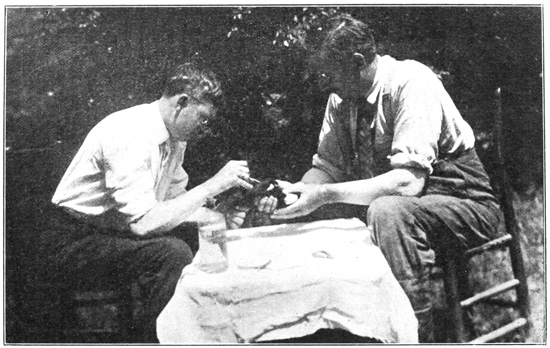
Laymon and Assistant Removing the Scent Sac.
The scent fluid which is the special secretion of these glands is
contained in two sacs located beneath the skin, one on each side of the
vent. Each sac is embedded in a powerful, gizzard-like, muscular
envelope the contraction of which discharges the scent fluid. Fig. 1 and
Fig. 2 show general location and form.
Within the rectum just beyond the sphincter muscle which ordinarily
keeps the vent closed are two papillae from which the scent is
discharged. Each papilla is connected with one of the scent sacs by a
discharge duct.
Ordinarily the discharge papillae are not visible but when the skunk
discharges the scent fluid the tail is raised and doubled close along
the back, the vent is relaxed and turned outward to such an extent that
the pappillae becomes external and from them the scent is discharged and
directed with remarkable accuracy.
The skunk takes great care not to get any of the scent on its tail or
fur and the slightly skunky odor which fur garments sometimes have is
usually the result of carelessness in killing or skinning the animal. To
kill without scent the backbone should be broken by a quick blow or the
skunk should be drowned.
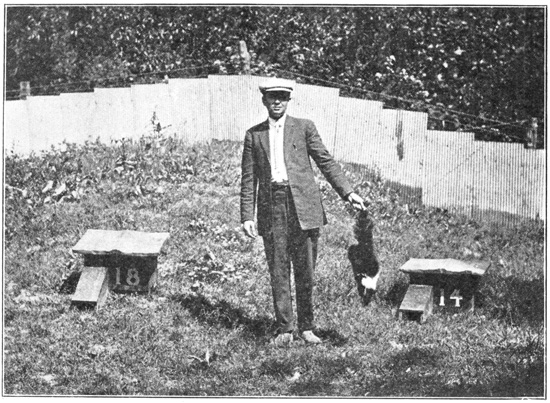
When held by the tail with head hanging down and with tail and backbone
in a straight line the skunk cannot control the muscles which evolve the
rectum and discharge the scent. Care must be taken that the skunk does
not twist or climb upward. It should be held low to keep its interest
centered on the ground which it will strive to reach.
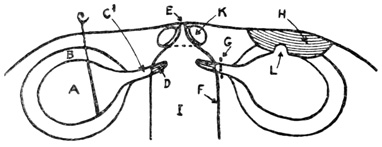
FIG. 1, X-RAY OF SCENT SYSTEM.
This operation is simple and may be readily learned by anyone who will
follow these instructions carefully. No anaesthetic is needed.
1. The beginner should dress in old clothes or overalls and as a
precaution should wear goggles to protect the eyes in case of accident.
An old hat or a paper sack worn as a cap will protect the hair. With
these safeguards the learner feels perfectly at ease and therefore the
chance of accident is much lessened while acquiring proficiency.
2. A heavy plank supported on two wooden buckets makes a good
operating table. Straddling this plank the operator and his assistant
sit facing each other.
3. The proper instruments are as follows:
- 1 nickel plated scalpel (knife).
- 1 nickel plated tenaculum (hook).
- 1 nickel plated sound probe (probe).
- 1 pair nickel plated special extracting forceps.
- 1 pair nickel plated automatic clamping forceps.
- 2 pair goggles (worn only by beginners as safeguard).
4. Several pieces of clean white cloth about three inches square
should be provided.
5. The instruments should be boiled about ten minutes in clear water
to insure cleanliness. During the operation they should be kept in a
saucer containing a five per cent solution of carbolic acid which may be
placed on a box within easy reach of the operator's right hand.
6. The operator first takes his seat and spreads a gunny-sack or
burlap across the plank just in front of him.
7. The assistant then brings the skunk carrying it by the tail with
his right hand. His left hand should grasp the nape of the neck to help
keep the head down for the back-bone and tail must at all times be kept
in a straight line.
8. The assistant now, by means of his hold on the nape of the neck
brings the skunk into a horizontal position (keeping the backbone and
tail in a straight line) and lays it belly downward on the gunny-sack
with head toward the operator.
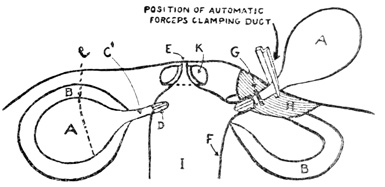
FIG. 2, SECTIONAL VIEW OF SCENT SYSTEM.
- A—Scent Sac
- B—Muscular Envelope
- C—Discharge Duct
- D—Discharge Papilla
- E—Vent
- F—Wall of Rectum
- G—Cut to Sever Duct
- H—Original Incision
- I—Rectum
- K—Sphincter Muscle Encircling Vent
- L—Scent Sac Pushing Through Incision
9. The operator wraps the gunny-sack snugly about the skunk while the
assistant releases his hold on the nape of the neck.
10. The assistant now immediately places the forefinger of his left
hand with light pressure over the vent, while the operator proceeds to
turn the skunk on its back keeping the gunny-sack wrapped firmly about
the animal.
11. Now only the tail and butt of the skunk are exposed to view. The
gunny-sack covers all four feet and head so there can be no scratching
or biting.
12. The operator brings his knees together over the plank and thereby
holds the skunk. This enables him to have both hands free.
13. The operator now relieves the assistant by placing the fore-finger
of his own left hand over the vent. With the thumb of the same hand he
locates the scent gland just to the right of the vent. The gland is
easily recognized as feeling hard and round like a marble beneath the
skin abreast of the vent, neither forward nor backward from the vent.
14. Having the thumb and fore-finger about an inch and a quarter apart
the operator now squeezes the gland tight enough to draw the skin firmly
over it. His right hand is free.
15. With a piece of cloth dipped in the carbolic solution he moistens
the fur and skin held between his thumb and finger.
16. With the scalpel, starting at least three-eights of an inch from
the vent so as not to injure the sphincter muscle which encircles the
vent, the operator makes an incision through the skin about five-eighths
of an inch long directly over the center of the scent gland and in a
straight line with the vent, as shown at H in Fig. 1.
17. The incision is now carefully deepened until the firm, gizzard-like
envelope in which the sac lies is reached. The beginner is likely to
mistake this firm, muscular envelope for the sac itself because the
envelope is lighter in color than the tissues previously cut.
18. He now proceeds more gradually to cut through the muscular
envelope as shown at H in Fig. 2, taking light strokes with the scalpel
and cutting only a slight depth each time.
19. If the muscular envelope cannot be held firmly enough by the
pressure of thumb and finger so the knife will cut well the muscle may
be hooked with the tenaculum and thus held by the assistant while the
operator cuts.
20. Soon a small white bead appears in the bottom of the incision as
shown at L in Fig. 2. There is no mistaking this as it is the white sac
itself pushing through a very small opening which has been made through
the envelope.
21. This opening is now carefully increased by turning the dull side
of the scalpel toward the protruding sac and cutting away from it, first
on one side and then on the other.
22. The sac keeps pushing outward more and more until it is about the
size of a pea. The cutting is then stopped.
23. Now by means of the extracting forceps the sac is gradually lifted
by raising it a little on one side and then on the other. The object is
to work the sac through the small opening without tearing it by too
violent a pull and without lacerating it by gripping too hard with the
forceps. The proper way is to grasp lightly and pull gently here and
there at its base.
24. When half the sac has been worked through the opening the sac
suddenly pops up out of the gizzard-like envelope.
25. The sac is now lifted carefully by the extracting forceps to see
that it is all clear and attached only by the discharge duct.
26. If any slight muscular tissue is found clinging to the sac it may
be torn away with the sound or tenaculum or carefully cut with the
scalpel.
27. The duct, which alone holds the sac, is now clamped in the
automatic forceps as near the sac as feasible as shown in Fig. 3.
28. The assistant now holds these forceps and thus supports the sac so
the operator can see the duct clearly.
29. The operator then carefully examines the duct preparatory to
cutting it. He must be very sure not to cut it too close to the rectum
or he will cut a round hole in the rectal wall because even a slight
pull on the duct draws the discharge papilla outward and brings with it
the wall of the rectum wrapped about the papilla so as to look like a
continuation of the duct. See C, Figs 1, 2, 3.
30. By feeling carefully with the sound or the dull side of the
scalpel the end of the papilla nearest the sac is readily discerned by
its firmness or hardness.
31. The duct is now severed with the scalpel at a point a little way
from the papilla as shown at G in Fig. 3.
32. The sac is now held free in the clamping forceps and not a
particle of the scent fluid has escaped.
33. The operator then proceeds in the same manner to locate and remove
the second sac.
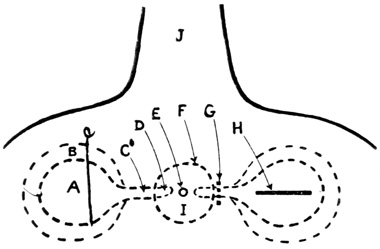
FIG. 3. SAC COMPLETELY WITHDRAWN.
- A—Scent sac
- B—Muscular Envelope
- C—Discharge Duct
- D—Discharge Papilla
- E—Vent (Rectum)
- F—Wall of Rectum
- G—Cut to Sever Duct
- H—Incision to Expose Sac
- I—Rectum
- J—Tail
34. The incisions should be wiped out with a piece of cloth with
carbolic solution and never need any further attention. In a few days
not even the scars can be found.
35. The operation is performed most easily when the animal is not too
old or fat. Any time from one-third to two-thirds growth is a good age
for this work.
36. With a little practice the complete operation of removing both
scent sacs should not take over five minutes or skunks may be handled at
rate of ten or twelve per hour.
The removing of the scent sac has increased the value of No. Four skunk.
Many are sold as pets, and others used for advertising purposes. We do
not go to the trouble of removing the sac on animals we know we are
going to kill soon. There is no danger of scenting when the skunk is
carried suspended by the tail.
Those who have failed in skunk raising were for the most part people who
knew nothing regarding the habits of the animal and its care when in
captivity. They were men with capital, who began on a large scale
expecting to make a fortune in a short time, but in this they were
mistaken, for many of them lost all that they invested. These parties
have had trouble from the older animals killing and eating the young,
also depradations of owls, but mainly from the first reason. It is our
opinion that this cannibalistic tendency is caused by improper feeding,
as those parties who have used care in that respect have had no trouble
whatever.
To those who are thinking of embarking in the business of skunk farming,
we would say—start on a small scale with only a small number of
animals, say two dozen females and six males. Give them every possible
attention and study them under all conditions. Do not expect to make a
fortune in a short time.
One of the most frequent questions that we are called upon to answer is
"Will the laws of this state allow of keeping fur-bearing animals in
captivity?" This question has caused considerable trouble, for in states
where fur-bearers are protected a part of the year, it is usually
considered unlawful to have the live animals in possession during closed
season, but not always so.
Only one state, namely New York, has laws making it a misdemeanor to
have protected fur-bearing animals in possession during closed season.
In that state it surely would be unlawful to raise skunks, for the law,
after giving the open season on these animals says: "They shall not be
possessed or killed at any other time." It is our opinion that the
fur-farmer would not get into any trouble with the law, in any state
other than New York, if he would kill the captive animals only during
the open season for the said animals, since the game laws of no other
state say that you may not have the animals in possession. Still there
are fur farms in the state of New York.
You are obliged to comply with rules and regulations of the Conservation
Commission of New York. You should write to this commission at Albany,
New York, and get their instructions and permission. Fur farming laws
and game laws covering this subject are confused and unsatisfactory. Fur
farmers are likely to find that much depends on the disposition of local
game protectors, and should get in touch with them and with the state
authorities, especially a state like New York.
We have installed what we consider a very handy system of skunk labeling
on our farm. For instance we mark the male skunk with a red mark
perpendicularly across the white markings in the head. If he is
"altered," this mark becomes a cross. With the female it is
blue mark—if "altered," the mark becomes a cross. To denote the age we
simply clip a claw each year at a certain time. The unclipped animal is
less than a year old. We seldom keep them over five years as breeders.
Usually sell the pelts during the fourth year. The system seems to work
out very satisfactory.
Take a box with a bottom the size you wish the bottom of your bale of
furs to be and turn it bottom side up on the floor near the wall. Then
spread a piece of burlap over it large enough to hang over the edges a
little all the way around. Then lay on a piece of heavy brown paper
about the size of the burlap. Then lay on your furs in a flat, square
pile, the same shape as the top of the box. It is a good plan to brush
the hair all out straight and smooth as you lay them on. Lay them on
until you have them thick enough so that when pressed down they will be
as thick as you want your bale. Then lay on another piece of paper and
burlap about the size of the ones on the bottom.
Then lay some short pieces of board crosswise under your lever. Then
nail a cleat to the wall the same distance from the floor that the top
of your bale will be when pressed. Then take a piece of good solid board
or anything handy that may be used as a lever and lay across the top of
the bale, catching one end under the cleat on the wall and pry it down
and weight it or have some one hold it for you while you fold the edges
of the paper together smoothly and the burlap in the same way, folding
the corners in neatly. Now you can sew these edges together with some
good stout cord and release your lever, tie on your shipping tags and
you will have a neat secure bundle, all ready for shipment. The bundle
may be strengthened by putting a good stout cord around it lengthwise
and crosswise twice. This makes something to get hold of when handling
it.—L. Dewey.
Skunk skins or live skunk will not be carried by parcels post. Live
skunk in the past have been transported by the express companies usually
at regular merchandise rates, and the occasional shipment of these
animals when well caged and protected did not arouse any great comment.
Owing to damage incurred, on April 1, 1913, the express companies took
concerted action and passed a joint and official amendment with the
concurrence of the Interstate Commerce Commission, reading as follows:
"SKUNKS—Refuse." This made it impossible to ship live skunks by express
after that date. There was naturally a protest to the express companies
by skunk breeders, and by those accustomed to shipping live skunks. The
express companies finally agreed, however, to accept for shipment skunks
from which the oval glands had been removed. The ruling on skunks was
therefore with the approval of the Interstate Commerce Commission
changed to read, effective May 20, 1913, as follows: "Skunks—Refuse,
unless scent sacs are removed."
All the express companies concur in this ruling, even the Canadian
Companies. This means that shipments can be made between all points in
the United States or Canada. The removal of the scent sacs is easiest at
the age of five weeks, although it can be done at any time. It does not
seem to injure the skunks in any way or to interfere with their breeding.
In shipping skunks from the United States to Canada there is no duty,
but, in shipping from Canada to the United States the duty is 20% of the
invoice price.
At the time of shipment, write a letter to the fur company, that you are
shipping to, advising them of the shipment, and telling how you are
sending the furs, and just how many and what kind of furs you are
sending. If you follow these instructions, you will seldom have any
cause for complaint.