Only one thing troubled Joe, which was that he
couldn’t have Zephaniah with him. Faculty
strongly disapproved of dogs, even very young
and very small dogs, in the dormitories. So he
made arrangements with a good-hearted stableman
to look after the puppy and himself rigged
up a home for it in an unused stall behind a litter
of brooms and old harness and buckets. Puppy
biscuit, which Merriman sternly decreed was to
be its only food, was laid in lavishly, a china drinking
bowl was supplied and Zephaniah, very unhappy
at parting from his brothers and sisters
and mother, was duly installed. The pun is not
mine, but Myron’s. Joe visited the stable at least
once a day and was to be seen stalking along the
streets accompanied by a silly, frisking little atom
at the end of a magnificent leather leash. Once
away from the busy thoroughfares, the puppy
was set free and had a glorious time. Frequently
Myron went along on these excursions and the two
boys often laughed themselves sick over the ridiculous
antics of Zephaniah Q. Dobbins. Several
times Merriman also joined them and took along
Tess and her two remaining offspring, and at
such times life was chock full of excitement and
merriment. The weather was wonderful that
autumn and those strolls about the outskirts of
the town were events that remained in Myron’s
memory long afterwards. They led to an ever-increasing
intimacy between the three boys and
Myron began to find existence at Parkinson really
enjoyable. No one could fail to like Joe Dobbins
or to admire his big-heartedness and sturdy
honesty of purpose and deed, and Myron least of
all. He saw now the kindness that had underlaid
the indignity Joe had practised on him when he
had been forcibly kept from meeting Paul
Eldredge, and was grateful. He saw many other
thoughtful and kindly acts as well. Joe’s rough
ways, or ways that had seemed rough at first, were
now only things to smile at. Myron was learning
that there were many things less to be desired in
a friend and room-mate than uncouthness. New
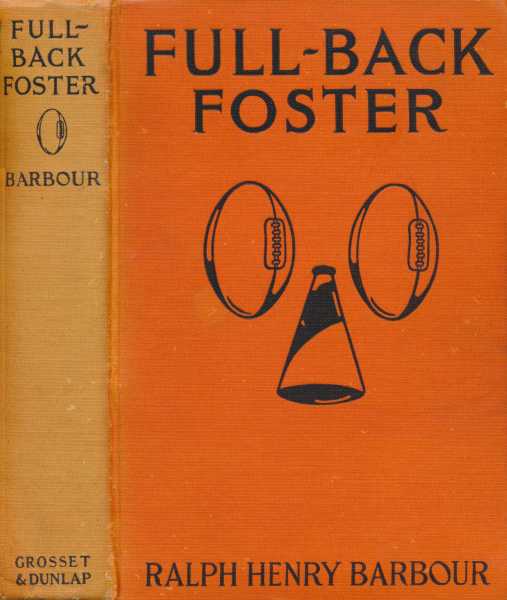
clothes, too, had made a difference in Joe. Under
Myron’s guiding hand he had purchased two plain
but well-fitting suits—as well as the extra pair of
trousers that Myron had advised and that Joe was
now so proud of—and, in a way, he was living
up to those suits. He had been good-naturedly
guyed by many of his friends and acquaintances,
of which he had dozens a week after the beginning
of school, for the change wrought in his appearance
had been well-nigh startling, but he hadn’t
minded a bit: it took more than that to upset
Joe’s equanimity. It was about the time that he
first appeared in classroom in his new clothes
that some fellow fell on the quite obvious nickname
of “Whoa,” to which Joe was already accustomed,
and from that time on he was “Whoa”
Dobbins to the whole school. Only Myron and
Andrew Merriman stuck to “Joe.”
Merriman required more knowing than Joe Dobbins.
Although Myron had liked him at first acquaintance
and grew to like him more as time
went on, he never felt that he knew him as
thoroughly as he knew the other. “Merry
Andrew” at first meeting seemed perfectly understandable.
At the second meeting you realised
that most of him was below the surface. At subsequent
meetings you despaired of ever knowing
him thoroughly. He was the happiest, cheerfulest
fellow Myron had ever encountered, and no
one would have suspected that there was such a
thing as a care in his life. And perhaps there
weren’t many, either, for a care doesn’t become
a care until you let it, and Merriman’s policy was
not to let it. Of friends, at least close friends,
beyond Joe and Andrew, Myron had none so far.
He knew various fellows, most of them football
chaps, but only casually. He didn’t make friends
easily. It is only fair to acknowledge that there
was something in Myron’s attitude, although he
didn’t realise it, that warned fellows away. Popularity
such as Joe might attain would never fall
to his share.
So a fortnight passed and Parkinson played her
second football game and began to find her stride.
Cumner High School proved less of an adversary
than expected and went down to defeat, 12 to 0.
Myron didn’t get into action: didn’t expect to,
for that matter: and neither did Joe. Joe, however,
expected to, and was a little disappointed
and decidedly restive while he and Myron watched
from the bench. Inaction didn’t suit Joe a bit.
Garrison, who had played the position last season
on the scrub eleven, stayed in at right guard until
the last quarter and then Mills, a recent discovery
of Coach Driscoll’s, was given a chance.
Mills, a big, yellow-haired infant of seventeen,
proved willing and hard-working, but he was
woefully inexperienced, and only the fact that
Cumner had already shot her bolt and was playing
a strictly defensive game kept him in until the
final whistle.
Joe’s hero on the team was Leighton Keith, who
played right tackle. Joe expatiated for whole
minutes at a time on Keith’s work and rather
bored Myron. “Honest, Joe,” he protested, “I
think he plays perfectly good ball and all that, but
I don’t see where he has anything on Mellen, or
even Flay.”
Joe shook his head. “You aren’t watching him,
Myron. You’ve got to know the position, too.
I’ve played tackle, kiddo, and I know what a guy’s
up against. I’ll tell you about Keith and Mellen.
Mellen’s a fair, average tackle, a heap better on
attack than defence, I guess, but Keith’s more
than that. He—look here, it’s like this. Know
those dollar ‘turnips’? Well, they keep right
good time, don’t they?”
“Some of them,” agreed Myron.
“Most of them, Brother. Well, Mellen’s like a
dollar watch. Looks good outside and works all
right inside. Dependable and all that. All right!
Now did you ever cast your eye over a nice
hundred and fifty dollar watch all dotted over inside
with jewels and all glisteny with little wheels
and dudads? Sure! That’s Keith. He works
just like the innards of that watch, kiddo. Every
move’s exact. He never misses a tick. He’s
smooth-running and guaranteed. He—he’s an
artist! I’d just as lief see Keith play tackle as
see old Josh Reynolds paint one of his million-dollar
portraits.”
“Reynolds is dead,” laughed Myron.
“All the more reason then,” replied Joe calmly.
“Keith isn’t!”
“All right,” said Myron, “you cheer for Keith.
To my mind the best player in that brown bunch
is Cater.”
“Yeah, he’s good, too,” owned Joe. “I call
him a nice little quarter. Nice fellow, too, Cater.
So’s Steve Kearns. Know him?”
“Playing full-back? No, only to nod to. I
don’t think he’s as good a full-back as Williams,
though.”
“Both of them will stand improving,” said Joe
drily. “Gee, I wish Driscoll would let me in on
this!”
But, as has been said, he didn’t, and when the
game was over Joe and Myron trotted back to the
gymnasium with a host of others equally unfortunate.
After showers and a return to citizen’s
clothing they took Zephaniah Q. Dobbins for a
walk. Or, it would be more exact to say, a romp.
The Latin coaching ended the last of the next
week, by which time Andrew Merriman declared
Myron up with the class. Myron wasn’t so certain
of it and would have continued the tutoring if
Andrew hadn’t refused. “You’re discharged,”
said Andrew. “You know about as much as
Old Addie himself now, and a lot more than I.
All you have got to do is study.”
“Is that all?” asked Myron ironically. “It
isn’t anything if you say it quick, is it?”
But Andrew proved right about it, and Myron
found that as much work applied to Latin as to
other studies kept him on good terms with Old
Addie.
There was one thorn in Myron’s side at this
time, and its name was Charles Cummins. Cummins
was a riddle to Myron. Ever since the time
he had spent that unpleasant half-hour in Cummins’
awkward squad the freckle-faced, shock-haired
giant had never let an opportunity pass to
accost him. There was no harm in that, of course;
the trouble was that Cummins always made himself
so disagreeable! It seemed to Myron that the
chap deliberately sought him out in order to rile
him. And it wasn’t so much what Cummins said
as the way he said it. It got so that Myron only
had to see the other approaching to feel huffy.
Long before Cummins got within speaking distance
Myron had his back up, and Cummins,
knowing it, seemed to take delight in it.
Cummins was generally known as “Chas,”
from his habit of signing himself “Chas. L. Cummins.”
He declared that Charles was far too
long to spell out. He played left guard and
played it well if erratically. In a way, he was
difficult to get along with, for he considered himself
a law unto himself, and it was no unusual
thing for him to veto a coach’s instructions, which,
up to a certain point, the coach stood for. The
others were at outs with him half the time, but
liked him through all. Oddly enough, even the
timidest youngster he ever bullied and brow-beat
in practice was strong for him afterwards. It was
no secret that he was holding his position on the
first team by little more than an eyelash, for
Brodhead was hot on his trail and Coach Driscoll
had put up with more of Cummins’ calm insurrection
than was agreeable to him. In appearance
“Chas” was a broad, heavily-built giant
with much red-brown hair that never was known
to lie straight, eyes that nearly matched the hair
and a round, freckled face that was seldom neutral.
It was either scowling savagely or grinning
broadly. For his part, Myron preferred Cummins’
scowls to his smiles, for the smiles generally
held mischief. Usually the two encountered
each other only on the playfield in the afternoon,
but one morning a few days after the Cumner
game Myron, walking back to the room after a
chemistry class, sighted Cummins coming out of
Goss Hall.
“Gee, there’s that pest!” he muttered, and,
contrary to school regulations, started on a short
cut across the grass in the hope of avoiding him.
But it was not to be. Cummins had sighted his
prey.
“O Foster!” he called.
Myron nodded and kept on.
“Tarry, I prithee! I wouldst a word with thee,
fair youth!”
“Go to thunder!” murmured Myron. But Cummins
headed him off without difficulty.
“S’pose you know,” he said, “that we can both
be shot at sunrise for walking cross-lots like this.
Where do you room?”
“Sohmer,” answered Myron briefly.
“Ho, with the swells, eh? Lead on, Reginald!
I would visit thy fair abode in yon palace!”
“Not receiving today, thanks,” said Myron.
“I’ve got some work to do.”
“Work? Didn’t suppose you silk-stocking
bunch in Sohmer ever had to work! Thought
you had slaves to do that sort of thing. How
little one half the school knows how t’other half
lives! To think of you soiling your lily-white
hands and getting calloused with labour! What
sort of work are you going to do? Clip coupons?”
“Oh, dry up!” exploded Myron. “I’m sick
to death of your chatter! And I’m sick of being
guyed all the time, too! Lay off, can’t you?”
To his surprise, “Chas” chuckled and thumped
him on the back. “A-a-ay!” he applauded.
“That’s the stuff, old chap! I was beginning to
think you didn’t have any pep in you. There’s
always hope for a fellow who can get mad!”
“That isn’t hard when you’re around,” answered
Myron, unappeased. “Don’t bang me on
the back, either. I don’t like it.”
“All right,” answered Chas, sobering. “I’ll
behave. Mind if I come up for a few minutes?”
Myron looked at him suspiciously, but for once
Cummins was neither scowling nor grinning. “I
guess not,” he answered ungraciously.
“Fine! But don’t embarrass me with your
welcome, old chap,” chuckled Chas as they
mounted the steps. “Some dive this, isn’t it?
Don’t believe I ever hoped to get in here.” Joe
was not in and when Chas had looked around the
study—a trifle disappointedly, Myron thought—and
seen the view from the window he seated himself
on the window-seat, took one knee into his
hands and viewed his host reflectively. Myron, at
the table, fussed with his books and fumed inwardly
and wished Cummins would get out. Finally
the latter said: “Foster, you and I ought
to be great pals.”
Myron looked every bit of the astonishment he
felt, and his guest chuckled again. “Because
we’re as unlike as three peas, and the only things
that can be more unlike than three peas is four
peas. You’ve got coin and I’m the poor but
proud scion of a fine old chap who made his living
laying bricks. You’re a swell and I’m a—well,
I’m not. You’re a sort of touch-me-not and I’d
make friends with any one. Probably we don’t
think alike on any two subjects under the sun.
So we ought to hit it off great. Get the idea?”
“I’m afraid I don’t,” owned the other, interested
and puzzled.
“It’s the old law of the attraction of opposites,
or whatever it’s called. Now I took a shine to you
right off”—Myron sniffed, but Chas only smiled
and went on—“Oh, I don’t always hug a chap I
take a fancy to. That’s not my way. I try ’em
out first. I tried you out, Foster, old chap.”
“Did you? Well, much obliged, but——”
“You’d rather I minded my own business, you
mean? That’s what I like about you, Foster,
that stand-offishness. I like the way you sort of
turn your nose up and look haughty. You see,
I’m not like that. If a stranger says ‘Howdy’
to me I either say ‘Glad to know you’ or I biff
him one and pass on. I couldn’t freeze him with
a glance as you can to save my precious life.”
“I didn’t know I was as bad as that,” said
Myron, a trifle uncomfortable. “I don’t think I
mean to be.”
“Course you don’t. That’s the beauty of it.
It comes natural to you, just like liking artichokes
and olives. I’ll bet you anything you were eating
olives when you were four, and I haven’t got to
really like the pesky things yet!”
“You talk a lot of nonsense,” said Myron, smiling
in spite of himself. “Just what are you getting
at?”
“Well, I’m not after a loan, anyway,” laughed
Chas. “I was telling you that I tried you out.
So I did. ‘He looks like he was a nice sort under
the shell,’ says I to me. ‘A terrapin isn’t awfully
jolly and friendly when he sticks his head out at
you and hisses, but they tell me that when you
get under the shell he’s mighty good eating.’ So,
thinks I——”
“The idea being that I’ve got to be dead to be
nice?” asked Myron drily.
“No, not a bit. The—the simile was unfortunate.
No, but I thought I’d get a peek under the
shell and see what you were really like. So I set
out to make you mad. If a fellow can’t get mad
he’s no good. Anyway, he’s no good to me. And
he’s no good for football. I was just about giving
you up, old chap. You frowned and grumbled and
sputtered once or twice and looked haughty as
anything, but you wouldn’t get your dander up.
Not until today.”
“Well,” said Myron, “now that I have got mad,
what’s the big idea?”
“Why, now we can be pals,” answered Chas
unhesitatingly. “How does that strike you?”
“Why—why, I don’t know!” Myron faltered.
“It sounds like some sort of a silly joke to me,
Cummins.”
“No joke at all.” Chas unclasped his hands
and leaned back, his big, freckled face wreathed in
smiles. “No hurry, though. Think it over. Anyway,
there’s something more important just now.
I’ve watched you on the field, Foster, ever since
they dumped you on me that day. I’ve seen you
play and I can tell you what I think of you, if
you like.”
It’s human to like flattery in moderation, and
so Myron said “Go ahead,” and prepared to look
modest.
“I think you’re rotten,” said Chas.
“Wh-what?” gasped Myron.
“Rotten, with a large capital R, Foster.”
“Thanks!”
“Don’t get huffy, old chap. I don’t say you
can’t play good football. I think you can. But
you’re not doing it now. If I didn’t think you
could play the game according to the Old Masters
I wouldn’t be talking about it to you. You play
like a fellow who doesn’t care. You don’t try hard
enough. You don’t deliver the goods. You’re
soldiering. Ever see a man laying a shingle roof?
Well, he could do the whole thing in a day, maybe,
if he worked hard. But he belongs to the union
and the union won’t let him lay more than just
so many shingles. So he has to slow down. That’s
like you. Say, what union do you belong to?”
“I guess the trouble is that I don’t belong,”
said Myron. “I’m an outsider, and so I don’t
get a chance.”
“Tell that to the Marines! Look here, old chap,
you can make a real football player of yourself
if you want to. I’ve watched you and I know.
I’ve seen what you could have done lots of times
when you didn’t do it. Now, just what is the
row?”
So Myron told him his version of it and Chas
listened silently and even sympathetically. But
at the end he shook his head. “You’re all wrong,
Foster,” he said. “I’ve been here two years now
and I know how things go. The trouble with you,
I guess, is that you came here with the idea that
folks were going to fall all over themselves to
shake hands with you and pull you into the football
team. Isn’t that pretty near so?”
It was, and Myron for the first time realised it,
but he couldn’t quite get himself to acknowledge
it to Cummins. He tried to look hurt and made no
answer.
“Sure!” said Chas. “And when the coach and
the captain didn’t give a dinner in your honour
and ask you to accept a place on the team and give
them the benefit of your advice as to running
same you got peeved. That’s just what I’d have
done if I’d been you, you see, so I know. If it was
me I’d have either gone to the coach and made a
big kick and told him how good I was or else I’d
have gone out and played so hard that they’d
have either had to take me on or chuck me to
save the lives of the others! But you, being
Haughty Harold, just froze them with a glance—which
same they didn’t happen to see—and went
your way. And it’s a rotten way, too. Because it
won’t get you anywhere. Driscoll won’t fall for
you until you show something and you won’t show
anything until Driscoll pats you on the back. Say,
I’m talking a whole lot! What time is it? And
you’ve got some digging to do! I’ll beat it. Think
over my words of wisdom, Foster, and drop
around tonight and hear more. I’ve got a plan,
old chap. I’m in 16 Goss; first floor, on the right.
Bye-bye!”
And before Myron could agree or refuse the
invitation Cummins had hurried to the door and
was clattering downstairs. Myron went to the
window and, in somewhat of a daze, watched Cummins
emerge below and disappear under the trees.
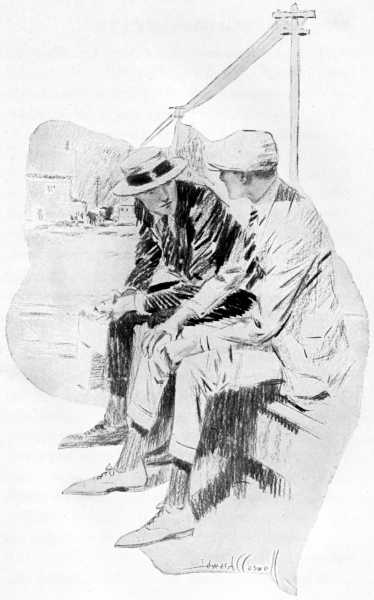
Then he sat himself down on the window-seat,
plunged both hands into trousers pockets and
frowned intently at his shoes. He didn’t get much
studying done that hour.