Rats and mice, like ourselves, often labor at
a great disadvantage while endeavoring to
make a livelihood. They often make a miss of
it altogether by not knowing the proper time to
set out upon an expedition. Their life is a perpetual
skirmish. They have to take chances
and be upon their guard continually. Their
mortal enemy and dread, the cat, may be asleep
in the fourth story, and the poor mouse knows
not of it as he looks wistfully across the intervening
300space between the ash barrel and the
basement stairs; but after weighing the chances
of escape or capture, he scurries across the
opening with as much haste as though the sharp
claws of pussy were raking the stunted fur from
his wiry tail.
The sun may pour down its genial rays and
the planks which his way lies over be warm and
inviting, but he cannot loiter to enjoy its warmth
or survey the beauties of nature. Oh! who
would be a mouse? sigh I, as I sit and ponder
over his life of inherent fear and uncertainty.
He seems to have no confidence in himself.
His actions are like those of an inferior checker
player. Shove about as he may, the chances
are he will soon regret the manœuvre, and wish
himself safely back again at the starting point.
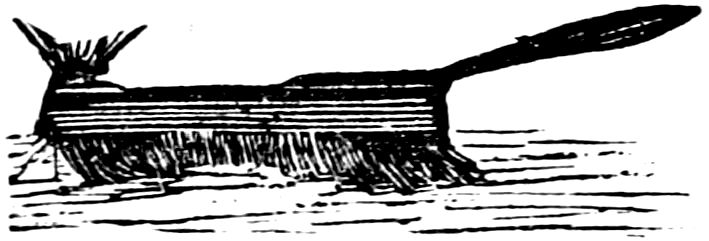
Everything about the premises seems to be
after him. He regards the old blacking-brush
that lies under the bench with looks of suspicion
for hours together, and dare not risk a scamper
past. He takes it for a
horrid cat, quietly and
patiently biding her time.
He retires into his hole and waits fully an hour
301before peeping out again; but there it sits to
blast his sight and cause a cold thrill to run
along his little spine. The fact that it does not
change its position does not in the least weaken
his mistrust; on the contrary, it rather strengthens
it. “It is so cat-like,” he says to himself,
“for it to be sitting there motionless.” In the
handle projecting from one end he very naturally
thinks he recognizes the tail, and at this
new discovery he backs into his hole again in
great trepidation.
He feels certain now that he was right in his
suspicions. Another wait follows. On again
emerging, there it lies as before; and if that
mouse was profane, and had a soul to hazard, it
would undoubtedly hazard it, and roundly berate
that brush through compressed teeth.
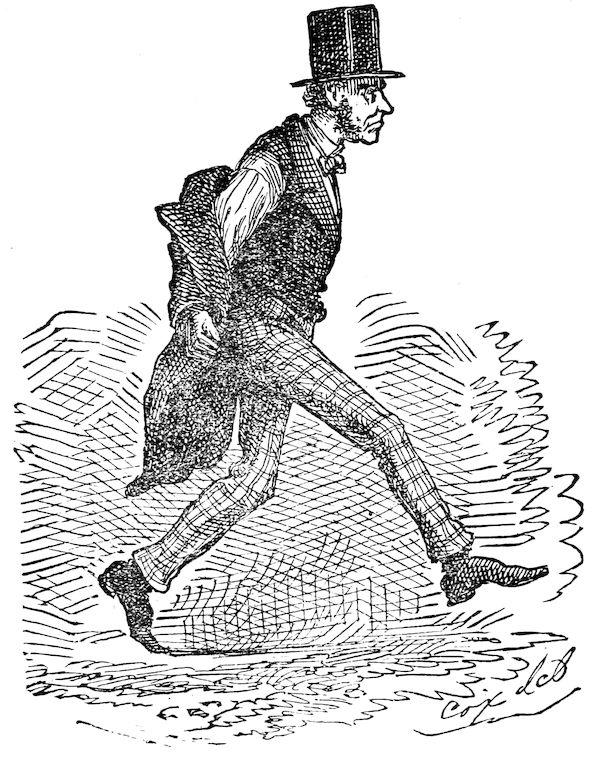
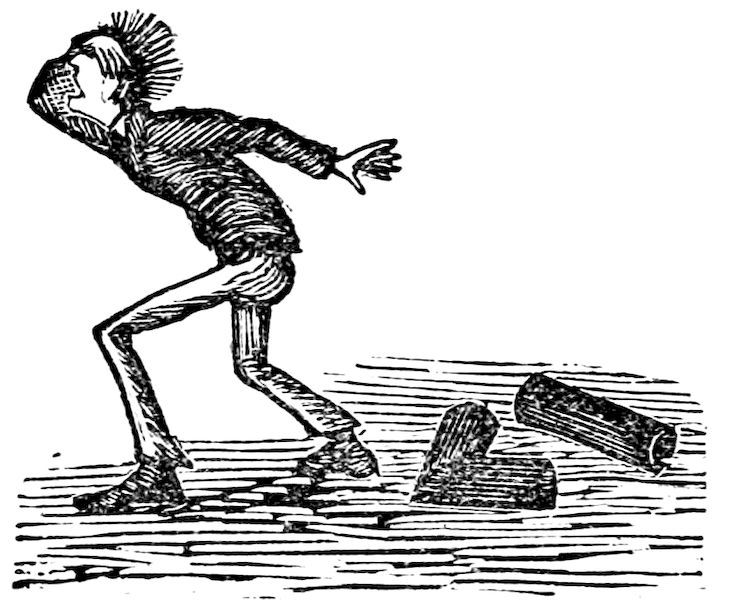
It takes but little to set a poor mouse into a
perfect fluster. Down rolls a stick of wood
from the pile, and Mr. Mouse, nibbling at the
other corner of the shed, jumps at least eight
feet in the direction of his hole. The wind
blows down the clothes-line stick, and simultaneous
with its fall upon the planks the heart,
liver and lights of the poor mouse seem to be
302running a steeple-chase to see which can jump
from his mouth first. Away he scurries across
the yard, so fast, that though your eyes were
endeavoring to keep up with him all the way,
you merely know something has been moving,
but can only surmise what.
We sometimes think the trials and disappointments
of humanity are great, but dear me!
what are they compared to the miseries of these
poor creatures. From their hardships deliver
me! For all their care and caution, they do so
often miscalculate. This is evidenced by the
number of times our old cat enters the house
with her mouth full, and her eyes sparkling with
pride.
There is nothing so very degrading or humiliating
in a cat’s life, and the thought of becoming
a cat does not make one shudder as does the
thought of becoming a mouse. A good household
cat does not occupy such a very bad position
in life after all; by good I mean an excellent
mouser, one never guilty of letting a mouse
escape after having the second wipe at him; no
scraggy creature with stove-singed back and
scolloped ears, but a well-behaved, home-loving
303animal. The lot of such a creature is preferable
to that of some men whom I have met in
life, that is, if there were no rude children in
the house. There is always some drawback; a
cat is peculiarly blessed that lives in a house
where there are no children; it seems to be
counted as one of the family almost, and its life,
though short, is certainly a happy one. But
ah! these reckless children, that snatch up
Tommy by the tail as they would a sauce-pan,
and as though the tail was actually intended for
a handle. On second thought, the life of a cat
is not so very pleasant after all.
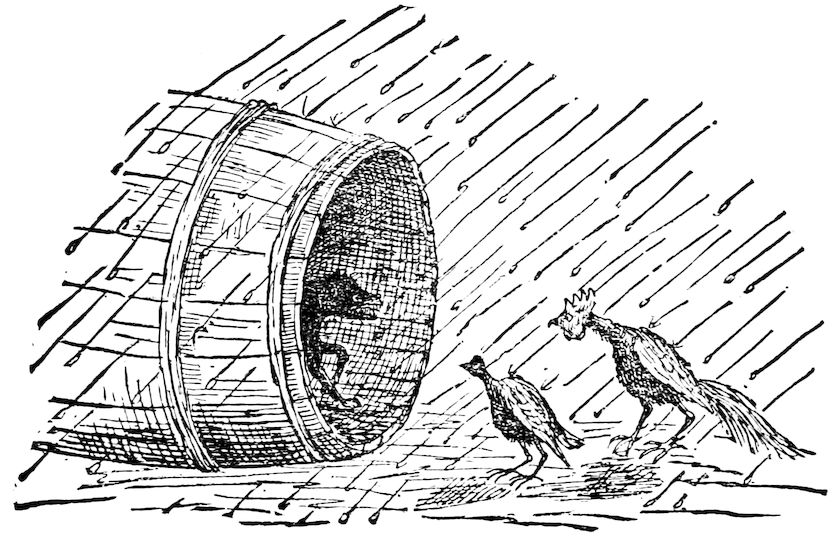
For the last half hour I have been deeply
interested in the manœuvres of a large rat in
the yard of an adjacent house. He has made
three unsuccessful attempts to go up the sink-spout.
Thrice has he glided up the slippery
incline until the tip of his long tail disappeared
from view, but as often has he beat a hasty
retreat, assisted on his downward way by a
rushing torrent of hot dish-water.
304

He is a determined fellow, however, and
sticks to an enterprise with the spirit and pertinacity
of a world-seeking Columbus, or a prison-breaking Monte Christo. No doubt the hungry
edge of appetite is whetted by the strong effluvium
arising from Limburger cheese (the people
are Germans) that fills the whole atmosphere
with an odor truly agreeable to the rodent nose,
every time the pantry door is opened. The
cheese has been lately stirred up, I presume, by
the trenchant knife of Pater-familias, and consequently
the poor hunger-pinched rat is allured
305up the spout at this inopportune hour, while the
servant girl is washing the dishes.
Every living creature has its weakness. The
horse whinnies when the oats draw nigh, and
forgets the galling collar. Sheep, that at other
times will not come within gunshot, grow tame
and unsuspicious when the salt is shaken in the
pan.
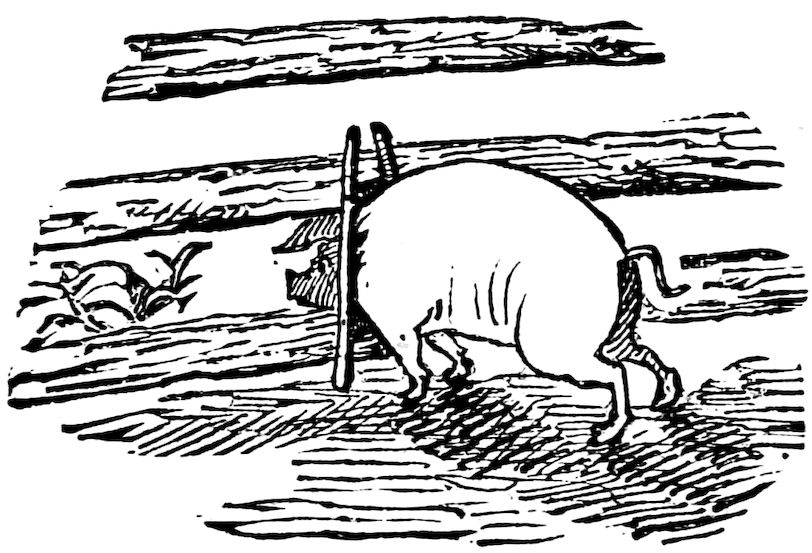
The hog has a penchant for clover-roots, or
wherefore does the rusted wire ring ornament
his nose? Is it there because it is the fashion?
Ask the farmer.
And undoubtedly cheese is the weakness of
the rat family. It is their aim, and often their
end, too. It is the shrine to bow down before
which the rat will jeopardize his life every hour
of the twenty-four.
He dreams of it. In his fitful slumbers he
beholds it ranged around him tier on tier, as in
a great store room, and not a cat within forty
leagues. He is in the rat’s Paradise, and happy.
No deceptive poisons that consume the stomach,
no insidious, subtle traps, yawning ready to
clutch the unsuspecting victim, surround him.
He is safe and at peace, and would dwell there
306forever and forever in one unbroken endless
night. But the heavy rumbling of a dray startles
him, for all sweet dreams have their wakings,
alas! that it is so! He wakes, and where is he?
Under the wet sidewalk, drenched and tousled
with the drippings of the day’s rain, with nothing
for breakfast but a dry onion peel, the prog of
the previous night, which nothing but a forty-eight
hours’ fast could induce him to seize. Ah,
me! what chances the fellow has to take in order
to secure sufficient sustenance to keep life and
body together.
“Honor pricks me on,” soliloquized old Sir
John, on the field of Shrewsbury, when he withdrew
from the general clash and rendering up
of souls, to breathe a spell, and moralize upon
the insignificance of Fame, or Honor, as against
the value of life. But nothing pricks on the poor
rat but his craving little digestive organs. The
mill is crying out for grists, the hopper is empty,
the stone still turning, and something must be
done, and that quickly.
No honor is attached to the expedition, and
even though he should succeed in making the
“inning,” which is doubtful, all that can be said
307is that he has “gone up the spout,” and in the
common acceptation of the saying, that is certainly
nothing to be very highly elated over.
I actually feel ashamed when I think of the
many projects I have abandoned through life,
because I met with slight reverses. Here before
me is this poor water-soaked rat, his hair still
smoking from his recent scald, emerging once
more from behind the wood box, determined to
solve the problem of the sink-spout or perish in
the attempt. A grim smile of resolution seems
to part his pointed features, as he moves quietly
up to the dripping conduit from which he lately
scampered with steaming ribs.
They may talk of deeds of noble daring, of
vaulting the breach, or traversing the wild; but
for sterling courage, for indomitable perseverance
and pluck, commend me to this little
adventurer in my neighbor’s yard. In the face
of three scalding inundations, he ventures again
upon the expedition, unshaken, unsubdued, unterrified.
He takes more chances and subjects
himself to more risks in ascending that spout
than old Samuel de Champlain in exploring up
the St. Lawrence among the Iroquois.
308What if the large flea-pasturing dog lying
indolently in the yard would rouse from the
lethargic sleep that holds him, and for once
make himself useful by thrusting his bristling
muzzle up the orifice after the little explorer,
thereby cutting off retreat in the event of another
disastrous deluge? The terrible result of such
an action on the part of the dog is too painful
and improbable to contemplate.
309
JIM DUDLEY’S SERMON.
313
Hereafter I shall have no faith in reports.
Last week I heard that Jim Dudley had
left the city, and was congratulating myself on
at last escaping him. But my congratulations
were premature. Last night he called upon
me, and kept me in torture for fully two hours;
at a time, too, when I should have been asleep.
But what cared he for that? The scoundrel!
there was no shaking him off. He sticks to a
person like mortar to a brick. I had to sit and
listen, though I do honestly believe every word
the fellow uttered was an unqualified lie; but
he swears to its truth, and how can I prove it
otherwise. It is better to take it as it comes
and ask no questions for conscience’ sake.
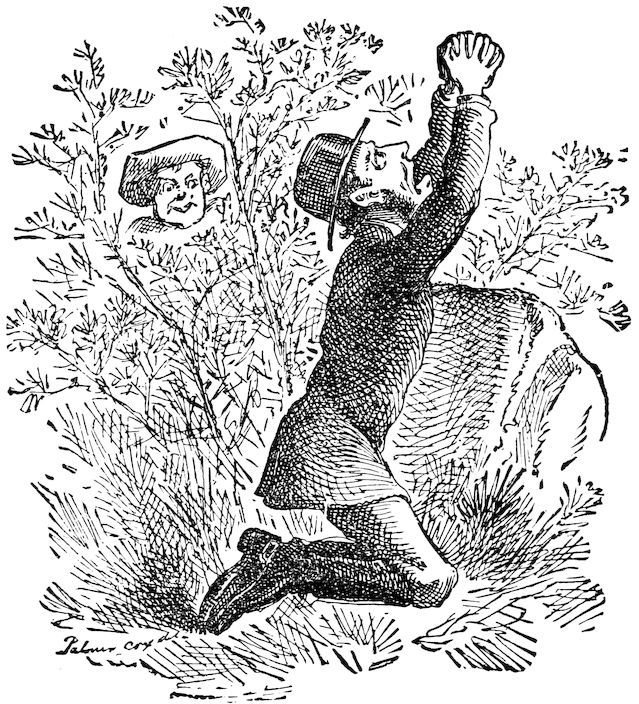
“I never told you about the sermon I preached
over in Misertown one Sunday. I had a time
of it thar and no mistake. Hold on a minute
and I’ll tell you how it was.
314“You see, Gil Bizby—that plaguey shirk, I
never mention his name but what I feel like
trouncin’ of him—but he was a genius though
and no foolin’ about it, a natural born inventor,
chock full of notions as a toy shop.
“But somehow or another he never could
bring anythin’ to a payin’ focus. Allers whittlin’
and borin’ and plannin’ around though.
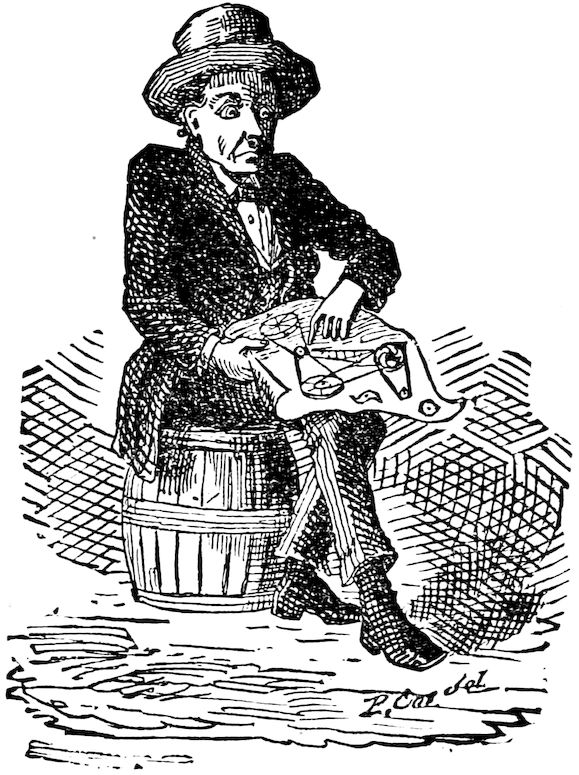
Wherever you’d meet him he’d be haulin’ out
of his pocket some old drawin’, with more
wheels and contrivances pictured out on it than
315you could think of in a twelve hours’ dream.
He never could git the cap sheaf onto his
endeavor though. Allers somethin’ amiss; a
wheel too many, or another one wantin’, or too
many cogs to have the thing work just right.
“He invented a contrivance for pluckin’
chickens.
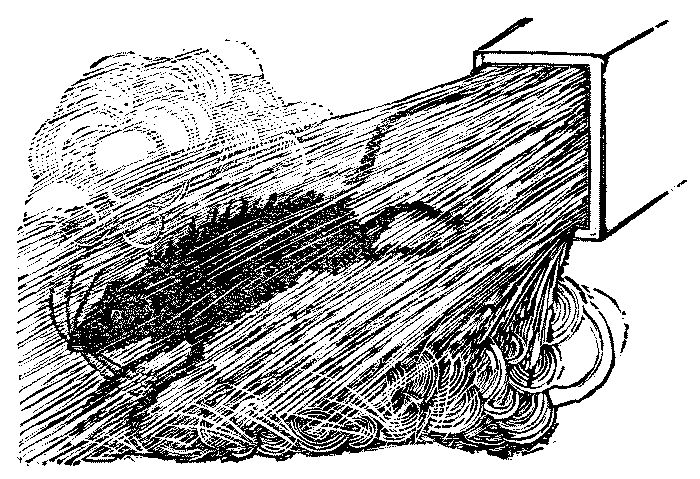
“That was a rustler. He shoved the fowls
through a machine somethin’ like a corn sheller,
an gin ’em an electric shock while passin’
along, and shot ’em out of a spout at t’other
end of the machine as bare as weavers’ shuttles.
He didn’t make anythin’ out of it though.
He had to chuck ’em through while alive, you
see, and that clashed with the law. When he
took the machine down to the city to introduce
it to the pultry dealers, the society fellers who
look out for the interests of dumb critters got
arter him and sewed him up. They put a reef
in his jib pooty quick now, I tell you.
“They were passin’ along through the market
one day, and they saw Gil just a humpin’
himself showin’ off the apparatus to the market
men. He was crankin’ and pumpin’ away, like
a sailor when there’s fifteen feet of water in the
316hold and still rizin, and the chickens were a
screamin’ and a scootin’ through the contrivance,
close as if they were run on a string
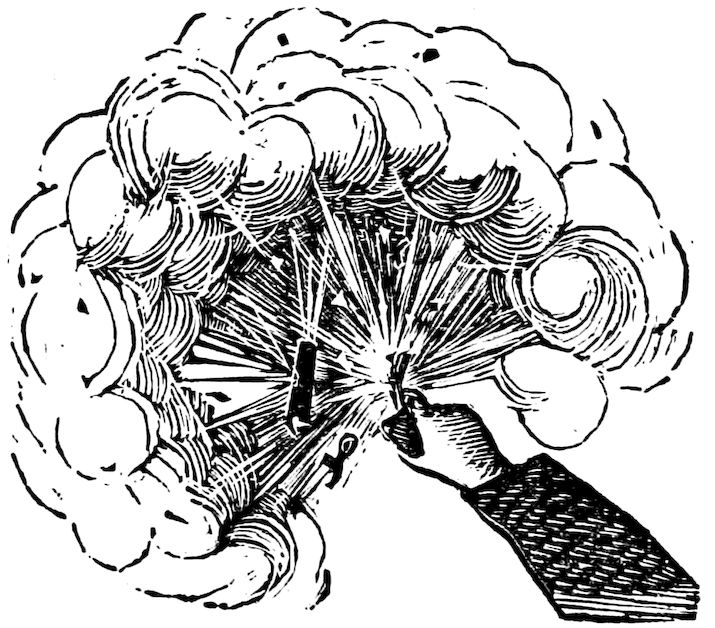
head ag’inst tail, and just a cloud of feathers
hoverin’ around over it. Didn’t they fasten on
to that Gil Bizby though? They snatched him
up quicker than if he had been hoss-stealin’,
and confiscated his plucker, and tucked an
alfired heavy fine onto him besides.
“Meetin’ with such poor encouragement in
that direction he went back to Sculleyville, and
set out to invent a thunderin’ great machine for
layin’ cobble-stones. That was just him all
over; allers startin’ in to git up some outlandish
lookin’ thing. This machine was a crusher and
no gettin’ ‘round it. It was fearful enough to
make a cow slip her cud, I’ll be shot if it wasn’t.
It looked somethin’ like Noah’s ark set on
wheels and filled with all kinds of machinery.
“He started in to experiment one moonlight
night in front of the court house, but got the
main belt crossed or somethin’, I disremember
just what, and Jerusalem! in less than ten
minutes he ran the whole population out to the
foot-hills in thar night clothes. There wasn’t
317no stoppin’ the consarned thing. Poor Gil was
knocked senseless at the first revolution, and
nobody else knowed how to control it. It rolled
the whole length of the square, tearin’ up the
stones it had pounded down the day before and
sendin’ of ’em buzzin’ over the village in all
directions.
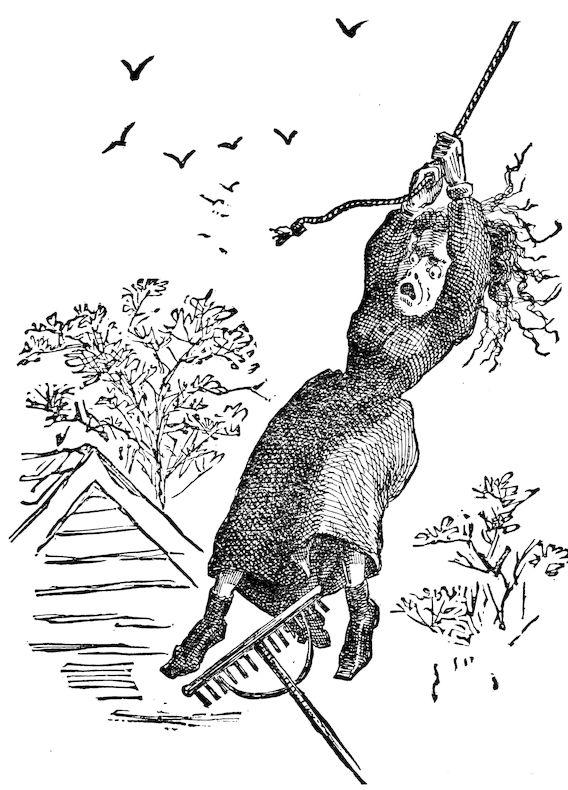
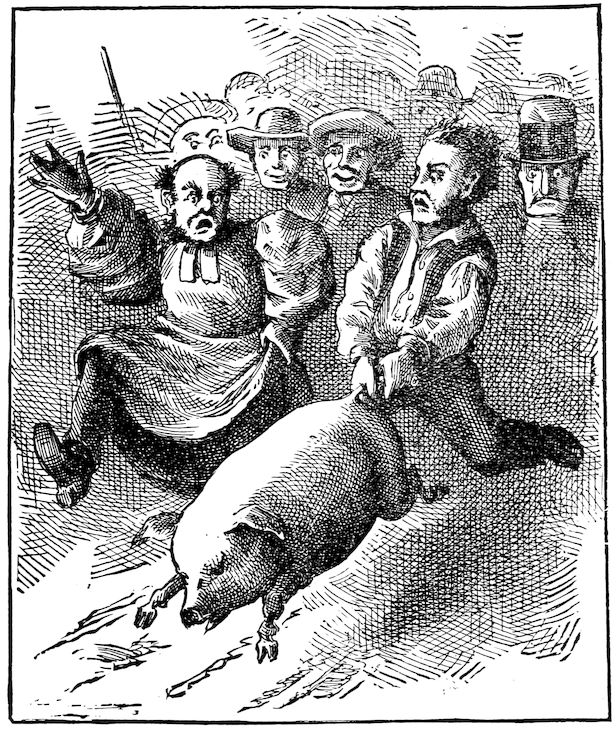
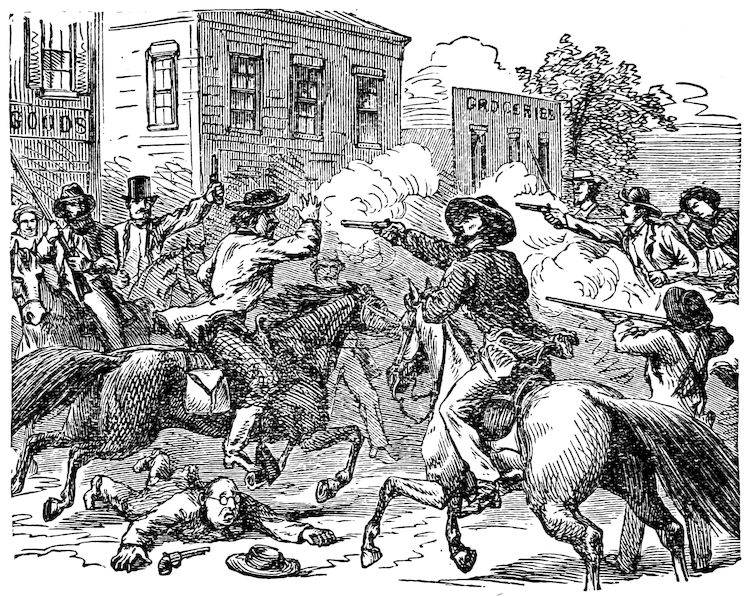
“No home was sacred, and no head was safe,
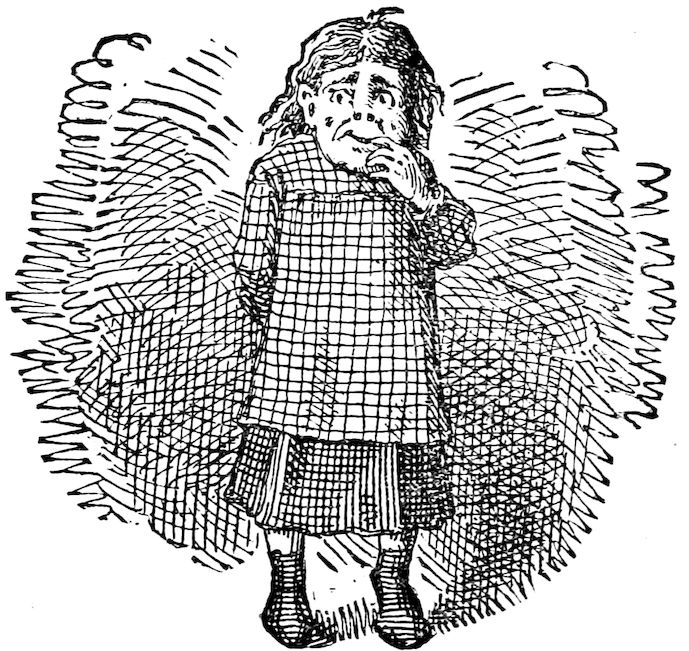
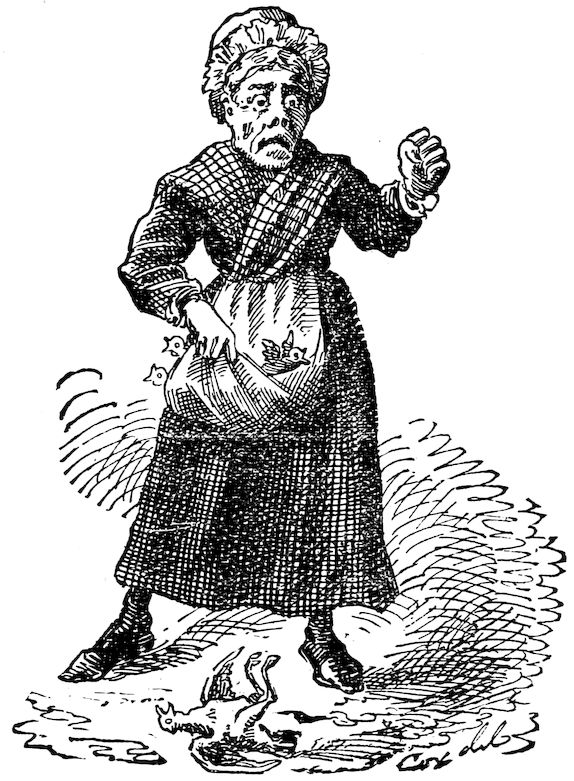
as the poet has it. Poor old Mrs. Scooley lived
just long enough to learn this, and no longer.
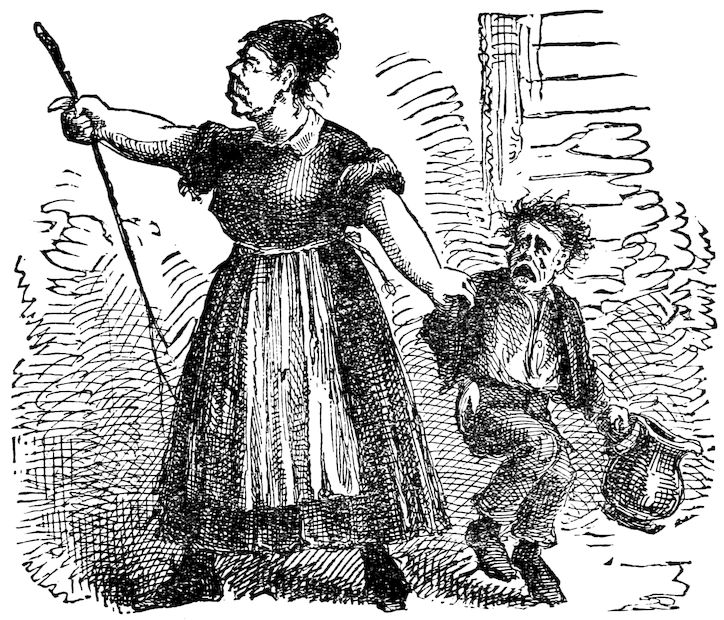
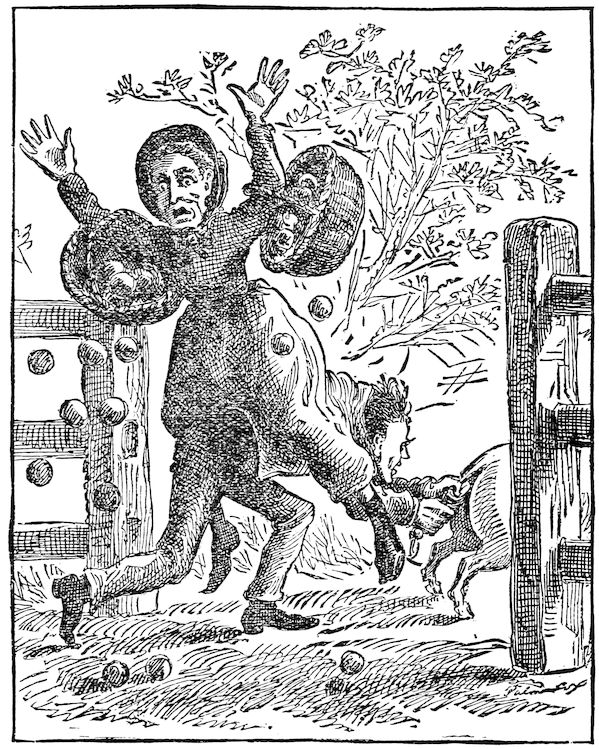
She was goin’ once too often to git her pitcher
filled at the corner grocery that night, and a
stone took her in the small of the back as she
was enterin’ the door, and it h’isted her clear
over the counter on top of a barrel; it’s true
as I’m tellin’ it to you. Poor old body; she
was the pioneer female of the village too. The
first woman to wash a shirt in Sculleyville.
But arter all, the town wasn’t much loser by
her passin’ away.
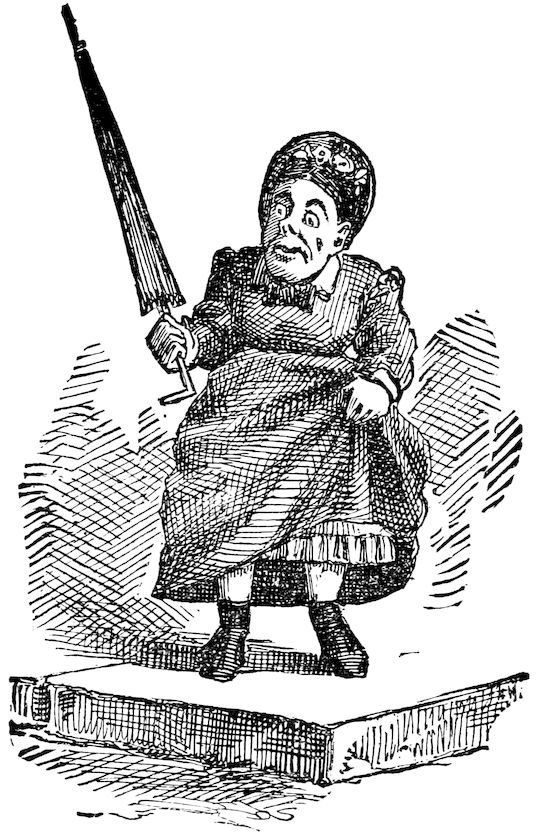
“She was a sort of panicky old critter anyhow,
always scary about catchin’ the smallpox
or any other prevailin’ disease that come around.
The old village physician said he would ruther
318see the very old scratch makin’ towards him on
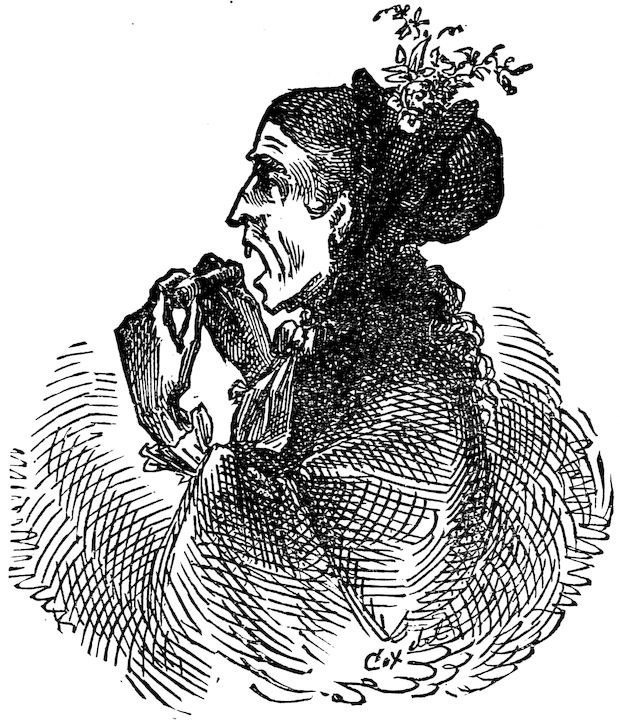
the street than old Mrs. Scooley.
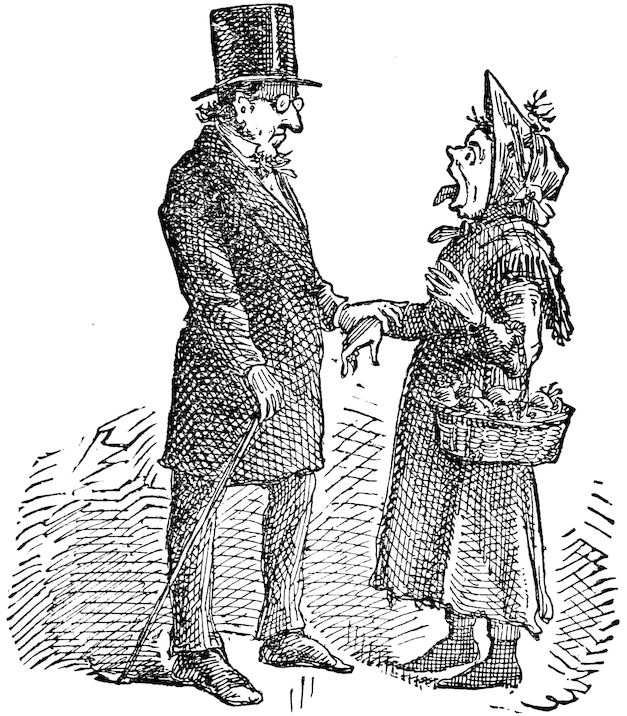
“Comin’ from church or market, as the case
might be, she would fasten on to him like a
wood-tick to a leaf, and he couldn’t git rid of
her nohow. She would have him time her pulse
right thar on the sidewalk; and be a shovin’ of
319her tongue out for his inspection. And she
did have such an unlimited, wallopin’ great
tongue too; it seemed when she was shovin’ all
of it out, as though she was actewelly disgorgin’
her liver. It’s so, by Jingo! People would be
a stoppin’ and standin’ thar, wonderin’ what
was the matter with the old gal—that is, people
that didn’t know her peculiarities; though most
everybody in the village had seen her standin’
in that position so often, that they would be
more surprised to see her with her tongue in
her mouth than projectin’ out in the rain.
“The old Doctor used to be terribly annoyed.
He would say, kind of hurriedly like, because
he would be itchin’ to git away from her:
“‘Oh! you’re all right I reckon, Mrs.
Scooley; but you had better be a gittin’ along
home, and not stand too long in the cold air,
with so much of your vital organs exposed to
the weather; the result may be fearful if not
fatal!’
“That would ginnerally start her off pooty
lively towards her shanty. They say the first
time the Doctor saw her tongue he was surprised
so much that he looked actewelly
320skeered. Says he: ‘I’ve been nigh unto eight
and thirty years a practicin’ physician, and until
this moment I flattered myself that I was
familiar with all the ins and outs of the profession.
But I begin to think I gin over the
dissectin’ knife too soon, for here’s somethin’
that I was not prepared for.’
“But that’s not tellin’ you about the sermon,
is it? but when I mentioned that Gil Bizby, I
sort of wandered off arter him and his contrivances.
Wal, as I was about to tell you, Gil
and I were saunterin’ around Misertown one
Sunday, and we saw any number of gals goin’
into the school-house where the preachin’ was
carried on. So we concluded to step in and
git a better look at some of ’em. I didn’t
know many of the people round thar, but from
what I heard I judged they were the meanest,
close-fistedest set of sinners that ever had the
gospel dispensed with amongst ’em.
“I understood they had treated their minister
plaguey mean when he fust come thar to look
arter them. Thar was no regular place for
him to stop, you see, and they agreed amongst
themselves to take turns a keepin’ him until
321they could get a house up for him. He was
one of those young, easy, green kind of fellers
that had seemin’ly never been so far away from
home before but what he could see the smoke
of his father’s chimney, or smell his mother’s
corn-dodgers burnin’. And they soon took
advantage of it, and sort of played button with
him, shovin’ him around from one to another as
though he was too hot to hold.
“He fust went to a feller by the name of
Wigglewort. Ses Wig, ‘I’m really very sorry,
Mr. Sermonslice, but we unfortunately have no
accommodations for you at present. We have
no place for you to sleep ’thout we put you in the
barn, and the nights are ruther cold for that,
besides the rats might annoy you. Sorry you
happened to come just at this time, of all others
the most embarrassin’. It’s not but what I
would like to have you stop with us; I would
indeed, Mr. Sermonslice, consider it an honor
to have you.’
“The minister, takin’ his books under his
arm, started out into the night as though his
life depended upon the most prompt kind of
action. He wasn’t within hailin’ inside of two
322minutes. He went over and succeeded in
gettin’ lodgin’s with a feller named Joe Grimsby,
who lived over by Frog Marsh.
“Joe was too derned lazy to do his own
prayin’, and while the parson stopped with him
he got rid of it. They do say he was the laziest
old curmudgeon that ever turned up his
eyes. He used to say a praar at the beginnin’
of the month, and on the followin’ nights he
would always allude to it in a sort of matter-offact
323way. ‘You know my feelin’s towards ye.
Nothin’ hid from ye I reckon. I haven’t changed
my sentiments yet. If I do I’ll let ye know of
it. I’ll keep nothin’ back from you, though it
should take the har off.’ He would go on in
that business-like way, and the hul time be
a crawlin’ into bed.
“Wal, as I was goin’ to tell you, Gil and I
poked into the buildin’, and sat down thar
amongst the congregation.
“The minister hadn’t come yet, and pooty
soon an old feller got up, and ses he, ‘It may
be the minister has had a late breakfast and
will not git here for some time yet. In the
meantime, as it’s a dry season and our crops
need a shower of rain, we mout as well have a
little prayin’ goin’ on. We can’t do much harm
anyhow, and we may be the means of bringin’
down a good smart shower that will be money
in our pockets in the long run.’
“He asked several to take hold and do somethin’
in that way, but one had a cold, and
another one was just gettin’ over the mumps.
And so on they went makin’ excuses. Finally
the old feller turned to me, and ses he: ‘Perhaps
324you would lead us, you look like one who
has had some experience that way.’
“I thanked him for the compliment, but told
him I was somethin’ like the officers in the army—I
would ruther foller than lead. But he stuck
to me like a Jew to a customer. Arter a while
I consented, and jest as I was about startin’ in,
a feller come in and said the minister had got a
terrible ticklin’ in his throat caused by partly
swallowin’ a har in the butter over to old Joe
Grimsby’s, and couldn’t attend to his duties that
day. So the old chap got up ag’in, and ses:—
“‘We won’t have any preachin’ then, without
some person present will volunteer to act in
our pastor’s place this mornin’.’ But no one
spoke up. ‘Perhaps,’ he ses, turnin’ to me,
‘you would favor us by conductin’ the service,
young man. You doubtless are competent to
perform that duty.’
“This sort of got me. Then the thought
struck me perhaps I’d make somethin’ out of
’em by it. Besides didn’t want to plead ignorance
right thar amongst ’em, so gettin’ up, I
ses: ‘This is somewhat unexpected. Honors
foller one another pooty fast.’ With that I got
325into the pulpit and began to look down at ’em
pooty seriously. Thar was no Bible on the
desk, so I asked if thar was any person that
would loan me one for the occasion.
“Some of ’em spoke up and said they had
books, but were in the habit of keepin’ em to
foller along arter the minister, and correct him
when he made a mistake. Besides they liked
to see how he worked out the text. I looked
at ’em some time pooty hard. I thought they
beat anythin’ I had come across for some time,
and I had a good mind to git down ag’in, only
I allowed they’d laugh at me. So I ses, ‘all
right. You can keep your books. I reckon I
know enough by heart to git along with.’ I then
gin out somethin’ for them to sing.
“‘Short or long meter?’ inquired the leader
of the singers, who were settin’ over in the
corner. I didn’t exactly understand him. As I
knowed he was in the habit of meetin’ Sal Clippercut
over to Mrs. Curry’s every Sunday
afternoon, I allowed he was askin’ for somethin’
shorter, as he was longin’ to meet her. I spoke
up pooty sharp, and ses, ‘You will please sing
what I gin you to sing. I reckon you aren’t
326longin’ to meet her so bad but what you can
wait until arter the service is over. She’ll keep
that long, I reckon, without spilin’. I know her.
She isn’t none of your Spring chickens nuther,’
I contin’ed, just like that, and you ought to have
seen the way he looked; and the gals commenced
to snicker and crowd thar handkerchiefs
into thar mouths.
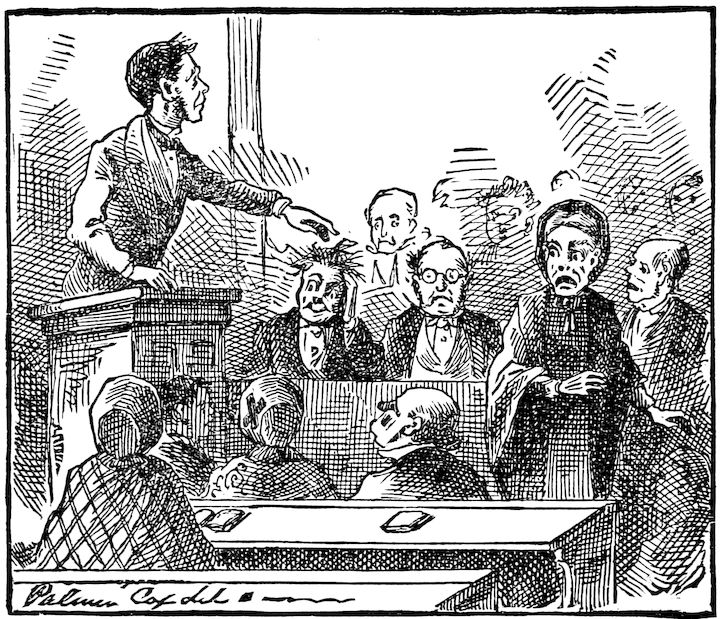
“One little red-faced critter that sat alongside
of him tittered right out. Her mother who was
sittin’ near by jumped up and ses: ‘Becky Jane,
you go right straight hum this minute, and go
to peelin’ the ‘taters for dinner.’ But a feller
who looked as though his mother had been a
mullator, or even somethin’ of a darker shade,
got up and ses:
“‘The gal isn’t to blame in the least. It’s
that feller in the pulpit thar. I for one don’t
want to hear any more of his lingo.’
“‘Wal, then, you can stuff wool in your ears,’
I ses, ‘and you won’t have far to go to get it
nuther,’ I contin’ed, just that way, alludin’ to his
own har, which seemed pooty woolly.
“You ought to see how they looked, fust at
him, then at me. He colored up, I reckon, but
327he was too black to show it. I heard him grit
his teeth from whar I was standin’. He didn’t
say any more, but an old woman who was settin’
near jumped up, and ses she:
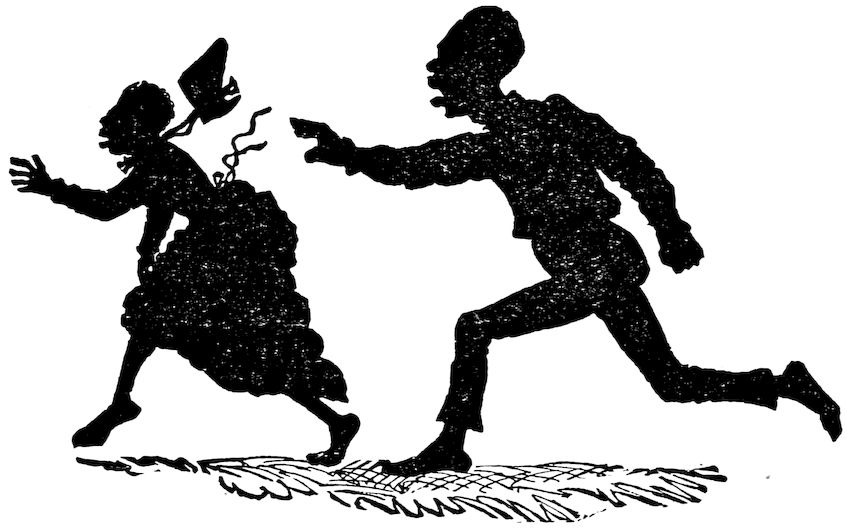
“‘The meetin’-house is turned into a thayeter!
When a muntybank gets into the pulpit
it is high time for respectable people to be
movin’. I’ll leave!’ she exclaimed, pullin’ her
shawl around her shoulders and beginnin’ to
bustle out of her seat.
“‘Wal, ye kin go!’ I hollered, jest that way,
for I was beginnin’ to git sort of riled at the
way things war a goin’. When I’m talkin’ politics
or arguin’ over the merits of whisky, I can
bear crossin’ and any amount of contradiction.
But right thar, where a feller had to be choice
of his language, it was different business. ‘Ye
kin go,’ I ses. ‘We kin git along without you,
I reckon. We’re willin’ to chance it, anyhow.
Take your knittin’ along; don’t leave that behind,’
I contin’ed, pointin’ to the seat as though
I saw it lyin’ thar. I didn’t though, but I wanted
to give her a mi’ty hard rub, for I suspected her
piety was put on, and that she was displeased
because nobody was noticin’ her new bonnet.
328“The hul congregation took it for granted
that the knittin’ was thar, and you ought to
have seen ’em stretchin’ and cranin’ out thar
necks as far as they could to get a look into
the pew.
One old feller that was settin’ back pooty
far, craned out kind of quarterin’ ruther suddenly
and his neck gin a crack like a bon bon.
He commenced oh! ohin’ and tryin’ to git it
back to its old position ag’in, but he couldn’t
329make any headway until his wife went to rubbin’
and chafin’ of it, right thar.
“But that old woman, whew! She was as
mad as a wet hen. She couldn’t hardly find
the door, she was so mixed up. When she
finally got thar she turned round and straightenin’
of herself up she ses, ‘Young man!’—Before
she got any further I broke in on her,
for I judged she had a tongue that was hung in
the middle. So I ses, ‘That’ll do, that’ll do,
Mrs. You kin move along. You’re disturbin’
the peace of the congregation, and besides
all that you’re showin’ your false teeth mi’ty bad
in the bargain.’
“She got out arter that pooty lively, now I
can tell you. I could see her as she went up
the road towards her home, and two or three
times she stopped and turnin’ around acted as
though she had half a mind to come back and
try the hul thing over ag’in. But arter standin’
thar a while thinkin’ like a pig when it’s listenin’
to the grass takin’ root, she would shake her
head and move along up the turnpike as though
she concluded she had enough of that kind of
pie.
330“This piece of performance sort of throwed
me off the track. While I was standin’ thar
thinkin’ where to start in with the discourse, Gil
Bizby come a crawfishin’ up the steps to one
side of me and whisperin’ ses, ‘I say, Jim, you
haven’t got to chock blocks already, have ye?’
“‘No,’ I answered, ‘I ain’t got to chock
blocks, but I’ve got the ropes twisted around
and things look ginnerally mixed jist now, I can
tell ye.’
“‘Wall, start in on the sermon at once then,’
he urged, ‘for they are gettin’ mi’ty impatient
now I can tell you. You’ve got to be doin’
somethin’ pooty quick. But whatever you do,’
he contin’ed, ‘don’t git up very high without
havin’ some idea how you are goin’ to git down
ag’in. Keep steerin’ around waters that you’ve
piloted over before. Remember a blind mouse
shouldn’t venture very far from its hole, especially
if thar’s a whole generation of cats
watchin’ of it.’
“With that he backed down to his seat ag’in,
and took out his pencil and began to design a
machine for pickin’ the bones out of fish, on
the fly-leaf of a book that was lyin’ thar. So
331I started in on the sermon. It wasn’t much of
a sermon, to be sure. It was more like a
lectur’. I couldn’t think of any passages of
scriptur’ just then, so I gin ’em the line from
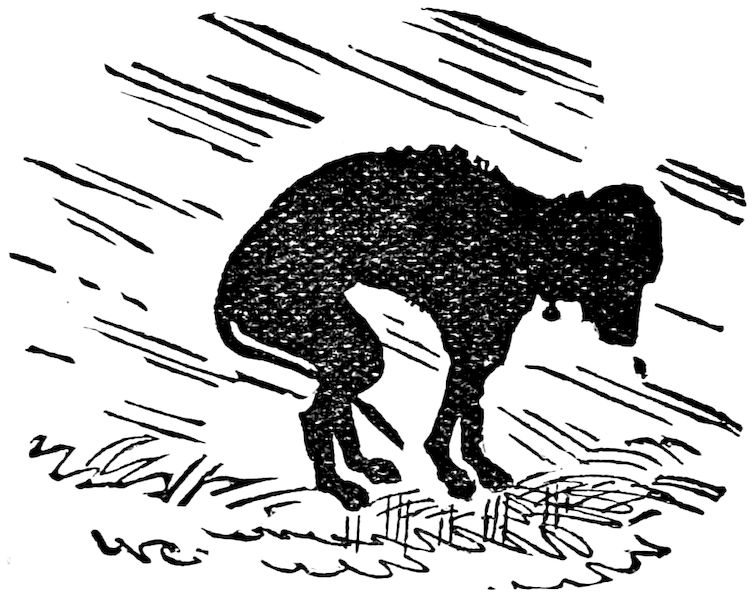
the philosopher, ‘Why does the frightened dog
depress his tail when he runneth?’
“You ought to have seen ’em rustlin’ and
turnin’ the leaves, huntin’ to find the passage.
One old feller by the name of Spudd commenced
to paw over the pages, and his wife ses,
‘Don’t go that way; turn back to the Book of
Job.’ He looked round at her with his under
lip stickin’ out jest that way, arter wettin’ of his
thumb to start turnin’ over ag’in, and ses, ‘Job
332be biled and buttered! I kin pick old Solomon
from amongst a thousand of ’em. He was
sound on the goose, he was.’
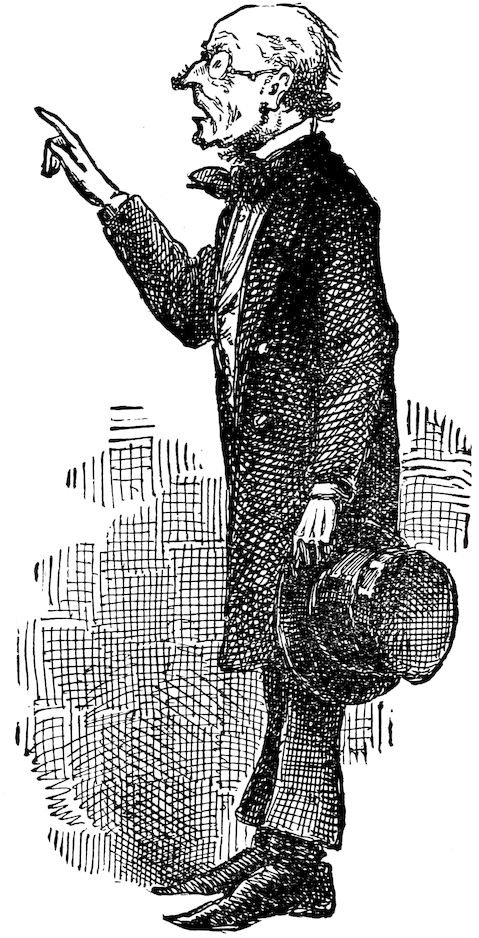
333“Two or three of ’em started in to ask me
where the text was located, but I kept on talkin’
right straight along, lookin’ around to all of
’em at once and no one in particular. I didn’t
gin ’em a chance to stop me ag’in, or git a
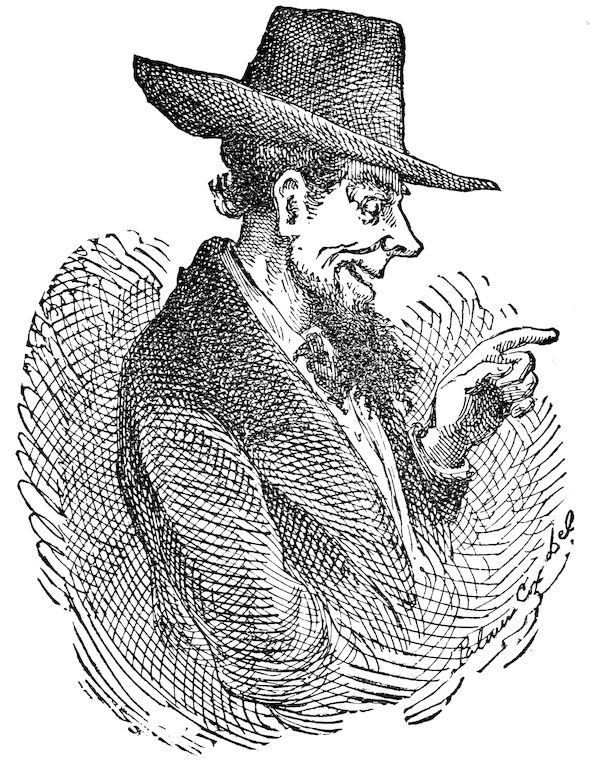
word in edgeways. One singular-lookin’ old
coon with a weed on his hat got up and stood
signalin’ of me, and waitin’ and watchin’ for a
chance to ask me somethin’. But I never let
on to see him. I reckon he stood thar five
minutes with his finger up pointin’ to attract
my attention, and his mouth open so wide, that
from my elevated position I could tell what he
had swallowed for breakfast.
“I gin ’em a sort of ramblin’ discourse,
alludin’ to the prevailin’ passions, and errors of
the age. Amongst other things I touched on
jealousy a little,—I wanted to stir ’em up a
trifle on that subject, because there was a great
deal of jealousy in that neighborhood. The
green-eyed monster was a-rantin’ and a-ravin’
round in a good many households, and as it
ginnerally turns out, there was least cause for it
where it was most prevailin’. One old feller
was moved by the first remark. When I said—quotin’
334from the poet—‘Jealousy in the wife
is wuss than trichina in the pork,’ he leaned
over to the man settin’ in the next pew and ses,
‘I can’t tell you for the life of me whar he gits
the passage, but it’s the solid truth, anyhow.’
“So I went on and finished the sermon, or
lectur’ ruther, and then I ses, ‘The choir will
please sing the hymn beginnin’ “Give, give,
give to the needy,” arter which I will pass
around amongst the congregation and take up
a collection for the benefit of the heathen in
furrin parts.’
“Je-whitteker! You ought to have seen ’em
turn around and look at each other when I said
that. I can’t describe it to you. I can’t do the
scene justiss. If I had told ’em I was goin’ to
stay with them through the season, I could
hardly have started ’em to thinkin’ any more
than I did by tellin’ ’em about that collection
for the heathen in furrin parts.
“Arter two or three attempts the singin’
began. I closed my eyes, and leanin’ back in
my chair minister-like, commenced to estimate
the probable yield of each pew. While I was
thinkin’ thar, and cal’latin’ how much I would
335make by the preachin’ business, I noticed the
singin’ dyin’ out, and a dyin’ out slowly like, as
the prisoner said his hopes were when the
sheriff was a-fumblin’ around his neck adjustin’
the rope. So I opened my eyes easy like, as
though comin’ back to earthly scenes reluctantly,
and you can water my whiskey if I wasn’t just
in time to see ole Ned Scullet’s coat-tails
whiskin’ around the door jamb, the hindmost
rag of the congregation. Women and children
and all were gone sure enough. On lookin’
out of the winder I see ’em a-scatterin’ and a-hustlin’
and elbowin’ themselves ahead of each
other along the turnpike, as though thar was
great danger in bein’ left behind.
“Would you believe it, thar was that plaguey
shirk Gil Bizby a-cranin’ up the hill a-leadin’
the crowd. I sat thar a while lookin’ after ’em
and then, comin’ down I began to look around
a little, and pooty soon I noticed that several
of ’em left thar hats, they were in such a hurry
to git out. So I selected a good one, only ’twas
a little out of fashion, and puttin’ it on I ses to
myself, ‘If you think I’m interested enough in
your welfare here or hereafter to preach to you
336for nothin’, you’re mistaken, I reckon.’ With that
I walked out, but not until I had kicked the
remainin’ hats around the room pooty lively.
“The next day I noticed an old feller with a
dilapidated beaver on, that looked as if it had
done duty on a scarecrow for several seasons,
sidlin’ up to me, and circlin’ around two or
three times lookin’ mi’ty close at my tile. I’ll
allers think it was his stove-pipe, but he was
too much ashamed to come right out and lay
claim to it.
“But that Gil Bizby! I didn’t wonder so much
at the congregation dustin’, arter all, cause they
didn’t know me, but he!—well, no matter, I’ll
git even on him yet.”
SEEKING FOR A WIFE.
340
And it came to pass about the year one thousand
eight hundred and seventy-three,
being in the autumn, when the new wine was
oozing from the press, and the corn was hardening
in the crib, a bachelor, a farmer of great
possessions, dwelling in the valley of Berryessa,
bent above his resting plow, and thus
communed with himself:—
“My stacks are builded, my wine is dripping
from the press, the ripe ears are garnered in
my cribs, my flocks and herds feed fat upon the
hills; and yet, because of my loneliness, am I
unhappy.
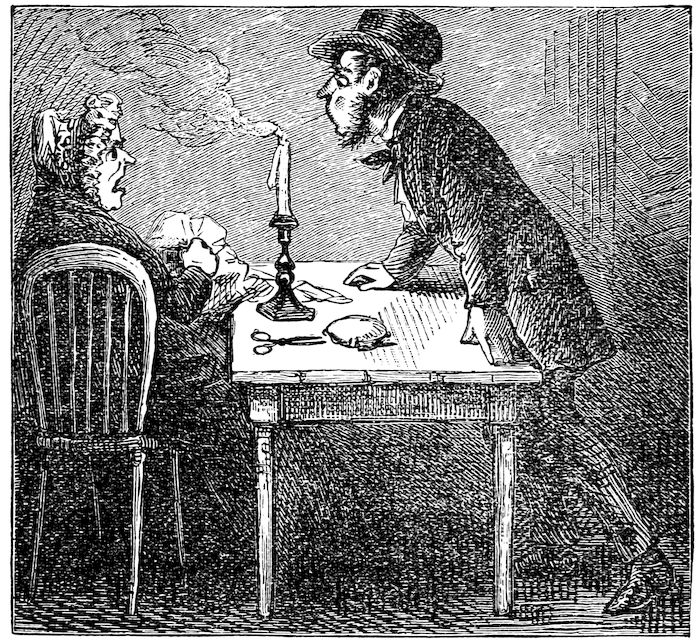
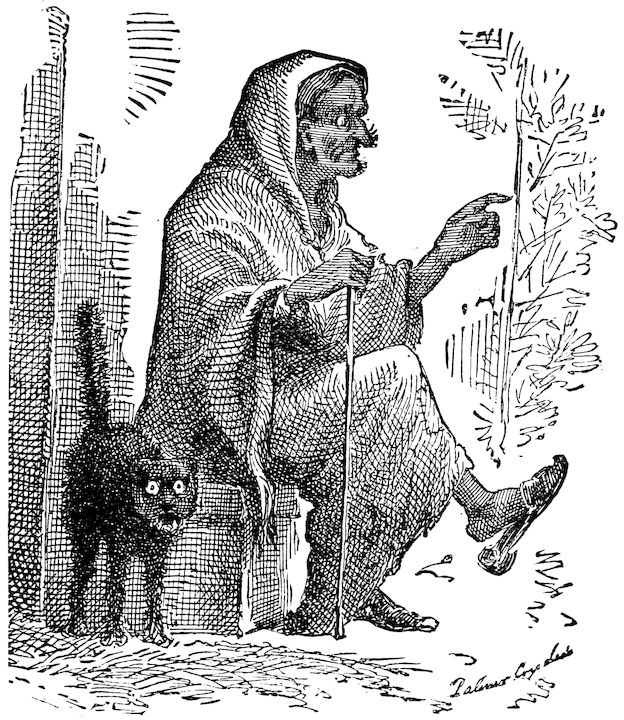
“I will arise at eve and repair to my neighbor’s
cottage. Peradventure the aged widow
of the murdered gypsy can counsel me.”
So when the evening hour was come, the
farmer arose and sought the aged widow’s
abode.
341And as he drew nigh to the cottage, he lifted
up his eyes and, behold! the crone sat upon
her door-step.
And when the dame looked upon the farmer
she knew his heart was troubled; but she knew
not the cause.
342So, lifting up her voice she cried, inquiringly:
“What aileth my neighbor? Has aught befel
thy goods? Has bruin descended from the
mountains to worry thy flocks? Or, are thy
stacks consumed? that thus you droop your
eyelids to the path, and move as by a hearse.”
And the farmer, drawing nigh, replied: “My
flocks unharmed graze sleek upon the hills; my
stacks stand unconsumed; yet is my spirit
heavy, because my walks are lonely and my
heart is sad, and I come as one seeking counsel.”
Then answered the dame reprovingly: “Out
upon thee, for a fusty, dreamy bachelor! Go
take to thyself a wife; then will thy walks be
no more lonely, neither will thy heart be sad.”
But he, answering her sorrowfully, said:
“Mock me not, good madam, but look with
pitying eyes upon me, and hearken to my voice.
“Behold I am now well stricken in years, my
body is stooping to the grave, my manners, like
my hands, are rough; my blood, like my hair,
is thin; and my teeth but shine in memories of
the past.
“How, then, can I win maidens’ hearts?
343Alas! on the contrary, they would giggling flee
from before me; no hope for me remains; if I
would wed, I needs must wed a squaw!” And
his countenance fell.
Then was the crone exceedingly displeased,
because he said, “I needs must wed a squaw,”
and she answered him derisively, saying:—
“Go to! Ye speak as with the beak of a
parrot, and with the understanding of a babe!
Are ye studied in books and know not the
proverb, ‘A golden snare will catch the wildest
hare?’
“Do not your stacks dot the vale below like
an Egyptian camp? Are not your tanks brimming
with wine and your cribs grinning with
corn?
“Do not your cattle graze upon an hundred
hills? and your industrious laborers follow in
the furrow? And are ye still afeared? Oh,
ye of doubting mind!
“Go, get thee to thy chest and take to thyself
suitable coin, and hasten to that great city
by the sea—whose churches point to heaven,
but whose people bow to gold.
344“There sojourn for a season, and make
no delay in adorning thyself with precious
stones.
“Put diamonds upon thy bosom and rings
upon thy fingers, and be zealous to stand in
the hall-ways and in the market-places, and in
the houses of exchange.
“Seek to be observed of the people, and
take heed that ye look upon all men as being
thy servants.
“And let thy wealth be noised abroad.
“Then shall rise up in the house of mourning
the widow of a month, and dry her weeping
eyes.
“Then shall the maid of many summers lay
aside her pets, to readjust her charms, and disinter
her smiles.
“Then shall the doting damsel, when her
parent maketh fast the door, creep out some
other way.
“And they all shall come trooping as with
the voice of birds to court thy smiles and thy
manners, and thy years shall be as the silk of
the spider in thy way.”
345Then was he exceedingly glad because of the
crone’s advice, and he went away to his own
home rejoicing.
And on the morrow he arose before it was
346yet day, and saddled his mule, and journeyed
to the great city by the sea, and lodged at the
house of a friend.
And he made haste to purchase diamonds,
and rubies, and emeralds, and onyx-stones, and
sapphires, and put massive rings upon his
fingers, and seals upon his chain.
And even as the crone had directed, he
scrupled not to stand in the hall-ways, and in
the market-places, and in the houses of exchange,
and sought to be observed of the
people, and lived as a man having great possessions.
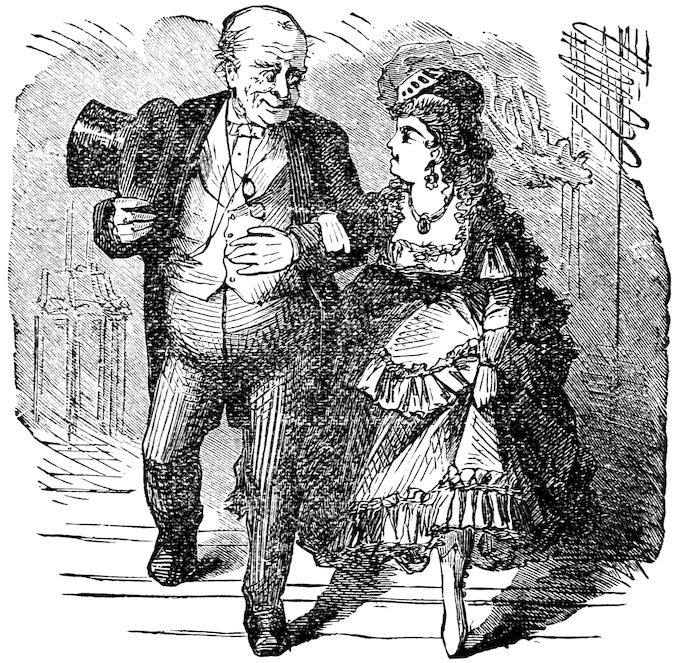
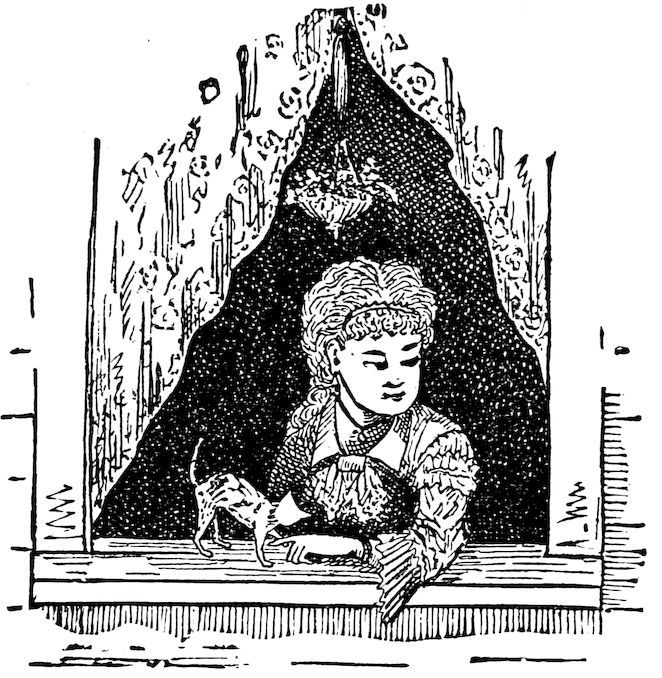
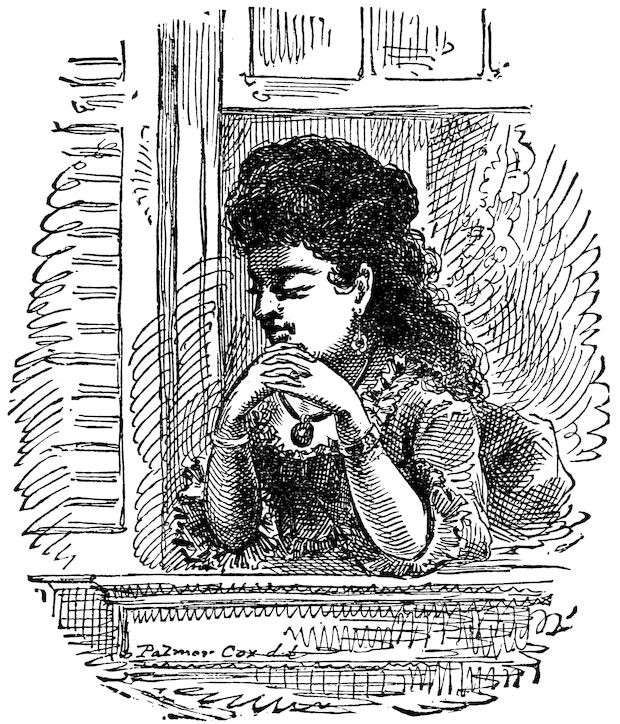
And not many days after, a fair lady of that
place looking from her window, saw that the
stranger shone like the mid-day sun, even so
much that her heart was warmed.
So she called the keeper of the house aside
and questioned him concerning the stranger,
saying:—
“Who is this stranger that lodgeth in thy
house, who beameth with jewels like the noonday
sun? Make him known to me, for he is a
choice and goodly man, and my heart warmeth
for the stranger.”
347
Then answered the good man of the house,
“He is a sojourner from the valley of Berryessa,
and lo, he is a man of great possessions;
and moreover, take heed if he cometh in your
way, that ye smile graciously upon him, for be
it known unto you he is a bachelor, who cometh
amongst us seeking a wife.”
348Then was the damsel exceedingly moved.
And when it came to pass that the stranger
was introduced to her, she smiled graciously
upon him, and she opened her mouth and spake
knowingly of barley, and of rye, and of corn in
the ear, and of tares.
And she also spake of four-footed beasts, of
calves, of pigs, and of goats, and cattle after
their kind; and of fowls; of doves, and of
ducks, and of geese, and poultry after their
kind.
And she spoke also of cabbages, and of
squashes, and of turnips, and of new laid eggs,
and of honey, and of buckwheat cakes, and of
cheese, and of sausages!
And lo! the farmer’s heart was touched, for
she was comely to look upon, and wise withal.
And he communed within himself, saying:
“Surely this maid would indeed be a great
catch, she would make her husband’s home
cheerful, and in divers ways pluck from the
palm of life the festering thorns. Beshrew me,
but I will lay strong siege to the damsel’s heart.”
So he made haste to pull wide open the mouth
of his purse and loaded her with presents, for
349the damsel had found favor in his eyes, and he
sought to win her.
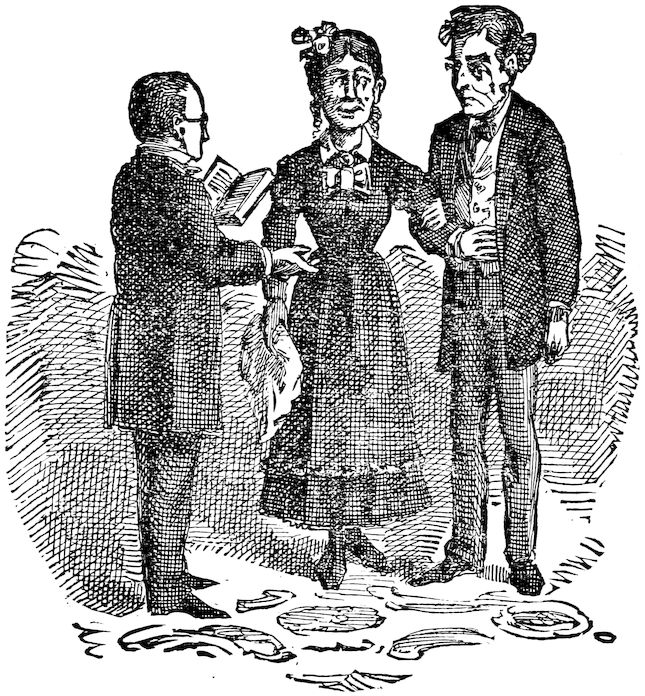
And not many days after he espoused the
maiden, and there was great feasting and merry
making at that house, and the same was heard
of the neighbors.
And on the following day, the farmer took
her to his own home, in the valley of Berryessa,
and they lived happily together for the space of
many years.