As they sat there in the dusk of the verandah,
Jim would have liked to ask his host to relate
some of his experiences in southern California
for he felt sure that the Senor Valdez had
known something of adventure not only because
those early days were full of marvels of interest,
but there was something in the bearing of the
old Spaniard that spoke of former days of romance
and of stirring incidents.
Then, too, there was something in the after-dinner
content and quiet, following the perilous
adventure which they had been through that predisposed
the boys to listen to a good story of adventure.
Their friend, the Senor Sebastian, seemed
to divine what was passing through Jim's mind,
for he suddenly spoke, breaking the meditative
spell that had fallen upon the group on the piazza.
"It just occurred to me, Senor Valdez, that our
friends here might like to hear something of the
early days in this part of the country, for you of
all men know it thoroughly and I am sure it would
interest them."
"Indeed, it would, Senor," cried Jim enthusiastically,
"it was in my mind to ask Senor Valdez to
tell us of the early days but I was afraid to impose
upon him."
"I feel greatly honored to think that you young
men would care to hear anything my poor tongue
could relate. It would hardly be worth your distinguished
attention." Jim made due allowance
for the courteous exaggeration characteristic of the
Spaniard.
"Try us, Senor," he said briefly, "we would
want nothing better."
"I will have the coffee brought first," replied
the Senor, "that may serve to stimulate my dull
imagination."
In a short time a softly moving servant brought
out a tray of coffee cups, and placed one before
each guest on a small wicker table. Jim noticed
these cups with immediate interest. They were
certainly beautiful and he had never seen anything
like them before. They were of a wonderful
blue, each one, and had a coat of arms
in gold with raised figures on it; a scroll above
with a Latin motto, and beneath the representation
of a wild animal couchant. The Senor Valdez was
quick to see Jim's interest and respond to it. "That
is the coat of arms of my family," he explained.
"I am not a scholar, Senor," said Jim, "and
all I can make of the motto is that it has something
to do with a lion."
"You are quite right," the ghost of a smile
hovered around the white-fringed lips of the
Spaniard, at Jim's innate boyishness.
"That figure does not look exactly like a lion,"
remarked Jo frankly.
"Not like an African lion certainly," replied the
Spaniard, "but a lion nevertheless, such as one finds
yet in the mountain fastnesses of Spain, something
like a panther only larger and much more fierce."
"The lion seems to have a rope or chain around
his neck," commented Jim, "and fastened to a
collar."
"Quite so," responded the Spaniard, "likewise
the motto translated reads, 'Gentle as a Lion.'"
"Rather strange way of putting it," said Jim curiously.
"I will explain, for you would naturally be
puzzled by the phrase, 'Gentle as a Lion,' as it
seems to contradict common knowledge," said
Senor Valdez. "You see my family has the distinction,
if such it can be called, in these modern
days, the distinction of being old. This coat-of-arms
dates back to the eleventh century."
Jo was about to give a prolonged whistle of surprise
when Jim gripped his knee to enforce silence,
for though Jo might mean all right, the Spaniard
might not understand.
"The founder of the family who flourished at
that time was a rather rugged character, and I am
afraid would regard the family representatives of
this day as very puny and unworthy specimens.
This Rodriquez de Valdez had his castle in a
rugged mountainous part of Spain, where there
were plenty of wild animals and of wilder and
fiercer men, bandits and free-booters without number.
"His castle was a very powerful one, not only
in construction but likewise in location, as it was
built on a shelf of rock above a deep chasm, with
precipitous cliffs behind it. However, Rodriquez
de Valdez spent but very little time behind the protection
of its powerful walls. It would take the
forces of some strong Duke from the lowland to
cause him to seek the shelter of his castle and to
raise his war banner of crimson with a blue cross
upon it, above the turret.
"He spent his days hunting among the mountains
for wild beasts or for marauding bands of
lawless men. Rodriquez was a man of wonderful
strength, even for those days, when there were
giants in the land. In stature six feet five and
powerful in proportion and likewise very fleet of
foot. If I should tell you of some of the legends
of his strength and swiftness, you would probably
laugh.
"But the one that has to do with the coat-of-arms
of my family I will tell you. It chanced one day
that he was out in the wilds of the mountains
and quite alone. Intent upon the trail of a deer
that he was following along a shelving mountain
side, he did not see a lion half grown, but nevertheless
very dangerous, which was crouching on
the branch of a tree ready to spring upon him when
he got beneath it.
"When he had passed by under the tree a pace
or two, the lion sprang with distended claws.
Some instinct of danger made Rodriquez turn and
he was just in time to grapple with the brute,
clutching it by the throat. The lion had some
advantage in weight but not a great deal, for my
brave ancestor was probably three hundred pounds
of sinew, bone and muscle. So that the struggle
was not such an unequal one, but it was terrific
while it did last. Finally, though torn and bleeding,
the man subdued the beast, and had it in abject
fear of him.
"Then instead of killing the lion as one would
naturally expect, Rodriquez took a strange humorous
notion into his head. He would make a pet of
this same lion and it should be his dog to follow
obediently at its master's heels wherever he went.
This idea he carried out and he even had a heavy
brass collar placed upon its neck, and it followed
him on all his trips, slouching with padded tread
at his heel, or behind his war horse as he rode
abroad, like a powerful yellow dog.
"I do not imagine that the beast ever had any
great amount of affection for his master, but he
no doubt was in great fear of him, which seemed
to answer the purpose quite as well. So, my
friends, you have a full and complete explanation
of the coat-of-arms of my family. My only fear is
that I have wearied you with what could not have
the same interest for you as it does for me."
"Indeed, you have not wearied us, Senor," exclaimed
Jo enthusiastically.
"That is one of the most interesting accounts
that I have ever listened to," said Jim. "I only
wish I could have lived in those days when there
was plenty of adventure."
"I do not think that you have any reason to complain,"
remarked the Spaniard laughingly. "Perhaps
your descendants in future years will be
pointing out your daring deeds as emblazoned on
their coat-of-arms."
"No danger of that, I guess," laughed Jim,
"though they might have a picture of Jo and me
tied to a mule. That was the way old Captain
Broom treated us." The Spaniard joined in the
merriment at this unheroic representation of Jo and
Jim.
"Now, Senor Valdez, you have told us a tale
of old Spain, tell us something of new Spain here
in California," urged Jo.
"It seems to me that it is now someone else's
turn," said the Senor. "I would not do all the
talking. A host should sometimes listen. Perhaps
Senor Darlington will tell us of some of his experiences.
They will be much more stirring than
any musty tales of mine." But Jim shook his head
firmly, not to say obstinately.
"I would not think of telling our adventures,"
he replied. "Perhaps after we have travelled more,
we will have something worth while relating."
"That's right," said Jo, "we would much rather
listen to you, Senor."
The Senor Valdez sipped slowly at his coffee,
looking out into the semi-darkness beyond the verandah,
where over the plain below stretched the
gray blanket of the fog-clouds. Then he rolled
another cigarette, lit it and took a few meditative
puffs. The Senor now began his next story at a
peculiar angle, and did not commence with the
stereotyped form of "once upon a time," so dear
to the days of one's childhood.
"I see you do not take cream in your coffee,"
he said addressing Jim.
"No, but I like some sugar, not too much."
"It has seemed to me," said the Spaniard, "that
the seasoning of coffee is in a way an indication
of character."
"Where the party uses milk in his coffee that
indicates weakness, does it not, Senor?" inquired
Jim with a sly look at Jo, but the subtle Spaniard
was not to be trapped.
"Not necessarily," he replied, "only mildness."
"And when it is taken straight and black that
means a strong character," remarked Jo.
"You have stated it," replied the Spaniard.
"But I would like to know how I would be sized
up?" questioned Jim, "you see I use a little sugar."
"My friend," said the Spaniard with playful
earnestness, putting his hand lightly on Jim's knee,
"that shows a character of great strength, tempered
with mercy and human kindness. All of
which leads one to speak of a man who was once
famous in this part of the country, but not popular.
He always had the reputation for taking a strong
liquor in his coffee, Fernet, if I remember right.
His name was Alverado, but I judge that you are
not acquainted with it."
"No," replied Jim, "but I should say that he was
a very fierce character."
"He was. He was a bandit."
"I thought so," agreed Jim.
"This Don Alverado came from a well known
Spanish family, of ancient lineage, but impoverished
fortune. He was such a wild and unruly blade
that his family were decidedly relieved when he
left Spain and came to the new world to mend his
fortune, if not his ways. He landed first in Mexico,
and after a series of more or less remarkable adventures,
he came to this part of California. I
knew him, or rather I knew of his family in Spain,
and for their sake I made him welcome here at my
home.
"He was really a charming fellow in manner and
appearance, tall, slight, with dark eyes and hair, a
typical cavalier. But the graces of his manner did
not reach down to his heart, and after a disagreeable
episode which I need not revive here, he left
my rancho never to return except as an enemy.
I heard nothing further of him after his departure
for some six months. My next introduction to him
was an unpleasant one.
"It consisted in the loss of a band of horses and
a herd of cattle which were driven off by a gang
of raiders, thirteen in number, at the head of which
was this fellow Alverado. His depredations went
on for years among the ranchmen in this part of
California. So resourceful and crafty was this desperado
that he evaded trap after trap laid for his
capture.
"He had several very close calls and there were
numerous battles between the outlaws and the ranch
owners, but though some of his men were shot,
he seemed to bear a charmed life. I remember
one running fight over the plain yonder, when, believing
me to be absent from home, as I had been,
but returned unexpectedly from the north, this
Alverado and his gang made a bold dash to capture
some horses from a field directly below the house.
"It did not take long to get my men together
and I gave the bandits a surprise indeed. Nothing
but the speed of Alverado's horse, a splendid
black stallion, saved him from capture. We got
several of his men however. At last there came
the turning of the lane. Through the treachery of
one of the band we found that their rendezvous was
at the head of a small canyon in a range of foot-hills
several miles south of here.
"You will go through it tomorrow on your way
south, if you carry out your speed schedule, which
with your remarkable horses you ought to be able
to. We came upon the gang about noon, where
they were resting after a long chase. In a corral
near by were a number of stolen stock. They
were not expecting trouble of any kind. Some
were playing cards, a few cooking, most, however,
were enjoying the siesta, their leader among the
number lay under the shadow of a tree, his head
resting on a saddle, sound asleep.
"There were fifty of us, and we had them surrounded,
so that there was no chance of escape.
Alverado himself made a desperate dash, but the
cordon was too strong. The rest surrendered.
That afternoon we took the bunch to the lower
end of the canyon, where there was a giant sycamore
tree. There we hanged the whole thirteen,
and by them no more were troubled not even by
their ghosts."
Jim and Jo expressed their appreciation of their
host's kindness in entertaining them as he truly
had done in relating his tales. Then they said
good night and went to their room.
That night the boys slept in a comfortable bed in
a quaint old bedroom with roses nodding in at the
half open casement windows. By the light of the
candles they could see the strange old and carved
furniture and tired as they were how they did
sleep.
The next morning they started hours before daylight.
"I will be prepared to welcome more of you
in a few days," said the Senor Valdez, and the boys
thanked him heartily. Promising to return soon
they galloped away through the darkness.
All day they rode, hardly drawing rein at all. At
first through the foot-hills and then over the wide
plains. Jo had a fresh horse, a powerful black, as
his other mount could not stand the strain of the
long trip that meant three score and ten of miles before
evening.
Early in the afternoon they left the plain and rode
into the deep and rugged gorges of a mountain
chain, running East and West. Thence into a broad
valley leading South-easterly, and about four p. m.
they turned directly South entering a Pass in the
Southern side of the valley, from which they
emerged on a plain. Where the trail left the Pass
stood a large sycamore tree, when they reached it,
the Indian messenger rose from its shelter.

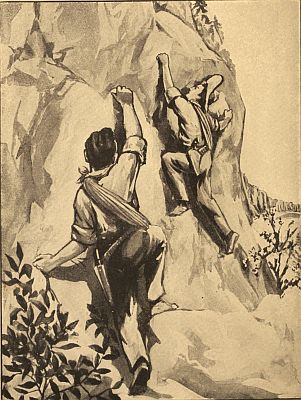 "THEY WERE NOW GOING UP THE FACE OF THE CLIFF."—P. 204. Frontier Boys on the Coast.