One of the masters of to-day, of a generous and impulsive nature, who
does not wish to be quoted by name, but whose works may be admired in
the Luxembourg, consented to give me some information regarding
Fromentin, whose pupil he once was. I should like, as a conclusion to
this study, to be able to transcribe literally what he told; but at
least I shall draw a pious inspiration from his words.
Fromentin laid on his colours very thickly. His solid grounds were
always most carefully prepared and his composition calculated in
advance down to the smallest detail. At the start, he came under
the influence of Decamps, Marilhat, and more especially Delacroix, and
in consequence neglected line work, devoting himself solely to the
distribution of colours. Delacroix and the romantic school of his time
did not interpret Algeria well, because they failed to see it well.
They saw it through the black holes of windows, in all the violence of
its whites and reds, in the picturesqueness of its costumes and the
long stretches of its dusty streets. But Fromentin had visited Italy,
and during his excursions across this museum of diverse aspects he
made a special study of the effects of sunshine upon the handiwork of
man. It was while still saturated with the brilliance and with the art
treasures of Italy that he first saw the land of Africa, or rather
that he first conceived the desire to learn to know its secrets.
Fromentin never put upon his canvases the Africa of the desert, in
which there is nothing but the white of the burnoose and the gray of
the dune, but Algeria the Fair, Algeria already civilized. He was
enraptured by the sight of it and by the penetrating conception, full
of eager curiosity, which he had already formed of it. For Fromentin
does not command by the audacity of his colours; he commands by the
charm of his apportionment of light and shadow, and by the precision
of a style which seeks, irrespective of form, to show us the soul of
people and of things. He sees with the eyes of a poet, he expresses
himself in the manner of a philosopher, he forces us to reflect. He
detests all that is vulgar, superfluous, and extravagant. All that
pertains to reality has for him a significance, of which he seeks the
cause, and for which he frequently discovers a definitive expression.
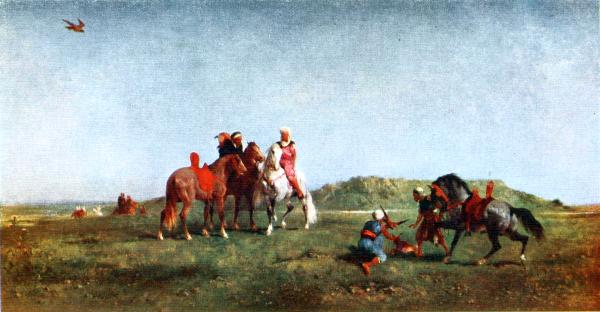
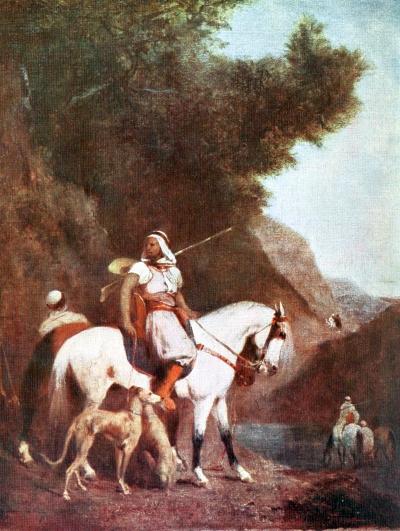
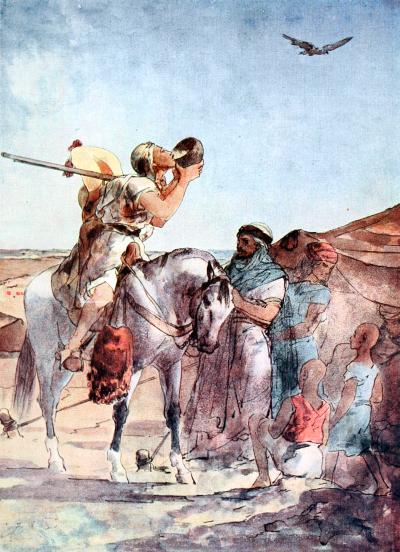
PLATE VII.—HUNTING WITH THE FALCON
(Musée du Louvre)
Falconry is an episode of African life which peculiarly attracted
Fromentin. He has treated it in a number of different pictures, all
equally remarkable. The collection in the Louvre possesses two: the
one which we give here is distinguished by the cleverness of its
composition, the way in which its component parts are distributed
throughout the prospective, in accordance with the desired effect,
thus lighting up the gray immensity with joyous and violent tints.
Through his habit of studying the inner workings of the mind of man,
he reached a point, toward the end of his life, when he ceased to
compose, even in painting, any works other than those of a man of
letters. The keenest intellectual alertness was always ceaselessly
pulsating within him. Furthermore, he made a sort of religious cult
of life in all its forms, even the most humble, and imbued them with
an ennobling charm. And for the purpose of understanding the
psychology of a race which enwraps itself jealously in a pride of
attitude, the works of Fromentin offer testimony that bears the stamp
of rare sincerity and clear-sighted sympathy. His mind never wastes
time over the eccentricities of a tribe or a people, but bends its
whole effort to gathering up, through a choice of typical details, the
general idea, the embodiment of a human group.
Fromentin knew, better than anyone else, how great his lack was of
elementary training in painting. He knew that no natural gift can
replace those initial steps in craftsmanship in any and all forms of
production, and that works which are truly beautiful and worthy of
being held in honour through the centuries obtain their right to live
solely from having obeyed the laws of order and of clearness. These
laws, as related to pictorial art, are taught in the studio and the
school. A naturally gifted artist may undoubtedly evolve, out of his
own personal inspiration, an amusing or interesting work; but that
work, if not constructed according to the syntactic rules peculiar to
his art, will have merely an ephemeral charm, like the costly baubles
of a passing fashion. What proves the necessity of rules of technique
is that the masters themselves have not been contented with the
possession of genius or talent alone. They have learned their craft
down to its profoundest secrets; and the greatest of these masters are
the ones who have succeeded best in practising the methods transmitted
by past experience, and have even in their turn discovered new laws.
How many times, with touching modesty, Fromentin deplored his total
lack of the essential studies of apprenticeship! Beneath the colour of
forms and objects, he grasped the course and movement of life. But his
restless hands did not succeed completely, to his own satisfaction, in
transferring them to his canvas. Nevertheless, his pictures, because
imbued with an emotion, the contagion of which was communicated to
their colours, far from resembling, as so many others do, a sort of
clever and inert photograph, are evocations, and often magnificent
ones, of some historic hour, of the destiny of a race, or the soul of
a landscape.
Under the influence of the romantic school, as I have already said,
Fromentin’s brush sought at first chiefly to dazzle. But one day he
awoke to a comprehension of Corot. The inward emotion which he
underwent affected him like the discovery of a new light. A
transformation followed rapidly, not in his ability to feel, but in
his fashion of reproducing what he felt. Yielding joyfully to the
authority of Corot, he began to make use of gray, and before long it
became his dominant tone. Like a frail cloud interspersed with
invisible rays of red and azure, enveloping the atmosphere of his
scenes and characters, and blending into his minutely wrought skies,
this gray of his, which borrowed something of its hue from each of the
primary colours, pleased him by the very discreetness of its
opulence. Discreetness is one of the hallmarks of refinement; and
Fromentin was nothing, if not refined, in his manners, his thoughts,
and his speech. “Just as his painting was never heavy and his writing
never dull,” says Emile Montégut, “his physical build was slender,
graceful, delicate; yet his slenderness was in no way weakness, nor
his delicacy affectation. No objectionable professional mannerism
proclaimed the craft he practised; still less did he ape the manners
of the man of fashion, in order to hide the fact that he was a man of
toil. With all his frankness, he had the good taste to refrain from
betraying his intimate personality to the world at large.”
It was precisely this use which he made of gray that enabled him, by
its play of half-tones, to explore the mystery of souls. And quite
unconsciously he revealed his own, a noble soul, enamoured of all that
is great and eternal in civilization and in life. When face to face
with an actual scene, he frequently gave up the attempt to transfer
it with his brush. It was not until much later, after long reflection
over the material conditions of a scene whose beauty had delighted his
eye, that he was ready to begin work.
Consequently there are other artists who have more accurately rendered
the colour of this African land: there are, for instance, Guillaumet
and Regnault. With a somewhat austere, yet precise, touch, after the
fashion of an extremely well-informed commentator rather than a deeply
moved poet, Guillaumet shows us, in all their picturesque
authenticity, the history and architecture of buildings ravaged by the
sun, and outlined against them the stately silhouettes of Arabs to
whom silence appears to be a sort of religious rite. Yet the sublime
poetry of the desert has also touched his painter’s heart in The
Evening Meal, now in the collection in the Luxembourg; the thin blue
smoke, melting away into the calm atmosphere, is typical of the
immobility of the Sahara, the sullen oppressiveness of daytime amid
the sands. Henri Regnault, in works that are scarcely more than
sketches and have never been exhibited, transcribed, with all the
ardour of his age, during too brief a sojourn in Morocco, the symphony
of divine colours which exhales from the soil of Africa and from its
sky, that burns like living coals.
Fromentin did not always dare to undertake to paint his own
conceptions. His timidity is betrayed by the very modesty of his
canvases, which scarcely exceed two yards. Nevertheless, the painter
whom he loved the most was Rubens: Rubens, the prodigal dispenser of
light, who poured his inexhaustible and gorgeous imaginings, like the
waters of a mighty river, over canvases without number.
Fromentin did not find it easy to give forth the treasures of his
brain, excepting through the medium of writing. He delighted in
sumptuousness, and he found it in Rubens, whom he eulogized, in his
Masters of Yesterday, in a truly lyric strain. He did not understand
Rembrandt and despaired of ever understanding him. He studied him
constantly, with a sort of impatience, striving to glimpse, through
his veils of half-shadows, the spirit of a genius who was too alien in
nature, country, and race.
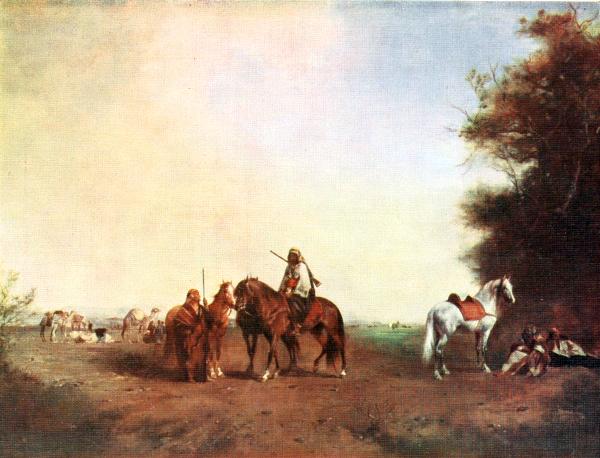
PLATE VIII.—A HALT AT AN OASIS
(Musée du Louvre)
The weary caravan has halted, tempted by the verdure of the oasis.
Faithful to his manner, Fromentin has taken advantage of this
picturesque scene to throw a harmony of colour and light over the men
and their surroundings. In all its simplicity, this picture is one of
its author’s happiest efforts, because of the impression of life which
emanates from this group, relatively so few in number.
Among Fromentin’s pupils was Cormon, an intractable pupil with a
marked individuality; yet while he ignored his professional authority,
he always proclaimed him, and with real feeling, the most intelligent
of masters and the most loyal of men. Fromentin did not exactly
conduct a regular art-school. He had gathered around him seven or
eight young artists, in whom he foresaw a prosperous future: Gervex,
extremely brilliant, Thirion, the most temperamental of them all,
Lhermitte and Humbert, who was the master’s favourite. Fromentin saw
in Humbert a second self, more fortunate in having a chance to learn
at the outset the indispensable rules of his craft, and therefore
capable later on of achieving works which he himself could never carry
out. Without effort, he won the adoration of his pupils. With an
eloquence which came from his heart quite as much as from his brain,
he preached to them the doctrine of sincere labour, of disinterested
ideals, and of reverence for the past because it has produced the
present. He had a combative spirit. He never hesitated to express his
opinion about works or about men, since the nobility of his character
forbade that he should be suspected of maliciousness or envy. Certain
works of his time, that are still discussed and that our own age has
consecrated, were displeasing to him: Millet’s, for example. He
professed a profound esteem for the man, but he did not admit the
technical value of the artist nor the importance of his ideas.
For a long time Fromentin’s rank as a painter was disputed. He
proceeded peaceably on his way toward fortune and glory. His literary
successes confirmed and enhanced his triumphs as a painter. Through
his books his pictures became known and admired by the general public.
In 1859, he obtained a First Class Medal and the Cross of the Legion
of Honor. The emperor, Napoleon III., invited him to Compiègne. In
1869, his election as Officer of the Legion of Honor followed upon his
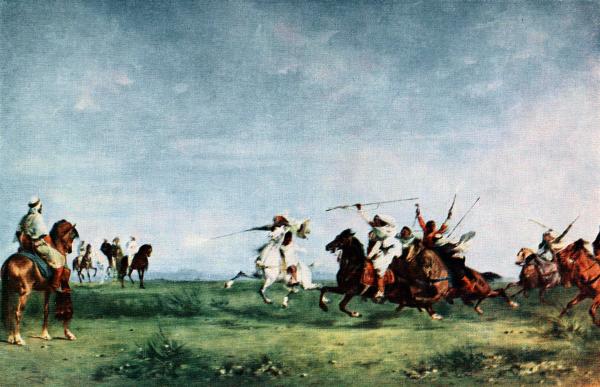
exhibition of the Fantasia in Algeria and The Halt of the
Muleteers. In 1868, he exhibited a very strange and disconcerting
picture: Male and Female Centaurs practising at Archery. He wished
to show by means of this work, which evoked much comment and
criticism, that “the equestrian statue is the last word in human
statuary.” “Mingle,” he wrote, “man and horse, give to the rest of the
body the combined attributes of alertness and vigour, and you have a
being which is supremely strong, thinking and acting, brave and swift,
free, and yet docile.” Fromentin’s aristocratic instincts extended
from men to things, and even to animals. It was he who in a certain
sense discovered the horse, the Arab horse, fine and free, poet of the
desert and the sun quite as much as his master. When Fromentin shows
him to us with his long silvery tail and his mane quivering like
waves, one would say that in the swift flight of his course the
artist had lent him wings. “Nevertheless,” writes one critic, “in
spite of his intimate acquaintance with the form and the varied coat
of the Arab horse, it is perhaps in the little inaccuracies of his
drawing of this animal that Fromentin betrays most obviously the
defectiveness of his early studies.”
What a pity, let us say once again, that he lacked the time to
acquire, while still young, that power and technique in painting which
he possessed in literature! Each one of his volumes evoked an outburst
of admiration and sympathy. He wrote only when he had something
definite to say. His novel, Dominique, fired with the spirit of
youth, burning with love and sorrow, was, from the date of its
publication, in 1862, in the Revue des Deux Mondes, hailed as a
masterpiece.
Not everywhere, however. The poets alone, the born writers, those in
whom the habit of psychology and criticism had not extinguished that
personal flame which burns within the heart, Sainte-Beuve, for
example, and George Sand, recognized it as a work of genius. It was
much discussed and even disparaged, by professional writers and
critics, even in the Revue des Deux Mondes itself. Emile Montégut,
who combined absolute frankness with a wide range of knowledge and
keen understanding, while not disputing the literary value of
Dominique, did not hesitate to affirm that the book was not a novel,
but a series of faultily composed scenes and descriptions,
confessions, and memories.
At first, and for some time afterward, the public seemed to ratify
this opinion. The volume, issued by Hachette, was bought only at rare
intervals and out of curiosity. Later, after this initial failure, it
took a fresh start, and to-day is a recognized classic. For, while it
is true that this prose poem is lacking in intrigue and that its
characters are somewhat overwhelmed by the floods of light from its
stage-settings, it diffuses such a redolence of the soil teeming with
life, such a fragrance of warm and pure tenderness, that every
sensitive and ardent soul delights to yield itself to the harmonious
flow of its words and colours.
The Masters of Yesterday has become a breviary for painters who are
studying the Flemish and Dutch schools. “The Fromentin revealed in
The Masters of Yesterday” asserts Emile Montégut, “is a second
Taine, minus the defects for which the latter is reproached, and minus
that sort of harshness which comes from the exclusive use of crude
colours and a disdain of half-tones. There is also this further
difference between them: that Taine puts his battalions of ideas and
facts through their manoeuvres with the imperiousness of a
general-in-chief commanding an action, while Fromentin assembles and
reviews his own with the ease of an orchestra leader directing the
instruments under his orders by the simple gesture of his bow.... Just
one word is applicable, in point of strict definition, to the
temperament and talent of Fromentin: that word is perfection. He
strove for it all his life. He deserves to be called the classic of
that type of picturesque literature, whose ambition, at the outset,
looked toward a very different goal from that of gaining this title,
and whose enterprises and audacities the classic school of art could
not, as a matter of fact, have beheld without alarm.” This book is,
without doubt, Fromentin’s best. For, while the majority of art
critics are merely amateurs posing as craftsmen and judges, he knew
quite well whereof he spoke. While he understood as well as the
others, and even better, an author’s purpose, he could also see of
what material and by what means the work of this same artist was
composed. He was not a dilettante, endowed with a greater or less
amount of taste, but a fellow craftsman, who knew how to mix his own
colours and to analyze the palette of another.
His literary works entitled him to a seat in the Académie Française
considerably sooner than he could have dreamed of the Académie des
Beaux-Arts.
As a matter of fact, in 1874, he offered himself, at the urgent
entreaty of his friends, as a candidate for the Académie Française,
quite suddenly and when it was already too late to bring any influence
to bear, while solemn pledges had already been secured by his
competitors. In spite of this, the weight of his name secured him
thirteen or fourteen votes.
He was preparing a volume of critical studies on the French school and
planning another on the Italian school, when death abruptly cut him
short, at the age of fifty-five, in the midst of a steady ascension
into the light of fame. It was a misfortune for France. In the beauty
of his character, as lofty as that of his genius, he offered an
example of the most precious qualities of man and artist: uprightness,
charity, good taste in what he admired, and sincerity in what he tried
to do. The name of Eugène Fromentin grows greater day by day; clouds
may pass before him, as before a star, but without ever effacing him.