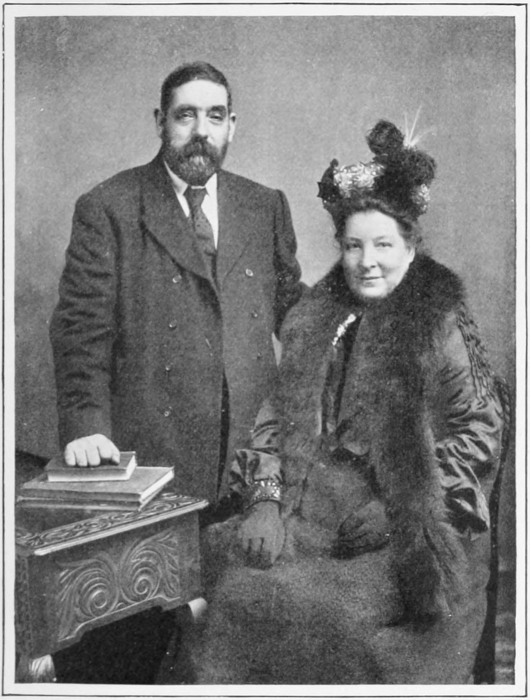
Crooks Appeals to the Public—"This Insult to the Poor"—Resentment
all over the Country—A Voice from the Hungry 'Forties—Cheering
Letters—A Government Department's Blunder—Poplar's Appeal to
Crooks.
The day after the report of the Local Government Board Inspector was
published, Crooks sent his decision upon it to the Press. He wrote from
the House of Commons, where, as he stated in his letter, "the unfairness
and injustice of the report in its bearings on my Poor Law policy are so
far recognised that to-day I have been told by members of all parties
that the report is not only wicked but brutal." He further stated in his
letter to the Press:—
"Will you permit me to make it public through your columns that I accept
the challenge thrown down in the Local Government Board report? Against
all its strictures I intend to maintain my stand on that policy of
humanising the Poor Law, to which I have given the greater part of my
life. And in doing so I propose to appeal from the Local Government
Board to the public.
"If the public upholds this insult to the poor I shall be painfully
surprised. After twenty days of a searching inquiry, and after twice
twenty pages of a strained attack on Mr. Lansbury and myself, there is
nothing to show that we have done anything against the actual orders and
regulations of the very Board that now rises in mock-heroic wrath to
slay us. Our only crime is that we have humanised a system framed in
1834, when the voteless working classes were dragooned by a middle-class
majority....
"My present duty is clear. The public may remember that at Mr. Chaplin's
request I went as a nominee of the Local Government Board on the
Metropolitan Asylums Board. It may remember that I was co-opted on the
Central Unemployed Body on the suggestion of Mr. Walter Long. Now that
the Local Government Board, under the new Government, has seen fit to
attack me and my Labour colleagues, and to flout the poor as I venture
to say they have never been flouted by that Department before, I can no
longer hold those two positions. I propose to resign. Nor until its
attitude towards the poor and the unemployed changes will I ever consent
to represent the Local Government Board on any public body again. I
prefer to represent the people....
"The faults of administration at Poplar, so grossly magnified in this
report, are common to all such bodies, and Poplar will do its best to
avoid them. But the policy will not change. By that we stand or fall."
The reason for that policy was briefly explained in a special report
issued by the Poplar Guardians and signed by Crooks as Chairman. It
formed part of the Board's reply to the Inspector's report. Thus:—
This policy was never put in force with the idea that it would lead
to a reduction in rates or in the number applying for relief. No
one imagines that decent treatment of the poor will choke off
applicants in the manner that harsh treatment will, but we claim
that under the Act of Elizabeth, the poor (not merely the
destitute, but the poor) are entitled to come to society in time of need.
The State provides all kinds of services for the community, such as
roads, sewers, light, police, army, navy, education, etc., and we
all enjoy those privileges. The State pensions its well-paid
Cabinet Ministers and officials; and we claim that the poor, whose
charter is the 43rd of Elizabeth, instead of being penalised when
needing help, should receive such help in an ungrudging measure and
in a manner which would most effectively preserve their self-respect.
Finally, we would again repeat that our pauperism is due to our
poverty, that our policy is based on the claims recognised by
statute as the due right of the poor. We neither palliate nor
excuse any lapses either on the part of members or officers of the
Board, but we claim that as a Board we have carried out our duties
as efficiently and as economically as we were able, that we have
never given indiscriminate relief either in or out of the
workhouse, and in the main have usefully tried to do our duty both
to the poor, who have our first claim, and to the ratepayers.
We have never ceased to urge for the past ten years that the poor
are a metropolitan charge, that unemployment is a national
question, that the Poor Law should be reformed. We are glad to know
that our work, despite this present attack, has been successful,
and that the poor of Poplar are better cared for, and not only the
poor of Poplar, but the poor of the United Kingdom generally, as a
result of our effort.
His appeal to the public won an inspiring response. Bumbledom was
against him, but the people were with him. While a section of the Press
was attacking him, it was so far ignorant of what the people of England
were thinking as to know nothing at all of the tremendous meetings he
was addressing all over the country.
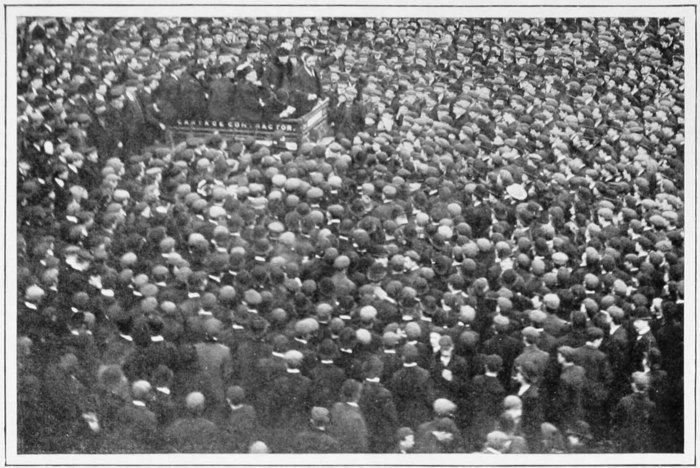
His meetings in Poplar and Woolwich, where he was supported with rousing
enthusiasm, were the largest he had ever had in those boroughs. At
Chesterfield he addressed an open-air meeting of nearly twenty thousand
Midland miners, when his reference to his Poor Law policy was cheered to
the echo. The Cleveland miners were equally enthusiastic when he went up
to their annual gathering. It was the same at public meetings in
Newcastle, Burton, Huddersfield, Rossendale, Stockport, Batley,
Sunderland, Penarth—the man who had stood out against one of
Bumbledom's fiercest onslaughts had the good-will and confidence of the
working people of England. At his indoor meetings there were rarely
fewer than two thousand people present. Often he had audiences of four
and five thousand.
It looked as though a recurrence of his old illness would prevent him
from keeping an appointment to speak on his Poor Law policy at Bradford.
Such was the strength of the appeal sent to him, however, that he
determined to risk it. He had to be helped by his wife on the journey,
and when at the meeting it was found he was unable to stand there was a
unanimous call that he be allowed to keep his chair while speaking.
Seated in the middle of the platform, he held an audience of two or
three thousand people for upwards of an hour. The response he wrung from
the crowded hall moved him deeply. Bumbledom never had a worse hour.
Of course his first public meeting after the publication of the Local
Government Board's report took place at the Dock Gates in Poplar.
"We never had a better meeting," he wrote to me the next day. "The
audience backed me to a man and woman—and, by the way, we never had so
many women present before. It did me good."
At some of his provincial meetings there were people who well-nigh
worshipped him. Old men in particular who had known the Hungry 'Forties
would come up to him after the meeting and say:—
"Let me shake you by the hand, Mr. Crooks. We read about it in the
papers, but the papers don't understand. We've been through it, and
know. Don't be down-hearted, Mr. Crooks. God bless you!"
At a small country town a bed had been reserved for him at the little
hotel outside the railway station. He arrived about midnight, and found
the place in darkness. He knocked loudly for some time. At last a man's
voice was heard from the railway line.
"Is that Mr. Crooks? Lord love yer, we knew you'd be late, and gone
again early in the morning, and so that I shouldn't miss seeing you I
told the hotel-keeper to go to bed and let me have the keys, so that
you couldn't get in without me shaking you by the hand."
His first public meeting in Woolwich after the Local Government Board
Inquiry drew an audience of over five thousand people to the Drill Hall.
His colleague Lansbury shared in the inspiring reception and addressed
the meeting.
Crooks told the audience it was no wonder that Lansbury and he got angry
at times over our iniquitous Poor Law system. Such was the injustice of
the rating system in London that Poplar—which was spending out of the
rates per head of population less than half what West-End districts like
Kensington and Marylebone were spending—appeared to outsiders to be
extravagant. If those West-End Boroughs had Poplar's poor to look after,
their rates, instead of being about 7s., would be about 15s. in the
pound. The poor of Poplar were London's poor; yet the cost of looking
after them was borne mainly by the people of Poplar. London was the only
city in the world where those who grew rich on the labour of the poor
were able to segregate themselves in favoured quarters, and escape their
obligation to help the aged poor unable to work longer.
He went on to show the iniquities of our Poor Law system from a national
standpoint. About £28,000,000 a year was raised in the name of the Poor
Law. Of this only £14,000,000 had any connection with the Poor Law at
all. And how were the fourteen millions spent? The poor got seven and a
half millions, while the remaining six and a half millions were spent
in administrative charges. That meant that every 5s. given to the poor
out of the rates cost the ratepayers another 4s. 9d. to give it. No
wonder that Bumbledom became nervous when Guardians urged that the poor
rather than officials should receive more of this money raised for the
poor. The Local Government Board Inspector, when deploring that Poplar's
expenditure on the poor had gone up during the last ten years, might
have added that during the same period the cost of collecting rates in
the City had gone up from £11,000 to £23,000. It seemed to be all right
when officials got the money, but all wrong when the poor got it.
"I believe in being a true Guardian of the poor, and not merely a
Guardian of the Poor Rate. We in Poplar have preferred to save the lives
of the poor rather than the rates. Even then we have administered with
remarkable economy; for Poplar's rates would not be high if London as a
whole paid its proper share towards maintaining London's poor. We in
Poplar, however, have not allowed an unjust rating system to prevent us
from doing our duty to broken-down old people, to the starving and to
the unemployed. We agree with Carlyle that 'to believe practically, that
the poor and luckless are here only as a nuisance to be abraded and
abated, and in some permissible manner made away with, and swept out of
sight, is not an amiable faith. To say to the poor: Ye shall eat the
bread of affliction and drink the water of affliction and be very
miserable while here, requires not so much a stretch of heroic faculty
in any sense as due toughness of bowels.'"
From Stockport, where he had been addressing one of a series of public
meetings in the Midlands, he wrote:—
"How good the people are! Whenever I mention Poplar, it is truly
inspiring to hear the magnificent response. Last night the moment the
word passed my lips an audience of two thousand cheered like one man. It
sometimes overwhelms me almost. Who am I to deserve it?...
"I am sometimes told that I affect to despise my critics. You know
better, of course. But, really, after such experiences as these, I can't
help laughing at them when I think of their ponderous official
pronouncements against my policy and of the equally ponderous lectures
read to me by certain sections of the Press and the Church. When will
the Press and the Church, and 'all who are put in authority over us,'
come to learn what the mind of the people really is, and begin to
interpret it rightly? I know the heart of the people to be true. That is
why I laugh and go on my way confident that the little piece of
well-doing I have aimed at on behalf of the poor and the unemployed will
in the end put to 'silence the ignorance of foolish men.'"
If his meetings were inspiring, the same can be said of his
correspondence. Public men, in various parts of the country, including
Guardians, wrote to congratulate him on the brave stand he had made
against the forces of Bumbledom. From other quarters he had many
encouraging letters.
Canon Scott Holland wrote: "You know how your friends feel for you in
this cruel trouble. We need not tell you how we trust you, and believe
in you, and stand by you."
"You have made many lives happier and better by your work on behalf of
the poor," wrote a high official from a central Poor Law establishment.
"I thought it might be a comfort to you to know we feel indignant that
you have been rudely assailed."
It was encouraging also to receive a note from a prominent Woolwich
Conservative. The writer commenced by saying that although he was a
political opponent, and would continue to be so, he had the greatest
respect for Crooks personally, and wished to assure him that he did not
agree with the attacks that had been made on his Poor Law policy.
"Cheer up," came a message from the Rev. A. Tildsley, pastor of the
Poplar and Bromley Tabernacle. "Don't get off your high pedestal to go
down to your opponents' level. Leave the mud alone. The sun shines
daily, and will soon dry it. Then it will drop off itself. All good men
have to pay the price. This is not your first baptism of fire in defence
of the poor."
From the Oxford House Settlement, Bethnal Green, the Rev. H. S.
Woolcombe wrote:—"I am perfectly certain that this attack cannot do you
any permanent harm, and that you and Lansbury are both men too big to
let it abate your courage and determination to go on with your work."
Letters came to him from abroad long after the Inquiry. Unknown friends
in America, France, and other countries sent him sympathetic letters. He
told one of his Woolwich meetings—according to the report in the Labour
Party's weekly newspaper, the Woolwich Pioneer:—
He had had a few letters that were not sympathetic (Laughter, and a
voice, "Rub it in for Robb"). Well, he had rubbed it in as well as
he could. Mr. Robb [the legal representative of the Alliance at the
Inquiry] was not a bad chap at all. A man must earn his money, and
Mr. Robb had earned his very well. He (Mr. Crooks) had not a word
to say against anybody. Some mud had been thrown, but it would
easily brush off. After all, there still remained the obligation to
look after those who were unable to look after themselves, and to
give to the poor and little children left to their care and mercy
the best of their ability and service. They were proud that God had
given them the opportunity to do the work they had done. And they
were not ashamed.
It is noteworthy that when the Local Government Board was investigating
the Guardians' contracts something was brought to light which even the
Inspector records to the credit of Poplar. He found that some years
previously the Guardians, recognising that the system of dealing with
contracts by Poor Law authorities was a faulty one, liable to abuse, had
appealed to the Local Government Board to establish a central authority
for dealing with all Poor Law contracts in London, thus removing from
the local Guardians the temptation towards favouritism and loose
administration.
That appeal was disregarded, though it is understood the Local
Government Board will shortly be compelled to carry out Poplar's
suggestion, because of the demoralisation which the loose system has
created. Had the appeal been heeded at the time—originated as it was by
the Labour Members at Poplar—much of the corruption brought to light in
several Poor Law Unions in respect to contracts could never have taken
place. The Local Government Board's own loose system, therefore, has
been indirectly responsible for corruption on Poor Law bodies.
This fact doubtless influenced Canon Barnett to pass very severe
strictures on the Local Government Board's gross neglect of duty. "The
inspectors of the Local Government Board," he stated in the Daily
News, "hold inquiries into scandals for which they are themselves
largely responsible. Why did they not discover and report these matters
years ago? We ought to have independent inquiries, in which the
inspectors are subjected to examination, for it is their perfunctory
inspection which has allowed the growth of such evil."
Defeated over the Inquiry the Local Government Board carried out a
minute analysis of the Guardians' accounts. The ordinary Local
Government Board audit occupies only three days. In the case of Poplar,
it was on this occasion extended over three months. Every item was
carefully examined in accounts representing an expenditure of over a
quarter of a million sterling. On the whole of this sum, the auditor,
after his three months' investigation, only found half a dozen trifling
items that he could question. These represented a few shillings for
"Guardians' and other persons' teas," and about £5 in respect to
excessive fares under the head of travelling expenses. These items were
surcharged to the individual Guardians responsible, of whom Crooks,
needless to say, was not one. Indeed, he as Chairman assisted the
auditor in bringing to light what he considered the excessive fares
which had been charged by some of his colleagues on the Board.
The surcharge for the teas revealed Bumbledom at its worst. The "other
persons' teas" referred to included the occasional afternoon cup offered
to the ladies of the Brabazon Society on their visiting days. Bumbledom,
which connives at Guardians' six-course dinners at five shillings per
head in other Unions, proved itself to be so far embittered against
Poplar that it actually objected to a cup of tea and a lunch biscuit to
lady visitors belonging to a society which has given thousands of pounds
from the private purses of its members for brightening our workhouses.
It happened that these ladies were presenting their yearly report on
Poplar Workhouse about the same time the Local Government Board attack
took place. These good women are not influenced by the Local Government
Board or by Municipal Alliances or by the party differences among the
Guardians. Their opinion is that of a quiet body of independent,
intelligent women. In their report on Poplar Workhouse they say:—
During the year forty-six meetings have been held, and at each some
part of the House has been visited. The year has been singularly
free from complaints, all the inmates seeming happy and contented.
The nurses in charge are kindness itself, and are uniformly
good-tempered and active. The whole House is kept beautifully
clean, and each ward is a picture of cosiness and comfort.
Every useful aid is procured for the infirm, to help them to move
about easily. The sick are kindly tended, and the little children's
health and comfort carefully supervised.
Observe, in connection with this three months' audit, that not a penny
was surcharged in respect to the out-relief grants. Notwithstanding all
the wild charges that had been made, not a single case could be found
where Crooks's policy of helping the poor could be proved to be illegal.
After all the hubbub, a three months' scrutiny under the eye of a
capable Government auditor proved that Poplar had simply been carrying
out the law relating to the poor.
The Local Government Board was badly beaten in its attempt to discredit
Crooks's policy. Finally, it was argued on the Board's behalf, as though
in a last grasp at a straw, that the decrease in the amount of
out-relief during the year of the Inquiry was in itself a justification
of the Local Government Board's action. Everybody outside the Board
knows differently. The year referred to (1906) was the most prosperous
this country has ever experienced. If anything, the industries of
Poplar shared in that prosperity to a larger extent than other parts of
the country. The primary cause of the decrease was not the Inquiry, but
the lessening of want brought about by an extraordinary trade revival.
"Give us," Crooks has repeatedly stated in public, "the same terrible
state of things that we had in some of the previous winters, and I shall
apply the same remedy again. The law is there for the sake of the poor,
not for the sake of officials. My policy is not a haphazard one. It is
the outcome of years of experience. It is fundamentally sound, and will
one day become a national policy."
Crooks had indeed played a part for the poor of the whole nation. Before
the echoes of the Bumbledom agitation had died away the very Government
which allowed one of its Departments to be made an instrument in that
agitation was promising to carry out the very reforms for which Crooks
had striven and suffered—Old Age Pensions, Amendment of the Poor Law,
and Equalisation of London Rates.
The Government, however, shirked a discussion of the Poplar Report in
the House of Commons. The Labour Party, backed by Conservative Members,
pressed the Prime Minister for an opportunity to discuss the report. Mr.
Keir Hardie and Crooks pointed out that, as the report stood, an
injustice was done to a popularly elected body, the effect of which
would be to deter other Boards of Guardians from carrying out the Poor
Law in a humane spirit. They further maintained that the country was now
without guidance as to how to treat poor people out of work and in need
of food.
But the Government had learnt by this time that a departmental blunder
had been committed by associating the Poor Law policy of Crooks with the
faulty administration of some of his colleagues. The Prime Minister got
out of the difficulty by informing the House that the report was not
made by the Local Government Board, but to that Board by one of their
officers, "and," he added, "I don't understand that it is proposed to
call in question any action of my right hon. friend the President in
regard to the report."
Indeed, the President of the Local Government Board assured a friend of
Crooks in a conversation in the Lobby that there had been a
misunderstanding somewhere. He sought an early opportunity of giving
Crooks a similar assurance.
It was said of Crooks in Poplar about that time that he was going to
leave the neighbourhood never to return. Working-men came round to him
in solemn deputation, and women and children stopped him in the street,
in order to hear from his own lips that the bodeful rumour bore no
meaning. The rumour, which never had the smallest basis of truth,
reached the workhouse, where he had not been seen for two or three
weeks, weighed down as he was by a hundred public attacks, his own
wearing illness and a heavy domestic trouble. But one afternoon he found
time to go and see the inmates again. And old men hobbled towards him
and clutched his arm and hand as they broke down in their efforts to
tell him what was in their hearts. When he entered the women's wards
there was a chorus of almost tearful appeals. "Say it isn't true, Mr.
Crooks." "Don't go away and leave us, Mr. Crooks."
Sitting alone at the end of a bench was one old dame talking to herself
in that vague, mumbling way common to many old women in our workhouses.
As she rambled on in her talk she took up the cry:—
"Don't leave us, Mr. Crooks. For over seventy years I worked hard, Mr.
Crooks, ever since I was eight years of age. Brought up a family of
ten—two boys died in the wars, one drowned at sea. All the others left
me long ago, and I don't know where they are. And my man was buried in
'eighty-nine—buried near the brickfields where we worked together
thirty years before. And I kept myself outside for fifteen years, a lone
old woman; and you helped me, Mr. Crooks, until I couldn't look after
myself any longer, and then you made me comfortable here. So now I count
the days between your coming to see us to cheer us up. So please don't
leave us, Mr. Crooks. Don't—don't leave us, Mr. Crooks."