BEYROUT, SMYRNA, EPHESUS, ATHENS, CONSTANTINOPLE,
BUDAPEST, VIENNA, PARIS,
SCOTLAND, AND ENGLAND
BY
ADNA BROWN
With sixteen illustrations. Also, instructions how to prepare
for such a journey
BOSTON Geo. H. Ellis, Printer, 141 Franklin St.
1895
COPYRIGHT By Adna Brown
1895
PREFACE.
The urgent desires of the friends of the author of
this volume that his Oriental letters should be compiled
and put in book form prompted him to issue a
work entitled “From Vermont to Damascus,” taking
the reader through the Oriental land, giving a vivid
picture of the country, scenes, and people as he saw
them from day to day, which was the richest experience
of his life. Much has been added to these letters
with illustrations,—directions for preparations
for such a journey, value of the currency of different
countries, etc.,—making the book a valuable one for
persons intending to travel in a foreign land.
The bleak, rugged winter of 1895 in Vermont,
when Jack Frost held nightly carnivals and mercury
was found in the lower regions, the snow was scurrying
from hill-top to vale to find a resting place,—such
environments caused the author of this little volume
to dream of fairer skies and warmer climes. Sunny
Italy, with her groves of orange and lemon trees, her
gardens filled with fruit, her gladioli and lilies leading
the flowery kingdom, was a drawing card to a Vermonter
in the short days of January. Such a picture
caused me to decide to leave old Vermont for the
winter, spending my days farther south, until she had
put on her summer garments, when she would become
the loveliest spot on earth. About this time
the clarion trumpet of Dr. A. E. Dunning, of the
Congregationalist, was heard through the land, calling
for fair women and brave men to join him in his
Oriental tour. His itinerary through Italy, Egypt,
and the Holy Land was an attractive one; and the die
in my case was soon cast. Believing it to be an unwise
thing for a married man to take such a journey
without his wife, wisdom had its way. The party
was made up from eleven different States. Miss
Daniels, a charming young lady from Grafton, and
the two members from Springfield, were the only
representatives from Vermont. The number of our
party to leave New York was, like Paul’s chastisements,
forty save one; and they were to be under
the guiding care of “Henry Gaze & Sons,” of London.
The first essential step was to procure tickets,
passports, letters of credit, suitable clothing, pluck,
courage, and a determination to have a good time.
February 14th found us on board an express train,
wending our way down the Connecticut Valley,
stopping for a night at Hartford with friends, and
reaching New York the 15th. That afternoon we
attended a reception at the St. Denis Hotel, given
by Dr. Dunning, where we were to meet those of
the Oriental party that we had never met before,
but were hoping for pleasant friendships with in the
future.
Introductions, hand-shaking, coffee, and viands
were the order of the afternoon; and every one
seemed pleased with the other fellow, and the verdict
was that the doctor had shown wisdom in
making up his party for the Holy Land.
February 16th found us on board the “Normannia,”
and baggage nicely stowed away. Many
friends of the Oriental party were on board with
good wishes for a successful journey. Occasionally
we saw a tear, but smiles predominated.
At twelve o’clock the whistle blew for all those
not intending to sail to leave the boat. The gangplank
was drawn in; and the “Normannia” weighed
anchor, slowly swung her prow down the North
River, and a journey of some eighteen thousand
miles began.
ON THE WAY TO NAPLES.
My friends in Springfield who have never been
down to the sea, or crossed the big waters, perhaps
have but little idea of the skippers that take people
across from the New to the Old World and vice versa.
To give you the length in feet of the “Normannia”
would convey but little; but, when I refer you to the
Adnabrown Hotel, which is a long building of one
hundred and fifty feet, and tell you to place three of
them in line, and then add seventy feet, you would
have the length of our beautiful steamer. It is two
stories high besides the attic, with a cellar two
stories deep, and is a regular floating palace. Few
hotels in the country are fitted up as nicely. Her
engines have sixteen thousand horse-power, several
times the power of all the motor wheels in Black
River at Springfield. She has nine boilers; and,
when they run her full speed, it takes three hundred
tons of coal every twenty-four hours.
Mr. and Mrs. Weeden met us at the boat when
we left New York, and presented us with some beautiful
flowers. It did us as much good as medicine
to meet our old pastor and wife. Mr. Weeden is
the personification of a true gentleman.
Our party are all together in the dining-room,
occupying four tables, ten at each, save one seat
which is occupied by the steamer physician, dressed
in uniform. We have on board a fine German band
that gives us a large quantity of splendid music.
We sailed Saturday, the 16th. Sunday we had religious
services. Dr. Horton, of Providence, preached
a ringing sermon from Exodus xxxiii. 13. At this
writing we have been on the way one week, have
encountered no gales, but have found the ocean
rather rough, and have had many sick. Racks have
been on the tables most of the time. Mrs. Brown
and myself have been in the dining-room and on
deck every day. Our captain is polite. He found
out that he had some sight-seers on board. So he
proposed to change his course a little, and take us
through the Azores, which was quite a treat. We
could, with our field-glasses, see the houses, and
fields on the sides of the mountains. These islands
are very high, some of them running up seven thousand
feet. They belong to Portugal, and are inhabited
by that race; and the islands are said to be large
enough to support three hundred thousand people.
They raise olives, oranges, pineapples, figs, etc.
The pineapples, which are of a very superior quality,
are raised under glass. The inside is free from
any woody substance and so soft it can be eaten
with a spoon. They command high prices, selling
for three or four dollars each. London epicures fill
them with wine, and consider them a great luxury.
The government sends ships to them about once in
two months, to receive and deliver mail and supplies.
Mists and fogs from the ocean keep everything
verdant.
Our ship “Normannia” is officered and manned
entirely by Germans. They are very polite and
attentive. The table is luxurious, from four to six
courses, abundance of fruit, apples, pears, oranges,
pineapples, grapes, bananas, etc. But the poet sings,
“What is home without a mother?” So many of
the passengers sing here, “What is dinner without
an appetite?”
Saturday Morning, 23d.
Had a smooth run last night, but have just met a
north-easter this morning; and it looks as though we
shall be “rocked in the cradle of the deep” for the
next few hours. We expect to reach Gibraltar to-morrow
night, where this letter will be sent ashore
to take the first steamer for New York. We shall
reach Naples Wednesday or Thursday, where I shall
hope to write you again, as we expect to spend several
days looking over the beautiful Bay of Naples,
and get our feet on “terra cotta” again, as the man
said, which we shall no doubt enjoy.
Sunday morning, instead of one of the band giving
the trumpet call to rise, the whole band played a
beautiful church hymn. It was very pleasant, and
showed their respect for the day.
Just after the mail was closed on board the
“Normannia,” last Sunday, February 24, and my
first letter to you was ready to start back for
New York, we were beginning to sail up into
the Straits of Gibraltar. It was a beautiful day,
clear and balmy, mercury about seventy degrees.
We had already sighted land on both sides of the
channel; and, if you will take a seat with me on the
upper deck, I will show you one of the finest pictures
anywhere to be found,—the water smooth as
glass, and the “Normannia” gliding through the
water proudly as a queen. On our right you will
see the coast of Africa, with rugged hills extending
back, to all appearances, into the interior. On our
left is the coast of Spain, with less rugged appearance,
and I should say the much more desirable
place for a habitation. We continue to narrow
the channel until we reach the stone battlements.
Some two miles before we reach this point, at our
left, you will see the village of Trafalgar, where the
great naval battle was fought and where Nelson lost
his life. The town has the appearance of containing
some fifteen hundred inhabitants, with buildings
painted white, having a very neat appearance. The
land for a mile or more up the channel has a very
peculiar appearance, looking like the waves of the
ocean laid up at an angle of fifteen degrees. With
our glass we could see the beautiful green fields,
divided into lots, with green hedge fences. All the
time you are drinking in this beautiful picture the
grand background will be the stone battlements of
Gibraltar, just ahead of you, extending out into the
channel. We reached this point just at sunset,
which added greatly to the beauty of the picture.
Just before reaching the fort, our steamer turns to
the left into a beautiful bay or harbor, where we find
war vessels of different nations. Saw the stars and
stripes. The war-ship “Chicago” was anchored
there. The Americans on board the “Normannia”
cheered them with waving of pocket handkerchiefs.
They returned it, and their band played one of our
national airs. At this point we anchored; and
small boats came out, and took mail, telegrams, passengers,
etc. Many of our party went ashore, where
you find Moors, Turks, and Spaniards, besides the
soldiers. Selling rum and tobacco is the main business,
and this is considered a wicked town. The
streets are narrow and not lighted, houses built of
stone several stones high. Back of the town is a
wood where live the only wild monkeys known in
Europe. It is a species without tails and one protected
by the government. Whether this is because
of the lack of this appendage I did not learn, but it
no doubt had something to do with the matter.
Now, as you stand back down the channel, Gibraltar
looks like a big Dutchman with a cap on, standing
as sentinel, guarding the traffic from ocean to the sea.
It rises fourteen hundred feet above the sea, is seven
miles in circumference, and is connected with the
mainland by a narrow strip of flat ground. It is
composed largely of limestone, some marble, and
was naturally full of caverns and cavities. In addition
to this, England has honeycombed it through
and through; and no one but the British war department
and the soldiers know what there is inside.
There are five thousand soldiers quartered here, and
one thousand cannon. England spends a million a
year running this Dutchman.
It was about 1785 when Spain and France combined
to take this fortress away from England, and
had a three years’ siege, but had to give it up. It is
said to be the strongest and most important fort in
the world. At six o’clock there was a cannon fired.
This was a signal for every stranger to go outside
the walls unless he had a permit from the head
officer.
I will give you the outlines of one of the big guns
at Gibraltar. Length, thirty-two feet; size of bore,
17.72 inches; the charge is five feet long; weight of
powder, four hundred fifty pounds; weight of ball,
two thousand pounds; force of blow, thirty-three
thousand tons; distance, eight miles; will pierce
twenty-five inches solid iron. This gun is fired only
on the queen’s birthday and special occasions, at
which time notice is given, and windows are raised
in all the buildings to prevent the breaking of glass.
The “Normannia” left Gibraltar 7.30 Sunday eve.
We had a smooth sail, and slept finely, quite different
from what we found it on the old Atlantic.
Monday Morning.
We are sailing up the Mediterranean, which is
lovely; and every one seems to be gathering up
from the rough voyage of last week. We reached
Algiers about 7 P.M., sailing up past Morocco. Algiers
has about sixty thousand people, is controlled
by the French. About sixteen thousand of that
nationality were taken by the French in 1830.
They have a large Arab settlement. Then there
are Moors, Jews, Buddhists, etc., etc. As I said,
the “Normannia” reached Algiers at seven in the
evening, and was to leave at eleven. The town
rises from the coast very abruptly, is lighted with
gas, and looks fine from the boat. Having three
hours to ourselves, we took small boats that the
natives were running in the bay, and went ashore,
then took carriages, and drove through the town two
hours, driving through the Arab district. We saw
Oriental life in full bloom; and from what we saw
of the natives we soon made up our minds they were
a people we should not care to sleep with, and were
careful to be back on the “Normannia” before the
hour of her departure.
Tuesday morning, bright and clear, and we are
still sailing up the Mediterranean, water smooth as
a glassy lake, the air soft and balmy, every one
happy. Expect to reach Naples to-morrow at eleven.
The “Normannia,” which showed her antics on
the old ocean, striking her nose into those big, rolling
waves, throwing the water over her deck and bows,
sending it rushing down by our cabin windows,
seemed to have sown her wild oats before she reached
Gibraltar, and has given us a splendid sail through
the Mediterranean. We think of our Springfield
friends, and wish we could treat them to a day’s sail
on this beautiful sea, and enjoy the balmy air of a
Vermont June day.
LETTERS FROM ITALY. — I. — II. — III. — IV.
Naples, Feb. 27, 1895.
We arrived at this place to-day at eleven o’clock
A.M., at which time you were, no doubt, rubbing your
eyes, and deciding whether you would turn out for a
day’s work or have another nap before doing so, as
we have gained six hours since leaving New York,
and shall probably, for the present, leave Springfield
time in the shade.
As we sailed up the Bay of Naples, we saw in our
front a beautiful city of some three hundred thousand
people. The city was in amphitheatre style,
lying in the form of a crescent, buildings largely
white, from one to six stories high, nestling among
the palms, olives, figs, lemons, orange, and pine
trees, and a great variety of tropical plants, giving
a beautiful contrast. This, encircling the bay, gave
us a picture of rare beauty. The “Normannia”
anchored in the bay, and small steamers came and
took the passengers and baggage ashore. Seemingly
one-half on board left the steamer at this
place. The custom-house officers here are very
strict, but the Gaze Company had made arrangements
to let us through without a very rigid examination.
Cigars, tobacco, and liquors are what they
are after; and our crowd were pretty well played
out in those goods before we reached Naples. Nine
cigars, or what they call a day’s stock, is all a man
can bring ashore without duty. Naples has impressed
me as a charming place. It is, in my opinion,
the “Pasadena” of this section of country. Some
Americans may desire to be wedded to this charming
spot, but I am willing to admire its beauty and pass
on. America is good enough for me. The customs
are exceedingly funny here, and no doubt will appear
so all our journey through. Everything in the way
of traffic moves slowly, and is queerly done. You
will see an ox and a cow yoked together, next a cow
and a horse; and then will come along a horse, cow,
and donkey, all attached to the same vehicle. The
little donkeys that are driven in the two-wheel carts
would set young America in Springfield wild. As to
horses, they go from the ridiculous to the sublime,
from the poor creatures to turnouts that will match
anything in Saratoga. They seem to vie with each
other in trimming and ornamenting their harness,
tugs, breeching, bridles; and every conceivable strap
is filled with brass or nickel nails, studs, or buckles.
The driving of the pleasure teams is like Jehu,—furiously.
The great nuisance of the country is beggars,
hucksters, and hawkers. The beggars will beset
you while walking or riding. They will run beside
your carriage with an alertness that indicates training
in the business.
The arrangement for delivering milk will, no
doubt, interest our milkmen in Vermont. The cows
are driven into the city twice a day. You will see
a man with one or more. A woman will come out
with a tumbler, the man milks it full, and she pays
him two cents for it. He then drives on, furnishing
his customers with any quantity desired. Goat’s
milk is furnished in the same way. You will see
droves of from ten to forty of them. This milk,
they claim, is for the children; and there is no end
to their number. The woods are full of children here
in Naples. These goats are driven mostly on the
sidewalks, and have equal rights with the pedestrians.
The teams and traffic go on in the streets. However,
they have one advantage over us: they need no
law against the adulteration of milk.
As I said at the commencement of this letter, we
reached this place on Wednesday, the 27th, about
noon; and, as we had been on the “Normannia”
eleven days, we took our lunch, and then spent the
rest of the afternoon in resting, looking among the
stores, getting our bearings, etc. Thursday at 8.30
our carriages were ready, our managers on hand with
all their plans made, and we took a drive through
the city, in the forenoon going through the museum,
said to be one of the most wonderful in the
world; that is, for antiquity. Here we found the
relics from Pompeii, showing plainly there were art
and science in those days. One thing that impressed
me was a hot-water heater for warming their rooms,
also instruments for examining the stomach. I told
Dr. Dunning we ought to have had one on the
steamer during the rough days on the ocean. Of
ancient glass, statuary, etc., there was no end. The
kings and queens of ancient days were there. Our
managers through their efforts had secured a chance
for us to visit the royal palace. This was a treat of
a lifetime. So, after leaving the museum, we went
directly there. We first went to the gardens on top
of buildings, then we descended and commenced the
apartments, and I should say we went through some
thirty of them,—the theatre, banquet-room, chapel,
banquet hall, common dining-room, office, study of
the king, throne-room, etc. Such splendor I had
never imagined before. The wall and ceiling were
covered with the richest of Gobelin tapestry, the
finish and furniture of blue and gold, and white
and gold. Our eyes were dazzled more than I expect
they will be with the rays of the Egyptian sun.
From this place we returned to our Hotel Royal,
and had lunch. Then we took our carriages again,
and drove through the orange and lemon groves, some
eight miles, to Puteoli, where Saint Paul landed on
his way to Rome as a prisoner. (See Acts xxviii. 13.)
From this place he struck The Three Taverns, where
his friends met him, and Paul thanked God, and took
courage. We expect to go to Rome to-morrow.
Whether we shall stop at The Three Taverns or not,
I cannot say to-day, but may write you later. On
the way out to Puteoli we visited the tomb of Virgil.
Had a full and delightful day. Friday morning we
took a small steamer, and had one and a half hour’s
sail across the Bay of Naples to Sorrento. Sailed
along near the base of Mt. Vesuvius, and could almost
hear the boiling and hissing of the elements
within. The smoke and flames can be plainly seen
from our hotel. We reached Sorrento before lunchtime.
Stopped at Hotel Victoria, which is designed
for tourists and is beautiful in all its arrangements,
standing upon a high cliff of perpendicular lime-rock.
You can stand on the front court and drop
a pebble two hundred feet into the Mediterranean
Sea. Sorrento is said to be the Mecca for tourists.
You have the blue waters of the Mediterranean in
front of you, and the mountains wild, yet cultivated
and beautiful, behind you. They are made
up of ravines and ridges, terraced and fruit-bearing
to the top, where you see the vineyards. Added to
that are the lemon, orange, and figs, with a large
abundance of olives, the peculiar color of the olive
leaf giving the landscape a soft, velvety appearance
which is very pleasing to the eye. The roads that
have been built by the government around and about
and over these mountains are just wonderful. They
are macadamized with the limestone, which is broken
up by hand by the natives. On the sides heavy
stone-faced walls beautifully laid, it must be by
skilled hands. After lunch we took a ride on one
of these roads to the top of the mountain, visiting
an institution called “La Deserta,” home for orphan
children. The managers were glad to see us, treated
us with their native wine and oranges. From the
top of this building we had one of the grandest views
that often fall to the lot of man to revel in. From
this point we returned to our hotel.
After dinner we were invited to an entertainment
arranged by our managers. This was given in a hall
in our hotel by some twenty Italians, mostly young
people, instrumental and vocal music, with acting
and dancing which was modestly and beautifully
done; and much of it was original and very amusing.
Some of our ministers laughed more that evening
than they have before for twelve months. All I
could say was, “Well done, boys and girls of Italy.”
Saturday morning we took carriages for Pompeii.
This ride of sixteen miles is said to be the second
finest in all Europe. We had the beautiful blue
waters of the sea on one hand and the towering
mountains, ravines, and ridges with the tropical verdure
on the other, and a road so fine that horses did
not break the trot the whole distance. At Pompeii
we had lunch, then spent two hours with guides
travelling through the ruins of that wonderful city.
They are still excavating, had just uncovered a beautiful
mansion with fine statuary, paintings, etc. This
was interesting to us, as most of the furnishings and
fittings have been carried away. We saw many of
them in the museum at Naples. They send officers
with you, and do not allow you to take away the
first particle of anything; but I imagine a little dust
stuck to some of our party before they left the city.
Some of the party went up Mount Vesuvius, and
returned to Naples by train in the evening. The
others took carriages for Naples, reaching there at
5 P.M.
A quiet Sunday has been spent here, some attending
church. To-morrow morning at 7.30 we expect
to start for Rome, reaching there about noon, leaving
there for this place again. Saturday we leave here
for Brindisi, where we take steamer for Egypt.
Rome, March 4, 1895.
You will remember that in my last letter I left you
at Naples. After that time we visited the old aqueduct,
built through the mountain by Nero, to bring
the water into Naples. When we were on our way
from Pompeii, we saw parts of the old Appian Way,
built by Nero from Naples to Rome, over which
Saint Paul travelled on his way from Puteoli to
Rome, when a prisoner. All roads lead to Rome,
and this was one of them.
We took an early start this morning, left our hotel
at 7 A.M. and took train for this place. Our managers
had secured two cars for us, so we were not
obliged to mix up with the natives. These cars will
be held here at Rome until Friday, when we shall
return to Naples. Saturday the same cars will take
us to Brindisi, where we take steamer for Egypt.
This was our first car-ride in the old country, and
we were interested to know the result, as they tell
great stories about their fast trains, etc. One of
their yarns is that a young man was on one of their
fast express trains, and was going through a town
where his lady love resided: he wired her to be on
the platform of the station, as he wished to kiss her
as he passed through. She was there; but the train
went so fast that, instead of kissing his lady love,
he kissed a peasant at the next station. Bad egg.
Now do not be anxious about us: there is no flirtation
in our company. However, we found the train
a very good one, and made the one hundred and
sixty miles in five hours; but we think Uncle Sam
is ahead yet on speed and quality of service.
Starting out from Naples, we found the finest
farming lands that ever mortals set eyes upon.
Judge Whitmore, of Pennsylvania, who is one of our
party, and has travelled extensively, said he never
saw the like before. The land was a level plain, and
rich in the extreme. There were a great many olive,
mulberry and fig trees scattered over it; but under,
through, and among them the ground was covered
with vegetation, and for some ten miles out it was
largely garden vegetables. It was like riding through
a grove and garden combined. Everything here is
done by hand, and largely the old bog hoe, as we call
it, is used,—this, with a round stick driven in for a
handle. Occasionally we would see men working with
long-handled spades or shovels, which looked quite
modern. As we speed on our way, this broad plain
begins to narrow in upon us, and the foothills were
at one time down near the track; but every foot of
ground in this country seems to be cultivated, even
to the tops of the mountains. Before we reached
Rome, this valley we had been passing over began
to widen; and, when we caught sight of the ancient
city, it appeared to be standing at the head of a broad
plain. As we neared the city, we saw the old stone
aqueducts resting upon hundreds of stone arches.
When our train drew into the depot, we were surprised
to find a building of modern structure; and,
as we came outside, we learned the fact that we were
in what is called New Rome, which has a very
modern appearance. Carriages soon took us to the
Hotel d’Angleterre, which is very satisfactory.
After lunch our managers took us to the Pincian
Hill, and gave us a bird’s-eye view of Rome, pointing
out the places of interest that we should visit between
this time and Friday. At the foot of this hill is
a park where stands Cleopatra’s Needle. At your
right is the old gate to the city where the pilgrims
entered. Here Martin Luther entered, and at your
left stands the church where he took his first communion.
A little farther in front flows the river
Tiber, with its large number of bridges spanning its
waters, and its splendid stone masonry up and down
its banks as far as you can see. Beyond this river
stands St. Peter’s Church, with its sixteen domes,
the main dome being some four hundred feet
high, length of church six hundred feet, width
four hundred and fifty feet; and at the right of this
wonderful structure stands the Vatican, where resides
the pope. After we had our fill of gazing over the
city, we descended to the foot of the hill, where we
took carriages, and drove to St. Peter’s Church.
First you enter the square in front, containing some
acres. At your right and left begin the circling colonnades.
Upon the top of these, which extend up
to the church, stand statues of the saints, some two
hundred of them.
As you go up the long line of stone steps and
enter the church, your first impression is its immensity.
As you go on, this feeling grows upon you; and
you are awed with its grandeur. Outside it has a
dingy appearance; but a great amount of money is
expended inside to keep it in fine condition, and it
attracts the eye of all lovers of the beautiful. Our
manager explained everything as we went through
this great building, which took nearly one hour.
This church was nearly three hundred years in building,
and was begun in the fourteenth century. We
went down into the vault, and they unlocked the door
and showed us the box that held, as they claim, the
ashes of Saint Peter. The leaving of this church
closed quite an eventful day for us; and we went
to our hotel for dinner and a good night’s rest,
which brought us out all right.
Tuesday morning at nine o’clock we took carriages,
and drove to the Pantheon. This is a building of
historical interest. It was built twenty-seven years
before Christ by Marcus Agrippa. First he intended
it for the people as a public bathing-place. It was
the first brick building ever erected, also the first
dome architecture. One immense dome covers the
whole building. It pleased the people and its builder
so much that in dedicating it any individual god was
not sufficient, and so it was dedicated to the gods,
which gave it the name Pantheon. It is now used
as a church, and services were going on while we
were looking it over. From this building we drove
to the Vatican. This building contains eleven hundred
rooms. Of course, we did not try to take in
the whole thing, but spent some two hours inside;
and I will mention only a few things that impressed
me most. One was the pope’s private chapel, which
no one visits without permission. The decoration
was done by Michel Angelo; and at one end of this
chapel is his masterpiece, called “The Judgment,”
upon which he nearly lost his eyesight. In going
through the museum of this building, you will make
up your mind that marble, onyx, talent, and time
have made obeisance to the pope. From all parts
of Italy and Greece have been gathered the finest
of everything. When you enter the rotunda, you
will notice a gilt bronze statue of Hercules, some
twelve feet high, standing with a lion skin thrown
over one arm, the other hand holding an immense
club resting on the ground. Fabulous sums of
money have been offered for this statue, but it cannot
be bought. It is said that the Vatican and
what is in it cost more than all the wealth of Italy.
St. Peter’s Church is said to have cost twelve million
pounds sterling, and at that time that sum meant
much more than it does now. We have visited the
building where the apostles were thrust into the
inner prison, and I can say that I never had much of
an idea before of that place. We took candles, and
went down into a dungeon. Then they told us that
the inner prison was under that. So on down we
went; and, if the word dismal has any significance, we
found it there, stone above, below, and around you.
We visited the spot where once stood the monument
inscribed “to the unknown god.” The emperor at
that time was warned, as he claimed, by some god that
the enemy was approaching, and went and conquered
them. Not knowing the god that did him this favor,
he had the statue or monument erected and thus
inscribed. We visited the Palatine Hill where once
stood Cæsar’s palace. Everything on this hill, you
doubtless know, was destroyed by the Gauls and Vandals,
being burned and pulled down; and, as other
kings have built their palaces in other parts of the city,
they have taken everything of value, and it looks now
like the ruins of an immense castle. The government
is at work excavating and clearing up matters; but the
subterranean caverns, arches, etc., that the palace
stood upon are wonderful. We stood on the spot
where Paul stood when he appealed to Cæsar for
justice, and the foundation of the throne where
Cæsar sat is still intact. At the base of the Palatine
Hill stand the three pillars of Castor and Pollux,
near the Forum. These pillars were once greatly
admired for their symmetrical beauty. Pliny tells
us of a raven that was hatched upon the roof of the
Temple of Castor and Pollux, that flew into a bootmaker’s
shop opposite. Every morning it used to
fly to the Rostra which looked toward the Forum,
where he would salute the Emperor Tiberius and
others as they passed by, after which he returned to
the shop, doing this for several years and being a
great pet. But through the jealousy of an owner of
an opposition shop the bird was killed, and for this
the man was put to death. The bird had a public
funeral, with a larger concourse of people than ever
attended any king.
The old historical interest of Rome would fill volumes.
I am drinking in what I can of it, and will
give you a few more items of this ancient city in my
next letter.
Rome, March 8, 1895.
Still in sunny Italy. For the last few days we
have been busy looking over the interesting parts of
the city, but will not trouble you with detail in the
matter, but would like to give you a general idea of
Rome. Romulus pitched his tent here seven hundred
and fifty years before the Christian era, and in the
nearly three thousand years Rome has had a wonderful
experience. At times she ruled the world, then
again without prestige. Century after century has
crumbled into dust, and the people of to-day are walking
over their ashes. The martyrdom of the apostles
was at their hand. They slaughtered the Christians,
and scattered them to the four corners of the earth;
but their cup has been a bitter one, and they have
drained it to the dregs. But the stone that was cut
out of the mountain has triumphed, and the sun of
righteousness is reflecting its light back upon its
persecutors; and Rome is to-day rising in her Christian
civilization. If you will take a ramble with me,
I will show you a city pretty free from saloons and
drunkenness, streets beautifully paved and kept remarkably
clean; a city with fine hotels, stores full
of fine goods, merchants polite, many of the clerks
speak English, pure water in abundance; and no city
with so great number of fountains, many of them
not excelled in beauty in any city. Then look for
a moment upon her historical interest, her massive
walls that surrounded the city with her many watchtowers
and battlement, its gates bolted and barred,
but now a thing of the past, her ruined temples and
palaces, her old stone aqueduct that has given way
to the modern iron pipe. These things are drawing
tourists, English as well as American. The Methodists
are building a fine mission building here, which
is soon to be dedicated. Many from America are
expected at the dedication. We are glad this town
was in our route, and shall leave it with regrets. Our
stay here has been full of interest.
Our party this morning took a carriage for a
depot on the east side of the city, and took train for
Tivoli. Crossing the large plain we came over on our
arrival, eighteen miles brought us to the foot of the
Sabine Hills. Up this elevation our train went, wending
its way through thousands of acres of olive-trees,
until it had carried us some five hundred feet above
the level of the plain, and landed us in Tivoli. This
town is many years older than Rome. West, some
twenty miles distant, you see Rome with the dome
of St. Peter’s Church. Tivoli is about half-way up
the Sabine Hills. Back of this elevation are the
Apennines, whence comes a great quantity of pure
spring water. The Sabine Hills are composed of
lime-rock; and the water from the Apennines comes
through caverns under the town, and makes its
appearance in different places one side of the town,
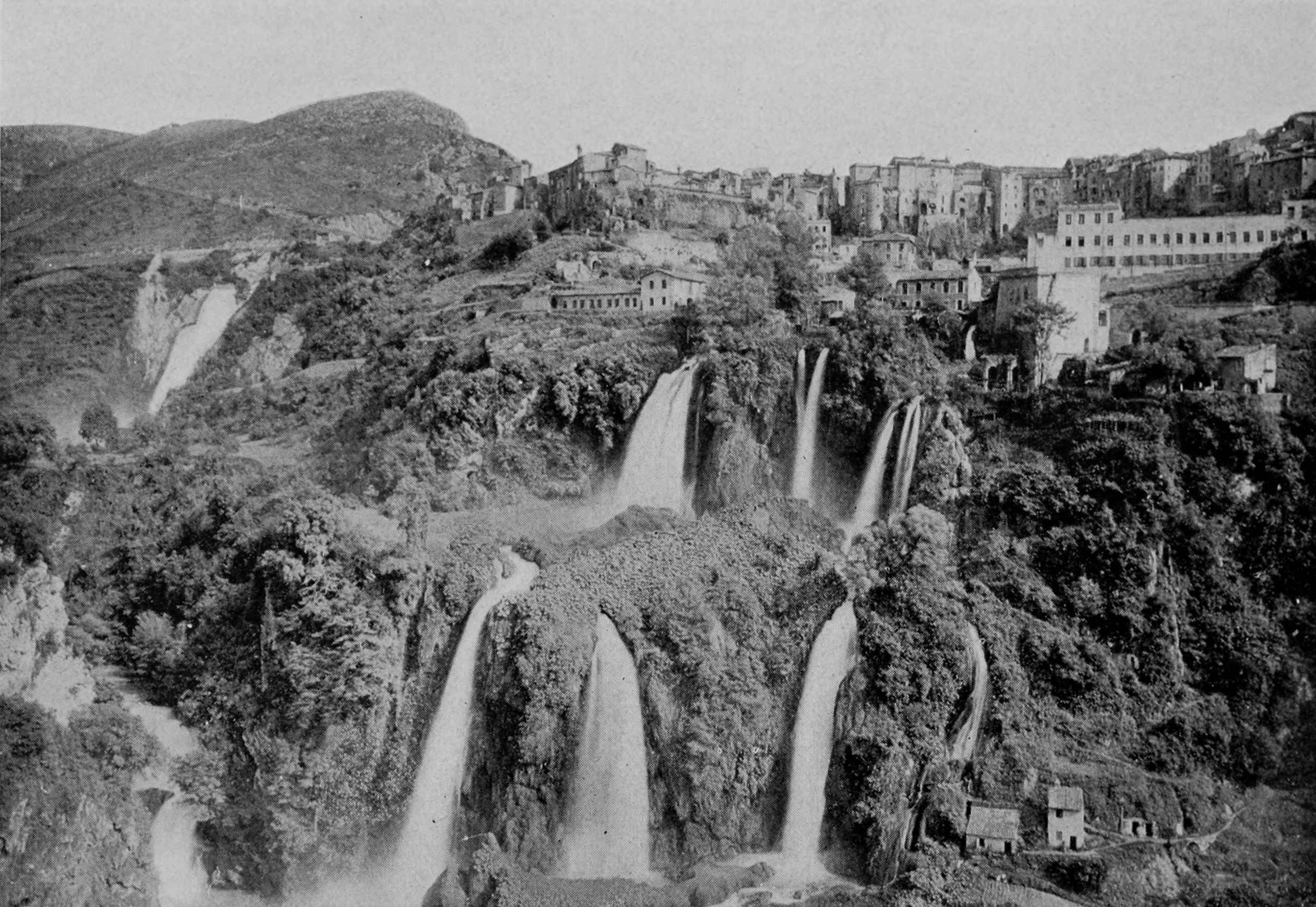
and tumbles down three hundred feet into a ravine.
The water, running continually, is twice as much as
runs in Black River, at Springfield, when it is at its
usual height. Walks have been built up and down
these cascades. The beautiful rainbow is there when
the sun shines, and it is a grand sight to behold.
Here is a great electric plant that furnishes the lights
for Rome: here, also, Rome takes its water supply.
After looking over these beautiful falls and the old
town and taking our lunch, we took teams and drove
to the plains, and visited the wonderful ruins of
Hadrian’s castle, or palace. Hadrian ruled Rome—in
fact, the world—twenty-one years in the first part
of the second century. He did much to fortify different
places, and at the same time spent fabulous
sums for himself, and has left the largest ruins
probably known. His palace was a mile long, everything
conceivable connected with it. We found in
the flooring some of the finest mosaic work known.
Bathing-houses, swimming and rowing, sports and
games of all kinds, were, no doubt, carried on there.
FALLS OF TIVOLI.
While here at Tivoli, we saw them ploughing with
several yoke of oxen. The ploughs were wooden
beams, with a wooden prong running down into the
ground, and one piece of wood coming up for a
handle. Whether these were the same oxen that
Elisha was ploughing with when the Lord called
upon him I am not prepared to say; but the oxen
here are very peculiar looking, with immense horns
running up into the air, and look like the pictures
of the sacred cattle. Almost all of them are white.
You will see large flocks of sheep corralled at night,
led out by the shepherds daytimes.
We left Rome Friday morning, had a very pleasant
trip to Naples, where we were to spend the
night. On our arrival we found there had been an
Austrian steamer run on the rocks in the Bay of
Naples, and four hundred passengers taken off and
put into the hotel. So our managers could not get
rooms satisfactory to them, and put us on a train
and took us some fifteen miles, to Castellamare, to
a fine hotel, where we had excellent quarters for the
night. Saturday, March 9, we took train for Brindisi,
two hundred and sixty miles distant. This gave
us another view of Italy, crossing over sections of
the Apennines. We had quite a long train with
three engines going up the mountains, two in front
and one in the rear. It was a miniature picture of
our trip over the Rocky Mountains on our way from
California. That was ten thousand feet above the
sea. This was four thousand, but the ragged cliffs
and the forty tunnels we passed through had the
appearance of the Rockies with their snowsheds.
These tunnels were from one hundred feet to a mile
in length: the snow covered the ground on this
elevation. After passing over these mountains, we
dropped down into a luxuriant valley in Eastern
Italy. Trains here run no dining-cars, and very
slight accommodations in the depots for feeding people.
So our managers had lunch put up for us at
the hotel where we stayed the night before; and we
had a jolly time with a picnic dinner, and reached
Brindisi at 7 P.M., where we had a full dinner at the
hotel. Our steamer, which is a very large one,
nearly as large as the “Normannia,” lay waiting for
us in front of the hotel. We went aboard about ten.
The next day, March 10, we were on the Mediterranean,
which at this time is smooth and glassy.
Monday, the 11th.
We came on deck this morning and found that we
were sailing under the island of Crete; but you will
remember that in the Epistle to Titus Paul did not
give the natives a very good reputation. So we decided
not to call on them, but shall push on to Alexandria,
which place we expect to reach to-morrow
night or Wednesday morning. The captain tells us
that we are running ahead of time. The sea is calm
and beautiful. We saw it last evening by moonlight,
which was a picture of a lifetime. Our party are all
well and we are congratulating ourselves in being so
fortunate in having so smooth a sea for our four
days’ sail over these waters that are liable to be
turbulent.
In looking over the working classes of Italy, we
find men and women both work as farm hands. The
men receive from thirty to forty cents per day, the
women from fifteen to twenty; and they board themselves.
The tax paid to the government is enormous.
LETTERS FROM EGYPT. — I. — II. — III. — IV. — V. — VI.
March 13, 1895.
We reached Alexandria several hours ahead of
time, and were landed safely. You may be interested
in knowing more fully the method of taking
on and off passengers and baggage from the large
steamers that we have been travelling on. Occasionally
they have a chance to land at a wharf, but
usually they anchor out in the bay; and small boats
come from the shore, and take from the steamer all
that wish to land. When the steamer is anchored,
and gives the signal that everything is ready, there
starts from the shore anywhere from ten to forty
Arabs, Turks, Moors, etc., with turbans on their
heads, clad in either gowns or Turkish trousers, bare
feet and legs, in their little boats, talking and shouting
at the top of their voices, rowing for dear life;
for the first one to the steamer expects to get his boat
full. Being in an unknown tongue, it is a perfect
pandemonium. Up they come, climbing up the side
of the vessel like a pack of pirates; but, as our managers
have the entire charge of our transportation,
we have nothing to do but stand back and enjoy the
fracas. This small boat arrangement is all right
with a smooth sea, but with a rough surf it means
business. The laws of different cities usually regulate
the price these boatmen should charge; but,
when they get hold of Americans that are not
posted, they will fleece them every time.
The “Thalia,” that brought us from Brindisi to
Alexandria, nearly one thousand miles, is a boat
nearly four hundred feet long, manned by Austrians.
They gave us good service, and were polite and
attentive. When we took carriages for our hotel,
a foreign country dawned upon us as never before.
Camels with solemn tread, bearing heavy burdens,
the streets full of donkeys, the people with their
turbans, gowns, and Turkish trousers, women with
the water-bottles on their heads, blacksmiths with
their anvils on the sidewalk in front of their shops,
hammering iron, the shoemakers and other mechanics
in the same way, having their shops, but working
in front in the open air. The Turkish gown
and trousers is the common garb. The police here,
as well as in Naples and Rome, carry the sword instead
of the billy, and here in Alexandria most of
them are mounted on fine horses. Everywhere they
are in uniform.
After lunch we took carriages, and drove most of
the afternoon. Went out and visited Pompey’s Pillar,
which is a wonderful monument of granite. The base
is about fifteen feet square, ten feet high; and then
there is a round, solid shaft, made out of one stone,
about nine feet in diameter, seventy feet high, with
a capstone that would weigh, in my opinion, ten
tons. How this pillar was set up on end, and that
capstone placed in position, is a mystery to the
mechanic of the nineteenth century. This was
erected in honor of Pompey, after his death. He
was beloved by the people, as he had fed them
many times in famine. From this point we went to
a villa and beautiful garden owned by one Antonides,
a Greek merchant. These grounds are said
to be the finest in Egypt. The khedive’s palace we
could not get a permit to enter. Our drive ended
about 6 P.M., landing us at our Hotel Abbas, where
we were soon ready for dinner, and spent a restful
night.
The next morning we took train for Cairo, one
hundred and thirty miles, and made the run in three
and a half hours. The country through which we
came was perfectly level, lying but a little above the
level of the sea. Most of the way we followed the
canal that was cut through years ago from Cairo to
Alexandria, connecting the Nile with that place and
the sea, through which a great amount of traffic
passes, not drawn by horses, as in America, but with
sail and row boats. Our ride from Alexandria took
us through a rich farming country, which seemed to
be covered with crops. The work here is done differently
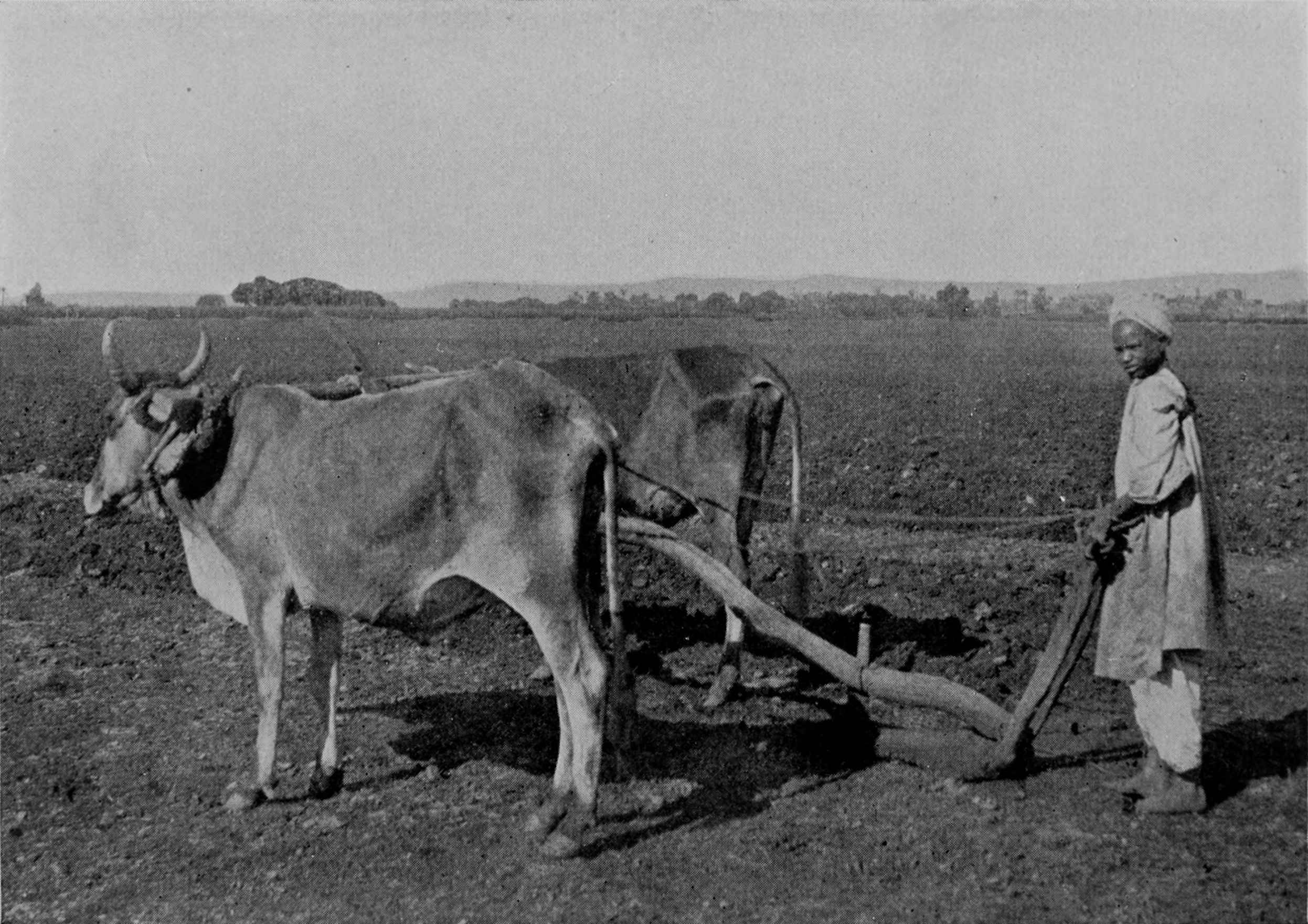
from what it is in Italy. Instead of the hand
work, the soil is lightened up with the old wooden
plough drawn by oxen. The Egyptian cattle are
peculiar looking, coarse, large size, with horns growing
directly backward, close to the neck. Oxen and
cows are both used to draw the wooden plough.
Everything about their work is of the crudest character.
The yoke is a round stick some four inches
in diameter, perfectly straight, and about eight feet
long, lying upon the neck with ropes instead of bows
to hold it on. I have had a curiosity to examine one
of these ploughs. I went for an old fellow to-day
that I saw ploughing in a field, but, when I reached
him, could not make him understand what I wanted.
So I caught hold of his plough, and pulled it out of
the ground. There was no mould-board to turn over
the soil, but they do have a piece of iron on the
point. This drawn through the ground has a tendency
to lighten it up. The soil is rich and lumpy;
and on the Nile they use only sand brought from
the desert to improve their crops, which are
wheat, barley, flax, onions, cucumbers, etc. Egypt
raises immense quantities of onions. We have not
seen as yet many orange groves; but there are sections
where they are produced in abundance, as we
can find all we want, large, sweet, and juicy, for one
cent apiece. There is no tobacco raised in Egypt.
If a man should have a piece of ground two feet
square covered with tobacco, he would be liable to
imprisonment for ten years. Great quantities are
brought in from other countries, with a heavy duty.
This gives the government a large revenue, and is
the reason why the people are not allowed to raise
it. The people here are ground to the earth by taxation.
American slavery, that we used to have,
would be far preferable. Wages here are ten cents
a day, and the laborer boards himself. Every palm-tree
is taxed, and everything that a man raises.
Every village has its sheik, or what we might call
one of the khedive’s lieutenants, and rules with an
iron hand; and, if a man cannot pay his tax, he is
bastinadoed until his cries excite the sympathy of
his friends, and they come and pay the amount
required.
PLOUGHING IN EGYPT.
As we left Alexandria, we first saw the Arab villages
built of dried mud,—anywhere from twenty
to a hundred of these mud boxes, clustered together,
with alley-ways between them. Some were thatched
on top with straw, others had a dome top built
with mud. Here men, women, and children, goats,
chickens, and donkeys, find a home. All seemingly
are living together. Here by these villages they
bury their dead, graves or tombs being above ground,
built of same material as their houses. Many of
these burying structures are whitewashed.
Our first plans were to spend several days in
Cairo before going up the Nile; but on our arrival
it was thought best to start up the Nile at once, and
visit Cairo on our return, which will be the first
week in April. This letter will be mailed at Rhodes.
My next letter will be the commencing of the Nile
tour.
On the Nile, March 17, 1895.
My last letter was written when we first commenced
our trip up this wonderful river, but it was
about matters that my eye had witnessed before
reaching Cairo. On our arrival at Cairo, which was
Wednesday, the 13th, about noon, carriages took us
direct to the “Memphis,” our Nile boat, which was to
start up the river at 5 P.M. This boat was chartered
by the Gaze Company expressly for our party, which
just fills all the cabins on the boat. It is about one
hundred and ninety feet long, considered one of the
best on the river, and is more than satisfactory to
our party.
After lunch we took carriages for two hours, and
went to the stores, as many of the party wished to
make purchases for the Nile tour, which it is expected
will be a warm one, and needs a light headgear,
white umbrella, etc. These are needed when
we take our horseback or donkey rides from different
landings out into the country, of which we have
some ten.
The Nile is said to be the most wonderful river in
the world, thirty-three hundred miles long. The last
twelve hundred miles not a tributary enters it; and
the amount of water it pours into the sea after
its evaporation in travelling three thousand miles
through the desert, and its countless irrigating canals
in Egypt, transforming this section of country into
the most fertile land in the world, make it wonderful.
Egypt is often said to be the gift of the Nile, a mere
strip of alluvial soil bordering the river on either
side, from one-half to thirty miles wide. All the rest
is a broad desert. The source has been and still is a
mystery, though the late explorations make it possible
that the great lake, Victoria Nyanza, is its
feeder. The melting of the snow on the far-off
mountains is the cause of its rise and overflow.
But the historical associations are more interesting
than its natural features. On its banks was developed
the oldest civilization of the world. Its massive
monuments along its banks are a matter of
interest to-day. It had the honor of cradling the
Deliverer of the nations. As we left Cairo, we were
pointed out the spot where Pharaoh’s daughter found
Moses.
Our party are confident of an interesting time
going up and down these great waters. They have
boats here with cabins in the centre, enough for ten
or twelve persons, with place in front end of boat
for ten oarsmen, five on a side, with very long oars.
The natives row finely, dipping their oars at exactly
the same time, running their boats rapidly. These
boats are chartered by parties going up and down
the Nile. We met yesterday a gentleman and his
family from California in one of them, coming down
the river. Some of our party have the American
flag with them. This was flung to the breeze as we
passed them, and the cheers went back and forth in
great earnest. We felt for a moment as though we
were the other side of the Atlantic.
Well, to go back to the starting-point. Five
o’clock Wednesday, the 13th, all on board, with our
luggage packed away in our cabins, our steamer that
was lying close to the Rasr el-Nil bridge, that is
twelve hundred and sixty feet long, built by a French
company, and is a model of work well done, started
her engines, and swung out into the broad river, and
our journey of twenty-one days on its smooth waters
had begun. The Gaze Company have engaged a
dragoman named Hasham, who was born in Arabia,
but has been educated and lived in Egypt, to take
this Nile trip with us. Hasham knows the country,
and can handle the natives that we shall have much
to do with in our short excursions we are to take
from the boat.
HASHAM, OUR DRAGOMAN.
At dinner, which was served at six, Hasham came
in, and gave notice that breakfast would be at six
to-morrow morning, rising bell would ring at five.
Some of our ladies thought this was starting rather
early; but as the first donkey ride was to commence
then, I think they would have met the requirements
if it had been three o’clock. But Thursday morning
found every one on hand. Our boat had the evening
before run up the river fifteen miles, and anchored at
Bedrashayn; and, when we came out from breakfast,
we saw on the bank of the river forty Arabs, each
one with a donkey all saddled and bridled and ready
for the fracas. The saddles and bridles are furnished
by the Gaze Company, and are first-class.
Soon we were all mounted and on our way. Every
donkey was followed by an Arab, who was anxious
to have his donkey get to the point of destination
first, and would put it into the gallop, and run behind
with the alertness of an antelope. One thing
was wonderful,—among the forty people of our party
there was not a poor rider: even the ladies were
all fine riders. This excursion would have been a
good entertainment for any New England village.
Our first stop was at the sarcophagus of Rameses
II., which was immense in size. We also went
into his tomb. We also visited the ancient site of
Memphis. This is supposed to be the oldest or first
settlement in Egypt. It has been buried by the
sand that has blown from the desert; but parts of it
have been excavated, and interesting relics brought
to light. We visited some of the Pyramids, also the
tombs where the bones of the sacred bulls were
buried. We were back again at our boat at eleven
o’clock, having ridden fifteen miles. On our return
came through an Arab village, saw misery in full
bloom, looked into the school-rooms with children
sitting on the ground, looked into the dark, smoky,
dingy hovels where human beings stay, not live, but
know nothing better, and were thankful that the
lines had fallen to us in Christian America. We
rode through fields of wheat, barley, flax, everything
luxuriant; and, if a Christian civilization could be
introduced, there would be no reason why these
should not be the happiest people in the world.
At noon our boat started up the river, continuing
its course until evening, then tying up for the night,
which seems to be the custom of all boats on the
Nile. This gave us a fine opportunity to sleep, making
the trip delightful. Friday we were on the river
all day, resting from our donkey ride the day before,
having a chance to admire the scenery, which is constantly
changing, with its groves of palms, fields of
grain, villages, etc.
About 7 P.M. we reached Minieh, where we
tied up for the night. This is a large place, with
post and telegraph offices and the largest sugar
factory in Egypt. Our dragoman, Mr. Hasham, proposed
to have us visit these works, as they are running
night and day. So with guides with lanterns
we started through the town to the mill, and it
proved very interesting to us. We had never seen
anything of the kind before, commencing where the
cane was taken from the wagons, put on tramways
carrying it into the mill to the ponderous rolls where
it was crushed, juice pressed out, which went into
the tanks, the pulp going on to other tramways,
carried out doors again, where it is dried and used
for fuel. We followed the process of making the
sugar, consisting of many different operations, until
it came out granulated sugar, many of us taking
samples that we will bring home. This mill employs
two thousand men. The overseers get some $2.00
or $2.50 per day, but the bulk of them get from five
to twenty cents per day. I have the impression the
night and day help change at midnight, as there
were hundreds lying about in the mill, asleep on
the stone floor. Some had a piece of burlap under
them, others the bare stone. The heat in the mill
must have been ninety or one hundred degrees.
The sugar is not as white as our granulated.
Early Saturday morning we reached Beni-Hassan,
where we visited the tombs of Ameni and Knum
hotep, calling for another donkey ride of about half
the distance of the one we took Thursday. It is
said there is the toughest set of Arabs here of any
place on the river, and it was pathetic and amusing
to see our dragoman Hasham lash them with his big
cudgel of a whip he carried. He also provided two
policemen with guns to go along with the party.
But everything went off like clock-work; and it was
the verdict of every one, Well done, Mr. Dragoman.
Saturday night we anchored in the river. About
five Sunday morning the boat started, and ran up to
Assiout, arriving about 7 A.M., where we tied up for
the forenoon. This is a large town, some forty thousand,
of whom twelve thousand are said to be Christians.
Here the Presbyterians have a large mission
station. We attended divine service. While
everything was in an unknown tongue, yet it was
interesting to see them. The audience consisted of
about four hundred young men and boys and one
hundred girls. They all sang with a will, and gave
strict attention to the sermon, singing American
tunes. One was “St. Martin.” I could handle the
tune better than I could the words. To cater to the
laws of the land, the girls sat by themselves in the
front pews, with a curtain drawn across the church,
not so high but what those behind could see the
minister, who stood on a platform raised some three
feet. The majority of the young men were fine-looking,—that
is, fine features and form,—but dark
skin. This work was commenced 1852, has been
largely among the Coptics, though many Mohammedans
have come in. The Coptics are what would be
called a corrupt Christianity. This mission’s headquarters
are here; but they work all over Egypt,
and have thousands in their churches. The work
was very slow at first, but of late years has been
making progress. Mr. Alexander, the minister, met
us after meeting, and gave us a brief history of the
work and the people.
Coming from church, we went through the business
bazaars. Everything running in full bloom. Surely,
Egypt is an Oriental country. You see it at every
turn you make.
At 5 P.M. the Rev. Mr. Darsie, of Kentucky,
who is one of our party, preached to us on deck.
Dr. Dunning read the Scriptures, reading the story
of Joseph’s brethren going down to Egypt to buy
corn. He said he took that subject because he
should never have a chance to read it again on the
ground where the scene transpired and his audience
would never hear it again under existing circumstances.
Our clergyman claims that Pharaoh lived
very near Cairo, either Memphis, the ruins that we
visited at the commencement of the journey, or
Yoan, which is a little nearer Cairo than Memphis.
Monday Morning.
We had a warm night. Mercury this morning
stands at seventy.
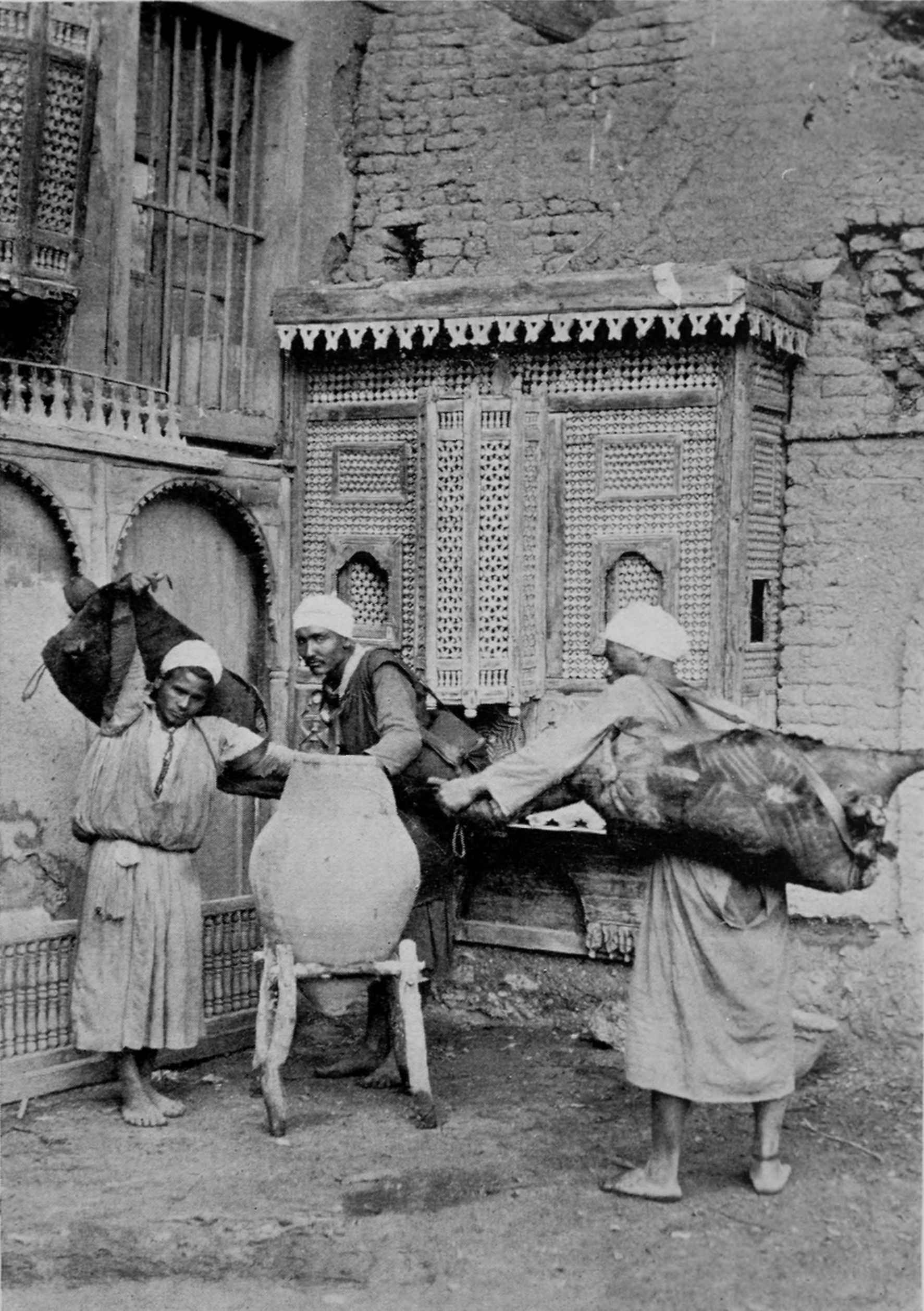
We are now passing quite a large town. The
banks are lined with Arabs, boat-loads of stone
water-bottles going down the river.
Luxor on the Nile, March 20, 1895.
I will commence my sixth letter at this place.
Have been one week with the prow of our boat
pointing toward the source of this great river. Another
week, and we shall begin to think of right about
face, and follow the current down to Cairo from
whence we started. We are enjoying the water, and
the eleven thousand miles of water travel we shall
have before we reach Springfield ought to make us
pretty good sailors. Coming up the river, we have,
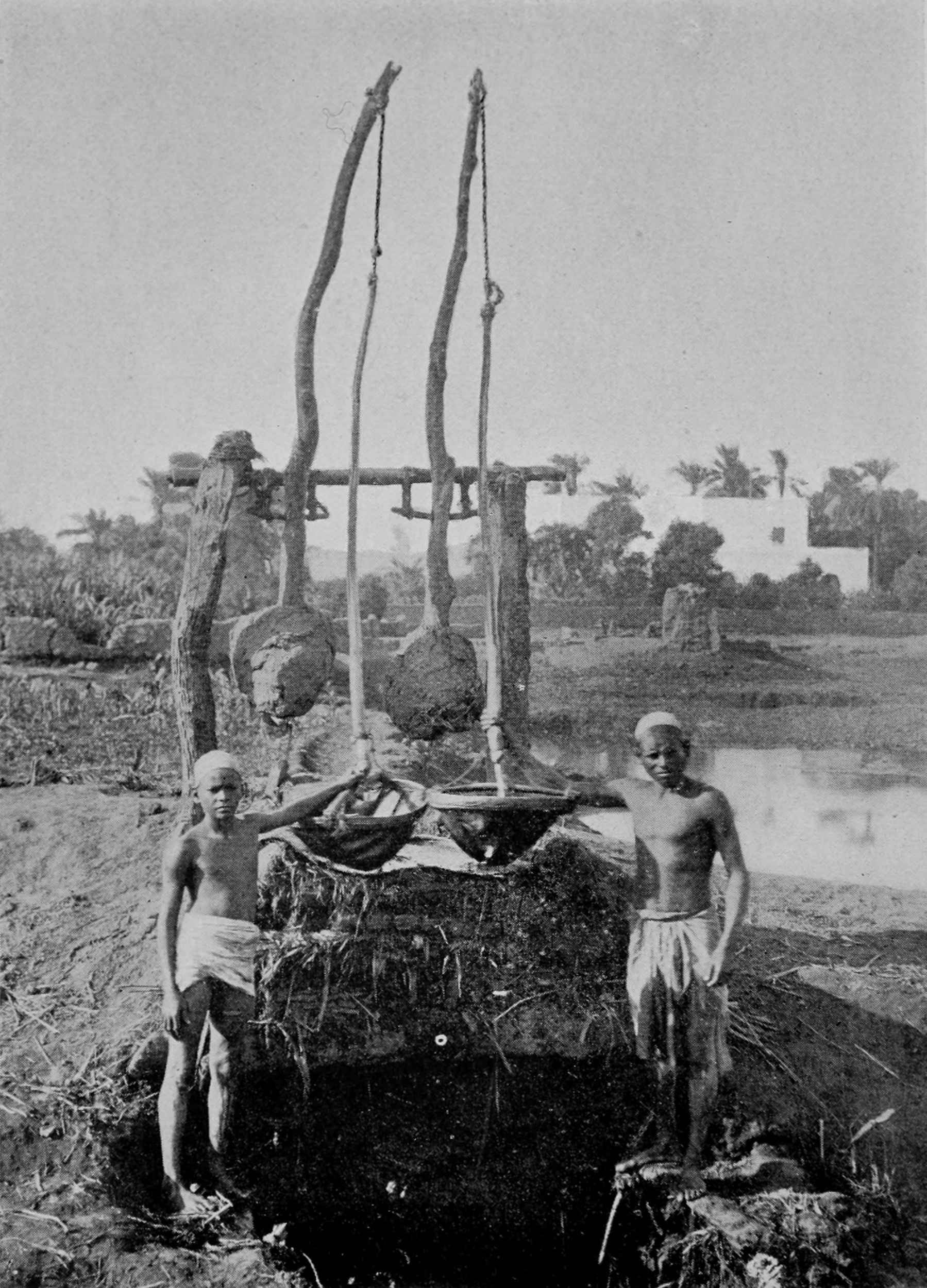
with other things, been watching the methods of irrigation.
The more ancient and crude way is a flaring
vessel that will hold one or two pailfuls, with two
ropes some eight feet long fastened one on each
side. Two men, one at the end of each rope, will
swing the vessel into the river in a way that it fills,
then, throwing it upon the bank striking bottom side
up, emptying the water into the sluice-ways, where it
runs off into their gardens and fields. The rapidity
with which these men will throw this vessel and the
quantity of water that will run from one of them are
surprising. This works where the bank is only
some five feet high or less. Another arrangement is
an old-fashioned well-sweep. This will take the water
up high embankments, as the first man draws it, say
eight feet, and pours it into a shallow well dug in the
bank. From this the next man takes it, and so on to
the top, where it is carried in trenches as before.
The third and better way is two wheels, one horizontal,
the other perpendicular. The latter has an endless
chain running over it, long enough to go down
into the water. On this chain are hanging buckets
that are coming up full of water, emptying at the top
into a trough, and going on down empty. The other
wheel that carries this has an ox or horse or some
animal attached to it, and goes round like the horse
grinding mortar in a brick-yard. These machines
carry up a large quantity of water, making quite a
brook running away from them, which in many
instances runs long distances.
DRAWING WATER ON THE NILE.
I should like to have you rise early with me some
morning, and see the natives on our boat wash the
deck floor. First, they throw water over it. Then
each man has a whisk or brush broom, laying flatwise,
fastened to the under side of his right foot;
and by a back and forward motion, sliding the right
foot on the floor, the scrubbing is done with a vengeance.
While doing this, they all sing and keep
perfect time. It may not be as graceful as the
dancing of our young people, but it is quite as
effective. When they sing, it is, “Zallah, zallah,”
etc., which means in English, My God, help me.
Yesterday we called at Neneh, a place of sixteen
thousand people. It is the capital of the province,
and has large manufactories of pottery, supplying
nearly all Egypt with gallahs and filterers. We
went into the works, and saw them make their
wares. A man sits with his feet in a pit. In that
pit is a horizontal wheel, two feet in diameter, with
a shaft running up just out of the pit. This wheel
he turns with his feet. On the top of the shaft
he places the clay, and spins it up with his hand,
forming any shape desired. It is spun very much
like plated ware, only the men in those works have
tools to form the metal and run it with greater speed.
On our return we came through their bazaar.
These institutions in Egypt are a curiosity.
We also visited the temple of Denderah. This is
without doubt the grandest relic or ruin in all Egypt.
In its day the temple must have been grand. Many
of its designs are supposed to have been taken from
Solomon’s Temple. It is supposed to have been
destroyed by the Mohammedans. The beautiful
carving and sculpturing with coloring had most of
them been hampered, pounded, and defaced as much
as possible. We all decided that its glory in its
day could not have been described with pen. The
eye must have beheld it to realize its beauty and
grandeur.
Luxor, or its ancient and Bible name Thebes or
No, is spoken of in Ezekiel xxx. 14-16. It is a
place full of historical interest, and we do not give
it merely a passing notice, but are to remain here
three days, taking excursions out to the old temples,
tombs, etc. It was a great city before the days of
Abraham. It became the seat of empire under the
eleventh and twelfth dynasties of kings. It was a
walled city, said to have contained at one time five
million of people.
The alluvial plains on the banks of the Nile here
seem to extend her borders right and left. Standing
on our boat, looking west, our eye views a beautiful
plain for miles; and in the background in a crescent
form rise the mountains of sandstone, which is the
commencement of the Libyan desert. Then you will
get a similar picture, looking east.
Thebes flourished many years. Kings became
builders of heathen temples, but the day of vengeance
came at last. Ptolemy Lathyrus razed it to the
ground about one hundred years B.C.; and on these
great plains, where once stood the great city of the
world, are now scattered only ruins.
Here in Luxor is an American mission; and many
of the boys and girls are studying the English language,
and read quite well. We went into a grist mill
to-day, said to be one of the best. They grind
the wheat with a granite stone, some three and one-half
feet in diameter and about four inches thick,—that is,
the upper stone,—which rests on a spindle
with a small gear at the bottom. Into this is connected
a large gear. The shaft of the large gear
has a sweep, and to that is attached a donkey
which goes round in a circle, giving the mill-stone
quite a speed, and will grind nearly a bushel an hour.
The owner takes the flour and sifts it by hand, and
makes it into bread for sale. The wheat is plump
and fine, quality of bread very good.
The obelisk that was recently set up in New
York City was taken from Alexandria, where we
landed on our way from Brindisi. The one erected in
Paris was taken from this place. It was one of a pair.
We have been looking over the remaining one and
the base of the one taken away, but the one that
excels them all is about two miles east of the village
of Luxor. It is one piece of solid granite, one hundred
and six feet high, nine feet square at the base,
finely carved. Some thirty feet of the top was covered
with gold, and shows the result of it to-day.
This wonderful piece of work was erected by Queen
Hatasu. Thus you will see that woman has outdone
all the kings of the earth, and a work accomplished
by her is the wonder of the world. The work on
this obelisk was done in seven months and seven
days.
We have been travelling over these plains about
Luxor, covered with interesting relics, for the last
three days; and it is wonderful what the ancient
Pharaohs did, and from appearance it was for self-aggrandizement.
Two miles east of Luxor stand
the ruins of an immense temple. In one portion are
one hundred and thirty-four pillars some fifty feet
high. From this temple run several avenues, the
longest extending to the river, a distance of two
miles. These avenues were lined with sphinxes on
each side, hundreds of them, bearing the emblem of
the power of the king. Standing back of these were
rows of palms and other Oriental trees.
Pharaoh had his three thousand chariots with him
when he rode in state. But to-day in this region no
one rides in carriages. Camels and donkeys are the
modes of conveyance, excepting the sedan chair.
Farming here sticks to the fathers. They thresh
the grain the old way. It is trodden out with oxen;
and, to keep the old injunction good, they are not
muzzled. We do not see here farm-houses as we have
in New England. The people all live in villages, and
go miles to do their work. You will see the Rebeccas,
with their water-jars on their heads, going long
distances for water. Whether these things are ever
to be modernized is a hard question to answer.
Cairo, April 2, 1895.
After mailing my last letter at Luxor on the Nile,
where we spent three days, we continued our course
up the river, having one hundred and thirty miles
more to travel south to reach Assouan at the first
cataract, where was to end our outward Nile tour.
Assouan is the farthest from Springfield of any place
we shall visit, and took us nearer the equator than
we ever expect to be again.
The season was late to visit that tropical region,
and ours was the last large party to leave the cataract
this season. Hence we expected to suffer from the
heat; but the Lord smiled on us, and gave us cool
weather. Ninety-two in the shade was the highest
the mercury went, and that was only a few hours in
the middle of the day, always having cool nights.
Even Vermonters can stand that temperature.
Our first stop after leaving Luxor was at Esneh,
where we visited a temple which was built or had
been repaired at a late date; that is, after the commencement
of the Christian era. The next and only
stop was at Edfu. There we visited the temple of
Horace, which was modern and beautiful. Here they
had patterned after Solomon’s Temple, had the holy
of holies with the exact measurement, also the ark
of the covenant.
We reached Assouan March 24, and found it one
of the prettiest towns in Upper Egypt. Here is
where all the large steamers turn their prows down
the river, and traffic that is going up the river is
taken by camels or donkeys by the rapids, then put
into small boats. This is what has built up the town,
and it might well be called the offspring of the cataract.
We spent two days at Assouan in the bazaars,
trading and watching the habits and lives of the
people, etc. We also visited the town of Philæ, giving
us a donkey ride of fifteen miles. Philæ is a
beautiful town at the head of the cataract. We repeated
the old story of visiting another temple.
This was the temple of Isis.
Some of our party returned from this place by
boat, going down the rapids in small boats managed
by the natives. This was a curiosity. The natives
always sing when they handle the oars. Their
music has time and rhythm, and that is all there
is to it.
While on the Nile, we visited one of the Nilometers.
With these instruments a record of the height
of the water is kept, and by this record the taxation
of the crops is regulated.
Egypt is noted for its ancient historical records.
Monetho, a priest and Greek scholar, was employed
by Ptolemy II. to study ancient manuscript and
hieroglyphics, and brought forth a work that was
considered valuable at the time. A large part of
this work later on was lost; but the study of the
handwriting on the wall has of late years been
revived, and great interest to-day is manifested in
those old historical relics,—the obelisks, temples, and
tombs,—and it seems as though God had made Egypt
a great repository to keep the records of the Old
World. With its wonderful preservative qualities,
no rain or dew, a perfectly dry atmosphere, everything
seems to keep in its original state. We have
seen polished granite, four thousand years old, looking
as clean and bright as though it had been polished
within a year.
The papyrus manuscripts that have been unearthed
in the temple and tombs are making revelations
every day. The bread and grain brought to
light, thousands of years old, are items of interest.
We have been upon the tops of some of these old
temples. In one place we went up two hundred and
forty-six steps. Have had some beautiful views of
the Nile, with its broad plains covered with palms
and fields of grain, etc.
This country is different from anything we have
ever seen before. As you sail up this broad river,
with its rich alluvial land on both sides, back of these
plains rise somewhat abruptly hills and mountains
composed largely of sandstone of a pearly gray appearance,
seemingly variegated. Here commence
the great sand deserts. These hills have not the
first green thing on them, and are saying to the tiller
of the soil, “Thus far shalt thou come, and no farther.”
The plains and mountains give us some beautiful sunsets.
We travelled from Cairo to Assouan, five hundred
eighty-three miles; and the average width of this
valley is six miles. This is all there is of Egypt excepting
from Cairo to Alexandria, one hundred and
thirty miles. A peculiar shaped country, but rich in
her fertility, raising two and three crops a year, and
exports much more than they import. Her historical
relics that are coming to light are beginning to
draw tourists. Four thousand of this class have
gone up and down the Nile the last year; and the
number will increase in the future, giving her quite
a revenue. It is a very unique trip.
If I were an artist, I would with pencil and brush
give you a picture of the natives, camels, and donkeys
at one of our landings. But, as I am not, I
shall have to content myself with a few outlines.
As soon as our boat ties up at the landing, the natives
begin to gather with their wares and donkeys
from all directions, trinkets to sell, donkeys to let,
etc. The natives are very artistic. They clip their
donkeys over the back. Then on the sides and legs
they notch and slash the hair in such a way they will
show beautiful palm-leaves on the sides. On their
legs some of the donkeys look as though they had on
short pantalets with pointed lace at the bottom, then
the mitre and breastplate, etc.
Now let us take a ride into town or some objective
point; and, if you are fond of fun,—and I know
you are,—here is where you get it. As soon as you
step ashore, and they see there is a chance to let a
donkey, they will make a rush for you, every man
praising up his own animal, shouting in an unknown
tongue and gesticulating to the best of his ability.
At first you will think you are going to have a street
fight on your hands at once. Then they will begin
to grab hold of you, and you will make up your
mind that you are going to be quartered, and each
quarter is going off on a separate donkey, and you
will have four backsheesh to pay instead of one.
But all is, when things begin to grow interesting, say
to them, “Hands off!” and mount the first good-looking
donkey you can get at, and you will be surprised
to see how quickly things quiet down. No one finds
any fault, and the man that secures the job is happy.
The next thing is to make your donkey boy understand
where you wish to go. Then you are off with a
rush. The young man follows his donkey with a
whip or cane, and will give you all the speed you want,
using his cane over the hind parts of his animal, and
shouting at top of his voice, “Zah, hoo, zah, hoo!”
but having sympathy for the donkey, and not wishing
for such speed, you begin to wave your hand
backward, and shout, “Slower, slower!” and, unless
you are persistent in your demands, you will still
keep up the rush. Either way you are sure to get
there all right, then alight from your donkey and go
where you please. When you return, you will find
your donkey boy waiting for you. When you return
to the boat and pay for your ride, it makes no difference
what you give them, they will want more.
The disposition with the natives is to get all they
can out of the tourist. Many a time in selling their
wares they will take one-eighth of what they asked
in the first place. But such is life in Egypt. It is
impossible to go out from the steamer into town
without having from three to six of these natives
following you, offering to guide you, for which they
expect backsheesh, or else they are trying to sell
you scarabs or some unearthly thing you care nothing
about. A polite invitation for them to leave
amounts to nothing. You have to go for them
with a cane, and give them to understand you mean
business.
The sad thing of this country is the halt, maimed,
lame, and blind you meet at every turn, begging.
Some of the most pitiable-looking creatures! It
makes the heart sick. If a man could be a many
times millionaire with a heart to give, this would be
a splendid field for him.
The Nile seems to be the pride of Egypt. The
people all come to it with their herds to water, also
to drink themselves. Their washings are done on
its shores.
Money seems to be worth more than in America,
and is in smaller denominations. They have here
parion, millims, and piastres. The parion is a small
copper coin, value one-eighth of a cent. Two parion,
a larger piece, one-fourth of a cent. The millim is
very small, with silver in it, value one-half cent.
Two millim, one cent. A piastre is a trifle over five
cents, then there is one-half piastre. The five piastre
piece, twenty-six cents, is the size of our quarter.
The ten piastre piece, fifty-two cents, and twenty
piastre piece, one dollar and four cents, correspond
to our half-dollars and dollars. The quality of their
silver is better than ours, and stands on equal footing
with French gold.
We remain here about ten days, then go into Palestine,
where horses take the place of donkeys.
Cairo, April 5, 1895.
The Congregational Oriental party is at this time
nicely located at the D’Angleterre and new hotels
that would do credit to any American city. Many
of the clerks and waiters speak English, and are
very polite and attentive. While we expect to remain
here until the 13th, yet we are not anxious to
have the hour of our departure arrive.
Cairo seems to be the Chicago of Egypt, a place
of some four hundred thousand inhabitants, about
twenty thousand of them English and Americans.
The bulk of the residents are Mohammedans. This
place was founded about A.D. 850. Touloun, a Moslem,
was its first governor. In 1170 the famous Saladin
usurped the throne; in 1250 the Mamelukes
took possession; in 1517 it was stormed and captured
by the sultan, Selim. To-day England has
a powerful grip on Egypt. The khedive ran the
country badly in debt. England took the bond until
she stepped in, and said, “We must control the property.”
The Egyptian army is officered by English.
In fact, they keep many of their soldiers here, and
Egypt feeds them; yet England can take them away
any time she chooses. The khedive lives in Cairo,
and rules some six millions of people; yet he is ready
to take off his hat to Johnny Bull whenever he meets
him. The six millions of people in Egypt are largely
Mohammedans, some half million Coptics. Here and
there you will find people from Nubia, Soudan, and
India. The people are a copper color, excepting
those from Soudan, they being black and shiny, but,
unlike the negro, have not the thick lips and curly
hair. The Egyptians are straight, fine forms, white
teeth; and many of them, aside from color, are handsome.
They are not vicious, and are easily managed
by those in authority.
The condition of women in the country is deplorable.
The laws of the Mohammedans give a man
a right to have four wives if he wishes for them.
He buys them, the usual price being twenty-five
dollars, paid for in any kind of goods the man may
happen to have. If he wishes to get rid of them,
the law requires him to support them nine months;
and the woman has to take care of and support the
children until eight years old. So you see divorce
is an easy matter; and they are sure to send the
wives off when they get to be old, and take young
wives in their place. The law in these matters is
a mere letter, and many of the well-to-do Arabs have
twenty wives instead of four; and many times they
are sent off with a piastre (five cents) instead of
nine months’ support. The man rides his camel or
donkey, and the wife walks or runs behind. Sometimes
they send them out on a two-wheel cart to air
them.
The marriageable age for girls is twelve, boys
eighteen. We have seen many a young wife about
that age with her baby in her arms. They never
educate the girls.
The laws of the Coptics are different. Only one
wife is allowed.
When the prow of our steamer was headed northward
on the Nile, we had but little to do upon
our return but watch the scenery and the villages.
There are a few towns that show thrift, with some
modern-looking buildings; but the majority are the
old mud houses, and the walls are built up some
seven feet high, then poles thrown across and a covering
of straw to keep the sun out. Not having rain
up the Nile, the roof is of minor importance. We
went through many of those villages, and into some
of the houses, where you will find in one room donkeys,
pigs, hens, and the natives all living together;
and a good, nice Vermont hog-pen is a palace to
some places we saw.
There seems to be a disease of the eyes among the
children in Egypt, and the flies gather on them.
We have seen children with their eyes so covered
with flies you could hardly tell whether they had
eyes or not; and they seem to make no effort to keep
them off. This, I think, is the reason why there are
so many blind people here. It is said that one in
twenty is blind, either one eye or both. There are
no hospitals or places for the poor, so all they can do
is to sit and beg. It seems as though the condition
of the people in Upper Egypt is worse than here in
Cairo.
I have been wandering with you through the
country. I will now try to give you a glimpse of
Cairo. While there are camels and donkeys here,
you will see some of the streets full of fine horses
and carriages. The officers of the government and
many of the wealthy have their fine turnouts. They
have their sais, who are the most sylph-like beings
imaginable. They can run hours without tiring.
They wear a richly decorated garment, embroidered
in gold arabesques, a wide silk sash with ends floating
in the air, with loose gauze sleeves, white, falling
to the waist, and a short skirt coming to the knees
of same material. A wealthy man will have two of
these men, who run abreast of each other. Sometimes
you will see one alone. They carry a wand
some five feet long, brought against the shoulder,
when they run before the carriage. The coachman
drives his team rapidly. The sais run with great
speed, keeping about one hundred feet in advance,
shouting to anything or anybody that is in the way
to clear the track. I have never come in contact
with them; but I enjoy watching them exceedingly,
they look so fine and run so gracefully.
The new part of Cairo where we are located is
modern in appearance, broad streets, fine public
buildings, stores filled with fine-looking goods, etc.;
and, if it was not for the Oriental toggery going
through the streets, you would almost think you
were the other side of the Atlantic.
When you leave your hotel, the first thing you
meet is an Arab with a donkey. He knows a few
words of English; and he says: “Fine donkey, nice
donkey to ride. Donkey take you to bazaar. Fine
donkey, ride easy, good donkey.” No matter how
strong your assertions are that you do not wish to
ride, he will follow you a long distance. Another
conveyance is the pasta Baluak. This annoys no
one. It looks like a small street-car, seats running
crosswise, so you enter on the side. The car is much
wider than the running gear. There are four small
wheels underneath. They hitch on a pair of horses,
and go where they please in the highway. The passengers
get on and off at their pleasure, paying
for their ride. Very convenient where there are no
horse or electric cars, things we have not seen in
Egypt.
Cairo is said to have a thousand mosques. It
seems to be a city of domes and minarets, some of
them very handsome. We have been in several of
them. They differ from the Catholic cathedrals,
being entirely free from statuary, figures, or pictures.
The Mohammedans are decidedly opposed to anything
of the kind. In one of the squares of Cairo is
a statue, upon a horse, of Abram Pasha; but, when it
was erected, it met with great opposition. The alabaster
mosque is one of the finest, solid columns of
pure alabaster. In every one of these buildings on
the east side is a circular recess, beautifully inlaid;
and in this mosque this was solid onyx of the finest
quality. Toward this recess every one faces when
he worships: this points him toward Mecca. In the
front court of this alabaster mosque is a closed fountain,
some fifteen feet in diameter, with a canopy top.
Around the outside are round onyx stones, about
twelve inches high and twenty inches in diameter.
In front of each one of these stones is a faucet.
Before the man is allowed to worship in the mosque,
he kneels on one of those stones, opens the faucet
and washes his feet, face, head, mouth, nose, and ears.
Then he enters the mosque, and performs his devotions.
The floor is covered with mattings or carpets.
The building is profusely lighted, having more or less
colored glass, and must look fine in the evening when
lighted.
We visited the oldest church in Cairo, built over
one thousand years ago. It is a Coptic church, still
in use. We also visited a mosque built about the
same time.
Our dragoman, Hasham, is a Mohammedan; and
we have a chance to study theology with him. They
believe that Christ was a prophet, but Mohammed
was a greater and later one. Many of them are very
devoted, but their religion does not seem to bring
them upon a very high plane of moral living. Hasham
says he is coming to America. I have the
impression that he is beginning to think that there
is a better religion than he is now acquainted with.
We visited to-day the Palace Hotel, being shown
all through it. This was built by the khedive for a
palace, and cost eleven millions; but he found out
that he had more palaces than he could support, and
sold this one to a French syndicate for a hotel.
The grounds are extensive, finely laid out with
flowers, fountains, statuary, many beautiful trees,
and about one hundred electric lights, with large
globes to light the grounds in the evening, which
must make it a perfect fairyland when lighted. It
is located on the banks of the Nile, and their prices
are from three to five dollars per day. They can take
care of some two hundred, and have not been able to
accommodate half that wish to stop with them. One
hundred more rooms are to be added this summer.
If you wish for the finest thing in Cairo, send in your
name. You will not get nearer paradise in this section
of country than there. We saw one arrangement
that was beautiful. On some of the mirrors
were painted vines and flowers, and it made it
appear as though you were looking into a conservatory.
It is the cheapest conservatory one can
have, no danger of frost, and you will always have
vines in blossom.
Cairo, April 6, 1895.
This has been a great day in Cairo. The tomb of
Mohammed in Mecca is kept covered with beautiful
carpets of tapestry and embroidery, which are renewed
every two years. This is the year for renewal,
and they have with great labor and skill been
prepared; and the 6th might be called the day of
dedication. All business in Cairo came to a stand-still:
everybody and everything was in gay attire.
8 A.M. was the hour to meet on Citadel Hill.
We were there with our carriages promptly on
time. Many of those beautiful carpets were spread
over oval top stretchers, carried by men. Then
there was a canopy for the tomb that was gorgeous
and dazzling. This was on a sacred camel, and entirely
covered the animal, the top being some ten
feet above the camel’s back. These all passed close
by our carriage. Some two thousand soldiers, with a
large amount of cavalry, artillery, etc., all beautifully
uniformed, and large bands of music. The khedive
was in the procession. The people and carriages
covered acres. The coverings for the tomb were
taken from the citadel to a mosque; and in a few
weeks another day will be set apart, and the goods
will start for Mecca.
The night before the 6th they had what they call
a feast. These goods were placed in one of the
public buildings, brilliantly lighted; and eatables
also were added, and all that wished went in. It
was like a grand reception. When the whole thing
was over, we decided we were lucky to hit so rare
an occasion.
When we visited the oldest mosque, we saw the
column with Mohammed’s hand holding a whip imprinted
on it. They claim this column flew from
Mecca to Cairo,—quite a flight.
When on Citadel Hill, we saw the place where
Mameluke jumped his horse off a precipice, killing
his horse, but by a miracle, as it were, saved his own
life. This was when Mohammed Ali made a banquet,
and invited all the head men of the different
provinces, and at the right moment let his soldiers
in upon them, killing several hundred, this Mameluke
being the only one to escape.
When Abraham walked the plains of Mamre with
the angels, and pursued the captors of Lot, Egypt
had her large cities, and was the centre of art and
learning. Even Rome and Athens had their first instalment
of knowledge and science from this old
country.
Saturday we took carriages, and drove ten miles to
Heliopolis. Here was located the great institution
of learning in the time of Pharaoh, the place where
Moses and Joseph received their education. Here is
the oldest obelisk in Egypt, and the old sycamore
tree, said to be growing on the spot where the holy
family rested, when they went down to Egypt to
escape the wrath of Herod.
The more you travel here in Egypt, the more you
are impressed with its ancient historical interest.
I have given you thus far in this letter more of the
new Cairo than of the old. There is a part of this
city that is as ancient seemingly as are the eternal
hills that are around it, and there is no way that you
will get more of the Oriental life than to go with me
through the bazaars. Here you will enter streets
miles in length, some of them so narrow that only
pedestrians and equestrians enter them. Each side
is full of stalls, many of them not more than six by
ten feet. On the floor is usually a rug, on which
sit the merchants, many of them smoking their
nargileh. These boxes or stores, and occasionally
larger ones, are packed full of goods, many of the
richest quality. In these bazaars you will find them
manufacturing shoes, garments, silver and copper
ware, etc., using the crudest tools imaginable, yet
their work is fine. We saw articles in silver that
were exquisite. The natives and their donkeys are
going to and fro, good-naturedly jostling each other;
and you can rejoice in one thing, that the large, fat
people do not live in Egypt. If you are buying goods,
you should pay about two-thirds the asking price.
In buying expensive articles, it takes usually about
three days and several cups of coffee to complete
the bargain. You will find stores filled with attar of
roses and the sweet-scented perfumes of Arabia and
the Oriental country. The buildings usually jut
over above the first story, the merchants living upstairs,
the buildings so near together you can almost
shake hands across the street; and, as you are
aware there are acres covered in this way, you will
have some idea of the wealth and stock in trade in
Cairo.
While making our way through one of these
streets, we turned to our right into a narrow lane,
and entered an establishment for manufacturing furniture,
saw beautiful fret-work and inlaid pearl.
There was a scaffold in the shop that was ten by
fifty feet. We went up a ladder to get on it, and I
counted forty men and boys working on that space.
Some were carving, others were working on inlaid
pearl; but the work which interested us most was
turning beaded work. They had a fillbow, the string
around the piece of wood they were turning. With
one hand they kept the piece of wood in motion.
With the other hand and the toes of the left foot
they held the chisel, and you would be surprised to
see them sit there and rapidly perform that work.
I have a piece of the work in my pocket-book that I
shall take to America.
In the bazaars you will see the natives selling
water, lemonade, licorice water, etc. You will hear
them in all directions. They have a fancy glass bottle
holding about a gallon, trimmed with brass chains and
dangles. This they carry on the side with a strap
or chain over the shoulder. Then with two bright
copper or brass saucers in one hand they strike or
chime them together in a musical way, being heard
a long distance, and with the cup or tumbler that is
hung to the bottle will, for half a piastre, let you
have all you want. I drank some of the licorice
water once, but have not been dry since.
The donkeys, many of them, have a necklace
around the neck with a thousand or less little brass
or nickel charms or tinklets. It is very nice in
these crowded bazaars; for you will hear them as
they come rushing along behind you, giving you a
chance to take care of number one. While you are
here, you had better go through the lace, tassel, and
embroidery departments where they are manufacturing
these goods by hand, then, as you leave for your
hotel, come through the perfumery and spice bazaars.
They will give you a chance to sample their goods;
and you will return with the sweet odors of Mecca,
attar of roses, etc., that will be about you the rest of
the day.
We have visited the ostrich farm, thirteen hundred
and fifty birds, a sight to behold, saying nothing
about the eggs and feathers.
Monday, the 8th, we took carriages, and drove to
the Pyramids, a drive of ten miles, one of the finest
roads in the country, six miles as level and straight
as you could draw a line, lined each side with the
libbek trees, resembling our locust. This road was
built by the khedive when the Suez Canal was
opened; and Empress Eugénie came here, and was
the first to ride over it. We are ready to take off
our hat to the empress. The pyramid we visited,
and most of the party went to the top. It was some
four hundred and eighty feet high, and seven hundred
and sixty feet square at the base, twenty feet
square at the top. On the corners the stones were
laid in a way to make steps some three feet high.
So two Arabs would take a person, and in a short
time walk them to the top.
On our way out to the Pyramids we met two hundred
and seventy camels with produce going into
Cairo. Met seventy on the bridge as we cross the
Nile, twelve hundred sixty feet long. This would be
quite a show if it was not in Egypt.
There are a large number of pyramids in Egypt,
both small and great. These at Gizeh that we visited
are the largest, and were built in the third and fourth
dynasty, nothing standing to-day that dates back
beyond them. Abraham, Isaac, and Jacob gazed on
them probably with as much wonder as the people of
to-day. There has been some speculation by different
writers as to what they were built for, but there
is hardly a shadow of doubt that they were built
as tombs for the kings. There are many passageways
and apartments in them. The ancient kings
had an idea of immortality, and that the body must
be preserved, in order to save the soul. Hence, as
soon as they had the power, they commenced to prepare
for the future. This largest pyramid was built
by Cheops, and was some twenty years building. It
took ten years to build the roads to transport the
stone. At times there were one hundred and sixty
thousand men at work on it. Cheops was a tyrant,
and his subjects disliked him cordially; and, knowing
this feeling to exist, he did not dare to have his body
placed in this wonderful tomb or pyramid he spent
so many years building. He gave orders to his few
friends to have him buried in some secret place.
The monument remains, but its builder is forgotten.
If you wake up to-morrow morning at four o’clock
or, in fact, any morning, and your windows are open,
you will hear the muezzins from all directions, calling
the hour of prayer. They are in the mosques,
upon the balconies of the minarets. The call lasts
but a few minutes, and sounds like chanting in an
unknown tongue.
We all of us seem to be creatures of circumstances.
That article seemed to strike the Oriental
party favorably. Yesterday we were all invited to
visit the residence of one of the noted sheiks of
Egypt. He is a descendant of the Prophet, is very
wealthy, has four hundred houses in Cairo to rent,
besides large land estates. His name is El Sadatt.
He has fifty servants in his residence, some three
hundred in all. He received us very cordially. We
found him sitting in the court. We had an interpreter;
and his servants ushered us into a large reception-room,
and passed the cigarettes and coffee. Every
one partook of the latter, and was invited into his
gardens. The gentlemen would have been glad to
have seen the ladies of the house, but that was not
allowable. A eunuch was called, and took the
ladies into the harem, where they found a wife and
two pretty daughters, and several girl-servants, probably
slaves. When we departed, we gave him our
cards; and he gave each of us one of his. We returned,
feeling that we had seen some of the higher
life of Egypt, as well as the low.
SHEIK EL SADATT.
In the evening we were invited to a reception at
Dr. Grant’s, who is a Scotchman. His wife was from
Pennsylvania, U.S.A., and had been a schoolmate of
one of our Oriental party. The doctor has been
here twenty-nine years. He has a mania for collecting
Egyptian relics, and his residence is a perfect
museum. He read us a paper that he had prepared
on Egyptian music, which was considered fine.
Certainly, it showed study. Coffee, tea, lemonade, cake,
etc., were a part of the programme. We reached
our hotel at 11.30 P.M., and called it a full day.
We have enjoyed our ten days’ touring here in
Cairo. Most of them have been busy ones. We have
been pretty thoroughly through the museum, which
is very extensive, but almost wholly Egyptian.
But I have had you jostling against the natives,
so much on donkeys and camels, in temples and
tombs, etc., so I will not detain you long in that
building, but will call your attention to a few things
that interest me most. First was the statue of a
man, his face having a splendid expression, well
formed, fine muscle and joints, well dressed for this
climate, seemingly perfect in all his parts, but, when
you come to inquire for his name and what material
he is made from, you will discover, by close examination,
that he is nothing but wood. Quite a marvel!
I think Cab Ellis must have dreamed about him before
he invented his jointed doll.
The 16th of February, the day we left New York,
the natives found in a tomb at Doshua, up the Nile,
two gold crowns of an empress, gold chains, bracelets,
and all the paraphernalia for a beautiful queen.
This we saw in the museum. The workmanship was
exquisite, and they looked as bright as though they
had just come out of a jewelry shop. The museum
building was formerly a palace, built by the khedive;
and parts of it are fine of themselves, and the rooms
number one hundred. It also has a garden connected
with it, and a part has been made zoölogical.
So, when you come to Cairo, be sure and take it in.
It is about three miles out of the city.
We visited while here in Cairo, the howling dervishes.
Their performance is what they call worship.
They howl and bend, sway in every direction; and
some of them will whirl around like a top. There
were about twenty of them on a platform; and some
fifty people went in to see them, with admission fee.
The question with me was which was the bigger
fools, the audience or the performers.
Saturday we leave here for Port Saïd by rail, there
take the boat for Jaffa, and then to Jerusalem, which
place we shall probably reach about the middle of
next week; and I will write you from that place.
While stopping here in Cairo, we have seen some
American reminders. You will occasionally see a
bicycle, have seen one steam-roller for making roads.
A part of the streets have on them the water-cart
sprinklers. In other parts of the city what is done in
that line is done with the leather water-bottle that
we read of in ancient Bible history. It is the skin of
the goat, many of them with the hair on, and being
sewed up, from appearance, will hold two or three
pailfuls. They are filled and emptied at the neck,
which has a small opening. You will see thousands
of the natives at the Nile filling these bottles. I
should say they would weigh, when filled, one hundred
pounds. They are carried on the side with a
strap over the shoulder. They will go on the street,
partly close the outlet with one hand, giving a swaying
motion, and will thus sprinkle the streets quite
rapidly and very acceptably to the dusty traveller;
yet, when you have summed up the whole country,
you will be obliged to write the word passé. They
are ploughing with the same plough that Elisha
used, treading out the grain with oxen. The camels
are the burden-bearers. Everything about as it was
four thousand years ago. Whether Jonah’s experience,
as related by Dudley Warner, had any effect
upon them, I am not prepared to say. When the
whale landed Jonah on shore, his skin tender as a
parboiled chicken, he saw a blind man eating dates.
Jonah with his tender heart restored the man’s eyesight.
As soon as this was done, he began to snap
the seed at Jonah, and, he being in a tender condition,
it hurt him prodigiously, and he complained to
the Lord; but word soon came back to let things be
as he had fixed them or take the consequences.
WATER BOTTLES AND FILTERS OF EGYPT.
The Egyptians have let things be about as they
were, and when they are going to have courage to
change them no one can tell. A new civilization
will have to be introduced, woman elevated, Mohammedanism
exchanged for a pure religion.
LETTERS FROM THE HOLY LAND. — I. — II. — III. — IV. — V. — VI. — VII. — VIII. — IX. — X.
Jaffa, Syria, April 15, 1895.
We left Cairo the 13th at 11.30, ran out on the
main line to Alexandria, some twenty miles, then
branched off, running due north through the land of
Goshen, a beautiful, rich farming country of broad
plains, as fine as anything we have seen in Egypt.
This was where Pharaoh told Joseph to locate his
kindred, and where the Israelites grew and multiplied,
and afterwards became slaves, and were at
last obliged to make bricks without straw; and
then Moses came, and led them out to the land of
Canaan.
We passed through some of the treasure cities
they built for Pharaoh. One of the places is now
named Zakayik. After leaving this, we passed along
the edge of the great desert with nothing but sand
and sage brush.
We also passed Tel-el-Kiber, where the battle
between the English and Egyptians was fought in
1882. The English soldiers being so far superior,
much better drilled and equipped, they made quick
work of the affair, the battle lasting only twenty-five
minutes, the English losing only twenty-six men.
We saw the little plat of ground where they were
buried, which was fenced in and neatly cared for.
As soon as the battle was over, the cavalry
proceeded at once to Cairo, and made their demands,
which were granted without further resistance.
About five o’clock we reached Ismalia, where we
changed cars, taking a narrow-gauge road to Port
Saïd, forty miles distant. Ismalia is noted for its
baggage thieves; for, if a piece of baggage is lost
there, it is never found again. So we held on to our
grips, and kept our eyes on the trunks, which had to
be transferred about ten rods from one depot to another.
This was done by Arabs taking them on
their backs, which was a marvel to us. I saw one
Arab with four steamer trunks on his back at once.
I would not have believed such a story, had I not
seen it with my own eyes, and shall not insist on
any of my friends taking any stock in this transportation
company unless they choose to do so.
Ismalia is where we strike the Suez Canal, and is
about half-way between Port Saïd and Suez. Our
train follows the canal all the way to Port Saïd.
The earth that was taken out of the canal was
largely taken out with baskets by the natives, and
left on the banks. This seems queer to a Yankee,
but labor at ten cents a day changes the operation
wonderfully. Much of the way we could not see the
water in the canal, and it was a peculiar sight to see
steamers of all sizes sailing through the sandy
desert. At times we could only see the upper part
of the vessel.
This great water-way cost nineteen million pounds
sterling, some over twelve million being taken by
the stockholders, and the rest by the khedive. The
income is getting to be enormous. The first year,
1871, the receipts were three hundred and forty
thousand pounds. In 1890 they were two million
six hundred and eighty-nine thousand pounds. The
canal has a depth of twenty-six feet, and at the bottom
is some seventy feet wide. Within a few years
the electric search-light has been introduced, which
enables the vessels to run nights.
We reached Port Saïd at eight o’clock in the evening,
and such a motley crowd you never saw. From
the chatter and clamor that was going on we thought
that the Tower of Babel must be somewhere near.
We took carriages, and went to the Eastern Exchange,
a hotel seven stories high, fireproof, with a twenty-foot
wide veranda running all around the building.
This was carried up the seven stories; and most of
the rooms opened on to those verandas, and in this
climate, and standing on the seashore, was very
pleasant.
Port Saïd has some twenty-three thousand inhabitants,
and is said to be one of the wicked places of
Egypt. The next day after our arrival was Easter
Sunday, and you would have thought it was the
Fourth of July,—bands of music, firing of cannon,
and a general holiday. We remained in our hotel
until about four o’clock, then went aboard a large
French steamer that lay in front of the hotel, and at
about 6 P.M. steamed out of the bay for Jaffa, reaching
this place about eight o’clock in the morning.
To-morrow morning at six we start for Jerusalem.
Some of our company are going by carriages, others
on horseback.
Jaffa, or the Bible name Joppa, is where Jonah
started from, when he came in contact with the
whale.
As you come up the bay, you see the city commencing
at the water’s edge, towering up as it recedes,
one tier of buildings above another. Follow
this up some ten minutes’ walk, and you come up
on a broad plain, a place of some twenty thousand
people, about one-half Mohammedans, the other half
from all creation, nearly all kinds of dress but American.
Most of that is seen on the tourist. The bazaars
are fearful; that is, as far as dirt is concerned.
Jaffa is the shipping port for Jerusalem. Here was
landed the material in the time of Solomon for the
building of the temple.
Our hotel is located on the east side of the city,
and is a very comfortable place to stop at. On the
upper veranda you can look over hundreds of acres
of orange-trees, and far in the distance can be seen
the hills of Judea.
We have visited the house where Dorcas made so
many garments, also the house of Simon the tanner,
where Peter had his vision when praying on the
house-top. Have driven out some two miles to a
German settlement, and found a beautiful country,
more variety than in Egypt.
Jaffa has no harbor for large steamers, so we had
to be landed in small boats. There are times when
the surf is so high that they cannot land the passengers,
and they carry them by to Beyrout; but we
were fortunate, and were landed very nicely, although
some of our party were fearful that they should go
to the bottom of the sea. But after we were in the
little boats, and went tossing up and down over the
waves, we rather enjoyed it.
One peculiarity of this country, there is no wharfage.
We find the climate a little cooler than on the
Nile, and more variety of scenery. Here we first
placed our feet on the land of Palestine. This was
the section of country allotted to the tribe of Dan.
Jerusalem, April 17, 1895.
Monday evening, the 15th, at Jaffa, our managers
gave notice that we should be called the next morning
at 4.30, to have our trunks and grips packed and
be ready for breakfast at 5.30, and we would start at
6 for Jerusalem, forty miles, over one of the best
roads to be found in any country. The party had
the privilege of choosing, go by carriage and make
the journey in one day, or on horseback, taking two
days for the trip. There were fourteen that chose
carriages, the members from Springfield being among
the number. Prompt on time, with four carriages
and our dragoman, we bade good-by to Jaffa, one of
the oldest cities in the world, and headed our horses
eastward toward Mount Zion, driving several miles
through orange and lemon groves, until we struck
the plains of Sharon. (See Song of Solomon ii. 1.)
We found a beautiful country, with a profusion of
roses and flowers as far as the eye could reach. We
passed at our right a Jewish agricultural college,
established by Charles Netter, of Paris. A little
farther on at the left a modern village, said to be
on the site of ancient Hazar-shual, where Samson
caught the three hundred foxes (Judges xv. 4); and
by the way we met a young Rev. Mr. Green, who
used to preach at Hartford, Vt. He has been in this
region a few weeks, roaming the country, gathering
flowers. He thinks there would be no trouble now
in catching that number of foxes, as in many places
you can almost knock them over with a club. They
are called jackals. They were about our hotel at
Jaffa, and stirred up the dogs, so that between the
dogs and jackals we were kept awake half the night.
The next place of importance was Ramleh, the
traditional Aramathea. (See Matt. xxvii. 57.) Here
is a stone tower, said to have been built by the Crusaders.
It is some one hundred feet high. We went
to the top, and had a grand view from Gaza on the
south, to Mount Carmel on the north, eastward the
land of Judah and Benjamin, westward the Mediterranean.
Looking south-west, you see Ashdod Gath,
the home of Goliath. Farther to the east you see
Gezer, a Canaanitish town taken by Pharaoh and presented
to his daughter, Solomon’s wife.
After leaving Ramleh, we pass at our left Gimzo,
which was taken from the Israelites by the Philistines.
Six miles from Ramleh we go down into the
valley of Ajalon, where Joshua commanded the moon
to stand still. (See Joshua x. 12.) This valley runs
north and south, and is perhaps one mile across, with
a depth of one hundred feet or more below the
plains. Each side beyond this valley we pass the
village of Latron, said to be the home of the penitent
thief. Latron is about half-way from Jaffa to Jerusalem.
In leaving this, we go down into the Wady
Ali, and then begin to climb the hills of Judah, and
soon enter the land of Benjamin and pass the old
site of Kirjath-jearim, where the ark of God rested
for twenty years. If you will cast your eye to the
left, you will see in the distance, upon the top of a
conical hill, Mizpah, the highest land in this part of
Palestine. This was where Saul was chosen king.
(See I Samuel x. 17-24.) Gibeah of Saul is in
sight, also the home of John the Baptist. From this
place we pass down through another valley and
around the brow of the hill. Beyond we come in
sight of Jerusalem, only about one mile distant.
The last ten miles was a continual climb most of
the way, and I have never been so impressed with
the Scripture where it speaks of the tribes going up
to the Holy City to attend their great religious festivals.
Last Sunday was Easter, and there was a
great celebration in Jerusalem. We were on the
road Tuesday, and it was full of people returning
from that festival. We met one company of about
one hundred. Some were walking, and others riding
on horses, donkeys, or camels. We were told that
the party would be away from home sixty days, thirty
days each way.
You would see horses with a pillion on them,
straps going over the horse’s back holding boxes on
each side, perhaps a little canopy over the boxes. In
these boxes were the little children, and the mother
sitting on the pillion, the husband walking behind.
Then would come a camel, with the mother riding,
and the children in front of her. There were all
kinds and ways, nags and Arabs, a motley crowd.
The country about Jerusalem is different from
what I had pictured it. It is very mountainous for
a long distance westward, and the hills have a very
peculiar appearance. The sides of these hills and
mountains look as though human agencies had been
at work on them, and terraced them from bottom to
top. They will show a line of stone from two to
four feet high running along the side of the hill, as
straight as a line, then grass or trees for several rods,
then another layer of stones, so on up to the top.
The olive orchards many times extend clear to the
tops of the mountains. The gray stone and the
green give in the distance a mottled appearance.
It seems to be a great field for goats. We saw
hundreds of them as we came up the mountain,
every flock having a shepherd.
As we near Jerusalem, and are near the top of the
mountain, our eyes behold wonderful beauty in the
landscape in all directions. Jerusalem is an elevated
city. “And as the mountains are around about Jerusalem,”
etc.,—the saying is a true one; but the mountains
are not high ones, for the city itself towers
toward heaven, and you have to descend into a valley
before you can climb any of the surrounding mountains.
On our arrival at Jerusalem we went to the Jerusalem
hotel which is in the new part of the city,
outside of the city walls of old Jerusalem, and is
beautiful for situation.
The horseback party arrived the next day after
our arrival, and pitched their tents not far from our
hotel, but near the Jaffa gate. We were to have two
camping tours, the short one from this place and
return, occupying three days, going to Jericho, the
Jordan and Dead Sea, distance thirty miles. This
is considered the most dangerous travelling we shall
have. As it was in the time of Christ, so it is now,
full of Bedouins and robbers. Being entirely an
unsettled country, our orders were to keep together.
If any one went ahead or lagged behind, he would do
so at his own risk.
It is necessary to have some official on this trip.
So we had a son of one of the sheiks, mounted on
his gray charger, armed to the teeth; and our dragomen
all had their short swords. This camping business
is a regular circus, a picnic every day. It takes
about one hundred horses, mules, and forty men to
move us. Those at the hotel were to take horses,
and partake of the luncheon, in tent, with the others;
but at night we were to be at the hotel in Jericho.
There are two hotels, the Jordan and the Bellevue.
We went to the latter, a small house, but very neat,
and Oriental from the word go. We were there two
nights; and I, for one, should have been glad to have
stayed longer. The only out was that the dogs and
jackals made things lively nights. One gentleman
of our party got up, and shouted out of the window
for them to get out of the way and stop their noise,
but the effect, seemingly, was to wake up more dogs,
and the music was increased instead of being diminished;
but I am rather a friend of the canines, and
those troubles rest very lightly on my shoulders.
SON OF A SHEIK.
Now, if you would like a dim picture of this first
camping tour, you had better meet me at the Jerusalem
hotel early Thursday morning, April 19.
First there was an array of saddle horses brought
into the yard for us to select from, grays, bays, and
blacks. The members from Springfield chose a pair
of bay geldings that had been used to following each
other. We have two ladies that cannot endure the
horseback riding, and have palanquins.
About 6.30 A.M. the straps were all buckled, and
we were on our horses, moving down toward the
Jaffa gate, where we met the rest of the party; and
then we moved north outside the old walls, passing
the Damascus gate, then turning east, which brings
us into the valley of Kedron or Jehosaphat, as it is
sometimes called. Passing along the edge of Gethsemane,
look up at the right, and you have a fine
view of the eastern wall of Jerusalem. At the left
you look up Mount Olivet, and see the road David
went barefooted, when he fled the city in time of
Absalom’s rebellion. We passed the place where
Stephen was stoned, the pool of Siloam, Absalom’s
tomb, also the tomb of Zechariah.
Through this section we encountered the greatest
number of lepers and beggars in the most pitiable
condition, sitting beside the roadway, pouring forth
their cries and lamentations. But we are soon
past all this, and begin to wind our way around
the brow of Olivet. In less than an hour from starting
we are at the little village of Bethany, which is
located the other side of the Mount of Olives from
Jerusalem. Here seems to be a valley coming up
from the south; and at the head of this valley, in
a semicircle, lies nestled the little town of Bethany,
at the foot of Mount Olivet. We saw the spot
where Martha, Mary, and Lazarus lived, saw the
tomb of the latter, could almost feel on our brow
the warm Christian atmosphere that pervaded that
place more than eighteen hundred years ago, that
made it so attractive to the Saviour of mankind. We
were pointed out the place where Simon the leper
lived.
From this place to Jericho, some eighteen miles,
we pass only one place where anybody lives. Jericho,
located on the plains of the Jordan, is four thousand
feet lower than Jerusalem, hence the expression
“going down to Jericho.”
The plains of the Dead Sea are thirteen hundred
feet lower than the ocean, and is the lowest land in
the world. As we pass on from Bethany, we go
winding our way down those narrow ravines, hills
and mountains each side, with many caves for the
robbers. On the side of these mountains are the
shepherds, with their flocks of goats and sheep.
About half-past ten we come to the only residence
on the road, being on a somewhat elevated spot.
Here we stop for lunch. Tradition says here was
the inn where the Samaritan left the wounded man.
We took little stock in that. However, we laid a man
across a donkey’s back, with a good Samaritan standing
beside him, and got a snap shot at them with a
kodak. With our lunch we had water taken from
the brook Cherith.
Soon after we started, we visited the spot where
Elijah was fed by the ravens.
From this time to the Jordan valley the mountains
and hills looked arid and barren, having a
chalky appearance; and the gorges along which we
passed were fearfully deep, and had, no doubt, been
cut down by the water.
About four o’clock we reached the plain, turned
to the left, and went up to the fountain of Elisha,
that he healed of its bitter qualities. This is near
the mountains, boils up from the ground, running
away quite a large stream. We were thirsty, and
drank heartily, finding a good quality of water.
Here is supposed to be the old site of Jericho, which
was shaken down, and a curse pronounced on any
one that should attempt to rebuild. There was any
amount of stones and rubbish about there, but we
saw nothing of any rams’ horns.
About a mile south of this place is the Jericho of
Christ’s day, with some new buildings added. We
were shown an old stone house, or the ruins of one,
that is claimed to be the house of Zaccheus. They
also pointed out the tree he climbed to see the Lord.
It might have been a descendant from the original
one, but that is as far as we should care to go.
At Jericho we stopped for the night, some in
hotels, others in tents.
Friday our day’s work was to go to the shore of
the Dead Sea, and from there to the banks of the
river Jordan, where the children of Israel crossed,
and Elijah divided up the waters as he went up in
his chariot, also where Christ was baptized. We
found the Dead Sea a beautiful sheet of water, clear
as crystal. Some of the party went in bathing. It
is said to contain some fifteen per cent. more salt
than the ocean, and is heavier per cubic foot than
the human body. From these plains you can see
across the sea and river the hills of Moab, Mount
Nebo and Pisgah, where Moses was allowed to go
to look into the promised land. We took our lunch
on the banks of the Jordan, had the water from the
river to drink. Some crossed the river, which is
about a hundred feet wide and quite swift in its
current, in boats. On our return to Jericho for the
night we crossed the old site of Gilgal, where the
children of Israel first camped, also the valley of
Achor, where Achan and family were stoned. If the
deed had to be done, they could not have found a
better place; for there is plenty of material close at
hand.
CROSSING THE JORDAN.
The plains of the Jordan are not as fertile as we
expected to find them, not like the Nile valley.
They are probably worn out, and were more fertile
in the days of Abraham and Lot; for here was the
place where Abraham told Lot to choose which way
he would go, and he, seeing the well-watered plains
of Jordan, pitched his tent toward Sodom, the location
of which was where the Dead Sea now is, or
plains this side. If it were sunk, then the sea is the
place; but there is an appearance of a ruined city this
side on the plain, and I think we had better call that
the spot. In either case the mountains are near at
hand where Lot went for safety.
Saturday we were in the saddle early, and continued
our return until we reached Bethany. Met on
our way the Prince and Princess of Germany. They
were going over the same route we had just taken.
We stopped some two hours for lunch at Bethany.
Then, instead of going around the brow of the Mount
of Olives as we came, we went over the old road,
over the top, and came down the same pathway the
Saviour came on his triumphal entry, and where he
wept as he beheld the city in its wickedness, from
the Mount of Olives. You get a fine view of the
city.
There has been a church built within a few years,
beside it a very high tower. Up this tower we
went, giving us a view of the whole surrounding
country. At the base of Olivet we visited the
Garden of Gethsemane, then followed down the
valley of Kedron, to where the valley of Hinnom
intercepts it, then up the Gihon valley to our hotel.
This took us entirely around the walled part of the
city. While at lunch at Bethany, some soldiers went
by with some robbers that had been captured, that
were chained together, walking. The soldiers were
on horseback, taking them to prison.
Sunday, the 21st, has been a day of rest. The
Congregational party held service at 9.30 on Mount
Calvary, a small elevation just outside the city walls.
Rev. Mr. Clark, of Salem, Mass., conducted the services,
which were very impressive. The American
consul, Mr. Wallace, a young gentleman, and his
wife were there, and at the close spoke beautifully.
At the foot of Mount Calvary is a plot of ground
that evidently was at one time used for a garden.
By excavating an embankment at the end of this
garden, some two years ago, General Gordon
discovered a tomb that has every evidence of being the
tomb where Christ was laid. While there was room
for four, there never had been but one of the niches
occupied; and the top or stone cover of this had
never been sealed. Christ, you know, was anointed
for burial. Had he not risen, this covering stone
would have been sealed. While the Mohammedans
have his tomb in the city, yet we know the Scriptures
do not warrant any such thing. Jerusalem has
nothing that will impress the Bible scholar as Calvary
and the tomb at the head of this garden. We
remain here until Wednesday, going to Bethlehem,
and return Tuesday.
About one year ago there was much in the daily
papers in America about a strange young man from
the West that had made a wager of $10,000 that he
would go to Jerusalem in twelve months’ time, starting
without a cent of money, and would not ask for
money the whole distance. He started from Galveston,
Tex. I never even dreamed of seeing this
strange young man, as he was called; but, strange as
it may seem, he put in an appearance at the Jerusalem
Hotel last Saturday. He has been on the road
ten months and twenty days. His name is P. P.
Killiner, is a regular cow-boy, has leather suit of
clothes, made by the Indians out of antelope skins,
with fringes of leather on all the seams. He has
walked thirty-five hundred miles, sold his photograph,
letting people pay him whatever they pleased. They
got up quite an excitement over him in New York,
and gave him money enough to cross the ocean.
When he went down to take the boat, they crowded
the street so full it was impossible to move. He
attended services with the Congregational party
Sunday, and went with them over Mount Moriah
Monday.
Jerusalem, April 22, 1895.
Bethlehem is one of the old landmarks of Palestine,
full of historical interest. This was the home
of David’s relations, and is located some six miles
south of Jerusalem, and is about the same height
above the sea as the hill of Zion. As you leave the
Jaffa gate, you pass down and across the valley of
Gihon, coming up near the hill of Evil Counsel (so
called because at that place they took counsel against
Christ), and soon are on the plain of Rephaim, where
David fought the Philistines; and, judging from the
broad sweep of the plain, it must have been a hand-to-hand
fight. Here is where David refused to
drink the water he so thirsted for, brought from the
spring near Bethlehem, because it was done at the
risk of the lives of his men that procured it.
Before I take you any further, it might be well for
you to look at the surrounding country of Jerusalem.
If you stand on the hill of Zion (or perhaps a better
place would be the Mount of Olivet), no one point of
compass will attract the eye more than looking south
toward Bethlehem. As I have told you before, the
country here is made up of hills and valleys, elevations
and depressions, rugged and rocky at that, yet
the mingling of the olive, almond, fig, orange, and
lemon groves, gives it a beauty that attracts the eye;
and, while you cannot see Bethlehem from where
you are standing, yet, if drawn by the love of the
beautiful, your first outing from the city will be in
that direction. I have given you a view from a distance.
When you plant your feet on this beautiful
country my eye has taken in, you will exclaim, “My,
how rocky!”
After we leave the plain of Rephaim, we come to
the tomb of Rachel. For a wonder the Mohammedans,
Greeks, and Latins all worship Rachel; and the
day we went to Bethlehem was a special day, and
they were all rushing to the tomb to weep for her.
The tomb is a white building, standing close to the
travelled road, the front an arched portico or entrance.
Then you step down some half-dozen steps
into a square apartment, perhaps twenty feet each
way. In the centre is built up the receptacle for
the body, six feet high, eight feet long, four feet
wide, giving a chance to pass around it. Here the
people come with their Hebrew Bibles, reading
Jacob’s lamentation, and crying as if their poor
hearts would break, kissing the tomb, etc. They
remain a short time, and then others take their
places. We passed around with others, but could
not in so short a time get into the spirit of the
worship.
In passing through this country as well as Egypt,
the traditions and the queer things the ignorant people
will show and relate to you about the old saints
and prophets will make you tired.
For example, just beyond Rachel’s tomb is a flat
rock; and it looks as though a man had been on his
back and had sunk into the stone some four inches.
The people will show it to you, and tell you it was
where Elijah slept the first night after he fled from
Jezebel. This is only one of the many foolish
things they have on the brain. But, if you will take
profane and religious history in one hand and common
sense in the other, you will find things that will
interest you at every turn you make, and will have
all you can carry away with you.
A little farther on we turn to the left, and in a
short time are at Solomon’s pools. They are three
in number, built by the wise man; and from these
the water was taken into Jerusalem.
From the pools we drove to Bethlehem, a place
of some eight thousand people, largely Christians.
They are tillers of the soil. Herding of cattle is
a large business with them. They manufacture
rosaries, crosses, and other fancy articles in wood,
mother-of-pearl, and stone from the Dead Sea. It is
quite a market town for the Bedouins and peasants
from the surrounding country. There is a very old
church built over the spot where Christ was born,
and they will show you the place where Joseph was
when the angel warned him to flee into Egypt.
We visited an underground apartment, or nearly
so, where Saint Jerome translated the Hebrew Bible
into the Latin (the Vulgate). Saint Jerome was born
of pagan parents in 331, and was afterward baptized
at Rome. While journeying in the East, he had a
vision at Antioch, commanding him to renounce the
study of heathen writers, which he did, and finally
took up his abode at Bethlehem. Here you will see
a painting of him, with a Bible in his hand. Joab,
Asahel, and Abishai once resided here at Bethlehem.
(See 2 Samuel ii. 18.) In the eyes of the prophets
Bethlehem was especially sacred as the home of the
family of David, but the one great and lasting triumph
for that little town was the birth and humble
beginning of one who is to conquer sin.
Some four hundred and fifty years after Joshua led
the children of Israel through the divided waters of
the Jordan, and with his military forces swept up the
Jordan valley and up through the hills of Judea, destroying
those heathen nations,—when these four
hundred and fifty years had been placed on the tablet
of time King David appeared on the scene, with Joab
as his major-general. Mount Zion was then called
Jebus, and the people were called Jebusites.
King David made an attack, capturing the city,
Joab being the first man to enter.
Josephus claims that Melchizedek once lived here.
On Mount Zion David built his palace, this being
the whole of the city.
Thirty-seven years later the foundation of the
temple was laid on Mount Moriah. These two elevations
are divided by the Tryphon valley, and were at
one time connected by a bridge.
On Mount Moriah Ornan had his threshing-floor,
and it was also the spot where Abraham offered up
Isaac. Mount Zion became the civil capital of the
nation, and Mount Moriah the sacred capital. Jerusalem
attained its greatest power during Solomon’s
reign, but this was largely lost by the revolt of Jeroboam.
It passed through many changes of fortune, until
five hundred and eighty-eight years before Christ,
when it was destroyed by Nebuchadnezzar, and
the Jews were taken into captivity. Jerusalem remained
a heap of ruins until Cyrus allowed the Jews
to return, guided by Ezra and Nehemiah, and for
many years, until Grecian power became strong in
Western Asia, Syria and Palestine were governed
by Persian satraps in Damascus; yet the Jewish
priest had much liberty.
Some three hundred and thirty years before Christ,
after the battle of Issus, Palestine fell under the dominion
of Alexander the Great. That illustrious
monarch appeared one day before Jerusalem on the
hills to the north-west, where now stand the Russian
buildings; and a solemn procession, headed by the
high priest, clad in pontifical robe, marched out to
meet him. As soon as the monarch saw them, he advanced,
and reverently saluted the sacred name inscribed
on the priest’s mitre, saying, “I adore not
the man, but the God with whose priesthood he is
honored. When in Macedonia, pondering how to
subdue Asia, I saw this figure in a dream, and he encouraged
me to advance, promising to give me the
Persian empire. I look upon this as an omen that
I have undertaken the expedition by divine command,
and success will be mine.” Alexander
granted the Jews many privileges; and after his
death Jerusalem fell into the hands of the Ptolemies
of Egypt, under whose mild rule it remained over
two hundred years, when it was plundered and defiled
by Antiochus Epiphanes. Two years later he
sent his general, Apollonius, to complete the work;
and all the able-bodied men were slain, and the
women and children sold into slavery.
Then arose the priestly family of Asmones to
revenge their injuries and vindicate the honor of
their God. This warfare lasted until thirty-four years
before Christ, when Herod the Great was appointed
ruler of the Jews. In the year 70 the Romans
stormed the city, and killed more than a million Jews
(this number is given by Josephus), and razed the
temple to the ground.
Wars and fighting went on until 636, when Omar
captured the city, and ordered the mosque of Omar
built. Jerusalem was taken by the Crusaders in 1229;
and in 1243 it was secured by the Moslems, and has
been in their power ever since. The last few years
the Jews have been returning, and have settled largely
outside the city walls at the north-west. The Russian
Jews have some fine buildings. Within the
walls the city is dirty. Many of the streets are
arched, and lined with bazaars. Zion Street runs
from the Jaffa gate through the city. David Street
is another of the main streets. The city seems divided
into four sections, each section being occupied
by different religious sects,—Mohammedans, Latins,
Christians, and Armenians. The city is poorly
watered, only two nearly dried up fountains they
depend on. Cisterns catch the water from the roofs
of the buildings. Lumber is a scarce article. The
buildings are nearly all stone; and, from appearances,
the inhabitants of that country are more efficient
in working on stone than on any other material.
The stones in the old walls of Jerusalem, laid without
mortar or cement, are fitted so closely that you can
hardly tell where they are joined together,—perfect
joints. From the Mount of Olives you get the finest
view of the city. It is composed of four elevations,
Mount Moriah, Zion, Ackra, and Bezetha, the two
former lying to the east and the most prominent, and
rich with historical interest. No city in the world
so thrills the soul as the one that has within its
bosom Mount Zion and Mount Moriah. While you
may not believe all that the native tells you about
the exact localities of the thrilling scenes of eighteen
hundred years ago, yet you know you are near the
spot where the King of kings yielded to the will of
the Father, triumphed over death, led captivity captive,
and established a kingdom that Satan has not
been able to prevail against. You can go to the
house of Caiphas where they took Christ the night
of the betrayal. They will show you where Peter
sat when he denied his Master. From there it is
not very far to Pilate’s judgment hall. When that
was rebuilt, it is evident they dug down to the old
foundation; and you can, no doubt, stand where
Christ stood when before Pilate, you can see the
stone upon which Pilate stood when he pronounced
judgment. This building is now occupied by the
Latin Sisters. They will also show you the way
Christ was led out to be crucified, where he fell with
the cross, where he spoke to the women and told
them not to weep for him, but weep for themselves,
etc.
On Mount Moriah stood Solomon’s temple and palace,
said to cover—with all its courts and appendages—acres,
some say thirty. The mosque of Omar
now stands on Mount Moriah. Though not so large
as the temple, yet its symmetrical architecture, beautiful
stained-glass, tiling, etc., will fill you with admiration.
There is no mosque in the Turkish empire
that surpasses it in beauty.
In the mosque is the dome of the rock, with its
steps leading up to it, with the hole in the centre
where the blood went in time of sacrifice, being connected
by a subterranean passage to the Kedron
valley. This rock is fifty-seven by forty-three feet,
and six and one-half feet high. It is held wonderfully
sacred by the Mussulmans. They claim that
Mohammed went up from this rock, and the rock
started to follow him; but the angel Gabriel put his
hand on it, and stopped it. The Armenian convent,
one of the largest buildings in the city, is said to
hold eight thousand. We were shown the Church
of St. James, said to mark the site where he was
killed by Herod (Acts xii. 1, 2). It contains his
tomb and chair, also three stones, one from Mount
Sinai where Moses received the law, one from the
Jordan where the children of Israel crossed, and one
from Mount Tabor where, some think, the transfiguration
took place. Near the Damascus gate you can
enter a subterranean passage where there have been
thousands upon thousands of stone quarried here.
You take lights, and walk miles under the city.
Stone has been taken out here for building and rebuilding
Jerusalem. You can enter a building in
which is David’s tomb, which they will not allow you
to see; but you may visit a room above, called the
Cœnaculum. It is fifty by thirty feet; and here it is
claimed that Christ instituted the Lord’s Supper,
where the apostles were gathered on the day of Pentecost,
when Peter in his sermon referred to the
tomb of David as being with them (Acts ii. 29).
You can take Baedeker or a good guide with you,
and travel days in the city with great interest.
Friday is the day to visit the Jews’ wailing-place
in the Tyropœon valley, by the walls of the city,
and near where the temple stood. Here they read
the old prophecies and promises, and weep, to all
appearances, from the bottom of their hearts, evidently
sincere mourners over the destruction of
their city, and the scattering of their people to the
four corners of the earth. They believe, no doubt,
that they are to be gathered together, and re-established
in the Holy City some time in the future.
THE JEWS’ WAILING-PLACE.
Jerusalem is situated high upon the hills of Judah,
with her foundations of granite; and, as you stand
on Olivet, you view her palaces and the surrounding
country, with its hills ribbed with lime-rock, granite,
and marble, and you admire it, for it was once the
Holy City. But I am confident, if David had seen
old Vermont clothed in her beautiful garments as
she is in summer time, he would never have settled
down in Jerusalem.
But the die was cast, and Jerusalem was and is to
be the religious centre of the world. Around it
clusters sacred memories. From its Mount Calvary
went forth a power that rent the rocks asunder.
From this centre went forth the great reformation
and the uplifting of the nations of the earth. It is
a joy to every Christian to stand on Olivet, to walk
through the Garden of Gethsemane, and over Calvary
and Mount Zion: it will add a richness to the study
of the holy Scriptures. It is an old saying, “See
Naples, and die.” There is a mistake. The phraseology
should be different: “Don’t die, unless you are
obliged to, until you have seen Naples.” I would
say the same in regard to Palestine and the Holy
Land.
Our stay in and about Jerusalem has been exceedingly
interesting, and we shall study the Scriptures
with greater interest than ever before.
We start the 24th on our long camping tour from
here to Beyrout. I shall write up as I go along the
route, but shall not mail it until we reach our destination,
which will be May 11.
April 25, 1895.
Early in the morning of the 24th, at Jerusalem,
we headed our horses due north, commencing our
long camping tour of eighteen days from Jerusalem
to Beyrout, getting a view of old historic relics and
towers that cannot be reached in any other way;
that is, over a road that is either foot or horseback,
and hotels are rocky, few, and far between.
After crossing the Kedron valley, we commenced
to climb hills and descend into valleys, and soon
were on what is called the Damascus road; that is,
if it can be called a road. Our first elevation was
over Mount Scopus. Here was where Titus’s camp
was pitched. Here the doom of the Holy City was
decreed. We thought of the holy family pursuing
their way from the great religious festivals to Nazareth.
We passed Bier, where tradition says the
holy child was first missed.
Our first halt was some two miles out from Jerusalem,
at the tombs of the kings; and, as we proceeded
on our journey, we found the ascending and
descending growing in steepness, the rocks and
ledges fearful. We thought of General Putnam
riding down the stone steps, and decided that we
could put the general in the shade. The horses
here are trained for these roads, and are sure-footed.
Let them have the reins, and they will take you to
the bottom of the hill in safety, over places you
would hardly dare go down on foot. The horses are
shod with a flat shoe that nearly covers the whole
foot, and it is a mystery how they stand on the
ledges as they do. Woe to the man that attempts
to ride an American horse over the roads we have
travelled!
As we passed on from Mount Scopus, we see to
our right, upon a hill-top, the town of Ramah, where
Samuel was born and buried. Farther on we passed
the town of Ophrah, the home of Gideon, but saw
nothing of the men that lapped water. About eleven
o’clock we go down into the valley, and find our
lunch-tent pitched in a green place, once a reservoir,
and find it to be the town of Bethel. Here was the
spot where Abraham and Jacob watered their flocks,
and Jacob set up the pillar of stones at this place.
Here was where Jeroboam set up his false worship,
which proved a thorn in the sides of the Jewish
kings, having an unfriendly capital so near Mount
Zion, with the golden calf ready to attract the loose-minded.
The ways of sin are always more attractive than
the ways of righteousness to the thoughtless and indifferent.
We rested ourselves and horses here some two
hours, and then were in the saddle four hours, bringing
us into a pleasant valley, near a little town without
historic interest, and where we tented for the
night. Table d’hôte was good, and a good night’s
rest was the verdict in the morning; and we moved
on, and soon halted at Shiloh, located on high
ground, commanding a fine view. Here was where
the ark of God rested twenty years; and here was
where Eli died. All there is left to-day are foundation
walls, ruins, and an historic name. We found
the travelling better to-day than the day we started,
which we enjoyed as travellers in a strange land.
While we were upon the mountains a part of the
time, yet we passed through some beautiful valleys.
Rev. Mr. Green, formerly of Hartford, Vt., to whom
I have referred before as a botanist, travelling here,
informed us that there were fifteen hundred varieties
of wild flowers. The fields of Palestine are full of
them. In many places you will see beautiful green
tapestry, full of flowers. This might be called the
flowery kingdom; and we got many beautiful landscape
views.
On we ride, feasting our eyes; and at twelve
o’clock we halt at Jacob’s well for lunch. Here was
where the Saviour talked with the women of Samaria,
where he spoke to his disciples of the fields being
ripe for the harvest; and we imagined he saw the
fields as we can see them to-day. As you stand at
the well, facing east, you have thousands of acres of
beautiful plain land before you, covered with waving
grain nearly ready for the sickle. We halted at this
lovely spot some three hours. A few minutes’ walk
north from our tent brings you to the tomb of Joseph,
who was the son of Jacob. You well remember that
his bones were brought here and buried. We have
been travelling north through historic grounds,
where the old patriarchs had roamed with their
herds, passed the town of Dothan, where Jacob sent
his son Joseph to look after his brothers, and crossed
the track of the caravan going to Egypt, taking
Joseph with them. It has been a panorama of historical
events.
When we are in the saddle again, we turn square
to the left, going west, down through the narrow
valley of Shechem, passing between Mount Gerizim
on our left and Mount Ebal on the right. Here was
where the people stood in the valley, and the blessings
were pronounced from Mount Gerizim, and the
cursings from Mount Ebal, and the people said,
“Amen.” Principles declared there that have held
good ever since,—The ways of righteousness are
easy, but the ways of sin are hard. Here was where
the people asked Rehoboam for more clemency; but
the foolish boy discarded the counsel of the older
men, and told them that his father had chastised
them with whips, but he would with scorpions.
About one hour’s ride, and we were at Nablous,
the old town of Shechem, where we found our tents
pitched in a beautiful olive grove; and we turned in
for the night, being well satisfied with our day’s
work, this being the spot and place, as you will see
by the date, where I commenced this letter. This
is a town of some twenty thousand people, strongly
antichristian, who gave us many scowls as we passed
through the town. This being noted as a hard
place, we had some eight or ten soldiers from the
barracks added to our guard force for the night.
The people here manufacture large quantities of
olive soap, which they brought to our tents for sale,
also tobacco pouches made of goat and sheep skins.
We went into a Samaritan church, and saw the
priest, and bought some of his photographs. He
showed us the five books of Moses written on parchment
that was thirty-five hundred years old. Nablous
is famous for its great number of springs coming
out of Mount Gerizim, which are used along
down the valley for irrigation, producing beautiful
fields and gardens. These springs are refreshing to
a traveller in this country, as there is a terrible
dearth of that article through Palestine.
Friday, the 26th, we were on the march bright and
early, passing down the valley some two miles over
a fine road which leads to Jaffa. But we are bound
for Nazareth. So we turn to the right into a bridle-path,
and begin to climb; and, when you are near
the top of this elevation, cast your eye to the south,
looking across the valley we have just left to the hill
the other side, and you will get the grandest view
in Palestine. The side of the mountain is somewhat
free from stone, and seems to be terraced up the
beautiful slopes with straight, conical, and crescent
terraces, covered with a rich verdure, filled with the
flowers of the land.
We pass over this mountain, and as we commence
to descend the other side, we see across the valley
the historical town of Samaria, standing upon a high
elevation. We descend into the valley, and climb up
into one of the oldest and most degraded-looking
towns we have been called upon to pass through.
We saw the pool of Samaria where Ahab’s chariot
was washed. Ahab was slain in his chariot in battle
and taken to this place. Here he had his winter
residence with his ivory palace. We saw some of
the foundation and columns, which is all that is left
of it. We saw some of the columns of the colonnade
that extended from the city gate to the palace,
some three thousand feet. We leave this town,
once so splendid, feeling that sin and misery have
done their perfect work. The rest of the day we are
passing through wheat fields and one of the largest
olive orchards in Palestine, and at five o’clock reach
Jenin where we tent for the night.
Jenin is on the border of the wonderful valley of
Esdraelon. This town is modern, but is said to be
the place where Christ healed the ten lepers. Here
we saw some palm-trees which made us think of
Egypt. It was a question whether they were
strayed or stolen; but they looked thrifty, and we
decided that the breezes from the valley of Esdraelon
had been fanning them. This valley is different
from the Jordan, being rich and fertile; and,
unlike the prairies of the West, it has many conical
hills and even mountains scattered over its broad
acres. And, as in David’s and Solomon’s time, Jerusalem
and Mount Zion were the joy of the whole earth
in a spiritual sense, so, it seems to me, the valley of
Esdraelon must have been the joy in a temporal
view. It seems to be the great granary of Palestine.
Saturday morning, the 27th, the sun rose clear and
bright, and we expected a scorching day across the
valley, which takes nearly all day; but the Lord sent
the clouds to cover us as he did the children of
Israel, and we had the most satisfactory day of the
week. One hour from Jenin we reached Jezreel,
standing upon a high elevation. Here was Ahab’s
summer residence, here also was Naboth’s vineyard.
We rode upon this elevation, left our saddles, and
looked over the town, which now consists mostly of
mud huts, save the old stone palace and the window
where Jezebel came down, and the dogs devoured
her; and I have the impression that they have kept
in Palestine the same breed of dogs ever since, for
we find here the meanest dogs in the world. They
seem to delight in barking nights, keeping poor
mortals awake. If some one could get at them with
stones and knock the bark off of them, it would be a
blessing to every one.
Now, if you will stand by me on this elevation with
your face northward, looking down on the plain at
your right, you will see the fountain of Gideon. In
front of you is where the Midianite forces were
gathered when Gideon routed them with his hundred
men. Now look across the valley some three miles
to another mountain elevation, which is Little Hermon.
At the base is the town of Shunem, where
the woman had the prophet’s chamber, where Elisha
raised the boy to life. Now cast your eye to the
left some ten miles distant, and you see Mount
Carmel. To this mount the servant ran for Elisha;
and the prophet asked, “Is it well with the child?”
We mount our horses, and descend from Jezreel
into the valley, and soon are at the town of Shunem.
Going through the town, we turn to the left, winding
our way around the base of this elevation, reaching
the other side, where we find the town of Nain,
where Christ raised the widow’s son. Here we find
our luncheon-tent, and remain here some two hours.
About two miles north of us is Mount Tabor,
where, it has been claimed, the transfiguration took
place. We are about two hours’ ride from Nazareth.
Leaving at 2.30, we soon finish crossing the valley
of Esdraelon, and go up a steep elevation with bad
roads. We make our way gradually, rising several
hundred feet above the plain. We then make a little
descent into a valley almost surrounded by hills, and
find the beautiful little town of Nazareth. You will
call it a place of retirement. Here is a little valley
with hills surrounding it, from fifty to one hundred
feet high. At first sight, you will say the plateau of
land is round; but on close examination you will
decide the length is nearly twice the width, which, I
should say, is less than a half-mile across. The buildings
are not on this plain, but are in crescent form at
the base of the hills.
At the upper part of the valley the plain is used
as a common and for gardens. We are tented on
the common of some twenty-five acres, carpeted with
green grass and dotted with flowers, spending the
Sabbath in quiet. Dr. Dunning preached to us to-day
as we gathered in front of our dining-tent, taking for
his subject, largely, the human side of the life of
Christ, and made it very interesting. Nowhere could
such a sermon be made so impressive as here, where
Christ’s childhood days were spent. We have visited
the workshop of Joseph and the home of Mary,
the church of annunciation, where the angel appeared
to Mary the virgin, the fountain, the synagogue
where Christ taught; and we have been
through the bazaars and many of the straight and
narrow streets.
Nazareth, unlike many towns in this region, is
strongly Christian,—three thousand nine hundred
Christian and nineteen hundred of other classes,—not
a Jew lives here,—a much better class of people
than we usually meet, and many neat and pretty
children, fine-looking women coming to Mary’s fountain
and filling their water-jars, that hold from one
to two pails. We found these jars to be heavy, and
put one of them upon Mrs. Dunning’s head. There
were many of these women at the fountain, and
they seemed to enjoy the interview we had with
them; and we were interested to see them walk off
with the jar on their heads with such indifference.
We came into Nazareth from the south over a
rough road, and shall go north-east Monday to Tiberias,
expecting a much better road.
Monday, the 29th.
Our ride to Tiberias is a long one. Therefore, we
are called at five o’clock, and are in the saddle at six,
wending our way up the hill out of Nazareth, taking
with regret a farewell look at the prettiest town we
have seen yet, since we placed our feet in the land
of Palestine. The Jews thought no good thing
could come out of this little town among the mountains;
but the stone that was cut out of the mountain
here is filling the whole earth, and there seems
to be a hallowed sacredness as we tread the same
streets that were trodden by Him who came to bless
all mankind.
One hour takes us over the hill down into a
beautiful valley; and at one side of the valley, nestled
upon the brow of the hill, stands the little village
of Cana. In front and around it are spread out the
groves of olives, figs, and pomegranate trees, making
a beautiful picture. At the edge of the town is a
copious spring, where they water their flocks, and
the maidens come with their water-jars.
We went into the town, and at the church we
saw the old stone water-pots that were used at the
wedding; and, certainly, they looked old enough to
have been used in Noah’s ark.
From Cana we passed on through a beautiful country,
valleys, and elevations, where we could canter our
horses at pleasure. We passed the home of Jonah,
and about ten o’clock came to the Mount of Beatitudes.
The day was hot; but old snow-capped Hermon,
towering up nine thousand feet, seemingly a
short distance to our left, seemed to nod his head to
us, saying, “Keep cool.”
The place where it is supposed Christ preached
his wonderful sermon is a small, conical hill, some
fifty feet high, with the ground gradually sloping
from it, and is beautiful to look upon. Whether this
is the place or some other elevation near here
makes but little difference. We have the sermon,
rich in thought,—principles laid down, that are, for
the healing of the nations; and it seems as though
Nature in her beauty in this locality responded to
those teachings, and said, “Amen,” for no artist with
pencil and brush, tapestry and Persian art added,
could attract the eye of the lovers of the beautiful
as the hills, vales, and dales about the Mount of
Beatitudes. The hills here are different from those
about Jerusalem. They have lost their granite and
limestone ribs, and this is a section of country
that would attract a Vermont farmer.
We pass on from this point, and sight the Sea of
Galilee down deep in the valley, with its peaceful
waters. We wend our way down a steep hill, and
soon are at the little seaport town of Tiberias. Passing
through the village down the shore half a mile,
we find our lunch-tent. Just below it is the hot
sulphur spring, with bathing-houses; and they are
patronized by many people. We spend some time
on the shore, gathering pebbles and shells. We can
see the whole length of the sea, thirteen miles; and
it averages six miles wide. Yet you would not think
it to be half that distance.
Few places in Palestine have more historical interest
connected with the three years’ labor of the
Saviour than the Sea of Galilee. We wondered where
he fed the multitude, where he launched out in a
boat and taught the people, at what point was he
when he stilled the waters, where did he order
the disciples to cast the net on the other side of the
boat, etc. We now are near the south end of the
lake, which runs north and south. Here we take
four sail and row boats going north. When we
start, the waters are smooth as glass, and our oarsmen,
four of them to each boat, use the oars; but
before we had been on the water half an hour the
wind seemed to come down upon us, and they spread
their sails, and we sped through the troubled waters
rapidly. It was wonderful how quickly the waters
were troubled. At the head of the lake we visit the
old site of Capernaum. About all there is left is the
location, and few ruins, except a new building occupied
by the monks.
From this spot we sail west, passing the old town
of Bethsaida, the home of the fishermen that Christ
called to be his disciples, landing at the plains of
Chinnereth, where we camp for the night. We were
three hours on the water, and enjoyed it much. The
river Jordan enters the Sea of Galilee at the north
end, leaving it at the south end, going on its way
sixty miles to the Dead Sea. When we reached our
tents, our day’s work was done, being full of interest
all the way from Nazareth to the sea.
Tuesday morning we started north up over the
mountain. Found a rough country. We let our
horses have the bit and bridle, and they took us over
places we hope never to pass again. Yesterday we
were going to send for our Vermont farmer friend,
as we had found the garden of the world; but to-day
we are ready to say “stick to Vermont.” After
three hours’ ride we seemed to be on the top of the
mountain, and could look south and see the Sea of
Galilee, look north and see the waters of Merom,
where we are tenting to-night. Our tents form a
circle; and in the circle we have a bonfire, and are
being entertained by about fifty Bedouins, singing
and dancing and practising with the broadsword.
We had our lunch to-day some three miles south of
this place, where there was a large spring coming
out of the mountain. Fine water for this country,
and enough of it to run a grist mill of some four run
of stones; but the grain feeds into the mill about
as fast as a good smart Vermont hen would pick it
up, and was the crudest mill mortal man ever set
eyes upon.
After leaving the Sea of Galilee and crossing the
mountain, we came into the Jordan valley, but
skirted along its edge near the mountain, and found
many springs coming out of the mountains, sending
their streams of pure water out into that historic
river, the Jordan. We are now travelling in the
region of Naphtali. Up the valley Joshua swept
with his army when he took the land of Canaan.
The Jordan valley here is much more fertile than we
found it at Jericho, and is almost wholly occupied
by the Bedouins. They live in tents unlike any
other tent you will have the privilege of looking
upon. They have cloth made out of goat’s hair,
black, which is set up on sticks, the highest in the
centre being long and narrow, raised five or six feet
from the ground. Around the edges they fit up
bamboo or anything they can get. I have counted
seventy of these tents in a cluster. It makes a black-looking
village. The tents are black, the skin of the
people the same color, the character as black as you
please. They till the soil but very little. They
have their cattle, living on milk and beef, with some
poultry and eggs, and roam from place to place as
herdsmen. The cattle here in Palestine are mostly
small black cattle; when grown, about the size of
our yearlings.
But I see in this valley the Bedouins have some
of the Egyptian breed of cattle. They are large,
coarse, and homely. I think they would smile to
see our Vermont Durhams.
BEDOUINS WITH THEIR HARPS.
Wednesday, May 1.
We have been travelling most of the day in the
valley. Yesterday we were going north on the west
side: to-day, about 10 A.M., we head our horses eastward,
crossing to the other side of the plain. We
went over an old arched stone bridge, which took us
across one of the largest tributaries of the Jordan
River, and were soon at the Hill of Dan, where we
took our lunch under two large live-oak trees, measuring
sixteen and nineteen feet in circumference.
The boughs of one of them spread ninety feet. So
you see we had plenty of room for forty people.
Just east of these trees lie the ruins of Dan.
Here was where Jeroboam set up the golden calf to
accommodate the people, when he established himself
at Bethel. Here we went into another grist mill,
two hundred years old. They could grind one
bushel an hour in each run of stones.
When leaving this place, we go up on to some
high table land, sparsely covered with live oaks and
trees of a similar character, which we enjoyed, as
we had seen nothing of the kind for many days.
After a short ride we came to a valley where
is located the town of Banias, the former Cæsarea
Philippi, where we spend the night. Here is the
head of the Jordan River. One of the spurs of
Mount Hermon came down to this place, ending
with a perpendicular ledge. From under this ledge
came out a great flow of water, and it is really the
beginning of that historic river, and is about the size
of the Black River at Springfield, but receives many
tributaries as it flows on. Cæsarea Philippi was built
by Philip the Tetrarch, and was somewhat a Roman
town. It is thought to resemble Tivoli, and the old
ruin signifies that once it was a flourishing place. This
was the furthest point north the Saviour ever
went, and that for only once; and it is supposed
while here he went with Peter and John on to one of
the spurs of Mount Hermon, and was transfigured
before them. He was baptized in the waters of the
Jordan. At its source he was transfigured. He
calmed its waters as it passed through the Sea of
Galilee. He called most of his disciples from its
locality, and the Jordan flows on in rich, historic
memories.
When we left Banias, we entered the land of Syria,
and were informed that our luncheon-tent would be
on the mountains, five thousand feet above the sea.
Therefore, we began to climb. In some three hours
we halted at quite a good-sized town, inhabited by the
Druses. This is the class of people that slaughtered
so many Christians in 1860. Many of the men,
women, and children, came out to see us, and to sell
their wares and trinkets. The men were all armed
with dirk-knives, and showed us how to use them.
Some of them use one in each hand with great dexterity.
We should have been satisfied to have known
how they didn’t use them. The sheik of the town
was there, and he brought out a piece of bread,
divided it in two parts with our manager, and they
ate it together. That was a token of peace; and we
mounted our horses, and passed on to where we
found our luncheon-tent. For the last few hours
the snow-capped peaks of Mount Hermon were close
to our left. Around them were the lower peaks and
spurs. Hermon looked like a white-bearded old fellow
with his children settled all about him, located
for all time, if not eternity.
The day proved to be one of the worst of our experience.
It was what I should call intermittent.
First the sun would shine, then it would rain, and,
to make it poetical, we would next have sunshine,
then a snow-squall, the wind blowing almost a gale;
but, as luck would have it, it was at our backs.
Parties have had to turn back and wait for better
weather before going over the mountain; but we kept
in the saddle until after five o’clock, at which time
we were nearly over the mountain, and tented for
the night at the little town of Henah. But the wind
and storm still continued. Our tents fluttered and
trembled, but the guy ropes were thoroughly fastened
and attended to through the night; and everything
was kept intact until the next morning, when we
went on our way rejoicing.
Coming over the mountain, we had three exhibits
of the most gorgeous rainbow mortal man ever beheld,—one
end resting on the plain below us, the
other on the mountain. The question was, was such
an exhibit common to Syria or was it expressly for
the Congregational party.
After leaving Henah, our objective point was
Damascus, which we expected to reach about 4 P.M.
We crossed in the forenoon the waters of Pharpar,
and about eleven o’clock reached the Damascus
plains. What we have seen of Syria so far is anything
but flattering. The soil is very poor, and
strewn in many places with lava, rock, and wheat
headed out when from six to twelve inches high.
It is under the Turkish government; and the people
are taxed to death, as they are in the whole empire.
We have been travelling over the main road from
Jerusalem to Damascus; and it was somewhere near
Damascus that Saul of Tarsus was converted, or at
least found out that it was hard to kick against the
pricks.
As you come down on to the plains, you are near
the west side; and you have at your left the Anti-Lebanon
Mountains, which form a beautiful background
to the plain which stretches far to the east,
with lesser hills and mountains beyond. Near the
head of this valley your eye beholds a beautiful
grove, variegated, stretching from the Anti-Lebanon
Mountains across the head of the plains for miles.
Above the trees you will see a great number of white
towers and minarets, and you will decide that you
are soon to be in that city where the great apostle
Paul dated his conversion.
Our head dragoman had a little pride left, even
after being with us so many days; and, as we were
a larger party than he usually has the privilege of
conducting, he wished to take us into the city in
good order. So we were commanded to stop at the
gate of the city until we were all together, then rode
two abreast, with the dragoman at the head.
Going into Damascus is like going into the maze
at Monterey, in California. The road, which is fair
in width, is lined each side with walls built of clay
and small stones mixed together, which are from four
to ten feet high; and you are all the time turning
angles. Where these walls are not so high but what
you can look over them, you will see gardens and
groves. Here you find the silver-leaf poplar growing,
which is used for building. Then it is a forest of
fruit-trees, olives, walnut, fig, etc. Nothing seemingly
grown in Palestine but what you will find here
in Damascus. It is said that Mohammed, when he
stood upon the mountain, at the head of the city,
and looked upon it, exclaimed, “There is but one
paradise, and that is Damascus.” The city has over
two hundred thousand inhabitants and some two
hundred mosques. It is an old city, and has had
terrible conflicts. Even as late as 1860 there were
six thousand Christians murdered here.
David conquered the place after a bloody war, as
it was allied with his enemy, the king of Zobah. (See
2 Samuel viii. 5, 6.) During the reign of Solomon
an adventurer by the name of Rezin made himself
king. At one time the Romans had control, and
you can see to-day the old Roman arch and gate.
We have visited the houses of Ananias and Judas,
that are connected with Paul’s history, also the place
where he was let down in a basket.
The city has a wonderful water supply, the river
Abana running through it. From this stream, water
is taken in all directions. The main part of the
stream is carried through the city in a canal, which
is some sixty feet wide, and runs swiftly. The
water has a pearly appearance.
We have, in my opinion, reached the climax on
dogs here in Damascus. We find it is against the
law to kill a dog; and they are lying about the
streets, on the sidewalks, or anywhere they choose,
appearing sleepy, as if they had been up all night.
You can count from ten to twenty anywhere you
may happen to be.
There are many rich men here who have fine residences.
Some of our party visited one of these
places, where one room cost fifty thousand dollars.
VEILED WOMEN.
Damascus, May 2, 1895.
We are stopping at the Grand Hotel, Besraoui;
and we find it first-class. When we alighted from
our horses in front of the hotel, two large iron doors,
some fifteen feet high, swung open. In one of these
doors is the needle eye; that is, a small door in one
of the large doors, that can be used when the large
doors are closed, although a short person has to
stoop to pass through. We enter a hall or vestibule.
At your right is the office, at your left the parlor.
In front is a court some fifty feet square, paved with
marble, large fountain in the centre, lemon trees
growing, full of fruit. Before stepping into this
court, you can turn to the right or left, going up
stairs leading on to balconies that are built round
on three sides of the court. From these balconies
you open the doors into your rooms. We are
located on the first floor, having a very pleasant
room.
We remain here until Tuesday, the 7th, then finish
our camping tour to Beyrout.
You will remember that Paul went to the street
called Straight, to the house of Judas, and Ananias
was sent for, etc. This street referred to was a
wonderful street, although it was not straight, but
was the nearest to the line and plummet of any
street in Damascus; for, if you wish to get angles
and curves to perfection, then come to this city. The
street called Straight in Paul’s day was ninety feet
wide, and was the great market-place.
Here come the caravans from Persia,—a hundred
camels at once, loaded with merchandise. Since
that time buildings have been put through the
centre of the street, making two streets out of one,
and greatly increasing the number of bazaars; and
the camels stop outside the city.
While Damascus has shade-trees and many fine
things, yet a large part of it is filthy; and our party
think they prefer Cairo. The people in Cairo are
not as foreign as they are in Damascus. The people
here use mostly goats’ milk. We see droves of them
coming into the city to be milked, but no cows.
The churning of milk or cream through Palestine and
Syria is done in goat-skins, which are sewed up,
then the milk put inside and shaken.
When we were passing through the Bedouin
country, the women and children would come out
with the dirtiest, crudest-looking receptacles, with
milk and buttermilk to sell; but I think our party
must have been out of funds, for I did not see them
purchase any of the tempting nectar. We have also
been interested in the way the people do their washing.
They go to the brook and wash the clothes on
a flat rock, sometimes using another flat stone to
pound and rub them with. The people and their
ways are extremely queer to us, but I presume we
are as much of a curiosity to them.
We found here in Damascus to-day the father of
lemons. It measured the smallest way round thirteen
and one-half inches, the other way seventeen
inches. We of course took the largest one in the
pile to try our tape-line on.
They keep six thousand soldiers here to look after
the peace of the city. Safety would call for more
rather than less.
The last day of our stay here our party took a
carriage ride through and around Damascus, and
drove on to the hill near the mountain where Mohammed
stood when he admired the city so much;
and we could but exclaim, “Beautiful!” But as we
had been through its dusty streets, and seen its miserable
houses, we decided it was one of those places
where distance lends enchantment. The sweeping
waters of the Abana pass close by our hotel.
Tuesday morning, the 7th, we were on our horses,
and bade good-by to Damascus, directing our course
up the beautiful Abana, and soon were in a narrow
valley between the high mountains, and our eyes
were drinking in the finest scenery in the world.
The road was fine, being the main road to Beyrout.
After an hour’s ride we turned to the right, and
took to the mountains, for Baalbec was our objective
point; and we found ourselves going over the Anti-Libanus
Mountain, which gave us some grand
scenery. We could at times look down thousands
of feet into the valley of green trees, and see the
Abana River and the new railroad that is being
built, meandering their way down to the great city
of Damascus. We scale the mountain, and descend
into a valley, where we find one of the tributaries
of the Abana boiling up from under large rocks at
the base of the mountain; and we wonder and admire
to see the great quantities of pure water rushing
away from this fountain, going on its errand of
mercy to the arid plains below. Here was a
beautiful grove cooled by the rivers of water; and
our dragoman had spread our lunch table in the
cooling shade, where we spent two enjoyable hours.
As a little episode, one of our horses broke down one
of the trees in the grove. Very soon a middle-aged
woman appeared, gesticulating and jabbering with
all her powers, her eyes flashing. I thought at first
we were to be driven off the grounds. Evidently,
she believed in woman’s rights; and I rather admired
her spunk, but was disgusted to see how easily
she was bought up. Our head dragoman went and
picked up a few pieces of bread we had left at lunch,
and gave to her; and she went off, smiling and happy
as a clam in high water.
After two hours’ ride we reached the town of
Suk, where we camped for the night. Here the
mountains are near to us, rising almost perpendicular
more than one thousand feet. Upon the top
of one of these mountains you will see a tomb,
a building quite conspicuous. Tradition says it is
the tomb of Abel.
Our tents are close by the new railroad they are
building from Damascus to Beyrout. We examined
it, and found that they were laying the rails on iron
ties. They are made like a trough, and bolted firmly
to these iron sleepers.
Wednesday morning we commence our journey,
going through the grandest scenery we have seen
this side of the Atlantic. In half an hour we halt,
and look over the sections of the old Roman road.
Another half-hour brings us into a broad, fertile
valley, should call it the Esdraelon of Syria.
Since we left Damascus we have been crossing
the Anti-Lebanon Mountains, sometimes in the valleys,
then again on the mountains, most of the time
old snow-capped Hermon plain in view. 5 P.M. finds
us tented at the town of Yafufeh.
Thursday morning, the 9th, we are off for Baalbec,
having a ride of four hours, arriving at 10 A.M. Here
we spend the rest of the day, as there is much of interest
to look over. There might be a book written
confined to Baalbec, or Heliopolis, its ancient name,
the former meaning God of the Valley, the latter
City of the Sun. But time will only permit me to
give you a few outlines, and advise you, if ever in
Syria, not to fail to see the most wonderful ruins in
the world. You will be amazed by both quantity
and quality of the ruins, covering acres of ground.
In its walls are stones for you to examine, sixty-three
feet long, thirteen feet in breadth and width, that
weigh twelve hundred tons, some of them twenty
feet from the ground. How to place such a stone in
position would be a hard problem for the stone-masons
of the nineteenth century to solve. In wandering
through these, you are continually reminded that
once, notwithstanding its vastness, it must have been
beautiful. The beautiful stucco-work of to-day might
well be traced back to the carving in stone seen in
these ruins. It is somewhat of a mystery who commenced
these temples. Some suppose it to have
been Solomon. It must have been a man of great
resources.
Baalbec has now five thousand inhabitants, many
Christians among them, and a much better class of
people than the average in Syria. It was at one
time a commercial centre. It is beautiful for situation,
is near the base of the Anti-Lebanon Mountains,
near the head of the plain or valley Bekaa, or
the old name Cœle-Syria, and divides Anti-Lebanon
from Lebanon. There is a large spring coming out
of the mountain about a mile above the town, which
forms quite a river of pure water that flows through
the city; and the plain below this covers the valley
about Baalbec with beautiful groves and great variety
of trees, both useful and ornamental. Up to this
fountain, named Rosel Ain, from the town, is a
charming drive, the avenue lined each side with willows
nourished by the stream of water that follows
the avenue. At the west you see the Lebanon
Mountain; and a short ride will take you to the cedar
groves, the pride of this historic elevation. Those
forests, we understand, have been greatly reduced
since Solomon’s time. You will remember that
Hiram furnished Solomon with great quantities of
this timber when he built the temple. Solomon
sent eighty thousand men to perform the work.
This would open the eyes even of a Maine or Michigan
man, to see such a logging camp. This was
used in Solomon’s palaces, as well as the temple.
Herod also drew upon the forest. In history wars
and rumors of wars have hovered around Baalbec;
and it has suffered in that way, as have all important
centres in this country. At one time one of the
temples was turned into a fortress.
Sun-worship was the leading idolatry, and every
year they sacrificed human beings. At a later day
Constantine came in, and for a while established
Christian worship. The destruction of these temples
has mostly been by earthquakes,—granite columns,
from four to six feet through, broken in pieces, piled
up in heaps, the wall in many places shaken down.
Friday morning, the 10th, we are on the east side
of the Cœle-Syria valley; and in leaving this place,
Baalbec, we take a carriage road, which is quite a
treat to us. Following this road, we cross to the
west side of the plain, then, turning southward, we
ride all day down this beautiful valley, and at night
are camped near Shatora. At this place we strike
the diligence road from Damascus to Beyrout.
This road, seventy miles in length, was built by a
French company, and crosses over Mount Lebanon.
It must have been expensive; but they apply the toll
to it, so they receive about twenty per cent. on their
investment. The road is a fine one, and the engineering
over the mountain made me think of the
railroad over the Rocky Mountains.
Saturday, the 11th.
To-day we finish our camping tour. We are to cross
over Mount Lebanon, reaching Beyrout, thirty-five
miles distant. So at six o’clock we are in the saddle,
and soon begin to climb the mountain, looking back
down into the valley and across to Anti-Lebanon;
and in the distance beyond is old snow-capped Hermon.
This old fellow has had his eye on us most of
the time for the last ten days; but up we climb until
about eleven o’clock, and find ourselves on top of
Mount Lebanon, and at twelve stop for lunch at the
town of Kahnel Sheik. You will remember that our
first lunch was at Bethel; and here at this place we
say Amen, and bid good-by to our tents.
From this point you can see the blue Mediterranean;
and upon an elevation lies the city of Beyrout,
dipping her feet down into the sea. This side of the
city, and at the foot of the mountain, is a valley
sweeping around the city, covered with trees, dotted
with white cottages, forming the suburbs of the city,
the sleeping place for the busy crowd that spend the
day-time near the sea. We can look down into many
ravines, see many villages tucked away in retirement,
and at other places they have hung them up on the
mountains, and we wonder how in the world the people
ever reach their homes; but, where there is a will,
there is a way.
The day has been one of grand scenery; and, after
halting an hour, we move on down the mountain, and
when within some four miles of the city we meet a
very pleasant surprise. It seems the people of the
American college here in Beyrout had been watching
us, and were ready to give us a welcome. In the distance
we saw a troop of men coming on fine horses.
This cavalcade proved to be President Bliss, who was
born in Georgia, Vt., with his professors, also Mr.
Gibson, the American consul. President Bliss has
a personal acquaintance with some of our party, and
we were very pleasantly escorted into Beyrout.
The last few days we have been among the mulberry-trees,
and one of the products of this country
is silk. In Damascus there are three thousand hand
looms weaving this article, also great quantities
produced here in Beyrout. So, young ladies, if you admire
silk dresses, here is the place to come.
Over the road between here and Damascus, which
I have referred to, they run a vehicle each way every
day, called a diligence. It is somewhat different from
a Concord coach. It seats twelve persons, all inside,
except the man that holds the ribbons. They start
early in the morning, reaching their destination at 5
P.M., covering the seventy miles in that time. Six
horses is the number used, driving three abreast;
and they have a fresh relay every six miles.
We spend eight days here in Beyrout, and then sail
for Athens, making several calls along the coast.
Will give you more about Beyrout and beyond
here in my next letter.
Beyrout, May 16.
You have been following us in our camping tour,
and perhaps you would like to take a glimpse of our
caravan as we are camping and also on the move.
We have some sixteen tents, each tent accommodating
two persons, also dining and cooking tents. The
members of the party from Springfield have a tent by
themselves. It is fifteen feet in diameter, being
round, the sides six feet high, with a conical top, and
tent pole in the centre reaching up fifteen feet. The
canopy top projects over the sides some twelve
inches, making a neat finish, and is held out by guy
ropes. The outside is striped excepting the top,
which is white. The inside is covered with
beautiful needlework, squares, diamond-shaped pieces,
flowers, etc., handsome as tapestry. The ground is
our floor, but is covered with carpets. We have two
beds with iron frames, table, two wash-bowls, two
pitchers, brass candlestick with candle, chairs, etc.
Around the tent pole, up some six feet, is buckled
a strap with hooks for hanging clothes. We sleep
sound, and come out fresh in the morning. There
may be a few bugs, spiders, or fleas that will want to
get into bed with you before morning; but that, you
know, is nothing, when you are on a picnic.
We found out after we were on the way from Jerusalem
that we had one hundred and five horses,
mules, and donkeys, and forty-eight men, dragomen,
muleteers, and helpers to move us. We have two
large copper bells, large enough to call people to
church, that are put on the leading mules of our baggage
train. These they ring in the morning at 5.30
o’clock to call us to rise and prepare for breakfast,
which is ready at six. Before you leave your tent,
you must pack your trunk and valises; and while at
breakfast these articles will be taken out and packed
in large rubber-lined bags, ready to strap on the
mules.
We have for breakfast tea, coffee, good bread,
omelets or fried eggs, and mutton chops. When you
come out of the dining-tent, you will find nearly all
of the tents down and packed. Before we are called
in the morning, men start with our lunch-tent
and eatables, which consist of bread, cold chicken,
beef, and mutton, cold boiled eggs, raisins, nuts and
oranges. We are in the saddle at 6.30, and proceed,
led by dragomen, of which we have three, one of
these being always at the rear to look after the
stragglers and lazy ones. Then there are several
helpers. So if a lady’s saddle should turn or girt
break, or any other trouble occur, there is always
some one at hand to see that it is righted. Our
three dragomen all speak English, and are fine fellows.
Our managers, Mr. Vicker, an Englishman,
and Mr. Voight, a German, are also with the party.
About noon or before we spy our lunch-tent, usually
in some grove or by some good spring. Our
horses are turned over to the helpers, who have their
grain and feed-bags with them; and we go to our
lunch, and usually before we are through we hear
those big bells, and, looking out, will see our baggage
train passing. This train makes no stop after
it starts in the morning until it reaches our next
tenting place. We wait one and one-half hours after
this train passes before we begin our afternoon
journey. We have four ladies that did not dare risk
horseback riding so long a journey, so hired palanquins.
This is a narrow wagon body with a wooden
top, with strips of wood on each side running out
before and behind, forming shafts for the mules,
which have on a large pillion saddle; and these shafts
are attached to that. A man on a donkey leads the
front mule, and a man behind brings up the rear,
thus taking two men, two mules, and a donkey to run
one of these vehicles. They charge five dollars per
day for them. They have proved rather troublesome
things over some of the rough places we have travelled.
They usually start these vehicles on ahead,
as they do not go as fast as the horses like to
travel.
About four or five o’clock we usually spy our
white city in some grove or by some spring, which is
always a delight. The tents are all numbered, and
each one knows his number. When we alight, the
first thing is to find our tent with beds all made up,
baggage intact, etc. In a few minutes the bell rings
for tea, which with crackers they furnish us on arrival.
Being thirsty, about three cups of weak tea
with as many crackers as you please are very refreshing.
Then you can rest in your tent or visit among
your neighbors. The latter is the most popular thing
to do. At seven the bell rings for dinner. First
course, hot soup, then follow usually three courses
of meat and fish, closing up with some fancy dish
and raisins, nuts, and oranges. Our head cook is
paid four dollars per day, and we think he is worth it.
When you retire, you can have your hot-water bags
filled if you wish; and I notice a good many of them
skipping around among the tents, as we get cool
nights in this country.
Before starting on this tour, we had our doubts on
the matter; but the idea of seeing so much of interest
nerved us to the battle. But we can now say
that we have enjoyed it, and come out hale and
hearty. Some of us have become so attached to our
horses that we almost want to take them home
with us.
Beyrout, May 17, 1895.
April 15 we landed on the sultan’s territory, and
have been and are still under Turkish rule. We expect
to leave the 19th for Athens, making several
stops at important places along the coast.
Turkey is under the iron hand of Mohammedanism,
being filled with Mohammedans, Mussulmans,
Bedouins, etc. There are only a few places where
Christianity gets much of a foothold. Beyrout is one
of them; but the great principle for the healing of the
nations gains ground hereabout as the doctor said
about his patient,—“improved wonderfully, but very
slowly.”
We talked with the missionaries at Damascus.
They said, if one of the natives should change his
religion from Mohammedanism to Christianity, his
life would not be worth a penny. The only thing he
could do would be to flee the country. Therefore,
direct mission work is virtually cut off; and all they
can do is to work among the children, educating
them and instilling into their minds the principles of
freedom.
There was an English lady at work there who was
converted at the age of twenty, a lady of culture and
wealth, who has a brother in Parliament. After her
conversion she felt that she must give her all to the
mission work. She commenced her work in Damascus,
and has already educated six hundred children,
and is still at the good work,—a consecrated life.
I believe the time is coming when Turkey will
wheel into line, and the principle that is grinding the
people to the earth will give way to those principles
that elevate humanity. The American college here
is doing a good work. This college was endowed
largely with American capital. They have nearly
two hundred and fifty students. The president and
professors are having a strong influence on Beyrout,
which is a growing city. When President Bliss
came here thirty or more years ago, there were forty
thousand people here. Now there are over one hundred
thousand, and it is unquestionably the brightest
town in Syria.
Tuesday, the 13th, our party took carriages, and
drove to Dog River, up the bay, seven and one-half
miles. From this river comes the water supply for
the city. On our way we pass the old stone chapel
where, it is said, Saint George had the tussle with
the dragon. The river is named from what tradition
says: that there was a stone dog out in the sea,
at the mouth of this river, that used to bark at the
approach of an enemy. Sensible dog, surely. Another
tradition, and a more sensible one, is that
there was a peculiar-shaped rock on the cliff by
the sea, that, when the wind blew hard, made a
howling noise, like a dog. However, aside from all
the dog business, it is a place of much interest.
The new road that has been lately built up the
bay has a beautiful stone bridge across this river
near its mouth as it empties into the sea. The
Lebanon Mountains at this point almost reach the
blue waters of the Mediterranean; and just before
you reach the bridge, at your right, you will notice
the old Roman road, winding its way up the mountain.
Here at the commencement of this road is
much of historical interest.
Many tablets of large size are cut in the rocks
of the mountain. The first one you notice speaks
of the history of Napoleon, and is the latest one,
being carved in 1860. This famous general came
out to fight the Turks, and one of his brave generals
fell here. There are several tablets of the Pharaohs,
also one that is supposed to have been placed there
by Sennacherib, some seven hundred years before
Christ. You will remember that he lay siege to
Jerusalem, and was at Samaria, and had cut off all
supplies, so there was a terrible famine, when Elijah
prophesied that in so many hours bread would be
sold in the gates of Samaria, etc. The angel of the
Lord caused Sennacherib’s army to hear the approaching
enemy in great numbers, and fled in wild
confusion; and the lepers were the first ones to
enter the camp and find plenty of food.
This old Roman road was, no doubt, the one
he took his army over; and the tablet might have
been placed here in memory of that event. As we
climbed up over this road, we thought of Mark
Twain’s saying, that you could tell where these
Roman roads were by finding the places where
there were the most stones. Another of Mark’s
neat sayings has been buzzing in our ears the last
three weeks,—that people here know nothing about
distances in miles. You ask them how far any place
is, they always say so many minutes or hours.
Mark went into a tailor shop to get a pair of trousers,
and he told the man he wanted them so many seconds
around the waist and so many minutes down
the leg. No doubt the tailor knew just what he
wanted.
Our ride to Dog River, the entire seven and one-half
miles, was through gardens and mulberry orchards.
The trunks of the trees are allowed to grow
about seven feet tall, then they throw out shoots, in
number anywhere from fifteen to thirty on a tree,
and are allowed to grow to the length of some five
feet. This growth is obtained in a few weeks, and
the shoots are full of tender leaves, which are cut
off and fed to the worms; and other sprouts grow
in their places.
They raise a sort of bamboo or cane here that
grows six or eight feet high. The natives cut this,
and build booths in the orchard, setting it up on
end, and throwing a covering over the top. Inside
they build shelves on which you can find the silkworm.
They throw over them these green mulberry
leaves, and the ravenous fellows devour them.
They are fed three times during the day and twice
in the night. They appear to be very religious in
their habits. They fast every week, eating some
five days, then fasting two days. In forty days they
are through with this world’s goods, and commence
to make goods for other people, forming the cocoons
from which the beautiful silks are made that all
admire.
As you pass along the streets of Beyrout, about
every third place you look into you will see the
hand loom running, weaving silk for market. One
occupation we have found here in Beyrout that we
have not seen anywhere else; that is, fortune-telling.
You will see old duffers sitting on the sidewalk,
with a cloth some twenty inches square, covered
with fine sand; and beside them an ink-horn, pen,
and paper. They look a person over, and with three
fingers dot the sand all over, and will then write
out your future history. But the future of the Congregationalist
party is unfolding as fast as we care
to know it. Therefore, we leave these old Arabs
alone in their glory.
Many of the streets here are lined with beautiful
trees. The pride of China, looking much like the
pepper-tree of California, is very abundant. It has a
heavier foliage, and many would prefer it to the pepper-tree.
Then we find another tree they call the
macher, and one has to see it in order to know its
beauty. It is large, some twenty-five feet high, and
literally covered from top to bottom with a blue or
purple flower; and you will never pass one without
admiration.
Wednesday, the 15th, we were all invited to a reception
at the college from 3 to 7 P.M. Being one and
one-half miles away, carriages took us there, and
came for us at 7 P.M. The college buildings are located
on high ground away from the business part of
the city, close to the blue sea, so near seemingly that
you could throw a stone into its waters. They were
hoping to give us a chance to view and admire one
of their beautiful sunsets; but, unfortunately, it was
cloudy. The Lebanon Mountains with their variegated
green, and the blue waters of the Mediterranean,
with the expiring rays of day mingled with the
shadows of coming night, form a picture that will
satisfy the eye of all lovers of the beautiful.
We were shown through the college buildings, and
were very much interested. The museum was fine.
They have a fine chapel, given by Mr. Monroe, of
New York, seating one thousand people. William
E. Dodge in his day did much for this institution.
His sons are still interested. They have a
fine astronomical observatory, with fine telescope
with twelve-inch glass, manufactured by Warren &
Swazey, of Cleveland, Ohio, at a cost of over eight
thousand dollars.
At five o’clock we went to the spread in large
rooms, suitable for the occasion. Tea, coffee, and
lemonade, and such biscuits and cake we have not
looked upon or tasted since we left America. It was
like attending a church sociable. They have connected
with this college a medical department with
a four years’ course of study, turning out thorough
physicians that have been successful in their vocation.
We found the president and professors, with their
wives, daughters, and sons, remarkably cordial and
social; and we came away feeling indebted to them
for a royal good time, which we placed in the book of
our remembrance, and it will be one of the pleasantest
episodes of the Congregationalist tour.
This American mission, now Presbyterian, has
been at work in Syria since 1821. We have also
visited the girls’ school, publishing house, and church
connected with this mission. Many eminent and
scientific men have been connected with this work,
such as Eli Smith, Van Dyck, Thompson, and others.
They have a beautiful Sunday-school chapel, built on
the spot where Van Dyck translated the first Arabic
Bible. This chapel has its class-rooms with sliding
glass doors, and would do credit to any American city.
In the church they have service every Sunday at nine
o’clock in English, and at eleven o’clock in Arabic.
We attended the English service. They have a fine
organ, excellent choir, having a fine soprano singer.
The publishing house is doing a good business, turning
out many Bibles in Arabic and publishing a
paper. But the government annoys them in this
matter. Nothing can be printed in this line without
first being sent to the censor. If there is anything
he does not like, he draws his pen through it; and
that ends the matter. The government is very jealous,
and the mails are watched closely. It is hard to
get a newspaper in or out of Turkey. Every telegram
is examined by some government official. No
cipher telegrams can be sent from this country.
However, this printing establishment has pluck and
forbearance, and are employing over fifty hands,
doing some fine work, and are waiting for the sun of
righteousness and freedom to arise and shine, which,
they believe, is sure to crown their labors.
We find there is a section of country here, called
Lebanon, that is ruled by a Christian governor. He
is appointed once in five years by the sultan; but
the European powers dictate in the matter, and will
not allow a Mohammedan to be appointed. This
territory includes the range of the Lebanon Mountains,
also the Anti-Lebanon, and the valley lying between.
These mountains I have referred to in writing up
Baalbec, and spoke of the improvement of the people
of that place, especially the female portion.
I believe the Christian nations should and will erelong
make a demand on Turkey, and not allow the
iron hand of superstition to grind the people any
longer. Beyrout in appearance is not old enough to
be called antique nor young enough to be giddy. Its
early history has nothing startling. It was at one
time destroyed in consequence of its rebellion
against Antiochus VII., but afterwards was rebuilt
by the Romans, and named Augustus Felix after
the Emperor Augustus, with a view to pleasing his
friends.
Herod Agrippa at one time embellished it with
baths and theatres, and caused combats of gladiators
to be exhibited, etc. After the destruction of Jerusalem,
Titus caused numerous Jews to enter the lists
against each other. At one time it was held by the
Druses. In 1840 it was bombarded by an English
fleet without much damage, and recaptured for the
Turks. But the days of war are passing by, yet
there are more swords than ploughshares in Syria
to-day. But we expect to see the transformation
take place soon, when the people will rejoice.
According to our itinerary we should have left
Beyrout the 15th; but the running of the steamers
had lately been changed; and we were obliged to wait
until the 19th, giving us some eight days in Beyrout.
But the American consul and our college friends
made it so pleasant for us that the time passed very
quickly.
Our party have avoided as far as possible travelling
on the Sabbath. Only once before since we left
have we encroached on holy time. When we left
Port Saïd, we took steamer for Jaffa Sunday afternoon;
and Sunday, the 19th, our steamer was to leave
Beyrout for Athens at twelve o’clock. Rev. Mr.
Horton of our party preached at nine in the morning
to the college boys and others. Text, “I am not
ashamed of the gospel of Christ.”
At 11.30 we were all on board the “Senegal,” a
French steamer, four hundred and twenty feet long
and 600 horse-power engines. It was the finest running
boat we have yet had the privilege of travelling
on. She runs through the blue waters of the Mediterranean
like a duck, counting off about fifteen knots
per hour. She is the personification of neatness, and
the cuisine is excellent; and, after having so much
Syrian and gum Arabic table d’hôte, we certainly enjoyed
the French cooking. Many of our Beyrout
friends came on board to bid us farewell; and, as we
steamed out of the harbor, we could look back upon
College Hill, and see the waving of handkerchiefs,
which we returned as the last good-by.
We took a south-west course, and before sundown
we were running along near the island of Cyprus.
This island, one hundred or more miles long, is
Turkish territory; but the English government has
leased it, paying ninety thousand pounds per year.
This was done as a military strategy. The English
hold the north end of the Mediterranean with Gibraltar.
The south end is held by this island. They
keep a part of their navy and soldiers here, and can
throw them very quickly into Egypt or anywhere in
the Turkish provinces.
Monday morning the sun rose clear, a fresh breeze
from the west, and the sea looked like watered silk,
while our engines in their quiet way are pushing us
through the blue waters. Everybody seems happy.
You can have a cup of coffee from 7 to 9, and breakfast
at 10, lunch at 1, dinner at 6, and tea and
crackers at 8.30. Retire when you please.
About three o’clock in the afternoon we were coasting
along the shore of Asia Minor. At our right the
hills and mountains had thrust themselves, as it were,
down into the sea, forming a promontory. Back in
the distance could be seen the snow-capped mountains.
The country looked rugged; but no doubt
there were many fertile valleys and plains nestled
among those rugged cliffs that stood ready to be the
first to greet all mariners and passengers going up
and down the Mediterranean.
Tuesday we are to pass the island of Rhodes.
Finding the morning clear and bright with a smooth
sea, about 9 A.M. we bear to the right, and run
up into a beautiful bay, with hills and elevations
on both sides of us, studded with trees and foliage of
green. In some places the channel is quite narrow,
reminding us of different places on the Hudson.
About one hour’s sail, and we anchor at a modern-looking
town of Vathy, on the island of Samos.
Our steamer put off and takes on merchandise here,
and will remain the rest of the day, giving us a
chance to go ashore. No backsheesh will be called
for here; for, as they say, every one is rich.
Samos is Turkish, but, like Lebanon, has a right
to a Christian governor, the European powers dictating
in the matter; and we see no mud houses and
squalor that is seen in most of the Turkish provinces.
It is said that they make the finest wine in
the world, that being the main product. Our steamer
is loading it by the quantity. They import as it
were nothing, but export much. Hence we can understand
how they grow wealthy. We take on three
hundred and fifty casks that weigh almost a ton to
a cask. We have wandered upon the side of the
mountain, looked the people over, and talked with
those that could talk English. We see no veiled
women, the dress of all being quite American; and
we are delighted with Vathy. The island of Samos,
which is seventy miles in circumference, the people
pay the Turkish government two thousand pounds
a year for, and then run things as they please. A
cannon was fired at sundown, and the sweet notes of
the bugle sounded, notifying the people that twilight
was soon to settle down upon them. There are
forty thousand people on the island.
At 7.30 the “Senegal” weighed anchor, and headed
her prow down the bay; and the crescent-shaped
town that had climbed from the shore up the
mountain a mile or more threw out its lights, and
our farewell look at Vathy was a beautiful one, and
will be long remembered.
Wednesday morning before we had left our cabin
our steamer had cast anchor; and the jabbering of
the native boatmen was all about as we hurried
on deck, and found that we were in front of a town
of some twenty thousand inhabitants, being the city
of Smyrna. We have been sailing over some of
the route that Paul went over when going up to
Jerusalem. (See Acts xx.) John, in Revelation,
speaks of Smyrna as having endured. (See Rev.
ii. 8, 9.)
Smyrna stands next to Constantinople in commercial
importance, being second in the Turkish
empire. It has a fine harbor, buildings stretching
along the bay for miles, then gradually rising back
on the hills that line the coast. On the top of the
hill are the ruins of an old stone castle or fort.
South of this you will find the tomb of Polycarp,
the first martyred bishop. Smyrna was once a walled
city. The old ruined wall and stone aqueduct that
formerly supplied the city with water are among the
things of interest that you will want to look over.
We find Smyrna remarkably neat for this country.
Good water and plenty of it, and good sewerage.
The bazaars are far above the average of those
we have seen since entering the Turkish territory.
Many fine stores with many French goods in them
are to be found here. There are two things here
that are household words with us in America; that
is, Smyrna rugs and figs. We have seen stacks of
the former, and have had fine figs at our command.
The American Board of Missions have a hold on the
people here in Smyrna. Rev. Mr. Bartlett, who
at one time preached at Morrisville, Vt., is at the
head, with several helpers. The work is among the
young. We have visited the mission, and the missionaries
have called on us on board the “Senegal.”
The sultan of Turkey is strong in his Mohammedan
belief; and he is watching the influence that
true Christianity is having on his people with a
jealous eye, and is bound to hold them with rods of
iron.
Thursday morning we take small boats for the
shore, and then take the street-cars down the bay
for a mile, where we find a special train for Ephesus,
some forty-eight miles. We take an easterly course,
finding our way through the hills that line the shores
of the Mediterranean, and soon begin to open out
upon a broad plain. We first go through a place
called Paradise; but we enter it through a large
burying-ground, which seemed rather suggestive.
But on we go; and the valley becomes miles in width,
covered with fig trees, some olive vineyards, etc.
Off at your right you will see trains of camels
coming and returning to and from Smyrna, loaded
with grain and merchandise from and for the
interior. Farther on you will see large herds of
sheep. From these come the wool for the Smyrna
rugs.
After one and one-half hours of enjoyable riding,
the hills and mountains that have guarded us on
each side seemed to come together close to us, and
form a gateway through which we pass, coming into
a valley nearly surrounded by hills, where once was
the great city of Ephesus, referred to in Acts xviii.
19. To-day there are only two or three hundred
people. See what John says, Rev. ii. 4-10. But
you can ride miles and over hundreds of acres, and
see old ruins. One thing very peculiar is, as you
go into the town, every old column and minaret
seems to be topped out with a stork, standing there
in its loneliness. The tip of the wings and tail is
black, while the rest of the body is white.
The modern name of this place is Ayassacook. I
think it ought to be Storkville. The nests of the
storks are on these columns. A short distance west
of this little village is quite an elevation, on which
are the ruins of an old Roman castle. You ascend
to that point, and you get a view of the whole valley.
Down at the base on the south side are quite
respectable ruins of an old mosque. A little farther
on you will see men at work excavating, and it
proves to be the site of that wonderful temple of
Diana of the Ephesians.
They have decided to learn more of that building
that Demetrius stirred up such a commotion about
among the people, regarding the shrines of Diana,
and are spending money in digging over the ruins.
I have always admired the town clerk they had at
that time, and looked about for some of his documents,
but was not able to find them. His counsel,
you will remember, was not to be rash. If Paul had
done anything wrong, they had the law. He seemed
to be level-headed. (See Acts xix. from 35th verse.)
From this elevation, looking west about two miles
distant, you see the waters of the Mediterranean.
Ephesus used to be a great seaport and commercial
city; but Smyrna has stolen its thunder, and all this
kind of traffic is at Smyrna to-day. Righteousness
exalteth a nation, but sin is a reproach to any people.
The best thing we saw at Ephesus was a comfortable
little hotel where we went for lunch. The proprietor
showed us his register for 1878, where General
U. S. Grant had booked his name. He felt quite
proud of having had so noted a guest.
3 P.M. found us back at Smyrna. At four we
were steaming out of the bay. Friday about noon
we reached Thessalonica, a town of a hundred and
twenty thousand people, one-half Jews. It is beautiful
for situation, forming a crescent around the
bay. A portion of the place rises up to quite a
height; yet there is much level or rolling land in
and beyond the city; and it has an extra fine farming
country back of it. The business is largely
trade with the surrounding country. It has one
cotton mill, and they would like a woollen mill to
make flannel. Wool, cotton, and cereals are their
main products. Our steamer remained at Thessalonica
until Saturday morning. The Congregational
party went ashore, and took carriages through the
city, found many good buildings, thought it a comparatively
neat town. We saw some native Albanians.
They wore a white pleated skirt, very full,
coming down about to the knees, reminding me of
ballet girls.
The dress of the people of the country we have
been travelling through the last six weeks has for
its watchword “variety.” You see everything that
fashion is heir to, colors vying with the rainbow; and
you can be entertained at any time by standing on the
corner of the street or sitting on your hotel piazza,
and watch the surging crowds as they pass by.
Reaching Athens nearly finishes our travels on
the Mediterranean, having been on her waters in
all some fifteen days. She has behaved beautifully,
though we understand she is capable of getting her
back up and making things lively; but she has lately
been on her good behavior, and passed us over her
smooth waters, giving us a charming ride. At times
we were out of sight of land, but usually we could see
the foot of hills and mountains, sometimes towering
so high as to hold the frost of winters firmly in their
grasp. We have enjoyed many an hour on deck,
watching the light shade to crimson, blue, gray, and
green, changing like the kaleidoscope,—the brilliant
rays of morning, the soft and beautiful shades of twilight.
This and the pleasant chatting with those
who but three months ago were strangers to us, but
now are cherished friends,—all this environment
rushes in upon us to fill the book of memory with a
richness that will be a joy to us as time rolls on.
We have been sailing through the archipelago, and
have passed the plains of Marathon, where the
Athenians fought and won that terrible battle with
great odds against them with Darius the Persian.
Saturday night we were informed that we should
reach the Piræus, which is the port of Athens, at five
o’clock Sunday morning. Wishing to get a view of
the harbor and city that was at one time the wonder
of the world, I decided to be on deck at four o’clock.
The boat proved to be an hour late. Therefore,
I had a chance to enjoy the whole scene. When I
reached deck, the hills on each side were gathering
down upon us; but erelong we spied in the distance
the Acropolis with its ragged top, standing back
from the shore, but showing us the location of Socrates’s
home. Soon on the shore we could see tall
chimneys and a cluster of buildings which proved to
be the Piræus. The “Senegal” steamed up the harbor,
and anchored not very far from shore. Boatmen
were on hand, and men, women, and baggage were
soon landed on terra firma; and we soon found ourselves
in some fine landaus, and were driven five
miles over as fine a road as is usually found in any
country. The cars run up to the city; but carriages
seemed to be the order of the day, landing us at the
Grand Hotel, where we found breakfast ready and
everything more than satisfactory. Will give you a
picture of Athens in my next letter.
LETTER FROM GREECE.
Athens, May 29, 1895.
The last port we left before reaching this place
was on Turkish territory. The streets were full of
Turkish trousers, turbans, and the fez, with all
the brilliant colors that Persian dyes would make.
But, when we reached the Piræus, a place of
three thousand nine hundred people, which is the
front door and vestibule of Athens, we found
that the baggy Turkish trousers had wonderfully
diminished in size. The brilliant colors had become
sombre, the turbans and the fez had been laid away in
the archives of the past, and the American hat is
touched as you meet the people. For a little spice
you would occasionally meet an Albanian with his
white pleated skirt coming down to within some four
inches of the knee, with tight leggings coming up as
high as the law will allow. The full Grecian sleeves
and waist trimmed with gold lace, the sleeves hanging
down below the elbow, made a very jaunty suit,—something
that will cause you to leave all the rest
of mankind, and gaze till your curiosity is satisfied.
When we landed and met the people of this country,
we noticed that the gesticulating, exciting
motions we had been accustomed to were missing;
but everything they said was Greek to us, and all
we could say was nonentenday. However, we prefer
the Athenians to the Turks and Syrians.
The Piræus is modern and full of thrift, has a fine
harbor full of merchant vessels, and is doing a large
inland business. In ancient times one of the old
kings walled in the Piræus with Athens, running the
walls from the coast up around Athens, making the
two places one, although they are some four or five
miles apart. As you take the drive up the valley
from the Piræus, you will see the relics of the old
walls. When you reach the city, you will find there
is an old and new Athens. The historical and beautiful
Athens was once the hub of the world. Art,
science, literature, poetry, and sculpture were once
centred here; and, as you walk about the city, you
are constantly being reminded that the glory of
these things has not entirely departed. From the
ruins of the old temples they are digging up the
Corinthian, Doric, and Ionic columns and architecture.
In the new and beautiful buildings this same style
is being reproduced. This city reminds us of Rome in
many things. Rome has one advantage; and that is
an abundance of water, which Athens is not favored
with. Statuary abounds in both cities. You will
see Plato, Socrates, Demosthenes, and that class of
men, sitting or standing in the public places or connected
with the public buildings of Athens.
If you are going to look over the city, the first
thing to do is to go with me to the Acropolis, the
word meaning height of the city. Nature held out a
helping hand to the kings, and threw up a conical
hill some two hundred feet high, not round, but oblong.
The top is of lime-rock or granite and flat,
with a surface of some two acres, being precipitous
except on the west side. The kings threw a wall
around the edge of the top of this elevation, and on
the top built the temples. The entrance on the
west side was guarded by what is called Enneapzion
Pilasgikon, or nine gates. This place became the
home of the Athenian kings. Here they sat in
judgment, and assembled their councils.
ACROPOLIS AT ATHENS.
Later these were removed to the town, and the
Acropolis devoted to the gods. These temples were
at one time destroyed by the Persians, and were rebuilt
in greater splendor than ever by Pericles. The
Pantheon was its pride, and when at its best, with
its white marble and gold, with the Erechtheion,
was the glory of the city, and has gone into history
as one of the wonders of the world. Its present destruction,
with part of its temples standing and the
ground strewn with broken columns, is due to an
officer of a besieging army firing a bomb into a magazine
of powder that was stored on the Acropolis.
As you stand there, looking down the bay, you see
the Piræus. Beyond, some thirty miles, you see
Acrocorinthus, showing the location of Corinth. As
you turn and look south, at the foot of the hill is the
theatre of Bacchus. This was without a covering;
and the stage was at the bottom of the hill, while the
seats were in amphitheatre style, coming up to the
upright walls of the Acropolis. The seats were of
stone. In the first rows were marble chairs for the
great men of the nation. In the centre was a
marble platform in which sat the king. The theatre
would seat thirty thousand. At the right was a
colonnade built, where they could go between the
acts and promenade at pleasure. A little farther to
the right was the Odeion, a small theatre built of
stone in the same way, only it was covered.
We are now looking over old Athens. Much of it
has been demolished and covered up, and has become
a pasture for the goats. Looking west again a few
hundred rods, you will see the hill of the Muses. As
you commence to rise, the hill is a perpendicular
rock. Into this rock there have been made prison
rooms, with three doors to enter. Here was where
Socrates was imprisoned, and ended his life by taking
hemlock. On the top of this elevation is the
tomb of Philopappos. Looking north-west only a
short distance from the Acropolis is what was in
ancient times and is now called the Areopagus, or
Hill of Mars. Paul went on to Mars’ Hill. (See Acts
xvii.) A few of us went there. The day we arrived
being the Sabbath, the Rev. C. P. Mills, of Newburyport,
read the last part of that chapter. It seemed
like hearing direct from the author.
A little west of Mars’ Hill is another elevation,
with stone steps leading up to it. Up those steps
went Demosthenes, when he spoke to the people of
Athens. As you stand on the Acropolis and view
the landscape over, you can see in your mind’s eye
those giants moving among the people, with ideas in
advance of their time, which have rung down through
the ages.
Turning around more to the north-west, looking
down at the base of the Acropolis is where the
markets were located, and where it is supposed Paul
often went and proclaimed the Christian doctrine to
the Athenians. A little beyond is the temple or
tomb of Theseus, which is said to be the best preserved
relic of old Athens, with its Ionic columns all
intact.
We have been gazing mostly at our feet. Let us
now take a sweep around the country. At the south
some eight miles lies Mount Hymettus. From this
section came the famous honey of Hymettus. We
have had it on our table every day since we arrived.
Around to the east is Mount Pentelikon. From
these two mountains come the beautiful marble that
formed the temples and buildings of old Athens, and
the new city is indebted to those mountains for the
beauty that attracts the stranger’s eye to-day. These
mountains seem to encircle Athens, forming a beautiful
background, standing as it were like guardians
of her welfare.
Just east of the town is Mount Lykabettos, a small,
conical hill, about six hundred feet high, on which is
the chapel of St. George. This hill is very symmetrical,
with green foliage two-thirds the way up. The other
third is of lime-rock and granite, and with the white
chapel on top is one of the first things the stranger
will notice as he comes into the city. Before leaving
the Acropolis, you will see beyond Mars’ Hill
the hill of the Nymphs, on which is a beautiful
observatory, built by the Baron Sina, of Vienna. He
also gave the city a beautiful building called the
Academy of Science, of which I will speak later.
From our standpoint we have a fine view of the
new part of Athens. Away to the east it is beginning
to climb up to Mount Lykabettos, and north it
is stretching out across the plain with fine streets
and avenues and foliage of green, making a pretty
picture. Here we find a great many pepper-trees.
Their beauty is known to every one that has ever
seen them. The streets are nearly all macadamized,
and would be a paradise for the cyclist. Let us now
return to the Grand Hotel, standing on the Place
de la Constitution, where you find all the best hotels
of the city, as well as the king’s palace. Take
a carriage, and go east by the palace, then south ten
minutes, and you come to the Stadium. This is
where in olden times they used to have their chariot
and foot races, the throwing of trays, etc. Nature
did her part in forming this institution and art the
rest. It is a flat piece of ground of some two acres,
with an embankment around it some twenty feet
high, in the form of a horseshoe, being narrow at
the heel, leaving a place to enter. Most of this
was natural, though the heel seemed to have been
fashioned by man.
This embankment formerly contained marble seats,
and was capable of seating fifty thousand people.
In some of Athens’s misfortunes and depressions
these games were given up, and the marble carried
away and used for other purposes. But the city has
decided to renew those exhibitions, and are now
putting in the marble seats. They believe it will
attract tourists and draw a large number of people
to the city.
At the end opposite the entrance is an underground
passage-way leading to the outside of the
embankment as well as outside the city. The
victors returned to the city the way they came in,
crowned with laurels while the vanquished went out
through this tunnel, and never showed their faces in
the city again. The Stadium will not be completed
until next season. Therefore, we will retrace our
steps, and take a drive down the Boulevard de l’ Université,
and return on the Rue du Stade, two streets
that run to and from the king’s palace, parallel with
each other, lined with pepper-trees.
Here you will find some of the finest buildings in
Athens. One of the first that will meet your eye is
the Academy of Science, built by Baron Sina, of
Vienna. This is of Pentelic marble, with Ionic colonnades
and in classic Grecian style. As you enter
to go up the broad marble steps and walk, you can, if
you choose, be introduced to Plato sitting at your left
and Socrates at your right. The marble and gold
before you will thrill you with admiration. The
group in the pediment of the central structure represents
the birth of Athena. The gables are filled
with statuary. As you enter the main hall, high up
on the walls are beautiful paintings by Griepenkerl,
of Vienna,—Prometheus lighting his torch in the
presence of Athena, Prometheus breathing life into
man in the presence of Athena, etc.
At the farther end of the hall stands Baron Sina.
He must have been a fine subject to have operated
upon; but, aside from that, the workmanship is exquisite,
and will hold you spell-bound as you look
upon it. It was executed, as was much of the other
statuary, by Drosos. Beyond this building is the
University of Athens, standing in its beauty and
wonderful capacity, with sixty professors and some
two thousand students.
It is organized on the German system, and is said
to be doing fine work. It has a library of one hundred
thousand volumes. In this section of the city
is the museum, which it will be well for you to visit
when you have time. It abounds with statuary, and
much of it was very fine. Old Neptune attracted my
attention as much as anything. He looked as
though he had just come up out of Plymouth Pond,
with his locks dripping, spear in his hand, and a big
fish by his side.
We must hurry on, for it is time for lunch, but
must call your attention to the Palace Olion built by
Dr. Schliemann and now occupied by his widow, also
on our return we might step into the House of Parliament,
which is a stately-looking building, though
the inside looks a little rusty.
Greece is poor, and has hard work to raise money
enough to pay the interest on her debt. Dr. Schliemann,
whose residence I have just made mention
of, was the great explorer of the plains of Troy; and
we expect to see much that he found there in the
museum at Constantinople. While at Athens, we
took a drive one afternoon to Eleusis, ten miles
from Athens, going over what is called the sacred
way.
Eleusis is a small town, mostly Albanians living
there. It was the home of Æschylus, the earliest
of the three great tragedians. When a little way
out of the city, we stopped, and looked over the old
olive-tree planted by Plato when he first began to
teach at thirty years of age. This would make it
over fifteen hundred years old. It had an immense
hollow trunk, with a few limbs and sprouts growing,
but it looked toothless, shrivelled, and shorn of its
beauty. It has been grazed and barked by the
wheel of time. The olive-tree has a wonderful tenacity
for life, and when the funeral obsequies will be
held over it is uncertain.
The ruins of the temple of mystery are at Eleusis,
and in its day the temple must have been attractive
and of great capacity. No one was ever allowed to
enter or join the order that would divulge the tenets
of the organization. Of course, the ladies would not
care to become members.
If you wish for a charming drive, go to Eleusis.
The last part of the drive as you go around the Bay
of Eleusis is lovely. You are in plain view of the
Bay of Salamis, where Xerxes, with his fifteen hundred
war vessels, fought the Grecians, who had six
hundred; and the old king had the satisfaction of sitting
up on the shoulder of the mountain that comes
down to the sea, and see his navy annihilated by the
Grecians, although he had great advantage in numbers.
We returned to our hotel, having had a fine drive
of twenty miles. No better roads can be found anywhere
than about Athens. In the evening Mr.
Cummer, of Michigan, one of our party, and myself
went out and looked over the electric light station,
and found Babcock boilers, Westinghouse engines,
and Edison system all doing good work. They have
commenced right by putting their wires all underground.
Wages in this city for common laborers
are $2.50 per month and board. We are pleased
with Athens, but down goes my pen for this time.
Hope to be able to take you into Constantinople in
a few days.
LETTER FROM CONSTANTINOPLE.
June 5, 1895.
Wednesday, May 29, our steamer was to leave
Athens, or the Bay of Piræus, at 7 P.M. for Constantinople,
a sail of forty-five hours. It was an
Austrian boat, the “Hungaria,” medium size, and
not first-class. The cabins were for four instead of
two, and the boat was packed from stem to stern.
Therefore, the ladies and gentlemen were separated.
I at once selected my quartette, and had it understood
if any one became sonorous in the night he should
be reported at once to the captain. We had on
board counts and countesses, and people that never
heard of a count, all nationalities mixed up together.
When we drove down from Athens and took small
boats out to the steamer, the heavy black clouds
were hanging on the mountains, and looked as
though the breezes would be down upon us before
morning.
However, in due time we were all packed away for
a comfortable night; but early in the morning we
found ourselves in the Ægean Sea, with high running
billows, facing a gale. There were two men in our
cabin that prided themselves on being good sailors.
They walked the deck and dining-room of the “Normannia”
every day when crossing the Atlantic; but
Thursday, the 30th, it was too windy to be on deck,
and the dining-room was anything but satisfactory.
The bunks in the cabin seemed to be the only place
of comfort in the boat. The ladies’ cabins were on
deck, and they had a lively time. Some made their
wills, others turned over their letters of credit for
safe keeping, etc. However, the “Hungaria” kept
on her course; and about 3 P.M. we left the boisterous
sea to play havoc with others, and we were in the
Dardanelles, where we found smoother waters, and
the dining-room became a place of comfort, and the
deck was filled with people.
In the evening our engine broke down, and detained
us some three hours. It was lucky for us
that it did not happen when on the sea.
The next morning we were passing the plains of
Troy. Here was where the Greeks besieged the
city, but could not take it until they played a shrewd
game on the Trojans. They made an immense
wooden horse, inside of which were some Greeks,
then feigned a retreat. The Trojans came out to
gather up what was left, and among other things
drew into the city the wooden horse. In the night
out came the Greeks, and opened the gates of the
city. In came the Grecian army, and the thing was
ended.
When we left the Dardanelles, we sailed into the
Sea of Marmora, which extends to the Bosphorus.
About noon the Marmora had narrowed down, the
shore of Asia was on our right, and Europe on our
left; and away in the distance at the left could be
seen Constantinople, stretching along up the sea,
domes and minarets by the hundred. The mosque
Suleimon with her six minarets, and the S. Sophia
with her dome piercing the sky one hundred and
seventy-five feet, one hundred and eight feet at the
base, occupying some fifty thousand square feet, are
objects that will set the Yankee tongue in motion;
and he wishes to know what those wonderful buildings
are and where are the people that use them, but
you can satisfy him by giving the name and promising
to take him in later.
Constantinople lies on rolling land. In some
places she goes up from the sea and Bosphorus quite
abruptly, giving a bold appearance. In other places
she retires in a more modest manner. As an Oriental
town, she has more than the usual amount of
trees and foliage, which add to her beauty.
On her right as we sail up the bay is Scutari.
This is Asiatic Turkey. On the hill away in the
distance is located the girls’ college and school belonging
to the American Board, which is doing a
grand work.
Before going ashore, we might as well go up the
Bosphorus and Golden Horn and the sweet waters of
Europe. The Bosphorus connects the Sea of Marmora
with the Black Sea, being eighteen miles in
length and from one to three miles wide.
As you come up to the landing, you turn to the
right, leaving the Sea of Marmora. Entering this
noted channel, take a small steamer, and you will
have a beautiful sail up and back, both banks being
lined with buildings. Perhaps in forty minutes at
your right you will see the girls’ college that I have
referred to. Dr. Dunning preached to the girls last
Sabbath, much to their satisfaction; and it is evident
that they will give the doctor a call. Our party were
all invited there the 4th to an afternoon spread, resulting
in a splendid time, full of enjoyment.
The land on either side of this channel is picturesque
of itself, rising somewhat abruptly in places,
but fertile to the top, scattered over with Oriental
trees and shrubbery. Among these are nestled the
houses, as well as many fine and imposing buildings.
About as soon as you turn into the Bosphorus at
your left from the shore, up back as far as you can
see are the sultan’s grounds and palaces and beautiful
stables for his horses.
Upon this elevation, overlooking the waters of
Marmora and the Bosphorus, live the king of Turkey
and almost all of his relatives; yet I have seen many
a humble American with a happier-looking face than
wears this king in all his regal splendor.
A little farther on, and you pass a little mosque
that cannot be surpassed for beauty. On this art and
skill seemingly have spent their energies. This is
where the king goes to worship, although he has a
rule which he follows; that is, to worship once a year
in every mosque in the city.
Farther up the channel at your left, high up on the
hill, standing up boldly, is Robert College, putting
in her hard knocks for truth, righteousness, and good
will to men; and she is, no doubt, an eyesore to the
sultan.
America is at fault in one thing. She ought to put
the best man the nation affords here as consul,
a man level-headed, that will stand up for righteousness
and at the same time go for business. This she
has not done. The Turks are wily, polite, and
treacherous. Our consul here, they say, loses his
head. I do not think he is anywhere up to the man
at Beyrout.
The German consul is doing much toward introducing
German goods into Turkey, but the people
say they prefer American goods when they can get
them. I met a lady yesterday that has all her
butter from Waterbury, Vt., coming through in tubs
in first-class condition.
But I am getting off my track; and, as we are now
nearly at the upper end of the Bosphorus, if you will
look back down the coast, you will see that Constantinople
with its suburbs is a long city, being
about thirty miles in length, resting on this channel
and the Sea of Marmora, and containing about one
million of people. This city is built largely of wood,
some of the buildings being six and seven stories
high. While there are many fine-looking buildings,
yet a majority of them look rusty, never having seen
paint or whitewash. The earthquake, some ten
months or more ago, shook them up badly; and you
can see many of the scars to-day.
When we return to the landing and stand facing
the city, we see the course of the Bosphorus to
the right and the Golden Horn going to the left, up
through the city. This is where the three waters
meet,—Marmora, Bosphorus, and Golden Horn.
Stamboul, the old part of Constantinople, lies to
the left of the Horn as you ascend its waters, also
running down the shore of Marmora. This part of
the city was once the capital of the Greek empire.
Now, to go up the Golden Horn, we will take
a kaik. There are said to be thirty thousand of
these little boats in the waters around Constantinople.
They are long and narrow, being twenty feet
or more in length, and look like an Indian canoe.
They carry four people, who are seated in the bottom
of the boat, four oars with two men to handle them,
and they row for dear life; it is fun to go skipping
over the waters of the Golden Horn.
The Horn, where it enters the sea, is about one-half
mile wide, and is spanned by a pontoon bridge;
but we get into our kaik just above this bridge, and
in a short time we go under another bridge, and
pass some ten or fifteen old war vessels, which are
about all the navy Turkey possesses.
The Horn is six miles long, and the boatmen will
hustle you over its waters in about fifty minutes. It
grows narrow as you ascend, the last two miles
being the sweet waters of Europe, and is a place
of great beauty,—groves, villas, places of amusement,
etc., all along its banks,—and goes meandering its
way to the end.
Friday is a gala-day. The Turkish ladies are out,
and these waters are literally covered with boats.
TURKISH LADIES.
It is a great place for picnics. We saw one place
where they were having a jolly time roasting the
whole carcass of a sheep; they had a stick run
through it lengthwise, and were turning it over a
big fire of coal, as you would turn a grindstone.
I could see by their expression that they had an
eye for a good dinner.
Mutton is king in this country, and I will just
call your attention to the meat wagons that run
through Constantinople; and, if you wish to go into
the business here, it will cost you but a trifle to rig
up a cart. Take two boards about three feet square,
and hang them on a horse, one each side, have some
hooks put in on which to hang your roasts, steaks,
liver, chops, etc., and you are all right for business.
Then you will see many cheaper arrangements than
that. A man takes on his shoulder a pole some ten
feet long. On this he hangs calves’ heads, pluck,
lights, and liver,—some things you might relish, but
much that you would not. This fellow travels about,
furnishing any one that sees fit to buy.
A man gets full of these quaint things in travelling
through these Oriental towns.
I informed you not long ago that we had reached
the climax on dogs at Damascus, but I should have
waited until we reached this place. The first day
we arrived we took carriages, and rode through the
streets of Constantinople one and a half hours.
We counted seven hundred and fifty dogs, and it was
not much of a day for dogs, either. The dogs have
their own territory; and, if a dog gets off that on to
another dog’s ground, they give him Hail Columbia
until he gets back again. Fifteen in one pile is the
largest cluster I have seen yet, but am prepared for
anything in the way of canines, and also intend to
keep in that frame of mind until I leave the Turkish
empire.
The great Turkish annual festival “Bairam,” lasting
some days, commenced Monday, the 3d. Every
well-to-do Mohammedan is expected to buy a sheep at
that time, take it home and kill it, and then divide
up the meat among the poor, so that every man shall
have meat in his house once a year. This is the most
Christian thing, in my opinion, the Turks are guilty
of doing. The 2d of June we noticed the sheep
were coming into the city from all directions by the
hundreds and thousands, and were soon informed
what was coming.
The sultan commences the slaughter by drawing
the knife gently across a sheep’s neck; and, as he was
to be at a certain mosque or castle at six o’clock that
morning, we decided to take a ride before breakfast,
and were on the ground early, getting a good position.
They had out the military. The sultan rode in
a carriage drawn by four horses, and gold lace seemed
to be abundant. The officers and horses in the
Turkish army appear to be covered with tinsel, while
the soldiers were plain in dress and appearance.
The sultan is fifty-six years old, and beginning to
show iron-gray in hair and whiskers. His boys rode
in carriages behind the king, each one having a carriage
by himself. One of them, the youngest, attracted
our attention as being a fine little fellow.
When we arrived here, and were fairly settled in
our hotel, we were called on by Dr. Herrick, a
brother of Dr. L. H. Cobb’s wife, who has been a
missionary here and at Massavan in the interior
many years. We accepted an invitation from him to
go and spend Saturday night at his house, which we
enjoyed exceedingly, learning much of the work of
the missionaries, also of the people.
Two of his native teachers at Massavan were
arrested some eighteen months ago, accused of plotting
against the government, and were sentenced
to be hung; but the doctor succeeded in getting
another hearing, and cleared them by fleeing the
country.
Jealousy and ignorance have no limit among the
Turks. A man telegraphed to Germany for a pulley
to run so many revolutions, and he was arrested at
once because the word “revolution” was in the telegram.
All letters going out of the country, if directed to
editors, are examined, and destroyed if not satisfactory.
So we have sent all letters, if possible, through
the British post-office. Not a scrap of anything can
be printed, not even an auction notice, without first
going before the censor.
We have visited the Seven Towers that stands at
the south-west part of the city, close by the Sea of
Marmora. This is a large enclosure with a high
wall and towers on the corners, some two hundred
feet high. This place at one time was occupied by
the janizaries, and many a king lost his head here.
There is a small open court inside, called the place
of heads. Seven thousand were beheaded at one
time, and the heads piled in here. The blood ran in
trenches out of the castle. On one side are prison
rooms or dungeons. At one time Lord Byron occupied
one of them. Near these rooms is what is
called the well of blood, where they threw their
slaughtered victims. This well is connected by a
channel with the Sea of Marmora, so everything went
out into sea.
We came to this point on a railroad tram skirting
along the seashore, and saw much of the old walls of
the city Stamboul. Gala and Pera form the main
part of the present Constantinople. In Galata, upon
high ground, stands the Galata Tower, one hundred
and fifty feet high, and is a grand place to get a view
of the city. In the Middle Ages it was called the
Tower of Christ or of the Cross. It is now used as
a fire-signal station, using flags in the day-time, lanterns
by night. The alarm of fire is given by firing a
cannon seven times, and then signal the location
from the tower.
The dress of the people has changed here within
a few years. While one-half or more are Mohammedans,
yet you see but little Turkish dress excepting
the fez. The rest of the dress is largely American.
They have here what they call esnap. We should
call them labor organizations. Each craft has an
order of its own, though in so large a city there will
be many branches of the same craft. It is said there
are two hundred and fifteen registered orders.
They have their patron god-father, and celebrate
once a year to his honor. For instance, Adam is
patron to the bakers, Eve to the bath women, Abel
to the shepherds, Cain to the grave-diggers, Noah
to the ship-builders, etc.
We visited the tombs of the kings, where were
buried two sultans and several of their wives. One
of the sultans killed himself with the shears, or else
the attendants did the work for him. There remains
to this day an uncertainty in the matter.
The kings’ tombs are covered with wrought
Persian silk, ornamented with gold lace and mother
of pearl, and will dazzle your eyes to look at them.
The wives’ tombs are covered, but not with such
splendor. The building was handsome from the
word go; and the dome, though small, was exquisitely
beautiful.
The mosque S. Sophia, located in Stamboul, is
the pride of the Mohammedans of Constantinople. I
have already given you an idea of its size; and, as
you go inside, you will be impressed with its architectural
beauty. It is the third church that has
stood on this ground, two having been destroyed.
The first was built by Constantine the Great, and
was dedicated to Divine Wisdom. The second was
built and dedicated to Theodosius. The present one
was built by Justinian, costing over one million
sterling, and became the centre of the great transactions
of state, the emperor’s nuptials being
solemnized there, and many great and important
events.
There are some eight different varieties of marble
used in its construction. Troas, Athens, Ephesus,
and many other places contributed to the rearing of
this edifice. It was turned into a mosque when the
Turks conquered Constantinople.
MOSQUE OF THE SULTAN.
Monday, the 3d, we were all invited to the Bible
House to lunch and met many of the missionaries
and teachers from the colleges, and had a charming
time. Dr. Herrick did the honors at the table in
giving us a welcome, and calling out the speakers
after the viands were served. Handsome is that
handsome does. Taking that as a basis, Constantinople
will have to look long and wide to find as
handsome a man as the doctor. Dr. Dunning was
happy in his remarks, as well as several other ministers
of our party. Dr. Riggs, sixty-three years on
the field, and still at the good work, was with us, occupying
the head of the table. We also had the
pleasure of meeting Mrs. Bliss, one of the veterans.
Never was there a time when the hearts and hands
of the missionaries in Turkey should be stayed up by
the American people more than to-day. The cloud
of uncertainty is hanging over them. Satan never
yields an inch of ground without a struggle. The
Turks are drawing the lines closer every year, and
the cloud is liable to burst at any time.
The sultan keeps an army in Constantinople of
one hundred and fifty thousand.
It being the week of the great Bairam festival, the
steamer was not to go up the Danube until Saturday;
and, instead of waiting so long, we decided to
take a train Wednesday night, and go by rail to
Vienna. So we bid good-by to Constantinople June
5 at 7 P.M.
FROM CONSTANTINOPLE TO PARIS.
June 5, 1895.
We bade good-by to Constantinople at 5 P.M.
Wednesday. Thursday morn at six we were called
upon in our berth for our passports, as we had finished
up the territory of Turkey and were ready to
enter Bulgaria. We soon satisfied the Bulgarians
that we were all right.
From appearances we had a mutual admiration for
each other, as we had seen Turks enough; and the
Bulgarians, no doubt, had more love for an American
than a Turk, as it is only a few years since they freed
themselves from Turkish rule by hard-fought battles.
Our engine was soon speeding its way up a beautiful
valley, coursing along a beautiful river, nearly
as large as the Connecticut. We seemed to breathe
a freer atmosphere than in the land we had just left.
The towns we passed through looked thrifty, the
people happy.
Bulgaria was filled with Greek Christians, and the
Turks oppressed them so heavily that they rebelled;
and the Russians came in, and helped them gain
their freedom.
We could see away ahead in the distance the
Balkan Mountains. Over these mountains came the
Russians, who with the Bulgarians fought the Turks
the whole length of this beautiful valley we are travelling
over, driving them clear to Constantinople.
As we passed along, we saw a great many mounds,
some twenty-five feet diameter at the base, ten or
more feet high, and learned on inquiry they were
places where the soldiers were buried. Hence all
the forenoon we were passing over a battlefield.
About noon we were in plain view of the mountains
over which our big engine was to take us.
These mountains seemed to be heavily wooded.
The river was beginning to run rapidly; and we
found the people were using the water power to run
saw-mills, cutting out lumber by the train-load.
Our engine tugged and puffed away vigorously,
and at times we moved slowly; but on we went, and
about three o’clock were on top of the mountain,
where we accelerated our speed, and went plunging
down the other side, and at six o’clock we had
crossed Bulgaria, and were ready to enter Servia,
and of course had to pull out our passports again.
Here we had our dinner; and everything was looked
over by a set of red-tape fellows, that appeared to
have a great weight of responsibility upon themselves.
But we took things easily, and soon after
our train started we were tucked away in our berth
for a good night’s rest and sleep, waking early the
next morning as we were going into a lovely city,
embowered in trees and shrubbery and flowers,
located where she could dip her feet into the beautiful
Danube; and it proved to be the city of Belgrade,
the largest city in Servia. Here is located
the king’s palace.
In passing through Bulgaria, we became much interested
in the people. They seemed industrious,
mostly in agricultural pursuits, raising corn and
large quantities of winter rye.
Bulgaria is in about the same latitude as Vermont,
though I think the crops are more forward than
they are in Vermont. The corn was being hoed,
and the rye will be ready to harvest in about two
weeks.
Here the ladies—for they looked like ladies—worked
in the field. They had on their red skirts
and Zouave jackets, some of them gayly trimmed,
and looked jaunty. We saw but few men in the
field. They seemed to do the ploughing, the hoeing
being done by the women.
It is a question whether women’s rights do not
prevail here, and the men are at home making the
bread and taking care of the children; but the
women and girls looked fresh and healthy, and
swung the hoe vigorously.
At every station you see armed police. They wear
white coats and caps, blue trousers with gilt buttons
and trimmings; and we called them handsome.
We enjoyed our ride through Bulgaria exceedingly.
At Belgrade we had to be overhauled again
by the government dignitaries, as we were to cross
the Danube and enter Hungary and Austria.
Hand-bags and everything had to go to the custom-house.
Cigars, whiskey, and dynamite seemed
to be the articles they were looking for, one about
as destructive as the other. The Congregational
party had no trouble with anything but the former,
and not heavily loaded with that; but, after one
hour of unrolling of red tape and haggling away,
our train was crossing the Danube over a beautiful,
substantial bridge. Passing through Servia in the
night, we shall not be able to trumpet forth her
glory, but will merely say it is a good country to
sleep in, and Belgrade, her capital, looked fine.
After we crossed the Danube, we swept out into
a level plain, and soon were lost in a fertile prairie,
beautiful land so far as the eye could reach, looking
like the West, only it was dotted over with trees that
added to its beauty.
In this country the women take the same part in
the field as in Bulgaria; and we see but little improvement
in farming tools, although we saw them
ploughing with ploughs that had mould boards turning
the furrow, and two small wheels running in
front. On these ploughs there were two and three
yoke of oxen, even in light ploughing.
The oxen are the same breed that we saw at
Rome,—white, with very large horns running up
into the air.
About noon we were running through a country
of clay soil and much standing water, and evidently
the people had studied gooseology; for no Vermonter
ever saw such flocks of geese. One hundred in a
flock was no surprise, and we were leaving one flock
and running into another for hours.
At one o’clock our train pulled into a spacious
depot, and we found ourselves in an American-looking
city of five hundred thousand people, called
Budapest, lying on the Danube, occupying both
sides of the river. We took carriages for the hotel,
where we remained one day.
I hardly know how to hold up the town before you
that you may get a glimpse of its beauty. The
place is but little known, but is rapidly coming to
the front, and, if not already, will soon be the finest
city in Europe. We come into it sweeping over the
Peakos valley. As you look upon the city and beyond,
you see the advance guard or picket line of the
mighty Alps coming gracefully down to the Danube.
On one of these shoulders or arms of the mountain
the king has his palace, with his terraced gardens in
front, of walks, trees, shrubbery, and flowers, coming
down to the Danube, and in the sunlight cast their
reflections in its waters, and become the crowning
point of a beautiful picture.
The Danube goes sweeping down through the
city. One side is level, where the great marts of
business have gathered, throwing up massive buildings,
not as high as those of Chicago, but from five
to eight stories, beautiful in structure, with statuary
and ornamentation that the most artistic eye cannot
criticise.
Her streets are broad, and look as if they had been
swept and garnished. All over her borders are commons
and small parks, beautiful with art as well as
nature. On the other side of the river, as I said before,
are those graceful elevations coming down from
the Alps. Upon these has climbed the residence part
of Budapest, or at least from appearance the wealthy
have gone up there, building fine residences, giving
a fine background to the lovely city.
Budapest has considerable manufacturing. It is
said to have a model flouring mill, from which the
mills of Minneapolis were patterned. She has the
finest suspension bridge in the world, spanning the
Danube, costing two and a quarter millions. Near
the bridge in the square are mounted two splendid
statues of distinguished Hungarians. One is Count
Stephen Szechenyi, who stands there resting his eye
upon two of his great creations: one is the suspension
bridge, and the other is the Hungarian Academy
of Science. The other statue is Francis Deak,
the sage of the country, sitting on a magnificent
pedestal. This great statesman succeeded in composing
the contentions that had lasted years between
Hungary and Austria, and turning them into relations
of firm friendship, and has proved a great
blessing to both nations.
From the suspension bridge, along the river bank
for a long distance, is what is called the Corso.
Here runs a beautiful street that carriages are not
allowed on in the evening. This is lined with gardens
and small parks; and, being on the banks of
the river, it is charming. Here you must take a
stroll in the evening, and see the brave men and
fair women, as well as children, of Budapest. Nowhere
in our travels have we seen a people apparently
so happy. In going through this Corso, you
will see thousands of ladies and gentlemen, also
children, in gay attire, some walking, others sitting
at their little tables, partaking of some light viands
with water or lemonade, chatting merrily. We saw
but very little beer or wine, nothing in the way of
drunkenness or rowdyism. The people seem to
spend much time out doors; and we have seen very
few sickly, puny-looking people. God’s fresh air
and exercise seem to be a panacea for all ills.
Budapest, we understand, has fine schools, museums,
art galleries, etc., which we did not have
time to visit.
Saturday, June 9, we took our train for Vienna, a
run of five hours. Our travel through Austria has
been a succession of surprises, finding it a beautiful
farming country and scenery unsurpassed anywhere.
In travelling through this country, some of our party
have had their faces badly twisted by trying to pronounce
the names of the stations and towns as we
come along, such as Tzaribrab, Szabadka, Kiskoros,
etc.; but it probably will not be lasting, and our
friends will have no trouble in picking us out when
we return.
We reached Vienna Saturday evening, and are
quartered at the Hotel Oesterreichischen, and shall
remain here until Wednesday morning, when we
leave for Paris, being eight hundred and fifty miles.
The run is made in twenty-four hours.
Vienna has some sixteen hundred thousand people,
and is near the Danube. There are two small tributaries
of the Danube that run through the city.
Vienna is known the world over, and it will be
foolish for me to weary you in taking you through
the city or pointing out things that you are familiar
with. You will remember her bread at the World’s
Fair at Philadelphia in 1876, and we find she still
retains the art. So we are enjoying that part of the
table d’hôte. Vienna at one time was a walled city,
that was when her borders were narrow to what they
are now; but the city grew, and they built outside,
and the wall became of little use and was taken
away, and the ground was made into a boulevard, and
is called the Ringstrasse. It is a circular street
now in the centre of the city, and to go around it
will make a trip of some three miles. It is one
hundred and eighty-five feet wide. There are three
drive-ways for carriages; but each side of the centre
one are walks for the people, some forty feet wide,
lined each side with trees. These with generous sidewalks
next to the buildings make a great thoroughfare,
and nearly all of the public buildings and fine
residences are on this boulevard. You will find
crowds moving on the Ringstrasse at all times of
day and night.
One thing new we saw at Budapest, also here in
Vienna, is the way they drive many of their single
teams. The small wagons, instead of having shafts
or thills, as we do in America, have a pole; and the
horse is hitched in on the left-hand side as you sit
in the wagon. The first one I saw a lady was driving.
I came very near going to her and offering her my
sympathies. I thought she had been unfortunate, and
one of her horses had broken his neck or something
else, and she was getting home with one horse the
best she could; but she was too lively for me. I was
not able to reach her, and was saved the embarrassment;
and I soon learned that that was the way
they were all driving, but I have no desire to take
the fashion home to America.
Sunday, the 9th, we went to the St. Stephen
Church. It is the largest cathedral in Austria, tower
and spire four hundred and fifty feet high. We
heard beautiful music: organ, trumpets, cymbals, and
fine voices would take you almost from your feet.
We saw them swing the golden censer, burning incense.
The rest of it was all Dutch to me.
In one of the chancels of the church was a
sarcophagus of Frederic III.
We also took a drive to the king’s summer palace
on the outskirts of the city, and went through
all its gaudy and elegant rooms, one room only
twenty-five feet square costing five hundred thousand
dollars, finished in mosaic. The grounds and
gardens, which were immense in size, were more
enjoyable than the house. Here the king entertains
his royal guests that come from other countries.
We also visited the Rathhaus, what we would
call a town house. It was a building of great
capacity, elegant in finish. In it is one hall three
hundred feet long, sixty feet wide, with a colonnade
and balcony fifteen feet wide, running the whole
length, two rows of chandeliers the length of the
hall. This is where they have their banquets and
public gatherings. In this building the business of
the nation is transacted. The building was dedicated
in 1883, the two hundredth anniversary of the
nation’s freedom from the Turks. It cost six millions,
and is an attractive ornament to Vienna.
I will call your attention to the Capuchin church.
Under this church are large vaults, subterranean
passages. Here you will find the royal families of
Spain and Austria sleeping their last sleep. There
are one hundred and ten already placed there.
Many of the sealed caskets are kept covered with
flowers. Maximilian’s casket was pointed out to us.
It used to be the custom in olden times, when a
lady of the royal family was to be married, to place
her here the night before the nuptials. One lady
died the next morning from the shock this ordeal
gave her.
A few minutes’ walk from here we will step into
the Augustinian church, and see the beautiful
marble statues standing at the tomb of Archduchess
Maria Christina, expressing sorrow and benevolence.
This was Canova’s masterpiece.
As you go around the Ringstrasse, you will
notice a large square or park, with fountains, trees,
and flowers. Each side there are imposing-looking
buildings. One is the museum, the other is the
building of natural history. Though you are going to
Paris and London and will have a chance to see
great things in this line, yet it will pay you to drop
in for a half-day at each place.
The mineral collection in the natural history
building is said to be the finest in the world. We
saw an opal valued at one million. They have collections
from all over the world. Saw Vermont
granite and marble, Michigan copper, etc.
The parks and gardens of Vienna are delightful.
You must be sure and go to the Prater. This is a
vast territory just outside the city, shaded with trees
and shrubbery, and is fitted up for all kinds of
amusement, restaurants and gardens where you can
go and get coffee, lemonade, beer, and anything to
eat you desire, bands of music playing in all directions.
In the evenings thousands upon thousands of
people are gathered here for an hour of enjoyment;
and, if you wish to see Vienna in all its life and
gayety, then go to the Prater.
As you pass through the streets of Vienna, you
will be interested in the express wagons. They are
drawn by large dogs, usually men or boys with them,
but occasionally women are seen doing the trucking
of the city. Wednesday, the 12th, at 9 A.M., our train,
the Oriental express for Paris, left the station with
all hands on board, and went sweeping out into the
country of hills and vales, embowered with trees and
shrubbery, among which nestled cottages and villas;
and occasionally upon some hill-top would be seen a
castle, standing like some monarch, owning all he
could survey. Farther on comes the broad field,
with the tiller of the soil holding possession.
About 2 P.M. we crossed the line into Germany,
where we could see the forest that had been planted
in rows, beautiful spruces, tall, straight as arrows,
fields of clover and grain,—these views constantly
changing.
At four o’clock for miles we went sweeping around
the outskirts of Munich, covering acres of plain
and level country, dotted over with tall chimneys,
and from appearance was a real manufacturing city.
Iron, cotton, and leather goods are made here, but
the greatest of all productions is her beer. Munich
beer is known everywhere, and goes out of Munich
every day by the train-loads.
Leaving this place, we soon plunged in among the
mountains, following down a meandering river for
miles.
We had all day long been drinking in the beautiful
scenery, and were thankful that scenery was not
intoxicating. If it had been, twilight would have
found us in bad condition. We looked about for a
Joshua to stay the sun, that we might have daylight
all the way to Paris; but not a Joshua to be found.
So Night spread her mantle over the scene; and we
went to our berths, rising at four the next morning,
finding the country as beautiful as ever, though the
farming lands from appearance not as fertile as
Austria and Germany.
We are now in France, and begin to enter the
suburbs of Paris. It is evident that Germany and
France pay great attention to forestry. The canals,
roads, and everything else seem to be lined with
trees, besides acres of forests that have been sown
or planted.
We shall remain here some six days, and then
push on to London.
Our itinerary is about ended for this side of the
Atlantic, and I drop my pen here.
Now I have taken you across the Atlantic,
through the Mediterranean, Ægean, and Marmora
Seas, have been with you on the Nile, traveled
over land with you through Italy, Egypt, Palestine,
Syria, Greece, Turkey, Bulgaria, Servia, Hungary,
Austria, Germany, and into France, and you ought
to be able now to travel alone; for I must hurry
away to old Vermont, and to a people that I expect
have never looked as handsome to me as they will
when I next meet them.
If you get into trouble, write me; and I will send
you my passport, and perhaps my letter of credit,
although it will probably look thin when I reach
Springfield, but there will probably be enough left
to help you out. I shall be glad to see you when
you return, and we will talk over the sights, scenes,
and wonders of the last four months.
PARIS TO SCOTLAND.
When I bade you good-by at Paris June 12, the
Oriental party had their faces turned toward New
England, and the Vermonters had dreams of the
Green Mountain State. Our itinerary was taking us
through to New York without any stay of proceedings
anywhere. Though our tickets would hold good
through the season, the party decided to break up in
the beautiful city of Paris, and each one take the
reins in his own hands.
Our managers went to their homes, and we were
left as free as the breezes of the mountains. For
one, I was anxious to see old Scotland, and look
over the places where our grandfathers and grandmothers
are sleeping, and shake hands with our
cousins, see the country where the pure Scotch
blood flows freely in the veins of the people,—an
article that is current not only in New England,
but the world over.
I shall be only too happy to take you to Edinburgh,
Glasgow, and through the Trossachs, getting
the most we can out of Scotland in the time allowed
us. If I do this, I might as well pick up the thread
where I dropped it June 12. I shall not detain you
very long either in Paris or London.
In Paris the first proper thing to do is to take
a small boat up the Seine, stopping at the Eiffel
Tower, where you can ascend up into the heavens
either in a balloon or go up in the elevator of the
tower. The balloon has been started recently as an
opposition scheme. It has one advantage in this
way, you can go as high as you please. It is held
by a rope; and, when you get all of the ethereal regions
you care for, they pull it down. However,
when you are up in these institutions, Paris is spread
out before you like a map; and, if you have taken
a guide with you, which is the best thing to do, he
will point out all the wonderful things of the city,
and, when you return to your hotel, you start out
more intelligently than you could without this panoramic
view.
As you come up from the boat near the obelisk I
referred to in my Egyptian letter, on the Rue
Champs Elysées, the finest street or avenue probably
in Paris, looking in one direction you see the Tuileries,
the other way the Royal Arch of Napoleon.
This arch is a wonderful structure, standing on a
slight elevation. The great warrior had the streets
laid out so that they radiated from this point like
the spokes of a wheel, in order that he might plant
his cannon at this arch, and sweep the city in all
directions. But the requiem has been chanted over
this great general; and he is now sleeping in Hôtel
des Invalides, a place you will want to visit before
leaving the city. The sun, as it shines through the
pale blue and yellow glass, gives a peculiar icy appearance,
and will prove to be a picture unlike anything
you ever saw before. Here you will see some
of the cannon he captured, as well as the flags of
other nations that he gathered in his hard-fought
battles. On the pavements around his tomb are inscribed
the names of the battles he won.
Leading from the altar above to the crypt beneath
are flights of steps, at the foot of which is a bronze
door with two caryatides in bronze, by Durot, one
bearing a sceptre and crown, and the other a globe.
Over this door are words taken from Napoleon’s
will, which your guide will interpret in English, as
follows: “I desire that my ashes shall repose on the
banks of the Seine, among the French people I have
loved so much.”
When we consider the thousands that lost their
lives to gratify his pleasure and ambition, it sounds
rather ironical. Hôtel de Ville is another place that
will fill your eyes with admiration. The old building
that stood there was commenced in 1533, and was
nearly a century in building. It was destroyed in
1871. The Communists had taken possession of it,
using it for several months as their headquarters,
and had stored in the building large quantities of
explosive material. When they were attacked by
the soldiers, who shot every one that came out, some
foolhardy fellow inside touched off the explosives,
which destroyed the building and all there was in it.
In this condition it remained many years, but was
finally rebuilt in greater splendor than the original.
The Champs Elysées is very broad, and up the
avenue, past the Royal Arch, the people drive to
the two-thousand-acre park; and afternoons it is full
of people going and coming to that resort. Much of
the way of this great avenue it is virtually a park.
On either side and in the groves are built theatres
and anything and everything for amusement, lighted
in the evening with thousands of globe lights. A
stroll up and back the Champs Elysées from 8 till
11 P.M. will feed the curiosity of any Yankee that
may happen to be in Paris. One evening will be
enjoyed at the opera, where you will see the finest
opera building in the world.
Place de la Concorde is one of the finest squares
in Europe, and carries with it much of historical
interest. It was once called Place de la Révolution.
Here the guillotine was erected. Louis XVI. lost
his head here, also his queen, Marie Antoinette,
Madame Roland, Charlotte Corday, as well as hundreds
of the nobility.
Some morning early, say eight o’clock,—for that
is early in Paris,—you had better visit Les Halles,
the great market, situated at the rear of the Rue
St. Honoré. This is a wonderful sight, and gives
you some idea of the gastronomical powers of the
French people, or, in other words, the amount it
takes to feed a large city. Le Panthéon, or Sainte
Geneviève, is situated on the hill Sainte Geneviève.
This church was founded in 1764 by Louis XIV., in
accordance with a vow made by him when ill at
Metz.
It is built in the form of a Greek cross, and somewhat
resembles the Pantheon at Rome. In the
vaults of this church have been placed the bones of
such men as Voltaire, Victor Hugo, and others of
renown. Visiting these old churches in Paris can
be carried to any extent one may wish; but most
people get full of these things about the second
day, and prefer some other diet.
You can step into a meat market where they
handle nothing but horseflesh, and see the nice, fat
quarters hanging there; also the place where they
make sausages out of mule meat.
We can visit the place where they erect the scaffold
where they behead the criminals. This is done
on one of the main streets of Paris, free to all.
Paris has fine streets, which are kept beautifully
clean. No city, in my opinion, is ahead of them in
that respect.
The people of France are groaning under taxation.
Their debt is some four thousand million
dollars. They have half a million standing army,
another half million that drill a part of the time,
also a million men enrolled that they can call out
on short notice. The priests draw their money out
of the state treasury. Sugar retails at twelve cents
per pound, and every pound that is made has to
pay a duty to the government. The idea of making
beet sugar was first conceived in France. It is said
that necessity is the mother of invention.
At the time of the great naval battle of Trafalgar,
although Nelson lost his life, the English were
victorious on the seas, crushing out the navy of
France. They had been having their sugar from
the islands. This supply was then cut off; and the
people of France became desperate, and were even
on the verge of riots. Napoleon called together his
greatest chemists, and told them they must devise
some way to manufacture sugar; and it resulted in
extracting the sweet from the beet.
While in Paris, we visited the Sèvres china works.
Their wares are noted the world over. In their
ware-rooms you will see large, elegant pictures
painted on porcelain and then fired or burned,
which is a very difficult thing to accomplish.
We have feasted our eyes as we have traveled
through the Old World on the works of the old
masters, and seemingly nothing has outdone the
wonderful work of art accomplished by this company.
The process of manufacturing their wares
was shown to us, and was exceedingly interesting.
Before we leave for London, we will take a day
and visit Versailles. This can be done by railroad
train or tramway; but the most enjoyable way, if
there is a company of you, is to charter a tallyho.
It is a ten-mile drive through charming scenery;
and, with the jokes, puns, and conundrums that accompany
such a drive, it is a thing of anticipation
and delight.
Versailles is a place of some fifty thousand inhabitants.
The main thing to visit is the palace
and grounds, with immense fountains that play
only the first Sunday in each month, except on
special occasions. Louis XIII. built the first part
of the palace, and Louis XIV. added to the original,
and employed Le Brun to decorate the entire structure
inside and Lenôtre to design and lay out the
grounds, expending some forty million pounds.
This palace was used as the seat of the monarchy
until 1789, when the Assembly Nationale
overthrew the government, giving a free hand to
the Revolutionists, who sacked the palace and ended
its days as a royal abode. Later Louis Philippe
spent six hundred thousand pounds in putting it in
repair. He redecorated and converted it into a
picture gallery and museum; and, as a whole, it is
to-day one of the finest attractions of Paris. While
there, you will want to visit the building where the
royal carriages are kept, those that have become
passé. There you will see the most expensive
carriage ever built by any king or monarch, which it
takes some eight horses to draw. It never was used
but three times. Versailles is the first place to visit
outside of Paris.
Fontainebleau, thirty-four miles south-west from
the city, comes next. There you will find another
palace and a wonderful forest of over forty thousand
acres. The cheapest and best way to get an idea
of the city of Paris or London is to hire a guide, and
then take to the tops of the tramways and buses,
fare two pennies. By making a few changes, you
can go in all directions, and your guide, if a good
one, will be continually calling your attention to
things of interest; and it also gives you an idea of
the broad acres these cities have flung their arms
around and appropriated to their use.
Having spent several days here in Paris, we might
as well pack our grips, and go through to London.
This is about ten hours’ ride. You can go by the
way of Dover, where it takes but little over an
hour to cross the English Channel, which is a terror
to all seasick people, or you can go by the way
of Newhaven, and be on the channel some three
hours. But, in looking over our tickets, I find
we are to go by the way of Newhaven. You can
leave at 9 A.M. or 9 P.M., the latter taking you
through in the night, getting breakfast the next
morning in London. The former way you take in
the whole thing by daylight, excepting on the channel.
There, if you are a good sailor, you are all
right. Otherwise you are more likely to let out than
take in. However, it makes but little difference.
After the ten hours you will find yourself in the
largest city in the world; and you will find no place
more convenient and central than Hôtel Metropole,
near Trafalgar Square, where stands the statue of
Nelson on a very high pedestal.
Around this square are clustered some of the best
hotels in London. The Metropole accommodates
seven hundred people, and is always full. Here
every man must have a silk hat; and the ladies
in the evening are walking fashion plates, with a
sprinkling of diamonds thrown in.
It will interest you to watch the head porter, a
large, fine-looking fellow, dressed in uniform, from
8.30 to 9.30, as he sends the gentlemen and ladies
away from the hotel, mostly to the theatres. The
hansoms and four-wheelers, as they call them, fill
the square. The porter has a whistle,—one whistle
for hansom, two for a four-wheeler. The drivers
respond instantly to the call. You tell the porter
what you want, and you will be packed into your
carriage and sent on your way to your destination
before you have time to think about it. He told
me he had frequently shipped three hundred in an
hour.
I think the best thing to do is to take our trip
into Scotland, and on our return finish up London
the last thing before sailing for New York. The
train we want leaves Euston Station at 10 A.M., due
in Edinburgh at 6.30, a run of four hundred and forty
miles in eight and one-half hours. It makes four
stops, besides stopping twenty minutes for lunch at
Preston. So any school-boy can figure out about
how fast we have got to run. When the steam is on,
the word “hustle” does not express it. We just
went flying, and had to average about one mile a
minute; and some of the way they claim to run
seventy miles an hour.
We soon left London at our backs, passing through
Bletchley, Rugby, Stafford, Crewe, Preston, etc.,
going through the north of England. This is an old
country and under thorough cultivation, with its old
English oaks, beeches, etc., and much fine scenery.
After two hours’ run, we find we are passing over
and among the great coal fields; and we begin to see
at our right and left the tall chimneys rolling out
their dense volumes of smoke, and we soon learn
that the great marts of manufacturing have located
in this region. Off at our right is Manchester with
her great cotton mills. Beyond are Huddersfield and
Leeds, turning out the fine woollens. In another
direction is Birmingham, with her great iron-works.
Farther on we see at our left a beautiful valley; and
we learn on inquiry that it is Windermere, or what is
called the English Lakes, and is a fine resort of
much gayety and a great place for coaching.
At 4.30 we found ourselves at Carlisle. When
we leave there, we enter Scotland, and the picture
changes. We find ourselves in a farming country,
and everything looks charming: the small white
cottages, neat and tidy, and from appearance love
reigns within; even the dogs in the front yard smile
when we go by, the chickens flap their wings for
joy; the cattle in the field are sleek and lazy, either
clipping the green grass or chewing their cuds with
composure; the horses are willing and strong, as
they put their shoulders into the collars, and draw in
the large loads of grain and new-mown hay.
You will be delighted with the laddies and lassies
of Scotland. The latter can grace the parlor or perform
the duties of the kitchen, and, if necessity demands,
can help their brothers in the field. It will
do you good to look at them. The rose and peach
have left their impress on their cheeks. The lass is
one of those artless, light-hearted girls that think
it is no harm to be kissed when coming through
the rye; and, if I were one of the laddies, I should
miss no opportunity in walking through the rye with
her.
The laddie soldiers are very attractive, with their
caps with drooping plumage, white waists and leggings
and the Highland plaid skirt, and a sash of
the same material coming around under the left arm
and up on to the right shoulder, where it is fastened,
then hanging down about to the knee. This,
with ruddy, fresh, healthy countenance, makes a fine
picture; and, if I were an artist, and wished to copy
manhood in its fulness, I would certainly go to Scotland.
But you see I have been loitering by the way, and
have said many things that might have been deferred
until we reached Edinburgh, where we arrived about
on time, and took carriages for the Royal Hotel on
Princes Street, which is one of the main streets of the
city and the hotel one of the best.
Here we found Carnegie, who is the great iron king
of America, and wife. He has done much for Edinburgh.
We saw one public building into which he
had put two hundred and fifty thousand dollars.
Some think Edinburgh the finest city in Europe.
While I do not care to risk my judgment or reputation
in the matter, yet I am willing to say that we were
delighted with the place and its suburbs.
Lord Lytton has said that it is a divine pleasure
to admire, and that there are but few cities in
Europe where the faculties of admiration can be so
cultivated as in the grand old capital of Scotland.
Whether it be antiquarian, romantic, picturesque, or
scholarly, whatever is sought for, the tourist will
find plenty of food in Edinburgh.
The city of itself has a population of two hundred
and thirty-six thousand. While it is a seaport
town, it seems to be dropped down upon the Highlands
of Scotland, and has its ups and downs, and is
very picturesque.
The first thing to attract your attention as you
enter the city is the castle. This is a summit of
rock some four hundred feet above the level of the
sea. The top has a space of seven acres, and is a
military fortress. It reminds one of the Acropolis
of Athens. This place was used as a stronghold
long before the authentic records of Scottish
history; but none of the present buildings, with the
exception of the little Norman chapel of Queen Margaret,
date farther back than the fifteenth century.
At one time it had a tower on it sixty feet high,
called the tower of David II., erected about the year
1370.
In 1573 the gallant Kirkcaldy held the fortress for
Queen Mary when it was attacked by Sir William
Drury, who had five batteries playing on one point
nine days, and David’s tower was battered completely
down, so that egress or ingress was impossible;
and after thirty-three days the gallant Kirkcaldy
surrendered, and had to be let down, he and his men,
with ropes.
To-day the Highland laddies have their quarters
there.
Calton Hill, farther north on a line with Prince
Street, with an elevation of three hundred and forty
feet above the sea, is another place of interest. On
this is Dugald Stewart’s monument and the royal
observatory.
Here your curiosity will be excited when you see
twelve stone columns forming the end of a building,
looking like the Parthenon at Athens. You will
ask some of the Scotch boys or girls that are playing
about there the name of the structure, and they will
say it is Edinburgh Folly. On further investigation
we found that George IV. in 1822 commenced
a monument to the Scotchmen that had
fallen in the land and sea battles of Napoleon’s time,
and erected these twelve pillars at a cost of one
thousand pounds each, when the funds gave out;
and there it stands as a curiosity of the nineteenth
century.
The finest thing on this elevation is Nelson’s
monument, in circular form, one hundred and two
feet high, with winding staircase inside, and battlemented
summit, erected in 1815. On the flag-staff
a huge ball is rigged, and is moved by mechanism
adjusted to the observatory, that drops daily at one
o’clock, Greenwich time, and communicates with
and discharges instantaneously a gun at the castle.
You can pay threepence, and go to the top of this
monument, if you wish.
Scotland owes much to Sir Walter Scott. His
Highland chief and other works have thrown a
beautiful picture of Scotland broadcast to the world,
and have attracted many tourists to the land so much
admired by the great author.
In front of the Royal Hotel stands a beautiful
monument, about two hundred feet high, costing
some seventy-five thousand dollars, its cruciform,
Gothic spire supported on four early English arches,
which serve as a canopy for the marble statue of Sir
Walter as he sits there upon a granite pedestal, with
a book in his hand, and beside him lies his favorite
dog, Maida. In the niches above the several arches
are a great number of statuettes of leading characters
of Scott’s works, and there are many medallion likenesses
of national poets.
I think the symmetry and beauty of this monument
are wonderful. Every time I saw it I stopped
and admired its beauty. The architect was a self-taught
genius by the name of George Meikle Kemp,
who was accidentally drowned in the Union Canal
before this work was fully completed.
A little west of this monument is a bronze statue
of Adam Black, Lord Provost and M.P. for the city,
who was publisher of the Encyclopædia Britannica.
East, there are many other statues, those of Livingstone,
Christopher North, Allan Ramsay, and
Professor Simpson. These are all located in Princes
Street Gardens, a beautiful place for a ramble at twilight,
which at this season of the year in Edinburgh
comes at a late hour. The chickens here retire
about ten in the evening; and the mother can begin
to scratch for them as early as three in the morning,
if she wishes to do so. There are virtually only
some four hours of darkness. In the winter this is
reversed. Daylight is dealt out in small doses, darkness
in quantity. The only objection to Edinburgh
is that it is too near Norway, but I suppose our
Scotch cousins think that what they lose in winter
they make up in the summer.
Burns, the poet, spent much of his time here. It
was also the home of John Knox, the great reformer.
In the old part of the city you will see the house
where he wrote the History of the Reformation. This
is where he escaped the bullet of an assassin when
it struck the candlestick before him, while he was
sitting in meditation. It is said to be one of the
oldest houses in the city. Knox died in this house
in 1572, age sixty-seven. You will be shown a balcony
where he used to stand and address the people.
Near by the balcony are inscribed in Roman
letters the first and second great commandments.
In Parliament Square you will see a small surface
bronze stone in the ground, with the initials J. K.
Here, Nov. 26, 1572, was placed all that was mortal
of John Knox. The nobles and citizens were
gathered there at that time, and Regent Morton
pronounced over him a memorable eulogium, in which
he used these words: “Here will rest the ashes of
him who never feared the face of any man.”
Courage is one of the characteristics of the Scotch
people. John Knox no doubt had his share.
The Mercat Cross, in one of the squares of Edinburgh,
with its history, is worthy of your attention.
It is as old as Edinburgh itself. It was destroyed
in 1577; but in 1885, through the efforts of Mr.
Gladstone, it was restored, and around it to-day are
clustered the memories of perilous days. Here the
citizens celebrated the accessions of all the Jameses,
the blue blanket was unfurled, at the sound of the
bells of St. Giles the burghers gathered to fight the
English or to defend the town from hostile inroads.
It was the place where the crier stood to proclaim
the laws or sale of goods. James VI. and
Charles I. endeavored here to impose laws which
Scotland refused to obey. Charles II. followed in
the same foolish way, and many victims of the
persecuting times came to a martyr’s crown at the
cross.
The Holyrood Palace and chapel and Parliament
Building are places of interest; but one of the largest
buildings in Scotland is the Museum of Art and
Science, four hundred feet long, two hundred feet
wide, ninety feet high, lighted in the evening by
horizontal rods in the roof, studded with gas-burners.
The number of jets is five thousand.
You, no doubt, would enjoy staying longer in
Edinburgh; but the wheels of time are moving
rapidly, and we will take the train to-morrow morning
for Melrose. About one and a half hours’ ride
will give us a delightful day.
SCOTLAND TO AMERICA.
Melrose is one of the delightful spots of Scotland;
for I believe that Sir Walter Scott worshipped the
god of nature, and his heart was full when he revelled
in the beautiful scenery around Melrose. On
arrival we will visit Melrose Abbey first. This is
the ruin of an old church or convent.
They will show you the stone on which Sir Walter
used to sit in meditation. Many of the rich and
beautiful thoughts found in his works might have
originated here.
After looking over this historical relic, we will
engage a jolly Scotchman with his carriage to drive
us to Abbotsford, some two and one-half miles, the
home of Sir Walter Scott. Here you leave your
carriage in the main road, take a pathway that leads
down into a beautiful dell embowered with trees, and
you soon see the home of Scott; and you will decide
that the architect had a mind of his own, and has
reared a building with some oddities, yet which, with
its towers, angles, and surroundings, is a thing of
beauty.
A little west of the house is the meandering brook
with its silver stream as it goes rippling and singing
its way onward. It is said that this little stream
gave this noted Scotchman a great deal of enjoyment
as he listened to its music wafted by the
breeze to his library and study rooms where he spent
so much of his time.
The place is owned by Sir Walter Scott’s granddaughter,
and is kept just as he left it, and must be
yielding her a good return, as every one that enters
pays an English shilling for the privilege. You will
find a very pleasant young lady there that will show
you through the house, giving all the information
wished for; and it is a perfect museum of itself,
filled with relics presented to the great author by
kings, princes, and nobles.
Here you can look over his library of twenty
thousand volumes, here you see his chair and desk
just as he left them, also the last suit of clothes he
wore, with his white stove-pipe hat, Scotch plaid
trowsers, shoes, say No. 8, but with more breadth
than length.
The swords and implements of war seem to have a
large share in the exhibition. Whether this was Sir
Walter’s taste or the taste of his friends that presented
them, I am not able to say, but am of the
impression that the rod and gun, with his favorite
dog, Maida, and in company with his Highland chief,
Rob Roy, spending his leisure hours among the hills
and valleys of Loch Katrine and Loch Lomond, is
where Sir Walter found his enjoyment and recreation,
and relief from hours of toil. Not only that,
but in these simple amusements he found the inspiration
that is seen in his works that we are enjoying
to-day.
After drinking our fill of the scenes and surroundings
of a lifetime, we will retrace our steps to the
place where we left our carriage, and return to Melrose.
We then drive to Dryburgh, some four miles,
where rest the ashes of Sir Walter Scott and family.
After three-quarters of an hour’s drive you will
halt on the bank of a small river, where you find a
suspension foot-bridge. You cross this, turn to
your right, and a walk of twenty minutes, and you
will find yourself in a meandering pathway, with the
beautiful trees of Scotland all about you. You will
say at once that this is a retreat for lovers; and you
soon come to the ruins of an old abbey, in which is
the tomb of Sir Walter and others.
The keeper of the place will tell you that Scott
used to spend hours in this retreat with his wife,
when she was his best girl; and no doubt it became
one of the dearest spots on earth to him, and was
probably the reason why his earth’s journey was
ended here.
As the sun seems to be dropping down in the
western sky, we will return to Melrose and take the
train for Edinburgh, where we spend the night, and
take an early start in the morning, June 28, for Glasgow,
going through the Trossachs. The train leaves
about eight in the morning. So we have time for
breakfast, and bid our cousins at Edinburgh good-by,
and receive a cordial invitation to come again,
to which our hearts say Yea and Amen.
Our train is soon sweeping us through the beautiful
scenery of Scotland. We go through Stirling,
a place of beauty, with its ruined castle, where we
might spend a day with profit; but time is limited,
and we pass on to where we leave the train at Callander,
taking coaches for Loch Katrine, some half-mile
or more this side of the boat landing. We stop
at the charming Hotel Trossachs for lunch; and,
if you have the time, it will pay you to stop over
a day.
Good fishing is near at hand, the scenery delightful,
the hotel the personification of neatness, the
cuisine excellent. But our coach is ready, and we
bid good-by to one of the loveliest spots in Scotland,
and go to the landing, where we find “Rob
Roy” waiting for us.
This is a nice little skipper, and will carry some
seventy-five persons, if necessary, and is a much
better boat in fair than foul weather. But we were
fortunate, it being one of June’s bright, charming
days; and all went merry as a marriage bell.
Probably Loch Katrine and her surroundings were
never more charming in appearance than this day
that we saw her. If you are expecting to see high
and rugged mountains along her shores, you will be
disappointed. The highest elevation is only little
more than a thousand feet.
This, to a New Englander, is rather a tame affair;
but, like Lake George, the scenery fills your soul
with admiration. The shores are not abrupt, but
gradually recede, with foliage to the top of the hills;
and in many places the slopes are so gradual that
the Highlanders have their dwellings near the shore,
with their fields and flocks climbing back upon the
mountains.
There seems to be a great variety of trees and
foliage upon these mountains, which give different
shades of coloring. This, as you go sailing down the
lake, passing Ellen Isle and Silver Strand, will give
you a charming picture. “Rob Roy” is about one
and one-half hours in reaching Stronach Lochar,
near the lower end of the lake, where we find
coaches to take us to Inversnaid, where we take a
larger steamer on the waters of Loch Lomond.
Loch Katrine was the little sister with her coquettish
beauty. Loch Lomond is more stately and
dignified, but comely in appearance. At Inversnaid
there is a fine hotel; but we had satisfied the inner
man at the Hotel Trossachs. Therefore, we spent
our time in admiring the beauties of Inversnaid and
surroundings, which is near the upper end of Loch
Lomond.
In some forty-five minutes after our arrival by
coach we find ourselves on board of a very comfortable
steamer, with her prow headed down the lake,
commencing a three hours’ ride for the lower end of
the lake, where we take a car-ride of twenty miles
to Glasgow.
As we pursued our journey, we found the lake
somewhat narrow, giving us beautiful scenery on our
right; and on our left we passed Rob Roy’s cave,
also his prison where he held his victims until he
secured ransom money. You will see at our left
where the city of Glasgow has tunnelled under the
mountains, and taken their supply of water, a distance
of thirty-four miles, costing millions.
Queen Victoria attended the opening of this great
enterprise. Farther on Ben Lomond looms up to a
height of over three thousand feet, and is the Mount
Washington of that region. Birch, ash, oak, and in
many places the heather cover the sides of the hills
and mountains with charming effect. As we pass
on the last hour of our sail, Loch Lomond is much
wider and filled with beautiful islands. About four
o’clock we tie up at the pier, and take a train for
Glasgow, reaching our hotel at half-past five.
June 27, Thursday morning, we start out to investigate
Glasgow, a city of five hundred thousand inhabitants,
with suburbs of nearly another half million.
The Clyde passes through the city. This
river is the promoter of Glasgow, or, if you prefer,
you can call Glasgow the offspring of the Clyde.
It is the great ship-building port of the world.
The river is not wide, but is deep, so they can slide
in the largest boats that plough the ocean, and
steam them down into the Atlantic. We will now
step on board a small steamer that plies up and down
the Clyde, and go down the river some five miles.
On your right and left the staging poles and masts
look like a forest; and, when you hear the clanging
of hammers and chisels upon the heavy steel plates
as they are being fitted, you will decide at once that
the man that can make the most noise is the best
fellow, and that every man’s effort is crowned with
success.
We pass the yard where they have been and are
building yachts that have competed, and are to continue
to compete, for the national cup. We also
pass the abattoir where they butcher nothing but
American cattle.
Before they turned the prow of the steamer up the
river, they pointed out to us the town of Paisley,
where the famous Paisley shawls originated; but the
day of that article has gone by, and they are making
other goods now.
But what will surprise you in taking this trip is
the hundreds of acres of ship-yards on the banks of
the Clyde. This has brought in an immense amount
of money, and made Glasgow what she is to-day, the
great manufacturing city of Scotland.
The sewerage of the city empties into the Clyde,
and the impurities are making them trouble; and
they are devising ways to take care of it elsewhere,
which will be a blessing to those that are on or near
the river.
We enjoyed our stay in Glasgow, though it was a
short one, leaving in the afternoon for Manchester,
where we spent the night, going through to London
the next day, feeling that our trip to Scotland was a
decided success.
Saturday night found us nicely located and everything
in running order at the Hotel Metropole in
London.
Sunday we go to hear Joseph Parker preach his
twenty-fifth anniversary sermon, also to Westminster
Abbey to hear Canon Farrar. There it was
Flower Sunday, and children took part in the services,
and everything was in keeping with the
flowery kingdom. Monday morning we will put in
an appearance there again, as you will find it an immense
building and a perfect burying-ground of
itself; and whoever preaches there preaches to the
dead and the living,—which class is the best listeners
is a question.
The crypt is full of dead men’s bones; and the
main part is the last resting-place of many heroes,
princes, and nobles. You will see many inscriptions
speaking of their honors and gallant deeds. One
of the honored ones fell at Ticonderoga. Perhaps
Ethan Allen could give us the circumstances.
Westminster Abbey is old and honored, and is one
of the great attractions of London.
From here you had better go to St. Paul’s cathedral.
There is the last resting-place of the late
General Gordon. Many a noted man in silent manner
will speak to you there, and you will be interested
in hunting for the heroes of olden times.
The architecture of this building is grand. You
can revel in churches in London any length of time
if your taste runs that way.
But you may weary of these things; and we will
take up temporal and material things, and go to the
Bank of England, the great financial institution of
London. There you will see them dropping the
bags of gold into strong boxes, strapped with iron,
then lifted with blocks and pulleys to a platform,
where they are shipped to the four corners of the
earth. They informed us that the week before
they had shipped twenty-five million to France.
They seem to be doing business on a large scale.
You will see every day late in the afternoon one
hundred or more soldiers marching from the barracks
to the bank, and they remain in and on top of
the building through the night.
From here you can go to the Thames. This will
give you an idea of the manufacturing of London,
which is located on the banks of this river.
Then go some eight miles up the Thames, and
you reach Hampton Court, where you can visit the
palace with all its fine paintings, and see the regal
splendor of the kings, see one of the largest grape-vines
in the world with its twenty-five hundred
bunches of grapes to tempt your palate, also a wistaria
of about the same proportion.
From there take a carriage, and drive through the
two-thousand-acre park, strewn with English oaks
and beeches and a variety of trees with beautiful
deer seen in all directions. In going through this
park, you will visit the mammoth conservatories,
with tropical plants and flowers in great variety.
You can return to your hotel by rail or boat, as
you may choose. You are probably weary, as all
sight-seers usually are when the shades of eve close
in upon them.
We shall want to go to the Tower and prison, and
see the relics and implements of execution and torture
of olden times.
In that section of London you see the beef-eaters,
with their pleated bell-topped hats and peculiar dress.
These are the old retired soldiers, and it is considered
quite an honor for the queen to send one of
these men with you on any expedition.
ONE OF “THE BEEF EATERS.”
The British Museum is extensive, filled with
sketches, Indian relics, etc. The historical take
the lead.
But if you wish for the beautiful in painting and
sculpture, productions of the great artists, then go
to Kensington Museum, which is some twenty minutes
from Trafalgar Square by bus or hansom.
The latter are charming to ride in. They all have
rubber tires; and you hear nothing but the horses’
feet as they go clipping over the pavement, which is
usually of excellent quality.
A trip to Windsor Castle will be in order. A
drive to Hyde Park, and take in on our way Prince
Albert’s monument, which was, from appearance,
patterned after Sir Walter Scott’s at Edinburgh,
perhaps a little more elaborate, but of the same general
appearance. Prince Albert sitting there in his
royal apparel and gold lace is more attractive than
Scott with his Highland plaid trousers and coat to
match. But Sir Walter may live as long in the
hearts of the people as the other man.
Next let us look at the London Bridge across the
Thames, where the poet stood at midnight, when
the clock was striking the hour, and the moon shone
over the city, etc.
The Houses of Parliament were erected in 1840
from a plan by Sir Charles Barry, which was selected
from ninety-seven sent in for competition. Of Gothic
style, it covers an area of eight acres, contains eleven
courts, one hundred staircases, and eleven hundred
apartments, and cost £3,000,000. It is situated on
the Thames, and the basement is said to be lower
than the river at high water. The Clock Tower, at
the north end next to Westminster Bridge, is three
hundred and eighteen feet high, the Middle Tower is
three hundred feet high, and the south-west, Victoria
Tower, the largest of the three, through which the
queen enters when opening Parliament, attains a
height of three hundred and forty feet. This building
carries an immense clock, with faces twenty-three
feet in diameter. It takes five hours to wind
up the striking parts. A light in the Clock Tower
by night and the royal standard flying on Victoria
Tower by day indicate that Parliament is in session.
In the Clock Tower is one of the largest bells
known, which is called “Big Ben.” It weighs thirteen
tons, and can be heard all over London. The
inside of this building is rich and imposing, and one
can have the privilege of passing through it on
Saturdays from ten to four. You enter on the west
side, by a door adjacent to Victoria Tower. Policemen
are stationed in every room; and they hurry
you through, merely giving a chance for a glimpse
at the regal splendor as you pass along. As you
enter, you pass through the Norman Porch, or hall.
Turning to the right, you enter the queen’s robing-room,
forty-five feet long, beautifully decorated, and
containing beautiful paintings, the state chair, etc.,
which will stir the admiration of every one. Next
comes the Royal or Victoria Gallery, one hundred
and ten feet long. Through this room the queen
proceeds as she goes from the robing-room in solemn
procession to the House of Peers to open Parliament.
On leaving this gallery, you enter the prince’s
chamber, a smaller apartment, but of simple magnificence,
being decorated with dark wood, for which
the Middle Ages were famous.
Here the stained-glass windows exhibit the rose,
thistle, and shamrock, emblems of England, Scotland,
and Ireland. From here you can enter the
House of Peers, which is ninety feet by forty-five,
and forty-five feet high. The floor is largely occupied
with long leather-covered benches, sufficient to
seat five hundred and fifty members.
In this room is the throne, covered with its richly
gilded canopy. Here also you will see twelve
stained-glass windows, containing the portraits of
the kings and queens of England since the Conquest.
At night the house is lighted from outside through
these windows.
This room, with its throne and paraphernalia for
the kings, queens, and lords of the nation, is superior
to the House of Commons, which you will pass
through before leaving the building. The central
hall will attract your attention. It is in the centre
of the building, octagonal in shape, sixty feet in
diameter, and seventy-five feet high, and richly decorated.
Here you will see Venetian mosaics, and
glass mosaic finishing, and fittings in keeping with
the nation it represents.
From here you can go to Westminster Hall,
where you can leave the building with a feeling that
you have walked the floor that has been trodden by
mental giants, lords, kings, and queens of the land.
We have enjoyed our trip to Scotland and our
stay in London much more than we expected, but
our friends in Vermont are waiting our arrival; and
we will take passage on the “Lahn” July 3, leaving
London at 10 A.M., with a run of two hours to
Southampton, where we are put on to a lighter and
run out into the bay, and transferred to our steamer
of the German Lloyd line, not as large as the
“Normannia,” that took us out on our tour, but a
boat we like quite as well.
The English Channel was remarkably civil to us,
letting us out on to the broad ocean without stirring
up any bad blood or anything else unpleasant.
The next day, the Fourth, was, of course, a memorable
day to every American; and, from the general
appearance of the passengers, many were from that
land.
While our captain and crew were Germans, they
were remarkably civil and mindful of the Americans.
In the morning we found the dining-room decorated
with the stars and stripes. The band through
the day played the national airs. At 6 P.M. we had
a course dinner. On the menu was illuminated ice
cream, U.S.A. Near the close of the feast the
curtains were drawn at the windows, the electric
lights were turned off, and in came the stewards and
the waiters holding a receptacle or platter up as
high as their heads, with an inverted glass dish on
it with a light inside. Around this sat little Dutchmen,
Yankees, and Japanese made of ice-cream,
holding little flags of the stars and stripes, little
umbrellas, etc. The marching was up and down,
back and forth among the tables, until the waiters
had covered the whole hall. Of course, we Americans
saw the point, and cheered them lustily. It
was certainly a unique celebration to every one.
We had only two days of rough sailing, with
racks on the tables; half day and night of fog, when
we had the pleasure of listening to the music of
the fog-horn; encountered no icebergs, and only one
whale. He saluted us by throwing water some
twenty feet into the air, and then went on his way,
and we did ours. On the whole, it was a very satisfactory
passage, sailing July 3, reaching quarantine
in the evening of the 10th, landing early in the
morning of the 11th, being five months, less two
days, from the time the “Normannia” swung from
her pier and headed her prow down North River,
with the Oriental party on board with high expectations,
which have been more than realized, being
watched over by a kind Providence, giving a joyful
experience and safe return to our native heath,
stronger, truer Americans than ever.
USEFUL HINTS FOR TRAVELLERS.
Those who have never crossed the ocean and
travelled in foreign countries would, no doubt, like
a short chapter with a few suggestions as to preparations
for the journey and what to do after you weigh
anchor. First as to luggage and clothing: unless
you have friends and acquaintances among the royal
blood in the old country, you had better leave laces,
frills, and fine jewelry at home; for you will probably
not have a chance to go on dress parade until you
return to America. Take strong, serviceable clothing,
with easy fitting and strong foot-gear.
You should prepare for the heat and cold. This
can be done largely with underclothing, and this
will enable you to bring your baggage into a small
compass and light weight. Fifty-six pounds in the
old country is about the amount that goes through
without extra charge. Then the custom-house officers
are always suspicious of large trunks, and will
give the owners of such more or less annoyance.
A fair amount of linen is desirable, though there is
no trouble in getting washing done in almost any
city you may stop in. Celluloid collars and cuffs for
gentlemen are a fine thing, as they can be cleaned
at any time, and will reduce the washing bill.
Follow the above, and you will have no trouble in
arranging your wardrobe. I am indebted to a lady
for the following suggestions in regard to articles
most needed. A serge or similar dress of wool is
suitable for ocean and ordinary travel, the skirt made
of short walking length. The present fashion of
skirt and fancy waists seems to supply a variety
of costumes for all seasons without increasing the
baggage much, one black silk answering where more
dress is required; and, with a few fresh laces and
ribbons, one can make quite a smart appearance.
For the donkey riding in Egypt, a mohair dress
would be desirable, as it easily sheds dust. If partly
worn, it will be good enough. A common divided
skirt or equestrian tights or both are quite desirable;
a straw hat, with a sash (called a puggery) of light
silk or lawn fastened around it, falling in the back to
protect the back of the head and neck from the
sun; also a large, light gauze veil to protect the
face from the dust and flies.
A white parasol or small umbrella lined with green
is almost a necessity, and can be easily carried while
riding. Carry several pairs of partly worn kid
gloves. This costume will be equally suitable for
horseback riding through Palestine, with the addition
of a water-proof and rubbers. The white parasol
is a good protection from the sudden showers
which often greet one in passing over the mountains
of Lebanon. Do not fail to have an unlined flannel
wrapper, which can be worn over the ordinary night
clothing. It is necessary for the camping, and will
be found very comfortable in most hotels and on the
steamers.
The common crocheted slippers should also be
a part of the wardrobe; for throughout Syria the
floors are mostly of stone or cement, and sometimes
there are no rugs.
A yard of common white lace will be found very
desirable as a screen from flies, etc., if one would
take a nap in comfort on the Nile.
The great bugbear is seasickness, which is the oldest
and yet the most modern disease we know anything
about. Its symptoms, effects, and results are
probably the same now as they were when Jonah
shipped from Jaffa to Tarshish. Jonah was not a
sailor; and, when the ocean became so rough, he no
doubt was seasick in his bunk, and did not care a
picayune whether they threw him overboard or not.
It seems that the whale that swallowed him caught
the disease, and threw up Jonah after three days,—the
only case of contagion we know of. The stomach
seems to be the troublesome member; and, if
you could leave it at home or put it in your trunk,
there would be but little trouble in crossing the
ocean.
The number of remedies is great; and, whichever
one you take, you are liable to wish you had taken
the other. Drinking mineral water with lemon in it
a few days before sailing is said to be a preventive.
Put a capsicum plaster on the pit of the stomach the
day you sail. This I believe to be as good a remedy
as can be found. Bromide of soda is another panacea,
and no doubt a good one. You had better take
with you a rubber hot-water bottle and a small medicine
chest, with laxatives, astringents, remedies for
colds and fever attacks,—these not especially for
the ocean voyage, but to have with you in all your
travels. However, the best remedy is, take care of
yourself, and make up your mind that you are not
going to be sick, certainly so when on the ocean.
Stay on deck, pay but little attention to the sea,
whether smooth or rough, be indifferent as possible
to that part of your surroundings; and, if you have
to feed the fishes, go to the leeward side of the boat,
and not to the windward. If you find the waves are
getting the upper hand of you, then take to your
berth, and keep on your back until the sea becomes
smooth.
Occasionally you will find persons that have to
stay in their berth the whole sea voyage, but these
are rare cases. The crews that man our ocean
steamers are, as a rule, very polite and attentive, and
of course expect to receive tips, which should not be
given until the last day. Common fees are as follows:
bedroom steward, $2; two table waiters,
$1.25 each; the stewardess, $1, unless you have
to call on her often, then pay according to services
rendered; deck steward, $1, unless you need extra
attention, then you will desire to give him more.
You had better secure your steamer chair, if you
wish for any, as soon as you go aboard, rental $1
each. If they have a band, as they probably will,
you will be asked to contribute for that. As to the
amount, you will be governed by the ear for music
you may have. So you see it will be an easy matter
to get rid of eight or ten dollars, although there is
no compulsion in any of these tips; but a person
who wishes to take a foreign trip and get along without
tips bad better wear a coat of mail, and expect
to receive the anathema of all the waiters of a foreign
land. Tips in the Old World are the custom.
The waiters work for low wages or none at all; and,
if they are polite and attentive, I enjoy seeing them
have a few loose shillings about them when I bid
them good-by. Cook & Sons and Henry Gaze &
Sons are the two old established firms of tourist
agents in the old country, and are very reliable firms.
Raymond & Whitcomb have recently commenced
tours abroad. Their service in this country has been
excellent, none better to travel with. These firms
usually charge about $10 a day, but you are relieved
of all care and anxiety. A small party can go independently,
and hire their guide when and wherever
they may need one, as they can be found in any
country, price from two to four dollars per day.
This divided among six or eight amounts to but a
trifle. In that way a party can travel for six or
seven dollars per day; and you can be quite independent,
stay as long or as short a time in a place as
you please. If you have some in your party that
can speak French or German, it will help you wonderfully.
Have your passport, and with your letter
of credit you can get English or French gold, which
is good in any country.
The money of the country you are in you should
get rid of before leaving that country to enter another.
If there is no other way, and you have
your wife with you, hand it to her; for she will very
quickly find curiosities and articles you will like to
bring home with you, which will soon clean out the
loose change you may have about you. Heavy overcoats
for gentlemen taking a sea voyage are the
things to have, and fur cloaks and steamer rugs for
ladies. Below you will find the denominations of
money of different countries, giving their value in
American coin, which will be well for any one to
study that is going into those countries. Many
people are exceedingly afraid of drinking the water
in a foreign land. There may be those that enjoy that
delusion for the sake of an excuse to drink wine and
beer; but there are many that would prefer the
water if it could be taken with safety; and there is
no doubt that it can be, certainly in a hilly country.
Use your own judgment in the matter. When you
think there is danger, drink tea or coffee or water
that has been boiled; and your countenance will be
more charming than it would have been, had you
confined yourself to the wine and beer of the land.
Regarding hotel carriages, drives, donkey rides, etc.,
always make your contracts beforehand.
German coin.
U.S. coin.
Carolin
$4.92
Groschen (1/30 thaler)
.02-1/3
Heller (1 pfennig)
.00-1/4
Kreutzer (1/30 mark)
.00-2/3
Krone (10 marks)
2.38
Mark (100 pfennigs)
.24-1/4
Thaler (3 marks)
.71-1/2
English coin.
U.S. coin.
Pound (20 shillings)
$4.85
Crown (5 shillings)
1.21
Florin (2 shillings)
.48-1/2
Guinea (21 shillings)
5.09-1/4
Penny (1/12 shilling)
.02
Shilling (12 pence)
.24
Turkish coin.
U.S. coin.
Asper (1/120 piastre)
Beshlik (5 piastres)
$0.21
Lira (100 piastres)
4.40
Medjidie (20 piastres)
.88
Piastre
.04
Purse (500 piastres)
21.73
Shereefee
227.00
Italian coin.
U.S. coin.
Marengo (20 francs)
$3.86
Scudo (5 lire)
.97
Lire (100 centimes)
.19-1/2
Soldo (1/20 lire)
.01
Testone
.32
French coin.
U.S. coin.
Centime (1/100 franc)
$0.00-1/5
Decime (1/10 franc)
.02
Franc
.19-1/2
Sou (1/20 franc)
.01
Transcriber’s Notes
Perceived typographical errors have been silently corrected.
Archaic and unusual spelling has been retained as in the original.
Illustrations have been moved nearer to the text to which they refer.
As a result, the page numbers listed in the illustrations table may be
incorrect.