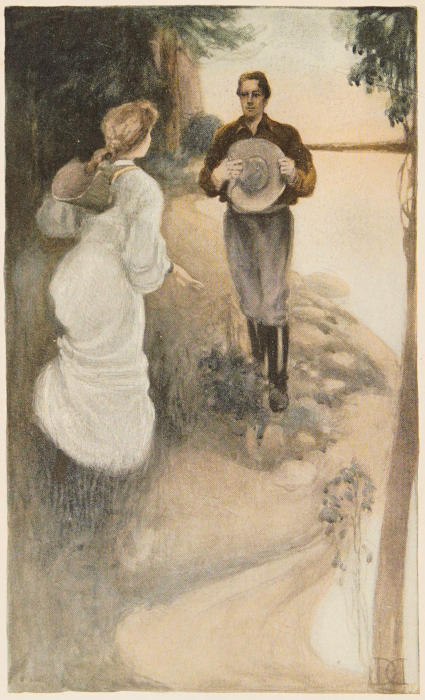
To
THE HISTORICAL SOCIETY OF OREGON AND HER RISEN AND REMAINING PIONEERS I affectionately Dedicate This Book
ABIGAIL SCOTT DUNIWAY
PREFACE
Not from any desire for augmented fame, or for
further notoriety than has long been mine (at
least within the chosen bailiwick of my farthest
and best beloved West), have I consented to indite these
pages.
The events of pioneer life, which form the groundwork
of this story, are woven into a composite whole by
memory and imagination. But they are not personal,
nor do they present the reader, except in a fragmentary
and romantic sense, with the actual, individual lives of
borderers I have known. The story, nevertheless, is true
to life and border history; and, no matter what may be
the fate of the book, the facts it delineates will never die.
Fifty years ago, as an illiterate, inexperienced settler,
a busy, overworked child-mother and housewife, an impulse
to write was born within me, inherited from my
Scottish ancestry, which no lack of education or opportunity
could allay. So I wrote a little book which I called
“Captain Gray’s Company, or Crossing the Plains and
Living in Oregon.”
Measured by time and distance as now computed, that
was ages ago. The iron horse and the telegraph had not
crossed the Mississippi; the telephone and the electric
light were not; and there were no cables under the sea.
Life’s twilight’s shadows are around me now. The good
husband who shaped my destiny in childhood has passed
to the skies; my beloved, beautiful, and only daughter
has also risen; my faithful sons have founded homes and
families of their own. Sitting alone in my deserted but
not lonely home, I have yielded to a demand that for several
years has been reaching me by person, post, and
telephone, requesting the republication of my first little
story, which passed rapidly through two editions, and for
forty years has been out of print. In its stead I have
written this historical novel.
Among the relics of the border times that abound in
the rooms of the Oregon Historical Society may be seen
an immigrant wagon, a battered ox-yoke, a clumsy, home-made
hand-loom, an old-fashioned spinning-wheel, and a
rusty Dutch oven. Such articles are valuable as relics, but
they would not sell in paying quantities in this utilitarian
age if duplicated and placed upon the market. Just so
with “Captain Gray’s Company.” It accomplished its
mission in its day and way. By its aid its struggling author
stumbled forward to higher aims. Let it rest, and let
the world go marching on.
On the front veranda of a rectangular farmhouse,
somewhat pretentious for its time and place, stood
a woman in expectant attitude. The bleak wind
of a spent March day played rudely with the straying
ends of her bright, abundant red-brown hair, which she
brushed frequently from her careworn face as she peered
through the thickening shadows of approaching night.
The ice-laden branches of a leafless locust swept the
latticed corner behind which she had retreated for
protection from the wind. A great white-and-yellow
watch-dog crouched expectantly at her feet, whining
and wagging his tail.
Indoors, the big living-room echoed with the laughter
and prattle of many voices. At one end of a long table,
littered with books and slates and dimly lighted by flickering
tallow dips, sat the older children of the household,
busy with their lessons for the morrow’s recitations. A
big fire of maple logs roared on the hearth in harmony
with the roaring of the wind outside.
“Yes, Rover, he’s coming,” exclaimed the watcher on
the veranda, as the dog sprang to his feet with a noisy
proclamation of welcome.
A shaggy-bearded horseman, muffled to the ears in a
tawny fur coat, tossed his bridle to a stable-boy and,
rushing up the icy steps, caught the gentle woman in his
arms. “It’s all settled, mother. I’ve made terms with
Lije. He’s to take my farm and pay me as he can.
I’ve made a liberal discount for the keep of the old folks;
and we’ll sell off the stock, the farming implements, the
household stuff, and the sawmill, and be off in less than
a month for the Territory of Oregon.”
Mrs. Ranger shrank and shivered. “Oregon is a long
way off, John,” she said, nestling closer to his side and
half suppressing a sob. “There’s the danger and the
hardships of the journey to be considered, you know.”
“I will always protect you and the children under all
circumstances, Annie. Can’t you trust me?”
“Haven’t I always trusted you, John? But—”
“What is it, Annie? Don’t be afraid to speak your
mind.”
“I was thinking, dear,—you know we’ve always
lived on the frontier, and civilization is just now beginning
to catch up with us,—mightn’t it be better for
us to stay here and enjoy it? Illinois is still a new
country, you know. We’ve never had any advantages
to speak of, and none of the children, nor I, have ever
seen a railroad.”
“Don’t be foolish, Annie! We’ll take civilization
with us wherever we go, railroads or no railroads.”
“But we’ll be compelled to leave our parents behind,
John. They’re old and infirm now, and we’ll be going
so far away that we’ll never see them again. At least,
I sha’n’t.”
The husband cleared his throat, but did not reply.
The wife continued her protest.
“Just think of the sorrow we’ll bring upon ’em in
their closing days, dear! Then there’s that awful journey
for us and the children through more than two thousand
miles of unsettled country, among wild beasts and
wilder Indians. Hadn’t we better let well-enough alone,
and remain where we are comfortable?”
“A six months’ journey across the untracked continent,
with ox teams and dead-ax wagons, won’t be a summer
picnic; I’ll admit that. But the experience will come
only one day at a time, and we can stand it. It will be
like a whipping,—it will feel good when it is over and
quits hurting.”
“You are well and strong, John, but you know I have
never been like myself since that awful time when your
brother Joe got into that trouble. It was at the time of
Harry’s birth, you know. You didn’t mean to neglect
me, dear, but you had to do it.”
“There, there, little wife!” placing his hand over her
mouth. “Let the dead past bury its dead. Never mention
Joe to me again. And never fear for a minute that
you and the children won’t be taken care of.”
“I beg your pardon, John!” and the wife shrank back
against the lattice and shivered. The protruding thorn
of a naked locust bough scratched her cheek, and the red
blood trickled down.
“I need your encouragement, in this time of all times,
Annie. You mustn’t fail me now,” he said, speaking in
an injured tone.
“Have I ever failed you yet, my husband?”
“I can’t say that you have, Annie. But you worry too
much; you bore a fellow so. Just brace up; don’t anticipate
trouble. It’ll come soon enough without your
meeting it halfway. You ought to consider the welfare
of the children.”
“Have I ever lived for myself, John?”
“No, no; but you fret too much. I suppose it’s a
woman’s way, though, and I must stand it. There’s the
chance of a lifetime before us, Annie.” He added after
a pause, “The Oregon Donation Land Law that was
passed by Congress nearly two years ago won’t be a law
always. United States Senators in the farthest East are
already urging its repeal. We’ve barely time, even by
going now, to get in on the ground-floor. Then we’ll
get, in our own right, to have and to hold, in fee simple,
as the lawyers say, a big square mile of the finest land
that ever rolled out o’ doors.”
“Will there be no mortgage to eat us up with interest,
and no malaria to shake us to pieces, John? And will
you keep the woodpile away from the front gate, and
make an out-of-the-way lane for the cows, so they won’t
come home at night through the front avenue?”
“There’ll be no mortgage and no malaria. One-half
of the claim will belong to you absolutely; and you can
order the improvements to suit yourself. Only think of
it! A square mile o’ land is six hundred and forty acres,
and six hundred and forty acres is a whole square mile!
We wouldn’t be dealing justly by our children if we let
the opportunity slip. We’ll get plenty o’ land to make a
good-sized farm for every child on the plantation, and it
won’t cost us a red cent to have and to hold it!”
“That was the plan our parents had in view when they
came here from Kentucky, John. They wanted land for
their children, you know. They wanted us all to settle
close around ’em, and be the stay and comfort of their
old age.” And Mrs. Ranger laughed hysterically.
“You shiver, Annie. You oughtn’t to be out in this
bleak March wind. Let’s go inside.”
“I’m not minding the wind, dear. I was thinking of
the way people’s plans so often miscarry. Children do
their own thinking and planning nowadays, as they always
did, regardless of what their parents wish. Look at us!
We’re planning to leave your parents and mine, for good
and all, after they’ve worn themselves out in our service;
and we needn’t expect different treatment from our children
when we get old and decrepit.”
“But I’ve already arranged for our parents’ keep with
Lije and Mary,” said the husband, petulantly. “Didn’t
I tell you so?”
“But suppose Lije fails in business; or suppose he
gets the far Western fever too; or suppose he tires of
his bargain and quits?”
A black cloud scudded away before the wind, uncovering
the face of the moon. The silver light burst suddenly
upon the pair.
“What’s the matter, Annie?” cried the husband, in
alarm. “Are you sick?” Her upturned face was like
ashes.
“No; it’s nothing. I was only thinking.”
They entered the house together, their brains busy with
unuttered thoughts. The baby of less than a year extended
her chubby hands to her father, and the older
babies clamored for recognition in roistering glee.
“Take my coat and hat, Hal; and get my slippers,
somebody. Don’t all jump at once! Gals, put down your
books, and go to the kitchen and help your mother. Don’t
sit around like so many cash boarders! You oughtn’t to
let your mother do a stroke of work at anything.”
“You couldn’t help it unless you caged her, or bound
her hand and foot,” answered Jean, who strongly resembled
her father in disposition, voice, and speech. But
the command was obeyed; and the pale-faced mother,
escorted from the kitchen amid much laughter by Mary,
Marjorie, and Jean, was soon seated before the roaring
fire beside her husband, enjoying with him the frolics of
the babies, and banishing for the nonce the subject which
had so engrossed their thoughts outside. The delayed
meal was soon steaming on the long table in the low,
lean-to kitchen, and was despatched with avidity by the
healthy and ravenous brood which constituted the good
old-fashioned household of John Ranger and Annie
Robinson, his wife.
“Children,” said Mrs. Ranger, as an interval of silence
gave her a chance to be heard, “did you know your
father had sold the farm?”
A thunderbolt from a clear sky would hardly have
created greater astonishment. True, John Ranger had
been talking “new country” ever since the older children
could remember anything; the theme was an old story,
invoking no comment. But now there was an ominous
pause, followed with exclamations of mingled dissent
and approval, to which the parents gave unrestricted
liberty.
“I’m not going a single step; so there!” exclaimed
Mary, a gentle girl of seventeen, who did not look her
years, but who had a reason of her own for this unexpected
avowal.
“My decision will depend on where we’re going,”
cried Jean.
“Maybe your mother and I can be consulted,—just a
little bit,” said the father, laughing.
“We’re going to Oregon; that’s what,” exclaimed
Harry, who was as impulsive as he was noisy.
“How did you come to know so much?” asked Marjorie,
the youngest of John Ranger’s “Three Graces,”
as he was wont to style his trio of eldest daughters, who
had persisted in coming into his household—much to his
discomfort—before the advent of Harry, the fourth in
his catalogue of seven, of whom only two were boys.
“I get my learning by studying o’ nights!” answered
Hal, in playful allusion to his success as a sound sleeper,
especially during study hours.
“Of course you don’t want to emigrate, Miss Mame,”
cried Jean, “but you can’t help yourself, unless you run
away and get married; and then you’ll have to help
everybody else through the rest of your life and take
what’s left for yourself,-if there’s anything left to
take! At least, that is mother’s and Aunt Mary’s lot.”
“Jean speaks from the depths of long experience,”
laughed Mary, blushing to the roots of her hair.
“I’m sick to death of this cold kitchen,” cried Jean,
snapping her tea-towel in the frosty air of the unplastered
lean-to. “Hurrah for Oregon! Hurrah for a warmer
climate, and a snug cabin home among the evergreen
trees!”
“Good for Jean!” exclaimed her father. “The
weather’ll be so mild in Oregon we shall not need a
tight kitchen.”
“Is Oregon a tight house?” asked three-year-old
Bobbie, whose brief life had many a time been clouded
by the complaints of his mother and sisters,—complaints
such as are often heard to this day from women in the
country homes of the frontier and middle West, where
more than one-half of their waking hours are spent in the
unfinished and uncomfortable kitchens peculiar to the
slave era, in which—as almost any makeshift was considered
“good enough for niggers”—the unfinished
kitchen came to stay.
The vigorous barking of Rover announced the approach
of visitors; and the circle around the fireside was
enlarged, amid the clatter of moving chairs and tables,
to make room for Elijah Robinson and his wife,—the
former a brother of Annie Ranger, and the latter a sister
of John. The meeting between the sisters-in-law was
expectant, anxious, and embarrassing.
“How did you like the news?” asked Mrs. Robinson,
after an awkward silence.
“How did you like it?” was the evasive reply, as the
twain withdrew to a distant corner, where they could
exchange confidences undisturbed.
“I haven’t had time to think it over yet,” said Mrs.
Ranger. “My greatest trouble is about leaving our parents.
It seems as if I could not bear to break the news
to them.”
“Don’t worry, Annie; they know already. When
Lije told his mother that John was going to Oregon,
she fainted dead away. When she revived and sat up,
she wanted to come right over to see you, in spite of the
storm.”
“Just listen! How the wind does roar!”
“I don’t see how your mother can live without you,
Annie. I tried very hard to persuade Lije to refuse to
buy John’s farm; but he would have his way, as he
always does. Of course, we’ll do all we can for the old
folks, but Lije is heavily in debt again, with the ever-recurring
interest staring us all in the face. John will
want his money, with interest,—they all do,—and we
know how rapidly it accumulates, from our own dearly
bought experience, the result of poor Joe’s troubles!”
“I hope my dear father and mother won’t live very
long,” sighed Mrs. Ranger. “If John would only let
me make them a deed to my little ten-acre farm! But I
can’t get him to talk about it.”
II EARLY LIFE IN THE MIDDLE WEST
The surroundings of the budding daughters of
the Ranger and Robinson families had thus far
been limited, outside of their respective homes,
to attendance at the district school on winter week-days
when weather permitted, and on Sundays at the primitive
church services held by itinerant clergymen in the same
rude edifice.
Oh, that never-to-be-forgotten schoolhouse of the borderland
and the olden time! Modelled everywhere after
the same one-roomed, quadrangular pattern,—and often
the only seat of learning yet to be seen in school districts
of the far frontier,—the building in which the children
of these chronicles received the rudimentary education
which led to the future weal of most of them was built of
logs unhewn, and roofed with “shakes” unshaven. One
rough horizontal log was omitted from the western
wall when the structure was raised by the men of the
district, who purposely left the space for the admission
of a long line of little window-panes above the rows of
desks. A huge open fireplace occupied the whole northern
end of the room; rude benches rocked on the uneven
puncheon floor and creaked as the students turned upon
them to face the long desks beneath the little window-panes,
or to confront the centre of the room. The children’s
feet generally swung to and fro in a sort of
rhythmic consonance with the audible whispers in which
they studied their lessons,—when not holding sly conversation,
amid much suppressed giggling, with their
neighbors at elbow, if the teacher’s back was turned.
The busy agricultural seasons of springtime and summer,
and often extending far into the autumn, prevented
the regular attendance at school of the older children
of the district, who were usually employed early and
late, indoors and out, with the ever-exacting labors of
the farm.
Up to the time of the departure of the Ranger family
for the Pacific coast and for a brief time thereafter, the
most of the summer and all of the winter clothing worn
in the country districts of the middle West was the
product of the individual housewife’s skill in the use of
the spinning-wheel, dye-kettle, and clumsy, home-made
hand-loom.
But, few and far between as were the schoolhouses and
schooldays of the border times, of which the present-day
grandparent loves to boast, there was a rigorous course
of primitive study then in vogue which justifies their
boasting. Oh, that old-fashioned pedagogue! What
resident of the border can fail to remember—if his early
lot was cast anywhere west of the Alleghanies, at any time
antedating the era of railroads—the austere piety and
stately dignity of that mighty master of the rod and the
rule, who never by any chance forgot to use the rod, lest
by so doing he should spoil the child!
The terror of those days lingers now only as an amusing
memory. The pain of which the rod and the rule
were the instruments has long since lost its sting; but
the sound morals inculcated by the teacher (whose
example never strayed from his precept) have proved the
ballast needed to hold a level head on many a pair of
shoulders otherwise prone to push their way into forbidden
places.
And the old-fashioned singing-school! How tenderly
the memory of the time-dulled ear recalls the doubtful harmony
of many youthful voices, as they ran the gamut in
a jangling merry-go-round! Did any other musical entertainment
ever equal it? Then, when the exercises were
over, and the stars hung high and glittering above the
frosty branches of the naked treetops, and the crisp white
snow crunched musically beneath the feet of fancy-smitten
swains, hurrying homeward with ruddy-visaged sweethearts
on their pulsing arms, did any other joy ever equal
the stolen kisses of the youthful lovers at the parting
doorstep,—the one to return to the parental home with
an exultant throbbing at his heart, and the other to creep
noiselessly to her cold, dark bedroom to blush unseen
over her first little secret from her mother.
And there is yet another memory.
Can anybody who has enjoyed it ever forget the school
of metrical geography which sometimes alternated, on
winter evenings, with the singing-school? What could
have been more enchanting, or more instructive withal,
than those exercises wherein the States and their capitals
were chanted over and over to a sort of rhymeless
rhythm, so often repeated that to this day the old-time
student finds it only necessary to mention the name of any
State then in the Union to call to mind the name of its capital.
After the States and their capitals, the boundaries
came next in order, chanted in the same rhythmic way,
until the youngest pupil had conquered all the names by
sound, and localities on the map by sight, of all the continents,
islands, capes, promontories, peninsulas, mountains,
kingdoms, republics, oceans, seas, rivers, lakes, harbors,
and cities then known upon the planet.
In its season, beginning with the New Year, came the
regular religious revival. No chronicles like these would
be complete without its mention, since no rural life on the
border exists without it. Much to the regret of doting
parents who failed to get all their dear ones “saved”—especially
the boys—before the sap began to run in the
sugar maples, the revival season was sometimes cut short
by the advent of an early spring. The meetings were
then brought to a halt, notwithstanding the fervent
prayers of the righteous, who in vain besought the Lord
of the harvest to delay the necessary seed-time, so that
the work of saving souls might not be interrupted by
the sports and labors of the sugar camp, which called
young people together for collecting fagots, rolling logs,
and gathering and boiling down the sap.
Many were the matches made at these rural gatherings,
as the lads and lasses sat together on frosty nights and
replenished the open fires under the silent stars.
To depict one revival season is to give a general outline
of all. The itinerant preacher was generally a young
man and a bachelor. In his annual returns to the scenes
of his emotional endeavors to save the unconverted, he
would find that many had backslidden; and the first week
was usually spent in getting those who had not “held out
faithful” up to the mourners’ bench for re-conversion.
Agnostics, of whom John Ranger was an example,
were many, who took a humorous or good-naturedly
critical view of the situation. But the preacher’s efforts
to arouse the emotional nature, especially of the women,
began to bear fruit generally after the first week’s praying,
singing, and exhorting; and the excitement, once
begun, went on without interruption as long as temporal
affairs permitted. The rankest infidel in the district kept
open house, in his turn, for the preacher and exhorter;
and once, when the schoolhouse was partly destroyed by
fire, John Ranger permitted the meetings to be held in
his house till the damage was repaired by the tax-payers
of the district.
The kindly preacher who most frequently visited the
Ranger district as a revivalist would not knowingly have
given needless pain to a fly. But, when wrought up to
great tension by religious frenzy, he seemed to find delight
in holding the frightened penitent spellbound, while he
led him to the very brink of perdition, where he would
hang him suspended, mentally, as by a hair, over a liquid
lake of fire and brimstone, with the blue blazes shooting,
like tongues of forked lightning, beneath his writhing
body; while overhead, looking on, sat his Heavenly
Father, as a benignant and affectionate Deity, pictured
to the speaker’s imagination, nevertheless, as waiting
with scythe in hand to snip that hair.
“I can’t see a bit of logic in any of it!” exclaimed Jean
Ranger, as she and Mary, accompanied by Hal, were
returning home one night from such a meeting.
“God’s ways are not our ways,” sighed Mary, as she
tripped over the frozen path under the denuded maple-trees,
where night owls hooted and wild turkeys slept.
Harry laughed immoderately. “Jean, you’re right,”
he exclaimed. “I’m going to get religion myself some
day before I die, but I’ve got first to find a Heavenly
Father who’s better’n I am. There’s no preacher on
top o’ dirt can make me believe that the great Author of
all Creation deserves the awful character they’re giving
Him at the schoolhouse!”
“Don’t blaspheme, Hal. It’s wicked!” said Mary.
“I’m not blaspheming; I’m defending God!” retorted
Hal.
“You used to be a sensible girl, Mame,” said Jean;
“and you could then see the ridiculous side of all this
excitement just as Hal and I now see it. But you’re in
love with the preacher now, and that has turned your
head.”
Jean was cold and sleepy and cross; but she did not
mean to be unkind, and on reflection added, “Forgive
me, sister dear. I was only in fun. I have no right to
meddle with your love affairs or your religious feelings,
and neither has Hal. S’pose we talk about maple sugar.”
Mary did not reply, but her thoughts went toward
heaven in silent, self-satisfying prayer.
The Reverend Thomas Rogers—so he must be designated
in these pages, because he yet lives—was the
avowed suitor for the hand and heart of Mary Ranger;
and the winsome girl, with whose prematurely aroused
affections her parents had no patience,—and with reason,
for she was but a child,—was the envy of all the older
girls of the district, any one of whom, while censuring
her for her folly in encouraging the poverty-stricken
preacher’s suit, would gladly have found like favor in his
eyes, if the opportunity had been given her.
But while romantic maidens were going into rhapsodies
over their hero, and many of the dowager mothers
echoed their sentiments, most of the unmarried men of
the district remained aloof from his persuasions and
unmoved by his fiery eloquence. But they took him out
“sniping” one off-night in true schoolboy fashion; and
while Mary Ranger dreamed of him in the seclusion of
her snug chamber, the poor fellow stood half frozen at
the end of a gulch, holding a bag to catch the snipes that
never came.
“If I were not too poor in worldly goods to pay my
way in your father’s train, I’d go to Oregon,” he said,
a few nights after the “sniping” episode, as he walked
homeward with Mary after coaxing Jean and Hal to keep
the little episode a secret from their parents,—a promise
they made after due hesitation, but with much sly chuckling,
as they munched the red-and-white-striped sugar
sticks with which they had been bribed.
III MARRYING AND GIVING IN MARRIAGE
The destinies of the Ranger and Robinson families
had been linked together by the double ties
of affinity and consanguinity in the first third of
the nineteenth century. Their broad and fertile lands,
to which they held the original title-deeds direct from the
government, bore the signature and seal of Andrew Jackson,
seventh President of the United States; and their
children and children’s children, though scattered now in
the farthest West, from Alaska and the Hawaiian Islands
to the Philippine Archipelago, treasure to this day among
their most valued heirlooms the historic parchments. For
these were signed by Old Hickory when the original
West was bounded on its outermost verge by the Mississippi
and Missouri rivers, and when the new West, though
discovered in the infancy of the century by Lewis and
Clark (aided by Sacajawea, their one woman ally and
pathfinder), was to the average American citizen an
unknown country, quite as obscure to his understanding as
was the Dark Continent of Africa in the days antedating
Sir Samuel Baker, Oom Paul, and Cecil Rhodes.
The elder Rangers, who claimed Knickerbocker blood,
and the Robinsons, who boasted of Scotch ancestry,
though living in adjoining counties in Kentucky in their
earlier years, had never met until, as if by accident,—if
accident it might be called through which there seems
to have been an original, interwoven design,—the fates
of the two families became interlinked through their
settlement upon adjoining lands, situated some fifty miles
south of old Fort Dearborn, in the days when Chicago
was a mosquito-beleaguered swamp, and Portland, Oregon,
an unbroken forest of pointed firs.
There was a double wedding on the memorable day
when John Ranger, Junior, and pretty Annie Robinson,
the belle of Pleasant Prairie, linked their destinies together
in marriage; and when, without previous notice
to the assembled multitude or any other parties but their
parents, the preacher, and the necessary legal authorities,
Elijah Robinson and Mary Ranger took their allotted
places beside their brother and sister, as candidates for
matrimony, the festivities were doubled in interest and
rejoicing.
“It seems but yesterday since our bonnie bairns were
babes in arms,” said the elder Mrs. Robinson, as she
advanced with Mrs. Ranger mère to give a tearful
greeting to each newly wedded pair. And there was
scarcely a dry eye in the assembled multitude when the
mother’s voice arose in a shrill treble as she sang, in the
ears of the startled listeners, from an old Scottish ballad
the words,—
“An’ I can scarce believe it true,
So late thy life began,
The playful bairn I fondled then
Stands by me now, a man!”
Her voice, which at first was as clear as the tones of
a silver bell, quavered at the close of the first stanza and
then ceased altogether. But by this time old Mrs. Ranger
had caught the spirit of the ballad, and though her voice
was husky, she cleared her throat and added, in a low
contralto, the impressive lines, paraphrased somewhat to
suit the occasion,—
“Oh, fondly cherish her, dearie;
She is sae young and fair!
She hasna known a single cloud,
Nor felt a single care.
And if a cauld world’s storms should come,
Thy way to overcast,
Oh, ever stan’—thou art a man—
Between her an’ the blast!”
At the close of this stanza, Mrs. Ranger’s voice broke
also; and the good circuit rider, parson of many a scattered
flock, who had pronounced the double ceremony,
caught the tune and, in a mellow barytone that rose upon
the air like an inspired benediction, added most impressively
another stanza:
“It’s high time there was a little change o’ sentiment
in all this!” cried a bachelor uncle, whose eyes were suspiciously
red notwithstanding his affected gayety. “I
move that we march in a solid phalanx on the victuals!”
The primitive cabin homes of the borderers of no Western
settlement were large enough to hold the crowds that
were invariably bidden to a neighborhood merrymaking.
The ceremonies of this occasion, including a most sumptuous
feast, were held on the sloping green beneath an
overtopping elm, which, rising high above its fellows,
made a noted landmark for a circumference of many
miles.
People who live apart from markets, in fertile regions
where the very forests drop richness, subsist literally on
the fat of the land. Having no sale for their surplus
products, they feast upon them in the most prodigal way.
Although through gormandizing they beget malaria, not
to say dyspepsia and rheumatic ails, they boast of “living
well”; and the sympathy they bestow upon the city denizen
who in his wanderings sometimes feasts at their
hospitable boards, and praises without stint their prodigal
display of viands, is often more sincere than wise.
The lands of the early settlers, with whom these
chronicles have to deal, had been surrounded, as soon as
possible after occupancy, with substantial rail fences, laid
in zigzag fashion along dividing lines, marking the boundaries
between neighbors who lived at peace with each
other and with all the world. These fences, built to a
sufficient height to discourage all attempts at trespass by
man or beast, were securely staked at the corners, and
weighted with heavy top rails, or “riders,” so stanchly
placed that many miles of such enclosures remain to this
day, long surviving the brawny hands that felled the trees
and split the rails. In their mute eloquence they reveal
the lasting qualities of the hardwood timber that abounded
in the many and beautiful groves which flourished in the
prairie States in the early part of the nineteenth century,
when Indiana, Illinois, and Missouri comprised all that
was generally known as the West.
Much of the primitive glory of these diversified landscapes
departed long ago with the trees. The “Hook-and-Eye
Dutch,” as the thrifty followers of ancient Ohm
are called by their American neighbors (with whom they
do not assimilate), are rapidly replacing the old-time
maple and black walnut fences with the modern barbed-wire
horror; they are selling off the historical rails,
stakes and riders and all, to the equally thrifty and not
a whit more sentimental timber-dealers of Chicago, Milwaukee,
and Grand Rapids, to be manufactured into high-grade
lumber, which is destined to find lodgment as costly
furniture in the palatial homes, gilded churches, great
club-houses, and mammoth modern hostelries that abound
on the shores of Lake Michigan, Massachusetts Bay,
Manhattan Island, and Long Island Sound. But no vandalism
yet invented by man can wholly despoil the rolling
lands of the middle West of their beauty, nor rob Mother
Nature of her power to rehabilitate them with the living
green of cultivated loveliness.
Original settlers of the border-lands had little time and
less opportunity for the observation of the beautiful in
art or nature. Their lives were spent in toil, which
blunted many of the finer sensibilities of a more leisurely
existence. The hardy huntsman who spent his only hours
of relaxation in chasing the wild game, and the weary
mother who scarcely ever left her wheel or loom and
shuttle by the light of day, except to bake her brain before
a great open fire while preparing food, or to nurse
to sleep the future lawmakers of a coming world-round
republic, were alike too busy to ponder deeply the far-reaching
possibilities of the lives they led.
Such men of renown as Lincoln, Douglas, Baker,
Grant, Logan, and Oglesby were evolved from environments
similar to these, as were also the numerous adventurous
borderers not known to fame (many of whom are
yet living) who crossed the continent with ox teams,
and whose patient and enduring wives nursed the future
statesmen of a coming West in fear and trembling, as
they protected their camps from the depredations of the
wily Indian or the frenzy of the desert’s storms.
Rail-making in the middle West was long a diversion
and an art. The destruction of the hardwood timber,
which if spared till to-day would be almost priceless,
could not have been prevented, even if this commercial
fact had been foreseen. The urgent need of fuel, shelter,
bridges, public buildings, and fences allowed no consideration
for future values to intervene and save the
trees.
In times of a temporary lull in a season’s activities,
when, for a wonder, there were days together that the
stroke of the woodman’s ax was not heard and the music
of the cross-cut saw had ceased, the settler would take
advantage of the interim to draw a bead with unerring
aim upon the eye of a squirrel in a treetop, or bring
down a wild turkey from its covert in the lower branches;
or, if favored by a fall of virgin snow, it would be his
delight to track the wild deer, and drag it home as a
trophy of his marksmanship,—an earnest of the feast in
which all his neighbors were invited to partake.
Then, too, there were the merrymakings of the border.
What modern banquet can equal the festive board at
which a genial hostess, in a homespun cotton or linsey-woolsey
gown, presided over her own stuffed turkey,
huge corn-pone, and wild paw-paw preserves? What
array of glittering china, gleaming cut-glass, or burnished
silver, can give the jaded appetite of the blasé
reveller of to-day the enjoyment of a home-set table,
laden with the best and sweetest “salt-rising” bread
spread thick with golden butter, fresh from the old-fashioned
churn? The freshest of meats and fish regularly
graced the well-laden board, in localities where the
modern chef was unknown, where ice-cream was unheard
of, and terrapin sauce and lobster salad found no place.
House-raisings, log-rollings, barn-raisings, quilting bees,
weddings, christenings, and even funerals, were times of
feasting, though these last were divested of the gayety,
but not of the gossip, that at other times abounded; and
the sympathetic aid of an entire neighborhood was always
voluntarily extended to any house of mourning. There
were few if any wage-earners, the accommodating method
of exchanging work among neighbors being generally in
vogue.
Such, in brief, were the daily customs of the early
settlers of the middle West, whose children wandered
still farther westward in the forties and fifties, carrying
with them the habits in which they had been reared to
the distant Territory afterwards known as the “Whole
of Oregon,” which originally comprised the great Northwest
Territory, where now flourish massive blocks of
mighty States.
Prior to the time of the departure of the subjects of
these chronicles for the goal of John Ranger’s ambition,
but one unusual occurrence had marred the lives and
prosperity of the rising generation of Rangers and
Robinsons. To the progenitors of the two families the
mutations of time had brought problems serious and
difficult, not the least of which was the infirmity of advancing
years. This they had made doubly annoying
through having assigned to their children, when they
themselves needed it most, everything of value which
they had struggled to accumulate during their years of
vigorous effort to raise and educate their families.
In the two households under review, all dependent
upon the energies and bounty of the second generation
of Rangers and Robinsons, there were besides the great-grandmother
(a universal favorite) two sexagenarian
bachelor uncles and two elderly spinsters, the latter remote
cousins of uncertain age, uncertain health, and still
more uncertain temper, who had long outlived their
usefulness, after having missed, in their young and vigorous
years, the duties and responsibilities that accompany
the founding of families and homes of their own. It
was little wonder that drones like these were out of place
in the overcrowded households of their more provident
kinspeople, to whom the modern “Home of the Friendless”
was unknown. What plan to pursue in making
necessary provision for these outside incumbents, even
John Ranger, the optimistic leader of the related hosts,
could not conjecture.
“We’ve fixed it,—Mame and I,” said Jean, one evening,
after an anxious discussion of the question had been
carried on with some warmth between the two family
heads, in which no conclusion had been reached except a
flat refusal on the part of Elijah Robinson to quadruple
the quota of dependants in his own household.
“And how have you fixed it?” asked her father, who
often called Jean his “Heart’s Delight.”
“Our bachelor uncles and cousins are just rusting
out with irresponsibility!” she cried with characteristic
Ranger vehemence. “They ought to have a home of
their own and be compelled to take care of it. There’s
that house and garden where you board and lodge the
mill-hands. Why not give ’em that and let ’em keep
boarders? The boarders, the four acres of ground, and
the cow and garden ought to keep them in modest comfort.
This would make them free and independent, as
everybody ought to be.”
“But the boarding-house belongs with the farm. I’ve
sold it to your uncle.”
“Then let Uncle Lije lease or sell it to them, share
and share alike.”
“What is it worth?” asked Mary.
“Only about three hundred dollars, the way property
sells now,” said her uncle.
“Then let ’em pay you rent. The place ought to support
them and pay interest and taxes.”
“Yes,” cried Mary; “the old bachelor contingent, that
worry you all so much because you keep ’em dependent
on your bounty, can take care of themselves for twenty
years to come, if you’ll only let ’em.”
“The proposition is worth considering, certainly,” said
their father, smiling admiringly upon his daughters.
“And we’ll consider it, too,” said the uncle. “That
much is settled.”
IV OLD BLOOD AND NEW
“I can’t see why old folks like us will persist in
living after we’ve outgrown our usefulness,” exclaimed
Grandfather Ranger, one sloppy March
evening, as he entered the little kitchen and placed a pail
of foaming milk upon the clean white table. The severely
cold weather had given way to a springtime thaw; but a
wet snow had begun falling at sundown, and a soft,
muddy liquid made dirty pools wherever his feet pressed
the polished floor.
“You’re right, father; we’ve lived long enough,”
sighed the feeble mother of many children, following her
husband’s footprints with mop and broom.
“If you and John think you’ve lived long enough,
what do you think of me?” cried the great-grandmother,
who had passed her fourscore years and ten, but who
still amply supported herself (if only she and the rest of
the family had thought so) as she sat from early morning
till late at night in her corner, knitting, always
knitting.
“Never mind, grannie,” said her son, swallowing a
lump that rose unbidden in his throat. “You’ve as
good a right to life, liberty, and the pursuit of happiness
as any fellow that ever put his name to a Declaration of
Independence! There’ll be room for you in the cosiest
corner of this little house as long as there’s a corner for
anybody. Don’t worry.”
“But this state of things isn’t just or fair!” exclaimed
the wife, folding her last bit of mending and
dropping back into her chair. “It seems to me that
we, as parents, deserve a better fate in our old days than
any set of bachelor hangers-on on earth, who’ve never
had anybody but themselves to provide for. If Joseph
would only come back, or the good Lord would let us
know his fate, I could endure the rest.”
“There, there, mother! Not another word. Haven’t
I forbidden the mention of his name?”
“But he was our darling, father. I can’t dismiss him
from my thoughts as you say you can.”
“We must keep the grandchildren in ignorance of his
existence, wife. It’s bad enough in all conscience for
the stain of his misguided life to rest on older heads.
We must forget our unfortunate son.”
“I can never forget my bonnie boy,—not even to
obey you, father!”
The back door, which had been unintentionally left ajar,
flew open, and Jean, who had for the first time in her
life heard a word of complaint from her grandparents,
or a word from them concerning her mysterious Uncle
Joe, burst suddenly into the room and knelt at the feet
of her grandmother, her whole frame convulsed with
sobs.
“Forgive us, darlings, do!” she cried as soon as she
could control her voice to speak. “You’ve borne so
much sorrow, and we never knew it! We never meant
to be thoughtless or unkind, but I see now how ungrateful
we have been. We must have hurt your feelings
often.”
“Don’t cry, Jean,” and the thin hand of the grandmother
stroked the girl’s bright hair. “We don’t often
repine at our lot. I am sorry you overheard a word.”
“But I am not sorry a single bit, grandma. We children
have been thoughtless and impudent. I can see it
all now. We didn’t ever mean to complain, though,
about you, or grandpa, or you either, grannie dear. We
only meant to draw the line at bachelor great-uncles and
meddlesome second and third cousins, who ought to have
provided themselves in their youth with homes of their
own, as our parents did.”
“Do you think they can help themselves hereafter,
Jean?”
“Why, of course! The feeling of self-dependence
will make ’em young and strong again,—though they
don’t deserve good treatment, for they ought to have
had homes and families of their own in their youth, as
you did.”
“It’s too late to lodge a complaint of that kind against
them now, Jean,” said the grandmother, with a smile.
“Did you overhear all we were talking about?” asked
the grandfather, his head bowed upon his cane.
“I am afraid I did, grandpa. I was cleaning the
slush from my shoes, and I couldn’t help overhearing,
though I hate eavesdroppers, on general principles. They
never hear any good of themselves. But, say, grandpa,
what about our Uncle Joe, whom I heard you denounce
so bitterly? You haven’t said I mustn’t speak his name,
you know.”
“Don’t talk about him, child, to us or anybody else.
He’s an outlaw. Dismiss him from your thoughts, just
as I have.”
“Your uncle may not be living now, Jean; if he is
alive, I hope he’ll find a better friend than his father,”
exclaimed the great-grandmother, speaking in a tone of
reproach that surprised none more than herself.
“Tell me all about it, grand-daddie darling! Do! I
know there’s a sad secret somewhere in the family.
Something unusual must have happened a long time ago
to bring us all under the ban of poverty. I have heard
hints of it now and then all my life; and now I must
hear the whole story. The schoolmaster will tell me if
you don’t.”
“No, no, Jean,” exclaimed her grandfather, anxiously.
“Don’t speak of family affairs outside. It is never
seemly.”
“Neither is it seemly or just to keep members of the
family in ignorance of family affairs when all the rest of
the neighborhood knows all about ’em! We ought to
know all, grandma darling. The reason children are so
often unreasonable is that they don’t understand.”
“‘I have been young and now am old, yet have I
not seen the righteous forsaken nor his seed begging
bread,’” said the grandfather, his head still bowed low
upon his staff and his white locks falling over his stooping
shoulders. “Let us not repine, mother.”
“I am not repining, father, but I do feel so—so disappointed
with the outcome of all our hard struggles that
I can’t always be cheerful.”
“We’d just begun to get our heads above water when
it happened, Jean,” said the old man. “We’d been
making a new farm. You see, we’d manumitted our
slaves before we left Kaintuck, and we had to begin with
our bare hands in this new country and work our way
from the ground up. We’d only got a part o’ the children
raised when the older ones began to get it in their
heads to get married. But our second son took to book-learning,
and we sent him off to Tennessee to finish his
schooling. That cost a pile o’ money. Then we had to
set out the married ones. We’d got things going in
tol’ble shape and was beginning to get on our feet again,
when Joseph—”
“Do stop, husband. Don’t tell any more; please
don’t,” cried the grandmother, nervously stroking the
bright young head that nestled in her lap. “I cannot
bear to hear it, though I thought I could.”
“Let him go on, grandmother dear! I don’t want to
be driven to the schoolmaster for the information that
I am bound to get someway. When I have grandchildren
of my own, I’ll tell ’em everything they ought
to know about the family, and then they won’t be teased
by the school-children, as we are.”
“We had to mortgage the farm,” continued the grandfather;
“and then there came a financial panic. The
wild-cat banks of the country all went to pieces, and the
bottom kind o’ fell out o’ things.”
“But why did you borrow money, grandpa? Why
was it necessary to mortgage the farms?”
“We did it because we had to stand by Joe in his
trouble.”
“What did you hear at school, darling?” asked the
grandmother.
“Oh, nothing much. But one day Jim Danover got
mad at me because I went head in the class; and he said
I needn’t be puttin’ on airs, for everybody knew that my
uncle had been hung.”
“Good Lord! has it come to that?” cried the great-grandmother,
dropping her knitting to the floor and
clasping her withered hands over her knees. “I’ve always
told you that you’d better tell the older children
about it yourself, John.”
“No, Jean; your uncle wasn’t hung,” said the old
man; “but he got into trouble, and we all believe he is
dead. He was the pride and joy of us all. He was so
promising that we gave him all the education that ought
to have been distributed evenly through the family.”
“But John and Mollie took a notion to get married
young, and you know that ended their chances,” interposed
the mother.
“Your uncle’s trouble would never have come upon
him and us if he had stayed out o’ that college,” exclaimed
the great-grandmother, who did not approve of
the course the family had taken with Joseph at the beginning
of his college days.
“That’s true, grannie,” replied the father; “but he
ought to have kept out o’ the scrape, college or no
college.”
“Do go on,” cried Jean.
“Your Uncle Joe got mixed up in a hazing frolic,
or something o’ that sort,” resumed the grandfather.
“One or two of the students got hurt, one of ’em
so bad that he died,—or it was given out that he
died,—and the blame fell on Joe. He declared he
wasn’t guilty, but the college authorities had to fix the
blame somewhere, though the case was uncertain. They
never proved that the boy was dead, but we raised the
money and bailed Joe out o’ jail. When the story was
started that the fellow had died, Joe skipped his bail
and left us all in a hole. That was what made and has
kept us poor.”
“Did you never hear of the other man, grandpa?”
“Oh, yes; he turned up, but too late to do Joe or
the rest of us any good.”
“Poor dear Uncle Joe!”
“You’d better say poor dear all the rest of us,” cried
the great-grandmother, who had staked and lost her little
all in the great calamity.
“But Uncle Joe was sinned against, grannie dear.
How he must have suffered!”
“Them that’s sinned against are often greater sufferers
than them that sins,” was the sad reply.
“When the bail was jumped, the hard times set in
with all of us,” resumed the grandfather. “The banks,
as I was saying, went broke, the interest on the mortgages
piled up, and the notes fell due. The crops got
the rust and the weevil, and everything else went wrong.
You see, Jean, when a man starts down hill, everybody
tries to give him a kick. The long and the short of it
is that mother, here, and grannie and I have been the
same as paupers for more than a dozen years.”
“I must be going, though you must first tell me how
you two and dear old grannie are going to live when we
are away in Oregon. Your way seems very uncertain,”
said Jean.
“Your father has made some kind of a bargain for our
support with your Uncle Lije. But he’s sort o’ visionary,
and he never has much luck. If he loses the property,
we can go to the poorhouse.”
“Are you to be allowed no stated sum to live on?
Will you have no means of your own to gratify your
individual wishes or tastes?”
“No, child; not a picayune.”
“What’s a picayune?”
“A six-and-a-quarter-cent piece.”
“I’m just as wise as I was before.”
“They’re wellnigh out o’ circulation nowadays, though
I used to come across ’em frequently when I was sheriff,”
said the old man.
Jean covered her face with her hands and burst into
tears.
“Don’t worry about us, dearie,” said the old man.
“There is One above us who heareth even the young
ravens when they cry. There is not a sparrow that
falleth to the ground without His knowledge. Your
Uncle Lije will move into the old homestead when you
are all gone. Your father built this cottage for us when
he assumed the mortgage, as you know. We won’t be
entirely alone, but we’ll miss you all; and we’ll try
to remember that we are of more value than many
sparrows.”
“I’ve heard such talk as that all my life, grandpa.
But I can’t help thinking that it would have been better
to keep the ravens from having anything to cry about in
the first place, and to save the sparrows from falling.”
“If none o’ God’s creatures ever had any hard experiences,
they’d never know enough to enjoy their blessings,
Jean. A child has to stumble and hurt itself many times
before it learns to walk steady. We’ve all got to be
purified and saved, as by fire, before we are fit to stand
in the presence of the awful God.”
“The God I love and worship isn’t an awful God,”
cried Jean. “I couldn’t love Him if He were awful.
My earthly daddie whipped me once. No doubt I deserved
the punishment, but I couldn’t love him for a
whole month afterwards. And I’d have hated him for
the rest of my life if I hadn’t deserved the whipping.”
“Didn’t it do you any good?”
Jean confronted her grandfather, her eyes flashing.
“No, sir!” she cried. “I ought not to have been
whipped, and I wasn’t a bit repentant after the punishment.
I was sorry beforehand, though, and said so.”
“What was your offence, Jean?”
“I dropped a pan full of dishes and broke more than
half o’ the lot. They fell to the floor with a crash, and
scared me half to death.”
“Didn’t the whipping make you more careful afterwards?”.
“Not at all; it only made me mad and afraid and
nervous, so I broke more dishes. But the next time it
happened, I hid the broken pieces in the ash hopper, and
when they were found, I saved myself a whipping by
telling my first lie.”
“The Lord chasteneth whom He loveth, my child.”
“I once saw a mill-hand strike his wife,” retorted
Jean, “and he said, as she rubbed her bruises, ‘I love
you, Mollie. Take another kick!’ But I must go now.
Be of good cheer. And remember, when I get to Oregon
and get to making money, you shall have every cent that
I can spare.”
V SALLY O’DOWD
Great excitement prevailed in the rural neighborhood
when it became generally known that
John Ranger, Junior, had sold the farm and was
preparing to dispose of his sawmill and all his personal
belongings, with the intention of departing to the new
and far-away West in an ox-wagon train with his family,—an
undertaking that seemed to his friends as foolhardy
as would have been an attempt to reach the North Pole
with his wife and children in a balloon.
Of more than ordinary ability, enterprise, and daring,
John Ranger had long been a man of note in his bailiwick.
Twice he had represented his county in the State
Legislative Assembly; but when the Old Line Whigs
of his district offered to nominate him for Congress,—“No,
gentlemen!” he exclaimed. “I started out early
in life to assist my good wife in rearing and educating
a big family of young Americans. I frankly admit
that we’ve got a bigger job on hand than either of
us imagined it would be when we made the bargain;
but that doesn’t lessen our mutual responsibility. There
is always a regiment, more or less, of unencumbered men
in waiting in every locality, ready and willing to wear
the toga of office; so, with thanks for the proffered
honor, I must beg to be excused.”
But there was one office, that of justice of the peace,
which he never refused, and to which he had been so
often re-elected that the appellation of “Squire” had
grown to belong to him as a matter of course. One
room of the great barnlike farmhouse had long been
set apart as his office; and many were the litigants
who remained after office hours to be entertained at
his hospitable board.
“It’s a lot of trouble, having so much extra company
on account of your office being in the house,” his wife
said at times; “but it’s better than having you away
two-thirds of your time down town, so it is all right.”
“There’s a woman going round the corner to the
office,” exclaimed Mary, one evening, just as her father
had settled himself before the fire to enjoy a frolic with
the little ones.
“It’s that grass widow, Sally O’Dowd,” said Mrs.
Ranger.
“She’s booked for a solid hour,” snapped Marjorie,
“and we’ll have to delay supper till nine o’clock.”
The Squire had barely time to reach his office by an
inner passage and seat himself before the fire, when
Mrs. O’Dowd—an oversized, plainly dressed, intelligent-looking
woman, who was remarkably handsome,
notwithstanding the expression of pain upon her face—entered
the office and stood silent before the open
fire.
“Well,” exclaimed the Squire, impatiently, motioning
her to a chair, “what can I do for you now?”
“Oh, Squire!” she cried, ignoring the proffered chair
and dropping on her knees at his feet, her wealth of
rippling hair falling about her face and over her shapely
shoulders like a deluge of gold, “I want you to take me
with you to Oregon.”
“What! And leave your children to the care of
others? I didn’t think that of you, Mrs. O’Dowd.”
“But what else can I do? You know the court has
assigned the custody of all three of my babies to Sam.”
“Yes, Sally; but you can see them once in a while
if you stay here.”
“The court gave them to Samuel and his mother
absolutely, you know.”
“Yes, yes, child; and while in one way it is hard,
if you look at it in a practical light, you will see
that it was best for the children. You couldn’t keep
them with you and go out as hired help in anybody’s
kitchen; and you have no other means of support any
more.”
“If I stay here, I cannot have even the poor privilege
of caring for them, except when they’re sick. I must
get entirely away from their vicinity, or lose my senses
altogether.”
“I thought that was what was the matter when you
married the fellow, Sally. You certainly had lost your
senses then.”
“But love is blind, Squire—till it gets its eyes open;
and then it is generally too late to see to any advantage.
Little did my dear father think, when he made a will
leaving his homestead, his bank account, and all his
belongings to me, that he was reducing my dear mother
and me to beggary.”
“But that wouldn’t have happened if you hadn’t married
that worthless fellow, Sally.”
“But the if exists, Squire. I married the fellow. It
was an awful blunder,—I’ll admit that. But it wasn’t
a crime. It should have been no reason for robbing me.
And yet this marriage was made the legal pretext for
permitting the robbery. Oh, I was so glad when my dear
mother died! I couldn’t have shed a tear at her grave
if I’d been hung for my seeming heartlessness. Poor
mother! I was made an unwilling party to a robbery
that beggared her and myself. Then, when I could no
longer endure the presence of the robber and his accomplice,
and live, I was doubly, yes, trebly robbed, by being
deprived of my children.”
The Squire cleared his throat and spoke huskily.
“That will was a sad mistake of your father’s, Sally.
He should have left his property to your mother. It
was wrong to put her means of livelihood in jeopardy
by leaving all to you. He ought to have known you’d
marry, and that the property would accrue to your husband.”
“But mother insisted that all should be left to me.
She even waived her right of dower, in my interest—as
she thought.”
“Well, Sally, you can’t say that I didn’t warn you.”
The woman laughed hysterically. “Much good that
warning can do me now!” she cried, rising to her feet
and unconsciously assuming a dramatic pose. “We
hadn’t been married a week when he ordered my mother
out of my house. And then he installed his own mother
in my home, and expected me to be silent. Oh, I am so
glad my dear mother is dead! I would rejoice if my
poor, defrauded children were all dead also.”
The Squire cleared his throat again and leaned forward
on his hands. “The law recognizes the husband
and wife as one, and the husband as that one, Mrs.
O’Dowd.”
“Yes, yes, I know that, to my bitter sorrow,” she said
with a meaning smile, her white teeth shining through
her parted lips and her eyes flashing. The woman sank
upon the hearth, looking strangely white and calm.
John Ranger sighed helplessly. “I worked the underground
railroad last night for all it was worth, in
the interest of some runaway niggers,” he said under his
breath; then audibly, “The laws of the land must be
obeyed, my child.”
“The law is a fiend,” cried Jean, who had entered the
room unobserved and had stood listening in the shadow
of the chimney jamb. “I’ll never rest till this awful one-sided
power is broken. You know yourself that it’s a
monster, daddie. I know you know it, or you’d never
help a run—”
He put his finger on his lips, and the girl changed the
subject. The underground railroad was a forbidden topic
in the Ranger household.
“Because Sally Danover knew no better than to become
the wife of an unworthy man,—who knew what he was
about, though she didn’t,—the law declares that all the
benefits resulting from the fraudulent transaction must
accrue to the villain in the case, and all the penalties
must be borne by his victim. What would you do to
such a fellow, daddie, if I should marry him?”
John Ranger did not answer, but gazed steadily into
the fire, his brow contracted and his thoughts gloomy.
“Sally, cheer up!” cried Jean, shaking the woman by
the shoulder. “Daddie’s a whole lot better man than he
thinks he is. I’ve seen him tested. You’re as good as
a nigger, if you are white, and he’ll help you.”
“You don’t know what you’re talking about, my
daughter. It’s a crime to break the law, and crime must
be followed by fitting punishment.”
“If you get caught, you get punished,” cried Jean,
laughing in her father’s face. “To break such a law
would be an act of heroism for which I should be glad
to be arrested and sent to jail! It would be an act
of heroism beside which the defence of the Stars and
Stripes would be cowardice!” she cried in a transport
of fury.
“Come, Jean,” said her father, rising, “we must go
to supper. Won’t you join us, Mrs. O’Dowd?”
“Food would choke me,” said the visitor, bowing herself
out.
“Hang the luck!” said the Squire, as the door slammed
behind her.
“What are you going to do to help the poor woman,
John?” asked Mrs. Ranger, as the family sat at the belated
meal.
“Ask Jean.”
“What do you know about the case, daughter?”
“She thinks she knows a lot,” interrupted her father.
“She’d ’a’ made a plaguy good lawyer if she’d only
been born a boy.”
“Who knew best what I ought to be,—you or God?”
asked Jean, her eyes glowing like stars.
“I give it up,” replied her father, smiling.
“I was reading to-day,” said Mrs. Ranger, “of a man
down East who lured his runaway wife back home by
stealing the babies and then warning everybody through
the papers, and by posters, not to trust or harbor her,
under penalty of the law. The woman held out quite a
spell, but cold and hunger got the better of her at last;
and when the stolen children fell sick, she went back to
her lawful protector and stayed till she died, as meek as
any lamb.”
“Sally Danover won’t go back to Sam O’Dowd;
she’ll die first,” cried Mary; “and I glory in her grit.”
“You haven’t answered my question, John,” said Mrs.
Ranger. “What do you propose to do with Sally
O’Dowd?”
“I s’pose I’ll have to take her to Oregon and let
her take a new start. She says she must get away from
here, or go insane.”
“I’d go crazy if I had to leave my children, John.”
“You can boast, Annie; you can afford to. But if
you were in Sally’s shoes, you’d sing a different song.”
Mrs. Ranger shrugged her shoulders.
“I can’t see why women with good husbands and
happy homes are so ready to censure less fortunate
women for breaking bonds that are unbearable,” said her
husband. “Women are women’s worst enemies.”
“Sam O’Dowd’s no woman,” exclaimed Jean.
“There’s not a woman on top o’ dirt that’d treat any
man as he’s treated Sally.”
“I guess it’s about an even stand-off,” rejoined her
mother.
“No,” cried Jean. “The conditions are not equal.
No woman has the power to turn her husband out of
doors. Even if it is her own house, he is its lawful
master. Women don’t stand any show at all compared
with men.”
“Jean is going to-morrow to see Sam O’Dowd’s
mother. She can make matters smooth for Sally if anybody
can,” said the Squire.
“The sale of our effects is only two weeks off, John,”
said his wife, when they were alone. “I want to reserve
a few things that are sacred. There’s Baby Jamie’s
cradle, that you made from the hollow section of that
old gum-tree that stood in the back pasture. Do you
remember how nicely I lined it with the back breadths
of my wedding dress?”
“Could I forget it, Annie?”
“Then there’s my mother’s little old spinning-wheel.
It was my grandmother’s and great-grandmother’s. May
I keep it for Mary?”
“It won’t pay to haul such things over the plains,
Annie. Better let your mother keep ’em here till there’s
a transcontinental railroad.”
“But that won’t come in my time, John.”
VI THE BEGINNING OF A JOURNEY
The sale of Squire Ranger’s effects proceeded
without unnecessary delay. The sawmill, the
first portable structure of its kind ever seen west
of the Wabash River, was eagerly purchased on credit
by a waiting customer, and work at the mill went on
without interruption. What a primitive affair it was!
And how like a pygmy it seems as the resident on the
North Pacific’s border recalls its littleness, and contrasts
it with the mammoth mills of Oregon, the lower Columbia,
and Puget Sound, which grasp in their giant arms
the dead leviathans of the primeval forest, and set their
teeth to work tearing to pieces the patient upbuilding
of the ages gone!
The motive power of John Ranger’s sawmill consisted
of about a dozen superannuated horses, some spavined,
some ringboned, some wind-broken, all more or less disabled
in some way; these were regularly harnessed, each
in his turn, to a set of horizontal radiating shafts attached
to a rotating centre, above which, on a little platform,
stood the driver, with a whip.
“I know it’s wicked to kill the trees and cut them up
into boards; it’s just as wicked as it is to kill pigs and
cattle,” was Mary Ranger’s comment when she first beheld
the frantic work of the raging saw, which, screaming
like a demon, ate its way through hearts of oak and
hickory, or tore the slabs from the sides of the black-walnut
and sugar-maple patriarchs with ever unsated
ferocity.
But this sawmill had long been a boon to the entire
country, as was evidenced by the multiplication, since
its advent, of framed houses, barns, bridges, schoolhouses,
and churches, which suddenly sprang into vogue,
not to mention the many miles of planked highways that
rushed into fashion before the railroad era in the days
when “good roads conventions” were unheard of.
Children born and reared in cities—subject, if of
the tenant class, to frequent changes of habitation, or, if
their homes are permanent, to frequent intervals of travel—can
have little idea of the love which children of the
country cherish for the farms and homes to which they
are born, and in which their brief lives are spent. The
very soil on which they have trodden is dear to them,
and seems instinct with sentience. They make a boon
companion of everything with which they come in contact,
whether pertaining to the earth, the water, or the air.
Their little gardens are familiar friends; the flowers of
the wildwood are loving entities; the brook that sings in
summer through the tangled grass and sleeps in winter
under a bed of ice is always a communing spirit. The
sighing winds chant rhythmic lullabies in the treetops,
and the language of every insect, bird, and beast has,
to them, a distinctive meaning. The blue heavens are
their delight, and the passing clouds their friends. The
sun, the moon, and the stars hold converse with them,
and the changing seasons bring to them, each in its turn,
peculiar joy.
But, dearly as they loved the old home and its surroundings,
the Ranger children, who had never crossed
the boundary of township number twelve, range three
west, in which they were born, looked forward eagerly
to the forthcoming journey. Once only had Mrs. Ranger
ventured beyond the township limits since leaving the
Kentucky home of her childhood; and that was many
years before, when she went with her husband to the
county seat to attach her mark to the fateful mortgage,
upon which the accruing interest seemed always to be
maturing at the time when she or the children were the
most in need of books or shoes or clothing.
“I wasn’t allowed to learn to write in my childhood,”
she falteringly explained to the notary, when,
after affixing her mark, she watched him as he attached
his seal to the document which was to be as
a millstone about her neck forever after. “My father
always thought that education was bad for girls,” she
added. “He said if they knew how to write they’d
be forging their husbands’ names and getting their
money out of the bank. And he said, too, that if girls
learned to write, they’d be sending love letters to the
boys.”
“It’s never too late to learn,” was the notary’s reply.
“If I were you, I would learn to write when the children
learn. You can do it if you try.”
“I’d be glad to, if I could find the time; but it’s hard
to learn anything for one’s own especial benefit with a
baby always in one’s arms. When the children get big
enough to learn to write, I’ll try, though.”
And she did; with such success that she never after
signed her name with a cross.
“I’m glad we’ve got that mortgage off our hands at
last, Annie,” said her husband as they counted up the
somewhat disappointing returns after the sale of their
personal effects was over.
“But you’re not morally free from it, John, or even
legally so. If the purchaser should fail, the load would
then revert to Lije, you know. Say, John, can’t I deed
my little ten-acre farm to my father and mother? It
never cost you anything. I took care of old man Eustis
for six long years; and you know he gave the little farm
to me as pay for my services, absolutely.”
“Haven’t I paid its taxes all along, Annie?”
“And have I earned nothing all this time, my husband?”
“Oh, yes, you’ve earned a living; and you’ve got
it as you went along, haven’t you?”
Mrs. Ranger made no reply, but being silenced was
not being convinced.
“Be patient,” said Jean, aside. “I’ll manage it.”
Several pairs of great brown-eyed oxen, with which
the children had become familiar in their days of logging
about the sawmill, were easily trained for the long journey;
but others, untamed and terrified, as if pre-sensing
the trials awaiting them through untracked deserts, submitted
to the yoke only under the cruelest compulsion.
New wagons, stanchly built and covered with white canvas
hoods, stretched tightly over hickory bows, were ranged
on the lawn, under the naked, creaking branches of the big
elm-tree. Provisions, resembling in quantity the supplies
for a small army, were carted to the front veranda, awaiting
shipment down the Illinois and Mississippi rivers
to St. Louis, to be reshipped up the Missouri to the final
point of loading into wagons for crossing the Great
American Desert, as the Great Plains were then known.
Visitors, including friends and relatives from far and
near, came to the dismantled house in great relays, and
the business of Squire Ranger’s office as justice of the
peace increased a dozen fold. All this commotion involved
increasing labor for Mrs. Ranger, who faded visibly
as she silently counted the intervening days before
the hour of final separation from her sorrowing parents.
If the Squire suffered at the thought of parting with
anybody, he made no sign except to complain of a “pesky
cold” that made his eyes water, which he attributed to
the “beastly climate.”
“The spirit of adventure that inspires my husband to
emigrate does not permit him to foresee danger,” was
Mrs. Ranger’s ever-ready reply to the numerous prophets
of evil who came to condole, but got only their labor for
their pains. “I will not try to interfere with his plans.
I started out as a bride to walk the road of life beside
him, and I mean to do as I agreed.”
But the good wife grew thinner and whiter as the days
sped on; and when at last the wagons were all ranged
in line, with every yoke of oxen in place; when the last
farewell had been spoken; when the last audible prayer
had ascended heavenward, and the command to move
on had been given,—she sank on her feather bed in the
great family wagon and closed her eyes with a feeling of
thankfulness akin to that of the sufferer from a fatal
malady who realizes that his last hour has come.
“‘He giveth His beloved sleep,’” said Mary, softly,
as she covered her mother with a heavy shawl.
It was now the first of April, a fitful, gray, and misty
day. A soft breeze was stirring from the south, and
straggling rays of sunlight struggled through occasional
rifts in the straying clouds. The spring thaw had at last
set in. The sticky soil adhered to the feet of man and
beast, and clung in heavy masses to the wheels of wagons.
The dog, Rover, who had always willingly remained
at home on watch during the family’s absence at church
or elsewhere, had hidden himself at starting-time; but
he was found waiting in the road when the party was
several miles out on the way, and, when discovered, approached
his master with drooping tail and piteous whine.
There were tears in the eyes of the strong man, of
which he was not ashamed, as he dismounted from the
back of Sukie, his favorite mare, and, stooping, patted
the dog affectionately on the head.
“They didn’t fool ’oo, did ’ey, Rovie?” said Bobbie,
as he hugged the dog, unmindful of his muddy coat.
“Come to me, Rover,” exclaimed Mrs. Ranger, who
had been refreshed by her nap. The dog obeyed, and,
wet and dirty as he was, attempted to hide himself among
the baggage. But his hopes were blasted by a peremptory
command from his master: “Go back home and
stay with grandfather!” The poor brute jumped, whining,
to the ground and affected to obey; but he reappeared
a dozen miles farther on, at the Illinois River’s
edge; and when the ferry-boat, which he was forbidden
to enter, was out of reach of either command or missile,
he sat on his haunches on the river-bank and howled
dismally.
“Don’t you think a dog has a soul, daddie?” asked
Jean, through her tears.
“How should I know, daughter?” was the husky response.
“I’m not yet certain that a man has a soul.”
VII SCOTTY’S FIRST ROMANCE
The home that was to be the abode of the
Ranger family during the journey was an over-jutting
wagon-box,—Harry called it a “hurricane
deck,”—made to fit over the running gear of a
substantial wagon, in which a dozen or more persons
might be stowed away at night in crosswise fashion. It
was named “the saloon” by the teamsters, in jocose
recognition of its owner’s well-known teetotal habits, and
was assigned to the women and children as their especial
domicile.
“It will be your duty to keep a daily record of our
journey, Jean.”
This was the first official order issued by Captain
Ranger after he had been formally elected as commander
of the expedition, and was given under the thickly falling
snow, amid the bustle and confusion of making the
first camp.
“What sort of a record?”
“A daily write-up of current events. Here is a brand-new
blank-book I have bought for the purpose. And
here’s a portable inkstand, with some lead pencils, a
pocket knife, and a box of pens. I’ve selected you as
scribe because you won the prize in that competitive
contest over the doings of Bismarck.”
“But that was a different proposition, daddie.”
“It’s all in the same line, Jean. You have a record
to preserve now. You must keep your credit good.
Look to your laurels, and don’t forget!”
And Jean, partly from innate ambition, but chiefly
because she was under orders from which she knew there
could be no appeal, kept, through all the tedious journey,
a diary, from which the chronicler of these pages proposes
to cull such fragments as may fit into the narrative,
without strict regard to chronology, though with
due regard to facts.
“We made camp last night in the discomfort of a
driving snowstorm,” wrote the scribe under date of
April 2. “But in spite of our sorrow over our departure
from home and loved ones, the most of us were jolly,
and we made the best we could of the situation. To-night,
after a day’s disagreeable wheeling through mud
that freezes at night and thaws by day, making travel
nasty, sticky, and tedious, we stopped for camp near an
isolated farmhouse, where the goodwife is disheartened
and sick, and the children are ragged, dirty, and
frightened.
“The storm has abated, and the sky is clear. Our
teamsters are kneeling on the ground around our mess-boxes,
which are used for tables at mealtime, and stored
in the ends of the wagons when we are moving ahead.”
“There, I can’t think of another word to write.” She
closed the book with a bang.
For many minutes after gathering around the tables,
all were too busy with the supper to make any attempt at
conversation.
Beans and bacon, coffee and crackers, and great heaps
of stewed fruits, were reinforced by mountains of steaming
flapjacks, which Mary and Marjorie took turns at
baking, their eyes watery from the smoke of the open
fire, and their cheeks reddened by the wind.
“Wonder what’s become o’ Scotty,” said Captain
Ranger, as he knelt in the absent teamster’s place at
table and helped himself bountifully.
“He filled our water-buckets and was off like a shot,”
said Hal. “He ought to show up at mealtime. Ah,
there he comes.”
“Where’ve you been, Scotty?” asked the Captain.
“Here’s plenty of room. Kneel, and give an account of
yourself.”
“So you’re in love, eh, Scotty? and with that pretty
widow in the next camp?”
The questioner was a tall, lanky teamster, answering
to the appellation of Shorty.
“Never in love before,” said Scotty, as he swallowed
his coffee with a gulp.
An uproarious laugh ran around the table.
“Her hair is like the flower o’ Scotia’s broom in
springtime, and the sheen o’ her eyes is like Loch
Achray!” exclaimed Scotty, as he passed his plate for
a fresh relay of flapjacks.
“A love affair doesn’t spoil his appetite,” laughed
Marjorie.
“I want you all to understand that no falling in love’ll
be allowed on this journey,” said the Captain, dryly.
“There’ll be time enough for that kind o’ nonsense after
you get to Oregon and get settled.”
“Love, like death, has all seasons for its own, sir,”
retorted Scotty, with a deferential bow.
“Women and war don’t go together,” replied his employer.
“And you’ll find this journey is a good deal
like war before you’re done with it.”
“Everything is fair in both love and war, sir.”
“Excuse me,” said a woman in black, with a low,
mellow voice and blond complexion, who might have
heard herself discussed if she had listened. The clatter
around the table stopped instantly.
“We’re in a quandary, mamma and I,” she said,
blushing. “Our matches are damp and won’t burn. I
thought perhaps—”
A half-dozen men were on their feet in an instant,
and half-a-dozen hands went suddenly into half-a-dozen
pockets, while half-a-dozen blocks of matches were forthcoming
in less than half a minute.
“Here are more than I need, gentlemen, and I thank
you ever so much,” she said, taking the offer from
Scotty; and, with a bow and a smile to all, she was
gone.
“The red of her lips is like rubies, the white of her
teeth is like pearls, and her voice is a symphony,” said
Scotty, looking after her as she ran.
“Scotty’s attack is as sudden as it is serious,” laughed
Lengthy, a short, stocky teamster, whose nickname was
a ludicrous misfit.
“What freak o’ fate do you s’pose it was that brought
that beauty out here on a journey like this?” asked
Yank, a Southern-born teamster, whose accepted nickname
was another palpable misnomer, and who dropped
his r’s, like a negro preacher.
“I know!” cried Bobbie, his fingers dripping with
molasses. “She came to meet Scotty.”
The laugh that followed disconcerted the child, who
ran, abashed, to his mother in the family wagon.
“I thought,” exclaimed Sambo,—a gaunt Vermonter,
who dropped his g’s as frequently as Yank dropped his
r’s,—“I thought there’d be several ladies comin’ along,
to keep us company.”
“Can you tell us why Mrs. O’Dowd didn’t join us?”
asked Yank, turning deferentially to the Captain. “I
thought we were to have the pleasure of one woman’s
company,—I mean in addition to the ladies present, of
course.”
Jean exchanged furtive glances with her father, who
averted his face, and said: “That’s a conundrum, Yank.
Ask me something easy.”
The next noticeable entry in Jean’s diary was made on
the fifth of April, and was as follows:—
“The snow this morning is four inches deep. We
camped last night in the mud and slush, in a narrow lane,
after a hard day’s wheeling through the miry roads.
Mother, dear woman, is weary and weak, but daddie got
her a warm room in the farmhouse near us, where we
children are allowed to go sometimes to thaw our
marrow-bones by a pleasant fire.
“April 6. Cloudy to-day, with a threat of rain. But
mother urges a forward movement, so Mary and Marjorie
are packing the mess-boxes, and daddie says I must
write up this horrid diary. There is nothing to write
about. The country through which we are struggling is
swampy, monotonous, muddy, and level. Cheap, rickety
farmhouses are seen at intervals; the bridges are gone
from most of the swollen streams; our way goes through
narrow, muddy lanes, with crooked, tumble-down fences;
and we see, every now and then, a discouraged-looking
woman and a lot of half-clad children peeping through
open doors, from the midst of a crowd of half-starved
dogs. Daddie says these frontier people (and dogs) are
the forerunners of all civilization; but I think they’re
the embodiment of desolation and discouragement.
“April 7. The ague has broken out among our teamsters.
We stopped to-night at a farmhouse, where suspicious
women treated us like so many thieves. The
whole family were barefoot, and lacked everything but
numbers. Mother says that starvation has aroused their
cupidity, and we mustn’t mind their suspicious airs.
They had no feed for sale for the stock, and no supplies
to sell for our table; but there were plenty of guns and
dogs,—the latter a thieving lot,—from which we shall
be glad to escape when we again see morning. Weather
and roads no better.
“April 8. Mother quite ill again; but the skies are
clear, and she insists on moving forward.
“April 11. No food for man or beast to be had for
love or money. We must move onward, sick or well.
“April 12. A better-settled region. The scenery is
often fine. Pussy-willows peep at us from marshy edges,
and birds are singing in the budding treetops. Sick folks
no better. Bought a liberal supply of corn for the stock,
and a lot of butter, eggs, and chickens for the rest of us,
so we have a feast in prospect. Camped on the edge of
a pretty little village, on a nice green grass-plat. Daddie
took us girls to a prayer-meeting. The good people eyed
us askance. Evidently they thought us freaks. Certainly
our slat sunbonnets and soiled linsey-woolsey dresses were
not reassuring.”
The next day, at nightfall, the party reached Quincy,
on the Mississippi, and camped on a flat bit of upland
outside of the city’s limits, where many other wayfarers,
like themselves, had halted and encamped.
“Did you notice Scotty?” asked Marjorie, approaching
Jean, who sat on a wagon-tongue, trying to think of
something out of the ordinary to jot in her journal.
“What’s he up to now?”
“He’s been preening his feathers like a turkey-gobbler
for the last half-hour. Guess our pretty widow and her
aristocratic mamma have caught up with our train. Just
watch him! See how the ex-scientist, ex-statesman, ex-orator,
and now ex-almost-anything is making a fool of
himself!”
“All people, of both sexes, get a spell of the simples,
sooner or later,” laughed Jean. “Daddie says that when
the system is in the right condition to catch it, one gets
it bad.”
“Guess I’ll ride out and look over the town a little,
Annie,” said the Captain to his wife after the family had
retired for the night. “I want to look out a little for
our Scotty. He seems to need a guardian.”
Scotty, though a characteristic specimen of the educated
Scotchman, was a loyal adherent of the institutions
of his adopted country. He had been a member of the
constitutional conventions of two border States, and was
known as a writer and orator of no mean ability. But,
like many another brilliant man, he had passed his fortieth
year without acquiring a home, a family, or a competence.
He was well versed in the “Rise and Fall of
Republics,” and had travelled much in foreign lands,—themes
of which he never tired. But he could never
reduce ox-driving to a science.
Captain Ranger rode to the top of the bluffs, where he
leisurely contemplated the scene. Lights reflected from
town and river danced and gleamed, but barely made the
darkness visible in the muddy streets. Church bells rang,
steamers whistled, and longshoremen tugged at heavy
loads. Powerful horses propelled great, clumsy freight-wagons
through the unpaved streets. Foot passengers
picked their way through slop and mud.
“Railroads will come here some day,” said the Captain
to himself. “They will compete with the river
traffic and cripple it. Other towns, like Chicago, will
divert the trade, and there is no telling what the end
will be. What a busy, bustling world it is, anyhow!”
“Halloa, Captain!”
“Well, I’m blanked if it isn’t Scotty!”
“I’ve been to call upon the widows we met in the
beginning of our journey, sir, and I’ve been thinking it
would be a handsome thing for you to do if you’d take
them into our company, Captain Ranger.”
“We’ll see about it, Scotty; but I’m afraid you won’t
earn your salt if I let them join us. I s’pose I’ll have to
risk it, though.”
VIII A BORDER INCIDENT
The public roads or thoroughfares through which
the party floundered when crossing the sparsely
settled counties of western Illinois, which had
noticeably improved during the day or two of travel
from the East toward Quincy, grew almost impassable
on the Missouri side of the Mississippi River. Heavy
freight-wagons, each bearing an immense load of merchandise,
chiefly hides and furs from the Northwest Territory,
had stirred the mud in the narrow lane to a
seemingly inexhaustible depth; and the long spell of
freezing by night, followed daily by the inevitable thaw,
caused the many unbridged streams to overflow their
banks and inundate the wide wastes of bottom land
through which the ox teams were compelled to wander
blindly, in continual danger of disaster. But the most
disagreeable experiences resulted from the frequent snow-storms,
which generally occurred at camping-time, accompanied
by chilling winds and intermittent falls of
rain or sleet, covering the earth with a glare of ice.
“When I get to heaven, I mean to ask Saint Peter to
assign all cooks to high seats,” said Jean one evening,
as, balancing a tray laden with tin cups and saucers, she
paused above the heads of the men kneeling at the mess-boxes,
and in apparent innocence upset a steaming cup
upon the head of Yank.
“No harm done, I assure you, Miss Rangeah. Don’t
mention it!” he said, affecting not to feel the burn at the
back of his neck, whereat Jean grew repentant.
“Do you s’pose Saint Peter will pay any heed to the
request of a slip of a girl like you?” asked Hal.
“I’ll not be a slip of a girl when I go through the gates
o’ heaven, but a mature matron, famous and honored.”
“We are in a slave State now,” wrote Jean, under
date of April 16; “and from my limited experience I
am forced to conclude that slavery is more deteriorating
in its effects upon the white people we meet than it is
upon the blacks. The primitive cultivating of the soil
we saw in central Illinois, where the white men do their
own farming, was bad enough, God knows; but the
shiftless, aimless, happy-go-lucky work of the Missouri
‘niggers,’ as they style themselves, is even worse. The
white men we see at times are idle, pompous, and lazy.
The white women are idle and apathetic; and the children
are aimless and discouraged. Daddie says slavery
is wrong, and no contingency can make it right; but I
notice that he doesn’t propose any remedy.”
Prairie schooners were not known as “ships of the
desert” then, for Joaquin Miller had not yet sought or
acquired fame; and no Huntington or Holladay had
made a transcontinental railway track, or tunnelled the
sierras of the mighty West to open the way for the iron
horse. Even the overland stage was an improvement as
yet unknown; for Holladay had not yet established his
relay stations, or sent his intrepid drivers out among the
savages as heralds of approaching civilization.
“Daddy says humanity’s a hog,” was the leader in
Jean’s next entry in her diary. “The weather continued
so bad, mother was so wan and weak, and the stock were
so nearly starved, that he decided to stop over for a day
or two near a farmhouse and barnyard, where there
seemed a chance to purchase food for man and beast.
But we were glad to move on after a rather brief experience.
The farmer doubled the price of his hay and grain
every morning after ‘worship,’ reminding those of us
who could not choose but hear his daily dole of advice
to God, of Grandpa Ranger’s story of a planter and merchant
he knew in his youth, of whom it was said that he
would call his slaves to their devotions in the morning
with a preamble like this: ‘Have you wet the leather?
Have you sanded the sugar? Have you put meal in the
pepper and chicory in the coffee? Have you watered
the whiskey? Then come in to prayers!’”
The necessities of these farmers were born of isolation;
and the opportunities for barter and dicker with passing
emigrants stirred the acquisitive spirit within them into
vigorous action. The prices of their hitherto unsalable
commodities went up to unheard-of figures, increasing in
geometrical progression. But Captain Ranger, having
created a market in the remote country places in Illinois
for supplies of coffee, tea, calico, and unbleached cotton
cloth, had prepared himself at Quincy with such commodities,
and was able to adjust his trade somewhat to
the law of supply and demand.
Oh, those teamsters of the plains! No jollier crowd
of brave, enduring, accommodating men ever cracked
cruel whips over the backs of long-enduring oxen, or
plodded more patiently than they beside the slowly moving
wagons, as, wading often over shoe-tops through
the muck and mire of the Missouri roads of early springtime,
they jollied one another and cracked their whips
and sang. Each misfit nickname was accepted as a joke,
and none of the men inquired as to the origin of his
peculiar cognomen. But Hal, being more inquisitive
than they, asked troublesome questions of his sisters,
who were in the secret.
“Better tell him, girls,” said their mother. “He’ll be
in honor bound to keep the secret then. Won’t you,
dear?”
“Jean did it,” said Marjorie.
“Then suppose you confess,” said Hal.
“It was this way,” she explained after a pause of
mock seriousness. “The first night we were in camp,
after we had washed the dishes, it occurred to me to
write each teamster’s name and paste it to the bottom of
his plate. I didn’t know the real name of one of ’em
from Adam’s, so I wrote them down as Scotty, Limpy,
Yank, Shorty, Sawed-off, and so on. We didn’t intend
to perpetrate a misfit, but a joke, and we struck both.
Scotty got the correct title, though it merely happened
so. But you just watch ’em! Limpy’s as straight as
an Indian; Sawed-off stands six feet two in his socks;
Lengthy is no taller when he stands up than when he
lies down; Yank is a characteristic slave-owner; and
Sambo is an ingrained abolitionist!”
“We couldn’t have made such a lot o’ misfits if we
had tried a week,” said Mary. “But the men all think
Hal did it; so the suspicion doesn’t fall on us; and
you get the credit for being somewhat of a wag, Mr.
Hal.”
“It’s nothing new for men or boys to take the credit
for what their sisters do,” said Jean, as Hal strode away,
satisfied that in protecting his sisters from a piece of
folly, by accepting it as his own, he was acting the part
of a man. “Adam set the example; and where would
Herschel have been if he hadn’t had a sister?”
“Adam might have been in a box if he couldn’t have
had Eve,” laughed Marjorie; “for there would then have
been nobody to raise Cain.”
“Or the Ranger family,” added Jean.
Several days of tedious, laborious travel brought the
wanderers into an open, sparsely timbered, almost unsettled
part of the State of Missouri. The snow and
sleet gave way to brighter skies, the roads and sloughs
were drying up, and the higher grounds were gradually
arraying themselves in robes of green and gold.
“Here is vacant land, and lots of it,” said Mary, as
she viewed the virgin prospect of a mighty settlement in
undisguised admiration. “This is a beautiful world!”
and she sighed deeply, her face toward the rising sun.
“There’s no use in trying to look backward,” urged
Hal. “Dad will never halt till he lands us on the western
shore of the continent, on the eastern hem of the Pacific
Ocean. He says this country’s too old for him. The
wild turkeys are all killed off, or scared out o’ sight; the
deer and elk are gone for good; and the country’s played
out.”
“Wait a few years, and there’ll be railroads gridironing
this whole great valley of the Mississippi,” said Jean.
“There’ll be towns and cities springing up in a hundred
places. Farms and orchards and handsome country
homes will cover these rolling prairies. The native
groves will be more than quadrupled by cultivation, and
schoolhouses and churches will spring into existence
everywhere.”
“I wish you’d talk like this to your father! Won’t
you, Jean?” asked Mrs. Ranger.
“You couldn’t hire him to live in a slave State!”
cried Jean.
“The Reverend Thomas Rogers might manage to get
this far on the way toward the setting sun without much
money,” smiled Mrs. Ranger, meaningly. “The children
favor our stopping here, on Missouri soil,” she added, as
her husband joined the group. “Don’t you think the
idea a good one, John?”
“What! And let the word go back among our people
at home that we’d flunked? No! I’d die first, and
then I wouldn’t do it,” exclaimed her husband, petulantly.
Mrs. Ranger burst into tears.
“There, there, Annie! Don’t worry. But don’t ask
me to settle, with my children, in a slave State. Father
left Kentucky when I was a boy to get away from slavery
and its inevitable accompaniment of poor white trash.
There is an irrepressible conflict between freedom and
every form of involuntary servitude that exists under the
sun. This nigger business will lead to a bloody war long
before Uncle Sam is done with it, and I doubt if even
war will settle it.”
“But Oregon may come into the Union as a slave
State, John. You know that the extension of slavery is
the chief theme that is agitating Congress now.”
“I’ll have a chance to fight the curse in Oregon,
Annie. But it is a settled condition here. I’ll fight it
to the bitter end, if I get a chance!” He strode away
to look after the cattle and men.
“Dear, patient mother!” cried Jean, stroking her
mother’s cheek tenderly. “Your head is as clear as a
bell. But there’s a whole lot o’ common-sense in what
daddie says, too. We’ll soon have settled weather; then
you won’t mind travelling. We all think you’ll be well
and strong as soon as we get settled in Oregon.”
“Maybe so, if I could only live to get there,” faltered
the feeble woman. “But—”
“But what, mother?”
“Nothing. I was only thinking.”
Jean’s heart sank. “You must get to bed, mother
dear,” she said lovingly.
The Ranger children, tired out with the fatigue and
excitement of the day, were soon locked in the deep sleep
of healthy youth and vigor. Not so Mrs. Ranger. The
regular breathing of her sleeping loved ones soothed her
nerves, but she seemed preternaturally awake.
A gentle breeze stirred the white wagon-hood overhead.
Sukie, who was tethered near, neighed gently as Mrs.
Ranger spoke her name, and came closer to be stroked.
“Is de Cap’n heah?” asked a dusky figure with a child
on its hip, as it edged its way between the mare and the
wagon-wheel.
“He’s out with the cattle at present. Is there anything
I can do for you?”
“Hide me, quick! De houn’s is aftah me, honey.
I’ve jes’ waded de crick, and dey’ve lost de trail.
Quick, missus; an’ I’ll sarve ye forever!”
The low baying of the bloodhounds proclaimed that
they were again on the trail.
“Climb in here! Be quick!” exclaimed Mrs. Ranger,
making room for the quaking fugitive. “I’ve never
tried to sleep with a nigger and her baby, but I can stand
it if I have to,” she said to herself, as the refugee took
the place assigned to her.
“What in thunder are you up to now?” asked her
husband when he looked in upon his wife and children
in the morning and discovered the dusky intruder.
“Trying to help you to circumvent the institution you
are so ready to fight, which, as you say, is wrong, and
no contingency can make right,” replied his wife, her
cheeks and eyes aglow with mingled satisfaction and
excitement.
IX THE CAPTAIN DEFENDS THE LAW
“Don’t you know it’s against the laws of your
country to harbor a runaway nigger?” asked
the Captain, in genuine alarm. “We’ll never
get off o’ Missouri soil in this world if we’re caught
hiding this wench and her pickaninny among our traps.
She’s got to get away from here in a hurry.”
“So far as the laws go, I don’t care a rap, John. I,
nor no other woman, ever took a hand in making any of
’em. And as for Missouri soil, it’s good enough for
anybody. I’m quite enamored of it; and I feel perfectly
willing to stay here as long as I live.”
“I don’t want to make no trouble for nobody, massa,”
sobbed the fugitive, peeping from her covert like a beast
at bay. “De missus done tuk keep o’ me ’dout ’siderin’
any consikenses. Didn’t ye, honey?”
“There was nothing else I could do,” said Mrs.
Ranger, firmly, though her cheeks blanched with an unspoken
fear.
“Dey was goin’ to sell me down Souf, an’ keep my
coon for a body-servant for his own pappy’s new bride
dat’s a-comin’ to de plantation nex’ week. Wusn’t
dey, dawlin’?” holding aloft her mulatto offspring, who
blinked at the rising sun. “’Fo’ God, massa, I won’t
make a speck o’ trouble. I’ll jest keep a hidin’ till we
git across de Missouri Ribbah. Take me ’long to Oregon,
an’ ye won’t nebbah be sorry.”
“I’ve already agreed to take along one widow and her
babies,” said the Captain, exchanging glances with Jean.
“It doesn’t seem possible to add to the number.”
“Jes’ le’ me ride a hidin’ in a wagon till I get across
de Missouri Ribbah, massa! I kin take keer o’ myself
an’ my pickaninny too, if you’ll turn me loose among de
Injuns.”
“It is the slaveholding, free American white man
that the poor creature’s afraid of,” said Mrs. Ranger,
with a bitter smile.
Again the deep baying of the bloodhounds betokened
the finding of the trail.
“Climb back into the wagon, quick,” cried the Captain,
“and take care that you keep out o’ sight! Deluge the
wagon-wheel and all around it with water, gals. Don’t
let the wench put her nose out, Annie. Hang the luck!
When it comes to such a pass that a runaway wench
would rather trust herself and her brat among the red
savages of the plains than among her white owners in a
free country, I get ashamed of a white man’s government.
What’s the wench’s name?”
“She said it was Dugs.”
“The devil!”
“Don’t swear, John. She didn’t name herself.”
“And the name of the coon?”
“Geo’ge Washin’t’n, sah. I named him for de faddah
o’ de kentry. He’s as han’some a coon as ebber had a
white daddy. Ain’t ye, honey?” And the mother held
him close. “Yo’s a flower o’ slavery, ain’t ye, dawlin’?”
a hidden meaning in her voice.
Again the deep baying of the bloodhounds was
heard. But they were taking the back trail. The fugitive
laughed.
“De way we larn ’em dat trick is a niggah’s secret,”
she said, as she again hid herself and child.
“My massa didn’t use to b’lieve in slavery, missus,”
she said, as the baying of the dogs grew faint and distant.
“When massa first ’herited his slaves, he used to
tell us he’d set us free. But he got a habit o’ holdin’ on
to us, an’ it jist growed on him. It was like de whiskey
habit. It got fastened on him good an’ ha’d, and he
didn’t talk ’bout manumittin’ us no mo’. He didn’t
want to sell me, he said, but I was prope’ty, an’ times got
bad, an’ he was ’bleeged to have money to pay his debts.
His new wife’s ’spensive, awful, an’ he had to sell some
o’ de niggahs. If he’d sol’ me an’ Geo’dy Wah too, I
wouldn’t ’a’ runned away. But when he said he’d sell
me, an’ keep my coon to be his new wife’s niggah, I
couldn’t stan’ it nohow, so I scooted!” and the negress
laughed heartily.
“Do you think you can hide her for a week, Annie?
We’ll be across the Missouri River, by that time.”
“I’ll do my best, John. We’re running a terrible
risk, though. Sometimes, when I think of the sins of
this so-called free government, all committed in the name
of Liberty, I long to turn rebel, and do my best to destroy
it, root and branch.”
“I had a husban’ once, suh. But massa tuk a liken’
to me, so he sol’ him down Souf,” said the fugitive.
“And this baby?”
“Is my massa’s own coon. Massa wouldn’t ’a’ sol’
him nohow.”
“Be quick!” cried Jean, her breath hot with indignation.
“Hide yourself! You mustn’t let the teamsters
see you here. They’re coming in with the cattle now.”
“Gimme some quilts an’ blankets, honey. Dah! Hol’
’em up, so! Now lemme make an Injun wickiup in one
end o’ dis yah wagon. Geo’ge Washin’t’n ’ll be still as
a lamb. Won’t ye, my putty ’ittle yallow coon?”
The baby, with its tawny skin, blue eyes, and blackish-brown,
tangled curls, looked elfish as he nestled close to
his mother’s breast and gazed affrighted into her turban-shaded
eyes.
“Sh-sh-sh!” cried Jean; “the men are almost here.
Keep close to your den and be very quiet.”
Day after day passed wearily along; but if the teamsters
suspected aught, they made no sign. And day after
day the teams wended their way westward without betraying
the commission of this crime against the commonwealth
of the great new State of Missouri and
the free government of the United States of America,
which it would have been base flattery to call a misdemeanor;
as its perpetrators would have learned to their
cost if they had been caught in the act.
“You don’t seem as happy as formerly,” said Captain
Ranger to his wife at the close of a long and trying
day. “If the risk we’re running by harboring that
runaway nigger is making you uneasy, we can turn
her out. A man’s first duty is to his own flesh and
blood.”
“It isn’t that, John. The woman is no trouble; and
her baby’s so afraid of bloodhounds that she keeps him
as quiet as a mouse. I’m willing to risk my life to get
them both away from their white owners and out into
the Indians’ country, where they may have at least comparative
freedom. I am not afraid.”
“Then what is the matter, dear?”
She toyed caressingly with his hair and beard, but said
nothing. They were seated on a log by the roadside, and
a laughing rivulet sprawled at their feet.
“Speak, Annie; don’t hesitate. I can hear your heart
beat. What’s the matter?”
“You remember my little farm, John? It’s only ten
acres, you know.”
“Yes; what of it?”
“You won’t be angry, John?”
“Of course not. What about it?”
“I want to deed the place over to my mother before
we leave the State o’ Missouri.”
His manner changed instantly.
“I thought that matter was settled,” he said tersely.
“Can’t you let me have a little peace?”
“I have held my peace as long as my conscience will
let me, dear. You didn’t settle anything about it. You
merely put me off, you know.”
“Well?”
A man can put a world of meaning into a monosyllable
sometimes.
“I want you to let me deed that piece of property to
my mother. If the deed were made to my father, and
she should outlive him, she’d be only allowed to occupy
it free from rent for one year after his death; but if it
is made hers absolutely, and he should outlive her, he’ll
be allowed to have a home and get his living off it as
long as he lives. You see, it makes a difference whether
it is a cow or an ox that is gored,” and she smiled grimly.
“The women are all getting their heads turned over
the question of property,” said Captain Ranger to himself
as he watched the rivulet playing at his feet.
“Jean’s been putting this into your head, Annie,” he
said after a painful silence.
“The child has a strong sense of justice, inherited
from you, John. You know she is wonderfully like
you.”
“Yes, yes, Annie. I wish she had been a boy instead
o’ Hal. She’d have made a rackin’ good lawyer.”
“I’ll admit that she advised me to urge you to make
the deed, John.”
“Very well; we’ll see about it sometime, Annie”
and he arose to go.
Mrs. Ranger’s heart sank.
“Why is it that men who are proverbially just and
upright in their dealings with their fellow-men are so
often derelict in duty where women, especially their own
wives, are concerned?” she asked herself as she tottered
by his side in silence.
The next morning found her unable to rise. A racking
cough, which had disturbed her all through the night,
was followed at daybreak by a burning fever. Her husband,
who had slept like a top in an adjoining tent, was
startled when he saw the ravages the night had left upon
her pinched, white face.
“You caught cold last night, darling,” he said, as he
prescribed a simple remedy. “You ought not to have
been sitting out in the night air.”
“That didn’t hurt me, John.”
“Then it is the apprehension you suffer on account o’
that wench that is making you sick.”
“No, John; it isn’t that at all.”
“Then what is it?”
“Ask Jean. I have nothing more to say.”
But there was no time for further parleying. The
breakfast was ready, and the hurry of preparation for
departure was the theme of the hour.
“We reached camp in a pouring rain last night and
pitched our tents, amid much discomfort, on the outskirts
of the little town of St. Joseph,” wrote Jean on
the morning of the fifth of May. “But I haven’t much
time for you, my journal, for there are other things to
claim attention,” and she shut the book with the usual
impatient bang.
“Got any blank deeds along with you, daddie?” she
asked, after it was announced that they were to be ready
to break camp the next morning.
“Yes; why?”
“Because we must have that deed of Grandma Robinson’s
all ready for mother to acknowledge before a notary
in the morning, as we go through town on our way to
the ferry.”
“Your mother isn’t able to attend to any business.”
“She isn’t able to put it off, daddie dear.”
“Very well; I’ll see about it.”
“But I want the blank form now, so I can have it all
ready when we go through town. Mother has the original
deed, and I can easily duplicate it. I’ll search for a
blank among your papers, if you don’t object.”
“You have no idea how this little act of justice will
help mother to regain her health,” said Mary. “She’s
been haunted by a fear that you’d put it off till it would
be too late.”
Captain Ranger did not reply; but his silence was
considered as consent, and Jean hurried away to prepare
the deed.
“I’ve been dreaming about an island somewhere in
mid-ocean,” said Marjorie, “where women could hold
their own earnings, just as men do in the United States;
where they had full liberty to help the men to make the
laws, for which they paid their full quota of taxes, just
as the women do in Missouri and Illinois and, for aught
I know, in Oregon.”
“I’ve paid the taxes on that ten-acre farm for a dozen
years,” said her father.
“Yes, out of mother’s income from it,” retorted Marjorie.
“It has always been rented, you know.”
The subject was dropped for the nonce, though John
Ranger did not feel wholly at ease, he hardly realized
why. But the next day, as the train was moving through
the principal street on its way to the river-front, he
stopped his team hard by a notary’s office and tenderly
assisted his wife to alight. Here, with her thin and trembling
fingers, Annie Ranger affixed her signature to her
last earthly deed of conveyance, her eyes beaming with
joy.
“Are you satisfied now?” asked her husband, as he
lifted her to her seat in the wagon, where she watched
Harry rushing away to the post-office with a big envelope
containing the precious deed.
“Yes, dear; and I am so glad I didn’t have to make
my mark! When I get to Oregon, I’ll manage somehow
to earn the money to pay you what I owe on my
taxes, John.”
“Don’t speak of that,” her husband exclaimed, feeling
half ashamed of himself, for a reason he did not divine.
“Then you’ll never try to hold those old tax receipts
as a lien on the property?”
“Nonsense, Annie! Do you think I’m a brute beast?”
“No, darling. I would to God all men were as good
as you are, my own dear, precious husband.”
They were nearing the Missouri River now, and in
the rush that ensued, the family had no opportunity for
further exchange of confidences for many hours.
“Look!” cried Marjorie, after the last loaded wagon
had been crowded on to the big ferry-boat, and they had
started to a point several miles up the river to make a
landing on the opposite bank. “There’s a posse of
officers. They’re after Dugs, I know they are, ’cause
they’ve got bloodhounds with ’em, and they’re signalling
the boat to stop and come back.”
“She can’t do it,” said the captain of the ferry, after
a hurried conference with the captain of the train, as he
suspiciously thrust his closed hand into the breeches
pocket over his hip.
“You can come out of hiding now, Sally O’Dowd,”
exclaimed Captain Ranger, as soon as the last team was
safely up the opposite bank.
“I thought it was Dugs they were after,” said Mary.
“So ’twas; and me too,” cried the grass widow, as
she jumped to the ground, surrounded by her three children.
“Sam O’Dowd was one o’ the posse. I saw him.
He couldn’t have taken me; but he was after my babies.”
She hugged her children, as she laughed and wept by
turns in a transport of joy.
“Don’t cry, Sally,” said the Captain, coaxingly.
“You’re in the Indian country, safe and sound.”
“Before Sam can get a requisition from the Governor
of Illinois to reclaim your babies, and before the Governor
o’ Missouri can give that party o’ slave-catchers the
power to arrest Dugs and her coon, we’ll have you out
under the protection of the Indians!” said Mrs. Ranger,
with a meaning smile.
X THE CAPTAIN MAKES A DISTINCTION
“I thought it was arranged that Sally was to
join us at Quincy, on the Mississippi,” said Captain
Ranger, after they were safely landed in the
Indians’ territory.
“That was the agreement between Jean and myself,”
interposed the frightened fugitive, still holding her babies
close; “but I overheard a conversation at St. Louis that
changed my plans. I was in hiding, down among the
wharf-rats and niggers on the river-bank, in a cheap
hash-house, half scow and half log cabin. The walls
were thin, and I couldn’t sleep much, so I heard most
everything that was going on, out o’ doors and in. And
one night by the help of the good Lord I overheard a
voice that I knew was Sam’s. He was telling a pal that
he was hunting his runaway wife. He said she had stolen
his babies, and he meant to get ’em, dead or alive.”
“I thought you’d led him off on an altogether different
scent,” exclaimed Jean.
“So did I. But it appears that his mother got on the
scent somehow, and betrayed me. I don’t know why
she did it, for she was over-anxious to be rid of the
children. But I suppose she was moved by an impulse
of spite or revenge. I heard Sam say he’d overhaul us
at Quincy, so I had good reason to change my route.”
“You had a close call, Mrs. O’Dowd!” exclaimed
the Captain, earnestly. “I don’t know as he could
have put me in limbo for harboring you, but he could
have made it go hard with me for hiding the children.
I hate a law-breaker; but what is a fellow to do in
such a case?”
“God has been merciful to me, Squire. I felt all along
that I would get away safe and sound.”
“Wouldn’t God have done a better job to have saved
you in the first place?” asked the Captain, dryly.
“How did you get money to pay your travelling expenses?”
asked Mary.
“I’ve a confession to make to you and Mrs. Ranger,
Captain. Will you promise not to scold?”
“I’ll know better what to promise after I’ve learned
the provocation. Don’t be afraid to tell the truth. Speak
out. Don’t mind the gals.”
“I stole three hundred dollars—it was my own money—from
Mother O’Dowd,” she whispered. “It didn’t
seem so very wicked. She got my home without any
equivalent, you know.”
“Oh, Sally! How could you?” asked Mrs. Ranger,
her cheeks blanching.
“Do you think it was wicked to take my own money
and my own children, when I had the opportunity?”
“It was a theft, certainly, under the law; and it is
always wrong to steal,” retorted Mrs. Ranger.
“We must uphold the majesty of the law, if necessary,
at the muzzle of our guns!” said the Captain, loftily.
“How about Dugs and her coon?” asked Jean, with
a silvery laugh.
“That was different. Slavery, as I have often said
before, is wrong, and no contingency can make it right.”
“You are making a distinction where there is no perceptible
difference, except in the matter of complexion,”
exclaimed Mrs. Ranger.
“Did Dugs, the slave, have money?” asked Mrs.
O’Dowd.
“Dugs hasn’t taken me into her confidence,” said the
Captain. “What in creation are we to do with you
all?”
“There’ll be a way, John; don’t worry,” said his wife.
“‘Trust in the Lord and do good, and verily thou shalt
be fed.’”
“Do you know,” said Sally, turning to the Captain,
“that the pretty little blonde in black, whom I see over
yonder, is a jewel? I met her on the street this morning,
on her way to the ferry, with her mother and her carriage
and wagons and drivers. I was getting desperate with
the fear that I couldn’t overtake you; and I knew there
was no time to be lost. So I told her my story. I may
have exaggerated somewhat, for I told her you had
agreed to take me and the babies to Oregon. I said I
had been detained (which was true) and I must overtake
you before you crossed the river. She didn’t wait
to ask a question, but bundled us all into her carriage
without a word.”
“Didn’t I tell you you could trust my daddie?” asked
Jean, aside. “He’s a whole lot better than he thinks
he is.”
“Father thinks he is a stickler for the law,” said Mary,
with a chuckle.
Indians came and went in great numbers around and
into the company’s first night’s camp on the plains,
sometimes growing insolent in their persistent demands
for food and articles of clothing, but on the whole peaceable
and friendly. Every man, woman, and child was
under orders to give them no cause for offence, the Captain
hoping, by example, to disarm hostility. But he soon
learned that this liberal policy brought hordes of beggars;
and the necessity of carefully guarding their freight was
made apparent the next morning, when they found their
breakfast supplies had been stolen, and with them the
cooking utensils. The Captain found it necessary to send
a messenger back to St. Joseph to purchase fresh supplies
before they could go on.
The next day’s drive over the beautiful prairie was
without unusual incident. The roads were good, the soil
rich, and the undulating landscape perfect.
“Lengthy and Sawed-off are bringing in a buffalo,”
cried Hal.
“We had one yesterday,” said Mrs. Ranger. “The
game ought not to be slaughtered in this wasteful manner.
You ought to stop it, John.”
“Men are still in a state of savagery,” replied her
husband.
“The instinct to kill is as strong in us as it was in
the days of Agamemnon,” said Scotty.
“Or the Cæsars,” exclaimed the little widow.
“We’ll need this meat for food before we get to
Oregon,” said Mrs. Ranger, surveying the huge carcass
of the fallen monarch thoughtfully. “We must cut the
flesh into strips and dry it, Indian fashion, in the sun.”
“But we can’t stop to dry it, Annie,” exclaimed her
husband.
“We needn’t stop, John. We can get the men to cut
it into strips while in camp. Here is a ball of strong cord.
We can string the strips of meat on the cord and festoon
it along the outsides of the wagon covers.”
“A woman is a born provider,” exclaimed Scotty.
“We men may take to ourselves the credit for the care
of women and children, but we’d soon be on the road to
starvation if it were not for the protecting care of the
mother sex, to help us out.”
Mrs. Ranger, pleased with the praises of her family
and the teamster, sank back on her pillows and slept
fitfully.
“It pays a mother to rear a family of loyal children,”
said Mrs. O’Dowd to Mrs. McAlpin, with whom she
had become quite intimate. “I’d rather be an honored
mother, like Mrs. Ranger, than be a Queen Elizabeth
or a Madame de Staël.”
“I believe I’ll reconnoitre a little, Annie, if you don’t
mind,” said the Captain, after the camp was still. “I’d
like to study the lay o’ the land from the adjacent heights.
You won’t miss me?”
“No, John. Or, I mean, I won’t mind it. You must
learn, sooner or later, to depend upon yourself for company,
my dear. And you’d better practise a little beforehand.”
“What do you mean, Annie?”
“Can’t you see that I’ll not be able to finish this
journey, John?”
“Nonsense, Annie! Just be patient till we get to
Oregon. I mean to build you a pretty room, away from
the noise of the household, where you’ll enjoy the fruits
of your labors. I’ve hired Dugs to be your body-servant
during the remainder of your days.”
“I’ll change her name, John. I’ll have nobody
around me that answers to the name of Dugs. It isn’t
a good name for a dog.”
“What’ll you call her?”
“Susannah.”
“What if she objects?”
“She’s already agreed to the change, if it suits you
and the girls.”
John Ranger laughed.
“So-long!” he cried, and galloped away to a point
overlooking a bend in the river, where he loosened the
reins and allowed the mare to nibble the tender herbage,
which, tempted by the sunshine, was clothing the moist
earth in a covering of grass and buttercups.
“O life,” he cried, “what a mystery you are! How
puny, yet how mighty! The living rain comes down
in silent majesty upon the sleeping earth; the living sunshine
melts the ice and snow; and the living earth,
awakening from her season of hibernation, answers back
to rain and sun with a power of reproduction that defies
the mighty law of gravitation, and sends outward and
up toward the living sky the living vegetation that sustains
the living man. O sky, all a-twinkle with your
myriads of stars, how inscrutable you are in your infinitude!
And how like a worm of the dust is man, who
has no power to hold in the precious body of even the
woman he loves the mystery of existence, of which Creation
is the only master!”
Below him, so far away that it gleamed like a silver
ribbon in the starlight, ran the muddy Missouri, carrying
in its turbid waves the débris of the Mandan district,
and bearing on its troubled breast the throng of river
craft at whose little windows hundreds of lights were
twinkling, like diamonds on parade. Beyond gleamed the
moving steamers and their accompanying hosts of lesser
boats, now nestling close to the water’s edge, and now
climbing in irregular fashion toward the uplands at the
town of St. Joseph; and, far beyond, his mental eyes beheld
the homes of his own and his Annie’s beloved
parents.
“I do wonder if it is really wrong for me to leave them
in their old age, and take Annie away also,” he said to
himself, half audibly, as he continued his gaze over the
dim expanse of silence that surrounded him on every
hand.
There was no answer. He gave Sukie the rein and
bowed his head upon his hands, and wept. How long he
remained alone, absorbed in the mingled emotions that
possessed him, he did not know. He took no note of time,
and Sukie moved leisurely over the plain, daintily cropping
the tender grass.
“I was ambitious, selfish, and exacting,” he exclaimed
at last, as a sharp gust of wind slapped him in the face.
“Annie doesn’t complain; but she is fading from my
sight. It is all my fault. If she could be happy, she would
soon be well. I wonder if I ought not to take her back
to her father and mother and her childhood’s home.
Everybody would laugh; but what should I care? Are
not the life and happiness of my wife worth more to me
than all the world’s approval?” Then, after a long
silence, he tightened the reins and said: “Come, Sukie;
let’s go back to camp. Right or wrong, I must go ahead.
I’ve burned my bridges behind me.”
As he expected, Scotty was found sitting in the midst
of an audience at Mrs. McAlpin’s camp-fire. He was
discoursing on his travels in Egypt, and had collected
about him quite a crowd.
“The earth is old, very, very old,” the teamster was
saying. He arose to make room for Captain Ranger,
as he passed the reins to Jean, who, with Mary and
Marjorie, had been an enraptured listener. “The comparative
topography of Central America and northern
Africa excites the liveliest speculation. When I was in
Darien, I found many features among the ruins abounding
in the jungles of the isthmus, strikingly similar to
those one sees in the land of the Pyramids. True, the
analogy is not always apparent, because the almost total
absence of rain in Egypt is exchanged for an almost total
lack of dry skies in Panama and Yucatan. Science scoffs
at my assumptions, because I cannot prove them; but
I’d bet a million if I had it, and wait for the fact to be
proven—as it surely will be some day—that there was
once a continuous continent between the homes of the
early Pharaohs and those of a prehistoric people who
inhabited the two Americas.”
“I’ve often reached a similar conclusion myself when
visiting the prehistoric scenes of both hemispheres,” said
Mrs. McAlpin. “Sometime, not so very remote in the
history of the planet, there must have been a sudden and
awful cataclysm, such as might result from a change in
the inclination of the earth’s axis, of which history can
as yet give no authentic account.”
“Then the fabled Atlantis may not be so much of a
fable, after all,” exclaimed Mary.
“Do you suppose any of you know what you are talking
about?” asked Captain Ranger.
“The world has scarcely yet begun to read the testimony
of the air, the earth, the water, and the rocks,—especially
of this Western Continent,” said Scotty, with
a respectful bow to his captain.
“That’s true,” remarked Mrs. McAlpin, rising to end
the interview. “Travel in any direction broadens and
enlightens anybody who has eyes to see or ears to hear.”
“Or a soul to think,” echoed Jean.
“Say, Scotty, have you watered your steers?” asked
Captain Ranger, in a sarcastic tone.
“By Jove! I forgot. Good-evening, ladies!” The
teamster turned away, crestfallen.
“Excuse me, madam; I didn’t intend to be rude,”
said the Captain, as he paused to say good-night; “but
we’ve embarked on a journey in which theories must be
set aside for duties sometimes,—that is, if we’re ever
to see Oregon.”
XI MRS. McALPIN SEEKS ADVICE
The next forenoon Captain Ranger rode up
alongside the carriage of Mrs. McAlpin and her
mother, in which Jean was posing as driver and
guest, and said: “I hope I gave you no offence in speaking
as I did to Mr. Burns last night.”
“No offence at all, Captain. Don’t mention it; you
were simply discharging your duty. But”—and Mrs.
McAlpin hesitated a little—“would you mind exchanging
your mount with Jean for a little while? I am quite
sure she will enjoy a canter on the back of Sukie, and I
wish to counsel with you a little. I am sorry to impose
upon your good nature.”
Mrs. Benson took little notice of the Captain or of her
daughter, but leaned back on the cushions, apparently
absorbed in a book.
“I want your candid opinion,” said Mrs. McAlpin.
“Do you consider the marriage ceremony infallible? Is
it an unpardonable sin to break it, except for a nameless
reason? I have an object in asking this question that is
not born of mere curiosity.”
“Nothing of human origin is infallible, madam; and,
for aught I can see to the contrary, nothing is infallible
anywhere.”
“Do you believe it is better to break a bad bargain
than to keep it?”
“That depends upon circumstances.”
“Why do you evade my question?”
“Because I can’t see what you’re driving at.”
“Then I’ll come at once to the point. Suppose you
had been born a woman?”
“That isn’t a supposable case.”
“But we’ll let it rest for the present as if it were.
Suppose you were born to be a woman,—we’ll put it
that way for the sake of illustration,—and suppose,
while you were yet a child, you had been married to a
man many years your senior—married just to please
somebody else—in defiance of your own judgment or
desires?”
“Millions of women are married in that way every
year, madam. Look at India, at China, at Turkey, and
at many modern homes, even in England and America!
It would seem to be the exception and not the rule where
women get the husbands of their choice. I know it is
the fashion to pretend they do; for a woman has to become
desperately weary of her bargain before she’ll own
up honestly to a matrimonial mistake.”
“But suppose one of those women had been yourself;
don’t you think if you had been so married in childhood,
that you would have rebelled openly as soon as you
reached the years of discretion?”
“Nonsense, Daphne!” interrupted Mrs. Benson. “You
harp forever on a single string. Suppose you discuss the
weather, for a change.”
“There are points on which my estimable mother
and myself do not agree,” said the daughter, with a sad
smile. “Don’t mind her, please. I have learned that
you are a wise and just man, and I am in need of advice.
What would you do if, although you had obeyed the
letter of the human law, you knew in your own soul that
your marriage was a sin?”
“Don’t talk like that in my presence, Daphne! I cannot
bear it!” exclaimed her mother, petulantly.
“When I left the States I hoped to get away from
everybody’s domestic troubles,” said the Captain, earnestly.
“Please don’t tell me about yours—if you have
any—unless it is in my power to assist you.”
They had reached a narrow and rocky grade, where
careful driving was necessary to avoid disaster.
“We must turn aside here, ladies,” the Captain exclaimed
suddenly, as he dexterously alighted and guided
the horses by the bits to the only point of advantage in
sight. “Cattle and horses ought never to be compelled
to travel together. You can’t hurry a steer except in a
stampede, and then Old Nick himself couldn’t stop
him.”
“They remind me of more than one pair of mismated
bipeds I have met,” said Mrs. McAlpin.
The Captain stood at the horses’ heads till the last of
the jolting and complaining wagons had safely passed
the perilous bit of roadway. Then, guiding the team
back to the road, he resumed his seat in the carriage, his
lips compressed like a trap.
“Don’t you think Mr. Burns is a wonderful man?”
asked Mrs. McAlpin, in a desperate effort to rekindle a
conversation.
“He’s a fellow of considerable genius in some ways,
but a mighty poor ox-driver.”
“He reminds me of many a woman I have seen,” continued
Mrs. McAlpin, “who has failed to get fitted into
her proper niche. His mind isn’t fitted to his work. I
have seen women chained by circumstances to the kitchen
sink, the wash-tub, the churn-dash, and the ironing-board,
who never could make a success of any one of these lines
of effort, though they might have made excellent astronomers,
first-class architects, capable lawyers, good
preachers, capital teachers, or splendid financiers. It is
a pity to spoil a natural statesman or stateswoman to
make a poor ox-driver or an indifferent housekeeper.”
“You seem to take great interest in Scotty,” remarked
the Captain.
“I do. We have travelled extensively through the
same lands, though we had never met until our orbits
chanced to coincide on this journey. He has a retentive
memory, a wide experience, and a keen appreciation of
the beautiful, both in nature and art, and so have I. He
is as much out of place as an ox-driver as I should be
in a cotton-field. He’s a perfect mine of information,
though, about a lot of things.”
“Then why not take counsel of him, instead o’
me?”
“He would hardly be a disinterested adviser.”
“Ah, I see!”
Mrs. McAlpin blushed. “He has not spoken to me
one word of love, Captain,—if that is what you mean.
I am not an eligible party,” and the lady used her handkerchief
to wipe away a tear. “I want your opinion
about getting a divorce from a union that I detested
long before I ever met Mr. Burns. It is unbearable
now.”
“Hush, Daphne! Not another word,” interposed her
mother. “Strangers have no right to an insight into our
family affairs.”
“But I must speak to somebody. Stay, Captain!”
laying her hand upon his arm as he was about to leave
the carriage.
“Are you running away from your husband, madam?”
he asked, resuming his seat.
“You guess correctly, sir.”
“I suspected it all along; but it was none of my business
in the beginning, nor is it now. But I confess that
it looks as if I were making it my business to conduct a
caravan of grass widows to Oregon, judging from the
present aspect of affairs.”
“To make a long story short,—for I see you are
growing restless,—I was married in my callow childhood,
married in obedience to my mother’s wish. She
was a widow and poor; my suitor was accomplished and
rich. If he’d been a sensible man he would have courted
and married my mother, who adores him. But old men
are such idiots! They’re always hunting young women,
or children, for wives.”
“You’re complimentary.”
“Beg your pardon; present company is always excepted.
They imagine that young and silly girls will
make happy and contented wives,—when any person
not overcome by vanity knows that no young man or
young woman can be truly enamored of anybody that’s
in the sere and yellow leaf. What would you think of
a woman of mamma’s age, for instance, making love to
a boy? And if such a boy should consent to marry her,
who believes that he would be content with his bargain
after his beard was grown?”
“Ask me something easy,” said the Captain.
“My father was a physician; and it was my childhood’s
delight to study his books, attend his clinics, and
make myself generally useful among his patients. I
never dreamed of surrendering my person, my liberty,
my will, and the absolute control of my individuality to
the commands of any human being on earth except myself,
till after the deed was done for me by another. No
wonder I rebelled when I reached the years of maturity
and discretion.”
“Mr. McAlpin was a good man and a gentleman,
Captain Ranger,” interrupted Mrs. Benson.
“Yes, mamma; he was always ‘good.’ He never
whipped his wife; he gave her everything that money
could buy. There is no reason that the law can recognize
for me to be dissatisfied. But I don’t belong primarily
to myself, and I don’t like it. Mamma here, with
her ideas of woman’s place in life, would have made him
an excellent and happy wife.”
“He was always a gentleman, Daphne,” repeated her
mother. “Don’t do him an injustice.”
“Yes; and I was his personal and private property.
I was a beautiful animal, as he thought, to bedeck with
his trinkets and show off his wealth; but I was nobody
on my own account. I was simply his echo,—or supposed
to be,—and nothing else.”
“Daphne, you forget that this carriage, these horses,
our wagons and oxen, and the supplies for this journey
are all the product of his bounty.”
“They are the product of my jewels, Captain. This
outfit is mine; it was bought with my own heart’s blood!
I owe nothing to Donald McAlpin.”
“Do you think you have dealt justly by your husband?”
asked the Captain. There was reproof and impatience
in his tone.
“I owe him nothing, sir. I am in the same line with
Dugs,—a runaway chattel. That is all.”
“But Dugs, whose name now is Susannah, did not
enter into her bargain voluntarily.”
“Neither did I. My mother made the bargain.”
“How did you escape, Mrs. McAlpin? And why did
you undertake this journey?”
“Mr. McAlpin was called away to England last year,
to inherit an additional estate. Mamma was too ill to
go, so I stayed to nurse her. I had been his body vassal
for four years, and was at last a woman grown. One
taste of liberty was enough. I will never be his vassal
again. I decided to make this very unusual journey to
elude pursuit. He’d not think of searching for me outside
of the United States or Canada; least of all in the
Great American Desert, whither we are bound. I mean
to lose myself for good and all in Oregon.”
“And so now you are seeking a divorce?”
“Yes, sir; that is, when I reach Oregon.”
“Thousands of other women have borne far worse
conjugal conditions all their lives, and died, making no
outward sign, Mrs. McAlpin. Men also have their full
share of these afflictions, which they bear in silence to
the bitter end.”
“That is their own affair, sir. If other people choose
to wear a ball and chain through life, that is their privilege.
I would not do their choosing for them if I
could.”
“What course would you pursue if you had children?”
“Then I suppose I should be compelled to die with my
feet in the stocks. Children might have diverted my
mind and helped to save my sanity, though. I’ve prayed
for them without ceasing, but in vain. I’m going to a
remote country, a new country, where new environments
make newer and more plastic conditions. The
laws of men, one-sided as they are, will divorce me after
seven years.”
“And what is Scotty going to do during all this
time?”
“If he loves me as he thinks he does, he’ll wait. If
it’s only a passing fancy, he’ll get over it in time. I
will not permit his attentions now, nor until Donald
McAlpin divorces me and gets another wife.”
Captain Ranger’s union with the gentle bride of his
choice had been so natural, and their lives together had
been so harmonious, despite their many cares and sorrows,
that neither of them had ever harbored a thought
of living apart from the other. Differences of opinion
they had sometimes, and now and then a brief, angry
dispute, but the end was always peace; and he remembered
now, with a pang of self-reproach, that in all such
encounters he, whether right or wrong, had invariably
gained his point.
“You are my guiding star, my faithful wife,” he whispered,
as he gently assisted her from the wagon after
they had halted for the night. “Come with me, dear,
and get some exercise, while Sally and Susannah help
the other girls to get supper.”
“I don’t see why we mightn’t end our journey here,
John,” said his wife, as they gazed abroad over the vast
expanse of table-land that stretched away on every side,
intersected here and there with streams, their courses
marked by stately rows of cottonwood just bursting into
leaf, their bases hedged with pussy-willows. “Here are
land and wood and water as good as any we passed
yesterday. This surely will be a rich and thickly settled
country some day.”
“But it is all Indian country, my dear. I wish you
would talk about something else.”
They returned to the camp in silence.
“I wish the girls were as tractable as you are, Annie,”
he said an hour later, after having had a heated dispute
with his daughters over some trifling disagreement.
“They are as headstrong as mules.”
“Being girls, they take after you, John,” replied his
wife, with a smile. “I’m afraid their husbands won’t
find them as tractable as I have been.”
“Bring on more of your flapjacks and bacon, Miss
Mary,” cried Scotty, as Mary poised a big pile of the
steaming cakes over the heads of the hungry men who
knelt at the mess-boxes.
“You seem to be regaining your lost appetite,” exclaimed
Sawed-off. “Have you and the widder cried
quits?”
“That’s our business,” was the curt reply.
It was late when Mary sought her mother’s couch for
a brief visit that night. She was weeping silently, and
her mother caressed her tenderly. “I know your heart
is troubled, darling,” said Mrs. Ranger, “but do not be
discouraged. Be of good cheer. Every cloud has a
silver lining.” And Mary’s heart was comforted, though
her reason could not tell her why.
XII JEAN BECOMES A WITNESS
“How’s your journal getting on, Jean?” asked
her father, one evening, after all was still in
camp.
Mrs. Ranger had been unusually nervous and timid
all day, and Susannah had been in constant attendance
upon the wagon-bed full of little ones,—seven in all,—who
had been more than usually unruly, fretful, and
quarrelsome.
Jean looked ruefully at her father. “The pesky thing
isn’t getting along at all!” she exclaimed. “There’s
nothing to inspire one to write. There’s no grass for
the cattle, no wood for the fires, and no comfort
anywhere.”
“Then write up the facts. Don’t allow yourself to get
morbid. Don’t be so listless and lackadaisical.”
It was now the twentieth of May; and under this date,
in restive obedience to her father’s command, Jean began
her entries again:—
“We came about eighteen miles to-day. And such a
day! It has been drizzly, disagreeable, and cold from
morning till night, with no cheery prospects ahead. We
hear of an epidemic of measles having broken out on the
road, endangering much life among children and such
grown folks as didn’t have sense enough to get the disgusting
disease before they left their mothers’ apron-strings.
We passed several newly made graves by the
roadside to-day,—a melancholy fact which interested
mother deeply.
“Indians, for some reason, are keeping out of our
sight. As we are right in the midst of the summer
haunts of many tribes, we are shunned, possibly on
account of the contagious diseases among the whites,
which are said to kill off Indians as the Asiatic plague
kills Europeans. Our company has escaped the epidemic
so far; so there is one blessing for which we may be
thankful.
“We forded a stream to-day, called the Little Sandy,
in the midst of a driving rainstorm, and are now encamped
in a deep, dry gulch; that is, we call it dry,
because the water runs away nearly as fast as it falls.
There is a fine spring on the hillside; and some green
cottonwood which we found at the head of the gulch is
being slowly coaxed into the semblance of a fire.
“May 21. The skies cleared this morning, and we
have found some good grazing for the poor, half-famished
stock. We haven’t travelled over a dozen
miles, but we must stop and give the animals a feed.
We have passed extensive beds of iron ore to-day, outcroppings
of which are seen in every direction.
“May 22. We yoked up early this morning and came
three miles, to the banks of the Big Sandy. The day is
clear, but the roads are still muddy after the rain. The
early morning was dark and foggy, the air was raw
and cold, and the outlook was cheerless in the extreme.
Some of the horses in a neighbor’s outfit stampeded,
and it has taken nearly the whole day to recapture
them.
“May 23. We hear rumors of Indian raids ahead of
us, and mother is much alarmed. We must not stop for
Sunday, but must hurry on to get past the danger-point.
If the Indians knew how defenceless we really are, they
would rout the camp before morning.
“The sluggish waters of the Big Sandy are swarming
with larvæ. Daddie says it’s lucky they’re not mosquitoes
yet; but the trains coming along a week hence will
be terribly annoyed by the intruders, who are now unable
to molest us.
“May 24. We are following the Little Blue,—a
muddy stream about a hundred feet in width.
“May 25. We met to-day a long train of heavily
loaded wagons coming from Fort Laramie with great
mountains of buffalo robes. At this rate, the buffalo
will all be killed off in a very few years. The frightened
creatures are now so wild that it is next to impossible to
get a shot at one of them; and the antelope are even more
timid. Why is man such a destructive animal, I wonder?
“The men driving the freight-teams we met were a
mixed-up lot of Indians, Spaniards, and French and Indian
half-breeds. Their speech was to us an unintelligible
jargon in everything but its profanity, which was
English, straight. There was one white man in the
crowd, or maybe two of them. They were on horseback,
and kept aloof from the common herd. A peculiar apprehension
overcame me as I gazed at one of these
strangers. He was large, bronzed, and portly, and sat
his horse like a centaur; or perhaps I should come
nearer the truth if I said like an Englishman. My heart
beat a strange tattoo as I watched him. Somehow, it
seemed to me that he was in some way concerned with
some of our company. I did not understand the feeling,
but it wasn’t comfortable.”
“There, daddie!” she cried, exhibiting the written
pages. “Don’t say I’m neglecting my journal now!”
The twilight had deepened. Below the camp ran a
deep ravine, at the base of which a little brook sang
merrily. Clumps of cottonwood, badly crippled by wayfarers’
axes, struggled for existence here and there. In
her haste to reach the covert of the bushes unobserved,
Jean ran diagonally over a settlement of prairie dogs,
near which the campers had inadvertently pitched their
tents. The Lilliputian municipality was evidently well
disciplined, for at the sound of approaching footsteps
the same sharp, staccato bark, of mingled warning and
authority, that had for an instant startled the foremost
team at camping-time, was heard, and every little rodent
dropped instantly out of sight. Profound silence fell at
once upon the little city, which had before been a bedlam
of voices.
Jean reached the foot of the ravine and stopped to
listen, her heart beating hard. “I am sure Sally made
an appointment to meet somebody in this ravine to-night,”
she said to herself, “and I’m just as sure she’ll need a
friend. Women are such fools where men are concerned.”
She heard the sound of human voices, and pressed her
hand hard over her heart.
“I know you think you’re safe from arrest,” said a
voice she knew to be Sally O’Dowd’s. “As your wife,
I may not be able to give legal testimony that will send
you to the gallows; but you’re not beyond the pale of
lynch law.”
A mocking laugh was the only audible response.
“I haven’t even told the Squire,” resumed the woman’s
voice. “Nobody knows about it but you and me and the
unseen messengers of God.”
Again that mocking, brutal laugh, followed by oaths,
with words of commingled anger and exultation. Jean
held her breath.
“S’posing you could testify,—which you can’t, for
that divorce is tied up on appeal,— my oath would be
as binding as yours, Mrs. O’Dowd. And I would swear
to God that it was you did the deed. It would be easy
enough to make any court believe my story, for it was
common talk that you rebelled all the time against such
a litter of babies.”
“O God, have mercy!”
“Nobody saw me kill the brat but you, Sally. It
would have been bad enough if the young ones had come
one at a time, being only a year apart; but when it came
to two pairs of twins inside o’ thirteen months, it was
time to call a halt.”
“Are you never to have any mercy on me, Sam?”
“Come back to me as my lawful wife, and you’ll see.
I’ll be easy enough to get along with if you’ll treat me
right.”
The wife was struck dumb with astonishment.
“Come back to me, darling!” The mocking tone gave
way to one of cooing tenderness. Jean saw his dusky
figure through the shadows. “You see you’re in my
power, Sally. Better make a virtue of necessity. You
can coax the Squire to let me join his train. I will
even be a teamster, if necessary, for your sake and the
children’s.”
“What?” cried the woman, in sincere alarm. “Could
I be your wife after I’ve seen you kill one of our children
before my very eyes? No, no! Go your way, and
let me go mine in peace. If you will leave me and the
three surviving babies alone, I’ll never tell anybody about
the murder. I swear it!”
Again that brutal laugh.
“Do your worst, Sally O’Dowd! You can’t prove
that I killed the brat. You haven’t any witness.”
“I have the silent witness of my own conscience;
and so have you, Sam O’Dowd. Do you think that
I am such an idiot as to come out here to meet you
alone?”
“She knows he’s a coward,” thought Jean, “and she’s
bluffing.”
“Now see here, Sally! You love me; you know you
do; you’ve told me so a thousand times.”
“I did love you once, Sam; but that was so long ago
that it seems like a far-off dream. I despise, I loathe, I
abhor you now!”
“Then this’ll settle it. I’ll go to the Squire and tell
him we’ve buried the hatchet, and I’m going with you
to Oregon. I don’t care a rap whether you hate me or
not. But if you give me any trouble, I’ll swear that you
did that killing.”
“Oh, help me, pitying Christ!” wailed the unhappy
woman. “Is there, in all this world, no Canada to which
a fugitive wife may flee, and no underground railroad
by which to reach it?”.
Again arose that brutal laugh upon the air. The belated
bird in the bushes cooed to its mate, and the prairie
dogs chattered in the distance.
“Don’t be afraid of him, Sally,” cried a clear voice
from the depths of the cottonwoods. “A tyrant is
always a coward. I heard your confession, Sam
O’Dowd; and as I am not your wife, I can be a
witness.”
There was no more brutal laughter. A horse stood
picketed and stamping at the head of the gulch, and the
murderer hurried toward it with heavy strides. Jean
listened with eager attention till he mounted and rode
rapidly away.
“Are you still there, Sally?” she asked, as the hoof-beats
died away in the distance.
“Yes, Jean; but where are you, and why are you
here?”
“The Holy Spirit guided me, I reckon. I was just
possessed to come. I didn’t know I was following you,
or why I came; but I just did it ’cause I had to.”
“It was hazardous, Jean. He might have killed us
both.”
“He’s too big a coward to kill a more formidable foe
than his own baby. But you were an idiot to meet him
out here, Sally.”
“He was with that freighters’ outfit, but on horseback.
He came to me a few minutes before camping-time, when
I was walking for exercise. I didn’t want a scene at
camp, so I agreed to meet him out here alone, if he
would keep out of sight.”
“You’re a bigger fool than Thompson’s colt, and he
swam the river to get a drink,” said Jean. “But we
mustn’t linger here. He may have a confederate.”
“Not he, Jean. He’s too suspicious to trust a
confederate.”
“Let’s go back to camp, anyhow, Sally; mother will
be missing us. But you needn’t be afraid of Sam again.
I’ve settled his hash,” she said, as they hurried to the
open. “Isn’t it a terrible thing to be married?” she
added, as soon as she could speak again.
“No, Jean. Marriage under right conditions is the
world’s greatest blessing. All enlightened men and
women prefer to live in pairs, and make each other and
their children as happy as possible. I admit that I made
a big mistake when I married; but your mother didn’t,
because your father is one of God’s noblemen. The
fault isn’t in marriage, but in the couple, one or both
of whom make the trouble, when there is trouble. But
the conditions between husbands and wives are not equal.
Law and usage make the husband and wife one, and
the husband that one. Where both the parties to the
compact are better than the law, it doesn’t pinch either
one; but when a woman finds herself chained for life to
a sordid, disagreeable, stingy, domineering man, the advantages
of law and custom are all on his side. It is
no wonder that trouble ensues in such cases.”
“But, young as I am, I have seen wives that could
discount almost any man for meanness,” said Jean.
“There are women, now and then, who take all the
rights in the matrimonial category, and their husbands
haven’t any rights at all.”
“Women sometimes inherit the strongest traits of
their fathers; I admit that. And such women can outwit
the very best husbands.”
“I’ve read of a woman,” said Jean, musingly,
“Elizabeth Cady Stanton by name, who went before
a legislative assembly in New York a few years ago,
and secured the passage of a law enabling a married
woman of that State to hold, in her own right, the
property bequeathed to her by her father. And then,
as if to prove that women are idiots, there were women
in Albany who refused to associate with their financial
savior any more. They said she had left her sphere.
But never mind. The world is moving, and women are
moving with it.”
The camp-fires had died to heaps of embers, the lights
were out in the tents and wagons, and all except themselves
were settled for the night.
“Don’t say anything to anybody about my meeting
with Sam, will you, Jean?”
“Not unless he annoys you again. Then I’ll be ready
to meet him with facts.”
“He might put your life in jeopardy, my dear.”
“Jeopardy nothin’!” cried Jean, adopting the slang
of the road. “He’s too big a coward to put his neck
in danger. But just you wait! I’ll live to see an end
to one-sided laws and a one-sexed government. See if
I don’t! And the men will fight our battle for us, too,
as soon as they are wise enough.”
“If you don’t come across a matrimonial fate that’ll
change your tune, my name isn’t Sally O’Dowd,” exclaimed
her companion, as they drew near the camp.
“Your name isn’t O’Dowd, but Danover,” cried
Jean. “You’re safe in making such a prophecy on such
a basis.”
XIII AN APPROACHING STORM
“We came eighteen miles to-day,” wrote Jean,
under date of May 28, “and halted for the
night opposite Grand Island, in the Platte
River, where we find both wood and pasture. All day
we floundered through the muddy roads, occasionally
getting almost swamped in heavy and treacherous bogs,
with ‘water, water everywhere, nor any drop to drink.’
I’m too tired to write, and too sleepy to think.”
On the evening of May 29 she added: “We started
early, and reached Fort Kearney after eight miles of
heavy wheeling, where we halted to write letters for the
folks at home, and examine many things quaint and
crude and curious. The old fort is weather-worn, and
a general air of dilapidation pervades its very atmosphere.
There are two substantial dwellings for the officers,
though; and they (I mean the officers) keep up a
show of military pomp, very amusing to us, but quite
necessary to maintain in an Indian country, to hold the
savage instinct in check. The officers were very gracious
to daddie, and very kind and condescending to the rest
of us. They made us a present of some mounted buffalo-horns,
some elks’ antlers, and the stuffed head of a
mountain sheep, all of which, mother says, we’ll be glad
to leave at the roadside before the weary oxen haul them
very far.
“A week ago a party passed us, going westward with
a four-wheeled wagon, two yokes of discouraged oxen,
two anxious-looking men, two dispirited women, and
about fourteen snub-nosed, shaggy-headed children. On
their wagon-cover was a sign, done in yellow ochre, which
read: ‘Oregon or bust!’ To-day we met the same outfit
coming back, and no description from my unpractised
pen can do it justice. The party, doubtless from over-crowding,
had quarrelled; and the two families had
settled their dispute by dividing the wagon into two parts
of two wheels each. On the divided and dilapidated cover
of each cart were smeared in yellow ochre the words,
‘Busted, by thunder!’
“May 30. We forded the Platte to-day. It is a
broad, lazy, milky sheet of silt-thickened water, with a
quicksand bottom. It is about two miles wide at this
season of the year at the ford, and is three feet deep.
“The day was as hot as a furnace, and the sunshine
burned us like blisters of Spanish flies. Our wagon-beds
were hoisted to the tops of their standards to keep
them from taking water, and at a given signal from
daddie, they were all plunged pell-mell into the quicksand,
over which teams, drivers, wagons, and all were
compelled to move quickly to avoid catastrophe.
“Poor dear mother suffered from constant nervous
fear because of the quicksand and the danger that some
of the children might be drowned. It took us two and
a half hours to ford the stream; but we reached the opposite
bank without accident, and camped near an old
buffalo wallow, where we get clearer water than that of
the Platte, but we are not allowed to drink it till it has
been boiled. Cholera has broken out in the trains both
before and behind us; and daddie lays our escape from
attack thus far to drinking boiled water. We have no
fuel but buffalo chips, and almost no grass for the poor
stock. The game has disappeared altogether, and the
fishes in the Platte don’t bite. But we have plenty of
beans and bacon, coffee, flour, and dried apples; so we
shall not starve.
“June 1. The day has been intensely hot. The stifling
air shimmers, and the parched earth glitters as it bakes
in the sun. The mud has changed to a fine, impalpable
dust, and the loaded air is too oppressive to breathe, if
it could be avoided. We passed a number of newly made
graves during the day. We meet returning teams every
day that have given up the journey as a bad job. Daddie
often says he’d die before he’d retrace his tracks, and
then he wouldn’t do it! We found at sundown, just as
we were losing hope, a bountiful spring of clear, cold
water, beside which we have halted for the night.
“June 3. Another insufferably hot day. But we encountered
at nightfall a stiff west wind, which soon arose
to a gale, in the teeth of which we with difficulty made
camp and cooked our food. Heavy clouds blacken the
sky as I write, and vivid flashes of sheet lightning, which
blind us for a moment, are followed by thunder that
startles and stuns.
“June 4. The storm passed to the south of us, on
the other side of the Platte. But daddie has ordered the
tents and wagons staked to the ground hereafter every
night, as long as we are travelling in these treeless, unsheltered
bottom-lands, as he says we would have been
swept away en masse into the river if last night’s storm
had squarely struck our camp.”
The hoods of the wagons, so white and clean at the
outset, were now of an ashen hue, disfigured by spots of
grease, and askew in many places from damage to their
supporting arches of hickory bows. Heavy log-chains,
for use in possible emergencies, dangled between axles,
and the inevitable tar-bucket rode adjacent on a creaking
hook, from which it hung suspended by a complaining
iron bail.
“The incessant heat by day, followed by the chilly air
of night, is perilous to health, John,” said Mrs. Ranger,
one evening, as she lay wrapped in blankets in the big
family wagon, watching the usual preparations for the
evening meal.
He gazed into her pinched, white face with sudden
apprehension.
“Don’t be afraid of the cholera, dear,” he said tenderly.
“I understand the nature of the epidemic, and I
don’t fear it at all. Cholera is a filth disease, and we
are guarding against it at every point. Your blood is
pure, darling. There’s nothing the matter with you but
a little debility, the result of past years of overwork.
Time and rest and change of climate will cure all that.
No uncooked food or unboiled water is used by any of
us, and no cold victuals are allowed to be eaten after
long exposure to this pernicious, cholera-laden air. You
can’t get the germs of cholera unless you eat or drink
them.”
That Captain Ranger should have thus imbibed the
germ theory of cholera long in advance of its discovery
by medical schools, is only another proof that there is
nothing new under the sun. A newer system of medical
treatment than that of the Allopathic School, styled the
Eclectic by its founders, had come into vogue before his
departure from the States.
Many different decoctions of fiery liquid, of which
capsicum was supposed to be the base,—conspicuous
among them a compound called “Number Six,”—proved
efficacious in effecting many cures in the early
stages of cholera; and the contents of Captain Ranger’s
medicine chest were in steady demand long after his
supplies for general distribution had been exhausted.
“Can you imagine what this wild-goose chase of ours
is for?” asked Mrs. Benson.
“I undertook it to gratify my good husband,” was
Mrs. Ranger’s prompt reply.
“And I to gratify my daughter.”
“Excuse me, ladies; but I came along to please myself,”
interposed Mrs. O’Dowd.
“I, too, came to please myself,” cried Jean; “that is,
I made a virtue of necessity, and compelled myself to be
pleased. There are two things that mother says we must
never fret about: one is what we can, and the other
what we cannot, help. Every human being belongs primarily
to himself or herself, and to satisfy one’s self is
sure to please somebody.”
“But a married couple belong, secondarily, at least,
to each other,” said Mrs. Ranger. “No couple can pull
in double and single harness at the same time.”
“Some day,” said Mrs. Benson, “it will become the
fashion to read your journal, Jean; and then the dear
public will both praise and pity our unsophisticated Captain,
who led these hapless emigrants out on these plains
to die.”
“That’s so, Mrs. Benson,” exclaimed Jean; “and
they won’t see that it’s all a part of the eternal programme.
Evolution is the order of nature, and one
generation of human beings is a very small fraction
of the race at large.”
“Haven’t you gossiped long enough, mamma?” asked
Mrs. McAlpin, petulantly. “Your supper is ready and
waiting. What has detained you so long?”
“I was listening to the chat of the Ranger family.
They are an uncommon lot; very clever and original.”
“Yes, mamma; they talk like oracles. A little brusque
and unpolished, but that will be outgrown in time. You’re
looking splendid, mamma! The society of your neighbors
is a tonic. You must take it often.”
“I wish we might all stop here, Daphne.”
“We’ve no more right to these lands of the Indians
than we have to—”
“Oregon,” interrupted her mother. “Oregon was
Indian territory originally.”
Jean approached with a plate of hot cakes, saying:
“I fell to thinking so deeply over the problems we had
been talking about that I forgot what I was doing, and
baked too many cakes. They’re sweet and light, and
we hope you’ll like them.”
“Thank you ever so much, Miss Jean!” said Mrs.
McAlpin. “I congratulate you with all my heart upon
the way you cheer your mother, my dear. You are a
jewel of the first water!”
“We all try to keep mother in good spirits,” replied
Jean. “Dear soul! she’s weak and nervous; and what
seem trifles to us often appear like mountains to her.
Never can I forget, to my dying day, the look of terror
that came into her gentle eyes when we were crossing
the Platte that day in the quicksands. The raised wagon-bed
had tilted, for some cause. I suppose the weight of
so many of us was not evenly distributed; and we should
all have been pitched into the water if it had not been that
dear mother hustled us to the other side. She forgot her
own danger in her effort to save the children, giving her
orders like a sea captain in a storm. Each of us grabbed
a baby,—Susannah’s coon fell to my lot,—and we
clung like death to the upper edge of the wagon-bed till
the danger was over, and the great lopsided thing settled
back to its place.
“But I must go now. Daddie’s calling me to write
up that pestilent old journal!”
On the evening of the 4th of June, the train had its
first encounter with a blizzard.
Captain Ranger, seeing the approach of the storm, as
did the cattle and horses, ordered a sudden halt a little
way from the banks of the Platte. The day, like a number
of its predecessors, had been oppressively hot; but
about five o’clock a sudden squall came up, though not
without premonitory warning in the way of a calm so
dead that not a blade of grass was quivering. The
wagon-hoods flapped idly, like sails becalmed in the
tropics. Suddenly the air grew icy cold, bringing at
first a moment of relief to suffocating man and beast.
“Gather your buffalo chips in a hurry,” exclaimed the
Captain, addressing the girls. “Get ’em under cover in
the tents, under the wagon-beds; anywhere so they’ll
keep dry. Turn out the stock in a jiffy, boys. Head
’em away from the river. Drive ’em up yonder gulch.
Be on the alert, everybody!”
XIV A CAMP IN CONSTERNATION
“Stake down the wagons,” was the next order.
“Don’t stop to pitch any more tents. Don’t try
to kindle any fires.”
Scarcely had the orders been obeyed before a darkness
as black as Erebus had settled upon the camp like
a gigantic pall. It was a peculiar darkness, permeated by
an ominous, silent, intangible, vibrating, appalling Something!
A silence that could be felt was in the air. The
oxen in the gulch bellowed in terror; the horses neighed.
The stillness of the air was oppressive, portentous, awful.
The women clasped the children in close embrace. The
children clung to their protectors in silent terror. All
hands save the teamsters, who were out with the stock
at the mouth of the ravine, where they were stationed to
guard the animals against stampede, crouched under the
wagons in the Cimmerian blackness. Anon, a blinding
flash of sheet lightning, followed by others and yet others
in bewildering succession, awoke a rolling, roaring, reverberating
cannonade of thunder. Guided by the flashes
of lightning, the frightened men left the cattle to their
fate and, returning to the camp, took refuge under the
wagons. Hailstones as big as hens’ eggs fell by hundreds
of tons, displacing the awful silence with a cannonade
like unto the heaviest artillery of a great army in
battle.
The wind blew a terrific gale. The chained wagons
rocked like cradles. Several heavy vehicles in a neighboring
train, not being chained to the ground, as the
Ranger wagons had been, were upset and their contents
ruined by the hail and rain. Others were blown bodily
into the river. Luckily no lives were lost. The cattle and
horses, pelted by the hail till their bodies were bruised
and bleeding, huddled together at the head of the gulch
for mutual protection.
The storm lasted less than twenty minutes, and ceased
as suddenly as it began. The black clouds soared away
to the northward, leaving a blue starlit sky overhead,
and underfoot a mass of hail and mud. The Platte,
having caught the full fury of a cloud-burst a few miles
above the camp, rose rapidly, threatening the frightened
refugees in the wagons with a new danger. But the
shallow banks were high enough to confine the mad
rush of muddy water within an inch or two of the top,
thus averting the horror of a flood which, had it come,
would have completed the havoc of the storm.
The lightning, as though weary of its display of power,
retreated to the distant hills, and played at hide-and-seek
on the horizon’s edge, while Heaven’s Gatling guns answered
each pyrotechnic display with a distant, growling,
intermittent roar.
Mrs. McAlpin’s carriage was a total wreck; but her
wagons remained intact, and she and her mother escaped
to them in safety.
The morning revealed a scene of desolation. The
earth in all directions as far as the eye could see had
been torn into gulleys by the mad rush of falling hail
and rain, each seeking its level in frantic haste. Hailstones
lay in heaps, some soiled by contact with the
liquid mud, some as clean and white as freshly fallen
snow.
The contents of Mrs. McAlpin’s carriage were entirely
gone. Nothing remained of the vehicle but one of its
wheels and some shreds of its cover, which were found
half buried in the mud. Of the harness, nothing was left
but a bridle bit, in which was lodged a woman’s glove,
and near it the remains of a palm-leaf fan.
“We should all be thankful that no lives were lost,”
said Mrs. Ranger, who was looking on while Sally
O’Dowd and Susannah assisted her daughters, who, with
Mrs. Benson and Mrs. McAlpin, were exposing the wet
and dilapidated paraphernalia of the camp to the hot rays
of the morning sun.
“But we’d have a heap mo’ to thank Gahd fo’, missus,
if He’d hel’ off dat stawm,” exclaimed Susannah, with
a characteristic “yah! yah! yah!”
At eleven o’clock the order was given to bring in the
stock, and prepare to move on, when it was discovered
that Scotty was missing.
“We s’posed he was helpin’ Mrs. McAlpin’s men, as
he generally does, to get her things to rights, so we
didn’t bother our heads about him,” said Sawed-off, who
was Scotty’s partner of the whip and yoke. “I’ve been
doing the most of his share of the work ever since we’ve
been on the road.”
Scotty was nowhere to be found. An organized search
was begun at once, and all thought of moving on was abandoned
till the Captain should learn his fate. The cattle
and horses were turned out on the range for another
badly needed half-holiday. Through all the remainder
of the day the anxious quest continued. Mrs. McAlpin
was as pale as death. Her sombre weeds, worn for no
known reason, formed a fitting frame for her pinched
and anxious face and bright, abundant hair. Her mother
was visibly agitated. Mrs. Ranger lay on her feather
bed all through the trying afternoon, her eyes closed
and her lips moving as if in prayer.
“Night again, and no Scotty!” exclaimed Captain
Ranger, his voice husky with feeling. As no trace of
the man had been discovered, the organized search was
called off.
“Scotty’s death was one of the freaks of the flood,”
said Hal.
“None of you ever did Scotty justice,” exclaimed
Mary, as she descended upon the party with a heaped
plate of their staple food.
“That’s what,” echoed Jean, as she brought on the
beans and bacon.
“Scotty knew more in a minute than half of us can
ever learn,” cried Marjorie, with whom he was a favorite.
“Yes,” said the Captain, dryly. “He’s a genius,
Scotty is! He’ll turn up presently. Doubtless he’s off
somewhere studying a new stratum of storm-clouds. He
has killed two of my leaders already by making them
start the whole load while his mind was on the incomprehensible
and unknowable in nature. But I’ll wager he
knows enough to look out for himself in a crisis.”
“He was a whole mine of information about other
things, if he didn’t know much about driving oxen,”
sobbed Jean.
“He isn’t dead!” exclaimed Mrs. McAlpin. “I mean
to continue the search myself to-night.”
“You’ll get caught by a panther!” cried Bobbie. “I
haven’t seen ’em, but I know they’re there!”
“Where, Bobbie?” asked Marjorie.
“Up in the gulch. I can see ’em with my eyes shut!”
and the child, not understanding the laugh that followed
at his expense, hastened to the wagon where his mother
lay, to receive the consolation that never failed him.
“It won’t be against the laws of God or man for me
to love Rollin if he is dead,” said Mrs. McAlpin to herself,
as she crept shivering from her retreat in her wagon to
the ground. Throwing a shawl over her head, she hastened
out in the direction in which Scotty was hurrying
when she had last seen him. The cattle, quite satisfied
from the unusual effects of a day’s rest and a full meal,
chewed their cuds quietly, or lay asleep in the best sheltered
spots they could command, breathing heavily. She
wandered fearlessly among them, calling frequently for
the lost man, but received no response save an occasional
“moo” from an awakened cow, or a friendly neigh from
Sukie, who was tethered near.
The morning star rose in the clear blue of the bending
sky as her search went on, and she knew that the long
June day was breaking. Flowers of every hue, newly
born from the convulsions of the recent storm, smiled at
her in their dewy fragrance; and in the branches of a
crippled cottonwood a robin began his matin song. A
meadow lark, disturbed in its languorous wooing by the
lone watcher’s footsteps, soared upward in the crystal
ether, sending back, when out of her sight, a swelling
note of triumph, prolonged, triumphant, sweet.
“Rollin! Rollin Burns!” she called, repeating the
name in every note of the scale.
At length a long, low moan startled her. She listened
eagerly for a moment, and repeated her call. Whence had
come that moan? There was no repetition of the sound.
She spoke again, calling the name in a higher key.
Another moan—it might have been an echo from the
canyon’s walls—came, more distinct than the first, but
the echoing gulch gave no indication of its location.
“Call again, Rollin! It is I,—your own Daphne!”
“Is it indeed you, Daphne?”
She pinched herself to see if she was really awake.
She had never heard her Christian name spoken by
Burns before. The name sounded strangely sweet in
the breaking twilight, and in spite of her apprehension
and uncertainty her soul was glad.
“Call again, Rollin! Help is near.”
“Come this way, Daphne! I am in a cave, almost under
your feet. A bowlder that I stepped upon rolled over,
loosened by the storm, and let me through into the bowels
of the earth. My leg is broken. I must have been unconscious.
I have swooned or slept, or both. Be careful
how you tread. There are badgers in this hole, and
I have heard rattlesnakes.”
“Which way, Rollin? Where are you?”
The sound of his voice seemed to come from beneath
her feet.
“Is the storm over?”
“Yes, long ago. It’s been over for thirty-six hours.
But I can’t locate you.”
“Here, I tell you! Under this rock. If it had fallen
directly on me, I should have been a goner. For God’s
sake, be careful, or you’ll break your own dear neck!
Don’t get excited. Run for help, and don’t stir up the
rattlesnakes.”
The injured man had fallen at first by the turning of
the rock, as he had stated, giving his leg a twist that broke
it, and, by the turning of his body in falling farther,
had overturned the bowlder again, and thus was held a
prisoner.
Mrs. McAlpin peered into a narrow aperture through
which the coming daylight had entered. Their eyes met.
“Daphne!”
“Rollin!”
“So near and yet so far!” cried the prisoner, as he
struggled to free himself. A spasm of pain overspread
his face, and a dew, like the death damp, settled on his
hair and forehead.
“O God! he has fainted again!” she cried, running
with all her might and screaming for help.
“What in thunder is the matter now?” exclaimed Captain
Ranger, as he emerged, half dressed, from his tent.
“I’ve found Rollin! He’s imprisoned in a cave,
with a broken leg! Fetch spades and a mattock to dig
away the dirt from the rock! Be quick!” cried Mrs.
McAlpin, leading the way.
Nobody heard the robins sing, or paused to enjoy the
triumphant melody of the lark.
Scotty was still in a merciful swoon. Very carefully
the men loosened the rock from its hold on his legs, and
with their united strength rolled it away from the mouth
of the cave.
“It’s damned lucky you are, old boy!” cried Yank,
as the crippled man regained consciousness. “That rock
would have crushed you to pulp if the walls of the cave
hadn’t saved you.”
“A miss would have been as good as a mile!” replied
Scotty, as he fainted again.
“Who’s going to set these bones?” asked Sawed-off.
“It’s a bad fracture, compound and nasty. There’s no
severed artery, though, which is lucky, or he’d ’a’ bled
to death. Captain Ranger, did you ever set a broken
bone?”
“Never.”
“I’ll do it,” exclaimed Mrs. McAlpin. “Cut away his
boot. Bring a cot from the camp. Bring some adhesive
plaster. Captain, can you make some splints? Stay! I’ll
cut away the boot. There! Steady! Slow! If we can
set the bones before he recovers consciousness, so much
the better.”
The cot with its unconscious burden was carried to the
side of the widow’s wagon.
“Bring water and more bandages, girls.”
“Where did you get your skill?” asked the Captain,
as Mrs. McAlpin felt cautiously for the broken bones
and deftly snapped them into place.
“It isn’t a very bad fracture,” she said, unheeding the
question, as she held the bones together while the orders
for splints and bandages were being obeyed.
“Some water, quick, and some brandy!” she said in a
firm voice, though her cheeks were blanching. She held
stoutly to her work till the limb was securely encased in
the proper supports. But when her patient recovered consciousness
and looked inquiringly into her eyes, she fell,
fainting, into the Captain’s arms, and was carried to his
family wagon, her eyelids twitching and her muscles
limp. When she recovered, she found herself reclining
in the wagon beside Mrs. Ranger, who was gently chafing
her face and hands.
“All this has been too much for you, dearie,” said the
good woman.
“Where’s Rollin?”
“In your mother’s wagon. We have rigged him up a
swinging bed, and Mrs. Benson will see that he wants for
nothing. You are to ride here, in the big wagon, with
me.”
“You have no room for me in here. You and I, and
Mary and Jean, and Marjorie and Bobbie, and Sadie
and the baby and Sally, and the three little O’Dowds, and
Susannah and George Washington can’t all ride and sleep
in this narrow space. We’d offend the open-air ordinances
of heaven.”
“It is all arranged, my dear; don’t worry. Our overflow
has gone to another wagon. We’ll have plenty of
room.”
“But Mr. Burns?”
“Your good mother has taken entire charge of him.
She is behaving as beautifully in this crisis as you are,
my dear.”
XV CHOLERA RAGES
“Cholera is epidemic everywhere along the
road,” wrote Jean in her diary on the 8th of
June. “Our company is not yet attacked, but
our dear mother is seriously alarmed. She counts all the
graves we pass during the day, and sums them up at
night for us to think about. Some days there is a formidable
aggregate.”
The fame of Mrs. McAlpin’s skill as a physician and
surgeon, and of Captain Ranger’s marvellous medicine-chest,
grew rapidly in the front and rear of the Ranger
train as the epidemic spread.
“It is lamentable to note the lack of forethought in
many people,” Captain Ranger would say, as he dealt out
his supplies of “Number Six,” podophyllin and capsicum,
which grew alarmingly scant as the demand increased,
and his patience was sorely tried. But he never refused
aid to any who applied for it; and the “woman doctor,”
who because of her proficiency was considered
little else than a witch, was scarcely given time to eat
or sleep.
“How do you keep your company from catching the
cholera?” asked the anxious father of a numerous family,
most of whom had fallen victims to the scourge.
“Common-sense should teach us to allow no uncooked
or stale food to be eaten, and no surface or unboiled water
to be drunk. Let all companies be broken into small trains,
and keep as far apart from each other as possible. Rest
a while in the heat of every noonday. Don’t be afraid of
the Indians, or of anything or anybody else. The greatest
enemy of mankind is fear.”
But in spite of both his precept and his example, the
cholera continued its ravages; and Captain Ranger, to
avoid contact with the epidemic, and, if possible, relieve
Mrs. Ranger’s mind of apprehension, changed his course
from the main travelled road, and turned off to the north
by west, leaving the multitude to their fate.
“The other trains can follow if they choose, and we
can’t help it,” he said to his wife; “but I must get my
family away from the crowd, as the best way to save us
all from the nasty epidemic.”
“Isn’t there danger of getting lost, John, or of getting
captured by the Indians?” asked Mrs. Ranger, as the
teams were headed for the Black Hills,—a long, undulating
line, which looked in the shimmering distance like
low banks of dense fog.
“My compass will point the way, Annie. The Indians
will give us no trouble if we treat them kindly. They’re
a plaguy sight more afraid of us than we have any reason
to be of them.”
Mrs. Ranger, blessed with full confidence in her husband’s
ability to accomplish whatsoever he undertook,
leaned back on her pillows and guarded the children
from danger, as was her wont.
On June 15, Jean made another entry in her much-neglected
journal, as follows:—
“We have travelled all day between and over and
around, and then back again, among low ranges of the
Black Hills. The scenery is grand beyond description,
and the road we are making as we go along, for others
to follow if they are wise, is good. Lilliputian forests
of prickly pears spread in all directions, and are very
troublesome. Their thorns, barbed, and sharp as needle-points,
are in a degree poisonous. We laugh together
over our frequent encounters with the little pests, though
our poor wounded feet refuse to be comforted. But we
are missing the long lines of moving wagons, before and
behind us, swaying and jolting over the dusty roads we’ve
left to the southward, and we are glad to be alone, or as
nearly so as our big company will permit. The streams
we cross at intervals are clear, and the water is sweet and
cold.
“Mother seems in better health and spirits since we
have removed her from the constant sight of so much
suffering and death.
“Dear, patient, faithful, loving mother! Will her
true history, and that of the thousands like her, who
are heroically enduring the dangers and hardships of
this long, long journey, be ever given to the world, I
wonder?”
Near nightfall, on their second day’s journey away
from the main thoroughfare, they encountered a long
freight-train, in charge of fur-traders, the second thus
met since their travels began. Every wagon was heavily
loaded with buffalo robes which had been prepared for
market by the tedious, patient labor of Indian women.
As the wives and slaves of English, French, Spanish, and
Canadian hunters and traders, these women followed the
fates of their grumbling and often cruel lords and masters
through the vicissitudes of a precarious existence, with
which nevertheless they seemed strangely content.
The leader or captain of the freighters’ outfit was a
tall, bronzed, and handsome Scotchman, whose nationality
was betrayed at a glance. Captain Ranger bargained with
him for a big, handsomely dressed buffalo robe, paying
therefor in dried apples and potatoes.
“Our men are getting scurvy from the lack of fruit
and vegetables,” the leader said, as the exchange was
concluded. “When they are in camp the squaws keep
them supplied with berries, camas, and wapatoes. But
they can’t bring the women out on a trip like this, away
from the scenes of their labors.”
“Here’s a present for you, Annie,” said Captain
Ranger, bringing a soft, heavy, furry robe to his wife,
and spreading it over her much-prized feather bed. “It
will help you to bear the rough jolting over the rocky
roads.”
“Thanks, darling. You are very kind and thoughtful,
but I shall not need it long.”
“Oh, yes, you will, Annie! We’ve passed the cholera
belt. The sun rides higher every day; and I’m sure
you’ll soon be all right.”
“Did you notice that big handsome Scotchman who
seemed to be the boss of that freighters’ outfit?” asked
Mrs. McAlpin, addressing Jean, and emerging from her
hiding-place in one of the wagons after the outfit had
passed out of sight and hearing and the Ranger company
had encamped.
“Yes, Mrs. McAlpin. He seemed master of the
situation.”
“Do you think he discovered me or mamma?”
“I didn’t think to notice whether he saw either of
you or not.”
“I kept out of his sight, and made mamma do likewise.”
“Did you know him?”
“May I trust you, Jean?”
“Why, certainly! What’s up?”
“I need you, Jeanie; I need a friend with a level
head.”
Mrs. McAlpin’s face was gray, like ashes, and her aspect
of fear was startling.
“What under heaven is the matter?” asked Jean.
“That man is my husband!”
“Then I congratulate you. Daddie was much pleased
with him. But I thought your husband was a man of
leisure, travelling in Europe, or Asia, or among the
ruins of Central America. You told me he was an
archæologist. Did you expect to find him here on these
plains?”
“No, Jean, or I should not have been here myself.
Only think of it! I started on this journey on purpose
to hide myself away from him for good and all. He had
gone to England a year ago to claim a vast estate, and
I planned to leave Chicago for this wild-goose chase on
purpose to avoid him. I had no idea he’d ever think of
taking up a business like freighting in a fur company.
But there is no way to foresee the acts of a man who
has more money than he knows what to do with. I suppose
he grew weary of the Old World.” Mrs. McAlpin
sighed.
“Are you quite sure it was he?”
“It could not have been anybody else. I’d know that
voice if I heard it in Kamchatka. And I saw him, too.
I cannot be mistaken.”
“And you are determined not to live as his wife any
more?”
“I simply cannot, will not, live a lie any longer.”
“Why do you tell me about this, Mrs. McAlpin? I’m
nothing but an inexperienced girl.”
“But you have more discretion than most grown-up
people.”
“That’s ’cause I’ve never been in love, I guess. They
say that all people when in love are fools.”
“I want you to go with me to meet that man to-night,
Jean.”
“I? What for?”
“I’m going to talk it out; and I’ll need a witness.”
“Absurd! You remind me of a moth around a candle.
Does your mother know about this?”
“No. I let her think an Indian was wanting me for
a wife, and she remained hidden till the freighters had
gone. The rest was easy. She is mortally afraid of
Indians.”
“I can’t imagine why you desire an interview with a
man you are trying to avoid. How did you arrange a
meeting?”
“I sent him a note by Hal, who thinks I want to buy a
buffalo robe like your mother’s.”
“To be plain with you, Mrs. McAlpin, you’re a
fool.”
“I know it. But I confess to you that I want to see
him so I can defy him.”
“If you want sensible advice, go to daddie.”
“I don’t want anybody’s advice. I just want you to
accompany me, and keep hidden so as to be close at hand
during the interview. He has no idea that he is going to
meet Daphne Benson.”
As Jean had been forbidden by her father to continue
her rides in Mrs. McAlpin’s company, she did not feel
satisfied with herself during this stolen interview.
“Then you didn’t let your husband know it was you
who wanted to see him?”
“Of course not. What do you take me for?”
“I’ll certainly take you for one of the silliest women
on earth if you don’t give up this interview.”
“I believe, after all, that you’re right, Jeanie. But
I thought, if I met him unexpectedly out here in these
wilds and put him upon his honor, he would never try
to trouble me again. I have something very important
to say to him.”
“Then wait till we get to Oregon. We must go back
to camp at once. It is time all honest folks were at home
in bed.”
They found Mrs. Ranger sitting alone on a wagon-tongue,
shivering in the sharp night air.
“I’m very ill, my daughter,” she said; “dangerously
so. I’ve been watching and waiting for you the past
half-hour. Where have you been?”
“She’s been pommelling a little common-sense into my
addled noddle,” said Mrs. McAlpin.
“I’ve been taking a little walk with Mrs. McAlpin,
mother dear, that’s all. But what’s the matter, mother?
Where’s daddie?”
“Asleep, poor man. I don’t want him disturbed. Get
me the bottle of ‘Number Six.’ There!” taking a draught
of the fiery liquid. “I’ll soon be better. Go to bed.”
Jean never could forgive herself for not sounding an
alarm. During the remainder of the short summer night
Mrs. Ranger wrestled with her fate, suffering and unattended.
The heavy breathing of the weary oxen as they
slept, or the low chewing of their cuds in the silence, the
occasional hoot of an owl, or the sharp scream of a belated
eagle, the sighing of the wind in the juniper-trees, and the
acute pangs of her suffering body occupied her half conscious
thoughts as she patiently awaited the dawn, which
broke at last, spreading over earth and sky the radiance
of approaching sunrise.
“John dear, come quickly; I’m very sick, and I believe
I’m dying!” cried the lone sufferer at last.
Her husband was instantly aroused.
“Why didn’t you call me long ago, darling?” he
asked, crawling from beneath a tent and rubbing his
eyes to accustom them to the light. A deadly fear
blanched his cheeks as his wife fell back in convulsions
in his arms.
She opened her eyes after a prolonged spasm of pain
and gave him a look of melting tenderness.
“Make the biggest tent ready, boys!” he called, holding
her close. “Fetch the feather bed and the buffalo
robe. Get hot water, Sally. Get everything, everybody,”
he exclaimed, carrying her in his arms and pacing excitedly
to and fro.
“Oh, why did I bring you out here into this wilderness?”
he sobbed, as he laid her on the bed and
chafed her stiffening fingers. “Only live, and the remainder
of your days shall be as free from care as a
bird’s!”
“But I shall not live, John,” she whispered during a
brief lucid interval, her eyes beaming with love and devotion.
“Or, rather, I shall not die, but awake into
newness of life. This body is worn out, but that is all.
The life that animates it will never die, though I am
going away.”
No effort that circumstances permitted was spared to
retain the vital spark. Not a man, woman, or child in
the company would have hesitated at any possible sacrifice
to keep her spirit within the body, or to give her
ease and comfort in passing to the land of souls.
The afternoon was wellnigh spent when she grew easier.
A prolonged interval of consciousness followed.
“Where’s Bobbie?” she asked in a whisper.
“Here, mother!” cried the child, who had been a dazed
and silent watcher all the day.
“Bless his little life!” she whispered with a look of
unutterable love.
“Come, Bobbie dear,” said Jean, “let’s go out and
see if we can’t find heaven, where God is. Mother is
going there to live with the angels. Let’s see if there’ll
be any room for us.”
“There’ll be room for me, Jeanie; there’ll have to
be, for I’m going to die before long.”
“Why do you think so, Bobbie?”
“Cos I just am. I dreamed I went to heaven. It was
a tight house, too, like Oregon, or Texas.”
“You mustn’t think you’re going to die, Bobbie.”
“There isn’t any surely death,” said the child. “It
is just going to heaven.”
XVI JEAN’S VISIT BEYOND THE VEIL
To the surprise of her sorrowing loved ones, Mrs.
Ranger rallied before sundown, after a stupor of
several hours, her eyes bright and her faculties
wonderfully clear.
“It seems hard to leave you alone in this wilderness,
John,” she said in a low whisper, while feebly clasping
her husband’s hand.
The sun’s expiring rays fell upon the open tent, illuminating
her angelic face, settling like an aureole upon her
bright brown hair, and causing her eyes to glow like stars.
“I’m not afraid of death, dear. I am not even afraid to
leave you alone with the children in the wilderness, for
I know you’ll do your duty. But I am sorry to leave all
the burden for you to carry alone. There is One who
heareth even the young ravens when they cry. Trust in
Him, dearest. He doeth all things well.”
“How can I give you up?” cried the distracted husband,
stroking her pale cheeks and forehead tenderly.
“You won’t be giving me up, John. God will let me
come to you sometimes to bless and comfort you. I
know He will; for He is good, and His mercy endureth
forever. I couldn’t leave you to go far away if I tried,
dear, and I’ll never try. Do try to be a Christian, John.”
“I’ve always been a Christian, according to my lights,
my darling; and God Himself can’t keep me away from
you in heaven,—if there is a God and a heaven,” he
added under his breath, unable, even in that trying hour,
to lay aside his doubts.
“God is just, and He will give you the benefit of every
honest doubt, John.”
“But He ought to let me keep you, darling; I need
you, oh, I need you!”
“All is well, my husband. I am safe, and so are you,
in the Everlasting Arms. Call the children; I must be
going. Don’t you hear the angels sing?”
The children were aroused, but she had relapsed into
unconsciousness, and it was fully an hour before her
reason again returned.
“Mother,” she said once, while her mind was wandering,
“did you get my deed? Are you snugly settled in
the little house? I tried very hard to provide for your
and father’s welfare in your last days, and—” Her
concluding words were inaudible.
“Yes, darling, your parents are provided for; there
is no doubt about it,” cried her husband, as she awoke
again to semi-consciousness. And if ever a man experienced
a thrill of supreme satisfaction in the midst of a
grave sorrow, that man was Captain John Ranger, of
the overland wagon train.
“Mary!”
It was her next word of consciousness.
“Come close, dear; and Jean, and Marjorie, and
Harry. The light has faded, and I cannot see you, darlings.
But be good. Obey your father. Take good care
of Bobbie, Sadie, and Baby Annie. God bless—” The
sentence was not finished.
There was another prolonged convulsion. Her husband
released her hand and closed her eyes, believing all
was over. But while they all waited, silent and awe-stricken,
as if expecting a resolute move from some one,
she opened her eyes again and whispered, “John!”
“Yes, Annie. John is here.”
For an instant she beamed upon him with a look of
unutterable love. Then, as if attracted by a familiar
voice, she turned her gaze toward the only space in the
tent where no one was standing.
“Yes,” she cried in clear, ringing tones; and her
brightening eyes grew strangely full of eager expectation.
“I’m coming! Tell grannie I’ll be ready for her
when she comes to heaven!”
“Leave me alone with my dead!” said the bereaved
husband, as he cleared the tent of other occupants and
threw himself upon the ground beside the still and cold
and irresponsive body. No longer animated by the invisible
power that for forty years had thrilled it with the
mystery of being, it lay with closed eyes and folded
hands beneath its drapings of white, upon the heavy,
furry buffalo robe, placed beneath the inanimate form by
the husband’s loving hands.
Through all the years of John Ranger’s sturdy manhood,
that self-denying life had been his, devoted with
all its tenderness to his interests and those of the sweet
pledges of their love, for whose sake he must now live
on, alone.
Months after, when the remnant of the Ranger family
had reached the land “where rolls the Oregon,” a letter
came to the bereaved husband and father, by way of the
Isthmus of Panama, bringing tidings of the dear great-grandmother’s
transition; and John Ranger, still an
agnostic, awaiting the proofs of immortality that had
never come to his physical senses in such a manner as
to be recognized, wandered out alone among the whispering
firs, and cried in bitterness of spirit: “Man giveth
up the ghost, and where is he?”
“I ought to have known better than to bring you out
here to die in the wilderness, Annie darling!” cried the
grief-stricken husband, caressing the attenuated fingers
that lay stiff and cold upon the pulseless breast. “You
would never have undertaken the journey but to gratify
me; and the end is here! If you had positively refused
to come, that might have settled it. But I knew your
wishes, and disregarded them; so all the blame is mine.
If I had always taken counsel of you, my better self, as
I ought to have done, I should not now have been left
with our precious little ones in these wild fastnesses, in
danger of I know not what.”
“Daddie!” cried an anxious voice, “may I come in?”
He heard, but did not answer. Jean opened the door
of the tent, and knelt beside the still, white form of her
mother.
“Couldn’t you sleep, my daughter?” asked her father,
reaching across the shrouded figure of his dead and tenderly
caressing her tear-wet face.
“No, daddie; at least, not any more. I’ve had one
short nap. When I woke and heard you moaning, I
thought maybe you’d be glad to have me come in. I
want to tell you my dream. May I, daddie dear, for
mother’s sake?”
“Yes, child.”
“I dreamed that I was all alone in a great park. I
have never seen anything half so beautiful when awake,
so I can’t tell you what it was like. But there were
flowers and trees and fountains, and birds of paradise
that sang heavenly songs. It seemed that I could understand
the language of every bird and butterfly and
tree and flower. The birds did not seem the least bit
afraid of me; and the memory of their music is sweet
in my ears now.
“I don’t know how I got across, but before I had time
to think about it, I found myself on the opposite side of
a broad and shining river, as clear as crystal and as blue
as the sky. On the water, which I could see through to
a wonderful depth, were countless living things, reflecting
all the colors of the rainbow, and many more,—all swimming,
as if without effort, among the rarest foliage and
flowers. Everything seemed alive,—that is, sentient,
if that’s the proper word,—and acted as if it knew me,
and was glad I had come.
“The park I had first entered was even prettier at a
distance than it had been at closer range. The river-bank,
which was covered with grass that looked like
pea-green velvet spangled with diamonds, was furnished
in spots with vine-embowered seats. To sit or step upon
them did not crush the vines; and I noticed that after
they had yielded to pressure, they would rebound at its
removal, like a rubber ball,—only, unlike the rubber,
they seemed to have a consciousness all their own. The
bending green of the trees was like emeralds, and their
leaves shone like satin. The hearts of the flowers glowed
like balls of living fire; and when I plucked a spray,
there was left no broken stem to show what I had done.
I was too happy to think, and I closed my eyes in absolute
peace.
“Suddenly a brilliant light permeated everything; the
river looked like melted silver, and the park glowed so
brightly that I tried to shield my eyes with my hand.
But my hand was almost transparent, and I could see
everything as well when my eyes were closed as open.
As I sat, quietly inbreathing the wonderful beauty of it
all, filled with a happiness that I cannot express in words,
there came to me, not audibly, but yet as if spoken by
somebody, the words of the last Sunday-school lesson I
had learned in the little log schoolhouse in the Illinois
woods: ‘And there shall be no night there!’
“‘Am I in heaven?’ I tried to ask aloud; but my words
gave forth no audible sound. And though I heard nothing
in the way we hear sounds, a reply reached my senses
instantly. I heard it through and through me, though
not a word was spoken. Do you want to hear the rest
of it, daddie dear?”
“Yes, child. Go on.” His eager gaze betrayed his
soul-hunger. He buried his face in his hands. “I am
listening, Jean.”
“Then I will go on. In a little while I found myself
floating, but I wasn’t the least bit afraid; I just trusted.
Pretty soon I became conscious that somebody was guiding
me along. I did not stir; I hardly breathed. I was
too happy to move, lest I should break the spell and find
that I was only dreaming.
“Suddenly I found myself seated in a wonderful chair.
It was clear, like crystal, but white, like ivory. It was
beautifully carved, and the figures seemed instinct with
life. They yielded readily beneath my weight,—though
I was not conscious of any weight,—and they always
returned to their proper shape when relieved of pressure.
The crystal river rippled at my feet. The beautiful park
spread everywhere. A bird of paradise alighted on a
bough over my head and shook its plumage in the air,
exhaling a perfume that was like that of the tuberose.
“And now comes the part that you will most like to
hear. As I sat, I heard, or rather felt, a sound, as of a
gentle wind. A white arm, thinly covered with a filmy,
lustrous lace, stole gently around my neck, and mother
glided down beside me into the chair. Her eyes were
as blue as the heavens and as bright as the morning star.
“I wasn’t the least bit surprised or startled. I did
not care to speak, nor did I expect her to utter a word.
I did not want the heavenly silence broken. I pressed her
hand, which was as soft as down, and pink and white,
like a sea-shell. She put her finger to her lips, as if in
token of silence.
“Suddenly a light, different from any I had yet seen,
surrounded us. We looked upward, and a form like unto
the Son of Man stood before us. He was transparent,
and as radiant as the sun. We lost ourselves in the light
of His presence, as the stars lose themselves in the light
of the sun. He did not speak an audible word; but as
He outspread His hands above our heads, I turned to
gaze at mother, whose raiment was as sheer as the finest
gauze. It was all edged with luminous lace; and the
sheen on her hair was like spun gold, glistening in the
sunshine.”
“Didn’t she say anything, Jean?”
This man, who had all his life refused to listen to any
story which could not be verified by physical law, had
lost himself in the strange recital. Jean looked as one
transfigured. She resumed her story.
“Mother said: ‘You must go back to your duties,
Jean.’ Her arms were about my neck, and her shining
draperies floated around us like a mist with the sun
shining on it. ‘You have a long and weary road before
you, Jean,’ she said, speaking silently, but in words
that could be felt. ‘The experiences you will encounter
will all be good for your development, my dear,’ she
added, still inaudibly. ‘The time will come when you
will realize, no matter what befalls you, that every lesson
in life is necessary for your development. You are in the
arms of the Infinite One, whose kingdom is within you,
and who doeth all things well. Go back to your dear
father, Jean. Tell him I am not dead. Tell Mary,
Marjorie, Harry, and all the rest—’ Just then I felt
a sudden sensation, as of floating downward, toward the
earth.
“A cow lowed as I stirred myself in the wagon, and
I remembered that you had tied Flossie to a wheel to
keep her from straying from camp. Bells tinkled on the
hillsides, the wind whistled in the trees, and I sat up,
wide awake. I heard you moaning, daddie, and my heart
went out to you with a longing that I cannot describe.
I could not rest till I had told you all. What do you
suppose it means?”
“I can only say, like one of old, ‘Such knowledge is
too wonderful for me; it is high, I cannot attain unto
it.’ Leave me now, daughter. You are weary and must
sleep.”
XVII FATHER AND DAUGHTER
Jean passed out silently into the night, and pausing
a moment, looked up to the silent stars, and whispered:
“‘The heavens declare the glory of God;
and the firmament sheweth His handywork.’”
How long she stood meditating she never realized.
The tethered cow lowed again,—a plaintive, beseeching
wail, that seemed almost human. She was mourning for
her slain calf, poor thing,—a calf left by the roadside
at its birth. It had been mercifully killed by Captain
Ranger’s order, that it might escape the hardships of a
sure but lingering death in following its ill-fated mother.
The cow’s udder was distended and feverish. Jean,
as mindful of the practical affairs of life as of its mysteries,
knelt upon the ground, and, with the skill of much
practice in the art of milking, relieved the poor bereft
mother of her pain.
“Poor Flossie!” she said, as the patient animal drew
a sigh of relief. “Poor Flossie! It seemed cruel to
deprive you of your baby. And they did it, too, before
your very eyes! You must be thirsty, Flossie; you’re
so feverish,” she said, as she brought the grateful animal
a pail of clear, cold water.
Jean crept shivering into bed between her sleeping sisters,
where she tried in vain to lie awake, to live over
again the vivid experiences of her dream.
“Was it a dream?” she asked herself as she cuddled
close among the blankets. “Who knows what dreams
are, anyhow? And is there anybody on the earth who
can understand, define, or fathom the mystery of sleep?”
In a few minutes she was fast asleep, and when she awoke
it was morning.
“There are, there must be, other senses finer and more
acute than our five physical ones,” she thought, as she
crept from her bed, refreshed and wide awake.
The stars had paled, and the clear gray of the early
dawn lit up the crests of the abounding hills.
The simple preparations for the funeral rites were made
in silence. Men and women moved mechanically about
the camp. The very cattle seemed to understand.
No casket was procurable, but every man in camp was
ready to do all in his power to supply the need. Junipers
of goodly size abounded in the neighboring woods. From
two of these, felled for the purpose, thick puncheons were
hewn to form a crude but stanch enclosure for the good
woman’s final home. A grave was made, with hard labor,
in the abounding sandstone, and the women lined its
vault and edges with flattened boughs of evergreen, thus
making an ideal resting-place for the still, white form,
as beautiful in death as it had been in youth.
There was no prayer or sermon. The simple rites were
about to close when Mary whispered to her father: “I
have heard mother say she wanted us all to sing when
they should be laying her away.” And the three eldest
daughters of the peaceful dead and the storm-rent living
sang with tremulous but not unmusical tones:—
“Oh, heaven is nearer than mortals think,
When they look with trembling dread
At the misty future that stretches on
From the silent home of the dead.
“’Tis no lone isle in a boundless main;
No brilliant but distant shore,
Where the loving ones who are called away
Must go to return no more.
“No, heaven is near us; the mighty veil
Of mortality blinds the eye,
That we see not the glorious angel bands,
On the shores of eternity.
“I know, when the silver cord is loosed,
When the veil is rent away,
Not long and dark shall the passage be
To the realms of endless day.”
John Ranger looked upward with bared brow and
streaming eyes, and in his heart a flickering hope was
born.
The Reverend Thomas Rogers, with all his fervent
eloquence and well grounded belief in the very orthodox
scheme of salvation which he had so constantly preached,
had never shaken his doubts as did the plaintive promises
of that simple, impressive hymn.
His devoted wife, strong in her faith in the efficacy of
prayer, had long ceased to speak to him of her religious
convictions, for which his ready logic and quaint ridicule
suggested no answer. At such times, consoling herself
with the command of her Master, she would enter into
her closet, shut the door, and pray for him and their
children in secret, with never a doubt that sometime,
someway, her prayers would be answered openly. And
who shall say that her faith was not at last rewarded,
in a way she least expected, through that plaintive song,
through which, being dead, she had yet spoken?
After the burial, the remainder of the day was spent
in the silent performance of the many accumulated
duties of the camp. There was no time for the luxury
of grief. The women and girls washed, ironed,
cooked, did the dishes, mended wearing apparel, sewed
up rents in wagon-covers and tents, and gathered heaps
of wild flowers, with which they adorned the fresh
mound of earth that none of them expected ever to
see again.
The men were not idle. A broken ox-yoke needed
mending. Wagon-tires were reset. Such heavy articles
as could be dispensed with were discarded.
Jamie’s cradle, for which Mrs. Ranger had begged a
place in their effects, and her grandmother’s spinning-wheel,
which she had stored in one of the wagons, were
among the articles ordered to be thrown away.
“Your mother will not miss them now,” said Captain
Ranger, huskily.
“It is a shame to disregard our dear mother’s wishes,
now that she cannot speak for herself,” said Mary, in a
whisper, aside to Jean.
“I know it; and I’ve already made a bargain with
Mrs. McAlpin to store them in one of her wagons.
Daddie will thank us for it sometime.”
Sadly and silently the work went on; for the living
had to be cared for, and nothing more could be done for
the dead.
When evening came Jean sought her journal, climbed
to the rim of the little natural amphitheatre overlooking
the sparkling spring of icy water near her mother’s last
resting-place, and read in the last space she had left
blank, in her father’s bold chirography, some lines of a
poem which he had quoted from memory:—
“’Twas midnight, and he sat alone,
The husband of the dead.
That day the dark dust had been thrown
Above her buried head.
“Her orphaned children round him slept,
But in their sleep would moan;
In bitterness of soul he wept.
He was alone—alone.
“The world is full of life and light,
But, ah, no light for me!
My little world, once warm and bright,
Is cheerless as the sea.
“Where is her sweet and kindly face?
Where is her cordial tone?
I gaze upon her resting-place
And feel that I’m alone.
“The lovely wife, maternal care,
The self-denying zeal,
The smile of hope that chased despair,
And promised future weal;
“The clean, bright hearth, nice table spread,
The charm o’er all things thrown,
The sweetness in whate’er she said,—
All gone! I am alone.
“I slept last night, and then I dreamed;
Perchance her spirit woke;
A soft light o’er my pillow gleamed,
A voice in music spoke:
“‘Forgot, forgiven, all neglect,
Thy love recalled, alone;
The babes I loved, O love, protect,
I still am all thine own.’”
“Dear bereaved and sorrowing daddie!” sighed Jean,
as she closed the book. “I cannot write a word to-night.
Sacred to him and his be the page on which he has inscribed
these echoes of his heart. But let nobody say,
after this, that daddie has no sentiment in his make-up.
The trouble is that he is too busy a man to give rein to
his feelings, except under extraordinary pressure. I wish
he hadn’t tried to throw away those heirlooms of mother’s,
though. The oxen wouldn’t have felt the difference in
the load. It was an act that he’ll be ashamed of some
day.”
Weeks after, when the memory-hallowed relics came to
light, Captain Ranger bowed his head upon his hands and
gave way to such a convulsion of grief as had not shaken
him, even at the time of her transition. Jean had good
cause to recall the stanzas he had inscribed to her mother’s
memory in her battered journal, as she said to herself:
“I knew all the time that daddie’s heart was right. It
is only necessary to touch it in the proper place to show
that it is tender.” Once more she closed the book without
having written a word.
But we must not anticipate.
On the 22d of June another entry is recorded,—Jean’s
last memorandum of their journey in the Black Hills:
“The prickly pears still give us much annoyance. The
roads are heavy with sand, and the rocks over which our
wagons must bump and bound are terribly rough and
jagged.
“Across the Platte, and away to the southward many
miles, though they seem much nearer, owing to the rarity
of the air, are quaint and curious formations in the rocky
cliffs, worn by the winds of ages into rude images of men
and animals that stare at us with sunken eyes, their broken
noses, grinning skulls, and disfigured bodies reminding
us of unhappy phantoms risen from the under world.
“Sometimes the semblance of a great mosque or cathedral
rears its domes and minarets in the clear blue of the
heavens; and sometimes what seems a great embattled
fortification is seen rising with realistic majesty from a
vast sage plain that looks, with a little aid of the imagination,
like the dried-up bed of a big moat. Of course,
‘’tis distance lends enchantment to the view,’ as no doubt
the images we see so distinctly would resolve themselves
into shapeless masses if we could see them at close range.
“The grass we so much need for the stock has again
disappeared, and daddie says we shall return to-morrow
to the main travelled road. Wild flowers are blooming
in profusion all around our camp, smiling at us as if in
mockery of the prevailing desolation. Wood is scarce
again, and we find few buffalo chips.
“We seldom see any more deer or antelope, and the
buffalo have all escaped to the distant hills; that is, all
but the hapless multitudes that have been cruelly and
needlessly slaughtered by the unthinking and greedy
hunters of the plains.
“We passed half-a-dozen newly made graves again
to-day, and it is evident that we are getting back into
the dreaded cholera belt. The day has been extremely
hot, but the evening is chilly and blustering. Daddie
says the most of the victims of the epidemic are women.
I wonder if such sorrow as ours pervades every family
into whose ranks the Silent Messenger comes unbidden
and steals away its hope.
“The Indians seem to have all been scared away by
the cholera. What must they think of us, who claim to
be civilized and even enlightened, who have come to
bring them our religion, and with it starvation, pestilence,
and death?
“Our world isn’t yet fit for the abode of anything but
beasts of prey, of which poorly civilized man is chief.
No wonder the Indians fear and hate us. We destroy
their range, we scare away their game, we scatter disease
and death among them; and as rapidly as possible we
seize and possess their lands. ‘No quarter for man or
beast’ should be written upon our foreheads in letters of
fire. But maybe we are merely fulfilling our destiny. I
cannot tell; it’s all a mystery.” She closed the book
with a sigh.
XVIII THE LITTLE DOCTOR
After leaving the Black Hills and descending
again into the valley of the Platte, the Ranger
company found travelling still more difficult than
before they had left the main travelled road. The cattle,
from burning their hoofs in the alkali pools, through
which they were often compelled to wade for hours at a
stretch, became afflicted with a serious foot-ail.
“A more dangerous epidemic than the cholera menaces
us now,” said Mrs. McAlpin, as she watched the poor
brutes limping along the road, many of them bellowing
with pain and writhing under the cruel lashes of the
drivers’ whips, as they hobbled wearily on toward the
setting sun.
“Yes,” replied Captain Ranger, as he blanched with
apprehension. “Our very lives depend upon the cattle;
we have no other means of getting out of the wilderness.
We must do something heroic to heal their feet, or we’ll
all be left to die together.”
Scotty, whose serious accident had been overshadowed
by the death and burial of Mrs. Ranger, and who had
grown weary of receiving only such attention as could
be bestowed upon an invalid not considered dangerously
afflicted, began to demand the careful nursing he at first
pretended to disdain. The jolting of the wagon, in which
he still lay upon a sort of swinging stretcher, though it
alleviated the roughness of constant rebounds from the
rocky roads, aggravated the inflammation of his wound;
and the pain grew more intolerable as the bones began
to knit. His ravings of discontent were often hard for
Mrs. Benson to endure. But she adhered resolutely to
her purpose as her daughter’s chaperon to prevent too
frequent visits between the twain, and often kept Mrs.
McAlpin away from his side for many hours together.
“Scotty has managed somehow to disarrange his
bandages, Little Doctor,” said Captain Ranger; “and
badly as our cattle need attention, you will be obliged
to look after his case this evening. I know how punctilious
your mother is over what she is pleased to call the
proprieties, but you must attend the fellow professionally,
whether she consents or not.
“I do not want any more disagreeable encounters with
my mother, Captain.”
“Damn it! I beg your pardon, ma’am! But I’m sure
God swore in His wrath under less provocation,—if there
is any truth in Holy Writ. These are no times for conventional
hair-splittings. You are in duty bound to visit
Scotty as his physician. I will accompany you if it will
help you out.”
“I shall be glad indeed of your company, Captain. But
women are not supposed to be doctors. We’ve always
been taught to look upon the profession as one beyond
our comprehension.”
“And indeed it is beyond your comprehension. Men
do not comprehend it any more than you do. If they did,
it would long ago have been developed into a science,
instead of what it is,—empiricism. I’m afraid I’ll
swear again if I hear any more nonsense about the
things women are not supposed to know because they
are women.”
“Are you ready to accompany me now, Captain?”
“I’ll have to be. But our lunch is ready; and, by my
beans and bacon, I must have something to eat first!
There! I didn’t mean to swear. It was a sort of slip
of the tongue.”
“I am free to admit that it isn’t polite to swear, Captain.
But you didn’t take the name of God in vain; so
you are forgiven. You will grant that swearing, even
by beans and bacon, is a bad habit, though. Don’t set
a bad example before the children, to say nothing of the
rest of us,” she added, laughing.
They found the patient in a high fever.
“It is his impatience that does it,” said Mrs. Benson.
“He fumes like a madman sometimes.”
Mrs. McAlpin deftly unbound, dressed, and rebandaged
the unfortunate limb.
“We’re doing nicely,” she said, when her work was
finished. “You mustn’t fret yourself into a fever again.
A sick man should be as serene as a May morning.”
“How in the name o’ Melchizedek and the Twelve
Apostles is a man going to keep cool when the thermometer
is raging in the nineties, and one’s self-elected
nurse is scolding like a sitting hen? If she’d ride in
the other wagon and leave you to do the nursing, I’d
stand a chance to recover.”
“Mamma is getting on famously,” laughed the Little
Doctor. “You are so amiable and sweet-tempered yourself
that I can’t see why she doesn’t fall down before
your injured foot and worship you. I feel almost
tempted to try it myself. You don’t think she is enduring
all this for fun, do you?”
“I suppose I haven’t been acting the angel; but it was
because I wanted the society of my doctor.”
“You allude to Mrs. McAlpin, of course,” said the
Captain, smiling.
“Who else in thunder should I mean? There is but
one woman doctor in the world, so far as I know.
Didn’t she find me in that infernal hole, wedged in it
like a rat in a trap? And didn’t she patch my broken
bones, like a trained physician, when there wasn’t a man
in a hundred miles that could have done it?”
“It is never wise to argue a point with a man in a
fever, Mr. Burns. We can talk it out later on. See!
Mamma has brought soap, fresh water, and towels. You
couldn’t have a better nurse. You must let her bathe
your face and hands and head.”
“Won’t you take her place, Daphne?”
Captain Ranger and Mrs. Benson were not listening
or looking just then; and as for an instant their eyes
met, the patient felt upon his fevered forehead the fluttering
touch of a soft, cool hand.
“Delicious!” he whispered. “I shall get well now.”
“Allow me,” said Mrs. Benson, elbowing her daughter
aside; “I am head nurse in this ward.”
The patient groaned.
“The Captain says you ought to have been a man,
Daphne,” said Mrs. Benson, as her daughter yielded her
place.
“If my father had lived to see this day, he would have
rejoiced that I didn’t allow my usefulness to run to waste
because of my femininity. Of that I am as certain as
that my patient is better.”
“You are a disobedient and ungrateful girl, Daphne.”
“You are my mamma.”
“I am not to blame for that, Daphne.”
“Am I?” asked the daughter, seriously. “I don’t
pretend to understand, and so of course cannot explain
the cause that leads to individual being, mamma dear.
I know, though, that I am; and if the time should ever
come that I can know why I am, I shall understand why
I am a woman. I cannot now see that anybody is to be
blamed on account of the fact, or accident, of sex.”
“You are to blame for being a thankless child,
Daphne.”
“I am neither a child nor thankless, mamma dear.
I simply desire to be and act myself. You know I love
and honor you; but I have learned, by sad experience,
that each human being exists primarily for himself or
herself; and not one of us can live for another. If I
had been taught this truth in my childhood, we might
both have been spared much suffering. But”—turning
to her patient—“we have other duties. Your fever has
fallen several degrees in the past fifteen minutes. I must
go. When you want to rail at anybody just pitch into
me and let mamma have a rest. Jean will bring you
some broth. I’ll send Mrs. O’Dowd to sit with you
sometimes, to give mamma a little liberty. You two
have been forced to keep each other’s company till you
are both as cross as a pair of imprisoned cats.”
“I believe I’ve been pursuing the wrong policy,” said
Mrs. Benson to the Captain, as they walked together on
the burning sand. “If Daphne had been compelled to
endure that patient’s petulance for more than a week,
as I have, she would have been as weary of the sight
of him as I am.”
“I am not so sure of that,” replied the Captain, “seeing
they’re not married yet. Two cats will agree together
like two doves, as long as they have their individual
freedom; but if you tie ’em together, they’ll fight like
dogs and tigers.”
“Poor little mamma! She’s all tired out, so she is!”
exclaimed Mrs. McAlpin, as she and her mother were
walking out together after they had stopped for the
night. “You must change places to-morrow with Mrs.
O’Dowd. Then you can ride in Captain Ranger’s big
family wagon with the children and me, and get your
much-needed rest.”
“Do you mean to say that I shall ride in that
widower’s wagon, Daphne, and his wife only just buried?
What would people say?”
“Why should you think or care what anybody says,
so long as you do your duty, mamma? Captain Ranger
is a gentleman. His heart is buried with his wife.
Don’t be a silly! Beg pardon, mamma. I didn’t mean
to be slangy or saucy. We’ve other troubles in store,
and ought not to be quarrelling between ourselves. Do
you know that Donald McAlpin is following, or at least
shadowing, this train?”
Mrs. Benson blanched.
“Why do you think that, Daphne?”
“I’ve seen him twice since we met that colony of
freighters. If he persists in his persecutions, I’ll kill
him!”
“Do not talk that way, child. People have been
made innocent victims of the scaffold for having
made threats which they never meant to and never did
fulfil.”
“I have nothing to say against him as a man. But
before God he is not my husband, no matter what the
law may have decreed, and I am living a lie when I permit
the outrage. He would make you an agreeable
husband, because you love him. I’ve known this for
many a day. If I were dead or divorced, you could
become his wife, and then you would both be happy.
We are all miserable as it is.”
“But think of the looks of it, daughter! What would
people say?” Her eyes grew suddenly aglow with a
newly awakened hope, in spite of her demurrer, and her
heart beat hard.
“Do you intend to do what you know to be right in
the sight of God? or do you mean to remain a slave all
the days of your life to the idle words of men and women
who care nothing for you, and to whom you owe no allegiance?
Man looks at the outward appearance, but God
looks at the heart. At least, I so read the Scripture,
which you say is your rule of faith and practice.”
“But we owe allegiance to the English Church and to
human law, my child.”
“That is true; and I for one intend to obey the laws
of man till they are amended, although I was allowed
no voice in their construction. But, thanks to the progressive
spirit of the age, we have divorce courts established
almost everywhere throughout the civilized world,
so anybody can obey the law and still ‘to his own self
be true.’”
“No divorce can be had in our church, Daphne, except
for a nameless crime.”
“That ruling is a relic of barbarism. I will see that
the way is opened for both you and Donald to obey the
law and be honest with yourselves also.”
“But how about Mr. Burns? Does your rule apply
to him?”
“We won’t discuss that matter, mamma. Mr. Burns
fully understands that I am not a free woman, and he
has no right to discuss with me a question that I am not
at liberty to consider. Although I despise the law that
holds me in its thrall, I will obey it till it is annulled.”
“You don’t know what you’re saying, child.”
“Yes, I do, mamma. I have studied the law carefully.
I shall obey it in everything I undertake.”
“Don’t you know that Rollin Burns is a pauper?”
“That’s neither here nor there. The possible future
relations between Mr. Burns and myself are neither supposable
nor discussable under present conditions. What
a glorious world we live in!” she exclaimed, clinging to
her mother’s arm and pulling her along. “How happy
everybody might become if everybody could afford to be
honest!”
“But public opinion is a moral safeguard, my child.”
“It has wellnigh made a lunatic of me,” exclaimed the
daughter, with a sigh. “I should have been in an insane
asylum if I had not grown strong enough to defy the
thing you call public opinion. Now please remember,
mamma, you may meet Donald McAlpin at any time. I
have told you that he was shadowing us. But you are
not to recognize him so long as I am his lawful wife, or
it will be the worse for all of us. God knows, I am
anxious enough to set him free; and I’ll do it as soon
as the law will let me. ‘All things come to him who
waits.’ Be hopeful, be trustful, be patient, mamma dear;
and be sure ‘your own will come to you.’”
A solitary horseman galloped past them and halted at
the camp.
“It’s Donald!” cried Mrs. Benson, nervously clutching
her daughter’s arm. “Why can’t we speak to him,
Daphne?”
“Come this way.”
Reluctantly Mrs. Benson followed.
“Let’s sit behind these rocks,” said the daughter. “It
is fortunate that I gave Captain Ranger his latest name.
He knows him only as Donald McPherson.”
They watched the two men parleying. Captain Ranger
pointed toward the distant hills with one hand, and with
the other was gesticulating vigorously.
“Will you promise not to let him recognize you while
we are on this journey, mamma dear?”
“It would be an easy promise to make, my child, if I
could know when, where, and under what circumstances
we might meet again in the future.”
XIX A BRIEF MESSAGE FOR MRS. BENSON
“We’ll not be able to advance another mile
unless something can be done to cure the
cattle’s feet,” exclaimed the Captain the
next morning, when his teamsters came together for
consultation.
“I have been studying the case during the night,” said
Mrs. McAlpin, who was preparing breakfast. “It is cool
and pleasant now, but it will be terribly hot by nine
o’clock. We must treat the sore feet of our sufferers to
a heroic cure, and get them out on the range, away from
the sand of the public road, before the sun gets over the
hills. We can’t drive a hoof over the road to-day.”
“I’d like to know how in blazes we’re going to doctor
the cattle’s feet without medicine,” cried Hal. “We
haven’t even enough o’ ‘Number Six’ on hand to give
my off-leader’s left foot a thorough treatment.”
“I guess we have everything we need,” replied the
Little Doctor. “Bring me your fullest tar-bucket.
There, that’s encouraging. Got any turpentine, Captain?
That’s good. Now bring me an iron pot, Susannah.
Here’s a good bed of glowing coals. There,” she
cried, as she emptied the liquid tar into the iron kettle.
“Now let’s add the turpentine, and I’ll heat the mixture
as slowly as possible over these red-hot coals. It is fortunate
that the flames are dead, otherwise we might set
our dish on fire and spoil our broth. Have you any
oakum?”
“Not a bit. Who’d ’a’ thought we’d need oakum on
a land-lubbers’ journey like this?” said the Captain.
The Little Doctor knitted her brows. “Have you
some Manila rope and a big pan?” she asked.
“We have mother’s clothes-line, if that will do,” said
Jean.
“Yo’ uns not gwine to empty dat stuff in my dish-pan,
honey?” exclaimed Susannah, in indignant protest, as
Mary was fetching the pan.
Mrs. McAlpin laughed.
The seething mixture was lifted dexterously from the
coals in the nick of time to prevent an accident by fire.
It was then emptied into the dish-pan and stirred to
the consistency of blackstrap,—a commodity with which
the wayfarers were familiar,—and pieces of the tarred
rope were made ready for placing between the doctored
hoofs.
“We’ll try our Little Doctor’s remedy on Scotty’s off-leader
first,” said Hal. “If it should kill him, there will
be only one dead, and he’s nearly dead anyhow.”
The poor beast bellowed pitifully as his hoof was
plunged into the almost scalding mixture; but like the
lassoed victim of a branding iron, he could not get away,
and each hoof received its treatment in its turn.
By the doctor’s order, a tent had been cut into convenient
patches; and the seared feet of the afflicted brute,
after a liberal supply of the flour of sulphur had been
added to the tar and turpentine, were securely wrapped
with the pieces and bound with rope, to protect them
from the dust and gravel of the roads.
By the time that each disabled animal had been subjected
to this heroic treatment, it was long past noon,
and the Captain decided to turn the teams back upon the
range for the remainder of the day.
“May I take a ride on Sukie, daddie dear?” asked
Jean. “I’ll find good grass for her, and plenty of
it.”
“Yes, Jean. Take her to yonder ravine, where you
see a clump of cottonwoods. You’ll be pretty sure to
find some tender grass at their roots.”
Jean leaped nimbly to the saddle and cantered leisurely
away.
Suddenly a bronzed and handsome horseman rode up
beside her and lifted his hat,—a large sombrero, surmounting
a pair of square shoulders that sported a gay
serape.
“Good-morning, little miss. Or would you call it
afternoon? I had stopped under the cottonwoods to
graze my horse, and I couldn’t resist the temptation to
accost you. Going to California?”
“No; to Oregon.”
“A God-forsaken country that. Rains thirteen months
in every year.”
“Have you ever been there?”
The stranger shook his head. “I’ve had rain enough
in England to do me for the rest of my life.”
“A little of the Oregon rains we’ve read about would
be a godsend if we could have it now,” said Jean, mopping
her perspiring face with the curtain of her sunbonnet,
and glancing ruefully at the brazen sky.
“May I ride beside you for a little distance?”
“If we keep in sight of the wagons, sir.”
“You’re not afraid of me, I hope?”
He was close beside her now, so close he could have
grasped her bridle-rein.
“Afraid? Of course not. I am not afraid of any
gentleman.”
“Do you belong to yonder camp?”
“Yes, sir.”
“And there are two ladies travelling with you,—a
widow and her daughter?”
“There are a grass widow and a nigger, sir.”
“Now see here, little one,” and his voice grew harsh
and loud, “you’ve been coached; that’s evident. Don’t
be frightened. I don’t mean to harm you. But I am no
longer deceived. Will you do me a favor?”
He was reading her face anxiously.
“What can I do for you, sir?”
“Will you carry a note for me to Mrs. Benson?”
“I don’t know, sir. See! They’re bringing in the
cattle. I must hurry back to camp.”
“Wait a little, miss. I must write a note.”
“I haven’t promised to give it to anybody, sir.”
“But you’ll do it,” he said, thrusting a few hastily
written, unsealed lines into her hand. “Give that to the
young lady’s mother. I feel that I can trust you. Here’s
a dollar. You will not read the note, nor say a word
about it to any one?”
“You can trust me, sir, but I do not want your dollar.”
“Keep it, child.”
He wheeled and was gone. She watched him disappear
in a cloud of dust, and hid the note away in the bosom of
her dress.
“He trusted me, and I won’t read it, though I’d be
glad to know its contents,” she whispered to herself.
“Why does Fate make me the depositary of other
people’s affairs and then burden me with secrecy? I’m
only an ignorant girl; but I know enough about the
secrets of more than one of our fellow-travellers to
explode bombs in several directions if I’d tell!”
“I am overjoyed at the success of my first practice
as a veterinary doctor,” said Mrs. McAlpin the next day.
“We’re all glad,” said the Captain. “Small use any
man would have for this world if it weren’t for the
women to help him out under difficulties.”
“Poor Captain! How he misses his wife!” she
thought, as she sought the wagon where Scotty lay.
“I’d get well a great deal faster if I had you for a
nurse, Daphne,” he said appealingly.
“Nature is doing her best for you. She’s mending
your bones thoroughly. If we patched you up in too
big a hurry, we’d soon be in trouble again.”
“But I feel like a chained eagle, lying here.”
“Captain Ranger is making you a pair of crutches,
Mr. Burns. You’ll soon be out again on your well foot,
if you obey orders. Where’s mamma?”
“In the shadow of the wagon, yonder.”
Mrs. Benson was resting in the shade, indulging in
a silent reverie. “Are all the teachings of my life to be
overthrown?” she said, as she thrust a note into her
pocket and buried her face in her hands. “Can it be true
that Daphne was right and I was wrong? What will
people say? Daphne has good principles, but she’s as
unsentimental as a Mandan squaw. She has no more
romance in her make-up than black Susannah. Yet,”
and a fluttering hope welled up in her heart, “she’s a
true and faithful daughter. I would to Heaven that all
the people in the world were as good.”
She produced her treasured note again, and read it
stealthily.
“Yes, yes! it can be managed, and none of the curious
will ever be the wiser,” she said, after due reflection.
“It is indeed fortunate that he’s been compelled by the
law of entail to take his mother’s name. Nobody will
know him in Oregon.”
Mrs. McAlpin found Scotty at camping time with a
voracious appetite and a temper like a caged bear.
“Where have you kept yourself through all this blistering
afternoon?” he asked, munching his food heartily.
“I can’t stay with all my patients all the time, Mr.
Burns, especially as so many of them are quadrupeds,
with the hoof-ail.”
“I suppose, then, that I am to be classed as a biped,
with the leg-ail.”
“Exactly.”
“Ouch! oh!” he exclaimed with a grimace, as the
knitting bones gave a sudden twinge, reminding him that
they were awake and on duty. “These infernal bandages
are loose again, I hope.”
“Your bandages are doing nicely, sir. The Captain
will have your crutches ready in a day or two. Then you
can take some exercise.”
“What have you done with those hideous black garments,
Daphne?”
“Do you like these gray ones better?”
“Yes, I like the gray ones better.”
“So does this abounding dust. My black clothes
were getting rusty, so I made a contribution of them to
the water nymphs of the Platte.”
“Why did you wear those weeds?”
“They served my purpose, sir.”
“You almost provoke me into profanity, Mrs. McAlpin;
you are so mysteriously non-committal.”
“Glad to hear it. Men don’t feel like swearing when
death is staring them in the face.”
“Your supper is getting cold, and Mrs. Benson says
you must hurry up.” The intruder, as usual, was Jean.
“I will see you later, Mr. Burns,” said Mrs. McAlpin,
and she ran away, laughing.
“You seem very happy this evening, mamma,” she
said, as with cup and plate in hand she seated herself
on a wagon-tongue.
Mrs. Benson blushed. “Why don’t you eat?” she
asked, evading her daughter’s question.
“I hardly know. But I am out of sorts. Just think
of men coming out on a journey like this, with ailing
wives and unborn children, with no adequate preparation
for their needs! I left one woman, less than two hours
ago, with newly born twins, and a yearling squalling like
mad at the foot of her bed. The mother was as docile
as a kitten, and a hundred times more helpless.”
“Where was the father?”
“Oh, he was shambling around, helpless and in the
way. He was kindness personified; but he was as useless
as a monkey. When woman’s true history shall have
been written, her part in the upbuilding of this nation
will astound the world. I’ve seen heroines on this journey
who far outrank the Alexanders, Washingtons, and
Napoleons of any of our school histories. Yonder’s a
herald coming to announce another case! Will you accompany
me, mamma? I can ask Captain Ranger to
stay with Mr. Burns.”
“Not to-night, Daphne. I am very tired. And you
know I have no patience with a woman doctor, anyway.
Women were seen and not heard when I was a girl.”
XX THE TEAMSTERS DESERT
“You seem to be in trouble, my little man. What
can I do to help you?” asked the Little Doctor,
as a shocky-headed, freckle-faced child, ragged,
barefoot, and dirty, paused in her presence, balancing
himself first on one foot and then on the other, and occasionally
rubbing his eyes with a grimy shirt-sleeve, open
at the wrist and badly out at elbow.
“I hearn tell that you was a doctor, mum. Can you
come to see my mam? She’s sick, awful.”
The child led the way to a rickety wagon, which had
halted at an inconvenient distance from the creek, in the
blazing sunshine, though a friendly tree stood near that
might have afforded a grateful shade for an hour or
more if the head of the family had thought to stop the
wagon in the right spot before unhitching his team.
Three or four sallow, barefoot, and ragged little children
were playing in the sand. The scant remains of a most
uninviting repast littered the ground. A half-dozen
hungry dogs, tied to the wagon-wheels, out of reach of
the poor remains of food, whined piteously.
A loose-jointed man shambled aimlessly about, wiping
his tear-stained face on the buttonless sleeve of a very
dirty shirt. “She’s got the cholera, an’ she’ll die, an’
thar’ll be nobody left to keer fur her young uns!” he
sobbed within hearing of the writhing patient.
“When did this suffering begin?” asked the Little
Doctor, trying hard not to smile.
“Nigh on to half a day ago, mum. I druv like hell to
git to this ’ere crick. I’d hearn of it afore I left the last
camp.”
“Have you a tent?”
“Lawd, no! nor nothin’ else to speak of.”
“But dogs and children!” the visitor thought, as she
ruefully surveyed the scene.
“The steers have got the foot-rot. Kin you kore
’em?”
“Yes, but we must first attend to the needs of your
wife. Go to Captain Ranger. Tell him I sent you. Tell
him I must borrow one of his tents and some physic and
a bottle of ‘Number Six.’ Ask for Mrs. O’Dowd, and be
sure to say that Mrs. McAlpin wants her badly.”
When Captain Ranger and his man Limpy appeared on
the scene, bringing the tent and medicines, water was
already boiling in a black iron kettle, the only cooking
utensil in sight. The tent was soon pitched, and a
bed prepared for the sufferer, who was writhing in
convulsions.
“Any woman accustomed to the comforts of a well-ordered
home would have died,” said Mrs. McAlpin the
next morning, after the crisis was past. “But the average
specimen of the poor white trash of the original
slave States has as many lives as a cat.”
“I didn’t have no doctor,” said the patient, as soon
as she was able to be on her feet. “Thar was a woman
yar, an’ she giv’ me some hot truck, but I jist kored myself.”
The woman was telling her story to a visitor, who had
called, partly from sympathy, but chiefly from curiosity;
and Mrs. McAlpin, who was assisting Captain Ranger
to compound the mixture for the ailing feet of the
stranger’s cattle, overheard the shrill-voiced visitor add,
“I never did take no stock in them women doctors.”
“I wanted water,” continued the patient, “an’ couldn’t
git none; so I waited till nobody was watchin’ and jist
stole out o’ the tent in the night an’ swallered all I could
hol’ from a canteen; and I mended from the word ‘go.’
The stuff was as warm as dish-water, but I wanted it
so bad I didn’t stop to taste it.”
All day the convalescent wrestled with weakness; but
as the afflicted cattle could not go forward till the following
morning, she moved languidly about the camp and
fed her family with beans and bacon, with the never-failing
accompaniment of black coffee, which Captain
Ranger declared was “strong enough to bear up an iron
wedge.”
The scenery became more diversified as the travellers
continued their journey up the Platte. Gradually the
heat became less suffocating. Desert sands gave way to
alluvial valleys, and the health of man and beast improved.
On the opposite, or south side of the river, the scenery
was strikingly unlike that of the plain through which
the emigrant road ran, winding its sinewy length in and
out, over the vast, untilled fields that lay asleep in the
sunshine, awaiting the fructifying power of the autumn
rains, and the future labor of plough and seedsman.
It was now the first of July. The heavy duties of the
day were over, the short summer evening had come, and
Captain Ranger lay upon the grass, playing with his own
little ones, Susannah’s George Washington, and the three
babies of Sally O’Dowd.
The evening breezes stirred his hair and beard and
filed his lungs with a sensation of vigor he had not
enjoyed since bidding farewell to his faithful wife.
“The story goes that some prospectors have discovered
gold in the foot-hills across the big drink,” said Yank,
approaching the Captain with a sort of half-military
salute.
“What of it?” asked the Captain, as he shook himself
loose from the little group, and arose to his knees,
a vague fear tugging at his heart. “What does such a
discovery mean to us?”
“Nothing; only the most of us are going to throw up
our job and go off a-prospecting.”
“What! and leave me alone in this wilderness, without
teamsters, a thousand miles from nowhere, with all
these women and children on my hands to starve to death
or be captured by Indians?”
“That’ll have to be your own lookout, I reckon. The
gold fever’s as sudden as the cholera, and takes you off
without warning when you get it bad.”
“What’s the matter, daddie?” asked Jean. “Are
you sick?”
“I’m face to face with an awful difficulty, daughter.
Our ox-drivers have caught the gold fever. They are
all going to leave us in this wilderness but Scotty;
and he’d go too, no doubt, if he weren’t crippled and
helpless.”
“Don’t let the desertion of your teamsters worry you,”
exclaimed Sally O’Dowd. “I can drive one of the teams
myself.”
“What! You?”
“Yes! Didn’t I tell you that you’d never be sorry
if you’d let me travel in your train to Oregon?”
“We can all drive oxen,” cried his three daughters,
in a breath.
“But who will drive for Mrs. Benson and the Little
Doctor? Their teamsters have joined the stampede, and
they can’t drive oxen.”
“Just try us and see if we can’t,” laughed the Little
Doctor.
“But you have two teams, and your mother cannot
drive one of them.”
“I’ll make a trailer of one of the wagons, just as the
freighters do in the Assiniboin country.”
“Does Mrs. Benson know about this?”
“Yes; we’ve talked it all over. It’s a genuine case
of ‘have to,’ Captain.”
“What will you do with Scotty?”
“We’ve considered him! He’ll soon be on his feet
again. Meanwhile, he’ll have to stay on in his hammock.”
“He’s not good for anything there nor anywhere
else!” said the Captain, testily. “He doesn’t know
beans about driving oxen, and I doubt if he can ever
learn!”
“He’s great on ‘intervention’ and ‘non-intervention,’
though,” laughed Mrs. McAlpin. “He’s even greater
on the Monroe Doctrine.”
“Yes!” exclaimed Jean, “and you ought to hear him
rave over the nation’s allegiance to Mason and Dixon’s
Line. It’s on the troubles over the slavery question,
which he says are looming all along the national horizon,
that he comes out strong.”
“He’s taught me a lot about law and equity, courts
and criminals, constitutions and codes,” said Hal.
“You make light of the peril of our situation because
you do not comprehend its gravity,” exclaimed Captain
Ranger. “We need our teamsters. Scotty is a capital
theorist, but he’ll never set a river afire.”
“That’s a feat you’ve never accomplished yet, daddie,”
laughed Jean.
“I’ve come as near it as any living man; for I
boiled the Illinois dry, once!” replied the Captain,
alluding to an experience of a former year of drouth,
when a steam sawmill he was operating on the river-bank
had to be closed down for a season for want of
water.
“Don’t worry, Captain,” cried Sally O’Dowd. “The
women and children won’t forsake you.”
“Because they can’t,” was the curt response, and he
walked away to be alone.
The next morning, the teamsters, notwithstanding the
strike, were standing around the camp-fires, waiting for
breakfast. Some of them looked a little ashamed, some
were a little concerned as to the fate of the train, and
two or three seemed to enjoy the Captain’s predicament.
“Clear out, every last one of you!” he exclaimed, as
they made a move for the mess-boxes as soon as breakfast
was ready. “The women folks are my teamsters
now, and they shall have the first seats at my table.”
As the men turned away, crestfallen and hungry, their
resolution to “get rich quick” began to drop toward
zero; but their leader and spokesman hurried them away,
explaining that they would find a trading-post and plenty
of “grub” across the river.
Mrs. McAlpin paused to visit Scotty a moment at
his hammock; and as Mrs. Benson was busy with some
duties at the fire, the couple were alone.
“Why these groanings, Mr. Burns?” she asked, placing
her cool hand upon his corrugated forehead.
“Because I’m a fool!”
“Did anybody ever dispute it?” she asked with a silvery
laugh. “There! Not another word. You are my patient,
remember. You mustn’t talk back.”
“Your touch is the touch of an angel.”
“Did you ever see an angel?”
“I’m vis-à-vis with one this holy minute. Ouch!
Confound that pain!”
“I thought you enjoyed my surgery. You said you
did.”
“I have just said I was a fool.”
“Did I dispute it?”
He laughed in spite of his pain. “Say, Little Doctor,
are you never going to let me talk it out?”
“Talk what out?”
“Our personal affairs.”
“Not yet. You must be patient. I am not a free
woman yet.”
“But you’ll let me hope?”
“I cannot say. I am determined to obey the letter of
the law.”
“I could leap for joy, Daphne!”
“Better not try it; might injure your knitting-bones.”
“Here,” said Mrs. Benson, who had been purposely
busy at the fire, “is a dish of savory stew. And here
is some hardtack, soaked till it is light and soft. It is
hot and nicely buttered. The coffee is guiltless of cream,
but it is fresh and good.”
“And black and aromatic and Frenchy,” exclaimed
Scotty. “Mrs. McAlpin, will you dine with me to-day?”
“No, Mr. Burns; my meal awaits me at the fire.”
“What sort of game is this?” he asked, as he ate with
relish.
“Captain Ranger called it a prairie bird.”
“Birds in my country don’t wear hair, but feathers,”
he said, holding to the light the hind-quarter of a prairie
dog, and pointing to bits of hair afloat in the gravy.
“Ask me no questions, for conscience’ sake,” cried Mrs.
Benson, who was laughing heartily. “It may be a prairie
dog, or it may be a prairie squirrel. But it is good for
food, and much to be desired to make you well and wise.”
“It is all right,” laughed Mrs. McAlpin. “When
Lewis and Clark were on the Oregon trail, nearly fifty
years ago, away yonder to the north of us, they were
glad to trade with the Indians for mangy dogs, sometimes,
if they got any food at all.”
When Scotty awoke the following morning, after a
sleep that was as refreshing as it seemed brief, the sun
was creeping over the wide expanse of the Platte, making
it shine like a gigantic mirror. The women and girls,
who had been up for an hour, were bringing in the stock.
Susannah, who had been detailed to cook the breakfast
and mind the children, was baking flapjacks, and the
aroma of coffee was in the air.
“We can all eat at the first table now,” said Jean, as
they knelt around the mess-boxes.
Before the repast was finished, they were surprised to
see the men who had left them for the gold mines reappear
at camp, looking cheap and ashamed.
Sawed-off was the first to speak. “We talked it over
with Brownson and Jordan, and the four of us concluded
that we couldn’t desert you, Captain. So the rest of ’em
joined in.”
“I reckon you got hungry,” said the Captain, dryly.
“No, Captain. It wasn’t hunger; it was conscience
that sent us back.”
“How much cash can you put up as collateral, if I
conclude to trust you again?”
The crestfallen men were silent.
“Seeing the risk is all mine, and all the provisions and
other parts of the entire outfit are mine, and you are foot-loose
and can play quits at any time, I guess we’d better
not make any new deal. My gals and these widders can
help drive the teams.”
The self-discharged teamsters withdrew beyond hearing
of the camp, and parleyed long and earnestly.
“We’ve got to do something!” exclaimed Sawed-off.
“Just watch them gals handle them cattle! They’ve the
true grit.”
“Do you s’pose the Cap’n ’d take us back if we’d
pungle say fifty dollars apiece?” asked Limpy.
“We can’t do better than make the offer,” said Yank.
“This cash’ll come handy at the other end of the
line,” said the Captain, intrusting the gold to the care
of his daughters and reinstating his men, after a sharp
exhortation to avoid repeating the offence.
XXI AN UNEXPECTED ENCOUNTER
“Oh, this wonderful Western country!” wrote
Jean in her diary, under date of midnight,
July 4. “After travelling so long on the
banks of the Platte that we had come to look upon
it as a familiar friend, we left it to the southward and
turned our course up the valley of the Sweet Water,
through a succession of low, wooded hills. This little
river, though not more than a hundred feet wide, is
quite deep, and runs like a mill-race. The water is as
clear as ether, and agreeably cold.
“Nobody can conceive the vastness of this country,
or imagine its future possibilities, until he has crossed
the great unsettled part of this continent to the westward
and seen it for himself.
“Some days we move for many hours over great
stretches of alluvial soil, which only needs the impulse
of cultivation to make it yield of the fruits of the earth
like magic. Again, we are in the midst of big fields of
crude saleratus, or salt, or sulphur. Now and then our
cattle are compelled to wade through an alkali swamp,
suggesting more foot-ail; but our Little Doctor says that
danger is past for this year; she has not stated why, and
maybe she doesn’t know.
“We encamped last night near Independence Rock,—a
huge pile of gray basalt, covering an area of perhaps
ten acres, and looking to be about three hundred
feet high. Its sides are formed of great irregular
bowlders, worn smooth by the warring elements of
ages.
“July 5. Yesterday was Independence Day, and as
we had camped near Independence Rock, daddie laid
over to celebrate.
“About noon, Mary, Marjorie, and I concluded that
we would climb the rock to its summit, carrying with
us the only star-spangled banner the train could boast.
But our scheme failed through the fickleness and fury
of the same elements that have been smoothing the surface
of the rock during the ages gone.
“We had climbed over halfway to the top when a
low, dense cloud, as blue-black as a kettle of indigo dye,
enveloped us. It came upon us so suddenly that we hardly
realized our danger till we were surrounded by semi-darkness
in the midst of a pelting hailstorm. We retreated
so blindly and hastily that it is a miracle we
didn’t break our necks.
“Thunder and lightning followed, or rather accompanied
the hail, and were succeeded by a deluge of rain.
Sudden squalls of wind would fairly lift us off our feet
at times as we hurried downward, making the descent
doubly perilous. But the storm soon spent its fury, leaving
the air as clear and sweet as a chime of bells.
“A roaring fire welcomed us at camp, by which we
warmed our chilled marrow-bones and dried our sodden
toggery.
“Daddie scolded; Mame charged our mishap all to
me; Marj blamed both of us, and excused herself. It is
the way of the world, or of most people in it, but it is
sometimes very provoking. I hadn’t thought of attempting
the climb till the other girls proposed it; but I took
the brunt of the blame, and, as usual, got all the scolding.
“The storm wouldn’t let us try to float the flag, but
it got very wet, and we had our labor for our pains.
“Sally and Susannah prepared a Fourth of July banquet
of antelope steaks, to go with our regulation diet
of beans and coffee. After dinner Mrs. McAlpin sang
‘The Star-Spangled Banner,’ the rest of us joining in
the chorus. Susannah sang a lot of negro melodies, and
George Washington danced for us, his white teeth shining,
and eyeballs gleaming. Hal read the Declaration
of Independence, and daddie ‘made the eagle scream.’
“He was in the midst of his oration, and I was wondering
where all the men of valor came from, seeing they
had had no mothers to assist in getting up this spread-eagle
scheme we call a republic, when I was compelled
to leave the crowd and poise myself on a wet wagon-tongue
to write the thing up. Scotty, who is still on
crutches, delivered an oration on the side, of which I
heard but little, owing to my banishment.
“But I won’t always be so meek and silent on the
Fourth of July. I’ll write a Declaration of Independence
for women some day.
“Daddie burned some powder after dark, ‘to amuse
the children,’ he said, but I noticed that the men enjoyed
the noise even more than the children did. Poor Bobbie
got some powder burns about the face, and Sadie and
the babies gave us a squalling chorus, prompted by
fright, causing me to wonder why men must always
celebrate our patriotism with the emblems of death and
destruction.”
On July 6 she wrote: “We have reached the edges of
the Rocky Mountains now; and as we climb slowly and
almost imperceptibly toward their summits, our road
winds in and out along the meandering bases of a great
divide, down which many little streams of icy water dash
with foam and roar, forever in a hurry, always trying to
go somewhere, and never reaching any settled goal.
“Now and then we get glimpses of distant summits,
but we are reaching them by an ascent so gradual that
daddie says we shall not realize that we have crossed the
great divide till we see the water has changed its course
from east to west.
“We passed a trading-post to-day, belonging to a
company having its headquarters at Salt Lake. The men
in charge wore big sombreros, buckskin trousers, and
moccasins of buffalo hide. They all smoked incessantly
and affected the airs of the genus cowboy, or vaquero of
the plains, of whom we often see specimens roving over
hill and plain on horseback, their shoulders covered with
gayly colored serapes, flapping in the wind like wings.
“We pass daily from six to a dozen graves, but not
so newly made as those noticed heretofore; so we conclude
the cholera is abating.
“There, old Journal! I’ve done my level best to write
you up to date. But it’s like climbing these mountains,—uphill
work, and dreadfully monotonous!”
“Did you buy a fresh stock of provisions, Captain?”
asked Sally O’Dowd, as they were preparing to leave the
trading-post which Jean had mentioned, after he had held
a long parley with a big, bronzed, and heavily bearded
mountaineer, who was strikingly handsome despite his
peculiar make-up.
“Yes, Sally. I bought a couple o’ hundred pounds o’
flour, for which I paid a twenty-dollar gold-piece.”
“I was feeding the children, and didn’t get a chance
to make my purchases at the proper time. Won’t you
hold the teams back a few minutes for me?”
“Yes, but hurry up.”
“Let me have a hundred pounds of flour, sir,” she
said, approaching the counter, behind which the trader
stood, smoking a huge meerschaum.
“Anything else?”
“Yes; the balance of this twenty-dollar gold-piece in
dried peaches, please.”
In filling her order, the trader raised the cloth partition
of the tent to reach his base of supplies, and in the middle
of the tent Sally espied an unkempt squaw and half-a-dozen
dusky children.
“I’ll be compelled to hurry,” she said, as he leisurely
weighed her fruit. “Captain Ranger is always demanding
haste.”
The trader started suddenly, his face blanching.
“Where does your train hail from?” he asked.
“From the middle West, sir. We are going from the
West to the West.” The trader balanced two sacks of
Salt Lake flour on his shoulders, and grasping the
smaller package of peaches, strode out hurriedly toward
the wagon near which Captain Ranger was standing,
impatient to be gone.
“These purchases are for the lady, sir. Where will
you have them dumped?”
“Any place where there’s room, and don’t let any
grass grow under your feet!”
“The lady tells me your name is Ranger, sir.”
“Yes. What of it?”
“Will you walk with me a little way ahead of the
wagons? I have something important to say to you
alone.”
“We are scarce of drivers,” replied the Captain, hesitating.
“Two of my men are out hunting.”
“I can drive,” exclaimed Jean, reaching for the whip,
which she handled with the skill of a freighter, finishing
her flourishes with a series of snaps at the end of
a deerskin cracker, like the explosion of a bunch of
fire-crackers.
“If we’ll take this cut-off, we’ll come out a mile or
more ahead of the wagons,” said the trader. “Then we
can rest by the roadside till they catch up.”
The Captain strode by his side in silence.
“Don’t you know me, John?” asked the stranger,
grasping him by the arm, and speaking in a hoarse
whisper.
Captain Ranger eyed him earnestly, his cheeks paling.
“Can it be possible that you are—Joe?” he asked,
seizing his hand with a vise-like grip.
“I am indeed your brother Joe,—an outlaw, now and
always.”
“No, you are not an outlaw; the fellow over whom
you got into that trouble is alive and well. You’d have
got out of that scrape all right if you hadn’t jumped
your bail and left all the rest of us in the lurch. Why
didn’t you stand your trial, like a man?”
John Ranger’s feelings overcame him, and he sank upon
the ground, filled with old-time memories. He buried his
face in his hands. Time and distance faded away, and he
saw, with eyes of memory, the gentle, fading face of his
toiling, uncomplaining wife, whose life had been for years
a sacrifice to penury through the debt entailed by this
brother’s cowardice.
“Do you mean to tell me that Elmer Edson is not
dead?”
The question called him back to present conditions with
a sudden start.
“Elmer Edson is not dead, but Annie Ranger is!” he
said hoarsely. “We had to leave her precious dust in the
ground away back yonder in the Black Hills. We started
together on this terrible journey, hoping to escape the
consequences of that awful mortgage with which you left
us in the lurch. She had denied herself many comforts
and all the luxuries of life for a dozen years to feed the
ever-eating cankerworm of interest. No, Joe, you didn’t
kill Edson; but through my efforts to help you out of a
trouble in which you should never have been entangled,
you became accessory to the lingering death of my
wife.”
“Don’t reproach me, John! I loved Annie like a
sister. I did indeed. She was a sister to me from the
day she became your wife. You don’t or won’t see how
it grieves me to hear of her death.”
“Why didn’t you write to us, like a man?”
The brother had risen to his feet, and was pacing
nervously to and fro, whittling aimlessly on a bit of sagebrush.
“I was afraid to write. There was a price upon my
head, as you have no need to be informed.”
“Yes, Joe; and to pay the interest on that price was
the bane of my existence for a dozen years. But you can
write now. Our dear mother—God bless her!—would
forget all the terrible past if she could hold you in her
arms once more. It is your duty to return at once, and
settle, as well as you can, for the trouble you have caused.
You ought at least to lift that accursed mortgage from
the farm, and let Lije Robinson and Sister Mary and our
parents spend the remainder of their lives in peace. You
are a free man, and can go where you please.”
“But I am not a free man, John. Even with that
horrible load off my shoulders, I still am bound, hand
and foot.”
“Are you married, Joe?”
“Yes, John. You see, when a fellow is in hiding
among the Indians, with a price set upon his head, and
is therefore afraid to go home, he’s nothing but a fugitive
from justice; he expects to spend his life there,
and never see the face of another white woman; and
when there are scores of pretty Indian girls in sight—”
John Ranger jumped to his feet, his fists clinched and
his eyes glaring.
“You don’t mean to tell me that my brother is married
to—to a—squaw?”
There was ineffable scorn in his tone and manner. It
was now Joe’s turn to sink upon the ground and bury his
face in his hands. When he again looked at his brother,
there was an expression of age and anguish upon his face
which had not been there before.
“I am the husband of an Indian woman, and the father
of seven half-breed children,” he said with the air of a
guilty man on trial for his life. “But there are extenuating
circumstances, John. My wife was no common
squaw. If you care for me at all, you will not apply
that epithet to the mother of my children. She was the
daughter of a Mandan chief, who had large dealings with
the Hudson Bay Company, and who sent her to England
to be educated. You’d hardly think it to see her now,
though; for the Indian women fall back into aboriginal
customs when they leave the haunts of civilization to return
to their people and take up life, especially as mothers,
among their own kind and kin. At least, that is what
Wahnetta did.”
John Ranger groaned. “My God! has it come to
this?” he cried, looking the picture of despair.
“If you had been in my place, you would have married
her yourself, John. Nobody has a right to judge another;
for no one knows what he will do till he is tried.”
“Don’t you regret the marriage, Joe?”
“It is too late for regrets. The deed is done, and I
cannot get away from my fate. Shall we part as friends
and brothers? Or is there an impassable gulf between
us?”
There was an unspoken appeal in his tone, far stronger
than words, which John Ranger remembered for many
a day. But he refused his brother’s proffered hand, and
said hoarsely, as he sprang to his feet: “Don’t, at your
peril, let anybody know that you are my brother!”
He wheeled upon his heel and was gone.
XXII THE SQUAW MAN
Captain Ranger overtook his train at a late
hour, still nursing his towering wrath. His face
was livid, and his breathing stertorous. Snatching
the ox-whip from the hands of Jean and frightening
the discouraged cattle into the semblance of an attempt
at hurry by the cruel vehemence with which he belabored
their lash-beflecked hides, he urged them forward, never
once relaxing his attacks with the whip till he had rushed
them over the uneven road and rocks for six or seven
miles.
“Daddie is in a terrible tantrum over something very
unusual,” said Jean. “Do you know what is the
matter?” she asked aside, addressing Sally O’Dowd.
“No, Jean; unless he had some hot words with that
post-trader. I know he thought ten dollars a hundred
for flour was robbery. And think of a dollar a pound
for dried peaches!”
“Daddie’s not idiot enough to work himself into a
fever over a trifle like that,” answered Jean. “But suppose
he has been thrown into a passion by anybody, the
poor half-sick and half-famished oxen ought not to be
punished for it. He reminds me of an old Kentucky
slave-owner who got so mad because one of his sons
failed to pass his first exams at West Point that he went
out, as soon as he heard about it, and cruelly whipped a
nigger.” And falling back to the family team, beside
which Hal was trudging, whip in hand, striving to keep
the jaded cattle close behind his father’s oxen, she dropped
hastily on one knee on the wagon-tongue and climbed
nimbly to a seat.
“That trader is still sitting by the roadside,” she cried
to Sally, who was trudging through the sand. “He’s
digging the earth with a jack-knife or dirk, or some other
sharp implement, and seems quite as savage and out of
humor as daddie. Wonder what daddie said to him.”
One by one the wagons passed the solitary trader, who
had climbed to a low ledge of rocks, where he sat as
silent as the sun. His knife had fallen to the ground
and lay glittering at his feet. His broad sombrero shaded
his face.
The sudden rebound from the great happiness that had
been his when first informed that he was not a murderer
and an outlaw, to the abject position of a spurned and
degraded “squaw man” seemed more than he could bear.
“I am not a murderer, though, and that’s some comfort,”
he moaned. “But I am still a Pariah,—an outcast from
my own people. What will my dear mother think of me
when John acquaints her with the facts? What will my
father say or do?”
It is well that Mother Nature, in her wisdom and
mercy, has provided a limit to human suffering, else
everybody in this world would at times become insane.
Cicadas gave forth their rasping notes in the dry grass,
and a colony of prairie dogs played hide-and-seek over
the uneven streets above an underground settlement
hard by. A badger peeped cautiously from the mouth
of his sagebrush-guarded den, and a rattlesnake crawled
unnoticed past his feet.
“I don’t blame John for being disappointed and angry,”
he said aloud, “but I am amazed at his lack of charity.
If he could have seen and known Wahnetta as I did, at
the time of our marriage, he would have been pleased
with my choice. But it is too late now. Her girlish
grace and beauty are gone, and one could hardly distinguish
her from any of the other pappoose-burdened,
camas-digging squaws that abound in spots in the land
of the Latter-Day Saints. I might send her back, with
the children, to the remnant of her tribe among the Bad
Lands, but the act would be infamous. No, Joseph
Ranger; you must take your medicine.”
He thought of his joyous exultation at the time he had
won the accomplished and graceful Indian princess, whom
half-a-dozen distinguished braves and as many handsome
white traders had sought in marriage; of her trusting
preference for him; of their joyous honeymoon; and of
the herd of beautiful horses with which he had purchased
her for his chosen bride, thus making her a slave. He
winced as he thought of the legal status of his wife and
children.
He blushed with shame as he thought of her loyalty
to him through all the years of her transformation from
a lithe and pretty maiden of sixteen, whom every man
admired, to the shapeless and slovenly specimen of her
people, of whom he was now ashamed. He thought
bitterly yet lovingly of the numerous children she had
borne him uncomplainingly, while wandering from place
to place in quest of roots and berries to save them from
starvation in their early married years, when game would
be scarce and his fickle fortunes had vanished for months
at a stretch.
He remembered with what loving pride he had named
his first two children John and Annie, in honor of the
brother and sister for whom his heart had so often
hungered. “And the end is this!” he cried, noting with
a start that the sun was down. “Why did I name them
John and Annie? I might have known better. I was a
fool. And yet why should they be spurned on account
of their Indian blood? If, instead of marrying Wahnetta,
I had refused to make her my lawful wife, would my
white relations have spurned me now?”
His childhood days passed and repassed before his
mental vision like a panorama.
His family had been proud of him. What sacrifices
they had made to send him to college, and with what base
ingratitude he had repaid their loyalty and love! He had
worse than wasted his opportunities, he thought, as he
gazed abroad over the mighty landscape, bounded on the
one hand by the wide basin of the receded and still slowly
receding waters of Great Salt Lake, and on the other by
the Rocky Mountains,—so near that they obstructed his
vision, though he well knew their extent and majesty.
“This won’t do!” cried the wretched man, as he started
homeward, reeling like a drunken man.
“Papa!” cried a childish voice. “Do hurry home!
We are so hungry! Where have you been for so long?”
“All right, Johnnie; I’m coming. Papa forgot.”
In a large military tent, or annex, at the rear end of
the trader’s tent sat Wahnetta, his wife. He shuddered
at the thought. And yet why should he? Was she not
as good as he? Had all her years of faithful servitude
counted for nothing?
A meal of boiled buffalo meat and vegetables, with
bread, coffee, butter, and eggs, was waiting on a table
of rough boards resting on trestles, and covered with an
oilcloth that had once been white.
In one corner, beside a big sheet-iron cook-stove, sat,
or rather crouched, the woman whom he had made his
wife. She was not yet thirty years of age, but all traces
of her girlish youth and beauty of face and figure were
gone. Her dress, a cheap and garish print, was open at
the neck and arms, and hung in slovenly folds about her
fat form and moccasined feet.
“Why in thunder don’t you keep yourself and the
young ones clean and dressed up?” asked her husband,
as he dropped into his seat at table. “You keep yourself
like a Digger squaw!”
“I should belie the customs of my people if I aped the
airs of white folks when I must live like an Indian, Joseph
Addicks!” said the woman, in well-modulated English,
as she arose and approached the table, coffee-pot in hand.
“I loathe and abhor the very sight of you!” he exclaimed
with a savage glare.
“You didn’t talk like that when I was young and
pretty, Joseph! If you had tried it once, you would not
have had a chance to repeat it then. Perhaps,” she added
bitterly, a moment later, as she filled his plate, “perhaps
I could have retained my charms if you had taken me back
to London and kept me within the pale of civilization in
which I was educated. You said before you married me
that you would take me back to Canada, where you said
your people lived, who would be glad to welcome me.
How well you have kept your promise let these surroundings
answer. I married you believing that your
people would be my people, and your God my God.
And,” looking around her, “this is the result!”
The sleeves of her gaudy dress were rolled back above
the elbows, exposing her fat yet muscular arms, not over-clean;
and the dingy pipe she had been smoking protruded
from the open bosom of her gown.
“Where have you been during all this busy afternoon,
Joseph?” she asked, still standing.
“To hell!”
“Your missionaries have taught me that people only
go to hell from choice, Joseph; that is, if there is any
worse hell anywhere than we are in all the time,—which
I love the Great Spirit too well to believe. It seems to
me we are compelled to take the punishment we bring
upon ourselves here and now.”
“You haven’t any right to think, you loathsome,
disgusting—”
“Stop, Joseph Addicks! This is, you say, a white
man’s country now. Will you prove it by behaving
yourself like a gentleman? I didn’t live for four years
in a white man’s country for nothing.”
He arose and left the table without a word. His wife
had seen him in moods like this before.
“Come, John; come, Annie; take your seats at table.
You must be half famished.”
Four or five smaller children as dusky as herself were
playing on the earthen floor; and, leaning helplessly
against a pyramid of flour sacks, lashed in Indian style
to its birchen cradle, was a pappoose of three months,
defencelessly enduring an attack of mosquitoes on its
face and eyes.
“My father was a fool for sending me to college,”
thought Joseph Ranger, who, like many others that go
wrong, was ready to blame everything and everybody
except himself. “The university should have stopped
that hazing before it began, so I couldn’t have had that
fracas.”
“Why didn’t you eat your dinner, Joseph?” asked
his wife, after she had fed the children.
“Because I hate this accursed life too heartily to have
any appetite for food.”
“Haven’t I always urged you to go with us back to
civilization, Joseph?”
“With you for a wife? You don’t know what you are
talking about.”
Then—but it was not the first time since Wahnetta
had become his property by purchase—he fired himself
up with the vile whiskey his company held in stock, and,
taking advantage of the English common law, at that
time an acknowledged authority in every State and Territory
in the Union, he provided himself with a stick, no
thicker than his thumb, and beat Wahnetta, his wife, long
and brutally.
Captain Ranger had allowed his anger to cool before
the sun went down. To his credit be it spoken, he was
very much ashamed of himself. “I was like an enraged,
unreasoning animal,” he exclaimed aloud. “I might at
least have repulsed Joe with kindness. I will write to
my father and mother and tell them that my brother who
was lost is alive and is found. But I’ll say nothing about
the domestic side of his history. It would only grieve
them all, and they couldn’t help matters. It is none of
my business, anyhow.”
But he could not sleep. The memory of his and
Joseph’s boyhood days reproached him, and he thought
lovingly, in spite of himself, of the younger brother of
whom he had been so proud. Many incidents of their
childhood, long forgotten, passed before him with startling
vividness.
“Joe saved my life once,” he said, half audibly. “I
would have been drowned as sure as fate, when I broke
through the ice that day, if he hadn’t saved me at the
risk of his own life. Dear boy! I’ll saddle Sukie and
go back to see him in the morning.” With this resolution
settled in his mind, he fell asleep; but his sleep was
fitful. Sometimes the sad, sweet face of his gentle Annie
would bend over him, awakening him with a start. A
conviction settled more and more strongly upon his mind
that he had cruelly wronged his brother, and he would
be allowed no rest till he should atone.
Once, long before morning, he saw himself face to face
with a raging buffalo bull. It was without eyes, and
gazed at him through sightless sockets, and shook its
formidable head at him with as much certainty of aim
as though its thick and darkened skull were ablaze with
light. The beast held the only vantage-ground,—an
open plain,—and at his back rose a sheer and inaccessible
mountain, up which there was no chance of escape.
XXIII THE SQUAW ASSERTS HER RIGHTS
The morning found the post-trader with a raging
headache. For several minutes after awakening
to consciousness he remained motionless, not
realizing time or place.
“Oh, mother! my head, my head!” he exclaimed, as
he locked his fingers above his throbbing temples. Never
before since his marriage had he uttered a cry of pain
without bringing Wahnetta to his side. Now no one noticed
his groaning. He raised himself upon his elbow and
gazed through the open door of his sleeping apartment
upon the broad and dusty plain. The sun was already
an hour high. Numerous campers had struck their tents,
and the teams were moving toward the farther West.
He turned his gaze within the tent and regarded Wahnetta
with a look and feeling of disgust. She had prepared
his breakfast while he slept, and had fed their
ravenous brood,—all save the baby in its Indian basket,
which was whining pitifully as it blinked its eyes in a
helpless attempt to drive away the flies.
“Why don’t you keep your young one quiet?” roared
her husband, savagely.
“I’ve been doing the best I could,” said the woman,
meekly. “I’ve gotten all the children settled outside in
the shade, studying their lessons, except this poor little
pappoose, and I’ll ’tend to his wants as soon as I have
disposed of the worst baby in the lot,—and that’s you.”
“What in thunder has come over you, woman?”
“Nothing.”
“Have you had breakfast?”
“Food would choke me, Joseph Addicks! See what
you did last night!” She threw back her heavy mass of
torn and tangled hair, exposing an ugly bruise on her
temple. “If it were not for these children, I’d leave
you and strike out for myself. But as I cannot get away
from them, I will stay by them, as many a woman in all
countries is obliged to do under like circumstances till
she either dies or can run away. But I tell you right
here and now that I will never take another blow from
you or any other man.”
“I’d like to see you help yourself.”
“I’ll help myself by laying you dead at my feet!
No man who respects himself will marry a woman not
his equal, or if she is of an inferior race. I didn’t know
this when I was a foolish young girl, but I understand
it now. In marrying an Indian girl you did not elevate
her one atom, but you degraded us both. I now tell you
to your teeth that I hate you, and you can’t help it.”
“I never would have married you if I had known that
I was not an outlaw. I thought myself a murderer till
yesterday. I know better now. I am sorry I beat you,
though. I wouldn’t have done it if I hadn’t been in a
drunken frenzy. I’m in a better temper this morning;
but oh, my head, my head!”
“Let it ache! So does mine, but I can’t lie abed and
groan. I am compelled to look after the family’s needs,
sick or well.”
Then, womanlike, though the poor little pappoose
fretted pitifully in its Indian basket, his wife brought
cold water and towels and bathed his throbbing forehead.
“I’m better now,” he said, as his temples cooled.
“Will you forgive me for beating you last night,
Wahnetta?”
She looked at him in astonishment. Never before,
though he had often bestowed indignities upon her that
he would not have inflicted upon a favorite dog or
horse, had he addressed her thus, or shown any sign of
repentance.
“If I had kept my promise, Wahnetta, as I should
have done, I would have taken you as a bride to London
or Montreal and replaced you in the world of civilization,
in which you were educated by your fond, mistaken father.
But I couldn’t do it, because of my daily dread of the
hangman’s rope. I do not wonder that you despise me.
I did not realize that I had become that thing that every
self-respecting man of the West abhors,—a ‘squaw-man’!”
“Don’t you dare to say ‘squaw’ to me, Joseph Addicks!
It is an epithet no white man uses except in
contempt. When we were married I was your equal in
education, your superior in personal appearance, and your
match in ambition. I now see that I was far ahead of
you in moral character, for I was never a fugitive from
what the world calls justice. But why didn’t you confide
all this to me long ago?”
He laughed derisively. “I knew the treacherous Indian
nature too well, woman; and I wouldn’t trust you
now if it were in your power to betray me; but there is
nothing now to betray.”
“And I am no longer afraid of you, Joseph Addicks.”
“My name is not Addicks. My brother passed through
here yesterday. His name is John Ranger, and I am his
long-lost brother, Joseph. He is taking his family to the
Territory of Oregon.”
He arose finally and made a tolerable breakfast, she,
for the first time since their marriage, taking her seat at
the table beside him as he ate.
“If you’d keep yourself clean and tidy, like a self-respecting
white woman, you wouldn’t appear so—so
Injuny, and I wouldn’t be so very much ashamed of
you. I’m sick to death of this bondage, Wahnetta. I,
too, was a young and unsophisticated fool when we were
married. What will you take to let me out of it honorably?
I want to do everything I can to atone; but
something must be done. I will not longer endure this
mode of existence.”
“I have an idea, Joseph. My inheritance from my
father arrived several days ago. I hadn’t thought of
claiming it for myself, but I will now. Give me a letter
of credit for the whole of it, with an outfit for travelling,
and I will go, with the children, to a village on the
Willamette River called Portland, in the Territory of
Oregon. You know Dr. McLoughlin well, and so do I.
There’s a convent in Portland, where I can place the
girls, and a brothers’ school near by for the boys. I’ll
get a boarding-place, not too far away, for myself and
the little tots that are too young to be in school. I will
soon recruit if I can get a chance to rest up and dress
myself as the white women in my position do. You
won’t know me in three months after I have had a
chance to live in keeping with my station.”
She paused, panting because of her own audacity.
Never before had she ventured to give utterance to so
long a speech in his presence. He saw a ray of hope
and pursued it eagerly.
“I have a good wagon, and a fine four-mule team that
is idle,” he said musingly. “I guess we can manage to
make the change.”
“What will you do, Joseph? Can you stay here when
we are gone?”
“I shouldn’t think you’d care to consider me after all
that’s happened, Wahnetta.”
“You cannot give me back my heart, my husband. I
can never be happy without you. But, savagely as I spoke
a while ago, my heart is full of love for you, and the
thought of leaving you alone in this God-forsaken wilderness
brings back all the tenderness of the past.”
“I can take care of myself, I reckon.”
“Of course; if I can take care of myself and seven
children, you ought to be able to get along alone, or hire
somebody to help you,” she exclaimed, straightening her
shoulders, and revealing long-lost or hidden traces of her
girlhood’s beauty in the light of an awakening hope. “I
know the tendency of my race, or any other, to hark back
to primitive conditions under adverse circumstances. The
time has now come when the children must have the
social and educational advantages of a higher civilization,
or they’ll be Indians to the end of the chapter. As you
will not permit me to take them to the East, I am glad
that I can take them to the farthest West.”
“How soon can you be ready to start?”
“To-morrow, or as soon as the team is ready. We’ll
pose as Indians till we get to Oregon. We can camp in
the Portland woods till an outfit of clothing can be prepared
in which you wouldn’t be ashamed to see your wife
and children appear before kings.”
The next morning early, while the Ranger team was
yet in camp, and its Captain was not yet awake, an Indian
woman, with an unkempt swarm of dusky children,
passed him on their westward way, unrecognized.
“Daddie’s in a raging fever!” cried Jean, arousing
the Little Doctor.
“We’ll fetch him out all right,” said the doctor, as the
frightened children shivered around the fire in the crisp
morning air, silent and awe-stricken. “I saw an Indian
‘sweat-house’ near the river-bank after we had encamped
last night. We’ll fumigate it, and give your father a
thorough steaming, children. Don’t be frightened. He’s
caught the mountain fever. Luckily, I have on hand a
lot of crude brimstone. I gathered it near Hell Gate.”
“But we mustn’t use the sweat-house without the
consent of the Indians,” said Scotty. “Yonder comes
a lot of them on horseback now. I’ll see them and make
terms.”
The terms having been arranged satisfactorily, the
Little Doctor proceeded to make preparations for the
reception of her patient.
When the inner surface of the dugout had reached a
white heat, the fire was permitted to die, and the place
was cleansed of coals and ashes. It was then tested by
a thermometer; and when cooled to the proper temperature,
the Captain, now almost incoherent from fever, was
wrapped in blankets and placed, feet foremost, within its
depths, where he lay with his head enveloped with cold,
wet towels, leaving only a small aperture at the mouth
of the “infernal pit,” as he called it, for air. Thus situated,
and perspiring at every pore, he fell asleep.
A delicious, restful languor followed his awakening,
and he was aroused, against his protest, to be removed
by willing attendants to a closed tent, where he was
packed in cold, wet sheets, and left to rest for another
hour or more.
“His heart has good action, and he’ll come out all
right; but we can’t break camp to-day,” said the Little
Doctor.
By evening the Captain found his fever conquered.
But he was not strong enough to ride back to his
brother’s trading-post for the amicable interview he had
planned; so, like most of our “ships that pass in the
night,” his opportunity was gone; and as time wore on,
his good resolutions vanished also.
The long-drawn monotony of the journey caused the
entries in her journal to become exceedingly monotonous
to Jean, who often neglected a duty she would have highly
prized had she been able to foresee the value of the record
she was making under constant protest.
On the tenth of July she wrote as follows: “We are
now in Utah Territory, which is the first organized part
of Uncle Sam’s dominions we have set foot upon since
leaving the Missouri River. Our hunters to-day killed
an antelope and a brace of ‘fool’ hens, or sage-chickens,
which our half-famished crowd cooked and ate with relish.
“What a way we human animals have of preying upon
the brute creation, as we falsely name the mild-eyed entities
which we must slay and eat that we may live! I
have no heart to write. I can only think of the beautiful
eyes of that antelope we have killed and eaten, and of the
sage-hens that were not enough afraid of a boot that
Yank threw at them to get out of his way. And we
called them ‘fools’ because they trusted us, who, as
compared to them, are knaves.”
After crossing the Rocky Mountains through a huge
and devious gap[2] by ascents and descents so gradual that
nothing but the changing trend of the water-currents
marked the point or points of demarcation, the train
reached a height overlooking the valley of the Great Salt
Lake,—the “Promised Land” of the Latter-Day Saints,
who even in that early day had made it, in many spots,
to blossom as the rose.
The almost intolerable heat of midday was followed at
night by cold and marrow-piercing winds, making both
day and night uncomfortable.
“No wonder the immigrants are ill, Mr. Burns,” said
Mrs. McAlpin, one evening, when, as she could not
politely avoid him, she sought to control the conversation.
“Nothing saves any of us but the snow-laden air
from these grand old mountains. I have stood on the
Himalayas, where the Mahatmas are said to hold sway,
I have beheld the shimmering beauty of Egyptian skies,
I have floated among the silent wonders of the Dead Sea;
but the majestic beauty of these Rocky Mountains transcends
them all.”
“I’ve just left a family of Mormons, where there is
a bishop ill with the fever. The faithful were trying to
cure him by the ridiculous custom of laying on of hands,”
said Burns, who had sought her company, hoping to “talk
it out.”
“Not necessarily ridiculous,” answered the lady. “If
a faithful Catholic crowd can change a little vial of
mummy-dry blood into liquid form in answer to faith
and prayer, why can’t an equally faithful Mormon crowd
heal the sick through the same power of concentration,
which is only another name for faith?” and the Little
Doctor hurried away.
XXIV A MORMON WOMAN
Newly created Mormon settlements came occasionally
into view, the long, low, ashy-white
adobe houses of the Latter-Day Saints proclaiming,
by the front doors to be counted in their dwellings,
the number of wives each patriarch possessed.
One cold, blustering evening a lone woman, middle-aged,
swarthy, sinewy, and tall, came into the camp afoot.
A bundle of bedding strapped to her back gave her an
uncanny appearance as she shrank into the shadows. A
reticule of generous dimensions depended from her neck
in front and reached below her waist-line, containing her
little stock of clothing and provisions.
“I am making my way to the Northern Oregon country,”
she said, meaning the great expanse of territory
which at that time embraced the present States of Oregon,
Washington, and Idaho, with a large slice of the present
State of Montana included. “President Young saw I was
going crazy,” she added, throwing aside her reticence after
being warmed and fed. “I wasn’t the least mite dangerous
to have around, as I wasn’t violent; but I cried and
took on so, after I had to give my husband away in marriage
to another woman, that I scared the hull church into
a fear that I’d upset polygamy. So President Young
said I might have a permit to leave the country.”
“Do you mind telling us all about it?” asked Sally
O’Dowd.
“It can all be summed up in one word,—polygamy,”
she exclaimed, glancing furtively around. “Are there
any Mormons about?”
“No, madam,” said the Captain. “The boss of this
combination is a pagan, and he wouldn’t hurt a Christian.
You have no cause to be afraid. But you’d better
not tell us any secrets. The proper way to keep a secret
is to keep it to one’s self, unless you want to keep it
going.”
“I am a Mormon, good and true,” she began again,
rising to her feet and spreading her thin hands to the
blaze; “but when my husband went into polygamy, which
it was his Christian duty to do, according to the Scripture
(and I’m not blaming him), the Devil got the upper
hand of me, and I couldn’t stand it. You see, they made
me go to the Endowment House and give my own husband
away in marriage to another woman; and that, too,
after we had stood together at the altar, in the little church
in my father’s parish, ever so long before, and swore before
God and a score of witnesses that we would forsake
all others and keep ourselves only to each other as long
as we both should live. Polygamy may be all right for
people who haven’t made such vows; but I know it was
not right for us. What do you think, Mr. Captain?”
“I think that women have had their hearts cultivated
at the expense of their heads quite long enough,” was his
emphatic response.
“I thought the Mormons didn’t compel any woman to
give her husband away in marriage against her will,”
said Jean.
The woman uttered a sharp, rasping, staccato laugh
that betokened incipient insanity.
“There are other ways to kill a dog besides choking
him to death on butter!” she cried, throwing her arms
wildly about, and casting grotesque shadows upon those
sitting behind her. “They told me that as a good Mormon
I was bound to obey the mandates of the Church;
that my eternal salvation, and my husband’s also, depended
upon obedience. And they said it so often, and
prayed over me so long and hard, that at last I said I’d
do it. Then they held me to my promise. But my heart
would beat, and the world would move; so in spite of
what I did in the Endowment House, I would go about
and tell my woes to everybody that would listen. And
I was getting to be a scandal in Zion, so that by-and-by,
when a lot of Gentiles got to making a fuss about it,—they
made it hot for polygamy through my story,—the
elders took it up. But they couldn’t tie my tongue,
for the Devil had hold of it, and he just kept it wagging.
The cases of Abraham and Jacob and David
didn’t fit my case at all, for they hadn’t made any such
vows.”
The woman, as if suddenly recollecting herself, stopped
speaking, and glared at her awe-stricken listeners with
an insane gleam in her fiery eyes.
“Oh, my head, my head!” she cried, clasping her
hands tightly over her temples. “The Devil has caught
me again!”
“You’d better not talk any more to-night,” said the
Little Doctor, soothingly. “And you cannot go on till
morning. I’ll make a warm, snug bed for you in one of
the wagons. After you’ve had a sound sleep and a good
breakfast, you can go on your way refreshed.”
“But I’ve got to talk it out. You’re like all the rest!
You want me to be quiet, when the rocks and stones
would cry out against me if I did!”
“You’ll take a drink of our ‘Number Six,’ won’t
you?” asked the Little Doctor. “Here it is. I’ve
mixed and sweetened it for you.”
She grasped the decoction and gulped it eagerly.
“Thanks,” she said, returning the cup. “I must be
going now. I’ve stayed too long already. The Danites
will be after me. Do you think any of them are in hearing
now? President Young put me under their surveillance
before they’d let me start. He put his hands on
my head and blessed me, too. Talk about your popes!
Why, Brigham Young can discount a ten-acre field full
of Apostolic successors, and be the father of a whole
regiment of American progeny in the bargain. I know
you think I’m crazy, but there’s plenty of method in
my madness. I’m not half as crazy as I act and talk.”
“Will the Danites protect you till you reach the end
of your journey?” asked Jean. “Are you sure?”
“Not if they catch me among Gentiles. President
Young took precautions to prevent me from talking to
outsiders, he thought. I mustn’t be seen here. But I
must tell you before I go that his blessing came direct
from God. It filled my very marrow-bones with light. It
was like phosphorus in the dark, or diamonds in the sunlight.
I felt like a bird! No man can do these things
that President Young is doing unless God be with him.”
“Do you believe that Brigham Young is really inspired
of God?” asked Mary, incredulously.
“It is by their fruits that we know them, miss. Zion
has been greatly blessed under the ministrations and
guidance of President Young.”
“Then why do you wish to escape from his kingdom?”
asked Marjorie.
“Because I was not good enough to endure polygamy;
I was too great a sinner. I couldn’t obey the gospel and
keep my senses.”
“Did the thought never strike you that the fault might
be in the gospel, instead of your heart or head?” asked
Hal.
“The High and Holy One of Israel cannot err,” she replied,
shaking her head, and again waving her long arms
to and fro in the smoky air. “There are disbelievers in
this camp, and I cannot tarry. May Heaven guide and
protect you all, and bring you into the holy faith of the
Latter-Day Saints! O blessed Lord, direct these souls
into Thy kingdom before it is everlastingly too late!”
She waved her arms over their heads once more, and
turning suddenly, vanished like a deer into the darkness.
“That poor misguided creature has the spirit of a
martyr,” said Captain Ranger, after a painful silence.
“It is a good deal easier for some folks to preach than
to practise,” exclaimed Sally O’Dowd.
“There are kernels of truth in all ’ologies,” said Scotty.
“As a man thinketh, so is he,” exclaimed Mary.
“She is striving to save her immortal soul. All religions
have their origin in human selfishness,” remarked
the Captain, dryly.
“Better say they originate in human needs,” replied
Jean; “but selfishness is universal, all the same.”
“Yes. Selfishness is a necessary attribute of human
existence,” said the Little Doctor, punching the dying
fire into a blaze. “Don’t you think so, Mr. Burns?”
“I quite agree with you, madam. Selfishness belongs
to human environment, and is as much a part of us as
hunger, thirst, love, or ambition. Nothing is made in
vain.”
“Not even sin?” asked Mary.
“Not even sin!” echoed Jean. “This would have been
a very useless world if there had been no wrongs to set
right in it, and no suffering to relieve. Nobody could
appreciate heat if it were not for cold, or light if there
were no darkness. Hunger compels us to search for
food; thirst seeks satisfaction in drink, and ambition
in the search for personal advancement. It often unconsciously
assists the weak by its efforts, when it intends
to help nothing but the personal selfishness that inspires
it. Everything, both good and evil, is a part of the
eternal programme.”
“Where did you imbibe such ideas as you often express
on this subject?” asked her father, a great pride in her
springing afresh in his heart.
“From the stars, I guess, or from the angels. Or
maybe they were born within me. I never could reconcile
myself to the generally accepted idea of gratitude.
To thank God for blessings we enjoy that are not accessible
to others, to me is nothing else but blasphemy.”
“Then you cannot say with the poet,—
“‘Some hae meat, and canna eat,
And some would eat that want it;
But we hae meat, and we can eat,
Sae let the Lord be thankit!’”
said Mrs. Benson, who had been looking on in silence.
“Indeed I can’t!” exclaimed Jean. “But we’ve all
heard just such prayers and praises through all our lives.”
“Nobody in normal health has any right to be thankful
for anything unless he earns it,” said the Captain; “and
then he has nobody to thank but himself.”
“He ought to be thankful for health, at least,” suggested
Marjorie.
“If you’d follow your logic to its natural sequence,
Captain, my occupation would be gone,” laughed the
Little Doctor. “It is as unnatural and unscientific to be
sick as to be hungry; therefore there should be no
doctors.”
“I can see no analogy between your conclusions and my
observations,” said the Captain.
“I can,” cried Jean.
“Every error under the sun is mixed with good, or it
couldn’t exist at all,” said Scotty. “But the truth remains
that the Universe with all that it contains exemplifies the
Divine Idea. God IS.
“‘All are but parts of one stupendous whole,
Whose mother Nature is, and God the soul.’
“You see, I’ve altered the thought a little, Mrs. McAlpin;
but I look to the shade of Pope for pardon. If
he were with us to-day, he would doubtless accept my
amendment. We can’t know much about the mystery
we call God. It makes little difference to the humanity
of the various nations of the earth, all of whom must
worship the Divine Idea, whether it be called Vishnu,
Chrishna, Isis, Allah, Jehovah—”
“These learned disquisitions over things unknown
make me very weary,” yawned Jean.
“And border on blasphemy,” added Mary.
“We had better go to bed,” exclaimed the Captain,
rising. “These questions have taken a wide range, and
we’ve all followed that poor Mormon devotee beyond her
depth and our own.”
“But such discussions relieve the monotony of travel
and sometimes lead to independent thought,” said
Lengthy, who had sat squat upon his heels and
haunches, a silent listener.
“God be with our Mormon sister,” said Scotty, rising
and adjusting his crutches. “Let us hope for her a safe
journey to some friendly spot where polygamy ceases
from troubling, and the saints are at rest!”
“That’s from the Bible,” cried Hal.
“Nobody can conceive of a better method of expressing
an idea than that modelled after the language of the
Bible,” was the ready retort. “If I were as pronounced
an agnostic as our Captain pretends to be, which I am not,
I’d read my Bible daily, if for no other reason than to
improve my vocabulary. Read it, Hal; study its precepts;
imitate its language; revere its antiquity; emulate
the example of its good men; shun the sins of its Davids
and Solomons; fill your mind with the wisdom of its
Isaiahs and Deborahs; and, above all, obey its Ten Commandments
and follow the teachings of the Sermon on
the Mount and the Golden Rule.”
“I’ll see spooks to-night!” cried Jean.
As these chronicles will have no further dealings with
the Mormon refugee, it is well to add, in closing the incident,
that twenty years after the episode had passed and
was almost forgotten, some of the members of the long
disbanded Ranger train, who were passing through eastern
Oregon, on their way to the mines of northern Idaho,
found her keeping a “Travellers’ Rest” in the bunchgrass
country, where, as cook, chambermaid, waiter, and
general scullion, she was supporting her repentant consort,
who dutifully received the cash given by her guests
in exchange for such food for man and beast as her
unique hostelry afforded.
XXV JEAN LOSES HER WAY
A stanch but frail-looking ferry-boat waited to
carry the Ranger train across Green River.
Jean, who, after her mother’s death, had developed
a strong propensity for daily hours of solitude,
looked longingly at the desolate scenery while her father’s
train was awaiting its turn at the ferry, and, noting the
great table-rock that still overlooks the river, climbed unaided
to its top, where she became so deeply absorbed in
contemplating the wild, weird character of the scenery
about her that she did not see that the afternoon was
waning, until the sun was down.
“The Psalmist wondered at the mystery of the heavens,
but I marvel at the mysteries of earth,” she said. “Tell
me, ye rugged rocks, and you, ye waters of the desert,
the secret of existence, if you can. Am I alone with
Thee, O God? Or are these rough-ribbed rocks, like
me, instinct with life?”
“You’d better hurry, young lady, or you’ll miss the
last trip of the ferry-boat for the night,” cried a voice that
seemed to come from beneath her feet. Thoroughly
frightened, she hastened to retrace her steps. How she
regained the river-bank she could never recollect; but
when she stood panting at the water’s edge, and beheld
through the gloaming the last of her father’s wagons
ascending the opposite steep, it was past the twilight
hour, and one by one the stars came out amid the circling
blue of the bending sky. The roar of the waters was
deafening.
“Can I do anything for you, miss?”
It was the same voice that had reached her from beneath
the rock. She looked up and beheld a tall, sunburned
young man, bowing and lifting a broad sombrero, who
seemed as much embarrassed over the novel situation as
herself.
“I am glad to see the face of a white man, sir. I
was frightened half out of my senses till I saw you.”
“And are you not frightened now?”
“Yes, a little bit. There are too many Indians stalking
about to allow me to feel exactly comfortable. But
I shall rely upon you for protection, sir.”
“I suppose other trains will be along presently. They
will encamp on this side of the river for the night, so
you will have company.”
“We are away ahead of the other trains, sir. We
took a cut-off in the mountains.”
“But you are afraid of the Indians?”
“No, sir; not now, because—” She stopped as she
looked into his kindly face and caught the amused gleam
of a pair of piercing eyes.
“Because—why?”
“Because you talk and act like a gentleman, sir. I
am not afraid of a gentleman.” She paused again, surprised
at her own composure. Her eyes fell, and a deep
flush overspread her features, as the thought flashed
through her mind that she was utterly in the power of
this stranger.
“Can you ferry me across the river to-night, sir? My
daddie will pay you well for your trouble.”
“I could not attempt it. We never risk running the
ferry after sundown. Guess we can make you comfortable
on this side till morning.”
“But there is no house where I can stop, and I haven’t
any money. But that’s nothing new for girls. They
never have money.”
“Oh, yes, they do, often. In the old country, where I
came from, girls often inherit money; and some of them
own very large estates.”
“But only by courtesy, sir.”
He smiled at her frank simplicity. “You are sure of
a safe night’s lodging and a speedy return to the custody
of the man you call daddie. What ever possessed you
to bestow upon him such a name?”
“It was merely a notion, and is peculiar to myself in
our family. But, sir, what ever shall I do? Daddie will
be frightened out of his wits; and so will Mame and
Marjorie and Hal!” and Jean began to weep convulsively.
“There, there, don’t cry! There is nothing to be afraid
of. I have a home in the bank yonder. It isn’t a palace,—only
a cave, or dugout, in the side of the rock,—but
it is clean and dry and warm. You’ll be as securely protected
there as in your father’s camp. I could do no better,
under the circumstances, for my mother or my Queen.”
“Are you English, sir?”
“I am proud to answer, Yes.”
“You don’t look like the subject of a woman ruler.”
“Why not?”
“Because you seem like a sovereign in your own right.”
“So I am, in America.”
“I mean to be a sovereign American, myself, some
day.”
He laughed and shook his head.
“I hope you are never going to become one of those
discontented women whom I’ve heard of in America, who
are engaged in a perpetual quarrel with their Creator
because they were not born men.”
“Have you seen such women in America, sir?”
“No; but I have read some newspapers that made the
charge.”
“Do you believe everything that you read in the papers?
Daddie don’t.”
“I can’t say that I do.”
“God understands what He is about when He creates a
girl, sir; and God didn’t create us to be the vassals of
anybody. All we ask is a chance to do our best in everything,
ourselves being the judges as to what that best
shall be.”
“How old are you?”
“Almost sixteen.”
“You act with the charm of a child, but you talk like
a grown-up woman. Are all the girls of your family
equally clever?”
“God never made two trees, or even two leaves of a
tree, exactly alike. You couldn’t expect two persons to
be alike.”
The stranger, conscious of a peculiar interest in this
new and original character, felt a tumultuous sensation
in the region of his heart.
“I am hungry, sir. But as I haven’t any money, I
must ask you to trust me till to-morrow.”
He was leading her toward his dugout as they talked,
or rather as he listened. He had a school-day remembrance
of a pair of brown eyes like Jean’s. He had
worshipped those eyes from a distance, for their possessor
was a nobleman’s daughter with whom he had never
exchanged sentiments, and she had never bestowed a
thought upon him. And here was this artless, untaught,
but wonderfully intelligent maiden, in a travel-soiled blue
calico dress, and sunbonnet to match, who seemed to him
possessed of potentialities so far in advance of any promise
ever given by the object of his earlier dreams that he
spurned the thought of comparing the two as he dwelt
upon her words. His heart continued its wild tattoo, and
he felt as if walking on air.
“Here! This way, Siwash,” he called to his Indian
servant, as he paused in front of his lodgings and tendered
her a seat outside. “As you see, I have company.
Get up the very best meal the place affords. This guest
and I are to dine together.”
The Indian grunted assent; and the simple meal of
pemmican, black coffee, army biscuit, and baked beans
fresh from the covering of hot ashes in which they had
been smothered till done to a turn, which formed the
ferryman’s usual bill of fare, was supplemented by a
dessert of tea-cakes and preserved ginger, the whole
arranged on a small table covered with a white oilcloth
and furnished with tin dishes and steel cutlery.
“I trust you will excuse the accompaniments of a
higher civilization, little miss. You will find the fare
plain but palatable.”
“It is fine,” cried Jean, as she ate with the zest that a
life in the open air alone can give. “Nobody need ask
for better.”
“Will you favor me with your past history?” asked
her host, after the repast was finished.
“There isn’t much to tell, sir. My daddie got the
farthest West fever a good while ago; but he never
sold out his farm and sawmill till last March. Then he
got ready, and we started across the continent. God
saw that the journey was too hard for my dear mother,
so He took her to heaven from the Black Hills. And
now, sir, will you tell me about yourself? Were you
born in London?”
“Why do you think I was born in London?”
“Because you remind me of my great-grandmother.
She was born in London. We call her Grannie.”
The Indian servant had heaped some fagots of sagewood
upon the hearth, filling the little room with a pungent
and not unpleasant odor, and diffusing a delightful
warmth and glow through the air, to which the light of
a pair of candles gave an eerie charm.
“To be plain with you, I grew weary of life at college,
so I ran away and went to sea. I was a headstrong
boy, and gave my mother a whole lot of trouble.”
He ceased speaking and bowed his head upon his hands,
his elbows upon the table. Jean saw that his fingers were
long and shapely, his head was large and well-balanced,
and his abundant hair was brown and bright and slightly
curled.
“Were you never sorry, sir?”
“Having put my hand to the plough, or rather helm,
I couldn’t afford to turn back—or at least I thought I
couldn’t—till I had made my fortune.”
“Did you make your fortune, sir?”
“Not till—” He checked the word that was in his
heart. “I first went to Montreal, where I fell in with a
company of Hudson Bay traders, with whom I went to
the Great Northern Lakes. I soon made, and lost, several
fortunes. I have always intended to return to my
mother, but the years have come and gone; and now,
at the age of twenty-four, you find me, as you see,
with another fortune to make. But it seems an uphill
struggle.”
“Do you write regularly to your mother, sir?”
“I am sorry to be compelled to answer no; but I
promise you to do better hereafter. And now, as the
evening wanes, and I must leave you to the privileges of
my castle for the night, will you tell me your name?”
“Certainly. It is Ranger,—Jean Robinson Ranger.
And you are Mr.—?”
“Ashleigh; Ashton Ashleigh, of Ashton Place, London,
England.”
“May I write to your mother from my Oregon home,
when I get there, and tell her all I know about you?”
“Isn’t that an odd request, Miss Ranger?”
Jean blushed to the tips of her ears.
“Nobody ever called me Miss Ranger before,” she
said, to hide her confusion. “My sister Mary is the
Miss Ranger of our family. Yes, I did make an unusual
request; but I thought of your mother pining for
news of her son, and fancied she might be glad to
hear about him, even from a stranger. But I see that
it would hardly be proper for me to write; so please
do it yourself.”
“Write to her by all means, Miss Ranger, as I assure
you I surely will. And now,” he added, rising, “I hear
your Indian maid tapping outside, and it is time to say
good-night. I trust you will sleep well and have pleasant
dreams.”
“Good-night, Mr. Ashleigh. I thank you ever so
much for all your kindness.”
XXVI LE-LE, THE INDIAN GIRL
“Nika klosh cloochman!” clucked the Indian
girl.
Jean looked at her inquiringly.
“Nika wake cumtux Siwah wa-wa?” asked the dusky
maiden, offering her hand.
“She says she is a good Indian girl, and asks if you
understand her,” said Siwash, who was leisurely putting
the room to rights. “She’s my little sister; heap good.
Ugh! Nika speak jargon?”
“No, Siwash.”
But the maiden’s manner, though coy, was assuring,
and Jean clasped her hand eagerly. She was a graceful,
nimble, and pretty creature; and Jean thought with a sigh
of regret of the ugly transformation awaiting her under
the cares and burdens of maturity and maternity, when,
no longer like “the wild gazelle, with its nimble feet,”
she would resemble other elderly Indian women.
“What is your name, little girl?” she asked, as the
maiden dropped gracefully upon the hearth at her feet.
“Nika wake cumtux Boston wa-wa.”
“She says she doesn’t understand you,” grunted
Siwash.
“Ah-to-ke-nika a-it sewar.”
“She says she has a good heart.”
“Why doesn’t she speak her name?”
The girl crouched low on the hearth and spread her
shapely brown fingers before the dying embers.
“Nika Le-Le. Nika caid.”
“She says her name is Le-Le, and she is a slave.”
“Your sister? and a slave?”
“I, too, was a slave,” said Siwash, “but I bought my
freedom; and when I get ten horses of my own, I will
buy Le-Le’s. Could you help us? Your father is good.”
“A good heart isn’t always accompanied by a full
purse,” thought Jean.
“Who imagines that he has a property interest in your
sister?” she asked aloud.
“Our chief, Tyee of the Nootkas. He captured both of
us in a war with our people, the Seattles, many, many
moons ago.”
“Ugh! Way-siyah! Whulge!” cried the girl, writhing
like a captured eel.
“Mac-kam-mah-shish, copa-nika?”
“She asks if you cannot buy her.”
“Nowitka! Mika! Closh potlatch hy-u chickamin?”
“God knows I wish I could buy her,” said Jean.
No painter could have done justice to the varying
expressions that alternately lighted and clouded the
Madonna-like face of Le-Le, as she strained every nerve
to comprehend the conversation. And when at last every
vestige of her awakening hope had settled into a conviction
of failure, she buried her face in her hands, and,
bending forward, shook her black abundant hair over her
face and body to the floor, and uttered a piercing wail,
making Jean’s blood curdle.
“Le-Le’s cold!” cried the girl, crouching lower, till
the embers singed the ends of her straying locks.
“Don’t cry, Le-Le dear. You have come to spend the
night with me,” exclaimed Jean, seizing her gently by
the arm.
“Nika wake cumtux,” cried the girl.
“You have come to sleep,” pointing to the bed in the
corner.
“Nowitka! sleep! Nika cumtux.”
“She understands,” said Jean, rising and turning to
Siwash. “Good-night.”
Jean was too full of contending emotions for sleep.
She lingered long upon the hearth. “I could stay here
always,” she exclaimed in a low voice, but loud enough
to awaken the wary maiden from her slumbers on the
bed. But the mutual vocabulary of the twain did not
admit of satisfactory conversation, and the Indian girl
sank back into unconsciousness.
As she sat there thinking, a pair of kindly eyes seemed
watching her every movement with a tender devotion that
made her heart beat wildly. “I wish I’d never teased
or laughed at Mame,” she sighed, as the Reverend Thomas
Rogers flitted past her inner vision. “What is Life but
Love? And who and what is Love but God? And what
is God but the wonderful Mystery that is both Life and
Love?”
Le-Le was away in dreamland, on the enchanted shores
of Whulge,—the Indian name for the magnificent body
of water known to the civilized world as Puget Sound.
“This is holy ground,” cried Jean, so softly to herself
that none but Cupid heard. “These lowly walls will be
a sacred memory to me through all the rest of my life.
But life will mean worse than nothing to me without my
one hero. Must I go away to-morrow? Oh, my God!
can I ever live again, away from this lodge in the wilderness?
Guard and guide my love, O Spirit of Life, and
shield him with Thine everlasting arms!”
Then, recollecting that she had not prayed, as usual,
for the dear ones in camp, she lovingly invoked divine
protection for each and all, and was soon in a sound,
refreshing sleep.
“Yes, daddie dear, I’m safe and sound,” she cried, as
she awoke to consciousness, to find that the sun was shining
and her father’s familiar voice was calling her name
in vigorous tones at the door.
Jean hastily donned her clothing, which, simple as it
was, excited the envy of Le-Le. “Mika klosh, cultus
potlatch?” she said inquiringly, as she fondled a blue-and-white
neck-ribbon, which was not over clean.
“Cultus potlatch?” she asked again.
Although Jean was not certain as to the maiden’s
meaning, she gave her the ribbon and tried to think her
excusable.
“Did you want it? Was that what you meant?”
“Nowitka! Cultus potlatch! Hy-as klosh!”
Jean tied the ribbon in a double bow-knot around the
girl’s tawny neck, and Le-Le, studying its effect in the
little mirror on the wall, exclaimed with a low chuckle,
“Hi-yu klosh!”
“Oh, daddie darling,” exclaimed Jean, opening the
door and springing to his embrace, “did you think your
historian was lost?”
“Yes; or worse!” replied her father, his anger displacing
anxiety as soon as he saw that she was safe.
“This isn’t the first time you’ve lost yourself on this
trip. If it happens again, I’ll—”
“Don’t chide or punish the young lady, please!” interposed
her obliging host. “If you had seen how badly
frightened and anxious she was last night when she
found herself left alone among strangers, you’d forgive
her without a word.”
“That’s so, daddie,” sobbed Jean.
“I surrendered my country-seat to her, and sent for
this little Indian maiden to keep her company.”
There was a touch of humor in his tone, augmented by
a kindly smile, which sent the hot blood into the truant’s
face and made her heart beat hard.
“Won’t you thank the gentleman, daddie? I might
have been murdered but for him.”
“Of course I thank the gentleman; but that doesn’t
lessen your offence. You deserve a good thrashing!”
“Which I’ll never get, daddie dear!” Then turning
to her host, she added, “Daddie never whips us, but he
threatens us sometimes.”
“I think I owe you a little explanation, Captain,” said
the host. “I might have risked taking your daughter
across the river in a rowboat last night if it had been
safe to trust her on the other side after dark. There
are Indians camped along the way; and, though they are
peaceful enough when they are compelled to be, they are
not trustworthy under all circumstances. But my servant,
Siwash, has breakfast ready and waiting. I can’t
allow you to go on till you have broken your fast.”
The host conducted his guests into the dugout to a
table loaded with a bountiful supply of coffee, fish, venison,
hot biscuit, beans, and wapatoes,—the last two
dishes being deftly exhumed from the depths of a bed
of ashes, where they had been cooked to perfection during
the night.
“Your servant is an artist in his business,” said the
Captain, in praise of the food.
“Yes, Captain. I found him a slave, and, seeing he
was superior to most of his class, I purchased him for
what you would consider a trifle. Then, as time wore
on, I encouraged him to buy his freedom from me. He
is now trying to purchase his sister; but he finds it slow
work, as her value increases as she gets older and better
able to dig camas and tan buffalo hides.”
“It is awful to enslave the Indians!” cried Jean.
“The Government ought to stop it!”
“Slavery among the Indians is no worse than among
the negroes,” said her host, with an admiring smile.
“Women are not responsible for slavery, sir,” said
Jean.
“But women are very ardent defenders of slavery
wherever it exists, my daughter,” added her father,
gravely.
“That’s because they themselves are servants without
wages, daddie. Mother used to say that the worst slave-drivers
she ever saw down South were the overseers who
were slaves themselves. Women are not angels, but they
are doing the best they can without political power.”
“I don’t know but you are right, Miss Ranger. Women
ought to have power. My sovereign is a woman, and we
have no slavery in England.”
“Thank you for giving me the best of the argument,
Mr. Ashleigh. But I see that daddie is impatient, and
we must be going.”
“I hope you’ll pardon me for referring to a proposition
you made last evening, although you may have
changed your mind, Miss Ranger. You proposed writing
to my mother. Will you do it?”
“Ask daddie.”
“I have no objection, of course,” said her father, “if
it is understood that I shall see the letters.”
“Of course,” responded Jean.
“May I have the pleasure of corresponding with your
daughter, sir?”
“Yes, if I can see the correspondence.”
This was a greater concession than Jean had dared to
hope for.
“Thank you, Captain Ranger. I am sure my mother
will be delighted with the young lady’s letters. She has
awakened my dormant sense of filial duty and inspired
me with a determination to return to it. I shall not
neglect my mother again.”
“Come, Jean! It is high time we were off!”
As her father spoke, the possible termination to this
peculiar meeting gave him a heartache.
The last good-byes were spoken, and Captain Ranger
heaved a sigh of relief. “It will be out of sight, out of
mind, with both of ’em in less than a month!” he said,
sotto voce.
XXVII JEAN TRANSFORMED
“Where did you spend the night, Jean?” asked
Mary.
“In heaven,” answered Jean, her cheeks
glowing.
“Nonsense.”
“I mean exactly what I say, Mame. I lodged with an
Indian princess, and ate my meals with a member of the
British aristocracy. The princess couldn’t speak English,
but her brother acted as interpreter, so we got on all
right. She is a slave of an old chief of the Seattles. I
wish I had the money; I’d buy her, and send her back to
her people.”
“You might as well wish you owned the moon!”
“I own the earth,—as much of it as I need. Everybody
does.”
“Then the most of us get cheated out of our patrimony,”
laughed Sally O’Dowd.
“I wish you could all have had a chance to look in
on me and my princess last night; we were as snug as
two bugs in a rug. The crickets sang on the hearth,
just as they used to do of nights in the old home. The
wind roared like a storm at sea, and the rush of the
river was grand. I can shut my eyes and live it all
over again.”
“You’ve gone stark mad!” laughed Hal.
“As mad as a March hare,” said Sally O’Dowd. “I
know the symptoms from sad experience.”
“You ought to be repenting in sackcloth and ashes.
Why are you not sorry?” asked Mary.
“Because in losing myself I found my fate.”
“Was it an Indian brave in a breech-cloth, with a bow
and arrow, a shirt-collar, and a pair of spurs?” asked
Hal.
The roar of laughter that greeted this query made Jean
fairly frantic. “You’re worse than a lot of savages yourselves,”
she cried. “If I had my way, I’d go back to
that lodge in the wilderness and stay there!”
Jean climbed into the wagon, buried her face in her
hands, and abandoned herself to a deep, absorbing reverie.
“Oh, mother dear,” she said softly, “if you could speak,
you would sympathize with me, I am sure. If I only had
your love and sympathy, I wouldn’t care what anybody
else might think or say,—not even daddie. A new light
and a new life have come into my soul. Though a cruel
fate may separate us through this life, we shall always be
one. But God made us for each other, and we shall surely
meet again.”
There was no longer any game to be had for the shooting;
the little extra food the company could purchase
from the Indians, or from the few white borderers at
infrequent trading-posts, was held at almost prohibitive
prices. Dead cattle continued to abound at the roadside,
filling the air with an intolerable stench through
every hour of the day and night. No camping-spot
could be found where the surroundings were not thus
polluted. Captain Ranger’s teams were giving out
from sheer exhaustion, induced by starvation rather
than overwork, and two or more of his weaker oxen
were dying daily.
“I’ll break the horrible monotony of this diary,” said
Jean at last, “or I’ll die trying.” And for many days
her jottings were confined to minute, and sometimes glowing,
descriptions of snow-capped mountains, bald hills,
tree-studded lesser heights, and vast and desolate wastes
of sand and sage and rocks. Sterile valleys, verdant
banks of little rivers, mighty streams, and running brooks
received attention, in their turn, from her pen, the whole
making a record surprisingly akin to the journals kept
by Lewis and Clark, and left on record half a century
earlier, of the existence of which she had no knowledge.
There was one theme of which her father enforced daily
mention,—a regular account of the scarcity of grass and
game and wood and water.
A murder by the roadside, and the consequent trial,
conviction, and execution of the murderer by a “provisional
government” temporarily organized for the
purpose received a painstaking record, as did also a
difficulty with some thieving and beggarly Indians,
whose hostility was awakened by the rashness of one of
a trio of bachelors, who were encamped one night near
the Ranger wagons. Captain Ranger made the Indians
a pacifying speech, but only by the aid of some trifling
present among the women of the tribe, and a gift of a
pair of blankets to their chieftain, was the impending
danger averted. A double guard was placed outside
that night; and, for several nights following, a corral
was made of the wagons in the shape of a hollow
square, into which the cattle were driven to rest and
sleep.
The now famous Soda Springs, known to the commercial
world as Idanha, next caught the coloring of Jean’s
pen. The different geysers rising from the tops of the
gutter-sided mounds of soda-stone were carefully and
graphically described. The crater of a long-extinct volcano
received special mention. The bad water of alkali-infected
streams and swamps, left by slowly evaporating
pools and ponds, through which cattle and wagons labored
with the greatest difficulty; the dreary wastes of
sagebrush, sand, and rock, through which everybody who
was able to walk at all was compelled to trudge on foot;
the devastations of prairie fires; the endless wastes of
stunted sage and greasewood; the struggling aspens on
the margins of tiny streams,—all met graphic and detailed
delineation, such as nobody can appreciate to the
full who to-day traverses these vast and wondrous wilds
in a railway coach, or gazes upon them from a Pullman
car.
“Captain Ranger,” said Sally O’Dowd one evening,
“do you notice that Jean is growing strikingly beautiful?”
They were halting for the night after a day’s hard
drive; and the jaded oxen, weak and sick from the combined
effects of hard labor, cruel whippings, and an insufficient
supply of grass and water, were necessarily the
chief objects of his attention and solicitude. A broken
wagon-tongue added to his perplexities, as good timber
for repairs was not available; and the mileage of the
day’s travel had been much shortened by the necessity
of stopping to mend the break, or, as the Little Doctor
not inaptly said, “to reduce the compound fracture of a
most important part of the wagon’s anatomy.”
“All my girls are handsome,” said the Captain, as he
tested the strength of a splice on the broken tongue by
jumping upon it with both feet.
“But Jean has been transformed, Captain. The change
has been growing upon her daily since the date of that
Green River episode. The child is hopelessly infatuated
with that young Englishman.”
“Much good it’ll do her,” he exclaimed, mopping his
brow with a soiled bandanna. “It is painfully evident
that three of my girls will soon be women. If their
mother were here, it wouldn’t be so hard to manage
them. No, Sally, I’ve noticed no particular change in
Jean.”
“Because you are too busy for observation, sir. She
hasn’t been a particle like herself of late.”
The Captain hurried away to his work, muttering,
“Nonsense!”
Jean had seated herself on the most distant wagon-tongue,
her battered, ink-bespattered journal in her lap,
her pen in one hand, her inkstand in the other, her
knitted brows and glowing face expressing deep concentration
of thought and feeling.
Captain Ranger, having finished his work of repairs,
dropped wearily upon an axle-tree, and, for the first time
in several days, prompted doubtless by the words of Sally
O’Dowd, took a long and searching look at Jean.
“Yes, indeed; Sally is right,” he soliloquized. “Jean
is developing a wonderfully beautiful style of womanhood.
What a pity it is that she cannot have her mother at the
very time when she needs her most!”
Pangs of anxiety akin to jealousy shot through his
heart as he studied her features; her downcast eyes were
hidden by the heavy lashes as she bent over her work.
“She doesn’t resemble her mother as Mary does, but
she must be the almost exact counterpart of what my
mother was at her age,” he mused, as he noted for the
first time the ripening lips, the rosy and yet transparent
hue of her cheeks, and the sunny sheen of her hair. He
was surprised that he had not before observed the soft,
exquisite contour of her face and neck, the full rounded
bust, and the shapely development of her feet and hands.
As he sat watching the lights and shadows of thought
and feeling that played upon her features, the remembrance
of the girlhood of her mother, whose arduous
married years had all been spent in his service, arose
before him with startling power. “Dear, patient, tender,
self-sacrificing Annie!” he exclaimed, as he arose from
his rocking seat and strode away in the gloaming. “I
never half appreciated your worth until I lost you for
ever!”
“No, not for ever,” softly sung a still, small voice in
the depths of his inner consciousness. “Do not reproach
yourself. All eternity is yet to be.”
Jean felt, rather than saw, the pressure of his eyes, and
half divined his thoughts. She felt the telltale blood as
it rushed unbidden to her cheeks, and was seized with a
great longing to throw herself into his arms and breathe
out the full secret of her great awakening in his ears; but
something in his manner repelled her advances, and she
withdrew more than ever into herself.
“O Love!” she cried in a tone so low and sweet that
none but a messenger from the Unseen might hear, “how
ungovernable art thou, and how incomprehensible! The
worldly-wise may decry thee; the misanthropic may deride
thee; the vulgar may make of thy existence an
unholy jest; the selfish and ignorant may trample upon
thee; human laws may crush thee; but thou remainest
still a thing of life, to fill thy votaries with a holy joy
and endow them with the very attributes of God. An
imperishable entity art thou, O Love! Thou art interblended
with every fibre of my being now, and I accept
thee as a sweet fulfilment of my earthly destiny.”
Of course Jean was young and fond and inexperienced
and foolish; and these chronicles would offer her rhapsodies
as the utterances of no worldly-wise oracle. But
her thoughts were fresh and pure; and who shall say
they did not emanate from the very fountain of life itself,
whose presence she could sense but could not understand?
She wandered off toward the rushing, maddening torrent
of Snake River, whose music had for her, in these
moods of introspection, but one interpretation.
“Daddie may denounce, Hal and Mame may tease,
and Marjorie,—yes, and all the world deride me,” she
said, as she sat upon a bowlder and abandoned herself to
reverie; “but henceforth there shall be nothing in this
world for me to cherish but Love and its handmaiden,
Duty.”
Snake River, full at this point of jutting rocky islands,
through which the foaming, roaring waters rushed like
a thousand mill-races on parade, dashed madly against its
banks beneath her feet, and rushing on again, roared and
laughed and shrieked and sang. Lichens clung to the
uplifted rocks, which, hoary with age and massive in
proportions, held vigil in the midst of the eternal
grandeur. Mountains clambered over mountains in the
dimly lighted distance, and reaching to the red horizon,
overlooked the Pacific seas.
“The antelope and elk are gone,” she thought, “and
we are lone watchers amid the eternal vastness. But the
sage-hen, the lizard, the owl, and the jaybird linger; and
yonder, among the everlasting rocks, are the homes of
the Indian, the rattlesnake, the badger, and the wolf.”
Rustling footsteps startled her. “Why, it’s daddie!”
she exclaimed, her heart beating audibly. “I thought
you were an Indian or a bear!”
“You oughtn’t to go off alone, my daughter. There
is some hidden danger threatening us; I feel, but cannot
divine it. Something is going wrong somewhere or somehow.
Let’s hurry back to camp.”
“You’re the last person on earth I’d suspect of giving
way to a morbid fancy, daddie dear. You must be very
tired.”
“It isn’t that, my daughter. I am sad because you
have allowed your heart to stray, and I do need you so
much—so much!”
She answered not a word.
XXVIII THE STAMPEDE
The next morning brought unexpected delays.
The repairs about the camp and wagons consumed
more time than had been anticipated, and
it was ten o’clock before the cattle, which had been allowed
to stray farther from camp than usual, in search
of the dried and scanty herbage that alone staved off
starvation, were driven into camp and hurried down to
the river-bank to drink. The swiftness, foam, and sudden
chill of the water, its depth and roaring, confused
and frightened the half-sick and half-starved animals;
and one, a patriarchal bull, the master and leader of the
herd, who had often before made trouble, gave vent
to a deep, sonorous bellow like the roar of an ancient
aurochs. Then, with nose in air, he struck out across
the stream, the herd following. A small, rocky cape
crept out into the water on the opposite bank, affording
the only visible landing-place; and up this the panic-stricken
creatures scrambled in a mad stampede, which
the helpless occupants of the camp surveyed with the
calmness of despair.
“I had no idea that the poor creatures had enough
life left in them to run a dozen rods on level ground,”
said Captain Ranger, after a grim silence. “Boys,”
he added in a husky voice, as he swallowed a great lump
in his throat, “are any of you able to swim Snake River?”
“I can do it,” answered John Brownson, an obliging
young teamster, who had joined the company early in
the journey and had made himself useful on many trying
occasions.
“And I too,” said John Jordan, another favorite of
road and camp. The two intrepid volunteers shook hands
with their anxious Captain and plunged boldly into the
roaring, swirling, deafening torrent, through which Jordan
swam with ease, his head now bobbing out of sight
and now rising above the foaming current, to disappear
again and again, till at last he was seen to emerge
from the water on the opposite steep and ascend the
almost sheer acclivity leading to the table-land above.
It was a brave and daring feat, but it proved fruitless.
The poor, panic-stricken cattle failed to recognize as a
friend the stark white apparition, entirely bereft of clothing.
It was all in vain that he called the leader of the
herd by name; and when the frightened creature turned
and charged him, and there was no shelter but some
patriarchal sagebrush trees, he took refuge behind the
biggest of them till the aurochs changed his mind and
turned to follow the stampeding herd.
The panic continued. The stampede was irresistible.
The cattle were lost, and most of them were never heard
of more, though it is said that Flossie, the companion
and patient of Jean during the hours of her vigil on that
never-to-be-forgotten night in the Black Hills,—Flossie,
the faithful, enduring, and kindly-eyed milch cow whose
calf had been killed on the road,—reappeared long afterwards
in the sagebrush wilds of Baker County, Oregon,
with quite a following of her children, grandchildren,
and great-great-grandchildren, all but herself as wild as
so many deer. Flossie herself was recognized, they say,
by the Ranger brand; and her hide, with the letters
J. R. still visible behind the shoulder-blade, is to-day a
valued relic of departed years in the mansion of a prominent
actor in the drama of that eventful summer.
But what of Brownson? All day the hapless watchers
of the camp had strained their eyes and ears for sight or
sound of him, in vain.
“He must have been caught with cramps, or been
dashed against the rocks by the current, for I saw him
drown,” said Jordan, at sundown, as he rejoined the
helpless watchers near the wagons.
Meanwhile, the men and women of the camp had not
been idle. The lightest wagon-box the train afforded
was selected and pressed into service for a ferry-boat;
and while the men made oars, rowlocks, and rudder as
best they could with the materials at hand, the women
skilfully caulked the seams of the wagon-bed with an
improvised substitute for oakum, under the supervision
of the Little Doctor, making it tolerably water-tight. The
wagon-box was then replaced on wheels and hauled upstream
about half-a-dozen miles to a little valley where
the river was wide, the banks low, and the water comparatively
shoal and calm.
It was conjectured by Captain Ranger that the entire
force of men in the train might be able, by a concerted
effort, to assist the watcher on the upland in his brave
attempt to arrest the stampede and secure the cattle’s
return. But their united efforts were unavailing; and
long before they returned, disheartened, apprehensive,
and weary, the helpless watchers at the camp saw the
bruised body of Captain Ranger’s favorite mare rolling,
tumbling, bumping, and thumping through the roaring
waters and among the jagged rocks, near the very spot
where Brownson had been drowned.
Noble, faithful, obedient Sukie! In her attempt to
swim the river with her devoted master, who was seated
in the stern of the novel boat leading her by the halter and
encouraging her with kindly words, her strength failed
utterly; and when she turned upon her side and Captain
Ranger let go his hold upon the halter, she uttered a
dying scream, rolled over, and was gone.
“If there isn’t any horse heaven, the creative Force
has been derelict in duty,” sadly exclaimed the master,
as he watched the lifeless body of his beloved and faithful
servant floating down the stream.
Through the silent watches of the awful night that
followed, John Ranger pondered, planned, and waited.
His three daughters and three younger children, Sally
O’Dowd and her three babies, and Susannah and George
Washington, all occupied the family wagon, around which
he stalked through the silent hours as one in a dream.
“A formidable array of dependent ones,” he said to
himself over and over again. “And what is to become
of my Annie’s darlings? Was it for this that she started
with me on this terrible journey?”
There was no audible answer to his anxious queries
save the roaring of the river as it crashed its way between
the rocks that formed its grim and tortuous
channel.
Weary at last of walking, he crept into his tent beside
Hal, who had been dead to the world from the
moment he touched his bed, so sweet is the deep forgetfulness
of childhood when “tired Nature’s sweet
restorer, balmy sleep,” is preparing it for the further
endurance of an exacting and ambitious life. But Captain
Ranger could not sleep. He arose and faced again the
silent horrors of the situation.
The stars twinkled overhead in their usual triumph
over disturbing forces; and, slowly fading into the coming
twilight, rode the gibbous moon.
In his helplessness the lonely watcher lifted up his voice
and prayed.
“I’ve never felt much worry over original sin, O
Lord!” he cried, standing with hands uplifted in the chilly
air, “but you know I’ve generally been honest. I’ve tried
hard to do my duty according to my lights. I didn’t
mean to bring my Annie and her babies out here in the
wilderness to die; but you understood the conditions,
and because you understood, you took my wife away. I
rebelled at first, but you helped me to bear it for her
sake; and for this, for the first time, I thank you. And
now, if you have the love for her children for which she
always gave you credit, I am sure that you’ll guide me
safely out of this present trouble. And if you do, O Lord,
I’ll serve you as long as I live in whatever way you
lead. Amen.”
“I have been young, and now am old; yet have I
not seen the righteous forsaken, nor his seed begging
bread!”
“Who spoke to me?” he asked, aloud. “Where did
that voice come from? I could have sworn it was Annie!
No; Annie is dead!”
In a flurry of excitement he peered in all directions,
listening eagerly. But in his soul there slowly crept a
quiet peace, and with it a sense of security and elation
which he could not comprehend; neither could he doubt
its reality.
Before him passed, in mental review, the strenuous
days of his boyhood, awakening youth, and early manhood.
The memory of his mother arose before him, inexpressibly
sweet and tender. He thought lovingly of his father,
strong in the religious faith of which he had often made
a jest. His gentle Annie seemed so near that he could
almost reach her. But closer to him than any other seemed
the presence of his brother Joseph. What a promising
lad he was, and with what joy had the whole family
striven to bestow upon him the educational advantages to
which none of the others had dared to aspire!
Then passed before him, like scenes in a panorama,
the awful pecuniary straits that followed, when the beloved
brother fell under the ban of the law.
Then came in review his unexpected meeting with that
brother in the wilderness. “Forgive my pride, brutality,
and selfishness, O Lord! and by all that’s holy, I’ll
make it right with Joe!”
And who shall say that this unique appeal to the great
Source of Life was less acceptable to the Infinite than the
studied petitions of gowned prelates? whose often conflicting
appeals to Jehovah, if answered literally, would
plunge the world into confusion and chaos under the diverse
demands of the children of men.
His prayer ended, the chilled and worried wanderer
returned to his bed and readdressed himself to sleep,
this time with such success that when he awoke the sun
was riding high in the heavens, and he heard the familiar
voice of a train-master, whom he had left in his rear by
taking the Green River cut-off, and who had now overtaken
him.
“Hello, Captain!” exclaimed the new arrival, striking
the wall of the sleeper’s tent with the butt of his heavy
ox-whip. “What’s all this I’ve been hearing? Didn’t
you get back any of your stampeded cattle?”
“Nary a hoof,” replied the Captain. “I tell you we’re
in a mighty bad fix, Harlan.”
“How are you going to get out?”
“Don’t know yet. It’s a ground-hog case, though,
I’m bound to make it somehow. Got any cattle to sell?”
“Possibly. Might spare two yoke and an odd steer.
Got any money?”
“A few dollars. But I don’t want to get into Oregon
dead broke. Can’t you trust a fellow till we reach the
settlements?”
“I could if we weren’t running short o’ grub. This
journey has cost like the dickens from the start; and it
won’t get any cheaper on the home stretch. Every
fellow you strike wants money. It wasn’t so in the
States.”
“We can swap accommodations if we like, Harlan. I
have several bags of jerked buffalo meat.” His voice
faltered, as he remembered that this meat had been prepared
by the order of his vanished wife. “We laid in
a lot of flour and other stuff at our last Utah trading-post;
so we’re not short.”
An old-fashioned game of barter and dicker was soon
concluded; and Captain Ranger set his men to work,
rearranging the wagons and making ready to move on.
XXIX IN THE LAND OF DROUTH
All the wagons except the “saloon,” or family
vehicle, were ruthlessly stripped of their various
appurtenances; the running gear of those that
had seemed to stand the wear and travel with the least
injury were selected to hold the absolute necessaries of
the remainder of the journey. Many articles of utility
were compelled to find a lodgment in the family wagon,
causing Sally O’Dowd to ruefully survey the limited
space for the little flock who were too young in years
to walk regularly.
“We’ll see what can be done,” said the Captain,
thoughtfully. “I’ve left the saloon wagon to the last,
hoping somebody would come along who could spare us
a few more steers. We’ve thrown away everything we
can do without. But we’ll get the cattle.”
“It’s lucky we’ve got the money the teamsters paid
us to get back after they deserted us,” said Jean. The
Captain’s face brightened.
“Why, surely!” he cried. “I had forgotten all about
the financial end of that incident. You have a business
head on you, my girl!”
“Here it is,” cried Marjorie. “It is in our great-grandmother’s
silver spectacle-case. Jean put it there.”
“Sure enough,” said her father. “Your great-grandfather
carried that tarnished and battered spectacle-case
all through the Revolutionary War. It is indeed a lucky
find.”
In less than an hour another train of dilapidated
wagons came along, accompanied by half-a-dozen loose
oxen and a discouraged cow.
Then for the first time the faces of Mrs. Benson and
Mrs. McAlpin brightened. During all the hurry of the
day they had wandered aimlessly about, steadfastly refusing
to accept any assistance until the Ranger family
should first be provided with oxen.
“Now, as we can get cattle enough to move one of
our wagons, it is our time to make preparations for a
start,” said the Little Doctor.
“Did you think for a minute that you’d be abandoned
to your fate?” asked Captain Ranger.
“We didn’t allow ourselves to think at all; we just
waited and trusted.”
In less than an hour what was left of the Ranger
outfit was in motion. And a sorry-looking outfit it was
indeed.
One of Mrs. McAlpin’s wagons was abandoned after
she had discarded everything of appreciable weight that
could be spared. But there are exceptions to every rule,
and the Little Doctor, watching her opportunity, managed
with the aid of Scotty to stow away the long-secreted
spinning-wheel and baby’s cradle which had been Mrs.
Ranger’s property.
“If we can complete our journey at all, we can carry
these things,” the Little Doctor said to Jean. “We are
getting near the Columbia River, as we can see by the
topography of the country; and there’s a mission at The
Dalles, where we can get more help if we need it, I am
sure. Mamma and I will ride our horses as long as
they are able to carry us. We have provisions enough
to feed our two teamsters and ourselves till we reach a
settlement.”
One woman at a time was detailed to ride in the family
wagon and take care of the babies; all the rest walked,
stopping to ride only when the frequent streams that were
too deep to wade were to be crossed; at which times the
wearied oxen were compelled to do the double duty of
pulling the loads and carrying the footsore pedestrians on
their backs.
The weather was now intensely hot during the long
hours of sunshine. The sandy wastes radiated the blistering
heat under which the vast sageplains lay staring at
the unmerciful sun in apathetic stillness, like a Lilliputian
forest under a state of arrested development. But the
nights were chilly, and the storms of wind and dust that
came up with the going down of the sun were trying in
the extreme. The men of the party no longer had tents
or wagon-covers for shelter, and were obliged to sleep
on the lee side of friendly rocks, beside which they awoke,
sometimes, to find themselves uncomfortably near a den
of rattlesnakes or the decaying carcass of an animal.
At every spot where a little grass was found, the cattle
were unhitched from the wagons and turned out in pairs,
under the yoke, to feed. Every stray bit of wood, every
discarded ox-yoke or ox-bow, and not infrequently the
entire woodworks of an abandoned wagon, were split into
firewood and carried along among the baggage for camping
purposes.
Unknown guides, in whom the prolonged hardships of
the plains had not destroyed the spirit of human kindness,
left frequent notices on the rocks by the wayside, giving
valuable information in regard to springs and streams,
but for which there would have been terrible suffering at
times from thirst.
The cattle were too weak and their loads too heavy to
permit long hours of travel, and their progress was necessarily
slow.
The beds of small streams had gradually dried under the
fierce sunshine, and it became necessary to keep as near
as possible to the banks of the Snake River, from which,
however, the way often deviated for days together because
of intervening rocks, gulches, sand, and sheer bluffs.
On the third day of August Jean made entry as
follows:—
“The fiery weather of the past fortnight has moderated
somewhat; but the roads are, as usual, rocky and dusty,
with many stretches of sand, through which the poor,
weak cattle pull the wagons, which, though lightened by
the reduction of our loads, are far too heavy for their
strength, which decreases daily.
“Our road, during the afternoon of to-day, lay close
to the almost dry bed of a rocky-bottomed creek, beside
which we camped for the night, without food for our
stock, and almost without water. I wonder what the poor
creatures think of us for bringing them out here in the
wilderness, face to face with such a fate?
“Some of our teamsters have been growing quarrelsome
of late. Two men who fell in with us shortly
after our loss of cattle and have been following us ever
since and begging food, suddenly left the train yesterday;
since their departure some of our men are growing
insubordinate.
“Their grievance arises from the inability of the cattle
to haul them when not on duty as drivers, they assuming
that they made no bargain with daddie to do any extra
walking. Our teamster Yank, the aristocratic son of
Virginia, who claims to be an F.F.V., climbed on a
wagon-tongue early in the day, and compelled the oxen
to pull his weight through the rocks and sand, the added
strain upon their neck yokes making their lot doubly hard.
Daddie is holding a conference with the fellow now. He
said before we halted for the night that he hoped the dissatisfied
ones would leave of their own accord, as otherwise
he expected trouble. He announced to-night that
there would be no more riding on wagon-tongues; and
although we await the result of the conference with some
anxiety, daddie says he isn’t worried, since the dissatisfied
fellows must stay with the train or starve.
“August 4. We travelled seventeen miles to-day, having
halted for two hours to feast the cattle on a bed of
dry bunchgrass, fortunately discovered by Scotty in a
ravine overlooked by trains ahead. It was a great comfort
to see the hungry animals fill themselves with the dry
but nutritious grass, and drink their fill from a trench
made in the bed of the dry creek.
“Three miles’ further travel brought us to a bend in
the creek, where we succeeded in digging again for water.
“August 5. We are in better spirits than at any time
since our loss of cattle. All traces of mutiny have disappeared,
and even Yank trudges over the road without
protest. The animals, too, are stepping briskly.
“We find nothing at all for the cattle to eat to-day.
The road continues rough and rocky, and abounds in
chuck-holes which the narrow track will not permit the
wheels to avoid. The tires are all loose on the wagon-wheels,
and it seems a miracle that the wheels do not fall
to pieces.
“After we halted for the night on the banks of the
Snake River, once more our men were compelled to drive
the cattle down the stream for over a mile to find an
opening between the bluffs through which they could
reach water. And the men had to carry back a limited
supply in their canteens to relieve the distress at camp.
We are in plain and provoking sight of a foaming waterfall
on the opposite bank, but as thoroughly out of reach
of it as if it were in the mountains of the moon. It bursts
from a ledge of rocks, and descends to the river with a
roar that at this distance is sweetly musical. Some day,
in the years to come, some enterprising individual will
preëmpt that spring, and make a fortune by selling the
pure water to his less fortunate fellow-men.
“August 6. At ten o’clock to-day we were refreshed
by a welcome shower.
“Oh, the blessed summer rain! How it cooled the
parching air and arid earth, and revived the drooping
spirits of poor dear daddie, who is growing hollow-eyed
and thin, like the cattle!
“We find no game, and nothing for the stock to eat
but some willows.”
“Yonder,” said Captain Ranger, in an excited tone,
“are the falls of Salmon River. Make a note of them,
Jean!”
The dilapidated wagons were halted on a great plateau
overlooking a rapid river, spanned by a mighty ledge of
rocks, over which a great torrent of foamy-white water
rolled and surged, glistening in the sunshine with great
schools of female salmon in quest of spawning-ground,
followed by the male contingent, fierce of aspect and in
fighting mood, ready to destroy one another or anything
else that might impede their progress.
Indians were camped in great numbers below the bluffs,
the women drying the fish for winter use, and the men
bartering the produce of their skill with lance and spear
for such articles of food and apparel as the depleted stores
of the wanderers could spare.
“August 7. We travelled eighteen miles to-day. At
ten o’clock we found a little plat of dry bunchgrass, and
halted for an hour to allow the stock to graze. It was
well we did, for to-night we find no grass at all. The
river is over a mile from camp, and we are compelled to
carry water all that distance for domestic use. We don’t
use very much.”
For many miles the road continued through a rocky
canyon, where the way was so perilous that the locked
wagon-wheels had to be held in place by men on the
upper side of the grade to prevent the wagons from
tumbling down the bluffs into the raging current far
below.
The entries in Jean’s journal were interrupted at this
time by a serious siege of toothache; and for this
reason we find, under date of August 10 and 11, in
Captain Ranger’s painstaking chirography, the following
entries:—
“We travelled about eight miles and again came to
Snake River. The weather has been insufferably hot;
and, as our weak and famished cattle were unable to go
on, we were compelled to halt and await the coming of
a breeze.
“The general face of the country is barren in the extreme.
No vegetation is in sight except the ever abounding
sagebrush. Gnarled, old, dwarfed, and shaggy, this
seemingly boundless waste of sage subsists without apparent
moisture; and for no conceivable purpose it lives
on and on forever, staring stolidly at the sun by day and
keeping vigil with the moon and stars by night.”
On the 12th of August Jean made the following entry:
“We reached the banks of the river every few miles to-day,
and camped near it at night. We find here no grass,
game, or fuel; but, thank God, there is plenty of water.
“After resting the cattle till sundown, daddie gave
orders to yoke up and move ahead to a plat of grass
that he had heard of, about six miles to the westward,
and half a mile to the left of the main travelled road.
We were all packed, ready to start, when Shorty and
Limpy came into camp, bringing about half of the cattle,
and reported all the others missing. So we are compelled
to await the morning with such forebodings as no pen
can portray; mine at least will not make the attempt.
“August 13. The missing cattle were found and
brought in at an early hour this morning; and after a
hurried breakfast we started for the promised feeding-grounds,
where we found good grass and water, but no
fuel. We halted for a couple of hours, and then came on
seven miles farther, when we once more reached Snake
River.
“The dust throughout the day has been almost unbearable.
It is as fine as the finest flour, and, being impregnated
with alkali, is very irritating to nostrils, throats,
and lungs.
“August 14. This has been the hardest day yet upon
the cattle,—poor starved and wretched creatures! And
I might add, poor alkalied and used-up people!
“Not a person in our company is well. We are a
fretful, impatient, and anxious lot, and no wonder. And
yet our journeyings even now have their amusing side.
Susannah sings like a nightingale, and ‘Geo’die Wah,’
as her lisping coon calls himself, leads the chorus. Scotty
quotes poetry by the yard, and the Little Doctor seeks
diversion in every incident. Mrs. Benson continues amiable
and obliging, showing a side to her nature wholly
unlike the waspish way she had when we first knew her.
The men often clear away the sagebrush from a level plat
of ground after their chores are finished for the night,
and hold dancing carnivals among themselves (daddie
draws the line at dancing, so we don’t participate).
Sawed-off makes tolerable music on a fairly good violin.
The humble jotter of these chronicles finds her chief diversion
in the fact that we are every day drawing nearer to
the Oregon City Post-office.”
XXX BOBBIE GOES TO HIS MOTHER
Jean’s aching tooth suffered a relapse, and the suppuration
that ensued made her seriously ill.
On the 14th of August her father again made an
entry:—
“Five of our escort have left us, taking with them a
wagon-bed left by the wayside by somebody whose cattle
have died or strayed. They made a clumsy boat of the
square-bottomed thing; and with this frail craft, which
they successfully launched in the tortuous waters of the
Snake, they expect to find safe navigation to its confluence
with the Columbia. Although it was a relief to get
rid of some of them, chiefly because they thought they
knew so much more about my business than I was able
to learn, I am apprehensive of results solely on their account.
Snake River doesn’t look to me like a safe stream
to be trusted. But it was a relief to see them go, because
we are yet many hundreds of miles from our goal, and
our supplies of food and means of transportation are getting
more precarious daily.
“August 15. Lost another ox by drowning.
“August 16. Weather insufferably hot. Lost an ox
to-day from eating a poisonous herb. At this rate we
shall soon be left with one wagon. The cattle must hustle
for food after every day’s pull, making it very hard to
keep life in their poor skeleton bodies.”
On the evening of the 18th Jean resumed her writing,
which ran in part as follows:—
“The long and dreary road is rough and hilly, and the
yielding sand is deep. We found to-day at noon a patch
of dry grass, and stopped to graze our famishing cattle.
But we neglected, by some mischance, to fill our water-casks
in the morning, so we had a dry luncheon in the
hot sand, under the blistering sunshine. Our shoes have
all given out from constant walking, and we are reduced
to moccasins, which we get by barter among the Indian
women. But the deerskin things afford us no protection
from the still abounding cacti, which seem to thrive best
where there is the least moisture.
“We are encamped once more on the banks of the
Snake. It was quite dark when a halt was ordered.
“August 19. Glory to God in the highest! We are
once more within sight of some trees that are not sagebrush.
They are off to the westward, several miles away,
and their stately presence marks the course of a stream
we cannot see.
“August 20. The stream proved to be the Owyhee,—a
lukewarm, clear, and rapid little river with a pebbly
bottom. The air is so foul from the stench of decaying
cattle, the water of the little river is so warm, and the
heat so intolerable that sickness and death must soon
ensue if the conditions do not change. It is no wonder
that we see many graves by the roadside. Most of them
are the last resting-places of mothers who have mercifully
fallen asleep and been buried, often with their babes in
their arms.
“August 21. Old Fort Boisé lies opposite our camp,
away beyond and across Snake River, looming in the distance
like a mediæval fortress from the midst of a gray,
dry moat. Our printed guide, a little pamphlet written
by General Palmer in the forties, tells us that this fort
was built by the Hudson Bay Company for shelter and
storage, and as a means of protection from the Indians,
with whom the traders did a thriving business when the
century was young. It is now fallen into decay, and is
doubtless the abode of bats and birds and creeping things.
“The men who left our company on the 16th inst.,
in a boat made of a wagon-bed, rejoined us to-day, having
had all the navigation on the Snake they seemed to
care for. They were a woe-begone and God-and-man-forsaken
set; and their chief fear was that they would
not be permitted to come into our train again on the old
footing. Daddie—dear, big-hearted, hospitable man—took
them in, though they deserved a different fate; but
we think they’ll be content to let the best that can be had
alone hereafter.
“August 23. After a long, hot, and arduous journey
of over thirty miles, and consuming two days of the most
trying experience possible, we reached Malheur River,
another tributary of the Snake. But we failed to find
any food for the cattle, and were compelled to pull out
again the next morning before dawn, headed for what
appeared to be a stream of water, as we judged from a
fringe of willows. But when we reached the bed of the
stream it was dry as a bone. We were compelled to
stop, though, as it was then high noon, and it was reported
twelve miles to the next water. So a part of our
force was detailed to dig a well in the creek bottom for
water for domestic use, and the rest were sent back to
the Malheur to water the stock, as soon as they had eaten
their fill of the dry grass, which to us is more precious
than gold, or anything else just now but water.
“On the 24th we left this camp and travelled down the
dry bed of the creek for several miles, through a valley
that had evidently been missed by the trains ahead, as
the grass was fine and abundant. After leaving this
valley, we travelled over a blind trail through a hot,
dusty ravine till ten o’clock at night, when we reached
some sulphur springs and encamped, feeling cross, half
sick, and disgusted with all the world. The air is heavy
with the fumes of sulphur, and Limpy says we are less
than half a mile from hell.”
On the 25th of August Jean’s journal again gave evidence
of Captain Ranger’s chirography and style. His
characteristic narrative follows: “To-day we made eight
miles, which brought us to a deep and rocky canyon debouching
into the Snake. This is to be our last encounter
with this tortuous, treacherous, and in every way terrible
serpent, of whose presence we long ago had much more
than enough.
“Three miles farther brought us to Burnt River,—a
small, rapid, and crooked stream, with a sandy delta at
its disproportionately extended mouth. Here the country
changes its entire topography. The bold and abrupt
foot-hills are covered to their tops with an abundant coat
of seed-bearing bunchgrass; and numerous juniper-trees
which somehow in the long ago gained a footing among
the sloping shale and sand, lend a peculiar beauty to the
scene.”
“Mr. Burns, I’m going to die before long.”
These were the words of little Bobbie, the darling of
the family and of the entire company, and were spoken
to Scotty on that memorable day in the Black Hills when
preparations were in progress for the burial of his mother.
The blow came suddenly. The child had been overjoyed
at the prospect of reaching the end of the journey
at an early day. The sight of Burnt River filled him
with pleasing anticipations. He was never more playful,
quaint, and original than when his father stood him on
his shoulder to view the last they should see of the Snake
River.
“Where is it going now, papa?” he asked artlessly.
“Is it always hungry? Is that what makes it in such a
hurry? What does it eat? And where does it sleep o’
nights? It’s a sure enough snake, isn’t it?”
At midnight, when the weary party were sound asleep,
Mary, who was lying near him, was wakened by an
ominous cough, which rapidly developed into an acute
attack of croup.
“It was a stubborn case, and quite beyond my poor
skill,” said the Little Doctor, as they all stood weeping
around the still and beautiful form of the precious
dead.
“What do you imagine caused the child to predict his
untimely taking off, Mr. Burns?” asked Mrs. McAlpin,
as they watched alone.
“I suppose it was merely a child’s fancy,—a coincidence,
probably.”
“And I suppose it was a revelation. Many important
lessons may be learned from the artless utterances of a
child.”
For many weeks Mrs. McAlpin had studiously avoided
conversation on any subject with the one man on earth
whom she believed to be her counterpart.
“Wait till that human imperfection called the Law has
made me legally free,” was her invariable command whenever
her suitor showed symptoms of impatience.
But to-night, as they knelt together in the presence of
what the world calls Death, he seized her hand, and it
was not withdrawn.
“Kneeling in this presence, may I have my answer,
Daphne?”
The dim light of a sputtering tallow candle shed a faint
glow across the white sheet under which the still form of
Bobbie lay in dreamless sleep.
She returned the pressure of his hand in silence. But
when he would have caught her in a close embrace, she
gently withdrew and whispered: “We will take our first
kiss at the altar, darling.”
“I am happy now, and I can wait. God bless you!”
he whispered; and as others were about entering the tent,
he arose from his knees and went out silently among the
stars.
The morning came at last. Amid the tearful silence
of the company the train moved on for a couple of miles
and halted at the foot of a mountain to consign the mortal
remains of the little soul to their last resting-place.
High up on the mountain-side, on a natural terrace, the
grave was made under a spreading juniper-tree, in whose
branches the wild birds chant his requiem as the years
roll on, and the eternal breezes sing.
The next morning, August 29, found the face of Nature
covered everywhere with a thick coating of hoar-frost.
Ice had formed during the night in the water-pails, an
eighth of an inch in thickness, and an inspiriting sensation
of chilliness filled the air. But as the sun rode high
in the brassy heavens, the day grew intensely hot. On and
on and up and up the ailing cattle labored; and on
and on and up and up the dispirited company toiled, footsore
and weary, ragged and dirty. But hope was not
dead; for was not the goal of their ambition now almost
in sight?
The mountains of Powder River were next crossed,
and the weary pilgrims emerged upon an open plain over
which the pygmy sagebrush of the desert ran riot. Here
a quarter of a century later an enterprising city was
destined to arise, in the midst of abounding mines and
burdened wheatfields, wherein the irrigated lands would
drop fatness and the stockman grow rich among the cattle
of a thousand hills.
“This valley,” wrote Jean, under date of September 1,
“is beautiful to look upon; but it is considered worthless,
as it is too dry for cultivation, and there is no way to rid
the land of the ever-obtruding sage. Daddie says it will
never be made to sprout white beans.”
The ranchers, stock-raisers, mine-owners, merchants,
artisans, mechanics, speculators, newspaper men, politicians,
and successful schemers in every walk of life can
well afford to forgive Daniel Webster, John Ranger, and
every other false prophet who in his day harped on the
same string, in view of the continuous fields of wheat,
oats, barley, rye, vetch, hops, and fruits of all kinds peculiar
to the temperate zone which this wonderfully fertile
valley now produces under the impulse of irrigation, not
to mention the mines of gold and silver, precious stones,
and baser metals with which the hills and mountains are
fabulously rich.
The descent of the Ranger company into the now
famous Grande Ronde valley was most perilous. It was
made long after nightfall, through a precipitous and
rocky defile, where a slip of the wagon-wheel or the
misstep of an ox would have plunged the adventurous
teams, wagons, men, women, children, and all, over
sheer bluffs.
Camp was pitched in the edge of the beautiful valley,
then a reservation belonging to the Nez Percé Indians.
Rye-grass was growing as high as the top of the head
of a man on horseback; and at one end of the valley,
where now is a famous resort for health and pleasure,
a number of hot springs were outlined by great columns
of steam, which, rising beneath the arid air, hung low
over the foot-hills, and, hanging lower yet in the vale
below, spread itself like an enormous fleece over a lake
of seething water.
XXXI THROUGH THE OREGON MOUNTAINS
After moving across the Grande Ronde valley
through a veritable Eden of untamed verdure,
and crossing the Grande Ronde River by ford,
our travellers began the ascent of the Blue Mountains.
The air was cool and delicious. The cattle, much refreshed
by their luscious feed in the bountiful and beautiful
valley, moved more briskly than had been their wont,
and were soon in the midst of the grand old forest trees,
which, at that time untouched by the woodman’s ax, stood
in all their native grandeur upon the grass-grown slopes.
In the midst of one of these groves of stately whispering
pines the company halted for the night near a sparkling
spring, with scenery all around them so enchanting that
Jean exclaimed in her journal, “Oh, this beautiful world!
how big it is compared to the pygmy mortals who roam
over its surface; and yet how little it is compared to the
countless stars that gaze upon us from above this ‘boundless
contiguity of shade’!”
For several days she had written little. Her thoughts
wandered to the Green River experience that had awakened
within her being a new life, from which, for her
at least, there was to be no ending. She could not
write, so she strolled aimlessly away to a mossy rock
in a starlit ravine, at the foot of which a rivulet was
singing.
“Why can’t I see you, mother dear?” she asked.
“And you, Bobbie, can’t you say a word to your sister
Jean?”
For a long time she sat thus, lost in reverie, while the
eternal silence around her was broken only by the low
cadence of the whispering pines.
Suddenly there came into her inner consciousness a
call, unspoken yet heard, “Jean!”
She closed her eyes and saw, as plainly as with physical
vision, Ashton Ashleigh’s border home; and he was gazing
hard at Le-Le, who was kneeling at his feet in beseeching
attitude.
“Jean!”
Gradually, as the demon Doubt aroused her senses,
a wild, unreasoning jealousy crept into her heart. She
turned her face to the eastward and sent out to him an
answering call, “Ashleigh!”
She listened eagerly; but no response was felt or
heard, and no mental vision reappeared. With her
heart like lead, she returned to the wagon and crept
into bed.
When she awoke the sun was shining, and she could
not recall the vision that had distressed her. Had her
soul visited the abode of her heart’s idol? Who knows?
and who can tell?
On and on the teams kept crawling, until on the 6th
of September the summit of the Blue Mountains was
passed, and the wearied travellers gazed for the first time
upon the Cascade Mountains, lying to the westward in
the purple distance; and in their midst arose, supported
by a continuous chain of undulating, tree-crowned, lesser
heights, the majestic proportions of Mount Hood, the
patriarch of the solitudes, his hoary head uplifted in the
shimmering air, and at his feet a drapery of mist.
The Umatilla River left the gorges through which it
had fought its way, and glided peacefully through a sagebrush
plain toward the great Columbia. But no settlements
were yet to be seen. No navigation had yet been
started on the broad bosom of the upper Columbia. The
rock-ribbed Dalles frowned far below in the misty distance;
and no dream of a fleet of palatial river craft, with
portage railways around otherwise impassable gorges, had
yet taken practical shape. The Cascade locks had not
entered the liveliest imagination, and a transcontinental
railroad was considered an engineering impossibility,
existing only in the mind of an impractical theorist or
incurable crank.
A vast and practically level plain or upland lay between
the Blue and the Cascade mountains. The Whitman
settlement had already made the existence of the infant
city of Walla Walla possible. Wallula and Umatilla were
not, and the site of Pendleton was an unbroken plain.
But game was plenty and grass was good. Choke-cherries
and salmon-berries grew thickly among the deciduous
groves that bordered the Umatilla River; and
but for the sad bereavements in the Ranger family, which
time alone could heal, the company would have been in
exuberant spirits.
At Willow Creek station, which is now a veritable
oasis in the desert, the party found a trading-post, where
some fresh potatoes and onions made a welcome change
in the diet.
On the 13th of September Jean wrote: “Old friends
and relatives, tried and true, have come to meet us from
the Willamette valley, and their unexpected coming fills
us with gratitude unspeakable.”
After stopping merely to exchange greetings and gather
what meagre tidings they could obtain from each end of
the long and tedious road, the jaded immigrants pushed
onward through the heat and dust till nightfall, when they
came to a small stream, where they were compelled to
halt for the night on account of the water, though the
grass was poor and the cattle fared badly.
The relief party reported the Willamette valley as the
“Garden of Eden,” and gave glowing accounts of the
soil, climate, scenery, and plenty with which the western
part of the great Oregon country abounded. Even the
dumb animals seemed to understand and take courage;
for they stepped more briskly under the yoke and chewed
the cud to a later hour than had been their wont.
Guided by the advice of the relief party, the train was
again put in motion at midnight.
“It is fully twenty miles to the next camping-ground
where there are wood and water,” said a kindly recruit
who had recently been over the road. It was a forced
march, but the animals were well repaid for making it,
as they found good water and a tolerable supply of grass.
“September 16. We are encamped near the mouth of
the Des Chutes River,” wrote Jean. “It is a clear, swift,
and considerable stream which empties its waters into the
Columbia.
“I know to-night just how Balboa must have felt when
he discovered the Pacific Ocean. For have I not set eyes
upon the lordly Columbia, the mighty river of the West,
which
“‘Hears no sound save its own dashings’?”
The Des Chutes was safely forded by the teams, under
the direction of an Indian guide, and the women and
children were taken across it in a canoe.
The wild and broken desolation of the plains now gave
way to vast alluvial uplands,—dry, owing to the season,
but giving promise of great prosperity for future husbandmen.
Numerous gulches intersected the otherwise
unbroken level, upon which the teams would often come
without warning; therefore travel was difficult and progress
slow.
“If the season were not so far advanced, I’d like to
stop over at The Dalles and visit the mission,” said
Captain Ranger; “but a storm is threatening, and it
will never do to risk such an experience in the Cascade
Mountains.”
“Quite right you air!” exclaimed a mountaineer, who
visited the train avowedly in search of a wife. None of
the women or girls saw fit to accept the negotiations
proposed; but his advice as to a coming storm was good.
The train, in seeking to slip through the mountains by the
way of Barlow’s Gap,—a road made passable for teams
by the indefatigable labors of an honored pioneer, whose
name it perpetuates,—was halted just in time to prevent
a disastrous ending.
Captain Ranger’s worn and famishing cattle were reinforced
at Barlow’s Gap by two yokes of fat oxen sent
to the rescue by an immigrant of 1850,—a grand and
enterprising preacher of the gospel, who, all unknown,
even to himself, was a striking example of a working
parson, imbued with the practical idea of what constitutes
a “Church of the Big Licks.” Not that he was
pugnacious, but he was philanthropic and practical and enterprising;
and many are the beneficiaries of his industry
and skill who have long survived his ministry, and date
their material progress in Oregon, as well as their spiritual
welfare, to this practical promoter of an every-day
religion.
Provisions were by this time running short, and the
necessity of reaching the settlements was imperative;
but there was no appeal from the borderer’s experience,
and the impatient wayfarers were compelled to remain
in camp for four consecutive days and nights, while the
excited heavens warred among the serrated steeps, as
“From rock to rock leaped the live thunder.”
The storm, which condensed its forces into a deluge of
rain at both the eastern and western bases of the Cascade
Mountains, had raged as snow in the forest-studded
heights; and this, melting rapidly under the sunny skies
which succeeded the heavy precipitation, made Barlow’s
Gap so slippery that the teamsters had to exercise the
utmost care in guiding the oxen and to keep their own
feet.
Provisions ran lower every day, and finally gave out
entirely; and one jolly wayfarer, who had for many
weeks professed to be enjoying the prospect of a ten-days’
famine, grew so ravenous when compelled to face
the reality at the foot of Laurel Hill, that he begged
piteously for some coffee-grounds to ease the cravings
of his stomach.
The next morning the three girls crossed the raging
torrent of the glacial river Sandy by jumping from rock
to rock over the roaring and perilous current, and gathered
a bountiful supply of salal-berries for the children;
but it was almost night before the half-starved men (who
would not eat the purple fruit) were met by a packer, who
brought beef and flour; and as soon as a fire could be
kindled, a meal was made ready.
On the 27th of September the company descended the
last long and rocky steep, and halted with a shout at
the foot of the mountains on the famous Foster Ranch,
where fresh vegetables, milk, cream, and butter were
added to the beef and flour on which they had been glad
to subsist when necessary.
On the thirtieth day of the month they reached Oregon
City, and were royally welcomed by Dr. John McLoughlin,—the
renowned, revered, and idolized hero of Old
Oregon.
XXXII LETTERS FROM HOME
Oregon City, in the autumn of 1852 and for
more than a decade thereafter, consisted chiefly
of a single narrow street bordering the Willamette
River and lying under the sheer bluffs of lichen-clad
basaltic rock that overlook the Falls of the
Willamette, valued at that time only as a fishing site
for the wily Indian and a strenuous leaping-place for
schools of salmon. But future enterprise was destined
to utilize the stupendous water-power for the convenience
of man in the city of Portland, a dozen miles below.
In this one narrow street the Ranger company
halted to read letters from the States. These letters,
many of them now nearly six months old, brought to
them the first tidings from the old home. The latest
was dated August 1, and was from Grandfather Ranger,
announcing the transition of “Grannie,” the beloved
great-grandmother, whose demise was described with
much detail:—
“She was in usual health up to the last day of her sojourn
in the body,” he wrote, “and retained her faculties
to the last. She had walked to Lijah’s and back during
the day, with no companion but Rover, who deemed her
his especial charge from the time he took up his abode
with us. But she complained of being tired on her return,
and ate less dinner than usual. While your mother
and I were sitting at the table, we heard a peculiar gasp
and gurgle from Grannie’s chair in the next room, and
we hastened to her side; but she never spoke again, except
in whispered messages of love to us all.
“We laid her precious remains in the family lot, in
the dear, peaceful, leafy burying-ground of Glen Eden,
and returned to our lonely home, and put away her empty
chair. On the last morning of her earth-life, as she sat
at breakfast with us, she said, ‘I saw Joseph in my
dreams last night. I heard him speak as plainly as if he
had been in this room. He had a troubled look, but he
said: “Tell mother I have written.”’ We thought little
of it at the time; but to-day we had a letter from him,
saying he is alive and well. He spoke of having seen
you, John, but he said you had quarrelled with him, or
rather at him, and had left him in a fit of anger. He did
not say why you had quarrelled. But, oh, John, how
could you do it? We know he must have given you
cause, but you should, for our sakes, have risen above
it. My old heart is heavy with sorrow. And your dear,
patient mother, who has prayed so long and earnestly
for this meeting between you two,—to think when her
prayer is answered at last that you would add to it such
a sting! No matter which one of you is the more to
blame, you, my son, as the elder brother, should be the
first to make concessions. I know your gentle Annie
joins me in this appeal. She seems strangely near me
as I write; and I can almost hear her say: ‘To err is
human; to forgive divine.’ Give her and all the children
our messages of love and sympathy.”
The strong man wept convulsively. No tidings of his
wife’s transition had yet been despatched to the folks at
home; nor could letters reach them now for a month to
come. There was no overland mail, and all “through”
letters sought transit via Panama.
A long postscript was added, over which father and
children shed tears in unison. It said: “The dog, Rover,
returned at nightfall on the memorable day of your departure,
weary, wet, and bedraggled. He would take no
notice of me, your mother, or Grannie, although we all
tried to pet and console him. But he went straight to
your deserted doorstep, where he lay for a long time
moaning like a man in pain. Grannie regularly carried
him food, but he refused to eat for many days, and his
wailing and howling could be heard at all hours of the
night. But finally your mother won him over, and he now
makes his home with us, and seems quite happy and contented.
We all thought he would want to leave us and go
back to the old house when Lijah took possession of it,
but he didn’t. He just clung all the closer to us old folks
in the cottage; and it would have done your soul good to
see the faithful watch he kept over dear old Grannie to
the last day of her life. He was conspicuous among the
chief mourners at the burial, and lingered alone beside
the grave long after we all had returned to our homes.”
Jean, recalling her father’s words on that far-away
ferry-boat, where she had last seen the faithful animal
watching and wailing from the river-bank, said, as she
looked up from reading her own letters: “Daddie, don’t
you think now that a dog has a soul?” And her father
answered huskily: “I don’t see why he hasn’t as good a
right to a soul as I have.”
“Here, Mame,” said Jean, “is a letter from Cousin
Annie Robinson. Listen. She says: ‘Please break it
gently to Cousin Mame that her beau ideal of a man, the
Reverend Thomas Rogers, took to himself a wife before
she had been gone a week. And who should it have been
but that detestable Agnes Winter, who used to say such
spiteful things about Mame? She won’t be as happy
after a while as she is now, but she’ll know a whole lot
more. Who could have believed that so saintly a sinner
as the Reverend Thomas would prove so fickle? I hope
Mame will see him with our eyes after this. He isn’t
worthy of her passing thought.’”
Mary, whose dreams for long and weary months had
been of a package of letters from the preacher that never
came at all, faced suddenly the first great crisis in her
life; and stilling, with a strong effort of the will, the
tumultuous beatings of her heart, she walked rapidly on,
ahead of the teams, from starting-time until nightfall,
fighting her first great battle with herself alone, and
gaining the mastery at last without human aid or
sympathy.
The immigrants, having concluded their purchases,
toiled up the narrow grade to the table-land above the
bluffs, and pursued their way through the stately evergreen
forests and level plains of the Willamette valley to
the homes of relatives, who awaited their coming with
joy that was changed to mourning when they learned for
the first time of the death of Mrs. Ranger.
After a few days of much-needed rest among the hospitable
pioneers who had preceded them by two years
and were now installed on a beautiful and valuable donation
claim, the immigrant party decided to remain in
each other’s vicinity, and removed for the purpose to a
beautiful vista of vacant land under the friendly shadow
of the Cascade Mountains, with a westward outlook across
the Willamette valley to the Coast Range, which alone
intervened to shut from sight the surging billows of the
Pacific Ocean.
It was here that the genius and education of Scotty,
who will hereafter be designated by his lawful name,
proved of inestimable value. Supplied only with a rope
and a carpenter’s square, he led a private surveying party
through the woods and prairies, locating their claims with
such accuracy that the government survey, which was
made years after, fully approved his work.
“You may not be a success at driving oxen or taking
care of steers at night,” said Captain Ranger, “but you
are an artist with a rope and a square.”
“Didn’t I tell you he’d be worth his weight in gold
when he reached a place where he could have a chance
to use his brains?” asked Mrs. McAlpin, who took as
kindly and intelligently to her surroundings as if to the
manner born.
“Women have a way of divination that I won’t attempt
to analyze,” was the laughing reply.
The donation claim of each settler, the acreage of
which had by this time been cut into halves by Act of
Congress, was still of ample proportions, being a mile
long and half a mile wide, and was so surveyed as to
allow four families or claimants to settle on extreme
corners of their land at points where four corners
met.
“This will enable each claimant to build a cabin on his
own claim, so he can reside upon and cultivate his own
land, as required by the law, and at the same time have
neighbors within call in case of accident or other need,”
said Mr. Burns.
“What a grand and glorious prospect!” exclaimed
Captain Ranger, standing on an eminence where his new
house was to go up, and gazing abroad over the wide
expanse of the Willamette valley, in which the winding
river was gleaming through the openings in the forest;
“but I can sense one drawback to your scheme, Mr.
Burns.”
“What is it?”
“Some of us will be getting married before long and
doubling our opportunity for holding government lands;
and as each must reside upon and cultivate his claim
and his wife’s, it will make it a little awkward, won’t
it?”
“Not if the contracting parties exercise a little ordinary
business ability and discretion, sir. They have but
to locate their claims with a view to matrimony and
settle their own bargains to suit themselves.”
But the Captain, who had dealt with the domestic
infelicities of his neighbors too often to look upon all
such bargains as imbued with old-time stability, had his
doubts.
“If an engaged couple should tire of their bargain,
and their change of sentiment should fail to fit the agreement,—what
then?”
“It would be a blessing for them to discover their
mistake in time to forestall the divorce court,” was the
ready reply.
“Mr. Burns is right,” said Mrs. McAlpin. “Two-thirds
of the unhappy marriages we hear about are the
result of haste and lack of understanding. A couple will
marry, and when it is too late to recede from the bargain
they want to break it. I don’t mind telling you, Captain
Ranger, that Mr. Burns and I expect to marry each other
some day, and our claims were chosen accordingly; but
we’ll wait until the law frees me from a bargain which
I repudiated in spirit before it was consummated. And
we’ll not marry then if we conclude we are making a
mistake.”
“I am glad to hear you make so open and frank a
statement in the presence of so competent a witness,”
exclaimed Mrs. Benson, who still carried an important
note in her pocket, frayed and travel-soiled, but none the
less precious from being scarcely legible.
“I think it is a shame to make a commercial bargain
of a matrimonial agreement,” exclaimed Mary Ranger.
“And so do I!” echoed Jean.
Nevertheless, when the boundaries of the several donation
claims were established, and the different allotments
were assigned to the proper claimants, it was noticed
that, in addition to the Captain’s own quota of virgin
acres, an extra claim was reserved adjacent to that of
each of his daughters, Mary and Jean, and one next to
that of Sally O’Dowd.
“Equality before the law is a fundamental idea in the
government of the United States of America,” the Captain
explained at the Land Office; “and I am glad to see
it practically applied to the property rights of the pioneer
women of Oregon. It is a good beginning, and none can
see the end.”
“Sally O’Dowd isn’t a free woman, and she can’t get
married, thank goodness!” cried Jean, as she and her
sisters talked the matter over together between themselves
alone.
“That’s so,” echoed Mary. “Sally has a husband
living, and so there is no danger of our losing father.”
“Let’s not be too certain,” cried Jean. “If you’d
kept your eyes open for the last month, as I have, you
wouldn’t be surprised at anything. Sally’s case was up
on appeal when she left the States, but it has doubtless
gone by default. She has the custody of her children,
and that was all she asked of Sam O’Dowd.”
“Then Sally is a free woman,” said Marjorie.
“No woman is free when she is married,” retorted
Jean. “The laws of men do not recognize the individuality
of a married woman. I, for instance, am Jean
Ranger to-day, but if I should marry to-morrow, I’d
be—”
“Nothing but a nonentity named Mrs. Ashton Ashleigh,”
interrupted Mary. “Women delight in surrendering
their names in marriage to the man they love.”
“You’re right,” cried Jean, her eyes blazing. “I’d
surrender to-morrow if Ashton would come to claim his
own. But it would be a partnership, and not a one-sided
agreement.”
“That’s what every woman thinks when she puts her
neck in the noose,” laughed Marjorie; “but when the
man comes along who is able to capture her heart, she is
ready to make the venture.”
“That’s because the fundamental principle of matrimony
is correct,” retorted Jean.
“Dat’s so, honey,” said Susannah. “Women is jist
like pigs. When one of ’em burns his nose in a trough
o’ hot mash, dey’ll all hurry to ’vestigate an’ git de same
sperience.”
“Of course you’ll get some land,” said Jean.
“I’ve done axed de Cap’n ’bout it, an’ he’s looked
up de law. He says I can’t take up no lan’ ’cos I’m
nothin’ but a niggah. De laws o’ Oregon are ag’in it;
so are de laws o’ de gen’ral gov’ment. A free country’s
a great blessin’ to women an’ niggahs! It’s a great
blessin’ to be bawn in a free country; ain’t it, Geo’die
Wah?”
The coon, who had grown and flourished under his
six months’ regimen of flapjacks and bacon, shook his
bright brown curls and grinned, displaying an even set
of polished ivories.
“I couldn’t git married if I wanted to,” added the
negress, “’cos the law is sot ag’in mixed matches; but
da’hs no law nowhar ag’in coons”; and she ended hers
harangue with a characteristic “Yah! yah! yah!”
“Then, if you can’t marry, you can always work for
wages, Susannah; and you’ll be better off than Mrs.
McAlpin,”—she was coming to join the group,—“who
is going to be married soon, if I can read the stars correctly,”
laughed Marjorie.
“No, Marjorie; I cannot even talk of marriage with
the man whom God created for me, and me only. I am
not even a grass widow. I cannot legally file upon a claim
because I am the victim of a marriage I cannot honor.
And the law cannot set me free because the party of the
second part objects.”
“What’s that you were saying to the Ranger girls,
Daphne?” asked Mrs. Benson, who had been engaged in
assisting Captain Ranger and Mr. Burns to plan the two
sets of log houses that were to be erected a mile apart,
and to be so arranged as to form separate abodes for four
families.
“Nothing, mamma, only I was bewailing my fate.”
“Come with me, Daphne; I have something to show
you,” said Mrs. Benson, in a low tone.
“Listen to this letter,” said the mother, as soon as they
were seated among the trees. “The time has come for
you to know its contents:—
“My dear Mrs. Benson,—You have been a brave,
devoted mother to an unhappily environed daughter. I
have long known that you and I were made for each
other. We became mismatched through adherence to
false customs. Daphne does not love me, and has never
willingly accepted our union, as you have painful reason
to know. You love me! Pardon this abrupt announcement.
You have never told me so, but I have known
the truth for years. To have this opportunity to tell you
that I reciprocate, is at present my only joy.
“I will meet you in the wilds of Oregon. Daphne’s
latest erratic movements to escape me have all along been
known. To follow you I became a wanderer in these
Western wilds. I will take measures to set your beautiful
daughter free. A couple whom God hath not joined
together it is man’s duty to put asunder. Keep your
own counsel till such time as you are strong enough to
take your life and destiny into your own hands, and
declare yourself accountable primarily to yourself and
God for your own actions.
“I will be in Portland, Oregon, by November first. We
shall surely meet again.
“Faithfully, through time and for eternity, your devoted
but never yet accredited counterpart,
“Donald McPherson.”
The daughter clasped her mother’s hand and fervently
exclaimed, “Thank God!”
Mrs. Benson wept.
“It will never do for you and me to meet again after
this revelation,” said the daughter, after a long silence.
“I will take up my permanent abode in this new country,
and you can rejoin Donald in New York or Philadelphia,
via the city of Panama. But you must go to Portland
now. We will not set idle tongues to wagging here. It
is fortunate indeed that Donald took his mother’s name
as a part of his last inheritance.”
XXXIII LOVE FINDS A WAY
“You needn’t select any lands for me, Captain,”
said Mrs. Benson. “I have decided to go to
Portland to-morrow with the team that’s going
down for supplies. I shall not return. But my daughter
will remain and take a claim. She has decided to turn
rancher, but I do not like the life.”
“Isn’t this a rather sudden change in your programme,
Mrs. Benson?”
“Not at all. I didn’t intend to remain when I came
here. I wouldn’t have come any farther than Oregon
City, but I wanted to get a view of the future home of
Daphne; and now, as she has chosen for herself and
has a fair prospect of happiness ahead, I am ready to
look out for myself. I shall stop awhile in Portland, and
be ready to take the next steamer for San Francisco. I
will go to New York by way of the Isthmus, and will
spend the evening of my days in Paris or London.”
“I’m sure I wish you well, Mrs. Benson.”
“Thank you, Captain. My heart is too full for words!
I know you will always be a friend to my dear daughter.”
“You surely do not mean to go where you can never
see your daughter again!”
“Yes, Captain. Do you recall that tall and bronzed
and handsome man of whom you bought the buffalo robe
you gave to your wife a short time before her death?”
“You mean Donald McPherson?”
“Yes, sir. The fates have settled it. He is to be
my husband, and Daphne and I must part.”
“You have my best wishes for success and happiness,”
said the Captain, earnestly, as he offered his hand.
“There is some peculiar mystery about all this!” he
exclaimed to himself the next day, as Mrs. Benson climbed
into the wagon and started off to meet her fate. “But
it’s the way of women. They are as fickle as the wind.”
He thought bitterly of his own budding and now blighted
hopes.
“Don’t grieve for her, Daphne,” said Mr. Burns, in
a husky voice, as the wagon disappeared. “She was
kind to me when I was crippled and cross, and I shall
never forget her watchfulness and care for me under the
most trying conditions. She is your mother, too, and that
of itself is enough to inspire my everlasting gratitude. I
have no respect for the man who fails to appreciate the
woman to whom he is indebted for his wife.”
“It is well for the three of us that we have learned
our lesson, Rollin. We are all young yet, and all eternity
is before us.”
“Yes, Daphne! Eternity is both before and behind us.
We are henceforth to be all in all to each other, as I
believe we have been in the past, my darling.”
“No, Mr. Burns, do not ‘darling’ me yet. We must
await the tardy action of that human imperfection called
the law before I can honorably become your ‘darling.’”
Nevertheless, being human, she feigned not to notice
the prolonged pressure of his hand at parting, nor did
she refrain from answering his eager and tender gaze
with a look that quickened every pulse and sent a thrill of
gladness to his heart.
At the primitive hotel in the primitive little city of
Portland, Mrs. Benson met an Indian woman, the mother
of many children, who was introduced to her as Mrs.
Addicks. The woman was richly and stylishly gowned
and seemed much at home among the guests. Her mien
and carriage were queenly, as she moved about the little
parlor, exchanging a word here and there among the
loiterers, with whom she seemed a general favorite.
“Haven’t I met you somewhere before?” asked Mrs.
Benson, with whom, in truth, she had exchanged greetings
on the plains under circumstances quite different
from the present, as one, at least, had cause to remember.
“I do not recall a former meeting, madam. But you
might have met me on the plains. I was on my way to
Portland when you saw me, if you saw me at all. A
frontier trading-post is no proper place to bring up a lot
of Indian half-breeds. I came here to educate my
children.”
“Then your husband is a white man?”
“Yes.”
“I beg your pardon, but you do not speak and act like
the other Indians I have met.”
“I am a chieftain’s daughter, and I was educated in
London. You spoke of travelling in the Ranger train.
Mr. Ranger is my husband’s brother.”
“Does Captain Ranger know of this?”
“I neither know nor care! One thing is certain. I
shall do my best to train and educate my children in such
a way that he will be proud some day to own them as
relatives. I have the girls in school at the Academy of
the Sacred Heart. The boys are at the Brothers’ School.”
“Do you know Dr. McLoughlin?”
“Yes, and my husband knows him well. I saw him
as the children and I passed through Oregon City. He
was very kind, and bade me be of good cheer. He has an
Indian wife himself, as you know. But he did not ask
me in to see her, so we did not meet.”
As Donald McPherson had not yet arrived in Portland,
Mrs. Benson had ample leisure for letter-writing.
“My dear Daphne,” she wrote, “a letter from Mr. McPherson
awaited me, as I expected. He had sent it forward
by a courier from the plains, in care of one of Dr.
McLoughlin’s agents. I need not repeat its contents.
Suffice it to say, that I am serene and calm. God has
been very merciful to us all. Within the letter was a
letter of credit, upon which I am now able to draw ample
funds. I will place on deposit, subject to your order,
all the money you will need. Do not hesitate to accept
it. It is mine, to do with as I choose; and this is my
choice of methods to expend the portion I have assigned
to you.
“I have decided not to meet him till after you are a
free woman, Daphne. I know you and Donald will guard
our secret carefully; but I have doubts about Jean Ranger.
She brought me that unsealed note, and, as you know, she
is such a precocious little witch she might have read it
before giving it into my possession. Could you, in some
way, get at the truth of this without letting her see just
what you are after?”
To which Mrs. McAlpin replied: “I will not do Jean
the injustice to imagine for a moment that she would
read a private note that was intrusted to her care and
honor. Tell Donald that I will honor him as my step-father,
but I will never see his face again. He was very
patient with me during all the trying years when the
Juggernaut of public opinion, combined with the inquisition
of the law, kept us in bondage; and I thank him
for his patience with all my heart. I am as painfully
aware of the unconventionality of our proceedings as
yourself, dear mamma, but as what the public doesn’t
know doesn’t disturb that composite being in the least,
we’ll keep our own counsel and be happy.
“My donation claim lies parallel to Sally O’Dowd’s.
Captain Ranger’s claim adjoins hers on the south,—a
plan that implies foreknowledge, if not foreordination.
“Mr. Burns and Albert Evans, our faithful teamster,
have selected their land adjacent to mine. Evans has
chosen a double allotment, having in prospect a wife
who is a mere child, belonging to a neighbor about three
miles away. I am disgusted with the venality of the
transaction, which the child’s father regards with satisfaction,
and the mother with tears.”
A few days later, Mrs. Benson wrote to Captain
Ranger, as follows:—
“I have met here an interesting and highly educated
Indian woman, who says she is the wife of the post-trader
you met in Utah. She says that trader is your
brother Joseph, whom for many years you mourned as
dead. She is here to educate her boys at the Brothers’
School, and her girls at the Academy of the Sacred
Heart.
“When we saw her on the plains, she looked nothing
but an ordinary squaw. Now she and the children are
well and fashionably dressed, and as presentable in every
way as any family in this primitive hostelry; and that is
saying a good deal, for there are ladies here of high rank
and breeding from the Eastern cities, and also from over
the seas. Mrs. Ranger (she still answers to the name of
Addicks) was educated in London, she says, where, as
the daughter of an Indian chieftain of the land of the
Dakotas, she was admitted into the most aristocratic
circles. After completing her education she returned to
her native haunts and met your brother, who made her
his wife. She seems to have plenty of money; her children
are bright and intelligent,—the girls especially so,
they being, she says, more like their father than the boys;
and for this, as you know, there is a physiological reason.”
“I’ll see that woman the very first time I go to
Portland,” said the Captain, aloud, as he folded the letter
deliberately.
“What woman?” asked Sally O’Dowd.
“Nobody in particular,” he answered, thrusting the
letter hurriedly into his pocket, and looking confused and
foolish as he returned to his work.
The labor of felling, hewing, hauling, and finally raising
into houses the timbers for the big log buildings
which were to afford homes for the half-dozen or more
families who had, by common consent, adopted a sort
of corporate method for residing upon and cultivating
their claims, told heavily upon the men, who, already
depleted in strength by much hardship, were poorly
equipped for their tasks. But there was no shirking of
duties nor complaint over backaches, and the borderers’
homes arose like magic.
“How do you like the appearance of the new buildings?”
asked Captain Ranger, addressing Sally O’Dowd.
“Why should you ask me?” was the curt response.
Surprised at her reply but disposed to be communicative,
he added: “If all goes well, I’ll have a sawmill up
yonder in the timber by this time next year.”
“That’s none of my business,” she retorted testily.
He looked at her for a moment in blank astonishment.
“Why isn’t it your business?” he asked, at
length. “Haven’t we agreed to first get you free from
a bad bargain, and after that take up our line of march
together? And won’t your belongings then be mine, and
mine yours?”
“What about that other woman you are going to Portland
to see? Do you take me for an idiot, Squire?”
He looked her in the face for an instant, nonplussed.
Then as the reason for her change of manner dawned
upon him, he threw back his head and laughed heartily.
“So that’s what the matter with us, is it?” he exclaimed,
approaching her with a proffered caress. “We’ve
been a trifle jealous, haven’t we?”
“Behave yourself, sir!” elbowing him away. “Go to
Portland and see that other woman. No doubt a party
by the name of Benson is expecting you.”
He guffawed again, making her angrier still.
“Come, Sally; let’s have no more nonsense,” he said,
after his laughter had ceased, motioning her to a seat
beside him on the doorway.
She stood irresolute.
“Very well, if you prefer to do so, you can sit a-standing,
like the Dutchman’s hen. I’ve been keeping a letter
that’s been burning my pocket for three days waiting for
an opportunity to show it to you, Mrs. O’Dowd; but
you’ve been so shy I couldn’t touch you with a forty-foot
pole.”
“What do you suppose I care for your letters from
that other woman?” she asked, dropping into the space
in the doorway, all eagerness and attention, in spite of her
disclaimer.
“Read it yourself, Sally. It is from my brother-in-law,
Lije Robinson.”
“The latest sensation is the suicide of Sam O’Dowd,”
the letter went on to say, after the usual preliminaries
of the border scribe.
“No!” cried the widow, now such de facto, rising to
her feet and turning deathly pale. “Sam wouldn’t commit
suicide. He’d be afraid to meet his Maker.”
“But he did it, Sally. Read on.”
“He left a confession, saying it was remorse that
drove him to it, and extolling his wife as a model
woman, whom he had wronged beyond reparation in
every way imaginable.
“His mother is wellnigh crazy. The home the two
of them had wrested from his wife and her mother, in
which the old woman had allotted to spend her days,
goes back to Sally now, as, by his confession, his mother
has no right to it.”
“Poor Sam!” cried the widow, dropping again into
the proffered space in the doorway. “He had his faults,
but he wasn’t all bad. This letter and his confession
prove it. I shall try hard to think that he atoned for
his greatest crime by his voluntary death. But I’d be
sorry myself to meet the reception that he’ll get in
heaven!”
“Why, Sally? What do you mean?”
“Nothing. Let the dead past bury its dead.”
Captain Ranger, who, in first proposing matrimony,
had stated earnestly that his heart was still with Annie,
gazed tenderly at the weeping woman, who arose and
stood before him in a mute yet beseeching attitude, while
a warm love for her sprang spontaneously within him.
“Come, Sally dear,” he pleaded; “sit down by me
again, and let us talk it out.”
She obeyed mechanically, her frame convulsed with
weeping.
“I can never talk again about a platonic union,” he
said feelingly. “I know that Annie would sanction our
marriage now if she could speak to us; and I believe
with all my heart that she knows of our proposed relations,
and that she will, under the peculiar circumstances,
also approve.”
Ah, John Ranger! Materialist as you used always to
proclaim yourself, you cannot, in the deepest recesses of
your soul, rebel against the faith that is “the evidence
of things not seen.” What have you done with your
agnosticism?
“Captain,” said Sally, in a subdued tone, “I have seen
the day when I would have followed Sam O’Dowd to the
ends of the earth if he had commanded. I could and
would have lived on the acorns of the forest rather than
have failed to be his wife. Do not ask me to love you
now. I cannot be your wife.”
“Are we not engaged?” he asked, astonished.
“Yes; conditionally. But I cannot think about it now.
If I can ever bring myself to think it right for me to be
your wife, I will not hesitate to tell you so. But not now,
Captain; not now.”
She arose abruptly, and was gone.
XXXIV HAPPY JACK INTRODUCES HIMSELF
“Here,” said Jean, the next morning, approaching
her father, who was hard at work by sunrise,
“are the letters I promised to write to
Mr. Ashleigh and his mother. You stipulated that you
should see them, as you will remember.”
His head and heart were aching. “I don’t care a rap
for your nonsense,” he exclaimed. “Nothing’ll ever
come of it. The fellow has never written to you.”
“That’s so!” thought Jean, strolling off aimlessly into
the woods. “Daddie gave him our address as Oregon
City. Oh, my God! can it be possible that my other self
has been married (or the same as married) to Le-Le, the
Indian slave?”
Giant trees rose often to the height of three hundred
feet,—one hundred and fifty feet from the ground without
a limb,—and so straight that no hand-made colonnade
could equal them for grace and symmetry. As Jean
stood under these stately monarchs of the soil and listened
to the soft sighing of the wind among their evergreen
leaves, she heard the roar of rushing water. She clambered
through a labyrinth of deciduous undergrowth till
she came to a horseshoe bend at the head of a gulch, over
which the water foamed and tumbled till lost from sight
amid the tangled ferns and foliage.
“Halloa!” cried a voice from an unseen source.
She looked in the direction whence the call seemed to
proceed, and beheld, standing on the opposite bluff, a
typical young backwoodsman, tall and shapely.
She returned the salutation by waving her sunbonnet,
which she had been swinging aimlessly by its strings,
exposing her face and head to the caress of the balm-laden
air.
A minute later, and the stranger was by her side. She
noticed that he carried in a careless way a long, old-fashioned
rifle; that a pipe was in his mouth, and a
pistol of the “pepper-box” variety protruded from the
leg of his boot.
“Are you the Ranger gal what got left at Green
River?”
She turned ghastly pale at mention of the locality where
her thoughts were centred, but made no audible reply.
“My name is Henry Jackman,—better known as
Happy Jack,” he said, as he dropped the butt-end of his
rifle to the ground with a thud, and stood waiting for
her to speak.
“I’ve heard of you before,” said Jean; “you are the
man who’s been talking sawmill to my daddie.”
“That’s what!”
“Then we may as well become acquainted. I am Jean
Ranger, and I have an older sister Mary and a younger
one named Marjorie, besides my brother Hal and two
little sisters.”
“I seed yer dad yisti’dy an’ we talked things over.
Thar’s a fine prospec’ hyer fur a sawmill.”
“So I perceive.”
“Yer dad an’ me’s goin’ to go snucks.”
“I do not understand.”
“I mean pardners. He’s got the sabé an’ I’ve got the
rocks, so we can make a go of it. The kentry’s settlin’
up powerful fast, an’ thar’ll be lots o’ demand for lumber
for bridges an’ barns an’ houses an’ fencin’ an’ sich.”
“I see. We had a lot of spavined, wind-broken old
horses for our sawmill power in the States, sir.”
“Thar’s a water-power yander that beats hosses all to
thunder, miss.”
“So I see, sir.”
“Thar’s millions o’ feet o’ logs in sight; an’ out
yander in the mountains is a place to build a flume, so
we kin raf’ the logs down to a lake that I found up thar
in the woods. We’ll have a town here some day an’
make things hum.”
“Have you often met my daddie?” asked Jean.
“I’m lookin’ fur him now, every minute. We’re goin’
to survey some timber-land fur the mill-hands, farther up
the crick. The curse o’ this kentry is bachelders. Ah!
here’s the Cap’n now. It’s lucky you’ve brought along
so many weemen folks, ole man; we’ll all be needin’
wives.”
This concluding remark brought the hot blood of indignation
to the cheeks of Jean as she turned to meet her
father, who was carrying an ax and a gun, followed by
Mr. Burns, equipped with a clothes-line and a carpenter’s
square.
“What in thunder are you doing out here, Jean?”
asked her father, taking no notice of the stranger’s remark.
“Don’t you know that the woods are full of wild
beasts?”
“I’ve seen nothing wilder than your prospective
‘pardner,’” she answered aside. “He seems harmless;
but he’s an ignoramus and a boor.”
“Very well, Jean. But ruin home now, and help the
women folks. They have a whole lot o’ work on hand,
getting settled, and you do like to shirk.”
“Thar’ll be lots more of it for ’em to do afore this
timber is all sawed up,” added the prospective “pardner.”
“It takes a mountain o’ grub to keep a lot o’
loggers in workin’ order. I’m mighty glad, Cap’n, that
you’ve got a lot a weemin folks; we’ll need ’em in our
business.”
“Yes,” retorted Jean. “They’re as handy to have in
the house as a coffin with the proper combination of letters
on the plate!”
Mr. Burns laughed; but Mr. Jackman dropped his
lower jaw and looked the picture of an exaggerated interrogation
point. “What’s the gal drivin’ at?” he
asked under his breath; and her father said gravely,
“Stop talking nonsense, Jean.”
It was mutually agreed upon that a logging-camp
should be started at once, and the ground prepared during
the coming rainy season for the foundation and erection
of a combined sawmill, planer, and shingle-mill, and
that Captain Ranger should return, as early as practicable,
to the States, via the Isthmus, to purchase the necessary
machinery, which could not at that time be procured on
the Pacific Coast.
Soon thereafter Captain Ranger went to Portland to
purchase the necessary supplies for the winter’s use.
Arriving there, he repaired, in his best Sunday suit, to
the primitive hotel, and inquired for Mrs. Addicks.
The lady appeared, after long waiting, fastidiously
gowned and so thoroughly at ease that all his thought
of the superior quality of the white man’s blood departed
as he saw her, and he stood in her presence in embarrassed
silence.
“Won’t you be seated, Mr.—”
“Ranger,” he said, fumbling his hat awkwardly and
shambling into the proffered chair.
“To what am I indebted for this visit, Mr. Ranger?”
“You will please excuse me, ma’am,” he said, crossing
his legs clumsily, “but I have come to see you on a little
business that concerns us both. Your husband is my
brother.”
“Then, sir, you can tell me something about his family.
Do his parents yet live?”
“They were alive and well at last accounts; but it
takes two months or more for a letter to go and come.
Our grandmother died recently.”
“The dear old lady he calls ‘Grannie’?”
“Yes.”
“My husband will be grieved to hear of this. I must
write to him at once. Can you give me any particulars
concerning her last days? Did she remember
Joseph?”
“She had a dream of him, and said his mother would
live to see him again.”
“I used to wonder why my husband was so reticent
about his family affairs. I supposed when we were married
that he would take me back to live among his people.
But he steadfastly refused to do it, and would not even
let me know their post-office address. But I know all
about it now. He left home under a cloud.”
“But it was not nearly so bad as he thought. I set his
mind at rest on that score when we had that last interview.
The poor fellow was in daily dread of discovery
and pursuit for more than a dozen years.”
The woman arose and paced the floor in silence, the
coppery hue of her complexion enriched by the blood
that rushed to her face. She paused and stood before
him, her hands folded over the back of a chair, as she
waited for him to speak again.
“I did your husband a grievous wrong when I saw
him at the post, madam. I must confess that I had no
idea that the Indian woman he told me that he had married
was—”
She waved her hand in protest. “There, there, Mr.
John; no flattery, if you please. If you had seen me as
I was that day, you would have felt justified in spurning
your brother’s wife. It was not my fault, though, that
he kept me like a common squaw. Your conduct is fully
forgiven, since it resulted in an open declaration of independence
on my part.
“There were a dozen young chieftains and half as
many white men who aspired to my hand and heart in
my girlhood; but Joseph was a king among them all.
But we had not been married a month before I found
that I was doomed to the same treatment, as his wife,
that other Indian wives endure. So I lost heart, and
accepted the situation as stolidly as my father would have
done if he had been doomed to perpetual slavery.”
“Did Joseph always treat you badly after your marriage?”
The woman shrugged her shoulders.
“Hard times came to our tribe. The Hudson Bay
Company’s business languished. We had a succession
of bitter cold winters, with dry, hot summers following.
The different tribes became involved in war. Then
famine came, and pestilence. We will draw a veil over
what followed, Mr. John. Joseph will never beat his
wife again; I have sworn it!
“The fluctuations of fortune brought us at last to the
Utah trading-post, where you saw Joseph. We were
prosperous then, and might have lived like white folks;
but he seemed to prefer to keep me situated like an ordinary
squaw, so I gave him all he bargained for. But,
ugh! I did detest the life. Finally my father died and
left me an ample inheritance, which is mine absolutely.
I will educate my children and take them to London,
where there is no prejudice against my people such as
abounds in this ‘land of the free and home of the
brave’!”
“Do you think Joseph is able to repay a part of the
money we lost on his account?”
“My husband will waste more money in a single night
sometimes, at the gambling-table, than he will expend on
his family in a year. I think he is quite able to pay his
debts.”
“How would you like to visit our people back in the
old home?”
“When our children reach the age of six or seven
years, they begin to outgrow the Indian style and complexion,”
she said; “but I’ll not take them among my
husband’s people while they look like little pappooses.”
“Why not take them out to my donation claim? My
family will be glad to welcome you.”
“Couldn’t I take my nurse along?”
“If you did, some fool would coax her to marry him,
so he and she could hold a double quota of land. Better
leave her here with your little ones, or set her to washing
dishes.”
“In either case our landlord would marry her himself,
I fear. But I’ll risk it.”
The older girls were out of school for a walk, in the
company of their brother John and a black-robed Sister,
and thus were permitted at this juncture to enter their
mother’s presence for an introduction to their uncle.
“John and Annie are Rangers, as you see, sir. My
husband is very proud of them.”
“And well he might be,” thought the Captain, as he
scanned them critically.
The sun was sinking behind the Coast Range the next
evening, throwing the picturesque valley of the Willamette
into deep shadows, and lighting up the tops of the
Cascade heights with tinges of rose and gold and purple,
when a carriage and pair were seen ascending the narrow
grade leading to the great log house occupied temporarily
by all the families of the Ranger colony. The unexpected
arrival of the Captain created a sensation, which was not
at all abated when he vaulted to the ground, followed,
before he could turn to assist her, by a large, well-formed,
and faultlessly attired Indian woman, with a sheen of
gold in her raven-hued hair.
“Mrs. O’Dowd,” said the Captain, offering his hand,
“allow me to introduce Mrs. Ranger Number Two,—my
brother Joseph’s wife.”
XXXV ASHLEIGH MAKES NEW PLANS
When Henry Jackman saw the wife of Joseph
Ranger, whom he had known at the trading-post
in Utah as Mr. Addicks, and understood
the full significance of her arrival as a welcome visitor
and relative of the Ranger family, he shrugged his shoulders
and walked away, exclaiming: “I’m dummed!”
“No wonder Uncle Joe was captured by that fine
creature,” said Jean to herself. “She must have been
as handsome in her girlhood as Le-Le.” And for the
first time in her life she fainted away.
When she awoke to consciousness, which was not till
the next morning, she was on the big white bed in the
spare chamber, whither she had been carried by loving
friends and treated through all the watches of the night
by the Little Doctor with the untiring faithfulness of a
devoted friend.
“Take that Indian away! I cannot bear the sight of
her,” cried Jean, as her copper-colored aunt approached
her, proffering kindly offices.
“She must be humored in her whims till she has had
time to recover, Mrs. Ranger,” said Mrs. McAlpin, aside.
“There’s a love story and a disappointment behind all
this. Her antipathy is not against you, but another
Indian princess whom she thinks she has cause to
remember.”
“I didn’t come here to make wounds, but to heal
them,” faltered Mrs. Ranger, as, with an indistinct conception
of the trouble, she left the room, followed by
Sally O’Dowd.
“I want you to know that you have healed my
wounds,” said Sally. “I was miserably and unreasonably
jealous of—I didn’t know of whom—for a whole
week before you came to us. I shall never be such a
simpleton again.”
“My wise brother says you and he have concluded to
marry each other, Mrs. O’Dowd.”
“We were engaged for a short time, but when I overheard
him talking to himself about going to Portland ‘to
see a woman,’ and he wouldn’t take me into his confidence
about her, I got angry and jealous, and treated
him shabbily.”
They found the Captain, of whom they went in quest,
in his favorite seat on the front doorstep.
“I don’t see why you and Joseph cannot go together
to visit your parents this winter,” said Mrs. Ranger,
coming at once to the point. “Your partner can have
ample time while you are away to get the foundations
ready for the mill and other buildings. I will write to
Joseph this very night and urge it if you say so.”
The Captain looked inquiringly at Mrs. O’Dowd.
“I quite agree with your brother’s wife,” she said,
extending her hand. “I was an idiot to act toward you
as I did.”
“With your permission, I will write at once to Joseph,
explaining everything and urging him to come to the
ranch at once. The courier goes out to-night, so there
is no time to lose.”
“Yes,” said Sally, whose eyes were blazing with a new
joy, “it is just as Wahnetta says. You can be spared
better this winter than later. Will you go if Joseph consents
to accompany you?”
“And leave you behind?”
“It would be very humiliating to your family and
embarrassing to both of us for me to return as your
wife to the old home of your Annie, John.”
“But you’ll marry me before I start?”
“No, John,” she said, the tears welling to her eyes;
“we owe to your Annie’s people a tender regard for
their feelings. If we were to be married before you
visit them, they could never be reconciled to me.”
“I must consult my partner,” said the Captain. “He
may not want me to leave at this time. The fellow is
terribly unreasonable at times.”
“Is that ‘fellow,’ as you call him, your master?”
asked Mary, who was passing, on her way to the milk-house.
“He’s been hanging around the house ever since
sun-up, waiting for a chance to see Jean. He’s depending
on the three of us to keep the boarding-house, and
he wants to marry Jean, to stop her wages.”
“Excuse me, ladies; I must see my partner at once,”
said the Captain, as he hurried away.
It required much persuasive argument to secure the
consent of Happy Jack to Mrs. Joseph’s proposition; but
he yielded at length, as men are wont to do when women
to whom they are not married combine to carry a point.
The outgoing courier was to leave Oregon City at
sunset, and it was necessary to write many letters for
the overland mail, destined for Salt Lake and the few
intervening points along the route.
Among the missives was one from Jean to Ashton
Ashleigh, containing only a few sentences:—
“I have loved you more than life, but I have awaited
tidings from you till hope is dead. I wrote a letter
for your mother, but it was not sent to her because I
had not heard from you. You will understand. I am
deeply wounded, but I shall not die. I shall do my
duty and be honest with myself, no matter what others
may do or be.
“A man who styles himself Happy Jack has come
among us, who wants to make me his wife. He is
forming a partnership with daddie in the sawmill business;
and he insinuates that you have married Le-Le.
Does this explain your silence?”
A fortnight passed, and Ashton Ashleigh read this
letter by the flickering light of a smoking kerosene
lamp. Siwash lay on a buffalo robe in a corner, reading;
and near him sat Le-Le, making a cunningly
wrought moccasin.
The wind outside was rising. The ice-laden chains
and pulleys of the idle ferry-boat resounded to its attack
like a thousand-stringed Æolian harp. Suddenly, under
a louder and more furious blast than any that had preceded
it, the ice-incrusted cables snapped asunder, and
the frozen boat crashed through the ice blockade, her
timbers breaking as if made of withes.
Ashleigh opened the door and peered out into the
moonlight. White clouds rolled over and over one another,
and the stark white landscape seemed alive with
flurrying snow.
“Good-bye, Green River Ferry,” he said. “This is
a fitting finale to my cherished hopes. Oh, Jean! my
bonnie Jean! To think that the end should be like
this!”
“The ferry-boat is gone, Le-Le,” he said the next
morning. “Your ransom price has been paid, and you
are, as you know, a slave no longer. I am going away.
Take good care of Le-Le, Siwash, my boy; and take
good care of yourself also.”
The girl’s English vocabulary was too meagre to admit
of much expostulation in speech, but her wailing was
blood-curdling as she knelt at his feet, alternately embracing
his knees and tearing her hair.
“I have made a terrible mistake, poor girl,” he cried,
tearing himself away, “but I meant only to be kind. It
was my dream to set you free and take you with me to—to—her.
But now I see that it will be impossible!”
Le-Le, still wailing, prepared his breakfast. Siwash
brought his mules to the door, in stolid obedience to
orders, his face as expressionless as flint.
“The white man’s heart is hard, like the hoof of the
buffalo,” he said to Le-Le in her native tongue. “You
mistook his kindness for love. But never mind. You’ll
get over it.”
Two days of steady travel through the solitudes
brought Ashleigh to the lodgings of the post-trader,
Joseph Ranger, alias Addicks.
“Your wife,” John had written to his brother, “has
come to visit us at the Ranch of the Whispering Firs, as
my girls have named our donation claims, to hold which
we have pooled our issues, and have filed upon them as
individuals. My family are charmed with her. Do join
us here at once. Take a donation claim near to one or
more of ours. Forget bygones. And, best of all, go with
me this winter, by the Isthmus route, to the dear old
home. Do say yes, Joe, and we may all be happy yet.”
“Halloa!” cried Ashleigh, as he alighted at the post.
“Well,” cried Joseph Ranger, as he opened his canvas
door; “it’s Ashleigh. Come right in! You’re the very
man I wanted to see.”
A savory odor of hot biscuits and frying ham greeted
the nostrils of the benumbed and hungry wayfarer.
“This supper smells good, Mr. Addicks.”
“Mr. Addicks no more, if you please, Mr. Ashleigh.
My name is Ranger,—Joseph Ranger. I have found
myself, and I shall be known by my real name hereafter.
But help yourself to pot-luck. And please excuse me. I
have just begun to read a letter from the coast. The
courier hasn’t been gone five minutes.”
After Ashleigh had finished his meal his host thrust
the letter in his face and said, “What do you think of
that?”
“What do you propose to do?” asked Ashleigh, after
carefully considering the missive.
“Why, go to Oregon, of course. What else could a
fellow do? But I don’t know what in the dickens to do
with my stuff.”
“You can leave me in charge, if you like. You can
invoice at your lowest selling-price, and I’ll make what
profit I can on the venture and close it out in the spring;
that is, if you do not care to return next year.”
“The good Lord has taken pity on me at last,” cried
the delighted host. “My luck has begun to turn.”
XXXVI HAPPY JACK IS SURPRISED
“You don’t seem to like the idea of my going to
the States this winter, after all,” said Captain
Ranger to his partner, who had been for several
days exhibiting a degree of ill temper not assuring
to a man of peaceful inclinations.
“Not by a darn sight. Business is business. Them
weemen folks o’ yourn is as independent as so many
hogs on ice. They are goin’ back on me about the
cookin’ for the men. But say! I won’t object to your
goin’ no more, if you’ll make Jean marry me afore you
start. I could manage her all right if she was my wife;
an’ then I could set the pace for the rest of ’em.”
The Captain paused a moment, in doubt whether to
give the fellow the toe of his boot or wipe the ground
with his whole body. “My daughters are to be their
own choosers,” he said. “I have already engaged a
crew of loggers to work while I am absent. If the
winter is open, we can have everything shipshape by
the time the machinery arrives.”
“Stay, daddie,” cried Jean, who, with Mary, had come
up unobserved by their father. She was ghastly pale and
strangely tremulous. “Mame and I have something important
to say to you both before you part.”
“What is it, gals? Don’t hesitate to speak right out.”
“We—that is, Jean and I and Sally O’Dowd—have
been talking things over; and we have concluded that we
had better settle our side of this business proposition before
matters go any further,” said Mary, speaking with
unusual decision. “As you, father, have arranged to
have a partner, and as—to use his own words—‘business
is business,’ I want to say that I will be your cook
at the partnership mess-house, but only at a reasonable
salary. If you had no partner, the work would be all
in the family, and we could settle its dividend among
ourselves.”
“I have engaged a dozen pupils and will open a little
school in a few days,” interrupted Jean, who had not
heard the partner’s proposition in regard to herself, and
therefore spoke without embarrassment. “But I shall
have plenty of time to keep the books of the concern
after school hours, and I will see that everything is done
on business principles.”
“The deuce you will!” thought the partner. Then
aloud: “I was intendin’ to keep the books myself.”
“Are you a practical book-keeper?” asked Jean.
“No; that is, not edzactly. But I kin keep most
any set o’ transactions in my head. I never in my
born days hearn tell of any woman or gal that could
keep books. An’ I never knowed any woman to git a
salary.”
“That was because you never knew the Ranger family,”
laughed Marjorie.
“It is arranged that Hal is to have employment in the
mill at a salary,” said Mary, “and he is very proud of
the opportunity. We girls are all as willing to work as
he is. But we do not believe at all in the custom of
servitude without salary, to which all married women,
and most of the single ones, are subject.”
“Is that the way you look at it, Miss Jean?” asked
her would-be suitor.
“Daddie has always taught us that the highest type
of humanity is built on the self-dependence of the individual.
Haven’t you, daddie?”
“My daughters are right, Mr. Jackman. I have trained
them to the idea of self-government. I am glad indeed
to see them taking hold of these principles firmly.”
The partner turned away crestfallen. When he was
fairly out of hearing, he took off his hat and exclaimed:
“I’ll be gol darned! What is the weemin comin’ to?”
“I have engaged Susannah to live at my house,” said
the Little Doctor, addressing the Captain as he sauntered
toward a spreading fir near the front doorsteps,
where the family were holding a consultation with Mrs.
Joseph Ranger prior to her departure.
“Then who will assist Mrs. O’Dowd while I am
away?” asked the Captain. “She’ll surely need both
company and assistance at the Ranch of the Whispering
Firs as badly as you will need it at the Four Corners.”
“Don’t worry about me, Captain,” said Sally. “I can
manage the whole place without the help of anybody.”
“Thank you, Mrs. O’Dowd. You are a thoroughly
unselfish woman.”
“Pardon me, daddie,” said Jean, as soon as she could
address him privately. “You make a great mistake if
you imagine Sally O’Dowd isn’t as selfish as the rest of
us. The Little Doctor was quite taken aback by a remark
to the contrary that you made a while ago.”
“I’m sure I meant no offence, Jean. But I confess
that I am disappointed in both the Little Doctor and
Susannah. They ought not to leave me in an extremity
like the present when I have been so kind to them.”
“Everything we attempt is actuated by selfishness,
daddie.”
“I can’t agree with you, Jean.”
“Oh, yes, you can! You took the Little Doctor under
your wing away back in the States, because you could
only hope by that means to get some help that you
needed out o’ Scotty. You smuggled Dugs out o’ Missouri
because it pleased you to please your wife. I am
going to teach a little school from a purely selfish
motive.”
“Was it selfishness that prompted you to fall in love
with your unfaithful Green River hero, Jean?”
She turned deathly pale. “Yes, daddie dear. I
thought I was going to be happy; and that was selfishness,
of course. But I’m getting my punishment.”
“If selfishness is a natural attribute of humanity, we
ought not to decry it, but should seek to control and
guide it, Jean.”
“That is right, daddie. We have a right to life, liberty,
and the pursuit of happiness. But we also need toughening.
I am getting my share of toughening.”
“Do you object to my marrying Sally O’Dowd?”
“That is your affair, daddie; but there is no accounting
for tastes.”
“Do you think your angel-mother would approve the
step, my child?”
“Ah!” cried Jean, her face brightening, “there is one
love that never dies,—the love of a mother for her child.
It is the same sort of unselfish love that prompted the Son
of Man to lay down His life for the redemption of the
race; it is the same love that prompted my mother to
risk and lose her life in the wilderness. You will please
yourself by marrying Sally O’Dowd. We children will
pay her allegiance as our father’s wife, chiefly because
we know on which side our bread is buttered. But we
will not call her mother; nor do we believe you would
ask it.”
“I couldn’t think of taking the step, my child, unless
I thought your mother would approve it, if she could
know. But I am very sure she doesn’t know.”
“You do not want to believe she knows, daddie. It
is always easier to believe or disbelieve anything when
the wish is father to the thought.”
“Well, Jean, it will not do to be loitering here. Yonder
come the logging crew. There’ll be a lot of hungry men
to feed. Some of them are educated men, quite equal in
intelligence and culture to Mr. Burns. Don’t go to losing
your heart.”
“Don’t speak of hearts to me, daddie dear; mine is
dead and buried. But you have no idea how cruelly it
was wrung.”
“There, there, daughter, don’t worry! There are as
good fish in the sea as any that have ever been caught.”
There was no time for loitering. There was an extra
lodge to be built in the wilderness for the crew of loggers,
and a long dining-shed to be added; the rails had
to be made and fences built; the ground had to be cleared
and broken for the spring’s planting; and much rude furniture
for the homes had yet to be manufactured. The
building of a skid road was another pressing need; and,
taken all together, the Captain did not wonder that his
partner should take his departure seriously.
That the partner was not lacking in executive ability
was evident.
“I tell you, gals, that partner of mine is a corker for
business,” said the Captain.
“He may be, daddie,” said Jean, “but that is all he’s
good for. If there’s a chance to murder the Queen’s
English, he’ll do it. He afflicts me with nausea whenever
he speaks.”
“But if you had a man like him for a husband, you
would never lack means for the indulgence of the selfish
philanthropies you and I have been talking about. You
know you promised your grandfather that you would
assist him as soon as you could earn some money.”
“That’s so, daddie; but I must earn it honestly. And
I’d be getting it through the worst kind of fraudulent
practice if I married Happy Jack. Besides, he will be
too stingy for anything after he’s married.”
“Don’t be too hard on him, Jean. He’s got good
credentials.”
“And so had Sam O’Dowd. No, daddie, I won’t have
any money unless I can get it honestly. As soon as I
can earn some cash by teaching, I’ll send it to the dear
old grandfolks. They capped the climax of their selfishness
in jeopardizing the property and happiness of all
concerned to gratify their selfish pride in Uncle Joe.”
“Your theories and practices don’t tally, Jean,” laughed
her father as he turned, and, with a tender good-bye
aside for Sally O’Dowd and an open and hearty adieu
to the children, he seated himself in the buggy beside
his sister-in-law and drove rapidly away.
“I wonder how many years must elapse before the
roads to Portland are as snugly finished and kept in
as good repair as they are to-day from one suburb of
London town to another?” asked Mrs. Joseph, merely
to break an embarrassing silence.
“In another fifty years the people’ll be awake to the
need, mebbe. It takes a hundred years to make a new
country habitable.”
“My people always want their hunting-grounds to
remain wild,” said Mrs. Joseph. “I used to like the
most primitive modes of life in my childhood; but I
learned a better way in London.”
“Did you learn to like the Indian life again, Wahnetta?”
“Never, sir. But I stooped to conquer, and I have
succeeded. But I never could have done the best that
was in me, for myself and Joseph, to say nothing of the
children, if my father hadn’t made me, instead of my
husband, his legatee. It takes money to do things.”
XXXVII NEWS FOR JEAN
The second meeting between the Ranger brothers
was much more embarrassing than cordial. Each
at sight of the other recalled their last encounter.
They shook hands hesitatingly, and after an awkward
pause sat down together on the front porch of the primitive
hotel.
Joseph, who had been awaiting the arrival of his wife
and the Captain for a couple of days, was displeased because
his Wahnetta had not been within call from the
moment of his advent, as long habit had led him to expect.
That she met him now with the air of a friend
and an equal, and after a pleasant greeting on her part
discreetly left the brothers to themselves while she went
in quest of her babies, was a display of good breeding
and motherly solicitude which Joseph Ranger would have
commended in any woman not his wife. But his will had
so long been her only law that her greeting, in connection
with his embarrassment at meeting his brother, put him
in a very unamiable frame of mind.
“I concluded that you had gone back on your agreement,
John,” he growled, after a painful silence.
“Oh, did you? Since when have you made a new
record for punctuality, Joe?”
“Since the arrival of the last courier at the trading-post,
who brought me your letter.”
“What did you think of my proposition?”
“I accepted it at once, or I would not have been here.
Who is Wahnetta going out driving with, I wonder?”
“I called the cab for a drive with the children a little
before you came, sir,” said the nurse.
“Oh!”
“You ought to be very proud of your wife, Joe.”
“I am beginning to be. Yet you never can tell what
the Indian nature will attempt. She seems to be all right
when she lives with white people, but she’d lapse at once
into barbarism again if she got a chance. They all do it.
It is in the blood.”
“She doesn’t seems to want that sort of a chance,
Joe.”
“An Indian is like a wild coyote, John.”
“But you have caught a tame one, Joe. She is above
the average, even of white women. Give her the chance
she craves. Stand by her like a gentleman. She is as
thoroughly civilized as any of us.”
“Did you see her at the trading-post last summer?”
“No; but why do you ask?”
“Because you would have beheld her in her native
element. You may capture and tame a coyote, but when
you turn him loose among his natural environments, you
can’t distinguish him in a short time from the wildest
wolf of the pack.”
“That being the case, there is strong need for keeping
your wife in her adopted home, among your own people.”
John was thawing toward his brother at a rapid rate;
and Joseph, the erring but encouraged and repenting
brother, felt a pang of remorse as he arose to welcome
his wife and children upon their return from their drive,
resolving in his heart that he would never again allow
himself to regret the vows he had taken upon himself in
his early manhood.
The paper was awaiting the Captain at his table the
next morning, with the announcement that the sailing of
the ocean steamer was to be delayed for a couple of days
on account of an accident to her propeller.
“Then we’ll have time for a spin out to the Ranch
of the Whispering Firs, eh, Joe?” he asked, as his
brother, accompanied by Wahnetta, who was resplendent
in a crimson cashmere robe, over which her black
mantilla was carelessly thrown, took his seat at his elbow
at breakfast.
“I thought I’d like to take a spin through this embryo
city,” was the quiet response.
“But I want you to see the lay of the land. I’m
hoping to make you a partner in the ranch and sawmill
business. You won’t want to buy a pig in a poke.”
A visit to Joseph’s sons and daughters at school was
first in order. Then a carriage was called, and the entire
party was conducted around and over stumps, logs, and
devious primitive roadways to the heights.
“Why anybody wants to go to the Old World for
scenery, when he can enjoy such a prospect as this right
at his very door, is one of the mysteries of modern existence,”
said Wahnetta. “Away to the north by east
of us, in the home of my people, there is a land so different
from this that it might be a part of another planet,
yet it is passing beautiful. Directly to the north is the
traditional Whulge, or Puget Sound, where the enemies
of my people live, who, like my own, are dying out. This
mighty land is a giant baby; wait half a century, and she
will be a full-grown giantess.”
It was three o’clock when they returned to the hotel,
but a fresh team from the one livery stable the metropolis
of Oregon Territory was able to boast was placed at the
disposal of the brothers, who spanned a distance of thirty
miles in three hours. A light rain had fallen in the early
morning, and the face of Nature was as pure as ether.
Resplendent green abounded in the valley, lighted here
and there by gleams of the gliding Willamette, on whose
silvery current little white steamers were seen at intervals,
flitting to and fro like swans. In many spots in the
valley, and everywhere on the mountain-sides, stood rows
on rows of forest firs, and beyond these, coming frequently
into view as the road wound in and out among
the trees, arose the snow-crowned monarch of the Cascades,
majestic Mount Hood, whose slowly dying glaciers
discharged their silt into the milk-white waters of the
Sandy.
“What do you think of it all?” asked the elder brother,
after a long silence, in which each had been feasting his
eyes upon the beauty of the scene and filling his lungs
with the exhilarating air.
“I’m thinking of the glories that await the later
comers into this beautiful land, after the pioneers have
worn their bodies out in their struggles with the native
wilderness. I’ve been shutting my eyes and seeing coal
mines, iron mines, gold mines, oil mines, silver mines,
farms, fisheries, mills, factories, orchards, gardens, everything!
I’ve lived in Utah and witnessed the marvels of
irrigation there; but God does the irrigating in this
country, and He does it well.”
“Did you see the fishes that swarmed in the Sandy,
Joe?”
“Yes; and I’ve seen salmon and sturgeon struggling
up the Columbia, so thick in the current that they looked
like Illinois saw-logs. I think I know how Moses felt
when he had
“‘Climbed to Pisgah’s top,
And viewed the landscape o’er.’”
“Wait till we reach the Ranch of the Whispering Firs.
Then you will see something worthy of all your rhapsodies.
There!” cried the Captain, as they sighted the
broad and slightly sloping plateau on which his new log
house was built.
In front of it stood a towering fir-tree, like an ever-vigilant
sentinel; and behind it rose gigantic colonnades
of evergreen forests. Foaming waters surged and leaped
through a ragged gulch; and tangled thickets of hazel,
alder, dogwood, and elder crowded the luxurious growth
of ferns that struggled for the mastery. “There!” he
repeated, “what do you think now?”
“That I’d like to transport the entire family of Rangers,
root and branch, to the Ranch of the Whispering
Firs. Suppose we take your old sawmill off Lije’s hands
and remove the whole thing to Oregon, John? It would
be a good way to relieve him of his elephant.”
“The machinery is old and old-fashioned, Joe. We’d
better buy everything new, and the best of its kind.”
“I was merely thinking of relieving Lije; that’s all.”
As they made the last turn leading to the house, they
were accosted impatiently by the Captain’s junior partner.
“At this rate, you won’t git started to the States afore
Christmas, Cap’n.”
“This is my brother Joseph, Mr. Jackman. And this,
Joseph, is my partner, Mr. Jackman.”
The two men glared at each other for a moment in
silence. Jackman was the first to speak,—
“Well, I’m dummed!”
“How came you to be known as Jackman? You posed
as Hankins in Utah.”
“An’ you was Joe Addicks, pard. Better not tell tales
out o’ school. That’s a game two can play at.”
“There are no tales to tell on my part. I am masquerading
no more. Can you say as much?”
“I’m just a-beginnin’, as it were.”
“How in the name of Fate did you come across that
chap, John?” asked Joseph, as they alighted from the
buggy.
“He has taken a donation claim on the mountain-side
which includes the water-power for our mill site. At
least, he says it does. Burns and I haven’t had time to
survey it yet.”
“Better go slow with that fellow, John.”
“What do you know about him, Joe?”
“Nothing; only he’s been a noted crook and jail-breaker.”
“Jean is to be our book-keeper. She’s been disappointed
over that Green River affair. Do you know
what became of Ashleigh?”
“I left him at my station in charge of my business.
He’s as honest as the day. But, by the way, why didn’t
Jean answer the letter he sent out in care of your Happy
Jack?”
“She received no letter. But what about Le-Le? Did
he marry her?”
“Did Ashleigh marry Le-Le? What a question!
Who said he did?”
“Jackman.”
“Jean must know of all this. Will you break it to her,
Joe?”
Night had come; and the autumn rains were gently enwrapping
the Ranch of the Whispering Firs in a sheet of
mist when Joseph Ranger sought Jean in her little schoolroom
for a private conversation.
The flickering light of a single kerosene lamp emitted
a characteristic odor. A rough table supported the lamp;
and on a three-legged stool sat the schoolma’am, trying
to bring order out of the chaos of a score or more of
papers left by the children.
“Ah!” she said, arising. “Come in, Uncle Joe.
You won’t find our crude beginnings very inviting, but
we mustn’t despise the day of small things.”
“You’re making a good beginning, Jean. But I have
not come to talk about your school. I have brought you
some tidings from Mr. Ashleigh.”
Jean turned pale and would have fallen if her uncle
had not caught her in his arms.
“Here is a note which he gave me just as I was leaving
for the West.”
Jean retained her composure by a supreme effort of the
will.
“You were my dream,” the letter began; “I trusted
and loved you as I can never trust and love another. And
the end is to be your marriage with a fellow you call
Happy Jack! Oh, Jean, my bonnie Jean! Why have
you been so fickle and so rash? I sent you a letter and a
ring. It was my great-great-grandmother’s ring, and a
hereditary talisman. The messenger was one Harry
Hankins, a borderer and scout, who was going to Oregon
City. No, Jean; I did not marry Le-Le, but I did secure
her ransom, and I should before now have been on my
way to you, but was awaiting your letter. Good-bye, and
may God guard and keep you! Think of me as your
heartbroken friend and lover.”
“I never received one single word from him,” said
Jean; “and I never saw or heard of Harry Hankins.”
“Oh, yes, you did, Jean. He is none other than your
father’s partner.”
“How can I reach Mr. Ashleigh with a letter? It
must be sent at once.”
“That will be impossible, Jean; there will be no courier
going out for a month yet. But we will take a letter to
Portland, and leave it in care of Wahnetta. She will see
that it is forwarded at the first opportunity.”
Busily the work went forward. But Happy Jack was
nowhere to be seen, and the brothers were compelled to
take their departure without making the business settlement
with him which they so much desired.
“Never mind! We’ll freeze him out, or scare him
out, if he shows up here again,” said the Captain, as he
and his brother turned their faces Portland-ward.
XXXVIII THE BROTHERS JOURNEY HOMEWARD TOGETHER
The steamer in which the Ranger brothers embarked
for San Francisco was an ancient and
somewhat decrepit tub, as much unlike the floating
palaces that plough the Pacific Ocean to-day as the
long railway trains with their Pullman coaches, cushioned
seats, and electric bells are unlike the prairie schooners
which belabored oxen hauled across deserts and mountains
when the oldest pioneer of to-day was young, and
Captain Ranger was in his prime.
“We’re at the jumping-off place,” said the elder
brother, when the vessel stopped at Astoria. “There
will never be a chance for the restive American citizen
to get any farther west than the eastern edge of the
Pacific Ocean. And yet who knows?” he added, after
a pause. “Burns has a theory in which, after all, there
may be some logic. He says that the entire planet will
some day be under the management of an affiliated government
formed by a few great powers, who will organize
an alliance to control, and maybe protect, the weaker
nationalities from one another. Jean is enthusiastic over
the theme.”
“You seem to set great store by Jean.”
“Oh, I don’t know. She’s about raking up a new engagement
with that Green River chap. If she does, she’ll
marry soon, and get immersed in the cares of a family,
like all the rest of the girls. If so, she’ll never amount
to much.”
“No great general can do as much for the world, no
matter how many nations he conquers, as the mother
who rears a family of noble men and women, John. I
would rather be in some mothers’ shoes than in the
President’s.”
“And so would I. But it is hard, when a man has
raised a daughter of great mental promise, to see her
talents buried under the selfish domination of some prig
of a husband who has all the power though he hasn’t
half her sense.”
“Wait long enough,” said John, as they passed Tillamook
Head and pursued their undulating way southward;
“wait long enough, and the genius of American liberty
and enterprise will settle yonder shores with a million or
more inhabitants. Railroads by the dozen will cross the
continent in time, sending out lateral branches in all directions,
till the whole country is gridironed with paths for
the iron horse.”
“But the mountains are in the way, John.”
“They will be tunnelled or looped, Joe. New feats
of engineering are being developed constantly; and I
should not be surprised to hear of the discovery of some
new force, or rather of the discovery of the utility of
some always existing force, which will revolutionize
transportation on the land and the sea. There are
islands to the west of us, lots of them. And who knows
but they will become a part of the possessions of the
United States before the close of the century? I’d like
to have Burns and Jean and the Little Doctor here to
help me talk it out.”
“I can’t let my mind get away from me, as you do,”
laughed Joseph, and they changed the subject.
Days passed, and the timber lines of southern Oregon
and northern California gave way to the extensive treeless
regions that border the central and southern edges
of the Golden State. Immense stretches of barren, sandy
wastes rose high in the arid heavens, revealing a region
of desolation that seemed good for nothing but range for
savage beasts and poisonous serpents.
“It is now my turn to prophesy and philosophize,”
said Joseph. “My experience and observation in Utah,
where irrigation has relieved the barren soil of its drouth,
has taught me that irrigation will develop the latent power
of the desert to sustain and perpetuate the race long after
the Mississippi basin has ceased to respond to the demands
of the husbandman and the vernal lands of the Willamette
valley are worn out.”
“But the Willamette valley and the entire northwest
coast will always beat the world with the fruits and
cereals that thrive in the temperate zone.”
“‘Always’ is a good while, John. It is a pity that we
can’t live always.”
“Jean declares that we do.”
“How came she to know so much?”
“I cannot tell; but she has evolved a theory from her
studies and conclusions that seems plausible. At any rate,
we cannot disprove it; and as it comforts her and hurts
nobody, I am glad she can enjoy it. But the gong has
sounded for dinner, and I am as hungry as a bear.”
“It is a glorious thing to be alive,” exclaimed the
Captain, when they spied the lights of the Farallones
to the leeward, while on their left rose Mare Island;
and they knew that they were nearing the Golden Gate.
Four days of happy, languorous idleness on a glassy sea
had been theirs to enjoy. But each decided that he had
had enough of leisure, and was glad when Telegraph Hill,
the towering head of the city of San Francisco, was seen
among its myriads of sand-dunes and rioting patches of
native weeds.
“It is indeed a glorious thing to be alive!” said Joseph,
as they were being jostled in the streets of the city, where
a babel of tongues kept up a continuous clatter, as bewildering
as it was unintelligible.
The hotel in which the brothers found lodgings was a
little superior to the Portland hostelry, being larger; but
the food was far from satisfactory, and they found the
sand-fleas and Benicia Bay mosquitoes more voracious
than welcome. The sights of the truly cosmopolitan city
were new and alluring; and once, but for the intervention
of the police, the verdant pair would have been fleeced by
a smooth-tongued swindler. They were directed by a big
policeman to an immense hardware establishment, where
they found a complete up-to-date outfit for their plant.
They then continued their journey toward the Isthmus
with a feeling of anticipation to which their frequent
conversations concerning the legendary lore of the peculiar
country for which they were bound possessed a fascinating
interest.
“I have read of a lost continent, which is said to have
existed in a prehistoric age,” said the younger brother.
“The Indians of the Mandan district have many legends
in regard to it. They say the Great Spirit submerged the
dry land in a fit of anger, thus separating the so-called
Old World from the so-called New, and driving the remnant
of the surviving inhabitants to the north as far as the
Great Lakes, where they speedily relapsed into the barbarism
that ensues from isolation, hardships, and necessity,
until at last they perished from the face of the earth.”
“But what of the origin of the Indian race?” asked
John.
“Their legends tell us that their ancestors came originally
from Russia, by the way of Behring Strait, which
in winter was closed by ice; that at one time the ice
gorges were suddenly broken up by a tremendous gale
and were never closed again. There were natives of the
great Northland who were caught on the south side of
the gorge, and, being unable to return, remained in what
is now Alaska, whence they migrated, multiplied, and
spread till they covered what is now the United States
of America.”
“When we return to Oregon, you must not fail to
start Burns on some of these legends, Joe. The Widow
McAlpin, whom he means to marry as soon as she will
consent, is as deeply interested in the origin of the Indians
as he is.”
“But if we knew all about the immediate origin of the
Indians, that wouldn’t settle the question, John. Where
did the Russians get their start; and how did every
island of the great oceans become inhabited?”
“You are carrying me away beyond my depth, Joe.
Burns has a theory that different races of people are indigenous
to all countries. He calls the story of Adam
and Eve a myth, or a sort of cabalistic tale. That reminds
me that Jean once completely nonplussed the Reverend
Thomas Rogers by asking who were the daughters
of men whom the sons of God took as wives. ‘And
where,’ she asked, ‘did Cain get his wife?’”
“These speculations, which are by no means new, are
as fruitless as they are perplexing, John. We know no
more about them than these donkeys do that are floundering,
with us on their backs, across this God-forsaken
Isthmus. Will there ever be a canal cut across it, I
wonder?”
“Guess we’d better talk about spring. That is something
we can understand.”
“No, John. We can no more clearly comprehend the
springtime, with its many wondrous revelations, than we
can comprehend anything else that is unknowable. We
know that sunshine, air, and moisture are necessary for
the sustenance of organic life; but we don’t know what
life itself is. It is as invisible to us, in all its wonderful
activities, as God himself. No; we know no more about
the life that animates spring than we know about the
Atlantans. But we do know that travel is a great eye-opener;
and by showing us how little we know, or can
learn, it helps to take away much of our overweening
self-conceit.”
There being no delay at Acapulco, and but little at
New Orleans, our voyagers were soon aboard one of the
palatial steamers that ploughed the waters of the Mississippi
in the days when steamboating on the river was in
the height of its glory. Floating palaces, with hearts of
fire and arteries of steam, were equipped in the most
sumptuous style. The cuisine of their tables was never
excelled in any land. Trained servants were on duty at
every hand in all departments, and such river races as
the pen of Mark Twain has made immortal infused an
alluring element of danger into the daily life of the adventurous
traveller.
St. Louis was passed, and Cairo; and the voyage up the
Illinois to Peoria was speedily consummated.
The brothers struck out afoot for the old home, which
they came into sight of at sundown. A light snow covered
the ground, and a bitter wind was blowing hard.
“Down, Rover, down! Don’t you know your master?”
exclaimed the returned wanderer, as the great
mastiff sprang at him with a low, savage growl, which
changed at once to vehement proclamations of welcome
as the faithful creature recognized his friend.
“Bless the dog! But be quiet! We want to surprise
the old folks.”
In the cosey sitting-room of the little cottage sat a
prematurely aged woman, plying her needle and softly
crooning a plaintive lullaby. A couple of tallow candles
burned dimly on a little table, and a much-worn work-basket
sat at her left. In the opposite corner an old man
sat, his head bowed, as if sleeping. An open Bible had
fallen from his hand.
“There’s but one pair of stockings to mend to-night,”
sighed the woman, as she folded her finished work, her
thoughts reverting to scenes long vanished.
The white-bearded man aroused himself at her words
and spoke.
“John is forty-three to-night,” he said huskily, his
finger pointing to the family record.
“God be with him till we meet again!” was the sighing
response as the mother struggled to thread her needle
by the flickering light.
“Mary is a year younger than John; and Joseph came
to us two years later than Mary,” said the patriarch, his
finger still pointing to the cherished page.
“Oh, father!” cried the wife, “do you think I shall
ever hold my Joseph in my arms again?”
“God knows best,” was the sad reply.
A cat purred contentedly at the woman’s feet, and
crickets sang upon the hearth. Outside, the wind sighed
dolefully.
“Wonder what’s the matter with Rover?” said the
old man, rising to his feet, after repeated efforts, and
hobbling toward the door. “He’s acting strangely to-night.”
“Don’t open the door, father,” pleaded the wife.
“The whole country is infested with tramps and robbers.
We’d better be cautious. I’m sure I saw faces
at the window a while ago.”
“Rover knows what he’s about, wife. He never
speaks like that to an enemy. I will open the door.”
It seemed to the men outside that the door was long
in opening. “My fingers are all thumbs!” they heard
the old man exclaim, after a fruitless effort to withdraw
the bolt.
“Good-evening!” exclaimed Joseph, in a husky voice.
“We are a pair of belated travellers, and seek a night’s
lodging. Can we be accommodated?”
“We’re not used to keeping travellers,” said the patriarch,
“but it is late, and another storm is brewing.
Come right in. Wife can fix you a shake-down somewhere,
I reckon; and we always have a bite on hand
to eat.”
“We have two sons of our own out in the world somewhere,
father,” said the wife. “I will trust the Lord to
do by them as we will do by these strangers.”
John Ranger threw back his heavy coat and hat and
stood before the pair erect and motionless.
“Mother!” he exclaimed, after a moment’s waiting,
as he caught her in his arms, “don’t you know your
boy?”
“Why, bless my soul, it’s our John,—my firstborn
baby boy!” faltered the mother, as she resigned herself
to his realistic “bear hug.” “I thought you was in
Oregon.”
“So I was a few weeks ago; but I am here now! How
are you, mother dear? And you, father? I am so glad
to see you again! How goes the world with both of
you?”
“All right, son, considering. That is, it’s all right
now you are here. We can bear poverty and hardship
now. Eh, wife?”
“Yes, father. If the Lord sees fit to afflict us, we
can now bear it without complaining. Blessed be His
holy name! But how did it happen, John dear? I was
thinking about you to-night as being far away on this,
your forty-third birthday.”
“We do things in a hurry on the Pacific coast, mother
mine. This is an unexpected visit. But you are neglecting
somebody.”
“That is so,” exclaimed the old man. “What might
your name be, stranger?”
The tall man in the shadow took a faltering step forward
and removed his hat.
“Don’t you know me, father?”
“Good God! Can it be possible that this is Joseph?”
“Don’t let him deceive us, John!” pleaded the mother.
“I couldn’t live and bear it!”
“Yes, mother dear, it is indeed your Joseph,—your
long-lost son,” cried the prodigal. “Don’t you recognize
me now?”
John, who had released his mother, stood by in
silence; while Joseph, secure in his welcome, gathered
his mother in his arms and exclaimed, “It is now my
turn to give you a bear hug. Take this, and this!” and
he clasped her with half-savage tenderness again and
again.
“Yes, mother!” cried the father, who, overcome by
his emotions, dropped feebly into his chair. Then, controlling
his feelings by a strong effort of the will, he
added with a laugh, “Hadn’t we better kill the prodigal,
seeing the calf has come home?”
At a late hour a frugal meal was spread, to which the
weary home-comers did enforced justice, the mother on
one side of the table weeping and laughing by turns, and
the father on the other side endeavoring with indifferent
success to be dignified and calm.
The brothers eyed each other askance as the supper
proceeded, especially noticing the absence of the many
little luxuries for which the Ranger tables had formerly
been noted throughout the township.
“Father and I don’t have much appetite, so we don’t
lay in many extras nowadays,” said the mother.
“We’ve been having a hard time of it since you left
us, John,” broke in the father. “The fellow that bought
the sawmill didn’t understand the business, and he soon
swamped it. So Lije had to take it off his hands, and
it left us mighty hard up. Lije has a big family, and the
gals want clothes and schoolin’, and Mary is poorly and
needs medicines; so mother and I do without lots of
things we need. It was lucky for all hands, though, that
Annie sent back that deed to the Robinson old folks.
They’re independent now, in a small way. They have
their own garden and cow and fruit and poultry, and
they made enough off of their truck-patch last summer
to pay their taxes and buy groceries. They don’t need
many new clothes. They have bought a sleigh and a
horse, so they can go to meetin’ Sundays; and next
summer, Daddie Robinson says, he’ll be able to buy a
buggy.”
“I meant to let you have that little place, father,” said
John, trying in vain to eat his food. “But Annie claimed
it as her own; and Mary and Jean insisted that she had
a right to deed it to her own parents. If you had such a
little home now, could you be contented?”
“Oh, John,” cried his mother, “if we only had a place
as good! I never covet what is my neighbor’s, but I do
want to be independent.”
“Can’t you pack your little effects and go with us to
Oregon?” asked Joseph, a great lump rising in his throat.
The old man looked anxiously at his wife. The wife
looked inquiringly at her husband.
“It will be just as father says,” said the wife, submissively.
“An old man is like an old tree,” began the father,
bowing his head upon the table. “You can transplant
a man or a tree, but you can’t make ’em take root to do
much good in new soil after they get old. With the
young it’s different. It’s out o’ sight, out o’ mind, with
them. They can take root anywhere if the conditions
are favorable and they want to change.”
“That’s right, father,” echoed the wife. “We’re too
old to make a new start in a new country. Besides, the
expense of transplanting us to so great a distance would
go a long way toward taking care of us nearer home.
I’d like it mighty well if we could live near all our children
in our old days; but if it is better for them,—and
I reckon it is,—the sacrifices we must make to bear the
separation mustn’t count. We ought to be used to privation
and poverty by this time.”
“We have all heard of the Irishman’s way of feeding,
or not feeding, his horse!” exclaimed Joseph. “The plan
seemed successful for a few days, but just when the animal
was supposed to be used to the treatment, the ungrateful
creature died.”
“I could keep the wolf from the door a few years
longer if it wasn’t for my rheumatism,” said the father.
“The after-clap of old hardships gets the better of me
now and then. I’m only able, much of the time, to potter
round the place and help your mother at odd jobs. I
reckon she would miss me if I should be called away,
however.”
“God grant that we may be called away together
when we are wanted in the land o’ the leal,” said the
good wife, fervently; and her husband responded with
a hearty “Amen.”
“You are not to be allowed to worry any more!”
exclaimed Joseph, rising to his feet and straightening
himself to his full height. “I am not rich, but I am
amply able to place you above want; and, so help me
God, I’ll do it. I’ve been the stray sheep. I’ve wandered
far from the fold, and I’ve been a long time coming
to my senses. But I have put the past behind me,
and, come what will, my dear father and mother shall be
provided for during the remainder of their lives.”
“But you have a family, my son. Don’t make any
promises that will interfere with your obligations to
your wife and children.”
“I have some gold mines in Utah, mother dear, and
an interest in several trading-posts on the frontier. I will
never neglect you again.”
“Jean went away under a promise to assist us as soon
as she could earn some money of her own,” said the
father; “but we can look for no help from that quarter
for some time to come. It isn’t right to expect it of her,
either. Oh, boys, if you could only know how it has stung
us to be treated as mendicants, after we have worn ourselves
out in the service of our children, you would appreciate
our joy over this cheering news!”
“Who is treating you as mendicants, mother, I should
like to know?” exclaimed the elder son. “Didn’t I
leave you provided for when I started for Oregon?”
“You did your best to make provision for our needs,
my son. We are blaming nobody. Don’t allow yourself
to feel unhappy. We are not complaining of anything
but Fate.”
“But you ought to blame me,” cried Joseph. “It was
I who brought all these calamities upon my nearest and
dearest. But God knows I do repent in sackcloth and
ashes.”
“Oh, father, we can never be unhappy now! Our boy
that was lost is found. He that we mourned as dead is
with us, alive and well. There is no blood-guiltiness upon
his head, and no shadow of murder or hatred in his heart.
The Lord be praised for all His tender mercies to the children
of men!”
“Yes, yes, the Lord be praised!” echoed the father,
fervently. “Surely, after all the blessings that have been
showered upon us this night, we can take all the balance
on trust.”
“We have the promise, father: ‘Trust in the Lord and
do good, and verily thou shalt be fed.’”
“I’d give the world, if I had it, for the simple, child-like
faith of our father and mother,” said John, as soon
as the brothers were alone.
“And I’d give the world, if I had it, for a chance to
live my life over, that I might have an opportunity to
atone for the suffering I have caused you all.”
“Dear Joe, you have suffered too.”
He turned his face to the wall and relapsed into silence.
And as he secretly invoked the presence of his beloved
dead, he saw himself in an emigrant’s camp far away in
the Black Hills. Again the tethered Flossie lowed plaintively
at the wagon-wheel, bemoaning the death of her
calf; again the still, white-robed form of his Annie appeared
before his mental vision. And the sorrowing husband
fell asleep.
XXXIX THE OLD HOMESTEAD
The gray dawn of a bleak December morning
found the Ranger brothers alternately stamping
the snow from their feet on the front veranda of
the old homestead, and listening for the first sounds of
awakening within. The same denuded locust-boughs
swept the lattice as of yore; and it seemed but yesterday
to John Ranger as he recalled the time he had caught
his gentle Annie in his arms on that momentous and
well-remembered evening, and made the startling announcement,
“It’s all settled, mother. Brother Lije has
bought the farm, and we’ll be off in less than a month
for Oregon.”
He turned to his brother, whose face was like marble
as he stood in the shadow of the wall, as silent as the
Sphinx.
“Who in thunder is coming here to rout a fellow out
o’ bed at this time of a Sunday morning?” growled
Lije Robinson, as he opened the door an inch or so and
peeped out into the biting air.
“It is I and another,” cried John Ranger, pushing the
door wide open. For a moment the brothers-in-law faced
each other in silence. One was dumb with many conflicting
emotions, the other with simple wonder.
“Your conscience must have troubled you,” said Lije,
after an awkward pause, “or you wouldn’t have come
back. But come in! I’ll start up the fire. Who’s this?”
looking hard at Joseph, whose bronzed and bearded face
was more than half concealed by the upturned collar of
his fur-lined overcoat.
“Don’t you know him, Lije?”
“Naw, nor I don’t want to.”
Meanwhile Mrs. Robinson had emerged from her room
after a hurried toilet.
“Sister Mollie!”
“Brother John!”
For half a minute not another word was spoken.
“I never expected to set eyes on you again,” cried the
sister at last, as, half crying and half laughing, she held
him at arm’s length for a better view. “It seemed as if
you had left the world when you went to Oregon; and
now you are back again,—the same old John.”
“This is an age of progress, Mollie. The planet
doesn’t seem so very big, if you know how to get
around it.”
“Will you introduce the stranger, John?” asked his
sister, in a welcoming tone.
“I’ve been waiting to see if he would be recognized.
There is another surprise in store for you, Mollie. Did
you ever see this man before?”
“Can it be possible,” she asked, her face deathly pale,
“that this is my brother Joseph?”
“Yes, Mollie,” he cried, as he caught her in his arms,
“I’m your long-lost brother.”
“Then I hope you’ve come prepared to pay your
honest debts,” growled the brother-in-law. “I’ve
wrestled with that old mortgage till I’m demnition
tired!”
“I hope you’ll permit me to atone as best I can,
Lije. That’s what I’m here for.”
“Don’t be too hard on him, Lije!” pleaded the
sister, as she helped the prodigal to remove his overcoat.
“You’re all right now, brother, aren’t you?”
“I will be as soon as I have settled some old scores
with your bear of a husband.”
“Don’t mind Lije!” said his sister, aside. “His
losses and obligations have made him discouraged and
cross. It wasn’t natural that he should endure our
hardships resignedly, as we did. Blood is thicker than
water, you know. Oh, Joseph, if I only could buy for
our parents a nice little farm, such as Annie deeded to her
father and mother! There’s a ten-acre farm adjoining
theirs; I cannot sleep for thinking about it. But my
whole lifework has been devoted to Lije, and must count
for nothing, so far as father and mother are concerned.
Father gave me a cow and calf for a wedding present, as
you will remember. They would have made me comfortable
long ago if I could have kept them and one-half of
their increase as mine.”
“Yes, Mollie; and I acted the brute beast over that
gift. I was a bumptious boy then; and I encouraged
Lije in the idea that he mustn’t allow his wife to own
property. I waxed eloquent, as I thought, over coverture,
and such other archaic injustice as merges the existence
of a wife into that of her husband. Men are more appreciative
of women on the Pacific coast than they are
here; but there are laws and usages out there yet that
call loudly for a change, the Lord knows.”
“I am not complaining of Lije, Joe. He has never
offered me any bodily injury in his life, and I’ve learned
not to mind the explosions from his mouth. I have everything
I need for my own simple wants; but, no matter
how hard I struggle, I can never help my parents to a
penny unless I steal it”; and she laid her head on her
brother’s shoulder and sobbed aloud.
“What’s the matter now?” growled her husband.
“Can’t you stop your bawling when you have company?”
“Breakfast is ready,” said Annie Robinson, a tall
and handsome girl, who had been busy in the lean-to
kitchen.
“Annie, this is Uncle Joseph,” said her mother, smiling
through her tears.
“I don’t want to see him,” retorted the girl, rudely,
turning to Uncle John with extended hands and a smile
of welcome, and saying in a half-whisper, “What did
you bring him here for?”
“The hair of the dog is good for the bite sometimes,
my girl. Your Uncle Joseph is all right. He’ll atone
for everything if we’ll give him half a chance.”
“You owe Joseph an apology for your rudeness, Annie;
I am surprised at you!” said her mother. Then, turning
to Joseph: “Don’t mind Annie. She is unhappy and
cross because she could not go to boarding-school this
winter.”
“If I didn’t deserve what I’m getting I wouldn’t
stand it, sister; but I’ve come to atone, and I must take
my punishment.”
The room was severely cold, and the hot breakfast
filled the air with a vapor that obscured the window-panes.
The lighted candles, in their tall receivers, reflected
translucent halos, and lit the lithe figure of
Annie Robinson, who flitted silently between the table
and the great black stove, serving the food, and looking
like a weird, uncanny shade.
“The way of the transgressor is hard,” thought Joseph.
“We must be ready to take the back track to-morrow,
John,” he said, rising from his chair, and leaving his food
almost untasted. “Whatever business you and Lije may
have between you must be agreed upon to-day. Where
can I hire a horse and sleigh?”
“I’ve a cutter in the barn,” said Lije, beginning to
relax a little as his breakfast stirred his heart and warmed
his spirits. “You’ll find half-a-dozen old sawmill horses
in the big shed back of the barn. They’re spavined and
ringboned, and one of ’em is knock-kneed; but you can
take your pick of the lot.”
“Won’t you let me go along, Joe?” asked his brother,
as they left the house together. “Where are you going,
anyhow?”
“Of course you can go along if you are not needed
here. I am going to see about buying that ten-acre tract
that Mollie told me about. If it is suitable for the
needs of our parents, I will see them installed in a home
of their own before another week passes. Why, John,
I’d rather murder our dear old father and mother in
cold blood than leave them under the heel of that
parsimonious—”
“Don’t be too hard on Lije, Joe. He’s had a whole
lot to contend with since the sawmill, the debts, and other
double loads have been left on his hands.”
“And no wonder,” was the significant rejoinder. “He
deserves his fate.”
The sun arose in splendor, warming the air, and making
the drive of three or four miles keenly invigorating
and enjoyable. They found the little farm they had come
to inspect in fair condition, though in need of some
modern improvements, of which the brothers took note.
The land had originally belonged to the senior Ranger,
who had secured a title to the half-section of which it
was a part, directly from the government.
“If father had been content with smaller land holdings,
it might have been better for him and all the rest of us,”
said John.
“There is danger that we may make the same mistake
in Oregon,” replied Joseph.
“What a wealthy man father might have been, though,
if he had held on to all the land he acquired in this country
in an early day!” added John.
“But he’d be a happier man to-day on this ten-acre
plat, with prosperous small farmers all around him and
all the improvements and conveniences on the plat that
it can be made to carry, than he would be with a whole
township on his shoulders under the burdens of taxation
and a careless tenantry.”
“I don’t know but you are right,” echoed John; “it
isn’t what we own, or imagine that we own, in this
world, but what we can utilize, that makes up our real
possessions. Oregon will surely suffer, in years to come,
as a result of the present system of land-grabbing. Most
of the unhappiness of the farmers’ wives results from
isolation, which small farms would remedy. This little
home is a perfect gem. Mother will be delighted.”
“And the Robinson old folks will have congenial
neighbors. I can shut my eyes and see father now, hobbling
about the place with his cane, pulling a weed here
and a flower there, tending the horse and cow and
garden, planting his onions and potatoes in the dark of
the moon, as of old, and his cabbage and peas and beans
when it is full.”
“And think how mother will enjoy her poultry and
posies! But we must do something to relieve Lije of
his burden of debt, or he’ll drive Mollie to suicide.”
“I feel under no obligation to Lije, God knows! But
for Mollie’s sake, I’ll see about helping him out.”
“Do you still intend to leave for the coast to-morrow?”
“No,” said Joseph. “I spoke hastily. This is Sunday.
We can’t complete our business to-day. I will see the
agent and settle about this little farm in the morning.
After we get the old folks comfortable it will be time to
consider Lije. He must wait.”
“I’ve been thinking all day,” said John, as they were
journeying homeward, “that the entire running machinery
of the home should be intrusted to women, who are
the real home-makers. My Annie planned for the support
of her parents, and made them modestly independent
by a stroke of her pen. But she could not have done it
if I had continued obstinate about signing the deed; and
I am very much afraid I could not have been prevailed
upon to do it if it hadn’t been for the persistence of Jean.
She gave me no peace till the conveyance was made. If
women possessed law-making power, these matters would
in time be adjusted, and both men and women would be
the gainers in the long run. But both men and women
are as short-sighted as they are selfish. Solomon was
right when he said: ‘There is that scattereth, and yet increaseth;
and there is that withholdeth more than is meet,
but it tendeth to poverty.’ It is noticeable that men of
the frontier are more inclined to be just with their co-workers,
the mothers, than the men of the older States.”
“It’s all settled, mother,” exclaimed Joseph, as he
alighted at the cottage doorstep and threw the reins to
John; “I’ve been to see that little farm adjoining Pap
Robinson’s, and I’ve made terms. The little place is
yours from now on, and I will not leave you till you are
settled in it.”
“Your father will be so happy, son! He started to
meeting a little while ago. I stayed at home to have a
nice, warm supper ready. It isn’t many more meals I’ll
get a chance to cook for my boys.”
“You did your share in that line long ago, mother
dear.”
In the family reunion in the little cottage home that
night there were no intruders. John, Mary, and Joseph
held sweet communion with their parents alone.
“Our Father in Heaven,” prayed the old man, before
retiring, “we thank Thee for all Thy tender mercies to
us-ward. We realize Thy hand in our chastening; and
we behold Thy love in our sorrows, since, but for them,
we could not appreciate our joys. We thank Thee for
John, for Mary, for Joseph, and for this night’s reunion.
We also thank Thee for our absent dear ones, and for
those whose bodies are under the snow, whose spirits are
with Thee.
“Animate us all with the Christ spirit, O God; and
grant that in Thine own good time we all may meet
again.”
And the brothers echoed aloud the good father’s
“Amen.”
XL THE UNEXPECTED HAPPENS
A year has passed, and the autumn of 1853 has
arrived. It has been a most strenuous twelve
months on the Ranch of the Whispering Firs.
Rapid changes, unlooked-for vicissitudes, improvements
upon the virgin soil, annoying delays, and happy reunions
have made the seasons fly.
The house was now surrounded by a cultivated field,
through the centre of which a broad, tree-lined avenue
wound upward from the grade below. The cattle whose
labor had saved the lives of the immigrants the previous
year were now sleek and fat.
Behind the dwelling rose the foot-hills of the Cascade
Mountains, their sides and summits clothed with the
majestic forest of pointed firs from which the ranch had
derived its name. Still higher up, and yet up, above the
serrated steeps, loomed hoary old Mount Hood, spreading
his snowy robes over the misty lesser heights, the top of
his white turban hidden among the clouds, his flowing
beard resting upon the pointed crests of the most distant
trees.
The music of machinery filled the air. The sawmill
was at its best, running day and night to supply the ever-increasing
demand for lumber. The original plant had
already been greatly increased.
“It is a glorious thing to be alive!” said Jean, pausing
in the perusal of a letter. “The air is as balmy as springtime.
What a blessed change it will be for Ashton, who
has seen nothing but sagebrush, bald mountains, jack-rabbits,
sage-hens, Indians, immigrants, and cacti the
summer long! Oh, my darling, it is a whole year since
our first meeting!
“My last day in the schoolroom is over. I have enjoyed
my work. Many of the little tots are better for the
training I have given them. But best of all is the improvement
the experience has brought to me. Every good
deed reacts upon the doer. Ashton will hardly realize the
progress I have made in education, physical appearance,
and culture during the vanished year”; and she smiled
approvingly at her reflection in the little mirror. “And
to think that to-morrow is our wedding-day!” She resumed
the reading of her cherished missive.
“It will interest you to know that the fellow Hankins,
whose villany came so near to wrecking our happiness,
my beloved, has been sent to the Pen. at Salt Lake for
forgery. What a splendid man he might have been if he
had improved his opportunities! He still has a penitentiary
term to serve in New York, which, added to his
twenty years in Utah, will take him into the sere and
yellow leaf.”
“And I’d have allowed myself to marry that fellow,
I fear, if you had proved false to me, my Ashton,” exclaimed
Jean, as she turned from her musings to survey
her trousseau, upon which she and Mary had spent much
time and skill.
“Are you at leisure, sister?” asked Mary.
“Of course I am always at leisure to see you, Mary.
But what is the matter? You are as red as a rose and
bright as a diamond!” and she fondled the sparkling
gem upon her own finger lovingly.
“Something sweet and momentous has happened, my
dear. Wish me joy! Mr. Buckingham and I are to make
the fourth couple to join the matrimonial combination at
the fateful hour to-morrow.”
“Isn’t this rather sudden, Mame? Won’t you be leaving
Marjorie in the lurch at the cook-house? And, above
all, what will you do for a trousseau?”
“No, dear, this change is not sudden. As you know,
we have been engaged for over six months. But my
fiancé, being under orders from the government, has not
been certain of a permanency before. We will take Marjorie
with us to Washington, and keep her in school.
And now as to trousseau. My white dimity dress is
fresh and new, and so is Marjorie’s. When we get to
Washington, where Mr. Buckingham must spend the
winter under orders from the Land Department, he says
we can patronize the modiste to our heart’s content. It
was a fortunate day for me when my husband that is to
be was sent out to Oregon to investigate alleged land
frauds; and more fortunate still that he discovered that
fellow Hankins.”
“I wish we’d known this a week ago, Mame. You
might have had an ivory-white, all-wool delaine, with
lace and satin trimmings, just like mine.”
“My little sister, notwithstanding her reputation for
strong-mindedness, is a charming bit of femininity, after
all,” laughed Mary, as she hurried away.
The near approach of a creaking wagon caused the
sisters to approach the window.
“As I live!” cried Jean, “it’s the Reverend Thomas
Rogers coming up the grade. And that is his little doll-faced
wife. Wonder where they came from, and what
in creation they’re coming here for.”
“You must go out to meet them, Jean,” said Mary.
“I never want to see them again; but we mustn’t be
remiss in hospitality.”
“He looks as if the world had gone hard with him,
poor fellow,” laughed Jean. “Don’t you wish you had
to pull in double harness with the like of him for the rest
of your life?”
“I would never have fancied him in the first place if
I had had any sense,” said Mary. “Wonder who paid
their bills,” she cried with a hysterical little laugh, as she
watched the preacher’s wife while she alighted over the
wagon-wheel without any attention or assistance.
“Yonder goes Mrs. O’Dowd to the rescue. Do you
know, Mame, I think it is a wise step for daddie to hitch
up with Sally O’Dowd? He might go farther and fare
a whole lot worse.”
Although the greeting the Rogers family received from
the Ranger household was not exactly in keeping with
the open-hearted hospitality of the border, it seemed to
satisfy the preacher, who made himself as agreeable as
possible.
“I went, Squire, to see your parents and Mrs. Ranger’s
a few days before I left the States,” said the preacher.
“The dear old people were well and prosperous and contented.
They have imbibed a new theory about time and
distance. They talk learnedly about vibrations, a fourth
dimension in space, and other such nonsense; and they
declare that there can be no real separation of souls that
are in perfect accord with one another. Their new belief
is making them as happy as birds. I would have no objection
to such speculations if they didn’t tend to undermine
the gospel. All such theories detract from the faith
of our fathers.”
“Not necessarily,” said Jean. “I think that we ought
always to accept truth for authority; but you want everybody
to accept authority for truth.”
“I see it is the same little ‘doubting Thomas’ we used
to have in the Pleasant Prairie schoolhouse,” said the
minister.
“There is a whole lot of common-sense in Jean’s
religion,” cried Hal; “I mean to accept her manufacture
of the article as straight goods, full measure and a yard
wide.”
“These discussions are not profitable,” said Captain
Ranger, dryly.
“Your father and mother are certainly very happy in
their theories; I can say that much for them,” said Mrs.
Rogers, who, from her nook in the corner, had seldom
ventured a word. “Their cottage was as neat as a new
pin. It was the springtime, and climbing roses were clambering
over the little porch. The old people seemed to
lack for nothing but the companionship of their children.”
And the little woman, amazed at her own loquacity,
shrank back abashed.
“God has been very kind and gracious to both of
the good old couples,” said the preacher, in a sonorous
voice.
“Some people have an unlimited supply of gall,” said
Hal, aside to Mary, alluding to the preacher and his
wife.
“I don’t see but they are all right,” was the smiling
reply of the rosy-cheeked maiden. “They have placed
me under everlasting obligations, I do assure you.” She
arose to greet a handsome visitor, whom she proudly introduced
to them as “my affianced husband.”
The preacher’s joy was unbounded when Captain
Ranger invited him to perform a quadruple marriage
ceremony on the morrow,—an incident he hailed as an
augury of the further social and financial assistance of
which he felt so much in need that he began at once
to solicit aid for the erection of a church and parsonage.
“For heaven’s sake, don’t begin to bother us about
this innovation for a week or two!” exclaimed the Captain.
“I’ll see that you are fed and housed for the
present. As Jean will be leaving us, we shall need a
school-teacher. My wife will not want an outsider to
use our house for the school; so we must make a schoolhouse
and meeting-house combined, and let it suffice for
the present.”
The morning brought a scene of hurry, bustle, and
happiness. Long tables were spread upon the lawn,
under the wide-spread branches of the luxuriant fir-tree
the woodman had spared when the land was cleared.
Flowers and ferns from the wildwood added glow and
fragrance to the loaded tables. Mary and Jean, rosy
with expectation, flitted everywhere.
“Did you ever in all your born days see such a wonderful
man as my daddie?” asked Jean, addressing Sally
O’Dowd; and the happy woman answered, “I never
did.”
Mr. and Mrs. Joseph Ranger, the latter resplendent in
a satin gown of latest fashion, were conspicuous assistants;
and their children, all of whom were gotten up for
the occasion by their happy mother regardless of expense,
were the observed of all observers. These children, added
to the younger members of Captain Ranger’s brood, the
three children of Mrs. O’Dowd, and Susannah’s “coon,”
made a formidable array of young Americans.
At the appointed hour, Mrs. McAlpin, who had arrived
early on horseback to assist in the preparations,
was joined by Mr. Burns, who brought to her a sealed
package, long overdue, concerning which they kept their
own counsel. But in anticipation of its arrival, they had
allowed a “personal” to appear in the local paper in
due season, as follows: “Mrs. Adele Benson, the handsome
widow who spent a few days in this city after crossing
the plains last year, and whose widowed daughter,
Mrs. Daphne McAlpin, is soon to be the bride of our
distinguished fellow-citizen, Mr. Rollin Burns, recently
astonished her friends in Oregon with the announcement
of her marriage in London to the Right Honorable
Donald McPherson, only son and heir of Lady Mary
McPherson, whose extensive estates are the pride and
envy of High-Head on the Thames.”
The appointed hour had come, and the four brides
expectant were beaming and beautiful in their simple
and becoming array. Mr. Burns and Mr. Buckingham
awaited the signal to descend with their brides. But
where was Ashton Ashleigh?
Ten, fifteen, twenty minutes passed, and he did not
come. The dinner was spoiling, and Susannah was
furious.
“I allus ’lowed dah’d nothin’ come o’ dat co’tship!”
she said to Hal.
“Go ahead and get the ceremonies over,” said Jean.
“Don’t allow this interruption to mar the enjoyment
of anybody.”
And while her father was leading Mrs. O’Dowd to the
marriage altar, with Mr. Burns and Mrs. McAlpin following,
and Mary and her chosen one bringing up the
rear, she sank, white-faced and benumbed upon her bed,
and gave no sign of life except in the nervous fluttering
of her half-closed eyelids.
For a long time she lay thus, mercifully bereft of the
power to suffer. “There is some unavoidable reason for
this delay,” she said over and over to herself. “I’ll understand
it all in time.”
The afternoon waned, and darkness fell upon the Ranch
of the Whispering Firs.
“Jean!”
“Is that you, daddie dear?”
“Yes, darling.”
“What do you think has delayed Ashton?”
“Try to forget him, Jean. His failure to be on hand
at his own marriage ought to prove to you that he is
faithless. You will live to thank God that the knowledge
of Ashton’s faithlessness did not come upon you after
marriage.”
“Ashton is not faithless!” she cried, springing to her
feet. Then she fell quivering to the floor.
“Run, quick, Hal! Saddle a horse and go for the
Little Doctor,” cried Mary.
A heavy mist that had rolled up from the ocean in
the afternoon had settled now into a steady downpour.
There was no moon, and the dense darkness of the forest
through which Hal’s road lay was as black as Erebus.
“Jean loves you, Sukie,” he would say, patting the mare
on the shoulder. “We must get the Little Doctor at all
hazards”; and the mare, as if sensing the importance
of her mission, would leap forward with a sympathetic
whinny.
The door was opened by Mr. Burns, revealing a scene
of domestic comfort.
A little table, covered with a snowy cloth and spread
with light refreshments, stood before a blazing fire; and
at its head sat Mrs. Burns, daintily attired in a light blue
wrapper of exquisite workmanship.
“Why, Harry Ranger!” she exclaimed, as the lad
stood inside the door, shaking his dripping garments.
“I hope Jean isn’t worse? I left her calm and seemingly
out of danger.”
“She’s fallen in a fit! I’ve come for the Doctor!”
The wind had lulled a little as the little party hurried
down the muddy highway toward the Ranch of the
Whispering Firs. The Little Doctor, nattily arrayed in
a rain suit, hood and all, sat her horse securely and
plunged headlong through the darkness, while Hal rode
by her side, followed at a distance by her husband, who
bumped up and down in Scotch-English fashion on a
heavy trotter, reminding himself of John Gilpin, as his
hat blew off and his stirrup slipped from his foot.
“I’ve heard rumors of the ‘coming woman’ many a
time,” he thought, bracing himself by clinging to the horn
of his Spanish saddle. “But the deuce take me if I like
the article in practice, though I’ve long advocated her
cause in theory.”
He said as much in an injured tone to his wife, as
they alighted at the Ranger home, and received for answer,
“We must always consider what is the greatest
good for the greatest number, dear. Won’t we be well
repaid for this night’s adventure if Jean is saved?”
The Little Doctor found her patient in a rigid,
trance-like state, her eyelids fluttering and her breathing
stertorous.
“The heart’s action is fairly good,” she said, after a
careful examination. “The most we can do is to keep
her quiet. I will administer an opiate, and I think nature
will do the rest. Meanwhile, somebody must go after
that recalcitrant bridegroom. She would soon recover
her tone if she could lose faith in him altogether. It is
suspense that kills.”
“Brother Joseph started across the Cascade Mountains
after him early in the afternoon,” the Captain explained.
“He declared that nothing but foul play or some unavoidable
accident could have detained so ardent a suitor.”
At the hour of midnight, when the Ranch of the Whispering
Firs was wrapped in silence, Jean awoke, dismissed
Susannah, and rose from her bed.
“O my God,” she cried inwardly, “if it be possible,
let this cup pass from both of us! I know, O Spirit of
Good, that my own has not, of his own accord, deserted
his counterpart, his other self. Give me strength equal
to my day! Let me not fail him now, when I know he
needs me most.
“I must have been in your presence, Ashton, while my
body was asleep,” she said half audibly. “For, in spite
of my seeming duty to be miserable, I cannot be unhappy
or hopeless. I seem to have been on a journey; but my
recollection of it is indistinct and disjointed.”
She went to the window and looked out into the night.
The clouds had rolled away, the wind had ceased, and
the silent stars were looking down.
XLI “ IN PRISON AND YE VISITED ME ”
Joseph Ranger left the scene of the triple wedding
early in the afternoon in quest of the missing
bridegroom, and was overtaken by the storm before
riding a dozen miles. But the hospitable welcome of the
pioneers awaited him at Foster’s; and a substantial breakfast
was ready for him before the dawn. The sun was
barely up before he left the valley and entered the mountain
pass. His faithful horse, who seemed to understand
that he was bound on no ordinary errand, carefully chose
his steps among the rocks and gullies, and bore him
onward with gratifying speed.
Night overtook him long before he had descended the
last of the rugged steeps that crossed his path after passing
the summit of the range.
Bands of elk and antelope crossed his track at intervals;
and at night, when he stopped to camp under a great
pine-tree, when his fire was built, and his faithful horse
and himself had feasted together upon the bag of roasted
wheat he had brought along for sustenance, a band of
deer, kindly eyed, graceful, and not afraid, came near
him, attracted by the blaze and smoke, and circled around
his bed at a respectful distance long after he had retired
among his blankets upon a couch of evergreen boughs.
“That’s right! Come close, my beauties!” he exclaimed,
as a doe and her daughter came close enough
to breathe in his face. “I wouldn’t shoot one of you
for the world. Your confidence is not misplaced.” But
when he put out his hand to fondle them, they bounded
away as light as birds, only to approach again and paw
the blankets with their nimble hoofs, and awaken him
from his coveted sleep. Finally, to frighten them away,
he fired his revolver into the air, and the entire herd
scampered away into the darkness.
“The gun is the wild animal’s master,” he said as he
fell asleep, to be awakened again by the neighing of his
tethered horse.
The fire of pitch-pine was still burning, and a pair of
eyes glowed near his face like coals.
“This is no deer,” he thought, as he very cautiously
clasped his “pepper-box” repeater.
A heavy paw was placed upon his breast, and the hot
breath of a bear came close enough to nauseate him.
There was no time to lose. As a mountaineer, he knew
the nature of his foe too well to await the inevitable embrace
of Bruin. Little by little he moved his repeater,
and, when the weight of the animal was wellnigh crushing
him, he sent a bullet through his eye. But the danger
was by no means past, as the beast, though wounded unto
death, was yet alive, and furious with rage and pain.
Just how he extricated himself from the peril of
that eventful encounter, Joseph Ranger never knew, but
he lived to narrate the adventure to children and
grandchildren, and preserved to his dying day that
long-outdated “pepper-box” revolver with which his
great-grandchildren now delight to fire a volley in his
honor on Washington’s Birthday and the Fourth of
July.
Once safely through the Cascade Mountains, Joseph
found little to impede his progress. Some friendly Indians
were encountered at the base of the Blue Mountains,
who gave him a hearty meal of bear-meat and
wapatoes, and supplied his weary horse with hay and
oats.
“Mika closh cumtux Wahnetta. Heap good Injun
squaw! Ugh! Wake Mika potlatch chickimin! Hy-as
closh muck-a-muck! Heap good. Cultus potlatch!” was
the way in which his Indian host expressed his hospitality
and refused compensation. And Joseph Ranger,
acquainted with the jargon of many native tribes, further
ingratiated himself in the Indian’s favor by presenting
his squaw with a few gaudy trinkets such as an experienced
borderer always carries when crossing an Indian
country.
On and on he hurried toward the valley of Great Salt
Lake, impelled by an irresistible impulse he could not have
explained to any one. The weather was in his favor in
crossing the Blue Mountains, though the air was cold,
and the wind sometimes blew furiously. Water was low
in all the smaller streams, and the beds of many of them
were dry. Ice formed at night in swampy places and
thawed by day, making travelling slippery and tedious;
but on and on he hurried, knowing time was precious
and yet not clearly understanding why.
At the Ogden Gateway he gained some information
that doubled his impatience and quickened his speed. A
man was being held on a charge of murder at Salt Lake
City who he instinctively felt was Ashleigh. His informant,
a Spanish half-breed, did not know his name, but
he said an Indian girl was the victim, and her name was
Le-Le.
On and on he journeyed, till he reached the verge
of the little border city of Salt Lake. The Mormon
Temple was not yet built, but a tabernacle had already
arisen as its herald; and the Bee Hive House and Lion
House were filled with wives and children of the prophet,
who regularly toiled and spun. Joseph hastened to the
adobe jail, where, after a brief delay, which seemed to
him like an age, he was conducted to a dingy little cell,
reserved for criminals of the lowest type.
A tall man, unshaven and in his shirt-sleeves, was
pacing back and forth in his narrow quarters like a caged
animal. He paused as the bolt flew back; and, as the
light fell upon the face of his astonished visitor, he exclaimed,
“Good God! Joseph Addicks! Can this be
you?”
“I am Joseph Ranger, my boy! And I have come
here all the way from the farthest West. But sit down
here on the edge of your bed, and tell me all about it.”
“You remember the Indian maiden, Le-Le, whom I
purchased and ransomed?”
“Yes.”
“And you recall the fact that I left her with her
brother, Siwash, at my Green River cave at the time I
came to you?”
“I remember that you said so.”
“Can you recall the date of my visit to you at the
trading-post?”
“No; but there must be memoranda somewhere that
will settle that. Why?”
“Because nothing will save me, Joseph, from the hangman’s
rope unless I can prove an alibi. I forwarded a
letter to you at Oregon City—or tried to—after this
mishap befell me; but a courier can be bribed sometimes,
you know, and Henry Hankins, who failed to capture my
bride, is bent upon revenge. His incarceration doesn’t
keep him out of reach of pals. But how is my bonnie
Jean?”
“I left home too hurriedly to get much information.
But her father said she was strangely calm, and full of
faith in you.”
“Then my darling is not ill?”
“I certainly did not leave her well, Ashleigh, but she
is in good hands. Do you know the particulars of Le-Le’s
death?”
“I only know that her body was found in an eddy in
Green River about a fortnight after I last saw her. Just
as I was on the eve of starting to Oregon to claim my
bride, I was arrested, charged with murder, and brought
to this villanous den.”
“Be of good cheer, Ashleigh; I will find Siwash. Say
nothing to any one. The darkest hour of the night is just
before the morning. Good-bye, and may God bless you!”
XLII TOO BUSY TO BE MISERABLE
Jean met her father and his wife at the breakfast-table
with a welcoming smile, though her head ached,
and on her countenance there was a deathly pallor.
“The last night’s storm played havoc with the cherished
plans of Mr. and Mrs. Burns,” said Mary’s husband,
adroitly turning the conversation into a diverting
channel. “They were intending to spend their honeymoon
with their camping outfit in the open air among the
spicy odors of the October woods.”
“They are old enough, and ought to be wise enough,
by this time, to spend their honeymoon at home. No
bridegroom ever dreamed of taking his bride away from
home during the honeymoon in my younger days; that
is, nobody did with whom my lot was cast,” said Captain
Ranger, beaming tenderly upon his wife, who, being a
sensible woman, was not displeased to note the far-away
look in his eyes which betrayed his straying thoughts.
“You needn’t make any plans for a new teacher, for
the present at least, daddie,” said Jean; “I shall resume
my duties in the schoolroom next week. Will you post
the required notices for me at the Four Corners, and at
the sawmill, sometime during the day?”
“I wouldn’t be in a hurry about teaching, daughter.
Your Uncle Joseph has gone by private pony express in
quest—”
He paused, uncertain as to the propriety of speaking
the name that was uppermost in all their thoughts.
“I know it, daddie. I knew all that was going on
when I lay yesterday in what seemed to you as a stupor.
I can’t explain it, but I seemed to have a double, or
second, self that told me everything. Ashton is in trouble,
but he is not in bodily danger, and he will not die. I do
not understand it clearly, for I saw conditions only as
through a glass, darkly. I would have remained in that
state of seeming torpor for a whole month if it had been
possible, for my mind and body were in different places.
But in spite of myself I am again in a normal condition.”
“I shall be able to devote two weeks’ work to the erection
of that combined schoolhouse and meeting-house,”
said Mary’s husband. “Can’t you wait, sister, to begin
your school till then?”
“No, Mr. Buckingham. You are very kind, and I
thank you from the bottom of my heart, but I cannot
wait. There will be time enough for you to take the
reins when I am gone, Mr. Rogers.”
During the remainder of the week she performed
prodigies of labor, but the work lagged at the mess-house.
The new cook was not a success, and there was much
dissatisfaction among the workingmen. But the Chinaman
learned his lessons rapidly under the guidance of
the Ranger sisters, and was soon able to load the long
tables with plain but savory food.
The storm left the face of Nature fresh and green and
joyous, and Mr. Burns and the Little Doctor repaired to
the woods and foot-hills for their honeymoon, after all.
Jean’s complexion grew more delicately beautiful, her
form more and more symmetrical, and her eyes sparkled
like stars. But her girlish exuberance of spirit was gone,
and in its place had come a womanly dignity, commanding,
gracious, and sweet. The departure of Mary and her
husband, with Marjorie, added heavily to Jean’s duties
as superintendent of the Sunday-school. But her spirit
craved work; so she opened a singing-school and a metrical
geography class.
“Still no tidings!” she cried to herself, after an unusually
strenuous day. “But I will not despair, and I will
do my duty though the heavens fall. The whole of this
month’s salary goes to Grandpa and Grandma Ranger.
And for this opportunity to show my appreciation of
their lives of self-denial in the service of others, I devoutly
thank God.”
A shadow darkened the door of the deserted schoolroom.
“Who is it? And what is wanted?” asked Jean, with
a start.
“It is I,—the Reverend Thomas Rogers,” said a
voice, as, stepping out of the shadow, the preacher met
her face to face.
“I have just completed my day’s work, and was about
to shut up shop,” she said, moving toward the door.
“Very well. I will walk homeward with you, if I
may.”
“No, you won’t!” piped a tremulous, complaining
voice; and Mrs. Rogers stepped between them and the
doorsill.
“I came to see Miss Jean about a change in the
management of the Sunday-school,” said the preacher,
meekly.
“And I’ve come to remind you that you must chop
some stove-wood and milk the cow.”
The voice was not tremulous now, but commanding.
“I’ll teach you to be running after the schoolma’am at
unseemly hours!” she said with a vehemence that startled
Jean, who had thought her the personification of submission
and humility. “And I’ll teach you to be courting
my husband, Miss Jean!”
“You can divest yourself of all anxiety on that score,
Mrs. Rogers. I never saw the time when I would have
dreamed of ‘courting’ the Reverend Thomas Rogers,
even before he was married; and I wouldn’t ‘court’
any woman’s husband.”
“To be explicit,” said the preacher, in a submissive
tone, “I think it is high time for the pastor of this church
to manage his Sunday-school. Miss Jean’s methods are
not strictly orthodox. I didn’t mean to speak of this to
her in the presence of any third person, but since you
have come upon the scene, Mrs. Rogers, we may as well
settle it here and now.”
“What’s the trouble?” asked Jean, laughing irreverently.
“The hymns she teaches the children are not solemn
enough. They are all about happy days and care-free
birds and joyous children, whose chief duty lies in obeying
their parents and loving one another. I’ve looked on
during the proceedings, carefully and anxiously, for four
consecutive Sundays now, and I haven’t heard one word
about eternal punishment, nor has she exhorted anybody
to flee from the wrath to come!”
“Aren’t you ashamed of your fit of jealousy in the
light of this revelation, Mrs. Rogers?” asked Jean, laughing
aloud.
“I know he was once in love with your sister Mary!”
was the evasive but crestfallen reply.
“Well, Mr. Rogers,” said Jean, closing and locking
the door, “we may as well be ending this interview. I
founded the Sunday-school, and I will not abdicate till
I get ready to leave the country. I never could be made
to believe by your preaching or teaching that God wasn’t
as good as my daddie, or even yourself. I am teaching
the children to love and serve a beneficent God, and to
love their neighbors as themselves. If that is heresy,
make the most of it. Good-night! And, Mrs. Rogers,
the next time you feel the unseemly pangs of jealousy,
don’t make a fool of yourself before folks.”
XLIII JEAN IS HAPPY—AND ANOTHER PERSON
December, gloomiest month in the year, had
settled over the Ranch of the Whispering Firs.
The steady mist of the rainy season was at its
best, or worst, according to the point of view, mental
and physical, of its beholder. The mighty colonnades
of trees, that reared their pointed crests in the mist-enwrapped
heavens, were busily engaged, at the foot of
the Cascade Mountains, in storing away the moisture
of the skies among the countless layers of vegetable
mould and moss from which to draw their supplies for
the next summer’s drouth.
The sawmill, planing-mill, and shingle-loom were running
day and night. The skid roads, upon which the
leviathans of the forest were dragged to their final doom,
were sodden, slippery, and already badly worn. Relays
of oxen tugged at the creaking chains and complaining
logs. The mill-pond, a lake upon the mountain-side, very
much enlarged by a dam, lay half asleep under a soft
coating of ice; and higher up, at the snow line, lay the
ice-clad creek that fed it, sheathed in a coat of mail which
held in check the waters that were destined, when a thaw
should come, to overflow their banks and send a flood
into the valley below.
“Are you an angel from heaven, or are you Ashton
Ashleigh?” cried Jean, as a tall man entered at the open
door and stood before her with outstretched arms. The
color faded from her cheeks, and her heart gave a violent
thump and then stood still.
“Nothing angelic about me or near me this holy
minute, unless it is Jean, my bonnie Jean!” exclaimed
the intruder, as he clasped her tenderly in his arms. Jean
was speechless for the moment with surprise and joy.
“Why don’t you ask for an explanation, little one?”
he asked after an interval. “An explanation is due you,
God knows!”
“I knew you would come,” she whispered timidly.
“You have been forcibly detained, Ashton. Nothing else
would, or could, have kept you away from your own.”
“Yes, darling; it was all the evil-doing of that man
Hankins, to whom I intrusted my letter and my ring.
Come in, Uncle Joseph. Tell the whole cruel story.”
“He was on his way to his wedding when he was
arrested and thrown into prison!” exclaimed the uncle.
“You remember the slave girl Le-Le, my bonnie Jean?
I was falsely accused of being her murderer; and they
would surely have convicted me of the crime if your
uncle had not appeared upon the scene, and after much
delay and difficulty proved an alibi. Do you wonder
that my hair has turned white?”
“Why, so it has, Ashton! I had not noticed it before;
the light is dim. But you are all right. Your hair is
beautiful. I like it best as it is.”
“I had a deuce of a time proving that alibi!” interrupted
the uncle. “Our only witness was Siwash, who
had left the scene of the tragedy and was nowhere to be
found, though I sent scouts out for him in every direction.
He had no idea that he was wanted, when he
finally appeared upon the scene, but he came just in the
nick of time.
“‘I saw my sister make the fatal leap into Green
River,’” he deposed in excellent English. ‘She had
been very despondent after Mr. Ashleigh left us, and
I was often afraid she would take her life. But as the
weeks passed, she apparently grew more reconciled; and
I had ceased to worry about her, when one day, after
getting my luncheon, she refused to wait upon the table,
and left our cave in a manner that excited my alarm. So
I followed her. I saw the fatal leap. She plunged into
the rushing water through a hole in the ice, under which
her body was imprisoned till last summer, when it was
found three miles from the fatal scene. I never dreamed
of anybody being accused of killing her,—least of all
Mr. Ashleigh, our benefactor and friend.’
“‘Do the citizens of the village near the scene of the
tragedy know of the suicide?’ asked the Court.
“‘They do, your Honor, a dozen of them!’ said the
boy.
“No argument was offered on either side. Hankins
was sent back to the penitentiary. Ashton was allowed
to go forth a free man; and here, after a hard journey,
are both of us to tell the tale!”
Sunday morning at the Ranch of the Whispering Firs.
The skies, which have been humid and lowering for many
days, are once more on their good behavior. The clouds
have rolled away to the Northland, and the air and sunshine
are as balmy as in springtime.
Once more there is a gathering,—this time at the
combined schoolhouse and meeting-house; and Jean
Ranger, handsomely attired in a well-made travelling
suit of gray, with hat to match,—the handiwork of
her stepmother and the Little Doctor,—is superintending
for the last time (at least the last till after her return
from abroad) her beloved Sunday-school. The
tidings of the bridegroom’s arrival had spread from
house to house, and everybody within a radius of a
dozen miles had appeared upon the scene. The children
of the district had decorated the room profusely
with wild flowers, ferns, and evergreens.
Jean, in surrendering her school to the pastor, made a
felicitous speech, exhorting her pupils to continue in the
ways of well-doing. Then, bidding them a loving and
hopeful good-bye, she formally resigned her post, and the
Reverend Thomas Rogers assumed control.
At a given signal from Captain Ranger, a tall and
handsome young Englishman, whose youthful face contrasted
strangely with his snowy hair, stepped proudly
down the aisle, where he was joined by his radiant bride,
leaning on the arm of her father; and the preacher pronounced
the words that legalized a union made in heaven.
The tears that rose unbidden to the eyes of bronzed and
bearded men and toilworn, plainly attired women were
tears of joy and peace, good-will and gladness.
A bountiful basket-dinner, contributed, as by a common
impulse, from the home of almost every family in
the district, was served within the building.
“We leave to-morrow, by steamer from Portland,
going by way of San Francisco, Acapulco, and the
Isthmus, up the Atlantic coast to New York,” said the
happy bridegroom, in his post-prandial speech, “whence
we shall sail for Liverpool. I shall take my wife to
London to visit my mother. Then, on our return to
Oregon (for we will make this neighborhood of the
Ranch of the Whispering Firs our permanent home),
we shall stop over at Washington to see her sisters,—Mrs.
Buckingham and Marjorie; and after that we can
visit the home of her childhood.”
“But I prefer going first to the home of my grandparents,
dearest,” said the bride. “We can get there
easily by the way of the Gulf of Mexico and the Mississippi
River and the Illinois, if we’ll be on hand before
the rivers are frozen over. We can then go on to Washington,
and to England afterwards. Don’t you think this
will be the more economical, convenient, and reasonable
plan?”
“As this journey is to be in your honor, it shall be as
you say, my bonnie Jean.”
The bride blushed and beamed bewitchingly, while the
crowd laughed and applauded, and her husband bowed
and smiled in approval.
All eyes then turned upon the father, who took the
happy and exultant bridegroom by the hand and said
in a voice tremulous with emotion: “Ashton Ashleigh,
my son through marriage, you have taken to yourself
the priceless jewel that I once fondly thought was mine!
Value not lightly the radiant gem of womanhood you
guard!” Then to the bride he said, embracing her tenderly,
while the eyes of the multitude filled afresh with
tears: “Beloved daughter of thy sainted mother, go thy
way with the husband of thy choice. But do not forget
to hold thyself always as his equal before God and man.
Then shalt thou be his best counsellor, his real helpmate,
and his wisest friend.” To both he added, as he folded
their clasped hands between his own broad palms: “Keep
step together, my children; and, whether your way shall
lead you up the mountain-sides of difficulty, or through
the quagmires of sorrow, or into the glad valleys of happiness
and peace, always march side by side, in time and
tune to the eternal harmonies of religion, liberty, equality,
justice, and progression.”
And here, patient reader, with Life before them, and
Love leading the way, these chronicles shall bid adieu to
the happy pair while they take temporary leave of the
remnant of the Ranger household and the Ranch of the
Whispering Firs.
THE END
FOOTNOTES
[1] The writer has not been able to trace the date or origin of these
stanzas. She learned them in her childhood of a Scotchwoman who
recited them on a winter evening in her chimney corner, and who has
long been dead. She herself has often recited the whole ballad at
weddings within the past fifty years.
BOOKS RELATING TO THE NORTHWEST — The Conquest — McLoughlin and Old Oregon — The Bridge of the Gods — A Short History of Oregon — Letters from an Oregon Ranch — From the West to the West Across the Plains to Oregon — The Journals of Captains Lewis and Clark, 1804-5-6 (McClurg Library Reprints of Americana) — Gass’s Journal of the Lewis and Clark Expedition (McClurg Library Reprints of Americana)
THE JOURNALS OF LEWIS AND CLARK
GASS’S JOURNAL OF THE LEWIS AND CLARK EXPEDITION
THE CONQUEST
THE BRIDGE OF THE GODS
McLOUGHLIN AND OLD OREGON
LETTERS FROM AN OREGON RANCH
FROM THE WEST TO THE WEST
A SHORT HISTORY OF OREGON
(OVER)
These books are for sale by all booksellers, or will be
sent by the publishers on receipt of price. An extra
for postage will be made on “net” books.
A. C. McCLURG & CO., PUBLISHERS, CHICAGO
By Eva Emery Dye. Being the True Story of Lewis
and Clark. Third Edition, with frontispiece in full color
by Charlotte Weber. 12mo, gilt top, 504 pages. $1.50.
No book published in recent years has more of tremendous import between
its covers, and certainly no recent novel has in it more of the
elements of a permanent success. A historical romance which tells with
accuracy and inspiring style of the bravery of the pioneers in winning
the western continent, should have a lasting place in the esteem of every
American.
“No one who wishes to know the true story of the conquest of the greater part of this
great nation can afford to pass by this book.”—Cleveland Leader.
“A vivid picture of the Indian wars preceding the Louisiana purchase, of the expedition
of Lewis and Clark, and of events following the occupation of Oregon.”—The
Congregationalist.
“It may not be the great American novel we have been waiting for so long, but it
certainly looks as though it would be very near it.”—Rochester Times.
“The characters that are assembled in ‘The Conquest’ belong to the history of the United
States, their story is a national epic.”—Detroit Free Press.
By Eva Emery Dye. A Chronicle. Fifth Edition.
12mo, 381 pages. $1.50.
This is a most graphic and interesting chronicle of the movement which
added to the United States that vast territory, previously a British possession,
of which Oregon formed a part, and how Dr. John McLoughlin, then
chief factor of the Hudson’s Bay Company for the Northwest, by his fatherly
interest in the settlers, displeased the Hudson’s Bay Company and aided in
bringing this about. The author has gathered her facts at first hand, and as
a result the work is vivid and picturesque and reads like a romance.
“A spirited narrative of what life in the wilderness meant in the early days, a record of
heroism, self-sacrifice, and dogged persistence; a graphic page of the story of the American
pioneer.”—New York Mail.
By F. H. Balch. A Romance of Indian Oregon.
New (seventh) Edition, enlarged size. With eight full-page
illustrations by Laurens Maynard Dixon. Cloth,
12mo, 280 pages, gilt top. $1.50. Paper edition, without
illustrations. 50 cents.
Encouraged by the steady demand for this powerful story, since its
publication twelve years ago, the publishers felt justified in issuing this
attractive illustrated edition. The book has fairly earned its lasting popularity,
not only by the intense interest of the story, but by its faithful
delineation of Indian character. From the legends of the Columbia River
and the mystical “bridge of the gods,” the author has derived a truthful and
realistic picture of the powerful tribes that inhabited the Oregon country two
centuries ago.
The Syracuse Herald calls the author of “The Bridge of the Gods” “the best writer of
Indian romance since the days of Fenimore Cooper.”
By Sidona V. Johnson. With seventeen illustrations
from photographs, and a map of the Lewis and Clark
route. 16mo, 320 pages, indexed. $1.00 net.
From HENRY E. DOSCH, Director of Exhibits at Lewis and Clark Exposition at
Portland.
“Every home in Oregon might well welcome this condensed, readable ‘History of
Oregon,’ and, most important of all, the school children of the State are entitled to an opportunity
to study it, to the end that the history of the State and the great and memorable achievement
of Lewis and Clark may be intelligently understood and appreciated by every man,
woman, and child in Oregon before the opening of the Lewis and Clark Centennial
Exposition.”
By “Katharine.” With twelve full-page illustrations
from photographs. Square 8vo. $1.25 net.
The hours of delight, as well as those of trial, which fall to the lot of
“Katharine,” in creating a home out of the raw materials of nature, are
chronicled with naïve humor, and in a vein of hearty optimism which will
make a universal appeal. This year the eyes of the entire country are
on Oregon, and it is expected that a book of this kind, giving such an
illuminating idea of the country, will be of great interest. The photographs
which illustrate the volume are of remarkable beauty.
By Abigail Scott Duniway. With frontispiece in
color. 12mo. $1.50.
A chronicle and remarkable picture of a group of pioneers in their
journeyings across the plains and their subsequent settling in Oregon. The
characters are of the distinctive class of Western emigrant of fifty years ago,
resourceful, independent, and progressive, and in their conversation and experiences
give a vivid account of a phase of American social life that has
passed, as well as foreshadowing the active and productive period that was
to follow. Though a faithful account of an actual journey, the book is in
the form of fiction, and brings the course of several romances to a successful
end.
Reprinted from the Edition of 1814. With an Introduction
by James K. Hosmer, LL.D., an analytical Index,
and photogravure portraits and maps. In two volumes,
boxed, 1,083 pages, gilt top. $5.00 net. Large-paper
edition, on Brown’s hand-made paper, illustrations on
Japan vellum, limited to 150 copies, boxed. $18.00
net.
“The republication of the complete narrative is both timely and invaluable.... Dr.
Hosmer is well known as an authority on Western history; hence to see his name on the title-page
is to know that the work has been well done.”—Portland Oregonian.
“The celebrated story of the expedition of Lewis and Clark has now been put in an
easily accessible form.”—N. Y. Times Saturday Review.
“Of the several new editions of this valuable narrative, this is by far the best and most
complete.”—Minneapolis Journal.
“We have nothing but praise for this clear and handsome reprint.”—The Nation.
Reprinted from the Edition of 1811. With an Introduction
by Dr. James K. Hosmer, an analytical Index,
facsimiles of the original illustrations, and a rare portrait
of Patrick Gass. In one square octavo volume, boxed,
350 pages, gilt top. $3.50 net. Large-paper edition,
on Brown’s hand-made paper, illustrations on Japan
paper, limited to 75 copies, boxed. $9.00 net.
The appearance of this volume in the period of Lewis and Clark celebrations
is especially pertinent, as no practical library edition has been available
of the “Journal of Patrick Gass.” His narrative was for seven years the
only source from which any authentic knowledge of the great enterprise
could be obtained. When at last the work based on the diaries of the
Captains was given to the world, the earlier book, so far from being set
aside, was found to be most important as confirming and supplementing
what had been set down by the leaders, and, in fact, has not ceased to be
held in high estimation up to the present moment.
“Several picturesque details Dr. Hosmer mentions (in the ‘Introduction’) which had
eluded the argus eyes of Coues through a lifetime of waiting and watching. Whatever he
learns he sets forth with a vivacity which keeps our attention expectant and appetite growing
by what it feeds on.”—New York Evening Post.
“It restores Gass’s Journal to a common use. The portrait of Gass, which serves as a
frontispiece, is a distinct addition.”—American Historical Review.
“No edition of Lewis and Clark is complete unless accompanied by the Journal of
Patrick Gass. The work has been well edited, and the mechanics are of a superior character.”—Baltimore
Sun.