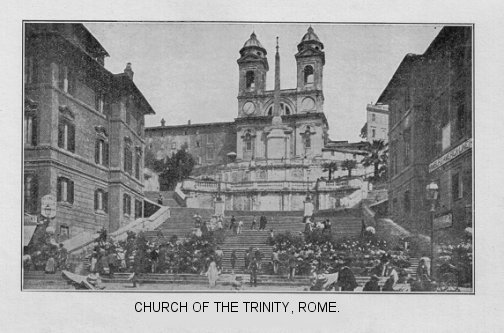
Rome continued: St. Peter’s building:
St. Peter’s Statue: St. Peter’s resting place: The
vast Columns, Pictures, Fonts, Confessionals, etc.: The Vatican:
The Professional Letter Writer: The Arch of Titus: Statue of
Nero, etc.
This decision, however, he never carried out, but in the year
1506, Julian II. laid the foundation of this vast church we are
now about to enter. The first architect died while the work
was in its early stages. Then Raphael, with two other
architects, were appointed, and these also died during the
building. Michael Angelo, who was then between seventy and
eighty years of age, was selected to superintend the work.
He is credited with the designing of that marvellous dome and
cross, but did not live to see it completed. Indeed, not
less than fifteen architects succeeded one another during the
time of its building, and twenty-eight Popes reigned before it
was completed (a time of 176 years). Its actual completion
was not until 1784, a term of 278 years.
Carlo Fountana estimates the cost at £11,000,000. He states that it required
400,000 lbs. of bronze to form the statue of St. Peter inside the
cathedral. The whole area is 240,000 square feet; when this
is stated one may form some faint idea of the magnitude of the
building. There are within and without the building columns
in marble to the number of 756; 245 are inside. There are
46 altars and 121 lamps, most of them are kept burning night and
day. One hundred and thirty-two Popes have been buried
here, if you count as they do from St. Peter on to the last Pope
who passed away. It is stated that the cost of keeping the
place in repair is over £6,000 per year. Our first
view of the Nave as we entered, created such a feeling of awe and
reverence, that like the Queen of Sheba, of whom it is said,
“when she saw the glory of Solomon there was no more spirit
in her.” “And behold the half was not told
me.” I. Kings, chapter 10, verses 5 and 7. I
gazed with awe and admiration at one time on the marvellous
Niagara Falls, and the sight seemed to bring me into the very
presence of the great Creator, God. And now, to gaze upon
works of such a colossal magnitude and of such a costly
character, made us feel subdued and reverent. I may safely
assume, I think, that every one will not see it just as we saw
it; I mean they will interpret its meaning differently. We were
some time before we came to realize the fact that it was of such
extraordinary proportions. Looking at the cherubs which
support the fonts that contain holy water, at first you think
they are models of children, but when you come beside them you
find they are much larger than ordinary grown-up people. On
the floor we noticed there are stars or marks telling the length
of the building as compared with other large cathedrals.
St. Paul’s in London, is here given as 516-feet long, the
Cathedral in Milan as 440-feet, the Cathedral in Florence is
given as 495-feet, St. Peter’s, at Bologna, 440-feet, and
St. Sophia, at Constantinople, 364-feet, while this St.
Peter’s is 619-feet in length. On your right hand
passing up the nave is the gigantic statue of St. Peter in
bronze, which, with the foot held out slightly, I suppose
millions of visitors from all nations and peoples and tongues
have stooped to kiss the large toe, which, in consequence, is
worn seriously out of shape. Some have gone so far as to
say that this is the statue of Jupiter, only it has been slightly
altered to suit its present purpose. I think it is Dean
Swift who said (in a joke) “that the difference between the
ancient and modern Rome was, that the one was the worshipper of
Jupiter, and the other the worshipper of Jew
Peter.” As we stood beside this image in bronze and
looked to the right—the confessional to the left—the
confessional. Visitors in kneeling posture before an image
of the Virgin, another before a picture. Another walks up
to the font and crosses his forehead with holy water, we felt
that we could not but pity these poor deluded souls in bondage to
a priestly intolerance, when they might have had the real liberty
of the children of God.
Above this great statue of St. Peter, sitting in a chair of
marble, in the act of blessing the people, is a portrait in
mosaic of Pope Pius IX., and an inscription which states that he
is the only Pope whose years of pontificate are more than were
those of St. Peter. In the niches around the pillars which
support the cupola are some very fine specimens of statuary, and
above these are several small galleries which contain the Holy
Relics, these are shown to the public on the great festive
days. There are sixteen windows round the cupola, and over
these are sixteen richly gilded pillars, between each of these
are beautiful mosaics representing Popes and Bishops buried in
the church, also of the Virgin Mary, Jesus Christ, and the
Apostles. Over the High Altar under the cupola, where the
Pope alone has the right to say Mass, rises a very costly canopy
of bronze,
supported by four spiral columns of richly gilded bronze about
60-feet high, including the cross. The Altar is placed in
such a position that the Pope saying Mass, faces the
people. Under the Altar is St. Peter’s tomb; a double
flight of steps of Greek marble lead down to it, and at the
bottom is a statue of one of the Popes kneeling; at the sides are
four large columns of alabaster, and above these are two pillars
of agate with the statues of St. Peter and St. Paul. The
place in which St. Peter’s ashes rest, and that forms part
of the oratory, is covered with the most costly marble.
When Peter said “silver and gold have I none,” Acts.
chapter 3, verse 6, he could not have had the least idea of the
costliness of his resting place in Rome.
All things seem to be provided for the purpose of a worship
meant to captivate the senses by its external splendour and
beauty, until the very object of religion, the cultivation of the
Christian virtues, which are meekness and humility, are forgotten
in the magnificence of a priesthood of princes, combining their
splendour and luxuries with their duties. On all sides we
see monuments to Popes and Bishops; such as one to Pope Innocent
XII., with fine bas-reliefs in marble. The Pope
Gregory’s monument which has some fine sculpture on it in
marble. Another wing of this huge building designed by
Michael Angelo contains an altar enriched with alabaster,
amethyst, and other precious stones. Over the altar is an
image of the Madonna that is greatly venerated, as it is supposed
to have been brought here from one of the early churches.
Altars, crosses, and confessionals confront you wherever you go
in this great cathedral; also, pictures adorn the walls where
there is no sculpture. St. Peter raising Tabitha from the
dead. See Acts, chapter 9, verse 40. “But Peter
put them all forth and kneeling down prayed; and turning to the
body, said, ‘Tabitha, arise,’ and she opened her
eyes, and when she saw Peter she sat up.”
Two porphry steps lead to the Tribune, about fifty yards long,
where there is another altar, and over it four colossal bronze
statues; on the right, the tomb of Urban VIII., on the left, that
of Paul III. In one of the wings of this building there are
eleven confessionals for strangers, and inscriptions indicating
the nationality or language. On all sides we saw these
relics of popery until we were sick of it. We could not
visit the grottos, as time did not permit, we were very desirous
of making a visit to the Vatican, but we could not for the same
reason. We gathered from information gained in various
ways, that the Vatican or Pope’s Palace is the largest
palace in the world. The Pope is allowed from Italy about
£130,000 per annum, and the Peter’s pence, from many
lands, amounts to as much as £20,000 per annum. The
Vatican contains 11,000 rooms, there are also 22 court
yards. The ground it covers is the size of a town.
The museums, the picture galleries, the statues in marble, are
worth many millions of pounds. It is enriched with bronzes,
marble columns, and the best things that can be had from all
lands. Paintings of the very richest and highest class from
all the old masters. Massive gold and silver goblets, the
gifts of kings and of princes. Ancient relics from Assyria
and from Egypt. Some Egyptian mummies in sarcophagi with
hieroglyphics, indicating the locality from whence they
came. In the library are 26,000 manuscripts, about 19,000
are in Latin, 4,000 in Greek, and about 2,000 in the Eastern and
Oriental languages, besides about 50,000 printed volumes.
In one of the halls there is a bible of the fifth century, which
is a great rarity. The gifts from kings, emperors, princes,
presidents of almost all lands, which have been sent to the Pope
are too many to name or specify. We left St. Peter’s,
pleased with some things, grieved with others. The
greatness of Rome’s intellectual power; her art in
sculpture and painting; proofs of this we saw on all hands. She had,
at one time, over 400 temples, most of them with floors of
marble, great domes with wonderful frescoes, gorgeous beyond
anything we could conceive if we had not seen it. Walls of
marble, porphyry, jasper, precious stones, stones polished till
they shine like a mirror. Pictures, priceless and
innumerable. All this, side by side with the degradation of
the people, as seen in their daily visit to the confessional; or
to the holy water; or to seek a mass from the priest for some
friend in sickness; or a more important one for the soul of some
brother, sister, or friend in the agony of purgatory, and who
must remain there until certain masses are said. All this
means the lowering of the poor to the enriching of the
rich. Rome, I say, is to be pitied in this thing, under the
heel of the Pope. Her wealth is lavished on churches,
priests, cardinals, etc., but her poor abound on all hands.
At the very church door you have the extremes of lavish wealth in
church decoration, and extreme poverty in many worshippers.
We had a view of the Vatican from without; it seems one vast area
of palaces, churches, temples, galleries, colonnades, etc.
I suppose we have some fine palaces in England; there are some, I
believe, in France, Germany, in Egypt; but nowhere in the world
is there a palace so large and costly as the Pope’s Palace
in Rome. How unlike his divine Lord, “who had not
where to lay His Head,” or his predecessor (allowing the
expression) who said, “silver and gold have I
none.” Mark Twain says of the place: “It is a
perfect wilderness of statues, paintings, and curiosities of
every description and every age. The old masters fairly
swarm there. I shall remember the Transfiguration, by
Raphael, because it was in a room by itself, and partly because
it is acknowledged by all to be the first oil painting in the
world. It is fine in tone and feeling, it is a beauty, it
is fascinating. Acres and acres of walls and ceilings
fairly papered with them. There is one thing I am certain
of, with all the Michael Angelo’s, the Raphael’s, the
Guido’s, and the old masters, the sublime history of Rome
remains unpainted! They painted Virgins enough, Popes
enough, and saintly scarecrows enough to people Paradise
almost.”
Leaving the great St. Peter’s and the Vatican to return
to our hotel for dinner, we noticed the mixed crowds jostling one
another in the streets. The men seemed to be broad
shouldered, and their rugged bronze faces and dark piercing eyes
give you an idea that they look upon you with curiosity.
Men dressed in home-spun blue cloth as a rule. The women dress
in colours, no unusual thing to see them apparently enjoying a
feed of raw onions and salad with a good square piece of black
bread. Here we passed a professional letter writer, sitting
in the open-air in the street with a table before him on which
are pens, ink and paper. Here he is ready to read or write
letters for the unlearned, and they are by no means few in the
city of Rome. Many a declaration of passionate love must
have been whispered into the ear of this old Italian, to be
transmitted to some village maiden on the mountain heights, or in
some sequestered village. A rustic approaches the old
scribe as we watch him, he has received an epistle from some
Italian beauty far away. As he waits his turn he looks over
the precious documents with wandering eyes. Oh! if only he
could himself spell out its sacred contents. His cheeks are
flushed, his heart throbs as he hands the paper to the scribe;
and, as the old man reads, the smile plays upon his face, his
dark eyes brighten with delight. Yes! she is true to the
boy who is far away, what a joy to know their hearts beat in
unison and in passionate love. What a strange task! that of
the Italian scribe. Sometimes his task is to read letters
that tell of separations by death; the scalding tear, the heart
throbs, tell of grief and anguish, a life’s hope crushed out. A
dear mother, sister or lover passed away. All these
experiences go through the old scribe’s hands daily.
Young Italy, however, is awaking to her need as a nation, for
education and for the training of the young.
Our hotel is our home of rest, and we certainly enjoyed it
after hours of travel and inspection. Sights seen that we
had never dreamed of. Pictures, sculpture, arch, column,
colonnades, so profuse and so attractive that we forgot we were
tired until we turned away for a break and a rest.
Again, we are on the tram, and down one of the principal
boulevards, past shops, bazaars, cafes, hotels and churches, to
the Pont du Angelo, over the Tiber. This is a lovely piece
of workmanship, built of solid masonry, and on the pont, or
bridge, there are six statues on each side on pedestals,
representing the various architects, sculptors and painters of
ancient Rome, and as we crossed the bridge, right in front of us
we saw the castle of St. Angelo, erected by one of the Emperors
for his own tomb, and for the tombs of his successors. As
most of the important buildings in Rome, it is lavishly decorated
with marble sculpture, more fitted for a palace than for a
mausoleum.
 In the tenth century it was turned into a fortress and fell
into the hands of the barons, who, during a long time, made
use of it against the city itself. It is said that Clement
VII. took refuge in it in the year 1527. To-day it is a
beautiful temple. The floor is very largely composed of
Italian marble; on the staircase, on our right on entering, is a
fine statue of Michael the arch-angel, in a niche. In
another room are some fine paintings by Pierin; another room
still retains some of the implements of torture of the
Inquisition. On the top stands the bronze statue of the
arch-angel Michael, placed there in 1770; it is said it is placed
there in memory of a vision of St. Gregory the Great.
According to tradition, when Rome was severely visited by a
pestilence, and while the Pope was going in procession to St.
Peter’s, to obtain the cessation of the scourge, he saw, on
arriving at this bridge, an angel on the top of the mausoleum, in
the act of replacing his sword in its sheath, as a sign that the
visitation of the scourge was at an end. On account of this
the castle was named “The Castle of the Holy
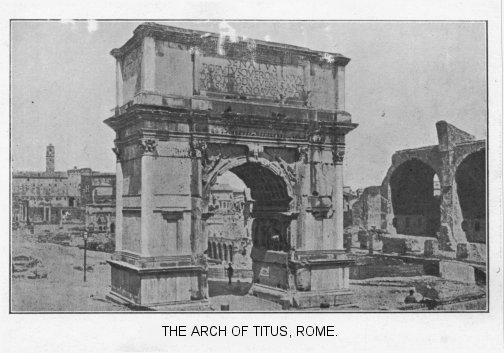
Angel.” “The Arch of Titus” is another
fine specimen of the builders’ art. Erected to him by
the people in homage of his great victory in Palestine over the
Hebrews, and of the destruction of the Holy City of Jerusalem, in
the year 79 A.D., and consecrated
to his memory by his successor in the year 81 A.D. It has somewhat suffered by the ages
that have passed over it; still, it is marvellous that it has so
long withstood the ravages of the iron tooth of time. There
is a fine frieze in the inside and some fine bas-reliefs.
One, that of the Hebrew prisoners, and Titus’ triumphal
march to Rome. In Macaulay’s we find the following
verses, evidently written on the subject of Titus’
victory:
In the tenth century it was turned into a fortress and fell
into the hands of the barons, who, during a long time, made
use of it against the city itself. It is said that Clement
VII. took refuge in it in the year 1527. To-day it is a
beautiful temple. The floor is very largely composed of
Italian marble; on the staircase, on our right on entering, is a
fine statue of Michael the arch-angel, in a niche. In
another room are some fine paintings by Pierin; another room
still retains some of the implements of torture of the
Inquisition. On the top stands the bronze statue of the
arch-angel Michael, placed there in 1770; it is said it is placed
there in memory of a vision of St. Gregory the Great.
According to tradition, when Rome was severely visited by a
pestilence, and while the Pope was going in procession to St.
Peter’s, to obtain the cessation of the scourge, he saw, on
arriving at this bridge, an angel on the top of the mausoleum, in
the act of replacing his sword in its sheath, as a sign that the
visitation of the scourge was at an end. On account of this
the castle was named “The Castle of the Holy
Angel.” “The Arch of Titus” is another
fine specimen of the builders’ art. Erected to him by
the people in homage of his great victory in Palestine over the
Hebrews, and of the destruction of the Holy City of Jerusalem, in
the year 79 A.D., and consecrated
to his memory by his successor in the year 81 A.D. It has somewhat suffered by the ages
that have passed over it; still, it is marvellous that it has so
long withstood the ravages of the iron tooth of time. There
is a fine frieze in the inside and some fine bas-reliefs.
One, that of the Hebrew prisoners, and Titus’ triumphal
march to Rome. In Macaulay’s we find the following
verses, evidently written on the subject of Titus’
victory:
“Valerius struck at Titus and lopped off
half his crest,
But Titus stabbed Valerius, a span deep in his breast.
Like a mast snapped by the tempest, Valerius reeled and fell.
Ah! woe is me for the good house that loves the people well!
Then shouted loud the Latins, and with one rush they bore
The struggling Romans backward, three lances length or more:
And up they took proud Tarquin, and laid him on the shield,
And four strong yeomen bore him, still senseless from the
field.
But fiercer grew the fighting around Valerius dead,
For Titus dragged him by the foot, and Anlus by the head.
Twice
tenfold round the body the roar of battle rose
Like the roar of a burning forest, when a strong north wind
blows.
Now backward and now forward, rocked furiously the fray,
Till none could see Valerius, and none knew where he lay.
For shivered arms and ensigns were heaped there in a mound,
And corpses stiff, and dying men, that writhed upon the
ground,
And wounded horses kicking, and snorting purple foam,
Right well did such a couch befit a Consular of Rome.”
There are also, in this palace, the seven-branched
candlesticks, and many other objects taken from the Temple of the
Holy City.
Next we saw the triumphal arch of Constantine (the first
Christian Emperor of Rome), this seems to be the best preserved
of all the arches we saw, although now it has been standing since
311 A.D. We learned it was
erected by the people of Rome in honour of the great victory
achieved over Maxentius at Ponte Mollo. The central arcade
is about thirty-feet high, the side ones are about
twenty-feet. There are four beautiful columns of Corinthian
marble which support the pillars upon which stand some fine
statuary representing some of the “Dacian prisoners,”
“Trajan’s entry into Rome after his victory in the
east,” “The rest on the Appian Way,”
“Trajan bringing help and succour to the poor
children,” “Trajan speaking to his
soldiers.” Under these are bas-reliefs which
represent hunts and sacrifices. On the opposite side of the
street we noticed a large pedestal which we were told held, in
ancient times, a colossal statue of Nero, executed in
bronze. After his death it was thrown down and replaced by
another called “The god of the sun.” This,
however, has been allowed to fall into decay; the iron tooth of
time has done its work, and only the pedestal remains.
The Navona Square or Piazza calls for a remark or two, it is
the next largest to St. Peter’s. There are three fine
fountains in the square, These seem to be of a modern design and
workmanship. One represents Neptune coping with a sea
monster, surrounded by sea horses. In the basin rises a
kind of rock; on the four sides of which are representations of
“The Danube,” for Europe; “The Ganges,”
for Asia; “The Nile,” for Africa; and the “Rio
de la Plata,” for America. The rock is surmounted by
a very neatly-cut obelisk. The first and largest fountain
is about 100-feet high, and when in play has a very beautiful
effect. The Church of St. Mary is but a plain looking
building from the outside. We approached with little
interest, but when we got inside we found it to be a perfect
museum of painting and sculpture; also, there are many tombs of
celebrated cardinals. The guide showed us a picture said to
be the work of St. Luke, and in all seriousness, told us it was
supposed to have the power to work miracles still. We did
not stay to ask whether that power was ever evoked. There
is a chapel inside, the architecture of which was planned by
Raphael. The design of big mosaics on the vault of the dome
is simply marvellous. There is a representation of the
heavenly bodies in their fullest splendour; also a fine statue of
Jonah by Raphael. There is attached to this church a
monastery, in which reside the monks of the Order of St.
Augustine. It is said to have been the residence of the
famous Martin Luther, during his visit to Rome. He entered
the city through the Porto del Popolo, and knelt down as soon as
he had passed the gate, crying most sincerely, “I salute
thee, Oh! holy Rome!—Rome, venerable through the blood and
the tombs of the martyrs.” And then he went
straightway to the convent, and there he celebrated mass.
And after the experiences he went through during his stay in the city,
what he had seen, and what he had heard—he said, on passing
again through the same gate out, with bitterness and grief,
“Adieu, Oh! City, where everything is permitted, but to be
a good man.” Every place we visited brought some
reminders of the sad fall of the papacy from real
Christianity.
To the Berbine picture gallery, was a visit which gave us much
pleasure, as we saw pictures from the ablest of artists.
The paintings by Michael Angelo and Raphael, Francesco and
Tiziano. “Adam and Eve driven from Paradise,”
by Guido Reni; “Christ and the Doctors of the
Church,” by Dürer; “The Holy Family,” by
Andrea; “The Annunciation,” by Bronzine; and many
others that we considered marvels of the artists’
brush. There is also within this gallery a very large room
as a library in which, we learned, there are over 30,000 books in
print, and over 8,000 in manuscript, by Dante, Galileo, Lasso and
others. The wonders of these places filled us with such
admiration, we could stay and look until quite weary, so we take
tram to hotel again for rest.