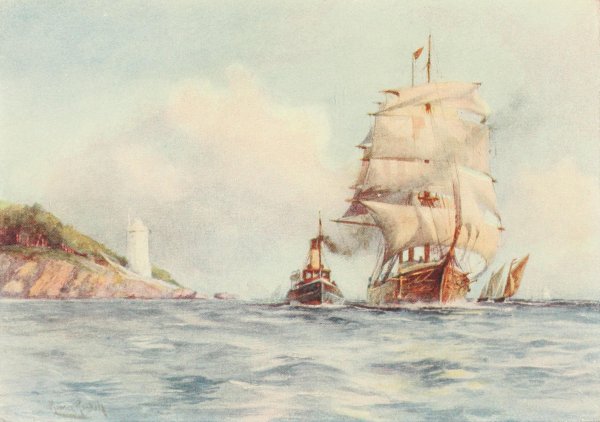
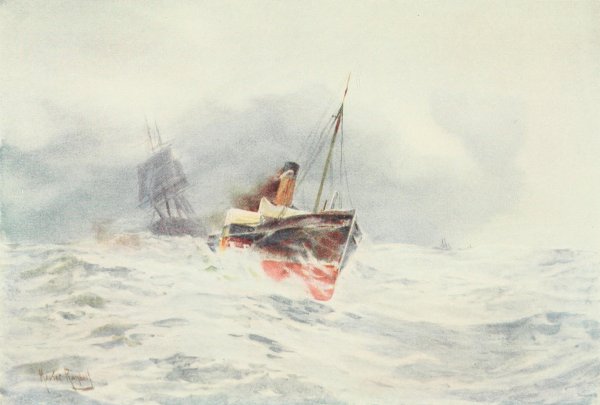
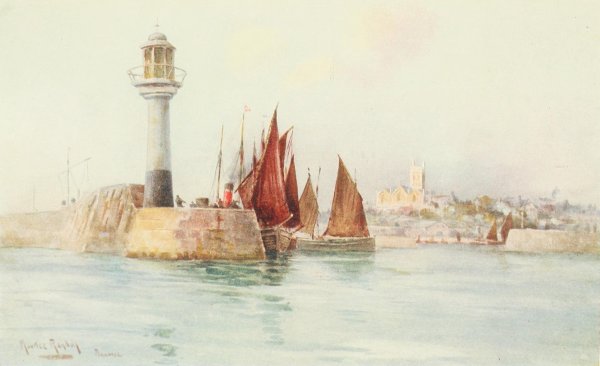
Past Berry Head, with its crown of golden gorse, its
cave known as Ash Hole, supposed to have been the
burial place of soldiers of Cæsar’s legions, and the
house upon its lower slopes which, during the great French
Wars with Napoleon, was used as a hospital, and was afterwards
given to the poet Lyte by King William IV, one is soon
in sight of the rugged pinnacle rock or islet known as the
Mewstone, which stands like a sentinel on guard, just outside
the entrance to the Dart. The scenery from Berry Head
southward is of a very different character from that which
distinguishes the coast from Sidmouth to Brixham. The
calm loveliness of red cliffs, rich with vegetation, hung with
creepers, thick with ferns, and gently fissured, is replaced
by rock scenery which grows grander and more beautiful
as it becomes more sombre and rugged, whilst in the background
are the fertile heights of Devon sloping steeply to the
cliffs and many groups of outlying rocks off shore, against
which the emerald and indigo sea laps in summer and roars
in winter.
As one draws in closer with the land, one is not slow to
realize the popularity and importance of Dartmouth and the
Dart estuary as a haven and as a port in the strenuous days of
old. Even nowadays one might be within a mile or so of the
entrance, and yet remain in ignorance of the existence of a
town of any size, and only suspect it by the presence of
vessels inward or outward bound. The Dart provided just
such a quiet and secure haven as in the days when the
Channel was infested with privateers and even less reputable
craft was essential to the sea-going community of these
shores.
Around the river which, rising in the centre of wild and
lovely Dartmoor, then wandering across bogs, plains, and
fertile valleys, and past picturesque towns and villages, finds
ultimately so lovely an outlet into the sea, poets and novelists
have woven their webs of song and fancy, whilst famous
artists have recorded its wonderful charm and beauty upon
their canvases. If not one of the most historic rivers of the
British Isles, the Dart may yet claim to be one of those
around which romance and imagination have been most
closely entwined. One cannot talk to Devonians long without
becoming aware of the high place that this changeful river
holds in their affections. “It is the most personal stream I
have ever known,” a well-known angler has said. “I have
traversed it from almost its source to its end, where at Totnes
the fresh water meets the salt after a course through moorland
bogs, wide-spreading uplands, and valleys where its
brownish waters come rushing and leaping down, and where
shady pools, fit homes of silvery trout and salmon, tempt
the angler to pause. Throughout its often turbulent course there
is nothing monotonous; almost every inch of it is lovely in
its own peculiar way. It is, indeed, a Queen of rivers, though the
native mind ascribes to it the gender of the opposite sex.”
The first glimpse one has of Dartmouth when approaching
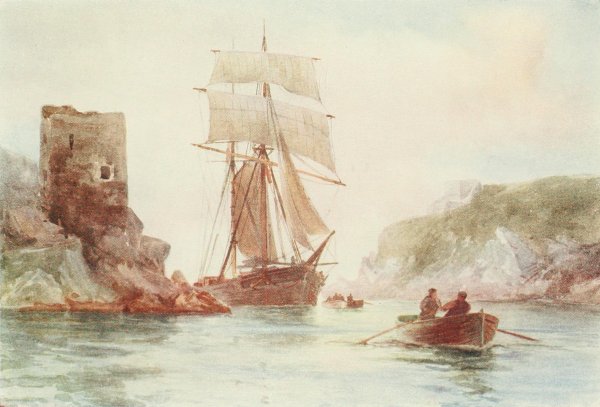
it from the sea is the ancient castle of St Petrox standing
opposite the ruins of its mate of long ago on the Kingswear
side. Then one catches a vista—how charming whether in
sunshine or when the mists of early morning hang grey-blue
above the houses, and have yet to be dissipated by the sun’s
rays—of the old town which lies almost hidden behind a green
slope of land ending in a cliff. Past the ancient castle,
built on the edge of the cliff and surrounded by the most
delightful woods, where a picturesque old church seems as
though almost about to fall into the water from its apparently
perilous site on the very edge of the precipice, past villas
nestling amid the trees, and rocky shores, past tiny coves,
and slaty cliffs, bare except where trees, saplings, or ferns
cling to make them beautiful, one comes at last on jade-coloured
water, to the town, grey-looking and sheltered by
high cliffs and downs behind it, built sheer up from the edge
of the river itself.
There, amid lofty hills on either side of the widening river
or the arm of the sea (whichever one pleases to call it) lies
what has been described as “the most beautiful and fascinating
town in all Devon.” Prince, the famous vicar of Berry
Pomeroy, whose book, so full of the Devonian spirit, if somewhat
bombastic and ill-balanced in style, may yet be read
with profit by those to whom the history of the past of “the
fighting, glorious county of Devon,” has an interest, describes
it thus, and the description save for a few minor details holds
good to-day. Dartmouth, he says, is “a large and populous
town, situated on the southern side of a very steep hill,
which runneth east to west at considerable length of near a
mile, whereby the houses as you pass on the water seem
pensile (pendent), and hang along in rows like gallipots in an
apothecary’s shop; so high and steep is it that you go from
the lower to the higher parts thereof by stairs, and from the
bottom to the top requires no less than a hundred.”
Seen from the water near the Britannia the old town is
indeed charming, with the picturesquely irregular and
weathered roofs of the older houses rising tier upon tier, and
the grey-blue smoke of chimneys hanging like a perpetual
and kindly veil softening crudities of architecture and adding
pictorial charm. There are many quaint houses, more
especially those built by Hayman about 1634–1640, in the
Butterwalk, with the huge, pointed gables and overhanging
upper stories wedded to modern fronted shops, in which are
displayed “Paris fashions” and up-to-date goods that at first
seem out of character with such surroundings. There is, indeed,
much of interest for the artist and antiquarian in Dartmouth
streets and by-ways, just as at almost every turn ashore and
on the surface of the beautiful land-locked harbour there is
something to arrest the attention of the casual observer.
Much of the history of this ancient and interesting town is
obscured by the mists of the ages which have passed since the
first settlement was made upon the western shore of the lovely
river. But we know that the waters “upon which Roman
triremes and Danish galleys, and later huge captured galleons
swung with the tide,” saw also the assembling together, at
the close of the twelfth century, of the Crusaders’ fleet, which
sailed the long voyage through the Bay to the Mediterranean
to join Richard Cœur de Lion at Messina.
Two centuries later the adventurous spirit which has always
animated the men of Devon in general, and of Dartmouth in
particular, found vent in one of those predatory expeditions
against the coasts of Normandy and Brittany for which the
place was afterwards to gain so renowned a name. In the last
year of the fourteenth century one John Hawley, deciding
upon an “enterprise against those pestilent rogues the
French,” chartered all the shipping of which Dartmouth
could boast for this purpose, and in retaliation for the depredations
of “the French pirates upon the coasts of Devon,” set
sail for the shores of Normandy and Brittany. How successful
this enterprising merchant’s little private naval war
turned out may be judged from the fact that he and his
captains, or they for him, captured thirty-four French ships
with their cargoes amounting to 1,500 tuns of wine. It is
little to be wondered at that after the return of the ships
Dartmouth “ran red with the luscious wines of France, and
that none need go dry so long as they would drink success to
the bold men of the Dart and confusion to the French.”
Such expeditions as that of Hawley, however, were sure
to have their counterpart in retaliatory descents by the
French; and the history of the town—during the fifteenth and
sixteenth centuries especially—if written, would be one long
story of daring and piratical adventures on the part of the
men of the Dart, and surprises and alarms from the French,
who on several occasions visited the town and plundered it.
Nature herself would appear, however, to have given
some excuse for these piracies (for to call them aught else
would be but the merest euphemism) in that she had provided
a haven so admirably adapted not only as a base from which
to set forth upon such expeditions, but also as a refuge which
though so commodious could yet, on account of its narrow
entrance, be easily defended. In the reign of Edward IV the
burgesses entered into an agreement with their Royal master
for the provision of a “stronge and mightye and defensyve
new tower” (now known as Dartmouth Castle) from which a
chain was to be stretched in time of need to one on the opposite,
Kingswear, side of the harbour’s mouth, for the purpose
of keeping out the King’s enemies, the French pirates, and
other marauders, the King agreeing to pay the sum of £30
per annum for ever for this service, a large amount, when one
considers the difference in the value of money then and now.
That Dartmouth seamen early became famous is abundantly
proved by the circumstance that it was a captain hailing
from this western port who was selected by the immortal
Chaucer as one of the characters to ride in company with the
Cook, Prioress, Doctor of Physic, the Franklin, the Frere, and
all the rest of that band of Canterbury pilgrims of long ago.
Amongst the many “pen portraits” he has given us, few,
probably, excel in strength and truth that of the Shipman
“of Dertemouthe”; which, after reading the history, and
conning the traditions of the town in the stirring times of
long ago, one can readily accept as typical of many of the
men who, pirates though they were, did their part to fight the
battles of England, and uphold the noblest traditions of a
sturdy seafaring race.
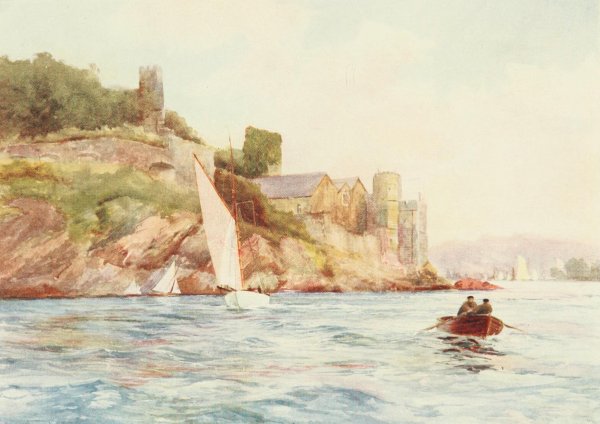
DARTMOUTH
Chaucer extenuates nothing as he writes (painting a
picture of the man, his day, and surroundings at one and
the same time):
A Shipman was ther, wonynge fer by weste;
For ought I woot he was of Dertemouthe.
He rood upon a rouncy as he kouthe,
In a gowne of faldyng to the knee.
A daggere hangynge on a laas hadde he
About his nekke under his arm adoun.
The hoote somer hadde maad his hewe al broun;
And certeinly he was a good felawe.
Ful many a draughte of wyn hadde he y-drawe
Fro Burdeuxward whil that the Chapman sleepe,
Of nyce conscience took he no keepe.
If that he faught, and hadde the hyer hond;
By water he sente hem hoom to every lond.
But of his craft to rekene wel his tydes,
His stremes and his daungers hym bisides,
His herberwe and his moone, his lodemenage,
Ther nas noon swich from Hulle to Cartage.
Hardy he was, and wys to undertake:
With many a tempest hadde his berd been shake;
He knew wel alle the havenes, as they were,
From Gootland to the Cape of Fynystere,
And every cryke in Britaigne and in Spayne.
His barge y-cleped was the Maudelayne.E
The picture that Chaucer thus paints of the “Shipman of
Dertemouthe,” though it probably was a portrait, nevertheless
was also true of the seamen in those far-off times
of almost every sea-going nation, when the right of the
ocean was ever that of the strongest, and the only law
that obtained with the sea-dogs of England, France, Holland,
or Spain was that of might. Whatever the squeamish
amongst historians or moralists may say, the bold sea rovers
were a natural evolutionary growth of the life on the coasts,
and those of Dartmouth amongst the best. But half-a-day’s
sail in a swift craft away across the Channel lay a portion
of France not less fitted by Nature to breed pirates and
later on privateers than the fretted coast lines of Devon and
Cornwall with their myriad coves and refuges, to which the
bold seamen could retreat with their plunder, or to make
good the damage of battle or breeze. Just as the sister counties
we have mentioned bred their hordes of sea-rovers, so did
the coasts of Brittany and Finistère. The instinct of piracy
and wrecking dominated both English and Bretons alike, and
indeed it was well for England that the bold spirits of Cherbourg,
St-Malo, Morlaix, and Brest (to mention but a few
places where such dwelt) were counterparted by those of
Dartmouth, Plymouth, Fowey, and Penzance.
The men of these ports not only fought when compelled,
but (to quote an old chronicle) “lusted exceedingly after the
blood and treasure of the French corsairs, and other sea
rovers.” That the men of Dartmouth were as doughty
fighters ashore as afloat is testified by Walsingham (amongst
others) in his Chronicle. In this vivid, and let us hope veracious,
record one finds an account of the attack upon Dartmouth by
Du Chastel, who planned a descent upon the south-western
coasts generally, as well as an attack upon Dartmouth in
particular, in revenge for the depredations of the men of
that port on the Breton coast. The news of Du Chastel’s
intention seems to have leaked out, for when some hundreds
of Bretons had been landed with the intention of
attacking from the land side at the same time that their
friends made an attempt from the sea, the former found
that the men of the Dart were prepared to receive them,
having entrenched themselves to the number of several
hundred behind a deep ditch.
The women of the town seem to have borne an Amazonian
part in the defence of their hearths and homes, for we learn
that they fought stoutly, “using slings with dire effect, so
that many of the invaders, both knights and common men
fell beneath their missiles into the said ditch.” These and many
others were summarily killed by the men, who appear to
have given no quarter even if it were asked. On this occasion
as on many others the men of Devon proved themselves as
well able to defend their homes and possessions as to ravage
and take those of other people, and the French, after losing
upwards of 400 killed and wounded, and leaving another 200
or so of their comrades prisoners in the hands of the Dartmouth
folk, were compelled to seek refuge in their ships as
best they could, and ultimately to abandon the idea of attacking
other towns on the coast, and return to their own shores.
Scarcely a year elapsed, however, ere the Bretons were
back again, and this time, unhappily for the men of the Dart,
the news of their coming did not precede them. Dartmouth
was surprised, an entrance was forced, the town burned, and
many—both men and women—were slain. Thus, in the stirring
times of the fourteenth and fifteenth centuries, ebbed
and flowed the fortune of piratical warfare between the
hereditary foes of the sea-coasts of Brittany and Devon.
But Dartmouth men and Dartmouth ships were never idle,
nor were they always engaged upon mere filibustering
expeditions. In the hearts of Devon seamen the flame of
patriotism has ever burned, and so on more than one occasion
they came in the nick of time to the aid of England, and
embarked upon enterprises of national, not merely personal,
significance and importance. It was so half a century before
the expeditions to Brittany, which brought about the descent
of Du Chastel and his force. Then, in 1385, after the death of
Edward III and his warlike son Edward the Black Prince, the
French were planning one of the periodical invasions of
England, which on a grand scale were always doomed to failure,
and the English admirals and generals seemed to have
become indifferent, or were, perhaps, worn out by the long
years of fruitless fighting in Guienne, Poitou, and Brittany.
It was then that the Dartmouth men gathered their ships
together, and regardless of treaties or the lack of national
support, swept up the Channel, forced their way into the
mouth of the Seine, where the French fleet was being brought
together, and preparations for the invasion were going on,
attacked the enemy, sank several of the ships, and carried
off with them back to Dartmouth four others, including,
Walsingham tells us, a knight’s barge, filled with spoil rich
enough to satisfy the greediest freebooter. This undertaking
of Dartmouth folk was of national importance; although
such events were usually much more of the nature of merchants’
speculations or piracy, which seldom failed to bring
about retribution from the equally bold and enterprising
Bretons. Indeed, there would appear good reason for supposing
that the right to levy “private warfare” was at least
tacitly admitted by both English and French rulers of the
period, for in an ancient volume bearing upon the subject
one finds a distinct statement that at least one English
Sovereign, Edward III to wit, aided and abetted his subjects
in this matter, the excuse given being the laxity of the then
Duke of Brittany in restraining his subjects from similar
depredations. Three ports are mentioned, Dartmouth being
one, to which the King afforded “help and notable puissance
upon pety Bretayne for to warre.”
It may be remarked in passing that men who had been bred
of corsair stock, who had learned the value of courage and
the lust of battle on the open sea, and the fascination of pillage
and rapine as early as they learned anything, needed little
official encouragement to undertake and continue the predatory
warfare beloved and followed so sturdily by their
forbears. Whatever one’s opinion as to the lawfulness or
otherwise of such marauding habits, which often, it may be
admitted, told severely on the innocent, it is well to remember
the historical fact that these sea-rovers of the West of
England formed the nucleus of the British Navy, and the
thews and sinews of the power which enabled England in
after years to flout the great Armada of Philip of Spain, and
to stand alone when Europe bowed before the crash of
dynasties, and trembled beneath the tread of Napoleon’s
legions.
Out of the murk of piracy and lawless freebooting upon the
coasts of France and Spain was destined to emerge centuries
later the material from which were drawn the navy of Nelson,
and the victors of Trafalgar, and of many another hard fought
fight, men indomitable when engaged at long odds; enterprising
and courageous when traversing in solitude unknown
seas and unknown lands; chivalrous (yes, chivalrous in
measure) when a gallant foe yielded; full of belief in the
overruling Providence which had set Britain in the midst of
the waters that she might throughout all the jugglery of
Empires and nations remain free.
In the State papers and ships’ log-books which we have
seen may be found material for all the romances that can
ever be written of daring doings in the narrow seas, of the
pirates, and afterwards of the privateers and smugglers who
sailed out of Devon and Cornish ports and coves, and made the
Channel during several centuries, war or no war with France
and Spain, almost impossible of safe passage to merchantmen
of the latter nations, except when strongly convoyed.
Of many of the stirring scenes which the port of Dartmouth
must have witnessed, there are unfortunately few historical
records. But we know that it was visited by several of the
early Kings. Here, too, in Saxon times came Sweyn, son of
Godwyn, into whose hands Earl Beorn fell a prisoner, and
by him was afterwards put to death about 1049. It was to
Dartmouth that the “Red King” William Rufus came in hot
haste from his hunting of the deer on Dartmoor in 1099,
after receiving the news of the siege of Mans, Dartmouth
being the nearest port from which he could embark.
Just upon a century later, in 1190, came Richard Cœur de
Lion with his army of knights and Crusaders obsessed by the
necessity for slaying infidels, and of themselves dying in a far-off
land. King John came to Dartmouth more than once,
notably in 1214, after his defeat at Roche aux Moines in
Anjou. It is this monarch, Leland states, who gave a charter
to the town, confirmed in the succeeding reign by Henry III,
although another writer, Merewether, states that in 1319
the town set up a claim as having been free in the reign of
Henry I early in the twelfth century.
A less pleasant visitor of Royal blood was Prince Maurice,
nephew of Charles I, who besieged and took the town in 1643,
the Royalists losing possession three years later, when General
Fairfax and his Parliamentarians stormed and captured the
place after considerable loss of life and destruction of property.
Charles I was here in 1643, and (so tradition asserts) held his
court in a room of one of the houses in the Butterwalk, and
Charles II visited the place after his Restoration, some say
with fair Mistress Gwynne in his suite.
But after all it is not to Royal folk that Dartmouth owed
its fame in years gone by, but to the sturdy seafarers of whom
the famous navigating sons of Devon, Adrian Gilbert, who
(to quote a letter of Queen Elizabeth herself) “doth travail
and seeke, and by divers meanes indeavoureth and laboureth
that the passage unto China and the Isles of the Moluccas by
the northwestward may be known”; Martin Frobisher, and
John Davis of Sandridge; Francis Drake, and John Hawkins
are but a few. It was to John Davis that the task of discovering
the sea route concerning which Sir Humphrey
Gilbert (the brother of Adrian) wrote a Discourse “to prove a
Passage by the North-West to Cathay and the East Indies”
was entrusted. In all he made three voyages, in 1585, 1586,
and 1587, in vessels which are well described in Chaucer’s
words, “little bote(s) no bigger than a manne’s thought”; and
afterwards we are told that he sailed into southern seas, and
eventually was killed by the Malaccan pirates with whom he
had had more than one “brush,” leaving behind him a permanent
memorial in the name of Davis’s Straits between
Greenland and Baffin Land.
To Queen Elizabeth herself some credit must be given for
the encouragement and stimulus her patronage afforded these
hazardous enterprises; and if it was because of the reflected
glory which would accrue to her, or even direct monetary
profit, well, what matter?
In Hakluyt one finds how “certain honourable personages
and worthy gentlemen of the Court and Country, with divers
worshipful merchants of London and the West Countrie,
moved with desire to advance God’s glory, and to seek the
good of their native country, consulting together of the likelihood
of the discovery of the North-West Passage, which
heretofore has been attempted, but unhappily given over by
accidents unlooked for ... resolved, after good deliberation,
to put down their adventures, to provide for necessary
shipping, and a fit man to be chief conductor of this so hard
an enterprise.” Then we are told how one Master William
Sanderson, merchant, of London, became the greatest of the
adventurers in respect of the money he provided, and how
he commended to those who had the adventure in hand one
Master John Davis, “a man very well grounded in the principales
and art of navigation,” as captain and chief pilot of the
expedition. One can imagine the meetings of the adventurers
in London, and the zest with which the gentlemen of the
Court, the Queen’s representatives, secret or open, and the
worthy merchants, conned “sea-cards,” the charts of Master
Martin Frobisher’s voyages of a few years before, and the
learned and closely reasoned discourse of Sir Humphrey Gilbert
himself regarding the existence of the Passage. It may be that
among these was the chart of friar Andro Urdaneta, which
Sir Humphrey Gilbert states was “made by his own (Urdaneta’s)
experience and travel ... wherein was plainly set
down and described this North-West Passage,” agreeing in
all points with Ortelius’ map.
And then there were the preparations at Dartmouth itself.
The gathering together of a “company of goodlie seamen, not
easily turned from any good purpose, and strong withal in
their determination to serve the Queene’s Most Excellent
Majestie and their countrie well and faithfully in this adventure”;
the selection of ships and the fitting out of the same.
They who adventured forth on long voyages in those days
indeed needed stout hearts, for to the perils of the deep and
the unknown were added those of possible starvation and
drought.
But at length everything was ready, and (again quoting
Hakluyt’s vivid pages) “all things being put in readiness, we
departed from Dartmouth the 7th of June towards the discovery
of the aforesaid North-West Passage with two barques,
the one being fifty tons, named the Sunshine of London; and
the other being of thirty-five tons, named the Moonshine, of
Dartmouth. In the Sunshine we had twenty-three persons,
Master John Davis, captain.... The Moonshine had nineteen
persons, William Bruton, captain.”
We are further told that ere the ships dropped the land
astern, doubtless in view of risks of the voyage and difficulties
of revictualling, “the captain and the master drew out a proportion
for the continuance of our victuals.”
One can imagine with what interest the setting forth of
Davis and his adventurous companions was watched by the
townsfolk on the quays, and how doubtless scores of them
took the tree-shaded path to the bluff above the old church of
St Petrox to watch the two tiny vessels gradually pass out of
sight to the west as “the wind being at north, and being fair
weather” they departed. How different in dignity and impressiveness
is this simple phrase from the fuss, fume, and noisy
announcement of the departure of modern Polar expeditions,
with rampant personal advertisement, and free “puffing” of
commercial wares and stores.
Few as were the adventurous souls in the Sunshine and
Moonshine, there was doubtless many a sad-hearted lass in
Dartmouth town that night. And in the waterside taverns seamen
foregathered over their ale tankards and tots of rum idly
speculating as to the existence of a North-West Passage, and
as to whether bold John Davis, Master Mariner, and his men
would ever see Dartmouth harbour again.
But on September 30 of the same year, when the expedition
had been gone just over three months and three
weeks, Davis was back again safe and sound with both his
ships. The Moonshine, which had been lost sight of on the
27th, during “a marvellous storm being come in not two
hours before” Davis’ own vessel.
His second voyage commenced from Dartmouth on
May 7 in the following year (1586); and his third on May 19,
1587.
Something of the spirit which actuated these boldly adventuring
mariners of Dartmouth and the old West Country
breathes, we think, in the words with which Sir Humphrey
Gilbert closes his learned and famous Discourse.
He says, “for if, through pleasure and idleness, we purchase
shame, the pleasure vanisheth, but the shame remaineth for
ever.
“And, therefore, to give me leave without offence always
to live and die in this mind, that he is not worthy to live at all
that for fear of danger of death shunneth his country’s service
and his own honour, seeing death is inevitable, and the fame
of virtue immortal.”
From these stirring times of great enterprises is but a step
to those which came but a year or two later, when out of Plymouth
hard by streamed Drake’s little covey of ships on their
mission of engaging the vast Armada, which even when Davis
and his intrepid companions set forth for their voyaging amid
Polar ice and northern seas was a menace that cast a shadow
over the national life.
Just as the townsfolk of Dartmouth had crowded to the
cliffs at the harbour entrance to see Davis depart on his
voyages, and wave him God-speed, so climbed they once again
to watch the Armada, which Philip of Spain in his pride had
named “Invincible,” “wrecking nought that God Himself was
with the English fleet and Lord Howard of Effingham,” go
surging up the Channel, flags flying, cannon belching, with
“pictures of the Holy Saints, and coats of arms wrought upon
their sails”; and the little English ships hanging to them in
hot and furious pursuit.
Then came a time of comparative rest for the beautiful
little port on the Dart, which, however, as we have before
stated, saw some of the storm and stress of the Civil War. With
the bold and successful enterprises of Dartmouth privateers
during the long war with Napoleon, or with those of equally
daring smugglers at the end of the eighteenth and beginning
of the nineteenth century, there is no space to deal in detail.
We need only say that the spirit which had formerly actuated
the Hawleys, Davises, Hammonds, Clintons, and Vaughans
(to mention but a few)—many of whose enterprises are set
forth in the State papers—was not now a-lacking when England
experienced once more a time of stress and need, and
opportunity for personal gain walked in step with patriotism.
The greatness of Dartmouth as a seaport has departed. In
the comparative quietude of her streets and alleys one does,
however, seem to catch as it were an echo of other and more
splendid days. And in the types one meets by the waterside and
in the purlieus of the quays the observant can yet trace something
of the old seadogs who, adventuring much, went forth
in quest of new worlds and new trade routes, or roved the
Breton coasts in search of conflict and of plunder. The waters
of the harbour are nowadays, however, chiefly ploughed by
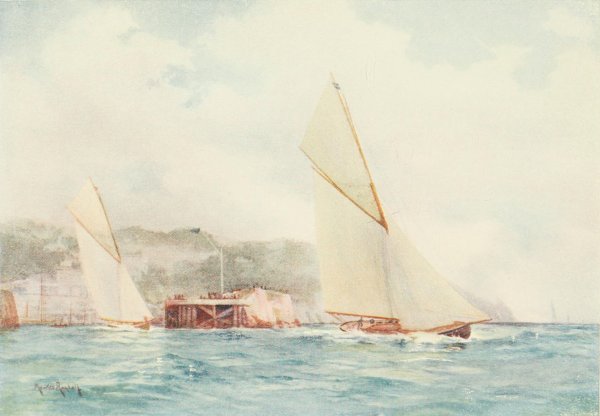
pleasure craft, white winged yachts in place of the armed sloops
and fast sailing craft, once bent on pillage, or commerce with
Newfoundland and other far countries.
In the churches—more especially those of St Clement and
St Saviour—one finds rich treasures of architecture, and of
monuments to men and women citizens of Dartmouth famous
in adventure, trade, or philanthrophy. In the former church,
which dates from the fourteenth century and was fortified
during the Civil War, are numerous memorials, the quaint inscriptions
which they many of them bear, setting forth in
brief the life history of those they commemorate. But it is the
church of St Saviour, set in the middle of the quaint old town,
also work of the fourteenth century (and earlier), which is the
gem of the place. The exceptionally fine screen is said to be an
Armada relic; but whether this is so or not, it is sufficiently
beautiful to merit the closest attention and examination. All
who go to Dartmouth and visit the church should notice the
south side door known as the “Dragon” Door, quaint with
wonderful representations of animals, and dating, so it is
said, from the fourteenth century or even earlier. In the altar
piece, the subject of which is “Christ raising the Widow’s
Son,” one has some of the finest of Brockedon’s work, a distinguished
son of the Dart born at Totnes. And here, too, as in
St Clement’s, sleep many whose names were writ upon the
town’s roll of fame in the times when Dartmouth gave of her
best in battle and discovery.
Totnes seems so indissolubly linked with Dartmouth in
history and adventure, that few who come to the outer port
with time on their hands fail, we fancy, to find their way up
the beautiful river to that inner port, now decayed ’tis true
like the outer, but yet of more than passing interest. Of its
antiquity there can be as little doubt as of its picturesqueness;
although there are those who scout the theory (or statement)
of that none too veracious chronicler Geoffrey of Monmouth,
that Brutus of Troy landed at Totnes. Which story
the devout townsfolk from time out of mind have striven to
keep alive by the preservation in the pavement of quaint Fore
Street of the stone upon which the princely, world-wide
wanderer is said to have rested after his landing.
In the street we have named, near the beautiful old Eastgate,
which stands half-way up its steeply climbing roadway,
are some of the most architecturally interesting houses of the
town. Merchants’ palaces of the time when Totnes was completely
environed by its walls, and “its inhabitants, even in
times of trouble, could sleep at ease because of its strong
defences.” It is from the old Norman keep, built, so ’tis said,
by Judhael de Totenais, that one obtains what local folk
proudly assert is the finest view in Devon. From it (let the claim
pass unchallenged) one does see a prospect of delight, widely
stretching and cultivated fields and uplands, with distant
plum-hued Dartmoor on the far horizon to the northward. To
the south and in front of the lower town is the beautiful reach
of the river up which in ancient times came the returned
vessels from distant lands, richly laden with the spoil of commerce
or pillage which made the Totnes merchants, if not
“rich beyond the dreams of avarice,” yet wealthy amongst
their peers.
But Totnes of to-day knows little of sea-borne commerce,
and is mainly given over to the pursuits of a country town of
somewhat indifferent enterprise, with the sole excitements
afforded by recurring market days, and the gossip of the incoming
folk from the district round about. A sharp enough
contrast to the stirring days of old when excitement and adventurous
life was the distinguishing feature, and “none
could tell what each tide would bring up from the sea. News
of loss or gain, of returned or missing ships, of wealth for
prosperous merchants or disaster which might make the
richest of them poor.”
In the ancient Parish Church of St Mary one has an
interesting building dating from the fifteenth century, replacing
a thirteenth century edifice which in turn stood on the
site of a much earlier Norman church. The beautifully carved
screen (said by some authorities to be the finest in Devon),
and the registers which date from the middle of the sixteenth
century, and contain an astonishing amount of most interesting
information regarding the old merchant princes of the
Elizabethan and succeeding periods give St Mary’s Church an
unusual attractiveness for antiquarians and students.
In its old Guildhall, which is a portion of the old priory of
St Mary, granted to the Corporation in the reign of Edward,
just behind the church, Totnes possesses a building alive with
historic memories of the deepest interest, and containing
amongst its deeds and records Rolls of the Guilds from the
year 1260, charters of many kings and queens, some of the
oldest as clear and almost as fresh as the day on which the
pens which wrote them were laid down three or four centuries
ago. In its Town Clerks of recent years—especially in Mr Ed
Windeatt—Totnes has generally been fortunate in having
gentlemen by whom the old records and treasures of the town
have been appreciated and carefully preserved. And writers
and historians have found their labours much lightened by
the excellent manner in which the documents have been collated
and arranged.
Those who “know their Dart” will if possible leave this
beautiful, sleepy old town, which is set so charmingly on the
hillside amid rounded fertile uplands and many-tinted woods
just before sunset. Then the passage back to Dartmouth
down the river, from the brown water of the Dart to the
gradually greening salt water of the estuary, is one of almost
indescribable and unforgettable beauty. It lies past Sandridge
where that intrepid explorer and much adventuring seaman
John Davis was born; and Greenway, where Adrian and
Humphrey Gilbert had their home. And then, just before
reaching Dartmouth once more one passes the mid-river
rock of sinister appearance and tradition, known as the
Anchor, to which in former times scolding wives and disobedient
daughters were ferried and left to encounter the
rising tide, and (as we are told) if “when the water was up to
their petticoats the same remained obdurate,” were left until
obstinacy yielded to wholesome fear of a complete ducking,
or worse.
As one leaves the interesting and lovely old town of Dartmouth,
and drops the estuary astern, and approaches that
long, low headland, Start Point, which lies eight miles to the
south-west, one passes the stretch of white, sandy beach, near
which took place that fierce fight of long ago between Du
Chastel’s Bretons and the men and women of Dartmouth
town. On these sands, too, had landed in the autumn of 1370,
another adventurer, but of more noble kind, namely, the Earl
of Warwick, the “King Maker.”
When once Start Point, with its lighthouse and lighthouse
buildings hung upon the western side of the cliff two hundred
feet in the air, and looking in the strong light as though cut
out of ivory, has been left astern, one comes to the wild
looking Prawle Point, with its signal station, and then into
the estuary of Salcombe River, leading up to Kingsbridge of
ancient renown.
Salcombe has been called “one of the prettiest havens in
Devon,” and after a visit one is inclined to agree that the
description is not unmerited. It is indeed a delightful spot,
as yet largely unspoiled by “development”; picturesquely
built beneath the shelter of well-wooded hills. These, clothed
with verdure, form a remarkable contrast to the hills on the
Portlemouth side which lie bare and open to the strong
westerly and south-westerly gales which sweep up from the
sea. This same Portlemouth is a straggling collection of
ancient, grey-toned cottages, clinging to the sides of a steeply
climbing road. In the churchyard is a tombstone to the memory
of a farmer who was poisoned by his servant, which is interesting
from the fact that the latter’s punishment of being burned
at the stake is set forth upon the stone so that “all people
warning take.” The girl was tried in 1782, and condemned to
be first hanged and then burned; “which barbarous sentence
was duly carried out at Exeter, and was the last instance in
England of such a punishment being inflicted.”
Just before one reaches Salcombe, which nestles amidst its
wealth of myrtles, Portugal laurels, Guelder roses, arbutus,
orange and lemon trees, and sheltered even from the soft
south wind by Lambury Point, one passes Fort Charles,
one of the many isolated Royalist strongholds during the
stirring times of the Civil War in the West Country.
Soon after the outbreak of hostilities this fort, which had
been previously repaired and reclaimed from almost a state of
ruin by Sir Edmund Fortescue “who was for the King,” was
attacked by Colonel Weldon, Governor of Plymouth, “who
approached with both horse and foot to the siege, and made
a hell for four months of the little fisher town Salcombe.”
That the place should have held out so long was a wonder, but
the end was bound to come. Fort Charles capitulated, but
Sir Edmund Fortescue was allowed to march out with his
force with the honours of war, and to retain the keys of his
castle. The latter, however, was dismantled (making the
retention of the keys a somewhat empty form) and has never
since been used or repaired. And thus fell the last place to
hold out for the King in Devon.
Salcombe, with its narrow streets and ancient houses forming
so great a contrast to the newer portions of the town and
the villas dotted here and there amid the wealth of green upon
its slopes, has an old-world atmosphere, and a picturesqueness
which makes most who drop anchor in its fiord-like estuary
reluctant to depart, and anxious to return again.
To lovers of English history Salcombe will always be a spot
of fragrant and pleasant memory and pilgrimage, from the
fact that it was here that the great historian James Anthony
Froude lived for many years and did much of the work wherein
“he clothed the story of stirring deeds and historic happenings,
which had long since been dead, with flesh and blood
so that it lives again in the minds and hearts of men.” Froude
died here in 1894, and many pilgrims yearly make their way
to the long, low house with a verandah running round it, and
its casements opening out into the charming garden in which
he loved to wander, and where Tennyson came to visit him.
It was at Salcombe, too, that the poet received the inspiration
for “Crossing the Bar,” whilst on Lord Brassey’s Sunbeam,
and those who have slipped out of the estuary when the sun
is dipping westward can appreciate the picture conjured up
in the opening stanza:
Sunset and evening star:
And one clear call for me!
And may there be no moaning of the Bar
When I put out to sea.
The tale of Salcombe as regards its former greatness and
present-day comparative decay is similar to that of so many
other little ports which we have visited and described. Leland
refers to it in his Itinerary as a “fisher towne.” But anciently
it was more than this. The records of the number of ships belonging
to and trading with Salcombe in the seventeenth and
eighteenth centuries prove it to have then been a place of
considerable importance. And in the middle of the former
century the Customs returns amounted to a sum of about
£5,000 per annum. In the latter half of the eighteenth and
early years of the nineteenth centuries Salcombe was a great
smuggling place. Was not, indeed, the estuary made by
Nature herself for such a purpose? And the smugglers, we are
told, “gave much trouble to the riding officers and ‘preventive’
men of the coast from Dartmouth to Plymouth.”
Kingsbridge, once a flourishing port with a considerable
Mediterranean trade, employing some two hundred vessels
not a century ago, is no longer of much commercial importance.
The way from Salcombe up to the further town is a muddy
channel, almost devoid of picturesque scenery, and beset with
mudbanks. But amongst the ancient things which survive at
Kingsbridge is the custom of brewing and drinking “white
ale,” of unprepossessing appearance and considerable
potency, said to have been invented at Dodbroke, with which
Kingsbridge is so closely connected. It is, indeed, a curious
beverage of almost treacly consistency, made of malt, hops,
eggs, and flour, fermented with grout, and is best avoided by
the stranger.
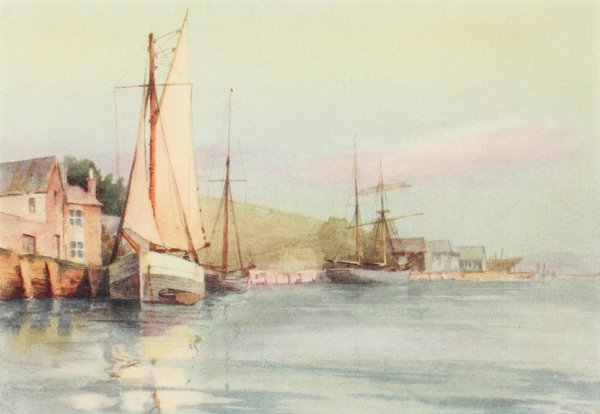
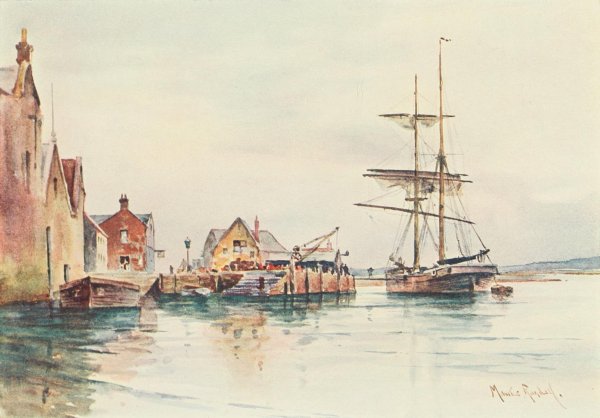
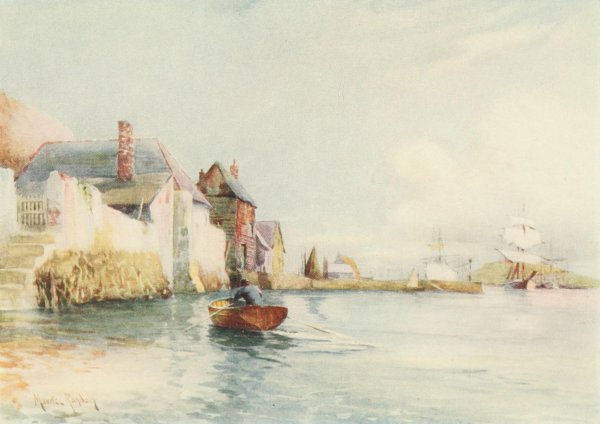
KINGSBRIDGE QUAY
In the old Shambles erected in the reign of Queen Elizabeth,
which form a picturesque element in the Fore Street, and in
the Church of St Edmund, dating from the second decade of
the fifteenth century, Kingsbridge holds out some inducement
for the visits of antiquarians. In the quaint inscription on the
memorial to one Robert Phillips, just outside the chancel
door is clearly stated a truism for all who run to read.
Here lie I at the chancel door;
Here lie I because I’m poor:
The further in the more you’ll pay;
Here lie I as warm as they.
Bolt Head, rugged and forbidding of aspect, and the Mewstones
which guard the western side of the Salcombe
estuary must be rounded ere one’s course can be laid for Plymouth,
along a rugged and wild coast deeply and dangerously
fissured, in which are the mouths of the picturesque streams
the Avon and Erme. Then come more Mewstones, the number
of which along this coast has often caused us to wonder.
These passed, Plymouth is right ahead.
As one passes up the wide expanse of that unequalled
anchorage known as the Sound, where have floated almost
from time immemorial the argosies and battle fleets of England,
and into which so much of the wealth of the world has
been borne in the past as now, the spoil of enterprise or of
war, one realizes something at least of the spirit of ancient
times. Plymouth has forged ahead whilst many of her sister
ports of bygone ages have slowly decayed. Throughout the
centuries there has been no rest, no idle contentment with
things that are until they cease to be. And thus it is that
Plymouth, of all the ancient ports of the West Country on
the Channel, has increased in greatness as the years have
rolled by.
Few more inspiring and beautiful pictures are to be found
along the coast than those afforded by Plymouth Sound.
Wedded to fine scenery is bustling commerce. Across the seaway
lies the world-famous breakwater, and behind it all
along up to Plymouth the sea is beset with craft of all kinds;
huge trading vessels, mostly three and four masters, which
have voyaged to the ends of the earth; fishing boats, which
look like cockle shells in comparison; destroyers, and torpedo
boats; tramp steamers belching out black clouds of smoke in
rivalry with that of the tugs; and, more majestic than all, the
ocean liners and occasional incoming battleships making
their way slowly up the Sound.
There are few spots on blue water where is given so great a
touch of life to things inanimate. And when one comes to an
anchor off Drake’s long low isle, or in the shelter of the
beautifully wooded Mount Edgcumbe, the ghosts of mighty
seamen of the past seem to flit across the scene, and visions of
long lost fleets, and adventurers’ galleons rise unbidden to
the mind.
Plymouth is one of those “ancient places in the making of
which all periods of national history have had a share.” It
even disputes with Totnes the honour of having been the landing
place of Brutus the Trojan, when some three thousand
years ago he paid a visit to these shores. The story that the
Trojan champion Corianaeus and a giant of the West Country,
one Gogmagog, wrestled a fall on or near the famous Hoe, in
which the latter was ultimately vanquished and cast into the
sea, is a part of the Brutus legend. The Plymouth Fathers of
old time evidently accepted it as having some foundation in
fact, as they caused a representation of the giant to be cut in
the turf of the Hoe, which remained to remind the townsfolk
and seafarers alike of the combat until about the time of the
Restoration.
Of the doings and history of the town of Plymouth, known
in the Domesday Book as Sutton or South Town, then having
about half a score of inhabitants, prior to the Norman Conquest
(if any town existed, which one may doubt, notwithstanding
Geoffrey of Monmouth) there are practically no
records or traces of any kind. Eventually the Domesday
hamlet increased and became divided into two portions,
Sutton Prior, or the eastern portion, falling to the Priory of
Plympton, and the western part coming through grant by
the Crown into the possession of the family of Valletort,
which still forms one of the subsidiary titles of the Edgecumbe
family, whose connexion with Plymouth is so intimate.
The rise of the port was destined to be rapid, for towards
the end of the fourteenth century only three other towns in
England had larger populations. Two of these, it may be
noted, were ports—London and Bristol—and the third the
seat of an archbishopric, York. Long before this period, however,
Plymouth possessed a market, and had sent representatives
to Parliament. And in the reign of Henry II it
received its Charter—the first granted by Act of Parliament,
a unique privilege, of which the city fathers have always
been justly proud. The first mayor in pursuance of this
charter was elected in 1439, William Ketherick by name;
who (according to records which have been preserved) was a
noted sportsman, and the possessor of “an appetite of right
goodlie proportions, though he was but a little man.” There
is a story that at the banquet he gave on his election, lest his
appetite and that of his guests should run the risk of remaining
unsatisfied, there was included amongst the numerous
dishes, joints, and delicacies provided, a monster pie, into
which “every beast, bird, and fish was put, with spices and
other matter,” which measured nearly five yards in length
and one and a half in breadth, and indeed speaks volumes for
the digestions of those times.
Like its neighbour Dartmouth, Plymouth has been almost
from time immemorial the home of daring adventure and warlike
enterprises. And like the sister port it possesses a fine and
commodious harbour (though one less easily defended), singularly
well adapted as a base for expeditions of the kind which
marked the fourteenth and fifteenth centuries more especially.
But although many of the ships and fleets which sailed out of
the Sound for the coasts of France, Spain, and the Americas
in bygone times were unauthorized freebooters, early in the
existence of Plymouth more truly national expeditions set
sail from its quays. For example, towards the close of the
thirteenth century a great fleet of upwards of 320 vessels
assembled for an attack upon the French coasts; and in 1355—some
sixty years later—Edward the Black Prince came here
for a similar purpose. And during the wars between the
Houses of York and Lancaster there was stir in the old
streets by the waterside marking from time to time the
arrival of some Royal fugitive or exile. Here, too, came unfortunate
Margaret of Anjou, the dauntless, sleepless foe of
Edward IV; and the not less unfortunate Duke of Clarence.
In the first year of the sixteenth century there landed at
Plymouth yet another ill-starred lady, the Princess Katherine
of Aragon, on her way to marry Prince Arthur, and destined
afterwards to become the wife of his brother Henry VIII. She
was entertained right royally by the citizens of Plymouth,
chiefly by one of the merchant princes of the port, named
Paynter, who lived in a magnificent mansion not far from
the waterside, which has, alas! in recent years shared the fate
of most historical buildings that come in the way of modern
and commercial progress.
But although many books might be written concerning the
sailing of the Plymouth corsairs against “the damnable
pirates out of St-Malo, Morlaix, and Brest,” and other
smaller ports of the Breton coast, and afterwards of the
daring doings of ships which, leaving the port as honest
traders to the Spanish Main, or West Coast of Africa, yet,
when on the high seas, hoisted the black flag of piracy, we
have no space to spare in which to describe them in detail.
Nor, indeed, to deal with the “bloody adventures of bold
seamen out of Plymouth, on the opposite coasts,” nor to
recount the marvellous exploits of those who ranged the
Spanish Main, and became passing rich by reason of the
singeing of the Dons’ beards, and the booty which fell to
daring enterprise and bold adventure, where no man valued
either his own life or the lives of his foes.
It is impossible, however, to pass without a somewhat detailed
mention of the most eventful period of the town’s history
when “by some concatenation of Fortune and circumstance
so many brave and gallant men of skill and resource dwelt in
or came to Plymouth, that they might in the hour of England’s
need take upon themselves her strong defence.”
It is not too much to say that Plymouth came to its own in
the great days of Elizabeth. For then the magnificent harbour
for a time became the centre and focus of all that was noblest
and most strenuous in national life and effort. And the
position that Plymouth then attained has never been entirely
lost. It is the one great old-time port of the South-West
coasts which has known no decline and seen no decay.
In the streets of the old town, which has largely passed
away to make room for the needs of strenuous modern commerce,
were enacted stirring scenes; which, indeed, as one
writer phrases it, “made the very pavement stones and quays
of the town the stage of history.” Here were gathered, at all
events, most of the foremost actors in the great pageantry of
the Elizabethan age and the Armada period. Here came
Drake, Sir John Hawkins, Martin Frobisher, Sir Walter
Raleigh, Lord Howard of Effingham, Sir Humphrey Gilbert,
Lord Seymour, and many more sea lords of the Channel and
the wider seas beyond. It was the work of these, and others
almost as famous and equally daring and patriotic, to raise
England to the pinnacle amongst the nations of the world
that she occupied by the end of the reign of Elizabeth, and
has never since lost. To them in a large measure must be
given the credit of planting the seeds of Empire throughout
the then known world, which by their efforts in adventure
and discovery was so considerably extended during the
latter part of the sixteenth century. To these intrepid seamen
and explorers of Plymouth and other Western ports we owe
not only that shining gem India, but also the vast America
we so unhappily lost, the Empire in the South Seas, and the
territory of the frozen North lands which cling close to the
Pole.
It is, however, more particularly with the great Armada
and the setting forth of that band of intrepid adventurers for
conscience’ sake, the Pilgrim Fathers, that the history of
Plymouth is linked with that of the nation for all time. On
the Hoe, now “tamed,” but otherwise much as it was in
Drake’s and Raleigh’s time, the merchant princes of Plymouth
were in those far off days wont to forgather, to discuss
the news of the day, and to watch the outgoing and incoming
of the ships in which their fortunes were embarked. And it
was to the Hoe that the bold adventurers, who sailed forth
into unknown as well as known seas, bearing with them the
fortunes of others with their own lives as surety, turned their
last gaze as they dropped away down the Sound out into the
deep waters.
It is recorded, too, that when any ship was setting forth on
an errand of importance, not only did the vessel salute the
shore with guns, and the music of the ship’s band (where such
could be mustered), but the guns upon the Hoe were fired,
the crowd gathered upon it to witness the departure huzza-ed,
and music was played.
One can, therefore, easily imagine the excitement which
seized upon the town on that Sunday in August, in the year
1573, when the news came from the look-out that Drake
was back from one of his adventurous voyages, and, as a
writer of the time says, “all people came rushing out of the
churches, insomuch that there were few Christian souls left to
hear the preacher.”
The same spirit which had made adventurers (and perhaps
on occasion pirates) now made heroes, instinct with a high
ideal of England’s honour and renown. Those were days in
which Englishmen bandied no words with the Dons of
Spain, but spoke with ball with the breath of powder, as the
following instance of Sir John Hawkins’s treatment of the
Spanish admiral who failed in naval etiquette will show. It
happened that the Spanish fleet, some fifty sail, sent to bring
Queen Anne of Austria from Flanders to Spain, entered (to
quote Sir Richard Hawkins) “betwixt the island and the
maine without vayling their topsayles, or taking in of their
flags.” Sir John Hawkins, on seeing this, made no delay, but
commanded his gunner to shoot at the flag of the Spanish
admiral’s ship as a gentle hint of the breach of etiquette.
Again quoting, we find “they (the Spaniards) persevered
arrogantly to keep the flag displayed, whereupon the gunner
at the next shot lact the admirall through and through,
whereby the Spaniards finding that the matter began to grow
earnest, took in their flags and topsayles and so ran to an
anchor.”
As was not unnatural the Spanish admiral sent a boat to Sir
John, in command of an officer of rank, to demand an explanation.
The English admiral, however, promptly declined to
afford any, and moreover told the Spaniard plainly that
“as in the Queene’s port ... he had neglected to do the acknowledgement
and reverence which all owe to another
majestie,” he must depart within twelve hours whether in fair
wind or foul, “upon pain to be held as a common enemy.”
It was to men like these that the fate of England could be so
surely entrusted. For to dauntless courage and marvellous
skill in the arts of seamanship was added the fear of God in
their hearts, sometimes curiously obscured it is true, but in
reality genuine and inspiring.
For some time before the ships of the Armada cast loose
their moorings in Lisbon on May 19, 1588, and set out upon
the conquest of England under the command of the Duke of
Medina Sidonia, the English fleet, under the command of
Lord Charles Howard, Sir Francis Drake, and Sir John
Hawkins had been collected together and marshalled in
Plymouth Sound awaiting the news that the Spaniards were
in the Channel. The ships had been chosen and “found” by
men who knew what value to place upon sound ships, rigging,
and fittings; and under the eye of Howard, Seymour, Drake,
Hawkins, Frobisher, and others who afterwards bore their
gallant part, the English ships (some mere cockboats) which
rode at anchor under the lee of Mount Edgcumbe, waiting
for the advent of the enemy, and “straining at the cables to
get at the Spanish Dons,” were made ready.
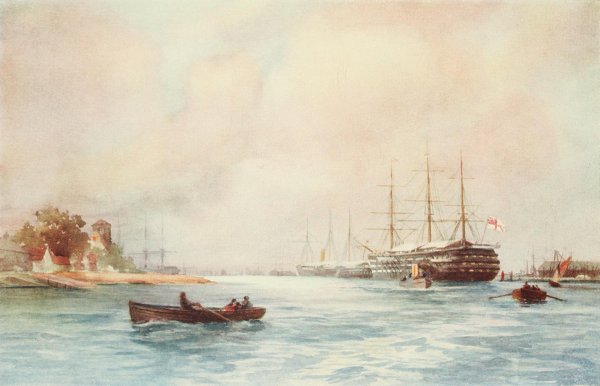
CREMILL POINT, PLYMOUTH
The Spanish fleet entered the Channel off the coast of Cornwall
on July 19 in dirty weather. Up from the Bay the Spanish
admiral in the San Martin had led the van, “showing
lights at night, and firing guns when the weather was hazy.”
On their arrival at the mouth of the Channel they found
English fishing boats acting as scouts, and so the news of the
Armada’s coming was first brought to land, and flashed along
the coast by desperate riders, and at night by kindled watch
fires. Froude gives us an arresting and detailed picture of the
dangers which had beset the English fleet in Plymouth Sound
during the period of waiting—dangers of exhausted provisions
and depleted resources, which were (so the historian states)
due to the parsimony of Elizabeth and some of her counsellors.
Medina Sidonia summoned his captains aboard the flag-ship
to decide upon a course of action. Whether they should await
the attack of the English fleet as they proceeded up the
Channel, or attempt a surprise and fall upon it as it lay in
Plymouth. The King’s orders, however, were to make for
Margate roads and effect the junction with Parma. So the
great unwieldy galleons, crammed to repletion with men,
priests, and treasure, made their way up the Channel slowly,
and, at first, in order like the shape of a half-moon.
“Long before the Spaniards saw the Lizard,” writes Froude,
“they had themselves been seen, and on the evening of the
19th (of July), the beacons along the coast had told England
that the hour of its trial was come.
“To the ships at Plymouth the news was as a message of
salvation. By thrift and short rations, by good management,
contented care, and lavish use of private means, there was
still one week’s provisions, with powder and shot for one day’s
sharp fighting, according to English notions of what fighting
ought to be.... All wants, all difficulties were forgotten in the
knowledge that he (the enemy) was come, and that they could
grapple with him, before they were dissolved by starvation.”
In this great hour of national danger it must be remembered
that the nation was at one. Differences of political faith
and of religion were abandoned, “there was saddling and arming
in village and town, and musters flocking to their posts.”
And on the night of the 19th, with a strong wind setting up
the Sound, the English ships, and a few of the privateers,
were warped out behind the shelter of Mount Edgcumbe, so
that they could readily get clear away to sea. And thus it
happened that on the morning when the Spaniards caught
their first glimpse of the Cornish coast there were forty ships
lying in wait for them in Plymouth Sound.
Froude presents a vivid picture of the succeeding hours
when he writes, “The day wore on; noon passed and nothing
had been seen. At length, towards three in the afternoon, the
look-out men on the hill reported a line of sails on the western
horizon ... they swept on in a broad crescent ...; and as the
hulls showed clear, it was seen that report had not exaggerated
the numbers said to be coming. A hundred and fifty large
and small were counted and reported to Lord Howard....”
A hundred and fifty, and beneath the haven lay to meet
them but forty odd! There was no hesitation, however. One
after the other cables were slipped, or anchors weighed on
board the English ships, and they dropped away down the
Sound, whilst thousands watched their setting forth with
beating and anxious hearts, for the magnitude of the undertaking
was great enough to appal the stoutest. The night was
cloudy, and it was full dusk ere the Spanish admiral saw that
Howard was waiting, and prepared for him. The English ships
flitted to and fro between the Armada and the land most bewilderingly,
“so that the Spaniards could by no means reckon
or make sure of their size or number.” Seeing that to enter the
Sound without first fighting an action was quite impossible,
Medina Sidonia flew the signal to heave to for the night, confident
in his superior numbers.
Next day’s dawn found the Spanish fleet and the English
ships not yet in touch. The breeze rose with the sun, and about
eight o’clock the former got under way with a view of
closing with Howard’s ships. But to the Spanish admiral’s
astonishment he found the enemy easily took and kept the
weather gauge, and either approached or left at will his clumsy
“high towered, broad-bowed galleons, which moved like
Thames barges piled with hay; while the sharp, low English
sailed at once two feet to the Spaniard’s one, and shot away
as if by magic in the eye of the wind.”
The action, which, with short intervals, was destined to last
for almost a week, commenced by Howard’s flag-ship, the
Ark, and three others of the English vessels running down
upon the Spanish rear line, and whilst traversing it “firing
successively into each galleon as they passed, then wearing
round and returning over the same course.”
The Spanish commanders were struck with astonishment,
and with the English “firing four shots to one,” the huge
galleons were raked again and again, and their over-numerous
crews thrown into confusion. Meanwhile the rest of the gallant
little English ships, the masts of some of which scarce came
above the poops of their enemies, were one by one getting
into action on similar conditions.
The fight went on through the long morning and into the
afternoon, with the Spaniards always wearing and endeavouring
to get at close quarters with their nimble foes, but always
failing to do so. The Spanish ships being to leeward and
canting over to the wind found their shots fly high over the
smaller English craft, and their guns could not be sufficiently
depressed to overcome this disadvantage.
Towards evening a ship was detached from the English
fleet to carry a report of the events of the day to Lord Henry
Seymour, and a messenger rode off in hot haste to London to
ask urgently for more powder and ammunition, of which the
English were already running short. During the night Drake
went in pursuit of some vessels which apparently had left the
main body of the Armada, and Howard himself and his other
ships clung close to the Spaniards “sparing powder, but firing
an occasional shot to prevent the enemy from recovering from
their confusion.”
Terrified by these tactics and the superb seamanship of
Howard’s ships, the Spanish huddled together like a flock of
frightened sheep, and in the night several vessels fell foul of
one another, and much damage was done in consequence.
Amongst those which met with such misadventure were the
Santa Catalina and the Capitana. The latter, a galleon of 1,200
tons, carrying the flag of Pedro de Valdez, the only commander
on the Spanish side with any reliable or extensive knowledge
of the Channel, was so damaged that she was abandoned to
her fate (though the Spanish admiral-in-chief, Medina Sidonia,
sent a boat to take off her very essential commander, who
gallantly refused to desert his ship), and next morning fell a
prey to Drake on his return from chasing what had proved to
be not Armada galleons but Flemish traders. The prize proved
of unexpected value. We have already mentioned what
ultimately became of the Capitana, but an interesting sidelight
regarding the treatment in those days, of prisoners of
war, more especially foreigners—who were looked upon by
the lower classes of English people as little better than savages—is
afforded by a letter from Gilbert to Walsingham dated a
few days before the final scattering of the Armada. He wrote,
“The cost of keeping them (the Capitana prisoners) was great,
the peril great, the discontent of the country people greatest
of all,” and so, “to save expense, they were fed on the refuse
of their own provisions, which was too bad to be taken away,
the fish stinking, and the bread full of worms.”
It is not inconceivable that had the rough-dealing fishermen
of Brixham had their way with regard to the Spaniards,
the difficulty of feeding them would not have long troubled
those in authority. Prisoners of war in those days in any
country found little consideration if unable themselves to pay
ransom, or if their rank was not sufficiently high to make
redemption probable.
During the succeeding few days the fight went on amid
storms and varying winds, the English admiral supplying his
necessities of powder and provisions (and dire necessities
these were) from the stores of the enemies’ ships which were
captured, or which in their unwieldy manœuvres had come
into collision, been irreparably damaged and abandoned by
the Spaniards.
Knowing nothing of the coast the Spanish commander
entreated the Duke of Parma (who lay at Calais) most earnestly
to send him pilots. All through that long, running fight up
Channel the English policy had been to avoid as far as possible
close engagement; to worry the stragglers of the Spanish
fleet; to snap up any laggards; and engage any which had
out-sailed (as did the San Marcos) the main body.
Concerning these tactics the Spanish commander wrote to
the Duke of Parma, “The enemy pursue me. They fire upon
me most days from morning till nightfall; but they will not
close and grapple.” Then the writer goes on to request assistance,
and, more than anything, powder and shot, as his stock
was running low.
At length, having traversed the whole length of the
Channel, harassed by the “English bloodhounds, Howard,
Hawkins, Drake, Frobisher, and the rest,” the Armada
straggled into Calais roads. There were missing vessels; and
downcast hearts aboard most of the galleons which had won
to Calais through the ceaseless English fire.
The Armada brought up on the edge of shoal water, which
made it difficult to deliver such an attack as would best have
pleased and served the English commanders. And so, after a
consultation aboard Howard’s own ship, in which “Sheffield,
Seymour, Southwell, Palmer, Drake, Hawkins, Winter, Fenner,
and Frobisher assembled, with the fate of England in
their hands,” it was decided to launch against the great
Armada the fire-ships which were destined to complete “with
the additional and saving grace of God’s warring elements,”
the final destruction of the proud fleet of Philip of
Spain.
Eight of the smaller vessels which had attached themselves
to the English fleet were selected for the heroic service.
Their rigging and spars were smeared with pitch, their decks
and holds filled with all the most combustible rubbish to
which hands could be put, and then, late at night, when “the
tide—set directly down from the English position to where
the ships of the Armada ... lay” the fire ships were loosed
on their mission of destruction with their several crews to
pilot them to their destination, when they were to lash the
helm fast, belay the sheets, and set the vessels on fire.
Froude describes the scene thus, using as his authorities the
letters of eyewitnesses, Howard, Drake, Winter, and other
accounts now in the Record Office. “When the Spanish bells
were about striking twelve, and, save the watch on deck,
soldiers and seamen lay stretched in sleep, certain dark
objects, which had been seen dimly drifting on the tide where
the galleons lay thickest, shot suddenly into pyramids of
light, flames leaping from ruddy sail to sail, flickering on the
ropes, and forecastles, foremasts and bowsprits a lurid blaze
of conflagration.... Panic spread through the entire Armada;
the enemy they most dreaded was upon them.”
The success of the fire-ships was complete, so far as frightening
the Spanish into putting to sea was concerned. Most of
the galleons, after some confusion and damage, got clear of
the shoals, and lay-to about six miles from the shore. Then
when daybreak came, some were seen aground on Calais Bar.
During the next few days the running fight was resumed, as
at first the galleons strove to regain their former anchorage off
Calais, but were driven along the Dutch coast, ultimately to
speed northwards towards Scotland, with Howard, Drake,
Hawkins, and the rest of the English captains in hot pursuit.
“Without pilots, in a strange sea, with the autumn storms
prematurely upon them, and with no friendly port for which
to run, he (Medina Sidonia) became utterly unmanned....
On, therefore, sped the Armada before the rising breeze, the
English still following. Then as ship after ship became leaky
or disabled by the ever-rising storm, and was abandoned with
callousness bred of ‘a wonderful fear,’ what remained of the
great fleet of Philip of Spain passed for a time out of English
ken, and rushed northwards to destruction and dismemberment.”
Howard was at last compelled to abandon the chase. Froude
tells us “the English had but three days’ provisions left, and
to follow further so ill-provided, with the prospect of a continuing
storm, was to run into needless danger.”
Thus, with the return of Howard’s ships to Margate and
Harwich, was the “greatest service ever done by an English
fleet ... successfully accomplished by men whose wages had
not been paid from the time of their engagement, half-starved,
with their clothes in rags and falling off their backs, and so
ill-found in the necessaries of war that they had eked out
their ammunition by what they could take in action from the
enemy himself.”
Plymouth’s share in the most glorious event in national
history was the chief and ever unforgettable one. And for this
reason we have told the story of it somewhat fully.
It was from Plymouth that Sir Walter Raleigh set sail with
other bold adventurers for America, where he took possession
of Virginia, calling the new colony after his none too grateful
mistress, Queen Elizabeth, on July 13, 1584.
Plymouth, also, saw the setting forth of a much more significant
and peaceful expedition to that New World of which
so little was even then known, when the Pilgrim Fathers
from Leyden, after sojourning awhile in the great West
country port, stepped once more aboard the schooner
Mayflower, on September 6, 1620, and casting loose, adventured
out into the wide ocean, which washed the shores of
far distant America as well as those of their native land. It
was in remembrance of the last spot in England to give them
harbourage that New Plymouth was named. The vessel which
bore so rich a cargo of faith to the New World, and has
enjoyed such fame, was destined to have a prosaic end. After
she had borne the “Pilgrim Fathers” safely across the Atlantic,
she was sold as a trader, and after many years in the East
India Company’s service was lost off Masulipatam on the
east coast of India.
Plymouth played its gallant part in the Civil War. The
Royalist forces recognized the importance of the possession
of such a town and attacked it almost continuously for
several years. It also had to stand actual and protracted
siege. Over and over again the Royalist troops under Charles I,
dashing and gallant Prince Rupert, and many other distinguished
generals assailed the town, only time after time to be
repulsed with heavy loss. Then came the culminating event
one Sunday morning when the slopes and hillside to the
north and north-east of the town surged and rang with the
tide and cries of fierce conflict. It was the Royalists’ last
effort, and with their defeat the siege was finally abandoned.
Charles II when he came to the throne did not forget the
“malignancy” of the men of Plymouth, nor the stout defence
they had offered to his father’s attack. It was probably to
the latter fact that the existence of “The Citadel,” which
Charles II built, may be ascribed. For, although nominally
for the defence of the town on the sea side, it is significant
that the greater proportion of the guns with which it was
provided were trained upon the town itself.
Of the many eighteenth-century voyagers who set out from
Plymouth, none was destined to win greater renown than
Captain Cook, who made the town his headquarters previous
to all three of his famous expeditions.
The fear of Napoleonic invasion did not perhaps convulse
Plymouth—greatly strengthened as it had become by that
time, and kept by ceaseless bustle and activity from the form
of nervous dread which afflicted the smaller towns of the south
and south-western coasts—but it saw its full share not only
of the distress and excitement caused by the long war, but
also of the more terrible effects. Many a proud line-of-battle
ship, frigate, and corvette which left the Sound with a gallant
complement of brave men, colours flying, and bands playing,
returned little more than a shambles or a shattered wreck
after one of those fierce engagements in the Channel or Bay
of Biscay for which the years from just after the French
Revolution till well on into the second decade of the nineteenth
century were famous.
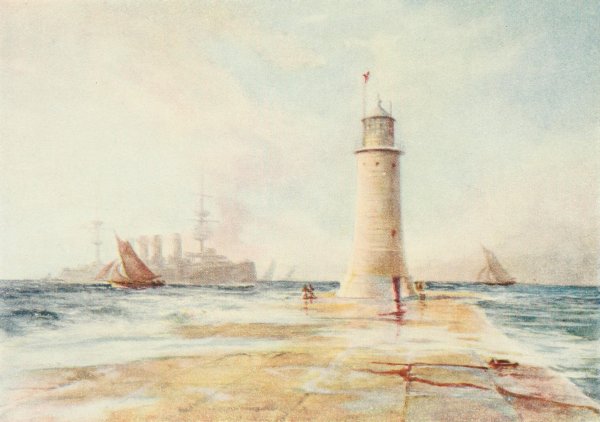
PLYMOUTH BREAKWATER
At the close of the war the great Napoleon, broken in
fortune and spirit, came to Plymouth in the Bellerophon, and
remained some little time the object of the greatest curiosity
not only to all the townsfolk, but to the countryside at large,
the inhabitants of which crowded into the place from distant
parts to see the man who for two decades had been the
cause of so much misery, and such nights and days of
alarm.
During the war the Plymouth privateers distinguished
themselves as might be expected of vessels hailing from a port
with traditions of Blake, Hawkins, Frobisher, and the rest of
those gallant Elizabethan captains. But of the many gallant
actions, often fought against great odds, and triumphantly
brought to an issue, we have no space here to speak.
Of Old Plymouth there is now, alas! little left. Even half a
century ago there were many of the ancient houses standing
in the streets that the old sea captains trod. But now few of
these dwellings remain, and even the historic streets have in
many cases been renamed, thus unhappily destroying for
ever all connection with the past. In St Andrew’s Street there
are still a few quaint houses with projecting windows, carved
corbels, overhanging eaves, and substantial doors made to
resist actual attack as well as to preserve the house against
casual intruders. At the bottom of St Andrew’s Street stands
a block of modern houses, erected in medieval style, and into
one of them has been incorporated much of the woodwork of
one of the houses which the more modern ones replace. This
house is interesting as being, at least by tradition, the dwelling
frequently occupied by Sir Walter Raleigh when in
Plymouth. In the High Street, too, there are still a few survivals
of charm and value, with the ancient archways leading
into spacious courts. High Street was, as its name indicates,
the chief thoroughfare in Elizabethan times, and must have
known Drake, Raleigh, Hawkins, and many another Plymouth
worthy and bold sea rover. It is in the heart of the old
town where Drake and the chief merchants of his time had
their residences.
Of the old inns and taverns, which, as became a seaport,
were once very numerous, few if any survive. The most
famous was the Turk’s Head, probably dating from the time
of Richard Cœur de Lion and the Crusades, as did most hostelries
bearing that and similar names. In Woolster Street
there was the inevitable Mitre Tavern, much resorted to by
the gentlemen adventurers, and the officers of Plymouth
merchantmen. Here, tradition states, was fought, early one
autumn morning, after a night of high play at cards, a
“triangular” duel with pistols which sent two gallant gentlemen
to their last account.
In St Andrew’s Church Plymouth has not only one of the
largest parish churches in England, but a building of great
antiquity, permeated by the spirit of the past. The church is
practically what it has been since 1460; the earliest part,
which is thought to be the south aisle, dates from 1385, when
it was dedicated to the Virgin.
In this ancient fane many of those who have left their mark
on history have from age to age and time to time worshipped.
Here came Katherine of Aragon, after landing, to return
thanks for the protection of Divine Providence during her
voyage from Spain. Here worshipped Drake and Hawkins,
and the rest of their comrades (brave fighters all, but devout
after their kind and age); and after them the Puritans to take
the oath of the solemn league and covenant; and here
Charles II is said to have accomplished the gift of healing by
touching for the King’s evil. And although the body of
Admiral Blake rested here in company with that of Sir Martin
Frobisher only for a time before transference to Westminster
Abbey, the heart of the intrepid admiral is popularly supposed
to lie buried within the church.
But, after all, those who remain in the Sound below Stonehouse,
with its famous Royal William Victualling Yard, and
Devil’s Point, concerning the origin of the name of which there
is so much local dispute, and do not penetrate to the region
of the Hamoaze, the Lynher River, St Germans Creek, and
the upper reaches of the Tamar, which can be navigated in a
dinghy as far as Weir Head itself, know but half the beauties
and attractions of Plymouth.
Devonport Dockyard, too, is always a place of interest and
fascination to seafaring folk. The town seems to shut itself off
from the other two towns, and in the past this apparent exclusiveness
has led to municipal friction. For a long time the
“Dockyard town” was but indifferently supplied with water,
and Plymouth firmly refused to allow any of its supply—dating
from the days of Drake, who had a good deal to do
with getting it for the town—to be diverted to Devonport.
Now, however, Devonport has its own water drawn from
inexhaustible Dartmoor, and the town has flourished so
amazingly that, although the youngest of naval ports, it has
become the one of greatest activity and renown.
But there is no space for us to descant in detail of the
charming places upon the shores of Tamar, Hamoaze, and St
Germans River. Even pretty, old-fashioned Saltash, with its
fishermen’s cottages clinging to the steep hillside, so that the
blue smoke from the lower often seems to veil the higher
dwellings, and its ancient church can only be mentioned in
passing; and so, too, the fact that its corporation takes precedence
of that of Plymouth, and has jurisdiction over the
Sound.
St Germans, called after St Germanus, Bishop of Auxerre,
who came over to Britain in the fifth century, and founded
upon the banks of the beautiful Lynher River a monastery,
which caused the place to become an important centre of
religious life and secular industry, can but be referred to
briefly. The church, with its Norman west front and recessed
porch, is of unusual interest, as is also the thirteenth-century
octagonal, north-west tower.
Port Eliot, the seat of the Eliot family, whose ancestor, Sir
John Eliot, played so prominent a part in the period just
anterior to the Civil War, stands quite close to the great
church, which, separated from it only by greensward and a
narrow road, is well worth a visit.
But all these things, including Landulph, with its old
church and the monument to Theodore Paleologus, of Pesaro
in Italy, “descended from ye Imperyail lyne of ye last Christian
Emperors of Greece”; and the Castle of Tremanton on
Lynher River can only be visited by one who has much time
at his disposal.
Of the beauties of Mount Edgecumbe a great deal has from
time to time been written. Under its shelter lay Howard’s
fleet, and along its shady avenues have walked many of the
greatest sons of the West Country in past centuries. It is this,
as Garrick calls it, “mount of all mounts in Great Britain”
that attracts the eye as one enters the Sound, and it is at this
lovely heritage of tree-crowned heights, valleys, and wide,
stretching sward that one gazes when, with the anchor
weighed, one drops down the water bound further west.