A NARRATIVE OF A JOURNEY THROUGH THE COUNTRIES
OF BALOCHISTAN, AFGHANISTAN, KHORASSAN
AND IRAN, IN 1872
TOGETHER WITH A SYNOPTICAL GRAMMAR AND VOCABULARY OF
THE BRAHOE LANGUAGE
AND A RECORD OF THE METEOROLOGICAL OBSERVATIONS AND ALTITUDES ON THE
MARCH FROM THE INDUS TO THE TIGRIS
BY
HENRY WALTER BELLEW, C.S.I. SURGEON BENGAL STAFF CORPS Author of a “Journal of a Mission to Afghanistan in 1867-58,” and
a “Grammar and Dictionary of the Pukkhto Language.”
LONDON
TRÜBNER & CO., 57 & 59 LUDGATE HILL 1874
[All rights of publication reserved]
PREFACE.
The steady progress of Russian conquest in Turkistan
during the past half-century, and, during late years, the
rapid advance of her frontiers in the direction of India,
have raised the States of Central Asia to a position of
importance in the eyes of European politicians higher
than they ever before occupied.
The accounts published from time to time by venturesome
travellers in those regions have informed us of the
barbarism and bigotry of their peoples—of the anarchy
and weakness of their Governments—and of the growing
decay and approaching dissolution of the polity that holds
them together by the bonds of a common religion and
common interest. And now the military operations
against Khiva at present in course of prosecution by
Russia, whilst opening up that country to the influences
of European civilisation, promise to unfold to that power
a field of enterprise that must, I believe, culminate in
her paramount ascendancy over all the region draining
to the valley of the Oxus. This is a prospect full of the
weightiest moment to ourselves in India, and one that
furnishes matter for the gravest consideration of our
statesmen. Much has been already written on this
subject from different points of view, and much remains
to be written; and doubtless the public journals will
keep alive the discussion of the question. But let us be
careful lest, while straining at the gnat of Yárkand, we
swallow the camel of Herat.
Since the region intervening between the Asiatic
possessions of Russia and England now claims the
attention of the several Governments concerned, and is
by the current of progressing events brought prominently
before the notice of the politicians of Europe
generally, any recent information regarding these
countries cannot fail to prove of interest to the general
reader. With this conviction, therefore, I venture to
set before the public an account of the incidents and
experiences of a journey made across this region during
last year—from the Indus to the Tigris.
In explanation of all shortcomings as to matter and
defects as to style, I have to remind the reader that the
narrative has been written at odd hours, between the
duties of an onerous charge in the principal frontier
station of India, without leisure for generalisation, or
opportunity for reference to authorities.
Further, I am constrained by the force of circumstances
to commit my manuscript to the care of the publisher,
without the advantage of correcting the proof-sheets in
their passage through the press.
H. W. B.
Peshawar, 18th April 1873.
CONTENTS.
PAGES
INTRODUCTION.
Appointment of Mission to Sistan and Tehran—Influence of British
and Russian civilisation—Historical Associations—The “sick man”
of Asia—Physical features of the region traversed—Climate and
inhabitants
Departure from Multán—The Chenáb and the Indus—Tria juncta in
uno—Interesting fact for naturalists—Shikárpúr—Jacobabad—A
plundered káfila—Afghan effrontery—Interesting rencontre—Barshori—Sinjarani—Odhána—False
alarm—Gandáva—Kotra—Disorderly
baggage ponies—Pír Chhatta—Muhammadan credulity
The Míloh Pass—Nah-langa Tangí—The Khánzai Brahoe—Pír Lákha—The
Pír and the dragon—Scene of assassination of Sherdil Khán—Khozdár—Roadside
memorials—The Brahoe—Brahoe gratitude—The
Záwah defile—Scanty supplies
Súráb to Calát—Reception by the Khán—The Court of Calát—Description
of Calát—Mundi Hájí—An efficacious charm—Our hostess
and the mirror—Mastung—Military honours—Nishpá Pass—Shál
Kot—Native custom
Kandahar—Afghan cookery—Visit to a gold-mine—Process of extraction—Antique
porphyry bowl—City of Kandahar—Mausoleum of
Ahmad Sháh—Discontent of the inhabitants—Oppression of the
Government—Pyrotechnical display—Travellers’ notes—The Saggid’s
experience—Departure—Sardár Núr Muhammad Khán—Kandahar
to Ballakhan
Salt-pits—The Saggid on the English press—Búst—Ancient ruins—The
Argandáb—Extensive jangal—Hazárjuft—Afghan stolidity—The
Helmand—Khanishín—Abdullah Khán—Colonel Táj Muhammad
Rúdbár—The Garmsel—Ján Beg—Change of post-route—The plain of
Sistan—An Afghan welcome—Sardár Ibráhím Khán, the murderer
of Dr Forbes—Sardár Ahmad Khán and Mardán Khán—Sharíf
Khán—A primitive ferry—Nasírabad—Windmills
Kol Márút—Mythical inscription—Khyrabad—Lásh—News of Lord
Mayo’s death—Calá Koh—Singular acoustic phenomenon—Duroh—Husenabad—The
Sarbesha plateau—Birjand—Trade and products—District
of Gháyn—Historical sketch
Birjand to Ghíbk—Depopulation of inhabitants—Sihdih—Persian
rights of perquisite—Gháyn—The Hájí’s advice—Change of route—A
noisy dispute—Precautions against the Turkmans—Dashtí
Pyáz—A harmless fright—Bijistan—Widespread suffering—Persian
veracity—Persian cruelty
Mashhad—Procession through the city—Interviews with the Prince-Governor—Gratifying
reception—Description of the city—Its industry
and trade—Plain of Mashhad—District of Nishabor—Untrustworthiness
of Persians—Sabzwár—An old institution—Pilgrims—Motley
spectacle—Shahrúd—An old acquaintance
Treatment of Persian soldiers—Lásjird—Our Mirakhor—His savoir
faire—The “Portals of delight”—Tehran—Destitution of the
inhabitants—Arrangements for return—Shukrullah Beg—A retrospect—Interview
with the Governor of Kirmánshah—Effects of the
famine—Frightful scenes—Hamadán—Kangawár—Besitun—Kirmánshah
An enormous caravan—The Khaleva tribe—Karriud—Zuháb—Difficulties
as to passport and escort—Their removal—Marauding
Khaleva—Turko-Persian frontier—Quarantine—Sad disappointment—Bukhariot
pilgrims—Their opinion of Russian influence in
Central Asia—Flight of locusts—A captive chief—The hermit and
his disciple—Attack by Arab robbers—Their repulse—Baghdad—Down
the Tigris
B.—Record of Meteorological Observations and Altitudes on
the March from the Indus to the Tigris, through Balochistan,
Afghanistan, Sistan, Khorassan, and Iran
Towards the close of 1871, Major-General F. R. Pollock
(now Sir Richard Pollock, K.C.S.I.) was deputed by the
Government of India on a political mission to Sistan, and
I was selected to accompany him. I left Peshawar on
the 12th December, and joined him at Lahore, where our
arrangements for the journey were made. In Sistan we
joined Sir Frederick Goldsmid’s mission, and proceeded
together to the Persian capital. Thence I returned to
India with the camp and establishment taken with us.
It is not the purpose of this work to enter into any
detail of the objects of the mission, nor in any way to
refer to the political events connected with it—preceding
or succeeding; and I have been careful in the following
pages to avoid allusion to or discussion of the politics
of the countries we visited, inasmuch as they are now
the subjects of consideration to the several Governments
affected by them, and are, besides, questions foreign to the
nature of this publication.
But as it is seldom than Europeans have an opportunity
of visiting much of the country embraced within the
limits of the journey of this mission, I have thought that
a popular account of our experiences would not be
unacceptable to the British public; particularly since the
region covered by our travels, apart from its own special
claims upon our interest, is, I believe, destined ere very
long to attract the most serious attention of European
politicians and statesmen.
And this because the civilisation of the West is advancing
with such steady progress towards the East, that
it must sooner or later penetrate to the countries that
have hitherto successfully excluded its influence. On the
Asiatic continent, at least, its advance is from opposite
quarters, at different rates of speed, and of very different
characters. The highly organised and intricate system
of European civilisation introduced into India, and now
being consolidated within the limits of the British Empire
there, though not without its advantages, has hardly
produced a shadow of effect on the bordering countries
lying beyond the region of its control. It stops short at,
and with as clear a line of definition as, the natural
boundaries of the peninsula. Cross the mountain barrier
limiting the plains of India, and you pass at once from
civilisation to barbarism, from order to anarchy, from
security to danger, from justice to oppression. So much
from the side of India.
From the opposite quarter advances the growing civilisation
of Russia—a civilisation which, notwithstanding
its elements of European science and art, is still but
little raised in its general character above that of the
countries it is so rapidly overspreading, and yet, by
consequence, less opposed to the tastes and the requirements
of their newly-conquered peoples. The steamer,
the telegraph, and the railway add consolidation to the
new rule in the annexed countries. Order and security
are established within the newly-conquered area by a
sharp and decisive though despotic military rule; whilst
commercial enterprise is encouraged with the countries
lying beyond, and fostered by Government patronage.
So much from the side of Russia.
The region lying between the Russian conquests in
Central Asia and the British Empire in India is now the
barrier that separates these two forms of civilisation. It
cannot always remain so. It must sooner or later succumb
to the one form or the other; and for this reason
it is that the region claims from us a more than ordinary
interest, and, I may say, sympathy too, by way
of reparation for the wrong we inflicted in the Afghan
war—a wrong the fruits of which are yet abundant, as
anybody who has served on our north-west frontier can
testify.
The narrative contained in the following pages will, it
is hoped, convey a correct picture of the general nature
of the country included between the Indus and the Tigris,
illustrate the chief points in the character of its peoples,
and exemplify the state of the society in which they live.
With respect to the last, I may here say, in anticipation,
that tyranny and insecurity, oppression and violence,
reign everywhere all over the country. It was our lot,
on entering this region, to meet a caravan that had been
attacked and plundered by tribes in revolt against their
chief. It was my lot, on leaving the region, to meet
another caravan that had been attacked and plundered
by tribes in rebellion against their sovereign. And it
was yet again my lot, before clear of the region in which
we had successfully run the gauntlet through Brahoe
and Baloch, Turkman and Hamadán, to be brought to
bay by Arab robbers, from whom we escaped I know not
how.
As the narrative is confined to a description only of
the country actually traversed, it may be useful here to
set before the reader a general view of the whole region
lying between the valleys of the Indus and the Tigris, by
way of introduction to the subject-matter of this book;
and this because the region itself is as interesting on
account of its peculiar physical characteristics as it is
attractive on account of its varied historical associations.
The land of the Medes and Persians, Magians and
Zoroastrians, on the one side, and of the Scythians and
Aryans, Buddhists and Brahmists, on the other—the
kingdom of Cyrus and of Darius—the country of Alexander’s
fame—the theatre of Arab conquest and Islamite
growth—the scene of Tartar bloodshed and devastation,
and the home ever since of anarchy and desolation—the
hotbed of Mohammedan bigotry—the arena of Shia and
Sunni hostility—and, towards the east, the bone of contention
between Persian and Mughal—later still, the
battlefield between Afghan and Persian—the prize of
Nadír—the spoil of his successors—and now the possession
of Kajar and Durrani, of Persian and Afghan, each
jealous of other, and each claiming as frontier what the
other possesses.
Such are some of the varied historical associations, past
and present, of the region I shall now endeavour to describe
in its physical character only—a region which,
with the exception of its western portion, has long been
a closed country to the European, and a jealously-guarded
barrier against the civilisation of the age. The term of
its isolation, however, is doomed; the time of its freedom
draws nigh. For the force of Western civilisation is irresistible.
Through it the enlightenment of the age must
soon shed its lustre upon these benighted regions.
The Crimean war poured its light upon Turkey, and
under its influence the “sick man of Europe” has become
convalescent. His neighbour is now the “sick
man of Asia.” He looks wistfully at the remedy of
civilisation. Let us hope he may be persuaded to try it.
But if Persia is the sick man of Asia, what shall we say
of Afghanistan, shut up in his own barbarism, imbued
to the core with fanatic bigotry, and steeped in the
pride of nationality? Verily, he is very sick—sick unto
death. And he knows it, yet he refuses, obstinately
and suspiciously, the only remedy that can save his decaying
constitution from dissolution. Is he to be left to
his fate? or will the physician appear in good time and
patch up his broken frame? These are questions for
serious reflection, because the patient is our neighbour,
and his fate cannot be a matter of indifference to us.
The region whose past history and present condition
I have thus briefly alluded to is comprised within the
fiftieth and seventieth degrees of east longitude, and the
twenty-fifth and thirty-fifth degrees of north latitude. Its
length is about twelve hundred miles, and its breadth
about six hundred.
Its most characteristic features are its general elevation,
and the fact that no river from its interior reaches
the sea. It forms, in fact, a great elevated block, interposed
between the basin of the Caspian and the low-lying
valley of Turkistan on the north, and the Persian
Gulf and Arabian Sea on the south, and is bounded east
and west by the valleys of the Indus and the Tigris respectively.
The area thus limited geographically, in contradistinction
to its political boundaries, presents some remarkable
physical peculiarities, which may be considered characteristic
of the whole region. Its mountain system, its
river system, its deserts, and its plains, all offer special
features for notice.
Its mountains, girding it on all sides, shut it off from
surrounding countries. By their internal disposition
they divide the region into two distinct parts, and
form a natural boundary separating three distinct races—the
Persian, the Afghan, and the Uzbak.
Its rivers, owing to this internal disposition of the
mountains, are directed in three different directions.
Those of Persia mostly converge to the south-east of its
territory; those of Afghanistan converge to the south-west
of its territory; and those to the north of the mountain
chain that separates these two systems, flow northward
to the swamps, tracts lying between the lower course
of the Oxus and the Caspian.
Its deserts, too, by the same internal disposition of the
mountains, are divided into three distinct sets—those of
Persia and Afghanistan, lying one on either side of the
mountain range separating these two countries, and that
of Turkistan, lying to the north of the same range, in the
angle formed by the mountains that converge from east
and west to produce it.
Its plains present greater variety in extent and direction
and elevation, but are all alike in general character—equally
arid, equally void of trees, and equally covered
with pasture plants. All are more or less the resort of
nomads with their flocks and herds, and some are peopled
by fixed communities settled in villages.
I will now describe each of these points in the physical
geography of this region separately, but time and space
only permit of my doing so very briefly and in general
terms.
As before indicated, the region between the valleys of
the Indus and the Tigris is an elevated country, propped
up on all sides by great mountain ranges.
On the east, it is separated from the valley of the Indus
by the Sulemán range, which continues southwards to the
sea-coast in the Hala mountains that separate Balochistan
from Sind. To the northward it connects, through the Sufed
Koh of Kabul, with the Kohi Baba of Hindu Kush.
This range contains within its ridges many fertile valleys
and small plains, all of which drain eastwards to the
Indus. To its west lies the high tableland of Ghazni,
and Kandahar and Balochistan.
On the west, it is separated from the valley of the
Tigris by the range of the Zagros mountains, which
northwards, through the hills of Kurdistan, unite with
the Armenian mountains. To the southward it extends
by the mountains of Laristan and Khuzistan to those
forming the southern boundary of this region. The
declivity of the Zagros ranges toward the west. The
mountains in this direction drop at once to the plains
below, and, viewed from them, look like a huge buttress
wall propping up the tableland of Persia.[1]
On the south, it is supported against the coast of the
Arabian Sea by the Mushti range of Balochistan, on the
one hand, and upon the littoral of the Persian Gulf by
the chain of mountains connecting the Balochistan range
with that of Zagros, on the other. To the east these
mountains support the interior tableland of Afghanistan,
against the low rugged hills of the sea-coast, by the hills
and valleys of Makrán; and to the west, by the hills of
Laristan and Fars, they unite with the Zagros range, and
support the elevated interior of Persia against the low-lying
shore of the Persian Gulf. This range is pierced
by many passes up to the interior, and encloses numerous
fertile and well-watered valleys.
Towards the north, it is separated from the valley of
the Oxus and low plains of Turkistan by the Hindu Kush
range on the side of Afghanistan, and from the basin of
the Caspian by the Alburz range on the side of Persia.
This northern boundary presents some special features.
The two great ranges approaching from the east and
west bend southwards to meet in the vicinity of Herat,
whence they project across the whole country, dividing
the region into the two kingdoms of Persia and Afghanistan,
and separating each from the intermediate region
to the north—the country of the Turkmans and the
Hazara, with other cognate Uzbak tribes. Thus the
Hindu Kush, west of Kabul, sends off two principal
ranges separated by the Hari Rúd, or river of Herat.
The southern of these ranges is called Syáh Koh, and
breaks up into the mountains of Ghor, which, extending
south of Herat, join the Khorassan mountains emanating
from the Alburz range, and form the watershed between
the hydrographic systems of Afghanistan and Turkistan.
That is to say, all the streams to the north of the Syáh
Koh range flow to the valley of the Oxus, or to the low
swampy tracts of Marv and Tajand, between the lower
course of that river and the Caspian, whilst all the streams
to its south flow to the Sistan basin, the receptacle for all
the drainage of Afghanistan west of Ghazni.
And so from the opposite direction. The Alburz
range west of Mashhad sends off a succession of lofty
offshoots, snow-topped in midsummer, that traverse the
northern highlands of Khorassan in a direction from
north-west to south-east, and enclose between them a
number of elevated plateaux, such as those of Nishabor,
Sabzwár, Turshíz, and Tabbas, that all drain westwards
into Persia. The principal of these offshoots is the
Binaloh range of mountains. It separates the plain of
Mashhad from that of Nishabor, and towards the south-east
connects with the high mountains of Záwah and
Bákharz, north of Herat. This range forms a watershed
between the drainage converging on to the great salt
desert of Persia on the one side, and that flowing to the
swamps of Tajand and Marv on the other.
Between Záwah and Tabbas the chain of mountains is
interrupted by a narrow arm of the salt desert called
Kavír, which at Yúnasi projects eastward on to the plain
of Kháf and Ghorian. But it is continued onwards by
spurs from Bákharz which connect with the mountains
of Ghazn on the one side, and with those of Ghor on
the other, a little south of Herat. Here the Ghazn
valley drains into Afghanistan, and onwards south the two
ranges proceed in parallel lines, a strip of desert waste
intervening, till they mingle in the Sarhadd mountains,
through which they connect with the great southern
mountain border of this region—the border previously
described as extending from the Sulemán range across
Balochistan and the southern provinces of Persia to the
Zagros range on the west.
Of these two parallel ranges, that formed by the projections
from the Ghor mountains extends in detached
ridges running mostly north and south. They enclose
amongst them the valleys of Sabzwár or Isapzár, and Anartarrah,
and drain to the Sistan basin by the Harutrúd or
Adraskand, as it is also called. The range passes to the
west of the Sistan basin, of which it forms the boundary
in that direction, under the name of Koh Bandán, and
ultimately joins the Sarhadd mountains.
The other range, joined by the spurs from Bákharz, is
an extensive and elevated mountain tract, enclosing
numerous plateaux and valleys, that all drain to the
Khusp river, which flows on to the salt desert. The
general direction of the range is from north to south, with
spurs projecting east and west. It connects through the
hills of Nih and Bandán with the Sarhadd mountains.
The mountain barrier thus formed by the emanations
from Alburz is the natural geographical boundary between
Persia and Afghanistan, north and south across
the length of their conterminous frontiers. It forms a
wide mountain region called Irani Khorassan, or Persian
Khorassan, and abounds in populous and fertile valleys,
full of fruit-gardens and running streams. Its climate is
variable, and its winters severe; but on the whole it is a
very salubrious region, and is everywhere easily traversed
by practicable passes among the hills.
Its inhabitants are a very mixed community. In the
southern districts they are mostly Ilyats, from different
stocks, with some Persians settled in the principal towns,
and all under the rule of local chiefs of Arab descent.
In the central districts,—Tún, Tabbas, and northern
parts of Ghazn,—there are many Baloch and Tartar
families mixed up with the general population. To the
north of these, in Záwah and Bákharz, the people are
mostly Karai Tartars and Hazárah Uzbaks; and in the
northern districts, Nishabor, Sabzwár, Burdjnurd, Khabúshán,
&c., they are entirely Kurds.
From the above description it will be seen that the Hindu
Kush and Alburz ranges combine to form the Khorassan
mountains that separate Persia from Afghanistan; that
Herat, and the country north of their point of junction,
is geographically separated from both, and connected
by its hydrographic system with the valley of the Oxus;
that in the vicinity of Herat the continuity of the Khorassan
hills is interrupted, south of Bákharz, by an arm of
the salt desert of Persia; and also that, with Herat as a
centre, the three divergent mountain ranges—viz., those
of Alburz, Ghor, and Ghazn—separate three distinct peoples—the
Persians, the Afghans, and the Turkmans, with
Uzbaks and other cognate tribes.
I draw attention to this last point, because the natural
configuration of the country explains the facility with
which, from time immemorial, the predatory tribes of the
lower Oxus valley have been enabled to harass the
Persian frontier unchecked with their annual marauding
inroads and slave-hunting expeditions, and because also
history has marked out this locality as the point of ingress
towards the east for all northern invaders; for Herat
towards the north, and with it Mashhad, is open to both
Khiva and Bukhára.
The mountain barriers that I have mentioned as geographically
bounding the region lying between the Indus
and the Tigris, have by their interior disposition determined
its hydrographic system in a remarkable manner,
on either side of the great Khorassan range separating
Afghanistan from Persia.
The Sulemán range, as already mentioned, is a wide
mountain tract, enclosing within its hills many valleys
and hills which all drain eastwards to the Indus. Its
declivity is towards the east, whilst to the west it slopes
gently on to the elevated plateaux of Afghanistan.
To the north, this range connects with the Sufed Koh
east of Ghazni, and at this point commences that great
watershed that separates the drainage of the Indus from
that of the Helmand. It runs in a southerly direction,
inclining to west as far as the Bolán and the tableland
of Calát, whence it strikes westward towards the Mushti
range, separating the great desert of Balochistan from
Makrán.
To the north of this watershed, Sufed Koh connects
through the highlands of Ghazni with the Kohi Baba of
Hindu Kush. From this range starts the Syáh Koh of
Hazárah, which stretches west to Herat, and forms the
watershed between the valley of the Oxus on the north,
and the Sistan basin on the south. From Herat it extends
southward by Sabzwár and Bandán to Sarhadd, where it
joins the western spurs of the Mushti range, and thus completes
the circle of the hydrographic system of Afghanistan.
With the exception of the drainage of the Ghazni river,
which collects in the Abistada marsh, and the drainage
of the Calát tablelands, which flow to the desert north of
the Mushti range, all the rivers within the area indicated
flow towards the Sistan basin, at the south-western extremity
of the Kandahar plain, though they do not all
reach it. All the rivers and rivulets from the eastward
and southward flow to the stream of the Helmand, whilst
those of Sabzwár and Ghor flow in separate streams, all
to meet in the Sistan basin. So it is in the Afghanistan
half of the region; and a similar system, though on a
much less extensive scale, is found to hold in the Persian
half. Thus all the streams between the Alwand range of
Hamadán on the west, and the Alburz on the north-east,
converge to the south-east corner of the Persian tableland,
where they expand themselves on the surface of the
great salt desert north of Kirmán. At least, such is the
case if any reliance is to be placed on the statements of
my Persian informants, whose testimony I am willing to
believe from my own observations as to the general course
of the streams and the lie of the land; for I have not seen
this shown on any map. The river Khusp of Birjand, the
Yúnasi river, the Kál Shor of Nishabor and Sabzwár, the
Kál Abresham and others on to Tehran, all flow direct on
to the salt desert, and the streams crossed on the road from
Tehran to Hamadán all flowed in the same direction.
The great salt desert of Persia, called the Daryáe Kabír,
or “the vast sea,” extends all along the western side of the
Khorassan hills, from Nishabor in the north to Kirmán
in the south, and sinks to its lowest level in the latter
direction, opposite to the Sistan basin, on the other side
of the intervening mountain range. So that the water
systems of the two countries converge towards each other,
and at some remote period probably formed lakes or swamps
on either side of the mountain range dividing them, where
it joins the great southern border of the region.
The water system of the country, to the north of this
dividing range, belongs to the hydrographic system of
Turkistan, and is beyond the limits of the region I am
describing. Its rivers all flow towards the lowest part
of the desert tract lying between the lower course of the
Oxus and the Caspian, and there end in the swamps of
Tajand and Marv. The principal of these streams are
the Murgháb, the Hari Rúd, and the river of Mashhad.
With the exception of the Helmand and Farráh Rúd
in Afghanistan, none of these streams always reach their
destination. They only do so in periods of excessive
flood; usually their waters are dissipated by evaporation,
absorption by the porous soil, and by diversions for
purposes of irrigation, long before they can reach their
terminal receptacles.
The deserts of this region between the Indus and Tigris
are in a measure connected with its water system. They
present vast tracts of elevated sandy wastes, perfectly
void of water and vegetation except on their skirts.
Each division of the region has a desert of its own.
That of Persia has been before mentioned as stretching
north and south across the eastern portion of that country.
The desert of Afghanistan extends east and west across
the western half of its southern border, from the highlands
of Calát to the mountains of Sarhadd, south of
Sistan. It is called the Regi Sistan or Regi Balochistan—the
sands of Sistan or Balochistan—and extends from
the Mushti range of mountains on the south up to the
plain of Kandahar on the north, where it ends in a high
coast of desert cliffs. This elevated border is called chol,
or “dry land,” and forms a belt ten or fifteen miles wide,
on which is found a rich winter pasture for the cattle of
the nomads who here make their winter quarters.
There is also a desert tract to the north between the
Caspian and Oxus; but it differs from the deserts of
Persia and Afghanistan in an important particular. Its surface
is a firm gravel, broken into undulations, and covered
with a more or less rich pasture of aromatic herbs, and
water is found in some of the hollows on its surface.
The plains of this region are all elevated plateaux of
greater or less extent, and more frequently the latter.
They are all covered with excellent pastures of rich aromatic
herbs and hardy plants, and are the natural home of
the asafœtida and wormwood, and, in the more elevated
tracts, of the rhubarb. Most of them are watered by
brisk little hill-streams, or by those artificial subterranean
conduits called kárez, and are more or less populous;
villages, fruit-gardens, and cultivation following the
course of the streams, and nomad camps covering the
pastures during the summer months.
In Balochistan, these plateaux rise in steps one above
the other between the hills up to the tableland of Calát.
North of this they fall in steps to the Kandahar plain,
which itself sinks towards the south-west to the Sistan
basin. In Persia they rise in a similar gradation from
the shores of the Persian Gulf and basin of the Tigris up
to the tablelands of the interior, where they sink again
gradually to the lowest part of the salt desert in the
south-east portion of the country.
Such, in general terms, are the main features of the
region between the Indus and the Tigris. Its climate,
as may be imagined, is as varied as the surface of the
country. It partakes of the temperate character of an
Alpine climate in the northern mountain tracts, whilst
in the lower desert tracts it equals in heat the torrid
plains of India during the summer months. But in
winter it is everywhere cold; in the mountain regions
rigorously so, whilst on the wide plains and deserts it
is equally severe by reason of the strong north winds
that sweep the country for months.
On the whole, the climate, with its many variations,
may be considered salubrious and favourable to life. Its
inhabitants certainly are physically amongst the finest of
the human race, notwithstanding the inferior fare and
barbarous mode of life that are the lot of a large proportion
of them, in Afghanistan particularly. In this
country the signs of departed prosperity and plenty are
everywhere met with. From Ghazni westward, all along
the valleys of the Tarnak and the Helmand, down to the
basin of Sistan, the whole country is covered with the
ruins of former cities, obliterated canals, and deserted
cultivation—all assigned to the devastation of the Tartars
under Changhiz and Tymúr in the thirteenth and
fifteenth centuries.
The country has never recovered the havoc created by
these curses of the human race. Since the destruction of
the Arab rule overthrown by them, the country has
known no stable government, and has been a stranger to
peace, order, and prosperity alike. But it has within
itself all the material elements of prosperity. What it
wants are a firm government and a just rule. With
these once more established over it, there is no reason
why the country should not again recover its former state
of prosperity and plenty. Its mountains contain a store
of unexplored treasure, and its plains an only half-developed
wealth.
Of its inhabitants I need add little here, as to describe
them fully would fill a volume. Suffice it to say,
that those of Persia and Afghanistan alike contain representatives
of various Tartar races thrown into this region
by the successive waves of invasion from the north, as
well as representatives of earlier known peoples pushed
on into it from the south-west, mixed up with the ancient
inhabitants of the land. Thus in Persia, with the ancient
inhabitants, who are mostly settled in the large towns
and cities, are found various tribes of Mughals, Turks,
and Kurds, together with Arabs, Armenians, and Jews.
A fourth of the population, which may be estimated at
six millions, consists of wandering tribes, generically
known as ilyát, a term which signifies “the tribes,” and
corresponds with the úlús of the Afghans. In the ilyát
are comprised all sorts of tribes, Arab and Ajam, that is
to say, of Arab origin and of Persian or foreign origin,
or, in other words, tribes who have come into the country
at different times from the west and from the north.
In Afghanistan, with its province of Balochistan, both
included in the country of Khorassan, are the original
Tajiks of Persian origin, the Afghans or Pukhtúns (the
dominant race), and the Hazárah of Tartar invasions,
together with Kazzilbash Mughals, and Uzbaks and Turks
of various tribes, Hindkis and Kashmiris, and others of
Indian origin, all in the northern tracts. In the southern
are Brahoe and Baloch, of different origin and diverse
speech; the Dihwár or Tajik, of Persian race and tongue,
and a mixture of different tribes, such as Jats of Sind,
Hindus of Shikárpúr, and a few mongrel tribes of nobody
knows where.
In our passage through the Brahoe country I collected
the material for a concise grammar and vocabulary of
that language. It will be found in the Appendix. I had
hoped to have been able to add similar grammars and
vocabularies of the Baloch and Sistan dialects; but the
adverse circumstances of our sojourn in these countries
prevented my acquiring a sufficient knowledge of their
languages, and I find that the data collected are much
too scanty to permit of my making the attempt, though,
from what I did gather, I believe both are closely allied
to the Persian.
CHAPTER I.
We left Multán by the morning train on the 26th
December 1871, and after a ride of near an hour, alighted
at Sher Sháh Ghát on the river bank. Here we took
leave of our kind host, Colonel Stuart Graham, Commissioner
of the Division, and embarked on board the
river steamer Outram. By noon we had loosed our moorings,
and the Outram, wedged in between two unwieldy
flats lashed to her one on either side, was fairly started
down-stream of the river Chenáb.
We had hardly proceeded two hours when we were
brought to a stand-still by “something” wrong with the
engine. Whatever this mysterious “something” may
have been, it necessitated our mooring alongside the river
bank for the rest of the day. A stout plank thrown
across from one of the flats served to communicate with
the shore, which is here a dead level of loose sand, evidently
a recent deposit by floods. The banks here are
very low, so too is the stream between them at this
season, as we soon discovered, to the no small trial of our
patience. They—the banks—are of loose sand, flush
with the general surface of the plain as far as the eye
can reach on either side. They are perpetually sucking
up moisture from the stream washing them, and then,
becoming overweighted, subside into the river, to be
restored again in the succeeding year’s floods.
By seven o’clock next morning we had cast off from
our moorings, and were drifting down mid-stream, fairly
started for a good day’s run. But we had hardly proceeded
half-an-hour when a smart bump announced our
stoppage by a sandbank. A little delay presently revealed
the unpleasant fact that the Outram with her flats was
jammed in a shallow channel with only two and a half
feet of water. Anchors were thrown out, first on one
side, then on the other; the engine was backed astern, and
then turned ahead. The Outram was hauled first this
way and then that; she was worked now backwards and
again driven forwards; and so on in alternation for
upwards of seven hours. Finally, about three o’clock,
our unwieldy tria juncta in uno was wriggled out of the
strait into free water four feet deep.
But we were not yet clear of our difficulties. A few
hundred yards farther on we were again stranded on a
sandbank; and not being able to get off it at sunset,
anchored for the night in mid-stream, having during the
day increased our distance from Multán by four miles
more than it was on the previous evening. We did not
get fairly off this bank till noon of the following day.
And so we went on, with like obstructions daily, entailing
more or less delay, till we reached Bakrí at sunset of the
30th. Here next morning we transhipped to the river
steamer De Grey, the cargo being transferred during the
night, and making a good start, arrived at Cháchá, a
little below the junction of the Chenáb with the Indus,
on the morning of the second day of the new year.
Here our only fellow-traveller, the Rev. T. V. French, of
the Church Missionary Society, left us for Baháwalpúr.
The De Grey fared only a little better than the
Outram. We experienced many delays from shoal water
and narrow channels, and at sunset of the second day
ran on to a sandbank. The shock of the concussion
caused one of the flats to break away from its attachments
and crush against the stern of the steamer. The
whole night was employed in securing the flat and
working the steamer off the bank. By eight o’clock next
morning we got off into free water, and making a good
day’s run, at sunset moored for the night at Rodhar, a
little hamlet of reed huts close on the river bank, and
about forty-eight miles above Sakkar.
During the day, we saw immense numbers of water-fowl
of all sorts. Ducks in great variety, coolan, wild
geese, herons, cranes, and paddy-birds were the most prominent
in point of size and numbers. Porpoises hunted
up and down the stream, alligators on the sandbanks lazily
basked in the sunshine, and wild pigs cautiously issued
from the thick coverts on either side for a wallow in
the shallows and puddles bordering the river’s stream.
In one of these shallows, formed by an overflow of the
river, we witnessed a curious sight—an interesting fact
for the naturalist. A large fish floundering about in the
shallow water had attracted the attention of a buzzard
flying overhead. The bird made one or two stoops
at the fish, when a jackal, looking on from the edge of
the jangal, came forward to contest its possession. He
boldly went some twenty paces into the water, and after
a sharp struggle seized the fish and brought it to land.
Here he laid it on the sand to take breath and look
around, and the buzzard, seizing the opportunity, again
made a stoop at the fish, but was driven off by the
jackal, who made a jump into the air at him. This was
repeated two or three times, after which the jackal, taking
up his prize, with head aloft proudly trotted back to his
covert. The fish appeared to be at least twenty inches long.
We left Rodhar early next morning, and proceeded without
obstruction. We passed a number of small hamlets
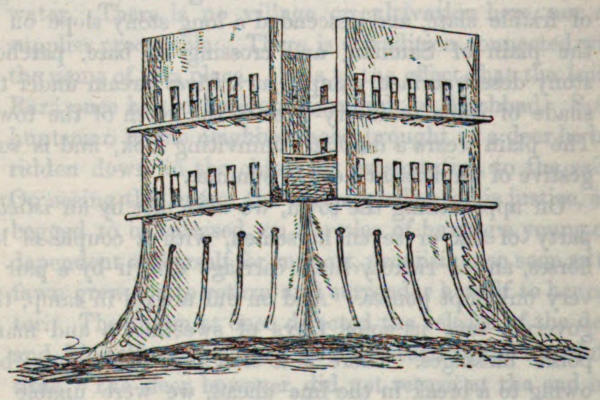
close on the river bank on either side. They were composed
of reed cabins supported on slender poles eight or
ten feet high. Each cabin was a neat pent-roofed box,
about ten feet long by six wide, and as many high at the
sides. They belonged to Sindhí Jats, who live by fishing,
cutting wood for fuel, and by tending cattle.
The country here is wooded close to the water’s edge
by a thick jangal of Euphrates poplar, tamarisk, and
mimosa, and here and there are great belts of tall reeds,
eighteen to twenty feet high. The approach to Sakkar
is very fine and unique of its kind. It presents a charming
contrast to the dead level of the scenery on either
side the river above it as far as Multán. The island
fortress of Bakkar in mid-stream, with the many-storied
houses and lofty palm groves of Rorhí, on one side, and
the high rocks and sunburnt town of Sakkar on the
other, are the characteristic features of this peculiar
spot. We steamed through the channel between Rorhí
and Bakkar, and then, making for the opposite shore,
moored under the town of Sakkar at about one o’clock.
It thus took us nearly eleven whole days to perform
the journey by river from Multán to Sakkar. In the
hot season, when the river is in full flood, the same
journey is usually accomplished in one third of the time.
Cattle for our baggage and camp equipage having
been collected here by previous arrangement, we left our
servants to follow with them, and at half-past three set
out for Shikárpúr in a buggy kindly placed at our service
by Captain Hampton, Superintendent of the Panjab
Steam Flotilla. At Mangráni, the half-way stage, we
mounted camels sent out for us, and in four hours from
Sakkar, arrived at Shikárpúr. The road is excellent
throughout, and laid most of the way with long reed
grass to keep down the dust. The country is flat,
crossed by many irrigation canals, and covered with
jangal patches of tamarisk and mimosa. In the last five
miles from Lakkí to Shikárpúr, cultivation is general,
and large trees become more abundant.
In the morning our obliging host, Colonel Dunsterville,
Collector of Shikárpúr, took us for a drive to see
the place. In the public gardens called Shákí Bágh is a
small menagerie and the Merewether pavilion. The latter,
built after the design of those useless decorated structures
one sees at English watering-places and pleasure gardens,
is a striking object, absurdly at variance with all its
surroundings. But it is characteristic of our prejudices
and tastes in matters architectural. We unaccountably
neglect the encouragement of the oriental architecture,
with its elegant designs, elaborate detail, and durable
material, for the nondescript compositions, incongruous
mixture of colours, and inferior material of the public
buildings and monuments we have spread all over the
country. We seem to forget that what is suitable to
the climate, conformable to the scenery, and acceptable
to the tastes of the people of Europe, may be the reverse
in each instance when introduced into this country
without modification or adaptation to its circumstances.
The town of Shikárpúr is clean for an oriental city, and
wears an air of quiet and prosperity. The environs are
well stocked with large trees, such as the ním (melia
azadirachta), sirras (acaciaelata), sissú (Dalbergia sissoo),
palm, &c., and the roads are everywhere covered with a
layer of reeds to keep down the dust. The people are
clad in bright-coloured garments, and appear a very
thriving commercial community. The bazaar is covered
with a pent-roof, and has a cool look, which alone must
be a boon in this hot climate. There is a very useful
charitable dispensary here, and a jail for five hundred
prisoners. I observed that the convicts were clad in fur
jackets (postín), a luxury very few of them ever possessed
in their free state.
We left Shikárpúr at two o’clock, and drove to Sultán
di Gót, where we found camels awaiting our arrival.
The one intended for my riding took fright at the buggy,
tore away from his nose-ring, and, luckily for me, escaped
into the jangal. This I say advisedly; for had the frisky
creature been recaptured, I could not have declined to
ride him, and the consequences might have been anything
but agreeable. I was unaccustomed to this mode of
travelling, and knew little about the handling of a camel.
Had he bolted with me on his back, there is no knowing
where he would have stopped, and the jolting—well! it
is lucky I escaped the chance of its consequences.
After a short delay, a pony having been procured from
the village, we set off, and at half-way passing the
staging bungalow of Humáyún, arrived at Jacobabad at
seven o’clock. The road is excellent, and is bordered by
an avenue of large trees nearly the whole way, and is
crossed by several irrigation canals. Jacobabad is the
headquarters of the Sindh Irregular Force, and is a
flourishing frontier station, luxuriant in the vigour of
youth. It was laid out, planted, and watered, not a
score of years ago, by the talented officer whose name
it commemorates, on a bare and desert tract, near the
little hamlet of Khangarh, on the very verge of the
desert. It affords a striking example of what the energy
and judgment of a determined will can effect.
Our servants with the camp equipage did not arrive
at Jacobabad till daylight of the next day. We halted
here a day to complete the final arrangements for our
journey across the border, and to decide on the route
we were to take.
The affairs of Balochistan had for some time been in
an unsettled state, owing to differences that had arisen
between the ruling chief and some of his most powerful
feudal barons. Matters had grown worse, and, at the
time of our arrival here, several of the tribal chiefs were
in open rebellion, and had taken the field against the
Khán of Calát, over whose troops, it appears, they had
gained the advantage in more than one encounter.
Owing to these disturbances, the direct and ordinary
route through Balochistan by the Bolán Pass was closed.
There were two alternative routes, namely, that by Tal
Chhotiyálí, to the north of the Bolán, and that by the
Míloh Pass to its south. The first is described as an
easy road, and has the advantage of leading direct into
the Peshín valley; moreover, it is a route hitherto untraversed
by Europeans. But these advantages and
desiderata were annulled and counterbalanced, as far as
we were concerned, by the perilous nature of the route
in the vicinity of Mount Chapper, occupied by the lawless
and savage tribe of Kákarr, notorious robbers, who are
restrained by the fear of neither God nor devil, and
much less of man. The Míloh Pass route, although
nearly a hundred and ninety miles longer than that by
the Bolán, was consequently, thanks to the sound judgment
of Sir William Merewether (for which we subsequently
found good reason to be grateful), decided on
as the road for us to proceed by.
Our camp having gone ahead at daylight, under escort
of two native commissioned officers and forty troopers
of the Sindh Irregular Horse, we set out from the
hospitable mansion of Sir William Merewether, Commissioner
of Sindh, at nine o’clock in the morning of the
8th January 1872, and clearing the station, presently
entered on a vast desert plain. At about three miles we
crossed the line of the British frontier, and at two miles
more reached Mumal, the first habitation in the territory
of the Khán of Calát or Kelat. It is a collection of
eighteen or twenty mean hovels, the occupants of which
were the personification of poverty and wretchedness.
Here we bade adieu to Captain R. G. Sandeman, Deputy
Commissioner of Dera Gházi, who, with a party of Mazári
horsemen, accompanied us thus far, and mounting our
camels, set out at a swinging trot across the desert
towards Barshori, thirty miles distant, turning our backs
upon civilisation, and hurrying into the regions of discord
and barbarism. We were accompanied by Pír Ján, son of
Muhammad Khán, the Khán of Calát’s agent at Jacobabad,
and eight of his horsemen.
The desert is a wide smooth surface of hard dry clay,
as level as a billiard-table, and bare as a board. Not a
single pebble, nor even a blade of grass, was anywhere to
be seen. The caravan track lying before us was the only
distinguishable feature on the dull surface of bare clay.
After travelling thus for about two and a half hours, we
sighted two lofty mounds set together in the midst of
the desert, with shrubby bushes fringing pools of water
at their bases, all remarkably clear and distinct. “That,”
said Pír Ján, “is the Lúmpáni áb, or ‘the lustre of the
minstrel’s water,’ so named from the tradition of a
travelling Lúm, or ‘minstrel,’ who, seeing such abundant
signs of water, emptied the cruse under whose weight he
was toiling, and perished in the desert from thirst.” As
we approached nearer, the illusion disappeared, and the
semblance dissolved to the reality—two heaps of clay
on the sides of a dry well-shaft, a few scattered saltworts,
and a patch of soda efflorescence. This was the most
perfect sihráb (magic water) or mirage I had ever seen.
We rested here awhile, to allow the baggage to get on to
our camp ground; but after half-an-hour, finding the
midday sun too hot, we remounted our camels and resumed
our track across the desert, and overtook the
baggage a little way short of Barshori, where we arrived
at sunset.
Here we found a large káfila scattered over a considerable
surface of land about the village. As we
passed by towards some clear ground on the further side
of the village, we were surrounded by a noisy crowd of
Afghans, who, with the utmost volubility and excitement,
poured out a confused jumble of complaints and laments,
and begged an immediate inquiry and redress for their
grievances. Everybody speaking at once, the confusion
of sounds prevented our understanding what was said; so
we dismounted from our camels, and General Pollock
directing the crowd to disperse, retained a few as
spokesmen for the rest. We presently learned that the
káfila had been attacked in the Bolán above Dádar by
Mulla Muhammad, Ráisání, chief of Sahárawán, who,
with others, is in open revolt against the authority of the
Khán of Calát, and that they had fought their way
through, with the loss of six men killed, fourteen
wounded, and a hundred and fifty camels with their loads
captured by the enemy. Whilst listening to these
accounts, eight wounded men were brought forward. I
examined and did what I could for them at the time.
They were all severely wounded, six by gunshot and two
by sword-cut. I was turning away, when a blustering
fellow, loudly cursing the barbarity of the robbers, set an
old woman in my path, and removing her veil, exclaimed,
“Look here! they have not even spared our women;
they have cut off this poor woman’s nose with a sword.”
The miserable creature’s face was shockingly eaten away
by disease. I raised my eyes from it to the speakers’,
and was about to speak, when I was forestalled by the
bystanders, who merrily said, “Take her away; that dodge
won’t do, he knows all about it.” The effrontery of the
whole proceeding was Afghan throughout.
The káfila, we were told, consisted of twelve hundred
camels and eighteen hundred followers from Kandahar.
The merchandise comprised a varied stock, such as wool,
dried fruits, raisins, choghas, barrak, pashmína, specie,
and jewels. The value of the whole was estimated at
nine laks of rupees, of which about two laks had been
plundered in the Bolán. Directing our informants to
make their representations to the authorities of Jacobabad,
we passed on to our own camp.
We were seated on our cots, watching the erection of
our tents, when our attention was diverted to four men
cautiously approaching us from the direction of the
káfila. Their leader was a venerable greybeard, and by
his side walked a delicate youth. As they neared us I
observed, “Surely, I know those people;” when the
elder, hastily glancing around to satisfy himself that he
was unobserved by the káfila people, hurried forward,
fell at my feet, then quickly rising, took my hands in his
own, kissed them, and pressed them to his forehead,
uttering all the while a rapid succession of prayers and
congratulations on his good fortune in meeting me.
“Saggid Mahmúd of Sariáb, what has brought you
here from Ghazni?” inquired I, after the customary interchange
of salutations, so cordially initiated by himself.
“Hush!” said he, in a low voice, turning to my ear.
“We are going on a pilgrimage to Karbalá by Bombay,
Basrah, and Baghdad, but are obliged to call it Makha
for fear of the bigoted heretics composing our káfila.
Yes,” continued he, in a louder tone, “we are going
the haj to Makha. You see, poor Cásim is no better,
though he has carried out all your directions, and finished
all the bottles of that excellent medicine you were
so gracious as to give him. It was really a most potent
medicine, and acted quite like a charm. Cásim was
nearly cured by it, and was fast recovering the use of his
arm, when our messenger returned from Peshawar with
your gracious epistle promising to send that magic chain
for him, if I sent him back for it a month later. I did
send him, but he never returned, and poor Cásim rapidly
losing ground, soon became as bad as ever he was before
he took your medicine. God’s will be done. We are
all His servants. You did your best for us, and God
prosper you.”
I must here digress a little to inform the reader of the
circumstances of my former acquaintance with our pilgrim
friend. Just two years ago, in the commencement of 1870,
Saggid Mahmúd, bearing a recommendatory letter from
the Amir of Kabul, came to me at Peshawar for professional
advice regarding his son. I found the lad was
afflicted with tubercular leprosy and a paralysed arm, and
learned on inquiry that his sister and some cousins also
were afflicted with leprosy. Like most natives of these
parts my patients believed, or professed to believe, that I
had only to feel the pulse, administer some physic, and
prescribe a regimen, to ensure a speedy recovery. And
great was their disappointment on my telling the old
man that, as far as I was concerned, his son’s disease was
incurable. They had travelled upwards of three hundred
miles for a cure, and it was hard they should return without
some sort of attempt towards the attainment of so desirable
an issue. So I took the case in hand, and treated
the lad for some months with little or no benefit. At
length, the hot weather approaching, they returned to
their home at Ghazni, with a large supply of medicine.
In the following year Saggid Mahmúd wrote to me for a
fresh supply of medicine and the galvanic battery I had
employed on his son at Peshawar. The medicine I sent
him by his messenger, and promised to get him a galvanic
chain if he would send for it a month or so later. His
messenger never came, and the chain remained with me.
On my leaving Peshawar for the journey before us, I
packed the galvanic chain (it was one of Pulvermacher’s) in
one of my boxes, on the chance of an opportunity offering
to forward it to Ghazni. I now informed our visitors of
this, and opening the box, produced the case containing
the chain, and handed it over to Saggid Mahmúd,
congratulating him on the good fortune that had enabled
me to present it personally. He was completely taken
aback at finding I had really got the chain for his son,
and taking it in both hands, exclaimed, “This is wonderful!
Who would have believed it? You are all true
and just people, and deserve to be great. It is for such
sincerity that God prospers you.” With many expressions
of gratitude and prayers for our safe progress, our
visitors took their leave. Six months later we met this
old man again at Shahrúd, as will be hereafter related.
Barshori is an open village of about eighty houses on the
edge of a dry water-course. Its inhabitants are Mánjhú
Jats, and appear to be comfortably off. There is a good
deal of corn cultivation around, judging from the wide
extent of corn-stalks. Water, however, is limited in
quantity, and very inferior in quality. It is derived from
a number of small shafts, upwards of a hundred, sunk in
the bed of the drainage channel above mentioned, and is
very turbid and brackish. The road to the Bolán Pass
viâ Bágh and Dádar goes off northwards from this, and
that to the Míloh Pass by Gandáva goes off to the west.
We left Barshori at nine o’clock next morning and
proceeded westward over a wide level plain intersected
by a number of dry superficial water-courses. The
general surface is a bare, hard clay similar to the desert
traversed yesterday, but here and there we found traces
of cultivation, and at distant intervals came upon
scattered patches of thin jangal. At about half-way we
passed Kikri, a collection of twenty or thirty huts of
Mánjhú Jats some little way to the right of the road;
and at five miles farther on passed through Bashkú, a
flourishing village of about two hundred houses, surrounded
by jujube, mimosa, and tamarisk trees. It
stands on the edge of a deep and wide water-course, in
the dry bed of which we noticed a long series of wells.
At a mile and a half further on we came to Sinjarani, and
camped; the distance from Barshori, thirteen miles. Sinjarani
is an open village, similar in size and situation to
Bashkú. Both are inhabited by Sinjarani Jats, and in both
we found the house-tops and courts piled with stacks of
júár (Sorgham vulgare), the tall leafy stalks of which furnish
an excellent fodder for cattle. The water here is very
turbid, but not brackish. The wells, of which there are
about two hundred in the water-course, are mere narrow
shafts sunk in the clay soil. Water is tapped at about
ten cubits, and oozes up in a thick muddy state in small
quantities of a few gallons only to each well.
We started from Sinjarani at seven A.M. on the 10th
January, and at eight miles came to the village of Odhána,
one hundred houses. At about a mile to the south
of it is the Kubíha hamlet, of fifty houses. Both were
attacked and plundered less than a month ago by the
Brahoes, at the instigation of Mulea Muhammad, Ráisání,
and Allah Dina, Kurd, who, with Núruddín, Mingal of
Wadd, are in revolt against the Khán of Calát. They
are now deserted except by two or three miserable old
men, who came forward to tell us their pitiful tale. We
dismounted at Odhána and went over its empty and
desolate homesteads. The work of plunder had been
most effectively done. The houses were empty, heaps of
ruin, and nothing but bare walls remained standing.
The doors and roof timbers had been carried away, and
the corn-bins emptied. Some of these last were left
standing in the courts. They resemble those seen in the
Peshawar valley, and consist of tall wicker frames
plastered within and without with a coating of clay and
straw. The top is closed with a movable cover of the
same material, and they are raised above the ground on
short pedestals. They are impervious to rain and the
ravages of rats, and are well adapted to the storing of
grain. At the lower edge of the bin is an aperture fitted
with a plug of rags. Through this the daily quantum
of grain is withdrawn, as it is required for the mill.
We found all empty. The whole village had been completely
sacked, many of the people had been carried off,
and the rest dispersed after being stripped of everything.
The Brahoes did not even spare the women their
mantles, nor the men their trousers, nor did they allow
a single head of cattle to escape them.
At about three miles further on we came to another
village of the same name. It too had been plundered,
and was now deserted. Beyond this our path crossed a
bare desert surface on which were the traces of a flood of
waters. The plain itself cut the horizon, and resembled a
great sea glimmering in the vapours of the mirage. As
we were crossing this desolate tract our attention was
drawn to a crowd of gigantic figures moving against
the southern horizon. Our companion Pír Ján stopped
his camel and begged us to rein up. He looked very
grave, said the appearance was suspicious, marauding
Brahoes were known to be about, and that was just the
direction in which the rebel Mingals might be looked
for. He parleyed a while with his horsemen, then scrutinised
the figures, then he parleyed again, and again
scrutinised them, and so on for eight or ten minutes,
himself and his men all the while capping their muskets,
slinging their swords, and tightly securing their turbans
in readiness for attack. Meanwhile the figures kept
changing their positions and forms in the vapoury glare
of the mirage. They were in turn pronounced to be
horsemen, then camels at graze, then footmen, and
finally cattle at graze. In this uncertainty Pír Ján
directed one of his horsemen to gallop forward and solve
the mystery. He did not, however, seem to see the
advisability of the proposal, and whilst professing ready
acquiescence, merely pranced his horse about within close
reach of our party. By this time the figures emerged
from the mirage, and we counted eight horsemen and two
camels, making straight towards us. Pír Ján now sent
forward three of his horsemen at a gallop towards them,
and they in turn sent a like number to confront them.
Our three then reined up, and so did the others, at about
five hundred yards apart. Then a single cavalier from
each side advanced, they approached together, stood a
few moments, and then both galloped off to the party
who had so alarmed us, and who were at a stand-still
like ourselves. Presently the other two of our horsemen
galloped off to them. “It’s all well,” exclaimed Pír Ján,
with a relieved expression of countenance; “they are
not enemies.” A little later our horsemen rejoined us,
with the intimation that the authors of our diversion were
not Mingals, only Magassis, a friendly tribe of Baloch,
on their way to Bágh. So we went on, and the Magassis
crossed our track some hundred yards behind us.
Beyond this desert tract the country is traversed by
several irrigation canals, and presents signs of very considerable
cultivation right up to Gandáva. At this season
the whole country is dry, but during the summer rains it
is inundated by the Nárí river, which rises in the hills
about Dadur, and spreads its floods broadcast all over
the desert tract extending from Gandáva to Jacobabad.
Most of this water is allowed to run waste, and from
want of care much is lost by evaporation. Under a settled
government there is little doubt that most of this desert
tract could be brought under cultivation, for the soil
appears very good, and the facilities for irrigation during
the summer months are at hand. But both are sadly
neglected all over the Kachi pat, the designation by
which the great desert tracts of Kach are known.
Gandáva, the capital of Kach, is a decayed-looking
town, and its fortifications are fast crumbling into ruin.
It is the winter residence of the Khán of Calát, whose
mansion is situated in the citadel, which overlooks the
town from the north. The town has an extremely sunburnt
and desolate appearance. The summer months
here are described as excessively hot, and unbearable to all
but natives of the country. During this season a poisonous
hot wind, called juloh, prevails over the plain of Kach, and
destroys travellers exposed to its blast. It proves fatal
in a few hours, by drying up all the moisture of the body,
and the skin of those killed by it appears scorched and
fissured, and putrefaction at once takes place.
We rested here during the heat of the day in the Khán’s
garden on the south of the town, to allow our baggage
to pass on. The garden is a neglected wilderness of all
sorts of trees crowded together, but to us proved a grateful
retreat for the shade it afforded. In its centre are a
couple of fine pipal trees (Ficus religiosa), and around
them we recognised the mango, jujube, sweet lime, vine,
date-palm, apricot, cordia myxa, banhinia variegata,
sizygium jambolanum, and acacia siris.
Proceeding from Gandáva, we left Fatupúr, conspicuous
by its lofty domed tombs, to the left, and passing through
a thick jangal of capparis, salvadora, and acacia, amongst
which were scattered small patches of bright green mustard,
came to the Garrú ravine, a wide drainage channel
with a sandy bed, covered with a thick belt of tamarisk
trees. Beyond this, at eight miles from Gandáva and thirty
from Sinjarani, we came to Kotra, and camped at sunset.
This is a collection of four villages close to each other,
the residence of the members of the Iltáfzai family, whose
head is the ruling Khán of Calát. They are surrounded
by stately trees and productive gardens, watered by a
brisk stream from a spring at Pír Chhatta. Some of the
houses here appear very neat and comfortable residences.
Altogether the place wears an air of prosperity, and is
out-and-out the most picturesque and flourishing place
we have seen since we left Jacobabad. Kotra is the
entrepôt of the trade between Balochistan (Calát and
Makrán) and Shikárpúr.
We arrived at Kotra just as the sun had set, and our
baggage was yet far behind. After selecting a site for
our camp, and waiting some time for its arrival, misgivings
crept over us as to our evening meal, for it was already
eight o’clock, and no signs of our baggage being near at
hand were visible, and unpleasant suspicions of having to
go supperless to bed forced themselves on our mind.
All length I hinted to our companion Pír Ján—who, by
the way, proved a very inefficient and indolent cicerone—that,
in the event of our servants not coming up in time,
he might be able to get us something to eat from the
village before it became too late. He took the hint, and,
after some delay, in the interim of which our camp arrived,
at nearly nine o’clock, his messenger returned from the
village with a bowl of mutton, stewed in its own broth,
and some bannocks, which he said had been sent from
Mír Khyr Muhammad’s house, with that Iltáfzai chiefs
compliments, and excuses for not being able to see us
this evening, a pleasure which he hoped to enjoy in the
morning. We forthwith set to work with our fingers
on the mutton, and ladled up the broth with successive
spoons formed of shreds of bannock, which went the same
way as their contents, until the fast “setting” grease of
the cooling mess suddenly persuaded us that we had sufficiently
taken off the keen edge of our appetites, and we
gladly turned from the coarse bowl and soiled rag on
which it stood. Though grateful for the entertainment, I
must say I was disappointed in this experience of Baloch
hospitality. Any Afghan peasant would have done the
honours not only with better grace and substance, but
spontaneously.
Whilst our tents were being pitched in the dim light
of approaching night, a couple of rampant yábús, or
baggage ponies, not satisfied with a march of thirty
miles, broke away from the rest, and made an unwarrantable
assault on our two Baloch mares—beautiful gazelle-eyed,
gentle creatures—as they quietly stood, with saddles
and bridles unremoved, waiting their turn to be picketed.
There was immediately a grand row; the mares kicking
and squealing desperately, and the yábús rearing and
roaring as the horses of this country only can. A dozen
men rushed to the rescue from all directions, with shouts,
threats, and imprecations. In two minutes all four bolted
out of camp, and tore wildly out of sight into the
jangal.
We got some men from the village to go in search of
them during the night, and our departure was delayed
till noon of the next day, pending their recapture. The
animals were brought back none the worse for their mad
career over such rough country as that between Kotra
and the adjacent hills, but their gear was a good deal
damaged, and one saddle was lost. From Kotra we
marched to Pír Chhatta, nine miles. The path winds
through a jangal of wild caper, mimosa, and salvadora
to the Míloh ravine, on the bank of which we found a
collection of twelve or fourteen booths of the Kambarání
and Syáni Brahoe, who are occupied as camel-drivers
between Calát and Shikárpúr. Their dwellings were
mere sheds of tamarisk branches covering a loose framework
supported on slender poles, and altogether appeared
a very inefficient and temporary sort of shelter.
I noticed that the women, though equally exposed to the
weather, were much fairer and comelier than the men.
Their dress was as rough and simple as their dwellings.
A long loose shift of coarse cotton, with loose sleeves,
was the only dress of some of the women; one or two of
them wore besides a small sheet or mantle thrown loosely
over the head and shoulders. The men wore capacious
cotton trousers, gathered in at the ankle, and over these
a short shirt with wide sleeves; round the head were
wound a few folds of a twisted turban. Grazing about
their settlement were a number of pretty little goats,
the smallest I ever saw, hardly twenty inches high.
After following the dry pebbly bed of the ravine for a
little way in a southerly direction, we turned out of it to
the right at a conspicuous dome over the grave of Mír
Iltaf, the uncle of the present Mír of Kotra. By it flows
a brisk stream, which, on its way to Kotra, turns three
or four water-mills, the sites of which are marked by
clumps of date-palm, jujube, and pipal trees. From
this point we turned towards the hill range, along which
we had been travelling in a parallel course from Gandáva.
They wear a wild, dreary, and inhospitable look, and the
country at their skirt is rugged, and mostly bare of vegetation.
At about four miles from the tomb, crossing two
or three ridges of conglomerate rock, and the little stream
winding between and round them en route, we came
to the palm grove of Pír Chhatta, and camped on an
open turfy spot amongst the trees, and near the spring-head
of the stream above mentioned. The soil here is a
powdery clay, white with efflorescent salines, and even the
turf is stiff with white encrustations of soda salts. At
the spring-head is a hermit’s cell, and close by, suspended
on the boughs of a tree, is a peal of about thirty small
bells, which the faqír rattles every now and then to wake
up the mountain echoes.
The spring on issuing from the rock forms a small
pool. We found it absolutely crammed with fish from
six to ten inches long. They looked, I thought, like
spotted trout, except that the scales were like those of the
salmon. These fish are held sacred, and most dire consequences
are said to overtake the sacrilegist who should
so far forget himself as to violate the sanctity of the pool
of Pír Chhatta by feasting on its protected fish. We
threw a few handfuls of grain into the pool to propitiate
the saint, or his mean representative in the unwashed
and unclad person of the hermit, who seemed no ways
pleased at our unceremonious intrusion on his special
domain. The surface of the pool was instantly a solid
mass of fish, struggling for the grain, which disappeared
in a marvellously short space of time. Whilst we thus
amused ourselves, the hermit, probably fearful of our
annexing a few of the fish for dinner, recounted some
wonderful instances he knew of the agonised deaths produced
by so rash an act. But he was eclipsed by an attendant
orderly, who gravely assured us that a comrade of his—a
trooper of the Sindh Irregular Horse—had on one
occasion, when passing this way, taken one of these fish,
cut it up, cooked, and eaten it. “And what happened?”
angrily asked the hermit. “By the power of God,” he
answered, “the wicked wretch was seized immediately
after with the most excruciating pains in his internals.
He rolled on the ground in agony, and repeated tabas
and astaghfirullahs (repentances and God forgive me’s)
without number, calling on all the saints and prophets to
intercede for him.” “And then he died!” chimed in the
hermit, with a triumphant air. “No,” said the other;
“God is great, and, such is His mercy, he got up and
went amongst the bushes, groaning and moaning with
agony. Presently he returned quite another being, perfectly
well and happy, with the fish alive in his hand,
and upbraiding him for his want of faith and veneration,
and directing its restoration to its own element.” “God’s
ways are inscrutable,” said the hermit; adding, with
ineffable pride, “our pure prophet heard his prayers, our
blessed saint of this sacred spot interceded for him; God,
the Almighty, accepted his repentance.” Our narrator
admitted on interrogation that he was not an eye-witness
of what he had just related, but he knew several men
who were. After this example—and it is one by no means
uncommon amongst Muhammadans in these countries—of
audacity and credulity, we strolled back to our tents
speculating upon the mental organisation of a people who
could, without an attempt at question, accept such absurdities.
The blind credulity of the Muhammadan in all
that concerns his prophet and saints, their sayings and
their doings, their precepts and examples, affords an interesting
field for inquiry to the psychologist. Such
investigation would, I believe, establish it as a fact that
the obstinate yet passive resistance of Muhammedans to
the free advance of Western civilisation amongst them
is owing almost entirely to the spirit of bigotry created
by their religion and cherished by their literature, for the
one is a mere reflection of the other.
There is no habitation at Pír Chhatta, nor are any
supplies procurable here. Our cicerone, Pír Ján, with
his usual want of forethought, had himself made no
arrangements for our supplies here, nor had he told us of
the necessity of making any such arrangements, nor,
when he found how matters stood, did he seem inclined in
any way to stir himself to remedy them. So the General
summoned him to his presence, and took him sharply
to task for his carelessness. This had the effect of rousing
him from the dull lethargy into which the perpetual repetition
of his beads had thrown him, and he at last
stirred himself to see what could be done to feed our
cattle and camp-followers. There was not alternative
but to send back some of our cattle with one of his men
to purchase grain, fodder, &c., at Kotra. The evening
was well advanced before they returned. The night air
here was chill and damp, and a west wind setting in at
sunset, reduced the mercury to 59° Fah., which was thirty
degrees less than it stood at during the afternoon in the
shade, and forty degrees less than the temperature of the
air at two P.M.
CHAPTER II.
We marched from Pír Chhatta at half-past seven next
morning. After crossing a few marly banks, snow-white
with saline encrustation, we entered a long narrow defile,
bounded on the right by high hills of bare rugged rock,
and on the left by a low shelf of conglomerate; a few
stunted bushes of salvadora, jujube, and mimosa were
scattered here and there amongst the rocks, and the
surface, everywhere rough and stony, was one mass of
marine fossils. At four miles we emerged from this
defile into the Míloh Pass, which opens on to the plains
a little to the south of where we camped at Pír Chhatta.
Where we entered it, the hills diverge, and enclose a
wide boulder-strewn basin, through which winds the
Míloh rivulet in three or four shallow streams, that reunite
at the outlet of the pass.
The Míloh Pass, by us called the “Mooleah Pass,” is so
named, I was told by our attendants, on account of the
blue colour of the hills. They may look so at a distance,
but are anything but blue on close inspection. At all
events, the natives call them so, and hence the name;
their pronunciation of the Hindustani nilá, “blue,”
being míloh.
Beyond this basin—every pebble and every rock in
which is full of madrepores, ammonites, belemnites, oysters,
and other marine fossils—we entered a very narrow and
winding gorge between perpendicular walls of bare rock,
two or three hundred feet high. Flowing down its pebbly
passage is a strong and brisk stream, which is crossed
nine times in the transit. From this circumstance the
passage is called Nah-langa Tangí, or “the strait with
nine crossings.” The water we found very cold, and
about sixteen inches deep. On either side, up to a height
of nearly six feet, the rocks are streaked with the water-lines
of the hot-weather floods. These floods are described
as coming down very suddenly after rains upon
the hills in the interior: their violence and velocity are
irresistible; and the raging torrent carries with it huge
boulders, uprooted trees, and cattle caught in its flood.
So sudden are these floods, and often when there are
no signs of rain at hand, that natives never camp in the
bed of the stream, but always on the shelving banks
that are found in different parts of the pass. The Nah-langa
Tangí is about three and a half miles long, and
conducts into a great basin in the hills. The scenery
here is the wildest that can be imagined. The surface
is strewed with huge rocks, and traversed by shelving
banks of conglomerate and shingle; here and there are
thick belts of tamarisk trees, amidst which the Míloh
rivulet winds its tortuous course; around rise rugged
hills of bare rock, the strata of which are snapped and
twisted and contorted in a most violent and irregular
manner. At the outlet of the gorge the strata are perpendicular;
beyond it, they present every kind of contortion;
and in some spots were noticed to form three
parts of a circle. In some of the hills, the strata were
horizontal, and dipped to the westward at an angle of about
forty degrees; in others, but in a hill due west of our camp
at Kúhov, the inclination was toward the eastward.
From this basin our path led along some shelving
banks of shingle to a small flat called Kúhov. We
camped here on some stubble-fields of Indian-corn and
sesame, having marched twelve miles. There is no
village here, but there are several small strips of corn-fields
on the ledges bordering the bed of the rivulet.
In a secluded nook amongst the hills close to our camp
we found a temporary settlement of Zangíjo Brahoe,
dependants of the Mír of Kotra. There were about twenty-four
booths, ranged in two parallel rows. They were
formed of palm-leaf mats, spread upon a light framework
supported on sticks, and had a very flimsy appearance,
and certainly provided the minimum amount of shelter.
They are here called kirrí, and the only merit they
possess is their portability. Their occupants were extremely
poor and dirty, but they appeared healthy and
happy, and are certainly hardy. During the cold
weather they move about amongst the lower valleys and
glens with their cattle and flocks, and in the spring
move up for the summer months to the higher tablelands
about Calát.
On the line of march we passed a káfila of eighty
camels, laden with dates from Panjgúr to Kotra, under
charge of a party of Bizanjo Brahoe, most of whom were
armed with sword and matchlock. The camels were of
a small breed, but very handsome and clean-limbed;
some of them were nearly of a white colour. We found
no supplies were procurable at Kúhov, not even forage
for our cattle. Our conductor, Pír Ján, however, had
been roused to a proper sense of his duties by the reprimand
he got yesterday, and our requirements were
consequently anticipated and provided for beforehand.
Our next stage was sixteen miles to Hatáchi. The
path, leading at first south and then south-west, winds
along the pebbly bed of the pass, and crosses its stream
several times en route. The rise is very gradual, and
the hills approach and diverge alternately, forming a
succession of basins connected together by narrow straits.
About half-way we came to a long strip of sprouting
corn in the midst of a great belt of tamarisk jangal, which
occupies the greater, portion of the pass. This patch of
cultivation is called Páni Wánt, “the division of the
waters;” and scattered about amidst the fields are a few
huts of the Músiyáni Brahoe, dependants of the chief of
Zehrí.
Beyond Páni Wánt we passed through a narrow gap
between lofty walls of perpendicular rock, in laminated
horizontal strata, much fissured and weather-worn, and
entered the wide basin of Jáh—that is to say, wide compared
with the rest of the pass. Here too there is a good
deal of corn cultivation, and along the foot of the hills
in sheltered nooks were some small encampments of the
Chanál Brahoe.
Amongst the fields are observed solitary little mud
huts of neat, and, for these parts, substantial build. They
belong to the Hindu grain-dealers of Kotra, who come
up here each harvest to select the grain in liquidation of
advances made to the cultivators during the cold season.
Formerly this land was laid out in rice crops, but this
has been put a stop to by the Kotra Mírs, as it interfered
with the irrigation of their lands on the plain.
We passed a káfila here of fifty camels laden with
dates from Panjgúr to Kotra, under charge of Bizanjo
Brahoe. With this káfila, as with the one passed yesterday,
were three or four fine young negro lads. The Brahoe
were all armed, and clad in thick camlet coats; they wore
the national cap, and altogether looked a very independent
and hardy set of fellows. Beyond Jáh we passed
through a tamarisk jangal, and rose on to a wide shelving
bank that stretched up to the foot of the hills on our
right. Here we camped at Hatáchi, the largest habitation
we have seen since leaving Kotra. It consists of
some twenty-five or thirty mud huts scattered over the
surface. The inhabitants are very poor and ill-favoured,
and the men especially very dark and ugly. Some of
the young women I saw were comely; and I was surprised
to see several with undoubted African blood in
their veins, to judge from their cast of countenance and
frizzly hair.
Our camp was pitched on some small flats covered with
the stubble of júár crops, and hard by was a collection of six
or seven kirrí or booths belonging to the Khánzai Brahoe.
They have adopted this proud title because the Khán of
Calát is married to a daughter of their tribal chief. The
benefits of the alliance do not seem to extend beyond
the empty honour of the title, for a poorer and more
miserable set of people we have not yet seen in his territories.
The villagers, too, who brought our supplies
into camp were in no better plight. Several hideous old
women, who carried loads of wood and straw for our
camp, were only half clad, and apparently less fed. Poor
creatures! theirs is truly a hard lot; they are the mean
drudges of the community, are despised by the men, and
evilly entreated by the younger and more fortunate members
of their own sex. Whilst these wretched people
were toiling under their loads, a number of young men,
who, judging from outward appearance and circumstances,
were little if at all exalted above them in social
status, seated themselves about the skirts of our camp
and idly viewed the spectacle.
The situation of Hatáchi, in the midst of these rugged
and barren hills, may be described as a pretty spot. As
we saw it, the place is almost deserted; but in the spring
months it is alive with the camps of the migratory
Brahoe, moving with their families and flocks up to the
higher plateaux of the Calát tableland. There is a shrine
or ziárat here, dedicated to the memory of Bahá-ulhacc,
the saint of Multán. It is only noteworthy on account
of the conspicuous clump of palm and other trees in the
dark shades of which it is concealed.
Our next stage was sixteen miles to Narr. For about
seven miles the road winds through a wide belt of tamarisk
jangal, to the south of which, in a bend of the hills,
is the Farzán-ná Bent, or “the cultivation of Farzán.”
A few scattered huts of the Hindu grain-dealers of Kotra
were seen here and there, but there is no permanent habitation
here.
Beyond this we passed through a narrow gorge into
the Pír Lákha basin, which we entered near the domed
tomb of that name. It was built about a century ago, in
the time of the first Nasír Khán, Baloch, and is already
in a state of decay. Around it are a number of humble
graves, the depository of the remains of departed Brahoe
of this part of the country. They are tended by some
faqírs, whose families are housed in very neat and comfortable
quarters hard by—to wit, two commodious huts,
surrounded by corn-fields, and shaded by some lofty date-palm
and jujube trees.
Pír Lákha is about half-way between Hatáchi and
Narr, and is approached through a narrow passage between
perpendicular walls of rock, that rise in sheer precipices
to a height of 150 to 200 feet. I was turning my
head first to the right and then to the left, noting that
the strata on the one side were horizontal, and on the
other vertical, when one of the escort, riding behind me,
and from whom, during the march, I had been making
inquiries as to the people and country we were passing
through, unexpectedly exclaimed, “And there’s the
dragon!” “Where?” said I, eagerly, not at the moment
quite sure but that some frightful monster was
peering at us over a ledge of rock. “There,” said he,
pointing to the blank wall of rock on our left, which
formed the southern boundary of the passage; “don’t
you see it running up the rock?” “No,” I answered,
staring full force in the direction indicated; “I see no
dragon. What is it like? Is it moving or stationary?”
Here my friend, as I could see by the laugh in his eyes,
was moved with inward mirth at the not unnatural misunderstanding
on my part in taking his words in their
literal acceptation. He controlled the expression of his
merriment, however, and, with a serious countenance,
explained, “I don’t mean alive dragon, sir; God preserve
us from him!” Somewhat disappointed, “Then you
should have been more precise,” I irresistibly interposed.
“But, sir,” said he, in justification, “it is called the
‘dragon of Pír Lákha,’ although it’s only his trail; and
there it is, clear as noonday, on the face of the rock.”
And so the dragon resolved itself into the reptile’s trail
only, and the trail in turn proved to be merely a vein
of white quartz running obliquely across the face of the
rock. An inquiry into the history of the dragon naturally
followed this denouement; and here is my Brahoe
informant’s account, much in his own style of narration:—
In olden times, a great red dragon used to haunt this
defile. He was the terror of the wicked as well as of
the just, for he devoured them alike, such as came in his
way, without distinction; and when he could not seize
men, he laid in wait and entrapped their sheep, and goats,
and cattle. Owing to his insatiable appetite, and his
continued depredations, the country was depopulated;
and so widespread was the terror of this monster, that
wayfarers ceased to travel by this road. At length the
holy man whose shrine lies yonder undertook to rid the
country of this bloodthirsty tyrant’s oppression. Pír
Lákha planted his takya or cell on the spot now
occupied by his mausoleum; and so great was the sanctity
of his character, and so powerful the protecting
influence of God Almighty, that the dragon voluntarily
came to pay homage to the saint, and, in place of offering
violence, besought his favour with the utmost submission
and tender of service.
The Pír made the dragon repeat the kalama or
Prophet’s creed, and converted him to the true faith,
to Islám; and giving him his liberty, commanded him
not to oppress God’s creatures, and that the Almighty in
His mercy would provide for him. And so it was the
dragon disappeared, and the country became free, and
the saint’s memory perpetuated in the shrine that bears
his name. Pír Lákha is the most popular saint of the
Brahoe in this part of the country, and his sanctuary is
held in the highest reverence by all the tribes around,
who constantly resort to it to offer up their prayers
and supplications, and to beseech the saint’s blessing,
particularly since the catastrophe connected with the
dragon’s trail, which, we have just seen, gave such confirming
proof of his merits and supernatural powers. It
was in this wise: In the early days, when people began
to forget the debt of their gratitude to the saint for the
great boon conferred by him on them, were careless in the
performance of their vows, and neglected to support the
servitors of his shrine, they were aroused to a proper
sense of their obligations by the reappearance of the
dreaded dragon in his former haunts, and with his
accustomed violence. The first to feel the weight of his
oppression was the tumandár, or “chief of a camp,” of
migratory Brahoe who used to winter in the vicinity.
It was in this manner: His favourite wife, who was
young, handsome, and well connected, was blessed with
no offspring. This was a sore trial to her, and for
several years she offered up her petitions at the saint’s
shrine as the camp passed it on their way to and return
from the summer grazing grounds. At length, making a
special pilgrimage to the shrine, she prayed earnestly for
the saint’s intercession that it might please God to give
her a son, and vowed to give the priest in charge a cow
on her prayer being granted. The saint through the
priest informed her that her prayer was heard, and, please
God, the desire of her heart should be gratified. She
went away happy in mind, and in due time was rejoiced
by the birth of a son. But, her desire gratified, she forgot
her vow, and even failed to offer up her prayers and
thank-offerings at the shrine on passing it to the summer
pastures, and the like carelessness did she show on the
return therefrom in autumn. Next spring, as the camp
marched through the gorge on its accustomed journey,
the dragon, watching his opportunity, dashed into the
midst, seized the boy from its mother’s arms, and disappeared
with it over the hills, leaving that white track
of its body as a memorial on the rock.
Such in substance was the Brahoe’s story. It explains,
at all events, the comfortable circumstances of the faqírs
attached to the service of the mausoleum of Pír Lákha.
In such a country, the lot of these people—the priesthood—is
really enviable. They are respected and trusted by
all classes, they enjoy free grants of land for their
support, and receive besides tithes and other offerings;
they are not affected by tribal feuds, nor are they obliged
to interfere in the politics of the people; and altogether
they are the most comfortable and well-to-do of the
community. Yet they possess no special merits: generally
they are but little better educated than the mass of
the common people, and are indebted for their good
fortune more to hereditary right than anything else.
Beyond Pír Lákha the defile turns sharp to the north,
and then bends round to the west and south, where it
expands into the little basin of Hassúa. Here we found
some small patches of corn cultivation, and a few huts
of the Jám Zehrí Brahoe. Here too we met a káfila of
sixty camels laden with wool and madder from Calát to
Shikárpúr, under charge of Zehrí Brahoe, amongst whom
were a couple of African slaves. We also met a small
party of Samalári Brahoe driving a few asses and bullocks
to Kotra for a supply of grain for their families
somewhere in the hills close by. They appeared very
poor people, like the rest of the Brahoe we have seen on
our journey. What little corn this country produces is
bought up at harvest-time by Hindu merchants, and
taken down to Kotra, where it is again retailed by them
to the peasantry. By this arrangement the tribes are
pretty much in the hands of the Hindus, and they in
turn of the chiefs.
Beyond Hassúa we passed through a small gap and
entered the basin or valley of Narr, and turning off to
the left away from the Míloh stream, camped on some
open ground at the foot of the hills to the south. There
is no village here, though there is a good deal of cultivation
in scattered patches. Here and there, too, in the
nooks of the hills, we found some small camps of Jám
Zehrí Brahoe. They seemed very poor people, possessed
of few goats and fewer cattle. Water, fuel, and camel
forage are abundant here, but forage for man and horse
are unprocurable.
In this march we found no fossils, as in the lower part
of the pass; but the hills, though wider apart, are just
as bare and inhospitable. The succession of basins or
valleys enclosed by them, however, are more thickly
wooded with tamarisk.
At Narr, the Míloh Pass may be said to end in a wide
basin, from which narrow valleys lead off to the north
and to the west. They bring down the drainage from
the hills between Khozdár and Calát The main valley
runs northward to Zehrí and Nichára, and down it flows
the main stream of the Míloh rivulet.
As we entered the Narr basin from Pír Lákha, a solitary
tree standing in the midst of a small patch of young
corn on the right of the road was pointed out to us as the
scene of the assassination of Sherdil Khán in May 1864.
He had usurped the government from the present chief,
Khudádád Khán of Calát, and was enabled to hold out
against him for some time owing to the defection of
Sher Khán, the commandant of Khudádád’s regiment of
mercenaries, who with his men joined the pretender.
After a while Sher Khán, with the proverbial fickleness
of these people, became dissatisfied with his new master,
and sought to get restored to the favour of the chief he
had deserted. As the best means to this end, as well as
by way of repairing the injury he had done the rightful
chief, he caused the rebel to be shot by one of his men
as they were marching to oppose some of the troops sent
against them. Sherdil, on being hit, lost control over his
horse, and the startled animal, dashing off across country,
threw his rider at the tree mentioned, where he presently
died in the arms of a fellow-rebel, Sardár Táj Muhammad
Khán. Sher Khán with his mercenaries then returned to
his allegiance, and joined Khudádád Khán in his retreat
at Kach.
Our next stage was thirteen miles to Gorú. We
crossed the Narr basin in a southerly direction over a
rough pebbly surface, and at about four miles left it by a
narrow winding gorge that opens on to a rough and wild
tract between the hills. In the gorge are a few pools of
water in the bed of a pebbly channel that conveys the
drainage of these hills to the Míloh rivulet; it comes
down from the southward along the foot of the hills
bounding the valley in that direction; our route
diverged from it and followed the skirt of the hills
bounding it to the north. At about half-way on this
march we passed a gaur-band, or “Gabardam,” built
across the outlet of a small gully in the side of the hills
to our right. It is a very solid and substantial wall of
dressed stones, rising from one to two feet above the
surface of the ground, and conspicuous from its dark
colour contrasting with the lighter hues of the rocks
around. Our companions could tell us nothing of its
history more than that, like many similar structures in
different parts of the country, it belonged to the period
when the country was inhabited by pagans. The hills
here are very precipitous and wild; their slopes are
dotted all over with little black specs, said to be bushes
of the juniper, here called hápurs; the lower ridges are
covered with a coarse grass that grows in tufts, and is
called húwe; it is said to be a very nourishing fodder
for cattle.
Our camp at Gorú was pitched on a slaty ridge close
to three or four small wells sunk in the gravelly soil.
The water is reached at about twelve feet from the surface,
and is very good. During the day immense flocks of
goats and sheep came to be watered here; they appeared
to me to be of a very diminutive breed. They were
tended only by a few boys, from which circumstance we
concluded there must be some Brahoe camps in the
vicinity, though we saw no habitation or sign of cultivation
in the whole march from Narr, excepting only a few
booths of the wandering Lúrí. These people are a kind
of gipsy, and are found in all parts of the country in
scattered parties of a few families each. They are a
distinct race from the Brahoe and Baloch, and are
occupied as musicians, potters, rope makers, mat weavers,
pedlars, &c. They own no land, never cultivate the soil,
and are looked on as outcasts.
The night air of Gorú proved sharp and chill, and
towards daylight a hard frost set in. From this we
marched eighteen miles to Khozdár, the route mostly
westward. At a short distance from our camping-ground
we came upon the cultivation of Gorú, and farther on
passed the hamlet of the same name, at the foot of the
hills to the left of the road. The huts are now empty,
their tenants being camped in the nooks of the surrounding
hills with their cattle and flocks, for the facility of
pasture and water, neither the one nor the other being at
this season procurable at Gorú. There is a very extensive
cemetery here, whence the place derives its name (gor =
grave). The graves are neatly raised tombs built of loose
stones, the resting-places of defunct Zehrí Brahoe, who
occupy all the hill country round about. At four miles
on from Gorú, the road passes over some rough ground,
and drops on to the Khozdár valley, the most open piece
of country we have seen since leaving the plain of Kach.
It bears a very dreary and wintry aspect, and along its
northern borders shows no signs of habitation or cultivation
or water. In the opposite direction, however, are
seen a collection of villages called Zedi, with their gardens
and fields, along the course of the little streams
draining the southern part of the valley.
At two or three miles from Khozdár, we were met
by Major Harrison, Political Agent at the Court of
Calát. He came out with a party of forty troopers of
the Sindh Horse, and conducted us to his camp, pitched
close to the fort of Khozdár, where he gave us a most
hospitable welcome; whilst the General’s arrival was
announced and re-echoed amongst the surrounding hills
by a salute of eleven guns fired from a couple of old
cannon drawn up outside the fort. The canonneers, of
whom there were nearly twenty engaged in the operation,
were a wild and dirty-looking set of fellows, with
long matted hair, and every sort of dress and undress
except uniform.
The little fort is a new structure of mud, only recently
completed. It holds a garrison of sixty Brahoe militia,
and half a company of regular infantry, and is armed
with the two guns above mentioned. It is well situated
for the purpose it is meant to serve, viz., to protect the
caravan routes centring in this valley through Nal
from Kej and Panjgúr on the west, through Wadd from
Bela and Sonmiáni on the south, through the Míloh
Pass from Kotra, Gandáva, and Shikárpúr on the east,
and through Bághwána from Súráb and Calát on the
north.
On the plain near the fort are the ruins of two contiguous
villages, between which winds a small stream on
its way to some corn-fields beyond them. The place has
a very dreary look, and the climate at this season is
decidedly bleak. The southern portion of the valley is
well cultivated and peopled, and during the summer, so
we are told, is one sheet of corn-fields. This valley, in
fact, with those of Nal, Bághwána, Súráb, and Calát, are
the principal corn-growing districts in this country.
The elevation of Khozdár is about 3850 feet above the
sea, and about 3700 feet above Gandáva on the plain of
Kach. The later figure represents the rise in the land
between the two places, a distance of ninety-three miles
by our route through the Míloh Pass, and gives an ascent
of nearly forty feet in the mile.
The Míloh Pass is easy for cattle, is well watered, and
has an abundant supply of fuel in the tamarisk jangal
throughout its course. Forage for cattle is scarce in
winter, but there is a sufficiency of this in summer for
caravans and the cattle and flocks of the Brahoe, who
find ample space for camping on the shelving banks of
the stream, in the succession of basins occupying the
course of the pass. Beyond the pass, at Narr, the tamarisk
jangal and water supply both cease.
In all our route from Pír Chhatta to Khozdár we
observed a series of roadside memorials, emblematic of
the national customs of the Brahoe. They are of two
kinds, commemorative of very opposite events, and are
met with in a very distant ratio of frequency in consequence.
The one is called cháp, and commemorates
the weddings amongst the migratory Brahoe. The other
is called cheda, and serves as a memorial of those who
die without issue amongst the clans.
The cháp is a perfect circle, described on the ground
by a series of stones set together flat in its surface; the
centre is marked by a single stone of from one to two
feet in length, set upright on end. The diameters of
these circles range from ten to thirty feet, and hundreds
of them cover every flat piece of ground on the
line of road followed by the Brahoe in their annual
migrations from the high to the low lands. Some of the
cháps we observed were of a different structure from
the figure just described. Instead of a single upright
stone in the centre, and a circumference marked by stones
laid flat, the whole surface of the figure was closely set
with stones laid flat on the ground, forming a circular
pavement, from the centre of which projected the single
stone set upright. From the circumference of the circle
projected a long arm in a straight line running to the
north in those we saw. This projection is about thirty
feet long, and terminates in a large stone set upright as in
the centre; its width is about two feet, and it is formed,
like the circle, of stones set close together and flat on the
surface of the ground.
Sketch Plan of the
Cháp Circles.
A. The highroad across a plain.
B. Cháp circles of different kinds, as described in the text.
C. A mosjid or mosque, marked off on the ground by stones just
as are the cháp circles.
These figures, we were told, are made on the actual
sites on which have been danced the reels accompanying
the festivities that form an important element in the
ceremonies attending a Brahoe wedding. The centre
stone marks the place of the musician, and the circumference
that of the circle of dancers, who pirouette
individually and revolve collectively in measured steps,
keeping time with the music, to which the while they
clap their hands. This clapping of hands is here called
cháp, and hence the name of the figures. Sometimes the
sword-dance is substituted for the other, and only differs
from it in brandishing naked swords in place of clapping
hands. The dance resembles the ataur of the Afghans.
The sketch on p. 55 shows the form of the cháp.
Sketch Plan of the Cheda.
A. Highroad round a hill ridge.
B. Cheda pillars on plain and on rock.
C. Cháp circles.
The cheda is a pillar (called tsalai in Pushto) of from
eight to twelve or more feet high, with a diameter of
from three to four or more feet. It is neatly built of
loose stones closely set in a cylindrical form. The top
is convex or dome-shaped, and from its centre projects a
single upright stone. The basement is a small square
platform of stones, slightly raised above the surface of
the ground. These structures are generally raised on
some projecting rock overlooking the road, or on some
slight eminence on the plain. At one or two spots we
saw four or five close together, but generally they are
only met at distant intervals, and singly. In general
appearance they resemble miniature topes of the kind
seen in some parts of Yúsufzai and the Peshawar valley.
They are erected to the memory of clansmen who have
died without issue; and it is the custom for the surviving
relatives to celebrate the anniversary of such
mournful events by donatives to the family priest and
a feast to the clan. Where practicable, the customary
offerings and ceremonies are performed round the monument
itself; and for this purpose their observance is
generally deferred to the time when the camps in their
annual migrations halt in their vicinity. The sketch
on p. 56 shows the form of the cheda.
In all our route from Kotra, we saw very few of the
people of the country. Including Hatáchi and Gorú
with the few camps we passed, the population we found
in this tract of country did not exceed two hundred
families, if indeed it reached that number. Our companions,
however, assured us that the hills were swarming
with them, that every nook had its camp, and every valley
its patch of cultivation. It may be so, but we saw no
signs of any such populousness. In fact, the nature of
the country does not admit of any large number being
able to support themselves upon it, for the hills yield but
the scantiest pasture, whilst the valleys offer a very small
surface capable of cultivation. This conclusion is supported
by the appearance and circumstances of the people
and cattle we did see. They may be described in two
words—poor and hungry.
The Brahoe are an interesting people, of whose history
little is known. They are true nomads, and wander about
the country in their respective limits, with their families
and flocks, changing from the high lands to the low
according to the seasons and pastures. In this respect
they resemble some of the Afghan tribes. Some of them,
however, are fixed in villages as cultivators of the soil.
They are divided into an infinity of clans, or khel, such
as Mingal, Bizanjo, Zangíjo, Kambarání, Zehrí, Ráisání,
Kurdgálí, Rikkí, Samulárí, Hárúní, Nichárí, Rodání,
Gurganání, and many others. Their camps are called
tuman, and the head man of each tumandár.
They differ from the Afghan, Baloch, and Jat of Sindh,
by whom they are surrounded, in general physique and
physiognomy as well as in language. Their manners and
customs, too, are said to differ in many respects from
those of the people around them, though, in the matters
of robbery and murder, a family resemblance pervades
them all.
The Brahoe is of middle height, or below it, and of
swarthy complexion; the face is broad, with high cheek-bones,
and adorned with beard and mustaches of neither
long nor thick growth; the head is covered with a shock
of long matted hair, generally jet black; the eyes are
black and keen. The body is compactly framed and
clean-limbed. Altogether, the race is active, hardy, and
enduring. The Brahoe language differs entirely from
that of the Afghan, the Baloch, and the Jat, though it
contains many Persian and Indian words. The numerals
are the same as the Persian, except the first three, which
are asit, irat, musit, respectively; but the pronouns are
entirely different, and bear no resemblance to those of
the other languages; the forms of conjugation and declension,
too, are distinct and peculiar. On the march
I collected a vocabulary of about eight hundred words,
and a few sentences, to show the structure of the language.
These, with a skeleton grammar prepared at the same
time, will be found in the Appendix. The Brahoes are
altogether illiterate. I could hear of no book written in
their language, nor could I get a single specimen of their
writing.
An amusing incident occurred whilst collecting words
for the vocabulary, and it may serve as a suggestive
illustration of the state of society amongst the Brahoes.
I asked my Brahoe camel-driver, through the medium of
Persian, of which he understood a little, what was his
word for arsenic. He appeared somewhat disconcerted,
and made no reply, and I inquired whether he had
understood my question or not. “Yes,” said he, with a
serious look, “I know what you mean. I have heard of
it, but have never seen it. It is only known to our
chiefs and great men.” “And what,” I asked, “do
they say about it?” “People say,” he replied, with
grave innocence, “that it is a magic medicine, and that
great men keep it as a protection against their enemies.”
He had no idea of the manner in which it was used, but
he knew from popular report that it was a mysterious
medicine which preserved great men from the machinations
of their enemies.
We halted a day at Khozdár with our kind hosts,
Major Harrison and Dr Bowman, in order to rest our
cattle, and on the 18th January marched sixteen miles to
Kamál Khán, one of the principal villages in the plain
or valley of Bághwána. Major Harrison accompanied
us with an escort of Sindh Horse, Dr Bowman remaining
with the camp at Khozdár.
Our route was northward, up the pebbly bed of a
wide and shallow drainage channel, towards a gap in the
hills. The road winds for some miles between low ridges
and hills of bare rock by a gradual ascent, and at half-way
brought us to the Chikú Koh kauda, or “gap,” a
low watershed marking the boundary between the Khozdár
and Bághwána valleys. We here found the path
somewhat obstructed by the remains of a stone breastwork,
built four years ago by the rebel chief Núruddín,
Mingal, when he took the field against the Khán of Calát,
to contest the possession of the village of Kamál Khán.
The breastwork and barricades had been only partially
destroyed, and their débris had been left to encumber the
road, just as they did at the time the defences were demolished—a
characteristic instance of oriental apathy
and negligence.
From this point we passed down a gentle slope on to
the plain of Bághwána, and crossed a wide extent of
cultivated land to the village of Kamál Khán, where we
camped near a small stream of clear fresh water, which
comes from a spring in the hills two miles off.
Kamál Khán is a good-sized village, or rather, it consists
of two villages close together, which contain in all
some four hundred houses. Across the plain, at the foot
of the hills to the north, are seen some other villages surrounded
by leafless trees. The surface is generally cultivated,
and divided into little fields, the sides of which
are banked up with earth, so as to retain rain-water.
The elevation of this valley is about 4530 feet, as indicated
by the aneroid barometer. In summer, when the
gardens are in full foliage and the crops are ripening, it
must be a pretty place in this waste of hills, and is said
to possess an agreeable climate, notwithstanding the bare
heat-radiating rocks that encompass it about. At this
season, however, it wears a dull, dreary, and bleak look—its
winter aspect—and has a raw, cold climate, of
which we were made sensible by the prevailing state of
the weather, for the sky was overcast with clouds, and a
cutting north-east wind penetrated to our very bones.
The plain itself appears a bare flat, without either villages
or trees, and towards the east presents a great patch snow-white
with saline efflorescence.
During the afternoon we received a visit from the chief
men of the place. Amongst them were Sardár Mír
Muhammad, Mingal of Wadd, a stanch friend and supporter
of the Khán of Calát in these times of sedition and
revolt by which he is beset. He was accompanied by
Abdul Aziz Khán, Náib of Qwetta, and two intelligent-looking
young lads, sons respectively of the Sardár of the
Sansunni and the Mammassání, or Muhammad Hassani.
They were all very plainly clad, and remarkably simple
in their manners. About them was none of that ceremony
and etiquette, in the observance of which independent
orientals are so punctilious; indeed, their bearing
was more like that of subjects than of independent chiefs.
The two former were old men, with nothing noteworthy
about them; but the two lads were remarkably bright-eyed
and intelligent youths of eighteen or nineteen years,
and so alike, they might have been brothers. Their features
were very striking, and different from any we had
yet seen; they may be described as a combination of the
very widely separated Jewish and negro physiognomy,
and reminded me of the Ethiopian figures one sees represented
in the Egyptian sculptures.
After our visitors had retired, I heard a voice outside the
tent inquiring where the Farangi Hakím, or “European
doctor,” was to be found. The man spoke with a harsh
and impetuous voice, and I, curious to see him and know
his errand, stepped out and announced myself to a wild-looking
Brahoe with the scar of a sword straight across
the nose and one half of the face. “But,” he replied,
making a rapid survey of me, “you are not the man I
want. Where is the doctor of Khozdár? Is not he
here?” “No, he is not here,” I answered; “we left him
at Khozdár.” “Well,” he rejoined, turning brusquely to
depart, “I want nothing from you. It was him I came
to see.” “Perhaps,” I said, motioning him to stop, “I
can do for you what you require of the Khozdár doctor.”
“No,” he replied, stepping away with as much haste as
he had come; “I only came to thank him for his kindness
to me, and for curing this wound across my face;” and
before I could ask another question, the impatient Brahoe
was off on his own business.
I now learned from Major Harrison that he was a
trooper in the service of the Khán of Calát, and was
engaged against the rebels in the battle fought some few
months ago near Gorú in the Khad Mastung valley. In
the charge against the enemy he received a sword-cut
across the face, by which the nose and upper lip were
severed, and fell down in front of the mouth, hanging
only by a thin shred of the cheek. Recovering from the
shock, the trooper at once sheathed his sword, and securing
the divided parts as they were with the end of his
turban passed across the face and fastened in the folds
above, rode straight off the field on the road to Khozdár.
After a ride of upwards of seventy miles he arrived at
Dr Bowman’s camp, and was at once received under that
gentleman’s skilful care. The satisfactory result, and the
accident of our journey this way, produced this pleasing
instance of Brahoe gratitude and trust in the skill of
European doctors. The man, on hearing of the march of
our camp from Khozdár, had come in from a distant
village to thank his benefactor, and not finding him,
hurried away to reach his home before nightfall.
It is a too commonly expressed opinion amongst us in
this country that the natives have no sense of gratitude
for benefits conferred or for favours received. But this,
I am persuaded, is a wrong conclusion; and its injustice
is proved by the above-described incident, which is only
one of many similar instances that have come to my
personal knowledge, and a further reference to which here
would be irrelevant to the purpose of this book.
19th January.—From Bághwána we marched twenty-six
miles to Lákoryán. Leaving Kamál Khán, we
followed a small stream over a succession of fields of
young corn, just sprouting above the surface, and then,
passing some walled pomegranate gardens fringed with
willow-trees, entered amongst low hills set close together
on either side of an intervening drainage gully. At
about three miles we came to the spring-head of the
little stream we had followed from camp. The spring
issues at the foot of some bare rocky bluffs, and forms a
small pool round which grow some eight or ten date-palms,
conspicuous as being the only trees in the vicinity.
From this point we turned to the right, and proceeding
due north over some very rough ground, dropped
into a narrow ravine between high banks of bare rock;
and following it some distance, emerged upon the wide
plateau or tableland of Loghai, the village of the same
name standing away to the west. In the hills to the
south-west, near the village of Ferozabad, are the Khappar
lead-mines. They are said to give employment to about
two hundred men.
There are no trees visible on the Lohgai plateau, nor
is there any jangal, but the surface is thinly sprinkled
with a very stunted growth of the camel-thorn (Rhazzia
stricta, Withiana congulans), two or three kinds of salsola,
and a coarse grass growing in tufts. Here and there, too,
are some patches of cultivation.
From this we passed through some low rocky ridges on
to a similar but more extensive tableland, divided by low
ridges of rock into the plateau of Mughali, Tútah, and
Záwah. We started from Kamál Khán at 7.50 A.M., and
arrived at the entrance to the Záwah defile at 10.10 A.M.,
thus, reckoning the pace of our horses at four miles an
hour, making the distance about nine and a half miles.
We halted here for breakfast, on the edge of a little
stream of brackish water, whilst the baggage went on
ahead. Close by is a ridge of bare rock without a particle
of vegetation on it, and along its base are the traces of
a very ancient village. The foundation walls are very
massive, and built substantially of dressed stone; the
surface everywhere around is covered with bits of red
pottery.
At 1.10 P.M. we mounted our camels, and left Záwah
by a narrow winding defile, down which flows the thready
rivulet on which we had halted. After proceeding up
the defile some distance, we passed over some very rocky
ground by a rough track, and rose suddenly to the crest
of a ridge of hills running north and south. Descending
a little from this, we reach the tableland of Jiwán. This
is an open plateau, and, unlike the others, is thickly
covered with pasture herbs and bushes, amongst which
are interspersed small isolated patches of ploughed land.
We saw no villages, however, nor any signs of a camp in
the vicinity, though our native escort assured us that there
were hundreds of tumans hidden away in the nooks and
hollows of the mountains, to which the Brahoe retire at
this season, with their flocks, for shelter from the cold
winds that blow over the open country.
Traversing this plateau, we crossed a deep ravine,
opposite a cavern excavated in its high bank of shingle,
and known as Duzdán ná Khond, or “the robber’s retreat.”
Here my camel showed signs of fatigue, and became so
shaky on his legs, that I became apprehensive of some
misfortune, and, to avoid the chance of breaking my neck
against the rocks, relieved him of my weight, and mounted
my horse, which was being led along close behind us.
The severity of the weather and the want of his accustomed
forage, combined with the roughness of the roads
and our land marches, had told unfavourable upon the
poor brute, and it was as much as he could do to keep
up with our party till we reached Kandahar. Here the
milder climate and several days’ rest brought him round
to his former self, and he afterwards carried me down
to Baghdad, where he passed into the possession of the
camel’s best friend—an Arab.
Beyond the ravine we crossed a ridge of rocky hills by
a very rough and narrow path, and emerged upon the
Lákoryán tableland, an enclosed plateau that rises considerably
up to the hills on the north and west. We passed
a good deal of cultivation on our route across it, and at
4.30 P.M. camped—or rather, waited for our camp, for the
baggage did not come up till 7.30 P.M., by which time
it was quite dark—near a spring at the foot of the hills
to the north-west. There is no village nor other sign of
habitation here, except a small enclosure containing a few
roofless huts, a few hundred yards from the spring at
which we have taken up our position for the night. We
passed a large gaur-band on the plateau, and at the foot
of the hills towards the north-east saw a great collection
of them. It was too late for us to go and explore them;
but, from what we could see, they appeared to mark the
site of some ancient city. The dark lines of their massive
walls are very conspicuous against the lighter colours of
the hillside.
Whilst waiting the arrival of our tents, we collected
some dry bushes of the camel-thorn and some kinds of
salsola, and made a fire to warm ourselves, and point
out our whereabouts to the baggagers, who were yet some
way behind, for to the repeated shouts and calls of our
party there came no response.
There are no supplies procurable here, and the water is
very limited in quantity, and, though not brackish, of
decidedly inferior quality. By previous arrangement
some fuel and fodder had been collected here for our
party, but the supply fell very far short of our requirements.
The fodder was distributed in small quantities
amongst the troopers of our escort, and the fuel—the
few faggots there were—was mostly appropriated by our
cook. Along the raised banks of some fields near the
enclosure above mentioned were six or seven circular
vaulted pits excavated in the ground. They are used as
storehouses for grain or straw or chaff, and are entered
through a small hole at the top. This aperture is only
slightly raised above the level of the ground, and is
covered by a lid plastered over with mud cement until
required to be removed. These grain-pits were examined
in the hopes that they might enable us to increase the
rations served out to our cattle; but, to our disappointment,
they were all found empty, like the country itself.
During the night a steady soaking rain set in; and as it
continued in the morning, there was some question as to
whether we should be able to proceed on our march. But
the point was soon settled when we found the impossibility
of procuring any provisions here either for man or
beast. So we struck our tents, and at 8.40 A.M. set out
on our march of twenty miles to Khán Calá of Súráb,
and a most trying and disagreeable march it proved. As
we left camp, heavy mists hung over the country, and
obscured everything from view beyond a couple of
hundred yards or so, whilst a thin drenching rain, that
presently changed to sleet and then to snow, descended
very perseveringly upon us. Fortunately for us, the soil
here is a coarse gravel, with only a small admixture of
earth, and our cattle consequently got over it without
hindrance.
After riding half-an-hour in a north-westerly direction,
we turned northwards into a narrow gap in the hills, and
beyond it came to the Anjíra plateau, and at 10.10 A.M.
halted at a sarae near its north end, for shelter from the
rain and for breakfast. In the gap we passed amongst
a number of very fine and extensive gaur-band. They
are the largest we have seen, and, from their position
and appearance, were probably built as defensive works.
Two or three of these massive breastworks were on the
plain a little in advance of the ridge of hills separating
Lákoryán from Anjíra, but most of them were built
across gaps between the prominent peaks of the ridge.
On the Anjíra side of the ridge, on some level ground to
the right of the road, we found a large collection of very
substantial walls, of from two to eight feet high. They
appeared like the remains of an ancient town. Owing to
the inclement weather we did not stop to examine them.
Near the sarae is a little stream, which carries the
drainage of this plateau down to the Míloh rivulet, which
it joins somewhere near Narr; and on a turfy bank a
few hundred yards off is a solitary hut, with an adjoining
walled enclosure. In the latter stands a masonry
pillar, about ten feet high, and of recent construction.
The monument, our companions informed us, is built on
the spot where the corpse of the late Nasír Khán,
brother of the present chief of Calát, was washed previous
to conveyance for burial in the family sepulchre, he
having died here on his way to the capital.
Whilst here, the rain ceased, and the sky cleared for
a while, and we got a view of the country around, and a
more dreary and inhospitable-looking prospect it would
be difficult to find out of Balochistan. To the north,
above the lower ridges bounding the plateau in that
direction, was seen the snow-topped Harboí mountain,
and it was the only feature that relieved the general
ruggedness of the bare hills around. The plateau itself,
like that of Lákoryán, is covered with saline efflorescence,
and supports only a thin growth of pasture herbs. Away
to the north-east we spied a few leafless trees around a
small hamlet, and by it observed a flock of sheep, tended
by a couple of shepherds. Nearer at hand the plain was
covered by a wide extent of cemetery, thickly crowded
with graves, whilst solitary tombs were here and there
scattered over the general surface, and only attracted
attention by the shreds of rag floating in the breeze from
the poles supported in the pile of loose stones that covered
them.
At noon we mounted our horses and proceeded on our
way, the clouds again lowering and threatening more
rain, by which, indeed, we were very soon overtaken in
the form of a storm from the north-west. We had crossed
a succession of ridges and gullies, the rocks of which were
green, blue, and red-coloured sandstone, amongst masses
of lighter hue full of fossil ammonites, oysters, and other
marine shells, and emerged on a wide plateau called
Khulkná Khad, where we were exposed to the full force
of a numbing north wind and blinding drifts of snow.
We made our way across this bleak plateau as best we
could, and passed en route a weather-bound káfila of sixty
camels, with wool from Núshkí for Karáchí. The camels
with their pack-saddles on were let loose to graze on
the wormwood, camel-thorn, and saltworts, which here
covered the surface more thickly than we had anywhere
seen; whilst the drivers, having piled the loads in the
form of a circle, and spread felt cloths across from one
load to the other, crouched for protection from the
weather under the shelter thus afforded. A few of them
stepped out to view us as we rode by, and fine manly-looking
fellows they were—all Afghans.
Beyond this we crossed a low ridge of hills by a narrow
and rough strait, at the entrance to which we noticed a
number of perfect cháp circles, and four or five cheda
pillars—one of which, to the right of our path, occupied
a very conspicuous position on the ledge of a prominent
rock—and then entered on the wide and undulating tableland
of Azákhel and Súráb, on which are several villages
and fruit-gardens, and more cultivation than we have
anywhere seen in this country as yet; in fact, we here
reached an inhabited region. Our path skirted the hills
to the east, and led past a roadside shrine called Lulla
Sulemán ná Kher. The head of the tomb is marked by
four or five long poles, to which are fastened numberless
shreds of cloth, stuck upright in a heap of loose stones,
samples of the rocks of the surrounding mountains, and
on the top of them lie a number of horns of the wild
goat and wild sheep. I stopped to examine these, and
amongst the stones found a fine fossil convoluted conch,
which I told an attendant trooper I wanted, and he,
without hesitation, took it up and brought it into camp,
and I subsequently sent it to Peshawar with some horns
and other specimens from Kandahar, as I shall have
occasion to mention hereafter. I did not see any granite
amongst the stones on this shrine, and hence conclude
that there is none in the adjacent hills, for the pile is
formed by contributions of devotees from all the surrounding
country.
Away to the right from Sulemán ná Kher we saw the
villages and gardens of Ghijdegán and Dhand, and
farther on, passing the collection of hamlets known as
Nighár, at 2.45 P.M. arrived at Khán Calá of Súráb,
where we were very glad to find shelter in a dirty little
hut vacated for us, and thaw our frozen limbs. The
last six miles of our march were most trying from the
intense cold and driving snow, and completely numbed
us, so that we could not have held out against it much
longer. The north wind is most piercing, and cuts to the
very bones. It is called Shomál bád, or “north wind”
par excellence, by the natives, and is dreaded as extremely
dangerous, often proving fatal by numbing the powers of
life. The villagers expressed astonishment at our travelling
in such weather, and some of our Khozdár escort
chimed in with, “It’s only the Sáhibs who ever think of
doing such things; and when they go forward, we must
follow them. Surely there is a special providence that
presides over their protection.”
In truth, our native attendants suffered severely. The
hands, feet, and faces of several of the troopers of our
escort of Sindh Horse became swollen, puffy, and painful,
but they held out manfully to the end. Not so our
Khozdár attendants; they succumbed to the weather even
before we had accomplished half the march, and this is
the more remarkable, as they were travelling in their own
country. They one by one wrapped up their faces in
the capacious folds of their turbans so closely that there
was barely room for them to use their eyes, and gathering
their loose cloaks about them, sat their horses more
like bundles of clothes than horsemen. Having thus
resigned themselves to their fate, they gradually fell
away from our party, and took shelter in the first villages
we came to.
We ourselves were not without showing evidences of
the effects of the wintry blast. The snow freezing upon
our mustaches and beards had stiffened them, so that
talking became a painful exertion; we therefore proceeded
in silence, with our heads set down against the howling
wind and driving snow, and presently dropped away
from one another—the General here, Major Harrison there,
and I elsewhere—each following his own pace to the
village ahead of us. My feet were so numbed that on
dismounting I did not feel the ground, and consequently
nearly fell, and it was some minutes before I could freely
use my limbs.
Our baggage did not come up till 7.30 P.M., and both
men and cattle were much exhausted, but plenty of food
and warm shelter soon revived them. Three or four of
our baggagers went off with their mules to the nearest
villages we came to, and did not rejoin our party till
the next morning. With the exception of one muleteer,
who deserted with the cloak and fur coat we provided
for him, none of our party were much the worse for the
exposure.
CHAPTER III.
Súráb is a populous valley, very fertile, and freely watered
by many little streams from the mountains. Its elevation
is about 5910 feet at Khán Calá, and consequently its
winter is a rigorous season. It now wears a most dreary
aspect, but in summer it is said to be bright with corn-fields
and gardens in full force. At that season, too, the
Azákhel and Khulkná Khad plateaux are covered with
the busy camps of the Mingal Brahoe, who are now dispersed
amongst the lower hills of Nal and Wadd.
The migratory life led by these people is one more of
necessity than of choice it seems; for their hills are so
bare, that they produce no timber fit for building purposes,
nor forage sufficient for the support of the flocks,
whilst much of the soil of the plateaux is so gravelly and
impregnated with salines as to be unfit either for cultivation
or for building the domed huts so common in Kandahar
and many parts of Persia; and, besides, though
last mentioned, not the least difficulty is the general
scarcity of water everywhere. Since we left the Míloh
rivulet at Narr, we have not seen a single stream one
could not easily step across dryshod.
Towards midnight the wind subsided, the clouds dispersed,
the stars shone out, and a hard frost set in.
Fortunately we were all warmly housed in the village,
and did not suffer from it; and this is as much as I can
say for it on that score. In other respects, our domicile
was none of the most agreeable, for though tired and
sleepy by the day’s exertion and suffering, it was impossible
to get either rest or sleep. The fire, lighted in
the centre of our little hut, filled its single unventilated
chamber with blinding clouds of suffocating smoke. We
no sooner escaped these troubles by lying close on the
ground, when our attempts to sleep were at once dissipated
by another form of torment, to wit, the fierce
attacks of multitudes of the most vicious fleas and other
vermin of that sort. They literally swarmed all over
the place, and allowed us no rest throughout the night.
I could only exist by repeatedly going out and breathing
a little fresh air, which at daylight I found to be 23° Fah.
It must have been colder during the night, though it did
not feel so, probably owing to the subsidence of the
wind.
21st January.—Whilst the baggage was being loaded,
I examined some faggots of the fuel that had been collected
here from the adjacent hills for the use of our
camp, and recognised the following plants, with their
native names following each, namely:—Juniper (hápurs),
ephedra (náróm, the hóm of the Afghans), wild almond
(harshín), wild olive (khat, the khoan of the Afghans),
wild peach (kotor), and salvadora oleoides? (piplí). The
last is said to be poisonous to camels, though not to goats
and sheep. On the Anjíra plateau I obtained specimens
of the following plants, viz.:—Caper spurge (ritáchk),
peganum (kisánkúr), artemisia sp. (khardarno), caroxylon
(righit), camel-thorn (shenálo), withiana congulans
(panír band), and a species of lycopodion (kásákun).
We set out from Súráb at 10.45 A.M., and proceeded
due north over an undulating plateau with hills on either
hand. The soil was spongy with efflorescent salines, and
the surface was covered with a thick growth of aromatic
wormwood. A strong and keen north wind blew against
us the whole day. On starting, I went off the road a
little to get a couple of blue pigeons I had seen alight on
a ploughed field. The cold was so intense, by reason of
the wind, that my fingers, although encased in thick
woollen gloves, were at once numbed, and I could only
carry my gun by shifting it constantly from hand to
hand. Presently the pain became very acute, and lasted
for more than half-an-hour, whilst I rubbed the hands
together to restore the circulation. The poor pigeons
must have had a hard time of it battling against the
relentless blasts of Boreas; and the fate that transferred
them from the bare clods of a wintry wind-scoured field
to the warm recesses of a well-seasoned “blaze-pan” (a
very excellent kind of travelling stewpan) was, after all,
not so cruel a one as it might have been had some
hungry hawk forestalled me.
After marching an hour, we passed Hajíka hamlet under
the hills to the right; and still continuing over a wide
pasture tract, at 1.20 P.M. arrived at Gandaghen Sarae,
and camped under the lee of its walls for protection from
the wind, our escort finding shelter in its interior. There
is a large pool of water here, fed by a sluggish spring
oozing from under a ledge of conglomerate rock, only
slightly raised above the general level of the country.
We found it frozen over. Our escort, after watering their
horses here, galloped them about for a quarter of an hour
or more, to prevent spasms from the combined effects of
wind and water, and not from the fear, as I supposed,
of any ill effects from the water itself, which was very
brackish.
Gandaghen is thirteen miles from Súráb, and there is
neither water, nor tree, nor habitation, nor cultivation on
the road between them. Hajíka was the only village we
saw, and it lay some miles off the road. The weather was
clear and sunny, with a blue sky, but the air was biting
cold, and the north wind quite withering. At 9 P.M. the
thermometer fell to 16° Fah., and at daylight stood at 10°
Fah. At this place two more of our mule-drivers deserted
with the warm clothing we had provided for them; they
were both Pathans of Kandahar.
Our next stage was fifteen miles to Rodinjo. The
morning was bright and sunny, but bitterly cold, with a
keen north wind. Our tent awnings were frozen stiff as
boards, and could not be struck till near 10 A.M., for fear
of the cloth snapping. The morning sun, however,
thawed them sufficiently for packing, and by 10.35 A.M.
we were fairly started on the march. We followed a
well-trodden path over the pasture land of Mall, and at
about half-way came to the camping-ground of Damb,
where is a small pool of brackish water at the foot of a
detached mound.
I struck off the road in company with our mihmandár
(conductor and entertainer), Mulla Dost Muhammad, in
hopes of getting a hare, of which animals he assured us
there were untold numbers in the wormwood scrub covering
the plain. We had ridden some distance without seeing
a single living creature, or any signs of one except the
shell of a tortoise (here called sarkúk), and the shrivelled
skin of a hedgehog or jájak, as it is here called. My
companion was telling me that the egg of the tortoise was
used by the Brahoe, whipped up with water and smeared
over the postules, as a remedy to prevent pitting from
small-pox; and I was just making a mental note to the
effect that an ordinary hen’s egg might be used with
equal advantage under similar circumstances, when a
hare dashed out across our path. I was holding my gun, a
double-barrelled breech-loader by Dougall, resting against
the shoulder at the moment, but it was instantly down at
the “present,” and fired, but no puss was to be seen.
“You have missed,” said the Mulla; “her hour of death
(ajal) has not arrived.” “I am not sure of that,” I said;
“I heard a squeak, and am going to see;” so saying, I
dismounted, and giving him my pony to hold, moved forward
to examine the bushes, the while adjusting a fresh
cartridge. I had hardly advanced forty or fifty paces,
when I instinctively “ducked” to a sudden, sharp, rushing
sound, wsheeooh, close over my head, and caught sight of
a great bird alight at a bush some forty or so yards ahead.
To step aside and fire straight upon him was the work of
an instant, and then running up, I found a great black
eagle sprawling over the hare, whose stomach was already
torn open. Both were secured to my saddle-straps, and
the pony, taking fright at these unaccustomed bodies
dangling against his flanks, set off at full speed across the
plain towards the rest of the party, whom we overtook
at Damb. The hare formed a welcome addition to our
blaze, and the black eagle (siyáh waccáb) forms the
largest specimen amongst the bird-skins I collected on
this journey. The stretch of the wings from tip to tip
measured very nearly eight feet.
Beyond Damb we halted half-an-hour at a pebbly
ravine skirting a low ridge, to let the baggage get on,
and then proceeding over an undulating country similar
to that already traversed, arrived at Rodinjo at 2.20
P.M., and camped under the lee of the sarae outside the
village for shelter from the wind. This is a neat little
village of about 180 houses. Many little hill-streams
run over the surface, which is widely cultivated. There
are some very fine white poplar and willow trees here,
and two or three small apricot orchards. The elevation
of Rodinjo is 6650 feet above the sea.
23d January.—The cold during the night was severe.
At daylight the mercury stood at 14° Fah., and between
seven and eight A.M. rose to 22° Fah. Our servants were
so numbed and stupefied by it that we could not get them
to move till they had had some hours sunning. We got
away at 11.10 A.M., and proceeded northwards over an
undulating plain bounded on the east and west by low hills.
The width of the plain is about six miles, and its surface
presents nothing but an unvaried scrub of wormwood
growing on a soft, spongy, and gravelly soil. Neither
village, nor tree, nor camp, nor, except a few very widely
separated little patches, cultivation is to be seen, nor is
any water to be found on it.
After marching an hour we came to a ridge of magnesian
limestone, at the foot of which a small well is sunk
in the rock. Beyond this we entered a narrow gully,
winding between high banks of gravel and shingle, and
rose up to a gap from which the valley of Calát, and the
Mírí or palace, dominating the town at the end of a subsiding
ridge of rock, lay before us. The scene was wild
and dreary, and all nature seemed withered by the chill
of winter.
From the gap we went down a long declivity between
low ridges, and passing under the walls of the Mírí, and
round the fortifications of the town, crossed the largest
rivulet we have seen in the country, and alighted at a
house prepared, or, I should properly say, emptied, for our
reception, in a garden a mile to the north of the town,
our arrival being announced by a salute of eleven guns
from the citadel—distance, thirteen miles. A little way
down the slope from the gap above mentioned, we were
met by an isticbál, or ceremonial reception party,
headed by Mír Karam Khán, a handsome youth of some
eighteen years, with glossy black curly ringlets hanging
over his shoulders. He is a nephew of the Khán’s
(sister’s son), and though so young, already looks worn
out and enervated by too early and too free an abuse of
the pleasures prized by Eastern potentates. He was
gaily dressed, and mounted on a powerful and spirited
horse, richly caparisoned with silver-mounted trappings.
But the whole effect of this grande tenue was marred
by his timid seat and awkward clutches every now and
again, as the horse pranced, at the high pommel of the
saddle, which rose up in front as if it had been purposely
put there for the rider to hold on by.
He was attended by Mír Saggid Muhammad, Iltáfzai,
a cousin of the Khán’s, and was followed by a party of
twenty-five or thirty horsemen—the most ragged and
motley troop I ever saw. There was the Persian and the
Pathan, the Brahoe and the Baloch, the Sindhí and the
Sídí, each clad in his own national costume and armour,
but the poorest of its kind, and all mounted on very
inferior, weedy, and unkept ponies. They gradually
dropped off from us as we passed under the town.
Two hours after our arrival, we donned our uniforms
and went to call on the Khán at the Mírí. The cold
was withering, and a keen north wind cut us to the very
bones. The ground was frozen hard, and snow-wreaths
lay under the shade of the walls. Our path led across a
brisk rivulet, flowing in a wide pebbly channel—the same
we had crossed a while ago; and then past some walled
fields to the town itself, which we entered by a gate leading
into the main bazaar—a poor and decayed collection of
shops ranged on each side of a filthy street. From this
we went up a steep and slippery ascent, very narrow, and
flanked by high walls. Dismounting at the top, we
groped our way through a dark winding passage, strewed
with all sorts of filth and litter, and redolent of the
nastiest smells, and suddenly arrived at the door of the
Khán’s reception room, where we found him standing to
receive us.
We shook hands all round, with the usual complimentary
phrases, and at once entering the room, were
conducted to a row of chairs placed at its upper end.
Khudádád Khán, the chief of Calát, and Major-General
Pollock occupied the two central seats, and Major
Harrison and myself those on either side. On the floor
in front of us were spread two dirty old Persian carpets,
separated by a space in which was placed a great dish of
live charcoal. At the edge of the carpets, to the right
and left, sat a number of court officials, and at the further
end fronting us stood the Khán’s bodyguard, a dozen
of the most unshorn, ragged, and ruffianly set of cut-throats
it would be possible to collect anywhere. No
two were clad or armed alike, and each looked a greater
scoundrel than his neighbour. Where the Khán collected
such a unique set of villains I cannot understand. I
never saw anything to equal their barbarous attire and
rascally looks anywhere.
One more personage remains to complete the picture
of the Khán’s court as we found it on this memorable
occasion, for I never think of that cold ride without a
shiver running through my limbs. Crouched up against
the wall to the left of our row of chairs was a portly
individual with a jovial fat face and a sleek beard, which
would have been white had he but treated it to a little
soap and water. He shuffled about under the bundle of
clothes—neither clean nor new—that mostly concealed
his figure, as from time to time he joined in the conversation
as one in authority and in the Khán’s confidence.
This was Wazír Walí Muhammad, aged seventy years,
the most sensible man in Calát, the Khán’s truest friend,
and a stanch ally of the British Government, of which
his experience runs through the past and present generation.
He was a friend to Masson when he visited this
place in 1831, and he was present when the town was
taken, eight years later, by the force under General
Willshire, the chief, Mihráb Khán, being killed in the
defence, with four hundred of his men.
The present chief, Khudádád Khán, is about thirty-eight
years of age. He has a vacant and at times silly look,
and his conversation is trifling. He does not convey the
impression of being a man of any weight or ability, and
is said to spend most of his time amongst his women.
During our visit his two sons were introduced. They
were pretty children and richly dressed. The eldest, Mír
Mahmúd, was aged seven years, and the other, Mír
Shahnawáz, was aged three years.
Such is the composition of the court of Calát. The
reception room in which we were assembled is a very
mean and neglected chamber. The roof is low and the
walls—they had been whitewashed, but apparently very
long ago—were cracked in a dangerous manner, and
altogether the place wore a very poor and untidy look.
The north and west sides of the chamber were occupied
by a succession of latticed windows, from which there is
a fine prospect of the whole valley and its villages and
gardens. This is the one redeeming point in the whole
palace, which is only a jumble of huts piled together one
above the other to a great height above the rest of the
town, of which it forms the most prominent object as
seen from a distance.
It is not usual for the Khán to winter here, owing to
the severity of the climate. His winter residence is in
the milder climate of Gandáva where he has a palace.
This year he is kept here by the rebellion of his barons.
We took our leave, and returned to our quarters by the
route we came, and very glad to get under shelter again,
for our close-fitting uniforms were ill calculated to protect
us from such cold, which is here greater than we have
anywhere experienced. During the night the thermometer
must have sunk to zero outside, for next morning
it stood at 8° Fah. in a court full of servants and cattle,
and warmed by several little fires. By my aneroid barometer
I estimated the elevation of Calát at about 6750
feet above the sea. Hard frost prevailed all the time we
were here.
We halted here the next day, and at four P.M. the Khán,
attended by his son, Mír Mahmúd, and nephew, Mír
Kuram Khán, came to return our visit. He was richly
dressed, and rode a fine Baloch horse caparisoned with
gold trappings; but he is altogether wanting in deportment,
and impressed me even more unfavourably than
he did yesterday.
He is the head of the Kambarání family, who claim
Arab descent, and profess to come originally from
Aleppo. This family has held the government for
several generations, and is now reckoned as the royal
tribe amongst the Brahoe, though they themselves are
neither Brahoe nor Baloch. The Kambarání take wives
from both tribes, but they give their daughters to neither,
though all are Sunni Muhammadans. In the days of
their prosperity, the Kambarání chiefs ruled over the
whole of Balochistan as independent despots, owning only
nominal allegiance to the Afghan monarchy established
by Sháh Ahmad, Durrani. At that time, as now,
Balochistan comprised six principal divisions, viz., Kach,
Gandáva, Jhálawán, Calát, Sahárawán, Makrán, and
Las Bela. Only the four first of these divisions now
acknowledge the authority of the Calát chief. Las
Bela is independent under a quasi tributary chief; whilst
Makrán is divided between Persia and a number of petty
local chiefs, whose tenures possess no stability owing to
their intestine feuds and rivalries. The endurance of
the rule of the present chief of Calát, too, does not appear
very secure, owing to the prolonged rebellion of some of
his principal barons.
The Khán’s visit was not a very long one, nor very
entertaining. He repeated the same queries with which
he assailed us yesterday. “How old are you?” “Are
you married?” “How many children have you?” and
so forth. “How many teeth have you?” only was
wanting to bring the list of impertinences to a climax.
My gun was produced for his inspection, and the
General’s gyroscope was set in motion for the amusement
of his son. He handled the gun awkwardly, and
examined it perfunctorily, without a trace of interest, as
if the attempt to understand its mechanism were quite
a hopeless task. The wonderful performances of the
gyroscope drew forth some exclamations of astonishment,
and when, by an erratic dash, it startled an old gentleman
sitting on the floor into a sudden somersault in his
haste to escape its attack, it produced a decided impression,
not quite free from suspicions as to its being some
infernal machine, the real purposes of which we kept
secret. “Or else,” said one of the attendants to his
neighbour, as the Khán took his departure, “why should
they carry such a thing about with them? Did you
feel its weight and force as it spun?”
In the evening, after our visit yesterday, the Khán sent
us a zújafát, or cooked dinner of several native dishes.
This evening he sent us tea, sheep, fowls, eggs, butter,
flour, &c., for our servants; and the Wazír Walí Muhammad,
who enjoys the reputation of being a clever gastronomic,
sent us a rich and varied assortment of dishes,
which fully supported the credit of his specialty. They
differed little from the menu which it is the delight of
Afghans to set before their guests.
Calát is the capital of Balochistan, and the summer
residence of the chief. It is a fortified little town,
situated on the plain at the extremity of a low ridge of
hills called Sháh Mírán, and contains about 8000 inhabitants—a
mixture of Baloch, Brahoe, Jat, and Dihwár,
with a few Hindu families. The town is indescribably
filthy, and wears a thoroughly decayed look. It is the
largest town in the country, and the valley in which it
stands is the most populous. There are several villages
and fruit-gardens crowded together on the upper part of
the valley near the town. They produce excellent
apricots, plums, peaches, and other fruits, which are dried
and exported. The mulberry and sanjit (oleagnus) are
common here. The graceful foliage of the latter adorns
the water-courses, of which there are a great number in
all directions, from hill-streams and the subterranean
conduits called kárez.
Great care and attention is paid to the culture of these
gardens. They are entirely in the hands of the Dihwár,
a Persian-speaking people, who here correspond to the
Tajik of Afghanistan, and, like them, are Sunni Muhammadans.
In fact, there is not a Shia in the country,
and the sect is abominated with truly religious hatred.
Lucerne (ushpusht) is largely grown here as a fodder
crop, and yields five or six or even eight crops a year,
under careful irrigation and manuring. I saw some men
digging up the roots of the plant as food for their cattle.
They are long and fibrous, and are considered very
nourishing food for cows and goats, &c. Beetroot too
is grown here, and tobacco in small quantity.
In the gardens here we found numbers of thrushes,
starlings, and magpies. We also saw the red-billed crow
and the golden eagle. The magpie (here called shakúk,
and at Kabul, kalghúchak) is of the same colour and
character as the English bird, but smaller in size. The
villagers here were friendly, and free from the arrogance
of the Afghan. They appeared a peaceable, industrious
and thriving community.
25th January.—We left Calát, under a salute of eleven
guns, at 11.10 A.M., and marched twenty-six miles to
the village of Mundi Hájí in the Mungachar valley. Our
route was due north down the slope of the Calát valley.
At about the third mile we cleared the villages and gardens,
and going on over corn-fields and across irrigation
streams, at the sixth mile came to the Baba Walí ziyárat, a
sacred shrine on the further side of a deep pebbly ravine.
Here we parted from our kind friend Major Harrison,
Political Agent at the Court of Calát (“the fortress,” in
Arabic), and stood a few minutes to view the landscape
we had left behind us at the southern extremity of the
valley. Calát, with its lofty citadel and towering
palace, stood forth the most dominant feature in the
scene. Below it were crowded together a number of
villages, gardens, and corn-fields, that told of peace and
plenty, despite their present forlorn look under the
withering blasts of an almost arctic winter; whilst the
background was closed by a great snow-clad mountain,
on the other side of which is Nichára. Such was Calát
as we saw it, but such, fortunately, is not always its
appearance. The forests of naked twigs and branches
that now testify to the severity of the season will a few
weeks hence put forth their buds, and in summer will be
bowed down with the weight of their foliage and fruit.
The snowy barrier above will disappear, and disclose dark
belts of the arbor vitæ and pistacia, whilst the bare plain
below will put on its coat of green, and roll with fields
of yellow corn. As described, the summer must indeed
be a delightful season here; and if it is mild in proportion
to the severity of the winter, I can understand the
ecstasies with which the natives expatiate on its delights.
Taking a last look at Calát, and a parting adieu from our
friend, we turned and faced the dreary waste of hill and
dale that stretched away before us to the northward.
Our road skirted a low ridge of hills on our left, and
led by a well-beaten path over the pasture ground of
Bandúkhí. At the ninth mile we passed a cross-road
leading to the village of Girání on the other side of the
ridge to our left, and beyond it gently descended to the
pastures of Marján, from which we rose on to an
undulating upland tract, leaving the valley to our right,
and came to the Laghání Kotal. This is a rough pass
over a ridge of slate and sandstone hills, and conducts
down a long and stony hill-skirt to the plain of Mungachar,
which is an alluvial valley, intersected by
numerous kárez conduits, dotted here and there with
villages, and covered with great patches of snow-white
saline encrustations. From the top of the pass we got a
good view of the Chihltan mountain away to the north,
and of the Kárcháp range away to the south-west, both
deeply covered with snow; whilst nearer at hand, to our
right front and right, were the lesser hills of Koh Márán
and Keláb, just whitened at their summits.
On descending to the valley, we had to make a long
detour to the right, in order to avoid a wide extent of
mire, produced by flooding the fields from the kárez
streams, and only reached Mundi Hájí at the foot of
Bidiring hill at five P.M. This is a little hamlet of six or
seven detached houses; and as the evening air was very
cold, and our baggage not even in sight across the plain
(it did not all come up till ten P.M.), we took shelter in
the principal house, which was very willingly vacated by
its tenants for our use.
On our way across the valley we passed the ruins of
a village called Dádar. It was the largest of the ten or
twelve villages that are scattered over the Mungachar
plain, and was plundered and destroyed by the rebel
Sherdil Khán some eight years ago, when he ousted the
present Khán of Calát, as has already been mentioned.
Whilst we were waiting the arrival of our baggage, our
host, Ummed Khán, Ráisání, walked in and unconcernedly
seated himself on the carpet he had obligingly
spread for us. He was a petty farmer, of simple unsophisticated
manners, and quite charmed us with his
good nature, sensible conversation, and freedom from prejudice.
He was explaining to us the protective virtues
of a bag of dust that attracted my attention as it hung
against one of the two props supporting the roof, when
the arrival of our cook with the kitchen establishment
was announced, and he disappeared to provide fuel and
water. Having done this, he returned and favoured us
with his company, whilst we disposed of our evening
meal; and we now heard the history of the bag above
mentioned. It was briefly this:—Saggid Maurúsí, the
patron saint of this place, and whose shrine stands on a
rocky mound hard by, was a very holy man. During
his life he dispensed charms with a liberal hand for the
protection of the faithful against all manner of evils; and
since his death, so great was the sanctity of his character,
the virtues of his charms have been communicated to
the ashes of his tomb. All who seek the intercession of
the saint carry away a little of the dust from his shrine,
and keep it in their houses, to avert the evil eye, and
protect the inmates and their cattle, &c., from sickness
or other calamity. The dust is called khurda and is an
undoubted efficacious charm.
Our host having paused in his conversation, I offered
him a cup of tea, which, to my surprise—accustomed as
I had been to the narrow prejudices of Indian caste—he
readily accepted, as also some cold fowl. Another cup
of tea and another fowl was offered for the lady of the
house, whose bright eyes were curiously peering at us
from the doorway of an opposite chamber. The husband
took them away, and presently a merry laugh of gratification
assured us of the appreciation of the attention.
Early next morning, whilst doing a rough toilet outside,
my glass propped against a wall, I caught the reflection
of our landlady straining her eyes from the opposite side
of the court to see what I was looking into as my comb
and brushes performed their usual offices. Turning
round, I gratified her curiosity with a peep at her own
comely features in the glass. Her delight and unrestrained
simplicity were most amusing. She held the
mirror in both hands before her, viewed herself in it,
posed her head first on this side then on the other,
smiled, frowned, stared, trimmed her mouth, smoothed
her hair, and stroked her nose in succession. She turned
the mirror round and examined its back a moment, and
then again devoted herself to its reflecting surface, and,
taking up her baby, placed its cheek against her own,
and viewed both together, and smiled with innocent
satisfaction. It was an amusing spectacle, and in every
particular, excepting the baby, was the exact repetition
of what I have seen a monkey do with a looking-glass.
The young woman was so evidently pleased with the
mirror, that I gave it to her, and she ran off inside the
house, no doubt to look at it afresh.
We left Mundi Hájí at 8.10 A.M., and marched twenty-six
miles, and camped at the Kárez Amánullah. The
morning air was sharp, and, by the thermometer, showed
nine degrees of frost. Our path led over a narrow stony
upland, covered with artemisia scrub, and bounded on
either side by the hill ranges of Bidiring and Buzi, both
of which were tipped with snow. In two hours we
reached the crest of the upland, and by a gentle slope in
another hour reached a roadside shrine on the border of
the Khad Mastung, or Lower Mastung valley.
We halted here awhile to allow the baggage to get on
ahead, and meanwhile examined the horns, of which a
great number adorned the shrine. They were mostly
those of the ibex and uriár (or wild sheep), here called
het and kharr respectively, and in Persia buz and bakhta.
None of the horns were very large or unusually fine, but
I took a couple of each kind as specimens.
Before us, to the northward, lay a great waste, on
which, at about five miles off, stood the village of Gorú,
with wide patches of white soda efflorescence scattered
here and there over the plain. Far away to the north,
the prospect is closed by the snowy mass of the Chihltan
mountain, which separates Mastung from Shál.
After a halt of an hour and a half we proceeded, and
passing the Sháwání cultivation and Gorú cemetery, at
3.30 P.M. arrived at our camping-ground. The valley
dips gently to the northward, and presents a very dreary
aspect. The soil is powdery, and surcharged with salines,
which here and there form great sheets of snow-white
encrustation. The cultivation is very scanty, and all
khushkába, that is, dependent on the skies for irrigation.
The fields are little square patches, banked up on all
sides to catch and retain what rain showers upon them.
Not a tree is visible on the plain; the Sháwání Brahoe
huts are scattered over its surface in clusters of four or
five together, but are mostly situated along the base of
the Chuttok hills bounding the valley to the westward.
At Amánullah we pitched our camp in the hollows of
some sandy undulations of the surface, by way of shelter
from the north wind, which swept over the plain in gusts
of chilling force. Hard by, lower down the course of the
kárez, are the ten or twelve huts composing the village.
They looked poor hovels, and were quite in keeping with
the dreary and wintry aspect of the country.
We set out hence at 8.30 next morning, and marched
nine miles to Mastung, where we arrived in two hours,
and alighted at quarters prepared for us in the fort. The
first part of our route was over the Amánullah cultivation,
and across a deep kárez cut, on to an undulating
waste, beyond which we came to the corn-fields and
walled gardens of Mastung.
As we approached Mastung, a flight of blue pigeons
settled on a ploughed field off the road, and I turned off
and shot three of them, all very plump, and with their
crops full of grain. Out of curiosity I opened the crop
of one, and counted its contents. They were as follows,
namely:—320 grains of barley, 20 of wheat, 50 of millet,
5 of peas or pulse, and several other smaller grains I did
not recognise. The flight consisted of upwards of a
hundred pigeons, and during the march we had seen
several such flights. From these data, some idea may
be formed of the loss inflicted on the farmer by these
birds. One of our escort, who witnessed the process of
investigation above described, expressed great astonishment,
and observed that the birds had met a “justly
deserved fate for robbing the widows’ store.” The meaning
of the allusion is, I presume, that the general out-turn
of the harvest being diminished by the depredations of
these birds, the widows’ store would suffer in proportion.
At two miles from Mastung we were met by a party
of fifty horsemen, headed by Náib ’Abdurrahmán, the
governor of the district. He was a fine handsome man,
of quiet and unassuming demeanour, but was poorly clad
and badly mounted. His cavalcade, too, was a sorry
collection of both men and horses. As regards the brute
part of the gathering, this is surprising, for the country
here is highly cultivated, and produces abundance of
forage. The Náib conducted us through a succession of
walled gardens to the quarters prepared for us inside the
fort, in front of the gate of which were drawn up twenty
files of infantry, with a band of three tin pipes and two
drums, to receive us with military honours. As we came
up, the commanding officer, with a wide sweep of his
sword, brought its edge to the tip of his nose, and holding
it there perpendicularly, exactly between the eyes,
shouted, in a stentorian voice, “Generaylee saloot!” a
summons that started a man from each end of the line
six paces to the front, and fixed the rest, with gaping
mouths and muskets held at all slopes, full gaze upon us.
We now came abreast of the commanding officer, who
all of a sudden missed the music, the band being intently
absorbed in the spectacle of our procession; but a quick
turn, and some violent gesticulations in their direction,
immediately startled the three youths with the tin pipes
into the perpetration of three shrill squeaks, which were
accompanied by a rattle on the drums by their two
juvenile comrades behind.
The General acknowledged the honour with a graceful
salute, and we passed through the fort gate into a succession
of narrow winding passages leading from courtyard
to courtyard, all strewn with several inches of stable refuse
and disfigured by dung-heaps, till at length we came to
one larger than the others, though not a whit less filthy,
where a guard of four soldiers drawn up opposite a
portal informed us we had reached our quarters, and a
salute of eleven guns announced the fact to the townspeople.
The interior, happily, was not in keeping with the
exterior. The two rooms of which the house consisted
had been swept, and clean carpets had been laid down
for our reception, and, as we entered, fires were lighted
to warm them. Altogether we were agreeably surprised,
and found our lodging, despite the surroundings, a very
comfortable shelter from the wintry blasts outside.
The northern part of the Mastung valley is highly cultivated,
and populous villages, fruit gardens, and corn-fields
follow each other in close succession, and extend in
one unbroken stretch for several miles along the foot of
the Hamách and Khark hills, separating the valley from
the Dashtí Bedaulat. The gardens produce the grape,
apple, apricot, quince, almond, plum, cherry, pomegranate,
oleagnus, and mulberry. The pear and peach do not
grow here, though they do abundantly in the adjoining
valley of Shál. The fields produce wheat, barley, maize,
millet, pulse, lucerne, madder, tobacco, and the common
vegetables, such as carrots, turnips, onions, cabbages, &c.,
but not cotton. The inhabitants are Brahoe and Dihwár,
with some Baloch and Afghan families and Hindu
traders.
In summer Mastung must be a delightful residence,
both in respect of climate and scenery. The winter is
cold and bleak, but mild in comparison with its rigorous
severity at Calát. Its elevation is about 5600 feet above
the sea, and it is partially sheltered from the north wind
by the hills bounding it in that direction. Its climate is
described as very salubrious, and certainly the healthy
looks of its inhabitants support the truth of the assertion.
Its scenery is very fine in itself, but, compared with
the dreary wastes and rugged wilds of the country to
the southward, is quite charming, by reason of its profuse
vegetation and crowded population. The precipitous
heights of Chihltan towering above the valley to the north
constitute the grand feature of the scenery, and at this
season, shrouded as the mountain is in a thick mantle of
snow, present a magnificent spectacle by reason of their
massive grandeur and overpowering proximity. Chihltan
is the highest and best-wooded mountain in this country,
but it is very steep and rugged, the trees being scattered
in small clumps on favouring ledges and in deep recesses.
The arbor vitæ, pistacia kabulica, mountain ash, wild fig,
and mulberry are the principal trees found on the mountain.
It is said to abound in snakes and pythons, also
wild goat and wild sheep. The wolf, leopard, and hyena
are also found in it, but not the bear.
Towards sunset the sky became overcast with clouds,
and thick mists obscured the mountains from our view.
28th January.—We set out from Mastung at 7.15 A.M.,
whilst the signal gun in the citadel was slowly doling out
a salute of eleven guns. The morning air was cold, dull,
and misty, and presaged ill for the day. We no sooner
cleared the gardens around the town, than we entered on
a bare sandy tract of some miles in extent, in the
midst of which, like an oasis in the desert, stands the
little hamlet of Isá Khán. Away to the left were seen
the villages and gardens of Fírí, and to the right those of
Pringábád. Our route across the sandy waste was most
trying. A blighting north wind swept down from the
hills straight against us, and drove clouds of sand with
blinding force before it. Our escort dwindled down to
three or four horsemen who kept up with us, and they were
so completely muffled up that it was impossible to get
them to hear a word we said, and utterly hopeless to
draw them into conversation. Beyond this sandy waste
we entered on a rough ravine-cut gulf in the hills, and
crossing the Mobí rivulet a little below the Khushrúd
hamlet—the last of the Mastung villages in this direction—rose
out of its deep ravine on to a sloping hill skirt,
white with wavy wreaths of fresh snow, now frozen hard
by the cold wind. Ascending thus along the base of
Chihltan, we arrived at the entrance to the Nishpá or
Dishpa Pass in three hours and a quarter—distance,
thirteen miles. Here we halted under the bank of a
rocky water-course to allow the baggage to come up, and
to breakfast off such cold commodities as our cook had
provided for us.
The view of the valley left behind us was completely
obscured by dense clouds of sand driving across the plain,
but immediately above us was a scene sufficient to rivet
the attention with awe-inspiring sentiments. The beetling
cliffs of Chihltan, here and there reft of their cumbrous
loads of snow through sheer weight of its mass, rose
above us in imposing magnitude, and, domineering over
the lesser hills around, formed a picture such as is seldom
equalled.
A little to the right of the Nishpá Pass is the Toghaghi
hill, over the ridge of which is a lak or pass that conducts
direct to the Dashtí Bedaulat plain. It is very difficult
for laden camels, and is mostly used by footmen only.
The Nishpá Pass, between Chihltan and Zindan mountains,
is four miles long up to its crest, to which it winds
by a very steady ascent. Though now covered with
snow, we could here and there trace the road made
through the pass in 1839 by the engineers of the
British army. The pass is an easy one.
We reached the crest of the pass in a driving storm of
hail and sleet, and by the aneroid estimated its elevation
at about 6000 feet. The descent from the crest turns
to the right down to the Dashtí Bedaulat, leaving a
forest of pistacia trees in a glen away to the left. The
forest is called Hazár Ganjí, from the number of trees—gwan
in Brahoeki, and khinjak in Pushto, being the
colloquial names of the pistacia kabulica.
The Dashtí Bedaulat is a singular hill-girt plain,
perfectly level, and perfectly bare. It is, as the name
implies, an unproductive waste, and this from the entire
absence of water. It lies at the top of the Bolán Pass,
the road from which skirts its border opposite to our
position. From the Dashtí our road turned northward
again, and led down a rough and stony defile to Sariáb in
the valley of Shál. To the left the land is covered with
a forest of gwan trees, and rises rapidly to the foot of the
Chihltan range, and close on our right is the Koh Landi
ridge, which separates us from the caravan road from
Sariáb to Saribolán. In front of us is the plain of Shál.
It lies at a considerably lower level, and wears a very
bleak and wintry look, with its leafless gardens and bare
fields, girt around by a mountain barrier topped with
snow. At the edge of the Sariáb lands we were met
by the Náib Abdul Latíf and a party of fifteen or sixteen
horsemen—a most ragged and ruffianly set of
rascals. We did not stop for the usual ceremony of
compliments, as a shower of hail was, at the moment of
our meeting, driving hard pellets with painful violence
against our faces, but hurried on to the quarters prepared
for us in a small fortified hamlet near the Lora rivulet.
We arrived there at 2.45 P.M., after a very trying march
of twenty-nine miles, and found the huts so filthy and
close that we had our tents pitched in the court of the
fort as soon as the baggage came up.
In fine weather this march would have been very enjoyable,
for the scenery, of its kind, is very wild and grand.
But our experiences have left anything but agreeable
recollections of this part of our journey. During the
first part of the route we were nearly suffocated with
clouds of sand; in the pass we were for the time blinded
by driving snows, and beyond we had to face pelting hail;
whilst all the way our limbs were numbed through by a
searching north wind, whose chilling blasts require to be
felt to be properly appreciated.
Next day we marched thirteen miles to Shál Kot, or
the Fort of Shál. We could not cross the Lora direct on
account of the bogs and swamps on each side its course,
so had to go back over the last few miles of yesterday’s
march, and make a detour round the southern end of the
valley, till we reached the highroad from Shál to the Bolán.
Attended by a couple of horsemen, I followed the
course of the stream for some distance, in the hopes of
getting some wild duck. But the ground was so swampy
and deep in mud, I could not get within shot. After
much searching, my attendants found a spot where we
forded the stream with some trouble, and on the other
side I got a few snipe, and then rode off across the plain,
and joined our own party a few miles from Shál.
Whilst shooting down the course of the Lora, I was
much amused at the simplicity of my sole attendant, for
his comrade had lagged far behind to wash himself and
horse, both having become mud-begrimed by a fall in a
bog. I was trying to light my pipe with the aid of a
burning-glass I carried in my pocket, but finding the
wind was too strong to allow of my succeeding in the
attempt, I called the man up and bid him stand perfectly
still. Then standing to the leeward, I caught a ray over
the tip of his shoulder, and presently effected my purpose.
Seeing this, the man turned and looked aside at his
shoulder, and, to settle any doubts, rubbed it roughly
with the opposite hand, whilst he stared a stare of
wonderment at me. I assured him he was not on fire;
that I had got mine from the sun and not from him, and
that there was no cause for alarm; and, so saying, hurried
after some wild-fowl I saw alight farther down the
stream, leaving him my horse to hold. I heard him
muttering to himself, and caught the words, “Toba!
toba! chi balá ast?”—“Repentance! repentance! what
devilry is it?”
On approaching Shál we made a detour to the right to
avoid a wide extent of flooded fields, and passed an extensive
graveyard, close to which, on an open flat of ground,
was pointed out to us a walled enclosure, containing
the graves of the Europeans who died here in 1839-40.
The wall is very low, but in good repair, and the sacred
spot appears to be respected by the natives. Not far
from it are the remains of Captain Bean’s house, when
he was Political Resident here. Though roofless, the
shell is not very much damaged, and might be easily restored.
In front of the fort gate a military guard was drawn
up to do honour to the General. It consisted of twenty-five
men in a single row. As we came up, the officer in
command gave the words in very plain English, “Rear
rank take open order;” a signal at which three men
stepped to the front, and gave the time to the rest in
presenting arms, whilst the single gun in the citadel fired
a salute. Entering the town, we were presently housed
in quarters similar to those at Mastung.
Shál is a fortified town, and contains about twelve
hundred houses collected round a central mound on which
stands the citadel. The elevation of the citadel is much
above the town, and it is the prominent object in the
valley, but its walls are very poor, and more or less in
a state of decay. By the natives it is called Shál Kot,
and by the Afghans Kwatta, or “the little fort,”
whence our Quetta. The valley of Shál is very similar
to that of Mastung, and, like it, drains westward to
Shorawak.
The garrison of Shál consists of one hundred infantry,
almost all of whom are Afghans, with a few other
mercenaries. There are besides fifty horsemen, and a
dozen artillerymen for the one gun they have here.
These troops are under the command of the Náib or
governor, Abdul Latíf, who on emergency can collect a
force of about five thousand íljárí, or militia, from the
neighbouring hills, armed with matchlock, sword, and
shield.
Shál is described as a delightful residence in summer,
and is said to possess a temperate and salubrious climate,
in which respect it resembles the valley of Mastung.
The whole valley is covered with villages and corn-fields
and gardens, through the midst of which flows the Lora
rivulet; but the soil is almost everywhere impregnated—with
nitre and soda-salts.
The scenery around is very fine, and affords a wide
and varied field for the pencil of the artist, particularly
at this season, when the rugged heights of the greater
mountains are deeply covered with snow. Towards the
east, the valley is closed by the lesser ranges of Siyah
Pusht and Murdár. To the south are the Landi ridge
and Chihltan mountain. From the latter projects the low
range of Karassa which sweeps round the valley towards
the Muchilagh range, forming its western boundary; and
between them is a gap that leads into the Dulay valley
and plain of Shorawak. To the north, the valley is
overlooked by the great Tokátú peak and Zarghún
range. These last are occupied by the Domarr section
of the Kákarr tribe. They are described as the most
savage and hardy of all the Afghan mountaineers, and
have proved quite irreclaimable by either the government
of Kabul or that of Calát. They often give trouble on
this border, and formerly used to plunder the country as
far as the Nishpá Pass, in collusion with their brethren
of the Bánzai section occupying the hills slopes of Shál.
They harry the road into Peshín by Tal Chhotiyálí, so
much so, that it is now deserted as a caravan route. This
is the route that was proposed as one we might journey
by, when it was found we could not proceed by the
Bolán Pass; but, thanks to the decision of Sir William
Merewether, we were directed into a safer route, and
thus saved from falling into the clutches of these utter
savages.
There is a road direct from Shál over the hills between
Tokátú and Zarghún to the Tal Chhotiyálí route, but it
is seldom used, owing to the risks from predatory Domarr,
through whose territories it passes. These people have
no large villages, but are scattered over the hills in caves
and sheds with their flocks and sheep. During the
winter, they descend to the lower valleys, where they pass
the time in their black tents. They cultivate only sufficient
ground for the supply of their wants, and for the most
part live on the produce of their flocks, such as milk,
butter, flesh, and the inspissated cheese known as kroot.
From the goats’ hair they manufacture ropes and the
black tents called kizhdí, and from the sheep’s wool they
make the thick felt cloaks called kosai, which, with a pair
of loose cotton trousers, constitute the whole winter dress
of most of the people. The Domarr are said to muster
nearly four thousand families.
A curious custom is said to prevail amongst them.
In the spring and summer evenings, the young men and
maidens of adjoining camps assemble on the hillsides,
and shouting “Pír murr nadai, jwandai dai” (“The old
man is not dead, he lives”), romp about till—I suppose
on the principle of natural selection—the opposite sexes
pair off in the favouring darkness, and chase each other
amongst the trees and rocks, till summoned home by
the calls of their respective parents. It does not appear
that the custom leads to the contraction of matrimonial
alliances amongst the performers, though to its observance
is attributed the hardiness and populousness of the
tribe.
During the afternoon, a messenger arrived from
Cushlác with letters from the Afghan Commissioner for
General Pollock, intimating his arrival there with a
military escort for our safe conduct to Kandahar. It is
therefore arranged that we proceed in the morning,
apparently much to the relief of our host, the Náib Abdul
Latíf, who seemed apprehensive lest the Afghan troops
should cross the border into the district under his charge
on the plea of meeting us, and thus unsettle the minds
of his subjects with the idea that they were to be annexed
to the Kabul dominions, between which and the territories
of the Khán of Calát the Cushlác Lora is the
present boundary.
Originally both Shál and Mastung with Shorawak
formed part of the kingdom erected by Sháh Ahmad,
Durrani. They were subsequently made over to
Nasír Khán, chief of Balochistan, in return for his
allegiance and maintenance of a contingent of troops in
the interest of the Afghan sovereign. These districts are
still considered by the Afghans as portion of their country,
though they remain under the rule of the Khán of Calát;
and in 1864, when Sherdil Khán usurped the government
from the present chief, Khudádád Khán, the Governor
of Kandahar made an attempt to reannex them to his
province, but in this he was thwarted by the action of
the British authorities, and the restoration of Khudádád
Khán to his rightful government.
CHAPTER IV.
30th January.—Snow fell during the night, and this
morning covers the whole plain to the depth of about
six inches. We set out from Shál Kot at 9.10 A.M.,
under a salute from the fort as on arrival, and proceeded
across the plain northwards to the foot of Tokátú mountain,
where we came to the village of Kiroghar. This is
a collection of some sixty detached huts on the stony
hill skirt, and is about seven miles from the fort. It
is occupied by the Bánzai section of the great Kákarr
tribe. They have small colonies all along the hill skirts
on the northern and eastern limits of the valley, and are
said to number nearly five thousand families. They
have been settled in these tracts for the past five generations,
but were only properly reduced to the subjection
of the Khán of Calát last year, previous to which they
used to cause infinite loss and trouble by their plundering
excursions on the Taghaghi Lak and Nishpá Pass,
between Shál and Mastung. No caravan in those days
was safe from their attacks. Last year the Náib led an
expedition against them, and secured some of their chief
men as hostages, and they now confine themselves to
their own limits.
The Kákarr tribe, to which they belong, is one of the
most numerous and powerful of the Afghan clans. They
occupy all the hill country between this and the limits of
Ghazni, where their border touches those of the Waziris
and Ghilzais. To the eastward, their territories extend
up to the base of Koh Kassi of the Sulemán range.
To the westward, between Toba Márúf and Tokátú,
they share the hill slopes that drain to the Kandahar
plain and Peshín valley with the Achakzai and Spin
Tarin tribes respectively.
The strength of the Kákarr tribe is variously estimated,
but they are probably not less than fifty thousand
families. They are mostly a pastoral people, but
some are settled in the valleys of the country as cultivators
of the soil, whilst those to the westward are engaged
in trade, and almost exclusively collect the asafœtida
imported into India. For this purpose their camps
spread over the Kandahar plain up to the confines of
Herat.
We stopped a few minutes at Kiroghar to procure
guides, for the snow had obliterated all traces of the road.
None of the villagers, however, seemed at all inclined to
help us in the difficulty. The Náib, Abdul Latíf, took
this want of attention on their part as a personal affront,
and very quickly lost control over his temper. His
rotund figure visibly swelled with wrath as he peremptorily
summoned the head man to his presence.
Three or four horsemen at once scampered off to one of
the huts, and presently Malik Jalál (the head man),
accompanied by half-a-dozen men, were seen to emerge,
and leisurely measure their steps across the snow to where
the Náib stood.
This quiet indifference was more than the Náib could
stand. He bounced about in his saddle in a tempest of
anger, and, flashing his bright eyes from side to side,
poured out a torrent of anathemas, and vowed a sharp
vengeance nothing short of annihilation of the dog-begotten
breed of Bánzai. At this moment I happened
to inquire from one of the escort standing near me
whether some fine márkhor, or wild goat horns, that
adorned an adjoining hut, were the produce of the
mountain above us, but before he could reply, the
infuriate Náib’s mandate went forth to bring them to
us; and in less time than it has taken to relate the
occurrence, half-a-dozen of the largest horns were torn
from their attachments, and laid on the snow before us.
We hardly had time to examine them before the head
man and his following came up, looking as unconcerned
and independent as their circumstances entitled them to
be. There was no thought on either side of the customary
exchange of salutations, nor was the salám alaikum,
and its reply, wa alaikum salám, uttered. Instead thereof,
the Náib turned on the Malik with a volley of abuse, and
demanded why he was not on the road to meet him.
“Where,” said he, “is the chilam? (pipe of friendship).
Is this the sort of hospitality you show to your governor?”
The unfortunate Malik was not allowed time to
plead any excuses, but was summarily dismissed, and
two of his men pushed to the front to point out the road.
“Dishonoured wretch! dog!” said the Náib, “go and
prepare for my return. I shall be your guest to-night.”
So saying, he ordered a couple of troopers to stay behind
and see that an entertainment suited to himself and
retinue was ready against their return, and our party
proceeded forward.
In exchange for a couple of rupees, the owner of the
horns willingly carried a couple of the largest pairs to our
camp at Cushlác, and I subsequently sent them to Peshawar
from Kandahar, for the purpose of comparing them
with those of the Himalayan animal. I have since done
so, but without discovering any appreciable difference.
From Kiroghar we proceeded westward along the
stony skirt of Tokátú for a couple of miles, and then
winding round the mountain by a considerable rise to
the northward, at about another mile came to a clump
of trees at the spring-head of a strong stream issuing
from the side of the hill and flowing down to the plain
behind us.
We halted here awhile to await the arrival of the
Afghan Commissioner, whom we saw in the distance
advancing towards us with a troop of cavalry from the
Murghí Pass in our front. Meanwhile the Náib Abdul
Latíf took the opportunity to express his regret that he
had not been able to entertain us more hospitably owing
to the rapidity of our movements and the unfavouring
condition of the elements. He assured us of his admiration
of the British Government; that he considered all
Englishmen his friends; and that he was proud to
remember his association with Colonel Stacey and
Captain Beam so long ago as 1839-40—names that are
still remembered with gratitude and good-will in many
a household in Shál and Mastung.
Whilst waiting here, I emptied my gun at a couple of
red-legged rooks flying overhead. One of them with outstretched
wings came down in a very graceful and slow
pirouette, and fell dead at my feet; the other glided
down very quickly in an oblique line, and fell against
the rocks a hundred yards or so off. I was speculating
on the nature of the causes that produced such different
modes of descent, when my attention was diverted to our
Afghan friends.
The cavalry were drawn up in a double line on one
side of the road about five hundred yards off, whilst the
Afghan Commissioner, Saggid Núr Muhammad Sháh—whom
I shall henceforth always speak of as “the Saggid”—accompanied
by three horsemen, rode down to where
we stood. At fifty yards he dismounted, and we stepped
forward to meet him. As we raised our hats, he doffed
his turban with both hands and made a low bow, and
then replacing the costly Kashmir shawl, he embraced
us successively Afghan fashion with sincere cordiality,
repeating the while the usual string of salutations and
complimentary inquiries. This ceremony over, we
mounted, and proceeded up the slope, the Náib Abdul
Latíf accompanying us with only three or four attendant
horsemen.
As we came up to the cavalry, they saluted, and then
followed in rear of our procession. They are a very fine
set of men, with bold independent bearing, but with
thoroughly friendly looks. They were excellently mounted,
and the general superiority of their equipment quite took
us by surprise. They wore blue hussar-jackets, top-boots,
and scarlet busbies, and altogether looked a very serviceable
set of men.
Before we reached the top of the Murghí Pass, about
two and a half miles from the spring, we were caught in
a snowstorm, which completely obscured the hills around,
whilst the flakes, adhering to our beards and clothing,
presently gave our whole party a grotesquely uncouth
and hoary look. From the pass we descended through a
narrow defile into the Peshín valley or district, near a
couple of fine springs issuing from the rocks on our right.
They are led over the plain in deep cuts for purposes of
irrigation.
I was here so numbed by the cold, that I was glad of
an excuse to dismount and warm myself by a trudge over
the snow; so I followed down the course of one of the
water-cuts in the direction of a couple of wild ducks I had
marked down upon it. I had not proceeded far, gun in
hand, when they rose from a pool on the other side of the
stream. They both fell to a right and left shot, at only
a few paces from each other. I was considering how I
might get them, when a trooper, who had followed me,
urged his horse forward to a gap in the bank a little way
off. The horse very naturally refused to slide down the
gap into the water, and I told the rider to desist from
urging him, remarking that the water was evidently deep,
and he would certainly get wet. But the Afghan’s spirit
was roused by the sport, and he knew he was observed
by his comrades. “My horse can swim, and that shot is
worth a wetting,” he said, as he struck his heels into the
horse’s flanks, and forced him into the stream. The
plunge was so sudden, that the horse nearly lost his footing,
but the trooper, cleverly recovering him, brought
him out on the further bank through water half-way up
the saddle-flaps, picked up the birds, and recrossed without
misadventure. His spirited conduct excited our
admiration, but amongst his comrades the shot was the
theme of applause. The one was to them a matter of
everyday occurrence, the other they had rarely if ever
before witnessed. With us it was just the reverse. The
one was an act seldom necessitated, the other only an
ordinary occurrence. And thus it is that acts are valued
out of all proportion to their real merits by the mere
force of habitude, both by governments and individuals,
whether civilised or uncivilised.
At about fourteen miles from Shál we crossed the
Cushlác Lora, a small stream flowing on a pebbly bottom
between high banks of shingle and clay. It marks the
boundary between the territories of the Amir of Kabul
and the Khán of Calát.
At this place Náib Abdul Latíf took leave of us, and
returned to sup with his Kiroghar subjects. I can fancy
that in him they found anything but an easily pleased
guest. His temper had been ruffled by the morning’s
mishap, and it was not improved by the inclement weather
he had been exposed to in our company, for his beard was
frozen into thick tangles, and a row of pendant icicles
fringed the edge of his turban, whilst his crestfallen features
betokened discontent, and an eagerness in his eyes
spoke of a desire to wreak his vengeance on somebody or
other. I fear his Bánzai hosts must have had a trying
time of it on this memorable evening.
Beyond the Lora rivulet we came to a company of
regular Afghan infantry drawn up on the roadside. They
are a remarkably fine set of fellows, and were evidently
picked men, meant to make an impression on us. They
saluted as we passed on our way to the Saggid’s camp, a
little beyond the Shahjahán village.
Here we alighted at a tent prepared for us by the
Saggid, and were hospitably regaled with tea and refreshments,
our host joining us in the repast. The tent was
richly furnished with thick Persian carpets and Herat
felts, and was comfortably warmed by a large dish of
live coal set on a movable platform in the centre. The
shelter and comfort provided for us were most grateful to
our numbed sensations and frozen limbs. We had marched
the last five miles in a temperature of 22° Fah., with
driving snow beating against us nearly the whole way,
and, but for our friend’s forethought, must have endured
a hard time of it till our own tents arrived and could be
pitched. It was three P.M. before we reached the Afghan
camp, and our baggage did not come up till three hours
later, having marched a distance of sixteen miles over
snow.
31st January.—Halt at Cushlác, weather-bound.
The thermometer sunk to 10° Fah. during the night, but
this morning the sun shone out in a clear sky, and brought
about a rapid thaw. In the afternoon, however, clouds
again overcast the sky, and at three P.M. snow commenced
to fall, and continued all night, with a keen driving north
wind. The fire inside our tent melted the snow on its
roof, and as it trickled from the sides it formed great
icicles upwards of three feet in length, and as thick as
a man’s arm above.
Our Afghan escort is sheltered in neat rows of comfortable
little tents floored with thick felts, on which the
men sleep. The horses, too, are completely encased in
great rolls of thick felt clothing, which effectually protects
them from the wind and weather.
1st February.—At seven A.M. the thermometer stood at
11° Fah. in the open air. The sky was clear, and a hard
frost prevailed. We set out from Cushlác at 8.35 A.M.,
and marched eighteen miles to Hykalzai on the plain of
Peshín, the ground covered with snow for most of the
way. At two miles we crossed the Surmaghzi Tangí or
pass, a low ridge of red marly mounds, which, but for
the hard frost, would have proved very miry and slippery.
Beyond the pass we descended to the Peshín valley,
which here presents a great open plain of undulating
surface, here and there, where free from snow, showing
a red clay soil, much furrowed by the action of water.
At a mile beyond Hydarzai we halted half-an-hour near
the village of Yár Muhammad, at a kárez of the same
name, and had a fire lighted to warm ourselves whilst
the baggage passed on. Whilst so engaged, Yár Muhammad
himself, the founder of the village and kárez
(water conduit) bearing his name, with half-a-dozen
villagers, came up, and with genuine Afghan freedom
seated themselves amongst us. He was a rough old
man, with blear-eyes and snuff-stained nose. Without
taking any notice of us, he bluntly inquired of the
Saggid who and what we were. On being told our
errand, “That’s all right,” he replied; “our book tells
us that the Christians are to be our friends in the hour
of adversity; but it’s well for them that they are travelling
this way under your protection.” The Saggid laughed,
and said, “Such are Afghans! they put me to shame;”
and his secretary, to prevent any further disclosures of
sentiment on the part of our visitor, jocosely observed,
“You talk too fast, old man: your speech is understood,”
tossing his head in my direction. The old man gave me
a full stare, and inquired where I had learned Pushto.
A minute later he put up his face towards me, asked me
to look at his eyes, and give him some medicine to restore
their failing sight.
From this place we proceeded over an undulating tract
furrowed by water-cuts, and crossed from north-east to
south-west by a succession of red clay banks, and beyond
them reached the level plain. Here we crossed a branch
of the Surkháb rivulet, and passing the ruins of two extensive
villages, destroyed in 1841 by the army under
General Nott, camped midway between Hykalzai and
Khudáedádzai or Khwáezai at 3.10 P.M.
The whole plain is a sheet of snow, from beneath which
here and there crop out red banks of miry clay. The
general surface is dotted all over with numerous clusters
of black tents, four or five in each, of the nomad Tarins.
On the plain to the north-east is seen the castellated
mound of Sea Calá or Red Fort, now in ruins. Beyond
it are the large villages of Old and New Bazár, and by
them flows the Surkháb or Red River, a tributary of the
Peshín Lora. To the northward the valley is bounded by
the Khwájah Amrán range, which runs north-east towards
the Sufed Koh, which it joins to the eastward of Ghazni.
Its several spurs to the southward have different names,
which are, from west to east, as pointed out to us, Khojah,
Arnbí, Toba, and Surkháb. To the north of the Toba spur
is the Sehna Dág or flat of the Sehn section of Kákarrs.
It is described as an elevated tableland covered with
rich pastures. Over it is a road to the Zhob valley of the
Battezai Kákarrs. In the Surkháb hills rises the river
of that name, and between it and Tokátú is a low range
of hills, over which is the direct road from this to Dera
Gházi Khán by Tal Chhotiyálí. All these hills, as well
as the plain, are now covered with snow, but in summer
they are covered with rich pasture, and swarm with the
flocks and camps of the nomad Afghans of the Tarin and
Kákarr tribes.
The Tarin tribe comprises four great divisions, viz.,
the Abdáls or Durranis, the Tor Tarins, the Spin Tarins,
and the Zard Tarins or Zarrins. The first occupy Kandahar
and the valleys to its north-west. The second are
settled in Peshín, of which they hold four-fifths, and in
the Arghasán district south of the river Tarnak. The
Spin Tarins occupy the Surkháb hills and the valleys at
their eastern and western bases. And the Zarrins are
settled in the valley of Zhob and in part of the Arghasán
district. All except the Abdáls are mostly nomads, who
retire with their flocks to the hills in summer, and move
down to the plains for the winter. From their camps
which we saw on the plain—and they were remarkably
distinct on its white surface, the tents being all
black—their numbers are nothing like what they are
estimated.
Throughout this march the air was extremely cold.
Icicles repeatedly formed on our beards and mustaches,
and hung in long pendants from the necks of our camels.
Our hands and feet were painfully benumbed for want
of efficient protection. Several of our Afghan escort, I
observed, wore thick felt casings inside their capacious
top-boots.
On the march, before reaching Hydarzai, we passed
a couple of khinjak trees over a roadside shrine, at the
foot of a low mound. Their trunks were studded with
innumerable iron nails and wooden pegs driven into the
bark—the tokens by which pilgrim-visitors ratify their
vows to the saint.
From Hykalzai we marched next day fifteen miles to
Aranbí Kárez. Our route was north-westerly across the
plain, at this time everywhere covered with snow. The
surface is marked here and there by the traces of cultivation,
but for the most part is occupied by a thin scrub of
wormwood, saltworts, and camel-thorn. At about half-way
we crossed the Lora rivulet, which flowed in a slow
stream twenty feet wide and two feet deep. Its bottom
is soft and sandy, and abounds in quicksands. The
channel of the river is much wider than its actual bed,
and is formed by high shelving banks of clay. Over
these are several narrow paths down to the river. We
found them very slippery, and many of our escort and
baggage animals fell in the descent, but without any
material injury.
This Lora, or the Peshín Lora as it is called, drains
the north-western portion of the plain, and receives as a
tributary the Surkháb, which drains its eastern tracts.
The united streams then flow over the plain south-westward
towards Shorawak, being joined en route by the
Cushlác Lora and the Shál Lora. From Shorawak the
river flows northwestward towards the Helmand, but is
lost in the sands of the desert before it reaches that
river. None of the Loras are much utilised for purposes
of irrigation in their own valleys, but on reaching Shorawak
their united stream is almost exhausted by the
quantities drawn off from it for the fields. Shál and
Peshín are irrigated by kárez streams and springs from the
mountains, but the former are much more fertile than the
latter. In Peshín one misses the gardens and trees so
plentiful in Shál, and finds instead a wide pasture tract
more or less uncultivated, and, in place of villages, dotted
with nomad camps. Most of the irrigated land in
Peshín is in the hands of the Saggids, who have for many
generations been settled in this valley. They pay one-third
the produce of their lands in kind to Government
as revenue. The nomad Tarins, who hold the unirrigated
tracts, pay only one-fifth to Government. The soil of
Peshín is a red stiff clay, highly charged with salts of
sorts. In the tract between Aranbí Kárez and Sra Calá
quantities of alimentary salt are obtained from the soil,
and sold in the Kandahar market at one and a half to
two rupees per man of eighty pounds. The salt is dissolved
in great pits filled with water. The clear solution
is then filled into earthen pots and boiled down to a
granular mass, which takes the form of the pot.
Peshín, owing to its inferior soil, is not a fertile valley,
but corn is grown in quantity sufficient to meet the
wants of its people. The seed is first cast over the
surface and then ploughed over. In Shorawak the seed
is sown by means of a kind of drill. It consists of a stiff
leather funnel fixed to the tail of the plough, and
furnished with a series of holes at the bottom. From
this the grain drops into the furrow as it is cut by the
plough.
The kangaroo-rat or jerboa, here called khanrai,
abounds in Peshín, and is trapped for the sake of its fur.
The dalkafak, a species of tree-marten with a short tail,
is also found here and in the hills around.
After crossing the Lora, the Saggid left us to pay a
visit to his father’s family at Pitao, a collection of five
villages at the foot of the hills a few miles to the right of
our road. His own sister was amongst them, and as he
had not seen them for more than five years, he could not
pass the home of his youth without going to see its
inmates. He was not long about his business, for he
rejoined us before we reached camp; and to our expressions
of surprise at his haste, and hopes that he had not
curtailed his visit on our behalf, he replied, “No; I only
went to see my sister, and to come away at once. My
uncles, aunts, nephews, nieces, and cousins there on my
father’s side alone exceed two hundred in number; and,
to tell you the truth, I am afraid to go amongst them,
for they always want some token whereby to keep me in
their memories.”
Snow and sleet showered upon us nearly throughout
this march, and the hills around were completely obscured
by heavy clouds. On the line of march we passed a
number of nomad camps of the Kákarr and Tor Tarin
tribes, and some hundreds of their black tents dotted the
surface, in clusters of four or five together, on either hand
of our route. We dismounted at one of these tents or
kizhdí to examine the interior, and were surprised to
find how comfortable, roomy, clean, and warm it was,
notwithstanding that camels, men, goats, sheep, and
poultry were sheltered under one roof with their human
owners, and sacks of grain and other provisions. The
tent we examined was about thirty feet long by fifteen
wide. The centre was supported by slim poles seven
feet high, and the sides by others four feet high, and
across them were passed light ribs of wood. Over this
framework was stretched a single sheet of tough and
waterproof black haircloth, woven in lengths a couple of
yards wide, and sewn together. The interior was divided
into two portions by a row of sacks of corn. The one
was excavated to a depth of two feet for the camels and
oxen, &c.; the other was smooth, and clean swept. In its
centre was a circular pit for fire, for the smoke of which
there was no outlet except at the openings at either end
of the tent. Around the sides were spread coarse woollen
druggets and piles of the household property, and at
the end opposite were set a couple of cots. The family
we found to consist of three women, two men, and two
boys. The women were much fairer than the men, and,
with their general look of hardiness, were well featured,
displaying much more character in their faces than the
men. They were all large-limbed and robust people, and
certainly lead the healthiest and happiest of lives.
Snow ceased to fall in the afternoon, and towards
sunset the sky cleared, and we got a good view of the
country around. Near our camp are the villages of
Utmankhel, Torkhel, and Majai, all belonging to the Tor
Tarins. Along the foot of the hills extending to the
north-eastward are Pitao (a collection of five hamlets close
together), Semzai and Alizai, all held by Saggids. They
lie at the foot of Toba mountain. To their eastward are
seen old and new Bazár and Sraculá on the plain.
3d February.—We left Aranbí Kárez at 8.15 A.M., in
a heavy fall of snow, and proceeding north-west for about
three miles, then diverged towards the hills on our right
to avoid the heavy ground on the plain. We followed
the stony hill skirt of Aranbí, a spur from the Toba
mountain, for a short distance to the westward, and then
passing round some low mounds ending on the plain,
turned to the north. Here the clouds broke and the sun
shone out, and we presently got an extensive view of the
whole plain, on which towards the south are scattered
many villages, remarkable for the absence of trees about
them. To the west, in the Dihsúri glen, we got a full
view of the populous village of Abdullah Khán, surrounded
by fruit gardens. This is the chief town of the
Achakzai tribe, and during the Afghan war was held by
Lieutenant Bosanquet with a detachment of troops.
Proceeding, we crossed two wide water-courses coming
down from the Melán and Máchika glens on our right,
and entered the Khojak darra or glen, which winds up
to the foot of the Khojak Pass. It is narrow, and flanked
on each side by low ridges of fissile slate. Its upper
part is occupied by a forest of khinjak trees, and in its
lower it receives, on the right and left respectively, the
drainage from the Sanzali and Shamsikhán glens, in which
we spied a number of kizhdí camps of the Achakzai.
The snow at Aranbí was only five or six inches deep.
In this glen it was in some parts over three feet in depth,
and where we camped, at the very foot of the ascent, in a
gully called Churza (little gully), it was twenty inches
deep. The last part of the march was most laborious,
owing to the cattle sinking in the deep snow, and it was
besides very trying on account of the painful glare from
the snow under a bright sun. None of us had our
spectacles at hand, and the only way I could at all bear
the exposure was by hanging my handkerchief, quadruply
folded, in front of my eyes. The intense reflection from
the snow was exquisitely painful, even with the eyes
closely blinked, and produced a copious flow of tears, and
left a headache for the rest of the day. We arrived at
Churza at 12.35 P.M., but the baggage did not all come
up till late in the afternoon, though the distance was only
twelve miles. A party of Achakzai cleared away the
snow from a small piece of ground twenty feet square,
to enable us to pitch a tent, but our escort and camp-followers
passed the night on the snow, which here lay
between twenty inches and two feet deep. The space
was very narrow, and all were much crowded together.
Our Afghan escort, I observed, spread their thick felts
on the snow, and went to sleep rolled up in their fur
cloaks.
The hill above Churza is called Puras, and it is crossed
by three paths, all very steep, and difficult at the best of
times, but particularly so now. To the west, at a short
distance, is a very narrow gully, down which flows a tiny
little stream. This is the usual pass, but it was now
blocked with drifted snow. A party of Achakzai were
consequently sent off to clear a way through it for us,
and next day we crossed the Khojak by it. The pass
had been improved by the British army in 1839, but its
difficulties are still many and great.
4th February.—Crossed the Khojak range to Chaman
Choki—distance, six miles. At 7 A.M., our baggage with
the infantry escort commenced moving out of camp up
the hillside. In three hours and a half the last of it had
left camp, and half-an-hour later we ourselves followed
with the cavalry escort. The ascent was by a steep and
narrow gully between close-set and almost vertical banks
of slaty rock, which only admitted of our horses proceeding
in single file. There was not so much snow as I expected,
and what there was had been trodden down by the baggage.
In half-an-hour we reached the summit of the ridge, and
were at once enveloped in a dense mist of snowflakes,
slowly settling on the ground, and completely obscuring
the prospect. We stood here a few minutes to allow the
baggage cattle to get out of the way, and then led our
horses down the other side by a steep and slippery path
trodden in the snow. In fifteen minutes we arrived at
the foot of the steep, where commences a forest of khinjak
trees, as on the other side. This place is called Cháokáh,
and from it the descent is by a gentle slope down a long
glen drained by a shallow gully. As we descend, the snow
lessens, and at the lower end of the glen disappears
altogether, disclosing the ground, which is here of a
bluish-brown colour, and made up of loose splinters of
slate. Beyond the glen we passed between a succession
of hummocks, and arrived at Chaman Choki, which, as
the name implies, is a turfy hollow watered by a good
spring.
The weather proved very unfavourable all day. Snow,
sleet, and hail succeeded each other till late in the afternoon,
when the sun struggled out from the clouds for a
brief interval, preparatory to setting for the night.
Between four and five o’clock a violent hailstorm swept
over our camp and whitened the ground.
Our baggage did not all come into camp till the afternoon
was well advanced, but the passage was effected without
loss or injury, and the snow was warm compared with
the bleak and barren highlands of Calát and Cushlác.
Probably this was owing to the absence of the north
wind. The Saggid’s arrangements for crossing the Khojak
were well made, and the result most satisfactory. By sending
the baggage ahead of our own party, we avoided leaving
any of it behind, and moreover deprived the Achakzai
of any opportunity for pilfering or plundering, at either
of which practices they are very ready when there is a
chance of their effecting a safe retreat with the booty.
By the aneroid barometer, I estimated the elevation
at Churza, on the southern foot of the Khojak Pass, to
be 7000 feet; at the top of the pass, 7410 feet; and at
Cháokáh, on the northern foot of the pass, at 5600 feet.
The aneroid indications at each respectively were 22·82,
22·47, and 24·00. At the top of the pass there was very
little snow—in fact, the slate was apparent in many places;
on the slopes were seen some khinjak trees and a number
of shrubby bushes, mostly of a prickly nature. In spring
the whole range is covered with excellent pasture, and
produces great quantities of rhubarb, which is here called
psháe. Its stalks are preserved in the dried state under
the name of íráe, and they are used as a relish, cooked up
with meat, &c.
5th February.—The day broke with a clear sky, and
we got a splendid view of the wide sweeping plains of
Kandahar, and the mountain ranges bounding it to the
north and east.
We left Chaman at 8.30 A.M., and marched twenty-two
miles to Gátaí. Our route was north-westerly down a
gentle slope on to the undulating sweep of the plain,
everywhere covered with rich pasture just commencing to
sprout above the surface. Here and there are scattered
a few camps of the Ashezai and Adozai sections of the
Achakzai tribe, and at short intervals are the shallow
water-runs that drain the plain to the westward by the
Kadani river. We crossed this little stream at about half-way,
and beyond it came to the isolated Baldak rock or
hill, which marks the boundary here between the lands of
the Núrzai and Achakzai.
We halted here a while to view the prospect behind us.
The whole range of the Khwájah Amrán, running north-east
and south-west, was seen to great advantage, and
presented a very beautiful sight. The whole range formed
a vast ridge of snow, here and there thrown up into
higher masses, and all set upon a dark foundation of
slate rocks, on which the snow-line, by contrast of colour,
was marked with singular distinctness and regularity.
The most prominent peak, about the centre of the
range, is the Nárín mountain, held by the Kákarrs. It
is the source of the Kadani stream (we have just crossed
it), which, after a south-westerly course over the plain, is
turned to the northward by the sandhills of the desert,
and, under the name of Dorí, joins the Arghasán near
Dih Hájí.
To the south-west of Nárín is the Toba mountain, and
between the two are the Sehna Dúgúna, or tablelands
of the Sehn Kákarrs. The continuation south-west from
Toba, is the Khwájah Amrán, which ends at Shorawak,
where is the shrine whence the range takes its name.
Over it are the Khojak, Rogháni, and Ghwája passes.
The two first are kotals or “hill passes,” and are very
difficult; the last is a darra or “defile,” and is easily
traversed by laden camels; it is the road usually taken
by caravans. To the west of Khwájah Amrán is the
plain of Shorawak, held by the Bárech tribe. It is continuous
with the Kandahar plain, and both are separated
from the desert by a high coast-line of sand-cliffs.
Though I could gain no confirmation of my views from
the natives, I am inclined to think that the Peshín and
Shál Loras, which are now lost in the sands of Shorawak,
were formerly directed in one stream northerly by the
desert cliffs, and ultimately joined the Kalani, or its continuation
the Dorí, because the Kandahar plain is so
much lower than the country in which these rivers rise.
By the barometric indications I recorded on the march,
the elevation of Shál is estimated at 5675 feet, Cushlác
at 5150, and Hykalzai at 4800 feet. These three Loras
unite before they reach Shorawak, and if their common
stream, as I suppose, took a northerly course thence to
Kandahar, it would descend several hundred feet, for the
elevation of Kandahar is estimated at 3190 feet only.
To the north-east of Nárín is the Márúf mountain, and
north-east of this again is the Sámai mountain, due south
of Caláti Ghilzá. It is occupied by the Hotab section of
the Ghilzai tribe, whose clans extend from this right up
to Kabul and the Sufed Koh. The Arghasán river rises
by two branches in the Márúf and Sámai hills.
After a halt of three-quarters of an hour, we proceeded
over a wide plain, here and there cultivated, and traversed
in all directions by decayed and dry water-cuts, and at
three P.M. arrived at the foot of a great granite rock, where
we camped, near some springs issuing at the foot of an
opposite granite hill. We ascended the hill near our camp
for a view of the country, but on reaching its summit
were overtaken by a thick mist and hailstorm, which
completely obscured the distant view.
The general character of the plain, however, was clearly
visible. It presents a wide surface, stretching east and
west, and traversed by irregular broken ridges of bare
rock, coursing from north-east to south-west. At distant
intervals on the plain are seen a few domed villages, and
two or three forts. But the most remarkable feature of
the scene is the entire absence of trees—not even a shrub
is to be seen. Even the nomad camps are few and far
between. In the summer months the heat here must be,
as it is described, quite unbearable. The plain is then a
parched desert.
The springs near our camp are said to have made their
appearance above the surface only three years ago.
Previous to that time this place was entirely without
water, and was not used as a camping-stage. The old
stage was at Dand Gulai, at the foot of a hill five or six
miles away to the south-west. But its waters having
dried up, it is now deserted as a camping-ground.
From Gátaí we marched fourteen miles in a north-westerly
direction, and camped at Mel Mándah, or the
Mel ravine, near a kárez on its bank. A most trying
north-wester blew against us with considerable force all
the way, and chilled us to the very bones. For the first
ten miles our route was across a great plain, bounded towards
the west by the cliffs of the desert, and on the east
by the range of hills connecting the Nárín and Márúf
mountains. The rest of our route was over a succession
of undulating downs, backed in an irregular and broken
line, from north-east to south-west, by a series of bare
rugged hills. Throughout the march we saw no signs of
habitation or cultivation; not a village nor a tent was
seen on the whole route, nor even a single tree, nor any
sign of cattle; nor did we see any water, except a
brackish little pool about the tenth mile, where the road
rises from the plain on to the downs. About a mile east
of our camp is the Hardo hill, on which are said to be
the remains of ancient walls. Its ridge separates the
Kadani plain from that of Mulhid to its north, which extends
north-east to the Arghasán river. The Mel Mándah,
at this time a dry stony ravine, drains Hardo hill
westward into the Dorí river.
Our next stage was eighteen miles to Mákú Kárez,
near the village of that name. Our route led north-westerly
across the Mulhid plain. From it we got a
good view of the Hardo ridge, and saw the outline of
walls on its crest. There are said to be some extensive
reservoirs here, excavated in the solid rock. Our companions
could tell us nothing of these ruins, more than
that they were once the habitations of the káfir (infidel)
who in ancient times occupied this country. Probably
they are Buddhist remains.
At about half-way we arrived at the top of the Barghanah
Pass, in the ridge of the same name, and halted a
few minutes to view the country. Away to the south,
through gaps between the scattered ridges intersecting
the plain, were seen bits of the Khojak range in its snowy
drapery. To the eastward was seen the great snowy
mass of Sámai, and to its north-east appeared the Súrghar,
or Redhill peak, whose offshoots are continuous with
those of the Sufed Koh. Both Súrghar and Sámai drain
westward into the Arghasán, which is formed by tributaries
from these and the Márúf hills. To the east,
Súrghar drains direct to the Gomal river and Sámai, by
means of its tributary the Zhob stream. A great snowy
spur is seen to project south-east from Sámai. It is said
by our attendants to join the Zhob peak, and separate the
Zhob and Bori valleys as a watershed, all to the north
of it draining into the Gomal by the Zhob rivulet, and
all to the south of it draining into the Nárí river by the
Záo and Síbí streams, and tributaries from the Toba
mountain. The Khwájah Amrán range and its continuation
north-east in fact form a great watershed between
the drainage of the Indus and the Helmand.
To the northward the view was obstructed by the
Barghanah hills, but to the west and south-west were
seen the red sand-cliffs of the desert, through gaps in
the intervening ridges, right down to the northern limits
of Shorawak. At the top of the pass the aneroid figured
25·38, thus giving its elevation at about 4100 feet.
From the pass the road leads along the course of a great
ravine, wide and stony, and here and there retaining pools
of water, round which grew the tamarisk, and a tall reed
called durma at Peshawar and darga here. After winding
along the ravine for a few miles, we rose out of it on to
the Barghanah plain, and camped on a good kárez stream
at the little village of Mákú—elevation, 3500 feet; air,
sharp and frosty; no wind, fortunately. About five miles
to the west of our camp is the Tangí ridge of hills. On
its further side is the Fathullah camping-ground on the
old road between Kandahar and Peshín.
From Mákú we marched sixteen miles to Mund Hissár,
a short distance from the river Tarnak. Our route was
northerly across an undulating plain closed to the east-north-east
by the Márúf mountain, which projects forwards
from the Sámai range to the Arghasán river. Márúf
was the favourite residence of Sháh Ahmad, Durrani, the
founder of the Afghan monarchy. He had a strong fort
here, in which his family used to reside, and in which he
himself ended his eventful career. Sháh Ahmad for
many years suffered from a foul disease, which destroyed
the nose and palate by ulceration, and during the latter
years of his life he used to wear a silver plate to mask the
hideous deformity. When he felt his end approaching,
he had himself conveyed in a small sedan covered with
scarlet cloth, and carried by two men only, from Kandahar
to his family seat at Márúf. He dismissed his
courtiers at the gates of the city, and would allow no
one to accompany him except a few mounted attendants.
Thus quietly he retired from the scene of his labours
and exploits, and expired in the midst of his family in
the summer of 1773, shortly after his arrival at Márúf.
His remains were carried back to the city he founded,
and now rest under the mausoleum which is its only
ornament.
Sháh Ahmad was only fifty years old at the time of his
death. He is said to have been a wise and just ruler,
and of very simple and unostentatious habits. His
repeated invasions of India enriched his country, whilst
his successful campaigns against the Uzbaks and in
Khorassan established the independence of his kingdom.
He is always spoken of as the best of the Afghan
sovereigns, and his memory is free from the vices and
crimes that have so freely characterised the rule of his
successors. His stronghold at Márúf was destroyed in
October 1839, by a detachment of the Bombay army
marching from Ghazni to Peshín, in revenge for the
massacre there of a body of four hundred camp-followers
proceeding from Kandahar to India.
After marching six miles, we came to the river Arghasán.
It is separated from the valley of the Tarnak by a long
ridge of hills that extends away to the north-east, and
where we crossed it flows in a wide shallow bed, hardly
sunk below the level of the plain. Its channel is about
one hundred and eighty yards wide, and the river is
divided into two streams by an intervening strip of low
tamarisk jangal. The river was about a foot deep, and
not very swift. Its water was clear, and is said to be
very wholesome. In flood seasons the water flows broadcast
over the plain, which is then quickly covered with
excellent pasture herbs.
The Yúsufzai and Mahmand tribes of the Peshawar
valley and hills were, according to their own accounts,
originally settled as nomads on the banks of the Arghasán
and the highlands of Ghwara Margha, to the north-east,
sharing the former pastures with the Tarin tribe. But in
a season of drought they fought with the latter, and were
driven off to the eastward; and gradually working their
way to Kabul, ultimately seized their present possessions
from the Indian occupants, about four centuries ago.
Beyond the river, on either bank of which is a good
irrigation canal, we wound round the end of the ridge of
hills separating the valleys of the Tarnak and Arghasán;
and passing the Naodih collection of domed huts, rose over
some undulations and descended to the Tarnak valley;
and going across it in the face of driving sleet and a
biting cold north-west wind, camped close to the village
of Mund Hissár. There is a large mound here with traces
of ancient walls upon it. The village takes it name from
it. The weather here was bitterly cold, owing to the
blasts of the north-west wind that swept the plain. At
midday the ground was hard frozen, as were all the lesser
irrigation streams. This village is crown property, and
is the most prosperous-looking one we have seen since
entering Afghanistan. It is surrounded by a wide extent
of cultivated and freely irrigated land, but not a
tree is to be seen anywhere about it. Its people are a mixture
of various races and tribes, who hold their lands on
condition of rendering one half the produce to government.
The whole country between this and Khojak, though
entirely devoid of timber, and even brushwood, in the
spring and autumn months is covered with a rich pasture,
and supports vast flocks of goats and sheep. During
the summer and winter months the country is almost
entirely deserted, owing to the excessive heat of the one
season, and rigorous cold of the other, as well as the
scarcity of pasture. I was told by a merchant engaged
in the trade, that the average export of wool from
Kandahar to Karáchí for the past ten years has been
about five thousand candies (kaodí) annually. Each
candy sells at Karáchí for from one hundred and fifty
to two hundred rupees, thus giving a profit to the province
of from seventy-five thousand to one hundred thousand
rupees a year, or £7,500 to £10,000. The trade is
capable of considerable extension, for large quantities of
wool are still retained for home consumption in the manufacture
of the felts called namad and khosai. The former
are used as carpets and horse-clothing, and the latter is
the ordinary winter dress of the peasantry.
During the march from Peshín we had noticed a large
flock of sheep being daily driven along with our camp.
We now learned that they formed part of the liberal
supplies provided by order of the Amir for our party,
which the Saggid informed us he reckoned would have
numbered at least two hundred people. But, as we did
not exceed thirty in number all told, they were going
back to Kandahar.
9th February.—Marched twelve miles from Mund
Hissár to Kandahar. At about a mile we crossed the
river Tarnak, the edges of which were lined with snow-wreaths.
The river flows in a wide pebbly bed between
two gravelly banks. Its stream is strong and rapid, and
mid-stream is about three feet deep. The water is muddy
just now, and is said to be always more or less turbid,
in which particular it differs from its tributaries the Arghasán
and Argandáb, both of which have clear streams.
Beyond the river we passed through a gap in a ridge
of bare hills of naked rock, and at once emerged on the
plain of Kandahar by a short descent from the hill skirt.
The plain presented a wide hollow extending for many
miles from north-east to south-west. Its general aspect
was dreary in the extreme by comparison with the mass
of villages, and gardens, and corn-fields crowded together
about the city at its western extremity. Though yet in
the poverty of its winter state, this part of the plain bore
a decidedly fertile and flourishing look. On the verge of
a desert plain to the north-east stood out the fortified
parallelogram of Ahmad Shahí, the city of Kandahar,
and to its west in attractive contrast rose the tall rows
of dark cypresses, marking the sites of the pleasure
gardens of its former brother chiefs. South of these lay
a crowded mass of gardens, fields, and villages down to
the banks of the Tarnak, whilst to the north and west
the whole was shut in by the rocky heights of Baba
Walí and Husen Shahr. Altogether it formed an oasis
in the midst of a desert.
At three miles from the city we were met by a numerous
and gaily-dressed company, who had come out for our
isticbál, or ceremonial reception, with a troop of regular
cavalry and a company of infantry. First of all, the
cavalry formed a line on each side of our procession to
keep off the crowd, whilst the infantry marched in front.
We proceeded a little way in this order, when we came
to a roadside mound on which were collected the party
who had come out to do honour to the General. Here
the infantry wheeled round and formed a street up the
slope of the mound. General Pollock and our party dismounted,
and then the leader of the isticbál, rising from
the carpet on which he was seated, stepped forward to
meet us, attended by four or five other nobles of the province.
The Saggid introduced us to each in succession, and
we shook hands all round with Sardár Mír Afzal Khán,
Núr Muhammad Khán, Núr Ali Khán, and two others.
Sardár Mír Afzal Khán is a fine specimen of an
Afghan noble of the old style. His bearing is courteous
and dignified, with a tinge of hauteur. He was very
richly dressed, and mounted on a handsome Arab horse
with trappings of solid gold. At his side hung a scimitar
with a gold embossed handle, and gold ornaments on the
scabbard. His head was close shaven and covered with
a splendid Kashmir shawl, the folds of which were not
so closely adjusted as they might have been, for the
motion of his horse more than once caused the headpiece
to rock dangerously, as if about to fall. Mír Afzal Khán
is about sixty years of age, and wears a short beard dyed
red. He has sharp Jewish features, and a very prominent
nose, and is said to bear a strong resemblance to the late
Amir Dost Muhammad Khán. He is a son of the late
Sardár Púrdil Khán, one of the many sons of the celebrated
Páyandah Khán (who was executed at Kandahar
in 1806 by Sháh Zamán), by a Durrani mother. Dost
Muhammad was another son of Páyandah Khán by a
Juwansher Cazilbash mother. Páyandah Khán was a
Bárakzai of the Muhammadzai branch, and was the first
who raised the Bárakzai tribe to the distinction and
influence they have since his death enjoyed. He left a
great many children, but twenty-two of his sons acquired
notoriety by the parts they enacted in the political
revolutions that convulsed the country on the death of
Sháh Tymúr, the son and successor of Sháh Ahmad, the
founder of the independent Afghan nationality. Of these,
Fath Khán, whose mother was a Bárakzai, was for many
years the most important and powerful chief in the
country, and thrice placed Tymúr’s son Mahmúd on the
throne at Kabul, against his brothers Zamán and Shuja.
He was inhumanly butchered in 1818 by Kamrán the
son of Mahmúd, and then his brothers all divided the
country between them, and Dost Muhammad became
Amir of Kabul. He was succeeded in 1863 by his son
Sher Ali Khán, the present Amir. Sardár Mír Afzal
Khán is consequently a cousin of the present Amir, and
he is also his son-in-law, his daughter being Sher Ali’s
favourite wife, and the mother of the heir-apparent,
Abdullah Ján. He has for many years past been governor
of Furrah, and has been a stanch supporter of the Amir’s
cause during all his adversities, and was wounded in the
arm by gunshot at the battle fought at Kajbáz, near
Caláti Ghizli, by the Amir against his rebel brother,
Sardár Muhammad Amin, on 6th June 1865.
The Saggid was present in the fight, and described it
to us only yesterday. It appears that both armies came
into action suddenly, and by surprise. The Amir’s eldest
son, Muhammad Ali, was killed by a cannon-shot, and
his uncle, Muhammad Amin, pushing forward to take
advantage of the confusion thus produced, was hit in
the head by a rifle-bullet and killed at once. Mír Afzal
Khán is now looked on as the most influential chief in
the country, and his coming out in person to meet and do
honour to the representative of the British Government
is considered a mark of sincere good-will on the part of
the Amir’s Government.
But to return from this digression to our procession to
Kandahar. After a hurried interchange of salutations
we mounted our horses, and, in company with a brilliant
crowd of cavaliers, proceeded towards the city. The
cortége numbered about a hundred and fifty of the
nobility and gentry of the province, and gave us a good
idea of the chivalry of Kandahar. A better-mounted
and more picturesque body of men I have never seen.
The variety of costume and colour, the easy independence
of the men, their courteous yet self-confident bearing,
and the variety of their arms, formed an interesting
spectacle, of which no description I can give will convey
a proper idea. Some wore rich velvets or bright-coloured
broadcloths, cut to the national pattern; others
wore the national dress made of the finest kinds of
home material, and a few there were who had adopted a
semi-European style of costume, an ill-judged mixture,
which did not show to advantage amongst the handsomer
and more costly native costumes. Next to the riders, the
horses attracted our attention. They were all uncommonly
well mounted. The quality of the horse with
most seemed to be a greater object of solicitude than
either that of their dress or their arms. The favourite
weapon was a dagger stuck sideways in the folds of the
waistband; but many wore a sword hung at the side,
and some carried an English rifle or a native matchlock
slung over the shoulder or across the back.
At first starting there was a slight confusion, owing to
the eagerness of all parties to occupy the foremost ranks;
but our troop of regular cavalry, forming a line on each
side of our party, kept the crowd from pressing too closely
upon us, whilst the company of infantry, marching ahead,
kept the road clear.
Our path led across a succession of corn-fields and
kárez streams, and passing between the villages of Dih
Khojah and Hodera, took us round by the Bardurrani
gate to the north side of the city. We proceeded along
this, past the Hazrat-jí shrine and the city cemetery, and
then turning down the other side, turned off from the
Topkhana gate, and crossing the pátáo canals, entered the
road leading from the Herat gate westward to the garden
of Rahmdil Khán. When I was here in 1857-58, with
Lumsden’s mission to the court of the heir-apparent, the
late Sardár Ghulám Hydar Khán, this road was adorned
by an avenue of tall poplar-trees. I now missed them,
and inquiring the cause of their disappearance, was told
that they had been, one by one, cut down, and used as
fuel by the townspeople during the troublous times following
on the death of Dost Muhammad.
As we proceeded we found the latter half of the road,
this erst avenue, was lined by a large body of troops, and
behind them, in a field to the left, was drawn up a half
battery of artillery. The troops comprised nearly the
whole of the Kandahar garrison, and were paraded in the
following order:—First, a regiment of regular cavalry, of
which a troop was on duty with our party, next three
regiments of regular infantry (two of Kabulis and one
of Kandaharis), and lastly, a small body of Kandahar
militia. The men were not as fine a body as I had expected
to see, judging from the company that had
escorted us from Peshín. These men belonged to one
of the Kabul regiments, and had evidently been picked
for the duty, for the purpose of making an impression.
Their colonel, Táj Muhammad, Ghilzai, had come down
with the Saggid to meet us at the Calát border, and was
evidently proud of his men, and somewhat enthusiastically
used to try and persuade us that all the Kabul army were
just as fine, if not superior fellows.
We now saw the rest of the regiment to which they
belonged, for there was no possibility of mistaking its
identity, their uniform of its kind being unique. Their
uniform was a tight jacket and trousers, cut on the old
English pattern, but of a striped material called ticken,
the same as is used for making mattress-cases at home.
The head-dress was the native quilted conical cap or
topi, with a boss of scarlet wool stuck on to its point.
The other Kabuli regiment wore red jackets, and the
Kandahari one a uniform of dingy yellow colour. The
militia were the most sensibly dressed of all, and, encased
in their great sheepskin coats, looked the only comfortable
people on the parade.
As we came up to the troops, a startling object pranced
his horse to the front of the line, and gave the word for a
general salute, but the words were not yet out of his
mouth, when our horses stood stock-still, and, pricking
their ears, commenced snorting with fear. Our own
persuasive measures, aided by the banging of the guns
close beside us, presently overcame their objections, and
they shied and shuffled past the object of their terror—whom
we now discovered to be no other than our road-companion,
Colonel Táj Muhammad—in no very dignified
manner. The Colonel had left us, on approaching the
city, to superintend the arrangements for the parade, and
he now completely took us by surprise by the wonderful
change in his dress. A Russian-pattern forage-cap, with
a broad gold band and straight peak, adorned his head,
but the body was covered by a capacious overcoat of
chessboard pattern, in great squares of brightest red,
white, and blue. Having passed him, our steeds recovered
their equanimity, which was more than we had,
and enabled the General to acknowledge the honours
of “dipped colours” and “God save the Queen” with
becoming grace and dignity.
At the end of the line we ran the gantlet of another
apparition similar to the first, and entered Rahmdil Khán’s
garden, where his summer palace had been prepared for
our reception. Sardárs Mír Afzal Khán and Núr Muhammad
Khán conducted us to our quarters, and after
partaking of some tea and sweets that had been provided
for our refreshment, took their leave of us, and
we saw no more of them here. The first thing we did
on being left alone was to stop the pendulums of no less
than five American clocks, which, whether they figured or
not, most decidedly ticked, and that too with a vigour and
rapidity that gave rise to the surmise that they were
racing to make up for lost time, having been only just
wound up and set agoing for the occasion.
CHAPTER V.
We halted four days at Kandahar to recruit our cattle,
and replace the broken-down ones by new purchases.
Our entertainment all this time was most hospitable, and
was really more than we could conveniently endure. The
apartments were luxuriously furnished with Persian carpets,
Herat felts, and Kashmir embroideries. Several
coloured glass globes were suspended from the ceiling,
and every niche that was not already occupied by an
American clock—and there were some ten or twelve such—was
ornamented with a glass lamp. The clocks were
all of the same pattern, and brightly gilded all over, and,
together with the globes and lamps, appeared to form
part of an investment ventured in this yet barbarous
region by some enterprising merchant with a partiality
for “Yankee notions.”
We had hardly been left alone in our palatial quarters
when a succession of huge trays of all sorts of sweetmeats
began to arrive. Each was borne in by two servants,
one supporting each end, and deposited one after the other
on the floor. The array was quite alarming, for I knew
they would go to our servants for disposal, and was
certain they would exceed the bounds of prudence and
moderation; a surmise in which I was not far wrong, for
nearly all of them had to undergo a physicking before
we set out on our onward journey. One of the trays in
particular attracted our attention, on account of the
variety of zoological forms its surface was crowded with.
We dubbed it “Noah’s Ark,” and kept it till our departure,
partly from a suspicion that the different species of
animals might not all be good for the food of man, and
partly as an amusing specimen of the artistic skill of the
confectioners of Kandahar. Much cannot be said for
their proficiency in the art of moulding. Their figures
generally left a good deal for the imagination to supplement
before their identity could be satisfactorily brought
home to the mind; but some, with even the most liberal
allowance of fancy, were altogether beyond recognition.
One figure in particular afforded us much amusement
from its puzzling resemblance to several totally distinct
animals, and various were the speculations hazarded as
to its real prototype. Looked at on one side, it was
pronounced to be a hare, but this was negatived by
the length of its tail. Then it was suggested that it
was meant to represent a wolf; but this was objected
to on account of the square form of the head and face.
“Perhaps it’s a tiger,” observed one of our attendants.
“Perhaps it is,” said Ghulám Ahmad, the General’s
Munshí, “or any other animal you like to call it. The
material is the same, and just as good under either name.”
This was a well-directed hint to the servants, some of
whom he observed were inclined to differ in opinion as to
the respective qualities of the different mathematical
figures and animal forms which were about to be divided
amongst them. “Yes,” chimed in his assistant, “whether
disc or diamond, sun or star, the sugar of all is alike, and
the pistacio paste equally thick; whether elephant, ox, or
horse, the candy is alike transparent in all, whilst the
difference in size is nothing to what it is between the
real animals.”
After these encouraging signs of a peaceable division
of the spoils, we were glad to see the trays removed, for
their size and number incommoded our movements. On
their removal, an excellent zújafát, or cooked dinner,
was served up Afghan fashion, and with the profusion of
Afghan hospitality. The principal dish, as a matter of
course, was the puláo—a whole sheep stuffed with a rich
and savoury store of pistacio and almond kernels, with
raisins, dried apricots, and preserved plums, &c., and concealed
under a tumulus of rice mixed with pomegranate
seeds, caraways, cardamums, and other aids to digestion,
and reeking with appetising perfumes. Around it were
placed, in crowded confusion, a most substantial array
of comestibles, the variety and excellence of which were
rather puzzling to inquiring foreigners with only limited
powers of digestion. There was the yakhni, the mattanjan,
and the corma, the kabáb, the cuímá, and the
cúrút, with the phirín, and falúda, and the nucl by way
of dessert, together with sherbets of sorts, sweet preserves
and sour preserves, and bread in the forms of the
nán, paráta, bákir-khání, and tuakí. Our host, the Saggid,
with an inviting bismillah (“In the name of God,”
used as an invitation to commence any act), stretched
forth his hand against the puláo, and we followed suit,
but without making the smallest impression on the
savoury heap before us. With this as a secure foundation,
we dipped from dish to dish to make acquaintance
with their contents. Each had particular merits of its
own, but as only an Afghan palate can distinguish them,
of course they were not appreciated by us. The Saggid,
who had seen a good deal of the English in India, and
was familiar with our mode of living, was careful to point
out the dishes most resembling our own; but alas! for
the prejudice of human nature, I could trace no points of
similarity, and would have preferred a good mutton-chop
and some mealy potatoes to all the rich chef
d’œuvres of the Afghan culinary science that loaded the
table. As a nation the Afghans are gross feeders. They
eat largely and consume astonishing quantities of fatty
matter. The merit of any particular dish with them
depends more upon the quantity and quality of the melted
butter or fat in which it swims than on the tenderness
or flavour of the flesh, and the more rancid the fatty
matter is, the more highly is it esteemed. This is particularly
the case amongst the peasantry and the nomads,
amongst whom it is an ordinary occurrence to dispose of
the tail of a dumba sheep between three or four mouths
at a single meal. The tail of this variety of sheep is a
mass of pure fat, and weighs from six to eighteen pounds.
The hardy out-door life they lead requires that they
should have a certain amount of carbonaceous pabulum
in their food; and as by their religion they are debarred
from the use of fermented liquors, the deficiency is very
probably supplied by the abundant use of fat and butter.
At all events, they lay great stress on a liberal supply of
roghan, or grease, in all their food, and to its plentiful
use, I believe, is to be attributed their physical superiority,
combined, of course, with the influences of climate,
which, taken alone, are not sufficient to account for their
large limbs and robust frames.
At length our part of the performance came to a close,
and the row of attendants marching in, carried off the
feast to the side-apartments, where, in the character of
hosts, they entertained our domestics. The Saggid now
took leave of us to go to his home in the city, and we
put out most of the lamps and candles, that filled the room
with a painful glare, and increased its already close temperature.
The Afghans have no idea of domestic comfort or refinement
according to the European standard, nor have
they any taste in the arrangement of their houses. The
rooms prepared for us, though full of costly and really
fine specimens of native manufacture, were yet singularly
deficient in comfort and tasteful decoration. The Saggid,
and his coadjutor here, General Safdar Ali, had accompanied
the Amir Sher Ali Khán on his visit to India in
the spring of 1869, for the conference at Amballa, and
they now attempted to light up our quarters here after
the fashion they had seen in our houses in India. Lamps
and candles without stint were lighted, and set wherever
there was room to stand them, without reference to the
amount of light required, or the proper places for exhibiting
it. Consequently, the room, which was entirely unventilated,
except through the doorways opening into
side-chambers, speedily became insupportably hot and
stifling, so much so, that we were obliged before we
could go to sleep to open all the doors and let a draught
of the cold frosty night air through the house.
Next morning we rode out with the Saggid and
General Safdar Ali to visit the gold-mine at the foot of
the hills to the north of the city. The mine is situated
in a small creek running up north-east into an angle
formed by a spur projecting on to the Kandahar plain
from the Baba Walí range. The hills are of a very hard
and compact blue limestone, but the surface of the creek
and the adjoining plain is a coarse gravel, containing
fragments of greenstone, hornblende, quartz, and mica-schist.
Coursing down the centre of the creek is a
tortuous little water-course, now dry, and with only a
few wreaths of snow lying under the shade of its rough
conglomerate banks.
The mine is situated half-way up the creek, and on its
southern side, close to the ridge of blue limestone. It is
a wide excavation straight down into the soil, and in a
soft easily-worked rock, quite different from any in the
vicinity. The piles of excavated rock heaped up round
the mouth of the pit presented a remarkable variety of
colours, amongst which black, blackish-green, bluish-green,
reddish-orange and fawn colour were the most prominent.
I examined several of these stones, and found them to consist
of particles of greensand, hornblende, felspar, quartz,
and mica, bound together in a gritty ferruginous clay.
The formation appears to be one of decomposed sienite,
and is sufficiently compact to require blasting in the excavation.
We descended into the great irregular pit by a steep
path in its side, and saw the miners at work. The process
is very rough, and simply this: A vein of quartz, from
three or four inches to only half an inch or less thick, is
exposed in the rock, either by the use of the pickaxe or by
the aid of gunpowder. The workmen then examine the
vein with the naked eye, and if any particles of gold are
detected, they are removed, with the surrounding portion
of matrix, by means of a chisel and hammer. The gold-dust
thus removed is collected by each workman separately
in small baskets, and taken to the city, where it
is treated for the separation of the precious metal, as will
be described presently.
An immense number of quartz veins traverse the rock
in all directions, and in several of them we saw the
compressed flakes of gold in situ. In two or three
instances the metal was in thick lumpy masses, nearly
the size of an almond. The pit is about one hundred
and twenty feet long, by thirty or forty wide, and about
eighty feet deep in the centre. Its sides are sloping and
irregular, owing to the tracing up of veins for a short
distance in different directions. There must be an
immense amount of waste in this rough process, and no
doubt the heaps of excavated rock lying about the mouth
of the pit would yield to the experienced miner a very
profitable return.
The mine was discovered in 1860 in the following manner.
A shepherd boy, tending his flock at graze on the
creek, picked up a bit of quartz studded with granules of
gold. He took it home to his father, who carried it to
a Hindu to see if he could get anything for it. The
Hindu, true to the instincts of his race, in whom the love
of gold is an innate quality, at once recognised the value
of the discovery, and gradually, after his own fashion, got
out of the lad’s father the exact spot on which the specimen
was discovered. His next step was to apprise the
Governor, and the site was at once explored. At a few
feet below the superficial gravel, the ferruginous formation
of disintegrated quartz and sienite above described
was exposed, and in the veins on its surface gold was discovered.
The site was at once claimed as crown property,
and work was forthwith commenced by Government.
The mine has now been worked nearly twelve years,
but with several intermissions. For the first two or three
years it is said to have yielded very abundantly. It is now
farmed by a contractor, at an annual rental of five thousand
rupees, or five hundred pounds. The yearly cost
of working it is set down at another five hundred
pounds, but this is palpably a gross exaggeration. The
profits, it is pretended, hardly cover rent and working
charges, though the reverse is pretty generally believed to
be the fact, notwithstanding the contractor’s solemn protestations
to the contrary, and his bold appeals to God, his
prophet, and all the saints as witnesses to the truth of his
assertions. There is little doubt that the mine, worked
as it is now even, is a really profitable speculation; but in
a country such as this, where life and property are proverbially
insecure, it would be most unsafe to admit the
truth, for to do so would assuredly provoke the cupidity
of the ruler, whose despotic will brooks no hindrance in the
accomplishment of his desire, be it just or unjust. Hence it
is that all classes below the nobility, and not a few even
among that favoured class, as a precautionary safeguard,
assume an appearance of poverty, and by common consent
profane their most sacred characters for the support of a
falsehood which is apparent to all.
Under the difficulties of such a position it is impossible
for the stranger to arrive at an approximation to the truth.
But that the mine does pay under the disadvantageous
conditions mentioned, is best evidenced by the fact of its
continued operation. We had no opportunities during
our short stay here of ascertaining the extent of the
auriferous formation, disclosed by the excavation of the
mine. But as the surface gravel of the plain north of the
city is of the same character as that on the creek in
which the mine is situated, it may be reasonable to
suppose that the gold-yielding stratum extends for some
distance under the alluvium of the plain. If this be so,
Kandahar is destined to prove a valuable acquisition to
its future possessors. Under European exploration and
skilled working, it would assuredly produce an hundred-fold
of what it has hitherto done. For in the creek itself
only one pit has been dug at the actual spot on which the
metal was first discovered. All the rest of the surface is
yet untouched, and under the existing government of the
country it is destined to remain so.
On leaving the mine we passed through the Baba Walí
ridge to the shrine of the same name, dedicated to the
patron saint of Kandahar, for a view of the Argandáb
valley, the most populous and fertile district of the
whole province. From its source in the hills north-west
of Ghazni, to its junction with the Tarnak at Doúb, it
has thirty-one villages on the right bank, and thirty-four
on the left. They are mostly occupied by Popalzai and
Alikozai Durranis. Though now seen in the depth of winter,
the valley has a remarkably prosperous and fertile
look. We returned through the Baba Walí range by a
recently-made carriage-road blasted through the rock, in
the track of an old pass a little to the west of the one
we entered by. On return to our quarters, we found
the miners ready with their implements and a small
stock of quartz to show us the process by which they
extracted the gold. The process appeared very simple
and efficacious. The bits of quartz, ascertained by the
eyesight to contain particles of gold, are first coarsely
pounded between stones, and then reduced to powder in
an ordinary hand-mill. The powder is next placed on a
reed winnowing tray, and shaken so as to separate the
particles of gold and finer dust from the grit. From the
latter the larger bits of gold are picked out and thrown
into a crucible, and melted with the aid of a few grains of
borax flua. When melted it is poured into an iron trough,
previously greased, or rather smeared, with oil, and at
once cools into an ingot of bright gold. The fine dust
left on the winnow is thrown into an earthen jar furnished
with a wide mouth. The jar is then half filled with
water and shaken about a little while. The whole is then
stirred with the hand and the turbid water poured off.
This process is repeated four or five times, till the water
ceases to become turbid. A small quantity of quicksilver
is next added to the residue of sand, some fresh water is
poured on, and the whole stirred with the hand. The
water and particles of sand suspended in it are then
poured off, and the quicksilver amalgam left at the
bottom of the vessel is removed to a strong piece of
cloth, and twisted tightly till the quicksilver is expressed
as much as it thus can be. The mass of gold alloy is
then put into a crucible with a few grains of borax,
and melted over a charcoal fire. The molten mass is
finally poured into the iron trough mentioned, and at
once solidifies into a small bar of bright gold. Such was
the process gone through in our presence. Even in this
there was a good deal of waste, owing to the rejection of
the coarser grit. With proper crushing machinery there
is no doubt the yield would be considerably increased.
This afternoon we received a post viâ Khozdár and
Calát, with dates from Jacobabad up to the 18th January.
The courier described the route as almost closed by snow
in Shál and Peshín, where, it seems, more snow has fallen
since our passage over the Khojak. Whilst reading our
papers, General Safdar Ali was announced. He brought
a nazar, or present, on the part of the Amir for General
Pollock, as the representative of the British Government.
It consisted of fifteen silk bags ranged on a tray, and
each bag contained one thousand Kandahari rupees, the
value of which is about a shilling each.
A north-west wind has prevailed nearly all day, and
the air is keen and frosty. During the night boisterous
gusts of wind disturbed our slumbers and threatened to
overturn some of the tall trees in our garden. In the
forenoon we visited the ruins of Shahri Kuhna or Husen
Shahr, the “old city,” or “city of Husen.” The latter
name it derives from the last of its sovereigns, Mír Husen,
Ghilzai, the second son of the celebrated Mír Wais, and
brother of Mír Mahmúd, the invader of Persia, and the
destroyer of the Saffair dynasty by the wanton massacre
in cold blood of nearly one hundred members of the
royal family.
The city was taken and destroyed by Nadír Sháh in
1738, after a long siege, during which the Afghan defenders
displayed such conspicuous bravery that Nadír
largely recruited his army from amongst them, and advanced
on his victorious career towards India.
On our way to the ruins we visited the shrine of Sultán
Wais, and examined the great porphyry bowl supposed
to be the begging-pot of Fo or Budh. It is a circular
bowl four feet wide, and two feet deep in the centre
(inside measurement), and the sides are four inches thick.
When struck with the knuckle, the stone, which is a
hard compact black porphyry, gives out a clear metallic
ring. The interior still bears very distinct marks of the
chisel, and on one side under the rim bears a Persian
inscription in two lines of very indistinct letters, amongst
which the words Shahryár (or Prince) Jaláluddín are
recognisable, as also the word táríbh or “date.” The
exterior is covered with Arabic letters in four lines, below
which is an ornamental border, from which grooves converge
to a central point at the bottom of the bowl.
Many of the words in the inscription were recognised as
Persian, but we had not time to decipher it General
Pollock had an accurate transcript of the whole prepared
by a scribe in the city, and forwarded it, I believe, to
Sir John Kaye.
The keeper of the shrine could tell us nothing about
the history of this curious relic, except that it, and a
smaller one with handles on each side, which was carried
away by the British in 1840, had been brought here by
Hazrat Ali, but from where nobody knows. Possibly it
may have come from Peshín, which in documents is still
written Foshanj and Foshín.
The bowl now rests against the trunk of an old mulberry-tree
in a corner of the enclosure of the tomb of
Sultán Wais. The trunk of the tree is studded all over
with hundreds of iron nails and wooden pegs, like the
trees described on the march to Hykalzai. About the
enclosure were lying a number of great balls, chiselled
out of solid blocks of limestone. The largest were about
fourteen inches in diameter, and the smaller ones five or
six inches only. They were, our attendants informed us,
some of the balls used in ancient sieges of the adjoining
city in the time of the Arabs. They were propelled
by a machine called manjaníc in Arabic—a sort of ballista
or catapult.
From the ruins of the old city we went on to those of
Nadírabad, now surrounded by marshes caused by the
overflow of irrigation canals, and returned to our quarters
by the southern side of the present city, or Ahmad Shahí.
The fortifications have been recently repaired and fresh
plastered, and have been strengthened by the construction
of a series of redoubts, called Kása burj.
12th February.—We visited the city this afternoon
with the Saggid and General Safdar Ali. We entered at
the Herat gate, and at the Chársú turned to the left up
the Shahí bazaar, and crossing the parade-ground, where
we received a salute of fifteen guns, passed into the Arg
or “citadel,” which was our prison-house for thirteen
months when I was here in 1857-58 with Lumsden’s
mission. I say prison-house, because we could never
move outside it but once a day for exercise, and then
accompanied by a strong guard, as is described in my
“Journal of a Mission to Afghanistan in 1857-58.” From
the citadel we went to see the tomb of Ahmad Sháh,
Durrani, the founder of the city, and thence passing out
at the Topkhana gate, returned to our quarters in the
garden of the late Sardár Rahmdil Khán.
The main bazaars had evidently been put in order for
our visit. The streets had been swept, and the shops
stocked with a very varied assortment of merchandise
and domestic wares, which were now displayed to the
best advantage. The sides of the main thoroughfare
were lined with a picturesque crowd of citizens and
foreigners, brought here by their trade callings. The
demeanour of the crowd was quiet and orderly, and their
looks were expressive of good-will; which is more than
could be said of any similar crowd in the bazaars of
Peshawar, as was very justly remarked at the time by
General Pollock. As we passed along, I now and again
caught a finger pointing at me with “Haghah dai”
(“That’s him”); and in the Chársú, where we had to pick
our way through a closely packed crowd, I was greeted
with more than one nod of recognition, and the familiar
“Jorhasted?” (“Are you well?”) “Khúsh ámadíd”
(“You are welcome”), &c.
The citadel, which is now occupied by Sardár Mír
Afzal Khán, Governor of Farráh, and his family, is in
a very decayed and neglected state, and the court of the
public audience hall is disgracefully filthy. The court
and quarters formerly occupied by the mission of 1857
are now tenanted by General Safdar Ali, the Amir’s
military governor of the city.
From the citadel we passed through the artillery lines,
a wretched collection of half-ruined and tumbledown
hovels, choked with dung-heaps, horse litter, and filth
of every description, and turned off to the Ahmad Shahí
mausoleum. The approach to it is over an uneven bit of
ground, which is one mass of ordure, the stench from
which was perfectly dreadful. It quite sickened us, and
kept us spitting till we got out into the open country
again. The tomb, like everything else here, appears
neglected and fast going to decay. The stone platform
on which it stands is broken at the edges, and the steps
leading up to it, though only three or four, are suffered
to crumble under the feet of visitors without an attempt
at repair. The dome has a very dilapidated look from
the falling off here and there of the coloured tiles that
cover it, whilst those that are still left make the disfigurement
the more prominent by their bright glaze. Where
uncovered, the mortar is honeycombed by the nests of a
colony of blue pigeons, which have here found a safe asylum
even from their natural enemies of the hawk species.
The interior is occupied by a central tomb, under which
repose, in the odour of sanctity—though those surrounding
it are anything but sanctified—the ashes of the first and
greatest of the Durrani kings. Near it are some smaller
tombs, the graves of various members of the king’s family.
The cupola is very tastefully decorated by a fine Arabesque
gilding, in which run all round the sides—the dome being
supported on an octagonal building—a series of quotations
from the Curán. These, in the light admitted through
the fine reticulations of the lattice windows, appeared
remarkable fresh and bright, though untouched since their
first production a century ago. We doffed our hats as
we entered the sacred precincts, as our attendants took
off their shoes at the threshold, excepting only the Saggid
and General Safdar Ali and Colonel Táj Muhammad,
who were much too tightly strapped in their odd compounds
of Asiatic and European military uniforms to
attempt any such disarrangement of their evidently
unaccustomed habiliments. The mujawwir, or keeper
of the shrine—for amongst this saint-loving people the
tenant of so grand a tomb could hardly escape being
converted into so holy a character—was quite pleased at
this mark of respect on our part, and made himself very
agreeable by his welcome and readiness to afford information.
“I know,” said he, with a hasty and timid glance
at the shodden feet of our companions, “that this is the
manner in which Europeans testify their reverence for
holy places. The officers who visited this tomb when the
British army was here observed the same custom, and
always uncovered the head on entering beneath this roof.
It is quite correct. Every nation has its own customs;
you uncover the head, and we uncover the feet. In
either case, respect for the departed great is the object,
and by either observance it is manifested. It is all right.”
The old man told us he was seventy-two years old, and
had not been beyond the precincts of the tomb for the
last thirty years. It was his world. He had not been
as far as the bazaars in all this time, nor had he seen the
cantonments built by the British outside the city. This
sounds incredible, but I don’t think it improbable, for I
know of three or four instances amongst the Yusufzais of
the Peshawar valley, in which old men have assured me
that in their whole lives they had never moved beyond
the limits of their own villages, not even so far as to visit
the next village, hardly three miles distant. How the
old mujawwir managed to exist so long—for one can
hardly say live with propriety—in this vile stinking corner
of this filthy city, is not to be understood except on
the explanation of habit becoming second nature. Both
the confinement and the atmosphere had however left
their mark upon him, and had blanched his gaunt sickly
visage as white as the beard that graced his tall lank
figure.
From the mausoleum we passed through a quarter of
the city which had evidently not been prepared for our
visit. The narrow lanes were filthy in the extreme, the
shops were very poorly stocked, and altogether the place
looked oppressed, as indeed it is, by the unpaid, ill-clad,
and hungry soldiery we found lounging about its alleys.
We were glad to pass out of the Topkhana gate, and once
more breathe the fresh air of the open country.
From what we saw on this occasion, and from what we
heard during our short stay here, there is no doubt that
the condition of Kandahar, as regards population and
prosperity, is even worse than it was when I was residing
here fourteen years ago. The oppression of its successive
governors, the frequent military operations in this direction,
and the location of a strong body of troops in the
city during the last ten or twelve years, has almost completely
ruined the place, and has reduced the citizens to
a state of poverty bordering on despair.
The discontent of the people is universal, and many a
secret prayer is offered up for the speedy return of the
British, and many a sigh expresses the regret that they
ever left the country. Our just rule and humanity, our
care of the friendless sick, our charitable treatment of the
poor, and the wealth we scattered amongst the people, are
now remembered with gratitude, and eager is the hope
of our return. This is not an exaggerated picture, and
speaks well for the philanthropic character of the short-lived
British rule in this province, when we consider
that our occupation of the country was but a military
aggression. But even if they had never had a practical
experience of British rule, the desire of the Kandaharis
for the return of our authority and extension of the
British government to their province, is explained by the
glowing accounts they receive from their returning merchants
of the prosperity, happiness, and liberty that reign
in India, whilst they render them more impatient of the
tyranny under which they are forced to groan.
Hundreds of families, it is said, have left the city during
the last ten years, to seek their fortune under more
favourable rulers. The city is said to contain five
thousand houses, but fully a third part of it is either
deserted or in ruins, and the population does not exceed
eighteen thousand, if it even reaches that number. Indeed
it is astonishing how the city holds out so long under the
anomalous circumstances of its government and the ill-restrained
license of an unpaid soldiery.
I was told by a non-commissioned officer of the Corps
of Guides, who was now spending his furlough here
amongst his relations, and whom I formerly knew when
I was with that regiment, that the condition of the
people was deplorable. Hearing of our approach, he
came out to meet us at Mund Hissár, and attended daily
at our quarters during our stay here. From him I learned
that numbers of the citizens were anxious to see the
General, and represent their grievances to him; and that
hundreds, remembering the charitable dispensary I had
opened here during my former visit, were daily endeavouring
to gain admittance to our quarters for medicine and
advice regarding their several ailments and afflictions, but
that both classes were prohibited by the sentries posted
round us with strict orders to prevent the people from
holding any communication with us, lest we should hear
their complaints, and what they had to say against our
hosts.
The city is now governed by three sets of rulers, each
independent of the other, but all answerable to the Amir.
Thus General Safdar Ali is the military governor. His
troops are six months in arrears of pay, and make up the
deficiency by plundering the citizens. His nephew (sister’s
son), Sultán Muhammad, is the civil governor. He has
to pacify the townspeople under their troubles, and to
screw from them the city dues or taxes. Then there is
Núr Ali, the son of Sardár Sher Ali Khán, the late
governor, who is himself just now at Kabul rendering an
account of his recent charge. He is a luxurious youth,
clad in rich velvets and cloth of gold, and on behalf of his
father collects the revenues outside the city. The consequence
of this triangular arrangement is that the people
are effectually crushed and bewildered. They know not
who are their rulers, and in vain seek redress from one to
the other, only to find themselves fleeced by each in turn.
As my informant pathetically remarked, “There is no
pleasure in life here. The bazaar you saw to-day is not
the everyday bazaar. There is no trade in the place.
How should there be any? The people have no money.
It has all been taken from them, and where it goes to
nobody knows. There is no life (or spirits) left in the
people. They are resigned to their fate, till God answers
their prayers, and sends them a new set of rulers.”
Truly their condition is such as to call for pity. I
observed, in our progress through the city, that the people
had a sickly appearance compared with the generality of
Afghans, and wore a subdued timid look, altogether at
variance with the national character. They are, as we
heard from more than one source, only waiting a change
of masters. In their present temper, anybody would be
welcomed by the Kandaharis, even a fresh set of their
own rulers would afford them a temporary relief; but a
foreigner, whether British, Persian, or Russian, they would
hail with delight, and their city would fall to the invader
without even much show of resistance, for the garrison
could look for no support from the people they had so
hardly oppressed.
The Government of Kandahar, besides the city and
suburbs, includes about two hundred villages. Altogether
they yield an annual revenue of about twenty-two laks of
rupees to the Amir’s treasury. Of this total, about nine
laks are derived from the city dues and taxes. Almost
the whole of this sum is expended on the civil and
military establishments of the government, so that very
little finds its way to the imperial treasury. The revenue
is not all collected in cash; on the contrary, a considerable
proportion is taken in kind, such as corn, cattle, sheep,
and so forth; and the collection of much of this last is
avoided, as far as government is concerned, by the issue of
bonds, or barát, on the peasantry and landholders, to the
extent of their dues of revenue. These bonds are distributed
amongst the civil and military officials in lieu of
wages. They exact their full dues, and extort as much
more as their official influence and the submission of the
peasantry enable them to do. The system is one of the
worst that can be imagined, leads to untold oppression,
and is utterly destructive of the peace and prosperity of
the country.
During the last two days a number of workmen have
been employed in erecting palisades along the sides of
the tank in front of our quarters, and along the cypress
avenues on each side of it, preparatory to a grand illumination
and display of fireworks, fixed for this evening, in
honour of the General’s arrival here. At seven o’clock,
darkness having set in, the performance of the evening
commenced. Thousands of little lamps, which had been
fixed with dabs of mud at short intervals along the cross
poles of the palisading, were lighted, and produced a very
pretty effect. Innumerable tapering flames reflected their
long trembling shadows across the placid surface of the
tank, and lighted the long rows of avenue on either side
with a glare of brilliancy, highly intensified by the impenetrable
gloom of the close-set sombre foliage above,
and the darkness of the night-enshrouded vista of the
garden beyond. We had not sufficiently feasted our eyes
on this attractive scene, when its brilliancy was thrown
into the shade by the noisy eruption of a whole series of
“volcanoes,” the contents of which shot out in a rushing
jet of yellow scintillating flakes, and finished up with a
loud bang, that sometimes exploded, and always overturned
the volcano. Flights of rockets, roman candles,
wheels, &c., followed, whilst crackers thrown into the
tank scud about its surface with an angry hissing,
presently plunging into its depths, and anon rising with
a suffocating gurgle jarring ungratefully on the ears, and
finally expiring in the throes of a death-struggle. There
were besides some elephants, horses, and other nondescript
animals, that were fixed in the foremost places, as master-pieces
of the pyrotechnist’s art, but the less said of them
the better. They emitted jets of fire and volumes of smoke
from the wrong places at the wrong moments, so that,
when moved to combat against each other, their clumsy
shells revealed, as they rocked from side to side in their
efforts to fall, the bare limbs of the human machinery
that struggled to support them in their proper positions
against the shocks of the exploding combustibles embedded
in their flanks and extremities. Altogether the display,
though a grand effort, and perhaps a feat on the part of
the pyrotechnists of Kandahar, was inferior to what one
sees in India, and in any European capital would be
hissed at as a downright failure. The purpose, however,
was noways affected by the performance, and the honour
was fully appreciated as a mark of good-will and respect
for the Government it was our privilege to represent.
The next day was devoted to the final arrangements
for our departure on the morrow. Fresh cattle had been
purchased for our camp and baggage, some new servants
had been entertained, and it was necessary now to see
that all were properly equipped and provided for their
journey. During the afternoon we had a long interview
with some Hindu bankers of the city, from whom we
took a small advance in exchange for notes of hand upon
the Government treasury at Shikárpúr. They had
correspondents at Herat, Kabul, Shikárpúr, and Amritsar,
but not at Mashhad, Balkh, or Bukhára. They confirmed
what we had heard from other sources regarding
the oppressed state of the city, and the systematic plundering
of the citizens that daily goes on, but said that
their own community—the Hindu traders—were not
interfered with. They assured us that the rich furniture
of our apartments was mostly the confiscated property of
Sardár Muhammad Sharíf Khán, the Amir’s rebel brother,
who has just been deported to India as a state prisoner.
With the timidity and suspicion common to their class
here, they spoke in low tones and with uneasy furtive
glances around; and presently, when the Saggid came in
for his usual afternoon cup of tea, they were evidently
discomposed, and quickly retired on the first symptoms
of acquiescence in their departure. The Saggid brought
us some fine nosegays of blue violets, the familiar scent
of which quite perfumed the room. He found me busily
penning notes, and jocularly remarked, “I know you
people always write down everything you see and hear,
and afterwards publish it to the world. Now pray,
Doctor Sáhib, what have you been writing about me?”
This was an unexpectedly home question; but following
in his own merry mood, I evaded a direct reply by the
remark that his observation was quite correct; that as
a nation we were given to writing, and that with some
of us the habit exceeded the bounds of moderation and
utility, and was then called a cacoethes scribendi.
“Very likely, very likely,” interposed the Saggid; “no
doubt you people write a great deal more than is of any
earthly use, but the habit is not without its merits. Now
you will have doubtless written down all about the
country you have come through, and will know it better
than its own inhabitants,” I here observed that, with
the most careful and leisurely inquiries, we could hardly
expect to attain to such perfection. “Nay, but you do,”
said the Saggid; “you go riding along and come to a
village. To the first man you meet in it you say, ‘What’s
the name of this village?’ He tells you, and then you
say, ‘What do you call that hill?’ and he gives you its
name. Out comes your note-book, and down go the
names, and by and by all the world knows that there is
such a hill near such a village, a fact nobody else in
the country is aware of except the inhabitants of the
actual locality.”
The Saggid was as much amused by this telling argumentum
ad hominem as we were, and added, “Now, by
way of illustration, I will tell you what occurred to me
many years ago, when, as a young man, I went to Bangalore
with a batch of horses for sale. An English officer
who spoke Persian asked me one day about my country,
and when I told him the name of my village, he turned
it up in his map, and said, ‘Yes, I see. There is a place
near it called Ganda China.’ ‘No,’ said I, ‘there is no
such place near it, nor even in the country.’ ‘There
must be,’ maintained he. Well, considering I knew my
own country best, I thought it useless arguing the point,
so remained silent, allowing him to have his own way.
When I returned home and recounted my adventures in
the Deccan, amongst others I mentioned this circumstance,
with no very flattering allusion to the English officer’s obstinacy.
‘You are wrong, Sháh Sáhib’ (the respectful title
by which Saggids are addressed), said two or three voices.
‘Ganda China is the briny bog at the further end of the
hollow behind our hill.’ ‘Well,’ said I, ‘I never knew
that before.’ So the English officer, you see, knew what
I did not of my native place.”
In the following conversation the Saggid, to his credit
be it recorded, spoke most sensibly, and with a freedom
from prejudice for which we were not prepared. He
lamented the ignorance of his own people, and the
jealousy they evinced of our learning anything about
their country: “As if,” said he, “you could not send any
number of Afghans into it, instructed to bring you whatever
information you required regarding it.” He very
truly observed that we knew more of the history and
topography of his country than the most learned native
in it could ever hope to do in their present state of
benighted ignorance. As an instance, he mentioned a
discussion at which he was present at the Amir’s court
shortly before he set out from Kabul to meet us, in which
not a single member present could tell the exact locality of
Chinaran, of which they knew nothing more than that it
was an important fort on the Persian frontier in the time
of Sháh Ahmad, but in what part of the frontier nobody
could tell.
14th February.—At noon we set out from Rahmdil
Khán’s garden, under a salute of fifteen guns from the
artillery, drawn up for the purpose outside the gate.
Our route led over fields of young corn, burnt yellow by
the recent hard frosts, and across a succession of irrigation
streams to the village of Chihldukhtarán, beyond
which we came to the Chihlzina. We alighted here, and
ascended the rock for the sake of the view, which, the
weather being fine and clear, was very distinct and extensive
over the plain to the eastward and northwestward.
In the former direction, the furthest point seen
was the snow-topped peak of Súrghar, on the further side
of which we were told lies the Abistada lake. To the
north-west is the great snowy range of Sháh Macsúd,
closing the prospect by a lofty ridge running from north-east
to south-west. Beyond it lies the Derawat valley.
On descending we took leave of General Safdar Ali,
who returned to Kandahar with a troop of regular cavalry,
and proceeded in company with the Saggid and Colonel
Táj Muhammad, escorted by a company of regular infantry,
and a party of two hundred and fifty irregular
horse, fine active fellows, very well mounted, and generally
well armed. At a short distance we passed between
the villages of Mír Bazár on the left and Gundigán on
the right. This last is built on a couple of artificial
mounds, and is noteworthy as being the only Shia village
of Parsiwans in the whole province. Beyond these the
road skirts a ridge of rocky hills to the left, and has the
village of Murghán some way off to the right, where flows
the river Argandáb. Further on we came to an extensive
roadside graveyard, in which the tomb of the celebrated
Mír Wais, Ghilzai, forms the most prominent object,
as much from the height of its cupola above the more
humble tombs around, as from the state of its decay and
neglect. Passing these and the adjoining Kohkarán village,
we camped a mile beyond on an open gravelly patch
between the Kohkarán hill and the river bank, having
marched seven miles from Kandahar.
On approaching Kohkarán, the lord of the manor, Sardár
Núr Muhammad Khán, came out to meet us, and invited
us to his fort for refreshment; but as it stood a little way
out of our road, we politely declined, and he accompanied
our party into camp, where his servants presently arrived
with trays of food of sorts, and amongst the dishes a huge
bowl of the national cúrút, which is, I believe, a close
relation to the sour kraut of the Germans. Sardár Núr
Muhammad Khán is a son of the late Tymúr Culi Khán,
own brother of the late Wazír Fath Khán, Bárakzai. He
is reputed as being one of the wealthiest of the Afghan
nobles, and has always adhered loyally to the cause of
the present Amir during the long period of his trials and
adversities. During the siege of Herat by the late Amir
Dost Muhammad Khán, he was imprisoned and tortured
by Shahnawáz Khán (who continued the defence after the
death of his father, Sultán Ahmad Khán), on the suspicion
of being a secret partisan of the Dost’s. He now told me
that he was at the time in command of the Herat garrison,
and that God alone preserved his life. On the fall of
Herat in May 1863, Shahnawáz fled to the Persians, and
became their pensioner at Tahrán. His brother, Sikandar
Khán, fled to Turkistan, and took service with the Russians,
by whom he was treated with distinction, and sent
to St. Petersburg. Another brother, Abdullah Khán, fell
into the Amir’s hands, and being a youth of some parts,
was sent to reside at Kabul under surveillance.
Sardár Núr Muhammad Khán had accompanied the
Amir Sher Ali in all his wanderings, and shared his misfortunes.
He spoke in the gloomiest words of the future
prospects of his country, and seemed glad to retire from
the troubles of public life to the solitude and quiet of his
country-seat. He had been here about twenty months,
and seldom went beyond his own domain. He came out
to meet us with Sardár Mír Afzul Khán’s isticbál from
Kandahar, but except on such occasions he seldom even
goes to the city.
He is a fine, blunt, and honest Afghan, with prepossessing
looks and very hospitable manners. His time is
mostly spent in improving his castle, to which he has
just added an extensive range of stables for the hundred
horses his stud consists of. He is said to possess some
of the best Arab, Baloch, and Turkman horses in the
country. He was mounted on a beautiful Arab himself,
and by his side rode an attendant mounted on a great
Turkman of wonderful strength and fleetness, as he
proved to us by putting the animal to its full speed across
the plain.
He told us that this winter was the severest season
known to have occurred during the past twenty years,
and, as an instance of its severity, assured us that the
black partridges in his vineyards had all been killed by
the cold, numbers having been found lying dead upon
the snow.
From our camp we have a full view of the Argandáb
valley, and the crowd of villages and gardens along the
course of its river. Numerous canals are drawn off from
its stream for purposes of irrigation, and for the water
supply of Kandahar. To the northward the valley extends
in a wide upland pasture tract to the foot of the
ridge of hills separating it from the adjoining Khákrez
valley. The hills have a very barren look, and are
crossed by several passes practicable to footmen only.
From Kohkarán we marched eighteen miles, and
camped on the roadside between Hanz Maddad Khán
and Sang Hissár. At a short distance from camp we
crossed a deep irrigation canal, and at once descended a
steep clay bank into the bed of the Argandáb river. The
channel here is very wide and boulder-strewed, and the
river flows through its centre, and there are besides two
little streams, one under each bank. The current is
strong and stirrup-deep. We found hundreds of wild-fowl
and coolan along the pools bordering the river; and
I went off with Colonel Táj Muhammad and shot a few
teal and purse-necks. The coolan were much too vigilant
to allow us to get within range. During the hot-weather
rains, this river swells into a raging torrent, and
is quite impassable for three or four days together. The
farther bank of the river is low, and lined by an irrigation
canal similar to that on the other bank.
Beyond the river, the road passes through a wide extent
of corn-fields and villages, known collectively as
Sanzari, and bounding them to the southward is a ridge
of hills called Takhti Sanzari, on which we could trace
indistinctly the remains of ancient ruins.
We cleared the Sanzari lands at a roadside ziárat, over
the door of which were fixed some iben and márkhor
horns; and leaving the Ashogha canal and village to the
left, entered on a vast treeless waste, that gently slopes
up to the Khákrez range towards the north. We followed
a well-trodden path over the gravelly plain in a
south-west direction, and leaving the Sufed Rawán
villages and cultivation along the river bank to our left,
camped a little beyond the Hanz Maddad, and close to a
ruined mound called Sang Hissár.
The hanz, or reservoir, named after its builder, Maddad
Khán, of whom nobody could tell us anything,
is now, like everything else in this country, fast going
to ruin. It has long been dry, and the projecting wings
from the central dome, which were meant as a shelter for
the wayfarer, are now choked with the débris of the
crumbling walls and heaps of drift sand. At the hanz
the road branches—one track goes due west across the
plain to Kishkinákhud and Girishk, and the other south-west
to Garmsel by the route of Calá Búst.
Westward of this point the country assumes an aspect
altogether different from that we have hitherto traversed.
It presents a vast expanse of undulating desert plain, upon
which abut the terminal offsets from the great mountain
ranges to the northward and eastward. The weather
being fine and the atmosphere singularly clear, we were
enabled to get a very extensive view of the general aspect
and configuration of the country.
To the west were the terminal spurs of the Khákrez
range, ending on the plain, and concealing from view the
valley of that name, and on which we looked back as we
advanced on our route. To the west and south respectively,
the horizon was cut by an arid waste and sandy
desert. Close at hand to the east, between the junction
of the Argandáb with the Tarnak, is the termination of
the Baba Walí range. To its north lies the valley of
the Argandáb, running up north-east as far as the eye can
reach in a continual succession of villages, gardens, and
corn-fields, a picture of prosperity strikingly in contrast
with the arid and bare aspect of the country to the south
of the range. In this latter direction the parallel ranges
of Arghasán, Barghana, and Kadani, coursing the wide
plateau from north-east to south-west, all terminate in
low ridges that abut upon the Dorí river opposite to the
sand-cliffs of the great desert that separates Kandahar
and Sistan from the mountain region of Makrán.
The angle of junction of the Argandáb and Tarnak
is called Doaba. To the south of the Takhti Sanzari it is
continuous with the Panjwaí district on the banks of the
Tarnak. It is very populous, and is covered with villages
and gardens, celebrated for the excellence of their
pomegranates. From Panjwaí there is a direct route
across the desert to Hazárjuft. The distance is said to
be only eighty miles. The desert skirt from this point,
along the course of the Dorí right down to the end of
the Lora river on the plain of Shorawak and Núshkí, is
said to afford excellent winter pasturage for camels and
sheep. This skirt forms a tract some fifteen or twenty
miles wide on the border of the actual sandy desert, and
is at this season occupied by the camps of the nomad
Achakzai, Núrzai, and Bárech Afghans. It produces
lucerne, clover, carrot, and other wild herbs in profusion
during the spring. Our next stage was twenty-two miles,
to the river bank near the hamlet called, from its adjacent
spring, Chashma. It is included in the lands of Kishkinákhud.
Our route was by a well-beaten path on the
gravelly plain at about two miles from the river, towards
which it slightly inclined as we proceeded westward.
To the left of our course, along a narrow strip on the
river bank, are the collection of villages and gardens
known as Bágh Marez and Sháhmír. Amongst them,
conspicuous for its neatness and strength, is the little
fort of Khúshdil Khán, son of the late Sardár Mihrdil
Khán, and elder brother of Sardár Sher Ali Khán, the
recent governor of Kandahar. He has always held
aloof from politics, and spends his life in the seclusion of
his country retreat. On the farther side of the river
the land rises at once into a high coast, formed by round
bluffs that stretch away towards the desert in a tossed
and billowy surface of loose sand.
To the right of our route lay the Kishkinákhud plain.
It supports a very scattered and thin growth of pasture
herbs, amongst which we noticed some stunted bushes of
the camel-thorn and sensitive mimosa. As we advanced
we came abreast of the Khákrez valley away to the north
across the plain. It has a dreary and desert look, and
appeared uninhabited. It has no perennial stream, but is
drained by a central ravine which crosses the plain as a
wide and shallow water-run, called Khákrez Shela. We
crossed it dryshod a little way short of camp.
Beyond Khákrez is the Sháh Macsúd range of hills, now
covered with snow. The hills are said to be well stocked
with large trees, and amongst them the wild or bitter
almond. We were assured that the Popalzais, who hold
this country, had of late years taken to grafting the
wild trees as they grew on the hillsides with the sweet
and cultivated almond, and with complete success.
At the foot of a dark spur branching off southward from
the main range was pointed out the site of the ruins of
Mywand. They are described as very extensive; and in
the time of Mahmúd of Ghazni, the city was the seat of
the government of his wazír, Mír Hassan. At the head
of the valley, to its north, are the sulphur hot springs of
Garmába, resorted to by the natives of the vicinity as a
remedy for rheumatism and diseases of the skin.
During the latter part of the march we passed a couple
of roadside hamlets occupied by Hotab Ghilzais, and
watered by kárez streams. There was very little cultivation
about, and the villagers appeared a very poor and
miserable set.
The weather is fine and clear, and the air delightfully
fresh and mild. We are now fairly clear of the hills,
and are entered upon the great basin of the Kandahar
drainage.
17th February.—We set out from Chashma at eight
A.M., and marched twenty-three miles to Baldakhán by a
good gravelly path following the course of the river at about
a mile from its right bank. At about the third mile we
passed the hamlet of Mulla Azím, occupied by Mandínzai
Isháczais, who are astánadár of the Saraban Afghans
(that is to say, descendants of an Afghan saint of the
Saraban division of the nation), and consequently hold
their lands rent free, and enjoy other privileges and
immunities accorded to members of the priest class.
Beyond this we entered on the Bandi Tymúr, a long strip
of villages and cultivation extending for twelve miles or
so along the right bank of the river, which here flows
over a wide pebbly channel interspersed with patches of
dwarf tamarisk jangal. The soil is everywhere gravelly
and charged with salines, which here and there form extensive
encrustations on the surface. Several kárez streams,
brought from the undulating tract of Kháki Chanpán to
the north, cross the road at intervals, and a succession
of irrigation canals led off from the river intersect the
country on either side. The tract derives its name from
an ancient band or weir thrown across the river in
the time of Tymúr. We did not see any signs of this
dam, nor could we learn that any traces of it were still
in existence.
To the north of the Bandi Tymúr tract are first the
Miskárez hamlets and cultivation, and beyond them are
the Kháki Chanpán hamlets, concealed from view in the
sheltered hollows of the undulating pasture tract of
that name. Away to the north beyond it, between the
Khákrez and Sháh Macsúd ranges, is seen the Ghorát
valley, in which are the hot sulphur springs of Garmába
already mentioned. To the north of Ghorát is seen the
Dosang range of hills, that separate it from the Derawat
valley, which drains by a perennial stream to the Helmand
in Zamíndáwar. This is described as a very populous
and fertile valley, continuous to the north-east with the
country of the Hazerahs. To the north-west of it, a
range of hills intervening, is the Washír valley, which
drains to the river of Khásh.
To the south, on the left of our route, the sandy desert
abuts upon the river in a high bank of water-worn stones,
in the sheltered hollows between which is a close succession
of nomad camps, that extend in a continuous line
for nearly fifty miles, for we marched in sight of them to
within a few miles of Calá Búst. The camps were on
shelving banks close upon the river bed, and were seldom
more than half-a-mile apart. Their unbroken black line
upon the red ground of the sandy bluffs formed a very prominent
object of attraction, and the extent of the cordon
proved the numerical strength of the nomads to far
exceed the limit of what we had supposed their numbers
to be. I counted sixty-three camps in view at the same
time. The number of tents in each ranged from twenty
up to eighty, but the majority appeared to contain from
forty to fifty tents. If we allow two hundred camps
along the river from Chashma to Búst, and reckon only
forty tents in each, it will give a total of eight thousand
tents or families; and if we take each family to
consist of five individuals, it will give us forty thousand
as the total of the nomad population massed in this part
of the country. The calculation is by no means exaggerated;
on the contrary I believe it to be under the
mark.
Similar encampments, we are assured, extend along the
desert skirt, where it abuts on the channels of the Tarnak
and Dorí rivers, right down to Shorawak, and are reckoned
to contain a total of not less than forty thousand
tents, or two hundred thousand souls. These nomads include
a number of tribes from all the hill country between
this and Kabul. They come down from the highlands
with their cattle and flocks during September and October,
pass the winter here, and return to their summer
pastures during March and April. Their sheep and
camels find abundant pasture at this season on the
borders of the desert, and are scattered over its surface to
a distance of twelve or fifteen miles from the river. There
are here and there superficial pools of rain-water (called
náwar) on the pasture tracts, but generally the cattle are
driven down to water at the river every third or fourth
day. A couple of centuries ago nearly the entire Afghan
nation were nomads, or, as they are here called, kizhdí
nishín, from their mode of dwelling, and sometimes
sahára nishín, from the place of habitation.
At about the sixth mile of our march we passed another
roadside hamlet of the Mandínzai Isháczais. Some of the
villagers came out and took up a position on the road in
front of us, with a Curán suspended across the path in a
sheet stretched between two poles hastily stuck into the
ground. We passed under the sacred volume, and received
the blessing of its owners in return for a rupee given
to them by the Saggid. Our grooms, with uplifted arms,
made a bound, touched the book, and then their foreheads
and hearts, the while invoking the prophet’s blessing.
At about half-way on this march we passed the ruins
of an old town and the remains of a fort overlooking
the river. Beyond this the country is bare and desolate.
The soil is either a coarse gravel covered with a thin
jangal of camel-thorn, or it is a spongy clay white with
excess of salines. For many miles here the road passes
through a long succession of salt-pits. Near Ballakhan
we turned off to the left, and camped on a saline tract
close to the river.
A high north-east wind blew all day, and, fortunately
for us, drove clouds of salt dust against our backs, instead
of in our faces. The sky became cloudy in the afternoon,
and towards sunset gusty showers of rain fell. On
the line of march we were overtaken by a courier from
Jacobabad with our letters and newspapers, and dates up
to the 26th January. We spent the evening in reading
the news of the world we had left behind us.
Next to returning to one’s own, there is nothing so
delightful as the receiving intelligence from them. We
always hailed the arrival of our posts with unconcealed
joy; and no sooner possessed ourselves of the contents
of one, than we looked forward to the arrival of another,
with an eagerness that only those placed in similar circumstances
could possibly evince.
CHAPTER VI.
18th February.—We marched from Ballakhan twenty-eight
miles, and camped on the bank of the river Helmand,
close under the citadel of Búst. The night proved
stormy, and a good deal of rain fell, rendering the ground
for several miles from camp very heavy and deep in mud.
At two miles from camp, we passed the ruins of Ballakhan,
on a mound some little way off to the right of the
road; and a little farther on, the Júe Mahmand, also to
the right of the road. This tract, as far west as the
Kárez-i-Sarkár, is held by the Núrzais, whose camps of
black tents and settlements of reed huts dot the surface
at short intervals. We found large herds of their camels,
oxen, goats, and sheep at graze on the scanty pastures
the surface afforded.
The country here is similar to that traversed yesterday.
Deep irrigation canals, now mostly dry, intersect it in
all directions, and, crossing the road at short intervals,
present obstructions to the free passage of the traveller.
The soil is everywhere spongy and charged with salines,
yet a considerable extent is brought under cultivation.
The natives cure the land of these salts by first sowing
with rice and then with clover, and after this the soil is
said to be fit for any crop.
For several miles our road led over a succession of
salt-pits and ovens, and lying about we found several
samples of the alimentary salt prepared here from the
soil. It was in fine white granules, massed together in
the form of the earthen vessel in which the salt had been
evaporated. The process of collecting the salt is very
rough and simple. A circular pit or conical basin, seven
or eight feet deep, and about twelve feet in diameter, is
excavated. Around its circumference is dug a succession
of smaller pits or circular basins, each about two feet
wide by one and a half feet deep. On one side of the
large pit is a deep excavation, to which the descent from
the pit is by a sloping bank. In this excavation is a
domed oven, with a couple of fireplaces. At a little
distance off are the piles of earth scraped from the surface
and ready for treatment. And, lastly, circling round
each pit is a small water-cut, led off from a larger stream
running along the line of the pits.
Such is the machinery. The process is simply this:
A shovelful of earth is taken from the heap and washed
in the basins (a shovelful for each) circling the pit.
The liquor from these is, whilst yet turbid, run into the
great central pit, by breaking away a channel for it with
the fingers. This channel is then closed with a dab of
mud, and fresh earth washed, and the liquor run off as
before; and so on till the pit is nearly full of brine. This
is allowed to stand till the liquor clears. It is then
ladled out into earthen jars, set on the fire, and boiled to
evaporation successively, till the jar is filled with a cake
of granular salt. The jars are then broken, and the mass
of salt (which retains its shape) is ready for conveyance
to market.
Large quantities of this salt are used by the nomad
population, and a good deal is taken to Kandahar. The
quantity turned out here annually must be very great.
The salt-pits extend over at least ten miles of country we
traversed, and we saw certainly several thousand pits.
These saline tracts are not so utterly waste as one
would imagine. The soil, though curable for purposes of
cultivation, as above mentioned, spontaneously supports
a growth, which is more or less abundant, of artemisia,
saltworts of three or four kinds, camel-thorn, dwarf
tamarisk, and some thorny bushes called karkanna.
These afford excellent pasture for camels, and the oxen
and sheep fattened on them are said to thrive and improve
in flesh better than on the hill pastures, which
often produce fatal bowel complaints.
As we went along, I made an unsuccessful detour after
a flock of coolan I had seen alight some way off to the
right of our route, and came upon some immense herds
of camels, oxen, and sheep, all grazing together in the
vicinity of nomad camps scattered over the country.
The sheep are all of the fat-tailed variety, called gad
here and dumba in India, and appeared of large size and
in excellent condition. They are shorn twice a year, and
the wool fetches the nomad one rupee per sheep. The
milk, cheese, and cúrút is valued at another rupee for
each sheep, and a lamb at a third; so that the nomad’s
annual profit from his flock may be reckoned at three
rupees per head of sheep he owns.
I passed close to several tents, and spoke to some of
the men. They did not seem very well disposed, and
stared at me rather savagely. Colonel Táj Muhammad,
who accompanied me with three or four troopers, hurried
me back to our party, saying these men were not to be
trusted; and as our party was small, it was not safe to
tarry long amongst them. His hint was not lost, and we
soon left the savages to their native wilds, and speculations
as to the booty that had escaped their clutches.
At a little short of half-way we halted a while at a
mound near some Núrzai tents, whilst the baggage went
ahead. At a mile to the north is the Nurullah Khushkába,
so called on account of its aridity, the undulating
tract being void of water. At about twelve miles north by
west from the mound is the Girishk fort, and below it, on
the Helmand, we saw the Dubrár mound, and on the
plain to the west the Mukhattar mound, an isolated heap
of ruins, marking the site of an ancient fort. The governor
of Girishk is Muhammad Alam Khán, son of the
late Saggid Muhammad Khán of Peshawar, and for
several years a servant of the British Government in the
Panjab. A messenger met us here from the fort, to say
that the governor was absent in the Zamíndáwar district
collecting the revenue, or he would have come out to
pay his respects to the General.
Whilst here, I took out my note-book to jot down a few
memoranda of the road we had traversed, and the Saggid,
seeing the movement, jocularly observed, “Now I know
what you are going to write.” “What?” inquired I,
rather curiously. “People, savages—country, a desert
waste; what else can you say?” he very aptly replied.
“But I will tell you something much more amusing than
anything you have got in your Kandahar book.” This
last allusion, I must confess, took me by surprise. I was
about to ask where he had seen the book, when he anticipated
the query. “Yes, we know all about it; and when
the durbar at Kabul is dull, your book is produced, and
sets them all a-laughing.” “That’s satisfactory,” said
I. “Ah!” he replied, “but you have been very hard upon
our faults.” “Come,” said I, in self-defence, “I have
not abused you as your writers habitually abuse us.”
“Well, no. The argument cuts both ways. Anyhow we
are no better than you have painted us.”
I asked how the book got to Kabul, and learned
that it had been taken there by Cázi Abdul Cádir, to
whom I gave a copy when he was a Government servant
at Peshawar. The Cázi had learnt English at the mission
school in that frontier station, and, possessed of my
book, was now the interpreter of its pages at Kabul. I
attempted to explain that the book was not meant for
Afghan readers, and the Saggid very good-naturedly
helped me out of the difficulty by saying that his people
were now accustomed to the hard words of foreigners by
reading the English newspapers and other books brought
to the country from India. He expressed astonishment
at the freedom of criticism allowed to the press,
and could not understand how any Government could
exist under such uncontrolled discussion of its acts.
“You people puzzle us entirely,” said he. “No other
Government would permit a public discussion of its acts,
but you seem to court it. It is a very bad system, and
encourages disaffection.” We endeavoured to explain
that the freedom of the press was characteristic of the
British system of government, and that the channel thus
afforded for the unfettered expression of public opinion
was one of the greatest safeguards of the Government,
and a powerful instrument in the maintenance of public
order. “It may be so for you; you are the best judges
of your own interests. It would not do for us. The
Government would not last a day under such a system
here.” It was now time for us to be on our way again,
so the stories we were to have heard were reserved for
another occasion.
Our route continued south-west along the course of the
river, the opposite bank of which was lined by a black cordon
of closely-packed nomad camps. At six miles we came
to Júe Sarkár, a little way off to the right of the road.
It is a modern country-house, standing in the midst of
its own gardens enclosed by high mud walls, and watered
by a kárez stream. The late Sardár Kuhudil Khán built
this house as a country residence in 1846, after he had
annexed the Garmsel to Kandahar. It is now occupied
by his grandson, Gul Muhammad Khán, son of Muhammad
Sadíc Khán, the torturer of M. Ferrier, as is so
graphically described by that traveller in his account of
his adventures in this country.
A little farther on are some hamlets scattered amongst
the ruins of Lashkari Bazár, which originally formed a
suburb of the ancient city of Búst, now lying some six
miles ahead. From this point onwards, in fact, our path
lay through a succession of ruins, with here and there
patches of cultivation between the clusters of decayed
mansions and towers, right up to the fort and citadel of
Búst.
At a few miles from our camp on the river bank we
passed a roadside shrine, and stopped at the cabin of a
faqír in charge of it for a drink of water. It was perfect
brine, from a small well hard by, yet the mendicant
assured us it was the only water he used, and his sickly
look and attenuated figure did not belie the assertion. His
life of penance secures him the reverence of the nomads
of the neighbourhood, and elicited marked respect from
our escort.
We halted a day at Búst to rest our cattle and prepare
them for the next march, which was to be a long one
across the desert. The delay afforded us the opportunity
to explore the rivers around. From the top of the citadel,
which commands an extensive view, we found that
they covered an area of many square miles on the left
bank of the Helmand, and extended over the plain for
seven or eight miles to the east and north. The citadel
and fort form a compact mass of ruins altogether separate
from the rest of the Búst city.
The fort is a long parallelogram lying due north and
south on the river’s bank. The walls are very thick, and
strengthened at short intervals by semilunar bastions or
buttresses. On the inner face they bear the traces of
chambers, and the top all round appears to have supported
houses. At each angle is a very substantial circular
bastion, except at the south-west angle, which is
occupied by the citadel. This is a lofty structure on a
foundation of solid red brick masonry, that rises straight
out of the river bed, and is washed by its stream in the
season of full flood. The highest point of the citadel is
about two hundred feet above the bed of the river, and
is run up into a square tower, used apparently as a look-out
station.
From its top we got a very extensive view of the
country, but could not see Girishk, though the fort of
Nádálí on the plain opposite to it was distinctly visible.
A more dreary outlook than this station affords could be
found in few countries. Beyond the strip of villages and
cultivation on its farther bank, and the collection of
hamlets and walled gardens in the angle of junction
between the Helmand and Argandáb, nothing is to be
seen but a vast undulating desert tract, limited towards
the south by a bold coast of high sand-cliffs.
The southern portion of the fort, in which the citadel
stands, is separated from the rest by a deep ditch some
forty feet wide, and running east and west. The eastern
half of this division is fortified against the rest of the
fort, and contains the remains of several large public
edifices. The most noteworthy is a fine arch built of red
bricks set in ornamental patterns. The arch is of broad
lancet shape, about sixty feet high in the centre, and
fifty-four feet across from basement to basement on the
level of the ground. The arch extends due north and
south, and from the ornamental designs and Arabic characters
on the façades fronting the east, it was most probably
the portal of the principal mosque.
The western half of this division is occupied by a lofty
artificial mound, on the summit of which stands the citadel.
Through the whole depth of this mound is sunk
a very remarkable well, closed above by a large cupola.
The well is built very substantially of red brick and
mortar, and is descended to the very bottom by a spiral
staircase, which, in the upper part of the shaft, opens
successively into three tiers of circular chambers, that
look into the shaft through a succession of arches in its
circumference. In each tier are four chambers circling
the well, and communicating with each other by arched
passages; and at the back of each chamber, away from
the well shaft, is an arched recess.
The depth of the well is about 130 feet, and its diameter
18 feet. We found the bottom dry, and covered
with a thick layer of débris, sticks, and rubbish. Some
labourers were set to work to clear this away; but as at
a depth of four feet there was still only débris, the work
was discontinued, and we mounted up to the open air
again. The well was evidently fed from the river by
some subterranean channel, and its waters rose and fell
with that of its stream, as was indicated by the different
appearance of the bricks in the lowest part of its shaft.
The chambers opening on the well were no doubt used
as a cool retreat in the hot weather; and that the well
was used for the supply of the citadel is evidenced by
the rope-marks worn into the bricks on the lower edge
of the openings.
The rest of the fort interior extends away to the northward.
Its area is covered with bricks and pottery, but
shows no traces of buildings. It is of the same width as
the citadel divisions, but six or seven times more in
length. The citadel rises out of the river bed; but the
west face of the whole fort is separated from the river,
which here makes a bend to the west, by an intervening
strip of land. The whole fortification is surrounded by
a wide ditch and covered way. There is a gateway in
the east face, just beyond the interior ditch, separating
the citadel from the rest of the fort, and there is another
gate opposite to it, fronting the river. The citadel was
entered by a small gate in the centre of its southern face.
Each gateway is protected by outflanking bastions.
Altogether, the place appears to have been a very strong
and important frontier fortress, and commanded the approach
from Sistan by Garmsel towards Kandahar.
The General got a party of workmen together, and
made some small excavations in different parts of the
citadel; but our stay was too short to admit of any
extensive exploration of this kind. Several bits of glass
and china of superior manufacture were turned up, and
two or three “fire altar” Sassanian coins were also
found. The china was of two different kinds: one, the
common material with the familiar blue designs; the
other a coarse-grained material, coated with a glazed
crust of mother-of-pearl appearance, and pale lilac hue.
Some fragments of glass goblets and bowls were found,
and attracted our attention as being far superior to
any manufacture of the kind now to be found in this
or the adjacent countries, or India itself. One in particular
I observed formed part of a large bowl: the glass
was fine, clear, and thin, and ribbed with bands of a rich
chocolate-brown colour.
Búst or Bost is the site of a very ancient city. Malcolm,
in his “History of Persia,” says it is identical with
the ancient Abeste; and he states that in A.D. 977,
when Sebuktaghín was at Ghazni, it was in the possession
of one Tegha, who being expelled, applied to Sebuktaghín
for aid, and was by him reinstated, on condition
of paying tribute. Tegha failed to do so, and was consequently
suddenly attacked by Sebuktaghín, the perfidious
Tegha effecting his escape. This Sebuktaghín
was a ghulám, or body-soldier of the refractory Bukhára
noble Abustakín, who settled and founded Ghazni. At
this period the Indian prince Jaipál was King of Kabul,
and Kulif, the Sámání, was Prince of Sistan.
Erskine, in his “Life of the Emperor Babur,” mentions
that Búst was besieged, A.D. 1542, by the Emperor
Humáyún, on his advance against Kandahar, with a
Persian army, and the fort surrendered to him. Previous
to this, in A.D. 1498, the same author states, the fort of
Búst was captured by Sultán Husen Mirzá, Báikara,
when he set out from Herat, his capital, against his rebel
son, Khusran, at Kandahar. He was obliged, however,
to retire from Kandahar, and to give up this fort; but
he found in it supplies sufficient to provision his whole
army, and enable them to retrace their steps comfortably.
Búst was finally dismantled and destroyed in A.D. 1738
by Nadír Sháh, when he advanced against Kandahar on
his way to India. In all these sieges, the fort alone, it
appears, was occupied as a strategetical position; the city
and suburbs had remained a mass of ruins, in much the
same state as they are now, since the desolating invasion
of Changhiz in A.D. 1222.
In the present century, Kuhudil Khán, having annexed
Garmsel to his principality of Kandahar in 1845,
had some intention of restoring the fort of Búst, and had
commenced the repair of its walls. But the jealousy of
Persia, and other troubles nearer home, put a stop to the
work; and he died in 1855, before he could carry out
his original design. The site is well placed to command
the approach through Garmsel, and is sufficiently near to
afford efficient support to Girishk, twenty miles higher up
the river on the opposite bank.
Our camp here was pitched right on the river bank,
immediately to the south of the citadel. The channel is
from 250 to 300 yards wide, between straight banks
about twenty feet high; but the stream at this season is
only about eighty or ninety yards wide, on a firm pebbly
bed. It was forded in several places opposite our camp
by horsemen going across in search of fodder. The
water reached the saddle-flaps, and flowed in a clear
gentle stream. By the aneroid barometer I made the
elevation of this place 2490 feet above the sea.
Whilst here, a courier arrived with our post from
India, with dates up to the 1st February from Jacobabad.
We now learned, for the first time, and to our
no small surprise, that our party had been attacked, and
our baggage plundered, by the rebel Brahoe on our way
through the Míloh Pass. How the false report originated
it was not difficult to surmise, considering the troubled
state of the country at the time of our passage through
it, and the readiness of the Indian newspapers to chronicle
exciting news from the frontier states. A courier also
arrived with letters for the General from Sir F. Goldsmid,
dated Sihkoha, 2d February. His party had arrived there
the previous day, after a trying march from Bandar
Abbas, crossing en route a range of mountains on which
the cold was as great as that we experienced in Balochistan,
the thermometer sinking to 5° Fah. This courier,
through ignorance of the route we had taken, proceeded
by Farráh and Girishk to Kandahar, whence he was put
on our right track, and hence the delay in his arrival.
20th February.—Culá Búst to Hazárjuft, forty miles.
We set out at 6.45 A.M., and passing some villages
and walled gardens, proceeded in a S.S.E. direction, along
the left bank of the Helmand, which here divides into
several channels, separated by long island strips. At three
miles we came to the Argandáb, where it joins the Helmand,
at a bend the latter river makes to the westward,
opposite an abrupt sandhill bluff.
The angle between the point of junction of these two
rivers is dotted with clusters of reed cabins, mud huts,
and walled vineyards, belonging to different tribes, such as
the Núrzai, Achakzai, Bárakzai, Bárech, Uzbak, and others.
The Argandáb, or Tarnak, as it is also called, flows
close under the cliffs of the sandy desert to the south,
and joining the Helmand at its sudden bend to the westward,
appears to receive that river as an affluent, whereas
itself is really the confluent. Its channel here is very
wide and sandy, showing marks of a considerable back-water
in the flood season. As we saw it, the Argandáb
here has a shallow gentle stream, about forty yards wide,
and only two feet deep in the centre. The water flows
over a sandy bottom, and, like the Tarnak at Kandahar,
is very turbid.
Beyond the river we rose on to the desert skirt through
a gap in the sandhills, and then winding round to the
S.S.W., proceeded over a dreary waste of sandhills and
hollows. At a mile from the river the road divides into
two branches. That to the right follows the course of
the Helmand, and passes straight across ridge and gully,
whilst that to the left sweeps round over an undulating
sandy waste called Ním-chol, or “half desert,” and at
twelve miles joins the first at Gudar Burhána, where is a
ford across the Helmand to the Záras district of Girishk.
Our baggage proceeded by the former route; we took
the latter, and got a good view of the desert skirt. I
made a detour of a few miles to the south in quest of
some bustard I had marked in that direction, and was
surprised to find the surface covered with a by no means
sparse jangal. There was a great variety of plants and
bushes fit for fuel, and a thin grass was everywhere
sprouting from the loose soil of red sand. A species of
tamarisk called tághaz, and a kind of willow called
bárak, were the most common shrubs. The latter is
burnt for charcoal, which is used in the manufacture of
gunpowder. The small species of jujube and a variety
of salsolaceæ were also observed, but the great majority
I did not recognise at all.
I could now understand the reason of this tract being
the winter resort of the nomad tribes of Southern Afghanistan.
It produces a more varied and richer vegetation
than the wide plains and bleak steppes of the Kandahar
basin, and the hollows between its undulations provide
a shelter from the keen wintry blasts that sweep the
plain country with blighting severity.
As far as the eye could reach, south, east, and west,
was one vast undulating surface of brushwood thinly
scattered over a billowy sea of reddish-yellow sand. I
galloped some way ahead of my attendant troopers,
and found myself alone on this desolate scene, with the
horizon as its limit. Though the surface was scored
with a multitude of long lines of cattle-tracks trending
to the river, not a tent was to be seen, nor any living
creature; even the bustard I was following vanished from
my view. I reined up a moment to view the scene, and
suddenly the oppression of its silence weighed upon me,
and told me I was alone. A reverie was stealing over
me, when presently my horse, neighing with impatience,
broke the current of my thoughts, and turned my attention
to the direction he himself had faced to. Appearing
over a sandhill in the distant rear, I saw a horseman
urging his horse towards me, and waving his arm in the
direction of the river. Not knowing what might be up,
I galloped off in the direction indicated, and we shortly
after met on the beaten track which had been followed
by our party. An explanation followed, and he chidingly
informed me that we had got too far away from the
main body. “We ourselves,” he said, “never think of
going alone into these wastes. The wandering nomads
are always lurking after the unwary traveller on their
domain, and view him only as a God-send to be stripped
and plundered, if not killed. God forbid that any evil
should befall you. Our heads are answer for your
safety.” With this mild reproof, he proposed we should
hasten on, which we forthwith did, and overtook our
party in the wide hollow of Gudar Burhána. Beyond
this we ascended a high ridge of sand, and turning off
the road to the right, mounted one of the hummocks
overlooking the Helmand, and alighted for breakfast
at eighteen miles from Búst, and nearly half-way to
Hazárjuft. Meanwhile our baggage with the infantry
escort passed on ahead.
From our elevated position we got an extensive view
of the great plain to the northward. Nádálí and Calá
Búst were indistinctly visible to the north and north-east
respectively, and away to the west was seen the black
isolated Landi hill called also Khanishín, the only hill to
be seen in the whole prospect. Immediately below us
flowed the still stream of the Helmand, and on its opposite
bank lay the populous and well-cultivated tract of
Záras. It is included in the Girishk district, and is
freely irrigated from canals drawn of from the Helmand
some miles above the position of Búst. Its principal
villages are Khalach, Záras, Surkhdazd, Shahmalán, and
Moín Calá; the last in the direction of Hazárjuft.
The air was delightfully pure and mild, the sky without
a cloud, and the noonday sun agreeably warm. Our
simple fare, cold fowl and the leavened cakes of wheat
bread called nán, washed down with fresh water, was
enjoyed with a relish and appetite that only such exercise
and such a climate combined could produce. An attendant
with a stock of cold provisions and a supply of water
always accompanied us on the march, and we generally
halted half-way on the march for breakfast on some convenient
roadside spot. Our host, the Saggid, always
joined us at the repast, and generally produced some
home-made sweetmeats as a bonne bouche at the close
of the meal. We enjoyed these al fresco breakfasts
thoroughly. The cleanliness and excellence of the Afghan
cookery made full amends for the want of variety in
the fare. The simple food was, to my mind, far preferable
and more wholesome than the doubtful compounds
prepared by our Indian servants in imitation of
the orthodox English dishes that commonly load our
tables in India. In the roasting of a fowl the Afghan
certainly excels. In their hands the toughest rooster
comes to the feast plump, tender, and juicy, and
with a flavour not to be surpassed. The secret lies in
the slow process of roasting over live embers, with a
free use of melted butter as the fowl is turned from side
to side.
At one P.M., after a rest of an hour and forty minutes,
we mounted our camels and set out again on our route.
For an hour and a half we followed a beaten track across
a billowy surface of loose red sand, and then passing a
ruined hostelry called Rabát, entered on a firm gravelly
tract, thickly strewed with smooth black pebbles, and
perfectly bare of vegetation. We crossed this by a gentle
slope down to the Hazárjuft plain, and at four P.M.
camped close on the river bank a little beyond a terminal
bluff of the sand-cliffs bounding it to the south.
The Hazárjuft plain is a wide reach between the river
and a great sweep southwards of the desert cliffs, and,
as its name implies, contains land enough to employ a
“thousand yoke” of oxen or ploughs. It is coursed in
all directions by irrigation canals drawn from the river,
and contains four or five fortified villages, around which
are the reed-hut settlements of various dependent tribes.
Hazárjuft is the jágír or fief of Azád Khán, Nanshirwání
Baloch, whose family reside here in the principal
village of the district. It is a square fort, with towers at
each angle and over the gateway. The Khán himself
resides at Kharán, of which place he is governor on the
part of the Kabul Amir. The other forts here are held
by the Adozai and Umarzai divisions of the Núrzai
Afghans, who are the hereditary owners of the soil.
In all this march there is no water after crossing the
Argandáb. Our infantry escort were much exhausted by
the length of the journey, and fairly broke down some
miles short of its end. We passed several of them lying
on the roadside completely prostrated by thirst, and
they were unable to come on till we sent out water to
them from Hazárjuft. They had started with an ample
supply for the whole march, but, with the improvidence
characteristic of Afghans, had wasted it before they got
half through the journey, and hence their sufferings.
The journey might be divided in two stages of eighteen
and twenty-two miles, making Gudar Barhana on the
river bank the halting-place. In the hot season this
would be absolutely necessary, otherwise the long exposure
to the burning sands would be destructive alike to
man and beast. The elevation of Hazárjuft is 2360 feet
above the sea.
The most remarkable features of the Hazárjuft plain
are the wide extent of its cultivation, and the vast number
of ruins scattered over its surface. Some of these
are of ancient date, and others bear the traces of fortifications
raised upon artificial mounds, but the majority
are evidently merely the remains of the temporary settlements
of the migratory tribes, who shift about from place
to place according to their pleasure, or, as more frequently
is the case, through force of feuds amongst themselves,
and disagreements with the lord of the manor.
In examining the arrangement, size, and disposition of
these crumbling walls, one sees that they differ only
from the existing temporary settlements around in the
loss of their roofs and fronts. These are formed of
basketwork frames of tamarisk twigs, coated on the outside
with a plaster of clay and straw mixed together,
and are easily transportable, though the necessity for
this is not apparent, as the material of which they are
made is found in any quantity all along the river course.
Our next stage was fourteen miles to Mian Pushta.
The road follows a S.S.W. course, and diverges somewhat
from the river. It passes over a level tract of rich
alluvium, everywhere cultivated, and intersected in every
direction by irrigation canals, now mostly dry.
At three miles we passed the Amir Biland ziárat,
ensconced in a tamarisk grove. It is dedicated to the
memory of a conquering Arab saint, said to be a son or
grandson of the Amir Hamza. Hard by is a village of
the same name, and further on are the two little forts
of Warweshán. On the plain around are scattered a
number of hut settlements of the Núrzais. They are
named after the chiefs by whom they were founded, or
by whom they are now ruled. Two of these are named
Muhammad Ghaus, and others are Aslam Khán, Lájwar,
Khán Muhammad, Fatu Muhammad, Sardár Khán, Abbasabad,
&c. Each settlement comprised from 120 to
250 huts. Beyond all these is the Kushti village, and
then Mian Pushta.
I struck off the road, and followed the windings of the
river for some miles. Its northern or right bank rises
directly into high cliffs, that mark the coast-line of the
great Khásh desert. In all the extent from Hazárjuft to
the Khanishín hill, the alluvium is all on the left bank
of the river. The right bank in this course rises at once
up to the desert.
On my way along the river, I crossed a succession of
deep and narrow water-cuts running in a south and
south-easterly direction. Some of them proved difficult
to cross. The channel of the river is very wide, and is
fringed on each side by thick belts of tamarisk jangal.
This extends all along the river course into Sistan, and
in some parts assumes the proportions of a forest. The
river itself flows in a clear stream, about a hundred yards
wide, close under the right bank. The bed is strewed
with great boulders, and water-fowl of every kind swarm
in its pools. I found an immense flock of pelicans,
geese, and ducks all together in a space of a couple of
miles. I shot two or three pelicans with No. 2 shot, but
they carried away the charges without a sign of discomfort.
Turning away from the river, I came to a ziárat dedicated
to Sultán Wais, or Pír Kisrí. It is held in great
veneration here, and is shaded by a clump of very fine
and large paddah trees (Salix babylonica), growing on
the sides of a deep irrigation canal that flows by it.
From Mian Pushta we marched eighteen miles to
Sufár. Our route was S.S.W. over a long stretch of
corn-fields, interrupted now and again by patches of
camel-thorn, salsolaceæ, and other pasture plants. The
alluvium here narrows considerably in width, and the
desert cliffs approach to within a couple or three miles
of the river. Shortly after starting, we came to the
Abbasabad settlement. It consists of about a hundred
huts of “wattle and dab,” belonging to Adozai Núrzais.
Some of the huts were formed of the wicker frames of
tamarisk withes before mentioned, supported on side-walls,
and closed by another at the rear; but most were
besides thatched with a long reed that grows abundantly
along the river’s course.
A little farther on we passed a ziárat or shrine,
shaded by a clump of trees, close under the desert bluffs
to our left. High up in the perpendicular face of one
of these cliffs we observed a row of three tall arched
openings. They appeared of regular formation, and no
means of approach were traceable on the cliff, nor could
anybody tell us anything about them. At about midway
on the march we passed the turreted and bastioned
little fort of Lakhi. Around it are ranged a number of
thatched-hut settlements of the Adozai and Alizai Núrzais.
Each settlement, of which there were five or six,
is protected by its own outlying towers. Each settlement
consists of from thirty to forty huts, ranged on each side
of a wide street, and in each the towers stand, one at
each end of this.
I struck off the road here, and followed the river
course for some miles. Its bed is nearly a mile and a
half wide, and covered with tamarisk jangal, camel-thorn,
and reeds. I found some herds of black cattle and a
few camels at graze, and noticed, by the drift sticking to
the trees, that the hot-weather flood of the river must be
at least twelve feet above its present level, and fill the
whole channel. Water-cuts and weirs occur at frequent
intervals, and water-mills are found on most of them;
but they are only worked in the cold season.
Gun in hand (for I had been shooting wild-fowl along
the river), I entered one of these wicker cabins, out of
curiosity to see the interior, and found three men coiled
up in their felt cloaks or khosai, lazily watching the
working of the mill. Neither of them moved more than
to turn his eyes on me with a blank stare, and my
salám alaikum only drew on me a harder gaze. “Have
you no tongue?” said I, addressing the semblance of
humanity crouched nearest the entrance, as his uplifted
eyes and dropped jaw confronted me. A simple nod
answered in the affirmative. “Then who are you?”
This loosened his tongue. “Pukhtún,” said he, boldly.
“What Pukhtún?”—“Núrzai.” “What Núrzai?”—“Adozai.”
“What Adozai?”—“Sulemán Khel.”
“Where do you live?”—“There,” with a jerk of the
head in the direction of the river, utterly indifferent as
to whether he were right or wrong. “What’s that you
are grinding?”—“Wheat.”
This was enough for me, and I paused to give him
an innings, the while looking from one to the other.
Neither volunteered a word to my expectant glances;
so with a Da Khudáe pa amán (to the protection of
God), Afghan fashion, I left them to their indolent ease
and stolid indifference. Proceeding some way, I faced
about to see if either of them had been moved by curiosity
to come out and look after us. Not a bit of it;
they had not moved from their comfortable lairs.
This incident filled me with surprise, because these
men could never have seen a European before, considering
we are the first who are known to have visited this
portion of Garmsel. I expressed my astonishment to
Colonel Táj Muhammad, who had accompanied me,
observing that the stupid unconcern of the millers had
surprised me much more than my sudden intrusion upon
their retreat had incommoded them. He explained their
impassibility on the ground of their being mere country
bumpkins. “Besides,” said he, glancing at the chogha
or Afghan cloak I wore (for though we were walking,
the morning air was sufficiently cold to render such an
outside covering very acceptable), “from the way you
went at them about their tribes, they most likely took
you for a Kabul Sardár.” However flattering the allusion,
it did not satisfy my mind; and farther on in the
march, after we rejoined the main party, we met another
instance of the boorish independence characteristic of the
Afghan peasantry.
As we passed their several settlements, the people
generally crowded to the roadside to view our party,
and we usually gave them the salám, without, however,
eliciting any reply. On this occasion the crowd,
lining each side of a narrow roadway, were quite close
to us; and as they took no notice of our salám, the
Saggid remonstrated with them for their want of civility,
and gave them a lecture on the sin of neglecting to
reply to such salutation. His harangue made little impression,
and, for the most part, fell upon deaf ears.
One man did say Starai ma sha, equivalent to our “I
hope you are not tired,” and his neighbour stretched out
his fist with a significant cock of the thumb, and an inquiring
nod of the head, a gesture which amongst these
untutored people is used to signify robust health and
fitness, but the rest did not even rise from their squatting
postures.
They were hardy-looking people, but have repulsive
features, and are very dark complexioned. Some of
their young women we saw were fairer and comely, but
the old dames were perfect hags, wrinkled and ragged.
Their dress is of a coarse home-made cotton called
karbás, and consists of a loose shift and trousers, the
latter generally dyed blue. The wealth of these people
consists in corn and cattle. The former is exported in
large quantity across the desert to Núshkí and Kharán
for the Balochistan markets.
Our camp at Sufár is close on the river bank.
Throughout the march the country is covered with
ruins, which exceed the present habitations in their
number and extent.
From Sufár we marched fourteen miles to Banádir
Jumá Khán, where we camped on the river bank.
During the first half of the march our route was south-west
away from the river, across a wide alluvial tract,
which extends eight or ten miles southward before it
rises up to the desert border, here forming a wide semi-circle
of low undulations, very different from the high
cliffs on either side of it. During the latter half of the
march our route was west by south to the river bank.
At about five miles we came to the extensive ruins of
Sultán Khwájah, in the midst of which stands a lofty
fortress larger than that of Búst. On the opposite or
right bank of the river, crowning the top of a prominent
cliff, is a solitary commanding tower of red brick, now
apparently deserted and in decay.
At five miles farther on we came to Banádir Tálú
Khán, a poor collection of some hundred and fifty wattle-and-dab
huts, in the midst of ruins of former habitations,
and vineyards without vines. There are several of
these banádir (plural of the Arabic bandar, a port or
market-town) on this part of the river, each distinguished
by the name of its presiding chief or that of its
founder.
There is considerably less cultivation in this part of
the country, and a large portion of the surface is a saline
waste covered with camel-thorn and saltworts. The
irrigation canals too are met at more distant intervals.
The river bed here is fully a mile broad, and is occupied
by long island strips of tamarisk jangal, abounding in
wild pig, hare, and partridge.
From our camp, looking due south across the banádir
reach or bay of alluvium, we got a distant view of Harboh
hill in the sandy desert. It has a good spring of
water, and is on the caravan route from Núshkí to Rúdbár.
Straight to our front, or nearly due west, is the Khanishín
hill or Koh Landi, so named from the villages on
either side of its isolated mass.
So far we have had fine sunny weather since leaving
Búst, and the air has been delightfully mild and fresh.
The crops are everywhere sprouting, and give the
country a green look. But the absence of trees (except
the small clumps round distant ziárats, and the
jangal in the river bed), and the vast number of ruins,
tell of neglect and bygone prosperity, and are the silent
witnesses to centuries of anarchy and oppression, that
have converted a fertile garden into a comparatively desert
waste.
24th February.—Banádir Jumá Khán to Landi Isháczai,
fourteen miles. The country is much the same
as that traversed before, but the desert cliffs rapidly
approach the river, and considerably narrow the width
of the alluvium on its left bank, and finally slope off to
the high sandy ridge that, projecting from Koh Khanishín,
abuts upon the river in lofty perpendicular cliffs,
and turns its course to the north-west.
At a few miles from camp we passed over a long
strip of perfectly level ground, covered to redness with
little bits of broken pottery, but without a trace of walls
or buildings. Beyond this, at about half-way on the
march, we passed the Baggat collection of huts, occupied
by Popalzais. I struck off the road here down to the
river, and was surprised to find it much wider and
deeper than in any part of its upper course as far as we
had seen of it. The Helmand here appears quite navigable,
and flows in a broad stream, in which are several
small islands, covered with a dense jangal of tamarisk.
On the opposite or right bank, the desert cliffs,
hitherto abutting direct on the river in its course from
Hazárjuft, now recede from it, and leave a gradually
expanding alluvium, on which are seen corn-fields,
villages, and huts, and extensive ruins. In a northerly
direction, beyond this alluvium, extending as far as the
eye can reach east and west, is a vast undulating desert
waste. It is called Shand, or “the barren,” and is continuous
with the deserts of Khásh and Kaddah. The
whole tract is described as without water, and but
scantily dotted with jangal patches. It is drained by a
great ravine (mostly dry except in the rainy season)
called Shandú, which empties into the Helmand opposite
Khanishín. Vast herds of wild asses, it is said, are
always found on this waste, which in the hot season is
unbearable to any other animal.
Immense numbers of wild duck, geese, cranes, herons,
and pelicans were feeding on the river and in the pools
along its course. I stalked close up to a large flock of
the last, and fired into the crowd. Several hundreds
rose heavily and flew off, but two were observed to flag
behind, and presently alight lower down the river.
Borrowing the rifle of one of my attendant troopers, I
followed these, and shortly after found them in a pool
with necks craned on the alert. Covering the nearest
at about eighty yards, I pulled an uncommonly hard trigger,
and, to my disgust, saw the mud splash at least sixteen
feet on one side of the mark. The weapon was a double-grooved
rifle, manufactured at Kabul on the pattern of
those formerly used by the Panjab Frontier Force, and
had an ill-adjusted sight. It is to be hoped, now that
the Afghans are our friends, that this was an exceptional
specimen of their armoury.
Returning from the river, we joined the main party
near a dismantled castle called Sultán Khán. It had
been neatly and strongly built, and was destroyed, we
were told, many years ago by the Bárechís in some
intestine feuds with their partners in the soil of Garmsel.
It is a pitiful fact that the ruins in this country, from
their extent, and superior construction, and frequency,
constantly impress upon the traveller the former existence
here of a more numerous population, a greater
prosperity, and better-established security than is anywhere
seen in the country; whilst the wretched hovels
that have succeeded them as strongly represent the
poverty, lawlessness, and insecurity that characterise the
normal condition of the country under the existing
regime.
Near the castle is a ziárat, and round it an extensive
graveyard, which attracted attention on account of the
blocks of white quartz, yellow gypsum, and red sandstone
covering the tombs—all entirely foreign to the
vicinity. They had been brought, we learned, from the
Karboh hill. As we rode along in front of the column,
a startled hare dashed across our path ahead. My gun
was at “the shoulder” at the time (for I generally
carried it in hand for any game that might turn up on
the route), but it was instinctively brought to “the
present,” and fired on the instant. “Ajal!” sighed the
Saggid, “who can resist fate?” “Yarrah khkár daghah
dai” (“Verily, this is sport”), exclaimed Colonel
Táj Muhammad, his eyes sparkling with delight. “Bárak
allah!” (“God bless you!”) cried a trooper as he urged
forward to pick up the victim from the road. Poor
puss was quite dead as he held her aloft, and many were
the congratulations on the accident that averted an ill
omen.
The Afghans are extremely superstitious, and blindly
believe in all sorts of signs and omens. Amongst others,
a hare crossing the path of a traveller is considered a
prognostic of evil augury, and the wayfarer always turns
back to whence he came, to start afresh under more
auspicious conditions. On this occasion the sudden
termination of the career of poor puss short of crossing
the road was hailed as a happy event, and averted the
misgivings of our scrupulous attendants as to what the
future held in store for us.
Our camp was pitched close to Landi, a compact little
square fort with a turret at each angle. Under the protection
of its walls is a hut settlement of about one
hundred and fifty wattle-and-dab cabins, occupied by
Isháczai Afghans. The weather was dull and cloudy
throughout the day, and at sunset a storm of wind and
rain from the north-west swept over our camp.
From Landi Isháczai we marched twenty-two miles to
the river bank, a little beyond Calá Sabz, on its opposite
shore, our course being nearly due west. At the third
mile we cleared the cultivation and entered on the undulating
tract sloping up to the sandy ridges extending
between the Koh Khanishín and the river. The young
corn, we observed, was blighted yellow in great patches
by the frosts and snows of last month. Snow seldom falls
on this region, but this winter having been an unusually
severe one, it lay on the ground to the depth of a span
for several days.
The land as it slopes up to Khanishín, which is fully
twelve miles from Landi, is very broken, and stands out
near the hill in long lines of vertical banks, that in the
mirage assume the appearance of extensive fortifications.
The hill itself is perfectly bare, and presents a succession
of tall jagged peaks, that extend five or six miles from
north to south. Between it and the river the country is
entirely desert, sandhills and ravines succeeding each
other for a stretch of twenty miles from east to west.
The surface is mostly covered with a coarse gravel or
grit of dark reddish-brown stones, but in some parts it is
a loose sand of bright orange-red colour, and in others is
caked into rocks of granular structure. Here and there
are scattered thick jangal patches of desert plants similar
to those seen on the route from Búst to Hazárjuft They
afford excellent camel forage, and a good supply of fuel.
At about half-way we crossed a deep and wide hollow
running down to the river on our right; and passing over
a second ridge of sandhills, at sixteen miles crossed a
very deep and narrow ravine of pure red sand, without a
boulder or stone of any kind to be seen in it. Beyond
this we halted on some heights overlooking the river for
breakfast, the baggage meanwhile going ahead.
The weather was all that could be desired. A clear
sky, mild sun, and pure fresh air proved the climate to
be delightful at this season. A few gentle puffs of a
north-west breeze, however, now and again raised clouds
of sand, and showed us what it could do in that way at
times.
The view from this elevated position is extensive, but
it is dreary in the extreme. The sandhills, backed by
the bare, scorched, black mass of Khanishín, are all that
the southern prospect presents, whilst to the north across
the river lies the wide waste of the Khásh desert.
Below us winds the Helmand with its islets of tamarisk
thickets, and beyond it spreads the alluvium, which
here shifts from the left to the right bank, with its corn-fields,
villages, and ruins. The chief village is Khanishín
to the eastward; the hut settlement of Núnábád lies
to its north, and Dewalán to its west. Further westward,
near the ruins of a large fort, is the Ghulámán
hamlet, and then Calá Nan (Newcastle), beyond which is
the Calá Sabz ruin, so named from the green colour of
the mound on which it stands. The whole of this tract
belongs to the Isháczai Afghans, amongst whom are
settled a few Baloch families of the Mammassání or
Muhammad Hassani tribe; and even now, in its best
season, wears a poverty-stricken, parched, and neglected
look.
Proceeding on our way, we reached the river bank
in an hour and a half, and camped midway between
Calá Sabz and Tághaz, both on its opposite bank. This
march resembled that from Búst to Hazárjuft. Not
a sign of habitation or water exists after clearing the
Landi cultivation, nor did we meet a single traveller,
nor see any sign of life in all the route.
There is another road along the river bank to the
midway hollow above mentioned, but it is difficult on
account of ravines and the broken nature of the ground.
A third route goes round by the south of Koh Khanishín,
but it is six or seven miles longer, and without
water.
There is no habitation on our side of the river, nor
cultivation, nor even a ruin; and what could be the
use of the Calá Sabz, or Green Fort, on its commanding
mound immediately on the river, it is difficult to
imagine. Our supplies were all brought from the villages
on the opposite shore, and our people forded the
river stirrup-deep, or up to the girths, in several places.
The river here is about two hundred yards wide, and
its banks are low and overgrown with tamarisk jangal.
The evening set in cloudy, and at nine o’clock a
heavy thunderstorm with lightning and rain burst over
our camp. It lasted an hour and a half, and then swept
southwards to the sandy desert.
Hence we marched twenty-three miles to Mel Gudar,
and camped on the river bank, near the ford of that
name, just where the river makes a deep bend to the
south. Our route generally was S.S.W., now and again
striking the river at its successive turns or bends to the
south.
For the first six or seven miles the ground was very
deep in mud, owing to the rain last night. In some
parts our cattle sunk up to the knee in it, and could
with difficulty extricate themselves from the mire. The
road from the south of Koh Khanishín here joins the
main route, and as the land rises in that direction, it is
dry and firm under foot.
At about half-way, we struck the river at one of its
many bends, directly opposite the fort of Malakhan,
which occupies a high mound overlooking its right bank.
It is advantageously situated, and has a lofty citadel.
During the British occupation of the country, it was
held by a detachment from the Kandahar garrison. The
citadel was destroyed and the fortifications demolished
in 1863 by the Amir Dost Muhammad, because he found
that every governor sent to this frontier post became
rebellious on the strength of the fort. The place is now
quite deserted, and offers another sad instance of the too
truthful saying, that everybody who comes here destroys
something and goes his way.
A couple of miles or so beyond this, at another bend
of the river, we came to the hut settlement and cultivation
of Deshú, belonging to the Isháczais. It is the
only habitation we have met with on this side the river
since leaving Landi. A little farther on we passed
through some widespread ruins of towers and houses,
the ground between which was red with bits of broken
pottery. In some parts it was perfectly flat, and gave out
a hollow sound as our horses tramped over the surface,
conveying the idea that we were riding over concealed
vaults. At two miles on from this, we camped on the
river bank, opposite a dense jangal of tamarisk and
willow trees.
Our next stage was thirty-six miles to Landi Bárechí,
where we camped on the high bank of the river close to
the fort. Our route, at first S.S.W., led through a wild
uninhabited jangal tract for the whole distance. The
road is a well-beaten track, and passes across a succession
of deep bays or reaches of spongy saline alluvium,
and for the most part follows the course of the river, the
short bends of which now and again come close up to
the road.
The reaches are separated from each other by promontories
of the desert, which stretch forward up to
the river bank. At about eight miles we came to a
solitary mound on the Abdullahabad reach or bay. It
is called Sangar, or “the breastwork,” and is said to
be the first place seized from the Núrzai by the celebrated
Baloch freebooter, Abdullah Khán, after whom the
country is now named. This notorious robber was the
chief of a small party of Sanjarání Baloch nomads, who
are said to have come here from the Kharán and Núshkí
districts in the troublous times following Nadír Sháh’s
devastating march through the Garmsel in 1738. He
pitched his tents here, and, with the aid of other Baloch
mercenaries of different tribes, succeeded in ousting the
Núrzai possessors after many encounters. During his lifetime
he held all that portion of the left bank of the river
extending from Mel Gudar to Rúdbár, as the summer
pasture tract of his tribe, and annually, on the return
from winter quarters in the desert, contested its possession
with the Núrzai. Many tales are told of his
prowess and lawlessness, but in a country where every
man is a born robber, and acknowledges no other right
but that maintained by might, his deeds of valour resolve
themselves into petty successes against, and gradual
encroachments on, the lands of individual nomad
camps numerically weaker than his own, and distracted
by intestine feuds that prevented a combination to expel
the intruder. The plundering habits of these Baloch,
and their constant hostilities with the neighbouring
Afghan nomads, led to the abandonment of the Garmsel
route from Kandahar to Sistan, and the country soon became
a den of thieves, and the refuge of outlaws of all the
surrounding provinces, who attached themselves to the
Baloch chief as mercenaries and dependants.
From Sangar our path veered to the S.W., and, after
a few miles, passed round the projecting desert cliffs by
a narrow path between them and the river brink, and
brought us into another bay or reach, called Khwájah
’Ali, from a mound and ruined tower in the midst of a
sheet of broken pottery that covers its surface to redness.
Whilst riding over this, we observed, as on a former
occasion, that the ground gave a hollow sound under our
horses’ feet, as if it were vaulted. Excepting the tower
mentioned, not a wall nor vestige of any other building
was discoverable above the flat surface.
Having come sixteen miles, we halted at this tower
for breakfast; and took the opportunity to satisfy ourselves
that there was really nothing to see here, except
that the river bank on this side is high and vertical, and
its wide bed full of tamarisk and willow forests, on the
edge of which are the fresh prints of wild pig in the soft
soil.
From this alluvial bay we passed into a similar one,
by a very narrow path between the river brink and the
abrupt cliffs of a promontory of the desert. It is called
Dashtí Hadera, or “the plain of the graveyard,” and is
about two miles across. Here, too, though no traces of
walls or mounds were visible, the surface was coloured
by the bits of red tile and glazed pottery thickly strewed
over the level ground. Beyond this we rose on to the
next promontory of the desert, and passed an extensive
graveyard, from which the plain below derives its name.
From this elevation, the flat surface of which is a
coarse gravelly sand bare of vegetation, we got a wide
view of the desert, extending away to the south, as far as
the eye could reach, in an unbroken waste of sandy
undulations. We descended the farther side of this by
a long sandy gully, and entered on the Pulálak alluvium,
a reach similar to those already passed, but wider.
Here we passed the rains of the Pulálak huts, destroyed
in the spring of 1869 by the usurper Muhammad
’Azím Khán, when he took this route to Persia, after his
defeat at Ghazni in January of that year by pre-Amir
Sher ’Ali Khán. Pulálak is said to be an abbreviation
of Pul ’Ali Khán (the bridge or boundary of ’Ali Khán);
but who ’Ali Khán was we could not clearly learn.
The ex-Amir, Muhammad ’Azím Khán, halted here to
recruit his band of followers on the young growing crops
and what supplies the place afforded. But meanwhile
Sharíf Khán, the Nahroe Baloch of Sistan, being suspicious
of ’Azím’s designs, suddenly marched from Burj
Alam, surprised ’Azím, and put his followers to flight.
He then received the fallen Amir as a refugee, and
assisted him as far as Mashhad on his way to the Persian
capital. The unfortunate Bárechí settlers, having been
plundered by each in turn, left the country to join their
clansmen in Shorawak, and their homesteads are now
almost obliterated in a wilderness of jangal.
Beyond this, rounding some desert cliffs, we entered
the alluvium of Landi Bárechí, and camped on the high
river bank close to the fort. There is a good deal of
cultivation here, and the level ground is dotted all over
with little sandheaps topped by clumps of tamarisk, or
bushes of a species of caroxylon and other salsolaceæ,
which have been the cause of their formation. We had
not seen this appearance before, and the number and size
of these mounds attracted our attention. They are
formed by drift sand collecting about the roots of scattered
bushes, and gradually, as its quantity increases by
fresh additions, raising them above the general level of
the plain. Some of these mounds are eight or ten feet
high, and of a blunt conical form. Landi is a small
square fort, with a turret at each angle, and around it
are some two hundred wattle-and-dab huts of the Bárechí
Afghans. The river here flows in two or three streams
between long island strips of tamarisk jangal.
I shot a large blue-backed and black-headed seamew
here. The gull fell into the stream, and drifted to the
opposite shore; but my servant, a native of Kandahar, retrieved
it, fording the river with the water up to his neck.
The stream was very still, and of clear blue colour. Here
also I got specimens of the black cormorant, a grebe,
and a small diver much resembling it, and another bird
with similar features, but with a serrated bill, hooked at
the tip.
The weather was more or less cloudy all day. Towards
sunset rain set in, and continued in a steady soaking
drizzle far into the night. The evening temperature
outside the tent was 54° Fah. By the aneroid, I calculated
the elevation of this place at 1950 feet above the
sea.
At the last stage, one hundred and fifty of our cavalry
escort were sent back to Kandahar; and at this place
we parted with our infantry escort and their commandant,
Colonel Táj Muhammad, Ghilzai, as we are soon to
enter Sistan territory, now in the possession of Persia.
I was sorry to lose the Colonel’s society, for he generally
accompanied me on my deviations from the beaten
track, and proved himself a very agreeable and intelligent
companion. He obtained his promotion for good service
at the siege and capture of Herat in 1863 under the late
Amir Dost Muhammad Khán. He is one of the most
intelligent and least prejudiced Afghans of his class I
have met with, and in our rambles together gave me a
fund of information regarding his people and the portions
of the country he had visited. Like all Afghans, he
was a keen sportsman, and with a common smooth-bore
military musket, of the now nearly extinct Brown Bess
pattern, made some remarkably good “pot shots” at
eighty yards, considering his ammunition was home-made
gunpowder, and roughly-rolled pellets cut from pencils
of lead.
He took leave of us with many sincere expressions of
regret at our separation, and committed us to “the
protection of God” with all sorts of good wishes for our
welfare and prosperity. Towards those he treats as his
friends, the Afghan can make himself very agreeable,
and in this phase his character is of the most winning
kind. His straightforward friendliness, his independent
bearing, and freedom from flattery and obsequiousness,
coupled with unbounded hospitality and unceasing attention
to the wants of his honoured guest, are sure to
captivate the stranger, and blind him to the fact that he
has a dark side to his character, and that a very trivial
circumstance may serve to disclose it.
However, on this occasion, as the even tenor of our
friendly relations was happily unmarred by a single
contretemps, it is not for me in this place to enlarge
on the proverbial fickleness of their character, nor to
disclose the wolf that lurks in the Afghan heart. It is
enough to speak of our friends as we find them; and in
this light it is but fair to say, nothing could have excelled
the genuineness of the cordiality that marked our
conduct towards each other during our association on
this march through the province of Kandahar.
28th February.—Landi Bárechí to Rúdbár, seventeen
miles; route, W.S.W. After clearing the Landi cultivation,
our path led under some projecting desert cliffs, on
the most prominent of which are the ruins of a small
fort, which, from its elevation, must command a wide
prospect of the country on the east and west.
Beyond this, crossing the Rúdbár canal, we entered a
wide gulf or reach of level land. It is now a perfect
wilderness; and in its centre, on a low mound, are the
ruins of Lát Calá, of the history of which nobody could
tell us anything. The surface around is strewed to redness
with bits of broken pottery, bricks, and glazed ware.
Farther on, our path still skirting the desert cliffs on
our left, we passed the ruins of Karbásak or Garshásap,
and then veering towards the river on our right, crossed
a bare pebbly tract down to Rúdbár, where we camped.
The pebbles on this tract, which is formed by the
sinking of the desert in low undulations towards the
river, are smooth, and close-set in the clay soil. They
are of a dark brown colour, and in the morning sunlight
shone with the lustre of frosted silver. Not a particle of
vegetation was seen in this tract, though beyond it, in
the vicinity of Rúdbár, there is a considerable extent of
corn-fields, and a scattered growth of tamarisk and other
trees.
CHAPTER VII.
29th February 1872.—Rúdbár consists of two small
forts, about half-a-mile apart, on the left bank of the
Helmand, which here flows in a full deep stream nearly
two hundred yards wide. The channel, which is about
a mile wide, is fringed with a dense jangal of tamarisk
and willow trees bordered by belts of tall reeds.
Each of the forts is surrounded by its own collection
of hut settlements and corn-fields. One of them belongs
to Imám Khán, who resides at Chárburjak, on the right
bank of the river, lower down its course; and the other
to Kamál Khán, who resides at Bandar, still farther west,
on its left bank. Both these Baloch chiefs are brothers of
the late Khán, Jahán Khán of Chakansúr. Their father
was the late Ján Beg, son of the celebrated Abdullah
Khán, Sanjarání, whose history I have already referred
to. Their permanent location in this country only dates
from the early years of the present century, when, about
the year 1810, they were settled here by the Bárakzai
king-maker, Fata Khán, as a makeweight against his
rival neighbours the Núrzais. This remarkable man,
there is little doubt, aimed at supplanting the tottering
Saddozai dynasty on the throne of Kabul in his
own person. As Wazír of Sháh Mahmúd, he not only
brought in these Baloch colonists as a military element
in support of his cause on this frontier of the
kingdom, and on the border of his own patrimonial
estate at Nádálí near Girishk, but appointed his own
brothers to the charge of the most important provincial
governments of the country.
His cruel death in 1818, after his successful repulse
of the Persians from Herat, though it cut short his
own career, precipitated the downfall of the Saddozais,
and hastened the transfer of the government to his own
family; and thus was matured the scheme of his life,
which the Fates had decreed he himself should not accomplish.
Rúdbár is reckoned the limit of Garmsel to the west.
Farther on in that direction, the desert wastes on either
side bounding the valley of the Helmand gradually
diverge from each other, and the country opens on to the
plain of Sistan. That portion of the Helmand valley
called Garmsel, or “the hot tract,” extends from Hazárjuft
to Rúdbár, a distance of one hundred and sixty
miles from east to west. It is bounded on the north
and south by vast desert wastes, noted for their aridity
and destructive heat during six months of year. Towards
the river they form high coast-lines of sand-cliffs
and bluffs of shingle, that confine its valley within well-defined
limits.
Owing to the peculiar arrangement of these lateral
barriers, it is difficult to assign a general width to the
valley, nor is it easy to describe it as a whole. The
most notable features of the valley are its division into
two nearly equal parts by the Koh Khanishín, and
the transference of the alluvium from one bank to
the other on either side of it. Koh Khanishín itself
stands an isolated mass of sharp, bare, black, jagged
peaks about five miles south of the river; but between
it and the stream, on which it abuts in tall cliffs, is interposed
an elevated strip of the sandy desert some sixteen
or eighteen miles across, as already described.
To the eastward of this point the alluvium is all on
the left or south bank, and presents a succession of wide
bays or reaches, bounded in that direction by corresponding
sweeps or curves of the desert coast-line. On
the opposite side there is no alluvium whatever, the
desert cliffs rising straight from the river bank.
To the westward of Khanishín the alluvium is mostly
on the right or north bank for some fifty miles. It then
shifts to the opposite bank for about the same distance,
and beyond Rúdbár lies on both sides of the river. The
width of the alluvium varies considerably between one
and six miles in the different successive reaches or bays.
The valley everywhere bears the marks of former prosperity
and population. Its soil is extremely fertile, and
the command of water is unlimited. It only requires a
strong and just government to quickly recover its lost
prosperity, and to render it a fruitful garden, crowded
with towns and villages in unbroken succession all the
way from Sistan to Kandahar.
The present desolation and waste of this naturally
fertile tract intensify the aridity and heat of its climate.
But with the increase of cultivation and the growth of
trees these defects of the climate would be reduced to
a minimum, and the Garmsel would then become habitable,
which in its present state it can hardly be considered
to be.
Under a civilised government there is not a doubt
the Garmsel would soon recover its pristine prosperity,
and then this part of the Helmand valley would rival in
the salubrity of its climate that of the Tigris at Baghdad.
It has been, as history records, and as its own
silent memorials abundantly testify, the seat of a thriving
and populous people, and it still possesses all but the
main requisite for their restoration. When the curse of
anarchy and lawlessness is replaced in this region by the
blessings of peace and order; then Garmsel will once
more become the seat of prosperity and plenty. But
when can one hope to see such a revolution effected in
this home of robbers and outlaws? The advancing
civilisation of the West must some day penetrate to this
neglected corner, and the children’s children of its present
inhabitants may live to hear the railway whistle
echoing over their now desert wastes.
From Rúdbár we marched twenty-eight miles to Calá
Ján Beg, and camped in a tamarisk forest on the river
bank. Our route was nearly due west along the course
of the river, and for the whole distance passed through
a quick succession of ruins, the remains of ancient forts,
cities, and canals.
The first ruins are those of Pushtí Gáo, close to Rúdbár.
Amongst them is traced the course of a great
canal called Júe Garshasp. It is said in ancient times
to have irrigated the southern half of the Sistan plain,
but the accuracy of this statement is doubtful, for we
failed to trace it in our onward progress. The main
channel is said to have run from Rúdbár to Fákú under
the name of Balbákhan, and to have given off numerous
branches on either side.
Between these ruins and the river bank a long strip
of corn-fields extends for seven or eight miles, and
amongst them are scattered numerous sand-drift hillocks,
topped by clumps of tamarisk trees. Beyond this
cultivation the country between the desert cliffs and the
river bank presents a bare undulating surface closely set
with smooth brown pebbles. Here and there between
the successive ruins are low ridges dotted with tamarisk
trees, now budding into foliage.
At about the sixteenth mile we came to the ruins surrounding
Calá Mádari Pádsháh, or “the fort of the
king’s mother.” The fort itself is in fair preservation,
and appears to be of much more recent date than the
ruins that surround it. It is said to have been the
residence of the mother of Kai Khusran. At about eight
or ten miles beyond it are the extensive ruins of Kaikobád,
a city named after its founder, the first of the
Kayáni sovereigns, and subsequently said to have been
the capital of Kai Khusran. Two tall dilapidated towers,
at some three hundred yards apart, are pointed out as the
site of his palace, and the fenestered curtain walls projecting
from them towards each other give an outline of
the palatial court. These ruins are all of raw brick, and
wear a very ancient look, and prove the astonishing
durability of the material.
I diverged from the route to explore the ruins, and on
the uneven surface covering decayed walls and the
foundations of houses found fragments of red brick, but
saw none of the arched roofs so common in the more
modern ruins, or those of the Arab period. The palace
extended quite to the river bank, and across it on the
opposite shore are the ruins of a compact town round a
central fort raised on a low artificial mound.
The ground about these ruins, which extend for five or
six miles along the river bank, is very uneven, being
thrown into irregular ridges and mounds by accumulations
of sand upon the débris and foundations of walls,
&c. Owing to this superficial covering we saw no
broken pottery or glazed ware, as in the other ruins
previously passed.
A few miles farther on we came to our camping-ground,
an open strip of sand in the midst of a belt of
tamarisk forest, close to the river and the Calá Ján Beg.
This last is a ruined fort of much more recent date than
the ruins of Kaikobád, and derives its present name from
the fact of the Baloch chief, Ján Beg, having been on one
occasion driven to seek shelter within its protecting
walls from the attacks of the Núrzais, whose lands he
had invaded. He seems to have made good his stand in
this country, for his family now occupy all the river tract
from Rúdbár to Chakansúr.
Ján Beg was the son of the Abdullah Khán, Sanjarání
Baloch, previously mentioned, and appears to have
rivalled his father, whom he succeeded, in the violence
and lawlessness of his character, and the obstinacy
with which he contested the Núrzais for the possession
of the pasture tracts on this part of the Helmand course.
He left three sons, named Khán Jahán, Nunwáb, and
Islám, who at the commencement of the present century
had spread themselves over the alluvium on the right
bank of the river from Ishkinak and Husenabad up to
the vicinity of Chakansúr, as palás-nishín, or “dwellers
in booths.” The palás, or booth, is a movable cabin
formed of wickerwork walls, and thatched with reeds.
Each of these chiefs had a number of dependants or subjects,
consisting of various Baloch tribes. Their number
amounted to several hundred families, and they were
collectively styled tawcí, or bondsmen. They cultivated
sufficient land for the supply of their immediate wants,
and for the rest, were mainly occupied in tending their
herds of camels and flocks of sheep, in plundering their
neighbours, and in protecting themselves from reprisals.
Their permanent location in fixed abodes in this
country dates from the time (1810) that the Wazír Fata
Khán, Bárakzai, settled the three brothers in their respective
possessions, namely Khán Jahán at Chakansúr,
Nunwáb at Bandar Fákú, and Islám at Rúdbár. These
places are now held severally by their respective sons,
Ibráhím, Kamál, and Imám, and they constitute an important
party in the political divisions of Sistan. They
hold all the lower course of the Helmand from Rúdbár
to its termination in the Hámún, and the country on its
right bank up to Kaddah and Khásh, formerly possessed
by the Núrzais. They are a very turbulent and predatory
people, and habitually plunder their neighbours, and
often organise raids across the Persian frontier. The
best commentary on the life these people lead was
afforded by the reply of a native to some inquiries I
made regarding the perilous adventure of M. Ferrier in
Garmsel with Assad Khán in 1845, so graphically described
in the twenty-seventh chapter of his “Caravan
Journeys.” “Who cares to know,” said he, “What befell
a wandering Farangi in this country a century ago?
Adventures such as you describe are of daily occurrence
here, and nobody takes note of them except the actual
participators.”
1st March.—Calá Ján Beg to Chárburjak—fourteen
miles; route, west by north, over a bare gravelly desert,
dotted here and there by the ruins of forts and towns for
the first half of the distance. Beyond this the surface is
undulating, and covered with brown pebbles that glistened
with a silver lustre in the morning sunlight. On the
alluvium on the opposite side of the river we observed
the ruins of a large fortified town called Ishkinak.
Around it are the huts and fields of the Zabardast
Balochi. Westward of this are the cultivation and settlements
of Hasenábád, belonging to Imám Khán of Chárburjak.
They extend in a long narrow strip of corn-fields
and huts between the river and the desert cliffs
bounding the alluvium to the northward.
At about half-way we were met by Sher Muhammad,
son of Imám Khán. He was attended by three or four
horsemen, and came to excuse his father’s meeting us on
the plea of ill-health, but invited us on his part to camp
at his fort. We acquiesced in the arrangement, and he
consequently hurried back with the intelligence. Meanwhile
we dismounted at a roadside mound to breakfast
and let the baggage get on ahead. From this elevation
we got a view of the top of the Sarhadd mountains,
three days’ journey across the desert due south. These
mountains are described as well watered from numerous
springs, and the valleys as covered with groves of the
date-palm. To the west of them is the Baloch district of
Ishpí, in which rice is largely cultivated. Away to the
distant west we saw, but indistinctly, the Nihbandán
range, running north and south, and closing the Sistan
basin in that direction.
From this we went on along the river bank, and camped
on a sandy spot in its wide channel, directly opposite
Chárburjak, on its farther bank. This is a square fort,
with towers at each angle, and is a recent construction,
dating only from the time of Muhammad Razá, the Sárbandi
chief of Sihkoha. The river is here easily forded
stirrup-deep at this season. Soon after our arrival in
camp Imám Khán sent us a feast cooked in Baloch fashion,
but as we had but recently breakfasted, we were not yet
prepared to appreciate the merits of the savoury-smelling
corma and kabáb, nor to test the digestibility of the
three different kinds of bread loading the trays, viz.,
fritter, pancake, and muffin.
We here learned that Sir F. Goldsmid’s party had
been in this vicinity some days ago, and an Afghan
priest describing their doings to the Saggid, not knowing
that his Pushto speech was understood by us, said
in a ludicrously plaintive voice, “Yes! the Farangis
have been here, and they have gone. They mounted
to the top of every high mound, and put telescopes to
their eyes. They have seen all our country inside and
out, and made a map of it. God only knows what will
become of us now!” A quiet hint from his friends
warned him, and he took care not to commit himself
further, and presently retired to the Saggid’s tent.
Later in the afternoon the Saggid came to our tent
to consult with the General as to the advisability of
removing the couriers we had left behind at the several
stages through Garmsel, for the transmission of our posts
to and from India, as he had received reliable information
that our reception in Sistan would not be an agreeable
one. He considered that the safety of those men,
in their isolated posts on the Sistan border, would be
jeopardised, and thought it best that they should be
removed to the more direct and safer route from Kandahar
by Girishk to Farráh. A messenger was consequently
despatched with orders for the several troopers
to return to Kandahar, and by the same opportunity a
letter was sent to the governor of that city, instructing
him of the new arrangement made for our posts. Of
the correctness of the Saggid’s views, and the wisdom of
his action in this matter, we later on had proof, as will
be mentioned in its proper place.
From Chárburjak letters were sent off to Mír Alam
Khán, Persian governor of Sistan, and to Mirzá Másúm
Khán, Persian commissioner, announcing our arrival,
and intimating our proposed route to Burj Alam. At
the same time, owing to the disquieting reports we had
received, it was decided to send on our spare tents to
the next stage at Bandar.
We ourselves followed next morning, but we had
hardly cleared out of camp, when one of our men returned
to say that the Kárwánbáshí, Sálih Muhammad,
in charge of our peshkhájurd, or advanced camp, had
been stopped by an armed party from the Bandar fort,
and ordered to return, but the Kárwánbáshí refusing,
the camels were halted till he could hear from us. The
messenger was sent back with orders for him to remain
where he was, and we proceeded. Presently after, another
horseman was seen approaching us in hot haste.
He turned out to be a Persian, and came on the part
of Kamál Khán of Bandar, to apologise for the contretemps
regarding our baggage, and to assure us of a
welcome reception. With the national volubility and
hyperbole, he almost persuaded us that we would be
treated as honoured guests, and be furnished freely with
all our camp required. It was not long, however, before
our doubts were settled; for though camped close under
the fort, the chief neither came to see us, nor showed us
the smallest attention, whilst, on the contrary, supplies
were withheld on one pretence and another till late in
the evening, and then doled out sparely at their own
price.
Our route from Chárburjak was nearly due west, and
for the first few miles crossed a sandy tract covered with
dwarf mimosa and tamarisk. The caked sand and clay
on this tract was evidently a deposit from the river
floods. Between this and the desert cliffs is a strip of
bare pebbly ground. We followed this for some miles
along the course of a very ancient canal, which formerly,
it is said, irrigated Trákú, and all the country to the
town of Zirrah. It is called Júe Karshasp or Garshasp,
but appears to be quite distinct from the canal of that
name met at Rúdbár. It is said to have been excavated
by Garshasp, the grandson of Jamshed, and ancestor of
Rustam. It is of considerable size, and is furnished
with numerous cross-cuts opening into the main channel
at a certain height, and meant to carry off the overflow
in seasons of the river flood.
Beyond this we passed the ruins of a small town, and
then came to the Bandar or Trákú canal, a recent cutting
dating from the time of Muhammad Razá, Sárbandi.
We crossed it by a rustic bridge, and turning to the left
through some tamarisk jangal, rose on to the desert, which
here projects towards the river in a succession of tall
cliffs.
From this high ground we got an extensive view of
the Sistan plain and the alluvium on the right bank of
the river, which gradually widens to the northward into
the proportions of a plain. The Helmand is seen to
make a sudden turn at Bandar, and to flow north-west
in a very tortuous course. A drearier prospect one could
not wish to see. To the south is the great sandy desert,
whose bare surface cuts the horizon as does the ocean.
To the west lies the wide plain of Sistan, a flat, bare,
pebbly tract, the uniformity of which is only broken by
the ruins that here and there stud the surface. To the
northward winds the Helmand, in a wide channel
crowded with tamarisk forest. Beyond the river
stretches a widening strip of alluvium, the characteristic
features of which are its conspicuous ruins, backed
by desert cliffs, which here too cut the horizon in one
vast line of unbroken waste. Descending from this elevated
strip of desert, we entered on the Sistan plain, and
at a mile or so came to Bandar Fort, where we camped.
Bandar, for this country, is a strong place. It consists
of a fort within fortified walls, which are loopholed,
and furnished with bastions for a flank fire. The whole,
place is very neatly built, and appears to be of recent
construction, the outer walls particularly.
From this we marched fourteen miles, and camped in
tamarisk jangal on the river bank near a clay bridge
called Daki Dela. After clearing the corn-fields round
the fort, our route was northerly along the river course,
by a beaten track on the verge of a wide, level, bare
pebbly plain, that extends many miles to the westward,
without any sign of habitation or cultivation.
On the opposite side of the river, the alluvium up to
the desert cliffs appears entirely deserted, and for some
miles is covered with the ruins of an extensive city
called Mír. At our camp the river flows in two streams,
divided by a long island strip of tamarisk jangal. Both
streams were forded by our horsemen to collect the
kerta (a species of cyperus) grass as fodder for our cattle.
It grows here in abundance, and is the principal fodder
of the cattle in this country.
During the afternoon, Shamsuddín Khán, the son of
Sardár Ahmad Khán of Lásh, arrived in camp. He is a
fine young man, and, as one result of his visit to India
in 1869 (he was in attendance on the Amir Sher Ali
Khán when he went to Amballah for his conference with
Lord Mayo), has adopted the European style of dress.
The Saggid, alluding to documents, &c., for the business
on hand, asked him if he had come fully prepared. “Oh,
yes,” said the young chief eagerly, his eyes brightening
at the query; “we are all ready.” “How do you mean?”
inquired the Saggid, doubtful from his manner as to
whether he had been properly understood. “We have
sharp swords, and keep our powder dry,” was the unexpected
reply. The several different tribes occupying this
country have been so long at enmity against each other,
that they never think of moving across their respective
borders unless provided to meet all contingencies, and
consequently, in the present state of excitement amongst
them, his question elicited the most natural reply.
Whilst our visitors were with us, the Saggid’s servant
reported the arrival of a messenger from Kamál Khán at
Bandar. The Saggid went out to see him, and presently
returned with the packet of letters we had despatched
for India by courier from Calá Ján Beg, and
the following story:—Our courier had been attacked and
plundered by robbers beyond Rúdbár. They took his
horse and arms from him, but did him no personal
injury. He walked back with the packet committed
to his charge tied round his waist under the clothes,
and on arrival at Bandar, was so foot-sore and fatigued
that he could not come on. Under these circumstances
he revealed himself to Kamál Khán, and made the
packet over to him for transmission to us. Such was
the story, and we considered ourselves fortunate in the
restoration of the packet; for at Chárburjak we were
informed that Sir F. Goldsmid had left letters to await
General Pollock’s arrival, but that the Persian official
there had sent them to the Persian Governor at Nasírabad.
That the letters had been left we subsequently
satisfied ourselves, but as to what became of them we
could never learn.
From Daki Dela we marched twelve miles, and
camped on the river bank at a place called Ghabri Hájí,
from the tomb of some pilgrim in the vicinity. Our
route was nearly due north, across a continuation of the
plain traversed yesterday. At about half-way we came
abreast of the ruins of Calá Fath or Calá Pat, on the
opposite side of the river, and a little farther on we
crossed the track of a very ancient canal, called Yakháb.
It starts from the river below the ruins, and strikes across
the plain in a westerly direction. The ruins of Calá Fath
are very extensive, and present some very large buildings,
besides the lofty citadel which occupies the summit
of an artificial mound in their midst. The ruins
extend over several miles of country, and are backed by
the cliffs of the Khásh desert. They are mostly of clay
and raw brick, but red bricks of a large size are also
said to be found amongst them. The city was the
capital of the last of the Kayáni kings, and is said to
have been finally sacked and dismantled by Nadír Sháh
about a century and a half ago. The citadel has been
recently repaired, and is now garrisoned by a party of
Persian troops, but there is no cultivation, nor other
habitation in the vicinity. It is merely held as a military
outpost, and its occupation as such only dates from
the last month.
A little beyond this, emerging from a belt of tamarisk
bordering the river, a party of fifty or sixty horsemen,
all gaily dressed, and bristling with armour of sorts,
came across the plain towards us. The Saggid forestalled
our inquiry by the intimation that they were
some Afghan chiefs who were come to welcome us.
With this satisfactory assurance we proceeded, and presently,
arrived at a few paces from each other, all by
common consent dismounted simultaneously. Then followed
a very confused and promiscuous greeting, with an
amount of cordiality and friendship quite unlooked for,
considering we were perfect strangers. Our friends
seemed to act on the principle of “shaking a hand
wherever they saw one,” and, doubtless, under opposite
conditions, would be equally ready as the proverbial
Irishman to “hit a head wherever they saw one.” At
all events, from their martial array, they were quite prepared
to act on a contingency rendering such a measure
necessary.
We were no sooner dismounted than we were enveloped
in a crowd of Afghans and Balochi, welcoming
anybody and everybody in their own rough and homely
fashion. One seized my hand with a “Jor hastí?” (“Are
you well?” or, “How d’ye do?”), but before I could reply
it was grabbed by another with a similar interrogative;
from him it was snatched by a third, who was quickly
deprived of its possession, and cut short in his “Kúsh
ámadíd” (“You are welcome,” or, “Glad to see you”) by
a burly fellow elbowing his way through the crowd with
great bustle and roughness. He merely gave a tug and
a toss, with “Saggid kúm dai?” (“Which is the Saggid?”),
and passed on; and I hurried after him, glad to
escape from my surroundings—a true case of “save me
from my friends.”
The Saggid presently restored order, and introduced us
to Sardár Ahmad Khán, Isháczai Afghan, the lord of
Lásh; and Sardár Ibráhím Khán, Sanjarání Baloch, the
lord of Chakansúr or Chaknásúr; and Mardán Khán,
Núrzai Afghan of Farráh, formerly Yár Muhammad’s
agent in Sistan. The usual compliments were then
quickly exchanged, and mounting, we proceeded on our
way together. Presently we struck the river bank, and
following its course opposite a long island strip for a
mile or two, camped on the verge of the hard gravelly
desert plain, close to a belt of tamarisk jangal.
In the afternoon Sardár Ibráhím Khán called on the
General, and took his leave of us, as he crosses the
river to be amongst his own people at night. He is a
thorough barbarian, slovenly in dress, loud in voice, and
rough in manner. He has coarse repulsive features, and
a very unhealthy sallow complexion, the results of a long
life of dissipation and debauchery. His coming out to
meet us is, we are told, a great compliment, for he is
very proud of his independence, and has never done as
much honour to any Afghan king or other potentate.
He is very popular amongst his people on account of his
liberality and courage, but is said to be subject to fits of
insanity, brought on by the excessive abuse of charras,
or the resin of Indian hemp, an intoxicating drug which
is a very fruitful source of madness in India.
On these occasions he shuts himself up in a tower of
his fort with one of his wives and a couple of African
slave boys for a week at a time, his only guards being
a number of savage dogs he keeps for hunting the wild
boar. His son, Khán Jahán Khán, now has the management
of his affairs, as the father’s fits of dissipation quite
unfit him for the conduct of his business. The immense
quantities of snuff he uses quite muddle his brains in
the intervals when they are not deprived of intelligence
by drugs. We did not discover until after he had left us
that he was the actual murderer of the unfortunate Dr
Forbes when he was his guest in 1842.
I learned from an eye-witness, now in the service of
the chief of Lásh (whose mother is the murderer’s sister),
that the murder was quite unpremeditated, and was
committed in a freak of intoxication. It appears that on
the eve of the melancholy occurrence a party had been
arranged for shooting wild-fowl on the lake in the
morning. The host and murderer, with a party of
attendants, accompanied their guest to the lake, and all
appeared in very good spirits and on the best terms.
The wild-fowl were found too far from the shore, and the
tútín, or bulrush float used by the fowlers, was brought
forward to carry Dr Forbes nearer to the game. Gun in
hand, says my informant, the confiding stranger took his
seat on this raft, and was being poled out into the clear
water by one of the attendants. When only a few yards
from the shore, the murderer and his victim were conversing
merrily; and the latter, laughing, observed that
the unsteady motion of his little bark did not promise
him a successful bag. The former, now suddenly changing
his tone, took his loaded rifle from an attendant, and
pointing it at Dr Forbes, laughingly exclaimed he would
make a very good target. The doctor, not expecting any
foul play, laughed, and said no doubt he would. At this
moment the fatal trigger was pulled, and the unfortunate
gentleman rolled into the water, shot through the heart.
Seeing what he had done, the murderer, Ibráhím Khán,
is described as having burst into a paroxysm of insane
laughter at this tragic conclusion of the stranger’s career.
His body was soon after recovered from the water, and
the valuables removed from it. The corpse was then
decently interred on the river bank, and no indignity
was perpetrated upon it, as has been stated by some
parties.
The murderer, it appears, had been in a more or less
intoxicated state for some days previously, and, at the
time he committed the crime, was under the influence of
charras or bhang. Such is the account I received; and
though it in no way exculpates the criminal, it divests
the tragedy of much of the horrors the commonly current
accounts had coloured it with.
The weather at this stage was altogether different from
any we previously or subsequently experienced in this
country. During the day the sky was overcast with
clouds, and the air was still and oppressive. Towards
sunset a strong south wind set in, and at nightfall
increased to a gale for an hour or so. On its subsidence
the atmosphere became close, warm, and oppressive, and
a host of musquitoes and midges invaded our tents. In
the flood season they are said to be a perfect plague in
the vicinity of the river and the shores of the lake.
Our next stage from this was nineteen miles to Burj
’Alam. The route, at first northerly along the river
course, gradually diverged from it to north-west by a
beaten track across a bare pebbly tract. The country
presents nothing worthy of note, except the wide extent
of ruins on the opposite side of the river during the first
few miles out from camp. Beyond them to the east the
prospect is intercepted by the high coast of desert cliffs,
and in the opposite direction, across the wide plain to
the west, is bounded by the Nihbandán range of hills,
which to the south are connected with the Sarhadd
mountains, and to the north with those of Farráh.
Our new friends, Sardár Ahmad Khán and Mardán
Khán, with their respective followers, accompanied us
on the march. The former was handsomely dressed in
the Afghan costume, and mounted on a richly caparisoned
Persian horse. He joined us shortly after we had started,
and galloping up from the rear, saluted the General with
a very well pronounced “Good morning,” and merrily
observed that he had learned the expression from
Conolly more than thirty years ago. He spoke in high
terms of that officer’s merits, and said their friendship,
when he was here, was like that of brothers.
He recounted various excursions he had made in
Sistan with Captain Conolly and Sergeant Cameron, and
expressed his pleasure in again making the acquaintance
of Englishmen after so long an interval. He said he
viewed us in the light of brothers, and hoped we would
consider him in the same relation, and in token of this
new bond of brotherhood, he stretched out his arm and
shook hands with us. His manner is very quiet, and
with somewhat of the polish of the Persian about it, and
was strangely in contrast with that of his countryman,
Mardán Khán, who, with the characteristic roughness of
the Afghan soldier, was loud and blustering in his manner,
and, though thoroughly well disposed, never hesitated to
“call a spade a spade,” regardless of time and place.
This latter character was in the service of Prince
Kamrán at Herat at the time that Major Todd was
political officer there. He was subsequently Yár Muhammad’s
revenue collector for Sistan, and had his headquarters
at Kimak, where he married a Sistani lady, who
now resides at his home near Farráh. Later, he took
service with the Amir Dost Muhammad, and was
appointed commandant of a party of Farráh irregular
horse, a post he still holds under the Amir Sher ’Ali.
He bears the character of being a brave and successful
soldier, and is said to have been engaged in most of the
fights on this frontier during the past half-century, and
carries the scars of some of them on his body. Though
now an old man, he is remarkably active, and rules his
men with a well-dreaded sternness.
We found both our companions incredibly ignorant
of everything outside their own country and its immediate
politics, and even with these they were not so well
acquainted as one would expect them to be. Their
knowledge of geography was of the scantiest; of history
they knew simply nothing; whilst of European politics
their ideas were of the haziest kind. “Who are these
Prúss who have defeated the French?” said Mardán
Khán. “Outside Islám we only know of three nations to
the west—the English, French, and Russians. But now
people talk of the Prúss: who are they?—where do
they come from? They must be a great nation if it is
true they have defeated the French.”
Having been enlightened on these points as much as
he was capable of being enlightened, he exclaimed with
provoking simplicity, “I see! they are neighbours of the
Rúss. Of course they are the same nation.”—“Not at all,”
said I in explanation. “Then they are brothers, for
their names are evidently of one stock.” It was useless
arguing the point, for any further explanation would only
have been received with suspicious incredulity, so the
conversation was turned. “But tell me,” said my companion
confidingly, still hankering after the old topic,
“is it true that there is such a country as Yangi dunyá?”
(the New World). “There is no doubt about it; we call
it America,” said I. “And is it true that they have
rebelled against your government, and set up an independent
government of their own?”—“That’s an old story
now,” I replied. “Then it is true. Where do they live?
Is their country near Farangistan?”—“You would not
understand if I told you,” said I, tiring of the interrogation;
“their country is straight under our feet on the other
side of the world.” “Lá hanla!” (“No!”) exclaimed
my astonished friend, opening his eyes to the widest
with a stare of disbelief. Here, glad of the opportunity,
I galloped off to the General’s party, which had reined
up a little in advance to look around for a site to breakfast
on.
Some water-worn banks a little to the right of our
route were selected. From them we looked down on a
beautifully clear blue sheet of water in a deserted
channel of the Helmand delta. It was evidently very
shallow, for cranes found a footing far from the shore,
and pelicans along its edge moodily watched the approach
of unwary fish. This channel is upwards of a mile wide,
and its banks, which consist of firm clay some sixty feet
high, are marked by successive rows of water-lines, at no
great height above the present pool, thus indicating that
the channel carries a flood at certain seasons. The banks
on both sides are bare of vegetation, and are much furrowed
and worn by surface drainage.
We had come twelve miles before we halted, and proceeded
four more before we descended by a gently sloping
gully into a wide circular basin, which formerly had
formed a back-water in connection with the deserted
channel above mentioned, but which now presented a
dry, fissured, and caked surface of bare clay, set around by
water-marks rising in lines one above the other to a height
of some twenty feet.
We went across this basin towards a clay bluff projecting
on to it. As we approached near it a large party
of horsemen, much to our surprise, suddenly shot out from
behind its cover towards us, and reined up to await our
arrival. They formed the isticbál party sent out by
Sharíf Khán, Nahroe Baloch, to meet and conduct us to
his fort of Burj ’Alam.
The party was headed by his son ’Ali Muhammad, a
handsome youth dressed and shaved in the Persian
fashion, and consisted of about sixty horsemen, all armed
with rifles slung at their backs. It was the first we had
seen of the Persians, for most of the party belonged to
that nation, and they certainly looked a fine body of men,
and were well mounted. The ceremony was very well
arranged, and the sudden dash forward from their concealment
was managed with good effect, as it was meant
to do.
As we came up, ’Ali Muhammad moved his horse forward,
and, with a slight inclination of the body said,
“Ahwál shuma?” (“How do you do?”). The greeting
was responded to in the same manner and language, and
then both parties, mingling into one, proceeded without
further ceremony or delay.
Passing over a ridge of bare pebbly ground, from which
Kimak Fort was seen four miles to the north-east, we
descended into a great hollow, level with that just left
behind. It extends for many miles to the south-west as
a low-lying plain, or lacustrine hollow, bordered to the
south by a coast-line of high clay banks. This is the
Hámún of Sistan: the name in Persian signifies a level
desert plain. We crossed it in a northerly direction, and
passing an extensive graveyard, a little farther on came to
our camp, pitched close under the walls of Burj ’Alam.
The graveyard occupies the base and slopes of a clay
ridge on the left of our path, and dates only from the
commencement of the present century. A couple of
domed mausolea on the crest of the ridge mark the tombs
of ’Alam Khán, the founder of the Nahroe colony in
Sistan, and of his son, Dost Muhammad, the brother of
the present chief, Sharíf Khán. The other graves are
different from any we have hitherto seen. Over each
grave is built an oblong platform or block, lying north
and south. The material is raw brick neatly plastered
with clay, and on the upper surface is the figure of a
coffin. The dimensions of these structures are apparently
uniformly six feet by three high, and two and a half
wide. They appeared carefully kept, and gave the cemetery
a neat look.
This is the first village we have come to in Sistan
proper, which it seems is limited to a very small area.
We were much surprised, on leaving camp this morning,
to hear our companions say that we should enter Sistan
by-and-by, being under the impression that we had
already done so on passing beyond Rúdbár. In reality
however—so we are told—we only entered Sistan to-day
where the isticbál of Sharíf Khán met us; the country
beyond to the south being called, on the east Trákú, and
on the west Zirrah, which sinks rapidly to the south.
In this restricted sense Sistan is a very small country, and
only comprises the low-lying lacustrine basin, or Hámún,
that lies between the Naizár on the north and the cliffs of
the Zirrah desert on the south, the delta of the Helmand
on the east, and the Sarshela ravine on the west.
During the afternoon, Sharíf Khán, the chief of the
Nahroe Baloch settled in Sistan, paid us a visit. He is
a tall, well-built, handsome man, and was richly dressed
in the Afghan fashion. His manners are polished for
Baloch, the result evidently of his residence at Tehran,
where he has spent several years as a political prisoner
or détenu. He is now, under the rule of the Persians, the
most important, though by no means the most influential,
chief in the country. In deference to his Persian masters
he has adopted the Shia doctrine, and most of the
tribe have in this particular followed the lead of their chief.
He has also married his daughter to Ali Akbar, the eldest
son of Hashmat-ul-Mulk Mír ’Alam Khán, the Persian
governor of Sistan. The Nahroe Baloch, of whom
Sharíf Khán is the present representative, are comparatively
modern settlers in Sistan. About the beginning
of the present century, the Kayáni chief Bahrám Khán,
being pressed by the Sanjarání Baloch on the one side,
and the Sárbandi and Shahrki on the other, called in the
aid of the Nahroe Baloch under their chief ’Alam Khán,
and settled them on the south borders of Sistan as a check
upon the encroachments of the others.
’Alam Khán was the son of Mirzá Khán, chief of a
shepherd tribe dwelling in the Nahroe hills north of
Bampúr. He came into Sistan with no great gathering,
and was granted the lands of Gód, Calá Nan, Burj ’Alam
(restored from ruins and named after himself), and two
or three other villages, as military fiefs. ’Alam Khán, on
the subsequent decline of the Kayáni family, declared
his independence, and on his death was succeeded by his
son, Dost Muhammad. This latter died in 1857, and
was succeeded by his brother, Sharíf, the present chief.
They were all Sunni Muhammadans, and exercised a
subordinate influence on the politics of the country till
the arrival of the Persians. But now, since their occupation
of the country, they have become Shia Muhammadans,
and attained to the foremost importance in
the country, though numerically they are the weakest
party.
Burj ’Alam is a walled town built on the slope of a
high clay bank that here bounds the hollow to the northward.
The walls are crenated and loopholed, but, from
the situation of the town, the houses in the upper part
are commanded over the walls from the low ground to
the east. The houses are crowded together in a confused
jumble of domed huts, and are overlooked by the citadel,
built on an eminence at the north-west angle. The town
is said to shelter four hundred families.
6th March.—Burj ’Alam to Wásilán, six miles. After
clearing the walled vineyards and corn-fields about our
camp, we came to a great canal flowing westward, and
in parts overflowing, between raised banks at twelve or
fourteen feet above the level of the plain. We followed
it a short distance, and then turned to the north-east,
over a promontory of high clay banks covered with
pebbles similar to those seen in the desert, and again
descending to the low land, picked our way amongst
bogs and pools to the banks of the canal at Kimak, half-way
on the march. The pools, formed by overflowings
from the canal, were swarming with all sorts of wild-fowl.
Disturbed at their busy morning meal by our
approach, they rose in dense clouds that darkened the
sky, and, whirling overhead in rapid flights, filled the air
with an uproar of discordant sounds, heard far above the
shouts, curses, and imprecations of our camp-followers,
as they floundered and struggled in the passage of the
canal.
We ourselves were ferried across on the native tútín, to
a narrow landing directly under the walls of the Kimak
fort, at a spot where, for a short distance, the stream
flows flush with the plain, though both above and below
it it flows between raised banks considerably higher
than the general level of the surface. The tútín is a very
clumsy raft or float, constructed of bulrushes bound together
in bundles, and strengthened by tamarisk stakes.
It derives its name from the tút, or rush, of which it
is made, and is about eight feet long by three wide, and
one and a half deep. The ends of the bundles of rushes
are at one end coiled over and pegged to the upper surface
by long wooden pins, and the body of the raft is
strengthened by cross ribs of tamarisk above and below,
fastened together through its substance by cords passing
between the bundles, which are arranged lengthways,
whilst the form is secured by long tamarisk staves
fastened at the sides, as is shown in the annexed sketch.
There were only two of these rafts at the ferry. Ourselves
and boxes were ferried across on them on successive
trips, and the rest of our camp and escort forded the
stream a little lower down, where the water reached to
the necks of the men. Each raft could only accommodate
two passengers and two small boxes, with one man to
pole it across the stream. We each sat upon a box, and
the weight of all sunk the raft to the level of the water.
We were obliged to sit perfectly still in the centre to
prevent a capsize, a catastrophe that was more than once
threatened in our short transit by the clumsy movements
of the wherryman with his pole. After landing on
the other side, we passed round the walls of Kimak, and
through some small orchards and vineyards to the banks
of the canal a little farther up, where we halted to
watch the passage of our baggage and escort.
The whole of our party comprised about a hundred and
thirty horsemen, sixty or seventy camels, more than half
that number of mules and baggage-ponies, and about
thirty footmen. The camp equipage was more or less
wetted, and several mishaps occurred, but no serious loss
or accident; and in three hours and a half the whole of
our party were safely across the Kohak canal, or, as it is
here called, Mádariáb (mother of the water). Where
we crossed, the canal is between thirty and forty yards
wide; it is said to have an average depth of nine feet
here, and is only fordable in two or three places. The
ford at Kimak was very narrow, and most of the mishaps
that occurred were owing to the cattle getting off the
direct line into deep water.
The Kohak canal, as its name implies, is taken off the
Helmand above a weir thrown across the river at that
place. In reality it drains the river into its own channel
to the extent of diverting its stream, for very little, at
this season, escapes over the river, and the river bed
beyond it is a mere succession of stagnant pools, that
cease far short of reaching the pool, or lake marsh,
into which the Helmand in its ordinary course disembogues.
The canal traverses the plain westward, and
gives off some large branches, which are unfordable.
From these an intricate network of smaller canals
branch off, and ramify the whole country south of the
Naizár, fertilising it to an extraordinary degree.
Kimak is a small village enclosed within crenated and
loopholed walls, and protected by a citadel at the south-west
corner. It is the residence of Sherdil Khán, the
brother of Sharíf Khán of Burj ’Alam, and is now held
by a party of Persian soldiers. They certainly seem to
have established themselves here pretty strongly, for I
observed that they thrashed the people very freely right
and left, with an amount of submission on their part I
was not prepared to see. The fact is, Persian rule is
so stern, and their punishments so severe and so horribly
cruel, that an unusual amount of oppression and violence
are endured by the serfs before they are goaded into
resistance.
From Kimak, leaving the ridge of clay mounds called
Atashgáh half a mile to our left, we proceeded north-eastwards,
and at three miles camped at Wásilán, a
small village, around which are some Baloch huts. Our
route all the way led over corn-fields flooded with water,
and we had to pick a path to avoid the deep mud.
Due north of our route the Koh Khojah hill appeared
on the horizon, an isolated block of black rock of no
great height. The general aspect of the country is a
vast gently undulating plain, diversified here and there
by low sandhills, and bounded towards the east by high
desert cliffs, that now and again come into view.
The authorities at Wásilán made themselves as disagreeable
to us as they could short of actual violence.
They not only would not provide our camp with supplies
themselves, but prohibited the people from selling to
us, and went so far as to turn back some loads of fodder
already purchased and being brought to camp by some
of our camp-followers. The Saggid’s Afghans could
not brook this conduct on the part of those who stood in
the position of hosts towards us, and a scuffle ensued
between them and some of the village people. The
occurrence was at once seized upon by the opposite party
as a subject of complaint; but the Saggid, to cut the
matter short, had his four followers soundly flogged on
the spot, and returned the loads of straw purchased in
the village. Our cattle for the day were put on short
rations, eked out with what they could pick up on the
plain. This is our disagreeable recollection of Wásilán.
A more agreeable remembrance is kept alive by the
appropriate name of the place, which signifies in Arabic
“the meeters.” It was here we had the pleasure of
meeting Major Ewan Bean Smith, who arrived towards
the close of the day from Sir F. Goldsmid’s camp at
Banjár, and learning of the safety and welfare of their
party; for though letters had been passing between our
camps, we had on more than one occasion heard disquieting
rumours concerning the security of our friends.
So we met at last, notwithstanding the “rude bar” in
our progress through the Garmsel; and, to turn from the
serious to the frivolous, gained full credit for what had
been unanimously conceded as the most telling of the
riddles exchanged between the two camps, the one in
question having been propounded to explain the cause of
delay in our arrival in Sistan.[2]
Next day we marched twelve miles to Nasírabad, and
camped on the plain north-west of the fort. Our route
was northerly, over a level country, more or less extensively
cultivated, and freely irrigated by numerous water-cuts.
The soil is light and sandy, and is described as extremely
fertile in the production of cereals and melons. In some
parts the land seemed to have received a deposit from
river floods.
At about midway on the march we crossed a strip of
waste land, the surface of which presented a very remarkable
appearance from the action of a high wind that
prevails here at certain seasons. The soil, which was a
compact sand, had been scooped into long wind-swept
refts, all from north-west to south-east. The edges of
these were as clean and sharp as if they had been dressed
with a chisel, and on passing the hand across them, left
the conviction that they could inflict an ugly wound on
the shins of the unwary traveller stumbling against them.
A few tamarisk bushes dotted the surface here and there,
with small patches of camel-thorn and saltwort, and by
their bend and direction of branches evidenced the violence
and persistence of the wind that had so cut the
surface into striæ.
Beyond this we passed some ruins of villages and a
miserable hamlet called Kandúrak. It is only interesting
in a historical point of view as being the scene of a
desperate fight and terrible slaughter of the Shahrki
rebels in the time of Sháh Tymúr, Durrani. Towards
the close of Sháh Ahmad’s reign, the Shahrki tribe, in
the perpetual revolutions characterising the normal condition
of this province during centuries past, had, by
continual encroachments on the lands of their neighbours
the Kayáni, contrived to gain the ascendancy in the
politics of the country, and Sháh Tymúr, on succeeding
to the throne of Afghanistan, just a century ago, appointed
their chief, Mír Beg, governor of the province.
Mír Beg, Shahrki, was killed about the year 1777 in
a petty fight against the Núrzais at Rúdbár, and the
government of Sistan was then restored to the hereditary
chief, Malik Bahrám, in subordination to Tymúr’s governor
of Lásh, an Afghan noble named Zamán Khán,
Popalzai. This joint authority failed in its purpose, and
the Shahrki, rebelling against the Kayáni, defied the
authority of the king. Tymúr consequently sent a force
of Afghans under Barkhurdár Khán, Achakzai, to reduce
them to subjection. This he did by the victories of
Kandúrak and Mykhána, the ferocity and slaughter
attending which are commemorated in the popular songs
of the country to the present day.
Farther on from Kandúrak, at about a mile from
Nasírabad, we were met by an isticbál party of sixty
horsemen, headed by Hájí Asad Khán, before whom
were led a couple of yadak, or fully caparisoned horses.
He holds the rank of yúzbáshí or captain in the
service of the Prince-Governor of Khorassan, by whom
he has been deputed to this country expressly for the
purpose of carrying back a reliable account of the real
state of affairs here. Major Smith introduced us successively,
and the Yúzbáshí on each occasion nearly bowed
himself over the horse’s side. There was a momentary
pause, and then the Persian, with the national facility,
freed himself of some choicely-expressed commonplaces,
which, under the circumstances, would have been better
unsaid, for they sounded so much like irony. He hoped
we had made a pleasant journey and found all we
required, when he well knew we had not. He hoped we
should find everything to our comfort and satisfaction,
when he was certain we should not; and so on. The
ceremony of introduction over, we went on together in
a mixed crowd to the south face of the fort, and then
along the side of its ditch up the west face to our camp,
pitched on the plain a few hundred yards beyond the
north-west corner of the citadel.
In the course of the afternoon, Khán Baba Khán,
Hazárah of Herat, now in the service of the Amir of
Ghazn, the Persian governor of this country, called for
hálpursí (a ceremonial visit to inquire of our health and
welfare). He is a stout middle-aged man, with decided
Tátár cast of features, but, contrary to the type, has a
long bushy beard and mustaches. His manner was cold
and impassible, and he performed his part of the ceremony
in a thoroughly perfunctory manner.
Aware, probably, that we were unprepared to receive
his visit with the requisites demanded by Persian etiquette,
he was accompanied by some attendants bearing
his calyán or smoking apparatus, and the essentials for
brewing tea. A slight hint paved the way to their introduction,
and our visitor puffed and coughed, and
coughed and puffed, until it was time for him to depart.
From his stoutness of body, the effort appeared more
laborious than any pleasure the habit could afford him,
for he seemed sometimes almost to lose his breath, whilst
beads of perspiration stood upon his forehead. I had
never before nor since seen the calyán produce such
marked effects.
His visit was followed by that of the son of the Persian
Commissioner, Sartipiaurval Mirzá Máctúm Khán,
on a similar errand. He was a pale-faced, beardless
youth, of timid and reserved manner, but intelligent
conversation. With him again we sipped tea according
to rule, and in due course he took his leave, and, following
his predecessor, went from our tent to visit the
Afghan Commissioner. After their departure, a servant
of the Amir of Ghazn arrived with a few oranges and
some lumps of sugar on the part of his master, and he
was followed by another bringing back our requisition
for supplies on payment for the same, with a verbal request
that a detailed list of our party and each item required
might be submitted. This was done, and meanwhile
our cattle and followers remained without food all
day. Late in the evening, after we had retired to rest,
another messenger arrived with an intimation that the
supplies were ready for issue inside the fort; but it was
too late to get more than a modicum of fodder for the
cattle.
Nasírabad, under the Persian rule, has been established
as the capital of Sistan. It is the residence of
Mír Alam Khán, chief of Ghazn, who has been appointed
the Persian governor, with the title of Hashmat-ul-Mulk,
and is the headquarters of the Persian authority
in this country. Its garrison is stated at eight hundred
sarbáz or Persian infantry, two hundred horse, and eight
guns. The town or shahr (city), as it is here called,
is merely the original village of Nasírabad enclosed
within fortified walls surrounded by a ditch. They
have evidently been very recently constructed, and
are meant more for show than for real defence.
Adjoining the north-west corner of the town, but distinct
from it, is the citadel, which is a strongly-built
mud structure, with eight turret bastions on each face,
and a covered way between the ditch and glacis. The
curtains between the bastions are high, loopholed, and
crenated.
Near the north-west angle of the citadel, on the verge
of the ditch, and at no distance from our camp, is one
of these windmills so common in and so peculiar to this
country. It was evidently out of repair, and the mournful
creaking of its flanges, as they were revolved by the
midnight breeze, effectually deprived us of sleep during
the hours of darkness. This sort of windmill, or ásyáe
báb, as it is called, is scientifically though very roughly
constructed, in adaptation to the prevalent wind in this
region.
It consists of two parallel mud walls, running north
and south; one of these, usually the eastern wall, is
curved round so as to nearly close the northern face,
leaving only a gap three or four feet wide between it
and the opposite wall; the southern face, on the contrary,
is left completely open. In the centre, on the ground
between these walls, are placed the millstones; the upper
one working on a pivot fixed in the centre of the lower
one by means of an upright pole fixed in its upper
surface, and playing above through a hole in a great
beam that rests transversely on the tops of the side
walls. This upright pole or mast is furnished with
wings or paddles, made of light frames of wood fixed
perpendicularly, and along their outer halves covered
with bands of reed matting or wickerwork, which form
flanges to catch the wind and turn the mill. The following
horizontal and vertical sections will illustrate the
plan of these mills.
Horizontal Section.
Vertical Section.
The wind enters at A, marked in the horizontal section,
and turning the flange opposite, brings round the
next, and so on, and escapes at the wide southern opening.
In some parts of the country these mills are adapted
to work horizontally for the raising of water, but we
did not see any of these.
The weather had been cloudy throughout the day,
and at night a cold north-west wind set in, and the
thermometer sunk from 78° Fah. at three P.M. to 40°
Fah. at daybreak. The elevation of Nasírabad is about
1520 feet above the sea.
CHAPTER VIII.
8th March.—Nasírabad to Banjár, six miles, and halt
two days. After passing along the north face of the fort,
our route went north-east across a jangal of tamarisk,
more or less flooded by overflowings from a great canal,
which we crossed twice by rustic bridges thrown across
projecting piers formed of alternate layers of clay and
fagots. The pools between which we picked our path
were swarming with wild-fowl of all sorts. The
ground of the road was so soft and deep in mud that it
was impossible to get within range of them, and we thus
lost several specimens that were quite unknown to us.
Beyond this strip of flooded jangal we turned eastward
across an open plain towards Sir F. Goldsmid’s
camp, pitched close to the south of the village of Banjár,
and at half a mile or so from the tents were met by an
isticbál sent out more Persico from the camp. It was
headed by Major E. B. Smith (who came on yesterday
from Nasírabad), preceded by two led horses, or yadak,
and comprised the several members of Sir F. Goldsmid’s
party, namely, Major Lovett, R.E., and Messrs Thomas,
Bowyer, and Rozario, supported by a party of thirty or
forty of the Mission servants mounted for the occasion.
With them we proceeded to the camp, and, pending the
arrival of our tents, alighted under the Union Jack flying
from a movable flagstaff, guarded by a few Persian
sentries, in front of the principal tent, where we were
received by Sir F. Goldsmid.
Bordering the west of our camp is a great sheet of
water, crowded with vast numbers of water-fowl of all
sorts. It is formed by the overflow of a great canal that
branches off from the Kohak Rúd, or Mádariáb (which
we crossed at Kimak), and passing Banjár, goes on to
Jalálabad, and irrigates the country north of the Atashgáh
ridge near Kimak.
Due west of our camp, standing out very distinctly
on the plain, at twenty miles off, is the Koh Khojah. It
is an isolated black block with a flattened summit.
Major Lovett, who has visited it, tells me it is about four
hundred feet above the level of the plain, and of a hard
crystalline black rock resembling basalt. The rock is
divided into two main portions by a central gorge, and
there are many ruins of mud and stone on its summit,
and also a large reservoir excavated in the rock. The
lower slopes are covered with banks of hard compact
clay. Until four years ago this hill was surrounded by a
reed-grown swamp of muddy and saline water, two or
three feet deep, and was approached from the shore by
passages cut through the reeds, either on foot or on the
native tútín propelled by a pole. It now stands in the
midst of a desiccated marsh many miles from the nearest
water. This is owing to the droughts that have prevailed
in this country during the past three or four years,
and the consequent drying up of the marshes formed by
the overflowings of the two lagoons formed by the commingling
of the waters of the several rivers that converge
to this point, as will be more fully described further on.
Koh Khojah is also called Kohi Zál or Zor and Kohi
Rustam, and from ancient times has afforded an asylum
for retreat to the princes of the country when pressed by
an enemy. Malik Fata, Kayáni, when pressed by Nadír,
is said to have abandoned his capital, Calá Fata, and to
have taken refuge in this stronghold, where he held out
seven years against his troops, who were ultimately
obliged to retire through pressure of famine.
Banjár is a flourishing village of about four hundred
houses. It originally belonged to the Kayáni tribe, but
during the past half century has been in the possession
of the Sárbandi, and now only contains four or five
families of the original tribe. In the possession of one
of these families, we were informed, there is a very
ancient scroll or tumár, in a language not now known in
the country. It is supposed to be a record of the ancient
history of the people at the time when they were fire-worshippers.
It is said to be held in great estimation,
and is not to be purchased for gold; its existence indeed
is denied by the reputed owners for fear of their being deprived
of it, as they were of some valuable records in this
unknown language by Prince Kamrán of Herat, when
he invaded the country in the early part of the present
century. He is said also to have carried off some illuminated
tablets, and an ancient copy of the Curán and
other Arabic manuscripts.
During our stay here the weather was more or less
cloudy, and a strong north-west wind blew with unabated
force. It is the most prevalent wind in this region, and
during the hot season blows without intermission for
four months, and is, from this circumstance, called bádi
sado biat, or “wind of a hundred and twenty (days).” It
usually commences about the nan roz, or vernal equinox,
and continues to the end of the harvest, or about the
20th July. To the prevalence of this wind is attributed
the absence of trees from the plain country, and this is
easily understood, unless, as in the gardens about some of
the villages, the trees be protected by walls or other
means of shelter, for the violence of the wind is of itself
sufficient to wither the blossoms and destroy fructification.
In our experience of it the wind was a cold cutting
blast, with the force of a moderate gale. It commenced
on the day of our arrival at Nasírabad, on the 7th instant,
and continued daily till we crossed the Sistan border into
Lásh territory, six days later. It generally commenced
soon after sunrise, subsided somewhat at midday, and
gradually recovered its force after sunset. It owes
its cause, apparently, to the rarefaction of the atmosphere
by the rays of a hot sun playing upon the vast
sandy region to the south, and its coldness at this season
is derived from the snowy mountains of Ghor, whence it
proceeds. In the hot season it raises clouds of sand, that
obscure the sky and prove extremely injurious to the
eyes.
From Banjár we got a very good view of the Nihbandán
range of hills bounding Sistan on the west. It is
marked about midway by a deep valley or glen, which
conveys its drainage after rains into the lake north-west
of Koh Khojah. Towards the north the range appears
continuous with the Farráh mountains, and towards the
south with those of Sarhadd. The elevation of Banjár
is about 1580 feet above the sea.
11th March.—Banjár to Bolay, seven miles, and
halt a day. These villages are hardly five miles apart
by the direct route, but our path turned from north to
east and then due north again, in order to avoid the deep
mud of the flooded fields, which are here irrigated by a
number of considerable canals. Within the first three
miles from Banjár we forded two, with the water up to
the saddle-flaps, and crossed three others by rustic bridges.
Beyond these we crossed, in an easterly direction, a strip
of wind-scooped sand, similar to that already described on
the march to Nasírabad, and a little farther on passed
the village of Dih Afghan to our right. It is a strong
little fort, surrounded by hut settlements of the Tokhi
Ghilzais and other Afghans. The fort itself is now
garrisoned by Persian sarbáz. Across the plain, at about
three miles to its west, is the fortified village of Shytávak.
It formerly belonged to the Kayánis, but has for the past
half century been in the possession of the Sárbandis. In
the opposite direction, away to the east and south-east,
is seen a vast mass of ruins, that cover several square
miles of country. We could learn nothing more regarding
them than that they are in the vicinity of Casimabad
and Iskil.
From Dih Afghan our route turned north, and at a
couple of miles brought us to Bolay, which consists of
two open villages close to each other. We passed these,
and camped on a bit of hard, flat, wind-swept, and bare
ground, a few hundred yards farther on. At a few
miles across the plain to the eastward are the extensive
ruins of Záhidán. They extend as far as the eye can
reach towards the north-east, and are said to be continuous
with those of Doshák, about nine miles from the
Helmand.
These ruins, with those of Pulkí, Nádálí, and Pesháwarán,
are the most extensive in Sistan, and mark the
sites of populous cities, the like of which are not to be
found at this present day in all this region between the
Indus and the Tigris. Their melancholy solitudes now
merely exist as the silent memorials of the destruction
wrought by that “Scourge of God” Tamerlane. This
Tátár invader, whose real name was Tymúr, is said to
have been wounded in the ankle by an arrow at the
siege of Doshák, from the effects of which he became
permanently lame. Hence the epithet lang added to his
name—Tymúr lang, or “Tymúr the lame,” our Tamerlane.
According to local tradition, the Tátár was so enraged
at the opposition he experienced here, that he destroyed
every city in the province, massacred its people wholesale,
and reduced the whole country to a desolate waste;
and it has never since regained its former prosperity.
Kinneir, in his “Memoir of the Persian Empire,” supposes
the ancient Zarany of Ptolemy to be the same as
Doshák, or more properly Dahshák, as I was informed
by a native, from the ten branches of the canal which
were at this spot taken from off the Helmand.
Zarany, or Doshák, was the residence of Yácúb bin
Leth, the founder of the Sufári dynasty of Sistan, who
made it the capital of his kingdom about 868 A.D. It
was ultimately sacked and destroyed by Tamerlane in
1384 A.D., and has ever since remained a desolate waste
of ruins, amongst which stands the modern town of
Jalálabad, which at the commencement of the present
century was the seat of the Kayáni chief Bahrám Khán.
It is now in the possession of the Sárbandi, Bahrám’s
son and successor, Jaláluddín, having been finally driven
out of Sistan in 1839 by Muhammad Kezá Khán, their
chief, whose seat was Sihkoha.
We halted a day at Bolay, owing to some difficulty
and delay on the part of the Persian governor of Sistan
in providing camels for our party. During our stay
here the north wind blew with unabated force, and
swept the ground around our camp as clean as a board.
I observed that the hard clay soil was striated in long
lines from north to south by the persistent action of this
wind, and we found some plants curiously affected in
their growth by the same cause.
Some wormwood, saltworts, and a species of zizyphus,
here called kuvár, were all growing prostrate on
the ground, with their stems and twigs projecting only
in the direction of the wind. The thorny branches of
the zizyphus formed long slender trails recumbent on
the ground, and here and there formed fresh attachments
by little shoots striking root into the soil. These plants
are very sparsely scattered, and only rise six inches or
so above the surface, whilst not a single bush or tree
is to be seen on the plain.
Koh Khojah and the Nihbandán range are seen very
distinctly to the west of our position. The first stands
out boldly on the open plain, and the other bounds the
prospect beyond it. The horizon towards the north is
marked for many miles east and west by a continuous
line of black columns of smoke curling up into the air,
and forming a vast stratum of dense obscurity. The
explanation of this great conflagration is that the natives
at this season annually set fire to the reeds and rushes
belting the borders of the pools or lagoons, in order to
make way for the fresh shoots on which their cattle
pasture.
From Bolay we marched twenty-eight miles in a
northerly direction, and camped amidst the ruins of Silyán,
which form but a small portion of the vast extent
of ruins collectively styled Pesháwarán.
Our route, at first across a bare, hard, wind-swept flat,
afterwards led across a rough, wind-scourged, sandy tract,
evidently a deposit from floods, on which was a thin
jangal of tamarisk and saltworts. Farther on, passing
the ruins of a village called Kohak, we came to a thick
belt of tall tamarisk jangal, and following it for half-an-hour,
at about the tenth mile turned to the left into it
to a large canal, now dry, where we halted for breakfast
The bushes in this jangal are marked at about
eighteen inches from the ground by a line of drift and
shreds of dry scum of confervæ and similar water-weeds
caught in the branches, and all directed from north to
south, and indicating a rush of waters draining in that
course.
The canal, which we were told had been dry for four
years past, is called Rúdi Jahánábád, or “the river of
Jahánábád.” It runs from Jahánábád on the Helmand
midway between Kohak and Jalálabad, to the Koh
Khojah. We found some pits of yellow putrid water in
its bed. They were apparently used for watering cattle,
as there were drinking troughs formed of loosely laid
bricks attached to each. In the dry mud of the canal
we found some large mussel shells, and its banks were
overgrown with tall reeds.
Proceeding from this, and leaving behind us the village
of Rindan to the right and that of Calá Nan to the left,
the last habitations on this border of Sistan, we at four
miles came to the Naizár, which forms the boundary
between Sistan and Hokát.
The Naizár, as the name implies, is a belt of reeds and
rushes. It extends for many miles east and west, and
connects the pool or lagoon of the Helmand with that of
the Farráh Rúd by a strip of swamp. During the past
four years this swamp has been dry. Where we crossed
it the belt is about six miles wide; its reeds had been cut
and burnt to the stumps, and its soil was desiccated, and
marked by beaten tracks over the stubble.
Previous to its desiccation this swampy tract used to
be crossed by the natives on foot or on horseback, or on
the tútín rafts already described, by passages cut through
the dense growth of reeds. Usually the swamp was
covered to the depth of a foot or so with a thick muddy
water, undrinkably saline; but in flood seasons its height
rose to three or four feet and inundated the country to
the south. In some parts where we crossed the Naizár
the reeds had not been cut or burnt, and they rose to a
height of ten or twelve feet in impenetrable patches.
Away to the right of our path tall pillars of smoke rising
from the burning reeds filled the sky with dense clouds
of obscurity. Vast herds of horned cattle, described as of
a superior breed, are fed on the young shoots that sprout
from the burnt-down reeds.
Beyond the Naizár we entered on a wide waste of
solitude, a very embodiment of desolation and despair.
The surface was everywhere thrown into small tumuli
of soft spongy soil, here and there white as snow with
saline efflorescence, and strewed all over with red bricks
belonging to old graves, many of which were sufficiently
preserved to be readily traceable. Going across this
weird tract in a north-westerly direction, we presently
came to the wilderness of ruins known as Pesháwarán,
and marching amongst them for five or six miles, camped
near a cluster called Silyán, with the fort of Pesháwarán
bearing due west at about three miles. Beyond the fort
is seen a solitary, low, round-backed hill called Kohi
Ghúch, in which sulphur is said to be found. To the
south of this hill is the lake or lagoon of the Farráh Rúd,
which empties into it on the east side of the hill, whilst
the Harút Rúd empties into it on the west side of it.
The Naizár, which we crossed midway on this day’s
march, extends up to this lake along the southern border
of the Pesháwarán ruins. In the opposite direction,
towards the east, it extends up to the lake or lagoon of
the Helmand, which is described as much larger than
that of the Farráh Rúd, being about twenty miles long by
twelve broad. It is formed by the convergence at one
spot of the rivers Helmand, Khosh, and Khuspás. In flood
seasons this lake overflows and joins that of the Farráh
Rúd, over the Naizár belt we crossed, and fills the whole
of the reed-grown swamp down to Koh Khojah. If in excessive
flood, the waters then flow into the Sarshela, which
is a channel along the western border of the ancient lacustrine
basin, and thus find a passage to the Zirrah marsh,
a deep hollow away to the south of Sistan. Such floods
rarely occur now-a-days, and all this southern tract has
been dry as long as the memory of man goes back.
We halted a day at this place, and took the opportunity
to visit the fort of Pesháwarán and the other principal
ruins around. It is quite beyond my power to describe
these ruins, which cover many square miles of country,
and are known by different names for the different
groups, such as Silyán, Dih Malán, Kol Márút, &c.
Suffice it to say, that the readily distinguishable mosques
and colleges, and the Arabic inscriptions traceable on the
façades of some of the principal buildings, clearly refer
their date to the period of the Arab conquest, and further,
as is evidenced by the domes and arches forming the
roofs of the houses, that then as now the country was
devoid of timber fit for building purposes. The most
remarkable characteristic of these ruins is their vast
extent and excellent preservation. The material and
style of architecture are both equally good, and in some
parts are so little damaged that they could be easily
restored with an ordinary outlay of capital and labour.
Passing amongst the ruins are the traces of several canals,
and one of these, which has recently been restored by
the chief of Hokát, now brings a stream of good water up
to the Silyán ruins for the irrigation of some land in the
vicinity, which it is proposed to cultivate so soon as the
country recovers from its present state of anarchy and
discord.
The great extent of these ruins, which cover an area of
about six miles by eight, leads to the suspicion that they
are not the remains of one and the same city existing in
its entirety throughout their extent, but rather the out-growths
of successive cities rising on the ruins of their
predecessors upon the same spot. We were unable, however,
to trace any differences in the appearances of the
several groups to bear out such a suspicion. On the
contrary, they so exactly resemble each other that any
one group may be taken as representative of the others.
In this view these ruins do certainly represent a most
flourishing period in the history of this country.
The ruins of Pesháwarán resemble in point of architecture
those of Záhidán and Calá Fata, but differ from
those of Kaikobád, which are evidently of much older
date, though amongst them are found some structures
dating from the Arab period.
On crossing the Naizár we passed out of Sistan, or the
district known by that name, in the restricted application
of the term current at the present day. Its limits have
been already mentioned, and I may here state that it is
about sixty miles broad from north to south, and about
one hundred long from east to west. Within this area
the general aspect of the country is a wide undulating
plain of a light sandy soil, singularly bare of trees,
except on the borders of the two lagoons, which are
fringed with forests of the tamarisk, whilst the swamp
connecting them is crowded with a dense growth of tall
reeds.
Surrounded as it is by desert wastes, this district of
Sistan presents a very populous and highly cultivated
area. Its territory is divided between four distinct tribes,
who are now under the rule of the Persian possessors of
the country since their occupation of it seven years ago.
Previous to 1865, when this district formed an integral
portion of the Afghan kingdom, these several tribes were
constantly warring against each other, and encroaching
upon the lands of the weaker party.
The tribes above alluded to are the Sistani, Sárbandi,
Shahrki, and Baloch. They are distributed very unequally
over about sixty villages, averaging 250 houses
each, and their dates of settlement in the country also
differ very considerably.
The most ancient inhabitants, and apparently the
original possessors of the country, are included in the
Sistani tribe, which at the present day consists of aboriginals
and representatives of various tribes, who have
been thrown together and incorporated here by successive
waves of conquest and revolution during many centuries.
Much obscurity hangs over the original Sistani; but their
ruling family have long been known, under the appellation
of Kayáni, as the hereditary princes of the country, and
are supposed to trace their descent to the ancient kings
of the period when the seat of government of the Persian
empire was in Sistan. Tradition is at variance on this
point, as I was informed by an intelligent native of the
country. According to the commonly accepted account,
the Kayáni family are the lineal descendants of Kaikobád,
the founder of the Kayáni dynasty in the romantic
age of Zál and his son Rustam, of whose birth and
principal exploits Sistan was the theatre. Other accounts
assign their descent to Yácúb bin Leth, the potter of
Sistan, who, turning the times to his own advantage,
usurped the government of Sistan, and in 868 A.D.
founded the Sufári dynasty, which was finally extinguished
in the person of Kulif, when Mahmúd of Ghazni
conquered the country towards the close of the tenth
century. Be this as it may, the Kayánis were the
dominant family in Sistan up to the commencement of
the present century, and their chiefs figure prominently
in the history of Khorassan during the first half of the
preceding century, memorable for the decline and fall of
the Persian empire of the Suffairs, the invasion and
devastation of their country by the Afghans under Mír
Mahmúd, the son of Mír Wais, Ghilzai, and the rise of
the conqueror, Nadír Sháh, whose death in 1747 was
followed by a redistribution of the map of Central Asia
between the Cajars in Persia, the Uzbaks in Bukhára,
and the Afghans in Khorassan.
It was during the revolution attending the revolt of the
Ghilzais and Abdalis, and the establishment of Kandahar
as an independent principality, under their leader Mír
Wais, Ghilzai, in 1810, that the Kayáni chiefs of Sistan,
who had heretofore held their lands and titles under
firmans from the Persian kings, first threw off their allegiance
to the throne of Persia. During the successive
invasions of Persia through Sistan in 1720-21, under
Mír Mahmúd, the son and successor of Mír Wais, the
Kayáni chief Malik Asadullah was the independent
ruler of Sistan, and he accorded the invading Afghans
an unopposed passage through his territory.
About this period a cousin of the Sistan chief above
named, one Malik Mahmúd, profiting by the confusion of
the times, issued from his desert-girt home, and quickly
seized the adjoining district of Khorassan. Having
secured Gháyn and Tabbas and Herat, the successful
adventurer next captured Mashhad and subdued Nishabor
and Sabzwár, at the very time that his Afghan namesake
and rival was prosecuting his successes against the Persian
capital.
The unprecedented success of the Afghans now roused
the jealousy of the Kayáni, who, fearful of their ascendancy,
hurried to Ispahán to support his lawful sovereign
against the invader. His loyalty, however, was not
proof against the ready concessions of the Afghan; and
Malik Mahmúd being acknowledged by Mír Mahmúd in
the independent possession of his conquests, hastened
back to Mashhad and assumed the crown and title of the
Kayáni. His enjoyment of the purple was neither long
continued nor peaceful; for he was presently opposed by
the rising soldier Nadír Culi, and, after successive contests,
was finally captured by him and executed, together
with a younger brother named Muhammad Ali, at Nishabor
in 1727. On this, Nadír reinstated the former chief,
Malik Asadullah, in the government of Sistan, and with
him sent back Mahmúd’s family and belongings to their
homes.
Asadullah shortly after died, and was succeeded by
his son Malik Husen. He soon followed the example of
his neighbours, and revolted. Nadír then appointed his
own nephew, Ali Culi, governor of Sistan, and he proceeded
with a strong force to subdue the refractory chief.
On his approach, Malik Husen and his brothers, Fath
Ali and Lutf Ali, took refuge in the island-fort of Koh
Khojah, and there held out against Nadír’s troops for
several years. They were finally conciliated, and took
service under Nadír, but not until their country had
been devastated, and their own power thoroughly broken
by the importation from Persia of the Sárbandi and
Shahrki tribes as feudal colonists.
On the death of Husen, his son, Malik Sulemán, succeeded
to the chiefship of the Kayáni family, but his
authority was of a doubtful nature, and limited to the
north-eastern portion only of the district. On the partition
of the empire following on Nadír’s death in 1747,
Sistan was incorporated in the Durrani monarchy founded
by Sháh Ahmad, and Malik Sulemán was recognised as
its hereditary chief, and his position strengthened by a
matrimonial alliance with the new king, the Afghan
sovereign taking his daughter to wife.
The alliance does not appear to have brought any
material advantage to the position or authority of the
Kayáni family, and in the intestine struggles constantly
waged between them and the new settlers they gradually
succumbed to their superior force. Sulemán was succeeded
by his son, Malik Bahrám, at Jalálabad. He was
so pressed by the Sárbandi and Shahrki, that he called
in the aid of ’Alam Khán, Nahroe Baloch, whom with
his following he settled at Kimak, Burj ’Alam, &c., as a
check upon the encroachments of his enemies. This
measure appears to have given offence to Sháh Tymúr,
the son and successor of Sháh Ahmad; for on his accession
to the throne of Afghanistan in 1773, he deposed
the Kayáni, Malik Bahrám, and in his place appointed
the Shahrki chief, Mír Bey, governor of Sistan. This
chief was killed four years later in one of the many
faction fights that seemingly form a part of ordinary life
in Sistan, and Bahrám was then restored to the chiefship
and government of Sistan, in subordination to the Afghan
governor of the adjoining district of Lásh or Hokát.
This arrangement did not work well, and the Shahrki
soon rose in revolt against Bahrám’s authority, and
Tymúr in consequence sent a force of Afghans under
Barkhurdár Khán, Achakzai, to reduce them, a task he
performed very effectually, as has been before mentioned,
by the victories of Kandúrak and Mykhána. After this,
weakened as they already were by the encroachments of
their enemies, the Kayáni influence rapidly declined, and
was at length reduced to a nullity by the family dissensions
that led to the estrangement of Bahrám from his son
and successor, Jaláluddín. Malik Jaláluddín was the
last of the Kayáni family who exercised any authority
in Sistan. He appears to have been a very dissolute
character, and was in 1838 expelled the country by the
Sárbandi chief Muhammad Razá. Kamrán, the Herat
prince, reinstated him in the following year, but he was
again driven out, and for a while found an asylum with
the chief of Ghazn. Hence he returned some years later
to Sistan in beggared circumstances, and died in obscurity,
leaving a son named Nasír Khán, and his son Azím
Khán is now in the service of the Persian governor of
the country. Malik Jaláluddín had a brother named
Hamza Khán. He left three sons—namely, Abbas now
residing in Jalálabad, Gulzár in Bahrámabad, and Malik
Khán in some other village. These are the representatives
of the ancient Kayáni family, and, viewing their
present condition, one may truly exclaim, “How the
great have fallen!” Their immediate relations hardly
number twenty families, and the whole tribe does not
exceed a hundred families, who are scattered about the
district, mostly in very poor circumstances.
The rest of the Sistan tribe were formerly the serfs or
subjects of the Kayáni, and they now hold the same
position under the other dominant tribes of the country.
They are styled generally dihcán, or peasant, and
comprise representatives of various tribes, such as Tátárs,
Mughals, Turks, Uzbaks, Kurds, Tajiks, converted
Gabars, and Persians. They are principally employed in
agriculture, cattle-herding, fishing and fowling, and the
various handicrafts, and are a very poor and simple
people. They are said to be deficient in courage and
energy, and in respect to their military qualities, are
held in little estimation by the other tribes amongst
whom they are distributed as vassals. Those of them
we saw in our progress through the country appeared
an inferior race physically, and had sallow unhealthy
complexions.
The Sárbandi and Shahrki are described as divisions of
the Nahnai tribe, and their settlement in Sistan dates
only from the time of Nadír Sháh, by whose orders they
were transported hither from Burujurd near Hamadán.
The Sárbandi are reckoned at ten thousand families in
Sistan, and the Shahrki at an equal number, scattered
over Sistan, Ghazn, Kirmán, and Lár.
The Sárbandi were at first settled at Sihkoha, Warmál,
Chiling, and other villages on the south of the
hámún, under their chief Mír Cambar. He was succeeded
by his son Mír Kóchak, and he by his son
Muhammad Razá, in whose time the tribe doubled their
possessions by encroachments upon the lands of the
Kayáni. Mír Khán succeeded his father, Muhammad
Razá, and was in turn succeeded by his eldest son, of the
same name, about the year 1836. This Muhammad Razá
drove Malik Jaláluddín, Kayáni, out of Sistan, and
becoming independent at Sihkoha, was recognised as the
most influential of the local chiefs in the country.
These were Ali Khán of Chakansúr, son of Khán
Jahán Khán, Sanjarání Baloch, a dependant of Kandahar,
Háshim Khán, Shahrki, at Dashtak, and Dost
Muhammad Khán, Nahroe Baloch, at Burj ’Alam, both
dependants of Herat.
In the beginning of 1844, after the evacuation of
Afghanistan by the British, Kuhndil Khán, the chief
of Kandahar, returned to his principality from his
retreat at Tehran, and on his way through Sistan
received the submission of the Sárbandi, Shahrki, and
Nahroe chiefs above mentioned. In the following year
he annexed the Garmsel as far as Rúdbár to Kandahar,
and was in treaty with Muhammad Razá for a more perfect
establishment of relations. The negotiations were prolonged
for a couple of years, and then fell through owing
to the death of that chief in 1848.
Kuhndil was at this time diverted from his projects
against Sistan by the menacing attitude of Yár Muhammad
at Herat, and in the meantime Muhammad Razá
was succeeded at Sihkoha by his son Lutf Ali as a
dependent of Yár Muhammad, who supported him with
a contingent of Herat troops and Afghan officers posted
at Sihkoha, Dashtak, Burj ’Alam, Kimak, and other
places.
The deceased chief’s brother Ali Khán, who was in the
service of Kuhndil at Kandahar, in the following year
set out for Sistan to oust his nephew, and furnished by
Kuhndil with an army of six thousand men under the command
of his brother Muhrdil for the purpose. The army
was joined by the Nahroe and Sanjarání Baloch chiefs
with their respective contingents at the Rúdbár frontier;
Sihkoha was captured, Lutf Ali seized and deprived of
sight, and his uncle, Ali Khán, established in the government
of Sistan on the part of Kuhndil Khán, who then
deputed his son Sultán Ali to the Persian court to secure
the Sháh’s approval and support.
Yár Muhammad, finding the country thus taken from
him, set out from Herat to attack Ali Khán; but on
arrival at Lásh was suddenly taken seriously ill, and died
on the way back to his capital in 1851.
In the confusion following on this event, Ali Khán threw
off his dependence on Kandahar, and sent an envoy to
the court of Persia with a tender of allegiance. His
messenger was well received, and returned with presents
and the Persian flags as an emblem of his allegiance.
Ali Khán hoisted the flag on his fort at Sihkoha, and
then sent his sons as hostages to Mashhad in 1853. A
few years later, after the siege of Herat by the Persians,
Ali Khán proceeded to Tehran, where he met with a distinguished
reception, and his loyalty was further secured
by a matrimonial alliance with the royal family, a daughter
of the Prince Bahrám, the Sháh’s cousin, being given to
him in marriage.
In the spring of 1858, he returned to Sistan with his
Persian bride and a military escort; but the new regime
introduced by him, and the interference of his Persian
companions in the internal affairs of the country, soon
led to a general revulsion of feeling against him and his
foreign supporters; and a plot, headed by Táj Muhammad,
the brother of the deposed Lutf Ali, was formed
to get rid of him and his myrmidons. The Sistani were
raised in revolt, and, in a night attack upon Sihkoha,
Ali Khán was surprised and slain by his nephew Táj
Muhammad. His Persian supporters were then driven
out of the country, and Táj Muhammad assumed the
government as an independent chief in 1858. The Persian
Government was restrained by treaty engagements
from carrying out their purposed measures of retribution;
and Táj Muhammad on his part expressing regret for the
mishap that befell the Persian princess (she was slightly
wounded in the head in her attempts to protect her
husband), and pleading excuses in justification of his
conduct against his uncle, was pardoned. Subsequently,
through the medium of Mír Alam Khán, the Persian
governor of Ghazn, he was conciliated and won over to
the Persian interest; and in 1862, when the late Amir
Dost Muhammad Khán advanced against Herat, he,
fearful of losing his independence, and preferring allegiance
to a distant master than to one close at hand,
appealed to the Persian Government for protection, as a
Persian subject, against the Afghan, and deputed his
brother Kuhndil to the Persian court in earnest of his
professions.
In the following year, Dost Muhammad, having restored
Herat to his kingdom, died there on the 9th of June in
a ripe old age, and was succeeded by the appointed heir,
the present Amir Sher Ali Khán. He hastened to
Kabul to take up the reins of government; but ere he
reached the capital commenced those plots and divisions
that presently involved the country in a long-foreseen
anarchy and bloodshed.
At this juncture Táj Muhammad’s envoy to Tehran
returned to Sistan, accompanied by some of the principal
Persian officers who, on a former occasion, had come to
the country with the late Ali Khán. The chief of these,
Sartip Sálih Muhammad, not finding the Sistani quite
so amenable as he had wished for, suddenly broke off his
relations with them, and hastily retired from the country
to Ghazn, vowing condign vengeance on the part of the
Persian Government.
The Sárbandi chiefs, now fearful of the consequences,
deputed one Sohráb Bey, a trusty agent, to the Kandahar
governor, deprecating his neglect of Sistan affairs, and,
as a part of Afghanistan, seeking protection against the
encroachments of Persia. This was in 1864, at a time
when the new Amir had his hands full of more important
and more pressing troubles that threatened the very
existence of his throne, and the affairs of Sistan were
consequently left to adjust themselves as best they could;
but an envoy, Ahmad Khán, Kákarr, was sent with the
returning agent to reassure the people and learn the true
state of affairs.
Táj Muhammad, now finding that there was no hope
of support from Kandahar, again deputed his brother
Kuhudil to Tehran. He was here detained as a hostage;
and a Persian army invaded Sistan, and took possession
of the country in the name of the Sháh in 1865. In the
spring of 1867 Táj Muhammad was deposed and sent
prisoner to Tehran, and Mír ’Alam Khán of Gháyn was
appointed Persian governor of the district, with the title
of Hashmat-ul-Mulk.
With the deportation of Táj Muhammad ended the
influence of the Sárbandi in Sistan. Under the Persian
rule the power of the local chiefs has become centred in
Sharíf Khán, the Nahroe Baloch, who has risen from an
insignificant position entirely by his Persian connection.
The Shahrki tribe, who were brought into Sistan at
the same time as the Sárbandi, were first settled under
their chief, Mír Chákar, at Dashtak, Pulkí, Wásilán, and
other villages on the Hámún. Mír Chákar was succeeded
by his son Mír Beg, and he by his son Mír Háshim, in
whose time their possessions were considerably increased
by encroachments on the lands of the rapidly declining
Kayáni. Mír Háshim was succeeded by his son Mír
Mahdi, and he by his brother Mír Muhammad ’Ali, who
is now a hostage at Tehran. The tribe occupy twelve
or fourteen villages, and number about three thousand
families in Sistan.
By some accounts, the Shahrki are said to be a section
of the Muhammad Hassani or Mammassání division of
the Brahoe tribe; and according to local tradition, they
were driven out of Sistan by the invasion of Tymúr, and
sought refuge in the adjoining province of Kirmán.
Tymúr’s son and successor, Sháh Rúkh, collected their
scattered families, and located them at Búrújard, near
Rúm, in Persia, where they were known by the name of
Sháh Rukhi or Shahrki. From this they were resettled
in Sistan and the adjoining districts of Kirmán and Lár
by Nadír Sháh, at the same time that he transported the
Sárbandi from the same locality near Hamadán to Sistan.
The Sárbandi are supposed to be the descendants of the
ancient Persians or Gabars (or Guebres), and in Persia
occupied the lands adjoining those given to the Shahrki.
Their name is said to be derived from that of the locality
occupied by them.
Such, in brief, is a history of the several tribes now
occupying Sistan. Their rival interests, and their constant
struggles for ascendancy one over the other, sufficiently
account for the anarchy and confusion that have
characterised the normal condition of this country during
the past century, or, in other words, since the death of
Sháh Ahmad, Durrani. The decline of the government,
commencing in the reign of his successor, Sháh Tymúr,
and ending in its overthrow in the succeeding reign of
Sháh Zamán, and the subsequent transference of the rule
from the Saddozais to the Bárakzais in the time of Sháh
Mahmúd, was not without its influence on the political
condition of Sistan; and we find that the province,
which was incorporated as an integral part of the empire
established by the founder of the Durrani monarchy,
gradually, on the decline of the paramount power, lapsed
from its allegiance, and, perforce of the local circumstances
at the time determining, became divided into
more or less independent chiefships, which, for the
furtherance of their individual interests, attached themselves
as dependencies of the nearest provincial governments,
of Kandahar on the one side and Herat on the
other. And such continued to be the political relations
of the country until the Persian occupation of Herat
in 1856. After the ensuing Persian war, and the evacuation
of Herat territory by the Persians, the Sistan chiefs
continued more or less under the influence of Persian
intrigue, a course in which they were encouraged by M.
Khanikoff’s mission in the spring of 1859; and the
result of their dealings with the Persian court, as already
detailed, ended in their invasion and annexation of the
country in 1865.
Of the ancient history of Sistan we have no connected
record. Such notices of the country as are met with in
the pages of various authors are very few, scant in detail,
and separated by wide intervals of time. Malcolm’s
“History of Persia” contains a full account of the early
Persian dynasties, and the country of Sistan, or Zabulistan,
as it was also called, is frequently mentioned as
the theatre of their military exploits.
For the Persians the country has a peculiar interest,
as being the birthplace and home of their legendary hero,
the renowned Rustam, son of Zál, the fifth in descent
from the Persian Jamshed by a princess of Sistan. Zál,
says the authority above quoted, married Rúdábah,
daughter of Mehráb, king of Kabul, and of the race of
Zohák. Their offspring, Rustam, was cut out of her
side when stupefied by drugs, according to the secret
imparted to Zál by the Griffin of Elburz. The romance
of this hero’s life is as varied as it is improbable, and
affords an untiring theme of delight to the Persian story-teller
and his auditors. His fame is the subject of song
in every village, and there is hardly a hill in the country
that does not possess a spot sanctified by tradition
as the scene of some of his many exploits and feats
against dragons, demons, or genii, and other such figures
of fancy.
Later mention of this country is found in the pages
of the historians of Alexander’s Asiatic conquests, under
the name of Drangia, so designated from its principal
river, the Drangius, now called Helmand or Hermand,
whose course Alexander followed in his progress eastward,
probably through the Garmsel. On the return
march of the Macedonian army from India in 325 B.C.,
this country was traversed by the force under the command
of Craterus.
The Rev. J. Williams, in his “Life of Alexander the
Great,” following the account by Arrian, states that
whilst Alexander himself took the route parallel to the
littoral, and the fleet voyaging under command of Nearchus,
which led across the desert of Gedrosia, the modern
Makrán, to Carmania or Kirmán, Craterus had already
proceeded “with the elephants, the heavy baggage, the
feeble, the old, and the wounded, and with three
brigades of the phalanx,” towards the same destination,
through the fertile countries of the Arachosi and
Drangæ.
In this march it is probable that Craterus followed
the ancient caravan route between India and Persia,
which led from Dehra Gházi Khán on the Indus, to
Kirmán and the Persian Gulf by the Tal Chhotiyálí
road to Peshín and Kandahar, and thence by the valley
of the Helmand to Sistan, and onwards by the Nihbandán
road to Kirmán. At this period the country must
have been in a much more flourishing and populous condition
than it is now.
The rule of the Greek satraps was followed, 226 A.D.,
by the dynasty of the house of Sassan, which commenced
with the reign of Ardshir Bábakán. Under the Shapori
sovereigns of this family, Sistan appears to have been a
flourishing seat of the Zoroastrians, since most of the
coins now found in the country belong to this period.
The Sassan dynasty fell before the rising power of the
Arabs, and ended with the death of Yezdijird, the last
sovereign of that house, who, fleeing to Sistan before the
conquering Arabs, ultimately escaped to Marv, where he
was murdered, 651 A.D., by a miller with whom he had
taken refuge. During the two centuries of Arab rule,
Sistan appears to have attained to the highest state of
prosperity, and to have enjoyed a stable and just government,
as is evidenced by the character and vast extent
of the ruins pertaining to that period.
About the middle of the ninth century the Arab rule
in Sistan was replaced by that of the Sufári dynasty, of
native origin. According to Malcolm, to whose excellent
History I am indebted for most of my information on
this interesting country, the founder of this dynasty,
Yácúb bin Leth or Lais, belonged to a family of potters
of Sistan. In youth he abandoned the peaceful calling
of his ancestors for the more exciting life of a robber,
and in 851 A.D. took service with one Sálih bin Nasr,
who had usurped the government of Sistan. Proving a
man of parts, he was appointed by Sálih’s successor,
Dirham bin Nasr, to the command of his army, and
soon made use of his position to usurp the government
for himself, establishing his capital at Doshák. In 868
he added Herat, Kirmán, and Shiraz to his possessions,
and a couple of years later extended them to Kabul in
one direction, and Nishabor in the other. He was succeeded
by his brother, Amir bin Leth, who was made
prisoner by the Tátár Ismáil Sámání, and sent to Baghdad,
where he was executed in 901. With him fell the
Sufári dynasty, but his descendants continued to hold
Sistan till it was taken from Kulif, the last prince of the
Leth family, by Mahmúd of Ghazni, towards the close of
the century.
In Mahmúd’s time, Sistan, as described by Ibn Haukal,
was a most flourishing country, and the lower course
of the Helmand as far as Búst presented an uninterrupted
succession of populous cities, whilst the country
as far as Zirrah was intersected by numerous great
canals that rendered the land proverbially fertile. At
this period, too, Sistan was noted for the existence of a
gold-mine, which, after yielding a rich store of the precious
metal for many years, was suddenly swallowed up
and its site obliterated by an earthquake. Tradition
points to no particular spot as the locality of this mine,
and at this distance of time, with our scant knowledge of
the country, it is useless to speculate on the subject, particularly
if we bear in mind the fact that the limits of
Sistan in the time of Mahmúd, were far more extensive
than they are at the present day.
At that period, now eight centuries ago, Sistan comprised
all that extensive region drained by the several
rivers that converged and emptied their waters into the
hámún or “lake basin” of Sistan and its accessory the
marsh of Zirrah. According to Ibn Haukal, who wrote
in the reign of Mahmúd, this extensive region was
known under the names of Zabulistan and Sijistan or
Sistan, and comprised the whole of the southern portion
of the present kingdom of Afghanistan, or all that portion
not included within the limits of Kabulistan. It
included the districts of Ghazni, Síbí, Shál, Mastung,
and Peshín to the east and south, and those of Zamíndáwar,
Ghor, Gháyn, and Nih on the north and west.
The term Sijistan or Sistan applied commonly to the
whole of the region thus bounded, and Zabulistan was
restricted to its northern parts, whilst the southern were
also known by the name of Nímroz, and included the
modern Sistan, which represents but a trivial portion of
the area included in the Sakistan of the Greeks and the
Sagestan or Sijistan of the Arabs. Further, the whole
Sijistan country is included in the more extensive region
of Khorassan, which comprises all that elevated mountain
tract bounded by the valley of the Indus on the
east, and that of the Oxus on the north, the salt desert of
Kirmán and Yazd on the west, and the sea of Omán on
the south.
At the present day it is difficult to define the precise
limits of Sistan. The old name of Sagestan or Sijistan it
appears applied to the great basin of the hydrographic
system that centred in the ancient lakes, and which is
represented by the plains of Kandahar and the valleys
connected with it through their drainage. It extends
eastward to the vicinity of Ghazni, and southward to the
plain of Shorawak; whilst to the northward it includes
the valleys of the Argandáb and Upper Helmand, called
Zamíndáwar, and farther westward those of the Farráh
river and the Harút Rúd or Adraskand, which drains
the Sabzwár, or, as it is commonly written, Ispzár
district.
The modern name of Sistan is applied only to the actual
bed of the former lake that at some remote prehistoric
period occupied the south-west portion of Afghanistan,
and is besides limited par excellence only to a small
portion of its area in the immediate vicinity of the present
lakes or lagoons formed by the disemboguement of the
several rivers converging to this point.
Of this limited area, called hámún, the boundaries have
already been described. The more extended area of the
great lacustrine basin is clearly marked by a bold coast-line
of desert cliffs. Those on the north and east borders
are formed by the prolongation westward of the Kandahar
steppes, and on the south and south-east by the cliffs and
bluffs of the great sandy desert of Balochistan, whilst to
the south and west its borders are formed by the hill-skirts
of the Sarhadd and Bandán mountains respectively.
The coasts thus indicated present a very irregular
outline, ranging from two hundred to four hundred feet
above the level of the lacustrine basin, and towards the
west and north form long estuaries represented by the
valleys of the Helmand, Khásh, Farráh, and Harút rivers.
The basin itself extends upwards of two hundred miles
from north to south, that is, from the Farráh mountains
to those of Sarhadd, and presents a remarkable variation
in the level of its surface. Its northern portion, occupied
by the two lagoons formed by the convergence in it of
the several rivers draining thereto and the intervening
and surrounding swamps, is separated from the southern
and much lower portion by a tract of elevated waste
land, which presents a coast-line similar to that bounding
the whole basin, but of much inferior elevation.
Where we saw this coast-line, in the vicinity of Burj
Alam, it evidently formed the boundary of a long-deserted
delta of the Helmand, the present hámún, and stretched
across the plain from east to west, presenting an irregular
front of clay banks and bluffs from sixty to eighty feet
high. Towards the west the land sinks to a wide channel
called Sarshela, or “head ravine.” It runs north and
south from the hámún near Koh Khojah to the Godi
Zirrah, or “Zirrah hollow,” which occupies the southern
portion of the lacustrine district.
In seasons of excessive flood, when the lagoons and
surrounding swamps are overfilled, the superfluous waters
find a passage through the Sarshela to the Godi Zirrah,
the lowest hollow of which is, except in seasons of drought,
occupied by a swamp similar to that of the Koh Khojah.
We did not visit the Zirrah hollow, and consequently did
not see the swamp said to exist there. We were informed,
however, that, like the swamps in the northern portion
of the basin, it had been dried up owing to the drought
of the last four years.
The desiccation of these swamps and the reduced size of
the existing lagoons may point to the manner in which
the original lake diminished in size and gradually dried
up, the main cause in both cases being a diminished
volume in the streams terminating at this point. In the
general aspect of the country we observed no indications
of any cataclysm by which the waters were drained off
from this basin. The deposits brought down by the
Helmand and other rivers entering at the north of the
lake raised its bed in this direction, and displaced the
waters farther south; and it is not difficult to understand
how they might have been entirely dissipated by the
process of evaporation, for they appear to have been spread
over the surface in a shallow sea, without the aid of other
causes that have obtained during the historic period.
Were the Helmand and other rivers allowed to empty
into the hámún the full volume of their floods, they
would again cover the whole basin with an uninterrupted
sheet of water bordered by swamps, as is now the case in
a small portion only of its northern part, but subject to
variation in extent and depth by the effects of evaporation
and other causes.
It is probable that the basin has never been thus submerged
during the period that the region draining into
it has been an inhabited country. The ruins now existing
on the surface of the lacustrine bed are evidence in
support, whilst the enormous quantities withdrawn for
purposes of irrigation, and the vastly increased surface
thus exposed to evaporation, aided by the drying effects
of the north-west wind, which prevails here for nearly
half the year, are of themselves sufficient causes to explain
the limited area of the present lagoons and marshes.
These owe their continued existence to the hot-weather
floods, otherwise the rivers are mostly exhausted by evaporation
and diversions for irrigation before they reach
the hámún, which, after all, can only be viewed as the
receptacle for the hot-weather floods, for during several
months of the year the rivers, with the exception of the
Helmand, are completely exhausted by the causes indicated
long before they reach the hámún. Even the
Helmand, since the Persian occupation of the country,
has been diverted from its course at Kohak, and carried
off in the Mádariáb channel to irrigate the country
south of the Koh Khojah, as has been before mentioned.
To return, however, to the history of the country.
On the downfall of the dynasty of Mahmúd of Ghazni,
Sistan, in common with the rest of Khorassan, fell under
the sway of the Afghan princes of Ghor, and under their
empire maintained its former prosperity, until the Mughal
invasion under Janghiz Khán in 1222, when it was
laid waste by his destructive hordes of Tátárs. The
country had scarcely recovered from the shock of this
invasion, when (A.D. 1383) Tymúr the Tátár swept over
it with his ruthless hosts, and reduced it to a state of
utter ruin and desolation. His son, Sháh Rúkh,
attempted to restore its prosperity, but effected no more
than the settlement of a few thousand Persian colonists
on its devastated lands. About eighty-five years after
Tymúr’s invasion, Sistan fell under the power of his
descendant, Sultán Husen, Bykara, whose capital was
at Herat; but it appears to have been still a neglected
country, abandoned to the robber tribes thrown together
here by the convulsions of the age.
On the establishment of the Saffavi dynasty in the
beginning of the sixteenth century, Sistan became settled,
and to some extent recovered its prosperity and population
gradually under native chiefs descended from the
ancient ruling family, and holding their patents from
the Persian kings of the Saffavi dynasty. But on the
destruction of this dynasty at the hands of the Afghans
of Kandahar, it once more became the sport of the conqueror;
and in 1737 was reduced to its present state of
ruin and desolation by Nadír Sháh, the Afshár robber,
the usurper of the Persian throne, the invader of India,
and the author of the massacre and plunder of Delhi
in 1739.
After the death of this great conqueror in 1747, the
vast empire he had brought together under his sovereignty,
from the Jumna to the Tigris, rapidly fell asunder,
and, after many vicissitudes of fortune under the conflicting
aspirations and interests of a host of claimants, was
ultimately partitioned between the Cajars in Persia, the
Uzbaks in Bukhára, and the Durranis in Khorassan.
The division was a natural one, geographically, politically,
and ethnologically; the elevated plateaux and desert
wastes of Persia for the Irani, the fertile plains and wide
steppes of Turkistan for the Uzbak Tátár, and the mountain
fastnesses and tablelands of Khorassan for the
Afghan. Each in his own limits was the rightful lord of
the soil, and each was separated from the other by
natural geographical boundaries, which came to be recognised
also as the political limits of the three new nationalities
of Central Asia.
Thus Persia, with its Shia population and organised
form of government, was separated from Afghanistan and
its Sunni population, with their patriarchal form of
government, by the long strip of desert extending from
Kirmán in the south to Mashhad in the north, and forming
a belt of division between the highlands of Irani
Khorassan and the more extensive region of that name
known by the national appellations of Afghanistan and
Balochistan, whilst each was separated respectively from
the slave-hunting Turkmans of Khiva and the priest-ridden
Sunni bigots of Bukhára by the saline deserts of
Sarrakhs and Marv on the one side, and the Afghan
states of Bulkh and the river Oxus on the other.
In this division of Nadír’s empire, Sistan, as much
from natural geographical position as from political necessity,
became incorporated with the new kingdom of Afghanistan,
and it has since continued to form an integral part
of the Durrani monarchy until its recent annexation and
occupation by the Persians.
The climate of Sistan is decidedly insalubrious, and
unfavourable alike to the healthy growth and comfort of
both man and beast. The seasons are characterised by
extremes of heat and cold in the summer and winter.
Sand-storms, extremely injurious to the eyesight, are of
frequent occurrence in the spring months; whilst in the
autumn a hot steamy vapour, rising from the evaporation
of the summer floods, pervades the atmosphere, and
to the plague of gnats and musquitoes adds the pestilence
of malarious fevers.
Sheep and cows thrive upon the rank pastures bordering
the marshes; but horses and buffaloes cannot live in
the country for several months of the year, owing to the
worry of myriads of gnats and stinging flies.
The natives of the country are of inferior physical
development, and the common people remarkable for
their repulsive features and personal untidiness. Most
of the people we saw about the villages had unhealthy
sallow complexions; and I observed a marked prevalence
of chlorotic anœmia from chronic disease of the spleen.
The common diseases of the country are fevers, ophthalmic
affections, rheumatism, and small-pox. The principal
employments of the people are agriculture and breeding
cattle. Some families are occupied solely as hunters,
fowlers, and fishermen, and others live exclusively by
handicrafts, as weavers, cobblers, potters, &c. During
the cold season immense numbers of wild-fowl, swans
(here called cú or ghú), and pelicans are trapped and
shot for their feathers and fat, which fetch a high price
in the Kandahar market.
The language current in Sistan is a mixed dialect of
Persian, in which are found many Pushto, Baloch, and
Turki words; but amongst themselves the several tribes
speak their own mother tongues, as the Afghans Pushto,
the Baloch Balockki, the Sárbandi and Persians Persian,
and so on. Our short stay in this country and the unfavourable
conditions of our relations with the people,
prevented our learning much concerning their manners
and customs or their language and its affinities.
Some native words applied to localities from some distinguishing
characteristic appear to belong to an ancient
stock, and afford a field for speculation to the philologist.
Such are Biring Hissár, or “the fort on a mound” (Arabic,
hissár = fort, and Sistani, biring = mound); Biring Kaftár,
or “the mound of hyænas” (Persian, kaftár = hyæna);
Daki Tír, or “the arrow (straight) ridge” (Sistan, dak =
ridge, and Persian, tír = arrow, and, metaphorically,
straight); Daki Dela, or “the cyperus reed-ridge,”
(Pushto, dela = cyperus grass); Chakná Súr, or “the fort
of birds” (Brahoe, chak = bird; ná, sign of genitive; and
Arabic súr = a fort), so named probably from its situation
at the spot where wild-fowls and swans have from time
immemorial been yearly snared and hunted; Sih Koha,
or “the three hills” (Persian, sih = three, and koh =
hill); Chilling or Shilling, (the place of) “bursting” or
“overflowing,” probably from its situation where the
hámún or lake overflows and bursts its barriers (Brahoe,
chilling = bursting, and shilling = overflowing); Gódor
“the hollow” (Persian, god = lap or hollow), &c. Other
suggestive words, the names of villages in Sistan, are
Bolay, Warmál, Banjár, Iskil, Khadang, Kechyán, Laff,
Kimak, Shitak, Pulkí, Jazínak, Tiflak, Ishkinak, Sadkí,
&c. Many villages are named after their founders, and
generally they are found to occupy the sites of more
ancient towns. These modern names in many cases serve
to fix the dates of the new settlements or the restoration
of old ruins.
For example, the present Jahánábád, built on the site
of Biring Hissár, is named after Khán Jahán, Sanjarání
Baloch, who restored the ruins of the old fort and repeopled
the town at the commencement of the present
century. Similarly Burj ’Alam, the “tower” or
“citadel” built by ’Alam Khán, Nahroe Baloch, also
about the commencement of the present century; Jalálabad,
amongst the ruins of Doshák, named after Jaláluddín,
Kayáni; Bahrámabad, named after Malik Bahrám,
the Kayáni chief during the last quarter of the preceding
century; Sharíf Khán, the village built by Sharíf Khán,
Nahroe Baloch; Nasírabad, the town of Nasír Khán,
Kayáni; Burj Sarband, the citadel or castle of the
Sárbandi; Burj Afghan, the castle of the Afghans.
Záhidán retains the name of the ruins amongst which it
is situated. The name means “monks,” and is the
Persian plural of the Arabic záhid, a monk; perhaps in
the Arab period it contained a monastery or Muhammadan
college, and hence the name.
The study of these local names is full of interest, and
not without advantageous results. I believe if the
inquiry were fully followed up, it would confirm the
statements of history, and prove that the present population
are, with the exception of the Kayáni and their
Sistani subjects, only immigrants since the period of
Nadír’s usurpation of the throne of Persia; and further,
the inquiry, by tracing the genealogy and traditionary
accounts of the chiefs after whom the villages are named,
would enable us to form a tolerably correct idea of the
progress of the population of the country since the
period of its devastation by the Tátárs under Tymúr,
and serve as a guide to the illustration of its local history
and politics.
CHAPTER IX.
15th March.—Silyán to Lásh, eighteen miles, and halt
two days. Our baggage proceeded by the direct route
northward across the ruin-covered plain. The road is
three or four miles shorter than that followed by ourselves,
and passes the shrine of Saggid Icbál, the lofty
dome of which overtops the surrounding ruins, and is a
prominent object in the midst of their desolation.
We ourselves made a detour to the westward, and
visited the ruins of Kol Márút, where we were told we
should find an inscription to the following effect, viz.—
“Kol Márút khúshá ba sari ráh o guzar.
’Abash zamzam o khákhash hama zar.
Agar khwáhi jamáli Kába daryábi biram be masjidi Kol Márút ba wacti sahar.
Chaf chaf chafri chafúr, chapi dasti chop haft khumi zar.”
Which, translated into English, runs thus—“Welcome
Kol Márút on the very high road and passage. Its
water is that of Zamzam (a celebrated well at Mecca), and
its earth is all gold. If you desire to enjoy the beauty of
the Kába (the square temple at Mecca), go to the mosque
of Kol Márút at day-dawn. Chaf chaf chafri chafúr (cant
words), on the left of the left hand are seven jars of
gold.” On arrival at the ruins, however, nobody could
point out the inscription; and after wandering amongst
the buildings for some time in a fruitless search of it, we
proceeded on our way rather disappointed at our failure,
and confirmed in a suspicion that the inscription and
the wealth enigmatically alluded to were alike mere
myths.
The mosque of Kol Márút is a large building, and still
retains some very fairly preserved plaster moulding on
the façades of its portal. The designs are in Arabesque,
and worked into sentences from the Curán in the ancient
Cufic character. Adjoining the mosque are some quadrangular
buildings, said to be the remains of colleges.
The cloisters were easily traceable; and in one of the
vaulted chambers we found, in a recess of the wall, imprinted
on the plaster, a masonic design of crossed
triangles and stars.
After clearing the ruins we struck on the high road
between Hokát and Sistan, and following it in a north-east
direction for four or five miles, at half-way came to
Khyrabad, where we alighted for breakfast in some ruins
hard by.
Khyrabad—the abode of welfare and goodness—is a
sad contradiction to the import of its name, for a more
dreary, poor, and unhappy place we have not seen in this
country. It is the first inhabited spot we have come to
since crossing the Sistan boundary at Naizár, and is merely
a dilapidated castle containing twenty or thirty houses of
Popalzai Afghans. Outside the walls, within gunshot
range, are a few fields of corn, irrigated from the small
water-cut from the Farráh river, which flows a couple of
miles to the north-west of the fort. Around it the plain
is thickly dotted with tall ruins, which, on the opposite
side of the river, are massed together in the form of a
considerable town. These ruins are called Kogháh, and
are situated at the foot of a low hill called Koh Ghúch,
on which we were told there are the ruins of numberless
smelting furnaces and heaps of iron slag. The hill overlooks
the pool or hámún of the Farráh river from the
north.
The ruins around Khyrabad have a very peculiar
appearance. Each house is detached from the others, and
stands apart by itself, and all are built on exactly the
same model. We examined several of them, and finally
took refuge in one of them for breakfast from the keen
blasts of the north wind, which swept over the plain with
considerable force. Each house consists of two lofty
walls strengthened by buttresses, and running north and
south parallel to each other at a width of about twenty
feet. The front faces the south, and is open; the rear
faces the north, and is closed by a high wall connecting the
parallel side ones. In its upper half, towards the western
side, this rear wall presents a vertical gap two feet wide
and about eight feet deep from above downwards.
The open front facing the south presents two stories,
formed by a vaulted arch thrown across between the two
side walls for their whole length, about thirty feet from
north to south. The interior below the arch formed the
dwelling-house of the occupants, and was furnished with
several little recesses in the sides of the walls. These
evidently served the purpose of cupboards and shelves for
domestic utensils and stores. The lower surface of the arch
was generally found stained with soot, indicating that the
fires were burnt on the floor. No means of ventilation
or light were traceable except through the open front.
The stage above the arch was unroofed, and, when these
buildings were peopled, was occupied by the windmill
peculiar to this country, and which has already been
described. This explains the reason of the narrow gap
in the upper part of the rear wall. These buildings are
all built of raw brick, and are in many instances remarkably
well preserved, apparently in the actual state of
demolition in which they were originally left. The following
diagrams represent the front, rear, and side view
of these curious buildings.
Front S.
Rear N.
Sides E. and W.
Beyond Khyrabad we struck the Farráh river, near
the ruins of Sumúr, on its opposite bank, where it sweeps
round the high desert cliffs to the south-west. We
followed up the stream in an opposite direction, and
passing through the ruins of Luftán, amidst which are
the remains of two forts of evidently different dates,
came to a wide basin formed by the talus of the river,
and camped on its left bank, directly opposite the fort
of Lásh, which occupies a remarkable position on the
verge of a sheer cliff about four hundred and fifty feet
high. It rises straight up from the river bed, and in
the flood season its base is washed by the swollen stream
of the Farráh river. The name is derived from the
situation, for in Pushto lásh or lákh signifies a cliff or
precipice.
During our stay here we visited the fort, and were
very hospitably received by its chief, Sardár Ahmad
Khán, Isháczai, the lord of Hokát. His family have
only been settled here since the beginning of the present
century. In the time of Sháh Ahmad, Durrani, an
ancestor named Kamál Khán separated from the tribal
chief, Madad Khán, at Kandahar, and took service as
a soldier with Tymúr Mirzá at Herat. He left a son
named Rahmdil, who was a man of no parts or influence;
but his son, Sálih Muhammad, became the
favourite and confidant of Tymúr’s son, Muhammad,
and followed him in his varied fortunes for many
years.
When Mahmúd succeeded to the throne of Kabul
in 1810, he gave this district of Hokát in military fief
to his faithful servant, on whom he had bestowed the
title of Sháh Pasand Khán. At this period the district
had hardly recovered from the state of desolation to
which it had been reduced by the invasion of Tymúr
Lang, and was merely the winter resort of Afghan
nomads of the Isháczai and Núrzai tribes. The new
owner quickly rebuilt the fort of Lásh on the site of
its former ruins, and also founded the fortress of Júwen
on the plain, three miles off, on the opposite side of the
river. He also restored the ruins of Calá Koh and some
other important forts.
Later, when Mahmúd’s misfortunes, crowding fast on
each other, drove him from Kabul, and afterwards lost
him the sovereignty in Herat, he found a refuge here
with his former trusty adherent, and lived in quiet obscurity
for some years, till, on the invitation of his rebellious
son, Kamrán, he returned to Herat in 1829, and
shortly after died there, under suspicious symptoms, called
cholera.
Sálih Muhammad died, at the age of seventy years, in
1850, having taken an active part in the political revolutions
that mark the history of the Herat frontier during
the half century. His son Abdurrasúl died during his
own lifetime, at Farráh, where he had found an asylum
with the governor against the hostility of Yár Muhammad;
and his son Ahmad Khán, the present Sardár, who
resided at Calá Koh, succeeded his grandfather in the
chiefship; and after Yár Muhammad’s death, in the
following year, moved his headquarters to Lásh, his
brother, Samad Khán, holding the fortress of Júwen.
Lásh is a strongly situated little fort, and commands
an extensive view of the surrounding country, and a
more desolate prospect it is difficult to imagine. On
either side are vast arid deserts abutting upon the valley
of the Farráh river and the Hokát basin in high cliffs
of bare clay, whilst the low lands between, as far south as
the eye can reach, present a dreary waste of ruined towns,
dilapidated forts, and obliterated water-courses. The
only objects varying the monotony of the dismal scene
are the hills closing the view towards the north.
Formerly this district contained twelve flourishing
villages, and in the winter months was crowded with
the camps of nomad Afghans, but since the Persian
occupation of Sistan, and the hostilities waged against
the invaders during the past six or seven years, the
country has suffered great loss, and is, in fact, almost
depopulated. Seven of its villages have been abandoned,
and their inhabitants, to the number of four thousand
families, been forced to emigrate to Sistan as Persian
subjects, in order to avoid the raids made from that
quarter, whilst the Afghan nomads have entirely deserted
the country, owing to the losses suffered by the forays
upon their cattle from the same direction.
Júwen is a strong little fortress, built on the wide
talus formed by the alluvium on the left bank of the
river. Its walls are solid and substantial, and are surrounded
by a deep ditch. These two forts and Calá Koh
axe the chief strongholds of the Hokát district, which in
former times was evidently very populous and highly
cultivated, as is testified by the ruins of towns and
castles that meet the eye in every direction. They are
of far superior construction to the wretched mud hovels
of the villages now existing in the country, and, in their
state of demolition and desolation, are reproachful memorials
of the invasions and revolutions that have, during
successive centuries, reduced a fertile and populous
country to a thinly-peopled waste. The ruins in their
character resemble those of Pesháwarán and Záhidán,
and are evidently of Arab origin; but amidst them here
and there are found less artistic and every way inferior
structures, plainly of more recent date.
The ancient road between Kandahar and Herat
passed through Sistan and Hokát to Farráh and Sabzwár
or Ispzár, and was the route always followed by invading
armies, on account of the abundant supplies it furnished,
as well as from the necessity of securing the subjection
of its people before the direct route by Girishk could
be safely adopted. The incursion of Tymúr completed
the destruction commenced by the irruption of Changhiz,
and the subsequent invasions of Bábar and Nadír
again destroyed the partial restorations that time had
effected.
The former, in 1522, captured and dismantled the
important fortress of Hok or Ók, from which the district
takes its name; Hokát being the Arabic plural of hok,
and applying to the district of which it was the capital,
just as Gháynát applies to the territory of which Gháyn
is the capital. The latter, more than two centuries
later, when marching against Kandahar, destroyed all
the principal forts on his route from Farráh through
Sistan and Garmsel up to Búst; and from this period,
about 1737, up to the present time, this country has
remained in much the same state of ruin that it was left
by Nadír. Hokát possesses all the requisites for a very
prosperous little chiefship, so far as the natural conditions
of the country are concerned, for its soil is
fertile, and water abundantly at command; but it
pines under the curse of anarchy, and groans under
the load of its oppressions. The district is about sixty
miles from east to west, and about fifty from north to
south. Its boundaries are Harút or Adraskand river on
the west, the Calá Koh and Farráh hills on the north, the
Khásh desert on the east, and the Naizár on the south.
From its position on the frontier between the Mughal
and Persian empires, this district has suffered the full
force of the revolutions and political vicissitudes marking
the history of those rival sovereignties, and consequently
has never thoroughly recovered from the havoc wrought
by the Tátárs; and its present state of desolation is only
the consequence of the long period of anarchy and misrule
that have characterised the history of this region
since the downfall of the Arab dominion. Of the capabilities
of the soil, and the command of water, the
existing memorials of former populous cities are sufficient
evidence; and, under a strong government and
enlightened rule, there appears no reason why it should
not once more become the fertile and prosperous country
it is known to have been.
18th March.—Lásh to Panjdih, six miles. This was
a sorrowful day for us all. We had sent our baggage
across the river during the forenoon, and were about to
follow at midday, when a courier arrived from Kandahar
viâ Farráh, bringing our post from Peshawar
with dates up to the 16th February. The joy produced
by the receipt of these eagerly-looked for budgets, containing
as they did letters from those we hold near and
dear, and news of the world we had left behind us, was
on this occasion sadly shocked by the mournful intelligence
of the assassination of the Viceroy of India on the
8th February, at the hands of a convict in the Andamans.
The news of Lord Mayo’s death cast a gloom
over our party for many days, and for some of us the
calamity was invested with a peculiarly painful interest,
from the fact of our having known the perpetrator of
the tragedy for many years as a well-conducted and
loyal servant of the British Government. He was an
Afridi Pathan, and had during several years done good
service as personal orderly to successive Commissioners
of Peshawar, and, through the inflexible administration
of our law, was condemned to transportation for life for
the murder, within British territory, of a fellow clansman
in satisfaction of a blood-feud; both being natives
of independent territory.
His name was Sher ’Ali, and, like all Pathans with a
grievance, he was deterred by the fear of neither God nor
man in seizing an opportunity for revenge; and thus it
happened that, by an extraordinary accident, the head of
the Government fell a victim to his sense of injury, India
plunged into mourning, and the country deprived of one
of its most popular and able governors.
Leaving our camping-ground, we forded the river a
little below the Lásh fort. It flowed in a clear quiet
stream, about sixty yards wide, over a firm pebbly
bottom; the water reaching half-way up the saddle-flaps.
Beyond the river we passed through a wide pebbly gully
round the western face of the fort, and gradually rose on
to a strip of the desert, which here projects up to the
river bed in a promontory half a mile wide. From this
elevation we got a good view of the Júwen fort and the
ruin-covered basin of the Farráh river; and descending
from it, passed north-west over its alluvium, and camped
in the midst of the ruins of a considerable town close to
the little castle of Panjdih, on the right bank of the river.
In the cliffs of the desert bounding the alluvium on
our left we passed a couple of caves said to have been
originally inhabited by fire-worshippers. I dismounted
to explore them, and found that they extended for a considerable
distance under the cliff. They are very low
roofed, and divided into numerous passages by thick
pillars formed of the clay soil. The ceiling is very
roughly cut out in the shape of a vault, and the hard
clay is charred with soot. The floor is covered with
human footprints, but farther in is marked by the pads
of the hyænas or wolves. The caves could accommodate
thirty or forty people according to the estimate of my
native attendants.
From Panjdih we marched sixteen miles to Khúshkrodak,
or “the dry rivulet,” and camped in its wide bed a
little off the high road, and on the edge of a thready
stream trickling down its centre, amidst an abundant
growth of a tall coarse pasture grass called kerta.
For the first half of our march the road crossed a wide
sweep of alluvium, and then, at a bend of the river called
’Kárwán rez, rose on to the desert, which here abuts upon
it in high bluffs. The river flows in a brisk stream, that
winds tortuously over a wide channel full of thick jangal,
in which the tamarisk, willow, poplar, and acacia are
the most prominent trees.
The desert stretches away towards the south-west in
a great undulating waste of firm gravelly soil, thickly
covered with pasture plants, now sprouting into leaf, and
here and there dotted with shallow pools in the hollows
of the surface. It supports great herds of wild asses and
gazelles, and swarms with lizards, snakes, and scorpions.
Hares, foxes, and wild cats abound in its coverts, and in
our passage over it we found numbers of bustard, sand-grouse,
and plover of sorts.
Formerly this desert waste used to be frequented by
nomad Afghans, but they have abandoned its pastures
owing to the anarchy and insecurity that has prevailed
here during the last ten years or so. As we found it, the
whole surface is covered with pasture herbs and bushes
suited for camels, horned cattle, and sheep. The principal
plants are a dwarf mimosa called chughak, the
wormwood, spiny astragalus, caroxylon, and other saltworts,
called here lána, shorai, and zmai, a species of
ephedra called hóm, two or three kinds of caryophyllæ,
and a woody shrub bearing yellow flowers and thick
fleshy leaves, and having a three-winged fruit. It is
called mákoi in Pushto, and ghích in Persian, and is considered
excellent food for camels and sheep. Its wood
also furnishes good fuel.
Khúshkrodak is a wide and deep ravine with high
banks of stiff clay. It drains the Calá Koh hills, and
running across the desert plain in a southerly direction,
joins the Farráh river some way below Lásh. Where the
high road crosses it the banks are shelving, and present
loose blocks of conglomerate rock, but the bed is a stiff
clay charged with salines.
Our next stage was fifteen miles across the plain, first
north-west and then north, to Calá Koh, or Káh, as it is
usually pronounced, at the foot of a range of hills running
east and west, and connecting those of Farráh on
the north-east with those of Bandán on the south-west.
Calá Koh is the principal of a collection of fortified
villages that extend for many miles along the foot of the
hills. The others, from east to west, are Shúsh, Fareb,
Calá Páyín, and Júrg. Interspersed amongst them are
the ruins of several villages and forts that have been
demolished by different invaders. Calá Koh, which was
the residence of the present chief of Lásh up to 1851,
was dismantled in 1863 by orders of the late Amir Dost
Muhammad Khán, as a punishment for the contempt of
his authority shown by its chief, Sardár Ahmad Khán,
Isháczai, the present lord of Hokát.
Since the fall of the Saddozai family this chief had
always maintained an independent attitude towards the
Bárakzai rulers of Kabul and Kandahar, and was favoured
by the isolation of his position in resisting their attempts
to reduce him to submission. He was, moreover, estranged
from them by reason of a blood feud existing between the
families, Ahmad Khán’s grandfather, Sálih Muhammad,
having taken part in the cruel butchery of the Wazír
Fata Khán, the brother of the Amir Dost Muhammad
Khán. On the occasion of Dost Muhammad’s move upon
Herat he summoned Ahmad Khán to his camp at Farráh,
but this Afghan noble, mistrustful of the Amir’s designs,
and fearful of losing his independence, hastily left his
domain and took refuge with the Persians at Mashhad.
Consequently the Amir detached a force under his son
Sardár Muhammad Sharíf Khán to destroy Calá Koh and
plunder the district. The fort has remained in a dismantled
state ever since.
The land about Calá Koh is irrigated from streams
brought off from the Farráh river, and produces wheat
and barley abundantly. The soil is very highly charged
with salines, and in wet weather the roads are almost
impassable by reason of the depth of mud. We had to
cross a small patch of land that had been flooded by a
break in the bank of an irrigation canal, and found the
mud knee-deep and very tenacious. Many of our baggage
cattle fell in it, and were extricated with considerable
trouble.
We found the midday sun here had unusual force.
The thermometer in our tents rose to 92° Fah. at three
P.M., and sunk to 52° Fah. at daylight. The height of
this place above the sea is about 2100 feet. Along the
water-courses grows in abundance a strong thorny bush,
much resembling the barberry, but different from it. Its
local name is sag angúrak, or “dog’s grape.”
From Calá Koh we marched fifteen miles in a westerly
direction, and camped on the bank of the Harút Rúd, the
bed of which we found quite dry, though water in sufficiency
was found by digging a few feet into its gravelly
soil. Our route skirted the hills to the right, and passing
through a gap in them, opened on the wide basin of
the Harút river, which is a dismal wilderness without a
trace of habitation or cultivation. The surface is covered
with a thick growth of tamarisk bushes, caroxylon, and
other saltworts, carthamus, wild almond, ghích, and a
profuse variety of other plants, but the hills about are
perfectly bare.
At the castle of Júrg we took leave of Sardár Ahmad
Khán, who had accompanied our party since we first met
on the march from Daki Dela to Cabri Hájí. He and
his party then went on to pay their devoirs at the shrine
of Imám Záhid, at the foot of a hill a couple of miles
ahead. It is called Reg Rawán, from the “moving sand”
on its slope.
A little later we ourselves were obliged to follow their
path, owing to the land in our front being impassably
deep in mud from the overflow of an irrigation stream.
Imám Záhid we found to be a collection of fifteen or
sixteen wretched huts round the shrine of that saint, and
hard by are a few date-palms of stunted growth. Overlooking
all, at a few yards to the north, is the reg rawán
hill with its covering of loose red sand, which exactly
resembles that we met with in the desert bounding the
Garmsel on the south, and from which locality it has
probably been drifted here at some remote period, for
there is no similar sand anywhere in the vicinity.
The sand fills a wide concavity on the southern slope
of a bare rocky ridge detached from the Calá Koh range,
and forms an isolated mass, as remarkable from its position
as from the sounds it emits when set in motion. As
we passed on, our late companions on the march toilfully
plodded their way up the sandy slope to the summit of
the hill. Their steps set the loose particles of sand in
motion, and their friction, by some mysterious acoustic
arrangement, produced a sound as of distant drums and
music, which we heard distinctly at the distance of a mile.
The sounds were not continuous, but were only now and
again caught by the ear, and much resembled those produced
by the Æolian harp, or the wind playing on
telegraph wires. These sounds are often emitted by the
action of the wind on the surface of the sand, and at
other times without any assignable cause. The phenomenon
has invested the locality with a sacred character,
and visitors to the shrine consider their devotions incomplete
till they have toiled up the sands and repeated their
prayers on the hill-top. There are similar collections of
sand on other hills of this range some miles farther on,
as we observed in the next march, but they are divested
of interest to the natives since they produce no sound.
At the Harút river we found the sun hot, and a south
wind blowing all day produced a sensible change in the
climate. The bed of the river where we camped presented
a shallow pebbly bed with low shelving banks,
and the soil on either side was covered with great patches
of white saline efflorescence. This river, after leaving
the Anárdarrah valley, forms the western boundary of
Hokát, and the hills bounding its basin to the west,
joining the Nih Bandán range farther south, form the
western boundary of Sistan. Beyond this range, to the
west, is a long strip of desert, called Dashtí Náummed,
which extends north and south, and forms the limit
between Afghanistan and Persia.
22d March.—Harút Rúd or river to Cháhi Sagak,
twenty-four miles. Our route was westward, by a well-trodden
path, across a wide basin covered with thick
jangal of two kinds of tamarisk, called gaz and tághaz,
interspersed amongst a profuse growth of caroxylon,
salicornia, spiny astragalus, wild almond, carthamus,
mimosa, artemisia, Syrian rue, blue iris, tulips, and other
bulbous plants, and various species of herbs.
Beyond this we passed through an interrupted chain
of hills trending north and south, and entered on an
undulating surface covered with a profusion of pasture
plants, of which the asafœtida is prominent from its
abundance. This plain is called Arwita, and extends
northwards up to the Cháhi Shor, or “saline well” hills,
beyond which, through the valley of the Harút river, it
joins the Anárdarrah glen.
Crossing this, we passed through a gap in the Regoh
hills, so named from an isolated drift of sand on the
southern slope of its principal ridge, similar to that of the
Reg Rawán already described, and entered on another
pasture plain called Damdam. The Regoh hill is of red
granite, and the soil of the plain is a firm gravel strewed
with bits of cellular lava, with here and there some
remarkable outcrops of white quartz resembling cairns.
Near one of these, on the roadside, we found a number
of burrows or trenches, roofed over with the branches of
bushes growing around, and covered over with soil.
Each was only large enough to contain a man lying full
length, and must have been entered feet foremost, as
there was but one opening, and it only admitted of this
mode of entry. They were formerly used as shelter from
the weather by the shepherds tending their flocks here;
but these pastures have been abandoned by the Afghan
nomads for many years, owing to the insecurity of the
country, although the whole tract up to Cháhi Sagak is
their recognised pasture limit.
This road too, which from remote times has been
the caravan route between India and Persia, by Kandahar
and the Bolán on the one side, and Lásh and
Birjand on the other, has long been abandoned as a trade
route, owing to its unsafety, and the risks from plundering
bands of Sistanis and Baloch on the one hand, and
Afghans and Gháynís on the other.
At about midway on the march we halted at the
Cháhi Damdam for breakfast. It is a wide-mouthed
well or pit at the foot of a low hill, the southern slope of
which is covered with a mass of loose red sand like
Regoh and Reg Rawán, but of smaller size, and contains
some coffee-coloured water of most uninviting appearance,
but it was free from smell, and not bad tasted.
Beyond this we passed through an interrupted ridge
of hills, the highest of which, away to the south, is called
Tagi Atashkhana, and is said to produce flint stones, and
then sloped gently down to the Dashtí Náummed, or
“desert of despair,” which is the great boundary between
Afghanistan and Persia. It is here about six miles wide,
and runs north and south between parallel ranges of hills.
The surface is covered with a profusion of excellent
pasture plants and asafœtida in great abundance. In
former times it used to be the common grazing-ground
for the cattle of the Afghan tribes in the vicinity, from
Sistan, Hokát and Farráh; but owing to the border
disputes between the Persian and Afghan governments
it has been deserted for several years, and its pastures
are now the hunting-ground of marauding Baloch and
Afghans, who harry the country from all sides.
Though hardly six miles wide where we crossed it, this
belt of desert is said to expand considerably towards the
north and south, and in the former direction extends up
to the limits of Mashhad. On its farther side we camped
at the outlet of a gully draining the range of hills dividing
Afghanistan from Persia, near a well called Cháhi
Sagak, or “dog’s well.” It is the farthest point claimed
as Afghan territory in this direction, and is a mere
camping-stage, without a vestige of habitation or cultivation;
in fact, there are no signs of such in all this tract
west of Imám Záhid. The name of the well is applied in
a disparaging sense, and very appropriately too, for its
water was the worst we had anywhere met with on the
whole of our long march. The liquid hardly deserved
the name of water, for it was a thick, muddy, putrid
brine, which it was impossible to drink disguised in any
way. We tried it with tea and coffee and brandy, but
neither lessened its salt taste, nor concealed its smell of
sulphureted hydrogen, and we were content to do without.
Our cattle one and all refused it, and the only ones
who used it were some of our baggage-servants, with
stomachs stronger and instincts weaker than those of the
brutes they drove.
The land rises gently all the way in this march, and at
Cháhi Sagak is about 1100 feet higher than at Harút
Rúd. The weather was mild and cloudy all day, with
occasional north-westerly breezes. We saw a number of
gazelles on the line of march, and fresh signs of wild
asses, a herd of which had been startled out of sight by
our baggagers ahead.
23d March.—Cháhi Sagak to Duroh, twenty-eight
miles. At first our route was westerly up the course of
a winding drainage gully, flanked on each side by low
hills of friable slate, in the clefts and hollows of which
were scattered a few pistacia trees (the khinjak of the
Afghans), here called bannáh, and shrubs of the wild
almond and barberry.
At about the sixth mile we reached the watershed,
and ascended an adjoining eminence for a view of the
country. Towards the north and west the prospect was
obstructed by hills, but to the south and east we obtained
an extensive view of the great desert of Gháyn and
Kirmán, called Dashtí Lút, and the wide plan of Sistan,
on either side of the range we were crossing. Each bore
a striking resemblance to the other in the vast extent of
level surface unrelieved by any more attractive objects
than great patches of saline encrustation on the one side,
and long silvery streaks of water on the other.
By the indications of the aneroid barometer, I estimated
the height of this watershed at 3870 feet above the
sea. Beyond this we crossed a hilly country drained by a
number of wide pebbly channels that converge towards the
south. The principal of these are the Rúdi ushtur ran,
or “the camel-track river,” and the Rúdi míl, and both,
though now quite dry, bear traces of the action of considerable
floods at certain seasons. Their beds and banks
supported a thin growth of tamarisk and other bushes,
and here and there their channels were obstructed by
huge blocks of granite rock.
On the west of the Rúdi Míl rises a high hill called
Calá Koh, from the resemblance of its summit to a fort,
and its name is applied to the whole range, the different
peaks of which are distinguished by their several distinctive
appellations. The scenery amongst these hills is very
wild and rugged. Great ridges of bare rock close the
view in every direction, whilst the hollows between the
lesser heights present a very broken surface, dotted here
and there with thorny bushes, as rough and hardy looking
as the rocks amongst which they grow.
Beyond Rúdi Míl we passed through a gap in the Calá
Koh range, and entered a circular basin enclosed by low
hills of grey granite. Its soil is a firm gravel, and the
surface abounded in tulips, orchids, lilies, and other
bulbous herbs. From this we passed into another similar
basin, in which we found some cattle at graze, the first
we have seen since leaving Sistan; and beyond it emerged
on to the Duroh júlga, where we camped at the foot of
the hills, close to the village of that name, the first we
have come to in Persia.
The climate here is notably different from that of the
country we have left behind. During the day the air
was delightfully mild and balmy, and at night fresh and
bracing. In crossing the Calá Koh range, we have in
fact entered a different country. The change too is
observable no less in the characteristics of its people than
of its climate. The people here are much fairer skinned
than the Afghans, are differently clothed, and appear a
more orderly community.
Duroh is a flourishing little village surrounded by corn-fields
and walled gardens. It is supplied with water from
a spring in the hills hard by, and is protected by a
couple of fortified towers on some rocky heights overlooking
the village. Below it is a wide sandy ravine, and
beyond lies a long level valley extending north and south
between hills, and covered with a profusion of pasture
herbs, on which we found some large herds of cattle at
graze.
From Duroh we marched twenty-seven miles in a north-westerly
direction to Husenabad, where we camped. For
the first sixteen miles our path led diagonally across
the valley, and then followed up the course of a drainage
gully bounded by hills of chlorite slate, through which
at intervals projected masses of a dark close-grained
granite. The soil of the valley is a firm gravel, thickly
carpeted with plants in great variety. The ghích, wormwood,
wild rue, and asafœtida were remarkably abundant,
but the caroxylon and other saltworts found to the
eastward were here altogether absent.
We halted for breakfast at the mouth of the gully,
where is an artificial cistern called Cháhi Bannáh, from a
few bannáh trees (Pistacia sp.) growing close by, and
on the glistening chlorite mounds around found the
wild rhubarb in some quantity. The gully winds a good
deal, and narrows as it ascends, but the slope is gradual and
the road not difficult. On the skirts of the hills on either
side are a number of small heaps of clay produced by the
disintegration of the rock; they are of different colours,
as ash grey, bluish, fawn colour, and white, and from their
bright hues form an attractive feature in the general scene.
At about three miles we came to a watershed called
Gudari Mesham. Its elevation is about 4900 feet, and
the ridge is composed of white magnesian limestone,
which is almost entirely bare of vegetation.
On our way up this pass we met the first travellers it
had been our lot to see or pass on all the road from Kandahar
westward. They formed a small party of about
twenty men, with double the number of asses and
bullocks, and were on their way from Birjand to Sistan
for grain, like Israel of old from Canaan to Egypt, for
the famine was sore in the land. They were very poor
and submissive-looking people, and, to our surprise, bowed
respectfully as we passed. We had been so accustomed to
the independent bearing of the Afghans, and their haughty
indifference towards strangers, that we were unprepared
for this voluntary mark of deference. One of their
party, who lagged in the rear, appeared from his patchwork
frock and dissolute looks to be a member of some
order of religious mendicants, and, on seeing us, at once
assumed the air of impudent defiance it is the privilege
of his class to exhibit. As we approached he still kept the
road, and shouted with stentorian voice, “Hacc! Hacc!
Allah! Gushnaam! Bakhshi Khudá!” (or, “Just one!
just one! God! I am hungry! the portion of God!”),
the while stretching out his hands for contributions.
Another noteworthy circumstance about these travellers
was the fact of their being for the most part disarmed.
None of them carried guns, and only two were armed
with swords. I will not attempt to explain this custom
of travelling unarmed, being insufficiently acquainted
with the conditions under which the people live, and the
internal state of the country. I may observe, however,
that it explains the facility with which Afghan, Baloch,
and Sistan marauders harry the country, and carry off
its people into slavery in Afghanistan. I was informed
on reliable authority, that most of the slave girls employed
as domestics in the houses of the gentry at Kandahar
were brought from the outlying districts of Gháyn.
Beyond the watershed, our path sloped down to a
wide upland plain, similar to that of Duroh, and, like it,
extending from north to south. We skirted the hills
along its eastern border for some miles, and then turned
off to the Husenabad fort in the centre of the plain.
The fort is a very neat little structure of apparently
recent construction. At each of its four corners is a
round bastion, and over the gateway is a turret; on each
of two sides are neat rows of domed huts close under
the walls, and around are some corn-fields, but no trees
nor gardens. The water here is from a kárez, or, as
the subterranean conduits are here called, canát, and
though clear and fresh to look at, is so briny as to be
almost undrinkable; yet the people use no other. We
halted here a day, and during our stay got our supplies
of water from a sweet spring at the foot of the hills across
the plain to the east. Its site is marked by the ruins of
an ancient castle called Caláta Cáimáb.
The plain of Husenabad is a wide pasture tract of light
gravelly soil, covered at this season with a bright green
carpet of short grass, on which we found some large
flocks of goats and sheep at graze. Standing on the
open plain, a couple of miles to the north-east, is the old
fort of Husenabad. It appears in very good preservation,
though it has been abandoned for some years owing
to the drying up of its water supply.
Since we crossed the Afghan border at Cháhi Sagak,
the weather has been more or less cloudy, frequent
showers have fallen, and occasional storms have burst
over the hills, topping the higher ones with a coating of
snow. The climate here at this season is very delightful.
The air is mild, light, and fresh, and the sun
shines with an agreeable warmth, very different from the
oppressive heat of its rays in Sistan. The elevation of
Husenabad is about 4480 feet above the sea. In winter
its climate is described as very severe, owing to the cold
blasts of the north wind that sweep across the plain.
26th March.—Husenabad to Sarbesha, twenty-nine
miles. We set out under a cold and cloudy sky, and
proceeding in a north-westerly direction across the plain,
and over an upland pasture tract, at about seventeen
miles came to the Abi Ghunda Koh, a large pool of
fresh water fed by a strong spring situated at the
entrance of a gully in the hills.
On our way over the plateau we passed a number of
Elyát tents, dotted in threes and fours over the surface,
and saw large flocks of goats and sheep. Some of the
women came out of their tents with platters of burning
sipand, or Syrian rue, the spelanai of the Afghans, and
harmal of the Indians, and raced across the mead, shouting
in very unfeminine tones, “Pul bidih, gushnaem!”
(“Give us money; we are starving!”), and a chorus of
other complaints, which happily were easily appeased at
the cost of a few kráns. These women, and some of the
men who accompanied them, were neither young nor
good-looking, but they had hardy features, and tough
bronzed skins, and appeared to me physically inferior to
the Afghan nomad, and certainly poorer.
Seeing these people scattered widely in their tents,
and considering the nature of their country, overrun as
it is by interrupted hill ranges affording concealment to
the robber, one can easily understand how a dozen horsemen,
suddenly dashing out from their shelter in the hills,
could surprise one of the small camps, and carry off its
women and children before succour could arrive. Formerly
these frontier Elyáts used to be regularly hunted
by the Afghan and Baloch, and sometimes even the Turkman,
their cattle carried off, and themselves sold into
slavery. Of late years, however, this miserable species
of raid has been put a stop to. But the Elyát of Gháyn
very seldom venture beyond the protection of the frontier
forts, such as Husenabad. Their wealth principally consists
in goats and sheep, the former particularly, and
also camels.
Immense flocks of goats are reared on the rich pastures
of this elevated region. They are almost all of a black
colour, with long coarse hair that hangs in matted
tangles. We noticed that most of the goats were shedding
a very soft light-brown down that grows at the
roots of the hair. It adhered in flocks to the matted
tresses of hair, and was easily picked off. Some flocks
I gathered were extremely soft and fine and downy, and
seemed to have been shed with the outer skin, for dry
scales of cuticle were caught in its meshes.
This down is picked off and collected under the name
of kurk, and is used in the manufacture of a soft, warm
woollen stuff known by that name. This kurk is made
up into the cloaks called chogha, jubba, &c., and the
finer kinds fetch a high price. The camels and sheep
shed a similar down, and the materials manufactured from
them are called respectively shuturi pashmína and barrak
pashmína. The coarser kinds of all three materials are
called pattú, and somewhat resemble baize in texture.
We alighted at the Abi Ghunda Koh for breakfast.
Its preparation proved as difficult a task as its discussion
afterwards was a disagreeable duty. A steady rain had
set in, and squally gusts of wind from the south whirled
drifts of its drenching showers upon us with unmitigated
persistence, in the poor shelter afforded by the lee of the
rocks around. Our Persian servants were, however, quite
equal to the occasion, and speedily produced a number
of hot dishes from the stores concealed in the recesses of
the capacious bags of their packhorses, with more facility
than we experienced in their disposal.
The rain had washed the rocks, and brought out their
bright colours with unusual distinctness, and the mounds
of amygdaloid trap and speckled granite shone out handsomely.
For three miles onwards from this pool our
route followed the course of a drainage gully, the surface
of which sparkled with bright-coloured stones; fragments
of green, red, and brown trap, light blue and pink water
agates, cellular lava of cream, orange, and chocolate hues,
and masses of a striated and starred rock of rust colour,
resembling iron ore, with sharp angular fragments of
“pepper and salt” trap, strewed the path everywhere.
At the top of the gully we rose suddenly by a narrow
path over a great ridge of granite on to a small gap
called Gudar Ghanda Koh. It forms the watershed
boundary between the Husenabad and Sarbesha plateaux,
and is about 6885 feet above the sea, the aneroid on its
summit figuring 22·91. The descent on the other side
is by a long slope, skirting some low hills to the left
down to the great Sarbesha plateau, which we crossed
at its southern extremity, and camped at the village from
which it takes its name.
In our route over this pass we found a good deal of
wild vegetation in the hollows of the hills. The principal
plants were the wild almond and tamarisk, dwarf
ephedra, camel-thorn, and the ghích, also caroxylon, wild
rue, artemisia, orchids, crocus, and other similar plants.
We halted a day at Sarbesha, owing to the inclemency
of the weather, and saw enough to prove that its winter
must be a rigorous season. Rain fell more or less continuously
during our halt here; the air was cold, raw, and
cheerless, and wintry blasts of a south wind howled over
the wide plateau in dismal tones quite in keeping with
the bleak and wild nature of the country. During our
stay here two couriers overtook us with posts from
Peshawar. They arrived within a few hours of each other,
the one with Peshawar dates up to the 26th February
from Jacobabad viâ Calát and Kandahar, and the other
with dates from the same place up to the 1st March by
the direct route of Kurram and Ghazni to Kandahar.
Sarbesha, or “wilderness head,” is an open village of
350 domed huts at the foot of a high detached hill. It
is named from its position at the head of a great wilderness
or waste, that extends away to the north-west for
many miles as an open plateau bounded by bare hills.
It is the residence of the zábit or governor of this frontier
district, who came to meet us at Husenabad. His name
is Saggid Mír Asadullah Beg, and he has the power to
cut off noses and ears at discretion, and to mutilate in
other forms, but not to deprive of life. He discharged
his special duties towards us with no unnecessary grace,
and left no more notable memorial of his character than
his steady devotion to the calyán, which he kept going
throughout the march, lighting and relighting its replenished
bowl I am afraid to say how often, but much
oftener than could be good for anybody.
The Sarbesha plateau, though yet dreary, bleak, and
wild in the transition state from the snows of winter to
the balmy airs of spring, is not always the waste it now
looks.
In summer its wide surface is clothed with the richest
pastures, on which vast flocks of goats and sheep find
sustenance, and covered with the tents of Elyát tribes
occupied with their care, whilst the numerous villages
now barely discernible in the sheltered nooks along the
hill skirts bursts into full view with the budding of the
gardens amongst which they are nestled. The climate of
this region is described as most delightful and salubrious,
but the winter is rigorous. If the appearance alone of
the people be taken as the test, they certainly speak well
in its favour, for they are remarkably fair, robust, and
healthy-looking as a whole. They appear to be a prosperous
and peaceable community, being well clad and
well conducted. They are principally employed in the
manufacture of woollen carpets of the kind called cálín,
but those produced here are of inferior quality.
Our next stage was twenty-two miles to Calá Múd,
where we camped close to the village, under the ruins of
an old fort. Our route was in a north-west direction
along a beaten track skirting the Sarbesha hill at first,
and then across a small plain enclosed by hills. It is
called Bayaban-i-Hanz, from a reservoir of water in its
centre. After marching nine miles, we halted at this
reservoir for breakfast. It is a masonry cistern covered
by a dome, and flanked on each side by a couple of vaulted
chambers for the shelter and refreshment of wayfarers.
Similar reservoirs are common on all the highroads
throughout this Persian province of Khorassan, and are
found generally at intervals of four or eight miles. They
are called ábambár, or “water store,” and are all built
on the same plan, though not always provided with
the flanking chambers. The cistern is mostly stocked
from the surface drainage after rains, and consequently
some of them are often found dry. Many, however, are
fed from natural springs, or from some adjoining subterranean
conduit, called kárez, and contain a constant
supply of generally sweet water. They are sometimes
built as an act of charity by the piously disposed, but
most owe their construction to the actual requirements of
the country, and the interest of the local governors or
chiefs. Without them, indeed, travelling would be almost
impossible in this region, for the villages are so far apart,
and the hill spring so far away from the beaten track,
that neither man nor beast could support the privation
conveniently.
Beyond the reservoir our path continued across the
plain towards some broken country and low ridges of
rock that separate the Sarbesha plateau from the valley
of Múd. On our passage over this ground we saw
several villages in the nooks of the hill range bounding
the Sarbesha valley to the northward. The principal of
these, Bedár and Shíka, are prosperous and populous-looking
places, surrounded by fruit gardens just now
beginning to bud.
Múd or Mód is an open village of neatly-built domed
housed, situated below a mound occupied by the ruins of
a castle, and at a short distance to the south-east are the
more recent ruins of a considerable square fort. The
latter was dismantled some fifteen years ago, when this
district passed into the possession of the reigning dynasty
of Persia. The ground around its walls is now occupied
by zirishk or barberry plantations, the fruit of which
is made into preserves, and largely exported into the
interior in the dried state.
The village of Múd is only half-peopled; many of its
houses are deserted, and others are fallen to decay. This
is partly owing to the emigration during the past three
years of famine, but principally to the insecurity of the
country during the past century. It is only within recent
years that the country has enjoyed immunity from the
forays of Baloch, Afghan, and Turkman robbers, who
used to harry their villages, and carry off their cattle and
people.
Múd is situated at the top of a long and narrow valley,
that slopes rapidly to the south-west down to Birjand.
The valley to the northward is separated from the
western prolongation of the Sarbesha plateau by a low
ridge of sandy hills, and is bounded to the south by a
high range of snow-covered hills called Bághrán. This
range consists of chlorite and slate, and its base is studded
by a close succession of villages, castles, and hamlets,
surrounded by gardens and watered by springs, all the
way down to Birjand.
During our stay here the weather was cloudy, cold,
and wintry, and the scenery, singularly wild naturally,
now bore an unusually inhospitable aspect. The valley
and lower heights have only lost their winter snows during
the present month, and the highest elevations are
said to keep a more or less scattered coating of snow
throughout the year. For three months the whole
country is covered deeply with snow, over all the
more elevated region between this and Duroh, but on the
lower level of Birjand it does not lie so long.
From Múd we marched twenty-five miles west by north
down the slope of the valley to Birjand, where we
camped outside the town under the walls of the castle
occupied by the governor. The valley has an average
width of less than four miles, and its surface slopes up
to the Bághrán range of hills, forming its southern
boundary. In the opposite direction its hollow is occupied
by a drainage ravine. The soil is a firm gravel,
from which were commencing to sprout a variety of
herbs, such as wild rue, orchids, tulips, &c., and a thin
grass in abundance. No trees are seen on the plain, but
the hill skirt to its south is fringed with a close succession
of fruit gardens and vineyards, amongst which are
nestled numerous villages, castles, and country-houses.
The principal villages are, from east to west, Cháhikan,
Nanfiris, Banjár, and Bahuljird. Their gardens produce
the jujube, barberry, apricot, peach, plum, apple, mulberry,
&c., &c., and give the place a look of prosperity
and plenty, strangely in contrast with the wild character
of the country and the bare aspect of its hills. Those to
the south, below the snow-streaked summit of the range,
present a bare glistening surface, and are set at their
bases by a succession of mounds, very prominent objects
of attraction from their bright hues of green, blue, and
orange, evidently formed by the disintegration of the
chlorite and schistose slates of the range, which altogether
wear a richly metalliferous look. There is said
to be a copper mine in this range, some ten or twelve
miles south-west of Sarbesha. It was worked in the
time of the late Mirzá Hamza, governor of Mashhad,
but was abandoned four or five years ago, owing to the
expenses exceeding the yield of ore.
To the north the valley is bounded by a low ridge of
bare sandy hills, scored in every direction by sheep-walks.
Through a gap in the ridge, which gives passage
to the Múd ravine, we got a good view of the Sarbesha
plateau, which here stretches away in a wide upland to
the hills closing the prospect towards the north, where is
situated the district of Alghór.
Proceeding from the ábambár where we halted for
breakfast, we marched down the valley in sight of Birjand,
at its lower end, and at three miles came to the
village of Bojd. In Yár Muhammad’s time, it was the
residence of the Afghan revenue collector for the district
of Gháyn. It is now a decayed and nearly depopulated
collection of some eighty houses, on the slope of a ridge,
overlooking corn-fields and fruit gardens, that cover the
here widening valley up to Hájíabad, a couple of miles
farther on. This last is a neat country-house, standing
in its own grounds, and is the residence of the mother
of Mír Alam Khán, the present chief of Gháyn, and
Persian governor of Sistan. She is said to be a very
clever and wealthy old lady, and exercises considerable
influence in the government of the province.
Away to the south, on the open plain, is another
similar country-house, the summer residence of Mír
Alam, the son. It stands in the midst of an ornamental
garden, and commands a wide view of the surrounding
country. At about a mile from Birjand we were met by
an isticbál party, and conducted to our camp, pitched
outside the town under the walls of the palace of the
governor. The party was headed by a little boy, Hydar
Culi, the youngest son of the chief of Gháyn. He was
preceded en règle by two led horses, and attended
by eight horsemen. Though only eight years old, he
rode a high horse both positively and figuratively with
the composure and savoir faire of one of mature years.
His eldest brother, Sarbang Ali Akbar, who, during his
father’s absence in Sistan, manages the government of
the province, excused his absence on the plea of ill-health.
We halted here three days.
In our march this day we have descended about 1200
feet, the elevation of Birjand being 4880 feet, and that
of Múd 6100 feet above the sea. There is a sensible
difference in the climate, the air here being delightfully
pure, mild, and light, and the sun’s rays agreeably warm.
The nights, however, are yet cold, and keen gusty winds
circle about the lower part of the valley, which forms a
wide basin in the hills. The summer here is described
as a temperate and salubrious season, and the winter mild
in comparison with the more elevated regions of the district.
Snow lies on the ground from one to two months,
and during the past winter, which has been a severer
one than any for the last fifteen years, fell in unusual
quantity.
Birjand, the modern capital of the district of Gháyn
or Cayn, is an open town of about two thousand houses,
and is protected by a fort on some rising ground on the
west side. On the south side is the palace of the governor,
enclosed by fortified walls, and on some detached
mounds to the north are three or four towers in a state
of decay. The town has a very neat and prosperous
look, and its people appear to have altogether escaped
the pressure of the famine that has prevailed over other
parts of the country. We saw no beggars here, and the
mass of the people were remarkably well dressed, and
seemed comfortably off. The population is estimated at
twelve thousand, which is, I think, considerably over the
real number.
Birjand is the centre of a considerable trade with Kandahar
and Herat on one side, and Kirmán, Yazd, and
Tehran on the other. It is also the seat of the carpet
manufactures, for which this district has been celebrated
from of old. These carpets are called cálín, and are of
very superior workmanship and of beautiful designs, in
which the colours are blended with wonderful harmony
and incomparable good effect. The best kinds fetch very
high prices, and are all bespoke by agents for the nobles
and chiefs of the country. The colours are of such delicate
shades, and the patterns are so elaborate and tasteful,
and the nap is so exquisitely smooth and soft, that
the carpets are only fit for use in the divans of oriental
houses, where shoes are left without the threshold. The
best kinds are manufactured in the villages around, and
those turned out from the looms of Duroshkt Nozád,
enjoy a pre-eminent reputation for excellence.
The Gháyn district consists of nine bulúk or divisions,
each of which contains from twenty to thirty villages
and a great number of mazrá or hamlets. The bulúk
are Nih, Zerkoh, Khusp, Nárjún (includes Sarbesha and
Birjand), Sunnikhána, Alghór or Arghol, Gháyn, Nímbulúk
and Shahwá. The population of the district was
formerly reckoned at thirty thousand families, but what
with losses by death and emigration during the famine, it
does not now contain half that number.
The natural products of the country are very varied.
The low-lying plains of Khusp produce wheat, barley,
millet, beans and pulses, excellent melons, and all the
common vegetables, such as carrots, turnips, beetroot, &c.
Cotton, and tobacco are also grown, and fruit gardens and
vineyards also flourish. In the higher plains of Birjand
and Gháyn, saffron is extensively cultivated, and the
silkworm is reared with success. Here too are found
large barberry plantations, and almost all the orchard
fruits common in Europe. At higher elevations in the
little glens amongst the hills are extensive vineyards and
fruit gardens, whilst rhubarb grows wild on the hill, and
asafœtida on the plains almost everywhere.
The industrial products are carpets, woollen materials
called kurk, pashmína, and pattú, silk raw and manufactured,
and felts called namad. These with dried
fruits, asafœtida, and wool are all exported in greater or
less quantity. In return are imported corn from Sistan,
kirmiz (scarlet dye) from Bukhára by Herat, indigo from
India by Kandahar, sugar refined at Yazd from the
Indian raw sugar, postín or fur coats (mostly sheepskin)
from Herat, rice, spices, tobacco, and European
hardware from Tehran, as also calicoes, prints and broadcloths.
The Gháyn district is an elevated mountain region,
separating the waste area of western Afghanistan from
the wide tract of similar and more perfect desert on the
adjoining border of Persia. Towards the north-west it
is continuous through the highlands of Tún and Tabbas
with the rest of the mountain system of Persian Khorassan,
as represented by the highlands of Záwah on the one
hand and Turshíz on the other. Between its hill ranges
it supports a number of wide plateaux and fertile valleys,
that mostly trend from north-west to south-east, and
range in elevation from four thousand to seven thousand
feet above the sea.
To the south it is separated from Kirwan and Sistan by
the Dashtí Lút, or “Desert of Lot.” To the east the
Dashtí Náummed, or “desert of despair,” intervenes
between it and the districts of Hokát and Farráh. On
the west it is separated from Yazd and Káshán by a vast
salt desert called Daryáe Kabír, or “the great ocean,” or
simply kavír or kabír. Towards the north, at Yúnasi, a
narrow arm of this salt desert cuts the mountain chain
from west to east, and spreads out into the desert of
Kháf, where it joins the Dashtí Náummed on the south
and the deserts of Herat and Sarrakhs on the north.
The inhabitants of Gháynát, which is the name by
which the district is known, are of various races and
tribes, classed under the collective appellations of Arab
and Ajam, or those of Arab descent and those of foreign
descent. The former appear to have been settled here
since the time of the Arab conquest, and have for several
centuries furnished the ruling chiefs of the country. The
present chief belongs to this tribe, and the rule of the
country has descended in his family since the establishment
of the Saffavi dynasty. Formerly the residence of
the family was at Gháyn, but in the time of Nadír, the
chief, Mír ’Ali, transferred his headquarters to Birjand.
He was succeeded in the rule by his son Mír Alam, and
he by his son Mír Asadullah, both of whom were subjects
of the Durrani kings. On the break-up of this dynasty,
Mír Asadullah became independent to all intents, and as
such took his part in the political struggles between the
Cajar and Afghan for supremacy on this contested frontier,
that characterise its history since the commencement
of the present century.
During the period that Aleahyár Khán, Asafuddaula,
was governor of Khorassan on the part of Persia, the Cajar
king, finding his designs against Herat frustrated by the
action of the British Government, resolved on accomplishing
piecemeal what he was prevented from effecting by a
coup de main; and his governor of Khorassan, during the
thirteen years of his rule at Mashhad, brought under subjection
all that portion of the province lying to the north
of the latitude of Herat, viz., the districts of Turbatain,
Turshíz, and Tabbas, as the fruits of his successive
campaigns on this border. Asafuddaula twice marched a
force for the subjugation of Gháyn, and each time unsuccessfully.
On the first occasion, in 1835, shortly after his
installation in the government of the province, the chief,
Mír Asadullah, retired to Sistan, and, as an Afghan subject
dependent on Herat, sought the aid of its ruler. The
Prince Kamrán sent his wazír, Yár Muhammad, with a
contingent of Herat troops to the aid of the fugitive
chief. And these, joined by the Sistan army under
Muhammad Razá, Sárbandi, defeated the Persians at Nih,
and restored Mír Asadullah to his rule in Gháyn as a
dependent of Herat. On the second occasion, a couple of
years later, Mír Asadullah, on the approach of the Persian
troops under Muhammad ’Ali, son of Asafuddaula,
abandoning his province, repaired to Herat for aid in its
recovery. Yár Muhammad furnished a contingent of
Herat troops, who defeated the Persians in a battle
fought at Sih Calá, and reinstated Asadullah in the
government of Gháyn. In the succeeding siege of Herat,
however, Gháyn was annexed to Persia, and the chief, Mír
Asadullah, and his son, Mír Alam, the present chief, were
taken prisoners to Mashhad. On the retreat of the
Persian army from Herat, and the restoration of peace on
this border, they were restored to Gháyn as Persian
subjects; and the father dying shortly afterwards, was
succeeded in the government by his son Mír Alam, who
during his stay at Mashhad and Tehran was reconciled to
the change of masters by conciliatory treatment and very
advantageous terms of allegiance. Mír Alam, who is now
Persian governor of Sistan, with the title of Hashmat-ul-Mulk,
is a very popular governor here, and has the
character of being an energetic and liberal-minded man.
He pays no revenue direct to the Persian Government,
but is held responsible for the maintenance of the royal
troops employed in his province, and, further, sends an
annual tribute to the Sháh. In other respects he is
pretty much of an independent chief in his own limits.
He has taken advantage of the troubled state of
politics in Afghanistan ever since the British occupation
of the country, not only to extend his possessions up to
their natural limits, but to cross the Perso-Afghan border,
and take possession of Sistan on behalf of the Sháh of
Persia. Up to the death of Yár Muhammad in 1851,
all the border districts of Gháyn, including Sunnikhána
and Nárjún as far as Bojd, were held as dependencies of
Herat, and Afghan revenue collectors were posted in the
frontier villages, such as Gizík and Bojd, on the part of
Yár Muhammad. On the death of that ruler, and during
the succeeding changes and struggles that led to the occupation
of Herat by the Persians in 1856, these border districts
fell away from the control of the Herat Government,
and lapsed to their rightful lord, the chief of Gháyn. The
transgression of the border into Sistan was effected at a
later period, during the anarchy that convulsed Afghanistan
on the death of the Amir Dost Muhammad, and
the accession of his son, Sher ’Ali, to the throne.
Mír Alam is now the most influential and wealthy chief
on the Khorassan frontier of Persia. His power and
independent action, it is said, have rendered him an
object of jealousy and suspicion to the prince-governor
of Mashhad, who is also governor of the whole province
of Khorassan; and neither conceals his hatred and distrust
of the other. The Gháyn chief, however, is strong in
his position, and the policy he is carrying out gains him
the support of the court of Tehran. He has three sons,
namely, ’Ali Akbar, aged eighteen years, who, with the
title of Sarhang, resides at Birjand, and carries on the
government during his father’s absence in Sistan; Mír
Ismáil, aged fourteen years, who is now on a pilgrimage
to Karbalá; and Hydar Culi, the little boy who officiated
in the honours of our reception at Birjand.
The other tribes included under the term Ajam are
mostly Persians, with a few scattered families of Turks,
Kurds, Mughals and Balochs. They constitute the rural
population, and are employed in agriculture and the
tending of cattle. Physically they are a fine people, with
light complexions and hardy features.
CHAPTER X.
2d April.—Marched from Birjand to Ghíbk or Ghínk,
eighteen miles. The weather, which during our stay at
Birjand had been delightfully mild and balmy, now
changed and became bleak and stormy. During the night,
a strong east wind blew in eddying gusts that threatened
the stability of our tents. In the forenoon it changed
to the west, and towards sunset veered round to the north,
and closed the evening with a storm and heavy rain.
We had been promised a relay of camels at this place,
and up to the last were deceived by false assurances of
their being ready at the time appointed for our departure.
But as they were not produced at the time agreed,
and we had seen enough to shake our faith in the ready
promises of their immediate arrival, it was decided that
we should leave our large tents and heavy baggage here,
to be brought on after us so soon as the promised camels
should be provided, and proceed ourselves with the small
tents and mule carriage, according to the original intention.
At noon, therefore, we set out in light marching order,
and after passing clear of the town, crossed a wide ravine
that courses through it towards the west, and entered on
a wide plateau that gently slopes up towards the east,
in which direction it is continuous with the Sarbesha
valley. Our route across this was in a north-easterly
direction by a beaten track skirting the base of a high
ridge of mountains that close the plateau towards the
west. At about eight miles we rose over some low
mounds of fissile slate covered with red marl that project
on to the plateau, and beyond them, crossing the deep
boulder-strewn ravine of Ishkambár, followed the highroad
between the villages of Bújdí on the right and Ishkambár
on the left, and passing a roadside ábambár, at
a couple of miles farther on reached the hamlet of Mahiabad,
near the entrance of a deep gorge in the hills, and
halted awhile to let the baggage get on ahead.
The rise from Birjand to this, though gradual, is considerable—850
feet as indicated by the aneroid—and from
its elevation we got a good view of the Bagrán range of
hills to the south, and the great tableland that forms the
prospect on its north, in which direction it is bounded
by the Múminabad range of hills, that separate it from
the Sunnikhána and Alghór districts. This extensive
tableland descends considerably towards the west, and
is divided unequally into the valley of Múd and plateau
of Sarbesha by a low ridge of rocks that run from east
to west. The drainage of the whole surface is conveyed
by the Fakhrábád ravine through the town of Birjand
down to the Khusp river, which is lost in the great
desert of the west. We crossed this ravine on leaving
camp, and saw that it received the Múd and Ishkambár
ravines as tributaries.
The general aspect of this tableland, bounded on all
sides by hills, is singularly wild, and at this season its
climate is bleak and inhospitable. A cold north wind
swept down from the hills in numbing blasts, and howled
over the wide waste dismally. Beyond the three little
castellated hamlets in our vicinity, not a vestige of habitation
or cultivation was anywhere to be seen. Yet in
summer, we were assured, the now deserted pastures are
covered with nomad tents, and swarm with teeming
flocks of goats and sheep and camels.
Mahiabad, like Bújdí and Ishkambár, is a collection
of eighteen or twenty miserable huts, protected by a small
castle. Like them, too, it is almost depopulated by the
effects of the famine, which still presses sorely, notwithstanding
the imports of grain from Sistan. In Mahiabad,
only four families are left out of its original population
of fifteen families. The rest have either died of starvation,
or emigrated in search of food. The remnant who
still cling to the village are miserably poor, and carry
starvation depicted on their features. Their lot now is
undoubtedly a cruelly hard one, and in the best of times,
could not have been a very favourable one, for the soil is
sterile, and composed for the most part of the débris of
trap and granite rocks, that strew the surface with sharp
angular stones; whilst the water supply, which is from
a pool fed by a kárez, is so bitter and saline that it is
barely drinkable. We tried some tea prepared with it,
and that was all, for it was impossible to drink it even
thus disguised.
On the plain opposite Mahiabad, and a little distance
from Bújdí, is a singular conical hill called márkoh, or
“serpent hill.” It looks like a volcanic crater, and
stands out alone by itself. We could not learn that the
name had any reference to the existence or not of snakes
upon it. Beyond Mahiabad our path entered the hills,
and followed the windings of a wildly picturesque defile,
the general direction of which is northerly. On our way
up the gorge, which widens and narrows alternately, we
passed the castellated hamlets of Pisukh and Piranj,
each occupying an eminence overlooking the road, and
at about the fifth mile reached the watershed, at a narrow
pass called Gudar Saman Shahí. Its elevation is about
7020 feet above the sea, and 2140 feet above Birjand.
The ascent is considerable all the way, and the road very
rough, with sharp angular blocks of trap strewing the
surface. Here and there the hard rugged rocks approach
and narrow the path, so as to render it difficult for the
passage of laden cattle. In the pass we overtook our baggage,
which had left camp at Birjand at ten A.M., and it
did not all arrive in our camp at Ghíbk till past nine P.M.,
the cattle being much exhausted by the march.
Beyond the watershed, the road slopes gently to a little
dell full of vineyards, orchards, and fruit gardens; and
farther on, crossing a deep boulder-strewn ravine, passes
over a flat ridge of slaty rock down to the glen of Ghíbk,
in which we camped at a few hundred yards below the
village, a strip of terraced corn-fields intervening. This
is the roughest and most difficult pass we have seen in
all our journey so far; and it was the more trying both
to man and beast by the inclemency of the weather. A
cold north wind blew down the pass in chilling gusts,
and at six o’clock, just as we had alighted on our camping-ground,
a heavy storm of rain broke over us and
drenched everything, so that it was with difficulty we got
a fire lighted to warm ourselves till the arrival of our
baggage, which did not all come up till three hours
later, owing to the men having lost the path in the dark.
We halted here the next day to rest our cattle, and
were so fortunate as to have fine weather, with a delightfully
clear and fresh atmosphere, which enabled us
thoroughly to enjoy and appreciate the climate and
scenery of this really charming little eyrie in the hills, of
which our first experience was so unfavourable. Our
camp is pitched at the bottom of a narrow dell half a
mile due west of Ghíbk, which is a romantic little
village picturesquely perched on the summit and slopes
of a mound at its top. From the midst of the huts, rising
tier above tier, stands out their protecting castle, now in
a sad state of decay, as indeed is the whole village.
Around it are crowded together vineyards and fruit
gardens on the terraced slopes of the hills, whilst the
dell itself is laid out in a succession of terraced corn-fields,
freely watered by sprightly little streams.
The situation is a charming one in this wild region of
barren hills and rugged rocks, and in summer must be as
agreeable and salubrious a residence as in winter it is
bleak and inhospitable. The elevation of our camp at
the bottom of the dell is estimated at 6650 feet above the
sea, and that of the village itself about a couple of hundred
feet higher. In winter, snow falls here very heavily, and
the people are shut up in their houses for fully two
months. The main range of mountains rises several
hundred feet above the elevation of Ghíbk, and runs
from north-west to south-east, throwing out spurs on
either side, that enclose a succession of glens or narrow
valleys draining east and west. The Ghíbk valley is one
of these, and is continuous towards the west, through the
gully of the ravine we crossed on approaching it, with the
glens of Arwí and Zarwí, the drainage of which ultimately
reaches the Khusp river, to be lost on the sandy
desert of Yazd. The main range has different names to
distinguish its several portions; thus at Ghíbk it is called
Alghór or Arghol, to the north of this it is called Sághí,
and to the south Saman Shahí. The Alghór range gives
its name to one of the principal divisions or bulúk of the
Gháyn district.
The Alghór bulúk is said to contain upwards of three
hundred villages and hamlets and farmsteads (mazrá),
scattered about in nooks and dells amongst the hills.
Arwí and Zarwí are amongst the largest of the villages.
We visited these during our halt here. They are
very picturesquely situated in adjoining dells only two
or three miles off, and each contains about two hundred
houses. They have a neat and prosperous look, and are
surrounded by vineyards and orchards and small patches
of corn cultivation. Ghíbk is a smaller village, and
contains about seventy or eighty houses. Alghór is the
chief town of the bulúk, and is said to contain three
hundred houses. It is the residence of the agent of the
governor of the district, Mír ’Alam Khán. All these
villages have suffered more or less severely during the
famine, and some have become entirely depopulated. The
population of Ghíbk was formerly nearly four hundred
souls. It now only contains about two hundred and fifty.
During last year fifty-three persons, we were told, had
died of starvation, and the village has further lost thirty
families who have emigrated to Sistan.
From Ghíbk we marched eighteen miles, and camped
at Sihdih. Our route was generally north by west, up
the course of a drainage gully, winding amongst hills, and
passing from dell to dell up to a watershed formed by a
spur from the Sághí range on our right. It runs east
and west, and is about 6750 feet above the sea. The
hills are of disintegrated trap overlaid by a soft friable
slate, the surface of which has crumbled into a marly
soil. Vegetation, though there are no trees nor large
bushes, except in the gardens, is more abundant than
the wild and rugged look of the hills would lead one to
expect. We noticed camel-thorn, ephedra, asafœtida,
rhubarb, wormwood, tulip, crocus, bluebell, and other
similar plants and grasses, along the line of march.
Beyond the watershed the road slopes gently along the
course of a long drainage gully, which winds through a
gradually widening country with hills on either side, and
at about twelve miles enters the Sihdih valley, an open
plateau extending east and west for thirty miles or so.
In the first few miles from the watershed we passed in
succession the villages of Nokhán, Cháhikan, and Pistakhan
on the left, and Sághí and Husenabad on the right.
The country between the hills is much broken by low
mounds, all more or less ploughed up and sown with corn.
The extent of this cultivation indicates the existence of
a much larger population than we see in our passage
through the country. The fact is, they are concealed
from view in the secluded nooks and glens of the hills
around, each of which has its own farmsteads and
hamlets, with their vineyards and fruit gardens. The
fruits produced here are the plum, apricot, jujube, apple,
peach, quince, almond, mulberry, &c. The chief crops
are wheat and barley, and the common vegetables are the
carrot, turnip, onion, cabbage, beet, &c. In summer
the hill pastures are resorted to by nomads with their
flocks of goats and sheep and herds of camels. Snow
still lies on the higher ranges, and patches are found in
the sheltered hollows lower down. The hills abound in
game, such as the márkhor and ibix (both species of
wild goat), and the wild sheep. The leopard, hyæna,
and wolf are also found on them, but not the bear. The
country generally is devoid of trees, but supports an
abundant growth of pasture plants and bushes suitable
for fuel. We here found the surface covered with the
wormwood, and a dwarf yellow rose with a dark purple
centre. It is called khalora, and affords a good pasture for
cattle. I observed it all over the country as far west as
Kirmánshah, and generally in company with the wild
liquorice.
Sihdih, as the name implies, is a collection of three
villages on the plain to which they give their name. Only
one of them is now inhabited, the other two being in ruins.
Very superior carpets are manufactured here, and they
seem to fetch also very superior prices, to judge from
those asked of us for some specimens we had selected.
The fact is, the natural propensity of the merchants to overcharge
the stranger, particularly the Britisher, who is
always supposed to travel about with untold wealth, had
been stimulated by the very liberal ideas of our Persian
servants as to their own rights of perquisite or mudákhil,
as it is termed; and prices were at once doubled or
trebled, to the detriment of all parties, for we refrained
from purchasing as freely as we would with fair dealing,
the merchants lost an opportunity of ready profit, and our
servants, the cause of the whole mischief, received but
diminished returns, as the fruit of their greed and
chicanery.
Our Afghan companions, who well knew the market
price of these carpets, and had come prepared to lay in a
stock of them for transport to Kandahar, were so disgusted
at the be-ímáni, or want of conscience, on the
part of the Persians, that they altogether refused to treat
with them on the terms, and contented themselves by
leaving an agent to purchase what they required after
our departure, when prices would return to their normal
rates. The evils of dastúrí in India are bad enough so
far as they affect the foreigner, but here, under the name
mudákhil, they are ten times worse. The dastúrí or
customary perquisite taken by servants on all purchases
made by their master through or with their
cognisance, is usually limited to an anna in the rupee,
or six and a quarter per cent., but the mudákhil, which
may be rendered, “all that comes within grasp,” has no
recognised limit, and ranges high or low, according to the
conscience of the exactor and the weakness of his victim.
With us, as our subsequent experience proved, it ranged
from ten to three hundred per cent., and was an imposition
from which, under the circumstances of the case, we
could not escape.
The Sihdih júlagah or plain is a fertile valley running
east and west, and presents a number of castellated
villages along the hill skirts on either side. Its soil is
light and gravelly, and in the vicinity of the villages the
surface is covered with long strips of corn cultivation.
The general slope of the land is to the west, in which
direction it drains by a wide ravine that ultimately joins
the Khusp river. The water of the kárez on which our
camp was pitched proved too brackish to drink, and we
were obliged to send to another kárez beyond the village
for a fresh supply. The weather here was very changeable.
North-westerly gusts of wind raised clouds of
dust, and drove it in eddying drifts across the plain, till
a thunderstorm with a smart fall of rain cleared the
atmosphere, and allowed the sun to shine out a while
before setting for the day.
We heard different accounts here of recent raids by the
Turkmans, but the accounts were so conflicting that we
could make nothing of them, more than that these slave-hunting
freebooters were really on the road and somewhere
in the vicinity. The people have such a terror
of them that they cannot speak of them without evincing
fear, and running off into extravagances as to their
ferocity and irresistible prowess.
From Sihdih we marched ten miles to Rúm, and
camped on the sloping bank of a brisk little hill stream
draining westward, at a short distance from the village.
Our route was mostly northward across the plain, but for
the last two miles, on entering the hills, was north-eastward.
Rúm is a miserable little village of seventy or
eighty huts, clustered around a crumbling castle on the
very brink of a hill torrent of no depth or width. It now
only contains thirty families of wretchedly poor people,
who have so far struggled through the great pressure of
the famine. Last year, we were told, forty of the people
died of starvation, and between twenty-five and thirty
families emigrated in search of food. The remnant were
so reduced and broken-hearted that they were unable to
bury their dead decently, and merely deposited the
bodies in shallow pits covered over with loose soil. I
observed some broken skulls and human bones in the
little stream washing the walls of the village, and noticed
that the whole air of the locality was tainted with
putrid odours from the insufficiently covered graves.
From Rúm we marched twenty-two miles to Gháyn, and
halted there two days. Our route for the first few miles
was north-easterly up the course of the Rúm rivulet, and
then northerly over a hilly tract, gradually rising up to a
watershed at seven miles. The ridge runs east and west,
and is about 6550 feet above the sea, and 964 feet
above Sihdih. The rock is of friable brown slate, here
and there crumbled into clay. The ascent up to the pass
is very gradual, over a hillocky hollow between high
hills. The surface is everywhere ploughed and sown
with corn, and abounds in a variety of weeds, crocus,
tulip, anemone, and other plants. We saw no villages,
but the cultivation indicates their existence in the
secluded nooks and dells around. The morning air
was delightfully fresh, a hoar-frost whitened the ground,
and our march was enlivened by the clear song of the
nightingale and the familiar notes of the cuckoo.
The view from the watershed is very picturesque, and
looks down in the distance upon the valley of Gháyn,
which stretches east and west beyond a long vista of
irregular hills of bare rock, flanked on either side by a
high range streaked with snow at the summit.
The descent from the watershed is by a narrow stony
path on the steep slope of the hill, down to a winding
ravine at its foot. We followed this for some distance,
passing three little hamlets with their orchards, saffron
gardens, and mulberry plantations in successive little
glens, and at about five miles from the watershed came to
Kharwaj, a flourishing village of eighty or ninety houses,
on the terminal slopes of a spur that causes the gully
draining this hollow to make a considerable sweep.
The people of this village are Saggids, and appear very
comfortably off. They are well clad, and present no
signs of suffering from the famine. Both the men and
women have remarkably fair complexions and ruddy
cheeks, and what surprised me more was the decidedly
Tátár cast of their features.
From this we went on down a narrow glen, that, widening
gradually, at last expands on to the valley of Gháyn
by a long and gentle slope, half-way on which is a roadside
ábambár fed by a kárez stream. Before us lay a
crowded mass of fruit gardens and mulberry plantations,
all in full foliage, and above them rose aloft the high-domed
mosque of Gháyn. We passed amongst these
walled gardens, and skirting the fortifications of the town,
camped on a small rivulet a little way to its west. As
we cleared the gardens we came upon a crowd of the
townspeople, collected on the roadside to see us pass.
They were remarkably well dressed, and conducted themselves
with commendable propriety and decorum. Most
of them bowed civilly as we rode past, and many raised
the hand to the head in military style, whilst a venerable
old priest with a flowing beard as white as the turban
under the weight of whose capacious folds he was buried,
standing apart on a slight eminence with half a dozen
acolytes clad in white, offered up a prayer to avert any
evil that this first visit of Europeans to their town might
entail. The plaintive trembling voice of the old man,
echoed by the shrill tones of his young disciples, struck
me as peculiarly impressive, but they were unheeded by
the crowd, who were much too deeply absorbed in the
novel spectacle presented by our party to their eyes for
the first time. We were assured that we were the first
Europeans who are known to have visited this town, and
the statement is supported by the fact that all our maps
of the country were wrong as to its proper location,
Gháyn being placed to the south of Birjand, whereas the
reverse is the case.
Gháyn has a very decayed look, and quite disappoints
the expectations raised by the first sight of its gardens
and lofty mosque. The town covers a considerable
extent of ground enclosed within fortified walls, now
everywhere in a state of decay. The area within the
walls is capable of containing from eight to ten thousand
houses, it is said, though at this time only about fifteen
hundred are occupied, corn-fields and gardens occupying
the intervals between the ruins of its former mansions.
A prominent object of attraction in the town is its lofty
domed mosque, which in outward appearance is in keeping
with the general look of decay pervading the locality.
Its walls, which are supported in their perpendicular by
buttress arches built against them laterally, are dangerously
cracked from top to bottom, either from original
defect of architecture or from the effects of earthquakes.
The population is estimated at about eight thousand,
amongst whom are many Saggid families, and others of
Arab origin. The mass of the people, however, appear
to be of Tátár origin, as indicated by the very marked
traces of that typical race in their features.
Silk and saffron are produced here in considerable
quantity, and a variety of fruits. The asafœtida grows
wild in great abundance all over the plain, and rhubarb
on the surrounding hills. The asafœtida is of two kinds—one
called kamá-i-gawí, which is grazed by cattle and used
as a potherb, and the other kamá-i-angúza, which yields
the gum-resin of commerce. The silk is mostly sent to
Kirmán in the raw state, but a good deal is consumed at
home in the manufacture of some inferior fabrics for the
local markets. The carpets known by the name of this
town are not made here, but in the villages of the southern
divisions of the district.
Gháyn is the name of a very ancient city, supposed to
have been founded by a son of the blacksmith Káwáh of
Ispahán, the hero of the Peshdádí kings, who slew the
tyrant Záhák, and whose leather apron—afterwards
captured by the Arab Sád bin Wacáss—became the standard
of Persia, under the name of darafshi Káwání, or
the “Káwání standard.” It was studded with the most
costly jewels by successive kings, to the last of the
Pahlavi race, from whom it was wrested by the Arab
conqueror, and sent as a trophy to the Khálif ’Umar.
The son of Káwáh was named Kárin. His city, the
ruins of which are here known as Shahri Gabri, or “the
Gabr (Guebrc) city,” was built on the slope and crest of
a hill ridge overlooking the present town from the south-east.
The hill is called “Koh Imám Jáfar,” and is
covered with the remains of ancient buildings, and large
reservoirs excavated in the solid rock. The city, according
to local tradition, was sacked and destroyed by
Halákú Khán, the son of Changhiz, and the present town
afterwards rose on the plain at the foot of the hill in its
stead. In the days of its prosperity this new city must
have been a very flourishing and populous centre of life.
The environs for a considerable distance are covered with
extensive graveyards, in which are some handsome tombs
of glazed tiles and slabs of white marble, elaborately
carved and inscribed. The valley of Gháyn is a wide
plain extending east and west between high mountains,
the summits of which are still covered with snow. A high
snow-streaked range closes the valley towards the west.
It is called Koh Báras, and trending in a north-westerly
direction, connects the elevated tablelands of Sarbesha
and Alghór with those of Bijistan of the Tún and Tabbas
district. Its eastern slopes drain into the Gháyn valley,
where its several streams form a considerable rivulet (our
camp is pitched on its shore), which flows past the town
to the eastward. To the northward, the Gháyn valley is
separated from the plains of Nímbulúk and Gúnábád by
a low range of bare hills over which there are several easy
passes.
The elevation of Gháyn is about 4860 feet above the
sea, or much on the same level as that of Birjand, and a
little higher than that of Bijistan, from both of which it
is separated by tablelands of considerably higher elevation.
The climate of Gháyn is described as temperate and
salubrious during spring and summer, but bleak and
rigorous during autumn and winter. During two or
three months of winter the roads over the high land
between this and Birjand on the one hand, and Bijistan
on the other, are closed to all traffic by the depth of snow
then covering the hills. Gháyn, like Birjand, appears to
have escaped the horrors of the famine, for we saw no
traces of its effects amongst the people, who appeared a
fine healthy and robust race, of mixed types of physiognomy,
in which the Tátár characters predominated.
During our stay here, the weather, though fine and sunny,
was decidedly cold, and a keen north-west wind swept
down from the hills in stormy gusts. The temperature
of the air ranged from 35° Fah. to 75° Fah., and rendered
warm clothing not only agreeable but necessary.
From this place, it had been arranged that we should
proceed to Turbat Hydari by the direct road through
Nímbulúk and Gúnábád, but a very fortunate accident
determined us to follow a safer route, particularly as in
our unprotected state—the Persian authorities having
failed to furnish our party with any escort—we were unprepared
to face any unnecessary risk.
On the day after our arrival here, the Afghan Commissioner,
Saggid Núr Muhammad Sháh, sought an interview
with General Pollock, to consult about our onward
journey, as he had received alarming accounts of the
dangers on the road it was proposed we should follow.
At the interview the Saggid introduced an old acquaintance
of his, one Hájí Mullah Abdul Wahid, a merchant
of Gizík in the Sunnikhána district. Hearing of our
arrival in this country, he had set out for Birjand to see
the Saggid, but finding our camp had left the place,
followed and overtook us here. The Hájí was an asthmatic
old gentleman of nearly seventy years of age, and
had seen more prosperous times than fortune had now
allotted to him. By way of preface he mentioned that
he had cashed bills for Colonel Taylor’s mission at Herat
in 1857, and claimed acquaintance with me on the score
of having met me at Kandahar with Major Lumsden’s
mission. He expressed great respect for the British,
and assured us it was only his good-will towards us, and
interest in the welfare of his countryman the Saggid,
that had prompted him to dissuade us from pursuing
the route he had heard we proposed taking. “This
route,” said he, “is beset with dangers, and God alone
can extricate you from them. You may escape them in
Nímbulúk and Gúnábád, but in the Reg Amráni beyond,
you must fall into the hands of the Turkmans. They
are known to be on the road, and not a week passes
without their raiding one or other of the júlagah between
this and Turbat.” He told us he knew them well, for
he had himself been carried off prisoner by them at the
time of Yár Muhammad’s death, and was ransomed a
few months later, together with six or seven hundred
other Afghan subjects, by his son Syd Muhammad. He
described the Turkmans as being very well armed with
rifles and double-barrelled guns, and as never charging in
parties less than fifty, and sometimes with as many as
five hundred. They respect no class, nor sex, nor age,
except the Arabs, and sell all they capture in the markets
of Khiva, only killing the very aged and infirm, and
those who offer resistance. They have been in this
vicinity for the last three weeks, and have already
carried off from one hundred and sixty to one hundred
and eighty of the peasantry of Gháyn. Their favourite
routes are by the Dashna-i-Gharcáb in Nímbulúk, and the
Reg Amráni to the north of Gúnábád.
He most strongly and repeatedly urged us, as we
valued our own safety, not to trust ourselves on the plains
of Gúnábád, and advised us to follow one of the more
western routes, where we should have the protection of the
hills, amongst which the Turkmans fear to entangle themselves.
The good old Hájí’s arguments were so just, and so
clearly and strongly advanced, that, left as we were to our
own resources, there was no hesitation in changing our
course, and adopting a safer route through the hills bordering
the dangerous tract on the west; and our friend was
satisfied that his journey from Gizík, which is sixty miles
north-east of Birjand, over an elevated plateau dotted
with villages, was not altogether fruitless, since it afforded
him the happiness of diverting us from a dangerous
route, and the pleasure of experiencing British generosity
and gratitude, for the General did not allow his good
service to pass unrewarded. The old man took leave of
us with genuine expressions of good-will and friendship,
and heartily commending us to the protection of God,
warned us to be unceasingly on our guard against the
cunning and treachery of the Persians. “Be very careful,”
said he in a mysterious whisper, “how you drink
the tea and coffee they offer you. Many of our people
have died with agonising stomachaches after partaking
of this refreshment at their hands.”
9th April.—Gháyn to Girimunj, twenty-two miles.
Our route was north-westerly, seven miles across the
plain, which is covered with asafœtida in profuse abundance,
to the little castellated hamlets of Shermurgh at
the foot of the hills.
We halted here for breakfast near a kárez stream of
intensely brackish water. Here a noisy dispute occurred
between our baggagers and a party of eight or ten armed
men, who came after them from Gháyn in hot haste and
tempers to match, with a couple of Persian officials,
whose dignity it was pretended had been offended by
our mirakhor, or “master of the stables,” having hired
some asses for our baggage without a reference to them.
They made a great disturbance immediately in front of
where we were seated, pulled each other about, lavished
pidr sokhtas and cabr káshídas on all sides, and would
not be appeased though the mirakhor uncovered his
head to them, kissed the frothy lips of the irate Persian,
and offering his beard as sacrifice, entreated his forgiveness.
Even our mihmandár, Ali Beg, was as useless in
this emergency as he had proved all along the march;
and the offended officials, as heedless of his presence as of
ours, defiantly threw off our loads, and triumphantly
marched off with the asses we had hired.
Had the Persian authorities made the arrangements
they were in duty bound to do for our proper escort and
treatment, this insult could not have occurred. We
were even left to provide our own escort on a road acknowledged
to be unsafe for travellers, and received
such scant assistance that it was with difficulty fifty
matchlockmen were collected to escort our party on this
march. On starting from Gháyn it was arranged that
we should take the route by Nogháb and Asadabad,
skirting the hills on the western border of the Nímbulúk
plain; but after proceeding a short distance, some scouts
sent out to examine the passes returned, and from their
reports it was deemed advisable to turn off into the more
westerly route through the hills.
From Shermurgh our route continued north-westerly
up the course of a wide drainage gully, bounded on the
left by the snow-streaked Báras range, and on the right
separated from the Nímbulúk plain by a low rocky range
bare of vegetation. At eight miles we reached a watershed
called Gudari Gód, and on the way up to it passed
a bend in the hills to our left, in which we saw the villages
of Nogirift, Razdumbal, and Mahanj. The elevation
at the watershed is about 6075 feet above the sea. From
it the descent is gradual, by a path that winds amongst
ridges skirting the base of Báras and its continuation,
Koh Behud, and crossing the Rúdi Myán Pyáz, traverses
a hill slope stretching down to the Nímbulúk plain up to
Girimunj. The Myán Pyáz rivulet is a brisk stream that
drains Behud to the Nímbulúk plain, and of considerable
size. Girimunj contains about two hundred houses clustered
round a central fort, and is situated at the entrance
to a picturesque glen, in which are seen the villages of
Dihushk and Buznábád with their rich orchards and
vineyards. The Nímbulúk plain presents a wide valley,
extending from north-west to south-east some thirty-five
miles by twelve wide. On its surface to the northward
are seen the villages of Siláyáni, Mahyám, and
Khidri. It is separated from Gúnábád by a long curving
range of hills, through which are several passes. The
hill range is called Mysúr, and the passes, from south to
north, are named Dahna Gharcáb, Mugri, Rijing, Bálághor,
and Dahna Sulemán. The first and last are the routes
commonly taken by the Turkmans.
Shortly after our arrival in camp, a party of matchlockmen
arrived from Dashtí Pyáz to warn Girimunj that
Khidri had passed on word to them to be on the alert, as
two hundred and fifty Turkmans had this morning swept
across Gúnábád, and taken the road to Kakhak, which
is our stage beyond Khidri. The news created a considerable
stir in the village, and the people warned us to
be on the alert during the night, and to continue our
route by the hills to Munawáj, and on no account to
venture into the open plain. At sunset Sir F. Goldsmid
and General Pollock went round our camp, and posted the
matchlockmen whom we had hired from the village to
protect the approaches during the night, as it was thought
we might possibly be attacked by them. We ourselves
looked to our arms, and at a late hour retired to rest
prepared for an alarm. Morning dawned, however, and
no Turkman was seen, and we were inclined to think
they were a myth, but for the lively fear and strict caution
of the peasantry, which warned us of the necessity of
vigilance.
From Girimunj we marched fifteen miles to Dashtí
Pyáz. Our route was north-west along the Nímbulúk
plain, skirting the Isfyán range of hills (a continuation
of Behud) on our left. Out of deference to the Turkmans,
we marched in a compact column with the baggage, a
party of thirty matchlockmen leading the advance, and
a similar party following in the rear.
At a few miles from camp, we came upon the fresh
marks of horseshoes across our path. They were followed
a little way on to the plain, and unhesitatingly
pronounced to be the tracks of Turkmans who had come
to reconnoitre our position during the night.
Our Afghan companions, who had some practical knowledge
of these people about Herat, were satisfied on this
point, and described to us their mode of attack, and how
it behoved us to defend ourselves; whilst Hájí Abdullah,
Shahrki, a venerable old chief of Sistan, who had joined
Sir F. Goldsmid’s party at Kirmán, and used often to
entertain us with selections from his stories of traditional
lore, propounded in most classical language and with the
purest accent, in tones delightful to the ear, and with a
captivating manner, was no less convinced of the necessity
for caution, and forthwith turned his camel a little
closer to the hills, and manfully followed the course of his
own selection in solitary dignity, holding his rifle all ready
charged with both hands across his lap, and keeping his
sharp eyes steadily fixed in the direction of the plain.
We passed two roadside ábambár and three or four
little hamlets at the foot of the hills, then crossed a hill
torrent, and rising over an upland, at the twelfth mile
came to Khidri, a flourishing village of two hundred
houses, buried in fruit gardens and mulberry plantations.
We halted here for breakfast, whilst the baggage proceeded
to Dashtí Pyáz, four miles farther on, at the top
of the upland rise.
We halted two days at Dashtí Pyáz, in hopes of the
heavy baggage we had left at Birjand here overtaking
us. But as it did not arrive, and our Persian mihmandár
told so many and such contradictory lies about it—his
last report, told us with the coolest effrontery only at
Khidri, assured us that we should find all awaiting us at
this place, Dashtí Pyáz—we were fain to proceed, leaving
it to overtake us farther on.
Dashtí Pyáz is a flourishing village of three hundred
houses outside a dilapidated fort, which is also crowded
with habitations, and all around are extensive fruit
gardens and vineyards. The town is situated at the
entrance to a wide glen, formed by a bend in the Isfyán
and Koh Syáh hills to the west. It contains several
flourishing villages, of which Munawáj and Buthkabad
are the chief, and the ruins of an ancient city called
Jáhul Fars, the capital of Isfandyár.
13th April.—Dashtí Pyáz to Kakhak, sixteen miles.
We were to have marched yesterday morning, but at the
last moment the order was countermanded, as the Persian
mihmandár refused to consent to our moving unless Sir
F. Goldsmid gave him a written and sealed paper exonerating
him from all responsibility in case of accident or
injury on the road. He stated that he had received
intelligence from his scouts that from two hundred to
four hundred Turkman horse had been seen last evening
on the plain at two farsakhs or parasangs (about eight
miles) from the Bálághor Pass, and that they may to-day
be expected to raid Gúnábád to Kakhak or this valley
of Nímbulúk to-day. The day passed, however, without
our seeing anything of them, and our only consolation in
the delay was in the unfavourable state of the weather,
which set in damp and chill with drenching showers,
and the new information we gathered regarding the so-called
Turkmans, of whom we have heard so much and
seen so little.
These would-be Turkmans are in reality Tymúri horsemen,
lately in the service of Ataullah Khán, their tribal
chief. This man was one of the chiefs of the Tátár tribes
settled about Herat since the invasion of Tymúr Lang or
Tamerlane, and named after that devastating conqueror.
In 1857, when the prince-governor of Khorassan, Sultán
Murád Mirzá, Hisámussaltanat, of Mashhad, attacked
Herat, this chief, with his following, joined the Persian
standard. On the retreat of the Persian army from
Herat territory, Ataullah, by way of reward for his services,
and compensation for the compromise his conduct
had brought about, was transported, with four hundred
families of his tribe, to the Kohi Surkh district of Turshíz,
and granted the villages of Kundar, Khalilábád,
Dihnan, Majdí, Sarmujdí, Bijingar, and Argi, in military
fief for their support.
During the famine last year, these men, becoming hard
pressed for food, threw off the restraint of their chief,
and took to the more congenial occupation of plundering
the caravans from Herat to Tehran, and were soon joined
by other adventurers and robbers, who grow in this
country like mushrooms on mould. Their depredations
led to such widespread complaint, that the governor of
Mashhad sent the Imami Jumá to inquire into the conduct
of the tribe, redress complaints, and restore the
plundered property. Ataullah, hearing of this, himself
fled and joined the robbers, but was conciliated, and
persuaded to tender his submission at Mashhad. The
subsequent conduct of his people, however, who waylaid
and murdered a party of government officials on their
way across Reg Amráni towards Tabbas, has still further
compromised their chief with the Government, and
Ataullah is now a close prisoner at Tehran, and it is supposed
will answer with his life for the conduct of his
tribesmen. This history, interesting in itself, is eminently
characteristic of the state of society and weak government
on this frontier.
Our route from Dashtí Pyáz was W.N.W., ascending
a long upland or chol separated from the Gúnábád plain
on the right by the Laki ridge of hills, and from the
Munawáj glen on the left by a broken chain of hillocks.
Passing a roadside ábambár about half-way, we halted
at the sixth mile at a willow-fringed tank near the
picturesque little castle of Sihúkri for breakfast. Here
we found some fine elm and walnut trees. The rise is
about 900 feet above Dashtí Pyáz, and affords an extensive
view of the Nímbulúk plain and country to the
southward. Our baggage, with the escort of hired
matchlockmen, went on ahead, and we followed an hour
and a half later.
Onwards from this, our route was N.N.W., through a
narrow winding gorge bounded by low hills of slate and
magnesian limestone, in which we found some fossil
bivalves and oysters. A gradual ascent of four miles
brought us to the Gudari Kakhak, a narrow watershed
pass that marks the boundary between the districts of
Gháyn and Tabbas. Its elevation is about 6838 feet
above the sea, and 1408 feet above Dashtí Pyáz. It is
closed for two months in winter by snow, and in wet
weather is difficult for laden cattle, owing to the loose
marly soil becoming a deep slippery mud.
The descent is gradual, through a long drainage gully
receiving branches on either side down to a wide boulder-strewn
ravine with high banks, which opens on to the
Gúnábád plain, near Kakhak. At three miles down the
gully we came to an ábambár, where a road branches
off to the left direct to Kakhak over the hills, but it is
difficult for laden cattle. At this spot, too, a branch
gully comes down from the right. In it is said to be a
copper-mine, which has been abandoned for some years,
owing to the vein being lost. We noticed that the surface
was strewed with stones of a bright greenish blue
colour, as if coated with acetate of copper.
The hill slopes on each side of the gully are cultivated
in terraces, and irrigated by streams led along their
brows; and on our way down, we passed several black
tents of ilyát families occupied in the preparation of
cheese and the peculiar round balls of that substance
known by the name of cúrút. At the lower part of the
gully we turned to the left out of it, beyond the castellated
village of Mullahabad, and at a mile farther on
came to our camp, pitched on an open gravelly surface
near some gardens at a short distance from Kakhak.
This is a flourishing town of about four hundred houses,
surrounded by fruit gardens and corn-fields, and protected
by a citadel. A prominent object of attraction is the
mausoleum erected to the memory of Sultán Muhammad,
a brother of Imám Razá, the saint of Mashhad. It
stands on a commanding eminence, and has a handsome
dome of glazed tiles, the bright colours of which are set
off to the best advantage by the whitewashed portals of
its groundwork. Ferrier, in his “Caravan Journeys,”
mentions this place as being the site of one of the most
bloody battles ever fought between the Afghans and
Persians. It occurred in 1751, when Sháh Ahmad’s
(Durrani) Baloch allies, under their own chief Nasír
Khán, defeated the Persians and slew their leader, ’Ali
Murád Khán, governor of Tabbas, who came here to
give them battle. By this victory Tabbas was annexed
to the Durrani kingdom.
A finer sight for a fair fight could not be found. The
ground dips down to the wide plain or júlagah of Junabad
in an uninterrupted slope, and affords a splendid
field for the use of cavalry, as is expressed in the name,
applied generally to the succession of valleys or plains
that characterise the physical geography of this country.
Júlagah is evidently the diminutive form of júlangah,
which means a plain suited to military exercises, or any
level ground for horsemanship.
Kakhak seems to have suffered severely during the
famine, but the accounts we received as to the extent of
loss were so contradictory that it was impossible to get at
the truth or an approximation to it. Numbers of beggars,
sickly, pale, and emaciated, wandered timidly about our
camp, craving in piteous tones a morsel of bread. Poor
creatures! nobody cares for them, even the small coins
we give them are snatched away by the stronger before
our eyes. Truly if fellow-feeling makes wondrous kind,
fellow-suffering makes wondrous unkind.
14th April.—Kakhak to Zihbud, sixteen miles; route
nearly due west, hugging the hill range on our left, with
the great Gúnábád valley down to the right. The
centre of the valley is occupied by a succession of considerable
villages, with gardens, vineyards, and corn-fields,
watered by numerous kárez streams. To the east it
communicates through a gap in the hills with the great
desert of Kháf, which extends south-east to Ghoryán and
Herat. To the northward it is separated from Bijistan
on the one hand and Reg Amráni on the other by a low
range of hilly ridges or tappah, over which are some
easy passes on the direct route through the valley.
At Kakhak we parted from the mihmandár appointed
to accompany us on the part of the governor of Gháyn,
and were joined in the like capacity by Muhammad Ali
Beg, the zábit or ruler of Gúnábád. He is a very
ferocious-looking man, with square bull-dog features, and
a heavy coarse mustache, that completely conceals the
mouth, and curls over the short-trimmed wiry whiskers,
all dyed bright orange with henna. His manner, however,
is very quiet and friendly. He welcomed us to
the Tabbas district, and promised we should receive very
different treatment from that we had experienced at the
hands of Mír Ali Khán of Gháyn. He had heard of his
conduct; considered he had acted host very indifferently;
reckoned he would be called to account for it by the
Sháh; thought that the prince-governor of Mashhad
would profit by the opportunity to injure him; and, for
his own part, hoped he would come to condign grief.
Our new host proved an agreeable companion, and
spoke very sensibly, with a remarkable freedom from the
bombast and gesticulation the modern Persian so much
delights to display. I learned from him that he was
connected with the Sháh by marriage with a sister of
the Queen-mother, and that he had been on this frontier
for many years. In the time of Kamrán of Herat, he
accompanied Mír Asadullah of Gháyn in his retreat to
Sistan, and spent two years at Chilling and Sihkoha.
More recently, four years ago, he met Yácúb Khán at
Mashhad, and subsequently his father, the present Amir
Sher Ali, at Herat. He made some pointed inquiries
regarding Sistan and the boundary question, but on finding
they were not acceptable, adroitly turned the conversation
to the more ephemeral, and perhaps to himself
more congenial, topic of wines, their varieties and
qualities; and his familiarity with the names at least of
the common English wines and spirits not a little surprised
me. He expressed concern at finding that we
were travelling without a store of these creature comforts,
and very good-naturedly procured us a small supply of
home-distilled arrack from Gúnábád. It proved very
acceptable, for our own supplies had been long since
exhausted; and Mr Rozario, who superintended our mess
arrangements, cleverly converted it into very palatable
punch, of which a little was made to go a great way.
But to return from this digression to our march. We
had set out with the baggage in a closely-packed column,
with matchlockmen in front and rear, and ourselves with
a dozen horsemen leading the advance, for the dread of
Turkmans was still upon us. We had proceeded thus
about seven miles, passing the castellated hamlets of Iddo
and Isfyán in picturesque little nooks of the hills on our
left, when we turned a projecting spur and suddenly
came upon a wide ravine, beyond which were the gardens
and poppy-fields of Calát. Leaving the baggage to proceed
ahead, we turned off up the course of the ravine to
a clump of trees at its spring-head for breakfast. Our
sudden appearance and martial array, for we were five or
six and twenty horsemen all more or less armed, struck
the villagers with a panic. Five or six of the boldest
advanced into the mulberry plantations and fired their
matchlocks at us, but the rest, shouting “Alaman! alaman!”
“Raiders! raiders!” scrambled up the steep slopes
of the slate hill backing the town as fast as their limbs
would carry them. A bullet whistling by our mihmandár
with a disagreeably close “whish,” sent him and his two
attendants full gallop towards the village, vowing all sorts
of vengeance on the pidri sokhtas, who could mistake
their own governor and a party of respectable gentlemen
for the marauding Turkmans, on whom be the curse of
’Ali and Muhammad. Ourselves meanwhile proceeded
towards the clump of trees ahead. Here we came upon
a watermill. The people occupied in it, disturbed by the
firing, rushed out just in time to be confronted by us.
If the devil himself with all his host had faced them, they
could not have evinced greater fear, nor more activity to
escape his clutches. There were four of them, all dusty
and powdered with flour, and they were up the hillside
in a trice, going on all fours, so steep was the slope, like
monkeys. The sight was absurdly ridiculous, and sent
us into fits of laughter. Anon the fugitives stopped to
take breath, and turning their heads, looked down on us
with fear and amazement expressed on their faces. We
beckoned them, called them, and laughed at them. They
only scrambled up higher, and again looked down mistrustfully
at us. Presently our mihmandár rejoined us
with two or three of the villagers, who looked very crestfallen
at this exposure of weakness, and excused themselves
as well they might on the grounds of the frequent
raids by the Turkmans they were subjected to. On seeing
us in friendly converse with their fellows, the
startled millers slided down from their retreat, and
brought with them as a peace-offering some rhubarb-stalks,
the plants of which covered the hillside. A
general dispensation of kráns and half-kráns soon put us
on the most amicable terms, and restored a thorough
confidence.
The scene was altogether too absurd and unexpected
to suppress the momentary merriment it produced, yet
it furnishes a subject for melancholy reflection, as illustrating
the state of insecurity in which these people live.
Another fact of a yet more painful nature revealed by
this amusing incident was the frightful state of desolation
and poverty to which this village had been reduced
by the combined effects of famine and rapine. The alarm
produced by our sudden appearance had brought out the
whole population on the hillside, and at a rough guess
they did not exceed eighty men and women, and not a
single child was seen amongst them. On resuming our
march we passed through the village. It contains about
two hundred and fifty houses, but most of them are untenanted
and falling to decay. The people were miserably
poor and dejected, and looked very sickly. Yet
the village is surrounded by gardens and mulberry plantations,
which, in their spring foliage, give the place an
air of comfort and prosperity by no means in accordance
with its real condition.
Calát, indeed, like many another village our journey
brought us to, in interior condition quite belied its exterior
appearance. I may here state in anticipation, that
in all our march from Gháyn to the Persian capital we
hardly anywhere saw infants or very young children.
They had nearly all died in the famine. We nowhere
heard the sound of music nor song nor mirth in all the
journey up to Mashhad. We passed through village
after village, each almost concealed from view in the untrimmed
foliage of its gardens, only to see repetitions of
misery, melancholy, and despair. The suffering produced
by this famine baffles description, and exceeds our untutored
conceptions. In this single province of Khorassan
the loss of population by this cause is estimated at
120,000 souls, and over the whole kingdom cannot be
less than a million and a half.
Beyond Calát our path followed the hill skirt in a
north-west direction. The surface is very stony, and
covered with wild rhubarb and the yellow rose in great
profusion, to the exclusion of other vegetation. We passed
the villages of Sághí, Kochi, Zaharabad, and Shirazabad,
and then crossing a deep ravine in which flowed a brisk
little stream draining into the central rivulet of Gúnábád,
passed over some undulating ground to Zihbad, where we
camped.
15th April.—Zihbad to Bijistan, twenty-eight miles,
and halt a day. Our route was N.N.W., skirting the
hill range on our left by a rough stony path. We passed
in succession the villages of Brezú, Kásum, and Sinoh,
each continuous with the other, through a wide stretch
of fruit gardens, mulberry plantations, poppy beds, and
corn-fields watered from a number of brisk little hill
streams, and looking the picture of a prosperity which
our experience has taught us is very far from the reality.
A little farther on, at about the eleventh mile, we came
to Patinjo, and halted for breakfast under the shade of
a magnificent plane-tree in the centre of the village.
Proceeding hence, we continued along the hill skirt, and
at about four miles entered amongst the hills that close
the Gúnábád valley to the northward. We gained their
shelter in a somewhat hurried manner, owing to a false
alarm of Turkmans on the plain flanking our right. We
had continued to hear all sorts of fanciful and exaggerated
reports of these gentry, founded undoubtedly on a
basis of fact, and were consequently kept alive to the
chance of a possible encounter with them. On the present
occasion a cloud of dust suddenly appeared round a spur
projecting on the plain about two miles to our right.
Our mihmandár reined up a moment, looking intently
at the suspicious object, and shook his head. At this
moment the cloud of dust wheeled round in our direction.
“Yá Ali!” he exclaimed. “They are Turkmans.
Get on quick into the hills;” and so saying, he unslung his
rifle, and loaded as he galloped. A few minutes brought
us all to the hills, and ascending some heights overlooking
the plain, we levelled our glasses at the cause of our
commotion. After a good deal of spying and conjecturing,
we discovered, to our no small chagrin, that we
were no better than our friends of Calát, for our would-be
Turkmans were no other than a flock of goats and
sheep, grazing along the hill skirts for protection against
surprise by those very marauders.
Our road through the hills was by a winding path,
over ridges and through defiles, everywhere rough and
stony, and in some parts very wild and rugged.
After passing the castellated village of Kámih we came
to a very difficult little gorge between bare rocks of trap,
and farther on reached a watershed called Gudari Rúdi,
or “the pass of the tamarisk river.” It runs north and
south, and is about 5150 feet above the sea. The descent
is gradual, by a long drainage gully between gradually
diverging hills. At five miles from the watershed we
turned to the left across a wide gravelly waste to Bijistan,
where we camped near a sarae outside the town. As we
approached camp, along the eastern side of this waste,
we had the pleasure of seeing a long string of camels
with our heavy baggage from Birjand converging to the
sarae spot on the western side.
Bijistan is one of the principal towns of the Tabbas
district, and contains about two thousand houses surrounded
by gardens. It is a charming spot in this wilderness
of barren hills and desert wastes, and lies at the
base of an isolated ridge of hills, beyond which, to the
west, is seen, down in a hollow, portion of the great salt
desert of Yazd and Káshán. It is called Kavír, and its
surface is of dazzling whiteness from saline encrustations.
The people here have suffered dreadfully from the
famine, and have lost nearly all their cattle from the
same cause. Our camp is surrounded by crowds of beggars,
famished, gaunt and wizened creatures, most sorry
objects to behold. Boys and girls, of from ten to twenty
years of age, wan, pinched, and wrinkled, whine around
us in piteous tones all day and all night, and vainly
call on Ali for aid. “Ahajo! (for Agha ján) gushna
am, yak puli siyah bidih!” (“Dear sir! I am hungry;
give me a supper!”) is the burden of each one’s prayer;
whilst “Yá Alí-í-í-í!” resounds on all sides from those too
helpless to move from the spots doomed to be their deathbeds.
These prolonged plaintive cries in the stillness of
night were distressing to hear, and enough to move the
hardest hearts. To us these frequent evidences of such
fearful and widespread suffering were the more distressing
from our utter inability to afford any real relief.
Poor creatures! there is no help for them. Hundreds of
those we have seen must die, for they are past recovery
even were relief at hand.
The district of Tabbas comprises the divisions or bulúk
of Gúnábád, Kakhak, Bijistan, Tún, and Tabbas. The
last contains the capital city of that name. The whole
district has suffered fearfully during the famine by death,
emigration, and raids. Some of the smaller hamlets
have been entirely depopulated, and many villages have
been decimated. We heard of one village in the Tún
bulúk, in which not a man nor child was left, and only
five old women remained to till the ground, in hopes of
some of their people returning. It is not quite easy to
understand the cause of the famine in these parts, for the
villages are mostly well watered and their fields fertile.
17th April.—Bijistan to Yúnasi, twenty-six miles.
The weather during our halt at Bijistan was close and
oppressive, and on the eve of our departure set in stormy,
with violent gusts of wind from the south. At daylight
this morning a sharp thunderstorm with hail and rain
burst over our camp, and continued with violence for
nearly three hours.
Our route was in a N.N.E. direction, down a long sloping
steppe, with interrupted hill ridges on either hand,
down to the kavír or “salt-desert,” which here projects
an arm eastward to join that of Herat. At about the
twelfth mile we passed the village of Sihfarsakh, at the
foot of a white marble hill to the right; and at three
miles farther on halted at a roadside ábambár for
breakfast. On the way to this we passed a small camp of
Baloch gypsies—a very poor, dirty, black, and villanous-looking
set. The vegetation here differs from what we
have seen in the highlands of Gháyn and Tabbas, and
resembles that we observed on the plains of Calá Koh.
The characteristic plants are ghích, wormwood, wild
rue, caroxylon, and other saltworts, the wild liquorice,
and a variety of flowering herbs, such as gentian, prophet
flower, malcomia, and other crucifers, &c.
At four miles farther on, passing amongst some low
hills, we left the fortified village of Márandez a couple of
miles to the left, and entered on the wide waste of the
kavír; and at another four miles reached the village of
Yúnasi, where we camped. The sun shone hotly here,
and a strong north wind blowing all day filled the
atmosphere with clouds of saline dust, very trying to the
lungs and eyes. On approaching the town, a number of
its people, headed by an athlete wielding a pair of huge
wooden dumb-bells, came out to meet us, and merrily conducted
us to our camp. Yúnasi is a collection of about
two hundred and fifty houses round a central fort, and
possesses a commodious sarae built of baked bricks. It
stands on a small river flowing westward into the desert,
and marking the boundary between the districts of
Tabbas and Turbat Hydari. There are no gardens here,
and a singular absence of trees gives the place a very forlorn
look, quite in keeping with the aspect of the desert
around. The place has been almost depopulated by the
famine. Yúnasi is about 2860 feet above the sea.
Our next stage was Abdullahabad, twenty-five miles.
After crossing the river or Rúdi Kavír by a red brick
bridge a little below the town (there are said to be seven
similar bridges across the river in different parts of its
course), we went across a wide lacustrine hollow, the soil
of which was light and powdery, and white with saline
efflorescence, and at half-way came to Miandih, “the
midway village,” and halted at its ábambár for breakfast.
The village consists of perhaps a hundred domed
huts, ranged outside a square fort fast falling to decay,
and has a vertical windmill similar to those used in
Sistan, only made to work with an east wind. The
desert here runs from east to west between high hill
ranges, and is almost bare of vegetation beyond the wild
rue and liquorice, and a coarse grass growing in tufts,
with here and there strips of camel-thorn and salsolaceæ.
Along the line of march we passed several roadside
graves, the last resting-places of famine-struck travellers
hastily buried by their companions. Wild beasts had
pulled out the bodies from three or four of these shallow
pits, and scattered their bones and clothes upon the road.
Thousands upon thousands have been so put away, or
left to rot on the roads where they lay. Their place
knows them no more, and but too often none are left to
reck their loss.
From Miandih our route continued in an E.N.E.
direction over a wide plain covered with a scanty
pasture, on which we found large herds of camels, oxen,
and asses at graze. They belong to Baloch nomads of
the Mirzá Jahán tribe, and are tended by small unarmed
parties of their herdsmen. We have all along noticed
that the peasantry of Persian Khorassan, unlike those
of Afghanistan, are all unarmed. This is the more surprising
as a new feature on the scene here warns us
that we have come into the country which from time
immemorial has been the hunting-ground of the real
Turkman. The whole plain is dotted all over with
hundreds of round towers as places of refuge from
these marauders, and they serve also to convey a very
lively idea of the insecurity of the country. These
towers consist of a circular mud wall about twelve
feet high, enclosing an empty roofless space about
eighteen feet in diameter, and are entered by a small
opening on one side, only large enough to admit of
entrance on all fours. On the appearance of the
raiders the shepherds or husbandmen desert their flocks
and fields, and rush into these refuges till the enemy
has disappeared. The Turkman has a lively dread of
firearms, and a very wholesome respect for all armed
travellers. He always gives these towers a wide berth,
and only attacks the unwary and unarmed. From all
we heard of them, they must be sorry cowards before a
worthy foe, and heartless tyrants over their helpless
captives. Those who used formerly to raid this
country, and who do still occasionally as opportunity
offers, belong to the Sarúc and Sálor tribes, whose seat
is in the territories of Sarrakhs and Marv. With the
Takka Turkmans of the latter place, they habitually
harry all this country up to the very gates of Mashhad.
In 1860, the Persian Government sent an expedition
against the strongholds of these miscreants. Though
the Persian troops were driven back with disastrous
loss, they managed to inflict considerable damage upon
the enemy, and for several years their inroads upon
this frontier were put a stop to; but in the disorganisation
and laxity of authority produced by the famine
they have again commenced their wonted forays, and
during the last three years have, it is said, carried off
nearly twenty thousand Persian subjects from Mashhad
district alone, for the slave markets of Khiva and
Bukhára. During the pressure of the famine, we are
told, the citizens of Mashhad used to flock out to the
plains on purpose to be captured by the Turkman, preferring
a crust of bread in slavery to the tortures of
a slow death under the heedless rule of their own
governors, who never stirred a finger to alleviate their
sufferings or relieve their necessities. This species of
voluntary exile soon grew to such alarming proportions
that the Mashhad authorities were obliged to post
military guards to prevent the citizens from leaving
the city.
At about ten miles from Miandih we came to the
ruins of a very extensive town, called Fyzabad, and
beyond them passed the modern village of the same
name. It is a remarkable place, and consists of a
compact little town, sunk below the level of the ground,
surrounded by a deep ditch, and ramparts but little
raised above the general level of the plain. Within
are many trees, the tops of which only are seen above
the ramparts. Here the road turns due north to Abdullahabad,
four miles distant, leaving the new fort of
Husenabad standing boldly out on the plain away to the
right.
At Fyzabad we were met by an isticbál party of thirty
or forty horsemen, headed by Hájí Agha Beg and
Muhammad Karím, expressly deputed to meet us by the
prince-governor of Mashhad and Husen Ali Khán, the
governor of the town. They received us in a very
polite and friendly manner, and conducted us to a garden
house on the skirts of the town, where, as we entered
its gate, a couple of sheep were sacrificed on our path,
with such haste and clumsiness, that ourselves and followers
were sprinkled with the blood spurting from their
severed throats. The quarters prepared for us were
tastefully furnished in the Persian fashion, and on a carpeted
platform, under the shade of some fine mulberry
trees, and on the edge of a sparkling little stream, we
were refreshed with iced sherbets and trays of sweetmeats,
accompanied by the inevitable calyán and coffee.
We halted here a day, and received a post from India
with dates from Peshawar up to the 20th March. The
packet came by the route of Kurram and Ghazni to
Kandahar, and thence by Farráh, Herat, and Ghoryán to
this. Our Afghan friends have certainly earned our
gratitude for the promptitude and safety with which
they have maintained our postal communication with
India. Our weekly budgets from that side have seldom
failed to reach us punctually, notwithstanding the rapidity
of our movements, and the difficulties and dangers
of the road on this side of Kandahar, where no post
is established. In this respect, at all events, Afghanistan
may favourably compare with Persia, where there are no
proper established posts at all. Sir F. Goldsmid’s party
had only received two posts since we joined them in
Sistan—namely, one at Banjár, and the other only
yesterday as we set out from Yúnasi. It came viâ
Mashhad, with dates from Tehran to the 8th March,
and London of 14th January.
Abdullahabad is a charming place, and, like most
Persian villages, lost in a maze of gardens and vineyards.
Through its centre flows a clear hill stream,
and to its south stands a strong little castle, now in
a state of decay, like all the other fortifications we
have seen in all this frontier. It appears as if they had
all been dismantled on purpose to prevent the people
from entertaining any thought of revolt, and to
deprive them of the temptation to rebellion that such
handy strongholds might give rise to.
During our stay here a party of a hundred horsemen,
under ’Abdul Husen Khán, grandson of the celebrated
Karai chief Ishák Khán, arrived here from Mashhad as
escort for our party. With them came a messenger to
Sistan, bearing a jewelled sword and letters of commendation
from the Sháh for Mír ’Alam Khán, the
governor of that newly acquired province.
20th April.—Abdullahabad to Turbat Hydari, thirty-two
miles, and halt two days. We set out at four
A.M., and pursued a generally north-east course over a
wide upland pasture tract towards the Asgand range
of hills, which stretch across the plain from north-west
to south-east. A lofty mass away to our left, and
separated from the rest of the range by an intervening
chain of lesser hills covered with a furrowed surface of
white marl, is called Koh Fighan, or “the hill of
lamentation,” and is said to be the site of Rustam’s
retreat for mourning after he had unwittingly killed his
son Sohráb.
At eight or ten miles out we passed the villages of
Doghabad and Salmidasht, on the left and right respectively,
and farther on, passing over the undulating plain
of Maháwalát, alighted at a kárez stream for breakfast.
As a steady rain had set in, we pitched a bell-tent for
the more comfortable discussion of this repast, for which
our appetites were well whetted by the morning ride of
twelve miles. Our escort of Karai horsemen meanwhile
dismounted and scattered themselves over the hillocks
around. They are a remarkably fine body of men, and
excellently mounted, but are indifferently armed, and
are wanting in the dash and elasticity so characteristic
of the Afghan trooper. On the march they diverted
themselves and us too with a display of their horsemanship
and mock fights. Their movements appeared to
me slow, and the firing at full galop harmless, particularly
when, in retreat, the fugitive loads, and turning
round in the saddle, with a wide sweep over the horizon,
discharges his rifle in the direction of his pursuer.
Against a European armed with a revolver the Khorassan
horseman would have a poor chance of escape.
They are wonderfully hardy, however, both man and
horse, and accomplish incredibly long marches, carrying
their own and horses’ food and clothing, with little inconvenience.
Our new companions, Hájí Agha Beg and
the peshkhidwat Muhammad Karím, entertained us, in
truly Persian hyperbole, with amusing accounts of the
Turkmans, and never failed to enlarge on the prowess of
the Persian cavalry against them. The Hájí, as a piece
of the latest news from Mashhad, informed us of the
capture of eight hundred of these pidr sokhta (burnt
fathers), and the release of upwards of a thousand
captives they were carrying off, by a brilliant display
of military tactics on the part of a son of the Hisámussaltanat.
The Turkmans, he told us, had entered
the Burdjnurd lands through the Darband pass, and
were allowed to proceed well ahead unmolested, when
the pass behind them, which it seems is the only
route of ingress and egress, was occupied by a party
of the Mashhad troops. On the return of the raiders
with their plunder and captives, they were suddenly
attacked in front and rear, and killed and captured,
for exchange, to the number of eight hundred.
“The heads of the slain,” said he, “have been
brought in for exhibition at the gates of the city.
You will see them on reaching Mashhad.” This was
welcome news to me, for I was anxious to obtain a
few skulls of this race for the collection of my learned
friend, and distinguished anthropologist, Dr Barnard
Davis, and therefore availed myself of the opportunity
to engage the interest of our companion in procuring me
a few specimens. “Any number is at your service,”
replied he with charming readiness. “How many, and
of which kind, do you require?” I naturally inquired
what the different kinds were, and presently learned
that some were merely stuck on a lance, and allowed
to bleach intact in the sun, and that others were prepared
so as to preserve the features. In these last,
the bones of the skull were smashed by blows with a
wooden mallet, and the brain, soft parts, and fragments
withdrawn through the neck. The interior was then
stuffed with straw, and the integument allowed to dry
over it. “Thanks!” I said; “I should like two of each
kind, and shall esteem it a great favour if you will
procure them for me.” “Ba chasm-házir!” (“By my
eyes—present!” or “With all my heart!”) “They are
ready,” was his prompt reply. “They are yours. I will
bring them to you myself so soon as we reach the
city.” This was very satisfactory, and I congratulated
myself on my prospective good fortune. But to anticipate
the sequel. I did not then know the Persian
character so well as I do now, and was consequently
completely deceived by the Hájí’s specious politeness.
On arrival at Mashhad, we found the whole story was
a myth, only created for our amusement. There had
been no brilliant exploit against the Turkmans, nor
was a single head, stuffed or bleached, procurable.
So much for Persian veracity.
At a couple of miles from Turbat Hydari we were met
by the governor of the district, Hájí Mirzá Mahmúd
Khán. He was attended by twenty cavaliers, and
preceded by a couple of yadak, or led horses, handsomely
caparisoned. He is a remarkably handsome man,
with very polished manners, and was richly dressed.
He received us with graceful civility, and conducted
our party to the residence prepared for us in a garden
adjoining his own quarters.
Our road passed through a long succession of gardens
and orchards and villages, and finally led through the
main bazár of Turbat, which is full of life, and well
supplied. It consists of two main streets crossing at
right angles, and covered in by a succession of domes
built of red brick. Altogether it is the most flourishing
place we have seen on this frontier. Turbat
Hydari is picturesquely situated on the bank of a
deep and wide ravine, in the midst of lofty hills, and
is surrounded by a cluster of villages, each embosomed
in luxuriant orchards, mulberry plantations and vineyards.
Its elevation is about 4562 feet above the sea,
and it enjoys a delightfully salubrious climate. During
our stay the weather was unpropitious, and rain fell constantly,
with only brief intervals of sunshine, and the
air was damp, chill, and raw. In winter, snow lies deep
for a month or six weeks.
The town derives its name from the mausoleum of a
Bukhára saint buried here, and is the capital of the
district of the same name, which comprises the divisions
or bulúk of Maháwalát, Turbat, Záwah, Kháf, Azghan or
Asgand, Báyak, and Rúkh. Previous to the famine this
district was one of the most populous, fertile, and prosperous
places in Persia, but it has suffered fearfully in
the dearth of the last three years. Owing to deaths
and emigration its population has been reduced by twenty
thousand, and several villages are now deserted. It is
reckoned it cannot recover its losses for another generation.
Formerly, the silk crop alone in this district produced
an annual profit of forty thousand tumans, or
about eighty thousand dollars, but the yield now is less
than a tenth of that amount. Formerly, too, from fifteen
to twenty thousand pilgrims, mostly from Bukhára,
annually visited the shrine here, but the famine has
quite put a stop to this source of wealth.
Turbat is the headquarters of the Karai, a tribe of
Tátár origin, whose settlement here dates from the time
of Tamerlane. They subsequently became dispersed in
the successive revolutions and conquests that for centuries
convulsed this region, and their lands were left more or
less waste and depopulated. Nadír resettled seven
thousand families of the tribe in Turbat. On his death,
Sháh Ahmad annexed the country to Afghanistan, and
secured the good-will of their chief, Ishák Khán, by a
liberal policy of protection and favour. On the decline
of the Durrani dynasty, and the extension eastwards of
the Cajar rule, this district, and the adjoining principality
of Mashhad, wrested from the unfortunate Sháh
Rokh Mirzá, were restored to Persia. The Karai, however,
proved very rebellious subjects, and took a leading
part in the successive revolts marking the earlier years
of the Cajar authority on this border. In 1816, Ishák,
and his son Husen ’Ali, were executed at Mashhad by
Muhammad Walí Mirzá, the governor, and another son,
Muhammad Khán, placed in the government of the
district.
He too evinced a very dubious loyalty during the subsequent
operations of Persia against Herat, and in the
rebellion of the Salár, Hassan Khán, some years later,
joined his standard against the Sháh. In 1849, Sultán
Murád Mirzá, Hisámussaltanat, having recaptured
Mashhad, executed the Salár and his son, and sent a
number of the Karai and Kurd chiefs who had sided
with him as prisoners to Tehran. Since that time the
power of the Karai has steadily decreased, and now,
under a Persian ruler of the district, they are reduced to
a complete subjection.
23d April.—Turbat Hydari to Asadabad, twenty-eight
miles. Weather showery all day, cold and cloudy.
We left Turbat as we entered it, through its bazár, and
passing round its ditch and fortified walls, followed a
good road leading due north over an undulating gravelly
plain covered with rich pasture. At the eighth mile we
passed a roadside ábambár, and at two miles farther on
reached the foot of the hills, and ascending a narrow
drainage gully, at a mile farther reached the crest of
a ridge of chlorite slate. Its elevation is 5920 feet
above the sea, and 1358 feet above Turbat Hydari, and
affords a very fine view, which, though much obscured
by clouds, is sufficient to convey a correct idea of the
wild and picturesque combined in the scenery of these
mountains. Descending into a deep little hollow, bright
in the verdure of its spring vegetation, we passed the
village of Kámih Páyín, and rose up to the sarae Kistkat,
where we took refuge from the rain, and smoked
ourselves dry at blinding and suffocating fires, raised
with the stable litter strewing its interior.
On our way up to this we found several human
skeletons strewed along the road, and I dismounted to
pick up a tolerably bleached skull in my path. “Why
burden yourself with that?” exclaimed he who had
promised me the Turkman heads; “the road ahead is
white with them, and you can pick up any number,
much better and purer.” The one I held was certainly
not as clear of its contents as it might have been, so I
threw it aside and remounted; and calling up one of my
own servants, directed him to pick up two or three perfect
skulls as he went along towards camp. As events
proved, I might have saved myself the trouble, for we
did not see another skull on all our road from this to
Tehran. So much again for Persian veracity.
Opposite the sarae is a collection of thirty or forty
mud cabins, and overlooking it from the north-west is
the snow-topped and cloud-beshrouded Bedúr mountain,
with its bare slopes and rugged heights. We set out
from the sarae in a steady set rain, and ascending a
narrow gorge, in forty minutes reached the Gudari Bedár,
on which are three observation towers for watching the
movements of the Turkmans on the júlagah Rúkh below
to the northward. This pass is over a watershed ridge
of chlorite and trap rocks running east and west, and
forming the boundary between the bulúk of Turbat and
that of Rúkh. Its elevation is 7135 feet above the
sea, and 2573 feet above Turbat, and from it is obtained
a full view of the júlagah Rúkh running east and
west.
The descent, at first steep, leads through a turfy dell,
in which we found the wild rose, barberry, prickly astragalus,
tulips, lilies, and a multitude of other herbs, with
here and there arms and legs of human skeletons strewing
the path, and at about four miles emerges on the
plain at the little castle of Shor Hissár. We crossed the
júlagah due north, and passing a new red brick rabát
or post-house about half-way, at eight miles reached
Asadabad, and camped on a gravelly slope covered with
fresh sprouting rhubarb. The weather was cold, chill,
and damp, and a strong north-west wind, with the thermometer
at 46° Fah. at two P.M., intensified its severity.
Asadabad stands 5790 feet above the sea, and 1228
feet higher than Turbat. Its vegetation is very backward;
the corn has hardly sprouted above the ground,
and the fruit trees have not yet expanded their buds.
Quarters had been hastily prepared for us inside the
fort, but we found them so filthy, and the stinks so disgusting,
that we preferred to face the stormy elements
in our tents. The entrance gate of this fortified village
is of very peculiar construction, and similar to some
others we have seen on this frontier. It consists of a
circular opening closed by a great millstone about a foot
thick and six feet in diameter, which rolls back into a
side casement. Owing to the scarcity of timber, large
slabs of slate or millstone grit are commonly used as
doors for houses and gardens in this country. Asadabad
was only built some ten years ago, by Asadullah Mirzá,
one of the princes of the blood royal. There are eight
or ten other fortified villages seen from it on the júlagah
or júlgah. The wild sheep (koch m. and mesh f.) and
wild goat (takka m. and buz f.) abound on these hills.
Here, as at Turbat, specimens of each, shot in the vicinity,
were brought to our camp as dainties for our table.
Our next stage was thirty-four miles to Sharífabad.
Weather cold, cloudy, and windy, with alternating
showers, mists, and sunshine. Route northerly, up a
gentle slope to the foot of a hill range running north-west
to south-east, then, passing between low marly
hillocks, ascends a steep ridge of chlorite, to the Gudhari
Rúkh. Elevation, 6962 feet above the sea, and 1172
feet above Asadabad, six miles distant. The descent
leads down a long winding defile, flanked by bare rugged
hills of chlorite and trap and granite, and then, at four
miles, passing through a narrow gorge between high perpendicular
hills of green and red rocks, emerged on to
the valley of Rabáti Sufed. This gorge is only about
forty yards wide, and perhaps five or six hundred long,
for our horses walked through it in six minutes, along
a clear little rivulet that flows in its midst.
The crest of the hill on the right of this gorge is
topped with the ruins of an ancient fort called Calaedukhtar.
It looks down upon a domed chamber built
of very solid masonry on the plain below, and called
Darocsh-khána. Tradition assigns the fort as the retreat
of some ancient king’s beautiful daughter, whilst a devoted
suitor pined away in unrequited love in the domed
chamber. At the foot of the hills to the left are two
or three similarly domed chambers. They stand on
separate little mounds, and are called átash kadah, or
“fire temple.” Farther out on the level stands an old
sarae, and on a ridge of hill at the farther end of the
valley, to the left, is the village of Rabáti Sufed. It
is the first we have seen with flat-roofed houses. This
little valley communicates westward with the Nishabor
plain, and is constantly infested by Tymúri and Turkman
robbers.
Beyond this we crossed a low ridge, and passing down
a long turfy slope, halted for breakfast on a patch of
fresh green sward, close under Káfir Calá, a small castle
on the summit of an isolated mound, which appears to
be of artificial construction. Though strongly situated,
the village has, it is said, been several times swept clear
of its occupants by the Turkmans. During the last year
they have made repeated raids in this direction, and have
carried off most of the people belonging to Sebzar, a
small fortified village in a nook of the hills about two
miles to the S.S.E. Some years ago a large body of
Turkmans, in collusion with the Tymúri Hazárah of
Turbat Shekh Jám, were returning by this way from a
foray to Nishabor, when they were overtaken by troops
sent out from Mashhad to intercept them. A large
number of them fell into the hands of the Persians, and
received punishment, not according to their deserts, but
according to the necessities of the case. Thus the
Tymúri, who are accounted subjects of the Persian
Government, were put to death with the most horrible
cruelties. Some were put out of their misery at once
by having their throats cut or their heads chopped off,
some were cut to pieces limb by limb, and others were
ripped up and disembowelled, and many were impaled
or doomed to a lingering death of torture, pegged to
the ground by a stake driven through the belly.
The real Turkmans, on the other hand, were sent to
Mashhad, and there retained as hostages for exchange
with Persian subjects carried off by their brethren in
other forays. As a rule, the Persians seldom kill their
Turkman captives, for fear of retaliation on their own
captive fellow-countrymen.
The Káfir Calá hollow is closed to the westward
by a ridge of red clay hills, in which is a mine of
very pure white rock salt. It is quarried extensively
for the Mashhad market. On the gravelly mounds
skirting this ridge we found the burrows of a large
species of rat, called múshi Sultánya. A couple were
shot by one of our party, and measured about a foot
from the snout to the root of the tail, which is short
and bushy. The head resembles that of the beaver, and
has long incisors. The colour of the fur is a yellowish
grey, inclining to brown. Their burrows are very extensive,
and render the ground unsafe for the movement of
horses.
From this the road continues to slope towards the
north, and passing over an undulating tract of red marl,
drops on to a wide valley or plain, the júlagah Bewajan,
which is bounded on the north by a snow-topped mountain
of the same name—a terminal prolongation to the
south-east of the Nishabor mountain. The Bewajan
plain is dotted with a number of fort-villages, which are
remarkable from the absence of gardens or trees about
them. The plain presents a gently undulating pasture-covered
surface, and extends for many miles east and
west and forms a long, narrow strip of tableland between
the deserts on either side. To the eastward it
drops suddenly, by a very broken surface, on to the
Sarjam district, which presents a wide waste of red clay
hummocks, of no use whatever but to provide concealment
and shelter to the Turkman. To the south of
Sarjam is seen a great snowy mountain, on which there
is said to be a glacier. It is continuous to the north-west
with the Turbat Hydari range of Asgand, and to
the eastward separates Turbat Shekh Jám from Bákharz.
To the north-east Sarjam is continuous with the desert
of Sarakhs and Marv, and is the general rendezvous
of the Takka, Sarúc, and Sálor Turkmans. To the
westward Bewajan drops on to the plain of Nishabor
on the one hand, and the kavír of Yúnasi, through
which it is continuous with the waste of Pul Abresham,
on the other. Bewajan is the route by which the Marv
Turkmans invade Nishabor and Sabzwár, and the country
up to Shahrúd, where they meet their brethren of the
Yamút and Goklán tribes.
We crossed the Bewajan plain in a N.N.E. direction,
and passing the fortified village of Sháh Tughi—which,
what with Turkmans and famine, had been reduced to
only three miserable families, who longed to escape the
burthen of its desolation, the dread of Turkmans, and
the thoughts for their daily bread; but there was none
to cheer them, nor to relieve them, nor even to commiserate
them—rose gently up to some low ridges of slate,
trap, and granite, towards a ruined tower that stands
on the edge of a muddy pool. At this point the caravan
route from Tehran viâ Nishabor joins that from Turbat
to Sharífabad and Mashhad. We here turned to the
right, and descending into the secluded hollow in which
stands Sharífabad, camped near its sarae. This is a commodious
and substantial building, erected by Ishák Khán,
Karai, when this town formed the frontier of his territory
in this direction.
CHAPTER XI.
25th April.—Sharífabad to Mashhad, twenty-four miles.
Weather cloudy and showery, with occasional glimpses
of sunshine. We set out at seven A.M., and proceeded at
first north-east then north, up and down over a succession
of rich pasture-grown ridges, by a good military
road, that exposed rocks of friable slate and a coarse
granular granite abounding with great flakes of glistening
mica.
At about six miles we crested the Tappa Salám, or
“ridge of obeisance;” and got our first view of Mashhad
i mucaddas, “the holy,” with its gilded shrine and
blue-domed mosque overtopping the rich foliage of its
gardens—a pleasant oasis in the centre of a wide desert
plain. Our road companions and Persian attendants,
straining their eyes in the direction of their loved city,
muttered a prayer, and bowed reverently and low.
In fine weather, the view of the city and the mountains
beyond it must be a very pretty sight. Pilgrims
go into ecstasies at it, and run ahead of their caravans
to get an earlier glimpse. The ridge is covered
with graves, and small heaps of stones to which are tied
long shreds of many-coloured cloths—the altars raised by
pilgrim devotees. On the present occasion, owing to the
misty weather, our view of the place was but indistinct,
whilst the hills beyond were hidden in the haze.
Beyond the tappa, we passed down some granite
slopes to the wide bed of a clear little rivulet, and
following it awhile, at half-way to Mashhad halted for
breakfast on its turfy slope, where we pitched a couple
of bell-tents for shelter from the rain. Whilst here, the
British agent, or Wukíl uddaula, arrived from Mashhad
to pay his respects to Sir F. Goldsmid and General Pollock,
and with him came an Armenian merchant, a cunning
fellow, evidently with an eye to business, in which
no doubt he acquitted himself eminently to his own
satisfaction. He had a small supply of English bottled
beer, which, on the faith of its name, we were as glad to
get as he was to part with. Our subsequent experience,
however, proved it to be but a very sorry imitation, and
how or when it came here, if it ever did come here, we
did not discover.
Besides these arrived a merchant of Peshín, one Sayyid
Karm Sháh, who came out to meet his kinsmen the
Afghan Commissioner, Saggid Núr Muhammad Sháh,
and to give and learn the latest news, and also a couple
of Persian officials to warn us of the grand preparations
made for our reception and the order of our procession.
This intelligence necessitated a change from our travelling
costume to the more imposing habiliments of official
uniform. Our passing baggage was stopped, and the
transformation effected as we set out afresh in a provoking
set shower of rain.
A short descent brought us to a muddy river draining
eastward in a noisy stream a foot deep. We crossed its
boulder-strewn bed, with a hill of granite on the right
and left rear, and going across the plain, reined up at
Turogh sarae. Here Sir F. Goldsmid, with his party,
proceeded ahead to meet the isticbál sent out to meet him,
and some minutes later, two field-officers of the Persian
army rode up to conduct General Pollock and the Afghan
Commissioner to meet the isticbál sent out for their
honourable reception, all according to programme and
the strict rules of Persian etiquette.
The Persian officers were dressed in European military
costume with the Persian hat, and in their general bearing
no way differed from European gentlemen. Each
was, however, attended by a calyán bearer, who, on a
nod from his master, lighted the tobacco, and urging his
horse forward, handed its long tube to him, and following
close in rear, awaited another nod to receive it back.
Our friends smoked nearly the whole way, and very
obligingly offered us a whiff. The “weed” is the
finest-flavoured in the world, but the fashion of inhaling
its fumes so constantly cannot but prove injurious to the
lungs. As we rode along exchanging commonplace remarks,
I observed that the plain was an uncultivated waste,
dotted towards the east with numerous Turkman towers.
On approaching the city, both our processions coalesced,
and formed a very gay cavalcade of about three hundred
horsemen. The costumes of the Persian cavalry were
very varied, and generally handsome, and the types of
physiognomy were not much less so, whilst the horses
of all were the most divergent in blood and bone. Altogether,
the cortége formed a crowd very interesting to
look at and study, but very difficult to describe; and I
will, therefore, not attempt to do so, lest I confound Kurd
with Karai, and Dághistani with Daingháni, and Cajar
with them all.
We entered the city at the Darwazae Khayábáni
Páyín, or the “Gate of the Lower Avenue,” and proceeded
up the avenue to the railings of the court of the
holy shrine of Imám Razá. Here we turned off to the
right, through some narrow lanes and covered passages,
into a cemetery completely choked with tombstones, and
emitting a very disagreeable effluvium, dank, mouldy, and
strongly sepulchral. Beyond this, turning to the left, we
regained the avenue on the farther side of the shrine,
where it is called Khayábáni Bálá, or “Upper Avenue,”
and presently alighted at an ornamental garden, where
tents had been pitched for our accommodation.
The avenue is a very fine street, broad and straight
from east to west. Down its centre flows a stream
brought from the Dorúd river, and on its sides are rows
of tall, shady, plane-trees. In fine weather it must be
an interesting and agreeable promenade, to the foreigner
especially, if only to study the variety of the Asiatic
races to be met in its bazárs; but as we traversed its best
portion at a season of continued rain, its fancied delights
pale before the recollection of its black mud and offensive
odours—too real to be easily forgotten. The shops and
saraes on either side the avenue presented a busy scene,
though nowhere crowded, nor did the people evince any
curiosity or commotion at our appearance amongst them.
I was surprised to find many of the people quite fair and
ruddy, and hardly to be distinguished from Europeans
in this respect. They were, I was told, merchants from
Bukhára. Some veritable Turkmans, too, were pointed
out to us at one of the saraes as we passed, and a couple
of them at the entrance smiled with an expression of
good-natured curiosity, as they found themselves made
the objects of our attention. They were light-ruddy
complexioned, and large-limbed men, with thick short
beards, and a distinct trace of the Tátár physiognomy
in their high cheek-bones and small widely-parted eyes.
The expression of face was agreeable than otherwise, and
betrayed none of the well-known ferocity of their nature.
There are nearly a hundred of these men detained in this
city as hostages for the good behaviour of their tribe.
They are allowed full liberty within certain quarters of
the town, but are not allowed to pass beyond the gates.
They are said to abuse their liberty pretty freely by conveying
intelligence to their tribe, of caravans and travellers
arriving and departing from the city.
We halted a week at Mashhad, and on the day following
our arrival and that preceding our departure, paid
ceremonial visits to the Prince-Governor, Sultán Murád
Mirzá, uncle of the Sháh, from whom he has received
the title of Hisámussaltanat, or “sword of the state,” for
his services at the siege of Herat in 1856. His palace is
situated at some little distance from the garden allotted
to us, and on each occasion we were conducted to the
august presence with a minute observance of all the
tedium of Persian etiquette. At the hour appointed for
our departure, a couple of tall Turkman horses, richly
caparisoned, were sent over from the Prince’s stables for
Sir F. Goldsmid and General Pollock. These, with our
own horses, and a long file of servants, were ranged outside
the gate of our garden; and as we mounted, the latter
fell into two lines, Indian-file, one on each side of our
path. They were about fifteen men on each side, all
dressed in their own best, or, as I suspect was the case
with most of them, in borrowed clothes. At all events,
they looked very decent people, and were hardly to be
recognised as our grooms, tent-pitchers, and valets, so
complete and sudden was their metamorphosis. With
these men leading the way, and ourselves in full-dress
uniform, our procession cut a very respectable figure.
We proceeded leisurely, guided by the measured paces of
our conductors, who each and all, with hands folded in
front and heads slightly bowed, looked as solemn and
lugubrious as sextons at a funeral.
Arrived at the palace gate, we dismounted, and were
ushered into an outer court paved with flat red bricks
and enclosed by high blank walls. Here we drew india-rubber
goloshes over our boots, and advanced through an
inner court to the reception room, in which our host was
seated. At the threshold our goloshes were removed
and taken charge of by our servants, and stepping in we
each in turn, without doffing our hats, saluted the Prince-Governor
in military style. He was seated, hat-on-head,
in a chair at the farther end of the room, and, without
rising, merely motioned us to the chairs ranged on either
side his own at right angles. The usual inquiries as to
our health were dispensed with, I presume, because the
court chamberlain had called on us the previous afternoon
for hál púrsí, that is, to ask after our state; and
instead thereof, the Prince, so soon as we were seated,
asked the name and rank of each of us, and then started
the conversation with a string of inquiries regarding our
journey up, and maintained it for some time on various
topics, proving himself a remarkably well-informed man.
The room of our reception was richly carpeted with
splendid Birjand carpets and magnificent floorcloths of
purple satin. During the visit a number of servants—one
for each visitor and the host—marched in successively
with loads of sherbet, coffee, tea, and ices, and
between each tour another set of servants marched in
with a calyán for each of us. The cups were of very
superior china, and the spoons of solid gold. The finjans
of coffee were richly jewelled with pearls and emeralds
and rubies, set in a delicate filagree of gold. The calyans,
too, were mostly costly, the jars being of Sevres china,
decorated with French pictures, whilst the bowls were of
solid gold, studded with brilliants and pearls, and the
mouthpieces of gold studded with turquoise. No two of
them were alike, and yet all were alike costly, enamelled,
and jewelled. The Prince is reputed to be one of the
most wealthy men in the country, and one of the most
stingy. He has done nothing for the starving poor during
the famine, and the suffering and loss has been something
frightful. He himself reckoned the loss of population
in Khorassan alone at 120,000 souls, and the
British agent here informed us, that of 9000 houses in
the city, not one half were tenanted. The picture he
drew of the suffering here during the winter was awful.
Hundreds died in their cellars and huts, and in the lanes
and passages, from sheer cold and want of food, and
remained unburied for weeks.
In this respect, however, the Hisámussaltanat is no
worse than the rest of those in authority in this country;
for, from the Sháh downwards, it is said not one has
moved a finger to alleviate the general suffering. The
consequence is, the country has lost a million and a half
at least of its population, and cannot regain its former
prosperity for a full generation to come.
We paid a third visit to the Prince-Governor, and
spent the afternoon with him in the garden adjoining
his palace. We were here received under a marquee,
erected over a carpeted platform, and the same course of
ceremonies and refreshments were observed as on the
other occasions. In this garden we saw a Turkman tent
of the kind called khargáh. It is of circular shape,
about eighteen feet in diameter, and dome roofed, and is
built up of lattice-work frames of wood, fixed together by
leather thongs, and is protected from the weather by a
covering of thick felts. The whole takes to pieces, and
forms a single camel-load.
On this occasion the Prince spoke at length regarding
our experiences in Sistan, and the conduct of the Hash-mat-ul-mulk,
and alluded in very plain terms to the rapid
encroachment of Russia upon the countries of Central
Asia, and the inevitable consequences of her aggressive
policy in that direction. Khiva he considered as doomed
since the base of Russian operations had been changed
from the side of the Aral to that of the Caspian. The Jáfar
Bai section of Yamút Turkmans had already been conciliated,
and they would help to win over the others.
Further, he laid stress on the sympathy and support the
Russians would receive from the captive Persians in
Khiva and Bukhára, whose numbers are not far short of
fifty thousand.
On the last occasion of our visiting the Hisámussaltanat,
we were all photographed in a group, with himself in the
centre, by a Persian who had learned the art in Constantinople.
He might have learned it better at Tehran,
though, considering the locality, his work was creditable.
We were obligingly presented with a copy each, as a
memorial of our visit, which I may say is remembered as
the most agreeable portion of our long journey. We had
been favoured with a distinguished reception, were accommodated
in a delightful garden swarming with nightingales,
whose clear strong notes resounded on all sides
night and day; and enjoyed as much of the society of the
Prince as circumstances admitted of. Our treatment here,
notwithstanding the irksome forms of Persian etiquette,
and the pride that prevented a return visit, was, after our
experiences in Gháyn and Sistan, very gratifying; whilst
the assimilation of the terms of social intercourse to those
of Europe—so different from the absurd prejudices and
caste obligations we had been accustomed to in India—was
alone a subject for congratulation. But as every good
has its counteracting evil, so it was with us in this last
case; and we more than once had cause to wish that our
Persian servants, in place of their unbounded freedom in
the matter of dressing and eating, were bound by the
same rules as our Indian servitors. We might then have
been spared the mortification of seeing our shirts and
trousers airing on their persons, and our meats and
drinks disappearing ere they had been well tasted.
Mashhad, the capital of Persian Khorassan, is a considerable
commercial city, and the point of convergence
of the caravan routes between Persia and India and
China, through the countries of Afghanistan and Turkistan
respectively. It covers a great extent of ground,
surrounded by fortified walls several miles in circumference.
Much of the intramural area is occupied by gardens
and extensive cemeteries. In the latter the graves
are closely packed, and contain the remains of pilgrim
devotees who die here, and of the faithful in all parts of
the country, whose last wish is to mingle their ashes with
the sacred soil in which lie those of their loved saint.
Formerly from thirty to forty thousand pilgrims annually
visited the shrine of Imám Razá, bringing in many cases
the bones of their dead relatives for interment under the
shadow of the sacred dome; but since the famine the
number has considerably diminished, and hardly exceeds
ten or twelve thousand.
Mashhad i mucaddas, or “the holy,” is one of the
principal places of Muhammadan pilgrimage, the others
being Mecca munawara, or “the enlightened;” Karbalá
mualla, or “the exalted;” Najafa ul ashraf, or “the most
noble;” and Bukhára sharíf, or “the noble.” Like
these centres of Islamite piety, it too is a sink of vice
and immorality of all sorts the most degrading, and its
baths and bazárs swarm with swindlers and gamblers,
who, with a curious perversion of conscience, combine
devotion with debauchery.
Amongst the special industries of this place is the
manufacture of ornamental vases, goblets, tables, pipes,
and other utensils of domestic use, from a soft blue slate
or steatite, which is quarried in the hills to the south of
the city. Some of them are very tastefully engraved,
and they sell at a remarkably cheap rate. Cooking-pots,
kettles, &c., are made from this stone, and they stand the
fire well.
This is the headquarters of the turquoise trade, the
mines of which are in the adjoining district of Nishabor,
and we had hoped to obtain some good specimens of the
gem; but they were either not shown to us, or had
been already bespoken by the agents for merchants in
the trade. We saw better stones at Shikárpúr in Sind
than any they showed us here, and at more reasonable
prices. I suspect we owed our disappointment to the
irrepressible greed of our servants for their customary
mudákhil. They certainly required some such means of
increasing their incomes over and above the fixed salaries
they received from us, in order to enable them to gratify
their expensive tastes in the matter of dress. The Mirzá
(secretary) was particularly conspicuous for the variety
of costumes he delighted to disport in. At every place
we made a halt at, he appeared decked out in a new suit
of clothes. One day he would wear a coat of purple
broadcloth and Angola trousers, then a suit of black broadcloth;
and here, where our stay was more prolonged, each
day produced a new dress, and it was a puzzle to find
out where he got them from, and how he paid for them,
for they must have been all expensive, particularly one
which struck us as very handsome. It was a coat of blue
broadcloth, trimmed with gold braiding and lined with
squirrel fur.
During our stay at Mashhad the weather was more or
less cloudy, and showers and sunshine succeeded each
other at short intervals. Our garden residence proved
very damp and chill, and we all suffered more or less in
health from its effects. The winter here is described as
a cold season, owing to the winds that sweep the plain,
on which snow lies for three weeks or a month. The
summer heats are sometimes tempered by cool breezes
from the north, but are more frequently intensified by
radiation from the deserts around. The elevation is
about 3180 feet above the sea.
3d May.—Mashhad to Jágharc, or Jáarc, twenty
miles. Our heavy baggage and tents had been sent on
yesterday to Nishabor by the route of Sharífabad and
Cadamgah. We set out at eleven A.M., and going up the
Khayábáni Bálá, left the city by the gate of the same
name, and proceeded across the plain in a W.N.W.
direction, with a low range of hills to our left. Standing
out from it, close together, are two hills of granite called
Koh Nucra, and Koh Tilá, or the silver hill and gold
hill respectively, from a traditionary belief that they
contain, or did contain, those metals. Across the plain
to the right is a high mountain range that bounds the
Mashhad district to the north. Coal is said to be found
on it; and a great mass towering above the rest of the
range was pointed out as Calát-i-Nadíri, a celebrated
mountain fortress supposed to be impregnable. It was
for some years the depository of the treasures Nadír
brought with him from India.
The plain in our front represents a wide flat of mostly
uncultivated land, and is traversed obliquely by a singular
line of tall towers, which we learned on inquiry were
fortified water-mills on the course of the stream that is
led off from the Dorúd river for the water supply of the
city. At about ten miles we reached the foot of the
hills, along which are scattered a few villages, and by a
rough stony ascent crested a low ridge called Tappa
Salám, and from it got an excellent view of the city and
the great Mashhad plain, which extends away to the
eastward as a desert flat so far as the eye can reach, and
cuts the horizon in a clear line like the sea. Here, as on
the ridge of the same name on the side of Sharífabad,
the ground was piled in every direction with cairns from
which fluttered a multitude of rag shreds.
Beyond this we crossed the Dorúd river, a little way
below a strong masonry dam built across a narrow passage
between rocks, and a little later found the river
above it was retained in the shape of a small lake. Farther
on we passed the picturesque village of Gulistan, and
then turning S.S.W., followed a winding lane up to
Targobah, a delightfully situated village in the midst
of gardens and orchards sloping down from both sides
to the noisy and rapid little hill torrent flowing between.
The vine, apple, plum, peach, and apricot, the cherry,
filbert, walnut, and mulberry, with willows and poplars,
formed a thick forest on either side our path, and higher
up we found the elm, ash, and plane tree, whilst everywhere
the damp soil was luxuriant in a rank vegetation
of weeds. We recognised the wild mignonette, forget-me-not,
buttercups, goosefoot cleavers, the bright red
poppy, and a multitude of other common English herbs.
The scene at once reminded me of Devonshire; and had
I been dropped on to the spot blindfolded, should, on
looking around, have thought myself on the banks of the
Plym. At four miles beyond Targobah, proceeding up
the course of a rapid torrent, which we crossed from side
to side some thirty times en route, and passing a succession
of orchards, in which we saw a number of boys
and girls at work collecting fuel, and as fair as English
youths and maidens, we arrived at Jágharc, where we
were accommodated in a private house adjoining a sarae,
which was made over for the shelter of our servants and
cattle. Weather rainy and air damp.
Jágharc is built on the slope of a high slate hill right
down to the edge of the torrent, which, with another farther
south, goes to form the Dorúd, or “two river” stream
we crossed at the foot of the hills. Its name signifies
“the place of drowning,” from a tradition, as I learned
from our landlord, that this country was at one time
under the sea, and that this was the spot where Jonah,
or Yúnas, was cast into it. He was cast up again from
the whale’s belly at the spot now named Yúnasi, the same
we camped at on our march from Bijistan. Jágharc is
about 4650 feet above the sea, 1470 feet above Mashhad,
and 1790 feet above Yúnasi.
Our next stage was over the Nishabor mountain to
Dihrúd, twenty-four miles. We set out at 7.30 A.M.,
and proceeded S.S.W. up the stream, through orchards as
yesterday. At two miles we came to a fork in the
rivulet formed by an intervening hill of slate; and following
the branch to the right, at two miles more cleared
the vineyards and orchards, and continued ascending
along a row of pollard willows bordering the stream,
which we crossed continually in our course. At another
seven miles we came to the Páe Gudar Sarae, a small
rest-house, as the name indicates, at “the foot of the
pass.” Here two roads branch off, one on each side of
a great overtopping bluff. Both are very steep and
difficult, but the one to the left being pronounced the
easier of the two, we took it. After crossing a deep and
dangerous snowdrift that blocked the bottom of a very
narrow gorge, and was undermined by little streams
flowing beneath its soft subsiding mass, we struck a path
on the steep slope of the hill. It was so steep we were
obliged to dismount and lead our horses up the hill, or,
as was done by some, to hang on by their tails and let
them drag us up.
At the top of the pass (the ascent from the sarae at its
foot occupied us an hour and five minutes without a
halt), the aneroid indicated an elevation of 9390 feet
above the sea. The summit was covered with wide
fields of snow, and afforded an extensive view of the
plain of Mashhad on the one side, and that of Nishabor
on the other. The range runs from north-west to south-east,
gradually subsiding towards the latter direction, but
in the former rising into the high snow-clad mountains of
Kháwar and Binaloh. A strong west wind, cold and
withering, swept the pass, and had cleared its crest of
snow. Here we found an immense number of cairns,
some of large size, and thousands of shreds of cloth
fluttered from them like pennants in the breeze. This is
the first spot at which the pilgrim coming from the
westward sights the shrine of Imám Razá. The sky was
unfortunately overcast with clouds, and we did not distinguish
the gilded dome and minars, though the city
itself was plainly discernible. Near the top we passed a
small party of pilgrims hurrying down the hill. They
had with them two pannier-mules carrying veiled ladies.
They must have had a trying and hazardous journey, for
the road is extremely difficult, and, when we saw them,
their clumsy vehicles swayed from side to side in a most
alarming manner, over the very brink of tremendous
precipices. Their mules were allowed to pick their own
way, and always took the precipice edge, as if out of
bravado, to show how far they could go without toppling
over, though really from an instinct of self-preservation,
and to avoid contact with projecting rocks on the hillside,
a sudden concussion against which would most
likely send them and their loads off the narrow path down
the precipice.
The descent is by a very steep and stony path in a
deep defile, and in twenty minutes brought us to Rabát
Dihrúd, a dilapidated resting-house, where we alighted
for breakfast. Below this the path is extremely rough,
steep, and difficult, down a narrow winding gorge, blocked
here and there by snowdrifts, undermined by running
water beneath. Several of our cattle fell here by the
snow subsiding under them, and were extricated with
difficulty. The rocks around are as rugged, wild, and
barren as the gorge is narrow, steep, and difficult, and
altogether the scene is one of weirdly picturesque character,
whilst the skeletons of men and cattle that strew
the path everywhere testify to its fatality.
At five miles down from the Rabát a branch defile
joins from the right, and thence the descent becomes less
steep, and follows a line of willow, ash, and poplar trees
(all polled for the manufacture of charcoal), along the
course of a strong rivulet, and a few miles onwards conducts
through a succession of vineyards to Dihrúd, where
we found accommodation in some empty houses, of which
there is, miserabile dictu, no lack. The village has been
decimated by the famine, and wears a gloomy, miserable,
and deserted look, in the midst of luxuriant vineyards
and orchards, exuberant in their foliage from want of
hands to tend and prune them. Its people, such as are
left, pale, haggard, and hungry, wander listlessly through
its deserted quarters and crumbling tenements, resignedly
waiting the ripening of their crops, and eking out the
while a miserable subsistence on such stores of fruit and
grain as are yet left to them.
5th May.—Dihrúd to Nishabor, twenty-two miles,
and halt a day—route west, down a gravelly slope and
then W.N.W. across the populous and fertile plain of
Nishabor, to the garden of Imám Wardi Khán, a little
beyond the city. At the sixth mile we passed Cadamgah
a little to the left. There is a shrine here, built over a
stone bearing the impression of a foot, said to be that of
the saint buried at Mashhad, and pilgrims visit it on
their way to the mausoleum. A couple of miles farther
on is the village of Ardaghích, and then Abbasabad and
Shahabad, all on the left. To the right, following the
hill skirt northward, are the villages of Kháwar, Burjilirán,
Dasht, Bijan, Ayik, Rúh, and others. The plain, in
fact, is dotted all over with villages and green spots of
cultivation and fruit trees. Thirty or forty villages are
seen at one view on either side the route, and give the
plain a most populous and flourishing look, but they are
all more or less depopulated owing to losses from the
famine.
Beyond Shahabad we passed a wide extent of ruins a
little to the left of the road. Prominent amongst them
are a tall blue-domed tomb, and the battlements of an
extensive fort. They mark the site of ancient Nishabor,
which was destroyed at the period of the Arab conquest.
It was subsequently restored, and, in the time of Sabuktagin,
was the residence of his son, Mahmúd of Ghazni, as
governor of Khorassan. Under his rule it regained its
former prosperity, but afterwards experienced many misfortunes,
and was repeatedly plundered by Tátárs and
Uzbaks, and was finally razed to the ground, and its
people massacred, by Changhiz Khán.
The present town rose from its remains, on the plain
close by, and for centuries had a hard struggle for
existence, being repeatedly plundered by Turkmans and
Uzbaks, who annually ravaged the country. Early in
the eighteenth century it was restored by Abbas Culi
Khán, a Kurd of the Bayát tribe, and from him was
taken in 1752 by Sháh Ahmad, Durrani. The Afghan
afterwards reinstated the Kurd in the government of
this frontier province of his newly-established kingdom,
having secured his loyalty by the bonds of matrimonial
alliance, giving his own sister in marriage to the chief,
and one of his daughters in marriage to his son.
On the death of Sháh Ahmad, and the removal of the
seat of government from Kandahar to Kabul, the Bayát
chief became independent, as did the rest of the local
chiefs on this frontier. The weakness produced by this
divided authority and independent action facilitated the
Cajar designs in this direction, and in 1793 the city fell
to Agha Muhammad Sháh, the first sovereign of that
dynasty. The city formerly contained nine thousand
inhabitants, but its present population is less than half
that number. As we passed by the city on the way to our
garden quarters, we were beset by an importunate crowd
of starving creatures, most pitiful objects to behold.
Their pinched features, attenuated limbs, and prominent
joints, gave them a look of utter helplessness; but, to our
astonishment, they fought, and screamed, and bit, and tore
each other with fierce energy, in their struggles for the
small coins we threw amongst them. Our escort charged
in amongst them, and flogged right and left; but the sight
of money had rendered them frantic, and the lashes fell
upon them unheeded, so intensely fixed were their imaginations
on the prospect of securing the wherewithal to
satisfy the cravings of their hunger. I saw several of the
weaker ones knocked down and ridden over by the horses;
and some of our escort actually fell back to despoil the
stronger of the petty wealth they had secured in the
struggle!
Imám Wardi’s garden, in which we are accommodated, is
a bequest by the founder to the shrine at Mashhad. It
has a handsome pavilion at each end, and between them
extends a long row of ornamental tanks furnished with
pipes for fountains. On either side the ground is laid
out in vineyards and fruit gardens interspersed, between
which are flower-beds bordered by beautiful rose-bushes,
now in full blossom. Some of these—double roses—are of
a bright-yellow colour, and others—single—are of a yellow
colour outside and scarlet inside. The garden is used as
a resting-place for the Sháh and all distinguished travellers
in this region.
The district of Nishabor was formerly reckoned one of
the most populous and fertile places in Persia, and is
certainly the most flourishing-looking place we have seen
in the country. In reality, however, its villages are only
half peopled, and many of its kárez streams have run dry.
The district comprises the twelve divisions, or bulúk, of
Zabarkhan, Ardighích, Zarbi Gházi, Ishkabad, Sághabad,
Mázúl, Tahtí Júlgah, Rewand, Tághun Koh, Bári Madán,
Sarwiláyat and Dihrúd. It also contains twelve perennial
streams, and formerly was irrigated by twelve
thousand kárez streams; but of these, three-fourths are
now dry, or have become filled up. Its villages and
hamlets are reckoned at twelve hundred, and it is said to
possess twelve different mines, that yield turquoise, salt,
lead, copper, antimony, and iron, also marble and soapstone.
The turquoise-mines are in the Bári Madán bulúk,
and a second has recently been discovered in the hills to
the south, separating Nishabor from Turshíz. The plain
of Nishabor is girt on three sides by lofty hills, but
towards the south slopes to a great salt desert, continuous
with the kavír of Yúnasi by gaps through a low range of
marly water-worn ridges.
7th May.—Nishabor to Záminabad, sixteen miles—route
W.S.W. across the plain, passing many little
square forts on either side the road. These, like all the
others on the south and west quarters of the plain,
are bare of trees, but are surrounded by wide corn-fields.
Trees, we were told, would not grow here,
owing to the strong winds that prevail from the west
and south. We marched in the face of a strong cold
south-west wind, which swept up and drove before it
thick clouds of saline dust, until the clouds above dissolved
into a thin shower, which cleared the atmosphere
and laid the dust.
One of the Persians of our escort assured us that this
wind often prevailed with such furious force that it
knocked people off their legs. “Why, only last year,”
said he, with most animated gestures, “it tore up the
sand in that hollow away to the left with such force, and
swept it away in such quantities, that it exposed the
remains of an ancient town nobody ever dreamt of the
existence of before. The houses were discovered in rare
order. The chambers were clear of débris and clean
swept of dust, and, marvellous to relate, the furniture
was found just as it stood when the city was swallowed
up in the earth.” “You astonish me,” I said; “this is
something very wonderful.” “Yes,” he continued,
“you speak the truth—it is wonderful. God is great
and His power is infinite. But I will tell you the most
wonderful thing of all. Everything looked perfect and
most substantial, but the moment a hand was stretched
out to touch an object, it at once crumbled to powder.
The place is only a few miles off our road, would you
like to gallop over and see it?”
I thought of the Kol Márút inscription, and the Turkman
heads, and the earthquake at Khabúshán or Kochán,
and politely declined the invitation. “Your description,”
I said, “is so complete, I see the place before my mind’s
eye. Why incommode ourselves in this rain for what is
so apparent?” I saw he felt the sarcasm, though, with
genuine Persian nonchalance, he covered his retreat with
an—“As you will! There the place is, and if you like to
see it, I am ready to accompany you.” Of course he
would have made some trivial excuse at not finding the
city of his imagination, or have kept me wandering over
the plain till in sheer disgust I gave up the search. I
should, however, like to have taken him on his proffered
errand, had I full power to punish him on proving his
delinquency; for, on subsequent inquiry, I ascertained
the whole story to be a pure invention.
I referred just now to an earthquake at Kochán, which
I have not mentioned in the narrative. We were told at
Turbat Hydari, and by the governor of the place too, as
the most recent news from Mashhad, that a fearful earthquake
had almost completely destroyed Kochán. The
convulsion was described as so violent, that the houses
were completely inverted, and hundreds of the people
crushed to death in the ruins. One of our first inquiries
on arrival at Mashhad was regarding the calamity at
Kochán, but nobody had heard anything about it.
Our road companions were so thoroughly untrustworthy
in all they said, that we found it difficult to get
any reliable information out of them regarding the countries
we were passing through, and our Persian servants
evinced such a dislike to our inquisitiveness, that it was
hopeless to look for any assistance from them. We all
took notes, and each catered for himself, and many a
time were we hard pushed for material to fill our diaries.
A traveller on the road, a peasant at the plough, or a
shepherd tending his flocks, was hailed as a godsend, and
at once charged down upon by three or four Britons,
note-book in hand, foraging for information. “Do you
belong to this place?” “What’s the name of that village?”
“And that on the hillside?” “What’s the
name of that hill?” “And of this bulúk?” “Where
do you live?” “How many houses does this village
contain?” “How many people died in the famine?”
and so forth.
Our blunt authoritative volley of questions generally
elicited unhesitating and truthful replies; but sometimes
our examinee became impatient under our “wait
a bits,” whilst we wrote, and began to hesitate and reflect
on his replies. We knew he was concocting a lie,
and without waiting to hear it, galloped off to join
our comrades, leaving him to stare after us in bewilderment.
The last few miles of our march was over a very
slippery clay soil, white with salines, and drained by a
sluggish muddy river, which we crossed by a masonry
bridge. Our camp is pitched on rising ground beyond
the fort-village of Záminabad, and affords a good view of
the Binaloh range, running north-west, and separating
Burdjnurd from Kochán. To the north-west the Nishabor
plain narrows, and communicates through a long
valley with Burdjnurd, just as the plain of Mashhad
does on the other side of Binaloh with Chinaran and
Kochán. To the southward the prospect is bounded by
the Koh Surkh range, running east and west, and separating
Nishabor from Turshíz. The weather here proved
very raw and black, and a cold south-west wind swept
over the country in stormy gusts.
Our next march was nine miles to Shoráb, on the
bank of a ravine that drains the chain of hills separating
the plain of Nishabor from that of Sabzwár. Shoráb is
a neat little fortified village of some sixty houses. There
is a post-house here, and a large ábambár, and a new and
commodious sarae is in course of erection.
From this we marched nearly due west eighteen miles
to Záfaráni, and halted a day. For the first five miles
our road led over a very broken mameloned surface, up
to a watershed running north-west and south-east, and
marking the boundary between Nishabor and Sabzwár.
Its elevation is about 4290 feet above the sea, and from
it we got a good view of the great plain of Sabzwár,
which is singularly void of trees and villages, and looks
like a desert compared with Nishabor. Indeed, its
southern coasts are a veritable salt desert, glistening
white as snow in the sunlight. The plain is bounded
to the westward and southward by the lofty Gomesh
mountain, and beyond the desert tract to the south by
the Koh Surkh and Turshíz ranges.
At four miles on, passing amongst rough rocky hills of
slate and trap, we came to the Sarae Caladár, and thence
west down a long slope to the plain of Sabzwár. Its
surface is a firm coarse gravel, covered with pasture
plants, such as the camel-thorn, asafœtida, liquorice,
wild rue, astragalus, &c., and the wild almond, the fruit
of which was nearly ripe; but not a single tree was
visible on all the plain, and but only two or three villages,
widely apart. The land slopes to the salt desert
on the south, where flows the Káli Shor, or “salt river.”
It drains Nishabor and Sabzwár south-west to the desert
of Káshán, and its water is so saline as to be unfit even
for purposes of irrigation.
Záfaráni is a walled village of about two hundred
houses, belonging to the Zafaranlu tribe of Kurds. There
are a good post-house and a large sarae here. The
Kurds originally came into Persia with the invasion of
Changhiz Khán, and possessed themselves of the mountainous
region bordering its western provinces. A
colony of them, amounting to forty thousand families,
was afterwards transported into the neighbouring provinces
of Persia by Sháh Tamasp, and Sháh Abbas the
Great subsequently settled them in the northern districts of
Khorassan, viz., Daragaz, Radgán, Chinaran, Khabúshán,
Burdjnurd, Nishabor, and Sabzwár. On the downfall of
the Saffavi dynasty they became independent, till reduced
by Nadír. After the death of this conqueror they
passed under the nominal rule off the Durrani Sháh
Ahmad, but they soon threw off the ill-secured Afghan
yoke, and again became independent under local chiefs,
who for several years successfully resisted the authority
of the Cajar kings, until finally reduced to subjection in
the reign of the present Sháh, about the middle of this
century.
11th May.—Záfaráni to Sabzwár, twenty-five miles,
and halt a day—route west, over a gravelly plain,
covered with asafœtida and wild rue in profusion. To
the left the plain slopes down to the Káli Shor, the course
of which is marked by a white belt of saline efflorescence.
Beyond the river rises the Gomesh range of mountains,
their summits streaked with snow. To the right is a high
range of bare rocky hills, that separate Sabzwár from
Júwen and Bám of Burdjnurd.
At eight miles we came to the village of Sarposhida.
Here the sandy soil is cut, scooped, and honeycombed by
the wind in a manner similar to some parts of Sistan.
At four miles farther we passed the two roadside villages
of Julen, with their rich fields of corn fast ripening into
ear. Here we witnessed an interesting hawk-hunt. A
solitary snippet, startled from its safety in a roadside
pool by our approach, took wing with the quick flight
peculiar to the species. Instantly a small hawk stooped
at it from the sky, and then commenced an exciting
chase. The snippet redoubled its speed, and, screaming
with fright, dodged the rapid stoops of its relentless pursuer
by quick darts first to one side then to the other;
again it would double back, and strive to keep above the
hawk, or rush off in the opposite direction to his soar.
The poor snippet struggled bravely for life, but the enemy
was too strong for it. Swoop followed swoop in rapid
succession at close quarters, and were just escaped with
wonderful activity, till presently the quarry began to
show signs of fatigue, and the hawk was on the point of
securing his prey, when in cut another hawk, and at a
single swoop carried off the game. The poor snippet’s
shrill screams ceased at once, and the hawk, thus cheated
of his rights, quietly sailed away in the opposite direction.
Beyond Julen we passed Zydabad and Nazlabad, and
half a dozen other villages, to the right of the road; and
then meeting a few horsemen who were hurriedly sent
out by way of isticbál, were conducted by them through
the covered bazárs of Sabzwár to the quarters prepared
for us in the centre of the town, and adjoining the
residence of the governor. Here we were received by
the governor himself, Muhammad Taki Khán, with
pleasing civility and attention. He is quite European
in manner and appearance, and speaks French like a
Frenchman, as do most Persian gentlemen of the modern
school.
Sabzwár, we were told, contained four thousand houses,
only half of which are now tenanted. The district is said
to have lost twenty-four thousand souls by death and emigration
during the famine. The loss of Nishabor district
is reckoned at only twenty thousand, which I think must
be under the mark, for its population is naturally much
above that of Sabzwár, which only comprises nine bulúk,
some of which are very sparsely populated. They are
Shamkán, along Káli Shor to the south, Gomesh, Humaon,
Kasaba, between Sabzwár and Záfaráni, Tabbas, Káh,
Mazinán, Tagao, to the north of the plain, and Zamand.
Besides these, the bulúk of Júwen and Bám of the Burdjnurd
district have recently been added to Sabzwár by
the Hisámussaltanat.
13th May.—Sabzwár to Mihr, thirty-three miles—route
west through an uninterrupted sheet of corn for two
miles, then across an undulating plain, gradually sloping
to a salt desert on our left. At four miles passed Abári
village, and, near it, the Míl Khusro Gard. This is a
lofty minar standing by itself in a ploughed field. It is
built of red bricks arranged in arabesque pattern, and is
much decayed. At a little distance from it stands a
domed mausoleum, coated with plates of tin or similar
white metal. From its interior proceeded the voices of
men chanting the Curán. None of our party could tell
us anything about these relics, and there was no stray
peasant whom we could charge down upon and question;
so I must be content with the bare record of their
locality.
At five miles on we passed Pírastír and its gardens and
corn-fields, and at another five miles came to an ábambár
where the road branches. That to the left goes W.S.W.
by Námen and a succession of deserted villages on the
edge of the salt desert to Mazinán. It is a fearful road,
and how any one could take it, with the option of a better,
is a mystery. Not a particle of vegetation was to be
seen; the whole vista was one of aridity and salt, blinding
with a dazzling glare, and great heaps of drift-sand
half buried the little castles lining the route. Yet the
road was a well-trodden track, indicating frequent use.
That to the right went W.N.W. up a rising ground, and
at four miles brought us to Rewand, where we found
shelter from the heat of the midday sun under the
shade of some magnificent plane-trees in the midst of
the village. It is delightfully situated amidst gardens
and vineyards, and outwardly has all the surroundings of
prosperity and plenty, but inwardly, within its houses
and courts, who can tell the amount of misery and suffering
that there reigns? We could only guess it from the
number of poor men and women who, through fear of
our escort, stealthily crept amongst the bushes to our resting-place,
and in low voices begged a morsel of bread,
whilst gathering up and munching the crumbs and bones
thrown aside from our late repast.
Proceeding hence, we followed a long hill skirt strewed
with bits of trap, and chlorite, and cellular lava, washed
down from the hills to our right, the base of which is set
with red clay mounds, in the hollows between which are
spied many little hamlets and farmsteads. At six miles
we passed a roadside pond, and thence sloping down
gradually, at another six miles reached Mihr, where we
camped at 6.20 P.M.—the thermometer 84° Fah.
14th May.—Mihr to Mazinán, twenty miles—route
due west down a gentle slope skirting the Chaghatay hills,
that separate us from Júwen on the right. The soil is
bare and gravelly, and slopes down to the desert on our
left. At four miles we passed through the Súdkar
village, which is the only one on the route. On approaching
our camp at Mazinán, we left a large village at the foot
of the hills to the right. It is called Dawarzan, and is
protected by a double row of outlying Turkman towers.
Mazinán is a small village on the edge of the desert,
and adjoins the ruins of an extensive town, in the midst
of which stands a decayed sarae of the Arab period.
There is a post-house here, and also a good newly-built
sarae. The place wears a wretched inhospitable look,
and in summer must be very hot.
15th May.—Mazinán to Abbasabad, twenty-three
miles[3]—route at first north, and then round to the west,
along the skirt of the hills bounding an arm of the desert.
Soil gravelly, and surface covered with saltworts, camel-thorn,
mimosa, tamarisk, and similar vegetation. At
half-way we came to the Sadarabad Sarae and halted for
breakfast. It is a recently-built and commodious structure,
erected by the late Sadar Azím, and is furnished
with a good ábambár. Opposite is a small fort for the
accommodation of a few families charged with the care
of the sarae. There is no village here, and the supplies
are brought in and stored periodically from Sabzwár.
There are no trees nor cultivation here, and the whole
population consists of three men, as many women and
one child, and a very miserable set they look. They
were anxious to leave the place, as they were in hourly
dread of Turkmans, and owing to the few travellers now
frequenting the route, never made any money. Whilst
here, we were overtaken by a courier with our last post
from Peshawar through Afghanistan, with dates to the
10th April. It had been sent from Mashhad by a Persian
courier, and ought to have reached us at Sabzwár;
but the Persian has not the energy of the Afghan.
Ahead of us is a dangerous bit of desert, which is
always infested by Turkmans; so, on setting out from
Sadarabad, careful preparations were made for our passage
across it. Our baggage and servants, &c., were all
collected together, and massed in a close column outside
the sarae. The gun was placed at their head, and protected
by a score of matchlockmen, whilst the rest ranged
themselves Indian-file on either side the column. The
cavalry took up their posts on the flanks, front, and
rear, and threw out advanced parties, who topped every
rising bit of ground to scan the country ahead.
All the arrangements being completed, our trumpeter
brayed out some hideous sounds, which of themselves
were enough to scare the enemy, if the gun was not, and
we proceeded, ourselves amongst the horsemen in advance
of the gun. At a couple of miles, over a flat bare
clay surface, we came to a rivulet crossed by a crumbling
brick-bridge of very ancient appearance. This is Pul
Abresham. Here there was a block in the passage. We
had about a hundred camels, more than half the number
of mules, and asses innumerable, for every matchlockman
had his accompanying ulágh (beast of burden), and there
were besides several others who had taken advantage of
the opportunity to join our caravan. The bridge was
narrow, and only a few could pass at a time; presently
a few scattered horsemen were spied far away on the
desert to the left. The news spread like wildfire.
“Haste to the front!”—“Keep together!”—“Cross
quickly!”—“Don’t lag behind!”—resounded on all sides
from our escort. The bridge was abandoned to the
camels and mules and asses, and horsemen pushed across
the muddy stream on either side of it, and again formed
up on the open ground ahead. Some horsemen had galloped
on in advance to bring intelligence regarding those
we had seen on the desert, and meanwhile the crowd in
the caravan looked around watchfully in every direction,
as if they expected a Turkman to start up from behind
every bush that dotted the plain. The terror these well-cursed
marauders inspire in the Persian breast is laughable,
were it not for the reality of the cause. Men who
bounce and brag of their prowess when they have hundreds
of miles between them, pale and shiver in their
shoes when they find themselves in a position where they
may meet them face to face.
After a brief halt here, our horsemen on an eminence
some way ahead were seen to dismount. On this our
leader pronounced the road clear, and we set forward
again. This tract has from time immemorial been infested
by Turkmans of the Goklán and Yamút tribes,
whose seat is in the valley of the Atrak. A country
better adapted to their mode of warfare could nowhere
else be found. The hill ranges to the north afford them
an unobserved approach to their hunting-grounds.
Arrived on them, they conceal themselves amongst the
inequalities of the surface, finding water in some ravine,
and pasture for their horses in the aromatic herbs and
rich grasses that cover the hollows. Their scouts from
the eminence of some commanding ridge, or the top of
some of the innumerable mameloned mounds and hummocks
that form the most striking feature of the country,
watch the roads, and on the approach of a caravan or
small party of travellers, warn their comrades, who dispose
themselves for the attack. If they find the caravan
is marching on the alert and with precaution, they act
on the principle that “Discretion is the better part of
valour,” and remain in their concealment; otherwise they
proceed along the hollows to some spot where the road
strikes across a bit of open ground, and so soon as their
prey is fairly out on it, they sweep down upon them, and
generally, I am assured, carry them off without resistance,
for resistance, the Persians have learned, means death.
In conversation with one of our escort, I asked him
why the Government did not make a great effort, and for
once and all put an end to this constant source of trouble
and loss? “Pul!” (money), he said, with a Gallic shrug
of the shoulders; “our Government won’t spend the
money. This is an old institution. Nobody put a stop
to it before, and who is to do it now? The present
arrangements meet all requirements. A guard starts
twice a month to escort coming and going caravans
between Mazinán and Shahrúd, as we now escort your
party, and that meets all wants.” “Have you ever been
attacked on this duty?” I asked. “Very seldom, and
only when the Turkmans take the field in great force.
They mostly attack small parties travelling without a
guard, or sweep off the peasantry at work in their fields,
or surprise a village at day-dawn.” “But are no arrangements
made to protect these people?” “What would
you have?” he replied. “Travellers have no right to
move without a guard in a dangerous country, and the
villagers have the protection of their forts.” “But
surely the country would be better off if there were no
Turkmans to harry it,” I said. “Of course it would;
but we don’t hope for such good fortune from our
Government. You people might do it, or the Russians
might do it; but we can’t. People say the Russians
are going to rid us of the Turkmans—God grant they
may! and if they clear these pidr sokhta (burnt fathers)
off the face of the earth, they will gain the good-will and
esteem of all Persians.” “How,” I asked, “could the
Russians rid you of the Turkmans?” “Russia is a great
country, and very wealthy, and has a large army. What
are the Turkmans to them? If they will only spend
their money, they can do anything. People say they
are going to conquer Khiva, and are making preparations
for the campaign. So soon as they take Khiva,
the Turkmans of Marv will also disappear.”
I further learned from my informant, that the Turkmans
of the Atrak valley raid all the country from Shahrúd
and Samnán to Sabzwár and Nishabor, where they
meet their brethren of Marv, the Takka, Sarúc, and
Sálor Turkmans, who raid all the country between
Mashhad and Herat up to Sabzwár, thus cutting off
from Persia all that portion of the country to the north
and west of the great salt desert of Káshán and Yazd,
so far as security of life, liberty, and property is concerned.
But to return to our route. Pul Abresham, or the
stream it bridges, marks the boundary between the districts
of Sabzwár and Shahrúd. There is another bridge
of the same name about thirty miles higher up the
stream, on the direct road from Shahrúd to Mashhad,
by Jájarm and Júwen; but being more dangerous, it is
less frequented than this route.
The Pul Abresham river also marks the extreme
north-west limit of the Afghan kingdom founded by Sháh
Ahmad, Durrani. It flows south-east, and joining the
Káli Shor, or Nishabor, and Sabzwár, is ultimately lost
in the salt desert between Yazd and Káshán. Beyond
the Káli Abresham, we crossed some low slaty ridges
where they terminate on the desert, and traversing a
gravelly plain thinly dotted with tamarisk bushes, rose
up to the ridge on which the Abbasabad Sarae stands,
and camped on some mounds under its walls, our escort
filling the sarae.
Our next stage was twenty-two miles to Myándasht—route
westerly, over a broken country thrown into little
mameloned mounds, with hills on our right. At six
miles we came to the Dahna Alhác, an easy defile
winding between bare rugged hills of coarse brown
trap. On our way through it, we met a caravan of
pilgrims on their way to Mashhad, escorted by a military
guard similar to our own. It was a curious spectacle,
from the variety of costume and nationality and conveyance,
all jumbled together in jostling confusion. We
passed each other with mutual stares of wonderment,
and I did not appreciate the novelty of the scene till it
was gone from my sight. There were great shaggy
camels bearing huge panniers, in which were cooped
three or four veiled bundles of female beauty, rolling
from side to side like a ship in a heavy swell. There
were others mounted by wiry Arabs in their thin rope-turbans,
or by thick-set Tátárs in their shaggy sheepskin
caps, swaying to and fro with an energy that led
one to suppose that the speed of the camel depended
on the activity of their movements. There were pannier-mules
bearing veiled ladies and their negress slaves, accompanied
by their Persian lords, gay in dress and proud,
on their handsome little steeds. There were quiet calculating
merchants, with flowing beards and flowing robes,
borne along by humble ponies as absorbed in thought as
their riders; and there were sleekly attired priests,
serene in their conscious dignity, comfortably flowing
with the tide on their well-groomed and neatly caparisoned
mules. There were others too, a mixed crowd of
footmen and women, all dusty and hot, struggling on to
keep pace with their mounted wayfarers. How many
will lag behind and fall to the Turkman’s share? There
are amongst these whole families emigrating in search
of food and work: father and mother each bear an
infant on their backs, and two or three of tender years
trot by their side. There are tattered beggars, reduced
by sheer want; and there are other beggars, the impudent,
idle, and dissolute scoundrels who impose on the
community by an ostentatious assumption of the religious
character, through no other claim than that of
their bold importunity, backed by noisy appeals to true
believers in the name of God and Ali. Their trade pays,
and they flourish in their rags and dissoluteness.
With this caravan came a courier with despatches
from Tehran for Sir F. Goldsmid. He was a mission
servant, and had been sent off from our camp at Birjand
with letters for Mr Alison, the British Minister at the
court of Persia, and was now returning with the tidings
of his death on the 29th April. After a brief pause,
during which “Ismáil,” for such was his name, greeted
his old comrades all round with a kiss each on the
mouth, we proceeded, and clearing the defile, halted for
breakfast, and to read our letters and papers, at the dilapidated
sarae of Alhác.
Beyond this our route led over a broken hummocky
country, in crossing which we were overtaken by a
thunderstorm and rain, and gently sloped to the
Myándasht Sarae, situated, as its name implies, in the
midst of a desert plain girt by hills. The soil is a firm
gravel, and not a tree is to be seen, though the surface
is covered with the asafœtida and rhubarb, the latter in
flower.
17th May.—Myándasht to Myánmay, twenty-four
miles—route westerly, over a very broken country,
similar to that traversed yesterday, and intersected by
numerous ravines draining to the northward. At about
twelve, we crossed a deep gully called Dahna-e-Zaydár,
and pointed out as one of the favourite routes by which
Turkmans come from the Jájarm valley. At six miles
farther on, crossing a wide stony ravine, we halted for
breakfast under the shade of some sinjit (oleagnus) trees
on its bank, close to the fort of Zaydár. This is apparently
a recent erection, and is held by a small garrison
of sarbáz who watch the Myánmay valley. On the
summit of a high rock projecting from the neighbouring
hills is a look-out tower, held by a small picquet. Beyond
this we skirted the hill range on our left, and
arrived in our camp at Myánmay just in time to escape
the fury of a thunderstorm with hail and rain, and the
cold raw blasts of a north-west wind.
Myánmay is a considerable village at the head of a
long valley, which towards the east is continuous with
that of Júwen. To the northward the valley is separated
from Jájarm by a range of bare hills, through which
are several passes. The hill skirt is dotted with flourishing-looking
villages, whilst the valley itself is a wide
uncultivated pasture tract.
There is a very fine sarae here, and some splendid
mulberry-trees around give it a charming appearance.
The sinjit trees are now in full flower here, and quite
overload the air with their strong perfume. On the top
of a high hill overlooking the village from the south,
there are, it is said, the ruins of an ancient town, and
some reservoirs excavated from the rock. We could see
no traces of them, however, and as the information was
volunteered by a Persian of our escort, it may be only a
myth.
18th May.—Myánmay to Shahrúd, forty-one miles.
We set out at 2.45 A.M., before it was light, our camels
with the heavy baggage having preceded us by four
hours. Our route was west by north, over a plain
country for twelve miles parallel to a hill range on our
left, and then diverging to the right, led across a very
uneven country overrun by gravelly ridges and intersected
by ravines, the slopes of which are richly covered
with pasture herbs; and another twelve miles brought
us to a roadside ábambár, where we halted for breakfast,
and to let the camels with the heavy baggage, here overtaken
by us, get ahead.
Along the foot of the hills, parallel with the first part
of our route, is a succession of picturesque little villages
and orchards, that extend for six farsakhs up to Armyán,
half-way on the route from Myánmay to Shahrúd.
They are on the line of road followed by single
travellers or small parties, for the sake of protection
afforded by the villages.
From the ábambár our course led due west across an
open and gently sloping plain, towards Shahrúd, visible
in the distance, at the foot of a bare rocky hill, that
separates it from Bostám, at the base of the great snow-crowned
Kháwar mountain, and at the entrance to the
pass of the same name leading to Astrabad. Both towns
are delightfully situated, and their luxuriant gardens
present a most pleasing view to the eye in this waste of
desert and hill.
At a few miles short of Shahrúd we alighted at a small
canal, fringed with sinjit trees, and rested under their
shade till our jaded cattle had gone on with our camp.
Our whole party was much done up by the length
of the march and the heat of the midday sun. But
strange to say, our escort of matchlockmen, of all our
following, showed the least symptoms of fatigue. As
I mentioned before, they were accompanied by a number
of asses carrying their clothing and stores of food, &c.
The patient little brutes moved along with their owners,
who, turn about, strode across their backs, and thus, riding
and walking alternately, escaped the exhaustion of a
long march and the fatigue of the unvaried ride. The
Persian infantry soldier, or sarbáz, as he is called, is noted
for his hardihood and endurance of long marches, but the
humble ulágh contributes no small share to his reputation
in these respects. He is cheaply got, easily managed,
and costs little or nothing to feed, being generally left
to pick up what he can off the ground. The ass of the
sarbáz, who yet knows neither a commissariat nor transport
corps, is a useful institution—in fact, he is indispensable,
for, under the existing conditions, the infantry
soldier could not march without him. They would
certainly not prove so efficient and ready as they are
without him. We no sooner arrived at Shahrúd than
our escort of sarbáz were ordered off to accompany the
governor of Bostám on an expedition against a party of
Turkmans, who, it was said, had come through Jájarm
on the chance of cutting us off on our way across the
desert. They were to proceed with all speed to take up
a position in some pass of the hills, by which alone the
Turkmans could leave the valley, and away they went
merrily, with no impedimenta of tents, baggage, and
luxuries.
We halted five days at Shahrúd, where we came into
communication with the civilised world through the line
of telegraph connecting Astrabad with the Persian capital.
The town is a flourishing place, surrounded by vineyards
and fruit gardens, now in full foliage, and must
be a delightful residence. Our camp is pitched on an
open bit of ground between some walled gardens in the
midst of the town, and close to a sarae occupied by some
Russian and Armenian merchants. We meet them as
we issue for our evening ramble, and pass with a polite
doffing of hats. They have been settled here for the
last twelve or fourteen years, but have not got their
families with them. From one of them we got a supply
of very indifferent wine, prepared on the spot, and picked
up some copies of Russian primers with pictorial alphabets
and illustrated anecdotes.
This place is the entrepôt of the trade between Tehran
and the countries to the north and west, and has several
commodious saraes. It is also an important strategic
position, situated as it is at the entrance to the pass leading
to the Caspian, and is the place where the Persian
armies concentrated preparatory to their campaigns in
Khorassan. The plain to the south of the town is well
watered from numerous hill streams, and is dotted with
several flourishing villages, the chief of which are Badasht,
Bázij, Ardyán, Mughán Jáfarabad, Husenabad, Ghoryán,
&c. The Shahrúd district, of which this town is the
capital, extends between the hills from Abbasabad on the
east to Dih Mullah on the west, and contains some fifty
or sixty villages. The governor, Jahánsoz Mirzá, resides
at Bostám, but has an agent here.
We did not visit Bostám, only four miles off, as the
governor neither called on us nor made any advances
towards the interchange of civilities. Our Afghan companion,
however, Saggid Núr Muhammad Sháh, went
over to pay his devotions at the shrine of the Imám
Báezid, which he described as an unpretending pile of
loose stones, raised by the contributions of passing pilgrims.
The saint is held in great veneration, and the
simplicity of his tomb is out of deference to his dying
injunction that no mausoleum should be built over his
grave. In an humble grave near the shrine rest the
mortal remains of the late Amir Muhammad Azím Khán,
the usurper of the throne of Kabul. After his final
defeat at the hands of the reigning Amir, Sher Ali Khán,
in the beginning of 1869, he fled to Sistan, and was on
his way to the Persian capital, when he was cut short in
his career by cholera at this place, about the 6th July.
The Saggid, being an adherent of the opposite party,
suffered severely at the hands of the usurper, who plundered
his property at Kandahar to the extent, it is said,
of fifty thousand rupees. He took this opportunity,
however, to forgive him, and to offer up a prayer for his
soul.
The day before our departure from this, a strange
Afghan came to my tent, and, with looks of pleased
recognition, said, “Saggid Mahmúd sends his salám, and
begs you will give him some medicine to cure fever and
dysentery. He is too ill to move, or he would himself have
come to pay his respects.” A few words of explanation
sufficed to inform me that my applicant was no other
than our old friend of Ghazni, whom we so unexpectedly
met at Barshori at the very outset of our journey. We went
over to see him in his lodgings at the sarae, and found
him in a truly wretched plight, so emaciated and weak
was he from the combined effects of the hardships he had
endured on his long journey, and the exhausting nature
of his disease. He rose and received us at the door of
his cell, with all the grace of that innate gentility well-bred
orientals can so easily display, and ushering us in
with a dignity enhanced by his handsome features and
snow-white beard, motioned us to seats formed of hastily
arranged rugs, with a composure and self-possession quite
charming and wonderful under the circumstances. He
ordered his servant to prepare some tea for our refreshment,
and the while gave us an account of his travels.
“Poor Cásim,” he said, the tears dimming his bright
eyes, “tamán shud—he is finished. His remains,” he
added with a consolatory sigh, “rest in the sacred soil of
Karbalá. He was the son in whom my hopes centered,
but God gives and God takes away—His will be done.”
The details of his journey through Kúm were simply
harrowing, and the scenes he witnessed appalling. Dead
bodies strewed the roads and poisoned the air with their
putrescence. The saraes were filled with the dying,
whose wails and sufferings produced a scene impossible
to describe. The villages, empty and still as a house of
mourning, were invaded by troops of dogs, who contested
with the survivors the possession of the dead. Loud were
his lamentations for Persia. “The country is gone,” he
said. “There is neither religion, justice, nor mercy to be
found in the land. We (he was a Shia) in Kabul look to
Persia as the centre of all that is good in Islám, but
Afghanistan, with all its faults, is a better country to live
in.” Poor old gentleman! he quite brightened up at
the idea of moving on homewards, though he had one
foot in the grave already, and was fully a thousand miles
away from his home, and talked composedly of retiring
into private life, and devoting the rest of his days to the
worship of God and meditation on His laws. On our
departure, the General, with characteristic kindliness and
forethought, presented our pilgrim friend with a Kashmir
scarf. The old man’s gratitude was touching, and he
blessed us all round. I wonder if the old man ever did
reach his home, though the chances were greatly against
his doing so? But it is astonishing what distances these
pilgrims do travel, and what hardships they endure
on the way. Let us hope that the old man did complete
his circle. When we met him on this second occasion, he
had in the course of six months travelled from Ghazni to
Kandahar and Shikárpúr and Bombay, thence by sea
to Baghdad, and thence to Karbalá, and back to Baghdad,
and thence by Kirmánshah and Kúm to Tehran, and on
to this place. He has yet before him the inhospitable
route from this to Mashhad, and thence to Herat and
Kandahar, before he can reach his home at Ghazni. I
gave the old man a small supply of medicines, and some
hints for observance on the road; and with all good
wishes for his onward journey, and a small sum to assist
him on the road, we parted.
CHAPTER XII.
24th May.—Shahrúd to Dih Mullah, sixteen miles.
We set out at 5.30 A.M., bidding adieu to Mr Bower of
our party, who at the same time set out for Astrabad en
route to London with despatches. If fortunate in catching
the steamer and trains, he hopes to reach his destination
in twenty days, viâ Astrakhan, Czaretzin, Berlin,
&c. Were but Afghanistan an open country, Indian
officers proceeding on furlough might with advantage
take this route homewards. But as it is not an open
country, and there is little use in speculating when it
will become so, its peoples and mountains and deserts
may yet for another generation maintain their isolation
from the civilised world, and remain a country of interest
to the politician, and a region of curiosity to the scientific
man.
Our route led S.S.W., along a stony hill skirt by a
well-beaten track, following a line of telegraph posts, a
promising emblem of Western civilisation in this yet semi-barbarous
land. The hills on our right belong to the
Alburz range, that separates the Caspian basin from the
tableland of Persia. The northern slopes are described
as clothed with dark forests, the southern, however, are
precipitous, and mostly bare, a few juniper-trees only
dotting the rocks here and there, as little black specks
on their rugged sides. The range is said to abound in
wild goat and sheep, and the stag or gáwaz, called
bárásinghá in India. The leopard and bear are also
found on it, and on its eastern spurs a small species of
lion, but not the tiger.
To the left of our route the land slopes down to a
water-worn ridge of red clay. It separates the Shahrúd
valley from the salt desert to the south. A range of hills
rises out of the desert far away to the south. One of our
escort called the range Jandak, and pointed out a prominent
peak as Ahwand. Jandak is twenty farsakhs
from this, and contains ten or twelve villages on the edge
of the desert, where palm-trees grow in plenty, as my
informant said. He was a very communicative man, and
after volunteering scraps of information regarding the
country we were traversing, took an early opportunity to
enlarge on his own grievances.
“The present the sardár” (chief), pointing to Sir F.
Goldsmid, “gave us sowars and sarbáz, has been taken
from us by the governor,” he said. “We have been so
many days out,” he added, “our horses are exhausted, and
we are famished. Nobody cares for us, and the villagers
have nothing we can take from them.” “It is hard,” I
said, “but it is the custom of your country.” “Yes, it
is the custom of the country,” was the ready reply, “and
that is why our country is ruined.” “With the aid of
the famine,” I add. “The famine! no that is a decree
from God, and we must submit. No one can fight
against what God ordains. But our governor is a very
hard master. He is deeply in debt, and screws his subjects
to pacify his creditors. Not a pul-i-siyáh (a copper
coin) escapes his grasp; and there are many like him.
Irán tabáh shud—Persia is ruined. Khyle, khyle sakht
ast—it is very hard.”
And so it is really. We found the Afghan troops in
every respect better off than those of Persia. They are
physically finer men, are better clad, better armed, and
better provided with shelter, carriage, and provisions,
though there is room for improvement on all points.
At Dih Mullah we were accommodated in a double-storied
summer-house, in an ornamental garden adjoining
the village. Its shelter, such as it was, with doors and
windows opening in every direction, was hardly so
efficient as that afforded by our tents against the chill
gusts of wind sweeping down from the hills to the north.
The situation, however, afforded us a wide prospect of the
country, which, from its nature, hardly compensated for
the discomfort. To the south was an unlimited view of
a vast salt desert, as unvaried as the horizon-girt ocean.
To the north rose a barrier of bare rocks, tipped here and
there by snow, and dotted above by black spots, like one
with a mild attack of small-pox; and on either side lay
a long gravelly valley, with a string of villages and gardens
running down its central course.
This evening, having reserved a small supply of wine
for the occasion, we observed the Queen’s anniversary,
and at dinner raised our glasses “To the Queen—God
bless her!”
25th May.—Dih Mullah to Damghán, twenty-six
miles. We set out at 3.30 A.M., by the light of a full
moon—route south-west along the valley, passing a
succession of villages with their gardens and corn-fields.
The gardens are luxuriant in their foliage, but the corn
crops are thin and backward. Nobody is seen moving
about; the villages are half empty, and a painful silence
reigns over a scene outwardly so prosperous. At about
half-way we passed the large village of Mihmándost,
near which are the ruins of the ancient city of Damghán,
the scene of the grand battle between Nadír and Mír
Ashraf, Ghilzai, in which the latter received the first of
those crushing defeats that soon after led to his flight
from the country, and ignominious death at the hands of
some petty Baloch robbers in Sistan, and the expulsion of
the Afghan invaders from the Persian soil in 1730. The
ruins present nothing worthy of attraction, and but for
the decayed domes and small mounds that rise amongst
the low broken walls, might be easily passed without
notice.
Damghán is a decayed little town, full of ruins ancient
and recent, though buried in the midst of most prosperous-looking
gardens. It has suffered frightfully in
the famine, its population having fallen, it is said, from a
thousand to two hundred families. There is a telegraph
office here, and a very fair sarae. Our next stage was
to Khoshá Sarae, twenty-three miles—route south-west,
over a plain country skirting a hill range to our right,
and passing twenty-five or thirty villages en route;
morning air cold and bracing. Khoshá is simply a
sarae on an uncultivated gravelly plain at the entrance
to a pass in the hills dividing Damghán from Samnán.
No supplies are procurable here, and but a limited supply
of water.
Our next stage was twenty-four miles to Ahuán Sarae,
or the sarae of gazelle deer—route south-west, gradually
rising over an undulating pasture country between broken
hills. The soil is hard and gravelly, and the surface is
everywhere covered with a thick growth of saltwort,
wild rue, &c., and the ghích, on which we found a number
of camels at graze; but we found no habitation or
water on all the route. The weather was very changeable.
The morning air was sharp and chill, and during
the day sunshine and cloud succeeded each other, producing
quite a wintry state of atmosphere at this altitude,
Ahuán being 6500 feet above the sea, 2240 feet
above Khoshá, and 2820 feet above Damghán. Owing
to the wind, the air here felt much colder than the thermometer
said it was; and for about the twentieth time
on our march we found ourselves retrograding back into
winter instead of advancing into summer. These sudden
changes of climate and temperature are characteristic of
travelling in Persia. One passes up and down from the
hot dry atmosphere of the desert-bordered plains, to
the chill damp air of the cloud-attracting hills and their
elevated tablelands, with such rapidity that it is always
necessary to be provided with warm clothing as a protection
against the ill effects of these sudden alternations
of temperature, and particularly against the cold winds
that blow. The Persian overcoat, with its close folds
gathered in across the back, is a well-suited garment for
the protection of the loins, and no doubt its adoption as
a national costume is the result of its proved efficacy or
adaptability to the requirements of the climate.
Ahuán is merely a roadside sarae with a supply of
water. There is no village or cultivation here, nor are
supplies procurable. There is a tradition connected with
the name of this place. It is to the effect that the Imám
Razá once halted here on his march to Mashhad. Some
huntsman in the neighbourhood brought in a deer he had
ridden down in the chase for presentation to the saint
On seeing the Imám, the deer appealed to his justice, and
begged to be released, on the plea of having a young one
dependent on herself for support, promising, so soon as the
fawn grew up, to return and surrender herself to her captor.
The Imám at once directed the release of the deer,
and himself stood surety for her return at the appointed
time. The deer, however, did not return at the end of a
year, and the fact being reported to the Imám, he at once
caused a deer to seek out the huntsman, and surrender
herself to him in his name. From this time the deer in
these hills have been held sacred, and are not hunted,
and are in consequence very numerous here.
28th May.—Ahuán to Samnán, twenty-four miles, and
halt a day—route S.S.W. through a hilly tract on to
the plain of Samnán. At two miles we crossed a watershed
running north and south, at an elevation of 6750
feet above the sea. It marks the boundary between
Damghán and Samnán. This wide tract of hills forms a
barrier between the plain valleys of Damghán and Samnán.
It extends from east to west about thirty miles, and rises
2500 feet above the general level of the plains on either
side. Its hills are an emanation southwards from the
Alburz range, and join a parallel range on the borders
of the salt desert, to the south. Its higher ridges are
perfectly bare, but the lower are richly clothed with
excellent pasture bushes and herbs, saltwort, wormwood,
wild rue, ghích, &c. We left this hill tract by a very
narrow ravine, between banks of conglomerate and ridges
of friable slate, and descended a long stony slope on to
the plain of Samnán, and crossing its bare, parched,
stony desert surface, camped at a kárez stream under the
shade of some mulberry-trees to the north of the town.
The plain wears a desolate uninviting look, and is suggestive
of unpleasant heat in summer.
On approaching the town, we were met by an isticbál
party of six or seven horsemen, with a couple of led
horses, and a rickety little carriage drawn by a pair of
very unkempt ponies. And on our arrival in camp, the
governor sent us some trays of sweetmeats and many
polite messages. There is a telegraph office here, but
owing to a break in the line ahead, we were unable to
communicate with Tehran. Though we are now only six
stages from the capital, we have received no later intelligence
than the 29th April, received on the 16th instant.
Our next stage was twenty-two miles to Lásjird, where
we camped on stubble-fields, near some ruined huts
opposite the town—route westerly, over a plain undulating
and gently rising to the westward, where it is
narrowed by hills. At this place we received a post
two days out from Tehran, with letters dated London,
8th May. Weather close and sultry, ending at sunset
with a dust-storm, and slight rain from the north-west
A disagreeably high wind blew in squally gusts all
night.
Lásjird is a very remarkable little collection of dwellings
on the summit of an artificial mound with scarped sides.
They are ranged in two stories, in the form of a quadrangle,
which at the south-east angle is open, and
presents a glimpse of the interior space. The chambers
open on to a balcony, that runs on both sides of each
face of the quadrangle, as shown in this diagrammatic
sketch, which will convey some idea of the general
appearance of the place.
The sides of the mound are streaked with open drains,
that carry off all the sewage from the interior, and must
render the places above a very unwholesome and disagreeable
habitation. The place seemed pretty crowded,
and numbers of its inhabitants looked down upon us
from the balconies running in front of their chambers.
The community thus crowded together must, judging
from our single night’s experience, lead a life of constant
wrangling and quarrelling. The voices of querulous old
women and obstreperous children, and the rebukes of
angry husbands, kept us awake all night, with not the best
of wishes bestowed upon the Lásjirdis. This place looks
unique of its kind, but I am told that Yazdikhast is built
on a similar plan.
Our next stage was twenty-five miles to Dih Namak.
Set out from Lásjird at 1.30 A.M., and crossing three or
four deep ravines by masonry bridges, passed on to a
stony desert hill skirt that falls quickly to the southward,
where it merges into the salt desert, which glistens in
the morning sunlight as white as snow. At half-way we
passed a deserted village and ruined sarae, but on all the
route saw no cultivation or habitation.
The country is very uninteresting, and no incident
occurred to enliven the march or occupy our thoughts, and
hence I suppose the unwonted attention devoted to the
peculiarities of our own surroundings. We were marching
in the usual order of procession—that is to say, the
Mirakhor Jáfar Beg, in his handsome Kashmir-shawl-pattern
coat, led the way, with a couple of mounted
grooms, each leading a yadak, or handsomely caparisoned
horse, by which, according to the custom of the country,
all men of rank are preceded when they take the saddle.
Next came ourselves, and behind us followed our personal
servants, the Mirzá, and the escort. The last had now
dwindled down to only half-a-dozen horsemen. Our heavy
baggage with the camels generally went ahead overnight,
and the mules with our light tents, &c., followed in rear
of our procession.
The Mirakhor, always serious in look, yet strictly deferential
in his bearing, was always ready with a reply
to any and every query, and, as may be conjectured, with
no possible reliance on any of them. “Mirakhor!”
“Bale” (“Yes”). “The village of Sarkhrúd lies on our
route to-day. How far may it be from this?” “Yes,
I know the place. You see that hill ahead? Well it is
just a farsakh beyond.” We move on, prepared for
another eight miles before we alight for breakfast; but
on cresting a low marly ridge ahead, a village buried in
gardens lies below us. “What village is this, Mirakhor?”
“This is Sarkhrúd. Will you breakfast here?” “Why,
you said it was a farsakh beyond that hill.” Without
moving a muscle, or evincing a trace of discomposure, he
merely replies, “This side the hill. This is Sarkhrúd.
Will you alight for breakfast here?”
The way this man ate his own words was surprising,
but the way, under a quiet undemonstrative demeanour,
he gathered in his mudákhil, was more so; for, not content
with charging double rates all round, he charged for
larger quantities than were actually supplied. By the
merest accident I gained an insight into the system of
corruption carried on under the specious rights of mudákhil,
for the extent of which I was not at all prepared.
Our Afghan companions kept their expenditure accounts
distinct from ours, and it was from what I heard from
them regarding our Mirakhor’s desire to cater for them
too, that I first got an inkling of the liberality of his
views in the matter of perquisites, and his anxiety to
prevent the extent of them becoming known, by an
attempt to get the whole management into his own hands.
Rogues sometimes fall out amongst themselves, and so it
happened one day that a quarrel amongst our stable
establishment threatened a disclosure of their dishonest
dealings. The Mirakhor, however, was master of the
situation, and the contumacious groom who demanded a
larger share of the spoil than his chief chose to give him
was summarily dismissed, and turned adrift on the line
of march, on the accusation of selling for his own profit
grain given to him for the feed of the horses under his
charge. “Clever man!” whispered the observers, as
their respect for the Mirakhor’s savoir faire increased
with his success. “He deserves to prosper. You see he
has got the upper hand of his enemy. Any complaint
he may hereafter prefer against the Mirakhor will be
declared malicious. Was he not deprived of his post and
turned adrift for a fault exposed by him?”
The discharged groom followed our party for several
hundred miles, up to the capital, and, what was more
surprising, came out, in his disgrace and downfall, in a
new suit of broadcloth and silks, in place of the discarded
attire of his late mean occupation, and certainly
looked, so far as outward appearances go, the most
respectable of our servants. The Mirakhor after this
coup affected a character for honesty, and was more
punctual than ever in the observance of his religious
duties. As the sun lit up the horizon, he, and he alone,
would move off the road, dismount, and, facing the Cablá,
perform his morning prayers, and then galloping up,
resume his position at the head of our party, with self-satisfied
pride in his singular devotion.
Dih Namak is a wretched collection of huts round a
dilapidated fort on the edge of the desert. Close by is a
substantial and commodious sarae. Our camp was at
first pitched on the plain to its west, but the wind blew
with such force from the west, and raised such clouds of
dust, that we were obliged to strike the tents and take
refuge in the sarae—a move of very doubtful advantage;
for though we escaped the violence of the wind, we were
almost stifled by the whirling eddies of stable dust and
litter, and tormented by myriads of the voracious little
insects bred in its deep layers.
1st June.—We set out from Dih Namak at 1.30 A.M.,
and marched twenty-four miles to Kishlác, facing a high
north-west wind, sensibly warm even at this early hour,
nearly the whole way. Our route was westerly, skirting
the Ferozkoh range of hills to our right, and having a
bare desert away to the left. The country is generally
flat, dotted by a succession of villages, and crossed by
numerous branches of the Hubla rivulet, which drains to
the desert, and irrigates on its way a wide surface of
corn land.
At eight miles we came to the Padih village, and leaving
a cluster of four or five others on the right and left of the
road, at two miles farther came to Arazan, where there is
a telegraph-office. Arazan is the chief town of the Khár
bulúk of the Veramín district, and is one of the granaries
of Tehran, and consequently by no means the “very
mean” country, one of our party facetiously styled it.
At nine miles from Arazan, crossing en route ten or
twelve little streams formed by the outspread of the
Hubla river over the surface, we arrived at Kishlác, and
took refuge in its little sarae from the wind, which blew
with such force that we could not pitch our tents.
Our next stage was twenty-one miles to Aywáni Kyf—the
“portals of delight” to the traveller approaching
the capital from the west—route W.N.W., across a wide
piece of cultivation, and then over a gravelly pasture
tract to the Sardárra defile. This is a winding path
through low clay hills, said to contain rock-salt.
Through the defile flows a small stream, the sides of
which are encrusted with salines. These hills emanate
from Ferozkoh, and stretching on to the plain in a south-west
direction, separate Khár from Veramín. Beyond
the defile we went north-west over a wide pasture tract
sloping up to the hills, and camped on rising ground
above the village. Aywáni Kyf is a considerable place,
surrounded by fruit gardens, and protected by a neat
fort, all situated on the right bank of a stony ravine
that issues from the hills to the north, amongst which
rises aloft the snowy cone of Damavand, a prominent
object in the landscape as one approaches from the defile.
We halted here a day, and received letters from
Tehran in reply to some sent off from our camp at Shahrúd.
Persia has a telegraph line, but she has no post.
The delays and inconveniences resulting from the absence
of this established institution of civilised countries must
be experienced to be appreciated. To us, accustomed
as we had been to the daily receipt of intelligence from
our friends, the hardship was difficult to endure.
At this place we found the midday sun shone with
considerable force, though cool breezes from the hills to
the north tempered the air. The summer sun in Persia is
too hot to admit of travelling during the day, and consequently
our marches latterly have commenced an hour
or two after midnight, an arrangement that admitted
of our reaching camp before the cattle could suffer from
the heat, which, however, is nothing in comparison with
that of India. We had no cause to complain on this
score, and even where it was hot, always enjoyed the
luxury of ice, of which the Persians are very fond, and
which they use freely. Every village almost has its yakhchál,
or ice-pits, stocked from the winter snows. The
luxury is sold at a very cheap rate, and is at the command
of all classes.
From this place we marched twenty-seven miles to
Khátúnabad, where we found shelter in the sarae, a
filthy place, swarming with vermin, and reeking with
offensive odours, and crowded with famished beggars,
who sifted the horse litter for the undigested grains of
barley it contained, and rummaged the ground for bones
and fragments left by more fortunate travellers. Our
route was W.N.W. over the Veramín plain, by a good
road skirting a hill range to our right, and in sight of
the magnificent peak of Damavand.
At about ten miles we came to a bifurcation of the
road. That to the right follows the hill skirt direct to
Tehran. We followed the branch to the left, and crossing
the Jájrúd (jâjárúd = river everywhere?), which here
spreads over the surface in a number of little streams
that water several villages on either side our route, went
down a gentle slope to Khátúnabad.
5th June.—Khátúnabad to Gulahak, eighteen miles.
We set out at one A.M., across the plain towards the Sherabánú
hill, skirting the foot of which we arrived at
Takiabad at 4.30 A.M., and alighted at a garden belonging
to Prince Ahmad. It is a delightful spot, with a comfortable
house looking down an avenue of plane-trees,
that flank a long vista of flowering plants. On each side
are vineyards and fruit trees, in the shady foliage of
which are hundreds of nightingales, strong in song.
The morning air here was so chill that we were glad to
warm ourselves at a blazing fire raised to cook us some
coffee.
Beyond this we passed through the ruins of Re, or
Rhages, in the midst of which stands the town of Abdul
Azím, with its rich gardens overtopped by the dome of
its shrine; and then turning north, went over a rising
plain towards Tehran, of which we now first got a view,
its domes, minars, and palaces appearing high above the
dead wall of its fortifications. The appearance of the
city is not so fine as I had expected, but the general
view of the landscape, backed as it is by the snowy range
of Alburz, with Damavand’s fleecy peak standing sentry
over it, is very fine; whilst the bright gardens and happy
villages nestling in the inequalities of the slope at the
foot of the range add a charm to the scene delightfully
in contrast with the bare plain that cuts the horizon to
the southward.
We entered the city at the Abdul Azím gate, and
passed through its bazárs round by the king’s palace, to
the new buildings of the British Legation, which appear
to be the finest in the whole place. Beyond this we left
the city by a gateway in the new line of fortifications
(like that of Abdul Azím, it is decorated with gaudily-painted
tiles of inferior quality), and followed a carriage-road
to Gulahak, the summer residence of the members of
the British Legation. Here we were conducted by our
servants to some unoccupied bungalows, and alighting,
found leisure to reflect on the marked difference in the
forms of social sentiment that animate Englishmen in
India and Persia. Here, after a march of upwards of two
thousand miles, through barbarous countries and dangerous
regions, a small party of British officers arrived in
the midst of a little community of their countrymen,
without so much as drawing one of them from their
doors for a welcome or greeting.
Gulahak is one of several picturesque little villages
on the slope at the foot of Alburz mountain, and occupied
as a summer residence by the members of the several
European Legations at the court of Persia. It has an
agreeable climate and pleasing scenery, and but for the
limited society, would be a delightful residence.
On our way through the city we saw sad evidences of
the effects of the famine. Beggars, squalid and famished,
were found in every street appealing pitifully to the
passers for charity, and no less than three corpses were
carried past us on the way to burial, in the great and
densely packed graveyards that occupy much of the
intramural area, and sensibly taint its atmosphere. The
condition of the population is deplorable. The official
returns for the past week represent the daily mortality
within the city walls at two hundred souls, almost wholly
victims to starvation and typhoid fever. This high rate
cannot last long, it is to be hoped, though the prospect
ahead is, from all accounts, gloomy in the extreme.
Thousands of families, who have hitherto kept body and
soul together by the sale of their jewellery and property,
down to the clothes on their backs, are now reduced to a
state of utter destitution, and have not the means of
purchasing the food the ripening crops will soon render
available. For these the future is indeed dark, unless
the Government at the last moment comes forward to save
its people from destruction. But as it has so far ignored
the existence of a calamity that has well-nigh depopulated
the country, there is little reason to hope that it will at
the eleventh hour stultify its conduct, and stretch out an
arm to save the country from ruin.
The Sháh, it is said, is kept in ignorance of the extent
of the sufferings of his people, through the false representations
of his ministers. He was at this time absent
from the capital on a hunting excursion in the Shamrán
hills, and as he did not return until after my departure
from the capital, I did not enjoy the honour of being
presented at His Majesty’s court.
At Tehran I made hasty arrangements for my return
to India viâ Baghdad and the Persian Gulf, with our
Indian camp establishment and despatches for Government.
Through the kindness of Mr Ronald Thomson,
chargé d’affairs, I was provided with letters to the
Persian and Turkish authorities for my expedition on the
road, and one of the mission ghuláms or couriers, Shukrullah
Beg by name, was appointed to accompany me as
guide.
On the 8th June, the camp having been sent ahead in
the morning, I took leave of my chief, Major-General F.
R. Pollock C.S.I. (now Sir Richard Pollock, K.C.S.I.),
and of the Afghan commissioner, Saggid Núr Muhammad
Sháh, of Sir Frederick Goldsmid, and the members of
his staff, and at 4.30 P.M. set out from Gulahak accompanied
by Mr Rozario, and one of the mission servants as
guide to our first stage from the capital. Major Ewan
B. Smith, Sir F. Goldsmid’s personal assistant, rode some
way out with us, and then a “Good-bye—God bless
you!” and we moved off in opposite directions.
On our way down the avenue leading to the city, we
met two carriages-and-four, full of veiled ladies of the
Sháh’s andarún, out for their evening drive. They were
driven by postilions, and preceded by a number of horsemen,
who with peremptory gestures motioned the people
off the road, where they stood with their backs towards
royalty till the carriages had passed. Our guide, seeing
the carriages in the distance, tutored us in our conduct,
and as they approached, we turned off the road, and
respectfully turned our horse’s tails to where their heads
ought to have been.
Our route through the city traversed its western
quarters, and led out by the Darwaza Nao—“the new
gate”—and then across the plain to Khanabad, where we
were accommodated for the night in a summer-house
situated in a very delightful garden belonging to Prince
Ali Culi Mirzá. On our way through the city we passed
a bloated corpse in a horrible state of putrefaction lying
in the street, and by it stood a couple of men about to
drag it into concealment amongst the broken walls and
crumbling huts that here and there separate the occupied
houses, and assail the passengers with the most sickening
stinks. The view of Alburz and Damavand from the
south side of the city is very fine, whilst the wide plain
of Veramín, with its numerous villages and gardens, wears
an aspect of prosperity and plenty, cruelly belied by the
hard reality of their misery and poverty.
Khanabad was our nacl mucám or preparatory stage,
hardly four miles from the city. Our servants had had
the whole day to run backwards and forwards for the
hundred and one things they had forgotten, or which the
opportunity made them fancy they required for the
journey, and when we arrived at nightfall, half of them
were yet lingering there, taking a last fill of the pleasures
it afforded them. Seeing this, I anticipated trouble and
delay, but, to avoid the latter as much as possible, gave
the order to march at midnight, and, as a first step, had
the loads brought out and arranged all ready for loading,
as a plain hint that I expected the absent muleteers to be
present at the appointed hour. The measure proved
successful, for after much running to and fro amongst the
servants, our party was brought together by two o’clock
in the morning, and we set out on our march half an
hour later, but without the head muleteer and three of
his men, who, having received their hire in advance,
were indifferent on the score of punctuality.
Our route was W.S.W., by a well-beaten track, over a
plain country, covered with many villages, and traversed
towards the south and west by detached ridges of hill.
At about eight miles we came to Husenabad, and passing
through it, halted on apiece of green turf near the road for
the baggage to come up. I had had no rest during the night
owing to the bustle of our people and the noise made by
the nightingales, and was here so overpowered with fatigue,
that I stretched myself on the sward, and was fast asleep
in a minute, dreaming where all the hundreds of mules
and asses we had just passed on their way to the city
with loads of green lucerne could have come from, since
our Mirakhor had assured us that not one was to be procured
in the country, and had, simply as a token of good-will,
provided me with twenty of those that had brought
us from Sistan, only at quadruple the former rates, half
down in advance for the whole journey. Clever fellow!
he at all events secured his mudákhil before losing sight
of the muleteers.
From this we went on, and crossing the river Kárij by
a masonry bridge, passed over a stony ridge from a hill
on the right, and sloped down to Rabát Karím, where we
found quarters in some of the many empty houses of the
village, having come twenty-five miles from Khanabad.
The population of this village was formerly reckoned at
a thousand families. It does not now contain a fourth
of that number, and a very wretched, sickly-looking set
they are, with hardly a child to be found amongst them.
And so it was with every place we came to on all the
journey down to Kirmánshah.
We concluded our first march away from Tehran more
successfully than I had hoped for in the face of the
troubles lowering ahead at the first start. My guide,
Shukrullah Beg, has been most energetic and willing, and
promises to turn out a good conductor. He is a blunt,
plain-spoken man, with sharp intelligent features, a
freckled complexion, and bristly red beard, and has none
of the polish and love of finery so characteristic of the
Persian of Tehran, though he is equally impressed with
the necessity for ceremony and show. To my amusement
he started our procession this morning quite en
règle, with a strict adherence to the form observed by
great men on the march. My spare horse was lead as a
yadak in front by the groom mounted on a mule, whilst
he himself, having assumed the title, led the way as
Mirakhor, the two riding camels, servants, and baggage
following us in column close in rear, and gradually dropping
behind as our pace exceeded theirs.
We arrived at our resting-place at the breakfast hour,
and now I missed the cheerful society of those we had
parted from, and my thoughts ran back over the long
journey we had done together. The frosts and snows of
Balochistan, the passage of the Khojak, and the cutting
winds of Kandahar recurred to memory; and with them
came recollections of the General’s enduring energy and
indomitable pluck, that overcame all difficulties and inspired
a confidence that deprived hardships of half their
sting; his ever-cheerful spirits too, and kindly thought for
all, that made distance wane, and fatigue lose its load.
Recollections of the Afghan welcome and hospitality, and
of the Saggid’s friendly intercourse and sociability, his
amusing conversation, interesting tales, and theologic
dogmatism. Recollections too of our Persian secretary,
Mirzá Ahmad (a native of Peshawar), his cheerful bearing
under trials, his modest demeanour, his honesty and
readiness at all times for all things. I thought of
Sistan, and ran over the journey thence to the Persian
capital with those we joined there, and I missed the
charming grace of Sir F. Goldsmid’s manner, his benevolent
self-denial, and his instructive conversation.
Our march through Khorassan was gone over again, with
many an agreeable recollection of the benefits derived
from Major Ewan Smith’s excellent arrangements for the
road, and recollections, too, of many a tedious march
enlivened by the vivacity of his humour and sprightly
wit. The first of April in our camp at Birjand was not
forgotten, nor the post we all rushed out of our tents to
meet; and if the others have not forgiven Major Beresford
Lovett, I have, out of respect for his talents. Many a
race across country with Mr Bower to bring to bay and
question some astonished shepherd or ploughman came to
mind, and the sharp ring of his “Máli ínjá hastí? Dih
chi ism dárad?” (“Do you belong to this place? What’s
the name of the village?”) methought was heard afresh.
With such thoughts was I occupied when Shukrullah
Beg made his appearance, and, with a serious face,
announced that the mulemen demanded their discharge,
as they had no money for the journey, and the head
muleteer, who had received the advance, had not joined
them. They were afraid they would never get their share
of the hire, and did not wish to go on without being paid.
This was rather embarrassing news. However, I sent for
the men, explained to them that the head muleteer would
probably soon overtake us, and that meanwhile I would pay
for their food and that of the mules, and dismissed them
to their work, and ordered the march at two in the morning.
At the same time, for safety’s sake, I had the mules
brought over and picketed in the court below our quarters,
and at sunset had the loads packed and ranged out ready
for lading.
10th June.—Rabát Karím to Khanabad, thirty-three
miles. We set out at three A.M., following a westerly
course over wide pasture downs, along the line of telegraph
between Tehran and Baghdad, with a range of hills away
to the right. At an hour and a half we came to a roadside
sarae, where we alighted for the baggage to come
up. The sarae dates from the time of Sháh Abbas the
Great, and was very substantially built of trap rock
and cellular lava. It is now in a state of ruin. In the
interior we found portions of several human skeletons.
To two of them were still adhering the clothes they wore
during life, and they told the tale of the dead—poor
peasants cut short on their way to the capital in search
of food. To one of them the skull was attached uninjured.
I took it off, and carried it away with me for the
anthropological museum of a learned friend.
Beyond this we crossed the Rúdi Shor, a brackish
stream that drains past Kúm on to the salt desert, where
it joins the Káli Shor of Nishabor and Sabzwár, and
went over an undulating pasture country, rising gently
to the westward, and having the snowy mountains of
Shamrán in view to the right. At about twenty miles
we rose to the crest of the downs, and looked down on
the smiling valley of Pashandia with its many villages
and gardens, an agreeable change from the dreary wilds
and pasture downs of the country we had traversed.
The elevation here is 4380 feet above the sea, thus giving
an ascent of 700 feet from Rabát Karím.
Up to this point we found no water except that of
Rúdi Shor, and the whole country wears a very uninteresting
and wild look. From the crest we dropped into
the valley, and passing several villages, some in ruins,
crossed a wide sandy ravine in which lay some great
blocks of brown lava, and farther on arrived at Khanabad,
where we alighted at the chapparkhana or post-house,
glad of its shelter, for the sun shone out towards noon
with much force. This is a poor little village, and has
only fifteen families left of a population of sixty before
the famine. It is in the Zarand bulúk, which contains
sixty or seventy villages, with Sába as their capital town.
The bulúk is the dower of one of the Sháh’s wives, named
Anísuddaula. She deputes her brother, Muhammad
Hasan Khán, to its government. His residence is at
Sába, where are the ruins of an ancient fire-temple.
Gabr relics are found all over the district. Such were the
fruits of a chat with the keeper of the post-house, who, his
horses having all died, and the appearance of travellers
being few and far between, was only too glad of the
opportunity to talk on any subject with any one, and
answered our endless questions with willing readiness.
Hence we marched twenty-six miles to Khushkak—route
W.S.W., and then west over a wide hill-girt plain,
mostly uncultivated owing to want of water. At three
miles we passed Asyábad, and then no other village up
to our stage. A few were seen at the foot of the hills to
the right, at long distances apart, and a number of kárez
wells were traced across the plain by their line of little
mounds of excavated earth. The soil is firm and gravelly,
and the surface now presents a thick green carpet of
herbs of sorts, all in full flower. I recognised the Syrian
rue, two or three kinds of spurge, the wild poppy, larkspur,
clove pink, ragged-robin, and a variety of cruciferous,
composite, labiate, leguminous, and umbelliferous
herbs. Myriads of caterpillars loaded their little branches,
and the whole surface, along our route at least, was
fluttering with innumerable butterflies with leopard-like
spotted wings. Lizards of different sorts and sizes were
common enough, and dodged our horses’ hoofs at every
step, but not a bird was seen of any kind.
Across the plain the road rises over a long hill slope
up to the post-house and hamlet of Khushkak at the
entrance of a pass into the hills. We found the post-house
deserted and falling to ruin, and therefore alighted
at one of the empty huts of the village. Khushkak is
the last village of the Zarand bulúk in this direction. It
is a poor place, and only retains twenty of the fifty
families that formed its population. The little hut we
occupy, though it has just been swept and spread with
carpets, has an almost insupportably disagreeable musty
odour, raising unpleasant suspicions as to the condition
of its former occupants. The floor was a little
below the level of a brisk little stream that ran down the
hill close outside its walls, and the moisture, percolating
through the soil, filled the atmosphere of the room with
a heavy sickly vapour. In the absence of our tents,
which were yet far behind, it was the best shelter the place
afforded, and I was content to correct its vapours with
the addition of tobacco fumes.
12th June.—Khushkak to Novarán, thirty-six miles.
Marched at 1.45 A.M.—route a little south of west by a
winding path continually ascending and descending
across a range of low rounded hills covered with the
richest pasture, on which we found large herds of camels
at graze, and in the sheltered hollows between spied the
black tents of their ilyát owners.
At two miles we crossed a noisy hill torrent, and,
turning to the left, went up its narrow glen, with long
strips of orchards and hamlets on either slope, and at
about another five miles reached the watershed. Its
elevation is about 6938 feet above the sea, and 1528 feet
above Khushkak. Here we turned to the right, and
passing over rolling pasture downs, gradually descended
to a long valley in which are many villages. At about
twenty miles we passed the villages of Shamrin and
Bivarán, picturesquely perched on the hill slopes amidst
delightful vineyards. Farther on, we left the hills, and
going along the valley, passed a number of villages to our
left; and at eleven o’clock, after a fatiguing ride of nine
hours, camped under the shade of some splendid walnut-trees
close to the village of Novarán. Several of the
villagers flocked out to see us, and, to my surprise, I
found they did not understand Persian. They are Kurds,
and speak a dialect of Turki, said to be different from
the language spoken by the Turks.
This place is in the Muzdkhanchay bulúk, which contains
about forty villages. It is said to have suffered less
from the famine than other parts of the country. Its
people, however, looked the impersonation of poverty.
13th June.—Novarán to Zaráh, thirty-two miles.
Departed at 2.15 A.M.; morning air still and chilly.
At four miles out crossed the Muzdkhanchay river by a
masonry bridge. It is a tributary of the Kúm river,
which is lost on the desert towards Kirmán, and here
marks the boundary between Tehran and Hamadán. It
is subject to violent floods after rains on the hills, and
its bed certainly bears the traces of violent rushes of
water.
At four miles on we came to a ruined and deserted
hamlet by which flowed a sparkling little hill torrent.
On its bank lay the corpse of a woman half devoured by
wild animals, and beyond it lay the broken skeletons of
other victims of the famine. Here our route changed
from W.S.W. to N.N.W., and led over a long uninteresting
succession of undulations, and finally cresting a
low ridge, sloped down a wide hollow in which are many
villages. The soil is everywhere up to the ridge a bare
clay thrown up into hummocks, and furrowed by the
action of water. Onwards from the ridge we marched in
view of the snow-crowned Alwand mountain away to
the south-west.
At 9.30 A.M. we arrived at Zaráh, a miserable little
village, almost depopulated, and the very picture of
poverty and neglect, and alighted at the chapparkhana,
which we found empty and extremely filthy. Below the
village, on a turfy spot beyond its rivulet, we found the
camp of Imám Culi Khán, Imáduddaula, the governor of
Kirmánshah. He is a son of the late Muhammad Ali
Mirzá, one of the many sons of the late Fath Ali Sháh,
and is consequently an uncle of the reigning Sháh. He
is now going to the capital to take part in the discussion
of various important state questions that are shortly to
occupy the attention of the Sháh and his ministers. His
camp consists of a large single-poled tent, and a dozen
smaller ones round it for his ladies and attendants; and
in front of them are drawn up three very handsome four-wheeled
carriages of English or French manufacture.
Towards sunset Shukrullah Beg announced that a
peshkhidmat, or page in attendance, had arrived with a
message from the Prince. He was ushered up to the
room I occupied, and, with a polite bow, and hands
folded in front, delivered his message. “The Imáduddaula
is pleased to say that a saddled horse is ready if
your honour feels disposed to pay him a visit” “My
compliments to the Imáduddaula, and I shall have much
pleasure in paying my respects to his excellency.” “By
your leave I will go for the horse.” “There is no
necessity for that. My own is at hand, and I will ride
over in half an hour.” And the peshkhidmat with a bow
retired. I gave the order for my horse to be saddled,
and meanwhile donned a suit of presentable attire.
Shukrullah Beg the while was busy arranging a procession
more Persico; and when I came down to the gate of the
chapparkhana, I found my groom with the spare horse
ready as a yadak, and the mulemen, and others he had
somehow got hold of for the occasion, ranged in file on
either side the path, and looking as solemn as if they
were about to be led to execution.
It was all, no doubt, quite correct, and had the individual
actors in the ceremony been at all decently attired,
I might have submitted to the rules of conventionality,
and allowed myself to be led off en grande tenue. Under
the actual conditions, however, the processionists did
look such a set of ragamuffins, that I could not consent to
play a part in the farce, and consequently, much to the
chagrin of Shukrullah Beg, sent them all back to their
places, and mounting my horse, set off towards the camp,
attended by my personal orderly in uniform, and Shukrullah
Beg leading the way.
Near the camp we met the horse sent out for me, and
crossing a small rivulet, arrived in front of the great tent.
Here I dismounted, and sent in my card by one of the
servants ranged in two rows in front of the tent door.
Presently a very intelligent-looking man stepped out, and,
with a deferential manner, invited me to walk in. I did
so, and removing my hat, bowed to the Prince, who was
seated, oriental fashion on a broad cushion, like a mattress.
Without rising, he motioned me to a chair placed at the
side of his cushion. As I took my seat, his son, the only
other occupant of the tent, and who had risen from his
kneeling posture seated on his heels as I entered, again
resumed his former position on the other side of the
cushion. He was a handsome young man with a glossy
black beard, and throughout the interview observed a
respectful silence, with an attentive gaze towards his
father. The Prince was plainly dressed in a suit of black
cloth, and, with spectacles adjusted, appeared to have
been busy with a number of manuscripts that lay in a small
pile before him. His close-trimmed grizzly beard gave
him a somewhat stern expression, but his voice was
gentle and his manner affable, with an easy sense of conscious
dignity. He inquired how I fared on my travels,
and how long I had resided in Persia. “It is my first
visit to the country,” I said, “and I have been marching
through it for four months.” With an inquiring look of
doubt he asked where I had learned the language, and
was pleased to compliment me on my knowledge of it.
He alluded in a kindly way to the death of Mr Alison,
said it was a great loss to Persia, and speculated on his
successor, giving his own vote for Sir H. Rawlinson. He
made several inquiries regarding Sistan, and asked if the
boundary had been settled. The question, I replied, was
now under discussion at Tehran. He had heard of
the assassination of Lord Mayo, and asked whether it
was true that a general rebellion in India had followed
the tragedy. He referred to European politics very
sensibly; said the defeat of the French took all Persians
by surprise; they must fight again, but Prussia would
maintain the position she had gained in Europe. He
spoke in disparaging terms of Turkey; the country was
rotten to the core, had no credit, no organisation, and no
army; she was doomed sooner or later to fall before
Russian progress. He supposed the proposed Euphrates
Valley railway would soon be set on foot; it would prove
the regeneration of Persia. The country now, he said,
was in a deplorable state, upwards of a million of its
people had perished in the famine. The country, he said,
was naturally divided into five fifths. One fifth was
desert, two fifths were mountain, another fifth was pasture,
and the remaining fifth was arable and habitable.
In such converse the set courses of coffee, sherbet, tea,
and ice, with the calyán between each, were got through,
and I took my leave with the same ceremony as on entering.
On returning to my quarters in the post-house, I found a
sheep, trays of sweetmeats, four great cones of Russian
white sugar, two large packets of tea, and two boxes of
gáz (a sweetmeat prepared at Kirmánshah from manna),
had been politely sent over for me by the Imáduddaula—a
civility which in the East corresponds with an invitation
to dinner in the West. I was much pleased with this
visit, particularly as it afforded me an opportunity of
correcting some mistaken notions regarding the pride and
insincerity of the Persians, and the disposition of the leading
men of the country towards our nation.
In the Imáduddaula I found a dignified, quiet, and well-informed
man, who spoke sensibly on all matters, and
bore himself like a prince. He thanked me for my visit,
said he was much pleased to have seen me, and wished me
a prosperous journey onwards, and hoped I would make
use of his garden-house at Kirmánshah during my stay
there.
14th June.—Zaráh to Míla Gird, twenty miles—route
W.S.W., across a wide alluvial plain, bounded by the
Alwand mountain on the south, and the Caraghan range
on the north. The level surface presents a bright sheet
of green corn, pasture land, and meadows, interspersed
with numerous villages and gardens, all radiant in their
summer foliage. The scene is one of great promise, but
its reality sadly disappoints.
On arrival at Míla Gird we rode up to the post-house.
A corpse with gaping mouth and staring eyes lay athwart
the threshold; hungry, pinched, and tattered men and
women, careless of their surroundings, passed and repassed
without so much as a glance at it. We too passed on
through the village, and witnessed the nakedness of its
misery. Men desponding, bowed, and paralysed by want,
women nude in their rags, with matted hair and shrivelled
features, wandered restlessly like witches, naked children
with big bellies and swollen feet turned up their deep
sunk eyes with an unmeaning stare as we disturbed them
at their morning meal of wild seed grasses and unripe
ears of corn. The scene was the most frightful we had
anywhere seen, and the roadside deposits of undigested
grass and weeds, told of the dire straits the surviving
population endures.
We passed on from this scene of suffering, and alighted
under the shade of some willow-trees fringing a water-course
beyond the village, and there awaited the arrival
of our baggage, which by some mistake had taken the
wrong road, and was passing our stage, as we rightly
concluded by the dust rising on the plain some miles off.
Shukrullah Beg galloped after them, and brought them
back about midday, all more or less knocked up by the
heat of the sun.
In the afternoon I had a quantity of bread prepared
and distributed to the poor villagers. The frantic
struggles for its possession, the fighting and biting and
screaming that followed, decided me not to attempt such
a mode of relief again. I had had thirty or forty men
and women and children seated in a row preparatory to
the distribution. But the bread was no sooner brought
forward than they all rushed on Shukrullah Beg and the
two muleteers bearing the bread, and nearly tore the clothes
off their backs. They dropped their loads, and extricating
themselves as best they could, left the crowd to fight
it out amongst themselves. And they certainly set to
work with the ferocity of wild beasts, and the bread,
of which there was a sackful, was torn from hand to
hand, and fought over till much of it was destroyed.
15th June.—Míla Gird to Hamadán, thirty-six miles,
and halt a day. We set out shortly before midnight by
a westerly route along the plain to the foot of the hills,
and then turned south-west to Hamadán, at the foot of
the snow-topped Alwand mountain. At about seven
miles we reached a range of low hills, and beyond them
passed over a long stretch of pasture downs, a dreary
solitude, without a sign of life for miles. At another
seven miles we passed the roadside hamlet of Durguz,
and three miles farther on a decayed village, which we
were told had been depopulated by the famine. As it
stood close to the road, I turned aside to visit it, and
witnessed a scene that baffles description, and, from what
we heard, is but too common in this part of the country.
The village (its name I omitted to note at the time,
and have since forgotten) contained about a hundred and
fifty houses, but only five of them were now tenanted.
The rest were all deserted, and many of them were falling
to ruin. In one of the now still and voiceless streets I
passed a middle-aged man, apparently in the last stage
of starvation. He was propped in a sitting posture
against a wall, with his lank withered arms crossed in
front to support his shrivelled legs from weighing upon
his misshaped feet and swollen ankles. His sickly-looking
face, with puffed cheeks, drawn lips, and sunken eyes,
rested on his knees, and as we rode past he had not the
energy to move or beg a morsel of bread. I threw him a
kran, but, without a motion towards it, he merely gasped
out, “Nán, bidih nán!” (“Bread, give me bread!”) A
little way on a horrible stink declared the existence of a putrid
corpse in the tenantless houses around; and outside the
village, on the edge of a small patch of ripening corn, we
found the remnant of the population, already at this early
hour (it was only four o’clock) staying the pangs of their
hunger by literally grazing the green grass. They were
three or four hag-like women, and as many half-grown lads;
and as they plucked the ears of bearded corn, they
chewed and swallowed them beard and all.
At four miles farther on we crested an upland, and
then sloped down to the delightful valley of Hamadán.
Its green sward, yellowing crops, and gardens dark in the
luxuriance of their foliage, presented a picture of happiness
and prosperity strangely reversed by the cruel reality. On
a hill slope overlooking this crest of upland we observed
a couple of small military tents. In front of them were
seated three or four sarbáz of the guard, stationed here to
protect the road from depredation by the hungry peasantry
around. Lower down the slope we passed a party of
Hamadánis, driving their oxen and asses in the direction
whence we had come. They were almost all armed, indicating
the insecure state of the country here, for they are
the first armed people (other than military) we have met
in all our journey from the eastern frontier.
Our road across the valley led past Surkhabad over a
river crossed by a masonry bridge of five arches, and
then by Shivím to the city, where we found accommodation
in the post-house. We arrived at 7.47 A.M., and at this
hour the thermometer rose to 71° Fah. At daybreak on
the march it was so low as 48° Fah. Hamadán is an extensive
city, delightfully situated at the foot of the Alwand.
In the nooks and hollows extending along the base of the
mountain, and some way up its bare rocky slopes, are
situated a number of picturesque little hamlets, buried
from view in their surrounding vineyards and orchards;
and in the valley stretching away to the west is a continuous
succession of corn-fields, fruit gardens, and villages,
amidst which flows a considerable stream fed by numerous
little rills coming down from the hills. Altogether the
scenery is very charming, and the snowy heights of the
mountain above add a feature as pleasing to view as it
is refreshing to the senses. The ground, too, is classic.
Here stood the ancient Ecbatana, whose mouldy soil
yields a variety of ancient relics, Median, Grecian, and
early Arab signets, seals, and rings, with coins, beads, and
sculptures. Here too are shown the tombs of Esther and
Mordecai, and of Avicenna, the Arabian philosopher and
physician.
The present city occupies the depression and slopes of
a hollow at the foot of the mountain, and is said to contain
nine thousand houses. Its situation affords facilities
for drainage, but is objectionable on the score of ventilation.
The climate, however, is described as very
salubrious, although its winter is a rigorous season, as may
be well understood from its elevation at 6162 feet above
the sea. The surrounding country is pretty and productive,
and in prosperous times the place must be a delightful
residence, which it certainly is not now.
The population of the city was reckoned at fifty
thousand before the famine, and is now estimated at half
that number, but I don’t think there can be so many as
fifteen thousand. The place was the centre of a considerable
trade, especially with Russia by Resht on the
Caspian, and had a numerous colony of Jews. It now
appears to be utterly ruined. Hardly a decently-dressed
man is to be seen, and nothing is to be got in its bazárs;
even our cattle were with difficulty supplied with fodder
and grain. The city swarms with famishing beggars,
and our lodging in the post-house was besieged by crowds
of them, whom it was impossible to satisfy. We were
prevented moving outside the walls of the post-house
through fear of them, for, as Shukrullah Beg warned us,
they were in a dangerous mood, and if I ventured into
the city on foot, I should certainly have the clothes torn
off my back, and might possibly lose my life—neither
very pleasant alternatives; so I curbed the promptings
of curiosity at the dictates of discretion, and fed my
would-be assailants with bread, the distribution going on
through a hole in the gateway, by way of protection
against assault.
A good deal of wine is made at this place. The white
is something like hock, and the red like claret. The
samples brought to us, however, were of very inferior
quality and crude flavour, but were as good as one could
expect at the rate of tenpence a quart, which was probably
double the market price.
17th June.—Hamadán to Asadabad, thirty-two miles.
We set out at 3.30 A.M., and passed through the northern
quarters of the city, where is a covered bazár in a
state of dilapidation. Its shops are mostly empty and
tenantless, the streets are choked with refuse and filth
of sorts, and the air is loaded with abominable stinks.
The dress, appearance, and condition of the people we
met was in keeping with their surroundings. Beyond
the city we passed through an old cemetery, crowded
with handsome tombstones of the Arab period. Some
were carved out of splendid slabs of white marble, and
others were formed of massive blocks of granite and
sandstone, all from the mountain overlooking. Farther
on, clearing a number of vineyards and orchards, we came
to the open country, and following the path skirting the
foot of the mountain, passed several villages, and crossed
many brisk little streams from the hill slopes, some of
them by masonry bridges, till, at about fourteen miles,
we came to a branching of the road. The branch to the
left goes direct over a high ridge of Alwand, and was
taken by our baggage as being the shortest route; the
other winds over lesser heights of the same ridge farther
to the westward.
We followed the latter, and passing the castellated
village of Zaghár, entered amongst low hills. Here our
route changed from W.N.W. to south-west, and crossing
two lesser ridges, at about twenty-six miles from Hamadán
brought us to the crest of a watershed, from which
we looked down on the hill-locked valley of Asadabad.
Here the aneroid figured 22·38, giving the elevation at
about 7525 feet above the sea, and 1363 feet above
Hamadán. The road is very good and easy. It was
made two years ago for the Sháh’s journey to Karbalá.
The soil is light and fertile, and corn crops cover the
hill slopes. The rock is a soft friable slate, traversed by
great veins of quartz.
The descent is by an easy gradient in view of the high
snowy range of Nahwand away to the south. At the
foot of the descent we came to a wide boulder-strewn
ravine, over the surface of which were scattered great
gabions and fascines, the relics of a disruptured dam built
across the ravine to retain its floods for purposes of
irrigation. Some few weeks ago a violent flood from the
hills above burst through this dam, and inundated the
town of Asadabad, destroying several of its houses, and
causing much loss of life and property.
On arrival at the town, a few miles farther on, we
found the streets had been furrowed by the rush of
waters, the height of which was plainly marked on the
walls by a water-line two feet above the level of the
street. The town wears a wretched, desolate look, and
a gloomy silence reigns over it. We put up at the post-house,
which we found deserted and in a filthy state. We
could procure no barley for our cattle here, a decided
hardship after their long march; and our followers had
to go on half rations, owing to the unwillingness of the
people to sell their bread. Asadabad is said to contain
five hundred houses, but only two hundred are occupied.
I saw no beggars here, and the people appeared in much
better plight than we had anywhere yet seen.
Our next stage was twenty-five miles to Kangawár.
The night air in Asadabad was close, oppressive, and
steamy, probably owing to the action of a hot sun during
the day (a thermometer placed in its direct rays rose to
142° Fah.) on its soaked soil. For so soon as we got out
on the plain beyond the town, the early morning air
struck cold and damp.
We set out at 2.40 A.M., and proceeded over a level
plain south by west, along the line of telegraph posts.
The plain is girt on all sides by high hills, and presents
a green sheet of corn-fields and meadows, over which
are scattered many villages. We passed six or seven
dessicated and putrefying corpses on the road, and overtook
several small parties of destitutes, forty or fifty
people in all, dragging their withered limbs slowly along.
Men, women, and children were eating from whisps of
unripe corn, plucked from the roadside fields, to stave off
the bitter end that was fast creeping upon them. There
is nobody to help them, and they themselves are past
begging.
At about half-way we passed Mandarabad, a collection
of twenty or thirty huts round fortified walls enclosing
an ancient tumulus, and covered with storks’ nests.
Here we found the corpse of a woman lying across the
road, at the edge of a kárez stream supplying the village
with water.
Farther on we passed a little roadside hamlet, and
beyond it, crossing a swampy rivulet by a masonry bridge,
entered low hills. Passing over these, we entered the
Kangawár valley, and turning westward along a hill
skirt blooming with flowers and whole fields of wild
hollyhock, and at 8.20 A.M. arrived at Kangawár post-house.
The valley is rich in crops, and covered with villages.
Most of them are more or less depopulated, and the
people have yet a month to wait before the growing corn
will be ready for the sickle. Meanwhile, how many
must perish! The town, which is said to contain five
hundred houses, half of which are empty, is indescribably
filthy, and swarms with beggars, many of whom are
dying curled up on the dung-heaps obstructing the roads.
Cold and starvation together must soon put an end to
their sufferings, for the night air at this elevation of 5125
feet above the sea is chill and damp.
This town appears to occupy the site of some more
ancient city. On an eminence in its midst, and at the
foot of some low hills, we saw the ruins of some ancient
temple of vast proportions and very solid build. Six
round monolith pillars on a corniced basement still exist
in position, and another lies prostrate before the pile.
Each pillar, so far as I could see between the intervening
houses, is of solid limestone, about twelve feet high and
four feet diameter. Nobody could tell us anything about
the history of this ruin.
19th June.—Kangawár to Sahnah, twenty-three miles.
Departure, 3.45 A.M.—route south-west, by a good though
stony road, winding up and down between hills all the
way, their slopes bare rock, but the skirts covered with
a profusion of flowering plants, that perfume the air with
their fragrance. Overtook several parties of travellers
on their way to Kirmánshah. They had been waiting
for several days for a caravan, and took advantage of my
arrival to proceed with my party. They kept with us
all the way, but held themselves aloof from our people
at each stage.
At half-way we came to the Kotal Sahnah or “Pass of
Sahnah.” Its top is called Gardan Búmsúrkh, or the
“red-earthed ridge,” from the colour of the soil. Its
elevation is 5800 feet above the sea. Here our course
changed to due west, and the descent at four miles
brought us to the spring and hamlet of Sarab, the first
water met from Kangawár. At six miles farther, we
reached Sahnah, and finding its post-house in ruins and
its sarae yet incomplete, were glad to pass on from the
scenes of its misery to a garden on the outskirts, where
we camped under the shade of some magnificent elm-trees.
Around us are vineyards and corn crops, the
latter ripe and being cut.
On our way through the town, we passed several
beggars lying in the streets, and moaning pitifully.
During the day we have seen at least sixty poor wretches,
mostly women and half-grown youths, who cannot live
another month, I should say, even if they were now provided
with food, to such a state of bloodless dropsy are
they reduced. All the afternoon, tattered famished
wretches hovered around our camp. Amongst them, in
strange contrast, appeared a gaily-dressed, active, and
rather good-looking young wench, with bare legs and
short petticoats not reaching to the knees. A loose open
shift of gauze showed a tattooed bosom and full stomach,
whilst her painted cheeks and saucy bearing advertised
her calling.
Some villagers who brought our supplies into camp
gave us harrowing details of the sufferings this village
had passed through. “This vineyard is full of the
skeletons,” said one of them, “of those who have
died here eating the leaves and shoots of the vines.”
“Come,” he added, “I will show you some of them.”
And at less than thirty paces from where I was seated
at my table, he showed me three human skeletons. I
saw several others farther in amongst the vines, and
took advantage of the opportunity to secure a skull.
But none of them being fit to take away, I asked my
guide to fetch me a clean and perfect one. He disappeared
over the wall into the next vineyard, and in less
than as many minutes returned bearing three skulls in
his arms. I selected one, and the others he tossed back
amongst the vines we had just left. He told me this
village formerly had two hundred and twenty families,
but that not one hundred of them now remained.
20th June.—Sahnah to Besitun, eighteen miles. Night
cold, clear, and moonlight—morning air delightful and
fresh—midday sun hot. Departure, three A.M.—route west
for two miles to foot of hills, and then south-west through
a fertile valley along the course of the Lolofar river. The
country is crossed by numerous irrigation streams, dotted
with many villages, covered with corn crops, and fragrant
with the perfume of multitudes of pretty flowers.
At the spring-head of Besitun I dismounted, and
climbed over the rocks to look at the wonderful sculptures
rescued from their obscurity and set before the world by
Rawlinson, and then proceeded to the village, hardly five
minutes off. The village is a miserable collection of
forty or fifty huts close to a large sarae. As we passed
the latter on our way to the post-house, a great wolfish
shaggy dog stalked by, head erect, with the leg and foot
of a woman held between his jaws. Some villagers
staring at our party did not even take up a stone to hurl
at the brute. We found the post-house so filthy, and
after being swept, sprinkled with water, and carpeted, so
unbearably foul-smelling, that we were obliged to quit it.
A corpse lying at the door of the sarae turned us away
from that too, and we went off to the turfy bank of a
little stream hard by, and there awaited the arrival of
our tents and baggage. The midday sun shone with
considerable force, and the plague of flies and musquitoes
was most annoying. A number of diminutive goats
panting in the sun’s rays sought shelter in our tents
from their worry and stings.
In different parts of our journey we had fared on what
bread the places respectively produced, and took it, good,
bad, and indifferent, as it came. But here the stuff they
brought us was simply uneatable, so black, gritty, and
musty was it. Even our servants refused to eat it, and
we did very well without, aided by the disgust the horrid
sights we had witnessed of themselves produced. An
intelligent-looking Persian of this place came up to me
at sunset, when our tents were being struck, and to my
surprise addressed me in very good Hindustani. I
learned from him that he was a Wahabi, and had recently
returned from Dacca, where he had resided two years in
the service of a wealthy merchant of that place. He
told me there were no people left in this place except ten
or twelve families of shopkeepers, who kept a small stock
of supplies for wayfarers at the sarae.
We slept out, à la belle étoile, under the majestic
shadow of Besitun. The lights and shades on the face
of the precipitous rock, reflected by the rays of a full
moon, were very magnificent, and I long gazed at the
glorious steep, watching the grotesque phantom forms
produced by the flitting shadows stirred by the breeze;
and at last, overcome by fatigue, fell asleep dreaming
of the ancient peoples whose mark, living on the rock,
hallows the place with a mysterious interest.
21st June.—Besitun to Kirmánshah, twenty-eight
miles. Marched at one A.M.—route westerly, at first
through a narrow valley skirting Besitun hills, and then
away across an open undulating country, covered with
ripe corn crops and villages and Kurd camps. As we
struck away from the hills, a splendid meteor shot across
the sky horizontally, and burst only a few hundred yards
from us, in a shower of most beautiful stars of purple,
gold, and silver hue, just a “roman candle.”
At six o’clock, crossing the Cárású river by a masonry
bridge of six arches, we alighted at a dilapidated sarae
for our baggage to come up. Here we were joined by
Abdurrahím, a very fair and intelligent youth of eighteen
years, a son of Agha Hasan, the British Wakiluddaula at
Kirmánshah. He had been sent out, attended by a single
horseman, to meet and escort us to the quarters prepared
for us in the city. Up to this point I had ridden my
dromedary, but here changed to my horse, as the more
fitting mode of entering the city, though he was in such
poor condition from his long and rapid marches, that he
must have attracted as much attention from the punctilious
as the camel would have excited comment. Kirmánshah
has a clean, neat, and agreeable appearance as
one approaches from the east, and is decidedly the most
flourishing place we have yet seen in Persia. As we
neared its walls, we passed a vast collection of new graves,
filled during the last two years with the bodies of fifteen
thousand people who have died here. Most of them, it
is said, had come in from the surrounding country to find
food in the capital of the province, but found instead a
stone in place of bread.
In the city we alighted at some very dilapidated
quarters adjoining the residence of the Wakiluddaula.
The rooms were nicely carpeted with rich felts, and
furnished with tables and chairs and cots. Soon after
our arrival a couple of servants brought over tea and
sweets for our refreshment; and the young lad returning
from a visit to his father, said the Wakiluddaula
begged his absence might be excused. He was laid up
with a fit of ague, but he hoped on its passing off to call
in the afternoon. I begged he would not take the
trouble, and thanked him for his arrangements for our
comfort, which were all very satisfactory.
Towards sunset Agha Hasan was announced. He
walked across the court supported by two servants, and
really looked very ill. With him came Mirzá Sadíc
Khán, Hakím Bashi, a physician who had walked the
London hospitals, and spoke English remarkably well.
He told us we had now got over the worst part of our
journey, and that all ahead would be easy travelling.
His words were very strangely falsified, as the sequel
will show.
We halted here a day, and I took the opportunity to
return the visit of the Wakiluddaula, and inquire after
his health. He came out to the court to receive me, and
seemed much pleased at the attention. He told me that
I should most likely have some difficulty in crossing the
Turkish frontier, as reports had recently been received of
disturbances on the road. He had applied to the governor
here for a special passport for me, and would himself
write to the commandant on the frontier, who was a
personal friend—a service for which I afterwards had
reason to be grateful.
The Wakil in conversation told me that the famine
might now be considered as past. Prices had fallen
greatly since the cutting of the crops, and would soon
reach the usual rates. He said Persia was utterly ruined,
and had lost nearly half her population, and he did not
think the country could recover its prosperity for fifty
years under favourable conditions. Society was disorganised;
no two men in the country could trust each
other, or combine for any good. Turkey, he said, though
looked down on by Persia, was far ahead in civilisation.
I took my leave much pleased with his attentions, and
sent him a revolver as a present before starting on my
forward journey, and he sent me a couple of small carpets
in return.
Whilst here, we rode over to see the Tác o Bostám
sculptures, and returned by the garden of Imáduddaula.
The reservoir at the spring-head at Tác o Bostám is a
charming spot, and the sculptures, so fully described and
delineated by Sir H. Rawlinson, are well worth a visit.
Kirmánshah is a very fertile province, and the city in
better times was very populous and flourishing. We did
not go over the bazárs, as it was considered unsafe to do
so for fear of the beggars offering us insult or annoyance.
I was disappointed at this, as I wished to see some Kurdistan
carpets, which are here procurable of the best
quality.
CHAPTER XIII.
23d June.—Kirmánshah to Mydasht, twenty-three miles.
Owing to the promptitude of the Wakiluddaula in meeting
my wishes and expediting my journey (for I had
told him my object was to reach Basrah in time for the
first July steamer to Bombay), we were enabled to set
out from the city at ten o’clock last night. I had given
the order to load and start at six P.M., but the mulemen
rebelled, led away their mules, and caused much trouble.
Shukrullah Beg, however, advanced them some money,
and by alternate threats and conciliations, persuaded them
to return; and just then an escort of four horsemen arriving
from the governor with letters for the commandant
of the troops at Zuháb, I left three of them in charge of
the baggage, with directions to bring it on so soon as
loaded, and with the other as guide, set out from the
city without further delay, calculating that my departure
would decide the mulemen on their course, and hasten
their movements.
After clearing the city and the low ridges to its west,
we halted awhile for the rest of our party, who presently
came up and joined us. The change from the close air
and foul smells of the city to the pure fresh breezes on
the open plain was most agreeable, and quickly dispelled
the headaches, nausea, and feverish malaise most of us
complained of in the filthy pent-up courts of our temporary
residence. If the choice were mine, I should never
enter these filthy Persian towns and villages, but camp
under the shade of the trees in the gardens and vineyards
surrounding all such habitations. In this time of famine
and pestilence, one never knows what sickness may have
occurred in the empty houses we took up our quarters
in, whilst their state of neglect and impure atmosphere
only suggested very disturbing fancies, and speculations
we had no means of correcting.
We reached Mydasht Sarae at 4.30 A.M. The morning
air was so cold that we were glad of a fire to warm
ourselves, and the midday sun was so hot that we took
off our coats as superfluous. At daylight, the temperature
was as low as 40° Fah., and in the middle of the
day it rose to 136° Fah. in the sun’s rays, and 88° Fah.
in the shelter of the sarae.
At half-way on our march, descending a long winding
gully that opens on to a plain covered with some crops,
we met a very large caravan of pilgrims and merchants
on their way to Kirmánshah from Karbalá and Baghdad.
There were nearly two thousand mules, camels,
and asses, and fully as many men and women. We
heard the sounds of their approach some minutes before
we met. The escort with me and Shukrullah Beg were
at first disconcerted by the sounds, and hastily collected
our baggagers and party into a close compact column,
and moved cautiously down the slope. Presently, on
turning a rock, we were suddenly challenged by a party
of four or five horsemen.[4] “It’s all right,” said Shukrullah
Beg, “let us go on in the order we are now in.
The caravan is a large one, and we may get confused
with those in it.” The warning was quite necessary, for
the caravan was the largest I have ever seen, and we were
fully half an hour passing each other. Amongst the crowd
were many mule-litters bearing veiled ladies. I counted
one string of thirty-five out of several others.
I rode my dromedary on this march, and was, in the
dim light of dawn, taken for a pilgrim by the people of
the caravan, and received many a “Salám alaik Hájí!”
from those nearest to me. I was so fatigued by the
excitement and wakefulness of the past twenty-four
hours, that soon after arrival at the sarae, I fell asleep
in front of the fire lighted to warm our numbed hands
and feet, and was for a time dead to the assaults
of the vermin that swarmed all over the place. Their
voracity, however, soon roused me from my slumbers,
and I found myself violently attacked by the hosts
of bugs, lice, fleas, spiders, and cockchafers, on whose
domain I had intruded. They punished me so severely
that I was glad to beat a retreat, and take refuge in
my own tent, which, the baggage having come up, I had
pitched at once. The delights of a tub and a clean suit
can be better imagined than described.
Our next stage was twenty-eight miles to Hárúnabad.
We set out at ten P.M., and marched all night in a south-westerly
direction by a very good road over three successive
ranges of hill, where the path is very stony. The
rocks are limestone and magnesian limestone, and are
thickly covered on their slopes with dwarf oak-trees.
Except a small hamlet and a tiny stream at the first hill
pass, called Kotal Cház Zabbú, we passed no village nor
water in all the route. We saw, however, some ilyát
camps, and small patches of corn cultivation in the nooks
of the hills.
At five A.M. we arrived at Hárúnabad, a dilapidated
village occupied by only twenty or thirty families. The
rest, we were told, had gone off for the six summer months
to their aylác or summer quarters in the hills. The
kishlác, or winter quarters on the plain, are now
mostly abandoned. The people here are all Kurds. We
found the sarae here (there are no post-houses on this
road west of Kirmánshah) so dirty, and occupied by
such dreadfully unwholesome-looking beggars, that we
gladly availed ourselves of the offer of the chief man in
the place to alight at the residence of the governor, who
is at present absent on a tour in the district.
The house stands on the slope of a laminated limestone
ridge, and overlooks a stream of beautiful clear
water, full of fish and tortoises. It is apparently a new
building, and is tastefully decorated with ornamental
plaster. We found the rooms in the upper story quite
empty, but very clean and sweet. The servant in charge
of the house spread some felt carpets on the floor; and
I stretched me down, and went to sleep till our baggage
arrived, and the noise of the men woke me.
We hear disquieting reports regarding the safety of
the road ahead. The country about Pul Zuháb is said to
be in possession of the Khaleva tribe, who are now in
open rebellion against the authority of the Sháh, by whom
they were, to the number of a thousand families, transported
a couple of years ago from the vicinity of Baghdad
to their present settlements on this frontier. Their cause
of dissatisfaction is the attempt to exact revenue from
them. They are described as nomads of very unsettled
habits, and predatory at all times. They possess valuable
mares like the Baloch, and mounted on them, they now
harass the country from Pul Zuháb to Hájí Cara. They
are committed to this course of rebellion on account of
a rupture with the Persian Government.
It appears that the governor of Karriud, Malik Nyáz
Khán, went amongst their camps to collect the revenue;
in a dispute at some tents, he was set upon and killed.
The Sháh’s troops were consequently brought out to
operate against the tribe. They have captured some
principal men and their families, and have dispersed the
rest of the camps into the hills.
At 10.30 P.M., having made the guardian of our
quarters happy, and requested him to convey our thanks
to our absent host, Sartip Muhammad Hasan, Khalora,
we set out from Hárúnabad, and after a march of
twenty-four miles, at five A.M. arrived at Karriud. Here
we found the sarae full; and after wandering about a
while, hired a house on the skirts of the town for the
day. Our route was W.N.W., by a good road over and
between low hills covered with dwarf oak-trees. In the
glens and hollows we passed many ilyát camps, and
patches of rich corn.
Karriud is a charming spot, and its air is delightfully
pure and refreshing. The town contains about two
thousand houses, and is romantically situated in a deep
hollow between two great hills of magnesian limestone.
The elevation here is 5212 feet above the sea, and the
night air is decidedly cold. Yet as we rode into the
town we found the people sleeping on the house-tops,
curled up in their coverlets. The tramping of our horses
aroused some sleeping beauties, who, rubbing their eyes,
stared at us with undisguised surprise, and shook their
slumbering lords to take note of the new-comers.
Some of the young women—they were all fair complexioned,
I observed—had very comely features, and fine
turned limbs, which showed to advantage in contrast
with their greasy and tattered attire. The town has a
very flourishing look, and is crowded with a bustling
population, who, notwithstanding their dirty habits and
slovenly dress, appear comfortable and prosperous. We
have evidently left the land of misery and starvation,
for we have not seen so thriving and happy a scene since
we entered Persian territory.
The bread we got here was made from the newly-reaped
corn, and was simply delicious, after the coarse,
mouldy, and gritty stuff we had been eating during the
past fortnight. We saw lots of cattle here, a new
feature on the scene; and, yet more surprising, some
veritable domestic pigs. One of them, indeed, scared
away from its fellows by our appearance, trotted ahead
of us into the town, heralding our approach by a succession
of grunts.
26th June.—Pul Karriud to Zuháb, thirty-two miles.
We left Karriud at 8.45 P.M. yesterday, and proceeded
W.N.W. through a narrow valley, rising gently for eight
miles. Here we descended by a rocky path into a deep
winding defile, the sides of which are thickly covered
with oak-trees. The road, everywhere rough and difficult,
passes from side to side across a boulder-strewn ravine, in
which are pools trickling from one to the other down the
slope. At about half-way down the pass, we came to
Myán Tágh, a village of about a couple of hundred houses.
Here we found a regiment of Persian infantry or
sarbáz, just returned from Pul Zuháb, where it appears
they have had an encounter with the enemy. The men
were scattered about the road for three miles beyond the
village in great disorder, and without a semblance of
discipline. Some of them chaffed our men, and asked
what we had with us that we should go on when they
were in retreat from Pul Zuháb. Their merriment and
gibes, however, were at once silenced by Shukrullah Beg,
who authoritatively announced that we were mámúr i
daulat i Inglisia (on the service of the English Government).
The words acted with magical effect. Those near
us stood at “attention,” and others as we passed on
touched their caps.
Shukrullah Beg now told me we should have trouble
ahead. There was no doubt, he said, about the Khaleva
rebellion. A party of four hundred of them had only
yesterday plundered Pul Zuháb, and were still in force in
the vicinity. He was telling me what he had heard from
the sarbáz (that they were brought back to the shelter
of these hills to wait for reinforcements to attack the
enemy), when his story was verified by a long stream of
people hurrying up the defile with their asses and oxen
bearing their household goods and chattels.
At the steep descent of the pass where the road
zigzags down to Páyín Tágh, we had some difficulty in
passing the stream set uphill against us. The poor
fugitives were driving their cattle and puffing and panting
as if the enemy were in hot pursuit. Some of their
bullocks, taking fright at our party, became obstreperous,
threw their loads, and charged in amongst us, producing
no small confusion, and considerable risk of a roll down
the precipice.
There were about four hundred of these Kurds coming
up the pass. Many of them expressed surprise at our
going down the hill when we saw they were running
away up it. One hardy old dame in particular, whose
bullock with all her worldly goods had dashed up the
hillside to escape our approach, was especially loud and
garrulous, and harangued us from the turn at a zig in
words I did not understand. Shukrullah Beg explained
by saying the old lady was facetious, and asked if we
thought ourselves lions that we were going down to face
the robbers who had defeated even the sarbáz? These
Kurds were very poor and dirty people; some of them
were hideously ugly. Many of them had a sickly, unwholesome
look, and in the light of dawning day, I saw
that ophthalmia afflicted most of their children and young
people.
The descent to Páyín Tágh is long and steep, by a
stony road that zigzags down the mountain slope.
Above the path to the right stands a solitary fire-temple,
in a fairly preserved state of ruin. Away to the left of
the descent is a very deep and narrow chasm, that drains
the Myán Tágh defile and hills to the plain below. Seen
in the waning moonlight on one side the descent, and in
the growing gleams of a rising sun on the other, it looked
a very remarkable natural phenomenon, and appeared
like a great rent or fissure in the rocky barrier that closes
the defile in this direction.[5]
Onwards from Páyín Tágh our road led along a gradually
expanding valley, and at about ten miles brought
us to Pul Zuháb. The view on looking back is peculiar
and strikingly curious. The hills rise abruptly from the
plain, and form a well-defined barrier, that extends west
and east, a great buttress supporting the tablelands of
Persia against the valley of the Tigris on the one hand,
and the littoral of the Persian Gulf on the other.
We arrived at Pul Zuháb, or Saribul, as it is also called,
from the bridge here over the Alwand river, at 7.30
A.M., and finding the sarae occupied by a regiment of
sarbáz, pitched our tents on the bank of the river below
the bridge. The height of this place is 2220 feet above
the sea, and 2992 below that of Karriud. The change
in the temperature was as great at it was sudden. At two
P.M. the thermometer rose to 102° Fah. in my tent, and
placed in the rays of the sun, went up to 140° Fah. At
midnight it fell to 60° Fah. in the open air. At Karriud
the midday temperature was only 79° Fah., and in
the early morning only 50° Fah., though the sun’s rays
affected the mercury there as much as they did here,
raising it to 134° Fah.
Soon after our arrival here I sent Shukrullah Beg with
the passport received from the governor of Kirmánshah
to the head man here, to arrange for an escort to proceed
with my party in the morning. He returned an hour
later saying the official here would have nothing to say
to the passport, as it was addressed to the frontier officer
at Zuháb, a town said to be two farsakhs distant in a
north-west direction.
This was rather embarrassing intelligence, and I
was in doubt as to what course I should adopt, when
some further information elicited from Shukrullah Beg
decided me in my line of action. He told me that the
officer now in charge of the frontier at Zuháb, had only
just been appointed by the Sháh’s government, in place
of the local hereditary chief, who had been recently
killed by the Khaleva (Arab) rebels, and that he was a
Persian of Tehran. The commandant of the troops here
was a brother of the murdered chief, and claimed to
succeed him in the local government. But as he had
been denied his right, he was not on good terms with
the new incumbent, and would make a difficulty in
carrying out any orders received from him, and that it
was probable I might be detained here a week or more,
till reference was made to Kirmánshah.
The very thought of this was more than I could bear.
I therefore sent Shukrullah Beg to the commandant of
the troops, who it seems was also governor of this place,
with instructions to convey my compliments, and inform
him that I was travelling on the service of Government,
that it was important I should not be unnecessarily
delayed, and that it was my intention to march towards
Casri Shirin at sunset. After considerable delay, Shukrullah
Beg returned, and reported that the commandant
had received and understood my message, that he said he
had received no authority to escort my party, and could
not let me proceed, as the road ahead was altogether
unsafe, and that he would call on me in the course of
the afternoon to explain how matters stood.
Shortly before sunset a messenger came across the
river to announce that the commandant, Murád Ali Khán,
was coming over to see me. I said he was welcome, and
meanwhile ordered some tea to be prepared, and arranged
my camp-stools and boxes as seats. He dismounted at
the bridge, and attended by four or five others, walked
over to where I was seated in front of my tent. I rose
and shook hands with him, and thanked him for taking
the trouble to come over, and gave him a seat. He then
introduced his brother, Karím Khán, commandant of the
cavalry stationed here, and motioned him to a seat; the
others stood at the edge of the carpet spread before us.
A pause followed, and then we bowed at each other
politely, expressing much, but saying nothing. He then
looked round, and observed that we were a large party,
and had a good deal of baggage. “Yes,” I said, “they
are natives of India, and are returning to their country
with me.” Another pause followed, and the tea opportunely
came round to fill a threatening hiatus. I apologised
for the absence of the calyán, as I had none with
me, but offered a cheroot in its place, and set the example
in its use. He lighted one and his brother another, and
then we began to talk more at ease. I then said that
my mirakhor Shukrullah Beg had led me to understand
that there would be some little delay in getting an escort
here, owing to an informality in the address of my passport,
but that I was desirous of avoiding unnecessary
delay, and purposed marching onwards this evening.
“Quite true,” he said, “the passport is not addressed
to me, but as I have received a letter by express messenger
from the Wakiluddaula at Kirmánshah, requesting
me to further your progress, and as he is a personal friend
of mine, I am ready to take you across to the Turkish
frontier, and I will there ask you for a letter certifying
to my having done so.”
“Certainly,” I said, “this is very good. Agha Hasan,”
I added, “told me at Kirmánshah that he would write
to you, and that I should be saved inconvenience thereby.
Will the escort be ready to accompany me this evening?
My camp is ready to march at an hour’s notice.”
“No,” he said, “you cannot move this evening. You
require a strong escort, and it will not be ready till
morning. I myself and Karím Khán will come over
for you at daybreak, and we must march together with
every precaution. There are four hundred rebel Khaleva
(Arabs) on the road. They plundered yonder village,”
pointing to a sacked and roofless hamlet a mile off, “only
yesterday.”
“Thanks,” I said, rising; “I shall be ready for you at
daybreak.”
I shook hands with each, and they both retired with
their attendants. They are both fair men, with good
honest features, of simple manners and plain outspoken
speech. After they left, Shukrullah Beg told me that
my determination to go on had alarmed the commandant,
for he did not like to stop me, and could not let me
proceed unprotected, as the road was really dangerous;
but he doubted his promise to start in the morning.
About noon, a caravan from Khánakín had arrived
here, escorted by a party of horsemen. They camped on
the river bank alongside of ourselves, and from them our
people heard all sorts of exaggerated reports as to the
dangers of the road. But it was true they had been
attacked yesterday beyond Casri Shirin, and a string of
camels cut off from the káfila by these Khaleva rebels.
I determined, however, to abide by the commandant’s
promise, and gave the order to march at daylight.
27th June.—Pul Zuháb to Casri Shirin, twenty-four
miles. At three A.M. our camp was struck and all ready to
start, but no sign of the escort appeared. I sent Shukrullah
Beg over to the commandant to say I was ready,
but he returned presently with a reply from some subordinate
that he was asleep. I waited till four A.M., and
then moved off, sending a Persian sarbáz, of whom six or
seven had been standing sentry over our camp during
the night, to inform the commandant that I was going
on slowly, and the escort could follow.
We went west by north across the valley, passing
en route the village plundered by the rebels yesterday, up
to some low hill ridges. Here we were overtaken by a
party of horsemen under Karím Khán. He galloped up,
saluted in military fashion, and said the commandant
was following with the infantry, and that we had
better wait his arrival here. We dismounted, halted
the baggage, and I gave the cavalry leader a cheroot to
while away the time, whilst we watched the infantry
coming along the plain. They were a very ragged-looking
set, armed with long rifles, fired from a forked rest
attached by a hinge to the barrel, and just like those
used by Afghan mountaineers. They came along at a
good pace, with no attempt at formation, but with a
light springy step and very merry tempers. As they
approached, the commandant urged his horse up the
slope, and saluting as his brother had done, laughingly
observed that my punctuality had roused him an hour
sooner than he intended. A preferred cheroot, however,
turned the current of his thoughts from his curtailed
slumbers, and remounting, we proceeded in the best of
humours.
Our route led for twenty miles across a rough uninhabited
country, traversed in all directions by low ridgy
banks, here and there rising to the proportions of hillocks.
The infantry trotted along on each side of our baggage;
and the cavalry, from front and rear, sent out parties to
the heights on either side to reconnoitre the country. At
about seventeen miles we came to a great wall, built
across the outlet of a small hollow. The stones were of
large size, like those of the Pyramids. This structure, we
were told, was originally an aqueduct from the river
Alwand to Casri Shirin; and a little farther on we came
to the river itself, a sprightly little stream, with a fringe
of tall reeds on either bank. The sun was now shining
hotly, and added to the thirsty sensations excited by the
parched arid look of the land; so we turned aside to it
to water our cattle and allow the men to slake their
thirst. Frequent warnings from our escort hurried us
on again; and we proceeded along the line of telegraph
posts, here thrown down and the wires cut by the rebels.
We passed through the ruins of a great fort and palace
of very ancient date, and entered the village beyond.
As we passed through these ruins, there was a commotion
amongst our horsemen ahead, and several of them
galloped off to the village beyond; and when we emerged
from them, we found the Sarbáz-Khána or “barracks”
overlooking the little town was covered with soldiers
perched on the domes of its roof, eagerly scanning the
country around.
Our party hastened their paces, and in a few minutes
we entered Casri Shirin, or “the palace of Shirin,”
named after the ruins close by, and were accommodated
in an empty house adjoining a sarae, in which our cattle
and followers found shelter. We had hardly settled
down for the day, when a party of sarbáz brought in a
villager who had been shot through the lungs above the
heart not an hour before. A party of Khaleva had
swept past the village just as we arrived, and drove off
the cattle some villagers were tending at graze. These
men, though unarmed, attempted to resist, and one of
them was shot. The advance of our party had caught
sight of the rebels as they went off with their booty, and
hence the commotion above alluded to.
I did what I could for the poor fellow brought to me,
but he was fast bleeding to death, and I told his friends
that he had not many hours to live. They bore him
away to his home, only a few houses off, and later on
towards the evening the sounds of women wailing and
beating their breasts announced that he was out of his
suffering in this world. In the afternoon, Murád Ali
and his brother Karím came to see me, and congratulate
us on having made the journey so far in safety. The
former said that had he met these people he must have
fought them; and as they were much stronger than his
own force in numbers, he could not have driven them
off without loss. His party with us consisted of sixty
horsemen, and a hundred and twenty sarbáz; whilst
the rebels were reckoned at four hundred, all mounted
on hardy and active Arab mares.
Before leaving, Murád Ali produced a paper for me to
sign. It was written in Persian, and was to the purport
that he had escorted my party in safety and comfort
from Pul Zuháb to the Turkish outpost at Khánakín. I
returned the paper, saying I was quite satisfied with the
escort to this, and would sign it on arrival at Khánakín.
He here explained that he could not enter the Turkish
outpost with us, and I could not sign it on the road. To
this I replied, that there could be no difficulty on that
score, as I carried pen and ink with me, and would sign
it on the road outside the Turkish post. He looked
rather disappointed, so I told Shukrullah Beg to explain
in a friendly way that I could not certify to a service as
completed when it was only half accomplished.
I then presented him with a telescope, and his brother
with a revolver, explaining that I should not have an
opportunity on the road of offering these tokens of my
thankfulness for his kindness, and also begged he would
allow me to make a small present in money to each of
the sarbáz who had formed our escort. This last
arrangement was objected to on the score of its being
contrary to custom, but the objection was readily withdrawn
on my representing it as an exceptional case.
They both seemed well pleased, and after arranging that
we should start at midnight, took their leave, and as a
last request begged that I would not move till they came
for me, and I promised compliance.
28th June.—Casri Shirin to Khánakín, twenty-four
miles. We were ready at the appointed hour, but our
escort did not make their appearance till after one o’clock,
and it was nearly two A.M. before our party was arranged
in marching order and finally started. Our route at
first was across a rough raviny tract along the course of
the Alwand river, and then for several miles over a wild
and hummocky country, which had frequently been raided
by the rebels. We were hurried across this bit of the
road very quickly, as it was feared the enemy might be
concealed amongst the inequalities of the ground on
either hand, and it was as much as our sarbáz could do
to keep pace with us, though they trotted along manfully.
Soon after the day had broken, and as the rising sun was
slanting rays of light upon the country, dimly visible in
the departing obscurity, we came upon the wreck of the
káfila that had been plundered yesterday. The road was
strewed with bits of paper and cardboard boxes, and on
either side lay deal boxes smashed to pieces, and tin
cases torn open. Our sarbáz hastily ransacked these, and
ran along bearing cones of loaf-sugar under their arms and
bottles of claret stowed away in their coat fronts. Some
got hold of packets of letter-paper, and others of boxes of
French bonbons. As we got on, tiring of their loads, they
hid them away under roadside bushes, to take them up
again on their return.
At about sixteen miles we came to the Turko-Persian
boundary, marked by a bare gravelly ridge, slightly more
elevated than the others, that form the most characteristic
feature of the country. Here the commandant,
Murád Ali, with the escort of sarbáz, took leave of us.
He produced the paper he showed me yesterday, and
asked me to sign it, saying his brother, Karím Khán,
with the sixty horsemen, would see us safe into Khánakín.
“Then,” said I, “make the paper over to him,
and I will sign it there.” He readily assented, and
accompanied us to the foot of the slope, and then shaking
hands, galloped back to his sarbáz on the crest of the
ridge.
We had proceeded about three miles over a gently falling
country, thrown into mounds and ridges of bare
gravel, and I was in interesting converse with some
Bukhára pilgrims on their way to Karbalá, who had
joined our party at Casri Shirin, when some signs made
by our advanced horsemen from an eminence ahead of
our path made Karím Khán mass us all together and push
on at a trot. “Has anything been seen?” I asked as
we trotted along amidst the dreadful clatter of our mules,
who seemed to scent danger instinctively, and quickened
their pace with an alacrity I would not have given them
credit for. “Yes,” he said, “the enemy are on our flank.
Their scouts have been seen.” A little farther on we
caught sight of them. “There they are,” said Karím
Khán, pointing to a knot of twelve or fourteen horsemen
about a mile and a half off, as they passed across a
bit of open ground from the shelter of one mound to the
concealment of another. “There are only a dozen of
them,” I said; “they cannot harm us.” “That’s all you
see, but there are four hundred of them behind those
knolls. There is a káfila coming out from Khánakín
now, and they are lying in ambush for it. We shall not
get back to Casri without a fight.”
Farther on we saw another party of these robbers
skulking behind the mounds a mile or two off the road to
the left. But we had now come in sight of Khánakín.
A party of five or six Turkish cavalry with their red caps
stood out against the sky on a mound to the right, and a
similar party did the same on a mound to the left. A
mile or two ahead appeared the green gardens of Khánakín
and Hájí Cara, and on the plain outside stood the
snow-white tents of a regiment of Turkish infantry.
Karím Khán’s horsemen reined up on some rising
ground to the right to await the coming káfila, and the
Khán himself, dismounting, said he would here take
leave of me. I thanked him for his service, signed his
paper, shook hands, and with a “Khudá háfíz!” (“God
your protector!”), mounted and proceeded. As we entered
Khánakín a large caravan filing out took the road
we had come. Some of the camels were beautiful creatures,
and perfectly white. Behind them followed a long string
of pannier-mules, with their freight of fair Persians, and
on either side marched a gay cavalcade of Persian gentlemen.
Bringing up the rear was a mixed crowd of more
humble travellers, menials, and beggars.
They filed by, and we found ourselves before a great
sarae. Here some Turkish officials took possession of
us, ushered us within its portals, and informed us the
quarantine would last ten days. We were prepared for this
delay, although we had cherished the hope that a clean
bill of health might pass us through without detention.
But the rules were strict, and rigidly observed; we had
come from an infected country, and were consequently
pronounced unclean, and only the quarantine could
cleanse us.
It was very cruel, and a sad disappointment, after our
long and wearisome marches to catch a particular steamer,
to be here baffled at the very threshold of our success.
There was no hope of release. I saw the Basrah packet
steaming away in the distance, and myself left on the
shore; so resigned myself to the hard logic of facts, and
heartily hoped that at least one of the members of that
great congress of European medical men who met at
Constantinople to devise these traps might some day be
caught in this particular snare of his own setting.
Looking around our prison-house, we found three or
four parties of wretched, half-starved pilgrims detained
here on their way to Karbalá. In their dirt and rags
they were the very embodiment of poverty and misery.
Turning from them to the quarters at our disposal, the
revelation was still more disgusting. The place had not
been swept for ages, and the floor was inches deep in
filth and stable litter. The torments of the Mydasht
Sarae came back vividly to my mind. It was impossible
for us to live here, so I asked to see the doctor in charge
of the quarantine. “He died of fever ten days ago,”
said our janitor, “and his successor has not yet arrived.”
I was about to move out of the sarae, and pitch my tent
outside, when a Residency khavass, who had been kindly
sent forward from Baghdad by the Resident, Colonel C.
Herbert, to meet me here and attend me on the journey
onwards, made his appearance with a letter from his
master. Ilyás, for such was his name—Anglicè Elias—hearing
my orders to pitch the tents, here interposed a
representation that the heat and dust outside would be
unbearable, and sure to make us all ill. If permitted, he
would secure us quarters in one of the gardens adjoining.
By all means; and away he went on his errand.
Presently he returned with a couple of Turkish officials,
who heard our objections to the sarae, and at once led us
off to a nice garden at a little distance, where we pitched
our tents under the shade of some mulberry-trees. A
guard of Turkish soldiers was placed round us to prevent
communication with the townspeople, except through the
appointed quarantine servants, and we were left alone
to ourselves.
The Bukhára pilgrims who had joined our party at
Casri Shirin, and who had slipped out of the sarae with
our baggage, in hopes of sharing the garden and proceeding
onwards with us, were discovered by the quarantine
people, and marched back to their durance. Poor fellows!
they pleaded hard to remain with us, and appealed to me
to befriend them; and the quarantine inspector, who, I
must record to his credit, did his utmost to make his
disagreeable duty as little offensive as possible, promised
they should accompany us on our departure hence.
There were three of these Bukhariots. One of them,
Hakím Beg, a very intelligent young man of pleasing
manners, gave me some interesting information regarding
his country. He told me he had set out from Bukhára
five months ago with four other friends and two servants.
Two of his party and one servant had died on the road
through sickness. The other two and the servant were
those I saw with him. From Karbalá it was their intention
to go to Bombay, and thence home by Peshawar and
Kabul.
He spoke in most favourable terms of the Russian rule
in Turkestan, and said their government was just and
popular. The Russian officials he described as kind and
liberal, yet stern when necessary, and declared the people
preferred them to their own rulers. There are about
twenty thousand of the people of the country employed
in the Russian service, civil and military, and there is a
strong Russian force at Samarcand—twelve thousand men,
he thought. When he left, an expedition had started eastward
to subdue Khokand and Yárkand; and it was
generally given out that in three years time the Amir
of Bukhára would resign his country to the Russians.
There were, he reckoned, thirty thousand Persian captives,
all Shia Muhammadans, in the country, which is
extremely populous and fertile. Hundreds had been
purchased from their owners and set at liberty by the
Russians. The whole country, including Khiva, would
very soon come under the Russian rule, and then all the
captives held as slaves would be at once liberated. They
number between fifty and sixty thousand. In ten years’
time, he said, the Russians would march to India.
Our quarantine quarters in the garden are insupportably
dull and insupportably hot. The thermometer at
noon—it is suspended from the branch of a mulberry-tree
over a little stream of water—ranged from 100° Fah.
to 108° Fah. during the eight days of our stay here.
In the sun’s rays, the mercury rises to 150° Fah., and at
night has fallen so low as 64° Fah.
On the 2d July, a flight of locusts settled on the garden.
The townspeople turned out with drums, and shouts, and
stones; but their host was not materially diminished.
Their jaws worked steadily with a sawing noise all night
and all the next day, and then they flew away, leaving
the garden a forest of bare sticks, and the ground thick
with the leaves they had nibbled off. Apricot, peach,
plum, pomegranate, apple and mulberry trees are cleared
to the bark; and their boughs were weighed down with
the load of the destroying host. The damage done must
be very great. Not a particle of shade is left for us, and
the heat is something dreadful.
6th July.—We were to have set out on our way this
evening, but at the last moment were informed that our
health papers would not be ready till the morning, so
our departure is fixed for to-morrow evening. The
doctor of the Turkish regiment here came to see us.
He tells me that typhus fever is very prevalent in the
town, and that one hundred and eighty people have
died of it during the last three months. The Turkish
troops here are a remarkably fine set of men. There is
nothing like them in Persia. They wear the Zouave-pattern
jacket, and baggy trousers, with the red cap.
The uniform is white cotton, thick and strong, and spotless
clean; their arms, the Enfield-pattern rifle and a
sword-bayonet.
8th July.—Khánakín to Shahrabad or Sherabad, forty-five
miles. Our health papers were brought to us
yesterday afternoon, and we were once more free. The
march was fixed for sunset, and our mules and baggage
and servants were all ready to start at the appointed
time, but there was some delay in the arrival of our
escort. Shukrullah Beg, who had become as helpless
and discontented as any one of our party in the quarantine,
now recovered his liberty, but not his former
activity and savoir faire. He was out of his element
amongst the Turks, and willingly resigned his office to
the khavass Ilyás. The latter went off to the Turkish
commandant, who had soon after our arrival been furnished
with my passport from the Turkish minister at
the Persian court, and after a long absence, returned
with a party of nine Georgian horsemen, fine handsome
fellows, dressed and equipped in their national costume
and armour.
It was eight o’clock before we set out on our long
night-march. The evening air was close, still, and oppressive.
We wound our way through the bazárs of Hájí
Cara, passing its many cafés with their crowds of solemn-looking,
silent Turks, puffing their long pipes and sipping
their black coffee—the first characteristic of the
new country we had entered; and crossing the river
Alwand a little below a broken bridge, struck across
some rough stony ground, crossed by several irrigation
cuts, towards the high road, which we reached at three
miles. The river Alwand is a branch of the Dyalla,
and, where we crossed, was about forty yards wide
and two feet deep, flowing in a clear stream over a
pebbly bottom.
After reaching the main road, our route led south by
west, over an undulating country, apparently uninhabited.
At 3.45 A.M. we reached Kizil Rabát, the land gradually
falling all the way. Here we changed our escort, and
found a large party of the Khaleva rebels, who had
recently been captured by the Turkish troops, and were
now being conducted to Baghdad, there to answer for
their misdeeds. The escort which here joined us had
under their charge as prisoner one Hátim Khán, chief
of the Khaleva tribe of Hamávand Arabs. He was captured
some days ago, shortly after our passage, near
the Casri Shirin frontier, and was now being conveyed,
as they told us, for execution to Baghdad. He was a
powerfully-built, handsome young man, of about twenty-five
years of age; and was accompanied by a servant,
who walked by the side of his mule, and from time to
time eased his master’s position as much as his fetters
would allow. The captive chief was mounted on a mule,
his hands were manacled together in front, and his feet
fettered together above the ankles under the saddle-girths.
The position must have been most tiresome, and
the captive was sometimes so overtaken by sleep, that he
nearly fell off his seat, and was several times waked up
by a sudden fall on the mule’s neck.
From Kizil Rabát the road leads S.S.W over an undulating
alluvial plain, up to a range of sandstone hills that
separate it from Shahrabad. We crossed this range by
a fairly good road, here and there passing over rocks
by deep and narrow paths worn into their surface, and
at seven o’clock reached the plain on the other side. Another
hour and a half across a plain covered with scrubby
vegetation brought us to Shahrabad, where we alighted
at the sarae. I was so exhausted by the effects of the
heat and confinement at Khánakín, and so thoroughly
fatigued by the tedium of twelve and a half hours’ march
in the saddle, that, without waiting for refreshment, I
stretched myself on the floor, pillowed my head on my
elbow, and immediately sunk into unconsciousness.
About noon our baggage arrived, and, to our satisfaction,
the mules were not nearly as jaded as we expected;
so I gave the order to march at sunset for Bácúba. During
the afternoon, the governor called to say that he
could not give us an escort, as all his horsemen were
out in the district, owing to the disturbed state of the
country. He promised, however, that the Kizil Rabát
escort with their prisoner should accompany us in the
evening.
This is a dirty little village, in the midst of a wide,
thinly-peopled, and mostly desert plain. It is only 750
feet above the sea-level, and 290 feet lower than Khánakín,
and at this season is a very hot place. We had
the floor of our rooms sprinkled with water in the hopes
of the evaporation reducing the temperature, but it did
not fall below 98° Fah. during the whole day. The
walls of the sarae and adjoining houses are lined with
great piled-up heaps of storks’ nests. Towards sunset
the parent birds returned from the marshes with the
evening meal for their young. Each bird, as it alighted
on its nest, threw back its head, and made a loud clattering
with its beak, and then disgorged a quantity of roots
and worms, which the young ones gobbled up. It was
a very singular sight. They all kept up a sort of dance
upon the flat surface of the nest, their lanky legs being
kept in the perpendicular by the flapping of half-stretched
wings.
Whilst our baggage was being laden this evening, the
keeper of the sarae, who gave his name as Abdurrazzác,
came up to me for the customary present. I gave
it him, and was turning away when he asked, “Is Akhún
Sáhib still alive?”
“Whom do you mean?” I said, quite taken aback.
“The Akhún of Swát, Abdulghafúr, the hermit of
Bekí,” he replied.
“What do you know of him, and why ask me?” I
inquired.
“I am a disciple of his,” he replied, “and your people
tell me you have come from Peshawar, and know all
about him. It is reported here that he is dead, and has
been succeeded by his son Sayyid Mahmúd Badsháh,
whose karámát (miraculous powers) are even more
strongly developed than those of the father.”
“It is six months,” I said, “since I left Peshawar,
and this is the first time I have heard the Akhún’s name
mentioned.”
He then told me that there were about a dozen of his
disciples (muríd) in this town, and upwards of a thousand
in Mosul, whence a sum of two thousand rupees
is annually sent to Swát as tribute to the saint.
Our baggage filing out, I now mounted my horse, whilst
my strange acquaintance, holding on to the stirrup on
the off side, in sonorous tones repeated the Akhún’s
creed, “Ant ul hádí, ant ul hacc; lais ul hádí illahú!”
(“Thou art the guide, thou art the truth; there is no
guide but God!”) I bade the stranger good evening, and
went on, wondering at the strange adventures travellers
meet with.
9th July.—Shahrabad to Bácúba or Yácúbia, thirty-two
miles. We set out at half-past eight o’clock yesterday
evening, and passing through the town, struck across
a plain country much cut up by dry water-courses. As
we left the town, some people at the gate warned us
to be on the alert, as a káfila had been attacked and
plundered the night before at four miles from Bácúba.
Our escort consists of only five horsemen, with two
others in charge of the Hamávand prisoner. Our own
party, which consists of twenty-three baggage-mules,
and as many followers, and a couple of riding-camels,
accompanied by the Bukhára pilgrims, was here joined
by an Arab Shekh with a patriarchal beard of snowy
whiteness—an ideal Abraham, in fact—and five or six
other travellers on foot, who seized this opportunity of
a safe conduct to Baghdad.
We had proceeded very quietly for about three hours,
our eyelids becoming gradually weighed down by the
weight of sleep, when we came to a deep water-cut.
We followed the course of this for half an hour up to
a bridge thrown across it. A gentle whiseet-whiseet
was now and again heard to proceed from the bushes on
the other side of the canal.
“That’s an odd sound,” I observed to Mr Rozario,
who was riding by my side; “larks, I suppose, disturbed
by the tinkling of our mule-bells.”
“Yes, sir, it sounds like the voice of birds. There it
is again, farther off.”
The sounds ceased, we crossed the bridge and clearing
a patch of thin brushwood, got on to a bit of plain
country. It was just midnight, my horse was very tired,
and his rider was very sleepy. So I drew aside to let
the baggage get on, and dismounted to await my riding-camel
in the rear of the column. Its saddle required a
little adjusting, and all meanwhile went ahead except
myself, the camel-driver, the khavass Ilyás, and one of
our escort.
“All is ready,” said Hydar Ali, the driver, and I took
my seat behind him. The camel had just risen from the
crouch, when there came the sound of a confused buzz
of voices, and a quick rustling of footsteps on the hard
plain behind us.
“Bang! bang!” from my attendants as they shot ahead
full speed, shouting, “To the baggage!—quick! quick! to
the baggage!” “Bang! bang!” again as they turned in
their saddles and fired into our pursuers. And amidst a
din of shouts and guttural sounds, I found myself joggled
along at a pace equal to that of the horses. Two minutes
brought us to the baggage, all halted and clustered
together in a packed mass. The escort came to the
front, and with threats followed by shots, kept the
robbers at bay, whilst their cháwash or officer had the
baggage unladen and the loads piled in a semicircular
breastwork, the mules ranged outside and the followers
inside. All this was done with the rapidity of lightning,
and in less time than it has taken me to describe it, we
found ourselves, half a dozen horsemen, arms in hand, at
either end of the breastwork, facing a party of thirty or
forty Arab robbers at the edge of some brushwood not as
many yards of.
“I know them,” said the cháwash. “This is our only
chance. If we move, they will shower their javelins
amongst us and then rush in with their knives.” “Bang!
bang!” “Have a care! we mean to fight,” shouted some
of our party; and Ilyás answered their demands for the
zawwár Ajam (Persian pilgrims) to be made over to them
as their lawful prize, by the bold intimation that we were
not pilgrims at all, but thirty Englishmen, all armed with
rifles. The venerable old Shekh too put in a word, or
rather many words, in a horribly harsh and savagely
energetic language. What he said I don’t know, but it
led to a noisy and confused discussion amongst the
robbers, who suddenly disappeared, leaving an ominous
silence to puzzle us.
The night had now become dark, and the figures in
front of us could no longer be traced, either by their
movements or voices. Presently, whilst we were intently
peering into the dim belt of bushes in front of us, a
suppressed whiseet-whiseet was heard on the plain to our
right. “Look out!” shouted our cháwash as he rushed
from side to side to encourage his men; “they are on
both our flanks. Don’t fire now; wait till they come close,
and then shoot and use your swords.” Another silence,
and then faint sounds in front “They are here,” said
two or three voices, and immediately a couple of shots
turned our attention towards them, and we stood, pistols
in hand, ready to meet a rush.
And so it went on for three hours, the cháwash now and
again warning us to be on the alert, as the robbers reckoned
on our becoming sleepy and careless in the silence. “They
are not gone,” he would shout, “let them see you are
awake.” And the warning seemed necessary, for our followers
who were unarmed had quietly rolled themselves
up in their blankets, and disposed themselves to sleep
under the shelter of the baggage—a strange instance of
oriental indifference and resignation to fate.
About three in the morning day began to dawn, and
we found the bushes in our front empty, and discovered
the cause of our safety in a dry water-cut running along
their front. Two or three of our escort were sent out to
reconnoitre the land, and finding all clear, we loaded the
baggage and proceeded, after standing at bay upwards of
three hours. “I see no signs of our firing having taken
effect,” I said to the cháwash. “No, thank God,” he
replied, “we did not wound any of them. If we had,
they would have got reinforcements from the Arab camps
around, and we should not have escaped their hands.”
After proceeding a little way, we came to a deserted
roadside sarae. “There,” said the cháwash, “that’s the
place where these very robbers plundered a káfila only
last night.” A dead donkey with its pack-saddle lay under
the shade of its walls, and we went past congratulating
ourselves on our providential escape. Onwards our road
went across a level country, well cultivated, and covered
with villages and date-groves, the last a feature in the
scene we had not before now met with.
We arrived at Bácúba at 8.30 A.M., and found quarters
in the sarae, which we found full of bales of
merchandise, mules, and travellers, Indians and Arabs,
Persians and Turks, with African slaves not a few.
10th July.—Bácúba to Baghdad, forty miles. We
set out from the sarae at 7.30 P.M. yesterday, and
passing through the town, crossed the Dyalla river by a
bridge of boats. On the farther side we were delayed
a while for the completion of our escort, which is increased
by two horsemen in addition to those who joined
us at Shahrabad. On their arrival, our party was
formed up into a close column, as the first sixteen miles
of the road were considered dangerous. We came successively
on three or four deep dry canals, and near
each we were halted a few minutes whilst the horsemen
went ahead to see there was no ambush.
A little after midnight we came to the Sarae Beni Sád.
Here we found a party of twenty Hamávand horsemen,
with some Turkish officials, going to Baghdad to answer
for the misconduct of their tribe on the Casri Shirin frontier.
Our escort with their prisoner joined them, and we
proceeded with only two horsemen as escort and guides.
We passed several long strings of camels going on
towards Bácúba, and three or four small parties of
travellers. It was too dark to distinguish who they were,
but the familiar sounds of Pushto so unexpectedly falling
on my ears, roused me from the heaviness of an overcoming
sleep, and I started into wakefulness just in time
to satisfy myself that a party of Afghans of the Peshawar
valley were passing us.
Later on, the day dawned, and the country gradually
unfolded itself to our view. A vast plain, bare and uninhabited,
spread before us, and a long green line of date-groves
bounded the monotonous prospect ahead. The
fatigues of our long march now overburdened me with
its accumulated load. Minutes seemed hours, and the
last bit of our road seemed to grow longer the more we
advanced upon it, and I thought we should never get
over this ever-increasing plain.
At length the mud walls of Baghdad, its domes and
its towers, came into view, and our flagging energies
revived at the prospect of rest. The gilded dome and
minars of the mosque of Kázamín overtopping an emerald
bank of date-groves away to the right, had not for us
the attraction that a couple of horsemen clad in white
approaching from the city claimed. They were officials
attached to the British Residency here, and came to
announce that the Resident and a party of gentlemen
had come out to meet us. Our fatigue vanished, and we
pushed on with enlivened spirits to meet a hearty welcome
from the Resident, Colonel C. Herbert, and the
Residency Surgeon, Dr Colville, and the other gentlemen
who were with them. It was the most agreeable incident
of the whole march, and fittingly came in at its close.
We stayed six days at Baghdad, enjoying the kindest
hospitality at the Residency. Its memory comes back
with feelings of gratitude as the pleasantest interval in
the whole of my long journey. We visited the “city of
the Khalifs,” its bazárs and its public buildings, and in
the salutations and friendly looks of Jew and Turk, Arab
and Armenian, had ample evidence of the popularity of
at least the British Resident. We witnessed a review of
the Turkish troops—splendid men, admirably equipped
and armed with the Snider pattern-breech-loader.
Through the polite consideration of His Excellency
Muhammad Kaúf Pasha, the governor of the province,
we were enabled to visit the Admiralty workshops, the
Ordnance stores, barracks, hospitals, and other military
establishments. The discipline, organisation, and thorough
order pervading all departments took me completely by
surprise; and but for the red cap everywhere, I might
have thought myself in Europe inspecting the barracks
of a French or German garrison town.
The barracks, a handsome pile fronting the river, had
been built on the European model by a Belgian architect.
The hospital, a commodious double-storied building on
the opposite shore, was furnished with all the modern
appliances of the Western institutions, under the supervision
of French and Italian doctors. The messing and
dieting of the men in barracks and in hospital were
assimilated to the European system, and attracted my
special attention, as so much simpler than, and superior
to, the complex and inefficient arrangements that, subservient
to the caste prejudices of the natives, are in
vogue amongst the troops of our Indian army.
In the Ordnance department we were shown their
breech-loading cannon and the arms of the cavalry—the
Spencer rifle—and a six-shooting revolver on a new
American principle, all turned out of the Government
manufactory at Constantinople. We visited the School
of Industry, in which nearly three hundred homeless
boys are fed and clothed and sheltered by the profits on
their own industry. And certainly the specimens of their
handiwork shown to us spoke well as to their proficiency
in the arts of weaving, printing, and carving. Some of
the cabinetwork was of really superior finish, and the
shoes made by them were not to be distinguished from
those made in European shops.
We visited the jail, too, and saw a number of Hamávand
and Arab prisoners, brethren of the ruffians through
whom we had ran the gantlet scathless, all heavily
laden with chains—veritable chains, weighing sixty or
seventy pounds, coiled round their loins and limbs. The
light of Western improvement had not yet shed its rays
on this department; and we found the criminal savage,
uncared for and filthy, crowded together in an open yard,
weighed down by the load of their chains, and guarded
by military sentries posted on the overlooking walls.
We left Baghdad, its delightful Residency and agreeable
associations, on the 16th July, and steamed away
at daylight down the river Tigris on board the Dujla.
As the city disappeared behind us, with all I had seen
fresh on my mind, I thought, “Surely ‘the sick man of
Europe’ is convalescent; his neighbour, ‘the sick man
of Asia,’ may ere long need the physician’s aid.”
At breakfast-time we passed the ruins of Ctesiphon;
and at nightfall anchored mid-stream, owing to the
shallowness of the river. At daylight we were away
again down-stream, but two hours later stuck on a sandbank.
Got off at noon, to stick again a little lower down;
and so on till nightfall, making very little progress.
Heat intolerable, thermometer declines to come down
below 110° Fah. upstairs or downstairs. Next day as
bad as the day before. Sandbanks and heat equally
obstructive and troublesome. At midday passed a town
called Kút—the monotony of the journey relieved by
Arab camps on either bank, and floating pelicans on the
stream. Went ahead all night, and in the morning
passed Azia, and during the day several other stations
with Turkish garrisons, also Ezra’s tomb, surmounted by
a conspicuous blue-tiled dome.
River banks very low, and land beyond marshy and
apparently below water-level, but covered with Arab
camps, and vast herds of kine and buffaloes. Naked
Arabs, boys and girls, disport on the shore, and plunge
into the river to our amusement. Melon-rinds thrown
from the boat create frantic efforts for possession. Their
mothers on the shore instantly slip out of their long
loose shifts, and in puris naturalibus rush into the
contest, to land some hundred yards below their clothing,
with or without a prize.
Lower down the river, date-trees line the shores in
never-ending succession, and seem to grow out of the
water. At nightfall arrived at Márjil, and warped
alongside a wharf built up of date-logs. Took in cargo
all day, and in the evening steamed down to Basrah, and
cast anchor near the mail-steamer Euphrates. Here we
transhipped to the mail-steamer, and proceeding down
the Persian Gulf, in due course arrived at Bombay. The
heat in the Gulf! its bare recollection is enough to provoke
a moisture of the skin. Happily I need not dwell
on its memory. It is beyond the limits of my journey
from the Indus to the Tigris.
FOOTNOTES
[1] Their drainage to the westward and southward flows to the Tigris and
the Shat-ul-Arab, or river of the Arabs, formed by the junction of the two
rivers of Mesopotamia.
[2]Riddle. What is the cause of delay in our joining you in Sistan?
Reply. There is a Rúdbár in the way.
[3] We were here joined by an escort of fourteen horsemen, eighty footmen,
and ten artillerymen with one gun; and were roused at daylight by a
fearful bray from the trumpets of the last arm of the service, which, by
the way, was the only one dignified with uniform. They are to escort us
across the Turkman-infested country lying between this and Shahrúd.
We set out at 4.30 A.M., in rather loose order, the artillerymen with their
gun, preceded by a detachment of horse, leading the way.
[4] They proved to be the advanced guard of the detachment escorting the
caravan, for owing to the depredations of Kurd robbers, such protection was
now necessary on this road.
[5] On descending this pass, we left the elevated plateaux of Persia behind
us, and entered on the valley of the Tigris, quite a different country and
climate. The change is sudden and complete, by a drop of three thousand
feet from the cool breezes of Karriud to the hot blasts of Zuháb.
APPENDIX. A. SYNOPTICAL GRAMMAR AND VOCABULARY OF THE BRAHOE LANGUAGE — PRONOUNS. — Personal Pronouns. — ADJECTIVES. — VERBS. — ADVERBS. — BRAHOE VOCABULARY. — Parts of the Body and Secretions. — Nouns of Relationship , &c. — Names of Ornaments, Clothing , &c. — Household Stores and Domestic Utensils. — Domestic Animals and Implements. — Agriculture and Implements. — Arms and Armour. — Elements and Minerals. — Arts and Instruments. — Natural Objects and Sentiments. — Names of Trees and Plants. — Names of Birds and Beasts. — Adjectives Commonly in Use. — VERBS.
This language is spoken throughout Balochistan as far west as Kej,
Panjgúr, and Jalk, up to the borders of Sistan, and is written in the
Persian character.
There is no inflection for gender or case. The plural is formed by
the addition of ák if the singular ends in a consonant, as kasar, a road,
kasarák, roads; of k alone if the singular ends in a vowel, as urá, a
house, urák, houses—húlí, a horse, húlík, horses—are, a man, arek,
men—dú, the hand, becomes dík, the hands; and of ghák if the singular
ends in the mute h, as bandah, a man, bandahghák, men.
The cases are formed by the addition of certain distinguishing particles
to the nominative, as is shown in the following typical forms of
declension:—
Singular.
Plural.
Nom.
kasar
a road.
Nom.
kasarúk
roads.
Gen.
kasarná
of a road.
Gen.
kasarúkná
of roads.
Dat.
kasar e
to a road.
Dat.
kasarúk e
to roads.
Acc.
kasar
a road.
Acc.
kasarák
roads.
Abl.
kasaryún
from a road.
Abl.
kasarakyán
from roads.
Voc.
ore kasar
O road!
Voc.
ore kasarúk
O roads!
Singular.
Plural.
Nom.
urá
a house.
Nom.
urák
houses.
Gen.
uráná
of a house.
Gen.
urákná
of houses.
Dat.
uráte-e
to a house.
Dat.
urák e
to houses.
Acc.
urá
a house.
Acc.
urák
houses.
Abl.
urátyún
from a house.
Abl.
urákyán
from houses.
Voc.
ore urá
O house!
Voc.
ore urák
O houses!
Singular.
Plural.
Nom.
húli
a horse.
Nom.
húlik
horses.
Gen.
húlíná
of a horse.
Gen.
húlikná
of horses.
Dat.
húlíte-e
to a horse.
Dat.
húlik e
to horses.
Acc.
húlí
a horse.
Acc.
húlik
horses.
Abl.
húlityún
from a horse.
Abl.
húlikyún
from horses.
Voc.
ore húli
O horse!
Voc.
ore húlik
O horses!
The dative affix of the last two declensions te really means into; the
simple affix e means at, to, and the forms úráe and húlíe are also used
in this case.
Singular.
Plural.
Nom.
bandah
a man.
Nom.
bandahghák
men.
Gen.
bandahná
of a man.
Gen.
bandahghákná
of men.
Dat.
bandah e
to a man.
Dat.
bandahghák e
to men.
Acc.
bandah
a man.
Acc.
bandahghák
men.
Abl.
bandahyán
from a man.
Abl.
bandahghákyán
from men.
Voc.
ore bandah
O man!
Voc.
ore bandahghák
O men!
The singular bandah is often pronounced bandagh, and the plural
bandaghák.
Singular.
Plural.
Nom.
arwat
a woman.
Nom.
arwaták
women.
Gen.
arwatná
of a woman.
Gen.
arwatákná
of women.
Dat.
arwat e
to a woman.
Dat.
arwaták e
to women.
Acc.
arwat
a woman.
Acc.
arwaták
women.
Abl.
arwatyán
from a woman.
Abl.
arwatákyán
from women.
Voc.
ore arwat
O woman!
Voc.
ore arwaták
O women!
There are several exceptions to these rules for forming the plural.
Thus már, a boy, becomes mák for márák, boys—bángo, a cock,
becomes bángák, cocks—kóchak, a dog, becomes kochaghák, dogs, &c.
Nouns are qualified by an adjective set before them, and then declined
as a compound word, as chuno már, a little boy—chuno már ná, of a
little boy—chuno mák, little boys—chuno mák e, to little boys, &c.,
sharo masar, a good girl—sharo masarák, good girls, &c.
Degrees of comparison are expressed by the use of the ablative case
with the positive, as e juwán húlí are (or e), that is a handsome
horse—dá juwán húlí asite, this is a (more) handsome horse—dá kul
húlíyán juwán are (or e), this is the handsomest of all the horses—are
arwatyán balo e (or are), the man is larger than the woman—arek
arwatákyán balo arer, men are larger than women—bandaghák zorak
arer, vale dá bandagh kulyán zorak asite, the men are strong, but this
man is stronger than all—dáfk arwaták zorak arer, vale bandaghák
zorak asitur, these women are strong, but men are stronger—hísun
áhinyán khuben e, gold is heavier than iron.
The personal pronouns are í, I—ní, thou—o, he, she, or it; their
plurals are nan, we—num, ye—ofk, they.
The demonstrative pronouns are, proximate, dá, this—plural dáfk,
these; and remote, e, that—plural efk, those.
They are declined as follows:—
Singular.
Plural.
Nom. & Acc.
í
I, me.
Nom. & Acc.
nan
we, us.
Gen.
kaná
of me, my.
Gen.
nanná
of us, our.
Dat.
kane
to me.
Dat.
nane
to us.
Abl.
kanyán
from me.
Abl.
nanyán
from us.
Singular.
Plural.
Nom. & Acc.
ní
thou, thee.
Nom. & Acc.
num
ye, you.
Gen.
ná
of thee, thy.
Gen.
numá
of you, your.
Dat.
ne
to thee.
Dat.
nume
to you.
Abl.
nyán
from thee.
Abl.
numyán
from you.
Singular.
Plural.
Nom. & Acc.
o
he, she, it, him, her, it.
Nom. & Acc.
ofk
they.
Gen.
oná
of him, his, etc.
Gen.
oftá
of them, their.
Dat.
ode
to him, her, etc.
Dat.
ofte
to them.
Abl.
odán
from him, her, etc.
Abl.
oftyán
from them.
Examples—Urá kaná mur are, my house is far off—oná tuman
khurk e, his village is near—húlík numá aráng arer? where are your
horses?—iragh oftyán hallak, take the bread from them—nane dír
hatbo, bring us water.
The demonstrative pronouns are similarly declined.
Singular.
Plural.
Nom. & Acc.
dá
this.
Nom. & Acc.
dáfk
these.
Gen.
dáná
of this.
Gen.
dáftá
of these.
Dat.
dáde
to this.
Dat.
dáfte
to these.
Abl.
dádán
from this.
Abl.
dáftyán
from these.
Singular.
Plural.
Nom. & Acc.
e
that.
Nom. & Acc.
efk
those.
Gen.
ená
of that.
Gen.
eftá
of those.
Dat.
ede
to that.
Dat.
efte
to those.
Abl.
edán
from that.
Abl.
eftyán
from those.
Examples—Dá masar ená areghas ír e, this girl is that man’s sister—(the
word areghas is here an inflected form of are, a man. In composition,
where the nominative ends in a vowel, the particle ghas, and
where in a consonant, the particle as, is added to distinguish the oblique
case, or the accusative only)—dáfk darakhták eftyán burzo asitur, these
trees are taller than those.
The possessive pronoun is expressed by the adjective ten or tenat,
own, self, added to the several personal pronouns, and is regularly
declined, singular and plural being the same, as í ten, I myself, nan
ten, we ourselves, ní ten, thou thyself, num ten, you yourselves, o ten,
he himself, ofk ten, they themselves.
Singular.
Plural.
Nom. & Acc.
í ten
myself.
Nom. & Acc.
nan ten
ourselves.
Gen.
í tenná
of myself.
Gen.
nan tenná
of ourselves.
Dat.
í tene
to myself.
Dat.
nan tene
to ourselves.
Abl.
í tenyán
from myself.
Abl.
nan tenyán
from ourselves.
And so on with the other personal pronouns above mentioned.
Examples—Ílum kaná tenat kárem kare, my brother did the work
himself—í tenná zaghm are, it is my own sword—efk bandaghák ten-pa-ten
jang kerá, those men are quarrelling amongst themselves.
The interrogative pronouns are der, who?, the same in the singular
and plural, and applied only to animate objects, and ant, which? and
ará, what? used in both numbers, but only applied to inanimate
objects. The first is declined regularly. The others are indeclinable.
Singular and Plural.
Nom. & Acc.
der
who?whom?
Gen.
dinná
of whom?whose?
Dat.
dere
to whom?
Abl.
deryán
from whom?
Examples—Dá bandagh der are? who is this man?—dinná már are?
whose son is he?—ní ant cóm asitus? of which tribe are you?—dá kasar
ará tuman te káek? to which camp does this road go? Ará is also used
as a relative pronoun, with hamo as its correlative, as ará ki sharo e
hamo halbo, ará ki gando e hamo gum kar, whichever is good, that
bring; whichever is bad, that throw away.
There are besides a number of adjective pronouns. Those in common
use are the following:—Pen, another, har pen, every other, ant
pen, which other. Example—kaná ílum afas pen bandagh asite, he
is not my brother, he is some other man. Ákhadr, as much as, hamo
khadr, so much, dá khadr, this much. Example—ákhadr ki darkár e
hamo khadr haltak, as much as is necessary, so much take. Hamdún,
like as—so. Example—hamdún ní us hamdún í ut, like as thou art
so am I. Hamro, what sort, as dá hamro húlí are, what sort of horse
is this?
The adjectives precede the nouns they qualify, and undergo no
change for gender or number of case, as húlan are, a stout man—húlan
arwat, a stout woman. Some adjectives are modified by the
addition of certain particles denoting either increase or diminution,
as sharo bandagh, a good man; sharangá bandagh, a very good man—chuno
masar, a little girl; chunaká masar, a very little girl.
The verbs appear to be more or less irregular in their paradigms.
I had not sufficient opportunity to examine their structure on an
extended scale, so as to reduce them to some form of classification,
and the natives from whom I gathered my information regarding the
language had no knowledge whatever of the rules guiding their speech.
The different tenses offered in the following forms of conjugations have
been derived from the replies to questions requiring answers in the
present, past, and future respectively, through the medium of the Persian
language, and I trust they may be found generally correct.
The infinitive ends in ing, and is often used as a verbal noun.
Example—jang kaning sharaf, quarrelling is not good (or proper)—rást
páning shar e, speaking the truth is good (or right). The infinitive sign
is generally added to the root, which is the same as the imperative,
as hin, go; hining, to go—haraf, ask; harafing, to ask. But there
are many exceptions to this, as bar, come; baning, to come—kar, do;
kaning, to do, &c.
Some verbs form the past tenses on a different root to that from
which the present tenses are formed, as will be seen by the list of verbs
given at the end of this paper. The rules might be easily worked out
with a little leisure for their study.
Transitives are formed from intransitives by interposing f between
the root and infinitive sign, as khuling, to fear; khulfing, to frighten—harsing,
to change; harsfing, to alter—túling, to sit; túlfing, to
seat, &c.
Causals are formed from these transitives by changing the f to íf or
ef, as khulfing, to frighten; khulífing, to cause to frighten—túlfing, to
seat; túlífing, to cause to seat, &c.
The paradigms of the substantive verb, and two intransitive and
two transitive verbs, are here given as models for all other verbs.
Irregularities are only to be ascertained by a practical acquaintance
with the language, but they do not seem to be numerous.
The substantive verb maning, “to be or become,” is thus conjugated:—
Infinitive Mood—maning—to be.
Present Participle—are-e—being.
Agent—manok—becomer.
Past Participle—mas—been.
Imperative Mood.
Singular.
Plural.
ní mares
be thou.
num mabo
be you.
o mare
let him be.
ofk marer
let them be.
Indicative Mood.
Present.
Singular.
Plural.
í ut
I am.
nan un
we are.
ní us
thou art.
num ure
you are.
o are-e
he, she, it is.
ofk arer-or
they are.
Aorist.
Singular.
Plural.
í asitut
I may be.
nan asitun
we may be.
ní asitus
thou mayest be.
num asiture
you may be.
o asite
he, etc. may be.
ofk asitor
they may be.
Imperfect.
Singular.
Plural.
í asut
I was.
nan asun
we were.
ní asus
thou wast.
num asure
you were.
o asak
he, etc. was.
ofk asor
they were.
Continuative Imperfect.
Singular.
Plural.
í masut
I was being.
nan masun
we were being.
ní masus
thou wast being.
num masure
you were being.
o masak
he, etc. was being.
ofk masor
they were being.
Perfect.
Singular.
Plural.
í masasut
I have been.
nan masasun
we have been.
ní masasus
thou hast been.
num masasure
you have been.
o masas
he, etc. has been.
ofk masasor
they have been.
Past.
Singular.
Plural.
í masunut
I had been.
nan masunun
we had been.
ní masunus
thou hast been.
num masunure
you had been.
o masune
he, etc. has been.
ofk masunor
they had been.
Future Present.
Singular.
Plural.
í marew
I will be.
nan maren
we will be.
ní mares
thou wilt be.
num marere
you will be.
o marek
he, etc. will be.
ofk marer
they will be.
Future Past.
Singular.
Plural.
í marot
I will have been.
nan maron
we will have been.
ní maros
thou wilt have been.
num morore
you will have been.
o maroe
he, etc. will have been.
ofk maror
they will have been.
The intransitive verbs “to come” and “to go” are thus conjugated:—
Infinitive Mood—baning—to come.
Present Participle—bare—coming.
Agent—barok—comer.
Past Participle—bas—come.
Imperative Mood.
Singular.
Plural.
ní bank-bar
come thou.
num babo
come you.
o bare
let him come.
ofk barer
let them come.
Indicative Mood.
Present.
Singular.
Plural.
í bareva
I am coming.
nan barena
we are coming.
ní baresa
thou art coming.
num barere
you are coming.
o bare
he, etc. is coming.
ofk barera
they are coming.
Aorist.
Singular.
Plural.
í barew
I may come.
nan baren
we may come.
ní bares
thou mayest come.
num barere
you may come.
o barek
he, etc. may come.
ofk barer
they may come.
Imperfect.
Singular.
Plural.
í basut
I came.
nan basun
we came.
ní basus
thou camest.
num basure
you came.
o basak
he, etc. came.
ofk basor
they came.
Perfect.
Singular.
Plural.
í basasut
I have come.
nan basasun
we have come.
ní basasus
thou hast come.
num basasure
you have come.
o basas
he, etc. has come.
ofk basasor
they have come.
Past.
Singular.
Plural.
í basunut
I had come.
nan basunun
we had come.
ní basunus
thou hadst come.
num basunure
you had come.
o basune
he, etc. had come.
ofk basunor
they had come.
Future Present.
Singular.
Plural.
í barew
I will come.
nan baren
we will come.
ní bares
thou wilt come.
num barere
you will come.
o barek
he, etc. will come.
ofk barer
they will come.
Future Past.
Singular.
Plural.
í barot
I will have come.
nan baron
we will have come.
ní baros
thou wilt have come.
num barore
you will have come.
o baroe
he, etc. will have come.
ofk baror
they will have come.
The verb “to go”:—
Infinitive Mood—hining—to go.
Present Participle—káe—going.
Agent—hinok—goer.
Past Participle—hiná—gone.
Imperative Mood.
Singular.
Plural.
ní hinak-hin
go thou.
num hinbo
go you.
o káe
let him, etc. go.
ofk kára
let them go.
Indicative Mood.
Present.
Singular.
Plural.
í káwa
I am going.
nan kána
we are going.
ní kása
thou art going.
num káre
you are going.
o káe
he, etc. is going.
ofk kára
they are going.
Aorist.
Singular.
Plural.
í káw
I may go.
nan kán
we may go.
ní kás
thou mayest go.
num káre
you may go.
o káek
he, etc. may go.
ofk kár
they may go.
Imperfect.
Singular.
Plural.
í hinát
I went.
nan hinán
we went.
ní hinás
thou wentest.
num hináre
you went.
o hinák
he, etc. went.
ofk hinár
they went.
Perfect.
Singular.
Plural.
í hinásut
I have gone.
nan hinásun
we have gone.
ní hinásus
thou hast gone.
num hinásure
you have gone.
o hinásas
he, etc. had gone.
ofk hinásor
they have gone.
Past.
Singular.
Plural.
í hinánut
I had gone.
nan hinánun
we had gone.
ní hinánus
thou hadst gone.
num hinánure
you had gone.
o hináne
he, etc. had gone.
ofk hinánor
they had gone.
Future Present.
Singular.
Plural.
í káw
I will go.
nan kán
we will go.
ní kás
thou wilt go.
num káre
you will go.
o káek
he, etc. will go.
ofk kár
they will go.
Future Past.
Singular.
Plural.
í kot
I will have gone.
nan kon
we will have gone.
ní kos
thou wilt have gone.
num kore
you will have gone.
o koe
he, etc. wilt have gone.
ofk kor
they will have gone.
The above may be taken as examples of all intransitive verbs. But
the different roots for the present and past tenses can only be acquired
by practice.
The transitive verbs “to do” and “to beat” are thus conjugated.
The verb “to do or make.”
Infinitive Mood—kaning—to do, make.
Present Participle—ke—doing.
Agent—karok—doer, maker.
Past Participle—kar—done.
Imperative Mood.
Singular.
Plural.
ní karak-kar
do thou.
num kabo
do you.
o ke
let him, etc. do.
ofk kera
let them do.
Indicative Mood.
Present.
Singular.
Plural.
í keva
I am doing.
nan kena
we are doing.
ní kesa
thou art doing.
num kere
you are doing.
o ke
he, etc. is doing.
ofk kera
they are doing.
Aorist.
Singular.
Plural.
í kev
I may do.
nan ken
we may do.
ní kes
thou mayest do.
num kere
you may do.
o kek
he, etc. may do.
ofk ker
they may do.
Imperfect.
Singular.
Plural.
í karet
I did.
nan karen
we did.
ní kares
thou didst.
num karere
you did.
o karek
he, etc. did.
ofk karer
they did.
Perfect.
Singular.
Plural.
í karesut
I have done.
nan karesun
we have done.
ní karesus
thou hast done.
num karesure
you have done.
o karesas
he, etc. has done.
ofk karesor
they have done.
Past.
Singular.
Plural.
í karenut
I had done.
nan karenun
we had done.
ní karenus
thou hadst done.
num karenure
you had done.
o karene
he, etc. had done.
ofk karenor
they had done.
Future Present.
Singular.
Plural.
í kev
I will do.
nan ken
we will do.
ní kes
thou wilt do.
num kere
you will do.
o kek
he, etc. will do.
ofk ker
they will do.
Future Past.
Singular.
Plural.
í karot
I will have done.
nan karon
we will have done.
ní karos
thou wilt have done.
num karore
you will have done.
o karoe
he, etc. will have done.
ofk karor
they will have done.
The verb “to beat or strike.”
Infinitive Mood—khaling—to beat.
Present Participle—khale—beating.
Agent—khalok—beater.
Past Participle—khalk—beaten.
Imperative Mood.
Singular.
Plural.
ní khalt
beat thou.
num khalbo
beat you.
o khale
let him beat.
ofk khalera
let them beat.
Indicative Mood.
Present.
Singular.
Plural.
í khaleva
I am beating.
nan khalena
we are beating.
ní khalesa
thou art beating.
num khalere
you are beating.
o khale
he, etc. is beating.
ofk khalera
they are beating.
Aorist.
Singular.
Plural.
í khalev
I may beat.
nan khalen
we may beat.
ní khales
thou mayest beat.
num khalere
you may beat.
o khalek
he, etc. may beat.
ofk khaler
they may beat.
Imperfect.
Singular.
Plural.
í khalet
I beat.
nan khalken
we beat.
ní khalkes
thou beatest.
num khalkere
you beat.
o khalk
he, etc. beat.
ofk khalker
they beat.
Perfect.
Singular.
Plural.
í khalesut
I have beaten.
nan khalesun
we have beaten.
ní khalesus
thou hast beaten.
num khalesure
you have beaten.
o khalesas
he, etc. has beaten.
ofk khalesor
they have beaten.
Past.
Singular.
Plural.
í khalenut
I had beaten.
nan khalenun
we had beaten.
ní khalenus
thou hadst beaten.
num khalenure
you had beaten.
o khalene
he, etc. had beaten.
ofk khalenor
they had beaten.
Future Present.
Singular.
Plural.
í khalev
I will beat.
nan khalen
we will beat.
ní khales
thou wilt beat.
num khalere
you will beat.
o khalek
he, etc. will beat.
ofk khaler
they will beat.
Future Past.
Singular.
Plural.
í khalot
I will have beaten.
nan khalon
we will have beaten.
ní khalos
thou wilt have beaten.
num khalore
you will have beaten.
o kaloe
he, etc. will have beaten.
ofk khalor
they will have beaten.
The passive voice of transitive verbs is formed by conjugating the
past participle with the substantive verb maning, “to be.” Thus:—
Infinitive Mood—khalk maning—to be beaten.
Present Participle—khalk are—being beaten.
Past Participle—khalk mas—been beaten.
Imperative Mood.
Singular.
Plural.
ní khalk mares
be thou beaten.
num khalk mabo
be thou beaten.
o khalk mare
be he, etc. beaten.
ofk khalk marer
be they beaten.
Indicative Mood.
Present.
Singular.
Plural.
í khalkut
I am beaten.
nan khalkun
we are beaten.
ní khalkus
thou art beaten.
num khalkure
you are beaten.
o khalk are-e
he, etc. is beaten.
ofk khalkarer
they are beaten.
Imperfect.
Singular.
Plural.
í khalk asut
I was beaten.
nan khalk asun
we were beaten.
ní khalk asus
thou wast beaten.
num khalk asure
you were beaten.
o khalk asak
he, etc. was beaten.
ofk khalk asor
they were beaten.
Perfect.
Singular.
Plural.
í khalk masasut
I have been beaten.
nan khalk masasun
we have been beaten.
ní khalk masasus
thou hast been beaten.
num khalk masasure
you have been beaten.
o khalk masas
he, etc. has been beaten.
ofk khalk masasor
they have been beaten.
Past.
Singular.
Plural.
í khalk masunut
I had been beaten.
nan khalk masunun
we had been beaten.
ní khalk masunus
thou hadst been beaten.
num khalk masunure
you had been beaten.
o khalk masune
he, etc. had been beaten.
ofk khalk masunor
they had been beaten.
Future Present.
Singular.
Plural.
í khalk marew
I will be beaten.
nan khalk maren
we will be beaten.
ní khalk mares
thou wilt be beaten.
num khalk marere
you will be beaten.
o khalk marek
he, etc. will be beaten.
ofk khalk marer
they will be beaten.
The other tenses can be supplied from the paradigm of the substantive
verb. Negation is expressed by interposing f or af between the
first two syllables of the verb, as bafarew, I will not come—kafarek,
he did not do it—í khor afut, I am not blind—dá kárem o hech gáhas
kafarot, he will never have done this deed—ní tifes, thou wilt not
give? Prohibition is expressed by na or ma, don’t, placed before the
imperative, as na kar, do not—ma khalt, do not beat. But the f is
also used in an imperative sense, as nájor mafarew, may you not be
ill—pa, speak; paf, don’t speak—ka, do; kafa or kapa, don’t.
With nouns negation is expressed by afak added to the word, as
jor-afak, not well, sick—nyám-afak, not justice, unjust—zor afak, not
strong, weak.
The adverbs are very numerous, and include interjections and prepositions.
The adverbs of time are the following and others:—
dásá, now.
gurá, then.
gáhas, never.
padá, again.
zú, quickly.
madá, slowly.
wakhtí, early.
madáná, late.
ná gumán, suddenly.
har-vakht, always.
hech-vakht, at no time.
gáhas, ever.
chi-vakhtas-ki, when.
hamo-vakht, then.
asi-asi-vakht, sometimes.
harde, every day.
asit-jár, once.
irat-jár, twice.
musit-jár, thrice.
báz-jár, often.
ewáde, formerly.
awal, at first.
ákhir, at last.
begáh, this evening.
ano, to-day.
pagáh, to-morrow.
palme, day after to-morrow.
kúde, three days hence.
daro, yesterday.
mulkhudo, day before yesterday.
kúmulkhudo, three days ago.
ano-nan, to-night.
manjan, midday.
ním-shab, midnight.
peshín, forenoon.
digar, afternoon.
The adverbs of place are the following and others:—
burzá, above.
shef, below.
mustí, before.
padáe, behind.
tahtí, inside.
peshán, outside.
khurk, near.
mur, far.
dáde, here.
ede, there.
jáaski, where.
ere, there.
aráde, where?
hamangi, there.
haráng, as far as.
aráká, so far.
moni, opposite.
to, with.
te, in, up to.
kátum, on, upon.
dápárán, this side.
epárán, that side.
chármán, all sides.
antmur, how far?
The adverbs of quantity are the following and others:—
báz, much, very many.
machit, little, few.
hech, none.
girá, some.
bas, enough.
at, how much?
ákhadr, as much as.
dákhadr, so much.
har, every.
bíra, only, merely.
har-ant, whatever.
hechrá, nothing.
Other adverbs are the following, conjunctions and interjections:—
antai, why?
ho-hán, yes.
ahá, no.
vale, but.
hamhon, perhaps.
ki, that.
are, holloa!
háeháe, alas!
wáwáh, wonderful!
armán, pity!
ham, also.
lekin, but.
gwácháni, indeed!
jágai, instead of.
mat, leave off!don’t!
paráe, for sake of.
agar, if.
baghair, except.
The days of the week are the same as in Persian, and so are the
cardinal numbers, with the exception of the first three. These are
asit, one; irat, two; musit, three. The rest are chár, four; panj,
five, &c.
The ordinals and fractions are as follows:—
awal first.
elo second.
mustímíko third.
chármíko fourth, and so on.
miscálí a quarter.
ním half.
sihshálí three-quarters.
panjpáo one and a quarter.
List of nouns in common use:—
kátum, head.
khoprí, skull.
milí, brain.
chugh, nape.
gardan, neck.
likh, throat.
peshání, forehead.
khush, temple.
khaf, ear.
khan, eye.
bhirwá, eyebrow.
khannásil, eyelid.
michách, eyelash.
díd, pupil.
bámas, nose.
gránz, nostril.
kalak, cheek.
bá, mouth.
jur, lip.
zanú, chin.
duví, tongue.
gutulú, gullet.
dandán, tooth.
dandánnású, gum.
mon, face.
badan, body (also ján).
churoh, urine.
kiriftí, dung (also phí).
kísh, matter, pus.
tús, flatus.
nargat, windpipe.
sína, chest.
khad, breast.
gwar, nipple.
kopá, shoulder.
pitakh, bladebone.
tarkh, armpit.
pahlú, rib, flank.
baj, back.
mukh, loin.
saghas, buttock.
phid, belly.
phút, navel.
land, penis.
gand, testicle.
phundú, anus.
phús, vulva.
rán, thigh.
kach, hip.
khond, knee.
dhakan, kneecap.
pinní, leg.
phenj, calf.
nat, foot.
kurí, heel.
mijol, ankle.
had, bone.
rísh, beard.
burút, mustache.
píshkav, ringlet.
talaf, sole.
dú, arm.
surosh, elbow.
tút, cubit.
chamba, wrist (also kar).
dú, hand.
talaf, palm.
úr, finger, toe.
zíl, nail.
phif, lung.
ust, heart.
phid, stomach.
rotíng, intestines.
jagar, liver.
zák, gall bladder.
zardoí, gall, bile.
diloí, spleen.
gurda, kidney.
pujhá, hair.
sil, skin.
sú, flesh.
tuzmí, fat.
ditar, blood.
páhlt, milk.
túfing, spittle.
khárínk, tears.
khet, sweat.
khel, fever.
zindá, alive.
kask, dead.
bandagh, man.
zá’ífa, woman.
are, husband.
arwat, wife.
már, son.
masar, daughter.
khadyá, babe.
chunaká, child.
báv, father.
lummá, mother.
ílum, brother.
ír, sister.
bává, father!
áí, mother!
adá, brother!
adí, sister!
brázát, brother’s child.
khwárzát, sister’s child.
pejhzát, cousin.
illa, paternal uncle and aunt.
táta, maternal uncle and aunt.
píra, grandfather.
balla, grandmother.
nwása, grandchild.
saht, ornament.
tábíz, charm.
chhalav, signet-ring.
tik, seal.
panra, ear-ring.
lik, ear-drop.
phulo, nose-ring.
durr, pearl ring.
jamak, gold ring.
dáwaní, frontlet.
tauc, necklet.
chandanhár, necklace.
daswána, armlet.
báhínk, bracelet.
kangaur, wristlet.
pádínk, anklet.
khál, mole.
surma, eye-black.
shefk, eye-black pin.
món-rukh, mirror.
zulf, curl,
gesú, ringlet.
rez, plait.
gud, clothes.
kús, shirt.
kás, blanket felt.
sharwál, trousers.
chokhá, cloak.
postín, fur coat.
khyrí, waist mantle.
mukhtá, waist sash.
top, cap.
dastár, turban.
mocharí, shoe.
litar, slipper.
moza, boot.
chhawat, sandal.
dasgala, glove.
khout, blanket.
thappur, rug.
khat, bed.
lehf, coverlet.
cudh, sheet.
bálisht, pillow.
bhop, mattress.
shál, shawl.
katúr, mat.
kónt, carpet.
berum, bedding.
urá, house.
kúdi, shed.
biht, wall.
bám, roof.
darich, door.
darícha, window.
hawelí, court.
barám, marriage.
dishtár, bride.
náo-zámás, bridegroom.
mahr, dowry.
ghalla, corn.
nut, flour.
pirísh, lentils.
birinj, rice.
bat, cooked rice.
kholum, wheat.
sá, barley.
makaí, Indian corn, maize.
zúrat, millet.
júárí, millet.
phug, wheat straw.
karab, maize straw.
liz, rice straw.
tambákh, tobacco.
dár, wood.
khushád, cow-dung.
pogh, charcoal.
kulf, lock.
kilíd, key.
zamzír, chain.
chirágh, candle.
hedr, turmeric.
beh, salt.
pilpil, pepper.
pímáz, onions.
thúm, garlic.
lawang, cloves.
zíra, caraway.
mavíz, raisins.
tel, oil.
hormag, dates.
írugh, bread.
khassí, butter.
sí, fat, tallow.
gharesh, melted butter.
páhlt, milk.
dahí, curds.
punváhlt, whey (?)
pachíruk, cream (?)
panír, cheese.
cúrút, hard cheese.
khásun, buttermilk.
khúlí, corn-bin.
nuskhal, hand-mill.
túra, basket.
loth, bag.
khári, hamper.
gothrí, sack.
chhara, bucket.
dillo, water-jar.
khallí, jar.
kunza, flagon.
kásagh, bowl.
bhatal, big bowl.
tás, cup.
símí, copper tray.
karsán, wooden dish.
loí, pot.
kuno, large pot.
kho, saucepan.
garoh, earthen jar.
kúlik, pail or pan.
kalind, earthen pot.
húli, horse.
mádyán, mare.
naryán, stallion.
kurra, colt.
litík, tail.
buchk, mane.
búz, muzzle.
lidh, dung.
húch, camel.
bísh, ass.
khachar, mule.
dhaggí, cow.
rorh, calf.
kárígar, bull.
kharás, ox.
mehí, buffalo cow.
gosála, buffalo calf.
sánda, buffalo bull.
máe-khad, udder.
mat, he-goat.
het, she-goat.
daggar, kid (also bahí).
bakhta, ram.
mir, ewe.
súr, lamb.
khur, sheep.
shwánagh, shepherd.
ramagh, herd, flock.
ged, sheepfold.
surumb, horse-hoof.
shankala, cloven hoof.
kás, wool.
drasam, goats’ hair.
bángo, cock.
kukur, hen.
chúri, chicken.
byda, egg.
para, feather (also path).
bánzil, wing.
haddí, spur.
súnt, beak.
panja, claw.
gunjí, crop.
ojarínk, gizzard.
kóchak, dog.
kútri, pup.
pishí, cat.
hal, rat.
kapot, pigeon.
gunjishk, sparrow.
hílt, fly.
pasha, musquito.
munghí, wasp (?)
makish, bee.
shahd, honey.
angumen, honeycomb.
mom, wax.
kak, flea.
bor, louse.
rishk, a louse-nit.
mangur, bug.
jolágh, spider.
phú, worm.
poghut, frog.
telt, scorpion.
morínk, ant.
curda, field.
dagár, land.
mish, earth.
lichakh, mud.
khal, stone.
phud, clod.
chhib, turf.
langár, plough.
khamir, share (also phalí).
jugh, yoke.
bel, spade.
lashí, sickle.
khen, harrow.
chárchak, pitchfork.
mála, roller.
dhún, well.
sálí, rice field.
kholum, wheat.
sá, barley.
makaí, maize.
zúrat, millet.
pirísh, millet.
kunjid, sesame.
karpás, cotton plant.
gogra, cotton pod.
kakra, cotton seed.
pumba, cotton wool.
uspust, lucerne.
roding, madder.
rambí, hoe.
kbashád, manure (?)
jal, rivulet.
hilár, date tree.
ták, vine.
augúr, grape.
sóf, apple.
bihí, quince.
zardálu, apricot.
alúcha, plum.
shalgam, turnip.
gázir, carrot.
turb, radish.
karam, cabbage.
ság, potherbs.
kothík, melon.
pímáz, onion.
thúm, garlic.
kárez, aqueduct.
zaghm, sword.
ispar, shield.
nezagh, spear.
pát, stick.
lath, club.
bízak, leather milk-churn.
bil, bow.
sum, arrow.
kamánchol, sling.
katár, knife.
much, fist.
chágal, leather water-bottle.
tufak, musket.
kundágh, stock.
palíta, match.
bárút, powder.
mukh-taf, belt.
sikh, ramrod.
dharatí, earth.
hawá, air.
khákhar, fire.
dír, water.
hiss, ashes.
jhamjal, flame.
molh, smoke.
duhun, soot.
deí, sun.
túbe, moon.
istár, star.
jhamar, cloud.
phir, rain.
jur, mist.
barf, snow.
barfíchk, hail.
shaonamba, dew.
yakh, ice.
pae, thunder.
breshná, lightning.
subh, morning.
manjan, noon.
shám, evening.
haft-de, week.
túwas, month (also tú)
sál, year.
attam, spring.
ahár, summer.
irícha, autumn.
suhel, winter.
sekha, shade.
phúdi, cold.
basúní, heat.
mash, mountain.
lak, mountain pass.
darra, defile.
hísun, gold.
píhun, silver.
ahin, iron.
mis, copper.
surf, lead.
jist, zinc.
birinj, brass.
kaláí, tin.
surma, antimony.
gokurt, sulphur.
phitkí, alum.
shora, nitre.
beh, salt.
totí, blue vitriol.
mush-kush, arsenic.
hartál, orpiment.
feroza, turquoise.
likh, glass bead.
táho, wind.
shamál, north wind.
uttar, storm.
lúr, sand storm.
shikh, hill peak.
talár, hill slope.
putáo, hill skirt.
chur, gulley.
símáb, mercury.
istar-khal, flint.
folád, steel.
chun, lime.
drakhan, carpenter.
tash, adze.
mekhchú, hammer.
ara, saw.
mochinak, tweezers.
kház, shears.
síla, needle.
dask, thread.
rez, cord.
cáynchí, scissors.
chit, leather strap.
áhingar, blacksmith.
zargar, goldsmith.
degdán, furnace.
dhamok, bellows.
sindán, anvil.
kudína, hammer.
mekh, nail.
para, wedge.
charkh, grindstone.
anbúr, forceps.
tafar, hatchet.
kumbár, potter.
lichak, clay.
charkh, potter’s wheel.
mishí, pottery.
korí, weaver.
razán, loom.
iras, comb.
lorí, musician.
damáma, drum.
sittok, dancer.
shutár, pipe.
de, sun.
istár, star.
nokh, new moon.
túbe, full moon.
mash, Mountain.
dan, plain.
chuk, bird.
darakht, tree.
khal, rock.
karod, ravine.
tang, strait.
jal, river.
chol, desert.
dam-diringun, fatigue.
khulisun, fear.
kuskun, death.
bíngun, hunger.
mulás, thirst.
phúdi, cold.
basúní, heat.
cahar, anger.
pashemání, regret.
gham, sorrow.
armán, grief.
pachár, helplessness.
faryád, complaint.
diláwarí, courage.
khúshi, joy.
lagorí, cowardliness.
thap, wound.
múch, blow.
dakka, shove.
ghut, prod.
chapánt, slap.
buz-halk, kiss.
tawár, call.
marám, shout.
hoghínk, sobbing.
makhínk, laughing.
tút, mulberry.
gwan, pistacia.
hápurs, juniper.
khat, olive.
pish, dwarf-palm.
hilár, date-palm.
kirrí, tamarisk.
kabbar, salvadora.
pissí, jujube.
khaler, capparis.
kharag, calotropis.
jawar, oleander.
jag, poplar.
marr, mimosa.
anjír, fig.
shark, rhazzia.
zámur, mezereon.
hóm, ephedra.
náróm, ephedra.
musunduk, liquorice (?)
shámpastír, indigo-fern.
shinz, hedysarum.
kotor, wild almond.
khardaruao, artemisia.
kisánkúr, peganum.
mungalí, salsola (?)
lána, caroxylon.
búndí, anabis (?)
gomáz, arundo.
khásum, andropogon.
ritáchk, spurge.
shenálo, caryophyllum.
piplí.
panirband, withiana.
byh, grass.
mora, dry lucerne.
chuk, bird.
kuttám, nest.
wacáb, eagle.
báz, hawk.
hil, rook.
kulágh, crow.
sher, tiger.
khalegha, leopard.
búm, owl.
kirkashí, swallow.
charz, bustard.
kapot, pigeon.
ginjishk, sparrow.
shakúk, magpie.
sínkúr, porcupine.
jájak, hedgehog.
kakáo, partridge, Greek.
hanj, wild duck.
murdárkhor, vulture.
bárú, quail.
cú, swan.
kapínjar, partridge.
kúkam, wild pig.
harraf, wild goat.
kharmá, wolf.
kaftár, hyena.
tola, jackal.
shok, fox.
rich, bear.
bolú, monkey.
murrú, hare.
gorpat, badger.
nor, mungoose.
hal, rat.
sarkúk, tortoise.
shab-pirik, bat.
malakh, locust.
dúshá, snake.
kirráú, lizard.
tehlt, scorpion.
gorkhar, wild ass.
khazmú, gazelle.
math, male márkhor.
het, female márkhor.
khár, wild sheep, male.
gad, wild sheep, female.
shák, horn.
sil, skin.
mon, black.
píhun, white.
kharun, green.
khísun, red.
pushkun, yellow.
sámo, grey.
míl, blue.
chot, crooked.
rást, straight.
básun, hot.
phuden, cold.
bárun, dry.
pálun, wet.
murghun, long.
gwand, short.
kuchá, broad.
tang, narrow.
húlon, thick.
ushkon, thin.
tez, sharp.
kunt, blunt.
hukmatí, obedient.
rást, right.
cháp, left.
mallók, opener.
sakht, hard.
khulkon, soft.
durusht, rough.
awár, smooth.
bíngún, hungry.
malás, thirsty.
wasum, full.
sun, empty.
khuben, heavy.
subuk, light.
zaft, quick.
madám, slow.
báz, much.
machit, little.
balo, large.
chuno, small.
pír, old.
warná, young.
khad, deep.
shef, shallow.
arzán, cheap.
girán, dear.
jor, well.
nájor, sick.
taffók, shutter.
mutkun, old.
puzkun, new.
tárma, dark.
roshtírak, bright.
mur, far.
khurk, near.
sharo, good.
gando, bad.
bahádur, bold.
lagor, timid.
hanen, sweet.
kháren, sour.
talkh, bitter.
turun, acrid.
burzo, tall.
mandar, short.
khor, blind.
kar, deaf.
gánuk, mad.
gung, dumb.
shifárk, lean.
húlan, fat.
mand, lame.
leláwí, greedy.
dhakkók, hider.
The verbs in common use are here given in alphabetical order. As
a guide to conjugation on the paradigms already given, the forms of
the root and present and past tenses are added. The imperative is in
the second person plural, and the present and past tenses in the third
person singular.
English.
Infinitive.
Imperative.
Present.
Past.
abandon
íling
ílbo or ílabo
íle or ílate
ílene or íl
abound
báz-maning
báz-mabo
báz-are
báz-mas
abuse
kiring
kiribo
kirite
kir
accept
haling
halbo
hale
halk
adhere
liching
lichibo
liche
lich
adorn
zeb-tining
zeb-tibo
tire
tis
allot
bakhshing
bakhshbo
bakhshe
bakhsh
alter
harsing
harsibo
harse
hars
arrive
rasing
rasibo
rase
ras
ask
harafing
harafebo
harafe
haraf
assault
hrúsh-kanning
hrúsh-kabo
hrúsh-ke
hrúsh-kar
awake
bash-maning
bash-mabo
bash-are
bash-mas
await (seek)
huning
honbo
hore
hor
become
maning
mabo
are-e
mas
beat
khaling
khalbo
khale
khalk
beg
pinding
pindbo
pinde
pind
begot, to be
vadí-maning
vadí-mabo
vadí-are
vadí-mas
begin
shurú-kaning
shurú-kabo
shurú-ke
shurú-kar
bend
dol-kaning
dol-kabo
dol-ke
dol-kar
bind
tafing
tafbo
tafe
taf
bite
daling
dalbo
dale
dal
bleat
laláring
lalárbo
laláre
lalár
blow
laging
lagbo
lage
lag
boil, a.
básing
básbo
báse
bás
boil, n.
joshing
joshbo
joshe
josh
braid
gofing
gofbo
gofe
gof
bring
hataring
hatbo
hate
hes
break
piraghing
pirabo
pire
piragh
breathe
uf-kaning
uf-kabo
uf-ke
uf-kar
bring
haling
halbo
hale
halk
burn
hoshing
hoshbo
hoshe
hosh
burst
chiling
chilbo
chile
chil
bury
cabr-kaning
cabr-kabo
cabr-ke
cabr-kar
buy
saudá-haling
saudá-halbo
saudá-hale
saudá-halk
call
tawár-kaning
tawár-kabo
tawár-ke
tawár-kar
carry
daning
danbo
dare
dar
cast
biting
bitibo
bite
bit
carve
kishking
kishbo
kishe
kishk
catch
haling
halbo
hale
halk
clothe
berfing
berbo
berfe
berf
collect
much-kaning
much-kabo
much-ke
much-kar
come
baning
babo
bare
bas
conceal
dhaking
dhabo
dhake
dhak
cook
bising
biribo
bire
bis
copulate
haning
hanbo
hane
han
cough
jhaking
jhakabo
jhake
jhak
count
hisáb-kaning
hisáb-kabo
hisáb-ke
hisáb-kar
cover
dhaking
dhakbo
dhake
dhak
cry
hoghing
hoghbo
hoye
hogh
cut
haring
harbo
hare
har
dance
nách-kaning
nách-kabo
nách-ke
nách-kar
deceive
refing
refbo
refe
ref
die
kahing
kahbo
kahe
kah
dig
kad-khaling
kad-khalbo
kad-khale
kad-khalk
divide
bakhshing
bakhshbo
bakhshe
bakhsh
draw
kashing
kashbo
kashe
kash
dream
túgh-khaning
túgh-khanbo
túgh-khane
túgh-khan
drink
dír-kuning
dír-kubo
dír-kune
dír-kun
drop
chaking
chakbo
chake
chak
dwell
já-maning
já-mabo
já-are
já-mas
do
kaning
kabo
ke
kar
eat
kuning
kubo
kune
kun
endure
kashing
kashbo
kashe
kash
enter
tahtí-baning
tahtí-babo
tahtí-bare
tahtí-bas
escape
chhuting
chhutbo
chhute
chhut
empty
musun-kaning
musun-kabo
musun-ke
musun-kar
fall
taming
tambo
tame
tam
fear
khuling
khulbo
khule
khul
flee
nering
nerbo
nere
ner
fly
bál-kaning
bál-kabo
bál-ke
bál-kar
fight
jang-kaning
jang-kabo
jang-ke
jang-kar
fill
pur-kaning
pur-kabo
pur-ke
pur-kar
forbid
rad-kaning
rad-kabo
rad-ke
rad-kar
forget
yád-hining
yád-hirbo
yád-hire
yád-hir
forgive
bashking
bashkbo
bashke
bashk
forsake
íling
ílbo
íle
íl
frighten
khulífing
khulífbo
khulífe
khulíf
fry
bhugí-kaning
bhugí-kabo
bhugí-ke
bhugí-kar
follow
randat-hining
randat-hinbo
randat-káe
randat-hin
gallop
dudefing
dudefbo
dudefe
dudef
gather
much-kaning
much-kabo
much-ke
much-kar
get up
bash-maning
bash-mabo
bash-are
bash-mas
give
tining
tinbo or tibo
tire
tis
go
hining
hinbo
káe
hin
graze
khwáfing
khwáfbo
khwáfe
khwáf
grind
nusing
nusbo
nuse
nus
growl
báshághing
báshábo
báshághe
báshágh
guess
samá-kaning
samá-kabo
samá-ke
samá-kar
hang
laronj-kaning
laronj-kabo
laronj-ke
laronj-kar
happen
taming
tambo
tame
tam
have
toning
tonbo
tore
ton
hear
bining
binbo
bire
bin
hide
dhaking
dhakbo
dhake
dhak
hold
toning
tonbo
tore
ton
hug
gwar-haling
gwar-halbo
gwar-hale
gwar-halk
inquire
harafing
harafebo
harafe
haraf
itch
kháring
khárbo
kháre
khár
join
much-tining
much-tibo
much-tire
much-tis
keep
nigáh-toning
nigáh-tonbo
nigáh-tore
nigáh-ton
kick
laghat-khaling
laghat-khalbo
laghat-khale
laghat-khalk
kill
kasfing
kasfebo
kasfe
kas
kiss
pak-tining
pak-tibo
pak-tire
pak-tis
kiss
buz-haling
buz-halbo
buz-hale
buz-halk
knead
much-kaning (?)
much-kabo
much-ke
much-kar
know
sháhing
sháhibo
sháhe
sháh
laugh
makhing
makhbo
makhe
makh
lay
túlfing
túlfebo
túlfe
túl
lead
duning
dunbo
dure
dur
leak
chutfing
chutfebo
chutfe
chut
learn
hífing
hífbo
hífe
híf
leave
íling
ílbo
íle
íl
let go
íla-kaning
íla-kabo
íla-ke
íla-kar
lie
drogh-páning
drogh-pabo
drogh-pare
drogh-par
lick
chating
chatebo
chate
chat
lift
hefing
hefbo
hefe
hef
light
roshtínk-tining
roshtínk-tibo
roshtínk-tire
roshtínk-tis
listen
khafing
khafbo
khafe
khaf
live
zind-maning
zind-mabo
zind-are
zind-mas
loathe
gando-daning
gando-danbo
gando-dare
gando-dar
lodge
jáeti-maning
jáeti-mabo
jáeti-are
jáeti-mas
look
khaning
khanbo
khane
khan
lose
gohing
gohebo
gohe
goh
make
kaning
kabo
ke
kar
marry
barám-kaning
barám-kabo
barám-ke
barám-kar
measure
dághing
dághebo
dághe
dágh
meet
huning
hunbo
hure
hur
mend
jor-kaning
jor-kabo
jor-ke
jor-kar
melt
dír-kaning
dír-kabo
dír-ke
dír-kar
milk
bhíring
bhírbo
bhíre
bhír
miss
rad-kaning
rad-kabo
rad-ka
rad-kar
mix
awár-kaning
awár-kabo
awár-ke
awár-kar
move
surfing
surfebo
surfe
sur
open
maling
malbo
male
mal
open
ithing
ithibo
ithe
ith
pass
gidring
gidirebo
gidire
gidar
pinch
chundik-tining
chundik-tibo
chundik-tire
chundik-tis
place
túlfing
túlfebo
túlfe
túl
plant
tikhing
tikhbo
tikhe
tikh
play
makhing
makhbo
makhe
makh
pluck
bening
benbo
bere
ber
poke
ghut-khaling
ghut-khalbo
ghut-khale
ghut-khalk
possess
daning
danbo
dare
dar
pour
shághing
sholbo
shághe
shol
pull
kashing
kashbo
kashe
kash
push
dhakka-tining
dhakka-tibo
dhakka-tire
dhakka-tis
quarrel
jang-kaning
jang-kabo
jang-ke
jang-kar
question
harfing
harfbo
harfe
haraf
rain
dasing
dasbo
dase
das
raise
hefing
hefbo
hefe
hef
reach
rasing
rasbo
rase
ras
read
khwáning
khwánbo
khwáne
khwán
reap
rúting
rútbo
rúte
rút
recline
túgh-maning
túgh-mabo
túgh-are
túgh-mas
recognise
cháning
chánbo
cháne
chás
recollect
yád-tiling
yád-tilbo
yád-tile
yád-tilk
remind
yád-tining
yád-tibo
yád-tire
yád-tis
release
chhutfing
chhutfebo
chhutfe
chhut
reject
rad-kaning
rad-kabo
rad-ke
rad-kar
rest
dam-daning
dam-danbo
dam-dare
dam-dar
remain
manzil-maning
manzil-mabo
manzil-are
manzil-mas
rinse
píling
pílbo
píle
píl
repel
hy-kaning
hy-kabo
hy-ke
hy-kar
respire
dam-kashing
dam-kashbo
dam-kashe
dam-kashk
return
harsing
harsebo
harse
hars
ride
suwár-maning
suwár-mabo
suwár-are
suwár-mas
rise
bash-maning
bash-mabo
bash-are
bash-mas
rob
duzdí-kaning
duzdí-kabo
duzdí-ke
duzdí-kar
roll
redeting
redetebo
redete
redet
rub
mushking
mushkbo
mushke
mushk
run
halma-kaning
halma-kabo
halma-ke
halma-kar
say
páning
pábo
páre
pár
scatter
khasing
khasbo
khase
khas
scrape
tráshing
tráshbo
tráshe
trásh
scratch
khárfing
khárfebo
khárfe
kháraf
search
pating
patbo
pate
pat
see
khaning
khanbo
khane
khan
seek
huning
hunbo
hure
hur
seize
phuling
phulbo
phule
phul
sell
saudá-kaning
saudá-kabo
saudá-ke
saudá-kar
send
ráhí-kaning
ráhí-kabo
ráhí-ke
ráhí-kar
sew
múghing
múghbo
múghe
múgh
share
sholfing
sholfebo
sholfe
sholaf
shine
rosh-tining
rosh-tibo
rosh-tire
rosh-tis
shiver
larzing
larzbo
larze
larz
shout
marám-kaning
marám-kabo
marám-ke
marám-kar
shut
tafing
tafbo
tafe
taf
sing
sha’ir-páning
sha’ir-pábo
sha’ir-páre
sha’ir-pár
sit
túling
túsbo
túse
tús
sleep
túgh-kaning
túgh-kabo
túgh-ke
túgh-kar
slip
lughusht-haling
lughusht-halbo
lughusht-hale
lughusht-halk
seat
túlfing
túlfebo
túlfe
túlaf
sneeze
nich-tining
nich-tibo
nich-tire
nich-tis
sow
dasfing
dasfebo
dasfe
dasaf
speak
hít-kaning
hít-kabo
hít-ke
hít-kar
spill
sholing
sholbo
shole
shol
stumble
leting
letbo
lete
let
spin, n.
harsing
harsbo
harse
hars
spin, a.
harsefing
harsefebo
harsefe
harsef
spit
túf-kaning
túf-kabo
túf-ke
túf-kar
split
trakhing
trakhbo
trakhe
trakh
spread
tálán-kaning
tálán-kabo
tálán-ke
tálán-kar
sprinkle
chateting
chatetebo
chatete
chatet
stand
saling
salbo
sale
sal
stay
maning
mabo
are
mas
stoop
shefming
shefmabo
shefe
shef
strain
chhán-kaning
chhán-kabo
chhán-ke
chhán-kar
strike
khaling
khalbo
khale
khalk
strip
laghar-kaning
laghar-kabo
laghar-ke
laghar-kar
suck
chusfing
chusfebo
chusfe
chusaf
sweat
khet-kaning
khet-kabo
khet-ke
khet-kar
swell
pirsing
pirsbo
pirse
pirs
sweep
rofing
rofbo
rofe
rof
swim
tár-khaling
tár-khalbo
tár-khale
tár-khalk
swing
jhulut-kaning
jhulut-kabo
jhulut-ke
jhulut-kar
take
haling
halbo
hale
halk
take away
harf-hining
harf-hinbo
harf-káe
harf-hin
talk
hít-kaning
hít-kabo
hít-ke
hít-kar
tap
tak-khaling
tak-khalbo
tak-khale
tak-khalk
taste
chaking
chakebo
chake
chak
teach
sarpan-kaning
sarpan-kabo
sarpan-ke
sarpan-kar
tear
haring
haribo
hare
har
throw
harabing (biting)
harabebo
harabe
harab
tickle
gudulú-kaning
gudulú-kabo
gudulú-ke
gudulú-kar
till (plough)
langár-kaning
langár-kabo
langár-ke
langár-kar
tire
dam-daning
dam-danbo
dam-dare
dam-dar
trip
thábo-kaning
thábo-kabo
thábo-ke
thábo-kar
turn, n.
harsing
harsebo
harse
haras
twine
peching
pechebo
peche
pech
twist
res-tining
res-tibo
res-tire
res-tis
tumefy
padám-kaning
padám-kabo
padám-ke
padám-kar
turn, a.
harsefing
harsefebo
harsefe
harsef
understand
sarpan-maning
sarpan-mabo
sarpan-are
sarpan-mas
upset
musun-kaning
musun-kabo
musun-ke
musun-kar
wait
jáeti-maning
jáeti-mabo
jáeti-are
jáeti-mas
walk
kasar-hining
kasar-hinbo
kasar-káe
kasar-hin
wander
charing
charbo
chare
char
want
aling-bating
albo-batbo
ale-bate
al-bat
wash
siling
silbo
sile
sil
wear
bening
benbo
bene
ben
weare
báfing
báfbo
báfe
báf
weep
hoghing
hoyibo
hoye
hogh
weigh
tol-kaning
tol-kabo
tol-ke
tol-kar
wink
khan-khaling
khan-khalbo
khan-khale
khan-khalk
wish
árzú-takhing
árzú-takhbo
árzú-takhe
árzú-takh
whistle
shutár-kashing
shutár-kashbo
shutár-kashe
shutár-kash
work
kárem-kaning
kárem-kabo
kárem-ke
kárem-kar
wound
thading
thadbo
thade
thad
wrap
much-kaning
much-kabo
much-ke
much-kar
wring
píling
pílbo
píle
píl
write
nabisht-kaning
nabisht-kabo
nabisht-ke
nabisht-kar
The materials from which the above Grammar and Vocabulary are
compiled were collected during a rapid journey through the territories
of the Khán of Calát—the Brahoe country—and tested, so far as opportunity
offered, by reference to natives in different parts of the country,
and by comparison with Eastwick’s “Epitome of the Grammars of the
Brahuiky, Balochky, and Panjabi Languages.” It was my intention
to have added some dialogues and phrases as a conclusion to the work.
But to do so would extend the limits of this book to undue proportions,
and delay its appearance indefinitely. I have therefore left this
part of the work unfinished, and only offer the above synopsis in the
hope that it may prove useful to the officers serving on the Sind
Frontier; and if it should happily stimulate one amongst them to
correct its errors, supply its deficiencies, and enlarge its scope, then the
object of my labour will have been gained.
H. W. B.
APPENDIX. B. RECORD OF METEOROLOGICAL OBSERVATIONS AND ALTITUDES ON THE MARCH FROM THE INDUS TO THE TIGRIS, THROUGH BALOCHISTAN, AFGHANISTAN, SISTAN, KHORASSAN, AND IRAN.
Locality.
Date, 1872
Thermometer.
Distance —Miles.
Barometer.
Altitude —Feet.
Wind.
Weather.
Month.
Day.
Max.
Mean.
Min.
Max.
Mean.
Min.
Sakkar,
Jan.
5
52
29·99
Fair.
Shikárpúr,
”
5
64
53
42
24
30·00
do.
Jacobabad,
”
7
64
61
59
26
30·02
29·81
29·42
do.
Barshori,
”
8
76
54
38
35
29·46
29·40
29·36
90
do.
Sanjarání,
”
9
78
56
41
13
29·41
29·35
29·30
160
do.
Kotra,
”
10
76
60
39
30
29·36
29·32
29·27
166
do.
Pirchhalta,
”
11
88
64
39
9
29·03
28·94
28·89
520
do.
Kuhaw,
”
12
76
62
56
12
28·71
28·63
28·59
810
do.
Hatáchi,
”
13
63
53
42
16
27·73
27·72
27·71
1710
do.
Narr,
”
14
72
53
36
16
26·74
26·71
26·68
2710
do.
Gorú,
”
15
78
44
25
13
25·78
25·73
25·67
3725
NW.
Cloudy.
Khozdár,
”
16
70
50
40
16
25·70
25·59
25·50
3870
do.
do.
Bághwána,
”
18
68
58
48
16
25·51
25·20
25·05
4290
do.
do.
Lákoryán,
”
19
56
45
38
26
24·45
24·18
24·00
5420
do.
Rain & sleet.
Súráb,
”
20
49
32
23
20
23·90
23·87
23·85
5770
do.
Cloudy.
Gandaghen,
”
21
44
20
10
13
23·87
23·71
23·60
5950
do.
do.
Rodinjo,
”
22
64
40
14
15
23·21
23·13
23·09
6625
do.
do.
Calát,
”
23
53
25
8
23
23·09
23·00
22·94
6780
do.
do.
Mungachar,
”
25
56
32
21
26
23·90
23·84
23·77
5700
do.
do.
Amánullah,
”
26
58
32
19
26
24·00
23·99
23·96
5630
do.
Slight rain.
Mastung Fort,
”
27
49
39
32
9
24·04
23·10
23·95
6662
do.
Cloudy.
Nishpá Pass,
”
28
32
18
23·67
6000
do.
Sleet & hail.
Sariáb,
”
28
53
43
38
11
23·94
23·88
23·80
5760
do.
Sleet & rain.
Shál Kot,
”
29
56
41
29
13
24·00
23·96
23·92
5660
do.
Cloudy.
Murghí Pass,
”
30
32
11
24·16
5440
do.
Sleet & hail.
Cushlác,
”
30
29
17
5
5
24·50
24·44
24·35
5125
do.
Snow.
Hykalzai,
Feb.
1
42
32
22
18
24·75
24·73
24·70
4800
do.
do.
Arambi,
”
2
44
32
19
15
24·59
24·54
24·51
4960
do.
do.
Churgha Khojak,
”
3
49
38
31
13
22·84
22·82
22·81
7000
do.
do.
Khojak Pass,
”
4
40
1½
22·47
7410
N.
Mist & sleet.
Cháokat Khojak,
”
4
40
1½
23·15
6600
do.
do.
Chaman,
”
4
46
37
26
4
24·10
24·05
24·00
5560
do.
Hail & sleet.
Gátaí,
”
5
50
37
28
22
25·50
25·48
25·45
3990
do.
Cloudy, hail.
Mel Mándah,
”
6
47
26
11
14
25·45
25·21
25·29
4100
do.
Fair.
Mákú,
”
7
50
37
31
18
25·94
25·92
25·90
3520
do.
Cloudy.
Mund Hissár,
”
8
50
38
32
16
26·19
26·15
26·12
3280
NW.
Cldy., snow.
Kandahar,
”
9
54
36
30
12
26·30
26·21
26·12
3220
do.
Cloudy, fair.
Kohkarán,
”
14
62
44
31
7
26·25
26·22
26·20
3210
do.
Fair.
Hanz Maddad,
”
15
76
45
30
18
26·48
26·37
26·29
3050
do.
do.
Chashma,
”
16
68
47
29
22
26·69
26·64
26·59
2780
do.
do.
Balakhán,
”
17
64
47
36
23
26·75
26·62
26·54
2700
NE.
Cloudy, rain.
Calá Búst,
”
18
84
46
29
28
27·00
26·90
26·85
2510
N.
Fair.
Hazárjuft,
”
20
74
45
31
40
27·10
27·06
27·02
2350
NW.
do.
Mian Pushta,
”
21
80
47
30
14
27·27
27·20
27·15
2210
do.
Cloudy.
Sufár,
”
22
74
55
42
18
27·21
27·19
27·16
2220
do.
Fair.
Banádir Jumá,
”
23
82
59
46
15
27·26
27·23
27·19
2180
do.
do.
Landi,
”
24
70
54
46
14
27·30
27·27
27·24
2140
W.
Cloudy, rain.
Calá Sabz,
”
25
86
63
52
22
27·24
27·22
27·18
2190
do.
Fair.
Mel Gudar,
”
26
74
60
50
23
27·28
27·28
27·24
2130
do.
Cloudy.
Landi Bárech,
”
27
64
53
46
36
27·54
27·44
27·38
1975
NW.
Rainy.
Rúdbár,
”
28
68
52
40
17
27·60
27·58
27·56
1830
do.
Cloudy, fair.
Calá Ján Beg,
”
29
70
55
40
28
27·66
27·62
27·60
1790
do.
Fair.
Chárburjak,
Mar.
1
73
54
40
14
27·75
27·69
27·65
1720
do.
do.
Bandar Trákú,
”
2
77
57
42
13
27·68
27·67
27·66
1740
do.
do.
Daki Dela,
”
3
80
65
55
14
27·56
27·55
27·54
1860
S.
Cloudy.
Cabri Hájí,
”
4
84
69
55
12
27·61
27·52
27·46
1890
do.
do.
Burj ’Alam,
”
5
80
62
50
19
27·60
27·58
27·56
1830
SW.
Fair, cloudy.
Wásilán,
”
6
76
60
40
7
27·59
27·55
27·51
1860
NW.
Cloudy.
Nasírabad,
”
7
78
63
51
12
27·75
27·64
27·59
1770
N.
Cldy. & gusty.
Banjár,
”
8
74
46
43
6
28·04
27·88
27·65
1540
do.
do.
Bolay,
”
11
74
55
46
7
27·90
27·84
27·80
1680
do.
Cloudy.
Silyán,
”
13
70
54
39
28
27·79
27·76
27·70
1650
do.
Cloudy, fair.
Lásh,
”
15
96
54
34
18
27·79
27·69
27·60
1720
do.
do.
Panjdih,
”
18
83
62
50
6
27·69
27·59
27·50
1820
NW.
Cloudy.
Khúshkrodak,
”
19
83
63
50
16
27·50
27·49
27·49
1920
do.
Fair.
Calá Koh,
”
20
94
65
52
15
27·40
27·39
27·38
2020
do.
do.
Harút Rúd,
”
21
92
76
65
15
27·39
27·30
27·22
2110
SW.
Cloudy.
Cháhi Sagak,
”
22
78
66
56
24
26·25
26·23
26·22
3200
NW.
do.
Cháhi Pass,
”
23
54
5
25·59
3870
do.
Cloudy, rain.
Duroh,
”
23
66
57
50
23
25·50
25·48
25·45
3990
do.
do.
Husenabad,
”
24
66
50
38
27
25·09
25·01
24·96
4500
W.
do.
Sarbesha,
”
26
54
40
28
29
23·70
23·68
23·60
5990
NW.
do.
Múd,
”
28
71
46
31
22
23·61
23·58
23·57
6100
do.
Cloudy.
Birjand,
”
29
80
56
37
25
24·79
24·66
24·56
4880
N.
Cloudy, fair.
Ghíbk,
April
2
61
41
32
18
23·12
23·11
23·10
6650
do.
Cloudy, rain.
Sihdib,
”
4
64
46
33
18
24·07
24·03
24·0
5586
NW.
do.
Rúm,
”
5
60
48
36
10
23·90
23·90
23·90
5735
do.
do.
Kharbáj Pass,
”
6
43
7
23·20
6550
do.
Cloudy.
Gháyn,
”
6
70
52
35
15
24·76
24·68
24·61
4860
do.
Cldy. & stmy.
Girimunj,
”
9
52
44
37
22
24·50
24·50
24·50
5060
W.
Fair.
Dashtí Pyáz,
”
10
80
53
35
15
24·26
24·18
24·11
5420
N.
Cloudy, rain.
Kakhak,
”
13
64
49
45
16
24·24
24·22
24·20
5375
do.
Fair.
Zihbad,
”
14
88
67
57
16
24·55
24·51
24·48
5050
do.
Cloudy.
Bijistan,
”
15
84
65
47
28
25·24
25·18
25·13
4310
NW.
Rainy.
Yrínasi,
”
17
80
59
45
26
26·61
26·56
26·48
2860
N.
Fair.
Abdullahabad,
”
18
89
61
51
25
26·20
26·11
26·05
3325
NW.
Cloudy.
Turbat Hydari,
”
20
82
56
40
32
25·04
24·95
24·90
4562
do.
Rainy.
Baidár Pass,
”
23
46
10
23·74
5920
do.
Rain.
Gudari Baidár,
”
23
40
7
22·70
7134
do.
do.
Asudábád,
”
23
49
43
40
11
23·89
23·85
23·82
5790
do.
do.
Gudari Rúkh,
”
24
42
6
22·85
6962
do.
Cloudy, rain.
Rabáti Sufed,
”
24
50
6
23·82
5825
do.
Cloudy.
Káfir Calá,
”
24
50
6
24·53
5025
do.
do.
Sharífabad,
”
24
62
49
44
16
24·70
24·68
24·63
4860
do.
Rain.
Mashhad,
”
25
94
54
43
24
26·40
26·25
26·07
3180
do.
Rainy.
Jágharc,
May
3
64
54
46
20
24·90
24·87
24·83
4650
do.
do.
Nishabor Pass,
”
4
50
14
20·90
9390
W.
Fair, cloudy.
Dihrúd,
”
4
62
61
59
10
24·34
24·29
24·22
5290
do.
Cloudy.
Nishabor,
”
5
75
56
49
22
25·60
25·47
25·37
4000
do.
Rainy.
Záminabad,
”
7
80
52
40
16
25·96
25·90
25·80
3540
SW.
Cloudy.
Shoráb,
”
8
69
50
45
9
25·47
25·45
25·42
4020
S.
Fair.
Záfaráni,
”
9
82
73
60
18
26·12
25·88
25·90
3562
SE.
do.
Sabzwár,
”
11
82
67
59
25
26·20
26·12
26·04
3312
do.
Fair, cloudy.
Mihr,
”
13
84
74
69
33
26·09
26·02
25·98
3380
do.
Fair.
Mazinán,
”
14
74
67
58
20
26·64
26·61
26·60
2810
SW.
do.
Abbasabad,
”
15
86
74
56
23
26·54
26·51
26·49
2910
do.
do.
Miandasht,
”
16
75
63
54
22
25·40
25·37
25·32
4110
W.
Storm & rain.
Miánmay,
”
17
76
58
54
24
25·90
25·83
25·75
3620
NW.
Rain.
Shahrúd,
”
18
82
63
51
41
25·20
25·64
24·85
3820
do.
Cldy., rainy.
Dihmulla,
”
24
70
63
58
16
25·90
25·87
25·83
3575
W.
Fair.
Damghán,
”
25
86
62
50
26
25·80
25·77
25·75
3680
do.
do.
Khúsha,
”
26
85
65
53
23
25·25
25·23
25·20
4260
do.
Cloudy.
Ahuán,
”
27
73
58
47
24
23·30
23·24
23·25
6500
do.
Cloudy, fair.
Samnán,
”
28
92
70
60
24
25·51
25·46
25·38
4010
NW.
Fair, cloudy.
Lásjird,
”
30
84
73
68
22
25·32
25·24
25·22
4150
W.
Fair.
Dih Namak,
”
31
91
84
76
25
26·55
26·47
26·43
2950
do.
Gusty & dusty
Kishlác,
June
1
88
76
80
24
26·52
26·46
26·42
2960
NW.
do.
Aywáni Kyf,
”
2
88
75
56
21
25·81
25·70
25·60
3760
do.
Fair.
Khátúnabad,
”
4
82
72
56
27
26·10
26·04
25·98
3400
W.
do.
Gulahak,
”
5
76
72
55
18
24·69
24·62
24·53
4925
do.
do.
Tahrán,
”
8
76
72
69
8
25·64
25·61
25·60
3850
do.
do.
Rábút Karím,
”
9
88
78
70
29
25·87
25·85
25·81
3600
do.
do.
Khanabad,
”
10
96
75
59
33
25·23
25·19
25·15
4300
NE.
Warm, fair.
Khushkak,
”
11
72
64
56
26
24·23
24·19
24·15
5410
W.
Cl’dless sky.
Novarán,
”
12
73
61
54
36
24·08
24·06
24·04
5550
None
Warm, fair.
Zaráh,
”
13
94
58
50
32
24·20
24·15
24·10
5450
do.
do.
Mílagard,
”
14
90
64
48
20
24·06
24·05
24·05
5562
do.
do.
Hamadán,
”
15
81
71
60
36
23·60
23·53
23·50
6162
do.
do.
Asadabad,
”
17
83
71
60
32
24·05
24·04
24·01
5575
do.
do.
Kangawár,
”
18
78
65
51
25
24·49
24·44
24·41
5125
do.
do.
Sahnah,
”
19
87
70
52
23
24·87
24·84
24·80
4680
do.
do.
Besitun,
”
20
88
66
52
18
25·10
25·04
25·00
4462
do.
do.
Kirmánshah,
”
21
94
68
40
28
24·75
24·70
24·66
4837
do.
do.
Mydasht,
”
23
71
64
48
23
24·68
24·66
24·64
4880
do.
do.
Hárúnabad,
”
24
79
68
50
28
24·90
24·88
24·85
4640
W.
Gusty day.
Karriud,
”
25
79
72
56
24
24·46
24·36
24·30
5212
None
Fair.
Tent
Pul Zuháb,
”
26
102
76
60
32
27·22
27·19
27·16
2220
W.
Fair, hot.
Casri Shirin,
”
27
103
86
68
24
27·84
27·79
27·76
1625
do.
Hot day.
Hájí Cara,
”
28
108
84
64
24
28·49
28·39
28·30
1040
WN.
do.
Sherabad,
July
8
102
98
92
45
28·70
28·70
28·70
750
None
Fair, hot.
Bácúba,
”
9
106
98
92
32
29·20
29·20
29·20
270
do.
do.
Baghdad,
”
10
109
92
76
40
29·42
29·36
29·30
130
W.
do.
N.B.—The indications of the thermometer were recorded from an instrument placed
against the wall of a tent.
The distances have been reckoned at the pace of our riding-horses, at the rate of four
miles an hour.
The altitudes have been calculated approximately from the mean of the daily indications
of an aneroid barometer, usually suspended in the shade of a tent.
H. W. B.
PRINTED BY BALLANTYNE AND COMPANY
LONDON AND EDINBURGH
Read From the Indus to the Tigris (1874) by H. W. Bellew — Full Text Online Free | Open Old Books