“Is Saul also among the prophets?” With
my mental ear I hear thus exclaim those in
whose view the teller of tales stands immeasurably
higher than the rabbi, minister, preacher,
scholar, or whatever else may be called he whose
vocation it is to disseminate Hebrew religion
and wisdom, when they see that one of the latter
class has dared to intrude among those who take
fiction as their exclusive and legitimate field, and
has also ventured before the public with a book
of tales. “What would the priest in the house
of graves (cemetery)?” I hear, on the other
hand, indignantly ask those who deem the wisdom
of the Torah alone worthy of attention, and
who think it degradation and sin to turn away
even for a moment from the study and the
teaching of Holy Writ and the words of the
sages to waste time with the telling of empty
tales. Both agree in their application to the
present case of the Latin and English proverb
“Ne sutor ultra crepidam” (“Let the shoemaker
stick to his last”); and that they are not
viright is not for the one who is responsible for
the present effort to say, but must be left to the
decision of an impartial public, which will not
fail to tell truthfully whether it has found aught
of pleasure or profit in the stories of Jewish life
hereinafter contained. But it may be permitted
to the writer to say that, in his humble opinion,
both of the criticisms quoted above are based on
erroneous conceptions. The telling of tales is
neither independent of nor contradictory to the
Torah; that is to say, it may be a most excellent
method of inculcating pure and noble lessons,
and has always been used for such purpose by
the great teachers in Israel.
Indeed, the putting before the world of truthful
pictures of Jewish life is in itself a good and
useful work. It is extraordinary, considering
that the Jews have lived in the midst of all civilized
peoples for almost twenty centuries, what
ignorance concerning the teachings of their religion
and their characteristics as a people still
prevails. They have sojourned in the midst of
mankind and have wandered from land to land,
stamped everywhere with the seal of mystery,
looked upon by all not of their creed and kin
as a “peculiar,” enigmatical, incomprehensible
people. The fact that their Book, which most
thoroughly reveals their innermost spirit, has
viibecome the cherished property of the world,
should have made such misconception impossible;
but it has not done so. Whatever, therefore,
helps to show Jewish life in its true
aspect, to reveal the poetry and the romance,
the sorrow and the wretchedness, but also the
joy and the beauty, the glory and the heroism
of Jewish existence even in the unheroic present,
performs a most useful, truly religious
work. Nothing can do this more effectively
than fiction, which appeals to multitudes to
whom works of formal learning, of profound and
scholarly research, could never find access.
This is the excuse of the writer for departing
for a time from those domains of Jewish learning
which should, perhaps, more properly employ
his energies, and becoming, in a measure,
a rival of those who have in recent years tilled
the field of Jewish fiction. In a ministry now
of many years’ duration he has naturally had
the opportunity of becoming acquainted with
many interesting types of Jewish character, and
with many incidents which speak eloquently of
the trials and tribulations which still form a part
of Jewish experience, of the evils and good
which result therefrom, and of the influence of
Jewish teachings working under such conditions.
It has seemed to him desirable to present
viiisome of these to the world in this easily
grasped and popular form in order to assist in
the attainment of that comprehension of the
Jews and their life which is so necessary, if they
are ever to cease from their present abnormal
state of mystery and be recognized in their natural
relation to the general life and religion of
mankind. Whether he has performed his task
properly his readers shall judge.
THE VILLAGE KEHILLAH. — Nordheim. — Schnorrers. — Gendarmes. — Reb Shemayah and Other Nordheim Worthies.
1
Many persons, perhaps the majority of the
readers of a certain kind of Jewish literature at
present in vogue, led astray by the revival and
improper application of the term Ghetto, have
an idea that the great mass of the Jewish people
on the continent of Europe have their habitations
in filthy, noisome slums of the great
cities, and that it is only in such secluded reservations,
away from the contact or observation
of the Gentile, that Judaism in its ancient, traditional
form and pristine vigor, is or can be,
maintained. In the imagination of such persons,
deceived by prejudiced or sensation-seeking
writers, Judaism is a feeble, pale, cellar plant
which leads its anæmic existence in darkness
and slime, but which withers and fades when
exposed to the fresh, strong breeze and the
bright, warm sun of heaven. These notions,
2however well they may suit the requirements of
ambitious story-tellers, are incorrect both as regards
the alleged facts and the inferences drawn
therefrom. In the greatest part of the civilized
world the Jews are not confined, whether by
compulsion or choice, to particular sections of
the cities, but dwell freely among their Gentile
fellow-citizens everywhere; nor is the law of
Moses forced to flee for refuge to darksome
purlieus, where the humblest and lowliest of
Judah’s strain drag out a wretched existence as
unwilling neighbors of the vicious and the criminal,
but finds multitudes of sincere upholders
and adherents in the high places of the lands
among the happy possessors of what mankind
esteems highest, culture and wealth. In fact, it
is not to the great cities at all that we should
look for the best examples of a living, earnest
Judaism. Scattered broadcast through the Old
World, particularly through the lands of central
and southeastern Europe, may be found to this
day thousands of Jewish communities in villages
and rural towns which are in very truth “wells
of purest Judaism undefiled,” and living refutations
of all the pet theories of the modern
Jewish (?) novelist. Our brethren in those little
rural communities breathe the purest, health-giving
air that nature gives forth over mountain,
3field, and forest, and have never found in
the keen ozone any faith-destroying, heretical
qualities. They dwell side by side with the
Gentile and meet him continually in all the commercial
and social relations of life, but they have
never found in the free intercourse any dread
influence subversive of Judaic beliefs and practices.
Indeed, few of them are aware, except in
a hazy and indirect manner, that Judaism is in
danger in this modern age of ours. They live
as their ancestors did before them, honest, simple,
earnest, sincere Jewish lives; happy in their
state of moderate wealth or endurable, light-pressing
poverty; keeping their Sabbaths and
their holidays, fasting and feasting in the prescribed
seasons, laying Tephillin on week-days
and eating only permitted food at all times,
giving freely of their means to assist the poor
and afflicted, and accepting misfortune with
resignation as the will of God, and not doubting
but that this Judaism will continue to exist for
all time to come.
Of such a little Kehillah in a German village,
Nordheim, in the Rhön Mountains of Bavaria,
and of some of the quaint and interesting persons
that composed it, my tale shall be.
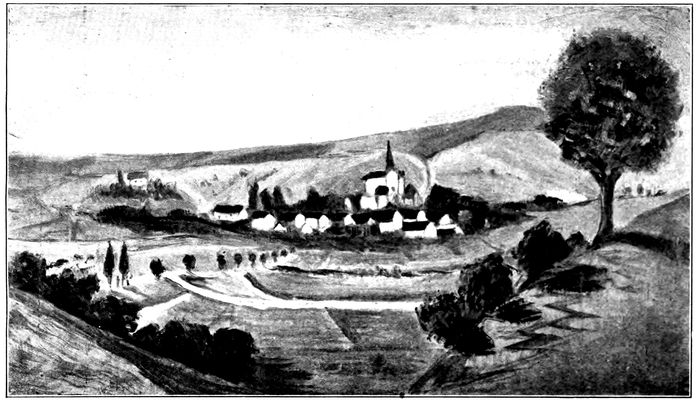
When, as a child, I made my first studies of
the world around me, one of the objects which
4chiefly attracted my childish gaze was a picture
which hung on the wall of the parlor of my
home. It was a crude and inartistic picture,
awkward in delineation and barbarous in color;
but it was full of interest to me, for it spoke to
me of a place far across the sea, a place which
oft-told but never wearisome tales had surrounded
with a bright halo of romance, and
which my eager imagination had glorified into
a veritable fairyland; it was a picture of a village
in that Germany which seemed so far away
and so unreal, my mother’s native place, Nordheim
vor der Rhön. These sentiments were
not entirely, nor even mainly, due to the picture
itself, but to the descriptions with which mother
ע״ה used to accompany it; for mother dear, God
rest her soul, among her other good qualities,
had a most vivid and emphatic way of impressing
her ideas upon her auditors. She was not
only in loving tenderness and devotion the ideal
of a Jewish parent, but a most charming and
entertaining raconteuse, full to the brim of reminiscences
of her youth, an animated chronicle
of persons and events, and capable of describing
both the humorous and the pathetic in
an inimitably touching and taking manner. In
addition to all this she was a living refutation of
the favorite anti-Semitic calumny, that Jews have
5no sentiment of patriotism. She cherished in
her heart the warmest and most unquenchable
love for her native land, while her attachment
to the memory of her birthplace, its ties and its
traditions, approached the dignity and sincerity
of a religion. No wonder that from such a stirring
and enthusiastic source I imbibed the liveliest
interest in all that concerned Nordheim
before the Rhön, its inhabitants and its welfare.
I would stand for hours at a time before that
crude little picture on our parlor wall, gazing at
the array of houses with startlingly red roofs
and dazzlingly white walls, at the fields of brilliant
green and the trees with trunks as straight
as ramrods and mathematically elliptical foliage,
and at the tin-soldier-like gendarme whom
the rustic artist, who must have inclined either
to realism or militarism (I could never determine
which) had depicted marching, with
martial air and projecting bayonet, along the
country highway.
But I saw none of these things. My imagination
gazed beyond these externals and saw
the quaint and touching figures of those who
had their abode in this secluded retreat, and I
found myself wondering whether it would ever
be my privilege to see the spot where mother’s
cradle had stood, and to sojourn there where life
6flowed on in such pure and peaceful and virtuous
channels, far away from the crush and the turmoil,
the evil and the anguish of the great world,
where the peasants were simple, honest folk and
the Jews all faithful to their ancestral religion,
where old age was venerated and childhood
obedient and respectful, where such things as
violating the Sabbath and eating Trefoth were
unknown.
My opportunity came in my twenty-first year.
Circumstances, the nature of which need not be
dilated upon here, made it my privilege to spend
several years in Europe in study. But while I
awaited, in joyous anticipation, the day when I
should enter upon my course at the North German
University and Seminary, at which I was
to prepare for my life’s vocation, it was with an
absorbing interest, I might almost say with a
passionate longing, that I looked forward to
actually seeing Nordheim, and actually knowing
the persons and conditions of which I had heard
and dreamt so much. Never shall I forget the
day when, having crossed the stormy Atlantic
and travelled by train a day and a night southward
from Hamburg, I alighted at Mellrichstadt,
the railroad station nearest to Nordheim—four
English miles—and saw upon the platform,
waiting for me, a pleasant-faced, dark-complexioned
7youth, whom I had never seen before, and
yet whom I at once recognized, for his features
appeared in more than one counterfeit presentment
in a well-worn family album, over which
I had often pored more than three thousand
miles away. It was Cousin Solomon, and he
had come to the station, having been notified by
letter of my prospective arrival, to meet his
American relative, and to conduct him to Nordheim
and the bosom of his family. Then and
there I recognized the reality and the value of
sentiment. Here were two persons, born in
different and widely separated lands, speaking
different mother tongues and citizens of different
nations, who had never seen each other before;
and yet so powerful were the ties of kinship
and the remembrance of common blood
and a common origin, that they sufficed to
bridge over all that yawning gap of separation
and to bring heart to heart and lip to lip in a
union of truest love and affection. Our recognition
was mutual and instantaneous. We pronounced
each other’s names, fell upon each
other’s necks, and a moment later were chatting
as intimately as though we had met daily during
all our previous lives. Three years long I spent
my summer vacations at Nordheim, and I came
to know and to love it and the surrounding region
8so well that when the hour of final parting
came, it cost my heart more than one pang and
drew more tears from my eyes than I should
like to confess. What a charming ideal life of
sentiment and pleasure we led there, Cousin
Solomon and I. We seemed to be hovering in
a dream world, far too sweet and beautiful to
be real. We were at once students on a holiday,
friends of nature, children without a shade
of care or anxiety, and sincere, devout worshippers
at the shrine of Israel’s God. We climbed
together the steep and lofty mountains which
abound in that region, and when we had reached
the summit we gazed with delight at the dazzling
panorama spread out before us and inhaled
deep draughts of the pure, cool, health-giving
air. We wandered for hours through the dense
pine forests or undertook long trips on foot to
distant villages or spots that were interesting for
some historical or other reason. Once we made
a long trip, in company with Aunt Caroline, to
the village of Burghauen, on the other side of
the Rhön Mountains, to visit some relatives
there. We travelled in a carriage belonging to
the Duke of Weimar. We had hired it from
the duke’s manager, who was not above turning
an honest penny with his master’s property
when occasion offered. The carriage bore the
9ducal escutcheon, and our coachman and footman
wore the duke’s livery; and as we rolled
through the various villages in grand style, the
peasants and their wives and children all came
out and made deep and reverent obeisance. I
was quite astounded, but Aunt Caroline and
Cousin Solomon were so amused that they could
hardly keep straight faces. Both they and I
bowed to the right and to the left and answered
the salutations right royally, at which the people
seemed highly gratified.
“What is the reason of all this,” said I (to
whom this unexpected enthusiasm was extremely
puzzling) to Solomon. “Do they make
so much fuss about everybody?” “Why, no!”
said Solomon, laughing heartily. “They recognize
the carriage and the lackeys, and they take
us for members of the ducal family. They
think mamma is the duchess, and you and me
they take for the young dukes.”
But, altogether, everybody was extremely
friendly in Nordheim and vicinity, Jew or Gentile,
peasant, merchant or teacher, acquaintance
or stranger, without exception. It was “gruesse
Gott,” and “guten Morgen,” and “guten Tag,”
and “lebe wohl,” and “auf Wiedersehen,” and
“schlafe wohl,” and “angenehme Ruhe,” and any
number of other kindly and sympathetic
10phrases, and all said with such evident sincerity
and good intentions as went quite through one
and left one feeling warm and charitable and
kindly disposed toward humanity in general.
And then the eating, so abundant in quantity,
so excellent, and more than satisfying in quality.
At first Aunt Caroline wanted to feed me all
the time. Six or seven times a day she would
spread the table and invite me to partake until
I protested, and by dint of hard pleading induced
her to reduce the number of meals to
four, with an occasional extra bite in between. It
makes my mouth water yet to think of the
“gefüllte Flanken,” and the “gruenkern Suppe,”
and the “eingelegte Gänsebrüst,” and the “Zwiebeltätcher,”
and the “gesetzte Bohnen,” and the
“Shabboskugel,” and the thousand and one
other delicacies with which dear Aunt Caroline
used to regale us, and to which healthy appetites
and youth gave a zest compared with which
ambrosia must have been poor. And, oh, the
beer! Such magnificent stuff! So different
from the wretched pretence which we call by
that name in America. I quite lost all my temperance
principles in Nordheim and have never
recovered them since.
But along with this joyous physical life there
went a spiritual life no less joyous and satisfying.
11We were Jews there in Nordheim. The
Sabbath was a guest whose arrival was looked
forward to with the most eager anticipation,
and which seemed to cast a magic, sacred
glamour over all the Jewish houses in the village,
transforming the prosaic, work-a-day appearance
of persons and things into an aspect
of dignity and holiness. All day long on
Fridays until about an hour before nightfall, a
tremendous bustle of preparation was going on.
Such cleaning and scrubbing and polishing,
such baking and boiling and brewing! It
seemed as though every house was being turned
topsy-turvy. On that day, too, the men folks
came home several hours sooner than usual, and
then there was added the turmoil of the taking of
baths and the polishing of shoes, and the taking
out of clean shirts and Sabbath suits, and dressing
and getting ready. But about an hour
before nightfall all the noise and clamor and
turmoil ceased and Sabbath stillness began to
settle over the village. The quaint old seven-cornered
Sabbath lamps were taken out and the
Jewish housewives lit them, pronouncing at the
same time the prescribed benediction. How
charming and yet impressive Aunt Caroline
looked as she stood with uplifted hands and reverential
mien before the sacred lamp, the Sabbath
12cap of dainty lace and ribbons surmounting
her refined and regular features of purest
Hebrew type, while from her lips issued in the
holy tongue the words of the benediction,
“Blessed art Thou, O Lord, our God, King of
the universe, who hast sanctified us with Thy
commandments and bidden us light the Sabbath
lamp.”
A half-hour later all were assembled in the
little synagogue, which was filled to the very
last seat, for the Nordheim synagogue was
not built on the American plan. In our progressive
country we build great and imposing
synagogues and temples for the benefit, not
of the people who regularly attend—for them a
very small edifice would suffice—but of those
who pay the Almighty the honor of a visit only
once or twice a year. But the Nordheim synagogue
had accommodations only for its regular
members and attendants, and these were expected
to be in their places on every occasion
of public services. Sometimes somebody would
be missing at service, and then it used to amuse
me to notice with what anxious solicitude inquiry
would be made of his family as to the
cause of his absence. It appeared to be taken
for granted that only illness or some other
equally grave reason could induce any one to be
13absent from synagogue at time of worship. I
could not refrain from smiling when I thought
how pointless such solicitude would be in
America, where, on the contrary, the question
addressed to any average Jew, should he present
himself in the synagogue on any but two or
three days of the year, would be, “What brings
you to Shool to-day?”
The services in the synagogue at Nordheim
were intensely interesting to me, not, indeed, because
of the artistic rendition of the ritual or the
technical excellence of the singing, but because
of the spirit of devotion and earnestness by which
they were pervaded. I have listened to numbers
of cantors who certainly rank higher in their
profession than the humble individual who acted
in the capacity of village teacher, Chazan, and
Shochet in Nordheim, and the musical performances
of trained and paid choirs are undeniably
superior to the untutored though vociferous
efforts of a rustic congregation. But all these
have something perfunctory and mechanical
about their efforts which deprive them of real
charm and of power to touch and move the
spirit. One remains coldly critical in listening
to them, and judges them solely from the standpoint
of professional ability and artistic merit.
Not so in Nordheim. There was an all-pervading
14sense of earnestness and reality in the worship
which made one forget the how of the
prayers and hymns and think only of the what.
Faith, deep and firm as the rocks, ingrained
into the very tissue and life of the spirit, looked
forth from those simple, earnest faces, shone
forth from those sincere and expressive eyes.
This spirit gave the familiar ritual an entirely
new vividness and impressiveness. The worshippers
seemed to be speaking directly to their
heavenly Father, and when, at the close of the
Lecho Dodi, the hymn of welcome to the Sabbath,
all rose and faced the entrance, I half expected
to see Queen Sabbath herself, clad in
bridal robes of celestial purity, enter through
the portals of that humble house of God.
The prayers concluded, the worshippers
greeted each other with hearty “Good Shabbos”
salutation and wended their homeward
way. The scenes in the homes were in some
respects even more impressive than in the synagogue.
Uncle Koppel’s house particularly was
resplendent with a blaze of glory. The dining-room,
which also served as parlor and best room,
was brilliantly lighted, and in the midst of the
effulgence shone, with especial radiance, the
Sabbath lamp. The table was covered with a
linen cloth of snowy whiteness and laden with
15the finest porcelain, glass, and silver that the
household could boast, while at the head of the
table, opposite the seat sacred to the master of
the house, stood the two Sabbath loaves covered
with a beautifully embroidered satin cover; and
at their side the silver Kiddush-beaker and the
decanter, from which the wine of blessing was
to be drawn. Before Kiddush Uncle Koppel
“marched” with the youngest of the children,
and presented a picturesque sight indeed as he
paraded up and down the room, carrying the infant
of the family upon his right arm and leading
the next youngest by his left hand, chanting
meanwhile the hymn of welcome to the Sabbath
angels. Then came the solemn benediction
when the children all presented themselves with
bowed heads before their parents, and were
blessed by them in the words pronounced by
Aaron of old over the tribes of Israel, with an
added invocation in the case of sons that the
Lord might make them like Ephraim and Manasseh,
and of daughters that they might become
like Sarah, Rebecca, Rachel, and Leah.
Then came Kiddush, and the formal washing of
hands and breaking of bread, and then the Sabbath
meal.
Oh, the pleasure of that Sabbath meal!
Everybody had a magnificent appetite on Friday
16evening; which was really no wonder, seeing
that every one had worked and hurried all
day in preparation for the holy evening; and
that, in accordance with the religious precept,
no one had eaten any substantial meal all day in
order that he should be able to do justice to the
first meal of the Sabbath. The dishes were various
and all excellent, for they were seasoned
with that finest of spices—the Sabbath—which
gave them a flavor all their own, and which the
most famous chefs of European or American
hotels would strive in vain to rival; but the
pièce de resistance was undoubtedly the fish.
Trout of the finest quality, speckled beauties,
which had only been drawn a few hours before
from the icy waters of some one of the mountain
streams of the Rhön gebirge, they made their
appearance at the table cold, from a sojourn of
several hours in the rock-hewn cellar, which
served the purpose of our modern refrigerators,
and with a sweet-and-sour sauce of the consistency
of jelly. They were consumed with an
avidity which boded ill for their speckled confrères
of the mountain streams and shady pools.
After the meal and the formal pronouncing of
grace, in which all joined with a volume of
sound which attracted the attention of the village
boys in the street outside, each one followed
17his or her own sweet will. Some conversed,
some read devotional books, some dozed until
the flickering of the lights betokened their approaching
extinction and warned all that the
hour of retiring had arrived. Then with pleasant
“good-night” wishes, each sought the shelter
of his or her couch.
On the morrow the observance of the Sabbath
was continued in a manner worthy of its
inauguration. The morning service, which began
at eight and was over at half-past ten, was
followed by Kiddush and the second of the
three prescribed Sabbath meals. Here the chief
feature was the “gesetztes Essen,” or dishes which
had been cooked on Friday and kept warm in a
special kind of oven known as “Setzöfen,” in
which they were surrounded by a gentle heat
which neither burned nor dried them, until they
were served at the Sabbath meal. Some persons
assert that food cooked a day previous to
being consumed is injurious to the health, but
to judge by the favor in which it was held in
Nordheim, such can hardly be the case. Of
course not all food is capable of being treated in
this manner; but that which is, acquires a special
taste and a mellowness which makes it peculiarly
palatable.
On our Sabbath menu we had “gesetze Bohnen,”
18the dish of whose glories Heine has sung,
and “Shabbos-Kugel,” to whose merits even a
poet could hardly do justice. After dinner
visits were in order. The younger members of
the Mishpochoh went to pay their respects to
their seniors, and the children of the community
called at the various houses without distinction
of relationship and were treated to fruits and
sweetmeats. What impressed me on the part
of the children was their extremely respectful
and bashful behavior, amounting almost to
timidity. They would knock timidly at the
outside door; and on being bidden to enter would
step in on their tip-toes, timidly utter the Sabbath
greeting, and then stand in a row without
opening their mouths until they were told to be
seated. They would not touch anything or do
anything without permission, and when given
fruit or sweetmeats would modestly utter words
of thanks and eat them in silence. Their
actions were typical of the German-Jewish
standard of child behavior. The children who
were old enough to receive tuition were also examined
on the Sabbath in the subjects in which
they had been instructed during the week.
Great was the joy of parents whose son translated
with fluency the Sedrah of the week, and
the capable lad always received his reward in
19the shape of an extra portion of fruit or sweetmeats.
After the visits and the examinations came
the Sabbath nap. The Sabbath nap! Let
no one speak of it in tones of levity or disrespect,
for it stood in high esteem indeed in
Nordheim and other communities of the same
type. Every one deemed it an absolutely indispensable
feature of correct Sabbath observance;
and though few of the people were learned in
Hebrew lore, yet nearly all were able to quote
in defence of their practice the cabalistic interpretation
that the letters of the word שבת (Sabbath)
are equivalent in meaning to the sentence
שנה בשבת ת, which may be parodied as “Sleep
on SaBBath, the heart delighteTH.”
Between the hours of 1 and 4 P.M., the Nordheim
Kehillah, to use a heathenish illustration,
lay locked in the arms of Morpheus. On sofas
and beds or in arm-chairs, within the house or
before the doors, the worthy Baale Batim, their
spouses and children slumbered, dozed, and reposed.
The cat slept under the stove, the dog
dozed peacefully before the door, the very horses
and cattle stood motionless as statues within
their stalls and seemed to slumber. It was a
most peaceful, somnolent, soporific scene. Not a
sound disturbed the quiet of the village streets,
20for the Gentile peasants were all abroad in the
fields. The very spirit of Sabbath pervaded the
noiseless air, and everywhere were rest, repose,
and tranquillity universal. I, too, who had never
been accustomed to sleep by day, could not resist
the drowsy influence of the general example,
and after the first week or two took my
Sabbath nap as regularly as any, and found it
most agreeable. At four all were awake again
and then the third Sabbath meal, which was
usually light, and consisted only of coffee, cake,
and fruit, was partaken of. The congregation
then gathered in the synagogue for afternoon
service, at the conclusion of which the Chazan
“learned Shiur”—that is to say, read to the
assembled auditors extracts from a Hebrew devotional
work, in German translation, accompanying
them with a running commentary of
his own. His diction was poor, his expressions
the reverse of elegant, and his train of thought
in absolute disagreement with most of the pet
theories of the age; but I doubt whether the
most eloquent and scientifically trained of modern
preachers ever had as attentive and sympathetic
a congregation as he. Now came the
charmed time known as “between Minchah and
Maariv,” the period most attractive and pleasing
to the Jewish heart of all the Sabbath day.
As the light of the sun is most beautiful and
glorious just before it sets, so the Sabbath seems
sweetest and most delightful when it is about to
depart. The afternoon prayers and the Shiur
were both concluded; the day was beginning to
grow dark, but almost an hour must still elapse
before the Sabbath would be over and the evening
prayer of the first day might be recited.
Some of the people went for a brief stroll in the
fields; others went into the inn where they were
furnished with beer and other light refreshments
without payment; for the Gentile innkeeper
knew well that the observant Jew bore no
money on his person on the Sabbath day, but
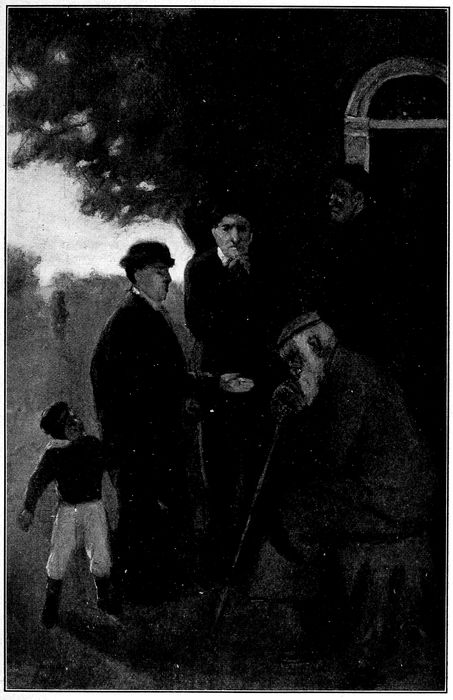
most remained in the synagogue or gathered in
the court-yard before the sacred edifice and
passed the time in pleasant conversation or the
relation of anecdotes. There they sat and
stood, in various attitudes, while the deepening
shadows made their figures ever vaguer and
more indistinct, and enjoyed the freest opportunity
for unrestricted conversation and interchange
of thoughts that all the week afforded.
THE VERY SPIRIT OF SABBATH PERVADED THE NOISELESS AIR
21All possible subjects came up for discussion
“between Minchah and Maariv.” The politician
of the Kehillah discoursed learnedly on
the European situation and the various problems
of statecraft involved in the relations of
22the great Powers to each other, the philosopher
shed the light of his wisdom on the great scientific
movements of the day and the wondrous
inventions which are revolutionizing civilization,
while the Talmudist elucidated knotty
and interesting questions of rabbinical law or
lamented the downfall of religious sentiment in
these evil days and contrasted these with the
unyielding fidelity and loyalty of yore. They
all found attentive and eager listeners, to whom
their words were as the very revelation of the
Urim and Tummim; but they did not arouse
the same degree of enthusiasm as the story-teller.
This accomplished narrator of witty
tales and humorous anecdotes held the hearts
of his auditors in his hands; and when his turn
came and he began to draw upon his apparently
inexhaustible stock of Mesholim, an immense
enthusiasm took possession of the entire audience,
and there was no limit to their enjoyment
of the numberless good points he made.
They were indeed amusing, those tales of impecunious
rabbis, and still more impecunious
Bachurim, of awkward bridegrooms and homely
brides, of witty Poles and scheming Schnorrers.
But they were more. They were instructive,
for they reflected the inner life of the Jewish
people, and showed, even if from a humorous
23point of view, the many trials and difficulties by
which they were encompassed.
But now the shadows had deepened into night,
and the Shammas, who had the privilege of reading
the service before the rest of the congregation
in order that he might be permitted to perform
the work-a-day task of lighting the lights, interrupted
the pleasant tales of the story-teller by a
brief notification that the time for prayer had
arrived. The evening service was brief, lasting
in all hardly more than a quarter of an hour.
Its chief feature was the Havdoloh, in which the
Chazan pronounced a number of benedictions
over wine, spices, and a peculiar braided wax
candle, and thanked the Lord that He makes
a distinction between light and darkness, between
Sabbath and week-day, and between
Israel and the nations. The service concluded,
the worshippers greeted each other with hearty
“Gut Woch” and repaired to their homes, but
not yet to resume work-a-day tasks.
It was an unwritten law in Nordheim that the
Saturday night was not to be given over to labor
or business, except in cases of emergency. The
women were particularly zealous in following
this rule. Instead sociability reigned supreme.
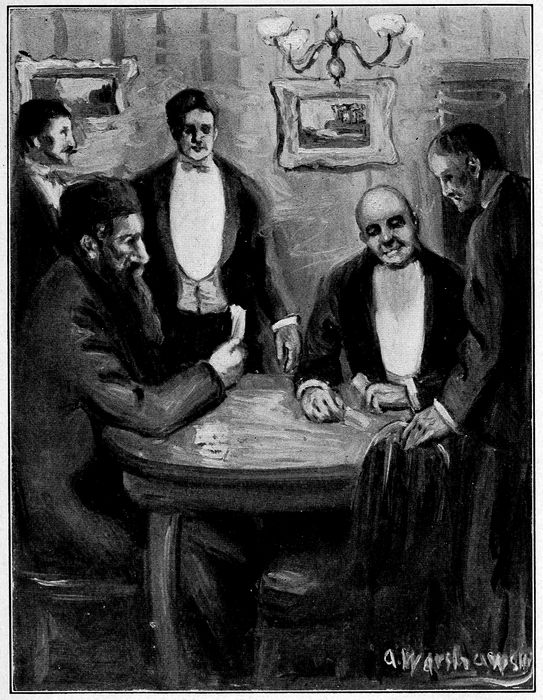
The men indulged in friendly card-play, the
married women sat together in groups and gossiped,
24the youths and maidens played musical
instruments, sang, and danced. These pleasant
occupations were continued several hours, so
that on Saturday nights the worthy Jewish
burghers retired much later than usual.
The sincerity and thoroughgoing consistency
which marked the observance of the Sabbath
were characteristic of the religious life of the
Nordheim community throughout the year. It
would be inconsistent with the scope of this
sketch to go into all the details of religious life
and practice; but suffice it to say that Jewish
piety, as illustrated in Nordheim, was eminently
earnest, emphatic, and genuine. The very children
possessed the spirit of martyrs. They
would have endured tortures rather than eat
forbidden food or violate the Sabbath or any
other of the holy days. Some of the manifestations
of this piety were quaintly humorous or
pathetic, according to the viewpoint from which
they are regarded. The children of Nordheim,
like children the world over, were very fond of
fruit and berries. Had they been permitted to
go into the orchards and gardens and gather
their sweet products unrestrained, there can be
no doubt that as much would have disappeared
down their throats as they brought home. But
the Nordheim mothers struck upon a shrewd
25scheme for circumventing the appetites of their
sweet-toothed offspring, which did equal credit
to their ingenuity and their psychological
knowledge. They would send the children to
gather fruits or pick berries upon a fast day.
The plan was as effective as it was beautifully
simple. The children brought home all that
they gathered, for no Jewish child in Nordheim
would have even thought of committing such a
heinous sin as tasting food on a Taanis. Think
of applying such a rule to American children!
It would be about as effective as trying to restrain
a bull with a piece of cotton thread.
It is recorded of a worthy Nordheim Baal
Habbayis that he once saw some flies rise from
his boots and settle upon some hay, which was
later on eaten by his cows. Now that in itself
is a trifling and insignificant incident; but it so
happened that the boots, in accordance with
German village custom, had been smeared with
tallow, which, from the viewpoint of the Jewish
religious law is Trefah—that is, ritually unclean,
and forbidden to be eaten. Our worthy Nordheimer
at once felt himself burdened in his
conscience and despatched a special messenger
post-haste to the rabbi at Gersfeld with an
inquiry as to whether the milk of those cows
might lawfully be drunk. This pious scrupulosity
26did not, however, as might be thought,
involve any gloomy or dreary harshness of sentiment.
What we are accustomed to call the
Puritanical frame of mind was utterly unknown
in Nordheim. On the contrary, a cheerful and
pleasant disposition, which made the tone of
social intercourse extremely agreeable, was the
all prevalent mood. In individual instances
this mental tendency was emphasized into pronounced
joviality, and the happy possessors
thereof became the “Spass macher,” the jesters
and fun-makers of the community. Woe betide
the unfortunate individual who acquired a reputation
for sourness and unsociability. He was
considered a legitimate victim for the gibes and
jests of the official jokers, and small indeed was
the meed of sympathy which he received.
Another instance of the prevailing jocoseness
was the custom of attaching nicknames to persons,
which were then used instead of their
proper appellations. It was rarely that any one
was referred to in Nordheim by his given name,
the nickname being so universally used as almost
to displace the real and legal cognomen. These
nicknames were derived from some personal
characteristic or some peculiarity arising from
vocation or experience in life, which had struck
the village wags as humorous. It was “the
27black Elias,” or “the long Moses,” or “the bold
Isaac,” or “the gentle Sarah,” the last two appellations
being, of course, mildly ironical. One
individual, who had an undue amount of audacity
in his psychological make-up, was known
as “der Baishan,” that is, “the bashful or timid
one,” while another who had failed in nearly
everything he had undertaken was universally
dubbed “der Mazzeldige Shmuel,” that is,
“lucky Sam.” A family, some remote ancestor
of which had once been imprisoned in a tower
and escaped therefrom by leaping from the window
of his cell, was generally known as “die
Thurm hüpfer,” “the tower-hoppers,” while six
brothers, all of whom were over six feet tall and
stout in proportion, bore the strikingly apposite
designation of “die Kinderlich,” that is, “the
babies.” The swineherd, who called his
charges together by means of a long tin trumpet,
from which he emitted shrill and piercing,
though hardly melodious notes, was styled by
the Jews “der Baal Tokea,” that is, the blower
of the Shofar or ram’s horn trumpet used in the
services of the New Year; while the village constable,
who was an extremely pious Catholic and
always walked around through the village streets
on Sundays with a prayer book in his hand,
from which he read with strait-laced mien and
28ostentatious devotion, was dubbed “der Baal
Tephillah,” that is, the cantor or reader of the
synagogue services.
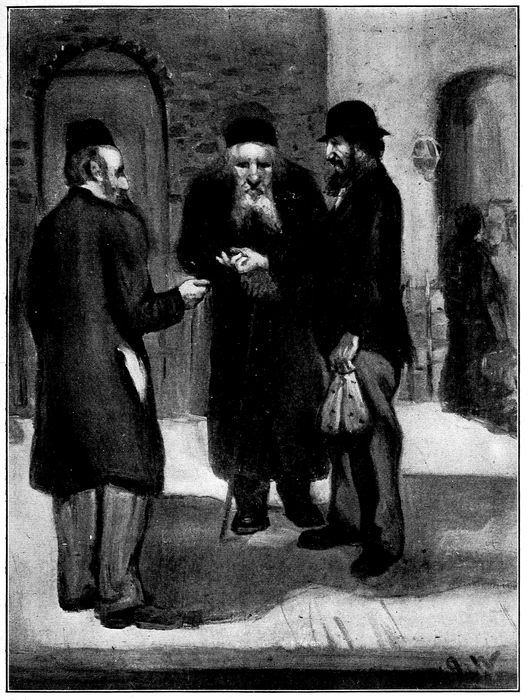
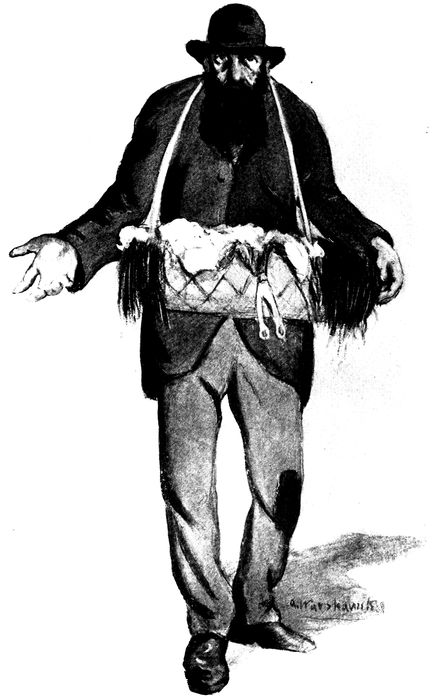
The two banes of village life and at the same
time the most diverting figures therein were the
Schnorrers and the gendarmes or rural policemen.
The first-named gentry, wandering Jewish
mendicants, who believed in the socialistic
doctrine that the world, or at least that part of
it which professed Judaism, owed them a living,
were a most interesting set and worthy of a special
study in themselves. They honored the
community frequently with their visits. Some
were usually visible in the streets at all seasons
of the year, and the services in the synagogue
were generally graced by the presence of two or
three. In most instances they professed intense
piety and then their Tephillin were larger, their
Talethim longer, and their prayers louder and
more ecstatic than those of the rest of the congregation.
They came from anywhere and
everywhere. Most of them were of Russian or
Polish origin, but there was a goodly sprinkling
of individuals of German birth and occasionally a
Sephardi from Jerusalem or some other Eastern
region, clad in Oriental robes and with a majestic
turban upon his head, relieved the monotony
of Schnorrerdom and added interest and diversity
thereto by his strikingly alien and picturesque
appearance. They came in the most
diverse guises. Some appeared in the rôle of
venerable rabbis with flowing beards, and anxious
to display their learning in the law to
whomsoever they could induce to listen; others
professed to be merchants who had lost their all
in ill-starred commercial ventures; while others
were wandering apprentices—Handwerksburschen—temporarily
out of work. Sometimes
they were accompanied by their wives, who were
always more voluble and eloquent than their
husbands. Sometimes an entire family, grandparents,
married sons and daughters and children
of all ages, including infants in arms, made
their appearance and then the resources of
Nordheim charity were severely strained adequately
to provide for them.
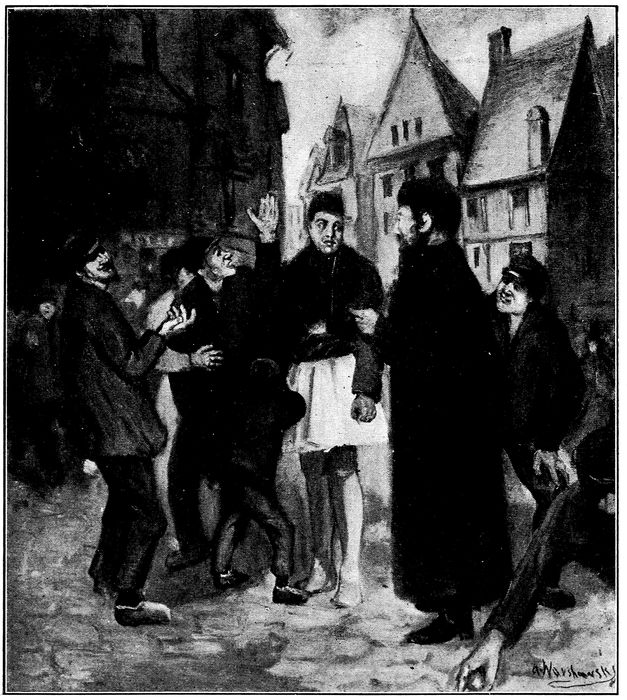
THEY HONORED THE COMMUNITY FREQUENTLY WITH THEIR VISITS
29These Schnorrers were not beggars in the
ordinary sense. They certainly had no humble
or suppliant air. They came into the
house with the air of calling upon old personal
friends, and seemed to think it an entirely
self-understood and axiomatic matter that
their co-religionists should take upon themselves
the duty of caring for their needs.
30Among them many, no doubt, were genuinely
unfortunate and deserving individuals, but there
was more than a suspicion that a large proportion
had taken up the pursuit of Schnorring as
a peculiarly pleasant and profitable vocation.
Their reliance upon the charitable disposition
of their brethren in faith was well grounded.
The Nordheim Jews were guided by the eminently
humane and noble principle that it is
better that ninety-nine undeserving persons
should be aided than that one deserving person
should be refused the assistance he required;
and, consequently, every applicant for charity,
unless it was positively known that he was
unworthy, received the help he craved. This
help usually took the form of food, lodging, and
some money or clothing. A sort of system prevailed.
The Schnorrer would first call upon
the Parnass, or president of the congregation,
who would then give him a ticket, called Plett,
a corruption of Billet, upon some member of the
congregation, entitling the stranger to food and
lodging. These tickets were issued in rotation,
and were usually cheerfully honored. Some of
the members even had a predilection for entertaining
these destitute brethren, and would rival
each other in the numbers they accommodate.
It was amusing to hear one boast that he had
31harbored, let us say twenty-seven, Schnorrers
during the year, only to be told by another,
with triumphant mien, that the number of his
non-paying guests had been thirty-five. The
most celebrated hostess of this kind was a widow
named Hannah. This warm-hearted daughter
of Israel strove to fulfil literally the precept of
the sages, “Let the poor be the children of thy
house.” The days were few when her house
did not contain some “guest”; and she would
give him of her best, and wait upon him as
though his presence was the most distinguished
honor. When asked once how it was that she,
although not a woman of means, was always
ready to receive needy strangers, far more so,
indeed, than persons of far greater wealth, Hannah
answered: “Why, that is a very simple
matter. All that one needs is a Lef and a
Loeffel.”
Altogether, the mental attitude of the Nordheim
Jews toward their needy and mendicant
co-religionists was very different from that
which prevails to-day; at any rate, in America.
At present the unfortunates who depend
upon the aid of their supposedly sympathetic
brethren are considered a nuisance; an
unsightly excrescence upon the body social to
be abolished by all means, if possible. The
32wretched applicant for relief is rigidly scrutinized
and interrogated by lynx-eyed committees
until he is made to feel as though he were a
criminal on trial for his life. A domiciliary
visit is paid to his home by some surly “investigator,”
whose efficiency is measured by the
number of unfavorable reports he makes. And
woe betide the miserable one whose habitation
shows some traces of neatness and gentility,
and where some humble ornaments, relics, perhaps,
of happier days, have been suffered to
remain, and have not found their way into the
pawnshop. Such a one is at once declared an
“undeserving case”; for does not his dwelling
show that he is still possessed of means, and his
application is at once summarily and without
mercy rejected. But Nordheim knew nothing
of such uncharitable charity, such inhuman humanity.
The disposition there was truly charitable
in the kindlier, and hence nobler, sense of
the word. Poverty was looked upon as a necessary
and inevitable feature of human existence,
as, indeed, a part of the Divine order of the
world; for had not He said in His law, “The
poor shall not cease from the midst of the land”?
The unfortunates who had been selected by
some mysterious dispensation of Providence to
bear the hard burden of poverty were the objects
33of real and genuine commiseration, and
every effort was made to alleviate their sad condition.
And if some of them did occasionally
resort to deception or petty misrepresentation
in order to secure a larger benefaction than
would otherwise have fallen to his share, there
was no horror-stricken outcry, no show of virtuous
indignation, such as our high-salaried or
amateur charity experts would indulge in; but
people merely shook their heads, rather pityingly
than otherwise, and would say: “Poor fellow!
he has little enough in this world, God knows.
No wonder that he tried to get a little more.”
Indeed, if the Schnorrer was really a shrewd
fellow and his trick a well-devised one, he was
far more apt to arouse amusement than resentment,
and would actually profit by his nimble
wit. This I saw well illustrated shortly after my
arrival in Nordheim. One day a Schnorrer
presented himself with an expression of utter
woe upon his countenance before Uncle Koppel,
and in heart-breaking accents informed him
that he had just received news that he had
become an Ovel. “Alas, woe is me,” he wailed.
“My poor, dear wife in Poland is dead! What
shall I do without her? Who will care for my
poor, unfortunate orphans? How shall I keep
the Shivah for her, as is due to her memory, I
34who have no home and no means?” It need
hardly be stated that the sad case of the stricken
widower aroused the most profound sympathy
among the Jews of Nordheim. Uncle Koppel
at once placed his house at the disposal of the
unfortunate man in order that he might properly
observe the seven days of mourning, and
most of the members of the congregation
offered to attend the mourning services morning
and evening. Aunt Caroline looked well
after his comfort, provided him with four or five
square meals daily and a good bed at night. At
the conclusion of the seven days a substantial
purse was made up for his benefit and he departed,
showering blessings upon the heads of
all the Nordheim Kehillah, and vowing that he
would never forget their kindness and their true
spirit of brotherliness.
A few weeks later Uncle Koppel had occasion
to make a trip on business to Römhild,
a somewhat distant town in the grand duchy
of Meiningen. As he never ate dinner when
away on these trips, it was customary to keep
his dinner for him, and all the household would
remain up until his return. It was rather late
before he returned, after nine in the evening.
As soon as he had strode through the door
we all noticed that something unusual had befallen
35him during the day, and that that something
had been of an amusing nature. His
face was wreathed in smiles and he was silently
chuckling to himself. We all became, of course,
curious to know the cause of his amusement,
but none, except Aunt Caroline, ventured to
ask. “For goodness’ sake, husband,” said she,
“what is the matter? Let us know.” “Give
me my meal first, wife,” said Uncle Koppel. “I
need strength before I can tell you.” All during
the meal Uncle Koppel sat with sides shaking
with ill-suppressed laughter, while curiosity
and impatience consumed us all. At last, his
meal concluded and grace recited, Uncle Koppel
began his story. “I heard something in
Römhild to-day of our Schnorrer,” said he;
“the one who kept Shivah in our house.” “Indeed,”
we all vociferated, “what was it?” “I
called first on Moses Rosenbaum,” he resumed,
“in reference to some cattle that I wished to
buy of him; and after we had finished our business,
he said to me: ‘By the way, Koppel, there
is a very sad case in town at present, and it
would be a real Mitzvah for you to help us a
little in relieving it.’ ‘What is it,’ said I. ‘A
poor man,’ said he, ‘has suddenly received news
that his wife died, and he is so destitute that
he cannot support his orphans without help,
36or even keep Shivah. We have helped him
some and he has been keeping Shivah in my
house during the week.’ ‘Aha,’ said I, beginning
to smell a rat, ‘this is strange. We had
just such a case in Nordheim a few weeks ago.
I think I shall go over and see your man.’ We
went over to Rosenbaum’s house, and, sure
enough, it was the same fellow. The Shivah-keeping
business in Nordheim had suited him
so well that he was trying it again in another
place. When I saw him I said: ‘My friend, I
believe I have met you before.’ He looked at
me, not in the least abashed, and said: ‘Oh,
yes, in Nordheim, a few weeks ago.’ ‘What do
you mean by this brazen-faced fraud,’ I asked,
‘pretending to have lost your wife and swindling
people into charitable gifts by pretending
to keep Shivah?’ ‘Oh, my good sir,’ said he,
with great pretence of earnestness, ‘it is no
deceit at all. The first time it was a false report.
My wife had not died. But this time
she is really dead, really indeed; and if you
don’t believe me you can go yourself to Pitchichow
in Poland, my native town, and convince
yourself. You can, indeed.’ We all laughed
heartily at the fellow’s impudence, and warning
him to be sure that his wife was dead before he
sat Shivah for her next time, we bade him begone.
37He went off with great alacrity, evidently
glad that he had fared no worse.”
The gendarmes or rural policemen were the
second bane of village life; but while the
Schnorrer was looked on with charitable eye,
for these latter gentry no one had a good word.
They were detested, thoroughly and intensely.
As a rule they well deserved the detestation in
which they were held, for they were pompous,
insufferable individuals, egregiously proud and
conceited because of the little authority they
possessed, and over-eager to display their power;
in a word, petty tyrants of the worst kind.
They were equally hated by Jew and Gentile,
and were not popular even with the judges and
magistrates, who were often liberal-minded gentlemen,
and who knew well the tyrannical disposition
of their rustic retainers. The multiplicity
of laws and regulations in the German
statute book, particularly those referring to
trade and commerce, gave the gendarmes the
much-desired opportunity for the display of
their power; and as the Jews were the chief element
engaged in commercial pursuits, they were
also the chief victims of these rustic arbiters of
weal and woe. To defeat or discomfit a gendarme
38was a highly meritorious deed, and all
the community rejoiced in concert when one of
these potentates had been made the victim of
some particularly ingenious trick.
An incident which had happened some time
previous to my arrival in Nordheim, and which
all the community were highly enjoying at the
time of my arrival, will illustrate this disposition.
There lived in Nordheim a poor, half-witted Jew
named Meyer, an unfortunate fellow without relatives
or home or means of subsistence, who depended
for his support on the charitable gifts of
the kind-hearted villagers. Despite his mental
infirmity, Meyer possessed, as is not seldom the
case with the weak-minded, quite a stock of
humor; and as he was always cheerful and
pleasant, and was continually doing odd and
amusing things, “Shoteh Meyerle,” or “Little
Meyer the fool,” as he was called, enjoyed considerable
popularity. Everybody, rich and poor,
high and low, Jew and Gentile, knew him well.
Everybody had a friendly greeting for him when
met on the road; nobody, not even the most
unruly boys, would harm him in any way or
permit him to be harmed by others. He had
free access to every house, and enjoyed altogether
liberties and privileges not possessed by
any other member of the community. One day
39it chanced that Shoteh Meyerle determined, in
accordance with his wont, to visit the adjoining
village of Willmars to obtain some gifts. The
day was hot, the road was long and dusty, and
Meyer soon felt that rest and recuperation
would be agreeable. These could not be had
on the dusty road, and he, therefore, stepped
aside into a field where there was a fine tree, in
whose cool shade he sat him down and reposed.
This act, it is true, was illegal, for the agrarian
regulations of the Bavarian state strictly prohibit
the stepping upon cultivated fields on the
part of others than the proprietors, or those to
whom they give permission. But what recked
Meyer for that; he was, in a measure, above
the law. He could violate the solemn enactments
of the code with impunity, for the light in
which he was viewed by the community enabled
him to say, like a celebrated American politician
of later date, “What’s the Constitution between
friends?” Meyer, therefore, sat him down on
the cultivated field of Farmer Dietrich without
having obtained his formal permission, but without
the least fear of consequences. This time,
however, he was in error. A new gendarme
had recently come to Nordheim, a stranger
from a different region, unacquainted with the
people and their ways, but with a soul longing
40to acquire distinction by making some brilliant
arrests. His reputation as a surly and churlish
fellow had preceded him, and every one had
scrupulously avoided him and taken particular
care not to come into conflict with any of the
numerous statutes and police regulations; so
that hitherto no one had fallen into his clutches,
and his ambition for distinction had as yet had
no opportunity to be gratified. This particular
morning he was walking along the road, meditating
upon his ill luck (as he considered it), and
cursing the people of Nordheim and vicinity for
an absurdly law-abiding crowd. What especially
grieved him was that no Jew had yet fallen into
his hands, for he was a true anti-Semite; and to
haul up one of the accursed Semites on some
good and heavy charge was incense to his soul.
While thus marching along the highway and
meditating, he beheld a man sitting upon a
stone in a field, whose appearance clearly indicated
that he was not a peasant nor a field
laborer, and who, therefore, had probably no
right to be there. It was, of course, our friend
Meyer; but our doughty gendarme knew him
not, and was not aware of the peculiar status
of immunity which he possessed. “Aha!”
thought the gendarme, his soul filled with joy
at the idea of at last making an arrest. “A
41law-breaker! Probably a wandering apprentice
(Wandersbursch) or itinerant merchant (Handelsman)
who does not know that I, the zealous
and faithful watchman of the law, am in the
neighborhood, and who has therefore dared to
invade the sacred precincts of the fields! I
must approach cautiously lest he see me while
still afar, and escape.” Thus thinking, he began
cautiously to draw near to the neighborhood
of the suspected violator of the law, slinking
behind bushes and walls so as not to reveal
his presence until he should be in the immediate
vicinity of his intended victim, when he
would pounce upon him as the tiger springs
upon his prey.
But, cunning as the gendarme was, Shoteh
Meyerle was still more cunning. He had seen
the bright uniform and shining musket of the
pompous champion of the law when they first
appeared at the distant turning of the Ostheim
chaussée. He at once understood his intention
when he saw him first pause and afterward
slowly advance, seeking cover behind bushes
and walls and, with the instinctive cunning
of the half-witted, he at once resolved to
baffle his elaborate plan and to have some
sport with his would-be captor. He remained
quietly sitting upon his stone, apparently in
42entire ignorance of the gendarme’s approach
until just before the latter came into too uncomfortable
proximity, when he arose and
began to move leisurely across the fields in
the direction of the Sommerberg, a forest-crowned
hill situated somewhat to the northeast
of the village. At this the gendarme was compelled
to show himself. He burst forth from
his covering of bushes, leaped upon the field
and called upon the intruder, as he considered
him to be, to stand and submit to arrest. Instead
of doing so, Meyer continued to move on
at a somewhat more rapid pace. To realize the
meaning of this action, one must remember that
in Germany a person when called upon by the
police is expected at once to stand and give
an account of himself, and invariably does so.
Only one who has the gravest of reasons for not
desiring police attention would dare to attempt
to evade them when their attention had once
been called to him.
Our worthy gendarme was now convinced
that he had a dangerous criminal to deal with,
and his soul thrilled with the hope of making
a brilliant arrest; one that would secure him
favorable notice from above, rapid promotion,
and perhaps immortality in the annals of criminalistic
achievement. He shouted to Meyer at
43the top of his voice to halt, breaking at the same
time into a run and dashing toward him. But
Meyer did not halt. On the contrary, he too
began to run, and was soon speeding over hill
and dale, hotly pursued by the now thoroughly
enraged officer.
Who can fitly describe the terrors and the glories
of that extraordinary race? Meyer was thin
and light and active, possessed of splendid wind
and as fleet as a deer. He led the gendarme
a merry chase, indeed, over hills and down
into valleys, through forests and over brooks,
through corn-fields, meadows, and gardens.
But the gendarme was a strong man and game,
though rather heavy from overmuch eating and
beer-drinking; weighed down with his heavy
musket, and sadly out of condition through lack
of exercise. Filled with rage and determined to
make a prisoner of this extraordinary criminal,
he panted and toiled on in pursuit, despite
weariness and perspiration. Meyer could easily
have distanced him, but had no intention of
doing so; and therefore so controlled his pace
as to remain always in sight of his pursuer, and
not permit the latter to lose hope and give up.
Thus the chase continued until hunter and
hunted, having covered more than four miles of
country, found themselves at the gates of Mellrichstadt,
44the chief town of the district and the
seat of the district court, which at that time, as
Meyer well knew, was in session. Here, Meyer
pretending to have grown weary, gradually
slackened his pace and permitted himself to be
seized by his panting and perspiration-bathed
pursuer. “Aha, accursed Jew! Aha, thou
rascal!” hoarsely exclaimed the latter, as he
seized Meyer roughly by the collar, “at last I
have thee! Now thou shalt pay bitterly for thy
villainy and thy audacity. I shall drag thee
straight to court, and the honorable judges will
know well how to deal with an audacious
wretch, such as thou art, and who undoubtedly
must have committed some great crime or else
he would not have thus fled from me.” Meyer
vouchsafed no answer and offered no resistance,
but meekly followed the gendarme to the courthouse,
which was but a short distance away;
although the triumphant officer in his wrath at
the unprecedented chase he had been forced to
make, literally dragged him thither in most ungentle
manner.
The district judge, clad in his silken robes
of office, and with his velvet cap upon his
head, was seated at his elevated desk at the
upper end of the court-room, at either side
an assessor, when this remarkable pair, the
45stout, hot, perspiring gendarme, with face red
as fire, and the comical, well-known figure of
the half-witted Jewish beggar entered the
room, the former holding the latter with an
iron grasp and with an expression of intense excitement
upon his countenance; while the latter
was perfectly cool and self-possessed, and was
smiling all over with an expression of perfect
content, as though a run of four miles and apprehension
by the constabulary were every-day
and quite pleasant experiences in his life. An
interesting case was going on at the time, and
the court-room was crowded with a mixed multitude
of peasants, working-men, Jewish merchants,
and landed proprietors, among whom
the arrival of this singular pair created a lively
sensation, especially as the mischievous propensities
of Shoteh Meyerle were well known and
curiosity was rife as to what he was up to now.
When the gendarme entered the court-room,
he at first hesitated for a moment, being undecided
as to whether he had the right to appear at
once before the judges or not; but the supreme
judge, who knew Shoteh Meyer perfectly well
(as did also the assessors), and was himself consumed
by curiosity concerning the meaning of
this extraordinary arrest, at once signalled him
to advance, which he immediately did. No
46sooner had the gendarme brought his prisoner
before the bar than the latter made a deep bow
to the court; and, smiling affably at the judges,
said in a voice audible all over the room:
“Good morning, Herr Gerichtshof! Good
morning, my Herren Assessoren! How are
you all feeling to-day? I trust you all slept
well last night!” This, in a court-room, extremely
unusual salutation was accompanied by
an extraordinary smirk and a comical flourish
of the arms, and was greeted by an outburst of
hearty laughter on the part of the audience; in
which the judges joined, a proceeding extremely
disconcerting to the gendarme, who detected in
it a note of friendliness to the prisoner, which
he could not understand, but which boded ill for
the success of his charge.
The gendarme was then ordered to tell his
story, and gave the facts with which we are already
familiar, laying particular stress on his
suspicion that the prisoner was guilty of other
grave crimes, based on the desperate manner in
which he had endeavored to avoid arrest. This
story was listened to with evident amusement,
which added greatly to the embarrassment of
the valiant captor, who began to feel very cheap,
though he knew not why.
Meyer was then called upon for his side of the
47case. “Why, most honored judge and assessors,”
said Meyer, with a most engaging smile
and ingenuous air, “I do not know why I have
been arrested, or why the Herr Gendarme is so
angry with me. I am only a poor, humble man,
and I have never done any one any harm in all
my life. I was resting a little in Farmer Dietrich’s
field this morning, and afterward I took
a little lively run to Mellrichstadt and I saw
the Herr Gendarme a few times on the way.
Hardly had I reached Mellrichstadt when he
fell roughly upon me and dragged me here, and
that is all I know.”
“But why were you in Farmer Dietrich’s
field?” asked the supreme judge, trying to
assume a severe air. “Do you not know that
is against the law, and that you make yourself
thereby liable to severe punishment?” “That
may be, your honor,” answered Meyer; “but
I did not think I was doing any wrong. All
the people hereabouts are very kind to me,
and willingly permit me in their fields; and I
thought it would be the same this time as
always.”
“But why did you run all the long way
from Nordheim to Mellrichstadt, and in this
hot weather, too?” asked the judge, suppressing
by a great effort his amusement.
48“The reason I did that,” said Meyer, with a
most innocent expression of face, “was for the
benefit of my health. I have been suffering a
great deal lately from constipation, and the doctor
recommended me exercise in the open air.”
This answer was greeted with a shout of laughter
from all sides.
“But,” continued the judge, still endeavoring
to conduct the inquiry in a judicial manner,
“when you saw the gendarme running
after you, you should not have kept on without
noticing him. You should have stopped
to see what he wanted of you. Why did you
not do so?” “I should gladly have done so,
your honor,” said Meyer in a tone of perfect
frankness, “but I did not have the least idea
that he wanted anything of me. I thought that
he, too, was probably suffering from constipation,
and that the doctor had also recommended
him exercise for his health.” This
answer literally “brought down the house.”
Amidst a storm of merriment, which utterly
defied the usual restraints of court discipline,
the case was dismissed and the crestfallen
gendarme was overwhelmed with a flood of
ironical compliments on his zeal as an official
and his ability as a runner. Shoteh Meyerle
was more popular than ever after this incident,
but it was many a day before the gendarme
could muster up courage to look any one in the
face.
O sweet Nordheim! Though thy inhabitants,
particularly those who professed the
ancient faith of Israel, were but few, how numerous,
comparatively, were those whose characters
for one reason or other were interesting
and noteworthy. Let me pass a few of these in
review before the eye of the reader before I close
this insufficient though veracious chronicle.
Without a doubt the most important and significant
of these persons was Reb Shemayah.
He was my grandfather, although it was not my
privilege to behold him in the flesh, for he had
passed to the better world some years before
my visit to the village. He was a perfect type
of the old-time, sincere, loyal, and devout German
Jew. He was the son of an old family of
high repute and standing, which had been settled
in Nordheim for several centuries; and one
of his ancestors, whose picture appears in an old
village chronicle, had enjoyed the unique distinction
of being the only inhabitant who owned
a saddle horse. Like all the sons of the better
50class of Jewish families in former generations
he received a thorough training in Hebrew and
Talmudic studies. At the Yeshibah in Fulda, to
which he had been sent to study rabbinic lore,
he attained such distinction by the keenness of
his intellect and the rapidity of his progress
that the venerable rabbi became warmly attached
to him, and declared that he alone should
be his successor and his son-in-law, the husband
of his youngest daughter.
Just as Reb Shemayah was about to attain
the loftiest pinnacle of Jewish ambition in
those days, to become a rabbi and to take as
his wife the beautiful, dark-eyed daughter of the
Fulda Rav, an event occurred which destroyed
his hopes in both these regards, but gave occasion
for the display of his noble idealism. The
Bavarian Government issued a rescript to the
effect that in order to wean Jews from the
petty forms of trading to which they had hitherto
been addicted, and to induce them to take
up agriculture, the law prohibiting Jews from
owning land, which had been in force for centuries,
was repealed, and it would henceforth be
permitted them to own and cultivate land, the
same as all other citizens.
The beneficent intentions of the new law
were evident, but the Jews hesitated to take advantage
51of it; indeed, they were loath to do so.
The centuries of unfamiliarity with agriculture
were partly to blame for this reluctance; but
then, again, there was also a strong prejudice
against the farmer’s vocation, which was considered
low and rude and far inferior in social value
to that of the merchant or scholar. Reb Shemayah
did not share these views. His soul was
all aflame with enthusiasm when he heard of the
new law which, in his opinion, first put the
stamp of real citizenship upon the Jew. Not
only did he consider agriculture intrinsically
ennobling and the only vocation in consonance
with true Jewish, Biblical precepts, but he also
held that the landed class are the real foundation
of the state, while all others are but
floating parasites. When he saw that his
brethren were hesitating, and that none appeared
willing to purchase land, he determined
to give them a good example and himself became
a tiller of the soil. He invested his whole
fortune in the purchase of a farm near Nordheim,
which he himself began actively to cultivate.
Thus did Reb Shemayah renounce the
rabbinical vocation and become a peasant. It
was a tremendous sacrifice to make; but what
was worse was that he had to renounce his
sweet bride too, for the old Fulda rabbi was obstinate
52and had no liking for these new things.
“A peasant shall not have my daughter,” he
said; and though Reb Shemayah loved sweet
Miriam well, he loved Israel better, and for the
sake of his ideal he sacrificed a piece of his own
heart. Encouraged by Reb Shemayah’s example,
many other Jews invested in land and endeavored
to learn the art of agriculture; and at
present Jewish tillers of the soil are no longer
rarities.
In the Nordheim community and the entire
surrounding country Reb Shemayah enjoyed
the highest possible reputation. He was universally
loved, respected, revered. And right
well did he deserve his high repute, for a character
of such singular purity, sweetness, and
nobility belongs to the rare things of earth.
He was profoundly and exceptionally devout,
even for those days when piety and religious
strictness were usual and ordinary in Israel.
The Torah, the divine law, he considered God’s
most precious gift to mankind, and Israel’s mission
he held to be to practice this law and to
show its excellence to the world; and by lives
of utmost virtue and beneficence to be mekaddesh
Ha-Shem, i.e., to sanctify the name, and to
bring honor and glory to Him whose servants
were thus righteous and good. He lived up to
53his ideal, and his life thus became one long record
of kindly words and noble deeds. Jews and
Gentiles alike had in him a sincere friend and a
trustworthy counsellor, and were equally glad to
seek his wise counsel and ready assistance in
their hour of need or distress. The Schnorrers
had in him a particularly warm sympathizer, so
that, after his death, they lamented that Nordheim,
although charitable beyond the average,
had lost its halo of glory in their eyes. He
always believed any tale of woe told him by a
suppliant stranger and never wearied of assisting,
for the thought of deceit or fraud never
entered his guileless mind. The learned wanderer
had his especial sympathy, and he would
always welcome such a one right royally to his
home and listen with kindliest interest to his
erudite comments on Biblical or Talmudic passages
or new solutions of old difficulties; and
after entertaining him with unstinted generosity,
would dismiss him laden with blessings
in substantial form.
It was not because Reb Shemayah was
wealthy that he was able to do all these things,
by merely sparing a little from his abundance.
On the contrary, he gave thus liberally as a
matter of principle, of religious duty, and his
charitable gifts often involved great sacrifices
54on his part. During the greater part of his
life he lived in rather straitened circumstances,
and rigid economy was necessarily the strict
rule of his household. His entire fortune had
gone to the purchase of his Bauerngut; and
as he was neither a trained agriculturist nor
a keen business man, his finances might have
fallen into great disorder but for the iron rule
he had set up for himself, and from which he
never deviated, never to contract debts which he
could not see his way clear to pay. In addition
to his ordinary difficulties he met with several
misfortunes, which would have sufficed to break
down the courage of an ordinary man; but his
sublime faith enabled him to bear all these trials
cheerfully and resignedly, and, like Rabbi Nahum
of old, he would repeat whenever any tribulation
came upon him: “This also is for
good.”
A striking illustration of this trait was given
after he had been for quite some years actively
engaged in his chosen vocation, had found his
chosen life partner, and had already a family of
several daughters. In the middle of a bitter
winter night a fire suddenly broke out in Reb
Shemayah’s dwelling; and, quickly assuming dimensions
which rendered it impossible to check
it, the family were driven forth half-clad into the
55icy night. The house was burned to the ground
and hardly anything of its contents was saved,
but the barn had escaped, and there Reb Shemayah
and his nearly frozen wife and family found
refuge. There, too, his wife, Perla by name,
who had for some time been expecting the advent
of a little stranger, gave birth to a beautiful
black-eyed boy, the first male child. It was a
heartrending conjuncture. His home a mass of
smoking ruins in the intense cold of a Bavarian
mountain winter, nothing saved but a few quilts
and articles of clothing, his family huddled together
for refuge in a barn, through the chinks
of whose wooden walls the chill blasts blew
keenly; and most heartrending of all—to see
his dear wife forced to undergo, under such
circumstances, the pains and dangers of childbirth.
It was a situation which would have
broken the courage or destroyed the faith of
another man. But Reb Shemayah lifted his
eyes to heaven, and in all sincerity and truth
uttered the words: “I thank Thee, O Master of
the universe, for Thou art good. With one
hand Thou smitest, but with the other Thou
healest. Thou hast destroyed my habitation,
but Thou hast also fulfilled the prayer of my
heart and given me a son.” And, indeed, the
terror and the suffering were soon over. Kind
56Jewish neighbors hastened to open their homes
to the afflicted family. Neither mother nor
child was any the worse for the harsh exposure,
and the black-eyed boy became subsequently
the Uncle Koppel, whose hospitality I enjoyed.
If anything in the whole incident distressed
Reb Shemayah keenly, it was the necessity of
accepting, if even temporarily, the assistance of
others. Himself ever ready to assist the needy,
he entertained an intense aversion to receiving
himself such assistance.
Though Reb Shemayah was, as we have seen,
an ethically noble and exalted character, he was
by no means gloomy or austere. On the contrary,
he was natural and unaffected in his ways,
accessible to every one, dearly fond of a joke,
and a capital story-teller. Despite his readiness
to accept as true tales of distress, he was, nevertheless,
an excellent psychologist, and had no
difficulty in thoroughly reading the characters
and motives of those with whom he was thrown
into contact. This ability once enabled him to
baffle an attempt which was made to victimize
and blackmail him, and to turn it into a humorous
triumph for him.
Nordheim, as regards the majority of its
inhabitants, was an intensely Catholic village.
The feasts and fasts of the church were celebrated
57there with great pomp and unction, and
the numerous religious processions were particularly
solemn and, according to rural standards,
magnificent. In these the Jewish inhabitants,
of course, took no part, and, indeed,
usually remained secluded in their houses during
their continuance. For this there were
several reasons. The Jews being, from the
Catholic standpoint, heretics and unbelievers,
were eo ipso excluded from participation in
these Christian solemnities; and their presence
in the streets on such occasions was apt, even
in these more tolerant times, to rouse the slumbering
embers of religious animosity and bigotry.
Besides, the Jews themselves, warm
adherents of their own monotheistic creed,
would rather have suffered martyrdom than to
have participated in practices which they looked
upon as closely akin to idolatrous.
Shortly after Reb Shemayah had become a
Nordheim peasant and citizen, the village priest
who happened at the time to be presiding over
the spiritual affairs of the community conceived
what appeared to him a most brilliant idea, by
means of which he believed he could press a
substantial contribution out of the learned and
pious new Jewish householder. A great holiday
of the church was approaching—the indulgent
58reader will kindly excuse the author for his
ignorance of Catholic theology, which prevents
him from specifically stating which one it was—of
the celebration of which a particularly great
and splendid procession was the leading feature.
In this procession substantially all the Gentile
villagers took part, and at its head a splendid
effigy of the crucified one was borne. The office
of carrying the image was performed by a citizen
especially selected by the priest and burgomaster
conjointly with the council; and to be
chosen for this duty was deemed a high honor,
and was eagerly coveted by the good Christian
burghers of Nordheim. Our priest’s idea was
as follows: The honor of carrying the image
should be bestowed, with flattering words and
honeyed compliments, upon Reb Shemayah as
a prominent and universally respected citizen of
the village. Of course the cunning ecclesiastic
did not seriously mean that Reb Shemayah
should actually perform the office, for it was
entirely out of the question that any Jew, however
worthy, should actually take a leading part
in the solemn ceremonies of the church; but
our worthy theologian knew well that the aversion
of the Jews to participating in such observances
was even greater than the disinclination
of the Christians to permit them so to do, and
59he had no fear that Reb Shemayah would, under
any circumstances, consent. What he
imagined would happen was that Reb Shemayah,
on being informed of his selection for
the honorable task of image-bearer, would decline
the honor on the ground that his religion
did not permit him to participate in such functions;
and when he would be further informed
that it was not possible for a citizen to refuse an
honor to which he had been duly appointed by
the constituted authorities, would beg and implore
to be let off, and would finally offer a good
round sum to be released. This sum, after various
difficulties and objections, would be graciously
accepted as a mark of special favor, and
thus the little comedy would find a pleasant and
profitable end. Filled with this splendid idea
for “spoiling the Egyptians” this time in the
form of a Hebrew, the priest hastened to the
burgomaster and confided his plan to him.
That worthy, also, not at all averse to having a
little innocent sport and gaining some filthy
lucre from the unbelieving Jew, at once gave
the plan his most hearty approval, and it was
resolved to put it forthwith into execution.
Accordingly Reb Shemayah was astounded that
evening, when sitting in his room resting after
the labors of the day, to hear first a resounding
60knock with the old-fashioned knocker on his
front door and afterward from the lips of his
Perla, who had gone to answer the summons,
and who returned with an expression of amazement
not unmingled with anxiety upon her
face, the words, “The priest and the burgomaster
are here and desire to see you.”
Reb Shemayah at once felt that this visit betokened
something unusual. He had often met
and conversed with the priest and the burgomaster,
singly and together; the one and the other
had also been casually within his four walls, but
neither had ever visited him formally, and this
special visit by the two leading men of the village
together he knew must have some particular
and unusual reason. He at once determined
to reflect ripely on whatever proposition they
should make him, and to act upon it in accordance
with his best judgment and wisdom. He
rose and received them with great politeness;
and after they had seated themselves, in accordance
with his request, he inquired to what he
owed the distinguished honor of their visit.
The priest, in view of the deference due to his
holy calling, acted as spokesman and explained
the mission which had brought them thither.
“We have come, dear Reb Shemayah,” he
said, “as a deputation from the church and secular
61community of Nordheim, to show you how
free from prejudice or bigotry our village is, and
in particular how greatly we love and honor you.
You know, of course, that it is a fixed rule with
us never to confer any of the honors connected
with the rites and ceremonies of our holy church
upon any one but a true believer, in full communion
with and good standing in the church;
but so greatly do we love and esteem you that
we have resolved for your sake to depart from
this time-honored and otherwise invariable rule,
and to honor you as greatly as we would the
best of our true Christian burghers. We have
therefore come as a delegation to inform you
that you have been selected for the high and
solemn office of bearing the Holy Image at the
great procession of ——mas next, and at the
same time to congratulate you upon this rare
honor, which has never yet been attained by
any Jew.” Reb Shemayah listened to this
smooth speech with external calmness, but with
the most violent internal agitation. The priest
had understood well his true feelings. His very
blood ran cold at the thought of the proffered
honor(?). What! he, the scion of a long line
of martyrs who had died at the stake rather
than prove recreant to the command thundered
forth amid Sinai’s flames, “Thou shalt not
62make unto thyself any graven image, or any likeness
of anything which is in the heaven above,
or in the earth beneath, or in the waters beneath
the earth; thou shalt not bow down to them
nor worship them”; from whose dying lips had
issued the cry, “Hear, O Israel, the Lord our
God, the Lord is One”—he should march in
the procession of an alien cult and himself bear
an image for the idolatrous adoration of the multitude!
He felt his very soul sicken at the
thought. But his keen mind and his shrewd,
intuitive perception of the fitness of things
helped him out of his difficulty. He missed the
note of sincerity in the priest’s smooth words;
he noticed that neither his demeanor nor that
of his companion, the burgomaster, was exactly
such as is characteristic of persons desiring to
confer honor upon another; besides, he knew
full well how utterly contrary to all Catholic
rule and precedent it was to permit heretics to
participate in church ceremonials, and he could
not conceive that an exception should be made
for him, and in a flash the whole devious machinations
were revealed to him, and he realized
that it was only a cunningly thought-out plot to
extort money from him as the price of exemption.
He resolved to baffle the ingenious
scheme with equal ingenuity, and to give the
63plotters no opportunity to narrate later on, with
vociferous hilarity, how shrewdly they had victimized
and blackmailed the Jew. His first step
was to express his sense of unworthiness of the
proffered honor. “I feel greatly honored, indeed,”
he said, “by this proof of the esteem in
which my fellow-burghers hold me; but how
can I accept such a distinction? I am only a
young citizen. There are others, older and better
known than I; besides I am not even of
your faith. I am a Jew whom you deem an unbeliever;
and how, then, can I aspire to an
honor which should be conferred only upon a
true and undoubted co-religionist of your own?”
“We have considered these things well, Reb
Shemayah,” said the priest; “and you need not
hesitate to accept the honor on account of them.
If we esteem you so much that we are willing to
overlook them, surely you need not be troubled
on that score at all.”
“But surely you know,” said Reb Shemayah,
“that my religion also forbids me to take
part in such ceremonies. Judaism teaches me
that the fundamental ideas which you solemnly
proclaim by your processions and other
such observances are not true; and I may not
lend my countenance to them by participating
personally in services held in recognition and
64affirmation of them. It is not lawful for me,
as a Jew, to adore an image, or to assist in its
adoration by others. I am sorry; but, while
appreciating, indeed, the high honor you would
bestow upon me, I feel that I must decline it
as not suitable to one of my faith.”
“My dear Reb Shemayah,” said the priest in a
somewhat harsher manner, while the burgomaster
sustained him with a threatening shake of
the head, “I am sorry to hear you speak thus.
Permit me to say that your words are displeasing,
not to say offensive. To decline on such
grounds the distinguished honor offered you is
to scoff at our holy faith; is, indeed, to insult
our entire Christian community here in Nordheim.
Furthermore, let me remind you that it
is a matter of civic obligation, and that it is not
feasible for a citizen to decline the honors or
refuse the functions which the community may
see fit to confer upon him. If such were permitted,
our civic honors might go begging and
all authority would fall into contempt. You
have been selected, as an honored citizen, to
take a leading part in a great public ceremony,
and it is expected that as a loyal burgher you
will overlook your religious scruples and perform
your public duty. Both as a Jew, who
needs to live in peace with the inhabitants of
65other faiths, and as a true citizen of this community,
we expect, nay we insist, that you will
at once declare your willingness to perform the
duty assigned to you by the constituted authorities
of the community.”
These words made a deep and evident impression
upon Reb Shemayah. He was visibly
agitated. The choice the priest had given
him was a hard one. Either recreancy to his so
ardently loved faith, or the disfavor of his fellow-townsmen,
and perhaps punishment as a scoffer
at the established religion, or a contumacious
rejector of civic honors.
The priest and burgomaster gazed at him
with triumphant eyes, thinking in their hearts
that now they had the Jew on his knees, and
that presently he would be begging and pleading
for mercy, and offering to do anything or
give any amount if only they would release
him from the dreaded and abhorred “honor.”
The priest was already considering the amount
he should ask as the condition of release; and
the burgomaster, foreseeing that the unselfish (?)
disciple of other-worldliness would want the
lion’s share, was resolving in his mind that he
would insist on a fair and equitable division of
the spoils, share and share alike. But Reb Shemayah
had prepared a little surprise for them.
66“Your reverence,” he said when the priest had
concluded his remarks, “I beg your pardon for
my hasty words, uttered without a true comprehension
of the importance of the privilege bestowed
upon me. Your lucid explanation has
fully convinced me that I was in the wrong. I
see now that it is my duty as a good citizen to
accept with gratitude any duty which the community
may assign to me, even if it does not
agree with my religion. I accept, therefore, the
honor you have conferred upon me, and I desire
you to express my thanks to the worthy councilmen
for the high privilege which I have received
at their hands.”
It was the turn now of the priest and the
burgomaster to be agitated. They could hardly
believe their ears. Reb Shemayah, the Jew, the
heretic, to be the leading figure in the great——mas
procession! The thought was horrifying.
They realized that their brilliant plan
had failed, that the Jew had triumphed, that
they had gotten themselves into a pretty pickle
out of which they would have vast trouble to
extricate themselves; for, of course, Reb Shemayah
had not been really invited by the
councilmen, and the matter had never been
even broached to them by the cunning schemers.
They were beaten, disconcerted, crushed.
67Worst of all, they had to dissemble, to pretend
that they were delighted.
“Do I understand you, then, Reb Shemayah,”
said the priest, suppressing by a great effort his
discomfiture, and forcing his countenance to assume
a pleased expression, “you are willing to
accept the honor and will bear the image at the
procession?” “Yes, your reverence,” answered
Reb Shemayah. “Your eloquence has convinced
me and induced me to do so.”
“Such being the case,” answered the priest,
“we may consider the matter settled and will
now bid you good-by.” The priest and burgomaster
thereupon took their departure. When
they were gone, the members of Reb Shemayah’s
household, who had heard with amazement,
not unmixed with horror, his declaration
of willingness to bear the image, besieged him
with questions as to how it was possible for him
to think of such a thing. But Reb Shemayah
only smiled and answered not a word. In the
meanwhile the priest and the burgomaster had a
heated and angry discussion. Each blamed the
other for the extremely embarrassing position in
which they were placed; but the priest smarted
most under the reproaches of his colleague in iniquity,
for the fact was indisputable that the plot
had originated with him, and it was particularly
68mortifying to him, as a man of presumably superior
wisdom, to have committed such an egregious
blunder, and to be in danger of ignominious
exposure. The upshot of their debate was that
Reb Shemayah must be induced to change his
mind and withdraw his acceptance of the impossible
honor which they had tendered him, and
that knowledge of their scheme, and the manner
in which it had been frustrated, must be kept
from the councilmen and the people in general.
But who should undertake the difficult and
unpleasant task of undeceiving Reb Shemayah,
a task which, they clearly foresaw, would involve
confession of their guilty purpose and practically
throwing themselves on the mercy of the Jew,
whom they had deliberately plotted to torture
and plunder, and who had so cleverly turned the
tables upon them? Each desired the other to
undertake the disagreeable mission; but finally
the burgomaster yielded to the urgent pleadings
of the humiliated cleric and consented to visit
Reb Shemayah and endeavor to alter his unexpected
resolution. Accordingly at a very early
hour the following morning—the burgomaster
called intentionally so early in order to forestall
any attempt of Reb Shemayah to disseminate
the news of the distinction he had received—the
burgomaster appeared again in Reb Shemayah’s
69dwelling. Our friend was not in the least surprised
to see the burgomaster; in fact, he had
expected that either he or the priest would appear,
but expressed, as in duty bound, great
astonishment at his early visit.
“To what do I owe the honor of this very
early call, good friend burgomaster?” he said,
with voice and countenance expressive of surprise.
“Is there any other service, perhaps,
which the community requires of me?”
“No, good friend Shemayah,” said the burgomaster,
with halting voice and embarrassed manner;
for, in good truth, he felt very cheap indeed.
“In fact, I have come to tell you that his reverence,
the priest, and I discussed the matter of
your acting as image-bearer on our way back
from your house last evening, and we came to
the conclusion that we had not given enough
consideration to your Jewish prejudices; and
that we really ought not to insist on your performing
an act which is against your conscience.
I have, therefore, come to tell you that you are
released from the function for which we had selected
you, and that you need not act as image-bearer.”
“Aha,” thought Reb Shemayah, “so this is
the direction from which the wind blows! Well,
you shall not get off so easy. You and your
70reverend companion must first be taught a little
lesson of consideration for the feelings of others,
and be discouraged from similar financial ventures
in the future.” Then he spoke aloud and
in a tone of the utmost courtesy and deference
to the burgomaster. “I thank you, most worthy
burgomaster, for the delicacy and consideration
for my conscientious scruples which your words
display, and which are no doubt felt also by his
reverence, the priest. But I have also reflected
well on the matter, and I shall ask no special
privilege as a Jew. As his reverence so well explained
last night, it is a matter of civic obligation;
and I do not wish, as a Jew, to shirk
any civic duty, or to have it said that my co-religionists
are unwilling to perform any task
which the state imposes upon them. I do not
ask, therefore, for any exemption, but shall
cheerfully perform the task assigned me, and
appreciate greatly the honor which I have received
in being selected for such a function.”
The face of our worthy burgomaster was a
sight to behold during the delivery of these
words, and his feelings would beggar description.
He was a picture of limp despair, of utter dismay
and dejection. He saw clearly that there
was no other escape from the predicament than
to make a clean breast of it, which he accordingly
71resolved to do. It is unnecessary to enter here
into all the details of conversation, to repeat the
faltering words of the confused and embarrassed
burgomaster, and the indignant outbursts of
virtuous wrath on the part of Reb Shemayah.
Suffice it to say, that the burgomaster made an
abject confession of the whole despicable plot,
and begged Reb Shemayah to have consideration
with him and his companion in guilt and
not bring disgrace on them both; which Reb
Shemayah, after his first outburst of wrath had
subsided, consented to do, but only on condition
that the priest, as the instigator of the plot,
should visit him and personally ask his pardon.
Both conspirators were glad enough to settle
the affair in this way. The priest appeared
before Reb Shemayah the following evening
with an humble apology, which the latter accepted,
but not until he had read the abashed
cleric a good lesson on the moral aspects of the
priestly vocation, and on the duty of respecting
the feelings and scruples of those who do not
think as we do. Nothing ever became officially
known of the episode, but the facts leaked out
somehow, as facts of this kind have a way of doing,
and became the common talk of the village
for a considerable time. The incident caused
Reb Shemayah to be looked upon in a somewhat
72different light than hitherto. He had previously
enjoyed the reputation of rectitude and
piety; after this he acquired a name for shrewdness
and wit, so that the phrases, “shrewd as
Reb Shemayah,” “sharp as Reb Shemayah”
vied in popularity in Nordheimer speech with
the other phrases, “good as Reb Shemayah”
and “pious as Reb Shemayah.”
And thus this good and noble man lived his
allotted tale of years in his rustic home, respected
and loved; yes, revered by all. As the
French king said, “L’Etat, c’est moi,” so Reb
Shemayah could have said had he been egotistical
enough to have thought of such a thing,
“The Nordheim Kehillah; I am it.” He was
the one dominant, overshadowing figure in the
whole Nordheim community; so that Nordheim
became known as the place where Reb Shemayah
lived. And Nordheim people, when away
from home and stating whence they came, would
often hear in comment the words, “Oh, that is
where Reb Shemayah lives.” Some of the less
appreciative members of the congregation resented
slightly this preëminence, which was
shared by no one except Reb Shemayah’s excellent
wife, Perla. Indeed, the story-teller of
the congregation, who was also the communal
wag and humorist, suggested that as Reb Shemayah
73was equivalent to the whole Kehillah, the
text of the Yekum Purkan prayer, in which the
blessings of heaven are implored on Sabbath
mornings for the congregation, should be altered
so as to restrict the benediction to Reb Shemayah
and his worthy spouse. He actually proposed
a new wording with that purpose in view,
which, as it is not devoid of a certain wit and
may be interesting to those acquainted with the
synagogue ritual, I shall not refrain from giving
in this place.
Yekum purkan min Shemaya
Für die Perla und Reb Shemayah
In Nordheim vor der Rhön,
Ve-Nomar Omain.
Translated, this composition, a mixtum compositum
of Chaldaic and Jewish-German, runs
thus:
My salvation arise from heaven,
For Perla and Reb Shemayah,
In Nordheim before the Rhön,
And let us say, Amen.
But these rebellious murmurings did not dim
even in the slightest degree the brilliant radiance
of Reb Shemayah’s reputation for learning,
piety, and benevolence. Ably seconded by
his beloved Perla, who was on her part also
a model of olden Jewish wifely virtues, God-fearing,
74modest, hard working, and tenderhearted,
and who suffered from lack of recognition
solely through being eclipsed by the
incomparable and exceptional merit of her
husband, he maintained an ideal home in which
the traditional principles of patriarchal authority
and filial devotion, of strictness tempered by
gentleness and love, and of constant inculcation
of lofty ethical precepts were undeviatingly
maintained. And when this gentle and truly
pious pair were laid away to rest—as they were
within a few brief days of each other—in the little
Eternal House in Willmars on the other side
of the hill, tears flowed from the eyes of the
many hundreds who had followed them to their
last resting-place; and all felt that the words of
the rabbis in the Talmud were but too true:
“When the truly righteous are departed from a
place, gone is its glory, gone its radiance, gone
its splendor.”
Yes, Reb Shemayah was the crowning glory
of Nordheim’s history, his life-time the golden
age in the pages of its annals. And therefore
we shall glance but briefly at some of the other
whimsical or touching figures that lived and
moved and had their being within its ancient
walls. There was old Eliezer, who was always
praying, because he thought it a sinful misuse
75of human speech to apply it to any other use
than to the worship of the Maker. He always
restricted his worldly remarks to the briefest
possible compass, and was never known to
grow angry at any one except on one occasion.
Then it was the writer’s sainted mother,
at the time a little girl of a lively and humorous
disposition, who had the misfortune to arouse
his ire, and even to receive a slap from his holy
hand. That happened in this wise. Eliezer
had no sons, but two daughters who bore the
appellations respectively of Simchah and
Glueck, the signification whereof in the English
idiom is “joy” and “good fortune.” These
two daughters, contrary to the usual lot of the
Jewish maidens of Nordheim, remained unmarried
for a long time, so that at last they entered
into that state most hateful even to-day in our
age of “bachelor girls,” but doubly hateful then,
old maidenhood. Finally Simchah succeeded
in becoming betrothed to a very worthy man.
Eliezer was overjoyed; but Glueck, although
outwardly joyous, was, naturally enough, more
than a little jealous and displeased. At this
juncture mother, peace to her soul, chanced to
meet old Eliezer when returning from the synagogue,
where the happy event had been announced
and the young couple duly blessed and,
76yielding to a momentary mischievous impulse,
accosted him thus: “Mazzol tov, Eliezer! I
suppose your Glueck must have a great Simchah
that your Simchah has such a Glueck.”
The joke was good; but Eliezer did not appreciate
humor, and a slap was the reward of this
humorous effort. Eliezer not only spoke little
at any time, but on Sabbath he eschewed the
vulgar vernacular altogether and would only
speak Hebrew, which language he alone considered
suitable, as the holy tongue for the holy
day. But as he was anything but a Hebrew
scholar, the results of his efforts at restoring
to colloquial use the idiom of ancient Canaan
I will leave to the imagination of the
reader.
Then there was Asher, the Chazan, who was
not really the Chazan or official precentor of the
synagogue, but a hard-working merchant in a
small way, who supported himself and his family
by untiring and unceasing labor and industry,
but who was called Chazan because of his remarkable
knowledge of the traditional melodies
of the German-Jewish ritual. These melodies
he could chant with much skill and a pleasant
voice; and his rendition of the services was so
well liked by the members of the congregation
that they did not hesitate to say that Asher
77“was a better Chazan than the Chazan.” Asher
was a pleasant and friendly individual altogether;
but if one wished to gain his particular
and undying gratitude, there was no better way
of doing so than by communicating to him some
new niggun or Hebrew melody. It was my
good fortune to communicate to him some of
the more modern synagogue chants which I had
heard in America, and which he, in his isolated
village life, had never had occasion to hear; and
I do not doubt but he remembers me gratefully
to this day. Asher and his two brothers were
Cohanim—that is to say, of Aaronitic or priestly
descent. As such it was their prerogative, and
that of their sons, to pronounce the threefold
benediction over the congregation on holidays;
and it was touching, indeed, to listen to their
solemn and melodious rendition of the ancient
chant, and to notice the dignity and earnestness
with which they prepared to perform their traditional
function. To gaze at them while chanting
the benediction was not permitted.
Then there was Isaac, the Schlemihl, a well-meaning,
earnest struggler, but a perfect type
of the Schlemihl or Jewish ne’er-do-well, upon
whose undertakings no blessing ever seemed to
descend. He worked harder, probably, than any
three other members of the Kehillah; but in his
78hands the fairest projects seemed to receive a
blight, and the most promising business ventures
turned to wormwood and ashes, to apples
of Sodom and grapes of bitterness. But the
Schlemihl, perfectly useless though he was to
himself and his family, had one very evident
purpose in the scheme of life, namely, to open
the hearts of his brethren to impulses of kindness
and benevolence. They certainly acted
toward him in the most sympathetic and
brotherly manner, and permitted neither him
nor his family to suffer. At the time of my
arrival in Nordheim, Isaac had just managed,
through one of his usual transactions, to lose all
he had, and to have his house, which he had
received as part of the dowry of his wife, seized
in satisfaction of his debts. But the Nordheim
Kehillah, assisted by some benevolent friends
from other places, paid off his debts, redeemed
the house, and furnished him with a certain
amount of capital with which to begin life anew.
For safety’s sake the Kehillah retained the title
in the house; for, as Uncle Koppel said to me
in confidence, “We might otherwise have to
buy the house every year.”
A peculiarly interesting character was David
the horse-dealer, a jovial, hale fellow, handsome
too, and tall and strong as a lion, a very
79“mighty man in Israel.” He was a stanch
friend and reliable, and could be depended
upon to go through thick and thin for one who
had once gained his friendship. But David
had one weakness, not unnatural, perhaps, in
those of his vocation. He knew no scruples
of conscience in regard to transactions in horseflesh;
and some of his achievements in that
line had been, if report spoke truly, to say the
least, extremely venturesome. Thus he was
credited with having once sold a Prussian major
who prided himself on his expert knowledge of
the equine species, a horse with only three
hoofs. The manner in which David was said
to have done the trick was as follows: The deal
took place in midwinter, when the ground was
covered with snow to the depth of a foot or
more. The horse was a fine animal, coal black
and of handsome form, except that the left front
hoof was lacking. David led the horse out of
the stable; and as it stood in the deep snow
before the Prussian major, who was critically
examining it through his eyeglasses, the absence
of the hoof was not noticeable. He then put it
through its paces, cracking his whip furiously,
so that the horse leaped and dashed in a most
fiery manner, and the absence of the hoof was
again not noticeable. The major was charmed
80with the fire and grace of the animal, bought
and paid for it at once, and ordered it to be sent
to his quarters. It is said that the major was
furious later, not so much on account of the
money loss, but because he, the expert, had
been so neatly duped, and because he had no
legal remedy against David. Had David put a
false hoof in place of the lacking member, he
would have been liable to a heavy penalty for
fraud; but he had not done so, and had made
no false representation. And therefore the
major not only had no case against him, but
could not even demand the cancellation of the
sale. Thus the story for whose veracity I will
not guarantee. But, however weak David’s
conscience may have been in matters of horsetrading,
his conduct otherwise merited no reproach
and he was well liked.
Many were the estimable and lovable characters
in Nordheim’s Kehillah, and I cannot attempt
to describe or even mention them all.
Of Uncle Koppel and Aunt Caroline I have
already spoken. Uncle Koppel was a typical
Jewish Baal-Ha-Bayith, or householder, a
business man of probity, whose word was as
good as his bond, a faithful worshipper at the
altar of Israel’s God, and a worthy upholder,
by character, if not by learning, of the reputation
81of Reb Shemayah, his father. Aunt
Caroline was a true mother in Israel, loyal,
conscientious, and devout. Their able sons
and charming dark-eyed daughters were imbued
with their spirit, and together they formed
an ideal household. Nor must I forget Aunt
Gella, the only other child of Reb Shemayah
who had remained in the native village, a
woman of noble parts, who, had her lot been cast
somewhere else in the great world, might have
played an important part in history. Her noble
brow, which emerged so modestly from the recesses
of her Scheitel and her mild and clear
blue eyes, showed her the possessor of a strong
and well-developed intellect; and her wise and
well-considered conversation showed that the
reality corresponded to the indications. Her
heart was as warm and good and her spirit as
firm and courageous as her mind was keen and
clear; and she was, so to speak, the combined
oracle and Lady Bountiful of the village. Was
any female or, for that matter, any male villager
in trouble, in want of counsel or help, she or he
would direct her or his steps to the neat cottage
in the Long Street where dwelt Aunt Gella, and
there would find counsel or comfort, or whatever
help was required. A plague of dysentery
came once upon the village, and then it was
82that Aunt Gella showed herself the veritable
angel of help. While it continued she hardly
ate or drank or slept or changed her clothes.
She worked with tireless energy at her mission
of mercy, going from house to house among the
afflicted ones, bringing the right medicine to
one, the right food to the other, and money to
the third. Dear Aunt Gella: methinks I see
her sweet, mild face now, and hear the words of
blessing with which peasant and Jew mentioned
her name. And besides those whom I have
mentioned, there were dozens of householders
in which piety, probity, and loving kindness
were the constantly practised rule of life.
Yes, Nordheim, I loved thee well, and I love
thy memory. I loved thee for thy simplicity,
for thy natural goodness, for the true and unpretentious
way in which thou didst lay stress upon
that which is pure and noble, and didst reject
that which is base and vile in human life; for
the picture which thou didst show me of the
beautifying and sanctifying effect of a simple,
sincere, and honest Judaism, simply and sincerely
lived. Thou wast one of the forces
which did lead me to love and uphold the
Torah, and to cleave to the faith which my and
thy ancestors received at Sinai from Sinai’s
God.
83Oh, that this tale of thee might work likewise
upon the hearts of others like me, children of
an unbelieving and irreverent age, and stir them
to love for Israel’s God and devotion to Israel’s
sacred heritage!
THE LITTLE HORSERADISH WOMAN.
84
How many of my readers know the little
horseradish woman? Many, I have no doubt,
are more or less acquainted with her; and those
who are not can make her acquaintance without
any difficulty. Almost any afternoon and late
into the evening, except on Sabbaths or Jewish
holidays, she may be found at her post in one of
the blocks of upper Third Avenue, New York,
standing behind her improvised little table, industriously
rubbing away at her acrid merchandise,
with only occasional pauses to wipe away
with the corner of her snow-white apron the tears
which her lachrymose occupation forces from her
eyes, or to give customers extraordinarily liberal
portions of her finished product. The size of
the portions she sells is quite astonishing to the
customer; but the little horseradish woman is
scrupulously honest in matters of weight and
measure, of mine and thine, and would not
think of giving less.
85Her tears, too, are quite remarkable. Indeed,
I believe that horseradish tears have not been
appreciated as they should be, for they are a
species entirely sui generis, and not to be confused
with any other tears that are shed on
earth. Ordinary, every-day tears indicate sorrow
and produce weakness; crocodile tears indicate
hypocrisy and produce disgust; but horseradish
tears are born of industry, and their
offspring are energy and good-humor. Such,
at least, is the case with our little horseradish
woman; for, no sooner has she wiped away one
of her periodical outbursts of tears, than she
begins to rub away again with the utmost
energy and the best humor in the world. My
observation of the tears the horseradish woman
sheds has made me their confirmed admirer.
I have no liking for the lachrymose ebullitions
of love-lorn maidens, of snivelling swains, or of
wheezing or wheedling Pecksniffs. Give me
horseradish tears; they are the honestest,
cheerfullest—I had almost said—manliest tears
in the world.
Our horseradish woman is known by various
names. Some call her “the old Rebecca”;
others, desiring to speak more formally or respectfully,
refer to her as “old Mrs. Levy”;
but the appellation by which she is most widely
and popularly known is das Meerrettich Weible—the
little horseradish woman. It makes no
86difference, however, by what designation she is
known, she is popular under them all; for the
little horseradish woman is liked. Some like
her for her courage in toiling so constantly and
industriously, and supporting herself at her advanced
age; others like her because of her
unfailing cheeriness and good-humor; others,
again, because of her simple, trustful faith and
earnest piety, for the little horseradish woman
is more than usually religious, and is to be found
in the synagogue, not only on Sabbaths and
holidays, but also at the early morning and
evening services on week-days, and is one of the
most attentive listeners to the rabbi when he
expounds the Sedrah on Sabbath mornings, or
“learns Shiur” on Sabbath afternoons or week-day
evenings.
It is a truly pleasing picture which the little
horseradish woman presents when she stands
at her post ready for business. Her regular
and refined features, of the familiar Jewish type,
are, it is true, worn and wrinkled, and the hair
which peeps out from under the cloth band and
the old-fashioned bonnet which surmount her
head is whitened by the seventy or more winters
which have passed over her; but the light
of intelligence, of benevolence, and of pure and
refined sentiments shines in her countenance
87and makes it singularly attractive. Her clothing
is of the plainest. She wears a dress of
some simple, dark material and over it a long,
white apron; but no patch, tear, nor stain is
visible anywhere, and we feel instinctively that
we have before us a person who, though in humble,
even lowly circumstances, is naturally and
intrinsically refined.
But as yet we do not know the little horseradish
woman. It is only upon entering into conversation
with her that we really find out what
she is, and a great surprise awaits us then. For
this poor, little, old woman who stands upon
the street in all weather and seasons, and toils
so hard to earn a few cents by the sale of her
commodity, comes of excellent family, has had,
for her time, an exceptionally good training, and
is, in some respects, a remarkably well-educated
woman.
She was born as the daughter of a rabbi in a
small provincial city of Germany, and her father,
besides instilling into her soul the seeds of fervent
Hebraic piety, saw to it that she received
a thorough secular and religious training. As a
consequence her manners are those of polite
and well-bred circles, her German is pure and
correct in grammar and pronunciation, and
what is most surprising and pleasing to the Jewish
88scholar, she is acquainted with the entire
Bible in the original Hebrew. The Book of
Psalms she knows by heart and quotes with
amazing fluency; and from her experience in
her father’s house she has derived a large number
of technical Talmudic phrases, which she
uses in her conversation with entire correctness
of expression and application.
And the most remarkable thing of all is the
entire lack of self-consciousness on the part of
the little horseradish woman. She is entirely
unaware that there is anything out of the ordinary
in her life, her characteristics, or her circumstances.
She never comments upon the
different conditions that prevail to-day, never
boasts nor condemns, is simple, natural, and
unaffected; a typical, humble, pious Jewish
woman. Oh, that you might come, you artificial,
affected daughters of an artificial, affected
age, and learn simple refinement and natural
dignity from this lowly sister of yours! The
lesson is needed and would prove effective.
Last Saturday night, after the “going out” of
the Sabbath, my wife and I also determined to
go out for a stroll on Third Avenue. We often
take these strolls, and enjoy them. My wife
loves the excitement of the lights and the
crowds, which make it doubly pleasant to meet
89an acquaintance or make an occasional purchase;
and I am equally fond of studying human
nature where it makes its most characteristic
appearance, in the busy throngs of men.
We had not seen the little horseradish woman
for some time, for she had given up of late her
habit of coming to our house with her wares,
and her stand was not on any of the blocks we
usually traversed.
That evening we extended our walk a little
further than usual. As we neared —th Street,
suddenly Mrs. —— exclaimed: “Look, there is
the little horseradish woman!” Sure enough
it was she, and we immediately went up to
her.
While she was returning our greeting with
great cordiality and friendliness, I noticed that
she did not appear to be as well as usual. Her
movements were lacking in their customary
vivacity, and her face seemed thinner and paler
than its wont.
“How are you getting on, Mrs. Levy?” I
said, while she was filling a bag with our ordered
portion of horseradish.
“Boruch Hashem, quite well,” she responded
with a smile. “My friends are good and patronize
me steadily, but I feel that I am growing
older. I was quite ill the other day. I nearly
90fainted here on the street; but the people in the
delicatessen store were very kind. They took
me in and gave me cold water, and kept me
there until I recovered; and I am feeling quite
well now.”
While listening to her words, I thought to
myself how hard her lot was; and I asked myself
whether it really was necessary for her to
stand on the street and earn her living in such
a trying manner.
“My good Mrs. Levy,” I said, “don’t you
think your life is too hard for you? Would you
not rather go to some institution where you
would be cared for?”
“Oh, no, thank you,” she responded. “I
don’t wish to go to a home. I have a husband,
although he is old and feeble, and good children
who do what they can for me; and I am glad
that I still can earn something myself. You
know what King David says in the Psalms,”
and she quoted glibly, “Yegia keppecho ki sochel,
ashrecho ve-tov-loch” (“If thou eatest what thy
hands earn, thou art happy, and it is well with
thee”). “I eat what my hands earn, so I am
happy.”
“Why don’t you come to our house any
more?” broke in my wife.
“Oh,” answered the little horseradish woman,
91“I heard that another woman brings you your
horseradish, and I did not wish to be massig
gevool.”
Our package was now ready and we departed.
But my thoughts gave me no rest. I was thinking
continually of the little horseradish woman,
and whether it was not possible to devise some
means of improving her lot.
A few blocks down the avenue we met Mr.
and Mrs. Bergheim. They are friends and
neighbors of ours, and our greetings were cordial.
I soon turned the conversation to that
which was uppermost in my thoughts.
“You know the little horseradish woman, do
you not?” I asked.
The Bergheims nodded assent.
“Don’t you think something could be done
for her?” I continued. “It does seem wrong
that such a worthy old person should be forced
to stand on the street and toil so hard for a livelihood.”
The Bergheims smiled at each other peculiarly.
“What would you do for her?” asked Mr.
Bergheim. “She is much too proud to accept
charity; besides, she really does not need to
work, as her children supply her with all she
requires for herself and husband. Her horseradish
92receipts are so much extra income that
she earns.”
I must confess that this reply rather staggered
me. There appeared to be a mystery about the
horseradish woman which was puzzling, to say
the least.
“But why, in the name of common sense,”
I demanded, “does such an old and not overstrong
woman toil on the streets, in rain and
shine, by day and by night, if she has all she
requires and does not need to work? It doesn’t
seem reasonable. She isn’t touched in her
upper story, I hope?”
“Oh, no, not at all,” said Bergheim; “but
you see, she has rather unusual and exalted
notions about duty. Since the requirements of
herself and husband are satisfied and she has
some strength, she thinks it her duty to labor
for the poor. Every cent she earns by selling
horseradish she gives to the poor. It is quite an
amount, for she has many customers; and quite
a long list of widows and orphans and feeble old
men who are regular pensioners on her charity.
“Every Rosh Chodesh there is quite a gathering
in her humble flat. All sorts of needy and
afflicted persons, men, women, and children,
crowd her rooms, and she divides among them,
with the most kindly sympathy but with excellent
93judgment, all the money she has earned
during the month. The blessings she gets are
innumerable, and she considers herself well rewarded
thereby for all her trouble.
“I found this out by accident, as she never
says a word about it to any one. When I asked
her why she went to all this trouble, she quoted
a passage from the Pentateuch: ‘Verily, thou
shalt not harden thy heart nor close thy hand
against thy poor brother’; and in another from
the Ethics of the Fathers, ‘The poor shall be
the children of thy house,’ and said those were
her reasons.
“That, my dear ——, is why you cannot do
anything for the little horseradish woman,
except to be her customer and patronize her
liberally. She wants no charity, and will take
no gifts for ‘her poor,’ whom she wishes to assist
with her own earnings.”
So that was the explanation of the riddle.
The little horseradish woman was emulating
the work of the Master of the universe, was
toiling early and late to feed His hungry ones,
to dry the tears of His afflicted, to care for His
poor. I was lost in admiration, both of the
noble soul of this humble daughter of Israel
and the sublime glory of Israel’s law, which put
such thoughts into her soul.
94I have made up my mind that the next time
I see the little horseradish woman I shall pronounce
over her the benediction which the rabbis
ordain to be spoken at the sight of kings
and queens, for she is a real queen, an uncrowned
queen of mercy and love. “Blessed
art Thou, O Lord, who hast given of Thy glory
to flesh and blood.”
THE GENERAL.
95
I have distinguished company in my study
this morning. No less a personage than Gen.
Sergei Pavlowitz, late commander of the —th
division of the regular Russian army, has paid
your humble servant the honor of a visit, and
is now seated in the rocking-chair opposite my
desk. I must, however, ask my readers not to
strain their imaginations unduly in summoning
up before their mental vision a suitable picture
of military pomp and splendor. The general is
not in full uniform heavily braided and trimmed
with gold lace, nor radiant with glittering epaulets
and buttons. No plumed helmet surmounts
his head; no clanking sabre swings at his side;
he is neither gloved, booted, nor spurred. His
appearance would not dazzle the onlooker, nor
overawe the most timid; in fact, no one would,
at first sight, think of connecting him in any
way with marching hosts or warlike scenes. As
he sits there in my rocking-chair, gazing at me
with his mild blue eyes, upon his head a little
black skull-cap, his long, snow-white beard flowing
96down upon the front of his shirt and his
black broadcloth coat; in his hand a stout cane
to assist the steps which age has made somewhat
uncertain, while he descants upon a
matter of purely synagogical interest, there is no
suggestion about him of martial glory, no hint
of the groan and agony and heroism of battle.
He seems just a plain, every-day, elderly Russian
Jew, diffident and retiring in worldly affairs,
but bright enough in matters of Jewish concern,
of Hebrew learning, and religious practice,
such a man, in a word, as may be found
in any of the orthodox synagogues throughout
New York but particularly on the lower East
Side, where the places of worship and solemn
assembly of his brethren and countrymen
most abound.
THERE IS SOMETHING COMMANDING, SOMETHING INDEFINITELY MILITARY AND AUTHORITATIVE ABOUT HIM
97But now my visitor has concluded the business
which brought him hither and rises to
depart. Immediately one can notice a vast
change in the impression he makes. He does
seem different now from the ordinary so-called
Ghetto type he appeared identical with a moment
ago. There is something commanding,
something indefinitely military and authoritative
about him. Though feeble, he stands perfectly
erect, and his figure and bearing are thoroughly
military. Military, too, is the almost painful
neatness which characterizes his attire, from his
well-brushed hat and coat down to his brightly
polished shoes, a far-off reminder, as it were, of
the days when a dull button or a frayed coat
sleeve meant disgrace and the guard-house; but
most military of all is his right sleeve, for it
hangs empty, with only a short stump filling the
upper part near the shoulder, a mute reminder
of bloody Sebastopol, where a British sabre cleft
the arm to which it belonged in twain, and its
owner hovered for many a day ’twixt life and
death.
This is the General. Perhaps, strictly speaking,
he does not deserve the title, for he long
since was stricken from the Russian army list,
and might even meet with condign punishment
were he to return to his native land; but once
he bore it with full right and authority, and
no military shortcoming, no lack of loyalty or
courage upon the battlefield was responsible for
its forfeiture. It is, therefore, only natural that
his friends and neighbors who know his history
give him the title. So “the General” he is, and
“the General” he will remain, until death calls
him to his last long bivouac. What a tremendous
change in state and fortune! Once a distinguished
military commander, whose slightest
behest thousands hastened to obey because of
98his heroism; beloved by his countrymen and
honored by his emperor; the husband of a renowned
general’s daughter, and with every prospect
promising rapid advancement and eventually
loftiest rank; now the humble denizen of
an obscure street in the Jewish quarter of New
York, his life in nowise different from that of
the other long-bearded habitués of the synagogue
and the Beth Hammidrash.
How came this Jew, son of a proscribed and
pariah race, to attain to such distinguished rank
in the service of the persecutors of his people?
How came he to lose it, and to sink back again
into the lowliness from which he sprang? It is
a strange tale, showing what sombre romances,
what heartrending tragedies Jewish life is still
capable of producing in the empire of the Czars.
I shall tell it you.
Some seventy years ago there lived in one of
the western provinces of Russia a young couple.
Israel Rabbinowitz was the husband’s name,
and Malka Feige that of the spouse. They
were a pious and worthy pair. The husband
was a respected merchant, whose scrupulous
honesty and commercial rectitude were no
less esteemed than his unswerving religious
fidelity, and the accuracy and extent of the
Hebrew scholarship which he displayed in the
99Talmudic debates of the circle of “learners” in
the Beth Hammidrash. Malka Feige was a
worthy mate of such a husband. Kindhearted,
unwearyingly industrious, and devout, she was
a typical Jewish housewife.
They had but one child, a blue-eyed, fair-haired
boy of eight, whom they loved with the
passionate devotion of which parental hearts are
capable when they have but one object upon
which to concentrate their affection. He was
literally the apple of their eyes. His father
cared for his intellectual welfare, and provided
the best and most highly esteemed Melammedim
to introduce him into the intricacies of the Jewish
education of that time; and the lad, who
had a bright and acute intellect, responded well
to these efforts, and at eight was quite a little
prodigy of Biblical and Talmudical learning.
His mother, on the other hand, looked after his
physical well-being, fed him on delicate food,
clothed him in a jubitza of extra fine material,
brushed and combed his little peoth until they
shone, and set her pride upon making him finer
and brighter in appearance than his comrades.
Like Hannah of old, she had determined to
dedicate her offspring to the Lord. Already in
imagination she saw him seated upon the rabbi’s
seat, greeted by the plaudits of admiring thousands;
100and so strong was her faith in that future
for her son that she rarely called him by his
given name, which was Saul Isaac, but always
referred to him as “my little rabbi.” Thus the
love, the hopes, the ambition of these parents
were all wrapped up in this, their only son.
Troublous times were just beginning then for
the descendants of Jacob living on Muscovite
soil. Nicholas the First sat on the throne of
the Czars; and, like so many of the Russian
potentates before and after him, could find no
more pressing task to perform than to convert
his Hebrew subjects to Christianity. He had
no respect for the conscientious scruples which
kept the Jews faithful to their ancestral religion;
he could not appreciate the heroism with which
they endured every conceivable suffering and
martyrdom rather than grow recreant to the
allegiance plighted to their God. In his eyes
they were only a mass of obdurate, stubborn,
and pestiferous heretics, who refused to see the
beauties and accept the salvation of Christianity.
He thought and thought and cudgelled his
brains to devise some scheme by which to overcome
the endless resistance of Judaism to its
own dissolution, and finally evolved a plan
which for sheer deviltry and refinement of
heartless brutality would have done credit to
101the blackest fiend in the legions of Satan; and
this, too, in the name of the religion which
claims love and tenderness as its own special
prerogative, and calmly assumes all the progress
of humanity and civilization as its doing.
His plan, in brief, was to separate the parents
and the children. With the old Jews, he knew
nothing could be done. They would go to the
stake or the dungeon, and would not recant;
but if, he reasoned, the young Jews could be
removed from parental influence, could be
caught, so to speak, before their characters were
formed, and be placed in charge of priests or
other Christian officials, they would be unable to
resist, but would succumb to the powerful pressure
brought to bear upon them and would become
genuine Christians.
This fiendish plan he proceeded, with icy
deliberation, to put into execution. What
cared he for the cruelty or violent dissolution of
natural relations, for the tears of terrified children,
for the immeasurable woes and heart-breakings
of bereaved parents. His tyrant’s
view of statecraft approved the plan and other
considerations had no weight. Then were
legions of brutal emissaries sent into the provinces
reserved for the habitation of the children
of Jacob. Their conduct resembled that
102of brigands rather than of officers of the law.
In numbers so great as to defy resistance, they
would fall upon some unsuspecting Hebrew settlement,
generally at dead of night; would burst
into the houses, and with utter disregard of all
considerations of justice or frenzied appeals for
mercy, would tear the weeping and terror-stricken
children from the arms of their screaming
and frantically resisting parents, would
throw them into the ready standing wagons and
would carry them off, never more to return.
It would take the pen of a Dante and the
brush of their own Verestchagin fitly to depict
the awful scenes which occurred on the occasions
of these visitations, the demoniacal brutality
of the despot’s henchmen, the helpless
terror of the childish victims, and the unutterable,
paralyzed agony of the wretched fathers
and mothers who saw their beloved ones
dragged away to that which for them was worse
than death, and could do nothing to save them
from their fate.
The same fate befell our Saul Isaac. It was
a cold midwinter night. The Rabbinowitz
family were sleeping peacefully, all unsuspecting
of evil. Suddenly the sound of powerful
blows upon the door caused them to awake in
terror. Too well they knew what those sounds
103meant, although there had been no report that
the “chappers,” as they were called, were coming
to their province. Hastily the agonized
parents sought to find some place of concealment
for their son. A second later the door
fell beneath the shower of blows rained upon
it, and several ruffianly looking men, dressed in
uniform, burst into the room. Without showing
any warrant or offering a word of explanation,
they seized the shrinking lad. Roughly
they thrust aside Israel, who would have protested,
and flung off Malka Feige, who clung to
them in a half-insane effort to rescue her boy.
The lad himself they tossed into the wagon,
into the midst of twenty or more other lads,
who already cowered there, and drove off.
Let us draw a veil over the unutterable sorrows
of that parent pair, thus foully deprived of
the beloved of their souls. Heaven alone has
power to right wrongs such as these, and to the
mercy and justice of heaven we must commend
them.
Let us follow Saul Isaac on the course which
he was obliged to pursue. His experience was
not at first different from that of thousands of
others. He was taken to the convent of St.
Sophia in the neighborhood of Moscow. There
a thorough Russian and Christian education was
104given him, and every effort was made, by means
of mingled kindness and severity, to induce him
voluntarily to accept baptism, for even the perverted
and tyrannical minds of his captors perceived
that a compulsory administration of the
rite could have no binding obligation upon the
conscience. To be sure, their notions of voluntary
action were rather remarkably casuistical.
Severe beatings, periodical starvation, and
longer or shorter terms of imprisonment were
all considered legitimate forms of missionary
effort with which to persuade the cantonists, as
the abducted Hebrew children were called, of
the superiority of Christianity to Judaism, and
to induce them voluntarily to accept it.
It is a glorious tribute to the power of Jewish
teachings that most of these helpless victims,
despite their tender years and pitiful condition,
were by no means quick to yield to the maltreatment
or blandishments of their masters.
Most of them resisted for years; some never
yielded.
Four years were required to bring our Saul
Isaac into the frame of mind requisite for the
acceptance of Christianity. At first he wept
and wailed constantly and would touch no food
except dry bread and water; and, young as he
was, he refused to listen to the instruction of
105the Russian monks. But as the weeks rolled
into months and the months into years, without
seeing other than Gentile faces and without any
word from his parents or any other Jews, gradually
his recollections grew dimmer and his
resolution weaker. Finally he no longer objected
to the Christian instructions, and in his
twelfth year he was baptized with great pomp
and parade in the chapel of the monastery, receiving
the name of Sergei Pavlowitz. From
this time on his advancement was rapid. After
three years of general education he decided to
enter upon the military career, and in his fifteenth
year he entered the Imperial Cadet
School at St. Petersburg.
The memory of his parents had quite faded
from his mind; or if the thought of them ever
came to him, they seemed like ghostly figures
of an unreal world, entirely devoid of actuality
or connection with his present existence.
Sergei Pavlowitz was one of the most popular
students at the Cadet School. His quick intellect,
which had enabled him to comprehend the
abstruse debates of the Talmud, stood him in
good stead in mastering the details of military
science, while his handsome figure in the neat
Russian uniform and his polite and obliging
ways were universally pleasing. In due course
106of time he graduated as a lieutenant of artillery.
His career in the army justified the expectations
of his student years. He combined the
two most requisite military qualities, high capacity
and rigid fidelity to duty. He became
in rapid succession a captain and then a colonel
of artillery.
While holding the latter office he attracted
the attention and then aroused the love of Olga,
the beautiful daughter of General Wladimir de
Mitkiewicz. Shortly afterward the General sent
for him, and in due form and in the most flattering
terms offered to make him his son-in-law.
Such a distinguished honor could not be refused.
To be sure, a momentary pang went
through the heart of the young colonel; and
the shadowy faces of his father and mother
seemed to rise from the gloomy recesses of the
past and gaze at him reproachfully, but these
sensations were too dim and faint to have any
effect. He accepted the offer of the venerable
General, which was, indeed, a most complimentary
one, and because of which he became the
object of many congratulations and no little
envy.
In the magnificent cathedral of Kurski-Kazan
the nuptials of the dashing Colonel Pavlowitz
107and the beautiful and accomplished Olga de
Mitkiewicz were consummated with all the gorgeous
ceremonial of the Greek Church, and
amidst an unprecedented display of wealth and
luxury. The vast edifice was crowded with
representatives of the noblest and finest families
of the province, while the streets surrounding
the cathedral were thronged with a vast multitude
of the baser sort; and the personal interest
and gratification which all displayed were
quite extraordinary.
It cannot be denied that the striking attentions
and adulations of which Colonel Pavlowitz
became the recipient did almost turn his
head. In no other country are honors so much
appreciated as in Russia; and those he had received
were quite exceptional, both in extent
and in cordiality.
He was happy, very happy; happy in the
possession of the radiant, beauteous creature he
could now call his own, and from whose sparkling
eyes love and devotion, ardent and sincere,
shone forth; he was happy in the evident sympathy
and admiration of all his associates, and
he was happy in the consciousness that his
future was secure and that he was destined to a
brilliant and distinguished career. Very faint
and dim, indeed, were now the images of the
108ghostly past, and they did not affect his actions
in the slightest; but somehow or other they
would not forsake him, and he often found himself
wondering with a peevish sort of dissatisfaction
and impatience, why they did not leave him
to enjoy undisturbed the pleasures and honors
of his present station.
Shortly after his marriage the Crimean war
broke out. Russia was engaged in a titanic
struggle with the Western Powers, and Colonel
Pavlowitz was among those summoned to
defend the fatherland. The parting from his
young wife was marked by tears and sobs; but
still he heard the summons to war with stern
joy, for, like a true soldier, he longed to display
in actual combat the qualities he had gained
in theoretic instruction; and then he longed for
action—intense, stirring action—to drive away
the shadowy, reproachful faces which tortured
him by their constant recurrence.
He was one of the commanders in charge of
the defence of Sebastopol. He was personally
engaged, and displayed the greatest gallantry in
many of the desperate conflicts of that bloody
campaign. At Balaklava he was in command
of a part of the artillery, which received the
world-renowned charge of the Light Brigade;
and it was while fiercely beating off that attack
109that an unexpected blow of a British sabre took
off his right arm near the shoulder.
For three months our hero lay in the hospital,
the object of universal sympathy and interest,
for the good-will which had been previously
entertained toward him had been greatly heightened
by the splendid bravery and skill he had
displayed in the war and the cruel wound he
had received.
The Emperor himself had sent several times
to inquire concerning his condition, and the
visits and inquiries of lesser personages were
innumerable.
As soon as he was able to resume his active
duties, the Emperor ordered a review of the
entire army. It was a glittering spectacle, a sea
of brilliant uniforms, shining bayonets, swords
and cannons, interspersed with magnificent
bands of music, an ocean of deeply interested
onlookers. Our hero rode at the head of his
regiment on a splendid black charger, his empty
sleeve hanging useless at his right side. As he
passed the grand stand where stood the Emperor
and his brilliant retinue of officers and
aides, His Majesty ordered the parade to halt.
Then in the presence of the army and the
serried throngs of spectators, the Emperor
addressed him as follows:
110“Gen. Sergei Pavlowitz, my good and faithful
servitor. I have noticed the courage and devotion
with which you have served in my army.
It is always my wish fitly to reward virtue and
fidelity, and I therefore appoint you to the command
of the —th division of my regular army.”
Hardly had these words, which His Majesty
pronounced in a loud and clear voice, been
spoken, than the entire army, breaking for a
moment through the restraints of discipline, and
the vast throng of spectators, burst into enthusiastic
hurrahs and cheered again and again the
name of Sergei Pavlowitz. It was a glorious
and inspiring moment.
Our hero flushed with pride and gratification;
but, obedient to the rules of military etiquette,
said no word, but merely saluted with profound
reverence, and a second later the stern command
rang forth and the host marched on.
Words cannot describe the exultation which
now filled the soul of General Pavlowitz. He
was fairly intoxicated with joy. Every ambition
of his life seemed gratified, and with rapture he
thought of the delight with which the news of
his great advancement would fill the heart of his
beloved Olga, who had visited him during his
stay in the hospital, and had now returned to
their home in Kursky Kazan.
AS THE CAVALCADE PASSED A CORNER THE GENERAL HEARD A CRY
111Little did he reck that a tremendous change
was impending, that an event was about to occur
which would recall with irresistible force the
events of his early life and change the entire
current of his military career. But so it was,
and the climax of his military ambition was also
destined to mark its sudden and complete end.
The parade had been dismissed. The spectators
had dispersed, and the various regiments
were marching back to their several barracks.
Accompanied only by his staff and a small
escort of cavalry, General Pavlowitz was returning
to his headquarters. Their road led through
some of the old streets of the town. As the
cavalcade passed a corner the General heard a
cry. He alone of all the company noticed it,
but there was something in it that thrilled and
chilled him and filled his frame with violent
agitation. It was a wailing, sobbing cry in a
woman’s voice, and its burden was made up of
a few words, oft-repeated, in the Russo-Jewish
dialect: “Oh, woe is me, my little rabbi, my
Saul Isaac! oh, woe is me, my little rabbi, my
little rabbi!” General Pavlowitz heard the cry
and understood the words. Though for more
than twenty years he had heard and spoken
only Russian, yet those words came to him as
the far-off echoes of his own past, intelligible,
112familiar, sweet, and unutterably sad. Like a
flash there rolled away the many years of Russian,
Christian, and military training, and he
saw himself again in the happy days of his
childhood, a little innocent Jewish boy, proudly
reciting his week’s lesson before a circle of
admiring neighbors, while father and mother
beamed with satisfaction. Then, again, the
memory of the awful night when he was
snatched from them, and he quivered again with
fresh horror and indignation. Turning his
head as his horse trotted on, he saw, standing at
the corner an elderly Jewish couple, gazing after
him, with tears streaming from their eyes and
an expression of intensest anguish upon their
faces, the woman wailing and sobbing as in
frenzy. He knew them at once. They were his
father and mother. His resolution was instantly
formed. His parents and he should meet.
Hastily summoning a subaltern, who like himself
was a baptized Jew, he bade him leave the
ranks unobserved, go back to the old couple
and inform them that the General would see
them that evening at a certain quiet hotel of the
town.
Faithfully the subaltern fulfilled his chief’s
commission, ignorant, of course, of the reasons
thereof, but with his soul filled with an indefinable
113sympathy with its object, which instinctively
he felt was noble. Quietly he dropped
behind the troop, and in a few hastily spoken
words communicated to the aged couple the
wish of the General, whereupon he put spurs to
his horse and speedily rejoined his companions,
none of whom had observed his action.
That evening a young man in civilian attire
inquired at the office of the Narodski Hotel
whether a certain Jewish couple were not at the
hotel, and was shown to the room where his
parents (it was the General) were awaiting him.
The meeting was pathetic, almost tragic, in the
intensity of the emotions it aroused. The first
sentiment was that of great, overwhelming joy.
The reunited parents and child wept and smiled
alternately, and embraced each other with a fervor
only possible to those whose hunger for love
had remained so long unsatisfied. Especially
did Malka Feige clasp her long-lost son to her
breast in a paroxysm of maternal affection, and
very, very reluctantly did she release him from
her embrace. But finally the first mighty ebullitions
of emotion had subsided somewhat and
they began to discuss their eventful career and
the difficulties of their present position.
The parents’ story was soon told. Their
presence in Sebastopol was quite accidental, or
114rather, as they devoutly believed, providential.
During all these years they had been unable to
learn anything of the fate of their boy. They
knew neither the place where he had been kept
during the first few years after his abduction,
nor anything of his subsequent experiences;
and all of their efforts to obtain some information
had remained entirely fruitless, so that
finally they had despaired of learning anything
of him any more. A few days previous to the
memorable occasion of their reunion, Israel had
received a favorable business proposition which
required his presence at Sebastopol; and as
Malka Feige did not care to remain at home in
utter solitude, she had determined to accompany
him. They had not gone to the review,
for they had no heart for pageantry or splendor,
and it was quite by chance that they happened
to be standing at the corner of the street when
the little company of cavalrymen with the general
rode by. Gazing at the company in a
casual and apathetic way, Malka Feige’s sharp
eyes had at once noticed, despite the disparity
of age and brilliant uniform, the resemblance in
the features of the leader to those of her own
Saul Isaac, and her mother’s heart told her that
this was her stolen boy. Then had she, in a
sudden and irrepressible outburst of feeling,
115uttered the cry which attracted the attention of
the General and brought about the meeting.
Saul Isaac then told his parents the story of
his experience, which, as it is well known to my
readers, need not be repeated. After he had
concluded, the conversation turned upon their
future relations, and they all recognized that it
was a most difficult and dangerous one.
“Ah, dear son,” said Malka Feige, “what
shall our future be? I cannot live without you,
now that my eyes have seen you alive; but how
can we come together, since we are but a humble
Jewish couple and you a great general, and
especially since you have become, alas for my
sins! a Christian? It is indeed impossible for us
to live together. The Czar would never allow it.”
“Yes,” chimed in Israel, “and think what a
disgrace it would be for us to have it known in
the Kehillah that my son, the Illuy and Charif,
was a Meshummed! I could never endure the
shame of it. All your glory would be no compensation.”
It was indeed a knotty and thorny problem.
But Saul Isaac had already reflected upon the
matter in all its aspects, and with customary
promptness of resolution had determined what
he would do.
“Dear parents,” said he, “be at rest. Never
116shall I forsake you more. Now that God, the
God of my fathers, has brought us together thus
wonderfully, we shall never be separated again.
I shall stay with you and be a Jew, a sincere,
loyal Jew. I know that I must renounce my
high rank, to which the Emperor has just appointed
me, and all my hopes for the future, and
leave this country; for, as a Jew, not only would
every avenue be closed to me, but as an apostate
I would be sure of severe punishment, and, perhaps,
even of death. But what care I for that!
I have never been sincerely a Christian. I only
became such because my power of resistance
was gone and there seemed no other prospect in
life. But now that I see you again, my resolution
is formed, and is unalterable. I love you;
I love my poor, persecuted people; I love my
God. I shall return to you and to Him with all
my heart and soul.”
The parents shed tears of joy, not unmingled
with grief and apprehension, at this heroic announcement.
“But how about your wife?” asked Malka
Feige. “You are married to one who is not of
our religion, but who accepted you in good faith
and intention. Lawfully you may not abide
with her, but honor forbids you to leave her.
What shall you do?”
117“Of that, too, I have thought,” answered
Saul Isaac. “I love my Olga dearly, but my
faith and my God are more precious to me than
the love of woman. I shall go to Olga, tell her
frankly of all the circumstances which surround
me and ask her to accept our faith and become
a Jewess. If she consents, we shall leave the
country together and all will be well. If she
refuses, I shall tell her that it were better that
we parted, for true, God-pleasing marriage cannot
exist between persons of different faiths.
But, under all circumstances, I am determined
henceforth to be a true Jew, to live and die as
such.”
The parents declared themselves satisfied with
this solution of the problem, and they separated
with the understanding that Israel and Malka
Feige were to go home and Saul Isaac was to
keep them informed of all his movements.
The first step of General Pavlowitz after the
reunion with his parents was to seek leave of
absence from the army to visit his wife in Kursky-Kazan.
This was granted him without
difficulty, in consideration of his meritorious
services and his natural desire to share the joy
of his advancement with his wife. With every
external manifestation of joy, but with a heart
filled with secret misgivings, he set out on his
118journey. He feared much for the result upon
his wife of the revelation that he had reverted to
Judaism, and hardly dared to hope that she
would look with favor upon his proposition that
she should accept the faith of her husband.
Knowing only too well the intense aversion
with which his brethren were regarded by the
Russians belonging to the official Greek Church,
and having often had occasion to notice with
what scorn and contempt the name “Zid” was
uttered by the haughty representatives of Muscovite
self-conceit, he realized keenly that no
greater shock could possibly be inflicted upon
his Olga than the announcement that her husband
was one of the despised and hated Jews.
But it appeared to him that no other course was
consistent with honor and rectitude, and he
determined not to deviate from the straight path
of duty.
Often during the long and tedious journey he
tried to imagine the answer which Olga would
give. Sometimes he thought of her as declaring
that her husband’s faith and people should be
hers, and that with him she would go to the
uttermost ends of the earth; at other times he
imagined her saying that the faith of her fathers
stood higher to her than aught else, and that
she would never forsake it. But in his wildest
119imaginings he did not form any notion of what
the actual reception of his words would be.
He had determined to make his announcement
immediately after his arrival at home;
but when he saw the radiant face of his wife
and felt her warm kiss upon his lips, his heart
failed him. How could he speak words which
might bring sorrow to such a beautiful and
affectionate creature. He suffered himself to
be carried to his splendid residence, and partook
of the luxurious repast which Olga had prepared
for him. He simulated gayety, and spoke with
affected animation of the war and his part in it
and his advancement and brilliant future prospects.
He determined to make his announcement
on the morrow. But on the morrow his
courage had not returned, and he could not
speak. He who had faced charging armies
undaunted and looked death in the eye without
flinching could not make a statement which
might grieve the woman to whom he had given
his name and who loved him so ardently. But
on this day he was abstracted and dejected, and
could not suppress the sighs which from time to
time forced themselves from his breast.
Olga could not help noticing his melancholy.
That evening she determined to speak to him
concerning its cause.
120“Sergei, my love,” said she, when the evening
repast had been served and the servants had
withdrawn, and they were nestling side by side
upon the luxurious divan, “Sergei, my love,
something is troubling you. My woman’s heart
tells me that some secret grief is eating out your
soul. Will you not tell your Olga what it is?
Will you not let me share your grief?”
“Olga, dearest,” said Sergei, gazing at her
with troubled eyes, while sudden pains shot
through his heart, “Olga, dearest, how can I tell
you what I know will grieve you and bring
great sorrow upon her whom I love and cherish
more than myself?”
“Tell me,” she pleaded; “am I not your
wife? Did I not swear to be the partner of
your joys and sorrows? Tell me your burden;
and no matter what it is, I shall help you
bear it.”
“Well, then,” answered he, “since you urge
me, I shall tell you. Know, then, I am a Jew.
Your husband, the great General Pavlowitz, is
but one of that abhorred race, one of those
wretched pariahs whom the Emperor and the
people alike despise—a ‘Zid.’ Is it not sufficient
cause for grief that the high-born Olga
de Mitkiewicz should be tied to such a one, that
he should be able to call her wife?”
121Olga looked at him with eyes in which a
curious light shone.
“What folly you speak, Sergei,” she said.
“How can you call yourself a Jew? To be
sure, I know, and when I gave you my hand I
knew, that Hebrew blood flows in your veins;
but it is now many years since you renounced
the sinful heresy of Judaism and were baptized
into our holy Greek Church in the chapel of the
monastery of St. Sophia. How, then, can you
call yourself a Jew, since the church and our gracious
Emperor recognize you as good a
Christian as any of us? Put away these foolish
thoughts, dear Sergei, and let not the fact of
your Hebrew descent trouble you in the least;
and be assured that it does not diminish my
love for you in the slightest degree.”
Sergei gazed with tear-stained eyes for a moment
at his wife, and then spoke in a voice
choking with emotion:
“Dearest Olga, what you say is well put, but
I cannot recognize it as correct. I was baptized
against my will; my consent was insincere and
superficial. For a time I could disguise my
real sentiments; to-day I can do so no more.
I am a Jew, in faith as well as in blood. I
have seen again my parents, and the sight of
them has revived all my olden feelings, all the
122childish love for my faith. No longer will I
wear the mask, will I play the part of being
Christian. I am determined to be a Jew. I
intend to renounce all my offices and dignities
and flee to a land where I may be at liberty to
live according to the dictates of my conscience
as such. My wife, too, should be a Jewess,
should share my beliefs and hopes. Olga, can
you go with me; can you accept our Jewish
faith in one God and His holy law; can you
resolve to share my lot in my unknown future
home and be a true partner to me for life and
for eternity? If you can, you will fill my heart
with joy; but I do not urge you to make the
sacrifice. If you choose to remain in your faith
and your native land, you will be entitled to a
legal divorce. I would leave you all my property
and possessions and will never trouble
you again. Speak, Olga, and tell me your decision?”
When Sergei had concluded he gazed again
into his wife’s face, anxious to know by its expression
the manner in which she had received
his words. What he saw surprised him. He
had expected to see there the expression of
anger or displeasure or, at best, surprise, uncertainty,
and hesitation.
Instead, he beheld the beautiful countenance
123of Olga, all radiant with a strange and inexplicable
joy. She was smiling a smile of triumph,
almost of exultation; but there was
withal a solemnity in her eyes which showed
that there was no levity in her joy, but that it
was based upon some profoundly earnest sentiment.
While he was gazing at her, almost
stupefied at her unexpected look, Olga began to
speak.
“Sergei,” said she, “you have told me your
secret. I shall tell you mine. You belong to a
proscribed race; so do I, and am now really
your sister in faith. You are a Hebrew. I
descend from the Subotnikis, those sincere
seekers after God whom the renowned Zacharia
of Tambow converted to Judaism some centuries
ago. As a student of Russian history, you
know that the emperors persecuted the “Judaizing
heretics,” as my people were called, with
even greater cruelty and persistency than they
did yours. Imprisonment, deprivation of civil
rights, and banishment to remote sections of
the empire, and even harsher punishments were
inflicted upon them.
“Under these circumstances thousands of our
brethren fell away completely; others fled to
foreign countries where they openly professed
Judaism; and others nominally adhered to the
124Greek Church, but in their hearts secretly cherished
their faith in the one God of Israel and
endeavored to fulfil His holy law as far as in
their ignorance and their difficult circumstances
they could.
“My family belonged to the last-mentioned
class; but through the high connections it has
formed, it had grown quite lax and out of touch
with the brethren. But we have, nevertheless,
never forgotten our origin; and, though I
feared to tell it to you, thinking you had become
a thorough Christian and would not like to be
reminded of your former state, your Hebrew
descent was really one of the causes which
gained for you my affections, for we Subotnikis
honor and revere those native born in the
household of Israel very much, and esteem a
marriage alliance with them a high privilege.
“Your announcement, therefore, of your intention
to be a Jew, instead of displeasing me,
has afforded me the keenest joy, a joy I never
expected to feel. I shall accept your faith, dear
Sergei, not merely because I desire to please
you, as my husband, but because my heart already
inclines toward it with sincere devotion.
I shall share your lot and your future, whatever
they may bring of joy or sorrow. And like
Ruth of old I shall say: ‘Thy people shall be
125my people and thy God my God. Whither
thou goest I shall go; and where thou diest I
shall die, and there shall I be buried.’”
Words cannot describe the tremendous revulsion
of feeling which the words of Olga, so
unexpected, produced in the breast of our hero,
whom we shall henceforth call only by his
Hebrew cognomen of Saul Isaac. He was
transported from the depth of misery and apprehension
to the seventh heaven of joy by this
so pleasing solution of a difficulty which he had
looked upon as almost insoluble. But Olga was
also filled with joy, and the radiant gladness
which shone from her beautiful eyes showed
that she considered that hour, which meant for
her the beginning of exile and, perhaps, of poverty,
as the happiest of her life.
The husband and wife, now joined by a new
and profound sympathy, embraced each other
with a fervor of love they had not known
before, after which they sat down to write a
letter to the parents of Saul Isaac. In this letter
Saul Isaac gave expression to the happiness
which filled his heart, and Olga wrote a few
kindly lines, closing with the words, “Your
loving daughter and faithful handmaid of Abraham.”
The happy couple now made quiet preparations
126to leave the land. Gradually the general
disposed of his property and turned it into
cash. When this had been accomplished, after
several months, the General and his wife left the
town of their residence quite openly, under the
plausible pretext of making a short foreign tour.
Their first destination was a frontier town of
Roumania, whither Israel and Malka Feige had
preceded them. From this place Saul Isaac
wrote to the Minister of War, resigning his
commission in the Russian army and frankly
stating his reasons for his action. Then they
proceeded to Jerusalem, where the parents of
Saul Isaac had resolved to pass their declining
years in pious seclusion and the service of God.
In the holy city Olga was formally received into
the community of Israel, the name of Sarah
being conferred upon her.
Here they lived for twenty years. Six children
were born unto them, all of whom received
an excellent Hebrew and secular training, and
were reared to industry, virtue, and the fear of
God. After the death of the parents, which
occurred in the twentieth year of their sojourn
in the holy city, Saul Isaac and Sarah thought
it desirable, in the interest of their children, to
emigrate to America. Accordingly they settled
in New York some years ago. Saul Isaac and
127his wife selected for their residence a portion of
the city mainly inhabited by Russian co-religionists,
for in their midst they felt themselves most
at home.
Saul Isaac finds his chief pleasure in attendance
at synagogue, and it is a question open to
debate which affords him the most pleasure, the
sermons of the Maggid or the gossip and anecdotes
in which the congregation indulges in the
intervals of services.
As for Sarah, she is so thoroughly Judaized,
so punctual and exact in the fulfilment of her
religious duties, so particular in maintaining the
Kosher character of her household and such a
fluent speaker of the Russo-Jewish jargon, that
one would never suspect in her anything but a
genuine Russian Jewess, native and to the manner
born. Their children have grown up to be
handsome and talented young men and women,
good Jews and good Americans.
Saul Isaac and Sarah are happy and contented.
No tinge of regret for their former
state ever enters their hearts. But often as
they worship in the synagogue there comes
spontaneously to their lips the words of Solomon:
“Blessed be the Lord God, who hath
given rest to His people Israel.”
TOO LATE, BUT ON TIME
128
Moses Levinsky awoke with a start upon his
humble couch in the little hall bedroom in the
sixth story of the immense and crowded tenement-house
in Eldridge Street, New York City,
in which he dwelt. He very much feared that
he had overslept himself and would be late at
the early morning service of the Congregation
Sons of Peace. The light which shown through
the narrow window of his room was much
brighter than the pale illumination which
usually greeted his early waking eyes and
seemed to show that the day was further
advanced. A glance at the cheap silver watch
which lay upon his trousers on the chair next to
his bed showed him that his apprehensions were
only too well founded.
The Congregation Sons of Peace invariably
began its devotions at 6 A.M. Moses Levinsky
was in the habit of rising at half-past five; his
toilet and the walk to the little meeting-room
in the next block required twenty-five minutes,
and he was regularly in his place five minutes
129before the voice of the Chazan or precentor,
chanting in classic Hebrew, “Exalted be the
living God and praised,” betokened that the
service of adoration and supplication, with
which modern Israel supplies the place of the
ancient sacrificial worship, had begun. But
to-day the watch which usually indicated
about a quarter past five when he first glanced
at it in the early mornings, stood at half-past
six. The congregation had already been engaged
in prayer for a full half-hour, and he
could hardly hope to be with them before the
services, which usually lasted somewhat less
than an hour, were concluded. Watches and
clocks are obstinate creatures. They persist in
their opinions, which can be plainly read in their
faces. They care not at all how disagreeable or
unpleasant their statements may be to those
who consult them, and they can neither be reasoned
with nor stared out of countenance. And
so Moses Levinsky’s watch did not recede at all
for all the hard stares which that rather confused
individual directed at it; but, on the contrary,
advanced a minute or so, while he, who
had now risen upon his side and rested upon his
left arm, gazed at it with puzzled and rueful
countenance.
The truth was that Moses was in doubt as
130to the right course to pursue. His watch told
him that he might as well make an exception
to-day from his regular practice and stay at
home, for he could never hope to be on time
at the services, or even present during any
considerable portion of them. On the other
hand, his conscience smote him greatly at having
overslept himself; and thus incurred the
danger of breaking his life rule, of always beginning
the day in the house of God, and in the
words which the ship captain once addressed to
the prophet Jonah when he had gone to sleep
in the midst of all the turmoil of the storm, it
called to him, “What aileth thee, O sleeper?
Arise, cry out unto thy God.” After a minute’s
hesitation conscience won the battle over comfort.
Moses hastily sprang from his couch,
made his simple toilet as speedily as possible,
and in something less than twenty minutes was
on his way to the little synagogue (“place of
prayer” was the unassuming name which the
worshippers themselves gave it) of the Congregation
of the Sons of Peace. While he is on his
way thither, we will take occasion to describe
him to our readers; for many of them, no
doubt, are at a loss to understand what kind of
a person he is, and particularly fail to comprehend
why he should be so dreadfully put out
at the mere possibility of being absent from
prayers one morning, a thing which, I am sure,
would never disturb the majority of my worthy
readers in their mental tranquillity.
HE WAS NOTHING BUT A COMMONPLACE, EVERY-DAY PEDDLER
131Moses Levinsky was a very ordinary and insignificant
individual, such as you might pass a
thousand times in the street and never pay any
attention to. He was nothing but a commonplace,
every-day peddler who wandered from
morning to evening through the streets of the
great metropolis, with a huge basket suspended in
front of him, filled to overflowing with a miscellaneous
assortment of goods—suspenders, shoe
laces, pins, needles, tape, handkerchiefs, stockings,
and what not—and endeavored to induce his
fellow-beings to purchase sufficient of his store
to provide him with a meagre livelihood. He
had straight and regular features, of a rather
handsome Semitic type, though worn and furrowed,
not so much by years—he was only
forty-three—as by care and anxiety; his hair
and large irregular beard were black, heavily
streaked with gray, and his clothes and close-fitting
derby hat were decidedly shabby. All
in all, he was not an imposing figure; and when
we add to the unimpressiveness of his exterior
the fact that he had a nervous, deprecatory
manner, and looked around him with timid,
132apprehensive eyes, and also that he was a very
indifferent master of the vernacular, which he
spoke hesitatingly and with a pronounced Slavonic-Jewish
accent, the reader will at once
realize that he was of the type which low comedians
love to caricature and street urchins to
mock at, if not to treat worse.
But his external appearance was no indicator,
except for those who are accustomed to read and
understand such exteriors, of his internal characteristics.
Beneath the unprepossessing outward
semblance there dwelt a keen intellect and a
noble soul which might well deserve the admiration
of the discerning. He had received a good
education of its kind in his youth in his Russian
home. He had been thoroughly trained in
Hebrew, had read the entire Bible in the original,
and was well acquainted with the Talmud
and the modern Hebrew literature from which
he had derived correct ideas of the world and
the development of modern science. But he
had not been able to utilize his training either
in his native land or America. In Russia he
had desired to become a rabbi, for which his
learning and his sincere religious bent amply
fitted him; but all the positions he knew of were
filled, and so after a few years’ vain waiting he
kissed his wife and his two little ones good-by
133(he had married early while still a student at the
Yeshibah) and set sail for America, where, he
thought, congregations without number were
ready to greet him as their spiritual chief. But
a brief glance at the conditions surrounding the
rabbinate among his immigrant brethren under
the Western skies had cured him of his desire to
make it his vocation. As he had neither capital
nor sufficient secular training to enable him to
become a merchant, or secure a remunerative
commercial position, he had only the choice
between two ways of gaining a livelihood. He
could become a workman in a sweat-shop or a
peddler. He chose the latter and, at the time
this story begins, had pursued the occupation of
itinerant merchant, an occupation in which
there is little gain and less glory, for some ten
years. During all these years he had permitted
himself only one form of pleasure, attendance at
the House of God. The theatre knew him not,
the interior of saloons saw him only when on
business bent; but at the synagogue he was a
regular attendant, never missing the early morning
services or the evening gatherings, in which
the rabbi expounded the Talmud and its commentaries
to a group of attentive “learners.”
Apart from his natural piety it had gradually
become a matter of pride with him to be regular
134and punctual in his attendance at the synagogue,
and consequently he felt considerably mortified
when on the morning of our tale he found that
he must either be absent or late at service. On
his way to the house of worship he tried to console
himself with the sneaking hope that perhaps
his watch was fast and that the hour was
not really as late as it indicated. But his hopes
were doomed to disappointment. As he entered
the little synagogue the mourners were
just repeating the last Kaddish, and most of the
other worshippers were folding and putting
away their Tallithoth and Tephillin, preparatory
to leaving for the work of the day.
Poor Moses! A pang went through his heart at
the thought that he, whose punctuality and zeal
had become proverbial, should be so culpably
remiss as to appear in Shool when services were
practically over, and a keener pang yet pervaded
him when he noticed the expression of wonderment
with which his companions and fellow-members
gazed at him. Nor did they confine
themselves to looks of amazement; but, being
finished with their devotions, they gave free
expression to their astonishment in questions.
“What’s the matter, Levinsky?” he was asked
from all sides. “Aren’t you well, or are you getting
lazy, or are you turning link?” To all these
135interrogations Moses returned no answer; indeed,
he felt morally too much crushed to defend
or even to palliate his shortcoming. Gloomily he
proceeded to put on his prayer-shawl and phylacteries
and with much less fervor than usual he
recited the morning prayer. By the time he
had concluded his devotions every one else had
left except the Shammas, who, obliged by his
office to remain, had waited impatiently to lock
the synagogue, and who felt considerably aggrieved
at Moses for having caused him to lose
so much of his valuable time, which might have
been utilized for collecting a bill or arranging a
Shidduch. Listlessly Moses left the room and
directed his feet street-ward, but not too listlessly
to feel the withering glance of reproach which
the Shammas shot after him as he departed.
The street was thronged and bustling with
the full tide of activity which had now begun, but
Moses paid no attention to its appearance. He
did not even notice the friendly greetings of
several acquaintances whom he passed on his
homeward way. His mind had only room just
then for one thought, that of mortification at his
inexplicable tardiness and the humiliation which
that morning had brought him in the opinion of
his fellow-congregants. He reached the huge
tenement he called his home and began mechanically
136to climb the narrow and interminable
staircases that led up to his room. The building
was comparatively quiet. Most of the male
inmates and of the children of school age had
already departed, the former to take up their
daily tasks, the latter for the immense public
school a few blocks away. No one met him on
the stairs to draw his mind from its gloomy
abstraction. But as he reached the fifth floor
he perceived something which at once, arrested
his attention and turned his thoughts to matters
outside of himself. It was a strong and pungent
smell, the smell of smoke. He stopped,
all his senses at once keenly alert. Like all
tenement-dwellers he realized well the meaning
of smoke. It meant fire, and fire all too often
meant death in those lofty and crowded edifices,
from whose upper portions escape was always
difficult and sometimes impossible. Even as he
stood, the noise of uneasy motion in the apartments
at the side of the hall where he was and a
sudden clamor of voices within betokened that
their occupants too had smelt the smoke and
were seized with sudden dread. Doors were
flung open; the white, anxious faces of frightened
women, followed by wondering little children,
peered out. There was a rush of feet in
the hall below and quavering voices screamed
137“fire! fire!” By this time (a very brief interval
only had passed) Moses Levinsky had located
the direction whence the smoke proceeded. It
came from the sixth story, and was already
quite dense at the head of the stairs. As
he gazed, Levinsky thought he could hear
children’s voices, faintly crying, as if half
stifled.
What should he do? For a moment he
thought he would rush downstairs to the street
and start the fire-alarm at the next corner. But
he realized instantly that quicker action was
necessary in this case, that human lives, children’s
lives probably, were in imminent danger,
and that he must do something himself to
rescue them, leaving to others the task of notifying
the fire department. With a few swift
bounds he was at the next landing, clearing
three steps at every leap. The fire was evidently
in the apartments on the left side of the hall,
where lived the Shapiros with their three children,
for dense smoke was pouring from their
rear door and children’s voices were heard from
within, feebly wailing. The rooms on the other
side of the hall, occupied by the Arnowitzs, a
young married couple, were still and evidently
empty. With one rush Levinsky was at the
door through whose interstices the smoke proceeded
138and endeavored to open it. It was
closed and resisted his efforts. He kicked at it
frantically. It did not yield. In the meanwhile
the smoke was pouring forth in denser
clouds, paining his eyes and his lungs, and the
children’s voices were growing fainter and
feebler. With mad frenzy Moses Levinsky
threw his body against the door; it shook and
quivered but did not yield. Again he tried to
kick it in, striking his right foot in his thin boot
against the door with all his strength, and with
utter disregard for the pain and possible injury
to himself. In vain. The door was strong and
firmly locked, while Levinsky was but an indifferent
specimen of muscular development (his
athletics had all been of the intellectual variety),
and all his efforts to break it down were of
no avail. Several precious minutes had now
passed and Levinsky was almost in despair.
He was hesitating what to do, and half inclined
to rush downstairs in quest of additional help
when his eyes, aimlessly wandering about the
hall, chanced to light in the opposite corner, and
lo and behold! there stood an axe. It was the
axe with which Shapiro was accustomed to
chop wood in the yard. Usually he kept it in
his rooms, but that morning had left it, by
a providential chance, in the hall. Instantly
139Moses Levinsky seized it. A few vigorous
blows, launched with all his strength against the
door, brought it down and he rushed into the
smoke-filled room. In the corner he saw dimly
three little figures. Two were clinging to each
other and one was lying prostrate on the floor.
They were Sarah and Ikey, the five-year and
three-year-old daughter and son, and little Josey,
the eighteen-months-old baby of the Shapiros.
The older ones were still conscious, but wee
little Josey had been overcome by the smoke
and had fallen to the floor. In the middle of
the room stood the large family bed, the bed-clothing
fiercely burning and emitting dense
volumes of black smoke. Levinsky’s first
thought was of the children. Lifting up and
holding the unconscious child with his right
hand and taking a hand of each of the other
children in his left, he rushed from the room.
By this time the whole house and all the
neighborhood had taken alarm. As he hastened
down the stairs, in an effort to find a place
where the unconscious child might have fresh
air, there came rushing toward him a throng of
neighbors; among them several firemen, with a
portable extinguisher, and a physician. Moses
Levinsky’s task had been accomplished. The
firemen proceeded to deal in systematic manner
140with the fire, which had now grown large enough
to threaten the whole house. The physician
took charge of the unconscious infant and in a
few minutes had brought him to. But who is
this whose agonized screams are now heard, and
who comes rushing through the dense crowd,
frantically crying, “My children! O my children!”
It is the mother, Mrs. Shapiro, who
had gone out to do her marketing, together
with her neighbor, Mrs. Arnowitz, and, in the
manner customary in that vicinity, had locked
her children in the room until her return.
When she saw that her children were alive and
well, she kissed and hugged them frantically,
and drew them to her breast as if she half
doubted the evidence of her senses. Then she
asked who was their brave rescuer; and when
all pointed to Moses Levinsky, she fell on her
knees before him and kissed his hands and
called him a Malach of God, sent directly from
heaven to rescue her dear ones. But Moses
Levinsky did not grow at all conceited nor take
the praise to himself. His face was lighted up
with the gleam of intelligence, with the satisfaction
of a problem solved. All he said was:
“Now I see that God is good and His plans are
wise. He made me late at Shool so that I
should be on time to save these poor Nefoshos.
141I was too late for one Mitzvah, but just in time
for another, and that is quite in accordance with
the Halachah; for does not the Talmud tell us,
‘He that has to perform one Mitzvah is exempt
from another’?”
THE PROSELYTE OF RIGHTEOUSNESS.
142
About fifty years ago a group of street-idlers
and passers-by were standing at the corner of
one of the narrow and old-fashioned streets near
the old harbor of Marseilles, amusing themselves
at the plight of a short, dark-complexioned
man who stood in their midst, and who
was evidently a foreigner and a stranger in the
town. It was a typical early summer day in one
of the busiest spots of the metropolis of southern
France. The sun shone with a brilliance
and a radiance characteristic of the region and
the season, and was just a little too warm for
comfort; and the streets were crowded with a
motley throng partly composed of Frenchmen,
among whom the natives of northern France
and the provençals or inhabitants of the south
could be easily distinguished from each other
by their diversity of type, and partly by representatives
of various races and nationalities
varying in shade from the olive-skinned Spaniards,
Italians, and Greeks to the coffee-brown
Arabs and Moors from northern Africa, with
here and there among the throng a negro of
ebony blackness.
A GROUP OF STREET-IDLERS WERE AMUSING THEMSELVES AT THE PLIGHT OF A SHORT, DARK-COMPLEXIONED MAN WHO STOOD IN THEIR MIDST
143The great press upon the streets was due
in part to the normal activity of the town; but
more to the fact that three of the great sailing
vessels which, in those ante-steam-navigation
days managed the freight and passenger traffic
between the Levantine ports, had that morning
discharged their human cargoes at three of the
principal wharves in the neighborhood, and the
stream of released passengers was flowing
through the adjacent streets before becoming
commingled with the general human flood
of the city. There were many strange figures
among the new arrivals, but they all appeared
fairly at home in their new surroundings.
Some may have been in Marseilles on
previous occasions, and others were met by
relatives or friends who guided them to their
respective destinations. Thus all were cared for
in the strange city except one, and he the woe-begone
individual whom we have seen standing
at the street corner amidst the knot of street
gamins and loiterers. They had fine sport with
him, commenting on his outlandish appearance,
and asking him all sorts of facetious questions
144in the vulgar argot they spoke; but he understood
nothing, and only looked helplessly from
one unsympathetic face to the other, saying only
occasionally in a dazed sort of way, to the one
or the other, in what seemed to them an unintelligible
gibberish, the mystic words, “Yehudi
Attah? Yehudi Attah?” Every such utterance
would be greeted with a shout of laughter; that
is to say, by all except one.
Benjamin Dalinsky, a Jewish peddler, whose
cradle had stood on the banks of the Dnieper,
but whom fate had carried to the land of the
Gauls, and who found his subsistence as an
itinerant merchant in the southern French metropolis,
chanced to pass the spot where these
scenes were being enacted, and paused a moment
to ascertain the cause of the excitement.
The stranger noticed the newcomer, and addressed
to him the query he had so often fruitlessly
repeated: “Yehudi Attah? Yehudi Attah?”
A thrill went through the whole body of Benjamin
Dalinsky. He understood the mystic
words. He heard in them an echo of the voices
of his childhood, and of the spirit of his home,
which he missed so sadly in this strange, un-Jewish
France. He felt in them the yearning
of a Jewish soul for the companionship of a
145brother in faith, in sympathy, and in affection.
His soul went out in sudden attraction to this
dark-hued stranger, whom he had never seen
before; and in the same ancient tongue, the
Hebrew, in which the stranger had made his
inquiry, he answered: “Ani Yehudi bo immi
achi.”
Great, overwhelming joy lit up the dark face
of the stranger. With mingled love and deference
he bowed low and kissed the hem of the
coat of Dalinsky, who quickly drew him from
the midst of the throng; and the wondering
French idlers stepped aside as this strangely assorted
pair, the fair-haired son of the North and
the swarthy Oriental walked away together.
Dalinsky’s lodgings were but a short distance
away—he had a room with a Jewish couple who
eked out their scanty earnings with the small
amount he paid them and thither he quickly led
the stranger. After he had given the latter an
opportunity to wash himself and eat something,
which he did ravenously after he had satisfied
himself of its ritual purity, for on the ship he
had tasted hardly anything of the food of the
Gentiles, he asked the stranger what had
brought him to this unknown country, whose
language and manners were alike unfamiliar to
him. In classic Hebrew, which he spoke with
146perfect fluency and with great animation and
vivacity, the stranger told the following tale:
“I am a Jew; and it is the pride and glory of
my life that I belong to the faith first proclaimed
by Abraham, and whose sacred laws and ordinances
I endeavor faithfully to fulfil; but I am
not native-born in the household of Israel. I am
only an adopted child therein, although, I trust,
my love for the people which is now mine is
none the less warm and true on that account.
By origin I am a Greek. I was born on the
beautiful island of Corfu, the pearl of the archipelago,
where grow the finest and choicest
Ethrogim, most suitable of all species for the
solemn ceremonies of the Feast of Tabernacles;
and the name upon which I was baptized was
Dimitri Aristarchi. To-day I am known in
Israel as Abraham Ger-Tsedek. The manner
in which I came to seek entrance into the congregation
of the Lord was most extraordinary;
and my statement may seem to you but little
worthy of credence, but I solemnly assure you
it is true. It happened in this wise. My family
was an old and distinguished one in the
island; but my father, in consequence of ill success
in various business ventures and a series of
other misfortunes, lost all his wealth when I was
a lad of about fifteen, and shortly afterward
147died. My poor mother, overwhelmed by the
double loss of her dearly beloved husband and
all her earthly possessions, did not survive her
life partner long, but within a few short weeks
followed him into the grave. I was thus thrown
entirely upon my own resources; and as I was
an only child, without either brother or sister,
and had learnt no trade or profession, having
been reared in the luxurious and careless fashion
usual in my country in well-to-do families, my
condition was indeed desperate. There was
nothing left for me to do except to seek a position
as a domestic servant, in which no special
skill is required and in which industry and good-will
may supply the place of training. It was a
most humiliating necessity, which drew many
tears from my eyes. I, the pampered child of
wealth, must seek my daily bread as a menial!
But there was no alternative; and as the saying
is, ‘Necessity can neither be praised nor
blamed.’
“It so happened that I found employment in
the house of a Jewish physician, Moses Allatini
by name. He was a man of considerable prominence,
handsome and distinguished in appearance,
extremely skilful in his profession, but
learned as well in Hebraic lore. His wife, Esperanza
by name, was radiantly beautiful,
148with the pensive, thoughtful beauty that marks
so many of the daughters of Israel, and as
kind-hearted and pious as she was beautiful.
Their family consisted of seven children, all
well-bred, polite, and lovable. At the time of
my entrance into the household there was a
baby, a sweet boy of two years, with curly black
locks clustering around a face of alabaster
whiteness, and eyes in whose liquid black depths
an infinity of sentiment was revealed. As I
was not good for much else, Raphael, for so the
youngest was called, was assigned to my care, at
which I greatly rejoiced, for I had fallen in love
with the sweet child when first these eyes lighted
upon his angelic countenance. I devoted myself
to his care with the utmost zeal. I washed,
bathed, and clothed him, took him out daily in
the fresh air, gave him his meals, and tucked
him in his little bed nightly when he closed his
beautiful eyes in sleep. I learnt the little
Hebrew prayers which Jewish children recite
when they lie down to rest at night, or when
they rise in the morning, and the benedictions
which they pronounce on various occasions in
order that I might dictate them to him, and that
no one should come between me and my dearly
beloved charge. Raphael reciprocated my attachment;
no doubt because he perceived its
149sincerity and we grew inseparable. As he grew
older our love for each other did not diminish;
on the contrary, it increased and grew deeper
and more intense. Next to his parents Raphael
loved best his Dimitri; and as for me, I had no
one else in the wide world for whom I need
care, and I concentrated upon him all the intensity
of love of a naturally warm and affectionate
heart. I continued to have the exclusive
charge of Raphael, participated in all his sports
and games, and accompanied him whenever he
went out. Indeed, he always insisted that I
must be his companion, and refused to go anywhere
unless I was with him. Our great love
for each other became generally known and excited
great interest, especially among the Hebrew
inhabitants—the Greeks were not so well
pleased—and the Allatini family were universally
congratulated upon the possession of such
a faithful and devoted servitor. When Raphael
was four years old his parents began to take him
to the synagogue on holidays and Sabbaths of
special importance; and as he insisted upon
my accompanying him, a request which excited
great amusement among the family and the
others who learned of it, I was one of the party
on these occasions. Thus was I first introduced
to the ancient Hebrew worship as it is conducted
150in the Jewish House of God. I was
deeply impressed by the melodious chanting of
the Hazan, in which the congregation joined
harmoniously from time to time, and I listened
with great interest to the learned and pious discourses
of the venerable rabbi. But there was
no thought in my mind at this time of allying
myself to Israel; and as for the Allatinis and
the other Hebrews, they never even dreamed of
such a thing.
“When Raphael had attained to the age of
five, Dr. Allatini declared that it was now time
to teach him the Hebrew language, and to begin
to initiate him into the knowledge of the
Bible and the rabbinical writings. But now a
new and unexpected difficulty arose. Raphael
insisted stoutly that I must take the
lessons, too, and declared that he would learn
nothing unless I was his fellow-scholar. This
was a little too much for his good parents.
They tried to make him comprehend that it was
absurd to make a Gentile study the Hebrew
language and religious literature; and to me,
too, the thing appeared exceedingly dubious;
but he would have nothing of their arguments
and, with the unreasoning obstinacy of childhood,
insisted that I must participate in the
instruction. ‘Dimitri does everything with
151me,’ he said, ‘and he must learn with me, too.
If Dimitri will not learn, Raphael will not learn
either.’ There was no help for it. His youthful
mind was fixed in the idea that I must be
his companion in study as in all other things;
and his parents, seeing that it was impossible to
change his view, yielded, half in amusement and
half in vexation, to his wish. Thus I became a
student of the Holy Law; and I bless God for
the hour when He separated me from those that
are in error and brought me near to Him, by
enabling me to become acquainted with His
Torah and to recognize the wisdom and holiness
of His teachings. A teacher was engaged,
the ablest Hebrew scholar of the town, and he
began to instruct what he declared was the
strangest pair of pupils he had ever had, the
Greek Gentile youth of eighteen and the
Hebrew lad of five. Both of us learned zealously.
“Now that I had begun I was eager to learn
all that I could of Hebrew lore; and Raphael,
pleased that his wish had been gratified, and
possessing a bright and acute intellect, learned
rapidly and well. We began with the Hebrew
alphabet and the rudiments of the sacred
tongue; but soon we had mastered these elementary
portions and took up the reading of
152the Scriptures, at first in the simple text and
afterward with the commentaries of various
learned rabbis. I cannot find words with which
to describe the profound impression which this
course of study made upon me. What had at
first been a mere good-natured compliance with
the whim of a child became afterward a most
fascinating and absorbing pursuit, the most important
part of my intellectual and spiritual life.
At first I was charmed with the Hebrew tongue
as a vehicle of thought and expression, with its
pronunciation, at once sonorous and melodious,
with its symmetrical and harmonious grammatical
construction, with its brief and yet richly
expressive phrases and sentences; then the
sublimity and grandeur of the Biblical teachings
stirred and moved me. I wondered at the
divine wisdom of the creation; I admired the
grand and heroic leaders, God-inspired prophets
and teachers who spread the knowledge of the
universal Master among men; I began to
understand why Israel existed on earth; I followed
with deepest interest the checkered history
of the chosen people; I triumphed with
Solomon when the holy house was dedicated
on Zion’s height, and I wept and sorrowed with
Jeremiah when it sank in ruin. The wisdom
of the Torah impressed me deeply, its numerous
153statutes and ordinances, all designed to bring
about the one end, the happiness and well-being
of mankind revealed clearly to my mind the
ineffable goodness of the Author of all, and with
David I exclaimed, ‘The law of the Lord is
perfect restoring the soul.’ In a word the spirit
of the All-holy entered into me, and I understood,
as I never understood before, and as
millions do not understand to-day, that He
desires the happiness of mankind; and in order
to promote that happiness and to diffuse universal
blessing, He hath chosen the Torah and
Moses His servant and Israel His people.
“Thus the years flowed away, bringing ever-increasing
knowledge and happiness to us both,
for Raphael and I were like two brothers united
by love such as brothers seldom know. When
we had finished the reading of the Bible, which
took us about five years, we began to study the
Mishnah. Here I found new subjects for admiration;
the acuteness and profound scholarship
of the Hakamim, their methodical order
and system, and also their stern piety and unyielding
devotion to principle. In two years we
had concluded the Mishnah and took up the
intricate discussions of the Gemara. But now
Raphael had entered upon his thirteenth year,
at the conclusion of which, as you well know,
154every Jewish boy becomes Bar-Mitzvah; that
is to say, attains his religious majority, and is
accounted fully responsible for all his acts in
the sight of God and man. The Bar-Mitzvah
day is considered everywhere in Israel a most
auspicious and happy occasion. The youthful
celebrant is treated with distinguished honor, is
permitted to read the Sedrah and the Haftarah,
and even to deliver an address in the synagogue,
and is made the recipient of rich gifts and
marked attentions. As these ceremonies require
special study and preparation, it is necessary
to train a youth some time in advance of
the happy day. Such was the proceeding followed
also in the case of Raphael. The teacher
who had instructed us both suspended temporarily
the regular course of instruction in
which I had taken part, and concentrated his
efforts upon teaching Raphael the proper
method of chanting the portions of the law and
the prophets which were to be read on the great
Sabbath of the Bar-Mitzvah, and also aided him
in the preparation of a learned and profound
discourse which he, though a mere youth, was to
deliver on that auspicious occasion.
“As these matters did not concern me, I was
necessarily left out of consideration and had
now no part in the studies of Raphael, except
155that of a mere occasional listener and looker-on.
For the first time in over seven years Raphael
and I were separated, no longer joined in study
nor much together otherwise, for the preparations
for the Bar-Mitzvah absorbed most of his
time, and he did not find leisure for our accustomed
walks and pleasures. The change grieved
me deeply. I realized now as I had not realized
before the distinction between us; that he was
one of the chosen people whose history and religion
we had been studying, while I was an outsider,
a stranger, not privileged to enter into
close connection with the covenant brethren, nor
to share in their most intimate concerns, their
truest joys, and deepest sorrows. I cannot describe
to you the melancholy which filled my soul
at this thought; but it must have showed itself
in my countenance or demeanor, for Raphael
noticed it, and with true fraternal sympathy tried
to soothe and console me. But his well-meant
efforts were in vain. Nothing could assuage
the keen pain which rose in my soul whenever
I reflected that there existed an invisible but
nevertheless real and undeniable dividing wall
between me and the human being I loved best,
a wall that would probably grow thicker and
stronger as the years rolled on, until it would at
last keep us utterly asunder, except, perhaps, as
156regards the superficial relations of mere formal
friendship.
“For months this dull pain gnawed at my
heart until one day, when the Bar-Mitzvah day
was no longer far distant, there came to me, all
unexpectedly and sudden as a lightning flash,
a thought that promised redemption. ‘Why
need I permit this wall to grow up between
me and my beloved?’ I asked myself. ‘Why
can I not become Raphael’s brother in the
covenant of Israel? Israel is God’s holy nation,
but it does not jealously restrict its membership
to those born in the fold. Its gates
open gladly to welcome those who seek entrance
because of true union of sentiment
with the hereditary guardians of the covenant.
As Isaiah says: “Let not the stranger that
joineth himself unto the Lord say, verily the
Lord will separate me from His people.” I,
too, may join myself to Israel, may share the
burdens and the privileges of the Holy people,
and take upon myself their name.’
“Thus did my love for a dear Jewish lad suggest
to me to enter into Israel; but nevertheless
I did not determine upon the step until I had
examined my mind and my soul to ascertain
whether I was fit for this great change. I knew
that to become a proselyte for any personal motive
157alone, no matter how high or ideal it might
be, were sin. But my self-examination taught
me my real beliefs, showed me that, spiritually
if not formally, I already belonged to Israel.
I recognized that the theological dogmas I had
been taught in my boyhood no longer possessed
any charm or validity for my soul, which for
seven years had drunk deep draughts of life-giving
water from the fountains of Israel’s law
and tradition. I saw that in Israel was the
spiritual home where my soul desired to dwell.
Encouraged and inspired by this recognition, I
went to the rabbi and communicated to him my
desire to enter the fold of Israel. He was surprised
at first and rather displeased; but when I
told him my story, and informed him that I was
well instructed in Hebrew lore and familiar with
the ordinances of Judaism, he declared that he
could not refuse to accept me as a proselyte.
“I now unfolded to him an idea which I had
conceived in relation to my reception into Judaism,
which pleased him well, and to which he at
once gave his approval. Under the plea of desiring
a vacation, which was readily granted, for
Raphael was busy with his preparations and my
services were not really required, I secured a
leave of absence for several weeks from the
Allatini household. I went to a little town
158some few miles distant, and there in the presence
of the rabbi and ten Hebrew brethren I
was circumcised and the name I now bear in
Israel conferred upon me. I remained there
until I had thoroughly recovered when I returned
to the Allatini home. No one knew
of the change which had taken place, for I had
requested, for reasons of my own, those present
at the ceremony to divulge nothing for the time
being; and my wishes had been respected. All
noticed that I had lost the melancholy air which
I had borne for several months, and was looking
contented and happy; but none knew the reason
for the improvement in my appearance.
“At last the great day, the Bar-Mitzvah Sabbath,
arrived. The synagogue was densely
packed, for the interest in the event which concerned
so closely the most prominent family in
the congregation and its well-beloved son was
universal. On the main floor the noblest and
best men of the community were assembled, and
from the galleries the matrons and maidens of
Israel, arrayed in splendid robes, beamed radiantly
down. When the time for the reading of
the Torah arrived Raphael ascended the Tebah,
or altar, and at once began to chant from the
sacred scroll. He was a picture of youthful
beauty as he stood there; and his voice, pure
159and clear as the sweetest of song-birds, filled
the synagogue with melodious resonance as he
chanted the solemn sentences of Holy Writ. A
hum of admiration ran around the synagogue;
and all eyes, after feasting with pleasure on
the beauteous form of the youthful celebrant,
turned with silent congratulation to the happy
father and the joyous mother, who showed in
their beaming countenances what joy dwelt
within their hearts. Raphael was summoned as
the third person to pronounce the benediction
over the law, which he did with great dignity
and devoutness. His father then ascended the
altar and made generous offerings for the benefit
of the congregation; and the rabbi, leaving
his seat and ascending the altar, placed his
hands upon Raphael’s bowed head and pronounced
over him the threefold priestly blessing.
Thus far everything had been conducted
in the manner usual on such occasions, but now
a deviation took place. Instead of summoning
the next person to the Torah, which would have
been the usual proceeding, the rabbi turned to
the people and addressed them thus:
“‘Brethren of Israel! It has been now our
privilege to witness the acceptance into full
membership in the covenant of our beloved
young friend, Raphael Allatini, to whom and to
160whose respected parents we offer our sincere
well-wishes. It will now be our pleasure to behold
another Bar-Mitzvah, one who is a true believer
in our holy faith, and who has been for
many years a friend and comrade of our young
celebrant, and desires not to separate from him
on this happy day.’
“All were amazed at the enigmatical words
of the rabbi; for no one had heard of another
Bar-Mitzvah, and the fact of my conversion
had been kept a profound secret. The
Chazan, however, had been let into the secret,
and in a loud voice he proclaimed: ‘Let there
arise Abraham, son of Abraham, the proselyte
of righteousness, to read the Torah. May his
rock protect him.’
“Profound astonishment reigned in the synagogue
as I, the full-grown man of twenty-five,
whom all had known as Dimitri the Greek servant,
arose in my place and ascended the Tebah
in a character belonging usually only to
Hebrew youths of thirteen; and in breathless
silence they listened while I pronounced the
benediction over the Torah and read my portion
with correct accent and melody. When I had
finished I blessed the Lord with a loud voice;
and according to the words of the benediction,
‘Blessed art Thou, O Lord, our God, King
161of the universe, who hast permitted me to live
and attain to this day,’ and all the congregation
shouted ‘Amen!’ The rabbi then
blessed me with tears in his eyes; and Raphael
fell about my neck and embraced me,
with radiant smiles, for to him my act meant
most of all. The rest of the service was conducted
in the usual quiet and solemn manner;
but when the last chant had been concluded,
the excitement broke forth. The vast congregation
crowded around the Allatini family,
Raphael and me, congratulating us most warmly
on the remarkable and auspicious event which
had just taken place. I had almost as great a
share of popular approval as Raphael, and my
fidelity and loyalty both to the family I served
and the religion I had embraced, my devotion
to my young master, and my attainments in
Hebrew lore were greatly admired and commended.
Oh, that was a glorious day in my
life; and, however long the Most High may
permit me to remain on earth, I shall never forget
it. The Allatinis, too, when the first shock
of surprise was over, acted toward me with the
utmost love and kindness. I was treated in all
respects as the equal and comrade of Raphael.
I sat next to him at the festive board during the
splendid banquet given the same afternoon in
162celebration of the event. After he had delivered
his address, I, too, was asked to speak to
the guests, who included the most respected
people in the community; and the rabbi, in his
remarks, referred to me in the kindest terms,
praising greatly my fidelity and piety and the
learning I had acquired, and comparing me with
Shemayah and Abtalion, the distinguished proselytes
who became heads of the Sanhedrin during
the period of the second Temple.
“After the Bar-Mitzvah festivities were over,
Raphael took up again the interrupted course of
studies and I was again his companion. I was
very, very happy. I felt that I had entered into
the haven of peace and joy in the blessed study
of God’s holy law and the willing fulfilment of
its precepts, while enjoying also the love of my
young master, the kindness of his family, and
the respect of all my newly gained Jewish
brethren. I asked for nothing better on earth,
though I did hope that in course of time I
might be able to ask some well-born maiden of
Israel to be my life partner and settle down as a
worthy Baal Ha-baith. But, alas! while I was
basking in the bright sun of happiness, the
black clouds were gathering which were destined
to cover with inky pall the fair sky of my
well-being.
163“The romantic incidents of my conversion
and my public reception as a Bar-Mitzvah
had excited great public interest among the
Jewish inhabitants of the island generally and
were spoken of everywhere. In this way the
facts came also to the knowledge of the Greek
Gentiles and aroused their deep anger and
resentment. Great as was the enmity which
they bore the children of Jacob, they hated
with a still intenser hatred the one from their
own midst who had cast in his lot with the
ancient people. I soon noticed that I was regarded
with great ill favor. When I went
abroad through the streets of the town on my
accustomed walks with Raphael, I noticed that
the men and women gazed at me with black,
scowling looks, while the children put no restraint
on their tongues, but yelled after me,
‘Apostate, renegade, traitor!’ This discovery,
while it was certainly not pleasing, did not
disconcert either me or my friends. There had
not been any uprising against the Jews in many
years, and none of us thought that I was of sufficient
importance to be honored with a special
uprising, exclusively on my account. Soon,
however, rumors began to be heard that the
lower orders of people, incited by virulent agitators,
in particular by a fanatical priest of the
164neighborhood, were planning an attack on the
Allatini house for the purpose of seizing me and
visiting upon me condign punishment—that is
to say, death—for what they were pleased to call
my apostasy. This report did cause us some
anxiety; but we all, in particular Dr. Allatini,
looked upon it as an idle tale and took no precaution
to ward off any possible calamity.
“A few nights later the blow fell. Our house
was in silence and darkness, all having retired
to rest, when some time after midnight a violent
knocking and beating at the massive gates of
the high stone wall, which surrounded the garden
in which stood the Allatini residence, was
heard. We were all aroused by the clamor and
hastening to the windows beheld in the road
outside the gates a great, raging multitude with
hate-filled countenances, and bearing in their
hands, besides weapons, flaming torches which
cast a lurid light over all the scene. No sooner
did they behold the frightened faces at the windows
(I was not among them, for, realizing at
once that the clamor had reference to me, I
kept in the background) than with terrible cries
and yells they demanded that I be delivered to
them. ‘Give us the apostate, the renegade,’
they yelled. ‘We mean no harm to you that
are born Jews, but we want the blood of the
165traitor; and unless you surrender him to us, we
will destroy the house and slay you all.’
“Our people held a hasty consultation. I will
not detain you with all the particulars of our debate,
but the result reached was that it was possible
for me to be saved. Dr. Allatini took a
hasty leave of me and then went forth to parley
with the mob. I hastily dressed myself and
packed together a few necessary articles. A
purse of money was pressed into my hands. I
embraced and kissed my beloved Raphael and
bade all good-by, then entered a subterranean
passage-way which led to an adjacent street.
When I emerged in the next street, the shouts
and noise of the mob had died down and I realized
that Dr. Allatini had succeeded in quieting
them. I subsequently learned that he had assured
them that I was not in the house, and had
given them permission to enter it and search
for me. I reached the harbor early the next
morning in safety and took passage in the first
ship leaving which chanced to be bound for
Marseilles.
“With a soul filled with mingled feelings of
sorrow and gratitude I left my native land,
sorry that I must leave my dearly beloved one,
the companion of my youth and early manhood,
and gratitude to the God of Israel, who had
166saved me from the hands of my enemies and
from the perils of the sea, and brought me in
safety to a new home. And I thank Him also
that in this strange land He has led me to a
brother who has shown himself possessed of true
fraternal, Jewish love and kindness. And I
doubt not that He who maketh a path in the
fierce waters and who protected His servant
David from the hostile sword, will care for me,
His humble worshipper, in this strange land
and grant me His peace and blessing. The
words of Abraham are finished.”
When the stranger had finished his tale, Benjamin
Dalinski, who had listened in wonderment
to the singular narrative, said to him:
“Truly, thy tale is strange and interesting; but
dost thou not think that thou didst act foolishly?
Hadst thou remained in the faith of thy forefathers
thou wouldst not have lost the friendship
of thy Jewish benefactors, nor have aroused the
hatred of thy Gentile neighbors. Thou couldst
have remained in peace in thy native land and
perhaps have become in later years a great man
among thy people; whereas now thou art an
exile and a fugitive, and who knows what will be
thy lot here in this land?”
Abraham gazed at him a moment as though
he did not understand his words and then answered
167with indignation as one who repudiates
a sinful and unworthy suggestion. “I would
rather eat bread with salt and drink blank water
as a Yehudi than be a prince and a great man
among the Gentiles.”
“Ah,” said Dalinski, “thou art indeed a
proselyte of righteousness.”
ISAAC AND ALICE
168
They were good friends and true, were Isaac
and Alice. To be sure, they were not exactly
what most people would consider a well-assorted
or naturally allied pair; for Isaac was a great
strapping fellow of about thirty, who could speak
Yiddish much better than English, while Alice
was a sweet little girl of not quite five, whose
childish prattle had a decidedly Yankee twang,
and whose cradle had stood many thousands of
miles from the spot where Isaac’s infantile eyes
had first opened upon a strange and troublesome
world. Yet that they were close friends
was an undeniable, if somewhat unaccountable,
fact. People who saw the stalwart young
Lithuanian Hebrew carpenter, with the dark
ringlets and raven beard and the golden-haired
and blue-eyed little Down East maiden as they
sat together and conversed during the midday
hour when Isaac was eating his frugal lunch, or
as they sauntered hand in hand through the
streets of the little Massachusetts town, would
169often smile and wonder and make comments,
sometimes jocular and sometimes sarcastic to
each other; but neither Isaac nor Alice cared
what anybody said. They were not afraid of
scandal and were sublimely indifferent to public
opinion. They were just good friends and that
was all about it. They had been good friends
from the first moment they met, several weeks
after Isaac had set foot upon the hospitable
shore of America, and had exhausted the
greater part of his physical energy and about all
of his financial resources and of his store of
courage and hope in the effort to persuade the
land of the free and the home of the brave to
provide him with a livelihood. He had entered
at the port of New York and tried for a week or
so to find employment at his trade in the metropolis.
But there must have been a plethora
of carpenters in the great city at that time; for
wherever he applied, the answer was the same,
“No one wanted.” He had then determined to
try the smaller towns and cities, and had wandered
on foot through Connecticut, and had applied
at hundreds of shops in the many industrial
communities of that State, all the time
growing fainter and weaker and more discouraged;
and had never heard any other response
to his request for work than the same monotonous
170refrain, which had now grown terrible in
its suggestion of despair, “No one wanted.”
At last he had drifted, he hardly knew how,
into Massachusetts and had entered the little
town of Atbury. Hope had almost left him, and
grim thoughts of suicide filled his mind while
he wandered aimlessly through the neat and
well-kept streets of the town. In the course of
his wanderings he saw a wooden building, upon
the front of which a large sign proclaimed that
within was a carpenter shop, and that the owner’s
name was Thomas Jones. Mechanically
Isaac entered the large open doorway on his
usual quest. He had no anticipation of success;
and when Mr. Jones, who was a handsome
middle-aged man of typical Yankee appearance
and very brusque and short-spoken, returned
the usual answer to his timid query, he turned
to go away with a sinking heart, in which the
dull pain was not perceptibly keener than it had
previously been.
But this time an unprecedented incident occurred.
A pretty little blond-haired, blue-eyed
girl, a mere tot, was standing next to the proprietor
when the stranger entered the shop, and
she gazed at his handsome though careworn
features while he made his pitiable appeal for
work, with an expression of evident liking,
171mingled with sympathy and pity. When he
turned to depart, surprise and sorrow showed
themselves plainly in the face of the child; and
turning to her father—as you have, no doubt,
already guessed, sweet reader, it was Alice,
Thomas Jones’s only and dearly beloved child—she
said: “Why, aren’t you going to give the
poor man work, papa? Just see how sad he
looks. Don’t let him go.”
“Do you want me to keep him, little one?”
asked the father, gazing at the pleading face of
his little daughter with amused parental fondness.
“Yes I do, papa,” said Alice. “I think he is
a very good man and I want you to keep him.”
“Well,” said Thomas Jones, “for your sake
I’ll give him a chance.”
NOTHING PLEASED THEM BETTER THAN A “HORSEY-BACK” RIDE
Isaac was not yet out of the shop and the loud
voice of the master carpenter at once brought
him back. He speedily demonstrated his ability
in his trade and was retained, his employer
impressing upon him that it was the intercession
of the little girl which had given him his
opportunity. Isaac bowed low before the child
with reverential gratitude and imprinted upon
her tiny hand a grateful kiss. Thus began their
friendship, and it became very warm and sincere
indeed. Alice took naturally to the broadshouldered,
172pleasant-faced young foreigner; and
Isaac, who was not only deeply grateful to the
child for having steered the almost shipwrecked
vessel of his life into the safe harbor of employment
and bread, but was also thoroughly social
and companionable by disposition, did all in his
power to amuse and entertain his young benefactor.
They were not allowed to meet during
work hours, for Father Jones, though a loving
and indulgent parent, was a strict and uncompromising
task-master, and would tolerate no
unbusiness-like interruptions during the time
allotted to work; but during the noonday intermission
for meals, when Alice would seek Isaac
in whatever part of the town he happened to be
employed after the close of work in the late
afternoon, when Isaac returned to his master’s
house where was his home, they were sure to be
together, and would romp and “carry on” to
their heart’s content. Nothing pleased them
better than a “horsey-back” ride, when Isaac
would act as the fiery though remarkably docile
steed, and Alice rode her mount in greater security
than the most practised equestrienne. Isaac
would trot and gallop, and pace and paw, and
prance and snort, and whinny and neigh, like
the very war-horse of Job, all the time holding
his little rider in a firm and loving grasp; while
173Alice, with streaming locks and flashing eyes,
would cry “Gee-up!” and “Whoa!” and pull his
hair for reins and belabor his shoulders with her
tiny fists, according to the most approved rules
of the equestrian art. There were plenty of
other forms of amusement as well. Sometimes
they would play “blind-man’s buff,” when Isaac
would begin the game by permitting himself to
be tightly bandaged across the eyes, and would
then grope around the room in an endeavor to
catch Alice. But somehow or other he was
always very clumsy in this game; and Alice
never had the least trouble to avoid his aimless
reachings out, and would enjoy herself highly,
slipping in and out right in front of his very
face and touching him on all sides. And when
finally his hand would land on Alice, apparently
by accident, and capture her, and it would be
her turn to submit to be bandaged and to try to
capture him, he seemed even clumsier in his
movements. He never seemed to know how to
evade the “blind man,” but was continually getting
in the way; and in two or three minutes at
the utmost, Alice’s tiny hands would seize him
in their firm grasp, and her shrill cry of triumph
would proclaim that he was a prisoner. He also
taught Alice some queer Russian games, which
were a source of never-failing amazement and
174amusement (about equally divided) to all the
boys and girls in the neighborhood. Then
sometimes on a holiday, or when work happened
to be slack, they would go out together berrying,
and would come home with big canfuls of
blackberries, or blueberries, or huckleberries, or
raspberries, or some of the other sorts of berries
which grew at the roadsides or in the fields,
Alice looking very happy, and Isaac rather tired
and scratched about the hands; for it was an
open secret that while Alice had most of the
fun, Isaac had most of the trouble, and worked
his very hardest to fill the can with the ripest
and finest berries that could be found, so that
the expedition should be properly fruitful of
results. In these and a hundred other ways
Isaac endeavored to please his employer’s little
daughter, and his efforts were highly successful,
so successful, indeed, that the child grew to look
upon him with warm affection, and was never so
happy as when in his company.
Nor was Alice the only one who regarded
Isaac with affection. Her parents were almost
equally warm in their sentiments. Thomas
Jones thought much of him because he was a
thorough master of his trade, tremendously
strong, and absolutely faithful and reliable.
Any task assigned to him, however arduous,
175was always performed with scrupulous exactness
and conscientiousness, and no complaint or objection
ever escaped his lips. Mrs. Jones liked
him because he was sober, polite, and cleanly in
his habits, and because he took such pains to
please and amuse her little daughter. To be
sure, there were some points about him which
they did not exactly like, but his many good
qualities counterbalanced these defects. One
of these points was that he would not labor on
the Sabbath or Jewish holidays. This difficulty
had arisen the very first week of his employment,
but the superior character of his work
had induced Mr. Jones then to retain him, and
afterward he had grown accustomed to dispensing
with the services of Isaac on Saturdays or
on any other day when he declared the rules of
his religion required abstention from labor.
Another matter which seemed very peculiar to
both Mr. and Mrs. Jones was that, although
Isaac boarded with them, he never ate flesh in
any form and refused to partake of many other
dishes which appeared on their table. But, as
the Joneses were kind-hearted and tolerant people,
and had besides a genuine liking for Isaac,
they overlooked these matters, and, if they reflected
on them at all, merely thought them the
natural result of his religious views.
176Many were the arguments which the Joneses
had with some of their neighbors on account of
Isaac and the peculiar position which he occupied
in their household. Bigotry and narrow-mindedness
are not unknown even in free America,
where, theoretically, a man’s race and religion
should have no influence, favorable or unfavorable,
upon the opinion which is held concerning
him, and where, if anywhere, the principle
enunciated by the rabbis in the Talmud should
prevail—“Thy deeds shall recommend thee,
thy deeds shall condemn thee.” Some of the
good Christian people of Atbury, who thought,
like Sancho Panza, that the most essential characteristic
of a Christian was a sound hatred of
the Jews, could not conceal their amazement,
nay, their righteous indignation, that a Jew
should be a favored member of a Christian
household, and, worse yet, the trusted friend
and companion of a little Christian maiden.
“How can you permit an unbeliever to dwell
in your home?” they would say, with much
show of holy horror. “Aren’t you afraid that
in course of time he may seduce you or your
little daughter, with specious reasoning, away
from the true faith, and lead you into the error
of Judaism?” But the Joneses would only
laugh at these pious apprehensions and answer
177that Isaac never spoke to them on religious subjects;
that, while he was undoubtedly sincerely
religious in his own way, he never obtruded his
views on others; and that, in fact, it would not
have been a bad thing if some people whom
they knew would have imitated him in this particular.
The neighbors would then try another tack,
in which they hoped to be more successful.
“How can you trust Alice to such a person?”
they would ask, with the solemn air of those
who warn friends against impending dangers
which they are rashly incurring. “Aren’t you
afraid that he may do her some harm? You
never can tell what such a Jew might do. Why,
in some parts of Europe they even accuse them
of slaying Christian children in order to use
their blood for the Passover. It isn’t safe to
leave Alice in his charge.”
But when they came with this argument they
received a fitting response, which was not lacking
either in clearness or emphasis. The
Joneses, particularly Mrs. Jones, told them that
they might be at better business than calumniating
one of whom they knew no evil; that Isaac
was the kindest, best-hearted, most devoted fellow
in the world; that he was deeply grateful to
Alice because she had been the means of saving
178him from starvation, and, as for her being
in any danger at his hands, why they, the
Joneses, were convinced that he would at any
time be ready to give his life rather than see a
hair of her head harmed.
Sooner than any one anticipated the opportunity
came which demonstrated that Isaac was
indeed ready to lay down his life to save his little
friend from harm. A few days after an unusually
warm debate of the kind outlined above
between Thomas Jones and an especially zealous
neighbor, who had warned Isaac’s employer
that all kinds of dreadful things would certainly
happen if this unholy friendship were permitted
to continue, Jones summoned Isaac to him.
“Come here, you Jew!” he said half jocularly,
half angrily, for the remembrance of the uncharitable
words of his officious neighbor was
still strong in him. “I want to show you what
I think of you.” Isaac at once advanced and
waited with deferential air for the further words
of his employer. “I’ve got a job in the outskirts
of the town,” continued Jones, gazing
with satisfaction at the brawny figure and submissive
attitude of his most reliable workman,
“and, as I can’t spare any men from the other
work, I’m going to put the whole thing in your
hands. There’s a little cottage on the Prentice
179place that’s got to be jacked up to make room
for the masons to build a new foundation, and
then all the board work and carpentering generally
must be renovated and fixed up. I’ve
sent up all the necessary wood already, so you
can go right up and attend to the whole job
alone. When you get there you can see for
yourself what is to be done, and if you don’t understand
anything, why, just ask old man Prentice,
and he’ll tell you what to do.”
Isaac picked up his box of tools and was
about to depart when little Alice, who had
been listening to the words of her father,
skipped up and, laying her hand on Isaac’s arm,
asked eagerly: “Won’t you take me along,
Isaac? I want to be with you when you’re doing
the work.”
“Ask your papa, Alice,” said Isaac, smiling
pleasantly at his little friend. “If he will let
you go, then I’ll be glad to take you.”
Alice did not need to ask her father, for the
latter, without giving her the opportunity to
speak, at once gave her the desired permission.
“Yes, indeed, you can go with Isaac,” he said,
with rather more emphasis than was apparently
necessary. “I’ll just show those numbskull
bigot neighbors of mine what I think of their
fanatical suspicions and insinuations. Just trot
180along, little one, and I wish you lots of pleasure
seeing Isaac at work.”
Thus duly authorized and permitted, Isaac
and Alice went off together to the scene of his
solitary task, which they reached in about half
an hour. The Prentice place was a little farm
of two or three acres, in the centre of which
stood the cottage. It was not a very large
structure, but Isaac’s practised eye at once perceived
that his employer had set him a task
sufficient to try the strength of three men. Old
man Prentice was of the same opinion, and very
emphatically expressed his dissatisfaction that
Jones had sent only one man to do the work of
three. Nothing daunted, however, Isaac at
once set about the performance of his task.
The first thing to do was to lift the structure,
which was done by means of appliances called
jacks. Isaac inserted one of the jacks under
each of the four corners of the house and
screwed it up until that part of the building was
elevated to the desired height. In the mean
while Alice stood near her favorite and watched
him at his arduous task, chatting and prattling
all the while with the careless innocence of
childhood; and Isaac, though engrossed in his
labor, did not fail to answer her childish queries,
and kept his little friend interested and
181amused. All went well until Isaac came to
the fourth and last corner and proceeded to
jack it up as he had done the others. Here,
by some miscalculation, he raised the corner a
foot or so more than was necessary. At once
the frame structure began to careen. Isaac instantly
perceived that the building would certainly
topple to the ground, and a pang of agony
shot through his heart as he thought of the
loss which his mistake, unaccountable even to
himself, would cause. His next thought was to
save himself from harm; but, as he turned to
flee from under the falling structure, what horrible
sight met his eyes! Little Alice, petrified
apparently by fright, was standing motionless
under the tottering building. A sickening picture
flashed up instantly before his mental retina
of her little body lying crushed and bleeding
under the ruins of the building, its life crushed
out by the overwhelming weight. How could
he save her? She was too far away for him to
seize her and flee with her to safety, neither
would it avail aught to shout to her to flee.
Before she could have recovered control of her
faculties and impelled her limbs to motion, the
blow would have fallen and all would be over.
There was but one way to save Alice, and,
though Isaac knew it meant almost certain
182death for himself, he instantly determined to do
it. Placing his powerful shoulders under the
tilting woodwork, he shouted in a great and terrible
voice to Alice to run—run for her life.
For a minute or so he stood, like fabled Atlas
upholding the world, supporting with his tremendous
strength the falling structure, while
his muscles stood out like whipcords and the
sweat of agony poured all over his body. In
that minute Alice recovered herself and toddled
out of harm’s way. A second later the heavy
framework crushed out the man’s strength and
bore him to the ground with a sickening thud,
while the harsh crackling of the beams and
boards as they were torn from their fastenings
mingled with his awful shriek. He did not
need to lie there long. Poor little Alice, with
an intelligence beyond her years, ran to seek
help from the neighbors; but her frenzied
efforts were not necessary. The frightful crash
of the falling building and the fierce, agonized
shriek of the stricken victim had aroused all the
neighborhood, and from all sides assistance
speedily came. The united efforts of old man
Prentice and a number of laborers who hastened
from a neighboring field speedily succeeded
in removing the mass of beams and
boards and odds and ends of woodwork from
183the body of Isaac, and tenderly they laid him
upon a temporary couch formed of their coats.
He was crushed and maimed and bloody, every
limb broken, and his features disfigured almost
beyond recognition, but he was conscious and a
happy smile played upon his face when he saw
that Alice had escaped all injury and was safe
and sound.
“Come to me, little darling,” he said, in
barely audible tones, gazing wistfully at the
child-friend for whom he had given his life;
“come and bid me good-bye, for I feel that I
must go. I do not complain because God is
calling me away, but I am glad your young life
is spared to be a joy to yourself and your dear
parents for many years to come.” And his
young friend, with strangely grave and solemn
face, went to her dying protector and clasped
his hand and kissed his blood-stained and distorted
features, and called him her own dear
Isaac, and begged him not to die, while the
strong men who stood around bowed their
heads in reverent sorrow and silently wept.
Then they bore him home, and Alice’s parents,
when they heard the story of what he had done,
knew not of which feeling their hearts were fuller—of
gratitude that their darling daughter
was safe or of admiration for the pure and self-sacrificing
184friendship which Isaac had so heroically
displayed and sorrow for his untimely
end. He had relapsed into semi-consciousness
and lay for several hours without speaking on
his couch. Then he stirred uneasily and feebly
beckoned to his employer, indicating that
he desired to communicate something to him.
Thomas Jones, who had not left the room since
first Isaac had been brought home, at once
went to the bedside, and putting his ear to the
mouth of the dying man, heard him say in a
feeble voice: “Dear master, promise me one
favor. I die a Jew. Have me laid away
among my people.”
And Thomas Jones answered: “Isaac, I
promise.”
A look of infinite content and gratitude lit
up Isaac’s face. Then, rising slightly on his
side, he recited in Hebrew, in a clear though
feeble voice, the words of the Jewish ritual for
the dying: “Hear, O Israel, the Lord our God,
the Lord is one. Blessed be the glorious name
of Thy kingdom for ever and ever. Into Thy
hands I deliver my spirit. Thou hast redeemed
me, O Lord, God of truth.” And so he passed
away.
Every year, on the anniversary of Isaac’s
death, Alice, now a maiden ripening into womanhood,
185visits Isaac’s grave in the Jewish cemetery
in Boston in which he rests; and if sincere
tears and true sorrow are acceptable in the sight
of God, then is her offering indeed acceptable
and holy.
THE SCISSORS-GRINDER
186
“Scissors to grind! Knives, axes, or saws to
sharpen! Everything made as sharp as new!”
This is the cry, uttered in a clear and cheerful
voice, which is frequently heard in the alleys
and back yards as well as the streets and avenues
of that vast and densely populated section
of the American metropolis known as the great
East Side. The man who utters it is an unusually
agreeable, as well as active and energetic,
representative of the classic trade of scissors-grinding.
He is a pleasant-faced, good-humored
young fellow, with light-brown hair and
rounded, open countenance, from which a pair
of bright blue eyes gaze at you with a frank and
sympathetic expression. His shabby clothes
hang most gracefully on his lithe and erect, not
over tall figure; his motions have a sort of
trained elegance about them, and when he
stands before you with his grinding machine
on his back, he seems not so much an humble
sharpener of domestic utensils, but rather some
strange sort of soldier, and the machine upon
his back some peculiar and unusual engine of
warfare. He is very well liked in the entire
district, and his popularity brings in sufficient
trade to insure him a very fair living. When
his clear and musical cry is heard anywhere in
the neighborhood, the customers pour forth
from the many-storied tenements, the cellar
dwellings (I had almost written cave dwellings,
which term would hardly have rendered
me liable to a suit for libel if I had used it), and
the little shops and stalls which abound everywhere
in the vicinity. Soon he is surrounded
by a motley throng—Jews, Italians, Poles, Bohemians,
men, women, and children, all sorts
and conditions of mankind—who bring him a
miscellaneous collection of invalid table knives,
dilapidated carving knives, superannuated scissors,
and antediluvian saws, all of which he is
expected to heal and to restore to their pristine
brightness and sharpness.
187But, though our friend is well known and
popular in the district, he is nevertheless unknown.
By this paradoxical statement is meant
that, although the scissors-grinder is personally
a familiar and well-esteemed figure, nothing is
known by the vast bulk of his constituents and
customers of his connections, his history, or his
antecedents. This is nothing strange or unusual
188in that section. People are not, as a rule,
curious concerning each other on the East Side.
The inhabitants are mostly not native to the
soil, but are a chance aggregation from all the
countries of the civilized world, driven from
their native habitats by the storm and stress of
harsh experiences and brought together in the
New World by the glittering attractions of the
Golden Land. It is not always advisable under
such circumstances to be over-inquisitive concerning
the past history of one’s neighbors and
friends, and therefore the dwellers on the East
Side are discreetly devoid of curiosity, and are
quite content if the people with whom they associate
are, in their present stage of life, decent
and well behaved. That is why no one knows
(or knew until recently) anything about the scissors-grinder—his
history, his family, or even his
name. Nevertheless his story came out some
time ago, and it proved to be, what no one
would have anticipated from the scissors-grinder’s
blithe and pleasant appearance, a real moral
tragedy, a tale of blind, mediæval oppression, of
high ambition suddenly blasted, of strange and
sublime heroism. It came out through Mendel
Greenberger.
Mendel, who keeps a little optician shop in
Orchard Street near Grand, is considerable of a
189character himself, and, unlike the majority of
the denizens of the region, is gifted with a lively
curiosity concerning the persons with whom he
comes in contact. Mendel has travelled pretty
much all over the world, and has acquired in
the course of his wanderings the knowledge of a
dozen or more languages and of at least three
trades. But what he most prides himself on is
his menschenkenntniss, that is, his ability to recognize
at a glance the origin of strangers whom
he sees for the first time, and to classify them
according to the racial, religious, and social
elements or subdivisions thereof to which they
belong. This he infers from the appearance,
conduct, and speech of the individuals concerned,
and, in particularly interesting cases, he
manages to have them reveal their names and
other personal details of interest, but without
asking direct questions, which he thinks impertinent.
When the scissors-grinder began to come into
the neighborhood and Mendel began to give
him employment in his vocation, he at once
recognized that here was an interesting and
extremely puzzling personality. It was a real
problem of the kind Mendel Greenberger loved
to solve, but it defied his powers of analysis and
classification. For the life of him he could not
190make out who or what the handsome, pleasant-spoken
young man, with the lowly trade apparently
so unsuited for him, was. His type was
absolutely non-distinctive. As far as appearance
went there was no telling whether he was
Jew or Gentile, and no reason to assign him to
any one European nation rather than another.
His conduct and manner were just as little
guide, for, though polite and manifestly well-bred,
he had no mannerisms of any kind. Baffled
by his inability to “locate” his new acquaintance
by these usually infallible indications,
Mendel resorted to the expedient of addressing
him in various languages. But here Mendel
“tripped up,” so to speak, even more emphatically
than before. The scissors-grinder spoke,
with one exception, every European language
which Mendel did, but with superior accent and
correcter grammar. His English was that of
one to the manner born, though devoid of either
Cockney accent or Yankee twang; his French
would have done credit to any boulevardier; his
German was as faultlessly exact in construction
and pronunciation as that of any compatriot of
Goethe or Schiller; and as for Italian, Spanish,
Russian, Polish, and Hungarian, to say nothing
of the minor tongues, Bohemian, Roumanian,
Servian, Greek, Turkish, he spoke them all with
191perfect ease and fluency. It mattered not in
what tongue the puzzled Mendel addressed him,
the scissors-grinder always answered in the
same, but without betraying any surprise and
as though it were the natural and to-be-expected
thing to speak any and every idiom in existence.
But, as already stated, there was one exception
to the polyglot ability of the scissors-grinder.
He did not know Yiddish, for when Mendel addressed
him in that tongue, he did not understand
him well and answered in German, the
tongue most nearly related to the dialect of the
Jews of the Slavonic lands, and without using
any Hebrew words or phrases with which even
the German Jews habitually interlard their
speech. Mendel had to confess to himself that
the scissors-grinder was an enigma, which even
he, with his great knowledge of human beings,
could not solve. Of two things, however, he
felt certain: first, that the scissors-grinder was
originally of far higher social station than his
humble vocation would suggest, for his manners
and bearing, and, above all, his extraordinary
linguistic attainments, were only explainable on
the ground of refined surroundings and the best
of education; secondly, that he was no Jew, for
his ignorance of Yiddish and Hebrew and his
manifest unfamiliarity with Jewish ideas and
192usages showed conclusively that he had had no
Jewish bringing up nor had ever associated intimately
with Jewish circles.
Mendel at first conjectured that the scissors-grinder
was a nobleman of some European nation,
who had been compelled to leave his native
land for a political or other reason, and was
obliged to support himself by his own labor in
exile. Noblemen in exile do not, however, usually
select a vocation requiring as much skill
and industry and withal so low in the social
scale as scissors-grinding, so on second thought
Mendel abandoned this conjecture as untenable,
and, not being able to set up any more satisfactory
one, found himself, as far as this question
was concerned, vis à vis de rien. Not feeling
able to remain in this condition, he cast about
for other means of solving the problem and
gratifying his curiosity. He determined to ask
the scissors-grinder’s name. Names, it is true,
may be assumed, but Mendel thought that even
an assumed name would be some sort of clew to
its bearer’s identity, for it would, at least, indicate
to what nation or class the bearer considered
himself and desired to have others consider
him as belonging. Accordingly when next the
scissors-grinder appeared in the neighborhood
of Mendel’s shop and was bringing back finely
193renovated the penknife which Mendel had
given him to sharpen, the latter remarked:
“Fine weather we are having to-day, Mr.
——!” and paused with expectant air.
“My name,” said the scissors-grinder quietly,
“is Eliezer Schwartzfeld.”
Mendel gazed at him in undisguised astonishment.
“That sounds extremely Jewish,” he
said. “You are not one of the chosen people,
are you?”
“Yes, I am a Jew,” answered the scissors-grinder,
with just a suggestion of a smile at
Mendel’s evident surprise; “a Russian Jew at
that, too.”
Mendel’s astonishment increased to a degree
that was absolutely comical. Here was an utterly
inexplicable case. It was not that the
scissors-grinder’s physiognomy did not contain
a feature that suggested the Semite—that was
common enough, especially among Russian
Jews; but what might be called the psychology
of the case was utterly baffling to Mendel. He
had often met Jews that were well educated and
spoke a number of languages with fluency, but
in all his experience he had never come across
one who had not at least some, however slight,
acquaintance with the Jewish mother tongues,
Yiddish or Hebrew. He had frequently come
194in contact with Jews, well and gently reared in
their native lands, who had been forced by adverse
circumstances to earn their bread by
humble labor in America; but they had invariably
found employment in some one of the so-called
“Jewish” branches of industry, tailoring,
cloak-making, cigar-packing, or the like, which
open at least the door to a future as an independent
manufacturer or merchant. But something
so plebeian and hopeless as scissors-grinding,
and embraced, too, by a man of evident
refinement—why, that was utterly anomalous,
unheard of! He gazed at the scissors-grinder
without uttering a word, but with eyes which
told unmistakably their tale of amazement.
“You are surprised,” said the latter, “I suppose,
because I, though a Jew, do not speak
Yiddish, and because I found nothing better to
do than to sharpen scissors and knives. Let
me tell you my story and you will wonder no
longer. I can recollect very little of my earliest
childhood. My mother must have died, I
think, when I was hardly more than an infant,
for all I can recollect of her is a picture, very
dim and faint, of a sweet, motherly face bending
over me and of a tender, loving voice calling me
darling and dove. My father, too, must have
left this earth when I was only about four or
195five years of age. My memories of him, too,
are few and indistinct. I can recall that I was
a very small child in charge of an old, cross-tempered
woman, a Jewess, I think, who treated
me with a strange alternation of cruelty and
kindness. My father used to visit me at rare
intervals in this place, and bring me sweetmeats
and little presents, and I can remember that on
these occasions he was always dressed in a brilliant
uniform, which filled my childish heart
with admiration and awe. My most distinct
recollection concerning my father is of the circumstances
attending his death. He was
brought to the house one day with blood-stained
bandages around his head and breast
and with face ghastly pale. They laid him
upon a couch, and for several days physicians
came to treat him, and men dressed in even
brighter and finer uniforms than his came to
visit him, and some of them chucked me under
the chin and called me a fine little fellow.
Then one day he called me to his bedside and
said to me, in such a faint voice that I had to
put my ear to his mouth in order to catch his
words: ‘Eliezer, my darling boy, I am going to
die and must leave you alone in the world.
But I have spoken to good people, and they
have promised me to care for you and to see
196that you are educated to become what your
father was—a soldier—but a higher and nobler
one than he could be. Always be good and
honorable in all your doings, and above all, my
son, never forget, wherever you may be or whatever
you may become, that you are a Jew, as
your father was, and never permit anything to
swerve you from your faithfulness to the holy
traditions of our religion and people.’ Then he
kissed me on my brow, and, child though I was,
I knew that something dreadful was going to
happen, and burst forth into an agony of bitter
weeping that shook my little frame convulsively.
That same night he died, and the day after the
next he was taken away in the midst of a great
concourse of people, among whom were many
Jewish men and women whom I knew not, and
who wept and cried aloud as they accompanied
the funeral procession. There was also a long
line of soldiers, who marched with flags draped
and guns reversed, and in front of whom went
musicians and drummers with crape-covered
drums, who played together a sad, funereal
strain as they marched. I was left behind,
gazing out of the window at the funeral procession
as long as it was in sight, weeping as
though my very heart would break and feeling
that I was left all alone now in the world, without
197friend, protector, or well-wisher. But the
same afternoon a kindly spoken, friendly looking
officer, attired in a brilliant uniform, came
to my lodgings, told the old woman who had
charge of me that he was Col. Ivan Mentchikoff,
and that he had been appointed legal
guardian of Corporal Schwartzfeld’s son and
had come to take me away. I noticed that the
old woman did not seem satisfied, and grumbled
something to herself with a discontented air,
but she did not audibly object, but took the
money which the colonel offered her. She
then packed together my little belongings, carried
them down to the carriage which was waiting
at the door, and the colonel and I entered
and drove off to the railroad station, whence we
left for the colonel’s home, which was in the
town of Yellisavetgrad, many miles away. I
remained with the family of the colonel for
eight or nine years. I was treated with the utmost
kindness—in fact, in all regards, except
one, exactly like the children of the family.
Colonel Mentchikoff was very particular in
regard to the education of his children. He
kept the best of private tutors for all subjects,
and was especially insistent that they should
learn all the chief European languages, a
knowledge of which, he declared, was essential
198to a Russian gentleman. I had, of course, the
advantage of all this, the same as all the others,
and I quickly discovered that I had a special
linguistic talent, and, while I easily kept pace
with the Mentchikoff boys and girls in all the
subjects of instruction generally, as regards the
acquisition of languages I was so superior that
I could not be compared with them at all. It
was no trouble at all to me to acquire a new
language; the forms seemed to impress themselves
naturally on my mind, and my memory
retained with the greatest ease the multitudes
of new terms and expressions which each
tongue presented.
I WAS LEFT BEHIND, GAZING OUT OF THE WINDOW AT THE FUNERAL PROCESSION.
“The point in which my education differed
from that of my companions was that of religion.
Colonel Mentchikoff was a zealous adherent
of the Greek Church, and insisted that his
children should be instructed in its doctrine,
and also that they should attend worship regularly
in the beautiful church of the town. I
was exempted from both these requirements,
but, as he did not forbid my attendance at
them, I formed the habit of being of my own
accord present at the lessons in religion which
a certain pope gave them twice weekly, and I
was frequently present at service in the church
on Sundays and feast days. Hebrew instruction
199I did not receive, and was, to my shame I
must confess, utterly ignorant of the teachings
of the religion in which I was born and to
which my father, on his dying bed, had adjured
me to be faithful. I did not, however, feel at all
attracted to the teachings of Greek Christianity.
My attendance at church and lessons was induced
solely by curiosity, and I often found myself
smiling contemptuously at the things my
companions were obliged to learn and believe.
As I knew and kept nothing of Judaism either,
I suppose I must have been classed at that time
as a youthful heathen.
“After I had been about two years in Colonel
Mentchikoff’s house he told me my father’s
story and the reason why he, the colonel, was
so friendly to me. My father, it seems, had
been a soldier in the Russian army most of his
life, and had attracted attention because of his
gallantry and fidelity. He had taken part in
many battles in the Caucasus and had risen to
the rank of corporal, which was as high as an
uneducated man and a Jew could aspire. In a
fierce hand-to-hand struggle in one of those
battles he had saved the life of Colonel Mentchikoff,
who had then, impelled by gratitude,
asked him in what way he could recompense
him for the great service he had rendered him.
200My father, blessed be his memory, who was as
unassuming and modest as he was brave, answered
that he desired no recompense for himself,
as he had only done his duty in defending
his commander, but that he had an only child,
a son, whose mother had died while he was yet
an infant, and that he, my father, desired, in
case he met his death in the war, that the colonel
should see that the boy was cared for and
properly educated, and if in future years the intolerant
laws should be changed and it would
be permitted to Jews to become military officers,
that he should endeavor to have him admitted
to the military academy and prepared
for the martial career. All this the colonel had
willingly promised, and thought it but a slight
reward for the saver of his life.
“Shortly after my father received his death
wound at the hand of one of the savage warriors
of the Caucasus. He was brought, at his own
urgent request, to the house where his little son
was living in charge of an old nurse, to pass the
few remaining days of his existence; and when
he had died he received, in consideration of his
exceptional merit, the distinguished honor of a
great military funeral. The colonel, had then
taken formal charge of me, and ever since I had
resided in his home. The colonel assured me
201that he loved me dearly, for the sake of my
father, whose memory he held sacred, and that
he would do all in his power to promote my
welfare and to assist me to embrace the military
career as my father had desired. He was as
good as his word. Until my fourteenth year
he cared for me in the most liberal and kind-hearted
manner, providing equally well for my
physical and intellectual needs, and then, since
I had reached the age when youths, intending
to take up the military career must begin their
studies, he procured my admission into the
Imperial Military Academy at St. Petersburg.
The illiberal laws prohibiting the conferring of
commissions on Hebrews had not, it is true,
been formally abrogated, but the spirit of tolerance
was abroad in the land; it was in the days
of the good Czar Alexander II., who had in so
many ways alleviated the lot of all the oppressed
peoples of his realm, and so my kind protector
and guardian met with no difficulties or discouragements
in seeking my admission into the
academy. On the contrary, the officials of the
institution were exceedingly kind and sympathetic.
They received me with open arms
as the orphan son of the gallant Corporal
Schwartzfeld, of whose heroic record they were
well aware, and as the ward of the well-connected
202and influential Colonel Mentchikoff.
The fact of my being a Hebrew was hardly referred
to, or, if any casual mention thereof was
made, it was accompanied with the statement
that that would undoubtedly make no difference
in my case, and that, in view of my exceptional
recommendations, I need anticipate no
difficulty in obtaining a satisfactory appointment
when once I had completed my course.
“I took leave of my benefactors with tears
and embraces—and to this day I cannot think
of Colonel Mentchikoff and his good, kind
family without being deeply moved, for they
were noble, true-hearted people, and very good
to me—and took up my studies at the military
academy. I will not refer at length to my career
at the military academy, for now it makes
no difference whether I did well or poorly, and,
besides, it were foolish for the poor scissors-grinder
to boast of the past glories of his life.
Suffice it to say that I more than held my own
in every branch of instruction, and made, besides,
a specialty of three subjects. I devoted
myself with great zeal to the pursuit of military
engineering and languages, and also sought to
acquire an expert knowledge of the manufacture
and preparation of weapons, both of those
which cut and those which discharge projectiles.
203The latter two branches of knowledge I pursued
with the idea that they would be particularly
useful if ever I became a member of the
general staff or obtained some high military
political post, when a knowledge of languages,
particularly of the Slavonic tongues, and ability
to criticise the quality of weapons furnished to
the army would be invaluable. I thought of
myself as a soldier, and a soldier only. To
other matters I hardly devoted a thought, so
absorbed was I in my preparations for my prospective
vocation—least of all to religious loyalty
or Hebraic traditions. During all the
seven years of my attendance at the military
academy I never entered a synagogue—in fact,
I would not have known what to do had I gone
there, for I was utterly ignorant of Hebrew and
knew nothing of the mode or manner of worship
among the Jews; I never kept a Jewish
holiday, never was present at a religious gathering
of any kind, for I had given up also my
former curiosity concerning Christianity; I did
not associate with or even know any Hebrew;
in short, to all intents and purposes, I forgot that
I was a Jew or had any need to consider the question
of my relation to my ancestral faith, and my
friends and colleagues at the academy, who were
all very liberal-minded and tolerant, did not remind
204me of it in any way. Personally I was
popular with both teachers and students, and,
when the last year of the course began, I received
an unofficial intimation from the faculty that, on
account of my exceptional proficiency in technical
matters, I would be recommended for appointment
after graduation as a captain of engineers.
“At last the day of days, long looked for—commencement—arrived.
I had passed a
splendid examination and was designated valedictorian
of the class. The great aula or hall
of the academy was filled to overflowing with a
brilliant and distinguished assemblage, among
them brave men and fair women, bearers of the
proudest and most ancient names in Russia.
At the front of the hall facing the stage sat, in
two long rows, the graduates, in their natty
uniforms, among them myself. At the front of
the stage, at a table on which were flowers, the
graduates’ diplomas, and other papers, sat the
venerable General Popoff, president of the academy,
and behind him the faculty and a large
number of honored visitors. Just before the
hour appointed for the beginning of the ceremonies,
an orderly entered the hall, strode up to
General Popoff, saluted in regulation military
fashion, handed him a note, saluted again, and
retired. I do not know why it was, but a shiver
205of apprehension went through me as I saw this
action. I felt instinctively that it concerned
me and boded me no good. The General
opened the letter, my eyes mustering him painfully
the while, and I could see him start as he
read its contents. For a moment he sat with
his head resting on his hands, evidently plunged
in deep thought. Then he summoned an attendant
and spoke a few words to him. A moment
later the attendant stood at my side.
“‘The General desires to speak to you in the
room at the side of the stage,’ he said.
“The hot blood surged impetuously to my
head and my heart beat violently as I entered
the room whither I had been summoned. General
Popoff was already in and looked at me
pityingly as I entered. ‘At your command,
General,’ I said, concealing my agitation with a
mighty effort and saluting stiffly. The General
did not answer, but handed me a paper, evidently
the letter which he had just received.
It was an official communication, bore the governmental
seal, and read as follows:
“‘Ministry of War.
“‘To General Alexei Popoff, President of the Imperial Military Academy.
“‘Sir: The receipt of your report certifying
to the cadets entitled to graduation and recommending
206the same to various appointments in
the army is hereby acknowledged. The same is
approved, and you are authorized to issue certificates
of graduation to all the cadets therein
named, with the exception of Cadet Schwartzfeld.
In his case there appears to be some
doubt whether he has been properly baptized in
the Orthodox Church, and you are hereby ordered
to withhold his certificate until you have
convinced yourself that such is the case.
“‘In the name of the Minister,
“‘Krasnewitz, Secretary.’
“I read the note through two or three times.
Its contents seemed to burn themselves with
letters of fire into my brain. I looked at the
General. He did not say anything and appeared
deeply agitated. At last I forced myself
to address him, and my voice sounded strangely
harsh and metallic as I spoke:
“‘What is to be done in this matter, your
Excellency?’ I said.
“‘My dear boy,’ said the General, and the true
note of sympathy rang in his voice, ‘I sent in
my report over a month ago, and, not receiving
any answer, I thought everything was well and
that I could go ahead. I did not think this
would happen. There is only one thing that
you can do. You must go and have yourself
baptized in the orthodox faith, or else you can
207receive neither your certificate nor your appointment,
and your career is at an end.’
“‘But how about this evening’s affair?’ I
said, and the whole world seemed reeling about
me. ‘Am I not to receive my certificate?
Am I not to deliver my valedictory?’
“‘Strictly speaking, you should not be permitted
to do either,’ said the General, and his
voice sounded even more sympathetic than before;
‘but I should be sorry to see you suffer
public humiliation. I will tell you what I can
do. If you will promise me that to-morrow
you will go and be baptized, I will accept your
word of honor and you shall receive your certificate
and deliver your address. But you must
answer me at once,’ and he glanced at his
watch, ‘for the hour is growing late and the
proceedings must soon begin.’
“My brain seemed to become paralyzed and
to lose all power of thought as I listened to the
General’s words, kindly spoken, but, oh, so bitter
to me. My heart struck at my breast as
though it would burst its confines. I longed to
give the answer the General desired, but the figure
of my dying father, lying outstretched upon
his couch of suffering, rose suddenly before me;
again I saw his pale face and blood-stained
bandages, and again I heard his faint voice saying,
208‘Above all, my son, never forget that you
are a Jew, and never permit anything to swerve
you from your faithfulness to the holy traditions
of our religion and people’—and I could
not.
“‘I cannot give you that promise now, your
Excellency,’ I said, in a broken voice, whose
agonized groaning was perceptible even to me.
‘I must have time to think over the matter.’
“‘In that case,’ said the General, and his
voice sounded distinctly harder, ‘I must ask
you to leave the hall, where your presence has
become improper; and any time you are ready
to take the necessary steps you can notify me,
and I will see to it that you receive your certificate
and appointment.’
“I saluted and retired. I went to my seat,
took my military cap, and, without saying a
word to my fellow-students, at once left the
hall, though I could not fail to notice the buzz
of astonishment from both cadets and audience
as I strode through the aisle toward the door.
That night on my couch I fought a fiercer battle
than any in which I could ever have taken
part had I been privileged to enter upon my
projected career. Two opposing forces were
arrayed against each other and contended
fiercely—on the one side self-interest and the
209disappointment, naturally intense, at seeing an
ardently desired career thus cruelly cut off,
nipped not even in the bud; on the other side
filial devotion and a newly awakened sense of
racial and religious loyalty. The one said:
‘Why ruin yourself? What does Judaism concern
you? You have never observed its precepts.
Let them sprinkle the three drops over
you. It is only the ticket of admission to your
future. Inwardly you can remain as you are.’
The other said little. It was only the pale face
of my dying father and his faint voice speaking:
‘Above all, my son, never forget that you
are a Jew, and never permit anything to swerve
you from your faithfulness to the holy traditions
of our religion and people.’
“All night long the battle raged, while I
tossed on my weary couch and never closed an
eye; but when the early morning light stole
through my lattice, my father had won the victory.
I rose, hastily made my toilet, and wrote
a letter to the General, informing him that my
decision had been made to remain loyal to my
faith, even at the cost of my career. On the
same day I packed together my belongings and
left forever that Russia that had grown hateful
to me. I sailed at once for America, the land
where men are free and where the State does
210not ask what is a man’s descent or religion before
permitting him to consecrate his services to
it. In New York I found that my talents and
knowledge did not avail in securing a position.
Every place seemed filled and there was no
lack of people of education looking unsuccessfully
for work. But, fortunately, I understood
the art of sharpening and tempering steel
blades, and thus I became a knife-sharpener
and scissors-grinder, and manage to support
myself. Now you know why I am in New
York, a scissors-grinder and a Jew, instead of
being in Russia, a captain of engineers and a
Christian. Can I sharpen anything else for
you to-day? No, next time; all right, good-bye.”
And the scissors-grinder went forth in search
of other customers, merrily whistling the while
and leaving Mendel Greenberger behind,
plunged in deep reflection.
THE SHLEMIHL.
211
Novo-Kaidansk was a most shlemihlig sort
of place, and Yerachmiel Sendorowitz was the
most shlemihlig of all its inhabitants. Indeed,
his character as such was so pronounced and
universally known that he was seldom referred
to by his proper cognomen, but usually spoken
of as “Yerachmiel Shlemihl,” or, in shorter
form, “the Shlemihl.” For the benefit of those
of my readers who are not familiar with the Judæo-German
idiom, I will explain that the noun
“Shlemihl” is generally supposed to be a corruption
of the first name of Shelumiel ben Zuri-shaddai,
one of the princes of Israel in the
wilderness, of whom Heine has sung, and who,
according to Jewish tradition, was a most awkward
sort of fellow, who was continually getting
into all sorts of scrapes. The noun “Schlemihl,”
accordingly, signifies an aggravated sort of
ne’er-do-well, a hopeless incapable; and the adjective
derived therefrom is synonymous with
all that is utterly unprogressive and wretched.
THE MAN WAS A WOE-BEGONE SPECIMEN OF HUMANITY, WITH HUNGRY EYES GAZING AT YOU OUT OF A CARE-WORN, FURROWED COUNTENANCE
Both Novo-Kaidansk and Yerachmiel Sendorowitz
212were deserving of these appellations in
fullest measure. The town was a collection of
miserable huts and shanties, irregularly scattered
over the dull expanse of a Lithuanian
plain, with unpaved streets that were ankle-deep
in dust most of the summer, and knee-deep
in mud and slush and snow most of the
winter. The man was a woe-begone specimen
of humanity, with hungry eyes gazing at you
out of a careworn, furrowed countenance, the
lower part of which was surrounded by a neglected-looking,
reddish beard; clad in an aged
suit of many colors—a man who was ready to
do any and every work for a few kopecks, and
who was rarely so fortunate as to see a whole
rouble. He was not a bad sort of fellow at all,
nor stupid. On the contrary, he had somewhat
of a smattering of Hebrew education, and he
endured with patience the unceasing chidings
and naggings of his wife Shprinze, who, despite
the auspicious significance of her name—a Yiddish
corruption of the melodious Spanish appellation
Esperanza—Hope—and thus also a
far-off reminder of the sojourn of the children
of Israel in the beautiful Iberian peninsula—did
nothing to inspire the spouse of her bosom
with courage or confidence, but was enough to
break down the resolution of any man. He
213was never known to answer her revilings with a
single harsh word. No doubt much of his patience
was due to his knowledge of the fact that
Shprinze had ample provocation, for, whatever
might have been the reason, Yerachmiel simply
could not earn a living. But, though Shprinze
had provocation for her ill-temper, justification
she had none. Yerachmiel did the very best
he could, and it was not his fault but only the
cruelty of unfeeling fate which prevented him
from extracting even “bread of adversity and
water of affliction” from the world. He tried
to earn a little by being a porter or burden-bearer
for one of the merchants of the town
at very scanty wages, but just as he was about
to get the place, along came a younger and
stronger man and offered to do the work for
even less. Needless to say, the latter was
selected. He thought he could earn his livelihood
by being a Mithassek, that is to say, one
who watches at the bed of the dead and performs
the funeral ablutions and rites; but it
was provokingly healthy that season. No one
died for a long time; and when at last the angel
of death did claim one of the Hebrew residents
of Novo-Kaidansk—a wealthy Baal Ha-Bayith
he was, too, whose family always paid liberally
for all services rendered to any of its members—it
214just happened that they had a poor relative,
an aged man of greater learning and stricter
piety than Yerachmiel; and so, of course, he
was preferred, and Yerachmiel was not considered
at all. At one time he dealt in fruit,
purchasing a small stock with a sum of money
which a pitying philanthropist had given him in
order to set him up in business; but the demand
for fruit was very slack just then, and in
a short time Yerachmiel decided to retire from
that line of commerce with the capital which he
had originally possessed, that is to say, nothing.
He made a dozen other attempts to coax the
unwilling world into providing him with sustenance,
but each attempt ended with the same
result—failure, and caused him to sink appreciably
lower in the estimation of Shprinze,
whose temper grew bitterer and whose tongue
sharper with every new proof of her husband’s
Shlemihligkeit. In fact, the term Shlemihl no
longer harmonized with her conception of her
husband’s worthlessness; it was too mild, too
utterly inadequate. She began to address him
by no other term than Shlamazzalnik, that is,
one doomed and predestined to perpetual misfortune;
and soon the neighbors and the other
townspeople, and even the children on the
streets, took up the cry, and “Yerachmiel Shlamazzalnik”
215resounded from one end to the
other of the dusty highways of Novo-Kaidansk
whenever the poor fellow made his appearance.
Poor Yerachmiel! He used to console himself
by saying that he was the equal in some respects
of the great Ibn Ezra, the renowned Hebrew
exegete and poet of the Middle Ages, for the
latter was also an incurable Shlemihl and Shlamazzalnik.
Yerachmiel used to think he was
reading of his own experiences when he read the
complaint of Ibn Ezra:
“Were I to deal in candles,
The sun would shine alway;
And if ’twere shrouds I’d handle,
Then death would pass away.”
But poetry, though it may be a good consoler,
is a poor substitute for substantial food and the
other requisites of a comfortable life; and so
Yerachmiel was not entirely satisfied with his
lot, even though the great Ibn Ezra was a
companion in misfortune. Finding that his
attempts to earn a living by work were not
crowned with success, Yerachmiel did what
other unsuccessful persons have done under
similar circumstances—he took to religion.
He became an assiduous attendant at the local
Beth Hammidrash, was present at all services,
morning, afternoon, and evening, and remained
216in the sacred edifice during the greater part of
the day and night. He would pray with great
fervor, particularly the “prayer for sustenance”
at the end of the morning service, would listen
attentively to the rabbi or the other learned
Talmudists expounding the Holy Law, and
would sometimes try to learn a little himself
from some of the bulky tomes. He was, no
doubt, sincere in his new-found fervor, but candor
impels the statement that one of the motives
of his fondness for the sacred place was a desire
to have a refuge in which the sharp tongue of
Shprinze could not reach him; and another was
a desire to participate in the doles which were
distributed on certain occasions, such as the
beginnings of months or the memorial days of
the death of the parents of well-to-do members
to the poor persons who regularly attended.
In this way he managed to exist in a precarious
fashion, at least without being a burden to his
wife; for whenever he had a little money he
gave it to her, and when he had none he simply
did not eat. It is true, he was sometimes
obliged to go without food or with next to none
for several days at a time; but, like all other
things, semi-starvation becomes a habit, and
Yerachmiel was so used to it he did not even
complain.
217One afternoon he was poring over one of the
volumes of the Talmud, trying to interest himself
in a particularly intricate disputation between
Abaye and Raba, and thus forget the
unidealistic fact that he had not eaten a substantial
meal in three days, and that there were
no visible prospects of obtaining any in the near
future. He had fallen into a light doze, and
was just dreaming that he had been invited
by the Parnass to take dinner with him on the
Sabbath, and that the Sabbath goose, juicy and
savory and appetizing, had just been carried to
the table, when he was aroused by a hearty
whack on his shoulders and a loud voice exclaiming,
in boisterous though friendly tones,
“Wake up, old Chaver! What are you doing
here?” Yerachmiel awoke with a start. The
vision of savory goose disappeared into thin air,
and he was about to protest angrily against the
rude disturbance of his entrancing dream when
he recognized that the man who stood before
him with a broad smile upon his countenance
was none other than Shmulke Aronowitz, his
old-time friend and boyhood comrade. It was
Shmulke, sure enough, but strangely altered.
He was dressed in an elegant suit of foreign
make; his hair and beard were closely trimmed,
and his whole appearance, including his ruddy
218countenance and his cheerful smile, indicated
prosperity. All of these characteristics were
strange enough in Novo-Kaidansk, heaven
knows, but they were hardly to be wondered at
in Shmulke, who had emigrated to America
some twenty years previously and had amassed
wealth in the liquor business in the classic
vicinity of Baxter Street, New York. He
had Americanized his cognomen into Samuel
Aarons, and had incidentally acquired local
fame by pugilistic ability so that he was sometimes
referred to as “Sam, the Hebrew slugger.”
He was now on a visit to his native town, where
his parents still resided, and was unfeignedly glad
to see Yerachmiel, who had been a real chum
to him in boyhood days. The latter sat gazing
dazedly at his old friend for a few moments,
utterly unable to speak, so overwhelmed was he
by the unexpected sight and also by the manifest
contrast between his own condition and that
of his friend.
Shmulke recalled him to himself. “Come,
come, old comrade,” he said with good-humored
impatience. “Don’t sit staring at me as though
I were a curiosity in a circus. Speak out and
tell me how you are getting on.” Thus encouraged,
Yerachmiel lost no time in pouring his
sad story into the ears of his friend. Shmulke
219listened attentively until the tale was all told,
including the present hunger and the dream
goose, and then said: “That is too bad, Yerachmiel.
I am really sorry that you are so unfortunate.
Come with me now to the inn of Reb
Yankele, where, if you can’t get the roast goose
of which I deprived you, at least you can get
something to eat, and there we can consult as to
what can be done for you.” Yerachmiel complied
with alacrity.
Reb Yankele was more than surprised at
the unexpected apparition of Yerachmiel the
Shlemihl, who had never in all his life been rich
enough to be a guest at the Kretchm, although
he had been glad to get an occasional meal or
drink there in return for odd jobs, boldly entering
his establishment as the companion of a
manifestly prosperous Deitch. He stepped forward
with an obsequious bow and a deferential
“What do the gentlemen wish?”
“The best your house has of food and drink,”
answered Shmulke, “and be quick about it. A
rouble or two more or less makes no difference.”
Thus encouraged the innkeeper performed
his task with alacrity; and in a few minutes
Shmulke and Yerachmiel were sitting down
before a very fair meal, consisting of beet soup,
roast chicken, boiled potatoes, black bread,
220onions sliced in vinegar, and a large bottle of
vodka. Yerachmiel almost imagined himself
in Gan Eden, and was convinced that if dreams
were not prophetic, they were certainly closely
akin to prophecy. The roast chicken, if not
equal in quality to the dream goose, was not
much inferior; and the vodka, while undoubtedly
not as good as the wine which is
stored up for the righteous since creation’s
dawn, was yet abundantly satisfying to a poor
sinner in the cheerless present.
Shmulke watched Yerachmiel’s enjoyment of
the meal with a quiet smile of satisfaction, and
said to him: “What is the best way to provide
you with a permanent parnoso?” Yerachmiel
did not exactly know. He suggested half a
dozen different sorts of business, from banker to
butcher, but was most inclined to favor the occupation
of innkeeper, of whose delights he had
just had emphatic demonstration.
Shmulke rejected all these propositions with
scorn. “To tell you the truth,” he said, “I
don’t believe you could succeed at anything in
Russia. You are too much of a Shlemihl, and
you could never get along without some one to
look after you. What do you say to going with
me to America? I would set you up in business
and help you along with my advice.”
221The magnificence, as well as the unexpectedness,
of this proposal fairly took Yerachmiel’s
breath away. Indeed, it made him feel a little
faint. He did not really want to go to America.
He admired America as a land of extraordinary
and incomprehensible prosperity; but he also
feared it as a land which corrupted Jewish piety,
and made the holy people faithless to their
ancient heritage. He would rather have remained
in his native place and continued to live
in his accustomed manner could he have been
assured of even the most modest sustenance.
But in his heart he knew that Shmulke had
spoken the truth; that he was too much of a
Shlemihl to succeed without friendly aid and
sympathetic guidance, and that he could not
expect to receive those from any one except the
old friend of his youth. He therefore murmured
a confused assent, adding, however,
faintly that he was afraid Shprinze might not
be willing to have her husband leave her and go
to so distant a land.
“Don’t worry about that, old friend,” said
Shmulke, with a broad smile. “I’ll guarantee
that she will not put any obstacles in the way of
her own prosperity. And now that you have
agreed, we will go and see her at once.”
Shmulke was right. Shprinze assented at
222once to Shmulke’s proposition, which was that
he would take Yerachmiel to America and
assist him to become self-supporting, that he
would provide her with sufficient money to
maintain her for several months until Yerachmiel
would probably be able to send her of his
own earnings; and that if Yerachmiel proved
unable to adapt himself to the conditions of
America and find his way in his new home, at
the end of three years he, Shmulke, would send
him back to his native place with a substantial
gift. Indeed, her assent was so willing, and
given with such manifest pleasure, that it jarred
disagreeably upon Yerachmiel, and was not
altogether pleasing even to Shmulke.
Thus did Yerachmiel Sendorowitz become a
resident and a respected citizen of the metropolis
of America. It is not necessary to enter into
the details of his career in the New World, which
did not differ essentially from that of many of
his Russian Jewish compatriots. At first he was
a peddler, Shmulke providing him with suitable
goods and initiating him into the mysteries
of the profession. He did not fail. The mysterious
something in the American atmosphere
which confers energy and shrewdness and practical
sense seemed to be even more potent than
usual in his case. This may have been due to
223the fact that the Shlemihligkeit, which had
hitherto been his distinguishing characteristic,
had been more apparent than real, and that he
had really possessed innate qualities of courage
and astuteness which only had lacked the opportunity
of manifesting themselves. However
that may have been, he certainly became a different
man under the invigorating influence of
America. He toiled early and late with untiring
assiduity and industry; he purchased his
little articles of merchandise wisely and sold
prudently. In six months he had developed
into a customer peddler, and no longer wandered
through the streets with a pack upon his
back, but went with samples only to the numerous
customers whose friendship and trade he
had gained, and received their orders. A year
later he had given this up also, and was the
proud and happy possessor of a peddler’s supply
store in one of the little streets which abut
on the main thoroughfare of the Jewish East
Side, Canal Street, and had purchased a tenement
house. Success even affected his personal
appearance favorably. The old slouchy, unkempt,
ne’er-do-well, with the hungry eyes and
hopeless air, had disappeared forever, and in his
stead had come a bright, alert, neat, active man.
Yerachmiel the Shlemihl had given way to Mr.
224Sendorowitz, the prosperous wholesale merchant
and real-estate owner. Nor had he failed
to keep his promises to Shprinze. He wrote to
her regularly, every week, telling her in detail
and with great pride about his doings and his
successes, not failing either to give due credit to
Shmulke for the large share which the latter had
had in bringing about these gratifying results,
and always inquiring solicitously about her
health and welfare. Once a month he sent her
money, at first only a few roubles, afterward
larger sums, but always sufficient to enable her
to live in proper comfort in the little Russian
town of her residence. He often wrote her, too,
of his intention to go out and take her to his
new home as soon as business would permit,
she having expressed a strong aversion to crossing
“the great sea” alone. In all this he was
thoroughly sincere, for he was naturally the soul
of honor, and really loved his wife in a simple,
unreflecting way, despite the slight cause she
had ever given him for affection. Besides, his
Talmudic studies had given him a clear conviction
that a Jewish husband was under many
obligations to his wife; but his ideas of the
counter duties of wife to husband were much
less distinct. Despite the slight demands which
he made upon the conjugal sentiment of his life
225partner, he had, however, to confess to himself
that the letters of Shprinze were not satisfactory.
They were excessively brief, not very
frequent, expressed very little interest in his
personal welfare or his doings, and invariably
contained a demand for a larger amount of
money. Yerachmiel tried to obey the rabbinical
precept, “Judge every one leniently,” and to
find excuses for Shprinze’s unsympathetic demeanor.
He told himself that women are naturally
inclined to scold, and that Shprinze was
merely following the rule of her sex; that she
did not put full faith in his tales of prosperity,
and was demanding money as a test of their
truth; that women are naturally less expressive
of the affection they feel than are men, and a
half-dozen other excuses for her apparent coldness
and mercenariness. But none of these
excuses seemed really adequate, and gradually
Yerachmiel found a great dissatisfaction with
the conduct of his wife toward him rising in his
breast. Finally, a most painful question began
to torture him. “Did Shprinze love him at all,
or was her interest in him purely mercenary,
and limited to the material benefits which she
could derive from him?”
Simple-minded as Yerachmiel was in worldly
things, untutored in romantic concepts and
226affairs of the heart, his whole nature revolted
against the idea of marital relations with a
woman in whose soul burned no flame of love
for him as her husband. But how could he ascertain
the truth; how find out whether his wife
really loved him or not? Gradually a plan
matured in his mind. He did not permit
Shprinze to have any inkling of the doubts and
the conflicting emotions by which he was agitated.
He wrote her as frequently and regularly
as hitherto, and sent her monthly remittances
of money with unfailing punctuality.
After some five years of absence he wrote her
that he had found it at last possible to withdraw
his constant personal attention from business
for a few months, and that he would come out
and take her with him to his new home in
America. When Shprinze received this letter
it did not fill her with the joy which the prospect
of reunion with a beloved and long-absent
husband might be expected to inspire in the
heart of an affectionate and devoted wife. She
would have preferred the indefinite continuance
of the condition which had now lasted upward
of five years, and which she had found very
agreeable. It had been very pleasant to receive
constant remittances of money, to live in comfort
and ease, and to be looked up to on all
227sides as the fortunate and happy one. When
she had entered the women’s gallery in the synagogue
all the women had hastened to make
way for her with the utmost deference; and
many a highly esteemed Baal Ha-bayis had
looked upon her with favor, and would not have
spurned to ask her hand in marriage if her incumbrance
on the other side of the Atlantic
would only have been good enough to make a
polite exit for a better world, leaving her a substantial
fortune in American dollars. And now
all this was to cease; and she must leave her
native place for a strange land, and live again
with one whom in her heart she still despised
as a Shlemihl, despite his unexpected good fortune
in the New World. Besides, she had a
dim presentiment of evil, a feeling that the advent
of Yerachmiel meant some undesirable
change in her tide of fortune, why or what she
could not think. At last a despatch came from
Yerachmiel, informing her that he was in Hamburg,
and would reach Novo-Kaidansk with the
train due at such and such an hour. At the
appointed hour she was at the station, accompanied
by quite a throng of Jewish townsfolk
bent on giving their long-absent townsman a
hearty welcome. Speculation was rife as to his
appearance. Some thought that his long absence
228in a foreign land would have removed his
Jewish looks; that he would have shaved off his
beard and assumed in every way the appearance
of the Gentile. Others thought such a thing
impossible of Yerachmiel Sendorowitz; that he
was far too pious and God-fearing to fall away
so utterly from Jewish ways, and that the only
change probable was that he would be elegantly
attired in fine clothing, and would show in his
prosperous and beaming aspect the possession
of much America-gained wealth. The grimy
train, drawn by the ugly, soot-covered locomotive,
swept into the low-roofed Russian
station. The swarm of passengers, of all kinds
and degrees, flowed from the narrow openings
of the cars; and then a shock came over the
waiting throng. From amidst the crowd of
passengers emerged one who was unmistakably
Yerachmiel; and, horrible to relate, the Yerachmiel
of old, Yerachmiel the Schlemihl. To be
sure, he was not exactly the same in appearance
as of old, for the hat and suit that he wore were
of American make; but they were shabby and
dusty, and ill suited to a prosperous man. His
hair and beard were unkempt and neglected,
and his face bore an expression of anxiety and
care. All were surprised and shocked; but the
most pitiably shocked of all was Shprinze.
229Yerachmiel at once recognized his townsmen
and his wife, and advanced with a sort of wan
smile to greet them. The former, of course,
returned his greetings, and inquired how he had
fared in America; but their embarrassment was
only too manifest, and cutting short his answers
to them, Yerachmiel turned to his wife, who
had been standing all the while as if petrified,
and said: “Come, Shprinze, let us go home.”
Mechanically she led him to her home. Hardly
had the door of the little dwelling closed behind
them when all the animation and energy which
had left Shprinze when she beheld her spouse
in such unexpected and unwelcome guise suddenly
returned.
“What is the meaning of all this?” she demanded
fiercely, while flames of wrath blazed
from her piercing eyes. “Why do you come to
me from America looking like a beggar and a
ragged saint fresh from the benches of the Beth-Hammidrash
instead of a prosperous New York
merchant, as you had made us all believe you
had become? Was it all a lie, your oft-repeated
tale of your success in business and your progress?
Did you steal the money you sent me,
and have you fled from the officers of the law,
who, perhaps, are after you now? Oh, you are
still the same old Shlemihl, the same old goodfor-nothing!
230Why did the Most High curse
me by making me your wife?”
“My dear Shprinze, do not rave so!” expostulated
Yerachmiel. “How can you say such
things before you have heard any explanation
from me? I am not a liar nor a Shlemihl.
Whatever I wrote you about my business success
in America was strictly true; and the
money I sent you was my own, and all honestly
earned. I have come to take you with me to
America; and I already have the steamship
tickets for us both, and plenty of money for railroad
fare and necessary expenses.”
“Then why are you dressed so shabbily?”
continued Shprinze, with undiminished fierceness;
“and why do you look so down-hearted?
Is that the appearance and the bearing suitable
to a wealthy merchant, such as you have
claimed to be?”
“I suppose I am not very particular about my
appearance,” answered Yerachmiel; “and then,
I admit, I have had considerable trouble and
losses in business lately, and that may have
given me a worried look. But what need that
concern you? I have learned the art of getting
on in America, and I do not fear but that I
shall soon be able to recover whatever I have
lost. In the mean while I am here. I am your
231husband, and I ask you to come and make your
home with me.”
“You are mechulleh,” said Shprinze, suspicion
gazing out of every line of her excited countenance.
“I can understand from what you
admit that you have lost all you had, and you
want me to share your poverty, or perhaps to
give you the money that I have saved from
what you sent me! I shall not do it! I do not
want to go with you! Give me a Get. I do not
want to be the wife of such a Shlemihl.”
Yerachmiel’s pale face became fiery red when
he heard these harsh and heartless words; but
again he endeavored to bring his wife to a better
frame of mind. “Shprinze,” he said in appealing
tones that might have melted a heart of
stone, “is this my welcome home? Have I
deserved this of you? Have I not always been
faithful to you, even when I was a poor Shlemihl
in this town, and did I not give you every kopeck
I earned? Did I not send you money
abundantly from America? You may trust me.
I still have the means to support my wife, and
therefore I again ask you to come with me to
my home, as beseems a good and true wife in
Israel.”
“I will believe you are not mechulleh,” said
Shprinze, in a tone of calculating shrewdness,
232“if you will give me a thousand roubles now.
If you do that I will go with you.”
“That I shall not do,” said Yerachmiel, a
manly anger getting the better of his usual extreme
mildness. “I do not need to buy my
wife. Have you no love for me at all? I ask
you to go with me because I can support you;
and as a wife you can ask no more.”
“Then I see you are mechulleh,” answered
Shprinze, “and I will not go. Divorce me, I
say; give me a Get. I want none of you or your
money. All I want is a Get.”
Again and again did Yerachmiel appeal to
Shprinze’s better nature. It was of no avail.
She persisted in her demand and could not be
induced to alter it. Seeing that her determination
was unalterable and that her one wish
was to be separated from him, Yerachmiel,
although according to the Jewish religious law
he could have refused to consent to the desired
divorce and thus have effectually baffled any
other matrimonial plans that Shprinze might
have entertained, decided to accede to her
wishes. “I shall do as you ask, hard-hearted
and ungrateful woman,” he said; “for even now
that you treat me thus cruelly I wish you no
evil. But one thing I must tell you. In order
to show that this divorce is not in accordance
233with my wish, I shall pay neither the rabbi, nor
the scribe, nor any of the other expenses.
Whatever outlay there is you must defray.
Thus shall all know that you are the one who
seeks to undo the bond that has bound us
together these many years, but that I am
satisfied to keep you as my lawful, wedded
wife.”
Shprinze eagerly agreed to this; and having
further agreed that they should meet on the
morrow in the house of Rabbi Israel, the spiritual
guide of the Jewish community of the town,
they separated, Yerachmiel leaving the house
without word of farewell.
Great was the surprise of Reb Yankele, the
innkeeper, when Yerachmiel, whom he had assisted
in welcoming at the railroad station a few
hours previously, entered the inn and gloomily
inquired whether he could be accommodated
with food and lodging for the night. He wondered
greatly why Yerachmiel was not staying
in his own home on the first night after his
arrival from a distant land; but the latter volunteered
no explanation, and Reb Yankele did not
venture to ask for any. However, he did not
need to remain long in ignorance. No sooner
had Yerachmiel left his wife’s house than
Shprinze rushed to the nearest female neighbor
234and told her the news, adding many dreadful
details about the repulsiveness of Yerachmiel’s
appearance, his poverty, and his hopeless Shlemihligkeit;
adding, however, that in spite of all
she must be grateful to him for his willingness
to grant her the divorce she craved, and assuring
her (the neighbor) of her unutterable joy at the
prospect of being at last free from an incurable
Shlemihl and Shlamazzalnik. The neighbor, of
course, had no more imperative duty to perform
than to put her shawl over her head and rush to
communicate to her nearest neighbor the news,
still fresh and hot, of the impending divorce of
Yerachmiel and Shprinze Sendorowitz. In this
way not two hours had passed before the whole
Kehillah of Novo-Kaidansk had learned the
news. Reb Yankele had learned why Yerachmiel
was his guest; and even Rabbi Israel had
been informed, at evening service in the synagogue,
of the function which he was to be
asked to perform on the morrow.
At nine the next morning Yerachmiel and
Shprinze were in the large front room in the
rabbi’s dwelling, which served as his office, and
whither repaired whosoever in Novo-Kaidansk
had a religious question to ask or a ceremony to
be performed, or that was in need of spiritual
counsel or guidance of any kind. Shprinze was
235gayly attired, and chattered constantly with a
group of female acquaintances by whom she
was surrounded. She was in high spirits, and
cast occasional contemptuous glances at Yerachmiel,
who sat, moody and abstracted, in a corner
and spoke to no one. Besides these the room
was crowded with the most notable members of
the congregation, drawn hither by the exceptional
interest which this extraordinary case had
aroused. The side door opened, and a hush fell
upon the assembly as the venerable Rabbi
Israel, accompanied by two coadjutor rabbis
and several other persons who were to take part
in the solemn function of pronouncing the
divorce, entered and took their places in seats
which had been reserved for their occupancy,
behind long tables at the head of the room.
The Shammas then asked in a loud voice
whether there was any one present who desired
to consult the Beth Din on any matter. At
this Yerachmiel arose, and, addressing Rabbi
Israel, said: “Venerable rabbi, I desire to
divorce my wife, Shprinze, daughter of Moses;
and I request of you to ordain the issuing of
such a divorce, according to the law of Moses
and Israel.”
“I hear your request with sorrow,” said the
rabbi, while an expression of pain passed over
236his venerable features. “Is it the desire of your
wife also that your marriage be dissolved?”
Yerachmiel bent his head in assent; and the
Shammas, in response to a motion of the rabbi’s
hand, called in a loud voice: “Shprinze, daughter
of Moses, step forward.” Shprinze did so,
and the rabbi put to her the question whether
she consented to the dissolution of her marriage
to Yerachmiel, son of Isaac, to which she responded
with a loud and distinct “Yes.” Summoning
them both before him, the rabbi now
addressed to them a long and earnest plea to
give up their intention of divorce. He pointed
out to them that, although the holy Torah permitted
the dissolution of a marriage which had
been polluted and desecrated by gross and
abominable sin, or which had grown utterly intolerable
to either or both parties, and left it to
their decision whether it should be dissolved;
yet it did not approve, but, on the contrary,
severely condemned, the tearing asunder of the
holy bonds of wedlock, and that in the words of
the sages the altar shed tears over husband and
wife who became recreant to the covenant of
their youth. He therefore entreated them most
earnestly to become reconciled to each other,
and to remain faithful to the pledges which they
had once taken upon each other. To this
237touching plea they returned no answer. Yerachmiel
gazed at the floor, his face alternately
flushed and ashy pale. Shprinze gazed
at the rabbi with firm eyes and shook her head
in the negative. Seeing that his efforts at reconciliation
were useless, the rabbi then announced
“the giving of the Get must, therefore,
take place.”
These words were the signal for the commencement
of the divorce ceremonial, which
was now performed with all the solemn and impressive
formalities with which it has been
carried out since time immemorial in Israel.
The rabbi appointed an expert and skilful scribe
to write the bill of divorce, which must be
written in strict accordance with many minute
and detailed rules, the neglect or violation of
any of which would render it invalid. He also
designated two pious and trustworthy men, both
proficient in the art of writing the square Hebrew
script, to act as the official witnesses to the
document. The scribe seated himself at his
desk and produced his paper, quill pen, and ink,
all of them specially prepared, in accordance
with fixed rules, for this purpose. To him
Yerachmiel, acting under the instruction of the
rabbi, now spoke and directed him to write a
bill of divorce for his wife, Shprinze, daughter
238of Moses. Amidst breathless silence the scribe
now began to write the document which was to
sunder two lives hitherto joined. The writing
lasted a considerable time; and during all its
continuance not a sound, save the steady
scratching of the scribe’s pen, was heard, for it
is strictly forbidden to make a noise of any kind
while a Get is being written, lest the sound disturb
the Sopher and cause him to err in some
particular, thus necessitating the rewriting of
the document. At last the bill of divorce was
finished and the two witnesses appended their
signatures, written in the square Hebrew script,
and without title of any kind. The rabbi then
designated two other men of religious standing
and good repute to be the official witnesses of
the delivery of the Get. Summoning Shprinze,
the rabbi bade her uncover her face, which hitherto
during the proceedings had been covered with
a heavy veil, and said to her in solemn tones:
“Shprinze, daughter of Moses, art thou willing to
accept a bill of divorce from thy husband, Yerachmiel,
son of Isaac?” Shprinze responded with a
firm “Yes.” Turning to Yerachmiel, the rabbi
asked him whether he still desired to divorce
his wife, to which Yerachmiel answered in the
affirmative. Turning again to the woman, the
rabbi said in a stern voice: “Give me thy Ketubah.
239Thou no longer hast any use for it.”
At this, the most feared part in the divorce
ceremony, Shprinze’s face grew slightly pale;
but she drew forth her marriage certificate,
which she had brought along for this purpose,
and gave it to the rabbi, who laid it aside, to be
destroyed immediately after the completion of
the divorce proceedings. The rabbi then bade
her remove her marriage ring and extend her
hands to receive her bill of divorce. Yerachmiel
then took the bill of divorce, placed it in
the outstretched hands of Shprinze, and said:
“Behold, this is thy bill of divorce. Accept thy
bill of divorce, and by it thou art released and
divorced from me, and free to contract lawful
marriage with any other man.” With a few
earnest words from the rabbi pointing out the
duty of living their separate lives in peace and
righteousness, and of avoiding in the future the
sins which had led to this sorrow, the ceremony
was concluded.
Yerachmiel and Shprinze were no longer
man and wife. At once a clamorous buzz of
conversation arose all over the room. The
excitement which had been suppressed so long
now burst the bonds of enforced silence and
found relief in vociferous exclamations of wonderment
and emphatic expressions of approval
240and disapproval. Some of the women congratulated
Shprinze; others held aloof. The
men were unanimous in their condemnation of
the hard-hearted woman who had taken her
husband’s money for years and then induced
him, when grown poor, to give her a divorce.
The excitement was at its height, when suddenly
a tremendous rap on the table drew the
startled gaze of all toward the spot whence the
sound had proceeded. What they saw caused
a hush to fall over the assemblage. Yerachmiel
stood at the side of one of the tables, his cheeks
ashy pale, his eyes blazing with a furious light
that no one had ever seen in them before, fiercely
rapping with his cane in an effort to procure
silence. As soon as his voice could be heard
he began to speak.
“Jewish brethren and sisters of Novo-Kaidansk,”
he said, with painfully labored yet distinct
utterance. “You have come here to see
Yerachmiel the Shlemihl give divorce to his
wife, Shprinze. I know most of you are good
people and have pitied me for being such a
Shlemihl that I could not keep either my money
or my wife. But, perhaps, I am not such a
Shlemihl after all. I have not desired nor
sought this divorce, but I have tried to find out
the truth about an old wrong and to right it;
241and I believe I have succeeded as well as some
who are considered wiser and cleverer than I.
Shlemihl though I may be, I have always tried
to do my duty toward my wife. Even before I
went to America, when poverty and wretchedness
were my lot in this town, I gave Shprinze
every kopeck that I earned. From America,
where God blessed me and made me prosperous,
I sent her regularly all that she could
properly require. But in return for this I asked
wifely love. I knew that a husband must
honor, cherish, and maintain his wife; and that
a wife must, in true marriage, return love for
love, affection for affection. Shprinze never
showed the least trace of love for me. My soul
hungered and thirsted for love. Shprinze gave
me, at worst, bitter revilings and beratings,
tongue-stabbings that pierced my soul like the
thrusts of a sword; at best, cold indifference.
In the beginning, when I could not, because of
poverty, properly support her, I excused her. I
said to myself that I deserved nothing better.
But when from America I sent abundance of
gold and loving words, and showed in every
way I could that I was a true and loving husband,
and when, in return for all this, I could
not get an affectionate word, a loving sentence,
I resolved that I would find out whether in
242Shprinze’s heart dwelt a spark of love for me,
or whether it was only my gold she loved. The
rest you know. I came here, dressed in shabby
clothing, looking the olden Shlemihl. Her evil
heart made her quickly conclude that I had lost
my all, and without questioning me or offering,
like a true wife, to share my lot, she demanded
a divorce. I saw that she loved me not, that
she had never been to me more than a wife in
name, and to-day I have granted her wish. But
let me assure her and you, friends, that she is
mistaken in thinking that she has now got rid
of a Shlemihl, of a poor, never succeeding unfortunate.
She has freed herself of a successful,
of a wealthy man; she has deprived herself of a
splendid home in the greatest city of free America;
she has deprived herself of luxury and
riches, and, what is more, of the love of a man
who was deeply attached to her, and who would
have given his all for a kind word or a loving
kiss from her lips. See, here are the presents I
had brought here for her, and would have given
her had she treated me rightly.” So speaking,
he drew forth a magnificent diamond necklace
and a beautiful, richly ornamented gold watch
and chain. “And here is the proof that I am a
man of means and no deceiver—a letter of
credit on a Berlin banking-house for ten thousand
243marks”—and here he drew from his wallet
the precious document and flourished it triumphantly
yet sorrowfully before the eyes of his
hearers. “As for me,” he continued, “I thank
the All-Merciful that He has opened my eyes to
the truth, and that He has freed me from a serpent
that would only have devoured my substance,
and with its icy touch have frozen my
heart. Now farewell, friends, and farewell, false
and heartless woman. I go to my home beyond
the sea, where I shall try to forget this long, sad
dream of misplaced love and cruel ingratitude
and heartlessness.”
Having thus spoken, he turned and left the
room. None ventured to detain him or to restrain
his departure. As he went out of the
door, Shprinze, who had been listening with
strained attention to his words, and whose
countenance had alternately flushed and paled
as he spoke, rushed forward as if she would have
held him back, then paused, uttered a piercing,
heartrending shriek, and fell in a deathly swoon
to the floor. The cry reached the ears of
Yerachmiel as he strode down the dusty street.
An expression of pain crossed his features as
he heard it, but he did not turn and he came
not back.
A VICTIM OF PREJUDICE.
244
Franz Friedrich Levy sat on his high stool
before his desk in the office of the Second Secretariat
of the Anhalt-Diesterburg-Rickershofen
State Railroad and reflected discontentedly on
his lot. He had rather an important position,
it is true, that of chief bookkeeper of the Second
Secretariat, an important subdivision in the
management of the railway, which was a prosperous
governmental institution, binding together
a rich and beautiful stretch of country in
middle Germany. He was in receipt of a very
fair salary, occupied a comfortable house in the
suburbs of the town, and was wedded to a rather
good-looking wife, with quite a store of fashionable
though useless accomplishments, but still
he was not happy. The cause of his unhappiness
was a grievance which he had against the
Ober-Direction or supreme management of the
railway, a grievance for which he thought—and
his wife agreed with him in this opinion—there
could be only one explanation. He believed
that his promotion was unduly slow. He had
245entered the service of the railroad in his twentieth
year as clerk, and now in his forty-fifth,
when his once raven black locks were already
heavily streaked with gray and more than a suspicion
of baldness was showing itself on the top
of his poll, he was only chief bookkeeper of one
of the numerous subdivisions of the great concern.
He thought that by length of service and
capacity he was fitted to be general manager of
the road; but while admitting that he had no
right to aspire to that exalted position, he considered
that by this time he should have attained
at the very least to the post of division chief or
superintendent.
“Why is it that I do not advance?” he asked
himself as he sat gloomily revolving on the high
stool. “Am I incapable? Have I been idle,
negligent, or inattentive to my duties? Do I
not know all the details of the business from
beginning to end? Do I not know by heart all
the statistics of the road, the number of passengers
and the weight of freight carried, the
condition of every station, the receipts and the
expenditures to a pfennig? No, the fault is not
mine. It is owing to rishus, to anti-Semitic prejudice.
My only fault, as far as I can discover,
is that I am a Jew. To that I owe all my misfortune.
This accursed accident of my birth
246prevents my talents being appreciated, prevents
my attaining the success which I should naturally
reach; and, I suppose, as long as I am
marked with this badge of disgrace and social
inferiority I shall always remain an unimportant,
insignificant individual. That Ober-Director
von Meinken, he is, I am sure, the chief
cause of keeping me down. He always looks at
me with such a dark, unfriendly glance whenever
I have to enter his office. He is the very
picture of a Rosho, although he talks smoothly
enough. I don’t doubt but he would be glad
enough to get rid of me altogether if he only
knew how to bring it about.”
“Aha, friend Levy, why are you plunged in
such deep thought?” suddenly said a deep,
hearty voice at his side. “I have been standing
here a whole minute and you have never even
noticed my presence, so absorbed were you in
your reflections. Did I not know that you were
a married man of virtuous principles I would
say that you were in love. But then the expression
of your face shows that you have not
been dreaming sweet dreams of love delights.
If I am any judge of physiognomy at all, your
thoughts have been disagreeable ones. May I
ask what they were?”
Levy turned around with a startled jerk of
247the high stool. It was the Herr Ober-Director,
Baron Adalbert von Meinken himself with a
good-humored smile on his broad, handsome,
Teutonic face, the lower part of which was covered
with a neatly trimmed brown full beard.
Levy blushed guiltily. He felt as though the
keen blue eyes of his superior were gazing into
his very soul and reading the thoughts that had
just occupied him. He stammered forth a half
apology.
“The Herr Ober-Director will pardon my
preoccupation,” he said, “but I can assure you
that I was not thinking of any outside matter.
I never permit myself to think of outside
matters in business hours. I was thinking of a
method of reducing the expenses of the station
Weizenhofen on the Blauberg-Schoenthal
branch. That place costs a great deal more
than it ought to, considering the small amount
of business done at that point, and I hope soon
to be able to lay a project before your Excellency
which will materially reduce the cost of
maintenance of the station.”
“Ah,” said the Ober-Director, with a pleased
expression, “I might have known that you,
Levy, were not wasting your employer’s time
in idle ruminations. You have always been a
faithful, industrious worker, devoted heart and
248soul to the interests of the road. I shall be glad
to receive your proposal in the Weizenhofen
matter and I shall give it full consideration.”
And the Ober-Director passed on and entered
his private office. Levy bent over his books as
soon as his chief had passed, and was careful
not to fall into another fit of reflection that
afternoon. The words of the Ober-Director
had pleased him but he did not altogether trust
them. He feared that he was under close surveillance,
and that all his actions were being
rigidly scrutinized, with a view to finding some
flaw in his conduct. He devoted himself, therefore,
with redoubled assiduity to his routine
work until the welcome sound of the bell, announcing
the closing hour, relieved him from
further labor for the day. He put on his hat,
exchanged his light office jacket for his street
coat, and with a pleasant word of farewell to his
fellow-clerks sallied forth into the street. As he
sauntered down the beautiful Kaiser Strasse, the
finest thoroughfare of the town, through which
he always walked both in his daily journeyings
to and from the office and on his Sunday and
holiday promenades, he was greeted by so many
friends and acquaintances that his hand was
continually busy raising his hat in response to
their salutations. His social equals, both Christian
249and Jewish, saluted him with easy and unaffected
cordiality, his humbler acquaintances
with great deference. These manifestations of
friendship and respect, instead of pleasing him,
added to his discontent and his resentment
against the authorities of the railroad. He said
to himself that it was a crying shame, indeed an
outrage, that a man so generally esteemed and
honored by his fellow-townsmen should be kept
in a subordinate position because of the religious
prejudices of his superiors; and should
be prevented by such a reason, so repugnant to
the culture and civilization of the century, from
attaining to the rank and emoluments to which
he was clearly entitled. In this frame of mind
he reached his handsome dwelling, which was
charmingly situated in the Schoenberger Allee,
a new and fashionable street in the suburbs
of the town. To the effusive greetings of the
spouse of his bosom, Frau Ottilie, née Kahn, he
returned a curt answer and threw himself, in an
attitude of utter disgust and weariness, upon
the sofa.
Frau Ottilie Levy was a worthy counterpart
of her partner in life. If harmony in marriage
is secured by similarity in tastes and disposition,
theirs should have been an ideal union,
for their characters and views were almost
250exactly alike. Like her husband, Frau Levy
was intensely ambitious. Her sole aim in life
was to secure the greatest possible measure
of wealth and social prestige. She shared her
husband’s grievance to the fullest extent; but,
womanlike, she was inclined to put the blame
on him for his failure to advance, and continually
nagged and pestered him with her complaints,
and the expression of her discontent at
not being able to shine as much as Frau Geheimräthin
So-and-So or Frau Commerzienräthin
Somebody Else. Seeing the discomposure
under which her husband was evidently
laboring, her woman’s instinct told her that
now was not the time to nag and scold, but to
sympathize and console. She therefore relinquished,
or rather postponed to a more favorable
opportunity, the caustic lecture combined with
a demand for a larger allowance which she had
been preparing all day for the special benefit of
her life partner, and began inquiring, with great
solicitude, concerning the cause of his disturbed
condition.
“What is the matter, Franz dear?” she
asked, in the same tone of winning gentleness
which she had lately so greatly admired in the
celebrated stage heroine, Adele de Pompadour,
as played by Madame Graetzinger, the renowned
251Erste Dame of the Stadt Theater.
“Why are you so upset? I trust that nothing
serious has happened.”
“Yes and no,” answered Franz dejectedly;
“that old Von Meinken caught me to-day, when
I was thinking about the shameful slowness of
my promotion, or rather my lack of any promotion,
and was neglecting my work. I was so
absorbed in thought that I never noticed him,
although, as he told me, he stood by my desk
over a minute. Of course I gave him as good
an excuse as I could get up in a hurry to account
for my absent-mindedness; but how can
I tell whether the old fox believed what I said
or not? Confound him, he’s always sure to be
around when he isn’t wanted. You can rely on
it that I worked extra hard all the rest of the
afternoon.”
“You don’t think that can hurt you any, do
you?” asked Otillie, dropping her theatrical
manner, and with just a shade of anxiety in her
voice. “What harm is it if an old, trustworthy
employee like you is idle for a minute or two in
the day?”
“It oughtn’t to be any harm,” answered
Franz. “But then you know how stiff and exacting
these Prussian officials are. They think
men are nothing but machines, and they make no
252allowances for anything. A number of men have
been discharged of late, and then, you know,
there is so much anti-Semitism nowadays. I,
as a Jew, have to be particularly careful.”
“There’s the root of the whole matter,” said
Frau Ottilie, pouncing with avidity upon her
favorite argument. “It’s only because you’re a
Jew that you have any trouble. Don’t tell me
that an experienced, faithful official like you, if
he were a Christian, would be trembling with
fear of losing his place because he had been
thinking of something for a moment or two.
No such trivial thing would have been of any
consequence in his case. It is only we Jews
who must be continually alarmed, continually
alert lest we commit the slightest error; because,
in our case, any fault, sometimes even
only imaginary, means ruin. Yes, Heine was
right when he said: ‘Judaism is not a religion;
it is a misfortune.’ It certainly is your misfortune,
and therefore mine. As long as you are
a Jew you will never advance. You might as
well try to jump over the moon as to overcome
the deep-seated prejudices of Christians against
Jews. You simply cannot do it.”
IT’S ONLY BECAUSE YOU’RE A JEW THAT YOU HAVE ANY TROUBLE
253“But, my dear,” said Levy, who had heard
this sort of talk very frequently, and was rather
weary of it, “what is the use of telling me all
that again and again. I know as well as you
that being a Jew is the chief hindrance to my
progress. But what is the use of continually
harping on it. I cannot change what I am; so
why kick in vain against the unalterable?”
“But it is not unalterable,” said Frau Ottilie,
with even more acerbity than the sense of her
old and keenly felt grievance usually aroused.
“You talk as though to be a Jew was the same
as being a negro, or a Chinaman, or blind, or
lame. The negro cannot make his black skin
white, nor the Chinaman his complexion or his
features resemble those of the Caucasian;
neither can the blind nor the lame alter their
physical deformities. But the Jew needs only
to speak a meaningless formula and permit three
drops of water to be sprinkled upon him and
presto, change, he has ceased to be a Jew and
become a Christian. All his former blemishes
and shortcomings are forgotten, and he is received
with open arms into Christian society.
Instead of being an outcast and a pariah, an
individual barely and unwillingly tolerated, he
becomes a beloved brother. Then, why stupidly
submit to a load of inherited, unnecessary
trouble? Why not rather take the one bold
step which will make an end of them all at once
and forever?”
254“But, my dear Ottilie,” said Franz, who,
though used to this line of argument, was surprised
by his wife’s unusual bitterness. “What
is the purpose of all this? You don’t want me
to be baptized, to be a meshummad, do you?”
“That is just what I do want,” answered
Ottilie, vehemently. “I want you to cease
being a stupid martyr and begin to be sensible,
and I want to be sensible with you, too. I am
not afraid of the word meshummad. That is
only a harmless term which stupid and fanatical
Jews use to condemn people who are more sensible
than they. Baptism will not hurt you. It
is only the key which will unlock before you the
gates of prosperity and happiness in life. Besides,
if you look honestly into your heart you
are no Jew. A Jew must have a faith, must
believe in Judaism, and practise a lot of senseless
ceremonies. You do not care a straw for
the whole Jewish religion, nor bother your head
about the Sabbath or the dietary laws, or any of
the other absurdities which they call religious
practices in Judaism. I don’t believe you have
been inside of a synagogue in ten years. I am
just as little of a Jewess as you are of a Jew.
Yet, by keeping up the name of Jew, without
any real reason except a blind clinging to you
know not what, you expose yourself and me and
255our only son to all the trouble and disadvantages
which result from connection with a despised
and hated people. Again, I say, be
sensible. Pay the price of admission to civilized
society, that is, accept baptism and be done
with it.”
Thus did Ottilie reason and plead with her
husband to renounce his ancestral faith. The
argument, thus seriously begun, lasted long, and
was carried on with intense earnestness on both
sides. The thought of accepting Christianity
was no new one to Franz. His wife’s constant
perusal of that theme had made it familiar to
him, but he had never yet seriously contemplated
the step. The memory of pious parents
and of the religious zeal and piety of youthful
days, though long since discarded, had had force
enough to render the thought of apostasy utterly
repugnant and prevent its serious consideration.
But Ottilie’s nature was stronger than
his; her’s was the masterful character, his the
subordinate. Before the evening was over, her
persistence and adroit reasoning had overpowered
his feeble and illogical resistance. They
retired for the night with the understanding
that on the morrow Franz was to inform Herr
Ober-Director von Meinken of his determination
to seek salvation in the arms of the
256church, and to request the Herr Ober-Director
to act as his godfather at the solemn rite of baptism.
The following morning Franz awoke in a
state of high exhilaration. Now that he had
made up his mind he was thoroughly content,
and wondered a little how he had ever been able
to pass so many years with the awful burden of
Judaism resting upon him, hindering and impeding
his progress, which he now pictured to
himself as rapid and uninterrupted, bringing
him from step to step to the highest rank in his
vocation. Ottilie was even more jubilant than
her husband. She rejoiced that her influence
over her husband was so great as to induce him
to take so important and decisive a step, and
she rejoiced particularly when she thought how
grandly she would enter the salons of her distinguished
acquaintances, no longer the merely
tolerated Jewess, but the equal and co-religionist
of them all. She pictured to herself with
especial delight how solemnly she would enter
the beautiful church, only two squares from
their home, which was so holy and so fashionable;
and what a sensation she would create
with her reverent demeanor and her Paris
gowns!
As soon as Franz reached the office he inquired
257whether the Herr Director had arrived.
As he had anticipated, the Herr Director had
not yet arrived. He did not usually come until
about eleven o’clock, and this morning was no
exception. Franz waited with great impatience
the arrival of the great man. He thought it
rather inconsiderate of him to stay away so
long when he, Franz Friedrich Levy, desired to
make him so important an announcement. At
last, about a quarter of an hour later than usual,
the Herr Ober-Director put in his appearance
and went at once to his private office. He had
not been in his sanctum five minutes when a
somewhat diffident knock at the door was
heard, and upon his deep-voiced “Herein!”
Franz entered. “Ah, is it you, Levy?” said
Herr von Meinken, with a pleasant smile. “I
think I can imagine the reason of your call this
morning. It is, I presume, in reference to that
Station Weizenhofen matter you spoke of the
other day.” Franz hesitated. Now that the
decisive moment had come, he grew a little uncertain
in his conviction of the spiritual beauties
and material advantages of Christianity, and
would have more than half liked another chance
to think over the matter. But only for a moment.
“No, your Excellency,” he answered. “It is
258not in reference to the Weizenhofen matter that
I have taken the liberty to request a brief interview
with you this morning. I am still engaged
in working out that matter, but I am not as yet
prepared to make any definite proposition on
the subject. The cause that has brought me
before your Excellency this morning is of an
entirely personal nature, but of the highest importance
to me, and I trust that I shall have the
benefit of your Excellency’s kindness and courteous
sympathy in connection therewith.”
Herr von Meinken’s eyebrows rose slightly
and his lips tightened just a little when he heard
these words. He did not answer, but continued
to eye Franz with the somewhat cold and dubious
gaze of one who expects to be importuned
for a favor and does not feel inclined to grant
it. “What I desire and would respectfully
request,” continued Franz, “is that your Excellency
might kindly consent to act as godfather
at my baptism, and that the highly honored
baroness might graciously deign to act in the
same capacity for my wife. I do not doubt that
you are somewhat surprised,” he added, noticing
the expression of genuine astonishment upon
the Herr Ober-Director’s face, “at this request
but the fact is, my wife and I have contemplated
this step for some time. We are no
259longer in sympathy with the faith in which we
were born. We have come to recognize that it
is a presumption for an insignificant, retrograde
minority to cling to a religion different from
that of the great, cultured majority. Our
tastes and views are all in close accord with
those of the Christian people of the land. In a
word, we feel that our place is in the church
rather than in the synagogue, and, therefore, we
have finally determined to seek our true spiritual
home, the church, and to request most respectfully
your Excellency and your Excellency’s
worthy lady kindly to assist at the solemn rite
which joins us with our fellow-citizens in the
close brotherhood of religion, as we have always
been joined to them in the brotherhood of
patriotism and love of the fatherland.”
The Herr Ober-Director was surprised.
There could be no doubt of that. The expression
of his countenance showed it plainly.
But another emotion of a less definite nature
was also suggested on his features. It seemed
something like amusement; but one could not
be sure, for he did not explain it. He answered
Franz very graciously, congratulated him on
his resolution, which did equal credit to his head
and heart, assured him that the true unity of
citizens could only be found in their adherence to
260a common faith, and wound up by accepting, in
the kindliest and most condescending manner
possible, for himself and the Frau Baronin the
honorable functions of godfather and godmother
to Franz and Ottilie.
Flustered and confused by the extraordinary
courtesy of the Herr Ober-Director and overwhelmed
with happiness, Franz retired from
the august presence. The baptism took place,
with all due formality, about a week later. The
minister of the fashionable Erlöser Kirche,
which Ottilie so greatly admired, Pastor
Boecker, had been more than satisfied with the
intelligent and modest manner in which Franz
and Ottilie had applied for baptism, and had
seen no reason to refuse their request for a
speedy performance of the ceremony. At the
rite itself, which took place in the presence of
a small but select group of Christian acquaintances,
Franz and Ottilie conducted themselves
with due humility and reverence; and the Herr
Ober-Director and spouse performed their parts
with perfect dignity and solemnity, while the
Herr Pastor showed, by the unusual impressiveness
of his address, that he considered the act
one of exceptional importance. After the ceremony
there was a charming little supper in a
private room of the Hotel zum Blauen Adler.
261Never before had the Herr Ober-Director shown
himself so affable. He proposed the health of
their newly-made Christian brother and sister in
the warmest and most eloquent terms, alluded
in words of sincere appreciation to Franz’s
many years of useful service to the Anhalt
Diesterburg-Rickershofen State Railroad, presaged
for him a still more distinguished career in
the future, and wound up by extending to him,
metaphorically, of course, the hand of friendship
and brotherhood. As for the Frau Baronin,
she was as charming as she could be to
Ottilie, whose right-hand neighbor at table she
was. Our newly-made Christians were touched
to the heart by all the kindness and sympathy
that were shown them, and could hardly refrain
from open manifestation of their joy. When
the delightful feast was over and Franz and
Ottilie had reached their home, they gave full
vent to their exultation.
“Now, Franz,” said Ottilie, “you see what it
means to be numbered among the Christians.
What cordiality, what sincere friendship they
all showed us! Did you notice how extremely
courteous the Frau Baronin was to me? She
never used to do more than barely notice me,
with a merely formal bow. But then I was only
a Jewess, while now I am one of her own faith;
262that is the difference. I hope now, Franz, you
understand how much you are obliged to me
for having urged and finally brought you to
consent to this step, which means so much to
both of us. Ah, I shudder when I think of the
time when I was numbered among the despised,
wretched Jews. The church in which we were
baptized is rightly called Erlöser Kirche, for it
has redeemed us both from the bondage of
Judaism.”
“You are right, Ottilie,” answered Franz, his
face beaming with delight. “This has been a
great day for us. I have no doubt now but I
shall rapidly advance. Did you notice how the
Herr Director praised my services to the railroad
and predicted for me a brilliant future?
That is what they call a hint with a fence rail;
that from now on I am to advance. The only
obstacle to my progress was my Judaism; and
that hateful stumbling-block being now removed,
there is no reason why I should not
rapidly forge ahead in my career.”
In this edifying and truly spiritual manner
did our worthy couple discuss the advantages
of Christianity until a late hour, when they
retired to dream sweet dreams of financial blessings
and social joys to come. The next morning,
bright and early, Franz was at his post in
263the office of the railroad. He felt it incumbent
upon him, so to speak, to show that he did not
presume to take any liberties because of his new
religious status, but that he still intended to
merit promotion through faithful performance
of duty. About the usual time the Herr Ober-Director
appeared and, with a friendly nod to
Franz, went into his private office. As his tall
form passed through the door, Franz speculated
as to how soon there would come through that
door the welcome message announcing his elevation
to the next higher post. He did not
anticipate that it could come very soon; and
when a half-hour later the Herr Ober-Director’s
special messenger approached his desk and
deposited upon it a huge envelope addressed to
him and bearing the official seal of the railroad,
he was greatly surprised. “So soon,” he said
to himself, as with trembling hands and palpitating
heart he tore open the portentous missive.
“This is far speedier than I could have
expected. How overjoyed Ottilie will be when
I bring to her already to-day the welcome news
of my preferment. I wonder what the post is
for which I am selected.” Hastily he read; and
as he grasped the contents of the missive, his
gaze hardened into a stare, his breath came in
short, quick gasps, all the color fled from his
264cheeks and left them ashy pale. This is what
he read:
“Anhalt-Diesterburg-Rickershofen State Railroad,
“Bureau of the Administration.
“To Herr Franz Friedrich, Chief Bookkeeper
of the Second Secretariat.
“Dear Sir: We regret to inform you that
after the end of the present week your services
will no longer be required. Thanking you for
your faithful efforts in the past, and sincerely
regretting the necessity of dispensing with your
services in the future, we remain,
“Yours very truly,
“The Ober-Direction,
“Schmidt, Sec’y.”
Franz sat for a full minute as one petrified,
glaring at the curt official note which announced
the end of all his hopes and ambitions, hardly
able to realize its significance. Then a sudden
resolution came into his mind. He would face
the Herr Ober-Director; he would demand the
meaning of this utterly inexplicable and outrageous
action; he would reproach him with his
hypocritical professions of friendship at last
night’s celebration; he would shame him into
continuing his services. He rose from his seat,
went to the door of the Ober-Director’s private
office and knocked. His chief’s deep-voiced
265“Herein!” was heard and he entered. The
Herr Ober-Director was seated at his desk, and
gazed at Franz with a grave countenance as he
entered.
“Your Excellency,” said Franz, in a voice
almost choked with emotion, showing the fatal
letter as he spoke, “I have just received this
communication, which informs me of my discharge.
Is it correct? Am I really dismissed
from the road after a service of over twenty-five
years?” The Herr Ober-Director bowed in
corroboration. “Your Excellency will pardon
me,” continued Franz, “if I ask you, is this
just? Have I not always done my duty faithfully?
Am I not fully conversant with all the
requirements of my position? I believe these
reasons would have justified you in retaining
me.”
“What you say is true, Herr Levy,” answered
the Ober-Director, “and I regret extremely
to have to dispense with your services;
but the fact is, the business of the road has
declined, and does not warrant us in retaining
so many officials. The Government is urgent
that I must reduce expenses. I am, therefore,
obliged to abolish the second secretariat altogether;
and since your post thus ceases to exist,
there is no choice but for you to go.”
266“Your Excellency will further pardon me,”
said Franz, with increasing agitation, “if I say
that this action comes with especial harshness
just at this time when I have joined your faith,
and been initiated into the church under your
kind patronage. It does seem strange, to say
the least, that during all these years, when I was
a Jew, I was retained, and no complaint or hint
of prospective discharge ever reached my ears;
and now that I have become a Christian, you
immediately discover that there is no need for
my services and I am summarily dismissed.”
“That is the very reason, strange as it may
seem,” said the Herr Ober-Director. “You
see, we had already contemplated dismissing
you some time ago, as the need for your services
had really ceased. But there is so much talk
nowadays of official anti-Semitism, of anti-Jewish
prejudice on the part of the Government,
that we hesitated to discharge you, since you
were a Jew and an employee of many years’
standing. We knew that if you were discharged,
it would immediately be made the basis of accusations
of anti-Semitic tendencies on the part
of the Government; and since the Government
has no such tendencies, and does not wish to be
considered as having them, we felt ourselves
obliged to retain you. But now that you are a
267Christian, and a member of the State church,
no such accusation of anti-Semitism can be
made, and we therefore have felt at liberty to
dispense with your services, which, as I have
said, have really become superfluous. And,
now, permit me to conclude this interview,
which is time-robbing and unprofitable, and to
wish you a very good day.”
As Franz went out through the Ober-Director’s
door he said to himself, with grim emphasis:
“I think Ottilie will have to revise her
favorite quotation from Heine. As far as we
are concerned, not Judaism but Christianity has
been the misfortune.”
THE RABBI’S GAME OF CARDS.
268
“Rabbi, why do you not come to supper?
Everything is getting spoiled; and if you do not
come soon, your meal will not be fit to eat.”
It was the voice of Rebecca the rebbetzin, or
wife of the rabbi of Galoschin, in the province
of Posen; and she was endeavoring to induce
her lord and master, Rabbi Akiba Erter, to
leave his sanctum, where he had been busy all
afternoon solving profound intellectual problems,
and to turn his attention to the less ideal
but equally necessary task of eating his evening
meal. It was nothing unusual for the good
rabbi to be so absorbed in his studies as to be
utterly oblivious to all other matters, and to disregard
utterly such insignificant trifles as a call
to a meal. Rabbi Akiba was a noble specimen
of the old-time rabbi. He was a Talmudic
scholar of extraordinary erudition and dialectic
keenness, a pietist of rigidly scrupulous observance,
and charitable in the extreme. Of the
three elements which go to make up the ideal
man, the head, the heart, and the soul, it was
hard to say with which he was more liberally
269endowed. Whatever he did, he did with all his
power. When engaged in study, his absorption
was absolute and his concentration complete;
when worshipping, his whole being poured itself
out before his Maker; and, when engaged in
performing an act of benevolence, he had no other
thought in his mind until it was accomplished.
The problem which had engaged his attention
on this particular occasion belonged to the last-mentioned
category, and was knottier far than
the most abstruse ceremonial, legal, or theological
riddle he had ever been called upon to solve.
So troublesome was it, and so greatly did it
worry the good rabbi, that he presented quite a
picture of despair as he sat before his study-table,
upon which were heaped in picturesque
confusion huge rabbinical tomes, some open
and some closed, his black skull cup pushed far
back upon his head, and his hair and long venerable
beard sadly tousled and frowsed from the
constant pulling he had given it during the past
three hours, while his long peoth were from the
same cause all limp and out of curl. Supper-time
had come, but the problem was apparently
as far from solution as ever, for the servant maid
of the household had summoned him four and
five times to the evening meal and he had not
answered or even seemed aware of the summons;
270and it was only when the rebbetzin
herself appeared that he seemed conscious that
he had been called, and answered abstractedly,
“Yes, wife, I am coming at once, at once.”
Impatiently muttering and grumbling to herself,
the rebbetzin returned to the dining-room;
and the rabbi, rising from his seat, directed his
steps to the same place, his face clearly showing
by its abstracted and absorbed expression that
the same problem which had worried him all
afternoon still engaged his thoughts.
Rabbi Akiba was usually a very pleasant
companion at table. He was in the habit of
telling amusing anecdotes and making witty
remarks in the course of the meal, and it was
his invariable custom to discourse learnedly on
some theme of the law before the blessing of
the food was pronounced, in order to fulfil the
rabbinical precept, “a man shall always speak
words of the law over his table”; but to-night he
was very poor company indeed. He ate his
food mechanically, taking everything that came
along without examination, although his usual
practice was to eat quite sparingly, and only
such dishes as were favorites of his. He put
snuff into his milk-soup and salt to his nose, and
would have eaten the soup with its snuffy admixture
had not Rebecca pointed out the error.
271To the remarks addressed to him by his better
half he returned only incoherent answers.
In a word, he was in a state of abstraction and
perplexity which was plainly visible to all, so
that not only his spouse and his three pretty
black-eyed daughters, Leah, Miriam, and
Taube, noticed it, but even the Russian Bochur
Hayim, whom the rabbi kept in his house out
of admiration for the latter’s profound erudition
and who was three-fourths blind, and as
a rule totally oblivious to everything that went
on in the world outside of the Beth Hammidrash,
dimly perceived that his master was not the
same as at other times. Suddenly the rabbi
paused while drinking a cup of tea, with such a
suddenness, indeed, as to make half of the hot
fluid go down “the wrong throat”; and though
sputtering and coughing, and with face fiery
red from the resulting tracheal disturbance,
managed to exclaim in triumphant gasps: “I
have it, I have it.”
“What have you?” inquired Rebecca with
some acerbity. “As far as any one can notice,
all you have is a fit of coughing which cannot
do you any good. I hope what you have is
worth having.”
“Never mind, wife,” said the rabbi with a
pleasant smile. “What I have is indeed worth
272the while. When all is accomplished you shall
know what it is. And now let us finish our
meal, for I am in haste.”
The rabbi then briefly discoursed on a religious
theme in order not to deviate from his
custom, and pronounced the blessing of the
food, in which all joined. “Now, my good
Rebecca,” said the rabbi, when these ceremonies
were concluded, “bring me my great coat, my
Sabbath hat, and my cane, for I have a certain
visit to make.”
“Why, what possesses you?” said Rebecca in
wonderment. “Why do you want to go out at
night, although you have often told me that the
disciples of the learned should not go out alone
at night, and why do you wish to dress in your
Sabbath state? Are you making a visit at court
or the palace of a noble? I am afraid all is not
right with you.”
“Do not be afraid, wife,” said the rabbi, who
was now in excellent spirits. “Everything is all
right. Now, quickly get me my things, for, as
I said, I am in haste.”
The rebbetzin was fain to be content with
this not very satisfactory answer, and brought
her husband his finest official robes, the great,
heavy satin jubitza and his broad velvet streimel
or Sabbath hat. Having arrayed himself in
273these, and taken in addition a stout stick, the
rabbi ventured forth into the night, which,
although the hour was not late, was already, as
usual in those northern regions, intensely dark
and quite cold.
While he is on his way to his destination,
whatever that may be, let us see what was the
matter which had so greatly troubled the holy
man all day, and which had driven him forth
into the darkness and rigor of a northern winter
night. That morning there had come to him
Mosheh Labishiner, one of the constant worshippers
in the synagogue and an unfailing attendant
at the rabbi’s Talmudic lectures in the
house of learning, and had poured into his ears
a pitiful tale of woe. It was not exactly a story
of destitution, but it was one which touched the
rabbi’s naturally soft heart, always open to every
plea of distress and ever ready to sympathize
with all that suffered and sorrowed, in a particularly
tender and sensitive spot. Mosheh told
Rabbi Akiba that his daughter Deborah (whom
Rabbi Akiba knew as a dutiful and God-fearing
maiden and pretty withal) had been betrothed
to a poor but very worthy youth, Samuel of
Kempen, for more than two years; that the two
young people were ardently devoted to each
other, and desirous, as were also the parents on
274both sides, of sealing their love by the sacred
bond of wedlock, but that prudence forbade the
union until the youth would be the possessor of
a business of his own, and able properly to maintain
a wife and family. He, Mosheh, in accordance
with the invariable custom in all good
Jewish families, had promised his prospective
son-in-law a dowry of a thousand gulden, which
would be amply sufficient to establish a modest
business; but that owing to various misfortunes
and losses he had been unable to accumulate
more than two hundred gulden, which would
barely suffice for the expenses of the wedding,
but would leave nothing for the dowry. The
young people were to have been married a year
previously; but as Mosheh did not possess the
requisite amount of the dowry, he had continually
deferred the marriage, on various pretexts,
until now it was impossible to defer it any
more. His poor wife and his daughter, the
Kallah, were in the utmost distress and wept
unceasingly, while his intended son-in-law and
Mehuttanim, who knew nothing of his financial
embarrassments, were beginning to grow suspicious
and to think that he was opposed to the
marriage, and did not really intend to permit it
to be consummated.
“And now, dear rabbi,” Mosheh had said,
275“help me, I implore thee. Unless I can procure
a thousand gulden within a day or two I
do not know what misfortune will happen. My
poor wife and daughter will surely die of broken
hearts and my name will be blackened forever.”
Rabbi Akiba was not intimately acquainted
with Mosheh. All he knew of him was that he
was an “honest Jew,” a good, straightforward,
religious man; but that was sufficient to gain
his sympathy, and especially the sorrows of his
wife and daughter touched him to the quick.
He at once offered to go and collect the money
for the dowry among the wealthy members of
his flock; and he added that he was sure there
would be no difficulty in obtaining the required
amount for a young woman of such excellent
repute, who was a daughter of such eminently respectable
and pious parents. But here he struck
an unexpected difficulty. Mosheh objected strenuously
to any public collection in his behalf.
“You must not breathe a syllable of all this to
any living creature, dear rabbi,” he begged. “I
could never endure the thought that all the
Kehillah should know that I had been obliged
to depend upon the charitable gifts of kind-hearted
people in order to obtain a dowry for
my daughter. I have always been an independent,
self-respecting merchant, and have myself
276provided for all the needs of my family. I
could not endure the thought of appearing as a
Schnorrer for any reason. And then my wife
and daughter, do you think that they would
ever accept a dowry which had been thus gathered
together from the offerings of pity? They
would sooner die. They do not even know that
my circumstances are so straitened. The mere
report that contributions were being solicited in
our behalf would destroy whatever happiness
they have. No, rabbi, you must get the amount
needed in some other way, in some way which
will not even raise a suspicion that we are being
helped, or else I shall have to ask you rather to
do nothing and to leave it to the All-Merciful
One to deal with us as He sees fit.”
These words, while they greatly increased the
respect which the rabbi felt for Mosheh, also
added immensely to his perplexity. They
seemed utterly to shut the door in the face of
any attempt to obtain the required sum. Rabbi
Akiba himself was not the possessor of any
considerable amount of money. His income
was not large and he never had any difficulty in
disposing of it, there being plenty of claimants
on his bounty outside of his own family. If,
therefore, he could not go to the wealthy householders
in the Kehillah and openly ask them for
277donations, he knew of no source whence he
could derive the assistance needed. It would
not do to request of them the gift of such a
large amount without stating the purpose for
which it was to be used. They might give it to
him, such was their respect for his character and
their trust in the purity of his motives, but they
would be apt to speculate on the use to which
he intended to devote it, and very likely they
would find it out, too, and that would be directly
contrary to the explicit desire and request of
Mosheh, Hence the perplexity and the mental
struggles by which the poor rabbi had been
tortured all day until at supper he had found, as
he thought, the solution of the vexatious problem.
The simpler solution which would have
suggested itself to many a modern cleric, to
shrug the shoulders deprecatingly and politely
to inform the suppliant that he regretted extremely
that under the circumstances it was impossible
to do anything for him, did not occur
to Rabbi Akiba. He was narrow in many ways,
limited both in views and experience to that
which could be acquired in the secluded recesses
of the Beth Hammidrash, simpler, indeed, than
many a modern child in worldly ways; but on
that very account his moral fibre possessed the
old, unspoiled Jewish sturdiness. He knew that
278Mosheh was deserving of sympathy and help,
and he determined to help him if there were
any possibility of doing so; and believed he had
now found a way to attain that wished-for end.
Rabbi Akiba hurried through the streets of
Galoschin, brilliantly lighted with the bright
illumination of early evening, presenting a singular
enough figure, as he hastened along, to
be the object of the wondering stares of many a
passer-by. Galoschin was a city originally Polish,
but which under the influence of Prussian
culture and discipline had become thoroughly
Germanized, and which strove to reproduce the
manners and the external characteristics of the
German metropolis. The Jewish inhabitants
in particular had, as a rule, dropped all the old-time
Polish characteristics. Jubitzas and peoth
in particular were utterly banned, and were conceded
only to the rabbi to whom, as an example
of rigid conservatism and unswerving piety,
they were deemed appropriate. As Rabbi
Akiba hastened through the streets he presented,
therefore, a most extraordinary contrast
in his long, girdled robe, his strange broad-brimmed
hat, with long, dangling ear-curls and
the stout cane in his hands, to the ladies and
gentlemen, attired in the height of modern fashion,
who sauntered along the elegant thoroughfare,
279stopping before the brilliantly lighted
windows of the shops or entering the theatres,
concert halls, cafés, and other places of
amusement which abounded in this vicinity. In
front of a large and splendid edifice, through
whose windows and great portal floods of light
poured and loud strains of gay dance music
were heard, the rabbi paused. Over the gateway
was a huge sign, which bore, in letters composed
of shining gas flames, the legend, “Galoschiner
Casino und Vereinshaus.” Rabbi Akiba
glanced at this sign a moment and then boldly
entered. His entrance was the signal for great
excitement among the persons standing in the
hall and among the visitors who were entering
at the same time, and who had come to attend
the annual ball and reunion of the Galoschiner
Gesellige Verein, the fashionable club par excellence
of the town, to which belonged all those
who could lay claim to wealth and social station.
It was an unheard-of thing that an old-fashioned,
conservative Jew, who clung to Polish costume,
beard and ear-locks, should set his foot within a
place dedicated to the dance and the new social
practices which had come from the West. To
such a one they were all un-Jewish abominations;
and the sight of swallow-tailed, bareheaded
men and half-clothed women, shamelessly
280exposing their naked bosoms and arms to
the gaze of strange men, was hateful and loathsome.
That Rabbi Akiba, the holy man, whose
name was a synonym for all that was pious and
austere, who stood for rigid and unswerving
adherence to the olden Jewish life and stern
religious discipline, and for uncompromising
opposition to all new-fashioned vanities and
worldliness, that he should actually in propria
persona enter into precincts given over to empty
gayety and folly, “the abode of scoffers,” was
more than surprising; it was bewildering, stupefying,
paralyzing.
Rabbi Akiba did not seem to notice the excitement
created by his entrance, but walked
ahead to the door of the main salon. Here
stood several gentlemen in evening dress.
They were the reception committee, appointed
to welcome the arriving guests. They gazed
with amazement at the venerable figure approaching,
and bade him good-evening in subdued
voices. He answered their greeting and
strode into the salon. The dance had just
begun, and the floor was crowded with gentlemen
in evening dress and ladies in handsome
décolleté gowns and elegant coiffures. The
appearance of the rabbi gave rise to a scene of
extraordinary excitement and confusion. Both
281men and women had no other thought but that
their venerable spiritual chief had come there to
rebuke them for their pursuit of unseemly and
impious fashions; that he would denounce them
in fiery words as recreants to the faith, as sinners
in Israel. In those days men and women
still trembled when the rabbi uttered bitter
words of reproof; and it was, therefore, only
natural that a sort of panic seized those who
knew that they had transgressed against the
strict rules of propriety of their faith, and saw
before them one who could call them to account.
Some of the women fled to the other
end of the room, followed by their escorts;
others endeavored hastily to cover up their bare
breasts and arms; others again stood as if
rooted to the spot and unable to move. But
Rabbi Akiba uttered no word of rebuke. He
stood still, gazing with a benevolent smile at the
scene of confusion which his advent had caused.
Several moments of embarrassment and constraint
passed before a few of the gentlemen
present plucked up courage to approach the
rabbi, bid him welcome, and inquire the reason
of his visit to the ball. At their head was Herr
Pringsheim, the banker and president of the
community, who, by reason of his prominent
station, acted as spokesman.
282“Peace be unto thee, honored rabbi,” he said,
with a low and reverential bow. “We welcome
thee to our festivity. But may I inquire what
has brought us the honor of thy presence this
evening? We had hardly thought that festivities
such as this met with thy approval.”
“Curiosity, merely curiosity, friend Pringsheim,”
answered the rabbi, with a reassuring
smile. “I wanted to know what our Jews are
doing in these new-fashioned days. One must
know everything. Our sages, of blessed memory,
tell us: ‘Know what thou shouldst answer
to the Epicurean.’ But how can one know what
to say to the Epicureans unless one knows what
they do? Just think: I have grown so old and
have never seen a ball and know nothing, except
by hearsay, of what is done in a casino or clubhouse.
Now, let the dance go on. Do not
interrupt your proceedings on my account. I
shall not scold you to-night, although what I
may do some other time I shall not say.”
A gasp, indicating wonderment and only partial
reassurance, escaped from the breasts of the
rabbi’s hearers at these words. There was
nothing to do, however, except to follow his
suggestion. Herr Pringsheim signalled to the
musicians, who had ceased playing, to resume,
and most of the dancers also resumed their
283places, showing, however, by their embarrassed
air that they were ill at ease and not at all comfortable
under the rabbi’s gaze. It was a singular
sight, the venerable rabbi whose whole
appearance bespoke the house of worship and
the study chamber, and recalled memories of
centuries long past, standing in a modern ball-room,
critically inspecting the motions of the
gayly clad crowd, who bowed and chasséed and
changed partners and swung around in the most
approved style, but who could not help showing
by their sheepish looks how keenly they felt the
absurdity of their position.
The dance over, Herr Pringsheim asked the
rabbi if he had now satisfied his curiosity.
“Oh, no,” answered Rabbi Akiba, “unless this
is all that takes place here. But there must
surely be more going on in a casino than merely
dancing, or you could not use so many rooms.”
“But there is really nothing else,” answered
Pringsheim, “except the card-playing. Those
gentlemen who do not dance play various games
of cards until supper-time, which comes at midnight.
But I hardly suppose, worthy rabbi, that
you take any interest in games of chance?”
“Ah, but I do,” answered the rabbi, with
sudden animation. “That is just what I want
to see. I want to know what there is about
284games of chance which so fascinates men that
they will stake their money, their health, the
happiness of their families, even their lives,
upon the issue of a game of cards. By all
means bring me where they play cards.”
With a gesture of despair and an illy suppressed
groan, Herr Pringsheim led the way to
the card-room. The entrance of the rabbi into
the elegantly furnished card-room produced a
sensation similar to that which had been caused
by his appearance in the ball-room. A number
of gentlemen were sitting around the green-covered
tables, deeply engrossed in their hazardous
and exciting pastime; but no sooner did the tall,
venerable figure of the aged ecclesiastic appear
amid the thick clouds of tobacco smoke which
filled the atmosphere of the room than all
paused in astonishment and rose to their feet in
varying attitudes and aspects of amazement and
consternation. Like their companions of the
ball-room they were apprehensive of a fierce
denunciation of their ungodly doings, and half
expected to be peremptorily ordered home.
Herr Pringsheim hastened to relieve their apprehensions.
“Retain your seats, gentlemen,” he said, “and
do not interrupt your game. Our honored rabbi
has come here this evening impelled by a desire
285to see for himself how modern society amuses
itself. He does not wish to disturb or interfere
with you in any way. Resume your playing,
therefore, and we shall remain here as mere
spectators.”
The effect of these words was that the players
resumed their seats and began again their interrupted
games. The ban of the rabbi’s presence
rested, however, heavily on all, and the
playing, like the dancing in the ball-room under
the same influence, became spiritless and perfunctory
in the extreme. The players removed
their cigars from their mouths, the erstwhile
boisterous voices became subdued, and all animation
departed from the scene. After silently
watching the proceedings for a few moments
the rabbi said to Herr Pringsheim: “Do you
know, friend Pringsheim, I do not seem to gain
any insight into a gambler’s feelings from merely
looking on. To me the whole thing seems a
merely mechanical proceeding. One makes
one move and the other another move. I cannot
make out what it is all about, and I believe
that I shall never have any conception of what
card-playing is, or wherein the fascination lies
unless I play a game or two myself. Would
you mind playing with me?”
“Not at all, rabbi,” said Pringsheim, highly
286amused at the request. “What game shall it
be?”
“That is all the same to me,” answered the
rabbi. “I do not know one from the other.
You choose any one you please and you will be
kind enough to teach it me. I think I shall be
able to learn it.”
“Very well,” said Pringsheim, laughing
heartily. “I don’t doubt but you will make a
famous card-player. Where there is Torah
there is Chochmah.”
“But one thing I must tell you,” said the
rabbi. “We must play for money. I could
never get the real feeling of the gambler, the
thrill and the tension which he feels, unless
there was the hope of gain and the risk of loss.
So we must not play a mere formal game, but
there must be a real stake involved.”
“Very well, rabbi,” said Pringsheim, still
smiling. “How large shall the stake be, a gulden
or five gulden?”
“Oh, that would never do,” said the rabbi.
“I could not get the right idea with such a
trifling sum, which is of no consequence whether
won or lost. Let us play for a thousand gulden.
I shall put my five hundred gulden on the game
and you put in five hundred gulden also.”
287The effect of this proposition was naturally
startling. Pringsheim stared at the rabbi for a
moment as though he could not trust his ears.
But he was, to put it in modern parlance, game.
“As you wish, rabbi,” he said, quietly. “We
shall play for a stake of a thousand gulden.”
The game which ensued was highly interesting.
Writer deponeth not, nor is it essential to
the purposes of this veracious history to state
whether the game was klabberyas, pinocle,
skat, euchre, or poker. Pringsheim taught
Rabbi Akiba its rules and the game began.
With one accord all the other players suspended
their games to contemplate the spectacle of a
rabbi in jubitza, streimel, and peoth engaged in
a game of cards with a society gentleman in
swallow-tail and bare head. Of the result there
could be no doubt. Pringsheim, of course, had
no intention of either defeating the rabbi or
taking his money. After various more or less
intricate manœuverings Rabbi Akiba won.
“Well, rabbi, you have won. Here are your
winnings,” said Pringsheim; and he took out
his wallet, and extracting therefrom five hundred
gulden notes, handed them to the rabbi,
who took them with great complacency and
stowed them carefully away in his purse. “I
think you must understand now a gambler’s
feelings, at all events when he wins.”
288“So far, so good, friend Pringsheim,” answered
the rabbi; “but this is not quite experience
enough for me. I want to know how a
gambler feels when he risks the possessions he
has gained so easily. If you do not mind, therefore,
I should like to play one more game, staking
the amount I have just won.”
“I shall have to beg to be excused this time,
worthy rabbi,” said Herr Pringsheim, with an
amused chuckle. “You are too good a player
for me. Let some one else take my place.
Herr Commerzienrath Hamburger, perhaps you
will oblige our honored Rav and play a game
with him on the same terms as the first one.”
Herr Commerzienrath Hamburger, a stout
man with a bald head and a smooth face, who,
like Pringsheim, was one of the Vorstand or
trustees of the community, came forward, somewhat
reluctantly, at these words and signified
his willingness to do as requested. The issue
of the second game was the same as that of the
first. The rabbi’s good luck did not desert him,
and a few moments later he rose from the table
with the handsome sum of a thousand gulden in
his purse. He thanked Messrs. Pringsheim and
Hamburger for the instructive experience which
they had been the means of affording him, bade
the other gentlemen good-night, and turned to
289depart. He was escorted to a private exit by
Herr Pringsheim, who had him placed in a carriage,
and the rabbi was whirled to his home,
leaving behind him a much puzzled and mystified
company of his congregants.
On the following day Mosheh Labishiner
called on Rabbi Akiba. He was in a state of
wretchedness bordering on utter despair. He
had been forced to yield to the repeated entreaties
of his wife and daughter, and had permitted
the date of the wedding to be set, and had assured
his intended son-in-law that the dowry
would be ready a few days before the marriage.
But he had not the faintest idea whence he
could derive the needed funds; and he did not
believe that Rabbi Akiba, in view of the restriction
he had placed upon him, would be able to
assist him. His visit to the rabbi was more with
a vague idea of obtaining some comfort from
the rabbi’s friendly words than of anything more
material. As soon as the rabbi caught sight of
Mosheh’s distressed countenance he cried out:
“Mosheh, don’t look so black. A man who is
going to marry his daughter to a fine young
bochur must look happy. Have you set the
date of the wedding yet?”
“Yes, rabbi, but the Neduniah?”
“Oh, don’t let that worry you. Here it
290is.” And the rabbi drew forth his purse, and
taking therefrom ten hundred gulden notes,
placed them in the hands of the bewildered
Mosheh.
“O rabbi, a thousand thanks! But how in
the world did you get it, since you had not the
money and I had insisted that you must not
collect for us?”
“Oh, that was easy. I won it at cards.”
“At cards!” and Mosheh stared at the rabbi
with a look of blank amazement and non-comprehension.
“Yes, at cards,” said the rabbi. “I am a
famous card-player. Whenever any of my good
friends cannot find the dowry of his daughter,
I go and win it at cards. Why not? Do I not
cause the card-players to do a Mitzvah? And is
that not in itself a Mitzvah?” And the rabbi
laughed long and heartily.
“Rabbi, I do not understand thy words,” said
Mosheh; “but I know thou hast been my saviour,
and the saviour of my family. I would fain
show my gratitude. How can I thank thee?”
“I want no thanks,” said the rabbi. “All I
want is that thou shouldst respect my ability as
card-player and give me the privilege of a Mitzvah
dance at the wedding.” And the rabbi
laughed again.
GLOSSARY OF HEBREW AND OTHER NON-ENGLISH TERMS.
291
Abaye and Raba,
Two distinguished rabbis of the Talmud.
Angenehme Ruhe,
Pleasant rest.
Ani Yehudi, bo immi achi,
I am a Jew. Come with me, O my brother.
Apologia pro Libro Suo,
Apology or defence of his book.
Auf Wiedersehen,
Good-by; au revoir.
Bachurim,
Talmud students.
Bochur,
Talmud students.
Boruch Hashem,
Praised be the Lord.
Baal Hab-bayis or Baal Ha-Bayith,
Householder, burgher.
Baale Batim,
Members of the congregation.
Bauerngut,
Peasant estate, farm.
Beth Ha-Midrash,
House of study, where the study of the law and worship are conducted.
Chaussée,
Highway.
Charif,
Sharp, keen-witted.
Chaver,
Friend, companion.
Chazan,
See Hazan.
Chochmah,
Wisdom.
Deitch,
German: Polish-Jewish term for a Jew who has adopted Gentile dress and ways.
Ethrogim,
Fruit of the citra species, used on the Feast of Tabernacles, Lev. xxiii. 40.
Eingelegte Gänsebrust,
Goose breast preserved in fat.
Erste Dame,
First Lady; Prima Donna.
Eternal House,
English rendition of Beth Olam, one of the many touching Hebrew names for the Jewish Cemetery.
292Fulda Rav,
Officiating rabbi of Fulda.
Galoschiner Casino und Vereinshaus,
Galoschin Casino and Club House.
Gan Eden,
Paradise.
Gebirge,
Mountain range.
Gefüllte flanken,
Stuffed flanks or navel pieces.
Gemara,
Main portion of the Talmud.
Gesetzte Bohnen,
Beans placed in the oven on Friday and left there till the next day.
Gesetztes Essen,
Food treated as preceding.
Get,
Divorce.
Gruesse Gott,
Be greeted in the name of God.
Gruenkern Suppe,
Soup made from a peculiar kind of green kernels.
Guten Morgen,
Good morning.
Guten Tag,
Good day.
Gut Woch,
Good week.
Haftarah,
Prophetic portion.
Hakamim,
The sages, the rabbins.
Halachah,
Religious rule or decision.
Hazan,
Reader or Precentor.
Herein,
Come in.
Illuy,
Bright scholar.
Jubitza,
Long robe worn by the Polish and Russian Jews.
Kaddish,
A prayer recited by sons during the eleven months after the death of a parent.
Kallah,
Bride.
Kehillah,
Congregation.
Kiddush,
Benediction by which the Sabbath or festivals are introduced.
Kiddush-Beaker,
Cup containing the wine of the blessing.
Ketubah,
Marriage certificate.
Kosher,
Ritually clean.
Kretchm,
Tavern, inn.
“L’Etat, c’est moi,”
The State, I am it.
Lebe Wohl,
Farewell.
293Lef,
A heart.
Link,
Irreligious.
Loeffel,
A spoon.
Maariv,
Evening service.
Maggid,
Preacher.
Malach,
Angel.
Massig gevool,
Interference with the business of another.
Mazzol Tov,
Good luck, a form of congratulation.
Mechulleh,
A bankrupt.
Mehuttanim,
Relatives by marriage.
Melammedim,
Hebrew teachers.
Mesholim,
Stories or parables.
Meshummad or Meshummed,
A renegade, a pervert from Judaism.
Minchah,
Afternoon service.
Mishnah,
Portion of the Talmud.
Mishpochoh,
Family connections, relationship.
Mitzvah,
Meritorious action, good deed.
Neduniah,
Dowry.
Nefoshos,
Souls.
Niggun,
Melody.
Ovel,
A mourner.
Parnass,
President of the congregation.
Parnoso,
Livelihood, sustenance.
Peoth,
Ear curls.
Plett,
A ticket.
Raconteur, fem.—euse,
Teller of tales and anecdotes.
Rav,
Official or communal rabbi.
Rishus,
Wickedness, enmity; Hebrew term for anti-Jewish prejudice.
Rosh Chodesh,
First of the Jewish month.
Rosho,
Wicked man, Jew-hater.
Scheitel,
A cloth or wig with which religious Jewesses cover their heads.
Schlafe wohl,
Sleep well.
Schnorrers,
Beggars.
Sedrah,
The part of the Pentateuch read in the synagogue.
294Shabbos Kugel,
Sabbath pudding.
Shammas,
Synagogue attendant; sexton.
Shidduch,
Marriage.
Shiur,
A selection from the Talmud or devotional books.
Shivah,
The prescribed mourning period of seven days during which the mourner sits on the earth and does not leave the house.
Shool,
Synagogue.
Sopher,
Scribe.
Taanis,
A fast day.
Tallethim or Tallithoth,
Robes or shawls worn during services.
Tephillin,
Phylacteries.
Proselyte of Righteousness,
English rendition of Ger Tsedek, a Gentile who enters into the covenant of Judaism in all sincerity and lives a consistently pious and religious life.
Torah,
The Law.
Trefah or Trefoth,
Forbidden food.
Vis á vis de rien,
Over against nothing—i. e., at a loss, unable to do anything.
Vodka,
Russian whiskey.
Yehudi,
A Jew.
Yehudi Attah?
Art thou a Jew?
Yeshibah,
Talmudic Academy.
Zwiebel Tätcher,
Onion cake.
TRANSCRIBER’S NOTE
Silently corrected typographical errors and variations in spelling.
Retained anachronistic, non-standard, and uncertain spellings as printed.