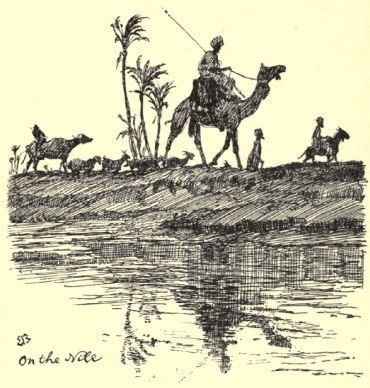
TO the East! What a thrill of pleasure those words caused me when they
meant that I was really off for Egypt. The East has always had for me an
intense fascination, and it is one of the happiest circumstances of my
life that I should have had so much enjoyment of it.
My childish sketch-books, as you remember, are full of it, and so are my
earliest scribblings. To see the reality of my fervid imaginings,
therefore, was to satisfy in an exquisite way the longing of all my
life.
The Gordon expedition was my opportunity, and it was a bold and happy
conception of W.’s that of my going out with the two eldest little ones
to join him on the Nile when the war should be over. I may say I—and
the British Army—had the Nile pretty well to ourselves, for few
tourists went up the year I was there. But I had to wait some time at
Cairo and at Luxor before all trouble had been put an end to by the
battle of Ginniss, which closed the recrudescence of rebellion that
burst out after the great Khartoum campaign.
The emotion on seeing the East for the first time can never be felt
again. The surprise can never be repeated, and holds a type of pleasure
different from that which one feels on revisiting it, as I have so often
done since.
One knows the “gorgeous East” at first only in pictures; one takes it on
trust from Delacroix, Decamps, Gérôme, Müller, Lewis, and a host of
others. You arrive, and their pictures suddenly become breathing
realities, and in time you learn, with exquisite pleasure, that their
most brilliant effects and groups are no flights of fancy but faithful
transcripts of every-day reality.
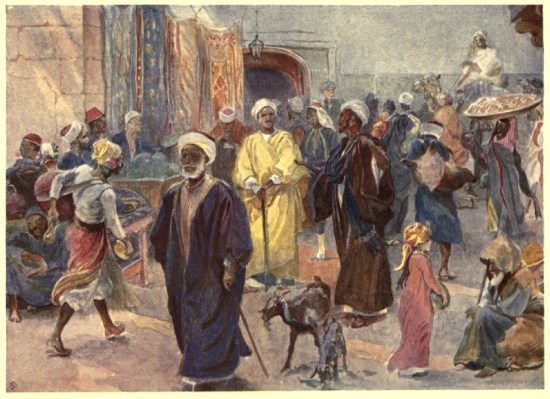
IN A CAIRO BAZAAR
But at first you ask, “Can those figures in robes and turbans be really
going about on ordinary business? Are they bringing on that string of
enormous camels to carry real hay down that crowded alley; are those
bundles in black and in white wrappers, astride of white asses
caparisoned in blue and silver, merely matter-of-fact ladies of the
harem taking their usual exercise? That Pasha’s curvetting white Arab
horse’s tail is dyed a tawny red, and what is this cinder-coloured,
bare-headed, jibbering apparition, running along, clothed in rattling
strings of sea-shells and foaming at the mouth? A real fanatic? That
water-seller by Gérôme has moved; he is selling a cup of water to that
gigantic negro in the white robe and yellow slippers, and is pocketing
the money quite in an ordinary way. And there is a praying man by
Müller, not arrested in mid-prayer, but going through all the periods
with the prescribed gestures, his face to the East, and the declining
sun adding an ever-deepening flush to the back of his amber-coloured
robe.”
It takes two or three days to rid oneself of the idea that the streets
are parading their colours and movement and their endless variety of
Oriental types and costumes for your diversion only, on an open-air
stage.
Cairo in ‘85, ‘86, was only at the beginning of its mutilations by
occidentalism, and the Oriental cachet was dominant still. To sit on
the low shady terrace of the old Shepheard’s hotel under the acacias and
watch the pageant of the street below was to me an endless delight.
The very incongruity of the drama unrolling itself before one’s eyes had
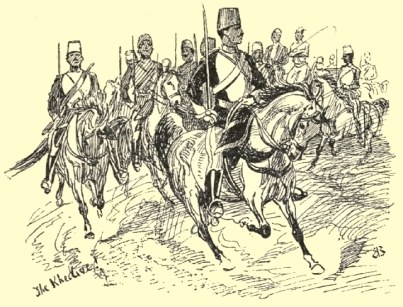
a charm of its own. Look at that Khedivial officer in sky-blue, jerkily
riding his pretty circus Arab. There follows him a majestic and most
genuine Bedouin in camel’s hair burnoos, deigning not the turn of an
eyelash as he passes our frivolous throng on the terrace; two Greek
priests, their long hair gathered up in knots under the tall black cap
and flowing veil, equal him in quiet dignity, and a mendicant friar
rattles his little money-box, like an echo of the water-seller’s cups
over the way, as a hint to our charity. An Anglo-Indian officer of high
degree is driven up to our steps in a ‘bus under a pile of baggage. He
has just arrived from India and is impressively escorted by various
Sikhs, whose immense puggarees are conceived in a totally different
spirit from that of the native turbans. A British hussar, smart as only
a British soldier can be, trots by on a wiry Syrian horse; a cab full of
Highlanders out for a spree bumps along the unpaved roadway. I confess
I was disappointed with the effect of our honoured British red. What did
it look like where the red worn by the natives was always of the most
harmonious tones!
See that string of little donkeys cheerily toddling along, all but
extinguished under their loads of sugar-canes that sweep the ground with
their long leaves; humble peasant donkeys, meeting a flashing brougham
with windows rigidly closed, through which the almond eyes of veiled
ladies of some high Pasha’s harem glance up at us and take us all in in
that devouring sweep of vision. Double syces run before such equipages.
French bugles tell us an Egyptian regiment is coming, and, meeting it,
will go by with a dull rumble a string of English baggage-waggons drawn
by mules and driven by Nubians, escorted by British soldiers in dusty
khaki uniforms; stout fellows going to the front, a good many of them to
stay there—under the sand.
About 5.30 P.M. weird music and flaring torches brings us out again on
the terrace, and we see a tumultuous crowd of pilgrims just arrived from
Mecca by the five o’clock Suez train. They gather the crowd by their
unearthly din and sweep it along with them. Beggars, flower-sellers,
snake-charmers, tourists, and touts are all rolling along in a
continuous buzz of various noises. Perhaps the full escort of cavalry
jingles past our point of observation and the native crowd salutes the
Khedive. Not so the British officers on the terrace, who keep their
seats.
But what was all this to diving into the old city, and in a ten minutes’
donkey ride to find oneself in the Middle Ages; in the real, breathing,
moving, sounding life of the Arabian Nights? Then when inclined to come
back to our time and its comforts, which I am far from despising, ten
minutes’ return ride and the glimpse into the old life of the East
became as a vision. For what I call the pageant of the street in front
of Shepheard’s was much too much mixed with modernity to allow of so
complete a transformation of ideas.
The bazaars of Cairo have been painted and written about more than those
of any other Oriental city. The idea of my having “a try” at them seems
to come a little late! But if it is true that, as some croakers say,
Old Cairo is gradually dying, I feel impelled to lay one flower of
appreciation beside the grave which is ere long to close.
What a treat, to put it in that way, it was to rove about in the reality
of the true East, to meet beauty of form and colour and light and shade
and movement wherever one’s eyes turned, without being brought up with a
nasty jar by some modern hideosity or other. This was contentment. You
know what a bit of colour in sun or luminous shade does for me. Think of
my feelings when I walked through the narrow streets where the rays of
the sun slanted down through gaps in the masonry, or, as in some,
through chinks in the overhead matting—now on a white turban, now on a
rose-coloured robe relieved against the rich dark background of some
cavernous open doorway, now on a bit of brass-work. The soft tones of
the famous Carpet Bazaar in noon-day twilight, with that richness of
colour that tells you the invisible sunshine is somewhere,
fulfilled—yea, over-filled—my expectations, and close by in real
working trim were the brass-workers tinkering and tapping musically, the
while smoking their hubble-bubbles in very truth. The goldsmiths, in
their own particular alley, were sitting in the rich chiaroscuro of
their little shops waiting for me.
Added to those feasts for the eyes were the sounds which pictures could
not give me—the warning shouts of the donkey-and camel-drivers, the
“by your leave” in Arabic, followed by the shuffling sound of hoof and
foot in the soft tan; the tinkling of the water-sellers’ brass saucers;
the cries, like wild songs in the minor, of hawkers of all kinds of
things. Then the scents, also unpaintable. Incense, gums, tan, ripe
fruit, wood-smoke. And the smells? Ah, yes, well—the smells, goaty and
otherwise. They were all bound up together in that entirety which I
would not have deleted.
There was one particular angle of street in front of I forget what ripe
old mosque, before which I would have liked to establish myself all day.
The two streams of passers-by, human and animal, ceaselessly jostling
each other, came at one particular hour into a shaft of sunlight just at
the turn where I could see them in perspective. Now a splendid figure in
yellow robe and white turban, accentuating the streak of gold to
perfection, occupied the centre of the composition and I would make a
mental note: “daffodil yellow and white in intense sunlight; dull
crimson curtain in shade behind; man in half-shade in dark brown, boy in
indigo in reflected light”—when in the shaft of light now appeared a
snow-white robe and rosy turban, putting out the preceding scheme, till
a hadji in a turban of soft bluey-green and pale-blue drapery came to
suggest a very delicate emphasis to the rich and subdued surroundings.
In the first fresh days how mysterious these covered streets appear,
these indoor thoroughfares, muffled with tan, where towering camels and
shuffling donkeys and curvetting horses seem so astonishingly out of
place.
Anglo-Egyptians who have to live in Cairo smile at my enthusiasm, and
tell me they get tired of all this in time, and they are certainly
helping to attenuate the charm. A late high official, on leaving Egypt,
in his farewell speech told his audience that that day had been the
happiest in his life, for he had seen the first “sandwich man” in the
streets of Cairo. Since then another charming form of advertisement from
the go-ahead West has appeared over the minarets of the
alcohol-abhorring Moslems—a “sky sign” flashing out against the stars
the excellence of somebody’s whisky. Can they now say “the changeless
East”? And what a whirlpool of intensely Western amusements you may be
sucked into if you are not wary. You may hide in the bazaars but you
cannot live there, and teas, gymkanas, dances, and dinners will claim
you for their own as though you were at Monte Carlo or still nearer
home. In fact I have found New Cairo a little London and Monte Carlo
rolled into one.
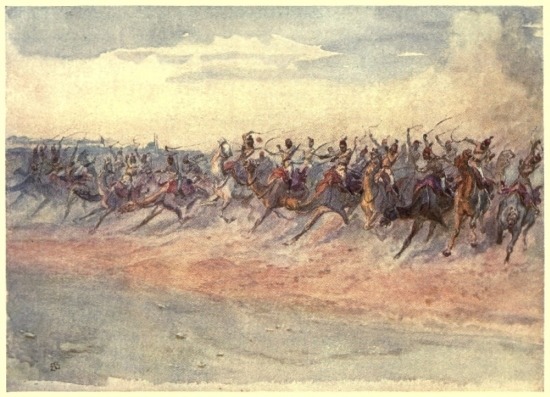
THE CAMEL CORPS
One glimpse of the vanishing Past which I got on a certain Friday at
Cairo has left a queer impression on my mind, not at all a happy one. I
am told the howling and dancing Dervishes have been lately suppressed,
and I am dubious as to the fitness of us Christians being witnesses of
those performances. However, I went, and saw what one can no longer see
in Cairo. I found it difficult to believe those men were in real
earnest, otherwise I should have felt more painfully impressed, but even
as it was it was a disagreeable sight to witness the frenzied creatures
flinging themselves backwards and forwards in time with the
ever-increasing rapidity of the tom-toms till their long hair swept the
floor at one moment and flew up straight on end towards the great
vaulted interior of the mosque the next. Gasping shouts as of dying men
escaped them rhythmically, and when the bewildering music had reached
its climax it stopped, and so did they, and the priest, with gestures of
loving commiseration and encouragement, very gracefully fell on their
necks and gave them a drink of water each in turn. All this went on
in a faint light from the hanging lamps, and the heat became
suffocating. Mrs. C. put her hand on my shoulder, and pointing upwards
asked me, “What is that?” A little white figure had appeared on a ledge
high up under the drum of the dome. Whether man, woman, monkey, or
goblin, I never saw a more impish figure, and it squatted there looking
down from under its hood. I saw many very queer beings in Egypt as time
went on, and decidedly the British occupation has not exorcised all the
old magic of the Egyptians. But I have never played with it as some do.
Not from fear, but from dislike. I am told in sober truth, people who
came to scoff have begged to be let go when spell-bound with horror at
what they have seen in a drop of enchanted ink spilled on a table.
We have sometimes played tricks on those people with imitation magic,
but never more successfully than did our friend Sir James Dormer out in
the Great Desert, when he struck the Bedouins dumb by taking out his
glass eye, which they, of course, believed to be his own, tossing it in
the air, and replacing it. He had great power over them, I should say,
for ever after. Brave man, he was killed shortly after in India by the
wild animal he had wounded and who sprang on him on his blind side. I
think a man with a single eye is doubly brave who goes out
tiger-shooting in the jungle.
A much wholesomer diversion than the Dervishes was provided by the then
General in command at Cairo a few days later, when some three hundred of
the Native Camel Corps were put through a series of splendid
manœuvres out in the great open spaces of Abassieh, beyond the Tombs
of the Mameluks. I got out of the carriage when warned that the final
charge was about to be delivered, and stood so as to see them coming
nearly “stem on.” It was a sight worth seeing, and surprising to me,
who, before I landed, had never seen a camel worthy of the name. When
the “halt!” was sounded, down fell the three hundred bellowing creatures
on their knees in mid-career, close up to us, and the panting riders
leapt off, their accoutrements in most admired disorder, and their
puttees for the most part streaming along the ground. I was in a hurry
to get back to Shepheard’s to take the impression down, for I was
greatly struck by so novel a sight. The red morocco-leather saddle
covers were most effective, and very sorry I was on my next visit to
Egypt to find they had gone the way of all “effective” bits of military
equipment, and were replaced by dull brown substitutes. Henceforth I was
an enthusiastic admirer of that most picturesque of animals, and though
I approached the camel at first with diffidence and apprehension, I soon
found him much easier to draw than the horse. What you would like to
do with a horse to give him movement and action, but mustn’t, you
may do with a camel. You can twist his neck almost indefinitely and
brandish his great coarse head as you like, and his long legs give you
carte-blanche for producing speed. I found out a curious fact as time
went on and I had dogged dozens of camels about the desert and made
orderlies walk them up and down for me—namely, that the camel moves his
legs in the walk precisely like the horse, but when he falls into a
trot he moves the legs of the same side forward together. He walks like
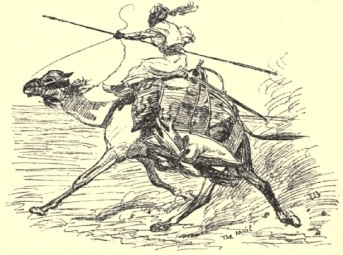
a horse and trots like a camel! As to the gallop, a more dislocating
performance I never saw. Lady —— once told me she had, by an unlucky
chance, got on a baggage camel with a hard mouth, or rather nose, and
it ran away with her in the wide, wide desert. She hauled in the nose
rope with the strength of despair, till the detestable animal’s face
was twisted back taut into her lap and was looking at her, and still
the body galloped forward without the remotest check. She artistically
left the end of the adventure untold.
As to the camel’s noises, I don’t think I ever got to the end of them.
The snarl and the grunt I was prepared for—the horrible querulous and
sickening sound that some one has likened to the roar of a lion and the
grunt of a pig combined; but one day, as I was making a study of one of
these ungracious creatures for a big picture, I thought I heard a sweet
lark warbling somewhere, and I marvelled at its presence over the
Egyptian desert. The warblings came from the camel’s throat, and there
was a look in his eye that seemed to warn me that he considered the
sitting had lasted long enough. The length of his neck suggested that I
was within measurable distance of a bite, and I dismissed my sitter and
his lanky rider with promptitude.
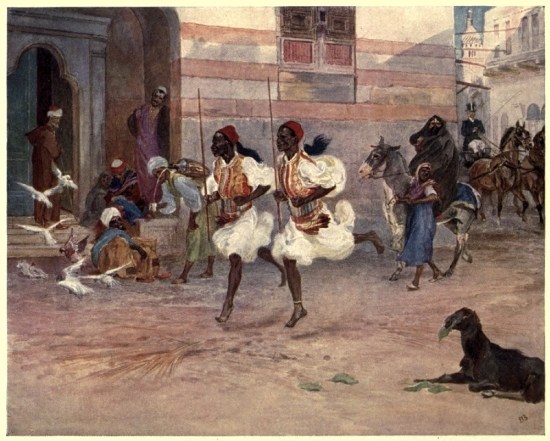
Of all the figures that delighted me in Cairo those of the syces soon
became first favourites. The dress, the springing run, the beauty of the
movements—I don’t think the human figure could be more charmingly shown
off. The English General’s syces alone wear the scarlet jacket, and
deep indigo blue or maroon are the usual colours for the liveries of
those mercuries. Our fast-trotting horses now try them too much, and we
don’t let them run very far, but take them up after a little while. They
were intended to trot before the ambling horses or donkeys of Pashas, to
clear the way with shouts and sticks through the crowded bazaars. I saw
a lady (alas!) driving a very fast English horse past Shepheard’s in a
rakish T-cart, and the unfortunate syce was constantly on the point of
being knocked down by the high-stepper. It did not add to the
smartness of this turn-out to see this panting creature looking over his
shoulder every minute in terror of the horse, and sometimes, when
flagging in his run, being overtaken and having to run alongside. I
levelled mental epithets at the thoughtless driver, and wondered how
such a thing could be. Some of us are curiously inconsiderate. I am
afraid she was but a type of many. Witness the suffering horses bitted
up with tight bearing-reins standing for hours outside shops and smart
houses where “at homes” are going on, when a word from the fair owners
to their ignorant coachmen might procure ease for their miserable
beasts. I am not enthusiastic about motors, but I am thankful for the
fact that they are greatly reducing the sufferings of our poor “gees.” I
hope by and by the motor will be made noiseless and odourless, for at
present I cannot enjoy its country driving. The scents of the country
are replaced by smell and the sounds by noise.
You are better friends with the motor than I am, and have gathered much
advantage from its audacity in taking you up, for instance, such rugged
heights as those about Tivoli, well within a morning’s outing from Rome,
which I have looked at as inaccessible, and only to be admired from a
lowly distance; those remote cones crowned with mediæval towns that
figure in the backgrounds of many an “Adoration of the Magi” and “Flight
into Egypt.”
I am, like you, of two minds about very rapid travel. There is something
to say for and against it. “For” it, the freshness with which the mind,
untrammelled with the bodily weariness of “diligence” or “vetturino”
jogging, receives impressions of points of interest; “against” it, the
hustling of venerable monuments and reverenced natural features which
should be approached with more ceremony. There is too much hustling
nowadays. I don’t know that I enjoyed my last visit to Venice quite as
much as usual, feeling apologetic and guilty in participating in the
“bumping” of the gondolas by the electric boats, whose back-wash sends
them hopping and lurching in such an undignified manner. The sedate,
gracious gondola, too well-bred ever to be in a hurry, “knocked out of
time” by a fussing little electric launch, which is always in a hurry,
with or without reason! What with the hurry, and the whistlings, and
puffings, and syren-bellowings, the powers that be are actually
succeeding in making Venice noisy. But I have got off the Egyptian track
a long way.
After a visit to Sakkara and to the Pyramids and the Sphinx I shall
launch out upon Old Nile at once. Our Sakkara day was typical of many I
was to experience in this strangest of lands—full of the delights, then
new to me, of donkey-riding through the fresh winter air of the desert,
but donkey-riding over tombs. Sakkara is the necropolis of Memphis,
itself long buried, that capital of the Pyramid Period that looms dark
far behind the nearer glories of Thebes and the Temples.
My hilarity induced by the sun, the breeze, the absurd goings-on of the
donkeys of our party was constantly damped by the weird reminders we
constantly came upon. Those Sakkara pyramids lack the majesty of the
Pyramids, and one looks at the amorphous heaps in an oppressed silence.
The Tomb of Ti raised one’s spirits by its vivid frescoes showing the
every-day life of that Prime Minister’s ménage: it was cheery to see
the poulterer in brilliant colours bringing in the goose to the cook,
but the final extinguisher fell when we were conducted along an
avenue—a sandy causeway—lined on either side with I forget how many
sarcophagi of sacred bulls. Each granite sarcophagus was, as far as my
memory could say, of exactly the same dimensions and of almost the same
shape as that of the great Napoleon at the “Invalides”! And all for
bulls.
It was crushing; but well for me was the scamper back to the Cairo
train. You cannot afford to be pensive riding a donkey at that pace with
an Arab saddle to which you are not yet accustomed.
THE ENGLISH GENERAL’S SYCES
I am not going to dare to try to say anything new about the Pyramids of
Gizeh or the Sphinx; nothing new in any shape can come in contact with
these monuments. One feels overcome with hoariness oneself by their mere
proximity and silenced by the weight of ages. I am not going to ask you
to follow me into any interiors, for I did not go in myself; and
indeed, in my progress through this land of tombs, I protested more or
less successfully against burrowing into sepulchres, shuffling in thick
gloom through pungent and uncanny mummy dust, in bat-scented atmosphere,
while above-ground the blessed light of that matchless sky and the
uplifting air of the desert were being wasted. Polite compulsion on
certain social and festive (!) excursions alone forced me to forego for
a while the joy of that “to-day” above-ground for the mould of the dead
Aeons below.
I refer to a letter for my first visit to the Pyramids. That first sight
of anything one has read of and pictured in one’s child’s mind in the
course of education is a most precious occurrence, to be chronicled and
set down at the moment.
30th November ‘85.—“A sweet gentle morning; limpid air, lovely fresh
clouds in a soft blue sky. We started at 11 in a carriage, with our
dragoman, and were soon taken at the usual hand gallop over the big iron
bridge with the colossal green lions at each end which spans the wide
Nile, into the acacia-shaded road which runs for a long distance in an
imposing straight line to almost the very base of the great Pyramid. As
we sped towards the illustrious group which we saw rising grey and
stern at the very edge of the desert where it meets the bright green of
the cultivated land we alternately looked ahead at what was awaiting us
and at the ever-interesting groups of men, women, children, and animals
which we passed, and at the mud villages with their palms and rude domes
and minarets which lay in the well-watered, low-lying land on either
side of the road. From the first moment I saw the Pyramids afar off I
knew I was not destined to be disappointed, and my apprehensions caused
by some travellers’ descriptions vanished at the outset. It is difficult
to put my feelings into words as I came nearer and nearer to these
wonders of man’s work, so pathetic in their antiquity and in the
evidence they give of their builders’ colossal failure to ensure for
their poor bodies absolute safety during the long waiting for the
Resurrection. The seals are broken, the secret places found out, the
contents gone to the winds!
“My beloved father was constantly in my mind to-day, for he it was who
with such patience taught us the value and fascinating interest of old
Egyptian history, and here were some of the scenes he used to read to us
of so often, but which he himself was not allowed to see.
“Mrs. C—— and I, on getting out of the carriage, first made the
circuit of the Great Pyramid—a space of ‘thirteen statute acres,’ I
remember Menzies telling us. I found that the most striking point from
which to feel the immensity of the Pyramids is in the centre of the
base, not the angles.
“We hear of ‘weeping stone.’ Here is stone that has wept blood and
tears! Each succeeding year of the king’s reign forced an additional
coating to his tomb, and prolonged the slave-toil under the lash—all to
safeguard a little dust that has now vanished. This age of ours is about
the time the old Egyptians looked to for the Great Awakening, for which
all their poor mummies were embalmed.
“How intolerable these three Pyramids must have looked when new and
entirely coated with white marble. Their glitter under the blinding
sunlight and the hardness of their repellent shapes make me shudder as I
realise the effect. Seen in the rough, as they now are, they do not jar,
but only oppress the mind by their ponderous immensity, and the eye
takes great pleasure in their tawny colouring.
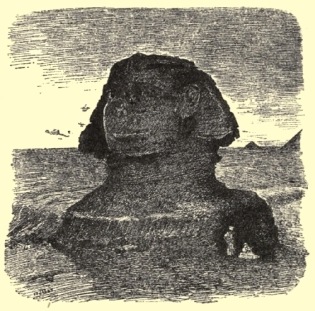
“We next went down to the Sphinx and rested a long while in its broad
shadow. The gaze of the eyes is exceedingly impressive, and though the
face is so mutilated one would not have it restored. Strange that one
should prefer the broken nose and the hare-lip! It would not be the
Sphinx if it had the universal Sphinx face as originally carved.
Originally! When? It was there long before the Pyramids, and it now
appears that more than the ‘forty centuries’ looked down upon Napoleon’s
army from their summits. Sixty centuries, some say now. Time is
annihilated as one stands confronted with the Sphinx, and a feeling of
annihilation swirls around one’s own microscopic personality.
“This annihilation of Time is one of the sensations of Egypt. Look at
Rameses the Great in his glass coffin in the Cairo Museum. There, more
than ever, the intervening cycles are as though they had never been as
one stands face to face with Sesostris. More appalling than the
Sphinx—a chimera in stone—here is the Man. Not his effigy, not his
mask taken after death, but the Man! There is his hair, rusted by the
Ages, his teeth still in their sockets, the gash across his forehead
cleft in battle. His father lies in the next glass case, his grandfather
on the other side, and many other Pharaohs similarly enclosed in glass
and docketed lie around, all torn out of their hiding-places, stripped
of their multitudinous envelopes, and exposed to the stare of the
passers-by. Their mortuary jewels are ticketed in other glass cases, and
only a few shreds of winding-sheet adhere to their bodies. They were
religiously preserved, at infinite pains, for this.
“From the entrance to the Great Pyramid in the north face I had an
enchanting view of Cairo on the right, in sun and shadow with a sky of
most beautiful cloud-forms, and on the left the lovely pearly and rosy
desert stretching away into the golden West. How cheerily, how
consolingly the wholesome, refreshing Present receives us back after
those wanderings down the corridors of the dead Ages! Let us wash our
faces and smile again and feel young. The drive back was exhilarating
and full of living interest. We overtook shepherds guiding their flocks
along the road and carrying tired lambs on their shoulders. There were
buffaloes and oxen and ploughmen going home from work in the tender
after-glow, and then as soon as we were over the big iron bridge and in
the suburbs again it was dark, and the gas lamps were being lighted, and
‘Tommy Atkins’ was about, and British officers were riding in from
polo, and the cafés of this Parisianized quarter were full and noisy,
and I felt I had leapt back into To-day by crossing an iron bridge that
spanned six thousand years. My thoughts lingered long amongst the most
ancient, most pathetic, most solemn monuments of the pre-Christian
world.”
AND now for Luxor. Of all the modes of travel there is none, to my mind,
so enjoyable as that by water—fresh water, be it understood—and if you
can do this in a house-boat with your home comforts about you, what more
can you desire? We had the “Post Boat” to Luxor, and the sailing
dahabieh after that. Travelling thus on the Nile you see the life of the
people on the banks, you look into their villages, yet a few yards of
water afford you complete immunity from that nearer contact which travel
by road necessitates; and in the East, as you know, this is just as
well. Not that I really allow the drawbacks of the East to interfere
with my own enjoyment, but the isolation of the boat is best, especially
with little children on board.
I had read many books of travel on the Nile and knew what to look for.
Is there not a charm in knowing that some city, some temple, some
natural feature you have tried to realize in your mind is about to
appear in very truth just round that bend of road or river? You are
going to see in a few minutes that historic thing itself, not its
counterfeit in a book, but it. And so, as we neared Luxor towards
evening, I looked out for Karnac on the left, and lo! the first pylon
glided by. My first pylon! How many like it I was to see before I had
done with Old Nile. They are not beautiful in shape, nor can any
Egyptian architecture, as far as form goes, be called beautiful; the
shapes are barbaric—I had almost said brutal—stupidly powerful and
impressive by mere bulk. The beauty lies in the colouring. What a feast
these ruins afford to the eye by their colour, what a revel of blues,
greens, and low-toned reds in their unfaded paintings! Taken as bits of
colour only, without dwelling too much on the forms, all in such light,
the shadows filled with golden reflections—taken thus, or deeply tinged
with the lustrous after-glow, or the golden moonlight, they are
all-satisfying.
REGISTERING FELLAHEEN FOR THE CONSCRIPTION
I will not, however, burden you with these ponderous pylons and
mammoth monoliths; they can only be enjoyed in situ, illuminated and
glorified by the climate of their homes. Indeed, I felt often very
oppressed and tired by them, but never did I weary of the landscape, the
people, the animals, the river.
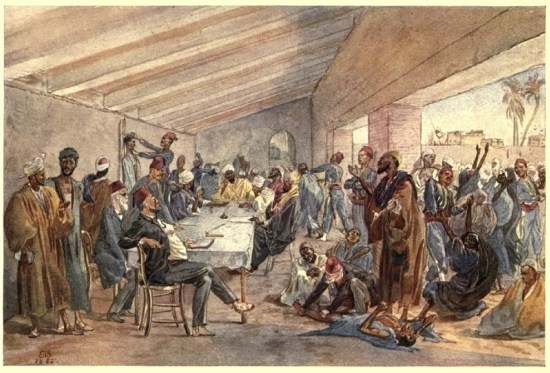
One very saddening glimpse of fellah life was afforded Mrs. C—— and
myself at Luxor by the English Consul (a negro), who arranged that we
should see the registering of the young fellaheen for the conscription.
I think the British have changed all this lately, so we were lucky in
seeing a bit of the vanishing Past—a remnant of the Oriental Past which
no one can regret. We worked our way, led by the Consul, through the
Arab crowd in the village till we came to the entrance of the courtyard
where the drama was about to open. At the gate was a scuffling mass of
indescribably hideous old hags—the mothers and aunts and grannies of
the young fellahs inside, wailing and jerking out their lamentations
with marionette-like action of their shrivelled arms. As though by one
accord they would stop dead for a minute and look at each other, and
then all together begin again the skeleton chorus, throwing dust on
their heads. The unsavoury group came in with us pell-mell when the
gate was opened, and we found ourselves hoisted rather than conducted to
a divan prepared for us under a shed, from whence we could see all that
passed.
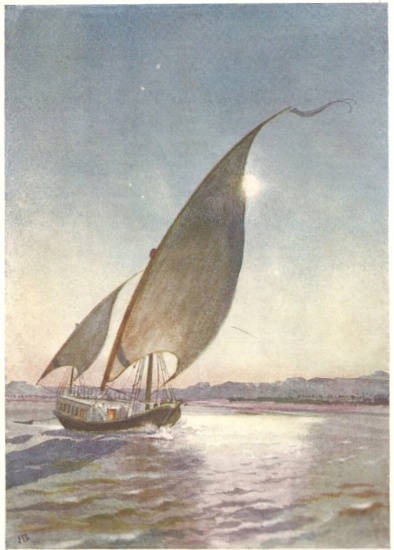
“NO MOORING TO-NIGHT!”
Three Circassian inspectors, looking horrid in European clothes, were at
the head of a long rickety table, covered with a white cloth, in front
of us. This white cloth, in combination with the surging groups, made a
wonderfully good blank space in the composition of what I thought would
make a striking picture. The sketch I insert here is in no particular
arranged by me, but everything is exactly as I saw it. I noted
everything down in my sketch-book on the spot. The sheiks, stately men
in silken robes, who had brought each his quota of recruits from his
district, sat chatting over their coffee at the farther end of the
table, and the doctor at once set to to examine the miserable youths
that came up for registration. Fathers pleaded exemption for their sons
on one pretext or another, such as leprous heads, blindness, weak
chests, and so forth; the mothers, aunts, and grannies aforesaid went on
jibbering and clacking their jaws in the background, no one paying the
least attention to them. If a fellah was passed by the doctor a gendarme
gripped him and pummelled him all the way to the standard, where he
was measured. If satisfactory, the woe-begone creature received a
sounding box on the ear, just in fun, from the gendarme, and was shoved
into the pen where the successful (!) candidates were interned; if he
was below the mark, all the same he got his blow, and was pushed and
cuffed back to his friends and relatives. One mother had crept forward
while her son was having his lanky leg straightened by the doctor, the
father pleading the boy’s lameness (Erckmann-Chatrian’s Conscript
orientalised!): a gendarme sprang forward and knocked her down, then
hauled her off by her arms, which were so very thin and suggestive of a
mummy that I could not look any longer; he was so rough I really thought
he would pull them out of their sockets. My friend was crying, and if I
had not been so concentrated on my pencil notes I should have cried too.
“Surely,” she said, “that can’t be his mother, she looks a hundred at
least.” “A hundred!” I exclaimed, “she is four thousand years old—a
mummy!” I felt very sick as well as sorry. We were politely offered
coffee in jewelled cups, which we could not taste, and surreptitiously
emptied behind the divan.
The English have worked wonders since those days with the Egyptian army.
Taking the young men in the right way our officers have turned them into
remarkably smart-looking soldiers, and their terror of the service, I am
told, has vanished.
This was altogether a day which showed us the seamy side of Egyptian
life, for in the evening we and all the guests of the hotel went to see
the dancing at the café, a sort of mud cave full of wood smoke. It was
all very ugly and repulsive, and the music was impish and quite in
keeping. I was glad to have this experience, but once is enough. Talking
of music, I don’t know anything more appealing in its local sentiment
than the song of our crew when they were hauling and poling on calm
nights later on. Strange, unaccustomed intervals, and the key always in
the minor. In the pauses we heard the beetles and crickets on the banks
chiming in in a cheerful major.
Our sojourn at Luxor was a time of deep enjoyment, for we made almost
daily excursions on both banks of the Nile, excursions beginning in the
very early mornings, at sunrise, and ending in gallops home on our
donkeys in the after-glow, or trips on board the ferry-boat, from
Thebes, in a crowd of splendid Arabs, whose heads, figures, and blue
and white robes, or brown striped camel’s hair burnouses, added greatly
to the charm of the landscape. It was a joy merely to breathe that
desert air. All that was wholesome and not too tiring, nor risky from
the sun, was enjoyed by the children with us, but I kept them chiefly in
the paradisaical hotel garden as the safest place. One had to be very
careful. I cannot say that “black care” did not sometimes ride on my
donkey’s crupper, for I knew W. was pressing the enemy harder every day,
and that a battle was imminent. At last the great telegram came. Ginniss
was fought and won, and all the enemy’s guns and standards taken. He
sent me the message from the field. We might now come up. It took a day
or two to get the “Fostât” ready—the dahabieh which he had sent down
for us. Some wounded officers from the front brought news of the battle,
and, strange to relate, the only officer killed at Ginniss was son of
one of Mrs. C.’s oldest friends! What strange things happen in life. I
had met young Soltau the year before at her house on Dartmoor, and she
and I were destined to hear together of his death in battle on the Upper
Nile.
We set sail in the first week of ‘86 for Assouan, where W. was to meet
us, and I witnessed the daily development of the Nile’s beauties with
the deepest pleasure, and a mind no longer over-shadowed.
I wonder how many people who have been to Egypt recognise the fact that
all its beauty is reflected? It is either the sun or the moon or the
stars that make Egypt glorious. Under thick cloudy skies it would be
nothing. But the co-operation of the illuminated objects is admirable,
and the two powers combined produce the Egypt we admire. W. and I came
to the same conclusion, that much of the glory of the moonlights is
owing to the response of the desert, especially the golden desert of
Nubia.
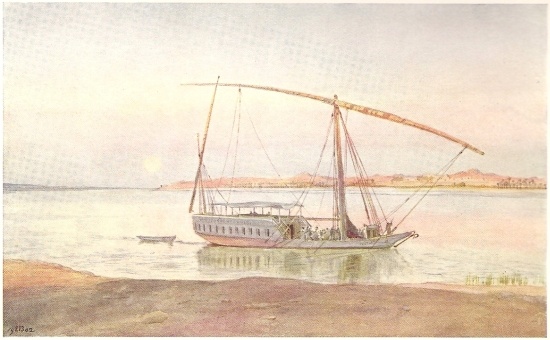
THE “FOSTÂT” BECALMED
But I have also seen, on rare occasions, delicate effects of veiled
sunshine on river, palms, and desert too exquisite in refinement to be
easily described. I remember one memorable grey day which we spent in
turning the loveliest river reach of the whole series below Assouan, the
wind having completely dropped—a day which dwells in my memory as a
precious passage of silvery colour amidst all the gold. The palm-tree
stems towards sundown were illuminated with rosy light against the
pallid background of sand-hills facing the West, and of the delicate
pearl-grey sky. The greens were cool and vivid, the water like a liquid
opal. I wrote a whole letter to Mamma on that one grey day on the Nile.
But even that evening the after-glow made itself felt through the
clouds, lighting them from behind in an extraordinary manner, so that
the filmy screen appeared red-hot. The beautiful cloud-veil could not
shut out so fervid a rush of colour.
When a strong wind blows the desert sand into the air, obscuring the sun
and thickening the sky, what a change comes over the scene! Egypt is
then undoubtedly ugly, and all charm flies away on the wings of the
blast.
But the blast speeds the dahabieh on its way, and pleasant it was
sitting of an evening in the cosy saloon to see the hanging lamp
swinging with the motion of the bounding “Fostât,” and to hear the
creaking of the timbers, for the distance from Assouan, where W. was to
meet us, was being sensibly diminished. On some other evenings the fair
north wind was just enough to quicken the pace without dulling the
brilliant light of the moon, and there was to be no tying up under the
mud bank those nights. Then again a dead calm might come down upon us,
and after poling, tracking, or hauling up to the kedge anchor all day to
their monotonous sing-song, the crew would have orders to moor for the
night. I would then venture a run along the shore with the children, and
have a scamper among the palms and cotton plants, which were waving and
rustling mysteriously to imperceptible sighings of the air at the
water’s edge. One or two armed men, of course, landed also.
At Esneh I had the honour of entertaining the Pasha of that wonderful
place, whose temple I had particularly wished to see. He received us
with much ceremony, and we all went on shore escorted by his guard in
great state, walking through the bazaars accompanied by the wild and
ragged population. But for the soldiers and their whips we could not
have moved a yard. We visited the wonderful temple, the first we had
seen with the ceiling intact, which the colossal pillars were made to
support. I prefer the ruins so open to the sky that the sun may be seen
amongst them. Here, owing to the unbroken ceiling, all was gloom. At
Edfoo I was to see a whole temple with pylons and all, almost in
perfect preservation, and to know the Egyptian temple in its entirety.
How funny our party looked—two English ladies, two little children, and
English maid, guarded by bashi-bazouks, slowly progressing through a
crowd of indescribable dirt and wildness. We looked into an oil mill
where the press was exactly like the wine-presses in Tuscany. You
remember the one I sketched at Signa, the picturesque Strettojo of the
vintage? We poked our noses into the cavernous recesses where gigantic
negroes were dyeing the native cloth a splendid indigo, their black arms
blue to the shoulder. Oh, what colour!
On going back to the dahabieh we all, except myself, had our fortunes
told in a narrow lane where a row of Soudanese fortune-tellers were
squatting with patches of smooth sand before them on which they made the
person interested impress his or her hand. Upon the impression they made
many signs and marks. Everything was quite satisfactory. The children
were to have “pleasant paths in life and strong loins.” The maid was
to marry a white man, which was a comfort.
In the evening the Pasha dined on board. He spoke in French, and nothing
could surpass the florid eulogies he bestowed on “his brother, that
lion,” my husband. I saw him depart on his sleek and fat white ass,
which stood quite fourteen hands, and was equipped in Arab trappings of
indigo and dead gold. In the morning I received the Pasha’s presents of
fruit, vegetables, eggs in hundreds, two live turkeys, and a black lamb.
A gorgeous cavass in sky blue and carrying a wand of office was
installed on board for the rest of the voyage to Assouan. There had been
feasting and much thumping of tom-toms and whinings of curious fiddles
on deck during dinner the night before, where the crew were entertaining
the Pasha’s body-guard. My dragoman’s bill next day included these
items: “Trinks and trymbals for the crew”; “hay for the limp.” The poor
black “limp” with his hay was put into the little boat in tow, and I had
to deliver him up, as a matter of course, to the crew a few days later.
Then came Edfoo, whose temple is one of the most conspicuous in Egypt. I
had been on the look-out for its mighty pylons with especial eagerness,
and I was glad that we had time to spend two hours on land while some
repairs were being done on the “Fostât.” The Esneh cavass was useful
as well as extremely ornamental, as he kept off the wild crowd in the
village by magical waves of his wand of office, and an occasional thump
on a screaming villager.
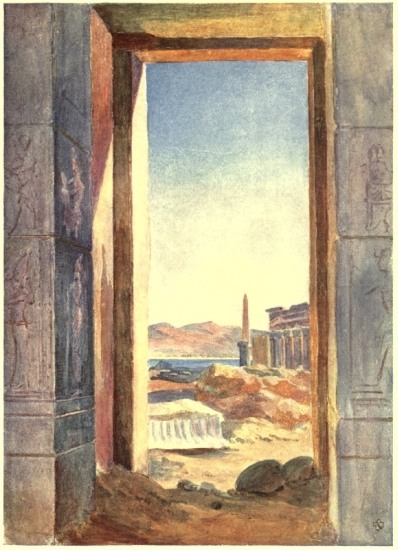
AT PHILÆ
The guard turned out and saluted our party, and altogether things went
very well, and I enjoyed my long-looked-forward-to Edfoo.
Then on board again, with a steady north breeze which, if it had filled
our eyes with sand at Edfoo, was making up for the discomfort by
carrying us in spanking style towards Assouan and the meeting.
After one of our fair-wind nights, when the “Fostât” was bowling along
over the lumpy water, I asked the reis if we had come to Comombos. He
made vigorous signs showing we had passed it in the night. “Silsileh?”;
again the welcome backward wave of his arm. That, too, was long passed.
We were getting very near. I noticed the people on the banks were
becoming blacker and there were fewer of them; the mountains had
vanished and were replaced by lion-coloured sand-hills, typically
African. The black rocks looked like sleeping crocodiles.
A faint whisp of smoke presently rose beyond a bend of the river, far
ahead. “What is that?” I asked the dragoman. “English steamer.” Great
excitement. The little armed steamer puffs into sight; some one is
waving a red handkerchief from the turret! “Furl the “Fostât’s”
mainsail!” The crew swarm up the spar. Ding, ding goes the electric
bell on the gunboat. The meeting is an accomplished fact—we from
Plymouth, he from Wady Halfa. We are soon at Assouan, and while the
“Fostât” is being hauled by great gangs of negroes through the
cataract, we are guests of the General in that command on board his
charming dahabieh moored under Philæ. There the solemn rocks echo the
waltzes of the military band and the talk and laughter of our réunions
on board the “Pharaon.”
If the Egyptian desert answered back in harmonious tones the light of
the sun and moon, what a crescendo of glowing response came from the
Nubian sands! Immediately we crossed the frontier my eyes were surprised
by the golden tone the desert had assumed, and the polished rocks that
studded it had suddenly put on the richest colours granite holds—deep
red and purple, and the black of basalt. It was a new scheme of
colouring. The sunset and the after-glow were still more astonishing
than those of Egypt, the colour of the shadows on the golden sands at
sundown more positive in their limpid colours. One felt looking at the
stars and planets as though one had been lifted to a world nearer to
them than before, so large and clear had they grown even from the
extraordinary clearness they had at Luxor. Oh! land of enchantment, is
it any wonder the Nile is so passionately loved, especially by the
artist, to whom the joy of the eye is supreme? As to worthily painting
the Egyptian landscape, I cannot think any one will ever do it—the
light is its charm, and this light is unattainable. There is one thing
very certain, oil paints are hopelessly “out of it,” and in
water-colours alone can one hope to suggest that light. I soon gave up
oils in Egypt, not only on account of their heaviness, but the miseries
I endured from flies and sand were heart-breaking; your skies are seamed
with the last wanderings and struggles of moribund flies, and coated
with whiffs of sand suddenly flung on them by a desert gust! I was
particularly anxious to get a souvenir of the doorway in the court of
the temple on Philæ Island, where Napoleon’s soldiers engraved their
high-sounding “Une page d’histoire ne doit pas,” etc. Unfortunately,
on the day I chose, we had a high wind, a very exasperating ordeal, and
my attempt at oil-sketching this subject was a fiasco. After persevering
with one half-blinded eye open at a time and with sand thickly mixed
with my paints, I saw the panel I had been desperately holding on the
easel hurled to the ground on its buttered side as for a moment I turned
to answer a remark of Mrs. C.’s. She said I bore it angelically. As
since those days lovely Philæ Island is being submerged and the temple
melting away, the poor little panel has become more historically
valuable than I thought it ever would do at the time, and I insert its
replica in water-colours minus the smudges.
Many pleasant hours we spent at Philæ, which, I suppose, is the
culminating point of the Nile’s beauties and marvels. One day, while W.
was gone to Assouan for provisions, I went over with Mrs. C. to the
opposite bank of the river by boat, an imp of a small boy taking upon
himself to escort us. He divested himself of his one garment, which he
carried in a bundle on his head, and swam alongside our “felucca.” Our
approach had been observed from a wild mud hamlet up on the fantastic
rocks, and a bevy of black and brown women came hopping and skipping
down to us. Little shrivelled old hags and wild little young women with
nose rings and anklets, their hair plaited in hundreds of little tails
reeking with castor oil, each little tail ending in a lump of mud.
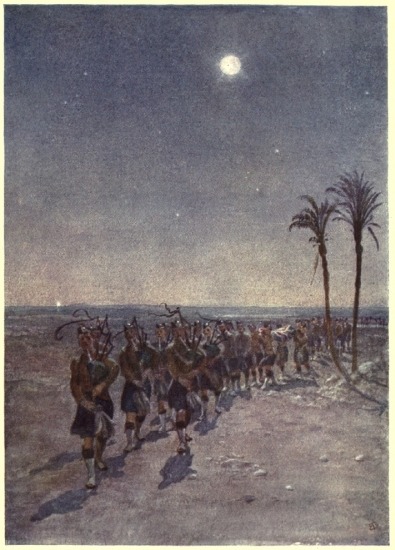
A “LAMENT” IN THE DESERT
Mrs. C. asked them to unfasten and display their locks, and in return
let down her own six-foot-long auburn tresses and stood on them to
“astonish the natives.” They danced and wailed in slow cadence, softly
clapping their hands and wagging their heads in admiration as they made
the round of the tall, rosy Englishwoman. There she stood, on her hair,
that trailed on the sand, in a golden halo of sunshine, the grim
hypæthral temple and the huge rocks as background, and surrounded by
little skinny, skipping, half-naked, barbarian women and quite-naked
little children. They turned to me and made signs that I should also let
my hair down. Because I excused myself, the little boy imp, still with
his garment on his head, came forward and took upon himself
condescendingly to explain to the little women, shouting “Mafeesh,
mafeesh!” (“Nothing, nothing!”) and dismissing me with a wave of his
arm.
From Philæ we soon glided into the Tropics. I say in a letter: “The
moonlight in Nubia also surpasses that of Egypt, and I see in it a light
I never saw before I came to this wonderful land. It is difficult to
describe this light. It is brilliant yet soft; light in darkness; not
like the day; not like the dawn: the sky at full moon is so bright that
only the larger stars are seen; and the yellow sand, the ashen bloom on
the tops of the sand-hills, the various tones of green in palm-tree,
tamarisk, and mimosa keep distinctly their local tints, yet softened and
darkened and changed into a mysterious vision of colour too subtle for
words of mine. Every night Venus and other great planets and stars shed
reflections in the still water like little moons in every part of the
Great Stream wherever one turns.”
W. could not spare the time for lotus-eating under sail, so a
“stern-wheeler” towed us from Philæ to Wady Halfa. It took very little
away from the romance, and the steady progress was very grateful. On
that glassy river, as it was now, we would have been an age getting to
our goal.
I was greatly struck with Korosko, a place which, besides its natural
desolate and most strange appearance, was sad with memories of Gordon.
This was his starting-point as he left the Nile to travel across the
desert to Khartoum, never to return. From a height one can see the black
and grey burnt-up landscape which lonely Gordon traversed. It is a most
repellent tract of desert just there, calcined and blasted. A view I had
of the Nile, southward, from the mountains of Thebes one day, though
bathed in sunshine, has remained most melancholy in my mind, because,
looking towards Khartoum, I thought of the hundreds of my countrymen who
lay buried in already obliterated graves all along those lonely banks,
away, away to the remote horizon and beyond, sacrificed to the
achievement of a great disaster. Others like them have arisen since and
will arise, eager to offer their lives for success or failure, honours
or a nameless grave.
One evening, as the “Fostât,” in tow, was skimming through the calm
water with a rippling sound, and we were all sitting on deck, W.
described to us so vividly a memorable night before the fight that put a
stop to hostilities, that I could see the whole scene as though I had
been there. They were out in the desert, the moon was full; the
Dervishes were “sniping” at long range, when afar off was heard a
Highland “lament.” The “sniping” ceased all along the enemy’s line and
dead silence fell upon the night but for the wail of the bagpipes. The
Dervishes seemed to be listening. The “lament” increased in sound, and
presently the Cameron Highlanders approached, bearing, under the Union
Jack, the body of an officer who had died that day of fever, to add yet
another grave to the number that lay at intervals along the shores of
the great river. You should hear the pipes in the desert, as well as on
the mountain-side, to understand them.
“Every phase of the day and night” (letter, 12th January ‘86), “appeals
to me on the Nile, not forgetting those few moments that follow the
after-glow which are like the last sigh of the dying day. The delicacy
of those pure tints is such that one scarcely dares to handle them in
writing. Evening after evening I have watched by the desert death-bed of
the day, looking eastward so as to have the light upon the hills.
“Those tender, sad, pathetic hills, and beyond them the mournful
mountains, possessing nothing,—not a blade of grass, not a lichen, not
a herb; they are absolute paupers amongst mountains, and they might be
in the moon, these derelicts, so bereft are they of all things.
“And yet the light, the atmosphere, give them a consoling beauty. What a
poem might be written to them as they look thus for a minute or two
before the dark-blue pall of night sinks down!”
Wady Sabooah, the “Valley of Lions,” was one of the most striking things
I had seen on this exquisite section of our river voyage. The abrupt
sand-hills held shadows of the most delicate amethyst at noonday which,
combined with the gold of the sunlit parts, produced a delicacy of
vibrating tones which enchanted the eye but saddened the artist’s mind,
recognising as it did the futility of trying to record such things in
paint! But I shall weary you with all this daily rapture, and I will bid
good-bye in these pages to the desert, well named by the Moslems “The
Garden of Allah.” There is no pollution there, and He may walk in His
garden unoffended.
In the first really hot days of March I and the children came home—Wady
Halfa was becoming no place for us, and W. remained with his Brigade
through the weary days of summer, unknown in their exhausted and
horrible listlessness to me who will always think of the Nile as an
earthly paradise. One halt I must make on our way down, at Abu Simbel,
that mysterious rock temple I had longed to see in the first ray of
sunrise, for it faces due east. W., who accompanied us as far as
Assouan, gave orders that our stern-wheeler (the old “Fostât” had been
dismissed) should tie up overnight at the temple, and before daylight I
was up and ready. I had packed my water-colours and had only a huge
canvas and oil-paints available. With these I climbed the hill and
waited for the first ray in the wild wind of dawn.
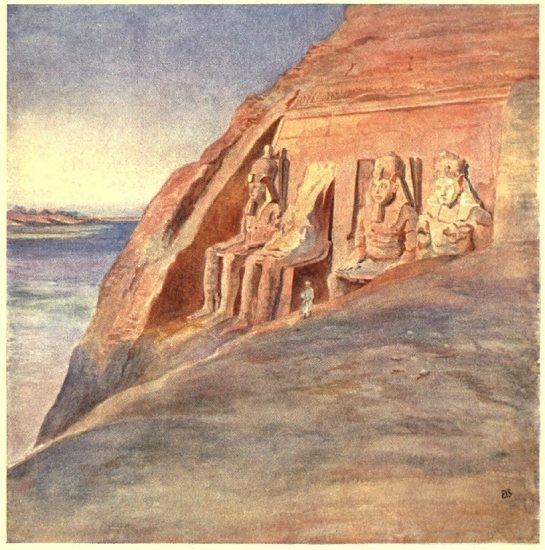
The event was all I hoped for as regards the effect of those “scarlet
shafts” on the four great figures (how many sunrises had they already
awakened to?) “A great cameo,” Miss Amelia Edwards calls that façade at
sunrise in her fascinating book, and that phrase had made me long for
years for this moment. But alas! my canvas acted as a sail before the
wind and nearly carried me into the river, the sand powdered the wet
paint more viciously than ever, and I returned very blue to breakfast.
Still, I had got my “Abu Simbel at Sunrise,” and I insert a water-colour
taken in comfort from the hard-earned but scarcely presentable original.
ABU SIMBEL AT SUNRISE
OUR subsequent experiences of Egypt at Alexandria from ‘90 to ‘93 made
me acquainted with the Delta and that “Lower Nile” which has a very
particular charm of its own, and possesses the precious advantage of
being out of the tourist track altogether.
Not the least amongst the attractions of an Egyptian command (to
Madame!) is the yearly autumn journey to that country through Italy,
with Venice as an embarkation point. Madame knows nothing of the
horrors of the summer months endured by the “man on duty” out there, and
serenely enjoys “the best,” without the seamy side ever turning up. She
thinks that to spend one’s winters on the Nile, and one’s summers in the
“Emerald Isle,” is as near an ideal existence as this world allows us.
It is good to be a woman!
That farewell scene at Venice on board the P. & O., when friends came to
see us off with bouquets and “bon voyage”—how I should like just one
more of those gay leave-takings! I see again the dancing gondolas on the
sparkling ripples as they wait round the ship; the hat and handkerchief
wavings ashore and afloat, and Venice encircling the sprightly little
drama with her gracious arms.
Who that has plied between Italy and Egypt does not know the poetry of
that first night at sea, when the cloud-like mountains behind the
vanished Venice have also faded away, and there is nothing for it now
but to turn to the darkling Adriatic, heaving dimly beyond the ship’s
bows, and commit oneself to the mercies of the deep. “And the
dinner-bell,” some one is sure to add. Never shall it be said of me that
I chronicle the meals of my little travels.
The next morning the cessation of vibrations and throbbings wakes you.
Behold through the port-hole Ancona’s white church high up overhead,
shining in the level sunbeams of the young day.
The morning after that it is Brindisi, where they wait for the “long
sea” passengers and the mails, and the Italian chatter and laughter
along the quays never stops. Here, in the course of a
stroll, you may pat the two pillars that form the winning-post of that
Appian Way whose starting-post you know in Rome.
There is very little monotony in a voyage of this kind, for you are
never for long out of sight of land. The Albanian coast, the Ionian
Islands, Crete, “Morea’s Hills”—what a series of lovely things to
beguile the six days’ passage! Yet, all the same, one has a thrill of
delight one day when an unusual stir amongst the crew begins, and the
hatches over the heavy baggage-hold are opened, and the lifting gear is
got into position. “We shall be in at daybreak.” Bless the captain for
those words! And the “man on duty” aforesaid will be standing on the
landing-stage.
W. arranged a good studio for me at our new post, but I had
distractions. British and Foreign naval squadrons occasionally bore
down on us with thundering salutes, and had to be attended to;
distinguished and even august personages paused at Alexandria on their
way “up”; picnics on horse-back, donkey-back, camel-back, by road, rail,
and river, to Aboukir, Aboo-sir, and sundry oases all claimed my
delighted co-operation, plus my unsociable sketch-book.
Ah, the good good time, the golden Egyptian days!
But I found nothing so interesting as a holiday we managed to squeeze in
and spend on board a little dahabieh for two, on a nine days’ cruise to
Rosetta and back. I then knew the Western Delta and, superficially, the
life of its neglected and forgotten people. I am much afraid that since
the Assouan Dam and its doings, their meagre water-supply is anything
but increased, and I pray that the English authorities may remember
those poor people at last. They are like fish in a pond that is slowly
drying up.
MADAME’S “AT HOME” DAY; SERVANTS AT THE GATE
On board the little “Rose,” lent us by an Armenian Bey, I tasted once
more the placid pleasure of fresh water travel under sail and oar; and I
again heard the strange intervals of the songs that kept the oarsmen in
time at their work. But I also learnt what Egyptian rain was like,
and how hideous the Mahmoudieh becomes under weeping skies. I saw in
this land the deepest and ugliest mud in the world—mud of the colour of
chocolate. The weather cleared usually towards evening, and nothing more
weird have I ever seen than the villages, cemeteries, solitary tombs,
goats, buffaloes, and wild human beings that loomed upon the sky-line on
the top of the banks against the windy clouds, reddened by the fiery
globe that had sunk below the palm-fringed horizon. These canal banks
might give many people the horrors, and I certainly thought them in that
weather the uncanniest bits of manipulated nature I had ever seen.
At Atfeh, after three days’ canal, we emerged upon the wide and glorious
Nile, and the skies smiled upon us once more. But the sadness of the
country remained to us as we contemplated the miserable villages which
occurred so frequently, with their poor graveyards at their sides, the
latter only distinguishable by the smaller size of the dwellings, and
the fact that the huts of the living had doors, and the huts of the dead
had none—that was all.
Once on the swift Nile current, with the eight sweeps flashing and
splashing to the rhythm of the strange singing (the prevailing north
wind being against sailing), we made a good run down to Rosetta, on
whose mud bank we thumped in a surprising manner, at 10 P.M. by a pale
watery moonlight.
Never have I seen anything sadder than the land we passed through that
day—dead, neglected, forlorn. Every now and then what seemed a great
city loomed mistily ahead of us, with domes and minarets, and what
seemed mighty palaces, piled one above the other on stately terraces.
These apparitions were on the sites of once magnificent centres of
wealth and luxury, and from afar they might still appear to be what once
they were. Then, as we neared them, the domes unveiled themselves into
heaps of filthy straw; the palaces were mud hovels a few feet high; the
great mosques were merely poor half-ruined tombs into which a single
person could scarcely crawl. The illusion occurred every time we came in
sight of one of these phantasms, and the effect on the mind was most
singular. City after city arose thus on one’s sight in the distance, as
though seen through the long ages that have rolled by since their prime,
and those long ages seemed like a veil that rapidly dissolved to show
us, as we approached, the wretched reality of to-day. “The pride of
life,” “pomp,” “arrogance,” “luxury,”—those epithets were their own
once, while to-day the very antitheses of such terms would best become
them. They are literally all dust now, and there survive only the poor
blunt-shaped dwellings for living and dead, that lie huddled together in
such pathetic companionship.
As the daylight fades we see the people creeping into their shelters
like their animals, to wait, like them, in the unlighted darkness, for
the coming of the morning. Their up-river fellow-workers live in a land
where the hardships of this cold and muddy winter misery are unknown.
I was glad to see the Rosetta mouth of the Nile, thus completing rather
an extended, as well as intimate, knowledge of the great river from
there to Sarras in the Soudan. Return tickets to Khartoum had not yet
taken travellers by rail up the Nile in so many dusty hours.
Still grey was the weather down to where the river merges into the
melancholy sea, between Napoleon’s two dismantled forts, and what beauty
there might have been was densely veiled. The old French “Fort St.
Julien” was interesting as being the place where the “Rosetta Stone,”
which gave the key to all the Egyptian hieroglyphics, was discovered.
There we moored for the night on our return to Rosetta, in a Napoleonic
atmosphere, and next day I sketched the once opulent commercial city,
where now nothing seems doing. A bald old pelican caused some movement
in the streets by raiding the odoriferous fish-market and scurrying
down, chased by small boys, to the water’s edge where I was sitting, in
order to float, by copious draughts, the fish that lay in his pouch down
his throat, pill-wise. The pelican always got his pill down in time, and
the race to the river was repeated more than once with the small boys.
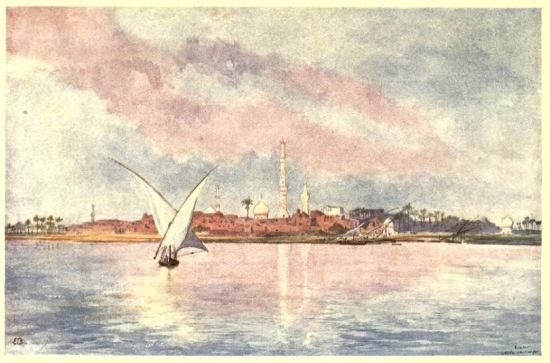
On another evening, on our return voyage, we moored under the wild town
of Syndioor, whose minaret, the tallest, I should think, in the world,
proved to be no phantom, but a lovely and solid reality. In the pearly
light of the succeeding mornings the shining cities looked, through
their misty veils, more lovely afar off than ever. Finally we dropped
back again between the mud banks of the canal, and in due time landed
under the oleanders of our starting-place, the crew kissing hands and
paying us the prescribed compliments of farewell.
Our major-domo, Ruffo the European, was with us on board. I must tell
you of Ruffo; such an honest man in a country of much corruption! He did
all my housekeeping, and that zealously; but, desiring sometimes to
consult me about dinner, his figurative way of putting things before me
was a little trying. “Miladi, would you like cutlets?” patting his ribs;
“or a leg?” advancing that limb; “or, for a very nice entrée, brains?”
tapping his perspiring forehead. “Oh no, Ruffo, never brains,
please!” He would rejoice in strokes of good luck in the market, and
fly through the sitting-rooms to me, perhaps bearing, like a gonfalon, a
piece of beef, where good beef was so rare; “Look, miladi, you will not
often meet such beef walking in the street.” He always smelled the
melons on presenting them to me, to invite my attention to their
ripeness.
After Cairo, Alexandria struck me very disagreeably at first; but when I
got over its Western pseudo-Italian garishness, I was able to console
myself with many a precious bit of orientalism, and even the bizarre
mixture of flashy European tinsel with the true native metal amused me
so much that I ended by enjoying the place and in being delighted to
return there for yet another winter, and another. Nor can I ever forget
that this appointment afforded us the most memorable journey of our
lives—the ride through Palestine!
Not even the drive on the old Shoubra Road at Cairo surpassed the
Alexandrian Rotten Row on the Mahmoudieh Canal on a Friday afternoon in
its heterogeneous comicality. Every type was on the Mahmoudieh, in
carriages, and on horseback—Levantine, Greek, Jew, Italian, Arab; up
and down they rode on the bumpy promenade, under the shade of acacias
and other flowering trees that skirted the picturesque canal. Across
this narrow strip of water you saw the Arab villages of a totally
different world; and I really felt a qualm every time I saw a fellah
over the way turning his back to the western sun (and to us) to pray, in
absolute oblivion of our silly goings-on. On our side was Worldiness
running up and down, helter-skelter; on the other, the repose of Kismet.
Here comes a foreign consul—you know him by his armed, picturesque
ruffian on the box—in a smart Victoria, driven by a coal-black Nubian
in spotless white necktie and gloves; the Arab horse is ambling along
with high measured action. Much admired is Monsieur le Consul—the
observed of all observers; he looks as though he felt himself “quite,
quite.” But “Awah, awah!” Here come at a smart leaping run two shouting
syces turbaned in the Alexandrian fashion; and behind them a barouche
and pair driven by an English coachman of irreproachable deportment.
What thrilling rivalry is here!
Exquisite horses with showy saddle-cloths there are, with le sport on
their backs in the person of “young Egypt” in the inevitable tarboosh.
That tarboosh! It is the “bowler” hat of the East, and I don’t know
which I hate most—it or the “bowler.”
The ladies are overwhelming; and I rest my eyes occasionally by watching
the demure feminine figures of the “East end” who are filling their
amphoræ under the oleanders over the way, or washing their clothes and
their babies in the drinking water supply of the native town.
Towards sunset there is a sauve qui peut of equipages citywards, and I
never heard such a din as is set up as soon as the soft roads are passed
and the paved streets are reached. Over it all you may hear:—
The tow-row-row and the tow-row-row
Of the British Grenadiers.
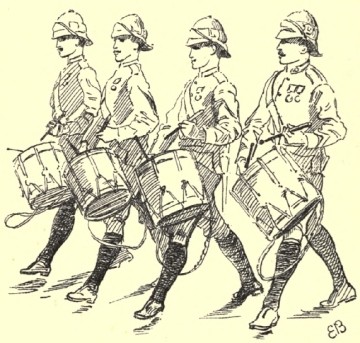
The Suffolks or the Surreys are marching from Mandara Camp to the sound
of that drum which we like to remind ourselves “beats round the world.”
SYNDIOOR ON THE LOWER NILE