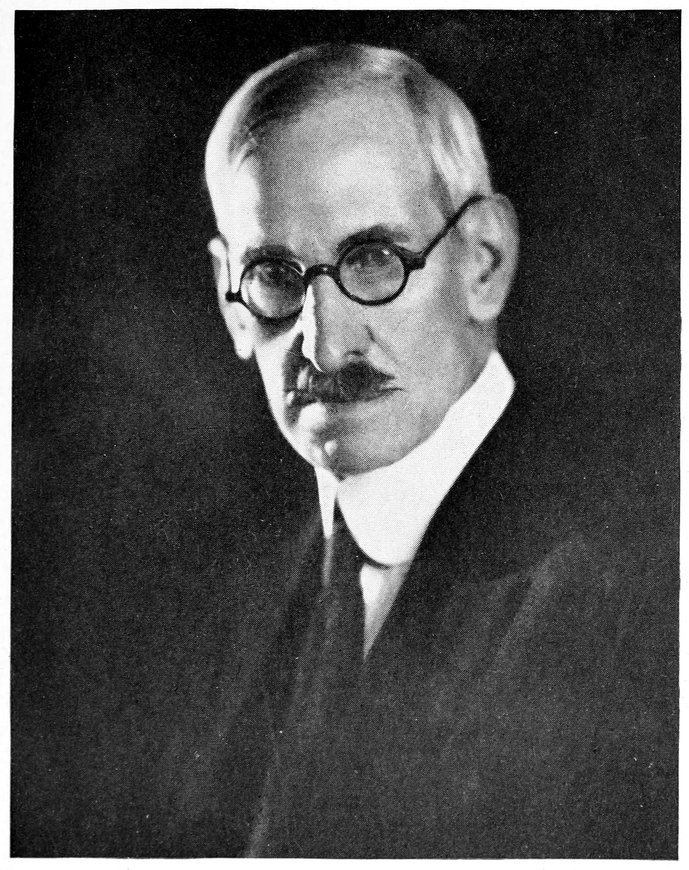
If some curious reader, chancing upon this foreword
to the narrative of the life of Edward Simmons, should
require my reason for calling it an Interruption instead
of an Introduction, I might reply with the obvious
evasion that so distinguished a painter as Edward
Simmons needs no introduction.
The recipient of medals innumerable, and the most
flattering mention in every European capital, surely
should need no introduction even in his own country,
many of whose public buildings and galleries are
enriched by examples of his work in decoration,
portraiture, or genre.
But this, as I have said, would be an evasion and not
my true reason for calling my preface an interruption,
and since the curiosity that can drive a reader to the
perusal of matter that is essentially deterrent, wholly
superfluous, and probably dull must be of a persistence
that will brook no gainsay, I will make a virtue of compulsion
and narrate for that reader’s private enlightenment
a story of a very personal nature concerning
Mr. Simmons, the telling of which I had rather hoped
to avoid.
The story, in so far as it is related to the title of this
preface, speaks for itself, and since it bears upon a
personal characteristic of the painter, inherited, I am
told, from generations of oratorical forebears, a characteristic
which also speaks for itself, I must ask the
reader to regard it as strictly confidential and to allow
it to go no further.
xPicture then, Curious Reader, a Boston dinner
party at which Mr. Edward Simmons as guest of
honor is exercising without let or hindrance the
lingual accomplishment bequeathed to him by generations
of eloquent forebears, and demonstrating to a
fresh audience that the supposed “lost art of conversation”
was not so much lost as cornered.
A dinner party, however, even a Boston dinner
party, has in addition to its social and intellectual
side a practical, alimentary aspect not to be ignored
by anyone, particularly an artist. And since the act of
obtaining nourishment employs the function of swallowing,
and the function of swallowing cannot be successfully
synchronized with that of speech, there were of
necessity occasional brief pauses in the flow of oratory.
It was at the moment of one of these unavoidable
pauses that a lady (to be remembered, as was the
“clergyman” who interrupted Dr. Johnson, only by
her temerity) seized the opportunity to get a word
in edgewise.
Now the traffic laws that regulate the respective
movements of the human pharynx and larynx are as
inexorable as those that govern our public highways,
and at the same instant that the lady opened her
mouth to speak, the Edwardian larynx resumed its
right of way.
“Oh, pardon me, Mr. Simmons, I interrupted you,”
was all she could manage to gasp.
“Madam,” replied Simmons, with the Chesterfieldian
smile the gift of which many an Academician
would give all his decorations to possess—“madam,
no one can speak without interrupting me!”
xiAnd that is why I have chosen to call my impertinent
preface to a narrative which for human interest
can (to my thinking) be compared only to that of
Benvenuto Cellini, an— But pardon me, Mr.
Simmons, I am interrupting you!
Oliver Herford.
Introduction A Yankee Heritage
xiii
For years I have wanted to make two cartoons—the
first, dated 1800, to be simply a lovely woman holding
a baby, and called, “New England with Her Child
America.” In the second, dated 1900, the mother,
New England, is grown old and, clad in a poke bonnet
and mitts, is sitting in a carriage with her son, America,
who is now a bearded man smoking a black cigar.
He is driving, the horse is running away, and she is
trying to grab the reins. He yells:
“Ma, if you don’t stop that there will be trouble!”
I was born in the middle of the last century, when
this bearded man was still a youth, and I have watched
his struggles throughout the years, until, without his
mother’s realizing it, he has slipped quietly from home
to go out and mingle with the rest of the world, leaving
her, a toothless and old grandma, to sit by the fire and
dream that she is still the young mother of the cartoon.
My ancestors were the Pilgrims, that first group of
adventurers who embarked upon the Mayflower in
search of a far-off land where they might worship in
peace. They had not the qualities of the Puritans who
came later. The Pilgrims were the impractical dreamers,
and in one year were lectured by their backers because
they spent too much time in prayer and too little in
trade. The blood of nineteen different people who
made that voyage flows in my veins and, try as hard
as I may, I have never been able to find that this pure
xivEnglish lineage had been broken during the first
hundred years in America and certainly not for centuries
before that in the old country.
From them has come to me a want of deference,
bred in them by a hatred of kings; a lack of rhythm—the
nasal twang began by a desire to ridicule the
Mother Church and ended by becoming a virtue; and
an intense hatred of restraint in any form.
From my father I must have received whatever
artistic leanings I possess, although I believe them to
be only a form of Yankee handicraftsman-ship. He
was a better carpenter than a preacher, and his sketch
book is filled with careful copies of many old masters
which he saw abroad. I owe a deep debt to some one
for curbing his imagination in one instance, however,
for he wrote to an intimate friend on the day of my
birth: “I have waited to reply to your letter that I
might announce the name we had chosen for the
bouncing boy whose voice I can now hear upstairs.
But, since this year they have seen fit to take from us
Daniel Webster and the Duke of Wellington, I think
I shall name him Duke Webster.”
My father died before I was old enough to know him,
but I got quite a vivid picture of his side of the family
from a distant relative whom I met by accident one
day. He said: “The Simmonses have always been
a long-legged set of lazy galoots. We have had great
success with the other sex. We have been able to do
one thing a little better than other folks and stick
to it until we have about a thousand dollars—then
we sit down and loaf until it is gone.”
Mother was different. When she was a girl she had
xva serious talk with her dad, telling him it was foolish
for her to study piano or music of any kind.
“What is your ambition?” he asked.
“To scrub a kitchen floor better than anyone else,”
she replied; and he succumbed, his New England nature
realizing that, after all, it might be well to have
one practical person in the family. Mother’s thrifty
streak came in very useful, for a young widow with
four lusty children to feed did not have an easy time
in those days. The sun never rose upon her asleep
and her small economies were ever her own pride and
the butt of our selfish derision. After her day’s work
was over, it was my delight—little brute that I was—to
lie in bed and listen to her voice, reading to me from
some story of delicious adventure. When her head
drooped and the book fell from her hands, I, still wide
awake, would whine and finally yell, until she pulled
herself together and went on. Mother’s day was an
endless round of doing something for others.
From the land where these first American ancestors
of mine settled so long ago, I get the shape of my body
and the contour of my face. I look more like an
Iroquois Indian than an Englishman. Some historian
has remarked that the change in the Yankee is due to
intermarriage with the redskins. Imagine the spectacle
of a staid Governor Bradford wedded to an Indian
squaw! Two hundred years of the same climate, the
same food, and the same life produced the same type,
that’s all.
From Seven to Seventy
“Mon verre n’est pas grand
Mais je bois dans mon verre.”
Alfred de Musset
Chapter I: Making My Early History Concord, Massachusetts
1
There may have been much distinction in living
in Concord, Massachusetts, in the ’fifties,
but to me, as a boy, the whole town was only a
delightful playground and the people who lived
there merely “home folks.” To be sure, I invested
some of the great ones with halos of romance. This
was not because I knew anything about their literary
or artistic attainments, but rather because of the
lack of heroic characters in the town. Had there been
a Jesse James or a Charlie Chaplin anywhere round,
I should probably have woven my dreams of adventure
about them. But the jail was always singularly empty,
and the movies had not been invented. I was forced,
therefore, to pin my youthful imaginings upon a
Hawthorne, an Emerson, or a Thoreau! I have always
felt I was greatly cheated.
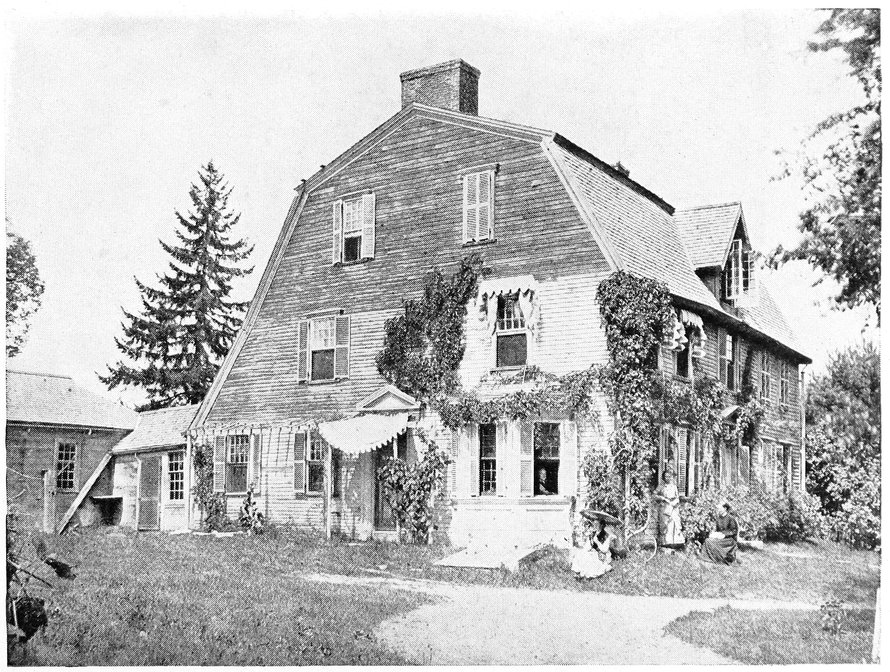
I lived in the Old Manse, from which Hawthorne
plucked his mosses. It was built in 1760 by the Rev.
William Emerson, the grandfather of Ralph Waldo,
and was a delightful house for a boy to grow up in.
There was a long hallway running from east to west,
and from the stairway a line of grisly divines, framed in
black, looked down. They were mostly ancestors, and
they gave a terrible air of austerity to the interior;
but below and above were many redeeming features.
One was the swing shelf in the basement, always
covered with fascinating goodies. Here on Saturday
2night one might cut with one’s jackknife a hunk of
juicy meat roasted ready for Sunday’s dinner, and
wash it down with cream from the shining pan of milk
next to it. Here were preserves, jellies, cakes, and
pies just cooling from the oven; while over in the
corner barrels of apples were stored away for winter
consumption. I shall never forget the delights of the
swing shelf.
The Old Manse was built in the manner of the
eighteenth century—entirely of wood, the oaken timbers
being held together with oaken plugs. We boys found
it quite easy to draw these from place, and we used
them for tholepins in our dory. Fortunately, the
grown-ups got on to us or I believe the house would
have eventually collapsed.
There was a gabled roof with chimneys at both
ends, and, of course, all sorts of wonderful nooks and
crannies to hide away in. It was up in this attic that
my grandmother Ripley was found by a caller rocking
a cradle with her foot and holding a book in her hand
which she was intently reading. It was written in
Sanskrit! She apologized because she needed a dictionary
to read this language. This was not so of
Latin and Greek, as she read them fluently; but she
used to say, “I cannot think in Sanskrit.”
She whom the name, “Peasant Princess,” fits better
than any other, was the wife of Emerson’s father’s
half-brother, and therefore older than Emerson. He
used to spend a great deal of his time with her at the
Old Manse, and she had much to do with influencing
his life. One can see this from his letters as a boy.
THE OLD MANSE AT CONCORD
At the window—Edward Simmons’s mother; Under the umbrella—his sister Elizabeth; Standing—his first cousin, Sarah Alden (Thayer) Ames; Seated—one of his cousins of the Bradford branch.
3My grandmother’s sitting room was the delight of
my life. There was a broad chimney shelf, and low
down on the left-hand side a framed bit of handwriting,
an invitation to Lieutenant Bradford to dine
with General Washington. Over that was a big hornet’s
nest, a stuffed owl, and, strangest of all, a copy of the
“Beatrice Cenci” and Titian’s “Tribute Money,”
brought back from Italy by my father. I always
thought, as a child, that the head of Christ was a
family portrait and that the Jew with the tribute money
was a tradesman. Why the tradesman was giving one
of us money instead of vice versa, I did not know.
Here in this room I used to dream until most likely
interrupted by some caller upon grandmother. Then
I would retire to the corner and listen to their conversation
about antislavery, human freedom, states’
rights, etc.—understanding not a word, but fascinated
by the fervor of the speakers. I have seen gathered
together in this parlor Emerson, Frank Sanborn,
Charles Sumner, and John Brown, the last short
and squat, his great beard upon his breast, and spreading
his coat tails before the fire like a pouter pigeon.
Something that occurred years later, when I was
a student at Harvard, made me appreciate my grandmother
more than ever. Prof. Asa Gray, a man of
seventy, and the first botanist of the world at that
time, met me in the Yard one day and stopping me said:
“I understand that your name is Simmons and that
you are the grandson of Mary Bradford Ripley?”
I replied that I was.
He took off his skull cap and bowed low to the
ground, saying, “Allow me to do honor to the offspring
of one of the ablest botanists I have ever known.”
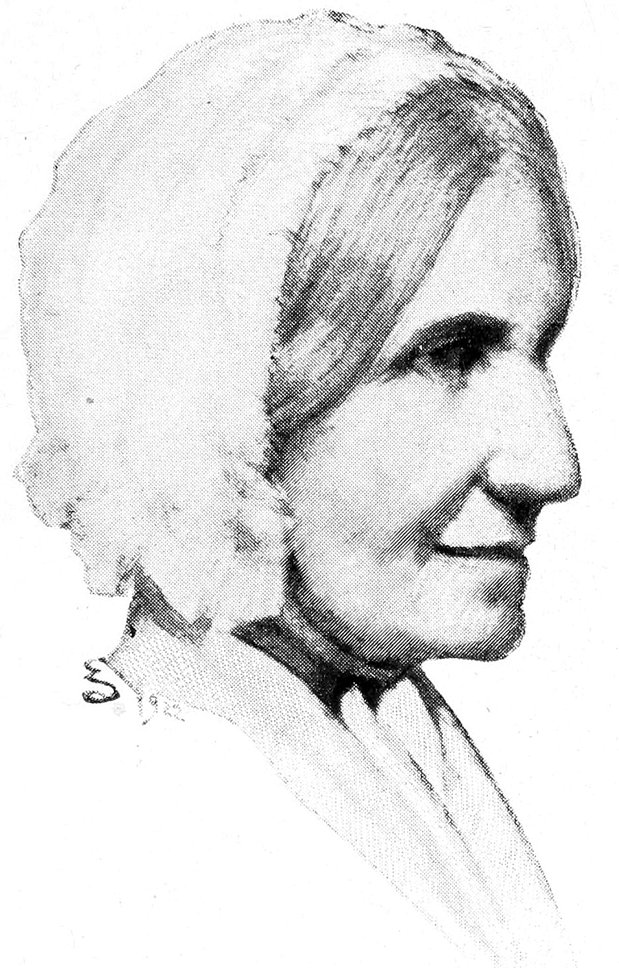
4I remember her looks well. Her features were very
marked and her nose big and straight. Her hair was
then white and she had blue-gray eyes. There is a
photograph of her sitting under a grape arbor, looking
very absent-minded, with the little finger of her left
hand hooked in the corner of her mouth—a habit of
my sister and both of my boys!
Grandfather’s salary as a Unitarian clergyman was
the munificent sum of six hundred dollars a year, and
on this my grandmother managed to bring up a large
family of children—doing all the cooking and sewing
herself—marry off three of the girls, and send the two
boys through college. “As big as Sam Ripley” was
the saying throughout the countryside, and, although
he was lusty and hail, my grandfather died when he
was in his prime—in fact, before I was born. The
circumstances of his death, which I heard when a
youngster, made a deep impression upon me.
It was the day before Thanksgiving. The Old
Manse was full of guests and relatives when he took
his daughter Elizabeth and, filling his buggy with
goodies, drove out to distribute them to his poor
parishioners. The last gift delivered, they turned
upon the road home, he remarking that the Widow
Hall would certainly enjoy the two chickens he had
left her. It was a rainy, bleak November night and
Lizzie, snuggling into the robes, almost went to sleep,
when, looking down, she noticed the reins were slipping.
She spoke to him, but he did not answer. Even then
she could not realize what the matter was, until,
reaching to gather in the lines, she felt his hand cold
beneath hers. He was already dead.
5I often used to think of that drive—the tragedy of
the young girl guiding the horse over miles of muddy
road in a blinding rain, and the arrival at the brightly
lighted house, full of laughter and merriment, with the
sad burden by her side. How did she tell them? Did
she call from the road, or did she leave him there
and go into the house? How could one tell what to
do under such circumstances? Perhaps the joyous
crowd ran out to meet her and there was a great
hush—they never told me that part. But I liked to
believe that it was my grandmother Ripley, who, all
alone, was watching from the doorway, and knowing
intuitively that something was wrong, took the whole
situation into her strong, capable hands.
Like all boys, I was intensely interested in birds and
animals. One day I was playing in the grass in front of
the Old Manse, when I suddenly looked up to see a
short man with a blond beard leaning over me.
“What have you there, Eddie?”
“A great crested flycatcher’s egg,” I replied.
This was a very rare find.
He wanted me to give it to him, but I would not.
Then he proposed a swap.
“If you will give it to me, I will show you a live fox,”
he said. This was too much to resist. We made a
rendezvous for the next Sunday.
Although descended from a line of parsons, I had
already learned that Sunday was, for me, merely a
holiday, and it was evidently the same for him. This
man was Henry D. Thoreau.
Accordingly, the following Sabbath I trudged down
to his place at Walden Pond, and he, who had “no
6walks to throw away on company,” proceeded to devote
his entire afternoon to a boy of ten. After going a long
way through the woods, we both got down on our
bellies and crawled for miles, it seemed to me, through
sand and shrubbery. But Mr. Fox refused to show
himself—and worse luck than all, I never got my
egg back! I have always had a grudge against
Thoreau for this.
Concord was a town utterly without crime. There
was no gazing into the jail windows to catch a glimpse
of the hideous offenders against the law. I never really
heard of but one prisoner in my life, and he was so
mild that he hardly made an impression. During
my time this man was the only inhabitant of the jail
and, technically, he did not belong there. A number
of years before he had been imprisoned for some offense,
and, after being released, returned and begged to be
taken in again, as he was lonely and had gotten used
to the place. So, one could see him ’most any summer
evening sitting out on the steps of the jail. He was a
great pet of the Emerson family, and was hired to
play the violin for all the dances.
One of my memories of the Old Manse is that of
the Thursday-afternoon visits of Ellery Channing, the
poet. I never saw anything written by him until I left
the town. He was always asked to supper and always
stayed, becoming thereby a part of the mental furniture
of the place. He was old, fattish, disorderly, absent-minded,
and to me so unæsthetic, that I knew he could
not be a good poet. I don’t believe he was. A humbler
than Thoreau, who practically occupied the same position
in the estimation of the Emersons. I remember
7with what was then for me horror, but now extreme
sympathy, that years before, his wife had left him because
she had insisted upon his having a carpet in his
study. This he kept patiently removing until, returning
from a camping trip, he found it firmly nailed to the
floor; so he pulled it up, tore it in strips, and hurled
it out of the window, thereby ruining the carpet and
both their tempers.
Another frequent caller upon our family was Charles
Sumner. I remember him most vividly upon one
occasion. He had come in for luncheon. Mother,
who left the intellectual part of the life to others and
always said, “I find philosophers have just as hearty an
appetite as other people—especially for pie,” was in the
kitchen, making this delectable dish. I was playing
upon the sitting-room floor. Suddenly I felt a hand
upon my head.
“My boy,” he said, “when you grow up you’ll find
out two things. One is that all men have mothers,
but I don’t think you will ever meet any other man
who has ever had a mother like yours.”
My father died when I was three years old and I
had always taken mother more or less for granted,
and I thought him very silly at the time.
I once asked mother how she came to be married.
My father, who had almost been tarred and feathered
in the South for his antislavery sermons, had fled
North and finally became the fashionable young
preacher of Boston. Mother was one of five sisters,
and said she was astounded when he asked her to marry
him, as she always supposed it was Lizzie he wanted—Lizzie
being the intellectual one. It was that way
8with mother. Brought up in an intellectual atmosphere
where learning was considered the only thing of
account, she was always surprised when anyone showed
a preference for her—a woman who would rather scrub
a kitchen floor than write an essay!
Mother’s democratic tendencies spread in every
direction. There was a pew in church that was supposed
to be reserved for the poor. “No one in the poorhouse
is any poorer than we are,” said mother, and marched
us into it every Sunday. The Old Manse pew was
farther up the aisle, and, besides, one had to pay
for that.
Although she was such a housewife, she had a great
independence of thought. A woman had come to
Concord, with no husband, and given birth to a child.
This, for New England at that time, was a terrible
scandal. The boy was my age and went to school. All
the other boys whispered behind his back as if he had
been in jail, although by this time his mother was
properly married to a young farmer up on Barret’s
Hill. No one ever spoke to her in church or bowed.
My mother, very quietly, every summer, put on her
best clothes and walked the mile or more up the hill
to call.
To me Hawthorne always typified the haughty Southerner.
I did not know what haughty Southerners
were like, but I had heard them talked about and
supposed they were very superior creatures—an idea
my worthy relatives would have promptly squelched
had they known it. Hawthorne was a hero to me,
and whenever I read a romance, such as Ivanhoe or
the “Iliad,” I pictured the conqueror as tall, broad,
9dark, and spare, with a dark mustache. This was the
way Hawthorne looked to me.
I would never have dared speak to him, and do not remember
having seen him at the house; but, of course,
the Old Manse was filled with memories of his presence.
I remember staring for hours at a time at the words
he wrote on the window of the dining room, and wondering
how he did it. It read:
“On this day my daughter Una was born, while the
trees are all glass chandeliers.”
What a sentence for a boy to dream about! It is
still there, and there are many other windows with his
name only.
I had never seen any diamond rings; none of my
womenfolk wore rings, and it seemed strange to me
how anyone could write on a pane of glass!
Hawthorne, contrary to public opinion, did not own
the Old Manse, but only rented it from the Ripleys.
In fact, he lived there only a year or more. It was a
great disillusion to find later that the grown-ups of my
family did not consider him a great hero, and in fact
thought his writing on the windows a horrible defacement
of the house—especially as they had had some
difficulty in collecting the rent.
My most vivid memory of Hawthorne is during the
time I was attending the intermediate school. In
front of the building was the town square, separated
from the school by an iron fence. Here we boys used
to play baseball, and upon going home, I, forgetful as
always, would invariably leave behind my dinner pail
or my jacket. I was invariably sent back to fetch it.
By this time the shadows had begun to fall, and
10very often I saw Hawthorne and his wife pass by,
arm in arm, she in white and he dark—dark as the
coming night. They spoke in low tones and seemed
to be oblivious of any passers-by. I was told that he
went out only at night, and this made him all the more
romantic to me. The truth was that he was very shy,
and so, in the daytime, went only into the woods in
back of his house. He was a great lover of children,
but so fearful of meeting them that he concealed
himself in a hollow tree in order to see the festival
that the school gave once a year.
Mr. Channing told me that once he was rowing with
Hawthorne on the Assabet River, the north branch of
the Concord. He remarked that the reflection of the
hemlocks in the water was unusual.
“Which is the reflection?” said Hawthorne, pointing
first to the hemlocks and then to the picture in the
water. This seems to me to be very characteristic
of Hawthorne’s method of thought.
Concord was an historical spot, and in the summer
was overrun with tourists, who, not content with
viewing the scene of the “shot heard round the world,”
etc., would invade the Old Manse. These gangs were
allowed to go all over the house in which Hawthorne
once lived, much to the discomfort and derision of the
occupants. One day, when I was still quite a young
man, there was a party of people upstairs nosing
around, and my uncle Gore (Judge Ripley) and I were
in the sitting room. My sister had brought in, not
long before, a long, draggly bit of Spanish moss and
put it on the chimney shelf. While the tourists were
upstairs, my uncle rose and, taking the moss, went to
the front door, where, climbing upon a chair, he hung
it. It trailed down three or four feet. When the party
came down and started to go out, the moss was
evidently in the way. Lifting it up so that the door
would open without catching it, my uncle bowed and
with his best manner as chief justice of the Minnesota
Supreme Court, remarked:
“The moss—of which he wrote!”
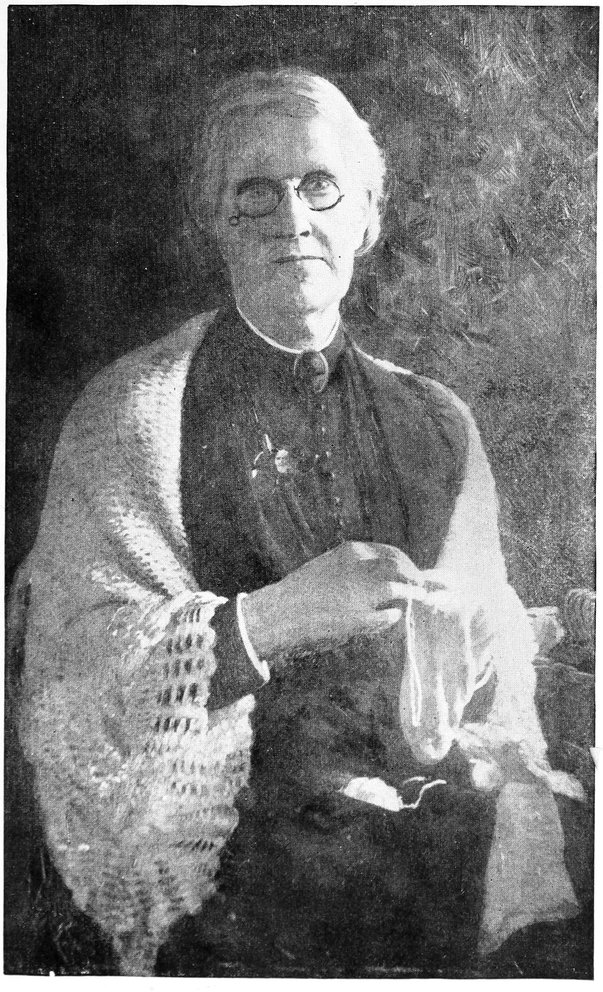
SARAH ALDEN (BRADFORD) RIPLEY
Grandmother of Edward Simmons
(From a pencil drawing by Edward Simmons)
11Every jaw fell; their eyes rolled upward and in dead
silence they marched to their carryall.
A little old woman with mitts and poke bonnet
appeared at the Emerson house one day and begged
for a piece of “your dear father’s clothing.”
“I am making a rag carpet of poets’ garments,”
she said.
She was refused.
“Is that field yours?” she asked, pointing across the
way. She was told it was.
“Do you mind if I trespass? You see, I am also
making a collection of crickets from poets’ homes.”
I should like to have seen the crickets stuck up in a
row on their pins, but I fancy the rag carpet would
have been more amusing. Imagine walking on Mr.
Longfellow’s red flannel shirt!
Every remembrance of my boyhood seems permeated
with the Civil War. It is hard for me to remember
when it began or when it ended. We were always
having holidays at school, either for a victory or for
a defeat. The flag was constantly up or at half mast
at the town pump, giving us the idea of “goin’ fishin’
or somethin’.”
12There comes before my mind a ghastly figure
(bearded) in a box in the church. A dead man! The
first I had ever seen! He had been shot in the South.
One day under the red dogwood bush in the Southeast
corner of our place, I found the cap and jacket
of a conscript. After escaping, he had evidently
changed there. I pictured him “shot at dawn” if
caught, so I never told.
I have heard that the Old Manse was an underground
station for slaves, but I never saw any evidence of it
myself. I remember that Frank Sanborn stayed at our
house for awhile when he escaped from the Southern
people, who tried to carry him away out of the jurisdiction
of Massachusetts. If there were negroes there, I
should have known as much about it as I did about
childbirth—always being sent away on the latter
occasions. In fact, I had never seen but one negro
in my life. He was an escaped slave, very old, who
took care of our garden, cow, etc. He limped badly
from rheumatism, and my uncle Charles had given him
some liniment. One day I heard my uncle ask:
“John, did you really try that liniment?”
“Oh, yes sah!” said John.
“Did it do you any good?”
John assured him that it did, but uncle Charles was
not quite convinced that he was telling the truth, so he
persisted:
“Did it turn your knee black, John?”
“No blackah dan it was befo’, sah.”
Suddenly, I realized that John’s legs were the same
color as his face!
It seemed to me that every day after school I was
13nailed by my grandmother and a bunch of old women
and made to sing war songs. I can see them now, sitting
round in a circle, pulling lint and crying (for invariably
some one they cared for had just died) and listening to
me bellow:
Say, darkies, hab you seen de massa wif de muschaf on his face
Go long de road sometime dis mornin’ like he gwine to leab de place?
He seen de smoke way up de ribber whar de Lincum gunboats lay
An’ he took his hat an’ lef’ very sudden, like he gwine t’ run away.
“Oh, de massa run, ha! ha! De darkies stay, ho! ho!
For it mus’ be now de Kingdom’s comin’;
It’s de year ob jubilo!”
I tried to enlist at the age of ten as a drummer boy.
I was told I would be taken when I had learned to beat
a tattoo on a drum. Delighted, I ran home to tell the
news, only to find that the orderly had been sent up
the back street to tell my mother, and instead of being
received as a hero I was severely reprimanded. This
only increased my disgust with the war.
One of the most picturesque figures of Concord in
those days was A. Bronson Alcott. I knew him well
as a friend of the family, but on looking back I visualize
him in two places. He was very long, slab sided
and lean, and what you would call pasty faced, with
hair that fell to his shoulders. I can see him sitting
in his abominable rustic chairs—with a disease that
happens to trees making lumps all over them. He made
this furniture himself and used to be very proud of it,
but I used to run by like mad for fear of being asked
to go in and sit on one of those benches, which I felt
might make lumps all over me.
14The other picture is Mr. Alcott sitting beside our
teacher, a woman, at school. It was one of those first
afternoons of spring when all outdoors is calling to
boyhood and you can think of a thousand interesting
things to do. But this strange creature took up a
whole afternoon in reading Bunyan to us! Needless
to say, I have sidestepped Bunyan ever since.
They tell a story of Mr. Alcott being accosted, in
his youth, by a farmer in Bellows Falls, who asked:
“What do you do for a living, Mr. Alcott?”
“I write.”
“Hell! What?”
“Thoughts.”
“What for?”
“For posterity.”
Exit farmer.
I have always thought that if the good Bronson had
lived in the twentieth century he would almost certainly
have belonged to that colony which inhabits the
district west of Washington Square.
Louisa looked very much like her father—pasty and
lean, with a very large nose. To me, as a child, she
seemed a very unattractive and a most unkissable
person, probably because she was quite a masculine
type. Her sister May was very different. She was
tall and good-looking, with lots of beautiful blond
hair. She painted, and later went to Paris to study.
It seemed to me she was always lying in a hammock,
being rocked and read to by my brother or Julian
Hawthorne. Louisa may have been impressed with
this picture, as May is the Amy of Little Women,
and these two boys are supposed to be a composite
15hero. I have been told I was the little boy who rolled
downstairs in his nightgown, in the story of the Pickwick
Club entertainment, but do not remember the
actual occurrence.
Louisa was evidently quite awkward, and in many
ways not house broke; also absent-minded and careless,
as is the traditional author. It seems that her manners
at table were commented upon once too often by other
members of her family. She decided not to stand it.
So one morning she managed to be the first at breakfast,
and when the remainder of the family turned up
in the dining room they were greeted with a strange
sight. Louisa had pinned the New York Tribune
around her head and was wearing it like a great helmet.
The pages reached the table and completely covered
her plate. Only her hands were visible. At intervals
they would come out, take something, and retire
behind the paper again. For weeks she kept this up
and no amount of pleading would stop her, until there
was a general abject apology from the whole family.
None of the second generation appreciated the
Concord atmosphere. Louisa tells of her astonishment,
when grown, to learn that no society was so fine or
intellectual as that of her childhood.
The saddest results of this strangely intellectual
atmosphere was the number of spinsters it produced.
The Misses Blood were always a curious sight to me.
Their house, way up in the woods, was chair to chair
and bureau to bureau, completely around the rooms,
with priceless old Colonial furniture, but their economies
were a revelation. Every Sunday they would
stop in front of the Old Manse at the foot of the avenue
16and, retiring into a niche in the trees, put on their
shoes and stockings, which they had carried during
the three-mile walk. They always stayed for second
service, and one of my amusements, when the sermon
was dull, was to watch them begin their lunch, which
generally consisted of Bent’s water crackers. In and
out, in and out went the hard, round objects, in their
attempts to bite with their one or two remaining
back teeth. The sight almost hypnotized me.
Their death, which occurred after I was grown up,
was one of the unspoken tragedies of life. One day a
farmer passed and noticed there was no smoke coming
from their chimney. He went in and found one of the
sisters dead at the bottom of the cellar stairs, having
fallen down and broken her leg. The other sister, who
had become paralyzed and deaf, was sitting in a chair
upstairs, also dead. The one had not been able to move
after her fall, and the other could not hear her cries.
Both had died from starvation.
I was brought up as a young duke—without the
estates!—and I was never allowed to earn money. I recall
being severely reprimanded by my mother and made
to walk back three miles to return a nickel a man had
given me for running an errand. I was told I should
have been glad to do it for nothing. I remember my
surprise, years later, when I was in Europe, to hear
that Americans were “commercial.” The desire for
great material gain was either astonishingly developed
in one generation, or did it, as I suspect, creep in a
little as the emigration from the Old World increased?
Certainly there was none of it in that truly American
town of Concord, Massachusetts.
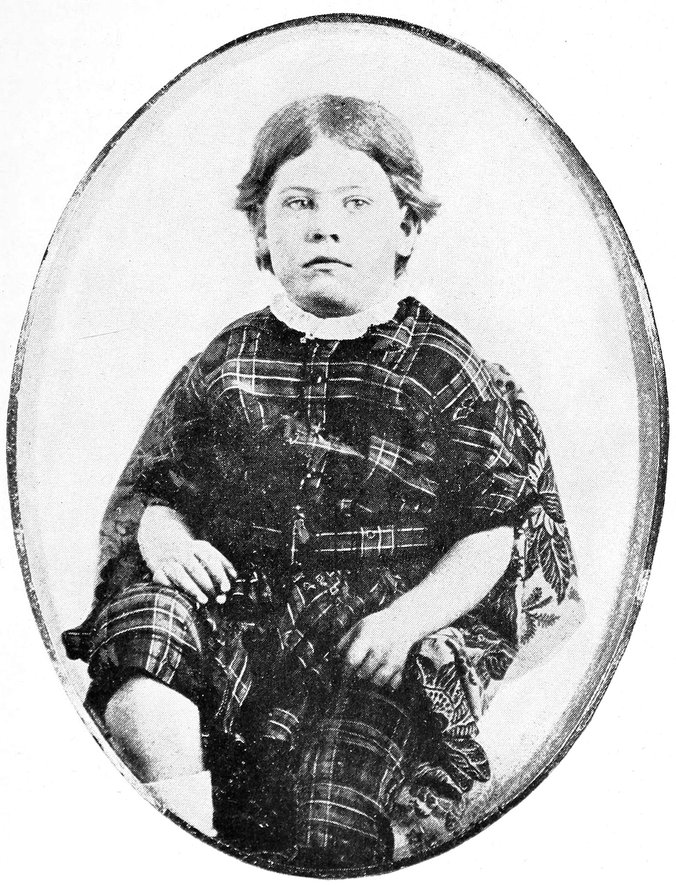
EDWARD SIMMONS
At the age of seven
17In Concord it was no disgrace to be poor—nearly
everyone was—and until I was nearly grown I never
had a new suit of clothes. My brother’s and my
breeches were made from the old army uniforms, the
cloth having a wearing quality that was almost like
iron and would pull a nail out of anything rather than
tear. We were called “Blue Legs” until we were
quite grown up.
My cousins, the Emersons, represented affluence, in
my childish mind. Their house was a square wooden
one, set among trees, mostly pines and chestnuts.
There was a solemn, gravelike quality to it. I remember
going down alone on errands, and always had a
feeling of awe upon approaching it. I think this was
because the trees were so close to the house that the
grass would not grow and everything was damp around
it. The door was always open, and Mr. Emerson
generally came into the hall when anyone approached.
This was a wonderful relief to me, as I was terrified
by the women and servants. The inside gave me the
impression of wealth and spaciousness. It may have
been the reflection of the talk I heard at home, but
it seemed very impressive and august.
No amount of grown-up talk could make me fear Mr.
Emerson, however, or feel the slightest embarrassment
in his presence. He seemed, like my grandmother, to
be a perfect example of serenity. He received me as an
equal and entertained me as if I were a young prince.
He had reached that extreme height of simplicity
where he could be interesting to a boy, and, while I
preferred him to any of the others, I was quite sure
he did not count for as much.
18Mr. Emerson’s study was to the right of the hall.
There was a large fireplace, and what were to me
magnificent red-velvet chairs on either side. There
must have been hangings of the same material, as I
got the feeling of crimson everywhere. From the
floor to the ceiling, the walls were lined with books—books
that had been read and reread until the bindings
were very much worn.
Of my early memories of Mr. Emerson, two are
most vivid. The first in his garden, where he often
took me, walking slowly about and telling me of each
flower and plant as if it were a particular friend. I
never read his Days that I do not visualize him in his
“pleached garden,” showing me his pear trees.
The second memory is of Thanksgiving time. Every
year on this day there was a gathering of the clan
at the Emersons. There were the Thayers, Jacksons,
Emersons, Simmonses, Bradfords, and Ripleys, but
no others. The dinner was the traditional New
England affair, the table heaped with food; and the
conversation consisted of the usual family gossip. I
remember there was always a discussion among the
women as to whether one said Mr. Emerson or Cousin
Waldo.
As soon as dessert was served and the nuts and fruit
brought on, there was a little ceremony that was
invariably performed. Mr. Emerson would look down
from the head of the table and, pretending not to
see me, say:
“Where is that little boy who likes figs?”
This was my cue to march up to him, and, taking
me on his knee, he would pop into my mouth, one by
19one, these delightful and expensive fruits, until I
could not contain another one. Of course, my mother
protested all the time, but he paid not the slightest
attention.
After dinner, in the evening, we played all sorts of
games such as dumb crambo, and then everyone had
to perform. It was a pet theory of Mr. Emerson’s
that everyone should learn self-expression, and he
demanded a recitation from the children of four and
five up to those of the marriageable age. There was
absolutely no way to get out of this.
Despite the protests of the women, Mr. Emerson
would have his after-dinner cigar. In fact, he almost
always got his way, although he was never dictatorial.
Sometimes it was with a gentle remark. When his
wife asked him if she could have a spiritualistic meeting
in the front parlor, he answered her with Hotspur’s
words:
“Certainly, for well I know thou willst not utter
what thou dost not know and so far will I trust thee,
gentle Kate!”
On another occasion, when Aunt Mary was visiting
the family, he happened to be in Boston. Aunt Mary
slept in her coffin. She was very small, so purchased
it before her death to be sure she had the right size
and would not rattle! Mr. Emerson wrote to his wife
in Concord, telling her he was going to bring some
notables home for a visit, and begged her to persuade
Aunt Mary not to wear her shroud at breakfast.
Emerson’s sense of honor and justice were two of
his most important qualities. The farmers used to
come to him to settle their legal quarrels. Whatever
20difference of religious opinion the community held,
they refused to allow him to be criticized in any way.
When the Rev. Grindell Reynolds—an excellent but
limited divine—got up in the Unitarian church and
referred to the street upon which Emerson lived as
“Atheist Lane,” the congregation rose in a body and
filed out.
Another instance of his very highly developed sense
of justice is the case of General Loring, who was
supposed to be a traitor to the antislavery movement.
The lesser minds raved and swore they would never
speak to him again. Whittier wrote a poem about
him. Emerson gave no tongue, but one evening after
a Lyceum lecture in Salem he saw the general in line
with those who wished to congratulate and shake
hands with him. Speaking very distinctly so that
everyone about could hear, he said, taking the proffered
hand:
“General Loring, if what I hear of you be true—I
shake hands with you under protest.”
The last time I saw Mr. Emerson was in 1879. I
was in my twenty-seventh year, had just returned from
California, and was spending some time in Concord
before going abroad. Charles H. Davis, the painter,
was visiting me at the Old Manse, and we both went
over and supped with him. He seemed much older,
but was still that example of perfect serenity I had
known as a boy. His memory was beginning to fail
him, which made him a bit querulous, but his daughter
Ellen supplied it whenever she could. For example,
he forgot that he had ever seen Tom Taylor’s tribute,
or apology, to Lincoln, in Punch—in spite of the fact
21that it is included in the Parnassus—and read it to us,
at my request, with astonishment and delight. He
read beautifully, and his voice retained all of its old
hypnotic quality.
While his memory failed in the detail of names and
places, he still retained, in most cases, his fascinating
mode of expression, and the process of thought was still
there. He said the night Davis and I were there—
“Last week, it was the day ... the day that ...
who was it was here? Ellen, can you remember? Oh!
It was our religious friend.” He referred to Whittier.
He asked, upon going out for a walk, “Where is
that thing everybody borrows and no one ever returns.”
He meant an umbrella and had forgotten the name.
This story was told me by my mother. They knew
(the women) that Emerson’s opinion of Longfellow was
the same as theirs—the Bromides—and that the two
men, of course, loved and admired each other—which
they did not. Of course, Mr. Emerson must go to the
funeral of the poet. Accordingly, the poor man was
pulled up, himself more dead than alive, and brought
down to Cambridge. He sat at the church, seemingly
unconscious of the raison d’être of it all. Then he rose
(holding on to his coat tails was not effective) and
joined the procession about the body.
On crossing the Cambridge Common later, he
suddenly stopped, faced around toward the church,
and then looking at them, said:
“I do not remember the name of our friend we have
just buried, but he had a beautiful soul.”
In some people the loss of memory can be a blessed
thing.
22I cannot write a biography, and my opinion is of no
value, but Emerson was one of the supermen I have
met. He seemed to glorify everything with which he
came into contact. Like all great men, he was surrounded
with a lot of worshipers, most of them inferiors,
and, as Henry James says, these Concord figures were
not so interesting in themselves as that Emerson thought
them so. He was the kind of man who “rendered
the commonplace sacred.”
He was always a teacher or a preacher, whether he
remained in the Church or not. He spoke of Shakespeare
as “our man” and Homer as the “old man,”
showing that by training his mind he stood with
one mental foot on Homer and the other, with us,
on Shakespeare. He could have been a great lyricist,
but, as Henry Adams remarks, there is no rhythm
in New England; the climate will not permit it. Emerson
was ashamed of his love of beauty, rhythm, and
lyricism, as being not quite true to New England. Like
Renan, he blossomed the more fully when surrounded
by beautiful women. He married two. To me he
seems a very shrewd Yankee. Look at the depth of his
thought in “Lovers, preserve your strangeness.”
It was because he talked to a great number of his
own ilk that he penetrated America’s thought so easily.
I agree with Matthew Arnold that Emerson was the
first essayist of the nineteenth century.
MARY EMERSON (RIPLEY) SIMMONS
23The Concord literati are gone, the town has completely
changed, but the Old Manse is still there, holding
many secrets. Not the least interesting of these was
uncovered in about ’81, when the house was torn up
to put a bow window in the corner of the southeast
parlor. The wall paper, undoubtedly hideous in color
when placed there, had mellowed to a lovely Whistlerian
tone. This, of course, had to be removed. To the astonishment
of everyone, it was discovered that the
pattern had been printed upon the back of French
newspapers of the period of the Revolution. (This
economy in paper will be understood by our experience
in the last war.) There were editions with the speeches
of Mirabeau and many other of the patriots of the time.
Think of Frank Sanborn, my uncle George Bradford,
and Mr. Emerson, to say nothing of my grandmother
Ripley and John Brown, gathered about the fireplace
in this room, discussing the problems of the Civil War,
while from the walls cried out to them Mirabeau,
Robespierre, and Danton:
“CON-CITOYENS!—CON-CITOYENS!”
Chapter II: Finding My Wings Harvard College
24
When I passed the examination for Harvard
I had a French turned-up nose, two spindle
legs, and weighed only 114 pounds. Everyone
called me a “barrel on straws,” until I cried myself
to sleep night after night for fear I was going to be a
little runt.
I developed very late and very quickly; I did not
shave until I was eighteen years old, yet only one
year later I measured six feet in height and weighed
165 pounds.
My mind was as undeveloped as my body, and my
proudest brag was that I knew the name of everyone
who lived in Concord, Massachusetts, and that I
hadn’t an enemy in the world.
I had no taste whatever—if I had been crushed under
the tongue, I would have given out nothing. I was
proud of the first nicknames they gave me, most of
them being “Wimba,” “Wambat,” “Winnie”—all of
them being derived from that flattering title, “Wamba,
son of Witless.” I was proud, also, of being able to
make a louder noise than anyone else, due to my
training in the public school, where we were taught to
go to the back of the room and shout one another down.
It never occurred to me to refuse to go to college.
I went because I was told to, and had no particular
desires about it one way or another. My expenses
of something under nine hundred dollars each year
25were furnished me by my family and again I never
gave a thought as to where or how they were obtained.
Money, I was taught, I should not work for, but gifts
were to be freely taken—probably this was due in
some measure to the inherited ideas of parsons, who
are always supported. I could easily have led my class,
but I saw no reason for excelling. I was considered
a pretty second-rate person at home; they didn’t
expect anything from me, and to win, for my own
sake, things I had been surrounded with ad nauseam
as a child, held no attraction for me. In fact, I had not
really learned to care for books as such, and college
opened up nothing new to me except in the line of
English and botany. My power of judgment was
poor, as I had not been required to use it before.
I was conditioned in algebra, in which I was expert,
because I devoted nearly all of the time allotted to it
in the examination to Greek composition, and could not
finish the answers to the questions in algebra on time.
Holworthy Hall, the old Colonial building, was as
full of inconveniences then as it is to-day, but the rooms
were just as much sought after. The old-fashioned
grates; the window seats whose yearly coats of paint
formed a covering over an inch thick, of a lovely
ivory color; the leaky plumbing and general disrepair—gave
an interesting atmosphere, and the
traditions hung round about as thick as the cobwebs
on the walls. My suite, a sitting room and two bedrooms,
was given me by Professor Cutler for my
service rendered the parietal committee who governed
the private acts of the students. In this capacity I
was called the “Last of the Parietals,” as the next
26year the summonses were sent through the mails. I do
not remember much about my duties except that I had
to report to the committee every morning to see if there
were any papers to be served that day. The freshmen
and sophs generally took the summons kindly enough,
but the upper classmen were sometimes rather disdainful
of the messenger, and I remember only once being
treated in an undignified manner. I had to order a senior
who had disregarded the rule about snowballing to
appear before the committee. He was very rude to me,
seemed to blame me personally, and at last tried to kick
me down the stairs. I told my chum about it that night.
“Who was the chap?” he asked.
“I think his name is Cabot Lodge,” I replied.
“Oh, you must be mistaken!” he laughed. “I
know Cabot Lodge, and he would never have the
nerve to kick you downstairs.”
The pranks of those days took the same forms
as they do to-day—lawlessness, vandalism, and kicks
against authority in general. The Commons, where
we boarded for the munificent sum of five dollars a
week, was run by the students; and sometimes they
showed a surprising lack of originality (or was it extravagance?)
in the choice of food. I couldn’t stand the
meals from the first; but when we had mutton every
day for a week the whole crowd struck and, rising at
a signal and holding our plates in our right hands, we
deposited the contents on the floor, singing:
“Oh, Lord of love, look from above
Upon this leg of mutton;
Once it was sweet and fit to eat,
But now, good God, it is rotten!”
27Any jokes on the authorities were allowed to pass
if put over in the right way. Old Doctor Peabody,
who was the clergyman in the chapel when the pulpit
was not occupied by a visiting preacher, was given a
class in ethics to teach. It was considered the thing
to worry this large, plain, worthy divine whenever we
could, and putting asafetida down the radiator, causing
a nauseous stink to permeate the room, was the act of
some student’s fertile brain. If the intention was to
bother the doctor, however, this act failed of its purpose,
as he took pains to announce to all the class that he
was entirely lacking in a sense of smell.
The old doctor led prayers each morning, and it
was a tradition of the college that if the bell failed to
ring we could plead ignorance of the time and not
appear. Alas! the man whose duty it was to call
chapel was far too reliable for that to happen. He
had been ringing the bell for years and had grown old
and white in the service—incidentally, he was beloved
of all of us, and our friend.
One morning, however, there was great silence.
Nobody went to prayers, and as the bell did not even
ring for classes, of course we stayed away. It seems
that some brave student had climbed up on to the
metal rod that joined the roofs of Hollis and Harvard
Halls and, managing in some way to haul up a bucket
of water, turned the bell over, fastening the clapper
to a beam, and filled it with the liquid. When the
bell ringer pulled the rope, nothing happened. The
water had frozen and it was some four hours before
he managed to thaw it out.
Sometimes the pranks took the form of really
28righteous criticism. Outside the college boundaries,
and in the town, was a huge statue of a soldier, a
memorial of the Civil War. He was clothed in a
uniform and trappings, including an overcoat with
cape, but, incongruous to us, he wore no hat. A
student passing a shop saw an enormous gold hat—it
must have been three feet in width—placed outside
as an advertisement. The next morning, to the
amusement of the townspeople, the soldier appeared
no longer bareheaded, but wore a chapeau that came
way down over his ears, completely covering his face.
The police tried to get it down, with no result except a
great slipping and sliding on the sides of the monument.
We boys formed a cordon around it and did all we
could to impede the recovery of the trophy. At last
the fire department had to be called out with hook and
ladder, and amid much good-natured joshing brought
down the hat, which we promptly pounced upon and
bore away. The police would not be satisfied until
we told them how it got there. A student, who was a
Texan, threw a lasso over the statue’s head, and one of
the boys climbed up hand over hand. We never
heard anything from the sculptor, so our criticism
must have gone home.
Even President Eliot was not free from gibes and
witticisms. He is a tall man and has a large red
birthmark on one side of his face which, instead of
disfiguring him, really adds much distinction to his
looks. Of course, this was the cause of the origin of
many nicknames. I remember the visit of Duke
Alexis of Russia, the uncle of the late Tsar. Doctor
Eliot, in showing him the college, brought him to my
29room. Of course, I was excited, and after they left I
watched them from the window until they disappeared
from sight. The duke was the most magnificent
male I ever saw—six foot two or three, blond beard,
dazzling uniform of white; he represented the ideal
type of warrior. Beside him was our president, lean,
sharp faced, almost as tall, walking with not quite so
military a tread, but holding his own in a remarkable
fashion. The students who had come out to watch
them drew back—you can always trust them to behave,
if necessary—but a crowd of “townies” followed on
behind. Then two little “micks” with shirt tails
flying, detached themselves from the crowd and one
yelled to the other:
“Say, Tommie, which is the juke—the feller in
white or the feller with the red face?”
One day a grinning boy presented himself at my
door and asked if I would take him for a roommate.
I had two bedrooms and was glad to have a companion.
We became the heads of the sign-stealing crowd.
The police commissioner of Cambridge had announced
that he would jail the next offender in this line, and
this was enough to set us madly at it. We stole business
signs and street signs, tore the name plates off doors,
wagons, and horse cars. My roommate’s father was
horrified to see on the outside of our door, when he
visited us on Class Day, the sign, “H. H. Crocker and
Co.,” which had been missing from his place of business
for four years. When I came home from Europe in
’91, my mother asked me to throw away some trophies.
Among them were eighteen signs of ground glass
upon which was printed in black “Harvard Street,”
30and a policeman’s badge which I had been very proud
of getting in a fight.
I always hated to lie; but at that time was content
if I kept to the letter of the truth and disregarded the
spirit. I was afraid of flunking a certain examination,
and knew I could pass if I only had more time to work
up the subject. Thinking up every kind of excuse,
I finally decided that only a physical disability would let
me off. Consequently, I did something that required
more courage for one who has always been afraid of
physical pain than it is easy to imagine. Making a
deep gash in my thumb, I told the professor I couldn’t
hold a pen, as I had “cut myself with a razor”—which
was perfectly true. Of course, he let me off.
Out of our poverty and desire for a good time grew
some interesting things. A crowd of us who cared for
cheap vaudeville went in weekly, on Mondays, to the
Howard Athenæum, incidentally the smuttiest and
most improper show I have ever seen anywhere—and
this in Boston! We pledged ourselves to spend only
fifty cents on the evening’s entertainment, and this
sum was generally divided as follows——ten cents
for car fare, thirty-five cents for a standee ticket, and
five cents for a beer, making it necessary to walk
back if we failed to beat our way on the street car.
Whenever anyone had what we called a “find”—earned
something or had a check outside his allowance—we
allowed him to treat, never otherwise. The feed generally
consisted of a barrel of beer and several dozen oysters
which we put in the coals of the fireplace, and, as they
popped open, threw in salt and pepper, and then squeezed
their noses together when they were ready to serve.
31From this we began dining together once a month,
and somehow came to be known as “The Ring.”
There were James Duane Lowell (nephew of the poet),
Ned Higginson, Ned Walker, Frank Childs Faulkner,
Waldo Reed, and others I can’t recall; but although
many sought to join us, we never increased our number,
and I think therein lay our success. We met each time
in a different member’s room, the host of the occasion
providing two roast chickens and bread and butter.
The others contributed something strictly limited to
a dollar in price, which usually turned out to be a
bottle of whisky. Each one of us could bring in his
chum as a guest, and as we sat around the table, our
bellies full and the alcohol sending a glow over our
beings, the songs and stories that passed around that
board would have been epoch making, could we have
preserved them.
Indeed, a desire to keep some of them did crop up,
and it was here, at one of these dinners, that the
Harvard Crimson was born. We called it the Magenta
then, as the Civil War was too recent for cochineal to
be cheap, and crimson was not to be had. The
Advocate was the college paper of those days, and we
decided it was much too stuffy and needed a rival.
I was entirely too crazy to be allowed an editorship,
so had to be content with sundry contributions. I
remember being received at home with freezing looks
after publishing my first—and last—“poetry,” a
translation of one of the Odes of Anacreon. The
family objected to:
When I drink wine, etc.
In my curving arm I hold a maiden.
32No one at home referred to it. The art of it had no
appeal to them whatsoever, and they were ashamed
of me. If I had had any Swinburnean tendency, or
like Keats, who gave out eighteen-year-old slush of
appalling indecency, I would have been squelched.
Another group of us—August Belmont, Herbert
Wadsworth, etc., who cared for paintings—started
the Art Club. There was money in this crowd, and
I was taken in only because they thought I could draw
and could be useful. This was the first indication of
a desire for the fine arts in the college. I was much
disappointed when I got back from Europe in ’91 to find
that all the first books, records, and lists of members
that I, as secretary, had started, had been either lost
or destroyed. But the club had increased in outward
show, even if it had lost its traditions, and had housed
itself quite fittingly.
A club to which I did not belong and one of which
the membership was kept strictly secret was the Med.
Fac. It was supposed to have originated as a take-off
on the medical faculty and to it were ascribed all the
very foolish pranks that were committed around the
yard. The authorities could never get hold of them,
and I do not believe any one of them was ever punished,
although some of their antics were dangerous to
human life and only the pleas of youth could have
excused them. One man placed a stick of dynamite
down the sewer, fortunately resulting in no harm; and
in my own case a skyrocket suddenly went off between
my legs one dark night. This made me think my chum
was a member of the crowd, but, of course, I never could
prove it. It is said that the Med. Fac. once sent a
33letter to the Tsar of Russia announcing his election
to the organization. He, thinking to add one more
honor to his already numerous ones, took the invitation
au serieux and sent them a present of a very
beautiful set of surgical instruments.
There are one or two pleasing incidents or traditions
of Harvard that I like to remember—things that help
one to a greater appreciation of humanity in general.
One was told me by my uncle by marriage. When he
was a student in the college he was given fifty dollars
by an old “grad” who like him had struggled through
poverty to get his education, and told to buy himself
an overcoat, the man saying:
“It isn’t I who give it to you, but a former graduate
who gave it to me; and when you get out in the world
and make good on your own, you are asked to pass it on.”
No one knew the identity of the first donor and only
one person will know whether it is going on to-day;
but I do hope that some mischance has not occurred
to break the chain—the recipient being too unsuccessful,
or dying before he could return it.
Another pleasing occurrence of a quite different character
happened during Commencement. At this time
the authorities chose certain men, who had distinguished
themselves during their course, and gave them “parts.”
I remember Fenollosa of my class, who afterward became
the Imperial Commissioner of Arts for the Japanese
government, was one of these selected, and delivered
an essay on Leibnitz. The students always held fake
Commencement and caricatured the parts. A boy
can be disrespectful or irreverent, and a thing is
generally no good if he does not make fun of it; but
34every now and then something hits him and he is serious.
One of the students, Frank Low, had made himself
so beloved by his fellows that they did not guy him,
and I shall never forget how his mock part ran:
Frank to all,
Low in his own esteem.
I wonder if this is not the kind of a mock part that
America would write for Theodore Roosevelt?
Arthur Bartlett Maurice, a Princeton graduate, once
contradicted my statement that Harvard played the
first game of intercollegiate football in America, claiming
that honor for his own college. As Mr. Maurice is a
much younger man than I, and must have it on hearsay,
I am going to doubt his knowledge. Besides, I
like my own story better. It was in my sophomore
year, in 1872. Previous to this time, my class had
started what later developed into the modern college
yell. Each class had a cheer, generally ending with
the usual, “Hip, hip, hurrah!” But, we being very
personal, decided to give ours in a different way. So
we would begin the following slowly, gradually increasing
the speed and making it staccato at the end:
Whoop her up for ’74
Whoop her up, whoop her up,
Whoop her up for ’74
Whoop her up, whoop her up,
Whoop her up for ’74
Whoop her up, whoop her up,
Whoop her up for ’74—
Rah! Rah! Rah!
Hurrah became “rah,” and in order that the men
should keep together, one of us would beat time, which
I believe was the origin of the “yell leader.”
35Returning from the athletic field one day, Harry
Grant, Coe Taylor (captain of the baseball team), a
man named Herrick, Harry Morse, myself, and others
saw a crowd of Cambridgeport boys—hoodlums—kicking
a football about. We took it away from them
and started kicking it ourselves. Some one suggested
that it would be fun to have a real football—this was
a round rubber one—so we all subscribed and sent into
Boston for an egg-shaped one made of leather. To
our consternation, we found we could not handle it at
all. However, we were interested; some one found a
book of rules and gradually we learned the game.
Then it was a question of finding a team to play
against. No college in America knew the game at the
time, so we sent a challenge to McGill in Canada, and
to our surprise we beat them to death. They came
down for a return match, and we beat them again.
Swiftness of foot was of more importance than strength
then, and I was allowed to be one of the team, but
could not go to Canada, as everyone paid his own
expenses and I did not have the money.
I did not realize that our amateur attempts had
amounted to anything, and when I came to America in
1891 I asked a young woman I met about the Harvard
baseball scores. She seemed rather vague on the
subject and, looking at me as if I were an antediluvian,
said:
“Oh, baseball is old-fashioned. Football is the
thing.”
There is a tradition in Harvard that, although
football was not actually born until 1872, the first
seeds were planted long before the Civil War. The
36sophomores and freshmen—always enemies—used to
take this round rubber ball out on the field as an
excuse for a fight. By 1859 this resulted in so many
minor accidents, that finally, when one boy’s leg was
broken, the authorities stopped it altogether.
One evening after this rule was enforced, a queer
gathering of people proceeded to the Delta (athletic
field). It had the air of a mediæval funeral procession
with its priests carrying tall candles, chanting solemnly,
and preceding a small bier borne by draped figures
and followed by mourners of every description, weeping
and wailing their sorrow at the departure of a loved
one. In this case the dear departed was a football,
red in color and looking suspiciously like a large toy
balloon, which rested lightly in its casket. With all
the ceremony of a real funeral, it was solemnly interred.
Three nights after, a very different procession went
forth along the same way. There was a clash of
cymbals, bright lights, music, gayly decorated banners,
and maidens dancing joyously. Again they proceeded
to the burial ground where, after curious incantations
had been performed over the grave—to the astonishment
of everyone who saw it—the soul of the football
detached itself from its resting place and rose grandly
and sedately to the heavens!
It seems to me that we cannot overestimate the
importance of eating and drinking, for out of these
desires of the human body have come most of the
clever ideas of the world. Conviviality stimulates the
brain, and, while the viands may be of ever so simple
a quality, the atmosphere in which they are partaken
means everything to sensitive genius. From a general
37poverty of purse, if not of mind, sprang the Stomach Club
of Paris, and likewise, if I may compare them, the Hasty
Pudding Club of Harvard. It began when two or three
clever men found it necessary to economize, and they
made up their minds to live on that delectable New
England dish—cornmeal mush. Probably, having only
one kind of food to cook, they became proficient in the
art, for in my day it was certainly good to eat. The three
or four men had developed into a large number, and
the meetings came to have a very different purpose
from that of the economy of food; but never had they
varied in any degree from their first idea, and not a
single dish was added to their fare of—hasty pudding.
A certain quality of cohesion is necessary to make
a crowd of fellows stick together through so many
years, so gradually, a number of tests came into being,
and a novice must pass these before becoming a full-fledged
member. As these tests vary in every case,
but all are based on great principles of truth, honor,
and manhood, I am not giving away the secrets of the
organization if I tell a few of the amusing incidents
of my initiation into the Hasty Pudding Club.
For two weeks before his final acceptance, the candidate
is required to run everywhere he goes, and he
must not speak a single word to anyone except the
member appointed to be his keeper. I had faithfully
kept this rule of silence—hard as it was for me—when
one night at dinner I tried to attract the waitress’s
attention, with no result.
“Speak to her just this once. I won’t tell,” said
Ned Higginson, who was my keeper.
I argued I mustn’t, but he assured me it would be
38all right, so I did. When it came to the final reckoning
and he was asked if I had kept the rules, he
told on me. I don’t believe I was ever so righteously
angry in my life. Disregarding the fact that it was a
formal party and I was in evening clothes, I turned
and would have knocked him down had they not held
me. Then I heard laughs and cries of:
“Yes, he’s the kind of a man we want.”
You must be the type who trusts your friends by
doing (while blindfolded) anything that he swears on
his honor he has done before you, but if it is proven
that that friend has deliberately gone back on you,
you must show that you resent it. For example, my
anger at Ned was pardoned; but a son of one of the
generals in the Civil War went through all the requirements
until he refused to put on some article of clothing
which seemed to him filthy (his eyes being bandaged),
in spite of the fact that all of the others swore they had
gone through the same experience without harm. He
never became a member of the Hasty Pudding Club.
One of the requirements is an essay which is taken
very seriously by the patient neophyte, but is really
of no importance. Mine, on the subject of “Public
Insane Asylums vs. Private Mad Houses,” was never
read, for the reason that it was stolen by a ring within
the club who called themselves “Owls of the Night”
and thought it very funny to reduce the size of the new
man’s head by destroying his work whenever possible.
I was sure I had hidden my essay where no one would
find it—in the bottom of the spittoon, covered with
layers of newspapers, then melted candle grease, and
lastly, the remaining space filled with water and cigar
39butts. But my roommate told; and I had to lie, when
asked for it, so as not to go back on the gang.
One of the most interesting possessions of the club
was the Crocodile Book, or the record kept by the
secretary since the beginning. At the end of one of
the chapters was a charming drawing by Washington
Allston, of a fat boy gobbling mush from a pot. I
used to stare at this and wonder about the man who
did it. Alas! when I went back, some twenty years
later, there was no trace of the drawing and no one
could be found who had ever heard of it.
These acts of vandalism are found more often among
the educated classes than otherwise. I often think
of the clergyman who was found with a hammer in
his hand, having just knocked a piece off a tomb in
Westminster Abbey, which dated back to the days of
Edward the Confessor—the only one that had never
been cracked or harmed! The judge very wisely did not
punish him, but left him to the tender mercies of the
newspaper reporters. He is still running. We have
not the right to destroy the labor of some one else. The
beautiful things of Greece, the wisdom of Rome,
music of Germany, and the Cathedrals of France and
Italy have been inherited from the past, and if we deface
them we are defacing our own property.
I have my small triumphs. One occurred in the Hasty
Pudding Club. When I went back for a visit after
coming home from Europe, I was shown a fine building,
positively shaming the rooms we had had in Stoughton
Hall. I went in with a somewhat bewildered manner,
feeling like a stranger in a strange land. Then something
struck my eye. Where had I seen it before?
40There at the end of a hall was a drawing—a playbill
for a performance of “The Rivals”—of two cocks, one
black and the other of the yellow barnyard type, fighting
over a little white hen. Looking in the corner, I saw
it was signed with my name!
It is better than money, family, or friends when a
whole generation embraces you. My personality was
not there; neither is that of the man who made the
Venus di Milo—but she’s there. There are contests
as to who wrote the plays we ascribe to Shakespeare,
but there are no contests over Hamlet. It’s great to
see that what you have tried to do has been kept.
There is a poem by Arthur Macy (probably not
published) about a Common Councilman who in walking
down the street and, happening to look up at
the Boston Public building, sees a shield and upon
it the design by Saint-Gaudens, of two little naked
boys. It runs something like this:
What nameless horror meets his modest eyes?
· · · · ·
There, reared aloft in perfect equipoise,
Two very small, unexpurgated boys.
Hurrying down to the meeting hall, he has the Council
pass a bill that after this “boys shall be born in pants.”
The only difference in the opinion of my rival fraternity
at college—namely, the Alpha Delta Phis—would
have been that they should be born clothed; but after
talking it over, they would have decided it should be
in “trousers.” This substitution of a good old Anglo-Saxon
word for one of Latin slang would have been
due to the influence of our beloved Professor Child,
whom we all called “Stubby.”
41“Stubby” Child represented a natural revolt against
Bostonianism—the practice of putting pantalettes on
piano legs. To him his language was a faith or a
religion, and I know that all America would speak
and write much worse English to-day were it not for
the disciples that this man scattered throughout the
country. The secret of his influence was that he
cared, and therefore he produced a result. He was
unimportant to look at, had no voice to speak of, and
exercised no hypnotism, but he managed to imbue
us all with a permanent love of our own language.
I am sure he would as soon have thought of using a
foreign word in place of an Anglo-Saxon word or its
derivative, as he would of dishonoring his own mother.
His influence was more powerful, because it was subtle,
and although he does not seem to be well known, I
have met men in many parts of the world who immediately
fell on my neck when I said I had been the
the pupil of “Stubby” Child.
My grandmother said, “The law of love is higher
than the law of truth,” and I think she was right,
for love is unalterable and truth changes. Christ’s
statements may not be true to us to-day; Einstein
with his “relativity” may have upset Newton’s theory
of gravity; but these men remain just as great as they
ever were, for in them we see their passionate love for
what they thought to be true.
Somehow, I can never think of Harvard that I don’t
see “Stubby” Child, with that row of yellow curls
around his head like a halo, hurling a copy of Chaucer’s
Canterbury Tales out of the window and shouting to
the class:
42“This man is an Oxford graduate and, according to
England, is a scholar, and yet he has substituted the
nauseating adjectives ‘gay’ and ‘blithesome’ in that
immortal description of the Friar in the line which
runs:
“As hoot he was and lecherous as a sparwe.”
Chapter III. In Search of a Career Out West
43
Harvard had taught me this—that I did not
know a thing—not even the meaning of human
life. Somehow I think a college education is of
benefit to two classes of people only—those who desire
to acquire a social position and those who want to get
training in a certain subject. I have not the battle
instinct and could never see any use in competition.
If I had not come of good people I might have wanted
to fight to get with good people, and that is about all
college can give. I can remember getting only one
real thrill to go out in the world and do something, and
that was after a sort of valedictory talk by old Doctor
Grey. I had always cared for the out of doors and it
appears I stood well in botany. When the venerable
professor told us that it takes fifty years to make a
nutmeg orchard, and that a million dollars was waiting
anyone who would walk into Boston with him the next
day and prove to certain capitalists that he could tell
the difference between the male and female nutmeg,
my commercial instinct was aroused and a gleam of
ambition came to me for the first time. I resolved to
find out about the male and the female nutmeg.
There was no way to learn anything about beauty in
Harvard—no instruction in it and no honors for it.
Taking their cue from the Pilgrim Fathers and, since
then, the Church, they did not believe in the value of
any of the senses of the body, but only in the quality
44of the human mind and the power to ratiocinate. Any
expression or feeling for beauty, except that made by
sacred music, was common, vulgar, and to be repressed.
If Harvard could manage to produce one Corot, one
Beethoven, or one Michael Angelo, her name would
be known longer in future ages than it will be for all
the small imitation Shakespeares she has sent out over
the country. Even Mr. Emerson, in my opinion, was
half ashamed of his lyrical gift; and the elder Story,
the sculptor, is more honored in Boston for a law book
he wrote, before thirty, than for any of his statues.
One day in Mr. Story’s studio, in Europe, was a
group of American business men who always made
it more or less one of their loafing places. Of course,
they had all been well bred enough to wander around
and see what the old man had been working at lately,
but it was not long before they were settled down over
their cigars, discussing the business of stocks and
bonds—what they were all thinking about and all
they really cared about. Story stood it as long as he
could, walking nervously up and down in silence.
Finally he whirled, saying:
“Gentlemen, gentlemen, gentlemen, Phidias built
the Parthenon. Who in hell were the stockholders?”
After my graduation, it was a question of a career.
I had spent four years to find out that I did not know
anything, and was to spend three more to find out what
I wanted to do. All my ancestors had lived by talk.
I had inherited the “gift of gab,” but there seemed to
be no market for it in my generation. It had turned
from the pulpit to the stage and novels, in order to get
an audience. Rhetoric and fiery oratory is not an
45honest way to teach, as it hypnotizes the listeners.
Reading a speech coolly the next morning in the newspaper
is the only fair way to judge it. My father felt
this and changed his preaching into a dry, matter-of-fact
style, not caring to influence by his personality.
He immediately lost his audience.
Groping for an occupation, I went to New York and,
with a half-formulated idea to become an architect,
called on Russel Sturgis. He was a blond-headed
young man, about thirty-five, and seemed to me to
be quite old and efficient. Looking at me very keenly,
he said:
“Do you know anything about the bearing power of
bricks?”
“No.”
“Do you care anything?”
“No.”
“Have you any rich relatives to back you?”
“No.”
“You don’t want to be an architect. You want to
be a painter.”
This quite astonished me, for I rather thought I
did, although I had never formulated the desire in my
mind. Besides, to be a painter was not an occupation—but
rather on par with a strolling player, a tinker, or a
mountebank. Mr. Sturgis told me that my ideas were
all wrong and that the painters of the day were real
people and, furthermore, making a lot of money. Of
course, I could not start in then, but resolved to hold
the thought in the back of my mind. In the meantime,
my New England coat was feeling so tight as almost
to burst the seams if I did not get out of it. I wanted
46to get away from something. I knew not what. But
freedom lay away from home, so, starting out with
two hundred and fifty dollars, I went as far as I dared,
which was Cincinnati, Ohio.
There was a Boston colony in Cincinnati and I
landed among friends, keeping the plunge from being
as bad as it might have been. I remember nothing of
the trip out except the foundries of Pittsburgh. This
wonderful display of great columns of fire, shooting
up to the sky, seemed to represent, as I had never seen
it before, the Spirit of Flame. Upon arrival, I was
seized by Jim Perkins and not allowed to spend a
night in a hotel. His brother was married to a relative
of close friends of ours on Milton Hill near Boston,
and this was enough introduction for him to take me
into his home. Afterward, I lived with Chap Dwight,
whose mother had been an intimate friend of my father’s,
and it was here that I got my first taste of a European
influence. He was a wealthy bachelor and lived like one,
but had very cosmopolitan ideas of life—a new change
for me.
My first job was an agent for an oil firm which had its
main office in Pittsburgh. It may have been the only
one I could get, but I rather imagine that my droolings
and dreamings over the wondrous flames of the foundries
of Pittsburgh invested the work (in my mind) with
romance and took away (in the minds of my relatives)
the sting of my having to be called a salesman. The
first month I made one sale. Overjoyed at getting an
order for a thousand barrels of oil, I signed a contract
to deliver them at a certain time f. o. b.—Cincinnati.
Harvard College had taught me many things, but had
47neglected to give me any idea whatever of those letters,
“f. o. b.” My salary was fifty dollars a month, the
freight was sixty, so I quit at the end of the month,
owing my boss ten dollars.
I considered the matter closed and that I had learned
a good lesson; but, unfortunately, I had had a large
amount of business stationery printed. Thinking my
young cousins could use it to draw on and desiring never
to see it again, I sent it home. But I had reckoned
without my dear mother’s sense of economy. For
years I was forced to receive letters from her with
EDWARD SIMMONS
Agent —— Oil Co.
at the head of the page.
After this not very profitable occupation I turned
my attention to tutoring, fitting a boy for West Point,
and another for the Yale Scientific School. The
former was the son of an ignorant Irishman and had
got a limited amount of information at the Jesuit
school. I taught him geography, history of the country
and states, of which he knew nothing, and I made
him learn the Declaration of Independence and simple
mathematics. He went in with flying colors.
I found that my business career did not interfere in
any way with my social life in Cincinnati. I was
still anxious to be an artist and was painting in my
bedroom every night. The city was, even at that time,
beginning to be an art center for the Middle West.
Nicholas Longworth, grandfather of the husband of
Miss Alice Roosevelt, had shown a particular aptitude
for making money and a better one for spending it
48the right way. As a young man he had climbed the
hills of the town and, looking from them across the
water, decided it would be impossible for the city to
extend in but one way. Accordingly, he put his savings
into land, always keeping one lap ahead of the spread of
population. Caring for beautiful things, he began to
encourage the fine arts, and it was at his home that I
saw my very first collection of oil paintings. Concord
was the home of the steel engraving, and the copies of
oils that my father had brought back with him from
Europe and hung up in the Old Manse swore at everything
else in the house. The Longworth collection was
mostly German pictures—by Koeck-Koeck, Meyer von
Bremen, and two by Lessing of the life of Huss, the
martyr, which were evidently worthless, but so aroused
my decorative instinct that I remembered them for
years after.
Wandering up the main street of Cincinnati one
evening, I saw a name plate on a doorway—one I had
never heard—and after it the magic word “Artist.” I
was thrilled. There was actually some one in this town
living and having his being and spending his time
painting. I used to pass back and forth before this
sign, which was at the bottom of a stairway, like a
dentist’s or a photographer’s; and finally, one evening
just at dusk, I got the courage to go up. Knocking
timidly on the door, I was greeted with loud roars of
“Come in.” The dingy room was a holy of holies to
me—I had never seen an artist’s studio before. In the
far corner was a man in a khaki apron, using the blackest
of soft soap to wash what were, in my eyes, enormous
brushes. Heretofore, my own experiments in oil painting
49had been made with the usual small brushes and a
tin box used by maiden ladies. The bigness and boldness
of this establishment took my breath away.
When I got the courage to look about I saw that,
besides this big Norse viking with the tumbled hair,
there was a sculptor in the corner, modeling—think of
the daring!—a figure in the nude! I must have presented
a ridiculous figure, for there was a laugh behind
my back, and, turning, I saw a woman almost naked,
sitting on a stool! They asked me why I had wanted
to come in, and I told them I tried to paint, but that
I had never seen a studio before. I looked with wonder
at the big canvases on the wall, and even then realized
that here was a sense of color altogether different from
that of the German artists, and that the capacity for
brushwork was a marvel—for this painter was none
other than Frank Duveneck, who had just returned
from Munich.
When I went up to West Walnut Hills and told them
that I had found a real artist in Cincinnati, I was
laughed at in a very pitying way; but later on, when
this same Duveneck gave a showing of his work in
Boston and was hailed as the “new American Velásquez,”
I felt a great satisfaction, although I was no
longer in Cincinnati and could not enjoy my triumph.
After an experience as a casket maker’s assistant,
where I was expected to board with him and sleep
in the manufactory, and eventually—great stress was
laid on this—become a partner in the business, I
decided to accept an offer my cousins had made me to
go farther west and become a clerk in a department
store they had started in San Francisco. I had previously
50received a proposition to become a salesman
of cheap jewelry, for, so this man told me, my line of
talk would be a sure-fire success for making sales to
“servant girls at the back door.”
My ticket as far as Chicago was given me by Chap
Dwight, who was connected with railways, and for
the rest of the way I paid for a first-class fare and no
Pullman—in those days it was possible to sit up in the
smoker. This I did as far as Cheyenne, where my
troubles began. I was told that the train would stop
for an hour, so I alighted to take a look about the town
and get some dinner. The only thing that aroused my
interest was a sign marked “Simmons” over a doorway
with steps leading down to it and quite evidently a
dive. There were two baize doors above which shone
bright lights, with reams of smoke rising above the
heads of men. I went down and started to push open
the door, but just at that moment loud voices were
raised inside and something whizzed by my head. I
looked up, and, not six inches from my outstretched
hand was a clean bullethole through the door. I never
opened it.
Trying not to hurry, I made my way back to my train
and started to get aboard, searching in every pocket
for my ticket. It was gone. I begged clemency from
the conductor and tried to make him remember that I
had got on at Chicago, but I had no berth, and there
were too many deadbeats trying to get to California
in those days for him to have any pity whatsoever for
me. In desperation, I spoke to the baggageman. He
advised me to go as far as my money would take me and
then telegraph home for more. Anything was better
51than being left at midnight in this city of careless
bullets. Out to Rawlins, Wyoming, was as far as my
pocketbook would take me, and I would have two
dollars and fifty cents left for a bed and telegram.
Imagine a town eight thousand feet above the sea,
freezing cold, again the middle of the night. How I
got off the train and over to the hotel, where shown the
only light, I do not know. I do know, however, that
I put a chair under the handle of the door, candle and
matches and my pistol beside the bed, before I went to
sleep. Daylight showed no improvement, but only
took away the air of dark mystery and bared to the eye a
bleakness indescribable. To have been told that
there was no telegraph office would not have surprised
me a bit, but to learn that it was “not a money
order station” was almost worse. Sitting on a stone
in front of the hotel, I tried to think out my problem.
The temperature was twenty or thirty below zero,
nothing grew in the ground, and all the ice and snow
was blown away by the terrible winds as soon as it fell.
That morning two men had been found frozen stiff
within a hundred yards of the hotel. They had not seen
the light, which was on the other side of the house,
and had simply lain down and decided to stop. To
see the dead bodies of these men who had given in a
hundred yards from safety was one of the greatest
lessons I ever learned—NEVER STOP!
I soon became acquainted with the population,
which consisted of mine host and his Chinese cook,
the storekeeper and sheriff, two hundred men in the
roundhouse, and two women who earned their living
in a questionable manner at night and spent the
52daylight hours sewing and mending for the workmen.
Although these women were undoubtedly under thirty,
they looked aged and worn, and their hands were
calloused from the needle. Every vestige of attraction
had departed long ago, and I wondered how they could
be so kindly and cheerful amid such surroundings of
hopelessness.
At last I formulated a plan and, going to the storekeeper,
who was sure to have cash on hand, I asked
him if he ever lent money and at what per cent?
He said, “yes,” but what security could I give? Two or
three hundred tramps passed through the town every
day, and my word that it would be sent to him was no
good whatever. Again I went out to my stone.
A Yankee is seldom in so tight a place that he can’t
wiggle out, and I knew if I could only think hard enough
I could solve the problem. Going back, I said to my
friend, the storekeeper:
“If you knew that there was a sum of money deposited
in your name in a certain bank in Cincinnati,
would you give it to me?”
He answered, “Yes.”
I telegraphed to my friend Harrison, who must
have sensed that I would have trouble on the way and
had told me to be sure to call on him for anything
whatever.
“Place one hundred dollars to the credit of Sam
Atkins in the First National Bank of Cincinnati.”
He understood, for after a cashier’s confirmation
for the careful Mr. Atkins, I received my hundred,
less five per cent, and was on my way again.
We were in the real West now. All along, beside
53the tracks, were huts built of piled-up abandoned railway
ties. Here men had tried to spend the night
crawling in over a fire, many having been burned to
death this way. It was surely an example of the
survival of the fittest. Constantly, from the car window,
could be seen the former emigrant wagon trail, and
everywhere were the bleached bones of bison and oxen.
Every time a hill rose high enough to count, there was
a little white cross, marking the graves of a baby or
perhaps a wife whose ashes were scattered, like those
of the engine, God knows where. No calvary could
have shown more evidences of pain and suffering
than the trail of these first argonauts across the plains.
A fat man on the train took an interest in me, and it
flattered me greatly. I have since met his type all
over the world: he is what is called in gambling parlance,
a “capper.” I was dressed well and he probably thought
I was wealthy, for he turned and asked me if I did not
want to get off with him in Green River and go to a
place where we could get beer and free lunch (then
unknown to me) for one “bit.” This idea pleased me,
as the meals at the stations, which included bear meat
and all sort of luxuries, were one dollar. The town
was nothing but sagebrush and hills, with one little
straight street down to a dive.
While we were eating and drinking, in came a man
whose type I had been warned against in Cincinnati,
where all the talk was of the West. He was a handsome,
sharp, keen, inbred Yankee with a fur coat down to his
heels, and kept swinging a bunch of mink skins while
simulating drunkenness. I should have known that
he was the three-card-monte man, as he fitted perfectly
54the description that had been given to me; but he
was such an artist that, in my youthful ignorance,
he convinced me that he was the real drunk that the
three-card-monte man imitated. Swaggering around
the room, he fished in his pocket for some money and,
pulling out a roll of bills, threw it on the floor in disgust.
Taking out a lot of gold, he indicated that it
was the only money he cared to use.
“I’ve been in the land of Mormons,” he cried, producing
a pack of cards, “and I learned a new game which
I’ll show you. It’s called ‘Find the Mormon.’”
All the men, including a crowd of my acquaintances
from the train, who had come in, crowded around him,
myself in the front row. My friend, the capper, tried
his hand and won several times, making a great haul.
Then he urged me to bet and, upon my telling him
I was broke, thrust a twenty-dollar bill into my hand.
I bet it and won, paying back my debt, and then
held out the other bill to the bartender to change so
I could divide with my “pal.” He reached his head
down below the bar and I suddenly felt the atmosphere
change....
I turned to my friend. He was gently fingering a
gun. With a cold, steely eye, the three-card-monte
man stood, a pistol in his hand, with one end lying on
the bar, casually pointing my way. In front of me
the “barkeep” had risen with another. I looked
behind for help, and all the men from the train had
silently melted away. Leaving the twenty on the bar,
I turned and walked slowly out of the place, not daring
to increase my pace by one second until I reached
the train.
55I told my story to the conductor, and he said if I
had carried off any winnings these men would have
followed me to the ends of the earth and taken it from
me. If I had been killed, they would have hitched my
body to a horse and dragged it out into the sagebrush,
leaving the coyotes to do the rest.
As an unpleasant sequel to this, I read in one of the
first papers I picked up in San Francisco an account
of two brothers from Vermont who got in with the
same men. The first lost all of his money and borrowed
all of his brother’s, finally getting into a row with
the gamblers, and was shot dead. The other brother
escaped and somehow got to the train, going on to
Salt Lake City, where he telegraphed home for more
money. Watching his time, he went back to the
saloon, shot the “barkeep” and capper dead, and
left the three-card-monte man dying on the floor.
I carried a pistol on this trip, but up to this time I
had had no chance to use it. However, since I had
looked down the barrels of several myself, I was
beginning to feel very brave. That romantic idea of
“avenging one’s honor or that of one’s women” had
quite got into my blood. The train broke down at
Winnemucca, in a country covered with six feet of snow.
A crowd of us had been having a good time amid much
good-natured talking and chaffing, when I saw one of
the trainmen, evidently drunk, sitting beside a woman
passenger, with his arms about her, kissing her violently.
Her husband was standing beside the seat, protesting,
with no effect. Instantly I was at the head of a crowd
that took the offender by the neck and threw him off
the train. Without my counting the cost, I became
56the hero of the hour. But all was not finished. Our
intoxicated friend came around under the window and
raged threateningly until there was nothing for me to
do but go out to meet him. Drawing my pistol, I
strode on to the platform. The minute he saw me his
hand went to his pocket and drew out his gun, but I
had him covered.
It was just a question of who dared to shoot first.
My blood ran cold; but just at that moment four
hands came round the corner of the car, two had
him by the back of the neck and two had taken his gun
away. Then slowly but surely he was withdrawn
from view. The conductor asked me not to report
the occurrence, as the man was a fireman, a family man,
and all right when sober. I was so glad to get away
with my life that I would never have told a soul. Furthermore,
I sold my pistol as soon as I reached San
Francisco, and have never carried another.
The rarest sight I ever saw was the sudden change
from six feet of snow to the southern slope of the
Sierras. With a plunge from winter into summer, the
whole character of the landscape changed. The air
was balmy, the sky was a soft blue, and looking like
orchards of apple trees of enormous size were the
live oaks that covered the slopes of those mighty
mountain sides. But best of all, beside the tracks,
and almost denying the month of February, was
growing tender young green grass! I picked some of it,
put it in my buttonhole, and cried. I had fallen in
love with California.
After that every shanty station saw me out of the
car, smelling the atmosphere and feasting my eyes on
57the beauty of this big, good-natured, sweet, mild
country. At one of these mountain stops, feeling
hungry, I bought a large slab of custard pie. Beside
the tracks was a cage on wheels in which lay a big female
grizzly whose owner was taking her to San Francisco
to be sold. The man was nothing loath to explain his
prowess in capturing such a fearsome beast, and we
all crowded about, myself, of course, in the front row.
Looking at us while talking and gesticulating, his hand
went fairly well within the bars, whereupon the lazy
grizzly, seemingly dozing, closed her mouth over his
fingers and backed slowly to the rear of the cage, pulling
his arm in with her. With that he whirled, fed his
arm in between the bars and, quickly looking around,
grabbed my pie and slapped the bear in the face with
it. Of course it splashed, and she immediately let go
of him to lick her chops, but his hand came out with
the mark of every tooth upon its back. In spite of
its lack of humor, I truly believe that this is the original
custard-pie story.
San Francisco was a very different city in those days
from what it is to-day; the sea came almost up to
Montgomery Street, and beyond Van Ness Avenue there
was nothing but sand dunes shifting and changing
every minute. This is practically all new now, as the
great fire of 1906 swept it away. I remember the Bay
and the ferryboat, the long pier at the Oakland Mole
and passing the romantic and lonely Goat Island.
The water seemed strangely quiet and strangely blue
to me, whose only experience of the sea was the coast
of Maine.
The Chinese and Mexican quarters of the city were a
58marvel, for both of these peoples had managed to take
bits of their own countries in their entirety and transplant
them on this sandy soil. San Francisco is unique
(as American cities go) in being able to keep within
her bosom the civilizations of foreign peoples, in their
original state, long enough for them to fertilize and
bring forth the best of themselves. Visitors to her shore
do not immediately change their manners and customs
to agree with hers—perhaps for the very good reason
that she hasn’t any to agree with—but if it were
no uncommon sight to see a Mexican sombrero, it
was no less a common one to see a Chinese woman in
native costume, feet bound, in high-stilted slippers,
looking for all the world as if she had stepped down
from an ancient vase, and propelled up Market Street
by her big-footed “amah.”
This thoroughfare seemed to fade away at the old
city hall, which was then only in the process of
construction. In fact, the only landmark which appears
to have survived conflagrations and the march
of progress is the Cliff House. Although it has burned
down several times, each new building immediately
takes on the air of the old, and whether, by the intention
of its builders or the architectural limitations of the
rock upon which it is built, it looks the same to-day as
it did when I first saw it in ’75. However one may
deplore the mushroom existence of his familiar landmarks
downtown, one has only to take a trip—now
shorter many minutes by the change from horse to
gasoline—out to the Pacific Ocean and, from a little
table, sheltered by glass from the might of the winds,
look out upon the same horizon, the same calm blue
59of the waters, and, best of all, the same Seal Rocks
with their brown-coated inhabitants (grown woefully
smaller in numbers now), sunning themselves and
teaching their young that protection lies in remaining
near at home.
The most characteristically Western survival of the
“days of forty-nine” were the San Francisco bars—not
speaking of the smartest ones, for those I seldom
invaded. There was nothing less than ten cents in
the town; nickels they gave away and pennies were
thrown down the gutter. Everything was sold in terms
of “bits.” Of course, there were two- and four-bit
coins, but a one was the survival of the mixture of
currency that had gotten into the land. Mexican,
Canadian, French, etc., small silver coins were all
bunched together as “bits,” and eight were called
a dollar, making one the value of twelve and one-half
cents. A drink theoretically cost a “bit,” but if you
gave a quarter in payment, you received ten cents
change. They were bound to take ten cents if you
offered it, but too many deals of this kind in the same
place elicited some such muttered remark as, “Tight
Easterner,” or, “Why don’t you take some of the
furniture along with you when you go?” The free
lunch, which was really free, was served by gorgeous
big men in clean white aprons, and for the price of one
drink, you could have such a repast as boiled mutton
and caper sauce, salmon and cream gravy with mashed
potatoes, all sorts of biscuits, apple pie, fruit, and coffee.
Should you dare offer a tip to this husky waiter (or,
indeed, to anyone in all California at that time), you
ran the risk of a strong right arm or, worse still, a
60tongue-lashing such as you had never heard in the
effete East.
The price of a newspaper was also vague, but you
were on the safe side if you offered Willie no less than
a dime; for silver and gold were the only metals this
child cared for. Coppers and nickels he threw into the
gutter and made you a present of the paper, remarking
that if you were so poor as that he would give you one.
Willie was a character. We never knew where he came
from or where he lived, but he had a face like one of
Sir Joshua Reynolds’s angels and must have been the
model who sat to the Lord for the type of “Mother’s
Darling.” He was under ten years old, slight and
rather tall, with great blue eyes and curly yellow
hair. His occupations were selling matches by day
and newspapers by night, and when business was
slack he amused himself by calling ribald verses—parodies
on such popular songs as “Pop Goes the
Weasel”—at the bankers who passed by without
buying. He stammered badly, adding much to the
effectiveness of some of the lines. His passion was
gambling, and his first utterance on meeting an acquaintance
was, “M-m-m-m-match you for a dime?”
One day one of the clerks, a Southerner, and myself
put up a job on Willie and offered to show him “three-hand
matching.” Each choosing a different side of the
coin, we won all of his cash in about ten minutes.
Still in the game, he bet his matches, and, of course, we
skinned him again. His lip began to tremble, but he
pulled himself together and, saying, “B-b-b-busted,
by God,” stalked out of the place as pretty a gentleman
as ever there was. We called him back to get his
61matches, and tried to explain. At first he was furious
at our daring to think he was no sport, but finally he
saw the joke and a light came into his eyes.
That was at noon; at six o’clock, passing the
Chronicle building, I saw what appeared to be a pile
of boys, all absolutely absorbed in something going
on in their midst. In the center was Willie, beside
him a pal, and between them one of those formless
caps that boys affect, entirely full of dimes and quarters.
He looked up and saw me; not a muscle moved
in his face, but after a second, his left eye slowly closed
as if in sleep.
In spite of its being wide open, San Francisco was
then one of the cleanest towns I have ever known. The
French spirit had invaded it, and here again the
Western civilization had taken the best from these
foreigners—in this case, their cooking. The Poodle
Dog and Marchand’s were already flourishing with
their Cabinets Particuliers and for the first time in my
life I saw wine drunk everywhere. The prostitutes
were kept to themselves in one section of the city,
and any woman who stayed out on the streets alone at
night dared not stop and look in a shop window or loiter
on a corner, as she would be taken by the arm by a
large policeman and sent to Dupont Street.
This street led up the hill to Chinatown, and all
along its sides were rows of one-story buildings, divided
into small cubicles, each with one window and a
swinging door that led directly in from the sidewalk.
Everyone walked here, and it was the thoroughfare for
one of the most fashionable churches, even though,
sitting at the windows or leaning on the swing gates,
62were women of all nationalities, addressing the
passers-by in the language of their country.
Everywhere were the earmarks of a populace plunged
suddenly from hard work and poverty into riches
greater than they could conceive of, and with no time
to make the necessary adjustments. There were some
attempts at making social distinctions, but it was
difficult under the circumstances. Mrs. So-and-so,
who lived on Nob Hill, was probably only one generation
removed from the washtubs of Cripple Creek,
while I, a poor assistant salesman in a department
store, was a graduate of Harvard College. The father
of one young woman upon whom I used to call had
been so busy counting his recent millions that he had not
had time to build himself one of those mansions with
a drawing-room, but still stuck to a “parlor,” and used
to retire gracefully to the kitchen and allow his daughter
to entertain me, uninterrupted, in the front room of the
house. In fact, he never made his appearance, and
I saw the mother only once, both evidently departing
to the nether regions at the first ring of the doorbell.
Such a situation would never have been allowed in
New England unless the young couple were engaged,
but out West the second generation held full sway.
One home, now devoted, I think, to an art institute,
had, in the front hallway, a terra-cotta dado with
Greek heads running around it; and, lest there should
be no mistake, the name of each hero was painted
below. But the artist was no Greek scholar. Many
words were misspelled, and in several cases (worse
still) the feminine article η was placed, instead of ο,
before a masculine name. What cared the lady of the
63house for a small thing like that, when she could take
me up in an elevator (almost an unknown thing at
that time) and show me, stowed away in her attic,
fifteen bales of Oriental rugs? And I had tried to
sell her one!
Quite in contrast with this residence was that of
David Colton—pure white marble of Greek architecture,
with a beautiful lawn sloping down to a hedge of
enormous calla lilies. Some months after leaving San
Francisco, I heard of Mr. Colton away up in the
Shasta Mountains. I was working out my poll tax by
mending roads, when an Irishman, working with me for
the same reason, stopped and, leaning on his shovel,
asked me if I knew any of “the bloods” in San Francisco.
Dave Colton had started when he did and far outstripped
him, but had never ceased to be his friend.
The Haggins’ was another of these homes where one
felt the evidences of good taste and refinement. I
shall never forget one party I attended there. One of
the family had been to our store in the afternoon and
purchased some merchandise, placing special stress on
the necessity of having it delivered that day, as it
was needed for the reception in the evening—the same
to which I had been invited. In the rush of closing
the store, it was noticed that these things had been
overlooked, and, as the Haggin house was on my way
home, I agreed to deliver them myself. Accordingly,
I proceeded to the back door and handed these sundry
brooms and saucepans to the butler, who received
them from me in shirt sleeves as man to man. Later
in the evening, with a friend from Harvard whom the
young ladies especially desired to meet, I alighted at
64the house from a carriage, this time at the front door.
The butler, who was English, received me with a
suspicious air, but let me get into the drawing-room,
when all of a sudden, with the light of memory in his
eye, he made rather a threatening movement toward
me, but, thinking better of it, made his way up to Mr.
Haggin and, drawing him aside, whispered excitedly
in his ear. That gentleman burst out into loud guffaws
of laughter and could not refrain from telling the joke.
The butler had whispered the awful news that I was
a tradesman!
No Britisher, even a servant, could possibly be
expected to understand the Californian of that day.
The bigness was not confined to the natural characteristics
of the country, but seemed to have invaded
the spirit of the people, making them pleasure-loving
and easy-going, and, above all, gave them a magnificent,
even if childlike, sense of humor. Then the richness of
the land and the abundance of everything made them
careless of property. Imagine a city where every
humble clerk owned a horse and carriage; imagine, if
you can, that same horse and carriage to be absolutely
at the disposal of anyone—a friend or stranger—so
that if you came out of a building onto the sidewalk, and
your own vehicle had disappeared, you simply hopped
into the nearest one and proceeded to your destination.
Think of the president of the Stock Exchange being
driven out of his seat by beanshooters operated by the
members! Business was slack that day, and this was
merely a form of amusement. Bring them any sort
of a new toy, and they were ready to play with it
immediately. We had an oversupply of ice cream
65freezers at the store, so I made up my mind to get rid
of them. Every day at a certain hour I gave a demonstration
out on the sidewalk, lecturing all the time I
was freezing the cream, and handing out free samples
of the stuff to the assembled crowd. These same
members of the Stock Exchange thought it a great joke
to join the antics and chaff me, while trying to force
me to accept five-dollar gold pieces for the ice cream.
Of course they bought out the entire stock of freezers;
Californians are always eager to pay for their fun.
Every once in a while there were earthquakes.
The small ones were ignored, but the large ones would
send everyone tumbling out of the buildings onto the
sidewalks. It was excitement, and we lived on it.
During the Sunday sermon in one of the churches the
building began to shake, and it is told that the clergyman
rose and said:
“Remember that you are in the hands of God here
in church as well as outside....”
At that a piece of plaster fell on the pulpit and he
finished:
“But the vestry is good enough for me!”
It was through the store that I met Laura Fair. Hers
was a tragic life. One of those women born to be a
companion to men—she was not strong enough (or
was it hard enough) to withstand the buffeting of manmade
laws. Up in Virginia City, where she lived when
young, it was said that “the front of her house always
looked like a country funeral,” so many one-man teams.
It was here during the Civil War that she got into her
first trouble. Wrapping herself in the Stars and Bars,
she paraded the streets, daring anyone to stop her; and
66over her house, which was the resort of the leading
Secessionists, she flew the Confederate flag, saying
she would kill anyone who attempted to lower it.
One day a Union man pulled it down and she shot
him dead.
A. P. Crittenden, a lawyer from South Carolina,
then championed Mrs. Fair’s cause, and she was
acquitted, due to his passionate and eloquent appeal at
the trial. A close relationship between the two ensued
and they moved to San Francisco, where she was
known as the attorney’s common-law wife. After some
years, Crittenden decided to send East for his legal
wife and family. Laura Fair told him directly that she
would kill him if he did. Walking up to the family
group as they stood on the Oakland ferryboat, she
quickly drew a revolver from beneath her cloak and
shot him, saying:
“You have ruined the reputation of myself and
daughter.”
The state of California has never executed a woman,
and, while Mrs. Fair was sentenced to be hanged at
her first trial, at her second one she was set free.
During the ’seventies, she was living quietly, and I
had only vaguely heard her mentioned, when one
morning my boss came to the back of the store, saying:
“You must go out in front and wait on Laura Fair.”
I went out to serve this person, who looked more
like an elderly aunt than a murderess, and I marveled
that any man would be afraid of so mild a creature.
She seemed to have no charm whatever.
The bill for her purchases amounted to about eight
dollars, and shortly after, just as a joke, I was sent to
67her house to collect it. The same thin, sallow, worn-looking
woman greeted me at the door. She showed,
contrary to my expectations, not the slightest touch
of impropriety or dissipation, but—wonder of wonders—when
this woman spoke, the sound was liquid music,
and the words were followed by a smile so dazzling that
one could not help imagining a withered bud suddenly
opening into a beautiful flower. She called me Mr.
Bill Collector and bade me sit down and have a glass
of sherry; then she questioned me about my life.
I have been told she lived on, neglected by her daughter,
and once attempting suicide, to a drab and commonplace
old age; but I prefer to think of her as she was
that day, calm and beautiful by some expression within,
sitting in the quiet of her drawing-rooms, and showing
the most enthusiastic interest in the absurd aspirations
of a callow youth. Laura Fair was one of the few
superwomen I have ever met.
My clerk’s salary was augmented in small ways,
and one of the most pleasant was taking the place of
the literary and dramatic critic of the Chronicle while
he went away for a two months’ vacation. After the
performances I used to sneak up to a saloon near
the City Hall where Market Street tailed off into
nothing, and write my criticisms of the plays over a
glass of beer. I remember my chagrin when some of
the members of Mrs. Oates’s Opera Bouffe Company
hunted out my lair and burst in upon me almost
nightly. It was my good fortune to hold down my
job at the time of the opening of the Baldwin
Theater, and also my good fortune to have saved that
structure from burning on the day before its opening.
68Strange to say, not in my capacity of critic, but that
of clerk in the store, I went back of the stage of the
new theater to deliver some packages, when I saw a
naked gas jet, which was jammed against the wall,
with a flame ten feet long running up against unplaned
boards. I yelled for the stage hands and ran for a
bucket of water. In ten minutes it would have been a
roaring holocaust and certain to have destroyed—not
only the theater, but the hotel above.
The opening of this playhouse (named for Lucky
Baldwin) was quite a social event, and everyone of
importance was there. I was very anxious to show
some attention to a certain young lady whom I admired
greatly, so I decided to send her some flowers to wear
on this night. My eyes lit on lilies of the valley growing
in pots which were quite common and inexpensive in
the East, and seemed unpretentious enough for the
pocketbook of a poor department-store clerk. The
florist assured me they would be twenty-five cents
apiece; so, with my usual haste, I purchased a dozen
pots, picking off the blooms myself in the shop
(wondering at the sudden obsequiousness of the man
who waited upon me) and ordering them delivered to
the young lady’s home. It was a beautiful present and
a much-envied one, but a good lesson to me. The
lily of the valley is about the only flower that does
not grow prolifically in California. Instead of being
twenty-five cents a pot, they were twenty-five cents
a bloom, and my rashness cost exactly forty-five dollars.
Determined to get my money’s worth, I carried the
despoiled plants out to my cousin; but even here I
was doomed to disappointment, for she informed me
69that the lily of the valley was a biennial and the plants
would not bloom again for two years.
Speaking of theaters, an amusing story is told of the
earlier days in San Francisco when there was a semaphore
on Telegraph Hill which signaled the approach of
the weekly or monthly steamer. It was the habit of
the citizens to drop whatever they were doing and run
down to the wharf to meet the incoming vessel. One
night there was a performance at a theater, and the
heroine of the play was required to rush in crying:
“My God! What does this mean?”
This particular lady had gestures all her own and
accompanied these words by waving her arms up and
down like the handles of two pumps, and looking, at
least to one member of the audience, like a human
semaphore, for a voice from the gallery shouted:
“Steamer in sight!”
With that, every person in the theater grabbed his
hat and coat and ran swiftly onto the street and down
to the steamer dock, leaving a much-astonished actress
on the stage.
My job as a critic had brought me in touch with the
literary and stage folk, but I was eager to meet the
painters. Alas! they were woefully few. Perhaps
nature, in this part of the land, was too overwhelming;
but I think it was because new countries seldom produce
artists. However, besides Hill, there was almost no one
but William Keith putting upon canvas the beauty of
the California landscape. He was much more the
traditional painter person than Frank Duveneck,
and, although he really had money, he preferred to give
the impression of the wild-eyed genius starving and
70striving to get along. I was still using my rattly old
tin box, and it fascinated me to steal into his studio
and watch this tousle-headed, pallid man put enormous
quantities of paint upon large canvases in the most
extravagant manner.
An artist who expected to live by his painting had
a hard row to hoe. These rich miners cared not a whit
for art, and any pictures they bought were purchased
through Eastern or foreign dealers who took occasion
to get rid of a great number of spurious “old masters”
on the unsuspecting Californian. Most of the fortunes
had been made quite unawares by illiterate and uncultivated
men whose taste was vulgar to the extreme.
These were the days of terrific financial excitement
of the silver mines of Nevada, of the almost overnight
millionaires such as Flood, Mackay, O’Brien, and Fair.
The Comstock Lode, purchased at about two dollars a
share from the poor prospector who discovered the
vein, was selling, when I was out West, at something
like $3500 for one-fourth of a share and paying a
twenty-five per cent dividend quarterly. Is it any
wonder they sometimes lost their heads?
Speculation ran riot, and the gambling instinct (which
is almost a disease in California) had a chance to spread
itself over an entire population who would almost sell
their souls to bet upon what the deep, dark earth
would yield on the morrow. In my small way I was
affected; but I can remember being in only one real
deal. My cousin ran into the store out of breath one
day, saying:
“Have you any money? Don’t ask me why, but
give it to me.”
71I had diligently saved about sixteen dollars, and it
amused me to try the gamble.
In a few days he returned and spilled two or three
hundred dollars in gold on the counter. My winnings!
As secretary to Adolph Sutro he had got a tip before
the Stock Exchange heard of it. This sort of thing was
happening every few days.
Adolph Sutro was one of the few educated men of the
time. He was a black-bearded, serious, learned Jew,
and more of an artist in his line than the others. He
carried out many plans for beautifying San Francisco,
built the Sutro Gardens and the large baths out by the
ocean, and tried to encourage an interest in the fine
arts by sending students abroad to study. I have
sat many a time in his downtown office and heard him
talk about his plans for the Sutro Tunnel. He had
seen the suffering of the men in the mines on account of
heat and bad air, and the troubles that occurred from
the water that had to be constantly pumped out. So
he worked out a theory for the construction of a tunnel
into the Comstock and other mines, which would
begin at a low level and run deep into the mountain,
meeting the mines, draining them, and forming a passage
through which the ore could be brought out. After
encountering many difficulties in financing his project, he
obtained his capital from the East and even from Europe,
but the hardships had just begun. The first attempts
were failures from an engineering point of view, but the
final result was of inestimable benefit to the country.
Mr. Sutro helped personally with the work, and could be
seen with coat off at the head of a gang of laborers, helping
with his bare hands to make his dream come true.
72Hospitality stretched to its utmost limits in California
during the ’seventies. Anything the state
produced belonged to the meanest of God’s creatures.
I remember being invited to visit at a country place and,
walking over the estate, hesitated to pick any of the
fruit. I was laughed at.
“The fruit grows on the trees for any man to pick,”
said my host.
It was literally true: but the memory of being
whipped, in Concord days, for climbing a wall and
picking a pear, was too recent for me to understand
this point of view.
One of the most lavish entertainers, and a man to
whom the city of San Francisco owes a great debt,
was William Ralston. He started numberless civic
enterprises, one of which was a hotel which was to
make her famous the world over; and he imbued that
hotel with a spirit, a hospitality, and an atmosphere
which have endured to the present time. Into every
detail of this hostelry he put the most loving care.
After the fire of 1906, which completely demolished the
inside, the walls remained as stanch and firm as they
ever were and completely earthquake proof—due to
their enormous thickness.
The rooms were built around a central court, very
much like a patio. Horses and carriages drove right
in here, depositing guests almost at the office desk.
The furniture for all the rooms was made of solid
mahogany which Mr. Ralston brought all the way
from South America in a big white fleet sent down for
the purpose. Nothing more completely Western or
completely comfortable could be imagined. If you
73stopped at the Palace Hotel, you were certain to get
the feeling that you were somebody’s personal guest
and that that somebody had taken a great deal of
trouble for your ease and enjoyment.
In his own home at Belmont, Mr. Ralston was an extravagant
host. The immense house was always
crowded with guests, and from a specially constructed
gallery he looked down (like an Emperor of Rome) upon
these numbers of people, each one amusing himself
according to his own personal desire. But emperors
fall, and there are always people jealous of a dictator,
no matter how just he may be. Ralston lived for others
and consequently trusted others; therefore, the blow
must have been harder to bear when it fell.
I saw him the day he was asked to resign from the
presidency of the California Bank. It was right after
he had left the board of directors. He did not act
in any way unusual, but came out of the building, went
straight to his carriage, and drove away. That was
in the morning. The evening papers had the account
of his suicide. He had gone out to North Beach to
have his daily swim, and, contrary to his usual habit,
left his watch and valuables in the life saver’s hands,
waded into the water, and was gone.
One could hardly pass over the dreamers of the
West without telling of the greatest of them all—the
Emperor Norton. His was a vision worth having,
for he believed himself the deposed ruler of the vast
kingdom of the United States. Foully ousted from his
throne, he was only biding the time when he would
come into what was rightfully his. I suppose “the few
faithful subjects,” who stuck to him were the citizens
74of San Francisco. At any rate, they furnished him
with a living and the few luxuries he deemed necessary
in his exile. They called him a “natural,” but I often
suspected him of being more clever than they knew.
The Emperor looked very much like General Grant,
perhaps because of his bushy beard and long blue
army coat. In his top hat he wore a feather and
elaborate gold epaulets on his shoulders, while across
his breast were rows and rows of medals. He was in
no way shabby, and, in spite of his costume, gave the
impression of mighty dignity. No one laughed at him,
no one interfered with him, and he went his way, receiving
everything he wanted without paying a cent.
Charity? Not at all. He took it as his right. The
street cars belonged to him; therefore, he rode for
nothing.
He always looked neat, with his boots beautifully
polished—again gratis—by any bootblack in the town.
Many times he came into our store, asked to see some
articles of merchandise, looked them over carefully,
and selecting what he wanted, said ponderously:
“I am the Emperor Norton. I will settle for this
when I come into my throne.”
No one ever knew where he lived. He never asked
to have anything sent home, and his purchases were
never extravagant. His imagination was slow when
it came to material things, or he may have been sly
enough to know just how far to go. If he needed a
little small change, he sold, at a discount, beautifully
made out drafts on his future exchequer.
Many a time I have seen him walk into a restaurant
with measured tread—he never hurried. The head
75waiter would rush up to greet him respectfully. The
Emperor would ask:
“Is my food ready?”
“Right away, Emperor.”
He would be seated at the best table and given the
best the house afforded. Having finished, he would
walk out majestically without paying, of course. The
Emperor Norton never got out of his part.
This could never have happened in the East. In
Concord, Massachusetts, people would have lifted
their eyebrows and given him food and raiment as if
he were a tramp, but indulged him in his whimsies—never!
In New York, those smart society women
who send their daughters out upon Fifth Avenue to
beg money for various charities would most certainly
have had the Emperor Norton put in an institution
for the insane.
Chapter IV: On Being a Tenderfoot North of California
76
Twenty miles from Water,
Thirty miles from Mail,
Forty miles from Hell,
Girl Wanted—Inquire within.
Rudely printed and stuck at a rakish angle
upon a tree, hundreds of miles from civilization,
or indeed from any visible touch of human
habitation, this sign greeted the astonished eyes of the
passengers who traveled on the stage line from Redding
to Shasta in the north of California in ’75. Leading
from it, off into the woods, was a tiny newly trodden
path—an invitation that any adventurous young
woman could hardly fail to take—had any come that
way. But there was the joke—few did.
These Westerners made jests of everything, their
loneliness and misery in particular, and the characteristic
is not dead yet. For just thirty years later, in the
city of San Francisco, people forced to rush from their
homes by a great conflagration, leaving all their worldly
possessions behind them, put up outside their improvised
tents and shacks such ridiculous signs as these:
Old clothes for sale.
Beer, five cents.
Fortunes told.
Dew Drop Inn.
Rooms To Let.
And while the fire still raged within the walls of that
hostelry of which they were all so proud, there appeared
77over the poorest and most tumble-down shelter of all
the words:
PALACE HOTEL.
California still may be young, but, better yet, California
is still brave and unspoiled.
The distance to Redding by railway seemed to take
hours and hours. There were no fences, no divisions of
property, no irregular stone-wall separations, as in the
East, and no parti-colored plaids of green and brown
denoting “this is mine and that is yours,” that I was
to see in Europe later on. It was my first view of large
acreage—miles and miles of it—and in the distance
(real distance in California, which you soon find out
if you start to walk it) great hills of red and purple,
while right beside the tracks, unprotected from the
weather, were endless stretches of sacks rammed full
of wheat.
Most of the towns took the name of the first settler,
and Redding was called for the father of Joe Redding,
who has distinguished himself in many ways—one
being to write the libretto for Victor Herbert’s opera,
“Natoma.” One unsuspecting village named “Dorris
Bridge,” after its founder, had this changed to
“Alturas” by a representative whom the voters had
sent to the state legislature. When the populace heard
that they were forced hereafter (by law) to be called by
a classic name, they took their guns and prepared to
meet that assemblyman as soon as he got off the stage.
Needless to say, he never returned home.
From Redding on was a stage line, winding in among
the immense hills, with turns in the road so sharp that
78the leaders of the six-horse team would have to climb
the bank in order that the coach might go around the
corner. On one occasion an animal which I took for a
big collie dog, but which was in reality a coyote, ran
behind us for quite a ways.
By this time I took any kind of a job—took it, and
learned how to do it afterward; so at Bayley’s, my first
stop, I did many things, from picking blackberries to
running a mowing machine—only knocking two teeth
out of the scythe before I got the hang of it. Old man
Bayley, being a democratic soul, played cards with his
help at night, thereby taking away from them regularly
what he paid them during the day. Life was profitable
to no one but Bayley, so I decided to move on. Let me
say that on my return trip I stopped again at Bayley’s.
I was greeted joyously. But I had learned a new game
up in the country. I taught Mr. Bayley seven-up, and
before I left that place I had won back all the money
he had taken away from me when I worked for him,
and fifty dollars “velvet”—incidentally paying my
trip back to San Francisco.
Having no funds, I walked to my next stop, which
was the United States Salmon Hatchery on the McCloud
River. Livingston Stone, who had been sent
out by Baird of the Smithsonian Institution to run the
place, was a retired parson, but very wisely shed his
religious ideas before going west. I’ll never forget
when he let me into the secret of the drink he gave the
workmen every hot summer afternoon. A huge washtub
full of cold water into which was put a quart of
raspberry shrub and a quart of pure alcohol. The men
did not realize what they were drinking, as it looked
79like pink circus lemonade. Mr. Stone knew the government
would not O. K. large bills for rum, but pure
alcohol might be used for anything.
To anyone who has not seen a fish hatchery it is a
fascinating place. The big fish came up into the
McCloud River to spawn, and from here most of the
rivers of the world were supplied with their eggs.
Exhausted from the trip up, for they never touch food
from the time they leave their homes, an expert can
simply reach down and catch them with his hand. The
eggs of the female are pressed out into pans where the
milt of the males is squirted over them, fertilizing them
in water—the unimpregnated ones being sorted out.
They are then ready for packing in cracked ice and
swamp moss, some traveling as far as New Zealand.
Nature hatches out twenty-five per cent of her salmon
eggs, but it was considered a failure if we did not produce
ninety-eight per cent in living fish. If we could
only do the same with the human race, we could make
perfect children and just the number the Government
needed.
The Indians were of the tribe of Wintoon, called
“Digger.” They were dirty and lazy, and, although
some of them had been educated in the public schools,
they very soon lapsed into their original state. Even
then it was against the law to sell them whisky, but I
have seen a young Indian boy take a quart, sit down
in the sand and knock off the head against a rock, clap
the hole to his mouth, and drink the whole thing without
stopping. Needless to say, he fell over as if stunned
with a blow, and would have rolled into the river if he
had not been rescued.
80The Indian women were certainly not attractive.
In the winter they wore thickness upon thickness of
old sacks and rags wound around themselves, principally
their legs, and these never came off until they
rotted or the summer heat drove them to take knives
and cut the dirt-caked and incrusted stuff away.
Along toward spring they were objects to keep away
from, but in summer they were more bearable, as they
bathed in the river almost daily. I remember venturing
into their particular swimming pool one day
and being taken by the arms and legs and almost
drowned, they thinking it a joke. I believe the Indians
were the originators of the Turkish bath in America.
They had a religious ceremony very much like it which
was about as good a way of getting rid of the unfit as I
know of.
On the hottest summer day (and the temperature,
like everything Californian, was generous—114 degrees
in the shade being not at all unusual) they would strip
themselves of all but their war paint and feathers,
build a fire in a cave, and dance around it. These convolutions
began slowly and rhythmically, gradually
getting faster and faster, until, at the height of the
ecstasy, with wild war whoops they would dash into the
water of the McCloud River, whose average temperature
was forty degrees.
One day, during work, a crowbar was needed. George
Campbell, a Yankee whom I had heard was married to
an Indian woman, came to me and asked if I would
walk up to his home in the woods, a matter of nine
miles, and fetch one down, telling me I could take my
time and have breakfast with his family. I should have
81remembered one or two of George’s characteristics and
been wary. He used to come in to meals, look his hands
all over, and say: “Well, what won’t rub off won’t eat
off.” Also, I remember one day noticing him scratch
his thigh. I asked, “Got a flea?” He answered:
“Flea? Think I’m a Digger Injun? No, it’s a louse.”
However, I disregarded these small pleasantries and
went for the crowbar. There on one side of the tepee
was a dead fire, and in it sat the Indian grandmother,
ninety years old, entirely naked, and spilling the ashes
over her ugly, brown shriveled legs. Some distance
away was the wife, rather good-looking, cooking salmon
at another fire. When it was done she rubbed it up
into meal which made a sort of pemmican when dry.
In the large bowl, into which she put this when ground,
sat a naked and very dirty baby, quietly amusing himself
in the midst of the family dinner! I took my crowbar
and departed breakfastless.
Henry Casey, a young architect from Richardson’s
office in New York, was the cause of my going to the
north of California. We met in San Francisco, where he
was building some houses, and as the doctor had ordered
him to lead an outdoor life, we planned to make a camp
in the wilds. I went up in the spring and he joined me
in August. Casey was suffering from tuberculosis, and
the rough life and high altitude were supposed to be his
only salvation. We were two foolish tenderfoot boys,
and our amateur attempts were dramatic and almost
disastrous—for Casey.
The camp—no tent or cabin, but only a brush
shelter—was pitched in a curve of the falls of the
McCloud River, which flowed through a gorge, making
82the volume of water deeper than it was wide. We
planned to live by hunting and fishing, with the addition
of one or two staple foods, and helped by the large
bloodhound I had purchased in one of the towns. All
went well for awhile until it began to rain; Casey came
down with a violent attack of pleurisy, and our hunting
dog proved to be the type that would run back three
weeks into the past unless we pointed his nose in the
right direction. Poor Casey! What he must have
suffered, lying on that damp, improvised pallet with
that terrible pain in his side! The rain did not stop for
days. It streamed through the shelter, keeping everything
eternally wet and all but put out the fire. I did
the best I could. First I painted him with iodine, then,
taking the gunny sacks in which we had brought food,
I hung them (damp from the rain) on stakes about the
flames, and clapped them steaming hot to the side of
my pal until I absolutely scalded a square piece of
flesh off his body. The doctor told me afterwards
that it was the only thing that saved him.
For days the rainfall kept up, and it seemed as if the
heavens were soon to fall. We were exhausted. Except
for one partridge and a rabbit I had managed to kill,
our food had been bacon, coffee, and bread of my
manufacture. The wood was wet, and it was one
man’s job to keep the fire going. Life to me was becoming
a serious matter. If it had not been for abounding
youth, I think I should have thrown up the sponge....
Then without any warning, the rain stopped.
I shall never forget the morning it cleared. I had
been up for two nights and had snatched only an hour
of sleep before dawn. Waking before six o’clock, I went
83down into the river cañon, unable to get the customary
mental reaction from Nature’s vagaries. I was pretty
tired and the sunlight did not cheer me. Sitting down
on a rock in the river gorge, I gazed into the water.
Then something turned my attention and, looking up
quickly, I saw the picture. Snowcapped Shasta, which
had shrunk like a corpse in the graying weather, suddenly
towered like a giant, to meet the rosy dawn, and,
proud in its setting of the river of low oxidized silver,
it rose (as do certain flowers), seeming to unfold on their
stems to say “good-morning” to the sun.
Those lines of Tennyson came back:
And on the glimmering limit far withdrawn
God made himself an awful rose of dawn.
We do not get these sensations often in our lives, and
when we do we do not always recognize what they mean.
A Bach prelude in its rhythm, accord, and beauty of
sound; a dancer who at moments seems to reach that
perfect co-ordination of movement and balance; and
certain color combinations—always put a stop to light
thinking, and there is—a pause. If we touch the realm
of high beauty, we enter the realm of high thinking, and
no matter if the effect is produced by the hind legs of a
dancer or the thumb of a sculptor, if we get there, we
are at the edge of the goal and something whispers:
“Be careful; tread slowly; you are on sacred
ground.”
I had felt and realized my first artistic harmony, and
it was in the realm of color.
The sun was high in the heavens before I began to
think of Casey’s breakfast. Walking out on a huge log
84that lay across the river and in some past time had been
leveled off, making a bridge wide enough for horses to
pass over, I gazed into the water. It was clear as a
crystal and far down—too far for a line to reach—I
could see the lazy fish moving languorously in their
glassy pools. All of a sudden, upon the improvised
bridge, which was decayed and sagged into the water
in spots, appeared a female otter, her coat as sleek as
a wet seal’s, her long tail dragging after her, and in her
mouth she held the most beautiful silver two-pound
trout you ever saw. What a perfect breakfast dish!
It all happened in an instant. I was out upon the
log with a loud cry of, “Wow!” The little animal
snapped into the water and, before I could think, the
fish, gills between my fingers, was flapping in my hand.
Casey was asleep when I carried the steaming dish
and put it under his nose, crying:
“Wake up, old man! The sun is shining. Here is a
king’s breakfast for you, and to-night you are going to
sleep between dry blankets!”
That day, resting much along the way, I carried
Henry Casey on my back five miles to the nearest
cabin, belonging to a man named Scott. The next day
he was driven to the stage, went to San Francisco, took
the boat for Panama, and arrived in New York to
spend just three weeks with his family before he died of
tuberculosis—not pleurisy.
Sissons was four or five miles from the base of Mount
Shasta in Strawberry Valley, and here it was that I
went, after the departure of Casey. I wanted human
companionship and I needed a job. As usual, the
place was named for the first settler; and in this case
85Sisson was the hotel proprietor and owner of practically
all the worth-while land about. He was a small man
and very pugnacious, but he had been in the woods for
twenty-five years, and that he had managed to keep
his equilibrium for so long was pretty good testimony
as to his strong character. Most everyone went to
pieces before that time.
This was the country of which Bret Harte wrote.
Overlooking the valley, where nestled the homes of
twelve families, stood that strange sentinel—Mount
Shasta—snowcapped, but inside, a seething mass of
fire and lava causing bubbling springs to burst forth in
many places, and one at the top so hot that an egg
dropped in it would be perfectly boiled. Out of her
sides (no paltry spring forming its source) rushed the
McCloud River, full born, as Minerva leaped out of the
brain of Jove.
Here we were fifty miles from the Oregon border,
and no way to get there but by sea.
One day while looking down the side of Shasta
through the vast cathedral of trees, I saw, about a
hundred yards off, what looked like a rabbit. It
proved to be a man on horseback, a half a mile away.
A red-headed woodpecker, which is about the size of a
robin in the East, is as large as a pigeon in the north
of California. All nature is in scale, so that one does
not realize the immense size of the trees and mountains.
We mowed a field of timothy, and it was so tall that I
constantly lost sight of the head of the man who went
before me. The stems were as large around as my
thumb.
The northwest slope of Shasta looked like a great
86big beautiful lawn, and I had planned to go up and
make a sketch from there some day. What I had
thought to be soft grass proved, on close inspection, to
be brush, fifteen or twenty feet tall and so interlaced
that a deer could walk on it in summer. One loses
one’s sense of proportion completely. Even the snowfall,
not to be outdone by the other elements of nature,
was prodigious in its generosity. One winter I made a
notch upon a tree, and the next spring, when the snow
had melted away, it was so far above my head that I
could not touch it—a matter of eighteen feet or more.
The health of the community at Strawberry Valley
was greatly benefited by the numberless springs that
gushed out of the sides of the slope, bringing cold water
of the first purity. Some of these formed streams which
ran under the houses, and if a busy housewife had
neglected to prepare anything for dinner, all she
needed to do was to open a trap in the floor, put in a
colander with some meal scattered on the surface, and
pull up one or two flapping trout ready to clap into the
frying pan.
The hotel was the stopping place for teamsters, and
very rough. The main room held a bar, a table for
poker, and a fireplace lined always in winter with these
men who drove horses or mules all day and played
cards and told stories all night. As I remember
Sisson’s family, it consisted of his wife; Ivy, about
five years old; Joe, of two years—and “Lizzie.” Lizzie
was a short name for “lizard,” and she was taken for
granted, the same as one of the members of the family,
by the hotel boarders. They would speak about her
much as if she were a maiden aunt, and she did not seem
87to be a particular pet or noticed much. One night a
number of these men were sitting in a circle around
the great open fire after supper, when a man, new to
these parts, came in and joined them. They were chewing
tobacco and swapping yarns, when all of a sudden
Lizzie ran out from her hole onto the stones of the
hearth and played around fearlessly, as she did every
evening. The new man grunted and, taking careful
aim, spat a squirt of tobacco juice on the little animal.
Instantly the others were upon him. The air was blue
with oaths, and he was punched and clouted ten feet.
Ashamed and very much abashed, he picked himself
up without offering any resistance, and the group
reassembled as if nothing had happened. These men
did not cease to be poets just because they carried
guns and had never gone to school.
Justice was administered quietly, and each man was
his own judge. The theft of a horse was punishable by
death, as a horse meant a man’s whole existence. I
remember a man who lost his brace of mules out of his
wagon as he was sleeping under it. He borrowed a
team from Sisson, but returned them the very next
day. He had met the thief on the Ridge and had
calmly shot him.
My duties were varied at Sissons. I was general help
on the farm; I waited on the table at meal time;
tended the bar—under which I bunked; and was village
postmaster. In the last capacity it was necessary
for me to get up at four-thirty in the morning, meet the
coach, and change the mails. I shall never forget this.
Six feet of snow, the moonlight, and away down the
road, a half mile or more, from amid the great trees
88came the weird cry of the stage driver calling for me to
get up. Then with rattle of harness, loud screeching
of brakes, the unwieldy vehicle came to a stop, still
swaying and swinging on the leathern supports, like
a ship at sea. And the effect upon the occupants was
very much like that of a sailing vessel. The men rode
outside, but if there were women and children they were
within, and the memory of the smell of musty seats,
close air, sweat, and stale vomit that issued forth upon
the opening of the door has remained with me ever
since. It was my business to have whisky ready for
these poor, suffering souls, and it was certain that some
of them could not have finished their journey without it.
There was always some new job presenting itself
for me to do. Quite unexpectedly, on the day and night
of the 24th of December, twenty-five hundred merino
sheep began to lamb. It was dry, cold, with a heavy
snow. The mothers, showing the quality of inbreeding,
did not want their lambs, would not nurse them
unless we tied them together. The Cotswold, of far
less value, is a perfect mother, but the high-priced
Spanish merino would, on a drive, walk behind a bush,
lamb, and go on without it. There is everything non-aristocratic
in being a perfect mother.
Another one of my occupations—and, indeed, one in
which all of the help about the house joined—was keeping
track of Sisson’s glass eye. He had a beautiful fifty-dollar
eye which he wore to market and down to San
Francisco, but this one we rarely saw. His cheap ten-dollar
one was constantly slanting in the wrong direction,
and then Mrs. Sisson would say, “Sisson, northwest.”
Back it would go at its proper angle, and all
89would be well again. But the great excitement was
when it was lost entirely. Everything stopped until it
was found, which was generally in the wooden gutter
that led away from the washbasin under the pump.
Coming down in the morning, with it in his mouth, he
would place it temporarily on the shelf while washing,
and it would roll down the gutter, where it remained—gazing
fixedly with mute and silent reproach at the
diligent searcher. Sisson, being small and of a combative
temperament, was the butt of many a joke.
Old Andy Gregg passed one day just after a new and
beautiful sign had been put up, announcing that the
place was:
SISSONS.
“Hello, Andy! Bet you never seen a name with so
many s’s in it,” said the hotelkeeper.
“Oh yes, I have!” said Andy. “‘Ass!’”
Any intellectual job—of which there were few—was
given to me. I was called “Boston,” and was supposed
to have a great amount of book learning, so it
was my extreme pleasure to be the clerk of the polls
at a Presidential election in Strawberry Valley. There
were seven voters, and six voted early. They were
Republicans. After casting their ballots, they stationed
themselves at different positions, one hundred feet from
the polls, and, cocking their Winchesters, sat there all
day. The one Democrat rotated about that voting
place until the sun had fairly set, but it was no use;
he was not allowed to vote. I was forced to turn in a
unanimous majority for Rutherford B. Hayes.
One Sunday there was nothing to do. I was loafing
90around the gateway in my working clothes when the
stage arrived. I noticed that the driver looked cross.
The passenger—“a dam’ Britisher”—who sat on the
seat beside him, had evidently “got his goat,” for, contrary
to his usual habit, he unstrapped the trunk from
the back and dropped it into the dust of the road.
The Englishman, looking hopelessly around, spied me,
and said in the manner he obviously kept for service:
“My good fellow, give me a hand with this luggage?”
I was perfectly willing, so I hoisted it on my shoulder
and carried it upstairs, where he fished in his pocket
and handed me a quarter. To give a tip in California
in those days was an insult, but I was an Easterner and
it only amused me to take it and thank him in a respectful
manner. After staying long enough to try all his
British contraptions for hunting and fishing (with no
result), he gave up in despair when the salmon refused
to rise to a fly, but could be caught in myriads with the
old-fashioned bait—their own eggs—and left, seeming
to feel a personal injury.
Some time later I went to San Francisco to be at one
of the celebrations of the Harvard Club, when who
should sit next me at dinner but our Englishman. I
had an important part in the evening’s doings and he
asked my name, saying he was Sir Rose Price. Then
giving me a searching glance, he said:
“I’ve met you before some place? In town?” To an
Englishman, “town” is London.
I said, “No, I met you in Siskiyou County, in the
north of the state.”
“Oh, but you are mistaken. I met no gentlemen
there.”
91“Nonsense!” I replied. “I carried your trunk upstairs
in the hotel and you gave me a quarter.”
He stared, got blood red, and turned his back on me
for the remainder of the evening.
Great news in town—the “schoolmarm” wasn’t
coming back! I resolved to apply for the job, which
paid seventy-five dollars a month. The board met in
Yreka, which was thirty-seven miles north of Sissons,
and I went in to see Mr. Jenkins, who was president,
treasurer, and seemed to be the whole boss. Seated in
his office, which was in back of his grocery store and had
a door leading into the bar, he put his feet upon the
table and heard my request.
“I want to teach the school at Strawberry Valley.”
I told him my name and that I had been educated at
Harvard.
“Oh, I don’t know; you might lie about that,” he
replied. “Have you ever been in jail?”
“No,” I said.
“Well, how do I know that?”
Searching around for some credentials to prove my
honesty to this most suspicious man, I pulled out a
letter from John Forbes, who was very influential and
owned railways in the West. He looked it over and said:
“Yes, I remember hearing something about him, but
how do I know you didn’t write it yourself?”
I was nonplused. It was harder than I thought, but
I had a last suggestion which I put very timidly indeed.
“I have a letter from Mr. Emerson.”
He was adamant. “Which one?”
My voice almost disappeared in my throat, but I
managed to stammer, “Ralph Waldo.”
92“What!” he yelled, flinging his feet to the floor.
“Let me see it!”
I handed it to him, and he turned to the end first,
reading not a line of my recommendation from the
Concord sage. But taking one look at the signature,
he ran to the door of the saloon, shouting: “Say!
Boys! Come here and meet the new ‘schoolmarm’ of
Strawberry Valley! The drinks are on him!”
That was my examination.
And who can say that art is not more universal than
riches, when an illiterate saloonkeeper recognizes the
signature of a writer, but does not know the name of a
wealthy railway president?
The schoolhouse was a half mile from Sissons, and
some of the pupils came a distance of five or six miles.
The building was situated in a heavy growth of pine and
fir trees, and through this mass of great columns could
be seen the fourteen thousand feet of Shasta. Four
sugar pines growing in a square had been chosen as a
basis and cut down so that the stumps made a foundation.
On this the schoolhouse was built of the newly
cut trees, leaving a space below which at once became
the favorite hiding place of truants.
The pupils, of which there were thirteen, were of all
ages, ranging from Ivy Sisson, five years old, to Dick
White, a Hat Creek Indian of twenty-one. There
were six Sullivans—girls in their teens, and Sammy,
about eight. The first day’s examination proved that
I had a class of varied accomplishments. Dick White
could draw, paint, and play the violin well enough to
be the musician at all the dances, but had no capacity
for book learning and would not obey orders. In the
93midst of the examination he calmly walked out of the
room and went home. The rest of the pupils were
at various stages of “readin’, writin’, ’rithmetic,” until
it came to Ivy. She piped up:
“I know letters, read words, and can spell. I know
my Primer to O. O—x (looking at the picture); that
spells ‘cow.’”
“No, no, Ivy,” I said. “Look again and tell me
what o—x spells.”
She pursed her lips, searched in the book, and then,
with the most cherubic expression on her face, looked
up at me and said:
“Damned if I know.”
These children of nature had never seen a bible,
never went to church (in fact, there was not a place of
worship within forty miles), and yet they came to
school dressed in the latest fashions—gowns made of
material and patterns that had come from New York.
Sitting on the rough pine seats of this rustic, primitive
school, these girls seemed like little princesses of some
fairy tale—that is, until they spoke. I made up my
mind that it was my duty to teach them—no creed—but
a knowledge of the Bible.
The announcement was made by me that those who
chose to give up the Wednesday half holiday would be
told stories and shown drawings of people who lived
thousands and thousands of years ago. The first week
they all stayed out of curiosity, and after that nothing
on earth could have kept them away from such
things as:
“A long time ago a king of one tribe got into a fight
with another tribe. On one king’s side was a boy named
94David.” Then the story of the challenge and pictures
of each one. Continuing:
“What do you suppose they had in the way of guns?
David had a pouch tied around his waist, and a sling.”
“What’s a sling?”
Not one of those thirteen children had ever seen a
sling; so, of course, the rest of the afternoon had
to be devoted to making one out of an old shoe. The
next morning they all had slings, and before I arrived
one of the boys had become expert enough to kill a
woodpecker.
“God” had been nothing but an oath to them
before; “Christ” was a little more familiar; but I
resolved to stick to the Old Testament. The girls were
interested in Judith, and understood her, too, but I
was obliged to suppress the profanity that was hurled
at Delilah when I told the story of Samson.
That these tales produced a definite result was proved
in the case of little Sammy Sullivan. After recess, on
a certain Thursday, everyone came in but Sammy.
When I asked where he was they all giggled, so I went
outside to find him, carefully locking the door behind
me in order to keep my scholars from departing in a
body. I had not gone far when a something made me
realize that Sammy was not out there. There was no
brush, and fifty feet away I saw a slight motion among
the trees. Stalking him from the back, I heard weird
sounds, and there, stuck up against a yellow-pine tree,
was a small boy’s cap, and standing off from it, with a
sling, was the boy himself, taking careful aim at this
imaginary adversary. Sammy was fighting over the
battle of David and Goliath and fighting it like a male,
95but the flood of oaths that came rippling from his
rosy lips would have shamed Satan himself.
Learning is acquired in various ways—at times,
better outside the schoolhouse than within. I tiptoed
away, never letting him know that I had seen him, for
I felt that Sammy was getting his education.
A new school was to be opened with a grand celebration
lasting from 7 P.M. until 7 A.M. Everyone for
twenty miles around would be there, the men with rum
and pistols in their pockets, and the women in their
gowns of latest New York style. The stage driver’s
wife invited me, her husband having to be on duty
and so could not take her. She seemed very old to
me—over thirty, at least—and I was inclined to be
flattered at the invitation—until I discovered the reason
for it. Her baby of eight months had been brought to
the party, and I was supposed to take care of it. At
the height of the merriment this frivolous woman,
instead of devoting herself to me, as I had expected,
thrust her crying child into my arms and went off to
dance with all the beaus of the place. I was a “tenderfoot”
and “schoolmarm,” and now had become
“nurse.” I did not like it. I sat in the dressing room,
a sorry figure, for every time I put my charge down he
began to let out unearthly yells. Something had to be
done, I cared not what. Gathering together a heap of
women’s shawls and putting them in the bottom of a
box, I laid the child upon them and, looking about for
something to give him to play with, I saw a flask of
whisky on a table. It might kill him, but I was past
caring. I poured a little down his throat and rushed
out of that room.
96A few hours later, daring at last to peep into my
improvised nursery, I saw my charge sleeping as
peacefully as an angel.
The business of being a teacher embraced more than
drilling the children in their A-B-C’s. I was supposed
to be the arbiter of morals, family counselor, and was
in at the births and deaths. In one or another of these
capacities I was kept very busy by the Sullivan family.
These children—there were six in the school—were the
offspring of perhaps the poorest stock America has produced,
the parents being part of the flotsam and
jetsam which the swirling eddies of the mining times
caught up in their mad rush and left high and dry with
the lowering of the tide.
“Doc” Sullivan, so called because his uncle was an
apothecary in Yreka, had a brother in the state asylum
for the insane at Stockton, and he himself had spent
some time in that institution. His wife, who was the
washerwoman of the town, was addicted to drink.
The day before Christmas Mrs. Sullivan had stopped
at the shop of Mrs. Barlow, where I boarded, and asked
for whisky. She was refused—in fact, she was never
able to get liquor unless some traveling salesman “hit”
the town and took her on a spree. Seeing a case of
Jamaica ginger on the shelf, she asked what it was,
was given a bottle to taste, drank it all at one gulp,
and immediately bought the dozen.
In the middle of the night I was awakened by a
frightened voice calling outside my window. Snow
had fallen and about five feet of it was lying on
the ground in that calm, big-sided way it has in
California.
97“Mr. Simmons! Oh, Boston! Oh, Schoolmarm!
Oh, come!” was repeated over and over, and dancing
first on one foot and then the other, in her nervousness,
was Sally Sullivan, a girl of sixteen.
“Ma’s actin’ so queer,” she cried. “I can’t wake her
up!”
Sure enough. We rushed to the house, and there
was Mrs. Sullivan lying on the floor, stone dead. By
her side were the twelve empty Jamaica-ginger bottles,
with another smaller bottle, smelling of camphor or
some such drug, which in her stupor, she had reached
for and drunk.
“Doc” behaved himself at the funeral, swearing
only at the end of the ceremony. That was Christmas
Eve. On New-Year’s night there was a full moon
and the same snow. The whole town was again sleeping
peacefully, when it was awakened by a loud and
barbarous noise. There was “Doc” Sullivan standing
in his wagon—he was the head of a road menders’
gang—beating his horses with an ax. He had stopped
at every milepost along the highway and clipped off
the number, saying that he wanted no lies on his road.
He had gone suddenly raving mad!
There was a man named Charley Williams living
near by, and he and I followed up to the Sullivan house.
Charley was old, but he was fearless. I once saw him
walk right up to a man who was pointing a loaded pistol
at him and take it out of his hand. He always said:
“There ain’t no danger in a gun.”
When we arrived at “Doc’s” we saw a strange sight.
There he was, kneeling on the floor, praying, with
Sammy in his arms, and every time he uttered “O
98Lord!” he jumped, with the strength of a giant, six
inches in the air, coming down upon his knees again
until they were nothing but a mass of huckleberry
jelly. While Charley went for help I promised to keep
watch over this maniac, and it took all of my mental
powers to control him. He seemed to realize, in his
subconscious mind, that his children had a terrible
heritage, so he decided to destroy them. First he
started to lug all of the things out of the house, smashing
them, as he did so, with the ax. His intention, he
confided to me, was to burn it and then start out after
his children. All the time he kept muttering about
“those chains at Stockton—you bet I’ll keep the kids
away from those chains at Stockton.” On the promise
that I would marry Sally and take him East he gave
up his ax, and by the time Charley had come back he
was quite willing to go down to Sissons.
Charley had got the one physician of the countryside
to go on ahead and say we were coming, and,
although the men had all promised to help, there was
not one in sight when we “hit” the town.
From here “Doc’s” nephew, a puny kid; old
Charley Williams, who was brave but physically weak,
and myself, started to drive him on to Yreka, the
physician going ahead once more to make the arrangements
and warn the police. The thought of that trip
is one long nightmare. His mind worked so fast it
was almost impossible to keep up with him. I was his
especial friend and pal, and, getting it into his head that
I had a cold, nothing would do but that I must have
some mountain balm. This we procured after much
trouble, and my whole journey was enlivened by eating
99whole bunches of this herb and washing it down with
gallons of water. His chief amusement was to jump
up in the air, kick the horses, and land with both feet
and with such force that he finally knocked the bottom
out of the wagon.
All of a sudden, without the slightest sign, he was
over the dashboard and rushing across the fields toward
a farmhouse we were passing. When I got up to him,
there was “Doc,” kneeling beside the pump, drinking
water, while beside him stood Mrs. Hall, the farmer’s
wife, stroking his head, petting him, and talking to him in
a low, controlled voice. Strange is this power of women
to realize a situation. I got him away, but we learned
afterward that when her husband came back home, an
hour later, Mrs. Hall was lying at the pump in a dead faint.
We arrived in Yreka at six. The police showed up at
nine. We tried to keep “Doc” in a barn, but his spirits
were rising every moment, and I decided to tire him
out; besides, I had a grudge against the police and
citizens for being such cowards and deserting us. I
had to play the game with “Doc,” and ours was certainly
a tour of destruction. Every place we went
into was wrecked—bottles broken and bars smashed.
It looked as if a cyclone had hit Yreka. Finally, he
said he was hungry, so we found a restaurant. As soon
as we went into a place it was ours, as everyone faded
away. There was no waiter in sight, so the proprietor
waited on us himself, bringing in a huge steak and—I
had hard work to keep my balance—an enormous
butcher knife to carve it with! But “Doc” did not
want to cut his meat. He merely grabbed it up in his
hands and wolfed it.
100Just then I saw faces pressed to the window (his
back was toward the door), and for one moment my
mind left his. This was my only danger; but there was
a sudden feeling of reaction at the thought of relief
and I let go.
“Say, Boston,” he said, “you’re goin’ back on me!”
and taking my nose in one hand, he picked up the
butcher knife with the other and pressed it against
my Adam’s apple. Instantly, my mind was back and
controlling his again.
“Don’t be a fool,” I said—it sounded calm—“and
kill the only friend you have left.” He subsided.
“Oh, all right.”
I made an excuse to go out in the back, and a sicker
youth than I could not have lived to tell the tale.
But I had to finish my job. Although I am very
much afraid of any physical hurt, I am not a coward
mentally, and you can control any drunken or crazy
man if you stay just “one think” ahead. He was
looking at the faces and I knew it had got to end. I said:
“‘Doc,’ they’re after us. I think it’s me as well as
you. We’ll go through ’em like a dose of salts. You
go ahead, walk slowly, and when I say, ‘Now!’—then,
‘Doc’—rush!”
We started for the door, I saying all the time:
“Slow—slow.”
And then when he was ten feet away from the crowd
I cried:
“Now, ‘Doc’!” and put my foot in front of him to
trip him up.
By the time they got to him, there on the floor, he
was unconscious and frothing at the mouth. The
101next morning I was so bruised from his affectionate
handling that I could hardly walk, and there was a cut
on my Adam’s apple; but I went around to the jail
to see “Doc.” He was back in the terrific chains that
he had so dreaded in Stockton. As soon as he saw me
he lunged forward, yelling and screaming.
“Yes, they got me”—ripping out a thousand oaths—“but
they didn’t get you. I’d like to eat your black
heart out.”
They took him to the state asylum, and I don’t know
what happened to him later; but I shall never go back
to Sissons unless I am sure “Doc” Sullivan is dead.
Walter Scott’s cabin was twenty-two miles from
Sissons in Huckleberry Valley, and here I went during
vacation time to help him tan hides and smoke venison.
Scott was over six feet tall, with bright red hair, a
straight Greek profile, and absolutely illiterate. But
a more joyous creature never lived. With him was a
man named Peter Klink—a silent German who had
been a miner in the days of ’49.
One day I was out hunting for the camp, and on one
of the benches that ran down from Shasta, with brooks
between, I started a doe. I let “rip” and must have
“creased” her, as she went down like a shot. Dropping
my gun, I went for her, knowing that if I could close
with her before she got up, I could knife her. In my
mad rush I suddenly took a header. This was unusual
in that country, as the ground was free from stones or
small brush. Rumpling up the pine needles, I found a
pick head; the handle had rotted out, showing that
there had been mining there once. Near by—a very
uncommon sight—was a large stone.
102That night, after the guns were cleaned, the dogs fed,
and a brisket of venison hung near the fire, ready for
each one of us to cut off a slice with his hunting knife
before we went to bed, I told my experience.
“That’s Benny Russell’s stone,” said Peter, and by
the light in his eyes I knew, if I kept very quiet, there
might be a story.
Taking his pipe out of his mouth and giving me a
searching glance, he said:
“You didn’t heist that stone over, did ye?”
“Turn it over, Peter?” I replied. “How could I?
Think I’m a young Hercules? Besides, what would be
underneath?”
“Yes,” he said, ignoring my question, “it’s nigh onto
twenty year since Benny Russell died.”
Never taking his eyes from the fire, but pausing to
take long-drawn pulls at his pipe, he told the following
tale:
“Minin’ camps are queer places, and sometimes the
folks that comes ther’ are the kind—wal, you wonder
why they come, that’s all. It was ’long ’bout the year
’55, a crowd of us fellers was livin’ in a central camp
and goin’ out prospectin’, each one for hisself, when
’long one day in spring comes a young feller, rosy
cheeks an’ soft hands, and asts if he can jine us.
“I’ll never fergit the way he looked when he rolled
in on us—more like a play actor than ennythin’ else—all
got up in new minin’ clothes, high boots and all,
and luggin’ with him the darnest lot o’ pickaxes, ropes,
and contrapshions that ever you see. We was all fer
laughin’ at him, at fust, but he was so young an’ so
soft like, that it would o’bin jest like makin’ fun o’ a gal,
103an’ we didn’ hev the heart. So we jest give him the
nickname ‘Bub’ and tuk him in.
“He was ’bout twenty-two year, but he didn’ look
sixteen. That boy could work, tho’—and l’arn?—l’arned
quicker’n lightin’. ’Twarn’t mor’n two days
till he had off his store togs and borryed a pair o’ overalls.
An’ he was so happy-like an’ joyous, singin’
’round all day like a canary in a cage.
“Seems like luck was ag’in’ him from the first, tho’.
Nothin’ he teched turned out right. Thet boy would
give up a claim he’d bin workin’ fur months, with never
a sign o’ color, when ’long would come some feller the
very nex’ day and strike it rich with one turn o’ the
shovel. Yes, Bub was allus jest one shovel o’ dirt
away from vict’ry.
“He didn’ ’pear to mind, tho’—not as long as Joe
Bascom rode up ev’ry month or so with the mails and
brung him one o’ them big fat envelopes writ on baby-blue
paper. Bub used to walk down the road, sometimes
five mile, t’ meet Joe—he was that anxious to
git that letter. We all knew ’twas a gal, and used to
josh him ’bout it, but I didn’ guess how serious ’twas
till he come to me one day an’ said:
“‘Peter, I’ve got to strike it soon, and I’ve got to
strike it rich.’
“‘Wal,’ I answered, ‘this is one deal where yer
cain’t stack the cards. If you got luck, you’ll hit it,
and if you ’ain’t, you won’t.’
“‘But I must hit it, you see. He was more serious
’en I’d ever seen him. ‘Fact of the matter is, Peter, I’m
in love, and she won’t marry me till I can show her
twenty thousand dollars.’
104“‘Whew!’ I says. Then to cheer him up: ‘Bub,
don’ be scared; if she loves you she’ll take you without
a cent.’
“‘Maybe, Peter, maybe, but that’s the sum she
named, and I’m a-goin’ to git it.’
“He was allus that way after a talk—seemed to
raise his sperits.
“Long ’bout spring things changed. He come in a
whoopin’ one even’ ’bout sunset, and nearly turned
the camp upside down. He’d struck it at last. Not
much, but gold—real gold—and in this game you
never kin tell what’s layin’ jest ’round th’ corner.
“A few months later he come to me agin.
“‘Peter,’ he says, ‘my pile’s gittin’ big. It ain’t
gonna be so very long till I have twenty thousand, and
I want you to promise me this. When I leave I ain’t
gonna say good-by to no one, but I’m goin’ to slip
you somethin’ for a celebration, and I want you and
the boys to have the rousingist farewell party this
camp has ever seen—after I’m gone.’
“Not long from that a trader come into camp—the
kind that carries ’round all sorts o’ dam’-fool trinkets
and changes ’em fer ’most ennythin’—nuggets, dust,
er even skins and hides. ’Mong his pack was a passel
tied up in newspaper. We all grabbed fur it at onct,
then decided we’d play cards fur it—not fur what was
inside, understan,’ but ev’ry feller wanted to git the
first chanct at that thar newspaper.
“Bub won it. We lost heart in playin’ against him
when we seen how anxious he was.
“He tuk it and begun readin’ us the diff’runt items
of int’rust, laugin’ and commentin’ in between—when
105all of a sudden his eye lit on somethin’. I never seen
enny human bein’ change so in the same len’th of
time. He jest stared—seemed to be readin’ it over
and over ag’in.
“After what ’peared to be a half hour, but I guess
was ’bout five minutes, he looked up—an’ when we
saw his face he had changed from a boy to a old man.
“We was standin’ quiet, not darin’ to ask what happened.
Most of us thought his folks was dead. But
then he threw that paper down on the ground and
laughed—the kind o’ laugh as I could believe the devil
would give ye if ye was goin’ down to hell. Then we
knew ’twarnt no act o’ God had upset him, but some
dam’ trick that could only be thought out by a human
bein’.
“That was the last we saw o’ him. He went off into
the woods. Joe picked up the paper and said he
couldn’t find ennythin’ on thet page to disturb a body—mostly
women’s fashions and one piece ’bout a gal
elopin’ with a feller. I didn’ say nothin’, but I
guessed it. That gal had sent him up to the mines
to git a fortune and then gone and chucked him.
“We was all nervous at supper ’cause Bub didn’
come in, and ’long ’bout ten we set out to look fur him.
The woods is dark at night, an’ we couldn’t find a
trace till Joe, searchin’ up at Bub’s claim, come on that
thar bowlder you seen to-day, and, curious to say,
he stumbled over somethin’ same as you done, but
’twarn’t no pickax head—’twar a human bootleg.
Puttin’ his lantern down low, he seen Bub’s foot
a-stickin’ out from under that rock, and the whole plumb
thing had let down and flattened the life out o’ him.
106“’Twas a long time afore I went up to examine the
place, and when I did thar was nothin’ to see but I
figgered it out fur myself, and this is how it must ’a’
bin.
“Bub had most likely bin diggin’ under the rock and
gitting out the pay dirt, and when he’d git so fur in
he’d put in a plug to shore up the thing and keep it
from fallin’. That day when he read that paper and
he felt the whole world crumblin’ ’round his head, he
jest made it literal by goin’ up to his claim, crawlin’
under the stone, and kickin’ out the plugs.”
There was a pause.
Peter rose; cutting a piece of the roasting brisket,
he started for his bunk, but stopped before climbing in.
“That’s why I ast you if you turned over the stone—but
I hoped you didn’t.”
Scott had been fifteen years in the woods and wanted
to settle down, saying he would like to see some little
Scotts running around. So when the summer camp
broke up he looked about for a location. He found a
log house that had been built by a man named Carrick,
who was hated in the community, principally because
he held mortgages on nearly all the farms for twenty
miles around. Carrick did not have a right to this
particular homestead, as he did not live on it, so Scott
went in and jumped the property.
Knowing Carrick would try to use the land, Scott
was ready for him, and when he tried to put his sheep
in, Scott, who was waiting in a hole in the ground,
rose with his gun in his hands, saying:
“Don’t touch them bars!”
107Like all crooks, Carrick was a coward at heart, and,
instead of settling in the usual way of this part of the
country—as man to man—he took Scott into court.
With no money in back of him, Scott won his case,
his extreme honesty and simplicity impressing the judge.
For instance, I remember there was a question as to
whether he was an American citizen or no, and he
answered:
“Wal, Jedge, the first thing I remember is livin’ in a
town about a half a mile over the border into Canada,
but my mother allus said I was born in a little red
house that we could see across the line, an’ I took
her word for it.”
And so did the court.
I had left Scott and Peter Klink and had gone back
to Sissons, when one morning a man we called “the
Texan” came racing down the town’s one street on
horseback, yelling:
“Scott’s shot! Scott’s shot!”
Scott had been beloved of all, and everyone was
aroused. It was quite awhile before we could get the
story out of the Texan, but it finally came to this. He
had come across a wagon standing all alone on the
road, filled with the groceries Scott had bought in
Yreka. It was turned around, with the horses facing
downhill, the whole weight of the wagon bearing upon
them. They were nosing toward home and evidently
had been there all night, as they were covered with
snow. Looking about, the Texan had seen a trail into
the bushes and, going in a half mile or more, he found
Scott’s body. There was a rope around the neck and
he had been dragged into the woods.
108The memory came to me of one night when I was
camping with Scott. The conversation had turned on
death.
“How would you like to die?” I asked him.
“Shot in the back and never know who done it,”
was his quick answer.
Scott had had his wish.
Death meant nothing to these men. It was all in
the day’s happenings, but to me, at this very moment
of writing, visualization of Scott’s body, as it lay on the
rough pine bed in a back room in Sisson’s Hotel, is as
clear as it was in 1877. The rope had been taken from
his neck and had left an impress, above which rose his
purple head, looking like an eggplant, with the shock
of red hair, the pale blue eyes wide open, and the rows
of perfect teeth showing, his mouth drawn into a snarl.
His body was green-white, the blood having all gone
to the head, and under the left arm, where the bullet
had gone in, was a little blue spot. But under the right
arm, where the bullet had come out, was a ghastly hole
through which protruded torn pieces of flesh. I did not
know that men died that way.
A few minutes after the body was brought in a woodsman
was found who had passed the wagon—it must
have been while the murderer was disposing of the body
in the bushes—for he said that a Ballard rifle was leaning
against the wheels. He had thought the driver of the
wagon was off in the woods and would be back presently,
so was in no way surprised at the sight.
The minute the woodsman mentioned the gun I was
convinced as to who had committed the murder. I
had seen Carrick’s Indian with a Ballard rifle. It had
109a broken extractor, and he had to use a withe to poke
out the empty shell. Sure enough, beside the road
we found a withe covered with powder. An Indian
tracker told us, from his examination of the trees, that
the murderer had worn a red tippet and was riding
a sorrel horse with a white star. The evidence
was conclusive enough for us to start out for Carrick’s
ranch.
We were a posse of four—the Texan, who had been
in the Civil War and was a real leader; Joe Johnston,
a friend of Scott’s; one of Joe’s hired men; and myself.
We were prepared for a fight, for, as Carrick hated
Scott and was probably implicated in the affair, we
figured he would protect the Indian.
The way lay over fertile, grassy country, and on the
road we passed bands of sheep and cattle. One herder
rode several miles with us and, on hearing our errand,
said:
“If you help me git these cattle together I’ll tell
you something I know.”
It seems that the night before he had been at Carrick’s
house. It was getting quite late when he heard
a mysterious whistle under the window. Making an
excuse, he went outside and looked about. There in the
corral was a horse—sorrel in color with a white star
on its forehead—evidently just returned from a hard
run, as it was covered with lather. At that moment
he heard a sound, and coming out of the kitchen door
was Carrick’s son, carrying something in his hand. He
disappeared into the barn. Creeping up to a crack in
the building where a light shone out, he peeped through
and saw the boy giving food to an Indian.
110Our evidence was piling up.
Along toward sunset we rode up to Carrick’s place.
The sheep ranch extended for many acres to the north,
while the house, barn, and corral were on the banks
of a low willow creek. Carrick was sitting on a bench
out in front. Going directly up to him, the Texan
said:
“Scott’s bin killed—shot.”
“The hell you say!”
“We think your Injin Jim done it.”
He pretended great anger.
“Well, if he did, ketch him and string him up for it.
He’ll be back in a little while.”
We waited.
It was not long until several horsemen appeared and
rode up to the gate. Joe Johnston’s hired man, who
was a fool and easily excited, marched up to Injin Jim
and said:
“We’re here to arrest you.”
I have seen a prestidigitator work the most astonishing
disappearances of material things, but I never
saw a human being take himself off into space as quickly
as this one did. Jim gave one flick and was flying into
the woods. I was off and under my horse in an instant,
but my pistol missed fire. He had disappeared into
the willow creek, which was overgrown with grass, with
here and there patches of water covering treacherous
quicksand. Our only hope was to close round him
and ride him out.
I was in a bad way. My horse had poll evil, and my
pistol would not shoot without the use of an oaken
plug. I had seen Jim kill rabbits on the run many a
111time, and, adding this to my grief at my friend Scott’s
death, I was working up a great case of true tenderfoot
fright. I was so scared that I would not have recognized
Jim if I had seen him, but I kept on. Finally,
the Texan saw that I was rattled and stopped and drew
me behind the others. To think of anyone noticing
my condition drew the tears of mortification to my eyes.
“Go up the hill,” he said, handing me a Winchester,
“and watch and see that Jim does not leave the valley.”
This was a diversion, and I was certainly glad to get
away from the others. I must have stayed up there
several hours, and all the time the hunt was going on
there was an accompaniment of wails from women and
children of the Indian camp near by. They would
moan and cry to an even rhythm, and then all of a
sudden there would be a pause. The silence was
extraordinary.
At last the Texan called me to come down from my
vantage point. Jim had sent a deputation of squaws
to say that he would give himself up if we would promise
not to lynch him. An Indian is afraid of hanging only
because he believes—as the Greeks did—in the Animus.
The breath is the soul, and he will never get to the
happy hunting grounds if he is killed by cutting it off.
We accepted his surrender and began the journey to
Johnston’s. Jim’s legs were tied under his horse, and
I can see the procession now, the Western sun hitting
them as they rode on ahead of me. The smell of sweat,
saddle leather, and alkali comes back to me as pungent
as if it were yesterday. The two Carricks seemed to
be loath to leave us, and the old man kept crying
repeatedly:
112“There is a good hill. Hang him now. What is the
use of waiting? Hang him to onct.”
He tried to be jocular, but he overdid it. He was
talking too much.
I, being the scribe, was delegated to take down Jim’s
confession. His hands were tied and lying listless on the
table while I rolled him cigarette after cigarette. In a
corner of the room sat his sister, who was a girl of the
town, lolling back on a cot and looking over the whole
scene with a contemptuous curl to her lips. Jim told
his story with the utmost composure. It was no more
to him than killing a deer. He was a chief of his tribe
and had been educated, but the seventy-five dollars
and a horse which Carrick had given him to commit
the murder were more than he could withstand.
He told how he had sneaked up behind Scott, shot
him, and, taking his own boots off, ran away. Gaining
courage after a while, he crept back. “He wasn’t
bawlin’ no more,” so he took the trace from the harness
and dragged the body into the woods. All this time the
boys were outside, making ready for the hanging—it
was impossible to keep him from them—so I was truly
relieved when I heard the loud beat of horse hoofs and
a deputy sheriff arrived on the scene, saying:
“Christ! I’m too soon!”
A party of us went out to Carrick’s that night.
There was a white blanket of snow gleaming in the
moonlight. We formed a cordon around the house
while the sheriff went up to the front door. There was
a wild scream when Mrs. Carrick opened it. She had
sensed our errand.
In a little hotel away up in the redwoods, many miles
113off, the father and son were taken next morning before
dawn. They had stopped, in their flight, to have breakfast
when the sheriff came up to them.
I did not see the trial, as I had left California before
it came off, but the papers stated that Carrick and the
Indian were hanged and the son was sentenced to
twenty years. Over the grave of Scott, however, who
had been my bunkmate and friend, I placed a headstone,
the naïvete of which I am afraid I was unaware
at the time. In 1915 I was told by a woman I met in
California that in her early childhood up at Sissons, she
used to sit for half a day at a stretch and wonder what
it could mean, this piece of redwood, carved with the
words:
Walter Scott [date, etc.]
MURDERED!!! R.I.P.!!!
Certain types thrive on rough life, and others deteriorate.
They might be likened to iron and steel. The
true frontiersman is like the common iron as it is dug
from the ground. His feelings and sensibilities have
never been refined; therefore, contact with the elemental
things of life has no debasing effect upon him.
The educated person is more like steel—something
produced by being subjected to a great heat and which
must be tempered to the climate. Hard steel breaks
at a low temperature; so does human intelligence
break under rough handling. Place a gentleman back
in the primitive life and he is pretty sure to become a
squaw man or a crook; only a person of refinement has
the will and cleverness to be criminal.
I was getting scared. The murder of Scott had given
me a jolt and I decided I had had enough of California.
114I had been playing poker every night until I owed the
Chinese cook so much money that I had to sleep with
him for two months and let him collect my pay. I
thought this was about as low as I cared to go; so,
picking up my traps one day, I started for San Francisco—and
home.
A third-class ticket was sixty-five dollars—we called
it the “emigrant train.” Peddlers sold pieces of canvas
and straw mattresses at the station, and these we
stretched across the seats in such a way as to make a
fairly comfortable bed. The rule was that if sixty
people got together they could go through as a “car”
and be a law unto themselves. So we “fired out” the
married men, the women, and the children, and made
up our own crowd. We had neglected to get the full
number, however, so the authorities put in twelve
Chinamen, and I remember sleeping with my feet
against the bald head of one all during the trip.
It had taken me seven days to get out West, but
the trip back was thirteen. We were never certain
where our car was to be from day to day. A freight
train would come along and we would be hitched to
it, jogging along slowly, only to be dropped at some
God-forsaken flag station, with no way of knowing
how long we were to wait. Then, of a sudden, would
come on the express, whisk us up and whirl us along
for several hundred miles.
At every stop a line of boys and girls passed through
the car with cans of fresh milk, pies, cakes, etc., and,
augmented by a basket I had brought from San Francisco,
my food cost me only ten dollars for the whole
trip. A passenger was rude to one of these children,
115knocking him over and spilling all of his milk. We
promptly put him out of our car, back with the women
and children.
We were a motley crowd—all nationalities. There
was the usual “bad man from Texas.” He talked
loud, swaggered, and bluffed, and kept the car in a
general uproar. His food for the trip—as far as we
could see—consisted of several feet of bologna sausage
which he had hung from the rack above his seat.
When he deemed it time to eat, he would take out his
vicious-looking knife and “hit it a lick.” However
long or short the slice, he would eat it, saying:
“The Texan only eats what he can get by the might
of his right arm.”
Every once in a while his “might” would get beyond
all control and he would knock a hunk of the sausage
in among the crowd of poor chattering Chinamen,
frightening them almost out of their senses. Then,
to make matters worse, he would dive for it with his
dangerous-looking knife. I used to argue with him
about this action until the bald-headed Chinaman in
the seat in front of me knew I had saved his life. Every
morning a pot of tea, made hot by the stove at the end
of the car, was on the floor beside my bunk.
It was the Texan who told the other men not to
play poker with me, as my hands were “too soft” and
I must be a card sharp. When I accosted him with it
he only said, “Well, how did you get those hands?”
and was much amused when I answered, “Painting
pictures.”
We never left the train that we did not encounter
some strange adventure. At one station, in a shed for
116horses, we saw the body of a negro with sixteen bullet
holes in it, a sight that would have been carefully
guarded from the eyes of first-class passengers. At
Ogden City we bribed the trainman to tell us that we
would have several hours to spare. There was a camp
of seventy-five tramps on the border of the lake, and
their antics had been terrorizing the citizens. These
men of the road accepted us as bosom companions,
told us stories, and finally fed us a wonderful dinner of
chicken and all sorts of delicacies, cordially inviting us
to join them permanently.
Instead of being a bore, the trip was one of the most
delightful I ever made and, except for one small aftermath,
marked the closing of a definite chapter in my
life. I had been back only a short time when I was
walking along Howard Street in Boston, my thoughts
everywhere but out West. Noticing a crowd in front
of a house, I drew up to see the excitement. It was
nothing unusual for those days—a gang of toughs were
wrecking a Chinese laundry. Standing at the door,
uttering most horrible sounds and brandishing an ax
in his hand, was an old Chinaman. Just then he saw
me, stopped yelling, dropped his ax, and, to the astonishment
of all, fell on my neck. All Chinamen looked
alike to me, but there could be no doubt about it—it
was my friend of the emigrant train. Of course I
appealed to the police and the toughs were dispersed;
but I had an awful time explaining to this frightened
Oriental that I was not his savior.
Chapter V: Adventures in Æstheticism Paris and Student Days
117
My first trip to Europe cost me forty dollars
and my faith in human nature. The former
was the price of an emigrant ticket on the
boat and my food from London to Paris; the latter
was caused by my lending a fellow passenger—a
Frenchman—my best overcoat and never seeing it
again. As he taught me a great deal of French, however,
I may have been repaid.
There was never an idle moment in the steerage.
Every noon we were all hustled up onto the deck—even
to a man with a broken back—and our bunks
washed out with chloride of lime. This was before
the days of wholesale fumigation, and the company
was taking no chances. At mealtime were brought in
huge baskets of bread and large cans of coffee; we
produced our own dishes and were fed much in the
fashion of a barbecue, with hunks of meat. After
two days I was invited by the purser to sit at his table,
and so dined in splendor with the cooks, steward, and
“barkeep” on virtually the same fare as the first cabin.
One night we arranged a mock marriage between a
giggling Irish girl and rather a crazy fellow with a
gray beard. I was the high priest. The barkeeper
had given us some whisky and the noise of the merrymaking
must have reached the upper deck, for just
at its height the leading lady and some members of a
well-known opera company that was crossing came
118down with the captain to see our show. I knew that
this would mean the dampening of all our fun, so I
stopped them, saying that we had not been invited to
their entertainments, and demanded that the privacy of
the emigrants should not be broken. The captain
seemed amused, but agreed, and they went away,
much to the annoyance of the opera star.
I remember being very much impressed with the
shore of Ireland which showed once through the fog,
looking so like a large emerald that I immediately saw
where the island got its name. This dark, dark green,
soaked in rain, was very extraordinary.
A brief stop at Liverpool, where a pretty barmaid
drew me a tankard of stout that was the nearest thing
to God’s nectar I ever tasted; then on to London;
directly to Paris; the Hotel de Londres and—Julian’s!
Off the Passage de Panorama, which is just off the
Boulevard, is the Galerie Montmartre. Here, up one
flight of stairs, over a public cabinet d’aisance, in the
dingiest place imaginable, was the Académie Julian.
The room was dirty and dark, despite the skylight
above; at one end a platform, and near it a soiled bit
of drapery behind which the women models stripped.
On a hot July day, what with paints, dirty Frenchmen,
stuffy air, nude models, and the place below, this room
stank worse than anything I can think of. Not much
calculation for comfort, but possibly an enormous
inspiration for genius.
Julian had his office below, but was not there with
any regularity, generally coming in to loaf or to see
new girls. He was a Hercules and quite a romantic
figure, about whom there were many stories. They
119say he was the Masked Man who used to wrestle on
the stage and at county fairs. This hulking fellow had
been rather a good painter and had become a most
successful business man. Born an Italian peasant,
he had spent the early years of his life as a goatherd.
To me he always looked exactly like a great big orangutan.
The three hundred francs a year he received
from each one of us seemed a small sum; but the models
were paid only a few cents a day, the rental of the
studio must have been negligible, and such men as
Lefebvre, Boulanger, Bougereau, Tony Fleury, and
after him Tony Robert Fleury, gave their instruction
gratuitously. So it was not such a bad business deal
after all.
One of the older students was the massier, or boss.
He chose the model for the week or had one voted upon
from the crowd of poor devils who lined the stairway
every Monday morning in hopes of a job. This day
we grabbed our places; first come, first served. If
anyone came into the room, other than Julian or an
ancien (old student), there were hurled at him paint
tubes, stools, cigar butts, oaths, and comments upon
his appearance and clothing. This was a tradition of
the school and had to be lived up to.
Some of the pupils were old men with gray hair who
had been there fifteen or twenty years, still working
away, I suppose, like some men who stay in prison
after their terms are up, having got used to the place.
One day a tall Englishman—I think he called himself
Vernon—turned up. He was about fifty-five years
old, hollow cheeked, with sad eyes looking out from
under great brows. He came every day and worked
120hard, but his painting was not very good. He always
made a pretty model’s legs look like twisted rope.
One morning he called me over to criticize his drawing,
and I asked him why he was doing this. He told me he
was an art lover, owned a great many pictures, and
thought he would get a far greater appreciation of
them by doing the actual work. He stayed about two
months and some time after we learned that he was
Lord Dufferin, who had just come from the post of
Governor-General of Canada and was on his way to
St. Petersburg. Imagine the shame of a certain pupil
from England who had constantly boasted in a truly
British manner (and, indeed, in “Mr. Vernon’s” very
presence) of his close friendship with Lord Dufferin!
But all the students were not old. Most of them
were quite young, and some very unsophisticated. I
remember a blond fellow, green, and straight from the
country, who had received a hundred francs a month
from the citizens of his home town to complete his art
education. One day he came running into the studio,
breathless, stammering out a most amazing story. He
had been staring in a jeweler’s window when a beautiful
woman, “an angel,” approached him, saying:
“Who art thou?”
“Your servant.”
She took him by the arm to her barouche, and he
drove with her to a magnificent house on the Champs
Élysées. There servants took charge of him and arrayed
him in fine clothing. The details of the next
three days were very vague, but he lived in a dream.
One of the things he did was to drive with her into the
country at 4 A.M. to drink milk fresh from the cows.
121It was another story of Diana and Endymion, but all
he could say was:
“She was a goddess.”
We were inclined to disbelieve his tale until one
evening we took him to the Variétés, whose back door
opened into the same galerie as Julian’s. There, on
the stage, he discovered his “goddess.” She was Judic,
a famous actress of the day, well known for her curious
amours!
Most of us students were poor. I had fifty dollars a
month allowance, but I roomed with a fellow who had
only twenty for everything—and he made it do. We
lived in the rue de Douai in Montmartre. The room,
six flights up, with a trapdoor for a window, was furnished
with two iron cots and very little else. I remember
we used champagne bottles for water ewers. For all
this we paid thirty francs a month. No heat, of course,
and in winter the cold was unspeakable. One night I
got an idea, and, taking my blanket, started across the
icy red-tiled floor to get into my roommate’s bunk.
In the middle of the room I ran into something. It
was he coming to sleep with me! We laughed and went
out and bought a roast chicken and a bottle of wine.
It did not take much to start a party in those days.
We could not afford the theater, but would go now
and then to sit on the boulevards over our beer. The
wicked thing was to go to the Café Américain and
drink with the girls. Here one night I saw an amusing
thing. A little fellow with varnished boots, loud clothes,
and a gay tie, showing every outward vulgarity that
some Americans can show, was sitting on the balcony
with two large, fat women.
122Suddenly, a row started below—bad words and then
loud oaths in English—and a blow. The French do
not do this; they slap the face, but do not use the fist.
“Un coup de poing Anglais!”
We looked down. Five or six Frenchmen were upon
two Americans; and then one yelled:
“Any Americans here?”
The little fellow got up. He was terribly drunk, but,
stepping on his chair, he climbed upon the railing of the
balcony, balanced himself a moment unsteadily, and
then leaped wildly into the crowd, shouting:
“I don’t amount to much, but here goes!”
When the calm was restored it was seen that his
action had had the desired affect, for several arms
were broken and one or two Frenchmen were completely
knocked out; but for an exhibition of true heroism and
Americanism, it was gorgeous.
A great event was the Bal Bullier—the students’
ball; everyone went, and it was “artist” all through.
Things always went well unless some one broke one of
the unwritten laws. For instance, all the women who
amounted to anything wore masks, and to take them
off was an invitation to everyone. One evening at one
of these affairs I suddenly heard:
“Any Americans here?”
In the middle of the floor, surrounded by dozens of
Frenchmen and fighting with his fists, was an upstanding
male in a cowboy hat—a fashion then unknown
in Paris. Some one had broken the rule and taken his
girl away from him. In a flash I recognized him as
Charley White, a man I had known in the north of
California.
123I looked about me and yelled to each corner of the
room:
“À moi, Julian! À moi, Julian!”
Instantly dozens of men sprang from all sides with
cries of:
“À toi, Simmons! À toi, Simmons!”
In a second they were upon their brother Frenchmen,
had downed them, and had hustled Charley White out
of the room. No matter where one is in France, he can
always call his class to his side; architects stick to
architects, actors to actors, painters to painters, and so
on. I could never convince my friend, however, that
I did not employ private police.
These nights of revelry were few and far between;
our evenings were spent in the studio, and I always
see them in “black and white.” Black were the shadows
in the recesses not reached by the big gas flame, black
were the heads of the Europeans, strange beings to me
at that time, some of them with beards; while the
body of the model, the straining faces of the students,
and the paper on the easels before us were a gleaming,
glaring white. We did drawing alone at night.
Up to this time there had been one and only one
real influence upon my artistic life, and that was
Doctor Rimmer. While at the Boston Art Museum
I used to go over to the Institute of Technology to his
classes in art anatomy. Dr. William Rimmer, who is
only to-day being given any recognition, probably occupies
in the artistic world somewhat the same position
that Samuel Butler does in the literary world. Rimmer’s
work is being dragged out of obscurity to-day by men
like Gutzon Borglum, as Butler’s was by Bernard Shaw.
124He was a large man with a foreign accent, a crank,
but an enthusiast and very excitable. His absorption
in his work was that of a crazy genius, but his knowledge
of the structure of the human figure, combined
with his delicate sense of beauty and vigor of execution,
was of inestimable value. In his life he was absolutely
impersonal and cared for no man. Doctor Rimmer did
me more good than any other man except one—Boulanger.
I had been told by Crowinshield, in Boston, that I
had something that would be of great value in the
future, but was very dangerous then—chic. With the
conceit of youth, I thought it meant something, so I
began to paint as soon as I joined Julian’s. My first
work was the head of an Italian; it was very bad.
Boulanger stopped in back of me and said:
“If you go on this way, you might as well go home
and make shoes.”
A thing like that had seldom happened to me; I
couldn’t help showing off, and it hit hard. I realized that
the criticism was right, but I thought that he should
have told me how to cure myself. So I left the room
and waited on the stairs for a half hour before he came
out. Seeing me, he tried to push by, but I stopped
him, saying:
“I admit everything you said. I do not know anything,
but I came here to learn. (By this time the
tears were streaming down my cheeks.) You shall
not leave here until you tell me what to do.”
He thought for a moment. “Well, have you seen
the outline drawings by Gérôme?”
I thought them the finest things I knew of, and said so.
125“Go back and make one, and mind you, young man,
see that you take a week over it. Good morning.”
These drawings were larger than the academy
paper, so I got a three-foot stretcher and put wrapping
paper on it. They wouldn’t let me in the front row at
school because it was too large and obstructed everyone
else’s view; I had, therefore, to go in the back of the
room and stand up to see the model. In two days I
had finished it, and I started it over again, rubbing
out so much that I wore holes in the paper. After
one every week for three weeks, they came easier.
Boulanger was away on a vacation, and when he came
back he passed me by as though I did not exist. July,
August, September went by and still he ignored me.
I was too scared and miserable to speak to him. Finally,
one day he walked in back of my easel and halted
as if shot! Turning to the whole school, he said:
“None of you could do a drawing like this, and I
doubt if any one of you could copy it.” Then turning
to me, “Let’s see you make an academy.”
I switched from being a loafer and chiquer from that
moment, and realized that only by eight hours’ daily
work and hard digging could I become a painter. The
next week there was a prize offered of a hundred
francs for the best drawing—and I won it.
My first showing was at the Salon of ’81. We
students used to congregate at the Palais de l’Industrie
and watch the four or five thousand pictures arrive
for selection. From these only about two thousand
were chosen. We were a great crowd, lining the grand
stairway or sitting on the balustrade, and it was
everybody’s business to be funny. First would come
126vans and wagons from which would issue twenty and
sometimes forty pictures; then messengers; poor
artists with their one creation; and last the commissionaires
who carried the canvases on the easel-like thing
they had on their shoulders. Of course, the barnyard
pictures brought forth loud cackles and crows—this
being my special accomplishment. Every now and
then some girl would arrive with a portait of “Mother”
(too poor to have it sent). Everyone would weep
copiously. Up the stairway, with great ceremony,
would come a portrait of some high official; we would
all assume a manner of awe, but as it turned the
corner—loud shouts of “Merde!” I remember mine
(I was so ashamed of it) in a big frame so large that
it had to be borne by two men. It was a portrait of a
Scotchman in kilts.
“À biens l’horreur! It is of our friend Simmons.
Shame! Shame!” (for the bare knees).
Up it went, and a big red-headed man from Julian’s
rose and said:
“Silence for a while and tears.”
At last a wave of quiet—serious this time—and
whispers all up and down the line.
“Sh! It is the master!” A Jules Lefebvre had
arrived.
Pictures accepted and hung, varnishing day was
the next excitement. Everyone of importance and all
fashion turned out. New York society cannot conceive
of what a place the fine arts have in France.
Women of note at the gates with their quêteuses, soliciting
money for charity; inside, great masses of people go
through the galleries together, with some such person
127as Sarah Bernhardt at the head and the lesser following.
I remember seeing Madame De Gautrot, the noted
beauty of the day, and could not help stalking her as
one does a deer. Representing a type that never
has appealed to me (black as spades and white as milk),
she thrilled me by the very movement of her body.
She walked as Vergil speaks of goddesses—sliding—and
seemed to take no steps. Her head and neck
undulated like that of a young doe, and something
about her gave you the impression of infinite proportion,
infinite grace, and infinite balance. Every
artist wanted to make her in marble or paint, and,
although she has been done innumerable times, no one
has succeeded.
At one Salon, in the early ’eighties, two Frenchmen,
with flowing ties and low collars, stepped in front of me
to look at a landscape by Boutet de Monvel. One said:
“There is a girl in England named Kate Greenaway
who is doing some very clever work. She doesn’t
know anything about drawing or color, but her idea is
certainly original. Some day some man will take it and
get a great name by it.”
I never forgot this, for the speaker was De Monvel
himself, and he certainly did scoop the idea.
One who always attracted a crowd was Rosa Bonheur—she
who was made famous and wealthy by American
dollars. She looked like a small, undersized man,
wore gray trousers, Prince Albert coat and top hat to
these affairs. Her face was gray white and wizened,
and she gesticulated, speaking in a high, squeaky voice.
I have never seen anyone who gave a more perfect
impression of a eunuch.
128The Salon was not all fun; there were many tragedies.
One day I called on my friend Renouf, a first-medalist,
who was painting a decoration in the Palais de l’Industrie.
The Salon had been closed a month, but there
were hundreds of rejected canvases standing outside
that had never been called for. Some were not even
framed. He hauled out several pathetic attempts; then,
coming upon one, said:
“Did you ever hear of a painter named G——?
He has just been locked up; crazy.”
The picture was about six by ten feet, had no frame,
but it was signed in large letters. It was a scene of a
long corridor, with two barred windows on the side
and a man crouched against the wall, with the most
maniacal expression on his face. I never have forgotten
the horror; he must have painted it when he was going
crazy. I often think of poor De Maupassant, whose
extreme intelligence warned him of approaching insanity
and who, having a gun, desired to take his life. Of
course, the gracious Christians surrounding him preferred
his earthly sufferings to his heavenly happiness,
and so prevented him from doing it.
Ten years after a man of prominence in the artistic
world dies the French give a showing of his work.
This places him historically as an artist. Some of his
pictures are purchased by the government and, after
this exhibition, if the authorities deem him great
enough, pictures by him are moved to the Louvre. I
remember the ten-year show of Courbet. He had
been an anarchist, also one of the leaders in the
Commune, and his work was considered frightfully
“modern.” He was the brutal sort of painter that our
129present-day young men try to emulate, but, though
he died many years ago, Courbet was a far abler painter
than any man now alive in America.
Of course, this realism of execution brought forth
much criticism from the members of the so-called
old-school artists, and among the leaders in denouncing
Courbet (while alive) was that classic authority,
Tony Fleury. He considered this type of art worthless
and all wrong and, if I mistake not, expressed his opinion
of the modern man in the newspapers.
On the opening day of the Courbet show (there
was a smart crowd, as there always is at these affairs)
I noticed the attention was suddenly turned in one
direction and people seemed to be following some one.
Sure enough, with his hands behind his back under
coat tails was that notorious enemy of the dead painter,
the venerable Tony Fleury, pottering around the
room and examining each picture with great care.
Then a striking thing happened—so theatrical and
so French.
Whirling and facing the audience, he spoke:
“Gentlemen and ladies, for many years I have
said that this man was a bad painter. I was mistaken.
He was a genius!”
Whistler was a well-known figure at all Salons,
but I first met him in London, where I visited him
with a letter of introduction from my aunt Fanny,
who had trotted him on her knee when he was a baby.
He was charming, said there was something he had
to do, and, if I could wait for him, the day was mine.
He handed me a portfolio of drawings to look at while
he was gone, saying:
130“Some things I picked up in Italy.”
When he came back I told him, with the arrogance
of youth, that I hadn’t cared at all for some of the
etchings and wondered why he had bought them.
He was very curious to know which ones I meant,
but never told me, what I found out later, that
they were all his own! The well-known Venetian
etchings!
We lunched at the Hogarth Club and back to his
studio to look at his work—me to drink in fountains
of knowledge and he to be much amused at my untrained
conversation. The studio was large, dignified,
and very bare. I remember multitudes of little galley
pots in which to mix colors. His painting table had
a glass top, and I made a mental decision to have
one like it. Whistler always had his own canvas
made for him and was extremely careful about all his
materials.
His accent was very English and he was full of mannerisms,
constantly fooling with his eyeglass or the
lace at his throat. He asked about Paris, and I told
him of the first show of the Impressionists, held on
the Boulevard des Capucines; of Monet, Sisley, etc.
The pictures had looked crazy to the people of the day.
Whistler said:
“Oh, I know those fellows; they are a bunch of
Johnnies who have seen my earlier work.”
Considering that his earlier work looks pre-Raphaelite
or stuffy German, this was a curious remark.
A large manservant in full livery brought out the
pictures to show us. He wore white gloves and was
careful not to touch the surface of the canvas. I
131remember the portrait of Sarasate; it was very large
and the servant acted as an easel, holding it on his
toes, with his two hands at the sides. Our conversation
became quite interesting at the moment, and his master
left him standing in that position for more than half
an hour while we talked of other things. I thought
this very inconsiderate, as we had never treated
servants that way. It was this same portrait of Sarasate
that I later saw finished in the Salon. Whistler
had kicked up a great row, because it had occupied
only the central position of the left-hand room instead
of the right, which was more popular. He spoke to me
about it, and I told him that he should not care, as
the poor fiddler looked as if he were trying to commit
suicide in the Metropolitan subway. He tried to get
angry and wanted to know why. The figure was all
black, with the signature (a gold butterfly) looking
like the headlight of an engine, about to dash it into
oblivion.
Whistler could always find plenty of adorers to sit
at his feet and let him use them as a doormat. The
Claimant in Lemon Yellow told me that he was hurrying
home with him one evening in the rain, when the
master spied something that pleased his æsthetic
taste. It was a little lighted grocer’s window. He
stopped like a pointer dog, ordered the Claimant to
go home, a mile or more, and get his box. Then he
started painting like mad in the dark, and for more
than an hour the Claimant held his umbrella over
him and handed him his materials. Truly, the man
had an hypnotic power.
Whistler was all heart and all pocketbook to any
132poor unknown and, for all his arrogance, the servants
loved him; but he could never resist a chance to rap
Authority. He sent his “second-class thanks” for a
second-class medal awarded him at the Salon. Considering
the fact that this is the highest honor a foreigner
gets, it seems, for once, that the little man lost
his sense of humor. He couldn’t resist getting in his
knock at the English, either. I remember a phrase
in a letter written by him to a friend of mine.
“Yes, Sid, here I am again in Paris and gentle
Peace seems at last to be inclined to take up her
permanent abode in my little pavilion; but I shall
drop back across the Channel, now and again, just
to see that too great a sense of security may not come
upon the people.” They reveled in it; he was master
then, and the British love to be patronized by some
one who has arrived.
I once rented a studio that Whistler had used, and
the decorator, who had a shop below, told me that he
had changed the color of the wall to agree with every
new picture he painted. On one side of the room was
a large space filled with palette scrapings. When I
think of Abbott Thayer, I know I must have missed a
good business deal by not cutting them off to sell to
his admirers in the U. S. A. Mr. Thayer was giving an
outdoor lesson to a number of girls and, wishing to
sit down, and also having on a new pair of trousers,
he went over to a near-by barn and got a shingle.
When he left he heard a sound like a football rush.
The girls were fighting for the shingle!
There is a letter of Whistler’s, written in the ’sixties,
to Fantin Latour, which I am going to quote, trusting
133there may be some young artist, in however remote a
land, who, reading it for the first time, will say:
“I will profit; I will learn my trade.”
Dear Fantin—I have far too many things to tell you for me to
write them all this morning, for I am in an impossible press of
work. It is the pain of giving birth. You know what that is. I
have several pictures in my head and they issue with difficulty.
For I must tell you that I am grown exacting and “difficile”—very
different from what I was when I threw everything pell-mell
on canvas, knowing that instinct and fine color would carry me
through. Ah, my dear Fantin, what an education I have given
myself! Or, rather, what a fearful want of education I am conscious
of! With the fine gifts I naturally possess, what a painter I
should now be, if, vain and satisfied with these powers, I hadn’t
disregarded everything else! You see I came at an unfortunate
moment. Courbet and his influence were odious. The regret, the
rage, even the hatred I feel for all that now, would perhaps astonish
you, but here is the explanation. It isn’t poor Courbet that I
loathe, nor even his works; I recognize, as I always did, their
qualities. Nor do I lament the influence of his painting on mine.
There isn’t any one will be found in my canvases. That can’t be
otherwise, for I am too individual and have always been rich in
qualities which he hadn’t and which were enough for me. But this
is why all that was so bad for me.
That damned realism made such a direct appeal to my vanity as
a painter, and, flouting all traditions, I shouted, with the assurance
of ignorance, “Vive la Nature!” “Nature,” my boy—that cry
was a piece of bad luck for me. My friend, our little society was as
refractory as you like. Oh, why wasn’t I a pupil of Ingres?—How
safely he would have led us!
Drawing! by Jove! Color—color is vice. Certainly it can be
and has the right to be one of the finest virtues. Grasped with a
strong hand, controlled by her master drawing, color is a splendid
bride, with a husband worthy of her—her lover, but her master,
too, the most magnificent mistress in the world, and the result is
to be seen in all the lovely things produced from their union. But
coupled with indecision, with a weak, timid, vicious drawing,
easily satisfied, color becomes a jade making game of her mate,
and abusing him just as she pleases, taking the thing lightly so
long as she has a good time, treating her unfortunate companion
134like a duffer who bores her—which is just what he does. And look
at the result! a chaos of intoxication, of trickery, regret, unfinished
things. Well, enough of this. It explains the immense amount of
work that I am now doing. I have been teaching myself thus for
a year or more and I am sure that I shall make up the wasted time.
But—what labor and pain!
One advantage in not having money in Europe is
that it forces one to live with the natives and not
mingle with transplanted America, vulgar with luxury,
that exists in every large capital. We had a good
chance to learn the French nature, bear with its
eccentricities, and appreciate its wonderful charm.
They never miss a chance to make a witty remark.
I remember a girl about twenty-five, but looking
sixteen, with bobbed hair (unusual in those days),
conspicuously short skirts, and woolen stockings,
looking distinctly the poor gentlewoman, walking
down the boulevard one day entirely alone. Under
her arm was a violin case, looking exactly like a coffin.
Each café has its character, and as she passed the
Café de Madrid, with its gathering of literary people,
a perfectly dressed Frenchman, lavender tie and all,
at one of the outer tables rose, raised his hat and said:
“Ah, Mademoiselle! Tu vas enterrer la petite?” (“You
go to bury the little one?”)
There was dead silence until she was out of sight,
when every man in the café rose and lifted his hat to
the speaker. We, in America, are not in consonance
with wit and beauty as they are.
If you make good in Paris, it is all right. The students
once carried a nude model all over the city, and the
citizens respectfully bowed to Beauty. Again, conversely,
an actress who appeared in a play in the nude
135was madly applauded—until she made the fatal and
inartistic mistake of taking a curtain call. She was
hissed off the stage. I remember Rochegrosse, a
fellow painter, picking up a red-velvet-and-gold hat
of the Louis Onze period, one day in the studio. It
made him look exactly like a mediæval page. Without
thinking, he wore it out—the whole length of the
boulevard. No one thought to laugh, but all stopped
and said “Admirable.” You must not be ridiculous
in France, but you are not necessarily ridiculous just
because you differ from the crowd, as you are in
America.
My only meeting with the haut noblesse of France
did not leave me with a very good impression of that
society which it is practically impossible to penetrate.
I had been asked by a friend of mine, in Colorado, to
play gallant to the beautiful singer, Marie Van Zant,
to whom he was betrothed. My first act of friendship
was to try to protect her from a marquis who had been
forcing his attentions. The marquis had bet forty
thousand francs that he would make her his mistress,
and wrote, asking her to be a party to his game and
share the money. Receiving no answer to this proposal,
he sent a bouquet to Miss Van Zant’s dressing room
in which was a note stating that if she did not accept
his offer he would publicly insult her as she left the
theater. Then she appealed to me.
I had a carriage waiting at the stage door that
evening, into which I quickly bundled both singer
and her mother and, in order to avoid any further
scandal, sent them off alone. But I was mistaken.
The marquis must have been before me and bribed
136the coachman to go to a different address. Before
they knew it they had stopped before a brilliantly
lighted restaurant and the young man was running
down the steps to meet them. Marie succeeded in
avoiding him by threatening the coachman with
arrest if he did not take them home.
But some woman got hold of the story, and there
was a scandalous article in one of the papers in America.
Twelve days after it appeared my friend was in Paris
and, coming to my rooms, asked me to meet him at a
certain hour as he was going to shoot a Frenchman.
He asked me to be one of his seconds and I carried his
challenge to the marquis. The nobleman was a mere boy
and pleaded that he was too nearsighted to use pistols,
and, as my friend did not know the use of swords,
the duel came to nothing. I did not know enough to
ask for a Jury of Honor or he would have been forced
to go on the field. One very characteristically French
thing came out of the affair, however, when the marquis
tried to pooh-pooh my overtures for a fight on the
basis that no “actress” could be insulted in his country
and that it was only because we were Americans that
he would consider the matter at all.
We sometimes went to the Closerie des Lilas, at the
corner of the Boulevard St.-Martin. This was quite
in the country, in the days of Henri Quatre—a sort
of road house where the young bloods went to drink.
The women of the court discovered this and used to
go out there, disguised as milkmaids, and flirt outrageously
with the tipsy members of the nobility.
Alas! the lilacs are gone now and sportive milkmaids
no longer frequent the place; but the Cafe des Lilas
137still has its stories, and in my day there was at least
one interesting habitué. He was a major whom everybody
knew and spoke to familiarly. He was gray
bearded and must have had his title from the Franco-Prussian
War. He and his cronies had the same table,
played piquet, and sat for hours over their coffee.
His was a mazagran. The first time I saw him I
noticed he had a funny trick which he repeated every
night. For a mazagran the waiter leaves three lumps
of sugar; he always used two, left the other in his
saucer, and became exceedingly annoyed if, by any
chance, it got wet. In his right-hand waistcoat pocket
was his watch, with a great fob that went across.
With the utmost deliberation, he would reach into
the left-hand pocket, take out a piece of brown paper,
beautifully cut into a square, and fold into it the
extra lump of sugar, carefully putting the package
back in his pocket again. For many nights I watched
this proceeding and made up my mind that, being a
thrifty Frenchman, he used it for his morning coffee.
But not so. Some time after, I read in the Figaro
that Major P—— who lived in Montparnasse (there
was no mistaking the name and place), had died
suddenly, leaving no estate and no personal effects;
but behind the door of his small bedroom had been
found—a cubic yard of sugar!
Verlaine sometimes came to this café—Paul Verlaine;
I often paid for his beer. A plain, hairy, dirty
figure, seeming physically very feeble; you would not
think to look at him twice except to marvel at his
ugliness and disorderly appearance, unless you saw
his eyes. If he looked at you, you knew you were in
138the presence of your better. He was worshiped by all,
and they fought to pay his check, hovering about
him like crows around dead carrion, waiting to snatch
at anything that dropped from his lips. I was not a
good student of character in those days and in no way
realized his importance, but I could not help feeling
his charm. One night I had a dispute with a Frenchman
as to what was the meaning of courage. One of us argued
that it was an admirable quality, and the other that
it was vanity and stupidity—therefore, idiotic. At
the height of the discussion Verlaine came in and was
appealed to to decide the question. He first demanded
beer and then listened carefully to one and then the
other. Looking at me, he said:
“I decide for the young American.”
“Well, why?” asked the Frenchman.
“Because you are right and he is right; you are
wrong and he is wrong. But he believes what he says.”
To him, truth was of no importance—the question
was belief—and this seems to me to be the secret of
his whole philosophy.
There is a corner in Paris where Arthur Cosslet
Smith says, if you sit there long enough, you will
meet everyone of importance of your day—the corner
of the Café de la Paix. Here one day I was sitting,
having an apéritif before lunch; at a table in the corner
was gathered a group of jeunesses dorées and a little
farther back I noticed Barbey d’Aurevilly. The
young men began to discuss literature with that cocksureness
that is the quality of youth the world over.
Victor Hugo was still alive, and it was the fashion to
“knock” him, which they proceeded to do, outrageously.
139Finally, one said, so the whole café could
hear:
“Oh, your Victor Hugo, he is stupid.”
At that I felt a figure rise behind me and come forward;
then I saw this wonderful vision. About seventy,
handsome, tall, dressed with the most exquisite care,
lace at his sleeves and neck; D’Aurevilly was a count
and noted duelist and distinctly of the old school.
Looking as if he had stepped straight out of a
book of Dumas’, he walked up to the young men.
Instantly, their conversation was hushed. He did not
present himself, but said:
“My young friends, I also care for literature; and
that is my excuse for speaking to you. I heard your
talk of Victor Hugo and I came to tell you that I agree
with you in your estimate of him. Alas! he is stupid—stupid
as the Himalayas!” (“Il est bête——bête comme
les Himalays!”)
We are fond of saying that things are not the same
as they were when we were young, but I fear we are
wrong. The change is in ourselves. When I went back
to Paris in 18—— I visited some of the old familiar
haunts. One was the little café, where I used to
breakfast every morning when a student. Everything
looked the same—the dingy walls, dirty floor, but spotless
tables—as the French tables always are; the waiters
calling out the orders for their well-known patrons as
soon as they showed their faces in the doorway; the
poor, half-starved grisettes eating their sou’s worth of
bread—I could hardly believe I had been away for so
many years.
140But why did the food taste so strange? The croissons
were soggy, and the coffee, with its abominable taste
of chicory—bah! Was it possible I could once have
lived on this fare and actually liked it? I could not
even call back one old thrill.
After such a disappointment, I was almost afraid to
visit Julian’s, but with rather a sinking heart I turned
into the Passage de Panorama, around the corner to
the galerie, up the still dirty stairway, and opened the
door. Instantly I was greeted with French oaths and
comments, and I found myself running a barricade of
paint tubes and what seemed to me all the furniture
in the room, hurled at my head. I stopped and swore
in every language I knew, crying:
“If anyone here is as old an ancien as I, I’ll kneel
to him, but if not, get down on your knees, the whole
crowd of you!”
“Who are you?” they asked.
I pointed to the wall where hung a drawing—the
very one which had won me the hundred francs in the
contest. Instantly everyone in the room was on his
knees.
The tears streamed down my cheeks; I was not disappointed.
My old Paris had come back to me!
Chapter VI: The Middle Ages Brittany; Spain
141
America is a country without tradition, and
the large cities of Europe are too cosmopolitan
to impress one with the fact of fixed manners
and morals. But not so in the provinces. From ’81
to ’86, I lived in Concarneau, on the Breton coast, and
made a trip of several months into Elche, Spain. I
felt as if I had suddenly plunged back into the Middle
Ages. The superstitions, manners, customs, and dress,
as well as ideas, of both those places, were unchanged
from centuries ago.
Around the part of Concarneau where the poor
live is a wall built by Vauban; inside is a fortress with
the sea making a moat. The bridge, which could
originally be drawn up, is now stationary, but the
doorway for a passage is still there. On the other
side is the ferry to Pont Aven. Inside the inclosure the
streets are narrow and paved, with little houses on
either side. Outside is the smart part of the town.
The beauties of the sea, and, as usual, the low cost of
living, brought the artist to Concarneau.
My studio was a wheat loft, and any peasant was a
model for a few cents. We painted them in their native
dress, which was picturesque enough, and, besides, no
virtuous Breton woman would allow you to see her
hair, so that it was obvious that the coif stayed on.
These headdresses gave them a distinctly mediæval
air, and each town has a certain style, more fixed than
142the laws of the Medes and Persians, so that you can
tell immediately where a woman comes from. Underneath
this white coif, which is always beautifully
laundered and starched, is a tight cap which holds the
hair, and this, I think, is seldom removed. The
remainder of the costume (which makes them look like
Noah’s Ark women) is a heavy woolen skirt and a
double-breasted blouse. This is held together by a
huge shawl pin of brass, and under no circumstances
can they be persuaded to use buttons. Of course there
are stockings and sabots.
Blanch Willis Howard wrote her book called Guenn
in my studio and it afterward became one of the popular
novels of the day. I think she greatly exaggerated the
romantic quality of the artist who fell in love with his
model, however, as all the Breton peasants I ever saw
washed below the chin only twice in their lives—once
when they were born and once when married.
The peasants dance all day long. Every day seems a
fête day, and the celebrations are always held in the
market place. The dance starts with a procession, with
a man at the head playing a biniou, an instrument (the
same in every Celtic country) very much like a bagpipe.
They serpentine, as do the college boys of to-day,
and whirl madly, couple by couple, with nothing
but a clatter of sabots. The virtue lies not in the
grace or time, but in keeping it up the longest.
The Bretons seine their fish (sardines) in a long net
with large corks at the top and weights at the bottom.
Myriads of forty-ton boats start out before sunrise,
making a picturesque sight with their few feet of deck
and large fore and aft sails, originally dyed brilliant
143colors, but always faded to lovely tones of rose, gray,
and tan. The sails drop at the fishing grounds, they
let out their nets, and the men begin to row, while one,
the boss, stands in the stern to throw the bait. This
imported egg of cod is called “rogue,” and as he throws it
from side to side the play of his body in action is more
beautifully Greek than anything in all Europe. Whenever
I saw this I wondered if Christ might not have
performed his Miracle of the Fishes in somewhat the
same way. The catch is enormous. I have seen a net
sink, breaking a manila rope the size of my thumb.
When the boat comes in it looks as if it were entirely
full of shiny fifty-cent pieces in a flutter, and every
scoop of the bucket is one of pure silver. When cooked
in that flapping condition, in beef drippings, and served
with a boiled potato, they come nearer to being perfect
human food than anything I know of.
Georges Pouchet, the ichthyologist, used to come to
the Vivier in Concarneau to study the fish forms. He
was a friend of Pasteur, and they were studying
mammals as a basis for the investigation of the human
body. I lunched with him in his bachelor lodgings
during the Salon every year. He had an original way of
entertaining. The invitations were always written and
very formal. I was always received by the same manservant;
lunched with him alone and upon the same
menu. We had but one dish. The servant brought in a
bowl fully two feet across, full of écrevisses; then
bread, wine, and a basin with a towel and fresh water.
He said it was necessary to wash while eating these
shellfish. Of course we finished off with coffee and a
smoke.
144Pouchet was an intimate friend of Alfred de Musset
and told me much about him. The poet had many
fads inherited from the days of swords, pistols, snuff,
and powdered hair. For instance, he would under no
circumstances accept copper money; in fact, he would
not touch the metal in any form. Toward the end of
Musset’s life he frequented a certain café in Paris—used
it as a club. He would go there to write his letters,
read his paper, etc., and with him would be a quiet man
in plain clothing whom you would not notice. At a
certain time in the evening he would make a gesture to
the waiter, who would serve him with two carafons—one
of brandy and one of absinthe. He would pour
them together in one glass and, looking at them, take
out of his buttonhole his button of General of the
Legion of Honor, and put it in his waistcoat. He would
then down the mixture at once; the quiet man would
approach and take him to his carriage. No one but a
Frenchman could have done this; he would not get
drunk as a member of the Legion!
Sitting one time with Pouchet and a well-known
authoress, discussing sex, he said:
“You make a mistake, mademoiselle, there are four
sexes. Male—Mr. Simmons; female—your charming
self; neuter”—pointing to a stuffy judge way down the
room; “and potentially male or female. This sex can
be recognized by the human hair. It is long in the men
and short in the women. Let us call it the professorial
sex.” Women’s rights, divorce laws, etc., were then
unknown in France, so this was quite an advanced
idea.
The last time I saw Pouchet was in New York. He
145was about sixty-three years old. We were lunching at
the Players and I asked:
“What brings you to America?”
“To study the question of tonsils.”
“Are American tonsils different from European?”
I asked.
“Oh no! We are interested in the tonsils of other
mammals—of the whale.”
Just before he went back to France I asked him what
conclusion his investigation had brought forth.
“A matter of great importance,” he answered. “The
fact that the tonsil is of no importance.”
I have since heard this disputed, but I thought it
very interesting that these learned men should work so
long and so hard for such a result.
The British artists passed by Concarneau and went
on to Pont Aven, where there were ready-made landscapes
for the water-colorists. Truth to tell, they were
frightened by the bigness of the coast and left it to the
French and Americans, who formed a very happy
crowd, all living at the Hotel des Voyageurs. There
was Thaddeus Jones, who has since painted a portrait
of the Pope; Alexander Harrison, the famous marine
painter; Frank Chadwick; Howard Russell Butler;
M. Brion; Emile Renouf; Paul Dubois, the sculptor;
and Bastien Le Page. Bastien was the first in importance
in the Concarneau older set, being almost the
father of the Realistic movement. He was a quiet,
well-bred person, swift at repartee, and could write as
corking a letter to the press as Whistler.
One day I caught him painting a sketch of the little
stone church on the shore at the edge of the town, something
146we had all tried. He was drawing and painting,
with meticulous care, every slate on the roof, each with
its little lichen. I brought the subject up, after dinner,
when we were sitting on the sidewalk having our coffee.
“M. Bastien,” I said (no one ever called him Le
Page) “we have all been taught by Le Febvre, Boulanger,
Cabanel, and Durand to ebaucher our subject
broadly and put in only the details that are absolutely
necessary. I saw you to-day painting every slate on
that roof for its own sake. How about it?”
He laughed.
“I have tried all these different methods, but none of
them got me what I saw; so now I do everything as
truthfully as I am able, then take my picture to Paris,
where, in my studio, away from nature, I can consider
it broadly and remove all the unnecessary detail.”
“Yes,” said Harrison, “but when we younger men
see your picture in the Salon we don’t think you have
done what you say you do.”
He threw his hands in the air.
“Helas! Helas! Sacré Nom de Dieu! Vous avez raison.
I am so much in love with it when I see it in my studio
that I cannot bear to touch it.”
Bastien was born in Domremy, which was probably
the reason he made such an admirable painting of
Jeanne d’Arc, now in the Metropolitan Museum. He
told us the details of the work. There was no one model,
except for the body, and he used several to carry out
his ideal of the head. You feel that she is a working
girl and not a pretty peasant by Bougereau. Albert
Wolff wrote a stinging criticism of it, commenting on
the charm of the figure and the excellence of the drawing
147and painting, but saying that the visions in the air
were idiotic. Bastien replied that the visions were not
supposed to be those of a learned man like Wolff or,
indeed, his own, but those born in the brain of Jeanne
d’Arc, an uneducated girl of sixteen, whose only
knowledge of kings and queens was of the figures of the
saints she had worshiped in church.
He handled this canvas in quite an original way, and
not a very successful one. It was painted in two pieces,
so that it could be easily carried to the orchard where
he worked. When finished, he and the village cobbler
sewed them together by hand, with the best linen
thread and cobbler’s wax. They then stretched it and
hammered the joining, which was filled with white and
siccatif and scraped down. When it was firm and dry,
he went over it so there should be no question of the
surface, and repainted it, and, as he said, “I wager anything
that that crack does not show in a thousand
years.” Alas, it is plainly evident in the Metropolitan
to-day, and the repainting must have changed, as the
color and tone where the crack is are all wrong.
Bastien was one of the most lovable men I ever met,
bright, smiling, with a certain undercurrent of sadness—the
mark of tuberculosis was upon him then. I remember
one day attempting to tell him the meaning of an American
negro song he had learned from one of the boys, but
he refused to listen, not wishing to be disillusioned.
“No, no, Simmons, I do not wish to have it explained.
I know what it says. It is a pathetic song of a lover
mourning for one he has lost.”
And he rendered it in a voice that would have brought
tears to the eyes of the average audience.
148“Ze lobstere in ze lobstere pot
Ze bluefish in ze panne;
Zey suffere, oh, zey suffere not;
What I suffere for my Marie Anne.”
Poor Bastien! He was gone the next year.
It is almost impossible to speak of Bastien without
mentioning that young woman, made famous by the
remark of Gladstone that she had written the best book
of the year, the woman who meant so much in his life—Marie
Bashkirtsev. Fresh from the hands of her maid,
she was a fascinating blond “vamp,” but in about
twenty minutes the charms began to go. Her hair
became unruly, buttons refused to do their duty, and
slipper strings burst. She had beautiful feet and was
inclined to wear her shoes too small. I once sent her a
message saying that I would give her a sketch for one
of her slippers. She replied:
“I know the value of a new pair of slippers, but I do
not know the value of one of your pictures.”
On the apartment mantelpiece of Bojidar Karageorgivitch
was a semicircle of shoes, a slipper in the
center, and two bell jars covering riding boots at either
end—all belonging to his cousin Marie. Borjidar was a
charming person; the son of a king, his mother a
Russian princess and second in line for the Serbian
throne. His brother Nicolas was a weakling, and
Peter, the king, was no good. Slight, pointed beard,
and aquiline nose, he looked more the fashionable
Frenchman than anything else. Like Pierre Loti, he
was smitten with the divine Sarah, who visited him at
Concarneau and left her painting materials behind.
Borjidar always seemed to be surrounded with a halo
149of romance. One day we were sitting out on the pavement
and some one mentioned thumb-nails. It is said
that the larger the white moons, the greater the aristocrat.
This royal prince had no moon at all, thus indicating
no ancestry; but if the sign is true, it is not
strange, since his grandfather had been an ignorant
butcher who had jumped the throne. Through his
mother he had a delightful touch. Years later I met
Bojidar in Paris, and what do you suppose he was
doing? Such a brave, fine thing! He was selling
jewelry, which he designed himself, to the English
snob and really making good at it. Many people like
to buy from the son of a king.
There came to Concarneau a young girl, wide eyed,
eager, temperamental, thirsting for a knowledge of life,
but knowing about as much of it as the bird just out of
the egg. She was alone and studying Art. She asked
of the women folk the meaning of marriage, and
wanted to be chaperoned until she had made up her
mind whether to take the big step or not. Not so long
after her enlightenment, she announced her wedding,
and with none other than the now well-known writer—Havelock
Ellis. Ellis seems to me an example of a man
who took up one subject, stuck to it, and absorbed it
thoroughly—a procedure almost always destined for
success when accompanied by brains. Some years after,
I visited the Ellises in England. There had been no
children from the union, but the one-time timid and
childish wife had developed into a charming woman,
and, strange to say, a full-fledged raiser of blooded
stock. She it was who tended the wants of the baby
bulls and colts, was in at the births and deaths of the
150animals; while Havelock sat by the warmth of his very
delightful fireplace, smoking his pipe and probably
mulling over the psychological effect of all this on the
feminine mind. Anyway, I had a delightful time and,
upon his refusal to help her, I held the head of a baby
calf while she slipped a dose of oil down its throat,
oblivious to the fact that I was ruining a beautiful
new pair of white flannel trousers.
Halfway between Concarneau and Pont Aven (that
place of predigested food for artists and ready-made
motifs) at the summit of a rise in the road, is the Rocking
Stone. It is twenty feet in diameter, almost spherical in
shape, and so poised by the glacial period upon another
buried stone, that, if pressed at a certain angle, it rocks.
The legend is that the stone gained this quality at the
hands of the comtesse of the château, whose husband
went to the Crusades and left her, a bride, to his dearest
friend to take care of. This he proceeded to do by trying
to make her his mistress; he was rebuffed and became
her enemy. Upon her husband’s return from the
wars, this so-called friend rushed ahead to meet him and
told him his wife had betrayed him. The count drew his
sword, walked ahead to meet her, and accused her of the
infidelity. She placed her hand on the stone and said:
“God is my witness that it is a lie and, if I am chaste,
will move this stone.”
Thereupon, she touched it ever so lightly, and it rocked!
It was a habit of the peasants and fishermen to take
their sweethearts to this place to see if they could move
the bowlder. On such superstitions does the virtue of a
woman hang.
151It was very dramatic, the way I first saw Spain. A
cold and beastly night, changing into a hot day;
third-class carriage and no coffee; the first sight out
of the car window in the morning a dusty plain. It
could have been an alkali desert in the West. In no
sense like the Italians or French, the Spanish are
haughty, silent, laconic, dignified, morose, and lonely,
like their plains with every now and then a brilliant
patch of green. Here and there would be a castle and,
clustered around its feet, tiny houses. Human beings
lived there! Farther on, bands of sheep or goats, and a
herder whom one could imagine a Moorish horseman
with a tall spear. There was a Don Quixote at every
turn. At last, the plain stretched and widened until
there was a hill line like the horizon of the ocean.
Suddenly, the two horns of a snail stuck up, getting
larger and larger, until the animal seemed to be creeping
toward us out of the distance. A cloudless sky, vast
stretches, with no sign of human habitation anywhere—and
the horns of the snail suddenly changed into the
towers of a building—the Cathedral at Bourgos!
At Madrid I saw Titian for the first time; the ones
in the Louvre are of no importance. On one side of a
narrow gallery in the Prado will be a Titian, and on the
other side a Velasquez. The former looks five hundred
years old, and the latter very modern, the difference
being due, apparently, to the surface of the canvas;
also the movement in my day was toward Velasquez—the
free brush work and the blond note. There is one
marvelous canvas of his here; no one ever did anything
like it. He had painted Phillip, the king, dozens of
times, and did the dwarfs and ladies of the court.
152Evidently the queen was tired of these, and said to him
one day:
“I want a picture for myself. Do just as I say. Paint
my daughter in her new gown, the fool, dog, and parrot,
and the king and myself looking at you while you do it.”
A large order, but see what he has done! He stands
in the center with his canvas; at one side the infanta,
a squat dwarf, and the dog, while the king and queen
are seen at the back in a doorway, with the background
of a garden. Of great value to us is his palette, which
he is holding in his hand, plainly showing what colors
he used—red, yellow, black, and white.
Upon arriving at Elche (from the Roman Illici) under
whose walls Hamilcar Barca, the uncle of Hannibal, died
fighting, I realized I had quietly stepped back four or
five hundred years in the history of the world.
One could almost forgive the superstitious and
general ignorance of the Mediæval Age when one
realizes the beautiful things that have been bequeathed
to us. Nothing could be more fascinatingly romantic
or more un-Yankee than the Sereno—the man appointed
by the city to go about at night announcing the
time and the weather. His name, meaning “serene,”
comes from the fact that the weather is nearly always
clear. In fact, during all the time that I was in Spain
there was only one day when I saw a cloud in the sky,
and I am afraid I should have missed that if my attention
had not been called to it by a proud native.
On these clear blue evenings you would go to bed
amid a profound silence and just be dozing off into a
half dream, when away down the street would come to
your ear two or three weird little notes, faint and far
153away, seeming to be part of a song or the cry of a bird.
Perhaps you would go back to sleep, and again it would
seem only five minutes, but in reality it would be a
half hour—would come the sound, this time nearer and
much more distinct. Each repetition would be louder,
until you would hear the “toc, toc, toc,” of his stick,
stopping now and then as he banged on the door of some
heavy sleeper who had paid the Sereno to wake him.
Perhaps he wanted to make a train—or was it “reasons
of love”?
Then right under your window would come the song,
“Eleven o’clock—Serene,” beginning loud and finally
disappearing into the night.
[
The Spanish nature is a mixture of politeness and
cruelty. There is something to excite the blood every
day. I have seen them gather together all the stray
dogs and give them poison, then heap them up at the
corners of the street. Those that are not dead escape
and run away howling, and the great sport is to jerk
them up on a rope, hurling them high in the air. Everyone
thinks this a splendid game and the children yell
with glee. But as to the manners—those of an illiterate
farmer are better than the average clubman’s of New
York. If a Spaniard offers you anything three times,
you must accept it, and then offer him something three
times so that he may accept. I remember a farmhand
hailing an old-fashioned coach which ran from Elche to
154Alicante. Boarding it slowly, he raised his hat to everyone,
saying:
“Good morning, ladies and gentlemen. Will you
permit me?” Rolling a cigarette, he was suddenly
struck with a thought, and, turning, offered the tobacco
to the coach in general. In a café, if you sit down beside
anyone—peasant, priest, or dude—he offers you a
drink. The third time you are obliged to accept. The
same formula is gone through with in every situation in
life (like the Arabian who must always walk with a guest
to the limit of his property), but I rather think democracy
is doing away with it.
There is no art among the provincial people of Spain.
In fact, I do not know any place where there is such an
utter indifference to it. Once the hotel keeper came into
my bedroom and saw a water color I had done hanging
on the wall. It was a careful rendition of the passageway
in front of my room. There were the tiles on the
floor, the plaster walls with the door halfway down, and,
at the end, beneath a window, stood a large jar (exactly
like the one in which I imagine the Forty Thieves were
concealed) full of pampas grass. I should have thought
a child would have recognized it. But mine host said,
politely:
“One of your artistic results from our river?”
“No,” emphatically.
“Oh, then it is the cathedral?”
I gave it up. Had I been a sensitive man, I think I
would have stopped painting then and there.
The Church is the doctor, lawyer, teacher, amanuensis,
and theater. The festivals are more beautiful than
I have seen anywhere. From May to October there
155is never a cloud in the sky, and during this time is held
the Fiesta de la Vieja Negra. The ceremony takes place
in the public square, and at midnight of that July night
the roofs of the town are crowded with people while the
sky looks like an inverted bowl of black over their heads.
The legend is that the little Virgin, only three feet high
and carved out of dark wood, landed in a boat on the
shores of the Mediterranean. In her hand was a scroll
which directed that she be drawn inland by two white
oxen and that where they lay down must be built a
temple. This is the Cathedral of Elche, the roof of
which is of blue tiles and glitters like an amethyst or
turquoise. The procession of the fiesta begins at
twelve o’clock and proceeds in stately fashion to the
square. Everything connected with the Virgin herself
is black—black-robed priests, black casket and draperies—with
all else a blaze of light and color. I was much
affected and ready to fall on my knees and become a
Roman Catholic. The mayor, in evening clothes,
awaits her, carrying in his hand a black velvet flag
about ten by twelve feet, with no insignia. When the
procession stops he walks solemnly forward, all alone,
across the square. When directly in front of the Virgin
he raises the flag in his hands and, amid dead silence,
waves it slowly in her face, back and forth. The third
time the staff snaps and down falls the flag at her feet.
There is a wild yell of: “Fiesta! Fiesta!” Everyone
believes a miracle has happened.
The story is that when the Vieja was first installed,
a Moorish Chieftain jeered at her and waved his flag in
her face, wherefore she caused it to break in his hand,
and he fell down converted. Now year after year the
156miracle is repeated. I was told that the flagpole is cut
to the center on one diameter and gauged, when turned,
to break at the right moment.
The fiesta of Elche takes place within the cathedral.
I was fortunate enough to be able to witness the ceremony
from a small window just below the dome and
hundreds of feet above the people. The first part is the
cleansing of the temple of the Jews. A large crowd in
rags and gabardines, with beards, evidently false,
attempt to come in, but are fallen upon by the audience,
flagellated, and flung out of the church. All having
quieted again, a most dramatic thing happens. Suddenly,
seemingly, the whole dome (a part twenty-five feet
in diameter) begins to move and slowly come down.
From my seat I could now and then see the operation
of the windlass, but to the people below it must have
looked like the petals of a water lily detaching themselves
and opening into a golden flower. The stamens
held two men angels with golden wings and wearing
costumes hundreds of years old, so beautiful that I
did not notice the colors. I have never seen any fabric
so wonderful except the old Breton communion lace
and the costumes of the Javanese dancers. The pistil
had, for a stigma, a cherub—as far as they could see
below—in empty air. He was a beautiful ten-year-old
boy held only from behind by a gilded shaft of steel with
two little places for his feet. As he descended and came
about opposite me, he fainted away, but the two men’s
arms flashed out to hold him, so that it was not noticed
below. Then the angels scatter the pollen—little bits
of gold leaf—all over the church, and as this is supposed
to be very holy and of great curative value, everyone
157strives to pick up a piece. The boy angel, supposedly
come down from heaven, delivers to the Virgin the
palm branch which is symbolic of a productive year.
Just at this moment a tiny sparrow (not on the program)
circled our heads like a soul in flight. The angels
begin to rise, are carried to the dome, the petals of the
huge flower close, and the whole ceremony seems to
have been but a figment of the imagination.
One’s point of view of the human race out of doors
becomes exactly reversed upon going from Brittany to
Spain. In the former country one sees the head, with
the coif, as a white spot against a background of green;
and in the latter the head is black against the landscape.
The ideas of modesty are also exactly reversed; for a
Breton peasant to show her hair means that she is
not virtuous, while the Spanish constantly go about with
the head uncovered. The Spanish have no sense of
privacy; they stare on every occasion and do not
hesitate to go into anyone’s home without knocking—there
are no locks on the doors, so one cannot prevent
this. They never pull down the shades from any desire
of seclusion, and rather think it taking away their privileges
if anyone else does. A beautifully dressed woman
and daughter will pass you with downcast eyes, but
if you turn quickly you will probably see them standing
perfectly still, facing you and gaping. The children
go about naked, and used to climb upon the grill of our
veranda to stare at us and beg to taste our food.
A few days after my son was born I noticed something
peculiar in the actions of the midwife and the women
about. They kept wailing:
“Poor little heathen. He will not live. He will not
158live. Seven-months child. Condemned to the fires of
hell.”
To tell you the truth, I did not care much at that
time whether or not he did live, but for the sake of the
nerves of the household, my own included, I was forced
to ask them to explain.
“Why, he is a heretic!” they said.
“What do you mean?” I asked.
“He is not baptized.”
“Do you want to baptize him?” I asked, rather
jokingly.
“Will you let us? Oh, Medica, Medica, run, run!
We will baptize the little heretic!”
I was in for it, so went to my friend Don Paco, who
was a very wealthy and influential man, and asked
what I had to do.
“Oh, you have nothing to do,” he replied. “You do
not count. Only the godfather matters, and that will
be I.”
His duty, besides officiating at the ceremony, was to
promise to do his utmost to keep the child in the
Catholic faith.
Well, I got into the church by fighting, to see one of
the worst-looking babies you ever saw held up, entirely
naked, by the medica, while four or five big priests
crossed the different parts of his body with holy oil—changing
a Concord Unitarian into a Roman Catholic!
Truly, the reclamation of a heretic. After the baptism
they did acknowledge my existence, for I rode in the
carriage with Don Paco and the medica, who held the
baby. The godfather had to get us out of the church
by striking women right and left—a woman does not
159count for thirty cents in Spain. We rode in a four-seated
carriage with two horses, and a brass band going
before us. The crowd was so dense (more than twenty-five
hundred people on that small street alone) that
we could proceed only at the slowest walk, and at that
we broke the arm of a small boy who was pushed under
the horses’ hoofs.
Back at the hotel, the landlord was so overcome at the
advertisement that he almost lost his head, giving us
a wonderful feast—downstairs for the band and upstairs
for the dudes, priests and contessas, the last
having been invited by Don Paco and come from far
away for the occasion. I learned afterward that one
of the reasons for all this excitement over my child
was that Don Paco had told that both parents lived in
California (their El Dorado), and somehow they had
gotten the idea that I owned most of the state. One
little touch that reconciled me for all the trouble the
baby’s christening had caused me—the doctor, one of
the first in Spain, who had brought him into the world
presented me with a bill charging ten cents a visit and
five cents whenever we called upon him.
My exit from Spain was not so romantic as my
entrance; in fact, it was in the nature of a flight.
Walking into Alicante one day, I was grabbed by the
American consul, who said:
“Get your family and bring them here as quickly as
you can; I cannot explain, as I must not speak English
any more.”
Cholera had broken out, in spite of every precaution
to keep it from coming over the border from France,
where there was an epidemic. If we did not get out
160immediately, it would mean three months in Elche,
surrounded by troops, and the possibility of contracting
the dread disease. I shall never forget the misery of
that journey. As usual, I had very little money. It
took us sixty hours to make the trip, and we landed at
Concarneau at 3 A.M. in a blinding snowstorm.
I think I spoke of the politeness of the Spanish
farmer. Not so the dude. We had started third class,
but had been driven out by the number of people to
the second and finally the first class. Upon changing
to the last, I saw the train was about to start and was
all crowded except one compartment, marked “Reserved,”
which I opened and entered. There were four
well-dressed Spaniards lying down with their feet upon
the seats, occupying the amount of space legally
allowed for eight people. They looked up, saw the
woman and baby, rolled over, and did not move. I
explained politely and asked for a seat. Not a move.
I then pushed one of them over and stood on him while
I made room for my family, folded my arms, and waited
for these people who kill, assassinate, and duel to come
forward. There were many oaths and much talk about
“wishing I had my sword,” etc., but not a shut fist.
Just before we got to Irun, which is the last town
before you cross the border into France, I got into
conversation with a very well-bred Spaniard. He
pointed to a little house at San Sebastian, way below
on the seashore, and told me it was his and that he
had just arrived home from South America and had
seen his family for the first time in three years. He
then spoke of his impatience at having been kept such
a long time in quarantine in France.
161“But you are going away again?” I asked.
“Oh, I left an important parcel in Irun and am going
back to get it,” he answered. Then, pointing to a bit
of red worsted tied to his umbrella, he continued,
“This was put on by my wife, who knows how forgetful
I am, so that I may be sure and not pass the border.”
While we were talking, he suddenly looked out of the
car window with a wild exclamation:
“My God, we have passed Irun!”
In spite of the red worsted reminder, he had gone
over the border again into France and would have to
spend another three weeks in quarantine!
Chapter VII: From Breton to Briton St. Ives, Cornwall; London
162
Going from Concarneau to St. Ives was like
moving up from the thirteenth to the seventeenth
century. No more thatched roofs, no
more floors of beaten earth, no more manure piles in
front of the houses. The roofs are of slate, topping
little stone houses, with quite proper floors; the front
yards are clean, and the Cornish farmer is most likely
a Wesleyan, but he may belong to one of the other
thirteen denominations that flourish in this town of five
thousand inhabitants. It is true that there is a circle
of stones which archæologists say was placed before the
time of the Picts; there are some customs handed
down from centuries before; but most of the “ancient
laws” are no earlier than Henry VIII, and the old
traditions are so changed that the original makers
would not recognize them, for the Englishman will
think for himself, even though he thinks badly.
The waves that come to St. Ives Bay are straight
from America, and there is nothing to equal the beauty
of the cliffs and sand except the coast of Maine. The
climate is five degrees less than that of Naples and
never goes over eighty degrees in summer or much
below freezing in winter, so that vegetables and flowers
flourish. In January are growing violets, dahlias, and
fuchsias for the markets of London. South of St.
Ives are five miles of flowers blowing in the breezes.
The real beauty of the country is the constant storm,
163shower and sunlight. If it is not raining, it is shining,
and there is a rainbow almost any day—a little Legion
of Honor wandering around by itself.
Of the different religious denominations, there were
the Christian Brethren, Temperance Wesleyans, Plain
Wesleyans, Lady Huntington’s Chapel, Church of
England, and the Catholic. The butcher, grocer, and
carpenter were all preachers on Sunday. Perhaps the
most interesting of the sects, however, were the Primitive
Christians. They do not believe the altar or the
pulpit is any more holy than other parts of the church,
so you will see them kneeling with their faces to the
back, to the sides, or any way whatever, while the
minister is hard at work preaching at one end.
Right in back of my studio, which was a storehouse
for pilchard nets and consequently on the sea, was the
old graveyard. Here the stanch Cornishmen were
buried four or five layers deep, and occasionally the
tide would wash a hole in the wall, scattering the
bones, and rolling skulls up and down the beach. The
new graveyard was much more modern, with a careful
division between the Church of England and the Dissenters,
the different entrances separated, as I think my
dear mother thought heaven was—one gate for the
Unitarians and one for the remainder of the world. I
remember a carpenter who accidently cut off his
thumb. He was not nearly so worried about the pain
as that he might go through all eternity thumbless; so
he anxiously saved the piece and, waiting until there
was a funeral, dropped it into the grave, being very
careful, however, that it was on the Dissenter side of
the cemetery (he being a Wesleyan preacher on Sunday).
164The picture of any part of his body wandering
around in a Church of England heaven was something
he could not bear to contemplate.
The Cornish have some peculiar uses of the English
language, some of the expressions going back to the
Elizabethan period. They never use an objective,
but say “to I” or “for we”; then there is “on” for
“in” and “coolth” and “dryth.” “Minching” means
stealing or playing hooky and comes from the same
source as “Miching mallecho” of Shakespeare.
Nearly the entire life of these people is spent in the
fishing industry, as it is in Concarneau; only here the
pilchard takes the place of the sardine. All along the
shore are built little whitewashed cabins, glistening in
the distance like seagulls. Here, during the fishing
season, men sit all day long, watching for that unmistakable
faint purple ruff on the water that indicates
the run of fish. At the first sign they stand upon the
cliff and wave the branch of a tree. Everyone quits
work; children rush up and down the shore, waving
green branches and shouting the fishing call at the top
of their voices. If you look out upon the water you
can see a place where the “hair of the animal” has been
rubbed the wrong way. There is great rivalry as to
which company gets the best schools of fish, and they
row madly to beat one another, sometimes having very
serious fights. The costume is very different from that
of the Bretons, the men wearing tarpaulins and high
boots; but the catch is just as large, sometimes taking
three days to empty the large circular nets that have
been drawn up like a purse.
When I went to St. Ives it was unknown as an art
165colony, the place where they gathered being Penzance,
about ten miles away. Whistler had been there two
years before, but Robinson was the sole representative
of the clan upon my arrival. When I left, five years
later, there was an Art Club of one hundred members.
The term “Cornish school” came into being from a
remark of Stanhope Forbes to Whistler’s enemy,
Harry Quilter, the critic, who asked:
“Why do all you men of the Cornish school paint
alike?”
(They were all painters who had studied in France
and learned their trade.)
“We use the same model,” answered Forbes.
“Ah, that’s it! Who is she?”
“Nature.”
Seeing this colony form in St. Ives made me study
out how such things happen. The artist finds a place
that is beautiful, undiscovered, and suits his pocketbook.
He goes there for two years. The third year
other artists follow him; the fourth year come the
retired British admirals and “vamps”; the fifth year
the artist leaves; the sixth come the wealthy people
who spend a lot of money on it, making it as ugly and
dear as possible, but soon tire and go away. Then the
artist comes back again and begins all over, picking the
bones of what the Money Bags had killed.
The home of Leslie Stephen, in St. Ives, was the
gathering place for all sorts of interesting persons. He
married Thackeray’s daughter, knew many notables,
and was the biographer of most of them. He entertained
such men as E. W. Gosse, the critic and
brother-in-law of Alma Tadema, the famous painter
166of finished Greek subjects. It always seemed to me so
extraordinary to see one of his Greek slaves with manicured
toenails, leaning up against a marble column
upon which you could see the polish, with a truly
Bostonian expression on her face!
Curious to say, I met Lowell here, and, although he
immediately called me “Edward” and spoke of my
mother as “Mary,” I did not remember him at Concord,
and was ignorant enough not to know much
about his work. One day Stephen remarked that music,
like eating, should be done in the bathroom. It always
sounded to him like an infernal din. He was the ultra-literary
type, who wished to be rid of all things physical;
he even envied Harriet Martineau, who had no sense
of taste. Lowell said:
“Edward, this foolish friend of mine really has some
excellent Scotch whisky. Come away with me. If
you listen to him you will surely be contaminated.”
Mental corruption for a young man was much worse
in his opinion than teaching him to drink Scotch
whisky.
I remember walking with Lowell and my uncle when
the conversation drifted to walking sticks. My uncle
said he had cut his on the grave of Wordsworth. I
sniffed and said it was not half so good a stick as mine
and that if it had been cut on the grave of Shakespeare
it would have no added value for me. Lowell
turned and said:
“My boy, you are like most of the great men of the
world—lacking in one quality, that of deference—and
all the fools.” Considering that I had heard of this
poet in his youth, marching through the streets of
167Cambridge with the young woman to whom he was
betrothed, draped in white, with wreaths upon their
heads, and the people in the procession cheering, as a
tribute to virginity, I could not help but think: Is it
better, I wonder, for a young man to be lacking in
deference or a sense of humor?
Leslie Stephen was an editor, and used to get his
friends to look over some of the manuscripts submitted
to him before he gave his final opinion. One
day his friend, Robert Louis Stevenson, ran in, on
his way to Scotland, to say good-by, and he asked him
to take some poems by an unknown writer along with
him and give his criticism of them. R. L. S. wrote a
most enthusiastic letter, saying he was so interested
that he had hunted up the author, in the hospital,
and taken along his best beloved book, The Viscount
de Bragelonne.
“If he did not like that, I did not want to know
him,” he said, “but he knows it better than I do.
Publish his work at once.”
This was the first the world ever heard of the Hospital
Sketches of Henley, who showed his gratitude after
Stevenson’s death by coming out with a statement
publicly criticizing him for his debts.
Anders Zorn and his wife, who was the daughter of a
wealthy merchant of Stockholm, came over from Spain
to St. Ives. He was known principally as a watercolorist
before this, but had painted portraits of some
of the royal families of Europe, and was patronized by
the king of Sweden. Zorn had a disposition of sweetness
and light, and, although he had inherited a great
charm and delicacy from the paternal side of his
168family, he cared nothing for society and manners, and
thought like a simple peasant; therefore, like a child.
He was large, fattish, built on a small skeleton—a
man who would break easily—and had the head of all
the colorists—that is, a square forehead, delicate but
square jaw, slight aquiline nose, and enormous pale-blue
watery eyes. His drooping yellow mustache was
long but not thick, and his hands were of the softest,
most personal and interesting character. He was a man
with a great hypnotic quality who did not talk much,
but dominated without speaking. When he got into a
tea fight, he would stand around a short time, listening,
then saying, “Yes, I agree,” saunter over to the window
to the light and, taking a ring off his finger, begin to
carve. He had many of these in all states of completion,
and one I recall as especially clever was of two little
girls with feet twisted and hands holding the jewel.
Zorn loved beautiful women and the human body
from an artistic standpoint. His wife understood him
as no other being could, and his unrestrained, childlike
disposition and natural manners were never misinterpreted
by her. In fact, she took care of him as of
a most valued property, and added much to the success
of his career as an artist. She and his mother seemed to
be the two great influences in his life. Every year he
sent a lovely sealskin wrap to his mother back in
Sweden, and the dear old woman had chests in her
garret full of these coats which she evidently delighted
to take out and show to her less fortunate friends.
I never knew Zorn to get angry; he was as smooth as
cream, but always gave his absolute opinion when asked
for it, and always expected others to do the same.
169Quite a contrast to a well-known American artist who
wanted to turn me out of his house because I did not
praise everything he showed me. I asked:
“What did you ask me here for, to give you compliments?”
“Yes,” he answered.
The first thing Zorn painted in oils he did out of the
window of his little stone house on the embankment
overlooking the bay and island. I helped him set his
palette, and he jokingly called himself my pupil (I had
told him what materials to buy), being as peevish as a
child when I dared to criticize the fact he had put the
moon in the due north.
“But don’t you think it looks well?” he said. This
canvas was bought by the French government and now
hangs in the Luxembourg.
Zorn was one of those artists who are always showing
much originality in the use of their materials and
combining this with a sense of humor, which often produces
fine results. I went into his back yard one day,
and he had a six-foot water color leaning against the
house, and was throwing pails of water on it—“bringing
it together.” He had a great success at the Grosvenor
Gallery with a picture of boats, sails, masts, and the
seashore sand, with a fat fish-wife walking toward one.
(In those days he thought the only beautiful women
were fat ones.) He laid this on a box hedge in the
garden when a thunderstorm came up. We all rushed
out and it seemed to me ruined.
“Now I can make a fine picture,” he said. He
painted out the smudges from the sails and fixed the
dirty sky, but in the foreground, in the sands, were
170large spots of raindrops. These he turned into footprints,
and their naturalness has been commented
upon more than once.
One of the most exquisite things he ever made, and
one of the greatest works of art, considering its size
and sentiment, was a little carving of poplar wood
about four by six inches in size. A feather bed, in the
center of which, as if she had been dropped there, was
a tiny naked figure, sitting up, playing with her wedding
ring—the most eerie, fairy creature, with not a
touch of the salacious.
Zorn never really got over the sin of water color.
He was an all around artist, but hung next to
Sargent’s his portraits had all the life taken out of
them. He did not seem to go beneath the skin except
in his etchings, which are perfect, but had a wonderful
dexterity and absolute truthfulness combined with an
artistic eye that refused to see anything ugly. He once
did a portrait of a woman seated on a plush sofa,
which looked like the traditional boarding-house affair—thumbed
wood, worn, and not pleasant in color. The
picture gives you an idea of a beautiful piece of furniture.
I said:
“You did not harm the sofa any, did you?”
“Mine is a copy,” he replied. He would not deny
the truth, but being a gentleman, did not call names.
It would not be fair to leave St. Ives without mentioning
Mr. Knill. It is true, he lived many years before
my time, but he left a permanent money legacy and a
personality so redolent with humor that he will never be
forgotten. He was not serious, even in death, and built
his tomb long before his demise—a large crypt and
171granite sarcophagus with his coat of arms—upon the
top of a hill as a landmark for his smuggling fleet to
get into harbor. Having completed this, he made his
will. He directed that every five years there should be
given ten pounds to the oldest widower, ten to the
oldest widow, ten to the town fiddler, and ten each to
ten young virgins, provided they all joined hands and
danced around his tomb (led by the fiddler) to the
tune of “Old Hundred.”
This celebration had developed into a pathetic thing.
They selected the poor who needed the money and the
dinner, which originally was to cost two pounds a
plate, but had been reduced to two shillings, even the
Cornish not being above a little unpardonable economy.
The whole thing was very English, and just like the
lichen which comes on a tree when it is old.
One of the greatest jokes Mr. Knill played upon the
populace was to go to London and die in a hospital, so
that his body was dissected by the medical students.
I was telling this to a crowd of Londoners, saying that
it was such a joke that he should have painted as his
motto on his tomb:
NIL DESPERANDUM.
“Yes,” they said, “but you see his name was spelled
with a ‘K.’”
London is a male, a great, gloomy being, sitting up
on his island, rough, unshaven, besmeared with cinders
and smut, and glowering across at the courtesan Paris
as she graciously smiles back at him with every wile.
For Paris is a woman.
172In London nobody wants to see you. There is a
“get out” sign on the side of every wall, and broken
glass on the top. Even the weather frowns on you,
making you feel that you are not wanted. But in Paris,
the very first man you meet, from the cab driver to the
waiter in the café, is very glad to see you and gives you
the impression that you are his personal guest. On
the north side of the Channel, the Atlantic Ocean roars
like an infuriated bull, while on the south side it hurls
itself against the coast like an angry woman. In fact,
all the male characteristics are those of London—dignity,
strength, coarseness, and brute force—but in
Paris there is never a trace of these. There is only
charm.
Paris never shocks you. There is much low life and
there is crime, but it is treated in an artistic way.
Every so often they have a wholesale raid to get rid of
the undesirables. At a stated time, on a summer
evening, suddenly will come marching down all the
streets which lead to the tenderloin district hundreds of
police, walking four abreast and making a dragnet
which sweeps everything before it. Everyone who
cannot tell his business, any solitary woman, is caught
in its meshes and brought up before the authorities.
I was sitting in the Café Américain one night, with a
drink before me, when a woman in an evening gown
rushed frantically up to my table, saying:
“You are my brother.”
Nothing loath, I took the cue, but asked, “What is it
you want to do?”
“Oh, don’t you know what is happening?” she said.
“It is the cordon.”
173She took my arm and I escorted her to the door, she
all the time protesting her eternal gratitude. If she had
been seized alone by the police, that last shame would
have been hers. She would have been “put on the
card” and become automatically a registered prostitute.
Nothing like this happens in London. There, in the
first dusk of evening, little girls hardly twelve years old
walk past the Criterion Bar and the Haymarket,
dressed in long skirts, smirking and smiling and proclaiming
their profession to any male they happen to
meet. These children are unmolested, and no one seems
to object to it in the least, although their manner and
language are disgusting as well as pitiable. Then again
there are the old women, drunken, disorderly creatures,
always ready to engage a chance loiterer in conversation
and taking the opportunity to whisper vulgar
remarks in his ear; their flabby bodies and flying wisps
of coarse gray hair and the ages of vice in their countenances
almost denying their human origin. But to all
of this London is blissfully unconscious—it is merely the
gross side of a male—and, as such, is ignored.
My first visit to London was when I was still a student
in Paris. I was given one hundred dollars by a
patron, evidently with the best intentions, to go across
the Channel and paint a portrait of the last of the old-fashioned
tallyho-coach drivers. I was a stranger in a
strange city; I had never felt the frosted shoulder
before. Every other place I had been, even in the north
of California, I had been able to make myself at home
almost instantly, but here in the country of my ancestors,
where every man was as near to me in blood as
the people of Concord, Massachusetts, I was as much
174an alien as if I had been of Oriental origin. I managed
to locate the coachman and found him an interesting
character, but I could not make any arrangements
about painting him; it was impossible to do it in his
house. I could not find a studio, and before I had
hardly turned around I found my pile reduced to about
thirty-five shillings. I decided it was about time to go
back to my friends.
Choosing the longest and the cheapest trip across the
Channel, I found I could just about get to St. Malo,
third class, if I did not have a stateroom. I had a right
to occupy one of the berths in the downstairs cabin,
but, upon finding it filled with about eighty seasick
butter merchants, drinking and yelling, I decided to
escape the vile odors and bluff it out on deck, with my
ulster to keep me warm. I have never been sick on the
water before or since, but the whole situation and my
worried state of mind drove me to it, and I shall never
forget the pathetic picture I must have made curled up
in the scuppers, trampled on by the crew, my greatcoat
covering myself and a cabin boy who was making his
first trip and was also in a very bad condition. There
was a blinding snowstorm, and we lay to the leeward
of the Isle of Guernsey, making the crossing last eight
hours. Upon landing, the cabin boy recovered first
and carried my grip, while I went across the gangplank
on all fours and just managed to reach a hotel and
telegraph my friend Frank Chadwick, who was down in
Concarneau, to bail me out.
After such memories, I was rather loath to go back
to the great capital of my ancestors, and have never
made long visits to London. But the English are gentlemen,
175and, as gentlemen, have a delicate sense of humor.
Punch will be stupid for six months at a time, and all of
a sudden will come out with some witty picture or
saying that will ring around the world and be remembered
for years.
London is the center of the English-speaking race,
and its opinion goes for all of us; but it seemed like a
foreign land to me every time I entered, and I was glad
to see that I was not alone in my feeling. I never read
the travels of Robert Louis Stevenson that I do not
realize that when he went to England he instantly felt
himself among strangers. Be that as it may, they do
not treat us as they do colonials, toward whom, if they
do not ignore them, the shoulder is always hunched.
They, at least, do us the honor to scrap with us, which
shows they consider us worthy of much consideration.
In all these arguments, it is best to get in the first blow
and then you are all right.
Only once do I remember feeling perfectly at home
in London, and that was the first time I visited Westminster
Abbey. I must have been in a prophetic mood
or else the atmosphere of so many dead warriors
influenced my mind, for the friend who was with me wrote
to me in 1917—more than thirty years later, saying:
We went to see the historical sights of London, and you were
particularly moved in Westminster Abbey. As we stood in the
corridor outside, you made a solemn prediction to this effect:
“Twenty or thirty years from now, when Germany conquers
France, as she surely will unless England has the sense to step in
in time—she will then try to conquer England. This she can do,
unless America comes to the rescue. When Americans face the
destruction of Westminster Abbey, they will come to the rescue.
Then at last the war of 1775 will come to an end.”
176On one occasion, while entering the city by the railway
(I was feeling fine from a reinforcement of several
real old Scotch whiskies), I took out a coin, a penny,
and said:
“This is a wonderful country. I no sooner get here
than for a couple of our copper cents (with a picture of an
Indian, badly done, upon the face) I receive this large,
weighty, and dignified coin of pure bronze upon which
is a bas-relief of Her Gracious Majesty, Queen Victoria.”
From the other side of the compartment leaned forward
a retired British major—a man you could see had
evidently conquered with difficulty his childish habit
of dropping his aitches. In a gentle, deprecating voice,
he answered:
“My dear young sir, permit me to hope that during
your stay with us here you will refrain from any desire
to make a mock of our holier institutions. Do not,
I pray you, carp at Our Gracious Majesty.”
He did not get down on his belly on the floor—only
mentally—but I had the awful feeling that he was
longing to do so. Queen Victoria (and that was long
before the admirable book by Lytton Strachey) could
never produce such an effect upon a sane Yankee.
Speaking of aitches, I once told Leslie Stephen that
every Englishman was careless with them, even himself.
He roared and insisted that only the lower classes
dropped them or added them. I then asked him to say,
“White witch which I met on the Isle of Wight.” Of
course he stumbled. This softening of the aitch to a
point where it seems to disappear is a habit peculiar to
the inbred Britisher—just as the “r” is to the Bostonian
and the “d” to the Spaniard.
177I once discussed this with an educated and learned
Englishman from the commoner class. He was only a
graduate of the College of London, but knew his Latin
and Greek better than any American and had been
spending his time teaching the children of the vulgar
rich of Pittsburgh. He insisted that the habit of
dropping the aitches was prevalent in those parts of
England where the Romans had permanently settled—all
along inside the Wall. He cited a poem of Catullus
which mocked at the fashionable dudes of Rome for the
foolish habit they had taken up of dropping and adding
their aitches. If this were the fashion in the mother
country, it would certainly have penetrated to the
Roman settlers of England.
My later attempts at an artistic invasion of London
were no more successful than my first poor effort to
paint a cockney coachman. In the year 1888 I sent
two pictures to the Royal Academy which were duly
accepted and hung. Imagine my joy when a large and
formidable communication found its way to my studio
in Paris, asking the price of one of my canvases and
signed by the Chantry Bequest. This was a well-known
fund created to buy pictures for the government
to place in its permanent galleries, and everyone
knew that, once the price had been asked, it amounted
to the same thing as a sale. In fact, according to the
British precedent—which is generally iron-bound, a
request was a sale. I replied, as they expected me to do
(this was also according to rule), that my price was
four hundred pounds. The picture, which I called
“The Carpenter’s Son,” was a simple pose of one of
my children in my studio. A blond boy with a light
178shining over his head sat dreaming, instead of sweeping
out the shop, while his mother, in the back, told his
father what a worthless son he had begotten. The
shavings had accidentally fallen in the form of a cross,
and the light seemed to be a halo. The Scotsman came
out with a scathing denunciation of the work (not at
the idea, mind you) but because, as they said, I had
been sacrilegious enough to paint Christ in the costume
of a French peasant boy! Of course, the Chantry
Bequest did not buy—for the first time—after asking
the price.
It was very amusing to hear that when the picture
was afterward exhibited in America, a woman of the
old New England type was seen standing before it and
weeping, saying between sobs:
“Oh, what a terrible thing! They have crucified
our Saviour again!”
This was more than a Concord Unitarian could
understand.
The next year I took courage and sent another canvas
to the Academy—this time an inoffensive thing of an
old man kissing his wife good-by—which I called
“Darby and Joan.” Through some mistake, it was
marked “sold” in the book which is left on a table to
give the record of sales. Some of my friends seeing this,
and having it confirmed by the person in charge, telegraphed
me congratulations, I being away down in
Cornwall. It was customary to notify the artist as soon
as a sale was consummated and, as I heard nothing, I
wrote to the secretary (whom we always called “Pants
Exclusively,” on account of his tradesman instincts)
and asked him to confirm it. He answered that one of
the officials had marked the book by mistake and that
the picture was not sold. I wrote and asked him to
take it off the book and to advertise it as “still for
sale.” No answer. All through that exhibition my
picture was hung and marked “sold,” thereby preventing
anyone else from buying it, and this in spite
of the fact that I wrote to protest about it three times.
Then I did a terrible thing! I issued a writ against the
Royal Academy! British honor was sullied, British
institutions had been assailed. Never before had anyone
dared to invoke the law against that august and
distinguished body—the Royal Academy!
“THE CARPENTER’S SON”
Hitherto unpublished photograph of the painting by Edward Simmons, now hanging on the walls of the home of Miss Amelia Jones, New Bedford, Massachusetts
Copyright by Edward Simmons; from a Copley Print, Copyright by Curtis & Cameron, Publishers, Boston
179My final letter ran something like this:
Dear Sir—In my country, when dealing with gentlemen, I get
an answer. In dealing with you, I do not. I appeal to the law.
I received a most pathetic letter from “Pants
Exclusively” and a large, formidable parchment
apology from the trustees of the Academy.
In the meantime the London papers burst out with
indignant articles against the person who had dared to
sue the Academy, calling him all sorts of names and
saying it was a bit of “cheap American advertising.”
Immediately a flock of reporters came down to Cornwall,
all ready to start a beautiful fight. I produced my
parchment apology, resulting in the gentle fading away
of newspaper representatives and a lovely article about
me in the next morning’s papers.
This carelessness of the Academy had been going on
for years. I had known of several similar cases where
the artist supposed his work had been sold and was
afterwards told it was a mistake. One year a friend of
180mine, with true artistic optimism, gave a large dinner
party to celebrate his good luck, and, of course, expected
to settle for it with the check he was to receive. He
was months paying for that dinner. At that he may
have been lucky. He at least got his picture back.
There were many lost and never returned, and any
protest from the painter only met with indifferent
silence.
The English are sentimental, though—especially
where they do not understand—and, yes, I shall have
to admit it, so are we of New England. Sitting in the
drawing-room of a prominent British woman, I was
astonished to hear her say, upon the announcement
that a pianist was about to play a well-known selection
of Mendelssohn: “Songs Without any Words! What
a pity!” In painting they prefer canvases that have
some literary significance; a story with a heart appeal
frequently attracts more attention than a far greater
work that is more abstract.
The year after Sargent had exhibited his “El Jaleo”
in the Salon, his close friend, Ralph Curtis, was bothered
to death by all the busybodies who wanted to know
what the next picture would be. One day Curtis
answered:
“I’ll tell you. Sargent is painting, for the Salon, a
circle of naked women sitting on red velvet cushions,
called ‘Daughters of Sin.’”
“But he can’t send it to the Academy afterward,”
they cried.
“Oh yes, he can!” replied Curtis. “He’ll just change
the title to ‘Waiting for the Omnibus,’ and they will
never think to look at the painting.”
181There was always a great deal of talk about Sargent’s
titles. At Paris in ’89, I was dining at Stanley Reinhart’s
with a number of men when some one spoke of the
portrait painter’s Academy picture of that year. It
was a beautiful thing of girls hanging Japanese lanterns
in a garden of flowers at twilight. They said he had
called it, “Carnation, lily, lily, rose.” I said at once,
“Damnation, silly, silly, pose.” They thought it quite
a joke, and some one wrote to Abbey about it, who
answered that Luke Fildes had made that remark three
weeks ago. His thought must have been almost
simultaneous with mine, he in England and I in France.
This shows how people may be falsely accused of
plagiarism.
Of my own pictures, there was one of an old man with
two children gazing out to sea, which I had named
“Low Tide.” My mother called upon the English
tailor who bought it, as she had never happened to see
it. He was very polite and treated her with great
reverence, and then proceeded to explain her son’s
work to her.
“You see, the old man has just returned from sea and
the little girl has laid her hand on his arm, telling him
that his daughter and her mother—has passed away
during his absence. It is called, ‘Mother’s Dead.’”
And this in spite of the metal plate on the frame
which announced the title in large letters! Another
time, a Yankee girl—dripping with sentiment about my
poetry of mind and deep thinking—told me of the sad
picture she had seen of mine of the poor mother who,
having lost her first child, was mending its little shoe in
expectation of a second. I was puzzled until she
182mentioned the title, “No. 2.” In my earlier days, I
started numbering my pictures—as a musician’s
“opus”—until one of the members of my family insisted
that I give it up. I had gotten as far as 1 and 2,
then stopped. It was a picture of a girl in a blue
calico jacket with a darker blue skirt, mending a
child’s little blue varnished boot. Just a peasant I
had seen; she was about ten or twelve, but I had
evidently made her look older. What an astonishing
explanation for my simple harmony of blues!
Frank Millet used to say, “Put a Bible on the table
or a letter bordered in black on the floor if you want to
sell your picture at the Royal Academy,” and I think
this is borne out by an incident that happened to a
friend of mine in Cornwall. He was a bully fellow
from a titled family which objected to his artistic
tendencies. He came to me one fall, asking me what he
should paint to send to the Academy, saying that it was
very important that he should have a picture exhibited
and sold, as his family had given him one last chance.
I asked him to show me the canvas he had sent the
year before. He fetched out a thing, remarking indifferently
that it had been refused.
“Give me five minutes and some paint,” I said,
“and I’ll bet you I can fix it so that it goes in and is
sold.”
“What will you bet?” he asked.
“Two guineas.”
“Done.”
It was a fairly good landscape of two tall poplars
reflected in a pool in the late afternoon. I put a dab
of rose on the tops of the trees and on their reflections,
183making the effect of a sunset light. Then I got a gold
panel for the frame, painting on it in most artistic Old
English lettering, these touching words:
“The last sad kiss of dear departing day.”
It went to the Academy; it was sold for two hundred
pounds; I got my ten. Of course, everybody knew
where the verses came from—either Thompson’s
“Seasons” or Wordsworth, etc.—and I was perfectly
willing to let the dead poets have the credit for such
sentimentality.
Chapter VIII: Summer Adventurings — I. Carrière St.-Denis — II. Barbizon — III. Montreuil — IV. Grez — V. Stuttgart
184
I have often wished I could have the faith of some
Christians in the power of the Holy Book and,
when I wanted to decide anything of importance,
just open it to any page, put my finger on a spot, and
proceed according to the instructions thereupon given.
I have the gambler’s instinct, but perhaps only for
little things, and while I have never gone to the Bible
for material guidance, I have many times employed the
childish quotation, “My mother says that I shall do
this”—pointing a finger at each word—and following
the lead. This does not always prove a happy method
of selecting one’s future, but I think it is as near as
one can come to it. There is only one case where I
am certain it cannot fail, and that is for a very good
reason—there is a prize package at the end of every
string. If you stand in the center of Paris and start
in any direction toward its environs, you will end at a
place more charming than you can imagine. I have
tried this experiment many times and have never
been disappointed.
Carrière St.-Denis was discovered quite accidentally
by two of my painter friends, and it was only after a
long time that they let me in on the secret. Having
traveled out of the city on the railway as far as Nanterre,
you take your courage in your hands and get off
at this place, which seems to have nothing more
interesting than endless fields of vegetables. Despair
185not; cross the tracks and walk steadily on until you
come to a canal. Here is a wooded island whose
banks look like nothing so much as the old fishing
place on the Concord River at home. All is quiet,
with no signs of human habitation until you come to a
post across from which a boat is tied. Here you
must stop, put your hands to your mouth to form a
trumpet, and cry: “Passeur!”—”Passeur!” After
about the second call will come the answer, “Attendez!”
and down the path from his little hut, which is entirely
concealed by the trees, comes an old man bearing upon
his shoulder a pair of oars. Without speaking a word,
he comes over, you get into the boat, and he rows
you across the canal, where, very gravely, he leaves
the skiff and, again carrying the oars, he walks with
you across the island. Here you are at the Seine, but
a part of the river that you have not known before.
Another boat is waiting, again the old man rows you over,
but this time you land upon a gravelly beach flanked
by a cliff so steep that you despair of ever climbing it.
At first glance this falaise reminds you of the familiar
Palisades, only made of Caen stone, but on closer examination,
you are astonished to find that there are
doors and windows cut out of the solid rock! The
blacksmith shop is a former quarry, as are many of the
homes of the humbler and poorer, their people having
taken up their habitations in the same manner as the
hermit crab—in the shell of a former owner. On the
other side is the village, looking like an old-fashioned
jewel in a rough setting, while farther along, on the
outskirts of the town, are the fields of cabbages and
beets. You must be very careful in wandering over
186these stretches of growing vegetation, for at any
moment you may come to a hole like a rabbit burrow
almost concealed by the grass. If you have the Alice
in Wonderland instinct (and you will certainly have
acquired it by this time), you will plunge down this
rough tunnel to see what mysteries the underground
holds.
Men have dug out this rock, from which Paris has
been made, leaving a labyrinth of paths and chambers.
Every once in a while there are flashes of light very
much like the glimpses of the sky that one gets from
the train when going out from New York at the Grand
Central Station. Over the edge of these openings
hang blackberry vines, and the singing of birds can
be heard. You are reminded of that story told by Wells,
of the race of people that lived under the earth and
came out at night to feed upon those who lived on top.
There is one long tunnel which leads to an amphitheater
larger than the Hippodrome. It is dark as the night,
and you feel as if this must be the cathedral of these
underground men.
All at once, out of the dampness comes a new odor,
something of the earth, but not of the deep earth.
It is as if the plowshare had just turned over a bit of
sun-warmed humus, and as your eyes become accustomed
to the darkness you see that this vault, so
much like a stage setting of Gordon Craig’s, has
small apertures in its sides where beds of mushrooms
are pushing their way out of the ground. It is in
places like this that the supply for Paris is grown.
Turning to the left, you will find a continuous
passage, and if you have the courage to traverse its three
187miles of length you will come out to the light at the
site of another red-roofed village—this one called
Montessan—and strange to relate, there again is the
Seine, which has coiled itself around like a snake and
met you at the other side. Across the river at this
point is a large and formidable building which seems
by its modernity to deny the facts of all you have
seen, for this is the Pavilion Henri Quatre, and Paris
is but twenty miles away.
My hotel at Carrière St.-Denis was above a shop
where pig meat in different forms was sold. M.
Perdrielle, charcutier, was a genial host, and his wife’s
cooking did ample justice to his artistry as a butcher.
We often went out there for a few days, and once I spent
a month with these people who lived the life of the
France of a hundred years ago. I was always called
“M. Edouard le Dessineur,” which is not French,
but peasant argot, and they did not see anything at all
generous in including cigarettes, billiards, and drinks in
the two hundred and fifty francs a month they charged
for board.
Berthe, the daughter of the household, was married
while I was in Carrière St.-Denis, and I had the extreme
pleasure of assisting at a true rural marriage. Her
husband-to-be was a wine merchant and, wishing to do
him great honor, she begged me to wear my evening
clothes. A merchant de vin is on about the same social
level with that of the owner of a corner saloon in
America; but I was perfectly willing to show off for
Berthe’s sake.
The banquet began in the evening and was enlivened
by many old customs. At a certain time a small boy
188came in with a giggle and ran away with the bride’s
garter, which was twenty yards long, and was immediately
pulled this way and that by all the men, who
fought for the pieces. One ceremony, which must
have been a survival of the Rabelaisian period, was
carried out by the bridesmaids, who came in singing
an old French song (one of those delightful things
whose meaning could be taken either of two ways)
and holding aloft a pot de chambre filled with dragees,
or sugar almonds, which they distributed to the
company. The procession of young men followed
with a pair of candy horns for the groom.
At the end of many toasts they all were sufficiently
tipsy to begin their long pilgrimage, for it is the custom
for the bridal pair to spend the first week of their
married life visiting all their friends, taking all the
bridesmaids and groomsmen with them. At each
home they eat and drink, and on the seventh day
an exhausted pair of lovers return home, dirty and
forlorn, with their clothes—and their nerves—in tatters.
Every change of season has its corresponding duties
to nature, and each one is made the occasion of a
festival by the simple folk in all lands. Let the foreigner
who wanders into peasant France in the autumn beware
of letting himself loose among the grape gatherers.
The “vendange,” as it is called, is the ceremony of
picking these little fruits out of which the native wine
is made, and it is during this season that the peasants
let themselves go, like children. They dance and they
sing and they play practical jokes, the most common
being to catch the unwary bystander and rub him
with the juice of the tenturier, the Spanish grape.
189There are a certain number of these in every vineyard.
They are called the “dyer” grape, and are used to
give color to the petit vin, and assuredly give a lasting
color to the poor victim. After the harvest they all
come home in a tumbrel, the noise and laughter in no
way indicating the former gruesome use for that vehicle.
When you have managed to tear yourself away from
this interesting and strange suburb of Paris, and
crossed the Seine, should you look back upon the
scene of your former pleasures, you will see nothing of
the villages with the red-tiled roofs, nothing of the
cabbages and beets, indeed, nothing to indicate any
human habitation. As far as you know, there is only
a solid cliff of Caen stone—the same of which the
Louvre is built—pale cream in tone and gray when the
air touches it. I once dug my finger-nail into a soft
piece of the rock and found it was made of an infinite
number of seashells, a veritable paste of dead animals.
On the fringe of the woods of the forest of Fontainebleau
is Barbizon. We used to go out here whenever
we could, where, at the Hotel Siron there were always
dozens of artists gathered together, hoping to pick up
one of Millet’s paper collars.
Most of the old Barbizon group were dead by the
time I got there, but among those left were Frank
O’Mara, Naegley, and Hawkins—all Englishmen—and
Jameson, brother of the doctor of South African
fame; my friends, Ruger Donoho and Charles H.
Davis; Butler, who married a daughter of Monet;
190and Jaques, the well-known French painter of sheep.
Jaques was the last of the original French colony.
Babcock, an American painter, had lived there for
twenty years. He was one of those beings who had
been soured by time and had come to know that the
world was all wrong. He almost always went out of his
back door, and if ever he emerged from the front it was
in the dead of night. He had sat at the feet of Millet
and had a portfolio of twenty or thirty drawings that
the great artist had thrown away. He told me with
joy that Millet would crumple up his self-condemned
work and throw it into a box behind the stove. Every
once in a while Babcock would fish out one and open
it up, Millet yelling at him all the time. Nothing
daunted, he would retreat like a dog with a bone.
Even the garbage can is not sacred to some people.
In Boston, Millet has been overrated (W. M. Hunt
did it). Once he sold a picture for two thousand francs,
the highest price he had received up to that time. He
was most human and, like all artists, optimistic, so he
immediately hired a professor to come out from Paris
and tutor his children, and hired saddle horses for them
to ride upon in the park. Of course, this period of
affluence did not last, and when he died, at about fifty-nine
years of age, he was supposed to be a poor man,
cursed by fate; yet he had received an order from the
Pope and decorations from his own government. This
is not a case of neglected genius.
I was still under thirty when I met Mrs. Millet.
She immediately asked:
“You paint? Then might I, as an older woman,
give a bit of advice? Remember you run the risk of
191making any woman you marry unhappy.” (I can
hear her voice now, as we sat at the table d’hôte.)
“A woman who marries an artist must realize beforehand
that he will never care for her alone. She must
look forward always to playing second fiddle to something
else. If he is a true artist, it is his painting,
if not—but she will always be second fiddle just the
same. If she has the capacity to adapt herself to that
position, she will be happy. I, myself, have been a
happy woman.”
Robert Louis Stevenson had just left Barbizon a
short time before my first visit. I was avid to hear
about him and tried in vain to get them to give me
some details of his character and personality. But
all the boys said, indifferently:
“Oh yes, he writes, but his cousin is much the cleverer
author.” And they had read the Lodging for the Night!
Not a very good recommendation for the literary acumen
of painters.
We led a lazy life out there, with rarely a tinge of
excitement. We were all in the same financial class
and, I imagine, in about the same state of blissful
innocence and ignorance of the world. I remember
a very pretty girl of the Paris gay life, who was advised
to go to Barbizon for a rest and to freshen up a bit.
We were thrilled at her appearance and entertained
her as if she were a grande dame. She was evidently
in no way pleased, but very much puzzled, when she
went back to Paris and told a friend:
“Crois tu, ma chere, pas un de ces cochons la m’ont
offert le sous!”
We made most of our own good times. One favorite
192game at Sirons was to go out, each one of us, and lean
a sketch against a tree, retire to a hiding place, and
watch. Of a lovely afternoon, myriads of carriages
would come out from Fontainebleau, the occupants
leisurely lying back and gazing from side to side.
Some of them would spy the painting there on the
ground. If they looked at it, it counted one point;
if they examined it carefully, it was two; but if
they carried it off with them it was a sign that the
painter was one hundred per cent perfect and he had
to pay for a bottle of wine for the crowd. I once
had one of my sketches taken away and it cost me
two bottles of fizz, but I was a very happy man.
Some one had liked my work and had stolen it!
And what was one sketch? It was so easy to make
another.
A man, perhaps not so well known as the Barbizon
painters, but certainly much more interesting than the
majority of them, was Professor Lainey. He looked
an old man when I knew him, white haired and a
chatterbox. For years he had taught drawing in
the schools of Fontainebleau.
In his youth Professor Lainey had hoped to become
an actor and had joined a class to study for the stage.
Among the pupils was a little Jewess, fourteen years
old, plain looking and poorly dressed, and as it was
his fate to take the same omnibus with her, politeness
demanded that he escort her to her door. This he
hated to do, as she was a most hopeless-looking creature
and he was cad enough to be ashamed to be seen
with her. One day in class, the teacher asked her
to deliver a line of Racine, and said:
193“Shall I give it as I was told to, or as it should be
rendered?”
Very amused, he replied: “Mademoiselle will be
good enough to give it first as she has been told to
give it, and afterward the class will be delighted to
hear her improvement.”
She obeyed, and Professor Lainey added: “For
the first time I understood Racine.”
Continuing, he said: “I saw no more of her until
I was an art student in Paris. One night I went to the
Théâtre Français, and there upon the stage appeared
the little Jewess of my class. She was none other then
the divine Sarah!”
Poor, plain, and of a despised race, even as a child
her brain had begun to work. Like Christ, as a boy
before the elders, she told them, not they her.
Professor Lainey had been in Fontainebleau during
the Franco-Prussian War and remembered the invasion
of Barbizon. The franc-tireurs (citizen troops), of
which he was a member, were a constant bother to the
Germans. One of their pranks was to stretch a wire
across the road, just the height of a rider, and they
finally succeeded in decapitating an orderly. The
Germans decided that some one must hang for it,
and, being unable to find the guilty one, they chose a
dozen men and told them to draw lots. Not liking to
kill one of the prominent citizens with whom they had
been playing cards all winter in quite a friendly
manner, they put on the list a man whom we call a
“natural,” then winked and walked away. But they
reckoned without the French nature. These men
refused to sacrifice the poor half-wit, and said:
194“Hang all or any one of us. We will not choose.”
France is still covered with the evidences of monarchs,
and one of the best reasons why kings no longer rule
and the Third Empire went to pieces still remains in
Fontainebleau Forest. In walking about, one has to use
the utmost care, as one is constantly catching his foot
and taking a “header.” All around, underneath the
brush and now entirely covered by it, are paths of
asphalt, miles and miles of them, literally riddling
the whole woods. These were laid by her generous
spouse so that the Empress Eugènie could follow the
boar hunt in her Parisian shoes and not wet her feet
on the grass!
The history of France could be told by the wall
which surrounds the village of Montreuil. Originally
encircled by a Roman structure (the bricks of which
still show a few feet above the ground), every succeeding
dynasty has added its touch, each a different
material, until the wall has become as expressive of the
past as a patchwork quilt. There are several layers of
soft stone, one of granite put on by Vauban; the top
must have been added many years ago, for there are
large trees growing upon it. The town was besieged
thirteen times by the English, but was never taken.
During one of these sieges, there was a drought
inside the wall, and they were forced to brave the
enemy and get their water from one of the many
springs out upon the hillside. Thinking it better to
save the fighting men for sterner duty, it was decided
to let the clerks and those who wrote in the books go
195for the supply. There was one petit clerc, noted for
the beauty of his singing in church, who was beloved
of a girl of high birth. These two met but seldom, as
their affair was not approved by the young woman’s
family. One night the clerk’s name was on the list of
those who must go outside the gates. His sweetheart
found it out and, stealing the message before it was
delivered to him, she put on boy’s clothing and took
his place. That night the English lay in wait and
killed a dozen or more water carriers, throwing the
bodies into the spring. This was supposed to have
stopped the flow of the water, and to-day the inhabitants
will show the sink in the side of a hill which used to
be this spring. I have always wanted to dig down and
see if a girl’s skeleton were there.
Standing on this wall, I could not help being hypnotized
by the surroundings into a feeling that it was
not the nineteenth, but the fifteenth or sixteenth
century. I could see, with my mind’s eye, coming
up the valleys toward the walled town, a long line of men
and laden beasts, a troop of soldiery returning to their
nest with the spoils, the loot raped from the countryside;
for as neither printing nor powder had come to
their aid, the countryfolk were robbed of everything
they had but their shift and their pickax. Led, perchance,
by Sieur Johan or my lord high bishop,
they bore upon their saddlebows beautiful maidens
with streaming hair, their heads drooping and their
hands tied behind their backs.
At the end of one of the streets of Montreuil, quite
a distance down, there is a church which seems to be
covered with lichens, but on nearer approach they
196are seen to be bullet holes—mute testimonials to the
sufferings the people have endured during the ages—for
example, the result of the French Commune.
I slept in the inn made famous by Laurence Sterne.
It was here that he stopped near the beginning of his
Sentimental Journey and hired his valet. On its wall
in large copper letters were the figures 1640, indicating
that it had been built in that year. It was a fitting
place to stop on a quest of romance, and, indeed, one
could not be surprised at any strange adventure that
might overtake one in such a memory-laden setting.
Even the bedroom (I wondered if it were the same that
Sterne occupied) was of a charm and quaintness that
was conducive to the most extravagant dreams. The
furniture and fixings breathed of the long ago, and all
about in convenient nooks and crannies were bits of
old brass for which any collector would give a king’s
ransom. But best of all (and these were evidently
placed so that they would be the first things upon
which the sleep-laden eyes of the lodger would rest
when he was awakened by the early morning noises),
was the decoration around the foot of the bedroom wall.
In solemn procession, and reaching to a height of about
five or six feet, were illustrated the gods and goddesses
of Olympus! I have always wanted to do a room
like this.
Grez has been immortalized by the artists that have
stopped there. The bridge, built over the river Loing,
which was so much like the Concord that it was a
constant delight to me, has been painted times innumerable,
197but it is so charming that we never tire of
seeing it on canvas.
The story of Grez is the story of nearly every French
village, and one has only to notice the way it is laid
out to visualize its history. There is one central street
upon which the houses face so close together as to form
a solid wall on either side. In the back of this phalanx
of stone the whole life of the community goes on. Here
are the gardens, many of them sloping down to the
river, where are the stones upon which they wash their
clothes; here the children play, protected from all harm.
The cultivated fields lie away up on the hillsides, as
do the pastures, but in olden times, before the last ray
of the sun had left the sky, every evening would see
each inhabitant of the village back in his home, close
to his neighbors, protected not only from the roaming
wild animals, but from the lord upon the hill as well.
The wolves were the scavengers and nightly used to
clear the little street of all its refuse, so that anything
thrown out of the window (and everything was) had
disappeared in the morning light.
I passed many months in Grez. Here again I met
the trail of Stevenson, only too late. He had started the
habit of going there, and I saw the actual garret room
which he speaks about in the Treasure of Franchard.
It was here that the mummer died—while the big
shadows were dancing about the walls—and left the
boy to the doctor. The same landlady was bustling
around the inn, and during my stay, as business was
none too good (or else she was a generous provider and
therefore a bad manager), we had to give her our
money beforehand or there would be no dinner.
198John Runciman was one of the bright, particular
lights at the inn. He was a very unconscious man with
a brave brain and would quietly say anything he
pleased. He was also a musician of no mean attainment
and could sit at the piano with his back turned to the
keys and play Chopin well enough to suit me. He had
the audacity to write the musical criticisms for the
Saturday Review (Frank Harris being the editor at
the time), and all the time he was living in the Fontainebleau
Forest! I asked him how he could manage to
satisfy his readers without having heard the concerts.
“Oh,” he replied, “one conductor always plays too
fast, and a certain soprano invariably breaks on her
high C. Besides, I know all the music, and the public
does not want anything new in the way of criticism.”
Runciman once showed me a magazine which he had
saved, with an article by Stevenson telling how he had
written Treasure Island. He was down in Bournemouth
for his health, and at the same place was a
little boy who was dying of tuberculosis. Stevenson
composed the tale for him and got him to draw the map
of the island as he had imagined it. This he sent with
the manuscript, to London to the publisher. Through
some carelessness in the office, the boy’s drawing was
lost, and, although Robert Louis Stevenson tried to do
it from memory, he declared it was greatly inferior
to the naïve child’s fancy.
I hesitate to tell about something that I have always
thought very beautiful, and that is the song of the
nightingale, but I remember some typical Gopher
Prairie people coming to Grez and, doubtless, being
disappointed at the abandoned street, the dogs, and
199the hens, when remaining up especially to hear the
songbird, said that they had been awakened many
times by that sound, but had “always thought it was
the croaking of frogs.”
However it may have sounded to the Middle West,
it was sufficiently beautiful to my untrained musical
ear to make me journey back to Grez twenty years
later to hear it again. You can take a scientific or
sentimental view of the flight of the queen bee, and I
prefer to hold with Maeterlinck.
No birds in the world make real music except the
nightingale and the wood thrush. The remainder
whistle. Shelley’s lark is the ideal of the going to
heaven and disappearing, but there is no song. This
little bird in our dark wood coppice used to come out
and sit on a garden post at night and commit suicide
from love in such a way as nearly to tear his throat
apart. Look out how you take it seriously, though,
for the next minute after you are sure the life has gone
out of his body he is fooling you by gurgling such
sentimental poppycock as “I took you away and made
you love me.” All the way from Hamlet to Pierrot,
it is music burbling through blood and tears.
It is a far cry from Paris to Stuttgart, but my only
experience of Germany is in this town, and there are
several things about it that I like to remember. The
greatest impression left to me is the music, everything
was permeated with it. I have never been able to
perform on any instrument, and my only claim to
200singing is that I could yell louder than anyone else in
school, but some how I have always felt the rhythms
inside, and the wonder to me was to see a whole race
of people who were musicians. In the later afternoon
the workmen come home from their work in the vineyards,
fifteen or twenty of them in one group. They
fall into singing quite naturally, each one taking the
part best suited to his voice, while away down the
road another group will take up the melody, fitting in
perfect harmony, until the whole has formed a large
chorus, singing in accord. I often think it is a pity that
we do not have something like that, but I suppose
that these songs must be the growth of the soil—and
we are too young.
Many years ago—I do not know how many—a citizen
left a sum of money in his will, providing for music to
be played from the cathedral tower at twelve o’clock
noon. I do not know if he directed the kind of
music it should be, but in my time it was provided by
four stringed instruments. Just after the clock had
struck the hour, proclaiming that the weary worker
might pause and rest, this music would come down
from the sky, as if some heavenly chorus were singing.
My host in Stuttgart was a scion of one of the aristocratic
families, and I had a chance to peep into the
gay German life of the period. We used to lunch quite
often at the officers’ mess of a certain smart cavalry
regiment who were noted for their daring and bravery
as well as for lavish entertaining. A most amazing
habit that these genial souls indulged in struck horror
to my very marrow. At regular intervals, as a test,
they were required to ride a distance of twenty miles.
201Tied to the saddlebow was a magnum of champagne,
and they must drink this on the way, the one reaching
the end of the journey first being considered the real
male of the crowd. This was not so bad, but they did
not hesitate to run down peasants and kill them without
compunction. Their foolhardiness and utter indifference
to the lives of the country people was an
ingrained part of their natures, and no one seemed
to think anything about it. It was considered a huge
joke if one of the cavalry officers was found later thrown
from his horse into the bushes and dead drunk.
Employed by my friend as a tutor for his children
was an unfrocked French curate, and he was always
arguing that the German women were plain. I was
asked as an artist to judge. At four o’clock in the
afternoon, we went out to the promenade and watched
the beauties of the city pass by. From that motley
crowd I was able to pick out only eight who were at
all pretty. Of these, they told me that two were American,
two English, one Swedish, and two Viennese,
while only one of the whole galaxy was from Stuttgart.
Chapter IX: First Decorations
202
Coming home—somehow it did not seem as
if it could be a reality. I had begun to feel
quite American when my fellow passengers
started calling me “Colonel Cody.” In Europe I had
passed easily for an Englishman and sometimes a
Swede, it being very foolish to admit a residence in the
U. S. A. unless one was prepared to be cheated on every
hand. But as the boat neared American soil I felt my
patriotism rising every minute. Thirteen years is a
long time for a man to be away from his native land.
A Canadian on board the English ship became a
kindred spirit—we “Westerners” finding it necessary
to form a close alliance. He and I played bridge every
day with two men, one from Glasgow and one from
Liverpool. During a heated conversation, one of them
made the remark that we were getting quite cocky over
in the States, adding that England would “have to be
sending some ships and men over to settle America
before long.” At that, a little voice piped up (the
Canadian’s) saying:
“What! again?”
The steward was sent for and drinks ordered, for
the British do know how to pay when they are beaten.
At ten one morning, when the first pilot boat loomed
into sight and I leaned over the rail and saw these men
in oilskins busying themselves about the craft, my
calm, joyous attitude suddenly deserted me. The
thought had burst into my mind that this boat must
have put out from New York and these men were
203Americans. My heart came up in my throat and I had
to go below. At four o’clock that afternoon we docked,
and as I walked away from the ship, all the familiar
sights and sounds coming upon me with a rush; I
stopped and, utterly unmindful that I might be run
in for a lunatic, kissed the post of the Ninth Avenue
Elevated. Homesickness and love of my native land,
qualities I did not realize that I possessed, had taken
hold of me.
New York had never been my home before, so I
did not know it well enough to recognize much change;
but from ’91 until the present day the city has altered
beyond recognition. A Dutch banker once told me
that if the money that his countrymen paid the Indians
for the island of Manhattan had been put out to interest,
it would be sufficient to purchase the land to-day. I
wonder if that be true?
Most of the life of those days centered about Union
Square, with tentacles reaching down to Washington
and up to Madison Squares. On the Seventeenth Street
side of Fourth Avenue was the Clarendon, and, opposite,
the Everett House, that famous rendezvous for
politicians. On Twenty-third Street was the Academy
of Art, which housed itself in a building evidently
copied from the Doge’s palace in Venice, while next to it
was the Lyceum Theater, upon the stage of which most
of the famous actors of the day played at one time or
another.
Niblo’s Garden, in what would be downtown Broadway
to-day, was another famous amusement place,
but of a different character. The owner had a large
private box which was always filled with parties of
204friends. It was practically on the stage, and one could
reach down and touch the shoulders or heads of the
chorus girls. Behind it was a reception room, and a
bathroom with a stairway which led to the green room,
and here many gay suppers took place after the show.
A little beyond Seventy-second Street near where the
Natural History Museum was being built, I picked
mushrooms on the hills occupied by squatters and goats.
Up at Nineteenth Street and Fourth Avenue, near
where the Unitarian Church now stands, was an open
lot which was used for a circus, and I remember at one
time it was occupied by a panorama of the Siege of
Paris. On the corner of Nineteenth Street and Broadway,
in the midst of one of the busiest parts of the town,
was a quiet dwelling, occupying almost a whole block
of land. Here were green trees and shrubbery with
grass, and in the “back yard” they still kept chickens
and a cow! This was the home of the Misses Goelet,
who had lived here all their lives, and even the influx
of business, theaters, etc., could not make them sell
and give up the home they cared for.
Delmonico’s was on Twenty-sixth Street. It was one
of those landmarks that always kept pace with the
trend of the times. I can remember only one very
distinctive restaurant at that time; it was named the
Au Petit Vefour and was run by Henri, who used to
cook for the Stomach Club in Washington Square.
Like all French places, it was not particularly smart,
but the table and service were always immaculate.
Henri went down to the markets every morning at
six o’clock, digging down to the bottom of the boxes of
fruit and vegetables, and feeling of the chickens until
205he managed to bring home the raw material which he
and madame between them prepared in a style fit for
a king. Calories, vitamines, etc., had not become
popular, and I do not believe Henri ever heard of
them, but he could serve, by instinct, a balanced
ration accompanied by the proper wine. When you
got through, however, it cost as much as Delmonico’s.
It is hard to picture New York without subways, and
to think of the tired workingman reaching his home after
a hard day’s work by the aid of a lumbering horse car.
It seems almost incredible that so many changes have
taken place in thirty years. The horses of the Fifth
Avenue buses were the butt of many a joke in Life.
One crossed by ferry to Brooklyn, and the city was just
beginning to dig the trench on Broadway for the cable
car, announcing with a loud voice that it was the first
cable in America. It did no good to tell them that I
rode on one in San Francisco in the ’seventies.
Of course, there were no traffic laws, as these are
quite recent, and this made the streets seem more
crowded than they are to-day and therefore harder to
cross. There were one or two policemen at the most
prominent corners, but these seemed to have been
chosen for their great physical beauty rather than to
aid traffic; vehicles could go right, left, or backward
if they desired.
The Tenderloin (which word originated from the
remark of a police captain that he would take it as his
beat—“the best part of the animal” from the point of
view of graft) was in one section. Due to some misdirected
effort it is now scattered over the city. The
days of Chicago May are gone—she with golden hair,
206pale-blue eyes, looking fourteen, but really twenty-five—dear,
pathetic creature for whom everyone was
sorry. No longer does she beg the unsuspecting clubman
to “take her home and let her warm herself for a
while by his fire,” only to bawl him out in the vilest
language if he did not recognize her when, dressed in
his “long and high,” he dallied up Fifth Avenue,
making Sunday calls. These days are gone, yes, but
is it any better, I wonder, to have a gambling den, a
blind pig, or a house of prostitution tucked safely away
behind the portals of one’s most respectable apartment
house?
William A. Coffin originated a plan for the improvement
of New York which was said by prominent architects
to be practical and paying, but could not be carried
through in a democratic country—there are many
arguments in favor of dictatorship. The human race
will not economize for its grandchildren unless forced
to, and it will seldom vote “yes” for a project that will
not benefit the present generation. To fill in the East
River from Brooklyn Bridge to Fiftieth Street was the
idea, and so broaden the land and make a space to
spread. The Fall River Line would have to unload
farther North, but there is no particular reason why
the shipping should concentrate itself at the Battery.
Another argument against it was that the good health
of New York was due to the fact that it was surrounded
by water. This may be true, but it does not seem to
me that the East River carries away any refuse. The
development of the airplane will most likely make this
unnecessary, however, as mankind will take to the
hills and the valleys will cease to have value.
207New York is always symbolized for me by the steam
that rises from the housetops and looks so much like
the plume of Henry of Navarre. It is not black and
dirty as is the smoke of so many European cities, but
diaphanous and variable, like the Latin races of which
one element of the population is composed. However,
it is always and steadfastly anchored to as solid a
foundation as ever existed—that of the English-speaking
peoples.
I had hardly had time to renew my acquaintance
with the greatest metropolis of my country when I was
called away to another large city.
To Chicago must be given the credit for the first
public mural decorations in America, and with her,
Frank Millet (in whose brain was born the original
idea), backed by that most unusual genius—Daniel
Burnham. Millet was the director of fine arts for the
Exposition of 1892, and one day, after a meeting, the
whole committee went over to the Manufacturers’ Building,
where he was asked what color he wished to have
the ironwork painted. He wanted to know what the
matter was with the present color—it was that reddish
gray, or crushed strawberry, the color of iron as it
comes from the foundry.
“Do you, as color man, stand for it as it is?” said
Burnham.
He said he did.
“Well, you have saved us twenty thousand dollars.”
At the next meeting Frank arose and demanded the
money he had saved the committee, saying that he
would bring eight of the foremost painters of America
to the fair and have them decorate the domes of the
208Manufacturers’ Building. And so came the change from
Italian workmen, who had formerly smeared the walls
with bad copies of their old masters, to American
artists (not experts in mural work, it is true, but full of
enthusiasm and fresh, original ideas). I was on the
point of starting back to Europe after doing a stained-glass
window for my class in Harvard, when I received
a hurried call, and in spite of the fact that Mr. George
B. Post, the architect, upon being asked which of the
Chicago decorations he liked best, said, “Simmons’s—for
if my building will hold that up, it will hold up anything,”
I feel that my career as a painter was entirely
changed at Chicago.
Olmstead originated the plan of the fair grounds—that
charming idea of letting in the waters of the lake
to form canals instead of streets and making a modern
Venice. In the moonlight it was a veritable fairyland.
But the guiding hand in all things was Daniel Burnham,
the director-general. This able, handsome, and dignified
man, always undeniably a male, was as representative
an American of the period as one could imagine.
He was large, of the Grover Cleveland type, but with
unbounded energy, one who worked while he worked
and played when he played. He could accomplish
more in a day than any ten men, and one reason was
that he began early. Much to the consternation of some
of the directors, he used to call the meetings at seven
o’clock in the morning, and there was a great row if
everyone was not there. These directors were not an
easy group to handle, and the presiding genius was often
in need of a high hand to keep them straight. For
example, one of them, much puffed up by his position
209and thinking to give it a fitting setting, bought an old-fashioned
tallyho and four, with all the appurtenances,
and came to the meetings (the great horn announcing
his approach) but—riding inside his coach!
Cockroach Ranch—called so because they indulged
in the best North American manner of spoiling food—was
the dining and meeting place of the artists of the
Exposition. Here, in a big, bare room, looking like a
railway station, with a long table in the center presided
over by Elihu Vedder as our doyen, we met and talked
of all manner of things, while such people as actresses
and diplomats on a visit would sneak in to listen to
our extravagant conversation. In fact, we bragged so
much at night about our work and then at lunch the
next day admitted it was rotten, having seen it in the
“cold, gray dawn of the morning after,” that Bauer,
the sculptor, said to us one day:
“You fellows remint me of a painter-man I used to
know in Chermany. He vas joost like you. He vould
paint anythings, nothings—for money. One day a
fellow, he comes and says:
“‘Vill you paint me somethings?’
“‘Yes, I vill paint you somethings.’
“‘I vant a sign—a white horse for my inn.’
“‘I vill paint the sign, but you better haf a red lion.’
“‘I don’t vant a red lion. “White Horse” is the name
of my Inn.’
“‘Then you had better change the name of your
inn, for if I paint you a white horse, it vill look like
a red lion.’
“Now my frient he could paint nothings but red lions.”
Which all goes to show that you cannot escape your
210personality, no matter how much you try. For years
after would be heard coming from a group of painters:
“When I got to my studio this morning, there was
a red tail sticking out of the door and I was afraid to
go in.”
It was Robert Reid who started us making caricatures.
When Elihu Vedder left us to go home, he drew
a picture of a dodo with these verses underneath it:
There was an old dodo of Rome
Who said, “If I’d but stayed at home
With my Omar Khayyam
Such an artist I am,
I’d have painted a hell of a Dome.”
The result was that everyone started to imitate him,
and we had over a hundred humorous drawings. I
remember one of Proctor, the sculptor, sitting on a dead
grizzly with the caption, “He shoots ’em, he eats ’em,
he models ’em.” A wealthy man, whose name I shall
not mention, offered to buy the whole collection. We
told him they were not for sale, but that we would give
them to him for the drinks and smokes, promptly bundling
up the whole lot and sending them to him. But
we reckoned without our donor’s Scotch blood, and the
forty or fifty of us were presented with two bottles of
rye whisky and one box of poor cigars! Not to be outdone,
we set to work and made a far better set of drawings,
giving them to Daniel Burnham. The millionaire
felt greatly outraged.
One visitor to Cockroach Ranch whom I remember
very well was Eugene Field, the writer. I first met him
in a Chicago club, and upon presentation he greeted
me with these words:
211“You get out of this town; you are spoiling my game.
Everywhere I go, I am taken for you.”
He was slightly shorter than I, and bald-headed, so
that I could not see the resemblance. But as I have
been mistaken at various times for Sol Smith Russell,
Forbes-Robertson, Maffit the clown, and William
Gillette, nothing surprises me. I once told Gillette
about some one taking me for him in London. He said:
“That is not the worst of it. By God! I have been
mistaken for you!”
The truth is that I am a perfect Yankee type and
might have posed for the original Uncle Sam. When
Robert Reid was painting his decoration for the Boston
State House, he had a portrait of each one of the
judges to put in it, and I could have posed for any one
of them.
The army officers who were stationed at one place or
another about the fair grounds or who came to Chicago
as visitors always managed to drift in with us artists.
They were a jolly crowd, and there was one or more in
at every one of our frivolities. There was one colonel—I
cannot think of him by name, but as the man who
always began a story or an address with, “As I was
about to remark when rudely interrupted by the gentleman
on my left....” We had a joke which we
tried on each newcomer—namely, that of seizing our
chairs, straddling them, and running madly around
the table striving to ride him down. We tried it on
the colonel only once. He immediately grabbed his
chair, did not join us, but jumped with it upon the table,
riding down the middle and smashing everything as he
went.
212One officer, an impulsive, big creature, had been
colonel of an Indian regiment, and another was the
commander of the Buffaloes. I asked them to compare
the character of the two races as soldiers. I was told
that the negro was perfect, if led by a white man, but
an officer could never make an intimate friend of one.
On the contrary, the Indian was not perfect until he
was in a fight, and then the white man must know
enough to let him alone. An officer always made
intimate friends among them, and he could eat and
sleep with them as he would with his brother. The
Indian is an inbred man and can be the friend of any
other inbred man (aristocrat).
One night I went with Captain Maney to the Electrical
Building; he had charge of the comfort of the ten
thousand troops quartered there. As we entered,
three noncommissioned officers came up, saluting, to
ask for instructions. One was an Irishman—an alien;
one was a negro—a freed slave; and the third was an
Indian—an aborigine. The colonel himself had been
an officer of the South in the Civil War and was a
pardoned rebel. This could never have happened in
any other army in the history of the world, unless perhaps
in ancient Rome. They might have had the freed
slave, the alien, and Cataline (the rebel), but I don’t
think they could have produced an aborigine soldier.
We artists of the Exposition were given a very smart
banquet by the Chamber of Commerce of Chicago.
This brought to mind a story which I told to Mr.
Armour, much to his delight. A young girl calls on a
woman friend and talks to her little boy, who is taking
care of his baby sister in the carriage. She says to him:
“JUSTICE”
Center Panel by Edward Simmons, Criminal Courts Building, New York
Copyright by Edward Simmons; from a Copley Print
Copyright by Curtis & Cameron, Publishers, Boston
213“Won’t you give the baby to me and you can come
and see her at my house?”
“No,” he answered, “she’d starve to death. Your
dress buttons behind.”
To me the baby is the fine arts, and it has always
seemed that America’s gown buttons behind. Heretofore,
the guilds of Europe and certain business men
have done so, but I believe that this banquet was the
first time in the history of mankind that commerce has
ever honored the fine arts.
Often after the day’s work was done we would go
out to the Argo—a club in a real ship tied to the end of
a long wharf. Our hosts were the brains of Chicago—a
famous architect, great manufacturers, a noted editor,
and among others a banker who afterward sat in the
Cabinet at Washington. One started down the railway
tracks—no path—cars shunting across the way. Finally,
one saw the ship looming up. As one neared,
noises came of the tackle; they were evidently coaling.
Once close in under the belly, a big port opened very
much like the holes in the bows of the lumber vessels
at the wharf in Bangor. A stair before one, stewards,
a warm welcome from the hosts. Then a great waxed
floor, a perfect table, and a perfect dinner. Music,
dancing, when some one would say:
“How about the lake?”
All would start for the bulwarks, and there below lay
the “detachable Argo,” a small clipper steam yacht.
The moon, dancing lights, coming and going (Chicago
was the biggest port in tonnage in the United States),
there was never anything like it!
This fair at Chicago, of which Besant, the writer, said,
214“No Roman Emperor ever saw such pomp,” was for
the world at large an advertisement of what we had to
show them; but the Argo, with its pleasures of sight
and sound, good wine, beautiful women, congenial
company, was an expression of our hosts’ (the Argonauts)
private pleasures. One would meet a band of
foreign commissioners, their decorations gleaming on
their breasts, bowing over the hand of the daughter
of a Senator, Governor, or humble voter. No European
country with its years of bacterial history could have
produced this group—an emanation of the humus of
our great virgin forests with a soil as yet undefiled.
For me, coming, but for a short time while in New
York, straight from France and England, and who had
not seen my native land for thirteen years—for me,
blue and lonely, five thousand miles from family,
Chicago had been a shock and a horror. And then
from it this flower, this Argo. I felt as if Munkittrick
must have had the same situation in mind when he
wrote his quatrain “To a Bulb.”
Misshapen, black, unlovely to the sight,
Oh, mute companion of the murky mole,
You must feel overjoyed to have a white,
Imperious, dainty lily for a soul.
Incidentally, the Argo had its right and proper shipwreck,
I am told. One winter a boat, driving before
the storm, ran into its bowsprit and was very thoroughly
destroyed.
Chicago gave me a taste of the joys of decorative
painting, and I resolved in my mind the idea of devoting
all my energies to it. Painting pictures to be hung on
the wall by strings, generally badly placed or in the
215wrong light, was not satisfactory. Also, one had to be
subsidized in order to wait for sales. But given a certain
space to beautify, a space one knew about beforehand
(the light, height, and color of the wall), and where
one was reasonably sure his work would remain permanently—that
was worth doing. While I was pondering
on the subject, the news came of the competition for a
prize given by the Municipal Art Society, in New York,
for the decoration of the Criminal Court room.
There was no money prize except the payment for
the work ($5,000), but the proposition was very unusual
and one to be sought after. I heard of the competition
only on Friday, after everyone else had sent
in plans, and the contest ended Monday. Two days
and three nights! I never slept from the time I “hit”
my studio Friday afternoon until three minutes of nine
on Monday morning, when I ran from Fifty-fifth Street
to Fifty-seventh Street with my sketches in my hand
to present them to the jury. At the last minute there
were complications. I had to have the drawings
photographed and reduced to the correct scale, and then
there were the frames. At eight-thirty the latter were
not ready, so I took the workman’s tools out of his
hands and finished them myself. All this time I had
kept my faculties going by a combination of green tea
and absinthe, drinking first one and then the other
while working at a feverish heat.
Thomas Dewing had said that a criminal court was
a butcher shop and could not be decorated; that the
only thing was to put a crucifix over the head of the
judge and say to the prisoners, “There, damn you, look
at that!” It was a ticklish business, for these poor
216devils come there, go over the Bridge of Sighs to the
Tombs, and we never hear of them again.
I decided that that being so, no brilliant color scheme
was quite fair; one could not flaunt before these men
roses and sunshine, so I adopted the theory of purple
and white. Not all the contestants thought my way,
however, and when the sketches were assembled and
exhibited, there were one or two ridiculous ones. One
man had suggested the first execution in New York
City—three Indians hanging by the neck to a gibbet.
Cheerful prospect for one expecting a sentence to the
electric chair! A woman from Brooklyn sent in a bright
little thing of birds, fountains, and babies playing about.
Just as indecent as the one in the opposite direction,
although I suppose the poor lady’s idea was to show
the condemned man what he was leaving behind.
Next, was the question of composition. I decided
to have three panels, the one in the center the tallest,
so that it would not be obscured by the judge, and that
the subject should have to do with His Honor and not
the prisoner before the bar. Consequently, I put
Justice in the middle, and what a fair-minded judge
should be thinking of on the two sides. Artists have
many limitations put upon them and are not always the
free creatures often imagined. In this case, my classifications
were as clear as any botanist’s. As to family,
she was a Justice of America and carried the flag. In
the Middle Ages she was always represented as being
blind, but in a glorious democracy she should be clear-eyed.
As to genus, she was of the state of New York
and therefore should bear its coat of arms; as to species,
she was of the city of New York and should bear its217emblem. In one hand, she carried the scales for weighing
the facts offered, and, as either innocence or guilt
must predominate or there is no decision, the pans
were uneven. In the other hand she carried the crystal
ball, emblem of truth, surmounted by a cross, for she
was a Christian Justice. In order to complete the
scheme and carry out the composition, I placed two
little boys to the left and right below and looking up
at her; one was offering her pigeons for innocence, and
the other the sword, if she needed it, for condemnation.
Behind her was a bronze door. The Temple of Janus
opened its doors when war was declared—also the
feeling of a closed door suggests that unfortunate companion
of Justice—Punishment.
The left panel was my idea of the mental qualities
that a judge should consider. They are called to-day—Liberty,
Equality, and Fraternity, but I did not so
name them. I meant to suggest two people thinking of
themselves and one thinking of the others. The first
was Liberty, who had broken his chains—the physical;
the third was the Scientist who was absorbed in facts
only—the mental; and the second, between the two,
was Brotherly Love, who was bringing them together.
The judge should think to what class a man on trial
belonged. A free, thoughtless soul should not be condemned
for not remembering facts, a scientist for lack of
imagination, or the middle figure for forgetting himself.
On the right I put the Three Fates because the judge
also was born and must die. Michael Angelo (if he
made the panel—there is a question as to the artist)
has painted them as old women; Hesiod has stated
that they were of different ages. I figured them as
218Birth, Life, and Death. In the laughing young woman’s
lap I put a child playing with the thread of human life
which issues from his navel; next a grave, middle-aged
woman who measures the thread; and third an old
hag who cuts the cord—Clotho, Lachesis, and Atropos.
The color scheme of the whole room was left to me
and I did the best I could with it, also outlining the
panels with gold bands. Alas! as years went on, some
politician, instead of leaving time to mellow it to a
beautiful tone, has seen fit to retint the walls and—worse
and worse—he has large plates with labels to each
picture. You may as well write “horse” under a drawing
of the animal as to put “Justice” under my panel.
If a decoration is not intelligible to a Chinaman, there
is no reason for putting it up.
The Municipal Art Committee had a grand unveiling
of the work, with Joseph Choate to make the address
of presentation and the acceptance for the city by the
District Attorney. Mr. Choate arrived early and got
quite a few data from me. It may have been something
about my manner, but I think it was his own
disposition—which encouraged, became malignant,
like the clown that slaps the face of the little boy who
cries when his red apple is stolen from him; he spied
me in the farthest corner, where I had retired to be out
of view. Then, in his oiliest and most oratorical manner,
he declaimed:
“Greece had her Apelles, we have our Simmons; Rome
had her Michael Angelo, we have our Simmons; etc.”
The crowd applauded, but he knew that I would get
the sting; it was as if he were speaking to me alone
and I never forgave him.
“THE THREE FATES”
Right panel by Edward Simmons, Criminal Courts Building, New York
Copyright by Edward Simmons; from a Copley Print, Copyright by Curtis & Cameron, Publishers, Boston
Chapter X: Democracy and the Fine Arts
219
Money, commerce and the Protestant faith
have been drawbacks to the progress of the
fine arts in America—the last do not believe
in beauty, as do the Roman Catholics. Better than
Mohammedanism, though, whose Koran does not allow
the right of man to copy even the meanest of God-made
creatures, the Eastern art is a constant struggle between
religion and the desire to make representations of
living things. Autocracy’s motto—”væ victis,” or to
the devil with the hindmost—is the proper one for the
fine arts. The taste of a whole community is the dead
level of mediocrity, and a proof of the scant attention
paid to art in America is the place given it in the newspapers—before
the fashions and after the dog fights.
Last week a statue of General Grant was unveiled
with much celebration. Although the sculptor who
made it had spent fifteen years of his life doing the
work, there was no mention of his name in the account
in the papers, but the wives of the Senators and Congressmen
present were featured by photographs in the
Sunday supplements. In France it is different. The
committee would probably be mentioned first, but
the artist’s name would come second. Public opinion
rules, and the arts will come back when the people want
them; and then the fact will be recorded on that
thermometer—the newspapers.
Most of our organizations, in my opinion, have been
a complete failure, due to this democratic idea. I was
in at the beginning of the Institute of Arts and Letters.
220Holbrook Curtis came to me one day, telling me of the
proposition and that I had been chosen as the member
of the initial committee to represent painting, sculpture,
and architecture. The little group who met to start
the society consisted of William Dean Howells, Charles
Dudley Warner, Marion Crawford, Johnson of the
Century, Doctor Curtis, and myself. Alas! the literary
element prevailed!
I was asked to hand in a list of those whom I thought
worthy of becoming the first members, so brought into
the next meeting the names of Whistler, Sargent, and
(ex officio) myself to represent painting; Charles
McKim for architecture; and Augustus Saint-Gaudens
for sculpture. To my astonishment, a list of more than
a hundred writers was offered to me. I objected on the
ground that to belong to this Institute was a prize, to be
given for extraordinary merit; therefore, the greater
the number the less the honor. There was much talking
and arguing, during which I could see I was becoming
exceedingly unpopular among those who believed in
the “American advertisement” point of view. Finally,
Marion Crawford, who had hitherto kept silent,
said:
“Oh, Simmons, leave these people to stew in their
own juice. Our host here has some very good Scotch
whisky. Come with me and we’ll sample it.”
Later I was given a list of more than a hundred
names of painters, to mark those of which I approved.
I refused and stuck to my theory, that only a few
should have the honor—and I automatically became an
outcast. I never had anything more to do with them
until I was invited to read a paper on the fine arts at
221one of their meetings. But, if asked to-day, I could
not tell whether I belong to the organization or not.
This experience being so disappointing, I was always
loath to join any group of artists. It seemed to me
that it was impossible to have it work out successfully,
as the purpose on the surface of things was never the
real underlying one, and it was impossible to mix democracy
and the fine arts. The Ten American Painters was
started quite by accident, and when the too-human
elements began to enter, it died a natural death.
We never called ourselves the “Ten”; in fact, we
never called ourselves anything and it was our purpose,
at first, to have twelve. We were just a group who
wanted to make a showing and left the society as
a protest against big exhibits. At our first exhibition
at the Durand Ruel’s Gallery, we merely put out the
sign—“Show of Ten American Painters”—and it was
the reporters and critics speaking of us who gave us
the name. In the original group were Twachtman,
Dewing, Metcalf, Reid, Hassam, Weir, Benson, De
Camp, Tarbell, and myself. After the death of Twachtman,
Chase was voted in to take his place. We had
asked both Winslow Homer and Abbot Thayer to
join us. Homer replied that he would have been
mighty glad to be a member, but that he never meant
to paint again, that he was tired of it all; and as far
as I know he never did. Thayer accepted with enthusiasm,
but later wrote: “Tell the boys I must decline.
The poor society needs me too much.”
The first few years we divided the wall into equal
spaces and drew lots for them, each man having the
right to use it as he saw fit, hanging one picture or a
222number of pictures. As long as we adhered to that
idea all went well. But then objections came in. I,
being a mural decorator, had large work, and those
members with small canvases naturally did not want
them hung next to mine. This, of course, restricted
me in my showing. At last, to save controversy, we
left the hanging to the dealer, and he placed those
which sold the best in the choice parts of the room
and the others elsewhere.
We left the society as a protest, not believing that
an art show should be like a child’s bouquet—all
higgledy-piggledy with all the flowers that can be
picked. We were accused of starting as an advertisement,
and, indeed, it proved a big one, but there was
no such idea in the mind of any one of us. Many
others took it up, and a group followed us, calling
themselves “The Eight” in an attempt to boil the egg
over again. When the wives of our members “butted
in” and made the proposals of sandwiches and tea
and finally wanted us to have music at our openings
(music with painting is like sugar on oysters), we
struck. The “pep” and enthusiasm of youth started
the Ten American Painters and age has finished it.
Peace to its ashes!
It is years since I have acted on a jury for the choice
of pictures for an exhibit. I do not understand the
politics of the affairs and always get myself much
disliked, for one reason or another, so I gave it up
long ago.
American juries never have full authority. They
are always dominated by some bugbear of politics
or obligation, and I always found them very disgusting
223affairs. In Paris, in 1889, I was chosen as a member
of the jury for the World’s Fair. The United States
government, through our ambassador, issued a statement
that our acts would be absolutely final, and we
had every hope of making this show a beautiful affair.
We had the money and we had the painters, but we
reckoned without democracy and—Rush C. Hawkins,
the commissioner. As Whistler afterward said, “How
intensely American to appoint a colonel of dragoons
at the head of art!” The first thing that he did was to
beautify the room—without asking the advice of any
of us, of course—and the result was a triumph. The
pièce de résistance of the occasion was a great big ripe
red-plush tomato, or rather something that looked
like one tomato on top of another, plunked right
down in the center of the room, ostensibly for the
people to sit on. It must have cost thousands!
Mr. Hawkins’s next act was to “invite” a number of
prominent painters to exhibit their work and then
send them before the jury. Whistler was one of these.
He had been invited by the Prince of Wales to send to
the British exhibit, but had been patriotic enough to
prefer to be represented in the American section. When
he found that he had to go before the jury, he promptly
withdrew his pictures—a portrait and twenty-six
etchings. The voting was such a farce. We had
handed the black-and-white section over to Stanley
Reinhart, telling him to do as he pleased. When the
question of the Whistler etchings arose, a prominent
member of the jury insisted that we all pass on them.
I objected, as I could see that the etchings had been
carefully chosen as a group and all should go together.
224A half dozen men were on my side, but we were overridden,
and the spectacle of those artists having these
etchings by Jimmie Whistler passed before them,
one by one, and choosing five or six from this priceless
collection (when they had accepted all of Abbey’s
and Reinhart’s without discussion) was ludicrous. The
result was that Whistler sent all of his work over to
the English show, where it was one of the cards. I was
so ashamed of my country!
Speaking afterward to the prominent member of the
jury who had insisted upon this farcical voting, I forced
him to give me his reason. He said that he did not
like Whistler, and would not vote for anything by him,
anyway!
There were many other reasons why we did not have
a good show. One was the number of jurymen who
had favorite pupils and must have a place for their
work. Most of these we succeeded in eliminating,
but they crept in in spite of us. I remember one man
telling us of a beautiful girl, one of the capital F’s of the
F. F. V.’s of Virginia (whose family had been stricken
with poverty by the Civil War), now supporting her
invalid mother by her art—not a word about the merit
of the work. We had rejected a portrait by the young
lady, but took it back, not on account of the story,
but because it was so offensive to see this particular
juryman weep about it.
Then there were the indignant American citizens who
appealed to the ambassador over our decisions. The
United States government had given us the final
power of acceptance or refusal, but overrode us in a
number of cases. A noted American sculptor, whose
225position socially was unimpeachable, but whose work
was fundamentally “rotten,” had gone so far as to
have his several groups of large statuary placed where
he thought they should eventually rest, and there
was consternation when we refused them. A member
of the jury tackled Alexander Harrison and myself
on the subject one night with the argument that we
were in duty bound to recognize the work of a man
so highly placed socially.
Harrison replied: “You may think that in talking
to Simmons and me you are speaking to two gentlemen
with social position. But you are not; you are only
talking to two Puritans. We do not think it is right.”
But the American government stepped in and the
sculpture was duly accepted.
In another case the ambassador came to us with a
pathetic appeal for protection, asking us to reconsider
our opinion of a portrait we had rejected.
“The lady who painted it sleeps on my doormat,”
he said, “and she’s got to be removed.” With laughter
we took it back.
Once in Philadelphia I was one of a committee that
was to decide a competition for the decoration of one
of the public buildings. It was a great plum, for in
addition to the actual payment for the work, the
winner was to get a prize of two thousand dollars for
his proposition. All through our meeting I felt a
strange and subtle influence at work, although I must
confess I was not approached or asked to use my vote
in any way for any contestant. Edwin Abbey had
sent a sketch, very good, but the charming part of it
had been done by a young architect in London and it
226was very doubtful that it would keep its beauty if
carried out in a large design. The majority decided
for a younger painter, and the award was given to him.
Right after the decision there was a large reception
at the home of George W. Elkins, who, if I mistake not,
had given the prize. I shall never forget his look of
surprise and then chagrin as we filed in and announced
our decision.
“Why,” he said, “I thought it had been all arranged
that Abbey was to have it.”
Needless to say, the young artist never got a chance
to carry out his work, although they were obliged to
give him his prize money.
Speaking of competitions, I once entered one for the
decoration of a prominent New York hotel. There
were three members on the jury. I lost, in spite of
the fact that all three of them came to me, separately,
and told me in strictest confidence that he had voted
for my proposition.
Some of my most humorous experiences have
happened when working for women. Two or three
things almost always occur. Women either insist
upon having the kind of work their social set considers
the fashion for the moment, or they try to control the
color scheme, or the composition, and always the meaning.
A well-known interior decorator and I spent the
better part of two years in attempting to make beautiful
the reception room of a magnate’s wife, only to
have our efforts frustrated at the last moment. She
hung up two pairs of very handsome damask curtains of
a deep orange color lined with cold pink. The windows
faced to the south and the light coming through them
227made an effect of rotten eggs—for the rest of the room
was lilac, ivory, and old gold. When we remonstrated
we were met with:
“Now I have you artist men! At the sale, when I
bought these, Mr. Whistler bought an identical set.
I suppose that his taste is as good as yours?”
It was useless to explain that Whistler had a very
different setting for his. This same lady was almost
inclined to treat me as a workman and seemed rather
put out when her husband invited me to luncheon. The
only reference she ever made to my painting was to say
that it was a pity my name was not “Simoni.” It
would make such an interesting signature!
Once I was directed by a spirit as to how to paint
a portrait. It was out in the Middle West. Not
quite so bad as the woman in London who used to have
interviews with one of her children born dead. In
this case it was the ouija board that operated every
night and gave me my instructions for the next day as
to how to get the right expression upon the face of this
elderly woman who was sitting to me. A brother, born
four years before herself, had died at the age of five,
and in that other life, “over there,” he had kept in
touch with the march of events down here. When
his sister journeyed, he journeyed with her, miraculously
learning the language of each country in which she
happened to stop, so that he could send her messages
with a foreign flavor. He told her what to do when
she was ill and how to meet every problem of life, but
with all this vast knowledge he could not, or did not,
tell her how to keep young; and I had just as hard a
time disguising the wrinkles on her cheek and the
228cords in her neck as if she had been an ordinary
human being with no little brother guiding her from
another world. I could not but think—what a dull
heaven to live in—so irrevocably tied to this earth.
This spirit was at the beck and call of his sister, doomed
to follow her every thought and action, with far less freedom
than if he had remained a poor mortal. I would
rather sit on a cloud with a ready-made halo about
my head, and at least have time for contemplation.
Now that I am on the subject of women—I do not
mean to criticize harshly (I have loved them all my
life), but one thought leads to another. There is the
case of Mrs. McAllister. Of course, that was not her
name, but it will do as well as any other. Virgil
Williams and myself were once invited to her house
in San Francisco to see a statue she had made. We
were told beforehand that this woman was one of the
few beings who disproved the theory that starving in
a garret was necessary to be a success in the fine arts.
The death of her husband left her enormously wealthy,
and she decided to show her talents. First she wrote a
best seller; then she composed a concerto; then she
painted and finally, probably holding the belief that
all the arts are interrelated, she tried her hand at
sculpture. This, a statue of Eve, was the object we were
asked to view. Williams, after looking at it awhile,
said:
“Happily, Mrs. McAllister, we have both been
married, and so I can speak most freely. You have
evidently forgotten one thing which is more important
than you think. You have neglected to put in
the navel.”
229“Oh, not forgetfulness, Mr. Williams,” cried this
ultramodern woman (psychoanalysis and sex discussion
were not so free as they are to-day). “In consulting
with my spiritual adviser, the Reverend Mr. McCann,
we decided that as Eve was not born of woman, a
navel was unnecessary.”
It has always delighted me to see William Hunt’s
hesitation about that sort of thing in his fine work
for the Capitol at Albany. If he did really put breasts
and a navel on the figure at the stern of the boat, they,
like the decorations by the magician painter of the
story, are not to be seen by vulgar eyes. Oh, those
inhibitions of Boston! As my uncle George used to
say, “Edward, anything but the physical or the
material.” I was too young then to realize that in
talking so much about it he proved his taste for it. But
I am unkind; blind men should not be called to account
for the spots on their clothing.
Women are generally utterly ruthless where their
vanity is concerned—equal suffrage is doing away with
this, however—and will sacrifice the poor artist to
its desires. The Ten American Painters were having a
retrospective show in Philadelphia. Naturally, we
were trying to get hold of all our good work, so I asked
a society woman who owned one of my best paintings
to lend it for exhibition purposes. She replied that
she was having a tea that week and it would make a
spot on her wall to take it down. This was quite a
contrast to Andrew Carnegie, who not only gladly
lent me a marine he had purchased some years before,
but had his agent box it, insure it, and send it all at
his own expense.
230Portrait painters have the hardest time, though,
as every woman wishes to see herself idealized or as
she was twenty years before. Poor Meissonier was
asked to paint in Paris, a portrait of the wife of an
American millionaire well known for having made his
money in the gold-strike days of California. I knew
the lady and I saw the portrait. It was admirable
in the sense of being a perfect likeness and bringing
out all of her limitations. She looked like a cook and
he painted her like a cook. She refused to pay for the
work, saying that it was utterly worthless; consequently,
Meissonier took her into the courts. In
France, the artist has a better show than here, and
he won. The lady paid the bill, but announced that
as soon as she got home she intended to burn the
portrait. Whereupon Meissonier’s counsel asked that
the court forbid this, as such an act would establish
a bad precedent. It would lie within the power of a
wealthy man, wishing to revenge himself, to buy up
all the work of a client more than seventy years old,
and, by destroying it, render the artist’s life a vain
and useless thing. The court took his view and forbade
the lady in question to injure the portrait. In spite
of the fact that she declared she would disobey, I
saw the portrait twenty years after.
When the fine arts and literature meet, many interesting
things happen. We have our critics. Some
of them are wise and some of them are dull, but not
many of them have the slyness of Mr. Emerson
when he answered Daniel French’s question as to
what he thought of the bust the sculptor had just
finished of him, “That is the face I shave.” A queer
231thing—the literary mind. I objected once to Gilder
because he was criticizing a picture, saying that it
was not fair, as he was not a painter. He replied
that he had heard me discuss a sonnet.
“Yes,” I maintained, “but I have used the English
language since my earliest years. I am therefore a
professional. You are not a painter. You may say
that you do not like a picture, but you may not say
what is the matter with it, as you did.”
Every time I think of Gilder I recall something he
once told me about the dead Lincoln. He had gone
to view the body and was one of a long line of people
passing about the form as it lay on its bier, and was much
impressed by the august and noble smile on the dead
President’s face. So much was he affected by it that he
turned to a man standing beside him and mentioned it.
“Yes,” the man replied, “We rather flatter ourselves
on our smiles.” It was the undertaker.
It was surprising to see, after that, a sonnet by
Gilder on Lincoln’s smile. Sometimes an editor’s
sense of humor becomes a trifle dulled. I sat and
heard a number of them discuss perfectly seriously
whether the word “hell” should be allowed in its
entirety, printed “h—l,” or cut out altogether.
I was once foolish enough to contract to make some
covers for a well-known magazine. All went well as
long as I was allowed to choose my own subjects,
but when the editor got the brilliant idea of taking
characters out of the Bible and drawing them as modern
men, I struck. Take David, for instance; what financier
would care to be represented in such fashion?
If the gentleman were alive to-day he would be in jail.
232The editor threw up his hands and said, “But he is in the
Bible.” Of course it ended by my displeasing him.
I was called up on the telephone one day by Mr. J——,
editor of one of our yellow publications. He said his
magazine was considering an article on Decoration and
told me to forward, without delay, permission to
publish a reproduction of my “Justice,” upon which
there is a copyright. I asked what there was in it for
me. He was astonished that I did not realize the
enormous advertisement it would mean for me. I
answered that as Harper’s, Scribner’s, Century, etc.
(at that time) always sent me a check for seventy-five
dollars when they reproduced anything of mine, I
though a thousand would just about pay me for dropping
to the level of his magazine.
This same gentleman had, in addition to his other
interests, once owned a string of grocery stores. Guy
Wetmore Carryl told me this. It appears that he sold
a story to the magazine, and this thrifty editor (later
finding no use for it) wrote to Guy and asked him if
he would take it back and return the cash he had
received. Guy refused. Then the editor wrote and
asked him to try to sell it to some one else and “cash
up.” This was too much. Stopping at one of the
editor’s grocery stores one afternoon, he bought a
can of tomatoes which he took home and opened, chose
a tomato, bit into it and put it back into the can again.
Then wrapping it up, he left it on the editor’s desk
with this note.
Dear J——:—I bought this can at your store and do not like it.
Won’t you be good enough to try and sell it for me and send me
the money?
233Needless to say, they did not speak after that.
The American idea is frequently to honor a foreigner
because he is a foreigner and not because his work
merits the praise. Change a good old Yankee cognomen
into something that sounds like Italian or Russian,
and the singer is assured a far better hearing. The
same in painting. If a third-rate Italian should be in
competition with Sargent for a public decoration or a
portrait of a President, the Italian would probably
get it. About the year 1894 Charles McKim, the
architect, was getting ready to beautify Washington
and have it cleaned of all its horrors. He died
before he accomplished his purpose, but he made a
beginning, and that was to decorate the interior of the
Library of Congress.
There was a great question in mind as to whether I
should join the group of men who were doing the work.
The United States always paid less than anyone else,
and I was tempted to take more profitable work. I
could have accepted any number of orders and hired
assistants to carry them out, but I have always felt this
was unfair to myself as well as to the public. A decoration
is a creative thing and, as such, can be carried
out only by the mind that conceives it.
In the Library of Congress I was given one of the
rooms to the left of the doorway on the first floor of
the building. It is called a curtain corridor. There
were nine semicircular panels, nine feet in width at the
bottom; therefore the radius was four and a half feet.
All such tympanums are stilted, making this radius
in reality about four feet ten inches. The argument
was, how to get the human figure into a space so low.
234I did not want to make them half size or even under
life, and my decision proved very wise. Elihu Vedder
made his figures undersize and the result was that
the rest of us dwarfed him. My choice of subject
was the Nine Muses, and I resolved to make them
sitting down. Terpsichore, the Muse of Dancing,
sitting? I contrived to bend her over so that she
just squeezed in. There is an old work of the early
Greeks in bas-relief of Terpsichore that is one of the
most beautiful compositions I know of. She is bending
down and arranging her sandal. If I had not been
fundamentally opposed to that class of theft, I would
have used the idea; but a copy of anything, no matter
how great, is never so good as one’s own conception.
It is always unwise for an artist to have the classics
about him at any time, and he should never have any of
them near by to influence him when he is doing compositional
work.
There were thirty-six pendentives in the domes of
the ceiling, which I decorated with little figures, using
no models, but painting directly upon the walls,
composing as I went along. I shall never forget this
experience. It was in the summertime, and a hot
spell struck Washington. Anyone who knows the
capital will realize what this means. I was under
contract to finish it at a certain time, and here I was
working in these little sealed domes (which never were
and never could be ventilated), while the thermometer
was so high that eighty people died one day from
sunstroke. It was mephitic. I was so terrified that
I almost lived on milk and limewater.
Right here I would like to say something about
235health. It is important, perhaps even more for an
artist than for any other class of person, to keep
himself in trim. Burning up tons of nervous energy,
living perhaps a precarious existence, it is necessary
that he take himself in hand early in life and learn
about his own body. We are not all constituted the
same and what is one man’s weakness is another man’s
strength. In my own case, I was practically an invalid
up to thirty, when I made up my mind to overcome
my ailments. Artistic effort needs a tremendous
amount of vitality back of it to carry it out, and the
sensitiveness which accompanies the creative temperament
is easily a prey to small discomforts. Learn
your limitations and you can correct them beforehand.
Knowing my stomach was my weak link, I treated it
with care during the heat at Washington and came
out with no disaster.
Several amusing occurrences of that summer come
to mind, showing how many contacts an artist has
with different walks of life. I was approached by the
delegate of a trades-union—a man with dirty fingernails
and collar, black sweeping mustache, fat, sweaty,
and insolent—who asked me if I were a member of the
union.
“What union?” I inquired.
“Paperhangers.”
My assistant did belong, and the other four men
working on the walls were furnished by the United
States government. He looked rather foolish when I
suggested that he call them off the job. He started
to leave, when he turned around and asked:
“Why don’t you belong to the union?”
236“I’ve never been asked,” I replied.
“Well, I ask you.”
“I accept,” I said, “but I will not lose money by
joining, though. I am making forty dollars a day.
What class can I go in?”
He departed.
Another day, I was up on my scaffold, when my
assistant came up and whispered in my ear that there
was a man down below who wanted to “lick” me.
I called down to him and he said he would like a word
with me. He was a burly Irishman, and I was not
anxious to start anything with him.
“Did you do that picture?” he said, pointing to
my figure of Melpomene, “and who is it?”
I told him that one of my relatives had been the
model, and something in my manner made him see
that I was telling the truth. Then he broke down
and almost wept.
“It’s the image of a daughter of mine who went
wrong two years ago.”
When my work was all finished except a little
varnishing on one panel and I was feeling very proud
of the effect, I was honored by a visit from Mark
Hanna. He was showing some ladies around the
building. Rushing in at the head of his party, he
gave a cursory glance up and down, and then hurried
out, saying:
“Come on; there’s nothing here.”
Just so much notice does politics give the fine arts.
“MELPOMENE”
Panel by Edward Simmons, Gallery Of the Muses, Congressional Library, Washington
Copyright by Edward Simmons; from a Copley Print, Copyright by Curtis & Cameron, Publishers, Boston
Chapter XI: Stanford White
237
The slow but steady progress in America toward
a sense of beauty is due more to the architects
than to any one class of people. The definition
that an “architect is a business man with a slight
artistic leaning,” is not such a bad one, and the combination
of the two qualities has proved most happy
in many cases. I think we must grant some of them
more than a leaning toward the arts, though, and give
them credit for a certain “taste” developed in our
country during the last part of the last century. I
have heard a prominent architect declare the Woolworth
Building, built by Cass Gilbert, to be the most
beautiful example of the Gothic ever done in America,
and yet it is also a good business building. This shows
that any type of architecture can be made practical.
As to the interiors, we might still be in the Victorian
Age, if it had not been for these men showing us how
ugly it was.
As soon as I returned from Europe, I was put up at
The Players, and after my two weeks’ card, given me
by Alexander Harrison, expired, I was proposed for
membership and duly elected. My sponsor, besides
Harrison, was Stanford White, and during my time
as a guest of the club, I got to know this very simple
person (who was a child and an artist and never became
an adult) as well as I did in later years. The three men
of the architectural firm of McKim, Meade, and White
fitted together perfectly. I once asked Meade what he
was doing in that gallery, and he said that he was the
238water which makes the chemical reaction of acid and
alkali lose its power for harm—he kept the other two
from being crazy artists.
Stanny always looked to me like Vercingetorix.
I used to say that his proper clothing was a wolfskin
and a battle-ax, and that he should let his hair grow
long. This hair, which was bright red, was accompanied
by the usual white skin of that type of person,
so that in swimming he looked (he was very tall) like
a great white tallow candle. He was as strong as a prize
fighter, but, like most men of that character, he never
used his physical power. Unlike most big men, he was
always in a hurry, dashing about here and there and
with his body always slightly bent forward—he took
very short steps—trotting along the sidewalk like a
busy little girl.
Red hair, of course, means a violent and ultra-passionate
disposition, but Stanny never lost his temper.
A delicate sensitiveness combined with a tenderness
that would not be understood by the ordinary human
being. I have seen him turn the color of castile soap
if he had to do with any deformity or suffering. We
had a mutual friend, a lovely boy, a humpback, who
died never knowing that he caused horror to Stanford
White. To shake that thin wasted hand would cause
him to turn away his face with a green, seasick expression,
but he would do anything rather than hurt the
boy’s feelings.
One day I went out of the club with Stanny—or
rather, I rushed out—he did not go out of anything,
but ran and slammed the doors—when we came across
a professional beggar who was well known to both of
239us as always being just a “quarter” shy of the fare he
needed to get to New Rochelle. He had probably been
on his way to New Rochelle for the last twenty years.
Stanny, as was his custom, grabbed a handful of silver
from his pocket and thrust it into the astonished beggar’s
hand in an embarrassed way. I said:
“I suppose you know that you are not really doing
him any good. They say he is rich.”
“Oh,” he answered, “you don’t understand. Do
you suppose I was trying to do him good? I was only
trying to justify my own existence.”
Of the most impetuous, impulsive, lovable nature,
with him to think was to act. I once tried to chaff him
about the way his child was being brought up. My
boys, about the age of his, were always out in Gramercy
Park. They had said:
“We are always together unless it rains, but if Larry
White gets his feet wet, the nurse makes an awful fuss
and takes him home. And she never lets him go on
the grass.”
I told his father. There was a roar and a bang, and
Stanford was gone out of the door. In a few minutes
he was back, saying:
“He’ll play with your boys to-morrow.”
“What did you do, scold the nurse?” I asked.
“No; I fired her.”
Stanford White was a real artist, one of the kind that
could no more help doing beautiful things than he could
help living. Practically a boy when he did it, I saw a
frame in his home that he had carved for Mrs. White
during their engagement. It was a most delicate and
complicated pattern—I have the impression that it
240was of flowers and figures—but it gave the effect of one
of those Chinese openwork ivory carvings, and formed
the most exquisite setting for a small portrait by
Thomas Dewing, something that Meissonier could
never have done, as he had not Dewing’s sense of
beauty.
I believe that Stanford set the fashion here of building
to our latitude. We had formerly copied the
British in our homes, using red brick or brownstone,
with small windows, reps curtains, and nailed-down
carpets of warm dark brown and scarlet—the stuff of
the north for New York City, which is the latitude of
Madrid. The change was to blond brick, marble, or
Missouri limestone for the outside; and stone or polished
floors, Turkish rugs or mats for the inside, with
a decided lightening of the color scheme, so much so
that a great “gag” was to call the firm “McKim,
White, and Gold.” To show that most of their tendencies
were for light interiors, a remark of Stanford’s
can be quoted. He told a woman, for whom he had
just finished an ivory-colored room, when she asked him
what to put on the walls, “Oh, any color as long as it
is red.” Any painter knows that, given white as a
background, the only color one can trust the average
citizen with is red. It takes an artist to put blue and
white or green and white together; and some one with
a Whistlerian feeling to put black and white together;
but a child can use red and white.
Nothing could be more different in style than the
buildings Stanford designed—the Madison Square
Garden, the Metropolitan Club, Doctor Parkhurst’s
Church (which has now been torn down), or any of his
241business buildings, are each made for the things they
were to house. His personal tastes were absolutely
under the control of his artistic feelings, and his sensitiveness
was so great that he could lose his own personality.
When he fitted up his own house in Gramercy
Park, the music room was not his, it belonged to
his family and their friends, and he made it more
beautifully classic than anything I have seen in North
America. A flight or two up was his own room.
Vercingetorix in his cave with all his spoils piled up
around him! Everything he cared about (and he
wanted it at once) and a heterogeneous mass of priceless
books, paintings, draperies, all in a careless disorder,
was happiness to him in his own den.
I was in The Players when Stanny returned from his
trip to Virginia, having been asked to restore the
principal building of the university, which had been
designed and built by Thomas Jefferson. As we sat
together over something to drink he seemed to be
puzzled, confused, and silent. I asked him what was
the matter. He started and came out of his mood,
saying it was the job down South. “I’ve seen
his plans,” he said, speaking with great deference.
“They’re wonderful and I am scared to death. I only
hope I can do it right.” This left me with a conception
of the greatness of Jefferson in another rôle of
which I was ignorant—his architectural side. He is
constantly impressing me as our first American—an
artist and, like all the big ones, a true democrat. He
represented the ideas of to-day and was farsighted
enough to know they were coming.
I saw the Metropolitan Club built; in fact, I painted
242the library ceiling. I remember, in looking it over one
day, I threw a lighted match among some shavings
and, in a panic, ran to stamp it out. I was told I need
not be afraid, as everything was fireproof. Stanny
had bet a large amount with Ogden Goelet that he
would have the club finished on the specified date.
Just at the last moment the workmen struck. The
mantelpieces, of which there were a large number, had
not been polished in the state of New York and the
unions demanded that they be done over again. There
was no time the night before the limit expired, but I
knew Stanny had a plan, so I went up to see the fun.
Stanny and the contractor had a line of boats filled
with the necessary materials waiting at the North
River, and another line of carts and workmen to bring
them up. A thousand men and women were waiting
in the street—masons, handy men, scrub women, and
what not. At six o’clock sharp every trades-union
workman had left; then in came the army. The first
ones, bearing huge rolls of paper, unrolled them on the
floor from the door to every fireplace. Women with
mops stood at attention, to clean up if anything
dropped. Out on the street, the carts came up to the
door, one by one, each in solemn rotation, depositing
its contents of the grates, cement, bricks, or some
material necessary to the completion. These were
whisked up by the workmen and borne in to their
rightful places. A continuous procession upstairs and
downstairs which reminded one of an army of ants
building themselves a new home. All this time the
women with mops were waiting, lest a bit of something
drop on the new polished floors or splash against
243the walls. So carefully was the whole affair planned,
however, that not a thing was marred, and at 9 A.M.
the next morning Stanford White handed over to the
committee a finished building. He won his money from
Mr. Goelet, but with his customary generosity bought a
beautiful piece of tapestry and presented it to the club.
Stanford was accused of shamefully copying when he
built the Madison Square Garden. It was supposed
to be an exact replica of the Giralda, in Spain. I have
never seen the Giralda, but I have seen on the right
and left of a page, in juxtaposition, a photograph of both
buildings. I do not see a resemblance striking enough
to comment upon. When one thinks of how Shakespeare
and Dumas, and, in fact, almost every great
man, has borrowed, the question for the fair minded
is whether the thing borrowed has been changed by
the personality of the borrower, which, if he be of any
value, must overlay and extinguish that first personality
and give an entirely new impression. Remember
the lines, “He winked at Omar down the road....”
Mrs. Van Rensselaer wrote a long article somewhere
about the Madison Square building and gushed about
that rare quality in the architects who would go so far
as even to vary the color of their bricks in constructing
the tower, so as to give it variance of tonality. This
seemed to me improbable, and one day I asked Meade
about it. He said it was “rot,” that if one of the brickmakers
had not gone bankrupt, the tower would have
been the same color all the way up. I commented upon
the hideous color of the combination of brickwork and
terra cotta produced both in this building and in the
Herald Building at Thirty-fifth Street. Stanny told
244me not to be silly, but to wait until they were twenty
years old. Remembering it the other day, I looked,
and, behold! the tonality and color in the Madison
Square building had come together like smoothing
velvet.
The first attempt at the statue on the top failed by
reason of the fact that the drapery which flew from the
shoulder, and served as a tail or rudder, did not accomplish
its purpose of turning her arrow into the eye of
the wind. Saint-Gaudens (the sculptor) and Stanny
spent some thousands of dollars in taking it down and
making a new one. The second worked as a weathercock,
but, alas! it was not half so beautiful. To-day
the drapery over which they spent so much time and
money is gone. So much does America care for its art
and its artists!
One should not judge Stanford White’s ability as an
architect by the Washington Arch which stands at the
foot of Fifth Avenue. The temporary arch which preceded
this one was put up in lath and plaster—staff—to
celebrate a memorial occasion, and was rarely
beautiful in structure and proportion. The city fathers
asked him to reproduce it for permanence in marble.
He told them it could not be done, but after much
argument he gave in. I suppose it was a question of
bearing power or stress, but he did not succeed. Very
few men have ever been able to alter—to their own
satisfaction, or to that of the public—their first inspiration.
A “dub” can; an artist can’t. The Washington
Arch stands to-day, as many other buildings in America
do, a monument to the interference with an artist’s
dream.
245Trinity Church in Boston is another example of the
same thing. Richardson’s original idea might have
been a masterpiece, but, long after it was wise to
change his plans, the city authorities decided, either
from economy or from some other good reason, that, as
the building was situated on made land, it would not
stand the weight of the tower. They made him cut
out fifty feet in height. You might as well cut out
two inches from a woman’s neck. Also, it is not fair
to criticize our own Grant’s Tomb. The architect’s
plans were, I am told, that one should see a building
of stone capped by a great mass of bronze figures on the
top and one group on each of the four corners. The
best modiste in Paris might plan a hat with four large
bunches of blue flowers. It is not fair to call the hat
her creation if you remove the bunches. Those in
power, again probably from economy, considered the
tomb of the President good enough as it was and did
not add the bronzes.
Now in the days of the great men in art such things
were generally in the hands of a dictator—pope, king,
or Mæcenas—and the people had nothing to do with
them—except like them. Whistler says that the warriors,
on returning from battle, did not care pro or con
whether the artist-man, who stayed at home, had
carved their goblets or not, as long as they were just as
good to drink out of. I suppose one worships in the
Trinity Church just as well, but I do not believe that
Grant receives the honor that the building as it was
planned would have given him, in the mind of either
laborer or lord.
This time was quite a social period in my life. Good
246plays, good music and much of it—there was a spontaneity
in the New York folk that has never touched
me at any other time in America. I was strong, though
never muscular, with the vitality of five men; and to
work all day, run to the club in the late afternoon, dine
well, and then be in the company of congenial friends
most of the night, did not put a dent in my surplus
energy. Stanny was the great driving force of all our
entertainments, and as he was the type of man who
always paid for everything and shoved anyone aside
who tried to get in first, my lack of money did not
make much difference. It was in 1893, I think, that
he made me a member of the Vaudeville Club. In
those days, that large space to the left, in the second
tier of the Metropolitan Opera House, was given up
to men only, and behind was the bar, a set of rooms,
and a small stage. Here a member could meet a friend,
have a drink, go in and hear what he wished of the
opera, and come out when he felt bored. After the performance
there would be a supper and a show given
by the leading vaudeville people from Broadway. Relaxation
after the music, good food and drink, and much
talk and fun. Such entertainers as Vesta Victoria would
be on the program, and once we were honored by the
presence of Mr. Sandow. The latter was quite a lion
for a time. I remember him, in evening clothes, coming
into the box of a lady very highly placed socially. He
seemed to be paralyzed by the attention given him.
When he said good-by, and evidently wishing to return
his social obligations, he handed each feminine occupant
of the box a ticket to his private performances out at
his quarters, where they “could see more of him.”
247I remember one dinner party which was much
criticized, but in reality how very moral and dignified
it was! The guests, all men, were socially and artistically
of the best set of the town. We wanted a
“blowout” and we did not propose to be limited by
New-Englandism, politics, or anything else. There
were fifty men; everything was in perfect taste,
arranged by the best artists in America. There was
remarkably good music, made by a colored orchestra,
and—mirabile dictu!—no talk, no speeches, and no
toasts. Every man at that dinner knew that his next-door
neighbor would be a treat to talk to and a man
on his feet would be an interruption. Two girls—models—in
exquisite costumes, one blond and one
brunette, poured the drinks, each one serving the
colored wine which corresponded to her complexion.
At the dessert, solemn servants came forward, bearing
a huge six-foot pasty which was placed in the center
of the great horseshoe table. The negro musicians
began to sing, in that inimitable manner and rhythm
of their race.
“Sing a song of Sixpence, pocket full of rye,
Four and twenty blackbirds baked in a pie—”
At the next words,
“When the pie was opened—”
one of the artists leaned forward and skillfully broke
the crust, and myriads of canary birds (blackbirds not
being obtainable even by Monte Cristo) outpoured and
flew to every corner of the room, just as a charming
young figure of a girl, draped from head to foot in black
248illusion, with a stuffed blackbird upon her head, arose
from the dish. It was so new, original, and pretty, that
comment upon it is absurd. The society of these men
was so good, so envied, and so far above the average
“low-brow” that it was preyed upon (probably more
than other class at any other time in the social history
of America) by the jealous and the criminal, and blackmailed
to an extraordinary degree. It just naturally
broke itself up; Beauty is sensitive and would rather
disappear than run the risk of unwelcome publicity.
Referring to the character of Stanford White, his
right hand never knew what his left was doing. I
think he more nearly fitted Emerson’s definition of the
word “gentleman” than anyone else I have ever known.
It runs something like this: “A gentleman is one who
never brings his mental or physical troubles from his
bedroom; if he cannot leave them behind, he stays
with them.” If the word can be divided into its two
constituents—“gentle” and “man”—Stanny was certainly
both, and I think “gentleness” (the opposite
of “weakness”) is possibly one of the words which
implies that we are now some distance from our ancestors,
the cave dwellers. He may have had troubles
of his own, but we never knew about them, for he was
always so busy doing something for some one else that
he hadn’t time to talk of himself.
He pulled me out of many a financial hole, doubtless
sometimes with much work for himself. It is not
always easy, even for rich men, to get sums of money
on the spur of the moment. Once he lent me three
thousand dollars on an order I was carrying out, and
when I paid him, he returned me the interest money
249the next day, with the words: “I give you this on one
condition, that you use it to go over to Europe and
visit your family. You need a vacation.” Dear old
Stanny, it wasn’t the money help that he gave his
friends that made him so charming, but it was the little
things that require so much delicate thought. I do
not think he spent ten minutes a week thinking about
himself.
One memorable Easter Sunday (the Ten were to open
a show next day, and we were hanging our work)
Stanny appeared. I had two marines which he liked,
but he was greatly taken with a portrait of my grandmother
which was not yet framed and was leaning
against the wall in the corner. I had intended to get
some inch-and-a-half molding for it. He could never
bear to have a work of art improperly dressed. I can
see now how he looked, beautifully groomed with top
hat, frock coat—evidently on his way to some smart
affair. He looked at me a moment, then grabbed the
portrait and rushed from the place. Needless to say
I followed. Outside was a fine equipage, his own, and,
taking it, we ended at his office, where he had a floor
stored with all kinds of valuable antiques, draperies,
frames, statues, which he had chosen in Europe—not
because they were old or only one of a kind in existence,
but because they were beautiful—and brought over
here. Keeping up his two characteristic gestures of
scratching his head and rumpling his hair with one
hand, and slapping his thigh with the other—his office
force knew that if he ever did the two together it was
time to flee—he dove into dozens of frames which were
piled for at least fifteen feet away from the wall. Ignoring
250his clothes, he dashed in and was covered with dust
in two seconds. In five minutes he had tried all the
frames and found two that fitted the portrait. Telling
me to take my choice, he turned around and was gone.
I had barely made my selection and turned to go when
a flunky from his Gramercy Park home ran in, out of
breath, and grabbed the picture. When we got to the
street there was no sign of Stanny or his carriage, but a
large hired vehicle was waiting, ready to take me back
to the gallery. He was doing that sort of thing all the
time, but would have been very cross if anyone had
mentioned it in public.
May I tell of a small matter which, until the death
of both men, I have kept to myself? Once Stanny
came to me acting rather strangely, and asked me if I
would take a trip uptown with him. When we alighted
at a studio building where many of my friends lived
he asked me to show him the way to X’s rooms—an
artist I remembered leaving behind us at the club.
It seemed strange that Stanny intended calling
upon a man he knew not to be at home, but I kept
still. Kneeling down on the floor, he shoved under
the door a roll of bills which looked big figured to
me, and we fled. In the cab outside, I inquired what
it meant.
“You know he needs it. I have it. Why shouldn’t
I give it to him? But you must never tell.”
I asked how much it was.
“Oh, I don’t know.”
The next day I heard X telling a friend that he had
gone home the night before, ready to pack his things,
as he was to be kicked out of his studio in the morning,
251but a most miraculous thing had happened. He had
found a roll of bills under his door.
I never told, and he died without knowing who had
helped him.
One could hardly tell about the work of Stanford
White without including something of Augustus Saint-Gaudens,
for America is richer by many works of art
which are the combination of the genius of these two
men. Saint-Gaudens was the son of a cobbler. I
believe that if an exhaustive history of the clever
people of the world were written, it would be found that
a large percentage had been sons of cobblers. As a boy,
I used to be fascinated by a certain cobbler of the town,
and while listening to his words of wisdom I learned to
make, entirely with my own hands, a pair of boots.
He was a socialist and, I suppose, an anarchist, but
the joy of life was in his heart and I am sure that
fashioning a beautiful covering for the human foot is
as near making a statue as anything could be.
It was funny to watch the French or the Irish crop
out in Gussy. The French was always on the alert for
something beautiful. I remember being taken by him
and several architects up to a place in Cornish. They
had found a charming view. After climbing away up
to the top of a hill—mulleins, granite stones, and not
much else in the foreground—I was told to look off
over the landscape and rave. They called it “Too Good
to be True.” I can visualize a farmer, an old resident
of the place (call him Haskins), coming in with the wood
which he throws into the woodbox, saying to his wife:
“There, Mother, I bet you can’t guess where that
wood come from.”
252“No. Where did it, Jake?”
“From that piece o’ land yer uncle Ezra left yer
that Mr. Saint-Gawdeens and them dudes calls ‘Too
Good to be True.’” Great laugh from both.
But every year or two with Gussy the Irish would
get on top. A day would arrive when the work he was
doing would disgust him too much. Then he would
fire his assistants, helpers, and everyone out and smash
everything in the studio. He would spend two or three
days loafing in the club and with his friends, then back
again, clean it all up, and begin work, saying, “Now we
can get ahead.” The year that he was forty-nine he
came to me, feeling very blue.
“Simmy, I’m out of it. I caught the model we had
to-day in class winking at the fellows when I exclaimed
a little too enthusiastically about her charms. The
same thing happened to my master in Italy when I
was a student, and I remember wondering how he could
be so silly at his age.” Then he told me how he had
always jumped upon the platforms of the cars while
they were in motion. That day, as he did this, the
driver said, “Peart for yer age, ain’t yer?” In the
future he intended to wait until the car stopped and
get on properly.
When he got these blue streaks he had the habit of
coming down to The Players, finding me, and saying:
“Now, Simmy, you must help me. Order anything
you want, on me, but stay right here and talk to me.”
I suppose the sound of my voice was, for him, like
Vergil’s bees in the lime trees—a susurrus. The talk
was anything and everything. Sometimes a discussion
about a college education—as to whether Lincoln would
253have been the same if he had had one, etc., etc. I told
him once about my discovery that every man, secretly
and in his own soul, thought himself the ideal type of
human being. An art class in Boston had been given
as a subject for Saturday afternoon an ideal head of a
young Greek. The results were placed on easels, and
I easily picked out the author of each drawing from its
resemblance to himself. Then Gussie remembered that
in Italy there was a humpback in the class with him
who made everything deformed.
In Chicago, where I went at one time to consult
Daniel Burnham, I met Saint-Gaudens and McKim.
To my astonishment, they had come to collect money
to start an academy at Rome. They raised about one
hundred thousand dollars, I believe, and this was the
beginning. I always have been and still am opposed
to formal organizations, and an academy seemed to me
just another of the same kind. I couldn’t see Gussie
in this position and asked:
“Que fais tu donc dans cette galère?”
His reply was very logical.
“No, I don’t, but when I was a boy I wanted to
learn sculpture. If there had been an academy in
Rome at that time, I could have gotten studio, materials,
models, and all that I wanted for nothing. Let
Chicago and everybody subscribe. Who are they,
anyway? After one hundred years, the money will
have been well spent if only one artist—say a Michael
Angelo—is helped to get what he needs.” He was
willing to sacrifice the whole pig-killing town if one
genius could be helped.
All the oil wells of Texas would not be worth, to our
254descendants, one poem like the “Ode to a Grecian
Urn.”
If I had the task of taking to Europe one thing as the
best work of art of America, I should take the tomb
from the Rock Creek Cemetery in Washington, which
was created by those three artists—Saint-Gaudens,
Stanford White, and Henry Adams. Nothing we have
made in this country as yet, whether paint, carving, or
architecture, can equal it. This figure, an expression
of the idea of death, marks, I am told, the last resting
place of the wife of Henry Adams, but there is no name
and no commemoration to any individual, no signature
of artist or architect; it is universal and might belong
to any one of us. A pilgrimage to this monument of a
man’s respect for the woman he loved is, of necessity, a
sacred rite. One cannot pass gayly by in a motor car
and give a careless nod of approbation, but one must
alight (let us hope from one of those old-fashioned
rickety open barouches, driven by the last of the negro
coachmen) and proceed up the narrowest, most delightful
little path, overgrown with shrubs and bushes,
where at the top of a knoll and carefully concealed
from common gaze is the Sphinx. Like the pilgrims
to the ancient shrines, one wishes one had courage to
go back and approach this beauty of all time and no
time, upon one’s bended knees. And her surroundings!
How wonderfully the loving architect has framed her;
no word and no talk about death. There she sits and
speaks to everyone, and the message is the secret of
his innermost thoughts—so much as he brings, so
much does she tell, and no more.
One day in Paris the Figaro started a reporter out
255to get the opinions of different intellectual men upon
death. Some gave a column, some a half column, but
when it came to Alphonse Daudet, he said:
“My idea of death?—la mort?—psutt!—”
There is nothing to say, and all I can think of when
looking at the Rock Creek Memorial, are the words of
Shakespeare,
The Rest is Silence
Chapter XII: Fine Arts in Relation to “A Number of Things”
256
It was during this period of my life that I did my
best work; I had a good studio in Carnegie Hall,
freedom from money worries, and abounding spirit.
Also, my imagination was still fresh from the influence
of Europe, and the Old World was enough in retrospect
for me to realize its worth. One of the most interesting
orders I received at this time was to decorate
a room in the new part of the Waldorf Hotel, that addition
called the Astoria. It was a long, narrow hall, the
Astor Gallery, with boxes all around a dais at one end.
The room was an attempt at the French of Louis Seize—bastard
architecture, I think—fancy work and rococo
with curves and bends everywhere. After my work was
all finished I had to get up and paint over again the
ribbon held by one of the Cupids. It was taut and I
changed it to wavy, as it proved to be the only straight
line in the whole room.
After I had submitted my sketches and they were
accepted by the architect, I had to go and sign my
contract at the offices of John Downey & Son. There
was a large room full of stenographers and bookkeepers,
with a glass place on one side for the boss. John
Downey came out to greet me. As we sat at a big
table, he pushed toward me a long document, saying:
“There’s your contract. If you’ll read it over and it
is satisfactory, you’ve only to sign it and get your first
payment.”
257I read it and reached for the pen to sign. He must
have seen some doubt upon my face.
“Is it satisfactory,” he asked.
“No, but I’ll sign.”
“Why, I drew that contract myself! What’s the
matter with it?”
“There is not enough time,” I replied.
His eyes narrowed.
“Mr. Simmons, you have lived a long time across the
water? Yes? Let me tell you something about
American business methods. Never complain over
here that you haven’t enough time. If the job suits
you, wade in and do it. If you can’t finish it yourself,
put on more men and work nights!”
“But there are things that can’t be done that way,”
I insisted.
“Sir, I’ve been a contractor for twenty years in New
York City and if there is anything you cannot do that
way, I should like to hear about it.”
“Well,” I said, “I admit your business position, but
I still believe that if you wanted a son and heir you
would have to respect the old rule to wait nine months,
and not put on more men and work nights.”
Sensation among the blond typewriters!
The working of a business man’s mind can never be
guessed at beforehand. I painted two decorations for
one of America’s foremost financiers. In making the
sketches I was mindful of the fact that he was a pillar
of an orthodox denomination of the strictest type, and,
while I suggested a group of dancing figures, I was very
careful to drape them sedately with several layers of chiffon.
What was my surprise when the criticism came:
258“Mr. Simmons’s idea is very delightful, but the
figures are not nude enough!”
The late Andrew Carnegie was a good old-fashioned
type of man who thought the God-given power to
amass a large fortune was indication of an all-embracing
good judgment and taste. I never met him but
once. It was in ’91, at a show of pictures of the Society
of American Artists. I was presented to this short,
stout little man. “Mr. Carnegie” meant nothing to me,
as I had just come straight from England, and his fame
had not managed to penetrate the shores of Cornwall.
He was most indifferent, did not like the exhibition
very much, and announced that he has purchased the
only good picture, pointing to an unimportant landscape.
Abbot Thayer’s “Madonna” (which Clarence
King said should have buckets under it to catch the
dripping sentiment), a charming Thomas Dewing, a
beautiful thing by Theodore Robinson, and others were
all about him, so I ventured to tell the doughty Scotsman
that he must be deeply ignorant on the subject of
art. That naturally closed the interview.
For the Astor Gallery I chose as subjects women—which
I like best to paint—representing the twelve
months of the year and the four seasons, sixteen panels
in all. How I labored over the color of the room,
changing the tone every three feet all the way up, until
it looked all the same! My idea was to make a background
that would seem to be white, but against which
a woman’s complexion would be beautiful and a man’s
shirt front would tell. They have painted the whole
thing over now, of course. My decorations are untouched,
but it is no longer my room.
“JANUARY”
Panel by Edward Simmons, Astor Gallery, Waldorf-Astoria Hotel, New York
Copyright by Edward Simmons; from a Copley Print, Copyright by Curtis & Cameron, Publishers, Boston
259People do not realize what these little things mean.
The architects had given me the whole control, but
even at the time I was doing the work I was greatly
restricted. There were four little panels that were not
in the contract, but sadly needed to be decorated. I
offered to do them at my own expense and also to change
the terrible red-velvet railing that ran around the
balcony, but do you think the hotel authorities would
let me do it? No; the opening was on a certain day
and all the workmen must be out before then. Business
before art every time.
I had to insure the panels twice—once to the contractor
and again to John Jacob Astor, whose lawyer,
by the way, demanded that all the artists working in
the building hand over their copyrights to him, which
they “had improperly taken out on Mr. Astor’s property.”
We had a meeting, and the others decided not
to do anything to antagonize him. I was furious and
asked my friend, Luther Lincoln, what to do about it.
“Oh, come away and take a walking trip with me to the
Delaware Water Gap,” he said. I went and I still
have my copyright. To show that my rights in the matter
are recognized by the authorities, the architect once
wrote to me and, saying that Mr. Boldt had asked for
permission to reproduce my panels in the Hotel Guide,
and commanded me to grant the same. I answered
and gave him permission to buy the photographs of
my work from Curtis and Cameron, relinquishing my
royalties. Mr. Astor, therefore, paid for the reproductions,
so establishing my case.
This question of copyright is one that crops up all
the time and never will be really settled until some
260artist has money enough to carry a case to the Supreme
Court of the United States. Anyone who writes a
book, a play, or music, and even those who make
etchings and engravings, are protected, but the law
does not apply to the painter or the sculptor. I do not
believe that the Supreme Court would decide in our
favor, for over here we are more apt to follow the
English law, where the buyer, unless otherwise stated,
retains the copyright, and not the French law, where the
artist always has it.
After the decorators had been chosen for the work in
the Appellate Court, the chief justice asked me to bring
in some of my former contracts that he might see the
form and make one for us to sign more or less like them.
Then, later, he asked me to make one which I thought
would serve. As the question was then vitally at issue
about the copyright, I slipped in a small clause—“artist
to retain the copyright.” It came back to
me blue-penciled, so I saw it would be no use. Later,
the chief justice gave a talk at a lunch to which I was
invited, and remarked that Mr. Simmons was “not
only an able painter, but a keen lawyer.” If it had not
been for an accident, he would not have noticed a
certain line that I had put into my contract, and I
would have obtained a decision of the Appellate Court
for nothing. That line would have established a precedent
for the state of New York, and from that time
all artists would have had and owned their copyrights.
James Lord was the architect of the Appellate Court.
There was great trouble because he signed out the
triptych to three men when it should have been given
to one. He evidently wanted to give everyone a chance,
261for in the other part of the building he gave one frieze
to five men. Our triptych was done by Blashfield,
Walker, and myself. We were to do Justice in three
forms, and as the work of Blashfield and myself was
more nearly alike, we put Walker in the middle. I
waited until Blashfield had determined the composition,
the color scheme, and even until he had actually painted
his background, and then, as far as I could, I followed
him. After the canvases were completed and on the
wall, I found that my two figures of small boys in
the foreground were not in the right place, so I
painted them out and moved them up four inches
higher. Blashfield went even farther. He took out a
woman’s figure with her back turned and changed her
completely, because he did not think she agreed with
the general composition of the three. These changes
were very difficult, as they were done under a different
light, in a different place from the original work, and,
of necessity (as the building was then in use), without
the assistance of models.
A remark of Richard Canfield’s on my panel is worth
quoting. I have, in the foreground, a symbolism of a
child pushing away the nose of a vulpine animal with
his right hand, to protect a rabbit at his left. The
great gambler said:
“By George! Simmons, I did not know you had so
much intelligence as that. That symbolism of yours is
very apt: Crime, Ignorance, and Stupidity. Is that
what the Appellate Court stands for?”
At my first interview with Canfield I got a taste of
the man I was to deal with. Clarence Luce was the
architect who made the gambling house on Forty-fourth
262Street, next to Delmonico’s, and he came to me with
a proposition to decorate it, saying that I was to talk
the matter over with Mr. Canfield himself. I, of course,
decided he would know nothing of art and it would be
rather trying. I was mistaken. A short, fattish, powerful
man greeted me and said, only:
“I want your best work. You know what that is
and I shall know it when I see it. We’ll talk the money
over later.”
This did not seem extraordinary to me at the time.
Sad experience has since taught me to do nothing
without a contract, but I have always found that with
men of the character of Richard Canfield, nothing
of the sort is necessary. In working for John Dunston,
proprietor of the famous “Jack’s” Restaurant, I would
paint a panel in my studio, take it down to the room,
and put it upon the wall, go directly to the office and
get my money—no criticism of my work and no
arguments—just a man’s word, and as to the artistic
part of it, he considered my judgment better than his.
Like Napoleon, when Canfield wanted anything done,
he employed the best men and told them to go ahead.
He became a great friend of Whistler’s and has written
one of the most interesting accounts of the painter
that I have read. Whistler painted Canfield’s portrait
and doubtless found him a congenial companion—as
who would not? He knew life, he knew human nature,
he was an expert on guns and firearms and had
killed his man or I miss my guess; and yet I must
say that Richard Canfield was a man in every sense of
the word and as much a gentleman as one who lives
outside the law can be. He was the god of all the
263smaller gamblers and had helped more than one over
the rough spots.
The house where fortunes were made and lost is
standing to-day, and from the outside resembles nothing
more than the ordinary, narrow, three- or four-story,
brownstone dwelling place. In Canfield’s time,
Clarence Luce had managed to transform the interior
until it was quite a gem in its way. Entering by the
big swing door, one stepped into a small vestibule done
in Numidian marble. In the ceiling were five rhomboidal
panels of thin jade behind which were lights
casting a soft glow, Oriental in its effect (one might
imagine it to be Cleopatra’s bedroom), and giving a
thrill of mystery right at the start.
Before one was a solemn door and the usual grill with
a bell. Upon ringing, a huge negro peeked through,
and one was admitted if one were a friend. Behind
this was a reception room, and here I painted Pandora
and her box with a great smoke, interspersed with
figures, coming out of it; while over the mantel of the
room behind were Hospitality and her attendants.
The gambling room was on the next floor, and on the
newel post of the stairway was a charming little reproduction
of the “Bacchante” by Frederick MacMonnies,
of which Anders Zorn said to me:
“For the first time I see this lady where she should
be—in a gambling house.”
The architect had scaled everything down to undersize,
so that in this narrow house things might look
large. There must have been extra chambers in the
walls, as in the daytime there was nothing to be seen
of the tables or the wheels, and for aught one knew,
264it was a private home. The back room, where was
served any kind of drink or food (even to cold partridge)
that human ingenuity could conjure, was dark,
of the dull colors of Spanish leather, and this formed
a contrast to the room where the playing went on. This
was light, with a carpet on the floor of terre-verte
plush so thick that one’s feet sunk into its depths
without making the slightest sound. I saw that the
only color must come from the faces of the men, the
red spots on the table—and my decorations.
The spaces to be painted were two of those difficult
cat-claw panels (spandrels) at one end of the room,
and these were also undersize. I could not use a male
figure, so made my “Night” and “Morning,” taken
from Swinburne’s lines,
When haughty Day represses
Night’s cold and faint caresses,
both from women models.
Along toward the beginning of my work things
were not going well with me financially; so late one
night I dressed in evening clothes and went up to see
Canfield. He received me in the supper room, called the
waiter to bring a decanter of rye (which he never corked,
but simply covered with a fine linen napkin, thus allowing
the fusel oil to evaporate), and then asked me if I had
come to play. I answered that I should not think of
doing so indelicate a thing while working for him. At
that he nodded his head saying, “I thought not.”
“I’m in great trouble,” I said.
“Well, a man can’t do his best work in that state.
What is it?”
265I made a clean breast of everything.
“The answer to all that is money,” he said, calling
his secretary. “Bring me a check for a thousand
dollars,” and then to me, “Now run away and do your
best work.”
In regard to questions of gambling debts, Canfield
was inexorable if he was dealing with crooks
(which are not always to be found in the lower strata
of society, by any means), but for a young man who
had made his first mistake he had nothing but kindness.
A friend of mine was taken (when a bit alcoholic), by
an older man, to Canfield’s one night. After a short
time he found himself in debt to the house for several
thousands of dollars. He wrote out a check for the
amount and went home. In the morning he realized
what he had done and that he did not have anything
like the amount to meet it. Bracing up, he groomed
himself carefully and called upon Mr. Canfield. That
gentleman had not yet breakfasted and seemed in no
hurry to do so, for my friend waited several hours in
the reception room. I suspect that the astute gambler
was giving him a chance to show his mettle. When
Canfield appeared, the boy (for he was very young)
made a clean breast of affairs, saying that neither
himself nor his family were in a position to meet the
obligation, but that he was there to offer all he had—his
skin. Canfield listened attentively, turned to his
desk, picked up a paper, and said:
“Is this the check?”
My friend nodded.
“Well, don’t ever do this again,” he advised, tearing
it up and throwing it into the fire.
266I once asked Canfield about an account in the papers
of a young man in one of our western cities whom he
had sued for the payment of a bad check of $45,000.
It seemed to me foolish, for of course he could not
collect.
“Oh, I just did that to let you fellows know what a
rotter the boy was, that’s all,” he said. “The night he
lost it he had turned up at my place with his older
brother and the manager of his father’s business here
in New York. When the young fellow began to lose
heavily, my man came to me for instructions. I asked
his companions what to do. They said to let him
plunge, that the firm was good for it. Of course, the
next day they refused to pay. That is why I sued.
“But a few weeks later they needed me. The young
man had got into serious trouble which required a
large amount of instant cash. It was early Sunday
morning and there was at that time no place in New
York where one could get money after banking hours.
So the manager and the young man’s brother turned
up at my house, bringing with them a man whose
name, on paper, was good for millions. Here was my
chance. They needed $25,000 cash. I gave it to them
in exchange for a check, signed by the brother and
backed by the rich man, for $70,000.”
I rather imagine that certain people had to leave for
Montreal that morning and did not stay upon the manner
of their going.
When politics and the fine arts meet, there is sometimes
a clash. Senators and aldermen may be good
lawmakers, but they are not always judges of decorative
painting. The funniest time I ever had was in
267trying to decorate the Baltimore Law Courts building.
La Farge and Vedder had both refused the order, and
I could easily see why, after my own experience. There
were seven rhomboidal panels in the entrance. The
first suggestion made to me was to have a representation
of Francis Scott Key finding that the “flag was
still there.” As he must have been below deck in a
British war vessel at that moment, looking out of a
porthole, the only way to do him would have been
from the back view, while in the distance the flag
would have been about the size of one of his ears. I
might have been able to vary this seven times, but
I doubt it.
Then they suggested Religious Liberty as a subject.
My argument against this was that it is an idea of the
mind and not for the eye. Pope Hildebrand, a most
wicked man, would be a far more decorative proposition
than Bishop Potter, though not representing
Religious Liberty nearly so well. I tried to make a
composition, but failed and gave it up. I did propose,
however, that it could be done by taking the color red
for the Church of Rome, raising the tone to a lively
pink for the Church of England, then a very faint rose
shade for Unitarianism. In this way the idea might be
made to last out the seven panels, the last being one
where only the pure in heart could see any color at all.
Brander Matthews once gave me the best illustration
that I know of a purely literary subject that could not
be painted. The ladies of New York presented a flag
to a Negro regiment. The color sergeant stepped forward,
as in duty bound, to accept it. He then should
have stepped back, but, being a negro, had to say
268something. So, saluting, he remarked, “I’ll bring these
colors back or I’ll report to God, the reason why.”
Now this is a fine tale, but how to paint it? One would
have a negro and a flag; the remainder would have to
be printed underneath.
Mistaking the subject for the artist is a great failing
of a certain type of mind. This was true of Freddie
Remington. He was a darling and we all loved him—one
of those rare beings, a man without an enemy.
When he began painting he was lucky enough to stumble
upon a new field, one of great size, that had not been
touched, and one that all America cared for. The West,
the cowboy, soldier, and miner were virgin soil, waiting
for his touch. Roosevelt, who did not know as much
about painting as he did about roughriding, wanted to
have a statue erected to him as the greatest American
artist.
I do not believe the ordinary politician ever considers
the fine arts seriously. To him beauty is something
for Sundays or holidays, and he lets the women
attend to it. At least, when we were in Washington
some years ago, making an attempt to have the tax
on art removed, I had a chance to judge the mental
weight of one Congressman. I was asked to be one of
the party (as one of the minor speakers only), for I
could tell what I knew of the same matter in France
and England. I was fool enough to say, in the course
of my argument:
“This may not go down with the woolly West, but
it should in the East.”
Instantly a long young man, with a shock of dark
hair falling over his forehead, rose and said:
269“What’s that, Mr. ——” (turning to his neighbor to
ask my name)—“oh, Simmons? What do you know
about the West, if I may ask. How far west have
you ever been?”
I think he took it for granted that I was born (like
Sargent) on the other side. I answered:
“Three years under the shadow of Mount Shasta,
Mr. Bryan.”
I knew William Jennings by sight and judged that he
had not ventured so far from his home town as I had.
He was silenced by the chairman and there was a
chuckle.
Anders Zorn told me two stories about Grover
Cleveland, showing the extraordinary penetration and
understanding of this statesman. While he was doing
a portrait of the President, at one time he took the
canvas and turned it upside down to look at it. To
Cleveland’s questioning he replied that he was doing
it to see if he had painted the book too high in value,
adding:
“What do you think?”
“I suppose you painters use the word ‘value’ to
mean the importance a thing holds in its effect upon
the eye of the beholder. Yes, I think it is too high
but why do you turn it upside down?”
Zorn was interested. “Why do you think we do?”
“It must be to see it from a new point of view. To
get a new conception of it all.”
It was, but how keen of him to have thought it out!
Zorn asked Mrs. Cleveland what her husband’s
friends thought of the portrait. She replied that she
did not know anyone who fitted that description, that
270he had many acquaintances, but no one that she could
call his friend. It seems that the higher a man climbs,
the farther behind he leaves his associates. Shakespeare
must have been very lonely away up there on
the mountain top.
There were two humps in the Monument Land near
the Old Manse which were supposed to be the graves
of British soldiers killed in the Revolutionary War.
Hawthorne tells the legend of a boy who chopping
wood there at the time of the battle of Concord, saw
one soldier fall, and went over and finished him with
his ax. When my dog Cuff used to start digging at this
place, I always wanted to let him go on, just to see if
one of the skulls was split. During this period of my
life, no doubt aided by the usual school history, I
formed a definite idea of the battle of Concord, and it
was not until I tried to paint it for the Boston State
House that I found out the real truth of the matter.
And my enlightenment came from a Britisher!
I naturally started out with a composition of men in
red coats, but, thinking it over, decided to be sure, so I
wrote to Trevelyan, author of that wonderful history
of the Revolutionary period, asking him where I could
get information. A very courteous reply told me that
he was in the country and that he did not have his books
of reference with him, but added, “Why do you not go
to that excellent library of yours, the Boston Athenæum,
and consult the Gentleman’s Magazine for June, 1775?
You’ll find what you want there.”
I did find what I wanted, and a lot more. For
instance, only one out of ten British soldiers at Concord
were redcoats. Those who fought at the Bridge
271were the ones who afterward formed the “King’s
Own”—a flying wedge of two hundred men in dark-blue-and-black
uniforms. Another little error of the
poet Longfellow’s is that Paul Revere may have been a
very good silversmith, but he never got to Concord.
He was only one of a group of men sent out to warn the
countryside, and he, with many others, was caught by
the British and sent back to Boston. And then the
flag! Despite Betsy Ross, I shall have to confess that
the Stars and Stripes turned up the first time at the
siege of Boston and were carried by a body of Connecticut
militia.
One of our well-known illustrators has made a drawing
of Washington reviewing his troops under the
famous elm at Cambridge (again the flag floating
proudly in the breeze), the soldiers being carefully
clothed in Colonial uniforms. According to the statement
of the Rev. William Emerson, we find a blacksmith
of Concord, during the siege of Boston, which was
after the battle at the Bridge, carrying his own gun and
wearing his leather apron. Also, Washington made a
pathetic appeal to Congress for some form of shirt that
should distinguish his soldiers from the citizens, saying
that the only way he had to mark his officers was a
red, white, or blue ribbon which they wore in their
coats.
About this point in my reading I stopped and
changed my entire composition, taking my cue from
the letter which remains for us, from the American
commander at the Bridge. He says:
“I then sprang to my feet, crying, ‘Fire, fellow
citizens! Fire!’”
272Sprang to his feet? Where must he have been?
Lying behind something. I had shot, fished, and
traveled over this land all my life—it was only just
across the river from our house—and there was nothing
there in my boyhood behind which a man could have
hidden. I looked this up and found there had formerly
been a wall so that the market women during the spring
freshet could walk dry shod in the days of the Concord
River’s overflow.
Considering the fact that I had never seen green
grass anywhere near Boston on the 19th of April, it
may seem strange that I put it into my decoration.
Of course, I preferred it for my color scheme, but I
actually found a letter from a woman of the period and
of that date, saying, “I saw green grass waving out of
my window this morning.” It appears that that year
they had an unusually early spring.
“THE RETURN OF THE FLAGS”
Panel by Edward Simmons, Boston State House
Copyright by Edward Simmons; from a Copley Print
Copyright by Curtis & Cameron, Publishers, Boston
273When I painted my second panel, I thought of the
order that the Pope gave to Raphael to paint him
putting out a fire by the power of God. The Pope
naturally saw himself the principal figure and was
disgusted when he found that Raphael had made him a
little figure on a balcony in the distance, the artist
preferring a group of maidens rushing around in the
foreground with jugs of water as being more interesting
to paint. Now my subject was War, and when I chose
as my other panel “The Return of the Battle Flags into
the Custody of the State after the Civil War,” many
people naturally expected that the governor and
officials would occupy the prominent place on the
canvas. The governor was an admirable man and did a
great deal toward winning the war, but in actual fact
he was about five feet high, “pot-gutted,” bald headed,
and not an attractive object from a painter’s point of
view. I did not wish to do a group of portraits, but a
decoration, so I imagined myself in the park, looking
up at the State House, with a line of color sergeants
marching up the steps to present the flags to the
governor and officials waiting above. As they were
two or three hundred feet away from the gate, I had to
reduce them to twelve or fifteen inches in height, thereby
making lifelong enemies of several who were still
alive. When the G. A. R. found I was not to do the
officers, but the color sergeants, my trouble was by no
means over, for the wives and relatives of more than
a dozen sent me photographs of their beloved ones,
some of whom were dead, some of whom had lost an
arm in the war. Many of the likenesses were of the
individual thirty years later than the day he carried
the flag! All, of course, expected to be represented in
the decoration by a life-sized portrait. I obviated this
difficulty by making them march up the stairs away
from one, as they naturally would have done, and a
back view is not a good portrait.
The ceremony had taken place on a day in December,
and it had snowed the night before; so the next question
that arose was that of the army overcoat. I had seen
many of them in my boyhood; all of the farmers wore
them in the fields. I took it for granted that it would
be easy to get one. I appealed to the G. A. R. of
Boston, the G. A. R. of New York, and the G. A. R. of
Washington, D. C. There were none to be had.
Finally, I wrote to Sanger, a classmate of mine, who
was the Assistant Secretary of War, and found that
274there were some in the army archives and that all I
had to do was to go to Washington and look at them.
They would even have them taken out for me to
examine thoroughly. This, of course, would do me no
good whatever. I must have one in my studio so that a
model could pose in it. My home and studio were at
East Hampton, Georgica Pond, at the time, and I was
walking around my garden one day, feeling very low
in my mind, when my man of all work asked me what
the matter was. I was blue enough to tell anyone my
troubles, and explained to him, with no idea that he
could help me.
“Why, old Jackson wears a coat like that,” he said.
I had no faith, but we harnessed up, drove several
miles out, when, sure enough (I spied it at a distance),
there was old Jackson weeding out his flower garden
and wearing an original Civil War army overcoat. It
was a beauty, stained by time and faded by the sun;
a real work of art, but he thought me a great fool to
give him an entirely new coat for it.
The last trouble was the flag. I found out that the
maker of the flags carried in the war was still alive and
had one in his possession. It was all battle worn and
just what I wanted. After the panel was up the Boston
Transcript published a letter from an indignant woman
stating that I had no right to monkey with Old Glory;
that as an artist I might have thought the flag would
be better with gold stars, but that I had no right to
paint them so. The original flags were upon the wall
of the State House, about ten feet under my panel, and
I replied to her, asking that she take the trouble to go
and look at them and see that the stars were gold.
275Also, as they had been given to the regiments by the
ladies of Boston, the question was “up to them.”
This United States flag is one of the most undecorative
things that an artist has to use. Made like a
crazy quilt, absolutely without an æsthetic excuse,
even the Barbarians do better. It is based on the
Washington shield, but is an exceedingly ugly arrangement
of the colors. At a distance it looks like a sweet
pea; pretty, but never dignified. We love it—not for
its looks—but, as Desdemona loved Othello, “for the
dangers he has passed.”
I never understood Boston—or, in fact, New England—until
I went back there after having spent years
in Europe. There are many delightful qualities about
the Bostonese type of mind, but their comprehension
of the senses only through abstract matters limits their
personal enjoyments. However, we cannot quarrel
with them on some scores. Their love of music, for
instance. I have heard music in three places in my
life in such a way as to approach the indulgences of the
Mad King of Württemberg. If one is not alone, one
must have the sense of being alone; there must be no
rustling of programs and no talking. Therefore the
perfect way to listen to music is to have an audience
composed of one’s friends. You cannot tell a stranger
to “shut up,” but you can a friend; and you can also
ignore him and thus establish solitude.
In the Vaudeville Club, in the studio of Augustus
Saint-Gaudens, where every year he used to give a
Sunday concert in memory of his dear friend Welles’s
birthday (as a rule it was a stringed quartet); and in
the St. Botolph Club of Boston, I have really enjoyed
276music. We had the Kneisel and the Adamovski
Quartets—the most wonderful music I ever heard.
The man sitting next to me might have been anybody
from a prince to Paderewski. I learned more about
music and fell more in love with it than I had in all the
remainder of my life because I got it under congenial
surroundings.
Paderewski I never knew well, but have had the
pleasure of playing many a game of pool with him.
It was said that he ate nothing and drank only water
during the day, if he was to play at night, a habit I
can understand; for whenever I have had the problem
of making what was to me a great composition, I
have found it necessary to train for it by exhausting
my nervous forces, thereby rendering myself simple in
thought. So I imagine him drawing himself fine. After
a performance he would arrive at the St. Botolph
Club, wanting much food and, when he had fed,
much fun. “Now let’s play poker; now let’s play
pool.” It was not the game, it was the sociability he
wanted; because, once in it, he never knew when it was
his turn to play, never could remember to ante, and
talked all the time.
Paderewski comes nearer to being the traditional
genius than any other modern—all the eccentricities
with the real stuff underneath. They say he kept, in
his younger days, a pet poodle to supply the requests
he received for locks of his hair. And then the story
of the cherry stones which a woman found lying on the
corner of his mantelpiece one day and appropriated,
and which she had set in a pin of clover-leaf pattern.
Upon her calling the artist’s attention to it, he remarked:
277“That is one of the carelessnesses of my valet. It
must have been he who left them there. Personally, I
loathe cherries.”
One of the drawbacks of Bostonians is the lack of a
true sense of humor. The assistant professor of mathematics
at the Technological School once told me that
he comprehended infinity. A large order, but he was
perfectly serious. While they are willing to claim such
an advance in one direction, they sometimes seem to
have no realization of the advance of the civilization of
this earth. One of the younger members of my family—upon
moving to Richmond, Virginia, two or three
years ago—was admonished by an elderly spinster of
Boston to “be sure and be kind to those poor heathens
in the South.” She meant the negroes!”
Boston is a city apart. It has nothing to do with the
rest of the country. Twenty years ago my mother, like
all good Bostonians, stopping at the Murray Hill Hotel
here in New York, said:
“Only think, Edward, there are thirty Cabots sailing
to-day on the same steamer.”
She was much shocked when I remarked, “I hope it is
a strong ship.”
Dr. Samuel Cabot’s house was always a revelation
to me. It was full of stuffed birds in glass cases. He
was not without a sense of the ridiculous, however, for
when he was persuaded to go to see a picture by his
brother Edward (whom all the women worshiped for
his artistic tendencies), he said about this painting—entitled
“Peace”—of two birds building their nest in the
mouth of a cannon:
“That’s just like Edward; both his birds are male.”
278This desire of ignoring sex was paramount in many
learned and otherwise delightful folk. I remember
William Ware and had great respect for him, but I
had to laugh at him. He was an architect of ability
and a professor at Columbia, loved by his pupils, but
the kind of man who had no respect for any idea that
was not fifty years old—so that it was certain to be
absolutely true before he taught it. He told me once
that he had never been able to see any reason for
women’s existence. It must have been this side of his
nature which caused him to go about with a small
hammer and eliminate all evidences of sex from the
newly arrived Greek masterpieces for the Boston Art
Museum. He could not see anything incongruous in
the fact that the fig leaves (cast by the workman in the
Museum) were of a different color from the statues.
Strange type of mind—and yet he had cleverness and
a certain wit. My aunt had asked her husband to
invite Professor Ware to dinner, but, thinking my
uncle might forget the message, wrote a letter in addition.
The professor answered both. The letters are
records of brevity.
Dear Sophy: Yours with pleasure, W. W.
Dear James: Yours as to your wife, W. W.
Chapter XIII: The Players
279
The mad progress of Big Business can almost
be likened to a mighty cyclone which sweeps
across the countryside with destruction in its
wake, but here and there leaving, quite untouched,
a farm, a fruit tree, or a windmill—delightful oases—which
serve as the only record of a struggling civilization.
Big Business in New York has wiped out the
homes of the people and sent them in a frantic rush
hither and thither in search of a place to live. Always
there is that uprooting, due to the steady march of the
threatening skyscraper up the island of Manhattan.
As in the case of the cyclone, however, verdant places
are left behind in this barren desert of commerce,
little green spots which remain an eternal blessing and
evidence that there were once normal human beings
here who thought and had time to care for beauty.
One such place is Gramercy Park.
I started one day to try to guess the origin of the
name “Gramercy.” Samuel Ruggles, the son of the
maker of the park, told me that when his father had
bought the land the squatters called it “Grommercy
Crick” (there was then a small stream of water flowing
through it) and the only word that sounded near
enough to that was “Gramercy.” I asked Carl Arendt,
a well-known actor, what Grommercy meant in Dutch.
At first he said, “Nothing,” but later stopped me and
said:
“You may have been aiming at Kromme Zee, which
means Crooked Creek.”
280Like Zuyder Zee, I believe this is the origin of Gramercy.
The Park reminds one of certain places in London
more than anything else. In fact, I have often seen
moving-picture companies taking films down here
which were afterward to be represented on the screen
as taking place in the British metropolis. The garden
is perfect in its miniature representation of the different
seasons. There is one lilac bush at the southwest
corner that always tells me of the approach of spring.
One year it did not blossom and I felt as if I had lost a
friend. The same gardener has been caring for the
growing things for a number of years, and many a
child has been intrusted to his care while the nurse or
parent was busy elsewhere. He teaches them to love
the flowers, to play on the paths so that the grass may
grow, patches up the quarrels and broken heads, and
is tsar in his little domain.
The plot of ground, with enough money to keep it
going, was presented to the residents who live about the
square, and most of the provisos have been kept,
except that the donor required that no buildings more
than four stories be allowed, and no house of other than
brick or stone (barring wood, evidently). One or two
taller ones have managed to creep in, but in general
everything is almost the same as it was in the ’nineties,
when I first landed in New York.
One Sunday in winter the son of the maker of the
park was out walking with his dad, when along came a
man with a gun, dragging a big animal. It was a
wolf, and the man took them to the spot where he had
shot it. There was a big patch of blood upon the snow.
This is the place where The Players now stands.
281Edwin Booth gave the house to the club, with the
condition that he be allowed to make it his home as
long as he lived. It is well known how the idea started
on the yacht of Commodore Benedict and how that
nucleus of clever folk grew into the institution we have
to-day. It was not to be essentially an actors’ club,
but a place where the actor could meet his equals.
One must be an artist or a patron of the arts to belong
and, of course, this includes writers, architects, sculptors,
and painters.
It is a very beautiful club. Stanford White is responsible
for the architecture and gave his services
gratis, as he did for The Lambs. Men coming from
the Old World say that it is the only place in America
that reminds them of home. The tonality of the rooms
is like that of the very old houses of Europe; time has
mellowed the walls as it does a bit of lace or tapestry.
One of the ceilings that was a pale robin’s-egg blue in
’91 is now an exquisite velvet khaki. No man could
paint it. Whistler would give up in despair the idea
of even copying it. Like the quality of the hair and
skin of a dear old face, it gives an air of good breeding,
calm, and quiet over all.
The halls and stairways of the house are lined with
photographs and playbills, with, here and there, a
painting. Over the fireplace hangs that admirable
portrait of Edwin Booth by Sargent which gives one
an entirely new conception of the actor. On one of the
walls is a drawing by Tom Nast, whom I knew well and
loved dearly. It is a political cartoon which was
the original, I am told, of the “Tammany tiger.”
Tom is the illustrator who disposed of the Irish-American
282question forever by drawing a banner flying
over the Capitol at Washington, on which were the
words, “Erin go unum pluribus bragh.” There are a
number of unusually valuable mezzotints and wood
engravings scattered about, and the biggest collection
known to exist, twenty-six portraits in all, of the painter
Naegle. Altogether there are five Sullys, an average
Sir Joshua Reynolds, a remarkably good Gilbert
Stuart, a beautiful Gainsborough in the earlier manner,
while on one wall are two small panels by Benjamin
West.
As to the books, there is a veritable treasure house—all
the knowledge of the stage that one could possibly
desire, with many valuable autographed copies and
rare editions. The most unusual possession of the club
in the way of printed stuff is the second, third, and
fourth folios of Shakespeare’s plays. The library room,
arranged for ease and comfort, runs the whole length of
the house. In the center are soft chairs and couches,
with lights close to one’s elbow. There is an air of rest
and quiet which has often been found more conducive
to sleep than weighty reading by certain of us who are
in the habit of staying up till the “wee sma’ hours.”
One memento that has always cheered me in my moments
of financial stress—for misery loves company—is
a letter, written by Oliver Goldsmith to Doctor
Johnson, trying to borrow three pounds, which he
promises will be repaid as soon as The Traveller shall be
published. The letter is probably worth twelve hundred
dollars to-day!
Gifts flow into such a place, some appropriate and
some ridiculous. The costumes of Edwin Booth, for
283instance, are of great interest to all, but the back tooth
of a comedian—a molar—which the wife of one actor
presented to us after his death, is not a very great
treasure. But there it is in a glass case by day, and
locked up in a steel safe at night along with the paste
jewels of the stage.
My earlier friends are the most vivid to me—those
who are now gone. Descriptions of them are futile and
have been done too many times by others far better
equipped in a literary way than myself. I remember
them only as they came into the club—some peculiarity
of looks, some small joke, some story around the long
table at luncheon where we were brought together for
a fleeting instant, each to depart the next moment and
go his own way. The stories, the wit, and the necessity
of competing with the best brains of America in The
Players was an education to me.
There were the Aldriches—Louis and Thomas Bailey—no
relation, except Louis was named after the writer.
As a boy he was very poor, did not know where he
came from, only that he was called “Louis.” Having
the job of running errands around a theater out west,
he was accosted by the stage carpenter one day, who
was a great admirer of the writing of Thomas Bailey.
“Your name from now on is Aldrich,” he said, “Louis
Aldrich. Don’t forget it or you will catch the devil
from me.”
Louis Aldrich it was, and when he had made his way
in the world and was successful enough to go in the same
society with Thomas Bailey, he had reached the goal
that the carpenter had unwittingly marked for him.
The poet always rather resented his existence, however.
284Thomas Bailey Aldrich wrote delightful verse and
was a charming man, but little things sometimes irritated
him greatly. I remember him coming into the
club evidently as cross as two sticks. The publishers
had had the “cheek” to refuse a poem of his. I asked
why. “Oh, I suppose they found it too meter-icious.”
And this was long before the days of free verse.
Louis Aldrich made a fortune from the play “My
Pardner,” taken from the Bret Harte story called
Tennessee’s Pardner.
When Louis Aldrich was chairman of the house
committee of The Players, I saw him one noon standing
at the door of the dining room, talking to Walter, the
head waiter. Presently, in a loud voice, he said:
“Walter, what is the lunch to-day?”
“Pork chops and sausages, sir.”
“An insult to the house committee.”
Then later at the table:
“Walter, bring me some of that damn Christian
food.”
Henry E. Dixey and Louis were in a war play together,
and I heard the latter pray Harry (who had the
part of a New York policeman) to spare him when he
gave a long speech about the flag. I was one of the
first-night audience, and at that most pathetic climax
about Old Glory, etc., the policeman suddenly fell
dead.
Many actors have a ready wit. Jack Wendall became
quite famous for his excellent portrayal of the
dog in Rostand’s “Chanticleer.” One of these silly,
satisfied business men was a guest at The Players and,
meeting Jack, insisted upon his giving an example of
285his bark right then and there. After much persuasion
and, in order to silence the man, he did so. Whereupon
the man proceeded to bark much louder and much
better than Jack. The actor was worsted at his own
game and by such a fatuous creature, but he turned
and said, with the most cunning inference:
“It is fine, but you see, sir, I had to learn.”
Speaking of Rostand, I am proud of a translation of
mine of two lines of “Cyrano.” Mark Smith had
challenged my statement that it could be done in
English verse and gave as a test:
“Qu’est-ce qu’un baiser? C’est le point rose sur l’I
du mot aimer.”
I gave him:
“What is a kiss? The rosy dot upon the ‘I’ of bliss.”
Mark was an actor and the son of an actor. I saw
him first with Mrs. Leslie Carter. It is told of him that
just before his birth his parents were in Paris. His
father, being very patriotic, went to the American
embassy, got some earth from the cellar, and, filling
four saucers with it, placed them under the legs of the
bed where his wife lay. With Old Glory over the bed,
Mark was ushered into the world as near an American
citizen as his father could make him.
One of the most interesting stage families of my time
was the group of Hollands. E. S., whom we called
“Ned,” was perhaps the best known throughout the
country and was a finished actor of the so-called old
school. It was the father of these boys who made that
immortal remark which named a house of worship and
made it famous. Holland, with others, approached
the pastor of a large Fifth Avenue church to get him to
286read the burial service for a dead actor. The minister
refused, saying that actors could not be buried from
his church. Seeing their despair, he repented a trifle
and suggested that they try the little church just around
the corner. The elder Holland raised his hat and said:
“God bless the Little Church Around the Corner.”
Joe Holland is the only member of the family alive
to-day, and he retired from the stage a few years ago.
He became very deaf and finally paralyzed, but he has
in no way let it ruin his life. With grit and persistence
to a degree that should be an example to everyone, here
is this man, no longer young, learning to read and, although
totally deaf, to speak a beautiful French,
sailing a boat better than most professionals and becoming
the commodore of the yacht club of the seaport
town where he lives in the summer, leading a full life
where most people would have given up the ghost
long ago.
Joe used to ask one or another of us to go out for a
drive with him in the evening. I often wondered what
pleasure it could give him and once wrote on his paper
(which he always carried), “Why do you do this?” A
most pathetic look came into his face.
“I know you are all just being good to me and you
can’t keep it up long, but somehow, if I can get you to
drive in the moonlight where you wouldn’t want to
talk, anyway, we are just as much companions in those
moments as if I were not deaf.”
Such delicacy of feeling could not help but come out
in his actions, and something Joe did once impressed
me very much. Frank Worthing, the actor, was going
to England, and, although it was not mentioned, he
287was going to die. Joe bought half a dozen calendars
and sent a sheet to everyone of Frank’s friends, asking
that they write a note, a poem, or music, and, if they
were artists, make a sketch. These he collected, had
beautifully bound and put in the stateroom of the
steamer so that “every day when Frank wakes up, he
will receive a good morning from a friend.” There is
something very fine about a man who thinks that way.
The Players sets aside one day a year for the ladies
on Shakespeare’s birthday, when the feminine friends
of the members are allowed to invade the house between
the hours of two and six in the afternoon. Here the
stage-struck young girl may come in hopes of meeting
her favorite matinee hero, but I am afraid she is often
disappointed, as the young actor is generally timid and
stays away that day. It is left to the older gallants to
offer a substitute and, if it did not seem like boasting of
my own generation, I should say that a John Drew, a
Francis Wilson, or that dean of the American stage, an
F. F. Mackay is still just as capable of holding his own
with the modern flapper as he ever was. Every
American or visiting actress of importance has been
entertained at these receptions, while special days have
been given, on rare occasions, to a few. There was one
for Clara Louise Kellogg, one for Mrs. Forbes-Robertson,
and one for the divine Sarah.
Sarah is easily the one person alive to-day who
knows how to give a personal thrill to everyone with
whom she comes into contact. I remember seeing her
a year or two ago, driving in New York in an open
carriage. I did not recognize her at first, but some
subtle influence compelled me to raise my hat and bow
288in homage to—I know not what. I got in return a
thrilling smile. When Madame Bernhardt was guest
of honor at The Players, she chose the landing of the
stairway upon which to hold her court of honor,
thereby stopping all progress up or down. It required
all the tact of Mr. Booth to get her satellites away from
her and finally move her to a more remote spot. How
fine to be a queen and calmly acknowledge it to the
world!
Once I was standing with Stanhope Forbes, the
Royal Academician, and his brother at the Victoria
Station. The brother was then the head of the continental
affairs of the Chatham and Dover Railway.
All of a sudden an official rushed up and asked what he
should do about the next train for Dover, saying that
there was a lady who was stopping everything by insisting
that she must have her dog with her.
“Well, she can’t,” said Forbes.
“But she insists, sir, and she is making an awful
row.
“That’s no matter. Who is she?”
“She says her name is something like Sarah Bernhard,”
said the man.
“Good God!” said Forbes, wilting. “Give her the
train.”
In my student days there were two “gags” on
Sarah. One was, “Yesterday an open carriage drove
up to the Théâtre Français out of which got Sarah
Bernhardt.” The other was a caricature of Sarah and
Sarcey, the critic; she taking fattening, and he anti-obesity,
pills. While he is interviewing her one of
his pills falls out of the box and is eaten by Sarah’s pet
289tiger, which is crouched beside her on the floor. The
tiger immediately becomes a rug. Sarah screams and
gives it one of her pills; it becomes a tiger again.
Duse is a direct contrast, at least to an outside observer,
to Sarah. I was walking in Union Square,
approaching the place where Tiffany used to be, when
out of the door came a somewhat elegant, but modest-appearing
figure in black, moving swiftly toward a private
carriage at the curb. Something about her
seemed familiar and I recognized Duse. Then I saw,
to my astonishment, that she was lame. She did not
impress me at all on the street, but on the stage she is
the finest woman actor I have ever seen. Just realize
the physical handicap—you never see it behind the
footlights.
What a marvelous quality she gets out of that death-bed
scene in “Camille”—her simple nightgown, her
expression while waiting for the nurse to leave the
room that she might reach under the bolster and get a
letter from “him,” the tragedy of her face as her
fingers do not find it, and the breaking of the sky after
the storm. Her hand had touched it! My respect rose
for the great simplicity of this Italian actress.
Duse’s Armand throws everything at her when he
begins to think she cares for material things alone. I
was telling this in The Players, when an actor, since
knighted by the British government, said when he was
acting Armand, he threw the bag of gold at her.
Imagine a “bag” of gold. In my first days in Paris I
saw the effects of the woman Dumas used for the
heroine of “Camille” sold at auction.
Duse seemed to me a failure in “Magda.” It had a
290northern humor that required a Modjeska to sense.
The second meeting with the former lover, the country
baron, which has always been such a tragedy to most
actresses, produced in Modjeska nothing but amusement
and a sense of irony. She had the most beautiful
hands and arms I ever saw. I once sent her a sonnet
about them, and, although it was ten years later before
I met her, she remembered it, saying that I was the
only man who had discovered the secret of her appeal
to her public. Even when she was old and played
“La Bataille des Dames,” her arms spoke to the audience
and expressed what she wished.
I have met few actresses and have been behind the
scenes in the theater only once or twice in my lifetime.
Aside from paying my respects to that superb raconteur,
Madame Yvette Guilbert, painting a portrait of the
fascinating Nazimova, meeting Ellen Terry at tea,
and being kissed by the beautiful Maxine Elliott for
saying she was a better actor than her husband, I
have come into personal contact with only one other—an
American.
One rainy March day, while walking down Thirty-sixth
Street when The Lambs was in that delightful
house that Stanford White built, a closed carriage
stopped between me and a Dutch stoop and a young
woman got out. She looked up in the air, annoyed,
and was going to scuttle up the steps, when I stepped
forward to put my umbrella over her. I would have
done the same for a washerwoman. She took my arm
like a thoroughbred, and I saw her to her door. I had
hardly gotten back to the walk when a boy from The
Lambs, opposite, came up, saying, “Some gentlemen
291in the club wish to see you, sir.” I crossed over and
went upstairs to confront a line of men drawn up in
martial order. There were twenty of them at least, who
saluted, chanting:
“We wish to congratulate you on your skill as a professional
masher. You are the first man who has
succeeded in picking up Maude Adams.”
This was my first and only meeting with her, but she
must represent a type that I think beautiful, for one of
the figures in a decoration that I made entirely out of
my head resembles her so much that I have been asked
many times if she did not pose for it. Miss Adams is
one of the women who have helped to bring the stage
to that position among the arts which men like Booth
hoped it would reach.
Besides women, who always come first—who is it
who says, “A man and his wife are one, and she’s the
one?”—The Players have entertained many notable
men, both local and foreign. I met Theodore Roosevelt
there for the first time. Not long after, I was in a
Broadway car, when I saw him hanging on to a strap.
The talk turned to war. I had been back from Europe
only a short time and argued that America was not like
England, a cuttlefish with a vulnerable body needing
long arms to get its food and protect itself against its
enemies; but rather like China, an oyster covered by
hard shell. The large navy necessary to the first was
superfluous to the second. I was met with a hurricane
of abuse, to the amusement of the whole car. I did
not know that Roosevelt had just been made Secretary
of the Navy at Washington.
292He told this story to us at the club. Two young
Englishmen once turned up at his office and he sent
them out to visit at his home in Oyster Bay. After
some Saturday night festivities, when the women had
all retired from the table, one of the young men started
to give his impressions of America. He had been here
two weeks.
“Mr. Roosevelt,” he said, “do you not feel that one
arriving in a foreign country is often shocked by
things that the people living there have gotten used to?
Now we have been horrified by the American habit of
lynching. Cowardly, you’ll admit; subversive of all
law and barbarous?”
“Oh yes,” said T. R., “that’s only natural. Now,
for instance, I am always shocked, when I land in
England, at your habit of knocking down your womenfolk
and kicking them in the stomach. Subversive of
all law, cowardly you’ll admit—”
“Of course, that happens only among the lower
classes,” replied the young man, laughing mightily.
Roosevelt then showed all his teeth in a grin and said,
“Well, I don’t think you boys will be asked to meet any
lynchers at dinner.”
Literature and the stage meet in The Players, but the
stage generally gets the better of it. Brander Matthews
was talking to me once about a play by him and
Bronson Howard that was to open shortly. I asked
him about its possibilities. “Oh,” he said, “if it goes
it will be called another of Bronson’s successes, but if
not it will be just another failure of mine.”
Tarkington was one of the successful writer-playwrights
even in those days. He is one of the few who
293have borne out their early promise, a man if there ever
was one, with a joy of life that is abounding and a
tremendous interest in his fellow beings, however
humble. This natural curiosity about life and living
seems to me a necessity for anyone who is to do big
work in the world. He was modest about his writing.
I went with him to the first night of Richard Mansfield
in “Monsieur Beaucaire.” We were in tweeds
and sat up in the “nigger heaven.” On the stairs I
said, “I suppose you dramatized this?”
“Oh no,” he answered, “Mansfield found a coat of
mine he liked the looks of and I cut it over to fit him.”
Tark. thinks so artistically and so cleverly. Here
is a quotation from a letter written to me in 1914.
He tells about Arnold Bennett criticizing the writing
of a well-known author as being “too adult,” then goes
on to say:
“Adults make everybody uncomfortable; they want
to. Most of the surprises saved for the startling tags
of stories by Guy de Maupassant and O. Henry are
merely little bursts of naturalness—some boyish thing.
We recognize the truth of them at sight—and are surprised
for the reason that a boy or an artist always
catches us off our guard.”
There was a galaxy of playwrights, among them
Bronson Howard and Clyde Fitch, now gone as is that
dear, kindly, clever man, William Dean Howells—one
ever to be missed. I dined somewhere beside a charming
girl, and the conversation drifted to the usual topic—marriage.
I noticed across the table, just opposite me,
the head of Mr. Howells twisting to right and left and
trying to follow our talk, so I said rather maliciously:
294“One of our cleverest writers has said, ‘Man, even
after eighteen hundred years of Christianity, is only
imperfectly monogamous.’”
Applause from across the table. “Oh, that is fine,
Simmons! Do you remember who said it?”
“Why, I found it in a book I have just been reading,
called Indian Summer.”
He suddenly drew back behind the flowers. “Oh,
really!”
A few days afterward a short figure crowded up to
me in the elevator of a large building with an: “Oh,
Simmons, I looked that up. I did say it.”
Kipling was not a member of The Players, on account
of his book about the United States. He was not well
known when he first came here, and no one was prophet
enough to guess that he was to become the greatest
name in English of his time. Many of the older men
would not “stand for” his criticism of America. I
heard old Edward Bell burst forth to Edwin Booth:
“If that cussed young Englishman ever comes into
this club, I’ll boot him out of it.”
“Yes,” said Booth, and immediately left for his own
room, as he always did if anything seriously disturbed
him.
In spite of these prejudices, Kipling was a visitor and
became a friend to many of the members. I met him
very casually, but admired him greatly, thinking his
comments upon us a little harsh, but quite fair in
many ways. His classification of England, France, and
America to Brander Matthews is interesting. England
he claimed, would die for liberty, but had a poor idea
of equality; France would die for equality, but was
295hazy about fraternity; the United States was hazy
about both liberty and equality, but went in heart and
soul for fraternity; and that was why they would pay
five cents to stand up in a street car when others sit
down for the same price.
Zogbaum, the artist, once took Kipling over to the
Brooklyn Navy Yard to meet Commander Evans,
known as “Fighting Bob.” He told me that they at
once squatted down together and began to “swap”
stories, nor did they do anything else until it was time
for Kipling to go. He was silent on the ferryboat
coming home, and upon landing in New York asked
for the nearest bookseller, where he bought a copy of
his own Seven Seas. Borrowing a pencil from Zogbaum,
he sat in the shop and wrote for some time, then
handing the book to the clerk, he asked him to mail it
to Evans at the Navy Yard. That is the way we got
the poem, “Zogbaum looks after his pencil and I look
after my style.”
Edwin Booth was the spirit and controlling force of
The Players when I joined. It was his home and he
lent an atmosphere of good breeding and repose that
has endured to the present day. I was made a member
in ’91 and had the honor of seeing quite a bit of him before
his death. His memory for names was already
going, and almost every day after breakfast, when he
and I would be sitting together in the reading room with
the morning papers, he would suddenly look over his
newspaper at me in a quizzical manner and say:
“Pardon me, sir, but you remind me forcibly of a
family of dear friends of mine the—the—the—actor-painter
people—the—”
296“The Forbes-Robertsons?” I would suggest.
“Yes, the Forbes-Robertsons. Have you ever been
mistaken for them?”
“Oh yes, several times in London,” I would reply.
And, the ice so broken, we would talk of all sorts of
matters.
One of the most amusing stories told me by Mr.
Booth was about a skull, which, by the way, is one of the
relics of The Players to-day. A woman in St. Louis
wrote to Booth’s father and told him she was the widow
of a friend of his who was hanged for murder. She
asked permission to send the skull to the actor, suggesting
that he use it in “Hamlet”—“Alas, poor
Yorick! I knew him, Horatio!” Booth’s father
respectfully but disgustedly declined. But the woman
was not to be so easily put off. Young Edwin Booth
happened to be in St. Louis years later, when he
received a letter from the same woman, offering to the
son the present the father had refused. The property
skull happened to be in pretty bad condition at that
time, and as he had no sentiment about it, he replied
that he should like to own it. Then Booth said:
“I was in bed one morning when a little nigger boy
called to see me. He had a covered basket on his arm.
I was curious to see what it contained, so asked him to
open it up. Placing the basket on the table, he removed
the top and a napkin which was underneath. Before I
knew it, basket, cover, napkin flew up in the air, and
the most frightened nigger you ever saw was flying
down the passageway, while on the floor lay a skull.”
Skied at the top of the staircase and as much out of
sight as possible is a horrible portrait, larger than life
297size, of a well-known actress which was once presented
to The Players by some of her relatives. Booth told
me that on one Ladies’ Day he suddenly saw these
same relatives coming up the stairs.
“I was between them and the portrait,” he said,
“and I succeeded in keeping them from seeing it.
Never in my life have I attempted to hold an audience
as I tried to hold them. I am certain that they saw
nothing but Edwin Booth until I had turned them
around and backed them down the stairway again.”
In connecting me with the Forbes-Robertson family
Mr. Booth’s thoughts would often wander to painting
and he once told me how Sargent did the portrait
which hangs in the club. As I remember, he sat for it
in several places until one day Sargent asked him to
have a look at it and say what he thought. Booth
was loath to give an opinion, saying it was not to be his,
anyway, and he was not the one to be suited. But
Sargent pressed him until he said, “No, to be frank, I
do not think it is a characteristic expression of mine.”
“Are you very tired?” asked the painter.
“No.”
“Then again, if you will.”
“That time,” said Booth, “I did get tired. He must
have kept me standing an hour. What did he do?
Why, he began by scraping out the entire head, then
rubbed in some blackish stuff and painted that,”
pointing to the portrait.
Sargent must have done that wonderful head premier
coup in less than an hour!
When I look at the mouth in this picture, I am
reminded of what physiognomists say, that it is the
298indication of our true character more than any other
part of the face. Compare the young and old photographs
of Emerson, Oliver Wendell Holmes, and
Booth, and you will see that it is within the power of
anyone (no matter how plain at birth) to have at least
one beautiful feature before he dies. One may not
change the setting of the eyeball—because it is dependent
upon bone, which cannot be altered. The
setting of the eye is what gives the beauty. Those of
Christine Nilsson, the singer, appeared on the stage as
dark, luminous patches of velvet, for the socket cast a
deep shadow; but when I met her personally, they were
pale blue and ineffectual. It is the same with the nose.
But the mouth has no bones. It is merely flesh under
the control of many muscles. Surgeons tell me that if
one opens the cheek of a man who has lived an intellectual
life, it is surprising how many muscles one finds.
On the other hand, the cheek of an ignorant laborer
does not contain much more than a muscle for chewing,
for opening and shutting the mouth, and for grinning
and frowning. The muscles that give irony, humor, and
sadness are not there.
One of the prominent men in America, who has a
beautiful mouth, has told me that when he was a boy
his family objected so to it as an unsightly thing and
that for many years he had the habit of covering it with
his hand whenever he expressed himself, for fear of
comment. The change has been within the man himself
and the mouth has echoed it.
One may train a plain mouth to express the beauty of
the human mind which controls it. Mr. Emerson had a
hole in his face as a boy, not a mouth. Oliver Wendell
299Holmes, the plainest man that ever lived, had a sweet,
tender, one might say almost beautiful mouth, before
he died. At any actors’ gathering, one can see a dozen
mouths like Booth’s at twenty-five, but you will hunt
a long time before finding the mouth Booth died with.
The delicacy shown in a study of Edwin Booth’s
face was borne out in his life. He did the most dignified
thing in the world, to apologize for an act of his
family against the American nation, by retiring for a
period from public life after the assassination of
Lincoln.
He was a man who felt keenly, both mentally and
physically. He hated to be touched by anyone and
loathed to be buttonholed. I remember a well-known
writer of fiction, who had the extraordinary capacity for
doing the wrong thing at the wrong time, eagerly
presenting Mr. Booth with a playbill of the performance
of the night at Ford’s Theater. He simply arose and
went to bed, as he always did on such occasions.
Something of the same kind happened quite by accident
when Booth was visiting at Nutley, the home of Laurence
Hutton, secretary of The Players and an old
friend of the actor’s. Booth had retired for the night,
when Hutton remembered with horror that at the foot
of the bed and in full view upon the wall was one of those
same playbills. He knew that if Booth saw it he would
pack his bag and silently depart. What to do he did
not know. Finally, waiting until he hoped Booth was
asleep, he stole upstairs, crept into the room, and
carried off the bill.
This sensitiveness about his family was not due
entirely to the unfortunate occurrence of Lincoln’s assassination,
300for it was shown in various ways. One evening
a man, who had become a member of The Players by
presenting the club with a second folio of Shakespeare,
brought a friend in as a guest and presented him to Mr.
Booth.
“Why, Mr. Booth,” were the friend’s first words,
“I saw your father play. I was in the theater in St.
Louis when, as Hamlet, he drove Laertes off the stage
and out into the alleyway.”
I saw Booth’s eyes grow dark and ominous, and,
rising, he said:
“Sir, I do not doubt that you think you saw that,
but of course you did not. That incident never took
place. It has been told to me as having happened in
four or five different cities in this Union. Good night,
sir.” And he was off to bed.
Booth was a superman and showed it in many ways,
but there is just one incident which he told me, himself,
that proves him one in my eyes. When I see another
man’s mind working, I compare it with my own, and
when I see that mind doing things that my own could
never do, I realize there are grades of mentality that
I do not understand and cannot reach; so I bow down
and worship. I do not remember how the subject of
religion ever arose between us, but he said that the
Booths had always been superstitious folk and that he
himself had at one time been almost a convinced
spiritualist. Having made up his mind on the subject,
he was talking to his friend Kellar, the magician.
Kellar explained to him how all the wonderful miracles
were worked at the seances and then performed before
Booth’s very eyes, tricks more wonderful than any he
301had seen done in the spiritualistic meetings. All of
these Kellar explained also.
“Then,” said Mr. Booth, “Kellar performed some
miracles that surpassed all of those that had gone
before. I asked him how he did them. ‘Mr. Booth,’
he said, ‘I could show you with ease, but these are
professional secrets and my own personal property, the
explanations of which I must divulge to none!’ On
reflection, I decided that my former belief in such
matters was harmful to my mind and I gave it up.”
I can understand, if I had the will power, giving up
any physical habit which I might feel was doing my
body harm, but to have a mental disease, realize it, and
cure it, is to me almost inconceivable.
Booth was seemingly of a serene nature, but he was
introspective, and underneath that outward calm must
have been a deep passion and sense of his own being.
He told me that he never stepped upon the stage for a
first night that his knees did not knock together horribly,
but once before the footlights, he forgot himself
entirely. His sense of humor was deep, and although
he was always the quiet one of the group, he was
probably the most appreciative of a funny story or a
witty remark. Even when he lay in bed with his last
illness his thoughts were upon these things, for he was
much disturbed because he could not remember the
point of a clever story he had heard.
For quite a while he had been failing. His legs had
been giving out, so that he used the little trunk elevator
to go up to his room; then he slowly grew feebler and
feebler. I don’t doubt he suffered, but he never let us
know it, and his death was merely a gentle going away.
302I remember the doctor coming downstairs and saying
that he had just closed the eyes of a man more than
seventy years old. Mr. Booth had crowded into fifty-nine
years of life the experiences of an old man.
The Players is changed to-day. Of course, all old
things must give way to new; but there is a certain fine
sentiment that remains. Perhaps the young man does
not appreciate the ideas upon which the club was
founded and the traditions which have kept it together,
but something of the old spirit is bound to be communicated
to him on Pipe Nights or Founders’ Night,
or on those occasions when old Joe Holland is brought
up in his big armchair. Then all gather around, a fire
blazes in the great fireplace, Mr. Booth’s eyes gaze
down serenely from the wall above, and each one vies
with his neighbor in handing a drink or a smoke to Joe,
or telling him the latest story. Then will come in some
wit or jester of the gang, and jokes will be told that
are as old as the hills, but ever new. There is always a
visitor or recent member to be delighted at the old gag
when Harry Dixey goes up to Joe and says:
“Lend me five dollars, Joe.”
“Go around to my good ear, Harry.”
With great ceremony, Harry will walk around.
“Lend me ten dollars, Joe.”
“Go back to my five-dollar ear, Harry.”
Chapter XIV: American Humor
303
A humpback stood in front of Des Miriltons,
a fashionable club of Paris. Day and night
his pathetic figure would be seen, a piteous
expression on his face, as he made his silent appeal
to the men going into the building—some to try their
fortune at the gaming table. The French are a superstitious
race and have a thousand little ceremonies to
lure the great god Luck, one of the most efficacious
being to rub the hump of an enfant d’escalier—one
born on a staircase. I have seen gold pieces frequently
change hands, as a member of this club rushed in or
out, so this particular deformity proved fortunate, for
the humpback died wealthy.
Now a hump, if it be a conspicuous infirmity, is
never laughed at. One is born with it and it is therefore
not one’s fault. But deformities are not all physical.
I come of five generations of parsons who talked for a
living; also, at school, as I have said before, it was
the habit of the teacher to give credit to the boy who
shouted his lessons the loudest. This helped along the
trouble, and I claim that talking too much is just as
much a mental hump as a twisted back is a physical
one, and, as such, should be pitied.
My brother used to say that any newcomer to the
house where we lived thought at first that everyone
was suffering from some throat disease. After a while
however, he found that it was only hoarseness from
talking too much. I remember, as a boy, the sounds
in the Old Manse. With mother upstairs making
304beds, my sister halfway down, one aunt in the sitting
room, and another in the kitchen, there was a sort of
continuous rattle of words—never stopped, but only
interrupted by the opening and shutting of doors:
“Lizzie, when you go downtown, don’t forget to buy—but
she won’t need—oh yes, I will if—it’s forty
inches wide, and that—but Sophie—well, red, if you—think
blue will fade terr—in that case you’d bet—two
yards are—why not you see the sleeves will take—oh,
let her alone, she’ll get it all ri—”
There is a story of this disease of mine that Jules
Guerin is fond of telling. Of course, it never happened,
but it makes a good tale. There was to be a contest
between the greatest talkers in the East and West. A
man from the Bohemian Club in San Francisco and myself
were chosen. There was money bet; we were put
in a locked room with a loaf of bread and a pitcher of
water apiece. After three days the sounds of voices
died down and the anxious listeners broke open the
door. The Western talker was lying dead and I lay
beside him, dying and whispering in his ear.
Sometimes this talk of mine has produced startling
results. I had a dear friend, now dead, whose son was
connected with a monthly magazine. One day I saw
in it a botched attempt, as I thought, to tell, as his
own, a wonderful story of Anatole France’s. I was
indignant and told everyone I would make it my
business to “call that young man down.” Some time
after, I was sitting at the writing table at The Players
when the boy came up to me, saying:
“I hear you have a bone to pick with me?”
“Yes,” I said. “By what right do you take one of
305the best stories of Anatole France’s and give him no
credit?”
“This is the first time that I’ve heard it is his,”
answered the youngster. “Why, Mr. Simmons, I got
it from dad, who said that you had told it to him here
in the club!”
Rather a stiff “come-back.”
There have been so many criticisms of my talk that
I like to remember the times when I have not been too
much of a pest. It has always managed to put babies
to sleep, and several times it has quieted nervous,
distracted invalids. There is a hypnotic quality about
it, if used consciously. Once, when quite young, I
amused myself by willing my mother to lift her hand.
She obeyed, and her giggling frightened me terribly.
Another time, much later, I succeeded in swaying a
mob of people in an entirely new direction by jumping
on the tail of a cart and inciting them to action. These
incidents taught me to use this power cautiously,
which partly accounts for my inconsequential babbling.
In the St. Botolph Club in Boston I met a very
clever man named Eichberg, a musician of ability
who had been a pupil of Liszt. I had just returned
from a week’s absence when I saw him sitting in his
accustomed corner, which I had always avoided,
thinking he did not care for me. This time he called
me over.
“I must tell you something,” he said. “When one
first meets you, one feels as if one has moved to a house
which gives upon a railway track and cannot sleep on
account of the damnable noise; but you go, and one
finds that he has really moved to a house in the country
306and cannot sleep for the damnable silence. I am glad
to see you back.”
Much as my friends may laugh at this statement,
there are times when I have listened. Frederick
Villiers was the most entrancing talker one could
imagine, and I protest I was dumb in his presence
lest I miss one word of his conversation. Desdemona
never heard anything like what I got from him. This
is at least one refutation of the statement of my dear
friend Oliver Herford, who said:
“Anyone can lead Ned (meaning me) up to a pause,
but no man can make him take it.”
In the earliest ’nineties, Herford and I had rooms
beside each other in the St. Botolph Club in Boston.
In front of our doors was a card printed in scarlet,
indicating the direction of the fire escape. One day,
seeing his chance, Oliver took this sign into his room
and, blotting out the word “fire,” skillfully lettered
in my name in its place and hung it up again. Shortly
after that a man came rushing downstairs, boiling over
with mirth, yelling for all to come up to the top story.
There was the sign, as brilliantly red as ever, but
reading:
“Escape in case of Simmons!”
Stories of Oliver Herford come crowding to memory,
topsy-turvy, one over another, and although perhaps
they should have no place here among recollections
of those long since passed away, his type of wit is
mellow when it is born and does not need time to soften
its edge. Oliver is the child of Whimsey; the eternal
Puck or the Peter Pan; he has no age and is of no age;
like Topsy, I believe he just “growed.” His fun is full
307of naïveté and childlike subterfuges; no task is too
arduous for him if there be a joke at the end; and he
pokes that droll mind of his into the oddest crooks
and corners in the daintiest way.
I recall being with him in a restaurant when a man
much the worse for liquor approached our table and
almost kissed him in his desire to be friendly. Finally
getting it into his drunken head that he was receiving
no response to his advances, he said.
“I don’t believe that you remember me, Mr. Herford.”
“I don’t recognize your face,” said Oliver, “but
your manner is damn familiar.”
I was in Oliver’s studio one day when a strange
knock came at the door—three long ones and two
short raps. “S-h-h-h!” he said, and we both kept quiet.
After a sufficient time had elapsed for the person to
have departed, I asked him for an explanation. It
seemed that —— was in the habit of calling and boring
Oliver terribly, so he told him that in the future he
intended opening the door only to his special friends,
to whom he would give a private knock.
It needs some uncommon quirk for a man’s mind to
work in this fashion. Instead of giving the private
signal to his friends, he gave it to his one particular
aversion, so that he could recognize it instantly and
get rid of him quite neatly and without malice.
Another time, Oliver invited me to dine with him.
We took a cab at the door of The Players. On the way
to the restaurant he went through his pockets and
found he hadn’t a cent. As I was broke myself, I
decided we were in a pickle. Not so Oliver. We
308alighted at the door of a prominent café and Oliver
approached the cabman:
“Say, dear fellow,” he began, and the driver, thinking
he was going to be held up for the fare, was disposed
to be cross. But this was too trifling a matter for
Oliver to even mention.
“Say, dear fellow,” he continued, in his most confiding
way, “I have invited my friend here to dine and
I find I have forgotten my money. Could you—now
I wonder if you could be a good chap and lend me ten
dollars?”
To my astonishment, the man, taken completely
unawares, pulled out a roll of bills and handed Oliver
one of them.
One cannot be naïve by will power; the danger in
consciously striving to be childlike is that one becomes
childish, and that is a very different matter. I always
think of Oliver Herford when I recall what Guy De
Maupassant said upon being challenged to make a
new Beatitude—
“Thrice blessed are the naïve, for they shall never
see but God.”
One of the brightest and most witty men I knew in
the old days was the actor, Maurice Barrymore,
father of the present galaxy of stage folk of that name.
A beautiful body—I was told that he had been the
amateur champion middleweight of England—a face
more Celtic than Saxon, Barry was the originator of
bons mots that have gone all over the country. I do
not remember much about his acting, but I remember
his delightful companionship late at night (for he was
a highly sensitive man who burned the candle at both
309ends), his brilliant conversation, his great intelligence
and love of the fine things of life, his finesse, and his
swiftness of thinking.
Barry and I were sitting together one night at the
Lambs’ Club when a big fellow came up to our table
and, hammering on it, said:
“Maurice Barrymore, you are a —— —— liar!”
“Oh no,” said Barry, quietly, “not if you say so.”
Once at the old Fifth Avenue Hotel he was taking a
drink with some friends, when he heard a voice mumbling
behind him something about a blankety, blank
actor. He immediately turned and told the man to
shut up, adding a well-known phrase which indicated
that he was the son, on his maternal side, of a domestic
animal we all know. The man rose and came forward,
swinging his arms and shouting wildly:
“You call me that? By God! I wish I had you in
Louisville! You wouldn’t dare to call me that in
Louisville!”
Barry knew that he was not really dangerous, and,
besides, he was afraid of no one, so he calmly walked
up to the stranger and, putting his arm affectionately
about him, said:
“Oh, if your mother’s reputation is a question of
geography, come and have a drink.”
The extreme delicacy of Barry was shown in many
ways—chiefly in his kindness to any young actor who
was trying to get ahead. He was not the type to
help by a lot of talk, but by little attentions quietly
shown. When he was playing Rawdon Crawley with
Mrs. Fiske in “Becky Sharp,” there was a young
countryman of his, newly come over from England,
310who had the part of Dobbin. Barry was notoriously
careless of his appearance on the stage, but in this case
he groomed himself to the eyes just to give the younger
man a chance to shine by contrast. He was perfectly
willing to be what in vaudeville parlance is called a
“feeder,” if it were for the good of the play or anyone
in it.
Englishmen sometimes twitted Barry for his love of
America, and he often had to stand quips from us
about his British parentage. An American once
stuck a coin in his eye and, in a leering manner, walked
up to Barry, singing that famous song of Henry Dixey’s
called, “It’s English, You Know.” Thinking to add
a little flavor and more insult, the man made a vulgar
remark. Barry turned to him quietly and said:
“No, it is not the English I know.”
Once a crowd of English actors started to have some
fun with Barry about his long residence in America
and his American marriage. Then they started on the
American language.
“Why you see the way they spell over here,” they
cried. “Good old humour and honour have become
humor and honor.”
“Yes,” said Barry. “You see, they don’t think they
have to come to you for either one of these qualities,
so in such matters they leave “u” out.
Speaking of “humor,” I like to think of Anatole
France’s brilliant illumination of the word, which,
paraphrased, runs something like this: “The Angel of
Humor is sent us that she may teach us to laugh at the
wicked and foolish, whom, without her aid, we might
have the weakness to hate.” In my reading of funny
311stories, the really good ones have an element of sadness;
also I have watched the development of the faces of the
humorists I have known. As they grow older the lines
of mirth are sure to be backed by signs of very deep
feeling. Humor is distinct from wit (which is the
joyousness of childhood) and comes after suffering,
proving a man to have graduated from the cave-dweller
class. Savages are bitter and yell when hurt,
but a gentleman keeps quiet. Humor, to me, is the
cry of a well-bred man in pain.
When we New Englanders tell stories of ourselves
and our forbears, they are generally based fundamentally
on the hard lives, or the characteristic qualities
that resulted from the hard lives, which those first
settlers on the coast of the Atlantic were forced to lead.
Their sense of humor conceals an infinitude of suffering,
as does that of the men who live in the hills of Kentucky.
Professor Shaler of Harvard told me that he had
found them very much alike in their laconicism and
understatement—two parents of humor.
To illustrate what I mean—my mother’s sewing
woman in Concord, the dried-up individual who made
my breeches, always with a mouthful of pins—was
asked by the neighbors when her mother died:
“Was she willin’ to go?”
“Willin’! My dear, she was obleeged.”
“Did she leave anythin’?”
“Yes, she left everythin’. Didn’t take nothin’ with
her.”
A story which gives a picture of the drudgery so
great that they were always careful to save themselves
the smallest extra task is of the old farmer sitting
312with his wife beside the kitchen table in the evening.
A newspaper is in his hand, a kerosene lamp illuminates
the room, and his feet, incased in woolen stockings, are
in the cooling oven. The grandfather’s clock strikes
nine.
“Time to go to bed, Maria.”
“Yes, Eben.”
She precedes him with the lamp, and he follows
with his shoes in his hand. At the foot of the staircase
he stops and says:
“Did you wipe the sink, Maria?”
“Why, of course!”
They proceed. When she is at the top and he is half
way up, she leans over the balustrade, saying:
“What made you ask me that, Eben?”
“Well, I did feel as if I’d like a drink of water, but
if you’ve wiped the sink I guess I’ll put it off till
to-morrer.”
There are many stories of the Yankee thrift, but
one very old one is hard to beat. A farmer, in the days
when a grocer also kept a bar, drives up to the country
store and says:
“How much are yer givin’ fer eggs?”
“Cent apiece,” says the grocer.
“My wife wants a darnin’ needle. What do yer
ask fer ’em?” “Cent apiece,” again from the grocer.
The farmer gets off his seat, takes out a weight,
ties it to the horse’s head, and drops it on the road.
Going to the back of the wagon, he reaches into a basket
and takes out one egg, carrying it carefully into the
grocery.
“I’ll swap yer this fer a darnin’ needle.”
313The grocer gives him the needle and takes the egg.
The farmer lingers.
“Don’t yer treat on a trade?”
The grocer looks at him curiously, swears, and then
says:
“What’ll yer have?”
“Guess I’ll hev an egg flip.”
The grocer takes the egg, which is still on the counter,
breaks it into the glass, and—two yolks appear.
“Hold on!” yells the farmer, “that’s a double
yoker. Give me another darning needle!”
Mark Twain’s mind was a treasure house of hundreds
of stories of this type—his humor was so essentially
American. My most vivid memory of Sam Clemens
is being with him around the billiard table in The
Players. He thought he could play Chicago pool,
and in the earlier ’nineties used to choose me for an
adversary. I was younger and a better player than
he. One day, having beaten him one game, I dared to
be winning another. He swore at me for some shot
I had made, so I said over my shoulder:
“Don’t be profane.”
Simulating great anger (he was funniest when he
pretended gruffness) his mustache bristled, his eyes
glared, his chest stuck out, and he marched up to me,
his cue banging on the floor to emphasize each word:
“Young man, you do not even know what profanity
is. Profanity, sir, is the unnecessary use of profane
words and, applied to you, no such use is unnecessary.
Go on with your —— —— game.”
Mr. Clemens was very individual in his tastes. He
was fond of bread and had missed it in Europe. He
314used to say that the British bread was putty and the
French bread all crust. His drinks were always made
for him in exactly the same way. His habits were not
those of a fussy old man, but rather of a monogamous
person who, having fallen in love once, remained true
all his life. I never saw him the least bit intoxicated,
but he certainly was not an abstainer. The hottest
day of summer would see him with a steaming pitcher
before him from which he poured a hot punch of
Scotch, always mixed in the same way.
He was a genial fellow in a crowd of people and would
undoubtedly have made a wonderful politician. I was
hailed by him at the Grand Central Station one day.
It was in the winter and he was clothed in the pure
white that he affected in his later years. With his
white hair and pink face, this made him so conspicuous
that we were soon the center of an interested group
of people, exactly as if we had been a dog fight. This
always acted a stimulant upon Clemens, and he began
to hold forth in the most extravagant fashion. At last
he said:
“Now I must get my train—but let me see—I have
forgotten something. Oh, I know! I have forgotten
my wife.” Then appealing to the crowd, he called:
“Does anyone here happen to know where Mrs.
Clemens is?”
A dozen voices answered in the affirmative, and some
one ran to fetch her. Mark Twain stood perfectly
still until she was escorted to his side by an admiring
bystander. I can imagine Roosevelt doing this, but
Mr. Emerson or Woodrow Wilson—never.
A deep sense of civic responsibility was one of Mr.
315Clemens’s most marked characteristics. His idea was
that every man in a community should consider himself
responsible if things did not go well, and not be
too lazy to raise a kick. He told me of dining in a
Pullman car once where the menu stated there was a
selection of roast beef or chicken. He ordered the
chicken, was told there was none left, so made up his
mind to be contented with the roast beef. Before
he had finished, the conductor of the car came in and
the negro waiter served him with chicken.
“He was a servant of the company and I was a
patron,” Clemens said, “and I rose and proclaimed that
that was my roast chicken. I did not get it, but when I
arrived home I wrote to the company president and
received an apology. If you have a complaint, do not
write to a small official, for it will never penetrate
upward, but if you write to the highest, it may leak
down.”
Another time, coming from Hartford with his
daughter, he took a green car at the station. It was
very crowded and they had to stand. Mr. Clemens
protested at the conductor pushing them about and
punching his daughter in the ribs as he collected the
fares. Whereupon he said:
“Jesus Christ! Do you think you own this car?”
“I don’t mind being called that,” said the humorist,
“but my daughter lives in Hartford and is not used
to such language. Her feelings were hurt.”
They got off at the car barn and, looking about for
some one with whom to register a “kick,” met Billy
Laffan (part owner and editor of the Sun), who advised
them to let the newspaper do the kicking.
316Sam wrote his troubles to the Sun. The next day
the Tribune (it was an august sheet in those days)
came out with an editorial saying that it was bad
taste on the part of Mark Twain to make fun of the
Holy Name; that they had looked up the matter and
found that it was all a figment of his imagination.
This was answered, the following day, with a letter
from the president of the car line, saying that the
story was true, that the offending conductor had been
discharged, and that he (the president) wished to
thank Mr. Clemens publicly for having helped them
in the matter.
The sequel to the occurrence was told me by Mr.
Clemens himself.
“Some time after, I was at my home in Hartford,
when my maid came into my study to say that there
was a man calling upon me. She showed in a fellow
I did not recognize. He began by saying:
“‘Mr. Clemens, I am the man who called you Jesus
Christ.’”
“‘Admit your mistake?’ I asked.”
“‘Yes, and I have come to ask a favor. Don’t you
think the public is as much to blame as I am? When
I get tired I begin to get hasty, and I have never been
called down before. If the public had done its duty in
the beginning, I would not have gotten into trouble.
I have a wife and four children to support and the
president of the company will not take me back unless
you write a letter and ask him.’
“Of course, I wrote the letter.”
I often heard Mr. Clemens expatiate on his well-known
subject—the Almighty Dollar. He had been
317out West where gold was struck in abundance, and he
could not see any difference between the nationalities
in the scramble to get there first. The English were
always twitting us about our love of money, but,
as he said:
“I admit we are hunting for the almighty dollar,
but the Englishman is hunting just as hard for the
almighty penny.”
As to fear, Roosevelt was talking in the club shortly
after the Spanish War, saying that every man’s experience
is the same, that he is always horribly afraid
before his first battle, but that it wears off. Then
he appealed to Clemens, asking him if it were not his
feeling during the Civil War.
“Yes,” Clemens answered, “I was scared to death
at my first battle, but it seems to have been different
with you. Yours wore off. My fear stuck to me during
the whole war.”
Whatever his physical fear, his mental bravery
was phenomenal. It requires a particular kind of
courage for a man to start all over again, as he did,
in his later years. After losing all his money in the
publishing business, he picked up the pieces and
traveled about the world, lecturing, to get the money
to pay back his indebtedness, sixty per cent of which
was to his wife. This made no difference to a gentleman,
and he treated her exactly as if she were a strange
creditor. He used to come to The Players while he
was going through his bankruptcy proceedings. It
seemed to be a good place to get rid of his troubles.
When he wasn’t being funny, he pretended to be cross;
but when he was quiet, I noticed his face was very sad.
318He was an intensely American type in looks, and it
was hard to get beyond the barrier he made for himself;
but once he chose to let you in, his eyes said, “Down
to you, sir,” and you saw the superman.
It was more his manner of saying than what he said
that made Mr. Clemens so amusing. I was told he sat at
a dinner table and talked for twenty minutes upon the
name Brander Matthews, with everyone exploding in
laughter. He spoke through his nose slowly and with
curious drawl, and repeated his thoughts many times,
each variation being funnier than the preceding one,
until he worked up to a screaming climax.
But when he wanted to be serious he made you feel
(as Priam says of Ulysses), “Words, like winter snowflakes,
fell from his mouth. Then might no man
compare with Ulysses.” One afternoon a crowd of
us were in the club, drinking and making frivolous
talk. Clemens was doing more than holding his own
with the best of us, when suddenly a thought seemed
to strike him. He left for a moment, and when he
returned, the expression of his eyes was changed. He
had a book in his hand and he sat down, saying:
“I will now read you the greatest piece of prose
since the days of Marlowe.”
And then, his nasal twang gone, his voice attaining
a beautiful sonority, he read, as no one else could have
done it—the Gettysburg Speech. It was one of the
big moments of my life.
I remember well a comment he made afterward:
“If any one of you men ever have a class in English,”
he said, “give them this. Let them try to put an
adverb after the word here. No one but Lincoln could
319have thought of using, ‘That we here highly resolve.’
No! No! No one!”
The last time I saw Mark Twain was at a luncheon
at Delmonico’s, given by one of my friends in honor
of a British army attaché. I got there rather early and
my host was worried for fear his guest of honor would
be disappointed in Mr. Clemens. He was getting old
and did not perform readily. I said:
“Will you leave it to me? I’ll make him show off;
but you must promise not to be surprised at anything
and to back me up, however foolish I may act.”
He promised.
I went to the butler and asked him to see that there
was a man behind Mr. Clemens to refill his glass as
soon as he took a sip. He did not drink much in those
days, so it was important he must not be given a chance
to refuse. Before the chill of the beginning of the
lunch had passed off, I rose and said to my host:
“I want to tell a story.”
Derision from the others: “He talks all the time!”
“Shut up!” They even threw bread at me to keep
me quiet. But I insisted in a silly way, as if I were
drunk, and my host backed me up. Then I began to
tell one of Mr. Clemens’s pet stories in such a manner
that no one but he would recognize it. I mixed it all
up and finally missed the point altogether, sitting
down with a fatuous grin.
He couldn’t stand it. His face grew red, he bristled
and glared, reached for his cocktail, downed it, and rose.
“That was a good story,” he said, indignantly, “but
he can’t tell it. This is the way it should go.” And
he told it in his inimitable way.
320After that nothing could stop him. He was witty,
clever, and the life of the lunch. The old Clemens girded
on his armor and went out again arrayed for battle;
but I often wonder if he went to his grave thinking
I was as much of an ass as I appeared that day.
Chapter XV: Paint and Painters
321
An old college friend of mine once wrote to me
and asked what he should do about his son,
who was in Harvard, but wished to give up
college and become a painter. I answered and said:
“Discourage him; discourage him to the point of
starvation, for if he be sincere in his love of the fine
arts, he will pay no attention to you. No man is a real
artist unless he finds the impetus toward it so great
that he sticks to it in spite of every deprivation.”
I do not know whether my friend took my advice or
not, but at any rate his son, Barry Faulkner, has
become, with or without discouragements, one of our
foremost younger decorative painters.
Emerson understood, perhaps better than anyone,
as he tells us in his
To An Artist
Forget the hut and seek the palace,
Reck not what the people say,
For where’er the trees grow biggest
Huntsmen find the easiest Way.
George Lathrop told me that shortly after his
marriage with one of the daughters of Nathaniel Hawthorne
he was very much surprised at receiving a formal
visit from Mr. Emerson one afternoon. The poet
was old then and was not in the habit of going about
much, so the call portended something of importance.
After the usual conversation, Emerson said, pointedly:
“Mr. Lathrop, I understand that you have chosen
words as a means of livelihood?”
322“Yes, sir,” said Lathrop.
“And have married?” continued Emerson. “An
added insanity?”
Poverty is one of the strongest enemies that the
artist has to fight. We should each one have a Mæcenas
to keep us; I know of but one or two cases in this
country where men have succeeded in gaining membership
in the first rank in the opinion of other artists
(for they are his peers and deciding fact) without
money behind them. They inherit it, they marry it,
or they are backed by some one so that they may
have a security of rental, food, and materials. There
is not enough market for the fine arts that a man may
live by them alone.
After all, it is as it should be. We are a young
nation, really in our infancy, and babies do not need
art until they have been fed and kept warm. It takes
many generations of growing wheat until the body
is ready for something finer. So far, the fine arts have
been an indication of the coming death of the country
that produced them—like a bush or vine, a nation
flowers and then dies. Only the seeds grow, and those
in another place. If I were asked to give my opinion,
I would vote against forcing the people to accept the
fine arts, as I would vote against giving a baby tobacco
or alcohol, which would most assuredly stop its growth.
(However, Emerson says, “America has a genius for
making new law,” and it may be that we can change
this. I sincerely hope so.)
All this is hard for the artist whose only desire is
to catch and keep some of the beauty that he finds
about him, and if he is forced to depend upon the sale
323of these dreams to provide him with bread and butter,
he is quite liable to starvation or cynicism. The
ordinary person cannot possibly realize how close to
the wind an idealist often gets. To say that you are
“broke” means nothing to the business man. I once
heard one of them tell a painter friend of mine that
it was all wrong for him to owe his washerwoman,
that he should do, as all practical folk did, go down and
hypothecate a bond! It is unethical for an artist (as
it is for a professional man) to go into the courts or to
advertise. He must not ask for work or show that he
is hard up in any way, and, like the stage folk, he
must hold his work at a high price. The distance
between the price of a work of art and the money one
can obtain for it is a long road, however. I was
astonished to read in a newspaper, not long ago, that
a picture of mine, bought by a well-known millionaire,
was appraised, at his death, for exactly ten times the
amount I had received for it not more than ten years
before.
If a man dies or goes crazy—so that the source of
supply is definitely cut off—his work immediately
jumps in value. I often think of John Twachtman,
struggling along without any particular recognition,
selling his pictures for little or nothing, and almost
bankrupt when he died. His brother painters knew the
value of his work and resolved to make the public see
it. The dealers fought shy of it, as he had not been
a popular seller when alive. Choosing the right week
in February and the proper gallery (the American
Art Association) such men as Thomas Dewing and
Alden Weir, who commanded a position in the fine
324arts in this country, were joined by one of the unusual
people in America—a man with a strange combination
of business ability, overwhelmed by a love of beauty—Thomas
W. Clarke. Twachtman’s pictures, of which
there were a great many, were properly placed before
the public, with the result that his bills were paid and
a substantial sum realized for his widow. A number
of his best canvases were reserved so that Mrs.
Twachtman might have them for a nest egg.
What a contrast while he was alive! One friend
of his has in his possession to-day many exquisite
sketches which he purchased from time to time for
twenty-five dollars apiece. They are now worth
thousands. I remember walking wearily up and down
Fifth Avenue all of one afternoon with Twachtman,
each of us with one of his unframed landscapes under
his arm, visiting dealer after dealer in a vain effort to
sell one of them for twenty-five dollars in order that
he might obtain enough money to remain a member
of The Players. In one gallery we were offered fifteen
dollars. By that time we were quite tired, and I had
to restrain John from striking the man. In sadness
we returned to the club and placing the canvases in
the cloak room, went downstairs to cheer ourselves
with a drink, where I (talking as usual) told our afternoon’s
experience to a limited number of friends. I
had hardly finished when the clerk reached out through
the side window and handed John a receipted bill for
his dues. Stanford White had heard the story and
paid them.
As a sequel to this tale: a year or two ago at a
picture shop of the second rate—the kind that is hung
325with framed canvases to the ceiling—I saw in the
window, in a gorgeous and very vulgar frame, one of
those pictures that we had carried unsuccessfully
along the Avenue so long ago. On a card in large
letters was printed, “One of the greatest landscapes
of John Twachtman.” I went in and inquired the
price. It was thirty-five hundred dollars!
Twachtman painted such exquisite small things.
It made no difference to him—the size, shape, or
texture of his material—he could always conjure up
an idea that fitted it perfectly. Whenever I was working
at a large decoration he would come up to my
studio and carry away the triangular pieces of canvas
that inevitably come off a work of this kind. I suppose
the pictures he made on them have sold for more,
since he died, than all of my decorations put together.
He looked like a faun; one would expect, upon
moving back his hair, to find some furry ears. He
had the nature of a faun. There was no place for him
in the nineteenth century; he would have been a
normal creature in the Golden Age. His simplicity
of mind showed in his work. I have stood before one of
his landscapes and thought: “How did you do it?
How could you see the thing so simply?” My mind is
always cluttered up with details, but, for him, they just
did not exist. I cannot imagine John in an airplane;
it would have been incongruous. His place was in the
fields, living on berries and herbs, refreshing himself
at the brooks and streams, as he went his merry way,
here and there catching and keeping for the world
a fleeting glimpse of Nature as she showed her secret
self to him. John Twachtman is as good an example
326as I know, of my own definition of an artist—”one who
shall show you the stars during the daytime.”
All the world is striving to manufacture what the
people want, but an artist is in an entirely different
position. There is no value to a picture at the pawnbroker’s.
You can borrow practically nothing on a
Corot; you can get more on the frame than on the
canvas.
One day when I was very hard up, a young architect
from Paris who was building the New Amsterdam
Theater here telephoned me that Mr. Finn had recommended
me to do some work for him. It appears that
he had made a contract with a certain painter for a
series of panels representing the development of the
North River. Although the contract had been running
two years and the theater was to open in two weeks,
the painter had only half finished the work. There was
nothing to do, as the theater must open, and Mr. Finn
had told him I was the only man who could do them
in a hurry, but he would have to pay a stiff price. I
asked him what I thought was fair (I never know
what my work is worth), and choosing the subjects,
running from Eric the Red to the last international
yacht race, I began.
I was living at that time in a studio which had
formerly been a stable, with a cement floor graded to
the central hole, where there was an outlet to the
sewer. Just before this the sewer had become stopped
up and, as it had rained heavily, the water had gathered
on the studio floor. There was no time to fix it; I
had only two weeks to do six panels, each one more
than five feet long, and could not have the plumbers
327messing around. Of course, I had no money to hire
another place to work. I had a time! Every morning
I raced to the Library to look up the historical facts,
and then came home to make my compositions. All
this while there were four inches of water on a level
all over the floor, a line of bricks to walk from my
easel to my painting table, and another line from the
table back to where I could get a point of view of my
work. Of necessity, from the door to the bed was a
third brick pathway. Every now and then, in the
excitement of creation, I would fall off of my improvised
bridges and drench my feet. But youth is lucky and
I escaped pneumonia—also I finished the panels in time.
At another time in my life, I found myself with a
lot of pictures and no money. There were four people
depending upon me, no work, and nothing I could
realize upon. On awakening one morning I discovered
that the entire capital of the group was one
nickel, which I found in a baby’s bank. This had been
robbed sundry times before, but the little coin had
somehow been missed. It was necessary to do something,
and that immediately. A friend who had
dined with us the evening before upon a stew made of
thirty-five cents’ worth of beef neck and some potatoes
had suggested that a certain elderly banker, the silent
partner of a well-known financier, had just “turned
down” a proposition made to him for an overmantel
decoration. The artist had asked too much and my
friend suggested that I go and make a bid.
The banker’s office was away downtown, and, arrayed
in white shoes and hat and my best white serge suit
from London (it was one of the hottest days of the
328year), I marched out with my nickel in my pocket.
At that time I was living up on Ninety-sixth Street,
so I sauntered casually over to the subway station,
pushed the coin nonchalantly through the grating of
the ticket office. The man promptly shoved it back
with the curt remark, “No good.” I let it fall on the
floor; it dropped with a dull thud and I threw it
angrily away, not thinking so much of my own disappointment,
but disgusted with the person who had
been so cruel as to cheat a baby by putting a lead
nickel into its bank.
However, I still had a journey to make, and gazed
about, looking for an idea. My eye fell upon the shop
of my barber where I was in the habit of having my
hair out. Going in, I asked him to lend me some
change. My clothes and my manner must have deceived
him, for he pressed me to take a dollar, although
I asked only for a dime and said that I would not be
responsible for returning more. Armed with the ten
cents, I was on my way.
Mr. Lungren, for it was he, was in his office, received
my proposal with enthusiasm, and I got my order.
He was just about to dismiss me politely, when I said
I must have one third cash on the spot. He asked
why, evidently thinking I did not trust him, but I
replied with Bill Nye’s well-known story of going
into a shabby little restaurant, ordering two boiled
eggs, and receiving a check for one dollar. Upon
a demand for the reason for such an exorbitant charge,
the proprietor replies:
“Look around you. I need the money.”
Mr. Lungren laughed and started to make out a
329check, but I insisted upon currency, saying that a
check was only a promise to pay and no good to a
drowning man. Then I added, “I want it in small
bills, please.” I got it in twenties and tens.
On the way home, I stopped at every subway
station, went up to the surface, and bought a drink
and broke one of the bills. By the time I had traveled
from Wall Street to Ninety-sixth Street my mind
was in a very mellow condition and my pockets bulging
in every direction. Marching into the house, I yelled
for the startled members of my family and, emptying
my pockets, hurled the bills into the air so that they
flew into every part of the room. These high spots in
a man’s life are worth all the years of poverty and
struggle.
In spite of the fact of the manner of my receiving the
order, I think I made a pretty good representation
of “Hospitality” for Mr. Lungren.
During these periods of “hardupness” in my life,
I was constantly having the strangest things happen—things
that almost made me believe in miracles. I
am often criticized for being too optimistic, but my
experience has made me so. Luck has always come
to me out of the empty air. The telephone, the mail,
a chance meeting with a friend, any one of a thousand
occurrences may happen to change the tide of affairs
at any moment. Oftentimes, in Europe, would come
a letter from mother, with a wholly unexpected check.
Mothers seem to have a seventh sense which tells
them when their children need help, and I always
felt that there was an especial bond of sympathy
between my mother and myself. She probably knew
330that I was rather an outcast and needed her more
than the others, and I am sure that I understood her
better than anyone else. For example, when I painted
mother’s portrait, everyone criticized me because I
did not have her knitting. I never saw my mother
knit; she did not have time. Whenever she had a
moment’s leisure to sit down, she had some sewing
in her hand, so I made her mending a stocking.
This was a time of portraits—I did President Hill
of Harvard, Mr. Sayre of Bethlehem, and many others—and
small decorations, including several overmantels
and ceilings, but finally, out of the clear sky came along
one of the largest orders that I ever received—to help
do the Capitol of the state of Minnesota, at St. Paul.
It was rather a big idea for a state to decorate its
building so extensively, and Cass Gilbert, the architect,
deserves a great deal of credit for the venture. I was
given four huge panels below the dome of the rotunda.
They were about twenty-eight feet long and thirteen
in height. Placed ninety feet from the ground, they
looked like postage stamps when finished. The two
rooms where the Supreme Court and the House of
Representatives met were given to Blashfield and
La Farge.
The subject chosen was the Settling of the West.
The first panel represents the Young Man Leaving
Home; the second, the Cleaning Up of the Land;
the third, Breaking the Soil, which he does by lifting
a great stone out of a hole from which issues a
young girl bearing maize; and the last, the Young
Man Is Crowned and sends the Four Winds to the
Four Quarters of the globe bearing the gifts of Minnesota. In every panel he is accompanied by Hope
and Minerva.
“CLEANSING THE SOIL OF THE BAD ELEMENTS”
Panel by Edward Simmons, Minnesota State Capitol, St. Paul
Copyright by Edward Simmons; from a Copley Print, Curtis & Cameron, Publishers, Boston
331There were several guides in the Capitol employed
to show the visitors around and explain the sights to
them. I thought it would be splendid for me to give
them special instructions about my work, so that
they would not make the usual ludicrous mistakes.
But guides seem to be a different breed of animal
chosen for the wide range of their imaginations. I
supposed everything was going all right, when one
day a particularly loquacious one came to me and
showed me a miniature palette in his buttonhole, telling
me he was an artist himself and belonged to a club of
artists. He knew all about the ladies in my decoration—the
one veiled in chiffon (which I had made for
Hope) he called Sin, entirely neglecting the nude
woman in the foreground (Sin) clinging to a grizzly
(Savagery). He had probably received his early
education in and about a Burlesque show.
It was in St. Paul that I saw the most wonderful
collection of paintings ever gathered together (as far
as I know) by a private individual. Mr. J. J. Hill
had built a special room, especially lighted with everything
adequate to show them to the best advantage.
And such pictures! He had numbers of Corots—one
of the nude Magdelen—Millet’s “Goose Girl,” and
beautiful Daubignys. One Corot (of Biblis) was
stunning. I could have lain on my back under the
trees of the landscape and gone miles and miles through
the distances between the clouds.
There were capitals and capitols to decorate after St.
Paul, but none of them such a large order. In the Law
332Courts of Mercer, Pennsylvania, I put figures representing
the different characteristics of the law; at Des
Moines, Iowa, I was given a long and narrow half-moon
panel, twenty-five or thirty feet in length and only
about five feet in width at the center, and they would
have for a subject, the Presentation of the Flag to
the First Regiment that went to the Civil War. Of
course, I couldn’t get in a human figure and a flag in
the proper way, so I made an awkward girl holding
it and letting it sag to the ground.
In the Capitol of Pierre, South Dakota, I painted a
panel of the Lewis and Clark expedition which camped
at about this place. I made the river and the bluffs,
with a voyageur in a coonskin cap sitting on an overturned
canoe and bargaining with an Indian who is
showing him a buffalo pelt. An amusing incident,
which my friends would say shows how “Simmy
always falls on his feet,” is the way I painted the
Indian. The librarian of the building was a great
expert on Indian lore and had ferreted out much
obscure knowledge, much to the annoyance of some
of the painters, who were constantly having to change
their figures to agree with his statements. I made
an Indian with two braids of hair, but later added
another, as he had his back turned and it suited my
composition. This librarian wrote me an enthusiastic
letter saying that he had supposed himself the only
man in existence who knew that the tribe of Sioux
Indians that lived in South Dakota were the only
ones who wore their hair in three braids.
About this time (I was sixty years old) I thought
it wise to stop and take cognizance of myself. My
333work was too literal, too full of details, and I wondered
what the causes could be. First, there was my natural
timidity. As a boy, I was taught not to fight. Surrounded
by women all my childhood, with natural
tendencies to stay in the house and read or draw, the
baby of the family and always ailing—all these circumstances
kept me away from a rough-and-tumble
boy’s life. I can remember only one real fight in my
young days. It was when I was seven years old.
I had a little spotted overcoat which in the opinion
of the authorities had gotten too shabby. It must
have been very old, for it was given to the small son
of our washerwoman, a boy about my age. In front
of the schoolhouse one day, we were coasting, when
some one put a stick on the coast. I hit it and was
thrown off my sled. It happened again, and I realized
that it had been intentional. I lost my temper and
threatened all sorts of things happening to the boy
who did it, and dared him to do it again.
It happened again. I was furious and told the offending
boy to step out. Lo! my washerwoman’s son
with my overcoat on! Of course, I was badly pummeled,
but I can remember the mystic feeling of striking my
spotty overcoat. Though I really was worsted in the
battle, I bore but few signs of it, and as he got a black
eye, when asked who won I very meanly pointed to the
evidence and left the questioner to his own inference.
This quality of timidity has always been accompanied
in my nature by a great love of heroic deeds, and I find
that it is so of many persons of my type. My brother
told me of meeting Charles Reade when he went to
England with the Harvard crew to row a match with
334Oxford. Mr. Reade lived close by, on the Thames, and
he dined and wined the boys. In return they invited
the author to go out in the launch to see them get into
their shell. This very tall man, whose stories redounded
with feats of bravery, walked down the fixed steps
which led to the float, but when he felt the raft moving
under his feet, he drew back and would go no further.
Reade was also overwhelmed by love of facts and
could always produce the proof of any statement he
made. (I see a lot of myself in this.) The great joke
among the Harvard boys was when he declared, after a
long recital of something that he thought had occurred
in America:
“I found the statement in one of the reputable
journals of your country”—and he produced the Police
Gazette!
Other faults in my work were caused by my early
New England environment and education. To me,
modern education is like a puddle in the road—very
broad, but only two inches deep—and one must remember
that truth has never been said to come from a
puddle. In pictures, truth dwells in deep places.
There is a painting in France of “Truth Arising from a
Well” and the scandalized burghers fleeing in every
direction. It isn’t considered decent, even in New York,
to listen to naked truth, hence the crucifixion of all
geniuses, from Christ to Whistler.
It is so strange to see mothers teaching their girls;
for example, to take care of babies by giving them dolls,
but as to the method of procuring these babies—no!
My early ignorance had driven me in the opposite
direction later in life. In my desire to be truthful, I
335went too far and filled my work with a mass of unimportant
details.
The subject of education reminds me of an experience
I once had with a man of high authority, in the question
of the teaching of youth. In fact, he was the president
of the board of education of the largest city of the
country. Also, he was in the “art” business—that is,
he made what were supposed to be the most artistic
calendars and pictures used by large firms for advertising
purposes. During my hard-up days a friend of
mine suggested that I send him a canvas of a girl’s
head that I had done out of pure chic, thinking it was
the style of thing he could use. I have never been
successful with illustration (it needs a special talent),
and I would have been surprised if he had accepted it,
but I was surely not prepared for this statement from
a man occupying so prominent a position in the educational
world as he.
“Too much character in the face, Mr. Simmons, too
much character. We mustn’t have any at all.”
And this man’s productions go all over the United
States, in many obscure and out-of-the-way places.
They are the only specimens (besides those atrocities—the
Sunday colored supplements) that the people have
upon which to form an artistic taste.
Then there is that tendency to “follow de crowd.”
We all have it, and in attempting to get away from it
resort to the other extreme, resulting in so-called
Cubism and Futurism, etc. We are like the sheep I
saw on Scott’s ranch in California. Although for two
generations the rail fence leading from one field to
another had not existed, these creatures still skipped
336in the empty air, just as did their grandfathers long
ago. We are the same, else why do sculptors make
statues in marble when there is an abundance of wonderful
jasper in this country? Tradition and the Greeks
say so. I have no quarrel with the man who goes to
the other extreme, provided he first learns what the
world has found out, up to his time, about his art, and
then chooses to differ. He may possibly add something.
But if he insists upon being ignorant, it is like
the Sultan’s order to his general to burn the library
at Alexandria. “If the books agree with the Koran,
they are needless; if they disagree, they are wicked.
Burn them.”
We speak of Realism and Idealism—it seems to me
that we just go around in circles and all such discussion
is futile. First, we dig with our noses, like the ground
hog, producing Realism; then we gradually climb up,
going through all the stages of Idealism, Super-idealism,
Æstheticism, and Euphuism. Then bang! we drop
back again to the ground hog and dig for the truth.
Kenyon Cox gave us the best idea of this question
that I know of. He said (to paraphrase): “Every
honest worker is striving to realize his ideal. He
maintains, if he succeeds, that he has produced Realism,
but it is not the way we outsiders see it. To us it is
Idealism.”
Hawkins told me about following Corot in the fields
when he was painting. One day when the master had
made a particularly beautiful landscape, with cows
browsing in the foreground, Hawkins objected to the
fact that Corot had painted in a pond when there was
really none in sight.
337“My cows will be in my picture for a thousand years,”
he answered, “and I put in the pond to give them some
water.”
In 1913, the order for the Panama Pacific International
Exposition at San Francisco came along, and in
order to free my mind of old ties and get a new point of
view, I took a boat to the Barbadoes, before starting my
compositions.
If any man wishes to find a perfect figure with purely
Greek movement, let him go the Barbadoes. The black
women walking past his window will give him the sensation
of Greek statues in motion. I was not long
enough there to see much of the islands, as recovered
health and spirits and a great new urge for work drove
me home long before I had planned. On going to the
steamship office, I found that my return ticket could
not be used for more than two months, no berth being
free until then, but I resolved to go home, and when I
make up my mind to a thing I generally succeed.
A steamer came in three days, of course full, and I
made a bet with a friend that I could return by it. So,
getting my duds together and arranging with a boatman
to do just as I told him, I set out for the steamer in the
harbor. I chose the hour when most of the officers
would be on shore, dining, sent the men up ahead of me
with my baggage, to be deposited in a corner of the deck,
following it with my return ticket. Then I hid behind
a fresh-air funnel. When the ship was well away and
the pilot dropped, I emerged, sought the smoking-room
and the steward.
“When does this room close?”
“At midnight.”
338“Could you make me up a bed there?” tipping him.
“It’s against the rules, but I could.”
I then sought the purser. A big fight, but I won out,
and all during one of the pleasantest voyages I ever
made I slept upon a mattress placed upon four chairs
in the smoking room.
It was the delight of my life to be able to carry out,
in the San Francisco work, an idea that I had been
mulling over for years—namely, that of doing a large
panel with only three pots of color—red, yellow, and
blue—and three brushes. Somehow, I felt that this
would simplify my work, and I think I was right. The
canvases, forty-six feet long, were to be placed high in
the open air, and needed a certain boldness of treatment
which I meant to acquire, so I made a flesh-color
sky, white drapery, pink roses, black hair, etc., all
with three colors, crisscross, using red, white, and
blue stripes about as wide as my finger, for the entire
composition. I was in doubt as to whether I could
express form in this way, but found that I could, and
there is not a single outline in the two panels.
I was, as I have been in many other cases, forbidden
to use the nude, the idea being that the Westerners
would not stand for it. As usual, I paid no attention
to the order and painted a nude female figure nine feet
tall, directly facing one, for the Fine Arts. No one
seemed to notice it, as I heard no objections raised.
As Thomas Dewing says, “Vulgarity is in every human
being and will out. With some it shows in their acts
or talk, and with some in their work. It would seem
wiser to have it come out in some less permanent way
than work.”
339The two panels were painted in my studio with the
help of my assistant, Ira Remsen, and in 1914, before
the fair opened, all of the artists assembled in San
Francisco to add the finishing touches and see their
work placed. It was my second visit to the Coast, and
my earlier memories of the good times, hospitality, and
generosity were repeated. Childe Hassam and Robert
Reid were among those who helped beautify the
buildings, Hassam proving that he was a decorator as
well as a picture painter, and Reid making one of the
hits of the fair by those fine things in the Fine Arts
Building which the city of San Francisco has seen fit
to preserve for all time.
Our membership in the Lambs’ Club gave us the
privilege of enjoying the Bohemian Club, with whom
courtesies are exchanged, and in the summer we made
the trip to the Bohemian Grove to see the annual
play produced. Here in the Outdoor Theater, with
the giant redwoods forming a background, one gets a
unique impression, if not purely artistic. The proscenium
is two hundred feet high and the stage too large for
the human animal, making an effect (as the play which
I saw was based on purely modern ideas, fit only for
an intimate audience) rather disappointing. Like everything
else in California, however, it is overwhelming.
Over in the Greek Theater in Berkeley, during this
summer, it was my good fortune to see Gilbert and
Sullivan in the right setting for the first time. The
idea of “Trial by Jury” (with the inimitable DeWolf
Hopper), played in this theater which has been copied
from one of classic times, seemed rather incongruous.
But to my surprise it was as Greek as Aristophanes.
340One is always having surprises out West. I saw one
of the three or four best decorations in America,
painted by a Californian and totally unknown. They
say that a prophet is never respected in his own land, so,
instead of giving Charley Dickman, the artist, one of
the important jobs at the Exposition, the committee
came east to New York and even went to Europe for
painters.
The decoration that I speak of is across the bay
from San Francisco in Oakland, in the office of a Borax
company. Dickman has given a picture of the desert,
where the product is found, using that Corot gray of
Death Valley as a basic color harmony, making the
figures and a horse, all of the same tone, chime in with
no discord. It shows an unusual ease of treatment of a
very difficult question. Again he has managed to turn
two corners (which is supposed to be against all laws
of decoration) so successfully that one is unaware of the
fact. To me, it was a remarkable work of art, but no
one in town seemed to know about it.
I had hoped to stay in California; every one dreams
of dying there, I suppose, but I found it would be impossible
to make a living. They will not purchase anything
that has not already been hallmarked by New
York or European approval. Then, too, the climate
produces a strange effect upon the Eastern temperament.
I saw an apple tree with fruit larger and different
from any I had ever eaten. The farmer assured
me, upon his word of honor, that he had brought it
from New England as a young tree and that it had been
a true Eastern russet.
EDWARD SIMMONS
At the age of seventy
341After my return to New York I carried out two
ceilings for Mr. Rockefeller, which were placed in the
tea houses at the entrance to his Tarrytown home; I
made a decoration for a lumber man down in Mississippi,
and then came the War. I was too old to go;
they even refused me in the Camouflage section, although
I insist I would have been of use.
Although I was not allowed to take part in the War,
my whole world changed. The color of everything—we
were enmeshed in khaki. To eyes accustomed to
riotous shades, this deadening of the whole tone of
things was tremendously depressing. And then the
strides—machine guns, tanks, bombs, poison gas,
everything came tumbling and tossing, one over the
other, in a mad strife for something to end it all. But
all the time they were only getting farther involved.
I wanted to keep step, and felt as if I were marching,
marching, marching—until I would suddenly become
conscious that I was only sitting still. I had never
found the necessity of realizing the meaning of the old
saying, “He also serves ——.” For the first time I was
forced to acknowledge that it was the age of the young.
I saw a picture of myself as the perfect Uncle Sam,
his long legs stiff, his gray hair flying in the wind, his
coat tails standing out farther than they had ever
done, struggling to keep his footing; while all about
him, over him, and under him were a mass of young
men and boys in uniforms of tan, bearing the modern
equipment of war and heeding not at all this old-fashioned
figure who was gradually being left behind.
Chapter XVI: In Retrospect
342
I once started a sonnet to “My Soul,” but, having
written one line, I found that I had said all—
Cross-hatched with many a shameful scar.
It is doubtful if I have a soul, but if so, I am sure
that if it shows scars of victory, they are the results
of battles that should not have been fought.
We have never been a religious family, as I look back.
The future? For me it is here. My mother understood.
Think of the agony of a woman who had never had a
hand laid upon her since she was a child, lying completely
helpless, paralyzed for six years! The last time
I saw her, I said:
“Mother, you and I know what we believe about a
future life?”
She nodded feebly.
“You are unhappy here?”
Again the nod, with a pathetic look in her eyes. I
leaned over and whispered in her ear.
“Mother, I hope you die to-night.”
No one knew of our conversation, but I was told
afterward that she wrote on her slate that evening,
“Edward has cheered me up greatly.”
I see that I have always felt this way and have tried
to live the fullest life possible. When I think of the
progress of mankind during my seventy years—from
lamps to electricity, from horses to gasoline, from slow
mails to wireless, and the aeroplane bringing the other
continent as near to us to-day as the next town was in
343my boyhood—I marvel at those who say that the world
is going backward.
The advance of one human being is comparable to
the advance of the whole race—it is the resultant force
of a spiral spring. At the bottom of the coil is Realism;
at the top, Idealism and, although we are a long time
in getting around the circle, the progress is as certain
as the air we breathe.
All these changes should make me feel old, but they
don’t. Like Barton Hill, who went to call upon an old
friend and mistaking the daughter (who came to greet
him) for her mother, said:
“Now I solve the wondrous question,
Now I find what I did lack.
You’ve stolen some years from your mother
And forgot to give them back.”
I do not wish to belong to my own generation.
“Whom the gods love, die young” does not mean that
they die when they are young, but that they are young
when they die, and I could not ask anything finer
from a generous Creator.
I have been happy from the time I was born. It
may be that time covers with an ivy of forgetfulness the
early wounds and renders them less hideous, but I do
not think so in my own case. I am a lover; I am
happy because I love all things. I feel like our Irish
cook who brought in a fish from the river, cooked it,
and proceeded to consume it all, clutching it at the
tail and eating all the way up, saying,
“It’s all very swate; it’s all very swate.”
Since a boy, I have been able to take an interest in
344the crack in a granite stone and wonder “why”; in
the lichen that grows upon it, and “why”; in the
blackberry bushes around it, and “why”; in the earth
underneath through its change into sand; in the
weather and in the life of all the little things. After
death, to furnish the manure for all these is enough of a
future life for me.
Meanwhile, there is still beauty in the curve of a
wave or a woman’s breast, there is liberty and there are
friends. But best of all there is hope. I am still an
optimist.
THE END
TRANSCRIBER’S NOTES
P. 18, changed “pretending not so see me” to “pretending not to see me”.
Silently corrected typographical errors and variations in spelling.
Archaic, non-standard, and uncertain spellings retained as printed.