"If there's anything I hate more than a rainy Saturday,
call me a tadpole!" said the taller of two boys who,
with their chins on their arms and their arms on the
top of the window-sash, were gazing gloomily out over
a dripping world. It was the second day of an east
wind, and every boy on Manhattan Island knows what
an east wind brings to New York City, or used to in days
before the war, and this was one of them.
"And our nine could have lammed that Murray Hill
crowd a dozen to nothing!" moaned the shorter, with
disgust in every tone. "Next Saturday the 'Actives'
have that ground, and there'll be no decent place to play—unless
we can trap them over to Hoboken. What
shall we do, anyhow?"
The taller boy, a curly-headed, dark-eyed fellow of
sixteen, whose long legs had led to his school name of
Snipe, turned from the contemplation of an endless vista
of roofs, chimneys, skylights, clothes-lines, all swimming
in an atmosphere of mist, smoke, and rain, and glanced
back at the book-laden table.
"There's that Virgil," he began, tentatively.
"Oh, Virgil be blowed!" broke in the other on the
instant. "It's bad enough to have to work week-days.
I mean what can we do for—fun?" and the blue eyes
of the youngster looked up into the brown of his taller
chum.
"That's all very well for you, Shorty," said Snipe.
"Latin comes easy to you, but it don't to me. You've
got a sure thing on exam., I haven't, and the pater's
been rowing me every week over those blasted reports."
"Well-l, I'm as bad off in algebra or Greek, for that
matter. 'Pop' told me last week I ought to be ashamed
of myself," was the junior's answer.
And, lest it be supposed that by "Pop" he referred
to the author of his being, and thereby deserves the disapproval
of every right-minded reader at the start, let it
be explained here and now that "Pop" was the head—the
"rector"—of a school famous in the ante-bellum
days of Gotham; famous indeed as was its famous
head, and though they called him nicknames, the
boys worshipped him. Older boys, passed on into the
cap and gown of Columbia (items of scholastic attire
sported only, however, at examinations and the semi-annual
speech-making), referred to the revered professor
of the Greek language and literature as "Bull,"
and were no less fond of him, nor did they hold him
less in reverence. Where are they now, I wonder?—those
numerous works bound in calf, embellished on
the back with red leather bands on which were stamped
in gold ——'s Virgil, ——'s Horace, ——'s Sallust,
----'s Homer? Book after book had he, grammars of
both tongues, prosodies likewise, Roman and Greek antiquities,
to say nothing of the huge classical dictionary.
One could cover a long shelf in one's student library
without drawing upon the works of any other authority,
and here in this dark little room, on the topmost floor
of a brownstone house in Fourteenth Street, a school-boy
table was laden at its back with at least eight of
Pop's ponderous tomes to the exclusion of other classics.
But on the shelf above were books by no means so
scholarly and far more worn. There they stood in
goodly array, Mayne Reid's "Boy Hunters," "Scalp
Hunters," "The Desert Home," "The White Chief,"
flanked by a dusty "Sanford and Merton" that appeared
to hold aloof from its associates. There, dingy with
wear though far newer, was Thomas Hughes's inimitable
"Tom Brown's School-Days at Rugby." There was what
was then his latest, "The Scouring of the White Horse,"
which, somehow, retained the freshness of the shop.
There were a few volumes of Dickens, and Cooper's
Leatherstocking Tales. There on the wall were some
vivid battle pictures, cut from the London Illustrated
News,—the Scots Grays in the mêlée with the Russian
cavalry at Balaklava; the Guards, in their tall bearskins
and spike-tail coats, breasting the slopes of the Alma.
There hung a battered set of boxing-gloves, and on the
hooks above them a little brown rifle, muzzle-loading, of
course. The white-covered bed stood against the wall on
the east side of the twelve-by-eight apartment, its head to
the north. At its foot were some objects at which school-boys
of to-day would stare in wonderment; a pair of
heavy boots stood on the floor, with a pair of trousers
so adjusted to them that, in putting on the boots, one
was already half-way into the trousers, and had only
to pull them up and tightly belt them at the waist.
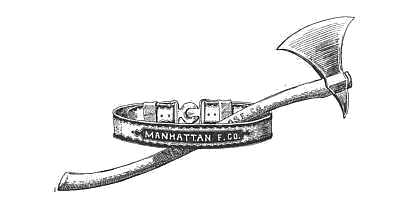
On the post hung a red flannel shirt, with a black silk
neckerchief sewed to the back of the broad rolling
collar. On top of the post was the most curious object
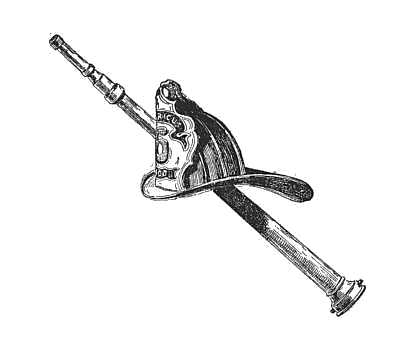
of all,—a ribbed helmet of glistening black leather, with
a broad curving brim that opened out like a shovel at
the back, while a stiff, heavy eagle's neck and head, projecting
from the top, curved over them and held in its
beak an emblazoned front of black patent leather that
displayed in big figures of white the number 40, and in
smaller letters, arching over the figures, the name, Lady
Washington. It was the fire-cap of a famous engine
company of the old New York volunteer department,—a
curious thing, indeed, to be found in a school-boy's
room.
The desk, littered with its books and papers, stood in
the corner between the window and the east wall. Along
the west wall was a curtained clothes-press. Then came
the marble-topped washstand, into which the water
would flow only at night, when the demand for Gotham's
supply of Croton measurably subsided. Beyond that
was the door leading to the open passage toward the
stairway to the lower floors. In the corner of the room
were the school-boy paraphernalia of the day,—a cricket
bat, very much battered, two base-ball bats that the boys
of this generation would doubtless scan suspiciously,
"heft" cautiously, then discard disdainfully, for they
were of light willow and bigger at the bulge by full an
inch than the present regulation. Beneath them in the
corner lay the ball of the year 1860, very like the article
now in use, but then referred to as a "ten shilling,"
and invariably made at an old shoe-shop at the foot of
Second Avenue, whose owner, a veteran cobbler, had
wisely quit half-soling and heeling for a sixpence and
was coining dollars at the newly discovered trade. All
the leading clubs were then his patrons,—the Atlantics,
the Eckfords, the Mutuals, the Stars, even the Unions of
Morrisania. All the leading junior clubs swore by him
and would use no ball but his,—the champion Actives,
the Alerts, the Uncas. (A "shanghai club" the boys
declared the last named to be when it first appeared at
Hamilton Square in its natty uniform of snow-white
flannel shirts and sky-blue trousers.) Base ball was in
its infancy, perhaps, but what a lusty infant and how
pervading! Beyond that corner and hanging midway
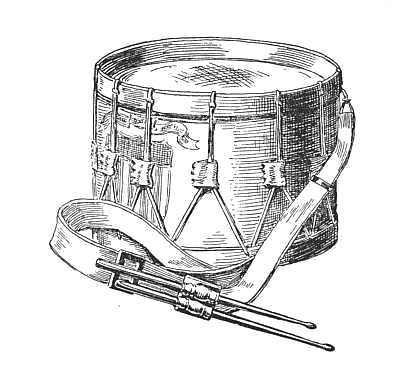
on the northward wall was a portentous object, an old-fashioned
maple shell snare-drum, with white buff
leather sling and two pairs of ebony sticks, their polished
heads and handles proclaiming constant use, and the
marble surface of the washstand top, both sides, gave
proof that when practice on the sheepskin batter head
was tabooed by the household and the neighborhood,
the inoffensive stone received the storm of "drags," and
"flams," and "rolls." Lifting the curtain that overhung
the boyish outfit of clothing, there stood revealed still
further evidence of the martial tastes of the occupant, for
the first items in sight were a natty scarlet shell-jacket, a
pair of trim blue trousers, with broad stripe of buff, and
a jaunty little forage-cap, with regimental wreath and
number. Underneath the curtain, but readily hauled into
view, were found screwed and bolted to heavy blocks of
wood two strange-looking miniature cannon, made, as
one could soon determine, by sawing off a brace of old-fashioned
army muskets about a foot from the breech.
Two powder-flasks and a shot-bag hung on pegs at
the side of the curtained clothes-press. A little mirror
was clamped to the wall above the washstand. Some
old fencing foils and a weather-beaten umbrella stood
against the desk. An open paint-box, much besmeared,
lay among the books. Some other pamphlets and magazines
were stacked up on the top of the clothes-press.
Two or three colored prints, one of Columbian Engine,
No. 14, a very handsome Philadelphia "double-decker."
Another of Ringgold Hose, No. 7, a really beautiful four-wheeler
of the old, old type, with chocolate-colored running
gear and a dazzling plate-glass reel, completed the
ornamentation of this school-boy den. There was no
room for a lounge,—there was room only for two chairs;
but that diminutive apartment was one of the most
popular places of resort Pop's boys seemed to know,
and thereby it became the hot-bed of more mischief,
the birthplace of more side-splitting school pranks than
even the staid denizens of that most respectable brownstone
front ever dreamed of, whatever may have been
the convictions of the neighborhood, for Pop's boys, be
it known, had no dormitory or school-house in common.
No such luck! They lived all over Manhattan Island, all
over Kings, Queens, and Westchester counties. They
came from the wilds of Hoboken and the heights of Bergen.
They dwelt in massive brownstone fronts on Fifth
Avenue and in modest wooden, one-story cottages at
Fort Washington. They wore "swell" garments in some
cases and shabby in others. They were sons of statesmen,
capitalists, lawyers, doctors, and small shopkeepers.
They were rich and they were poor; they were high and
they were low, tall and short, skinny and stout, but they
were all pitched, neck and crop, into Pop's hopper,
treated share and share alike, and ground and polished
and prodded or praised, and a more stand-on-your-own-bottom
lot of young vessels ("vessels of wrath," said
the congregation of a neighboring tabernacle) never had
poured into them impartially the treasures of the spring
of knowledge. They were of four classes, known as the
first, second, third, and fourth Latin, corresponding to
the four classes of Columbia and other colleges, and to
be a first Latin boy at Pop's was second only to being a
senior at Yale or Columbia. As a rule the youngsters
"started fair" together at the bottom, and knew each
other to the backbone by the time they reached the top.
Few new boys came in except each September with the
fourth Latin. Pop had his own way of teaching, and
the boy that didn't know his methods and had not mastered
his "copious notes" might know anybody else's
Cæsar, Sallust, or Cicero by rote, but he couldn't know
Latin. Pop had a pronunciation of the Roman tongue
that only a Pop's bred boy could thoroughly appreciate.
Lads who came, as come in some rare cases they did, from
Eton or Harrow, from the Latin schools of Boston or the
manifold academies of the East, read as they had been
taught to read, and were rewarded with a fine sarcasm
and the information that they had much to unlearn.
Pop's school was encompassed roundabout by many another
school, whose pupils took their airing under ushers'
eyes, to the howling disdain of Pop's unhampered pupils,
who lined the opposite curb and dealt loudly in satirical
comment. There was war to the knife between Pop's
boys and Charlier's around the corner, to the end that
the hours of recess had to be changed or both schools,
said the police, would be forbidden the use of Madison
Square. They had many faults, had Pop's boys, though
not all the neighborhood ascribed to them, and they had
at least one virtue,—they pulled well together. By the
time it got to the top of the school each class was like a
band of brothers, and never was there a class of which
this could be more confidently asserted than the array of
some twenty-seven youngsters, of whom Snipe and his
smaller chum, Shorty, were prominent members, in the
year of our Lord eighteen hundred and sixty.
Yet, they had their black sheep, as is to be told, and
their scapegraces, as will not need to be told, and months
of the oddest, maddest, merriest school life in the midst
of the most vivid excitement the great city ever knew,
and on the two lads wailing there at the attic window
because their fates had balked the longed-for game at
Hamilton Square, there were dawning days that, rain
or shine, would call them shelterless into constant
active, hazardous life, and that, in one at least, would
try and prove and temper a brave, impatient spirit,—that
should be indeed the very turning-point of his
career.
Patter, patter, patter! drip, drip, drip! the rain came
pelting in steady shower. The gusty wind blew the
chimney smoke down into the hollow of the long
quadrilateral of red brick house backs. Three, four,
and five stories high, they hemmed in, without a break,
a "plant" of rectangular back-yards, each with its flag-stone
walk, each with its square patch of turf, each
with its flower-beds at the foot of the high, spike-topped
boundary fence, few with visible shrubs, fewer
still diversified by grape arbors, most of them criss-crossed
with clothes-lines, several ornamented with
whirligigs, all on this moist November afternoon wringing
wet from the steady downpour that came on with
the dawn and broke the boys' hearts, for this was to
have been the match day between the Uncas and the
Murray Hills, and Pop's school was backing the Indians
to a man. One more week and winter might be upon
them and the ball season at an end. Verily, it was
indeed too bad!
With a yawn of disgust, the shorter boy at the open-topped
window threw up his hands and whirled about.
There on the bed lay the precious base-ball uniform
in which he was wont to figure as shortstop. There,
too, lay Snipe's, longer in the legs by nearly a foot.
"There's nothing in-doors but books, Snipy. There's
only one thing to tempt a fellow out in the wet,—a fire,
and small chance of that on such a day. We might
take the guns up on the roof and shoot a few skylights
or something——"
"Shut up!" said Snipe, at this juncture, suddenly,
impetuously throwing up his hand. "Twenty-third
Street!"
Shorty sprang to the window and levelled an old
opera-glass at the summit of an odd white tower that
loomed, dim and ghost-like, through the mist above the
housetops quarter of a mile away. Both boys' eyes
were kindling, their lips parting in excitement. Both
were on tiptoe.
"Right! Down comes the lever!" was the next
announcement. "Upper Fifth, I'll bet a bat! Listen!"
Suddenly there pealed on the heavy air, solemn and
slow, the deep, mellow tones of a great bell. Even as
he counted the strokes each boy reached for his cap.
One—two—three—four!
"Fourth!" cried Shorty. "Come on!" And, light
as kittens, away scurried the two, skimming down three
flights of stairs, nearly capsizing a sedate old butler,
snatching their top-coats in the hall, letting themselves
out with a bang, leaping down the broad flight of
brownstone steps to the broader walk below, then
spurting away for Union Square, fast as light-heeled,
light-hearted lads could run.
CHAPTER II.
A curious thing to look back upon is the old volunteer
fire department of New York as it was forty years ago.
No horses, no fire-boats, few steamers, no telegraph
alarm-boxes, only a great array of practically go-as-you-please
companies, averaging forty or fifty men apiece,
scattered all over the inhabited parts of the island from
Harlem to the Battery. Sixty of these organizations,
there or thereabouts, were hose companies, each manning
a light, high-wheeled, fancifully painted carriage
with its hose-reel perched gracefully above the running-gear,
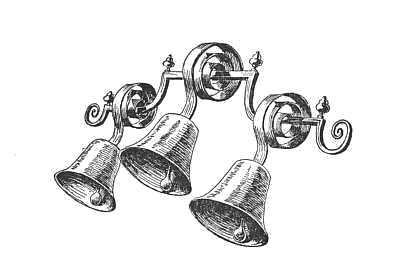
decked out with fancy lamps and jangling
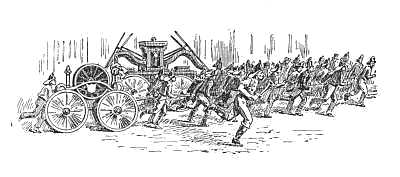
bells,—a carriage so light that a boy could start it on the
level and a dozen athletic men could make it fairly spin
over the paved streets. Then there were fifty engine
companies, all but two or three specially favored bands
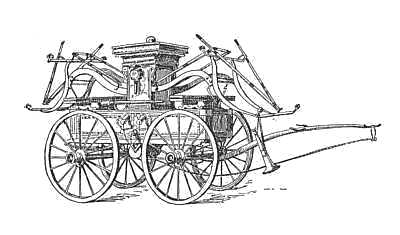
"tooling" hand machines, some of the old "double-deck"
Philadelphia pattern, some with long side levers,
"brakes" they called them; others still with strange,
uncouth shapes, built by some local expert with the
idea of out-squirting all competitors. Down in Centre
Street was the heavy apparatus of the Exempt Company,
only called upon in case of fires of unusual magnitude.
Near by, too, was stored a brace of what were
then considered powerful steamers, brought out only
on such occasions; but two companies that wielded
strong political influence proudly drew at the end of
their ropes light-running and handsome steam fireengines,
and these two companies, Americus 6,—"Big
Six" as they called her,—and her bitter rivals of Manhattan
8, were the envied of all the department. Add
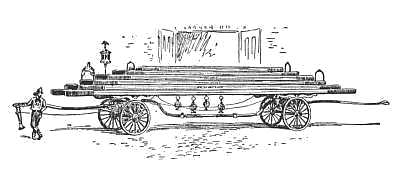
to these some nineteen hook and ladder companies
that ran long, light, prettily ornamented trucks, and you
have the New York fire department as it was just before
the war. Famous men were its chiefs in those days,
and the names of Harry Howard and John Decker, of
Carson and Cregier, were household words among the
boys at Pop's, most of whom were strong partisans of
some company on whose speed and prowess they pinned
their faith. Strange, indeed, to-day seems the system
by which fire alarms were communicated. There were
no electric bells, no gongs, no telephones in the various
engine-houses, which were scattered all over the town,
generally in groups of two, an engine and a hose
company being "located" side by side, though a large
number occupied single houses. On the roof of the old
post-office at Nassau Street, in a huge frame-work at
the rear of the City Hall, and in tall observation-towers
of iron tubing or wooden frame, placed at convenient
points about the city, were hung big, heavy, deep-toned
bells that struck the hour at noon and nine at night,
but otherwise were used exclusively for the purpose of
giving alarms of fire. The city was divided into eight
districts, and the sounding of the tower bells of any
number from one to eight, inclusive, meant that a fire
had been discovered within the limits of that district,
and all companies designated for service therein must
hunt it up and put it out. The seventh and eighth districts
divided the lower part of the city, a little below
Canal Street, evenly between them. Then, as the city
broadened there, the great, far-spreading space between
the East and North Rivers, south of Twenty-second
Street, was parcelled off into the third, fourth, fifth,
and sixth districts, beginning from the west. These
were quite narrow at the south, but flared out north
and eastward. Above them, on the east and west sides
of the city respectively, lay the first and second districts,
the former extending almost to Harlem, which had on
Mount Morris its own bell-tower and at its foot a little
department of its own. Night and day a single watcher
was perched in the glass-enclosed lookout at the summit
of each lofty tower, his sole communication with
the world below being a speaking-tube to the engine-house
at the base and a single wire that connected his
"circuit" with the main office at the City Hall, a circuit
so limited in its possibilities that it could only administer
a single tap at a time upon the tiny gong-bell over the
watcher's desk, and finally the big, booming bell that,
hanging midway down in the lofty structure, was yet
so high above the neighboring roofs and walls that its
sound bellowed forth in unimpeded volume. It was
struck by a massive swinging hammer, worked by a
long steel lever aloft in the watch-tower, the entire apparatus
being the design, as were some of the strange-looking
engines, of ex-Chief Carson, and one of the
greatest treats that Pop's boys could possibly have was
to be piloted of a wintry Saturday afternoon or summer
evening, by one of their number who had the open
sesame, up, up the winding stairway, up past the huge,
silent monster that hung midway. (You may venture to
bet they wasted no time there, but scurried past him,
full tilt, lest an alarm should come at the instant and he
should suddenly boom forth and stun them with his
clamor.) Once well past him, they breathed freer, if
harder, for the climb was long, and at last, tapping on a
little trap-door, were admitted to the sanctum at the
summit, and could gaze in delight and wonderment
about them and over the busy, bustling world far, far
beneath. Once well above the low ground of Canal
Street, the city rose, and from the Hudson to the East
River, along about the line of Spring Street, the ground
was high, and here was established the inner row of
Gotham's picket guards against fire: three tall towers,
one away over at Essex Market, on the far east side,
guarding the sixth district; one on Marion Street, guarding
the lower fourth and fifth; one over at McDougal
Street, guarding the lower third. The next post to the
northward was at Jefferson Market, on Sixth Avenue, a
tall white wooden shaft that seemed to pierce the skies,
so low were all the surrounding buildings, and from his
eerie at its summit Jefferson's ringer watched over the
upper third and fourth districts. The next tower was
Twenty-third Street, near First Avenue, an open affair
of iron, like that at McDougal, and here the guardian
looked out over all the lower first and upper fifth districts,
as well as having an eye on the northeastern part
of the fourth. Then came Thirty-second Street, far
over near Ninth Avenue, another open cage; and in the
cozy, stove-warmed roost at the top of each, snugly
closed against wind and weather, day and night, as has
been said, and only one man at a time, the ringer kept
his ceaseless vigil. It was his duty to be ever on the
alert, ever moving about and spying over the city. If an
unusual smoke or blaze manifested itself anywhere, he
would at once unsling his spy-glass and examine it. If
it lay long blocks or miles away and closer to some
other tower, the unwritten law or etiquette of the craft
demanded that he should touch the key of his telegraph.
This instantly sounded the little bell in the other towers
on his circuit, and called upon his fellows to look about
them. At no time could he sit and read. He must
pace about the narrow confines of his rounded den, or
on the encircling gallery outside, and watch, watch,
watch. Whenever he discovered a fire, the first thing
was to let down his lever and strike one round of the
district in which it lay,—fast if the fire was near, slow
if at a distance. This was all the neighboring companies
had to judge by, as the first arrivals at the engine-house,
or the loungers generally sitting about the stove back of
the apparatus, or the bunkers who slept there at night,
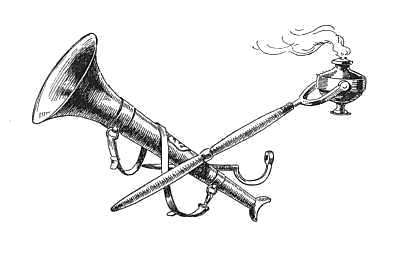
sprang for their fire-caps, raced for the trumpet that
stood on the floor at the end of the tongue, threw open
their doors, manned the drag-rope, and "rolled" for the
street. No company could speed far on its route before
meeting some runner or partisan who could tell the exact
or approximate location of the fire. The first round
from the tower would start every machine in its neighborhood.
Then the ringer would spring to his telegraph
and rapidly signal to the City Hall two rounds of the
district, then add the number of his tower. Then back
he would go to his lever and bang another round. If
the fire was trivial four rounds would suffice; if a great
conflagration ensued he would keep on ringing for half
an hour, and if it proved so great that the chief engineer
deemed it necessary to call out his entire force, word
would be sent to the nearest tower, and a general alarm
would result,—a continuous tolling until signalled from
the City Hall to cease. Well did Pop's boys remember
the one general alarm of 1859, when the magnificent
Crystal Palace at Sixth Avenue and Forty-second Street
went up in smoke; and all in half an hour! And thrilling
and interesting it was to the favored few of their
number permitted sometimes to stand watch of an evening
with the ringer, and to peer down on the gaslights
of the bustling streets and over dim roofs and spires and
into many an open window long blocks away! It was
joy to be allowed to man the lever with the silent, mysterious
hermit of the tower and help him bang the big
bell when the last click of the telegraph from the City
Hall announced that the second-hand of the regulator
at the main office had just reached the mark at nine
o'clock. It was simply thrilling to sit and watch the
keen-eyed sentinel as he suddenly and intently scanned
a growing light about some distant dormer window,
reached for his glass, peered through it one instant, then
clapped it into its frame, sprang for the lever, and in
another moment three or four or five deep, clanging
notes boomed out on the night air from below. It was
wild delight to lean from the gallery without and watch
the rush and excitement in the streets,—to hear the jangle
of the bells of the white hose carriage as "she" shot
suddenly into view and, with a dozen active dots on the
drag-rope, went spinning down the street, closely followed
by her next-door neighbor, the engine, with a
rapidly growing crew. It was keen excitement to watch
the bursting of the blaze, the roll of the smoke from the
upper windows, to see it wax and spread and light up
the neighboring roofs and chimneys with its glare, to
mark from on high the swiftly gathering throngs on the
broad avenue, and under the gaslight to see company
after company come trotting out from the side streets,
curving round into the car-tracks, and the moment the
broad tires of their engine, truck, or carriage struck the
flat of the rails, up would rise a yell from every throat
and away they would go at racing speed. It was thrilling,
indeed, to see two rival companies reach the avenue
at the same point and turn at once into the tracks.
Then to the stirring peal of the alarm the fiercely contending
bands would seem fairly to spurn the stones
beneath their flying feet, and carts, carriages, "busses,"
everything except the railway-cars themselves, would
clear the track for the rival racers, and the air would
resound with their rallying-cries. Time and again, it
must be owned, so fierce was the strain for supremacy,
that furious rows broke forth between the contestants,
and that between many companies there were for months
and years bitter feuds that often led to war to the knife,
and a fire was sometimes left to look out for itself while
the firemen settled their quarrel with fists, stones, and
"spanners." As a rule, though, there were so many
companies at each fire that there were more than enough
to fight the flames, for every company had to run to
two districts as well as cover its own neighborhood.
Rowdyism was rampant in some of the organizations,
but then a benignant "Tammany" guarded the interests
of a force so strong in numbers, so potent a factor in
politics, and only when a company had become repeatedly
and notoriously negligent of its proper duties in
order to indulge its love for fight was it actually disbanded.
Compared with the system of to-day it was
almost grotesque; but in the years when Pop's boys
were in their glory the old volunteer fire department
was on its last legs, yet was as ignorant of its coming
dissolution as of the approach of the great war that
should summon so many of its members to meet a foe
far harder to down than the hottest fire they had ever
tackled. They were still monarchs of all they surveyed,
those red-shirted, big-hearted roughs, and many a company
had a jolly word of welcome for Pop's boys, who
more than once had given some favorite company first
notice—"a still alarm"—of a blaze, and thereby enabled
the "Zephyrs" of 61 Hose or the "Pacifics" of 28 Engine
to be first at the fire, getting a "scoop" on their nearest
neighbors of the "Lexington" or the "Metamoras," for
every company besides its number had its name, and
every company, high or low, its swarm of boy admirers,
adherents, and followers, most of them, it must be admitted,
street gamins.
And all this explanation as our two youngsters are
scooting through the dripping rain for Union Square.
As they sped across Fifth Avenue a long white seam
flashed into view just beyond the Washington statue,
and went like a dim streak sailing away up Fourth
Avenue.
"There goes Twelve Truck!" panted Shorty, already
half-winded in the fierce effort to keep up with Snipe's
giant strides. "Seven Hose must be just ahead. Look
out for Twenty-three now!"
Yes, out from Broadway, as he spoke, a little swarm
of men and boys on the drag-ropes, another company
came, hauling a bulky little red hand-engine, and went
tugging in chase of the lighter hook and ladder. A
minute's swift run brought the youngsters to the open
square, another around to the broad space in front of
the Everett, and there the misty atmosphere grew heavy
and thick, and the swarm of scurrying men and boys
breathed harder as they plunged into a dense drift of
smoke. Just as our youngsters noted that the crowds
were running eastward through Nineteenth Street, the
old rallying cry of another company was heard, and a
light hose carriage came bounding across the car-tracks
from the direction of Broadway. Snipe by this time
was a dozen yards ahead, and could not hear or would
not heed the half-choking, warning cry of puffing little
Shorty.
"Lay low, Snipe; that's the Metamora. Look out—look
out for the——"
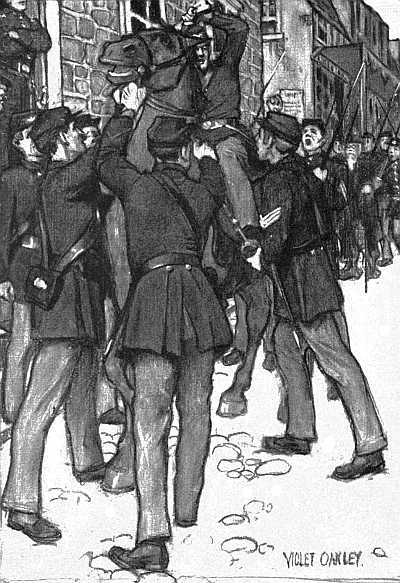
Too late! Half a dozen young fellows were sprinting
along beside their pet hose carriage. No more were
needed on the ropes, and as Shorty rounded the corner
into Nineteenth Street and saw the flames bursting from
the roof of a stable close to Lexington Avenue, he saw,
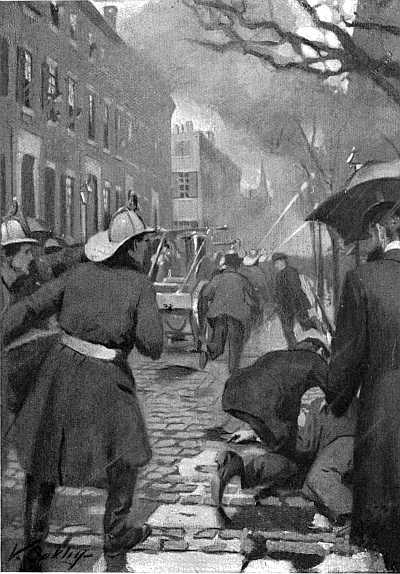
too, with bursting heart, three of those young flankers
spring up on the sidewalk in chase of long-limbed Snipe,
saw one of them overtake him, lay sudden hand on his
shoulder on one side and hurl him violently to the left,
just in time to be tripped over the tangling foot of
another and tumbled headlong into the reeking gutter,
there to lie, stunned and almost senseless, till Shorty,
raging, yet breathless and helpless, strove to lift his
bleeding head upon his knee.
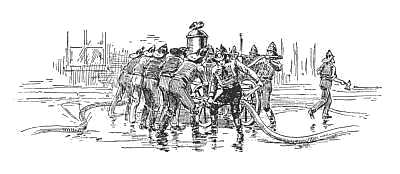
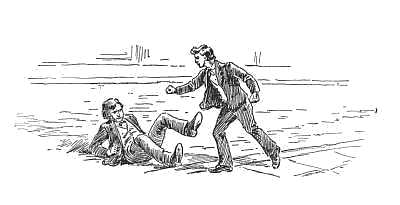
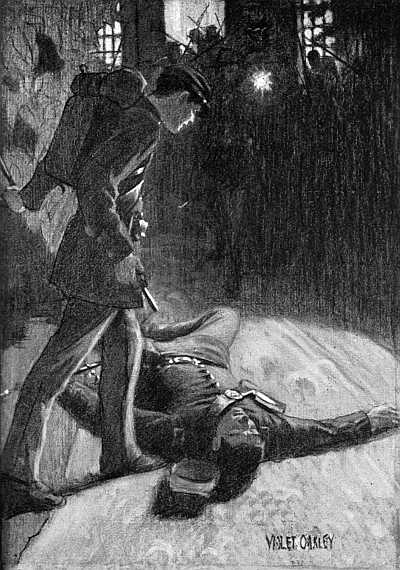
Almost senseless, till Shorty strove to lift his bleeding head upon his knee.
CHAPTER III.
Bigger crowds ran to fires, big or little, in those days
than now. The blaze which had well-nigh destroyed an
old frame stable in Nineteenth Street that rainy Saturday
afternoon before a single fire company reached the
scene, and that drew to the spot in the course of half
an hour at least twenty companies,—engine, hose, or
hook and ladder,—would be handled now by one compact
little battalion with one-tenth the loss, with no
more than forty men, without an unnecessary sound,
and in much less than half the time. Although aided
by sympathizing hands, Shorty had barely time to get
Snipe on his shaky legs and in the lee of a sheltering
tree-box when another company came tearing around
from upper Fourth Avenue,—their old friends of Zephyr
Hose,—close followed by Engine 28, and Shorty lifted
up his voice in a yodel that instantly brought two or
three panting young fellows to his side,—big boys who
had run with their pet company the half-mile from
Twenty-eighth Street. Instant suspicion, mingled with
wrath, gleamed in their eyes at sight of Snipe's pale
face and bleeding temple. "Yes, the Hulker fellows!"
sobbed Shorty, now half mad with indignation and excitement.
"I saw just the two that did it. One of
them belongs to the first nine of the Metamoras,—the
juniors,—and had a row with Snipe the day of the
match. Briggs was with them. Wait till we tend to
Snipe, then we can fix him."
The youngster's heart was beating hard and savagely,
for the outrage was brutal. There had been angry
words between the rival clubs, the Uncas and the Metamora,
the day of their great game, and hosts of other
juniors had gathered about the wrangling nines, not
utterly displeased at the idea of a falling out between
two of the strongest and, as juniors went in those days,
"swellest" organizations on the list. Then, as luck
would have it, several of the older boys of both clubs
were devoted followers, even "runners," of two rival
hose companies, the Uncas almost to a man pinning
their fortunes on the white Zephyr, whose home was
but three short blocks above Pop's school, and one of
whose active members, the son of a Fifth Avenue millionaire,
was the biggest and oldest—and stupidest—of
Pop's pupils, though not in the classical department.
The Metamoras, in like manner, swore by the swell hose
company of that name, whose carriage was housed on
Fifth Avenue itself, diagonally over across the way from
the impressively dignified and aristocratic brownstone
mansion of the Union Club. And what Pop's boys, the
First Latin, at least, were well-nigh a unit in condemning
was that just two of their own number, residents
of that immediate neighborhood, were known to be in
league with the Metamora crowd, even to the extent, it
was whispered, of secretly associating with the Hulkers,
and by the Hulkers was meant a little clique led by two
brothers of that name, big, burly young fellows of nineteen
and eighteen respectively, sons of a wealthy widow,
who let them run the road to ruin and bountifully paid
their way,—two young scapegraces who were not only
vicious and well-nigh worthless themselves, but were
leading astray half a score of others who were fit for
better things. No wonder the hearts of the Uncas were
hot against them.
Into the area doorway of a neighboring dwelling, with
faces of gloom, they had led their wounded comrade.
Sympathizing, kind-hearted women bathed his forehead
and smoothly bandaged it, even as the uproar without
increased, and companies from far down-town kept
pouring into the crowded street. By this time half a
dozen streams were on the blaze and the black smoke
had turned to white steam, but still they came, Gulick
and Guardian, hose and engine, from under the Jefferson
tower, and natty 55 Hose,—the "Harry Howards,"—from
away over near the Christopher ferry, and their
swell rivals of 38, from Amity Street, close at the heels
of Niagara 4, with her handsome Philadelphia double-deck
engine, and "3 Truck," from Fireman's Hall, in
Mercer Street, and another big double-decker, 11, from
away down below the Metropolitan Hotel, raced every
inch of the mile run up Broadway by her east side rival,
Marion 9. Fancy the hundreds of shouting, struggling,
excited men blocking Lexington Avenue and Eighteenth
Street for two hundred yards in every direction from
what we would call to-day a "two-hundred-dollar fire,"
and you can form an idea of the waste of time, money,
material, and energy, the access of uproar, confusion,
and, ofttimes, rowdyism, that accompanied an alarm
in the days before the war. Remember that all this,
too, might result from the mere burning out of a chimney
or the ignition of a curtain in a garret window, and
you can readily see why tax-payers, thinking men, and
insurance companies finally decided that the old volunteer
department must be abolished.
But until the war came on there was nothing half so
full of excitement in the eyes of young New York, and
Pop's boys, many of them at least, thought it the biggest
kind of fun outside of school, where they had fun of
their own such as few other boys saw the like of.
It was inside the school, however, on the following
Monday morning, that the young faces were grave and
full of import, for Snipe was there, still bandaged and a
trifle pale, and Shorty, scant of breath but full of vim
and descriptives, and time and again had he to tell the
story of the Hulkers' attack to classmates who listened
with puckered brows and compressed lips, all the while
keeping an eye on two black sheep, who followed with
furtive glances Snipe and Shorty wherever they went;
and one of these two was the Pariah of the school.
The only son of a wealthy broker, Leonard Hoover
at eighteen years of age had every advantage that the
social position of his parents and a big allowance could
give him, but he stood in Pop's school that saddest of
sights,—a friendless boy. Always immaculately dressed
and booted and gloved, he was a dullard in studies, a
braggart in everything, and a success in nothing. For
healthful sports and pastimes he had no use whatever.
Books were his bane, and at eighteen he knew less of
Latin than boys in the fourth form, but Pop had carried
him along for years, dropping him back thrice, it was
said in school traditions, until at last he had to float
him with the First Latin, where he sat week after week
at the foot of the class. It was said that between the
revered rector of the school and the astute head of
the firm of Hoover, Hope & Co. a strong friendship
existed, but whatever regard "the Doctor" entertained
for the father he denied the son. Long years of observation
of the young fellow's character had convinced
this shrewd student of boy nature that here was a case
well-nigh without redeeming feature. Lazy, shifty, lying,
malevolent, without a good word or kind thought for a
human being, without a spark of gratitude to the father
who had pulled him through one disgrace after another,
and who strove to buy him a way through life, young
Hoover was, if truth were confessed, about as abhorrent
to the Doctor as he was obnoxious to the school. A
plague, a bully, a tyrant to the little fellows in the lower
classes, a cheat and coward among his fellows, filled
with mean jealousy of the lads who year after year
stepped over his head to the upper forms, stingy though
his pockets were lined with silver, sneaking, for he was
never known to do or say a straightforward thing in his
life, it had come to pass by the time he spent his sixth
year with Pop that Hoover was the school-boy synonym
for everything disreputable or mean. And, as though
the Providence that had endowed him through his father
with everything that wealth and influence could command
was yet determined to strike a balance somewhere,
"Len" Hoover had been given a face almost as
repellent as his nature. His little black eyes were glittering
and beady, which was bad enough, but in addition
were so sadly and singularly crossed that the effect
was to distort their true dimensions and make the right
optic appear larger and fuller than the left, which at
times was almost lost sight of,—a strange defect that
even Pop had had the weakness to satirize, and, well
knowing that Hoover would never understand the
meaning, had in a moment of unusual exasperation referred
to him as "Cyclops," or Polyphemus, a name
that would have held among the boys had it not been
too classical and not sufficiently contemptuous. An
ugly red birth-mark added to his facial deformity, but
what more than anything else gave it its baleful expression
was the sneer that never seemed to leave his mouth.
The grin that sometimes, when tormenting a little boy,
distended that feature could never by any possibility be
mistaken for a smile. Hoover's white, slender, shapely
hands were twitching and tremulous. New boys, who
perhaps had to shake hands with him, said they were
cold and clammy. He walked in his high-heeled boots
in a rickety way that baffled imitation. He never ran.
He never took part in any sport or game. He never
subscribed a cent to any school enterprise,—base ball,
cricket, excursion, or debate. He never even took part
in the customary Christmas gifts to the teachers, for in
the days of this class of Snipe's and Shorty's and others
whose scholarly attainments should have won them first
mention, there were some beloved men whom even mischief-loving
lads delighted to remember in that way.
One Christmas-tide Hoover had appeared just before the
holiday break-up, followed by a servant in dark livery,
a thing seldom seen before the war, and that servant
solemnly bore half a dozen packages of which Hoover
relieved him one at a time, and personally took to the
desk of the master in each one of the five rooms, left it
there without a word of explanation, but with an indescribable
grin, bade the servant hand the sixth to the
open-mouthed janitor, and disappeared. A perplexed
lot were Pop's several assistants when school closed
that afternoon. John, the janitor aforesaid, declared
they held an informal caucus in the senior master's room
(Othello was the pet name borne at the time by this
gifted teacher and later distinguished divine), and that
three of the number, who had smilingly and gracefully
thanked the boys for the hearty little tribute of remembrance
and good will with which the spokesman of the
class had wished each master a Merry Christmas, declared
they could accept no individual gift from any
pupil, much less Hoover, and that he, John, believed the
packages had been returned unopened.
And this was the state of feeling at the old school
towards its oldest scholar, in point of years spent beneath
its roof, on the bleak November morning following
Snipe's and Shorty's disastrous run to the fire, when at
twelve o'clock the First Latin came tumbling down-stairs
for recess. Ordinarily they went with a rush, bounding
and jostling and playing all manner of pranks on each
other and making no end of noise, then racing for doughnuts
at Duncan's, two blocks away. But this time there
was gravity and deliberation, an ominous silence that
was sufficient in itself to tell the head-master, even before
he noted the fact that Hoover was lingering in the
school-room instead of sneaking off solus for a smoke at
a neighboring stable, that something of an unusual nature
was in the wind.
"Why don't you go out to recess, Hoover?" said he,
shortly. "If any lad needs fresh air, it's you."
No answer for a moment. Hoover stood shuffling
uneasily at the long window looking out on Fourth
Avenue, every now and then peering up and down the
street.
Impatiently the master repeated his question, and
then, sullen and scowling, Hoover answered,—
"I can have trouble enough—here."
"What do you mean?" asked Othello.
"They're layin' for me,—at least Snipe is."
"By Snipe you mean Lawton, I suppose. What's the
trouble between you?" and the master sat grimly eying
the ill-favored fellow.
"It's not a thing—I want to speak of," was the answer.
"He knows that I know things that he can't
afford to have get out,—that's all." Then, turning suddenly,
"Mr. Halsey," said he, "there's things going on
in this school the Doctor ought to know. I can't tell
him or tell you, but you—you ask John where Joy's
watch went and how it got there."
The master started, and his dark face grew darker
still. That business of Joy's watch had been the scandal
of the school all October. Joy was one of the
leaders of the First Latin, a member of one of the
oldest families of Gotham, and this watch was a beautiful
and costly thing that had been given him on his
birthday the year before. One hot Friday noon when
the school went out to recess, Joy came running back
up the stairs from the street below and began searching
eagerly about the bookcases at the back of the
long school-room. A pale-faced junior master sat mopping
the sweat from his forehead, for the First Latin
had executed its famous charge but two minutes before,
and he had striven in vain to quell the tumult.
"What's the matter, Joy?" he asked. "I beg pardon.
Mr. Joy, I should say. I wonder that I am so forgetful
as to speak to a young gentleman in the First Latin as I
would to boys in the other forms in the school."
At other times when the weakling who had so spoken
gave voice to this sentiment it was the conventional
thing for the First Latin to gaze stolidly at him and, by
way of acknowledgment of the sentiment, to utter a
low, moaning sound, like that of a beast in pain, gradually
rising to a dull roar, then dying away to a murmur
again, accentuated occasionally here and there by deep
gutturals, "Hoi! hoi! hoi!" and in this inarticulate
chorus was Joy ever the fugleman. But now, with
troubled eyes, he stared at the master.
"My watch is gone, sir!"
"Gone, Mr. Joy? You terrify me!" said Mr. Meeker,
whose habit it was to use exaggerated speech. "When—and
how?"
"While we were—having that scrimmage just now,"
answered Joy, searching about the floor and the benches.
"I had it—looked at it—not two minutes before the bell
struck. You may remember, sir, you bade me put it
up."
"I do remember. And when did you first miss it?"
"Before we got across Twenty-fifth Street, sir."
By this time, with sympathetic faces, back came Carey
and Doremus and Bertram and others of the First
Latin, and John, the janitor, stood at the door and
looked on with puzzled eyes. It was not good for him
that valuables should be lost at any time about the
school. All four young fellows searched, but there was
no sign. From that day to this Joy had seen no more
of his beautiful watch. Detectives had sought in vain.
Pawn-shops were ransacked. The Doctor had offered
reward and Mr. Meeker, the master, his resignation, but
neither was accepted.
And now Hoover, the uncanny, had declared he had
information. It was still over an hour before the Doctor
could be expected down from his morning's work at Columbia.
The head-master felt his fingers tingling and
his pulses quicken. He himself had had a theory—a
most unpleasant one—with regard to the disappearance
of that precious watch. He knew his face was paling
as he rose and backed the downcast, slant-eyed youth
against the window-casing.
"Hoover," said he, "I've known you seven years, and
will have no dodging. Tell me what you know."
"I—I—don't know anything, sir," was the answer,
"but you ask John. He does."
"Stay where you are!" cried the master, as he stepped
to his desk and banged the gong-bell that stood thereon.
A lumbering tread was heard on the stairway, and a
red-faced, shock-headed young man came clumsily into
the room. Mr. Halsey collared him without ado and
shoved him up alongside Hoover. He had scant reverence
for family rank and name, had Halsey. In his
eyes hulking John and sullen Hoover were about on
a par, with any appreciable odds in favor of the janitor.
"Hoover tells me you know where Joy's watch went
and who took it. Out with the story!" demanded he.
"I d-don't," mumbled John, in alarm and distress.
"I—I only said that—there was more'n one could tell
where it went." And then, to Mr. Halsey's amaze and
disgust, the janitor fairly burst into tears. For two or
three minutes his uncouth shape was shaken by sobs
of unmistakable distress. Halsey vainly tried to check
him, and angrily demanded explanation of this womanish
conduct. At last John seemed about to speak, but
at that moment Hoover, with shaking hand, grabbed the
master's arm and muttered, "Mr. Halsey,—not now!"
Following the frightened glance of those shifting eyes,
Halsey whirled and looked towards the stairs. Then,
with almost indignant question quivering on his lips,
turned angrily on the pair. With a queer expression on
his white and bandaged face, Snipe Lawton stood gazing
at them from the doorway.
CHAPTER IV.
That famous charge of the First Latin is something
that must be explained before this school story can go
much further. To begin with, one has to understand the
"lay of the land," or rather the plan of the school-room.
Almost every boy knows how these buildings facing on
a broad business thoroughfare are arranged:—four or
five stories high, thirty or forty or fifty feet front, according
to the size of the lot, perhaps one hundred to
two hundred deep, with the rooms from basement to
attic all about of a size unless partitioned off on different
lines. In the days whereof we write Pop had his famous
school in the second and third floors of one of these
stereotyped blocks. Two-thirds of the second floor front
was given up to one big room. A high wooden partition,
glazed at the top and pierced with two doors, divided
this, the main school-room, from two smaller ones where
the Third and Fourth Latin wrestled with their verbs
and declensions and gazed out through the long rear
windows over a block of back-yards and fences. Aloft
on the third floor were the rooms of the masters of the
junior forms in English, mathematics, writing, etc. But
it is with the second, the main floor and the main room on
that floor, that we have to do. This was the home of the
First Latin. It was bare as any school-room seen abroad,
very nearly. Its furniture was inexpensive, but sufficient.
A big stove stood in the centre of the long apartment,
and some glazed bookcases between the west windows
and against the south wall at the west end. A closet,
sacred to Pop, was built against the north wall west of
the stairway, which was shut off by a high wooden partition,
reaching to the ceiling. A huge coat-rack stood
in the southeast corner. A big open bookcase, divided
off into foot square boxes for each boy's books, occupied
the northeast corner, with its back against the
northward wall. Six or seven benches abutting nearly
end to end were strung along the south side, extending
from the west windows almost to the coat-rack, the farthermost
bench being at an obtuse angle. The bookbox,
doors, and partitions were painted a cheerful lead
color, the benches a deep dark green. So much for
the accommodation of the lads. Now for their masters.
On a square wooden dais, back to the light, was perched
the stained pine desk at which from one-thirty to three
each afternoon sat glorified Pop. Boy nor man ventured
to assume that seat at other time, save when that front,
like Jove, gleamed above the desk to threaten and command,
and the massive proportions, clad in glossy broadcloth
of scholarly black, settled into the capacious depths
of that wicker-bottomed chair. In front of the desk, six
feet away, the low stove, so often seasoned with Cayenne
pepper, warmed the apartment, but obstructed not his
view. At an equal distance beyond the stove was the
table at which from nine A.M. to three P.M. sat the master
in charge of the room, and thereby hung many and many
a tale. It was a great big, flat-topped table, covered with
shiny black oilcloth, slightly padded, and was so hollowed
out on the master's side that it encompassed him
round about like some modern boom defence against torpedo
attack, and many a time that defence was needed.
From the instant of the Doctor's ponderous appearance
at the door law and disciplined order prevailed within
this scholastic sanctuary, but of all the bear-gardens ever
celebrated in profane history it was the worst during the
one hour in which, each day from eleven to twelve, Mr.
Meeker imparted to the First Latin his knowledge of the
higher mathematics and endeavored to ascertain what, if
any, portion thereof lodged long enough to make even a
passing impression on the minds of that graceless assembly.
There were other hours during which the spirit of
mischief had its sway. There were other masters who
found that First Latin an assemblage of youths who
made them wonder why the Doctor had, after long, long
years of observance, finally banished forever the system
of punishment which was of the breech—the vis a tergo
order, that was the mainstay of grammar-school discipline
in Columbia's proud past; but it was left to Mr.
Meeker to enjoy as did no other man the full development
of a capacity for devilment, a rapacity for mischief
never equalled in the annals of the school.
Whenever the class was formed for recitation it took
seats on those northward-facing benches, the head of
the class in a chair, with his back to the avenue window,
close by the westernmost bench. The others of the
"Sacred Band," as that guileful First Latin had once
been derisively named, strung out in the order of their
class rank along the benches, with Hoover, nine times
out of ten, alone at the bottom. The system of recitation
was peculiar to the school, and proved that the
"copious notes," so often scornfully, yet enviously, referred
to by outsiders, were only blessings in disguise.
It might be that Virgil was the subject of the hour, the
lesson say some fifty lines in the third book, and in this
event Beach, not Meeker, was in the chair, a man of
firmer mould, yet not invulnerable. One after another,
haphazard, the youngsters were called upon to read,
scan, translate, and at the very first slip in quantity,
error in scanning, mistake of a word in translation, the
master would cry "Next," and the first boy below who
could point out the error and indicate the correction
stepped up and took his place above the fellow at fault.
A perfect recitation was a rarity except among the keen
leaders at the head, for no error, big or little, was ever
let pass. It was no easy thing for the average boy to
read three lines of the resounding dactylic hexameters
of "P. Virgilius Maro" according to the Columbia system
of the day without a slip in quantity. Scanning, too,
was an art full of traps for the unwary, but hardest of
all for one of Pop's boys was it to translate. No matter
how easy it might be by the aid of the oft-consulted
"pony" to turn the Latin into English, it was the rule
of the school that the Doctor's own beautiful rendition
should be memorized word for word wherever it occurred,
and the instances, like the notes, were all too
copious. At the word "Enough" that checked his scanning
the boy began to translate, and having given the
poetic and flowery version of the great translator, then
turned to and, word by word, followed with the literal
meaning. Then came the prodding questions as to root,
verb, subject, etc., and lucky was the youngster who,
when he took his seat, found himself no more than half
a dozen places below where he started. At the end of
the hour the marks were totted up, and he who had the
highest number marched to the head of the class, the
others being assigned according to their score. It was
all plain sailing when the Doctor himself was in the
chair. Few boys ventured on fun with him. On the
other hand, few other masters could maintain order on a
system that gave such illimitable possibilities for devilment.
To illustrate: It is a brisk October morning.
School has "been in" an hour. The First Latin is arrayed
for recitation in the Æneid, and the boys have
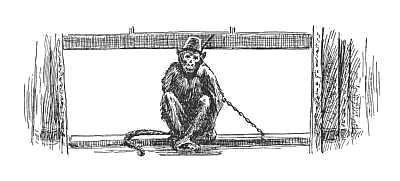
easily induced an Italian organ-grinder to come, monkey
and all, to serenade them, and to the lively notes of
"Patrick's Day in the Morning" one of the confirmed
scamps of the class is called upon to begin. He himself
was the heaviest subscriber to the fund which secured
the services of the dark-eyed exile and his agile monkey.
Bliss knows nothing whatever of the lesson and
is praying for the appearance of the red-capped simian
at the window. The janitor has been sent down to bid
the organ-grinder go away, but the boys have blocked
that game by bidding higher, and the Italian is warned
to pay no attention to such orders, but to hold his ground,—the
neighborhood approves of him and he'll be short
a quarter if he goes. John comes panting up-stairs to
report his ill success, and meantime the recitation cannot
go on. Bliss is finally told to pay no attention to
"Patrick's Day" and to push ahead on the most beautiful
lines in the book,
"Non ignara mali, miseris succerere disco,"
and Bliss slips on the quantity of the first syllable of the
third word, is promptly snapped up by Doremus, next
below, who tallies one on his score and jumps above
him. Bliss shuts his book despairingly. "Mr. Beach,"
he begins, in tones of deepest injury, "I know that just
as well as anybody else; but I protest, sir, I'm so distracted
by that grinding I can't do myself justice—or the
subject either." And if the astute Beach had any lingering
doubt as to whether the boys worked that game
themselves or not the doubt is banished now. Bertram,
Doremus, Snipe, Shorty, all are on their feet and
pleading with the master to have that impudent music
stopped. Mr. Beach vainly warns them to their seats
and commands silence.
"Mr. Beach, let me go down and drive him away,—I
can do it," implores Beekman, the pigmy Gothamite.
It is three minutes before the master can compel silence
in the class, so great is its sense of the outrage upon its
peace and dignity.
"Mr. Beach, let me fetch a policeman," cries Shorty,
who knows there isn't a blue-coat nearer than the Harlem
depot at Twenty-sixth Street, and is spoiling for a
chance to get out-of-doors.
"The next boy who speaks until bidden will have five
marks struck off," says Beach, and with one accord the
First Latin opens its twenty-seven mouths, even Hoover
swelling the chorus, and, as though so many representatives
in Congress assembled were hailing the chair, the
twenty-seven ejaculate, "Mr. Beach, nobody's got five
yet." Then little Post jumps up, in affected horror, and
runs from his seat half-way to the master's table. "Mr.
Beach!" he cries, "the monkey!"
"Aw, sit down, Post," protests Joy, in the interest
of school discipline and harmony. "You ought to be
ashamed of yourself making such a fuss about a monkey."
Snipe and Carey seize the first weapons obtainable—the
sacred ruler and the Japan tray on the Doctor's
desk—and make a lunge for the windows.
"Lawton—Carey! Back to your seats!" orders
Beach.
"We only want to drive the monkey away, sir," protests
Snipe, with imploring eyes. "Post'll have a fit,
sir, if you let the monkey stay. He's subject to 'em.
Ain't you, Post?"
"Yes, sir," eagerly protests Post, on the swear-to-anything
principle when it's a case of school devilment,
and two minutes more are consumed in getting those
scamps back to their places and recording their fines,
"Ten marks apiece," which means that when the day's
reckoning is made ten units will be deducted from their
total score. The settlement, too, is prolonged and complicated
through the ingenuity of Snipe and the connivance
of Bagshot and Bertram, who have promptly
moved up and occupied the place vacated by their long-legged,
curly-pated, brown-eyed comrade, and who now
sturdily maintain that Snipe doesn't know where he belongs.
As a matter of fact, Snipe doesn't; neither does
he greatly care. He's merely insisting on the customary
frolic before the class settles down to business, but to
see the fine indignation in his handsome face and listen
to the volume of protest on his tongue you would fancy
his whole nature was enlisted in the vehement assertion
of his rights.
Mr. Beach fines Snipe another five for losing his place,
and then stultifies himself by ordering Bertram and Bagshot
back to their original station, thus permitting Snipe
to resume his seat, whereupon he promptly claims the
remission of the fine on the ground that he himself had
found it, and Bertram, a youth of much dignity of demeanor,
gravely addresses Mr. Beach, and protests that
in the interests of decency and discipline Lawton should
forfeit his place, and to prove his entire innocence of
selfish motive offers to leave it to the class, and go to
the foot himself if they decide against him, and the
class shouts approval and urges the distracted Beach
to put Snipe out forthwith. Then somebody signals
"Hush!" for Halsey, the head-master, the dark Othello,
has scented mischief from afar, and is heard coming
swiftly down from the floor above, and Halsey is a man
who has his own joke but allows no others. Bliss is the
only boy on his feet as the stern first officer enters and
glances quickly and suspiciously about him.
"Go on with the recitation, Mr. Beach," he says.
"That Italian was doubtless hired by these young gentlemen.
Let them dance to their own music now, the
eloquent Bliss in the lead. Go on with your lines,
Bliss."
And as this is just what Bliss can't do, Bliss is
promptly "flunked" and sent to the foot, where Hoover
grins sardonically. He's ahead of one fellow anyhow.
Just so long now as that organ-grinder does must Halsey
stay—and supervise, and scorch even the best scholars
in the class, for well he knows the First Latin and they
him, and their respect for him is deeper than his for
them, despite the known fact that Pop himself looks
upon them with more than partial eyes. The class is
getting the worst of it when in comes an opportune
small boy. "Mr. Meeker says will Mr. Halsey please
step into the Fourth Latin room a minute," and Halsey
has to go.
"If those young gentlemen give you any trouble, Mr.
Beach, keep the whole class in at recess," he says, and
thereupon, with eyes of saddest reproach, the class follows
him to the door, as though to say, How can such
injustice live in mind so noble? But the moment Halsey
vanishes the gloom goes with him. Beach's eyes are on
the boys at the foot of the class, and with a batter and
bang the Japan tray on the Doctor's desk comes settling
to the floor, while Joy, who dislodged it, looks straight
into the master's startled eyes with a gaze in which conscious
innocence, earnest appeal, utter disapprobation of
such silly pranks, all are pictured. Joy can whip the
bell out from under the master's nose and over the
master's table and all the time look imploringly into the
master's eyes, as though to say, "Just heaven! do you
believe me capable of such disrespect as that?" Three
boys precipitate themselves upon the precious waiter,
eager to restore it to its place, and bang their heads together
in the effort. Five marks off for Shorty, Snipe,
and Post. Bagshot is on the floor, and announces as
the sense of the First Latin that a boy who would do
such a thing should be expelled. Mr. Beach says the
First Latin hasn't any sense to speak of, and tells Bagshot
to begin where he left off. Bagshot thereupon declares
he can't remember. It's getting near the "business
end" of the hour, and the whole class has to look to its
marks, so it can't all be fun. Thereupon Beach, who is
nothing if not classical, refers to Bagshot's lack of
acquaintance with the Goddess of Memory. "Who was
she, Bagshot?" "Mnemosyne." "Very good; yes, sir."
("Thought it was Bacchante!" shouts little Beekman.
"No, sir. Five marks off, Beekman. No more from
you, sir.") "Now, Bagshot, you should be higher than
ten in your class to-day, and would be but for misbehavior.
What was the color of Mnemosyne's hair?"
Bagshot glares about him irresolute, and tries the doctrine
of probability.
"Red!"
Beach compresses his lips. "M—n—no. That hardly
describes it. Next."
"Carnation," hazards Van Kleeck.
"Next! Next! Next!" says Beach, indicating with
his pencil one after another of the eager rank of boys,
and, first one at a time and distinctly, then in confused
tumbling over each other's syllables, the wiseacres of
the class shout their various guesses.
"Vermilion!"
"Scarlet!"
"Carrot color!"
"Solferino!"
"Magenta!"
"Pea-green!"
"Sky-blue!"
"Brick-red!" (This last from Turner, who makes a
bolt for a place above Bagshot, and can only be driven
back and convinced of the inadequacy of his answer by
liberal cuttings of ten to twenty marks.) Then, at last,
Beach turns to Carey, at the far head of the class, and
that gifted young gentleman drawls,—
"Fl-a-a-me color."
"Right!" says the master, whereupon half a dozen
contestants from below spring to their feet, with indignation
in their eyes:
"Well, what did I say, sir?"
"That's exactly what I meant, sir."
"I'll leave it to Bliss if that wasn't my answer, sir."
And nothing but the reappearance of Othello puts an
end to the clamor and settles the claimants. Shorty
submits that his answer covered the case, that Mnemosyne
herself couldn't tell carrot color from flame,
and is sure the Doctor would declare his answer right,
but is summarily squelched by Mr. Halsey, and he has
the "nous" to make no reference to the matter when
the Doctor comes. The hour is nearly over. Only
three minutes are allowed them in which to stow their
Virgils in the big open bookcase and extract their algebras.
Halsey vanishes to see to it that the Third Latin
goes to the writing-room without mobbing the Fourth.
The marks of the First are recorded, not without a volume
of comment and chaff and protest. Then silence
settles down as the master begins giving out the next
day's lesson, for the word has been passed along the
line of benches, "Get ready for a charge!" A moment
later the janitor sounds the bell on the landing
without, and twenty-six young fellows spring into air
and rush for the bookcase. Not a word is spoken,—Hoover,
alone, holds aloof,—but in less time than it
takes to tell it, with solemnity on every face except one
or two that will bubble over in excess of joy, the First
Latin is jammed in a scrimmage such as one sees nowadays
only on the football field. The whole living mass
heaves against those stout partitions till they bend and
crack. From the straining, struggling crew there rises
the same moaning sound, swelling into roar and dying
away into murmur, and at last the lustier fight their way
out, algebras in hand, and within another five minutes
order is apparently evolved from chaos.
In such a turmoil and in such a charge Joy's watch
disappeared that October day, and the school had not
stopped talking of it yet.
It has been said that two boys were the observed of
gloomy eyes the Monday following Snipe's misfortune.
One, Hoover, of course. The other a fellow who in
turn had sought to be everybody's chum and had
ended by being nobody's. His name was Briggs. He
was a big, powerful fellow, freckle-faced, sandy-haired,
and gifted with illimitable effrontery. He was a boy no
one liked and no one could snub, for Briggs had a skin
as thick as the sole of a school-boy's boot, and needed
it. One circumstance after another during the previous
year had turned one boy after another from him, but
Briggs kept up every appearance of cordial relations,
even with those who cold-shouldered him and would
have naught to do with him. During the previous
school-year he had several times followed Snipe, Shorty,
and their particular set, only to find that they would
scatter sooner than have him one of the party. He
had been denied admission to the houses of most of the
class. He had been twice blackballed by the Uncas,
and it was said by many of the school when Briggs
began to consort with Hoover that he had at last found
his proper level. One allegation at his expense the
previous year had been that he was frequently seen at
billiard-rooms or on the streets with those two Hulkers,
and even Hoover had hitherto eschewed that association.
Perhaps at first the Hulkers would not have
Hoover. The class couldn't tell and really didn't care
to know. One thing was certain: within the fortnight
preceding the opening of this story Briggs and Hoover
had been together more than a little and with the
Hulkers more than enough.
"Are you sure of what you say?" both Carey and
Joy had asked Shorty that exciting Monday morning, as
the eager youngster detailed for the tenth time the incidents
of the assault on Snipe.
"I'm as sure of it as I am of the fire," said Shorty,
positively. "Jim Briggs was with the Metamora crowd,
running in the street. He looked back and laughed
after he saw Snipe down."
But when confronted with this statement by the elders
of the "Sacred Band" Briggs promptly and indignantly
denied it.
"I never heard of it till to-day!" said he. "'Spose
I'd stand by and see one of my class knocked endwise
by a lot of roughs? No, sir!"
It was a question of veracity, then, between Briggs
and Shorty, the class believing the latter, but being
unable to prove the case. Snipe himself could say
nothing. Being in the lead, he had seen none of the
runners of the Metamora except the heels of a few
as they bounded over him when he rolled into the
street. There was an intense feeling smouldering in the
class. They were indeed "laying" for Hoover as they
had been for Briggs when they tumbled out for recess.
The latter, with his characteristic vim and effrontery,
denied all knowledge of the affair, as has been said, and
challenged the class to prove a thing against him. The
former, as has been told, lurked within-doors. What
had he to fear? He was not at the scene of the fire and
the assault. He never had energy enough to run. There
was some reason why he shrank from meeting or being
questioned by the boys. There was some reason why
Snipe Lawton should have left them and returned to the
school, and was discovered standing there at the doorway,
looking fixedly at the head-master's angered face
as it glowered on Hoover and the tearful John. Whatever
the reason, it could not well be divulged in the
presence of Mr. Halsey. Hoover stood off another proposed
demonstration in his honor after school at three
o'clock by remaining behind, and only coming forth when
he could do so under the majestic wing of the Doctor
himself. Pop looked curiously at the knots of lingering
First Latins, and raised his high-top hat in response to
their salutations. Hoover huddled close to his side until
several blocks were traversed and pursuit was abandoned.
Then he shot into a street-car, leaving the
Doctor to ponder on the unusual attention. And so it
happened that while the class was balked for the time
of its purpose, and the victim of Saturday's assault was
debarred from making the queries he had planned, Mr.
Halsey was enabled to pursue his bent. Just as the
little group of five, gazing in disappointment up the avenue
after the vanishing forms of the Doctor and Hoover,
was breaking up with the consolatory promise that
they'd confront Hoover with their charges first thing in
the morning, the open-mouthed janitor came running.
"Oh, Lawton!" he panted, "Mr. Halsey says he
wishes to speak with you, and to please come right
back."
"I'll wait for you, Snipe," said Shorty. "Day-day,
you other fellows." And wait he did, ten, twenty minutes,
and no Snipe came, and, wondering much, the
smaller lad went whistling down the avenue, forgetful,
in the fact that he still wore the jacket, of the dignity
demanded of a lad of the First Latin and full sixteen.
He wondered more when eight o'clock came that evening
and without Snipe's ring at the door-bell. He wondered
most when he saw Snipe's pallid, sad-eyed face
on the morrow.
CHAPTER V.
There was something in the friendship between those
two members of the First Latin not entirely easy for the
school to understand. In many ways they were antitheses,—Snipe,
over-long; Shorty, under-sized; Snipe,
brown-eyed and taciturn, as a rule; Shorty, blue-eyed
and talkative (Loquax was Pop's pet name for him);
Snipe was studious; Shorty quick to learn, but intolerant
of drudgery. Both loved play, active exercise,
and adventure. Both took naturally to everything connected
with the fire department, but in addition the
smaller boy had a decided love for the military, and was
a member of the drum corps of a famous organization
of the old State militia, and vastly proud of it. Snipe
loved the fishing-rod, and Shorty had no use for one.
Shorty loved drill, Snipe couldn't bear it. Take it all
in all, they were an oddly assorted pair, but when forty-eight
hours passed without their being in close communion
something had gone sadly amiss; and that was
the case now.
Everybody knew that Snipe Lawton had little or no
money of any kind, but few knew why. His own father
had been dead many years. His mother had remarried
when he was twelve years old, and between the boy and
his step-father there was no love whatever. Nor was
this the boy's fault. Open-hearted, affectionate, and of
gentle nature, he had really tried to like and to win the
regard of the man who had won his mother's heart and
had given her an attractive, even a beautiful, home.
But there are men who have no sympathy whatever
with boys. Mr. Park was one of these, and, after two
years of experiment, gave up trying to understand his
step-son, and declared that the boy must be sent away
to school. It is needless to describe what those two
years were to the mother or to the son. Both welcomed
the decision, though it cost the former many
tears. A younger sister was married and living in
New York City. Mr. Park was a Columbiad and
a fervent admirer of the great Doctor. It was arranged
that the boy should have his home under the
roof of his aunt, Mrs. Lawrence, and his lessons under
Pop. He grew rapidly, and his clothes were generally
short for him. He was shy, sensitive, and hated to ask
for money from home, because it had to come from his
step-father. Time and again he could not go to the
little social gatherings of his schoolmates, with whom
he became popular almost from the start, solely because
of his outgrown coat and trousers. His aunt had a
houseful of company much of the time; her husband's
kindred were numerous and prevalent, and, to tell the
truth, she was a little ashamed of the tall, shy, sometimes
awkward, if not gawky, boy, whose wrists were always
in evidence and whose trousers were so short and
shabby. And so it resulted that poor Snipe had his
little bedroom in her garret, which the servants soon
learned they could neglect with impunity, and a place
at her table when they were not entertaining company;
but home, he really had none. Breakfast was served
at the Lawrences' at nine o'clock, but before that time
Snipe was expected to come down to forage for himself
and be off to school and out of the way. Luncheon he
could take with him, if he chose to put it up and carry
it, but as none of the other boys did this Snipe soon
ceased, and one of Duncan's doughnuts was the mid-day
sustenance, washed down by a glass of what the Doctor
referred to as "copious cold Croton" (the Doctor loved
that word copious), and on this rather meagre diet
Snipe worried through the day till dinner-time, which
with Uncle and Aunt Lawrence was half-after six, and
a very hungry boy was he who silently, even humbly,
took his seat among the lively, chattering party (there
were always six or eight in the family circle), and, as
soon as his appetite was appeased, was permitted to
withdraw, presumably, to his studies, though the fact
that he was at Shorty's home was always comforting to
Aunt Lawrence, for she had great regard for certain
feminine relatives of the smaller boy, and believed that
wherever they presided her nephew could not possibly
get into mischief. It is not that Aunt Lawrence was
either knowingly neglectful or actively unkind. She was
a busy woman, a fashionable woman, a woman full of
pleasant impulse. She had told George to be sure and
come to her whenever anything went wrong, when he
needed advice or aid, or—rather vaguely—anything else.
She had told the butler to be sure to see that Master
George had coffee ready every morning at quarter-past
eight, and the seamstress was ordered to keep his wardrobe
in repair, and for a month or so both did as they
were bid, and then let Master George look out for himself.
Mr. Park had requested Mr. Lawrence to see that
George was given fifty cents each Saturday for his spending
money, out of which he was to provide his own shoes
and gloves. This was Park's own allowance in the old
days when he was a boy at the grammar school and Columbia
was away down-town, about on line with the
City Hall, and the boys lunched sumptuously at Shaddle's
for thrippence; but Park had not to buy his shoes
in those days, though he said he bought his gloves out of
his little sum. He simply argued that it would be good
discipline for his step-son to learn to economize. Gloves
and shoes cost much less in the ante-bellum days than
now, and less in Park's school-days than in those of his
step-son. George took what was given him silently and
without appeal, and during his three years at Pop's that
was every cent of money he received from home. But
gloves, he said, he had no use for, and boots were far
beyond him. Furthermore, low shoes, summer and
winter both, were best to run in, and not another boy
at the Doctor's dreamed of the true state of the case,
unless it was little Shorty, for to that boy the hungry
heart of the lonely fellow seemed to go out from the
start. He, too, was an alien; he, too, had left the
mother wing to find a nest in the great, thronging city;
he, too, was probably not a little in the way, but for him
at least there was warmth and interest and sympathy
and kindliness, and many a time and oft did Snipe roost
all night long in that snug white bed of Shorty's, with
no one "at home" the wiser. And many and many a
time had he been made welcome at the bountiful board
where Shorty sat among an affectionate kindred, and
the tall boy's soft brown eyes seemed mutely to thank
each member of the big family circle for every pleasant
word. They had grown to like him, despite his silence,
or perhaps because of it and its contrast with Shorty's
chatter. They took no note of his short-sleeved, skimpy
sack-coat or the low shoes at which Briggs had sneered
and other fellows at school had levelled their witticisms
until they saw it hurt, and then, wonder of wonders, the
latter quit it. With all their impulse for fun and frolic
and mischief, Pop's boys had the leaven of gentlemen.
Even Hoover had never twitted Lawton on the evidences
of his poverty, and there were others of that immortal
twenty-seven little better off than he. In all the First
Latin, Briggs had been the only one to continue the torment
after the discovery that it brought pain and distress,
and even Briggs no longer dare attempt it when
certain of the class were near, for Julian, overhearing
him one day, had called him aside at recess and told him
that only a mean-spirited whelp would be guilty of such
a thing, slapped his face, and invited him into a neighboring
stable to fight it out, which invitation Briggs declined.
Even little Shorty, overhearing Briggs one day,
had flown at him like a young bull-terrier and drawn
blood from Briggs's nose before they could be separated.
The class stood up for Snipe most loyally in these days
of his early tribulations, and by the time Second Latin
year was over no one seemed to think of his worn and
undeniably shabby garb. Snipe himself was "all right,"
said they. But there was lingering venom in the soul
of Briggs, and as for Hoover, his soul was that of Ishmael
and his hand against everybody, and when these two
crabbed natures drifted together in alliance, offensive and
defensive, it meant trouble for somebody, and there was
no fun in the First Latin when Tuesday came, for to one
and all it was plain that Snipe Lawton's heart was heavy,
and his big brown eyes were full of nameless misery.
Twice that morning had Shorty tried to get him aside
with sympathetic question, but the elder shook his head.
There was no time. At recess, when Shorty counted
on seeing his chum and hearing the whole story, Lawton
never came out at all. John, the janitor, said he
was having a talk with Mr. Halsey, trying to get him not
to report something to the Doctor, but John himself
seemed ill at ease and anxious to avoid question. The
class communed together and instinctively connected
Briggs and Hoover with the mystery, but Hoover had
disappointed everybody by remaining away from school
that day, and as for Briggs, he was in everybody's way.
Wherever he saw a group in low-toned conference he
would make for it, and by his very presence and loud-voiced
questions and conjectures put an end to their
confidences. Everybody seemed to feel that when the
Doctor came down that afternoon there would be a sensation
of some kind, and school reassembled after recess
and the First Latin went to its benches without even
accidentally upsetting one of them. Snipe was sitting
at the end of the upper bench looking drearily out on
the avenue, and Mr. Halsey, with darker face than usual,
had taken his accustomed place.
A spiritless recitation was begun, Snipe losing his
head and memory and place after place. There were
boys who knew the answers to questions at which he
only shook his head and who presently refused to speak
and go above him. Halsey's face grew darker and
darker at these evidences of sympathy. The "next!
next! next!" became incessant. Up even towards the
head of the class, above the seat to which the sad-eyed
fellow had drifted, there was no animation. The leaders
gave their answers in low tones, as though to say,
"We've got to go through with this, but we've no heart
in it. Snipe's proper place is up here among us." It
was actually a relief to everybody when at last, towards
the close of the hour, the Doctor's heavy tread was
heard, slow and majestic, ascending the wooden stairs.
It was his custom to halt at the doorway, and from
that point of view survey his waiting scholars, the foot
of the class coming in for invariable comment. I can
see him now, portly, erect, scrupulously neat and exact
in dress from the crown of his deeply weeded
high top hat to the tip of his polished shoes. Clean
shaved, the wide upper lip, the broad massive chin,
the great sweep of jaw. Collar, cuffs, and shirt-front
immaculate; coat, waistcoat, and trousers, and the broad
stock of flawless black. The gold seal dangling from
his watch ribbon the only speck of color, the gold top
of his stout, straight, black cane concealed in his hand.
Under their shaggy brows the deep-set gray eyes twinkle,
as slowly he lifts the long ferule and points it at the
luckless wight on the lowermost bench; then with inquiring
gaze sweeps the line of intent young faces, looking
for some one.
"What!" he says. "Another occupant! Where,
then, is the
'Monstrum horrendum, informe, ingens, cui lumen ademptum'?"
And at any other day the class, barring Hoover, would
have shouted with appreciative joy; but not to-day.
Despite Hoover's absence a cloud has lowered over their
house. They cannot laugh, even in counterfeited glee,
and the Doctor's face changes on the instant as he steps
within. He has noted Lawton's unusual position and
his strange, white face.
"Anything wrong, Mr. Halsey?"
The head-master rises and turns to his revered senior.
In low tone he says, so that only one or two can catch
the words, "A matter I'll have to tell you after school,
sir." And school must last over an hour longer. Silently
the class exchanges the text-book for Xenophon.
The Doctor's own hour has come, sacred to Greek, and
silently the boys retake their places. But the occasion
weighs upon the Doctor's mind. Something tells him
there is worry ahead, and the sooner it is met the better.
One expedient never fails him. "How have they
done to-day, Mr. Halsey?"
The head-master purses up his lip. He knows that
since recess at least, so far as recitation is concerned,
they have done unusually ill; but he knows what the
Doctor desires.
"Behaved rather better than usual, sir."
"One good turn deserves another," says Pop. "How
many young gentlemen of the First Latin deserve half
holiday? All hands up!" And up go the hands, but
with only half the usual alacrity.
"The ayes have it. The class may retire."
And slowly the First Latin finds its legs and lingers,
for Halsey whispers to Pop, and the latter, with somewhat
grayer shade to his face, says, "Lawton will remain."
The boys dawdle unaccountably about the big bookcase,
glancing over their shoulders at Lawton, who sits
with drooping head and downcast eyes opposite Halsey's
table. Briggs, panting a little, slinks through the silent
group to the doorway, and scuttles quickly down the
stairs. When Joy and Beekman reach the street he is
peering round the stable at the corner, but slips out of
sight an instant later. Three or four of the class, Shorty
among them, still hover about the coat-rack. Shorty
says he can't find his overshoes, which is not remarkable,
as he did not wear them. Halsey is nervously
tapping his desk with the butt of his pencil and glancing
at the dawdlers with ominous eyes. At last the Doctor
uplifts his head and voice. He has been looking over
some papers on his desk.
"Those young gentlemen at the coat-rack seem reluctant
to leave school, Mr. Halsey. Hah! Julian, cestus
bearing! Dix, ecclesiasticus! Et tu, puer parvule, lingua
longissima!" He pauses impressively, and, raising
hand and pencil, points to the door. "If one of 'em
comes back before to-morrow, Mr. Halsey, set him to
work on Sallust."
And then the three know enough to stand no longer
on the order of their going. Their faces are full of
sympathy as they take a farewell peep at Snipe, and
Shorty signals to unseeing eyes "I'll wait." And wait
the little fellow does, a long hour, kicking his heels
about the cold pavement without, and then the Second
Latin comes tumbling down-stairs, scattering with noisy
glee, and marvelling much to see Shorty looking blue
and cold and mournful. He will not answer their
questions; he's only waiting for Snipe. And another
quarter-hour passes, and then for an instant the boy's
eyes brighten, and he springs forward as his tall chum
appears at the doorway, cap downpulled over his eyes,
coat-collar hunched up to his ears, a glimpse of stocking
between the hem of his scant trousers and those inadequate
shoes. But the light goes out as quickly as it
came, for with Lawton, similarly bundled up and well-nigh
as shabby, is the head-master, who silently uplifts
his hand and warns Shorty back; then, linking an arm
in one of Lawton's, leads him away around the corner
of Twenty-fifth Street.
It is more than the youngster can stand. Long-legged
Damon, short-legged Pythias, the two have been friends
since Third Latin days and chums for over a year.
Shorty springs after the retreating forms, but halts short
at sound of his name, called in imperative tone from
above. At the open window stands the Doctor gazing
out. He uses no further words. His right hand is
occupied with his snowy cambric handkerchief. With
his left he makes two motions. He curves his finger
inward, indicating plainly "Come back!" and then with
the index points down the avenue, meaning as plainly
"Go!" and there is no cheery, undignified whistle as
Shorty hastens to tell his tale of sorrow to sympathetic
ears at home.
CHAPTER VI.
There were three more school-days that week, and
they were the quietest of the year. On the principle
that it was an ill wind that blew nobody good, there was
one instructor to whom such unusual decorum was welcome,
and that was poor Meeker, who noted the gloom
in the eyes of most of the First Latin, and responsively
lengthened his face, yet at bottom was conscious of
something akin to rejoicing. His had been a hapless
lot. He had entered upon his duties the first week in
September, and the class had taken his measure the first
day. A better-meaning fellow than Meeker probably
never lived, but he was handicapped by a soft, appealing
manner and a theory that to get the most out of
boys he must have their good-will, and to get their good-will
he must load them with what the class promptly
derided as "blarney." He was poor and struggling,
was graduated high in his class at college, was eager to
prepare himself for the ministry, and took to teaching
in the mean time to provide the necessary means. The
First Latin would have it that Pop didn't want him at
all, but that Meeker gave him no rest until promised
employment, for Meeker had well known that there was
to be a vacancy, and was first to apply for it. But what
made it more than a luckless move for him was that he
had applied for the position vacated by a man Pop's
boys adored, "a man from the ground up," as they expressed
it, a splendid, deep-voiced, deep-chested, long-limbed
athlete, with a soul as big as his massive frame
and an energy as boundless as the skies. He, too, had
worked his way to the priesthood, teaching long hours
at Pop's each day, tutoring college weaklings or would-be
freshmen in the evenings, studying when and where
he could, but wasting never a minute. Never was there
a tutor who preached less or practised more. His life
was a lesson of self-denial, of study, of purpose. Work
hard, play hard, pray hard, might have been his motto,
for whatsoever that hand of his found to do that did he
with all his might. Truth, manliness, magnetism, were
in every glance of his clear eyes, every tone of his deep
voice. Boys shrank from boys' subterfuges and turned
in unaccustomed disgust from school-boy lies before they
had been a month in Tuttle's presence; he seemed to
feel such infinite pity for a coward. Never using a
harsh word, never an unjust one, never losing faith or
temper, his was yet so commanding a nature that by
sheer force of his personality and example his pupils
followed unquestioning. With the strength of a Hercules,
he could not harm an inferior creature. With
the courage of a lion, he had only sorrow for the faint-hearted.
With a gift and faculty for leadership that
would have made him a general-in-chief, he was humble
as a child in the sight of his Maker, and in all the long
years of his great, brave life, only once, that his boys
ever heard of, did he use that rugged strength to discipline
or punish a human being, and that only when
courtesy and persuasion had failed to stop a ruffian
tongue in its foul abuse of that Maker's name. It was
a solemn day for the school, a glad one for the church
militant, when he took leave of the one to take his vows
in the other. There wasn't a boy among all his pupils
that would have been surprised at his becoming a bishop
inside of five years,—as, indeed, he did inside of ten,—and
the class had not ceased mourning their loss when
Meeker came to take his place. "Fill Tut's shoes!" said
Snipe, with fine derision. "Why, he'll rattle around in
'em like shot in a drum." No wonder Meeker failed to
fill the bill.
And yet he tried hard. Something told him the First
Latin would decide whether he should go or stay.
Halsey had not been consulted in his selection, or Halsey
would have told the Doctor in so many words that
it took a man of bigger calibre to handle that class.
Beach had not been consulted. He had known Meeker
in undergraduate days and thought him lacking in backbone.
Pop had "sprung" him, so to speak, upon the
school, as though he really felt he owed his boys an
apology, and, with the ingenuity of so many unregenerate
young imps, the First Latin set to work to make
Meeker's life a burden to him.
It was one of the fads of the school that the individual
slate should be used in mathematical hour instead of a
wall slate or blackboard. It was one of the practices
to give out examples in higher arithmetic or equations
in algebra and have the pupils work them out then
and there, each boy, presumably, working for himself.
Meeker introduced a refinement of the system. He announced
one example at a time, and directed that as
soon as a pupil had finished the work he should step
forward and deposit his slate, face downward, on the
corner of the master's table. The next boy to finish
should place his slate on top of that of the first, and
at the end of five minutes the pile of slates thus formed
was turned bottom side up. All boys who had not
finished their work in the given time—four, five, six, or
eight minutes, according to the difficulty of the problem—were
counted out. All whose work proved to be incorrect
were similarly scored, while those who had obtained
by proper methods the right result were credited
with a mark of three, with an additional premium for
the quickest, the first boy counting six, the second five,
the third four. Meeker introduced the system with a
fine flourish of trumpets and marvelled at its prompt
success. Even boys known to be lamentably backward
in the multiplication-table were found to present slates
full of apparently unimpeachable figures in cube root or
equations of the second degree, and the whole twenty-seven
would have their slates on the pile within the allotted
time. "Of course," said Meeker, "it is beyond
belief that young gentlemen of the First Latin would be
guilty of accepting assistance or copying from a competitor's
work," whereat there would be heard the low murmur,
as of far-distant, but rapidly approaching, tornado,
and the moan would swell unaccountably, even while
every pencil was flying, every eye fixed upon the slate.
This thing went along for two or three days with no
more serious mishap than that twice, without an apparent
exciting cause, while Meeker would be elaborately
explaining some alleged knotty point to Joy or Lawton,
the half-completed stack would edge slowly off the slippery
table and topple with prodigious crash and clatter
to the floor. Then Meeker bethought himself of a
stopper to these seismic developments, and directed
that henceforth, instead of being deposited at the corner,
the slates should be laid directly in front of him on the
middle of the desk. This was most decorously done as
much as twice, and then an extraordinary thing occurred.
It had occasionally happened that two or even three of
the boys would finish their work at the same moment,
and in their eagerness to get their slates foremost on the
stack a race, a rush, a collision, had resulted. Then
these became surprisingly frequent, as many as four
boys finishing together and coming like quarter horses
to the goal, but the day that Meeker hit on the expedient
of piling the slates up directly in front of him, and
at the third essay, there was witnessed the most astonishing
thing of all. Snipe was always a leader in
mathematics, as he was in mischief, and he, Carey,
Satterlee, and Joy were sure to be of the first four, but
now, for a wonder, four, even five, minutes passed and
not a slate was in. "Come, come, gentlemen," said
Meeker, "there's nothing remarkable in this example.
I obtained the result with the utmost ease in three minutes."
And still the heads bent lower over the slates
and the pencils whizzed more furiously. Five minutes
went by. "Most astonishing!" said Meeker, and began
going over his own work to see if there could be any
mistake, and no sooner was he seen to be absorbed
thereat than quick glances shot up and down the long
bench-line and slates were deftly passed from hand to
hand. The laggards got those of the quicker. The experts
swiftly straightened out the errors of the slow, and
some mysterious message went down from hand to hand
in Snipe's well-known chirography, and then, just as
Meeker would have raised his head to glance at the time
and warn them there was but half a minute more, as
one boy up rose the twenty-seven and charged upon
him with uplifted slates. Batter, clatter, rattle, bang!
they came crashing down upon the desk, while in one
mighty, struggling upheaval the class surged about him
and that unstable table.
"But those behind cried 'Forward!' And those before cried 'Back!'"
Turner, Beekman, Snipe, and Shorty vigorously expostulating
against such riotous performances and appealing
to their classmates not to upset Mr. Meeker, who had
tilted back out of his chair only in the nick of time, for
the table followed, skating across the floor, and it was
"really verging on the miraculous," said he, "that these
gentlemen should all finish at the same instant." But
that was the last of the slate-pile business. "Hereafter,
young gentlemen," said Meeker, on the morrow, "you
will retain your seats and slates, but as soon as you have
obtained the result hold up your hand. I will record the
name and the order and then call you forward, as I may
wish to see your slates." This worked beautifully just
once, then the hands would go up in blocks of five,
and the class as one boy would exclaim "Astonishing!
Miraculous!" Then Meeker abandoned the speed system
and tried the plan of calling up at thirty-second intervals
by the watch as many boys as he thought should
have finished, beginning at the head of the class. And
then the First Latin gave him an exhibition of the peculiar
properties of those benches. They were about eight or
nine feet long, supported on two stoutly braced "legs,"
with the seat projecting some eighteen inches beyond
each support. Put one hundred and forty pounds on
one end of an eight-foot plank, with a fulcrum a foot
away, and the long end will tilt up and point to the roof
in the twinkling of an eye. Meeker called his lads up
three at a time, at the beginning of the next new system,
and smiled to see how smoothly it worked and how uncommonly
still the lads were. Then came exhibit number
two, and in the most innocent way in the world Doremus
and Ballou—the heavy weights of the class—took
seats at the extreme lower end of their respective benches.
The sudden rising of the three other occupants when
called forward resulted in instant gymnastics. The long
bench suddenly tilted skyward, a fat young gentleman
was spilled off the shorter end, vehemently struggling
and sorely bruised, and then back the bench would come
with a bang that shook the premises, while half the class
would rush in apparent consternation to raise their prostrate
and aggrieved comrade. Hoover's bench was never
known to misbehave in this way, for he had it usually all
to himself, except when some brighter lad was sent to the
foot in temporary punishment. But no matter how absurd
the incident, how palpable the mischief, it was apparently
a point of honor with the class to see nothing funny
in it, to maintain an expression of severe disapproval, if
not of righteous indignation, and invariably to denounce
the perpetrators of such indignity as unworthy to longer
remain in a school whose boast it was that the scholars
loved their masters and would never do aught to annoy
them. The most amazing things were perpetually happening.
Meeker's eyes were no sharper than his wits,
and he could not understand how it was that Snipe and
Joy, two of the keenest mathematicians in the class,
should so frequently require assistance at the desk, and
when they returned to their seats, such objects on his
table as the hand-bell, the pen-rack, or even the ink-stand,
would be gifted with invisible wings and whisk
off after them. Nothing could exceed Snipe's astonishment
and just abhorrence when it was finally discovered
that a long loop of tough but almost invisible horse-hair
was attached to the back of his sack-coat, or the condemnation
in the expressed disapprobation of the class
when Joy was found to be similarly equipped. Then
Meeker's high silk hat, hung on a peg outside Pop's particular
closet, began to develop astonishing powers of
procreation, bringing forth one day a litter of mice, on
another a pair of frolicsome kittens. Meeker abandoned
the hat for a billycock as the autumn wore on, and the
class appeared content; only the Doctor was allowed a
high hat. But Meeker was of nervous temperament,
and started at sudden sounds and squirmed under the
influence of certain others, noting which the class sympathetically
sprinkled the floor with torpedoes and
jumped liked electrified frogs when they exploded under
some crunching heel, and the fuel for the big stove presently
became gifted with explosive tendencies that filled
Meeker's soul with dread, and the room with smoke,
and the breasts of the First Latin with amaze that the
janitor could be so careless. Then there was a strolling
German band, with clarinets of appalling squeak, that
became speedily possessed of the devil and a desire to
"spiel" under the school windows just after the mathematical
hour began, and Meeker's voice was uplifted
from the windows in vain protest. The band was
well paid to come and the policeman to keep away. I
fear me that many a dime of poor Snipe's little stipend
went into that unhallowed contribution rather than into
his boots. All this and more was Meeker accepting
with indomitable smiles day after day until the sudden
withdrawal of George Lawton from the school,—no boy
knew why, and all the fun went out of the hearts of the
First Latin when they heard the rumor going round that
Pop himself had written to his old pupil, Mr. Park, suggesting
that his step-son would better be recalled from a
city which seemed so full of dangerous temptation to
one of George's temperament, and yet Pop had really
seemed fond of him.
The whole thing was unaccountable. The most
miserable lad in school, apparently, was Shorty. He
had gone to the Lawrences to inquire for his chum
right after dinner that Tuesday evening, and the servant
checked him when he would have bolted, as usual,
up the stairs to George's room. Mrs. Lawrence was
entertaining friends at dinner, but had left word that if
Master Reggie came he was to be told that George could
see no one that evening, that Mrs. Lawrence would
explain it all later. Shorty went there Wednesday on
his way to school, and the butler said Master George
was still in his room, and that he was not to be disturbed.
Wednesday at recess the leaders of the class
held a council and determined to appoint a committee
to ask an explanation of the Doctor, since not a word
could be extracted from Halsey or Beach, and the committee
called right after recitation and "rose and reported"
within two minutes. Pop silently pointed to
the door. Then seeing that Shorty and Joy still lingered,
half determined, supplemented the gesture by
"Young gentlemen, pack yourselves off! When I am
ready to tell you, you'll hear it and not before."
But the woe in Shorty's face was too much for him,
after all. He knew the lads and the friendship they
bore each other.
"Here you, sir!" he cried, with affected sternness,
"sit there till I want you," and he pointed to a bench,
even while frowning at the others of the disheartened
delegation, who scuttled away down-stairs in dread of
the Doctor's rising wrath. When all were gone and
the big, bare school-rooms were still, Pop looked up
from a letter he was writing, beckoned with his long
forefinger, then reversing the hand, pointed downward
at the floor beside his desk, and Shorty, recognizing
the signal, with leaping heart and twitching lips,
marched up and took his stand, looking dumbly into
the Doctor's pallid face. The great man shoved his
gold-rimmed spectacles half-way up across the expanse
of forehead the lads had likened to "a ten-acre lot,"
folded his hands across the voluminous waistcoat, and
leaned back in his chair. Then his eyes swept downward.
"Has our friend Snipe often been in need of money?"
he asked.
"He had hardly any at all, sir," blurted Shorty, with
something like a sob. "There are holes in the soles of
his shoes and corresponding holes worn in his stockings,
and the skin of the soles of his feet'll go next. He
never had enough to get a decent lunch with, and
couldn't join our first nine last year because he hadn't
the uniform and wouldn't ask for one. The Club
subscribed and bought it,—he was so bully a player.
All the——"
The Doctor knows that Shorty is not named because
of brevity in speech, and upraises a white hand. "Did
he owe any of the boys,—Hoover, for instance?"
"He wouldn't borrow," said Shorty, indignantly; "last
of all from Hoover. None of us ever owe him anything
except——" And Shorty gulps, and the tears that were
starting to his eyes burn out before the sudden fire of
his wrath.
"Except what?" asks Pop, deliberately.
"A lickin'," says Shorty, with reddening face, whereat
the Doctor's head tilts back and the great stomach heaves
spasmodically. The grim lines about the wide mouth
relax. It is his way of laughing and he enjoys it, but
Shorty doesn't.
"I wish you'd tell me what's the trouble with—with
Lawton, sir," he almost sobs again. "They won't let
me see him, and the boys say it's all a——" But here
Shorty breaks off, which is unlike him.
"Yes," suggested Pop, "they say it's all a—what?"
"Shame," said Shorty, well knowing that that shame
is mentally qualified by a most unqualified adjective.
Pop ponders a moment. "Has none of the boys
missed anything besides Joy,—no trinkets, rings, anything?"
"Hoover and Briggs are always missing something,
sir, and Seymour lost a gold pencil."
"But Lawton never borrowed and didn't owe anybody,—in
school, I mean?" asks Pop.
"Didn't owe anybody anywhere that I know of!" protests
Shorty. "He says it makes him sick to owe anything.
If Hoover says anything different, he's lying.
That's all."
"What's the reason Hoover isn't at school?" asks
Pop, and while his face does not change the eyes study
closely.
"He's afraid of trouble because some of that Metamora
set tripped and hurt Snipe, running to a fire last
Saturday."
"That's what you get for running to fires, sir. Young
gentlemen have no business mingling with crowds and
rowdies. That's why you lost the head of the class in
Latin three weeks ago. You spent hours at that big fire
down-town when you should have been at your Virgil."
Shorty reddens, but attempts no defence. He knows
it is so. He knows, furthermore, that if the bell were
to strike the next minute he'd be off like the wind,—Latin,
and even Snipe, to the contrary notwithstanding.
What he doesn't understand is how the Doctor knows
all about it.
"Youngster," says the Doctor, after a moment's reflection,
"I want Hoover back at school at once, and
there must be no harming him in any way. What's
more, I have told Lawton to stay away until I send for
him. There are reasons for this, and you can say so to
the class. To-night you will see him yourself, and he
will tell you the whole story. Now, I must write to
Hoover paterfamilias. Run along!"
But Pop is mistaken in one matter. Shorty does not
see Snipe that night, nor the next day, nor the next.
He waits vainly until late in the evening, then goes to
the Lawrences', and Mrs. Lawrence, with scared face,
comes down to ask what he means. George had asked
permission soon after dark to go and spend one hour
with his friend and chum and tell him his troubles. It
is now ten o'clock. He has not been there, and he has
not returned.
CHAPTER VII.
Forty-eight hours passed without a trace of George
Lawton, and they were the saddest two days the First
Latin ever knew. "All the life went out of the school
with Snipe," was the way Joy expressed it, though no
fellow in the whole establishment was credited with
more mischief than the speaker. Lessons and recitations,
despite the best efforts of Halsey and Beach and
the lamb-like bleatings of Meeker, seemed to fall flat.
Even the leaders went through with them in a style
more dead than alive, and at every sound upon the
stairs all eyes would be fixed on the doorway and matters
would come to a stand-still in the class. It was
plain that every boy was thinking only of the missing
comrade and praying for tidings of him. The masters,
too, were weighed down with apprehension—or something.
Othello's dark face wore a yellowish hue, and
Meeker looked the picture of nervous woe. His complexion,
always pallid, now seemed ashen, and he started
at every sudden sound. Thursday went by without a
word of any kind of news. The class huddled together
at recess, taking no notice whatever of Hoover, who
skulked away for his smoke, followed by many unloving
eyes but without audible comment, for Shorty had conveyed
Pop's dictum to the class, and when Pop took his
boys into his confidence, as, through some one or two
of their number he sometimes did, and told them thus
and so, there was no question. That class at least observed
his wishes to the letter. Hoover had been told
to return to school and no questions asked, and the First
Latin was virtually pledged to the arrangement.
"Aut impendere viam, aut poscere causas."
But a wretched-looking Hoover it was that emerged
from the Doctor's closet at two that afternoon and slunk
back to the accustomed place at the foot of the room.
Even Briggs had steered clear of him, and every one
noted how Briggs flitted about from group to group
during recess, his old-time "cheek" apparently vanished,
his effrontery replaced by nervous appeal. He
had seized on Shorty, as the boys turned out for recess,
with eager question about Snipe, but the youngster impatiently
shook him off and shot away, light of foot as
he was heavy of heart, and the eyes of the others followed
him as he turned into Twenty-fourth Street, for
all seemed to know he was using his half-hour to speed
to the Lawrences' for news of Snipe. Before the bell
recalled them he was back, mournfully shaking his head,
and they trooped up-stairs, low-voiced and disconsolate,
Hoover slinking in alone, last of all, his hands in his
pockets, his shoulders hunched, his eyes flitting nervously
about. All through the half-hour the talk had
been as to the possible cause of Snipe's mysterious
withdrawal from the school and later and more mysterious
disappearance. Everybody felt that John, the
janitor, could tell something, even if it were only a lie—or
a pack of lies, for John's veracity was a thing held
up to scorn at the end of a hair. But John kept under
the wing of some teacher and could not and would not
be approached, and John looked white and scared. The
Doctor came at the usual time, made the usual impressive
pause at the doorway, pointed, as usual, to the
usual foot of the class, who blinked and shifted rather
more than ever. Then Pop removed his hat and strode
with his usual deliberation to the closet, hung it on its
peg, produced his gold-rimmed spectacles, and, as usual,
wiped the glasses with his spotless cambric handkerchief
as he looked over the notes and letters on his desk,
while in subdued, half-hearted way the recitation went
on. Then, with only a glance along the line of young
faces, all studying him and none regarding Halsey,
who at the moment had little Beekman on the rack,
he signalled to Shorty, and the boy sprang to his
side.
"Hear anything?" he asked, in undertone, as though
he needed not to be told that Shorty had gone to inquire.
"No news, sir," said Loquax, with lips that twitched
alarmingly. "Mrs. Lawrence will be here right after
school."
"Then you stay. I may need you," said the Doctor,
and pointed to the bench.
Five minutes later, after rapidly reading the brief missives
on his desk, the Doctor arose, signalled to Hoover,
ushered him into the lead-colored closet, followed and
shut the door, from which quarter of an hour later
Hoover emerged, as has been said, looking limp and
woe-begone, and the moment school was over slunk
away homeward without a word. By this time the First
Latin was half mad with mingled curiosity and concern,
when an elegantly dressed woman, followed by a manservant
with a compact little parcel under his arm, appeared
at the Fourth Avenue entrance, where the group
still lingered, waiting for Shorty, and the whisper went
round that it was Mrs. Lawrence, Snipe's aunt. The
excitement rose to fever heat. Doremus and Satterlee,
scouting about the avenue an hour later, declared that
she had been crying when she came forth again and
walked away to Twenty-fourth Street. Friday came.
Shorty was ten minutes late at first recitation and failed
in every lesson, yet not a word of rebuke came from any
one of the masters. Halsey merely inclined his dark
head, and with a tinge of sympathy in his tone, wherein
they had long known only cutting sarcasm or stern admonition,
said, "Never mind going further to-day." At
recess, again, the boy bounded away to the Lawrences'
and came back five minutes late, with face as hopeless
as before, but he bore a note, which he laid upon the
Doctor's desk, and without a word accepted the "ten
marks off" for his delay, which at any other time would
have caused a storm of protest. Pop arrived three minutes
ahead of time, saw at a glance that little Pythias
was down near the foot of the class, and made not the
faintest allusion to it. He had barely taken his seat and
looked over the two or three notes when a heavy tread
was heard upon the stair, and despite Halsey's efforts
the recitation hung fire, and every boy stared as a tall,
grim-visaged, angular man of middle age stepped within
the door, and in another moment was clasping hands
with the Doctor, who left his dais to greet him. There
was a brief, low-toned exchange of words, then Halsey
and the new-comer caught each other's eye, despite the
former's effort to stick to his work, and, faintly flushing,
Halsey arose, and they too shook hands.
"How have they done to-day, Mr. Halsey?" promptly
queried the Doctor; and as nobody had done well or
behaved ill, Halsey hesitated. He could not dissemble.
Pop saw the hitch and cut the Gordian knot.
"Gentlemen of the First Latin," he said, "the school
is honored by a visit from one of Columbia's most distinguished
alumni. Shall we give him an exhibition
performance in the Anabasis or—take half holiday?"
The class would rather stay but not exhibit; and so
in five minutes the decks are clear, and, next to Beekman,
the shortest boy in the highest class is being presented
to the tall graduate. Before the name was mentioned
he knew that it must be Lawton's step-father, Mr.
Park.
First there has to be another conference of some ten
minutes' duration between the Doctor and his visitor,
who had taken the youngster's hand and looked down
into his anxious face with solemn, speculative eyes and
without the ghost of a smile. Shorty feels his soul welling
up in mightier sympathy with Snipe. There is not
a thing in Park's manner to invite a boy's trust or confidence.
Then the two turn to Shorty, and he is summoned
to rejoin them.
"The Doctor tells me you have been my—er—young
Lawton's most intimate friend,—that most of his hours
out of school have been spent with you. I had heard
as much before through his mother and his aunt, whom
I believe you know,—Mrs. Lawrence."
The boy looks up, unspeaking, his blue eyes clouded.
It needs but faint encouragement, as a rule, to relax his
tongue; but neither in word nor manner does he find
encouragement here. He looks, and his gaze is fearless,
if not a little defiant, but he answers never a word.
"What I wish to know is something of your haunts,
occupations, etc. We supposed that when in your company
and in the home of such eminent persons as your
grandparents our boy would be safe."
Shorty reddens. Many a time when Snipe would
have studied he has coaxed him out for a run afar
down-town, a visit to some bell tower or some famous
fire company, where they were never without kindly
welcome.
"I gather," continues Park, "from what has been
told me at his aunt's, that your associates were not
always of the better class of boys."
Shorty turns redder still. Many a time when he would
have been glad to spend an evening at the home of
Joy or Beekman, Doremus or Satterlee, Snipe had held
back. "You go," he said: "I'll stay here and read,"
and it wasn't long before Shorty fully understood the
reason. Snipe could not bear to go in such shabby attire,
but he had no better, and could get none without
importuning his mother. No one in the houses of the
fire department looked or said critical things about his
clothes. Snipe was just as welcome as Shorty, and the
rough fellows of the red shirts seemed to enjoy explaining
everything about the different styles of engines and
all the intricacies of their running rules to the brown-eyed
boy, who seemed to ponder over what he was told
and to remember everything. And so it had resulted
that whenever a cold or rainy Saturday came round and
they couldn't play ball, big Damon and little Pythias had
spent many an hour going from one engine-or hose-house
to another, studying the different "machines,"
learning to know the foremen or leaders of the rival
companies, and often climbing to the tall perches of the
bell towers and gazing out through the watcher's long
glass over the far-spreading city, the smoky shores of
Jersey or Long Island, the thicket of masts bordering
the rivers, and the distant glimmering bay. It was all
of vivid interest. True, they heard language that was
eminently unclassical. They penetrated into sections
of the great city where the fashionable garments of their
wealthier schoolmates would have become the target for
the satire of the saloons and the missiles of the street
Arabs. They saw and heard all manner of things at
which Aunt Lawrence would have shrunk in dismay,
and concerning which Shorty's own people were sometimes
apprehensive. But as neither boy cared to imitate
the language or the manners thus discovered, it was held
that no great harm resulted. That they might have been
far better employed every right-thinking moralist will
doubtless declare, and that they would have been better
employed even Snipe, down in the bottom of his heart,
would have admitted—but for his clothes. It is astonishing
how much one's garb has to do with one's goodness,
even among school-boys.
And all this was passing through Shorty's mind as the
steely blue eyes of Mr. Park were searching his flushing
face, and more things, too. With all her ambition and
moderate wealth, Mrs. Lawrence occupied a social position
just a plane below that on which moved Shorty's
kith and kin. Beautiful old homes on the lower avenue
and around Washington Square where they were welcome
knew not Mrs. Lawrence. She had encouraged,
unquestioning, Snipe's growing intimacy with his little
friend, because it "brought the families together," as she
once gushingly explained to Shorty's favorite aunt, and,
as she confided to her husband, might lead to even more.
Much, therefore, did she question Snipe as to what took
place at table, in the parlor and music-room of the big
household in Fourteenth Street, and, in the engrossing
interest she felt in the doings of certain of its elder inmates,
lost all thought of those of the boys themselves.
Not until within the past few days had she been required
to give an account of her stewardship, and now
the butler's revelations, gathered mainly, as he stated,
from market conferences with the magnate who presided
over the board at Shorty's, had filled her with
dismay.
"Them boys, ma'am," was that dignitary's comprehensive
summing up, "do be seeing the worst society in
New York, 'stead of rejoicin' in the best—with their
relatives."
"You do not answer," at last says Park. "Could you
find no better way of spending your play hours than
going around among low firemen?"
"We spent 'em at base ball when the weather was
good," says Shorty, shortly, and there is glowing temper
in the tone which the Doctor knows of old, and he sees
it is time to interpose.
"I have never said anything to you about this, my
young friend," says he, "because I found that your relatives
knew all about it, and thought you capable of keeping
out of trouble; but I did not know Lawton was so
often with you. What Mr. Park wishes to know is why
you spent so much time among the firemen and so little
among your classmates?"
Shorty turns to the Doctor fearlessly. Him he knows
and trusts. Twice for boyish misdemeanors has the
great teacher bidden him take his books and leave the
school, and both times has he reinstated him, as he had
others, within twelve hours. "I don't care for these
Sammy-go-softly boys," he had confided to Shorty. "I
don't mind a little fun, but it must not take the form of
impertinence to teachers or disobedience of their orders.
If they are unjust, I'll straighten it out myself, but don't
you try." Like most of the boys in the First Latin,
Shorty knows he has the Doctor's sympathy and friendship,
and so the answer comes pat. "The reason was
because he had no money and was ashamed of his
clothes."
Mr. Park is severely judicial. School-boy impetuosity
must not be permitted to ruffle him. With great dignity
he begins,—
"I do not approve of young lads having unlimited
pocket-money or fashionable clothes, much less so in
the case of a lad who must make his own way in the
world, as George will have to do."
"That's what Snipe said," was Shorty's quick reply.
"Most of the class have both, however; and as he had
neither and I only a little, we couldn't keep up with the
crowd, so we spent our time together."
"I am amazed that your grandparents should approve
of such pernicious association for so young a lad as you,"
says Park, shifting the point of attack, for he feels that
a revelation is imminent, and doesn't care to have the
rector know how little he gave and how much he demanded.
But it is bad fencing, for Shorty "disengages"
with equal skill and follows with a palpable hit. Ignoring
Park's comment, he faces the Doctor again.
"You know, sir, that there isn't another boy in the
class has to get his boots and gloves and pay his way
on fifty cents a week." And Pop, inwardly convulsed,
feels compelled to reprove.
"Tut, tut!" he says. "These are matters for parents
and guardians to settle. Little boys must hold their
tongues." And when Pop means to be especially crushing
he "little boys" the First Latin.
"Any proper and necessary expense incurred by
George would have been promptly allowed," says Park,
loftily, "had he seen fit to confide in me or in his
mother."
"He couldn't tell his mother, even when he was nearly
barefoot," blurts out Shorty. "She wrote him last year
she'd rather sell her watch than ask you for money for
him!" And now Park, too, reddens, for he realizes that
the statement is probably true. Hastily he returns to
the charge. This boy knows and talks too much. It
isn't safe to allow him the floor. Pop turns away, with
evidences of earthquake-like disturbances underneath
that silken waistcoat.
"Then this is the excuse," says Park, severely, "for
his resorting to pawnbrokers—with stolen property."
And Shorty bursts out indignantly, "He never stole
a thing, or sold it either!" And now his eyes look
pleadingly to the Doctor as though to say, "You know
this can't be so! Why do you let him lie?"
And as though to answer the appeal and come to the
rescue of a maligned and beloved pupil, Pop turns instantly,
every sign of merriment gone.
"Surely you are misinformed, Park," he says.
"There was nothing but some last year's books and his
father's old shotgun. He told us everything."
"He didn't tell you everything," answers Park, with
emphasis. "How much of this is due to evil associations
you can judge better than I; but look here," and
from a bulging pocket of his overcoat he produces a
package wrapped in a red silk handkerchief. A minute
later and he lays upon the desk Seymour's handsome
gold pencil-case, an old-fashioned watch and chain, such
as women wore twenty years earlier, and some cameo
earrings, with breastpin to match. "These," says he,
solemnly, "were recovered this morning. They represent
only a small portion of what his aunt, his benefactress,
has found to be missing from her box of disused
trinkets and heirlooms. The boy was shrewd enough
to confine his stealings to things that wouldn't have been
missed for weeks or months, perhaps, had not a faithful
domestic's suspicions been aroused. This will be a sore
blow to his poor mother. It has almost prostrated his
aunt, and I dare say we don't begin to know the worst.
Has nothing been missed by his classmates here at
school?"
There are beads of sweat on the Doctor's pale forehead
as he turns away, Joy's watch instantly occurring
to him. As for Shorty, in distress and consternation,
mingled with vehement unbelief, for once in his life he
is dumb.
CHAPTER VIII.
Another week began. Pop's boys gathered on Monday
morning, and the first question on every lip was for
Snipe, and all in vain. He had disappeared as from the
face of the earth. Shorty looked an inch shorter and
several pounds lighter. His chatter was silenced, his
young heart heavy as lead. He had had two miserable
days, and there were more before him. He had been
closely questioned, both at home and at the Lawrences',
over and over again, as to all their haunts and habits,
which he and poor Snipe had shared in their leisure
hours, and stoutly he maintained that never had Snipe
entered a pawnshop while they were together,—never
had he mentioned such a thing. The one piece of information
he could give, that went to confirm the suspicions
attaching to the missing boy, was that during the
three weeks previous to his disappearance George had
seemed to have much more money than usual. He had
ordered a new pair of shoes, had bought some collars
and neckties, had "stood treat" two or three times, and
had got Shorty to go with him to a great clothier's,
much affected by the school, to try on some overcoats.
He had totally outgrown the one he brought from home
two years previous, and was going without one, and
seemed divided in his mind whether to buy a new one
for winter or a new suit of clothes. Another thing
Shorty had to tell was that of late Snipe had missed
several evenings when Shorty expected him, or had
come very late and said he had been of an errand. Of
course, it was now apparent to poor Mrs. Lawrence that
her nephew's suddenly discovered crimes were all due
to her intrusting him entirely to Shorty and his kindred,
and Mr. Park was oracularly severe in his comments on
youthful depravity of so glaring a character that it could
be satisfied with no association less disreputable than
that of the rowdies of the fire department. He went so
far as to make some such assertion to Shorty's uncle,
who was called into a conference, and this was lucky
for Shorty,—one of the few lucky things that happened
to him that sorrowful winter. Ordinarily he would
doubtless have been made the recipient of several lectures
of the same tenor as Mr. Park's, only less radical,
but the moment Park ventured to assert that his step-son
had been led astray, and that Shorty's kindred had shut
their eyes to the boys' misdoings and let them go their
wicked ways, he stirred up the whole tribe and put them
on the defensive. Uncles and aunts might even have
thought somewhat as did Park, but not after he laid his
accusation at their door. Shorty submitted his whole
cabinet of possessions to prove that nothing of his was
missing, except one pair of gold sleeve-links, which he
had lent Snipe, and gladly lent him. "If Snipe ever
stole, why didn't he steal my watch?" he chokingly
asked. "It was as good as Joy's, and hadn't any name
on it, as his had, and he could have sold it easier." All
the evidence in creation couldn't make that butt-headed
boy believe that Snipe was a thief. What he probably
had stolen, since they were missing from his room, were
his school-books of previous years, a set of Marryat's
novels that had belonged to his father, and his father's
old shotgun, which he had brought to New York with
him, and had no use for whatever. Perhaps he was
thinking, poor fellow, of selling his father's old watch,
a bulky, yellow "turnip," too big for him to wear, in
order to get the money to buy those sorely needed
clothes. Shorty well remembered Snipe's story of how
his mother cried during that summer's vacation because
she could give him so little when he needed so much;
but Park's dominion was absolute. "That boy must
learn the value of money," he constantly said. "He
must know as I knew what it is to plan and contrive to
make five cents do the work of twenty-five. Then he
may amount to something." Park said the boy's clothes
were better than he wore in his school-days, when he
had to sweep shop and make the fires and sleep in an
attic, without a curtain to his window or a rag to the
floor. Shorty began to realize at last how great must
have been Snipe's temptations, and still he wouldn't
believe he stole. Even the sight of Seymour's pencil
failed to convince him,—even the fact that Snipe had
certainly run away, if indeed he had not made away
with himself.
But in the class there was gloom and sadness almost
equal to Shorty's, and by Monday noon all the story
was out and much besides. Nothing could exceed the
virtuous amaze of Briggs. He always had suspected
Lawton, "but you fellows would not believe." Nothing
more sardonic than Hoover's grinning face could be imagined.
His blinking eyes seemed fairly to snap with
comfort over the contemplation of Lawton's turpitude.
By this time it was being asserted that Snipe had stolen
his aunt's diamonds, Joy's watch, and every missing
item, big or little, that had disappeared during the three
years of his membership in the school. John, the janitor,
was overhauled, questioned and cross-questioned.
He dodged, parried, broke away, but by implication confessed
that he found out that Lawton was going to a
certain pawnshop on Third Avenue, and had been there
two or three times within the previous month. Park
paid the school another visit that afternoon and had
brief conference with the Doctor, looked steadily and
with stern disapproval at poor Shorty, sitting midway
down the line and drifting gradually towards the foot.
The First Latin took Park's measure, as they had
Meeker's, and disapproved of him. They wondered
would he attempt to address them. If he did, not one
applauding hand could there be, except Briggs's or possibly
Hoover's, if he referred to Snipe's to-be-expected
fall. Snipe might have fallen, but if ever a boy was
pushed and driven over a precipice he was, said they,
and, take them by and large, the First Latin would have
gone out of their way to shake hands with Snipe or to
avoid shaking hands with his step-father. Park left before
school closed, but to Joy's request of the Doctor, in
the name of the class, for news of Snipe, the answer
was given that they still had nothing authentic, though
they thought they had a clue. He had once spent a
month with some kinsfolk of his poor mother's in Pennsylvania,
and Park opined that he would presently be
heard of there, where his peculations, he might hope,
had not yet become known.
There were half a dozen of the boys walking together
down the avenue that afternoon, Shorty in their midst.
They were plying him with questions and conjectures.
No, he was not going to the Lawrences', he said. He
would never, probably, go there again. No, he hadn't
been around among the engine-houses. He didn't at all
believe in Snipe's guilt, and wouldn't believe he was
hiding on that account. How did he account for Seymour's
pencil? He couldn't account for it. All he could
say was, that he'd bet anything he owned that Snipe
wasn't a thief, and some day they'd find it out, and find
out who was. It so happened that Briggs had gone on
ahead with Hoover, the two lads with their heads close
together in eager conference, but at Eighteenth Street
he held back and stood waiting for the little knot of excited
boys. Bertram and Joy were of the lot, tall young
fellows on whose upper lips the down was sprouting
and who on Sundays went to church in their first tophats.
They were the elders, the senate of the school,
and at sight of Briggs they muttered malediction and
cautioned silence.
"Say, Shorty!" cried the pachyderm, as Pop had
named him, "twice last week I went to your house and
asked for you, and the man said you weren't home.
You were up in your room with Snipe Lawton, and I
know it. I watched, and saw you come out with him
half an hour later. What you 'fraid of? Think I was
policeman with a search-warrant?"
The little fellow's blue eyes blazed up, but Bertram
grabbed him and Joy turned savagely on the leering
tormentor. "Shut up! you sneaking whelp!" he cried,
"or I'll smash you here and now!" And glaring and
red-faced in his wrath, Joy looked fully capable of
doing it.
"Why, what have I done?" sneered Briggs. "He's
the fellow that stood by the thief that's been robbing
us right and left, and didn't dare let his own classmate
come up in his room."
"You used to ring the bell and bolt up there the moment
the door was opened, you cad!" answered Joy,
"just as you did at my house and others until orders
had to be given not to let you in. Get out of the way!
No one in this party wants to be seen in the same street
with you."
"Oh, all right," snarled Briggs. "If you want to
run with thieves and pickpockets you're welcome. I
don't."
But now there was a crash on the broad flagstones
as the red-labelled, calf-bound, tightly-strapped volumes
of Virgil and Xenophon went spinning to the curb,
and, wrenching himself free from Bertram's relaxing
grasp, Shorty flew at Sandy Briggs like a bull terrier
at some marauding hound. Quick, alert, active, the
surest-footed boy in the school, there was no dodging
his spring. The whack of the leather on the flagging
was echoed on the instant by the biff-bapp of two
knotty fists, and Briggs reeled back before the sudden
storm and tumbled into the gutter. Instantly the others
threw themselves on Shorty or between the two.
Briggs bounded up in a fury, the blood streaming from
his nose, rage and blasphemy rushing from his swelling
lips. He was ready enough to fight a boy so much
smaller, and disdained Julian's prompt proffer of himself
as Shorty's substitute. A policeman at the Everett
corner came sprinting across at sight of the swift-gathering
crowd. Joy and Julian saw him, and grabbing
Briggs, darted with him down the stairway to the
Clarendon's barber-shop. Bertram, Beekman, and Gray
snatched up Shorty and Shorty's books and fled with
him eastward towards Lexington Avenue. The row was over
as quick as it began, but not, alas! the results.
"I'll pay that blackguardly little cur for this,—you'll
see if I don't!" shrieked Briggs at his captors, and they
all knew that even as he could dissemble, that fellow
could hate.
Late that afternoon the Doctor sat in the midst of his
books and manuscripts in the solemn library, the sanctum
in which he rarely permitted himself to be disturbed,
yet he lifted his massive head and listened
eagerly as a servant entered with a message.
"I couldn't stand it. I had to go."
"Send him right in here," said he, throwing down
his pen, and the words were hardly out of his mouth
when in came Shorty, bounding, breathless, excited,
and with snapping eyes. "Ha, lad! So you've heard
from Lawton! What does he say?" And trembling,
rejoicing, triumphing, yet troubled, the youngster read
from a letter in his hand.
Dear Shorty,—I couldn't stand it. I had to go,
and, please God, I'll never come back, only I want you
to know the reason and you won't blame me much. I
begged Halsey not to tell the Doctor or anybody what
that low sneak of a janitor told him. It's no disgrace
to be so poor that a fellow has to pawn his old books
and things to get shoes, and you know how I was fixed;
you know that I was on my bare feet, almost, and that
my clothes wouldn't cover me. I couldn't ask a penny
of Aunt Lawrence, and they didn't seem to see or care
how I looked. I couldn't worry mother any more, so
what was there to do? They gave me a shilling apiece
for the school-books, and then I took over my Marryats—I
hadn't even read some of 'em—and got twenty
cents apiece, and finally father's old shotgun. It was
mine; mother had given it to me. It was no use to me.
Why shouldn't I sell it and buy clothes? I didn't know
it was so costly and valuable, but Aunt Lawrence says
now it was worth one hundred and fifty dollars. It
came from London. I thought I was lucky to get seven
dollars for it. Of course old Binny saw me one night
["Binny is the butler," explained Shorty. "He hated
both of us, I suppose, having to answer door so much,—Aunt
Lawrence wouldn't let Snipe have a key"], and I
guess he must have sneaked after me; but when Halsey
told me it was known I visited the pawnbroker's (it
wasn't a pawnbroker's. It was just a second-hand
store), and demanded to know what I'd sold, and talked
of the disgrace and all that, and hinted things about
Joy's watch and other missing items I never even heard
of, I told him the whole thing, and begged him not to
make trouble for me,—I had enough. But he said the
Doctor must know, and the Doctor sent me round with
him and I showed him the shop, and he rowed the man
in charge and said my aunt must be told at once. You
never heard such a row as she made,—the shame and
the disgrace I'd brought on them all. She could never
show her face in society again. Selling my father's
books! my father's beautiful gun, that my poor mother
had so proudly intrusted to me! Why, Shorty, she
drove me nearly mad. Even Halsey tried to stop her
after a while, and to say it didn't begin to be as bad as
she made it, but she ordered me to my room, and then
came up and jawed until I was near crazy, and then
when she'd talked herself out up comes Cousin Maud,
and she just belched fire and brimstone for an hour;
and after dinner that night Uncle Lawrence,—why, he
never so much as noticed me generally, and you know
how he used to pass us on the street and never see us,—he
went on at a perfectly infernal rate. I was an ingrate
and a thief and a consorter with the lowest order
of humanity (rough on you that was, Shorty), and when
he got through I'm blessed if they didn't wind up by
sending my little cousin, Queenie,—I always liked her,—but
she went on and preached about disgrace and
shame just like Aunt Lawrence, and how good they'd
all been to me, and how shocking was my ingratitude!
She supposed I spent the money in liquor and cigars for
my rowdy friends (I did stand treat to milk and custard
pie as much as twice); and then Aunt Lawrence comes
up again, and read me what she'd written to mother,
and that was the last pound. I had five dollars left that
I was saving for some clothes, and planning to sell the
old watch and get the rest of the money I needed, but
she took that away, lest I should steal that too, she said,
and I was to be sent back to Rhinebeck as soon as
mother could be heard from. She'd been to the Doctor
and told him I don't know what, and came back and
said the Doctor and teachers as much as declared they
thought me the thief that stole Joy's watch. She told
me to go and say good-by to you and confess everything,
but I shall never disgrace the home where I was
so kindly welcomed by setting foot inside its doors again.
I've started out for myself, Shorty, dear old boy, and I'll
make a living, never you fear, and I'll write to you
sometimes when I can do so without being followed or
found out. Don't let the fellows think too mean of me.
Here's the one thing I've got to confess, and you tell it
to Seymour. I found his pencil under the fourth bench
that afternoon Beach kept me in two hours for welting
Beekman with a putty-ball, and instead of giving it to
Beach, as the rule is, I stuck it in my pocket and never
thought of it again until next morning, just as I got to
school and saw Seymour. I hunted in my pocket and
it was gone. I ran home at recess and hunted everywhere,
and asked the girl who makes believe do up my
room, but couldn't find a trace of it. That was two
weeks ago, and all this time I've been hoping to find it, or
when I got the money on the watch to buy him another
and tell him the whole story. Now I can't do either.
Good-by, Shorty, dear old fellow! Say good-by
to Bonner and Hank and Keating and Joe Hutton.
Forty's boys were always kind to us, weren't they?
And if any of the class feel that I am not altogether a
disgrace to them, give them a bit of love, from yours till
death.
Snipe.
The little reader was almost sobbing when he got
through, but the Doctor was on his feet and listening in
undisguised interest and sympathy.
"But that pencil was found among those things Mr.
Park brought to the school!" he exclaimed. Then, as a
sudden light seemed to flash over the case, he took the
missive in his big, white hand and pored over the last
two of its many pages. "You have shown this to——?"
he began.
"Nobody, sir. Nobody was at home. I brought it
right to you."
"Then leave it with me and say nothing about it till
I tell you. I will see your grandfather to-morrow."
CHAPTER IX.
A week later the First Latin was divided against itself,—a
most unusual thing. That it generally despised
Hoover and hated Briggs was an old story. These two
of the twenty-seven had long been excluded from the
fellowship of the twenty-five; but that twenty-five was
now reduced to twenty-four by the loss of Snipe, and
the twenty-four was split, much to the comfort of the
two outsiders. A grievous burden had been imposed
on Shorty when the Doctor bade him tell no one about
Snipe's letter,—that he had good reason and desired to
investigate on his own account. Shorty couldn't listen
to an insinuation of any kind against his chum, and
there were members of the class who now couldn't help
entertaining suspicion and saying so. Shorty's intentions
of observing the Doctor's caution were of the best,
but indignation would find vent, and so would the boy
nature that impelled him to say that he had information
when Snipe's accusers had not. Then he had to lose a
point and admit that his knowledge was of such a character
that it must be kept concealed awhile, which statement
many of the class decided to accept, but not a few
to deride. Turner was one of the latter, and at recess
one day openly taunted Shorty with professing what he
couldn't prove. Briggs was on the outskirts of the
knot of excited lads at the first sign of trouble. He
was still raging in his heart against Shorty because of
the stinging blows that sent him reeling into the gutter
the previous Friday afternoon. Here was a chance for
vicarious vengeance. Shorty was half a head smaller
than his long-armed accuser. Briggs knew that Joy,
Julian, any of the bigger members of the class, would
pounce on him if he dared lay hand on the "little 'un,"
but Turner was nearer the youngster's weight. Those
were the days when Heenan and Sayers were the
models of the fistic art, when Charlier's boys at Wood's
gymnasium or Pop's at Ottignon's were accustomed to
putting on the gloves with the master, and school affairs
were settled in the neighboring stable after the manner
of Tom Brown and Slogger Williams in "School-Days
at Rugby." Cooler heads in the little crowd counselled
peace and strove to stem the angry torrent of words between
the boys. Even Turner himself, seeing Shorty's
rage, would probably have been willing to take back
what he had said, but Briggs had other plans. Stooping
underneath the elbows of the boys at Turner's back, he
suddenly straightened up, giving Turner a powerful
shove that sent him lunging against his fuming little
antagonist, and like a flash came the first blow, the
counter, an instant's clinch, and then, as the boys broke
away, two stinging whacks before the elders could interpose.
"Come round to the stable and finish it!" yelled
Shorty, in his fury. "Come on yourself!" shouted
Turner; and, despite the pleadings of those who hated
to see class harmony destroyed, away went the excited
crowd, Hoover and Briggs leering and grinning after
them, while John, the janitor, bolted miserably up-stairs
to give warning to Othello, who had determined there
should be no more stable-fights, and who came breathless
into the arena just as the combatants had shed
their coats and collars and, with clinched fists and
flashing eyes, were facing each other for business. The
ring broke and scattered pell-mell at sound of Halsey's
voice, but the principals were caught. Recess was ordered
suspended. The bell summoned the class in-doors,
and, in sullen silence, slowly the boys obeyed.
Shorty's prominent nose had suffered in the preliminary
skirmish, and he had to go and stanch the blood.
Turner, scowling, was sent to the foot of the class, where
Hoover welcomed him with a malignant grin, and there,
along its accustomed line, sat the First Latin in gloom
and despond, while the head-master penned brief memoranda
of the circumstance. Everybody felt there would
be tragedy when the Doctor came. "The next boys I
hear of as fighting around school," he had said the
week before, "I'll pack 'em home to their parents."
And yet the First Latin had reason to believe the Doctor
had nothing but disdain for boys who quarrelled and
called names and perhaps cuffed, scratched, or kicked,
and couldn't or wouldn't fight "fair and square." Only
a few months before, just at the close of the school-year,
when the twenty-seven were still the Second Latin,
there had been a laughable scuffle between two big,
lanky lads in the senior class. Full ten minutes had
they clinched, wrestled, slapped, and sparred in the
vestibule, many of the Second Latin looking—and egging—on
and indulging in satirical comment, until Beach
swooped upon the surging crowd and ordered DeForest
and Dominick, the principals, to their benches. The
classes recited together then in Latin Prosody, a Second
Latin boy many a time "taking a fall" out of the First
and getting the head of the combined array. There
was no love lost between the two. Pop was unquestionably
partial to the juniors, and had frequent occasion
to torment the seniors with satire over the fact that
the youngsters knew better Latin, if not more, than did
the other class. He listened to Beach's report of the
affair with frowning brows, until it transpired that full
ten minutes were consumed before the combatants were
separated. Then his broad features expanded in a
smile of amusement. "What!" he exclaimed, as he
studied the crestfallen faces of the culprits. "Ten minutes'
battling and not a scratch to show for it! Scandalous!
Et tunc pugnabant pugnis—— Hold! Young
gentlemen, there's a capital start on a fine, sonorous
line, dactylic hexameter. Half-holiday to the class that
first completes it! Half-holiday except to those wielders
of the wind-stuffed cestus. Set your wits to work—and
your pencils." With that he seated himself in his chair
of state, his fine cambric handkerchief came forth to
mop his glowing face, and, still chuckling with suppressed
merriment, the massive rector looked down
along the crowded ranks of his boys, forty-five in all,
and then he wiped his gold-rimmed spectacles and laid
them on his desk, and then little Beekman darted up to
his side, a scrap of paper in his hand, and gave it hopefully
to the magnate in the chair. The Doctor glanced
over it, shook his head, and frowned. "No, no," said
he. "What we want is sound and sense combined.
You've only got the sound, like the blows of our gladiators.
There's nothing behind them. The words mean
nothing. Mark the rhythm and majesty of mine. Et
tunc—pugna—bant pug—— All spondaic. And then—they
were—fighting—with fists—— Come, come,
gentlemen, that line needs appropriate close. Ha! the
versatile Second Latin again tenders a contribution!"
and the big Doctor took the next youngster's slate,
leaned back in his chair, read, a beaming light shot
into his eyes; then the eyes closed, the massive head
fell back, the capacious waistcoat began to heave and
shake from internal convulsion, and the whole array of
boys looked up expectant. For a full minute Pop lay
back in his big chair in solitary enjoyment of his fun,
and at last, bubbling over with merriment, he straightened
up and began, "Listen, young gentlemen of the
First Latin, to the satire of the Second. Triumph, gentlemen
of the Second, in the victory of your laureate.
'Et tunc pugnabant pugnis sine sanguine nasi.'
"And then they were fighting with fists (full ten minutes
understood) and not a drop of blood was drawn from
the nose. Poetic license set at naught! Stern facts related!
Half-holiday to the Second Latin! Take your
books and go rejoicing! Gentlemen of the vanquished
First, remain where you are."
That episode widened the breach between the classes
and strengthened the conviction that Pop was "down
on" bloodless encounters. Pop was thorough, argued
the boys. He wanted no quarrelling, but if quarrels
came, they were soonest ended when fought to a finish
on the spot.
And so despite the frown on Halsey's dark face most
of the First Latin hoped that when the Doctor came
he would look with leniency on the misconduct of the
belligerents. Hoover, defrauded of his smoke, pleaded
for permission to go to Duncan's to get his fine silk
handkerchief, which he claimed to have dropped during
their brief ten minutes of recess. This was killing two
birds with one stone. He needed his cigarette, and he
hoped to create the impression that he was not among
the crowd at the stable. There had been a solemn
conference between the Doctor and Hoover senior, and
solemn warning to the young man on part of both, and
Hoover junior felt that he could risk nothing with the
rector in his present frame of mind. The head-master,
with doubtful glance in his eyes, said go, and not three
minutes later wished he hadn't. There was a sound
of angry altercation below-stairs. John's whining voice
was uplifted in protestation. At any other time the
class would have had fun out of it, but the class was in
no mood for frolic now.
"Stop that noise and come up here at once!" ordered
the master from the head of the stairs, and sullen and
swollen-faced, the janitor came.
"I couldn't help it, sir," he began at once. "I ain't
going to be cursed for obeying orders by any such sneak
as that."
And when Halsey could check the angry torrent of
his words, it transpired that Hoover had taken occasion,
with much blasphemy and bad language, to abuse him for
having told about the fight. Hoover came in ten minutes
later, glancing shiftingly around. "Say, did that
cur tell on me?" he whispered to Turner, as he sidled
into his seat, and Turner turned his back and bade him
go to Halifax, but Briggs nodded yes. It is an ill wind
that blows nobody good. The Doctor came with gloom
in his eye and thunder on his tongue. Things had been
going amiss. Not another word had been heard of Snipe.
A favorite pupil had disappeared because of troubles
brought to light at school, and the Doctor felt that his
system, his methods, his discipline and supervision were
all being challenged and dissected by his rivals and opponents,
and, like every successful man, he was the target
for the shafts of all the envious. A high authority
at faculty meeting that day had demanded news of the
missing boy and particulars as to the causes of his
going, had intimated that such things ought not to be
in a well-regulated school, and the rector came down
ruffled and wrathful. The first thing to attract his
eyes was the sight of Shorty sitting ruefully on the
"mourners' bench," as the boys called the settee at
the foot of the class. Hoover, Turner, and Briggs
were the other occupants.
"Hiyee!" he exclaimed, as he halted at the doorway.
"The lad of the long tongue has let it run away with him
again, I suppose! What's he been saying, Mr. Halsey?"
"Nothing, sir," said Halsey, briefly. "Fighting again."
"What! And after my prohibition! Here, you, sir!"
he exclaimed, with indignation in his tone. "Take your
books and pack yourself out of school, at once!"
Slowly Shorty found his legs and, uttering no word,
went drearily to the bookcase, obeying the pointing,
menacing cane in the rector's hand, and trembling and
with heavily beating heart began to gather and strap his
few possessions. For a moment there was dead silence.
Pop still standing at the doorway, glaring at the culprit,
perhaps wishing the boy would speak. But Shorty's
spirits were crushed by the sorrows of the past ten days,
and he didn't much care what happened. It was Bertram
who broke the silence.
"May I say a word, sir?" he asked, as he rose respectfully.
"Not unless you wish to quit the school the same
way, sir. Young people will speak when spoken to and
not before. Come, you, sir," he continued, turning
again on Shorty, "I am waiting for you to go."
"So'm I, sir," said the youngster, desperately, "but
I can't—till you get out of the way."
For an instant the silence was intense. The Doctor
stared, then dropped his threatening cane, closed his
eyes and began to shake. In another instant the room
rang with a shout of laughter, even the saturnine features
of Halsey relaxing in a grin.
"Who's the other belligerent, Mr. Halsey?" asked
Pop, as soon as he could regain severity of mien. "The
illustrious Turner, I apprehend. What did you wish to
say, Bertram?"
"Nothing, sir, in view of the penalty," was the prompt
answer.
"It wasn't his fault, I suppose you wish to imply,"
said the Doctor. "Go back to the bench, sir," was his
stern order to Shorty. "Remain after school, both of
you, until I investigate this and send you home with a
letter apiece. Any other enormities to report, Mr.
Halsey?"
"Yes, sir,—Hoover. The janitor says that he cursed
and abused him at recess for obeying your orders."
The Doctor's face had mellowed a moment before;
now it hardened. He stood with his cane tucked under
his arm, his top-hat in one hand, the polishing handkerchief
in the other, flicking away the dust and smoothing
the glossy crown. Foul language on part of boy or man
was something he abhorred, and Hoover had been reported
more than once. For John, the janitor, the
Doctor had but faint regard. He was a blundering
booby, said he. But that in no wise relieved Hoover.
Watching his angering face, the silent boys could almost
foretell the words they saw framing on his compressed
lips. "Out of my school, sir," were beyond doubt the
first he would have spoken, but there sat two other culprits
who deserved the temporary expulsion that was at
the time his favorite method of punishment. If Hoover
went, they too must go, or Hoover senior would hear
and ask the reason, and the Doctor hated to be cross-questioned
about his school. His methods were his
own; one might almost say the boys were too.
"Using blasphemous and profane language again!"
he finally began, as he stood and glared at the scowling
pupil. "Gentlemen never abuse a servant for obeying
orders. Gentlemen avoid the use of profanity. We
must have a new name,—a more descriptive title for our
monstrum horrendum, our roaring Polyphemus. What
say you, Bertram, Imperator? What say you, Joy?
Come, wake your nimble wits, young gentlemen. The
astute head of the class is silent, the second is dumb,
the third sits mute," and now the great but shapely
white hand, with its taper index, points to one after another,
"the fourth, the fifth, the sixth. What? Have
we no wits left to-day? You, Beekman; you, Satterlee;
the iconoclastic Bagshot, the epicurean Doremus"
(a titter now, for Doremus's taste for cream-puffs is proverbial).
Speak up, Van Sandtvoordt. Gihon, Post,
Dix, Bliss, Seymour, Grayson, next, next, next; the
late belligerent Mr. Turner, the benignant Briggs,
Hoover we'll skip, and now the other gladiator, Loquax.
What?"
"Polyblasphemous!" says Shorty, with twitching
lips, the Irish in him coming to the top despite his weight
of woe.
An instant of silence, then, shaking from head to foot,
the tears fairly starting from his eyes, unable for the
moment to speak at all, laughing himself to the verge
of apoplexy, the Doctor motions the youngster from the
foot to the head of the class, and it is a full minute before
order is restored and the laughter of the First Latin
subsides. Even then, every little while some boy bursts
out into a chuckle of merriment, and Hoover glares at
him with new malevolence. Every little while the Doctor
settles back in his chair and shakes anew. That jeud'esprit saves three culprits from deserved suspension
and brings sunshine through the storm-clouds for the
day at least. But it thickens the hide of Hoover's hate.
"You think you were smart this afternoon" (with an
adjective to the smart), sneers Hoover to the youngster
after school. "You'll find out where the smart comes
in before you're a month older, young feller."
And Hoover means it.
She was permitted to read and to weep over Snipe's pathetic letter.
CHAPTER X.
Another month had come and not another word from
Snipe. All the Doctor's explorations were in vain.
There was grief at the Lawrences', for the poor mother
had been visiting her sister, imploring full particulars in
one minute and denouncing her informants in the next.
The most yielding and self-forgetful of women ordinarily,
she had risen in rebellion against those whom she believed
had wronged her boy. There was a rupture at
Rhinebeck, where George Lawton's step-father was given
to understand by George Lawton's mother that she
would never believe that her boy had stolen. That he
had sold the books and the gun and might have sold the
watch was probably true. He had to do it to buy even
the coarsest clothes to hide his nakedness. She had
come to Shorty's home, and, with that sad-hearted
youngster as her guide, had been conducted to the Doctor's
study, and there she was permitted to read and to
weep over Snipe's pathetic letter. She drew from Shorty
all the details of the boy's effort to get along on his
scanty allowance, to spare her, and to make his worn
shoes and shabby, outgrown garments answer for another
year. The interview between the now roused and
indignant woman and her husband on her return to
Rhinebeck must have been a source of amaze to him as
well as discomfiture. In forty-eight hours she was back
at Mrs. Lawrence's. "Do not put yourself out for me
any more than you did for George," she said to her sister,
with a tinge of irrepressible bitterness. "I will
sleep in his little hall bedroom and sit at his corner of
your table—when you are not entertaining." And Mrs.
Lawrence made no reply. She knew well there had
been much to warrant the mother's accusation. George
might indeed be the culprit her husband, her brother-in-law,
and her butler asserted, but he might not, probably
would not, have been but for the indifference or
neglect which had been his portion. Down at the bottom
of her heart Aunt Lawrence was a sympathetic
woman, and not entirely unjust, for after the first few
days of excitement, at which times those at fault are
sure to strive to fix the blame on others, she realized
that what she had said of George's playmate and his
people, even of George's misguided methods of spending
his recreation hours, was something she would gladly
recall.
But all this time the search for the absent boy had
gone on unremittingly. Shorty had promised faithfully
that if another letter came from Snipe he would bring it
to the mother at once, and Pop had given his sanction.
He refused to promise to come every day to see her, as
she had at first almost demanded. He told her frankly
that after what Mrs. Lawrence had said of him and his
leading George astray, he couldn't come. The Doctor
had certain theories about the missing jewelry, and had,
on his own account, employed detective aid, and abandoned
his theory more perplexed than ever. Privately
he let it be known to the police that he would pay a
handsome reward for the recovery of Joy's watch and
information that would lead to the apprehension of the
thief, but not a trace of it had been found. School work
had to be kept up, but Shorty's standing suffered. The
weekly reports that so often bore in Pop's remarkable
chirography the word "Imperator," in Halsey's big, round
hand the inscription "Nulli Secundus," and over the sign
manuals of the other teachers some tribute to his scholarship
and industry, now spoke of him as "falling off,"
"losing ground," etc., and a gentle hand was laid on his
troubled head at home ere it signed the receipt, and
kind and sympathetic words would send him hurrying
away to his own little den, there to give way to a passion
of tears. It was bad enough to lose Snipe. It was
cruel to think of the boy's loneliness and suffering, but
it was getting to be worst of all at school, where, true
to the old, old saying, the absent was sure to be
wrong. Little by little sneer, rumor, and insinuation
had done their work, and, with no one to defend but
Shorty, Snipe's name had become clouded with suspicion
that was verging into certainty. If innocent of
all the misdeeds laid at his door, why had he run away?
Why did he not come home to face his accusers?
And so it happened that Shorty saw less of his schoolmates
and more of his and Snipe's old friends, the firemen,
than ever before. At home this was looked upon
as decidedly unfortunate, but the lad was so unhappy
and restless that no active opposition was made. "No
good can ever come from such association," said the one
oracular and dogmatic member of the household. But
that prophecy was destined to be put to the blush.
Quarter day had come at Pop's,—a day marked in
the annals of the school and celebrated in its traditions.
More stories centred on that momentous date than on
all the other school-days combined. On the Friday of
the last week of the expiring quarter each of the Doctor's
pupils would be handed an envelope addressed to his
responsible parent or guardian, and each envelope so
addressed contained the school bill for the ensuing
quarter, filled out in the Doctor's unique and dainty
hand. No writing was ever like it. Pop had a system
of penmanship, as he had of punishment, of instruction,
and school discipline, peculiarly his own. His capital
letters were always large, clear, and well formed. His
small letters, except those extending above and below
the line, were indicated by tiny, back-handed dashes
that individually conveyed no idea and collectively were
unmistakable. Not a word of instruction accompanied
the presentation of the missive, but every boy knew infallibly
what to expect. From time immemorial in the
history of the school the unwritten law had been that
every boy appearing with the cash or check in payment
of the bill early on the following Monday morning might
go his way on whole holiday. If the money came on
Tuesday the bearer was released at twelve o'clock; but
if it failed to come on Wednesday the pupil found himself
drifting from one scrape into another until it did
come, and old boys used to declare that pretexts were
never lacking, when they were of the school, to warrant
the Doctor in flogging, every day until the money came,
the hapless lad whose parents failed to meet the demand
on time. Small wonder that Pop's boys developed phenomenal
powers as bill collectors and that Pop himself
had no dunning letters to write.
The late autumn had given way to early winter, sharp
and frosty. A great presidential election had been held
some weeks before. The East was excited and the
South enraged over the victory of a far Western candidate,
almost unknown to Gotham. Rumors more and
more alarming of Southern force and fury flew from lip
to lip as November drew to its close, and December,
frosty but kindly, was ushered in. The boys had separated
Friday afternoon, taking the bills with them, and
early Monday morning Othello sat "for such occasions
only" at the Doctor's desk, in readiness to receipt for
checks or cash before the opening hours of school. A
dozen at least of the First Latin had gleefully gone their
way. Another dozen, less fortunate, lolled dejectedly
on the benches, devoutly wishing their paters were as
well to do as those of the holiday-makers (which many
were, but held to a theory that Pop found too many excuses
for holidays). Shorty was neither with one nor
the other. Nine o'clock came and two of the First
Latin had not reported; Hoover was the other. The
bell rang. Beach was told off to put the supposedly
derelict through their paces in Sallust, while Halsey
went on signing receipts, shoving money into the drawer,
and saying, "You may go," briefly as possible, to the
boys who came provided. The rule held good for the
entire school, and by quarter-past nine the rector's
drawer was stored with something over a thousand dollars
in checks, bank-notes, and coin. It was fully half-past
nine when Hoover came slowly and sullenly up
the stairs and entered the room. Briggs, sitting at the
foot of the incarcerated dozen, jocularly hailed him
with, "Hullo! for once in his life Hoover won't have to
sit on the mourners' bench."
"Go there yourself, sir!" said Beach, sternly, bringing
Briggs instantly to his feet with whining expostulation.
"Why, what did I say, sir?" And it takes more fines
and much frowning to settle him, Othello never interposing,
for this money taking and changing is his bane.
He has to do it in the Doctor's absence, but he hates it.
He counts over every penny slowly and carefully, for
the rector requires account to the uttermost farthing,
and small boys waiting for their receipt fidget impatiently.
Hoover, mean time, is removing coat, gloves, and
muffler with exaggerated deliberation, and seizes the opportunity
when Beach turns to the head with a question,
and while the stove-pipe hides Othello's eyes, to administer
a fervent kick to Briggs and send that sandy-haired
young fellow's Sallust flying to mid-floor, Briggs, of
course, lending unnecessary and additional centrifugal
impetus to his belongings, and in the midst of the acrimonious
debate that follows a bounding step is heard
on the stair and in comes Shorty, flushed, panting a bit,
and filled with suppressed excitement and evident importance.
He squeezes in between Hoover and the
rack to hang up his top-coat, Hoover swaying backward,
of course, to make it as difficult and disagreeable
a process as possible.
"Come out of that, Hoover, and take your seat,"
orders Beach, sternly. But "Polyblasphemous" is ugly
and rebellious. Not until Shorty has a second time
squeezed by is Hoover made to obey. Even then
he turns back and rummages among the coat pockets,
claiming that he has left his handkerchief therein.
Hoover's handkerchief, like charity, is made to cover
a multitude of sins. He feels in a dozen pockets, apparently,
before he finds it. So engrossed is the class,
or what is left of it, in the effort to bring order out of
chaos at the foot of the room—and Hoover from among
the overcoats—that few see that Shorty has handed
Othello a note before silently taking his seat. Hoover
is presently settled below Briggs, fined five marks for
being late and another five for trifling, and the recitation
goes on, Beach evidently ruffled. Then Othello looks
up and beckons to Shorty, who silently goes to his
side.
"When did the Doctor give you this?" he asks, in low
tone; but now the boys are still as mice and listening
intently.
"Just at nine, sir, up at his house. I caught him
going up to college and gave him the letter, and he
turned back and wrote that." Shorty never could explain
a thing in few words.
There is a sound as of shouting and excitement on
the avenue above the school and of swift-running feet,
but at the moment no attention is paid. "The Doctor
says you are to have whole holiday," continues Halsey,
in his monotonous tones. The noise without is increasing.
"I—don't care to go, sir," says Shorty, hesitating,
and the class looks up in astonishment. The noise has
spread to the rooms to the east,—the nursery,—where
the small boys are; a banging of windows and shades,
a rush of many feet, and all of a sudden the leaden-colored
door flies open and Meeker appears, pale and
excited.
"Mr. Halsey!" he cries, "a house right back of us is
all in a blaze. Shall I dismiss my class?"
"Wait a moment," answers the head-master, ever
deliberate, and away he goes, long striding, the First
Latin, despite Beach's effort, tearing after him. Then
Beach follows the tide. The house in flames is not just
back of them, but near enough to prove a source of tremendous
interest and excitement, if not of danger. It
faces on Twenty-fifth Street, just beyond the stable, and
backs up into the grape-vined, fence-crossed rectangle at
the back. Smoke in thick volumes is pouring out of the
back windows. A tongue of flame licks out under the
narrow gallery at the rear of the main floor as Halsey
forces his way through a mob of shouting small boys to
the open window. The First Latin comes tumbling
after him, shoving Meeker aside. Borne on the breath
of the rising east wind, a single, solemn "bong" of the
Twenty-third Street tower tells that the watcher has
quickly descried the unusual smoke-cloud billowing up
from the doomed dwelling. People in adjoining houses
are throwing open blinds and shouting unintelligible
things. Boys and men come clambering over fences
from adjoining yards. Cooks and housemaids gather
on back galleries, huddling together with shawls over
their heads and red arms wrapped in flimsy aprons. A
pile of bedding comes hurtling down through the smoke
from a third-story window, followed by a lot of books.
Somebody has fetched a ladder, and a dozen boys and
men have scrambled to the tar and pebble roof of the
stable, and there they dance and shout and run hither
and yon, but still no firemen appear. The nearest hook
and ladder company "lies" seven blocks away. The
school is down at the foot of the First (fire) District. The
jangling bells of 61 Hose can be heard coming on the
jump down the avenue, and every boy knows Pacific
Engine can't be a block behind. But now the "hot
black breath" rushing from the basement and first-floor
windows bursts all at once into furious red flames, and
Halsey says resignedly, "School's dismissed till the fire's
out." The boys go tumbling over each other's heels in
mad dash for the door, and the thunder of feet, as they
go leaping down the narrow stairway, shakes and scandalizes
the watchmakers in the little shop below, and
Mr. Foley, rushing out at the first boy he can lay hands
on, shakes him in turn until, amazed and wrathful, the
young fellow breaks loose, whirls about, and lands a
stunning left-and-right full in Foley's angry face, and
turns it even redder, while every other big boy springs
to the aid of "28," just lowering her long side levers
and "taking the butt" from "61," while two or three
stalwart, black-helmeted fellows dart up the brownstone
steps and into the smoke-vomiting doorway, glistening
pipe in hand, the copper-riveted, black leather hose
trailing behind them. Before the water gushes from
the corner hydrant and swells the snake-like coils that
connect with the engine, the pipemen come reeling out
before the jetting flames, and everybody knows that
that fire will burn itself out and not succumb to water.
In their haste, many lads have left their overcoats on
the rack, and from the midst of these emerges Hoover,
twisting the silken muffler about his throat, the only
pupil left in the main school room, as Halsey suddenly
recollects himself—and the cash in the Doctor's drawer—and
comes hurrying back to that abandoned desk.
The drawer is half-way open, the checks and bank-notes
seem undisturbed, but Halsey knows there were a number
of ten-dollar gold pieces in the lot, and now there
isn't one. Long before that lively blaze is out and only
bare burned walls are left standing, the Doctor himself
arrives upon the scene, and the head-master, with rueful
face, reports himself about one hundred dollars short.
CHAPTER XI.
When the order "Take up" was finally given that
afternoon to the array of fire companies that covered
the first and second fire districts, most of Pop's boys
were still among the swarm of spectators. The fire had
broken out soon after nine o'clock, and not until one
were some of the companies sent home. Under the
system existing in those days every engine, hose, and
hook and ladder company whose station was north of
Twenty-second or south of Sixtieth Street had had to
answer that alarm,—old "Black Joke," Engine Company
33, having to drag their heavy "Carson" machine all the
way from the neighborhood of Fifty-ninth Street and
Broadway. There was nothing left of the house in
which the fire started, and neighboring buildings were
badly scorched in places and more or less damaged by
water. There were no "chemicals" then. The stable
had been in danger several times, and Pop's boys had
performed prodigies of valor early in the affair, leading
out the affrighted horses and wheeling buggies and
wagons into the street. The cars on Fourth Avenue
had to stop for over an hour, so numerous were the
lines of hose, and both that avenue and Twenty-fifth
Street and the roofs and windows of adjoining buildings
were thronged with lookers-on. The Doctor was much
displeased on his arrival to find his back windows occupied
on both floors by total strangers, who made themselves
perfectly at home and couldn't be induced to
leave by any intimation of the janitor that the principal
would like to close up. The Doctor was more than
displeased when he heard from Halsey of the filching
of the gold. No pupil saw that interview. A few of the
smaller boys were at the back widows, but only John
noted the two in their grave consultation, and he was
promptly ordered to leave the room, and could only
guess what was going on until the following day. As
the firemen stretched their drag-ropes and started for
home Halsey suggested summoning the boys back to
their seats and studies, but Pop said no,—it was too late
in the day. He wished to think, and, tucking the cash
and checks in an inside pocket and his cane under his
arm, leaving Halsey to see to the closing up of the rooms,
the Doctor went slowly down-stairs and out upon the
crowded street. He had had to thread his way through
the jam at Twenty-fifth Street, and wanted no more of
that. A line of hose stretched along the sidewalk from
the hydrant at the corner below, and he looked upon it
with stern and scholastic disapproval, but followed its
lead and came upon a familiar face. It being a "neighborhood"
fire, the Metamora Hose had run over from
Fifth Avenue and Twenty-first Street, being almost as
soon upon the scene as 61. Taking the hydrant at
Twenty-fourth Street, her men had unreeled up the
avenue and around the stable, giving their "butt" to
Lexington 7, who, with their big double-decker, came
speeding over from Third Avenue. And now the prettily
painted hose carriage was drawn up close to the
curb at Twenty-fourth Street, and half a dozen young
fellows were lolling about the wheels and tongue,
smoking and talking loudly, with much exaggerated
imitation of the Bowery dialect of the day. But the
slangy, swaggering talk came to sudden stop. Two
cigars, at least, were tossed or dropped into the flooded
gutters, and two or three hats were lifted as Hoover,
Briggs, and a "horsey" young man, whose specialties
were cock-fights and "canine sports," suddenly recognized
the Doctor. With grave dignity Pop lifted his
beaver, and his stern eyes gazed in disapprobation upon
the party. He knew the others, as he did his own black
sheep, at a glance. There were the Hulkers, the flashiest
of New York youths, the objects of his especial dislike.
He had known their father, a worthy man despite
his swiftly acquired wealth, and the boys, too, had spent
six months within the Doctor's walls before the death
of that lamented financier. But a doting mother had
long since withdrawn them from the tyranny and oppression
to which her beloved sons were there subjected.
The Doctor had his regular habits and his regular route.
No boy there had ever known him to turn southward
from his school door before this day, and his coming
suddenly upon them was a shock so severe that it dashed
for the moment even Briggs's effrontery. Hoover turned
a sickly yellow, and looked as though he would have
been glad to crawl under the hose carriage. Briggs
"made a sneak" to get the reel between him and
the Doctor's glowering eyes, but Pop halted short and
stood with pointed cane, and Briggs saw it was useless
and crawled out again. "Smoking!" said the rector,
comprehending the sextette in general condemnation.
"Idling! Wasting the substance of honest men in forbidden
and stolen indulgence. Here, you, sir!" to
Briggs, "get you gone out of this. Go home and study,
and if you miss a line of to-morrow's lessons I'll pack
you out of school." "Pack" as a verb and "copious" as
an adjective were pets in the rector's school vocabulary.
"The same to you, my horsey young friend, Mr. Brodrick.
As for you," he continued, addressing the Hulkers
and their companion, who, with hands in pockets and
hats tipped back, were striving to keep up appearance
of bravado, "I shall reach you through another channel."
Then, his manner suddenly changing, he turned
on Hoover, now blinking and sidling away through the
quickly gathering knot of inquisitive folk. "Hoover,
come with me," he said, and Hoover, who looked as
though he would give a year of his life to get out of the
way, meekly slunk along at the Doctor's side.
Majestically the rector strode across the street and
went on southward, vouchsafing no word to the culprit
on his left. There were still curious knots of loungers
along the avenue. One or two companies were manning
the brakes in Twenty-fourth Street, the hose of their
engines being carried through the basements of the red
brick houses to the rear of the wrecked premises. Furtively
Briggs and Brodrick watched the pair until lost
to sight, all but the Doctor's hat, in the throngs along
the walk. Then an anxious, nervous glance was exchanged,
and Brodrick whispered to his freckle-faced
schoolmate. "What's he heard, d'you s'pose?" was his
query.
"We'd better look up 61 and see what the other fellows
know," said Briggs, in low tone, while the Hulkers,
now that the rector was well away, resumed their loud
laughter. "You go, Brod; I can't show up in that crowd
just now." The memory of the assault on Snipe was
still fresh in the minds of some of the lads. Very possibly
it was this that held the Hulkers and their henchmen
so far away from the fire itself and from the spot
where, over a block away, 61's white hose-reel and silver
lamps could be seen above the crowd. Even now
that shame and suspicion attached to George Lawton's
name, those fellows, lately his accusers, if not indeed
his active assailants, felt it unsafe to venture among a
lot of the First Latin.
Brodrick peered up the street and shook his head.
"Not if the court knows herself," he said, with the
Bowery drawl; then, turning to Hulker, "Sa-ay, Skinny,
gimme 'nother seegar." But the Hulker apostrophized
as "Skinny" declined.
"You've cleaned me out of the last one. Go buy
some if you want 'em."
"I ain't got a dime. Hope to drop dead next minute
if I have. Sa-ay, lend me five dollars till Christmas on
that watch-chain?" he pleaded, lifting a clumsy production
from a waistcoat-pocket. But the next minute he
thrust it back in haste and confusion. Beach, with observing
eye, came sweeping down upon them. "Mr.
Halsey wishes to see you both at once," said he, with
scant ceremony. "Lose no time," and, though the
message filled them both with uneasiness, neither dare
disregard it.
Halsey sat at the old table as they slunk into the school-room.
Two or three First Latin men and Second Latin
boys were grouped about him; John, the janitor, was
dodging about the door. Every boy in the number had
on his overcoat, but at least half a dozen others had left
theirs hanging on the rack.
"Yes, sir, I know whose they are," Doremus was saying.
"There's Beekman's, and there's Bagshot's, and
that's Prime's, and those are Second Latin coats," he
added, with proper indifference to the infant garments.
Halsey thought a moment.
"They must still be somewhere about," he said, tentatively,
as Briggs and Brodrick ranged up behind the
smaller lads. "Where's Hoover?" he questioned. "He
was with you a moment ago."
"Gone with the Doctor, sir," said Briggs, glad enough
to have no harder question to answer.
A long hook-and-ladder truck that had been standing
for some hours in front of the school was being reloaded
with its ladders, and its gong was sounding to recall
scattered members of the company. Some small boys
had tiptoed to the window to feast their eyes on the unaccustomed
sight. "There's some of our fellows over
by 61's Hose now, sir," piped a junior, and John was
bidden to go and again summon all stragglers into school.
Ringing of his bell had only resulted in derisive comment
among the firemen. Some company just starting
for home was receiving the customary "hi, hi" of the
hangers-on about the other machines, and John's mandates
produced no immediate effect. At last, however,
the boys came straggling up in knots of two or three,
and presently perhaps a dozen were added to the group
about the master's table. He was listening rather absently
to the excited talk. No less than six or eight of
the youngsters had personally rescued as many horses
apiece, despite the fact that there never were more than
twenty of those quadrupeds, all told, in the adjoining
stable. Halsey made Briggs repeat his statement as to
Hoover and seemed disappointed. "Is this all you can
find?" he finally said to the janitor, and John declared
it was.
"Didn't you tell me Prime was down there, somewhere?"
asked Halsey of Doremus.
"He's sure to be, sir. His coat's here yet."
So again the janitor was sent forth, and again came
back to say he could see nothing of the lad, and at last
the master decided to keep the others no longer. Bagshot
took his coat and left. There were only two remaining
on the rack when the usual hour for closing school drew
nigh. The occupants of the rear windows by this time
had satisfied their curiosity and departed, and John had
been ordered to keep the doors closed and to admit no
more. For some reason Halsey seemed to hang on to
Briggs to the very last, and he and Brodrick were still
fretting about the benches, awaiting the master's permission
to retire and glancing apprehensively at each
other from time to time.
At last Halsey beckoned them to his side.
"Where were you when the class followed me into
the other room?" asked he of Briggs.
"With 'em, sir!" said Briggs, with eagerness.
"Wasn't I, Brodrick? We were among the first to
follow."
"Yes, sir," asseverated Brodrick as positively. "We
chased right in after you."
"How long did you stay in there?" asked Halsey.
"I'm told you were among the first to bolt down-stairs—before
school was dismissed."
"A minute or two, anyhow," declared Briggs. "I
thought school was dismissed or I wouldn't 'a' run."
"Did the whole class follow? Did any remain?" he
asked, searching the anxious features before him. He
and Beach had already talked this over among themselves.
John, too, had been examined, but further testimony
was needed. Briggs reflected.
"Hoover was there, sir, and Shorty Prime."
"When you came out, do you mean?"
"Ye-ye-yes, sir. 't least Prime was. I didn't see
Hoover."
"Where was Prime? Are you sure he was there?"
"Right up at the Doctor's desk, sir, where you were
sitting."
"He was there still when you came out?"
"Ye-yes, sir. Wasn't he, Brodrick?"
Brodrick thought so, but couldn't be sure. He had
"grabbed his cap and run." "They were all rushing
down from the English department up-stairs."
Halsey's dark face was very dark now. His eyes
were full of doubt and dread. "I want you to be very
careful of what you say, Briggs, and to say nothing to
anybody of what you have said." And while they were
still in conference steps were heard upon the stairs, and
presently in came the two pony members of the First
Latin, Prime and Beekman, and Prime was a sight to
behold.
"What on earth have you been doing with yourself?"
queried Halsey, as he half turned and looked the youngster
over from head to foot. Shorty's clothes were wet
and bedraggled, his face smudged with soot, but his eyes
sparkling with life and animation. He had not looked
so much like his old self since Lawton's disappearance.
"Had 28's pipe, sir, the last hour," said the boy, with
a grin of pride. "They were only pumping easy to soak
down the ruins, and their fellows were tired out and let
me and Julian have it."
"Where's Julian?"
"Gone home, sir. He's wet through."
"So are you, but—don't go just yet. That's all, you
others," said Halsey, whereat the three slowly vanished,
leaving only the janitor staring at the door.
"Go out and shut that door, and keep it shut," said
Halsey, shortly, to the open-mouthed servitor, and then
he turned on the boy, now warming his hands at the big
stove. "Prime," said he, "you were with me at the
desk when that alarm came. What became of you?
What did you do?"
"I, sir? I went like a streak for 61."
"At once, do you mean?—right after the class ran
after me into Mr. Meeker's room?"
"Before the class ran after you," said Shorty, with an
injured air. No fireman would waste so many valuable
seconds. "I was down-stairs and out of the school before
they were fairly off the benches."
"How could you get your cap, sir?"
"Didn't take it, sir! I ran bare-headed to Twenty-sixth
Street, hoping to be the first to give 'em a still
before I saw 'em coming."
"Give them a still! What's that?"
"A still alarm, sir. Give them a tip to the fire. But
it must have been going some minutes. They were
spinning down the avenue by the time I got half-way.
Then I came back for my cap, and school was coming
out."
"Did you speak to any of them? What boys saw
you coming back?" asked Halsey, thoughtfully.
"Oh, I don't know, sir," answered the youngster.
"Everybody was excited, I suppose, but me. I've always
run to fires since I was knee-high. They were all
shouting. You were just coming out of Mr. Meeker's
room, and I nearly ran into you."
"Do you mean you ran to Twenty-sixth Street and
back in that time?"
"More'n that, sir. I ran half-way to Twenty-seventh
and out into the street and grabbed hold of 61's rope.
There were only six or seven fellows on her, and I ran
with 'em to the corner hydrant."
Something of the master's trouble was now reflecting
in the pupil's face. Something in the minuteness of
Halsey's questioning suggested graver trouble. "I hope
nothing's wrong, sir," said Prime, anxiously. "I know
I oughtn't to have run when I did without permission,
but—we don't have a fire next door every day."
Halsey rose and placed the long, lean hand on the
little fellow's shoulder. Two years and more he had
known him. He and "Tut" had given him the first
touches in Latin and Greek, and, as head-master, Halsey
had had many an occasion to reprove or reprimand, for
high spirits or mischief led to many a scrape, yet there
was kindness, there was even a touch of tenderness, in
the master's tone as he answered.
"Perhaps you ought not to have run when you did,"
said he, "but, as it is, I'm thankful."
And Shorty could have sworn Othello's swarthy hand
was trembling.
Two minutes later the master had taken the names
of two of 61's men who were on the rope when Shorty
joined them. Then, bidding him say nothing of this
conversation to any schoolmate until after the Doctor's
coming on the morrow, Halsey bade him hurry home
and get a rub-down and dry clothes. As Shorty turned
to the rack for his overcoat a sudden thought struck the
master.
"Where was the letter written—Lawton's letter—that
you took to the Doctor this morning?"
"It didn't say, sir. It was postmarked Bridgeport,
but—that don't prove anything. Somebody else could
have put it in for him there."
Jerking the overcoat from its peg and tossing it carelessly
over his arm, something bright came spinning out
of the pocket, bounded to the floor, and rolled in easy
circle up in front of the master's table, where it struck
a crack, spun on edge a second, and then settled with a
metallic buzz and bur-r-r, and then lay still and shining
opposite the middle bench. Halsey started and stared,
with a gleam in his eyes. Shorty, surprised, sped after
it, stooped and picked it up, then held it between his
thumb and forefinger, gazing at it in astonishment.
"Why, Mr. Halsey," he cried, "it's a ten-dollar gold
piece!"
"Yes," said Halsey, "I know. See if there are any
more."
CHAPTER XII.
When school reassembled the following day the First
Latin knew to a man by nine o'clock that the cause of
Shorty's "late" the previous day was a letter from Lawton.
Warned by Jim Hulker that the rector had taken
Hoover to the Clarendon, Briggs scouted miserably
down the avenue on their trail, filled with no one knew
what nervous apprehension of trouble to come, and,
dodging in at the office a moment later, ascertained from
a bell boy that they had gone into a parlor on the second
floor. Briggs knew what that meant. The Doctor was
cross-questioning his sullen pupil, and there were all
manner of things Hoover might be driven into confessing
if closely and scientifically pressed, and what might
that not mean for Briggs? Not five minutes later,
down they came, the Doctor erect, stately, and deliberate
as ever, Hoover slinking wretchedly alongside. A
carriage had been called, and into this Hoover was practically
hustled by his preceptor, and together they were
driven away towards Fourteenth Street, and Briggs was
left behind. They were going to see Hoover's father,
was the apparent explanation, and it boded ill. A ten-minute
walk took Briggs over to the house of the Metamora.
The hose carriage had just returned, and was
being washed. The Hulkers had dropped off at a certain
billiard-hall, said one of the firemen, and thither
sped Briggs. It was a resort much frequented by certain
of the Columbia students in those days, and there
were a dozen or more scattered about the big room at
the moment. Over in a corner, whispering together,
were the two Hulkers with a brace of followers. Over
against them, across the room, ostensibly—even ostentatiously—engaged
in a game of billiards, were Joy and
Julian, and all the little pluck that Briggs had left went
oozing out of his finger-tips at the sight. Quickly he
slunk back into the vestibule and crouched there, peering
through the glazed doors, uncertain what to do. A
bar-boy, coming up from below at the moment with
cigars and mixed drinks on a tray, found him peering in
through the crack, and knew him at once.
"Sa-ay," whispered Briggs, the moment he discovered
who had come. "Tell Mr. Hulker I want to speak
to him out here a minute, will you?"
The boy looked hard at him, made no reply, went
deliberately in with his tray-load, deposited the glasses
on little tables near the big ones, where a jovial party
of Columbians were playing, collected his pay, counted
it carefully over, then with exaggerated impudence of
manner dawdled over to where the Hulker set were in
eager conference in their corner, and said something to
them. Briggs saw, and so did Joy and Julian, the backward
toss of the head, the over-the-shoulder jerk of the
thumb towards the entrance, saw the four young fellows
start and glance questioningly thither; then presently,
hands in pockets and head in air, Hulker major came
sauntering out, just as Julian caught sight of a carroty
head ducking behind the framework of the doorway.
"There's that sneak Briggs now," he quickly whispered
to his chum. "What are those fellows planning,
do you s'pose?"
There was a brief confabulation in the hallway without,
and then back came Hulker,—no loitering now,—said
a word or two to his fellows, and the four picked
up their canes and overcoats and started for the door.
The bar-boy went running after them.
"I'll pay you to-morrow," Hulker major answered,
impatiently; and Julian heard it. The boy was importunate,
and glanced at the desk. The clerk came
out from behind his barricade.
"I'm sorry, Mr. Hulker, but the manager left strict
orders that that account must be settled before you
could be served again. You told the boy you would
settle everything before you left, and to get those cigars.
Now, I've got to take the money out of the till and pay
for 'em if you don't."
Angrily, and with ugly words, the elder Hulker turned
on the clerk. "I haven't any money just now, I tell
you. We've been at that fire all the morning. It's too
late to get a check cashed. I'll bring you the money
to-night, Billy, I'll swear to——"
But the controversy was cut short by the sudden
entrance of the manager himself. He was a man who
prided himself on the "respectability" of his place.
Order and decorum were things he insisted on. Even
the mildest of sherry-cobblers, for which the bar was
famous, was forbidden to the student or youth who
showed the faintest symptom of over-stimulation. Case-hardened
politicians and men about town avoided Martigny's,
for the reason that they could never get enough
there. Student trade was something he catered to
only so long as it came through the well-bred and well-behaved
of their number. The Hulker set he much
disapproved of and had frequently cautioned, but money
was an object, and for a time those young fellows had
it and spent it in abundance. Of late there had come
a change. Something had occurred to limit their supplies,
and within a month they had run up bills at
every neighboring bar or billiard-room where they
could get credit, and now Martigny, after thrice presenting
his account, had drawn the line. Quietly but
firmly he told the elder that that bill must be settled
then and there or it would be sent by a messenger to
his mother at once. It was impossible for the players
at the tables not to hear what was going on. There
were sly winks and quizzical glances. Columbiads, old
or young, fought shy of the Hulkers, but even they were
unprepared for the scene that followed.
"I haven't got a cent with me, Johnny," protested the
elder, while the others crowded about in indignant
chorus. "I swear I'll fetch it to you to-night, or in two
hours, if you must have it."
"You've sworn to the same effect twice before, Mr.
Hulker," said the manager, calmly, "and I cannot trust
you. I was down in the bar-room when your orders
came for this round of drinks and cigars, and the boy
declared that you showed him gold, and declared further
that you'd settle the whole account. It's fourteen dollars
and seventy-five cents, and I want that money now."
"It ain't mine, Johnny. It was given me for a particular
purpose," protested Hulker. "That was just
bluffing. I didn't think he'd take it in earnest."
"But he did, Mr. Hulker, and so did I, and so will
your mother when my messenger gets there ten minutes
from now. Get your coat, Mr. Tracy," he said, turning
to his assistant. "I'll send you around with the message.
That's all, gentlemen. I won't detain you further
than to say that you will not be allowed in this room
hereafter."
"Sa-ay, stop! Hold on!" cried Hulker. "Here,
I'll—I'll pay it now. But of all the dash, dash, dashed
mean——"
"No bad language, Mr. Hulker," said Martigny, calmly.
"A special policeman is at the door." He glanced at
the coin tendered by the trembling hand of the leader.
"Give Mr. Hulker five dollars and twenty-five cents,"
said he, calmly, to the desk. "There's a friend of yours
peeking in at the door. You might inquire now what
he wants." And with unruffled civility the manager led
the way to the door, closed it after the crestfallen quartette,
and came back thoughtfully chinking the coins, just
as Joy and Julian, laying aside their cues, hurried to the
desk to pay for their game.
"Was that red-headed specimen there yet when you
came up, Martigny?" asked Julian.
"Yes, sir; but he scuttled away down-stairs as soon
as he saw me. Who is he?"
"One of the Hulker set, and none of ours," was the
brief answer, as Julian's keen eyes took in the two
coins Martigny was still mechanically passing back and
forth from the fingers of one hand to the other. "Ten-dollar
gold pieces," said he to Joy, as the two hurried
down the stairs and out on the busy street. There,
"scooting" along in the keen December wind, heads
bowed and half hidden in high coat-collars, and huddling
together, the discomfited quartette, reinforced at
the corner by Briggs, were just turning to cross Broadway
when a carriage came driving rapidly by. Seated
therein, erect and majestic, was the Doctor, apparently
lost in thought. By his side a pasty-faced young fellow,
with flitting, beady black eyes, glanced furtively out and
recognized his fellows, made some quick signal with the
hand, waved it from the window, and pointed towards
the northeast corner of Madison Square.
"I'll bet I know what that means," said Julian, as the
five halted, irresolute, and gazed after the carriage.
"Pop's had him in limbo for over an hour, and the moment
he gets out he wants those fellows to meet him.
We could find something worth knowing, old man, if
we could see them together again." But not until long
after did Julian dream how much.
The Doctor left Hoover at the steps of the brownstone
mansion, saw him safely within-doors, summoned
the grave butler to his carriage, said a few words in low
tone, and was about to order "drive on," when he was
aware of two young gentlemen running up, panting a
bit and red in the face.
"Ha, Joy! Julian!" he cried, as they raised their caps.
"What brings you here?"
"What news of Lawton, sir? Doremus just told us
there was a letter." And to substantiate the story,
Doremus himself came puffing after the pair.
"Where'd you hear it?" asked the Doctor of the
third youngster, desirous first of ascertaining where the
leak occurred.
"I was over at the school a few minutes ago. The
janitor told me, and Mr. Halsey and Prime were just
going away together."
"Just going away together! Why, I supposed everybody
had left the building an hour ago."
"So did I, sir, but John said Mr. Halsey had kept
Prime. He was having a long talk with him 'bout
something, and John heard him say that now they had
proof it wasn't Lawton that took Joy's watch, and that
they'd have him back in less than a week."
"Indeed!" exclaimed Pop, now well-nigh as vehemently
interested as his pupils. "Then you young gentlemen
will be wise to go direct to your respective rooms
and get to work on the lessons for to-morrow. It's almost
dark now. Be off with you!" and, with exaggerated
sternness, the cane was displayed.
"But was it so, sir? Have you heard of Lawton?"
"Yes," said the Doctor, instantly relapsing into the
confidential manner known only to the boys he trusted
and liked. "He writes that he had been ill, but is
strong again, and we are going to try and fetch him
back. Now, no more until to-morrow. Off to your
books!"
If John, the janitor, had not been in such a hurry to
get home, he might have given out some news that
would have surprised them, and that was that when Mr.
Halsey and Shorty Prime left the school together they
went up the avenue instead of down, and, of all places
in Gotham, Halsey led straight to the house of 61 Hose.
Out in front on the cobble-stones the dainty white Zephyr
was being sponged off and rubbed dry by three or four
red-shirted experts, who glanced up and grinned affably
at "the little 'un" and looked critically but in no surprise
at the master. A New York fireman of the late
'50s thought it bad form to be unprepared for anything.
"Here are two who can back up my statements," said
the boy, with confident eyes, as he beckoned to the
nearest member of the Zephyr. "Will you tell Mr.
Halsey where I met you on the way to the fire this
morning, and what we said?"
The hoseman straightened up and squeezed the dirty
water out of a huge sponge, shifted a quid in his cheek,
thought a moment, and answered, "Why, cert'nly,
Shorty; right down there opposite the Harlem depot.
We'd hardly gone a block when I see this little fellow
come a-running. 'What's a-fire, Shorty?' says I. 'Big
house next the stable,' says he. 'Where's your cap?'
says I. And he just kind a' nodded at the school as he
grabbed the rope. You ain't going to do nothing to him
for coming to give us a still on a fire, are you?" he asked,
with something like menace in his eye.
"No," said Halsey, with one of his rare smiles.
"We're glad to know it. That'll do, Prime. Come
on." And Halsey, who never wasted a second of time,
touched his hat to the Zephyrs and went streaking off
down the avenue again, the tails of his worn black
frock-coat streaming in the breeze, Shorty, much disappointed
because he wasn't called upon to produce
further evidence of prowess as a fireman, skipping along
after him. The lad's heart was bounding with excitement
and joy. Another day, and if successful in the
quest on which she had already started, Mrs. Park,
George Lawton's mother, would have Snipe once more
back in school, and his accusers would stand confounded.
Not for days had Shorty seemed so like his
old self, bright, buoyant, and chatting like a parrot, to
the discomfiture of a most tolerant home circle.
Morning came and all the school was early "on deck,"
and the news of Snipe went buzzing from lip to lip, and
Briggs nervously flitted from group to group, swallowing
snubs as though they were sugar. Meeker came wearily
in, his pale face paler than ever, his eyes seeking Halsey,
who glanced up and gravely shook his head, whereat
the junior master made a despondent gesture with both
hands and went on into his own room. Beach, his
ruddy skin glowing with the exercise of a long, vigorous
walk, swung out of his top-coat and into his seat as
though lessons were to begin at the instant. He and
Halsey merely exchanged nods. They were on civil—not
confidential—terms. The janitor came and reached
for the bell, lifted it by the handle from the table, and
was turning with it when, unaccountably, it was jerked
from his grasp and went clanging and clattering to the
floor. The news of Snipe had restored heart to the
First Latin, and as one boy the class turned on John in
voluble sympathy. John dove for the bell, straightened
up, and started anew, when there was a jerk to the
table, a snap, and the little clapper of the bell shot
half-way across the room. Turner dashed upon it and
held it up to public view, a fine steel wire firmly attached
to it and stretching to the leg of the table.
"Awe, see here, Mr. Beach, any boy that would play
such a trick as that ought to be packed out of school.
I move you, sir, that it is the sense of the First Latin——"
But Beach is in no mood for trifling. Bang! comes
the heavy ruler on the desk. "To your seat!" he
orders. "Ten marks off for Turner," and the class
subsides, while John speeds away to borrow the bell
from the shop below, and the master mentally calls the
roll. "One absentee, Hoover," he notes; instantly calls
Bertram to his feet and begins the work of the day.
Poor work it proves to be, for between yesterday's fire
and the morning's tidings the First Latin has neglected
its studies. Poorer it proves after ten o'clock, at which
hour a policeman appears at the door and asks for the
rector. Poorer still after a recess at twelve, at which
time Mr. Hoover himself drives up in his carriage, Halsey
comes down to meet him, and together they drive
away. At any other time the fact that Halsey was away
from his post at the reassembly after recess would lead
to a riot, but the sight of the face of Hoover, pater, is
more than enough for the class. "He looks like a
ghost," says Bliss. "What's coming next?"
Nothing came—ahead of the Doctor. At the usual
moment he appeared, and as usual levelled his stick at
the boy at the foot. "No message—telegraphic?" he
asked of Beach, after brief glance at the missives on his
desk. A shake of the head, an inaudible "no" framed
by the lips were the answers. A look of grave concern
spread over the Doctor's face. He glanced at his watch,
turned to the window, then back to the door, for the
rustle of skirts, most unusual sound, could be heard on
the stairs. Another moment and there entered Mrs.
Park, George Lawton's mother. She reached the chair
the Doctor promptly placed for her, sank into it, limp
and despairing, and burst into tears. "Doctor, Doctor!"
she wailed. "My boy has not been near Bridgeport.
I couldn't find a trace of him—or of any one who knew
anything about him."
CHAPTER XIII.
There was a change in the composition of the First
Latin when the Christmas holidays came on, and the
erstwhile "band of brothers" broke up for a fortnight
of frolic at home. Hoover had not reappeared at school
at all. He had been sent South to visit relatives in Mobile
"for the benefit of his health," the rector said to the
class, but there was no twinkle of merriment in his eye
as he spoke, and no responsive laugh along the line of
young faces. Strange interviews had occurred between
the Doctor, Joy, and Julian, from which "the senate"
came forth with sealed lips. Long conferences had taken
place between the Doctor, Halsey, and Beach, and twice
had Briggs been bidden to stay after school. "They
wanted me to tell on lots of you fellows," was his explanation
to the class. "Pop and Halsey tried to get
me to tell where you spent your time and your money
out of school, and threatened to dismiss me if I didn't."
But the First Latin answered unanimously that Briggs
was a liar. All the same they did wish they knew what
was really the matter with Hoover. There was one lad
who could have given a new direction to their theories
had he not promised both the Doctor and Halsey to say
nothing whatever about that ten-dollar gold piece, and
a hard time he had keeping his word, and that was
Shorty. Neither from the Doctor nor any one, until long
after, did he learn nor did the school know that at least
one hundred dollars had disappeared from the drawer
of the Doctor's desk the eventful morning of the fire.
Yet what made it strange was that rumors of such a
thing had been heard, and they came from outside the
school. Columbia students heard it whispered at Martigny's.
Martigny himself admitted, when cornered,
that he had had an interview with the rector at the
residence of a gentleman in Madison Avenue, by request,
but he would say no more. One thing was certain.
None of the Hulker set reappeared at Martigny's.
Another thing was announced, that Mrs. Hulker, who
for the years that followed her husband's death had followed
his example and consulted Hoover senior in all
her investments, etc., had turned against that substantial
citizen and was filling the ears of society with tales of
his treachery, tales to which Mrs. Lawrence and her
coterie listened with bated breath. Then, as has been
said, the Hulker boys, too, went South, "visiting relatives
in Savannah," and the widow followed a fortnight
later. Ten days before Christmas, the so-called Hulker
gang was without head, foot, or finances, both Hulker
and Hoover having disappeared. There were "no more
cakes and ale," no more cigars and tobacco for the few
hangers-on about the quarters of Metamora Hose. But,
after all, the matter over which Pop's boys talked and
wondered most was: Where was Snipe Lawton and why
did nothing further come from him?
There was a mystery about the letter that had taken
Shorty up to the Doctor's early that December morning
and sent an eager, anxious, loving-hearted woman out
on the New Haven Railway by the noon train. It had
come by post to Shorty just as he was starting for
school, and he had run first to the Lawrences' and then,
after five minutes' eager, excited talk with Mrs. Park,
nearly all the way to Murray Hill, and caught the Doctor
on his customary tramp to college before he reached
the reservoir. It was only a little note. It said that
Snipe had been ill of some kind of fever, that he had
found work and was feeling independent and happy,
hoping soon to make enough to send five dollars to Seymour,
when he was taken ill. Snipe thought he "must
have been flighty a few days," but people had been very
kind to him. He had helped two boys—his employer's
sons—with their arithmetic every night until his prostration,
and it had pleased their mother and father both,
but he had let out something about his own mother, and
now they were telling him how cruel he had been to
her and how he ought to go back to her and put an end
to her suffering. Snipe said he couldn't go back to
Rhinebeck and wouldn't go back to Aunt Lawrence, but
if Shorty would send the enclosed note to his mother
she would know that he loved her and thought of her
constantly; and then he asked Shorty to write to him
how the boys were and whether they missed him, and
what Seymour said. "Address your letter care Massasoit
House, Bridgeport, and I'll get it safely, only don't
tell anybody." And, instead of writing, Shorty had run
to Pop and Pop had turned back with him, had sent
notes by him to Mrs. Park and to Halsey, bidding the
latter give Shorty whole holiday, which, to the astonishment
of the school, he had declined.
"Why did you do that?" Halsey had asked him during
their memorable conference after the discovery of the
gold in his overcoat-pocket, and Halsey was thinking
how, unconsciously, the boy was weaving a strong thread
in the net of suspicion that would have been thrown
about him but for the lucky accident of the afternoon.
"Beyond all question," said Halsey to himself and to
the Doctor, "it was the intention of the thief to cast
suspicion on Prime and divert it from himself," and
there were just three lads, so far as Halsey could figure,
who besides "Loquax" were in the room during his
few minutes' absence, and had opportunity to rob that
till,—Briggs, Hoover, and the janitor. The later discovery
of the gold at Martigny's narrowed the number
to Briggs and Hoover, with the chances in favor of the
latter. And all these facts combined had led to that
solemn conference between the Doctor and Hoover
senior, and, despite all his protests of innocence, to the
withdrawal of the ill-favored and unfortunate young fellow
from the school. There was to be no scandal,—no
allegation of crime. Pop would have dropped a thousand
dollars rather than have it openly said that such
things had happened among his boys. His own suspicions
for months past had centred on his hulking,
clumsy janitor, and for weeks the detectives had dogged
and dogged in vain. What confounded and troubled
the Doctor was young Hoover's vehement and persistent
denial of guilt, and Hoover senior's prompt assertion that
on the Saturday afternoon previous to quarter day, when
giving his son the check for his school bill, he had also
given him twenty-five dollars in gold and silver to pay
certain debts the young man had confessed to him, and
he was certain there were two ten-dollar pieces in the lot.
Those were solemn days for the elder Hoover and
rueful days for the son. There were conferences, crossexaminations,
and almost inquisitions at the solemn old
mansion, Pop, Halsey, Martigny (most unwillingly), and
Beach taking part. But the boy stood firm to his first
statement. He had had no more money from any source
than that twenty-five dollars. He long refused to say
what he had done with it, as only a little silver remained,
but at last owned that he had given the two tens "for
safe-keeping" to the elder of the Hulker brothers as they
stood there by the hose carriage. There was an unsettled
account between them, covering only a few dollars,
Hoover claimed, but the Hulkers said a great deal more,
and while they were trying to straighten it out the Doctor
swooped down on him and bore him away. This,
if true, would account for the money Hulker gave Martigny.
But who took the money from the Doctor's
drawer? Who put that ten-dollar piece in Shorty's
overcoat-pocket? Why didn't Shorty wish to take the
whole holiday with the other boys as proffered by the
Doctor? Halsey had to ask him, and it was plain the
little fellow hated to answer, but answer he did. He
was being educated at the expense of his relatives.
They had made occasional criticism of the Doctor's proclivity
as to half-holidays, and when this quarter day
came Shorty had been not unkindly told that the money
expended in payment for those school bills was for his
instruction, not his amusement, that Saturday and Sunday
were holidays enough in the week, and, finally, that
he should have his check on Wednesday, and meantime
they expected him to attend school.
One more question had Halsey to ask, and over it the
youngster pondered long, though he answered instantly.
"It was not four minutes—not much more than three—between
the time you came in and the moment of the
announcement of the fire. Was there no sign of it
when you crossed Twenty-fifth Street? Didn't you
know that the alarm would be given in a minute?"
"No, sir, there wasn't a sign or a sound of it on the
avenue; besides, I came through Twenty-fourth Street,
from the direction of the Lawrences';" and that ended
Halsey's cross-examination. To clinch matters, he had
taken Shorty with him, as has been told, and questioned
a fireman of 61 Hose, then sent him home for dry
clothing, happy in the importance of having held 28's
pipe a whole half-hour, and hungry as a bear. Small
wonder that the family decided after dinner that evening
that it was time to call a halt on this craze for running
to fires on the part of their junior member. But
events were looming up that were soon to spare them
further care in that direction.
What the First Latin and Pop and Halsey and Beach
now longed to know, however, was, where was Snipe,
and why had Mrs. Park failed in her mission? The
rector and his head-master had now good reason to
know that whether Lawton had anything to do with
the disappearance of Joy's watch (which none of them
could really believe), he was not the only thief in the
school, for the loss of the hundred dollars long after his
disappearance conclusively settled that. There were
now not more than half a dozen lads who believed that
Snipe was dishonest to the extent of stealing a watch,
not more than a dozen who doubted his integrity at all,
and as for his saying in his letter that he could be
reached through the Massasoit at Bridgeport, there were
theories in abundance to explain the fact that neither in
person nor by letter had Snipe "reported." He never
said where he had found work; he had not given the
address of his benefactors; he still, it seemed, dreaded
that his step-father would enforce his return to a life
that was torment to a boy of his character and spirit.
He had merely told Shorty that a letter addressed care
of the Massasoit, Bridgeport, would reach him; and,
learning this through the admissions wrung from his
sorely badgered "chum," and never waiting to write,
the impulsive woman had gone at once in person, and
the Massasoit people knew nothing whatever of the son.
No one answering his description had been there, and
as for letters being sent in care of the house, they
showed her a bundle of missives so addressed. Every
day guests would arrive, register, ask if letters had come
for them, ransack the packet, select their own, and toss
the others back. Some they showed her had been
waiting a month for claimants. If she were to leave a
letter addressed in their care for her son and if he were
to call for it, they would telegraph to her, but that was all
they could promise, and, after consulting the city authorities
and, of course, the minister of the church to whose
doctrines she had pinned her faith, and all without hearing
of a lad who in the least resembled her George, the
sad-hearted woman had gone miserably back to Gotham
and to Pop.
Then, of course, she wrote, and so did Shorty. Both
letters begged Snipe to return, but by this time Mr. Park
himself had come to New York to persuade his wife to
go back to her home and to promise that he himself
would seek and find the wandering boy and fetch him to
her arms,—the worst piece of strategy that could have
been adopted, as Shorty, boy that he was, could have
told her and would have told Park. Left to his mother
and to his chum, the lad's heart might have relented
and his stubborn pride dissolved, but there are men
sublimely gifted with the faith that they alone are competent
to deal with affairs, either public or personal,—that
without their aid and guidance everything is sure to
go amiss. Park sped away to the Massasoit on the
heels of the letters, and when George Lawton drove in
with the hope of finding the longed-for messages from
home, and went from the stable where they had put up
the sleigh straight and eager to the Massasoit, there, with
his back to the huge, red-hot stove and facing the office
desk, as though to guard that package of letters, there,
grim, unbending, repellent as ever, stood George Lawton's
step-father, and the lad, scenting treachery, turned
and fled.
When the school assembled for the eventful year of
'61, the First Latin found itself reduced to twenty-five.
Hoover, it was announced, would spend some months
in Mobile with a private tutor and rejoin after Easter.
From Snipe Lawton there came neither message, missive,
nor token. A rumor flew from lip to lip one April
morning that a lad answering every description of the
missing boy had fallen from the steps of a New Haven
train through a gap between the beams of the Harlem
bridge and was lost in the murky waters. The brakeman
who saw the accident was well known to members
of the school who lived at New Rochelle, and so impressed
the Doctor with his story that reward was
offered for the body, and men dragged the river for
several days. "What you need," said one of the wiseacres
of the First Latin, "is to fire cannon over the
stream, and that'll bring him up if anything will," and
the words were recalled when, within another day, the
guns of Sumter boomed from shore to shore, rousing a
nation from its lethargy, bringing many a man and boy
to vivid life and action such as they had never known
or dreamed before.
CHAPTER XIV.
The great city had gone wild. Not a month before
many of Pop's boys had ridiculed the lads of a rival
school who had employed a drill-master from the Ninth
Regiment and met two evenings a week. But Shorty,
after vainly trying to start a rival company among his
own mates, had gone over and enlisted in the ranks at
Mulholland's. As a drum-boy he was not allowed to
handle a musket and "fall in" with the famous regiment
to which he was attached. Indeed, he would have had
to stand on a step-ladder to load "according to tactics"
the long, glistening musket with which the troops were
at that time armed. Mulholland's boys had hired a lot
of old-fashioned cadet musquetoons, heavy and cumbrous,
but they were marvellous weapons in the eyes of
the lads. Officers on duty at Governor's Island were
frequent visitors at the Primes' at Fourteenth Street, and
Shorty could not but hear of the preparations at the
arsenal, the effort to send reinforcements and provisions
to Major Anderson at Fort Sumter. All the world
knew at this time how the "Star of the West" was fired
on and forced to put back to sea, but still not one man
in five would admit there should be war, and, in the
great Democratic community, hundreds and hundreds of
people and not a few papers almost openly took sides
with the South. Two lads at Pop's actually came to
school wearing the colors of South Carolina in their
waistcoats, and in the First Latin the Ballous, whose
father had embarked his capital in steamships trading
with Charleston and Savannah, and Seymour, whose
relatives were nearly all Southern, and the Graysons, who
were Northerners by birth, but had many kindred in
Virginia and Alabama, were all openly "secesh" in their
talk. And still lessons went on, and the boys even had
time to talk of Snipe and wish him back, and of Hoover
and wish him in Jericho. Long ere this, now that there
were two absent and Briggs had not a friend or a believer
left in the school, all the First Latin had swung
round into the conviction that poor Snipe was the victim
of circumstances and conspiracy, and that Hoover was
the cause of all his woes. The story of the hundred-dollar
stealing had begun to be accepted as a fact,
though Pop and his assistants could never be got to
admit it. The further fact that Hoover and those notorious
scamps, the Hulkers, had not been seen in New
York since the Christmas holidays had set afloat a story
that they had been discovered to be connected in many
a piece of rascality. Everything missing at school for
over a year was now attributed to Hoover. He had
been able, said the boys, to dispose of his plunder
through those Hulker fellows, who, despite the money
lavished on them by their foolish mother, had debts in
many a bar-, billiard-, and pool-room, and were known
to have pawned valuable jewelry from time to time.
She was with them somewhere in the South, and the
gloomy old house in Twenty-first Street was cared for
by the servants, who were glad enough to have their
young masters away and suspicion attaching to themselves
at last removed. But still that watch of Joy's
and certain valuables of Aunt Lawrence's remained
unaccounted for. Still the police were baffled. Still
there came no news as to Snipe's whereabouts, and his
mother, deeply distressed, had gone home to Rhinebeck
and had to be content with receiving once a month a
few lines saying her boy was well, working, and would
return to her one of these days when he had earned
enough to make him independent. Those letters bore
only the date, which often differed by three days from
that of the post-mark, but the post-mark helped them
not at all. One letter was posted in New York, another
in Boston, a third in Philadelphia. It was evident that
Snipe was determined to give his step-father no further
chance to find him. Once he wrote to Shorty, upbraiding
him gently for being instrumental in putting "old
Park" on his track, but that was all. Shorty felt it
keenly, but with that poor mother and the Doctor and
his home people all importuning him and telling him
what was his duty, the boy had weakened and given the
clue, with the result that they had gained nothing and
he had lost his friend. There was little comfort in the
assertions of the one whom he referred to as his "Sunday-school
aunt," that he ought to be thankful to be rid
of so undutiful and undesirable a companion. Shorty,
to use the vernacular of the day, "couldn't see it," and
fell from grace for saying so. But now the thrilling days
of suspense were on the nation, and, while everybody
who knew the South knew well the South meant fight,
the baa lambs of the pulpit and the braying leaders of
the press kept on preaching about the ties of brotherly
love, the right of the people to assemble peaceably
("even when under arms"), and the wrong of interference
or intimidation, so "Let the erring sisters go in
peace." As late as the 8th of April, one night when the
boys were drilling in the big gymnasium on the upper
floor of Mulholland's school, and quite a number of
people were looking on, a venerable patron of the school
stepped forward during the rest and proceeded to address
them.
"Cease all this waste of time, boys. Put away your
cruel weapons. Abandon this senseless strutting and
marching. War is a relic of the dark ages,—of barbarism.
The world has grown wise with years, and of
the enlightened nations of the earth America stands
foremost. Trust to the broad views of our statesmen
and the good sense of the people. They will ever stand
between us and the horrors of a civil war."
There was much applause among certain mothers and
sisters sitting along among the spectators, but Mulholland
and the boys did not join. It was significant of what
the drill sergeant thought that the moment the handclapping
subsided he commanded attention and then
"Fix bayonet!" Within the week that followed, the
broad views of many a Southern statesman were manifest
in the shotted guns trained on Sumter. The good
sense of the people, so far from "standing between us
and the horrors of civil war," boiled over in a genuine
Anglo-Saxon exuberance of battle fervor. The news
that the stars and stripes were lowered in Charleston
Harbor sent them to the peak of every staff throughout
the North, and men, women, and children swarmed
upon the streets, decked with the badges of red, white,
and blue. All Gotham had caught the war fever. The
President's call for the services of the State militia to
defend the capital until the volunteers could be enrolled
sent the Sixth Massachusetts through the city the very
next morning, the famous New York Seventh following
by special train late the following day, and the Eighth
Massachusetts marched down Fifth Avenue the same
evening the Seventh went away. The best blood and
brawn of the metropolis and of the Bay State were the
first to respond. The Sixty-ninth, Seventy-first, and
Seventy-ninth, Irish, American, and Scotch regiments
of the great city, followed within the week, the jaunty
Frenchmen of the Fifty-fifth, the Grays of the Eighth, the
Blues of the Twelfth were promptly under arms. Every
able-bodied man of the tribe of Prime was in uniform
and away to the front before the month of May was
ushered in, and Shorty, with breaking heart, had shut
himself in his room and sobbed himself sick because
he was forbidden to even think of going. He listened to the
thrilling strains of the Seventh's splendid band until the
last sound of their favorite "Skyrockets" was drowned
in the hoarse cheers of the crowds that saw them off.
He went to school as ordered and got "flunked" in every
lesson. He sat on the mourners' bench in utter misery
and despond all through the week that followed the
going of the city troops, after having deliberately absented
himself from every session during which a regiment
happened to be marching away, and in all the two
weeks that followed the coming of the news from Sumter
only once had there come into his life a moment of
joy and comfort, and that was the day following the departure
of the Seventy-first (red-jacketed drum corps
and all,—all except poor Shorty), when, as the First Latin
bustled out into the street at recess, and Shorty, last of
all, came drearily down with his hands in his pockets,
ordered out, in fact, by Mr. Beach, he was greeted on
the sidewalk by a jeering laugh and Briggs's taunting,
sneering words. "Hullo, drummer! So you thought
you'd better stay home where there wasn't going to be
any show of fighting, did you?" and Briggs might have
known what would happen. Just as before, in a sudden
whirl of fury, the youngster flew at him, landed
both fists on the freckled "mug" before Briggs could
either dodge or guard; bore him backward in the full
force of the instant attack; the carroty head banged
on the curb and knocked him stupid, and then the
peace-makers really might have been less deliberate in
pulling Shorty off. Briggs was a wreck when his raging
assailant was dragged away, and Halsey, wild-eyed, came
rushing out to stop the fray. "Prime, Prime!" he said,
as he held him by the collar. "You've tried the rector's
patience to the utmost this last week, and I fear this will
end it all."
"I don't care if it does!" panted Shorty. "I'd rather
be killed than kept here any longer. I hope he will expel
me. Then perhaps they'll let me go where I belong!"
And in a torrent of wrath the youngster's swelling heart
burst over all bounds, and he was led sobbing away.
Still dazed, half blind, and bleeding, Briggs was lifted
to his feet. "It served you right, you hulking coward,"
said Joy, as he and Bertram led the battered object to
the horse-trough in the stable. "You couldn't have insulted
him more brutally."
"It's of no use," said the Doctor that evening, gravely,
to a gray-haired grandsire, who was himself burning
with longing to go to the front. "That boy can't study
now. You see he was regularly enlisted as a drummer.
He fully believed that when his regiment was called out
that nothing could keep him back, and, boy-like, he has
said so among his fellows,—probably bragged of it a little.
He who had been so boastfully confident now has
to stay and face the sneers of the school, while big boys
of eighteen and nineteen like Dix and Julian have gone
with the Seventh. It breaks his heart, my friend.
There's no likelihood of fighting just now. The rebels
won't be fools enough to attack Washington. Send him
down there to his uncle. Let him have a taste of camp
life. The city troops will come home as soon as the
volunteers begin to arrive. In fact, if you don't there'll
be incessant war right here at school."
"But there's his examination for college," said the
head of the Primes, himself a don of Columbia.
"Well, didn't you assure Dix and Julian that Columbia
would admit them without examination whenever
they knocked at the doors? Didn't you at faculty meeting
say that three seniors, who never could have got
their diplomas in the world, should have their degrees
without further question, despite the fact that they have
dragged along at the foot of their class for the last two
years, all just because of the fact that they have gone to
the front with their regiments?"
"But then he's so small for his years," was the next
objection.
"All the better soldier! Those big, long giants break
down. Those stocky little fellows are the stayers.
Besides," says Pop, with a twinkle in his eyes, "size
doesn't seem to count for much. You—ought to have
seen Briggs."
"Was he well pounded?" asked the head of the house,
with interest ill becoming his years and station. Perhaps
he is thinking of old, old days at "Harrow on the
Hill," when he, too, had been under the ban for more
than one forbidden fight.
"Halsey says he looked as though he'd been mauled
by a wildcat;" and to save his reputation the Doctor
cannot repress a grim smile.
"The young rascal!" says the head of the house.
Shorty, meantime, remanded to his room to cool off
and meditate on his sins, has done neither. The drum
which was his joy and the jaunty uniform are gone.
To his unspeakable grief, there had come an order for
them from the adjutant the day before the regiment
marched. Another boy had been accepted in his place,
a bigger boy, who could hardly squeeze into either
jacket or trousers, but, of course, did not return them.
They were regimental property, and yet Shorty felt a
sense of personal indignity that, even when he couldn't
go, the adjutant should permit any other one to take his
place. Of his misery when, clinging to his perch on a
lamp-post above the cheering throngs, he saw those
twenty red-jacketed lads, led by the drum-major, coming
proudly trudging down Broadway at the head of the
splendid command, it would be impossible to tell; and
now, twitted and insulted at school because he was
bound to obey the decree of his grandparents, virtually
suspended for resenting the insult, and, last of all, practically
a prisoner in his room, poor Shorty's cup was
full.
There came a step in the hallway without, a knock at
the door, and the butler's boy, a stanch friend, ally, and
fellow-fireman, stood and waited. There was no answer,
and he stooped and hailed through the keyhole.
"Mr. Shorty, father sent me up with some dinner,—and
there's a letter, looks like Mr. Snipe's writin'."
The door flew open and the letter was seized.
"Dear Shorty," it read,—"I used to think nothing
would ever make me a soldier any more than nothing
could keep you from being one, but here I am, high private
in the rear rank, and as big if not as broad as the
rest of 'em. I swore I was eighteen and over. I have
the height and looked strong. They wanted to fill the
company up to a hundred, and there was no further
question. Fancy my delight when we went into camp
next your regiment and my surprise when I couldn't
find you among the drum-boys. Billy Archer says you
nearly went crazy when they came away without you.
What's the matter? You are coming, aren't you? I
saw your Uncle Hal in his captain's uniform yesterday,
and stood up and saluted with the rest. I shan't tell
you my regiment or address this time, though Park
couldn't take me away from Uncle Sam even if he did
come. But when you get here hunt up Billy Archer,
and he'll tell you where to find your old chum.
"Snipe."
That night, late, it occurred to some one that it might
be well to go up and see Shorty and try to reason with
him and comfort him, or "do something," as it was
vaguely expressed. The room door was wide open, the
dinner stood untasted on the tray, the tray was on the
bed, and Shorty was gone.
CHAPTER XV.
It was a starlit summer night following a day of
moist, debilitating heat. It had rained at dawn, and
then, as the clouds of heaven broke away and went sailing
off towards the distant heights on the western horizon,
the sun had poured hotly down on open fields and
sodden red roads and long rows of wet, white tentage,
veiling the landscape with miniature clouds from the
teeming earth. All day long soldiers innumerable lolled
about the camps and thronged the sentry-posts that
lined the roadway, chaffing the passers-by or dickering
with darky vendors of fruit, cakes, and pies,—amateur
soldiers were these, as any veteran could tell at a glance,
some in gayly trimmed regimentals, some in antiquated
tail-coats, more in fancy jackets, few in serviceable garb,
and nearly all with their hands in their pockets. A
bored, jaded, time-killing lot they looked. The ground
was too wet and muddy for drill. The first flush of
patriotic fervor had worn away. They had rushed to
the front at the earliest call, expectant of tremendous
doings, and, except the street-fight of the Sixth Massachusetts
in Baltimore and a few shots heard at the
picket-posts, there had been no taste of battle. They
were the three-months men, mainly State militia, hurried
down to hold Washington against attack, while the
volunteers, the "three-years men" of the war, were organizing
and drilling behind them. Their three months
had nearly expired, and most of them were eager to go
home so long as there was nothing going on at the front.
Some, indeed, were ready to go anyhow, many with the
promise of commissions in the volunteers, many with
the resolve to re-enlist for the war, but all anxious to
visit home and friends and families and get a more deliberate
start than that initial impulse which sent them
forward the latter part of April, burdened with knapsacks
they knew not how to pack or wear and guns that
they had never shot.
And here, along the main pike to Fairfax and Centreville,
one on each side of the way, a New York and a
New England regiment of militia had been swapping
comments and criticisms most of the afternoon, badgering
each other when there came no one else to bear the
brunt of their shafts, and mischievously turning with
one accord on passers-by whose lack of rank or escort
suggested improbability of effective resentment.
But as the day wore on and the mud thickened in the
middle of the road, and staff-officers, orderlies, and ambulances
passing by began to veer out to right and left
and encroach on the sentry-posts and the grinning
groups that lay just back of them, "the boys" waxed
more savage and sarcastic. They had occupied those
camps full six weeks, and thought they owned the
neighborhood. Back towards Washington, on every
rising ground, the red embankments showed where
earthworks had been thrown up to defend the front.
Along the beautifully wooded slopes to the north and
west the fair contours were scarred and defaced with
freshly spaded parapets, and through gaping embrasures
here and there frowned the black muzzles of the Union
guns. Over a rounded knoll half a mile to the northwest
of the camp of the New-Yorkers the stars and
stripes hung lazily from a white staff, and there were
the quarters of a division commander, whose aides and
orderlies had been oddly busy all day long, responding,
according to rank, with a frown of annoyance or a grin
of amusement, to the hail of comment or question from
the loungers along the line. But at four in the afternoon
a whole squadron of regular cavalry, with high-collared,
yellow-trimmed jackets and jaunty forage-caps,
came silently squashing by, taking the mud and the
middle of the road as a matter of course, and the chaff
and comment as of no consequence whatever. Hardly
had their flapping silken guidons disappeared around a
bend of the pike three hundred yards farther to the
west than there came jogging into view from the rear a
long column of horses, gun-carriages, and caissons, the
cannoneers sitting motionless on the chests, the drivers
carefully guiding their powerful teams. A wiry captain,
followed by his bugler, came trotting forward, surveyed
the mud that interposed along the defile between the
two camps, nodded cheerily to the "Going out ahead,
Cap?" sung out to him by the nearest New-Yorkers,
and signalled with gauntleted hand to the leading chief
of section to incline to the right and take the turf at the
roadside; and so they, too, went clinking steadily by,
twelve long teams of six horses each, hauling six bronze
"Napoleon" guns, heavy fellows, and six loaded caissons.
Behind them came their forge and battery wagon,
a mule-drawn baggage-wagon or two, and one of the
famous light batteries of the regular army had passed
through the thronging lines of the State militia, who
emptied their tents to see the procession and to hurl
question after question as to the meaning of it all. And
this was only a beginning, for right behind it came the
flaunting red silk guidon of another battery, differing from
the first only in that the men wore red-trimmed jackets
instead of dark-blue blouses, and that the cannoneers
were skipping along the roadside or squashing through
the mud, their captain holding sternly, even on a short
march, to one of the rules of the light artillery, that the
horses should have to pull as little weight as possible.
And no sooner was he fairly by and his men well within
the lane of the militia camps than the storm of fun and
chaff rose to uproar, silenced only when the tail of the
column had passed beyond. By this time, too, the
officers were coming out to take a look. Then there
rose a burst of martial music and a sound of cheering
up the roadway, and, preceded by a band, there rode
into sight some mounted officers, behind whom gleamed
the sloping barrels of the arms of a battalion of infantry;
and now New York and New England dropped cards,
checkers, or chat, and the last laggards of both regiments
come streaming to line the roadway and scan these bold
invaders. Even the colonels mount their horses and
ride in among their men, and as the music ceases and
the regiment picks its way gingerly through the mud,
the cry goes up from the eastward skirts of camp,
"The Fire Zouaves!" and that cry is taken up and
passed from lip to lip, and order and discipline, even of
these primitive war days, all are forgotten, and as the
long column comes winding down the gentle slope in
the afternoon sunshine, and bright bits of scarlet glow
through the sombre tone of gray, and the old familiar
fire shirts are recognized, as one man the New-Yorkers
set up the welcoming fireman chorus of the streets of
Gotham, and the welkin rings with shouts of "Hi, hi,
hi!" mingled with rapturous cheers. Prompt comes
the answer from a thousand lusty throats. Caps and
hats are tossed in air, ay, and, as the column and
the colors mingle, canteens, tossed from bystanders to
marchers, are pressed to thirsty lips and passed from
hand to hand. Officers and men alike, militia and volunteers,
the soldiers of Manhattan are shouting greeting
and rejoicing, and the next moment, despite all efforts
of the senior officers to stop it, the Zouaves are forcibly
seized and dragged from the marching ranks, hugged
and hauled and slapped on arm and chest and leg and
shoulder, wherever knapsack, blanket, and cartridge-box
do not interpose below the neck, and men come
running with more canteens, and Zouaves are lugged
bodily away to the neighboring sutler's tent, and when,
finally, the last unmolested files of the Fire Zouaves
have gone, cap-waving and cheering, on in the trail of
the batteries, the camp of their fellow-townsmen is filled
with stragglers who are only recovered an hour later
through the medium of strong patrols.
But meantime the batteries have "gone into park,"
unhitched and unharnessed back of the Virginia farm-house
just beyond the bend. The Zouaves have trailed
off into an open field between them and the tents of
the New-Yorkers. Staff-officers have conducted the
commanders to the designated spots for their bivouac.
Two other regiments of the new volunteers have followed,
marching somewhat wearily past the now thoroughly
roused camps of the militia, and as the sun sinks
to the west and heavy knapsacks are unslung and arms
stacked in the fields and sentry-posts established, everybody
begins to realize among the tents of the earlier
comers that a move to the front is in contemplation,
just when they were counting on a homeward move to
the rear.
And now as the tattoo drums are bracing up, a score
of officers are gathered about the tents of the New York
colonel, chatting over the probabilities. With them are
two of the New England officers, one a grave, taciturn
captain who has listened for half an hour without a
word. By several officers the idea has been advanced
that if a forward move is intended in response to the
"on to Richmond" cry of the press, many of the men
will demur. They were called into service in mid-April;
it is now mid-July. Many of them are clerks
who will lose their positions, married men who have
made no provision for their families, staid citizens who
from sense of duty sprang to the front at the first summons,
so as to help hold the fort until the nation could
organize its army of volunteers. Of regulars at the time
there were less than ten thousand, scattered from Maine
to Oregon, from Mackinaw to the Gulf of Mexico. Now
the first levies of the volunteers were pouring in. Here
already in front of Washington were regiments from
New York, New Jersey, Michigan, Ohio, even far away
Wisconsin. Why should the government require of the
State militia, rallied at the capital solely to defend, that
it should march away southward to attack an enemy in
position? Similar views were being expressed in other
militia camps, said the speaker, and the colonel looked
worried.
At last he turned to the stalwart, silent captain from
the regiment over the way.
"What do your people say, Captain Stark?" he asks.
"Nothing," is the answer, as the tall, bearded man
puffs meditatively at the brier-root pipe, his head resting
on his hand, his elbow on his knee.
"Well, you were mustered in about the same date
we were. Don't some of your boys talk of going home,
and wanting to?"
"Not—audibly," says Stark.
"Well, they must be thinking a lot. They are fixed
pretty much as ours are," hazards a field-officer.
"Possibly," says Stark, tapping out the ashes on the
leg of the camp-stool. "But we made no stipulation as
to the duty to be required of us. We tendered our services
and expect to take our chances."
"Do you mean your boys would all go, no matter
how far south they were ordered?" asks a young officer
who has already had much to say about his own.
"My men will go wherever they're ordered," answers
Stark, briefly. "I haven't any boys, except one, and
he's so much of a man I never found him out till we got
here."
"That brown-eyed young fellow I've seen round your
tent?" queries the colonel, deeming it wise to change
the tenor of the talk.
"The very one."
"How'd you come to take him? He's too light built
for heavy work. He's outgrown his strength and he
don't look eighteen," says the major, glad enough to
shift implied criticism to the rival regiment.
"Well, his employers said he was worth three men
around the shop, and he was bound to go. The inspectors
passed him, and there he was in my company."
"Looks all legs," hazards the colonel.
"And is all head," says Stark. "That's why he's
always studying tactics and regulations round my tent
instead of fooling away time with the company. There
goes tattoo. Good-night, gentlemen," and the New-Englander
rises and presently strides away.
Over within the lines of his own regiment Stark passes
line after line of company streets where the men are
skylarking or chatting, waiting for the "fall in" signal
at the close of the sounding of tattoo. The drums and
fifes are hammering noisily down along the color line as
he reaches his own company and his first sergeant
comes forward and, saluting, says, "Did young Lawton
find you, sir?"
"No. What did he want?"
"Permission to go out of camp, sir. Said he knew
an officer in the Fire Zouaves. The lieutenant signed
a pass, and he took it to the colonel, but he wished the
captain should know."
"Very well. Form your company," says the captain.
The long wailing notes of the tattoo and the roll of
the drums came abruptly to an end. The silent, shadowy
double rank stood to attention, and, lantern in
hand, the sergeant called his roll. Two names met with
no response besides those of men on guard. Two men
were reported absent. One of them came on the run
as the company broke ranks.
"I was with Lawton, sir," said he, to his soldierly
commander. "They let us into the Zouave camp all
right, but didn't want to let us out. Lawton couldn't
get away at all. As many as twenty of those red-shirted
fellows nabbed him, and there he is a prisoner."
"In fun, I suppose?"
"Why, yes. They seem to know him well and be
mighty glad to see him. I told my brother, who is in
one of their companies, that Lawton must come home
with me or he'd get into trouble, but the crowd just
laughed."
"Very well. Go to your tent," said Stark, and went
to his own. There on the little camp-desk was a note
which he tore open and read. Briefly it said that Lawton
had recognized some old friends among the Fire
Zouaves, and had sought the captain to get permission
to go and see them early in the evening. Even though
the lieutenant took the responsibility and signed the
pass, and the colonel too, he wanted his captain to know
whither he had gone and that he would be back at
tattoo.
But he wasn't back at tattoo, nor at taps. Not until
eleven o'clock did Stark hear the sound of the young
soldier's voice. Lawton was scratching at the tent-flap.
"What is it?" shouted the captain.
"It's Lawton, sir,—come to report return. I was
held by those men, quite a lot of them, and simply
couldn't make them understand about our discipline."
"Never mind," interposed Stark. "Go to bed now
and get all the sleep you can. You may need it;" and
the captain rolled over on his cot, anxious to try his
own prescription.
But the late comer hesitated. For a moment he
stood irresolute. Plainly there was something which he
wanted to say to his commander. The officer of the
day, lantern in hand, came along at the moment, his red
sash crossed upon his broad chest. He raised the lantern
and peered at the tall young soldier, whose coat
and trousers looked as though they had been made for
a shorter lad, and the face that was revealed seemed
white and full of trouble.
"I was just speaking to my captain, sir," explained
the young soldier, and the officer of the day went briskly
one way, the soldier, dejectedly, another.
"Homesick, and wants to go and see his mother,"
said the officer of the day to himself. "Well, he needn't
waste time pleading with Stark. Might as well talk to
a stone."
CHAPTER XVI.
"On to Richmond," said the Northern papers.
"Sweep the flag of rebellion to the Gulf!" And obedient
to popular clamor, and in defiance of common sense,
the Government ordered its little army—a handful of
regulars and marines, three dozen regiments of State
militia, or of half-drilled, unseasoned volunteers—to advance
and attack an army of equal size, made up of enthusiastic
Southerners as undrilled as the Northern
volunteers, but the flower of their manhood, defending
their own soil, in their chosen position. The July sun
beat hotly down on the long column, plodding south-westward
through Fairfax. Many a poor fellow fell by
the wayside, unable to keep up the pace and carry his
heavy burden. Many a regiment broke ranks at sight
of a farm well or at mention of a spring, and scores of
stragglers stopped to pick blackberries by the way, defiant
of the pleadings of their officers. Some Pennsylvania
militiamen, at the last moment, refused to go
farther than Centreville, and, with a New York militia
battery, demanded their discharge on the plea that their
time had expired. Some others succeeded in persuading
the authorities in individual cases, and, to the
scandal of those who tried and did not succeed, turned
back to Washington. Those jaunty red jackets of the
drum-boys in Shorty's old regiment looked worn and
tawdry by this time, and the youngster whose wrists
protruded far beyond the limit of the sleeves designed
for the "little un" had more than once wished the original
occupant back in his old place and his successor out
of it. But that drum corps had seen the last of their
smallest member, and he of them, for many a day.
Billy Archer, he who was to tell Shorty when he came
where to find Snipe, had been sent home sick at the end
of the first month, and only seven of the biggest and
strongest remained to beat the old "six-eights" and
"two-fours" when the regiment marched for Manassas.
There had come a letter from Shorty to Billy Archer
with an enclosure to Snipe, but Snipe and his regiment
disappeared the night before, and Archer didn't know
enough to have it forwarded. He thought they would
meet again within a day or two, when, in point of fact,
they did not meet at all. Shorty's old regiment was
assigned to a brigade on the north side of the Potomac,
and Snipe's new-comers were marched over the Long
Bridge to the sacred soil of Virginia and brigaded with
troops from three different States, and there, as the
grave, big Captain Stark had said, the representative of
the First Latin spent hours at his commander's tent,
studying tactics and regulations and a little book called
"Mahan's Outposts," when Stark wasn't using them,
and twice it had happened that when the New England
regiment was called upon to furnish the details for grand
guard and picket, the tall, slender, brown-eyed boy in
Company "C" was able to tell corporals and sergeants
things about their duties they never had dreamed of.
So, too, on battalion drill, Snipe, who used to hate such
things, and even now bent under the weight of his long
musket, had a more intelligent idea of the purpose of
each formation and movement than most of the file-closers,
some lieutenants not excepted. Before they
had been a month in Virginia Captain Stark had taken
a strong fancy to the youngster, and was seriously thinking
of decorating his arms with chevrons when the order
for the advance and Stark's promotion came together.
The lieutenant-colonel, finding that his health could not
stand the climate and exposure, had resigned and gone
home, and just the very morning after the incident described
in the last chapter a batch of new commissions
reached the New-Englanders. Stark became major, vice
Proctor, promoted lieutenant-colonel, and turned his
company over to its new captain, the former first lieutenant.
Stark's first act, after taking the oath and signing
his acceptance, was to send for Lawton. The regiment,
with much glee and excitement, was packing
knapsacks for the move, and the lad came, pale and
troubled.
"Are you ill, Lawton?" demanded Major Stark.
"No, sir. I just—got some bad news."
"Folks ill?"
"No, sir; it's something a sergeant in the Fire Zouaves
told me."
"You don't wish to go home, do you?"
"I do, sir; but I won't. I'm going with the company."
"Lawton," said the major, after a moment's scrutiny
of the lad's solemn face, "you've never told me where
you live and I've never asked. I believed in you, and
that's enough. The colonel has given me permission to
choose my orderly from my old company. I have
bought Colonel Poague's horses. The orderly will ride
my spare horse and look after both. I want you, if you
care to take the place."
"Yes, sir; I do."
"It leaves you out of the race for vacancies among the
corporals."
"No matter, sir. That'll come when we reorganize
for three years."
And so Snipe turned his long musket and heavy cartridge-box
over to the first sergeant, dumped his knapsack
and blanket into the field-officer's wagon, and
straddled the major's spare horse. At any other time
he might have felt the sense of exaltation that is inevitable
to the boy or man who knows how to ride, but
the young soldier's spirits were dashed and drooping.
There was no time for brooding, however. The New-Englanders
were on the march for Manassas. The dusty
roads were thronged with troops, trudging buoyantly
ahead, confident in the strength of their numbers and
counting upon a conqueror's entrance into Richmond
within ten days. Somewhere about noon, midway between
Fairfax and Centreville, the "route march" was
suddenly changed to silence and to cadence step. A
staff-officer had accosted the colonel. The commands
"halt" and "front" brought them into line facing the
left; then the regiment was dressed back to the right
until it stood aligned at the roadside, and Snipe found
himself seated in saddle just to the left rear of his major,
who had reined up at the left of the line. Looking back
along the dust-covered route, the lad could see that the
regiments following them in column were also halting
and "fronting," as soon as closed to proper distance,
and then, with ordered arms, standing at ease and wondering
what was coming. Presently, far back towards
Fairfax, there uprose a cheer that was taken up along
the line, and Lawton and his major, craning their necks,
could see a body of horsemen coming through the slowly
settling dust-clouds, following the lead of a soldierly-looking
man on a big gray. A band struck up "Hail
Columbia;" the regiment directly to their left began to
take up the shout of acclaim, beginning away down at
the tenth company, and the handsome horseman raised
his forage-cap and spurred rapidly on. Again he raised
it as he passed the colors, and the shout of greeting
rolled into the right wing; and now the New England
lads could see the yellow sash and the gold-embroidered
belt, and knew a general officer was coming, and they,
too, prepared to relieve their dusty lungs and overflowing
spirits with a cheer. But all on a sudden the old
colonel's shrill voice was heard, "Attentio-o-on battalion!"
and talk and laughter ceased. "Shoulder-r-r
homps!" and every musket jumped from the ground.
"Prese-e-e-nt homps!" and nine hundred glistening
barrels bounced out in front of nine hundred martial
noses. The silken colors, State and National, drooped
forward in homage to the coming dignitary. The major
sat bolt upright and looking straight over his horse's
ears, his sword lowered to the salute, and Snipe's
hand went up to the visor of his grimy cap, and the
major-general smiled affably as he came trotting by, his
horse shying sidewise with eyes and ears attent, and
the grizzled colonel got a word of soldierly praise from
the cap-tipping commander as he sped swiftly on, the
staff trying hard to look dignified and keep their seats
and distance at the same time, which several of them,
being new to the business, found it hard to do. Behind
them jogged a troop of regular cavalry,—the general's
escort,—veterans who had spent years in saddle and
showed it; and then with gratified pride that he and his
regiment had given proper and soldierly recognition to
the chief, "instead of yelling like a town-meeting," said
the colonel, that veteran of the Mexican war days permitted
his men once more to "order" and rest and
await developments. They were not long in coming.
Away down to the left, over the shouts and greetings of
other commands, could be heard the characteristic
"Hi! hi! hi!" of the Fire Zouaves, and presently in
long column of pieces, cannoneers mounted, two business-like
batteries of the regulars came clinking along,
their powerful, mettlesome horses moving like so much
perfect machinery at steady walk, their drivers responding
to the chaff and cheers and comments of the militia
and volunteers by occasional droll wink or thrust of
tongue into the nearest cheek, their nimble gun detachments
grinning exuberantly, but rarely uttering a word.
And then at last, when even their baggage-wagons had
trundled by, a band was heard along the thoroughfare
behind them, and through the dust came stalking a superb
drum-major, his baton swinging in one hand, his
huge bear-skin shako dangling from the other arm; and
then the halted column coughed and sneezed as a
strong regiment of infantry marched silently by in column
of fours, determined, evidently, to impress upon
the rest of the division their martial appearance and
discipline. And then, in vivid contrast, right behind
them, came the loose gray jackets and trousers, the red
shirts and faces of the Fire Zouaves, grinning, chaffing,
"hi, hiing" every foot of the way, and Major Stark
turned and signalled to his orderly, and the lad rode up
alongside.
"These are your old friends, I take it, Lawton. Sit
here where you can see them."
The colors went sweeping by, flaunting in the sunshine
despite the besmirching dust, and the seventh company
came swinging along, and all of a sudden a wiry-looking
sergeant file-closer glanced up and shouted, "Hullo,
Snipey! How are you?" after the Bowery fashion of the
day. "Hullo, Snipey!" came the greeting from half a
dozen brawny throats. "Say, sonny, did you git square
with that Metamora gang before you come away?"
"Hullo, Snipe! Where's Shorty all dis time?" "Say,
boy, what deestrick d'you run to now?" And before
anybody could say a word to prevent it, half a dozen
laughing, rollicking fellows sprang from the ranks and
were crowding about Lawton as he sat blushing, half
pleased, half ashamed, and shaking the lad by the
hand. "Come over and see us when we git to camp,"
they cried in chorus, as, clamping their heavy sword-bayonets
to their sides with the left hand, and trailing
the brown barrels of their "special" rifles, they
hurried on to catch their company. It was all over in
a minute, but the New-Englanders looked curiously at
the major's orderly, and that quiet-mannered, taciturn
officer finally turned, with something like a smile.
"One would hardly say those fellows could have
brought you ill news, Lawton. They seem like old
friends."
"I knew them well when at school in New York, sir."
"Who is Shorty?"
"He was my chum, sir. I thought he'd be here long
ago. He was a drummer in the Seventy-first New York.
His relatives wouldn't let him come, I suppose."
"Would yours, do you think,—if they knew?"
"No, sir. But my father's been dead a long time.
My mother married again, and—I've been shifting for
myself of late."
"I understand," said the major, inclining his head;
"but does your mother know now?"
"I write to her every month, sir. She knows I'm
with the army. They would get me out if they knew
where to find me, but I should enlist in another regiment
under another name, so what would be the use?"
And then once more came the command attention.
Again the dusty march was resumed. Again the column
alternately tramped and halted. Other generals
and staff-officers rode to and fro, and were curiously
inspected by the rank and file. Again the New-Englanders
were led off into an open field some distance
from the pike, and, late in the afternoon, stacked arms
and unslung knapsacks in a skirt of woods. Pots, kettles,
and canteens were filled from the cisterns and wells
of the neighboring farm-house, whose inmates looked
on in silent disapproval, and just as the sun was sinking
toward a distant line of heights some twenty miles away
to the west, that a school-master in the color company
said were called the Bull Run Mountains, somebody held
up a warning hand and said "Listen!" There was a
throb and pulsation in the heavy, heated, breathless air.
A dull booming sound at irregular intervals came floating
from the distant front. Men sprang to their feet
from under the trees and listened eagerly, their faces
paling a little; some lips uncontrollably twitching. It
was the first note of the grand overture so soon to burst
in the magnificence of its volume on their unaccustomed
ears. Somewhere out toward that winding fringe of
timber in the low ground five miles away to the south
a field battery had sighted the enemy in sufficient force
to warrant unlimbering and letting drive. The hostile
armies were within striking distance.
For a moment the men from the land of the Puritan
listened in awed silence. There had been a sharp encounter
down that way two days before between the
leading division and a concealed enemy, and rumor had
it that many were killed and wounded, but the ambulances
had been sent another way, and this brigade saw
none of them. Over toward the roofs of Centreville
a Western regiment sent up a cheer. Somewhere
through the woods, down toward the right, the uproarious
"Hi, hi" of the Zouaves, like the yelp of a pack of
prairie wolves, rose swift from wing to wing, and in the
midst of the distant clamor the major's quiet voice fell
on Snipe's listening ears, and the lad started, gulped
down some strange feeling as of faintness and nausea
that had stolen over him, and pulled himself together.
"The horses? Yes, sir, they'll be through feeding in
ten minutes."
"Very well. I'm to go forward with four companies
at dusk. You needn't, if you wish to write—or anything."
But when the major led that silent detachment into
the winding bridle-path through the trees, following the
lead of a young staff-officer who rode jauntily ahead,
Snipe Lawton followed close at his commander's heels.
CHAPTER XVII.
In more than a dozen regiments of raw soldiery camping
in the fields about Centreville that hot July evening
were lads no older than George Lawton. Among the
seasoned regulars, few as they were, serving either as
fifers or drummers in the infantry and marines, buglers
in the batteries or trumpeters in the cavalry, were some
who were even younger,—boys born in the army far
out on the frontier, perhaps, or at the few garrisoned
forts on the Atlantic coast,—sons of soldiers who knew
no other life and who would have felt awkward in any
dress but the uniform. But there were few who did
not at first feel, as Snipe felt, a nervous tremor about
the knees at sound of those swift banging guns. Veteran
soldiers soon learn that cannon may boom all day
and little damage be done, and that the real sound that
tells of deadly battle is the sustained crackle and crash of
musketry. All through the excited army the news had
gone that there had been a "meeting" Thursday down
at Blackburn's Ford to the left front, "a reconnoissance
in force," a staff-officer described it to silent, serious
Major Stark, "merely to develop the enemy." But
that reconnoissance had developed something else,—the
fact that some of the raw regiments, bursting with eagerness
to march to Richmond ten days earlier, couldn't
stand fire to-day, for the moment the screaming shells
from the Confederate guns on the southern bank of Bull
Run came crashing through the timber on the north
side, a new volunteer command, shoved in there to support
a battery, scurried out of it in most undignified
haste. Others, no older in service, but better led, stood
their ground like men, despite their pale, anxious faces,
and roundly jeered the "salt-workers." One thing was
settled to the satisfaction of General McDowell, commanding
the Union force, and that was that the routes
to Manassas Junction, either by way of the Stone Bridge
straight ahead on the broad pike, or more directly by
the several fords farther down-stream, were vigilantly
guarded, so that "the longest way round" would probably
be the shortest way to that centre of rebel activity.
There at Manassas the railways from the South and
from the Shenandoah joined. There were the stores
and supplies. There was the strategic point, and scattered
along the wooded bluffs that hemmed the stream
on the southern side, all along for nearly eight miles
were stationed the Southern brigades. With Manassas
at their backs five miles away, with Bull Run directly
in their front, with only one broad road and four or five
bridle-paths or wagon-tracks leading down to it, the
Southern general felt well assured in his position and
equally confident of his men.
On the other hand, the Union leader was schooled in
strategy and grand tactics and quick to see his opportunities.
Bull Run was as "crooked as a ram's horn,"
said the staff-officers sent forward to reconnoitre, but its
general course below the Stone Bridge was southeastward,
despite its deep bends and twists, while above the
bridge, within four miles or so, from the neighborhood
of Sudley Springs, it had three sharp elbows, and flowed
alternately east and south. Below the bridge the woods
were thick on both banks; above it, toward Sudley
Church, were many open fields and patches. All Friday
and Saturday the Union troops were closing up on
Centreville, bringing with them, worse luck, a gang of
curious spectators in carriages and buggies,—people
coming out the twenty-five miles from Washington as
though to a picnic,—and all this motley crowd was
scattered through the fields and orchards and shady
groves and swarming through the farm enclosures about
the once placid, sleepy little Virginia village this still
Saturday afternoon that preceded the momentous Sunday
of the first real battle of the civil war.
It was seven o'clock by the major's watch as the rear
of his silent column swung clear of the bivouac where
comrade soldiers stood and longed to cheer them off,
but for the caution of their officers passed company by
company down the line of stacked rifles. There had
been a brief conference between the gray-haired, shrill-voiced
colonel and his junior field-officer. The latter
had received his orders direct from the commanding
general. That accomplished soldier had keenly looked
the major over, and, as the latter remounted and rode
silently away, had turned to his adjutant-general with
the comprehensive remark, "He'll do!" And now, as
the twilight deepened and the stars began to twinkle in
the eastern skies, through a winding wood-path the
column moved, snake-like, swiftly, confidently, yet noiselessly,
on. There was barely a farm-wagon track along
the springy turf. Each man carried his knapsack,
blanket, and his forty rounds. Light marching order
would have been welcome after the heat and heavy
burdens of the past few days. Route step was the
command when clear of the sentry lines, but silence
the caution. Quarter of a mile out, and in a little
grove, the leaders came upon a company of infantry
clustered about their stacked rifles. The wood road
forked here, one branch going straight on north, the
other bearing farther to the west. A word from the
young lieutenant of regulars, riding side by side with
Major Stark, and the commander of the picket reserves
stood back, and, without a moment's pause, the battalion
swung steadily on, taking the right-hand path. A
few hundred yards and there was momentary check. A
subaltern officer and some twenty or thirty soldiers stood
under arms at a bend in the path, and now the light was
so dim that the stars directly overhead were beginning
to peep down at the drowsing world beneath. The two
lieutenants, the professional of the staff, the volunteer
of the infantry, held brief parley, while Major Stark
looked back toward his coming battalion, signalled to
the foremost captain marching sturdily by the side of
his first sergeant, and that officer stepped out a yard or
two, faced back toward the long column, and, first
waving his sword aloft to attract attention, took it in
both hands, the left near the point, held it horizontally
over his head an instant, and then suddenly lowered it;
whereat, without a sound, all who saw as quickly halted
short, softly placing the shod butts of the rifles on the
ground, and all others almost instantly followed the example.
It was part of a silent drill the New-Englanders
had been taught for just such emergencies.
With beating heart Snipe listened to the low-toned
colloquy. The lieutenant of the picket-guard, a trifle
excitedly, was dictating some report just received from
the outposts.
"No, I didn't see 'em myself," he replied, in answer
to question, "but Sergeant Holman says he couldn't be
mistaken. The outermost sentries, three of them, all
say the same. There were at least twenty-five horsemen.
They forded the Run right down here to the
southwest of us, and rode northward so as to cross this
slanting path, if they kept on in the same direction, just
about a mile from here. Holman's with the outposts
now, sir."
The staff-officer turned to Major Stark. "They may
have been sent to destroy the very bridge we are ordered
to guard," said he, in low tone. "It isn't two miles
ahead."
"Then the sooner we get there the better," was the
prompt answer, and, glancing over his shoulder, the
major signalled again, his right hand high in air at first,
then pointing to the front, but in the gathering darkness
the gesture was not fully understood. "Ride back,
Lawton, and tell Captain Flint to follow with the battalion,"
and the two mounted officers rode rapidly
ahead, and in a moment were lost to sight among the
shadowy trees.
It was Snipe's first mission as an orderly, and well he
remembered it. Whirling his horse about, he trotted
back to where the head of the column stood silently
with ordered arms, the men leaning on their muskets.
"Major Stark says to follow with the battalion, sir," he
promptly announced to the alert captain, using as nearly
as possible, as he had read was the duty of staff-officers
and messengers, the exact words of the commander;
and then, seeing the column instantly obeying, he again
turned, rode sharply past the silent picket-post, and,
straining his eyes for a sight of his major, while threading
the dim vista of the wood path, he soon overtook
the two again, halted once more and in earnest converse
with a bearded, sturdy-looking sergeant, who, with a
little squad of dark-uniformed infantry, formed the outpost.
"The sentinels are not a hundred yards beyond us,"
he heard him say. "All three saw them. The ground
slopes gradually to the south and west. It's quite open.
They crossed the Run down yonder, and rode straight
away northward," and the sergeant pointed to a distant
ridge. "None of 'em came within range. They didn't
seem to think anybody would be out here at all."
The staff-officer sat listening quietly and attentively
until the sergeant finished. Then he turned to the major.
"I chose this ground myself," he said. "The
sentries are hidden by bushes from the front, and have
a clear view for nearly a mile, by day at least, and looking
back you could see the roofs of Centreville on the high
ground to the east. I reconnoitred all through here yesterday
and came across that bridge about three o'clock.
There's a deep wide ditch, marshy in places, wet and
miry everywhere for a mile either way, and the banks
are steep. Foot troops and cavalry can cross all right,
but we've got to keep that bridge for the guns, especially
that big thirty-pound Parrott General Hunter's to bring
along. I wish we'd been sent out earlier, though of
course we might have been seen crossing the open fields.
Look!" and Lieutenant Upton led a few paces to the
edge of the scattered trees, and there the whole westward
firmament was visible, even down to the black
lines of the Bull Run Mountains, just setting its own
"sentinel stars" for the long night-watch.
"I wish so, too," said the major. "Lawton, ride back
and guide the column. It may lose the way."
Again the lad turned and trotted away, but before he
had gone a hundred yards he could see the faint gleam
of steel come dancing through the glade, and almost
instantly there followed the stern, sharp, low-voiced
challenge. "It's Lawton," he answered quickly. "The
major feared you might lose the way, and told me to
guide you."
The men were panting a little now, for Flint was
forcing the pace. Something told them there was work
ahead. "Know what's up, orderly?" muttered the
captain.
"No, sir. The pickets say some rebel cavalry crossed
the front just before dark, somewhere about two dozen
of 'em." And as Snipe now rode along, with over three
hundred stalwart fellows trudging at his back, despite
all the excitement of the moment his thoughts went
back to the school-days and the First Latin, and he wondered
what the fellows would think to see him now,
guiding a whole battalion to its post of duty, perhaps to
its place in battle. He wondered with clinching teeth
and quickening breath who could have made those fellows
he had so sworn by believe that he, Snipe Lawton,
was a common thief. Was that the reason Shorty never
wrote again? Was that why no one now seemed to
care where he was or what had become of him? The
boy's wounded heart beat vehemently in protest and in
indignation, and there in the darkness of that 'cross
country wood path his lips murmured a prayer for
guidance and protection, that he might live to give the
lie to that slander,—might so live as to win honor and
credit for the name his enemies had besmirched. Two
nights before, following his major through a dark lane
when visiting sentries, the boy's heart had bounded uncontrollably,
and his knees had trembled so hard that
his horse, too, seemed to shake, all because a nervous
raw recruit had fancied he saw a rebel stealing on him
through the blackness of the night, and after vainly
challenging a wandering mule, had roused the whole
division and nearly killed his major with a single wildly
aimed shot. To-night as Snipe thought of the story he
had wrung from the unwilling lips of Sergeant Keating,
of the Fire Zouaves, one of 40's old "bunkers," the
sense of pride and indignation bore down all thought
of fear, and Snipe Lawton, who the year before hated
drill and wouldn't be a soldier for anything, even now
in the dark, where Napoleon himself had said most men
were cowards, was praying that the rebels might be
there at the bridge, and that he might be foremost in the
dash upon them.
On past the peering, shadowy knots of soldiers of Sergeant
Holman's party he led them, the hard-breathing,
swift-striding Yankees swinging along behind. Out
over the starlit open to where, well across the field,
he could dimly descry the forms of two horsemen.
"Well done, orderly," muttered the regular. "You've
lost not a second. Now, major, we'll push ahead. Better
caution them not to make a sound."
"They won't," said Stark, in answer, and resumed
the northward way. Five minutes and they were skirting
an old snake-fence, well out beyond the hail of the
last sentry or vedette of the Union lines. Any moment
now they might meet scouting parties of the rebel horse,
and here Lieutenant Upton warned the major to keep
with his command, while he himself, bending low on his
horse's neck, pushed out ahead. Ten minutes more
they went without halt of any kind, but now Stark
noted how hard the men were breathing, and ordered
Flint to take it easy. "Soldiers need their wind if it
comes to fighting," said he. Fifteen minutes, and there
was a long fringe of timber ahead, and farther off to the
north a light was shining, like a candle, in a farm-house
window, but still the dim cart-track led on, and the
young staff-officer kept out ahead. Little by little they
drew closer to the trees, and eyes and ears were strained
for sight or sound. The major, too, was bending low
by this time, and eagerly, anxiously, scanning the
shadowy line ahead. Presently he drew rein and muttered
a call to Snipe, and the lad spurred up alongside.
Both horses were pricking up their ears. "This horse
acts as though there were others ahead there," whispered
Stark. "It may be only the lieutenant's. Here
he comes now!"
It was Lieutenant Upton, riding cautiously back.
"Major," he muttered, "that bridge is just across the
next field, and I could hear voices and the sound of
horses' hoofs on the planks. If it's that patrol, we've
got 'em. We can't deploy yet. We must creep through
these woods and deploy beyond them. I know the
ground."
The column had not even halted, for the moment the
staff-officer joined the leader he reined about and rode
on, talking eagerly in low tone as he rode, then once
more pushed cautiously ahead, the hoof-beats hardly
audible on the springy turf, and was soon lost among
the trees. Five minutes more and the major and his
faithful orderly emerged again under the open starlight,
and there they found their alert guide. "Let them halt
in the timber a moment," whispered Upton. "Look at
that light." And while the head of column abruptly
ordered arms, and each succeeding set of fours almost
bumped up against that which preceded it before it
could do likewise, the aide-de-camp pointed southward.
Upon some dark height full three miles away toward
the Junction, and evidently some distance beyond the
stream, a bright light, as of a lantern with brilliant reflector
at its back, was shining steadily. "There was
another a mile to the north of us as we crossed the last
open common," said Stark. "Why, look! There it is
again, yet it was dark just now."
And then, suddenly as that northern light appeared,
it was extinguished or hidden. Then, before any one
could speak, again it flamed. Again it disappeared, and
the explanation occurred to all three at the same instant.
"Signalling, of course," muttered Upton. "Now
get two companies into line, facing west; then we'll
leave our horses with them and creep out toward the
bridge."
Another moment, and while Flint was noiselessly
leading the foremost two into line, the major and the
staff-officer had dismounted, handed their reins to silent
Snipe, and out they went, crouching low, into the westward
darkness, while every man breathed hard and
listened. Then the southern light began to flash and
disappear alternately. "We are far out to the west of
Centreville," murmured Flint. "Those windows are
hidden from that point. They doubtless think no one
can see them here."
Five minutes, and still no sound came from their venturesome
scouts. They had had time to go all the way
across if need be. "What d'you s'pose they signal for?"
whispered a young soldier in the leading set, whereupon
the sergeant turned and muttered, "Hush!" and men
began to realize that it was a time to listen—not to talk.
All of a sudden, low, clear, and distinct, a whistle
was sounded not four hundred yards away. The first
thought to strike every man was, the major! but the
major had gone straight to the west; this sound came
from across the wide field well to the northward of the
supposed position of the bridge. Before there was time
to comment the answer was given straight out ahead,
soft, yet just as distinct. Then all three horses left with
Snipe pricked up their ears and whirled toward the
northwest, for from that quarter came the sound of
hoof-beats, the low thud and rumble of horses moving
at lively lope. Swift, invisible, they swooped down from
the northward across the front. Then came sudden
check, then silence, then the next minute the hollow
sound of iron-shod hoofs upon resounding boards.
First one horse, at a walk, then two, three, half a dozen
together, and then silence again.
Two minutes later, back from the front, running, came
the major. "Forward, just as you are!" he muttered
to Flint. "The bridge is safe," and, swinging into saddle
and bidding Snipe come on with the lieutenant's horse,
he sped swiftly away across the field. At its western
limit, at the edge of a deep, black trench that stretched
away southward toward Bull Run, they found the staff-officer,
standing at the old wooden bridge.
"They've left it intact," murmured Upton, gleefully,
"and they've been scouting around our right flank for
indication of any attack from this direction, and have
missed us entirely. Now let 'em come back and get it
if they can!"
In ten minutes three of Stark's strong companies had
stacked arms among the timber to the west of the clumsy
yet precious structure. The fourth was chosen for
guard and picket duty, and, under the guidance of the
energetic young staff-officer, every approach was covered.
Wary sentries were stationed five hundred yards
away, up and down the unsightly trough and well out
toward the winding run, with supports and small reserves
intervening between them and the main body.
Even the open field to the east was guarded, for Major
Stark meant that no enemy should come upon him unawares.
Finally, deep in the shelter of the grove, they
struck a light and consulted their watches. "Just half-past
nine," said Upton, "and at midnight the move begins.
Now I'll ride back and report. What splendid
luck thus far!"
"You have no orderly, lieutenant," said Major Stark.
"Let Lawton ride back with you until you reach our
lines. I'd be better satisfied."
"There is no need, thank you, major. There is no
likelihood of my meeting rebel patrols between this and
our pickets. Those fellows are back across Bull Run
by this time and riding away to tell Beauregard the
Yanks have no idea of reaching round him this way."
Snipe, listening in silence, hoped, despite the brave
resolution of the earlier evening, that nothing would
happen to change the lieutenant's mind. It wasn't the
riding back with him that he dreaded to think of, it was
the solitary trot to rejoin the major after seeing Upton
safely to the lines. There on the distant heights the
lights around Centreville were twinkling, and, even while
the officers were consulting a moment before, the lad
noted that while they could no longer see the gleam on
the high ground south of the Run, the men were again
whispering together about that signal to the north of
them.
Then the staff-officer held out his hand. "Good-night,
Major Stark. I shall take pleasure in telling the
general how prompt and soldierly your command has
been. After all the go-as-you-please business I have
had to note on the march it is good to see a regiment
behave like regulars. Good-night to you, too, my lad.
If I ever get a regiment I'd like to have a hundred young
fellows of your calibre," said he, and to Snipe's surprise
and delight Lieutenant Upton was grasping his hand too.
But just as the young officer turned away a thought
occurred to him. "The general will be anxiously awaiting
my report, and I must hurry. If it weren't for that
I'd find out what's going on where that light is up yonder.
Good-night again. Look for us along about two
o'clock."
The muffled sound of the hoof-beats died away across
the open field. The men close at hand unrolled their
blankets and stretched themselves upon the turf. No
fires were allowed, but many a pipe was lighted well
within the shelter of the trees, and, too excited to sleep,
they lay chatting in low tones. Several of the officers
grouping about had heard the young regular's closing
words. "That light can't be more'n a mile off," said
Captain Flint. "I would like to know what's going on
there myself."
The major had dismounted, and by the gleam of a
little folding lantern was jotting down some memoranda
at the moment in the note-book he always carried.
Method was second nature to Stark. Not until he had
finished his writing did he reply. Then, even while
glancing over his lines, he quietly said,—
"You shall. Bring twenty men and come along."
Quarter of an hour later, with the senior captain left
in command at the bridge, Major Stark, Lawton as ever
riding close behind him, was leading slowly and cautiously
out of the shadows and across an open field that
sloped gradually toward a low ridge against the northern
sky. Behind them, treading softly, came Flint, a
lieutenant, and twenty men. The latter had fixed bayonets
and discarded anything about their equipment
that would rattle. The north star gleamed right over
what seemed to be a little grove along the ridge, and on
the edge of the dark patch stood, against the sky, regular
and square in outline, an object like a house. Not five
minutes back a light was shining in the midst of it, but
now that was gone. Slowly, cautiously, the little party
continued its silent move, rising gradually with every
rod, and at last the leader came to another snake-fence,
and three or four stout fellows sprang forward and threw
down a panel or two. While this was being done the
major looked back, and there, shining over the low
ground from the distant heights beyond Bull Run, that
clear, steady light was gleaming again, powerful, almost,
as the head-light of a locomotive. Away to the southeast,
grouped about Centreville, the camp-fires of the
Union troops were blazing, and from along this ridge
their position was plainly visible. No wonder Virginia
sympathizers chose the spot from which to signal! Now
what message might they not be sending two hours later
when the army began to move? It was after ten o'clock,
and that house had been dark for over ten minutes, yet
Stark felt confident their stealthy approach was unsuspected.
Then comes the stifled cry, "Ha! there it is
again!—the light in the upper window, well under the
eaves!" Snipe's heart bounds almost into his throat
in his excitement, for now it is barely long pistol-shot
away, and he is the proud possessor of a new Colt's revolver,
much handier, he thinks, than the long, cumbrous
musket. And now it's out again; and now, five
seconds later, shines anew, and so it goes,—darkness
alternating with light three times, then all is black and
unbroken. A sergeant is somewhere ahead looking for
the next fence. The little party scrambles on up the
steeper slope. If only there are no dogs about! Hear
them baying over there toward Centreville? and over
there yonder to the west toward Sudley Church?
Surely if there are dogs here they would be out and
baying their reply. Bigger and blacker looms the house
ahead, and still no challenge from dog or man. Can it
be that the farm folk have deserted it, and that only
lurking scouts or spies are here?
And now they come upon a dilapidated picket-fence;
beyond it a row of bushes. The sergeant in advance
turns back and tells the major there's a wide open gateway
at the east, and into this he cautiously rides, Snipe
still following. But, oh, how the boy heart is thumping!
The roadway is soft Virginia earth, and the hoofs strike
no pebbles. Presently the major dismounts, and, handing
his reins up to Snipe, bids him wait there in a little
open space. Then, noiselessly, he and Flint lead on
with the men, and Snipe feels, rather than sees, that
they are surrounding the house and stationing soldiers
at every door and under every window. All these now
are dark save two on the lower floor in front. There
are thick shades within, but they show a dull light, as
from a table-lamp. Not a sound beyond a creaking of
a shoe or plank is heard. The men move like kittens,
but it is their first experience of the kind, and most of
them are excited, even nervous. As for Snipe, he rages
to see how he is trembling.
And then all of a sudden the major's horse, rejoicing
that the weight is gone, gives himself a thorough shake,
rattling housing and stirrups and accompanying the
shake with a loud b'r-r-r-r of satisfaction. All too late
Snipe springs from saddle and seizes both horses by the
nostrils. Almost instantly booted heels are heard within,
and manly, ringing voices. Somebody comes striding
to the door and throws it open. A tall, slender, shapely
fellow is outlined against the dim light within, and a
voice hails cordially,—
"Hullo! What brings you back? Anything the
matter over yawnduh?" And that "yawnduh" betrays
the Virginian.
"Nothing," is the answer, in Stark's quiet tone. "But
your house is surrounded by the troops of the United
States and I'll trouble you to come out."
For answer, out goes the light in the room, slam goes
the door, and then there is dead silence just about five
seconds. Then the order, "Break it in!"
Up the low steps spring a sergeant and two men.
Crash goes the door before their heavy rifle-butts, and
then, bayonets advanced, in they go. The major, following
coolly, strikes a light, and holds aloft his little lantern.
The candles on the table are still smoking, and
are quickly again ablaze. "Come in here, three or four
more of you," orders Stark, while Flint comes hurrying
round to the front. There is a rush of feet on the upper
floor, a back window is hurled open. "Head 'em off
there!" shouts Flint, as again he runs back. There is
a sound of sudden scuffle, and some stern order within.
Then Snipe can stand it no longer and leads his excited
horses closer to the house. He hears the rifle-butts go
banging at the doors up-stairs and more men hurrying
into the hall. He hears Flint repeat the cry, "Watch
every window!" And now he shifts the bight of both
reins into the left hand and whips out his revolver, still
towing his suspicious and reluctant steeds, and just as
he nears the front, almost at his feet, the doors of a cellarway,
hitherto unseen and unsuspected, fly open. Two
dark figures burst forth. He feels again, rather than
sees, that a murderous blow is aimed at his head, and
even as he ducks out of the way a revolver flashes and
barks just at his ear, and, now instinctively, he pulls
trigger. At the flash and bang of the pistols the startled
horses both jerk back, pulling him with them. One rein
is torn from his grasp, but the captor gains nothing, for
before he can reach pommel or stirrup, two long-legged
Yankees are on him, and he is dragged back into the light.
A third stumbles over a prostrate form writhing in the
road, as Snipe quickly finds his feet; and, as Major Stark
comes striding out and brings his lantern to bear upon
the scene, the lad, pale, breathing hard, but with flashing
eyes and that revolver grasped in his clinching hand,
is standing over his stricken prisoner,—first capture of
the advancing arms of the Union,—a young Confederate
officer, whose brand-new uniform is richly laced with
gold, but whose face is now white as death as he swoons
away.
First capture of the advancing arms of the Union.
CHAPTER XVIII.
War was a new, strange, and terrible thing to George
Lawton. For a few minutes after his thrilling adventure,
while the soldiers were binding with bed-cords the
wrists of the three unscathed captives, and Stark and
Flint were ministering to the wounded officer, Snipe
leaned against a tree, the same feeling of nausea and
faintness overcoming him now as it did one day when
he saw the brutal beating of an Irish wagoner on Fourth
Avenue. Others of the New England men were searching
the premises from garret to cellar, finding no human
beings but two trembling old negroes, who had never
been allowed to regard themselves as possessed of any
rights a white man was bound to respect. The prisoners,
sullen, scowling, and very much amazed that such
a thing could happen on the sacred soil of Virginia, refused
to answer questions as to the owners of the place.
The young officer was only just recovering from the
swoon that followed upon the shock of his wound, but
the darkies humbly told all they knew. They were
household servants,—slaves, of course. The farm was
owned by a wealthy resident of Alexandria. The farmer
and his family had gone. The young officer was "Marse
Grayson," a nephew of the owner. The other gentlemen
belonged to his troop in the cavalry, and there
were four more of them somewhere over toward Centreville.
They had been round there for several days,
and signalling to their comrades over where "Marse
Henry" and "Marse Robinson" lived, on the heights
beyond Bull Run. Up in the attic the New-Englanders
found candles, a polished tin reflector, and a flat board
screen that just fitted in the window. A fine telescope
and smaller field-glass were also there. A bountiful
spread was on the table in the dining-room. The larder
and cellar were well stocked, and the men from the land
of steady habits did not disdain to "sample" the fluid
refreshment found in the cool depths below the house
or the delicacies in the pantry. Out in a wooden shed
were four fine horses, with new saddles and bridles.
Opulence was the rule in the Confederacy the first few
months of the war; and now the sergeant and half a
dozen men moved out to the front gate to look for those
four troopers who were supposed to interpose between
their feasting comrades and the possibility of surprise
from the direction of the Yankees, and who, so early in
the war, had not dreamed of foemen coming from the
south. Possibly they had heard the sound of shots at
the farm-house and would come galloping back to ascertain
the cause. The young officer was reviving. The
flow of blood was stanched. He was laid upon a mattress
and, with six men to carry him, was started down
the slope toward the main body at the bridge. Stark
then ordered the party to bring the horses, captives,
arms,—everything that could be considered legitimate
spoil of war,—and follow at once. The signal outfit
was smashed, and Flint, a veteran of the old Covenanter
type, was for burning the house, which Stark forbade,
if for no other reason than that it would instantly bring
patrols of Southern cavalry out to inquire the cause.
Indeed, it was a problem with him what to do about the
signals. Through the powerful glass he was able to see
that the light still burned on the distant heights to the
south, and at any moment it might brightly blaze again,
asking some question and demanding reply. "Better
let them waste time in endeavors to extract an answer
than lose none in galloping over to investigate a fire,"
he reasoned, and then turned to where his young orderly
stood, again silently holding the reins of the horses.
"We will push ahead," he said, as he mounted. A
few minutes of search and they found the gap in the
rail-fence, and overtook the party carrying the wounded
Confederate. His youth and gentle breeding had both
impressed the taciturn major, and now the fortitude
which enabled him without a moan to bear the pain of
this swaying motion roused the major's admiration.
"Gently, men. There's no hurry. We'll have a surgeon
for you in a short time, lieutenant," he said, encouragingly,
then spurred on to rejoin his battalion at the
bridge. Sharp and clear came the "Halt! Who goes
there?" of the northernmost sentry, and Stark reined
back instantly as he answered, "Friends,—Major Stark
and orderly." "Dismount, both," was the order, as
from a dew-dripping clump of blackberry-bushes the
rifle-barrel glinted in the starlight. A dark form came
running up from the rear, bayonet advanced, and peered
searchingly into the major's face. They had no countersign,
but those lads had learned their duty from a
veteran colonel who had practised it before the Seminoles,
the Sioux, and Mexicans, too, and Stark could
not forbear a word of praise to both sentry and corporal
as he bade the latter summon the officer of the guard.
In ten minutes the entire detachment, with its prisoners,
was safe within the wakeful lines, and the whole battalion
roused up as one man to welcome and rejoice.
A year later the incident would have been too trivial to
stir a man from sleep. Now it was of tremendous importance.
Eagerly Flint's men were detailing their share
in the exploit, some of them, exhilarated both by the
event and the potent apple-jack, telling rather more than
their share. Gently the bearers laid the young officer
under the trees. Stark motioned back the inquisitive
circle that promptly formed, gave his patient a long pull
at a flask and another of cool spring water from a canteen,
and then gently asked him which he would prefer,—to
be carried into Centreville or wait there until a
surgeon could come out.
"I do not care," said the wounded boy, with a sigh.
"Can't you suppress this somehow?"
"The bleeding?" asked Stark, anxiously. "Why, I
thought I had."
"No,—the whole business. I don't want mother to
know I'm hurt."
Stark scratched a match and looked at his watch.
Just twenty-five minutes past eleven. In half an hour,
as Upton said, the army would be astir and moving.
There would be many another name added to the list
before the setting of another sun. Already, North and
South, the papers were ablaze with tidings of that misguided
"reconnoissance in force" toward Blackburn's
Ford, which had felled some sixty men on each side,
sent Tyler's men back to Centreville disgusted, and inspired
those of Longstreet and Ewell with a craze of
undeserved triumph. By two o'clock in the morning
the column of Hunter and Heintzelman would be crossing
that guarded bridge on the way to the upper ford,
but they would not wish to be burdened with wounded
and prisoners when going into action. The battalion
would undoubtedly be ordered to join its own regiment
as it came tramping along. The general might extract
from these prisoners information which would be of
value. Stark's mind was made up quickly. A lieutenant
and half a dozen men were selected as guards,
another six to carry the mattress and wounded prisoner.
Lieutenant Payne was given his choice of the
captured horses while Stark wrote brief report of the
affair. In ten minutes everybody was ready. Still
bound with bed-cords, the three silent rebs were bidden
to fall in, and then for the first time did Stark open his
lips to his orderly since the brief words at the farm. In
the hearing of half his little command, the major turned
to where the latter stood, silent and a trifle awed and
wearied.
"Lawton," said he, "I send you back to the general
with this party for two reasons: first, because you
know the way and can guide them; second, because
you made to-night the most important capture of the
campaign thus far, and I mean that you shall have full
credit."
For a minute there wasn't a sound. Snipe felt dizzy
with the sense of instant elation, following as it did the
languor and depression of the moment before. Then
some sympathetic soul among the listeners began a soft
clapping of the hands. The example was contagious.
Before a repressing word could be heard, the New-Englanders
gave vent to their feelings in a volley of hearty,
if suppressed applause. The major had to order silence
and caution. Then handing a folded paper to his orderly,
with a grim smile and a friendly pat on the shoulder,
bade him mount and be off, and like a boy in some
wild dream, incredulous, unrealizing, yet with a heart
throbbing with thankfulness, George Lawton remounted
and rode out into the starlight, over the echoing bridge,
and took the front of the little detachment, his cheeks,
so pale awhile ago, burning now with pride and hope,
his thoughts drifting back to mother and the boys.
What wouldn't Shorty give to be in his place this night?
An hour later a knot of newspaper correspondents,
orderlies, stragglers, and servants clustered about the
party as it rested in the starlight in front of an old Virginia
homestead. On a bed in the rear room the surgeons
had laid the wounded Confederate. In the main
room, with two or three of his staff and half a dozen
correspondents pencil-driving about him, sat the commanding
general. Before him, silent and respectful,
stood brown-eyed, long-legged Snipe. The camp lanterns
burned brightly on mantel and table. The sound
of many voices, low-toned but impatient, came from
without. Something had blocked the road in front, and
the march of the rear divisions was stayed. The general
was vexed, as all could see,—impatient and indignant.
But as he read the pencilled lines, handed him
by the adjutant-general, something like pleasure shone
on his florid, soldierly face.
"You chose the right man, Burnside," he suddenly
exclaimed, as he turned to a stalwart, heavily whiskered
officer who entered at the moment, clad in a pleated
flannel blouse, with heavy riding-boots and breeches.
"Look at this," he added, handing up the brief despatch.
"I wish I could inject as much sense into
some—generals." Then he turned on Snipe, his stern
face relaxing:
"You have done admirably, my lad. How old are
you?"
For a moment the light went out of Lawton's eyes,
giving way to trouble and embarrassment. He twisted
his forage-cap in his trembling fingers. At last, huskily,
but with reviving hope, he answered.
"I told them I was eighteen. To-night I tried to
prove I was as good as my word."
A smile went round the room. The general beamed.
"You answer well, sir, and you do well. Major Stark
probably can't spare you or you should join my head-quarters'
party and wear the chevrons of a sergeant.
Look after this young gentleman, captain, and see that
he has coffee and supper before he starts back," he said
to one of his aides, who had been silently gazing at the
orderly's face. "Your regiment's time expires next
week. Perhaps you would like to come to me then. If
so, there'll be a place for you, and meanwhile the home
people will be proud when they read in Monday's papers
how their boy captured the first rebel officer at Bull
Run."
And with these words ringing in his ears, the lad was
marched away to a shed outside where aides and officers
of every rank were snatching a hurried bite from a
camp-table, and here he was regaled with sandwiches
and coffee, and plied with questions by men whose pencils
sped like mad over their pads of paper, and they
noted instantly his embarrassment when they asked him
about home and parents.
"I have no home," he said, simply. "My father has
been dead some years. My mother remarried. I've
been making my own way, and that's all there is to it."
But more they would have. His name, of course, was
known. "George Lawton, private, Company 'C,' First
New England, orderly to Major Stark," and at last the
lad said his mother lived in Rhinebeck, her name was
Park, and then he broke away in search of the young
captain to whose care the general had committed him.
There was something oddly familiar about that officer's
face as he greeted Snipe again.
"Come in here," said he, leading the way within the
hall, and thence to a little bedroom. Then he turned
and faced the wondering lad. "Haven't I seen you at
the Primes' in Fourteenth Street," said he, "and aren't
you Regy Prime's—Shorty's—chum whom they called
Snipe?"
There was no answer for a moment, but out came
both the young captain's hands in cordial clasp. "Why,
of course you are! I was sure I had seen your face before.
I'm one of Pop's old boys myself, and there are
more of them round here. Shorty's uncle isn't a mile
away at this minute. Lots more of the tribe are somewhere
with the army. Why, your teacher, Beach, is
with General Wilcox. He was a classmate of mine, and
we're all proud of you, Snipe. Now you've got to get
back to your major to-night, and I suppose all of us will
be fighting to-morrow. However, don't you forget what
the general said. Come to him when your regiment
goes home next week it you want to stay in service, and
go on to Richmond with us."
Alas for soldier hope and projects! Long before the
midnight hour came again all the general's army, some
of it in mad panic, was rolling back on Washington.
The Monday morning papers, indeed, gave thrilling account
of the heroism of Private George Lawton in capturing
at the risk of his life a daring young rebel officer
of the famous Black Horse Cavalry. Then there were
details of Lawton's prospective promotion, and of the
general's complimentary remarks, and Monday morning's
papers teemed, too, with tremendous tales of battle, and
all Gotham cheered itself hoarse over the vivid reports
of the annihilation of the rebel cavalry by the terrific
fighters of the Fire Zouaves. But by noon came other
tidings and a turn in the tide,—by afternoon details of
fell disaster. "The Fire Zouaves annihilated by the
cavalry!" was the way it read now. "Our splendid
batteries swallowed up and gone." "Our army cut to
pieces." Many generals, colonels, and captains killed.
Hosts of gallant soldiers slain, and at last, when full reports—authentic
reports—were published a long week
later, among the wounded and missing were the names
of Major James Stark and Corporal George Lawton, of
the First New England, and Sergeant Keating, of the
famous Fire Zouaves.
CHAPTER XIX.
Back again through the starlit night, through dew-dripping
aisles of shrubbery, through dark, leafy groves,
with the glint of the picket's rifle ever before his eyes, the
cautious yet excited challenge falling constantly upon
his alert ear, time and again had Snipe to dismount
and account for himself before he reached the outposts
along the pathway to the north, and finally, after finding
its junction with the wood road along which Upton had
led the battalion at dusk, the lad came upon officers
and sentries who were obdurate. Oh, yes; they believed
him to be the young feller that twice had gone through
the lines, once with the major and Lieutenant Upton
and once with prisoners; but now he was alone, and
how'd they know he wasn't going with information to
the enemy, or going to be a deserter? Snipe argued and
pleaded. Major Stark was waiting for him away out
toward Sudley Ford. General McDowell himself and
General Burnside told him he might rejoin his command.
Then why didn't they give him a pass through
the lines? was the question. The countersign didn't
amount to shucks out along the pickets, said they.
Anybody could get the countersign,—which wasn't altogether
an exaggeration,—and, well, he might be all right,
and then again he might be all wrong. It was now
nearly two o'clock, the hour Upton said they might
expect the head of column at the farm bridge, and
Snipe, whose heart was full of glory and elation an hour
before, found himself compelled either to wait there or
retrace his weary way past all those inner posts again to
the now crowded turnpike.
He chose the latter, and after an almost perilous ride,
for more than one raw sentinel took him for a rebel
army and wanted to shoot, he reached the broad thoroughfare
about a quarter of three, to find it still blocked
by troops of the same general who had made the mistaken
move on Blackburn's Ford, who was ordered to
have his division on the road to the stone bridge and well
out of the way two hours before,—the same fellows that
"broke ranks at every blackberry-bush and spring and
well along the route from Washington," and before the
first crash of the shells on Thursday afternoon. Now
they seemed to be lost in the darkness when routed out
at midnight, and not until long after the proper time—three
hours at least—could the guns of Hunter's division
get the road; not until nearly dawn did they cross that
old suspension bridge across Cub Run and then, turning
to the right, march off into the fields along that guarded
wood path. Not until broad daylight did the head of
column reach the farm bridge. Then, as the sun came
up hot and strong, and Snipe, after a long night in saddle,
was able to rejoin his anxiously waiting major, and
Stark's battalion fell in once more with the left wing of
the New-Englanders and followed in the wake of Burnside's
Rhode Island battery, the long column moved on,
snake-like, through fields wherein the dew too soon gave
way to dust, and not until nine o'clock, heated, weary,
hungry, after nine hours of exasperating delays, of alternate
halt and march, were the leading files plashing
through Sudley Ford. There stood the little church,
and this was Sunday morning, and these silent, solemn
fellows who came plodding up the southern bank on the
trail of the gun-wheels were of the old Puritan stock,
but there was no halt or time for worship. McDowell
himself, commander of the army, had accompanied the
turning column that by this long, circuitous path had
essayed to make safe crossing of Bull Run and bear
down on the rebel left, while the rest of the army waited
in front of the stone bridge. Only twenty-eight thousand
men all told, with twenty-nine guns and a single
battalion of cavalry, had the Union general with which
to assault in their chosen position thirty-two thousand
enthusiastic Southerners with fifty-seven guns.
No wonder there was anxiety in the wearied eyes of
the Union leaders, as at last the little division of General
Hunter deployed in the fields south of Sudley Ford and
came cautiously feeling its way onward, Porter's brigade
on the right of the road, Burnside's on the left, the
Rhode Island battery jogging along the dirt track and
watching for a chance to form forward into line. After
the battery rode the grizzled old colonel of the New-Englanders,
and after him trudged the long column of
his silent men; and with the left wing rode Major Stark,
and ever at his heels rode Snipe. How slow seemed
the advance! how tedious the incessant halts and waits
while somebody reconnoitred! and at last, issuing from
the woods, they saw before them a long ridge running
east and west between the road on which they were
marching and the winding stream away off to the east,
and out in the intervening open were two of Burnside's
regiments in line of battle, slowly moving southward,
and on the west side Porter's infantry was filing into the
fields, and in regimental succession facing south and
following the general move. Nearly a mile ahead, until
lost behind that ridge, they could see the trees and walls
and fences bordering a straight line across their front
that they knew must be the turnpike they had quit a
mile or so west of Centreville, and now, having left it
behind them there, here they were facing it again with
four regiments, at least, in battle line parallel with its
general direction. Off to the right front it gently rose
and was lost among groves and trees. Directly ahead
it dipped into a sort of hollow where a little stream
came purling out from the wooded uplands farther on.
"Young's Branch, they call that," Snipe heard the major
say to Captain Flint. There were a few farm-houses
and enclosures down near the crossing of the pike.
Then the road they had been following could be seen
red and dry rising toward the south, running straight
away for Manassas Junction, until it disappeared over
the wooded crest another mile beyond the pike. East
of this road the ground rose abruptly to a broad open
plateau, skirted east, southeast, and south by a semi-circular
fringe of thick woods. At the edge of the plateau,
and near the bold, bluff-like slopes leading up to
it, were two roomy houses of brick and stone, surrounded
by fruit-trees and gardens,—one away up almost
overhanging the pike, the other well down to the
south, closer to the wood road they had been following
from Sudley Springs,—the first the Robinson, the other
the Henry house. From which of these were they signalling
last night? was the question that went from lip
to lip. Eleven o'clock, and though there had been some
sound of musketry down toward the stone bridge, and
the big thirty-pounder gun had let drive a shell or two
into the woods, and there had been some popping of
rifles among the skirmishers well ahead, not a uniformed
force of rebels had the New-Englanders seen, unless
some scattering horsemen galloping through distant
lanes could be so regarded. Out in front of Burnside's
ranks a long thin line of skirmishers was now making
for the curtaining ridge in front of the pike, and all on
a sudden a pale blue smoke-cloud, like a long string of
cotton wool, flew along that crest as though the command
fire was given from the far right, and the nervous,
waiting fingers pulled trigger as the order came, borne
on the hot, sluggish, summer air. Snipe's heart gave a
great leap as he saw the dust fly up in a hundred places
just back of the distant skirmish line and the skirmishers
themselves, with much alacrity, come sprinting back to
the line, and then there was prodigious waving of swords
and shouting of orders and galloping furiously about on
part of field-officers who had never before smelled powder,
much unnecessary exciting of their men, much
whoop and hurrah on part of the advanced line, despite
the efforts of the few veterans to set the example of calm
and quiet. The instant the skirmishers came ducking
in out of the way the long battle line opened a rattling
fire upon the ridge, doing tremendous havoc along the
hill-side, if one could judge by the rising dust, but finding
no lodgment among its hidden defenders. Then a
field-gun banged somewhere over east of the ridge, and
a shell, whizzing overhead, burst with a puff and crash
among the trees back of Burnside's reserve, and hundreds
of men crouched instinctively and sprang back
laughing loud and nervously. And then another gun,
over by the pike, west of the ridge, barked angry challenge,
and sent its shell whistling over among Porter's
men, and the battle lines broke anew into rattling, crashing
fusillade, known as the "fire at will," and then, instead
of pushing straight onward as they would be doing
another year, the two brigades halted short and took to
long-range shooting. Then Snipe saw the battery ahead
of them beginning to joggle, and the next thing "Forward,
double quick," was repeated along the column,
and off to the left front across the fields the snorting
teams went galloping, the guns bounding, the cannoneers
racing after them, and the adjutant came running back
afoot to shout something to Major Stark, who still rode,
grim and silent, along the advancing column. Up to
this moment the only thing Snipe had heard him say
since the first volley was. "Steady, men. Keep quiet.
Listen for orders." Now he turned round. "Ride
back, Lawton; find the ammunition-wagon and bring it
up. It's the colonel's order."
They are half across the field at the moment. The
air is ringing with the blare of battery bugles and the
sputter of file-firing. Smoke is drifting across the eager
column of New-Englanders, and there are queer whistlings
on the wind as Snipe, digging spurs into his tired
horse's ribs, whirls about and goes darting back to the
Sudley road. But there he has to draw rein. The
narrow track is blocked. With set faces, but flashing
eyes, a battalion of regulars is hastening forward. Then,
with cracking whips and straining traces, strong, mettlesome
horses prancing in the fulness of their strength
and spirit, Griffin's West Point battery comes tearing
through the lane. Wagons, either of ammunition or
rations, or even ambulances, are cut off somewhere far
to the rear. Able only to move at the trot, halted every
now and then, and forced aside, sometimes even compelled
by over-zealous officers to halt and explain why
he is going to the rear, Snipe is full half an hour passing
the batteries and battalions of Heintzelman's division
pressing forward into action. Well-nigh another half-hour
is he in finding the needed wagon and compelling
its reluctant negro drivers to whip their startled mules
out into the track. It is after one o'clock when at last
he comes spurring out upon the open field again, and
now, what a change in the picture! General Hunter
has been borne to the rear, wounded, but the thin line
of the rebels has fallen back to the plateau beyond the
Robinson place, the splendid regular batteries are far
over on an open field near the Dogan house, to the
north of the turnpike, hurling shell upon the retiring
rebel lines. Some of Burnside's command, still halted,
are apparently repairing damages, but one regiment has
gone on, and with tumultuous cheers the Union men
are pressing up the slopes at both the Robinson and
Henry houses, the New-Englanders somewhere with
them.
The road is blocked in front, the fields are strewn
here and there with little groups hanging about prostrate
soldiers, killed or wounded, and Snipe nibbles at a
hardtack to still that queer feeling of faintness that
again assails him when he recognizes among the pallid
wounded a lieutenant of his own company. Before he
can find words to speak he hears the voice of the adjutant,
and that young officer has a handkerchief bound
about his head and blood is trickling down his neck.
"Ride forward," he says. "The regiment is straight
ahead over that first ridge, and the major needs his
horse. Yonder lies the other. I'll bring up the wagon."
There is a lull in the fight as Snipe goes riding along
in rear of the battle line, seeking the New-Englanders.
Other brigades have crossed the run, and now the Fire
Zouaves are marching in column toward the regular
batteries, and right at the edge of the pike Snipe finds
his old regiment, with Stark in rear of the right wing.
Lieutenant-Colonel Proctor is gone, shot dead, say the
rearmost men, as they were crossing the ridge behind
them, though that, happily, turns out later to be untrue.
The major, however, has secured his late superior's
horse, and gravely bids his orderly welcome with the
other. Far over along that semicircular fringe of woods
to the southeast an exultant chorus of yells is rising, and
a staff-officer, riding by, says something about the rebs
trying to keep their spirits up. But the dust is rolling
in heavy clouds along the Manassas road, and the captured
wounded, and prisoners overhauled during the
triumphant forward movement of the Union line, long
delayed though it was, say that they are of Johnston's
army from the Shenandoah. Then all Beauregard's
must be yet to come. Are they the ones now doing all
this cheering? Snipe, dismounted and holding both
drooping horses, stands watching the faces of his gray-haired
colonel and his beloved major, now in earnest,
low-voiced conference, and it is plain to see, if not to
hear, that the former is far from satisfied at the way
things have gone. Over an hour passes without another
forward movement, although long columns continue arriving
from the direction of the fords just above Bull
Run, the fords discovered by General Sherman. Many
of the regiments right and left are tossing caps and hats
in air, cheering like mad, and demanding the word to
advance and finish up the rebels. The steady cannonade
of the Union guns has been stopped. The batteries
suddenly limber up and move deliberately out
upon the pike, then turn southward into that road leading
toward Manassas, and next are seen breasting the
slopes to their left, marching up the height, Ricketts
well in front, Griffin some distance in rear, and when
they disappear over the edge of the plateau south of the
Henry house, the Zouaves and some other regiment following
rather slowly in support, the colonel ventures to
say that those batteries will be in mischief before they
are quarter of an hour older. Twenty minutes more
and they are heard again, reopening in fury upon the
enemy unseen by the halted battalions here under the
Robinson bluff. And now it is after two, long after,
and brigades from Tyler's first division, fording the run
above the stone bridge, are strengthening the attack.
Sherman, Howard, Wilcox, all are there. Victory
seems assured if only the line may advance, crown
those heights, sweep the plateau where now the batteries
stand almost alone, and drive the yelling rebels
from the woods. A dense smoke-cloud rises over the
thundering guns. Who can withstand so fierce a cannonade?
Snipe, too, wants to toss his cap in air and
cheer, but the anxiety in his colonel's face forbids.
Thicker grows that shrouding smoke-cloud, heavier the
thunder, but louder, clearer, and nearer the crash of
musketry, the chorus of exultant yells. Surely there
should be an infantry division, at least, to line that crest
and support those guns, say veteran soldiers, and all too
late the order comes. Out from the woods to the right
of the twin batteries issues a long, well-ordered line of
troops, commanded by a general who knows his trade.
Straight, swift, and silent, in through the hanging smoke,
he drives them. Instantly at sight of them the nearest
battery commander whirls his muzzles around to deluge
them with canister. Instantly from his misguided
senior comes the order, "Don't fire. Those are our
friends." Quick the reply, "They are Confederates!
As sure as the world, they are Confederates!" But
Griffin, certain as he is, can but obey when Barry sternly
says, "They are our own supports. You must not fire!"
Already half of Ricketts's horses and many of his men
are down when that menacing line suddenly halts, aims,
and at short range pours in one fearful volley that rips
through the batteries like a flash of lightning. Down
go dozens more,—officers, gunners, drivers, cannoneers,
horses,—and then, in wild panic, what are left of the
poor, affrighted beasts turn short about, and, snorting
with terror, despite every effort of the drivers, come
tearing down the slopes, limbers and caissons bounding
after them, straight through the ranks of the startled
supports; the precious, priceless guns, the stricken
wounded, the heroic dead, the gallant officers, abandoned
to their fate. Brave as they were in face of fire
at home, this was something the Zouaves had never
dreamed of. No Ellsworth raged among them now,
holding them to their duty. One wild volley they fire,
mostly in the air, and down, too, they come, streaming
like sheep along the hill-side, leaping the stone wall and
scattering for shelter. The panic of Bull Run has
begun. Down among the scary mules of the wagons
tear the riderless battery horses, and away go darky
drivers, mules, and all. Vain the dash of generals to
the front, ordering regiments and brigades to charge and
retake the guns, now being dragged to the woods. The
rebel lines are mad with joy, drunk with triumph, invincible
against the half-hearted assaults that follow.
No longer is there any concerted effort on the Northern
side. Some Union regiments, indeed, charge home,
only to find themselves isolated, abandoned right and
left by less disciplined comrades. Twice the New-Englanders
breast that fire-flashing slope, their gray-haired
old colonel cheering them on. Twice they come drifting
back, bringing their scores of wounded with them;
but when, at last, with tears coursing down his powder-blackened
cheeks, Burnside tells them all is over, and to
follow the retreat, it is the old Covenanter, Flint, who
leads the remnant from the field. Their colonel, limp
and senseless from loss of blood, is borne away on the
muskets of a squad of wearied men. The major, pinned
under his dying horse close to the Henry house, is surrounded
by a throng of rebels when the right gives way.
If not dead, he and Snipe are prisoners, for the last seen
of the youngster he is trying to drag the major out and
get him on another horse, even while the rebels are
swarming all about them.
CHAPTER XX.
In the month that followed the panic and disaster of
Bull Run the nation seemed to realize at last what was
before it. "Little Mac," the idol of the soldiery, had
been summoned to Washington to organize and command
the rapidly arriving regiments of volunteers,—splendid
regiments from all over the Northland, and
though the flag of rebellion waved on Munson's Hill,
in full view of the unfinished dome of the Capitol, and
every afternoon the Southern bands played "Dixie," in
full hearing of the guards to the approaches of the Long
Bridge, the Southern generals were wise and refrained
from farther advance.
Within that month, too, almost all the officers and
many of the men reported missing after the battle were
accounted for. Many turned up safe and sound, if much
"demoralized." Many were heard of as at Libby and
Belle Isle, the Richmond prisons, but not one word of any
kind came from Major Stark, not a thing could be learned
of his devoted orderly, appointed corporal, said the survivors
of Stark's battalion, the very morning of the battle.
The New-Englanders had gone home with the
thanks of the President and Secretary of War for their
gallant conduct at the battle, and their faithful service
days after their time had expired. The gray-haired
colonel, though still unable to remount and take command
in the field, had been made a brigadier-general.
Flint reappeared at the front as lieutenant-colonel of the
reorganized regiment. Everybody said that Major Stark
would have been made its colonel had he survived.
In Gotham there was grief in many a household, but
there was trouble in the Lawrences'. Poor Mrs. Park,
as was to be expected, could give them little peace.
"Everybody" now knew that the youthful captor, so
lauded in the papers, of the young Confederate cavalryman
was the George Lawton who had fled from Aunt
Lawrence's roof rather than listen to more upbraidings.
Mrs. Park had first gone wild with pride, exultation, and
delight when the Monday morning Herald reached her,—and
then to New York and Aunt Lawrence the very
next day. And there she learned the later news, and
stayed a dreadful fortnight, dreadful for herself and
everybody else. One thing, at least, was comfort to the
younger sister, and comfort she certainly needed now,—the
mother steadfastly refused to believe her boy was
dead. What she wished to do and what perhaps she
would have done, but that her husband came and forbade,
was to go to Washington and lay siege to the War
Department. Mrs. Park could see no just reason why
the government should not send forth a strong column
to scour and scourge Virginia until "the Mother of the
Presidents" surrendered her boy. School was closed for
the summer. The First Latin had passed its examinations,
matriculated at Columbia, and was to start as freshmen
in the fall, minus two members at least, Hoover,
who had apparently abandoned his academic career,
and had not been seen around New York, and Briggs,
ignominiously "flunked" at the examination. Two others
of its list were spoken of as duly admitted should they
return to the fold in time to enter with the class,—Snipe
Lawton and Shorty Prime. Where the first was
no one could conjecture. Where the second was everybody
knew, as Shorty took good care they should, if
letters could accomplish it. There wasn't a happier
lad in all the lines around Washington as August wore
on, and the army "got its second wind"—and reinforcements.
Short and small as he was, he rode as big a
horse as anybody, and had reached almost the pinnacle
of his boyish ambitions. He had been made mounted
orderly at brigade head-quarters, and could ask no
more, except that Snipe should know, and Snipe should
turn up safe and sound.
The Doctor's wisdom had prevailed. The scare that
followed Shorty's disappearance was short as he. Ellsworth
was organizing the Fire Zouaves at the time, and
the lad, in longing and misery and in envy of Snipe's
inches, had stolen away to the old haunt at "40's"
house down in Elm Street to beg the boys to tell their
enthusiastic young colonel how well he could drum and
how mad he was to go. He was home again by midnight,
and late to school and lax in conduct and lessons
the following day. It was all settled within a week, and
as the Doctor had advised, and almost crazy with joy
the youngster was hurried on to the capital to join his
soldier kindred, was welcomed and set to work to teach
other and bigger boys the army calls and beats for the
snare-drum, and then, along in August, the general, for
whom he had run many an errand and delivered many
a message, ordered him to duty at head-quarters and set
him in saddle.
Then presently McClellan found himself strong enough
to risk a slight forward movement, and two brigades
crossed the Potomac one night in face of the pickets at
Chain Bridge, and, hardly waiting for dawn, began tossing
up earthworks on the heights beyond, and here the
saucy rebels came and "felt" the pickets and, riding
through the wood lanes, made some effort to dislodge
them, but there was evidently heavy force behind those
strong picket-posts, and though rifles and revolvers were
popping day and night all along the guarded lines from
the Potomac below Alexandria to the Potomac above
Chain Bridge, no real attempt was made by the "Johnnies"
to push through at any point. Night after night,
at first, gay young gallants from the Southern lines
would mount their horses and ride out ahead just to
"stir up the Yanks," and then there would be no end
of a bobbery along the front, picket firing in every direction
and the long roll in every camp, and everybody
would turn out under arms and form line on the designated
parade-ground, and stand and shiver and say unpublishable
and improper things for an hour or more,
and then go back to bed disgusted. After a week or so
at this the colonels would no longer form line, but
let the companies muster in their respective streets in
camp, and the long waits were reduced to an hour, and
then to a half, and in course of a fortnight it became
difficult even to rouse a drummer when the long roll
was actually ordered. And when the sputter and
crackle of musketry began far out at the picket-posts
in the dead hours of the night, men in camp would roll
over and grunt something to the effect that those fellows
were making dashed fools of themselves again. And
so by the end of August it became a sign of "scare" or
"nerves" when pickets began firing at night, and when
Shorty's brigade took post along those densely wooded
heights and had got fairly shaken down to business,
matters at the front, out toward the hamlet of Lewinsville
and the lanes to Vienna and Ball's Cross-Roads,
became almost professionally placid and disciplined,
and the lad was in a sort of military seventh heaven,
trotting about with orders and despatches, recognized
and passed without check at almost all the posts of the
main guards, where even officers below certain grades
had to show their permits, welcomed at every regimental
camp for the news and gossip he could bring,—ay,
and it must be owned, for items much more stimulating
than even the latest rumors from the War Department,
for Shorty was many a time the bearer of despatches
to McClellan's head-quarters or the office of
some high dignitary in the city, and his saddle-bags
were never inspected by provost-marshals and patrols,
and, now that the sutlers were forbidden to sell the
fiery liquids of the first weeks of the war, many a flask
of forbidden "commissary" found its way to some favored
tent among the brigade lines, and in return, when
Sergeant This or Corporal That was out on picket, the
lad was sure of friends at court when he strove for a
peep outside the lines, and one of his absorbing crazes
was to ascertain what might be going on around that
mysterious hamlet, nearly two miles out there in the
lovely Virginia slopes beyond the pickets.
The fact is that Shorty was consumed with ambition
to "do something" like Snipe. He envied his former
chum the distinction of that capture of Lieutenant Grayson
infinitely more than he envied "Little Mac" the
command of the army. Just to think that the first Confederate
officer caught in front of Washington should
turn out to be a first cousin of the very Graysons who
were with them at school! Just to think that it should
be Snipe of all others—Snipe, a First Latin boy—to
make the capture! Just to think that Snipe should have
been all through Bull Run, while he, Shorty, was far to
the rear where he could only hear the thunder of the
guns and the tales of the stragglers! Just to think that
the old men in the reorganized New-Englanders declared
that Snipe was the best soldier in the ranks of Company
"C" if he was the youngest!—Snipe who couldn't
shoot a gun six months ago without shutting his eyes,
and who would rather fish all day or figure out equations
than follow the band of the Seventh itself! Just
to think that the old colonel's written report of Bull
Run should include among the few names of those deserving
especial credit and commendation that of Corporal
George Lawton, Company "C," "who sacrificed
himself in the heroic effort to save Major Stark from
death or capture, and was last seen fighting hard over
his prostrate body,"—Snipe who used to turn sick at
sight of a fist fight, even though he was the "bulliest"
first baseman the Uncas ever had.
Time and again the general's diminutive orderly would
ride to Colonel Flint to inquire if any news had been
heard, and to talk with the old men of Company "C"
about his chum. There were two drawbacks to this.
It began to bore Flint, who felt a trifle jealous of the
praises sung of Stark, and it gave the New-Englanders
abundant opportunity to chaff the lad about his old
friends, the Fire Zouaves, whose conduct or misconduct
at Bull Run was the subject of the derision of the
"steady" regiments of the army. It wasn't that the
"b'hoys" lacked nerve, stamina, courage. They had lost
their soldierly little colonel, shot dead by a fanatic the
very day they entered Alexandria. There was no one
to discipline them, with Ellsworth gone, and the bravest
men in the world are of no account in battle except
when acting in disciplined unison. Other regiments ran
down that hill as hard as did the Fire Zouaves, and
without half the provocation; but everybody pitched on
the red shirts and made them the scapegoats because
they had come with such a tremendous swagger and
had boasted so much. Shorty believed in his old friends
and stood up for them, and lost his temper and said
things to the New-Englanders in turn that they didn't
like. "How came it that you could stand and see your
major down with a dozen rebs around him and make
no effort at rescue?" he demanded, and this was a home
thrust that made many men wince, and at last it leaked
out somehow, as such things will, that none of the left
wing saw or heard of it until too late. The smoke was
thick. They were falling back as ordered, but the senior
captain had been wounded and sent to the rear. Flint
was acting as wing commander, and when two companies
on the right begged their officers, after the confusion,
to let them rush back and bring off the major,
Flint himself refused. "We have lost far more now than
our share," he said, "and the general orders us back."
And still there lived among the New-Englanders that
abiding faith that the honored major was not dead and
would yet be heard from. "And when he is," said
Shorty, "you can bet your buttons Snipe and Sergeant
Keating will prove to be the ones that pulled him out,
and they were firemen."
The fact of the matter is that Shorty was getting "too
big for his boots," as Colonel Flint began to say. He
was indulged and spoiled to such an extent by guards
and sentries around Chain Bridge, greeted so cordially
by generals and colonels, and hailed with such confident
familiarity by the line, that the youngster's head was
probably not a little inflated. He was getting "cheeky,"
said a spectacled adjutant-general of a neighboring brigade.
"He talks too much," said staff-officers about
their own head-quarters. "He'll run up against somebody
some day that'll take the shine off him if he isn't
more careful with that big horse of his," said a certain
few, who hated a horseman on general principles; and
this proved a true prediction.
The big bay ridden by Shorty had a very hard mouth,
and when once he got going it was a most difficult thing
to stop him. Galloping about the neighborhood of Chain
Bridge, where almost everybody knew the youngster as
the general's orderly, it made little difference (although
an irate Green Mountain boy of Baldy Smith's brigade
did threaten to bayonet him if he ever galloped over his
post again); so, too, on the road to Washington, where
permanent guards were placed at different points.
But, to put an end to straggling and visiting town without
authority, the provost-marshal had taken to sending
patrols here, there, and everywhere in Georgetown and
Washington with orders to halt every soldier and examine
his pass. The regular infantry, now recruited to a
war footing, were assigned, much to their disgust, to
patrol duty. A number of new regiments of regulars
were being raised. A number of the New York Seventh
and other crack regiments of the militia reappeared at
the front with the uniforms and commissions of lieutenants
in the regular army. It even happened that not a
few young fellows who had never even served in the
militia, and who knew nothing whatever of duty or discipline
of any kind, had secured through family or political
influence, which the administration was glad to cultivate,
commissions denied to better men, and these young
fellows were now wearing their first swords, sashes, and
shoulder-straps in the onerous duty of running down
the merry-makers from surrounding camps, who, dodging
the guards, had managed to make a way to town.
One night there came a heavy storm, and down went
the telegraph line. Morning broke, radiant after the
deluge. The Potomac had risen in its might and swept
away some bridge and crib work as well as certain pontoons.
The general wrote a despatch to army head-quarters,
and called up Shorty. "Gallop with that,"
said he, "and don't stop for anything."
What the general meant was, don't stop for breakfast
or nonsense, but the lad took it literally. He and
"Badger" were a sight to behold when they came tearing
into the main street of Georgetown about eight
o'clock. Badger was blowing a bit, after laboring
through nearly five miles of thick mud, but, once he
struck the cobble-stones and sent the last lumps of clay
flying behind him, he took a new grip on the bit and
lunged ahead as though on a race for his life, Shorty
sitting him close and riding "hands down" and head
too, his uniform besmeared, but his grit and wind untouched.
Out came the regulars at the second cross street.
"Halt! Halt!" were the shouted orders, but Shorty's
instructions were to stop for nothing, and he couldn't
stop short of three blocks anyhow, no matter how much
he might want to. Past the first soldiers he shot like a
dart, but their yells resounded down the avenue, and out
came others,—too late at the second crossing but formidably
prompt at the third. Two of them levelled their
bayonets, a third making ready to leap at the reins. In
vain Shorty reached in his saddle-bag and brandished
his papers and yelled, "Despatch for General McClellan!
Ordered not to stop!" The soldiers could not or would
not understand, so he had to lie back and tug at the
reins; but "Badger" only pricked up his ears at sight of
the human obstacles, and when six great strides brought
him close to them, made a magnificent dash to one side,
and left them raging behind. But now all the avenue
seemed alive with blue coats and bayonets. A dozen
men lined up at the next crossing, and with a sob of
rage and dismay, Shorty realized that they'd bayonet
Badger rather than let him defy orders, and so, with all
his might and main he pulled, and at last, plunging,
panting, heaving, and sweating, the splendid brute was
brought to a halt, two or three big Irish infantrymen at
his head, while, scowling and threatening, others came
thronging around him.
"Come down aff the top o' dthat harrse!" shouted a
Milesian veteran who knew his trade.
"Despatches for General McClellan! Most important!"
panted Shorty. "Ordered not to lose a minute——"
"Ah-h-h! none av yer guff! Who'd be sendin'
anything 'portant by the likes av you? Tumble off,
Tom Thumb!" and the sergeant had seized the official
envelope and was trying to lug it away.
"Don't you dare touch that!" almost screamed the
lad. "I tell you, I'm a general's orderly!"
But for answer the sergeant thrust a brawny hand
under the hooded stirrup, and with sudden hoist sent
Shorty tumbling over to the other side. Furious at the
indignity, he grasped the mane and let drive a skilful
and well-aimed kick at the Irishman's head, which the
latter ducked and dodged only in the nick of time.
More patrolmen came running to the spot,—corporals
and sergeants whose orders had been defied,—and in
less than a minute the bumptious youngster was dragged
from his horse and led fuming to the sidewalk, just as
there appeared at the doorway of the corner building
the spruce and dapper figure of the youthful officer of
the guard, his uniform spick and span, his sash and
sword and gloves of the daintiest make.
"Now, then, you young tarrier, make yer manners
an' tell yer lies to yer betthers!" said the big sergeant,
half grinning as he spoke, his hand on Shorty's collar
all the time. The throng of soldiers gave way right and
left, their white-gloved left hands striking the promptly
shouldered muskets in salute to their young superior,
and then, covered with mud, flushed with wrath and the
sense of his wrongs, writhing in the grasp of his captor,
Shorty Prime stood staring into the pallid features, the
shifting, beady eyes, the twitching, bluish lips of the
butt of the First Latin and the whole school,—Polyblasphemous
in the garb of a second lieutenant of the regular
infantry.
Dead silence for a moment, then,—
"Put him in the cell," said Hoover, and turned loftily
away.
CHAPTER XXI.
There is not room in this brief chronicle to tell the
story of Shorty Prime's sensations this eventful day.
Wrath, amazement, burning shame, and indignation, all
were struggling for utterance, but, above all, at the moment
the youngster felt the importance of the despatch
of which he was bearer, the need for its immediate forwarding
to general head-quarters. His steaming, hard-panting
horse had been led one way and he himself, to
his unspeakable rage, had been hustled, protesting,
through a grimy hall, past groups of grinning soldiery,
a burly sergeant fairly rushing him into the square court
beyond, never loosing his hold on the collar, and then,
as Shorty still kicked, struggled, and protested, reinforcing
that grasp by nipping the boy's left ear with
thumb and forefinger of the other hand. The precious
despatch had been torn from his grasp, despite his stout
resistance. Even in his rage he had sense enough to
refrain from any denunciation of the lieutenant, but
against the laughing Irishman who had dared to address
him as Tom Thumb Shorty launched a torrent of threat
and invective. It was only with the utmost difficulty
that he could repress the flood of passionate tears that
a year before would have overcome him. The storm of
sobs that seemed imminent would only have made him
ridiculous and rejoiced his captors the more, so with all
his strength he fought against it. He demanded his release.
He declared again that he had only obeyed his
orders. He gave his name and that of his general, and
insisted that every man who had treated him with indignity
would suffer for it. At first they only laughed
the more, as he was led across the stone-flagged, sunlit
court, on three sides of which were heavily barred and
latticed "cells," or rather alcoves, many of them occupied
by disconsolate stragglers. But, even as a corporal
was unlocking one of these and throwing open the gate,
there came stalking majestically over from a little office
on the east side a tall man whose upper lip, chin, and
cheeks were shaved after the fashion of the Mexican
war days, who still wore the high black leather stock at
the throat, whose buttons glistened, every one in its
place, and whose sleeves were decorated with the chevrons
of a first sergeant.
"Let go that ear," he said, in quiet tone, and jeer and
laughter ceased. "Who ordered this?" he asked.
"The lieutenant, sir," answered Shorty's conductor,
obeying instantly, and speaking with a deference much
exceeding that which he had shown to the suckling subaltern
commanding the guard.
"Who did you say you were?" asked the veteran
regular, professionally grave, his steely blue eyes seeming
to penetrate beneath the mud with which Shorty's
face and dress were smeared.
"Mounted orderly at brigade head-quarters, Chain
Bridge," came Shorty's quick answer, as he stifled his
rising sobs. "Ordered to get my despatches to General
McClellan and stop for nothing. The river's washed
away the pontoons——"
"Where is the despatch? Let go that collar, Sergeant
Hanley," and Shorty stood released.
"Stolen from me by these——" And Shorty gulps.
Even now he knows it won't do to call names. "I told
them my orders. I begged them, and the officer of the
guard, to let me——"
"What did you do with them?" interrupted the sergeant,
glowering at Hanley.
"Sure I don't know, sergeant. The lootenent ordered
him into the cells. He was sassin' everybody."
"I never said a wrong word to the lieutenant," burst
in Shorty, indignant that he should be accused of disrespectful
language to an officer, no matter how much
contempt he might feel for the individual.
"What became of the despatch, I say?" demanded
the first sergeant, frowning around upon the now silent
circle.
"Corcoran took it, sir," ventured a young soldier,
presently.
"Go you and fetch Corcoran," were the sergeant's instant
orders to Hanley, and the big Irishman lunged away.
Here was a power indeed! the majesty of the discipline
of the old army as exemplified in the first sergeant of
thirty years' service. "Bring that bench, and water,
soap, and towel," was the next order, short and crisp,
and two young recruits jumped to obey. In a minute
the bench, with a tin basin, a bucket with fresh water, and
towel and soap were placed before the bedraggled lad.
"Wash," said the sergeant, and Shorty pulled off his
jacket and flannel shirt and tossed them, with his natty
cap, to the pavement. "Pick those up and clean 'em,"
said the sergeant, and a soldier whipped them off the
flags, while the lad buried his hot face in the brimming
bowl. It cooled and steadied him and gave him time
to think,—time to recover breath and wits and self-control.
Corporal Corcoran was marched in by Hanley,
looking queer. The tall sergeant gazed about at the circle
of listening private soldiers. Non-commissioned officers,
said the regulations, must never be rebuked in presence
of the men. It weakens their authority. "Get you out
of this, all of you!" was his order, and they stood not
on the order of their going, but were gone in less time
than it takes to tell it.
"Where's the papers you took from this—young
man?"
"Sure I put 'em on the officer of the guard's table,
sir."
"Where's he?"
"Gone to breakfast, sir."
If the sergeant had then and there ordered Corcoran
to "go and fetch the lieutenant," Corcoran would have
gone and tried, and it wouldn't have surprised Shorty.
"Fetch me my cap," he said instead; then turning to the
prisoner, now rubbing hard with the towel, he continued
in the same crisp, curt tones.
"Obey orders. Sit in there," and he pointed to the
open cage, "till I come back. I'll see to the despatches."
And though still raging over his misfortunes, measurably
relieved, Shorty saw him stride away through the
dark hall, saw how the soldiers' eyes followed him, how
at the outer gate the loungers stood up as he passed by.
Then, without a word to the Irishmen or another word
from them, Shorty stepped into the wooden-barred cage
and sat him down upon the wooden bench, still rubbing
with the now grimy towel. A change had come over
the situation. Corcoran presently slipped away and
speedily reappeared with a clean towel, which he handed
to Shorty with a queer mingling of anxiety and bravado
in his manner, and as silently took the soiled one away.
Hanley, after a minute's perturbed pondering over the
matter, scratched his head and slunk—there is no other
word for it—into the neighboring barrack-room. Over
in one of the other cells a drunken soldier had set up a
maudlin song, and it was a relief to the big sergeant's
soul to stop and tell him to shut up. Four or five other
prisoners, each in his own barred cage on the west side,
were standing or sitting and peering out into the court,
curious spectators of the scene. The cages or cells to
Shorty's right seemed to be empty. But presently there
came a soft knocking and scratching on the boards that
separated him from the occupant of the one on his right.
Lumber was bought in a hurry that summer, much of
it only half seasoned. The planks had warped and
shrunk. There was a wide crack, and at that crack appeared
an eye, and through that crack came the whisper
of "Shorty, Shorty. Don't ye know me?"
Some of our brigade, thought the lad, as he edged up
to the wooden wall. Some poor fellow overstaying pass.
"Who is it?" he asked.
"Don't ye remember Desmond, 28's Engine?"
"Desmond! Of course. Why, what brought you
here?"
"The same squint-eyed, pasty-faced pup that did you,
I s'pose. Sa-ay, Shorty, you're all right. They can't
keep you 'soon as they know who you are. The officer
of the day comes at nine o'clock and you'll be let off all
right. But I'm in a hole. Say a good word for me.
Help me out, and I can tell you things about that school
you'd give a heap to know. Remember the day of the
fire in Twenty-fifth Street?—the day the peeler wasn't
going to let you pass, and I pulled you through?"
How could the lad forget it! A policeman had tried
to drive him back when he would have worked his way
up along 28's line of hose, and Desmond gave him the
big nozzle to take forward to the pipeman. Of course
he remembered it, and how proud he was that when it
came to "soaking down," and the big nozzle was screwed
on in place of the three-quarter inch, the wearied pipeman
let him take hold. Of course he remembered.
"But how'd you get here?" he asked. "How'd you
know me so quick?"
"Lord! I seen you every day for a week when we
were camped near you up there at Kalorama. Second
Fire Zouaves I'm in,—Major Moriarty. We was down
here on a frolic the other night, an' could 'a' got back
all right, but there was a fire on the avenue, an' we
piled out onto an engine, an' when the fire was out the
fellers took us round to their house and salooned us to
the best in the market, an' the next thing the patrol got
us, and this shanghai lieutenant out here shoved us into
the cells for offerin' to lam him in front of the guard.
Sa-ay, ain't I seen that feller smokin' cigarettes round
the stable next the school? If 'tain't him, it's like enough
to him to be his twin brother. If 'tis him, you get me
out of this and I can tell you things you and Snipe
ought to know. Lay low, Shorty; here comes that big
shanghai sergeant. Sa-ay, ain't he a rooster? Do
what you can for us, boy, will you?"
And there was no time for more. Straight to the
cage the sergeant stalked, and for the life of him Shorty
couldn't help standing attention, as he did to his brigadier-general.
"I got those despatches," said the sergeant, "and
sent them right on, and I've sent word to the officer of
the day, and he'll be here presently. Better let me explain.
You're too excited yet."
And under ordinary circumstances such might, indeed,
have been the wiser course, but there were other surprises
in store for Shorty and his guardians too. Even
while the tall sergeant was asking certain questions
there came the hoarse cry of the sentry in front of the
building, "Turn out the guard! Officer of the day!"
There was a scurry of feet, a banging of musket-butts,
a word of command, a clash of steel, and after a moment
or two of parley without there came through the
dark hallway an officer whom Shorty saw to be a captain
of infantry. His sash was old and weather-stained,
his uniform a trifle shabby, but in every move there was
the ease and swing of the old soldier. Hurrying after
and ranging up beside him came another, an officer
whose sash, belt, and dress were as spick and span, new
and glossy as those of the officer of the guard, an officer
who looked a trifle less at home in them than did
the veteran on his right, but at sight of his face the light
danced up in Shorty's eyes, and, forgetful of discipline,
of regulation, of martial etiquette, propriety, he sprang
forward with a cry of joy. Barely four months earlier,
from his perch on the lamp-post and through blinding
tears, the boy had marked him striding down Broadway
at the head of a famous company of a famous regiment.
Now here again he appeared, in the garb of the regular
army.
"Mr. Winthrop—Captain Winthrop! Don't you know
me? Regy Prime!"
And another of Pop's old boys, another Columbiad,
another of New York's National Guardsmen, turned
regular soldier,—the new captain threw aside his book
and grabbed the youngster's hands.
"In the name of all that's preposterous, Regy, what
are you doing here?"
And then, unnerved and overcome at last, fearful of
breaking down, the lad looked imploringly at the big
sergeant, and in twenty words the story was told.
"Who ordered him confined? Who took his despatches
away?" demanded the older captain, the old
officer of the day, with threatening eyes.
Not for the wealth of India would Sergeant Brennan
sully the unimpeachable record of thirty years by a
word of even inferential disapproval of the deed of a
superior officer.
"Call Sergeant Hanley," said he, and Hanley came.
The question was repeated.
"The officer of the guard, Lieutenant Hoover," said
he, in answer.
"My compliments to the lieutenant, and say I wish to
speak with him," said the veteran captain; and there
was painful silence as, a moment later, the junior officer
came clinking in, his black eyes flitting nervously about,
his blue lips twitching. "This way, if you please, Mr.
Hoover," said the senior captain. "Captain Winthrop,
will you favor me?" And ushering them both into the
little guard-room, the captain closed the door.
Less than four minutes lasted that interview. Meanwhile
there was silence in the sunny court-yard. Brennan
paced majestically up and down. Hanley stood
uncomfortably a moment or two, then tiptoed back to
the guard still standing in ranks in front of the building,
and Shorty was left practically alone. There was
a delighted whisper behind. "Sa-ay, Shorty, just
wouldn't I rather be here than in that feller's shoes!
Get us out of this now, and you'll see."
Presently the glass door opened and Hoover came
forth, slinking, crestfallen, twitching, but if he had
been a conquering hero Brennan could no more magnificently
have saluted. Halting, facing him, his white-gloved
hand snapped up to the polished visor of his
cap, and there it stayed unnoticed, until the dismayed
officer was swallowed up within the hall.
Two minutes more and two soldiers were sent on the
run to clean the orderly's horse and equipments. A
little darky was set to work on his besplashed leggings.
"I'll see you in a few minutes again," said Captain
Winthrop, as he and his predecessor hastened away to
report to their commanding officer. The guards
changed on the pavement outside. A new lieutenant
came in and looked curiously at Shorty, now being
regaled with soldier coffee and a huge crust of "Capitol
Bakery" bread. Fifes squeaked and drums banged on
the avenue as the old guard turned off, but Hoover
came no more.
When Winthrop reappeared in course of half an hour,
"Badger" was ready in front and Shorty was once more
in trim for a ride. A receipt for his despatches was
stowed in his belt, and then as the captain would have
led him forth, the lad thought of Desmond, and briefly
he told the story. Winthrop nodded, went back, spoke
a few words to the Zouave, and rejoined the lad. Desmond
waved his hand. Winthrop grasped Shorty's
and shook it warmly.
"Now don't let this mishap trouble you, Regy. No
harm has been done. Good will come of it. Now,
good luck to you."
How much good was to be the result of that mishap
Winthrop could never have guessed at the time. How
much poor Shorty had lost through that storm, that
morning mud ride, that arrest and incarceration and
the consequent fatigue, he was to learn within another
day.
CHAPTER XXII.
The general was an indignant man when, late that
afternoon, he heard the details of Shorty's misadventures,
but the general was just. He knew that battles
had been lost and kingdoms ruined because of orders
hastily or carelessly worded. He might have known,
as he said to the staff when discussing the incident, that
if he "told that little bunch of springs and impetuosity
to stop for nothing and put him on a hard-mouthed
horse of similar temperament, the provost guard wouldn't
have a picnic." The general knew he could not ignore
the authority of the provost-marshal, but he might have
known that Shorty would be little apt to stop for sergeants,
corporals, or privates when told to stop for
nothing.
Only a day or two before several generals and their
staffs had an amusing illustration of Shorty's immense
conception of his official position. A big working party
from the brigade was chopping trees in the woods a mile
up the Potomac, and a big pleasure party from Washington
was visiting General "Baldy" Smith on the opposite
bank. For the entertainment and instruction of his
guests this accomplished officer had ordered out a light
battery, and with much precision that battery was
driving shells into that very wood—and the axemen out.
Bearing fragments of iron in his hands, the indignant
officer in charge of the work galloped in to his general
to say that his party had had to run for their lives, and
the work was at a stand. Shorty's horse stood ready
saddled, so the general bade the boy orderly carry the
fragments, with his compliments, to General Smith, and
tell him the battery was shelling his men, and Shorty
and "Badger" went off like a shot. Over the Chain
Bridge they tore, to the amaze and disgust of certain
sentries long accustomed to halting everybody that
didn't wear a star, and straight up to the brilliant group
at head-quarters they galloped, and with scant apology
and only hurried salute, the youngster panted his message
and exhibited his collaterals. The general listened
with unruffled calm, inspected a fragment or two with
professional gravity and interest, noted the fresh powder
black on the fracture and concave surface, passed
them on to his visitors with some placid remark about
the force of the bursting charge, and, to Shorty's unspeakable
wrath, appeared to be in no wise impressed
with the peril to which he had subjected the men of a
comrade brigade, and even less with the presence of
the bearer of the message. Shorty had counted on
creating a sensation, and he and "Badger" were the only
ones to show the least agitation. Bethinking himself of
a supplementary remark of the officer who brought in
the news—and the fragments, the lad returned to the
attack. "One shell burst so close to Captain Wood's
head it almost stunned him, sir."
"Ah, did it?" queried the general, with provoking
calm. "And was nobody hurt?"
"Nobody was hit, sir," answered Shorty, with temper
rising still higher. "But a dozen might have been."
"Ah, well, ride back and tell the general I'm glad nobody
was hurt," was Baldy's imperturbable ultimatum,
and the lad spurred back in a fury. Of course the firing
was stopped, and later the generals grinned affably over
the incident, but Shorty's self-esteem was ruffled, and
he told the senior aide, to that officer's infinite delight,
that further messages to General Smith would "better
be carried by some other man on the staff," and of
course that story went the rounds of both brigades,
much to the merriment of many a camp-fire, but not
altogether to Shorty's detriment.
Now, if such was Shorty's conception of the gravity
and importance of his duties when bearing a verbal
message from one brigadier to a junior, what was not
his immensity when a hastily written despatch, conveying
tidings of flood and disaster, was intrusted to him
by the commander at the front to be delivered to the
general-in-chief in town. Shorty rode like a demon that
day, and even "Badger" was amazed, and that he, bearer
of despatches to head-quarters of the army and ordered
to stop for nothing, should have had to stop for bayonets
and be lifted by the collar into the presence of the officer
of the guard,—that he should find in the person of
that officer the butt of the whole First Latin,—that he
should be ordered by that—thing—to the common cells
wherein were penned the drunkards and deserters, and
led thither by the ear, and an impudently grinning
Paddy if he was a sergeant, all this was, in truth, too
much for Shorty. No comfort Winthrop could offer
would soothe his wounded soul. He went back ablaze
to brigade head-quarters. The general was away up
the Potomac, and didn't return till late. Even then
when Shorty tried to tell his tale his excitement and
wrath made him incoherent. The general was amazed
to think that an officer of regulars would hold his messenger
after discovering that he was actually the bearer
of despatches. But Shorty's animated description of
that callow soldier, and by no means guarded references
to his school history, gave the general a clue. He fully
intended, of course, to follow the matter up, but other
and more important issues came to claim his time and
attention.
That night at nine o'clock the general decided to
make a personal inspection along his front. Horses
for himself and two aides were ordered, and Marmion,
the colored hostler, presently came round to the big
tent.
"Marse Prime's horse done gone stiff, sir," he said
to the adjutant-general, "and I reckon Marse Reggy
don't feel much like night ridin'. He's sleepin' da' on
de hay."
The officer went and took a peep. Wrapped in his
blanket, his head on his arms, the youngster had curled
up for a nap, worn out by the excitement and emotions
of the day. "Don't wake him," was the order, and the
three horsemen rode away.
It was a still, starlit night. The roads were yet heavy
with mud. The horses sank to their fetlocks and
squashed noisily through the mire until the little party
were able to turn into the cart-tracks through the thick
woods, and, joined now by the field officer of the day,
they pushed on to the outposts. It was the dark of the
moon. The blackness of the groves and copses was intense.
Objects, except on the open field or against the
sky, could hardly be distinguished five feet away. But
every now and then there would come the muffled
challenge of sentries at inner posts of the guard, and it
was over half an hour before they reached the outermost
groups, with the line of night sentinels some distance
ahead. To every inquiry at every station of
officer or sergeant, the answer was the same, all quiet,
all alert. There had been much shooting at patrols
and pickets for over a month, a practice both sides
soon abandoned, but at the time there was hazardous,
nerve-trying duty at the front, and few men welcomed
it except for the excitement. Somewhere in the neighborhood
of ten o'clock, following in single file a winding
wood track, a sergeant leading afoot, the party approached
the southern edge of a strip of woods and
halted while the corporal stepped ahead to assure the
sentinel. Then the general rode quietly up to question
the man, the sergeant assuming his watch the while, for
even in presence of the commander-in-chief there must
be no cessation of vigilance.
To the queries as to where the nearest sentries were
posted? what were his own instructions? what he
would do in certain emergencies? the soldier answered
promptly, perhaps a bit impatiently, even as though he
might have enjoyed the catechism at another time, but
had some weightier matter in hand at the moment. He
kept turning and glancing out across the open field to
the south, stooping once or twice as though to peer at
something against the sky, and the general saw and
questioned.
"Anything unusual about?"
"Why, yes, sir; at least I think so. The patrol that
came by ten minutes ago said that they had heard horses
galloping out across the fields, and I could have sworn I
heard hoofs on this here bridle-path where it dips into
yon woods. By day nobody can come across here without
our seeing them. By night we can't see unless we
lie flat and look up, and then they could get within a
rod or two."
The general bent over his horse's neck and listened.
There was not wind enough to rustle a leaf. The sky
was almost cloudless; the fields in front were open and
silent; the dark, shadowy woods, beyond, merged in
the general gloom. Far off to the right front, over a
mile away, a faint light gleamed in some farm-house
window. Far off to the left front, the south, there was
a dim, lurid tint upon the night that might have come
from dozens of watch-fires. Straight away in front the
cart-track dove into the darkness on its way across the
field, and, over against them, there was a dent or depression
in the outlines of the fringe of timber, as it
stood against the southern stars, that told where the
road entered the opposite grove. It was there, right
there, said the sentinel, he was almost sure he had
heard horses' feet, but nothing else, not another sound.
"Did the patrol stop at your outpost?" the general
asked the sergeant.
"No, sir. It went right along the line of sentries. I
crawled out during the afternoon and climbed a tree in
the field to our right. You can see it standing there,
sir" (and, indeed, its outline was faintly visible against
the stars). "I could see some distance off to the south
and southwest. Lewinsville and the barns are in plain
view, and some scattered farm-houses."
"Did you see any troops?"
"No, sir, but some saw me, and the bullets came
a-singing, and I had to quit and crawfish back. But this
path leads into a road half a mile or so out there."
And while the sergeant spoke the soldier had resumed
his watch, and suddenly they heard him whisper, "Hist!"
"What do you see or hear?" murmured the sergeant,
springing to his side.
"There is something out there, by thunder! coming
this way. These gentlemen had better get back a bit.
I can't tell how many there may be."
Somebody,—some party, possibly, stealing up to feel
the pickets again, and here were the general and staff-officers
unescorted! What a plum for Southern cavalry
to pluck, did they but know! In breathless silence the
watchers waited. The general refused to retire. Not a
sound could the horsemen hear, but that sentry sprawled
on the ground could not be mistaken. Not an object
moving was visible. Suddenly, though low and cautious,
they heard the click of a gun-lock. The sentry had
brought his rifle to the ready. Then, indeed, must there
be something in the wind. Ten seconds later, and low,
firm, so as to be heard only a few paces away, there
came the order, "Halt!" A brief pause, then, with
menace in the tone, the challenge, "Who goes there?"
For an instant no reply. Then in tremulous voice came
an answer in the field to the right of the road.
"It's only me, suh; Marse Finlay's Brennus, suh,"
and there can be no doubting the Ethiopian accent.
"Who's with you, nigger? Who's back of you there?"
"Nobody, suh. I'se all alone, suh, but they's some
gen'lemen way back, suh. They done give me a letter."
"Come in here, Brennus. Let's see your letter,"
called the sergeant, stepping warily forward, his gun, too,
at the charge. And presently out from under the stars
steps a tall negro boy, lithe, active, and alert. He is
trembling a bit and uncertain of his whereabouts. He
needs to know something before he can impart anything,
and presently it comes.
"Is you gen'lemen—Yankees?"
"Yankees from the general down," answers the sergeant.
"Half a dozen right here ready to hear your
story." And the negro seems to recognize alien accent
in the Western twang of the speaker, and to take heart
at once.
"Dey done gimme a paper," he whispers, and the
general interrupts.
"Bring him back to the reserve, where there's a fire.
We'll examine him there, sergeant." And, turning his
horse, the general leads the way.
It is nearly eleven o'clock when, a little later, half a
dozen officers are grouped about the slender, tattered,
weary negro, a lad barely twenty years of age, if that.
To the general he has handed a roll of tin-foil, on which,
as it is unfolded by the gleam of the camp-lanterns, the
word "Solace" is stamped, and the thin tissue-paper it
encloses bears some writing, over which the general
strains his eyes and studies eagerly; bends closer to the
light and studies again. Then, straightening up suddenly,
he turns upon the young negro.
"Where'd you leave them? How far out?"
"'Bout two miles, suh; p'r'aps not dat much."
"Are you sure about the troops,—about the number?
There are none others?"
"Ye-as, suh. Dey ain't any udder companies near."
"And you can guide us right to the spot?"
"Ye-as, suh. Certain, suh."
The general turns sharply on his senior aide. "There's
not a moment to be lost. What a pity we have no cavalry!
Ride straight to Colonel Connor. Tell him to
rouse his regiment instantly and without a sound.
Leave knapsacks and blankets in camp. Guide them
here as quick as you can. Now, captain, this boy must
have a rousing supper. He deserves it."
CHAPTER XXIII.
And now if there is a boy reader of this story who
doesn't say it is high time he is told what had become
of Snipe Lawton, then the narrator never knew a thing
about boys. Leaving Shorty to sleep over his injured
dignity and lose another of the opportunities of his life,
we will turn back the page and look again over the stirring
fields thirty miles to the south. As neither Snipe
nor his major nor his friend Keating, of the Zouaves,
had been recognized among the dead, as they were not
apparently among the prisoners, and as they certainly
had not reappeared among their comrades along the
Potomac, they must be looked for where last seen, close
to that old brick and stone Virginia homestead, bowered
in the midst of vines and fruit-trees, known as the
Henry house.
Not until weeks after—long, weary, perilous weeks—was
the story told, and then Snipe was not the narrator.
The grave, taciturn major waxed eloquent and even diffuse
for once in his life, and the burden of his song was
Snipe and Sergeant Keating.
After their second brave advance along the plateau
the New-Englanders found themselves unsupported on
both flanks, and their men falling from the hot fire that
poured in from almost every direction. The old colonel
hung on to the last, but saw that to save his regiment
he must withdraw, and so gave the order. They fell
back fighting, closing to the centre, and only once was
there anything like confusion, and that occurred close
to the Henry house, when some other regiment that had
suddenly marched up the slope to the west almost as
suddenly broke and came surging over the right companies,
carrying two of them in the rush. It was while
staying this disorder that Major Stark was suddenly
dashed to earth. His horse, disembowelled by a whirring
fragment of shell, reared and plunged violently,
falling on his rider and crushing him in his frantic agony.
Almost wild with grief and excitement, Snipe sprang
from his saddle and ran to the major's aid, even though
a dozen gray-clad fellows came bounding at them through
the smoke. "I declare," he said, afterwards, "I thought
they were coming to help me. They did help,—three
or four of them. They pulled that poor horse off just
as we've seen a crowd pull a fallen horse out of a tangle
on Broadway, and they lifted the major up and stood
him on one leg, and one of 'em gave him a drink from
his canteen, and another, a boy like myself, actually began
brushing him off. Everybody was so crazy with
yelling and shouting that for a minute they didn't seem
to realize the situation."
But realization came quickly enough. The major's
right leg was broken below the knee. He had received
severe internal hurts and was dazed and sick, and Snipe
and a "reb" between them were supporting him, when
some officer shouted, "Get those prisoners to the rear!
Here comes another charge." Two or three men strove
to carry the crippled officer, who was in great pain, and
Snipe was bidden to bear a hand, which of course he
did; but their progress was slow, and in the midst of it
somebody yelled, "Look out! Lie flat!" And down
went everybody as a red volley flashed through the
smoke veil from the west, and then, loudly cheering,
another Union regiment, a big one, came charging across
the plateau, and the "Johnnies" had to scramble to
their feet and scurry out of the way. The regiment
bounded right over them, it seemed to Snipe, and
went on at the guns the rebs were dragging away, and
presently it, too, was swallowed up in smoke and fire
on every side, and wounded officers and men came
drifting back. One of the former recognized Major
Stark at once, and made some soldiers lift and carry
him, and in this way they got back down behind the
Henry house, where there were hundreds of stragglers,—hundreds,—and
among them were a number of the
Fire Zouaves, and Snipe caught sight of Keating, and the
little sergeant joined them at once. "It's all up," said
he. "We hain't got no discippline, or we'd a cleaned
them fellers out quick as Forty could snuff out a fire."
All the same he stood by Snipe and the party carrying
Major Stark, and so made a way through groups of
scattered soldiery until, somewhere ahead toward the
Warrenton pike, they could see blue regiments still in
solid line, and ambulances and wagons, and thither they
bore their officer until at last they laid him behind the
shelter of a stone wall; and there they found one of
Burnside's regiments waiting orders, and its surgeon
hurried to their aid, and slit up the major's trousers and
knocked the lid of a cracker-box into splints, and deftly
set and bandaged the fractured leg while the battle
raged at the front. Sherman and Wilcox and Burnside
still had unbroken and reliable regiments. The little
detachment of regular cavalry was drawn up out there
to the south on the heights near the Chinn house. The
captured batteries might still be retaken if only some
practised hand could put in a brigade or two together.
But just as they were getting the major into an ambulance
there came fierce, crashing volleys through the
woods in the direction of the Junction, and a grand
chorus of exultant cheers and yells. A fresh line of
troops burst from the fringe of woods directly at the
south and from the west of the Sudley Springs road.
The regiments then advancing up the slope were struck
in flank and rear. The cavalry came whirling down
off the height with many a saddle empty, and everybody
seemed to realize at once that more of Johnston's troops
had arrived and turned the right of the line, and then
everything seemed to melt away in earnest.
"Still," said the major, in telling of it later, "we could
not realize we were badly whipped. We knew we must
have punished them as hard as we were punished, all
but the mishandling, perhaps, of those batteries, and all
that seemed necessary was to fall back on the heights
of Centreville and there stand our ground." But instead
of going thither by the direct route along the pike,
which would have held the commands together, through
some further mischance the brigades, left finally to shift
for themselves, drifted back the way they came, and this
led to the further disaster to the north of Bull Run.
No sooner had the retiring troops "uncovered" the
stone bridge than Confederate guns and cavalry pushed
forward, and one well-handled battery found a position
from which it could easily command that suspension
bridge over Cub Run, some two miles farther east.
And then the fun began in earnest—for the rebs. That
bridge was the sole means of escape of all Union batteries
and a whole menagerie of draught animals, wagons,
ambulances, and even buggies and carriages of sightseers
from Washington, all surging back that way. A
shell exploding on the bridge killed and wounded the
mules of a heavy wagon, which was instantly overturned,
completely blocking the passage for other wheels.
More shells burst about the ears of the now demoralized
drivers and teamsters, who cut their traces, mounted
their animals, and rode madly away. As darkness fell
gradually upon the scene, a dozen more splendid guns
and several dozen wagon-loads of stores and supplies
were left, and among the abandoned vehicles was the
ambulance conveying the wounded major, watched over
by faithful Snipe and Sergeant Keating.
But even now the lad did not despair. At the steep
bank of Cub Run, half a mile north of the fatal bridge,
a two-horse, two-seated open farm wagon had been left
by its terror-stricken owners, who half waded, half
swam, across and scurried up the opposite slope. A
bright idea struck the boy. It was impossible to get
across Cub Run with a wagon. But there were the
open fields to the west of it. There were those wood
roads that he had traversed the night before. Why not
try that way? Somehow, between them, he and Keating
got that team and wagon turned about. Then they
"boosted" the major to the rear seat, where Keating
supported him, while Snipe took the reins and, turning
sharp to the north, with dozens of fugitives yelling caution,
comment, or suggestion, he drove away from them
all into the cool, dark woodland lanes that wound along
east of the route the disordered column was following,
and just about dusk, emerging on the other side, Snipe
caught sight of the ridge and the farm-house, the scene
of his exploit the night before. How changed were all
conditions now! Away down on the lowlands near
Bull Run, in long column of twos or fours, some regimental
fragments were still strung out, trailing wearily
from Sudley Ford. They still interposed, therefore, between
the fugitives and the enemy. The major, though
making no moan, was ashen with the agony caused by
the jolting of the wagon. The sweat was starting in
beads from his forehead, and Keating said they must
give him rest. Huddled behind the farm-house they
found the two trembling old negroes left there as caretakers.
Though unnerved by the sound of battle, they
had not dared desert their post. Snipe bade them bring
out instantly a mattress and blankets. The seats were
taken from the wagon. The mattress and blankets were
spread upon the bottom. One of the old darkies cooked
a substantial supper. The horses were watered and fed.
Provisions, wine, and apple-jack were stowed in the
wagon. The major, rested and partially revived, was
lifted in. Then with Snipe and Keating trudging alongside,
once more under the starlight they drove eastward
on the road leading, as the old darkies said, right over
to the turnpike.
But a sore trial awaited them. A mile or more they
moved cautiously along, and then began the descent of
a slope, at the bottom of which Snipe felt sure they
would find Cub Run. There was the Run, placid, deep,
steep-banked as ever, but the vitally important bridge
was cut away. Grayson's troopers, to secure themselves
against surprise, had destroyed it two days before. Farther
in that direction they could not go. Here they
could not stay. Any moment might bring the Black
Horse Cavalry, of which so much had been said and so
little seen, scouting around that flank of the retreating
army. Away off to the southeast, about Centreville,
they could hear the confused sounds of bugle calls.
Away off to the south Blenker's reserve brigade was
still in line of battle, covering the Union retreat. Every
now and then the rising night wind would bear the distant
crackle and crash of file firing, but the bigger guns
were still, and here in the pitchy darkness, with a
strange team, in a strange land, were Snipe and Keating,
sole guardians of a precious life,—that of the wounded
and suffering major. "It's of no use, boys," said Stark,
faintly. "Drive slowly back to the house and leave me
with the old darkies. Then you go and make the best
of your way to Fairfax. You'll be safe there."
They did turn about and drive to the farm-house and
"rout out" the darkies again, but only to make one of
the old servitors come as a guide, for Snipe and the sergeant
both declared no rebel should lug that Yankee
major off to prison so long as wit or work could save
him.
All night they plodded slowly on, twisting and turning
through country lanes or bridle-tracks. Time and
again they had to halt and scout, for the poor bewildered
negro lost the way again and again, and when at last
morning dawned, they were not nine miles on a bee-line
north of Sudley church, but were hopelessly far from
Fairfax. And now the rain that always follows a heavy
battle began to fall. They hid in the thicket all the
hours till darkness came again, drowsing by turns. They
hitched in and again pushed northward at nightfall, but
the stars were hidden. There was nothing to guide
them. They groped into another thicket and hid another
day, the rain still pouring steadily. Snipe
"shinned" up a tree and took the bearings of the farm-houses
within sight; took heart because he saw no
signs of scouting cavalry, everything being now afar off
to the eastward along the main roads to Washington,
and, turning his jacket inside out, after brief conference
with Keating he stole away through the dripping
thickets, and lurked about the nearest farm until he succeeded
in making a negro hear his cautious signals.
Money was potent and the major had plenty. The
darky brought grain for the horses, and chickens, eggs,
and milk, and that night guided them through many a
devious way until within an hour of dawn they were
again hidden in the thick woods, still farther to the
northwest and away from the travelled roads. The
nearest village now seemed eight or ten miles away.
Before the negro left them he hunted up a friend to take
his place. Ten dollars for his night's work! It was a
fortune, and eagerly his successor sought to earn as
much.
And so, guided and fed by darkies, hiding by day and
journeying occasionally by night, they kept on for nearly
a week, heading for the Potomac about Edwards' Ferry,
hoping to dodge all patrols meantime and to discover
some way of slipping past the pickets as they neared the
river. Nearer Washington every bridle-path they knew
would be guarded. Through the relays of darkies
they learned that General Beauregard's army had enveloped
the defences of the capital on the south side
of the Potomac, and that troops were passing to and fro
all over the country between Leesburg and Alexandria.
Major Stark said, therefore, their only chance was to lie
in hiding somewhere until his leg had knit. Money he
still fortunately had in sufficient quantity. Keating still
had his rifle and revolver, though the major and Snipe
had been bereft of their pistols. Their negro friend led
them to a dense thicket in a deep ravine, far from the
highways and byways. Wood and water were abundant.
Shelter they made of boughs. Food and news
the darkies brought them in quantities, and here they
nursed their plucky major and studied the country toward
the Potomac until at last the bone seemed knitting,
and then, one starlit night, late in August, pushed cautiously
on again, still taking their wagon, and with the
dawn of the next day they were across the Leesburg
road and deep in the woods toward the ferry. Here
another stay became necessary. Southern pickets and
patrols lined the banks of the stream, and a day or two
later their new guide, a negro boy of eighteen, crept to
them in terror to say he felt sure somebody must have
"peached," for "cavalry gemmen" were inquiring at
every house and hamlet. A whole company had ridden
out from Vienna that very day, and they were asking if
any one had seen a two-horse farm wagon, with a sick
man in it, and two other men driving. Troopers were
beating up the wood roads then. In half an hour the
wagon was in ashes, the tires and iron work hidden in
the brush, and with Stark astride one horse, Snipe and
Keating alternating on the other, they pushed through the
forest to another hiding-place, hearing the whoops and
yells and signal shots of the cavalry every hour until
dusk. Then, with their negro guide, they kept on all
night long, halting and dodging every little while; hid
in the woods within sound of the Southern bugles all
another day; stole on southeastward all another night,
until their guide said Lewinsville was not a mile away
to the south, and the Yankee pickets in front of Chain
Bridge only a mile or so to the northeast. That day
proved most eventful of all. Hungry, thirsty, and
weary, they were waiting the return of Brennus, as
was the classic name of their guide, when about dark
he reached them empty-handed. Not a moment was to
be lost, said he. The cavalry had struck their trail and
were following the horse-tracks through the woods.
There was an abandoned hut, a woodman's, half a mile
away, and thither Stark limped painfully, leaning hard
upon his friends. They managed to reach it just in time,
their horses being left to shift for themselves. They
were now close to the Union lines, yet the gray pickets
and patrols guarded every path. They could not hope
to carry Stark through such a net-work, and he could
only painfully limp and only occasionally bear a portion
of his weight upon that leg. Nor could they hope to
remain undiscovered another day. There was only one
thing to be done. Get word through the lines to the
Yankees, and beg for rescue.
Stark quickly pencilled the message on tissue-paper,
torn from before a picture page in the little testament he
always carried. "Major Stark, crippled, Sergeant Keating,
and Corporal Lawton are hiding just south of the
rebel outposts. One troop of cavalry the only force
nearer than Lewinsville except usual reserves. Unless
rescued to-night will surely be recaptured in the morning.
The bearer can guide. If possible help." This
he signed officially and rolled in "Solace" tin-foil.
"Now, Brennus," said he, "crawl past the rebs; get
that to the Lincoln soldiers, and it's your freedom and
fifty dollars to boot."
We know the rest.
CHAPTER XXIV.
Far back along the wooded shores of the Potomac,
where the mist is slowly creeping from the silent stream,
the sentries are pacing the beaten path bounding each
regimental camp. An odd custom, originating among
the volunteers, has been the rule in several commands.
Each sentry marched just fifty paces along his post in
common time, then the cry "About!" would go ringing
from post to post in every conceivable key and
pitch, girdling one battalion with a chain of petulant
yelps, another with a series of mournful groans. Fun
for the sentries, and, for a time, for the camps, but a foe
to soldier repose. The object was to cause the sentries
to march in the same direction, and thereby prevent
their turning their backs to each other, in which
event there would be left unwatched a long stretch of
sentry-post through which marauder might creep or
roisterer escape. The custom lasted but a little while,
proving more of a nuisance than a benefit. But there
were three new regiments in which it obtained this
lovely night, and they are brigaded with a veteran command
that lords it over them because it has smelled
powder and shed blood, which they have not. It is a
ragged regiment, a rusty regiment, for it is still clad in
the relics of the gray uniform in which its proud State
sent it to the field three months before. It is saucy,
and slouchy and independent, individually, as rag
wearers are apt to be the world over. But it is wonderful
to see that regiment brace up when it gets in line,
and that is what it has done this night, without a sound
beyond the low-voiced "Turn out here" of the sergeants,
as they sped from tent to tent,—without confusion
or even question. Ten minutes from the time
the general's aide has "routed out" the colonel, he has
routed out his captains and the sergeants are routing
out the men. Twenty minutes, and these silent companies
are elbow to elbow on the color line in front of
camp. The colonel rides out on his sure-footed old
charger. His field-officers join their wings. Such commands
as are given are in low voice and passed down the
line. "Right face! Right shoulder shift arms! Forward,
march! Route step and keep your mouths shut!"
Out along the winding road they go, aide and colonel
riding in front, over six hundred stalwart ragamuffins
swinging behind. Men murmur or whisper to each
other "What's up?" Here and there a canteen clinks,
and there is a dull sound of swift-moving feet. Out
they go past the lines of their own sentries, some of
whom shout for the corporal and want to be "relieved
off post" and allowed to go with their companies. All
around the wooded heights south of Chain Bridge a
dozen other regiments are placidly sleeping. Maine,
Vermont, New York, Indiana, and Wisconsin there are
represented, but only one State or regiment appears in
the stealthily marching column. On it goes down a
winding slope, file-closers edging in between the sets of
fours as the roadway narrows. Up the rise beyond
where stand or squat wondering groups of the picket
reserves. On—another quarter of a mile where they
find the supports. On past outposts and pickets, and
at last, after a sharp sprint of a mile, the word "Halt!"
is muttered, and the rifle-butts are lowered to the foot,
and the regiment stands among the whispering trees
and waits. The leading company has not long to wonder.
They hear and know the low voice of their general,
giving brief directions to the little colonel. They
hear the words "Open field—thin woods beyond.—Rebel
pickets lining opposite skirt.—Supports, etc., along the
road. Deploy your skirmish line. Drive in pickets.
Capture all you can, but utter not a sound. Do not fire
unless you have to. Push straight ahead along this
wood road, swift as you can. We go with you."
A trembling negro boy crouches by the general's stirrup.
Colonel Connor's horse almost treads on him in
the dark. The colonel speaks a quiet word to the captain
of the foremost company, and in low tone that officer
orders, "'Tention, Company 'A!' Load at will!
Load!" There is a sound of fumbling at heavy cartridge-boxes,
of tearing paper, the whee-ep of the rammers
springing from the pipes, a phosphorescent gleam
of steel as they whirl in air, a muttered malediction as
some fellow's cap is knocked off by an awkward neighbor.
There is a dull pounding, as the heavy bullets are
driven home, a clicking of gun-locks, as the little copper
caps are thrust upon the cones; then the low thud of
the iron-shod butts upon the ground and all is still.
The lieutenant-colonel rides back along the column
until he reaches the colors, each company in succession
loading as silently. The left wing is bidden to remain
where it is as a reserve, and to await orders. The
leading company, with arms trailed, forms line at the
edge of the wood. The second platoon steps back
three paces as reserve. The first receives the low-toned
command, "As skirmishers, by the right and left
flanks take intervals," a thing at which these Bull Run
veterans have been drilling since early in May, and can
do in even thicker darkness. In a minute the long line
of dispersed shadows is formed, facing southwest, and
in two minutes, with officers close up to the line, the
general and his aides only a few yards behind, and five
companies following noiselessly along the roadway, out
they go across the starlight open. Everybody seems to
know the enemy's sentinels will be found along that
opposite skirt of woods. Everybody listens with straining
ears and thumping heart for the first challenge.
Those young Southrons are no fools on picket, and
even in the dark a cat-footed skirmish line cannot hope
to crawl upon them unobserved. Half-way across goes
the long jagged line,—two-thirds of the two hundred
yards that interpose between the groves,—and now the
centremost, those along the pathway, backed by half a
dozen fellows from the reserve, make ready for a rush.
Ten yards more, then some luckless skirmisher trips on
some unseen root, stumbles forward, and swears under
his breath. Instantly from the clump of trees nearest
the road there comes the sharp order "Halt!" and the
click of a lock, but before the challenge can follow,
there is a swift rush of stooping foes along the roadway,
a heavy blow, a struggle, a sharp report, a stifled cry,
then "Forward! Forward! double quick!" everywhere
along the column, and with the skirmishers leaping and
crashing ahead through the timber, tumbling over the
startled sentinels and pickets, with occasional crackling
of rifle and shouting of warning and command, with
officers darting along among the men, with the general
and his aides and Colonel Connor spurring close after,
with a dozen men swarming ahead along the dim pathway,
and with the sturdy column still swiftly following
at the double, the little command sweeps over the scattered
outposts and reserves in front of it, the Southerners
standing their ground like men, but being utterly
overmatched, and finally, as the aroused and startled
reserves, farther to the rear, fall slowly back toward
their main body in the direction of Falls Church, the
negro guide, bounding along with the foremost officers,
leads the column farther to the southwest, past all infantry
outposts and reserves until finally they go scrambling
over a snake-fence on the edge of an open field,
while away to the southeast guns are firing, bugles
sounding the alarm, drums hoarsely rattling, and here
as they stop to breathe and close up on the head of
column, they are greeted by the stirring peal of a cavalry
trumpet certainly not a half a mile away. It is the
signal "To horse!" "Look out for those fellows, and
give 'em a volley if they approach!" orders the colonel
to his panting men. "Form a skirmish line fronting
south, captain." And then, behind that living curtain,
the rearmost companies come running up and forming
battle line, while the general, with a dozen followers,
rides into a little grove at the heels of their darky guide.
There is a moment of gleeful shouting and out they
come again, slowly, a dark cluster of forms, some
apparently supporting an enfeebled man, others grouping
about some shadowy companions. Around these a
whole company is rallied as escort and bidden to retrace
its steps, and then the general rides back, beaming,
under cover of the little battle line, and he and Connor
shake hands and listen for a moment to the distant uproar
of the alarm. And now the Union lines have
taken it up, and far back toward the Potomac some new
arrivals, as yet untried, have turned loose their bugles
and drums, and the general says, quietly, "Let the
command fall back slowly, but keep an eye open for the
cavalry." Three minutes more and Connor has four
companies back on the narrow road, with the skirmishers
still out toward the south, and then, with sudden
storm and thunder of hoofs, with trumpets sounding a
spirited charge, without so much as deigning to see
what force might be in front of them, there comes
dashing up the turfy woodroad, in slender column, following,
fearless, the lead of a daring young Virginian
captain, a troop of yelling horsemen, the very fellows,
doubtless, who for two days past have been scouring
the woods for our fugitives. "It is a mad-brained
trick." What possible object is to be gained? All
they know is that somewhere along that road is a body
of Yankee troops, and they have been burning for a
chance to get at them ever since Bull Run. They do
not even seem to see—they do not heed—the thin skirmish
line through which they bear resistless. The few
scattering shots fired are answered by the wild crackle
of revolvers. On they come, straight down the road,
invisible as yet, but unmistakable. "Halt! Spread out
there, men!" are Connor's orders. At least forty or
fifty blue-coats line up quickly and solidly from fence to
fence, every rifle at ready or aim, and none too soon.
Five seconds more and out from the fire-spitting blackness
at the south looms the charging column, and a
blinding glare lights up the wood, a crashing volley
wakes the echoes. Half a dozen horses come plunging,
kicking and struggling, to the very feet of the stern array.
Half a dozen gallant fellows are hurled to earth. The
whole column is brought up standing, and then, realizing
the peril of its position, breaks and turns and tears
away, leaving two dead at the front and two or three
more wounded, tumbling out of saddle as they rush
back for the rear.
Foremost, half stunned and sorely wounded, but a
fighter to the last, the Virginia captain struggles to his
feet. Bayonets are levelled at his dauntless heart, but a
sharp order restrains them. Strong hands seize and
disarm him. Strong arms bear him, struggling faintly,
within the ranks of his captors. The dead are left to
their friends, the wounded tenderly raised and borne as
gently as possible to the rear. Then once again the
column resumes its homeward march, and in half an
hour is safe within the Union lines.
Meantime where is Shorty, whose craze it was to see
what might be going on about that hamlet of Lewinsville,
whose longing it was to "do something" like Snipe,
and who was sleeping the sleep of healthful, hearty boyhood,
when he would have given his ears to be with that
raiding column? Somewhere about midnight he became
conscious of excited whisperings about him. Marmion
was bustling around. Horses were being saddled,
and, sitting bolt upright, he heard the clamor of bugles
and drums, and, rushing out in front of head-quarters,
could distinguish the distant crash of musketry. Then
out came two officers, buckling on revolvers and swords.
Marmion came running with their horses, and to Shorty's
excited question, "Where's the general?" he got the
heartless answer, "Gone hours ago, youngster, while
you were asleep." Never stopping to saddle, only whipping
through "Badger's" rattling teeth the bit of his bridle
and throwing the reins over his head, Shorty is astride
in a second, and, hardly yet wide awake, is away at a
sputtering gallop after the departing officers. Before
they have reached the little run half a mile out he has
overtaken them. The sound of skirmish firing is still
lively at the distant southwest front. He knows every
inch of the road, and is mad to get ahead, for the officers
ride slowly and with caution.
"Let me lead, captain!" he cries, regardless of martial
propriety. "I know the way." And it is a case for
common sense, not ceremony, and the staff-officers say,
"Go on." And now there is a race through the night,
"Badger" having a big lead and easily keeping it. But the
road narrows, the sounds of fight subside, and when at
last the little party reaches the outposts they meet the
left wing of the regiment briskly marching homeward.
They see the light of a guard-fire in a hollow a little
farther to the front, and there a dense throng of Connor's
men in tattered gray, mingling with the blue of
the picket-guards, groups about a little knot of officers
and three gaunt, ragged, haggard fellows, one a bearded
man of forty-five or fifty, who leans heavily on the
shoulder of a supporter, while he grasps the hand of the
general and looks gratefully into his eyes. Another is a
wiry little specimen in the relics of a Fire Zouave jacket,
the chevrons of a sergeant on his sleeve. The third is
a tall, lank, long-legged youth, with hollow cheeks and
big brown eyes, and a brownish fuzz just sprouting on
lip and cheeks and chin,—a tall lad to whom the elder
man turns suddenly, laying a thin hand upon his shoulder,
a tall lad who looks up shyly and silently as the
general grasps his hands and begins some words of
hearty praise. But the general's remarks are brought
to sudden stop by the impetuous rush of a snorting
horse into the midst of the group, the precipitate leap
of a half-crazed lad from his back to the ground, and the
general's voice is drowned by that of his graceless orderly,
half squeal, half choking cry, as the "little 'un"
springs upon the tall youth, twining legs and arms, both,
about him, and the only intelligible word he says is
"Snipe!" The only answer is a long, straining hug and
the almost bashful murmur, "Shorty!"
One would say that in that meeting there was interest
sufficient for one night—and two boys,—but it was by no
means all. A few minutes later two trooper prisoners,
led in beside the litter of their wounded captain, were
being examined by the general. Both were silent, badly
shaken by the fall of their horses. One was slightly
wounded; neither wished to talk. The leader had
swooned, and the surgeons were doing their best for
him.
"What is your captain's name?" was asked the unhurt
cavalier, a dashing young sergeant who might well lay
claim to being of one of the famous "first families of Virginia"—a
dandy trooper.
"Grayson," was the short reply.
Major Stark and Snipe glanced quickly at each other,
and then the former spoke. "Pardon me, general; that
was the name of the cavalry lieutenant captured by Corporal
Lawton, here, just before Bull Run. Is this another
Grayson?" he asked of the prisoner.
"No. You asked our captain's name. He was
wounded and has not rejoined yet. That's our first
lieutenant." And then, as though to emphasize his disgust
at being bored by "mudsill" questions, the young
gallant languidly yawned; then, thrusting his hand into
the breast of his jaunty trooper jacket, with admirable
assumption of supreme indifference to his surroundings,
he drew forth a fine watch, coolly stepped to the fire,
held it so that the light would shine upon its face, and
then was about returning it, when the irrepressible
Shorty sprang forward into the fire-lit circle.
"Where'd you get that watch?" he cried. "Look,
Snipe! General! It was stolen at school last fall! It's
Joy's!"
"Where'd you get that watch?"
CHAPTER XXV.
The week that followed was one not soon to be forgotten
by two at least of Pop's old boys. To begin
with, after all the wear and tear and exposure of the
month, it was several days before Major Stark, with his
gallant companions, was able to go into Washington.
He lay in a big tent close to brigade head-quarters, the
guest of the general and the object of assiduous attentions
from high officials, accomplished surgeons, and
enthusiastic soldiers, Snipe and Keating coming in for
many a word of praise and promise of advancement and
reward. Even the great President, accompanied by
Secretary Seward, drove out in his carriage and visited
the invalid New-Englander and listened to his story,
and sent for Sergeant Keating and the "two boys." He
wanted to see that queerly assorted team, said he, and
whimsically remarked, after looking them over, with a
smile for both and a hearty shake of the hand, "Well,
the long and short of it is, you're both bound to be soldiers,
I see. Perhaps we can help."
Keating, promptly commissioned a lieutenant in the
Second Fire Zouaves, was ordered to join that command.
Stark, as soon as he was able to move with
comfort, was to go home and accept the colonelcy of a
new regiment awaiting him in its camp, Snipe with him.
But meantime Mr. and Mrs. Park had reached the capital,
and had been driven out to Chain Bridge, where the
fond mother had a very warm reception from all who
by this time had heard Snipe's school story (and who
that got within hail of Shorty any day that week had
failed to hear it?) and the grim step-father a correspondingly
cool one. Park had borne more than his share
of worry and woe for long months past, and as means
to the end, had come with the cool determination of
making George an offer, either to put him through college
with a fair allowance, or start him in business at
Rhinebeck, for Park had been in correspondence with
the Doctor and with Halsey, and had reluctantly come
to the conclusion that the boy couldn't have been the
thief he thought, though of course he was an ingrate
and lacking in appreciation. But Park found that
step-parental authority was not recognized in the army.
The boy himself was bent on following the fortunes
of his soldier friends. Major Stark had told the mother
of his own plans and the President's promises with
regard to her son, and the fond mother, proud, yet
full of fears, yielded to the wishes of her boy and the
advice of his comrades, and decided against those of
her lord and master. Park found the atmosphere of
the camp uncongenial. It chilled him like a channel
fog, and he left for home, and pressing business, within
another day, while Mrs. Park remained. There were
other sympathetic women there, wives of officers visiting
in camp, and she did not lack for friends.
But for Snipe and Shorty there came a day of thrilling
interest when Captain Beach, of the "First Long
Island," together with Keating and Desmond, of the
Zouaves, met at the provost-marshal's in Washington,
and what a meeting it was! The story of the school-boy
days had been told the general, who listened with
vivid interest. It was he who planned further movements
and arranged the necessary preliminaries at the
War Department. Among the few Confederate prisoners
in the city at the time were young Grayson, captured
as a lieutenant just before Bull Run, and Spottswood,
captured as sergeant the night of the rescue in
front of Chain Bridge, both of the Virginia cavalry. The
latter had wrathfully declined to surrender the watch
claimed by Shorty to be stolen property (those were
the earliest—the callow—days of the war, when the
wishes of prisoners as to their personal property were
occasionally respected), and a tremendous scene had ensued.
But within three days there appeared at Washington
two young gentlemen, Pop's boys, sent thither in
response to telegraphic inquiries,—Messrs. Paul Grayson
and Clinton Joy,—and they had been taken to the Capitol
prison by Captain Winthrop, a former Pop boy, and
there had been an interview between the cousins, Northern
and Southern; then, a conference between Grayson
the Confederate and his bumptious statesman, and then
Mr. Spottswood very gracefully surrendered the watch,
which Mr. Joy positively and conclusively identified as
his own, notwithstanding the obliteration of the name,
and Spottswood told how it came into his possession.
He had spent some time the previous winter and spring
in Mobile, Savannah, and Charleston, had seen a good
deal of two young—gentlemen—and he used the word
with hesitation—from New York, two brothers by the
name of Hulker. There had grown up something of an
intimacy. They had money in abundance at first, but
finally seemed to run out, and they had to "baw-wo,"
said Mr. Spottswood, with a blush, from their friends.
In fact, they had "baw-woed" so much from friends to
whom he had presented them that he felt in honor
bound to make it good, and as the young men had to get
out of the South in a hurry in May, and he had become
suspicious as to their solvency, he had felt compelled, he
said it regretfully, to demand some security, and they
had left with him diamonds and this watch. The diamonds
were at his home in Richmond. The watch he
unhesitatingly turned over, as became a gentleman, to
its proper owner. When Lieutenant Grayson was told
that all this was necessary to clear the good name of the
young scholar soldier who had captured him, you can
imagine his interest in the case was by no means diminished.
This matter settled, and a joyous meeting having
taken place between the four schoolmates, Captains
Beach and Winthrop, brother officers now and ex-Columbiads,
affably supervising, the next thing was to follow
up the trail of Desmond's statements to Shorty, and
this duty was intrusted to Keating. An odd feature
with the old fire department was the alliance, offensive
and defensive, which existed among certain companies,
in contradistinction to the bitter rivalries which were
inevitable. In the long-continued feud between Big Six
and Manhattan Eight whole communities were involved.
Political societies and clubs took sides with one or the
other, and rows innumerable went on for years. Downtown
companies, generally at odds with their neighbors,
swore eternal friendship with some up-town organization
which "ran" in lower districts. Marion 9 and Lady
Washington 40 "lay" within three blocks of each other
in the lower Fifth Fire District, but did duty, the former
in the Fourth and Fifth, the latter in the Sixth and
Seventh; turning out, of course, for all fires within a
few blocks of their respective stations; and these two
companies were on terms of very distant and dignified
reserve. Away up-town, in like manner, were Lexington
7 and Pacific 28, both of which answered alarms from
the Fifth District, both of which ran down Third Avenue
to the Bowery in so doing, and as a consequence, time
and again met and raced every inch of the way. The
long run from Twenty-seventh Street to the Cooper
Institute or beyond would almost exhaust their own
men, but by the time they got far down-town there were
swarms of allies to man the drag-ropes, 9's men with
No. 7, 40's lively lads with 28, and, counting on this old
alliance, Keating called on Desmond to redeem his promise
to Shorty and tell what he knew about the school or
its scholars, and Desmond's story was what boys of a
later generation would have called "a corker."
He used to be hard up himself, he said, and more
than once had had to "spout" his watch, and several
times in other ways to raise money at a pawnbroker's,
and there were some young fellows, whom he had twice
encountered there, regular young Fifth Avenue swells,
and one night while he was in a stall at the counter, he
heard two of them come into an adjoining box, and they
had a beautiful gold watch on which they wished to
make a raise. He could not see it even by leaning away
forward, for the partition prevented, but he could hear
distinctly all the talk. The pawnbroker didn't want to
take it. He said he was afraid. He knew both the
"young fellers;" they'd often been there before, and
he knew that watch didn't belong to either of the two.
They swore, however, that it belonged to a friend in their
set who didn't wish to be known, but had to have
money that very night, and, "why, that watch must
have been worth over three hundred dollars!" It was
a beautiful thing, they said, and all they wanted was
fifty; their friend would redeem it the very next week
and pay high. They were so earnest about it that Desmond
forgot his own troubles in listening to theirs. At
last they got some thirty or forty dollars and left in a
hurry. Desmond looked after them. Both wore fur
caps pulled down over their ears, and coat-collars up
almost hiding their heads, although it was quite early in
the fall, and, though a raw east wind was blowing and a
rain pouring, it was not cold enough for such attire.
Outside the shop they were joined by others who were
in waiting, three of them, and they scooted back toward
the west in a hurry. Not two months afterwards Desmond
was there again, and a big, smooth-faced, smug-looking
fellow came in, with his head all bundled up,
and he had the pawn ticket for that very watch, Desmond
knew by the talk; and the pawnbroker had some
words with the fellow because he tried to get it back for
less by a good deal than the young men agreed to pay,
and both got mad and abused each other, and each
said he could send the other to jail. It was fun to hear
them, said Desmond, and he wondered who the big man
could be, and followed him out and saw him meet the
same two "young fellers" that were there before. The
big man took off his hat and wiped his face, he was
"so blown with jawing," and Desmond said he had a
good long look at him, and would know him again
anywhere.
Now he was sure he had seen some of those young
fellers with the school crowd that used to be up at Duncan's
every day for luncheon, and in the "Shanghai"
set that ran with Metamora Hose. But from that time
they quit going to that pawnshop. The owner told him
the police came round there looking for that very watch,
and he was glad he was rid of them, and of that "big,
smug-faced feller," too. He felt sure he was a thief.
As for the boys, the broker said two of them had been
there time and again before, and they were a hard lot.
"Would you know the two if you were to see them
again?" Keating asked the Zouave.
"I didn't see them, plainly. I couldn't, they were
wrapped up so, but I could hear them plain, and I'd
know their voices among a million."
All this having been duly reported, and Beach, Winthrop,
and one or two senior officers having been in
consultation, this strange meeting was decided upon,
and, not knowing why they were bidden, Snipe and
Shorty found themselves one bright September morning
in the anteroom of the provost-marshal's office. Beach
and Winthrop were already there. It was just one
week after the arrest of the general's orderly by the
patrol and his incarceration by order of the lieutenant
of the guard. There was a moment of greeting and
quiet chat. Then the boys were shown into a side room,
and there sat Keating and Desmond. Beach called to
the latter. "I wish you to sit here with me close to the
door and listen to every word spoken in the office during
the next five minutes." Then he, too, seated himself.
There was silence a moment or two, then a low-toned
conference between the provost-marshal and Winthrop,
and presently a door opened, a somewhat unsteady,
clinking step was heard, and then a voice, at sound of
which Snipe and Shorty started and looked into each
other's faces, while Beach sat watching Desmond.
"Did you wish to see me, sir?"
The speaker was invisible, but there was no mistaking
the voice, with its odd, jerky, nervous accent.
"Yes, sir. I have been called upon to explain why
the guard held a bearer of despatches and an important
message last week. You were officer of the guard at
the time. What have you to say?"
"Why—major—I don't know much about it. The
men said they ordered him to stop all the way for half
a mile, and he defied 'em. He—was all covered with
dirt and looked like some common volunteer drummer-boy
out on a drunk. I didn't suppose any general
would trust despatches to—anybody like that. I
thought he was lyin'."
"In point of fact, sir," interposed the provost-marshal,
"did you not recognize the messenger and have
reason to know that his story was true? Did you not
order him to the cells, refusing to listen?"
"P'r'aps I did, and just because I did know him to be
a no-account little ragamuffin that used to be runnin'
round with the firemen and such like——"
Sir Toby Belch listening from ambush to Malvolio's
soliloquy at his expense could not have looked more
amazed and wrathful than did Shorty at this. Beach,
unable to repress a grin, suppressed him with a gesture.
"You may retire, Mr. Hoover. Remain at the guard-room.
I may want you in a moment."
And then the party was summoned from its concealment,
and then all eyes were on Desmond, and Winthrop
propounded this question:
"Well, did you recognize any voice?"
"That young feller's—that was in here just now? I
couldn't see him through the screen, but I never heard
his voice before in all me life."
And this ended the first lesson. But there were
others to come, for the Doctor and Beach had been in
rapid correspondence, and when three days later still
Major Stark, a celebrity now whom Gotham was eager
to honor, arrived at the Cortlandt Street ferry, faithful
Snipe still at his side, and Lieutenant Keating, furloughed
that he, too, might be lionized, there accompanied
them the little corporal of Zouaves, Desmond, late
of "28's Engine."
Aunt Lawrence, with her carriage, was at the ferry,
effusive in her regrets that Colonel Stark had to go on
at once, but grateful that he could permit George to remain,
for nothing would answer but that dear, brave
George must spend a few days under her roof before
reporting at the camp of his new regiment. And with
Aunt Lawrence, obsequious, smug, assiduous in his
attentions to Mahster George, loading up with Mahster
George's light luggage, and bowing low in homage to
Mahster George's distinguished commander, as that gallant
officer was driven away, was Aunt Lawrence's most
expensive household luxury, the English butler, and as
that dignitary closed the door of the Lawrence carriage
and lifted his hat and wiped his glowing face, and then
waddled pompously off in quest of a horse-car, Desmond
grabbed his officer by the arm. "There's the Shanghai
that got the watch and jawed the pawnbroker and ran
with that gang of young fellers," said he. And only another
day and Aunt Lawrence's butler marched away
in the grip of the law, and Aunt Lawrence's house-maid
lay screaming in simulated hysterics.
A precious pair were these, as events and detectives
speedily disclosed, and words can hardly describe the
shame and horror with which Aunt Lawrence presently
realized that, to divert suspicion from themselves, her
own domestics had found means of attaching it to George.
Their stealings had as yet been confined to old-fashioned
trinkets and jewelry, which she seldom looked at and
the loss of which would not soon be discovered. It
was not the jewels, but the good name the servitor had
stolen, that now arrayed all the household against him
and his unhappy victim, the damsel who so neglected
George's room and linen. Binny, the butler, went to
the police station without a chance to caution her, so
she went to the priest, and one confession led to another.
The girl was Irish and had a conscience or compunctions,
and returning to her mistress, threw herself
at her feet, and sobbed out her story. Binny had her
completely in his power, or made her think he had. It
was he who compelled her to take the cameo and other
jewelry from time to time, and who planned more extensive
raids to follow. It was he to whom she surrendered
Seymour's gold pencil-case, which she found on
the floor of Mahster George's room, but stoutly she declared,
when questioned by Mrs. Lawrence, that of Joy's
beautiful watch she had never even heard.
And this was more than Binny could say when confronted
by Desmond, the pawnbroker, and certain members
of the police force who had had an eye on him,
especially when within twenty-four hours of his incarceration
there was landed in the neighboring cell the
person of Mr. Briggs, late of the First Latin, but no longer
on the rolls of Columbia. Others, long since fathomed as
to character by Pop, were under the watchful eye of "the
force," and Messrs. Brodrick and the Hulkers, both, betook
themselves to summer resorts, despite the fact that
the tide of fashion was turning back from the sea-shore
and the mountains. Then Briggs the elder, a broken-down
politician and former office-holder, was sent for
and closeted with the Doctor, Halsey, Hoover senior,
Martigny, and the detective, with the result that within
an hour Briggs junior was summoned into the presence
of the same tribunal, and then his last remaining trace
of nerve gave way.
Even then he lied, shifted, dodged, accused, but one
after another his lies were met and overthrown, and at
last the miserable story came out in driblets, but the
chain was complete. To raise small sums he had begun
selling books, sometimes from his father's scant stock,
then from other boys' fathers. Binny, on some similar
errand bent, had twice encountered him and recognized
him as the young "fellar" that used to come to see
Mahster George, and bolt up to his room even when the
lad was out. Binny found that discovery worth working.
He gave Briggs a bracelet, once worn by "me
sainted wife, now in 'eaven," but Binny said he was in
need of funds and must dispose of it, and wouldn't
mind giving Mahster Briggs something "'ansom'" out of
what he could get for it. Then Binny had Briggs "by
the hair," so to speak, and held him for future service.
Hoover, too, and the Hulkers, had used him as a cat's-paw.
They loaned him money, and then when he could
not repay, demanded service in kind. Then the Hulkers
themselves were emboldened to try their luck at the
pawnbroker's, and by going only at night—and generally
stormy nights—they managed to keep their identity concealed.
Briggs was dreadfully in debt to both Hoover
and the Hulkers when one day in the early fall the First
Latin indulged in one of its famous charges. Briggs,
crushed against the bookcase, and making as much
noise as anybody, was one of the last to quit the spot.
Joy's beautiful watch caught his eye, dangling at the
end of its chain, as the class was disentangling, and a
quick jerk transferred it to his capacious pocket. He
swore he never meant to keep it. He only wanted to
"have some fun with Joy," and to prove it, he said, he
ran round to Brodrick's stable and told him and the
Hulkers all about it, and left it with the Hulkers for safe-keeping,
and that night they pawned it. He didn't dare
report it, for they could tell far worse things about him
than he could about them, but all were scared when
they heard of the Doctor's vigorous measures, and not
daring to return for it themselves, Briggs bethought him
of Binny, and between them they raised the money
necessary to redeem it and sent him, Binny, as their
emissary. Then the Hulkers hid it somewhere, and the
next thing Briggs knew Binny, and the Hulkers, too,
were demanding tribute of him. Briggs vowed he was
horrified when he found that Snipe was suspected and
accused; he always liked Snipe, Hoover wouldn't lend
him another cent, and he was at his wit's end where to
raise the money to meet their demands and forestall the
threatened exposure, when quarter day and the fire
came. He saw his opportunity when Halsey left the
desk unguarded, and ran and scooped some gold out of
the drawer, poked some of the pieces in his trousers,
some in his waistcoat, and some in his overcoat-pocket
when at the rack. If he poked any in Shorty's, which
hung next to his, it was all a mistake. He wouldn't
have done that for the world, he said, and then, as he
daren't be found with the money, he gave most of it to
the Hulkers, as before, "for safe-keeping" and to square
accounts, and that was about all poor Briggs's inquisitors
cared to know. A warrant went out for Brodrick, who
managed to precede it to Montreal, but the Hulkers
were quietly apprehended and escorted back to Gotham.
And here ended the last of the cabal against Snipe. Now
came the reaction.
One glorious day in late September the old First
Latin reassembled in strong force at the old school, the
occasion being a flag-raising. There they were, the
same glad-hearted lot of boys that had made merry in
the old school-room many and many a day, Hoover and
Briggs being conspicuous by their absence. "Regimental
duties," wrote the father of the former, would prevent
his son's attendance on the auspicious occasion, whereat
the Doctor winked over his spectacles at the grinning
array of listeners, and "other engagements," it was
casually mentioned, would account for the non-appearance
of Briggs. At the usual hour of recess the whole
school, Classical and English departments both, had
clustered about two young fellows in martial uniform,
Snipe Lawton, brown-eyed, blushing and shy, towering
over most of them in stature, arrayed in the trim-fitting
frock-coat and complete uniform of a first lieutenant of
infantry, and Shorty, full to the brim of mingled pride
and delight, wearing the garb of the famous Zouave
regiment to which he had been attached, even while
being, by order, as he not infrequently remarked, on
detached duty at brigade head-quarters. This was
emphatically Snipe's benefit, however, and no one begrudged
it to him less than did his old chum. A little
after noon a burst of martial music was heard far up the
avenue, and the majestic Doctor waved his thronging
boys to their posts, and down the stairs they tumbled,
tumultuous, and "lined up," six deep, on the opposite
curb. And then, led by a capital band, a great regiment
in full marching order, with knapsacks packed and
overcoats rolled, came striding down the west side of
the broad thoroughfare in column of fours, and a soldierly-looking
colonel reined out as they reached the
school, and let the right wing, five strong companies, go
swinging by until the beautiful silken colors, national
and State, were directly opposite the window, where in
immaculate broadcloth and immense dignity stood the
Doctor, a brand-new bunting flag on his arm, Snipe, with
the "down haul" halliard on his right, Shorty, with the
slack, on his left. Then the colonel's powerful voice
rang out along the thronging street, "Battalio-o-n-n-n
halt! Front!" and the whole regiment, at least a thousand
strong, stood motionless facing the east. Then the
band was drawn up in front of the right centre company,
and at a signal, struck up the grand strains of the "Star-Spangled
Banner." "Present arms!" shouted Colonel
Stark, then reined his horse about and lowered his
glistening sword in salute. The school and the great
crowd set up a stupendous cheer. The Doctor beamed
and waved his white cambric handkerchief. Halsey and
Meeker and other masters smiled from the windows.
Snipe hauled away with might and main, Shorty paid
out, and the beautiful folds of blue and scarlet and dazzling
white went sailing slowly aloft until they touched
the peak of the tall white staff at the top of the building.
Then the Doctor shook hands with Snipe again and again
and put his hand on his shoulder and waved to the crowd
as though he would say "Cheer for Lawton," and cheer
they did, and presently that cheer swelled into a lusty-lunged
roar, for the colonel gave the command shoulder
and order arms, magnificently executed, followed by
"Rest!" which gave the regiment leave to make itself
heard, and never before had Fourth Avenue rung to
such acclaim.
Then Snipe shook hands with his old teachers again,
poor, pallid Meeker's eyes filling with tears, and with
John, the janitor, who grinned and writhed in ecstasy.
Then he and Shorty came bounding down the stairs,
and another shout went up from the school, and something
like a sob rose in Shorty's throat as Lawton drew
for the first time his beautiful sword, the gift of all the
classes, and, throwing his left arm about the "little 'un's"
neck, held him in close hug one second, then bounded
away to the post of the adjutant, his eyes too full to look
back, his heart too full to speak. Once more the great
regiment sprang into column of fours, the arms snapped
up to the right shoulder, the band broke into a magnificent
swinging quickstep, and the Fourth New England
strode sturdily away to make its mark on many a field,
its boy adjutant marching at the head of column. Many
a long block it went before the last of Pop's boys dropped
off and turned back, only to find that half-holiday had
been declared in honor of the event of the day. Snipe
and Shorty, big Damon and little Pythias, Mr. Lincoln's
"long and short of it," had seen the last of the old school
and school-days, with all their fun and frolic and their
sad and solemn memories. The old First Latin went
on to collegiate days minus its soldier boys and the little
lamented Briggs. After all, there was aroused a bit of
sympathy for him when the Hulkers were bought off in
some mysterious way and never appeared for trial, when
Brodrick was heard of as "living high" in Canada, and
only the detestable butler was left to share the punishment
with the rapscallion of the class. Some boys
thought Hoover was so low that "even if he didn't steal
he put Briggs up to it," and the school was furious at
the thought of his being an officer in the regular army.
It did poor Hoover little good, however. His regiment
was soon taken from the comforts of Washington
and sent campaigning, and three days' marching through
Virginia dust proved more than the poor fellow could
stand. He broke down on the eve of battle, had to be
sent to the rear in an ambulance, and the regiment said
he would be wise to resign: so for once wisdom and
Hoover worked together. John, the janitor, lived to tell
many a wonderful tale of the times they had when the
First Latin had such "fellers" in it as Lawton and Joy,
Bertram and Beekman, Julian and Prime. Meeker got
a new lease of life with the going out of the old class
and the coming in of the new, for the Doctor did not
spoil these latter as he had their predecessors, and the
Doctor treated him with a consideration that had been
lacking a long time, for there were days in the past when
Meeker's poverty and troubles, coupled with other circumstantial
evidence, had made him the object of the
Doctor's suspicions, and Meeker knew it, and thanked
heaven for the load that was lifted when Briggs broke
down and bore it all with him. As for the Doctor himself,
he came at the same hour every day, poked his
cane and the old jokes at the occupants on the mourners'
bench, and never seemed more tickled in his life than
when, from the distant front, there came a joint letter
from Damon and Pythias, who happened to meet for one
blissful evening. The watch episode was a thing he
would never speak of, but shrewd school-boy observers
found a topic that would sometimes start him even to
the extent of proclaiming subsequent half-holiday, and
that was "our polemical young friends" who had abandoned
the classic shades of Columbia for the sword.
"'Et tunc pugnabant pugnis,'" he began one day——
"Ha, young gentlemen of the First Latin, behold the
line immortalized by your predecessors of the year
agone. Half-holiday to him who completes it with a
new reading.
"'Et tunc—pugna—bant pug—nis'——
"Who supplies the ellipsis? What! a volunteer
already? Let us see: 'Et nunc gladiis pugnan.' Neither
brilliant nor metrical, but pregnant with patriotic truth.
Half-holiday to Douglas, and—— How have the rest
done, Mr. Halsey?"
"H'm," says Halsey, "rather worse if anything."
"Ha! Ominous report. Take your seats, young
gentlemen, and we resume the consideration of Xenophon.
What's that suggestion? 'Fresh air to clear
your brains?' Loquax redivivus! However, Mr. Halsey,—there
may be something in it. We'll try it."