The great day had come at last—the day that was going to be big with
our hero’s fate. It was early yet, however—hardly seven, and still
pitch dark. Sandie lifted the blinds in his solitary little attic in
Skene Street and peeped out. Why, he wondered, were there no sounds of
traffic, no noise of wheels? This was easily accounted for. The street
was inches deep in snow, and snow was still silently falling.
Our hero lit his little oil lamp now. He felt cold and anxious, and not
at all over-well rested.
He had called on his friend the Rector, Geddes, the evening before, and
received much encouragement.
“But go home now,” said the Rector, “and go right away to bed. If you
get a good night’s sleep it will be half the battle. You will awaken
clear-brained and as fresh as a mountain daisy.”
The stars were shining very clearly when he left the good Rector’s
house, as they ever do in wintry nights in the far north. The stars
looked so near and large too. Then there was the beautiful aurora
borealis, which on this particular evening was singularly bright and
dazzling, with now and then a tinge of red in it, which Sandie heard
more than one old wife say presaged war.
Sandie obeyed the Rector to the letter. He went home and went to bed.
But to sleep, alas! he found was out of the question. He could not keep
himself from thinking what a pleasant life might be before him if he
were successful. Ah! if. But what if he failed in winning a bursary
big enough to support him? That was the “if” that caused his heart to
beat and kept him wide-awake. Back he would have to go to the slush and
the drudgery of farm labour, the plough, the harrow, the mud, the snow,
the hard work, wet day or dry day, the stiff joints and the aching
bones. It was a sad and a dreary look-out, and somehow to-night he was
pessimistically inclined. He could not help looking at the darkest side
of the picture of life, entirely ignoring the light. But towards the
small hours of the morning he had fallen into a kind of uneasy slumber;
it seemed more of a trance than anything else, for his sleep was filled
with the most disturbing dreams. Tired and weary, he was trailing
through the snow over long stretches of moorland and bog, that it seemed
would never, never have an end. Anon, he is sinking in the dark bog, the
black ooze and slime closing over his head and choking him, till he
awakes with a gulp and a scream. He doses again, only to have a renewal
of those terrible dreams; among others, he and Maggie May have fallen
over a black and beetling cliff, pony-trap, horse, and all, down, down,
down to the brown rolling river far beneath.
And thus he had spent the night.
No wonder he has a slight headache, or that when his kindly old landlady
comes up to light his fire and lay his breakfast, she notices that he
looks pale and haggard.
“Ye’ll no hae parridge this morning, laddie, but a nice bit o’ butter’d
toast and a strong cup o’ tay, that I’ll mak’ oot o’ ma ain caddy.”
“Oh, a thousand thanks,” said Sandie; “that will be just delightful!”
This old landlady knew how to make good tea, a lost art with many
now-a-days, and the result of her treatment was, that not only was
Sandie’s headache dispelled, but he began to look at things more
hopefully; and when at last it was time to start for Marischal College,
where he had elected to compete, the two universities being not then
amalgamated, he felt even cheerful before he had been five minutes in
the fresh air.
It had now ceased snowing, but the snow was fully three inches deep on
the street, and as he trudged along, more than one snowball came
whizzing past his ear, for Aberdeen boys are perhaps the best snow-boys
in all broad Scotland.
Sandie took no heed though, for his mind was all upon the coming
competition. On reaching Broad Street and the University gate, he found
he was too soon. He might have entered the quad, but he did not care to
join the squad of roystering lads there. The fact is, he fancied that
to-day his appearance was somewhat countrified, for he had not dressed
in his Sunday clothing. He wore the same short trousers frayed at the
ends, the same rough jacket bare at the elbows, an old Glengarry, and a
pair of very Highland brogues; so he crossed over and began to examine
the contents of a bookseller’s window.
Even here he was not free from molestation. A couple of slatternly young
bare-headed girls, with roguish looks and arms akimbo, stationed
themselves near by, and began to criticise and quiz him.
“My conscience!” said one, “sich a bonnie laddie! Look at the rosy
cheeks o’ him. He’s ane o’ them, Tibbie. He’s gaun to compete for a
birsary. Muckle luck to ye, laddie!”
“He comes fae (from) the country, Sally. Look at his blue ribbit
stockins, his short breeks, and awfu’ sheen (shoes). I’m sayin’,
Geordie, gin (if) ye dae (do) tak’ a birsary, be sere (sure) to come in
and lat us ken. We’ll gie ye the nicest cup o’ tey (tea) ever ye drank
in a’ your born days.”
And so they kept on for fully fifteen minutes; but Sandie was not to be
drawn; he never even smiled, but at length sauntered quietly away.
He had to endure more chaff when he joined his fellow-competitors at the
great hall-door.
“Behold, gentlemen,” cried one unwholesome-chafted brat, pointing to
Sandie,—“Behold before you Peter M‘Tavish, Esq., from the braes of Glen
Foudland. Look to your laurels, lads. Peter means to carry all before
him and cabbage the first bursary!”
“Mocking is catching,” said another young man. “I happen to know Peter,
as you call him, and his versions have been sine errore for over a
month at the Grammar School. You needn’t talk, anyhow, Johnnie Wilson,
you floury-faced nincompoop. There will be two moons in the sky when
you take a bursary. Stand back, or else I’ll daub your nose in the
snow.”
Johnnie slunk away quite cowed.
“Good morning, Sandie,” said the last speaker. “I hope you feel in good
form?”
Sandie laughed.
“Only middling,” he said. “Fact is, last night I was like the minister
who kissed the fiddler’s wife and couldn’t get sleep for thinkin’ o’t.”
“Ha! never mind. I know you’ll be in the money, anyhow, though there
will be a hard tussle.”
Presently Willie Munro came up smiling, and then Sandie felt indeed at
home.
“You really are going to compete, then?” said Sandie.
“Oh, rather! The old folks expect it, you know. I’m not expecting to
win, you know. I shall have a couple of errors at the end of each line,
and one in the middle. If they’d give a bursary for the worst version
as well as the best, I’ll be bound I’d take that. But my sisters feel
certain I shall come in third at least. I may inform you that all my
sisters are females, and we all know what stupid creatures girls are.”
Just then the hall-door was opened by serious, dark-haired John Colvin.
The Sacrist was there too in his robes—a well-worn, rusty, black gown,
and when the crowd entered the lower hall they found the professors in
goodly force.
Small tables were arranged all over the hall, but none of these were
within speaking distance of each other, the object being to prevent one
student from assisting another.
In the centre of the hall stood a pulpit, and all day long one or other
of the professors would do sentry-go therein, and keep an eagle-eyed
outlook upon the competitors to prevent inter-communication. But, as
will be presently seen, all their alertness and vigilance did not have
the desired effect.
The papers to be translated, with foolscap, pen, and ink, lay on each
table.
Don’t smile, reader mine, at what I am now going to tell you, for
remember Sandie M‘Crae is a character from real life, and I have to
paint him as he was. Before even looking at the papers, then, Sandie
bent low his head over his little table, and prayed long and earnestly
that, if it were for his good, God might give him strength to do his
work as it ought to be done. Then he said from his very heart, “Thy will
be done.”
He did not even yet examine his papers. No, he had a good look around
him first. Some had already begun to write. Others who, he knew, were
good and clever students, sat poring over the version with gloomy faces
and knitted brows, and from this he augured difficulty.
His friend, Willie Munro, he could see at no great distance. Willie was
evidently drawing faces on his blotting-paper, but seeing Sandie looking
towards him, he nodded and smiled.
“Happy boy!” thought Sandie.
Then he began to read.
With every sentence his hopes rose higher and higher. Why, here was no
difficulty at all. Not a word he could not translate.
Well, he made up his mind now what he should do. As to doing the
versions into English or Latin, as the case might be, that would be
simple enough. But—and it really was a happy inspiration—he must have
both the Latin and English elegant. There was just one danger attached
to this scheme, he might be led to make a paraphrase of the translation,
and well he knew that this would be fatal to success.
So he worked away for an hour and a half making his preliminary or
simple translations. Then he took a rest for a time, and began to look
about him and study life.
He was not long in noticing that little pellets of paper were flying
from one student to another, whenever the professorial sentry’s head
was down. This meant that one student was helping another; friend
cribbing from friend.
There stood near the hall-door a large bucketful of cold icy water, with
a tin pannikin beside it, that the students might refresh themselves
when thirsty. Sandie noticed that one student would go to have a drink,
slip his hand suspiciously round to the back of the bucket, and
evidently deposit something there, and that immediately he had finished
another student would rush to the drinking-pail, and that his hand also
would find its way to the other side of the bucket.
There is no doubt this was all most unfair, but there was nothing of the
sneak about Sandie. He was not doing sentry-go, so he determined to take
no notice, but just let things slide.
And now, after a draught of cool water, he commenced what he called his
elegant translations. He wrote no less than three copies of these, and
read them over half-a-dozen times before he gathered up his papers and
prepared to go.
Nearly everybody else had already departed, for it was long past three
o’clock, and the short and stormy winter’s day was fast deepening into
gloaming and night.
Sandie’s hand shook like the leaf o’ the linn as he placed his corrected
copy on the desk before his watching professor.
Then heaving a sigh of relief, he took his departure. He was not
displeased with his performance by any means. In fact, he somehow felt
almost certain that his would be in the money, but how high—ah! that
was the rub.
When he arrived at his attic lodgings, he found his friend, Willie
Munro, waiting for him and anxious to know how he got on.
“I think I may say I have hope,” said Sandie, smiling and sighing at the
same time. “And you?”
“Oh, I didn’t give in mine. I didn’t mean to, you know.”
The little industrious landlady bustled away now to make tea, and Willie
informed his friend that he was come to take him to dinner.
Sandie went at once and changed his clothes, and as soon as tea was
drank they set out for the Provost’s house.
“I’m afraid,” said Sandie, “I’ll be but poor company to-night; my
thoughts are all with those papers.”
“You won’t know the result till to-morrow night.”
“No, that is the worst of it. To-morrow will be the longest day in life
to me.”
“That it won’t; we’ll find something to do.”
The dinner was an excellent one, and put Sandie in the best of spirits,
and afterwards, with music and conversation in the drawing-room, the
evening sped merrily and quickly away indeed.
. . . . . .
Human nature asserted itself, and that night our hero slept long and
soundly. He could hardly believe his watch, when he noticed that the
hour hand pointed to nine.
“I wadna hae disturbit ye, for a’ the warld, sir,” said his landlady.
“Ah, laddie! there’s naething like rest and sleep.”
Hardly had Sandie finished breakfast ere his friend Willie Munro
arrived.
“Now,” he cried gleefully, “you’re a curler, aren’t you?”
“Rather,” said Sandie. “It is the best game in the world.”
“Well, this day won’t seem long if you come with me. The Loch o’ Skene,
nine miles from here, is bearing, and there is going to be curling. I
have a chumping horse and dogcart. Come lad, come.”
Sandie needed no second bidding.
Curling, I may notify the English reader, is a game played on the ice
with immense large stones like cheeses, that are sent gliding along from
tee to tee. In some ways it is like bowls, in some respects like
skittles, and in others like billiards on a very large scale. But it
beats all for pleasure and excitement. I only wish Englishmen would take
to Scotland’s roaring game, as they have adopted our other national
games of football and golf.
Sandie was permitted to drive, and in an hour that grey mare had trotted
them out to the loch. The boys spent all the forenoon playing.
Everybody was there, and all hands were hail fellow well met. It was a
pleasant little republic on the ice, laird, lord, parson, and peasant
all were here, and all were equals. Meanwhile their wives and daughters
were skating far over the broad and beautiful expanse of frozen water.
At one o’clock a halt was called for luncheon—bread and cheese and a
dram. But now Sandie got in the mare, and bidding kindly good-bye to
their playmates, the boys started back for the distant city.
They had not gone far, however, before they drew up on the causeway of a
comfortable little hostelry—the Inn of Straik. A boy held the horse,
and the landlady herself met them in the doorway.
“Now, mother,” said Willie blithely, “we’ve been curling, and we’re half
dead with hunger. What can you give us nicest and quickest?”
“Weel, my bonnie bairns, you’ve come at the richt time. You’ll hae
smeekit (smoked) bacon, new-laid eggs, chappit (mashed) tatties,
oatcakes, fresh butter, tattie scones, and tea.”
“Hurrah!” cried Willie, “we’re in luck.”
And a right hearty meal they made.
Then resuming their journey, they reached the Granite City just as the
sun, lurid and red, was shedding his parting beams from off the Drummond
Hill.
As soon after four o’clock as possible, it had been announced, the
result of the competition would be made to the students from one of the
windows near to the Senatus-room and overlooking the quad. So even
before that time Sandie, with his friend Willie, had joined the crowd
beneath the window. And a right jovial and merry crowd it was, to all
outward appearance; and yet there were amongst those roystering lads
many whose hearts were like Sandie’s, going pit-a-pat, and of a verity,
almost sick with anxiety.
Many poor students there were from the far Highlands of Inverness, whose
future careers, if not indeed their very lives, depended upon their
success in this competition, and who, if unsuccessful, would have to go
back to the misery of their smoky Highland homes and hard work, to be
the butt of many a senseless joke and the laughing-stock of the parish,
that would tell them to their faces that pride goeth before a fall and
haughtiness before destruction.
Four o’clock passed, half-past four, and five—oh, so wearily away—and
still the window was not opened.
But behold, a few minutes after that, the form of the old Sacrist in his
dusty gown, holding a paper and a lamp, can be dimly descried behind the
window.
Hushed is every voice now, upturned each eager face. So great is the
silence, I might almost say one could hear the snowflakes fall.
“Ahem! ahem!”
The Sacrist cleared his throat by way of creating a greater impression.
“Ahem! First Bursar, Peter—no, Alexander Mac—Mac—Mac—Oh, I see.
First Bursar Alexander M‘Crae. Is Sandie there? Come up, young sir, into
the Senatus-room.”
And as Sandie, head down, and walking apparently on the air, goes
hurrying away for the stair-door, the Sacrist continues leisurely to
read out the list until the close, and as one student comes back from
the Senatus, the next in turn is asked to go up.
Sandie was terribly but delightfully bewildered. He soon found himself
in the Senatus-room, though how he had gotten there he never could be
rightly sure. He found the professors all standing, all arrayed in their
gowns, and each one shook him by the hand. They even praised the
elegance of the diction he had written, congratulated him on his
wonderful success, and hoped he would live to become an honour and
glory to the grand old Marischal College and University.
Sandie thanked them, blushing beet-red as he retired.
He would fain have got away home quietly now to write to his dear
mother.
But this was not to be.
He was received by such shouting and cheering as he had never heard
before, while every student in the quad crowded round to shake him by
the hand. No spite, no chaff, no jealousy, only friendship unalloyed,
and downright pride in the ploughman-student with his short frayed
breeks, his brogues, and his stockings of blue.
Their enthusiasm ended by bringing tears to Sandie’s eyes. He had meant
to make a speech, but he never got farther than—
“Gentlemen, I thank you all. I—I—I—No, it is impossible—I can’t
speak——”
“Hurrah!” cried one of the students. He it was who had gained the third
bursary. “Hoist, lads, hoist! I must go to the Senatus-room.”
And before Sandie could move a step, he was hoisted shoulder-high, and
borne twice round the quad, his followers singing in voices loud and
shrill—
“For he’s a jolly good fellow,
For he’s a jolly good fellow,
For he’s a jolly good fe—a—low
Which nobody can deny.”
The usual chorus of hip, hips, and Sandie was glad when at last, with
his friend Willie, he found himself outside the gates and able to
breathe more freely.
“Well,” said Willie, “you know how friendly I feel towards you, so I’ll
say nothing. Let me see,” he continued; “it is only six; you’ll just
have time to go home and change, and write your letter, and be at our
place at half-past seven to dinner.”
“But really——”
“Nonsense! your coming, and there is an end to it. I’ll go with you to
your attic and have a cup of old Mrs. Gully’s excellent tea. I’ll read
while you write and dress. I shall thus make sure of you.”
So home to Sandie’s attic went the two students, and when old Mrs. Gully
heard the news, she was so joyously excited that she almost cried.
“To think,” she said, “that I should hae a real leevin’ first bursar in
my attic! Eh! sirs, it’s a high, high honour. But noo for your tay, for
ye maun be famished.”
. . . . . .
That evening spent at the Provost’s house was like many others, very
shortsome and pleasant, and even very merry. A great cloud had rolled
off the firmament of Sandie’s existence. His mental sky was clear. The
future was all bright and hopeful, and he was happy. But his happiness
was not permitted to last unalloyed all that evening. He had bidden his
friends good-night, and Willie and he had walked up on to the
Castle-gate to feast their eyes on the four long chains of light that,
starting from here at right angles, go sweeping along Union Street and
King Street, the houses on each side looking like mansions of marble
under the stars, now so sweetly shining.
As they still stood looking and admiring, Sandie humming a song the
while, their attention was attracted to a little crowd like a procession
that had just rounded the corner of Market Street, and were coming
onwards in their direction. They went straight away to meet it, and soon
found that the centre of the crowd consisted of four policemen bearing a
stretcher, on which lay a form, still in death, and covered over with a
black cloth.
Willie sought explanations from some of the crowd. All they could tell
him was that the body had been taken out of the harbour. It was that of
a young man and supposed to be a student.
The body was taken to the station and to the dead-house.
“I think,” said Willie to a superintendent, “that I and my friend—we
are both students—can identify the body, if it be a student, for either
he or I know them all.”
“Well, come along, lads,” said the officer.
He led them to the gloomy room, and still more gloomy table, whereon the
body lay.
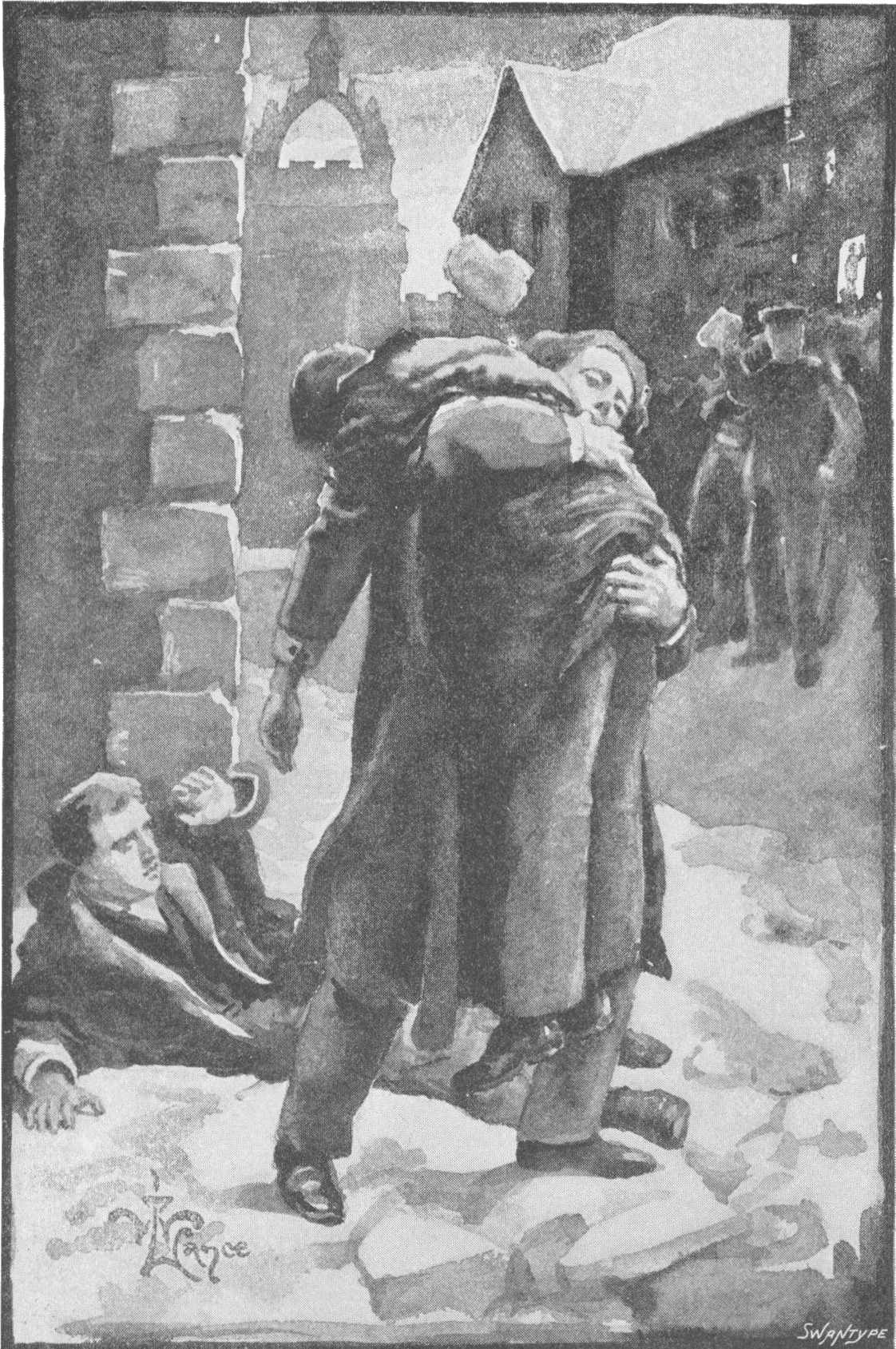
With scant ceremony the officer pulled off the cloth.
Then with a stifled cry of alarm, Willie shrank back, clapping his hand
to his brow.
“My God!” he exclaimed, “it is poor Herbert Grant!”
“You know him, then?”
“Oh, well, and all his history. He was a poor Highland student who came
down to compete, but failed.”
“Do you know the address of his parents? It is evidently a case of
suicide. Here is a letter we found on him addressed to his mother and
father, but not directed. In the agony of his mind the poor boy must
have forgotten that.”
“I do know their address.”
Then Willie took the letter, which was somewhat blotted from immersion
and subsequent drying, and read as follows:—
“Dear Father and Mother,—Only a line in my agony can I write at
all at all. But to be sure it is perhaps just as well. I have
failed to take a bursary. When your eyes shall fall on these lines
I shall be dead evermore. Don’t sorrow for me whatever. I shall be
quieter and better in the cold, cold grave.
“I never could face you after failure, and I never could face the
taunts of my brothers and my cousins. Forgive me! forgive me!
Good-bye for evermore whatever.—Your dead boy,
Herbert.”
Willie Munro was naturally a tender-hearted boy, and this strange last
letter, with the sight of the calm dead face lying there as if Herbert
but slept, so wrought upon his feelings that he threw himself into a
rude chair, and, with his hands to his face, wept long and bitterly.
Even the sturdy superintendent of police was visibly affected, and tried
to console the boy, but for a time he only wept the more.
He started up at last, and that suddenly too; he dashed the tears aside.
“Come, Sandie, come,” he said, and left the dead-house.
In the outer office he addressed an envelope to Herbert’s parents. The
very act of doing so seemed to restore him somewhat. He bade the officer
good-night more cheerfully, and with Sandie walked out into the night
and the starlight.
. . . . . .
“Sandie,” said Willie next morning, “you’re going home, aren’t you?”
“Yes, certainly, to-day too.”
“Well, I think I could do with another day or two in the country. I want
to get out from under the shadow of that dead-house, Sandie, away from
the memory of that awful sleeping face.”
“My dear friend,” replied Sandie, “I had meant to ask you to come,
though I wasn’t sure you would accept. But now I am delighted.”
. . . . . .
There were several days to be spent in the Deeside Highlands before the
classes should assemble for the work of the winter, and right pleasantly
were they spent now by our heroes and their friend Mackenzie. The
weather was most delightful, cold, crisp, and clear, with bright starry
nights and dancing aurora. The aurora is here called the Merry Dancers,
and right well does it deserve the name.
Long spears of light that meet, and mix, and clash in such a way as
quite to bewilder the senses. It is in, the following way Burns the poet
talks about pleasures—
“But pleasures are like poppies spread,
You seize the flower, its bloom is shed;
Or like the snowfall in the river,
One moment white, then melts for ever;
Or like the Borealis race
That flit ere ye can point their place.”
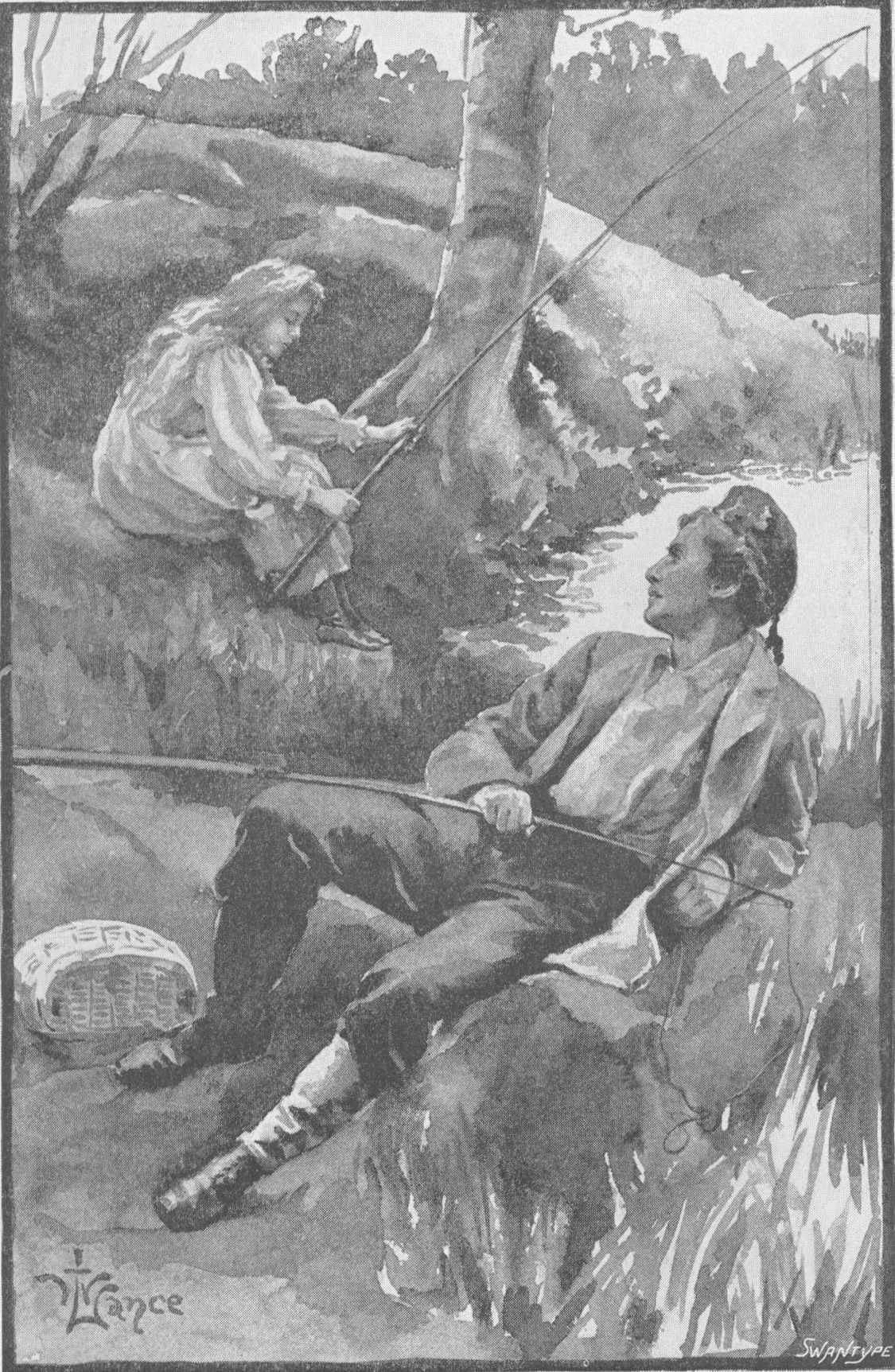
It was cold work fishing now, but they did spend one forenoon by a trout
stream-side, and, much to his joy and pride, Willie caught no less than
three handsome trout. He duly entered the fact in his note-book, and
henceforward he said he thought he should be quite justified in dubbing
himself a member of the gentle craft and a disciple of Walton’s.
But it was glorious weather for walking, and together they climbed some
of the highest hills in the neighbourhood, the view spread out beneath
them, wintry aspect though it was, being sometimes magnificent. The many
streams winding out and in through snow-clad glens, and woods and wilds,
the rocks and hills, the black solemn river itself, the cliffs above it,
and the weird-like forests of pines—the whole formed a scene that was
impressive in the extreme. “That tall sugar-loaf mountain to the east,”
said Mackenzie, “some day we will climb. It towers half-a-mile above the
level of the sea, and the view obtained from its summit is awe-striking
and magnificent. Some day, Willie, when, as the song says,
‘Summer comes lilting out o’er the green leas,’
we will climb that hill. There is a romance attached to it that few are
aware of. The mountain is called Benachie, or the Hill of the Mist, and
many hundreds of years ago a wild Highland chieftain had a castle or
stronghold on the very summit of it. He also had a castle below here,
that old ruin that you can just see peeping round the corner of the pine
wood. He owned all the land you can see to the east of us here. I am
sorry to tell you this chief was a bad man. His constant habit was to
abduct young ladies from the country of his hereditary enemy, just
beyond the Don, and convey them to his fortress on the mountain; and
never were they seen again. Well, it came to pass that a wealthy laird
across the water was to be married to a beautiful young lady, the
daughter of the chieftain, and the chief of Benachie’s son, who was now
of age, thought he would follow in his father’s footsteps. So he made a
raid across the Don one dark night, attacked the castle and carried off
the daughter, taking her right to the stronghold on the summit of the
mountain. When he heard of it, the young lady’s intended husband could
not contain himself with rage. He collected a force with which he
crossed the Don, and commenced laying waste the country with fire and
sword. But his triumph was short-lived, for Benachie came down in force.
Not only did he hurl the invader backwards into the dark rolling Don,
but—oh! pitiful to relate!—he crossed the river and commenced an
indiscriminate slaughter of young and old, while every cottage was
fired, the chief slain, and his castle laid in ruins.[5]
“I do not tell you this story, boys, for the sake of sensation, but that
you may thank Heaven in your hearts, we do not live in such dark and
terrible times.”
On the morning before starting for the distant city, Sandie had an
interview with his father.
“Now, daddie,” he said straightforwardly, “I am going to borrow money
from you. Mind you, it is only a loan, and as soon as I get my first
bursary money I will refund.”
“Don’t mention that, dear boy. You have made your mother and me as proud
as princes. You are an honour to us and an honour to the district,
though I say it to your face. Now, how much money do you want?”
“Well, I have my gown to buy and books to buy, besides a tweed suit of
clothes, a little longer in the legs than this, father; then my landlady
to pay, and so on. But ten pounds, father, will do amply.”
The money was soon forthcoming; then Mr. M‘Crae gave his son much good
advice, especially as to the evils of intemperance and bad company. To
this advice he, Scotsman-like, appended his blessing, and his last words
to Sandie were these: “Never forget to read the Book and pray.”
Sandie’s mother and sister promised that, in a few weeks’ time, they
would both come to Aberdeen and pay him a visit.
The boys had the minister’s blessing as well, and poor little Maggie May
cried bitterly when parting with Sandie, and, innocent morsel that she
was, held up her tear-bedewed face to be kissed.
Sandie all throughout the session never forgot dear Maggie May as he had
last seen her—her eyes swollen with weeping, but beautiful withal, as
she stood at the garden-gate, waving her wet handkerchief to him as long
as he was in sight.
. . . . . .
John Adams was then the students’ bookseller. His shop was in the New
Market, and he really gave the boys bargains of second-hand books. To
him therefore went Sandie with his custom. John even went so far as to
recommend him a tailor, and having ordered a good useful suit of tweed
clothes, Willie and he went off to buy their gowns.
These gowns were of scarlet baize, with loose-hanging sleeves, and very
broad collars of dark red silk velvet. They are much the same at the
present time, but now-a-days the students wear trencher caps. Then they
did not. They might array themselves in Glengarries, in broad Prince
Charlies, or in Tarn o’ Shanters, just as they chose, so long as they
wore the gown.
The King’s College University gown had only a plain collar, and it had
no loose sleeves. The reason, it was said, why the gown was deprived of
sleeves was this: the students used to fasten a stone in the end of
each, and go swinging along the streets, hitting the passengers right
and left in all directions.
It was also said that at one time this King’s College gown had a velvet
collar, but that this was taken away on account of a crime the students
committed. It seems that a certain porter played the sneak, and got many
of them into serious trouble for some lark they had taken part in. They
determined to punish this porter by pretending to execute him.
At the midnight hour he was taken from his bed, his eyes were bandaged,
and he was led through the streets. When the bandage was removed, to the
poor fellow’s horror he found himself in a room all hung with black. At
one side sat judge and jury, at another stood, immovable as statues, two
masked men with broad axes beside a crape-covered block. The porter was
tried and at once condemned to death. He was allowed five minutes, then
led trembling to the block. His head was placed thereon.
“Strike!” cried the judge.
A student struck a light blow with a wet towel across the neck.
“Now,” said the judge, “now, Mr. Porter, you can get up. You’ve had your
fright, but take care how you play the sneak again. Arise!”
But the poor porter never moved.
He was dead!
Dead, from the very fear of death.
. . . . . .
Buying those gowns afforded Sandie and Willie a good deal of fun. Well,
they were light-hearted, and inclined to make merry over anything. But
the gowns were so ridiculously long, they came down nearly to their
heels. That would never do. So they commanded the shopkeeper to dock
them by a foot at least; then they were paid for and taken away.
Classes were duly opened next day, and Sandie, somewhat shame-facedly it
must be confessed, walked out into the street, bearing his blushing
honours on his back. Somehow he had an idea that every one was looking
at him. Well, at all events he was an object of very great interest to
bevies of little guttersnipe urchins, who followed him shouting,
“Buttery Willie Collie, red-backed and holy.”
I don’t know at all why they should shout such doggerel at the gown
students, but they do. His back also became a target for innumerable
snowballs, so that on the whole he was not sorry when safe in the quad
at last.
The class-rooms were seated after the fashion of the gallery of a church
or theatre, the seats rising tier after tier from the floor near the
windows, where stood the professor’s table, towards the roof, so that to
gain their places the students had first to climb a back stair, then
descend the centre stair-like passage to their seats on either side. In
Sandie’s days, whatever it may be now, practical joking was in its
glory. Sometimes these jokes took what Sandie considered a mean and
ungentlemanly turn, as when, to his astonishment, he saw a fusillade of
snowballs coming over the gallery from the back-stairs and falling on
the professor’s table.
All the more unworthy of any student was such conduct, inasmuch as it
was the Professor of Greek who was thus assailed, and he was a very old
and nervous man.
Another day a door-mat was thrown over the gallery class-room, alighting
on the table and demolishing everything; and this by men who would have
been mortally offended had you told them they were not gentlemen.
Sandie soon settled down to the routine of the class-rooms, and also to
his own quiet studies at home. He soon found out the truth about the
lecture system, however, namely, that it is a mistake, and that an
earnest student can learn more at home from books in one hour than he
could from twenty lectures.
. . . . . .
Although Sandie paid three shillings and sixpence of weekly rent for his
room, he had it all to himself. He could therefore study when he
pleased, without fear of interruption, and his landlady was really very
good and kind to him. Willie was his constant visitor, but knowing
Sandie’s studious habits, made it a point never to come and see him of
an evening unless specially invited. And if, when Willie invited Sandie
to his house to spend the evening, he replied that he could not well
spare the time, nothing more was said on the subject.
Sandie had entered on a new sphere of study that possessed great
attractions for him, namely, algebra and the higher branches of
mathematics.
He made a solemn resolve to pay his father back the ten pounds as soon
as possible, and what with this debt and one thing or another, he found
he would have enough to do to rub along.
So he determined now to take a pupil, that is, if he could find one.
Surely a first bursar would be successful in a little matter like this.
Well, Sandie was so after a fashion. He was engaged by a widow lady, who
lived on the outskirts of the town, to teach her fat-faced
pudding-headed “loon,” aged about twelve, for one hour every night for
the large sum of ten shillings a week.
A more provoking pupil it would have been difficult for any one to
conceive. He was his mother’s darling, a spoiled and ignorant child, who
at times would positively refuse to be taught or to open a book.
Sandie lost his temper with him one night, and pulled his ears.
“Oh, don’t do that,” said his mother pleadingly.
“I will, and more,” cried Sandie determinedly. “If he will not work, I
am but robbing you, and losing my own precious time besides.”
“Now, look here, Andrew: if there is any more of this, either now or any
other night, I’m going to give you a jolly good belting, and to-morrow I
shall bring a strap in my pocket for the purpose.” And so Sandie did,
and laid it ominously on the table in the boy’s sight.
Andrew became quite a reformed character after this, and Sandie used to
take him out for long rambles on Saturday afternoons, and to the church
on Sundays.
. . . . . .
A rather curious fact must here be mentioned regarding Willie Munro, as
it not only gives an additional insight to the lad’s character, but
really has some bearing on future acts in our story.
Willie, then, had never forgotten that fiasco on the hill, when he
loaded his gun by putting in the charge of shot first. He was a very
sensitive boy, and sometimes since that day, in his dreams, he would
hear Maggie May’s shrill peals of laughter, and see her merry
mischievous face. Had Sandie alone been there, it would not have
mattered so much, but to have made a fool of himself before a girl—ah!
there was the rub. He felt at times that he almost hated Maggie May,
though surely it was no fault of hers.
However, he made a vow that he would rectify the mistake. He told his
father the whole story, and his father kindly acquiesced in his wishes.
Willie paid a visit to a keeper who lived a little way up Deeside. A
crack shot he was. The man was grooming a Lavereck setter when Willie
reached his humble dwelling.
“Fat can I dee for ye, laddie?” said Bob Brown, meaning, “What can I do
for you?”
“Oh,” said Willie, “I want you to teach me to shoot birds, so that I can
go to the hill and not make a fool of myself.”
Bob looked him all over. He even tested his eye-sight and the quickness
and steadiness of his hand.
“You’ll do,” he said. “How often can you come here?”
“Every afternoon, and I’m willing to pay fairly well.”
“Richt! in a month or sax weeks you ought to be as gweed (good) a shot
as mysel’. Hae ye a gun?”
“No.”
“Weel, we’ll gang and buy ane the day.”
And so they did—not a very heavy one, but a breech-loader by one of the
best makers.
They also bought a spring-trap to throw crystal balls into the air, to
represent birds. These balls were filled with feathers, so it was easy
to see when they were broken.
For the first few days Willie was awkward enough, and hardly broke a
ball; then all at once he seemed, to get into the knack of the thing,
and broke the balls fast enough, and without apparent aim or effort.
The lad was rejoiced beyond measure. I am really afraid he neglected his
studies somewhat for this new-fangled fad of his, only he was
determined to wipe out what he looked upon as a stain on his character.
He practised at home every morning, as well as going to Bob’s in the
afternoons.
Bob had a bit of private shooting, and now he began to take Willie out
with him, and an excellent hill-man the boy proved.
“Man,” said Bob more than once, “I’m perfectly prood o’ ye. And ye’re a’
ma ain makin’ too.”
Willie now added the revolver to his armoury. Very awkward, indeed, he
was at first with this weapon, but the pistol was pronounced a good one,
and he soon became very precise in his shooting indeed.
Now Willie was sly.
Willie never told Sandie, his friend, what he was doing or studying. Not
he. If you had asked him why he did not, he might have replied—
“Because I know a trick worth two of that. I want my revenge. I want to
astonish Sandie, and Maggie May as well.”
There is a good old saying which, I must confess, has been of much
service to me during life. It is this: “You never know what you can do
till you try.”
I have often felt so ill, that I thought to get out of bed and begin
literary work would be a sheer impossibility. Then that bold saying has
come to my mind, and I have got up, and shaved myself—a terrible ordeal
when one is low and sick—and had my cold bath—another terrible
ordeal, even for a Scotsman, when out of form. Then I have had breakfast
and begun work, and wonderful to relate, the more I wrote the better I
grew. What think you of that, reader mine?
Well, in Willie’s case there was another proof of the truth of the grand
old aphorism. Willie persevered and persevered, and in six weeks’ time,
long before Christmas, he had been pronounced by Bob Brown a crack shot,
one who could single out his bird from a covey, and bring one down with
each barrel.
“I dinna think,” said Bob frankly and honestly, “I can teach you muckle
mair.”
But Willie went every night to Bob Brown’s all the same.
They had two spring-traps now, and two balls were dislodged into the air
at one time, and Bob rubbed his hands with delight, and laughed to see
his pupil smash each ball, making the feathers fly right and left.
. . . . . .
Sandie continued hard at his studies, especially mathematics, night
after night, and made considerable progress.
What a happy day that was, though, when his mother and sister Elsie came
to visit him.
Not only he, but Willie himself absented themselves from classes that
day, simply dropping a line to the various professors candidly owning up
to the cause of their playing truant.
So Sandie escorted his dear mother, and Willie chaperoned Elsie, all
over the Granite City. It was the first time Elsie had been to Aberdeen,
and she was naturally much struck by the marble whiteness of the stately
buildings.
The ladies were even taken into the quad to gaze upon the University at
which Sandie had achieved such signal success.
Then, when tired of wandering through the streets and seeing the lions
of the place, Willie—wilful Willie, as Sandie called him—insisted upon
their all dining together in the M‘Gregor Hotel.
“It is only four o’clock,” he said, “and you go away at six. Well, I
would have asked you to my house, but we will be ever so much more free
and easy here.”
“I shall pay,” said Sandie.
“Indeed, indeed you won’t.”
“Oh, but I must.”
“Well, if you do, I shan’t come out with you to Kilbuie to spend the
Christmas week. So there!”
That settled it.
Not only did Willie pay, but he ordered the dinner, and it was one just
suited to the requirements of a bright clear winter’s day. No French
names either. 1. Delicious Scotch barley-broth. 2. Fresh salmon from the
Dee, caught the day before, not Norwegian salmon that had lain dead in
ice for three weeks, till all taste and flavour had fled to the moon or
elsewhere. 3. A juicy joint of roast-beef with snow-white mashed
potatoes and cauliflower. 4. Pudding and custard. 5. Cheese, oat-cakes,
fresh butter, and salad. For wine, although the ladies had their option,
they chose good table-ale, and the boys joined them. When about
half-past five tea was brought, I think both the mother and Elsie were
very happy; at any rate, they both confessed that they had never in
their lives spent a more pleasant or happy day.
“The time is getting short now,” said Mrs. M‘Crae, “and I want to make
sure of one thing.”
“And that is?” asked Willie.
“Sure o’ your promise to come out at Christmas when Sandie comes.”
“I promise, mother,” said Willie.
“You both look rather pale. I’m sure you’ve both been studying very
hard.”
Willie smiled inwardly, but made no reply.
They sauntered down to the station in good time, and just as they were
going away, and Elsie extended her hand to Willie, he gallantly pressed
it to his lips.
As he raised his cap, shy eyes met his, and a smiling but blushing face.
The whistle shrieked.
The train was gone.
Some of the greatest treats Sandie enjoyed were his invitations out to
breakfast with his professors, some even whose classes he was not yet
attending inviting him. He could hardly have told you which of these he
liked best to breakfast with. There was old Dr. Brown, for example, who
filled the Greek chair, a very ugly but highly intellectual man, who
spoke like a Northumbrian, with a burr or rattle in the throat, and
whom, as he preferred the Doric dialect, the students had nicknamed “The
Dorian.” The Dorian, on ordinary days, used to finish his breakfast on
the street, and might be met in short cuts any morning eating a bap.[6]
But on days when he had students to breakfast, he was all there indeed,
and up betimes. He himself seemed blessed with the appetite of a
Highland hunter, and he made the students eat consumedly. But it was
also a feast of reason and flow of soul, and the number of racy
anecdotes he told without apparent effort during the breakfast-hour was
marvellous; so too was the number of buttered baps he got down.
Then there was Dr. Maclure, Professor of Humanity, that is, he filled
the Latin chair. A little man, perky, proud, and fat. He was an
Englishman, but a great admirer of Burns, whom he was constantly
quoting. The students called him “Cockie Maclure,” but it is to be hoped
he did not know this. However, breakfast with him, although not such a
heavy meal as that with the Dorian, was always most enjoyable.
Sandie used to think he would give a good deal could he only speak
English with so charming an accent.
Then there was poor Maxwell, so well known in the scientific
world—brown haired, handsome, thoughtful, and wise; he always had some
scientific marvel to tell his students about during breakfast. He was
always smiling, but never laughed a deal. I suppose he had an idea that
strong tea was not good for young fellows, for he invariably filled the
cup half up with rich delicious cream before pouring in the beverage.
Poor Maxwell! he is dead and gone, and great loss his death has been to
the world.
. . . . . .
Would my young reader fight a duel if called out? I should not advise
him to, though I myself have once or twice been foolish enough to appear
on the field and duly take my stand to shoot and be shot at.
But in Sandie’s days duelling was not entirely unknown among the
students. One King’s College student sent his bullet through the left
arm of his opponent. Honour was declared to be satisfied after this, as
well it might have been.
Well, among Sandie’s intimate friends was a tall, pale-faced,
aristocratic-looking English lad named Coleman; a student our hero also
knew was Tom Brierly, a far more robust and daring-looking youth—a
scapegrace, I fear. At the University in the far North quarrels generate
very simply sometimes. For example, there lived with her mother in Upper
Kirkgate a girl of about seventeen. Sweet seventeen it was in her case,
for she was very beautiful, with eyes of darkest hazel, eyelashes that
swept her cheeks, and a complexion like strawberries and cream. Her
mother and she made and sold tuppenny pies. They did a good trade all
day, but towards evening and up till eleven o’clock that trade became a
roaring one.
Well, Tom Brierly fell in love, or pretended to, with bonnie Mary Mayne,
and used to appear upon the festive scene every evening and eat pies,
till one could not have helped wondering how he could contain so many.
He also got Mary to teach him how to make them, and after he became an
adept he used to stand by her side and turn them out by the dozen. For
Tom was not a bit shy. On Sunday evenings the pair used to go to church
together if it rained, or out for a long walk if the weather was fine.
In fact, they were looked upon by all as sweethearts, and it was even
rumoured that Tom, who, by the way, was a clergyman’s son, was going to
marry Mary soon, and take up a pie-shop on his own account, which of
course would be doing infinite honour to his reverend daddie.
However, to make a long story short, who should Tom find one evening
when he paid his usual visit, but tall young Coleman, leaning over the
counter with a sickly smile on his face as he breathed sweet nothings
and the flavour of caramels in bonnie Mary’s face.
Tom wasn’t a man of many words, so he simplified matters and brought
them to an abrupt conclusion by seizing Coleman by his garments above
and below, and flinging him straight into the street. Coleman gathered
himself up.
“I cannot fight you with fists,” he said in a voice as like thunder as a
hen’s might be, “but a friend of mine shall call on you within an hour.”
And sure enough a friend did.
Tom was laughing and joking with Mary, and turning out pie after pie
with extraordinary agility.
He hardly looked up.
“I won’t disappoint you,” he said; “keep your mind easy. I choose
pistols. My friend Smith, of 36 Union Terrace, will provide them. Yes,
seven o’clock, or say 7.30. We’d hardly see before. Go now and look
Smith up.”
And Tom coolly proceeded to turn out another pie. But poor Mary had
turned pale.
“You’re not going to fight—with—guns—are you, and all about me?”
“Keep your mind easy, Mary dear,” said Tom. “I don’t suppose we shall
hurt each other. And listen, Mary, I’ve made up my mind not to fire at
his head or body. I might let his little life out, you know. I mean to
aim at those thin legs of his.”
“Oh dear! oh dear!” mourned Mary, wringing her hands. “And where,” she
asked innocently, “will you fecht?”
“Oh,” replied Tom, as he rolled out a piece of paste, “there is only one
place. Smith knows it well, because I had a pugilistic encounter there
with a butcher. Round at the seaside of the Broad Hill. There won’t be a
soul there at that time of the morning. Pass the gravy, Mary.”
. . . . . .
It was some time past eleven o’clock. At the police-station near the
Tolbooth, a serjeant and one or two burly night-watchmen sat before a
roaring fire talking and laughing, when there entered a very pretty
dark-eyed maiden, with a shawl about her head. She appeared to be in
very great grief and trouble. But after she had told her story, she
seemed comforted, because in very kind tones the sergeant had replied—
“You keep your mind easy, my dear. Just go home and go to bed. We’ll
make it all right. Shall one of my men see you safe home?”
“Oh, no,” was the reply, “I’ll soon run home.”
. . . . . .
Tom and his second, Smith, were up and dressed even before the stars,
that had been shining so brightly all night, had commenced to pale
before the coming of day. Smith, after warming coffee, busied himself in
getting the irons ready.
He was a brave, smart little fellow, Smith, and the idea of aiming at
Coleman’s thin legs tickled him very much, and made him laugh as he
cleaned the pistols.
“His thin legs, eh?” he said. “Well, friend Tom, you’ll be a smart shot
if you hit ’em. Why, it will be like firing at a couple of raspberry
canes.”
A little after seven both young men started for the links and Broad
Hill.
They got right up over the top of the hill, and having gained the
summit, looked beneath them. Yes, Coleman and his second were already
there, although the time was not yet up.
What a heavenly morning it was too! The sun was not yet up, but red and
crimson and golden clouds flecked all the eastern sky, and were
reflected from the rolling waves till all the ocean seemed ablaze. Only
on the yellow sands were the long lines of snow-white foam, where the
seas broke lazily upon the beach.
“What a pity,” said Tom with a sigh, “to have to face so deadly an
encounter on a morning like this!”
“I daresay,” said Smith, “if you were to apolo——”
He never got any further, Tom stopped him with a look.
Five minutes after this, Tom and his opponent had shaken hands, and
stood facing each other at twelve paces waiting for the words, “One,
two, three, fire!” when suddenly from behind a sandhill at no great
distance started two burly policemen. They appeared to spring from the
very earth.
“Halt!” That was the stentorian word of command they gave.
“Boys!” cried Smith, “there has been a magpie about. Policemen,” he
added, “did you cry ‘halt’?”
“We cried ‘Halt!’”
“Then I cry something else, ‘Bolt!’”
He suited his own actions to the word, and before either of those
policemen could say “Jack-knife,” the race for liberty had commenced.
All honour to the bobbies; they did give chase, but as well might a
tortoise try to catch a weasel. They were speedily distanced and left
breathless far behind.
The four students went on to Balgownie Bridge, then crossed country to
Woodside, when, coming to a farm, they succeeded in breakfasting on
curds and cream, oatcakes, fresh butter, and new-laid eggs.
Both seconds declared that, under the circumstances, honour should be
deemed satisfied. Then both principals shook hand, each, declaring
himself in the wrong. Thus was a friendship established between Tom
Brierly and Coleman, and—and—and they lived happy ever afterwards. But
this is the true story of an Aberdeen University duel.
They never heard another word from the police-office about the escapade,
so rightly judged that the magistrates had forgiven them.
. . . . . .
My description of University life in the Granite City during Sandie’s
curriculum would be incomplete were I to say nothing of what I may call
the bad boys of the College. Of course, you find these everywhere,
though in after life they are sure to look back with some degree of
sorrow on the days that are gone never to return.
Tom Brierly was one of these. Sandie tried hard to reform him, but I
fear with little success.
Sandie more than once, thinking that example was better than precept,
accompanied Tom to Mother Robertson’s, an inn in the Guestrow, much
frequented by the students. There were more merry faces round the tables
of the coffee-room than there had any right to be; there were more
steaming tumblers of toddy, and there would be more headaches in the
morning. Sandie drank nothing but stone bottles of ginger-beer.
“How can you be so merry on that?” cried Tom.
“It’s all custom,” said Sandie. “I feel very happy and merry on this,
and I won’t have the ghost of a heavy head in the morning.”
So Sandie sat with them, and he told stories that made every one laugh,
and he sang songs that made some of them cry; but at ten o’clock he
arose, and, in spite of their importunities, bade all good-night and
walked straight home to his attic.
The principal practical jokes performed at night by the students in
Sandie’s day were extinguishing gas lamps, wrenching off knockers with
the twist of a strong stick, and pulling out bell-handles.
The night-watchmen, as they were called, were certainly a body of grand
men. Their physique left nothing to be desired. But then they were not
active.
They were called “Charlies,” just as the day-policemen were denominated
“Bobbies.”
These sturdy fellows were dressed in strong broadcloth fear-nothing
coats, that reached down to their heels; they wore broad Tam o’ Shanter
bonnets, and were armed with oaken cudgels big enough to have felled an
ox.
At nine o’clock each evening they were marshalled two deep in front of
the watchhouse door. The officer gave the words of command in the
broadest of Scotch.
“Are ye a’ richt there, Jamie?” This to the sergeant.
“A’ richt, sir,” Jamie would reply.
“Weel, richt fut foremaist. Quick mairch! awa’ ye gang.”
And away they went, filing off here and there at the corners of streets
to take up their several beats.
But the bad boy students were the bane of those poor fellows’ lives.
There was no saying when one or two would turn up.
They would see lamp after lamp extinguished right ahead of them,
sometimes a whole street placed in darkness, and yet be powerless to
give chase to the light-footed lads.
Or they would hear sounds like shots fired in the quiet streets, bang!
bang! bang! here and there, and know that metal knockers were being
broken, but knowing also that they might as well try to catch a
will-o’-the-wisp as one of the perpetrators.
It must be admitted that playing such practical jokes as these is poor
fun, and the only thing to be said for the students is, that they never
paused to think.
. . . . . .
Sandie still stuck to his little pupil, though he confessed more than
once to Willie that the work was irksome in the extreme.
Our hero was no gourmand. And yet there were many Highland students at
the University, who lived on far poorer fare than did Sandie, as we
shall see as the story goes on.
Sandie had porridge and milk for breakfast, nothing else, but plenty of
that. For dinner he usually had sheep’s-head broth of barley and
vegetables, with potatoes and perhaps kail as auxiliaries. He allowed
himself tea in the afternoon, and for supper a large dish of stiff
pease-meal brose with plenty of creamy milk.
When fresh herrings could be got—but they were not now in season—he
treated himself to a few of these.
This was plain, but it was also wholesome fare.
Herring and sand cadgers are quite a feature of the Granite City. What
the poor people do with all the fine sea-sand it would be difficult to
imagine. But the Aberdonians are a cleanly people, the very show of
their white granite walls appears to suggest cleanliness, and the women
folks are constantly seen scouring down their stairs and passages.
The sand is hawked in donkey-carts, and the boy hawkers’ are invariably
all in rags and tatters.
“Twa buckets o’ fine sea-sand for three bawbees, and I’ll carry them
upstairs for a cauld tattie or a bit o’ cake for the cuddy.”
I may state at once that the cuddy never gets the piece of cake.
The herring-cadgers are a cut above the sand-laddies.
In going to classes one day shortly before Christmas, Sandie was witness
to a rather humorous episode. Let me premise that the streets were
covered with mud and slime.
Well, a large cart-load of hay from the country had just met and passed
a cadger’s cart laden with fresh herrings. This was an excellent
opportunity to get a wisp of hay, thought the herring-man, so he was
speedily helping himself to an armful. But Geordie spied him, and off he
went to the cart and quite filled his arms with herrings.
“Faur (where) are ye gaun wi’ my herrin’?” cried the cadger aghast.
“Faur are ye gaun wi’ my hay?” answered Geordie.
“There’s you dirty hay,” shouted the cadger, throwing it on the ground.
“And there’s your dirty herrings,” cried Geordie, throwing the fish in
the mud, which certainly would not improve either their flavour or
quality.
But Geordie had the best of it.
When Christmas-time came round, Sandie M‘Crae not only felt that he
needed a week’s rest, but that he had worked hard enough to deserve one.
It was therefore with a feeling of intense enjoyment and pleasure that
he seated himself in the train, his merry little friend Willie by his
side, the train that should soon bear him far away to his own bonnie
Highland home and his ain fireside.
Oh, that ain fireside, which nought surrounds save an atmosphere of
love, how pleasant it is to think of when far, far away! Sandie had
thought of it often and often when hard at work in his little attic, and
longed to be there. The loving father, seated in his arm-chair, quietly
smoking; the gentle-faced mother, bending over her knitting; his sweet
sister Elsie, with a book; the cat and the bawsent-faced collie Tyro.
Quickly enough sped the train, but under the circumstances it is no
wonder Sandie thought it slow. His head is out through the window long
before he nears the station. Yes, he can see Elsie with the dogcart and
Lord Raglan, and he waves his handkerchief to her, and she smilingly
waves her hand in return, for Elsie and Sandie are all in all to each
other.
Sandie is in such a hurry that he almost forgets to give up his ticket.
He rushes off the little platform, and next moment is almost capsized by
Tyro himself, who is perfectly wild in his demonstrations of joy and
undying love.
“Oh,” he seems to tell Sandie, “I thought I would never, never see you
more; I thought you were dead and away, and now, what can I do to allay
my feelings?”
And in order to do so the poor dog must commence flying round and round
in a circle, so quickly that his shape is barely distinguishable. Having
fondly embraced his sister, and asked after his father and mother, and
while Willie and she are shaking hands, Sandie takes Raglan’s head in
his arms to cuddle. Then he kisses his soft snout, and the horse
whinnies a welcome.
Sandie next takes a paper parcel from his ulster and opens it,
extracting therefrom great slabs of white oat-cake.
“Lord Raglan,” he cries, “I didn’t forget you.”
Raglan whinnies once more, and probably enjoys that cake far more than
he has enjoyed anything for many a day.
Tyro also has a share. Then all wheel happily home to the farm of old
Kilbuie.
. . . . . .
“I shan’t touch a classic or open a book on mathematics until we return
to college.” That is what Sandie told Willie next morning at breakfast.
“Well, now, I do call that wise,” replied Willie; “one doesn’t expect
much wisdom from a genius—one doesn’t really, but for once in a
way——”
“Thank you,” said Sandie.
“And you’ll eat all you can, laddie,” quoth Sandie’s mother, “and drink
plenty o’ milk, for indeed you’re as white as a ghost.”
“Mother dear,” replied Sandie, “I’ll do all you tell me, even to the
drinking of milk, and right glad I am to have the chance of obeying you
once again.”
“O mother and Siss,” he added, with something akin to exultation, “I
used often and often to dream about this good old-fashioned fireside,
and then waken all alone in my attic so cold and dismal!”
. . . . . .
Of course, one of the first visits the boys made was to the manse of
Belhaven.
The first person they saw was Maggie May herself. She ran joyously to
meet Sandie, holding out both her hands. But she did not present her
face to be kissed.
“I do declare, Maggie May,” said our hero, “you appear to have grown
since I saw you last.”
“Yes,” said the girl, “I suppose I must have.” Then she blushed bonniely
as she added, “You must remember I am quite old now, thirteen last
birthday.”
“And you’ve had a birthday since I’ve been here, and I was not aware of
it! How hard is fate! Never mind, Maggie May, I’ve brought you something
for a Christmas present. Oh, I shan’t keep you guessing what it is, and
you shall have it now. I have it here.”
Sandie went to the little dogcart and produced a box, and Maggie May’s
eyes sparkled as she opened it and took therefrom a charming and
well-filled cartridge-belt.
Of course she tried it on at once, and it fitted her nicely, and became
her very much.
“And my little gift,” said Willie, presenting a little box. It contained
a pair of beautiful earrings, that Maggie May thought must have cost a
small fortune, so studded with precious stones were they.
About this moment Maggie May was probably the happiest girl in the
parish.
Presently Mackenzie himself came in, then conversation became general.
“What think you of the weather?” said Sandie at last.
“I’ll tell you what it is,” answered the minister, “before twenty-four
hours are over there will be a slight fall of snow and no wind.”
“Hurrah!” cried Sandie.
“I know why you cry ‘Hurrah!’ You’re thinking about the white hares!”
“That’s it.”
“Well, it is all arranged. There will be you, Sandie, Maggie May here,
my man Stuart, and my simple self.”
“And me,” added Willie, with small regard for grammar.
“Well, now, as a friend,” said Sandie, “I’m going to be very
straightforward. You remember your last sporting venture, and the
somewhat original way you loaded your gun? Well, I think that this time
you had better stay at home, Willie, and talk to my mother and Elsie.”
“I’ve got a new gun,” said Willie doggedly. “You’ve only to put in a
cartridge and hold it out, and she goes off beautifully.”
“Yes; and perhaps shoots your neighbour.”
“Sandie M‘Crae, first Bursar of Marischal College, I’m going. That is
decided.”
Sandie sighed.
“A wilful man must have his way,” he said.
The white or mountain hare, reader, is found plentifully in Norway and
among our Scottish hills. It is not white all summer, but only changes
to that colour when winter comes, a kind of provision of nature to hide
it from its enemies, the fox and the eagle, and probably the great owl.
Its life is a hard one among the frozen hills in winter. Oftentimes its
poor paws will be found skinned and bleeding from scratching the hard
ground in order to procure a little food. They are usually stalked when
snow is on the ground, their footsteps being followed, so that dogs are
not really necessary.
But on this expedition, undertaken by our hero and his friends, the
minister’s retriever, Carlo, made one of the party.
It may be thought wonderful that a mere child like Maggie May should be
permitted to join a venture like this across the bleak and frozen hills.
Sandie had suggested her staying at home.
“She’s a true Mackenzie,” said the minister. “A Mackenzie is nothing at
all if not hardy. Believe me, Maggie will keep up with the best of us.”
Stuart, who had no gun, carried the luncheon and looked after the dog.
The trap was left at a little croft not far from a high steep hill, and
then the party proceeded on foot.
There was broom to struggle through at first, then heather to wade
among, so high that it nearly buried Maggie May. Sandie stuck by her
side, helping her in every difficulty.
But as they reached higher ground, the heather grew shorter, and ere
long entirely disappeared; then, to their great joy, they came upon the
footprints of apparently several hares.
Cautiously they followed them up for some distance. Suddenly Willie
brought his gun to the shoulder.
Bang! Carlo bounded forwards and returned next minute with a splendid
specimen of the mountain hare.
“Good, Willie, good!” cried Sandie, grasping him by the hand. “But
wasn’t it a——”
“A fluke? I think not.”
No one there had such quick eyes as Willie, for in five minutes more he
repeated his first exploit, and a short time afterwards he did the same
again.
As Mackenzie and the others looked so thoroughly and completely
astonished, Willie was forced to laugh aloud.
“Oh, you humbug!” cried Sandie. “Why you’re a crack shot, you rascal,
and that episode of loading the gun was got up to deceive us!”
“Look! look!” This from Willie, as two splendid ptarmigans rose from the
ground.
Mackenzie and Willie fired a barrel each, and both birds fluttered
groundwards.
Well might Willie smile. He had established his fame as a good shot, and
completely wiped out the stain from his character as a sportsman.
On and on all that forenoon went the party, no one seeming to feel the
least tired. But towards two o’clock they began to feel hungry, if they
did not feel tired, for the air among these Highland hills is keen and
bracing. So Stuart spread plaids on the snow, and down they all sat to
one of the most delightful luncheons ever partaken of by hungry
huntsmen. It was now nearly three o’clock, and the winter’s sun was
rapidly nearing the pine forest on the rugged shores south of the Don.
So all haste was made back to the trap, Sandie assisting Stuart in
carrying the hares and birds. As they mounted the trap to drive back to
the manse, everybody agreed that they had spent a glorious day.
Willie, nevertheless, confessed to being tired.
“Well,” said Sandie, “we’ll forgive you for that; but, O Willie, what a
trick you played us!”
But the refreshing cups of tea that Maggie May brought Willie, when at
last they got safely home, banished every vestige of fatigue, and he was
soon his laughing, happy self again.
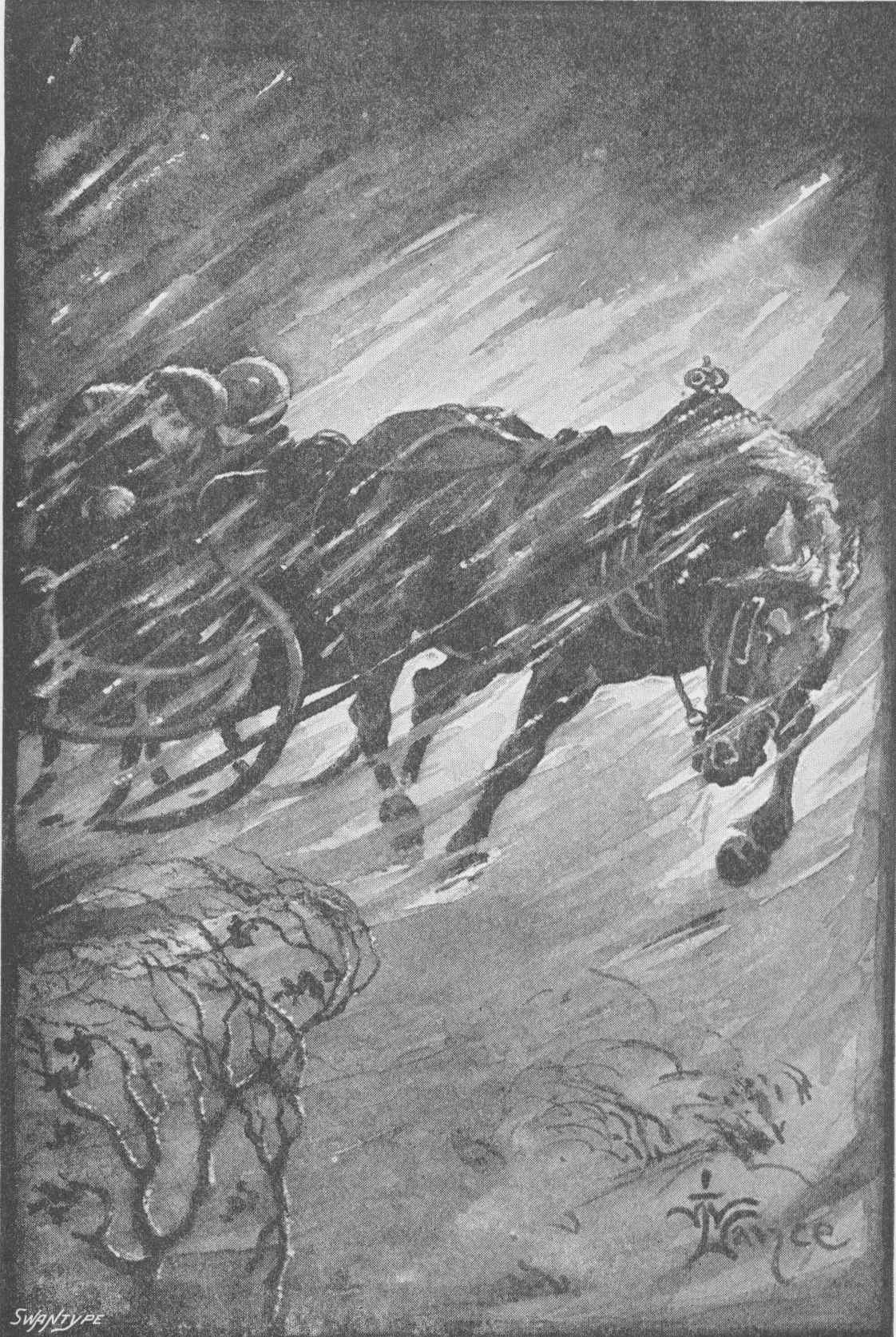
As the wind had now begun to blow, and snow was falling, the students
agreed to stay at the manse all night. So a messenger was despatched
immediately to Kilbuie farm to let Mrs. M‘Crae know their decision, and
then Mackenzie, who really was a boy at heart, and the students settled
down to enjoy themselves.
The minister rather prided himself on the good dinners he gave, and
certainly that of to-night was no exception to the general rule.
After this, as Robbie Burns says—
“The nicht drave on wi’ sangs and clatter,”
till twelve o’clock, chimed out by the pretty clock on the mantelpiece,
a gift from the minister’s parishioners, warned them it was time to
court repose.
. . . . . .
How quickly that week sped away, only those situated as were Sandie and
Willie could imagine.
But every time has an end, and the more we are enjoying ourselves, the
faster does old Father Time fly. This is very nasty of old Father Time,
only he will have his own way, despite anything we can say or do.
The last night had come and gone, and Willie had retired to his room,
and was seated by the window, through which the bright moonlight was
streaming, when Elsie, looking in her long night-dress like a sheeted
ghost, came gliding in. Her dark hair all undone was streaming down her
back. Sandie hastened to place a seat for her, and to wrap her from top
to toe in a Highland plaid.
All in all were they to each other that brother and sister, and
innumerable were the things they had to tell each other on this last
night, and many the confidences to interchange, for four long months
must elapse ere they could see each other again.
More than once Sandie could see tears glistening in the moonbeams on his
sister’s cheeks.
But one o’clock came at last, and he had to send her away.
“Anyhow, Sandie,” she said, as she rose to go, “you will promise not to
study too, too hard. Mind you are all I have, Sandie, and if anything
happened to you, the grave would soon close over your poor sister
Elsie.”
“I promise,” said Sandie, “to take care of myself for mother’s sake and
yours. Good-night, dear Elsie.”
“Good-night, dear Sandie.”
And away glided the girl again as silently as she had come.
. . . . . .
Sandie and Willie got back to the city on Hogmanay night. That is the
last night of the old year. This is kept in Scotland with great glee,
and I fear with not a little drunkenness. No one thinks of going to bed
till the New Year comes in, and no one thinks of remaining indoors.
Our heroes found Union Street about eleven o’clock crowded to excess,
one dense mob from Union Bridge to Castle Hill, but all good-humoured,
all hearty. Here and there the bagpipes skirled, here and there songs
were sung.
But when it was within about five minutes to twelve an expectant hush
fell over all that vast multitude.
Anon the first stroke of the bell boomed over the city, then the cheer
that went toward that moonlit sky may be imagined, but never never could
be described.
At the same moment everybody seemed to produce a bottle of whisky, and
everybody drank with and shook hands with his nearest neighbour, no
matter who or what he was.
But by one o’clock the multitude had melted away, solitary watchmen
paraded the streets, and the pale moon shown calmly down on the pure
white walls of the Granite City.
My well-beloved reader—what a pretty expression, by the way!—must not
jump to the conclusion that this chapter, and those that follow,
describe life at the Northern University far back in the Middle Ages.
No; Sandie’s time was just about thirty years ago. Ten years after that,
I know there was but little change. There may or may not be an
alteration since, for I have been to sea, and scarcely clapped eyes on a
red gown.
Well, in Sandie’s time, town and gown riots were far from uncommon;
especially in snow-time. Snow-time was glow-time then. The very look of
the falling snow sent a thrill of joy to each Grammar School boy’s or
even student’s heart, and the first question one would ask another would
be—
“Is it making?”
That is, was the snow soft enough to form easily into snowballs? For if
very frosty and powdery it was of course no use. As most of the real
snowball battles took place just when the thaw commenced, a constant
fusillade would then be carried on all up and down Union Street. The
street boys, as well as students, were chokeful of mischief, and every
conspicuous person caught it hot—if a snowball can be called hot.
Battered silk hats were scattered in all directions. Mashers or
extra-well-dressed people became simply living targets; silk umbrellas,
if put up, were speedily riddled—it was only a case of making the
snowball a trifle harder, an extra squeeze did that, and lo! there was a
hole in the silken ’brella.
It is almost needless to say that the bobbies, or policemen, suffered
greatly at such times. In fact, a policeman was hardly to be seen
without an expanded snowball or two on his greatcoat, and more than one
might be sporting black eyes. As for catching the depredators, and
running them in, this was out of the question. The running-in part would
have been easy enough, but first they had to catch their hare,—there
was the rub.
Well, school challenged school. The Grammar School, for example,
dominated the Gordons, or Sillerton boys, with a rod of iron.
These boys, in those days, were the drollest-looking chaps it is
possible to conceive. They used to march four deep, with a bit of a fife
and drum band ahead of them; and, just imagine it, they were all dressed
like little old men, in blue swallow-tailed coats, with brass buttons,
knee-breeches, and broad Tam o’ Shanter bonnets.
Well, on days when the snow was making, the Grammar School lads would
lie in wait for them, about three deep on each side of the street, and
when they got the Gordons right between, oh, then the fun began, and
soon waxed fast and furious. Some of the teachers, foolishly enough,
would charge the Grammarians with their umbrellas. They were soon to be
pitied; here and there you would see one of these well-dressed whiskered
dons lying on his back, his umbrella torn to tatters, and snowballs
alighting on his person from all directions, as if from a Maxim gun.
Meanwhile the Gordon ranks would be broken up, the music stopped, and
after perhaps an ineffectual attempt at self-defence, Sillerton would be
demoralised and flying for safety in all directions.
But there were other schools that would meet the Grammar School at
times. I have known them meet by challenge by the Denburn side, and a
fine afternoon’s fight be the result.
Then there used to be a manufactory where the workers were terrible
roughs, namely, “the comb-work chaps,” as they were called. As a rule,
the Grammar School steered clear of these. They were bad to beat, and
there was no honour or glory in beating them. Besides, they used to put
stones inside their snowballs.
Sometimes bands of sailor boys used to come up from the shipping in the
harbour to engage the Grammar School in a pitched battle, and all up and
down the school-hill the fight would rage sometimes for hours.
Once I remember the Grammar School was being badly beaten by the
comb-work chaps. Many had received ugly cuts in their faces with stoned
snowballs.
The school lads were almost demoralised, and making a running fight of
it towards their own quad. But help was at hand. A band of red gowns had
heard of the brutality of those roughs, and now they managed to outflank
the cowardly ruffians, while the Grammar School boys rallied once again
and attacked them from the front.
Desperate diseases require desperate cures, and in this case the
students despised snowballs. Those cads used stones, let them have it.
This was the cry, and the red gowns went at them tooth and nail, or
stick and fist. It ended by the comb-work chaps receiving such a
drubbing that they were civil for all the season thereafter. They seemed
determined now not again to provoke a fight with the Grammar School
boys, who had such fierce and terrible allies in those wild hordes of
red gowns.
“Where were the policemen?” it may be asked, when fights like these were
going on. I think I would be safe to say they were somewhere round the
corner. One dutiful bobbie might go to his sergeant, and a conversation
such as the following would take place:—
Bobbie. “Man! sairgent, there’s an unco killo-shangie (riot) goin on
at the tap o’ Jack’s brae!”
Sergeant. “Ye dinna say so? What’s doin?”
B. “Oh, Grammarians, comb-work chaps, and students—they’re a’ at
it.”
S. “Ony (any) windows broken?”
B. “I canna say there is.”
S. “Weel, man, just lat them fecht awa. They canna hurt ane-anither
(each other); a black e’e or a bloody nose’ll do them good, and we canna
help it. Laddies will be laddies.”
B. “A’ richt then. I’ll keep oot o’ sicht.”
S. “Ay, do.”
. . . . . .
“Now, Sandie,” cried Willie, one morning in the end of January, as he
burst gleefully into his friend’s attic and surprised him at his
porridge, “I’ve good news for you. You and I are both invited to the
medical students’ supper, the night after next.”
“I don’t know that I care to go, Willie,” said Sandie. “Aren’t they just
a wee bit noisy and rough at times?”
“Oh, that is nothing, it is only good-humoured and funny they are.”
“And don’t they as a body indulge in toddy to some considerable extent?”
“Perhaps, perhaps, but you and I shall indulge in gingerbeer and
lemonade. Come, you mustn’t refuse. They will be offended. I won’t go
unless you go, and if I don’t go I shall lose some good friends.”
“Well, Willie, for your sake, I’ll go.”
“That’s a man! You’ll hear some humorous speeches and some capital
songs, most of them with choruses.”
Well, the night came round; and round the great tables in the
dining-room of the Lemon Tree Hotel about a hundred as sturdy, happy,
and healthy-looking young men assembled as ever you would wish to
witness. They were not only happy, they were hungry. The speedy way in
which the viands disappeared was proof positive of this. Every edible
domestic animal seemed to be represented on these tables—turkey, geese,
and fowls, pork, mutton, and beef, besides haggis galore, and plenty of
mashed potatoes and sturdy Scottish kail.
Each plate was flanked by a tankard of table-ale. Nothing stronger.
Stronger potations had yet to come.
Well, in due time even the puddings were discussed, and then the tables
were cleared.
“Give your orders, gentlemen,” cried the president, knocking on the
table. A very tall splendid-looking fellow this president was, by birth
an Africander, who had come to take a medical degree in Aberdeen
previously to taking up practice at Cape Town.
The orders were given.
Most of these were simple enough—the wine of the country, with hot
water, sugar, and lemon.
Then right loyally all the usual toasts were given, the Queen, the army,
navy, and volunteers. The volunteers was responded to in a most heroic
speech by one of themselves, who had been coupled with the toast. After
this, song after song was sung, and many private individuals in the room
were toasted, and had to reply, which they did in speeches more or less
humorous.
Not much to his delight, Sandie, as first bursar, was “let in,” as
Willie called it, for a speech.
“I don’t know, gentlemen,” he began, “whether I can speak or not; I am
like the Irishman who, on being asked if he could play the fiddle,
replied, ‘Oh, I daresay I could, but I never tried.’”
Then Sandie warmed to his oratory, and it was universally admitted that
he had made the best speech of the evening.
More songs and more speeches followed this, and so very quickly did the
time fly by, that hardly anybody would believe the landlord when he came
in, smiling and rubbing his hands, to announce—
“Eleven o’clock, gentlemen, if you please!”
They had to please, for policemen were at the door to see the house
cleared.
Now, if these somewhat wild young men had broken up into little parties
of three or four, and each gone its own way, the riot I have to describe
would never have taken place.
I must tell you, first, that a very heavy snow-storm had fallen some
days before, and that then a partial thaw had come. The streets were
cleared in the centre only, the snow being thrown in shovelfuls to the
sides near the pavement.
But frost had returned, and those shovelfuls of snow had become frozen
into huge bricks of part ice, part snow.
“Well,” cried the Africander, who carried an umbrella like a weaver’s
beam, “let us form four deep, and go singing up Union Street, as far as
the bridge, then give three cheers and disperse.”
Four deep was formed accordingly, and the march commenced, also “Auld
Lang Syne.”
But they had not got farther than Market Street ere the roughs had
assembled in force, and commenced a regular cannonade on the students.
“Halt, front!” cried the tall Africander, waving his great umbrella.
“Give ’em fits, charge.”
The mob by this time must have been nearly two hundred strong, but so
desperate and determined was the charge made by the students, that they
were beaten and partially scattered. The Africander, with his great
umbrella, was as good as any three men. The others fought chiefly with
those huge bricks of ice that I have already mentioned; and no matter
where a man was struck with one of these, down he went as if shot.
But the mob was beaten. They made a kind of running fight of it, back as
far as the Castle-gate, and now the victorious students would willingly
have retired.
Fate, however, was against them. For just at that moment, while the
students were meditating retiring with honour, the theatre, then at the
foot of Marischal Street, a street leading directly down to the harbour
from the square called Castle-gate, gave exit to its swarms. The gods,
as those who occupied the galleries were called, seeing that a riot was
on, at once raised the cry of “Down with the students,” as they joined
the beaten mob. The fight was now sharp and fierce, but against such
fearful odds only one ending was possible—the students were beaten and
scattered.
Now to his credit be it said, Sandie would have gone straight home, and
not engaged in this unseemly town-and-gown at all, but Willie went in
for it like wildfire.
And after the first defeat, Sandie, to his dismay, saw the poor lad
lying helpless on the ground kicked and cuffed by the mob. The
Africander was at his elbow, and both rushed to Willie’s assistance.
The Africander fairly shouldered Willie, and fought his way with him
clear of the mob.
But ill-fared it with poor Sandie. He was knocked down and half killed,
three of his ribs being broken with a stout stick. It was well for him
that two burly night-watchmen rushed in to his rescue.
They bore him away, however, and kindly helped him all the way home.
They even assisted him to bed—a bed, by the way, he did not leave for a
fortnight.
“I’ll never forget your goodness,” said Sandie, as he presented one of
them with a five-shilling piece, that the three might drink his health.
“Oh,” said the spokesman, “we did naething mair than common charity.”
“But you don’t understand, men. You might have made me prisoner,
mightn’t you?”
“Oh, ay!”
“Then I might have been tried as one of the ringleaders of the riot?”
“To be surely!”
“Well, and if so, ten to one I should have been tried next by the
Senatus Academicus, and deprived of my bursary. God bless you this
night, men; good-bye now. But come back and see me.”
Sandie’s landlady was kindness personified. Dr. Kilgour himself attended
the poor fellow, and Willie constituted himself his constant nurse.
There was at no time any real danger, so the patient did not write to
alarm his father and mother.
He had plenty of callers to keep up his heart. The great Africander came
every evening.
“I never saw any one fight more bravely against fearful odds,” he said
over and over again, “than you did, Sandie M‘Crae.”
“Oh,” said Sandie, smiling, “I assure you fighting is not much in my
line, and but for my friend Willie, you ne’er would have seen me there.”
But with his temperate habits and his wonderful constitution, Sandie was
at last able to get up, and though pale and stiff, rejoin his classes.
The first day he appeared, leaning on a stick in the quad, he was the
recipient of a regular ovation. The students cheered and cheered again
and crowded round him to shake hands, and I believe they would have
hoisted him shoulder high had not his ribs been still so weak.
But it must be confessed that Sandie did not enjoy this ovation half so
much as that he received on the night he gained the bursary. He had no
wish in the world to pose as a warlike hero, and he made a vow that in
future, come what might, he should keep clear of riots and
town-and-gowns. It was well for him he did, as the sequel will show.
The close of that same winter session is memorable for a riot of such a
strange character, and of such startling dimensions, that I make no
apology for giving a brief description thereof.
It was an election or installation riot, and many a student was
rusticated for having taken a too active part in it; and yet, methinks,
the students had right on their side.
In order to let the reader understand it, I must tell him that, as a
rule, two men, probably lords, dukes, or eminent literary men, are put
up for election as Lord Rector of the University, and one of these is
chosen, not by numerical strength of votes, but by nations, as they are
called.
The whole body of students at Marischal College were divided into
nations. The men who were born twixt Dee and Don were called the Mar
nation; those born between the Don and Deveron the Buchan nation; all
west of the Deveron the Highland nation; while those south of the Dee,
or belonging to countries over the sea, were called the Foreign nation.
Four nations in all, you will observe. Well, if two nations went for
one man and two for another, it was a tie, and the Principal of the
University had the casting vote. When he was a wise man, he always gave
his vote to the two nations that contained the largest number of
students.
On this particular year it so happened that the Mar and Buchan nations
were on one side, as against the Highland and Foreign. Now the former
two nations included the main body of students of the University, the
other two being in numbers quite insignificant compared to them.
The Principal was, therefore, very unwise to give his vote against them.
The wrath and indignation of Buchan and Mar were terrible. They held
meetings, and took a solemn vow to prevent, by every means in their
power, the installation of the chosen Lord Rector.
There were lively spirits among those Buchan and Mar lads, and not only
did they parade the streets by day with flags and banners flying,
stopping at every professor’s house to hoot and yell if that professor
were against them, or loudly cheer and sing his praises if known to be
on their side, but at night also they had marches and counter-marches,
and these were of a more serious character, for many encounters with the
police took place, and the windows of inimical professors were freely
stoned and broken. All this was bad and spiteful enough, but worse was
to follow.
I forget, by the way, whether it was during this time, or a few years
before, that a strange piece of revenge was taken against a professor
who had incurred the displeasure of his students. This gentleman was a
fowl fancier. And one night a band of some twenty or thirty students
appeared a little before midnight at the professor’s house. They first
barred the doors up from the outside. Then they coolly attacked the
fowl-house, killing every one and carrying away the lot. Next night, at
some inn in the New Town, there was a big supper, and the standing
dishes were roast and boiled fowls. Such a criminal riot as this would
hardly be tolerated now-a-days.
At long and last the installation day came round. A riot was confidently
expected, and all preparations made to, if possible, stem the tide
thereof.
The installation of Lord Rector is one of the sights of a session. It
takes place in the great upper hall of the University, which occupies
the top storey of a wing stretching from the back of the University,
with many tall mullioned windows at each side. It is beautifully
furnished with cushioned forms, a platform, and pulpit, and the walls
are covered with costly pictures.
There is one thing sure and certain, the ringleaders among the
student-rioters knew the value and the science of organisation, and they
had everything well planned beforehand.
For example, there was an order of the Senate that rendered it
impossible for policemen to enter the quad to make an arrest or to
clear the square during a riot. This was a very old law, but whether
rescinded or not by this time, I cannot tell.
And the ringleaders knew this. They had also found out that it was
proposed to send for the soldiers, to clear courts and quad, if the riot
should assume gigantic proportions. They knew that the regimental
colonel had been notified to this effect, and that the soldiers were
confined to barracks. It is strange that soldiers might enter in where
bobbies feared to follow, but such, it would seem, was really the case.
However, against such a contingency the chief ringleaders had provided;
and I may as well state here as farther on, that during the progress of
the riot, first one student messenger, and then another, were despatched
to solicit the aid of the soldiers to clear the quad, but that both were
captured by the enemy’s scouts, and made prisoners in Mother Robertson’s
till the riot was all over.
As a rule, at an installation of Lord Rector, ladies are admitted, and
very gay the hall looks with their presence; but on this occasion,
fearing the consequences, the presence of ladies was forbidden. This was
another mistake, for students are possessed of considerable gallantry,
and the rioters would never have proceeded to such extremes as they did
in the presence of their mothers, sisters, and sweethearts.
As the students filed in through the gates into the quad, they were
ordered to give up their sticks. This the rioters willingly did; and
well they might, for, concealed under his coat or gown, every one
carried a short heavy-headed hammer.
And now the great hall was crowded. The dissenters keeping all together,
that is, the nations of Mars and Buchan, the two poor skinny little
Highland and Foreign nations looking a mere handful beside them.
On to the platform now meekly and modestly comes his lordship, and the
professors group around him.
He is received by a few faint cheers from the Highlanders and
Foreigners, but by a dinful distracting chorus of yelling, hooting, and
hissing by the rioters.
But Scotsmen are naturally pious, so, while Dr. Dewar prays, they are
silent and still.
No sooner, however, does the ceremony commence in earnest, than, with
their arms crossed, two stalwart students form a chair, and on this
between them mounts Jamie B——r, afterwards Dr. B——r, and only
recently dead. He is carried forward till right beneath the platform. He
there reads a long and well-worded protest against his lordship’s
election.
Three groans are then called for, after which a voice is heard
shouting—
“All that are against this unjust and cruel installation will now leave
the hall.”
And so the rioters left in a body, and the great hall doors were shut
behind them.
These great folding doors, I may mention, are as nearly as I can
remember about twelve feet high, and open in the centre. They were now
locked and bolted, and the installation, it was hoped, would proceed in
peace. Those who thought so had, however, reckoned without their host.
On both sides of the wing, in which was the installation hall, the
rioters stationed themselves. They had a fine supply of stones and
pebbles, and inside that hall, from through the windows, those stones
soon began to fall as thick as leaves in Vallombrosa.
Not one student or professor, but many, were hit with the hail-shower of
falling pebbles.
All at once, however, there was a lull.
“The worst is over, I think,” a professor ventured to remark.
He was mistaken, the worst was to come. The rioters had found out that
the big hall doors were closed against them.
“Why should they be shut out? Had not they as good a right to be inside
as any?”
Certainly they had. “Hurrah! lads, hurrah!”
In another minute they were crowding, in two dense bodies, up the two
stairs that converged in front of the folding doors. Here they loudly
knocked, and demanded admittance. This was refused.
Then all the force the rioters could command was applied to that door.
The locks and bolts, it is true, held good, but each half gave way
simultaneously at its hinges. Down with a crash went the door, and in
rushed the mob.
“Now, lads, out with your hammers.”
The students friendly to the Lord Rector rallied and fought well, but
were speedily beaten, and had to seek refuge in flight.
The Lord Rector himself, during the scrimmage, is said to have received
a wound in the nose from a piece of splintered wood.
And now the work of wreckage and destruction was commenced. By means of
the hammers the forms were broken up, and, worse than all, many of the
fine paintings that could not be restored were rent in ribbons.
Satiated with revenge, at long and last, and fearful, perhaps, that the
soldiers might arrive, and turn them out at the point of the bayonet,
the rioters retired. They formed four deep in the quad, and went
marching off, dispersing to their several homes after arriving at the
centre of the town.
The punishments that followed this strange riot were not very severe,
and all academical, of course. But it was considered that the students
really had had a great grievance, and so the Senatus Academicus was
lenient. But several of the ringleaders, including Jamie B——, were
rusticated.
Sandie M‘Crae took no part in this riot, and he even succeeded in
inducing his friend Willie to keep away from the University that day.
Instead of going near Marischal College, they hired a dogcart, and went
off out the Skene Road, with rods and tackle, to enjoy a day’s fishing
in a bonnie brown burn that led from the Loch o’ Skene.
The day was most delightful, the blue of the sky all the bluer in that
grey or fleecy clouds floated here and there. But the wind’s light
breath was balmy and warm, laverocks carolled against the sky, wild
flowers, by the wayside, sprang wanton to be pressed; the dark pine
woods of Hazlehead and Maidencraig were a sight to see, while in the
more open country the larches were already fringed with tender spring
greens, and tasselled with crimson.
The very horse Sandie drove seemed to feel the influence of this
delightful day, and as he trotted merrily on—his feet made music on the
pebbled road.
They never drew rein until they came to the inn of Straik in Echt, where
they had formerly dined, and here they put up.
They would walk the rest of the distance, and the landlady promised she
would have a charming little dinner ready for them by the time they
returned.
Would her little boy be of use to them as a guide? Well, they would take
him anyhow.
He was a very tiny lad indeed, with a head of tow apparently, and no
cap; but they found him invaluable. For wee Johnnie knew all the best
“pots” where the biggest trout lay, and he knew also precisely the kind
of flies they liked.
“Oh,” he cried, when he saw Sandie’s and Willie’s book, “the troots
wadna look at they.”
Then from what he called his “oxter pouch” he produced his own book.
Something very different here. But the results justified the boy’s
wisdom, and an excellent day’s sport was the result.
“Johnnie, you’re a little brick,” cried Willie, after he had put up his
rod.
He placed a five-shilling piece in the boy’s hand as he spoke.
Johnnie looked at it, and his eyes appeared to turn quite as large and
round as the coin. He had never fingered so much money in his life
before.
“Is a’ this for me?” he said.
“All for you, Johnnie.”
“A’ for my nain sel’?”
“All for your own self.”
“My conscience! I’m the happiest lad in the countryside!”
And so he really appeared to be.
Our heroes had spent a very calm but pleasant day, and Willie felt
thankful, and expressed himself so more than once, that they were down
in the cool green country, far away from scenes of strife and riot.
They stopped for a moment by the side of the silvery lake to admire the
beautiful sheet of water with the greenery of the woods rising up from
its banks beyond, and afar off the blue summits of the Grampian Hills.
Johnnie here volunteered a statement.
“Gintlemen,” he said, “do ye ken what the mad laird o’ Skene ance did?”
“Is there a mad laird o’ Skene, Johnnie?”
“Oh, no noo, but lang syne. He wasna doonricht daft, ye ken, but jist
reckless-kind and deil-may-care.”
“Well, what did he do, Johnnie?”
“Weel, he made a wager that he’d drive a carriage and pair ower the loch
after only ae’ (one) nicht’s frost.”
“And did he do it?”
“Ay, that did he. But he made a compact with the servant that sat beside
him, that he wasna to look roun’. The man did look roun’ tho’, just as
the hosses had got footin’ on the bank. He saw an awfu’ beast like a big
baboon sittin’ up behind, then the ice broke and the carriage sunk. But
the laird won the wager.”
“Come on,” said Willie; “I’m hungry.”
The close of the session had come. Soon the streets, that had all winter
long been rendered so gay and cheerful by the flash of the scarlet togas
and the merry laugh of the wearers, would know neither toga nor wearer
any more for six long months.
The session had ended, and spring had come. There was balm in the breath
of the breeze that now blew over the Broad Hill and swept along the wide
golf links. The breakers thundered less often in fury upon the yellow
sand. They preferred now to roll in more slowly, and to lisp and to sing
as they curled in long lines of foam upon the beach. Trees were all in
bud, birds were in fullest song, people were busy in their gardens,
where tulips, hyacinths, polyanthuses, and the sweet-faced primroses
were already blooming side by side with the blue-eyed, gentle myosotis
or forget-me-not.
There is always more or less of sadness in the hearts of students at
this the time of parting with the comrades they have sat in the same
class-rooms with all the winter, have walked with, played with, nay,
even fought with mayhap. But now all is forgiven, if, indeed, there be
anything to forgive, and in a week’s time the classes are scattered to
the four winds of heaven. The majority, it is true, live in
Aberdeenshire, but this county is broad and wide stretching—we may say,
from the Bullers of Buchan to the rolling Dee, and from the far-off
heathy hills of Braemar in the west, to the sea that laves its sand-girt
eastern shore.
Some men had gone away into the Highlands of Inverness, and during all
the summer would delve and dig or hold the plough. Others away to wild
romantic Skye—the Isle of Wings, and others again far North to that
Ultima Thule, Shetland, which some one has likened to “a sea-girdled
peat-moss.” It is rather, however, a series of sea-girdled peat-mosses,
for the islands are very numerous indeed, their shores, when the purple
mantle of summer is thrown like a veil of gauze over them, as romantic
as they are lonesome and wild.
And Sandie and Willie had parted. But they would think of each other
constantly, and they would write almost every day.
Willie was going south to the Riviera with his mother and one of his
sisters, but as soon as he should return, his first visit would be up
Deeside to the dear old farm of Kilbuie.
So Sandie went home alone. But how delighted his parents and Elsie were
to see him, I need not tell the reader!
. . . . . .
Since Sandie had been at home last, a little change had taken place
near the farm. He noticed this as he came slowly down the long loaning,
and just as Elsie and dear old Tyro came running delightedly to meet
him. A little cottage had sprung up, a cottage consisting only of a butt
and a ben, that is, dear English reader, one of two rooms, namely, a
room at each side of the door, a best room and a living room or kitchen.
“But what did it mean?” Sandie asked himself. There was even a garden
laid out before the door, the door itself had a rustic porch, and the
cottage was prettily stob-thatched with straw.
As soon as Tyro’s first wild greetings were over, and Elsie had welcomed
her brother back, he pointed to the cottage and asked for an
explanation.
“Oh,” cried Elsie, “I meant to have written and told you, but Jamie and
Jeannie beseeched me not to. They thought it much better it should come
as a surprise to you when you returned home.”
“Well,” said Sandie, “I begin to smell a rat. They are going to be
married. Is it not so?”
“Yes.”
“Sly old Jamie Duncan! I never knew he was soft in that direction. Won’t
I roast him just?”
“Oh no, dear Sandie, you mustn’t. It really isn’t sly he is, so much as
shy.”
But nevertheless, as soon as Sandie saw Jamie, and the first greetings
were over, he tackled him on the forthcoming great event in his life.
“So,” said Sandie, “I’ve got to rub shoulders with you, have I?”
For the information of the Southern reader, I may explain that to rub
shoulders with a bridegroom is supposed to bring the rubber great good
luck.
“I’m no goin’ to deny it,” replied Jamie, his cheeks like the rosy beet.
“Man!” he added by way of excuse, “I lo’oed Jeannie a lang, lang time,
though she didna ken (didn’t know), but at last I had to tell her, or
lay me doon and dee, as the auld sang says.”
“And she has been kind enough to promise to marry you?”
“Ay, that has she, Sandie, and sealed the bargain wi’ a kiss. And a
richt bonnie and usefu’ wifie she’ll mak’ to a poor chiel like me. Oh,
man, it is a fine thing to hae a bit hoose o’ your ain, to come hame at
even to your little cot, and find your firie burnin’, your supper ready,
and your winsome wifie a’ smiles and saft, saft words!”
“Well,” said Sandie, “I’m sure, Jamie, I wish you all the happiness you
deserve, and Jeannie too.”
Jamie’s wedding took place just a week after Sandie’s return.
It was an exceedingly quiet one, but Jeannie made a bonnie bride, and
Jamie a sturdy independent bridegroom.
Mr. Mackenzie himself, though it was not his parish, was asked to
perform the ceremony, and came over on purpose to do so, after which
there was a right merry and jolly breakfast, then the happy pair set out
together to spend their honeymoon.
And how long, think you, did this honeymoon last? Why, just one day.
They went off to see the sights in the Granite City, and next day at
gloaming, they came linking down the long loanings arm-in-arm, looking
as happy, quite as the yellow-billed blackbird and his wife who lived in
yonder thicket of spruce.
Geordie Black, the orra man, had lit a fire in the cottage, and it was
burning brightly; Elsie had laid the table, and tea and dinner combined
were ready, just as the happy pair came over the threshold.
“Oh,” cried Jamie, “this is truly delichtfu’.”
The occasion even required verse, and Jamie was equal to it. As he threw
himself into the easy-chair with a kind of tired but contented sigh, he
carolled forth—
“Mid pleasures and palaces
Where’er we may roam,
Be it ever so humble,
There’s no place like home.”
. . . . . .
Now to return to our hero Sandie: his experiences of pupil-teaching had
not been to him bliss unalloyed. It took him away from his studies, it
was a loss of time, and a terrible worry, and the pay was hardly
commensurate. Besides, as at the close of next session he meant to
compete for a great prize for mathematics of sixty pounds, tenable for
the two last sessions of the curriculum, he would really need all his
time for preparation.
So in his own mind he began to cast about for some means of making a
little money during the summer, to help him through the weary winter. A
little would do; but that little must be earned.
He must help his father with the harvest work, free, gratis. Many and
many a year and day that dear old father, whose hair was now silvered
with age, had helped him.
Then, as if he had received a flash of inspiration, the herring-fishery
came into his mind.
Now, in Scotland, it will do my Southern reader no harm to know, the
herring come to the coast months before they reach the shores of, say,
Norfolk and Suffolk. In the Land o’ Cakes they come in with the new
potatoes in June, and a most delicious dish fresh herring and new
potatoes make.
Well, Sandie could have two months at this industry before his father’s
harvest came on.
When he mentioned his determination to his mother and Elsie next day,
with tears in their eyes, they tried to dissuade him from his purpose.
It was rash, they alleged, and it was highly dangerous. But Sandie stood
firm as a rock.
Our hero now resumed, to a certain extent, his old life on the farm.
With the exception of a forenoon, spent about twice a week with his old
friend Mackenzie, and his little favourite, Maggie May, with whom he
frequently went fishing, he worked with his father’s servants. The
horses’ holiday time had come round again once more, and once more they
were wading pastern-deep in the daisied grass, as happy as the day was
long; but there was plenty to do for the men in thinning turnips,
weeding and hoeing potatoes, and other things.
In the evening, however, immediately after supper, he retired to his
little grain-loft study, and there bent all his energies to the
elucidation of the mysteries of mathematics till far on into the night.
He did not find mathematics so very hard after all, when he fairly set
himself to tackle it. The problems looked dreadfully dark and difficult
a little way off, just as a black cloud does that is approaching the
moon, but the moon soon brightens it. And in the same way, Sandie’s
determination and study soon illuminated the darkest clouds of
mathematics.
Indeed, Sandie was really pleased with his prowess and advancement, but
well he knew, nevertheless, that he would have to study steadily, hard
and long, if he was to have the slightest chance of capturing that great
prize of £60 for two years. Why, such a haul would render him
independent.
Well, he determined to work and trust in Providence.
Sandie, however, did not neglect his health. He ate and drank well, and
every fine evening his sister Elsie and he went up the hill through the
long sweet-scented yellow broom for a walk.
Delicious hours those! To have seen Elsie hanging on to her brother’s
arm, and he smiling as he looked fondly down into her sweet face, a
stranger would have taken them for lovers.
Then what castles in the air they did build to be sure! What day-dreams
were theirs! Of the time when he should be minister of some beautiful
old church by the banks of a stream, and she, Elsie, his housekeeper.
Already, in imagination, they could hear the church-bell tolling of a
Sunday morning, and see the well-dressed congregation slowly wending
their way through the auld kirkyard to the door.
And Sandie’s sermons should be such rousing ones; couched in eloquent
language, that should go straight to the heart of every hearer, and
sometimes even bring tears to the eyes of the listeners.
Of course, dear old father and mother would be in the manse pew. Then
the manse itself, an old-fashioned house, with fine old-fashioned
gardens, and rare old-fashioned flowers, gardens in which, in the
spring-time, the mavis and the blackbird would all day long fill the air
with their charming melody, and the lark sing above till past the
midnight hour.
Oh, they had it all cut and dry, I assure you; but dear me, what a long
time they would have to wait yet before there was a chance of those
dreams coming true!
Never mind! were they not young? Ah! hope beats high in youthful hearts.
So back they would saunter through the golden-tasselled broom, and then
Sandie would begin his lucubrations.
. . . . . .
Just the very day before Sandie had intended starting north and east to
get an engagement as a herring-fisher, he was agreeably startled by a
visit from Willie, who had just returned from the Riviera.
“Had you been a day later,” Sandie said, as he grasped his friend’s
hand, “you would not have found me.”
“Inasmuch as to wherefore?” said Willie, raising his brows.
“I’m off to-morrow to join the herring-fleet.”
“What! you? You turn a herring-fisher?”
“Yes, Willie.”
Then Sandie told him all the reader already knows.
“I’d ten times sooner catch herring,” he ended, “than teach that young
blockhead the rudiments of Latin grammar.”
“Well, then,” said Willie, “I shall go with you for a day, just to see
you settled.”
“I’ll be delighted, I’m sure.”
So bidding his father and mother and Elsie adieu—he had already said
good-bye to Mackenzie and Maggie May—on the very next morning, Sandie
started in company with Willie for the fishing village of Blackhive.
N.B.—I call it Blackhive because that is not its name. Its real title
I have reasons for keeping secret.
They found the little town already very busy indeed. All hands were
getting their nets on board the great sturdy open boats, in which these
hardy fishermen venture far to sea and encounter many a storm.
The boats have a bit of a close deck fore and aft, but all betwixt and
between is a well. Here lie the nets, and here are stowed the herring
when caught.
Our heroes found the village swarming with foreigners, in the shape of
men from the far Hebrides, especially Skye, who had come to join the
fishery, and if possible to make a little money to carry them on for
another year.
If the fishing should be good, there was no doubt about making money,
for they were not only paid good wages, but a certain percentage on the
takes or crans.
There was no great hurry, so Willie and Sandie sauntered about for
hours, looking at the strange and busy scene, which was so unlike
anything they had ever witnessed before.
Not only young men had swarmed into the town, but modest-looking young
lassies too. These latter would be employed in gutting the herring, in
salting them, and packing them in barrels for the Southern markets.
And the coopers or barrel-makers were very busy indeed already, and had
been so for weeks; their fires burned in every direction, while the
clanging of their hammers was incessant.
Our heroes found themselves at last at a cosy little inn.
Yes, they could have dinner, nice new potatoes, fresh butter, and fresh
herrings and milk. “Hurrah!” cried Willie, “what could be better?” So
they dined delectably.
The landlady of the little inn, at which Sandie and Willie had dined so
sumptuously, was a chatty wee body. Like most chatty wee bodies, she was
by no means averse to being informed concerning the nature of other
people’s business.
“Ye’ll be tourists, I reckon?” she said, as she placed a delicious dish
of curds and cream in front of them.
Now it had occurred to Sandie that this same gossipy landlady, who
evidently knew everybody, might put him in the way of getting a boat. So
he answered her question readily enough.
“No,” he said, “not quite tourists, mother. I come on quite a different
errand, and mean to stay for a bit. My friend here came to bear me
company, and will return to-morrow, if not to-day.”
“And what may your business be, young sir?”
“Ah! that’s what I’m coming to, mother. I’m a student, you see, and my
people are poor. I have just enough to do to rub along and pay my way
during the winter session.”
“But, mind you,” interpolated Willie somewhat proudly, “my friend here
is first bursar at Marischal College and University, Aberdeen.”
“Preserve me!” cried the woman, lifting up her palms and raising her
eyes ceilingwards. “Preserve us a’, but what a high honour to hae a
first bursar in my poor house!”
“Never mind about the honour, mother. Let me tell you at once, that I’ve
come down here to find a boat, if possible, and to try to make a few
white shillings at the herring-fishing.”
“Gang awa’ wi’ ye, you’re jokin’. You a gentleman and a first bursar, to
go and catch scaly herrings, and work like a galley-slave. Dinna try to
deceive an auld wife; you’re just poking fun at Widow Stephen.”
“No, Mrs. Stephen, I was never so much in earnest in all my life. Look
at my brawny arms, look at my chest. I’ve been used to the scythe and
the plough, the pluck and the hoe. Think you that casting a net is going
to frighten me?
“But,” he said after a pause, “I thought you might know of some one who
would be glad to have youth, strength, and agility.”
“Oh, plenty will be glad to have you. Why, as sure as I live, there goes
the very man, and I ken weel that his boat’s crew is no complete. I’ll
tap at the window.”
She did so, and then hurried out to meet the fisherman.
Suffice it to say, that in less than half-an-hour Sandie was appointed
to John Menzies’ boat, at a good wage and his chance, that is, so much
per crane on the take.
Not only that, but, to his great joy, John told him that his wife Eppie
would take him in and do for him for an auld sang. He would have a canty
wee roomie, with a wee window lookin’ oot to the hills, where he could
study to the ring o’ the bonnet when the boat wasn’t at sea. This is
pretty much John’s own language, and it is needless to say that Sandie
was glad to accept the offer.
Willie and Sandie spent a very agreeable day indeed, and slept at the
little inn, but next morning Willie departed after a friendly and
somewhat sad farewell, and Sandie sauntered along the beach to John’s
house.
He found the worthy couple both waiting for him, and he noted at once
that they were characters. When I mention the fact that they are
sketched from the real life, perhaps my reader will understand my
reasons for not giving the village in which they resided its real name.
A few words about this queer, delightful couple won’t, I feel sure, be
thrown away.
John Menzies, then, was an honest fisherman of this same famous old town
of Blackhive, celebrated from time immemorial for the finest smoked
haddies that ever delighted the eye, or tickled the palate of gourmand
or epicure.
John Menzies (pronounced Maingees) lived with his wife, “as,” he himself
more than once remarked, “every decent man should.” It was the custom
with John to catch the fish, and the custom with John’s wife to sell
them, and thus they shared life’s burden.
Now John was reputed to be as wise a man as there was in the town, or
for that matter any town whatever, and his wife—well I should not like
to be the goose whose wings should supply the quills to write or
describe all the virtues ascribed to this good lady by her neighbours.
John’s wife, she was called, and likewise surnamed the Witty. Eppie was
her name—Witty Eppie. There you have it. “A virtuous wife,” says
Solomon, “is a crown unto her husband.” Well John’s wife was all that to
him, and more besides. In point of fact, John was often heard to say,
“It was for my Eppie’s goodness I married her,” and he was generally
believed for this simple reason—it could not have been for her beauty.
No; Nature had dealt sparingly with her as far as beauty was concerned.
But then, Nature could hardly be expected to give her all things. She
had an honest sonsy face of her own, though, for all that, and a
motherly look in it too, although so far from being a fruitful vine, she
never had borne fruit at all.
“John is my bairn,” Eppie would say, “and between him and the creel it
tak’s me a’ my time, ’oman.”
In figure, Eppie was rather rotund and somewhat given to corpulency
without, but then she had a Herculean frame to bear it. “A broad back to
a big burden,” was another of her sayings, for, like all Scottish
fisherwomen, she was much addicted to quoting proverbs, which she was
wont to term “the pepper dulse” of conversation.[7] Yet if she was not
a bonnie fishwife, she was at best a handsome one—six feet tall if an
inch, and well-made in proportion. On the other hand, John himself was
what might with fear of any serious contradiction be called a spare
man—a wee wee man—a man of bone and sinew certainly, but of little
else. Well, he might have been of feet four, and of inches double the
number, and it would have done your heart good to have seen the worthy
couple going to church on a Sabbath-day, which, to their credit be it
told, they never failed to do. The best view was to be obtained from
behind. Here, you could observe the exact difference in stature, for
John’s Sunday’s hat, which never, never sat easily on his head, and was
always bobbing from one side to another, scarcely reached his better
half’s shoulder. The difference too in the breadth of beam was here very
apparent—the vast and ample folds of the red tartan shawl on the one
hand, and the short waggling swallow tails of the little green coat with
its plain brass buttons on the other.
Despise not that dumpy garment, reader, for it was his best. It was his
marriage coat, and he had never got another since.
The next best view of the loving couple was the side view. There you
could observe and marvel at the vast difference in length of step, at
least John’s was a step, Eppie’s was a stride, and when, as sometimes
would occur, the church-bells ceased to ring before they reached the
gate, oh! to see the way she lugged the poor little man along by the
hand! Still, even under these circumstances, Eppie could afford to walk,
but—I almost sob to say it—wee Johnnie had to trot. In a word, imagine
an ostrich walking to church with a rook, and you see them. Good simple
couple, the minister never missed them from the kirk a single Sunday
from that auspicious day when he had joined their hands, until the
mournful morning when the old hearse wound slowly down the long loaning
that conveyed poor wee Johnnie to his home in the mould, while every
wife in Blackhive stood at her door with her apron to her eyes. But of
this more anon.
Eppie was as kind to her husband as kind could be, and it is but fair to
say that for this she took no credit.
“De’il thank me,” she used to exclaim, “wha could be onything else to
the poor wee worriting body?”
Yet, while never failing in household duties—and there never was a
button missing from John’s shirt, never was his big toe seen staring
impudently through a hole in his stocking, neither did he ever come home
wet and cold without finding a change of well-aired warm raiment, a warm
meal, and some creature comforts besides waiting for him—John’s wife
found plenty of time to do kind and friendly actions to her neighbours
too.
Honest woman, she was always welcome wherever she went, for she carried
a ray of light into the darkest and gloomiest cottage. Even death itself
did not seem so terrible when Eppie stood at the bedside.
But strangest thing of all—because, where could she have obtained the
knowledge?—Eppie was always to be found handy in houses where little
caps and small-waisted frocks and many other mysteries began to appear,
without any visible little heads or small waists on which to fit them.
Poor John! it was on such occasions as those, and I am proud to add
only, that he had to be content with a cold dinner or a bowl of hasty
pudding made by his own hands. But he never grumbled.
I have told the reader a little about Sandie’s new master and his
landlady, John’s wife, and a glimpse at the cottage itself may not be
uninteresting.
John’s residence, then, was what a house-factor would have described as
pleasantly situated by the sea-shore, and as far as the situation went
he would have been right.
The house itself stood with one of its gables towards the sea, as if it
had fallen out with the sea and was giving it the cold shoulder. It was
separated from high-water mark by about three square yards of green
sward, or, as a recent poet says—
“The sea washing up to the door,
The bay running down to the boat.”
There, of a summer’s evening, John and his wife might have been seen
mending their nets or preparing the bait for lobster creels or deep-sea
lines. John used to say that there never was any woman whatever who
could render bait so tempting to the eye or nose of fish or lobster as
his Eppie could, and there must have been a good deal of truth in what
he said, for often when fishermen drew in their lines, or drew up their
creels empty, John’s draught of fishes would be but a little short of
miraculous. In the winter-time, at spring tides the sea used often to
despise the boundaries set to it, inundate the bit of green sward, wash
the clay from the foundations of the hut, and dash in angry spray over
the chimney itself. This east-end chimney had accordingly a very
dilapidated appearance, being plastered up with boards, old tarpaulin,
and ropes of straw, which, however, were constantly coming to grief, so
that John’s constant employment, whenever he had nothing else to do, was
to sit cross-legged upon the roof and repair it. The other chimney was
quite a respectable affair in comparison.
The front of the little building, however, was quite a picture of
neatness and cleanliness. The causeway in front of it was always swept
and tidy, for Eppie made it a law that neither murlin nor creel should
lie about her door. She had a small hut for all such gear, and there
they were placed when not in use.
In the front side of John’s house were a door and two small windows,
from which statement the reader may easily infer that the accommodation
consisted only of two rooms, “a butt and a ben.” And the amount of
whitewash expended every month on both the outside walls and the inside
must have been something very considerable indeed.
From sea, John’s house was therefore by day a very good mark to the
helmsman, and on a clear night was as good as many a lighthouse.
Small though the building was, John’s best room, now given up to Sandie,
was as snug and well furnished as any fisherman’s need be. The bed at
one end, with its snowy counterpane and white calico curtains, would
have made you drowsy to look at. Then there was a chest of drawers, an
old-fashioned grandfather’s clock, and a real mahogany table with
chairs, besides a little bookcase filled with the most motley collection
of books ever seen, and a large sea-chest well stocked, nay, even
crammed, with everything appertaining to male or female wearing apparel.
And all these articles of use and luxury John and his wife had gathered
by their own untiring industry. But this room, you may be sure, was only
dwelt in upon high days and holidays, such as John’s birthday, or “my
ain,” Eppie would say, “which comes but once a year, ye ken.”
The portals of this sacred chamber were likewise thrown open wide on
Halloween and Fasterseen, called in England Shrove Tuesday, and until
the advent of one or other of those festive occasions, let us leave it.
The best room was called butt the house. It was ben the house,
however, where you found John and Eppie when really at home. This was
the apartment next the sea, and in addition to its front window, it
could also boast of a little six-paned gable window, with a very broad
sill. Alongside this window stood John’s easy-chair, a vast
chintz-covered edifice, which one would imagine had been built on the
premises. And on the window sill, within easy reach, lay a large Family
Bible, a copy of the Shorter Catechism, Burns’ Poems, and a Life of Sir
William Wallace.
On stormy nights, when John’s boat was far out in the bay, rocked in the
cradle of the deep, Eppie used to burn a bright light in the wee window,
to keep up the spirits of her little man, and guide him safe to shore.
The window was, moreover, fitted with a strong shutter, which was
shipped when the tides were high or the weather threatening.
A low fire of peats and pinewood burned upon the hearth, and in winter
evenings, the stormier the night and the higher the waves, the bigger
was the fire that Eppie built, seating herself near it, with a bright
and cheery face to knit her stocking, while John, in his easy-chair
opposite, entertained her with wonderful stories from that seemingly
inexhaustible book, the Life of Wallace.
John, too, had other accomplishments besides that of reading, one of
which, and not the least clever either, was his ability to stamp a reel
or a strathspey on an old fiddle, that hung in its green baize bag on
the wall behind his chair; how he loved that old instrument too! It was
the only thing in the world that Eppie had ever had reason to be jealous
of. John called his violin by the not over-euphonious name of “Janet.”
“Isn’t she natural?” he would exclaim gleefully after playing a tune.
“Isn’t she na-a-tural?” and he would pat it on the back, and laughing,
kiss it, then hold it to his breast as if it were a favourite child.
Yet John never cared to perform for his own special delectation, but
rather for the happiness of others. Although himself childless, very
seldom indeed was John’s fireside not surrounded of an evening by little
curly heads and bright jubilant faces, listening mute and wondering to
the weird old-fashioned tales he had such a gift in relating. How, too,
would these little faces light up with smiles when, after a long story,
John would rise, and standing on a chair, take down the mysterious green
bag, and, after a series of tinkle-tankle-tum-tum, as he tuned up, and
which made expectancy itself a pleasure, launch forth into a lively
tune.
Then at once a reel would be formed on the floor, and never did feet of
fairies trip it more lightly, in moonlit glade, than did these laughing
children over the fisherman’s floor.
Thus did John spend his evenings at home, when the sea was too stormy to
permit of his going after his usual avocations. On clear nights,
however, the little boat bobbed up and down against the starry horizon,
and Eppie burned her little oil lamp in the gable window, albeit the
moon might be shining as bright as day.
There were times, however, when that bright little beacon lamp was
sorely needed, nights when the lonely fisherman was overtaken by sudden
storms, when clouds and darkness lowered around him, sea and sky met in
wildest fury; then did that light in the window steel his arm and nerve
his heart, telling as it did of the cosy wee cottage—his home, where
his good wife sat anxiously awaiting his return, though often and often,
strong-minded though she was, with womanly tears falling from her eyes.
But for all the dangers John had come through—and what fisherman on
that wild coast does not?—he had so far never yet met with any accident
worth mentioning, or out of the usual run common to his class. Many a
strong boat belonging to his neighbours had perished, and many a
stalwart fellow had left a widow and fatherless bairns to mourn, but
nothing had ever happened to John more distressing than the occasional
loss of his lines, or destruction of his gear by awkward and
obstreperous bottle-nosed whales, too eager in pursuit of the silvery
herrings to consider the little fisherman’s interest. Not a small
misfortune, either, to a poor man like him, to have a dozen of these
unwieldy brutes run their blunt noses through his nets, rending asunder
nearly all his worldly wealth, and carrying away the pieces on their
great greasy tails, to goodness knows where.
. . . . . .
Still a few days would elapse before the launching of John’s great boat,
and the commencement of herring-fishing in earnest. Very busy days they
were for John and Eppie, making and mending nets, and completing all
preparations for the silver harvest.
First bursar at the University though he was, the making of a fishing
net was far beyond Sandie’s skill, but as his wages had already
commenced, he was determined he should not be idle. One lesson in the
management of the lobster creels was enough, so he took them in charge.
This left John free to go on with more important work.
So every evening Sandie broke up crabs, and baited the creels with the
pieces. Then one by one he would carry them to the little boat, then
launching the craft upon the salt sea, leap on board and seize the oars.
Sandie was by no means an awkward boatman. In handling an oar his
constant practice on the Don had made him quite an adept. And so, as the
sun was slowly sinking towards the green hills in the far west, and
hardly a ripple on the swelling sea, Sandie would row his boat far away
out to a rocky point of the coast, several miles from John’s cottage.
The cliffs here were for the most part steep and precipitous, and
afforded no landing for boat or skiff, while the water all around was
very deep. Yellow scented furze and stunted pine-trees grew on the
cliff-tops—these trees, more inland, deepening into a dark and gloomy
wood. Seagulls were for ever wheeling and screaming around this bold
promontory, and it was said that at one time even the golden-headed
eagle had had an eerie on the most inaccessible shelf of the rock.
But it was not birds Sandie was after, but crabs and lobsters; and here
the best on all the coast were to be found in abundance.
Having sunk his creel, Sandie would pull farther away from the rocks,
then taking out a book on mathematics, and hauling in his oars, he would
become wrapt in Elysium, till twilight deepened into night, and even his
young eyes could see no more.
By this time, too, Eppie’s lamp would be shining clear and beacon-like
across the heaving sea, as if inviting him home to supper.
Then he would “out-oars,” and pull rapidly shorewards, when he always
found little John waiting to beach the boat.
Now, I would not like to say that evening worship is the universal
custom in fisher villages in Scotland, but I know it is in a great many
of the cottages of these contented and industrious people, and it
certainly was so in John’s. John himself read a chapter, and said a
prayer, and a psalm was also sung to the sad and mournful music of some
such old tune as Martyrdom, Ballerma, or London New. Soon after this,
every one was sound asleep. Sandie used to open his window wide before
lying down, that he might breathe the balmy sea-breeze, and listen to
the musical monotone of the waves as they broke lazily on the golden
sand.
His first act of a morning was to dress negligently and hurry down to
the seaside, where, behind some dark rocks, he could enjoy a bath in a
deep pool, that the sun’s rays had not as yet reached.
. . . . . .
All was right at last!
The herring had come to the coast in myriads. No one could remember a
more promising year.
Then, one evening, John’s crew were all assembled, and the great boat
was launched. With Eppie’s hearty blessing and prayers for success
ringing in his ears, John scrambled on board, and took his seat by the
tiller; sail was set, the night-wind blew from off the land, and ere
long the sturdy fishing-boat was bobbing and curtseying to each
advancing wave, far out beyond the waters of the bay.
There were very many more boats there besides John’s, quite a fleet
indeed, but in the friendly way common to fisher-folks, they had spread
themselves well out in a kind of skirmishing order, so that the one
would not interfere with the other’s take or chance.
The paying out of the nets seemed to Sandie and the Skyemen, who acted
as his mates, like mere child’s play.
But some time afterwards, when these nets came to be hauled in again,
nobody found it such easy work. It made even Sandie’s arms ache.
“I think, John,” said Sandie, “we are going to have a good haul this
time.”
“And thank the Lord for a’ His goodness,” responded little John
piously.
“Haul away, men,” he cried, as the Skyemen stopped for a moment to blow
on their hands.
“Haul away it is,” was the answering call, and up came the net.
“A miraculous draught!” cried John joyfully, as he saw the silver mass
moving in the boat’s well or bottom. “Why, Sandie M‘Crae, I believe it’s
a’ your luck.”
Again and again were the nets launched, again and again were they hauled
up well filled.
And now supper was placed upon the boards. And a right hearty supper all
hands made too, although there was nothing stronger to drink than
excellent coffee and milk served out in mugs.
But a fire had been lit over some stones, and in a huge frying-pan
herrings were cooked. Neither the salt, the pepper, the bread nor the
butter had been forgotten, and that meal, eaten on the bosom of the
rolling deep, long past the midnight hour, was one of the most enjoyable
Sandie could remember ever having partaken of.
At the “skreigh” of day, or, in plain English, at dawn, John’s boat,
well laden, sailed slowly tack and half tack, for the wind was still off
the shore, towards the land.
And a happy woman was Eppie when she saw the haul which, as she phrased
it, “the Lord had sent them.”
After an excellent breakfast Sandie went to bed, and dreamt he was
wandering, fishing-rod in hand, along the banks of the winding Don, with
Maggie May by his side, and Tyro, the dog, an interesting spectator of
the sport.
Week after week the herring-fishery went by, and certainly John Menzies
had no reason to complain of his want of success. Never a day passed
that he did not send his hauls in barrels to the Southern market, and in
all the fleet, this season, not a casualty had occurred as yet of a
fatal character.
Once a shoal of porpoises had appeared in the bay, but by shouting, and
the throwing of stones, the fishermen had succeeded in heading them
away, and so the nets had been saved.
Sandie had not only settled down to his new life, but had become quite
enamoured of it.
The sea was not always calm, however. Our hero told himself that he
liked it best in its wayward moods. But there was more than one night
when the wind blew so high, and the waves raged with such violence, that
it would have been madness to have ventured out. Again, sometimes after
they had launched and sailed away, under the most favouring auspices,
shortly after midnight a gale would suddenly arise. Then would they
have to draw in their nets as speedily as possible, and make at once for
the distant harbour, feeling happy and lucky to get inside.
Sandie had a letter from Willie about every second day, and very
cheerful epistles they were, just like Willie himself.
But these letters helped greatly to keep up Sandie’s spirits.
Then he had his mathematical books. Oh, yes, he had plenty of time to
study, and good use he made of it too.
It seemed to him, moreover, that instead of hard manual labour injuring
his constitution, he was waxing stronger every day. His limbs were as
stiff as gate-posts, his biceps was as hard as the mainstay of an
Aberdeen clipper. He found himself singing, too, at all odd times, and
somehow the songs he sang always bore some relation to his present
calling; as, for example—
THE BOATIE ROWS.
Oh, weel may the boatie row
That fills a heavy creel,
An’ clothes us a’ frae top to toe,
An’ buys our porridge-meal.
The boatie rows, the boatie rows,
The boatie rows indeed,
An’ happy be the lot o’ a’
That wish the boatie speed.
Or that other tuneful fisher’s song called—
CALLER HERRIN’.
Wha’ll buy our caller herrin’?
They’re bonnie fish and halesome fairin’;
Wha’ll buy our caller herrin’,
Just new come frae the Forth?
When you’re sleepin’ on your pillows,
Dream ye aught of our poor fellows,
Darkling, as they face the billows,
A’ to fill their woven willows.
Buy, buy, &c.
It was on the Monday evening preceding what was long known in the little
village of Blackhive as Black Tuesday, and the fishing was well-nigh at
its close. Some boats indeed had been taken off the stations, and had
borne up for the South. They would fish for a week or two perhaps near
the Forth, then sail still farther south to the shores of Norfolk,
making Yarmouth itself their headquarters.
Storms are not unfrequent on the shores of England at this time of year,
and it is the marvel of the Southern fishermen how those hardy denizens
of far northern latitudes can dare all the dangers of the deep in their
open boats, which, by the way, in build, and probably also in rig, are
not unlike the warships of the Vikings of old. It would really seem that
in some instances those fishermen are the lineal descendants of the
fearless Norsemen, who were, probably, the first to wage real warfare on
the bosom of the mighty ocean.
But on this particular Monday evening, John Menzies was just as merry as
ever Sandie had seen him.
“The Lord,” he said, “liked a merry heart when it was sinless, and the
Lord had been very good to him, and had blessed him in his basket and in
his store, in his murlin and in his creel.”
To-night he had no less than half-a-dozen towsy polls and bright round
faces to play to, for there would be no expedition to sea this evening.
The wind blew half a gale, and the breakers roared and fumed and foamed
upon the beach, houses high, certainly as high as John’s little cottage,
for ever and anon the green seas broke over the chimney, and, as the
little fisherman expressed it, tirled the thatch.
It was cold enough, too, to make a fire a comfort, if only but to look
at.
Mirth is catching, and even Sandie had sung several of his very best
songs, while Eppie at the other side of the fire sat birling her
knitting, her honest sonsy face quite wreathed in smiles.
After each song of Sandie’s, John went off into a rattling reel, and
next moment the merry bairnies, laughing like sea-birds, were footing it
on the light fantastic toe from end to end of the floor.
By-and-bye two or three of the herring-lassies opened the door and stood
shyly there, until invited ben by Eppie and by John.
Their day’s work was all over, and they were dressed both neatly and
cleanly, with bonnily braided hair, and tartan shawls around their
shoulders.
Very humble lassies these were, hailing mostly from the far west, but
how many a lady in high life might have envied their beautiful
complexions and their pearly teeth, or the gentle smile that played
around their ruby lips.
. . . . . .
When Sandie retired to bed that night, the wind still howled and raged
around the fisherman’s cottage, and the breakers broke in thunder on the
beach.
When Sandie awoke next morning, the wind was hushed, the waves had gone
down, and the sun was just rising over the eastern horizon and changing
all the sea to blood.
As he hastened away to his pool to enjoy his bath, he found all along
the shore a huge embankment of brown seaweed of every sort, that the sea
had flung up in its wrath. This was mingled with dead fish of many
kinds, especially dog-fish and herrings. Crabs too there were in
abundance, and here and there sodden salt-encrusted spars of wood. Could
these spars have told their story, a sad one indeed it would have
been—a story of tempest and shipwreck, of widows’ tears and orphans’
cries.
Although the eastern sky was pretty clear, heavy clouds hung low on the
horizon in every other direction, and the waves that now broke more
lazily on the golden sands had a sullen boom in them that somehow, to
Sandie’s ears, was far from reassuring.
However, all preparations were made that afternoon for another night at
sea.
It seemed, as the day drew near a close, that the wind meant to veer
round to the north-west entirely, and though it might blow fresh for a
time, no one imagined it would be so high as to interfere in any great
degree with the catch.
What was the matter with John to-night, I wonder? I am sure I cannot
tell, but although he had already twice bidden his Eppie good-bye, he
must run back once more, just as all hands were on board and sail was
being hoisted, to say good-night again.
. . . . . .
Away went John’s great boat, fleet and swift upon the wings of that
nor’-western breeze. And away went fifty other boats as well, spreading
out as they gave the land a wide berth, so as not to hamper each other.
As John’s boat opened out the rocky promontory, the wind blew higher and
higher.
“I think,” said John to his mate, “we better take in a reef. What think
ye, men?”
“To be surely,” said a Skyeman, “and it is myself that would close-reef
her entirely evermore.”
“Weel, men, close-reefin’ be it.”
And in a short time the thing was accomplished.
Under the influence of so strong a breeze the boat soon reached the
fishing-ground. Just as a round moon rose slowly up from the sea,
fighting every foot of its way through stormy clouds that raced across
the sky, the net was paid out.
Despite the disturbed nature of the sea, fortune appeared to favour
them, and a good haul was their reward.
This was succeeded by other good hauls, but by this time—it was now
past midnight—the weather seemed so threatening, and the wind so
stormy, it was deemed advisable to make their last haul, and bear up for
the harbour. As it was, they would have to sail pretty close to the wind
to make it, but John knew the qualities of his sturdy little vessel and
had no fear.
Already they could see in the glimmering moonlight many of the other
boats hurrying past them shorewards, and no doubt dreading the oncoming
of some fearful tempest.
While they were preparing to put about, Sandie suddenly clutched John by
the arm and tremblingly pointed shorewards.
It seemed as if the moon had dropped from the sky, so suddenly had she
been eclipsed by a pall of ink-black clouds, but beneath on the sea, and
getting larger and larger every moment, was a long white line evidently
approaching with tremendous speed. Flash after flash of lightning
appeared to course along it, and a continued roar as of muttering
thunder fell on the ears of the frightened fishermen.
The boat had been half round and well into the wind’s eye, but John at
once altered the helm, and ere the squall struck her she was once more
dead before the wind.
The white wall was a mountain wave, a hurricane wave, borne along before
the gale with all the force of Niagara. It struck the boat right aft,
and pooped and swamped her, at the same time that the wind caught her
and sent her onwards with fearful speed through the broiling, seething
waves.
All hands had to hold on for dear life. The only wonder is that the mast
did not go by the board, when, without doubt, the brave boat would have
broached to and foundered with all hands. She seemed now, however, to
settle to it, but there was nothing for it but to stand on before the
tempest, even should they be driven far across the North Sea to Denmark
itself.
After scudding before the wind for some hours of darkness and tempest,
all hands working hard to keep her bailed out, the force of the storm
seemed to have been broken, and once again the hopeful moon was seen
struggling among the clouds, now and then shining for a few moments in a
rift of blue, her sweet rays silvering the crests of the broken waves.
The wind at the same time drew more round to the north, even with a
little eastering in it, so John determined now to put about, and make in
the direction of the Scottish coast.
He kept her well up, however, being wishful to haul as far to the north
as possible. It would thus be more easy to drop down upon the harbour of
Blackhive, which he trusted he should be able to reach by daylight.
Had the wind continued to go down, there is no doubt the boat would have
made the harbour without further mishap. But the wind was fractious, to
say the least of it. It hardly seemed to know its own mind for
half-an-hour on a stretch.
Just, however, as daylight, grey and uncertain, was beginning to
struggle over the sea, and a strange saturnine light glared over the
mountain waves that ridged the eastern horizon, down to leeward, to the
infinite joy of those mariner-fishermen a long greyish-blue bank became
visible, which they knew was land.
As daylight broadened, and the sun got up, it became more distinct, and
they were soon able to make out the white-washed cottage walls of the
village itself.
Tears of joy streamed down honest John’s face. His lips moved in prayer,
but it appeared that the singing of a verse or two of one of the
metrical psalms of David alone could meet the requirements of the case.
The little man’s voice, however, was very hoarse and croaky as he
commenced—
“God is our refuge and our strength,
In straits a present aid;
Therefore, although the earth remove,
We will not be afraid:
Though hills amidst the seas be cast,
And waters roaring make,
Nay, although the earth itself
By swelling seas doth shake.”
On and on flew the bonnie boat. She appeared to be instinct with vigour
and life; she appeared to know she was nearing the harbour in safety.
And now they are close enough in-shore to see the beach densely crowded
with distracted men and women, over whom ever and anon a huge wave would
send a perfect cataract of snow-white spray.
Careful now, John,—careful. Keep the sheet in command, mates, all ready
to let go. The mouth of that harbour is but a narrow, but the good boat
will do it. Yes, she——Great heavens! what is that? A sudden puff of
wind, a monstrous wave, the brave boat’s head is carried round. She
swings for a moment on her stern, and next moment is dashed with fearful
violence against the pier-head.
Steady she stays for just two seconds, then backward she reels like a
stricken deer, swerves from side to side, then plunges astern, and sinks
before the very eyes of those on shore.
Young Sandie M‘Crae was a powerful swimmer, and as he reaches the
surface of the water he stares wildly round him; but he finds that alone
by his side floats John himself, and instinctively he seizes the little
man. He is very light, and Sandie can swim almost as well with him as
without him.
He is being carried outward some distance to sea, however, and it takes
him a terrible struggle to once more regain the mouth of the harbour.
But he succeeds at last, and ere he reaches the steps a rope is thrown
to him, which with feeble hands he catches, and is towed onwards. He
stands on the pier at last. Safe! But strange lights scintillate now
across his eyes, there comes a roaring in his ears, then all is
darkness, oblivion, and he sinks to the ground insensible.
When he recovers himself he is warm and in bed.
For a time he can remember nothing, but soon it all comes back, the
storm, the squall, the wreck.
And just at that moment sounds of wailing and of woe fall upon his ear
from the other room. Some one is weeping and moaning in sadness and
sorrow. A strange terror creeps over Sandie’s heart, a kind of nameless
fear. He sits up and listens intently. Some one is talking too. It is
Eppie. But her voice is strangely altered.
“My ain wee man! my ain wee man!” she is crying. “O dool (grief) on the
day I e’er let you leave me! O John, John, John, you’ll never speak to
your Eppie again! O my heart will break, my heart will break!”
Then once more she broke off into a fit of sobbing and crying.
A cold hand seemed to clutch at Sandie’s heart. He knew only too well
what it all meant. John Menzies, the blithesome and merry little
fisherman, was gone. It was but the lifeless body he had succeeded in
bringing on shore—the soul had fled.
Sandie rose now, although he felt a little giddy. He slowly dressed
himself in dry clothes, that had thoughtfully been placed handy for him.
“Poor Eppie!” Sandie said half aloud, “even in her own great grief she
did not forget me.” The very kindness of the woman’s act brought the
tears to his eyes.
He opened his door at last and went softly into the kitchen.
Eppie was swaying back and fore beside the corpse, which lay on the bed;
swaying backwards and forwards, her wet apron to her face and in an
agony of grief.
She did not perceive Sandie, nor hear his footstep, until he touched her
lightly on the shoulder.
Then she looked up, startled.
“Can I be of any use or comfort to you, dear Mrs. Menzies?”
“Oh! na, na, na,” she wailed. “There is naething on earth can comfort me
mair, now my ain wee man is ta’en (taken) awa’. Like unto Rachael am I,
this day, like Rachael weeping for her children, and will not be
comforted, because they are not.”
“What use is it,” thought Sandie, “to air my platitudes before such
grief as this?”
And yet he tried.
“Dear Mrs. Menzies,” he said, “we have all to die.”
“Ay, ay, my bonnie bairn, an’ my day will no be lang. I dinna want to
live. I dinna want to live.”
“All may be for the best, Mrs. Menzies. Better perhaps that poor John
should have died as he did, quickly and speedily, and, I am sure,
painlessly, than if he had lingered in suffering for weeks or months in
bed.”
Eppie, it was evident, was not listening.
“And the poor wee body,” she said, speaking more to herself than Sandie,
“must come toddlin’ back last nicht after the boat was afloat. ‘O
Eppie!’ he said, ‘I maun say good-nicht again.’ Eh, sirs, sirs! little
did I think that would be the last time I should haud (hold) him in my
arms alive. Oh, wurra! wurra! wurra!”
Sandie’s attempt at giving mental comfort having failed, he addressed
himself to the purely physical.
He went and made up the fire, and got the kettle to boil. He even fried
some fish and boiled eggs. Then he made strong tea, and laid the
breakfast.
“Come, Mrs. Menzies, and eat a little, and drink a cup of tea; it will
do you good.”
“Na, na, my bairn; every mouthfu’ would choke me, when he is no here to
share it.”
“Mrs. Menzies, you must sit down here and take something, for two
reasons—the first is, that you have a deal to do, a deal before you,
duties that you will not be able to perform without some bodily
strength. Secondly, because I am weak and not over-well, and I can
neither eat nor drink unless you do.”
It showed the kindness of this poor woman’s nature, that the last
argument was quite convincing, and without a word, she got up and seated
herself at the table, and tried to eat and drink, though all the time
her tears were silently coursing down her cheeks.
She did not speak much, and Sandie, respecting her grief, made no
attempt to force her to do so.
Sandie felt pleased when the door opened, and “a neighbouring woman”
came quietly in, to keep Eppie company.
He himself, knowing now that the widow would be well looked after—for
those poor fisher-folks are marvellously kind to each other—left the
house, and went on down towards the pier. Oh, the sadness of that scene.
Oh, the grief and the misery of it. The people, male and female, young
and old, formed one dense crowd. The men were silent and sad, the women
were weeping and wailing, but the poor children, many of them were
simply frantic with grief, and leapt and jumped and danced upon the
stones, not knowing what they were doing.
And it went to Sandie’s inmost heart to hear them wail, “O my daddie! O
my daddie! I’ll never never see my daddie mair.”
A kindly, old white-haired man met Sandie and shook him by the hand.
“Ye did your duty nobly, lad,” he said, “and the Lord will reward you.”
“But oh,” he continued, “it was an awfu’ nicht. Black Tuesday, Black
Tuesday, and by that name it will go down to posterity.”
“I hardly like to ask,” said Sandie, “how many boats have been lost.”
“The loss is appallin’, young sir. Boat after boat was seen to founder,
some o’ them within sicht o’ land, some o’ them near the harbour mouth.
Fifty-and-five bonnie boats in all set sail the’streen (last night),
three-and-twenty have gone down wi’ every soul on board. A black
Tuesday—a terrible Tuesday! And,” he added, with a pathos that was
touching, “I hae lost a bonnie son!”
His eyes were turned for just a moment meekly heavenwards.
“Heaven help me,” he said; “Thy will be done, but oh! it is hard, hard.
It is our duty to submit to His will. The Lord gave, and the Lord has
taken away, blessed be His name.”
Every now and then all that day swollen corpses came floating in, and
were speedily dragged on shore, and identified amid such wild
manifestations of grief as Sandie had never seen or heard before, and
prayed Heaven he never might see or hear again.
. . . . . .
Two days passed by—two woesome weary days.
Then the dead were buried. All save John. It seemed that Eppie could not
bear to part with the mortal remains of the little man she had loved so
well in life.
But the wee bit coffin was screwed down at last, and next day it would
be consigned to its long home in the mould.
Willie had come down, and both he and Sandie were living at the cosy
little inn, whose landlady, though kind and good-natured, was such a
gossip.
That night Sandie had just paid his last visit to poor John’s cottage,
and said good-night to Eppie. Willie and he had gone for a walk along
the shore.
It was about eleven o’clock, and a most beautiful night. A gentle breeze
was blowing from the west. The gladsome moon made a great triangular
silvery wake upon the waters, and the wavelets laughed and lisped as
they broke upon the soft golden sands.
“Look! look!” cried Willie, clutching Sandie’s arm and pointing almost
fearfully seawards.
It was certainly something to marvel at. First one broad-sailed boat,
then another, and then a third glided slowly into the silvery wake of
the moon, looking as black as death against the shimmer of the moonlit
sea.
“Sandie!” gasped Willie, “do our eyes deceive us? Or are they phantom
boats?”
“No, no,” cried Sandie, recovering his self-possession, “they are part
of the fleet that, being driven out to sea, have succeeded in weathering
the gale. Come, let us bring the joyful tidings to those honest
fisher-folks.”
In less than fifteen minutes almost every soul in the village was down
at the pier-head, on each side of which a roaring fire had been lit,
that the skippers of the boats might make no mistake in steering in.
On and on, nearer and nearer, slowly came the great black boats.
The anxiety in the crowd was painful to witness. There were many there
over whose drowned relatives the grave had that day closed. Neither hope
nor anxiety could trouble them. But there were many others who had yet
received no certain account of the fate of their friends. In their
hearts burned the anxiety, the hope, the doubt. This boat coming slowly
in might contain a missing husband or father for them.
Well, those boats landed at last, and joyful recognition was the result,
while grief once more took the place of hope in those who had now
suffered disappointment.
. . . . . .
It was but a short walk to the graveyard that surrounded the wee
steepleless church of Blackhive. Had it been miles, Eppie would have
trudged it all the same, behind the little coffin—it was but a size
larger than a boy’s—of her wee man.
Meanwhile the chiming of the bell sounded mournful in the extreme.
Everybody noticed how altered Eppie was, and how strange she looked.
Her hair, which was grey before, appeared to have turned white under the
influence of her terrible affliction. She was sadly bent, too, and
needed the support of a stick to aid her in tottering along.
Around the grave, spades in hand, and with heads bare, stood the friends
and chief mourners, for in Scotland it is their duty to fill in the
clods, to add the earth to earth, the dust to dust.
The coffin is lowered, the ropes are pulled up. The mourners, among whom
are Sandie M‘Crae, wait for a moment, each silently breathing a prayer.
Then they look towards Eppie.
She has to throw in the first handful of earth, and she knows it.
But there is a mist before her eyes that is not caused by tears, and a
cold feeling at her heart that grief alone cannot account for; she
stoops—she lifts a handful of earth. Now she staggers forward to the
open grave and drops it in. She turns as if to go. But in turn reels for
a moment, then sinks upon the long green sward.
The mourners hurry forward to raise her. Among them is the young village
doctor.
Poor Eppie is laid on her back on the grass, a half-sunken baby’s grave
forming a kind of pillow. Then the doctor bends over her and takes her
wrist. He lifts an eyelid and speedily recloses it. Then he slowly
rises.
“Dead?” says an old white-haired man. His name is Grant, and he is the
same who advanced and spoke to Sandie on the pier.
“Dead?”
“Ay, dead, Mr. Grant. Her sorrows are all over, and it is perhaps as
well.”
There were a few moments of silence. It is a terrible thing to stand
thus in the presence of Death.
Then old Grant cleared his throat to speak.
“My friends,” he said sadly and solemnly, “it is but meet that this
worthy couple should sleep together in one grave. ’Twere better, I
think, they should be buried on the same day. Let us raise once more the
little coffin, and convey it to the watch-house yonder. Peradventure,
there are those among you who will watch by it day and night, till the
poor corpse now lying yonder can bear it company. They loved each other
in life, in death let them not be divided.”
So this was done.
Sandie and Willie constituted themselves two of the principal watchers.
The grave was enlarged, and upon a Monday morning, only a week since
both Eppie and John had been alive and happy together, their remains
were lowered in solemn silence into the same grave.
This time it was Sandie who threw in the first handful of holy earth.
And then back from the little green graveyard, feeling somewhat lonesome
and sad, went Willie and Sandie.
END OF BOOK II.