FROM PEKIN TO CALAIS BY LAND. — PREFACE. — CHAPTER I. GRAVESEND TO PEKIN.
LONDON
PRINTED BY GILBERT AND RIVINGTON, LIMITED,
ST. JOHN’S HOUSE, CLERKENWELL ROAD.
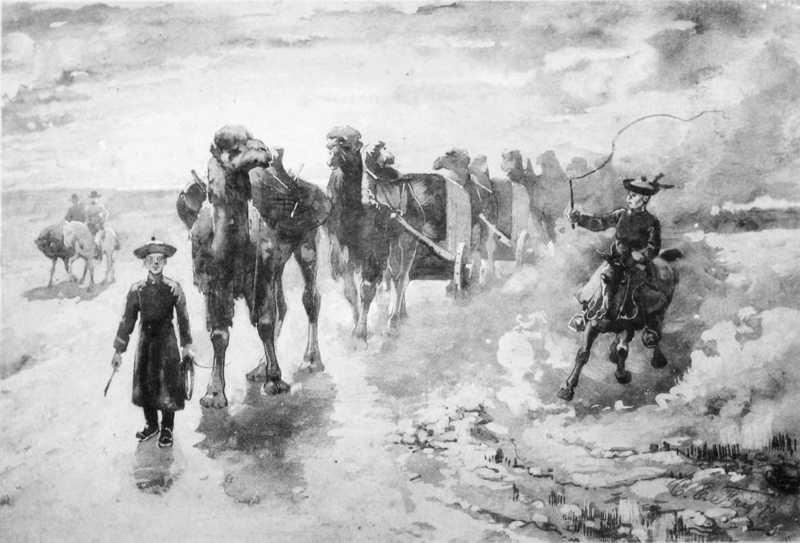
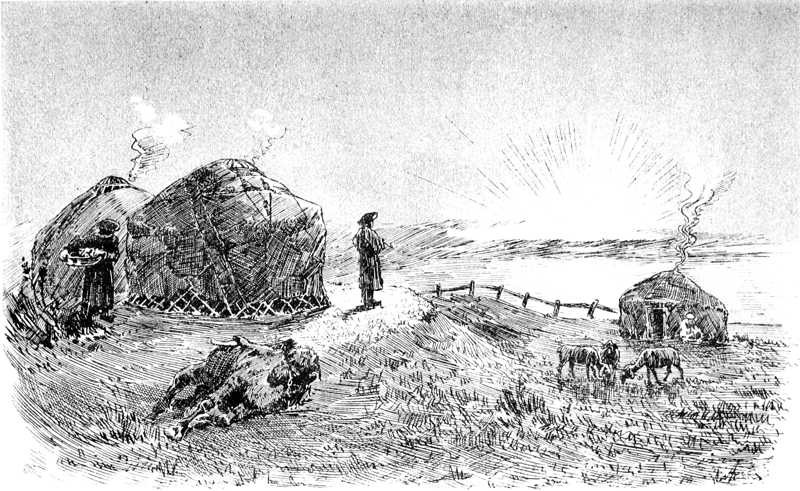
OUR CARAVAN (GOBI DESERT).——DAWN.
FROM PEKIN TO CALAIS BY LAND
BY
H. DE WINDT.
WITH ILLUSTRATIONS AND MAP.
“Plus Je vis l’étranger, plus J’aimai ma patrie.”——De Belloy.
LONDON—CHAPMAN and HALL,
LIMITED.
1889.
[All rights reserved.]
TO
THE RAJA OF SARAWAK, G.C.M.G.,
IN REMEMBRANCE OF MANY
PLEASANT HOURS OF TRAVEL SPENT IN HIS
DOMINIONS IN THE ISLAND OF BORNEO.
There are two Englishmen at present living in
Shanghai who have travelled overland from Europe
to China. I was told, when there, that these
gentlemen are continually receiving letters from
England asking for information relative to the
journey from Petersburg to Pekin and vice versâ,
and in the Gobi Desert and Siberia.
It is mainly owing to this circumstance that I
publish these pages, for I fear the general reader
will find little to interest him in this record of our
monotonous pilgrimage through Europe and Asia.
I feel that an apology is needed for its publication,
and need hardly say that it does not aspire to the
title of a book of travel, being merely a record of
my impressions in the less civilized parts of China,
and in that weird and melancholy country, more
perhaps from associations than aspect, Siberia.
The voyage is, though somewhat original, sadly
devoid of interest. Urga and Irkoutsk are, no
doubt, well worth seeing, but a passing glimpse of
these unique cities far from repays the discomfort,
not to say hardship, which must be undergone on
the caravan route.
I can only trust this book may deter others from
following my example, and shall then have some
satisfaction in knowing that its pages have not been
written in vain.
M. Victor Meignan concludes his amusing work
“De Paris à Pekin par terre,” thus:——
“From China to France overland! Why, surely it’s
impossible. I thought one could only get to China
by sea!”
Such was the remark made by a young lady
whom I had the honour of taking down to dinner a
few days previous to embarking upon the voyage
of which I am about to narrate my experiences.
Although I trust there are not many educated
persons who, like my fair friend, are unaware that
Pekin and Paris are actually undivided by sea, I
imagine there are but few who, if put down at
Calais, and told to find their way overland to Pekin,
would know how to set about it, fewer still who
have any practical knowledge of that vast but
comparatively unknown country separating the
Chinese Empire from Russia proper, Siberia.
It had been a long-projected voyage. Lancaster,
(a fellow-traveller in many lands,) and I had
talked it over for at least two years before: in
the early spring of 1887, we finally decided to
put our project into execution, and start for the
great unknown.
Unlike most voyages which in these days of
travel are an accomplished fact as soon as decided
upon, this one was fraught with innumerable delays
and annoyances. Our difficulties commenced at the
very outset, for nowhere in London, or indeed anywhere
else, could I glean the smallest information
respecting the journey; the only book I succeeded
in finding on the subject being one written by John
Bell, the English traveller, in 1788, but, as may be
imagined, the information contained therein was
somewhat obsolete.
Nothing more modern, however, could I
procure. Jules Verne’s amusing and clever book,
“Michel Strogoff,” deals largely with Irkoutsk,
Lake Baikal, and other regions we were about
to traverse, but I hardly felt justified in taking
that versatile author as a travelling-guide. That we
landed at Tientsin——China——and saw the sea again
at Calais——France——was all we definitely knew; of
the time it took to do, or how the journey was to be
accomplished, we were quite in the dark.
About a week before our departure, however, I
had the good fortune to meet a gentleman connected
with the Russian Embassy in London, and to him
I confided our difficulties. M. de ———— was indeed
a friend in need, for in less than twenty-four
hours our difficulties had vanished like snow in
the sunshine. Not only was the route from Pekin
to Moscow clearly laid down for us, but we were
provided, in addition, with a letter of introduction
from M. de Staal, the Russian Ambassador in
London, to the Russian Minister at Pekin. Had it
not been for this, I doubt whether we should ever
have got further than the celestial city.
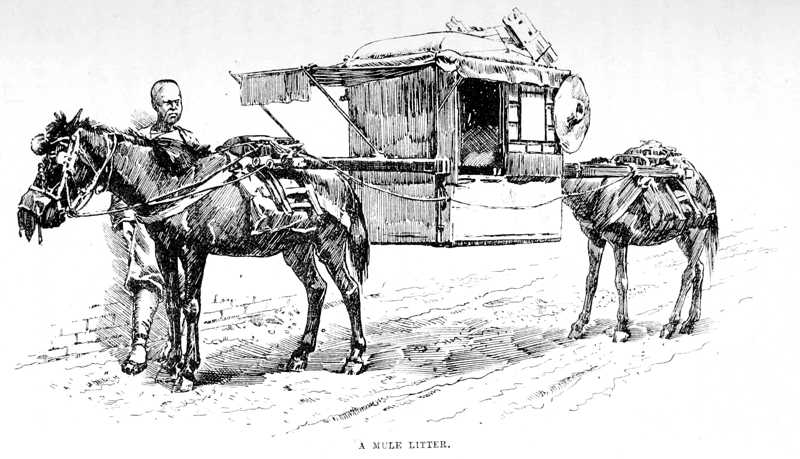
The route (we now found) was as follows: From
Shanghai to Pekin by steamer and house-boat, from
Pekin to Kalgan (or the Great Wall of China) by
mule litter, and thence across the Great Gobi Desert
to Kiakhta, the Russo-Chinese frontier, by camel
caravan. From Kiakhta to Tomsk, viâ Lake
Baikal, Irkoutsk, and Krasnoiarsk by tarantass or
Russian post carriage, and thence by steam
communication on the Obi and Irtish rivers to
Tobolsk and Tiumen. From the latter place our
journey was easy enough. Four days’ sail
and seven of steam would bring us to Moscow,
practically the end of our voyage. As to the time
the journey would take, no one, even at the Russian
Embassy, seemed to know. So much in this
journey depends (as we afterwards found) upon the
weather, the facility of obtaining camels at the
Great Wall, and last, but not least, the state of
the roads in Siberia. We were starting at a good
time, however, and with luck might expect to reach
Moscow in the early autumn. If detained in
Siberia by floods or other casualties, we might not
arrive in Europe till the new year. This was all we
could ascertain, and with this somewhat scanty
information were forced to be content.
The outfit question did not trouble us much. A
Terai hat, two or three tweed suits, and an unlimited
supply of cigars and tobacco met our requirements.
Everything we took went comfortably into two
small-sized leather portmanteaus. A rifle, fowling-piece
and brace of double-barrelled pistols (not
revolvers) were also taken, and this completed our
wardrobe and armoury. I often wonder what the
West End outfitters would do were it not for
the yearly increasing number of Globe-Trotters.
Be it understood I mean Globe-Trotters, not
travellers, for there is a vast difference between
the two. I have often been amused at the utterly
useless articles forced upon the unhappy G.
T. by the Bond Street or Piccadilly haberdasher,
who probably knows rather less of the country his
customer is about to visit than the Khan of Khiva
does of Pall Mall. The Globe-Trotter pur et simple
is seldom (so far as I have seen) of high intellectual
attainments, but one I met a few years ago, while
on a voyage to Sydney, eclipsed everything. He
had provided himself with enough thick clothes and
furs to fit out an expedition to the North Pole. On
asking him the reason, he replied, “Oh! we shall get
to Sydney at Christmas, you know, and it will be so
awfully cold after the tropics!”
Our final preparations completed, we took
passage for Shanghai, and the rainy, gusty morning
of the 7th of April, 1887, saw us steaming down
channel with half a gale of wind in our teeth, looking
our last on the white cliffs of England, while to
our left was just visible the low-lying coast of
France, the goal we hoped to reach in safety, before
the following winter, and from which we were
separated by the length of Europe and Asia.
I will not inflict a description of the voyage out
upon the reader. It would be superfluous in these
days of travel, when a man secures his berth
for Sydney or Yokohama with much the same indifference
as twenty years ago he took a ticket for
Rome or Vienna. The life on board a P. and O. ship
is familiar to most of us. Suffice it to say that our
fellow-passengers were of the usual kind: the
Colonial bishop, who buried himself in a deep theological
work before we had cleared Land’s End, only
to emerge from it at Colombo; the Hong Kong merchant
and his family living on the usual terms of
armed neutrality with the Indian Civil Service
official and his wife, an Indian Major-General,
a sprinkling of bank clerks and coffee-planters,
two or three soldiers rejoining their regiments,
and a pretty grass widow, returning to her husband,
an Indian Judge. These, with half a
dozen more or less uninteresting young ladies
“going out to be married,” completed our party.
The ages of the latter seemed to increase in proportion
to the distance they were going. The one
whose fortunate fiancé resided at Hong Kong must
have been fifty at the very least. I had almost forgotten
a nearly perfect specimen of the Globe-Trotter,
who joined us, resplendent in purple and fine
linen, at Suez; a young gentleman somewhat
inclined to take more wine than was good for him,
and who was going abroad for the good of his
health——presumably also for that of his friends and
relations at home.
There is a very false impression existing among
those who have never travelled in one, as to the
delights of a voyage in a P. and O., and the endless
gaiety and amusement on board these floating hotels.
I have made at least a dozen voyages by this particular
line, and must confess that the gaiety and
amusement, if it ever existed, has escaped my observation.
Perhaps I have been unfortunate, but I must
own that I have invariably found the life on board
these ships deplorably dull. The mere fact of being
cabined, cribbed, confined, with three score of one’s
fellow-creatures, the majority of whom have not a
thought or feeling in common, is surely sufficient
to account for a lack of enjoyment. At the same
time, to the casual onlooker, who is wise enough to
keep out of them, the petty rows and scandals on
board ship are amusing enough. How Major-General
Jones has had the audacity to take the seat next the
captain at dinner, instead of Commissioner Brown,
who, as everybody ought to know, if they don’t,
always takes precedence of him at Brandypore; and
how Mrs. Commissioner Brown has felt compelled to
cut Mrs. Major-General Jones in consequence. How
the wife of Surgeon Squills, of the Bengal Staff Corps,
has forbidden her daughter to speak to the third
mate, and that matron’s subsequent mortification on
discovering that the tabooed officer is the second
son of an Earl. How, in our case, one of the future
blushing brides (the Hong Kong one) only wished
that poor dear Judge could see how his wife went
on, although to unbiassed eyes, that cheery little
lady’s sole crime consisted in being more than
pretty, and absurdly good-natured. How the Globe-trotter
overcome by (let us say) the heat in the Red
Sea offered to fight the captain for a dozen of
champagne on his own quarter-deck,——all this could
I descant upon at length, but fear lest I weary the
reader, forgetting that a good joke at sea is but a
sorry jest ashore.
Light and favourable winds favoured us to Malta,
that shadeless, bustling rock so happily christened by
Byron “The little Military Hot-House.” A few
hours here allowed of a stroll ashore and a visit to the
mess of that cheeriest and best of regiments, the
“Black Watch.” Then, after dinner at the club,
and a chat over old Cairo-days, off again in the
moonlight to the Bombay, and, three days later, Port
Said. Here an unexpected delay awaited us. The
P. and O. S.S. Rome had gone ashore (the commencement
of a series of disasters for the Company:)
which meant a detention of five days, at least, at
the glary, unsavoury canal port.
Small-pox was raging in this den of publicans
and sinners, and several cases having occurred on
the homeward-bound P. and O. ships, we were
requested by the captain not to land, if we could
possibly help it, during our stay. A prospect of
five days cooped up in an atmosphere of coal-dust
and sand, to say nothing of the noisome odours off
the shore, was anything but inviting, and eight
o’clock the next evening saw us sitting down to
dinner in the cool, comfortable dining-room of
Shepherd’s Hotel, Cairo.
There is a charm about Cairo peculiar to itself.
Nowhere else do we find that strange mixture
of western civilization and eastern barbarism that
exists in the Egyptian capital, which seems, by
the way, to be yearly increasing in popularity as a
winter resort. Everything in the place is original
and therefore charming, and, although surrounded
with every European luxury and comfort, so utterly
unlike Europe.
A telegram was received during our stay here,
announcing the total loss of the P. and O. Tasmania,
and the drowning, among others, of her captain, poor
Perrins, than whom no more popular commander or
smarter sailor ever lived. We were continually
seeing or hearing of wrecks on our voyage out.
Besides passing three lately sunken vessels in the
Red Sea, we got news at Colombo of the largest
ship in the Nord-Deutscher Lloyd line having gone
down off Cape Guardafui; at Shanghai of the
sinking of the M.M. Steamer Menzaleh between
that port and Japan.
We had a favourable passage through that
exaggerated bugbear the Red Sea, which, by the
way, I have found cooler three times out of four
than the Indian Ocean. Aden was not touched at,
and a quick run of nine days brought us to Colombo,
where we bade adieu to the Bombay, which was
proceeding to Calcutta, and embarked on board the
Piacenza, a vessel considerably smaller but as comfortable
in every respect as the leviathan we had left.
Twenty-four hours here gave us time for a run
out to Mount Lavinia, where we received a hearty
welcome from the jovial German Herr (surrounded,
as usual, by a menagerie of domestic pets) who
manages that picturesque seaside hostelry. A comfortable
dinner in the breezy salle à manger in full
view of the cool blue sea and yellow sands, coffee and
a quiet cigar in the verandah, were a pleasant change
from the stuffy saloon of the Bombay. Then back
again to Colombo in the moonlight, along the
palm-fringed road, heavy with the scent of
jungle flowers, refreshed inwardly and outwardly,
and ready for the long weary days of
sea to Shanghai.
We had the Piacenza pretty well to ourselves.
There were but twenty first-class passengers in
all, among them two pretty girls fresh from
Devonshire, with the good looks, and clear, fresh
complexions that county alone seems able to
produce. It seemed a sin so to take them to
a clime notorious for stealing the roses from
the youngest and fairest faces. In the second
class were some ten or twelve Protestant female
missionaries bound for North China, whose
religious zeal was unparalleled. They were for ever
hunting up lost sheep among the passengers, hot as
it was. I do not fancy, however, that their efforts
were very successful. Only one of them made
converts. She was eighteen, and very good-looking.
The remainder of our voyage was uneventful and
tedious enough. Hot, sleepy little Penang; Singapore
a vision of green hills and red dust, a
sickly odour of pepper, cocoa, nut-oil, and drains.
Hong Kong, for all the world like some Spanish
or Italian town with its white terraces, and
coloured venetians, nestling in masses of dark
green foliage at the foot of the bare rugged
peak; all these were passed without incident
worthy of mention excepting the meeting of the
fifty-year-old bride with her fiancé at the latter
port, which was affecting in the extreme. It was a
relief to find that, at any rate, the bridegroom was
something near her own age. Five days later, on
the 21st of May, six weeks to a day since
leaving Gravesend, we dropped our anchor in the
broad, muddy waters of the Yangzekiang, whence
a small tug conveyed us in six hours up the
narrower and still muddier Woosung river to
Shanghai.
Shanghai cannot be called a picturesque place.
Vast alluvial plains of rice and cotton surround it
on every side, while the view from the bund or
esplanade fronting the river, is not unlike the
Thames at Blackwall, with its flat banks, forests
of masts, and grey stone wharves and warehouses.
The town itself consists of three distinct
settlements, English, French, and American,
divided one from another by small tributaries of the
Woosung river. These settlements, quite distinct
from the native Chinese city, were formed by their
respective governments in 1846, and occupy a
space of ground rather more than a mile square.
Shanghai, in 1883, contained a population of four
hundred thousand, of whom two thousand were
foreign residents, and an idea of its commercial
importance may be gained by the fact that its trade
in silk, tea, and opium now equals thirty to forty
million sterling value of imports and exports.
Were I ever condemned to live in the far East
(which Heaven forbid), I should certainly choose
Shanghai for a residence, for besides its other
advantages, there is a marked absence among its
European inhabitants of the ill-nature and scandal
that makes anything but a very short stay in other
colonial settlements almost intolerable to those
whose occupation does not compel them to reside
there. Whether it is the effect of the climate on
the liver, I know not, but for envy, hatred, and
malice commend me to the European communities
of China and the Straits Settlements.
There is a capital club (one of the best if not the
very best in the East) at Shanghai, of which (thanks
to the kindness of Mr. C————, to whom we had an
introduction) we were made honorary members, no
mean advantage, for the Shanghai hotels are by no
means models of comfort or cleanliness. We intended
making a stay of at least ten days before
going on to Tientsin, the port of Pekin, for many
things had to be thought of and procured for the
long journey across the Desert of Gobi, which we
now ascertained, for the first time, is nearly a
thousand miles across.
There seems to be no lack of amusement at
Shanghai, and the merchants and other Europeans
located there appear to have what Americans
would call a “real good time of it” all the year
round——so far as regards gaiety and sport. For
those who care for it there is any amount of
shooting. In winter there is no lack of duck,
teal, snipe, and other wild fowl. Indeed from
here all the way up to Pekin the country teems
with game, big and small, the former including wild
boar and deer, while further north in Manchuria are
found lion, tiger, and bear. Nor is shooting the
only sport, for there is a capital race-course, polo
and cricket ground. I attended a match on the
latter, in which was playing, in Chinese dress and
a pigtail (!) a lately celebrated English cricketer, well
known at Lord’s and the Oval, who had adopted the
native costume in accordance with the rules of the
Mission of which he is now a member. The loose
clumsy dress did not seem to interfere with his play
much, for he was quite in his old form, and made
over a hundred runs first innings.
But the Race week is the real Shanghai carnival.
At this festive season offices and warehouses are
closed, and everything given up for the business
of the meeting. Nearly all the horses engaged
are Mongolian ponies, and half the fun of the
thing is getting a “hot one” down from its
native plains and keeping it dark till the day
of its engagement. The figures paid for these
little animals are something fabulous. People
at home have no idea of how our countrymen
live in China. “Light come, light go,” seems
to be the motto of the cheery, hospitable Shanghai
merchants, who, although they make such enormous
fortunes, never seem, to the casual visitor, to
have anything to do but entertain the stranger who
has the good luck to find himself within their gates.
It will be long before I forget the kindness they
showed us, although (before we met Mr. C.) we did
not know a soul in the place.
It was curious sometimes to cross the iron bridge
separating them and take a ramble from the English
into the French town. It was like crossing the
English Channel——indeed, I doubt if Dover and
Calais present a more striking contrast than do the
settlements of their respective nations at Shanghai.
One left the broad regular roads, asphalte pavements
and severe, business-like architecture that the
mercantile Briton takes with him wherever he goes,
to emerge the other side of the narrow stream on a
boulevard, that first thought of every colonizing
Frenchman——lined with cafés, gaily striped awnings,
and little zinc tables, at which Auguste and Alphonse
sat sipping their absinthe or “Mazagran,” waited
upon by bustling, white-aproned garçons. The sleepy
looking Douanier, with baggy trousers and képi, the
grass-grown cobbled streets, the dark blue enamelled
plates at the street-corners, with Rue de la Republique,
Rue de Paris, &c., thereon in large white
letters, the general air of stagnation and idleness
among the population, seemed to carry one in a
moment over leagues and leagues of land and sea to
some quiet provincial town in far-away France. It
needed not the tricolor floating from the mainmast
of the ironclad anchored mid-stream, off the Consulate,
to tell us that we were no longer on English ground.
The Shanghai bund and esplanade on a fine afternoon
was amusing enough, and we whiled away
many a pleasant half-hour watching the motley
crowd that assemble there for a ride or drive
in the cool of the evening. Here might be seen
every grade of colonial society, from the solemn and
portly merchant and his family rolling solemnly
along in an English-built landau, to the San
Francisco demi-mondaine, all powder and patches,
dashing about in a Victoria drawn by a pair of
pulling, tearing Mongolian ponies. Europeans in
buggies and on horseback, Japanese in rikshaws,
Chinese in wheelbarrows (the reader may smile,
but this is a public conveyance in Shanghai), crowds
of every conceivable nation and colour strolling under
the trees by the water’s edge, the esplanade at
Shanghai on a fine evening is a sight to see and
remember.
At night electric lights every twenty yards or so
convert the bund into a perfect fairyland. The
inauguration of the Jablokoff system, however,
was attended with a slight contretemps. Crowds
of natives and Europeans turned out the first night
to see the effect, but for a good hour none was
apparent. The place was wrapped in total darkness,
and the expectant crowd beginning to show signs of
impatience, it was found that the engineer had fixed
the lights above the trees, whence the dense foliage
very naturally obscured it, instead of under. This
trifling mistake was, however, soon rectified, and
the brilliant illumination so took the fancy of the
natives that all the principal Chinese thoroughfares
are now lit by it.
The native city of Shanghai, is walled and
separated from the French and English settlements
by a deep, muddy moat. Some clumsy
iron cannon, said to be the oldest in existence,
are mounted upon its dilapidated grass-grown
battlements. This was our first experience of a
celestial city, and we did not, after visiting it,
look forward with unalloyed pleasure to the two
hundred odd miles of country we were about to traverse
between Pekin and the Great Wall of China.
But I did not then know that Shanghai is renowned
as being the dirtiest city in the Chinese Empire, and
certainly we never afterwards came across one to
equal it in this respect. Pekin itself was a paradise
in comparison.
The streets of Shanghai proper are none
of them more than ten feet in breadth. Some
are even considerably narrower, and the tottering,
tumble-down dwellings, the majority built
of wood, bend forward on either side until they
nearly touch overhead. The thoroughfares are
thus always, even on the brightest day, in a state of
semi-darkness. The pavements, rough and uneven,
are formed of huge stone slabs, some of them,
judging by the characters inscribed thereon, many
hundreds of years old. Worn away by time and
use, many are broken away in parts, revealing
underneath the sewage and filth of years, which,
slowly rotting away, infects the whole city with
a hot, sickly odour of putrefaction. It was
a hot, muggy day when we visited it, and
the stench from these places was something
beyond description. I was not surprised to hear
that cholera and typhus number their victims by
thousands at times, and that an epidemic (of some
sort or another) always exists.
Yet it seemed a busy, bustling place, and we
could scarcely make our way along the sloppy
streets for the continuous stream of traffic. It
was exactly like a human bee-hive, and we should
very soon have lost ourselves without a guide in
the crooked, tortuous streets that ran in all
directions like a maze, without any regard to
regularity or order. We came suddenly in the
very heart of the city, upon an oasis in this desert
of filth and squalor, a space about a quarter of
a mile square. A large circular lake overhung
with weeping willows occupied the centre. Great
white and yellow lilies lay here and there on the
surface of the smooth clear water, in which
one could see the gold fish swimming lazily to
and fro about the thick green weeds and stems,
ten or fifteen feet deep. About fifty yards from
the shore, and connected with it by a light
bamboo bridge, stood a large pagoda gorgeous
in vermilion and gold, with countless little gilt
bells hung around the roof, which, with every
breath of air gave out a sweet, musical jangle.
Seated in this were a crowd of men and women,
talking, laughing, and drinking tea. All were
dressed in the richest silks, the men in dark
blue or plum colour, the women in lighter shades
of green, heliotrope, or orange, their necks and
arms loaded with heavy gold ornaments, their
quaint, impassive, doll-like faces thickly smeared
with paint. On the banks around the lake
were booths for the sale of sweetmeats, fans,
silks, cigarettes, and jewellery, while jugglers
and acrobats plied their trade among the busy
crowd, or at the little tables set out by the
waterside and occupied by noisy chattering
tea-drinkers. I stood for some time watching
the curious scene, which was for all the world
like a bit broken out of a willow-pattern plate.
It seemed so odd to walk suddenly out of the filthy,
sewage-laden streets into this hidden corner of
cleanliness and picturesque revelry. But China is
full of such contradictions. I afterwards discovered
that we had strayed into a tea-garden (there are
a dozen such in the city) and that the pretty
pagoda was used as a kind of private box for the
better classes, just as our own smart people
at home occasionally patronize the Alhambra
and other music-halls to gaze at a respectful
distance on the manners and customs of the “Oi
Polloi.”
The Chinese, I found, are great believers in the
art of fortune-telling. We passed on our way
homewards many of the shops, or rather boxes,
in which the professors of the art received their
subjects. They seemed to have many methods,
but the favourite one consists in dipping the thumb
into a piece of hot, soft, black wax, and then impressing
it firmly upon a piece of parchment or
white wood. The lines thus obtained are supposed
to predict the future. The professors seemed
to be doing a roaring trade. Their fees were
not extortionate; a couple of cash (about ½d.) each
consultation.
The most important thing we now had to
consider was the purchase of stores for our journey
over the “Great Hungry Desert,” as Gobi is called
by the Chinese. It was by no means easy to decide
how much or how little to take, for no one in
Shanghai seemed to know whether in the eight hundred
odd miles lying between the Great Wall of
China and Ourga food of any sort or kind was procurable.
However, hearing that everything in the
way of provisions was outrageously dear at Tientsin,
and unprocurable at Pekin, we decided to lay in our
stock at Shanghai, and curiously enough furnished
ourselves with exactly the right amount, for our
stores failed the very day before we reached Kiakhta.
The claret, whisky, and soda-water gave out some
time before, but we had plenty of lime-juice, which
made the brackish desert water drinkable.
Were I to do this journey again, I should certainly
send everything of this kind straight out from
England, for the camp furniture, saddlery, and stores
we bought at Shanghai were, besides being outrageously
dear, of very inferior quality. On opening
the cases in the desert, we found at least a quarter of
the provisions uneatable. The American firm who
furnished us must make a good thing of it if they
do business with all their customers on the same
terms.
The operation of packing was by no means easy.
As the reader is perhaps aware, the weight on a
camel’s back must be quite equally distributed on
either side, otherwise (in Mongolia at least) the
animal lies down and utterly declines to move a
step. Eight strong wooden chests, with padlocks,
met all our requirements, and having made our
adieus to our hospitable friends, we embarked, the
31st of May, on the coasting-steamer Tungchow for
the port of Pekin, Tientsin.
We were presented before leaving Shanghai with a
so-called itinerary on the journey we were taking,
written by an Englishman resident in China, who had
travelled the caravan route from Pekin to Europe
in 1872. Things must have changed considerably,
both in Mongolia and Siberia, since those days, for
almost all the book contained, including distances,
was so inaccurate and misleading that we discarded
its use long before we reached Kiakhta.
The “Tungchow” was more like a yacht than a
cargo boat, and the run up coast was delightful;
with bright sunshine and light cool breezes, exactly
like Mediterranean weather in early spring, though
the nights were very cold, and one was glad of an
overcoat. We passed daily numbers of fishing
junks, their dark brown mat-sails and bright red
and yellow banners standing out in picturesque
contrast to the clear blue sea, which often for miles
round us was dotted with net corks and men in
small canoes. A gale springs up in a few minutes
in these latitudes, and during the typhoon
season many of these poor fishermen, unable to
get back to the junks, are blown out to sea and
drowned, their companions on the huge, swirling
craft, being, of course, unable to render them
any assistance. The captain of the Tungchow told
us that many lives are lost annually in this
manner.
We reached Chefoo late at night, and were
therefore unable to land, as we were off again at
daybreak. This is the Brighton of Shanghai and
Pekin. There is capital bathing here, and many
good hotels, which are crowded to overflowing in
the summer months by Europeans escaping from
the damp, steamy heat of Shanghai, and the no less
disagreeable odours, and “dust fogs” (I can call
them nothing else) of the capital.
The coast lying between Chefoo and the mouth
of the Peiho river is strikingly like parts of Devonshire.
But for the absence of houses and bathing
machines, one might have been off Torquay or
Dawlish. Precipitous red cliffs, with smooth green
sward growing to their very edges, met by broad
smooth yellow sands, while here and there great
masses of rock run out for a considerable distance into
the clear blue water. Further inland neatly trimmed
hedges, clumps of fir-trees, and snug-looking farm-houses
surrounded with orchards and gardens,
recalled visions of clotted cream, and pretty
peasant girls in that loveliest of all English
counties, the true garden of England: Devonshire.
At daybreak on the 3rd of June we passed the
celebrated Taku forts and entered the Peiho river.
It was a bright lovely morning, and as a bend of the
river hid it from our sight, and we looked at the
blue sunlit ocean for the last time, it was not without
some misgivings at the long land journey before
us. The thought that when next we saw the sea,
it would be at Calais, made us realize, perhaps
more than we had as yet done, the difficulty and
length of the voyage we had undertaken across the
breadth of Europe and Asia.
Unlike most rivers, the Peiho seems to widen as
you ascend it, being considerably narrower at the
mouth than at Tientsin, thirty miles inland. The
town of Taku, a wretched-looking place, built for the
most part of mud houses, is by water inaccessible for
five months of the year, on account of the ice in the
Peiho and Gulf of Pechili. It is a curious fact that
although Taku is so cold in winter, it never snows,
and there is usually a bright, cloudless sky and cutting
north-easter blowing. Wretched as is its appearance,
Taku looks a busy place, and contains a Chinese naval
dockyard. The Taku forts commanding the entrance
to the river have been greatly strengthened during
the last ten years, the work being carried on under
the personal supervision of German officers.
We were rather puzzled, on first entering the
Peiho, at what appeared in the distance like a
number of large merry-go-rounds scattered over the
flat swampy plain surrounding the town, and
revolving without cessation. It was only by the aid
of glasses that we made them out to be salt-mills
worked by huge mat sails. The sea-water is pumped
into the vats by the aid of this irrigation and allowed
to evaporate in the sun. The salt which remains is
then piled into large stacks and covered with thick
matting. The effect at a distance of these dozens of
huge mills revolving on the bare desolate plain with
not a living object near them, was curious in the
extreme. The river scenery from Taku to Tangchow
very much resembles that of the Nile, the houses of
dried mud, with their flat roofs and terraces, the
absence of trees except occasional palms, remind
one not a little of an Egyptian landscape, while the
uniform dark blue garb of the peasantry, of exactly
the same shade as that worn by the Fellaheen,
heightens, at a distance, the illusion.
Although only thirty miles distant as the crow
flies, Tientsin is quite eighty by river from Taku,
for the Peiho is, towards the mouth, the most
tortuous river in the world. It is not unusual to
steam steadily on for an hour, and find yourself, at
the expiration of that time only a few hundred yards
from where you started. The effect produced by
the shipping ascending and descending the river is
very odd, the intricate bends of the river giving
the steamers the appearance of moving about on
dry land. The marshes I have mentioned do
not extend for more than about ten miles inland.
They are then succeeded by rich fertile plains of
rice and cotton irrigated in the Egyptian manner by
means of “shadoofs” from the waters of the Peiho.
The country seemed pretty thickly populated.
Some of the mud villages by the water side must
have contained quite a thousand inhabitants, but in
China, where the population is so enormous, this is
looked upon as a small hamlet!
There is a large coal-wharf a short distance
from Taku, where the coal from the Kai Ping
mine, fifty miles distant, is brought by means
of a small railway and barges. The coal, though
rather dusty, is excellent for steamer purposes,
and the private company working it make a
very fair percentage. It has always seemed
curious to me that coal is not more extensively
worked in the Chinese Empire, when there are more
than four hundred thousand square miles of it! There
are, however, but very few mines in existence.
Tientsin, which has a population of about nine hundred
and fifty thousand stands at the junction of the
Grand Canal with the Peiho river. It is not a prepossessing
place at first sight, nor did its dusty,
bustling quays, warehouses, and noisy, perspiring
coolies, make us at all anxious to prolong our stay
longer than was absolutely necessary. The trade of
Tientsin is not great when compared with the other
treaty ports. Nearly all the tea exported thence goes
to Russia and Siberia——occasionally by way of Pekin——but
in most cases viâ Kalgan and district across
the Gobi Desert to Kiakhta, without touching at
the capital. The Russian merchants are therefore
nearly as numerous as the English at Tientsin.
The settlement boasted of but two hotels, and these
of a very fifth-rate description. Small-pox having
broken out in one, our choice was limited, for we did
not care to run the risk of being laid up for three or
four weeks in the native hospital at Pekin. Bidding
adieu to our genial skipper, who cheerfully expressed
a hope that he might see us again one day, though
he very much doubted our ever leaving Siberia,
we made our way, accompanied by a yelling crowd
of half-naked coolies bearing our luggage, to the
American Hotel, an uninviting, dilapidated-looking
hostelry enough. In the verandah, reclining on
many chairs, and at intervals refreshing himself
from a huge beaker of brandy and soda, was an
individual pointed out to us as the proprietor (a fat,
sleepy-looking Yankee), whose welcome was hardly
encouraging.
“Can we have rooms here?”
“Sure I don’t know, you’d better ask.”
“But you’re the manager, aren’t you?”
“Oh, yes, I’m the manager.”
A pause, during which our friend takes a long
pull at the brandy, and, emerging considerably
refreshed, composes himself calmly to slumber.
“Who are we to ask?”
“Who are you to ask?” half opening his eyes;
“Oh! I don’t know, you will see some of the China
boys about. How should I know who you’re to
ask?” is his parting shot as we leave him and cross
the dirty sanded billiard-room, hung with tawdry
prints, and redolent of stale tobacco and spirits, that
precedes the entrance to the “bar.”
Here we glean from a dishevelled, greasy German
in shirt-sleeves, who looks as if he slept among the
sawdust and empty whisky bottles that litter the
floor, that no rooms are to be had that night,
or for the next week to come, for love or money.
A huge travelling circus belonging to an Italian,
one Chiarini, has taken every available room in
the place. “Then could we have the billiard-table?”
“No, we could not possibly have the
billiard-table, for the ‘gentlemen’ connected with the
circus always played till three or four in the morning.
Still, we could have it then, if we liked, on payment
of a small remuneration to him (the occupant of the
bar), but we must keep it dark from the boss.”
Our experience of the “boss” did not quite justify
our taking this course, and we left the hotel, sadly
and slowly followed by our string of sympathizing
coolies, utterly at a loss to know what to do till
the bright thought struck Lancaster of at once
hiring the house-boat which was to take us to
Tungchow (the landing-place for Pekin), and living
on board her till we left for the capital. We managed
this, not without some difficulty, for we had to get
the boat through our friend the sleepy Yankee. He
woke up a little, however, at the prospect of swindling
two helpless and friendless fellow-creatures, and by
sundown we had everything on board, and the boat
snugly moored off the hotel wharf. We were alongside
a large open drain, with a most abominable
stench, and there was always the possibility of being
run down in the night by a passing ship, but one could
not afford to be particular. The sight, however, of a
large passenger steamer bound for Japan which
passed close to us towards sundown was depressing in
the extreme, the cleanliness and luxury on board
contrasting so painfully with our own surroundings.
For a few moments we almost regretted (by no means
for the last time) that we had ever undertaken this
voyage, the discomforts and difficulties of which now
seemed to increase with every day.
Early next day we presented our letters to Mr. S.,
the Russian tea merchant, who was to provide us
with letters of credit for his agents at Irkoutsk and
Tomsk in Eastern and Western Siberia. Mr. S. did
not give us a very favourable account of the journey
before us. Like almost every other Russian we met,
first question was “Mais que Diable allez-vous faire
en Sibérie?” We got into the way at last of never
arguing this question. In the first place it was
useless, and only caused waste of time; in the
second we had literally no reason to give, except
perhaps the one so dear to most Englishmen:
“The country had been crossed by so few travellers
before!”
Among other pleasant and encouraging items of
news, we now heard that we should probably meet
with serious delay, not only at Kalgan, the Mongolian
frontier, but also at Pekin. “You had
better not think,” said Mr. S., “of making any definite
plans till you arrive at Kalgan. This is the worst
time of year you could have chosen. It is not the
caravan season; the camels are all out on the plains.
It may be two or three months before you are able
to cross the Gobi, and then you will get into Siberia
at the very worst time of year, when the roads are
next to impassable from rains and floods. Any
day you may be detained by a broken bridge or a
landslip, and have to wait in some dreary, wretched
village in the wilds of Siberia, till the snow sets, and
enables you to finish your journey in sleighs. You
cannot, I feel sure, have rightly estimated the
difficulties before you. Why go to Siberia at all,
when that earthly paradise Japan is so near?” &c.,
&c.
We at last succeeded in making Mr. S. understand
that we were determined to get as far as
Pekin at any rate; and, our interview over, had
nothing but the purchase of some provisions for
our river journey (our Shanghai store was not
opened till we reached the desert) to detain us in
Tientsin. Nor were we sorry to get away, for the
dust and filth of this city were almost unbearable.
We had not then experienced the odours of Pekin,
which would accustom one to cheerfully live in a
main drain.
Our second night here was not so pleasantly
passed as the first. A shower of rain at sunset
brought out legions of mosquitoes, from which, not
having brought curtains, we suffered a good deal of
annoyance, and the intolerable stench of the drain
near which we lay was so increased by the rain that
we had to smoke incessantly till past 3 a.m.,
almost regretting we had not accepted the barkeeper’s
offer of the billiard-table for a bed. Even
the “circus gentlemen” would have been preferable
to the sewer. We got to sleep about 4 a.m.,
only to be awoke at daybreak by a crashing sound
and to find the water rushing into the boat, with
an unpleasant conviction that our craft was heeling
over at a very uncomfortable angle. We
had become entangled in the hawser of a large
ocean-steamer, which, had it not been let go in the
nick of time, would have upset us altogether. We
escaped with a ducking, however, and soon got the
boat righted and baled out again.
The distance from Tientsin to Pekin is rather
under eighty miles overland, that by river one
hundred and forty, viz. one hundred and twenty
miles to Tungchow, and twenty miles thence
by road to the capital. Although it takes two
days longer (sometimes three), we chose the water
route in preference to the other. We should, we
thought, have quite enough land-travelling during
the next five months; besides which, the Chinese
inns between Tientsin and the capital are even
filthier than those between Pekin and the Great
Wall——which is saying a good deal.
It was about ten o’clock, on a bright, clear
morning, that we hoisted the huge mat-sail, and,
with a favourable breeze, soon left the bustling city
and its high cathedral towers (where the Catholic
nuns were so brutally murdered in 1870) low on
the horizon.
The traffic on the Peiho river for some miles above
Tientsin is enormous. We must have counted at
least four hundred boats and barges in the space of an
hour the afternoon of the day we left, while the whole
way to Tungchow the river was alive with boats of
every description whenever we passed a village, from
huge junks to tiny sampans. At times, near Tientsin,
one could have crossed the river, or walked three
hundred or four hundred yards up it, dry shod on
the boats.
A Chinese house-boat, though comfortable enough
for all practical purposes, must not be confounded
with the luxurious, flower-bedecked craft that line
the banks of the Thames in summer time. The
Chinese house-boat resembles the English only in
name, for there was no attempt at decoration, and
very little at cleanliness. About forty-five feet long,
it was decked completely over, except in the centre,
where a sort of well covered with planks, with space
enough for two to lie or sit in, formed the cabin.
Our crew, five in number, slept in a kind of
hutch under the deck forward. How they all
managed to stow themselves there at once was a
mystery to me, for they were great, tall, hulking
fellows. We sailed, as a rule, our broad mat-sail
sending the old tub along at an incredible speed
with the lightest breeze. When the wind dropped,
the men rowed incessantly, day and night, till it rose
again. The amount of work they got through was
simply marvellous. Nothing seemed to tire them;
morning, noon, and night they plied the heavy,
awkward sweeps without cessation, except to eat a
dish of rice and fish and take a drink of cold tea
once every twelve hours. Cheery, good-tempered
fellows they were too, considering the small wages
they got. The fare, including everything, was only
$13, and our Yankee friend must have got at least
two-thirds of this sum as his own share of the
transaction.
The first two days of our river journey were
enjoyable enough, save for such small annoyances
as rats and cockroaches, which latter took
forcible possession of our cabin at night-time.
But the delightful weather and novel scenery amply
atoned for such small discomforts as these. The
Peiho is a thick, muddy stream. Its banks are continually
slipping down and being dammed up by
the natives, which accounts in a great measure for
the dirty pea-soup colour of the water. These landslips
are not of weekly or even daily occurrence.
They occur incessantly, and it was curious to
watch, as we ascended the river, the continual
dropping away of the land on either side, while, here
and there, gangs of men repaired the damage by
means of cemented bamboos. The riverside
villages were like human beehives, so crowded and
dense did the population of them appear, even at
midday, when so many of the inhabitants must
have been out at work in the fields. One could not
help wondering how even such an enormous country
as China can support such a dense population,
numbering, by the last census, some 400,000,000.
And yet, from the time we left the coast till we
reached the Mongolian border, there was always
vegetation of some kind or other to be seen, and
vast fertile plains of corn, barley, and millet
stretched away on every side to the horizon. Everything
in North China is on such a large scale that
for a few days one scarcely realized how enormous
the population and fertilization of this huge empire
really are, how great its resources and demands.
Our days on the Peiho were amusing enough.
There was always something to look at on the
bank, and a capital towing-path to walk on when
one’s legs got tired and cramped in the boat, so that
we had nothing to complain of in the way of
variety, and the first two days, bright and sunny,
wore away as idly and pleasantly as summer days
up the Thames or Wye in England. It was pleasant
to sit out in the evening in the cool, clear
moonlight, on the little deck, the silence unbroken
save by the regular plash of the oars, or twang of
Chinese fiddle or guitar, as we passed some lonely,
riverside cottage, the arms of the solitary, half-naked
musician gleaming white in the moonlight, as
he rose and waved a good-night to our crew. When
we passed a village after dark it was like some weird
transformation scene, for up to midnight these waterside
settlements appeared, from the river at least, to
be given up to revelry. We never, however, ventured
into one, preferring to gaze from a respectful distance
upon the flaring torches throwing counter
effects of light and shade over the quaint, picturesque
houses and pagodas, the hurrying crowds on
the banks; while the clashing of gongs and cymbals
from the joss-house or theatre heightened the effect
of the strange scene. Then on again along
the silent moonlit stream, with its low sedgy banks;
nothing to mar the flat, monotonous outline of the
moonlit landscape, but, here and there, a huge
square mound of earth, the tomb of some departed
mandarin or village magnate.
But the morning of the third day looked dull and
overcast, and by ten o’clock the rain was pouring
down in torrents. There was no keeping dry, for
the ramshackle roof leaked like a sieve, and the
floor of our cabin was in a very few minutes almost
ankle-deep in water. About midday a terrific
thunderstorm broke over us. The lightning was so
vivid that although every nook and cranny of our
dilapidated hutch was tightly closed, and the place
in semi-darkness, it almost blinded one. I have
never, even in the tropics, heard the thunder so loud
and continuous. One peal lasted quite a minute
without cessation.
I have seldom passed a more miserable day
than that one moored by the muddy banks
of the Peiho, for progress was impossible. Cooking
or lighting a fire, too, was out of the question.
Everything, including matches and fuel, was
sopping through and through. Looking out of our
wooden prison, nothing met the eye but grey, driving
mist, and steady, unceasing rain, falling with a
persistence and violence that lashed the brown
muddy waters around us into a sheet of grey
foam. The men forward were battened down,
and seemed unconcerned enough, as snatches of
song rising from below and occasional whiffs of
smoke emerging through the chinks in the deck
testified. We almost envied them their warmth,
shivering as we were like half-drowned rats. About
five o’clock a break in the grey, misty sky appeared,
and half an hour later the sun was shining in a
sky of cloudless blue, while we rapidly cut our way
through the water before a light but piercingly cold
breeze, so sudden and complete are the changes of
weather in these latitudes.
Early the next day a chain of precipitous mountains
broke the horizon. Beyond them lay our
destination, Pekin. We were, however, still two
days off, for the river here shallows considerably,
and we frequently stuck hard and fast during
the day. At these times the whole crew would
divest themselves of their clothes, and, fastening
a couple of stout ropes to the bows of the
boat, tow us off again into deep water. Landing
here was impossible, for one could not get
within ten yards or so of the bank. Some of the
larger junks were being towed by as many as thirty
or forty men. On the deck of one a huge deal case
bearing the name of Maple and Co., London, in
large black letters, looked strangely out of keeping
with the uncivilized surroundings.
It was only the fifth morning after leaving
Tientsin that we hove in sight of Tungchow, a
“village” of something over one hundred thousand
inhabitants. This was our first experience of a real
Chinese town, far from European influence; and
we were rather agreeably disappointed, for at a
distance, it looked clean and inviting. A closer
acquaintance, alas! somewhat modified first impressions.
Moored alongside the flat muddy banks were a
perfect colony of junks, two thousand or three thousand
in number; an interval of flat boggy ground cut
up by innumerable cesspools, open drains and dust-heaps
divided these from the town wall, which,
standing back about a couple of hundred yards from
the water’s edge, hid the town from view, except
where, at intervals, a tower or pagoda overtopped the
loopholed brick battlements. Although the sun had
but just risen, the banks were crowded with people,
and the keepers of hundreds of stalls and booths
were already doing a brisk trade in the sale of cloths,
pigtails, tea, sweetmeats, and fans to the junk
population, while here and there a barber plied his
trade, which in North China is anything but an
appetizing one to look upon. Dirty as the place
and people were, the bright, cloudless sky and
sunshine lent a gaiety to the scene, which for
colour and animation I have seldom seen equalled
in the most picturesque Turkish cities or bazaars of
the far East.
We were ready to start at midday, and had all
the baggage safely stowed away in Pekin carts, a
more dirty or uncomfortable vehicle than which
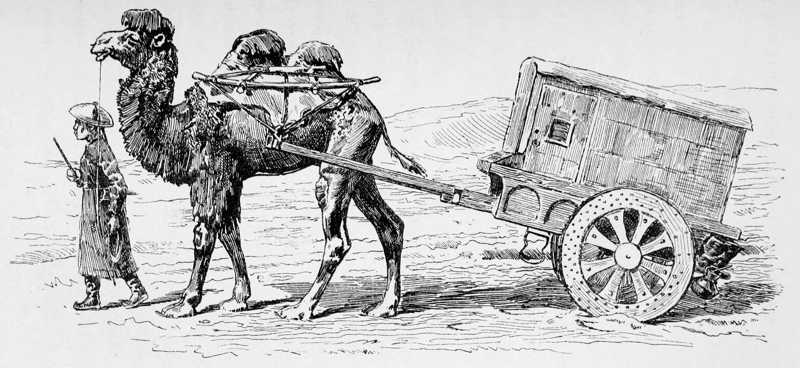
does not exist. As it is of the same construction,
although smaller than the carts in
which we crossed the desert, I will leave the description
of these “torture-boxes” to a future
chapter. Seeing with the naked eye whole regiments
of vermin crawling over the one destined
for our reception, we preferred to ride ahead,
on donkeys, under the guidance of a small boy,
whose powers of conversation were limitless, and
who talked incessantly the whole way, frequently
interlarding his conversation with the words “Yang
Qweitze” (Foreign Devil), the uncomplimentary
title bestowed on every European, of whatever
nationality, in the less civilized parts of China.
Nor was the filthy state of the carts our only
reason for riding. We had serious misgivings as
to whether the clumsy, heavily-laden conveyances
would reach Pekin before nightfall, in which case
we should have had to pass the night in the open
outside the walls. The gates of the city are shut
at sundown, and no human power (short of the
emperor’s special command) will open them till sunrise
the following day.
It took us nearly an hour to get clear of Tungchow
and into the open country. The town is (for
China) fairly clean, though the streets are narrow,
tortuous and ill paved, and in some places there
were holes two or three feet deep in the centre of
the roadway.
The natives in this part of China present a
striking contrast to their countrymen at Shanghai
and further south; whereas the latter are for the
most part puny, pasty-faced creatures, these were
fine, strapping, broad-shouldered men, with healthy,
ruddy faces. The women too were better-looking,
though doll-like and thickly painted, with the baggy,
shapeless figures, deformed feet, and stoop peculiar to
their race. Many of the shops were devoted to the
sale of Manchester goods and cheap cutlery, which
find great favour among the people in this part of
China. Here and there a large tea-house, gorgeously
decorated, was filled with customers taking their
morning draught of the cup that cheers. The tea
drunk by the Chinese is as different to our idea of
that beverage as it can well be, and is, to a European
palate, utterly flavourless. “Chacun à son goût.”
Many Russians say that real, unadulterated tea
never finds its way to England, nor would the
English drink it if it did.
It took us quite an hour to get clear of Tungchow,
for the streets were crowded to overflowing.
Although so few Europeans are seen here, the people
took very little notice of us, excepting the juvenile
population, ragged little wretches, a crowd of
whom pestered us for cash, which, when refused,
drew down upon us yells of derision and curses on
the “Yang Qweitze” in general.
The road from Tungchow to Pekin lies through
a fertile, well-wooded country, and is for the first
three or four miles raised some ten feet from the
ground on either side, and paved with huge stone
slabs, apparently of great antiquity. Although now
in a very dilapidated condition, this must in former
times have been a splendid thoroughfare. It reminded
one of one of the old Roman roads, some of
the slabs being quite ten feet long by five feet broad
and two thick. The going was very bad in places
where these stones had fallen away. Turning away to
admire the scenery, I was somewhat suddenly recalled
to the situation by finding that my donkey had
slipped into one of these chasms about four feet
deep. We got out, however, with nothing worse
than a few bruises. This road is said at one time to
have extended as far as Pekin, but, with characteristic
carelessness, the Chinese have allowed it to become
so dilapidated, that after two miles or so it ceases
altogether, and our way lay along narrow, raised
paths, running through millet and barley fields.
Eight li from Tungchow, we passed the picturesque
bridge of “Palikao,” from which the French general
takes his name. Hard by a little tea-house clustering
in the shade of willow-trees afforded us grateful
shelter for half an hour, and we dismounted and
took a few cups of the cool refreshing drink,
for the road was dusty, and the sun very powerful.
As we sat on mats, enjoying the cool breeze from
the river, half a dozen soldiers rode by with a
prisoner, whom they were taking to Tungchow, to
undergo sentence of death by the “Ling Chi.” The
poor wretch looked ghastly pale, and well he might,
for this is perhaps the most barbarous and revolting
of all Chinese punishments. The word “Ling Chi”
means literally to be cut in ten thousand pieces.
As the reader may care to know how the operation
is performed, I will give a brief account of an
execution of this kind which took place at Canton
only last year.
“As soon as the signal was given the victim was
stripped of his clothing——the process of binding
and gagging being made unnecessarily long. By
the time it was over the poor wretch was almost
fainting with terror. Previous to the commencement
of the operation a draught of arrak was
given him, and then commenced the work of
butchery.
“Two deep cuts over each eye commenced the
operation. Gashes which turned great pieces of
flesh over, and left the bone exposed. Then a cut
down each cheek, and a deeper one across each
shoulder, nearly but not quite severing the arm
from its socket. A circular cut to the bone in each
upper arm and fore-arm followed, and then, stepping
back to get more scope, the executioner hacked off
the right hand with one blow. A large piece of
flesh was then cut or rather dug out of each thigh,
and from over each knee, and the flesh torn off both
kneecaps. The calves of the legs were then cut
off.
“Up till now a straight heavy sword had been the
weapon used. The human devil who acted as executioner
wielding it with as much ease and dexterity
as if he had been carving a fowl. The sword was
now put aside, and a thin-bladed knife, about a
foot long, driven in to the hilt, under the right
breast-bone, the executioner working it slowly round
and round while his assistant fanned the victim
with a large palm-leaf fan for the double purpose
of keeping the flies off, and hiding the contortions
of the poor wretch’s face, who was not yet dead,
as evinced by the twitching of the fingers of his
remaining hand. Ten or twelve seconds more of
this diabolical torture, and the victim was cut
down from the cross, to fall, inert and helpless, on
his knees and face. He was then decapitated and
the sentence completed.”
These barbarous and disgusting proceedings
seem the more awful when we consider that
the poor wretch whose execution I have described
was not the actual author of the crime for which
he suffered. He was what is known in China as
a “substitute.” There are many in this strange
land, who for a small sum of money will cheerfully
die for the pleasure of two or three days
spent in dissipation and riot. The murderer
himself was probably looking on with the crowd,
unmoved at what should by rights have been his
own execution.
There are other Chinese punishments quite as
revolting as the Ling Chi, which do not, however,
necessarily end in death. A very common one (to
be seen almost daily in the streets of Pekin) is the
“Cangue,” two large pieces of wood, each with a
semicircular hole in the middle, which are worn
round the neck. The hands are placed at right
angles through other holes in the board, which
weighs from sixty to two hundred pounds according
to circumstances. This is worn from
three days to two, or even three, months according
to the nature of the crime. The “Cage” is
another very common punishment, and is used for
minor offences. The wretched occupant of this
can neither sit, stand, nor lie down. Prisoners are
kept in this position for a period varying from a week
to a month. In the latter case they are usually
rendered cripples for life. Another favourite
punishment (often used to punish adultery) is pulling
out the hand and toe nails, teeth, eye-lashes, and
nostrils; but perhaps the most painful of any is
the “Wire Shirt,” a thin wire garment made to
fit the body so tightly that small pieces of skin are
pressed through every aperture. A sharp razor is
then passed over these outside, so that when the
shirt is removed the victim from head to waist is
one piece of raw quivering flesh.
Many others could I cite, but enough of this
unsavoury subject. China is full of contradictions,
and none are more striking than the cruelty and
kindness of its population, for there exists no
kinder-hearted or more liberal being than the Chinaman.
There are, of course, exceptions; the rebel
Yeh, for instance, who was degraded by the
Emperor for treachery in 1857, when brought to
Calcutta, where he died, confessed to having executed
more than 70,000 souls while he was in
office.
We rode slowly on the whole afternoon through
fields of grain, pretty villages asleep in the sun,
with no sign of life in them but beggars and
dogs lying huddled in the dusty road, under
the shade of wall or shed, sleeping away
the hot, silent hours in indolent content. It
seemed at times as if we should never reach
Pekin, though the mountains beyond it looked
provokingly close in the bright clear atmosphere.
The heat was intense, but a cool breeze now and
then sprung up, and made it not unpleasant travelling
as we rode through some of the prettiest
scenery it has ever been my lot to look upon.
The golden fields of oats and barley, the pretty
villages dotted here and there over the plain, the
ruddy, healthy-looking peasantry at work gathering
in the harvest, and, here and there, the country-seat
of some wealthy Mandarin, with its broad
avenues, willow-fringed lake, and deer park,
wore a happy, civilized look strangely at
variance with one’s preconceived notions of the
remoter parts of the Celestial Empire. Had it not
been for the quaint pagodas and temples resplendent
in crimson and gold carvings that we passed every
mile or so, one might have fancied oneself in some
picturesque corner of far away England.
One circumstance alone considerably marred our
enjoyment of the lovely scenery——to wit, the streams
of beggars who towards evening came out by
hundreds from the holes and corners in which they
had been lying during the heat of the day. A more
importunate or determined set of wretches I never
saw. Ranging from the ages of five to fifty, half
naked and covered with sores, the wretches refused
to be driven off, and insisted on accompanying us
in unpleasant proximity——some of them for miles.
Now and anon one would run forward, and kneeling,
beat his head upon the ground——an operation called
in China the “Koo-Too.” Passing through one of
the villages, I fairly lost my temper, and turning
round, shook my stick at the yelling, dancing ruffians,
who, much to the amusement of the villagers, almost
barred our progress. The effect was magical. In
a second their demeanour changed, and what had
been a crowd of cringing, supplicating wretches
turned to a hooting, menacing crowd. Things
looked awkward at first, and I thought, for a few
moments, we were in for an ugly row. Mud
and stones were showered on us freely, and
one gaunt leprous-looking individual, half naked,
ran up on his crutches and seized my donkey’s
bridle. Seeing from the indifferent and half-amused
expression on the bystanders’ faces that
we should get no help from them, I thought discretion
the better part of valour, and scattered a
handful of cash among our persecutors, which
had the effect of slowly dispersing them. This
contretemps, trivial as it was, showed the danger
of ever for a moment annoying the people in the
country we were about to travel through. Though
good-tempered and hospitable, the Northern Chinaman
has but a very poor idea of a European,
English or otherwise. Indeed, I doubt if the
majority of the peasantry had ever heard of
England.
The approach to Pekin from Tungchow is
anything but imposing, and we were rather disappointed
at our first sight of the celestial city.
The country for a mile or so before reaching
the gates is so densely wooded that we did not
know we had reached the capital till we found
ourselves actually under its massive crenellated
walls. The latter are surmounted by lofty square
towers which, with their bright apple-green porcelain
roofs and gaudy façades relieve to a certain
extent the barren appearance of the sandy waste
that surrounds Pekin. Not a roof or tower of the
city is visible from here, nothing but the high
rugged walls which, notwithstanding their great
age, are in good repair. There was nothing to tell
one that on the other side of these there lay a place
almost as large as Paris in area and population.
Nothing but the hoarse, subdued murmur, confused
and indistinct, that hangs over every great
city.
A few hundred yards brought us to the gate of
the Tartar city, and, ye gods! what a city! Upon
first entering, it seemed as if a dense fog had
suddenly descended upon one, but a look back
at the bright sunshine outside the gates soon
dispelled the illusion, and explained the mystery:
it was nothing but dust, the black, fine, and searching
dust, for which Pekin is famous. Everything
was coated with it. One breathed it in with every
inhalation, till eyes, mouth, and nose were choked
up, and breathing became almost an impossibility.
No one seemed to mind it much, though our
donkeys laboured through it nearly knee-deep.
We rode for some distance along the filthy, dusty
streets. There is no rule of the road in Pekin,
and it took one all one’s time to steer safely through
the carts, sedans, mule litters, and camel caravans
which thronged the streets. At length we turned
into the principal thoroughfare, a broad unpaved
street, raised in the centre, on either side of
which one saw a long vista of low roofed houses,
scrubby trees, and gaudy shop-signs, lost in the
distance in a cloud of dust. We were in Pekin at
last.
In Pekin, but apparently a long way yet from
our destination, the Hôtel de Pékin; and judging
from our small guide’s very erratic movements,
we were not likely for some time to reach
that friendly hostelry, which is kept by an enterprising
Frenchman, M. ————. The disagreeable
suspicion that our guide had lost his way
became a certainty, when turning down a narrow
by-lane, he brought us up all standing at the
door of a filthy tea-house. It was not a pleasant
predicament. Imagine a Central African suddenly
turned loose in the streets of London, and you have
our position——with this difference, that the African
would have had the pull over us in the shape
of a friendly policeman to take him to the
station. Here, in this city of nearly two million
inhabitants, it seemed unlikely enough that we
should come across any of the English-speaking
inhabitants, who number fifty to sixty at the
most.
Threats of punishment and vengeance on the
small boy were useless. He simply seated himself,
and calling for a cup of tea, informed us we must
find our way ourselves, he did not know it——at
least that is what we inferred from his gestures,
which were disrespectful in the extreme. With a
lively recollection of our escape of the afternoon,
we did not care to risk another disturbance, so,
resigning ourselves to circumstances, dismounted
and called for tea.
It was not a pleasant half-hour, for we were
surrounded in less than five minutes by a crowd of
the most insolent, dirtiest ruffians imaginable.
We had evidently been brought to one of the very
lowest quarters of the town, and were not sorry to
have left our watches in the carts. With the exception
of our revolvers and a few cash they would
not have been much the richer for robbing us. I
should be sorry to have much to do with the inhabitants
of the Chinese capital. There is no more
obliging and hospitable being than the Chinese
peasant, no more insolent, arrogant thief than the
lower order of Pekinese. The victory of the imperial
troops over the French in Tonquin is, in a
great measure, responsible for the insolence displayed
by the inhabitants of Pekin towards Europeans.
Insults are perpetrated almost daily, and in
the open streets, for which there is no redress, and
it is only necessary to go for a very short walk in
the streets of the capital to see that the lesson
taught the Celestials by the allied troops in 1860
has long since been forgotten.
We should probably have had to pass the night in
this unsavoury den, had not a European passed and
by the greatest luck caught sight of us through
the narrow gateway. Our deliverer, Mr. P., an
American missionary, himself escorted us through a
labyrinth of crowded streets and squares to Legation
Street. We should certainly never have found our
way otherwise, for there were no outward and
visible signs even here of European inhabitants,
till just before reaching the hotel, we passed
the French Embassy, and saw, through an open
gateway, a spacious shady garden with smooth-shaven
lawns, cedars, and fountains, while over
the doorway, in large gold letters on a vermilion
ground, were the words “Légation de France.” A
couple of hundred yards further on we pulled up at
the door of our caravanserai. Thanking and taking
leave of our friend, we entered the building, and
were not sorry to find ourselves in the cool, grey-tiled,
flower-bordered courtyard of the hotel; where
a whisky and soda with plenty of ice washed the
dust out of our throats and refreshed us not a
little after our long and somewhat eventful
ride.
The baggage arrived an hour after, and after a
bath and change we felt well disposed to do justice to
the excellent dinner provided for us by M. ————, the
repast being graced by the presence of his wife,
pretty Madame ————, and her sister. Sitting out
after dinner in the little moonlit courtyard redolent
of heliotrope and mignonette, one might have fancied
oneself hundreds of miles from the dusty, ill-smelling
city, and its barbaric population. The smells
did not, thank goodness, penetrate here; and for
the first time since leaving Tientsin, we thoroughly
enjoyed an after-dinner cigar, not a little relieved
that the starting-point, at any rate, of our long
land journey had been safely reached.
CHAPTER II. PEKIN.
It was only in the year 1421 that Pekin became the
capital of the Chinese Empire. It was up to that
period merely the chief town of Northern China, as its
name “Pe,” north, “Ching,” city, denotes; but when
Nankin, the ancient capital, was abandoned, the seat
of government was transferred to its present situation.
A worse site for a capital, both commercially
and socially, can scarcely be imagined, for although
connected by canal with the Peiho river, and thus
in summer with the rest of the civilized world, the
ice in winter entirely suspends water communication.
It is, therefore, for five months of the year,
practically a prison for the fifty or sixty Europeans
located within its grass-grown walls, for few are
rash enough to attempt a journey overland to Chefoo
or Shanghai.
There is little or no foreign trade with Pekin,
and with one exception no European merchants live
there. The embassies of various nations, English
and American missions, and professors connected
with the college form the majority of the
European population. A good deal of difference
of opinion exists as to the native population
of the capital. Some say it is a million and a
half, others not more than nine hundred thousand.
In the opinion of Professor P————, who has resided
for over twenty years in the place, and is well up in
Chinese matters, it is considerably over a million,
of whom two-thirds inhabit the Tartar city. The
remainder are Chinese, who yearly increase, while
their Tartar neighbours are diminishing in number.
In shape Pekin may be roughly described as a
square within an oblong, the former standing for
the Tartar city, the latter for the Chinese. The
outer walls, which are about sixty feet high and of
immense thickness, stand about a hundred and
fifty yards from the city itself, the space between
being occupied by barren sandy waste, along which
in the season hundreds of caravans may be seen
daily wending their way to or from the Mongolian
Desert and Manchuria. Inside this, again, are two
smaller walls, also, however, of considerable height,
enclosing the imperial and forbidden cities, that
enclosing the latter being surmounted with bright
yellow tiles, the imperial colour, which none but the
Emperor or Queen Regent are permitted to make use
of. A Roman Catholic church was built not far from
the walls of the Imperial Palace two or three years
since, and, in ignorance presumably, the European
architect was commencing to roof it over with tiles
of the sacred colour, when luckily warned of the risk
he was running by one of the European residents;
not, however, before it had come to the Emperor’s
ears, and since then the poor priests connected with
the building are given no peace. The two high
western towers which flank the building are
visited night and day by a mandarin, to see that
no steps have been built up them by the foreign
devils, whence they may survey the palaces and
gardens of the imperial city. Latterly, to make
assurance doubly sure, the walls of the latter have
been raised to the height of the church towers at
the point where the latter face them.
There are nine gates in all in the outer wall,
situated in various parts of the city, and called
after the points of the compass at which they stand;
viz., the North Gate, South Gate, North-west Gate,
and so on. These are closed at seven in summer,
and six in winter, and woe to the luckless wretch
who is locked out, for the guard dare not open
under pain of death till sunrise the following morning,
be it in the height of summer or the thermometer
below zero. The inhabitants cannot complain
of due notice not being given. For full half an
hour before closing time there is at every guard-house
or gate a beating of gongs and clashing of
cymbals that would awaken the dead. Then at the
hour to a second the guard give one long unearthly
yell, and the ponderous iron-bound gates are thrown
together with a crash till six or seven the next
morning.
All the walls are built facing the four points of
the compass, and the principal thoroughfares and
streets run parallel to them. Notwithstanding
this apparent regularity and simplicity of construction,
the Chinese capital is the easiest place in the
world to lose yourself in, as we frequently found;
so much so, that after the first time we always
employed a guide when we took our walks abroad.
Our first impressions of Pekin were not favourable,
for a dustier, noisier, dirtier place it has never been
my lot to visit. Upon entering the Hat Ta Men
Gate the city presents more the appearance of a
huge fair than anything else, for the crowded streets
are lined with canvas booths and tents as well as
houses. The roads are very broad, some so much
so as to dwarf the low rickety dwellings, gaudy with
gold and crimson signs and waving banners, into insignificance.
The streets are unpaved and raised in
the centre to a height of three or four feet for
carriage traffic, the space on either side being reserved
for foot-passengers, though there did not
seem to be any marked distinction, the carts using
both ways as they liked.
In dry weather the streets of Pekin are over
ankle-deep in dust, in wet weather are simply a
morass. Being worn away in places into holes of
two or three feet deep, the effects of the clouds of
dust or showers of water that every cart-wheel
throws up and around may be imagined. At
intervals of about fifty yards along the footway are
holes eight or nine feet deep. These are receptacles
for every species of filth; in fact, serve the purpose
of stationary sewers (for Pekin is not drained),
and are only cleaned out when quite full (about
once a week). In very dry weather, when water
is scarce, the dust is laid with the liquid filth they
contain, an operation hardly tending to cool or
purify the atmosphere!
If we, in England, must eat, according to the
proverb, a peck of dirt before we die, I feel convinced
that the inhabitants of Pekin swallow at
least a hundredweight before their last hour. The
dust of Pekin is, next to its smells, undoubtedly
its greatest curse. There is no escaping from the
fine, brown powder that chokes up eyes, nose
and mouth, and finds its way into everything——your
food, your clothes, your very boots. There is
a saying among the Chinese, that it will worm its
way into a watch-glass. Not only is it productive
of considerable physical discomfort and
annoyance, but it gives a depressing, gloomy look to
everything, which on a really dusty day makes it
impossible to discern objects one hundred yards off.
The sun may be shining brightly outside the city
walls, when within all is dark and murky as a
thick November fog in London could make it.
Indeed it is far worse than the latter, which you
can, at any rate, shut out to a certain extent with
closely drawn curtains and brightly-lit rooms.
Pekin is by no means an unhealthy city,
notwithstanding the disgusting and uncleanly habits
of its population, and its low situation (only
one hundred and twenty feet above sea level).
Strange to say, the good health of its inhabitants is
attributed in a great measure to the dust, which
acts as a deodorizer and disinfectant to the heaps
of filth and garbage one encounters at every turn
bleaching and rotting in the sunshine. The climate
is, on the whole, good, the only really unhealthy
months being those of July, August and September,
when the rainfall is excessive. The extremes of
temperature, however, are somewhat trying to
Europeans of weak constitution. For instance, in
July the thermometer is often up to over 100° in
the shade, while in winter it frequently falls to
below zero. When an epidemic does occur, it is
severe, for the Chinese are much prone to
fright and panic during these visitations. Cholera
broke out only four or five years since, and carried
off an average of twelve hundred daily. The
two greatest scourges are small-pox and diphtheria,
and an enormous number of deaths occur
annually from the latter disease in early spring.
Typhoid fever and ophthalmia (from the dust) are
also prevalent at times, but small-pox is the
commonest disease among the Chinese themselves,
who look upon it very much as we do upon
measles, although it is none the less fatal for all that.
As a prevention, the native doctors inoculate by
blowing a quantity of the virus of the actual disease
up the nostrils. I was made unpleasantly aware of
this fact by one of the hotel servants, who spoke a
few words of English. Noticing that one of his
nostrils was stopped up with a dirty piece of cotton
wool, I inquired if he had hurt his nose. “Oh,
no,” was the reply, “smol-pok!” This habit has,
no doubt, a great deal to do with the spread of the
disease, which is always more or less prevalent in
Pekin; and I was not sorry we had taken the
precaution of being vaccinated in Shanghai.
All susceptibility and refinement must be cast
aside when walking in the streets of Pekin. I
could not attempt to describe one quarter of the
disgusting sights and outrages on decency that
continually met the eye in this unfragrant city, even
in broad daylight. I was not surprised to hear
that no European resident ever dreams of walking
about the streets of the capital if he can possibly
avoid it. No lady could possibly do so. As
any one who has ever visited it must know, there
exists no dirtier city in the world than Pekin, no
filthier individual, both morally and physically,
than the Pekinite. Cleanliness and decency are
words unknown in his vocabulary. As for washing,
he never dreams of it. In winter he puts on five
or six layers of clothes, taking them off by degrees
as the weather gets warmer, until he is reduced to
the white linen shirt and trousers that he wore the
preceding summer. With the approach of the cold
weather he gradually resumes his winter garb.
Being provided with letters of introduction to the
British and Russian ministers, we made our way to
the former legation the morning after our arrival.
With the exception of Belgium, whose minister had
been recalled about two months before we arrived,
nearly every nation in the world has its representative
at Pekin. The English Embassy is a perfect
palace and stands apart from the other legations
on the banks of the Grand Imperial Canal, a stream
once fringed by handsome stone banks or quays,
which, like everything else in Pekin, have long fallen
into ruin and decay. The half-dry canal now presents
more the appearance of a dirty ditch of stagnant
water than what it once was, an important
waterway.
It was quite a relief to get out of the dusty,
ill-smelling street, as passing a smart, white-clad
English sentry, we entered the cool, shady
grounds of the Embassy. The building was formerly
the palace of the Duke Liang (a relation of
the former Emperor), but was ceded to the British
after the campaign of 1860. Probably in no other
part of the world does the English Government
possess a representative building so thoroughly
typical of the country it is in. The pavilions of
Chinese architecture, intricate carvings of roof and
cornice, vermilion and gold pillars that form the
entrance contrasted strangely with the interior
where the cool, dimly-lit rooms, fresh with the
scent of flowers and replete with every European
luxury and comfort, bore witness to the good
taste and refinement of the charming “Ambassadrice,”
who, fresh from Paris, and clad in one of
Worth’s chefs-d’œuvre, looked strangely out of
place in dirty, dusty, semi-savage Pekin!
“You will never,” said Sir John W————, “get
through to Kiakhta without an interpreter. I
could not allow you to attempt it, so I fear you
must make up your minds to remain in Pekin for
at least a week. By that time I shall have got
you your Chinese passports, and I hope an interpreter
to accompany you as far as the Russian
frontier. I must tell you that it is not easy, for
the Chinese have an unaccountable aversion to
crossing the desert of Gobi.”
Our next visit was to the Russian minister, M.
Coumany, to whom we had letters of introduction
from M. de Staal, the Russian minister in London.
He was (as are most Russians) kindness itself,
but met us with the invariable question, “Why
Siberia?” The picture M. Coumany drew of the
overland journey was certainly not pleasant or
encouraging. “Here are letters,” said he, “for
the commissioner of Kiakhta and governors of
Tomsk and Nijni Novgorod. General Ignatieff of
Irkoutsk is now away on leave. But let me ask
you to think twice before attempting this voyage.
You will experience nothing but annoyance and
privation, the whole way to Nijni Novgorod. You
will find the monotony and fatigue almost unbearable,——and
with Japan so close!” he added, using
the well-known formula.
But we managed to convince our host, before
leaving, that nothing would deter us from at least
making the attempt to reach Moscow by land.
“Like all Englishmen,” he said, smiling, “you
are obstinate; and as you are determined to go, let
me give you a word of advice: Get off as soon as you
can, and out of Asia by October at latest. Siberia
in autumn is a hell upon earth.”
We returned to our hotel somewhat discouraged,
for we had hoped that three or four days at the
most would suffice for our preparations. However,
there was no help for it, so to lose no time
we set about getting mules and litters for the
four days’ journey to the Great Wall, the first
stage of our voyage, and trusted to Providence
that “the Boy” (as every Chinese servant from
eighteen to eighty is called in China) would
arrive in a week or ten days at the latest.
There is much to do and see in Pekin, but the
heat, dust and smells detract considerably from the
pleasures of a walk through the city. Moreover,
the Chinese, since their Tonquinese victories have
become so arrogant and insolent that many of the
most interesting temples are now closed to
Europeans. Our favourite walk was on the summit
of the outer wall, where one could enjoy the cool
evening breeze out of the dust and stenches for a
while. The Tartar or outer wall is a wonderful
piece of masonry about sixty feet high by as
many broad, and, considering the hundreds of
years it has braved wind and weather, in a
wonderful state of repair. It is moss-grown
on the summit, and the wild tangled herbage
grows knee deep. Were it not for the conservatism,
to use no stronger term, of the Chinese
Government it would make a splendid drive or
ride, for it extends unbroken and in an excellent
state of repair for upwards of twenty-two miles.
To show the jealousy of this strange race, a
European minister at Pekin once remarked to a
mandarin what a pleasant drive it would make,
adding that it was really the only place in Pekin
where he could ever walk with any pleasure. “Oh!
you walk there, do you?” was the reply, and the very
next afternoon, on arriving for his daily constitutional,
he found the gate closed, and an order posted
forbidding all Europeans to ascend the wall. This
order was, however, cancelled a year after, fortunately
for us, and we enjoyed our evening strolls
undisturbed, for we seldom saw a soul besides ourselves.
It was pleasant enough here in the cool of
the evening, out of the dust which on still days
hung over the great city like a huge funeral
pall. When clear the view was lovely, the rugged,
precipitous chain of hills in the background, the
densely packed, dwarfish-looking dwellings, and
rays of the setting sun flashing brightly on the
green porcelain roofs and lofty pagodas of the
temples, and bright yellow tiles of the Imperial
Palace, composed a picture as unique as, on bright,
clear evenings, it was beautiful. As a rule, however,
the dust obscured everything.
There is an observatory on this wall which was
erected as far back as A.D. 1279. In 1674 a Jesuit
priest (one Father Verbest) superintended its restoration,
and from that day to this it has remained intact.
On a kind of platform above the level of the
wall, and reached by an iron staircase, are a quantity
of bronze instruments——sextants, globes, quadrants,
&c, mounted on massively wrought stands representing
strange birds and beasts. Of enormous size,
and some from twelve to fourteen feet high and of
immense weight, they looked a little distance off as
if a single man could lift them, so beautiful and
delicate is their moulding and workmanship, and
though of great value, were left untouched when the
allies entered Pekin in 1860, probably by direction
of the commanders-in-chief. It seemed strange
that although they have stood in the open for so
many hundred years, uncared for and uncleaned,
they bore not the slightest traces of decay from
time or weather——one especially, a huge globe of the
heavens in bronze with the constellations thereon in
gold and silver, looked as if it had been placed there
but yesterday.
From the summit of the observatory one may
look down into the Board of Examinations, a
walled space of some eighty acres, with rows
of queer-looking little boxes or cells for students.
Competitive examinations for Government appointments
are held here every three years, and so
severe are the subjects that many of the candidates
go mad. During the examinations, which
last three days, no one is allowed to enter or leave
the building. On one occasion two students died,
but the doors were not opened. Their bodies were
hoisted over the wall, and carried to the burial-ground
by the friends awaiting them outside.
We occasionally returned from these expeditions
along the pieces of waste land, sandy and sterile,
which bound the city walls, and frequently came
upon groups or squads of Manchu soldiery at target
practice with the bow and arrow. The men are
fine strapping fellows and well set up, but their
weapons wretched, clumsy things, carrying barely
thirty yards. The greater portion of the Chinese
army consists of these Manchu Tartars. A force of
eighty thousand quartered in Manchuria under the
command of Germans, forms the backbone of the
Chinese army, and consists of cavalry, artillery, and
infantry, the latter armed with the new Berdan
rifle. Nearly the whole of the remainder of the
Imperial army use the old bow and arrow of their
ancestors, and I do not think I exaggerate when
I say that there is not a rifle among the soldiery
in Pekin.
The Chinese are, indeed, a strange and unaccountable
race. It is hard to credit that a
nation possessing ironclads and the latest improvements
in light and heavy guns at the mouth
of the Peiho river still clothes its soldiers at
the capital in tiger-skins, and instructs them
in the art of making faces to frighten the
enemy.[1] Clever and civilized as he is in many
things, the Chinaman’s forte clearly does not
lie in firearms. A German officer of one of the
Imperial gunboats told me that a consignment of
three hundred Martini-Henry rifles was one day
received on board his ship, with one hundred rounds
of ammunition to each. A short time after, returning
from a week’s leave, he found that by order of the
Chinese commander they had all been thrown overboard.
The ammunition was exhausted, argued
the latter, what was the use of keeping the rifles!
We made but two excursions into the city
itself the whole time we remained in Pekin,
and after the first time on foot. I only rode
in a Pekin cab once. They are not pretty conveyances
to look at, being a sort of box, four
feet long by three feet broad, fastened to two long
poles or beams, and supported by a pair of
clumsy ponderous wooden wheels in iron tires.
The roof is of thick dark blue cloth, with two
little gauze-covered windows on either side.
Most of them are drawn by mules, an animal which
is looked upon in Pekin as of far greater value
than a horse or pony, and fetches far higher prices.
T do not think I have ever seen finer mules, even
in Spain, than in North China.
To describe the celestial capital is not difficult.
One street is so exactly like another, that
when you have seen a bit of the place you
have seen the whole of it. The principal street
of the Tartar city may be described in very few
words. A broad straggling thoroughfare, knee
deep in dust, with low, tumble-down houses on
either side, hidden at intervals by dirty canvas
booths, wherein fortune-tellers, sellers of sweetmeats,
keepers of gambling-hells, and jugglers
ply their trade. Deep open cesspools at every
fifty yards; crowds of dirty, half-naked men and
painted women; mandarins and palanquins preceded
by gaudily-clad soldiers on horseback and followed
by a yelling rabble of men and boys, armed with
flags, spears, and sticks, on foot; Tartar ladies
in mule litters, hung with bells and bright cloths;
dark, savage-looking Mongolians from the desert,
leading caravans of camels; Chinamen in grey,
green, or heliotrope silk, Chinamen in rags, and
Chinamen in nothing at all; water-carriers, soldiers,
porters, sellers of fruit and ice, the latter coated with
dust, like everything else, and looking singularly
uninviting; Chow-chow and sweetmeat sellers;
camels, mules, ponies, oxen carts thronging the
ruined roadway; a deafening noise of bells, cymbals,
shouting and cursing; indecency and filth everywhere,
with a dusty, gloomy glare over everything,
even on the brightest day, while the air everywhere
around is poisoned with the hot, sickly
smell peculiar to Pekin. Such was the impression
one usually retained of a walk through the
capital on a summer’s day. We saw many
curious sights, but most were of such a nature
that I cannot describe them. A Chinese funeral
we passed one day is perhaps worth mention.
An enormous procession, nearly a mile long, bore
witness to the fact that the deceased was a man of
some rank. A number of relations clad in white
(Chinese mourning), preceded the catafalque, strewing
flowers and burning incense before it. Every
hundred yards or so a halt was made, and a
huge white sheet spread upon the ground on
which the mourners lay flat on their breasts and
stomachs, repeatedly beating their heads against
the ground. Immediately in front of the coffin
was the deceased’s property, his horse, hat, pipe,
&c, and sedan. The latter startled one somewhat,
for seated in it was a figure which, on
closer inspection, we discovered to be a waxen
effigy of the dead man himself, clad in the
clothes he had worn just before death. The huge
oaken coffin was so heavy that it took sixty or
seventy men to carry it. At the end of the procession
of relatives and friends came the rabble
and “followers” of the deceased. The Chinese
custom is to set the coffin down on reaching the
burial-ground with a light layer of earth over it
till the wood begins to rot. It is then covered
thickly with earth, but not buried. The dead in
China are never put underground.
The quieter and less frequented streets of the city
were not so bad; narrow, unpaved byways fringed
on either side with high white walls of brick and
plaster, enclosing the houses of well-to-do merchants,
or the better class of tradesmen; quaint
little dwellings, curiously carved and gorgeous
with blue, vermilion, and gold façades, having neat
flower-gardens in front, and willow-fringed ponds.
One occasionally caught a glimpse, through
an open porch, of the proprietor, his day’s work
over, clad in a light and airy costume consisting
of a pair of drawers, lazily watching the gold
fish in the clear lily-covered water, or studying
his Pekin Gazette, the oldest daily paper, by the
way, in existence. Occasionally Madame was visible
sharing the joys of her lord and master’s leisure-hours,
but not often; for when you visit a Chinaman
he seldom presents you to his wife, although the
latter is not kept at all secluded or under lock and
key. A Chinese woman has as much liberty as an
English one, maritally speaking, though, as I have
said, one does not often meet them. Most are said
to make very good wives; unlike most eastern and
other nations, they have not the love of intrigue
so inherent as a rule in the female sex. A Chinaman
may have, if he will, one hundred concubines, but
only one wife, who is the ruler and head of his
household.
One is much struck with the good looks of
the Pekin women when compared with those
of Southern China. Those most frequently met
with are Tartars, who do not, as a rule, contract
and deform their feet. It is only in the Chinese city
that one meets poor creatures rolling about the
streets with their arms extended, like ships in distress.
In some parts of China a bride’s value is
reckoned by the smallness of her foot. The
operation of contracting it, which is performed in
early youth, is not painful. Four of the toes are bent
under the sole of the foot, to which they are firmly
pressed, and to which they grow together, the
great toe being left in its natural state. The fore
part of the foot is then compressed with strong
bandages so that it shoots upwards and appears
like a large lump at the instep, where it forms as it
were part of the leg. The lower part of the foot
is sometimes not more than four inches long by
one inch broad! This practice is, however, said to
be dying out, even among the Chinese.
The ornament of which the Celestial is so proud,
his pigtail, was in reality introduced into China by
the Tartars, who as Mahometans tried to force the
Koran on to the whole of China at the commencement
of their Dynasty. To this the Chinese
would not submit, but an edict was promulgated
by the first Tartar ruler that every subject should
shave his head in Mahometan fashion, leaving only
the small tuft of hair by which the Faithful are
supposed to be drawn up to Heaven when they die.
The Chinese, artistic in all they do, converted
the ridiculous and shaggy tuft of hair into a thick
tail, the careful plaiting of which is now the Chinaman’s
greatest delight and pride. It is, moreover,
a very suitable head-dress for Pekin. We found
brushing the head even twice a day quite useless,
for the hair was thick with dust ten minutes after
the operation.
The coinage current in Pekin is to a stranger
more than confusing, consisting as it does of
“cash” and bar silver. With the former, small
coins of which about fifty go to a halfpenny, one
has little to do. A hole is stamped through the
middle for greater convenience, and one frequently
sees in Pekin two or three necklaces of these
worthless, but weighty, pieces slung round a man’s
neck, who is struggling along under the value of
perhaps eightpence or ninepence, English money.
The silver is in bars, and cut off as wanted.
The tael is not a coin, but a weight of silver made
up in paper packets of one, three, or four taels.
A mint has, I believe, been opened in Pekin since our
visit, and a proper coinage will be issued in a
few months——no small advantage to future visitors,
for the difficulty of obtaining “change” at present
is somewhat great.
It is curious how little attention a European
attracts when walking in the streets of Pekin.
Although there are many probably in that great
city who have never seen a white face, they
evinced but little curiosity when we visited the
gambling-hells, opium-shops, and other dens of a
like description, and we passed through them unmolested,
if not unobserved. Here and there in
the lower quarters of the capital, however, the
natives evidently preferred our room to our company.
The words “Yang Qweitze” fell with
uncomfortable frequency upon the ear, and on one
occasion a shower of stones and mud hastened
our retreat from a house in the slums which our
guide had imprudently allowed us to enter and take
stock of. As a general rule, however, the natives
were civil and obliging enough, and in the more
aristocratic eating and tea-houses we were frequently
invited to partake of a cup of tea free gratis by the
proprietor.
The “Jeunesse Dorée” of Pekin are gay
dogs. Theatres, restaurants, and tea-houses
abound, and the more populous quarters of the
city are alive with revelry, not to say riot, till
four or five o’clock a.m. A good deal more
champagne and other alcoholic liquors are consumed
than the cup that is popularly supposed to
cheer without inebriating. Intoxication is a vice to
which the Chinese masher (if I may so call him) is
particularly prone, although a very wrong impression
exists in Europe as to the disgusting animal
food Chinamen are said to be in the habit of eating.
Cats, dogs, and even rats are, by many in England,
supposed to be devoured promiscuously, but this is
not the case. Dogs and rats are eaten, no doubt; in
fact I have myself seen the dishes in question, and
very good they looked! But it must be remembered
that the rats are fed solely on farinaceous food, and
carefully brought up by hand. They are in reality
far cleaner than our domesticated English pig. The
“chow” dog is a race of itself, and the only one
ever eaten by the better classes. The lower orders
of course have to put up with what they can get. A
good dog or rat is as expensive a luxury in Pekin
as venison or turtle at home!
Strong drink leads to high play, and gambling
in various forms is much in vogue among the
gilded youth of Pekin. Cards are the general mode,
but a sport at which enormous sums are won
and lost is cricket-fighting. The greatest care is
lavished on these little animals, and large sums
of money paid for them. The trainers are brought
up to the profession, and, strange as it may seem,
a good cricket in Pekin is almost as valuable
to his owner as a useful racehorse in England.
The insects are fought in little boxes like miniature
rat pits. There is sometimes intense excitement for
weeks before an event in which two well-known
crickets are to compete. Game-cocks, pigeons, and
even quail are also fought, but the most popular
sport is undoubtedly cricket-fighting. It is probably
also the most ancient of them all.
We strolled into a doctor’s shop one evening in
the slums——a dirty, gloomy little den——its grimy
walls covered with phials of strange shapes and
cruel-looking instruments, while suspended from
the ceiling hung a number of dried reptiles and
animals which looked weird and uncanny in the
dim, uncertain light. In a dark recess, and almost
invisible in the gloom, sat the doctor, a large
book before him, his wizened old face just visible in
the rays of a flickering oil wick at his side. It
reminded one of the first act in “Faust,” and one
instinctively looked around for Mephistopheles.
Though our guide informed us that this was one of
the most successful physicians in Pekin, his practice
did not seem extensive. I procured with difficulty
the following Chinese prescription, though for
what ailment it is intended I am ignorant:——
Decoction of centipedes, one frog and three
cockroaches, ten grains calomel, three grains morphia,
fifteen grains quinine!
Alas! for the poor patient who had to swallow
it. Surely the deadliest disease would be preferable
to a mixture of cockroach and calomel!
Most of our waste time in Pekin (and we had
plenty) was spent in the numerous porcelain shops
with which the city abounds. It was curious to
walk out of the squalid, filthy streets, knee-deep
in dust and reeking with sewage, into the cool,
luxurious rooms with their tesselated pavements,
fountains, and flowers, and hundreds of pounds’ worth
of beautiful wares laid out invitingly before one in
cloisonné, jade, and porcelain. We found it hopeless
as a rule, to think of getting anything at a reasonable
price. Japan itself can produce nothing so
beautiful and graceful as true Pekin work, though,
like everything else, it is imitated, and there has
been, of late years, a quantity of worthless trash
in the market. Like most eastern nations, the
dealers “see a European coming” and raise their
prices accordingly. Unfortunately also, unlike other
eastern nations, they steadily refuse to lower
them, bargain he never so wisely. It made one’s
mouth water to look round the shelves of one of
these shops, groaning with thousands of pounds’
worth of treasure in porcelain and jade, and to think
of the looting of the Summer Palace in 1860.
I had always imagined the latter to be a
building of Chinese architecture, a great rambling
place all domes, towers, and pagodas, but found
it more like a very perfect imitation, in miniature,
of the Tuileries. The morning of our visit
one might have been standing on the banks of
the Seine and looking on the charred and blackened
ruins of Napoleon’s beautiful palace after the fatal
September, 1870, had not the red and yellow temples
dotted at intervals round the sunlit plains, and
Chinese character of the landscape recalled us
to a sense of the situation, and reminded us of
the distance we were from Fair France! Anything
less Chinese than the architecture of the
Summer Palace I never saw. It is in pure French
style and was designed by Jesuits at a time
when they were more popular in China than
at present. Standing in the midst of such picturesque
scenery, surrounded by such beautiful
gardens, park, woodland, and lakes, it seems a sin
to have ever destroyed a building which, with its
characteristic indolence, the Imperial Government
has never attempted to restore. There it stands
just as the allies left it in 1860, even to the very
names scrawled by Tommy Atkins and the French
“Piou-Pious” on its smoke-blackened walls and
terraces, and embellished here and there with
verses, the work of some French or English canteen
poet, containing language more forcible than polite
as to the ways and customs of John Chinaman.
To say nothing of the enormous value of the
objets-d’art and furniture, over 32,000l. in solid
ingots of gold were found at the looting of the
Palace, and a quantity of valuable china and porcelain
cloisonné wantonly destroyed and left on the
spot by the troops. The Emperor in those days
was a liberal and merry monarch. The Summer
Palace was before the war more like a miniature
Compiègne than anything else, with its theatricals,
hunting-parties, concerts, and revelry of other and
less sober kinds, in which the Emperor himself used
freely to join; a very different existence to that led
by his harassed and melancholy descendant of the
present day.
The now reigning sovereign, “Kwang-Su,” is
eighteen years of age, and by the time these pages
are in print will have taken unto himself a wife,
or rather one will have been taken for him by his
aunt the Queen Regent who, though her nephew
has come to years of discretion, has even now a good
deal more to do with the management of affairs
than the Emperor. She is an arbitrary, ambitious
woman, and, rumour has it, knows considerably more
about the death of the late Emperor than she cares
to own. “Kwang-Su,” cannot, like the Pope, be
said to lead a happy life. As a matter of fact, it is
literally not his own. Everything must be done by
rule and under supervision of the court officials, even
to eating and sleeping. The poor boy gets little of
the latter luxury, as frequent cabinet councils are
held at four in the morning, the Chinese ministers
averring that the head is clearer at that hour of
the day than at any other. I hardly think this
plan would always succeed in Europe.
One can scarcely wonder that “Kwang-Su” is
ill-tempered, morose, and subject to fits of passion,
during which he defies his aunt, destroys everything
within his reach, and declares he will not
be Emperor, but will escape and go and work in
the fields, anything rather than be shut up like a
dog in the Forbidden City. And truly it must be
a wretched existence. Every day is planned out
beforehand. Not a detail is omitted, even to the very
clothes he wears. It must be more than annoying
to be given, say a mutton chop, when one
particularly wants a beefsteak, champagne when
you know it disagrees with you, and you much prefer
claret, or a thin suit of clothes when you feel cold and
require a thick one. The Emperor’s studies take up
about nine hours of the day. His great joke when
we were at Pekin, was to beg his tutors, the constant
relays of whom annoyed him to desperation, to let
him look at their watches. No sooner were they
handed to him, than they were violently dashed
on the ground and stamped upon. By this means,
Kwang-Su argued, they would not know what
time to come another day. Since his Majesty’s new
“game,” however, most of the professors sent to
Shanghai for Waterbury watches. Gold and silver
ones became expensive.
Riding or walking, hunting in the green fields
and shady forests, or fishing in the blue willow-fringed
lakes of the Forbidden City, although
as far removed from the turmoil and foul
smells of Pekin as the desert of Gobi itself,
the Emperor is never alone. There is always a
retinue following him to tell him what to do and
when to do it: to remind him, for instance, when at
four o’clock he is enjoying his favourite pastime
of fishing, and has forgotten for a brief period
the caring cares of monarchy, that at 4.15 he
must abandon the pursuit for a deer-hunt, or a walk
(always accompanied by a suite), in a specified part
of the grounds of the city. The latter must be a
curious place, for the eye of the white barbarian is
never allowed to look within its walls, save when, at
very rare intervals, the European ministers are admitted
to audience in a particular part of the palace.
It was in 1873 that the Great Audience question
was finally settled to the satisfaction of all the
European powers, and their representatives presented
to the Emperor “Tung Che” in the European
manner. It had been argued ever since the mission
of Lord Amherst in 1814, and unsuccessfully. On
that occasion the envoy returned without seeing the
Emperor, the latter insisting that he could only do so
on condition that he prostrated himself, but this, as
the king of England’s representative, Lord Amherst
declined to do, and returned to England.
Even at the present time audiences are extremely
rare, and only occur, if at all, on the most
important occasions. Even the Duke of Edinburgh,
when he visited Pekin in 1869, was refused
one. The Chinese ministers themselves are not
allowed to approach the imperial presence nearer
than a distance of about sixty or seventy yards.
The Emperor sits at the end of a long, narrow,
funnel-like passage, while his ministers prostrate
themselves in a small apartment at the end of it.
The Empress Regent is still more unapproachable,
for when she holds a reception, it is from
behind a large screen. On one occasion she
became so excited during an argument, that
her head appeared over the top, and the ministers
were able to gaze (if for an instant only) on the
sacred features. The Emperor is the sole male
inmate of the Forbidden City, a gigantic harem, beside
which even the seraglios of Stamboul pale into
insignificance, for the moon’s cousin is surrounded
within his golden tiled walls by a population of no
less than three thousand women and eunuchs.
Kwang-Su has very little notion of what his
capital is like. When he is taken for a drive, it
means weeks of careful preparation, the sums of
money devoted to patching up the streets through
which he passes are fabulous. Were one half of
the millions which are supposed to be expended on
the keeping in order of the city honestly laid out,
Pekin would be a very different place to what it is.
But so long as the filching and robbery carried on
by the mandarins and others in office continue, the
Chinese capital must always remain the dirty dust-heap
it now is. A case in point came under my
notice while in Pekin, and is one illustration of the
enormous sums that yearly find their way into the
pockets of the mandarins. A drain had to be built
from the French Embassy to the Imperial canal, a
distance of about three hundred yards. For this
the Government was charged twenty-three thousand
taels, the European contractor being paid
three thousand five hundred taels. The mandarins
pocketed the balance!
When Kwang Su takes an airing all European residents
are warned by their ministers to remain within
doors, or at any rate away from that part of the city
through which the Emperor is to pass, and the most
stringent precautions are taken that no man, European
or native, may look upon the features of the sovereign.
The doors and windows of the houses are closed,
and rich silks and tapestries hung from their
walls, the streets are carefully swept and watered,
every hole carefully filled up, every scrap of litter or
offal carried away far from where, at a stated hour,
and punctual to the moment, the royal train rolls
slowly along through the empty, deserted streets.
The Emperor must, therefore, have very different
ideas of Pekin from the ordinary run of mankind.
Save for the dust, which is of course unavoidable, it
must seem a fair place enough to Kwang-Su. Could
he but see it as we did, I doubt if he would ever
again wish to leave the palaces and gardens, the
deer-parks and lakes of his beautiful prison.
The preliminaries for Kwang-Su’s nuptials were
being carried out when we were at Pekin. They are
curious enough. The bridegroom is, or ought to
be, the chief party concerned in the choosing of a
wife; not so the wretched Kwang-Su. The sharer of
his joys and sorrows is chosen by the Empress Regent
out of some three hundred or four hundred girls
(daughters of mandarins and others of high position),
sent up to Pekin from all parts of China for the purpose.
Nor is the Emperor allowed to see his fiancée’s
face even for a moment till the evening of the wedding
day. Though the Emperor is allowed but one actual
wife, he can make his choice and select as few or
many concubines as he pleases, four hundred or five
hundred of the latter being sent to the capital on the
occasion of an Imperial marriage. The majority of
them are women of low birth, though some of the
higher officials who wish to curry favour at court
also occasionally send their daughters.
It seems scarcely probable that China will become
civilized for many, many years to come, as long
as the Emperor and his ministers continue to set
their faces against improvement of any kind, especially
if it be what they regard as an innovation of
the “foreign devils.” For instance: a company
was formed a few years since to construct a railway
from Tientsin to the capital——a line which would
have enormously improved and benefited the trade
of the latter, but the Government would not hear of
its construction. Permission was, however, granted
to carry a line from Shanghai to Woosung on the
Yantzekiang river in 1877, an enterprise which
under European management, succeeded admirably
till when one fine day, not a year after its completion,
an order came down from Pekin for its immediate
removal——and this command the unfortunate
share-holders were of course compelled to comply
with.
The Emperor’s father was lately induced to make
a trip to Tientsin at the invitation of the European
merchants living there. It was hoped that seeing
something of the outside world might open his eyes
to the foolish and lamentable practices of the
Imperial Court. Every honour was shown him——a
salute fired from the French and English gunboats.
Balls, parties, receptions, dinners were given——everything
in short, that money could buy was procured
to fête him, and it was confidently hoped, so
agreeable and pleasant did he make himself, that his
week’s visit would send him back to Pekin a wiser man——also
that some of this wisdom would be imparted
to his son the Emperor. But it was all in vain. All
he did on his return to the capital was to set to work
and write a number of satirical poems in Chinese,
descriptive of his trip, and anything but complimentary
to his hosts, the White Barbarians. These
poems were published, and had an enormous sale
in Pekin.
The long sunny days dragged wearily by. A
week, a fortnight elapsed, and still no boy. Our
passports for China and Mongolia were in order,
mules and litters procured for the journey to the
Great Wall——everything in readiness for a start,
which, however, Sir John W. would not hear of our
making without an interpreter. It was tedious
work waiting. We seldom left the hotel after the
first week, except to dine at the Embassy, or spend
the afternoon in its cool, shady grounds, where
one could while away the weary hours with books
and papers from the well-stocked library. We
did not often dine out, but when we did,
preferred ploughing through the dust or mire, on
foot, to going in a Pekin cab, a circumstance our
neighbours at dinner ought to have been grateful
for, for these vehicles are crawling with vermin.
It was necessary to take lamps on these occasions,
for the less frequented streets of the
city are unlit, and to be well armed with thick
sticks for protection against the dogs, whose name
is legion, and who prowl about the city at night
in large numbers in search of food. Although
of great size, they are mangy, wretched-looking
creatures. In gangs they are dangerous, and
frequently attack solitary and unarmed wayfarers;
but, like the Turks at Constantinople, the Pekinese
do not harm them, for they are capital scavengers,
though the din they make at night is very trying
to a nervous constitution, and sleep in Pekin for
the first two or three nights is an impossibility.
I have said much against Pekin in this chapter,
enough, perhaps, to deter the reader from ever wishing
to pay it a visit. I must at the same time give
it its due, for it is undoubtedly exempt from many
of the pests and annoyances of other Eastern cities.
There are no mosquitoes to speak of, nor sandflies,
nor does that most irritating plague of all, the
common fly, torment you day and night as it does in
other hot climates. Indeed, it is not, on the whole,
such a bad residence for Europeans as many places
I could name in India and other parts of the East.
The life is, of course, frightfully monotonous during
the summer months, when those connected with the
Legations who can spare the time betake themselves
to the hills, some fifteen miles distant, where some
old temples have been fitted up to form rough though
comfortable summer retreats for those who are
compelled to inhabit the dusty, stench-ridden
capital in the hot season.
The European population of Pekin is, as I have
said, a very small one, probably not more than sixty
or seventy in all. It consists exclusively of the
various Legations, Missionary Houses and College.
There is but one mercantile establishment: the
agency of the Hong Kong and Shanghai Bank.
In winter there are many worse places in the
world than this. It is only then, indeed, that the
European community ever make any effort to rouse
themselves. Sleighing and skating-parties, lawn
tennis, by day——and theatricals, dances, and dinner-parties
by night, are the order of the day.
Pekin is fairly healthy, even in summer, for
Europeans, except for those inclined to be nervous.
In such cases the extremely rarified atmosphere often
precludes sleep and induces insomnia and other
nervous diseases. The sun, too, is more dangerous
here than in any place (including Borneo) that I
have ever visited in the East. It knocks you over
in a second, and deaths from sunstroke, even among
the natives, are frequent.
Living in Pekin though dear is excellent, and
our host gave us little dinners that would not
have disgraced a Paris restaurant. Although not
manufactured, that greatest luxury of the East, ice,
is cheap and abundant. It is cut (out of the canals)
in winter in huge blocks and stored in early spring
in large caves just outside the city walls. Fresh
fruit is also stored and preserved in the same
manner, and I have eaten a bunch of grapes in the
month of July that had been stored the previous
October as fresh as if they had just been cut from
the vine.
We resolved, after a weary fortnight of waiting, to
take matters more philosophically. It was useless
chafing and worrying, either the boy would come or
he wouldn’t. “Tout vient à point à celui qui ‘sait’
attendre,” was a proverb we were always quoting
with an assumed calmness we were far from feeling.
It was no great hardship waiting with such comfortable
quarters, we argued, but the time, that
seemed to crawl unless our thoughts turned to
Siberia, when it flew with the speed of lightning,
was what daily and nightly harassed and worried
us. Our host and his pretty wife, however,
did all they could to make us comfortable, and
thoroughly succeeded. Sitting out after dinner
with a cigar in the cool moonlit courtyard, redolent
of verbena and mignonette, staring up at the patch
of starry heaven overhead, and listening to the
distant and soothing tinkle of madame’s piano, things
would have seemed pleasant enough had we not
known that every day, every hour was of the
utmost importance. The Russian minister’s words,
too, would keep cropping up, spoiling one’s digestion
and upsetting patience and equanimity: “Get
off as soon as you can; Siberia in early autumn is a
hell upon earth.” Alas! we now began to realize
that another month of delay would land us there
at this very season.
We spent Jubilee Day at Pekin. A full-dress
reception was held at the British Embassy in the
afternoon, while at night the gardens were
illuminated with hundreds of coloured lamps, the
two entrance pavilions turned into reception-rooms,
and a ball given to the European community.
It was hard to realize that one was really
in this hidden corner of the earth. With so
many smart gowns and pretty faces around, one
might have been in a London or Paris ball-room,
and though the number was very limited, the evening
was none the less agreeable for that, for Pekin
has, or had at the time of our visit, more than its
fair share of female beauty when compared with
Shanghai or Hong Kong.
The dancing wound up with a display of
fireworks (Pekin made) in the grounds, and though
of native manufacture the most loyal English subject
could not have found fault with the excellent
portrait of her Majesty (in fireworks) that drew forth
enthusiastic applause from the crowd of natives at the
gates and wound up the proceedings. Though day
was dawning, dancing was still in full swing when
we left the Embassy and took leave of our kind
host and charming hostess, without whose kindly
aid and hospitality we should indeed have felt lost
those long weary days of delay and ennui in the
dusty capital.
Though advised not to attempt it, we resolved
to ride as much as possible across the Gobi Desert.
We had not yet seen a camel cart, but had heard
quite enough of its miseries to determine us never
to occupy it longer at a time than was absolutely
necessary. So having taken the trouble to bring
saddles out with us, we resolved to chance the loss
of the ponies, and managed to get two strong
wiry-looking Mongolian ones, about fourteen hands
high, for 8l. English apiece. We tried many before
pitching on the right sort. Lancaster’s first attempt
at a purchase was not a lucky one. The brute lay on
its side the moment he mounted, and resolutely
refused to move, much to the delight of the crowd
who had assembled to see what the “Yang Qweitze”
were about. However, after many and varied experiences
he managed to pick up a smart-looking bay
pony only four years old. Mine was considerably
older, but they were both sturdy, plucky little beasts;
looked up to any amount of fatigue——and as we
afterwards found by no means belied their appearance.
Our host rushed in one bright sunny morning
with a beaming countenance, before we were out of
bed. “Courage, messieurs, your boy has arrived,”
at the same time handing me a blue envelope
containing a note from the Embassy. “Boy will
arrive to-day from Tientsin.” This was welcome
news indeed, and I turned round for
another snooze with a blessed feeling of relief and
gratitude. All would now be well. To-morrow
morning would see us en route for the Great Wall.
We had saved, by the skin of our teeth, detention
in Siberia. With any luck November would see us
in Moscow.
At 5.30 “the boy” arrived; a tall, forbidding-looking
Chinaman, with a sullen, hang-dog expression
that inspired but little confidence. I saw in five
minutes the kind of gentleman we had to deal with.
Sulky, obstinate, and as sly as a fox, with a shifty,
restless eye that could not look you in the face
for two seconds together.
“Well, so you’ve come at last! What has kept
you so long at Tientsin?”
“Jubilee!”
The bare idea of this human scarecrow assisting
at a festival of any sort was too funny. But I knew
the man lied.
“Will you come with us to Kiakhta?”
“All depend what get. No can go for less than
$300. If no take me, master get no one. All
afraid go desert. Afraid Mongol man.”
The insolent, swaggering tone of the man annoyed,
nearly as much as the exorbitant price he asked
surprised, me. I knew it was out of all reason.
But the wretch was well aware of our helpless
position, and all my hopes of a speedy start for the
desert sank below zero. To give the price he named
would have been not only absurd but fatal. We
should have been mercilessly swindled at every
village we came to, if not attacked by robbers,
when the news of our liberality and wealth became
known, as things do in China in an incredibly
short space of time. We had besides this reason,
a far better one; we could not afford it.
“It is for you to accept an offer, not for you to
make one,” I replied, placing $6 on the table. “Now
listen. Here are $6 for your fare back to Tientsin
if you do not come to my terms; and you must
decide at once. I will give you exactly $120, and
not one cash more, to accompany us to Kiakhta
and find your own way back. Accept or refuse;
and if the latter, make yourself scarce, for I shall
not change my mind.”
My sulky friend’s only reply was to carelessly
take up the money, pocket it, and without another
word calmly leave the room. I watched him slink
slowly down the little courtyard and out of the
gate, half hoping he would think better of it; but
no! He never even once looked behind him, and
as I watched his tall, gaunt form vanish slowly
in the dusk, I felt that now, indeed, our last
hope was gone, and retiring to my room, threw
myself on the bed in despair, and wondered what
on earth we were going to do next.
To reach Siberia by way of the Gobi Desert was
obviously impossible, for, judging by past experience,
we could not reasonably expect to find
another English-speaking boy, under another month
or so. It would then be too late to attempt the
journey viâ Mongolia, that is, without risking imprisonment
of a couple of months in some lonely
Siberian village——hardly a pleasant prospect, judging
from all we had heard of that melancholy country.
There was now but one course to pursue——to
return to Tientsin, and embark thence on the first
vessel for Nicolaiefsk at the mouth of the Amour
River, thus altogether avoiding the Mongolian
desert, and gaining Irkoutsk by way of Khabarofka,
Stratensk, and Chita, instead of Urga and Kiakhta.
It was a great disappointment. We had looked
forward to the desert journey far more than to any
other part of the voyage. There would have
been some novelty and excitement in crossing
the wild desolate plains lying between the Great
Wall of China and Siberia, but none whatever in
the cut-and-dried route from Nicolaiefsk, from
which port a comfortable and well-found steamer
takes the traveller a distance of about fifteen
hundred miles up the Amour river to Stratensk.
From here he proceeds by tarantass or sleigh
(according to season) to Verchui Udinsk and
across Lake Baikal (by steamer if in summer) to
Irkoutsk, which city is distant about one thousand
odd versts from Stratensk. There is but one
main post-road across Siberia from Irkoutsk
to Tomsk. But the come down from a journey
in a camel caravan across the great Gobi Desert
to an ordinary steamer and posting carriage
along a dull, uninteresting river and monotonous
road with a post-house every twenty versts,[2] was
a severe blow to one’s feelings and anticipations.
Dinner that night was a sad meal; even the
champagne, which our host insisted upon producing,
failed to enliven it. Our party was increased
by three Russians from Shanghai, who were
on their way to Manchuria for a month’s shooting.
One of them had done the Amour journey, and
devoutly hoped he might never have to do it again.
For monotony and lack of interest that great river
was (according to his account) unrivalled. But
we had made up our minds, and it must be done.
Fortunately enough, a vessel would be leaving
Tientsin for Nicolaiefsk in four or five days’ time,
which would give us plenty of time to retrace
our steps to Tientsin and embark. To bemoan
one’s fate under such circumstances is worse than
useless, and we retired to rest resigned, if not
cheerful. The Gobi was impossible, “Vogue pour
‘l’amour’!”
But the proverb that it is ever “darkest before
dawn,” was exemplified next morning when, about
ten o’clock, and on the eve of departure for
Tientsin, the welcome news was brought us that
a boy had been found! and by whom but our good
angel, M. Tallien, who, moved to compassion
by our woe-begone faces the previous evening,
had himself searched Pekin high and low, and run
the article to earth within the very walls of the
Russian Embassy. No ordinary “boy” was this
either, but an excellent cook, speaking English,
Russian, and Mongolian fluently, and who, best
of all, was willing to go to Kiakhta and find his
own way back again for $100 all found. I
could have fallen into Tallien’s arms and embraced
him. Perhaps, being a Frenchman, he
would have taken such a proceeding as a matter of
course.
Our new acquisition, Jee Boo by name, a nice,
quiet-looking fellow of about 30, had been cook
and servant to Prince ————, one of the Russian
attachés, for some time. Under ordinary circumstances
we should perhaps have asked for his
character, but dreading another delay we determined
to chance it, take him as he was, and ask
no questions. We were armed and he was not,
which is always satisfactory in case of a disagreement.
He was, at any rate, a very different stamp
of man to our Tientsin friend, who, it now appeared,
had taken the trouble to find him out and advise
him to have nothing to do with us, for if he did
he would never get paid. We should be sure to
repudiate our debt on arrival at Kiakhta and leave
him stranded in a foreign land without friends or
money. That was why he had himself refused to
entertain our offer, &c., &c.
We soon convinced Jee Boo, however, of the
honesty of our intentions by making M. Tallien his
banker for the amount of $80, the remaining $20
to be paid him on arrival at Kiakhta, with an
additional $20 if he behaved himself. Having
thus arranged things to everybody’s satisfaction,
we gave Jee Boo leave to absent himself for the
day, and (not without misgivings of another
disappointment) made preparations for a start at
six the following morning.
The same afternoon, while we were busily engaged
fixing our heavy baggage to the mule packs, two
of the most extraordinary beings I ever beheld
rode up to the hotel gate. Both might have been
any age from nineteen to ninety, and were dressed
in suits of loud tartan check (not unlike that
worn by Jack Spraggon in that best of sporting
novels “Soapy Sponge”), enormous pith sun-hats
with long, flowing puggarees and green spectacles.
We put them down at a glance for what they
unmistakably were, “globe-trotters,” sent out by
their mammas (or mamma, for they were like as
two peas), to see the world and improve their
mind (if they had any). How they had drifted
to Pekin, goodness only knows. It is not a city
much affected by the genus. The comforts are not
up to their standard.
They had ridden from Tungchow under a burning
sun and at full gallop, and their weedy,
miserable-looking ponies looked ready to drop.
The latter evidently only yearned (like the Irishman’s
horse), for a wall to lean up against and
think, and looked almost as disconsolate as their
riders, which is saying a good deal.
They stood for some time without making a
remark. Then, dismounting slowly and cautiously,
one of them approached Tallien, who was assisting
us with the packs, and in a mild and quavering
voice inquired if he was manager of the hotel;
and on receiving a reply in the affirmative, if
he and his friend could have a bedroom, and
whether there were any objects of interest to be
seen in the neighbourhood?
“The Great Wall of China, messieurs,” replied
Tallien; “but you’ll find it rather a long ride in one
day.”
A STREET IN TARTAR CITY——PEKIN.
“Oh, never mind! we must go and see it. Can
you get us a guide at once? We have to be in
Tientsin again the day after to-morrow, to sail for
Japan.”
It was only with the greatest difficulty that they
were persuaded to defer their visit to “the Great
Wall” till next day.
At dinner that evening, they were great on the
subject of their travels; had been, they informed us,
to Gibraltar, Malta, Port Said, Cairo, Suez, Aden,
Colombo, Singapore, and Shanghai, giving us their
impressions and ideas of each port, and the customs
of its inhabitants, in a manner which, in more
ways than one, was highly entertaining. They
were now going to see the “Great Wall of
China,” because their mamma had written to say
that the Times said there was none, and she was
sure there was, because her grandfather (who was
a sailor) had told her so, and he had seen it.
Then they were going to Japan, San Francisco,
Salt Lake City, and New York, then to Liverpool
and then London; “and I don’t think,” said the
elder of the two sadly and wearily, “we shall ever
care to go abroad again!”
Judging from the ideas this youth formed of the
countries he visited, one could not help thinking
he would not lose very much by this determination.
They were up and away next morning long
before we were stirring, on the same wretched
animals that had brought them from Tungchow,
and with a guide of their own finding, a rascally
Pekinese, who probably made a good thing out of
them. Where the scamp took them remains a
mystery. I have since heard, they returned the next
day quite proud of their achievement, remarking
at dinner that evening, that the “Wall was a fine
sight.” The fact that it is a long five-days’ journey
from the capital never occurred to them, and they
left Pekin quite satisfied, having probably been
shown the ramparts of some suburban town or
village. I have often wondered since if they wrote
to that long-suffering paper the Times.
It was past seven o’clock, and the sun was high
in the heavens before we had completed our preparations,
saddled the ponies, and packed the
luggage and provisions into the litters. Our
party consisted of but three mule-litters, and
our two ponies. The heavy baggage had preceded
us the day before, and we did not expect to
come up with it till we reached Kalgan, the last
Chinese city on the borders of Mongolia. Two
Chinese muleteers accompanied us, also Jee Boo, who
bustled about and made himself generally useful in
a way that augured well for the future.
A final café au lait and “chasse” with our host,
who was almost as keen about the expedition as we
were (indeed, where should we have been, had it not
been for his timely aid?), and we were ready to start.
Early as it was, madame and her sister were at
the gate to bid us farewell and wish us a prosperous
journey. One could not help thinking, as one
looked at their pretty French faces and neatly clad
figures, how long it might be ere one would look
upon their like again!
A few moments more and we had taken leave of
our friends, and were riding down the narrow
dusty street for the last time, half sorry (so perverse
is man) to leave the place we had been for three
long weeks moving heaven and earth to get away
from. The feeling of regret did not last long, however,
and before we had crossed the stone bridge over
the Imperial canal no one would have recognized in
us the despairing wretches of two days ago. We
left Pekin a quarter of an hour later by the Anting
Gate, and for the following three hours skirted
closely along the sandy plains that bound the city
walls. Here we passed some three or four hundred
camels, a caravan inward bound from the desert,
going at a pace of about a mile and a half an hour.
The Tartars in charge were all asleep, but the
camels seemed to know their way; indeed the track
here is pretty clearly laid down, being in the direct
route to and from Kalgan. An hour later we had
entered a fertile plain of millet, corn, and rye, interspersed
with huge fields of pasture, and bounded
on the horizon by a rugged, precipitous chain of hills,
partly covered with forest, from which brightly
coloured temples and pagodas stood out here and
there in bright relief, glittering in the sunshine.
All was life and animation; our very ponies seemed
to rise in spirits, and plunged and danced about under
the influence of the keen air and bright sunshine, to
say nothing of the unusually large feeds of corn they
had been given of late.
An hour later we stopped to look back across the
emerald green plain to where, on the horizon, a thin
brown line, faint and indistinct, broke the bright
blue sky-line. We were looking our last on the
walls of Pekin: the long land journey across Europe
and Asia had commenced in real earnest.
We had decided, upon leaving Pekin, to spend the
greater part of the day in the sedans. The very
name of this vehicle has a luxurious sound, and we
looked forward to pleasant hours of travel at any
rate as far as the Great Wall of China. But man
is doomed to disappointment. For fatigue and discomfort,
amounting at times to sheer physical pain,
commend me to a Chinese mule litter, which is simply
a kind of box or covered chair, hung on two long and
slender poles. To it are harnessed, before and
behind, two mules gaily caparisoned with feathers,
highly-coloured trappings and bells. The latter,
which keep up a loud and incessant jingle, are supposed
to relieve the monotony of the journey. To
the Chinese mind, perhaps, they do. The motion,
to those not subject to sea-sickness, is not disagreeable,
nor would it be tiring, had not the occupant
to keep constantly in the same position, as
in a canoe or outrigger, for the slightest movement
to the right or left overturns the whole concern.
Also, should the leading mule fall, a not unfrequent
occurrence, the passenger is almost certain to get a
nasty fall; should the hind one make a false
step, he finds himself helpless, with his feet in
the air and at the mercy of the leader’s heels, for
the front and sides of the litter are open. With
these trifling exceptions, the mule litters have no
discomforts, always excepting the vermin that infest
them.
We halted about two o’clock in the afternoon, at a
wayside inn, on the banks of a clear pebbly
stream. In front of the inn, under the shade of
some willow-trees, were some twenty or thirty men
and women, seated at marble tables, drinking
tea and a kind of white compound, in which
floated huge lumps of ice, out of pretty transparent
porcelain cups. Curiosity prompted me to taste the
latter, which I found simply delicious, and not unlike
French “orgeat” or barley water. A troop of
cavalry passed while we were discussing our frugal
meal, a little way apart from the noisy, chattering
crowd, who, after the usual inspection of our clothes
and arms, left us in peace. On the arrival of the
soldiers, tall, swarthy fellows, clad in dark blue
uniform, flat round hats, with streaming peacock
feathers, and armed with rusty old flintlocks, we
prepared to start without delay. We had been
warned at Pekin and Shanghai against the Chinese
military, had been told that they invariably insulted
and sometimes outraged Europeans, when
out of the protection of their legations. If so,
these were a decided exception to the rule, for not
only would they not hear of our proceeding on our
journey till we had “chin-chind” with their officer, a
cheery, nice-looking lad of eighteen or twenty, but
as we left, all shook hands, Chinese fashion
(clasping the hands and lifting them up and down
in front of the breast), and gave us rendezvous at
Kalgan, whither they, as well as we, were bound.
We were away again before four o’clock, by which
time the heat had lessened and the fierce heat of
the sun somewhat decreased in power. A ride of
half an hour in the litters had convinced us that
anything, even walking, was preferable to those
cranky conveyances; though, thanks to our sturdy
little steeds, we were never driven to take to Shank’s
mare. One of the pleasantest recollections I have
retained of that weary journey is that of the little
beast who carried me so pluckily across a third of
Asia! I verily believe, had it been a question of
stamina and endurance, and not of time, I could
have ridden him to Moscow in eight months, or
even less. Good as “Karra”[3] was in other ways,
he was not what is called a pleasant hack,
having, like most Mongolian ponies, but two paces:
a walk and a canter, or rather gallop, for the instant
he broke into a canter he would take the bit in
his teeth and bolt. It was sheer fun, however, for
unlike most of his breed, he had not an atom of
vice in his composition.
I have seldom seen lovelier scenery than we rode
through that day. The dark wooded mountains
in the distance standing out in striking contrast
to the green plains of maize and barley, the
clear sparkling streams, spanned by picturesque
bridges glittering with enamel and porcelain. The
park-like domain of some mandarin, fringed with
belts of dark forest, and relieved by patches of
light green sward, on which the deer and cattle were
browsing, composed a very different picture to that
with which we had always associated these so-called
uncivilized regions. The country in North China is
densely populated. The whole way from Pekin to
Kalgan one was never out of sight of human beings.
We must have ridden through at least twenty villages
the first day——villages only in name——for each must
have contained quite four or five thousand souls,
though deserted when we passed through them, for
the men and women were out at work in the fields
and the narrow streets given up to dogs and naked
children rolling about together promiscuously in
the dusty roadway. It was only towards sunset
that we passed through avenues of happy, contented-looking
peasants, sitting at their doorways
discussing tea and iced drinks, and dreaming the
hours away till bedtime, after the heat and labour
of the day. The agricultural labourer in China is
better off than his European brother.
The natives evinced but little surprise at our
appearance the first day. All seemed good tempered,
friendly fellows, but (at the same time) not at all the
kind of people to stand any nonsense. They were
the finest-built men, physically speaking, I have
ever seen, excepting perhaps in parts of European
Russia.
Towards the latter part of our first day’s journey,
a great portion of the road or pathway was paved
with enormous blocks of granite in much the same
way as that on the outskirts of Tungchow, and
described in a former chapter. Here, however, it
was in better repair——and presumably not so old——for
the road in parts was as smooth and unbroken as
asphalte. Bell, the traveller (1720), narrates that
some eight hundred years since, a terrible earthquake
occurred here and laid waste the whole of the
country lying between Pekin and the Great Wall
of China, occasioning great loss of life. It seems
curious that no shocks of earthquake have ever
been felt since in these latitudes, though they are of
frequent occurrence in other parts of the Chinese
Empire, as many as seven shocks having occurred
at Shanghai alone in 1847.
It was past seven o’clock and nearly dark when
we reached “Koo-ash,” our first resting-place, a
pretty Alpine-looking village nestling under a chain
of hills, about four hundred feet high, bare of trees
and vegetation, and composed of huge granite
boulders. The heat of the day and fatigue of a ten
hours’ ride made the shelter of even a Chinese inn
acceptable, though the stench of the place was awful,
and the flies positively maddening. (The latter,
though of the common household kind, were the
largest I have ever seen.) Floor and walls were
black with them, and one crushed them as one
turned on the stone slab that did duty for a bed.
It may be as well to give the reader a brief description
of the hostelry in which we took our first
night’s rest——for one native inn is precisely like
another throughout the Chinese Empire. The inn
at “Koo-ash” was, luckily for us, the best that
exists on the road to the Great Wall. Had it
been as bad as the one we reached the next night at
“Kwi La Shaï,” I verily believe we should have
turned tail, and returned to Pekin without setting
eyes upon that euphoniously named city. Coming,
so to speak, into shallow water before we tried deep,
saved us from ignominious defeat.
A Chinese inn, then, is usually constructed of
dried mud, whitewashed, and built round three sides
of an open courtyard, as a rule knee deep in filth and
garbage, in which pigs, sheep, cows, and poultry roam
about at leisure. An open cesspool usually occupies
the centre. The buildings on the right and left are the
kitchen, innkeeper’s room, cart-shed, stables, &c.,
that at the farthest end, and facing you on entry, is
that set apart for the guests. It is usually a bare
dirty room, about eighteen feet by eighteen, a third
of which is separated by a bamboo screen or partition,
four or five feet high, for more favoured guests
who wish to be separated from the common herd.
Sometimes the screen is dispensed with, and the
partition made by a chalk mark on the floor! This
cheerless apartment is devoid of furniture save for
a “K’ang” or stove bed, a broad ledge of brick
covered with matting. In winter a fire is lit under
the “K’ang,” which is built to accommodate ten to
twelve sleepers. The flooring of the room is of
uncarpeted brick, and there is no furniture of any
kind. At Koo-ash, however, there were two inlaid
chairs of the most delicate and beautiful workmanship
I have ever seen. They would have fetched 50l.
or 60l. in England. Most of these gruesome apartments
swarm with rats, a circumstance that annoyed
me more than all other discomforts put together, for
I have always had a loathing for this animal. But
I had not then been to Siberia.
We had our own food, of course. No European
stomach could stand the cuisine in these parts.
Tea was the only thing drinkable——sweet, washy
stuff, as unlike our idea of that beverage as can
well be, and drunk out of tiny cups holding about a
couple of tablespoonsful. Our greatest difficulty
was to obtain permission to use the kitchen in these
caravanserai to cook ourselves a tin of soup or
preserved meat. It was somewhat disheartening to
have to put up with a biscuit smeared over with a
spoonful of jam after a hard day’s work in the blazing
sun——but this was often the case. There is no race
in the world so obstinate as the northern Celestial;
and in these parts, unlike in the south, even filthy
lucre will not tempt them.
Still we had nothing to complain of on this score
at Koo-ash. The proprietor, a big, burly Chinaman,
clad in a pair of short white drawers (and
nothing else), superintended our culinary arrangements
himself, and turned us out a smoking dish of
Irish stew in no time, served upon plates that
would not have disgraced a dinner-table in the
height of the London season. I tried to buy one of
them, of transparent, violet porcelain of the most
delicate tint imaginable. But mine host would not
part with it on any consideration. It was an heirloom.
“Drop it on the floor and break it,”
whispered Jee Boo. “He will sell it you then, and
you can get it mended in England.” I admired the
astuteness of the Pekinite, but did not feel justified
in risking the experiment. To say nothing of my
scruples, we were no longer within reach of English
protection!
A couple of glasses of whisky and water revived
the inner man, and we clambered into the “K’ang,”
where, in spite of the hardness of this novel kind
of bed, we were soon in oblivion and back again in
our dreams to less desolate regions. I was somewhat
startled in the middle of the night by a dark,
cold mass being thrust into my face until by the dim
light of the moon struggling in through the paper
window, I realized what the intruder was——a calf
from the cattle-shed next door, who was making a
nocturnal expedition in search of food. I lay awake
the remainder of that night, for the enemy were
upon me, and had evidently been for some hours,
judging from the intense irritation and itching of
my face and hands. Had it not been for them, however,
I should have been equally wakeful; for the
cheering spectacle of a couple of large rats disporting
themselves on the further corner of the
“K’ang” successfully murdered sleep till the
morning.
Splendid weather favoured our journey. Though
the heat at mid-day was intense, and the fierce sun
compelled us to seek shelter in the litters, the
mornings and evenings were cool and delicious.
We left Koo-ash the following day at five a.m.
Our bill for the night was certainly not ruinous
eighty cash, or something under 7d., for the whole
party.
The road ceases after leaving Koo-ash, and our
way the second day lay through a succession of
small paths or raised footways running in all directions
through rice and cotton-fields. How the
muleteers kept on the right track is a mystery to
me, for there was apparently nothing to guide them.
The paths or boundaries of the fields seemed to have
been constructed with a view to leading wayfarers
astray, like the maze at Hampton Court. There
seemed to be no lack of water, the plains being cut up
into squares of various sizes, and the water brought
by means of small canals or ditches from the nearest
stream or river. The method of pumping is the
same as in Egypt: a couple of buckets worked by a
swing beam handled by one or two men. A sheet
of water some inches deep, is by this means kept
over the surface of the rice-fields, which are so
numerous in parts as to give the country the
appearance of being in a state of inundation.
We reached the city of Nankow at mid-day, but
did not halt there, preferring to go straight through
and take our mid-day meal (if a piece of chocolate
and a biscuit can so be called), in the open country.
A large wall runs through Nankow, often regarded
by tourists as the Great Wall of China. Many
Europeans are brought here from Pekin, and return
thoroughly satisfied in their own minds, that they
have seen the Great Wall, when, in fact, they have
done nothing of the kind. The wall at Nankow is
simply an offshoot of the real thing, and runs at
right angles to it; moreover, the former is not so
high, and its stones are cemented, which those of the
Great Wall are not. I trust I am not a kill-joy to
those who, reading these pages, have seen the
Nankow wall, but as a matter of fact, the two are
as different, both in construction and appearance,
as black to white.
We were forced to take refuge in our litters
traversing the city (which is one of some fifty
thousand inhabitants), for the unwonted sight of
Europeans in their midst, appeared to give the Nankowites
great umbrage for some reason or other. Indeed,
this was the sole instance of our being treated
with anything but courtesy and good temper.
The streets were so crowded as to make our
progress extremely difficult, for it was market-day,
and half the roadway was taken up with canvas
booths and stalls for the sale of silks, tea, crockery,
and hardware, or fish, vegetables, and fruit, while
every fifty yards or so, the fumes from “Kabob”
stalls poisoned the air with a sickly, greasy odour.
We were not sorry to get within sight of the outer
gate. Near here was an open-air theatre in full
swing, adding its quota of drums, clashing cymbals,
and squeaky reed-pipes, to the general din. Some
two or three hundred struggling men and women
occupied the partition in front of the stage, meant
to hold about half the number. No attempt had
been made to shelter the audience from the blazing
sun, and the smell that arose from this human
cattle-pen, beggars description. Some six or seven
performers in grotesque garments and hideous
masks, were twisting their bodies about, singing
through their noses, and endeavouring by their
united efforts to drown the instruments at the
back of the stage, in which they were only partly
successful. The play, Jee Boo informed us, had
been going on for a week, and was only half over.
We stopped for a few minutes to watch the performance,
the audience being too much engrossed
with it to pay any attention to us. Most of the
action seemed to consist exclusively of fighting and
love-making. The scenes dealing with the latter,
were certainly more realistic than refined. There
was no scenery, and apparently no dressing-rooms.
One of the performers, after being slain by his adversary,
got up again in a few seconds, and retiring
to the back of the stage, changed all his clothes in
full view of the audience, an operation that necessitated
his appearing in a state of complete nudity,
after which he calmly returned to the front to represent
another part. There is apparently no Chinese
Lord Chamberlain.
It took us nearly two hours to get clear of the
city. Shortly afterwards, we entered the Nankow
Pass, one of the most beautiful bits of scenery we
passed through. The going was terribly rough, so
much so that we had to dismount and lead the
ponies, while the mule-litters plunged and rolled about
among the boulders like ships in a storm. The road
is simply formed by a kind of water-bed, about 150
yards across, which is in summer rendered almost
impassable by the huge rocks and boulders that bar
the way at every step. In winter it becomes a
raging torrent, sweeping all before it, and after
heavy rains does considerable damage to life and
property. The pass (which is a gradual ascent the
whole way, and about thirteen miles long) compares
very favourably with some of the grandest scenery in
Switzerland or the Tyrol. Rugged, precipitous rocks
overhang the defile on either side, great crags of
granite that look as if a touch would send them
crashing into the valley a hundred feet below.
Although not a leaf or tree is visible, the different
shades of colour taken by the rocks are even more
beautiful than any vegetation could make them.
As we neared the end of the pass, little bits of
verdure became visible: oases of rich grass and cultivated
flower-gardens banked round with bamboos,
looking almost as if they were hanging perpendicularly
on the steep grey walls; while tiny
streamlets seemed to spring up from under our very
feet to lose themselves a few yards lower down among
the crevices formed by the huge rocks and boulders.
After two hours’ hard work, we emerged on a vast
plain again, a plain of waving corn and barley,
relieved here and there by brown villages and gaily
coloured temples, while a glance behind showed us
the city of Nankow spread out like a map at our feet,
the rice and cotton plains we had passed through,
and the distant village of “Koo-ash,” its temples
and pagodas sparkling like diamonds on the far
horizon.
A strange apparition appeared as we ate our solitary
meal by the roadway. A tall gaunt European,
bestriding an attenuated-looking mule, an individual
who by his dress might have been anybody. A
rough grey coat with yellow facings, a red handkerchief
tied round the head, a pair of short thin
cotton drawers reaching to the knee, and bare
legs and feet, is hardly the costume with which
we are wont to associate a courier of the Czar!
but such the stranger proved to be. He eyed
our whisky bottle wistfully as he passed us, and
reined up the melancholy mule with a jerk.
“Kouda?” (“whither?”) he asked. “Moscow,” we
replied, at the same time filling him a bumper of
Glenlivat, a proceeding that seemed to interest him
much more than our probable destination. “Franzouski?”
(French). “Niete: Anglis-ki.” “Ah,” he
replied, with a shrug of the shoulders, and, tossing
off the tumbler of raw whisky without a wink,
rode off again, with the remark, “Ya Pekin” (I
am for Pekin), but not a word of thanks. This
was our first experience of the Russian Cossack,
and I was afterwards glad to find this rude boor an
exception even to the lowest orders of that cheery,
hospitable race,——better fellows than whom it would,
as a rule, be hard to meet.
The country towards evening became flatter;
the rice and cotton having given way to a bare
sandy plain, stretching away on either side as far
as the eye could reach without a break. The
glare of the sun became very painful after the
first hour or two, and we suffered a good deal
that day from our eyes, a complaint that seems very
prevalent among the inhabitants of the villages
in this sterile region. The people, too, seemed very
different in appearance and manner to those we had
left in the plains below Nankow. Instead of the
cheery “good-day” and smile with which many of the
latter had greeted us, we were now looked upon only
with a sullen stare: a kind of ocular “What do you
want here?” This was all, however, for after
Nankow we experienced no incivility whatsoever
up to the Great Wall.
This was perhaps the hardest day’s work we experienced
throughout the whole voyage. Leaving
Koo-ash at 5 a.m., we travelled incessantly, save for
a halt of twenty minutes at mid-day, till eight at
night. Over fourteen hours’ hard work on a stick
of chocolate and a glass of whisky and water is
not calculated to raise one’s spirits under ordinary
circumstances; but had we known what was before
us we should have been even more depressed than
we were, when, towards seven o’clock the towers
and battlements of Kwi-La-Shaï appeared on the
horizon, and we knew that our day’s journey was
nearly over.
The sun was setting as, crossing the river that
flows past the walls of Kwi-La-Shaï, we drew up
at the eastern gate of the city and awaited the
permission of the guard to enter. But for fatigue
and stiffness, I would willingly have remained outside
the walls till the sun had disappeared. I have
seldom seen a lovelier picture. It was like a scene
from fairyland. The broad, swift stream at our feet
had caught the reflection of the western sky, which,
one glow of rose colour, brought out the frowning
walls and battlements of the city black and distinct
as a pen-and-ink drawing. The whole vault of
heaven was one flush of ever-changing hue, varying
almost imperceptibly from the faintest shades of
pink and gold in the west to where in the east stars
were already glimmering in the steel-blue horizon.
The black, frowning walls, the desolate landscape
around us, the confused and indistinct murmur of
the huge population of which one could see nothing,
made one almost wonder whether one was not
dreaming and would not presently awake in a comfortable
bed resolving never again to commit the
imprudence of a late supper. It was not without a
weird feeling that we rode into the city and heard
the heavy iron gates close with a crash behind us.
One felt so utterly at the mercy of the inhabitants
of these remote cities, who, as they have so often
shown, are angels one minute and devils the
next.
The streets were, as usual, crowded, for the
night was hot, and the population had apparently
turned out en masse to take the air, and what air!
Like many other beautiful things in this world, Kwi-La-Shaï
is best seen at a distance, for we found
it on closer acquaintance worse even than Pekin
in point of stenches and filth. It is called in China
a “village,” which means that it is rather larger
both as regards size and population than Birmingham.
Though the streets were unlit, we managed
to get to the inn by the aid of a guide, and once
there, found no lack of light——indeed the courtyard
was one blaze of Chinese lanterns——nor of
society either, for there must have been at least fifty
men crowded into the small guest-room, to say
nothing of camels, oxen, ponies, and carts, that
crowded the muddy courtyard.
We rode into the yard and waited while Jee Boo
went to interview the proprietor of this den, which
for squalor and filth I have never seen equalled in
the worst slums of London or Paris. We soon
saw by the light of the lanterns that our fellow-lodgers
were not Chinamen. Their quaint barbaric
dress, to say nothing of swarthy flat faces
and beady black eyes, at once proclaimed them
Mongols. Twenty or thirty of them were round
us, in less than five minutes after our arrival,
squatting on their hams in the mud and passing
their opinions on our appearance. Many of
them, Jee Boo said, had never seen a European
before. They annoyed us not a little, too, by continually
feeling our clothes, boots, and even faces,
with their hot grimy hands, a proceeding that,
tired and hungry as we were, with no prospect of
rest or food, did not tend to improve the temper.
A pair of velvet cord breeches that Lancaster
wore came in for the greater share of their
attention, which I was (selfishly, I own) not sorry
for.
Two half-naked men, who had been attending
to a couple of large cauldrons in a kind of outhouse,
now summoned our inquisitive friends, much
to our relief. We saw them enter the shed, where
each man having produced a wooden platter they
set to and left us in peace, at any rate, for a
time.
Jee Boo returned soon after.
“Big caravan from Mongolia. No can have
room,” was his first remark. “Money no good,”
he added, on my suggesting a few dollars as
bribery; anything for a fairly clean place to lay
our weary bones. What was to be done? We
could not sleep in the courtyard, that was very
certain, when a bright thought suddenly struck me——the
litters.
Alas! they, too, were gone, and the muleteers
with them, in quest of lodgings elsewhere. They had
fortunately omitted to take our box of provisions
with them. Jee Boo had meanwhile disappeared,
but soon after returned with the information that on
payment of $8 we could have the room of the chief
of the caravan. “A very good place,” urged our
interpreter, who, was evidently standing in with the
Mongol. However, we should have been only too
glad to pay double the price for a dog-kennel that
night. Anything to lie down upon, and get away
from the attentions of the Mongols, who had by this
time finished their meal, and were again issuing
from the kitchen, lighting their pipes, and preparing
for another examination of the “White
Devils.”
It was only after a good deal of demur that the
good gentleman I have mentioned turned out of his
lair——a place about nine feet square, with a raised
wooden platform upon which he had been reclining,
and upon which he was thoughtful enough to
leave us several souvenirs which I need not
mention. To say the place was dirty conveys but
a very poor impression of the filth that lay thickly
on the walls, and the nameless abominations that
strewed the sleeping-place——half a dozen rough
boards about a foot from the floor. There
were luckily two large holes in the rafters
which would give us, at any rate, some
ventilation, for the glazed paper window was
not made to open. Cooking was, of course, out
of the question, but we managed to boil some
water in the spirit-lamp, and get a basin of
Liebig. Our Valentine meat-juice had, unluckily,
gone on with the other stores. It
would have been priceless that night, and never
again will I embark on a journey of this kind
without it.
We had reckoned without our host when we
thought that bolting and barring the door would
ensure us privacy. First a finger, then a thumb,
then a whole hand was pushed through the paper
window, notwithstanding all our protestations.
We did not like to use threats, or show firearms,
for an Englishman more or less would have been
of little moment to the good people of Kwi-La-Shaï.
So we had to sit and suffer in silence, until one of
our tormentors, more pushing than the rest, who had
climbed upon the roof to obtain a bird’s-eye view,
came crashing through the rickety rafters on to
our heads. We certainly did bundle him out with
scant ceremony, and banging the door after him,
blew out the light and composed, or tried to compose
ourselves, to slumber.
But no sooner was the light out than we were
attacked by vermin in myriads. A quarter of an
hour of it nearly drove us mad, and we resolved to
strike a light, rising only to find that we had no
matches, and that all in the yard was now dark and
silent as the grave. So, resigned to our fates, we
lay still, and, like the shipwrecked mariner, prayed
for dawn! Tired and worn out as we were, five
minutes’ sleep was out of the question. We had
good cause to remember Kwi-La-Shaï; indeed, it
was a good three weeks before we were entirely
free from the animal nocturnal visitors of that
unsavoury city.
The caravan had already started on its way to
Pekin when we set off at six the next morning.
Our mule-driver and Jee Boo had evidently made
a night of it on the proceeds of their bargain, for
the former only arrived on the scene five minutes
before the hour fixed for departure, and our interpreter
turned up hopelessly fuddled just as we were
getting the mules in and ponies saddled. We were
amply avenged, though, for the day was the hottest
we had yet experienced, and Jee Boo suffered the
tortures of mal de mer in a litter the greater part
of it!
The road now lay through deep sand, in which,
however, the caravan track was distinctly discernible.
A boisterous and hot wind made it very unpleasant
travelling, and we were not sorry to reach the
village of Tchuan-Ha-Ho at midday, where we insisted
on a halt of five hours at least, for the
purpose of indulging in a “square meal,” as
Americans say, and a rest, of which we were much
in need. Just before reaching the town, we passed
a string of over two hundred camels laden with
Siberian furs for Pekin. Also a drove of some
three hundred or four hundred Mongolian ponies.
Some of the latter, though small, were remarkably
well-shaped and good-looking.
Tchuan-Ha-Ho is the only place I retain a pleasing
recollection of, lying between Pekin and the Great
Wall of China. The inn was fairly clean, and the
proprietor not only suggested, but cooked us a dish
of excellent poached eggs. Rarely have I enjoyed
a meal as I did that. One must have fasted for
nearly thirty-six hours as we had, to really appreciate
food. It is worth all the tonics in the world.
We felt much tempted to stay here the night, but
our mule-drivers were inexorable. They had contracted
to get us to Kalgan by a certain date, and
at Kalgan, on that date, dead or alive, we must
be!
The sandy desert ceased after leaving Tchuan-Ha-Ho,
and we again entered a fertile country, set
apart apparently for the exclusive cultivation of
the poppy. White, red, and blue——poppies were
everywhere——the plain presenting a succession of
waves of colour as far as the eye could reach.
Beyond this lay Ching-Ming-Ying, lying under a
perpendicular rock about 800 feet high. This
village, which contains seven thousand inhabitants,
is strongly walled and fortified. The rock or
mountain is on three sides sheer precipice. Notwithstanding
this, there are some twenty or
thirty houses on the extreme summit, built so
near the edge that their sides actually form
part of the precipice. Seventy or eighty human
beings live on this eminence, though the path up is
dangerous to any but experienced mountaineers, and
the area of the summit but three hundred yards
square. This was undoubtedly one of the most
interesting and curious sights of the whole voyage,
for there are men and women over forty years of
age living upon this mountain that have never
descended to the plains below. Supplies and
stores are taken up by men kept specially for the
purpose.
A MULE LITTER.
Coal is worked out of the base of the Ching-Ming
Ying mountain by the Chinese Government, to whom
the mines belong. It seemed to be put out in a
very desultory sort of way. Some thirty men only
were engaged in the mines, though with their usual
contradictory spirit the Government had provided
the manager or overseer with a palatial residence
at the foot of the mountain, embowered in bright
flower-gardens and willow-trees.
The weather, which had up till now been bright
and clear, now grew overcast, and, shortly after
leaving Ching-Ming-Ying the rain came down in
torrents, rendering travelling very unpleasant, not
to say dangerous. Our way now lay along a road
hewn out of the solid rock, by the banks of a foaming
torrent some hundred yards broad, which we followed
the course of till we reached our destination
for the night——Tsiang-Shui-Poo. Here we rode along
now a foot or so above the water’s edge, anon at
least fifty feet above the water, in places where a
false step or slip would have sent one flying into
the torrent below, for there was no guard-rail, and
the path, broken and rugged, was at times scarcely
three feet wide. I thought discretion the better
part of valour after a time, and led Karra till we
got on to terra firma again in the shape of a broad
stretch of sand, which brought us to the village of
Tsiang-Shui-Poo, wet through, and without any
means of changing, but at the same time relieved
that the next day with any luck would see us at
Kalgan.
The village of Tsiang-Shui-Poo was really a
village, for it boasted of some hundred inhabitants
and thirty or forty houses. The inn (an open shed
in which cattle and men slept promiscuously) was
at any rate clean, and we managed to get a good
sleep on a wisp of straw free from the stench of
sewage that had annoyed us so much everywhere
else. Some of the inhabitants came to look at us as
we discussed the evening meal. The men were
cheery, good-looking fellows, and the women far
prettier than any I had yet seen, for their faces were
devoid of paint——and they had almost European
complexions. Tsiang-Shui-Poo was to us an Elysium——a
haven of rest——which reminded one for all the
world of the lovely Kentish village of Farningham,
which is no doubt known to many of my readers.
There was the trout stream at the bottom of the
garden, the clover meadows with their fresh, sweet
scent, the corn ripening for the sickle on the hill
behind the inn——although, to be sure, two stunted
willows had to do duty for the famous chestnut-tree
in front of that cosy old inn, the “Red Lion;” and,
I fancy, even the genial host of that celebrated
hostelry would have lost his temper at the fare set
before him by Boniface of the “Cattle-Shed Hotel”
at Tsiang-Shui-Poo!
By next morning the rain had entirely disappeared,
and with a blue sky and cool breeze we left
Tsiang-Shui-Poo, invigorated in mind and body by
a good long sleep. I cannot pronounce, much less
write, the name of the village we halted at at mid-day.
It was evident we were nearing Kalgan,
for we passed at least a dozen large caravans
during the morning, to say nothing of carts, litters,
and stray horsemen. The poppy-fields were now
superseded by rice-plains, irrigated as before by
“shaloofs,” and interspersed with enclosures of
corn and maize.
We lunched in a fairly clean room of the inn at
the town with the unpronounceable name. Many
Russians appeared to have visited it, for their names
(in Russian characters) were scrawled all over the
place. In one corner, in small capitals, we
read:——“Bordeaux à Pekin par terre. Sep. 4th,
1870.”
Shortly before five o’clock a low chain of hills
appeared on the horizon. Had it not been specially
pointed out to me, I should never have noticed the
thin serpentine thread winding its course along
their summit——an irregular white line lost to
sight at times, in places where it was broken
into by forest or undergrowth: a very different
edifice from one’s preconceived ideas of the Great
Wall of China.
We entered Kalgan at half past six o’clock. It
will give the reader some idea of the size of the
place when I say that it took us nearly two hours
to ride from the southern gate to the suburb of
Yambooshan, where the Russian tea-merchants
lived, to whom we were provided with a letter of
introduction. The population of Kalgan is estimated
at over one hundred and fifty thousand.
Our mule-drivers suggested an immediate adjournment
to the inn, for the Russians, they said,
lived outside the gates of Kalgan, at Yambooshan.
The gate was shut at seven, after which hour, no
one, European or otherwise, was permitted to enter
or leave the city; but we stuck to our determination
of seeing M. Batouyeff before nightfall. Riding
out of the southern gate, we emerged on to a dry
river-bed, on either banks of which stood several
substantial and well-built houses of Chinese architecture.
At the head of the valley stood apart
from the others a single dwelling à l’Européenne——a
pretty two-storied house with verandah and gaily
coloured Venetians, standing in a spacious garden,
down the centre path of which, as soon as we
came in sight, two white-clad Europeans hurried
to meet us.
One of these proved to be M. Ivanoff——partner of
M. Batouyeff, who was, he explained, at that time
away at Chefoo for a couple of months, enjoying
the sea breezes after a residence of five years
here without a break. Luckily for us M. Ivanoff
spoke English fluently, having spent several years
at Tientsin. He laughed outright when we asked
him to direct us to the inn. “Ah, gentlemen, I
hope you have not such a poor opinion of Russian
hospitality as that,” said our friend, as he led the
way up the neat gravel walk, lined with rose and
geranium beds, to the house——where we found two
large airy bedrooms, a sitting-room, and, best of all,
a large bath-room placed at our disposal. “I do not
live here myself, but my clerk will do anything for
you. You have but to call ‘Michailof.’ He lives
next door. Dinner will be served at eight o’clock.
Gentlemen, I wish you good evening, and will do
myself the pleasure of calling upon you again to-morrow.”
Here was luxury indeed. The sight of the bed
was almost too much for me. I felt inclined to
forego dinner altogether, jump in, and revel in its
clean, soft sheets and white dainty curtains! A
delicious warm bath, a change of clothes, and we
found ourselves seated at an open window, looking
down upon the moon-bathed valley of Yambooshan,
enjoying an excellent dinner à la russe, washed down
by a still more excellent bottle of Chateau Lafitte.
“Here’s to the Russians,” said Lancaster, as we
tossed off for the first time a glass of that insidious
though delicious liqueur “Vodka.” “How the
English do misunderstand them,” I echoed: a
sentiment I had occasion to repeat more than once
during our weary pilgrimage through the Asiatic
realms of the White Czar.
We had intended making a stay of four or five
days, at the most, at Kalgan. This, we thought,
would give us ample time to get carts, camels, and
men for the crossing of the Great Gobi Desert;
for, we had been led to believe, when at Tientsin,
that there would not be the slightest necessity for
remaining more than a day or so at the frontier
city, unless we particularly wished to do so. But,
alas! as at Pekin, fresh difficulties cropped up
hourly; and when we broached to M. Ivanoff our
intention of leaving for Ourga in three or four days’
time, he simply laughed in our faces.
“You must recollect you are not in Europe,”
said the hospitable Russian, “and also that Mongols
are worse even than Chinamen in the matter of
delay. Moreover, I shall have to get your carts
built, a question of ten days at the very least.
The camels, too, are all out on the plains. No,
gentlemen; I fear you must make up your
minds to at least a fortnight’s imprisonment in
Kalgan!”
There was nothing for it under the circumstances
but to smile and look pleasant, thanking
Providence, meanwhile, for giving us such comfortable
quarters, and not cooping us up in a
Chinese inn. Considering everything, we had by
no means a bad time of it with the Russian tea-merchants
at Kalgan.
They certainly had a very fair idea of making
themselves comfortable. The house of our host
was especially so, and by no means the kind of
dwelling one would expect to find in this out-of-the-way
corner of the earth. We had pictured to ourselves
a rough wooden shanty——we found a well-built
stone house with cool, lofty bedrooms, a pretty
drawing-room, with grand piano and bright chintzes,
singing-birds, and flowers; and French windows opening
on to the creeper-covered verandah, whence one
looked on to the beautiful valley of Kalgan. At
one’s feet a shady garden wherein roses, Eucharis
lilies, jasmine, mignonette, and other flowers
grew in wild profusion, though untended and uncared
for; while in the far distance the Great
Wall of China, now towering on a summit, now lost
in a valley, wound like a huge serpent, its course of
two thousand miles. Nor were the more substantial
things of life uncared for, for our host had an excellent
cook, and in this land of milk and honey there
was no lack of material for his culinary efforts.
The Kalgan mutton is excellent, and potatoes,
cauliflowers, cabbages, peas, lettuce, even asparagus,
thrive there, all imported from Russia, to
say nothing of Chinese vegetables with unpronounceable
names, and still more curious taste.
Our host’s cook was an artist; his claret undeniable;
his cigars good. We had certainly tumbled upon
our legs at Kalgan.
The city of Chang-Chia-Kow, or Kalgan, is
built on the banks of a broad, swift-flowing
river. Running at right angles to this, between
two precipitous mountains, is the narrower
gorge of Yambooshan, the houses thereof standing
outside the gates of the city, and built close
into the side of the hills, portions of which in
some cases had been blasted away to admit
them. There is a reason for this. The dry,
shingly road, which in summer serves as highway
to thousands of caravans, becomes in winter
a roaring torrent, which sweeps down the valley
with terrific force to join the larger stream, at
times occasioning great loss of life. At the
time of our visit, the river-bed was absolutely dry,
though the preceding winter had been a severe
one, and much damage had been done in the
spring.
We spent a good deal of our time watching
the caravans as they jingled and rattled along
the stony river-bed to or from Pekin. Many
were laden with wood cut into logs and brought
from the mountains near Ourga, across the
desert, for wood is scarce in Northern China,
and I do not think we passed more than a dozen
trees in all the whole way from the capital to the
Great Wall. Between Yambooshan and the city of
Kalgan is the “Gap,” where the road narrows
to a width of about nine feet. It is from this the
city takes its name, the word “Kalga” signifying
in the Mongolian tongue a gap or gate. It has been
estimated that three hundred and fifty thousand
chests of tea pass through here annually, for every
caravan is bound to pass Kalgan on its way east or
west. There is no other road. Thus about forty million
chests of tea pass through annually to Mongolia and
Siberia, and Ivanoff (who has much experience in
these matters) was of opinion that when the projected
line from Irkoutsk to Tomsk is completed,
there will be a further increase of a hundred and
fifty thousand chests, making in all the enormous
total of five hundred thousand chests annually. No
railway can ever be made across Gobi. The means
of transit must always remain what it has ever been,
i.e. by the “Ship of the Desert.”
The best tea never leaves China, and nearly all the
next best in quality goes to Russia. Few people in
England know what good tea really is. An immense
trade in Asiatic Russia is done in what is known as
brick tea, an article I shall describe later on, and
which is drunk chiefly by the Mongols and lower
classes in Siberia. This is pressed into oblong
cakes, about two pounds in weight, and is made of
tea dust, stalks, and refuse, mixed with bullocks’
blood, to give it a flavour. I never tasted a viler
concoction in my life.
“You English boil your tea,” Ivanoff would say,
when on his favourite topic. “How can you expect
to get it good;” and there is no doubt much in this.
I got into a habit in Siberia and Russia of drinking
tea at all hours of the day and night, and learnt to
make it à la Russe——two teaspoonfuls to each
cup; then pour boiling water into the pot, so as
just to cover the leaves, and at once pour it out
again, afterwards adding the requisite amount of
liquid. Let it stand for two or three minutes at
most, and drink. The Russians never drink their
tea twice over, as we do, but change the leaves and
the pot every fresh brew. This makes a good deal
more difference than some may think. I have heard
English people deny that overland tea is any better
than that sent by sea, but I do not think there
can be any real doubt about it. As a matter of fact,
genuine overland tea very rarely finds its way to
England.
The city of Kalgan proper, reminds one more of
an Egyptian or Arab town than a Chinese one. The
dwellings are of baked mud, unwhitewashed, and flat
roofed. Some are ornamented with arabesques, and
gaily-striped awnings, many of their façades being
half hidden with clustering vines. The “Yamen,”
or court-house, is the only building of pure Chinese
architecture in the whole place, and one felt, when
taking a stroll through its busy streets and covered
bazaars, as if one had been suddenly transplanted
from the heart of the Chinese Empire to some town
in Central Asia. There is more colour, too, than
in most Chinese towns, the eternal dark blue or
white dress of the natives being relieved by the
gaudy dresses and barbaric trappings of the Mongolian
Tartar. The very smell of the place, too,
was different to those we had passed through, the
half fishy, half spicy odour with which every
traveller in Northern China is familiar, being superseded
by the sickly smell of argol-smoke, old rags,
and general filth that clings to the Mongol wherever
he goes. They were not reassuring to look at, these
Mongols. It was not altogether pleasant to think
that a fortnight more would see us consigned to
the tender mercies of this wild, nomad race, two
solitary Europeans, alone and unprotected in the
great desert of Gobi. At first sight the Mongol
Tartar decidedly inspired us with respect, not to
say mistrust.
There are few noisier and busier places than Kalgan.
The row in the middle of the day was deafening,
and the clouds of black dust, raised by the
perpetual traffic, unbearable. It was amusing sometimes
to walk in the busiest part of the day, to the
market-place, in the middle of the city, where the
great horse, or rather pony mart is situated. There
must have been some three or four hundred ponies the
morning we were there, being trotted and galloped
up and down for sale——for export to Pekin and other
parts of China. It was exciting, not to say dangerous,
work, apparently, for the wild desert horsemen tore
hither and thither, utterly regardless of where they
went, or whom they knocked down or collided with.
I saw half a dozen falls in less than half an hour;
but the riders did not seem to mind, nor did it occasion
any chaff or merriment among the crowd of
bystanders, as would have been the case in England.
The riders merely got up, and with a shake of the
shoulders waited till the yelling, chattering crowd had
caught and restored the runaway! Though the ground
was rough and flint-strewn, no one seemed to mind a
fall. Round the square were a number of tea-houses
and sheds for the sale of “Airak” (native brandy),
where the wily Pekin Chinaman might be seen hobnobbing
with the swarthy Tartar over a “deal.” I
fancy the latter usually got the worst of the bargain.
The ponies were beautifully shaped, wiry little
animals, about thirteen to fourteen hands. I saw
one, a chestnut, sold for eight dollars, which would
have fetched thirty or forty guineas in England.
At mid-day it became almost impossible to make
one’s way through the crowds of people that
thronged the narrow streets, and crowded the canvas
booths for the sale of iced drinks, tea, tobacco, and
other refreshments erected along the foot-paths.
At such moments, on a fine day, the bright sunshine,
gaudy dresses of the Mongols, white and
blue of the Chinese, thronging the streets of the
huge walled city, with its amphitheatre of rugged,
precipitous hills, made a picture as unique as it was
interesting. The whole place looked like a gigantic
fair. Street tumblers, jugglers, and fortune-tellers
plied a brisk trade in the middle of the roadway,
heedless of yelling, wild-looking Mongols galloping
madly about on ponies, while the shopkeepers at the
top of their voices cried out from their doors the
excellence of their wares, each trying to outyell his
neighbour. Add to this the clashing of cymbals
and beating of gongs from a theatre hard by, and
you have a faint idea of a street in Kalgan at midday.
Here, as in Pekin, the dust acts as a disinfectant,
and Kalgan is by no means an unhealthy
place, though the heat in summer is as severe as in
winter the cold is intense. I know no place so
inspiriting on a fine day, so depressing on a dull
one, as Kalgan. In the former case all was animation,
life, and colour. The sky of Mediterranean blue,
and the verdant, smiling hills and gaily-coloured
verandahs and dresses of the natives, coupled with
the keen, inspiriting air, enlivened the spirits like a
glass of champagne; but on a dull or rainy day everything
around looked dark and depressing. A kind
of fog hung over everything, over the mountain
tops wreathed in dank, white mist, the grey,
lowering sky, and brown, mud-coloured dwellings,
while the white wooden crosses in the Russian
cemetery, just to the right of our house, stood out
with uncomfortable prominence. It was on days
like this that one realized how far one was from
England, how many thousand leagues of unknown
country lay between us and home.
Dull days were in the minority, however, and our
time passed pleasantly enough, if somewhat uneventfully,
at Kalgan. There were but eleven European
residents in all, five of them belonging to the two
Russian tea firms, the remainder to an American
Mission established here ten years ago. “We are
like the rival editors in Peek-Veek,” said Ivanoff one
day, alluding to himself and his confrère in the tea-trade.
“We do not speak; and have not for some
years.” I was not a little surprised to find our
host so well up in English literature, till I heard
that Dickens, as well as many other standard authors,
has been largely translated into Russian, and has
an enormous sale at Irkoutsk (our friend’s native
place), and other parts of Siberia.
We called on the mission one day, whose
headquarters are in a substantially stone-built
house standing in beautiful gardens on the outskirts
of the city. One might almost have
imagined oneself in some country parsonage in
England, drinking tea in a cool, pretty drawing-room,
while a fresh, sweet smell stole in
through the French windows from the hay
and clover fields. Four were lady missionaries,
two of whom were certificated doctors, who
had, Ivanoff told us, done wonders in the epidemic
of typhus, that had visited Kalgan two
years previously, and by their untiring efforts and
wonderful cures had made many converts. We
were welcomed, on entering the house, by a pretty
little Chinese lady, unaccountably so, as we thought,
for one of her race. The mystery was explained
when she invited us to be seated, in our own language,
and further told us that although she had adopted
Chinese costume, she was an American. Mrs. S————
had only been married three months, and had come
straight from New York to Kalgan, to share her
husband’s fortunes in the wilds, for she was about
to leave for a mission four hundred miles from Kalgan,
situated in one of the most dangerous districts
of the Chinese empire. Her husband came in shortly
after, also in Chinese costume, with the addition of a
pigtail! It is a rule that every one connected with
this society shall wear native dress; and when at
their posts in Central China the missionaries are
expected to eat like the natives. I could not help
pitying the pretty, delicate-looking little woman
when I thought of the trials and dangers she was
embarking on. She seemed quite undismayed,
however, and laughed and prattled away about the
career she had chosen like a child——indeed she was
little more than one in years.
Another missionary, Mr. C————, had arrived that
morning from his post five hundred miles off, a hazardous
and fatiguing journey, which he had made in
under six weeks, bringing his little son, under two
years old, with him, notwithstanding that some of the
journey over the passes had to be done on foot.
The natives of the regions through which he had
passed, had, he told us, insisted upon it, that the
little fellow was an old man, for he had very light,
almost white hair. Most of them were “Tow-ists.”
The founder of this sect is believed by its followers
to have been born at the age of eighty-three, with
grey hair. Hence their refusal to be persuaded,
notwithstanding Mr. C————’s most earnest assurance
that his son was not an old man! “Kalgan,” said
Mr. C————, “is, in the eyes of Mahometans, the
Bokhara of China, and there are large colleges
here, where the teachers of the Mahometan faith
are educated. Although the three great Chinese
religions are Confucianism, Buddhism, and Tow-ism,
there are many more Mahometans existing in China
than is generally supposed; their faith in the
Celestial Empire is governed by a consistory of as
many as seventy persons.”
We stayed to dinner, and bade adieu to our hosts
at sundown, having to be outside the city gates before
seven o’clock. Mr. T————, the head of the mission,
expressed a hope, before we left, that we should not
follow the example of the last travellers (a German
and a Frenchman), who had attempted the transit of
Gobi, armed with a perfect arsenal of firearms and
escorted by a large caravan. Ten days from the start
they were back again in Kalgan, having fallen out on
the way. That was their excuse; but I doubt, from
subsequent experience, if the dreary monotony of the
desert had not more to do with it, for they were
good friends enough, when, after two days’ rest at
the mission, they set off for Japan.
Arrived at the Great Gate of the city, on our homeward
way, we found ourselves, together with some
dozen other unfortunate beings, locked out, or rather
in, for the night. All our efforts to induce the gatekeeper
to let us out were fruitless, for he simply
responded to our frantic signs and gestures with a
grin and shrug of the shoulders, and crawled back
into his foul-smelling den, to discuss the mess of pigs’
entrails, slugs, or some Chinese delicacy of a like description,
which constituted his evening meal. The
position was awkward. To climb the walls was out
of the question. Their height precluded that, for the
city walls of Kalgan are at this point actually part of
the Great Wall of China itself. The only way out of
the dilemma was to drop a distance of thirty feet or so
on to some rocks at a point about three hundred to
four hundred yards from the gate, but we preferred
even a night in a tea-house, to a sojourn of a month
or two at Kalgan, tied down with a broken leg.
There was nothing for it but to sit down patiently and
trust to Ivanoff’s coming to release us, though that
seemed unlikely enough, seeing that he lived some
distance from Batouyeff’s house, and never visited
it after nightfall. Matters were not improved by a
thin drizzling rain which began to fall after we had
waited nearly an hour, and drove us to seek refuge
in a crowded tea-house close by the gates, the resort
of the gay dogs of Kalgan who are locked out of
their homes for the night. The stench and smoke,
though, soon drove us out again, to say nothing
of the aggressive curiosity of the inmates, the
greater part of whom were Mongols. Nine o’clock,
ten, eleven o’clock passed, and yet no Ivanoff, or
signs of a rescue from our awkward situation.
We should long before have tried an expedient that
seldom fails in any country, never in China, but
alas! we had no cash. At one o’clock, a.m., we
gave it up as a bad job, and had resolved to get
what sleep we could on the ground, wet and miry
as it was, when, in searching for a light, I came
upon a hard round substance in my waistcoat pocket,
and found a dollar that had reposed there ever
since the day I last wore the garment, six weeks
ago, in Shanghai. Armed with this, I entered the
old janitor’s den. He was still awake, smoking and
crooning over the dying embers of an argol fire.
The effect was instantaneous. In less than five
minutes the mercenary old wretch had summoned
help from the tea-shop, which was still blazing with
light, and crowded with people. After much difficulty
and labour, unbolting and unbarring, the
heavy gates, guided by the efforts of six men, swung
slowly back upon their hinges and let us out, stiff,
cramped, and in a fiendish temper, but free, and
followed by the ragged rabble who had been our
fellow-captives, and who luckily for us led us direct
for Batouyeff’s house, for we should never have
found our way alone. An excellent supper soon
made amends for our discomfort. All had retired
to rest, thinking we had slept at the Mission-house.
An extraordinary being called upon us next
morning, and one looked upon as a character by the
European population of Kalgan. The visiting-card
which announced him told us but little; a piece of
flimsy red paper about eight inches long by five
broad covered with Chinese characters; and we
wondered what the caller could possibly want,
not without grave doubts that an order might have
come from Pekin to stop us. Our visitor was then
shown in, a short, intelligent-looking man of
about fifty, who, to our astonishment, spoke English
perfectly. We had a long chat (and many
successive ones) with Captain Lew Buah (for such
was the stranger’s name), of the Chinese Navy,
who entertained the usual liking of his profession
for cold brandy and water, and delighted in nothing
more than in coming to spend the afternoon to
fight his battles over again, rather to the detriment
of our small stock of spirits. He had been
exiled to Kalgan, he told us, for five years, in
consequence of being the only man who had saved
his ship from the French at Foochow. Ten other
Chinese men-of-war were sunk on this occasion, but
Lew Buah, seeing defence was useless, had run his
steamer, a gunboat of three hundred tons, up a small
creek of the river, and so saved her from the enemy.
For this he was, unjustly enough, condemned to
death, a sentence afterwards commuted to five
years’ exile on the Mongolian border. If the captain’s
yarn was true, he was certainly to be pitied,
for his other exploits (which I have since
ascertained were not exaggerated) make him out anything
but a coward.
One of them was amusing enough. Having run
the blockade of Formosa three times, he was on the
fourth occasion, when carrying a cargo of soldiers,
captured by a French man-of-war, the commander of
which had for some time been trying in vain to
catch him. Luckily for our friend, however, the
soldiers were sent from Manchuria unarmed and
disguised as peasants, and neither the captain
nor officers of the Frenchman knew him by sight.
He was, however, taken on board at once, and examined
by a Chinese interpreter in presence of the
French commander. Oddly enough the former
was an old friend of Lew Buah’s, and intimated by a
wink as soon as his countryman came on board
that all would be right. Nothing suspicious
was found on board Lew Buah’s ship, and he
was allowed to depart in peace, the French captain
observing as he left, “If you see that d————d
scoundrel Lew Buah, tell him from me I’ll hang
him to my main yard-arm whenever he crosses
my path.” The telling of this yarn was the old
gentleman’s greatest delight, and he would return
with fresh vigour to the brandy bottle after telling
us how he had done the foreign devil in the eye.
The old fellow’s life had been a somewhat chequered
one. It commenced at Canton where his
father had been a street fruit-hawker, carrying his
wares in two baskets slung across his shoulders by
a bamboo; in one basket was the fruit, balanced by
little Lew Buah in the other! An English lady who
happened to meet the strange couple, took a violent
fancy to the fat, chubby-cheeked baby, and having
no children of her own, prevailed upon his father,
nothing loth, to sell her his son for the modest price
of ten dollars. He thus, at the early age of two years,
fairly lit on his legs, and, after a residence of fifteen
years with his benefactress, returned to China and
obtained a commission in the Imperial Navy, in
which, up to the time of the unfortunate contretemps
at Foochow he had greatly distinguished himself.
Though the captain spoke English fluently,
some of his expressions were at times very
original. We asked him one day if there was any
sport to be got round Kalgan, upon which he informed
us that the hills around abounded with “Scotch
woodcock.” Still, for a Chinaman, the old fellow
had charming manners, and was a thorough gentleman
in thought and feeling.
As I have said, a bitter feud existed between
Ivanoff and his confrère; but the postmaster, M.
Kolestnikoff, and our host were firm friends. Both,
too, were ardent sportsmen, and invited us one morning
to join them in a day’s shooting in the hills and
ravines round Kalgan. Ivanoff’s costume was somewhat
singular, consisting of a suit of spotless white
canvas, silk socks and dancing-pumps, while round
his neck was slung an enormous field-glass. Politeness
forbade my making inquiries till we got to the
shooting-ground. I imagined, at least, that we
were going deerstalking, judging from the caution
our Russian friends displayed in climbing about
the crags and peaks. It was terribly hard climbing,
and our hands were torn and bleeding when
we reached the summit of the mountain, about
a mile from the house, where the day’s sport
was to commence. Here I was somewhat surprised
to see Ivanoff lay down his gun, and,
gravely unslinging his huge pair of glasses, intently
scan the rocks of a mountain separated
from us by a narrow ravine. Evidently
they are after deer, I thought, thankful that I
had brought some bullet cartridges with me,
when suddenly our host dropped the glasses and
seized my arm. Following the direction in which he
was pointing, I made out, with some difficulty, what
looked like a covey of partridges sunning themselves
on the plain eighty or a hundred feet below us.
“Will you shoot first?” said Ivanoff, cocking a
huge muzzle-loader almost the size of a duck
gun. “But are we not going to walk them up?”
asked Lancaster, who, like myself, was somewhat
bewildered at their strange proceedings. “Walk
them up?” inquired the Russian, with a puzzled
look, “walk them up? what do you mean? No,
no, shoot from here, I will show you,” and lying
flat on his stomach, he took deliberate aim
at the unconscious victims. Bang went the
old field-piece with a report that woke a
thousand echoes from the hills around, and must
have been heard distinctly at Kalgan, over a mile
off. When the thick white smoke had cleared away,
there was but one little brown body lying extended
on the ground, a sight which was received with
rapturous applause by the postmaster, who was
watching the proceedings from a rock higher up.
We shot, or rather climbed and fell about, till mid-day,
but saw no more birds. If the sport was not
first-class, the excitement was intense. In some of the
places we literally had to hold on by our eyelids,
and squeeze past sheer falls of two hundred or three
hundred feet, on to the sharp, rugged rocks below.
Ivanoff afterwards told us that a brace is accounted
a good bag at Kalgan, which seems curious when
the desert hard by teems with game of all kinds.
Perhaps, though, the method practised by our Kalgan
friends had something to do with the small bags.
We could have had plenty of fun with the pigeons,
which flew about in huge flocks in the mountain-paths
about Kalgan; but as we were the guests of a
Russian we did not like to shoot them.[4] We saw
many hundreds of specimens of a peculiar kind of
beetle in the lower and swampy grounds, an animal
rather larger than a mouse, with a long whip-tail,
and short broad black body, covered with bright
red bands. I was unable to discover its name.
They do no harm to the crops, Ivanoff said, living
chiefly on smaller insects, and are largely eaten
by the natives, who consider them a great
delicacy.
We crossed the Great Wall of China on our way home,
or rather a portion of it that had broken
away and left a mass of shapeless stone and rubble.
Its height is wonderfully deceptive. Seen from
the valley it looked five or six feet high at the
very most, but on taking the trouble to measure
its dimensions we found it to be twenty-three feet in
height, about twelve feet wide at the base, and
seven at the top. It has a tumble-down, dilapidated
appearance, for, saving the square battlemented
towers that are built in it at every four hundred
yards or so, it is uncemented, and composed of huge
loose stones gradually decreasing in size as they near
the coping. Though the stones have rolled away
in places and left great gaps in the structure, one only
realizes on approaching it close——at Kalgan no easy
matter——what a herculean work the building of this
barrier two thousand miles long must have been. The
stones of which it is composed are so time-worn and
moss-covered that it is almost impossible to say to
what species they belong; they seemed mostly of one
kind, and extremely heavy. I managed to secure
three small ones for paper weights, while Ivanoff and
Kolestnikoff “kept cave,” the Mongols and Chinese
being very jealous of any interference with their
property or institutions. At the same time no one
ever dreams of repairing the gaps, though it would
be easy enough. As the reader is probably aware, the
Great Wall of China was built about 300 B.C. by
the Chinese, as a defence against the Tartar hordes
who were then ravaging the countries bordering on
their frontier.
We had now been at Kalgan nearly ten days, and
our carts were approaching completion, but there
were as yet no signs of the camels. Two suspicious-looking
gentlemen (a Mongol and a Chinese) called
on us one evening with a plausible tale of being able
to bring us eight camels on the morrow, and, that
we might be delayed no longer, themselves undertook
to guide us across the desert to Ourga.
Ivanoff was then away for two days, and on my
replying that I could give no definite answer without
consulting him, the faces of our visitors lengthened
considerably. Their intention was probably
to rob and desert us, for on seeing that we were
determined to await our host’s return before closing
with them, they vanished to return no more. A more
villainous-looking couple I have seldom seen, and,
if appearance goes for anything, there is no doubt
they meant mischief.
Comfortable as were our quarters and host, we
were getting a little tired of Kalgan, for besides
strolling about the streets and loafing about on the
caravan track, there was absolutely nothing to do.
Our chief occupation of a morning was to ramble
round the city, whiling away an hour or two at the
Chinese theatre, booths or shops. In the afternoon it
was amusing to watch the long strings of wood-carts
come jingling and rattling along the stony river-bed
from Mongolia, and lazy, sleepy-looking camel caravans
crawling along under their burdens of furs and
other products of Siberia. Some were a hundred and
fifty to two hundred strong, and one wondered why,
when there were so many of them about, they could
not afford to let us have half a dozen or so to fit
out our modest expedition across the Great Hungry
Desert, as it is called by the Chinese. We had
learnt by now, however, that suggestions do not
hurry this journey, but retard it, however feasible
the project, so wisely held our peace.
Towards evening we usually found our way to
the summit of a rocky mountain about a couple
of miles from Kalgan, and watched the sunset,
which was, as a rule, of exceptional beauty. Though
the ascent was steep and arduous, one was well
repaid by the view when it was over. The ravine
leading to it was a kind of crack or fissure, evidently
of volcanic origin, and pitch dark on the
brightest day, save for a patch of bright blue sky seen
through the narrow aperture overhead. Emerging
from this, one came to a steep, almost perpendicular
grass slope, crowned at its summit by a huge limestone
rock literally riddled with caves, and occupied
by thousands of huge black and white birds sitting
motionless at their outlets, winking and blinking at
the setting sun, and looking as if no human being
had broken in upon their solitude for centuries.
They displayed not the slightest alarm at our approach,
but gathered in groups and cawed and
screamed as if in anger at our intrusion. Not a
dwelling was to be seen, not a sound heard to break
the silence but the occasional rustle of wings, the
croak of some huge bird, or the distant crash of
some boulder or stone as it dislodged itself to fall
heavily into the dark valley below. One could see
from here the limitless chains of mountains that
surround Kalgan, the great wall stretching away
east and west to the horizon, and beyond it, a
long, level sea-like expanse, the green and fertile
plains of China. Nearer still, nestling in the
valley, lay Kalgan, with its white houses and flower-gardens,
its coloured awnings and terraces, extending
for a mile and more along the banks of the
broad blue river, and half-way up the steep, rugged
mountain behind the city. It was hard to realize at
such times that one was so far from the civilized
world. It needed but a slight effort to imagine
oneself in Europe again, hidden away in some
secluded mountain village in the Alps or Pyrenees.
Pleasant too was it to sit out in the veranda of
an evening, with a cool breeze blowing in fresh
and strong from the desert, watching the moon
slowly rise over the great black mountain at
the foot of the pass, throwing the weirdest effects
of light and shade over the dark valley and
frowning crenellated walls of the sleeping city,
for all was quiet as a rule by ten o’clock, and not
a sound to be heard but the cry of the watch, or
at hourly intervals, the beating of a gong at the
Great Gate. We almost regretted, at such times,
that our days in China were drawing to a close. One
feels a pang of regret on leaving even the most disagreeable
countries, and we had assuredly nothing to
complain of in this so-called barbarous land, where,
save on one occasion, we had met with nothing
but civility and kindness. Anticipation is usually
either better or worse than realization, and we
looked forward with no little anxiety to the journey
across the desert of Gobi——with no signs
of vegetation, no settled habitations or fellow-beings
to break the monotony or disturb the
solitude of the long and weary thirty-five days’
journey that lay between us and the Russian
frontier.
Though the days were hot at Kalgan, the nights
were cool and pleasant. Our rest was somewhat
disturbed, though, by Ivanoff’s clerks, who shared
the apartment next ours, and gave us a nightly
concert that began about half past ten, and
lasted till an indefinite hour in the morning. Their
instrument was a kind of half banjo, half concertina,
very popular in Siberia, which has a melancholy,
though not unpleasing, sound. Both men
were Siberians, one a native of Irkoutsk, and
the other of Kiakhta, and, like all their countrymen,
had a rooted antipathy to going to bed.
I do not believe they ever slept at all, for I
once woke about 4 a.m., and one of them, even
at that hour, was reading out loud to the other.
Neither could speak a word of English, or,
indeed, any language but Russian and Mongolian.
They came rushing into our room one night to say
there was a large wolf in the yard at the back of
the house. We loaded a rifle and hurried out,
but only just in time to see the beast vanish over
the wall in the moonlight. The outskirts of Kalgan
are infested with these brutes at night, and
even in the daytime children have been carried
off; but we never saw another till we got into
Siberia.
The camels arrived on the tenth day, four days
sooner than we expected them, and we set about
making our preparations for a start without
further delay. The caravan was, according to
Ivanoff’s arrangement, to consist of sixteen
camels, three carts, and three ponies, under the
escort of three Mongol guides. We found it
quite hopeless to attempt to pronounce their
names, so christened them, for purposes of identification,
Moses, Aaron, and Sylvia, the latter from
his striking, though somewhat grotesque, likeness
to a burlesque actress of that name who
graces the boards of the Gaiety Theatre in
London. Though Sylvia was a pleasant-looking,
good-tempered boy of about twenty, his companions
were positively repulsive. I have seldom seen a
more villainous-looking cutthroat individual than
Aaron, but luckily his looks belied him. Each
wore the Mongol costume, a loose, long gown,
thickly coated all down the front with mutton fat,
grease, and other abominations, for a Mongol’s
coat is his dinner-napkin. All were armed with
short, ugly-looking knives, while Moses, in his
capacity of leader, carried a rusty horse-pistol
which looked as if it had been made about the
same date as the Great Wall, and which would
probably have done him far more injury than his
opponent, had it gone off.
The transit of the Desert of Gobi is accomplished
by the regular heavy Russian post (established
1860) in something under twenty-five
days from Kiakhta, but we expected to take considerably
longer. The post caravans are under the
direction of experienced Mongol mail-men and
Cossacks, who know the road to an inch, although
there is, of course, no beaten track to guide them.
Our guides were of a somewhat primitive order, and
as we afterwards discovered, often considerably out
both as to time and distance. Some Chinese tea-merchants
strolled into the yard the day before we
left, while we were getting the packing-cases settled
evenly on the camels’ backs. They evidently did not
think much of our caravan, and more than one of them,
Jee Boo told me, openly expressed an opinion that we
should never get across with such weak camels and
inexperienced men. Truly we could not have
chosen a worse time to start so far as the strength
of the camels was concerned. As to the men, I felt
we must take our chance, but I was somewhat
uneasy, and did not enjoy the excellent dinner
(our last civilized meal for some time) that
Ivanoff provided for us so much as I should have
done under ordinary circumstances. It was too
late now, however, to make any alterations, and we
retired to rest earlier than usual, so as to make an
early start in the morning for Da-Hun-Go, the last
settlement or hamlet on the Chinese side before the
desert city of Ourga (600 miles distant) is reached.
Ivanoff was to accompany us as far as our first
halting-place, about twenty miles distant. The
carts had already started when, at 10.30 (on the
morning of the 8th of July), we set out for Da-Hun-Go.
Just as we were about to mount, a
white-clad figure appeared, surmounted by an enormous
straw hat, which when removed disclosed
the perspiring and beaming features of our old naval
friend, Captain Lew Buah. This necessitated a
further adjournment to the house, where the captain
drank success to our expedition in Vodka, and
made an appointment to dine with us in London
in two years’ time. I sincerely hope the old fellow
has since obtained his pardon, and returned to his
vocation, for which, as far as regards pluck, he was
certainly well fitted.
It was a bright and lovely morning. The first hour
or two of our journey lay through the dry river-bed——or
caravan road——on which we passed many strings of
bullock-carts, but few camels. About nine miles from
Kalgan, and half-way to Da-Hun-Go, we passed
“Tutinza,” a Mongol word signifying “Cave Town.”
Tutinza, which contained about eight hundred inhabitants,
could not have been better named, as the
houses are literally built into the sides of the hill, and
are roofless, although they belonged to well-to-do
Chinamen, and were well and even luxuriously
furnished inside; while here and there among them
were pretty flower-gardens and clustering vines.
Seen from a distance, the appearance of the
blue and white clad figures moving about among
the pathways intersecting the caves was very
curious. It looked like a huge ant-hill. Nearly
opposite the village is “The Target of Tamerlan,”
a mountain about three or four hundred feet high,
the summit of which is perforated by a clean-cut
circular aperture about thirty feet in diameter,
plainly visible from the road below. A freak of
nature, no doubt; but the Mongols say that this
hole was made by an arrow shot by the Tartar hero.
Jee Boo derisively remarked to Moses that Tamerlan
must have had a very large bow, which only elicited
a grunt in reply, and made our leader look, if possible,
more ill-tempered and villainous than ever.
The long rest at Kalgan had put our ponies in rare
trim, and when we had left the rocky valley and got
on to the grass plains that bound the valley of
Da-Hun-Go, they tore away with us at a pace that
it took Ivanoff, who was riding an antiquated
steed purchased from a Cossack courier, all his
time to keep up with us. Before reaching the
plains, we ascended for the last time the ridge of
mountainous rocks separating China from the plains
of Mongolia. There is a gradual rise of about fifteen
hundred feet from Kalgan to Da-Hun-Go, from
which point the desert extends, flat and unbroken,
with the exception of gentle undulations, and a few
ridges of rock, to the borders of Siberia. So steep
was the ascent that we had to get off and lead our
ponies, and though only three hundred feet high, it
took the carts nearly two hours to accomplish it.
Half-way up we met a caravan of bullock-carts, each
with three or four men hanging on behind with ropes
to act as breaks. Even with these precautions two
or three lay smashed to pieces on the roadside.
It is a curious fact, seeing the rough work they go
through, that these vehicles are built entirely of
wood, and have not a scrap of iron or other metal
in their construction. About four o’clock we came
to a dilapidated, crumbling wall about fifteen feet in
height, a branch of the Great Wall of China, which,
running at right angles to it for about thirty miles,
forms the boundary between Inner Mongolia and
China. A kind of gap or gate fifteen to twenty feet
broad, marked the caravan road. Passing through
this, we turned and looked our last on the Chinese
Empire, and by five o’clock had reached our camping-ground,
a green stretch of meadow-land, watered by
a clear running stream, on the borders of which
cattle, sheep, and ponies were grazing.
Half a dozen brick and wooden houses composed
the village of Da-Hun-Go. While the tents were
being struck, we strolled out with our guns, but
though we saw plenty of game, duck, snipe, and a
species of moor-hen in plenty, we could get nowhere
near them. We would willingly have stayed here a
day, but that the Mongols when once off are as hard to
stop as a switchback railway until they have reached
their destination, long or short as the journey may be.
On our return we found the fires lit and a comfortable
meal prepared for us by Jee Boo. Ivanoff stayed the
night, and slept in the tent, but we preferred doubling
up in our carts, the night being so cold, that one was
glad of a thick sheepskin even in the close, stuffy
vehicles. We slept soundly, lulled by the murmur
of the brook, and were rather loth to move, when Jee
Boo brought us the matutinal cup of cocoa and a
biscuit. But the camels were already packed, and
although it was then only six, the indefatigable
Ivanoff had been up an hour superintending everything
and giving final instructions for our comfort
and safety to the Mongols, an utterly useless proceeding,
I afterwards thought, when I got to
know this unique race better, for whatever is said
to them, except for their own benefit, invariably goes
in at one ear and out of the other.
We left Da-Hun-Go at seven o’clock, taking leave
of our kindly host with much the same feeling that a
man experiences when embarking for the first time
on a long sea voyage, with the difference that we
had but a very faint notion of when we should
reach port, and but a very vague idea of the hardships
and fatigue to be undergone before we
regained comparative civilization at Kiakhta. At
length all was ready. The tent and water-barrels
packed, carts harnessed, and ponies saddled.
Moses, mounting a wiry little beast about twelve
hands high, led the way, while Aaron took the lead
on the foremost camel, Sylvia bringing up the rear
and bunting up the stragglers, who were continually
breaking loose from the line as they stooped
to gather the sweet fresh pasture through which we
travelled. A final squeeze of the hand to Ivanoff, a
crack of Moses’ heavy whip, and the caravan slowly
moved away to the deep boom-booming of the camel
bells, a music which, though it sounded musical and
pleasing enough at first, we were heartily, hopelessly
sick and tired of long before reaching
Ourga. As we turned a corner of the road and
took a last look at the vanishing figure of our
friend and host, it was with a feeling of loneliness
and depression, hardly wonderful, perhaps, when we
realized that for nearly one thousand miles in distance
and more than a month in time we should see
no other Europeans, and very few natives. Nor was
it reassuring to think that we were for the next
month entirely at the mercy of the three ragged,
villainous-looking individuals who constituted our
escort, and who might, if they so pleased, murder,
rob, or desert us with impunity, so far as any fear of
punishment was concerned. Siberia, to say nothing
of Russia and France, seemed very far away on that
bright July morning as we slowly started off, on
the first important stage of the long land journey
from Pekin to Calais.
We were nearly four hours getting out of the
valley of Da-Hun-Go, one of the prettiest bits
of scenery we passed during the whole of our
voyage. The ravine itself is a little over a mile
broad, with low undulating green hills on either
side. Flocks of sheep dotted their sides, and an
occasional red and gold Buddhist temple flashed in
the sun on their summits and broke the sky-line.
Through the centre of the valley ran a tumbling,
foaming brook alive with trout, its banks fringed
with sweet-smelling flowers, and about fifty yards
from its brink the brown, well-trodden caravan road
which from here to the borders of the desert proper
is well defined. One might have been in one of
the loveliest parts of England. Wild hyacinths,
cowslips, wild dog-roses, periwinkles, and daisies
grew on all sides in the long, sweet grass through
which our ponies almost laboured knee-deep, while
in the distance the low sweet notes of a cuckoo
heightened the illusion, and recalled lovely bits of
scenery in Devonshire or Wales.
DA-HUN-GO.
We halted for an hour, about two o’clock, for a tin
of preserved meat and glass of cold whisky and water.
Moses intimated to us through Jee Boo his intention
of pushing on and gaining the desert before nightfall,
so there was no help for it. I did not wish to begin
the journey with a disturbance, and made no demur,
and three o’clock saw us again on the march,
passing through plains of wheat and barley, and
enormous fields or enclosures of mustard and poppies.
We saw no habitations, and wondered a good deal
where the tillers of all this ground reside. The
road got worse towards evening, and the heavy,
clumsy carts stuck fast several times in the deep,
rotten holes with which it was honeycombed. A
little before six o’clock we got into a more desolate-looking
country, although it was better travelling,
which was perhaps lucky, as the stiff work in the
marshes had almost done up our camels. I had yet
to learn that the more beat these animals look, the
fitter they are.
We now passed through a sterile, burnt-up-looking
country, thickly covered with clumps of thick,
wiry grass, over which the camel carts plunged
and rolled in a very painful manner. I retired to
my cart about five o’clock for a rest, and, tired out
with my long ride in the sun, fell asleep. The
sun was low in the heavens when I awoke
and looked out of the little window. All traces of
vegetation had vanished, while straight in front of
us rose a low range of yellow sand-hills, through
which stunted wisps of light green grass struggled
at intervals. On the near side of these were a couple
of circular tents, some dogs, and ponies standing
hard by; on the far side of the sand-hills the sea, or
what appeared so exactly like it, that I had to rub
my eyes to make sure I was not dreaming. There it
was; the great grey waste looking exactly as it does
when lit up at sunset, by the rays of the setting sun
after a hot summer’s day in England. The low
yellow sand-hills, too, heightened the illusion, and
stood out clear and distinct against the grey
expanse and level, unbroken horizon. At this
moment my ruminations were rudely broken in
upon by Moses. Appearing suddenly at the side of
my cart, he thrust his flat, ill-favoured face in at the
window, and extending a long, skinny forefinger,
pointed to the darkening waste. “Shamo,”[5] he
muttered in a hoarse, guttural voice. Then I knew
we had reached the confines of the “Great Hungry
Desert.”
4. The pigeon in Russia, and especially Siberia, is looked upon as
a sacred bird.
The population of Mongolia, an elevated plateau
lying about four thousand feet above sea-level, is
roughly estimated at between three and four millions,
but the difficulties of obtaining anything like an
accurate census of the tribes inhabiting this vast
tableland are obvious. Of this number, over thirty
thousand inhabit Urga, the capital and residence of
the “Kootookta,” or living God of the Mongol religion,
“Buddhism.” The power of this human deity
is purely nominal. He is allowed to reign on sufferance
by the Emperor of China, who governs, more
or less nominally, the whole of Mongolia, from
the Siberian frontier to the mountains of Tibet.
The Mongol Tartars pay tax, though somewhat
irregularly, to the Pekin Government, the native
khans or princes being responsible for the revenues
of their several “khanates” or districts.
The name “Gobi” is given by the Mongols to any
district more or less destitute of water, but the
desert, where we crossed it, presents but few of the
characteristics with which we usually associate the
name. It may better be described as a vast plain
or steppe, extending from the northern side of the
Great Wall of China to the Russian frontier-town of
Kiakhta, a distance of over eight hundred miles.
With the exception, however, of about fifty miles
of sandy waste midway across, the north-western
portion is seldom entirely devoid of vegetation of
some sort or another, be it rich, luxuriant pasture,
or dry withered scrub. Perhaps the most curious
thing about this so-called desert is, that although
grass is so plentiful, and in many places wild flowers
grow in profusion, water is very scarce. In the
summer months frequent and heavy rain storms do
much to lessen this evil, but the Tartars suffer
terribly at times from the drought, which sometimes
lasts a year or more. Notwithstanding, the climate
is healthy, and serious epidemics, such as cholera or
typhus, unknown.
There are three caravan routes from the Great
Wall to Urga. Along each of these wells have
been dug eight to ten feet deep, and at intervals of
twenty to thirty miles; but we found the water
in most of them thick and brackish, in many
undrinkable, and had every reason to be sorry, long
before we reached Urga, that we had not laid in
a larger stock of soda-water at Shanghai.
Our guides were not cheerful companions.
Moses seldom spoke, Aaron never. Sylvia, however,
was the life and soul of the caravan. His
spirits never flagged for an instant, and whenever
he could talk to no one else, he would hold
long conversations in a loud tone with the camel
he bestrode, occasionally bursting into song. The
Mongols do not squeak when they sing, as the
Chinese do, but their voices are as harsh and inharmonious
as their songs, which are generally in
the minor key, and very doleful and depressing.
I will not weary the reader with a daily description
of the scenery passed between Kalgan and
Urga. It may be described in very few words:
Fourteen days of undulating grass plain, monotonous
and unbroken, save by an occasional “Yourt”[6]
or encampment, four days of deep, sandy desert
interspersed with two ridges of rock, one hundred
and fifty to two hundred feet high, so steep as to be
almost impracticable for the carts. Five more days
of green plain with intervals of gravel, thickly covered
with the brightly coloured transparent stones, for
which Gobi is famous. Such is a brief but sufficient
description of the twenty-three days we occupied in
reaching Urga. But for the tract of sandy desert
half-way, nothing meets the eye, day after day, week
after week, but one long dreary succession of waves
of plain, which reminded me of nothing so much
as the ocean. Not a solitary object, animate or
inanimate, broke the dull, desolate landscape save
when at rare intervals we sighted a Tartar tent,
gleaming white in the sunshine, and looking in the
far distance like some white sea-bird asleep on the
billows of this huge sea of verdure. Beyond the
capital, however, the country becomes more accentuated,
and there are woods, mountains, and rivers,
to gladden the eye after the long, monotonous desert
journey, of which we were heartily sick long before
we reached the sacred city of the Kootookta.
I fondly imagined I had reached the acme of discomfort
and misery in a mule-litter, but the latter
is a bed of roses compared to the boxes of human
suffering in which we crossed Mongolia. Imagine
a kind of oblong vehicle, eight feet long by three
wide, and four feet high, the body of the cart of
rough unpainted wood, the roof or covering of
canvas, thickly smeared with Chinese varnish, which
in wet, or very hot weather, exuded the most intolerable
smell. Two doors with small square holes
therein, let in the air and light (also occasionally
the rain), while a mattress and a couple of large
feather pillows acted as a buffer, without which
one’s body and head would in a very short
time have been one mass of bruises. To say that
these somewhat primitive vehicles shake would be
incorrect. They leap and bound even on a fairly
good road, beating and pounding the wretched
inmate into a jelly; over stony ground it is next to
impossible to remain in them for any length of time
without a splitting headache, and a feeling as if
every individual bone in one’s body had been torn
from its socket and put back again. I do not wish
my bitterest enemy a worse fate than a night of
rough caravan work in Mongolia. We often walked
till one in the morning, in preference to the intolerable
shaking, which affected the nerves and
mind almost as much as it injured the body.
With the exception of a forty-eight hours’ rest at
Urga, the day’s work never varied, from the time
we left Kalgan till we rode through the Russian
outposts at Kiakhta. At daybreak (between five and
six a.m.) Sylvia would gallop off on a pony and bring
in the camels which, turned loose at the halt, had
strayed away in search of pasture till, at sunrise,
some of them were mere specks on the horizon.
Breakfast (a cup of cocoa and a biscuit) over, the
caravan was usually well under weigh by half-past
six. The pace was not exhilarating, it seldom
attained the rate of three miles an hour, never
exceeded it. We then travelled on, riding or
walking, till two o’clock p.m., when tents were
pitched, and, if near a well, the water-barrels
filled. The midday meal consisted of a tin of
preserved meat and rice, or, if in a game district, a
duck or sand-grouse sometimes enlivened this somewhat
sad meal. At five o’clock we were on the move
again till one or two in the morning, only halting
about nine o’clock for a quarter of an hour, to unsaddle
the ponies and swallow a cup of Valentine’s
meat juice. I do not know what we should have
done without this preparation. On a journey of
this kind, where the fatigue is so great and cooking
impossible, it is simply invaluable.
We thus got about four hours’ actual rest in the
twenty-four, for in the carts, while in motion, sleep
was out of the question. I have often since wondered
how the ponies stood it. Camels are, of course,
used to such long exhausting journeys, though,
strangely enough, the loss of a camel was our only
casualty.
We got on fairly well for two or three days, but
after the first week experienced a sense of oppression
and weariness very hard to shake off, and the
dull, dead monotony of the eternal green steppes
began to tell upon the mind and spirits. We met
but once a day as a rule, and even then, like the
parrot, spoke little and thought much; indeed we had
nothing to talk about, for with the exception of an
occasional yourt there was not one solitary object to
distract the mind for a moment, or interrupt the depressing
aspect of the waves of plain that extend
between Kalgan and Urga. We even welcomed the
region of sand in mid-desert. It was a change, at
any rate, and there were rocks to look at, though,
on the other hand, the work was harder and the
distance accomplished each day considerably less.
Perhaps the most striking peculiarity about Gobi
is the dead silence that reigns over its vast surface.
At night the bright, unwavering lights of the
Great Bear, and soft glimmer of Cassiopeia and
the Pleiades stood out with a distinctness rarely
seen in other latitudes. I often lay awake and
watched them, too tired to sleep, till the lightening
horizon heralded the dawn of another dreary,
uneventful day, and warned one that another hour
at most would see us off again on our weary journey.
I had never, till I spent a night out on the waste,
thoroughly realized the words of the poet:——
And round me all in utter darkness lies,
No sound, no form, no message, and no sign,
Only the silence of the far-off skies
And stars that thro’ the darkness calmly shine.
It was not till the morning of the fifth day out
from Saram Bolousar that we sighted a yourt on the
horizon and encamped within a mile of it at
dinner-time. There were but half-a-dozen tents in
all, containing the filthiest and most repulsive
beings I have ever beheld.
The majority were, unfortunately for us, not the
least troubled with shyness, and took forcible possession
of our tent and carts, notwithstanding the
indignant protestations of Jee Boo. Remonstrance
was useless. It would have been contrary to the
rules of desert etiquette to turn them out, and
might have got us into trouble. It was
a hot day, and so closely were they packed about
the tent-doorway that not a breath of air could
reach us, yet we suffered in silence, though the
smell from the greasy rags in which the poor
wretches were clothed was well-nigh unbearable.
We must have seen from first to last about a hundred
natives, but I was sadly disappointed, I must
own, in the Mongolian Tartar. I had pictured him
a wild, fierce-looking fellow, bristling with knives
and firearms, and leading a wild, romantic existence,
of which privation and danger formed a daily part.
I found him a mild, stupid-looking individual, lazy,
good-tempered, dirty——not to say filthy——in appearance
and habits, and addicted to petty theft when
there was no fear of being found out.
The men are of middle size, muscular and stoutly
built, with thick lips and small beady black eyes.
Naturally fair, the combined effects of sun, argol
smoke, and last, but not least, dirt give to most of
them the hue of a negro. Their women are plain
and, as a rule, virtuous. Infidelity is rare in Mongolia,
and when it does occur the injured husband is easily
consoled by payment of a few sheep or a camel or
two. The Mongolian woman’s lot is not a happy
one. Unlike their Kirghiz brothers, the Mongolian
Tartars have no respect whatever for their wives, of
which they are allowed any number, though the
first married takes precedence over the others.
They are treated more as slaves than companions,
and do all the real hard work of the yourt, from
catching the camels to disembowelling a sheep!
The men, as a rule, live longer than the women.
The latter suffer more from disease, although, with
the exception of a kind of influenza prevalent in
summer, epidemics are unknown in Mongolia.
The Mongol Tartar is essentially a nomad, and
seldom stationary for more than a year at a time, but
for ever on the move, roving hither and thither
over the great plain in search of pasture and water
for his flocks and herds. His “yourt” or tent
is admirably adapted to his wild, erratic life, being
so constructed that it can be taken down and
packed on a camel’s back in less than an hour.
The “yourts” are circular in shape, and simply
consist of two layers of thick felt stretched over a
wooden framework secured by stout leather thongs.
They are about five feet high, and eighteen feet
in diameter. A hole cut in the centre of the conical
roof lets out the smoke of a fire, which day and
night is kept alight for cooking purposes. The
Mongol has no fixed time for his meals. He eats
when he feels hungry, and as often in the middle of
the night as the day. In winter the roof aperture
is closed, and the smoke allowed to escape as best
it may through the chinks and crannies in the felt.
The fuel used is not wood (for no wood grows in
Gobi), but “argol” or dried camels’ dung, the smoke
of which is much more dense and pungent, and most
of the Mongols suffer from sore eyes in consequence.
The furniture of a yourt is simple enough; half-a-dozen
sheepskin rugs, a flat iron pan to cook
in, a large box containing the goods and chattels of
the family, surmounted by an image of Buddha and
two or three prayer-wheels; there is little or
no room for more. Some of the yourts are better
furnished than others, those for example belonging
to the khans or princes. The latter are resplendent
inside and out with gold, silver, and costly silks;
but these are rarely met with by the casual
traveller.
With the exception of gluttony the Mongol has
few vices. Drunkenness is rare. It is only when
the mares are milked and “airak” brewed that
they exceed in this respect; but when they do,
it is with a will, a whole yourt being given up
to drunkenness and debauch for two or three
days together. “Airak” is the only intoxicant
known to the Mongols, if we except the
strong fiery whisky sometimes imported among
them by Chinese traders. Dirt is their other
failing. I can safely say I have never seen, or even
read of a race so loathsome in their appearance and
habits as the Mongols. Men and women alike
seem to revel in it, and most of them present more
the appearance of perambulating bundles of filthy
rags than human beings. It was not till we
reached Urga, and met some of the better class, that
we were able to distinguish what the Mongol
costume really is, viz. a kind of loose dressing-gown
reaching just below the knee, secured by an ornamented
silver belt, a pair of baggy breeches stuffed
into a pair of Chinese half-boots with felt soles, the
whole surmounted by a broad-brimmed black felt
hat, not unlike a sailor’s hat in shape, with long silk
streamers. In winter the poor Mongol is smothered
in sheepskins, the rich in furs from Siberia. At a
distance the women are indistinguishable from the
men, the only perceptible difference being that the
former wear no belt (the Mongol name for woman
signifies literally the “unbelted one”), while
all wear a head-dress, a kind of tiara of Chinese
manufacture, made of silver and red and blue stones,
which look like, but are not, turquoises and coral.
A Mongol lady never does her hair more than once
every two months or so. It is kept in position by a
kind of thick glue, and dressed so as to stand out
two or three inches on either side of the head at right
angles. The result of this practice in dwellings so
infested with vermin as the Mongol yourts may be
left to the imagination.
The wealth of a Mongol Tartar consists exclusively
of camels, sheep, and ponies, for there is
no industry, no manufacture of any kind in Mongolia.
The ponies are wonderfully well suited to
endure the long, distressing voyages their owners
are continually making. Though small and slightly
built, the amount of fatigue these little beasts will
undergo is something incredible. Nothing seems to
tire them, and our own, “Chow” and “Karra,” arrived
at Kiakhta as fit and sound as when we left the Great
Wall, although they had but five hours’ rest out of the
twenty-four for over a month, and for nearly a quarter
of that time were on a short allowance of water.
The worth of a pony in Gobi varies from 8l. to 10l.,
or its equivalent in brick tea, for money is unknown
in Mongolia, and the currency at present consists
solely of this somewhat cumbersome article. We
passed two or three droves of 400 or 500 ponies each
on our way across, which were being sent to Kalgan
for export to Pekin, Shanghai, and other parts of
China. Accompanying one of these was a “Mongolized”
German, Herr R————, who twenty years ago
settled in Mongolia and has made a large fortune
buying and exporting ponies. We should never
have known him for a European, dressed as he was
à la Tartare, and the “Guten Tag,” with which he
greeted us, sounded strangely out of place.
The Mongols never shoe their ponies, nor do they
groom them. The mane and tail is allowed to grow
so long as to almost trail on the ground, the
Tartars saying that the length of these appendages
keeps them warm in winter, and wards off flies in
the hot season; also, in case of a broken bridle or
stirrup-leather, there is always the horsehair handy
to mend it with!
The ways of these little beasts are at first somewhat
confusing to a stranger. It took me some
time to get used to “Karra’s” favourite tricks, such
as stopping to scratch his ear with his hind-leg,
sitting down like a dog, and occasionally rolling
without a moment’s warning, when we came to a
more than ordinarily tempting bit of grass. He was
certainly the cleverest pony I have ever seen out of
a circus, and as sweet-tempered as he was mischievous.
I shall never forget when, the first day
after antelope, I attempted to guide him through the
rat-holes and mole-hills that thickly cover the central
parts of the desert. We had not gone ten lengths
before, getting his head well down, he set to kicking
and bucking with such a will, that I expected every
instant to see the girths snap and the saddle sent
flying! Moses, galloping alongside, motioned me
to drop the reins on his neck. The effect was instantaneous,
for he immediately became as quiet as a
lamb, and bounded away again with a snort and
shake of his game little head, as much as to say,
“The idea of this idiot trying to teach me my way
over the desert!” “Karra” never once gave me
a fall, nor made a mistake, although this novel
mode of riding at full gallop over rough ground,
with one’s hands in one’s pockets, required some
nerve at first.
We were later than usual in getting away the
evening of our halt in the Tartar encampment, for a
sheep was given us by our unwelcome guests in
exchange for a couple of soda-water bottles. These
are especially prized by the Mongols, probably on
account of their, to them, strange shape. The task
of slaying the animal was relegated to Sylvia, who
proceeded to his work in true Tartar fashion. First
making a huge gash in its side with his large clasp-knife,
he thrust in his hand, and seizing the heart
stopped its movements. The animal was then
skinned, and the entrails, after being washed, carefully
put aside; nothing was wasted. We reserved
the legs for ourselves, and Moses and Co. proceeded
to devour the rest. From the time it was killed to
when they were licking the last remnants from the
bones took them just two hours; they ate it half raw.
The sheep on Gobi are small and pure white, with
long pendent black ears, and an enormous tail
weighing eight to ten pounds. This lump of fat
is considered a delicacy, and always given to the
favoured guest in a “yourt.” The mutton was
excellent, not unlike Southdown.
We got but little rest that night. Our guests
had left us a souvenir in the shape of certain
nameless animals that stuck to us faithfully the
remainder of our journey to Kiakhta. We had
hitherto congratulated ourselves on there being no
mosquitoes, but soon realized that a whole army of
the latter would have been preferable to the noisome
insects that, two or three days afterwards, swarmed
in the carts, and gave us no peace, night or day.
Their smell was worse than their bite, and I think
this was, perhaps, the greatest discomfort we had to
put up with on the desert journey, always excepting
the fatigue and semi-starvation.
We passed and saw nothing for the following
three days, although it was interesting to note the
curious waves of vegetation and animal life that we
crossed at intervals. For a couple of miles the
ground would be a perfect network of rat-holes,
to give place, in turn, to a district covered with
bright black and yellow lizards. Then thousands
of beetles covered the plain——large, long-legged
things, with bodies as big as a cockroach, and
striped with red and black bars; then rats again,
and so on, but the rats were in the majority.
In many places the plain was alive with them;
you trod on them as you walked. The Gobi rat is
peculiar to Mongolia. He is a soft, pretty little
animal, with a feathery tail, and has none of the
disgusting attributes of the common Norwegian or
English rat.
It was the same with the vegetation. Each flower
or herb seemed to have its own district, though one
kind of weed was noticeable everywhere, in the
barren as in the most fertile parts. Not being a
naturalist, I cannot give its name, but in appearance
it is exactly like the weed that grows in such
luxuriance at the bottom of our fresh-water ponds
and canals in England, where it is called “Babington’s
curse,” from the fact that it was originally
imported by a person of that name in America.
When crushed it emits a sweet scent like thyme,
and on clear, cool nights the scent was almost overpowering
when the carts and camels had passed
over it.
Another flower very common in Gobi is the white
convolvulus, which grows almost everywhere like
the herb mentioned above. Among the rarer sort
were a pretty lilac-coloured daisy with a yellow
centre, the common dandelion, and in some parts
the English daisy. Rarest of any was a pink flower
growing on a prickly bush about a foot high,
exactly like a miniature hawthorn-tree in full
bloom. It had a sweet but rather sickly
perfume.
The seventh day out we met the heavy Russian
mail——five camels in charge of two Cossacks and a
Tartar. The latter were cheery, good-tempered
fellows, and seemed to be taking it easy, each astride
a camel, with red flannel shirts, bare legs and feet,
and nothing to show they were Russian soldiers
but the flat, white, peakless cap with which
Vereschagin’s pictures have made us familiar.
We gave them a drink apiece, and sent them on
their way rejoicing, but with an expression of
wonder on their jolly, sunburnt faces——wonder, not
unmingled with pity, for the poor, mad Englishmen
who were doing this journey for pleasure!
We entered at sunset a part of the desert literally
covered with enormous mole-hills, some as much as
two or three feet in height. Being pitch-dark,
we had a rough time of it in the carts, for the
feeble glimmer of the paper-lantern attached to each
only sufficed to make darkness visible, and it was
almost impossible to steer clear of the huge mounds.
After several narrow escapes of an upset, we got
out and walked, about ten o’clock, and had an uncomfortable
night of it, for about 10.30 a fine,
drizzling rain commenced to fall, which lasted till
we encamped at midnight. Walking was little
better, and resulted in some terrible croppers,
for we could not see an inch before us. A
good stiff glass of whisky and water and a rest
of six hours soon put things right, though we felt a
good deal beat the next morning, when at 6.30 we
were roused by the inexorable Sylvia.
We encamped the next day near a yourt of considerable
size. Moses having informed us that the
chief or head-man was a Lama of some importance,
we sent up to his tent, a gaudy-looking edifice, surmounted
by half a dozen red and yellow prayer-flags,
to ask if we might call and pay our respects,
a request that was immediately granted. This was
the largest yourt we saw, and was composed of over
twenty tents.
We rode off after dinner, accompanied by Jee
Boo, who, on the way, instructed us how to behave,
for the forms and ceremonies that have to be gone
through when visiting a Tartar domicile are, to a
stranger, somewhat confusing. For instance, a Mongolian
never dreams of walking up to a strange
yourt. Not only is it contrary to custom, but
dangerous, on account of the huge dogs kept about
every tent for the protection of the women and
children when the men are from home. A Russian
Cossack, ignorant of this, went up to a yourt on
foot a few years since, and was torn in pieces by the
savage brutes, which are, in size and appearance,
very much like an English mastiff.
Arrived within earshot of the yourt, we reined
up, Jee Boo shouting out loudly, “Nohai Harai,” or
“Tie up the dogs.” Several women then emerged
from the lama’s tent, and secured the brutes, after
which we rode up, and handing our ponies over to the
care of a rather pretty, dark-eyed Tartar girl, entered
the tent in somewhat undignified fashion on all
fours. The door was too low to admit us in any other
fashion. Our sticks, revolvers, and knives were laid
on the ground outside. It would be as great a
breach of good manners to enter a Mongol tent
armed or with a stick in your hand as a drawing-room
with your hat on, the idea being, that while
under his roof, your host is responsible for your
safety. You do not require to defend yourself.
There were, save the lama, no men about, and we
afterwards heard they were away on a hunting
expedition in quest of antelope. It was some
time before we could make out the lama, for the
sunshine outside was dazzling, and the interior
of the tent in almost total darkness. The great
man, who was lying on a kind of divan, and
surrounded by four or five women, did not rise when
we entered, but lazily extended a moist and dirty
hand as a sign that we might shake hands with him,
which having done, we seated ourselves on his
right and left. He was a fat, pasty-faced individual,
clad in a long gown of faded yellow
silk, the front of which was stiff with the grease
and dirt of years. His bullet head was, after
the manner of lamas, shaved; and round his
neck was hung a huge brass ornament, of rough
workmanship.
Having motioned us to a seat, the lama made a
long speech, of which we could understand nothing,
nor could, I believe, Jee Boo, although he
told us it was replete with good wishes and compliments.
The Mongol language is a difficult one, and
even our interpreter, who had studied it for years,
could only speak it in a very rudimentary way.
One peculiarity of the Mongol tongue is that, unless
you say a word exactly as it is pronounced, you
might as well address them in Sanskrit or double-Dutch.
As an instance of this, an American missionary
at Kalgan was good enough to teach me a
word of the greatest importance in the desert: “Tie
up your dogs.” He pronounced it “No high, Harū”
(sic), but when I tried this, it failed
signally, and the Mongols could make nothing
of it for a long time. At last a light dawned on
them. “Nohoi Haré, oh, we understand that!”
I could not help thinking, after this, that the
Gospel must have rather a poor chance in Mongolia!
The interior of the tent was comfortable enough,
though the argol smoke got into one’s eyes and
made them smart for days after. The floor was
strewn with thick, soft Chinese rugs and tapestries,
apparently of great value, while round the sides of
the tent were hung large pieces of bright silk,
covered with Chinese and Tibetan characters——probably
prayers. Directly in front of the entrance
was a kind of altar, painted red, upon which reposed
a huge gilt image of Buddha surrounded by
half-a-dozen prayer-wheels, to which whenever they
passed them, the inmates of the yourt gave a
vigorous turn. The amount of prayers they must
have got through, even during our short visit, was
something marvellous, for the wheels were incessantly
on the go, from the time we entered the tent
till we left it. In the centre, and directly opposite
the entrance, a huge copper cauldron, three parts
full of a dirty, yellow-coloured liquid, simmered
on a brazier of argol, the only fuel
used in this part of Mongolia, where no wood
grows.
Having smelt and returned the inevitable snuff-bottle,
we murmured “mendu” “good-day,” and
relapsed into silence, waiting for the Lama to
recommence the conversation. The snuff-bottle
is an infallible sign of a Mongol’s wealth and
position. No conversation is ever carried on without
a preliminary sniff, which is more a matter of
form than anything else, as they often contain
nothing. From the head Lama to the poorest
Mongol no Tartar is ever without one. Most are
of Pekin manufacture, ranging in value from a few
cash to two hundred taels or more, the best ones
being of gold or jade encrusted with precious
stones, the commoner sort of glass or china.
Attached to the stopper is a small bone or ivory
spoon with which the snuff (when there is any)
is ladled into the nostrils.
A good ten minutes elapsed before the Lama
showed any desire to enter into conversation, and
we were about to take our departure when the
pretty Tartar girl came bustling into the tent and
brought us some tea (or a concoction of that
name) out of the copper cauldron. Seeing that we
looked at the greasy-looking stuff rather askance,
the Mongol gave a sort of grunt and held his
thumb up, an operation that was repeated by the
women around him. This I learnt from Jee Boo
means “good,” holding it down in the manner of
the Romans when they desired the death of a
gladiator “bad.” So we were forced to drink it,
though with reluctance, especially as I had noticed
that the Mongols, as a rule, follow Jack Sprat’s example
and lick the platter clean! The shallow wooden
cups, out of which we drank, were literally encrusted
with dirt, but it would never have done to refuse,
so we gulped the nauseous mixture of brick tea,
millet, and mutton-fat down. Never shall I
forget it. That was the only cup of real Mongol tea
I ever tasted, but it was some days before I got the
flavour out of my mouth. The Lama seemed to
enjoy it, though, and put away quite a dozen cups
during the interview.
The beverage had one good effect; it loosened
his tongue, and the following somewhat erratic
dialogue, through the medium of Jee Boo, now
took place between us:——
Lama: “Who and what are you, and where do
you come from?”
Jee Boo: “They are English, and come from a
great country far away beyond the seas.”
Lama: “What are you?”
Jee Boo: “English!”
Lama: “You mean they are Russian (Rooski).”
Jee Boo: “No; English (roaring).”
Lama: “What nonsense; they are white! and
all white men are Russians, so they must be.”
Silence; then, after a pause:——“What do you say
you are?”
Jee Boo: “English. A country (he adds parenthetically)
ruled over by a woman.”
“Indeed!” replies the Lama, opening his little
pig’s-eyes in astonishment; then thoughtfully, and
after a very long pause, “How many sheep has
she got?”
This involved a mental and mathematical calculation
rather beyond me, so I merely replied
that her Majesty’s wealth was so great, it
could not be gauged by the domestic animal in
question. My response was only met with a quiet
smile of incredulity, and a remark that elicited loud
laughter from the women. We inferred, as Jee
Boo did not join in the merriment, and would not
tell us what it meant, that it was not complimentary.
Seeing the lama smoking, I lit a cigarette, and
was about to replace the case in my pocket when
our merry old host took it from my hand, and after
carefully examining it, transferred it calmly but
firmly into his own breeches’ pocket. Presuming
he would return it when we left, I thought no
more of the matter, but at the close of our visit
found he had every intention of keeping it as, he
explained to Jee Boo, a souvenir of me. In vain
I expostulated. “You can’t possibly ask for it
back,” said Jee Boo, “it is the custom.” The case
was but a cheap leather one. Had it been of
value, I should have rebelled, even though in mid
desert. At any rate, I determined in future to
make afternoon calls in Gobi with empty pockets.
The name of this place, as far as I could gather,
was “Ourouni.” It is very hard in the desert
to get at the right name of even a permanent
yourt. The Mongols have a superstition that if
they tell a stranger the name of their habitation,
it will bring bad luck to the place. I have frequently
asked three or four of the inmates of a
yourt its name, and been answered a different
one by each. I gave it up at last as a bad job.
The only yourt I was sure of throughout the
journey was Toogoorook, and that was on our
maps.
OUROUNI.
The sun was low in the heavens when we bid
adieu to the Lama and took our departure. We
were rather surprised to find on arriving in camp,
the baggage on the ground, the ponies still unsaddled,
the camels scattered about the plain in
all directions, and Moses and Aaron clearly under
the influence of “arak.” As for Sylvia, he had
taken up a position behind one of the carts tête-à-tête
with the pretty Tartar, who was plaiting
his pigtail, and carrying on in a way that would
somewhat have disconcerted her spouse had he
suddenly arrived on the scene. Benedick would
probably, however, not have minded much, for, as
I have said, the Mongols are not jealous of their
women. They greatly differ in this respect from
the Kirghiz tartars, who will not allow a stranger
even to look upon their wives. Their respective
religions, Mahometanism and Buddhism, of course,
account for this. The Kirghiz woman is always
more or less under supervision, the Mongol may do
as she pleases, go where she likes, and alone.
Nevertheless, there is but little immorality among the
latter. As much cannot be said for the followers
of the Prophet further west.
Our faithful little henchman’s face expanded
into a broad grin as soon as he saw us. He was
no bad judge of female beauty. The face and
figure of the object of his affections would not have
disgraced a European ball-room; while a fascinating
half-savage half naïve manner enhanced her attractions
not a little. It was only with great
difficulty and by threats of complaining to the
Lama that we separated the love-sick camel-driver
from his lady-love. But, even then, she would not
forsake him. Jumping on a pony as soon as we
started, she rode alongside the caravan till the moon
had fairly risen, and we were some miles from her
home. It was not till nearly ten o’clock that she
left us, after a tender parting with Sylvia (during
which the caravan was left to its own devices),
to gallop home alone in the moonlight to her yourt
and lawful master.
Moses’ pony showed such evident signs of
breaking down that he exchanged it for a new one
to-day. We witnessed the operation of selecting
the animal from a drove of one hundred or so that
were feeding within a quarter of a mile or so of the
yourt. Armed with a long slender pole with a noose
at the end, one of the men rode out and, after a
smart gallop, succeeded in lassoing a wiry-looking
little chestnut and bringing it back to camp, when
it was at once saddled. It was scarcely three years
old, and had never been backed, yet in less than
half an hour from when Moses mounted it was
walking alongside the caravan as quietly and
demurely as its predecessor. The facility and
rapidity with which the Mongols break in their
horses is something marvellous.
The Mongols, men, women, and children, are
passionately fond of riding, and almost their sole
pastime is horse, or rather pony racing, which the
women, who sit cross-legged, join in as well as the
men. That they are splendid riders is hardly to be
wondered at, for they are in the saddle from morning
till night. A Mongol never dreams of walking,
even when going the shortest distances, as from one
tent to another in camp. To their animals they are
kindness itself, and I never once saw them strike a
pony. Their seat is peculiar and ugly. Most of
them ride crouching, like monkeys, leaning well
over their pony’s withers, and riding entirely with
the left hand, while the right arm is waved wildly
about at full extent when they wish to increase
their speed. As a rule, though, they are very
merciful in this respect, and let their ponies take
it easy, the ordinary pace being a sort of amble.
We fortunately took the precaution of bringing our
own saddles, for those used by the Mongols are
made entirely of wood, and are hard, uncomfortable
things, in shape something like a Turkish demi-pique,
but about half the size. The bit used is
something like our English ring-snaffle, the reins
being made of thin leather thongs.
The following day was without incident except
that, about sunset, we passed a series of cairns
stretching away at intervals of about four hundred
or five hundred yards to the horizon on either side
of us. These are about fifteen feet in height, and
formed of stones of various sizes, bleached camel-bones,
feathers, and bits of rug, while at the top of
each a dilapidated prayer-flag fluttered. We took
them (as we afterwards discovered, rightly) for the
boundary between Inner and Outer Mongolia. Although
they are not marked on any Russian or
English map, Ivanoff had told us to look out for
them, as we should then be getting about half-way
to Ourga. As we passed them, Moses and Co.
each cast a stone upon them as an offering to their
divinity. No Mongol ever dreams of omitting to
do this. Nothing else occurred to break the monotony
of the day’s march, but an occasional shot at a
duck or sand-grouse, for we were now approaching
the game country. There was little cover at first,
but the next and three following days the desert
was covered for miles around with thick, prickly
bushes somewhat resembling furze, and here it fairly
swarmed with sand-grouse, a pretty fawn-coloured
bird with a black ring round the neck, and hairy
legs. Most were plump, and in excellent condition,
and we found them excellent eating. We must have
seen thousands, and managed to bag nine brace in a
couple of hours with no difficulty, merely walking a
few yards away on either side of the carts, for they
were not at all wild. We saw no other game except
the largest hare I have ever seen, which I shot.
Her size was explained when on preparing her for
the pot, we found she was about to present the
hare population of Gobi with an addition of five!
The game was a welcome change to the tinned
meats we had had to subsist on since leaving
Kalgan, especially as the smart Yankee storekeeper,
from whom we had procured our stores at
Shanghai, had managed to palm off a number of old
and useless tins, some dating as far back as the
year 1862, which were carefully packed away under
the others, so that we did not open them till in mid
desert. I can only trust, for his sake, that the
wishes we expressed regarding his future state may
never be realized.
With the exception of a kind of small antelope
there is no big game in Mongolia proper,
although hard by, in Manchuria, there are
tiger and lion in plenty. The Gobi antelope is
called by the Mongols literally, “Gooroosh,” by the
Chinese “Wang Yang,” or yellow sheep. It is of
a light fawn colour with white legs. We saw
several herds of some hundreds each, but were only
once able to get within shot, for owing to the flat
nature of the ground they nearly always saw or
heard us long before we could get near them. The
only occasion on which we did so, was by the aid of
a ridge of rocks. Our ponies, too, were not up to
much galloping, although Karra was always ready,
and keen as mustard for a hunt. But the Mongols
declined to stay for us a moment, and the operation
of keeping one eye on the game, and the other on
the caravan was somewhat fatiguing. With a
properly organized expedition a sportsman could,
have any amount of fun in the Gobi, though I doubt
if even the good sport would repay him the expense
and discomfort.
On the morning of the 21st, patches of bright
golden sand broke the green horizon, and on
the evening of the same day we passed our first
night en plein desert. The next morning showed
us nothing but sand, drift upon drift, as far as the
eye could see, in an unbroken horizon, save where
to the north-west, in the middle distance, a ridge
of abrupt, precipitous rocks glowed pink in the rays
of the rising sun. By midday we encamped at their
base after a hard morning’s work, for the sand was
axle-deep, and the camels, at times, were unable to
move the carts alone. We did but little more than a
mile an hour all day. Although the ridge of rocks
was little over two hundred feet high, the ascent and
descent occupied nearly four hours. There was no
path or track of any kind, and the ridge as rough
and uneven as a heap of stones. Every moment I
thought the carts would go to pieces. As for the
ponies, taking off their bridles and saddles, we left
them to their own devices. Chow was rather
awkward, and got two or three nasty falls, but
Karra scrambled about like a wild cat, and was
not in the least put out. Five o’clock saw us
encamped on the deep sandy plain the other side,
where there should have been a well, but it was,
alas! quite dry, and we had to put ourselves and
the ponies on short allowance. All were thoroughly
done up, when at eight o’clock p.m., the inexorable
Moses made a fresh start. We then found that one
of the camels was dead lame. The usual Mongol
remedy of patching up the sole with small tin tacks
and a piece of leather, much as a boot is cobbled,
was found ineffectual, so his pack was removed, and
he was untied and left to get on with the caravan
as best he could. The poor brute’s struggles to
keep up with us were painful to witness, for a camel
will go on till he drops and dies, sooner than be left
alone in the desert. I would have put a bullet
through him, but that the Mongols are intensely
superstitious, and have a belief that killing one
of these animals brings bad luck on a caravan.
The poor brute was still with us when we encamped,
but died about half an hour after we
started in the morning. Looking back a few
moments after, I saw his carcase black with crows
and carrion, though a moment before there was not
a bird to be seen in the sky.
MY CAMEL CART.
The Mongolian camel is peculiar to the country.
It is two humped and very much smaller than camels
found in other parts of the world. The average load
of a caravan camel is 4 cwt., or four chests of tea
of 1 cwt. each. It was often a source of wonder to
me how these animals can exist as they do without
water——indeed, they were supposed never to want
it, and it was given them only when very plentiful.
They ate the whole day, however, while on the
plains, and the amount of food they got through
en route was surprising. Curiously enough they
seemed to prefer dry scrub to good sweet grass.
In winter a long, shaggy coat protects the Mongolian
camel from the keen, icy blasts that sweep
over the Gobi, but in summer this is shed, with the
exception of a few coarse tufts on the head, neck,
and legs. Our camels appeared to suffer terribly
from the heat, and perspired profusely on hot days.
On these occasions we found it impossible to remain
in the carts. Indeed, at all times the stench was
so bad that we had to lie with our heads at an
angle that no amount of pillows would rectify.
Any one with apoplectic tendencies would stand a
poor chance crossing Gobi. The Mongolian camel
is led in the ordinary way, i.e. by a thin plug of wood
sharp at one end, and thrust through the nostril, and
fastened to a string, which in turn is fastened to the
camel or cart in front. The operation of drilling the
hole through a young camel’s nose is painful in the
extreme. I witnessed it once, and not being aware
that nature has provided these beasts with a kind
of reservoir of green, mucous substance, presumably
for purposes of self-defence, stood close to it
during the operation, and received a quantity of the
stuff full in my face, much to Sylvia’s delight, who
ducked just in time to avoid it. Beyond this, save
on one occasion, I never saw a Mongolian camel show
signs of temper. They are gentle, stupid creatures
for the most part.
We suffered a good deal from heat and thirst our
second day in the sandy desert. The work too was
harder——so hard that at times we had to hitch an
extra camel on to each cart, and even then could
hardly get them through the deep, clinging sand.
About 11 a.m., we overtook five Mongols, wild
rugged-looking fellows, on their way to Ourga. Moses
discovered, after a few minutes’ conversation, that it
was thanks to them and their ponies that the well of
yesterday was dry. They had a sheepskin half full
of water with them, but resolutely refused to spare
us a drop. I do not think I ever realized what the
word thirst really meant till that moment, for it was
now a case of share and share alike, our supply of
claret and soda-water having become exhausted
three days before this. Each of these men had a
bundle of heavy wooden rods fastened to his saddle-bow,
and trailing on the ground, thus scoring a deep
trail or wake in the sand behind him. It is only by
these means that in this part of the desert the
Mongol is able to find his way from yourt to yourt,
for there are no landmarks to steer by. They
had no tent or travelling conveniences whatever,
save a large brass pan for cooking purposes, and
a supply of argol in a canvas sack, though what
they could find to cook was a mystery to
me. They accompanied us for a time, but,
seeing that we had no bottles or anything else to
give them, soon left us and struck off in a south-westerly
direction, directly contrary to the place
they told us they were bound for, Ourga. I did
not inquire why, knowing that the ways of the
Mongol are inscrutable, and not to be judged as are
those of the ordinary run of mankind!
So the day wore heavily away, and we plodded
on, nearly up to our knees in sand by the side of
the caravan till four o’clock, when Sylvia sighted a
large herd of gooroosh in the distance, but the glimpse
we caught of them was only momentary, and the
hurrying, indistinct brown mass had in a very few
seconds disappeared below the horizon.
About half an hour later a loud scream attracted
my attention, and, turning, I found Jee Boo flat
on the ground in a dead faint, the effect, as I
rightly guessed, of the sun. Moses even then was
very loth to stop, and it was only by a judicious
exposure of my revolver, of which Mongols have a
wholesome dread, that I succeeded in halting the
caravan. Pitching the tent, I soon had the
wretched Chinaman inside, and made as comfortable
as circumstances would permit. I found
him quite unconscious, while the eyelid when
opened disclosed a broad expanse of white, which
was far from reassuring. Apart from the mere
fact of losing the poor fellow, I could not help
wondering what would become of us, in the
event of his death, for we knew but half a dozen
words of Mongol, and without an interpreter were
helpless as the babes in the wood! The atmosphere
of the tent soon became so stifling that I had
to leave it for a few minutes, feeling quite sick
and faint. We all know the value of water in such
cases, but of this we could ill spare a drop, having
but about half a gallon left. The next well, it was
true, was but seven miles distant, but who could
tell that it, like its predecessor, might not be dry
and empty? Altogether the situation was about as
awkward as it could well be, and I cursed (not for
the first time) the unlucky fate that had ever brought
me to the desert of Gobi! But something had to
be done and quickly, so for the first time I opened
our small medicine-chest, the furnishing of which
I had carelessly taken but little trouble about.
Of course, as usual, everything not required was
handy. Rolls of diachylon plaster, Cockle’s pills,
chlorodyne, menthol, Dover’s and seidlitz powders,
came tumbling out in glorious confusion; but we
fumbled about in despair for a remedy, while Jee
Boo’s heavy, stertorous breathing warned us that not
a moment was to be lost. I was determined that if
he did die, I should not be the only one responsible
for his demise, and insisted upon Lancaster’s giving
his opinion as to treatment! If poor Jee Boo had
known the state of doubt his medical advisers were
in, I think he would have suffered even more than
he did! But the course of treatment was at last
decided upon, though we differed materially for some
time, Lancaster insisting upon it that we should open
a vein. As (when I pressed him) he seemed uncertain
what vein, I felt in the interest of Jee Boo’s
possible widow and orphans that this was unjust.
Even my small experience in surgery told me that
there are some veins the opening of which will kill
the strongest man in under five minutes. So this
course was (by Lancaster) reluctantly abandoned,
and a huge dose of sal volatile and water administered.
I shall never forget that moment or
my state of mind during the working of the medicine.
However (and no one was more surprised
than myself) it had the desired effect, and at
the end of about ten minutes we had the satisfaction
of seeing our patient slowly open his
eyes. In half an hour he was quite conscious
again. I can scarcely recommend this treatment
to my readers as an infallible one for sunstroke.
Indeed, I have since been told by a physician,
that had not my patient been a Chinaman, it
would have killed him right off!
We were not sorry to get out of the tent, for the
temperature therein registered over 100°. As the
flimsy structure was only intended to hold three
at the most, and as every one assisted at our
medical consultation, this was hardly surprising.
When we emerged again into the open air the
changed appearance of the sky and desert somewhat
puzzled, not to say alarmed, us. The heat
was still oppressive, but whereas half an hour
previously the sky had been bright and cloudless, it
was now darkened, while the sun like a huge ball of
fire glowed, red and angry, in the misty heavens,
which had changed within the last ten or fifteen
minutes from a deep intense blue to a uniform
leaden colour. Nor was the appearance of the desert
the same, the glassy yellow expanse of sand had
disappeared. Beyond a distance of thirty or forty
yards one saw nothing but a moving yellow mass
swaying to and fro, and producing the effect,
against the dark masses of cloud, of a huge field
of ripe corn waving wildly about in a heavy gale of
wind.
The coup-d’œil would have been peculiar and
interesting anywhere else. In the desert it was weird
and alarming, so much so that I returned to the
tent, and, calling Moses out, drew his attention to it,
and not a moment too soon. In less time than it
takes to write, Sylvia was scouring the plain in search
of the camels, which had fortunately not strayed far
out of reach, while Aaron busied himself in firmly
hammering in the tent-pegs, which had only been
lightly fixed during our temporary halt. In less
than ten minutes the camels were in and tethered
in a line next the carts, to which the ponies were
firmly fastened. Moses then led or rather pushed
us into our carts, and slammed the door in our
faces. Looking out of the window a moment after
I saw the Mongols disappear one by one into the
tent; Sylvia, who entered last, firmly fastening the
aperture behind him. During these mysterious
preparations it had become darker and darker,
while the wind, which had suddenly risen, was
driving thick woolly masses of white cloud across
the black lowering sky. We were not long in
suspense. A few seconds only elapsed when a
perfect tornado burst upon us. I managed with
some difficulty to open my door on the lee side
and look out, but could see nothing but one whirling
mass of sand or vapour, I could not tell which, in
appearance very much like a thick London fog.
Nor could we hear anything but the whirling of the
wind, the wild, unearthly cries of the camels, whose
shadowy forms I could just distinguish huddled
together a few yards from me, and the neighing of
Chow and Karra, the latter of whom had, with his
usual sagacity and fore-thought, broken his bridle
and crawled under my cart. Then for the first
time the truth dawned upon me——we were in a sandstorm.
It was not an agreeable sensation, for I was in a
pleasing state of uncertainty as to how it would all
end. One might as well have tried, during the
storm, to attract the attention of the man in the
moon as to make oneself heard. Luckily it did not
last long. In five minutes it was over, and the sky
blue and clear again. The sight on looking out of
the carts again was a queer one. The camels’ heads
were invisible, each being burrowed under the body
of his neighbour. As for the tent, it had disappeared,
and it was only after a time that I made
out a heap of sand with a moving mass underneath
to show where it had been. It had blown down
early in the proceedings, and Moses and Co., to say
nothing of the wretched Jee Boo, narrowly escaped
suffocation. In half an hour everything had resumed
its wonted appearance, and the air was as cool and
pleasant as before it had been sultry and oppressive.
The inside of our carts, though, were an inch deep
in sand, and our nostrils, hair and eyes full of it.
Save for a hot, feverish feeling that banished sleep,
and gave one an uncomfortable feeling in the head
like influenza, we felt no ill effects, and were not
altogether sorry when it was over that we had
experienced the strange phenomenon. Sandstorms
are rare in Gobi, but when they do occur
are dangerous to solitary travellers. Many
mysterious disappearances in this part of the
desert are put down to them; for the sand-drifts
obliterating the marks of the Mongol’s guiding
rods, he is unable to retrace his steps to the
yourt he started from.
We reached the wells at about 4 a.m. next
morning, and were relieved to find them nearly full,
and the water drinkable. The rain came down in
torrents shortly afterwards. We would have given
a good deal for a shower the day before, but could
now have gladly dispensed with it, for the carts
leaked badly, and we were wet through before
the weather cleared at daybreak. We got a couple
of hours’ rest though, and by ten o’clock were away
again, refreshed if not rested. It is astonishing
what little amount of sleep a man can do with when
put to it.
The morning of this (the 23rd of August) was
bright and clear, and the rain and cool air seemed
to have given a new lease of life to man and beast.
Jee Boo, though complaining of slight headache, had
otherwise quite recovered from his attack, so that
with the bright sunshine and crisp, clear air, our
spirits rose, and all went merry as the traditional
marriage-bell. Towards midday we had a somewhat
exciting chase after an antelope, and one that
might have resulted somewhat disagreeably. The
ever-watchful Jee Boo having sighted a herd
near a ridge of rocks some three miles distant,
we saddled the ponies, and, with our rifles, galloped
towards them under the guidance of the little
Tartar, taking care to keep the ridge between us.
When within about three hundred yards of the spot,
we dismounted, Lancaster, accompanied by Sylvia,
making for the right of the rocks (which were about
a mile in length and two hundred feet in height)
while I took the left hand. Though less precipitous
than the ridge we had crossed two days
before, the ascent was too steep to be pleasant,
especially when laden with a rifle in one hand, and
having to lead a wilful and obstinate pony with the
other.
We reached the summit in safety after a stiff climb.
To any pony but Karra the ascent would have
been impossible. Securing his bridle to a sharp
edge of rock, I lay flat upon the ground, and
crawled to the edge of the precipice, but there was
nothing to be seen but bare sandy plain. Having
watched for about five minutes, I was about to rise
and take up a fresh position, when the crack of
Lancaster’s rifle rang out some distance to the
right. In another moment the whole herd, some
sixty or seventy in number, came bounding by just
underneath me. Picking out a fine buck, I took
steady aim, fired, and had the satisfaction of seeing
him drop on his forelegs. I thought for a second he
was badly hit, but he only reeled to and fro once or
twice, then with an effort regained his feet, and
galloped on after the others, who were already
almost out of sight. Seeing that he got over the
ground but slowly and with difficulty, I determined
to give chase, and, loosing Karra, we made our way
helter-skelter down the cliff-side. Though the
climb had taken us quite half an hour, the descent
did not take more than three minutes. Some of the
ledges were quite four feet high, with a landing
on smooth slippery rock, but little Karra never
once made a mistake. Arrived at the bottom of
the cliff, I jumped on his back, and away we
went full gallop after the wounded antelope, now
just disappearing out of sight over a high ridge
of sand a good distance off. My pony was even
keener than I, and I never knew till that day what
a little wonder he was. Fifteen days had we been in
the desert, travelling day and night, and two days
of that on short allowance of water and food, and
yet here he was galloping as strong as a steam
engine, and pulling and tearing at his bridle as if he
had been in the stable for a month. What would he
not have been worth in England! But quickly as
we covered the distance to the ridge which had
hidden the antelope from view, we were too late.
No trace could we discover of him. The desert
was here covered with innumerable sand-hills and
depressions, and it is more than likely that he
succeeded in hiding himself in one of these. We
hunted about for some time, but without success. I
dared not stop too long, for fear of losing the caravan,
which I knew had not stopped during our absence.
So, somewhat disappointed, I dismounted, and led
Karra slowly back to the rocks where, as I thought,
Lancaster and Sylvia were awaiting me. No trace
of the caravan was now visible.
I took my time returning to the ridge, imagining
that by this time my companions had seen me, and
would not move till I came up to them. It seemed
strange too that they should have abandoned their
position, for on coming up to the right side of the
rocks I found them gone. When, on riding the
whole length of the ridge, shouting as I went, I
saw no signs of them, the disagreeable truth flashed
across me that they had departed altogether——a
surmise which proved correct. In vain I searched
every cleft and ravine, thinking they might
have penetrated thither in search of wounded
game; in vain I yelled myself hoarse, and blew
the whistle which we always carried in view of
this contingency, till I was black in the face; not a
sound came in answer, but the echoes, which the innumerable
creeks and gullies which riddled the place
flung back to me. In one of the ravines, curiously
enough, I came upon a tree, the first and only one
we saw in the desert, or indeed since leaving Tsin
W’hui Poo; it was but ten or twelve feet high, a
kind of wild olive with gnarled trunk and scanty
foliage. At any other time I should have stopped
to examine it more closely, but that my mind was
then running on matters very far removed from
natural history. Every moment the awkwardness of
my position grew more apparent. A thousand doubts
and fears crowded on my mind, which the surroundings
of the lone, desolate-looking place did not tend
to reassure. At one moment I was for remaining
where I was, but the next brought the reflection that
Lancaster, having seen me riding for dear life in a
S.W. direction, would probably direct the Mongols in
that quarter, and never dream of returning to this
bleak barren rock. One thing was certain, if the
caravan did not rescue me, no one would, for this
part of Gobi is as uninhabited and desolate as the
interior of the Sahara itself.
Of a sudden the thought struck me to climb to
the summit of the rocks, and as a last resource to
scan the horizon from that altitude with the glasses
I had fortunately brought with me. Securing
Karra to the old tree, I again ascended to the top,
this time not without some hard knocks and
scratches, while the perspiration poured off me in
my anxiety to lose no time. I was never without
a compass in the desert, and had luckily taken the
bearings of the rocks before we set out that morning.
Allowing for time and distance, I found the
caravan should now be N.N.W. from where I stood,
and turning my glasses to the spot, discovered it
to my great relief, on the very edge of the horizon,
and hardly visible, even through the powerful glasses.
To the naked eye it was invisible. First taking
care to get my bearings right, I scrambled down,
and, loosing Karra, galloped after it ventre à terre.
In twenty minutes it was well in sight, and we
were safe.
It was all owing to Sylvia, who had persuaded
Lancaster to return, saying that I should without
doubt join the caravan farther on. A Mongol
failing is to think that strangers know their
way about the desert as well as they do themselves.
Lancaster had had no better luck than
myself, so our day’s sport was hardly a success.
We were a good deal disappointed, though not so
much as our men, who had been looking forward
to a meal of fresh roast meat, the gooroosh being
excellent eating.
Towards evening of the same day we traversed
a tract of sand about a mile across, so deep that
we had to hitch three camels on to each cart.
Even then they could hardly get the heavy, clumsy
vehicles through it, and we had to literally
put our shoulders to the wheel. The sand was
nearly up to our knees, and so fine that it actually
worked its way into our boots through the sole and
the leather. Just beyond this the sand is succeeded
by hard gravelly soil of a deep red colour,
covered so thickly in parts with transparent stones
and crystals, that the ground looked here and there
like inlaid mosaic. Quantities of these stones are
sent to Pekin, to be converted into buttons, snuff-bottle-stoppers,
&c. They are also much sought
after by the ladies of Ourga for head ornaments.
Most of the pebbles were a species of yellow or red
agate, and I picked up a couple of very pretty
violet ones——presumably amethysts.
There is not a blade of grass or vegetation in
this part of the desert, nor are there any rocks
or hills to break the dead-level of the plain,
as flat and smooth as a billiard-table or well-kept
garden-walk, for miles and miles. It therefore
struck us as curious to come, while walking a few
yards in front of the caravan, upon the letters
“A. L.” formed in capitals three feet long, by a
kind of creeper which had firmly taken root in the
hard, gravelly soil. Had the letters been irregularly
or fantastically formed, they might have suggested
a freak of nature, but they were clear, distinct,
and as well formed as any on this page.
How they came there must remain a mystery.
They could not have been the work of Russians
(for their L is totally different to that of other
European languages) much less that of a Mongol or
Chinaman. I must own that I am superstitious, and
hoped that the mysterious characters might bode no
evil to one of my greatest friends bearing the same
initials in England.
Just after sunset three mounted Mongols rode
out of the dusk, and, galloping furiously past the
caravan, disappeared in the direction we were going.
They seemed to have started out of the ground, so
suddenly did they make their appearance. An event
of this sort always creates excitement in the
desert, for as a general rule every one stops and
exchanges words when meeting a caravan on the
lonely highway. For this reason perhaps our
Mongols did not like the look of the strangers, and
Jee Boo, at the request of Moses, begged us to load
our revolvers. We did so, but saw nothing more of
the mysterious horsemen, who Sylvia positively
assured us were robbers, who would have attacked
us had they not found us too strong for them, and
on the defensive.
We passed a couple of yourts shortly afterwards,
smoke-blackened, shapeless dwellings, about half
the size of an ordinary Mongol tent, with a small
hole for a door, out of which a man and a woman
crawled and offered us argol for sale. More
revolting specimens of the human race I have never
seen. We saw no sheep or ponies about; indeed
there was nothing to feed them upon. Hard by
lay a dead camel, the stench from which nearly
knocked us down fifty yards off, and on which the
poor wretches had been subsisting for several days.
Other food they had none, though there was a well
brimful of clear cold water a quarter of a mile
farther on, at which we filled the barrels, and, for the
first time for ten days, washed our hands and faces.
We managed to get some sleep in the carts, for
the first and only time that night, for the ground
was as smooth as a billiard-table, and there were no
stones or boulders to disturb our slumbers. Nor
did I wake till past one o’clock, when the caravan
halted.
Looking out of the cart window, I at first imagined
that we had arrived at Ourga, for we were encamped,
apparently, under the walls of a city. At
the same time it struck me as strange, that a
silence so dead should reign over such a large place.
The illusion was complete, and I was never more
astonished to find that what I had taken for walls,
towers and roofs of houses, were in reality nothing
more than a group of enormous blocks of granite.
Some must have measured quite fifty feet high by
twenty broad, the space of ground they occupied
being considerably over a square mile. Had I
thought for a moment, I must have known that
stone buildings in Mongolia are extremely rare, almost
unknown. A Mongol Tartar has the greatest
objection to living in a permanent dwelling of any
sort or kind, and even Ourga, the capital, is composed
almost exclusively of tents. Notwithstanding,
one could scarcely realize that it was an optical
delusion, that the mimic domes and minarets
standing out clear and distinct, as a pen-and-ink
sketch against the starlit sky, were but masses
of unhewn stone, and the work of nature, not of
man.
Our Mongols were asleep, and Lancaster; but
late as it was, and at the sacrifice of my remaining
rest, I could not resist the temptation of exploring
the place, first taking the precaution of arming myself.
It looked just the kind of spot that robbers
or marauders, had there been any about, would have
selected for an encampment.
I found the interior as curious as the outside,
for the rocks were placed as regularly, and the ways
as well defined, as the streets and squares of a
modern city. The deathlike stillness, and queer
fantastic shadows, thrown by the bright moon-rays,
gave one an uncanny feeling, and I took care to keep
the caravan fires in sight. Although outside the
desert was hard and gravelly, the sand here was
knee-deep. Suddenly while walking down one of the
smaller paths my foot struck sharply against a small
square stone sunk deeply into the sand. On examining
this more closely, I found that on it was
rudely carved a Russian character and a cross.
It was evidently a grave. Having no desire to
prolong my investigations after this, I was about
to rise and return to the caravan, when an
indefinable impression stole over me that something,
and something human and living, was near
me. The feeling may have been produced by
liver, perhaps by instinct. At any rate, it was
correct, for on turning I found myself next to
one of the most repulsive and hideous creatures
I have ever beheld. It was impossible to tell in
the dim light whether it was a man or a woman,
for its body was covered with shapeless rags, its
head with a mass of grey tangled hair that hid
the features. I have seldom felt more uncomfortable,
and would at that moment gladly have
given five pounds to be back safe and snug in my
cart. At any rate, I thought, the sooner out of
this the better, so seizing my opportunity, I
dodged past the figure, and walked quickly away
in the direction of the camp fires. Guessing my
intention, it pursued me for a few yards, struggling
with difficulty through the deep sand, but I soon
distanced it, and only breathed freely again when I
had got out of the place, and was once more in
the open.
The caravan was in a state of commotion when I
returned, for I had been away quite an hour, and
having told no one of my intention, they were, on
waking, at a loss to know where I had got to.
When I related my adventures to Moses, his face
was a picture. “Moo chim” (bad men), he kept
repeating, which meant that the place, according
to Mongols, is haunted, and that no one who can
avoid it ever penetrates into its silent, mysterious
depths by day or night. Whether the creature I
saw was a ghost, I know not. If so, it was a very
dirty one. It would have needed the pencil of a
Doré, the pen of a Rider Haggard, to describe the
place, which was certainly the most marvellous
freak of nature I have ever come across.
I made inquiries at Kiakhta, but could never
find out anything to explain, geologically, the
presence of these stones, and their peculiar position.
All the Russian merchants could tell me was that a
Cossack in charge of the mail had been buried there
seven years ago, and that the place ever since
was said by the Mongols to be infested with evil
spirits. It seems strange that no efforts have
ever been made by the professors belonging to the
College of Kiakhta to unravel the mystery, but the
latter appeared to give more of their leisure hours to
cards, vodka, and flirtation with their neighbours’
wives than to scientific research.
The morning of the next day (July 25th) was
cold and cloudy. We crossed, an hour after starting,
a large salt-marsh, with tufts of half-withered
grass growing here and there. The ponies fared
badly, but the camels managed all right, as I verily
believe they would do in a crater. Though
this marsh is deep in rainy weather, and
very difficult to get over, there had, luckily,
been no rain for some time, and we crossed
it without difficulty, the ground being hard, and
covered with evaporated salt, giving the desert
the appearance of a huge snow-field. Beyond
this, vegetation again ceased, and we entered on a
tract of gravelly country. Some low green hills
now appeared on the horizon——the plains and rich
pastures of Toogoorook, at which yourt the
hardest part of our desert journey would be
virtually over.
We encamped midday at the foot of a steep and
barren rock, about one thousand feet high, on the
banks of a large lake of dirty, brackish water, as
wild and desolate a spot as can well be imagined.
Huge vultures and other carrion birds flew hither
and thither about the rocks and ravines, while the
dismal and incessant croaking of the frogs among
the withered sedges that fringed the black, melancholy-looking
water made the place anything but
a cheerful spot for an encampment. The further
end of the lake swarmed with wild fowl, and we
succeeded, after dinner, in bagging a couple of
sheldrake, though they were so shy, it was only
with great difficulty we could get near them. We
also shot an enormous vulture, seven feet broad
from one wing-tip to the other; but he smelt so,
we had to have him carried some distance away
from the caravan. This was explained by the partially
devoured remains of a camel we afterwards
passed a few hundred yards from camp. The brink
of the lake was strewn with the bleached bones of
these animals, which did not contribute to make
the coup-d’œil more cheerful.
Towards evening we sighted a large herd of
antelope on the horizon, but they saw us, and were
off long before we could give chase.
About five o’clock it came on to rain and blow
as it only can in Gobi. I do not think I
ever spent a more wretched night. The storm
became so bad that the camels would not face it,
and we had to stop and pitch tents at ten o’clock,
three hours before the usual time. Several
attempts were made to light a fire, but without
success, for the wind not only blew it out, but
the wretched, flimsy tent down on top of it,
Mongols and all. We consoled ourselves as best
we could with a nip of whisky (of which we had
one bottle left), and turned into our carts to make
the best of it. But even our sheepskins were
next to useless in the keen wind that whistled
through the rents and chinks of the canvas cart
roofs as if they had been sieves. About midnight
the rain came down again in sheets, and in less than
half an hour was streaming in upon us, like a
shower-bath. We were wet through in less than
ten minutes, and then abandoned the idea of rest
or sleep altogether.
If the night had been miserable, the morning
was far worse. We were perfectly willing to start;
anything was preferable to sitting in our carts,
listening to the ceaseless pattering of the rain and
looking out of the narrow window at the misty,
dreary landscape; but the Mongols were obdurate.
Nothing upsets them like rain or getting
wet, presumably because they never wash, and
Moses steadfastly refused to move till the weather
cleared, which it showed no signs whatever of
doing. Our men had managed to rig the tent up
again, and all three lay inside, packed like sardines,
with every aperture tightly closed. I tried to read,
but soon had to give it up, my head shook so with
the cold. Worse still, we had exhausted our last
scrap of tobacco, and could not bring ourselves to
venture on the hay-like filth that Sylvia offered
us. Still, it showed the little Tartar’s unselfishness,
for he had but a pipeful left to last him on
to Ourga, and there is no race in the world so
devoted to the fragrant weed.
About two o’clock it mended a little, and the
sun, which had all the morning been invisible,
began to struggle through the grey, watery clouds.
So sudden are the changes of temperature and
weather in the desert that by 3 p.m. the sky
was blue and cloudless, and the sun too hot to be
pleasant. We were not sorry to get out again, and
dry ourselves in the warm rays which took the
stiffness out of our cramped and aching limbs.
We suffered but little from vermin, which up till
now had been one of our greatest annoyances, after
this. “It’s an ill wind that blows nobody good;”
and perhaps they were all drowned!
Starting at 7 p.m., we travelled all night, and by
morning every trace of sand and gravel had disappeared,
and we were in the grass plains again——where
our ponies fairly revelled in the fresh, rich
pasture. Sylvia was despatched to a yourt some
five miles distant to buy a camel in place of the
one we had lost, and as he was not expected back
till six o’clock, we enjoyed a good sleep all the
afternoon, not before we wanted it. We had had
none for two nights.
The camel arrived in due course. He was
a snow-white one, of mild and benign appearance.
Lancaster took a great fancy to him, and insisted
in having him harnessed to his cart. I noticed a
look in the beast’s eye, whenever he was pushed
about or touched more roughly than usual, that boded
no good. However, we were assured that he was
all that could be desired, and took Sylvia’s word for
it. We started again that evening, with our new
purchase in Lancaster’s cart. Although the night
was fine and starlit, with a lovely moon, I turned
into my cart early, for the plain was as smooth and
unbroken as a lawn-tennis ground, and I did not
despair of getting a really good night’s rest, and
probably should have had one, but for an unforeseen
accident that, ridiculous and laughable as it now
seems, might have had a very serious, if not fatal
result. I was rudely awoke about 2 a.m. by Jee
Boo, who bursting open my door, entreated me to
come out at once. One is easily unnerved in the
desert, and apt to fancy things, so much so that for a
moment I thought a mutiny had broken out among
the Mongols, and, seizing my revolver and pouch,
jumped out on to the moonlit plain. The sight
that greeted my eyes caused me at first to burst
into a fit of uncontrollable laughter, in which, however,
the Mongols, who were helplessly assembled
round my cart, did not join. Like them, I also soon
realized how seriously the affair might end. Lancaster’s
camel had run away, and was scouring the
plain in a way that plainly showed if we ever intended
seeing him again we had better catch him
at once. The ponies were all unsaddled, but
Sylvia and I jumped upon ours barebacked, and
galloped away as hard as we could lay legs to the
ground after the refractory beast, whose white body,
followed by the cart swaying madly to and fro, was
rapidly disappearing in the dim, shadowy distance.
It had happened in a second. Sylvia, having left
his cart for a moment, which was leading, the
cunning brute had taken advantage of his absence
to break with one jerk the string that fastened
his cart to the next camel. When our driver
returned, he found the caravan halted and his
new purchase making tracks across the plain in,
strange to say, the direction of the yourt we had
bought him from.
The best description I have ever read of a camel’s
pace when at full speed is given by the late Colonel
Burnaby, in “A Ride to Khiva,” where he says:
“A camel’s gait is a peculiar one. They go something
like a pig with the fore, and like a cow with
the hind, legs.” This does not sound like speed,
but the pace at which these brutes get over the
ground is something more than remarkable, and
it took us all our time, to get up to Lancaster’s
cart, who was, to use a sporting expression,
“going strong!” The frantic bounds the cart
was taking beggars description. I thought every
second it would overturn, for the brute whirled
it about as if it had been a match-box. I could
see Lancaster in the moonlight at the open door,
evidently meditating a jump, so shouted to him
to remain where he was. The ground was rough
and stony, and to fall might have meant a broken
limb, which would have placed us in an awkward
predicament. It was some time before we managed
to stop the runaway by each getting one side of, and
riding into, him. I never could have believed a camel
had such a turn of speed. Sylvia caught the nose
string, and we secured him at last, and got him back
to the caravan without further mishap. He was
relegated to the water-barrels in future. It was
thought the weight might steady him, and it did,
for we were troubled with no more of his pranks.
The plains next day were more thickly inhabited
and the pasture more luxuriant than in
any part of the desert yet traversed. We passed
several yourts, from which the inhabitants rode
out to meet us with presents of milk and a kind of
cheese made of mare’s milk. They seemed cleaner
and better-mannered than the Mongols the other
side, and did not (for a wonder) ask us for anything.
Their yourts, too, were cleaner, their
sheep and ponies better looking than others we had
seen.
AN AWKWARD MOMENT.
This portion of the Gobi swarms with a curious
animal, of which I ignore the name. It is in
colour like a hare, in size something between that
animal and a rabbit, with short thin legs, and stiff
wiry hair like that of a badger. The ground was
in many places literally honeycombed with their
burrows, which are enormous for so small an animal.
Many of the holes would for a short distance admit
a good-sized man. They are neatly and beautifully
constructed, the earth being carried and thrown
away some distance off, though how has not been
ascertained. We must have seen thousands, but
could never get near enough to shoot one, and so
examine it closely. Unlike the smaller species of
rat on the other side, they are, shy and wary,
and bolt into their holes on the slightest noise. It
is said that Mongols eat them, but I am rather
doubtful as to the truth of this assertion. Few
would have the patience or take the trouble to
catch them.
We sighted, on the 28th of August, a huge encampment
of some fifty tents, on the horizon,
evidently the yourt of some chief or Lama of
importance, en voyage. On passing it at the
nearest point (some two miles distant), Lancaster
and I were riding off to inspect it more closely,
but were recalled by the frantic gesticulations of
Moses, who begged us on no account to go. His
reason I never could ascertain, but he led us to
understand, through Jee Boo, that we might meet
with an unpleasant reception, by which I conclude
some religious ceremony was being performed.
We could distinguish through the glasses,
crowds of people moving about the encampment, on
foot and on horseback, and these with the white
tents gay with gaudy prayer-flags, against the bright
green sward, gave it more the appearance of a
huge fair than a desert camp. The plains for miles
around were dotted with flocks and herds, but none
of the people, though they saw us distinctly, rode
out to the caravan.
The country on the 28th became more accentuated
and undulating. We passed to-day two
large lakes (fresh) teeming with wild fowl, duck,
and wild geese, of which latter we bagged a
brace, and ate for dinner, washed down by a
bottle of champagne specially kept for the day
when the neck of our desert journey should be
broken. The plain to-day was full of huge edible
mushrooms as large as soup plates. We gathered
a quantity, and had some for dinner, although as
we ate them solely on Jee Boo’s assurance that they
were not poisonous, we were somewhat uneasy
for a couple of hours after. We encamped to-day
in a kind of oasis, of wild, sweet-smelling flowers,
pink heather and long grass through which ran a
delightfully clear cold stream of water over a gravelly
bed. It was like nectar, after the filth we had been
drinking, and yet so improvident are the Mongols,
that had we not insisted upon it, they would have
left without filling the barrels. It was lucky we did
so, for the two succeeding wells were stagnant and
brackish, and one, having the remains of a dead sheep
in it, undrinkable. The next day at mid-day we
camped in sight of the high and partly wooded hills
that surround Ourga.
A Lama, en route to the capital, now joined us.
This is an invariable custom in the desert, a
Tartar never travelling alone if he can possibly
help it, perhaps more for the sake of companionship
than from fear of robbers or marauders, who
are said to infest the more lonely parts of Gobi.
He (the Lama) was a fat, good-tempered old fellow,
his enormously fat carcase clad from head to foot in
bright yellow silk. The grey pony he rode was so
tiny that looked at from behind its body was invisible.
One saw nothing but a huge balloon-like
mass of yellow silk, supported by four thin, very
shaky-looking white legs. I noticed, throughout
Mongolia, that the fattest men invariably rode the
smallest ponies, perhaps on the same principle that
in Europe the largest instrument in a German band
is almost invariably played by a diminutive child
of tender years.
We visited a yourt after dinner by the invitation
of our newly made fat friend. The tent was cleaner,
both inside and out, than the ones we had passed
here on the Chinese side, indeed all the yourts
had a prosperous, well-to-do look about them, very
different to the smoke-blackened, dirty-looking
dwellings on the southern side of the sandy desert.
This was probably due to their being in the close
vicinity of the capital, and also in a great measure to
the fuel used being wood instead of the sickly-smelling,
stifling “Argol.”
The reader may or may not believe in Palmistry,
but it can scarcely fail to interest him to hear that
this ancient science is as well known among the
Mongols as the gipsies, and has been for hundreds
of years. I found this out quite by accident, on
examining the hand of a young girl who brought
us milk and cheese, and otherwise did the honours
of the yourt. To my surprise she at once guessed
my intention, and insisted on my reading it all
through, and explaining the lines to her. Nor did
my work end here, a dozen greasy palms being
eagerly thrust forward as soon as I had completed
“Tsaira’s.”
The latter, a bright-looking girl of about sixteen,
was evidently the belle of these parts, and not unjustly
so, for her dark eyes, comely features, and pearly
teeth were a pleasing contrast to the ordinary stolid,
flat-faced females of the desert. She was the first
(and last) really pretty Mongolian woman we saw, and
unlike most of her sex (in the desert) not the least
shy. The operation of shaving (which I now went
through preparatory to meeting the Russian Consul
at Ourga) astonished her a good deal, but the sight
of a looking-glass much more so. She had never
heard of such a thing, or seen her own pretty
face, except dimly reflected in water or tea. It was
the only one we possessed, or I could not have had
the heart to refuse it her, for she was not backward
in asking. However, a few sticks of chocolate
consoled her, though she tried very hard for a ring
I wore. It was only by impressing on her that it
was given me by a “Boosooge”[7] almost as pretty as
herself, who would never forgive me, if I returned
without it, that she allowed me to depart in peace,
which we did at sunset, all the inhabitants of the
yourt turning out to bid us good-bye, and load us
with parting gifts of milk and cheese.
The next day (30th August) we entered a green
and fertile valley, about three miles broad, with lofty,
partially wooded hills on either side. The plain
was in parts thickly inhabited, and we continually
passed Mongols, both men and women, and during
the day three large caravans, two of bullock-carts
one hundred to one hundred and fifty strong, laden
with wood and hides for China, to return with tea.
The third was composed exclusively of camels, sixty
in number. About twenty men accompanied it.
On one of the leading camels was a poor Mongol,
evidently in a dying condition. Our own men were
far behind, and the ones we questioned by signs,
only laughed and walked on when we pointed to
the poor wretch, lying on his back with the fierce
sun beating down on his ghastly, upturned face.
About a quarter of a mile behind the caravan
came the Chinaman in charge, gorgeous in yellow
and lavender silk, and bristling with arms. I
felt very much inclined to kick him out of his cart,
and put the dying Mongol there instead. Although
white men of any kind are so rare here, they
never deigned to look at us, nor reply to our question,
addressed in Chinese, as to how many days
they had left Ourga. By getting them into conversation,
we might, we thought, have accompanied
them as far as the caravan, and by Jee Boo’s help got
something done for the poor Tartar, but it was no
use. I could not get the latter out of my head the
whole day, and shuddered when I thought of how his
sufferings might end. The Mongols never bury
their dead, at any time, and often on a voyage
leave their sick to themselves, very much as they
do a camel, alone in mid-desert.
The queer custom prevalent among the Mongol
Tartars of leaving their dead on the surface of the
ground was brought to my notice in a forcible
though somewhat unpleasant manner the next
day, a couple of hours before we reached the river
Tola, which lies about two miles from Ourga.
Upon this occasion our baggage-camels had,
contrary to custom, started first. The caravan
road here is clearly defined, so we started off alone
and on foot in advance of our party, and had barely
gone three hundred yards when an object lying in
the middle of the road arrested my attention, a small,
oblong parcel about two feet long, done up in
Chinese paper, and secured with twine. “Something
Moses has dropped,” I remarked casually; and the
contents feeling soft and shapeless, I put it down to
some of his wearing apparel, and returned to the
caravan to give it to Sylvia, who had just started
and was, as usual, softly crooning to himself in
a semi-state of slumber on the leading camel.
But catching sight of what I held, he nearly fell
off with fright, and shrieking “Moo-moo” with
all his might, pulled his camel away from me
with such force that the cart nearly turned
over. “Moo-moo,” he repeated, hurriedly dismounting,
and leaving the caravan to itself, put a
respectful distance between us. His face was a
picture of alarm and dismay, and as pale as a
ghost. I was not altogether easy myself, thinking
the packet might be infected with some virulent
disease, so I yielded to the little Tartar’s vehement
gestures, threw it on the ground and walked on,
followed slowly by Sylvia muttering to himself and
smoking furiously, a sure sign that a Mongol’s
equanimity has been seriously upset.
It was not till we reached the others at mid-day
that I found out what the mysterious packet contained,
and that what I had innocently been carrying
about was a dead baby! Sylvia had by this time
recovered himself, and affected to laugh at the
occurrence, though, at the time, I have never seen
a human being in a state of more abject terror.
The Russian Consul, when I told him of the occurrence,
remarked that all Mongols have an almost
ridiculous fear of death and everything connected
with it. This seemed the more curious as every
step you take in their capital reminds you of it.
Ourga might justly be called “a dead city,” so grim
and weird are the customs of its strange, uncanny
population.
We sighted the Tola at about nine o’clock on the
morning of the 31st of August, and must have passed
at least a dozen caravans of fifty or sixty camels
each, before we reached its banks, from the time
we started, about six a.m. The reports we got as
to the state of the river were not encouraging.
Heavy rains had made the ford impassable, and all
traffic was now being carried on by means of the
ferry, some five miles lower down the stream. It
was not reassuring either to hear that this ramshackle
contrivance had broken down twice within
the last twenty-four hours, precipitating three bullock-carts
and two men (one of whom was drowned)
into the water. However, we made up our minds
for the worst, and, hoping for the best, gave ourselves
up to enjoyment of the really beautiful scenery
we were passing through.
One might have been in the most picturesque
parts of Switzerland or the Tyrol. A broad,
gravelly road runs from here right into Ourga, and
along this a continual stream of caravans, inward
and outward bound, was hurrying. The whole plain
was alive with movement, and the bright sunshine,
gay dresses of Mongol horsemen, and tinkling of
caravan bells, gave an air of gaiety to the scene,
welcome enough after twenty-three days of uninterrupted,
monotonous desert. On our right
hand a clear, brawling stream swirled along, an
outlet of the swollen, tumultuous Tola, to lose itself
in the large fresh-water lake we passed yesterday.
On our left a range of low, green hills, wooded at
the summit, their green hill-sides, dotted with countless
sheep and ponies at pasture, stretched away to
where the Tola, a thin thread of silver, wound its
course through this lovely valley, literally a “land
of milk and honey!” We arrived at the riverside
about one o’clock. The foaming, turgid river,
the banks lined on either side, as far as eye could
see, with bullock-carts and camels, the row and
hubbub, where each man (and there must have
been some hundreds) tried to shout louder than
his neighbour; it was a strange, picturesque sight.
A smart dapper-looking Cossack, in grey coat
with yellow facings, and white, peakless cap, had
charge of the ferry, a clumsy-looking arrangement
enough, worked by a dilapidated-looking rope
stretched across the stream, here about three
hundred yards wide, and secured to two small trees
on either side of the river. It did not need much
calculation to see where the ferry would go in the
event of this breaking, for about two hundred yards
down stream was a chain of rocks, against which
the torrent foamed and dashed in a manner
anything but cheering to non-swimmers like Lancaster
and myself. The result of an accident
had been pretty well shown, for this was the third
boat used during the last twenty-four hours, the
others having been engulfed, with the loss, however,
of only one human life.
The Cossack was politeness itself, and I luckily
knew a little Russian. “Are you the Englishmen
expected from Pekin?” “Yes.” How they knew of
our advent at Ourga was, and has ever since been,
inexplicable to me. “M. Shishmaroff has been expecting
you. Please take a seat, and I will send
you and the ponies over, the carts can follow.”
And offering us a cigarette, our friend hurried off to
see our steeds safely embarked. Though only a
private soldier, the man’s manner was as courteous
and polite as could be. It was, however, only a
forerunner of what we were to experience, for
seldom have I experienced in any country so much
genuine kindness and hospitality from the lower
orders as in Asiatic Russia.
Our friend the Cossack returned in under half
an hour. “Your boat is ready, Gospodin, and
you can get in, but please sit tight. I will cross
with you. In case of accident,” he added coolly,
as he politely handed us in, “jump out and hold
on to the rope. The Mongols will pull you
ashore.”
It was not a pleasant sensation, crossing that
stream, in fact I do not know that I have ever passed
a much more mauvais quart-d’heure. The clumsy
craft, although containing only the Cossack, our
two selves and the ponies, lurched over midway
across, so suddenly and at such an angle that
the water came pouring in over the side. This
frightened the ponies, who set to plunging and kicking
with such a will that I thought every instant their
heels would go through the side of the rotten old
tub. We were then, luckily, considerably more than
half-way over, each holding on like grim death to
the rope, for to let go would have meant a certain
upset. Never have I heard such a babel. The
Mongols on the bank (in whose minds the death of
their drowned companion was still fresh) raised a
yell that would have awoke the dead, and must
have disturbed the Kootooktas mid-day siesta three
miles off. It was only by dint of sheer hard work,
that we succeeded in pulling ourselves across,
our fingers nearly cut to the bone by the fraying of
the rope. I have seldom felt more relieved than
when we stood once more high and dry on terra firma.
The thought of how our carts were to be got over
did not concern us in the least. We were only too
glad to have escaped with our lives, for an upset,
even to a good swimmer, would have meant certain
death.
It was nearly three o’clock by the time we were
across, and as the carts were not to be brought over
till the ferry was repaired, a work of three or four
hours, we resolved to ride on alone. The way was
simple enough, for a broad gravel path or road runs
right into the city. Having got minute directions
from the Cossack how to find the Consul’s house,
we set off at a gallop across the plain to Ourga.
So ended our journey over the desert proper.
What we had always imagined would be the hardest
part of our journey was now over. We had never
thought of Siberia. That seemed feasible enough.
Our bugbear, before starting, had been Gobi, the
terrible Chinese desert, against which we had been
so often warned before leaving England. “You
will never get across,” said one. “The Tartars will
murder you for a certainty,” said another. Even in
Pekin itself we heard blood-curdling stories of the
wild tribes said to inhabit the lonely waste lying between
the Great Wall of China and Russian frontier.
As a matter of fact, few Europeans, even those
living in China itself, know anything whatever of
Mongolia. Danger there may be, but we never
experienced it, nor do the three or four Englishmen
who preceded us make mention of ever having been
attacked. I would, personally, very much sooner
spend the night unarmed and alone in the (so-called)
most dangerous parts of Gobi, than walk through
the lonelier suburbs of London or Paris, after dark
on a winter’s evening.
We skirted for a time the precipitous mountain
that lines the left bank of the Tola. Presently
we came to an abrupt turn in the road; a glorious
panorama of plain and wood, mountain and river,
lay at our feet, and a couple of miles away a compact
mass of red and white dwellings, golden domes,
and snowy tents, surmounted and surrounded by
thousands of brightly coloured-prayer flags, which
flashed and waved in the sun with every breath
of the pure morning air. We had reached the
sacred city of Ourga.
Ourga can scarcely be called a city in the true
acceptance of the term. Its Mongol name, “Ta
Huren,” or “The Great Encampment,” better
describes the huge cluster of tents that compose
the Mongolian capital, dwellings precisely
similar in shape and size to those in the desert,
save that here they are surrounded by rough
wooden palisades, eight to ten feet in height, as a
protection against the thieves and marauders who
in the caravan season nightly infest the streets.
The population of Ourga, which is estimated at
about 40,000, fluctuates a good deal. This is owing
in a great measure to the nomad disposition of the
inhabitants, who are here to-day and gone to-morrow,
taking not only their goods and chattels, but also
their house with them. With the exception of the
Kootookta’s palace, an imposing edifice of Tibetan
architecture, all white, gold and vermilion, like an
ornament off the top of a twelfth-cake, there are
but three brick houses in the place, residences
of Russian tea-merchants, of whom, when we
passed, there were seven residing in Ourga. These,
with the half-dozen Europeans stationed at the
Consulate, mid-way between Ourga and Maimachin,
formed the entire European population of the capital
of Mongolia.
Notwithstanding, Ourga is of no little importance
as a trading centre, for it is the only stage in the tea-carrying
trade between China and Russia, while it
exports large quantities of hides, timber, and clothing
throughout Mongolia. Ourga is the Mecca of
the Mongol, and the distances travelled by the faithful
for the privilege of gazing upon the features
of their living god, the Kootookta, are sometimes
incredible. Pilgrimages are made from Manchuria,
nine hundred miles away, and a man arrived, while
we were there, from the borders of Tibet, having
accomplished the distance across the desert, a great
part of it sandy waste, alone and on foot. The journey
from Ourga to Lassa (Tibet) is made in great state
by the Grand Lama of Mongolia on the death or
transmigration of a Kootookta, to procure another
from the “Dalai Lama” of Tibet. There are but
two living deities in Mongol Buddhism. The Dalai
Lama of Lassa, and Kootookta of Ourga. It is for
this that the Mongolian capital is looked upon as the
second sacred city of the world, Lassa, the capital of
Tibet, being the first.
The present Kootookta is about eighteen years of
age, lives, like the Emperor of China, a life of the
strictest privacy, and is only exhibited to the faithful
by the Lamas or priests in charge on very rare
occasions. Though worshipped as a god, he is
allowed no voice in the government of the country,
which is entrusted to two viceroys, a Mongol prince
and a Manchu Tartar from the court of Pekin.
The latter keeps an eye on the sacred youth, and
sees that he does not meddle with state affairs.
Presumably also (as no Kootookta has ever been
known to live over the age of twenty) attends to
other little matters when the proper time comes.
We had left the caravan at nine o’clock. It was
past ten when, passing the Chinese town of
Maimachin, the green roof and gilt balls and
crosses of the Russian Consulate came in sight, a
handsome stone building, in a spacious garden,
just outside the tented city. The day was bright
and beautiful; as we galloped through the crisp
clear air, our ponies’ feet rattling along the
sound and springy turf, our spirits rose at the
thought that our desert journey was really over,
that the neck of the voyage was (as we thought)
broken. Ignorance, in this case, was indeed
bliss!
At a short distance, Ourga presents the appearance
of some huge fair. The white tents, blue and
gold temples, and gaudy prayer-flags, gave us
at first sight a pleasing impression of the place,
which was, however, speedily dispelled on closer
acquaintance with its dismal-looking streets, deserted
save by beggars and dogs, and the hideous
customs practised day and night by its strange
population.
We soon reached the gates of the Russian Consulate,
and I pulled the heavy, clanging courtyard bell
with a sense of relief, thinking that a few minutes
more would see us consoled for the discomforts of
our thirty days’ journey with a brandy-and-soda, or
its Russian substitute in the cool, shady reception-room,
a glimpse of which we had caught while riding
past the front of the house. A stalwart Cossack
answered our summons. He was a rough, surly
fellow. My knowledge of the Russian language is
limited, but I knew enough to understand that M.
Shishmaroff was away——that no one knew when he
would return——and that he should have the letter
(which in despair I was holding out) when he did.
With this information, given with scant courtesy, the
military janitor calmly proceeded to shut the door in
our faces. Luckily for us, however, the arrival of a
third party on the scene completely changed the
aspect and position of affairs, the new comer being
no less than our sulky friend’s wife, a burly, rosy-cheeked
female of some forty summers, whose face it
did one good to see after the bilious, yellow-cheeked
dames of China and the Gobi. There was no mistaking
this one——Russia——and Northern Russia too,
was written in every line of it. She was indeed a
friend in need. It was fortunate for us that the
altercation at the gate had become loud enough to
attract her attention, causing her to desist from the
occupation she was engaged in, of washing her last-born
at the pump, and hasten down to the gate to see
what was the matter. Whether our personal appearance
or the prospect of sundry kopeks did it, I
know not, let us hope the former. The fact remains
that in less time than it takes me to write it, she
had hurled her lord and master on one side, flung
wide open the gates, and led our ponies in. She then
signed to us to dismount, and, taking us each by the
hand, led us into a cottage situated in the centre
of the courtyard, and about fifty yards distant from
the Consulate.
The lady evidently, to use a vulgar term, wore the
breeches, for the partner of her joys and sorrows
offered no resistance whatever when she ordered
him, after unsaddling and watering our ponies, to
set off at once with my card and the letter of introduction
to where M. Shishmaroff was staying on a
shooting excursion some thirty versts off. The
poor wretch went like a lamb, and I must own it
was with some satisfaction that we saw our quondam
enemy ride through the green gates and into
the blazing sun while we sat in the cool red-tiled
cottage, comfortably discussing a dish of ham and
eggs and home-made bread, washed down by
copious libations of quass, and topped up by a
bowl of rich thick cream, which the good soul
insisted on our drinking, whether we liked it or not.
Think of this, O dyspeptics, and ponder when I
add that we felt no ill effects. Such are the practical
results of a month in the Gobi desert on the human
frame and digestion.
The long sunny day wore slowly away. As we
knew some hours must elapse before the sergeant
could possibly return, Lancaster and I extended
ourselves on many chairs, and with a box of
excellent cigarettes (the sergeant’s) between
us, settled down to a thoroughly lazy afternoon.
The sensation of absolute quiet and rest was little
short of delicious after the wear and tear we had
been leading for nearly a month——days of dirt and
discomfort, nights of sleeplessness and misery. It
was worth all the hardship we had undergone to
experience the sense of relief and rest that long,
still summer’s day in the Russian Consulate at
Ourga. It was hard to realize that one was still
in the Chinese Empire. The clean cottage, with its
cool red-brick floor, bright copper saucepans, chintz
window-curtains, and flower-bedecked window-sills
of to-day were such a contrast to the grimy smoke-discoloured
yourts, stuffy, vermin-infested camel-carts
of yesterday. I caught myself more than once
wondering if the past voyage was not all a dream,
from which I had awoke in some solitary wayside
cottage in far-away England. The illusion was
but slowly dispelled when waking from a somewhat
heavy nap (for which the mixture of quass and
cream was no doubt answerable), I found the goodwife
bustling about among her pots and pans, two
curly-haired, rosy-cheeked brats clinging to her
skirts, and the kettle singing merrily on the hob.
The sergeant returned about six o’clock with a
note from M. Shishmaroff, written in French, and
begging us make ourselves at home in the Consulate
till his arrival on the morrow, an invitation we were
not slow to avail ourselves of. The caravan had by
this time arrived, and we were able, after a delicious
bathe, to get a complete change of clothes, a luxury
we had not enjoyed for more than three weeks. We
were one mass of bug and flea-bites from head to
foot, but a little ammonia soon set this right. The
portmanteaus, too, were swarming with camel-ticks,
and the next morning was mainly devoted to fumigating
and trying to get rid of these pests——no
easy matter.
Though luxuriously furnished and fitted up
with every modern appliance and comfort, the
house of the Russian Consul at Ourga is a plain-looking
stone building, with wings on either
side, the one serving as a chapel, the other as
quarters for the half-dozen Cossacks forming
the Guard. The windows of the drawing-rooms
looked on to a garden, spacious and well laid out.
Roses, geraniums, heliotrope, mignonette, and other
flowers grew in profusion along the borders of the
neat gravel-paths, and round the little green
wooden kiosk, where after dinner Lancaster and I
drank our coffee and smoked cigarettes as we
watched the sun set behind the sacred hills, and
the white city grow grey in the dusk. A more
picturesquely situated one can scarcely be imagined
than Ourga, in the midst of a fertile green plain
watered by the blue waters of the Tola, and surrounded
by an amphitheatre of undulating wooded
hills, conspicuous among them being the “Sacred
Mountain,” with its dark fir-trees and little
temples, where the buddhist hermits, tired of the
pomps and vanities of the world, retire to spend
their last days mortifying the flesh and turning
prayer-wheels.
We went out before it grew quite dark, and had a
look at the ponies. Both were enjoying the sweet
fresh grass, and seemed as contented with their
comfortable quarters outside as their masters were
in. Little Karra, as soon as he saw us, gave a
shrill neigh of welcome, and bucked away from us
in a manner that speedily set my mind at rest on his
account; while the gluttonous Chow never desisted
for a second from the occupation that he was best
fitted for, that of filling his inside. We passed
the European cemetery on the way back, eight
or ten roughly made graves, mere mounds of earth,
with huge stones heaped on them to keep away
the dogs. The crevices between were riddled with
holes where rats had tried to get at the bodies.
Only one grave boasted the smallest attempt at
adornment, a white wooden cross with black letters,
bearing the name and age of a young Russian
girl who had died in Ourga a few weeks back. I
could not help wondering if the poor child ever
realized, during lifetime, that this lonely, neglected
spot would ever be her last resting-place. The
graves looked weird and uncanny in the dusk, and
one was glad to leave the place and return to the
Consulate; where, as we entered, we heard in the
courtyard, the sharp, shrill words of command in
Russian, as our friend the sergeant set the watch for
the night. Even in the cosy, well-lit drawing-room
it was hard to shake off the uncomfortable feeling
of depression and undefined apprehension that never
quite left one in Ourga. Whether it be the climate
or surroundings of the place, I know not; but every
European traveller who has visited the Mongolian
capital mentions having experienced the same sensation.
M. Shishmaroff arrived next day, a spare, wizened
little man about sixty years of age, clean-shaved,
with long, wiry grey hair, and a complexion the
colour of a walnut. Colonel Petroff, the commander
of the Guard, a red-faced, burly Cossack officer, accompanied
him. They had been away for a three
days’ fishing expedition, and their baskets were laden
with fine trout and “Tai-Ming” from the Tola. The
latter is a species of large pike, but, unlike it, is
caught only in running streams. It is delicious eating.
Curiously enough, though this fish is caught throughout
Siberia to the very foot of the Oural mountains
on the Asiatic side, it is never found in European
Russia.
Both our hosts gave us a true Russian welcome;
and though the colonel spoke but few words of
French, we mutually managed to supply by signs
what we lacked in language. The Consul himself
spoke French fluently. Although he had held the post
he now occupied for more than twenty years, much
of his early life had been spent in Central Asia, in the
service of the Russian Government. “But I never
wish to leave Ourga,” he said, when I one day
casually remarked that the life must be rather a
dull one for a man of his talents and culture. “I
am passionately fond of my books. I enjoy the
finest climate in the world. I am madly fond of
fishing, and get as much as I want of the finest
sport in the world in the Tola hard by. Above all,
I am my own master, and as you English say,
‘Monarch of all I survey.’ What can a man wish
for more?” And I could not but admit there was
some truth in his reasoning.
The Cossack colonel was a character. I verily
believe he slept in his uniform, spurs and all.
His duties appeared light enough. It is not
a great tax on a man’s energy to command
and drill six men, yet was he by no means
content with his lot. Often (after dinner) when
the good old Consul had exhausted his Central
Asian anecdotes, and retired to his books and fishing
flies, our military friend would fling open his
tunic, and, throwing himself at full length on an
easy chair, bewail his fate, and curse the ill-luck
that had ever brought him to Ourga. “What a
place! What pigs, these Mongols!” he would cry in
execrable French, at the same time pouring down
draughts of fiery Vodka that would have made any
one but a Russian purple in the face. “Ah!
mes amis! you are fortunate, you go to Kiakhta!
Beautiful Kiakhta! What fun! What gaiety! What
women! Ah! mon dieu! Would that I could accompany
you!” Occasionally, very late in the evening,
he would pull out of his tunic and kiss with
much effusion a tawdrily-coloured miniature of a
lady with a countenance as of the rising sun, and
what looked like two large black holes for eyes.
“I shall marry her some day,” he would say,
gazing pensively at the portrait, while his eyes
filled with tears——and Vodka. “Some day, my little
Olga, you will be mine.” I never interrupted our
military friend’s rhapsodies, or inquired as to her
stature, but, judging from length of face and size of
feature, Olga must have been misshapen if she stood
anything under six foot high in her stockings.
We rode through Ourga next day, and found it a
dull, unpicturesque city. There are no shops or stalls
in the streets, none of the colour and movement that
make most Oriental places so picturesque. A more
melancholy, depressing place I have seldom seen; one
sees nothing on all sides but palisades about nine feet
high, rough pine-tree stems, stuck into the ground
close together, and thickly plastered together with
clay. The dwellings of the inhabitants are almost
entirely hidden by these rough wooden walls.
The thousands of brilliantly coloured prayer-flags,
covered with Mongolian and Tibetan characters,
give a spurious look of gaiety to the place, which
is soon dispelled upon looking around again
at the silent, desolate-looking streets. The latter,
though unpaved, were clean and regularly laid out,
debouching frequently into open spaces of waste
land, or squares. Erected in most of the latter were
a number of open sheds, with what looked like
huge wooden barrels inside them, but which we
afterwards discovered were prayer-wheels, hollow
cylinders filled with prayers and petitions to Buddha.
We must have seen over a thousand of these scattered
about Ourga, for public use. They varied considerably
in size, from those ten to twelve feet high,
great ponderous things that took three or four men
to turn them, to others not longer than a man’s
hand, affixed to the street corners. These wheels
are never at rest, men and women pause, as
they hurry along the streets, to give a turn
to each as they pass them, and as one encounters
one every twenty yards or so, the amount of prayers
turned out during the day in Ourga must be something
enormous. Prayer in Mongolia is all done by
motive power, and we noticed water-wheels and windmills
thickly covered with sacred characters. None of
the people dreamt of passing one in the street without
giving it a turn. Some seemed to make up praying
parties; for we once saw two women and three men,
grinding away at a big wheel near the Kootookta’s
palace, for at least half an hour without cessation.
Some of the more devout turned miniature wheels
in the left hand, while they pushed round the bigger
ones with the right.
Thoughts of death and of a future state are the
chief topics of conversation in this weird city, and
religious ceremonies and duties form the chief occupation
of the inhabitants, who go about their business,
in solemn silence and with long faces that contrast
strangely with the gaudy dresses and ornaments
in which they are clad. A Mongol may be as cheerful
and boisterous as he pleases in the desert, but
once in the capital he must put on his best clothes,
and observe a reserved, silent manner in accordance
with the solemn surroundings. Many of the women
were beautifully dressed and covered with handsome
gold and silver ornaments. They had in
Ourga a curious way of dressing the hair, that
we had not seen in the desert. A head-dress
of solid silver, studded with coral and turquoise,
fits flat, and closely to the head. From under this
their hair was brought out at right angles to the head
in a solid band about six or seven inches broad:
This was kept stiff by a plentiful application of
mutton fat and other substances, and kept out by
three broad wooden bands. At the shoulders it was
gathered up and allowed to fall down in front of
each shoulder in a single plait. Their painted faces,
flat noses, and beady black eyes, in conjunction
with this strange head-dress, gave them a most
grotesque appearance, and utterly spoilt any pretension
to good looks they may have had, although
with the exception of Tsaira, I did not see a single
good-looking woman or girl throughout Mongolia.
Ourga is said, notwithstanding, to be the most
immoral city, of its size, in the world.
Perhaps one of the most curious characteristics of
Ourga is the silence that reigns. There is here
none of the hum or bustle usually found in a
place where some thousands of human beings are
gathered together. No sound, even at mid-day,
breaks the solemn stillness but the eternal creak
of prayer-wheels and tolling of deep-toned gongs,
save when a discordant blast of horns announces
the celebration of some ceremony at the Kootookta’s
Palace, or a tea-caravan jingles and rattles noisily
through the quiet streets and squares on its way to
Siberia or China.
The chief products of Ourga appeared to be
beggars and dogs. The latter are exceptionally large
and ferocious, so much so that Europeans always
ride when obliged to go into Ourga. On foot one
stands a very fair chance of being torn to pieces by
the huge, savage brutes, who do not, however, harm
or take any notice of the natives. The beggars
fairly swarm——loathsome, abject wretches, many of
them covered with sores, and quite naked. Wet or
dry, hot or cold, they live in the open, subsisting on
alms, or whatever offal they can pick up. We saw
two or three lying dead by the roadway. No
one seemed to take any notice of the corpses
save dogs and vultures. Thousands of the latter
perpetually hover over Ourga, the largest I
have ever seen, and as bold as brass. It is a
common thing to see people returning from market
have their provisions snatched out of their hands
and carried off by the huge birds. I could not
believe this, till I saw it myself. No one
harms them. The first precept of Buddhism is
“Thou shaft not kill,” and although this rule is
sometimes broken in the desert, an infringement of
it in the city of the Kootookta would meet with
summary punishment.
The palace of the Kootookta and Lamasery or
Buddhist monastery are the only buildings of any
size or importance in Ourga. We managed to get
permission, through M. Shishmaroff, from the Grand
Lama of Mongolia to visit the temple attached to
the palace. We were very curious to see the
Kootookta himself, but one might as well have tried
to gain admission to the presence of the Emperor of
China. He was moreover absent on a pilgrimage to
a mountain shrine, some hundred miles off, during
our stay.
The temple itself is a whitewashed, wooden
building, with a pink and blue striped dome, surmounted
by a huge gilt ball. There are no
windows. It was some time on entering before we
could make out the huge figure of Buddha; for two
guttering oil wicks only just made darkness visible.
The idol, which is of gilt bronze, and represented
seated, is one of the largest in the world. I could
not ascertain its exact height, but we measured one
of the hands, and found it six feet long, while the
rest of the body is in the most perfect proportion.
Surrounding it were five life-sized wooden figures in
Mongol dress, which startled one not a little at first,
they looked so like human beings in the dim light,
their faces and hands being made of wax and
painted flesh colour. Ranged round the walls from
floor to roof were a thousand small gilt idols,
each in its own glass-covered niche, while from
the dome hung some twenty or thirty large silk
prayer-flags beautifully worked with Tibetan and
Mongolian characters in gold. Some were fairly
rotting with age. At the right of the figure stood
the Kootookta’s throne, a tawdry-looking light green
erection thickly covered with ill-painted flowers and
landscapes, like a shooting-gallery at a fair, which
detracted not a little from the beauty of the place.
We could not see the face of this huge figure, which
was lost in the darkness high up in the dome,
but M. Shishmaroff told us it is of great beauty.
Where this huge figure was cast or how it ever
got to Ourga, does not transpire. It is of enormous
antiquity, and was placed there long before the
“White Barbarian” ever set foot in these
regions.
Two yellow-clad Lamas, with shaven heads and
bare feet, came in as we were leaving, to trim the
lamps and collect the alms and offerings that had
been left at the feet of Buddha during the day.
They seemed rude, ill-conditioned fellows enough,
and by no means pleased to see us, nor did the
rouble which Petroff gave them elicit anything but
a sulky grunt of thanks. “Canaille va!” said
the Cossack, with a fierce twist of his moustache,
as we emerged into the open air, “we shall teach
you a lesson some day,” a remark that set me
thinking. There is probably no race so jealous of
its religion and customs and so intolerant of a
stranger’s interference as the Mongols. It was with
the utmost difficulty that I managed to procure a
small prayer-wheel about five inches long (although
there were probably thousands of such in Ourga),
and then only through the mediation of the Consul,
to whom it was given, not sold to, by the owner.
Though there are five or six of these miniature
wheels in every tent, one never sees them exposed for
sale, all being made in the Lama monasteries. It
was getting dusk as we mounted our ponies to return
to the Consulate. This seemed to be the favourite
hour for prayer in Ourga, for the thirty or more
large prayer-wheels in front of the temple were all
in full swing, three or four men and women to
each. The creaking and grinding of the spindles
was deafening, while the two sloping wooden
platforms in front of the palace, used for the
purpose of public worship, were covered with prostrate
forms at evening prayer.
A STREET PRAYER-WHEEL AT OURGA.
The palace, an imposing brick building of Tibetan
architecture, stands hard by the temple, with
which it is connected by a covered way built to
screen the Kootookta from the vulgar gaze, when
he goes to his devotions or a council of Lamas.
The residence of the human god is handsome,
though somewhat gaudy, its white façades being
picked out with blue, crimson, and gold. The approach
is through two archways of Chinese architecture,
at thirty yards’ interval, richly carved and
coloured light green and vermilion. It is only in
winter that the Kootookta lives in the capital. In
early spring he is taken in state by the Lamas to
his summer palace, about five miles away, on the
banks of the clear, swift-running Tola and under
the very shadow of the sacred mountain. Here
the time is spent in prayer and meditation till the
return of autumn.
We rode past some tents pitched on the
open space in front of the palace, an encampment
of pilgrims which had arrived in Ourga the week
before from Manchuria. One tent, that of their
chief, was of green silk, and richly ornamented
with gold hangings inside and out. They seemed
cheery, good-tempered fellows, and gave us a
pleasant “good night” as we passed them, seated
outside their tents discussing the evening meal
round their camp fires. Half a dozen camels and a
couple of ponies formed their caravan. They had
taken more than three months to do the journey,
and were setting out again to return home the following
day.
The day had been close, and a shower of rain
towards sundown had made the atmosphere
steamy and depressing, as we rode slowly
home through the twilight to the Consulate.
It was Petroff who first called my attention to a
faint sickly odour I had noticed on and off all the
afternoon during our peregrinations, a hot pungent
smell as of decaying matter, which I had detected
in my bedroom at the Consulate the day before, and
which seemed to pursue one everywhere in and
about Ourga. “You had better light a cigarette,”
said the colonel, offering me his case. “It is always
worse on these damp evenings.”
“Do you mean to say the Consul has not told
you of our Golgotha,” he continued, as soon as we
were fairly alight, in reply to my innocent query of
how “it” was occasioned. “Why, it is the sight of
the place. There is just time before dinner; we
will ride home that way.”
I was no longer surprised after my visit to
“Golgotha,” as Colonel Petroff facetiously termed
the place where hundreds of corpses lay rotting
above ground, that the city of Ourga did not smell
as sweet as one could wish. My only surprise
is, after visiting the spot in question, that plague
is not always raging in a city where the
inhabitants never dream of burying their dead,
but carry them to a spot not three hundred yards
from the gates, and there let them slowly decompose
in the open air.
It would be impossible to imagine a more
horrible spectacle than met our eyes on arriving at
Golgotha, an open space or cleft between two low
green hillocks just outside Ourga, a valley literally
crammed with corpses in every stage of decomposition,
from the bleached bones of skeletons that had
lain there for years, to the disfigured, shapeless masses
of flesh that had been living beings but a few days or
hours ago. The moon shed a pale, unearthly light
over the grinning skulls and grey, upturned faces
of the dead, some of whom lay stark and stiff just
as they had been left by their friends, others with
their blue shrouds ragged and torn, with disfigured
faces and twisted limbs, lying in the
horribly grotesque positions in which the dogs or
wolves had dragged them. Near us was the
body of a woman that had lain there but a few
hours, Petroff said, judging from the clean and
untorn appearance of her shroud. A little further
off a number of huge dogs were fighting and
snarling over the remains of a child. Overhead
great carrion birds were flapping their huge black
wings, occasionally swooping down, with a hoarse
croak, to bury beak and talon in some newly arrived
corpse. The very ground we trod was composed of
human bones which crunched under our ponies’ feet
as we rode a short distance up the narrow, ghastly
defile. The stench was awful. I can never think of
the place even now without a shudder, and devoutly
wish I had never seen it.
A Mongol when ill has but a poor chance of
recovery in Ourga. He had far better be alone
and deserted in the plains than handed over to the
tender mercies of the Death Lamas. There is a
house or shed in Ourga near the Lamasery specially
set apart for the dying, for it is considered the
worst possible luck for a Mongol to die in his own
tent. The dwelling, should this occur, is looked
upon as accursed for evermore, and its inmates
shunned like lepers by their neighbours. Thus it
frequently happens that a poor wretch is bundled
off without ceremony to the “dying shed” long
before there is any need for it. As the “Death
Lamas,” who receive him, do everything for the
cure of his soul and nothing for the good of his
body, the invalid has a bad time of it. It is not
considered the proper thing to leave the “Death
Chamber” alive, and few do so, however slight
their ailment when they are once admitted.
We tried hard, but were not allowed to enter
the sacred precincts, nor is any one who is not
of the Buddhist faith and in extremis. The outside
world is therefore ignorant of the rites and
ceremonies practised therein by the Lamas, but the
tortures suffered by the unhappy patients is pretty
apparent to any passer-by, judging from the
groaning and moaning that we heard issuing from
this gruesome dwelling. When dead, everything the
patient possesses becomes the property of the Lamas
who have attended him. He is stripped naked,
wrapped in a coarse blue cotton shroud, and given up
to his friends, who bear him away to Golgotha, and
there leave him to the mercy of the elements,
dogs, and vultures. Instances have been known of
men and women recovering and returning from the
ghastly spot to their homes. The Mongol is, at any
rate, free from an evil which always more or less
threatens us of superior civilization——that of being
buried alive.
I had not much appetite for dinner that evening,
a meal we always partook of strictly à la Russe,
which means, literally speaking, any amount of rich,
greasy food, but no drink to wash it down with.
However thirsty one might be, wine, beer, and
water were tabooed from the dinner and breakfast
table. Each guest had his small liqueur-glass, but
no tumblers, or wine-glasses. In front of the
Consul stood a miniature battery of Vodka,
Kümmel, and brandy bottles, and on these he rang
the changes, replenishing our glasses with the
contents of one or the other till the close of the meal,
when the hissing Samovar was brought in and tea
brewed. Our mouths by this time resembled a
burning fiery furnace, and one was glad of a draught
of the cup that cheers, hot and unrefreshing as
it was. Sometimes “Koumiss,” or fermented mares’
milk, was handed round, a drink of which the
colonel and Consul partook largely, but the violent
attack of indigestion that half a glass brought on
deterred me from ever drinking the vile stuff, which
tastes exactly like butter-milk gone bad twice. It
was not till bedtime that we were really able to
slake our thirst with a cool draught of our own
whisky and water from the bedroom decanter.
This strange custom seemed to prevail throughout
Siberia. Thirst is a sensation apparently unknown
to Russians, and I never saw either the Consul or
Petroff drink wine except when once, after a more
than usually late night, the latter opened a bottle of
champagne the following morning in our honour,
and to drink to his speedy union with the fair Olga.
We visited Maimachin the following day.
Kiakhta and other frontier-towns all have their
Maimachins, a name derived from two Chinese
words signifying “Maima,” trade, and “Ching,”
town, for it is here that the Mongols purchase
their stores, clothing, and provisions. Although
distant only a mile from the capital, there are
probably no two places in the world so utterly
different in appearance and character as these. Of
the ten thousand inhabitants, eight thousand at least
are Chinese, merchants of various kinds, and all men.
There is not a Chinese female of any sort or kind in
the place, for the latter are forbidden by the laws of
their country to accompany their husbands or male
relatives into Mongolia, or indeed to go anywhere
north of the Great Wall of China. The consequence
of this is that many of the Maimachinites have
intermarried with Mongol women, a circumstance
that debars them from ever again entering the
Chinese empire without special permission from the
Court of Pekin.
Maimachin is a neatly-built town enclosed in a
brick-battlemented wall about fifteen feet in height.
The streets were, like those of all Chinese cities,
abominably dirty, but it presented for all that a very
favourable contrast to sad, sombre Ourga. The
houses are of brick for the most part, well-built,
substantial dwellings with gardens and courtyards,
while on the outskirts of the city trees (planted by
the ever-industrious Chinaman) and carefully tended
market and flower gardens relieve the monotony of
the dead green plain. A Chinaman much resembles
a Frenchman in one respect; put him into a swamp
in Mid-Africa, and he will make his immediate
surroundings ornamental, or at any rate as pretty
as circumstances will allow.
The Temple of Confucius at Maimachin was
a pleasant contrast to the gaunt, whitewashed
structure of Buddha at Ourga. Though much
smaller in dimensions, it was a model of symmetry
and beauty, and embellished with carvings and
sculpture which it seemed a sin to have covered
with the eternal gold and vermilion so dear to every
celestial’s heart. In front was a little courtyard
overhung with weeping willows and paved with
smooth grey tiles, round the edge of which ran
broad beds of roses and mignonette, while in the
centre a fountain plashed lazily into a basin of cool
green water, covered with clusters of great white
water lilies. Hung around the roof of the temple
were hundreds of small gilt bells with sails attached
to their clappers, which at the slightest breath of
air produced a sweet musical sound. It was
a relief to sit in this pretty cool retreat and
forget for a while the dirty, dismal city with its
leprous population and unburied dead not two
thousand yards off!
Moses and Co. had only contracted to bring us as
far as Ourga, so we now set about getting fresh
camels for the journey to Kiakhta, a distance of
over two hundred miles. We were not anxious to
prolong our stay in Ourga. One walk through the
city had more than satisfied our curiosity, and the
unsavoury whiffs that came in at our open windows
whenever the wind was blowing in from the direction
of Golgotha, only made us the more anxious to
hasten our departure, notwithstanding the kind and
pressing invitation of our good-natured friend and
guide, Petroff, to stay a few days longer and have
some trout-fishing, a sport I have never been
particularly fond of, though I believe it is to be
had in perfection in the waters of the Tola, judging
from the large basketsful M. Shishmaroff brought
in almost daily.
We procured camels with less difficulty than I
had anticipated, though not without a good deal of
haggling and discussion as to price with the greasy
old Mongol whose property they were. The old
robber insisted on payment beforehand, and insisted
on its being made in brick tea, which gave us an
enormous amount of trouble and annoyance. We
managed it at last, with the aid of M. Shoolingin,
a Russian tea-merchant, but the calculation entailed
a consumption of tea, Vodka, and cigarettes that
gave us a headache for two days afterwards! It
took us nearly three hours to convert our Kalgan
bills into the requisite amount of the awkward
countersome material that passes current for coin in
Ourga and throughout Mongolia. The tea is of the
coarsest kind. After being submitted to a pressing
and drying process, it is cut up into bricks of 25
cents, 50 cents, and $1 value. The latter are nearly
two feet long. The cost of the camels for our
journey to Kiakhta was $35, so the old Mongol had
to call in two others to help him carry away his
spoil, under which he staggered away with a grin
and a leer that made us doubt whether he had not
swindled us, which we afterwards discovered he had
to the amount of some $15. Bank-notes have lately
been introduced by the Russian tea-firms in Ourga,
representing so many bricks of tea each. These
would do away with much of the difficulty attending
the carting about of the present heavy, clumsy
currency, but the natives will have nothing to do
with them.
We left Ourga at 5 a.m. on the morning of the
3rd of August. Our caravan was now considerably
reduced in size, for it needed but four camels
(besides the two for the carts) to carry our few
remaining stores. Early as it was, the Consul and
Petroff were at the gate to bid us good-bye. The
poor colonel looked very sad and down in the mouth.
He was thinking, no doubt, of Olga, for whom
he gave me innumerable tender messages. As they
were confided verbally, and in Russian, it is perhaps
as well that I never made the acquaintance
of the belle of “Beautiful Kiakhta.” She would
have been somewhat confused at my interpretation
of her fiancé’s messages, and might have taken his
declarations of undying love and devotion for my own.
As the caravan moved slowly out of the gate on the
second stage of our weary journey, the guard gave
us three hearty cheers, and we drank a final Vodka
with Petroff, arranging to meet, if all went well, the
following year in Petersburg, a place the gay,
light-hearted soldier seemed far more suited to
than the dreary desert-city in which we left him.
Pleasing indeed was this our first experience of
Russian friendship and hospitality, nor had we ever
cause to alter our opinion. With all our vaunted
hospitality, I doubt if even the English are not
behind the Russians in these two qualities, which I
have never seen so general as in Russia and Siberia.
A caravan of three hundred ox-carts laden
with timber and furs passed the gates as we
were leaving, going in the contrary direction
to ourselves. They were bound for Dolonnor
in Manchuria, a town, Petroff told us, they would
be entering about the same date as we should be
nearing the English Channel at Calais.
Our way lay straight through Ourga. I could
not help wondering, as we passed Golgotha for the
last time, and noticed the thick white steam rising
from it, that the place is not one continual hotbed
of cholera and typhus. Yet it is not so. The
clear, dry, rarified atmosphere and hot sunshine in
summer and severe frost and cold in winter do much
to mitigate the unhealthy vapours and stench that
constantly hang over the city. Ourga is as a matter
of fact extremely healthy, and cholera is, and always
has been, unknown in the capital of Mongolia.
Both our camel-drivers being Lamas, they asked
permission to halt for a few minutes as we passed
the Temple Gates, while a couple of rascally-looking
priests came out and blessed the caravan, an
operation which was witnessed with great interest
by the bystanders, who abandoned their occupation
of wheel-turning and came up and leisurely examined
the inside of our carts, our clothes, boots,
rifles, &c., with apparent interest. The ceremony of
blessing us consisted in throwing a couple of gourds
of arrack and some grains of millet over the leading
and last camel, a proceeding that is supposed to
ensure a rapid and prosperous journey. It was
rather a failure in our case, for it took us exactly
a week to get to Kiakhta, a voyage usually
accomplished with ease in three days by the
Russians at Ourga.
Three separate ranges of mountains lay between
us and Kiakhta, one, the “Bain Gol” pass, so steep
as to necessitate the using of bullocks to drag
the huge unwieldy carts across, for the Mongolian
camel has the greatest objection to pulling
weights up-hill, be it ever so slight a gradient.
Two broad and swift rivers, the “Kharra”
and “Irul,” have also to be crossed, the former
forded, the latter by ferry. Shishmaroff specially
cautioned us not to attempt the passage of the
Irul after dark, for the stream is dangerous owing
to sunken rocks, and the ferry old and unsecure.
The going was very hard the first two days
and the shaking in the carts far worse than anything
we had yet experienced. To compensate us
for the discomfort and fatigue, however, we passed
through some of the loveliest mountain scenery I
have ever seen. Game was abundant the whole
way, hundreds of partridges (the sand-grouse is not
met with here) and hares, with an occasional shot at
a golden pheasant with which the dense forests
abounded. We passed the second day a small pond
or lake, alive with duck and sheldrake. Stopping
the caravan for a few moments, we bagged a couple,
and on the way back two couple of snipe from the
marsh surrounding the water. Though we had to
wade waist deep for nearly a quarter of a mile, it was
worth the trouble. There must have been at least
thirty duck on the pond, which was barely twenty
yards wide.
We had now nothing to complain of with regard
to excess of energy and activity on the part of our
drivers. Our difficulty with the new Mongols was
not to get them to stop, but to go on. The leader, a
fat, stumpy old fellow, with eyes like an owl, slept
calmly and peacefully on his camel’s back throughout
the day, only to awake at the midnight halt
from which hour, till we started again at six, he
would devote himself to gorging, smoking innumerable
pipes, and saying, or rather singing, his prayers,
an operation that kept us awake the greater part
of the night. I verily believe we went quite double
the distance we should have done, owing to this
old wretch’s sleepiness and idiotcy. Something
was always going wrong. Water running short,
packs falling off, the caravan filing quietly away in
a direction totally different to that it should have
taken, while the old fellow partook of nature’s
sweet restorer, blissfully unconscious of our cries
and threats. No amount of shouting would wake
him——indeed, nothing short of pulling him off
his camel. At such times he would look at
one with an injured stare, shake himself into his
seat, and go off again, only to fall asleep a few
hundred yards further on, when the operation of
pulling off had to be repeated. The second driver
was, luckily, a bright, intelligent boy of about
twenty, who saved things from going utterly to the
bad. Had it not been for him, we should even now
be vainly endeavouring to reach the Russo-Chinese
frontier.
I do not think we got more than twelve hours’
sleep in all during the journey from Ourga to
Kiakhta, and this was the greatest discomfort
with which one had to contend. Even when, after
an uninterrupted spell of hard work for twelve
hours, the caravan halted at midnight till daybreak,
sleep was often impossible from the very knowledge
that in five hours’ at most one would have to be on
the tramp again. Besides the hammering in of tent-pegs,
chopping of firewood, and last, but not least,
the semi-musical prayers of our somnolent driver
often lasted till four or half past, and put sleep
out of the question. A Mongol is never so wakeful
and active as at night, and if he is musically inclined,
always indulges this propensity in the darkness,
when all right-minded people are courting the
drowsy god. Expostulating was useless, as any
one who has ever been brought in contact with this
strange race will understand.
We were now a good deal bothered by mosquitoes
and sandflies, an annoyance from which we had
been free throughout Northern China, and the desert
proper. Now, however, these pests attacked us
night and day in myriads, and we suffered a good
deal from their bites, which were unusually severe
and poisonous.
Our younger camel-driver carried a very original
prayer-wheel, a sort of miniature windmill let into
the butt-end of his thick, heavy whip. When set
going and held against the wind, this ingenious
contrivance would spin away without cessation for
hours together. He was a devout youth, and it was
a long time before I could induce him to part
with it, but love of filthy lucre finally overcame
religious scruples, and I managed to buy it of him
on arrival at Kiakhta for a couple of roubles, under
the strictest injunctions not to tell the “Old Sheep,”
as he irreverently termed the sleepy Lama.
We reached the banks of the Kharra at nine
o’clock on the morning of the 6th of August. This
river is a tributary of the Khon River, which has its
source near the Kara Korum Mountains in central
Mongolia, and after winding its course of nearly
700 miles, flows into the great inland sea of Lake
Baikal, after watering the towns of Kiakhta and
Selenginsk, where, however, it is not navigable.
There was no ferry, but we managed to ford it
pretty easily. The weather had been dry, and the
stream, which in time of flood is rapid and very
dangerous, was never above our girths the whole
way across. The water was beautifully clear,
with a shingly bed, and we took the opportunity of
filling the water-casks, not without a good deal of
opposition from the Mongols, notwithstanding that
the water had been filthy ever since leaving Ourga.
This extraordinary people seem to prefer drinking
out of a stagnant pool or well, in which a dead sheep
or camel has been soaking for days, to filling the casks
out of a pure running stream. On the banks of the
river were three dirty, dilapidated yourts, empty,
the first signs of a habitation we had seen since
leaving Ourga.
Lovely weather had favoured us till now; bright
hot sunshine tempered with a cool fresh breeze.
But it was too good to last. About four o’clock
to-day, the bright blue sky became overcast, and
half an hour later, down came the rain, and continued
steadily, and without cessation, till 2 a.m.
The roofs of our carts, warped and cracked by
the heat of the sun, leaked like sieves. But the
weather, rough as it was, did not in the least affect
my driver’s somnolent propensities. I was awoke
that night, about eleven, out of a fitful doze, by a
crash, to find that we were crossing a steep, precipitous
range of hills, and that my cart was balancing
itself on one wheel, on the edge of a precipice,
the bottom of which was invisible. I could pretty
well gauge the height, though, by the sound of a
torrent dashing and foaming over some rocks
at least a hundred feet below. I was only just
in time to catch hold of his nose-string, and wrench
the camel back into safety. In another moment the
whole caravan would have toppled over. It was
the old story. The Lama had been asleep. This
last straw was too much, and in a fit of ungovernable
temper, I pulled the old wretch off his
camel, and sent him sprawling on his back on the
stony pathway. But he took it perfectly coolly,
merely picking himself up without a word, and with
the usual stolid stare of mingled surprise and
annoyance, calmly proceeded to clamber up again.
Five minutes more and he was as sound asleep as
ever. What could one do with such a creature, but
give it up in despair! I took the precaution,
however, though it still poured with rain, of walking
till daylight.
A bright sunny morning made up for the discomforts
of the night, and we were able, while fires
were being lit and tea prepared, to dry our clothes
and mattresses in the sun, which as early as eight
o’clock was too warm to be pleasant. The scenery
throughout the day resembled one enormous
deer-park. Grassy slopes, as smooth as a billiard-table,
and every now and again large clumps
of fir-trees, which grew so regularly, they looked
as if art and not nature had placed them there;
while on the horizon, green, undulating hills,
covered with forests of dark pine-trees, cut the
bright blue sky-line. The track occasionally led
past clear broad sheets of water teeming with
fish, occasionally through belts of copse-wood,
of silver birch and hazel, the ground one blaze of
hyacinths, wild roses, and pinks growing in the thick
rich grass, with clear, narrow brooklets running
here and there through the thick undergrowth. We
saw a brace of pheasants in one of these woods, but
too far off to get a shot. About mid-day we halted
for dinner under a clump of fir-trees. The cattle
grazing in the sunshine, the quiet stillness of the
place, broken only by the droning of insects, and
voices of children playing near some distant yourt,
was intensely refreshing after our night of misery.
What would not these hundreds of miles of splendid
pasture be worth at home? No wonder the Mongols
are a contented race with such land as this, and no
rent to pay!
Four o’clock the following morning saw us at the
foot of the mountain, to cross which we were to
abandon the camels and take to oxen. Sylvia was
despatched in quest of the latter, but did not
return with them till nearly three o’clock the following
afternoon. We thus had a delay of nearly
twenty-four hours, but were not altogether sorry,
for the shaking and jolting of the past two days
made one glad of a rest. We encamped close
to a limestone mountain, about five hundred feet
high, from the summit of which a huge piece of
rock, quite a hundred feet in height, had become
detached, and crumbling away as clean as if cut
with a knife, had fallen on to the caravan-track
immediately below. It was six o’clock by the
time we had got the bullocks in and commenced
the ascent of the pass, which, gradual at first,
became very difficult long before we reached the
summit. One bullock was harnessed to the shafts,
the other to the axle of the wheel, but so severe
was the strain the ropes continually broke on the
way up. The cart and pack camels were in readiness
to take us on when we reached the other side.
Though a distance of only five miles from where
we encamped, they took nearly eight hours to do
the journey.
The way lay at first through a narrow ravine
thickly grown with pine and silver birch. Through
the centre ran a clear running brook, plashing over
limestone rocks and boulders, and almost hidden
by ferns and wild flowers. Above us towered the
almost perpendicular wall of rock that must be
conquered before nightfall, if we wished to avoid
camping out all night on some rocky ledge——not
a pleasing prospect——for it was already bitterly
cold out of the rays of the sun. I noticed
here, growing in great luxuriance, a bright yellow
poppy——a colour in which I had always imagined
that flower was unknown. This part of the mountain
also swarmed with enormous hares. We must
have seen some thirty or forty, and could easily have
bagged half a dozen, but Moses would not hear of
it, or of our delaying the caravan for a moment
to get out our guns. As the ascent was getting
harder every moment, we did not argue the matter.
I think that was quite the worst bit of mountain
work we did the whole journey. Every moment I
thought the bullocks would give in, or the carts go
to pieces. The boulders they had to get over, holes
and watercourses to get out of, would have seemed
incredible to any one unacquainted with Mongolian
travel. On foot it was bad enough, and we
were glad we had sent on the ponies, for it
would have been impossible to climb and lead them
as well. Every ten minutes or so a halt was made
for a quarter of an hour. Thus we toiled on, till
half-past eight o’clock, when we found ourselves on
the summit, after four hours of as hard, physical
work as I ever experienced.
The moon had now risen, which made the view
from the summit very picturesque. Round us on
every side stretched away chains of lofty mountains,
their limestone peaks gleaming white in the moonlight,
while a grey, flaky mist half hid the deep
gorges of pine and fir-trees at our feet. A bright
light shining out of the darkness in the distance
showed where our camels awaited us on the
plain——twelve hundred feet below. We rested
for an hour, to give the bullocks breathing-time,
and then commenced the descent. It was a weird
scene. A Chinese lantern just sufficed to make
darkness visible, and show that we had halted by
the side of a huge cairn, about twenty feet high,
formed of stones, bits of stick, mutton bones, and
strewn here and there with bits of red, yellow, and
white cloth covered with Tibetan and Mongol
characters. As we left the spot, our Mongols,
unable to find a stone, each picked up a branch of
fir, and placed it reverently on the heap. These
are looked on as offerings to the “God of travellers,”
who protects the faithful from peril while on a
journey. We reached the camels again at ten o’clock.
One tael did not seem exorbitant for the hiring of
six bullocks, and the services of three extra Mongols,
for that was the sum Jee Boo told me he paid them,
and they seemed quite satisfied. Probably the
greater part of that found its way into our trusty
interpreter’s pockets.
Our road was now clear to Kiakhta, and there
were no further difficulties to be got over, excepting
the Irul river——a broad, swift stream, the crossing
of which is dangerous at certain seasons. Jee
Boo, ever a Job’s comforter, told us that the
natives reported heavy rains, and if such was the
case, we should certainly have a tough job of it.
But he had so often cried “Wolf,” we paid no heed
to his statement.
We travelled on all night, halting at nine the
next morning for tea and biscuits. Part of the
work was very fatiguing, as we had to cross several
miles of country thickly covered with huge mole-hills,
over which the carts jolted terribly, for
there was no beaten track. The shaking at last
became so unbearable that we left the carts at
4 a.m., tired as we were, and walked till the
morning halt. We passed, just after sunrise, a large
wooden building, a monastery of Tibetan architecture,
its white façades gaudy with blue and red
stripes and a gilt cupola. As we passed, two or
three Lamas came out and blessed the caravan in
the usual manner, an operation which necessitated
a stoppage of half an hour.
Nearly the whole of this day’s work was through
deep, drifting sand——in many places over the axles.
At mid-day there was not a blade of grass or
vegetation to be seen. This part of the country was,
in fact, far more like one’s idea of what a desert
should be than anything we had come through
in Gobi. In the midst of this sandy waste (about
fifteen miles in length), we came to a green valley or
oasis, fresh and beautiful. The descent to it (for
it lay in a hollow whence not a particle of sand
was visible) was about fifty feet deep. Grass grew
luxuriantly here, and a clear brook of running
water springing from Heaven knows where, ran the
whole length of the defile into a small lake or pond
at the end——a dark, shady pool fringed with willows,
and covered with white, broad-leaved water-lilies.
Wild flowers of all kinds covered the roadway,
among them the forget-me-not and marguerites of
a delicate mauve colour. Although the sun had
been hot and scorching out on the sand, the air
struck like a cold bath the moment we entered this
fertile valley, but so damp was the atmosphere, that
our clothes were wringing wet when we emerged at
the other end. The mosquitoes and sandflies, too,
were the largest and most venomous I have ever seen
or felt, and our faces and hands so inflamed that
we had to stop the caravan and bathe them with
ammonia, which, however, did little good, for we got
no sleep for twenty-four hours after. The bites
took days to heal. Game of all sorts, duck, teal,
and widgeon appeared to abound in this “sleepy
hollow,” and we managed to bag a duck, which
made a welcome addition to the usual menu of preserved
meat and sardines.
The morning of the 8th August broke dull and
lowering, and about mid-day a thin rain commenced
falling, which by degrees increased to a steady
downpour at 4 a.m. We were to reach the Irul
river at about sunset, and, if possible, cross before
dark, but felt, if Jee Boo’s prediction were true,
that we should indeed have our work cut out. The
woolly, grey clouds and leaden sky gave but little
promise of a break in the weather. Our only
prayer was that the wind might not rise, but in
this we were also disappointed, for by the time we
had reached the banks of the river, or rather the
margin, for it had overflowed for a considerable
distance, the sky was as black as ink, the rain coming
down in sheets, and the wind blowing in violent gusts
that threatened every moment to blow the carts
clean over. To think of crossing that night would
have been madness. To say nothing of the fact
that another caravan was waiting to be ferried over
before us, the ferryman would not answer for the
strength of the rope holding out against the
current and gale combined. Still, if the Gospodins
liked, and did not mind risking it, the
head man (who was a Bouriatte, and spoke
Russian well,) would do what he could to get
them over. The Gospodins, however, strongly
objected to risking it, and determined to make
themselves as comfortable as circumstances and
the last half-bottle of whisky would permit, till
morning.
I thoroughly enjoyed that night’s rest. Whether
it was the consciousness that we had a really quiet
night before us (I had given orders not to be “called”
till nine), or the hot whisky and water, I know not,
but I had not enjoyed such a night’s rest since
leaving Pekin. I only woke once during the night,
woke to hear the rain still pattering on the roof,
and to find myself lying in the usual pool of water,
while the wind still howled mournfully round the
carts. The sight of the river dashing by in a
sheet of white foam was not reassuring, but did
not interfere with my slumbers, for rolling myself
in sheepskins, I slept away peacefully till past
nine o’clock the next morning, when Jee Boo
opened the door to let in a bright flood of sunshine
and the welcome news that the rain had
ceased.
The stream was still swollen from the incessant
rain; but the caravan that had encamped next
us had crossed at daylight in safety, with the
exception of the loss of one bullock. Our
camels were taken to a ford about a mile up
stream, and we preferred accompanying them to
trusting ourselves to the rickety old boat and
frayed, rotten-looking rope, for the new one had
not yet arrived. The ferry itself did not look
capable of carrying half a dozen men, much less a
heavy, clumsy camel-cart. Arrived at the ford,
however, the spectacle of the leading camel
suddenly disappearing from view in a deep hole
made us change our minds and return to the boat.
The first cart had just been got in, and we leapt on
board just as they were shoving off into the stream.
Little more than half way across, a huge
snag or tree-trunk got entangled with the rope
and impeded our passage. I thought it quite
time to say my prayers, for, had the cart tilted over,
we must have followed it. It was a trying moment.
The deafening roar of the torrent, pale, scared faces
of the Mongols, as they rushed to and fro screaming
and yelling to each other, but doing nothing to
lessen the strain on the rope, which, stretched to its
utmost, threatened to snap every moment. At last
one of the men, wiser and pluckier than the rest,
rushed to the bows, and with a superhuman effort
dislodged the heavy mass, and sent it tumbling
away down-stream, and we forged slowly ahead
again, with a sigh of relief, for I fully expected our
last hour had come.
We walked up to the ford again while the other
carts were being got over. About fifty or sixty
bullocks belonging to a tea-caravan were being
driven across by men and women who were pelting
them with stones until they leapt into the torrent,
to emerge half dead and prostrate from fright and
exhaustion about two hundred yards lower down.
Many of the caravan people were women, some
young and good-looking, though their costumes
were more scanty than elegant. One, a pretty,
bright-eyed girl of about sixteen, took a violent
fancy to my brown boots, and it was only with the
greatest difficulty I could prevent her from cutting
them off my feet. The caravan, laden with furs
from Irkoutsk, was bound for Pekin, and would
probably be returning four months later with tea to
Kiakhta.
We left the Irul at mid-day. Travelling was
now easier, and the jolting scarcely perceptible on
the hard, gravelly track that leads from the banks
of this river right into the town of Kiakhta.
Although the country is uncultivated, the scenery
we passed through would have compared favourably
with the lovelier parts of Switzerland and the
Tyrol. Green fertile plains surrounded by chains of
undulating fir-clad hills, occasional belts of forest
with flowers and ferns in profusion, bubbling waterfalls
splashing down the hill sides, through the moss-grown,
ivy-clad boulders, then through vast plains
of pasture again——such was the scenery we
passed through the day before reaching Kiakhta.
There grew, also, throughout this region (I saw it
nowhere else) a long-stalked, star-shaped, violet
flower, with a strong scent of heliotrope. The air
was full of the scent for miles around, and one
could see great violet patches of it on the green plain,
stretching away at intervals to the horizon on every
side. I doubt if there is a country in the world
where wild flowers grow so luxuriantly as in parts
of Mongolia.
The succeeding day (August 10th) we got into
a sandy region again, with intervals of grass plain.
Some of the drifts being of great depth, the
camels had a bad time of it, and suffered severely
from the heat. Poor little Karra could scarcely
stagger along, and had Kiakhta been a couple of
days further, I doubt if he would ever have reached
Siberia. Lancaster’s cart seemed under a curse; for
to-day, the driver being, as usual, asleep, the near
wheel ran up a high sand-hillock and upset the
whole machine, Lancaster being asleep inside at the
time. It was luckily deep sand, or it must have
been a nasty fall. It was fortunate, too, our journey
was over, for the camel, falling under the shaft, had
split it clean in two. I firmly believe the Mongol
would have been sent to his fathers, had a
revolver been handy, and I had the greatest difficulty
in preventing my friend from going for him
with the broken shaft.
About four o’clock a glittering speck on the
horizon attracted our attention, which an hour
later proved to be the spire of Kiakhta Cathedral.
By six o’clock we were full in sight of the
town of Maimachin, the Chinese settlement, its
pagodas and quaint architecture standing out in
striking contrast to the Russian cathedral, with its
golden dome, the European stone-built houses, and
regular streets and squares of Kiakhta. Skirting
the wooden walls surrounding Maimachin, we find
ourselves on a broad, level piece of ground about six
hundred yards broad, with, on the right hand, a
guard-house and high wooden gates, surmounted by
the Imperial Eagle, while to our left the Chinese flag,
hoisted on to a long red pole, floats in front of the
governor of Maimachin’s residence. We are standing
on neutral ground, and in another minute have
passed the Cossack, who from the depths of a black
and white sentry-box, eyes the caravan with a stolid,
indifferent expression, but, curious to relate, does
not ask for our passports. The first stage of our
journey is over. We are in the Russian Empire.
CHAPTER VII. KIAKHTA TO IRKOUTSK.
A square, whitewashed room, its walls and uncarpeted
floor reeking with filth, and devoid of
all furniture save a table and two hard, straight-backed
chairs, and an overpowering smell of
sewage from a cesspool beneath the open window,
through which a crowd of shock-headed Siberian
boys watch our every movement. An old man, in
greasy rags and redolent of garlic, who resolutely
refuses to allow us to enter even this fetid den
unless the lodging-money is prepaid. No bed, no
food, no drink, no washing appliances——such were
the comforts awaiting us at the “Hotel Glembodski,”
Kiakhta, the only inn in the place.
It was disappointing, to say the least of it. We
had passed well-built, luxurious-looking houses on
our way through the town, and expected to find, at
any rate, the bare necessaries of life. Nay, more;
when we saw the almost palatial houses of the
tea-merchants surrounded by gardens and conservatories,
neat, well-kept public gardens, smart
carriages of every description, and men and
women dressed in the latest European fashion,
visions entered the mind of a really well-cooked
dinner, washed down with iced champagne; but,
alas! not for long. Ice there was, certainly, but
we drank it in “quass;” while for food we had to
fall back on our own stale provisions.
“Can we have anything to eat?” was our first
question, when, having failed in getting any water
to wash in, we made up our minds to “pig it” that
night, and present our credentials to the governor of
Kiakhta in the morning. But there was no food in
the house, the old man said, and all the shops were
shut. To-morrow they would be open at six, and
we could breakfast early, he added, by way of
consolation.
A pleasant welcome after a journey of eight hundred
miles, I thought that night as I lay down in my
sheepskins on the grimy floor, wondering whether it
would be as bad as this throughout Siberia. The
stench, rats, and vermin, kept us awake more
than half the night. I would have given a good
deal to be back in mid-desert. There, at least, one
had fresh air.
We were besieged next morning before eight
o’clock by half a dozen Chinamen from Maimachin,
who calmly walked in without knocking, and seating
themselves on the ground, commenced to jabber
away in Russian——not a word of which I could understand.
I called for Jee Boo, and found they were tea-merchants,
and had come to buy our samples. It was
a long time before they could be persuaded that we
had none to sell, never dreaming that any one could
be mad enough to cross the Gobi Desert for pleasure!
It poured with rain all next day. Our ill-luck
did not desert us, for on calling at the governor’s
house in the morning, we were told he was away,
and would probably not return for a fortnight at
least, by which time we hoped to be many miles
from Kiakhta. M. Gribooshin, a tea-merchant, on
whom I had a letter of credit, was also away shooting
in Mongolia; but his clerk provided us with the
necessary funds, and we left his luxurious mansion
with a sigh of regret to return wet and dispirited to
our squalid room at the inn, and settle our plans
for getting out of the dismal, inhospitable place as
quickly as possible.
I have seldom passed a more miserable day.
No fire (for it was cold and damp), no books, no
food excepting some greasy soup, the ingredients
of which I shudder to think of; and when night
came on, no light but that from a flickering oil
wick which just sufficed to make our wretched
surroundings visible. I managed to glean from
our host that he was a Polish exile, and had been
sent here after the insurrection of 1864. If all
his countrymen have the same notions of comfort, I
thought, banishment to Siberia can affect them but
little.
The town of Kiakhta is divided into two parts,
Kiakhta, the town proper, where the governor or
frontier commissioner lives, and where are situated
most of the tea-warehouses and offices, and Troitzkosavsk,
a suburb about half a mile distant, almost
entirely composed of private houses belonging to the
merchants. The population of Kiakhta, with Troitzkosavsk,
is a little under six thousand, but this does
not include the Chinese settlement of Maimachin,
containing four thousand souls, all of whom are men.
There is not a woman or child in the place, the
Chinese law forbidding wives to accompany their
husbands beyond the Great Wall of China. We
visited Maimachin, and found it far cleaner than
most Chinese towns. There were but eight streets,
all wide and well-drained. The houses are of wood
and brick, and some of them gorgeously decorated
with vermilion and gold. Many of the population
spoke Russian, and all the wealthier merchants. I
visited the house of one while he was employed in
“tasting tea,” by driving a hollow piece of metal
into the chest like a cheese scoop, and drawing out
a small sample.
Our hotel was situate in the main street of
Troitzkosavsk, which is a sad, dreary-looking
place. Most of the houses are of unpainted wood,
which give it a sombre look; though the college,
church, and principal merchants’ houses are built of
whitewashed brick, with bright green roofs, and
detract somewhat from the depressing aspect around.
Kiakhta is a terrible place for bells. They were
eternally going, morning, noon, and night——not a
lively, cheery peal, but a slow, solemn tolling, like
a continual passing-bell. But for this Troitzkosavsk
is the sleepiest and most dead-alive town
imaginable. Except, towards evening, when the
population turn out en masse for a breath of fresh
air, there is seldom a sound to break the dead silence
that reigns in the unpaved, dusty street that constitutes
its main thoroughfare, from morning till
night.
Kiakhta is not unhealthy. It is not subject to
the violent and sudden changes of temperature
found further south in Mongolia. It seldom rains,
and never snows. Travellers in winter have to
drive out a distance of eight or ten miles before
they can get into the sleigh which is to bear them
to Irkoutsk, Tomsk, Yakoutzk, and other parts of
Siberia. The coldest and hottest weather experienced
in Kiakhta summer and winter are 95°
and 33° below zero respectively, figures that may
sound startling to the reader, but nothing compared
to Yakoutzk, where in mid-winter it sometimes
exceeds 58° below zero. The earth at the latter
place is said to be always frozen below the surface
to a depth of over thirty feet, summer and winter.
Five o’clock in the afternoon is the busiest part
of the day in the frontier-city. Then it is that the
whole population turns out, the wealthier part for
its evening drive, the poorer to listen to the
military band which plays every day throughout
the summer in the public gardens. Had it not
been for the motley crowd of Russians, Chinese,
Mongolians, Bouriattes, and other queer races in
their bright, gaudy costumes, one might have been
in the gardens of some garrison-town in France or
Germany, so civilized were all but the human
surroundings. It was amusing to watch the
female élite of Kiakhta, the wives and daughters
of wealthy tea-merchants, dressed in the latest
Paris fashions, flirting, talking scandal, and ruining
their neighbours’ reputations, just like their more
civilized sisters ten thousand miles away in London
or Paris. Equally interesting was it to stroll about
among the crowd of Cossack officers, resplendent in
white and gold, Mongol Tartars, in rags and silk,
Siberian peasants in Russian dress, Chinese soldiers
from Maimachin, Russian soldiers from Kiakhta,
nursemaids with children and perambulators, and
men in frock-coats and tall hats. The gardens at
Kiakhta were a sight worth seeing. It was hard to
realize that the desert of Gobi is but a stone’s throw
from this scene of almost European civilization.
We took an affectionate farewell of Jee Boo two
days after our arrival. The carts were returning to
Kalgan, and as Chinamen have an innate horror of
crossing the desert with strange Mongols, he had
determined to go with them, though we offered him
a good round sum if he would wait and see us out of
Kiakhta, for I knew but a few words of Russian,
certainly not enough to complete the purchase of
our tarantass or travelling-carriage satisfactorily.
He was obdurate, however, also the Mongols, so we
had to make the best of it, trusting to find some
one who could speak a few words of English, though
that seemed improbable enough in Kiakhta.
But we found a friend in need, and when
we least expected it. The town of Troitzkosavsk
boasts a college, established and maintained by a
private individual——an enormously wealthy gold-miner.
One must have lived in a place where not a
soul understands your native language to appreciate
our delight when we met Professor R————, a German
by birth, but professor of English at the college, who
had, by the way, only just arrived here, and who
greeted us in our own tongue, one morning with a
familiar “Good morning, gentlemen. I think I am
addressing the two travellers from Pekin.” Never
did the English tongue sound so sweet to my ears,
for we were now out of our dilemma, and accepting
the professor’s invitation, followed him home to his
rooms for breakfast.
The world is small indeed, for Professor R————
and we had many mutual friends, whose names
sounded odd in the mouth of a stranger at what might
well be called the uttermost ends of the earth. Our
new acquaintance had had a strange career before
drifting to this remote part of Asia. By birth a
German, and a gentleman’s son, he had left home
when a lad, and enlisted in the 22nd Regiment,
where he was promoted to the rank of sergeant.
Leaving the service in 1870, he was appointed
teacher of the German language at Southsea Naval
College, a post he afterwards left to assist Mr.
F————, of Storrington, Sussex, a well-known private
tutor. Professor R———— had left Storrington
to take up an appointment as professor of German
at the Royal Naval College, Petersburg, from
whence he had been promoted to Senior Professor
of English at the College of Kiakhta. A born
linguist, Herr R———— was proficient in English,
French, Russian, Italian, and last, but not least,
Mongolian. The latter, however, he had only taken
up for a few months, and was compelled to admit
that the mastering of it was hardly worth the
candle.
“We will go for a walk after breakfast,” said
our host. “But I must first introduce you to the
lions of Kiakhta, after which we will see about the
tarantass.” Breakfast over, we set out with our
friend for a ramble round the place.
The professor was, like all Germans, no friend of
Russia. “What are they but pigs, these Siberians?”
said he, as we walked down to Kiakhta. “The
men are all thieves, do nothing all day but smoke,
drink, and play cards. As for the women, you can
easily imagine what becomes of them under such
circumstances. There is no rational amusement of
any kind here, no sport among the men, no music
or dancing among the women, nothing but vodka,
vodka, vodka, cards, cards, cards, all day long.
“Ah! mon cher, n’en parlons plus. Ce sont des
canailles!” I then thought our friend was a little
hard upon the good people of Kiakhta, but had
good cause, afterwards, to alter my opinion.
The cathedral, which was entirely built by tea-merchants,
is a beautiful building of Byzantine
architecture. The cost is said to have been
150,000l. sterling, and after seeing the gorgeous
decorations of the interior, one had no difficulty
in believing this. The altar alone, of solid
gold, silver, and platinum, cost 30,000l., while the
principal doors of the building are of solid silver,
and weigh 200 lbs. A huge candlestick and chandelier
studded with emeralds, rubies, and diamonds,
and several beautifully executed oil paintings from
Europe, together with some Ikons or sacred pictures,
thickly encrusted with precious stones, completed
the decoration of the interior of the building,
which though, like most Russian churches, of a
florid style, was exceedingly beautiful. A peal of
eight bells, made in Moscow, and of great weight,
must have added not a little to the general cost,
for they had to be dragged two thousand miles
through the deep, muddy roads of Siberia. There
are two smaller churches in Kiakhta besides a large
cemetery, lying between that town and Troitzkosavsk.
“They are perfect Rothschilds in their way,” said
the professor, as walking home I noticed what palatial
buildings some of the tea-merchants and gold-miners
had erected, “but with no more manners
than their own bullocks——in fact they are a class
of themselves, and Siberia is the very best
place for them. No one would stand them in
Europe.”
There are, the professor told us, about fifteen of
these men living in Kiakhta, one of them worth at
least a million sterling. Walking back to Troitzkosavsk
that day, we passed a huge building on the
roadside, erected by M. Nempshinof——the millionaire
in question——for a mausoleum for himself, at a cost
of 40,000l. sterling. But all this is done more for
vanity than anything else. Their donations to the
poor, their gifts to the church, their building of
churches, is not charity so much as a desire to show
that they can spend more money than their neighbour.
In Kiakhta, Herr R———— told us, their daily
life consists in rising about mid-day, winter and
summer, going down, if in the tea-season, to inspect
the tea-bags and chests which sometimes burst or
break in transit across Gobi, after which they visit
each other’s houses and settle down to cards and
champagne (at Rs. 13 [1l. 10s.] a bottle), with short
intervals for refreshment, till four or five the next
morning, when, helplessly drunk, they reel home
to bed, or rather to a chair or sofa, for there are
no beds in Kiakhta, even in the best regulated
families. The favourite game in Kiakhta is nap, at
which these men gamble for tremendously high sums,
sometimes playing 1000l. a trick. Intellectual
amusements they have none, indeed the majority
cannot even read! But I shall have more to say of
these strange creatures anon, and must now give
the reader a full and graphic account of an evening
party à la Sibérienne!
“M. Wormoff, my colleague, has deputed me to
invite you to dine this evening,” said the professor,
as we were about to bid him good evening. “Will
you come? Do not let me persuade you against
your will, but I think you will be amused at
our, or let me rather say their, manners and
customs.”
We gladly accepted, and presented ourselves at
M. Wormoff’s residence at nine o’clock, the hour
mentioned. Rather late, we thought, but no doubt
the Siberian custom, though having tasted no food
since breakfast, Glembodski having (as usual) nothing
in the house, we would willingly have dined
an hour or two earlier.
The guests were already assembled when we
arrived, including our German friend, who introduced
us to all present; Professor Wormoff, his
newly married wife, a pretty little woman from
Tomsk, Captain Cherkoff, of the Cossacks, who
evidently thought Madame Wormoff a pleasant addition
to Kiakhta society, a Russian professor of
music, of mathematics, and chemistry (the last a
German), the post-master, and ourselves. Of these
Cherkoff and the chemist spoke French, the others
not a word of anything but Russian.
Wormoff had a charming house, and evidences of
his wife’s good taste could be everywhere seen in
the drawing-room, into which we were shown.
Introductions over, everybody sat solemnly down
without a word, and Madame Wormoff left the room.
I confess I hoped she had gone to see about dinner,
but half-past eight, nine, half-past nine came, and no
signs of moving. About this time Cherkoff offered
me a cigarette, which, more to stave off the pangs
of hunger than anything else, I accepted and lit.
There was a magnificent grand piano (by Erard) in
the room, upon which I was asked to perform, and
played, with as much spirit as I could muster, the
Russian Hymn and other patriotic tunes, but they
fell flat, and no wonder. Everybody appeared to
me to be getting gradually paler and paler with
hunger, nor could I, with any propriety, get anywhere
near R————, who was sitting next our host,
to ask him if we were ever going to have anything
to eat.
At last, about 11.30, the door opened, and a
servant entered, bearing a tray with two large
bottles of vodka. This, I thought, looked like a
preliminary to food, at any rate the spirit
kept faintness off! A quarter of an hour later
Madame Wormoff returned to announce that dinner
(dinner at 11.30!!) was ready, and we adjourned
gravely to an upstairs apartment, where the repast
awaited us. In a corner of the room stood a small
table set out with smoked herrings, salmon, cheese,
caviar, and flanked by half a dozen huge bottles of
vodka, cognac, curaçao, kümmel, and other liqueurs.
Here every one took a morsel of cheese or fish in
his fingers, and gravely drank our health one by
one, turning their glass up, if we did not drain ours
to the dregs, to show that it was empty. By the
time supper was served my head began to swim,
for I had had to imbibe in this way, and on an
empty stomach, seven or eight glasses of vodka,
a liquid to which I was totally unaccustomed, and
which is, I need not say, extremely potent.
One diminutive chicken and half a dozen small
cutlets do not go far among half a dozen hungry
men, but that was literally the only food there
was. There was plenty to drink; but what
drink! Brandy, vodka, and white port (English
made). Beer, claret, or sherry, there were none, or
even water, for after devouring salt fish like so
many Esquimaux, one would gladly have put up
with the latter, had there been any.
Madame Wormoff retired to rest shortly after
midnight. Strangely enough, we missed our friend
the Cossack at the very same moment. Such a
proceeding would have seemed somewhat strange
anywhere else, especially as the gallant Captain
returned in half an hour, after a prolonged
tête-à-tête with Madame, and joined us again.
But nobody, even Wormoff, seemed in the least
surprised.
The lady’s departure was the signal for real hard
drinking to commence, though, indeed, our companions
had lost no time before she left. In
vain I protested that I never drank port, that
strong liquor disagreed with me; my hosts either
would not or could not understand, and insisted on
my drinking with them separately and in turn.
“Do not refuse, or they will pick a quarrel with
you,” whispered R————; and not wishing to be mixed
up in a mêlée with these giants, not one of whom
was under six feet high, I made a virtue of necessity.
It reminded me of the scene between the celebrated
Mr. Jorrocks and his huntsman, who, when they had
exhausted all other toasts, drank the healths of all
the hounds separately. When our friends had
exhausted the Czar, the army, the navy, the Queen
of England, and all reigning potentates, including
the Emperor of China, they fell back on themselves.
I must have drunk at least three bottles of
port that night, to say nothing of vodka, and
by the time we left the table to adjourn to the
piano and wind up the evening, or rather morning
with song, my throat was like a lime-kiln, and my
head spinning like a teetotum.
All at the table were the worse for liquor;
but the scholastic representatives of mathematics
and chemistry were, to say the least of
it, very drunk indeed. I was the innocent
cause of a severe and sanguinary combat between
them. Earlier in the evening, our conversation
having turned upon duelling, I had
related to the Cossack captain, much to his
amusement, the story of the three-cornered duel
in “Mr. Midshipman Easy,” which is probably
familiar to the reader. The mathematical professor
insisted on the joke being translated to
him by the professor of chemistry, which, with
no little difficulty, the latter did, but it instantly
led to a wrangle. No three men, said the
mathematician, could fire at each other. The
thing was absurd, unfair, preposterous; one of
them must be at a disadvantage. The discussion
became so heated at last that Wormoff had to
put a stop to it, thinking every instant the pair
would come to blows, and peace was, for a time,
restored.
We then adjourned to the drawing-room, where
all sang and shouted at the top of their voices,
regardless of time or tune, till past 4 a.m. If
poor Madame Wormoff slept anywhere near, she
must have had a bad time of it. Suddenly, while
at the piano, a low, choking sound attracted my
attention, and I looked underneath to find Russia
(represented by the mathematician), lying on the
top of Germany (represented by the chemist), and
slowly but surely throttling her. The thing had
been done so gently that neither Lancaster nor
myself had noticed it. The others had returned
to the dining-room and vodka. Quickly summoning
Wormoff, we managed to get them apart, but not
without difficulty. The Russian had decidedly the
best of the combat, for the chemist was half dead,
his face purple, and eyes protruding. It took at
least half a bottle of vodka to bring him round
again, and enable him to inform us that the
casus belli was still the triangular duel! The
Cossack was all for blood, and wanted them to
fight it out with pistols in the morning. Nothing,
he said, would settle the question but practical
demonstration, and he would be charmed to make a
third, but this was fortunately averted.
It was broad daylight when we separated,
English bottled stout being handed round as a
finale to the entertainment. It costs about a
guinea a bottle in Kiakhta, and we drank it out of
small wine-glasses. Then every one kissed every
one else (this we found one of the most trying
ordeals in Siberia), and we separated, having accepted
an invitation to dine next evening with the post-master,
but dearly hoping by that time to have left
Kiakhta, little knowing that he alone had the power
to grant us a Podarojna and horses to take us to
Irkoutsk. Cherkoff insisted on seeing us home
to the door of the hotel, where, after affectionately
kissing me on the forehead, he left us, and tacked
up the street, his sword rattling between his legs,
to morning parade at 5.30. So ended our first
evening party in Siberia!
We bought a tarantass next morning, and were
lucky enough to get a very good one, though it had
just done a long journey, and necessitated a delay of
a couple of days to have the wheels, axles, &c.,
thoroughly overhauled before setting out on the
two thousand miles of rough and trying road that lay
between us and Tomsk. There was little trouble
about stores. A small box of tea, a bag containing
sugar, two or three loaves of white bread, and half
a dozen lemons are all the Siberian travels with,
and we resolved to do the same, indeed there would
have been no room for more, for the tarantass was
already full to overflowing with our portmanteaus
and gun-cases. It may here be as well to give the
reader a brief description of the vehicle, which in
summer replaces the sleigh in Siberia, and which
is admirably adapted for long journeys and rough
roads.
A tarantass resembles a large cradle on four wheels.
The body of our vehicle was about seven feet in
length by five feet broad, and the bottom being
concave, gave us plenty of room wherein to pack our
portmanteaus and other luggage impedimenta. There
are neither seats or springs, the occupants lying at
full length on a mattress placed over the luggage or
bottom of the carriage. A hood, capable of being
folded back, covers the occupant partially, and from
this hood to the driver’s seat in front can be spread
an apron to serve as a further protection. The body
of the tarantass rests on poles, and these rest in
turn on the axletrees and wheels. The poles are
generally springy, and much longer than the body of
the vehicle, the fore and hind wheels are placed as
far apart as the length of the poles will allow, and
the body is placed mid-way between the wheels, so
the want of proper springs is partially compensated
for, inasmuch as the occupant does not feel the force
of the jolting as he would do if he were seated
directly over the wheels. Such is a brief description
of the vehicle in which we travelled a distance of
considerably over a thousand miles, from Kiakhta
to Tomsk. The price we paid for ours was 280
roubles, which, considering all things and the
distance we were from civilization, was not out
of the way.
The next thing was to get rid of our ponies, Chow
and Kharra. I knew the kind of life they would lead
had we sold them to our Kiakhta friends, so we
gave them away to a party of Mongols setting out
for the desert. Poor little Kharra! He has, at
any rate, a better time of it on his native breezy
steppes, than in the streets of hot, dusty Pekin.
Nearly the whole day was spent in preparations
for departure; packing the tarantass, obtaining our
Podarojna, and so forth. For the latter we had to
apply to our friend of the evening before, the
post-master, who was most reluctant to give us the
document, and begged us to make a longer stay in
Kiakhta. Seeing we were determined, however,
he gave it us at last, reminding us that dinner
would be on the table at ten o’clock sharp that
evening.
The market at Troitzkosavsk is an interesting
sight. It is a square open building, the shops
around belonging partly to Chinese and partly to
Europeans, and the medley of eastern and western
population was most curious. The Russian shops
were principally for the sale of stores, tobacco,
provisions of all kinds, and ironmongery, but those
of the Chinese devoted exclusively to tea and silks,
in both of which there is an enormous trade in
Kiakhta. Adjoining this was the fish-market,
where sturdy Siberian fishwives appeared to be
doing a roaring trade in salted salmon, trout,
“Omul,” carp, and other fish from Lake Baikal.
Fresh fish is seldom obtainable at Kiakhta, the
Little Bura river which flows through being nothing
more than a dry ditch in summer, and frozen over
in winter. Having occasion to send a telegram, I
went to the office on my way home, and was
surprised at the absurdly low tariff, one rouble, or
rather under one and eightpence for ten words to
Petersburg, and all other parts of the Russian
empire from the Baltic to the Sea of Okhotzk.
We were to start for Lake Baikal at nine next
morning——at least horses had been promised us for
that hour, yet when we arrived at the postmaster’s
with R————, it was getting on for 10.30,
there were no signs of dinner. The party was in
point of fact nothing more nor less than a repetition
of the night before, with the addition of about a
dozen male and half a dozen female guests. We
saw, with a shudder, that the postmaster had
resolved to make a night of it, and our hopes of
getting away anything like early on the morrow
vanished into thin air.
The company was rather more orderly, however,
at first, and we had, for a wonder, something to eat.
Among the ladies was a young “Bouriatte” lady,
who had just returned from a finishing school in
Irkoutsk. The Bouriattes are an aboriginal tribe
inhabiting the country north and east of Irkoutsk,
and were but a short time since very little removed
from the Mongols in point of civilization. This
young lady had the queer physiognomy peculiar to
her race, the flat nose, high cheek bones, thick lips,
and narrow, twinkling eyes, which made a strange
contrast to a European gown of the latest fashion
that she wore. Still more curious was it when she
sat down at the grand piano and gave us Mendelssohn’s
“Lieder,” and one of Liszt’s “Rhapsodies”
with an execution and feeling that I have seldom
heard surpassed by an amateur. Classical music
was evidently not appreciated in Kiakhta, and the
bright jingling music of the “Cloches de Corneville”
and “Le petit Duc” were much more enthusiastically
received when Madame B————, a pretty
little woman, the wife of the military doctor, sat
down to the instrument and rattled them off.
Our friend, Captain Cherkoff, came in rather late,
having been out with his men at target practice by
moonlight——the order for this practice had only just
been promulgated from Petersburg, and it really
seems a very sensible proceeding. Three times a
week, wet or dry, the troops were exercised at this
manœuvre from ten o’clock till midnight.
The first part of the evening was pleasant enough,
though the manners of some of the guests were, to
say the least of it, curious. Many had never been
fifty miles from Kiakhta in their lives, so were to be
pardoned, though it did not make their behaviour
any the less unpleasant to their neighbours. The
women, poor things, noticed this, and kept apologizing
for the behaviour of their male relatives. We took
leave of them at about two o’clock, on the plea that
we should have to be leaving early. I noticed at the
time a covert smile pass over the face of the postmaster,
but attributed no importance to it, and
sought my hard couch with a feeling of relief that
to-morrow would see us fairly off for Irkoutsk.
The horses were to be in by nine, we were told,
but we waited till eleven o’clock, without a sign of
their arrival. Losing all patience, I walked up to
the post-master’s, and found him still sleeping off
the effects of the night’s debauch on two chairs.
I knew that the slightest show of temper would
only have made matters worse, so waking him as
gently as I could, asked politely why the horses
had not arrived. For some minutes his fuddled
brains could not grasp my meaning, till a sudden
light burst on him: “Ah, to be sure, the horses.
Alas! my friend, there are none for you: besides,
you cannot go to-day. After you had left, our
mutual friend Cherkoff commissioned me to ask you
to breakfast with him at the barracks, and I took
upon myself to accept for you, and gave your
‘Troika’ to some one else. There is no hurry.
You shall go to-night. In the meantime I will
dress, and we will go up to the barracks together.
It is already past twelve.”
I could have shaken the little wretch with
vexation. While he was dressing, however (an
operation that consisted of putting on his boots
and coat), I came to the conclusion that it was
better to appear pleased, a Russian post-master
being as omnipotent in his small way as the
veriest African tyrant. I was beginning to think
that Siberian travel is not unlike African. The
difficulty is not so much getting to a place as
getting away from it!
The barracks contained two or three hundred
men, a company of Cossacks under the command
of Cherkoff, who, like all captains of the Russian
army, had obtained his brevet colonelcy on crossing
the Ourals into Siberia. The garrison of Kiakhta
is over eight hundred strong, but this is mostly
made up of militia. Several of the men were
standing about the barrack-yard as we entered,
broad, swarthy, sunburnt fellows in white linen
uniforms, who looked fit to go through anything,
but had not a trace of smartness about them.
On arrival at the barracks we were ushered into
a large, bare, whitewashed room crowded with
people, who had apparently just risen from a table
covered with the usual salt fish and other thirst-producing
comestibles. One could hardly see
across the room for cigarette-smoke. Nor
did it take us long to discover that most of
the party, some twenty in number, had already
breakfasted not wisely but too well. All our old
friends were there. The ladies (in low dresses) had
wisely retired into an inner apartment, where they
sat alone. “You are late,” said Professor R————,
“but will not miss anything, unless you care for
salt fish. This is a true Siberian breakfast,” he
added, with a smile at our astonishment.
Never shall I forget that afternoon. The place
reeked with the fumes of tobacco and spirits,
mingled with a sickening smell of fish. Though
barely three o’clock in the afternoon, half the
men were intoxicated, alternately singing, fighting,
and drinking. Cherkoff, I am bound to
say, looked ashamed of his guests, as well he
might. The bright sun streaming in on their
drink-heated faces and disordered dress was
not a pretty spectacle. Little Madame B————,
a native of Moscow, confided to me, with
tears in her eyes, what a dog’s life it was for
a woman. I sincerely pitied her. It seemed
hard that one of her refined taste and ideas
should be condemned to live in such a human
Zoological Garden.
The tarantass arrived about four o’clock, much
to our relief, and we commenced to take leave of
our hosts. I say commenced, for the operation
lasted quite three-quarters of an hour, we having
to drink a glass of vodka separately with each man.
This ordeal over, we descended on either side
of Cherkoff, the entire party following, to the
barrack-square, where the whole company of Cossacks
was drawn up in line. Upon our appearance
all struck up a hymn which, upon any other occasion,
I could have listened to with pleasure, but which,
now that I felt it made another hour of delay,
bored me beyond measure. The song finished, a
sergeant approached us, bearing in each hand a
huge tumbler of vodka. “One of you must drink
it off,” whispered our guide, philosopher, and friend,
Herr R————. “This is considered a great honour.”
Handing me one glass, the captain took another, and
facing me in front of his men, cried out, “À la Reine
d’Angleterre!” to which I replied, “À l’Empereur
de Russie!” tossing off at the same time the
whole of the vodka at a gulp. It was like liquid
fire! but I was not allowed much time for thought,
for in a second, at a sign from Cherkoff, the Cossacks
had seized Lancaster and myself, and sent us
whirling ten feet into the air, catching us again in
their hands and arms as we alighted. Once, twice,
three times I was sent up; and then, giddy and
out of breath, we returned to the balcony. By
this time, what with the shouting, the tossing, and
the vodka, I hardly knew whether I was on my head
or my heels! A dance among the men followed this
performance, a dance favourite with the Cossacks,
accompanied on a kind of tom-tom, with much
shouting and clapping of hands. Having watched
this for a few moments we first quietly took leave
of R., then bidding good-bye to Cherkoff (whom we
left dancing with his men), we jumped into the
carriage while the remainder of the guests were
looking the other way. But they were too quick
for us, for just as we were moving off, two of them
caught sight of the tarantass, and, dashing through
the crowd, leapt in, to accompany us, Siberian
fashion, to the outskirts of the town. One of them
had concealed a bottle of vodka, which he produced
when we reached the town-gates, and insisted on
our drinking with him and his friend. But we were
firm, and they very drunk, so we soon managed to
give them the slip. They were sitting in the
road, the last we saw of them, embracing each
other, the empty vodka bottle beside them.
OUR TARANTASS WITH “TROIKA.”
It was growing dusk as we left Kiakhta;
but the cool night-air, rapid motion, and exhilarating
jingle of the bells as the three sturdy
little horses tore along the hard, level road, soon
cleared the cobwebs from our brain, and made
one forget the scenes of debauch of the past
three days. The entertainments we had attended
left the same impression on my mind as a head-feast
I once witnessed in Central Borneo——a kind of
wonder that human beings, however uncivilized,
could become so animal, not to say bestial, in
their minds and habits. I have not exaggerated
the state of things at Kiakhta, though must, in
justice, add that it was the most dissolute and
drunken place we came across. Some excuse, too,
must be made for people living in a land with such
squalid, depressing surroundings, and having absolutely
no intellectual pursuits.
There are two roads from Kiakhta to Lake
Baikal; one the old post-road, the other a private
one, made and used by the tea-merchants, or by those
having their permission. The latter is a hundred
and eighty versts shorter than the old government
post-road. By the intervention of Herr R., we were
permitted to use the private road, and luckily, for
we had but three days before us to catch the steamboat
at Moushafskaya, on the eastern shore of the
lake. We reached the first stage, twenty versts from
Kiakhta, just before midnight. Here we first began
to taste the delights of Siberian posting, for there
were no horses, nor would there be till next morning.
The post-house was, however, brand new, and
as clean as a new pin inside and out; and we were
not sorry for the rest afforded by the delay. Had
all the post-houses in Siberia been as clean and
comfortable as those in the Trans-Baikal, we should
have had little to complain of. But the Russian
government has a very different way of doing
things to its wealthy and luxurious purveyors of
tea.
We were away again shortly after seven o’clock,
but began the day badly. Of our “Troika,”[8] two
were bolters and one a jibber; and a slight difference
of opinion at the start ended by the bolting of
the two outside horses, who dragged the jibber along
with them by main force. They tore along at a mad
gallop for a couple of hundred yards, the heavy
tarantass swaying to and fro, till a friendly sand-bank
brought us up all standing, the off-wheel
buried in the earth, the near one whirling round in
the air. As for the yemstchik, he had disappeared,
and presently emerged like a water-god, dripping
with water, and covered with duck-weed, for he had
been shot into a pond the other side of the bank.
We got righted with the aid of some peasants, and
by dint of lashing, yelling, and cursing, got the
unruly team off again at a gallop; and though for a
mile or so we were as often off the road as on it, we
met with no further misadventure, for a time, at least.
“Pour une personne qui n’aime pas les émotions,”
as the French say, posting in Siberia is rather a
strain on the nerves. The yemstchik has no idea
of danger, will drive at full gallop down a hill like
the side of a house, though it may be half a mile
long, and there is nothing to stop you at the
bottom but a river or precipice without a guard-rail,
or standing up on the box and lashing the horses
into a furious gallop in places where a broken rein
or the falling of one horse would send the whole
concern to kingdom come——yourself included. And
yet it is surprising how few serious accidents do
occur on the great post-road. Yemstchiks seem,
like drunken men, to be under the special care of
Providence.
We reached the Selenga river about mid-day, a
deep, swift stream about half a mile broad, and
crossed by a ferry. This was our first experience of
a Siberian ferry, but we were not allowed to examine
it long, for turning on to the wooden landing-stage,
our yemstchik shaved the side so close that the
bank gave way, and the off-side of the tarantass
fell bodily over almost into the stream. Luckily,
one of the posts of the bridge caught the axle
of the wheel, and we jumped out quick as lightning,
only to see that our vehicle was hanging, saved only
by a thread from utter destruction. Had not the
post been of the strongest pine, it must have given
way. The yemstchik stood by whimpering, evidently
expecting what he would have had if his passengers
had been Russians, a sound thrashing, and
I felt sorely inclined to give it him, except that it
would have lost time, and every moment the strain on
our sole hope, the wooden post, was getting more
severe. It took us some time to get the horses
out, for they were plunging and kicking so that I expected
every moment to see them dislodge the heavy,
cumbersome carriage, and send it plunging into the
river. There was but one thing to do, cut the
traces, and as soon as this was done Lancaster and
I set to work and got all the luggage out to
lighten it as much as possible. The yemstchik,
delighted to find his skin whole, worked away
like a Trojan, and with the aid of some men from
the ferry, we managed to get two or three planks
from the stage. These we placed under the carriage,
and I breathed again. Our tarantass was
saved. But though all actual danger of losing it
was over, it was by no means an easy task to hoist it
on terra firma. There were but two peasants in
charge of the ferry——a very old man and a very
small boy, and our united efforts never made it
budge an inch. There was nothing left but to send
for help to a village about three miles off, and
patiently sit down and wait with the pleasing conviction
that we had for a certainty lost the steamer
at Shamoufskaya.
It was not till nearly four o’clock that the
men arrived, and past five before we had got the
things in again, rigged up some traces, a simple job
enough in Siberia, where they are made of rope,
and got our carriage safely hoisted on to the ferry.
We then crossed safely, and proceeded on our
journey.
The ferry across the Selenga is constructed on
the same plan as over every other Siberian river we
crossed. A large barge is moored mid-stream about
two hundred yards above the ferry. To this is
attached a stout chain, connected by means of a
number of smaller boats, to the bows of the ferry.
On being cast off from the shore, the mere force of
the stream is sufficient to propel the ferry from bank
to bank. This seemed a simple and effectual plan,
particularly in Siberia, where the rivers are mostly
of great size and swiftness.
The scenery from here to Monshafskaya was
lovely, and perhaps the more civilized nature of the
landscape made one appreciate it more from just
leaving the bare, monotonous steppes of Mongolia.
It seemed almost as if one were home again, to see
the large enclosed meadows, the ruddy peasantry in
the hay-fields, and the pretty, rustic-looking villages,
with their gabled cottages, and picturesque
church towers. The bright warm sun lent an air
of gaiety to the scene, and everything looked happy
and contented, from the rosy-cheeked peasant girls
with their hay-rakes and milk-pails, to the fat sleepy
cattle browsing in the fields.
There were no horses to be had till midnight
at the next stopping-place, so we made
ourselves comfortable and got the post-master’s
wife to give us some supper, a delicious meal
of black bread, eggs, and thick clotted cream,
with some berries of her own preserving. All
was excellent but the black bread, a substance
not unlike suet mixed with soot and treacle. The
postmistress herself brought us supper, but her
lord and master was terribly jealous, and never
let her out of his sight for a moment, a circumstance
that seemed to afford her the greatest
amusement. She was a true Russian from Nijni
Novgorod, she told us, and not a Siberian. Her
name was Olga, and she’d just had a baby, and
would, I believe, have told us the whole particulars
of its birth, had not Benedick, who scowled in a
corner the whole time, sent her off to bed. We
carried on the conversation by means of a dialogue
book, and she laughed till she cried at my attempts
at Russian. The walls of the post-house were
covered with pictures cut from illustrated papers.
Among others one of Mrs. Langtry out of the
Graphic. “Krasivia Dama Ingliska,”[9] said pretty
Olga, as she pointed it out. I have often
wondered how it ever drifted to this outlandish
place, and if Mrs Langtry is aware that her fair
fame has spread as far as the Russo-Chinese
frontier.
The country became more mountainous after this
and less cultivated, though one passed every now
and again fertile valleys well stocked with rye, corn,
and barley, and prosperous-looking, fair-sized villages
nestling in the hills. The roads were excellent,
far better than any others we met with
throughout Siberia. Their comparative newness,
and the small amount of traffic that goes this way
compared to the other, no doubt accounts for this.
We were fairly lucky too in obtaining horses, and
were only detained twice, once on the occasion I
have mentioned, and the other the night before we
reached Monshafskaya on the Baikal at Abukansk.
As, however, we made the acquaintance of a
charming fellow-traveller on the second occasion,
who was in the same plight as ourselves, we did not
mind the delay. Had it not been for this chance
friend, we should have been quite ten days reaching
Irkoutsk instead of five. M. Radovitch was a
Russian in Government employ, on his way to
Irkoutsk. He had already been at Abukansk some
hours when we got there, and when we entered the
post-house addressed us in excellent French, much
to our delight. We spent quite a pleasant evening,
for the post-house was clean and comfortable, and
next morning at 4 a.m., the horses being ready,
started off together for Monshafskaya, Radovitch
in a téléga or public travelling-carriage, a
vehicle built on the same lines as a tarantass, but
having the great disadvantage, that the traveller
must change into another at every station.
The approach to Lake Baikal lies through a valley
or gorge with steep rocky mountains, pine-clad
almost to their summits, on either side. So narrow
is the road in parts that there is barely room for two
vehicles abreast, while a precipitous torrent about
fifty feet below dashes along amid huge rocks and
boulders to fall into the lake just below Monshafskaya.
A great part of the road is cut out of the solid rock
and must have cost a fabulous sum to make. We
arrived at this, the most difficult and dangerous part
of the road, just before sunset. It was rather nervous
work, for there was no guard-rail or attempt at protection,
and the slightest shy or false step of the horses,
who were not of the steadiest, would have precipitated
one on to the rocks below. Presently we left
the ravine to ascend a steep hill, so steep indeed that
four horses could hardly get us along. Luckily
it was barely a quarter of a mile to the summit.
Resting here awhile for our tired horses to regain
breath, we heard a sound as of waves beating on a
rocky shore. Walking on a few yards, we came to
the edge of a cliff. The thick undergrowth and
dense forest had up till now hidden it from view,
for suddenly there at our feet, the snow-clad summits
of its coasts glowing in the sunset, a sea of
sapphire flecked with white waves, lay fathomless
Lake Baikal.
We skirted the lake for some time, now on a
level with the shingly beach, now hundreds of feet
above it, before we got to Monshafskaya, at dusk.
The steamer, to our great relief, was a day late, and
would not be leaving for Listvenitz (the port for
Irkoutsk) till the following day at noon. The rest-house
was crowded with travellers, one a special
Government courier from Nicolaiefsk, whom Radovitch
knew and introduced us to: a pleasant, chatty
fellow, who had once held a commission in a crack
cavalry regiment, but having lived not wisely but too
well, had sold out and joined the Courier Service.
On the occasion of the late Czar’s assassination he was
sent (in winter) from Irkoutsk to Nicolaiefsk (on the
sea of Okhotzk) and performed the journey in twelve
days, an unprecedented feat, though on arrival at
Nicolaiefsk he was lifted out of his sleigh more
dead than alive, and did not recover for some
months.
Monshafskaya is but a small village consisting
of the rest-house, half a dozen cottages, and the
“Ostrog” or prison. A sentry, with loaded rifle,
stood at the gate, and eyed us rather suspiciously
when we approached to look closer at the faces that,
pressed against the iron bars of the small square
windows, were watching our every movement.
Most of them were, Radovitch told us, on their
way to the gold-mines of Nertchinsk, and were of
the lowest order of criminals, the sweepings of
Moscow and St. Petersburg. More villainous faces
I have seldom seen. The four large windows
of the cells reserved for political prisoners showed
us but one, a young and good-looking man, who
when we looked at him, instantly averted his
gaze. “He is for Karra,” said the sentry, with a
leer, to Radovitch. “Won’t he enjoy himself?”
None but Black Nihilists, of which he was one, and
murderers are sent to this hell upon earth, which is,
except Sakhalien, the most dreaded prison in Siberia.
The unhappy wretches exiled to Siberia for political
offences, are undoubtedly far worse off than the
criminals sent there for theft or murder. Pens, ink,
and paper, to say nothing of books, are rigorously
forbidden, and this is the cruellest punishment for men
of intellect who, taken from a life of mental activity
in civilized Europe, are thrust perhaps for life into
a prison with absolutely nothing, not even physical
work to divert their thoughts from their shame
and misery. As for the criminal classes, they care
little so long as they get their vodka smuggled in,
in the entrails of a pig or sheep, or can bribe
or cajole their guards out of a screw of tobacco.
Siberia may truly be called the criminal’s heaven
and the Nihilist’s hell. Once past the Oural mountains,
every liberty, every indulgence, is accorded to
the former to induce them to colonize and become
respectable citizens; for the latter there is nothing
but insult, harsh treatment, and injustice.
Monshafskaya is surrounded by dense pine
forest, through which runs the great post-road
fringed by high banks, on which were hedges
of hops and wild raspberries in full bearing.
The fruit was quite equal in flavour to the real
thing, though much smaller. The soil round here
seemed wonderfully adapted for fruit-growing.
Raspberries, currants, strawberries, and gooseberries
grew luxuriantly in all the cottage gardens, and the
natives preserve them largely for sale at Irkoutsk
and other towns of Eastern Siberia. The place
has rather a depressing appearance, nevertheless, the
houses of unpainted wood giving a sombre look
at first sight, for the only spot of colour against the
dark forest was the rest-house, with its white walls
and bright green roof. Turning seaward, or rather
lakeward, however, the view was very different.
It was a clear, though rather cold day, with
a strong north-wester blowing, just sufficiently
strong to cover the bright blue waters with curling
white waves, and show one that if the wind rose
any higher things might be unpleasant before we
reached Listvenitz, for Radovitch gave us lamentable
accounts of the steamer. It was just like being at
the seaside in England. One almost fancied one
smelt the ozone, while the sound of the waves,
beating on the beach, heightened the illusion.
The opposite coast was quite invisible, clear
day though it was, while to the left and right
of us extended broad stretches of shingly beach
alternating with patches of bright golden sand
standing out bright and distinct against the dark
green pines growing down to the water’s edge.
To complete the resemblance, a wooden jetty, with
a lighthouse at the end, ran out for a distance
of fifty yards into the lake, forming a small
harbour in which lay moored a number of small
fishing-boats and two large black hulks, prison
barges, waiting to be towed back to Listvenitz for
a fresh convoy. Such was the scene from our rest-house
on the hill. Has the reader ever seen the village
of Clovelly, in Devonshire? If so, let him substitute
pines for oak and beech-trees, unpaved paths for
cobbled streets, wooden huts for stone houses, and
he has seen Monshafskaya as I saw it that bright
August morning, when for the first time I looked
on the waters of the Holy Sea of Siberia, for
by this name alone is Lake Baikal known by
the natives inhabiting its shores. To call it a
lake to a Siberian is an insult. He will invariably
correct you with the rebuke, “I suppose
you mean our Sea.” Among the peasantry it
is believed to bring dire misfortune on any
one daring to call it by any other name. Lake
Baikal was first discovered by one Ivanoff, who,
travelling downwards from Yakoutsk, was prospecting
for silver. Like Magellan, “He was the
first that ever burst into that silent sea,” about
the year 1600. The first caravan crossed the lake
from China to Europe A.D. 1670.
Lake Baikal is three hundred and fifty miles long
by about forty at the lowest point, and is the largest
fresh-water lake in Asia, or indeed the whole world,
America excepted. The most peculiar characteristic
about Baikal is its enormous depth. Soundings have
been taken in parts of four thousand feet in the
centre, in other parts lines of five thousand and six
thousand feet have been used, but no bottom found,
and some of the smaller rivers running into the lake,
streams of fifty or sixty yards broad, have been
found to be over one hundred and fifty fathoms deep.
There are many rivers running into the Baikal, but
only one that runs out, the “Angara,” which, eventually
joining the Yenisei river, flows into the gulf of
that name in the Arctic Ocean, thus traversing
nearly half the breadth of Asia. The current of
this immense body of water is so impetuous that
although the distance is only thirty miles, vessels
sometimes take four and even five days to do the
distance from Irkoutsk to Lake Baikal, which is
sixty feet higher above sea-level than the capital of
Eastern Siberia, the lake being twelve hundred feet
above the level of the sea. Baikal is occasionally
visited by terrible hurricanes. On such occasions
the loss of life is great, for the ramshackle boats in
which the natives fish soon go to pieces in a sea.
The Garra or mountain wind is the one most
dreaded by the natives, and when this is blowing
even the steamers do not put out. Lake Baikal
that derives its name of Holy Sea, from the fact
our Saviour, when visiting this part of Asia,
is supposed to have mounted to the summit
of Olkon, an island about sixty miles long by
fifteen broad, in the middle of the lake, and surveyed
the surrounding countries. Having blessed
the land on the north and west, He turned to the
south-west, and, stretching out His hands, cried,
“Beyond this shall be desolation.” On this account,
say the natives, the “Dauria” region is so sterile
that not a grain of corn will grow there.
I think I am right in saying that Baikal is the
only fresh-water lake in the world wherein seals are
found. About two thousand are killed annually,
and sent to Irkoutsk for sale. Bell, the English
traveller, 1788 (the first Englishman, by the
way, who ever got as far east as this), mentions
this circumstance, and says, “Bay-Kall
(sic), is furnished with excellent fish, particularly
sturgeon. It also produces great numbers of
seals, whose skins are preferred in quality to
those caught in salt water. I am of opinion
that both the seals in Bay Kall came originally
from the Northern Ocean, as the communication
between them is open, though the distance be very
great.” The above, though written in 1788, is
perhaps the most likely explanation of the matter.
Atkinson, the English traveller, is the only European
who has ever thoroughly explored Baikal.
He made, forty years since, a most interesting
journey from its northern to its southern extremity
in an open boat, a hazardous experiment, for Baikal
is a miniature Mediterranean in the way of
sudden and violent squalls. Atkinson found the
shores surrounding the lake at the southern end to
be chiefly granite cliffs capped by dense forests.
Proceeding due north, the granite changes to an
imperfect conglomeration of stone, the beach being
composed of mixed débris. The northern shore is
the steepest, and its precipices nine hundred to
twelve hundred feet high, with soundings of one
hundred and fifty fathoms a boat’s length from
their base. “The whole country round,” says the
same traveller, “shows unmistakable signs of
volcanic eruption, and in the ravines are lava strata
of great magnitude. This is probably the outcome
of an extinct crater to the north of the Baikal chain
in whose neighbourhood hot mineral springs are
plentiful.”
M. Menshikoff, an Irkoutsk tea-merchant, was the
first to introduce steamers on Lake Baikal. The
passage, as it was made forty years ago, in open
boats, was very dangerous, and travellers were
frequently obliged to remain for days exposed to
great hardships, without being able to approach the
land. The cost of the steamer was of course enormous,
the engines having to come over four thousand
miles from St. Petersburg. But the difficulty was
at length surmounted, and rather more than twenty
years ago bi-weekly steam communication between
the eastern and western shores of the lake was
established, which has been kept up ever since. There
were, at the time of our visit, two steamers on the
lake, and another building at Listvenitz. The
navigation of the Baikal is suspended about the end
of October, sometimes earlier, according to the
severity of the season. Although there has been a
road within late years round the southern side of
the lake, it is rarely used, and the usual mode
of crossing in winter is by sleigh. The ice is
over seven feet thick, so there is no danger of
immersion, although I must confess I should not
care to do the journey myself. In mid-winter, when
the ice is in good condition, the distance of thirty
miles across is frequently done in two to three
hours, but in the spring, huge cracks appear
in the track, which impede the horses a good deal.
There were also formerly rest-stations at intervals
of every seven or eight miles, but on one
occasion, the ice melting suddenly, one of them
was found missing, since which the traveller
embarks upon the frozen waters with no prospect
of rest or refreshment till he gets to the other
side.
The steamer hove in sight about mid-day with a
large convict barge in tow. By two o’clock she
was alongside the jetty, and we walked down to
see the prisoners land. Thirty or forty Cossacks,
with loaded rifles, stood in a double row at
the gangway, and as soon as the huge, unwieldy
barge was safely moored, some three hundred
convicts stepped on to the landing-stage. All wore
the prison dress, a long loose grey cloak covering a
coarse drab suit, and many wore leg-irons. There
were no political prisoners or women among this
batch, though pretty nearly every race of Asiatic or
European Russia was represented. Swarthy Caucasians,
Kirghiz Tartars, Jews from Odessa, thieves
from Moscow and St. Petersburg, every race and
age, from beardless boys to decrepit old men, were
represented. One got callous to it after a time,
but my first meeting with a gang of prisoners en
route to the mines was one I shall never forget.
One poor old fellow especially excited sympathy:
a man of sixty or seventy years old, with a refined,
aristocratic face, who had evidently seen better days,
and who could scarcely stagger along under his
heavy chains. It would have been ridiculous, had it
not been pitiable, to see the little luxuries the old
fellow had provided himself with: a little brass teapot,
a bag of tea slung round his neck, a loaf of
white bread in his arms, and a huge umbrella! At
length the hulk was empty, the officer gave the word,
“Quick march,” and the long grey procession filed off
up the hill and into the drab-coloured prison, which
the gang we had seen in the morning had just
vacated for their use. The incident cast quite a
gloom over our spirits, and I remembered for many
days the sad, wistful look the poor old fellow
gave, as he entered the prison-gate, at the bright
blue waters of the lake, beyond which lay the
home he would never see again——for his crime
was forgery——his sentence, life at the gold-mines
of Nertchinsk.
It was nearly six o’clock before we got away, for
there were three tarantasses besides our own to be
hoisted on board. The fare across was not ruinous,
eight roubles first, and five roubles second class, the
freight of the tarantass being twelve roubles. I was
rather relieved at this, for funds were running,
uncomfortably short, and I did not relish the idea of
being stranded on the road. Counting our combined
purses, we found the amount was under forty
roubles, and we were still more than thirty miles
from Irkoutsk, and a night’s lodging to pay.
Our course was an oblique one across the lake
about W.S.W. to Listvenitz, near the mouth of the
river Angara. Some distance from the shore the
water became marvellously transparent. From the
bows, before the ripple had disturbed the surface,
one could distinguish large fish swimming about
at least thirty feet down, so clear was the water.
The steamer, though crowded with people, was
clean and well appointed. There was no food on
board, though a huge samovar, flanked by glasses,
hissed in the cabin, for the use of those who wished
to make tea.
It became very cold after sundown, and we
retired to the tarantass forward, where, the head
being to the wind, we kept pretty warm. In the
hold were twenty convicts returning to their
homes after a captivity of twenty years at
Nertchinsk and Chita. One of them, who looked
at least fifty, was, he told Radovitch, only thirty-three,
and had been in the mines ever since he
was sixteen. All were still in prison dress, and
seemed rather ashamed of mixing with the other
passengers. When it became dark, however, they
lost their shyness, and, seated in a ring on deck,
sang several prison songs——melancholy, dirge-like
airs in the minor key. One appeared to
be a great favourite, for passengers and sailors
alike joined in the chorus. It was, Radovitch told
us, composed originally by a prisoner, the refrain
being, “Whither leads the dark road of Siberia?”
and was so weird and beautiful, that it rang in my
ears for days afterwards.
The passengers on board were of a mixed kind,
but civil and good-humoured. It was rather
trying, till one got used to it, being stared at in our
tarantasses like wild beasts in a show, but one got
used to it in time. After all it was only natural,
for few of our fellow-passengers had ever seen an
Englishman before. There were many Jews
among them: fat, greasy fellows, with large gold
thumb-rings, and flowing hair, and some of the
loveliest children I ever beheld. One, a little girl
of about fourteen, with very light flaxen hair, the
lightest of blue eyes, and thick, black lashes, was a
perfect picture.
We arrived at Listvenitz about 1 a.m., having
taken about eight hours to do the passage, a little
more than the distance from Dover to Calais! On
landing we were ushered into the Custom-House, a
long, bare room, where our luggage was minutely
examined, two Cossacks being on guard the while
to see that no one escaped inspection. It was
not the brief examination we are accustomed to in
Europe. A Customs’ officer, gorgeous in green and
gold, stood in the centre of the room, and called out
our names one by one, each having to bring up his
luggage as best he could, for there were no porters.
As there were over one hundred passengers, this
performance lasted some hours, no one being
allowed to leave till every box in the place had been
opened and carefully searched. By the time we got
to the rest-house it was nearly three o’clock in the
morning. It was a dirty, ill-smelling place, and we
were devoured by vermin, but managed to get something
to eat before we turned in, the only food
we had tasted the whole day being a couple of
eggs and some black bread at mid-day.
But another difficulty now arose. The duty that
we had paid on tobacco, &c, had dwindled our little
store down to ten roubles and a few kopeks. The
bare posting-fare to Irkoutsk was, we ascertained,
six roubles, and there would be our night’s lodging
to pay, which would come to five roubles more at
the very least. Money was awaiting us at Irkoutsk,
but how to get at it? There was but one way
out of the dilemma; one of us must remain at Listvenitz
while the other posted on to Irkoutsk and
procured the needful. Radovitch entering while we
were discussing the subject, overheard part of our
conversation. “You are short of money?” said
the friendly Russian; “why did you not ask me
before?” at the same time producing a fifty rouble
note. “Here, take this; you can pay me back at
Irkoutsk, or where you like. I am off now. We
shall meet again to-morrow. I suppose you will
go to the Moskovskaya,” and he had gone, and
we heard him jingle away in his tarantass before
we could stammer out a word of thanks.
A message came shortly after from the Chief of
Police, to say that he would call at eleven o’clock, and
that we must not leave Listvenitz till our tarantass
had been searched. This was vexing, as, the
Customs’ examination over, we had replaced all our
luggage, and any one who has ever packed one of
these vehicles knows what a weary, heart-breaking
job it is. However, it was no use grumbling, and
we set to work and laid the things open on the
ground, pending the great man’s arrival.
He turned up about mid-day, a tall, strapping
fellow, with long Dundreary whiskers, accompanied
by his interpreter, a Polish exile. The examination
took over an hour, for he looked at
everything, more, I soon saw, from curiosity than
anything else. My journal especially attracted his
attention.
“Read some of it out,” he said to his attendant,
settling himself comfortably on the steps of the rest-house
and lighting a cigarette. I was somewhat
nervous at this, having expressed my views as to
Russian habits and customs rather freely since
leaving Kiakhta. The Pole opened the book at
the very place I wished him to avoid, but, to my
surprise, he turned hastily over to the next page,
winking covertly at me as he did so, and I breathed
again. On being told there was nothing offensive
in the MS., his chief became quite jocose and
friendly, insisted on our drinking with him, pumping
me the while as much as he was able on the
subject of India. What area was it? what population?
were there many railways? Did we allow
Russians to enter? &c. “Tell him,” he said as he
rose to go, and I had answered as best I could
his somewhat vague questions, “that we shall take
it from them some day,” with which polite remark
he bade us good day, swaggered away down the
street, and we saw him no more.
Listvenitz is built in a sort of lagoon, or landlocked
harbour. It is used by the people of
Irkoutsk as a watering-place in summer, and
there were many pretty villas and lodging-houses
built about on the beach, which is of hard sand,
and affords capital bathing, though it shelves in a
few feet to a depth of twenty or thirty fathoms.
We were to have horses at six that evening, and
took a stroll after the mid-day meal to a low hill
about a mile distant, whence there was a picturesque
view of the little cluster of pretty
villas nestling in woods and gardens. It was a
lovely day, with a blue, cloudless sky; and the
civilized surroundings, picturesque peasantry, and
great sheet of water sparkling in the sunshine,
reminded one not a little of Swiss or Italian lake
scenery.
The Polish interpreter called on us in the
afternoon, bringing with him a book of photographs,
the portraits of brethren who were
suffering in the cause of freedom. His story
was, if true, a remarkable one. Sent to
Vologda in European Russia in 1867 for a trifling
offence, he managed to escape to Odessa, and
thence to New York, returning to Paris in
1870 to take a prominent part in the Commune.
He again managed to escape when the Imperial
troops entered Paris, and luckily, for himself, for if
caught he would assuredly have been shot. After a
short residence in Geneva, he was sent by his society
on a secret mission to St. Petersburg; but this time
his luck deserted him, and he was captured and sent
to Siberia, first to the mines of Kara, then to
Listvenitz for life. Among the photographs was one
of a young and pretty girl about eighteen or twenty
years old. “That,” said the Pole with pride, “is
Vera Figner, who shot dead the Police Commissary of
Odessa. She is my sister-in-law,” he added. “This
is my wife, who was concerned in Alexander’s
assassination. Would you like to know her? My
house is but a stone’s throw from here.” But we
politely refused the invitation, and, to our great
relief, he shortly afterwards left us, with the remark,
“Well, good-bye, gentlemen, you have been a ray
of sunshine in my life. It is dark enough, God
knows, but I do not despair. I hope to do some
good work yet!” He was a mean-looking, insignificant
little fellow, but we heard afterwards at
Irkoutsk that he was one of the most dangerous
characters in Siberia. His greatest punishment
was, he told us, being shunned by everybody in the
place (for he was the only exile there) and being
deprived of books and papers. Murderer and
Nihilist though he was, one could not help pitying
him.
Our horses arrived about seven o’clock, and after
a final examination of the tarantass, we rattled
away from Listvenitz, hoping to reach Irkoutsk by
midnight. The country west of Baikal is densely
wooded, but not mountainous. There is a good
deal of cultivated ground between the mouth (or
rather source) of the Angara and the city, and
the country is fairly populated. The road, too, was
in better order than any we had yet experienced,
and we dashed along merrily to the end of the
second stage, Patrone, where our high spirits
underwent a slight check. We could have no
horses till 5 a.m. It was now ten o’clock, and
though only eighteen versts from Irkoutsk, we were
compelled to sleep, or rather wait in the filthy post-house
till morning. It is curious that we invariably
found, throughout our journey, the nearer the town
the dirtier the post-house. The one or two first
stages from Irkoutsk, on the other side, were simply
uninhabitable.
The road follows the banks of the Angara all
the way to Irkoutsk. The river, rather more than
a mile wide at the mouth, rolls down a tremendous
volume of water, a steep incline at the inlet, and
forms a huge rapid nearly three miles long. Half-way
across is the “Shaman Kamen,” or Spirit Stone,
a bare rock nearly hidden in the seething mass
of foam and breakers. There is a legend among
the peasantry, that were this island washed away,
Lake Baikal would overflow, destroy the capital,
and turn the whole Angara Valley into one huge sea.
The “Chamans,” a sect now nearly died out, believe
that the souls of the departed are transported to
the “Shaman Kamen,” and are compelled to cling
for a night to the steep, slippery rock; a very difficult
proceeding. If they succeed in remaining till
the following morning, they are saved, and received
into eternal bliss; if not, they are engulfed for ever.
Seen from above the rapids, the seething mass
of white foam, the precipitous, rugged cliffs on
either side, thickly clad with pine and cedars,
and the blue waters of the lake stretching away to
the foot of the Amar Daban, with its snowy summit
on the Trans-Baikal shore, combine, on a clear
evening, to make this one of the most weird and
beautiful panoramas imaginable.
We called for the samovar, and beguiled the weary
hours with “chi” till past midnight. The post-house
swarmed with vermin, and we here made the
acquaintance, for the first time, of a small white
bug, peculiar to Siberia. Its bite is very poisonous,
and sets up a state of intolerable irritation and
inflammation, for it burrows under the skin.
Nothing but copious applications of ammonia gave
relief, and our clothes and bodies swarmed with
these when we reached Irkoutsk a few hours later.
I give these details, which may seem repulsive to the
reader, to show exactly the amount of discomfort
one has to go through in the shape of minor
annoyances as well as greater ones on the great
Post-Road.
About daybreak the jingle of collar-bells
announced the arrival of the horses. The landscape
now became less wooded, the broad blue river
running through fields of rye and barley, while
the banks on either side of the road were covered
with lilies of the valley and violets, which deliciously
perfumed the clear morning air. Presently we
left the river, to emerge on a sandy plain. Here
our driver alighted, and removed the yoke-bells,
a law prevailing in Siberia which forbids their
being used in cities. A few minutes more and we
were well in sight of the white buildings, golden
domes, and green roofs, of the capital of Eastern
Siberia, Irkoutsk.
There is probably no country in the world of
which the generality of English people are so
ignorant as Siberia. The very word conveys to the
mind visions of frozen steppes and lonely pine forests,
with nothing to break the monotony of the white
and dreary landscape but an occasional gang of
prisoners or pack of wolves. Many asked, on my
return to England, if I had not suffered terribly
from the cold, and seemed quite surprised to hear
that the Siberian climate is, in summer, often too
warm to be pleasant, that the country itself is in
many parts one of the most fertile and beautiful in
the world.
The city of Irkoutsk, which has a population of
over 50,000, was founded in the year 1680, and is
situated on a peninsula formed by the confluence of
two rivers, the Angara, which, rising in Lake Baikal,
joins the river Yenisei just below Yeniseisk, and
falls with it into the frozen ocean, and the small and
less important Irkout River. In spring, when the
Angara is swollen by the breaking of the ice in
Lake Baikal, inundations at Irkoutsk are frequent,
and cause great destruction to life and property.
The great province or Government of Irkoutsk is
bounded on the east by the Pacific Ocean, on the
north by the Frozen Ocean, on the west by the
province of Tomsk (Western Siberia), and on the
south by the vast chain of mountains known as the
Altai range, which divide Siberia from the Chinese
possessions in Mongolia. The Government is
divided into four districts, viz. Irkoutsk proper,
Nertchinsk, Yakoutsk and Okhotsk. A great proportion
of the inhabitants of this enormous area
are Toungouses and Yakouts, wandering semi-savage
tribes who live by hunting and fishing,
and of which the Toungouses are the most
numerous. The residence of the Governor-General
of Eastern Siberia, who at the time of our visit was
General Ignatieff, a brother of the famous diplomat,
is at Irkoutsk.
The climate is, on the whole, good. Irkoutsk is
not nearly so cold in winter as many other Siberian
towns. In summer the temperature is pleasant
and equable, the unhealthiest time of year
being the autumn, when dense fogs are productive
of much rheumatism and lung disease, but as a
rule the public health is excellent, for the city
is beautifully drained. It would be strange were it
otherwise, with the broad, resistless flood of the
Angara for ever foaming by. Epidemics are rare,
with the exception of small pox, a disease frequently
brought to Irkoutsk and other towns of
Eastern Siberia by tea-caravans from China.
Cholera is unknown.
My ideas of Siberia were, before I left England,
extremely vague. It is a country in which,
before I undertook this voyage, I had taken but
little or no interest. There are but few works
written bearing upon the region we passed
through. The only ones I had ever read on
the subject were “Michel Strogoff” and “Called
Back”! The reader will judge for himself how
faithfully these authors have portrayed Irkoutsk,
the scene of the “Courier of the Czar’s” triumph,
and the meeting between “Dr. Ceneri,” and
“Gilbert Vaughan!”
It was a bright sunny morning, when, about
8 a.m. on the 12th of August, we dashed into
the city, and, after a longish drive through its
broad and deserted streets, drew up with a flourish
at the door of the “Moskovskaya Podovorié,” the
principal hotel. Let not the reader imagine a dilapidated
wooden hut, such as I myself had conjured
up visions of, but a handsome, four-storied stone
building, with gorgeously furnished apartments, a
lift, electric bells, and “Table-d’hôte à 6 heures”!
As we ascend the broad, well-carpeted stairs, with
a polite and white-waistcoated manager leading
the way, while a gold-lace-capped porter follows
with our luggage, it is hard to realize that we
are still on the borders of China, and over four
thousand miles from a railway.
Irkoutsk presents, at first sight, an untidy, unfinished
appearance. Like most Siberian towns,
its buildings are a strange mixture of squalor
and grandeur. The majority are of brick, for since
the great fire of 1879 a law has been passed forbidding
the construction of any more wooden
dwellings. The consequence is that the greater part
of the city presents a patchwork appearance, the
lofty mansion of a millionaire gold-miner, with its
conservatories and gardens, often standing next
door to the dilapidated wooden hovel of some
peasant with half its roof off, which has been
partially saved from the flames. One’s first feeling
on walking through the streets is one
of intense depression, for a more melancholy-looking
city does not exist. The streets,
though wide and regular, give one the idea
of being continually up for repair. One looks
instinctively for the “No Thoroughfare” board.
Although so much care is lavished on the architecture
and decoration of buildings, the streets
are apparently left to look after themselves.
Unpaved and uneven, one comes across holes
that would play sad havoc with a springed
carriage, which article, however, does not exist
here, at least among the public vehicles.
The pavements, which are of rough pine with
light wooden guard-rails, are barely three feet
wide.
The “Grande Rue” is the principal street;
a thoroughfare nearly a mile long, which would
not disgrace a European city, so far as buildings
are concerned. It is the only street whence
the old wooden dwellings have entirely disappeared,
to give place to fine, well-built houses
and Government offices. The principal shops are
situated here, but, though one may buy almost
anything in this far-away corner of the globe,
from an English steam plough to a Parisian bonnet,
there is no outward or visible sign in any of
the windows of the goods sold within. Merely
a roughly painted board over the doorway indicating
the name and business of the proprietor,
and a notice to the effect that from twelve
o’clock mid-day till three p.m. he is not at home.
To the nakedness of the shop-windows, perhaps,
among other reasons, may be attributed the dismal
appearance the place presents. Perhaps, too, the
black roads, total absence of trees or gardens, or
indeed of colour of any kind, has much to do with
the sense of depression that fastens on one after
ever so short a residence in any Siberian town. I
cannot say exactly why, but one’s only thought,
after a couple of days was invariably, “When
shall I get away?” and this though the sun
was shining brightly at the time, and the day
in any ordinary country would have been one
to raise and enliven the spirits. Here the
sunshine only served to reveal more plainly the
dirty, unwashed appearance which everything,
including the natives, presented.
You can seldom tell a Siberian (so-called)
gentleman apart from the lower orders, though
the income of the wealthier gold-miners would
enable them to live in luxury in London or
Paris. It should, one would think, also provide
them with an occasional collar and a clean
shirt once a week, but it doesn’t. Wealth in
Siberia apparently makes no difference to the garb
of an individual. All, high or low, wear the same
suit of rusty black; all have the same dirty,
unkempt look. A pair of high boots, with square
toes and very high heels, and small, narrow-peaked
caps, complete the costume. All look
as if they slept in their clothes, which, by the
way, they probably do, for sheets are unknown in
Siberia (except at the Moskovskaya Podovorié),
and in many houses, beds also. I heard, when at
Tomsk, of a gold-miner, worth some thousands
sterling a year, who always slept on two chairs,
but at the same time imported his horses and
carriage, grapes and hothouse pines from St.
Petersburg, and had had a grand piano sent out to
him from Paris. The women in Irkoutsk dressed
well as a rule, and some, but not many, were good-looking.
A Siberian lady seldom wears a hat in
summer, but a black or white silk handkerchief
twisted round the head. Nor is this head-dress
with a pretty face beneath it, by any means unbecoming.
We were not sorry to turn in to bed and enjoy
a good ten hours’ rest after the fatiguing journey
from Kiakhta, and slept none the less soundly
for the knowledge that when we woke what the
Americans call a good square feed would be
awaiting us, a luxury we had not enjoyed since
leaving Pekin. The hasty snatches of food we
got at Kiakhta were too frequently interrupted by
pugilistic encounters and toasts in “Vodka” to be
dignified by the name of meals!
A slight disappointment awaited us, though,
on waking, at the scanty washing appliances this
gorgeous hostelry provided. Baths there were of
course none. We did not expect it, but we had at
any rate looked forward to a wash-hand basin.
But, the only appliance furnished was a small tin
vessel holding about a pint of water, and nailed
up against the bedroom wall. On turning a small
tap, a thin trickling stream of water ran out, so
that by holding your hands under it for half a minute
or so, you could just manage to wet them all over,
and with this, we had to manage. One had at any
rate the advantage of privacy, and could wash (so
to speak) in one’s own bedroom. It was better
than at Tomsk, where the hotel only boasted one
of these tin abominations, and it was fixed up in
the passage, pro bono publico.
We strolled out in the evening to the public
gardens, gardens in name only, for the stunted
shrubs are not worthy of the name of trees,
and there were no flowers and very little grass.
The lovely night, had brought out all the élite
of Irkoutsk, to listen to the band of a Cossack
regiment, which performed in a brilliantly lighted
kiosk in the centre of the square. But our
light tweed suits and high brown boots
attracted so much attention and created such
consternation among the rook-like garments of
the inhabitants, that we nearly beat a hasty
retreat. The temptation of good music and a
cigar in the moonlight, however, was too much
for us, and we remained undeterred by the searching
and not altogether complimentary glances of those
around us, who seemed to look upon the appearance
of any stranger in their midst as an unwarrantable
intrusion and insult. I am bound to
say that for downright rudeness and vulgarity, the
Siberian male, pur et simple, is unequalled. It
seems the more strange that their countrymen west
of the Ourals are undoubtedly, next the French, the
most courteous and polite nation in the world.
There are three distinct classes of society in
Irkoutsk: the Government officials, millionaire
gold-miners, and tradespeople. It is probably the
only city in the world where the latter are in
reality the most aristocratic portion of the community,
for the simple reason that they are most of
them political exiles who, in Russia or Poland,
were of good birth and position till they lost
name and individuality in a prison number. The
Government officials and military stationed in
Irkoutsk form a clique of their own, from which
they rigidly exclude the gold-mining millionaire, a
class of men the like of which I have never met,
thank Heaven, out of Siberia.
Most of the latter commence life as common
miners, and gradually rise, more by luck than anything
else, to a position of affluence; indeed many
of them make colossal fortunes. In summer they
live at the mines, working like the very labourers
nature intended them to be; but the early part of
November sees them back in Irkoutsk or Tomsk,
as the case may be. Then commences a life of
unbridled debauchery and dissipation, which only
ends with the return of the spring.
Vanity and snobbishness are the chief failings of
these men, who will not notice you, though you may
have dined with them the preceding evening, if you
happen to be walking, not driving, in the street,
or wearing astrakhan instead of beaver. I
asked one why he did not go to St. Petersburg
or Paris and enjoy his enormous income instead
of burying himself in the wilds of Asia. The
reply was characteristic: “Here in Irkoutsk I
am a great man, what should I be in Paris
or St. Petersburg?” I knew, but did not tell
him.
The find of gold is yearly increasing in Siberia.
It is found in large quantities at Nertchinsk and
Kara in the Trans-Baikal districts, but the most productive
mines are those lying around Yeneseisk,
Kansk, and the sources of the great Lena River,
Yuz and Abakansk in Southern Siberia. Any one
(being a Russian subject) may work the gold, but
all that is found must be sold to Government only,
a private individual discovered with nuggets or gold
dust in his possession is severely punished, be he
owner or the lowest workman in the mine. At
first sight the rent of a mine in Siberia seems
absurdly low. For instance the Yuz Gold-field in
Southern Siberia, a tract of land five versts long by
four broad, is leased to the workers at 300 roubles[10]
per annum. On the other hand, the royalty
is high, and the cost of labour enormous. The
commonest miner earns his 1800 to 2000 roubles
during the season, which lasts from April to the
middle or end of October, according to the severity
or mildness of the weather.
But the outlay is well worth it. Two mine-owners
round Krasnoiarsk made, in less than ten
years, over two million pounds sterling, and there
is now in Irkoutsk a M. Trapeznikoff who is worth
his four millions at the very least. The latter,
a bachelor under fifty years of age, hardly ever
leaves his palace at Irkoutsk, except for a few
weeks in the summer to visit the mines. He is,
unlike the majority of his confrères, an educated
man and a gentleman. Here is a chance for
mothers with marriageable daughters. The journey
to Irkoutsk will be easily made in another year
or so by railway from Tomsk.
It seems a pity that millions of money should
be thrown away on such savages. Though there
is plenty of sport in the immediate neighbourhood,
good deer and bear shooting, and excellent salmon
fishing in the Angara, they never dream of taking
out a gun or rod. The millionaires of Irkoutsk
have, with few exceptions, but little idea of real
comfort. You call upon one of these Siberian
Vanderbilts at 11 a.m., and he will produce champagne,
and be offended if you refuse to drink with
him. Dine with him, and though you may be
raging with thirst, you will only get Kümmel,
Chartreuse, or sticky messes of a like nature,
to wash down your dinner, though it be prepared
by a “Chef” from Paris, in receipt of a higher
salary than many an English rector. Stay the night
with your host, and you will be shown to a bedroom
gorgeously furnished, and a chef-d’œuvre of the upholsterer’s
art, replete with every luxury that money
can buy, with one exception: you will search in vain
for a bed, and must turn in, as you are, clothes
and all, on the sofa. Look under the thick
Turkey carpets, and you will find the flooring an
inch thick with dust, and, behind the curtains, the
plate-glass windows coated with dirt; comfort and
cleanliness everywhere given up to ostentation and
swagger. In one house that I dined at, an
enormous gold nugget was placed on the table, and
used as an ash-tray, our host announcing in a loud
voice that its use in this capacity lost him annually
300l. sterling in interest! We had a couple of
introductions to these merchant-princes, but only
handed one, fearing that on a second occasion our
temper might get the better of our good manners.
On our entry into the drawing-room, only the hostess
and her daughters favoured us by shaking our hands.
The men stood round, made remarks to each other
on our personal appearance, and every now and
then burst into fits of half-suppressed laughter.
I am bound to admit the women looked ashamed of
their male relations, as well they might. Be it
understood I am now talking of a particular class,
for among the Siberian peasantry rudeness is very
rare, and we met with nothing but hospitality and
kindness. I have already described the manner in
which the merchants of Eastern Siberia spend their
evenings. There is no difference, except that in
some houses the givers of the entertainment do precede
their orgies with a hurried meal, eaten standing.
The sooner over the better, so that the real business
of the evening, drinking, may commence. I only
twice assisted at these evening parties in Siberia,
once at Kiakhta, and once at Irkoutsk. As I
have said, each left the same impression on my
mind as a head-feast I once witnessed anions
a race of savages in Central Borneo, who after a
victory, deliberately got drunk for three days on end.
But the “untutored savage” was far less idiotic
and revolting on these occasions than the Siberian
“Gentleman,” could such an anomaly as the latter
exist.
The ladies of Irkoutsk are for the most part
lazy, indolent creatures, with no ideas beyond
immoral intrigues, dress (on which they spend
thousands), and Zola’s novels, which, translated
into Russian, have an enormous sale in the towns
of Siberia. The greater part of the day is
spent in sleeping and smoking cigarettes, for
in winter they seldom retire to rest till five or
six in the morning. Though most of their houses
boast a grand piano, the instrument is solely kept
for ornament, and seldom opened. Two schools
for girls have, however, lately been established, and
many of them now speak French and German, and
are well educated in other ways, but morality
at Irkoutsk is at a very low ebb. One can scarcely
wonder at it, considering the frivolous, excitable
lives of the women, and drunkenness and sensuality
of the men.
Strange as it may seem, we found the society of
the tradespeople in Irkoutsk far more congenial to
our taste than that of their so-called superiors.
Many of the former are exiles sent to Siberia after
the Polish insurrection of 1862, and permitted after
their five years of imprisonment at Nertchinsk or
Kara to settle and obtain employment in the capital.
I met one (a photographer) who had had hotels at
Paris and Warsaw and his villa on the Riviera
in happier times, a charming old man with an only
daughter, a pretty girl of sixteen, who, he used
to say with tears in his eyes, would probably
never see dear Poland. His wife had died on the
road in giving birth to the child, who, in sad
memory of those dark days, the old man had named
“Kara.”
We had many a laugh together over the vulgar
eccentricities of his rich customers. “They are
terrible, are they not?” he would say with a shrug
of his shoulders, “mais que voulez-vous? What can
this cursed country produce but men like that, convicts,
bears, and wolves!”
I never could discover who my old friend
was, for, like most of his countrymen, he abandoned
his name or title the day he crossed the
Ourals into Asia. Nor would he ever volunteer
any information respecting his past life; but
he seemed, on the whole, fairly contented with
his lot. Sixteen years of exile had reconciled him
more or less to the loss of the home he would
never see again.
A common expression among exiles, even
of a higher class, when they want to fix the
date of any past event is, “It was six months
after I left prison.” “It was a year before I
got my discharge,” &c. They do not seem the
least ashamed of their incarceration; on the contrary,
are rather proud of it. The barman of the
Moskovskaya Podovorié, who presided over a
glittering array of champagne and liqueur bottles,
smoked ham, caviare, pickled salmon, and other
delicacies, in the café just below our window, had
served five years in the Nertchinsk mine. This
same café, by the way, was rather a nuisance, for it
formed the favourite trysting-place of the Jeunesse
Dorée of Irkoutsk at the closing of the theatres,
and they sometimes kept it up till four in the
morning. Another custom in Siberian towns extremely
irritating to those of a wakeful disposition,
is the incessant beating together, by the watchman,
of two pieces of metal, which produces a sharp,
ringing sound. This noise, which goes on in
every street without intermission from sunset to
sunrise, is made to warn thieves and malefactors
that the police are on the alert, a watchman to every
street. I could never understand why such pains
should be taken to herald their approach, and
fancy some of our English burglars would give a
good yearly subscription to have the same practice
instituted.
One was constantly being assailed in Irkoutsk
by mysterious individuals with documents which
they wished delivered to their friends in Europe.
I was asked to do this by at least a dozen suspicious-looking
characters, who forced their way into our
room at the hotel without knocking, and often declined
to leave. The mention of the word “Police,”
though usually had the desired effect. One of these
letters was, I remember, addressed to a house in
Greek Street, Soho. I passed the latter only the
other day, and was sincerely glad that I had
not undertaken the commission. Judging from
the look of the place, one would have stood a
good chance, even in the day-time, of being
robbed and murdered, to say nothing of the
danger of being caught by the Siberian police
with a compromising paper in one’s possession.
The exiles do not have such a bad time of
it as we, in England, are generally led to believe.
Their term of imprisonment over, they are free
to come and go as they please, and enjoy absolute
freedom so long as they behave themselves, and do
not give vent to their opinions too freely. I met
many, of good birth and position, but from none
did I hear the harrowing tales of persecution
and cruelty that in England seem inseparable
from the very name of Siberia. Cruelty may, and
no doubt does, exist in the convict settlements of
Kara and Nertchinsk in the Trans-Baikal districts,
where the worst characters are sent,——Black
nihilists, for instance, or those who have attempted
the life of the Czar. The latter do not, like
minor political offenders, get their ticket-of-leave,
but remain in the mines for life. There is a
prevailing impression at home that “in the mines”
means literally what the words convey, that
prisoners are sent down a pit to work all day
and a greater part of the night, never again to
see daylight till they have become reduced to a
dying state by the poisonous exhalations of quicksilver.
As a matter of fact, there is not a quicksilver
mine in the whole of Siberia, those at Kara
and Nertchinsk being of gold and silver. Quicksilver
may exist in small quantities, but is not,
and never has been, worked.
In former days exiles made the journey from
European Russia to Irkoutsk, or whatever district
they were sentenced to, on foot, but nearly
half the journey to Kara (the most remote penal
settlement excepting Yakoutzk and Sakhalien) is
now done by steamboat and railway. Prisoners
are sent from all parts of Russia to Moscow,
where they are divided into gangs of three or
four hundred. From Moscow they travel by rail
to Nijni Novgorod, and thence to Perm in a
prison ship or barge. From Perm the railway
conveys them to Tiumen, whence another prison
barge carries them down the Obi River, distributing
en route all those destined for places
in Western Siberia, until at Tomsk the remainder
are disembarked, and the long tramp across Asia
commences. No travelling is done in winter. The
transportation season commences on the 15th of
April and ends on the 7th of October. As for the
march itself, it is a very different thing to what I
pictured it before I saw with my own eyes how
well Russian prisoners are treated. I shall perhaps
hardly be believed when I say that crimes
are sometimes committed by the lower orders in
European Russia on purpose to be sent to Siberia.
The criminals know that their term of imprisonment
over, they will (if well behaved) have a grant
of land and a house given them, and begin life
afresh in a new country.
We passed many hundreds of prisoners on the
post-road between Irkoutsk and Tomsk, but in no
single instance did I see a case of cruelty such as
that mentioned by the author of “The Russians of
To-day.” Were the voyage to Siberia anything
like the following description, it would indeed be a
“Via Dolorosa.” He says:——
“The convicts are forwarded to Siberia in convoys
which start at the commencement of spring, just
after the snows have melted and left the ground dry.
They perform the whole journey on foot, escorted
by mounted Cossacks, who are armed with pistols,
lances and long whips, and behind them jolt a long
string of springless tumbrils to carry those who fall
lame or ill on the way. The start is always made
in the night, and care is taken that the convoys
shall only pass through the towns on their road
after dark. Each man is dressed in a grey kaftan,
having a brass numbered plate fastened to the
breast, knee-boots and a sheep’s-skin bonnet. He
carries a rug strapped to his back, a mess-tin and a
wooden spoon at his girdle. The women have black
cloaks with hoods, and march in gangs by themselves
with an escort of soldiers like the men,
and two or three female warders, who travel in
carts.”
In another part of the book:——“Nihilist conspirators,
patriotic Poles, and young student girls
are all mixed up, and tramp together with the
criminals.”
This is indeed a sensational picture, but I
cannot think the author has ever visited the
scene he so graphically describes. As for
“care being taken that convoys shall only pass
through towns on their road after dark,” the
largest gang of prisoners I ever saw was in
the streets of Irkoutsk at three o’clock in the
afternoon. The Cossacks who accompany the
prisoners are not mounted at all, nor are they
armed with lances or whips, but simply loaded
rifles.
Whenever we passed a gang, once a day on
an average, the prisoners seemed to be the last
thing the Cossacks were thinking of, as, at intervals
of about twenty yards, the latter lounged slowly
along, picking berries and smoking cigarettes, while
the convicts in the roadway chatted, laughed and
joked among themselves (and sometimes with their
guards) in a very different frame of mind from that
described by the author I have mentioned. The
women, it is true, marched with the men, but the
bare idea of “nihilist conspirators” being “mixed
up and tramping together” with the criminals is
as absurd as it is incorrect. Political prisoners
are allowed in Siberia to “mix up” with no one,
but sent alone in charge of two gendarmes to
whatever town or village they are destined. Not
only are they kept apart in the prisons, where
separate cells are provided for them, but also
on the road. Nor are they sent with gangs
of criminals, or in the prison barges, but taken
by passenger-steamer to Tomsk, and thence in a
four-wheeled cart or téléga, to their destination.
Should it be indispensable to send them with
a gang, they travel in carts at an interval of
one or two miles from the main body. The
gendarmes never let them out of sight, and
allow them to speak to no one, though they may
retain and wear their own clothes till they arrive at
the mines, if condemned there. Many are simply
sent to reside at some town or village till their
term of punishment is over.
A VILLAGE OSTROG.——CONVICTS ON THE MARCH.
Convicts were formerly sent to Saghalien by
road, viâ Irkoutsk and the Amur, but are now
transported direct from Odessa. I was told at
Moscow, that a few years hence all criminals and
political offenders will be sent to Saghalien by sea
direct, and banishment to Siberia become a thing
of the past. For the truth of this assertion, however,
I cannot vouch.
The usual marching is two days’ work to one
day’s rest, travelling, on an average, about eighteen
to twenty miles a day. There are about four hundred
prisons in all in Siberia, in fact every village
we passed on the road from Irkoutsk to Tomsk had
its “ostrog.” All, from the shores of the sea of
Okhotzk to the Oural mountains, are built exactly
alike of wood painted a light yellow, the roof being
of a dull brick-red colour. In each prison are four
or more cells for the politicals. The criminals,
men and women, are herded together in one
large room, round the sides of which are inclined
wooden planks to sleep or lounge upon. The
town prisons are built of stone, and are, of course,
very much larger. The Alexandreffski prison,
for instance, about thirty miles from Irkoutsk,
contains over twelve hundred convicts.
The number of exiles sent to Siberia during the
past few years has been on an average 15,000
to 18,000 per annum, including women and
children. As a rule, the lesser criminals are sent
to settlements in Western Siberia, nihilists and
murderers to Kara and Saghalien, some of the
former even as far as Yakoutsk, which is said to be
the hottest place in summer, and coldest in winter,
in the world. From Kara there is no escape.
Few ever try to get away, for the uninhabited
regions on the north, and desert of Gobi on the
south, effectually cut off all chances of escape, while
east and west a prisoner stands the chance of being
shot down by the Bouriattes and other wandering
tribes, a reward of three roubles a head, living or
dead, being offered by Government for runaways.
On the whole, there is no doubt that the Russian
Government treats its prisoners far better than we
in England are inclined to give it credit for. Even
nihilists are fairly well treated, though, of course,
the majority of them are educated men, and feel their
degradation far more keenly than the hardened, low-born
criminals.
As for the latter, they have no complaint
whatever to make as to food and clothing; each
man has two pounds of black bread, three-quarters
of a pound of meat, and a small allowance
of quass daily. This, it must be remembered,
is what Government actually allows him.
He may make what he can on the road in addition
to this, by soliciting alms from travellers
and caravans. The prison-gates present a curious
sight of an evening, half an hour before the arrival
of a convoy. It is a miniature market, where
huge baskets of berries, jam, kalachi or rolls,
quass, new milk, are spread out in tempting
array on snow-white tablecloths, for the benefit
of the fortunate ones who have succeeded in
obtaining a few kopeks from compassionate travellers.
Imagine a convict travelling from Portland
to Dartmoor being allowed to beg at the railway
stations! Every village prison, too, has its
recreation-ground, where there are trapezes, parallel
bars, and other gymnastic appliances, for the
amusement of prisoners during the long winter
months.
On arrival at the mines, a prisoner’s food
is increased to four pounds of black bread, one
pound of meat, a quarter of a pound of buckwheat,
and tea instead of quass. Convicts at the mines
do not as a rule complain of overwork, but of not
having enough to do!
The summer costume is a linen shirt, pair of
trousers, coat of coarse grey camel’s-hair, and flat
peakless cap. Yellow cloth diamonds on the back
of the coat indicate, by their number, the length of
the wearer’s sentence. On his release from the
mines, a plot of land and a house is given to every
convict of good character. Many thus live with
their wives and families, in as great a state
of freedom as any ordinary English labourer,
excepting that they are bound to do a certain
amount of work per day (for which they are
paid), and to be indoors by a certain hour at
night.
The punishments inflicted are far less severe
than they used to be. The “knout” has been
abolished for some years, and also in a great
measure has flogging, which is still practised occasionally,
but with rods. It is only at Kara
and Sakhalien that the “plète,” an instrument
nearly as severe as the knout, is ever used. The
former——a lash of twisted hide about two feet long,
terminating in thin lashes a foot long with
small leaden balls at the end——is a terrible instrument,
and one which, if severely wielded, often
results in the death of a prisoner. From twenty-five
to fifty strokes are usually given, but if the
prisoner have friends, they usually bribe the
executioner to make the first blow a severe one.
A skilful flogger, and one who wishes to make the
convict suffer, draws no blood, for this has
the effect of relieving pain. Commencing very
gently, he gradually increases the force of the
blows till the whole of the back is covered with
long swollen weals. In this case mortification
often sets in, and the victim dies. The plète
is only used at Kara, Nicolaiefsk, and Sakhalien,
and then only very rarely, and on the most
desperate criminals.
We found living in Irkoutsk fairly cheap, with the
exception of wine and beer. Light claret (called
Lafitte) is sold at nine roubles a bottle, while
English beer was still dearer. Champagne is drunk
in enormous quantities by Siberians, but it is sweet,
mawkish stuff. It was half as cheap again as the
claret, and bore the most extraordinary brand I have
ever seen——the English and American flags crossed
over a horse and jockey! However, it suited the
consumers, who, like Russians, dislike dry champagne.
Poultry, fish, and eggs are absurdly
cheap. Two hundred of the latter can be bought
for one rouble. The Siberian has tastes somewhat
akin to the Chinese in the matter of
eggs. I was frequently asked at post-houses
whether I would like mine old, straw flavoured,
or fresh!
There was no lack of amusement in the
evening. Two theatres (French and Russian),
a circus, and several open-air concerts were
always open to us. I witnessed one evening a
performance of the “Cloches de Corneville,”
most creditable both as regards artistes and
orchestra. Opera bouffe at Irkoutsk! Had I
been told a year before that it existed there, I
should have set down my informant as a lunatic.
The streets were far from safe at night, and two
men were stabbed during the short time we were
there. Being unlit, they present great facilities
for the exercise of their profession to the gentlemen
who take up their residence in the lower quarters
of the town after a sojourn at Kara or Nertchinsk.
No one in Irkoutsk ever walks abroad
after dark unarmed.
There was little to do in the daytime but flatten
one’s nose against the hotel windows and look out
on to the dreary market-place opposite, watching
the busy crowds of buyers and sellers. It was
the only market-place in Siberia where I ever
saw flowers exposed for sale, but they were
faded, scentless things. It always struck me
as curious that, although wild flowers are so
plentiful in Siberia, it is hopeless to try and
grow roses or garden flowers. The market
was the only place in Irkoutsk which showed any
signs of life or animation. Even at mid-day the
place looked as if everybody was either dead or
asleep. The only signs of life visible were when
a squad of soldiers, returning from drill, marched
past with a cracked trumpet at their head, or a
tea-caravan rattled and jingled across the square.
Our sole amusement consisted in watching the
cab-stand opposite the hotel, and speculating as
to whether the dozen drivers asleep on their
boxes would ever get a fare. We were there a
week, and indoors the greater part of the day,——and
when indoors looking out of window, for
we had no books to read,——but never saw one
hired.
The “droshki” or cab of Irkoutsk cannot be called
a comfortable vehicle. It is springless, and only
built to hold one person besides the driver. In
shape it is not unlike a bath-chair without the hood.
There is no guard-rail to hold on by, or anything
to prevent one being hurled out as it bumps
and bounds along the rough, uneven streets.
As the drivers always went at full gallop, it
was sometimes no easy matter to keep one’s
seat.
On a fine day one saw many smart turn-outs
at Irkoutsk, though the carriages with springs,
were, I was told, in a constant state of repair.
The chief object of the drivers seemed to be to
tear along the streets as fast as they could
without breaking down. Many of the horses had the
near forelegs fastened to the hind for this purpose,
a method peculiar, I imagine, to Siberia.
There was but one pleasant walk in Irkoutsk,
a kind of boulevard situated on the banks of the
Angara. It was a relief to find one’s way down
here on a sunny afternoon. The sight of a bit of
green foliage was refreshing, though the trees were
withered, scrubby-looking things at best. There
was, at any rate, a certain amount of life and
animation in the broad and rapid river, alive with
merchandise craft plying to and from Lake Baikal,
and ferry-boats carrying passengers to public tea-gardens
on the opposite bank. On fine afternoons
the boulevard was the favourite haunt of nurses and
children, and as a natural consequence soldiers, and
reminded one (with a stretch of the imagination) of
bits of the Champs Elysées or Tuileries Gardens in
far-away Paris, an illusion very soon dispelled on
looking back at the black roads and dismal-looking
unfinished city. From here we walked homewards,
as a rule, past the Porte de Moscou, a whitewashed
brick buildings on the banks of the Angara, containing
two small rooms with barred windows on
either side. This arch was built in 1817, and was
destined by the Russians to become the permanent
prison of Napoleon I. when they should take
him prisoner! Although he was in those days such
an enemy of their country, Russians, and
especially Siberians, now have the greatest respect
for the memory of “Le Petit Caporal.” It may
indeed be called adoration, for there is a sect at
present existing in Siberia, which actually worships
the spirit of the Great Emperor. They are called
“Napoleonists,” and look upon the Czar and
Greek Church with contempt, worshipping only
the bust of their divinity, which is done with
closed doors, and in strict secrecy. The supporters
of this strange doctrine maintain that the
Emperor still lives, that he escaped from St.
Helena after his death, and crossed the seas in spirit
to the shores of Lake Baikal, where he resumed his
mortality, and now lives in the flesh. In time
Napoleon will again raise a huge army, put the Czar
and his Government to flight, and himself reign over
Russia, after which the world is to be subjected to
the Muscovite yoke!
The “Skopti,” or “White Doves,” is the secret
sect said to be the most powerful in Irkoutsk.
These look upon Peter III., of Russia, as their
divinity, and believe him to be still living, touch no
meat, wine, or spirits, but subsist entirely on milk
and bread. All are eunuchs, and though they possess
no temples or churches, are easily known by
their pale faces and effeminate ways. Their object
is to lead a life of absolute purity, and they worship
a living virgin and Christ appointed by the elders.
The “Skopti” is perhaps the richest sect that
exists in Russia, and many of the wealthiest men
in Siberia belong to it. The creed is that as soon as
400,000 converts shall have been gathered into His
fold, God will come to reign over them alone. All
other religions and faiths shall be destroyed.
There exist also in Siberia the “Flagellants,”
and “Molokani,” or milk-drinkers, but
both are inferior in number to the “Skopti.”
The Molokani came originally from the south of
Russia. They believe in Christ, but do not acknowledge
His divinity. The Emperor Nicholas so
persecuted this sect, that he drove 20,000 of them
out of Russia and into the Caucasus. From here
many crossed the Black Sea into Turkey, where the
Sultan gave them a village, and where they flourish
up to the present day undisturbed by Turkish
rule.
The “Klysti” or Flagellants date from the 13th
century. These originally sprang from one Philipitch,
a peasant who, deserting from the Russian army,
declared himself to be the Supreme Being, and
travelled over the country far and wide, preaching
and making converts. Philipitch’s creed was simple
enough, certainly, and suited to the understanding
of the meanest capacity. It had but three commandments:
(1) Drink no wine; (2) Remain where you
are and what you are; (3) Never marry. During
the performance of their rites the Klysti beat and
flog each other unmercifully; but I do not fancy
that many Flagellants now exist either in Russia
or Siberia. It is certainly not a romantic or fascinating
faith.
The time at Irkoutsk hung so heavily on our hands
after the first three days, that we resolved to cut
down the fortnight’s rest we had originally intended
taking to one of a week. There was literally nothing
of interest to see or do after the first twenty-four
hours, and we had no incentive to prolong our stay.
One fine morning, however, an apparition made its
appearance on the balcony, where we were wont to
smoke our morning cigar, that of a young and
extremely pretty woman, distinctly not an Irkoutskian,
but who looked, with her neat figure and
tailor-made gown, as if she had just walked out of
Bond Street. The meeting with a countrywoman,
as we imagined her to be, lightened considerably the
prospect of the four long weary days that must
elapse before we pushed on to Tomsk. Madame R.,
however, was not an Englishwoman, as we had
surmised, but a Dane, who had pluckily braved the
danger and discomfort of the roads to accompany
her husband (a telegraphic engineer) to Eastern
Siberia. Our introduction to the lady was followed
by one to Mr. R., and the cheery déjeûner à quatre
that followed it, soon made us forget Irkoutsk
and its depressing monotony; indeed to Mr. and
Madame R. are due all the pleasing recollections
I have retained of that gloomy city.
10. The word “Rouble” is derived from the Russian word Roupit
“to cut,” so called because up to four hundred years ago the
Russians used bar silver as coinage.
CHAPTER IX. IRKOUTSK ( continued ).
The shock-headed youth who fulfilled the duties of
chambermaid awoke me one morning at the Moskovskaya
with the news that that day (the 19th of
August) was to witness in Siberia a total eclipse
of the sun. I did not learn till afterwards that
scientific men had been sent from London, Paris,
Berlin, and Petersburg, to Krasnoiarsk, a town about
six hundred versts west of Irkoutsk, to witness
and report on the eclipse, but the expedition was a
failure, the weather at these places being dull and
overcast. At Irkoutsk, however, a bright sun
and cloudless sky ushered in the eventful morning.
The eclipse was to take place at 11.30,
but for quite half an hour previously a perceptible
change took place in the temperature, which, though
it had been close and sultry up till eleven o’clock,
now became quite cool, while the light breeze that
had been blowing dropped as if by magic. About
eleven the bright sunshine became obscured by a
mist something like the lurid glare that precedes
a thunderstorm on a summer’s day in England.
Up till now nothing was observable on the sun’s
surface as it shone out, like a ball of fire, from the
woolly sky, but at 11.20 one could discern, by the
aid of an opera-glass, a thin black line creeping
from right to left over the great fiery disc, increasing
in size to a semicircular blotch, till, at a
quarter to twelve, the sun presented the appearance
of an apple with a large piece bitten out. Ten
minutes more, and nothing was visible but a thin
streak of brilliant light surrounding a circular patch
of black, while darkness crept over the city, and the
stars, one by one, appeared in the heavens.
One could see, in the square below the hotel, a
crowd of eager, upturned faces, many of whom had
never even heard that the eclipse was expected, and
were much disconcerted in consequence. Droshki
drivers pulled up their horses and stared open-mouthed;
market-women left their stalls, to kneel
and cross themselves; every one’s face wore an
anxious, concerned look, which added not a little to
the weirdness of the scene. The effect produced on
the animal creation was extraordinary. Horses
neighed, dogs howled, while birds in great flocks flew
silently across the starlit sky, apparently bewildered
and alarmed at the sudden fall of night. About
ten minutes past twelve the black veil over the sun
diminished in size, and the darkness commenced to
clear away, as, almost imperceptibly, the light of day
once more crept slowly over the earth, while one by
one the stars faded in the brightening heavens.
The air, too, grew gradually warmer, till, at half-past
twelve not a trace of the phenomenon was
visible, except in the dense, excited crowds discussing
it in the market-place. The fall of the
temperature during the eclipse was twelve
degrees.
Rain fell in torrents, shortly after. This did
not, however, prevent us from walking out with
R. to the drill-plain, and witnessing a review of
the troops. Walking in Irkoutsk on a rainy day
is, to say the least of it, unpleasant. The streets
are undrained. Great pools of water lie in the
roadway, rendering it almost impassable, while the
thick dust converts the streets into morasses of
deep black mud. We had to wade knee-deep more
than once before reaching the parade-ground.
The garrison of Irkoutsk is composed mainly of
Cossacks, in number about 10,000. They were
not taking to look at, their dingy drab uniforms
and dirty white linen caps rendering them far from
smart in appearance, though in drill and steadiness
they were perfect. All were armed with the
“Berdan” rifle.
I strolled into a barber’s on the way home, to
have my hair cut, a somewhat necessary operation,
for it had remained untouched since Shanghai,
and was falling about my shoulders in uncomfortable
luxuriance. The art of hair-cutting is
evidently learnt early at Irkoutsk. On inquiring
of a small boy of about eight years old, whether any
one was in, he dragged me to a chair, and arming
himself with a huge pair of shears, commenced,
although he had to mount on a stool to do so,
to operate upon me himself. I expected every
moment to find myself minus an ear, and was
relieved when he had finished, and not a little surprised
to find that he had done it extremely well.
I felt constrained to buy a bottle of Atkinson’s White
Rose in consequence, as an encouragement to the
youthful disciple of Figaro.
The museum at Irkoutsk is well worth a visit, and
is a handsome stone building, erected at
considerable cost by one of the millionaires. We spent
a long morning there, inspecting the trophies
collected from all parts of Siberia by M. Bogdanovitch,
a Russianized Frenchman, who spends
most of his spare time among the Yakoutz,
Tungouses, and other aboriginal Siberian tribes.
A word here may not be amiss as to the natives of
the vast country through which we are about to
take the reader, for the term “Siberian” is a
very vague one, comprising as it does the skin-clad
aborigines of the shores of the Frozen Ocean
to the semi-Chinese “Bouriat,” the wild and
primitive Kamchatdale to the civilized citizens of
Tobolsk or Irkoutsk.
We will work from east to west, and commence
with the Kamchatdale. I imagine there are few
places in the world so little known as this desolate
peninsula, which most people look upon as the
uttermost end of the earth when they say, to convey
an idea of unlimited distance, “Oh! so-and-so’s
gone to Kamchatka or some other outlandish place.”
I have met one of the few Englishmen who have
ever visited this dreary peninsula, and can give the
reader the benefit of his experience and observations.
The peninsula of Kamchatka is about eight
hundred miles long, by one hundred and thirty
miles wide, and is situated in the Sea of Okhotsk.
Flat and marshy at Cape Lopatka, its southern
extremity, the country to the northward becomes
mountainous, rocky, and barren, stunted birch
and willow trees forming, in most parts, the sole
vegetation, save in the valley watered by the
Kamchatka River. Here the soil is good and grass
abundant, the latter sometimes growing six feet high.
Poplar, willow, and cedar of large size are met with,
while cabbages, potatoes, and carrots also grow in
this oasis, which is situated in the centre of the
peninsula. The wild raspberry, currant, and cranberry
also abound, and in the springtime many
wild and beautiful flowers. But the greater part
of Kamchatka is rocky and sterile. A chain of
mountains to the east of the peninsula has many
volcanoes. The highest and most active, Mount
Kluchevski, a peak of greater altitude than Mont
Blanc, is near the coast, and visible for many
miles out at sea, the base of the mountain having a
circumference of over one hundred and fifty miles.
Kamchatka is subject to severe shocks of earthquake,
as many as ten (on an average) occurring annually at
Petropaulosk, the chief town or settlement. The
climate of Kamchatka, though severe, is not so
trying to a European constitution as that of the
mainland of Eastern Siberia. Frost sets in about
the end of October, but up to January the temperature
rarely falls to more than 10° below freezing
point (Fahr.). February to March are the most
trying times, when “Poorgas,” or snowstorms, accompanied
by tempestuous winds, sweep over the
bleak, rocky coast and valleys, occasioning great
loss of life and sometimes burying whole villages
under the snow.
The population of Kamchatka is roughly estimated
at four thousand souls, about five hundred of whom
reside at the capital, Petropaulosk, on the eastern
coast, which is said to possess the finest harbour in
the world, and where the allied French and English
fleets were repulsed by the Russians during the
Crimean war. The aboriginal tribes, however, are
seldom met with in or near the capital, where society
consists almost entirely of Government officers and
Cossacks, stationed here to preserve law and order
among these remote subjects of the Czar, who, however,
give them little or no trouble. The chief
complaint among military men at this dreary
outpost is that they have nothing to do in the way of
fighting to keep their hands in.
The aboriginal inhabitants of Kamchatka are
divided into three distinct races: the Koriaks, in
the north, the Kamchatdales, in the south, and
the Kuriles, a tribe inhabiting the islands of
that name, which, lying to the southward of
Kamchatka, were lately ceded by Russia to Japan
in exchange for the island of Sakhalien. Of these
three the Kamchatdales are the most civilized and
friendly, probably on account of their more frequent
intercourse with Europeans from Petropaulosk and
other settlements. They are of a copper colour,
with narrow black eyes, thick lips, and flat noses,
and long, streaming hair, which they take great
delight in plastering over with seal oil, blubber, and
other fishy abominations.
A Kamchatdale may be smelt a mile off, their
bodies exuding a strong smell of fish, on which
they subsist, eaten raw; but they are friendly,
hospitable fellows, and, unlike the fierce and
savage Koriaks, always glad to welcome or help a
stranger. Up till some years since many of the
Kamchatdales were Chamans, but this religion has
died out a good deal since the advent of Russian
traders, who have replaced it by introducing vodka
and debauchery. The Kamchatdales have, curiously
enough, a practice identical with one among the
Dyaks of Borneo: that of kindling a light by
rapidly turning in the hands a dry stick in a hole
made in a plank of wood, and using a piece of dry
grass as fuel. They are also, like the Dyaks, capital
dancers and mimics, imitating in their dances the
movements of animals and birds with surprising
grace and accuracy.
The Koriaks, on the other hand, are said to be
the most treacherous and degraded race in Siberia.
Many are nomad, and have no fixed abode, the
stationary ones being much finer in physique
and less wild than their wandering brothers.
Strangely enough, however, they allow the latter
to treat them as slaves, and obey them without a
murmur. While the nomads are savage, cruel, and
treacherous, the settled Koriak is a contented, cheerful
being, always glad to see strangers, and, though
not so civilized, as hospitable in his way as the
Kamchatdale. The settled Koriaks, like the latter,
gain their livelihood by fishing, while the nomad’s
life is occupied with hunting and his flocks of
reindeer. The dwelling of the settled Koriak is
comfortable enough, and is built of wood in the
shape of an X, fifteen to twenty feet high. The
entry is by clambering up a pole on the outside and
dropping through a hole in the top (in the centre
of the X), which serves for door, window, and
chimney, there being no other egress. The tents
of the nomad Koriaks are of reindeer skin, and
much smaller, but in neither can a European stay
more than a few moments, the smoke and stench
being intolerable to any but a Koriak’s eyes
and stomach. Drunkenness among the Koriaks is
rarer than among the Kamchatdales, for the good
reason that they cannot get drink. A mushroom
or fungus, however, found in the north-east
portion of their territory, makes an admirable
substitute. Happily, it is rare, for a mouthful of
it produces intoxication for three or four days.
Although the wandering Koriaks treat their
animals with kindness, their cruelty to women is
proverbial. Unlike the Kamchatdales and their
nearer neighbours, they are extremely jealous, and
very often kill their wives on a mere suspicion of
infidelity, the more often that they have a right
to slay them if really guilty. No Koriak’s wife
is ever permitted by her lord to beautify herself,
or even wash, for fear of attracting the notice
of others. To make assurance doubly sure these
northern Othellos, from time to time, compel their
wretched women to cover their entire bodies with a
thick coating of rancid oil, which effectually keeps
even the most amorous lover at a safe distance.
When the Koriaks, male or female, become old and
unfit for work, they are killed by their family, being
allowed the privilege of choosing whether they shall
be stoned to death, or have their throats cut. Part
of a Koriak youth’s education is learning to give the
coup de grâce as painlessly as possible.
The Kuriles, as I have said, inhabit the small islands
of that name south of Cape Lopatka. They are
essentially fishermen, their clothes, tents, and even
boots being made of fish-skin. I saw, in the museum
at Irkoutsk, a long cloak made by them of this
material as light and thin as goldbeater’s-skin, and
absolutely waterproof. The framework of their
canoes is of wood, with this fabric four or five thicknesses
tightly stretched across it, and these apparently
fragile craft will live in the roughest sea, the
crew looking, a short distance off, as if they were
sitting on the water, so low is the gunwale. The
Kuriles have become more civilized since the ceding
of their islands to Japan, though they still preserve
queer customs with regard to their women.
When a Kurile has proved his wife faithless, he
does not, like the Koriak, visit it on her, but on
the seducer, whom he is bound to challenge to
mortal combat. The weapons are thick cudgels,
the challenger first receiving three blows on the
head or bare back from his opponent. It is then
the turn of the latter, and so they go on till one of
the combatants dies of his injuries, the duels
sometimes lasting an hour. When a Kurile woman
gives birth to twins, one is slain by the father as
a sacrifice to the spirits.
There is plenty of wild fowl in Kamchatka, and
the country abounds with geese, duck, and snipe at
the proper seasons. It is probably the only country
in the world where the real wild dog exists. These
are found on the mountains, are of a buff or grey
colour, the size of a huge mastiff, and very fierce,
so much so that natives have been killed when
attempting to capture them for purposes of sleighing.
They are fed (in their civilized state) on
fish, and, the rivers of Kamchatka teeming with
salmon, do not have any difficulty in procuring
a meal whenever they want it, merely walking
into the stream, and seizing their prey with their
teeth.
To the north of Kamchatka is the Chukchee coast,
which extends from Chanskaia Bay round Behring’s
Peninsula to the river Anadyr. This region is inhabited
by the Chukchee tribe——a race of men very
similar to the wandering Koriaks——who live a nomadic
life in tents made of reindeer skins, for
here the reindeer roam about in thousands. This
part of Siberia also swarms with lemmings, a
species of large rat. At times these loathsome
creatures migrate in myriads, and woe to the
luckless traveller that meets a swarm, for nothing
will turn them aside. Rivers and lakes are crossed,
even arms of the sea, and should they meet a native
in the open country, they will not deviate an inch
from their line, swarming up his legs and body
one side to clamber down his back on the other.
If not attacked, they are harmless enough,
though it must be a severe strain on the patience
to have to wait till an army of the brutes has
passed over one, an operation which sometimes
lasts a couple of hours! The white Polar bear
is also found in the Chukchee country. The
language of the Kamchatdales, Koriaks, and
Chukchees is a harsh, guttural one, and almost
synonymous.
We now come to the Yakouts, or aborigines of
Yakoutsk——the largest province in Siberia, which
extends from south of the town of Yakoutsk to the
mouth of the Lena River in the Frozen Ocean, and
is nearly the size of the whole of Europe——Russia
excepted. The total population of this huge province
is under two hundred and thirty thousand,
consisting of Russians, Tungouses, Yukagirs, and
Yakouts.
Perhaps with the exception of Yakoutsk and Sakhalien,
the town or village of Okhotsk, situated on
the sea of that name, is the most utterly desolate
place in the whole of Siberia. Its population in 1810
numbered only one hundred and fifty, and these
existed solely by trading in furs and fish with the
nearest settlements. Okhotsk may literally be called
the end of the world. Not a tree or blade of grass is
visible within miles of the wretched huts and two or
three wooden officials’-houses that constitute the
colony. The summer at Okhotsk consists of three
months of damp and chilly weather, which is succeeded
by nine months of cold as raw as it is intense. The
food of the inhabitants is fish, nothing but fish, of
which they certainly have a large and varied choice,
for there are at least fourteen varieties of salmon
found here. From the absence of fresh vegetables,
however, scurvy rages in winter. To the south of
Okhotzk lies the island of Sakhalien. The climate
is even worse here than at Okhotzk. In July, the
hottest month of the year, the thermometer seldom if
ever rises above 60° F., while in January it never
exceeds 14° F. Scarcely two days together ever
pass without rain, followed by dense fogs. The sun
is seldom seen, and never felt. It will be a bad day
for prisoners when exile to Siberia is abolished, and
all convicts are sent direct to Sakhalien by sea.
The town of Yakoutsk has a population of under
five thousand, many of whom are political exiles, and,
saving Kara and Sakhalien, there are few places
more dreaded by prisoners throughout Siberia than
this desolate city, which is over five thousand miles
from Petersburg! It has, too, the unenviable notoriety
of being the hottest place in summer, and the
coldest in winter in the world, while in the former
season people have been known to die from the effects
of mosquito bites, from dense swarms of which the
inhabitants are never free in summer for a moment,
night or day. Most of the buildings in Yakoutsk are
of wood, though there is a handsome stone cathedral,
and the Governor’s house is of the same material.
The town presents a queer patchwork appearance,
the more solidly built mission-houses being mixed up
pell-mell with the winter dwellings of the Yakouts,
who mix freely with the European population. It
is rare to meet a Yakout out of his own province,
though I came across two or three as far south
as Ziminskaia, near Irkoutsk. They are smallish
men, of light copper colour, with black, close-cropped
hair, and are a genial, hospitable race. Although
robust and capable of going through great fatigue
and privation, the majority are timid, not to say
cowardly, in disposition, though as hunters they are
unsurpassed, and from Yakoutsk are exported the
most valuable furs in Siberia. A great number of
the latter are sent to China, but the majority find
their way to Moscow and Petersburg.
Life must be dreary indeed to the wretched exiles
sent to Yakoutsk, where in winter there is only
daylight for four hours out of the twenty-four!
The winter dwellings of the Yakouts are made of
logs protected by banks of earth, which reach to
the windows——which latter are made of blocks of
solid ice; and an idea of the temperature may be
formed by the fact that, notwithstanding the heat
inside the building, these seldom melt till the return
of spring. Human beings, cows, calves, and even
reindeer, all live together inside these tents for the
sake of warmth. In summer the tents are of birch
bark and reindeer skin, of the same shape, but
naturally much cooler than the winter quarters.
The Yakouts, unlike most of the aboriginal
Siberian tribes, are cleanly enough in their habits.
They may be said to live literally on reindeer, for
the latter is their beast of burthen, and provides
them with food, covering, and drink. A species of
fermented liquor which they concoct from its milk
is even more intoxicating than the “airak” of the
Mongols. Reindeer flesh is, however, only eaten
among them on great occasions, or when an animal
dies from natural causes, the staple food being a sort
of cake made of fir-tree bark powdered very fine,
and reindeer milk. I saw one at the Irkoutsk
museum, which, though four or five years old, still
reeked of turpentine, and must, when fresh from
the oven, have been somewhat trying even to the
gastric juices of a Yakout.
Though a Yakout has few vices but gluttony, he
is, like all Siberian races, a sad drunkard when he
gets the chance. They are, however, as a rule,
a clever, intelligent race. A Russian we met
at Tomsk, had spent many years among them in
exile. Being in want of a fork, he commissioned
some Yakouts to make him one of wood, at the
same time giving them a silver one as a model.
What was his surprise when, a fortnight later,
they brought him a perfect copy of his own
model made of iron, with one exception; the
handle of the model was of ebony. To get over
this difficulty, they held the handle of the iron
fork in wood-smoke till it had attained a dirty
grey colour!
With the exception of small-pox, epidemics
are rare in Yakoutsk, though the former disease
sometimes lays whole settlements waste. It is a
common thing for Russian fur-traders to come
upon a Yakout village deserted by every living
being but dogs and reindeer, while the corpses of
those who have succumbed to this loathsome disease
lie rotting above ground. When a Yakout is attacked,
his companions desert him, leaving a cup of
water and a bundle of firewood within his reach;
and this, curiously enough, is the practice of many of
the inland tribes in Borneo. Indeed, in appearance
and customs the Yakout strikingly resembles the
Dyak.
The Chaman religion, though dying out among
the more civilized Bouriattes, is still practised to a
large extent among the Yakouts. But very few
Europeans have ever beheld the strange, weird
ceremonies performed by these Chamans, who
worship a deity supposed to inhabit the sun.
Their rites are held in secret either in the depths
of the forest, or the solitude of the “Toundras,”
vast desert marshes; for none but the true Christian
religion is recognized by the Czar’s government.
A Russian fur-trader who witnessed, in hiding, one
of their ceremonies a few years ago, thus describes
the scene:——
“The officiating priest appears as soon as a
select body of worshippers is ready, and enters a
circle of flaming logs which has been kindled in
readiness. He is clad entirely in white. Round
his neck is slung a large circular brass plate, signifying
the sun, while from his shoulders, sides, and
thighs hang innumerable bells and the stuffed bodies
of stoats, weasels, seals, and other wild animals.
Fitting closely to him is a kind of light framework
typifying the human body (I saw one of these at
Irkoutsk), a perfect iron skeleton, showing the ribs,
breast-bone, thighs, legs, &c. Sacrifices of reindeer
and calves’ flesh, fish, airak, sable furs, &c, are then
cast into the flames while he turns slowly round and
round inside the ring of fire, till, like a Cairo
dervish, he has worked himself into a kind of mad
frenzy. He then falls helpless in a fit of exhaustion,
brought on by excitement and exertion.” This ends
the ceremony, which no one has ever succeeded in
getting at the meaning of.
The “Tungouses” inhabiting the region to the
north and east of Yakoutsk, are perhaps the wildest,
as they are the filthiest, of any Siberian tribe.
They are comparatively few (at most some
four thousand), and are yearly diminishing in
number. They profess no religion, are nomads,
and gain a living by fishing and selling furs to
Russian traders, who, by the aid of vodka and
debauchery, are slowly but surely decimating
them. The dwellings of the Tungouses are the
same summer and winter, and are made of reindeer
skins stretched tightly over a light wooden
framework. It is somewhat curious to note that
the tents of all these tribes are of different shapes,
that of the Yakouts being square, the Bouriattes
round, and the Koriaks and Kamchatdales triangular,
and the Tungouses conical. The latter,
though the dirtiest, are the most picturesquely
dressed of any: some of their costumes of fur
and birdskins being especially graceful and handsome.
The Yurakis, Samoyedes, and Ostiaks are so
analogous to the two last-mentioned races as to
need no description, though the latter are the race
of which, on the Great Obi River, we saw the most.
I have touched upon the least civilized races of
Siberia, and will now conclude with a few remarks
on the link between the civilized Siberian and the
aborigines of this great country——the Bouriattes.
The Bouriattes may be said to form the greater
part of the population of Irkoutsk, and are treated
almost as equals by the Russian Siberian (the offspring
of the convict population), who are gradually
colonizing this part of Asia. Though as wild and
uncivilized as the Yakouts one hundred years ago,
the Bouriatte is now Russianized, has given up his
old religion of “Chamanism,” dresses in European
costume, and performs the duties of yemstchik,
post-house clerk, policeman, and other Government
officials so efficiently, that he is preferred
by some, in these menial capacities, to the
European Russian. The Bouriattes originally
came from the region north of the Trans-Baikal
region, known as Trans-Baikalia, on the eastern
shores of Lake Baikal. They are now, however, to
be found in almost any part of Siberia on the great
post-road from Irkoutsk to Tomsk. Many, too,
have amassed large fortunes as gold-diggers. This
race differs but little in physiognomy from the
Mongol Tartar. They are thrifty, industrious
people, and ordinarily of an honest, hospitable
disposition, though civilization has already
begun to do its work, and they are becoming
somewhat unscrupulous in their love of filthy
lucre.
The Bouriattes number some two hundred and
seventy thousand, and are the most populous
aboriginal tribe that exists in Eastern Siberia.
Their language is a kind of patois, composed of
Mongol and Chinese, in which, oddly enough,
a few Turkish words occasionally crop up. How
the latter language ever drifted here is a mystery,
but some of the words are precisely similar in
meaning and expression. Like their neighbours,
the Mongols, the Bouriattes are Buddhists,
although some very few have remained Chamans
(their old and primitive religion), and fewer
still are Christians. European missionaries find
the conversion of Chaman Bouriattes tolerably
easy, that of Buddhists impossible. About every
fourth Bouriatte becomes a Lama, and takes
vows of celibacy. One of the Buddhist laws precludes
a Lama from killing anything, be it only a
flea; and I have seen the poor fellows writhing
under the torture inflicted by vermin, but
suffering in silence, till some friend in need has
come up and annihilated their tormentors.
Such is a brief sketch of the aboriginal tribes
of Siberia, a people I have passed over lightly, as we
saw little or nothing of them during our transit
through Siberia, and I wish to present that country
to the reader exactly as I saw it. Siberia is
now almost as much the “land of the stranger” as
Australia, and it is more than probable that less
than a century hence, the aboriginal tribes of
Eastern Siberia will, with the exception of the
Russianized Bouriatte, have disappeared altogether
from the face of the earth.
We now set about making preparations for the
journey to Tomsk. Our tarantass was again
overhauled, a very necessary proceeding after
our rough journey through Trans-Baikalia, or
what we then thought rough. It was a mere
trifle to what was in store for us. Embarking
on a journey in Siberia means a preparation of
at least three days. One cannot, as in England,
pack up a portmanteau and be off at a few hours’
notice. There is firstly the permission of the
police required to enable one to leave a town or
city at all, secondly that most important item in
Siberian travel, horses, and thirdly a document
authorizing the holder to procure them. This is
called the “Podarojna,” and is of two kinds.
The “Kasiomné” or Imperial Podarojna is used
only by Government officials of all classes, who,
though they pay nothing for horses, are always
served first at a post-station, even though the luckless
holder of a privatne or second-class podarojna,
may have been waiting for his two or three days.
We found this to our cost on several occasions,
notably on one, where, though our horses were
already harnessed, and we were about to start, a
Government engineer dashed up, and producing his
kasiomné, had them taken away from us and proceeded
calmly on his way, leaving us to curse him
and our fate, and wait another twenty-four hours.
In urgent cases, such as an imperial messenger
with despatches from Moscow or Petersburg, the
kasiomné is written in red ink, and marked
“Courier,” when, though there may be no horses
available in the station, the inhabitants of the village
are bound to provide them.
The ordinary podarojna is called the “Privatne,”
and costs twenty-five roubles. This entitles the
holder to horses at any station where they may
be available, but they must always be taken out and
handed over to the fortunate possessor of a first-class
podarojna, should the latter make his appearance
before the tarantass has actually started. To obviate
this difficulty a private company has lately
been started at all the stations on the Great Post-Road,
to provide the holders of second-class podarojnas
with horses. They charge exorbitant fares,
however, and we always preferred to wait even two
or three days for the regular Government horses.
In some cases we found that the Government post-master
and manager of the private company were in
league to rob travellers.
Provisions also had to be thought of, and those of
the most portable kind——sardines, Liebig’s Extract, a
small chest of tea, sugar, and half a dozen pots of
jam constituted our commissariat department,
together with two bottles of cognac, and half a
dozen flasks of vodka, for with the exception of
milk, black bread, and eggs, nothing is to be
got as a rule at the post-stations. We invariably
found a menu with prices affixed on the walls of
every waiting-room, even in the smallest villages,
but on inquiry, the tempting list of cutlets, beefsteak,
&c., &c., usually dwindled down to the homely
but unappetizing egg and black bread! Indeed,
with the exception of Krasnoiarsk, Nijni-Udinsk,
and Kansk, this constituted our sole fare from
Irkoutsk to Tomsk, with one exception, where,
delayed for a couple of days at Sonkovskaya, we
were regaled with a basin of broth at the village
ostrog, or prison. I think that plate of soup did
more towards dispelling any wild notions I may
have had anent the ill-treatment of Siberian exiles
than pages of writing! Many a time, when delayed
on the road, have I smelt the savoury fumes from
the ostrog cook-house with envy, as I slunk back
disgusted to my stale egg and black bread at the
post-house. Sad though their lot undoubtedly is, the
Siberian convicts are not only well clad, but
considerably better fed than our own criminals in
England. Be it understood that I speak of criminals,
and not political prisoners or nihilists, to whom,
notwithstanding all that ardent Russophiles may
say, Siberia is a veritable hell upon earth. The
Russian “criminal” is exiled to colonize, the
Russian “nihilist” (in most cases) to die.
Personally, I would very much sooner undergo a
term of imprisonment for a criminal offence in
Siberia than in England. The work in summer is
undoubtedly harder, but during the winter months,
when mining is suspended, convicts at Irkoutsk are
employed for the most part in cigarette-making, or
work of a similar light nature, while they are treated
with more laxity, and enjoy far more liberty, than in
our convict-prisons at home. Smoking is not forbidden,
card-playing and other games allowed, and
free conversation, for in Siberia solitary confinement
among criminals is unknown, while, as a rule, their
friends, if they have any in the neighbourhood, are
permitted to see them once a month, and on these
occasions are allowed to bring the prisoner tobacco,
food, and any other luxuries, excepting alcoholic
liquors. Even in this respect, however, the rules
are by no means stringent.
A SIBERIAN CRIMINAL CONVICT.
I am now writing of what came under my own
personal observation at Irkoutsk and Tomsk, for
save on one or two occasions we were never allowed
to enter a village ostrog, nor at any time to exchange
words with political prisoners while in confinement.
As, however, a considerable portion of the
population at Irkoutsk consisted of political exiles
living under police surveillance, I was able to gather
some interesting details from this class relative to
their life while in prison and at the mines, which
soon convinced me that even a murderer is better off
in Siberia than the writer of a so-called offensive
political article, in a Petersburg or Moscow journal,
or the enthusiastic student who has too openly expressed
his views on the great social question. Where
the criminal is allowed to mix freely with his fellows
and receive his friends, the “political” is kept in
solitary confinement, forbidden not only to address
his warders, but also, which is a far greater punishment,
deprived of the use of books, pens, ink, and
paper. Smoking is also in his case strictly tabooed,
and any food but that specially laid down by prison
rules. And if the men are harshly treated, let the
reader imagine the torture it must mean to women
of refinement and education who have been
accustomed to the comforts of civilized life, to be
suddenly thrust into the midst, if not the company,
of a gang of murderers, thieves, and vagabonds. I
met, while at Irkoutsk, one of the female political
exiles whose portrait appears in these pages (but
whose name I suppress for obvious reasons), and
heard from her own lips the outrages and indignities
which she had been subjected to by her
guards on the long ten months’ march from Tomsk
to Nertchinsk. Her life, she said, had indeed been a
hell. It was only on arrival at the mines that she
got comparative rest, for though the work was
harder, it was preferable to the society of the brutes
who had persecuted her during the long, lazy summer
marches. She is now at Irkoutsk for life, and with
the exception of daily reporting herself at the police
registry, is a free woman, so long as she keeps to
a radius of ten miles of that city. But although
barely five and twenty, the march and two years at
the mines have turned her once auburn hair snow
white.
There are, no doubt, those who richly merit
their fate. Vera Anitchkoff, for instance, who
will never leave the mines again. The prisoner
depicted in prison dress is Count ————, a Polish
nobleman, who not ten years ago had a hotel in
Paris, a villa at Cannes, and who, stoic and
brave fellow as he is, remarked that he would
not mind so much had they not given him “cette
coiffure ridicule!” The French journalist, M.D., was
one of the most prominent members of the Paris
commune, and is certainly well out of the way, for
a more desperate and dangerous character never
harangued a mob from the barricades. There are at
least a dozen communists in various parts of Siberia,
who, escaping from France in 1870, have made their
way to Petersburg and other Russian cities, only
to get into fresh trouble and receive their quietus
in the gold-mines of Trans-Baikal and forests of
Sakhalin. We, however, saw but two, M.D. and
our friend the Pole, on the shores of Baikal. The
other two portraits represented are criminal types,
one that of a man, a native of Nijni Novgorod, who
had murdered his mother and two sisters. On being
asked why he had committed the murders, he replied,
“Oh, I was sick of my family, and wanted to go to
Siberia. There is money to be made there, and I
could not afford to go at my own expense!” And
such men as this are to be the pioneers and colonizers
of Asiatic Russia! for no criminal, however bad, ever
goes to Siberia without a notion that one day, sooner
or later, he will obtain his ticket of leave, and with it a
house, a piece of ground, and a sum of money to start
him in life. No wonder that most of the gangs we
met on the road were composed of cheery, happy-go-lucky
fellows, chaffing their guards, singing, smoking,
and laughing, a striking contrast to the dozen
or so of wretched men and women in plain clothes
jolting along the rough road in tumbrils behind
them, some of the women pale, delicate-looking
creatures with a baby at the breast, who looked as if
death, and not the gloomy prison-gates of Irkoutsk
or Kara, would end their journey.
It is not, I imagine, generally known that a
political exile is divorced from wife or husband the
day that the Ourals are crossed from Europe into
Asia. This is voluntary on the part of the man
or woman; but, as may be imagined, the law
is frequently abused. “My wife is guilty of conspiring
against the Government,” says the henpecked
husband, or, “My husband has compromising
papers in his possession: search the house,” says
the wife, who is jealous or has transferred her
affections, and the thing is done. There is no delay
in such cases. A couple of hours settles the matter
one way or another. The accused is not tried
publicly, nor is he allowed to plead or call witnesses
for the defence. This is called in Russia, “Exile
by administrative process.” Within a week of
the denunciation the victim is over the border,
the marriage dissolved. Such cases are, however,
rare. Russian ladies, to their honour be it said,
accompany as a rule their husbands into exile, little
knowing, however, the hardships and dangers
before them; little dreaming of the insults which,
though free, they will have to put up with en
route, under the very eyes of the husband powerless
to help them. As for the unmarried women
(politicals) that are sent to the mines alone, their end
is pretty much the same as a rule. Their two or five
years of prison over, they are allowed to settle down
in Tomsk or Irkoutsk. If possessed of private means
(as many are), they are allowed to enjoy their income.
Is it not for the benefit of Siberia? Many
take to trade, become dressmakers, confectioners,
milliners, &c, &c.; but the majority, if young and
pretty, take up a more lucrative though less respectable
profession. Some of the latter class almost
vie with the “Demi-Mondaines” of Paris or Vienna
in their extravagance and the splendour of their
houses, carriages, and diamonds. Every liberty
is allowed them, save, as I have said, the trifling inconvenience
of the registry of their names every
morning at eleven at the police office, and the
somewhat uncomfortable feeling of not being able to
drive or ride more than ten miles out of Irkoutsk,
or whatever town they may be located in. I
dined on one occasion with one of these ladies, and
one could scarcely realize that the clever and pretty
hostess who entertained us, dressed in the height of
Parisian fashion, and who, after dinner, charmed us
with her rendering of Beethoven and Mendelssohn,
had, but six short months before, been sifting
gold and washing prisoners’ clothes at the gold-mines
of Nertchinsk!
One hears little of Nihilism in Irkoutsk. It is a
sealed subject, and, except on rare occasions, never
broached. Here, as throughout Siberia, however,
we took care not to mix in any political discussions,
a piece of advice I would tender to any one intending
to make this journey. Russians, and especially
Siberians, are quick to take offence, and on one
occasion we were nearly being embroiled, though
quite innocently, in a serious “Fracas.”
It was in a café on the outskirts of the town.
In every public room, be it post-house, hotel,
restaurant, or government office, there is a portrait
of His Majesty the Czar, flanked in a
corner by the “Ikona,” or Sacred Image.
Ignorant of the custom of the country, Lancaster
and I one evening entered one of these places
without removing our hats. The room was
crowded, for it was a public holiday, and
all were more or less under the influence of
copious libations of vodka and other drinks
they had imbibed during the day. Seating
ourselves at a small table in their midst, I was
not a little surprised to feel, the moment after, a
violent blow at the back of my head, and at the
same moment to see my hat whizzing through
the air to the other side of the “Salle.”
We were both armed, but luckily for ourselves
had the presence of mind to keep our revolvers
in our pockets. Had they been produced, I doubt
if either of us would have left the place alive.
Fortunately the owner of the café spoke French,
and apologizing for the conduct of his guests,
explained that the sole cause of their annoyance
was that we had omitted to doff our hats to
the Czar’s picture. The affair was soon settled,
for the gentleman who had assaulted us came up
and profusely apologized for his conduct in not
knowing that we were unacquainted with the
customs of the country! There must have been
fifty or sixty Siberians (all more or less drunk) in
the place. Had there been a third that number, or
even half, I should have felt sorely tempted to go
for the swaggering bully, who was meek enough
when, peace being restored, we showed him our
newest patent in American “six-shooters.”
The Irkoutsk police is utterly inadequate to
the size of the city. Any one creating a disturbance
at night is not, as in London and other
European cities, incarcerated for the night and
brought before the magistrate in the morning.
That worthy, in Irkoutsk, sits up all night, and disposes
of cases summarily by fine or imprisonment
as may be necessary. A somewhat amusing
incident happened while we were there, showing
the manner in which these gentlemen administer
justice. Half a dozen young men, who had
dined not wisely but too well, were returning
homewards, when they encountered a decrepit old
man, whom, by way of a joke, they fell upon, and
nearly beat to death. The police patrol happening
to pass at the moment, two of these spirited youths
were taken into custody, the remainder managed
to escape. On arrival at the police station, one
of the offenders discovered an old acquaintance
in the inspector, who, however, declined to
allow the bond of friendship to interfere with his
stern sense of duty. “I must fine you Rs. 50
each,” said the Siberian Nupkins, “but as we are
old friends, you shall pay it to me, and we will drink
it in champagne. How we shall get the laugh over
those idiots who ran away!” History does not
state whether the old man died. He was still in
hospital when we left. Such is magisterial justice
in Siberia!
The morality of Irkoutsk is, as I have said,
at an exceedingly low ebb. Our Danish friend
Madame R., was on her arrival called upon by a
young and handsome woman, beautifully dressed,
with whom in less than a week she had struck
up a violent friendship, for both had tastes in
common, and were fond of music and art. A few
days afterwards, Madame R., to her great delight,
found another friend, the Baroness Podorski, who
had spent many months at Copenhagen. But it was
somewhat disappointing, said Madame R., to find
soon after, that the baroness had done five years at
the mines for murdering her niece, a rich heiress,
by slow poison at Moscow, and was now living
on the proceeds as a queen of society at Irkoutsk.
Calling to see her other friend one afternoon,
Madame R. found her gone. “It is sad,” said her
host, “but we have quarrelled, and she has gone to
live with B————, of the Cossacks. You know we
were not married.” The state of things in the
country is little better. When a peasant is about
to be married, he lives in a state of single blessedness
with his fiancée for six months. If at the end of
that period she is found to be enceinte, the wedding
takes place, if not, they separate and form new
liaisons. But this custom exists only in Siberia,
and even there is gradually dying out in the more
civilized districts.
One morning, about five days before our
departure, we were seated at breakfast, when
a stout and portly old gentleman was shown
in. The stranger must have weighed at least
sixteen stone, and was broad in proportion.
After a deal of palaver, we elicited that this good
gentleman desired to become our fellow-traveller
as far as Tomsk, proposed in other words to use
our tarantass, eat our provisions, and do the
journey for exactly a third the amount it would
otherwise have cost him. In vain we pointed out
that our vehicle was already full, that there was no
room for a third. “No matter,” he said, smiling
blandly, “I will lie between you.” The prospect
of arriving at Tomsk as flat as a pancake, to
say nothing of being asphyxiated by the fumes of
garlic and tobacco, were too much, and we therefore
intimated to our visitor politely but firmly that
we declined his company. He, however, as firmly
declined to take a refusal or leave our room till
about 5 p.m., having sat in a chair and watched
our every movement for three mortal hours without
uttering a syllable. We had at last to ring the bell
and insist on his being shown out. “Then you
will not take me?” he said with a sigh. “Ah! you
are wrong. Read that. I will call again to-morrow,”
and leaving a slip of paper on the table,
he slowly left the room.
Translation from the Irkoutsk Gazette of July 7th,
1887:——
“The roads between Tomsk and Irkoutsk are
infested with runaway convicts, so that travelling
in this region, especially at night, is extremely
dangerous. Lately, a whole family was murdered
at the distance of a few versts from Irkoutsk, and
we hear of such cases frequently enough.”
So ran the paper. I did not at first pay much
heed to what I imagined was a scheme of our fat
friend to make us take him as an additional
protection. It was not pleasant news, though; so I
took it to R————, who, good Russian scholar, would
be able to enlighten us as to whether it ever had
appeared in the Irkoutsk paper. The file was soon
found, and somewhat to my disappointment, the
paragraph in black and white, with an additional
piece of advice from the Police Department not to
travel on the Great Post-Road, except in urgent
cases, at night.
Our fat friend called again next day, but we were
obdurate. “Ah! you will be sorry for it, my
friends,” he said. “This,” producing a horse
pistol, apparently some centuries old, “this would
have been no mean help in a skirmish. News
has come to-day by telegraph that a party of merchants
have been attacked by escaped convicts near
Krasnoiarsk, two killed and the others severely
maltreated and robbed. Well, good-day, and may
you reach Tomsk alive.”
We found on inquiry that the roads, so far as
robbers were concerned, were in a highly dangerous
state. Nor was this the only difficulty with which
we had to contend. Heavy rains had flooded the
country and made it almost impassable between Nijni
Udinsk, and Kansk, a couple of hundred versts from
Irkoutsk. Of this we had practical proof, for the
last mail from Petersburg had been delayed five days.
We hoped, all being well, to make Moscow by the
1st of October; but in no country, as far as travel is
concerned, is the old proverb so clearly demonstrated
of “Homme propose, et Dieu dispose,” as in Siberia.
If by any chance we were detained in Eastern
Siberia till after the 1st of October, we should have
to wait at Tomsk for the snow to set, and sleigh
on to Nijni Novgorod, not a pleasant prospect.
We had seen quite enough of a Siberian city to
know that a residence therein of a week or ten
days is more than enough. Irkoutsk, the R.’s said,
was far pleasanter in every way than Tomsk, a
circumstance that made us all the more dread an
enforced residence of two, or perhaps three, months
in the latter city, in the worst season of the year——autumn.
We were luckily well armed, and took pains to
show it to the servants of the hotel, for in nine
cases out of ten the latter and the yemstchiks (or
drivers) are in league with the thieves, who rarely
attack in the day-time, which was a comfort. Still
the prospect of a journey of over a thousand
miles through a country infested with bandits
and vagabonds did not sound cheering, especially
as, in the case of the murdered family, the robbers
were armed with revolvers. On the latter occasion,
when a man, his wife, and two children had been
killed, the yemstchik alone had escaped, which
fact, significant as it seemed, did not induce
the authorities to detain or even examine him.
The murders had taken place at Tiretskaya, a
lonely village about sixty versts from Irkoutsk.
We were furnished before starting with a small
printed guide at the Irkoutsk station, whereon were
marked, by black stars, the stages most infested
by foot-pads. Beyond Nijni Udinsk, or about a
hundred and twenty versts from Irkoutsk, the
roads were practically safe.
We now had but two things to purchase, literature
and furs. We commenced by ransacking the book-shops,
but, alas! found nothing but the works of
Jules Verne, with an occasional book of Zola’s.
English books there were absolutely none, but of
German works, ancient and modern, there was no
lack. The latter, however, were no use to us, and
we were forced to be content with a copy of
Jules Verne’s “Voyage dans la Lune,” “Michel
Strogoff,” by the same author, and Zola’s “Assommoir.”
I verily believe I could say any of the three
off by heart, for we got no other books till we
reached Nijni Novgorod. I do not know what I
should have done without Reiff’s Russian Grammar
and Dictionary, with the help of which I managed
to scrape up a little Russian, which on more than
one occasion stood me in good stead. Contrary to
general belief, a superficial knowledge of this
language is very soon learnt. In less than a
month I was able to converse fairly well, and ask
for what I wanted, though I cannot vouch for
my grammar.
Furs were the next consideration, and I was
surprised to find how dear they were; but the
fact that all, even the commonest, have to be
sent to Moscow to be cured and made up, explained
this. A pelisse of the cheapest kind,
reindeer skin outside and sea-bear in, cost me
nearly 22l., and then R———— told me that I had
not paid too dear. The same skins unmade would
have cost about 12l. My friend the Polish barman
attempted to dissuade me from buying one at all,
saying we should find fur clothes useless, the
weather would be so hot, but I was very glad of
my “dacha” and seal cap on more than one occasion
before we got to Tomsk. The most costly fur
procurable in Siberia is the silver fox, or rather the
paws of that animal. No comme-il-faut person
ever thinks of wearing any other part, for the whole
skin is only worth one-tenth part of one of the
tiny, velvety paws. The next in value is the beaver,
then the sable, the marten, and astrakan, the last
being bear, elk, and reindeer, which latter are,
however, only worn by the lower orders.
A great Russian speculator, M. Siberakoff, arrived
at the Moskovskaya the evening before we
left. I heard with regret that he had left early
next morning for Nicolaiefsk, for I was most
anxious to see the individual who may be called
the Rothschild and Lesseps of Siberia. No
enterprise of any magnitude is ever attempted
without first consulting and, if possible, obtaining
M. Siberakoff’s name on the board of directors,
and his last venture may indeed be called a
leviathan one——establishing a waterway between
Petersburg and Irkoutsk. How many million
roubles this will cost I should be afraid to say, but it
is a private speculation, and undertaken solely at
M. Siberakoff’s cost. The idea was first started by
the difficulty and annoyance created by constantly
changing goods, tea, silk, &c, from boats on to
caravan carts on the Great Post-Road. A waterway,
thought Siberakoff, would obviate all this.
There was but one way of doing it: to join the
Obi river with the Gulf of Archangel, one
great drawback to this being that Burroughes
Straits, in the Frozen Ocean, through which
vessels would have to pass, is hardly ever free
from ice. To obviate this difficulty, Siberakoff
cut a canal from the River Petchora to Obdorsk,
on the Obi river. The magnitude of the undertaking
may be estimated when I say that this
had to be cut through the Oural Mountains. From
Obdorsk Siberakoff’s boats will descend the Obi river
as far as Piatko, where they will enter the Chulim
river, a small tributary of the Obi. From here another
canal has been cut into the Yenisei river. From
this point they will go north again till the junction
of the Angara and Yenisei is reached, and thence
they will descend the former stream to Irkoutsk.
The work is now nearly completed, and we saw at
Tiumen two of the small steamers destined for the
towing of barges. There will thus be (in summer)
an unbroken waterway between the Baltic and
Lake Baikal.
It is certainly hard on the promoter of this
scheme, that since all this has been carried out,
surveys for a railway between Tomsk and Irkoutsk
have been made by the Russian Government,
indeed the work has already been commenced,
and will be completed, it is confidently
expected, by the end of 1889. It will then be
possible to go from Petersburg to Pekin overland
in under two months, though the Great Gobi
Desert must always remain a stumbling-block to
entirely connecting the capitals of Russia and China
by railway. This part of the journey will always
have to be made, as at present, with camels or horses,
for the very good reason that two most important
things——fuel and water——are lacking throughout
Mongolia. The canal, however, will probably be
carried on as far as Khabarofka, and the voyage
thence to Pekin be made by aid of steamers now
running on the River Amoor as far as Nicolaiefsk,
and thence by ocean steamer to Tientsin. The
question of a railway from Irkoutsk to Tomsk
has often been mooted within the past ten years,
but never till the present time with any practical
result. Six years since, an American firm offered to
build one the whole distance, from Wladivostok, on
the Sea of Japan, to Tomsk, in Central Siberia.
Their conditions were a lease of 99 years, and a free
grant from Government of fifty versts on each side
of the rail the whole distance. As the line would
have passed through districts teeming with gold
and platinum, the offer was declined. The line
will now be a purely Government affair, is
being constructed almost entirely by soldiers, and
engineered by the same officials who lately superintended
the construction of the Trans-Caspian
Railway.
At length, on the 23rd of August, our final
preparations were completed, and we now only
needed the permission of the Inspector of police to
embark upon our journey. In this we were
singularly lucky, receiving it two days after application,
though not before a police agent had
called and thoroughly searched our boxes and
effects. “You are taking no letters, I trust,”
said the official suspiciously. “I presume you
know the penalty of being found in the Czar’s
dominions with compromising papers, no matter
what your nationality.” I assured him that no
being existed more loyal than myself to his
Imperial master, mentally thanking Providence at
the same time that I had not acceded to the prayer
of my dirty friend with the letter for Greek Street,
Soho.
Our good friends the R————s insisted on entertaining
us to a dinner in honour of our departure
the night before we left, a banquet in which the
chef of the “Moskovskaya” excelled himself, and
to which we did ample justice. Poor little
Madame R———— alone cast a gloom over the entertainment
by her sad face, and indeed considering
she was doomed to two years’ exile in Irkoutsk,
it was not to be wondered at. After dinner we
adjourned to the opera, where the poor little
woman forgot her troubles in the pretty, sparkling
music of “La Grande Duchesse” and the antics of
a wonderfully well acted Fritz. It was difficult to
imagine oneself in this far-away corner of the earth.
The large, brightly-lit theatre, gold and crimson
boxes, and stalls, crowded with well-dressed men
and women, were different, indeed, from one’s
preconceived notions of the capital of Eastern
Siberia, as gleaned from “Called Back,” and works
of a similar nature. R———— insisted on our supping
after the play, and it was daylight ere we sought our
couch, the last soft bed we were destined to enjoy
for many days to come.
We found a telegram that evening on our return
to the hotel, announcing the murder of Stanley,
the African explorer, and the whole of the expedition
under his command. The report seemed to
cause as much excitement in Irkoutsk as if war had
broken out between England and Russia, though
what possible interest the Eastern Siberian could
have in Central Africa puzzled me. The telegram
coming from Petersburg (and not from England),
I strongly doubted the news being correct, though
it caused me some uneasiness, a great friend
forming part of the expedition.[11]
Considering the remote position of Irkoutsk and
difficulty of obtaining European stores, &c., we were
agreeably surprised at the moderate charges made by
our host of the “Moskovskaya.” Our bill, including
everything, was only 11l. a head, and we by no
means stinted ourselves.
All was ready by eleven o’clock the next morning
(24th August). A little crowd had assembled
in the market-place to witness the strange sight of
a couple of Englishmen about to cross Siberia!
Madame R———— witnessed the start from the balcony,
and her neat little grey-clad figure and
pretty face is the last fair vision of the city
that I can recall, as having seated ourselves in
the tarantass, the yemtschik cracked his whip,
the game little horses dashed into their collars,
and we rattled away with a loud jangle of bells,
past the sunny deserted streets and into the open
country. Half an hour later and Irkoutsk, a
glittering speck on the dark green horizon, was
barely discernible.
11. Mr. J. Jameson, an experienced traveller and naturalist,
whose sad death from fever, since these pages were written, has
added another honoured name to the list of those who have
fallen in the cause of science and civilization in Central Africa.
CHAPTER X. IRKOUTSK TO TOMSK.
Let the reader picture the neighbourhood of Aldershot
with its undulating pine-clad hills suddenly
transplanted into the depths of the black country
lying around Newcastle-on-Tyne. For stone
buildings let him substitute filthy, tumble-down
houses of unpainted wood, almost undistinguishable
at a distance from the dark, greasy soil around
them. People these villages with dirty, wild-looking
men clad in sheepskins and gaudy-coloured
rags, and still dirtier, half-naked women. Conceive
a sickly smell (peculiar to Asiatic Russia) of old
skins, wood, smoke, turpentine, and sewage, and a
Siberian landscape is before you. In fine weather a
fine grey dust that creeps into your hair, chokes up
eyes and nostrils, and renders life almost unbearable;
on a wet day thick, greasy, black mud that is everywhere.
In the post-house, in the tarantass, there
was no keeping it out. I do not know which was
worse——the dust or the mud——perhaps the latter,
for it smelt abominably, and stained like ink.
We had looked forward to fine scenery in Siberia,
lofty, picturesque ranges, wooded valleys, and
glorious panoramas of forest and plain, but were
grievously disappointed, for the scenery between
Irkoutsk and Tomsk is, with one or two exceptions,
intolerably monotonous and depressing. My recollections
of that weary journey are neither pleasant
nor interesting. Eastern Siberia, as I remember
it, is simply one long and varying succession of
three colours: Dark green, brown, and yellow——pines,
mud, and occasional cornfields. Of the fifty
odd villages lying between the capitals of Eastern
and Western Siberia, not more than a dozen contained
over 400 inhabitants. Save in these villages
we saw no signs of life but occasional gangs of
prisoners, or a stray tarantass or téléga. The
poet’s lines——
“Miles, on miles, on miles, of desolation,
Leagues, on leagues, on leagues, without a change,”
fitly describe the country through which we
travelled for three weeks after leaving Irkoutsk.
A description of one Siberian village will suffice
for all. The houses, for the most part of rough
unpainted wood, have an untidy, unfinished appearance,
the majority of them being dangerously out
of the perpendicular. The effect produced by
their appearance was exactly like that of ships
rolling and tumbling about in a high sea, some with
their sterns high up out of the water, others with
their bows buried in the waves. This phenomenon is
caused by the depression of the ground in spring,
when the snow melts, and when their foundations
being very insecure, the houses fall about in all
directions. I saw one at Kloutchefskaya, near
Kansk, that had sunk to such a degree that
the inmates had to enter it on all fours. The
entire absence of colour in these villages was fearfully
depressing. I do not think I saw a single
flower-garden throughout the whole journey. In
some of the larger villages faint attempts at decoration
were made by cutting down a fir-tree and
sticking it (rootless) into the ground on either side
of the road; but as this had been done in early
summer, the dark green of the firs had usually faded,
scorched by the sun into a dirty drab, making the
surroundings, if possible, more desolate and cheerless
than before. In every Siberian village, however
small, are three Government buildings; the church,
prison, and post-house; also, situated at one extremity
of the place a huge wooden barn, in which a
quantity of grain is stored annually by the villagers
as a precaution against famine.
We found the post-houses (which are situated at
intervals of every twenty or twenty-five versts)
vary considerably in comfort and cleanliness, the
best being about on a par with a decently kept
labourer’s cottage in England. All are built on the
same model, and of wood, two black and white
pillars at the door, and the Imperial arms over
the gateway alone distinguishing this building from
the other rough wooden huts. Two rooms, or
partitions, each about twenty feet by eighteen
feet, are set apart for the use of travellers, a huge
brick stove in the wall heating them equally. The
floor was invariably carpetless, while the sole
furniture consisted of a small table and two hard
wooden chairs, sometimes, but not often, an equally
hard wooden sofa; and for ornament a few woodcuts
from the newspapers, or cheap tawdrily
coloured portraits of the Czar and Czarina were
pinned on the greasy, whitewashed walls. In one
corner on a shelf is kept the “Black Book,” a volume
in which travellers are invited to write any
complaints, immediately over this a gaudy brass “Ikon,”
or picture of the Holy Virgin or Saviour, which no
Russian’s room, from Czar to peasant, is ever without.
There were usually two windows——double
ones——kept hermetically sealed even on the hottest
day. Washing appliances were, of course, nil. I
should hardly like to own how often I washed my
face and hands between Irkoutsk and Tomsk!
Ablutions were almost entirely dispensed with except
for a handkerchief dipped into a tea-glass from the
“Samovar,” and passed over the face and hands.
With this “lick and a promise,” one had to be
satisfied. The post-houses differed a good deal in
comfort and accommodation, some being as clean and
well found as those east of Lake Baikal, others little
better than human pigstyes. Curiously enough,
the dirtiest were invariably situated near the large
towns, and while we met with nothing but civility
and kindness from officials in the wilder districts,
those within forty versts or so of Tomsk and Irkoutsk
were as arrogant and extortionate as only a Siberian
post-master can be.
The Great Post-Road from Irkoutsk to Tomsk,
would scarcely be called a road in any other
country. In wet weather it becomes a morass,
in dry seasons the thick grey dust is up to the
axles, while in early autumn the centre track is often
so cut up by caravans as to make wheel traffic
quite impossible. The yemstchiks then diverge to
the right or left, where, though the going is not
so heavy, the numerous tree-stumps, watercourses,
felled logs, &c., render it anything but safe. I often
wondered our tarantass did not come to pieces
altogether long before reaching Tomsk. No European
carriage would have stood the work twenty-four
hours. A triple telegraph wire runs the entire
length of the road, and is carried on eastwards from
Irkoutsk to Wladivostok, a town of about 2000 inhabitants,
and the headquarters of the Russian Naval
Squadron in Siberian waters. There is no telegraph
direct to Pekin. I was surprised, at times, to miss
the wires altogether for twenty or thirty versts but
found, on inquiry, that they are sometimes laid
under ground on account of the violent storms that
sweep across the steppes, chiefly near Krasnoiarsk
and Marinsk. Telegraphing in the Russian Empire
is cheap enough in all conscience. A message
may be sent from Petersburg to Wladivostok for
fifteen kopeks, or about 2½d. a word; from the
capital to all parts of European Russia, for a third
of that sum.
We dashed along gaily the first two stages out
of Irkoutsk, passing, a few versts out, the monastery
of St. Innocent, a huge stone building erected at the
cost of many million roubles by the gold-merchants
of the capital. This saint is supposed to protect
travellers, and none of the wealthier mine-owners
ever dream of taking a journey without first
making a substantial offering at his shrine. Such
voyages are necessarily frequent enough, and the sum
total at the end of the year is considerable. It was
almost like a glimpse of Italy or Southern France
to peep in through the open gateway, the priests
in their brown and white robes, strolling bareheaded
about the sunny, vine-clad gardens, and
shady cloisters. The tower at the eastern side of
the building, is lofty, and of graceful architecture,
but the fine effect is entirely spoilt by a large
sham clock, just beneath the steeple, its painted
hands pointing eternally to half-past twelve.
The Siberians apparently have a mania for these,
for I afterwards noticed them on many public and
Government buildings at Tomsk, Krasnoiarsk, and
Tobolsk.
We reached Bokovskaya, the first post-station out
of Irkoutsk, a little after two o’clock, and were lucky
enough to obtain horses at once, a circumstance that
did not then strike one as out of the way, but we
had as yet but little experience of Siberian post-masters
and their ways. It was getting dusk as we
reached the little village of Tielminskaya, where
our first check occurred. Though we had covered
but little ground, bright sunshine, a comfortable
tarantass, and good horses, made our first day’s
posting so pleasant that we began to think the
discomforts of Siberian travel had been exaggerated
by our Danish friends. To be sure we had
only come thirty versts, and over one thousand
five hundred lay between us and the good city of
Tomsk!
A NIGHT IN A POST HOUSE.——TILMSKAYA.
The waiting-room at Tielminskaya had just been
vacated by a Siberian family en route for Irkoutsk.
Its appearance was, to say the least of it, uninviting,
and did not give one a very high opinion of the
cleanliness of the Siberian en voyage. No horses
were obtainable till four o’clock next morning, so we
spread our furs and rugs on the floor, resolving
to sleep in the waiting-room, filthy as it was. One
might, to use a slang expression, have cut the
atmosphere with a knife. Though it had been
oppressively warm all day, every window was tightly
closed, while a huge fire roared in the brick stove.
The dirty, worm-eaten floor, strewn as it was with
mud, straw, scraps of paper, fish-bones, egg-shells,
and other abominations, was anything but appetizing
to look at, to say nothing of the stench of
stale cigarette smoke, furs, and salt fish, but we
managed to make a good meal notwithstanding, and
thoroughly enjoyed the fresh-laid eggs, clotted
cream, and preserved berries that the post-master’s
wife provided. We little knew then that a time
was coming when even eggs and milk would be
unobtainable luxuries.
A “Pope” (as priests of the Greek Church are
called) made his appearance about ten o’clock, just
as we were thinking of turning in——a noisy, bustling
fellow, who put further rest out of the question;
for he was of a communicative turn of mind, and
would talk, whether one answered him or not, so I
made the best of a bad job, and got out my dictionary,
with a view to picking up a little Russian.
The conversation was somewhat laboured, and
consisted chiefly of pantomime. Lancaster did
not join in, but slumbered away peacefully in a
corner. I verily believe he would have slept through
an earthquake.
A word constantly made use of by my clerical
friend was Katorgi. I do not know whether the
reader has ever attempted to look out a Russian
word, having but a slight knowledge of the
language. If so, it will not surprise him that
it took me a considerable time to discover that the
word, in English, means “Convicts.” By dint of
hard work I managed at the end of an hour to
glean that, firstly, the road between Koutoulik and
Nijni Udinsk was infested with robbers; secondly,
that on no account must we travel at night through
these districts; and, thirdly, that a whole family on
their way to Irkoutsk from Krasnoiarsk had been
murdered by thieves (escaped convicts) but a week
previously.
This was scarcely encouraging our first day out.
Referring to the Posting-book, I found that
Koutoulik lay fifty versts further on, which
would probably land us there about 2 p.m. the
following day, always supposing there was no delay
at Maltinskaya or Polovilnaya, the intervening
stations. We were well armed, as I took care to
show the clerical stranger, who, for all I knew, might
himself be in league with the thieves. Siberia
makes one very suspicious. At any rate we resolved
to travel as little as possible by night, and when
doing so to keep a good look-out, sleeping only one
at a time while on the road.
It was past 2 a.m. before the loquacious
“Pope” allowed me to snatch a few hours’ rest.
The wind had now risen, and the rain, which
had threatened at intervals through the day,
was pouring down in torrents, and rattling
against the window-panes with a force that
boded ill for our next day’s journey. Given fine
weather and average luck in obtaining horses,
I had not the slightest doubt of being able to reach
Tomsk in time for the last steamer to Tiumen, but
a week of steady rain would upset all our plans,
and probably result in our being kept prisoners at
Tomsk through the mists and fogs of early autumn,
until the roads set for sleighing. To post through
Siberia in October is next to impossible.
We had already been two hours on the road
when day broke. By eight o’clock the thick woolly
clouds had rolled away, and the sun burst forth clear
and cloudless, which soon dried our wet, shivering
frames, for the tarantass hood leaked badly,
and we had been lying in a pool of water all the
morning. About mid-day we sighted the Angara
for the last time. The river here presents the
appearance of a vast lake (so broad is the distance
from shore to shore), its blue waters fringed with
massive rocks and boulders of grey granite, while
further inland a fertile plain of hay and corn fields
stretched away to where on the horizon a low dark
green line marked the recommencement of forest.
Men, women, and children, were working in the
fields, and it seemed strange to a European eye to see
the peasantry gathering the harvest and making hay
at the same time. This part of the country teems
with game, wild fowl, and a very large species of
hare.
Being detained for five hours at Polovilnaya, we
did not reach Koutoulik until nine o’clock p.m.
The post-house being fairly comfortable, we resolved
to sleep here, and make a start at daybreak next
day. We had the place to ourselves till about
11 p.m., when a loud cracking of whips and
jingling of collar-bells announced a fresh arrival,
and one of no little importance, to judge by the
bustle and confusion displayed by the yemstchiks.
“The gospodin will perhaps kindly vacate the bed,”
whispered the old post-master. “It is an officer
of high degree and his lady.” The “bed” being
composed of hard planks and about two feet
broad, I took the floor without demur; for there was
little difference; and a few moments after the new
arrivals entered the waiting-room, one a tall, handsome
man in uniform, his companion a pretty
little woman of the true Russian type, with violet
eyes and finely cut features.
“You are English, the post-master informs
me,” said our new acquaintance in French.
“Will you do my wife and myself the pleasure of
supping with us? I conclude, you, like ourselves,
are detained here till to-morrow morning.”
I have seldom enjoyed a meal more than that supper
in the wilds of Siberia, for, apart from the fact that
we had tasted no solid food for two days, our new
friends were capital company. Madame had left
school in Paris only seven short months before, to
marry the gay Cossack, whose military duties called
him to the dreary convict settlement of Nertchinsk,
in Trans-Baikal. “Un drôle de voyage de noces,
n’est-ce pas, messieurs,” said he, laughing heartily,
while his poor little wife, who looked tired to death,
tried hard to screw up a smile at the joke. A good
supper and two or three glasses of Kümmel, however,
worked wonders, and a merrier party could scarcely
be found than we were that night. It was such a
relief to meet a fellow-creature with whom one
could converse without racking the brain over
Reiff’s dictionary and dialogue-book, and we chatted
away far into the early hours. While the Cossack
enlarged upon Petersburg and its delights to Lancaster,
little Madame V. and myself had a long talk
over the delights of Paris, the opera, the “Bois,”
Sara Bernhardt, and a thousand other subjects connected
with the beautiful city so far away. She
was a bright, plucky little thing, though worn to
a shadow, and haggard from constant travel and
fatigue. I could not help wondering now long that
pretty face and expression would last in dreary,
desolate Nertchinsk.
Madame having retired to rest (tucking up on
the hard, cushionless sofa in the most matter-of-fact
way), Colonel V. did not attempt to conceal
his satisfaction at having come unscathed
through the Katorgi infested district. “There
have been two more murders since the ones
you speak of,” he said in a low tone, on our
telling him of my conversation with the priest at
Tielminskaya. “One that of a Jew pedlar from
Kansk, the other, T., the contractor at Krasnoiarsk,
who was found dead in his tarantass two days ago,
near Touloung, his throat cut from ear to ear. I
saw the body myself, and it was not a pleasant
sight, I assure you. His yemstchik and the horses
have since disappeared, which proves to me that
the drivers have a good deal to do with it. No,
well armed though you be, take my advice and
travel only by day, till you have left the town of
Nijni Udinsk far behind you.”[12]
“Their mode of attack is simple,” said V., in
answer to my inquiry, and pouring himself out a
huge tumbler of vodka (his fifth). “Travellers are
never molested in the day-time. It is only at
night that these blackguards (of whom there are
sixty or seventy) attack wayfarers. The most
dangerous hours are between 3 and 6 a.m.,
when travellers who have been on the qui-vive all
night, somewhat relax their vigilance. A couple
of the thieves are told off to cut the traces,
two more to seize and bind the yemstchik
(accomplice or not), and three or four others
at the same moment to climb over the back
of the tarantass, and falling suddenly in front
of the hood, despatch the passengers with a blow
from a heavy bludgeon. According to report, they
have no firearms. Most of the victims are first
stunned, and then their throats are cut. In no case
of late has a traveller’s life been spared.” But,
as V. remarked, it was a significant fact, that not
a single yemstchik had lost his life, while no less
than twelve travellers had been brutally murdered.
The sun was high in the heavens when we rose
the next morning, V.’s entertaining conversation
having kept us up till past five o’clock. Yet we
woke to find them both gone, for they had left, the
post-master informed us, a little after seven o’clock.
For staying powers in the sitting-up line, commend
me to a Russian Cossack. It is my firm belief that
many never sleep at all. Perhaps vodka is the
secret.
We were anxious, if possible, to reach Tiretskaya,
fifty versts distant, before sundown, and make the
latter our sleeping-place. It would not be a
difficult task, the post-master said. There was but
one relay at Zalarinsk, twenty versts off, and unless
we fell in with the mail from Petersburg, then
about due, we were sure to be able to get horses
without delay. The troika was therefore put in at
once, and we were hastily swallowing a couple of
glasses of tea, preparatory to a fast of twelve hours,
when a shouting and cracking of whips was heard
in the village street, and in another minute in
galloped the mail, four mud-splashed carts, followed
by a tarantass, in which, armed to the teeth and
resplendent in green and gold, reclined the courier
in charge.
“Lochade scorei” (horses quickly), shouted the
latter, as he leapt from the tarantass, and brushed
past us into the waiting-room, where a few
moments after, we saw him pouring down tumbler
after tumbler of scalding tea. To appeal to his
finer feelings was, we knew, useless. Sadly we
watched, as our troika was ruthlessly taken out
and harnessed to a mail-cart, to the evident satisfaction
and amusement of the courier, who, having
finished his tea, was smoking a cigarette and
watching our discomfiture with no little amusement.
“Sibiri, gospodin!” he said, as he climbed into his
tarantass, and the cortège dashed off again on its
way to China. It was indeed Siberia! and we
realized to the full that patience is a virtue, when
the post-master told us that under no circumstances
could we hope to get horses till five o’clock
that evening.
The long sunny day wore slowly away. There was
absolutely nothing to do, or look at, and time hung
fearfully heavy on our hands. Towards mid-day we
strolled up to the prison, situate as usual about a
hundred yards outside the village.
The village prisons, or temporary resting-places
for prisoners on the road to the mines, are square or
rather oblong wooden buildings, three sides of which
form quarters for the convicts and their guards,
while the remaining wing, a little detached from
the main building, is used for washing and cooking
purposes. The open courtyard in the centre of the
building is used for exercise. It is rough and unpaved,
and in wet weather often knee-deep in mud and
slush. This yard is entered by a pair of high gates,
the only entrance to the building, the whole being
surrounded by a high palisade, at every corner of
which is posted, night and day, a sentry with a
loaded rifle. This vigilance, however, is only maintained
during the summer months. From April
to October it is a very different matter; and as the
sentries often sleep upon their posts, and the bars
and gratings of the windows are so rickety and
insecure that a child could dislodge them, escape
becomes comparatively easy. An escape or
attempted escape does not increase the length of
a prisoner’s sentence. There is a chance of a
sound flogging with rods if the runaway is brought
back, but that is all. Without the connivance
of their guards, I doubt if prisoners would ever
attempt to break out at all, and were the prison
officials more careful, not to say conscientious, in the
discharge of their duties, the Siberian roads would
be comparatively safe, instead of being, as they now
are, infested with thieves and desperadoes of the
worst description. There is another and still
more powerful reason, which was explained to
us by our travelling acquaintance V., and one
that clearly demonstrates that the highest as well as
the lowest officials connected with Siberian prisons
are very far from being sans reproche. The practice
I am about to describe, however, takes place
only in the remoter districts of Eastern Siberia,
whence no whisper of the scandal is ever likely
to reach the ears of the Petersburg authorities.
It is marvellously simple. Lieutenant A., of
the Imperial Guard, having lived not wisely but
too well in the Russian capital, is compelled to
exchange, and finds himself transferred in five or
six short mouths from the gaiety and gilded
salons of Petersburg to some desolate convict
settlement in the Trans-Baikal, his only society the
Cossacks under his command; his sole occupation,
maintaining order among the two or three
hundred convicts in his charge. The next station,
thirty versts off, is under the command of his
friend and brother officer in misfortune, Lieutenant
B., who to lighten the long, wintry evenings,
makes periodical visits to A. Heavy drinking,
high play, and other little amusements, which I
need not mention, but which will continue so long
as female prisoners exist in Siberia, are the result
of these meetings; very frequently, also, one of
the guardsmen loses considerably more than he is
able to pay. A Russian would sooner die than owe a
debt of honour, but the pockets of both these dashing
guardsmen are probably sadly deficient of that
necessary commodity, “ready money.” There is
but one way out of the difficulty. Early in spring,
a batch of fifty or sixty convicts are liberated (upon
the understanding that they return before the end
of September) to get their living as best they can
upon the roads. Some have been known to reach
Tomsk from Nertchinsk on these summer excursions.
Nor do they ever fail to return, for none but
a lunatic would ever think twice of escaping outright
from Siberia. During the absence of the gang, M. le
Lieutenant draws the money for their rations, &c.
from Petersburg, and discharges his just debts.
“Cela n’est pas plus difficile que cela!”
Though I visited three “ostrogs,” it was only
with considerable difficulty and a lavish expenditure
of roubles that I succeeded in doing so. It seems
strange that the Russian Government should show
such a strong dislike to strangers visiting their
convict establishments, for I must confess to being
most agreeably disappointed by what I saw. Notwithstanding
all the blood-curdling and revolting
accounts so vividly set forth by the authors of
“Called Back,” “The Russians of To-day,” and
similar works, I found the prisons of Siberia clean
and comfortable, though perhaps not so sweet-smelling
as our convict establishments at Chatham
or Dartmoor. It would be hard to keep them so,
considering that every twenty-four hours brings in
a fresh batch of prisoners, each in wet weather,
with a pound or so of black, stinking mud on his
feet. At one village only (Rasgonnaia) along the
whole post-road from Irkoutsk to Tomsk was the
ostrog (a very old one) almost uninhabitable. It
swarmed with rats, the post-master told us, and
convicts, in winter, were sometimes severely bitten;
while they were forced to sleep in the daytime, rest
at night being rendered impossible by the swarms
of vermin. Let me in justice add that this was
the only really bad ostrog I heard of or saw during
the whole journey, and the authorities were on the
point of pulling it down and building a new one.
We hear a deal in England of wretched hovels,
where convicts are housed together like sheep in
a pen, human pigstyes reeking with filth of every
description, where not a day passes but a prisoner is
carried off by typhus or some other malignant fever.
As a matter of fact I have seldom seen neater buildings.
But for the black and white sentry boxes,
the barred windows, and imperial eagle over the
gate, one would never take them for prisons at all,
and they were often, with their bright yellow walls,
red roof, and neatly kept gardens, the only
cheerful-looking building in the squalid villages
through which we passed. The ostrog at Koutoulik
was empty, but a gang was expected that afternoon,
a Cossack told us. Preparations for their arrival
were already being made in the shape of cakes,
cream, eggs, apples, sweetmeats, and cigarettes
spread out on snowy linen cloths for the delectation
of lucky convicts who had made a few kopeks on
the road.
THE POST-HOUSE AT RASGONNAIA.
We strolled back to the post-house after our
inspection, and called in sheer desperation for the
Samovar. There was literally nothing else to do.
Seven long hours must be got through before we
could hope to get horses and proceed on our
journey. It is this eternal delay, this irksome
waiting that makes Siberian travel so monotonous
and dispiriting. The fatigue and privation were
trifling compared to the long weary days of
boredom and inaction. We got into a habit at last
of calling mechanically for tea at every station.
Fifteen or twenty glasses were, after the first week,
our daily allowance, and I verily believe I drank
tea enough during the two months I was in Siberia
to keep a dozen old maids going for a year.
Koutoulik consists of some eighteen or twenty
houses and presented a depressing appearance
enough even that bright sunny afternoon, for the
village was deserted by all save women, children,
dogs, and pigs, the men being busy in the
fields getting in the harvest. Under the guidance
of the post-master, a Pole who spoke a few
words of French, I visited one of the cottages.
Most of the women were dirty, bedraggled creatures,
but some of the younger girls were good-looking,
and the children many of them beautiful,
with fair flaxen hair and light blue eyes that made
one wonder how such thoroughly northern types of
beauty could have been born and reared so far east.
The mistress of the cottage we entered (a young and
rather pretty woman) apologized for her costume,
which consisted simply and solely of a thin and
almost transparent muslin nightgown reaching a
little below the knee; the only garment worn
indoors by peasant women in the brief but tropical
Siberian summer. We begged her not to apologize,
assuring her that the costume, though scanty, suited
her remarkably well.
The interior of the cottage was, though primitive,
scrupulously clean. In one corner hung the sacred
“Ikon,” or image of the Holy Virgin, a huge brick
stove immediately facing it. Half a dozen wooden
chairs and a rough pine table comprised the furniture,
the flooring of the room was at an angle of
about forty-five degrees, which made sitting down
a somewhat dangerous experiment. From the
centre of the roof hung a Siberian cradle, a kind
of linen bag secured by a long rope to a hook in
the ceiling, to which our hostess gave a swing
every twenty minutes or so, the length of the cord
keeping it (and her last born) in motion for quite
that length of time.
While we were smoking a cigarette and regaling
ourselves with a glass of iced “Quass,”[13] the
pretty housewife, who soon lost her shyness,
produced a Russian guitar, and sang to us (in a
sweet, clear voice) two or three national airs. One,
a Volga boat-song, seems an especial favourite,
for we heard it continually the whole way from
Kiakhta to Nijni Novgorod, sung by peasants,
prisoners, and yemstchiks alike. The Siberian
peasantry appear to have a good ear for music,
but their airs are nearly all in minor, and intensely
depressing, after a time, to a European
ear.
The Siberian peasant cannot be called
overtaxed, all that the imperial Government exacts
being a poll-tax of seventeen roubles. Those
living on the Great Post-Road are exempt from this
even, if they breed and provide horses for the
postal service, of course receiving a remuneration for
the same. The men are cheery, good-tempered
fellows enough, with, as a rule, but one vice, drunkenness;
when they do take too much, it is done in
a good-tempered way, and they become more urbane
and benevolent than when sober. I have never
once seen a Siberian quarrelsome in his cups, though
I met many the worse for vodka in every town we
passed through. As regards the women, they are
clean, thrifty, and very religious, but at the same
time rather lax in their morals, a mixture of
qualities not peculiar, I imagine, to Siberia.
A SIBERIAN VILLAGE STREET.
It was nearly seven o’clock before we left Koutoulik,
so we had to abandon all hopes of getting
further than Zalarinsk (the next station, twenty-eight
versts distant) that night. We looked to our
pistols before starting, and took care to let the
yemstchik see we were armed, for it was a desolate,
cutthroat-looking road, and the forest so thick,
one could hardly see a foot either side of the
tarantass, but we kept a bright look-out, with
revolvers at half-cock, and had we been attacked,
our assailants would have met with a warm reception.
About ten o’clock some twinkling lights
ahead heralded the approach of Zalarinsk, and
by half-past ten we were safe for the night.
The succeeding two days were, as regards
weather, perfect, a blue cloudless sky and bright
sun, which at mid-day was sometimes too hot to be
pleasant; on more than one occasion the thermometer
rose to over 90° Fahr., although the instant the sun
set it sometimes dropped to only a few degrees
above Zero, so rapid are the changes of temperature.
On the 26th of August the country
became more cultivated, and the thick forest gave
place to large clearings of corn, maize, and mustard.
This was on the eastern side of Tiretskaya.
The latter village passed, the landscape again
changed, and we returned to dull, monotonous pine
forests, varied by occasional silver-birch-trees or
bushes with bright red and white berries. Siberia is
noted for the latter. There are no less than twenty
different kinds, and in parts of the country they
form, with black bread, the staple food of the inhabitants
in summer-time. We found most of them
insipid, flavourless things, with the exception of the
“Brousniki,” a kind of bilberry, which eaten with
cream and sugar was delicious. The “Brousniki”
is also very efficacious as a febrifuge.
Two large caravans were passed between Zalarinsk
and Tiretskaya; one laden with calico, ironmongery,
and Manchester goods——the other with tea——the
former eastward, the latter westward bound. Each
consisted of over two hundred carts, in charge of
about eight or ten men, who, till our driver had
roused the foremost with a cut of his whip, were fast
asleep when we came up to them, the horses rolling
about the road from side to side, and threatening
every moment to dash the clumsy heavy carts into
our tarantass. The tea-caravans travel day and night,
only halting five hours out of the twenty-four, from
1 p.m. till 3 p.m., and midnight till three o’clock in
the morning. Yet the horses looked sleek and fat,
and not in the least out of condition, the reason,
perhaps, being that they never exceed a speed of
three miles an hour.
We rarely passed more than two or three conveyances
in a day, and this is what makes posting
in Siberia so irksome and monotonous. Between
the villages there is absolutely nothing to look at
but the dreary sand-coloured road——the endless
vista of dark green forest. A cottage is never
found alone in Siberia or outside a village enceinte.
Except in the villages, usually twenty to thirty
versts apart, one sees no dwelling of any sort or
kind. The monotony, after a week or so, becomes
absolutely maddening. What must it be to the
wretched exiles who sometimes take two years to
reach their destination!
We reached Tiretskaya at sunset. A large
river just beyond this station was swollen by
the rains to a considerable, not to say dangerous,
extent. Only that evening the ferry had been
carried away and washed down-stream, the Petersburg
mail having to wait out in the open, on the
river-bank, till it was repaired. This was not
pleasant news, but we derived some consolation
from the fact that the weather was fine and the
glass rising. We had the waiting-room to ourselves
till midnight, when a téléga clattered into
the yard, and out clambered an enormously fat
man and a small, wizened woman, who informed
us, before they had been in the room five minutes,
that they were newly married, and had come straight
through from Irkoutsk. Divested of their furs, I
discovered that the man was clad in a bran-new
suit of shining broadcloth, the woman in what had
evidently been her bridal array, a white muslin
dress, covered with sprays of orange blossom,
but terribly soiled and creased by travel and the
amorous advances of her bridegroom, to say
nothing of the mud and dirty straw of the téléga.
When the partner of his joys and sorrows had
retired to rest (on two chairs), the unhappy bridegroom
became confidential, and confided to me, in a
low tone, that he would much rather have remained
quietly in Irkoutsk, that he did not like this sort of
thing at all, and was only doing it to amuse his
bride! I could not help, like Mr. Pickwick, envying
the facility with which the lady was amused.
“I shall take her as far as Nijni Udinsk, if her
strength holds out,” he said resignedly, “if not,
we shall return to Irkoutsk.” What a honeymoon!
Next morning, when I woke, they were gone.
I shall never forget my first night in a Siberian
post-house. Unless the traveller falls asleep at
once, it is long odds against his getting any rest
at all, for tarantasses and télégas are arriving
and leaving at all hours of the night. There is
(by order) a lamp kept burning till morning, and
the jingle of bells, shouting of yemstchiks and
stamping of heavy feet on the carpetless floor,
that goes on at intervals through the night, would
waken the dead. There is another powerful antidote
to sleep in every Siberian post, be it ever so clean——vermin——to
say nothing of cockroaches and rats,
who subsist on the scraps of food dropped on
the floor by travellers, and who run about the
floor and over one’s face and body with supreme
indifference during the quieter moments of the
night. Till I went to Siberia, I had the most
unutterable loathing for rats; but now, like the
Yankee and the snake, I almost feel lonely without
them.
About 2 a.m. the cocks commenced crowing,
and were promptly answered by the dogs of the
village. Long before daylight the inhabitants of
the post-house were astir and bustling about,
cleaning up, lighting fires, chopping wood, &c. I
usually rose about 4 a.m., and, lighting a cigarette,
amused myself by studying the strange types of
humanity around me till the samovar made its appearance.
They were a strange, motley crew, as a rule.
Men and women lying about pell-mell, and looking,
in the weird half-light between night and day,
like a lot of corpses in a fosse commune. One
could always tell at a glance, the new hands at the
game; the Russian official’s wife travelling the post-road
for the first time in smart, tailor-made gown,
beaver toque, and costly furs, or the Siberian
with her awkward, ill-cut dress in the fashion of
thirty years ago. It was second nature to the
latter to remain unwashed for a couple of weeks, and
sleep on the filthy floor, with, perhaps, a greasy,
ragged Jew pedler for a neighbour, but one could
not help pitying the better class,[14] travelling from St.
Petersburg or Moscow to rejoin their husbands
in Eastern Siberia or the Amour district, sitting, if
they could get them, on the hard, stiff-backed,
wooden chairs all through the night, and almost
falling off them at times from sheer weariness.
The prettiest looked hideous in the early morning
hours, with tangled hair, disordered dress,
and pale, pasty faces, while their diamond rings
only served to show off the blackness of their
hands and nails, which they had probably been
unable to wash for days. Few women look well,
even in England, at six in the morning after a
ball. Imagine their appearance after a dozen
nights and days of Siberian travel. Many of the
post-houses are worse than that I have described,
but few are better. I have seen sights in these
waiting-rooms that will not bear description. They
are better left to the reader’s imagination; for in
matters of decency the Siberian, pur et simple, is
inferior to the Chinese.
I date the commencement of our mishaps and
difficulties from the morning of the 27th of August,
when I awoke in the dirty, little waiting-room of
Tiretskaya post-house to find the rain pouring
down in torrents, the sky one mass of grey,
woolly clouds. It had evidently been raining some
hours, for the road in front of the post-house was
one pool of water, almost half-way up to the axle
of our tarantass, on the roof of which the rain
was pelting down unmercifully. Instinct told me
that the water inside was quite an inch deep by this
time. Mentally thanking Providence that we had
taken out the mattress, I rolled myself in my furs
and went to sleep again. It was hopeless to think
of starting with a dangerous river to cross and the
next post twenty-five versts distant.
The weather cleared a little towards mid-day, and
we resolved, though it was still raining hard, to
make a start, and, if possible, reach Listvinskaya,
seventy odd versts distant, that evening. The
tarantass had to be baled out before we got in.
A tarantass for Irkoutsk arrived as we were putting
to, and reported the ferry in working order,
though the river was rapid and swollen to a
dangerous extent. We thanked our informants and
set off. The latter were travelling en famille,
Monsieur and madame, four children and a nurse,
all packed into the same tarantass. I envied them,
for they had, at any rate, the advantage of warmth,
the weather having suddenly become raw and
cold, with, every now and then, blinding showers
of sleet.
Although the river Oka is situated only a mile or
so from the village of Tiretskaya, it took us nearly
an hour to reach the ferry. Parts of the road were
entirely submerged, and our yemstchik had to find
his way by guesswork. As we knew there was a
broad, deep ditch on either side of the road, the
work was, to say the least of it, exciting. It was
impossible to go out of a walk, and even then it was
as much as our five game little horses could do
to drag the heavy, clumsy carriage along. We
stuck fast twice, and all hands had to get out “to
shove her off,” knee-deep in icy cold water. We
were wet through by the time the ferry was reached,
and shivering with cold, a somewhat unpleasant
condition in which to embark on a stage of twenty-five
versts, which it would in all probability take
us several hours to accomplish, supposing we ever
succeeded in reaching Ziminskaia at all. There
were, the ferryman said, four bridges to cross before
we reached it, and one or two, at least, would
probably have been washed away by now, for the
floods were worse there.
The appearance of the river Oka was highly
picturesque, but not reassuring. A broad, swiftly
flowing stream at any time, continuous rains
had widened its waters to double the ordinary
width, the torrent now being quite a mile
across. The rotten and insecure ferry looked as
if a touch from one of the snags or tree-trunks
which were whirling madly along the surface of
the stream would send it to the bottom in a second,
and the ferryman was for some time inexorable, but
the temptation of a 10r. note was too much for him,
and with much muttering about “it would be our
own fault if we were drowned,” we got the tarantass
and horses aboard, and shoved off for the opposite
shore. Scarcely were the chains let go when a loud
shout from the bank attracted my attention. The
crowd were shouting and gesticulating, running
backwards and forwards on the bank like madmen,
and pointing to a splashing, indistinct mass in the
water which I presently made out to be a man and
a horse. The latter had been brought down to
water, but the bank, rotten with perpetual rain,
gave way, precipitating the animal and its rider
into deep water. I have seldom experienced a
moment of more intense excitement. It quite
took our thoughts away from our own danger——for
all this time we were forging slowly ahead. The
ferryman dare not stop, nor could we have
rendered the poor fellow any help, for the current
was rapidly carrying him further and further into
the centre of the river. He was evidently a good
swimmer, but could, we saw, do nothing against the
terrific force of the current. Three times we saw him
rise to the surface, when his screams were pitiful
to hear, but the third time he was silent, and throwing
up both arms, sank for the last time, in full
view of us all. He was only twenty——the ferryman
told us——a tall, good-looking fellow, who had stood
by and given a hand to get our tarantass on board
but three or four minutes before he met with his
sad fate.
Crossing the river without mishap, we found the
road on the other side in better order than the one
we had left. At any rate it was not flooded, the
yemstchiks could see where they were going, and
there was not so much danger of being stranded ten
miles from anywhere with a broken wheel or axle.
Ziminskaia was reached at 3 p.m., and with a
fresh relay of seven horses in (for which we
had not to wait more than ten minutes), we continued
our journey, hoping to reach Listvinskaya,
fifty versts further on, some time that night, or the
next morning.
Listvinskaya was reached at 11 p.m. The post-house
was full of soldiers, who had been out all day
in the rain, searching for prisoners, with no result,
and no wonder. It was, indeed, a case of looking
for a needle in a bundle of hay, to expect to find
fugitives in these thick, impenetrable forests.
We were not sorry when they had finished their
vodka and departed, leaving us at 2 a.m. to snatch
a few hours’ sleep, before again taking the road.
The rain had now ceased, and the night was bright
and starlit.
Our anticipations of a fine day were not disappointed,
for we were awoke by the bright sun
streaming into our faces, and the voice of our host
inquiring how much longer we were going to sleep.
And sure enough, worn out with fatigue and the
anxieties of the previous day, we had slumbered on
undisturbed by the noise of arrivals and departures,
till past mid-day, or at least so the station clock said.
But one was never quite sure about the time in
Siberia. Every post-master has a time of his own.
It seemed strange at first to leave, say, Tirestskaya
station at nine in the morning, and arrive at Ziminskaia,
twenty versts off, at half-past eight! But we
soon got used to it, and after the first week never
troubled our heads about the hour. It was but a
minor detail.
We made good way that and the following day, and
on the evening of the 29th of August reached the
village of Touloung. But alas! good luck as regards
weather was not destined to last. Just before sunset,
the sky became overcast, and two hours before
reaching our destination for the night the rain
was falling in torrents. The hood was, as usual,
worse than useless, and in a few minutes we were
wet through to the skin. There were fortunately no
more rivers between us and Nijni Udinsk, which
town, all being well, we hoped to reach on the
morrow.
Had we known that night that we were destined
to be imprisoned in the filthy room in which
we slept for two days, I doubt if we should
have retired to rest in such good spirits. We
had come to the end of our provisions, and
should now have to subsist entirely on the
meagre fare provided by the post-houses. I could
stand everything well enough but the bread.
Oh! that Siberian bread. My stomach recoils at
the mere recollection of the sour, greasy substance,
as black as ink, as heavy as lead, and in consistency
so soft and damp, that one could pull it out like a
piece of unbaked dough.
Swallowing a glass of tea, we rolled up in our
furs, wet through as we were. Such a proceeding
in England would probably have resulted in
an attack of rheumatic fever, but a special
providence seems to watch over one’s health in
Siberia, and we never had a day’s sickness, hard
though the work, and short the supply of
food and (with the exception of tea) drink. We
did not get much sleep that night, but lay
awake, listening to the howling of the wind
and pattering of the rain on the window-panes.
About two in the morning I dropped into an uneasy
dose, from which I awoke about an hour after, to
find the old post-master replenishing the stove.
“A terrible night, gospodin,” he muttered, tossing
a huge pine log into the flame. “One almost
pities the Katorgi, with no roof over their
heads. Poor devils, they must be like drowned
rats!” Too tired to answer, I was about to turn
on my side, when a loud knock startled me into a
sitting position, and brought the old man shuffling
back from the kitchen in double quick time. It was
no tarantass or téléga. There had been no bells or
sound of wheels. Whoever the nightly visitor was,
he had come on foot. The old man displayed no
desire to open the door, and showed signs of
such uneasiness, that then, for the first time, flashed
across me the words of our Cossack friend at
Koutoulik, “Keep a good look-out about Touloung.
They are worse there than anywhere.”
A second knock, louder than the first, cut short
my reflections, and induced me to make signs to
the Pole that my revolver was loaded, and that
Lancaster (who was still slumbering peacefully)
had a similar weapon. Apparently reassured, he
then went to the door, unbolted it, and let in the
mysterious visitor.
A tall, spare man with reddish grey beard and
moustache, apparently about sixty years of age,
pushed rudely past the Pole and entered the room;
and divesting himself of a huge bearskin pelisse,
sank into a chair with a sigh of satisfaction.
“Enfin!” he muttered in French, adding in Russian
sharply, “I thought you were going to keep me
out there all night. Why did you not open sooner?
Come! quick, the samovar, and some eggs and
bread. Don’t stand staring there like a fool.”
That the stranger had no earthly right to order
provisions in a Government post-house, without a
podarojna, I was well aware. This fact, however,
did not seem to occur to the post-master, who slunk
away without a word of remonstrance to get the
refreshments. In the meantime, being unobserved,
I had a good opportunity of taking stock of the new
arrival from behind my dacha.
It was not a pleasing or reassuring countenance.
One thing especially struck me as curious; he had
not removed his cap on entering the room, and
had, apparently, no intention of doing so. It is, as
I have said, an unwritten law, that on entering an
apartment in Russia the head shall be uncovered,
more out of respect to the sacred Ikon, which
always stands in one corner, than out of politeness
to the occupants of the compartment. I
had never yet seen the rule departed from, and felt
sure that the man had some hidden motive in remaining
covered. His dress was unique if not becoming:
a pair of grey tweed trousers, surmounted
by a Siberian peasant’s caftan, secured by a broad
red sash round the waist, and a pair of high-heeled,
buttoned boots. Save for a thick wooden cudgel,
which lay on the table beside him, the stranger was
apparently unarmed. Who could the man be? and
where in Heaven’s name had he dropped from this
wild stormy night, or rather morning? for I noticed
with satisfaction that day was beginning to
dawn.
Who he was, must remain a mystery. He left
about 5 a.m., as suddenly as he had come, and
the old post-master was either too frightened or
too lazy to send up to the prison for a couple of
Cossacks. One circumstance convinced me that
my suspicions were well founded. Having made
a hearty meal of tea, black bread, and sardines,
he pushed his chair back, and resting both
feet on the stove, lit a cigarette. While so doing
his cap slipped off, and I distinctly saw that one
half of his head was partly shaved, the distinguishing
mark of the Siberian convict. That he was
a “Katorgi” I do not for a moment doubt. He
never once caught sight of me, lying as I was in the
shadow of the table; but Lancaster, who slept
calmly through the whole business, lay close to him,
and my only wonder is that he did not take a fancy
to the gold watch-chain lying so temptingly across
my friend’s chest. He left the post-house very quietly
without paying for his food, nor did the old post-master
make any further remarks anent his strange
visitor. It might have got him into trouble with the
authorities.
The poor wretch had probably been starving for
the past two or three days, afraid to show his face
in the village near which so many brutal murders
had been committed. Judging there would be few
travellers abroad a night like this, he had made
for the post-house, and seeing, as he thought, its
only inmate the old Pole, had summoned up courage
to enter. It seemed odd that with the dirty and
ragged dress he wore, a large diamond ring,
sparkled on the first finger of his left hand. We
afterwards heard that the contractor had been
robbed of one of unusual size and brilliancy.
Any hopes we had of pushing on to Nijni
Udinsk the next day were soon dispelled, for at
about ten o’clock the Imperial post clattered in,
and every available horse was harnessed to the
mail-carts. We were not altogether sorry, for the
rain was coming down as hard as ever. Even
the dirty, dreary post-house was preferable to a
long drive of eighty odd versts, wet to the skin and
chilled to the bone, with a filthy post-house and no
food at the end of the journey.
What a day that was! I have experienced many
miserable hours in the course of my travels but never
a day so wretched, and unspeakably depressing as
that 30th of August in Touloung post-house.
Save the mail, nothing passed the whole livelong
day, not even a téléga. Having read all that the
rain had left us of our books, we simply sat down
and looked at each other in sheer despair. The
situation would have been laughable had it not
seemed, at the time, so serious.
The main street of an Eastern Siberian village is
not an inspiriting sight, even on a fine and sunny
day. I have never looked upon a more dismal
spectacle than met the eye from the post-house
windows at Touloung. There were four,
two looking on to the village street, the others
on to a lonely barren stretch of common, at the end
of which, through the grey mist, loomed the red
roof of the ostrog. It was hard to say which
depressed one most, the dirty village street, knee-deep
in mud and filth, the dirty dilapidated houses;
the only signs of life half a dozen mangy-looking
ducks splashing and wallowing in the rain, and a
couple of shivering post-horses crouching under
shelter of our tarantass;——or the lonely, drab-coloured
road, winding away like a great snake
over the common, past the prison, and into a green
mass of forest just beyond; the tall gaunt
telegraph poles and black and white verst posts
almost undistinguishable in the dense grey mist,
dispelled, ever and anon, by driving showers of
rain and sleet. The interior was no better than
the look-out. Our amusement became at length
reduced to killing the flies, which swarmed in
thousands on the dirty walls, and drinking
tea, that never-failing solace of the Siberian
traveller. There was no food in the house to speak
of. The unwelcome visitor of last night had exhausted
our old friend’s stock, and reduced the
contents of his larder to some salted “omuli”
and a couple of loaves (or rather “lumps”) of
black bread. This constituted our evening meal.
A buxom female, who appeared as if by magic
from the innermost recesses of the kitchen, waited
on us. We would willingly have dispensed with
her services, for she was not only disgustingly
dirty, but was afflicted, in addition, with a loathsome
skin disease. Nor was it reassuring when
our host explained the cause. “Poor girl,” he
said pensively, “she has suffered much the last
three weeks. You would hardly think, to see her
bustling about so cheerfully, that she only rose for
the first time to-day from a bad attack of small-pox,
caught from one of those beastly tea-caravans from
China. Curse them! they spread it all over the
country.” Under any other circumstances I should
have felt uneasy, but we were becoming so desperate
that had violent symptoms developed themselves, I
believe we should have taken it quite as a matter
of course. For this very reason, perhaps, neither
of us caught it, for the fair “Liouba” had undoubtedly
arrived at the most infectious stage of
the disease.
Towards sunset the rain abated a little. About
seven o’clock, some women emerged from the houses
opposite, each carrying a basin and slice of black
bread, which, having placed under shelter of the
eaves, they left and returned within doors. A Siberian
woman’s out-door costume on a rainy day is even
more peculiar than that in which she receives her
guests in summer, for, from the waist downwards,
with the exception of a pair of high boots reaching
to the knee, there is no attempt at clothing of any
description, the linen skirt being fastened apparently
round the neck. The appearance of these
worthy dames all at once at the gates of their
courtyards was curious in the extreme, nor did they
appear the least disconcerted when they caught
sight of our faces at the window. On inquiry,
it is the custom, throughout Siberia, for the
peasants of every village and town to place outside
each house refreshment of some sort (which
usually takes the shape of bread and milk) for the
use of any convict that may make his escape. The
rule is an old one, nor has it ever been interfered
with by the Imperial Government. It is also understood
that the bowl and plate holding the provisions
shall not be tampered with or taken away, china
utensils being rather valuable in Eastern Siberia.
Whenever this code of honour has been infringed
the next convict who escapes is bound, should he
come across him, to kill the thief. A sentence of
this kind was carried out near Tomsk while we
were staying there. Both convicts had made their
escape from the ostrog at Kolinskaya, about
ninety versts from Tomsk, the first escaping about
three weeks before the second. As usual, both
made what they could upon the road, till the latter
accidentally heard of the theft committed by the
former, and never rested till he had hunted him
down, and after a severe struggle beaten him to
death with a bludgeon. His body was found in
the forest some days later.
But if the day at Touloung had been depressing,
the night was infinitely more so. The remains of
our scanty meal having been carried away by the
small-pox patient, the post-master appeared with
two guttering tallow dips, which just sufficed to
make darkness visible, and, bidding us good
night, retired to the depths of his ill-smelling den,
whence, a few moments after, there issued sounds
of music in the shape of a groaning, wheezing
concertina. We were given the benefit of this
inspiriting music from a little past eight o’clock
till far into the night. I used to think the Russian
National Anthem a fine and stirring composition,
but can, even now, scarcely hear it without a
shudder. It was the only tune he knew. It was
past 1 a.m. when I got to sleep. The howling
of the wind, and rattling of the rain and sleet
against the window-panes, made one feel thankful
one was under shelter, even in such a den as this.
A huge grey rat, sitting near on the floor, his eyes
gleaming in the semi-darkness, appeared to share
my opinion. Two months before, I could not have
slept a wink with the knowledge that such an animal
was in the room, but I now composed myself to
slumber quite unconcernedly, although with the firm
conviction that when asleep, he, and probably many
others, would be scrambling over my body and face.
An excellent school is Siberia for the fastidious, and
I know many a youthful London “masher” who
would derive incalculable benefit (both physical and
and mental) from a short residence at Touloung.
Awakening at five o’clock, I sprang eagerly to
the window, to see how the weather was. Alas! it
was pouring harder than ever. Still the same
sodden grey sky of yesterday, with sooty-coloured
clouds driving over it, still the same desolate
landscape, dripping houses, and distant forest
shrouded in white mist. Another day at Touloung!
Cursing Siberia and everything connected with it, I
wrapped myself in my pelisse, and lay down again
on the filthy worm-eaten floor, nor did I wake again
till past ten o’clock, to find a new arrival seated, in
front of the hissing samovar, and the rain coming
down harder than ever.
The new comer was a Jew, and a very dirty one
into the bargain, though evidently a man of means,
as his private tarantass and fat podgy hands,
covered with enormous diamond rings, testified.
Like most of his race, he was as curious as
a monkey, and no sooner had I opened my eyes
than I was assailed with the usual bevy of questions.
“What was my nationality?” “Where
had I come from?” “Where was I going?”
“What was my income?” and finally, “What had
brought me to Siberia?” My answer, “Pleasure,”
was invariably met with shouts of laughter on these
occasions. Nor, now that I have crossed that
dreary country, can I blame my fellow-travellers for
what at the time I looked upon as a somewhat rude
and unnecessary display of mirth. The Jew spoke
a little French, and was a welcome addition to our
melancholy party, for besides being a cheery, talkative
fellow, full of fun and anecdote, he had a large
stock of provisions. We were, almost starving, and
accepted with alacrity his invitation to join him in
a tin of preserved mutton, washed down by a couple
of glasses of vodka. I do not know when I ever
enjoyed a meal more. We had not tasted solid
food for nearly three days, and the pangs of hunger
were beginning to make themselves felt in a most
painful and unmistakable manner. We more than
once experienced, seriously speaking, the pains
of starvation in Siberia: that terrible gnawing
sensation at the pit of the stomach which is so
hard to describe, but which for sheer mental and
physical suffering is unequalled.
Our Hebrew friend was, it transpired, a bagman
“travelling” in gunpowder, and a native of
Irkoutsk. He was now on his way to Tashkent, in
Central Asia, having come the whole distance from
Nicolaievsk, on the Sea of Okhotsk, without a break,
save a rest of a couple of days in his native city.
Such a voyage as ours paled before the prodigious
length of this journey, which must be at least four
thousand miles from end to end. The Jew had already
done it four times, once in winter, an experiment, he
added, he would not care to repeat. “In summer,”
said our talkative friend, “it is charming. Like
what you English would call one great Picque-Nicque.”
How I envied the little man his cheerful
disposition!
He made a start by five o’clock, when the weather
cleared a little, and by nine o’clock the sky was
cloudless and covered with bright stars. Dreading
a rainy morrow, we almost decided to have the
horses put in and push on at once. The next
station could not, at any rate, be worse than
Touloung, and might be better; but the post-master
begged us not to attempt it. The floods were
out in places, and he had but a young and inexperienced
yemstchik to give us, who would
probably lose his head, should anything go wrong.
We were not sorry next day that we had taken the
old man’s advice. Morning broke bright and clear,
though the roofs of the houses were still wet and
gleaming in the sunshine, as with six horses in, we
slowly made our way up the miry street, and said
good-bye, with a sigh of relief, to the grimy post-house
in which we had passed so many dreary,
comfortless hours.
A newly steam-ploughed field in the boggiest
parts of Cambridgeshire after a week’s steady and
incessant rain, but faintly describes the condition in
which we found the road. In many places it was
entirely submerged, and we had to trust to Providence
and the yemstchik’s knowledge of the road
for safety. At one place the water was well over the
hind wheels. We were not sorry to emerge on dry
land again, for we had to cross a broken-down bridge
during this aquatic interlude, when a false move to
the right or left would have precipitated us into a
ditch about ten feet deep and broad in proportion.
For the first eighteen versts it was quite impossible
to attempt a faster pace than a walk, and several
times we stuck altogether. It was anxious work,
for a loosened bolt or screw, a broken axle, may,
in Siberia, detain one for a week or more.
We had not much confidence in our yemstchik,
who could not at the most have been more than
twelve or thirteen years old, and should have fared
badly had we adhered to our original intention and
started over-night, for the horses did exactly
as they liked. What the little imp lacked in
strength, however, he made up in assurance, and
waved his whip about, alternately cursing and
praising his team after the most approved style.
We had a narrow escape of an upset once
when the horses, taking fright at a dead horse on
the side of the road, made a bolt for it into the
forest. Luckily a large hole into which the tarantass
dived, brought us up all standing, and saved us from
further mishap. During this performance two of
the traces broke, and we were detained over an hour
repairing them. Three télégas and a tarantass
having passed us meanwhile, we were detained at
the next station (Kourjinskaya) for twenty-four
hours.
The utterly inadequate number of horses kept at
each station may be said to have been one of
our chief drawbacks. Whenever, on the road,
one has the misfortune to meet the post, it is
impossible, although the mail consists, as a rule,
of four or six tarantasses, at the most, to procure
horses, and a long weary wait is the result.
Sometimes, when we had the post-house to
ourselves, it was bearable enough, but on most
occasions our sufferings were shared by a
number of other travellers. Sitting or standing
in a bare, whitewashed room for half a dozen
hours together, is not conducive to good temper
or conversation, and on these occasions the
waiting-room reminded me of nothing so much as
a cage of wild beasts, each eyeing the other with
envy, hatred, and malice, the women especially
looking as if they would like to tear each other’s
eyes out. The peculiarities of men too came out at
such times, some taking the matter coolly and
philosophically, alternately drinking tea and
smoking cigarettes, till their horses were ready;
others pacing restlessly up and down the room,
cursing the post-master, yemstchiks, and everybody
connected with the establishment; others,
again, subsiding into a state of dull apathy, and
staring straight before them for hours together.
I often thought at such times of men I know in
England, to whom a wait of a couple of hours in
a snug waiting-room, surrounded by papers and
books, food and drink, is an excuse for a good
British grumble. I thought of what they would
say to a detention of three days, or so, in one of
these post-houses, with nothing but tea for nourishment,
nothing to look at but four dirty whitewashed
walls, nothing to do but to pace up and down for hours
together, to try and keep the circulation going in
one’s tired, hungry frame, a thousand-mile journey
before them, and probably a dozen such delays ere
they reached their final destination!
I will not weary the reader with an account of
every stage. Suffice it to say that we reached
Nijni Udinsk, after some delay and trouble, on the
31st of August; and with the exception of the
desert, I do not think I have ever made a rougher
or more uncomfortable journey than that from
Touloung to this town. The last stage was a
terrible one, and I thought more than once we
should have to abandon all hope of reaching Nijni
Udinsk that night at any rate. About half-way the
horses, of which we had seven in, shied while crossing
a rickety wooden bridge, both near wheels
went over the edge, and for a few moments things
looked ugly. Though the team plunged a good
deal, however, no harm was done, and by the aid of
two young fir-trees that our yemstchiks cut down,
we got the clumsy vehicle hoisted on to terra firma
again. Although well broken into jolting and
shaking by camel-cart experiences, I do not think I
ever made a more fatiguing journey. Our bodies
and bones ached for days after.
We were detained some time at the ferry over the
River Uda, on which river the town of Nijni
Udinsk is situated, for a caravan of over 200 carts
was being taken across, and it was quite an hour
before we managed to persuade the ferryman to
take us on board. In the meantime we amused
ourselves watching the busy scene and the frantic
efforts made by men and horses to drag the heavy
tea-carts up the steep river-bank. Not a hundred
yards off, a young and pretty woman was
bathing in the stream, stark naked, a proceeding
which seemed to amuse not a little the ragged, wild-looking
fellows in charge of the caravan. Some,
bolder than the rest, ventured to embark in an
interchange of chaff with the fair bather, who, far
from being dismayed, only laughed and showed her
white teeth derisively, giving her assailants back as
good as they gave. Siberian women are certainly
not troubled with shyness.
It was dusk when we reached the post-house, a
large brick building, with a good garden and shady
courtyard. The waiting-room was taken possession
of by five Japanese youths, who, after a course
of study at St. Petersburg, were returning to
Japan viâ Wladivostok and the Amour. But
the innkeeper’s wife (a pretty flaxen-haired Swede),
would not hear of our sharing the big room
with the Japs, but laid us a table in her own
private sitting-room, where, at the open window,
looking on to the garden, redolent of sweetbriar
and honeysuckle, we enjoyed the first comfortable
meal we had made for nearly a fortnight. Our little
hostess prepared it with her own hands, and took
quite a motherly interest in us, a kindness we
could not but repay by visiting and admiring her
firstborn (a little chubby-cheeked girl of a few
weeks old), the miniature of her mother, that lay
asleep in a swinging cradle suspended from the
ceiling of her neat, chintz-curtained bedroom.
That all post-houses were like this, I thought, as I
turned in on a comfortable (and stuffed) sofa. A
slight touch of frost in the air made a couple of
blankets, that our little friend insisted on giving
us, very acceptable, and a last look at the night
having shown us a bright moon and cloudless
sky, we slept soundly without any fear of rain on
the morrow.
Had we consulted our own wishes, we should
have stayed at least a couple of days at this friendly
oasis, but time would not allow us more than a
few hours’ rest, and bidding farewell to our kind
little hostess, we had left Nijni Udinsk far behind
us ere the sun had fairly risen. The town, is
neatly and regularly built, and contains about four
thousand inhabitants. Though the pavements are
of wood, many of the houses are of whitewashed
brick, which, with their bright green roofs and
shutters, somewhat relieve the melancholy effect
which in every Siberian town is produced by the
sombre colour of the roads, and unpainted wooden
houses. There were but one or two shops, however,
for the sale of stores of all kinds; and the streets,
though broad and regular, were unlighted.
All went “merry as a marriage bell” for two
days after leaving Nijni Udinsk, the weather, though
cold and frosty at nights, remaining bright and
fine. The aspect of the country, too, was more
picturesque and cheerful than any we had passed
through since leaving the Trans-Baikal. The roads
were smoother and wider. By the side, wild roses,
convolvuli, bluebells, and wild hyacinth grew luxuriantly——while
a kind of high, red-leafed fern,
common in this district, gave a pleasant and bright
relieving spot of colour to the dull, monotonous
pine and larch.
As a set-off to these advantages, however, we
suffered terribly from mosquitoes, which swarmed
by day, but which, as soon as the sun had set,
were driven in by the cold. So bad were they, that
the peasants we passed on the road or in the cornfields
wore black gauze veils, fastened like a mask
over their faces, and we had cause to regret not
having provided ourselves with these safeguards,
for, for the few days they lasted, these plagues gave
one no rest for an instant, and one’s blood was in
a constant state of fever, from the irritation set
up by the poisonous bites. Fortunately they did
not trouble us long, and once past Atchinsk disappeared
altogether.
Scarcely a day now passed that we did not meet
prisoners, in gangs of two to three hundred each, on
their way to Irkoutsk, Chita, and other parts of
Eastern Siberia. The appearance of our tarantass
was invariably the signal for stragglers to fall in,
and as we passed through the crowd, the poor
wretches pressed in eagerly on either side and
begged for kopeks, cigarettes, and food, though, as
regarded the latter necessary, we were usually as
badly off as they themselves. We noticed that the
further west we got, many more of the men wore
chains, probably on account of the facilities for
escape being easier. Also that, while the ostrogs
east of Tomsk are insecure, dilapidated buildings,
those to the west are nearly all new and substantial-looking,
surrounded by a double guard of Cossacks,
and protected in many cases by a brick wall surmounted
with high chevaux de frise.
I remember meeting a gang, two days after leaving
Nijni Udinsk. It was a wild, desolate bit of
road, and though a bright, sunny day, in semi-darkness,
for the forest trees, through which we
were passing, almost met over our heads. Suddenly,
a turn of the road brought us full in view of one
of the dismal grey processions with which we had
now grown familiar, and as it was a large gang,
we ordered the yemstchik to draw up for a few
moments while they filed by. Poor wretches!
There was but little talking or laughing that
day. The heat and thirst had taken all desire for
conversation out of them, for it had been a long
stage, of nearly thirty versts, from the last ostrog,
and they had still seven more to do before resting
for the night. Mosquitoes fairly swarmed in
this defile, and the Cossacks on guard wore
black gauze masks. I noticed, with satisfaction,
that one of the brave fellows had taken
off his to give to one of the women, who was
struggling along with difficulty, two children clinging
to her skirts. Seeing we had pulled up, they
halted, as if by common consent, as they passed us,
and led by one of the men, with a sweet tenor voice,
struck up the sad, pathetic air, “Kouda Doroga
Sibiri,” we had heard on Lake Baikal. It was an
impressive scene, the guard carelessly resting on
their rifles, the men with their sunburnt, weary
faces, the women in long robes of white, their
children clinging to them, and joining with
tiny treble in the tune they knew so well.
All sang in parts, and correctly, and with over
two hundred voices, joining in the sweet melancholy
air, the effect may be imagined.
About a mile further on we passed four
télégas, containing political prisoners. On either
side of each cart marched a Cossack with fixed
bayonet and loaded rifle. The men, three in
number, were in ordinary walking dress, which
showed plainly the order to which they had
belonged in happier days. It was easy to
distinguish the homme du peuple in shabby, greasy
garments taken from the scum of Petersburg
or Odessa, from the slight, well-built man in the
next téléga, in neat tweed suit, holding a cigarette
in his small white hand, evidently a gentleman,
who perhaps, but a few short months before had
been surrounded with every comfort and luxury.
The woman in the last téléga was neatly clad in a
black silk gown, beginning to show slight symptoms
of wear, and a red worsted “Tam O’Shanter”
hat, a head-dress very popular among lady
political exiles in Siberia. Though not pretty,
she had a bright, clever face, and returned our
bow with a pleasant smile and nod. We afterwards
heard that this was Madame B————, who, for
an alleged conspiracy against the Government at
Odessa, was on her way to the mines of Kara, in
the Trans-Baikal provinces, for life.
A large and luxurious tarantass brought up the
rear of this weird procession. In the vehicle were
a Cossack officer, and, seated by his side, a remarkably
pretty and well-dressed woman. We
had a good look at her, our yemstchiks stopping
by mutual consent to have a chat and give the
horses breathing-time. She did not look particularly
enamoured of her companion, a coarse, red-faced
man with bristly grey moustache, bloodshot eyes,
and spectacles. Hers was a true Russian face——small
regular features, deep blue (almost violet)
eyes, and that sweet sad expression rarely seen
out of the Czar’s dominions. In reply to my question,
as soon as we had resumed our journey, if
he knew who the lovely vision was, our yemstchik
replied with a wink: “A prisoner’s wife.” The
wink spoke volumes, and fully explained the poor
woman’s aversion to her travelling companion.
She was, we afterwards heard, the wife of Count
L., the young and good-looking prisoner we had met
in the téléga. It must have been somewhat tantalizing
to travel on day after day, week after week,
within sight of his wife, and yet not be allowed
to open his lips; more maddening still to see
the advances made by the untutored boor who a
very short time before would have deemed it an
honour to be allowed even to address her. This is
perhaps one of the hardest evils that political exiles
have to endure. The wife of a prisoner may by
Russian law accompany her husband to his destination
at the expense of the Government, on condition
that she travels with the prisoners, lives on prison
food, sleeps in the ostrogs, and submits to prison
discipline. There is but one distinction made
between the wife of the political prisoner and the
criminal convict, this being that the former is not
compelled to walk, but may, if she prefers, travel in
a “téléga,” a vehicle so rough and uncomfortable
that walking is infinitely preferable. But should a
married woman be young and pretty, heaven help her,
especially if, as is frequently the case, the Cossack
lieutenant in charge of the party is susceptible to
the charms of female beauty. No sooner has the
barge arrived at Tomsk than her persecutions
commence, nor do they end, as a rule, until
the unhappy woman has ceased to resist the
advances of her brutal admirer. The commander
of a prison-gang is as great a despot in his way
as the Czar of all the Russias, for there is no one
to check or gainsay him, the whole way from
Tomsk to the shores of Okhotsk, and who would
take the word of a convict (and especially a
political one) against that of an officer of the Czar?
In most cases the unfortunate husband is the unconscious
means by which the wife is brought to
her ruin. Threats of punishment, deprivation of
food, and even flogging are made by the human
devil in charge, till at length, worn out with repeated
insults and ill-treatment, the poor wife too
often yields, and is promoted to a place in his tarantass,
whence she is forced to submit daily to the
silent reproaches of the husband for whose good, in
nine cases out of ten, she has fallen.
I heard in Tomsk many sad and heart-breaking
narratives, but none perhaps so touching as the case
of a young Scotchwoman, Mrs. B., whose husband
had in 1879 practised as a physician for some years
in the district of Chernigoff, European Russia. Although
a liberal, Dr. B. had religiously abstained
from openly expressing his views, or meddling in any
way with politics, in fact had lived as a peaceful and
industrious citizen in every way. In the spring of
1880, however, two young women from St. Petersburg
arrived at his house with letters of introduction.
They had been studying medicine at
the hospitals in the capital, and finished the course
of lectures, but wishing to continue their studies,
called upon the doctor upon their return to their
native town, to ask whether he would receive
them as pupils, a proposal to which he at once
assented. The girls were then introduced to his
wife, who took a fancy to them, and a day
seldom passed that one or both did not visit the
house.
One morning, about a month after their arrival,
the doctor was visited by the police superintendent,
who informed him that his young friends were
political suspects, and, from information received
from Petersburg, were living on forged passports.
But the next piece of news fairly staggered him:
the women were to be sent at once by administrative
process to the village of Verkhoyansk, in the province
of Yakoutsk, where in a week’s time he, the
doctor was, condemned to follow them for an indefinite
number of years!
As is usual in such cases, a guard was put over
the house, and Dr. B. forbidden to leave it. To
make matters worse, his wife, a young and beautiful
woman of twenty-two, was enceinte. But there
was no help for it. The day of his departure
arrived, when poor B. excused himself on the
plea of going for a few days to Petersburg on
business. It was only two months later, when her
child was born, that Mrs. B. learnt the truth, and
within a week had made up her mind to follow her
husband, and start on a journey of six thousand
miles before she had really recovered from her
confinement, under circumstances before which
many a strong man would have quailed. Not
possessing the necessary means for travelling by
steamer and tarantass, Mrs. B. joined a party of
exiles at Tomsk, and set out for her long, weary
journey. She would, in the ordinary course of
affairs, reach her destination in sixteen months,
always supposing she was not taken ill on the road.
For weeks, months, did her almost superhuman
courage and determination sustain her, and enable
her to bear the long, weary marches under a burning
sun, the insufficient food, the fetid atmosphere of
ostrogs, and, worse still, the insults of her male companions.
For four months she struggled on, but
the tax had been too great on the nervous system,
and on arrival at Krasnoiarsk, her mind showed
symptoms of wandering. Still the thought that
every day, every hour, was bringing her nearer her
husband’s arms, gave her courage and additional
energy, and put her in better spirits, which, alas!
were soon destined to have a terrible fall. It was
within three or four stages of Irkoutsk that she
heard her death-warrant. “At Irkoutsk,” said the
poor woman one fine sunny evening when, the day’s
march over, she was sitting out in the prison-yard
with her fellow-prisoners, “At Irkoutsk I shall
only be one hundred and eighty miles from my
husband. Only fancy, in another month I may be
at Verkholensk, and with him again.” “Is that
the Englishman who was banished from Chernigoff,”
asked a “political,” a stranger, who had just come in
from Krasnoiarsk, “if so, you will have to go a good
deal further than Verkholensk to find him. Do not
you know that they have sent him to Verkhoyansk,
a Yakout settlement three thousand miles from
Irkoutsk, within the Arctic circle?”
Within the Arctic circle! Poor soul! little as
she knew Siberia, she knew what that meant; knew
that to reach her husband’s place of banishment
she must travel weeks and months alone, in dog
or reindeer sledges, through the arctic desolation
and fever-stricken “Toundras” of North-Eastern
Asia. Next morning, however, she resumed her
march mechanically, ate and drank nothing, spoke
to no one, but seemed dazed and bewildered by
the blow. The very evening of the day the
gang reached Irkoutsk (the city which throughout
the weary pilgrimage had been her haven of
hope and rest), she went raving mad, and died in the
criminal asylum three days afterwards. Has any
writer of fiction ever imagined a more tragic or
heart-rending story than this?
We reached Biriousinsk, a town of five thousand
inhabitants, about mid-day on the 3rd of September.
Gold has lately been discovered near here in
large quantities. This event caused some surprise
amongst the gold-workers of Tomsk and Irkoutsk,
for until just lately this district had been looked
upon as almost barren of mineral productions, the
richest gold-fields being situated to the north of the
province of Yeneseisk, Nertchirsk, in the Trans-Baikal,
and Yuz, near the Altai chain, on the borders
of China. The whole of Siberia, however, may be
said to teem with the precious mineral, and, as a
Russian once remarked to me, “Where it has not
been found, it has not been looked for!” Silver,
copper, and iron, are also found in large
quantities in certain districts of Russian Asia, as
many as 40,000 lbs. of the first-named metal being
annually sent from the district of Barnaul, in South-Western
Siberia, to Petersburg. On arrival, the
silver is refined, and about three per cent. of gold
extracted from it.
The Government gold and silver mines are
worked by convicts, who receive no pay for their
labour. The private mines are mostly of gold,
and are leased by Government to private individuals
on certain conditions. The applicant must,
however, be a Russian subject. No foreigner,
although naturalized, is permitted to rent ground
for gold-digging purposes. The land, once allotted,
is the property of the lessor, until it has been
completely worked out, or has been abandoned.
It then reverts to the Crown, or if not worked by
the lessor at least one out of every three years,
the claim is forfeited to Government, who may
let it out to another applicant. All gold must
be delivered to the imperial mint at a fixed price,
which leaves a good profit to the Government.
Many private mines employ as many as two and
even three thousand men. The Siberian peasant
seldom goes to work at the diggings; he can earn
far more by agriculture at home, for Siberia is
as rich a country above-ground as below. The
workmen employed by the mine owners are
generally discharged convicts, who have been sent
to Siberia for theft and other minor offences. Bad
characters of all sorts——drunkards, vagabonds, the
scum of Irkoutsk and Tomsk——are the kind of men
who find refuge in the private gold-mines, which,
as may be imagined, are perfect pandemoniums
when compared with the strict and well-regulated
government establishments. The usual pay of a
miner is four roubles (about 8s.) a month. On
making the contract, however, he is paid a sum of
money varying from six to ten English pounds
sterling. With this he proceeds solemnly and
deliberately to get drunk, nor does he desist till
every penny of the “Hand-money,” as it is called,
is exhausted. When sufficiently sober, he is sent
off with a couple of hundred companions to the
diggings. The working season lasts about a
hundred and twenty days, and terminates, at latest,
by the 15th of September. Work commences at
3 a.m. all weathers, and is seldom finished till eight
or nine o’clock at night. The workmen are, therefore,
as may be imagined, well fed. Each man gets from
1½ to 2 lbs. of fresh beef per diem, salt, buckwheat,
and as much black bread as he can eat. His
lodgings, too, are in most cases good, and well ventilated,
and every gold-mine owner is bound by
Government to keep up a fully-equipped hospital,
with a resident surgeon and staff of assistants on
the premises. Besides the fixed rations of food, a
large stock of “vodka” is also kept for the men,
who get a tumbler-full of the spirit once or twice
a week, by way of warding off ague, and other
malarial attacks. A pound of brick tea is also
allowed each man per month. When the season is
over, the majority of the gangs find their way to
one of the large towns with the balance of their
wages, and spend their money in drink and
debauchery, till the return of the summer, and this
accounts largely for the frequency of crime in
Tomsk and Irkoutsk. The idea of saving money or
in any way bettering his condition rarely enters the
head of a Siberian gold-digger.
We were not detained long at Biriousinsk, and
after a substantial breakfast of tea and boiled eggs,
took the road again, and by seven o’clock that evening
had rolled off nearly fifty versts. At Ilinskaya,
however, we were brought to a sudden check. Our
off wheel had caught fire, and it was only on discovering
this that we remembered that in our eagerness
to push on, we had for the last half-dozen
stages neglected to oil the axles, an operation that
should be performed at the very least every other
stage.
We made up our minds therefore to stop the
night, and push on to Kansk early the next morning,
for clouds gathering to windward looked anything
but reassuring. About midnight I was awoke from
a delicious dream of home and its comforts, to find
a huge, shapeless fur-clad figure standing over me,
and in a loud and imperious voice, commanding
me to rise and get horses. “Yeshchi lochade,”[15]
it yelled, as I with difficulty made out that my
nocturnal visitor was a woman. Vainly I endeavoured
to make her understand that I was not
the post-master, but all to no purpose. The more
I reasoned, the more she stormed, till even Lancaster
turned uneasily in his slumbers. “Get me
horses,” shrieked the gorgon, “get me horses at
once, or,” and here she pointed dramatically to the
complaint-book. At last, losing all patience, she
knelt down, and seizing my shoulders, shook me
with masculine force. Thinking the joke had
gone a little too far, I was about to summon the
post-master, when that worthy appeared. Then
with true Siberian politeness, and without a word
of apology, the gorgon turned upon him, a
small meek man, who was utterly powerless to
compete with this dread vision of the night. Her
system seemed to pay, for in less than half an hour
the horses were in and we heard her jingle out of
the yard, leaving us to our slumbers in peace.
The rain came on a few versts from Ilinskaya
with every appearance of settling in for a steady
downpour. The landscape to-day was less wooded
and more cultivated than any we had passed
since leaving Irkoutsk. A couple of post tarantasses
passed us a few versts from Kansk, returning
to Ilinskaya. Their drivers were fast asleep
inside, coiled up out of the rain. Our yemstchik
did not attempt to wake them. Although we
were on the summit of a steep hill, he gave the
horses a cut over the quarters and sent them
careering away down the decline full gallop.
I did not see what happened. This is thought a
good joke in Siberia.
Perhaps the most trying time to a beginner
on wheels in Siberia is getting on board the river
ferries, when each yemstchik vies with the other
who shall gallop the quickest on board and pull up
the shortest without going over the other side. As
the ferries were invariably approached by a steep
road cut down the river-bank, there was no lack of
excitement on these occasions. I remember once,
just before reaching Krasnoiarsk, our driver, who
was somewhat intoxicated, overshot the mark, one
of his horses tumbling over the side, and only being
got back with great difficulty. Rarely a day passed,
that one of our outside horses did not fall, once or
twice at least, but no yemstchik ever pulls up
for anything under a broken rein or wheel.
The post-horses are game, wiry little beasts,
ranging from 14 hands 2 in. to 15 hands. Though
rough and ungroomed, they are well fed, and they
need be, for a rest of only six hours is allowed between
the stages. In busy times, such as, for instance,
the great fair of Nijni Novgorod, when traders
flock to the World’s Fair from all parts of Asia,
many of the poor beasts die from sheer fatigue. The
usual number used in a tarantass or téléga is three,
or a “troika,” harnessed abreast. In bad weather,
when the roads are deep, four or five are used.
We have had as many as seven in, and even with
that number failed to progress quicker than at a
walk! The harness and reins are of the most
primitive description, and made of rope, while the
shaft horse wears the high yoke collar, with bells
attached, which seems such a useless appendage
(except for the look of the thing) in Russian
harness.
For cleverness I have never seen the equal of
these game, wiry little animals. I recollect on one
occasion (when crossing the Yenisei River) the
guard-rail running round the ferry boat was
quite five feet high. On disembarking, there
was a scramble, for the outlet was too narrow
to admit of five horses (the number we had in).
Our outside horse was consequently jammed up
against the rail. With a run it would have been
an extraordinary jump to get over, nothing short
of a miracle under present circumstances, for
the other horses were plunging madly in their
endeavours to get once more on to terra firma.
But the little beast remained quite cool. Not in
the least put out by the row and confusion, he
simply reared up, rested his fore-feet on the top of
the rail, and sliding over on his stomach, fell heavily
in a heap on the other side. In another second he
had picked himself up, and we were off again.
I was much struck by the scarcity of bay horses.
All are chestnut, grey, or dun, the latter colour predominating.
I did not see more than half a dozen
bay horses the whole way from Irkoutsk to Tomsk,
though from first to last we must have used quite four
hundred, and seen four or five times that number.
The yemstchik or driver is a stupid, good-natured
creature, addicted to vodka when he can
get it. As the drink-money is only fifteen kopeks
a stage (and many travellers do not give that),
they have not much opportunity of gratifying this
penchant, for tobacco runs away with most of
their money. I can safely say I do not think I
ever saw a yemstchik without a pipe in his mouth.
Though kind to a fault to his own horses, he
does not show much pity for animal life in
the villages. Calves, pigs, poultry, ducks, each
had their turn, and we rarely passed through a
village without running over and killing something;
the bigger the beast, the more pleased the
driver. On such occasions, he would turn round
and look at us with a smile of satisfaction,
regardless of the threats and curses of the infuriated
owner as he bore the maimed or defunct
one into his cottage. This is another “joke”
much in vogue with yemstchiks! Yet, notwithstanding
all we were told, we found the Siberian
yemstchik a good fellow enough, and, considering
the hard work and privation he goes through, far
more sober than many men in the same position in
more civilized countries. Indeed he need be, for a
single accident on the road ensures instant dismissal,
be it the fault of the driver or not.
We spent the night at Kansk. A mysterious and
speedily dressed individual here begged to be allowed
to share our tarantass and expenses as far as Krasnoiarsk,
but we declined with thanks. He was a
cutthroat-looking villain, and probably up to mischief,
for he seemed much less keen about accompanying
us on seeing we were well armed. Though
we were now past the so-called “robber district,”
we did not relax our vigilance when travelling
by night, till we reached Tomsk.
Kansk is a neat, well-built town of ten thousand
inhabitants. In appearance it is an Irkoutsk
in miniature, though there is more attempt
at ornamentation here, some of the streets being
planted with trees on either side like boulevards.
The post-house, too, was comfortable, and there
was a sofa therein stuffed with horsehair, an
unwonted luxury in Siberia. The night’s rest we
looked forward to was, however, somewhat marred
by a party going on in the next apartment, and
given in honour of his birthday by the post-master;
a party which, commencing at 9 p.m., did not
break up till nearly eight the next morning, when it
was time to think of getting up and being off again.
The guests were all more or less intoxicated by
midnight, and kept on coming in in relays to look
at us, as we lay feigning sleep, throughout the
night. They did not break up till about 4 a.m.,
after obliging us with “Volga,” the boat-song
I have mentioned, at the top of their voices, and all
in different keys. It was past ten o’clock next morning
before the fumes of the vodka had sufficiently
evaporated to enable the fuddled post-master to
produce a troika. We were not sorry to make a
late start, however, for the morning was bitterly
cold, and the roads coated with ice, unmistakable
sign of the approach of winter, and which made us
doubly anxious to push on without delay to Tomsk.
The aspect of the country between Kansk and
Atchinsk was, if not so picturesque, much more civilized
than any we had as yet passed, the dense, thick
forest being superseded by large tracts of cultivated
land and fields of corn and mustard. It had
frequently been a source of wonder to me that
the timber of Siberia is not more largely worked;
but I ascertained at Tomsk that this is forbidden
by the Imperial Government. Every peasant is
at liberty to cut down for his own private use as
many pine or fir trees as he likes, but the export
or selling of them is strictly forbidden. This
seems strange, for a brisk trade might be driven
with Mongolia, where wood is invaluable, to say
nothing of North China, where it is also so scarce.
We passed thousands of trees killed by fires having
been lighted at their foot, their trunks charred and
blackened to a height of several feet, where
peasants had encamped in the woods. In dry
weather these occasionally set fire to neighbouring
trees, and large tracts of country are devastated
by the flames.
We rattled off the two hundred odd versts
separating Kansk from Krasnoiarsk with but little
delay, being only detained twice on the road, once
at Ribinskaya, where, meeting the post, we were
delayed for nine hours, and at Balanskaya, our
axle having caught fire and worn down to a
dangerous extent, without our being aware of
the mischief. Had we known the trouble in store
for us owing to this apparently trifling incident,
we should not have felt so light-hearted as when,
having repaired the mischief, we set off again,
after a delay of seven hours, on our journey.
At four o’clock, on the afternoon of the 7th
September, we caught sight of the blue waters of the
Yenisei, winding through a fertile landscape of
plain and forest, and beyond it the red cliffs of
Krasnoiarsk standing out sharp and clear against
the sky-line. We reached the ferry about nine
o’clock that evening. The town was brightly
illuminated in honour of General Ignatieff, Governor
of Eastern Siberia, who was passing through
from Petersburg en route to Irkoutsk; and I
have seldom seen a prettier spectacle than the
illuminations presented, the lights reflected in the
dark, swift waters of the Yenisei, as we crossed it.
Darkness lent enchantment to the view, however,
for as we drove through the slushy, ill lit streets to
the filthy hotel, we were almost sorry we had not
remained over-night at Botolskaya, and gone right
through the following day.
A good scrub in a bucket of water, however,
worked wonders, and though the apartment given
us was dirty and entirely devoid of furniture, we
did ample justice to the supper of cold steret soup,
beefsteak, and caviare, and bottle of claret that
our host (the dirtiest man, without exception,
that I have ever seen) set before us. The
luxury of a change of clothes after wearing the
same for a fortnight must be experienced to be
appreciated. Our bodies were literally covered
with bites, and the sensation of a rest for a while
from the intolerable itching and irritation of the
past ten days, was worth the discomfort and
annoyance one had gone through, though it was
not till we were well over the Urals, and after
repeated applications of carbolic acid soap, that we
entirely got rid of that most pertinacious and
venomous of insects, the white Siberian bug.
A visitor was announced while we were at supper.
This, I may mention, is one of the chief drawbacks
of Siberian travel. No matter how late the hour,
or how tired he may be, every traveller is bound,
by the custom of the country, to receive any one
who chooses to call upon him, often enough from
idle curiosity. I was told in Moscow, that such
persons are often spies, employed by Government.
If so, the individual who now made his appearance
had a peculiar way of pursuing his calling.
M. Dombrowski was, according to his own account,
a Pole, who had been banished to Tomsk for a short
period, on account of an article written in a Warsaw
paper. He was a tall, pale young man, with washed-out
features, clad in a long black cloak about three
sizes too large for him, which he wrapped loosely
about him in the fashion of a Roman toga. His
official cap, with green band and button, proclaimed
him a servant of the Russian Government;
as we afterwards discovered, a clerk in the court-house
at Tomsk.
We were both tired to death, and I felt strongly
inclined to get up and kick the stranger down-stairs,
when, having taken off his cap, he took his seat
at the table without invitation, produced a dialogue-book,
and calmly helped himself to a glass of
claret. But the cool impudence of the man was
amusing, too, so we made the best of it, and ordered
up another bottle of wine, and a cutlet for the
poor devil, who looked half starved, and as if he
had lived on wood shavings for a month or two.
The kindness was misplaced, for he utterly declined
to leave till about 6 a.m., when we were compelled to
eject him by main force, not a very difficult operation
after the repeated libations of kümmel and vodka
of which he had partaken at our expense. Under
their influence the wretch confessed that he had never
really had an idea of accompanying us to Tomsk;
but the news had spread in less than half an hour,
that two Englishmen had arrived in Krasnoiarsk,
and always having had an intense admiration for the
English nation, our friend had determined on making
our acquaintance. We had the satisfaction of paying
him out and making him feel thoroughly uncomfortable
once during the evening, when Lancaster, in
answer to his toast of “England,” responded by
drinking to the health of “Poland!” “For God’s
sake not too loud, gospodin,” said our unwelcome
guest. “If those words were heard by the keeper
of this hotel, they would give me another year in
Siberia. There is no Poland now.”
On leaving the hotel, our strange and now somewhat
drunken acquaintance presented us with his
card, and by the aid of a dialogue-book, essayed
to convey how much he had enjoyed his evening,
and morning, for the sun was now high over the
house-tops. His card (a half-sheet of note-paper),
bore the following inscription scrawled upon it with
a lead pencil:——
“Monsieur le Gentilhomme,”
“(Noble) Dombrowski,
“Eau (sic) Palas de Justice,”
“Eau” Tomsk——
“La Siberie de Russie.”
I did not think it necessary to inquire whether it
was customary for Polish noblemen to wear no shirt,
eat meat with their fingers, expectorate freely
during dinner, and perform various other little feats
too numerous to mention. These harmless eccentricities
may have been born of exile. The “Grentilhomme
Noble” gave one, at any rate, a favourable
idea of the capacity of his race for drinking, his
share being five bottles of claret, a bottle of kümmel,
and two of vodka. Bore as he was, I could not
help pitying the poor wretch, who was sent to
Tomsk nominally for six months, but had already
been there nearly two years. His salary was, he
told us, 20l. English per annum, and on this he
had to live and clothe himself. “The criminals
are better off than we, gospodin,” he said, as he
took leave of us. “Let them know in England
how we are treated in this cursed country. How a
murderer who kills his whole family, has a far easier
time of it than the unhappy man or woman who
ventures to stand up for the people.”
Krasnoiarsk, which stands on a plain fringed by
the precipitous cliffs of red earth, from which the
town takes its name, is neither picturesque nor
interesting. Wooden hovels here, stone palaces
there, wooden pavements, oil lamps, open drains
by the roadway, deep mud in rainy weather,
blinding dust in dry; dirty, greasy men, frowsy,
ill-dressed women, Cossack soldiers, and occasional
gangs of prisoners; such is the visible population.
For one thing only is Krasnoiarsk famous: its fire
brigade. There are at least thirty watch-towers in
the town, and the stations are models of smartness
and cleanliness. Though so frequent at Irkoutsk,
Tomsk, and the other smaller towns, a bad fire
here is rare.
We paid a visit while at Krasnoiarsk to the Whiteley
of Siberia——one, Gadolovitch, in whose establishments
at Irkoutsk, Tomsk, Atchisk, Krasnoiarsk,
and Tobolsk, almost anything may be purchased,
from a Waterbury watch to a ship’s anchor, and,
curiously enough, at reasonable prices. I bought a
box of revolver cartridges at Krasnoiarsk cheaper
than I should have paid for them in London or
Paris.
The morning of the 9th of September saw us
once more en route. The road, after leaving the
town, skirts for some distance the banks of the
Yenisei river, that huge volume of water which,
rising on the borders of China, traverses half Asia
to discharge itself into the Gulf of Yenisei in the
Arctic Ocean, its entire length being computed to
be something over three thousand miles. It is, of
course, unnavigable throughout the winter, though
that intrepid explorer, Captain Wiggins, has satisfactorily
demonstrated that, during the summer
months, water communication between England and
Central Siberia is by no means impossible.
Our axle now gave us a good deal of anxiety,
for before we were many miles out the tarantass
was leaning over at a most uncomfortable angle.
The road, too, was worse than it had been since
leaving Lake Baikal, and every roll the carriage
made gave us the greatest anxiety, for there was
no blacksmith procurable nearer than Atchinsk,
nearly two hundred versts off. It put us out of
our suspense at Kosoulskaya by snapping in two
altogether, although we were going at a most
gingerly pace, precipitating the yemstchik into the
road, where, had it not been for the hood of the
tarantass, Lancaster and I should have followed
him.
Here was a pretty predicament. Luckily the
horses were quiet, and stood still while we scrambled
out to ascertain the extent of the damage.
Luckier still, we were only four versts from the
post-house——the last before Atchinsk. Lopping off
a couple of stout fir boughs, our yemstchik prized
the carriage up straight, and, mounting one of the
horses, galloped off to Chernoyéchinsk in quest of
another axle and pair of wheels, by the aid of which
we might, at any rate, reach Atchinsk.
Luckily the day was fine, and though the
mosquitoes were troublesome, we had plenty of
cigarettes and half a dozen bottles of claret,
which we had purchased at Krasnoiarsk, to while
away the weary hours. Being a lonely part of the
road, we loaded the revolvers, and kept them ready
in case of need. Nothing passed us, however, the
whole, long, weary day, from eight in the morning,
when the accident occurred, till 5 p.m., but a
couple of hay-carts and a gang of three hundred
prisoners, most of them in chains, followed by six
télégas with political prisoners, four women and two
men, the latter on foot. Two of the women were
young and pretty, and laughed heartily, as they
passed, at our woe-begone condition, and, indeed,
we must have looked somewhat ridiculous, seated
in the middle of the road in our tarantass, with the
hind-wheels and axle gone, propped up on a couple
of fir-trees, solemnly discussing a bottle of claret!
A casual observer might have taken the political
exiles for a pleasure-party, to judge from the
shouts of merry laughter that rang through the
forest long before they came in sight. The smart,
tweed gowns and Tam-o’-Shanter hats (this seems to
be the uniform of Nihilist ladies) looked strangely
out of keeping with the rough wooden télégas and
dirty straw on which they were seated. And yet
the youngest and prettiest girl of them all was,
we afterwards heard, on her way to Irkoutsk for
life. She could not have been more than eighteen,
and was as neatly turned out, with gants de Suéde
and neat grey dress, as if she had come from a
walk in the Bois de Boulogne or Hyde Park, instead
of a long twenty-days’ march from Tomsk. The
men, too, were well dressed and respectable looking,
though their high spirits were evidently assumed
for the occasion, while those of the women were
perfectly natural.
The yemstchik returned about four o’clock, accompanied
by two villagers carrying an iron axle.
It was a clumsy affair enough, having been taken
off one of the Post télégas; but as it was only a
temporary affair, this did not much signify. We
arrived at Taoutinsk, the next station to Atchinsk,
at ten o’clock that night without further mishap.
At times, though, the tarantass wobbled about
terribly, and we constantly expected to find ourselves
in the old position——feet upwards. The
yemstchik who drove us the last stage could not
possibly have been more than twelve years old.
The stage was only sixteen versts, luckily, and I
luckily kept an eye on the proceedings of our
youthful jehu; for about half way, being about to
descend a long and very steep hill, he got down
from his box, and gravely proceeded to put the
skid behind the front wheel instead of before the
hind one!
Atchinsk is, if not the largest, decidedly the most
taking town we saw in Siberia. It has a population
of about ten thousand, and is built on the
summits of five or six low hills. The grassy
hollows between these are used as common land,
where cattle, pigs, and geese roam about at will.
The cheerful aspect of the place, when compared
with other Siberian towns, is partly due to the
fact that the soil is of a much lighter colour,
and nearly all the wooden buildings are painted
white or grey, picked out with bright colours.
The immediate neighbourhood of Atchinsk, too,
is free of forest. The town stands in the
middle of a large grass plain watered by the
Chulim river——a plain composed of large enclosed
grass meadows, where, as we drove by that
bright sunshiny morning, cattle and sheep were
browsing, knee deep in rich, luxuriant pasture,
and wild flowers. Atchinsk is the one bright spot
of that weary journey——an oasis of flowers and
sunshine in the dark, dreary desert of gloom and
monotony lying between Tomsk and Irkoutsk.
The post-house was clean and roomy, the waiting-room
boasting a carpet, plenty of chairs, and a
sofa, while the snowy, whitewashed walls hung
with bright engravings, and the windows filled
with flowers, gave a cheerful look to the place
that up till now I had thought impossible to find
in a Siberian dwelling. We were glad of a rest of
twenty-four hours here (the time necessary for
the completion of our repairs), and after an excellent
breakfast of caviare, fried eggs, and beefsteak,
sallied out refreshed in body and mind to
find a blacksmith.
The town was en fête for some reason or other.
Bells were ringing, the houses decorated with
flags and evergreens, and people all turned out
in their Sunday best. It was not reassuring, on
reaching the principal square, to find that all the
shops were shut, save the public houses, where
crowds of natives were refreshing themselves with
vodka and other spirituous liquors, preparatory to
the mid-day meal. Some were drinking at the
bar, others seated at the little tables by the
doorway, others rolling about in the bright
sunshine outside, but all, men and women, were
even at this early hour——11.30 a.m.——more or
less drunk.
The blacksmiths’ quarter was, I found, at the
other end of the town, and we had to walk nearly a
mile before reaching the forge. Like many oriental
towns, each trade in Atchinsk has its own street,
and we found a regular colony of smithies, but all,
alas! closed, and their owners either inside their
houses sleeping off the effects of the previous day’s
debauch (the fête lasted two days), or laying
in a fresh stock of vodka and brandy in the town.
We knocked at and entered at least a dozen
houses before we found a man sober enough to
undertake our job. Nor would he till we had
promised to pay him a ridiculously large sum in
proportion to the work, and to keep him well
provided with liquor till it was finished. We
regarded the wheel with some uneasiness for two
or three days after, but our friend, drunk as he
was, had made a good job of it, and we arrived at
Tomsk without further mishap.
Leaving Atchinsk on the morning of the 11th of
September, we passed the same day between
Bogotolsk and Bolshoi-Kosoul, the two high brick
pillars that mark the boundary of Eastern and
Western Siberia. We had now entered the Government
of Tomsk.
The tedium of the journey now palled on one
terribly. No one can thoroughly understand
the meaning of the word “monotony,” who has not
visited Siberia, and travelled for hour after hour,
day after day, week after week, along its dark,
pine-girt roads. Along the whole of the post-road
from Irkoutsk, distances are marked by wooden
posts, painted black and white, placed at every
verst, while at every post-station a large board
indicates the distance from the chief towns. My
heart sank whenever I looked at these and saw
the word Petersburg, with the appalling number of
oughts under it. The few versts from station to
station were bad enough, but when it came to the six
thousand odd separating us from Petersburg, one
almost gave up all hope of ever seeing Europe
again. However bright the sunshine or blue the
sky, a sense of depression and loneliness hung over
one, impossible to shake off. I have never, even
in the depths of a Bornean forest, felt so utterly
lonely and cut off from the rest of the civilized
world as when crossing Siberia. It is rightly
named by Russians, the land of exile and
sorrow; and the dreariest days I have ever
experienced were those spent in traversing the
wild tract of forest and steppe between Irkoutsk
and Tomsk. One chafed and fretted at first at
the daily difficulties, the hours of delay passed
in waiting for relays that never arrived——hours
that seemed endless by day, but became maddening
by night. After a time, however, one
saw the folly of attempting to fight against
fate, and fell into a state of reckless apathy, a
condition of mind I should recommend any
traveller adopting who intends crossing Siberia, I
will not say with comfort, but without being positively
driven out of his mind. Towards the end of
our journey, nothing put us out. I verily believe
if the tarantass had stood on its head, or rather
hood, we should have taken it quite as a matter of
course, and remained quietly seated till it righted
itself! Everything after the first week became
mechanical. Drinking tea at the stations, going to
sleep at a moment’s notice, if there were no horses,
harnessing them at once if there were, and returning
to the depths of our gloomy vehicle, there to lie
hour after hour, day after day, with nothing to look
at but the black road and eternal pine-forests,
nothing to think of save fair civilized Europe, so far
away, but to which one felt with a kind of gloomy
satisfaction, every jingle of the collar-bells was
bringing us nearer. Even the scenery does not
atone for all these drawbacks. The Siberian
forests are not grand, but the trees have a dwarfish
look produced by the immense plains. Not a bird,
not a sound, is heard in these vast solitudes, and
when the horses stop and the bells are silent, the
stillness becomes almost oppressive.
Two stations after Atchinsk, the weather changed,
and the second day out the rain was pouring down
in sheets, with the usual result, that of wetting us
through and through after the first hour. The
post-houses about here were the filthiest we had
as yet come across, and saving stale eggs and
sour milk, there was absolutely nothing to eat.
Yet with all these contretemps, we could not
grumble, for rain as it might, we were now safe as
regards the steamer, which would soon, we thought
with relief, be bearing us out of this cursed country
for good and all!
There were no delays to speak of till reaching
Haldiéva. But arriving here at four o’clock on the
afternoon of the 14th September, we found all the
horses engaged. We were now but some thirty
versts from Tomsk, so could afford to wait, and
change our soaking garments for dry ones. For two
days and a night we had been wet through, and
were chilled to the bone.
A roaring fire and three or four glasses of vodka
soon put things in a rosier light, and we retired to
rest with an assurance from the post-master that at
4 a.m. at latest the horses would be forthcoming,
and visions of civilization and a luxurious déjeûner
à la fourchette at Tomsk next day, mingled with
our dreams, till at about 3 a.m. the sound of wheels
and trampling of hoofs brought us back to reality.
Looking out into the yard, I descried a confused
mass of télégas and tarantasses. By-and-by a
torch flashed on the gold-laced cap of a courier
standing up in a tarantass and superintending the
proceedings. It was the mail! “No horses till
five to-morrow afternoon, monsieur,” said the old
post-master, as he and the courier, a smart stalwart
young fellow, armed with a long cavalry sabre and
brace of revolvers, sat down to a glass of tea and
cigarette while the relays were put in. A quarter
of an hour more, and they were away again, leaving
us to grumble and curse our ill-luck, as the sound of
their collar-bells died away on the clear, frosty air.
We did not get away from Haldiéva till past
5 p.m. the following day. The clear amber light
of the setting sun was flooding the dark green
forest of fir-trees when we reached Semiloujnaya,
the last station before Tomsk. The journey from
Haldiéva had been a hard one, for the country was
flooded, and the water in parts well over the axles.
The last stage was a long one, twenty-nine versts,
but we refused to accede to the post-master’s
pressing invitation to stay the night, and proceed
next morning. We had good cause to regret our
obstinacy ere morning. By six o’clock the relay
was in, and a few minutes after we rattled out of the
village, as with a loud clashing of bells the wiry
little horses tore away on our last stage in Siberia,
flinging the mud and stones high in air behind
them, as if in derision at the desolate and depressing
country we were now (thank Heaven!) fast leaving
behind us.
The sky was still grey and lowering, and the
wind keen. We had now left the forest altogether,
and were traversing the vast plains that encircle
the capital of Western Siberia for some thirty
miles on every side. There is practically no
road here, the yemstchiks taking their own line,
and steering for the city in their own fashion;
evidently, however, our wretched driver had but a
poor eye for locality, for after floundering helplessly
about for three or four hours, he calmly pulled up
in the middle of a huge lake of water, the overflow
from a stream hard by, and confessed that he had
lost his way. I looked at my watch; the hands
pointed to a quarter before midnight; we had
already been six hours on the way, and the horses
were dead beat.
I resisted the temptation to pull the idiot off his
perch and give him a sound ducking. He richly
deserved it, but it would have done but little good
in hastening our arrival. So we set about making
casts, to use a hunting expression, and after four
hours of the coldest and most disagreeable work
that has ever fallen to my lot, a thin bright streak
appeared on the horizon. We led the horses all
this time, be it mentioned, and were as often as not
up to our waists in the pools of icy cold water that
covered the marshy plain. But the longest lane
must have a turning, and by three o’clock we
were rolling wearily through the silent and deserted
streets of Tomsk.
“Nothing but distance now separates us from
England,” I thought as we entered the portals of
the comfortable Hôtel d’Europe, “and what is
distance when steam is at hand to overcome it!”
We turned into a real bed two hours later (with
sheets and pillow-cases), and felt, after an excellent
supper, contented, not to say triumphant. Trouble,
privation, filthy post-houses, “katorgi,” were now
things of the past, but as I sank into the deep and
dreamless sleep that a man can only know who has
passed twenty-two days out in the open, half
starved, and wet through the greater part of the
time, the thought uppermost in my mind was:
“Not for a king’s ransom would I do this journey
again.”
List of Post Stations (with Distances, Telegraph
Stations, and Rivers), between Irkoutsk and
Tomsk, Siberia.
(G.) Good Post-house, (B.) Bad Post-house, (F.) Uninhabitable.
VERSTS
Irkoutsk. (Telegraph Station. Ferry over River Angara.) Good hotel.
Bokofskaya (G.)
13
Soukovskaya. (G.)
21
Tilminskaya. (B.)
27
Maltinskaya. (G.)
21
Polovilnaya. (G.)
29
Cheremoffskaya. (G.)
18
Koutoulik. (B.)
28
Zalarinsk. (B.)
30
Tiretskaya. River Oka dangerous. Cross by day. (B.)
22
Ziminskaia. (G.)
25
Kinultinskaya. Telegraph Station. (G.)
30
Listvinskaya. (G.)
20
Kouitoungskaya. (B.)
18
Tilinskaya. (F.)
23
Cheragilskaya. (B.)
18
Touloung. (B.)
26
Kourjinskaya. (B.)
25
Shabartinskaya. (G.)
21
Houdalanskaya. (G.)
21
Kirgitoulskaya. (F.)
26
Nijni Udinsk. Telegraph Station. (G.)
21
Oukovskaya. (F.)
28
Kamoushetzkaya. (G.)
17½
Zamzovskaya. (G.)
24
Alzaminskaya. (G.)
25
Rasgonnaia. (B.)
19½
Bayeronovskaya. (G.)
25
Biriousinsk. (G.)
21
Polovina. (G.)
23
Kloutchínskaya. (B.)
19
Tinskaya. (G.)
28
Nijni-Gatchefskaya. (G.)
25
Ilianskaya. (B.)
26
Kansk. Telegraph Station and River. (G.)
27
Bolshoirinskaya. (B.)
25
Klontchefskaya. (B.)
22
Borodinskaya. (B.)
16
Ribinskaya. (G.)
16
Ouyarskaya. (B.)
20
Balaiskaya. (B.)
24
Tertege. (G.)
17
Kokinskaya. (G.)
14
Botoiskaya. (B.)
25
Krasnoiarsk. Telegraph Station. Ferry over Yenisei River, and Fair Inn.
29
Zaldievka. (B.)
21
Sokofskaya. (G.)
18
Malokemchougsk. (B.)
18
Ivrulskaya. (B.)
21½
Bolshitiemshimsk. (Ferry). (G.)
16
Kasoulskaya. (G.)
16
Chernoyéchinsk. (G.)
22
Taoutinsk. (B.)
16
Atchinsk. Telegraph Station and Ferry. (G.)
16
Bieloyarski. (G.)
13
Krasnoiejinska. (G.)
17
Bogotolsk. (G.)
30
Bolshoi-Kosoul. (B.)
16
Itatskaya. (B.)
18
Pomejoutotchnaya. (F.)
17
Tiajniskaya. (G.)
16
Souslofkaya. (G.)
28
Marinsk. Telegraph Station and Ferry. (G.)
24
Podielnichnaya (G.)
23
Birikoulskaya. (B.)
28
Potchitansk. (F.)
27
Kolinskaya. (G.)
23
Ichimskaya. (F.)
22
Trountaiva. (F.)
22
Haldiéva. (B.)
22
Semiloujnaya. (B.)
14
Tomsk. Telegraph Station. Good Inn.
29
Price of posting: Horses three kopeks, a verst each from
Irkoutsk to Bogotolsk. From Bogotolsk to Tomsk, 1½ kopeks
a verst.
12. Extract from the Volga Messenger, of October 16th, 1887:——
“The entire tract of country between Tomsk and Irkoutsk is
infested with runaway convicts, so that travelling in this region,
especially on dark autumn nights, is extremely dangerous. Lately
a whole family was murdered at the distance of a few versts from
Irkoutsk, and we hear of such cases frequently enough. So bad is
the state of the roads in this respect, that the Government is about
to put a stop to it by abolishing exile to Siberia, and a proposal to
this effect is now under the consideration of the Imperial Council.”
14. Such a one is the young and beautiful Countess Ignatieff,
wife of the Governor of Irkoutsk, who, it would seem, is as much
at home in the frozen forests of Eastern Siberia as in the salons
of Paris or Petersburg. One of her latest exploits was to accompany
the general to Yakoutsk——a voyage of three months from
Irkoutsk——the greater part of which had to be accomplished in
small birch-bark canoes.
The city of Tomsk, which is situated on the river
Tom, a branch of the Obi, contains over 40,000
inhabitants. Though scarcely as large as Irkoutsk,
it is a more imposing place at first sight. The streets
are broad and, though unpaved, in good order, notwithstanding
the incessant stream of caravan traffic
that pours through them in the tea season. The
public buildings are fine, even handsome (of two,
three, and four stories high), without the draggled,
unfinished appearance of those at Irkoutsk and
Krasnoiarsk, and there are shop-windows to enliven
the appearance of the principal thoroughfares.
The steamer was not to leave for two days, a
time we devoted to unpacking and overhauling our
clothes. We found them in a sorry plight, while
the leather portmanteaus were swollen like drowned
dogs after the pitiless storms of rain. We also
took the opportunity of writing home to announce
our safe arrival so far. Posting letters in Siberia is
somewhat wearisome. It took us nearly half an
hour to despatch them, and then only by the aid of
a Polish interpreter called in by the landlord of
the Hotel. I signed my name at least six times
before the necessary formalities were completed.
Then, would I have them sent with one stamp or
two? If the latter and the letter were lost, I might
claim ten roubles from the Government, said the
hotel-keeper, “Which you probably wouldn’t get,”
added the Pole; so I trusted to Providence and sent
them with one. All were opened several times by
the authorities, one reaching London with no less
than five different seals upon it.
Tomsk is built in two parts. The lower portion
of the town, consisting nearly exclusively of merchants’
offices, shops, and warehouses, while on
the heights overlooking them are the Governor’s
palace, Government offices, and private residences
of the better class of merchants. But although,
as I have said, Tomsk is less depressing than other
Siberian cities, the absence of trees or gardens gives
the place the usual bare, cheerless appearance. The
surrounding country is flat and marshy, and a fruitful
cause of malaria and fever during spring and autumn.
The summer is the busy season, when the tea from
China and Trans-Baikalian merchandise is unloaded
from the small carts which have brought it from
Irkoutsk, Kiakhta, Stratensk, &c., and shipped on
the steamers running by the Tom and Obi rivers
to Tiumen. Just outside the town is a huge plain
cut up in all directions by caravan roads, and at
the extremity of which are the wharves where
steamers lie to receive their cargoes. A dreary,
desolate place it looked, the dull, wintry day
we saw it, but in summer the whole place is
alive with caravan carts, while in dry weather
an eternal dust-cloud hangs like a pall over
the huge plain. The railway which is now
being projected between Tomsk and Irkoutsk,
will do away with all this. This line completed,
the tea will be sent to Wladivostok from China
by sea, thence to Stratensk by the Amour river, and
on by rail from Irkoutsk to Tomsk and European
Russia.
The Hôtel d’Europe afforded us very fair accommodation
(for Siberia). The cooking was excellent,
and we managed to make ourselves comfortable
enough. Tomsk is famed for two delicacies, sterlet
and caviare. I have seldom tasted anything to equal
the former in flavour, and the caviare, fresh from the
fish and eaten a couple of hours after it had been
taken, was food for the gods, and as unlike the potted
abomination sold in England as can well be imagined.
In all other respects, however, the hotel was sadly
deficient. Our room swarmed with vermin, and
there was not a bath to be had in the place for love
or money; the only washing appliance in the hotel
being a small tin vessel nailed up against the wall
of the corridor, and holding about a pint, a small
tap turning on a tiny, trickling stream of water,
which ran over one’s hands and on to the floor. I
asked our host why he did not provide wash-hand
basins for his customers. “They are so dirty,” was
the reply, “half the time you are washing your
hands in dirty water. By our plan it runs over you
fresh and clean!”
We attended a performance at the Opera House
of “Barbe Bleu,” but it was poorly performed,
and the artists very inferior to those of Irkoutsk.
The streets of Tomsk are, unlike those of Irkoutsk,
fairly safe after dark, for they are well lit by
gas and patrolled throughout the night by a strong
force of police. Although invited to a public ball
the third evening of our stay, we were unable to
put in an appearance, having so many arrangements
to make, and the steamer leaving at 4 a.m. the
following day. With previous experiences of the
manners and customs of Siberians after 12 a.m.,
we determined not to risk losing it. They must
be amusing sights, these Siberian dances. It is
not customary to walk about a ball-room, even
in the intervals of dancing. Each guest moves
about with a sort of dancing step, à la Polonaise.
Judging from their evening parties, a Siberian ball-room
must become a very fair imitation of a beer
garden towards the small hours of the morning,
and we were perhaps fortunate in having stayed
away.
One is struck at Tomsk by the number of well-turned-out
carriages and horses in the streets
though the “droshki” or public vehicles are
rough, uncomfortable things, in shape something
like an Irish jaunting car, with a seat about half
a yard broad, to hold two persons sitting back
to back. They are not built high from the ground,
luckily, for the yemstchiks are perfectly indifferent
as to whether their passengers fall out or not, and
whirl round corners in the most reckless way.
Although the male population are of the same
sulky, hangdog-looking appearance as we saw at
Irkoutsk, the women were distinctly pretty, and the
majority extremely well dressed. But few affected
the Siberian costume, the long cloak and white
head-handkerchief, so much in vogue in Eastern
Siberia, but the smart gowns and neat figures
encountered in the streets pleasantly recalled
one to the fact that we were once more nearing
civilization. I saw women in the Grande Rue
of Tomsk, who would have been considered pretty
and well dressed in Bond Street, but these were
only amongst the upper classes. The peasantry,
male and female, are, with few exceptions, hideous.
It says little, however, for the intelligence or
civilization of the population of both Tomsk and
Irkoutsk, that we were unable to procure a single
French or German book at either city. We had
not had a single book of any kind to read since
leaving Pekin, and were naturally anxious to get
something to lighten the tedious and weary hours
that lay between us and Tiumen, but, search as
we might, could discover no French or German,
to say nothing of English, work of any kind.
A university has since been founded at Tomsk,
and matters may have improved in this respect,
but it seemed strange that in a population of
nearly fifty thousand souls (many of whom spoke
German) there should have been nothing but Russian
works obtainable. Although art of all kinds is at
a low ebb in most of the Siberian towns, there is
one thing in which they certainly do excel——in photography.
For clearness and finish some of their productions
are equal to those of the best photographers
in London or Paris, notably those of Bogdanovitch
in Irkoutsk. I was told by the latter that the best
are taken in winter time, when the clear, rarefied
atmosphere and dazzling sunshine offer excellent
opportunities for obtaining good negatives.
We were somewhat staggered by the hotel bill
presented us by the host of the Hôtel d’Europe,
the total amounting to two hundred and seventy
roubles (or nearly 30l.) for barely four days’
bed and board. In vain I protested against the
enormity of the items (not one of which, by the
way, could I read), in vain threatened sooner than
be thus swindled, to stop in Tomsk and bring
the matter before a court of justice. But the
old Jew was inexorable, and only smiled blandly
and rubbed his hands, murmuring now and then,
“The gospodin must not lose his temper.” He
laughed outright at my threat of bringing the
matter into court, his amusement being accounted
for by the interpreter, who told us that he, being
the chief magistrate, would himself have tried the
case. To make matters worse, we had that morning
sold the old rascal our tarantass for sixty roubles
(about one-third of its real value), on the express
understanding that he would charge as little as
possible for accommodation.
We set out at 4 a.m. on the morning of the
19th of September for the steamer. Our way was
fraught with considerable difficulty, for it was as
dark as pitch out on the plain, which was covered
in places with deep holes and pitfalls. Though
only four versts, it took two hours to do the
distance, and we were right glad when, a little
before daybreak, the green and red lights of the
Kazanetse shone out bright and clear, while at the
same time her steam whistle sounded for departure,
recalling us to the fact that we were now no longer
at the mercy of drunken drivers and broken-down
axles, but well within reach of Europe by means of
that blessed invention, steam!
The Kazanetse would have been a fairly comfortable
boat anywhere. To us, fresh from the
discomforts of the road, she seemed positively
luxurious. The fleet to which she belonged
is one of fourteen vessels, each ranging from
one hundred and fifty to two hundred tons, and
owned by two private individuals, Messrs. Kourbatoff
and Ignatoff, who have the contract for
carrying mails and prisoners. These vessels
are built at Tiumen, and on the same model,
the first-class accommodation forward, the roof
of the saloon forming an upper deck, while abaft
the funnel the decks are roofed over with iron for
deck passengers, of whom, on the Kazanetse, there
were some three hundred returning to various parts
of the Obi district before the closing of that river
for navigation. The merchandise is towed in
lighters of two and three hundred tons, though
drawing but two or three feet of water, for in parts
even this huge stream becomes dangerously shallow
in the summer months. The steamers burn wood,
carried on the deck of the lighters, the consumption
per diem being sometimes as much as eighty tons!
It was with a sense of relief that we woke next
day to hear the paddle-wheels dashing through the
water, and the little steamer shaking with the
speed at which she was being driven through the
grey misty morning. As usual, washing appliances
were nil, but after a steaming glass of tea and two
or three “Kalatchi”[16] and preserves, we found no
difficulty in dispensing with such minor details, and
felt as we had not once felt since leaving Irkoutsk;
thoroughly comfortable. A coal-barge would have
been a relief after the incessant shaking and bumping
of those fifteen hundred miles. I thought with a
shudder how, had we been delayed a week later,
we should in a few more days have been ploughing
through the deep muddy roads and flooded
plains to Tiumen, a distance of quite one thousand
versts. Though that by river is nearly four thousand,
we would have chosen it, had it been double
or treble the distance, in preference to the leaky,
bone-shaking tarantass, a vehicle the very name of
which I shall ever recall with a shudder!
But though one felt thoroughly at rest, the
unvarying monotony on board the Kazanetse was
trying enough, and the winding stream, flat,
muddy banks, and slow-going steamer grew intensely
depressing after the first two days. The
Obi river is neither grand nor picturesque. It is at
all seasons a cheerless, dispiriting landscape that
meets the eye from Tomsk to Soorgoot, but in late
autumn its banks must present the appearance of a
howling wilderness. There are few rivers in the
world with as many tributaries, or of the same
enormous length, as the Obi. The basin of the
river contains more than a million and a quarter of
square miles, an area nearly two thousand miles in
length, and, at the widest part, twelve hundred in
breadth. From near the Chinese border, where it
has its source, to the Gulf of Obi in the Frozen
Ocean, it has over seventy tributaries, not including
the Tom and Irtish Rivers, the source of the
latter being Lake Zaizan, near the Koochoom
Mountains in Chinese Tartary. An idea may thus
be gained of what a stupendous volume of water
this is. A few days above Tomsk, it presents more
the appearance of a succession of large lakes than
a river——lakes fringed with low banks of stunted fir
and beech-trees, varied by occasional stretches of
sandy waste. Early autumn is, perhaps, the best
time to see the Obi, for at this season the varied
hues of decaying vegetation give a more or less
varied look to the dull landscape of dirty green
and drab that stretches away, without hut or habitation
to mar its solitude, from its shores to those of
the Arctic Ocean. The end of October, sees the
Obi covered with ice, and no longer navigable.
For a great part of the year, however, the water
flows on under the ice, which, even as far south as
Tiumen, is from three to four feet thick. Navigation
is sometimes entirely suspended in twenty-four
hours, so suddenly does winter come on. It must
not, however, be imagined that the frozen rivers of
Siberia present the smooth, unbroken surface of
glassy ice which one sees depicted in English
pictures, presumably by artists who have never
been nearer Siberia than Moscow or Petersburg.
The Obi, with its impetuous torrent, is, perhaps,
the most uneven and rugged of any; but
even on the Yenisei, which is less rapid, it is
common enough in winter to see hillocks and
miniature cliffs twenty to thirty feet in height,
thrown up by the current upon its frozen surface.
The effect, with a blue sky and brilliant sunshine,
is, I was told, very beautiful; but on dull,
days (which, happily for Siberians, are rare), the
sight of a frozen, deserted river must be melancholy
in the extreme.
We passed but two towns worthy of the name
between Tomsk and Tiumen——Soorgoot and
Tobolsk. The villages touched at were simply
a collection of half a dozen log huts, the dwellings
of the employés of the steamboat company,
and depôts for the firewood used by their vessels.
Of the nomadic tribes inhabiting the banks of
the Obi, we saw but little, most of them having
already struck their birch-bark tents, and migrated
north to their winter-quarters and reindeer. Occasionally,
however, we passed an Ostiak encampment,
with its half-dozen grimy-looking, triangular tents,
savage dogs, and fleet of canoes. The Ostiaks
inhabit the vast tract of country lying between
the Obi and the shores of the Frozen Ocean.
Like the Yakoutz, their neighbours, the Ostiaks
subsist entirely upon what they kill. Fish in
summer, and game in winter. Like the Yakoutz
also, scurvy and a still more loathsome disease,
introduced by Russian traders, is slowly but
surely stamping them out. They are a good-tempered,
hospitable people, fond of trade, but
averse to anything like hard work. In summer,
when, between the months of June and August,
night is unknown in these regions, their chief
occupation is fishing, the produce of their nets
being salted and sent on to Tobolsk for export to
Tiumen, Ekaterinburg, Perm, and European Russia.
The Ostiaks number about thirteen thousand in
all, and are miserable creatures to look at, with a
yellowish complexion, flat faces, and coarse, dark
hair. They are, especially skilful in the use of the
bow. In shooting squirrels, for instance, they use a
blunt arrow, and are careful to hit the animal only
on the head, so as not to injure the fur.
During summer, the Ostiaks live entirely upon
fish, during the winter months their sole diet is
reindeer milk. The costume is not an ungraceful
one, and is made of reindeer skin trimmed
with bright red or blue cloth and coloured beads,
some of the richer ones being hung round with
small silver coins, Russian twenty-kopek pieces,
&c. It is never safe to approach their encampments
alone. I did so once, and had cause to
repent it, being attacked by half a dozen huge
dogs, who would have made short work of me,
had not an old Ostiak woman emerged from a tent
upon hearing the disturbance, and beaten them
off. The Ostiak breed of dog is not unlike the
Mongolian. They are sharp-looking, sagacious
creatures of a black and white colour, and are by
nature the cleanest that exist, going daily of their
own accord to the river and bathing throughout the
summer months. In winter they roll themselves
in the snow. I thought of buying and bringing
one home, but that it would have been a nuisance
and expense through Europe.
We anchored one evening off an Ostiak encampment
and paid its inmates a visit. It was a
curious, weird scene, the broad, sullen-looking
river, the crimson sunset through the dark-green
fir-trees, the two or three flimsy, tumble-down
tents with columns of thin grey smoke rising
into the still evening air, while a number of
silent, skin-clad forms flitted noiselessly about,
getting in the nets and canoes for the night, on
the low sandy spit that ran for some yards into
the river. Not a sound broke the stillness, for
we were quite half a mile from the steamer, and
save for the wash and ripple of the stream, the
occasional bay of a dog, or cracking of sticks as
one of the women gathered fuel for the night, all
was silent as the grave. I have never seen a
picture of more utter desolation. We intended
to enter one of their dwellings, but beat a hasty
retreat on coming within ten or fifteen yards of
them. The stench was overpowering, and I am
not exaggerating when I say that one may smell
an Ostiak quite a quarter of a mile off with the
wind in the right quarter! It is a smell peculiar to
their race, so sickening and overpowering, that I
cannot describe it. Russians ascribe it to their
invincible repugnance to salt. None will touch it,
although it has several times, and at great expense,
been distributed amongst them by the Government;
and this is no doubt the cause of the majority of
the loathsome diseases from which they suffer.
Some of the men were pleasant-looking fellows,
and their women would have been pretty had they
possessed any teeth, which, after the age of fourteen
or fifteen, usually loosen and drop out from the same
cause. Unlike their neighbours the Samoyédes, the
Ostiaks are kind to their women. In no race in the
world is woman so badly treated as among the
former. To be enceinte, even legally, is considered
degrading, and the unfortunate mothers are beaten
and worried incessantly during the time of pregnancy,
and until their child is born. During this
period, too, they are tortured until they confess
with whom they have been unfaithful, very often
naming an utterly innocent person to escape further
torment. When they have done so, there is no
great result; the husband simply claiming a
small sum of money (or its equivalent in fur
or brandy) as damages! I was much struck
with the likeness between the Ostiaks, as regards
their appearance and habits, and the Dyaks of
Central Borneo, although of course the latter are
a much finer race, both as regards physique
and intellect. The dug-out canoes used on
the Obi are the same identically in shape
and construction, while on the handles of the
paddles I found much the same patterns of
carving that I had come across among some of
the inland tribes in Borneo. This is indeed a case
of “extremes meeting.”
The shores of the Obi river teem with game and
wild fowl. I must have seen quite a million
duck during the journey from Tomsk to Tobolsk,
while in the season wild geese, teal, widgeon, and
snipe abound; and I was somewhat surprised to
see quantities of sea-gull at this distance from the
ocean. There is no lack, either, of bear and wolf in
these regions, and smaller ground game, and for
one who cared for sport, I can imagine no better
hunting-ground. But he would be a bold man
who would pitch his tent among this unsavoury
race for two or three months. To say nothing
of their filthy habits, the tents are seldom free
from small-pox.
There were but six first-class passengers besides
ourselves on the Kazanetse. M. Sourikoff, a
painter of some renown in Russia, his pretty wife,
and two little girls, Olga and Hélène, models
in miniature of their mother, who were returning
from Tomsk to Moscow, after a somewhat extended
tour in Siberia, in search of peasant
types for a new historical picture, since completed
with great success by M. Sourikoff. It
was pleasant, indeed, to make the acquaintance of
these charming people, who were true Russians (not
Siberians), and the long dull evenings passed quickly
enough. Although M. Sourikoff spoke but a few
words of French, madame was half a Parisienne, and
returned every year, for a few weeks to the lovely
city she had forsaken for the fogs and mists of
Petersburg. We thus had many subjects in common,
and this was undoubtedly the pleasantest part of
our journey.
There is no fixed time for meals on board these
boats. You order your food when and where you
like, so passengers are but little thrown together,
and as the two remaining ones never appeared to
take nourishment at all, or join the Sourikoffs
and ourselves at dinner or breakfast, we did not
make their acquaintance. They were a queer couple
too, one an old gentleman of semi-military appearance,
who paced up and down deck all day, wet or
dry, smothered up in furs, and seemed to subsist
solely on suction. I never saw him eat, but he
consumed at least twenty bottles of beer a day,
to say nothing of nips of vodka and glasses of
tea between whiles. His official cap and numerous
decorations gave him the appearance of a general at
least. We put him down as returning from an
important Siberian military command, and were
somewhat surprised to hear at Tiumen that he was
a simple government inspector of mines in Siberia,
and a civilian. Where he got the medals remains
a mystery. Our other fellow-passenger was a lady
who might have been any age from twenty to fifty,
and whose movements and manner were so singular
and weird that Madame Sourikoff christened her
“The Sphinx.” She usually spent the whole day
locked up in her cabin. It was only at night that
she emerged, muffled up in furs, and thick veils, to
pace the solitary deck till long after midnight. Only
once did I catch a glimpse of her face, a pale and
determined, though sad one, framed with jet black
hair cut short and square over the temples. When
alone one moonlight night, smoking a cigar on deck,
I ventured to address the mysterious stranger in
French, a language she understood perfectly. Her
history was sad enough. She had left her home
near Nijni Novgorod “under suspicion” two years
ago, a girl of eighteen, to return an old woman.
Most of her term of exile had been passed at
Krasnoiarsk. It was only at Tomsk that she had
learnt the death of her mother, and that her
fiancé, who had vowed to wait for her return, had
married another. “I have nothing to live for
now, monsieur,” sobbed the poor woman, “for my
step-father was the means of my being sent to
that hell upon earth. Let me only ask you to
keep my secret, and tell no one on board I have
spoken to you. I do not wish for society————I
cannot stand it.” Poor soul! I have often
since wondered what became of her; whether she
returned to a fairly contented, though broken
life, or, as is more often the case, lived but to
welcome the day when death should end her
troubles, and let her forget that she had ever been
sent to accursed Siberia.
The cuisine on board the Kazanetse was excellent,
a pleasant change from the eternal menus of the
past six weeks, “Yaitse,” “Chi,” and “Moloko.”[17]
The “Rabchick” formed part of our daily bill of
fare. This is a bird peculiar to Russia and
Siberia, something similar to a partridge, and
excellent eating. When struggling with the bill
of fare, I often thought of a poor Frenchman
who left Moscow for Irkoutsk two years since——completely
ignorant of the Russian language——and
who was told by a friend whenever he felt hungry
merely to mention the word “Teliatina,” and they
would bring him anything worth eating. Things
went well till he reached Tobolsk, when it suddenly
dawned upon the poor wretch that all the animal
food he had eaten since leaving the Holy City had
been composed solely of veal! By the time our
friend reached Tomsk he was fairly rabid. Veal is
an excellent thing in its way, but “toujours veau,”
like “toujours perdrix,” is apt to pall upon the
palate after a few weeks! It was only at Tomsk
that he came across a French-speaking Cossack
officer who was able to change his bill of fare, and
history relates that the victim was so overcome with
emotion and gratitude that he fell upon his deliverer’s
neck and wept for joy!
One is out of it on board a Siberian river-steamer
if one does not eat nuts, for every one
devours day and night, hour after hour, a small
kind of cob-nut, very common in Siberia, which to
my taste was extremely insipid and flavourless. But
we were told by the Sourikoffs it was the proper
thing to do, so purchased a pound or so at the
first stopping-place, and followed the example of our
fellow-passengers. Every one devoured them, from
the captain downwards. Even the melancholy exile
had her bag of “brousniki,” as they are called, and
the beer-drinking inspector furtively produced
them every now and then from the depths of
his fur-lined “dacha.” When the Siberian is
unable to obtain these, he chews a kind of elastic
composition made of turpentine, not unpleasant to
the taste. The Russians call this “Conversation
Sibérienne,” hardly a compliment to the conversational
powers of the inhabitants of Asiatic Russia.
From the day we left Samarof, our northernmost
point, the weather became cold and raw, so much
so that furs were a daily as well as nightly necessity.
Cold and blinding showers of hail and sleet kept us
prisoners in the little stuffy saloon of the steamer,
and we passed the days sadly enough, staring out
of the misty windows at the flat, muddy banks,
watching the grey, woolly clouds as they swept
across the desolate-looking plains. We had now
entered the river Irtish, where navigation is
extremely dangerous at this time of the year on
account of the dense fogs that prevail between
Soorgoot and Tobolsk. Collisions are of frequent
occurrence, and it is not to be wondered
at. There is no rule of the road as at sea
or on most European rivers. Upon meeting a
vessel a red or white flag was waved from the
bridge to intimate that we should pass to the right
or left of it. At night the signal was given by a
small hand-lamp. On foggy days and dark misty
nights the danger of this system may be imagined,
and we got but little sleep at nights for fear of a
smash, to say nothing of a deafening fog-horn kept
going almost without cessation from sunset till
dawn. We only anchored once, however, when the
fog became so bad you could literally not see your
hand before you. It lasted seven hours, as uncomfortable
ones as I ever wish to spend, for eyes,
nose, and mouth were choked with the fumes which
penetrated even into the saloon. The scenery
for a couple of days after leaving Soorgoot was
still more desolate and monotonous. The forests
of birch and beech disappeared altogether, and were
replaced by vast plains of sand, varied by an
occasional salt-marsh, the only signs of vegetation
being the stunted willows and scrub that
fringed the banks of the dirty, muddy-coloured
river. Not a living thing is seen in these regions,
save at long intervals, perhaps, the encampment
of some Ostiak, the tiny tents only accentuating the
huge landscape of desolation surrounding it. It
gives me the blues even now to recall the shores of
the Obi and Irtish on a dull day.
We reached Tobolsk at 5 p.m. on the 25th of
September. The night before, just as we were
sinking into a sweet sleep, we were all roughly
tumbled out of our berths and ordered on deck.
“It’s come at last,” said Lancaster, who, like
myself, had made up his mind that an accident
had happened, for there was a tremendous turmoil
and scurrying about on deck, and, looking out
of the little port-hole, I made out the red and
green lights of a large steamer close alongside.
Sourikoff was already on deck. Poor Madame S.
and little Olga and Hélene were sitting on a pile of
luggage, their teeth chattering and faces blue
with the cold. “Is it not disgraceful?” said
the poor little lady, “we have to change steamers.”
The winter-quarters of the Kazanetze were, it
appeared, at Tomsk; those of the Reutern, the
steamer we had just met, at Tobolsk. The latter,
having been delayed by the fogs for nearly four
days, would not have time to return to her winter
port before the closing of the navigation. “The
intention was,” said the captain, “to change us
at Soorgoot, but these cursed fogs have thrown
out all the company’s arrangements.”
We certainly got the worst of the bargain. The
Reutern was of precisely the same dimensions as
the Kazanetze, and whereas we had but eight first-class
passengers all told, she carried sixty or
seventy natives of Tomsk, and other riverside
towns, who were hurrying back to their homes
before the freezing of the Obi. The saloon of the
Reutern was, as may be imagined, in a truly
disgusting state. The tables covered with grease
and cigarette ash, the floor strewn with chicken
bones, egg shells, pieces of bread, squashed berries,
&c., and although it was past midnight, a great
many of the passengers must have been indulging
in a meal at the time the Kazanetse hove in sight,
for the smell of grease and cooking was intolerable,
the windows of the saloon having evidently been
closed ever since the Reutern had left Tobolsk. The
Siberians have queer notions of eating, and their
meals correspond very much with their unfinished
mode of life. While on their travels they feed anyhow,
no matter how great the facility for obtaining
food at proper hours. You will see them, men,
women, and children alike, subsist throughout the
day solely on tea, bread, or sweet biscuits and berries,
and then, as if struck by a sudden happy thought,
rouse themselves about midnight, and sit down to a
heavy meal of two or three courses, washed down
by copious draughts of scalding tea, and preceded
by three or four large glasses of vodka. Cigarettes
are incessantly smoked during meals. Cigars are
unobtainable in Siberia. I tried one at Tomsk, but
felt the effects for days afterwards. Russian cigarettes
are, in my opinion, better than the Egyptian.
They are more aromatic, and certainly less injurious.
Those made by Laferme under the name of “Petits
canons,” are the best, and are to be bought almost
everywhere throughout the Russian Empire, from
Kiakhta to Petersburg, Archangel to Merv. They
are a beautifully made cigarette, and the price (one
rouble a hundred) is reasonable enough.
The approach to Tobolsk is picturesque. One
felt, on looking at the villages in the suburbs,
with their green church spires and neat whitewashed
houses, large fields, and grazing-grounds,
enclosed by neat wooden railings, that one was
indeed approaching civilization. For some two
miles before reaching the town itself, the river is
lined by rocky, precipitous cliffs topped with
dense forests of pine. Here and there huge landslips
had taken place. In one instance nearly a
quarter of a mile square had sunk bodily into the
river, trees and all, looking at the point where it
had broken away as clean cut as if it had been
done with a knife. The Irtish River is very
subject to these convulsions of nature. Its banks
in 1753 fell a depth of nearly seventy feet.
Tobolsk is distinctly the prettiest town in Siberia,
though perhaps the fact of our being so pleased
with it was not altogether unassociated with the
thought that it was the last Siberian city (except
Tiumen) that we should visit. On first appearance
one is reminded not a little of Gibraltar;
one portion of the town being built on a steep cliff,
the other on the marshy plain, watered by the
winding yellow Irtish, and its smaller tributary, the
Tobol river. We were to start again at midnight,
so lost no time in landing and making an excursion
round the city.
It will give the reader some idea of the size of
Siberia, when I say that the district or government
of Tobolsk alone is nearly eight times as large as
Great Britain and Ireland. The population of this
vast province are for the most part Russians,
Tartars, Ostiaks, and Samoyedes, the two latter
aboriginal tribes. The city of Tobolsk was for a
long time the capital of the whole of Eastern and
Western Siberia, and is rich in historical associations.
It belonged up to 1581 to the Tartars,
and was then known under the name of Isker, the
governor or ruler of the province being a Tartar
chief of the name of Kootchoom.
It may be said that Siberia was practically
unknown to the inhabitants of European Russia up
to the middle of the sixteenth century, for although,
previously to this, an expedition had penetrated as
far as the Lower Obi, yet its effects were not
permanent. Later on, Ivan Vassilovitch II. sent a
body of troops across the Ourals, laid some of the
Tartar tribes under tribute, and assumed the title of
“Lord of Siberia.” Kootchoom Khan, however, a
descendant of Chenghiz Khan, punished these
tribes for their cowardice, regained their fealty, and
thus put an end to further encroachments from
Russia. A second invasion, however, ended more
favourably for Russian interests, and in a totally
unexpected manner. Ivan II. had extended his
conquests to the Caspian Sea, and opened up trade
with Persia. The merchants and caravans were,
however, frequently pillaged by hordes of banditti
called Don Cossacks, whom the Czar was finally compelled
to attack, killing many, and making prisoners
of many more. Some escaped; among the latter
being some five hundred freebooters, under the
command of a chief named Yermak Timoffeef, who,
making their way to Orel, heard of an inviting
field of adventure lying east of the Oural mountains.
It is not generally known that the enormous
country known as Asiatic Russia was conquered
and annexed by five hundred men. Yermak, himself
an outlaw, conquered, after a desperate battle,
the Tartar hordes of Kootchoom Khan, then prince
of the Tobolsk province, and became in twenty-four
hours transformed from a lawless robber into a
prince. But he had the good sense, notwithstanding,
to see that he could not hope to hold his enormous
empire without assistance. He sent, therefore, fifty
of his Cossacks to the Czar of Russia, their chief
being ordered to represent to that monarch the
progress which the Russian troops under the
command of Yermak had made in Siberia, where
an extensive empire had been conquered in the
name of the Czar. The latter, delighted beyond
measure at this fresh acquisition of territory, gave
the rebel Yermak free pardon, and at once sent him
money and assistance. Reinforced by five hundred
Cossacks, Yermak renewed his efforts, formed
fresh expeditions, and was enabled to subdue and
conquer fresh districts, which had been fomented
and incited to rebellion by the conquered Kootchoom
Khan. In one of the smaller engagements,
Yermak perished, not, it is said, by the sword of the
enemy, but, having to cut his way to the water’s edge,
he essayed to jump into a boat, and stepping short,
fell into the water, when the weight of his armour
drowned him.
The stream of conquest flowed apace after the
death of Yermak, whose name will live for ever in
Russia as one of the greatest benefactors of that
country. Tomsk was founded in 1604, and from
thence new expeditions were formed by the Cossacks,
with the result that Yeneseisk was founded in 1619,
and a few years afterwards the city of Krasnoiarsk.
Crossing the Yenisei river, the invading army
advanced to the shores of Lake Baikal, and in 1620
attacked, and conquered, the populous nation of the
Bouriattes. Then, making for the north, they
founded Yakoutsk in 1632, and subjugated, though
not without difficulty, the powerful Yakout tribe.
Having accomplished this, the troops crossed the
Aldan mountains, and in 1639 reached the sea of
Okhotsk. Thus in less than seventy years was
added to the Russian Empire a territory as large as
the whole of Europe, whose ancient capital was
Tobolsk——thus was an empire comprising nearly the
half of Asia conquered and annexed by a simple
Cossack and five hundred men. Ought not this to
warn us that Russian enterprise is not a thing to
be thought lightly of; that in most cases what a
Russian, be he noble or moujik, has said “I will
do,” he does, be it at the cost of his life.
In the public gardens of Tobolsk is a monument
of grey granite, about fifty feet in height, which
was erected in 1839. On the base is inscribed, in
gold letters, the words, “To Yermak! Conqueror
of Siberia.”
It was getting dusk when we landed, and, hiring
droshkis, we set out with the Sourikoffs for a
drive through the town. The Tobolsk droshki
is a terrible vehicle, a miniature jaunting car
built to hold two, and drawn by a horse three or
four times too large for it. There is nothing
to hold on by, not even a guard-rail, and as the
streets of Tobolsk are anything but smooth, and
our yemstchik drove at full gallop, it became a
matter of considerable difficulty to stick to the
ship, especially as my companion was a somewhat
stout man, and took up more than two-thirds
of the seat. I was not sorry when, the drive over,
we arrived at the summit of the hill whereon
stands the governor’s and archbishop’s palaces,
and cathedral, the latter a fine building in the
Byzantine style.
The city of Tobolsk has a population of about
30,000,[18] and covers an area four versts long
by about three broad. Although many stone
buildings are springing up in various parts of the
city, most of those in the lower town or mercantile
parts are of wood. Many of the streets, though
narrow and irregular, are paved completely with
wooden planks laid crosswise, so that the town
presents a tidier and less unfinished appearance than
either Tomsk or Irkoutsk. I narrowly escaped being
roughly handled when walking in the streets of the
lower town, when, all unconsciously, I threw away
the lighted end of a cigarette, a proceeding which
instantly surrounded me with half a dozen infuriated
inhabitants. It took Sourikoff all his time to
appease them, and assure them that I was ignorant
of the ways of the place, and a stranger to Siberian
customs and manners, though, as I assured him,
I had frequently done the same thing in other
towns, and no notice had been taken. As, however,
Tobolsk has been totally destroyed by fire no less
than thirteen times, one can scarcely wonder at the
anxiety shown by the inhabitants.
The shops were good. Though it was past nine
o’clock when we returned to the lower town from
visiting the public gardens and Yermak’s monument,
most of them were open, and the streets well
lit and crowded with people. Perhaps one of the
most curious sights in Tobolsk is the “Kamaoulie
Koloko,” or, translated literally, “Bell with the ear
torn off.” Though so late, we managed to get a
sight of this, which is kept in a kind of shed
close to the archbishop’s palace, and of which a
brief account may not be without interest to the
reader.
Russia, during part of the fourteenth century, was
governed by the Czar Boris Godorinoff, who by the
way had no right whatsoever to the crown. The line
which had then reigned for nearly one hundred and
fifty years, a long time in those days, was represented
by one Prince Dimitri, a boy of twelve years old, but
on the death of Dimitri’s father in 1593, Boris raised
a revolt, with the result that he was proclaimed
Czar, and the boy Dimitri deposed from his rightful
position. The seat of government was then at
Boglitch, near the site whereon now stands the city
of Nijni Novgorod, and to this place Dimitri was
sent, so as to be under the immediate supervision
of the peasant king. The latter, seeing an evident
movement in favour of Dimitri, feared that if allowed
to live, the youthful pretender might one day prove
troublesome, and determined to have him assassinated.
While crossing the market-place, therefore,
the boy was seized by some soldiers and stabbed in
broad daylight, while the Czar contemplated the
scene from the windows of the palace, to see the
effect it might have on the population, who,
however, evinced not the slightest disposition to
protect the young prince or avenge his murder.
Only one dissentient tongue was heard, and that an
iron one. A priest happening to see the crime from
the cathedral belfry, and being a partisan of the
Dimitri line, commenced to toll the great bell for the
repose of the young prince’s soul, a bell which had
always been regarded as sacred, and was only rung
on the occasion of the assembling of the council or
the coronation or death of a Czar. Infuriated at the
priest’s interference, Boris gave orders that he should
at once be tortured and executed. Nor was this
enough. The bell itself should suffer, and as soon
as the ringer had expiated his offence, and lay a
mangled corpse on the open market-place, the bell
was unhung, carried down from the belfry, and
placed beside the body of its ringer. It was
then beaten with clubs and sticks by the entire
populace, Boris at their head!
But the quaintest part of the story is to come.
Siberian exiles in those days were as a rule tortured
before setting out for their place of imprisonment.
The punishments inflicted were more or less severe,
according to the nature of their crime, but all,
without distinction, had their nostrils torn off
with red hot pincers. This was the distinguishing
mark of the exile. The public flogging over, Boris
decided that the offending bell should be placed on
a cart and exiled to Tobolsk, where it has remained
ever since. There was one difficulty, though, the
bell had no nostrils. But the czar was a man of
infinite resource, and, not without a certain grim
humour, so had one of the hangers removed
instead! The “Kamaoulie Koloko” is nearly all of
silver, and has a deep, beautiful tone. The Tobolskians
are exceedingly proud of their trophy. One
sees bells everywhere; as signs over the inn doors,
as toys, work-boxes, handles of walking-sticks,
cigarette-cases, even sleeve-links are made in imitation
of the famous “iron exile of Boglitch.” It
is as celebrated in its way as the Tun of Heidelberg
or Lion of Lucerne.
Though a rising place as far as art and commerce
is concerned, Tobolsk is very unhealthy,
and is surrounded with vast stagnant marshes,
fruitful sources of malaria and fever. There is no
spring, and the summer is hot, dull, and rainy,
the sun at this season of the year being seldom seen
for more than two days together. Scarlet fever
and diphtheria are seldom absent, and in the prison,
which is built to accommodate three thousand, but
is often half as full again, there are occasionally
severe epidemics of small-pox and typhus. Cholera
is, however, unknown. The winter is perhaps the
healthiest season, but even then, when in most parts
of Siberia the sun is shining in a cloudless sky,
Tobolsk is wreathed in damp mists from the fever
swamps surrounding it. It is hard to imagine a
more melancholy and depressing place than it must
be in the summer months, and prisoners say they
would rather be sent to Nertchinsk for ten years,
than have to spend two at Tobolsk, although it is
so much nearer home and European Russia. A
curious discovery was made here in 1862 by the
superintendent of police. Some excavations were
being made by some workmen in the lower town,
when they came upon a number of large subterranean
passages running in all directions and
obstructed every fifty yards or so by massive iron
gates. News of this was at once telegraphed to
Petersburg, when, to the surprise of the inhabitants,
a message came back, ordering that the places
excavated should be closed up at once. As the order
came direct from the czar, there was nothing to be
said, and the existence of the tunnels, or how they
ever came there, remains a mystery to the present
day. The passages are said to exist only in the
lower town. There are none under the hills
where the government buildings are situated,
which inclines some to the belief that they were
built by some former czar, to be used in case of a
revolt. Still it must be rather unpleasant for the
good people of Tobolsk to live over a possible
dynamite mine!
The voyage from Tobolsk to Tiumen was pleasant
enough. Narrowed to a width of scarcely
two hundred yards, the blue river meanders
lazily through green fields, past pretty villages,
neatly built and prosperous-looking, while the
ruddy, happy-looking peasantry at work in the
riverside meadows were a contrast to the dirty,
sullen-looking population further east. A few
hours before reaching Tiumen, however, all vegetation
disappeared as if by magic, and we entered a
sterile, sandy desert. “What a paradise for sportsmen!”
said Sourikoff as we watched, from the deck
of the steamer, the flocks of geese and ducks, and
other wild fowl, wheeling backwards and forwards
over the arid plain. The sky was black with them.
About midday on the 28th of September, a
glittering speck appeared on the horizon, which
presently developed into a confused mass of stone
and wooden buildings, spires and golden domes.
Two hours later we had moored alongside the busy
quay and crowded wharves of Tiumen, realizing to
the full that our journey was now practically over,
for there within one hundred yards of us was the
railway-station and just beyond it the luxurious-looking
Pullman car, which was to bear us to
Ekaterinburg and thence over the Oural Mountains
to Perm. The whistling and puffing of the locomotive
made one feel almost at home again. We
forgot, in the excitement of the moment, that we
were still in Asia, and many a weary mile from
Old England!
The line from Tiumen to Ekaterinburg has only been
built two years, and belongs to a private company.
The cars are all open to each other, on the American
principle, the second class being every bit as good
as the first class on the Midland or Great Northern
Railway in England, and the fares absurdly low.
That from Tiumen to Perm, a distance of nearly five
hundred miles, is only twenty-eight roubles, first-class
(under 3l. sterling), and I can safely say that I
have never in any country travelled so luxuriously.
The stations are of stone, that at Tiumen being
built in the centre of a large and beautifully kept
garden. It reminded one of a railway-station in
a German Spa, so neat and beautifully kept were
the gravel-paths and flower-beds, the fountains
and iron seats under the lime-trees. As for the
refreshment-room, it was equal to any in
France, and far better than any I have ever seen
in England. Marble floors, tables spread with
snowy cloths and glittering with plate and china,
neat, white-aproned waiters, and a pretty barmaid
presiding over the huge sideboard, with its tempting
array of caviare, pickled salmon, pâtés de foie gras,
and forests of champagne and liqueur bottles, was a
strange scene for Asia. It was certainly one of the
most agreeable disappointments of our voyage, and
after a capital dinner à la carte, washed down by an
excellent bottle of Medoc, coffee, and kümmel, we
came to the conclusion that, however behindhand
they may be in other matters, the Russians
certainly do understand the art of railway travelling.
The train was not leaving till 9 p.m.,
which gave us time for a stroll round the town.
Cab fares in these parts are not ruinous. The
distance from the railway-station to the town
(about three miles) costing us under one shilling
English money.
Tiumen is a bare, unfinished-looking place, with
a population of thirty thousand, and is situated on
the banks of the river Toura, a smaller branch of
the Irtish. In the centre of the town is a plain, a
dusty waste in summer and muddy swamp in winter,
about three miles square. This is surrounded on
three sides by wooden and brick buildings. In the
centre is a cluster of rough wooden sheds and canvas
booths, which is dignified by the name of “Bazaar,”
where vodka, provisions of all sorts, clothes, and
agricultural implements are sold. Hard by, a circular
building, built of rough planks, and covered
with gaudy posters representing impossible men performing
still more impossible feats, was pointed out
to us with evident pride by an inhabitant, as the
circus. “There would be a performance that night,”
said our new acquaintance, who spoke a few words of
French. “Why did we not stay for it and go on the
next day? and he would show us round Tiumen
after dark.” But we declined the offer with thanks.
He was a dirty, rough-looking fellow in Moujik
kaftan and high boots, and did not inspire confidence.
“Then perhaps your excellencies would
like to visit a prison barge. One arrived this
morning, and is empty,” was the next suggestion.
We accepted this offer, and accompanied our
friend, when the mystery was solved. He was a
Polish exile, who, having done his time at Kara,
had been permitted to return to Tiumen, for the
remainder of his life. Here he managed to scrape
up a living by doing odd jobs as porter, droshki-driver,
and what not. He had seen better days, he
told us, and knew Paris and London well, having
once been employed as waiter in an Italian restaurant
in the latter city, and had he kept away from Petersburg
and politics, would now be living an honest
and comfortable life. How many poor wretches in
Siberia could, I wonder, say the same thing!
A PRISON BARGE ON THE OBI RIVER.
Most of the convict barges are of the same size,
while all are on the same principle. The one we
visited, The Irtish, was about two hundred and
fifty feet in length, by forty in width, the upper
deck being supported by two large deck-houses,
one of which formed a hospital and dispensary, the
other quarters for the officers of the convoy, and
exiles belonging to the noble or privileged class.
No objection was shown by the sentry to our going
on board. Indeed we were not even asked for our
passports.
I was certainly agreeably surprised. The cells
were sweet and clean, though, I must add, they
had not been occupied for more than a month, the
vessel having been towed back empty from Tomsk
in preparation for her next cargo in the spring.
“You should visit one of these ships on her arrival
at Tomsk,” said our guide, with a sinister smile.
“I do not think then you would be quite so
impressed with the cleanliness and comfort. The
voyage is seldom made without at least five per
cent. dying of typhus, and who can wonder?
Human beings were never intended to be herded
together like swine.”
The large iron cage on deck amidships, in which
the convicts are allowed to take exercise, certainly
did give one rather the idea of a menagerie, and
more fitted for the reception of monkeys than
human beings; and considering that its dimensions
were only seventy-five feet long by forty wide,
and that these prison ships carry eight hundred a
trip, certainly seemed rather wanting in its arrangements
for fresh air. Companion-ladders led down
from this into the sleeping-quarters, of which
there were three, ranging in length from forty
to seventy feet, with a uniform width of forty
feet, and a height of about seven. One of these
cabins is given up for the accommodation of women
and children, the others occupied by the men.
Through the centre of each runs longitudinally
two tiers of double sleeping-platforms, upon
which the prisoners lie athwart-ships in four
closely packed rows, with their heads together
over the line of the keel. These sleeping-platforms
are made of wooden boards. There are
not even wooden pillows, but prisoners are not
debarred from making use of their great-coats for
that purpose, or any linen bags or cloths they may
have about them. Indeed, all the prisoners we met
seemed to carry exactly what they liked, from a tin
saucepan to a gingham umbrella.
We got rid of our guide with some difficulty, for
he was anxious that we should visit the prison under
his auspices. This we thought wise to decline, not
relishing the idea of being “detained on suspicion,”
as we probably should have been, by the Tiumen
authorities, if seen lurking round the prison gates
in the society of a “discharged Katorgi.” A
couple of roubles, however, consoled him, and we
left him standing in the middle of the muddy
road, making deep obeisances and calling down
numberless blessings on the heads of the “Ingliski
gospodin.” Passing the same spot two hours later,
we found him flat on his back by the roadside, dead
drunk, with two empty vodka bottles beside him!
Tiumen must be a cheap place to live in, judging
from the price of provisions and grain. Beef and
mutton are as cheap again as in most parts of
England, while wheat, which is always cheap,
became in 1887 a veritable drug in the market, and
was selling at Semipalatinsk, in Southern Siberia,
for eight kopeks a pood. One speculator from that
city went to the expense of exporting a quantity to
Vernoe, four hundred miles off, on the borders
of China, but then only managed to get twenty-five
kopeks a pood, the harvests having been equally good.
He had only got rid of about half, when the earthquake
occurred, which the reader may recollect
destroyed the whole city, and more than half the
population in September, 1887.
Many people are under the impression that the
Oural Mountains are of great altitude, and the
scenery very grand. Though the length of the chain
is something over one thousand seven hundred
miles, its highest peak does not attain to more
than six thousand feet, and at the point where
the line crosses them, barely two thousand feet
above sea-level. No part of the Ourals is permanently
covered with snow. Hard by the town
of Ekaterinburg, by the side of the Great Post-Road
to Siberia, is a large stone pillar, on one side
of which is carved the word “Europe,” upon the
other “Asia,” and this marks the boundary between
the two quarters of the globe. There is probably
no spot in the whole breadth and length of Siberia
more full of painful associations than this, for no
less than eighteen hundred thousand exiles have
passed it since 1878, more than half a million men,
women, and children since the beginning of the
present century. The base of the pillar is covered
with inscriptions, letters rudely carved by those
who have here looked their last on their native
land. It is the custom to make a halt
and allow the exiles to bid good-bye, many of
them for ever, to Europe. Travellers no longer
pass the spot, now that the railway has obviated
the long, lonely drive from Perm to Tiumen. The
frontier on the line is marked by three stations,
at intervals of ten miles or so, “Asia, Oural, and
Europe.” At ten o’clock on the morning of the
29th of September, we passed by rail from one
quarter of the globe into another, and reached at
mid-day the town of Ekaterinburg.
We here bade adieu, with much regret, to the
Sourikoffs, who were proceeding direct to Perm,
and took up our quarters at the comfortable
Amerikanske Gostinza, or American Hotel, so called,
perhaps, because but two Americans have ever set
foot in the place. It was evident that we had
left Asia. The broad, stone-paved streets and
boulevards, the handsome hotels, private houses
enclosed in large well-kept gardens, and last, but
not least, the well-dressed men and women in
the streets, were signs that we had done with
sombre, sad Siberia for good and all. Ekaterinburg
was the first really civilized place we had seen
since leaving Shanghai, it seemed ages ago, and
here for the first time since leaving Pekin we
enjoyed the unwonted luxuries of a real bath, and a
clean bed with sheets and pillow-cases.
The neighbourhood of Ekaterinburg, which has a
population of twenty-five thousand inhabitants, is
rich in minerals and precious stones. Among the
former iron preponderates; and there are many
Englishmen settled here working it. It seemed
strange to hear one’s own tongue again spoken
in the streets and hotels, and to read in many
cases the names of the latter and of shopkeepers
written in French over their doors. The jewellers
were almost as wearying and importunate as the
Cinghalese sapphire-sellers at Colombo. We had
scarcely been in our room at the hotel half an
hour before we were assailed by a crowd of clamouring
dealers, who would not be denied; but
insisted, though we were performing our ablutions
in a state of nudity, in laying out their wares
on the floor, till the drugget was covered with a
glittering mass of gems, among which were beryls,
topaz, aquamarines, and chrysolites. Amongst
them were also one or two Alexandrites, the recently
discovered stone which shows two colours, crimson
and green, the former by night, and the latter by day.
It derives its name from the Emperor Alexander,
and has also been found in Ceylon of late years.
The stones were of moderate prices, but our funds
were too low to permit of our making any investments,
perhaps luckily for ourselves, for here, as in
Colombo, there are many worthless imitations.
We left Ekaterinburg on the afternoon of the 30th
of September for Perm, whence we were to take the
steamer down the Kama and Volga rivers to Nijni
Novgorod. Though the railway between the two
cities is worked by a different company to that we
had come by from Tiumen, we found the comfort in
every respect as great as on the other line. Each
car had its lavatory, heating apparatus, and comfortable
sleeping fauteuils. At every third or fourth
station we found an excellent buffet, open throughout
the night. At one of them, Nijni Tagilsk, where
we stopped to dine, the dining-room of the station
would not have disgraced a first-class hotel in
Paris or London. Down the centre of the
brilliantly lighted room ran a long table, covered
with snowy table-cloth, and glittering with silver
plate and glass. The waiters were all in evening
dress, with spotless shirt fronts and white
ties, and as they served one with an excellent
dinner of four courses and dessert, it was difficult
indeed to realize that one was yet but a few miles
out of Asia. It was the same everywhere. There
are twenty odd stations between Ekaterinburg and
Perm, at every one of which was laid out, no matter
what hour of the day or night, a cold, if not hot,
meal, or towards the chilly morning hours steaming
bowls of café-au-lait or tea, with dainty rolls and
tiny glasses of vodka and cognac to cheer the inner
man. We passed Neviansk towards sunset, a picturesque
village embowered in pine forest, and surrounded
by three large lakes, about two hours out
of Ekaterinburg. Neviansk is used as a summer
resort and watering-place by the inhabitants of
the city, when, during June and July the heat and
dust become unbearable.
On the 1st of October, towards 6 a.m., we woke
and looked out of the frost-dimmed windows, to
find ourselves in a new world. Wooden rails and
enclosures had given way to thick-set hedges and
small fields, plank huts to stone houses with corrugated
iron roofs, a mineral, in this district, as
cheap as pine or fir. The pine and birch forests
had entirely disappeared. We were now passing
large plains of cultivated land, neat farm buildings
surrounded by gardens and orchards, and
occasionally a village or town, approached by a
poplar-lined road, winding through the deserted
fields. The landscape between Nijni Tagilsk and
Perm might well be mistaken for that lying between
Boulogne and Amiens on the Chemin de Fer du
Nord.
The Oural trains are as punctual as they are
comfortable, and we reached Perm to the minute
at the appointed time, 9 a.m. The scene at the
station was all confusion. The boat was only
advertised to leave at noon, and the scurry and
excitement to get on board seemed very unnecessary.
We here had to encounter an unexpected
difficulty. Men were rushing about the
platform with pink and yellow handbills, each
advertising a steamer bound for Nijni Novgorod,
both boats to leave at the same hour——noon. The
question was which to go by, for both, outwardly,
looked exactly the same, though flying different company
flags. There was no one to help us, and my
small stock of Russian was absolutely useless in
the uproar. In vain I button-holed policemen,
railway porters, soldiers——in vain gesticulated
and shouted, “Loutchshi parohode?” (Best boat?)
It was no use, so we determined to do as we had
always done in the event of uncertainty, toss up.
The steamer Perm was the one our coin settled on,
and, fortunately for us, the right one. The other
boat, the Nijni Novgorod, was a wretched tub,
and arrived at its destination only five days after
us, when we were already comfortably settled in
Moscow.
Perm is not a prepossessing city, though the
day we saw it was perhaps not a favourable one.
A dense fog shrouded everything in damp white
mist, through which loomed the dome of the cathedral,
and great, gaunt warehouses lining the banks
of the river. A steady drizzle, which had commenced
on our arrival and continued ever since
with steady persistency, extinguished all our hopes
of visiting the town, and we were glad to take
refuge out of the cold and fog in the brilliantly
lighted though somewhat stuffy saloon of the
steamer, where several of the passengers (of which
there were about a hundred) had already settled
down to a good square meal of stchi (cabbage soup),
sterlet, and beefsteak. A somewhat substantial
menu for nine in the morning!
It was a relief to find that, by paying a
few roubles extra, we could secure a cabin to
ourselves, and one considerably roomier than
those generally met with in ocean-going ships.
At mid-day, punctual to the minute, the bell was
rung, the whistle sounded, and in less than ten
minutes the city of Perm was lost in a shroud of
mist, and we were steadily ploughing our way
through the broad yellow stream to the last stage
of our homeward journey, Nijni Novgorod.
18. It is curious to note that, in 1761, the Abbé d’Autroche found
the population of Tobolsk to be 15,000 souls; in 1861, exactly one
hundred years later, it was only 16,000.
CHAPTER XII. PERM TO CALAIS. — INDEX.
The Perm was a large and comfortable vessel, replete
with every modern appliance, even to a piano and
electric bells, and I doubt whether one would have
found a better cuisine on a Cunarder or White
Star Liner. But, despite her gorgeous fittings, she
was filthily dirty, and her cabins infested with
vermin, so much so, that sleep at night was out of
the question. This was probably due to the large
number of deck passengers she carried, among them
a large number of Kirghiz Tartars, fine, well-built
fellows, and a striking contrast to their squat, stumpy
brothers in Mongolia. Many wore the native dress:
a kind of woollen night-cap, which can be pulled
down over the ears and neck in cold weather, and
loose baggy trousers, stuffed into short butcher-boots.
A loose coat worn over the shirt, open at the neck
and wide at the sleeves, with a belt round the waist,
completed the costume. In winter a short pelisse
of sheep’s wool (called Poloushouba), is also worn,
the wool inwards. The Kirghiz Tartars are Mahometans,
and their grave, reserved demeanour was a
strange contrast to the buffoonery and skylarking
proclivities of our merry little friends of the Gobi
Desert.
The ordinary daily life of the Kirghiz, however,
differs but little from that of the latter. The tents
of the former are exactly the same shape, and of
the same material, as those we saw in Mongolia.
The Kirghiz, too, is quite as gluttonous and filthy
in his habits as the Mongolian Tartar, and, unlike
most Mahometans, is given to getting drunk
on the sly. In one point only do they differ: the
zealous and watchful eye that a Kirghiz keeps upon
his womankind would be ridiculed by the happy-go-lucky,
trusting Mongol, and yet I fancy, with all
his care, that the wife, or wives, of the former
are really not a whit more virtuous than the ladies
of Mongolia, for all their yashmaks and assumed
modesty.
We experienced cold and rainy weather all the
way to Kazan, which was reached on the 3rd of
October.
The scenery of the Kama and Volga rivers differs
little from that of the Obi, and though the latter
would be called a fine river in Europe, it appeared
dwarfed, in our eyes, into insignificance after the huge
lake-like Yenisei and Obi. The navigation of the
Volga is in parts extremely dangerous, but the risk
small, for dangerous channels are well marked
with buoys, and after dark by barges, on board of
which huge bonfires are kept blazing all night.
On clear nights this had a pretty effect, and the
avenues of fire reflected in the dark water, the green
and red lights of passing steamers, towing huge,
shadowy lighters up or down stream, the dark,
starlit sky, and voices of distant boatmen, as they
trolled out some river-song, was impressive and
picturesque. But the nights were getting very
cold, and we did not spend much of our time on
deck, preferring even the stuffy saloon, with its
smoky atmosphere and smell of stale food, to the
cutting north-easter outside.
We stayed at Kazan six hours. This city, which
may be called the true boundary between European
and Asiatic Russia, is about seven versts from the
landing-stage, with which there is communication
by tramway. As a town, Kazan is unique. The
ancient Tartar capital, it has outwardly kept up
many of its oriental customs and all its Eastern
appearance. The veiled faces of the women, the
fierce, swarthy Tartars in wild, barbaric costume,
bristling with daggers and cartridge-belts, the
mosques, minarets, and oriental-looking houses,
mingling in strange incongruity with the modern
stone houses of the Russian population, à la mode
de Paris, four stories high, with balconies, porte
cochères, and carved façades, made one almost
wonder whether the long journey from China had
not turned one’s head and indelibly mixed Europe
and Asia in our minds, even to the objects around
us. But the streets of Kazan are, notwithstanding
their varied architecture, regular, well-built, and
gas-lit. There is not much trade, the exports being
principally hides, tallow, and iron. Costly weapons
are made by the Tartars, swords, pistols, and
scimitars, with hilts and barrels inlaid with gold
and silver.
The best society in Kazan is equal to that
of Moscow or Petersburg, some Russian families
having settled here since the days of the
expulsion of the Tartar dynasty. A charming
person, Madame ————, who was proceeding to Vienna
on a visit to her sister, joined us here. She had
been married four years, and had during that time
only once left her husband’s château in the
environs of Kazan.
Madame ———— was a native of Moscow, spoke
French like a Parisian, and sang like an angel.
From this point to Nijni Novgorod was pleasant
enough, for we managed, by dint of bribery, to get
the piano removed from the crowded saloon to a
smaller cabin on the lower deck, and had a couple
of pleasant musical soirées together, the quartette
consisting of our three selves and the captain, who
sang Volga boat-songs in a sweet tenor voice, and
was, though Siberian, a charming and well-educated
man. Madame ————, though she had been banished
for so long from the civilized world, was a delightful
companion. Her knowledge of England and English
literature was, however, somewhat limited. I
asked her, on one occasion, if she liked English
authors as well as French. “No,” she replied, “I
can’t say I do. There is such a sameness about
English writing; though it is true, I have only
read two English books.” On asking her which,
she replied, “‘The London Journal’ and ‘Bow
Bells’!” No wonder she had not the highest
opinion of British authorship!
I was quite sorry, when we reached Nijni
Novgorod, to bid the little lady adieu. One is
not often blessed with such a pleasant travelling
companion in civilized regions, much less in these
unfrequented byways of Europe. Nor did she
seem the least dismayed at the long journey before
her alone and unprotected; but Russian women are
the best travellers in the world.
We passed, just before reaching Nijni Novgorod,
a large white paddle-steamer, built on the American
principle, bound for Astrakhan, on the Caspian.
She was going full seventeen knots an hour, and
churning up the muddy water in a way that made
the Perm roll uncomfortably till she was far astern
of us. We also passed at least fifty barges between
Kazan and Nijni, laden with petroleum, from the
Baku oil-wells on the Caspian.
The Great Fair[19] was just over at Nijni Novgorod,
and we had no difficulty in getting rooms at the
Hôtel de la Poste, an excellent inn, which but ten
days before had been crammed from basement
to attic with tourists from Moscow and Petersburg.
The city stands on a high hill, at the confluence
of the Volga and Oka rivers, and in fair time
presents a strange and unique spectacle. The fair
is held on the left-hand bank of the Oka river,
being connected with the town by a long floating
bridge, but at this season the river itself is so
covered with boats and barges, anchored for the
sale of goods, as to look like dry land.
“The scene from the town heights opposite,”
says an eye-witness, “is at the time of the
fair indescribable.” There, embraced within the
compass of a glance, is the great fair of Nijni
Novgorod. A huge flat sandy plain, flanked by
two great rivers, is covered over with houses of
different colours, mostly red and yellow, made of
brick, wood, and matting; millions of this world’s
richest merchandise, stored or strewn in every
direction; churches, mosques, and theatres, rising in
their midst, three hundred thousand human beings
more or less engaged in buying, selling, trafficking,
pushing, jolting, hurrying in every direction; barges
warped along the quays of two rivers, still busily
engaged in unloading their exhaustless cargoes. The
river at your base is the Oka, and running at right
angles to it, at the point exactly opposite to where
you are, the still mightier Volga mixes its waters
with it. On reaching the quays below a low
wooden bridge, very much like that which spans
the Rhine at Mayence, crosses the Oka at a point
about a verst distant from its embouchure. This
is the only means of communication, except by
water, between the town and the fair. Behold
crowds on foot, in carriages, and on horseback;
droves of bewildered cattle driven by bearded, wild-looking
men in gaudy coloured barbaric dress,
carts heavily laden with jars, casks, sacks, boxes,
and unwieldy lengths of timber; grave-looking
orientals with flowing robes and Astrakhan hats,
alone imperturbable in the midst of the thronging
crowd; the din, the trampling, the confusion, all
vastly aggravated by the mounted Cossacks, who,
placed at intervals along the line on their restive
little horses to keep order, add greatly to the
general confusion. Add to all this that after it has
been raining all day——and it often does rain at
Nijni Novgorod——the roads are not ankle deep
nor knee deep, but hip and thigh deep in slush and
mud, and a picture of this strange city during fair
time is before you.
“I was struck,” says the same writer, “with the
number of ‘Traktirs’ or eating-houses of the
poorer sort. It is no light matter to supply the
daily wants of two to three hundred thousand
people. Formerly this was left to private enterprise,
but whilst the caterers grew rich, the people
suffered. Not a year passed without an epidemic
of some sort breaking out among the throng which
attended the fair. This was owing partly to the
food, which was notoriously bad, and partly to the
air, which in the absence of drainage or any
sanitary arrangements was pestilential. The
Russian Government grappled boldly with this
double evil. To meet the danger of unwholesome
food, they established in different parts of the fair
cheap eating-houses, where for the sum of eight
kopeks (about twopence three farthings) the poorer
classes could obtain a substantial meal, consisting
of ‘Shtchi’ or cabbage soup, black bread ad
libitum, and a favourite porridge called ‘Kasche.’
They can also obtain for three kopeks (about a
penny) enough tea to give them half a dozen cups
of that national beverage and three pieces of sugar.
Since these precautions have been taken, no serious
epidemic has broken out at the Nijni ‘Yarmark.’
“Although one can scarcely mention an article
great or small, European or Asiatic, that may not
be purchased at Nijni Novgorod during the months
of August and September, the staple commerce is
in tea, sugar, iron, cotton, silk, and furs of all
kinds. Most of the tea sold at Nijni is black tea,
yellow and white teas are also sold, but in retail,
and an enormous quantity of brick tea is also
annually imported. This is called ‘Kirpitchni’
and is largely drunk by the Kalmuks and Kirghiz.
The duty on Canton tea is heavier than
that on Kiakhta or ‘overland’ tea by a considerable
amount. Probably if it were not for the
popular prejudice that sea-transported tea loses its
flavour, the amount of overland tea would be
considerably less than it is. With reference to this
opinion the following is the current doctrine held
by the most experienced Russian merchants on the
subject. They hold not exactly that the sea voyage
injures the tea, but that the preparation of the tea
for the voyage, viz., the extra drying and exposure
to the air which it has to undergo in order that it
may not be deteriorated by the damp atmosphere,
does undoubtedly affect its flavour, so that indirectly
it comes to the same thing. “The tea depôt,” says
Mr. ————, “is certainly the most picturesque part of
the fair; it would be still more so if the Chinaman
with his pigtail could be seen. But there are no Chinamen
at Nijni; the tea and the Chinamen part company
at Maimachin, near Kiakhta, and from that point the
trade is entirely in the hands of Russians.”
The fur quarter is perhaps the next most interesting
part of the fair, long galleries of booths, where
miles of bear skins, wolf skins, fox skins, beaver
skins, and even sheep skins hang up on either side of
your passage. The more valuable skins and furs
are carefully packed away in drawers and not
exposed to the vulgar gaze. Among these are the
beautiful blue and silver fox and beaver. The
silver fox so called because its coat is sprinkled with
white silvery hairs, is, next the beaver and sable, the
most costly fur that can be bought. A single
perfect belly of the silver fox will fetch (at Nijni)
as much as one hundred roubles. Among the
skins sold for warmth and not show, that of
the reindeer is perhaps the most popular. They
are brought mostly from the northern districts of
Vologda and Archangel, and are of three degrees
of merit and value. The “Pijick,” or skin of the
animal at one month old, is the best; that of the
“Oleni,” above nine months old, is the least
valuable.
Two other fairs are held at Nijni Novgorod, but
they are small and uninteresting. The one held in
the month of January, on the ice, at the mouth of
the Oka river, is devoted to the selling and buying
of wooden wares, such as toys and boxes. Great
numbers come in on this occasion from the
neighbouring villages, and it is looked upon by the
peasants more as an occasion of feasting and
merry-making, than one of business. In 1864 the
ice on which the booths and “Traktirs” were constructed,
gave way, and a number of men, women,
and children, and horses were drowned. The other
fair is held on the 6th of July, and is exclusively
for the sale of horses.
In May, the Volga frequently overflows its banks
to a depth of several feet, and covers the site of the
fair, in anticipation of which the lower storeys of
the warehouses and buildings are cleared, and to
cleanse them before July is one of the first things
to be done by the owners. This may account for a
good deal of the sickness that exists in a very hot
summer or early autumn. The fine for smoking
in the streets, during fair time, is twenty-five
roubles. This is rigidly enforced, and a second
offence means imprisonment without the option.
The arrangements for protection against fire are
excellent. Not only on land, but on the river also,
powerful fire-engines are stationed, and numerous
little hand-engines are posted at the most inflammatory
quarters. In case of fire, within three minutes
of the alarm-bell, a dozen large engines could be on
the spot at any part of the fair, and being surrounded
by the Volga and Oka rivers, there is no lack of
water.
The town of Nijni itself is well built, and its
broad, steep streets paved with asphalte in many
places. They are lit by gas, and some of the principal
thoroughfares by electric light. Altogether,
we were well pleased with the city, the first we had
yet seen without a single wooden building to mar
the beauty of stone buildings, that would not have
disgraced London or Paris, and yet forty years ago
there were scarcely a dozen stone houses in the place!
Leaving Nijni Novgorod on the evening of the
5th October, the following morning saw us in
Moscow, and comfortably installed at that luxurious
but expensive hotel, the “Slavenski Bazar,”
an establishment almost equal in comfort to the
Hôtel Bristol in Paris, but about twice as dear in
its charges. The restaurant is, perhaps, one of the
finest in the world. In the centre of the latter is
a large round tank covered with white water-lilies,
and fringed by reeds and riverside flowers, in
which swim lazily to and fro huge sturgeon and
sterlet, brought daily from the Volga, and which
are chosen and picked out by divers with a small
net a couple of hours before they are eaten, thus
ensuring perfect freshness.
The plan or general panorama of Moscow is not
unlike that of Paris, the city having its nucleus in
the celebrated “Kremlin,” which I was somewhat
disappointed in, perhaps because it had so often
been thrust down one’s throat as a beautiful sight.
The word “Kremlin” is derived from the Tartar
language, in which it means “fortress,” every town
of importance in Russia having its “Kremlin,” great
or small. The walls of the Moscow Kremlin are
about seven thousand three hundred feet in circumference,
and enclose the Imperial palace, arsenal,
and treasury, besides three cathedrals, a monastery,
a convent, and the tower of Ivan the Great, which
latter is about three hundred feet in height, and
commands, on a clear day, one of the finest views
in the world. At the foot of the tower stands the
“Tsar Kolokol,” or “king of bells,” which weighs
nearly two hundred tons, stands twenty-six feet high,
and has a circumference of sixty-eight feet. This
bell dates back as far as the year 1674, when it was
suspended from a wooden beam at the foot of the
tower, from which during a fire it fell in 1706.
Its fragments lay on the ground until the reign of
the Empress Anne, by whose orders it was again
recast in 1733. By the falling of some heavy rafters
during another fire, in 1737, or, according to some
accounts, owing to an imperfection in the casting
caused by jewels and other treasures having
been thrown into the liquid metal by the ladies of
Moscow, a piece in the side was knocked out; and
the bell remained buried till the year 1836, when it
was placed on its present pedestal by order of
Nicholas I. Moscow is essentially a city of bells
and churches. Among the former are some of the
sweetest toned ones I have ever heard. This is
due in a great measure to the large amount of gold
and silver used in the alloy. Morning, noon, and
night the bells of Moscow are never silent. Wake
up at four in the morning, and you will hear
at least a dozen churches (there are over four
hundred) tolling for some religious service, or the
repose of a soul.
There are three cathedrals within the Kremlin:
the Annunciation, where the Czars are baptized
and married; the Assumption, where they are
crowned; and the Archangel Michael, where they
are interred. The latter is, perhaps, though not
the richest, the most curious, for it contains,
ranged round the walls, the coffins of all the
Czars reigning between 1333 and 1696. Entering
suddenly from the sunshine, it was some time
before we discovered that we were surrounded
by some forty coffins, each covered with a dark
crimson velvet pall, bearing a gold embroidered
cross. Near the centre altar stood the bier of little
Prince Dimitri, murdered by order of the Czar Boris.
Part of the face, which looks of the consistency of
dark leather, is exposed, and this is kissed daily by
many thousands of the faithful. A service was
going on, at one of the smaller chapels, the bright
gleam of light around the Ikonostase and white and
gold vestments throwing the rest of the building into
deeper gloom, while the melancholy dirge which the
priests were droning out for the repose of some dead
monarch, heightened the effect of the gloomy scene.
The richest church in Moscow, if not the
handsomest, is the Cathedral of the Assumption,
which dates from A.D. 1479. This cathedral was
pillaged by the French in 1812. It still contains,
notwithstanding, treasure and relics of fabulous
wealth. Some of the pictures are literally covered
with diamonds and other precious stones; one, a
picture of the Holy Virgin, having attached to it
jewels worth thirty million roubles. Among the
relics is one of the nails used at the crucifixion,
and a portion of the garment worn by our Saviour.
The Kremlin may be described as a town within
a city, and a very quiet dull town, for there is but
little life or movement in its cobbled grass-grown
streets. To a student of architecture, however, it
must be interesting, for the Byzantine, Gothic,
Arab, and even Chinese styles are there mixed in
glorious confusion. The palace, though it contains
magnificent reception-rooms, and millions of roubles
have been spent on its restoration, is an ugly,
commonplace building, and detracts a good deal
from the picturesque appearance of the churches
and buildings around it, while the arsenal and
treasury are positively hideous. Ranged along the
walls of the former are the cannon taken from the
French. There are eight hundred and seventy-five
pieces in all, each bearing a name upon their breech
thus: “Le Valliant,” “La Ravissante,” “L’Eclair,”
&c. It was then, apparently, customary to christen
cannon like ships in the present day.
On leaving or entering the Kremlin by the Spasskoi
Gate, every one must uncover. The Russians
are tetchy on this point, and a stranger infringing
the rule would have a bad time of it. The legend
runs that Napoleon I. is the only man that ever
dared ride through the gate with his hat on;
but that, even in his case, a gust of wind sent it
flying before he was well through, much to the rage
and discomfiture of “Le Petit Caporal.”
The name of the latter is, strange to say, revered
by all, and loved by some in the Holy City, and it
is rare to hear a Russian display animosity towards
France. There is rather a feeling of pity for the
thousands of unhappy soldiers who perished, frozen
to death, on the bleak plains around Moscow,
during the retreat from that city, a disaster that
gave rise to the Russian expression, “I feel as cold
as a Frenchman!” The Muscovite excels even the
Parisian in politeness. No one ever dreams of
entering a shop or restaurant covered, and the very
beggars in the streets salute each other with the
air of nobles. On the whole I have seldom seen a
city I liked more on a short acquaintance than
Moscow, perhaps for the reason that it is utterly
unlike any other I have ever beheld. It is fairly
clean, for Russia, but although the two principal
thoroughfares are asphalte-paved, the smaller streets
would disgrace a third-rate country town in England,
and are in summer ankle deep in dust, in winter a
sea of mud and mire.
But although this city is, next to Constantinople,
the earthly paradise of the sight-seer, I will not
trouble the reader with our peregrinations round a
city which has been so often and so graphically described.
It may be heresy to say so, but I must
confess that the sight which impressed me most was
the poorly furnished room, with its camp-bedstead
and two rough wooden chairs, in the hotel, where
brave Skobeleff breathed his last, and under what
deplorable circumstances!
We were not anxious to prolong our stay, for
winter arrived with unpleasant suddenness, on
the 10th of October. The barometer, which had at
2 p.m. been up to 70°, had sunk at 7 p.m. to only
two degrees above zero, and by nine o’clock
snow was falling in thin white flakes. The next
morning it was nine or ten inches deep, and gangs
of men were at work in the streets flattening it down
for sledge traffic.
I look back on Warsaw as the one bright spot
in our journey. It will be long ere I forget
the bright sunny morning that we came upon its
white palaces and gardens, its squares and boulevards,
after a tedious railway journey from Moscow.
Apart from the cheerful look of the town and population,
one felt one had reached Europe at last.
The first thing that strikes one on arriving at this
so-called down-trodden city is the preponderance
of the female element; the second, how unusually
good-looking that element is. I think one sees
more pretty women in five minutes in Warsaw than
in half-an-hour in any other European capital,
London thrown in. An ill-dressed Warsaw woman
is an anomaly. Even the lower orders seemed
to know how to put their clothes on, for the
Polish woman has a cachet of her own; has the
“chic” of a Parisienne, with the beauty of a
Viennese, for nearly all are tall and well-made,
with good figures and graceful carriage. It is
apparently the fashion among the “smart” ladies
of Warsaw to let small pieces of metal into the heels
of their boots, which make a clear ringing sound as
they walk, and the effect (on a pretty woman) is
not unpleasing.
As Moscow follows Petersburg in fashions and
customs, so does Warsaw Vienna. The Russian
tongue in Warsaw is seldom heard. No longer is
the sacred ikon seen in apartments and bedrooms.
Tea is drunk in cups, not glasses; but coffee is
the favourite beverage of all classes. We had
evidently done with Russia for good, though the
town swarmed with the Czar’s troops in their ugly
pea-soup-coloured coats and white caps. Here,
unlike most Russian and Siberian towns, the soldiers
are encouraged to walk about and show themselves,
but I do not think I saw a dozen uniforms the
whole time I was in Moscow.
Reaching Vienna the 17th of October, ten days
later sees us rattling along in the eleven o’clock train
from Paris for London, viâ Calais. A thick haze
hangs over the Channel as we approach the coast.
The sea is of a dirty grey, and presents a very
different appearance to when we last saw it, blue
and sparkling, in the Gulf of Pechili! It is with a
queer but pleasant feeling of rest and relief that we
leave land at last to step on to the broad white deck
of the steamer Victoria, at Calais.
“Would you care to do it again?” says a casual
acquaintance to whom we have narrated our adventures,
if such they may be called.
“Not for ten thousand pounds,” says Lancaster,
emphatically. And yet, as a ray of sun shines out
of the mist, lighting up the white cliffs of England,
bright augur of the comfort and civilization we are
nearing, I cannot help thinking that to experience
such a moment as this is well worth even the
discomfort and privations that have attended our
long, weary voyage from Pekin to Calais by land.
19. The transactions at the fair of Nijni Novgorod are said to
amount yearly to over four millions sterling.
China, 1; a tea-garden, 20;
fortune-telling, 22; salt-mills, 27;
coal-mines, 28, 141; life on a house-boat, 31 to 40;
population, 38; an execution, 47;
punishments, 49; beggars, 52; roads, 64, 93, 120;
examinations, 74; the army, 75, 117; a funeral, 78;
the women, 80; pigtails, 81; coinage, 82;
intoxication, 83; food, 84; gambling, 84;
cricket fighting, 85; a doctor, 85;
a medical prescription, 86; porcelain, 86;
the Emperor, 88; the Queen Regent, 89;
the Great Audience Question, 91;
the Imperial harem, 92; a railway, 95;
the Great Wall, 110, 126, 144, 148, 169;
a mule litter, 115; an inn, 121;
a stove-bed, 122; irrigation, 125;
an open-air theatre, 127; poppies, 140;
religions, 159; see Pekin, Shanghai.
Convicts in Siberia, 363;
political prisoners worse off than criminals, 364, 406, 408, 448, 449, 556;
a convict barge, 371, 614 to 616;
criminals from all parts, 372; a forger, 373;
prison songs, 374, 532; a remarkable story, 379;
a dangerous character, 380; a Polish exile, 401, 553;
fixing dates of past events, 402; letters for Europe, 403;
the English idea of Siberia, 404, 406;
the mines, 404, 405, 412, 454, 540;
a convoy, 406, 408, 411, 452, 532, 559;
prisons, 363, 409, 447, 449, 488, 491, 492;
no chance of escape, 410, 489;
well treated, 411; food, 412, 447;
costume, 412; punishment, 413;
a dreaded spot, 436, 609;
comparative liberty, 448;
female exiles, 450, 452, 453, 532, 559, 560, 592;
pioneers and colonizers, 451;
“exile by administrative process,” 453;
runaway convicts, 459 to 462, 480, 485, 507, 511, 517;
Katorgi, 480;
a prisoner’s wife, 534, 536, 539;
a sad story, 536 to 539.
Gobi Desert, the Great, i. 22;
“Shamo,” 186; scarcity of water, 188;
monotony, 193; sheep, 202; rats, 203;
mole-hills, 204; the Russian mail, 204;
a Lama, 206, 255; the Mongol tongue, 208;
the snuff bottle, 210; Mongol tea, 211;
a souvenir, 213; Mongol women, 214, 257;
horsemanship, 216; the boundary, 217;
sand grouse, 218; antelope, 219; sport, 220;
death of a camel, 221; thirst, 224;
sunstroke, 225; a sandstorm, 229; lost, 235;
transparent stones, 238; a freak of nature, 241 to 244;
a storm, 246; a runaway camel, 250; palmistry, 256;
beautiful scenery, 262; a land of milk and honey, 263;
we reach Ourga, 267.
Irkoutsk, 385; the Government, 386; the climate, 387;
the “Moskovskaya Podovorié,” 388, 393;
the streets and pavements, 389; the shops, 390;
costume, 391; the ladies, 392, 400; military band, 393;
rudeness and vulgarity, 394;
the gold-mining millionaires, 395;
the tradespeople, 400; the Jeunesse Dorée, 402;
the watchmen, 403; evening amusements, 414;
the market-place, 415; the “droshki,” 416;
the boulevard, 417; the eclipse of the sun, 422;
a barber’s, 425; the Museum, 426;
a custom of the country, 455; police magistrates, 456;
morals, 457; the Opera, 468; moderate hotel bill, 469.
Kalgan, 144; Russian hospitality, 146;
comfort, 148; caravans, 150;
resembles an Arab town, 152;
a street scene, 155; the mission, 157;
locked in, 161; partridge shooting, 166;
wolves, 175.
Kiakhta, 320; the inn, 322; the town, 325;
the bells, 326; the college, 331; the cathedral, 332;
tea-merchants, 333; gambling, 334; a dinner party, 336;
the market, 344; the barracks, 349; drink, 352.
Mongols, the, 153; on a journey, 181;
population, 187; lazy and filthy, 194, 198;
the women, 195, 214, 283;
a yourt, 196; gluttony, 197; head-dress, 199;
dogs, 206; a Lama, 207, 255; the language, 208;
interior of a tent, 209; the snuff-bottle, 210;
a cup of real Mongol tea, 211; a conversation, 212;
a superstition, 213; wooden guiding rods, 224;
revolting specimens, 240; tobacco, 248;
cleaner and better mannered, 252; a belle, 257;
disposal of the dead, 259, 290; “Moo-moo,” 260;
fear of death, 261; few people know anything of the Mongols, 266;
in Ourga, 282; grotesque appearance, 283; Golgotha, 290;
our new drivers, 302; wakeful at night, 304;
water-supply, 306; a contented race, 309.
Monshafskaya, the village of, 363; wild fruit, 364.
Moonlight target-practice of the Russian troops, 346.
Moscow, 638; the “Slavenski Bazar,” 639;
the “King of bells,” 640; the cathedrals, 641;
the Kremlin, 642; politeness, 643;
the room where Skobeleff died, 644; snow, 645.
“Moskovskava Podovorie,” the, at Irkoutsk, 388, 468.
Nijni Novgorod, 630; Hôtel de la Poste, 631;
the Great Fair, 632; eating-houses, 634;
overland tea, 635;
furs, 636; two smaller fairs, 637; fire engines, 638.
Nijni Tagilsk, dining-room at the railway station, 621.
Nijni Udinsk, 447; the post-house, 527;
the town, 529.
Ourga, 267; the Mecca of Mongolia, 269;
the Russian Consulate, 271; the European cemetery, 277;
depression, 280; Mongol women, 282;
dogs and beggars, 284; a Buddhist temple, 285;
the huge figure of Buddha, 286; Golgotha, 290;
the death-chamber, 292; Maimachin, 295;
the Temple of Confucius, 296.
Peiho, the river, 26;
landslips, 37; a thunderstorm, 40.
Pekin, 53; dust, 54, 65;
we lose ourselves, 55;
insolence of the Pekinese, 57, 83;
the “Legation de France,” 58; the Hôtel, 58;
the capital of China, 60;
the Roman Catholic Church, 62;
the gates, 63; the roads, 64, 93;
the climate, 66, 99; small-pox, 67;
dirt, 68; the English Embassy, 69, 96;
the Russian Minister, 70; the Tartar wall, 72;
the observatory, 73; the Board of Examinations, 74;
Mancha soldiery, 75; a native cab, 76, 97;
a street scene, 77; a funeral, 78; the Pekin Gazette, 79;
the women, 80; the coinage, 82; the “Jeunesse Dorée,” 83;
cricket-fighting, 84; a doctor’s shop, 85;
the porcelain shops, 86; the Summer Palace, 87;
the dogs, 97; no insect pests, 97;
the European population, 98; Jubilee Day, 100;
a disappointment, 104; our departure, 113.
Shanghai, 12; the club, 14; sport, 15;
hospitality, 16; the bund, 17, 18;
the electric light, 18; the native city, 19;
a tea-garden, 20, 21; fortune-telling, 22.
Tiumen, 611; the railway station, 612;
the town, 613; a convict barge, 614;
a cheap place to live in, 617.
Tobolsk, 599; the province, 600;
monument to Yermak, 603; the city, 604;
precautions against fire, 605;
the “Kamaoulie Koloko,” 606 to 608;
very unhealthy, 609; subterranean passages, 609.
GILBERT AND RIVINGTON, LIMITED, ST. JOHN’S HOUSE, CLERKENWELL ROAD, LONDON.
Transcriber’s notes
1. Silently corrected typographical and printer's errors;
retained non-standard spelling. Improperly spelled
words in languages other than English have been retained.
2. Adjusted two page number references in the List of Illustrations.