An ostentatious Siberian custom—The steppe—The cemeteries—Omsk—Its
situation—Its society—The emancipation of
the serfs related by a citizen—M. Kroupinikof—Visit to
an encampment of Kirghiz—Masquerade at Omsk.
We left Tumen about eight o’clock in the
morning. Constantine, thoroughly familiar
with Siberian customs, had put into the
sledge several bottles of champagne, to provide
for what was about to take place. The
precaution was good, but the supply, alas!
insufficient.
To open a bottle of champagne is in Siberia
the greatest luxury that can be paraded before
admiring eyes. This is the consequence of its
high price and the caprice of fashion. In
America, it is said that “the keeping of the
proprieties is as indispensable as clean linen”7;
here, perhaps, if doing the right thing to do
be considered as one of them, the clean linen
would have to give way to the proprieties.
A dinner, a fête, an anniversary, or any like
ceremony in Siberia without champagne, would
be marked as being wanting in its most
necessary element; and it is certainly not
here that common-sense is so robust as to
disregard the whimsical consensus of opinion
that holds the civilized world in subjection
à la mode, from Indus to the Pole.
About six hours after we had left Tumen,
we arrived at a place where we had to take
different roads. M. Pfaffius, Mrs. Grant,
and Madame Nemptchinof, were going to take
the road to Tomsk, whilst I had to turn a little
more to the south. In order to defeat this
project, Mrs. Grant had recourse to a little
manœuvre, which very nearly turned Constantine’s
head. With a view to dissuading
the latter from yielding to my plan, Mrs. Grant
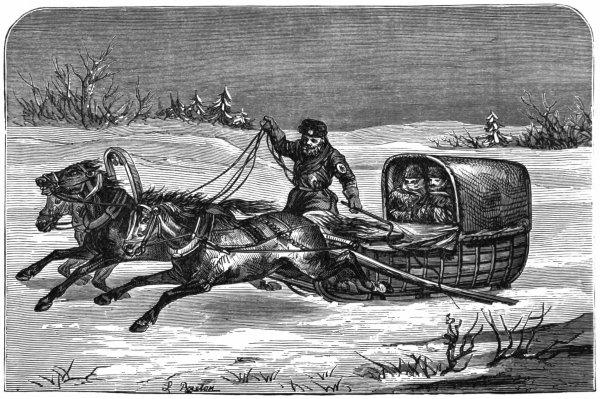
had taken her place in the closed sledge of
Madame Nemptchinof; then she had arranged
to bring Ivan and her young companion
together, by making them mount side by side.
Constantine, who was apparently smitten with
the charms of the young English lady, seeing
her en tête-à-tête with Ivan, seized a bottle of
champagne, and cutting the wire, directed the
cork at his rival’s head, which Miss Campbell
carefully shielded with her great fur glove;
then the fire commenced on all sides, whilst I
wondered what unseasonable and scandalous
bacchanals were about to be inaugurated with
so much uncorked wine. Happily, however,
we tasted but a very moderate quantity. Then
all my companions, in conformity with an
ostentatious custom in Siberia, dismounted
from their vehicles, each of them holding two
bottles, and, advancing before my horses a few
paces, poured the precious beverage on the
snowy ground, just at the spot the skates
of my sledge were destined to pass over. I
scrupulously performed the same ceremony,
a ceremony too solemn to be profaned with
a laugh, which I could hardly repress, and
then I took leave of this very agreeable
caravan, but not without the prospect of
meeting again, either at Tomsk, Irkutsk, or
Kiachta.
As we resumed our way, but now in different
directions, I heard a few more detonations of
corks; and when the sound of the bells had
died away and all had vanished from sight,
Constantine looked at me most piteously. The
tête-à-tête had evidently left some rankling
effect in his breast that would have resisted
any attempt at consolation had I ventured on
so delicate a task; for, as far as I could see,
he had received no encouragement whatever
from Miss Campbell, and as, in this instance,
the wounds of self-esteem and slighted love
could not be salved with this same remedy,
having no other to offer, I left the malady to
cure itself.
What struck me all at once on this route
was its absolute solitude. The carrying
sledges bringing tea and other merchandise
from China and the products of the Trans-Baikal
to Nijni-Novgorod avoid passing by
Omsk; it would be going out of the way to
no purpose. It is therefore a rare occurrence
to fall in with a sledge in this district. The
snow, besides, is scarcely sufficiently beaten
down to admit of an easy march. Here, in
the absence of such movement, one is oppressed
with an impression of wild waste,
cheerless immensity, mournful silence. Gradually,
vegetation diminishes, becomes more
scattered and stinted, then disappears altogether,
and the traveller enters at last on the
great steppes.
But how changed during summer! Then
the steppe is an immense prairie, whose rich,
curly grass soothes the eye with its refreshing
tint, and protects the body from jolting with
its luxuriant bed.
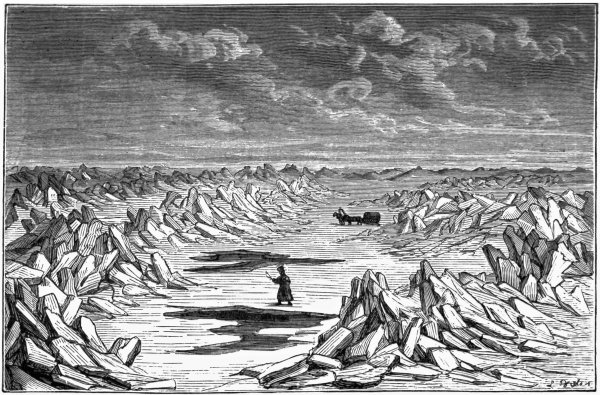
And in winter, it is a vast plain rendered
level and white by the snow with which it is
covered. The French language, unfortunately,
is here again insufficient to explain in a word
the character of its outline. We call La Beauce
a flat country; now the steppe in its snowy
dress is not like La Beauce; neither is it level
like the Mediterranean in calm weather, nor
like the bed of a river. The surface of the
steppe is strictly horizontal throughout. But
Providence—as if to compensate in some measure
to the eye of the artist for the absence of
interesting scenery—has diffused, it is true,
over this bare country, some of the finest
effects of light with which any land is beautified
and resplendent. And yet, in spite of
this attraction, however varying and diversified,
its joyless aspect preys on the mind of the
traveller who enters on such a desert.
We had passed Ischim at nine in the morning;
about five in the evening, we had again
changed horses, when it was quite dark, and
wearied with fatigue, I had fallen asleep.
Suddenly I was awoke with a start by a fearful
shock that had as suddenly roused Constantine.
Our yemschik had gone astray in this frightful
wilderness. The absence of the moon and
the veiling of the stars with heavy snow clouds
were together the cause of this misadventure.
His fear of being underrated, and perhaps of
animadversion, had hindered him from avowing
immediately his awkwardness and blundering,
and for three hours at least, he had been
wandering about, where chance led him, with
the hope of finding his way again—a hope
poor indeed when he had lost all idea of
direction and every vestige of landmark.
The fall into a pit, concealed by the snow,
which we had just experienced, obliged him
now to avow his blunder.
Constantine and I unrolled ourselves from
our blankets, got down, and set to work, with
lantern in hand, to find the road. On looking
round, we contemplated the spectacle of our
sledge and horses almost buried in the snow,
and it was one of dire significance. Of the
sledge the only part visible was the hood, and
of the horses little more than their shoulders
and heads.
Sinking ourselves up to the waist, and
consequently unable to move one foot before
the other without great effort, having to battle
besides against the violent cutting wind loaded
with the snow it had swept up in its passage
and hurled in our faces, we struggled thus
desperately to see a few paces, as much as we
could hope to see before us, but to no purpose,
and were forced to return to our sledge in
despair, to breathe again and recover a little
more strength.
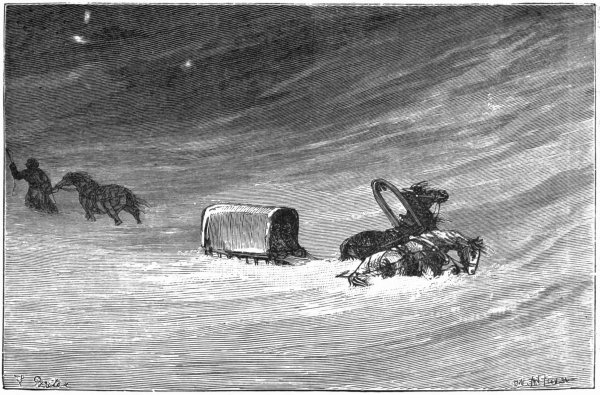
PERILOUS ADVENTURE ON THE STEPPE OF OMSK.
After an hour of this painful work, we were
no more enlightened as to the way we should
take than at first, and, moreover, we were
exhausted. Over the land there was not a
vestige of anything but the snow to be seen;
for at a short distance all around there was
nothing but darkness, impenetrable; not a
star in the sky was visible, not a sound in the
air audible, to induce us to risk the chance of
attempting one direction in preference to
another. The situation was portentously
critical, and, unless we would resign ourselves
then to our fate, it was necessary to make a
supreme effort. In this dilemma we consulted
together as to what expedient we should next
try. This decided on, the yemschik unharnessed
one of the horses with the object of
riding as quickly as possible in search of some
village, and began, with a lantern in one hand,
leading the horse with the other, to discover
afoot some trace of the way from which he
had strayed.
We watched him struggling with the elements
till the last beam of light died away;
then Constantine and I, thrown back on ourselves
in the darkness—a night with no day
near at hand, and a solitude without refuge or
clear prospect of retreat—had little to contemplate
but our dismay. We thought of our
poor horses exposed without movement, of our
inability to relieve them from the cold, and,
seeing how utterly helpless we were, we
wrapped ourselves in our furs and blankets
and re-entered our shelter. There we made
some effort to cheer each other. We saw
passing, in imagination, caravans of Kirghiz,
from whom we were, in reality, not distant,
and we fancied ourselves led prisoners into the
heart of Tartary, in some wild lawless territory
not yet brought under subjection. We saw
also—but this time it was not a vision—five or
six packs of wolves prowling around our poor
beasts, watching for a meal if they should be
dying or dead, but, happily, these prowlers
scampered away at the sound of my revolver.
The first shot was not without a moment of
terror, for I was not at all assured that the
result would not be disastrous. Having my
rifle packed up in my trunk through not having
foreseen what was likely to come to pass, I
found myself absolutely defenceless, in case
they should be emboldened, in the lonely
position we were, to join in a united attack.
Retreat we had none, except behind the
canvas; we might close in front; but how long
would this resist their assault, met with the
shot of a single revolver? Their disappearance
therefore was hailed with joy.
Many tedious hours thus passed away, and,
since our thoughts were occupied in waiting
for the return of our man, who might bring us
the relief we had not yet despaired of, every
hour passed seemed in the aggregate as many
nights in succession. He had long been
absent, when I began to be tormented with a
suspicion of his fidelity. If we ever stirred
from the spot and should be fortunate enough
to reach the first village, might he not there
expect a severe chastisement for the serious
consequences of his culpable neglect, involving
perhaps the loss of the horses, from which he
might think to escape with impunity by leaving
us to our fate? Then we thought of the small
store of provisions we had brought with us;
and, determined not to surrender ourselves yet
to our prospective fate of desertion and protracted
hunger and cold, I proposed to Constantine
to descend and follow on foot the
footsteps of the yemschik, with the hope of
extricating ourselves from our perilous position.
We had got out, and were on the point of
putting our project into execution, when we
perceived, to our horror, that no track could be
found. The blast had been strong enough to
sweep the snow across the path he had taken;
no depression, however slight, was visible;
every vestige of a footprint had been effaced.
To wander from where we were, we should be
speedily lost; to remain on the spot, our fate
seemed not less inevitable, but as we had some
provisions and shelter, it would be prolonged,
and the return of day might bring us rescue.
“Let us wait daybreak,” said Constantine;
“then perhaps we may catch a glimpse of our
man in the distance, if he is still alive; for at
this moment, if he has not succeeded, he must
have given up further searching.”
We had been an hour, I thought, so well as
I could conjecture time, sitting side by side in
the vehicle, when I fancied my ears caught the
sound of cries in the distance. But it was so
feeble, that I trembled lest my excited imagination
should have deceived me. I replied,
however, though my voice was too weak, and
Constantine refused to join his to mine. I
thought he had resigned himself to his fate;
but it was fear, overpowering fear that closed
his throat. He yielded at last to my entreaties,
and then voices in response, the last glimmer
of hope, seemed really approaching.
After a little while, we attempted to shout
more intelligibly a few words, and then came
replies. At last, to our infinite joy, we saw
our liberators. They were coming in great
number and with many horses, to rescue us
from our impending fate.
No mariner lingering on a wreck and watching
for rescue, in any sign of movement on a
lonely shore, could have hailed deliverers with
more exultation. Our spirits mounted now in
proportion to their recent depression. We
joked pretty freely on the stupidity of our
yemschik, whom his comrades now turned into
ridicule. The two poor beasts, that remained
harnessed to the sledge, paid dearly for this
adventure. When they attempted to drag
them out of the hollow, they were rigid and
benumbed with the cold; they could not follow
us a single pace, and Constantine understood
at once that these men had decided on putting
an end to their suffering.
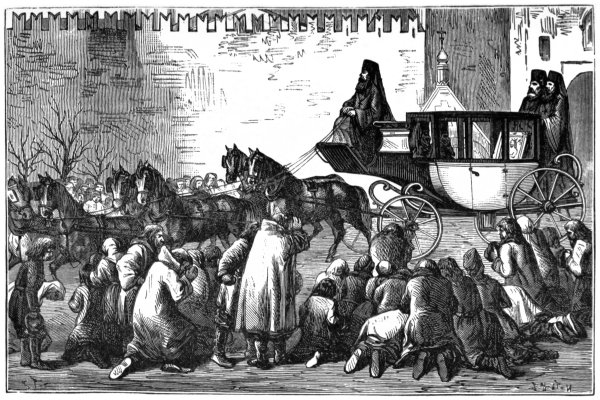
Daylight had just appeared, when we made
our entry into the village. All the inhabitants
having heard of the great peril we had encountered,
ran out to see us pass, and bowed
and made the sign of the cross to the great St.
Sergius and the Virgin of Kazan in expression
of their gratitude for our deliverance.
Our journey continued this day without any
particular incident; the reflection on that of
the preceding night, and the congratulation
on our narrow escape from such peril, were
sufficient to engross our thoughts. The
aspect of this great desert, covering the
vestiges of many an untold catastrophe with
its snowy shroud, made me tremble at the
remembrance of it; and I have often thought
since that if our yemschik had not come to
our succour in time, the only abode he would
have had to conduct us to would have been
a cemetery. In the steppe, the resting places
of the dead are the only spots planted with
trees, and, on that account, are seen at a great
distance. They bring to these melancholy
spots birch trees from Krasnoiarsk, at a great
expense, and these little groups of white
trunks, glittering in the sunbeams, become so
many landmarks for the lonely wanderer.
They give also to this desolate spot, from one
point of view, notwithstanding the mournful
association from another, an aspect of calm joyfulness,
when the solemnity of the scene draws
the thoughts nearer to hope and resurrection,
rather than to despair and definitive annihilation.
When the sky is clear and the cold
intense, these cemeteries on the steppes are
radiant with reflected beams, even where everything
is luminous in the immensity around.
The following morning when I awoke at
daybreak, I found we were stopping on the
way. I opened the canvas curtain that closed
in the front of the sledge, to ascertain if we
were still on the road, and finding that we
were, I could not help laughing at the situation
we were in. The scenery had not changed;
it was still the steppe, and nothing but the
steppe around in view; but our driver was in a
profound slumber, with his head resting on our
provisions; the horses also, feeling themselves
allowed to have their own way, were standing
stock-still, and probably were slumbering also;
but as to Constantine there was no doubt,
for his snoring, loud enough “to frighten
the wolves,” proclaimed his happy condition,
and considering the exhausting effect of the
emotions he must have experienced, I was at
first loth to rouse him. Still this indulgence
could not go on very long with the prospect of
a journey of eighteen hundred leagues before
us, and having contemplated a few moments
the drollery of this quiescent attitude—a
drollery all the more irresistible from contrast
with the seriousness of the situation—I resolved
to wake him and accordingly did so as gently
as possible. Now fully roused from his
drowsiness, he regarded the driver a moment
with irritation, and then, instead of employing
the bland proceeding I had adopted towards
him, commenced pommelling the yemschik’s
head with his fist, the only efficacious method,
he suggested, for a skull so thick. The horses
now, in their turn, were quickly set going with
means still more energetic and as we whisked
briskly along in the fresh morning air, I
admired with rapture those sublime changes of
light that invariably accompany the rising of
the sun in a cloudless sky in these latitudes,
and their reflection in paler tints successively
passing over the surface of the snow.
At last, after this eventful course, we arrived
at Omsk, in a cutting atmosphere of forty-five
degrees,8 an intensity of cold that scarcely
diminished during the remainder of my sojourn
in Siberia.
Many geographers erroneously represent
Tobolsk to be the capital of Siberia, but the
honour belongs to Irkutsk. Tobolsk is not
even the seat of a Government, for Omsk is
the capital of Western Siberia.
I needed but a very short stay at Omsk to
congratulate myself on having chosen my
route by this city. This fortified place, for
such it is, is situated on the top of a little hill,
on the borders of the Irtish. The view, therefore,
is commanding over this river; then
beyond, over its opposite bank, which is
marked by a mound, the steppe stretches away
in front and on the right and left till lost
to sight in the horizon. The steppe, viewed
from this point, has not the same uniformity
to the eye which I before mentioned. The
snow takes here and there tints so distinct and
dissimilar, and these are ever varying with
such inimitable beauty and artistic combination,
that the steppe seen from Omsk is lovelier,
more diversified, and more imposing even than
the sea. A Frenchman, whom I have already
mentioned, and in whose company I have
spent hours in contemplating this magnificent
spectacle without ever tiring of it, told me that,
during summer, the steppe was still more
interesting. The grass, he said, takes changing
hues so deep as to be almost black; then
it seems that instead of a boundless green
sward, there is a vast gulf of immeasurable
depth yawning before the spectator; and then,
perhaps, an hour afterwards, according to the
position of the sun and the state of the firmament,
an illimitable field of brilliant verdure
rises under the eye, and replaces, as if by
enchantment, the mysterious gloom of the
bottomless abyss by the inspiring gaiety of a
vernal landscape.
The steppe, to the inhabitants of Omsk, is as
the desert to the wandering Bedouin, the sea
to the navigator, the Alps to the Swiss. They
search in its changing aspects for prognostics
of the weather, and these determine their daily
movements. At Omsk, the people have a
strong attachment to the steppe; it furnishes
abundant pasture to the flocks and herds, and
an exciting hunting ground to these ardent
lovers of the chase, who find here no lack
of wild animals. The public fêtes take place
here, and the promenade is in view of the
steppe. To go on the steppe, or merely to
see it, constitutes, in fact, the chief occupation
of life for the inhabitants of Omsk, and, indeed,
when one has once seen the steppe, it is not
difficult to conceive this passionate attachment;
as for myself, who had very narrowly escaped
leaving my bones to bleach there on its snowy
bed, and on that account, perhaps, should
have been repelled from it rather than attracted
to it, I was probably more enthusiastic over its
charms than anybody, and it was with regret
and tender melancholy that I was obliged to
withdraw from the contemplation of a spectacle
so truly magnificent and sublime.
Society in Siberian cities is composed of
functionaries, who are deemed the aristocracy,
and traders and miners. At Omsk only is
there found a third element, a real middle
class of retired citizens, that is to say, men
who, having made their fortunes, devote their
time to study or amusement.
The first of these citizens to whom I was
introduced having spoken very favourably of
the decree of the emancipation of the serfs,
I mentioned to him the conversation I had
with the old aristocrat of Kazan. “This
gentleman has not told you,” he said, “all
the vexatious proceedings that the serfs were
constantly obliged to submit to by their lords,
and the extortions of which they were the
victims. He has not told you that the serfs
never had the right to quit the land of their
lord, how many cudgellings they may have
been made to undergo, and how often the
lords gambled away between one another, on
the throw of a die, a property consisting of
five or six families. He has not said a word
about the manœuvre of the lords, who, being
obliged every year to abandon to the service
of the Emperor a certain number of their
vassals, choose, as might be expected, the least
vigorous, who, notwithstanding the feeble state
of their health, become soldiers for life.
Certainly,” he continued, “we do not yet
enjoy complete liberty; we cannot quit
Russian territory before having complied with
the requirements of the military law; we can
change neither religion nor country; but after
all, every one is treated alike, and the sovereignty
of the Emperor is not to be compared
with the vexatious seigniory of the lords.”
It will require, certainly, great address for
the Czar to introduce, without violent transition
or revolution, the necessary liberal reforms.
It is to be hoped he may succeed, thanks
to the fetishism that surrounds his person.
He puts, perhaps, a little too much confidence
in the ever-increasing power of the trading
class, the possessors of the great wealth of the
country, who are still devoted to the Emperor,
on account of their hatred to the aristocracy,
but who might well turn against their benefactor
so soon as they found themselves in a
position sufficiently strong.
Another citizen of Omsk entertained me
with his views on another subject, not less
interesting. It was M. Kroupinikoff, who
had been fifteen years among the Kirghiz,
as Government official, charged with a difficult
duty.
The Kirghiz, whose territory is subjected to
the Czar, have, nevertheless, remained in their
wild state, and with a longing to recover
sooner or later their lost national independence.
In order to prevent them from uniting anywhere
in great masses, the Government has
assigned to each tribe a zone, and they are
interdicted from going beyond this limit under
penalty of death.
It was M. Kroupinikoff’s duty to take care
that every Kirghiz kept within the bounds
of his respective territory.
To accomplish this difficult and dangerous
task, he had but an insufficient escort. “To
give you an instance,” he said, “I was attacked
and made a prisoner by these wild people, and
I don’t know what would have happened if I
had not fortunately made my escape, and,
indeed, without horse and almost without
anything to eat. This enterprise, probably, is
much more hazardous for me than another to
sojourn among the Kirghiz, whose character
on the whole is not ferocious. What they
detested in me was the functionary, and not
the man.
“For a period of fourteen days and fourteen
nights, I was exposed to the rigorous cold on
the steppe, wandering on foot, amid deep
snow. I was suffering from hunger, and yet
hardly dared to touch a morsel of the food I
had succeeded in bringing with me, for fear
the last crumb should disappear long before
I should be able to drag myself as far as
Omsk. But I arrived in a state painful even
to remember; for it was in this adventure
that I was seized with the malady with which,
you see, I am now tormented, without a hope
of ever being cured.” This poor man, indeed,
had a nervous trembling from head to foot,
that did not allow him a moment’s repose, the
bare contemplation of which was sufficient at
the first glance to make one shudder.
“If you like, monsieur,” he politely offered,
“I will take you to see a Kirghiz encampment
I know, not very far from here; I shall be
most happy to have a little excursion in your
company; that will recall my old occupations.”
I accepted his proposal gladly, and early the
following morning we left in a sledge, and
took our way towards the south.
The Kirghiz anciently formed a part of
the great Mohammedan family, and roved
along the flowery banks of the Tigris and the
Euphrates. It is not exactly known at what
epoch, and in what disaster, they were defeated
by the Turks, and subsequently driven from
their old haunts into the great Tartar steppe.
They tried many times to reconquer their
ancient land, but only in vain. One expedition
of the Kirghiz is mentioned, that penetrated,
in 1738, as far as Tashkend.
Müller gives us an account of some of the
institutions of these people during the period
preceding their final submission to the Russians.
When war was declared, the chief
named those who were to enlist, and assigned
them the quota of arms and horses they were
to furnish to the army.
In administering justice, judgments were
given by an assembly of elders. He who was
found guilty of murder first suffered the
penalties pronounced by the tribunal, and was
then delivered over to the relatives of his
victim, who were at liberty either to kill him, or
to keep him as a slave. In the latter event,
the assassin had to furnish to his masters one
hundred horses and two camels, with liberty
to substitute five sheep for every horse.
If the victim of an assassination were a
woman or child, the relatives of these had no
right to demand the life of the murderer, and
the fine was reduced to one half. The crime
of rape was punished in the same manner as
the murder of women or children.
The Kirghiz still have among them a great
number of diviners,9 in whose revelations they
have more or less faith according to the
method these magicians employ in predicting.
Some divine with books without having
recourse to the stars. Others employ the
shoulder blade of a sheep. It is absolutely
necessary that this bone be denuded of flesh
with a knife, and that human teeth have not
gnawed it, otherwise it would have no virtue.
When one of these magicians is consulted, he
puts the shoulder blade on the fire, and makes
his predictions according to the fissures produced
by the heat. These diviners pretend
with their science to determine how far distant
an absent person may be.
The Kirghiz call the third class of magicians
bukscha. To obtain a prediction from
them, they exact a horse, a sheep, or a goat.
The magician begins the ceremony by chanting
and beating on a drum furnished with
rings; and whilst thus occupied, he goes
through a succession of leaps and contortions
of the body for half an hour. When this part
of the ceremony has ended, he has a sheep
brought to him, and killing it, receives the
blood in a vessel, expressly made for this
purpose; he then keeps the skin for himself,
and distributes the flesh among the spectators,
who eat it. He afterwards takes the bones,
and, dyeing them red or blue, throws them
towards the west. Then he scatters the blood
in the same direction, begins again his contortions,
and, after an interval, gives his response
to the question proposed to him. A fourth
class of diviners are called kamtscha. They
augur from the colour of the flame that rises
from butter or fat thrown into the fire. The
latter class of diviners is not much esteemed.
I had been about two hours on our excursion
in conversation with M. Kroupinikoff, when
I perceived three tents made of pointed
stakes, pitched side by side, and covered with
felt. As we had been some time announced,
the head of the family received us before his
encampment. This man was tall, and of a
haughty look, and his dress, composed mostly
of trophies of the chase, was really very
picturesque. His head was covered with a
hood of red wool, surmounted with a wolf’s
head stuffed, the ears of which, being turned
forwards, seemed as if they were his own.
His shoulders were covered with a red shirt
and a wolf’s skin. From his waist hung a
pouch, similar to a Highlander’s, but made of
the skin of the white deer of the desert. His
legs were swathed in skins of different colours;
his sandals were of plaited straw, his feet
disappearing under leather gaiters, that expanded
below like Mexican trousers. In
imitation of the ancient savages, this man bore
at the same time his weapon of war and of the
chase. He had a bow over his shoulder,
arrows suspended from a shoulder belt, an
enormous club hanging from his waist, and a
falcon perched on his hand. This club served
him to strike down the wolves as soon as he
ran them down with his fleet courser. Near
him stood a hare-hound of a breed, it appears,
found only among these people. They are
hairless all over the body, excepting on the
ears, where the hair is of unusual length. On
seeing this one, I fancied it had been shaved
by the Kirghiz, who are very much attached
to these dogs, but M. Kroupinikoff assured
me that this was their natural state. These
animals, they say, are swifter and more intelligent
than Scotch or Syrian hounds. Excepting
the peculiarity of the long hair on the
ears, which detracts from their beauty, they
are extremely graceful animals.
The Kirghiz being Mohammedans, the
women of this tribe hid themselves from
our eyes in their tents. M. Kroupinikoff
being unwilling to displease the chief by
asking to be admitted into the tent, preferred
asking him to show me how he hunted the
wolf with the club.
He was in his saddle in an instant, and
executed before us a manœuvre with a dexterity
that would have been envied by
Arabs if they could have seen him. Off he
went, cutting through the air like a dart,
hiding himself from view by leaning down
close beside the shoulder of his courser, and
low enough to strike the snow with his tomahawk.
And the next moment, hanging on by
some part of the harness, he appeared completely
close under his steed.
This wild, wolf-eared figure, arrayed in red;
this sinewy, sinuous hunter of the desert,
guiding his courser, like the bound of a tiger
on some imaginary prey, was altogether a
striking spectacle, and one quite as interesting
as it was startling and fantastic. We bid
adieu to this son of Genghis Khan, and returned
to Omsk, with this vision ever present
to my imagination, like a vivid dream.
I was amused with a diversion quite peculiar
to this city, that takes place during the three
first days of the year. It consists in going to
pay a visit to one’s friends disguised in costume
and masked, in a way so effectually, that it is
impossible to be recognized. To give more
animation occasionally to the amusement,
families mutually exchange houses, disguising
themselves also, and then the visitors and the
visited find themselves equally mystified.
These merry réunions are generally accompanied
with dancing and refreshments. The
society of Omsk is too limited to afford facilities
for any intrigue, and too strict even that such,
if any, should be attended with any serious
consequence; but for all that, there are few
cities in the world, perhaps, where during these
three days so much boisterous mirth may
be heard as in this privileged spot on the
Tartar steppe.