Technical difficulties with paper in the pressroom
arise from many sources. They may be conveniently
classified into three groups: Difficulties
for which the manufacturer is responsible; difficulties for
which the printer is responsible, and difficulties due to atmospheric
and other natural conditions not entirely within
human control. Let us consider some of the first group.
Uniformity.—Probably the most frequent source of
trouble is lack of uniformity, either in weight, thickness or
finish. This is chargeable to carelessness on the part of the
paper-machine tender. A run of paper which varies in
weight will naturally vary in thickness, and, obviously, this
could account for uneven color in presswork. These variations
would not necessarily be accompanied by a variation
in finish. To make paper uniform in all three respects
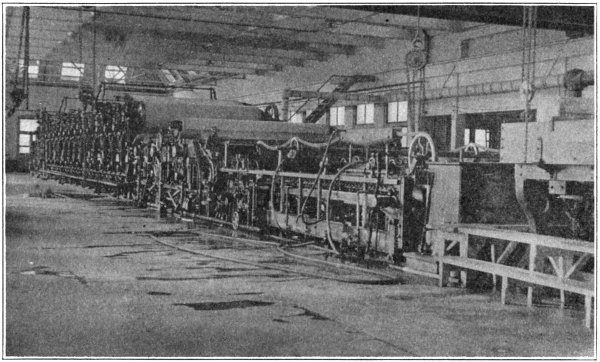
necessitates, firstly, uniform consistency of the pulp—or
“stuff,” as it is technically called—at the point where it flows
onto the machine. A uniform volume of stuff and uniform
speed of the machine are also demanded. The speed of the
machine and the volume of stuff are quite readily controlled,
but as the amount of water used by the beater-man in preparing
the stuff is usually judged by the appearance of the
pulp in the beater, there are always such variations as are
peculiar to this human factor.
The difficulties of the machine-tender may often be traced
to the beater-man, not only on account of the amount of
water in the mixture, but also because of the irregularity in
the length of fiber from one beaterful to another.
Assuming that the stuff is right and the formation on the
machine is good, the pressing of the paper next demands
close attention. It is obvious that any unevenness of pressure
will result in the water being expelled unevenly from
the web of paper, with a consequent variation in thickness.
In this case there would also be a damp streak in that part
of the web where the pressing was too light.
The result is that such paper can not be dried evenly all
the way across the machine because this damp streak will
still have an excess of moisture after the adjacent areas of the
web have become properly dried.
Finish.—In running through the calenders the damper
portion will take a higher finish. It may even be so damp as
to cause a blackening or crushing of the paper; whereas, if
the moisture is sufficiently evaporated from this streak, the
rest of the paper may be so dry that it will not finish smoothly
enough.
On the other hand, there are cases where the pressing and
drying may be perfectly uniform, but the whole web vacillates
from being too dry to being too moist, while between
times the manipulation is exactly right.
The result, obviously, will be a variation in finish over
the whole width of the paper instead of over a portion.
Moreover, too much drying makes the paper fuzzy and likely
to become wavy, besides weakening the fibers.
Another result of uneven pressing is to make the paper
thinner where the pressing is hardest. Such a defect is quite
obvious in a pile of paper, as the top will not be as level as it
would be in paper that is uniform in thickness throughout.
Assuming that the paper is perfect as it leaves the driers
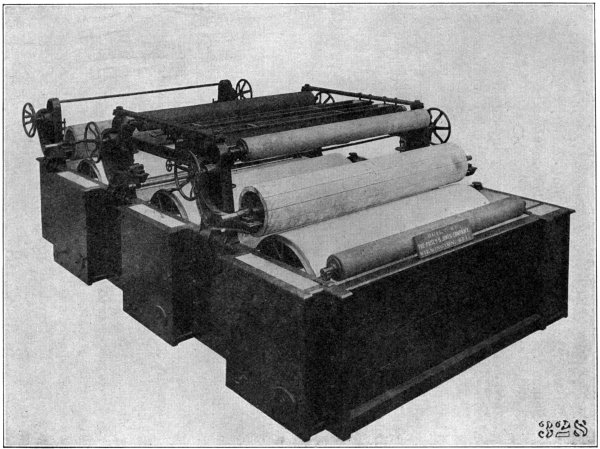
there is still a chance that one or more of the calender rolls
may get out of true, especially when starting a run after they
have been idle long enough to get cold. Under such conditions
they often heat up and expand unevenly so that the
pressure is harder in some sections than in others. The result
is a thin streak in the paper. Whether the thinness be caused
by poor pressing or calendering, it can easily be detected in
a roll of paper, as the thin streak makes a soft spot in the roll
which can quickly be located by tapping the roll all the way
across. A muffled rather than a ringing sound discloses soft
places.
This defect, if bad, may cause considerable trouble on
a web press, as no amount of manipulation will make the
paper draw evenly as it runs into the press if the edge of the
roll is slack.
Occasionally, segregated areas in paper are found to vary
in finish, and when these do not run in continuous streaks
they may often be caused by the felts which carry the paper
through the press rolls having become clogged up in spots so
that the water can not pass out evenly from the paper
through the felt. This must be guarded against by occasionally
stopping the machine and washing the felts, or changing
them, as the occasion dictates.
Such damp spots in the paper crush in the calendering
and make blackened areas in the paper. Uneven drying may
also have been occasioned by slackness of the drier felt which
holds the paper against the driers. In sheeting the cheaper
grades of book paper it is customary to cut off from a number
of rolls simultaneously, which often accounts for a variation
in finish or bulk in sheets from the same case.
Of course, when any of these symptoms appear it is the
duty of the men on the machines to correct them, and in the
continuous course of paper-making it is inevitable that felts
become filled up and require washing or changing, or that the
variations of consistency in the stuff should call for some form
of regulation. Stuff which runs too moist on the wire will
often “crush” under the couch roll, producing a curdled
appearance. Stuff run with insufficient water will not form
evenly. The skilful machine-tender avoids these extremes.
Trade Customs.—In recognition of the many variable
elements in paper-making, trade customs have been established,
such as allowances for a normal variation in the weight
of paper above or below the nominal ream-weight, and reasonable
allowance should be made for normal variations in
other characteristics.
Eternal vigilance and alert judgment are certainly required
for setting high standards in the manufacture of paper.
It is a matter of common observation that mills using practically
the same raw materials vary widely in their reputation
for uniformity and excellence of product. The reason for
this is to be found in the human element.
Calender Defects.—A number of difficulties may arise
from much less excusable causes than those mentioned. For
example, the paper sometimes may run slack through the
calenders, with the result that it wrinkles and cuts in
diagonal jags called “calender cuts.”
Sheets containing such defects sometimes elude the finishers,
and on the printing-press such a sheet may crack and
go around one of the ink rollers. On a web press the trouble
from such a defect would be even worse, causing breaks and
necessitating delays on the press. It is more difficult to exclude
calender cuts from roll paper, as it is not always easy
to see them in the fast-running paper, so that an occasional
cut is not an unforgivable sin.
Among other defects arising on the calenders are little
scarlike depressions in the paper, made by small scraps of
paper which have become lodged on a calender roll and are
embossed into the web at each revolution of the roll.
Holes, Dirt, Etc.—In very light papers, holes are
sometimes found, the most likely cause of which may be
picking under the dandy roll or grease spots on the wire
cloth. Of less frequent difficulty are the so-called pinholes,
caused by sand or grit, while slime spots, or spots caused by
slight bundles of fibers, are also occasionally noticed.
Dirt and specks originate from careless handling of rags
or paper stock, and are also derived from shives of undigested
wood in the wood-pulp.
Streaks in the paper may originate from a crease in the
wire, and mottled effects denote some fault in the handling
of the paper in the wet stages of making.
Again there are times when sheets are not cut quite
square, which is, of course, inexcusably careless. Likewise,
the packing of paper may be done in a careless manner, and
cases too loosely packed, if set on end, often cause a wave
in the paper, which sags in the case instead of remaining
tight and flat. It is desirable that cases of paper be kept flat
in storage and not set on end. Cases should be made from
well-dried boards, and waterproof lining-paper should be
used to exclude all dampness. When paper is finished in
rolls it is fair to demand that the rolls should be wound
evenly and hard, and all breaks should be carefully spliced
and flagged.
Color.—The foregoing troubles are mechanical. Other
difficulties may exist, even when the paper is handled well
on the machine, owing to errors in composition. The color
may vary, and the term “color” includes the various shades
called white, as well as tints. Color is affected by water
conditions. In the case of mills which depends upon river
water, the water sometimes becomes so dirty that it severely
handicaps the paper-maker, in spite of his filtering apparatus,
and at such times it becomes difficult to get as bright and
lively shades as under favorable conditions.
Dyestuffs do not always work uniformly, and, therefore,
absolute matches of color from run to run are not to be expected.
Shortcomings of this nature should be regarded
with some lenience.
In this class of difficulties, discrepancies in sizing are the
less pardonable and are more apt to be noticed when hard
sizing is requisite, as in writing-paper or index bristol. In
such cases a lack of sufficient sizing is an incurable fault, for
which the manufacturer is responsible. There are occasions
when excess of sizing would be troublesome—for
example, in a smooth-finished book-paper it would be
likely to cause offsetting, but this trouble may be alleviated
by using less ink, or, if necessary, by slip-sheeting.
It would be difficult to catalogue all possible sources of
trouble, but we have at least covered the principal defects
of uncoated papers.
Packing.—Occasionally troubles may be charged to
faulty packing—cases too loosely packed when stood on end
permit the paper to sag, thus causing a curling tendency at
one end of the sheets.
The use of unseasoned case lumber or cases and inferior
case lining give access to moisture, the effect of which
is discussed herein at length.
The susceptibility of coating to picking may be determined
by applying hot sealing wax. If the wax after cooling is
pulled off with only the coating adhering it may be assumed
that a “tacky” ink would work the same, whereas if the
paper tears out with the wax—it proves conclusively that
the coating is well sized.
Coated-paper Troubles.—Coated papers have their
characteristic shortcomings. The picking of small particles
of the coating is perhaps the most common fault, and is
caused by insufficient adhesive elements in the coating mixture.
Other troubles are traceable to some of the defects of
the body stock. Irregularity of the finish is sure to come
from faulty application of the coating or careless calendering.
Grit or bubbles in the coating is likely to result in a porous
surface. The sour odor of some coated papers is due to decomposing
casein or glue.
Casein used as an adhesive in most coated papers is a
product from skim milk. It contains lactic acid which must
be neutralized in preparing the coating mixture. For this
purpose an alkali such as soda or ammonia is used, and when
properly handled the coating should be neutral. An alkaline
coating will cause re-etching on lithographic plates or stones.
Starch coatings or combinations of starch and casein are
cheaper than full casein and do not yield as high a finish and
when improperly used have often been the cause of picking.
The Printer’s Responsibility.—The second group of
difficulties, or those for which the printer is to blame, may
originate with the improper storage of the paper. As
pointed out, the standing of cases on end is conducive to
wavy paper. Dampness is a prime cause of trouble, as will
be sufficiently shown later on, but it is elementary to say
that paper should never be exposed to moisture.
Engravings.—The troubles of ignorant or inefficient
pressmen and foremen are often laid to the paper, especially
where half-tone printing is involved. In the first
place, too little attention is given to securing proper originals
for the half-tones. Retouching is omitted in a fit of false
economy, for at this very stage of the game it was never
truer that “An ounce of prevention is worth a pound of
cure.” Too much care can hardly be given to securing good
engravings.
Secondly, the selection of a proper half-tone screen is
frequently overlooked. While no hard-and-fast rules may
be set, the best one, when in doubt, is to include with the
engraver’s order a sample of the paper on which the cuts
will be printed. He can judge, taking into consideration the
subject and the stock, which screen is advisable. In general,
it may be affirmed that 120 or 133 line screens are best for
uncoated smoothly finished papers, and 150 or 175 line
screens are most satisfactory for coated stock.
Inks.—Next comes the suitability of the ink, and there
again the ink manufacturer’s advice, always available, is
often neglected; but experience proves that certain papers
yield best results with certain inks. Such matters can only
be determined by actual experience, but when in doubt consult
the ink-man.
Make-ready.—Finally, the make-ready should be intelligently
varied according to the subject and the paper. The
best printers agree that different papers to some extent require
individual treatment. A make-ready suitable for a coated
paper is not necessarily equally satisfactory for an uncoated
half-tone paper or even a dull-finished coated stock. But it
is not within my province to go further than to emphasize
these warnings.
Grain.—The question of the grain in paper is certainly,
in many cases, within the control of the printer when ordering
his paper, but its importance is very frequently overlooked.
In machine-made papers there is a distinct grain
that is caused because a majority of the fibers point in the
direction that the stuff flows on the machine, just like logs
floating in a river.
This grain direction is noticeable in folding, the crease
being smoothest with the grain, because folding across the
grain encounters the most resistance and breaks many of
the fibers. This is especially noticeable in fairly heavy book-papers,
in bristol boards and cover-stock, all of which should
be scored for folding.
Cut cards, to have the maximum stiffness, should be so
trimmed out of the sheet as to have the grain run in the long
direction of the card.
Even in book-papers, where flexibility is desirable, it is
necessary to have the grain run up and down the page.
There are occasional cases when the grain is deliberately
arranged to run across the page to acquire more rigidity. A
wide page of light-weight paper might otherwise be too limp.
Moreover, this arrangement makes for stronger bindings, as
the stitches or wires pass around the bundles of fibers instead
of cutting between them. The English books are mostly
made up in this way, but they do not open so easily as when
the grain runs parallel to the binding. Paper is materially
weaker across the grain and can withstand only about half
the tensile strain that it could bear with the grain, although
crosswise it is more elastic.
There is one very serious objection to making books or
catalogues “cross-grained.” This is on account of the way
fibers are affected by moisture. The cellulose fiber expands
in diameter on absorbing moisture, for which it has a great
affinity. Indeed, a cellulose fiber is only stable under uniform
atmospheric conditions. The expansion of each fiber
in diameter makes paper expand much more across than
with the grain. Obviously, the total expansion of a sheet
equals the amount each fiber expands times the number of
fibers that side by side go to make up the sheet.
When the glue is applied to a book in process of binding,
it causes an expansion of all the moistened fibers.
If the grain runs parallel to the shelf-back no harm results,
as the paper is free to expand toward the side margin,
but if the grain is at right angles it usually makes a cockle
in the binding because the moistened edges of the leaves
expand while the dry portion beyond where the moisture
penetrates retains its shape and resists the elongation of the
wet edges. Consequently the expansion of the fibers expresses
itself by cockling.
Register.—In all printing, when close register is necessary,
the danger of poor register from the expansion of paper
is minimized when the dimension across the grain is the shorter.
Lithographers invariably prefer to have the grain run
the long way of the sheet on this account. Moreover,
they rack the paper before printing in order to get it
thoroughly seasoned. To protect it from atmospheric
changes that may occur during the printing process, they
use slip-sheets of considerably larger dimensions, so that there
is a generous margin of slip-sheet around each printed sheet,
which helps to exclude the air from the edges of the printed
paper.
Moisture in Paper.—It is true that some papers are
more prone to expand than others, especially if they have
been run too dry on the machine. Paper is not naturally
bone-dry. Under average weather conditions, it contains
six or seven per cent of moisture.D When in the making it is
turned off far below its normal moistness, it seeks to obtain
this moisture from the air at the first opportunity, and in
acquiring it expansion takes place. Unless the expansion
pervades the entire sheet, wavy edges will result. Similarly
when the air becomes dry exposed edges of paper give off
some moisture and shrink accordingly leaving a boggy
center to the sheets.
Seasoning.—This process of acquiring normal moisture
is usually called “seasoning.” As paper is probably never
turned off at its full normal moisture, it is most desirable that
it should be allowed time to season. It is not unusual to
have people speak of new paper being too “green.” This
may not have been an uncommon condition of hand-made
papers which were dried entirely naturally, but, so far as
machine-dried paper is concerned, I doubt if it is ever too
green, though it is frequently made too dry.
Conditions Beyond Absolute Control.—Believing it
to be impracticable to leave the precise normal moisture in
machine-made paper, I have deliberately refrained from
classifying this difficulty with faults chargeable to manufacture,
and the general recognition of this circumstance
indicates the wisdom of ordering paper long enough in advance
to permit of a period of seasoning. In fact, this phenomenon
of expansion or contraction of cellulose fibers places
difficulties originating from this source in the class of conditions
beyond absolute human control, but a study and
understanding of the subject will enable one to prevent, or
at least to minimize, such troubles. It consequently becomes
the business of the printer to inform himself as thoroughly as
possible on the subject. Static electricity is an element
beyond absolute control and the source of much trouble.
Both phenomena could be controlled by proper atmospheric
conditions in storage and press rooms, but it is an
expensive matter to equip rooms and install the necessary
apparatus. The amount of trouble arising from these
elements is often sufficiently costly in time and material to
warrant investigation as to the expense involved.
The least a printer can do is to maintain hygrometers in
his pressroom so as to keep track of atmospheric variations,
and be guided accordingly.
Among the “paper troubles” due to conditions for which
neither the paper-maker nor the printer is responsible, none
is more bothersome than the presence of static electricity
in paper. These static charges, which are created by friction
either in the making or handling of paper, develop magnetic
propensities in the sheets, causing them to behave in ways
which seem nothing but freakish until their nature is understood.
Some sheets stick together as if they were glued,
while others appear repellent to one another. Likewise,
they may act in the same manner toward the fly-bars of the
press. It is next to impossible to “feed” sheets so charged,
and there is every likelihood of the ink from one sheet
offsetting to another.
Every one familiar with the magnet knows that there
are in magnetism two poles, the positive and the negative;
that two substances of opposite polarity attract one another,
but that substances of the same polarity repel each other.
Static electricity—or frictional electricity, as it is also called—exists
both in positive and negative charges, and sheets of
paper containing static charges are governed accordingly.
Paper, when dry, is an insulator to electricity, but when
moist it becomes an excellent conductor. Consequently, too
much drying in manufacture increases the likelihood of electrical
troubles, because it makes the paper more retentive of
electricity with which it may become charged.
Pure air is also an insulator of electricity, which finds its
paths through the air by means of the dust particles in
suspension. Moisture in the air forms a connection between
the dust particles through which the electricity easily passes
into the ground, but when the air is dry this medium is lacking,
so that substances containing static charges are deprived
of these channels of conductivity. Cold air can not hold so
much moisture as warm air, so that its insulating properties
are increased. It is, consequently, in cold weather when this
sort of paper trouble is at its worst.
These facts suggest the first steps of prevention to take
against static electricity. First keep the air in the pressroom
warm, and, if necessary, increase its humidity. It is
also advisable to keep the paper in a warm room, for it has
often been noticed that paper coming cold into a pressroom
gives much trouble.
The entire virtue of the so-called electric annihilators
for moistening the tympan of a press comes from the moisture
they contain. Ordinary glycerin, which is cheaper, will
answer as well. These applications are undesirable because
they cause the packing to swell, and, in consequence, detract
from the adjustment of the overlays.
There is a simple and not very expensive device on the
market called the Thompson electrical neutralizer that has
been found helpful. It is provided with a tinsel cord such
as is used in decorating Christmas trees. The cord is stretched
across the press so that the sheets are brushed by it as they
pass to the delivery board, and are thus offered a connection
whereby the static charges may escape into the ground. A
second device of merit consists in a gas pipe with flames at
frequent intervals over which the printed sheets pass in
close proximity on their way to the delivery board.
The most successful neutralizer with which the writer is
personally familiar is the Chapman. By means of an alternating
current of electricity, it supplies through a special
apparatus alternating discharges of positive and negative
electric currents against the sheets of paper as they are
carried along the press. In the presence of such a current
the charges on the paper become their own destroyers, as
they draw out of the alternating current only the kind and
quantity of electricity which is sufficient for their complete
neutralization.
There have been quite a number of other inventions, an
account of which the writer published in The Printing Art,
Vol. XIX, No. 1, March, 1912. All are based on one of the
following principles:
1.—Making paper a conductor by moistening.
2.—Making the air a conductor by humidifying.
3.—Inducing static charges out of the paper by means of
grounded wires or gas flames.
4.—Neutralizing the static charges in the sheet with
charges of opposite polarity.
Another solution of this problem, as well as of the problem
of expansion of paper and consequent poor register,
could be reached by the construction of an insulated pressroom.
The air for this room should be supplied through an
apparatus in which it could be brought to any required degree
of temperature and humidity. The paper would naturally
have to undergo sufficient airing in such a room as to become
acclimated. After that, if the conditions remained constant,
there could be no difficulty in getting register, so far as the
paper was concerned, and a proper amount of warmth and
moisture would also dissipate all static electricity.
It is difficult to anticipate or to completely cover all
conceivable paper troubles, and when some one which may
not be diagnosed on the basis of the general principles
enumerated, consultation with some paper expert should
clearly be sought. The author will be glad to communicate
on such subjects.