Siberian scenery gives one an impression of uniformity and
monotony, which is mainly due to the fact that the whole country
consists of three zones, each more or less homogeneous within itself,
though distinct from the other two. Each of these zones preserves
its special character everywhere, and the same picture is repeated a
hundred times, satiating and blunting the senses till one becomes
almost incapable of recognizing or appreciating the charms of any
scene. Thus it is that we seldom hear anyone speak with appreciation,
much less with enthusiasm, of the scenery of this wide region,—although
it certainly deserves both—and, thus, gradually there has
become fixed in our minds an impression of Siberia which refuses
correction with an obstinacy proportionate to its falseness. Siberia
is thought of as a terrible ice-desert, without life, without variety,
without charm, as a frozen land under the curse of heaven and of
miserable exiles. But it is entirely forgotten that Siberia includes
a full third of Asia, and that a region which is almost twice as large
as the whole of Europe, which extends from the Ural to the Pacific
Ocean, from the Arctic sea to the latitude of Palermo, cannot
possibly be excessively monotonous nor uniform in all its parts.
But people usually picture only one district of Siberia, and even that
in a false light.
In truth the country is richer in variety than any one has hitherto
described it. Mountains interrupt and bound the plains, both
are brightened by flowing and standing water, the sun floods hills
and valleys with shimmering light and gleaming colour, lofty trees
and beautiful flowers adorn the whole land, and men live happily,
joyous in their homes.
Of course there are undeniable wildernesses even now in Siberia,
and these, along with the likewise real ice-deserts, the tundras, do,
to a certain extent, justify the popular impression. Dreary also
are the forests which lie between the tundra and the steppes, and
form the third zone. In them man never ventures to establish himself;
on them the industry of the settlers along their borders make
relatively little impression; within them the forces of nature hold
absolute sway, creating and destroying without interference. The
flame of heaven sets the trees ablaze, the raging winter-storm
hurls them to the ground; the forests rise and disappear without
any human control, and may in the fullest sense of the word be
called primeval. Full of mystery they attract, and at the same
time inhospitably repel; inviting they seem to the hunter, but
resistant they bar his steps; rich gain they promise the eager
merchant, but postpone the fulfilment of his wishes to the future.
This girdle of forest extends, as we have mentioned, between the
steppes and the tundra. Here and there it encroaches on both;
here and there they intrude upon it. At certain places in both the
unwooded zones, a compact wood may dispute possession with the
characteristic vegetation of steppes or of tundra, as the case may
be, but such isolated woods are almost always like islands in the
sea, for whose presence there is no obvious justification. In the
steppes they are restricted to the northern slopes of the mountains
and to the valleys, in the tundra to the deepest depressions. But
in both cases they are unimportant in comparison with the measureless
extent of the forest zone, in which it is only here and there that
a stream, a lake, or a swamp interrupts the continuity of the
wilderness of trees which extends on all sides. A conflagration
may make a clearing, or, at the extreme fringe, man may make a
gap, but otherwise there is no interruption. Whole countries, as we
know them, might find space in one of these immense forest tracts;
and there are kingdoms of smaller area than some of them. What the
interior is like no one can tell, for not even by the streams which
flow from them can one penetrate far, and even the boldest sable-hunters
do not know more than a margin of at most fifty or sixty
miles.
The general impression which the Siberian forests make on the
German traveller is by no means favourable. At the apparently
boundless tracts which are wooded, he is of course astonished, but
he cannot be enthusiastic, or at least very rarely. The creative,
productive, renewing power of the North does not seem to be
adequate to balance the destructive forces. Hoary age stands side
by side with fresh youth, but somehow there is no vitality in the
combination; incomputable wealth appears in beggar’s garb; and
moribund life without any promise of vigorous rejuvenescence
inhibits any feeling of joy. Everywhere we seem to perceive the
hard struggle for existence, but nowhere are we really fascinated or
attracted by the spirit of the woods, nowhere does the interior fulfil
the expectations which the external aspect suggested. The splendour
of the primitive forests in lower latitudes is entirely and
absolutely lacking in this derelict, uncared-for woodland. The life
which stirs within them seems as if it had already fallen under the
shadow of death.[28]
True forest, full of fresh life, with continuance amid a regular
succession of changes, is rare. The devastation wrought by fire
is a much more frequent spectacle. Sooner or later a lightning-flash,
or the culpable carelessness of the Siberian, sets the forest in
a blaze. Favoured by the season and the weather the conflagration
spreads in a manner scarce conceivable. Not for hours, but for
days, or even for weeks, the destruction rages. On the mossy and
turfy ground the flames smoulder and creep further and further; the
quantities of dry and mouldy débris on the ground feed them, dry
branches hanging down to the ground, or dead trunks, still upright,
lead them to the tops of the living trees. Hissing and cracking the
resinous needles fall, and a gigantic spray of sparks rises to heaven.
In a few minutes the giant tree is dead, and the destruction spreads;
the rockets which radiate from it fall in thousands of sparks, and
all around fresh flames spring from the glowing seed. Thus every
minute the fire gains ground, and destruction spreads on all sides
uncontrolled. In a few hours square miles of the forest are ablaze.
Over hundreds of square versts steaming clouds of smoke darken
the sun; slowly, but thickly, and ever more thickly, the ashes
drizzle down, and tell by day to distant settlers, as the glow reflected
in the sky proclaims by night, that there is a fire in the forest.
Affrighted animals carry terror into the surrounding townships.
Immediately after great forest-fires, bears appear in districts where
they have not been seen for years; wolves wander over the open
country in formidable troops as if it were winter; elks, stags,
roedeer and reindeer seek new homes in distant forests; and
squirrels in countless swarms hurry through wood and plain, field
and meadow, village and town. How many of the terror-stricken
beasts fall victims to the fire no one can estimate, but it has been
found that woodlands desolated by conflagration remain for many
years thereafter without fresh settlers, and that the valuable beasts
of the chase have entirely disappeared from many of these desolated
districts. The devastation is sometimes on a scale of vast magnitude;
thus, in 1870, a fire which raged for about fourteen days
destroyed a million and a quarter acres of valuable forest in the
government of Tobolsk, while clouds of smoke and showers of ashes
were borne to a distance of a thousand miles from the seat of the
conflagration.
For many years the devastated woodland remains like an
immense succession of ruins; even after a generation or two the
limits of the conflagration may be recognized and defined. The
flames destroy the life of almost all the trees, but they devour only
those which were already dry; thus stems more smoked than charred
remain standing, and even their tops may remain bereft only of
their needles, young shoots, and dry twigs. But they are dead and
their destruction is in process. Sooner or later they are bound to
fall before the storm. One after another is hurled to the ground,
and one after another is robbed of its branches, its crown, or a third
or a fourth of the trunk is broken off from the top. Across one
another, at all angles, and at different levels, thousands of these
tree-corpses lie prostrate on the ground already thickly covered with
piles of débris. Some rest on their roots and top-branches, others
lean on the still upright stems of their neighbours, and others
already lie crumbling among the fallen branches, their tops often
far from their trunks, their branches scattered all around. To the
lover of the woods, those stems which still withstand the storm
have perhaps an even more doleful appearance than those which
have fallen. They stand up in nakedness like bare masts. Only a
few retain their tops, or parts of them, for several years after the
fire; but the weather-beaten twigless branches of the crowns rather
increase than lessen the mournfulness of the picture. Gradually all
the crowns sink to the ground, and the still upright trunks become
more and more rotten. Woodpeckers attack them on all sides,
chisel out nesting-holes, and make yard-long passages leading into
the tree’s heart, thus allowing the moisture free entrance and
accelerating the process of decay. In the course of years even the
largest trunk has mouldered so completely that it is really one huge
homogeneous mass of rotten tinder which has lost all stability.
Indeed, a rough shake from a man’s hand is sufficient to make it
fall into a heap of shapeless débris. Finally, even this disappears,
and there is left a treeless expanse, broken only here and there by
the last traces of a trunk.
But even here a new life begins to rise from amid the ruins.
Some years after the conflagration, the charred ground, manured by
ashes and decayed débris, begins once more to be adorned. Lichens
and mosses, ferns and heaths, and above all various berry-bearing
bushes cover the ground and the débris of the trees. These flourish
more luxuriantly here than anywhere else, and they begin to attract
animals as various as those which the flames had banished. Seeds of
birch borne by the wind germinate and become seedlings, which
gradually form, at first exclusively, a thicket as dense as if it had
sprung from man’s sowing. After some years a young undergrowth
has covered the field of the dead; after a longer interval other forest
trees gradually arise in the room of their predecessors. Every forest-fire
spares some parts of the region which it embraces; even isolated
trees may survive in the midst of the burned area, and effect the re-sowing
of the desolated tract. Sheets of water and deep gorges may
set limits to the fire, and it may even happen that the flames, leaping
over a gulley, continue their devastation on the opposite bank
without injuring the trees in the depths beneath. Moreover, individual
larch-trees which have been attacked by the fire may escape
destruction. The bases of the trunks are charred and all the needles
are shrivelled up, but often the crown bursts forth afresh, and for
a time the tree continues, though somewhat miserably, to live.
In comparison with the ravages of the flames, the devastations for
which man is directly responsible seem trivial, but in themselves
they are of no slight importance. Of forest-culture the Siberian
has no conception. The forest belongs to God, and what is His is
also the peasant’s; thus, in view of the practically infinite wealth,
he never thinks of sparing, but does what he pleases, what the
needs of the moment seem to him to demand. Every Siberian fells
and roots out, where and as he pleases, and everyone destroys infinitely
more than he really requires. For a few cones he will fell a
pine, even if it be in the prime of growth; to obtain building wood
he will cut down three or four times the quantity required, leaving
the residue without a thought, often not even using it for fuel.
Already, such careless procedure has entailed serious consequences.
The woods in the neighbourhood of townships, and here and there
even those near the highways, are worked out, and appear scarce
better than those which the fire has devastated; and still the work
of destruction goes on. It is only since 1875 that there have been
forest-officers in Western Siberia, and even they give their attention
rather to the exploitation than to the renewal of the woods.
Even where neither man nor fire has ravaged them the forests
present an appearance essentially different from ours—an appearance
of complete, absolutely uncontrolled naturalness. It is but
rarely, however, that this attracts us. At first, perhaps, we are impressed
by seeing at one glance all stages of growth and decay; but
the dead soon becomes more conspicuous than the living, and this
depresses instead of stimulating.[29] In forests thus left in their natural
state, thick growth alternates with clearing, tall trees with mere
thicket, hoary senility with vigorous youth. Mouldering trees stand
or lean, hang or lie everywhere. From the remains of fallen stems
young shoots sprout; gigantic corpses bar the way within the thickets.
Willows and aspens, which, with the birch, are the most abundant
foliage-trees of Western Siberia, appear at times in irreproachable
perfection, and at times as if they had been persistently hindered
from full growth. Stems thicker than a man’s waist bear tangled
crowns of small size, on which, year after year, fresh twigs break
forth without being able to grow into branches; other apparently
aged trees remain not more than bushes; and others, broken across
the middle, have their split, cracked, and twisted upper parts connected
to the trunk only by the splintered bark. Rarely does one
get a complete picture; everything looks as if it were going to ruin,
and could advance only in decay.
Yet this sketch is not true of all the woods in this vast region;
there are indeed woodlands, especially in the south of the zone, on
which the eye rests with satisfaction. Locality, situation, soil, and
other conditions are sometimes alike propitious and combine to produce
pleasing results. The growth of the individual trees becomes
vigorous, and the general composition of the wood changes; the
undergrowth, which is luxuriant everywhere, becomes diversified in
the most unexpected manner. Gladly one welcomes each new species
of tree or bush which reduces the marked poverty of species in
these forests, but even from the richest tracts many trees are awanting
which we rarely miss in Europe at the same latitude. It must
be confessed that the forests of Siberia are uniform and monotonous,
like the steppes, and like the tundra.
In the river-valleys of the forest zone the uniformity is perhaps
most conspicuous. Here the willows predominate, forming often
extensive woods by the banks and on the islands, almost to the complete
exclusion of other trees. Over wide stretches willows alone
form the woods of the valley, and in many places the trees rise to a
stately height, yet even then without often gaining in impressiveness
or charm. For the isolated willow-tree is not more, but rather
less picturesque than the willow bushes; its crown is always thin
and irregular, it is not close-set but loose and open, in fact almost
scraggy. On frequent repetition it becomes wearisome. When the
willows stand, as is usual, close beside one another, they form a
dense thicket, and then, even more than the isolated tree, they lack
character, for all the stems rise like posts and all the crowns fuse
into a close, straight-contoured mass of foliage, suggestive of a
clipped hedge, in which the individual trees are entirely merged. As
pleasing additions to such monotonous woods we welcome the sprinkling
of poplars, the silver poplar in the south, the aspen in the north,
both of them giving some animation to the willows. In the valley
of the stream too, but only in those places which are not subject
to regularly-recurring floods, the birch appears in addition to the
trees already noticed; indeed birch-covered tracts occur with some
constancy as connecting links between the willow-woods and the
pine-forests. But it is only in the south of the zone that the birch
attains its full size and vigour; it is as unresisting a victim to the
flames as the most resinous pine, and is therefore incapable of greatly
affecting the general aspect of the forest. More or less unmixed birch
woods bound the forest zone to the south, and sometimes intrude
far into the steppes, yet it is but rarely that they form thick, compact,
well-established stretches of timber; and they are, when one
sets foot in them, disappointing.
On the other hand, the pine-forests which cover all the regions
between the river-courses often fascinate and satisfy the traveller
from the west. If the tundra has not gained upon them or begun
to make its desolating mark, they consist in the main of vigorous
pines and Norway spruce firs, the pichta or Siberian silver fir,
the cembra pine, and more rarely larches. Among these there are
aspens and willows, with occasional mountain-ash and bird-cherry,
while birches often appear in as great vigour as in woods which
consist exclusively of this accommodating tree. The pichta and
the cembra pine are the characteristic trees of all West Siberian
pine-forests, and vie with one another in beauty and vigour
of growth. The pichta is a particularly beautiful tree. Nearly
related to our silver fir, and representing it in all East Russian and
West Siberian woodlands, even from a distance it catches the eye,
standing out impressively from among all the other conifers. From
the silver fir and from the Norway spruce fir the pichta is distinguished
by the stateliness of its slender conical crown and by the rich,
delicate, bright green needles. Almost always it overtops the other
trees of the forest; usually, indeed, the topmost third is above the
crowns of its neighbours, thus effectively breaking the sky-line of
the forest and giving an individual character to certain regions. The
cembra or stone pine, which flourishes especially in the south of the
forest zone, though it also occurs far to the north, has round, smooth,
usually compact tops which contrast well with those of the other
pines and firs; and it also contributes not a little to the external
adornment of the forest, towards making it seem more attractive
than it is. Pines and spruce firs are nowhere absent, but they do
not flourish everywhere as they do in the mountains of Central
Germany; towards the north they sink rapidly into crippled senility.
And so is it also with the larches, whose true home is Siberia; it is
only in the south of the forest zone, especially on the mountains,
that they attain the stately height of those in our country.
The above-named species include almost all those which occur
regularly in the woodlands of Western Siberia. There seems to be
a complete absence of oak and beech, elm and ash, lime and maple,
silver fir and yew, hornbeam and black poplar. On the other hand,
there are many kinds of bushes and shrubs in abundance everywhere.
Even in the north the undergrowth of the forests is surprisingly
rich and luxuriant. Currants and raspberries flourish to
a latitude of 58°, a species of woodbine occurs up to 67°; juniper,
white alder, sallow, crowberry, bilberry, cranberry, and cloudberries
increase rather than decrease as one goes north; and even on
the margins of the tundra, where dwarf-birches and marsh-andromedas,
mosses, and cowberries insinuate themselves into the interior
of the woods, the ground is still everywhere thickly covered, for the
mosses thrive the more luxuriantly the poorer the woods become.
The steppes also contribute to enrich the woods, for in the south
of the forest zone, not only most of the steppe-bushes and shrubs,
but also various herbs and flowers, enter or fringe the forest. Thus
certain wooded stretches of this border-land become natural parks,
which in spring and early summer display a surprising splendour
of blossom.
As an instance of a forest glorious in such charms, I may mention
that region known as “Taiga,”[30] which lies between the towns
Schlangenberg and Salain, in the domain of Altai. In the broad
tract which this beautiful forest covers there is a most pleasing
succession of long ridges and rounded hills, valleys, troughs, and
basins. One hill rises beyond and above another, and everywhere
one sees a sky-line of forest. Pines and pichta firs, aspen and
willow, mountain-ash and bird-cherry, are in the majority among
the high trees, and are mingled in most pleasing contrasts of bright
and dark colour, of light and shade. The soft lines of the foliage
trees are pleasingly broken by the conical summits of the pichta
firs which overtop them. The two species of Siberian pea-tree,
guelder-rose and woodbine, wild rose and currant are combined in
the brightly blooming undergrowth; Umbellifers as tall as a
man, especially hemlock; spiræa; ferns such as maidenhair, larkspur
and foxglove, bluebell and hellebore all shooting up in unparalleled
luxuriance, weave a gay carpet, from which the wild
hops climb and twine up to the tall trees. It is as if the art of the
landscape gardener had been intelligently exercised, as if man had
fashioned the whole with an eye to scenic effect.
In the south, the forests show their greatest beauty in spring,
in the north, in autumn. By the first days of September the leaves
of the foliage trees begin to turn yellow here, and by the middle
of the month the north Siberian forest is more brilliant than any
of ours. From the darkest green to the most flaming red, through
green and light green, light yellow and orange yellow, pale red and
carmine, all the shades of colour are represented. The dark Norway
spruce firs and pichta firs are followed by the cembra pines and
larches; and next in order come the few birches which are not yet
yellowed. The white alders display all gradations from dark to
light green and to greenish yellow; the aspen leaves are bright
cinnabar red, the mountain-ash and the bird-cherry are carmine.
So rich and yet so harmonious is the mingling of all these colours
that sense and sentiment are satisfied to the full.
Such are the pictures which the woodlands of Western Siberia
display to the traveller. But all the sketches we have attempted
to give have been taken from within a narrow fringe. To penetrate
further into the primeval forests, in summer at least, seems to the
western traveller absolutely impossible. On the slopes of the
mountains he is hindered by thickets and masses of débris, on highland
and plain alike by prostrate trees and a tangle of bushes, in
the hollows and valleys by standing and flowing water, by brooks
and swamps. Wide-spread talus from the rocks, blocks and boulders
rolled into heaps and layers form barriers on all the hills; lichens
and mosses form a web over the rocks, and treacherously conceal
the numerous gaps and clefts between them; a young undergrowth
is rooted between and upon the old possessors of the soil; and the
old trees as well as the young increase the risk of attempting
to traverse these regions. On the low ground the obstacles which
the forests present are hardly less formidable. Literally impenetrable
thickets such as exist in the virgin forests of equatorial
countries there are none, but there are obstacles enough. The
prostrated trunks are all the more troublesome because most of
them lie, not on the untrodden path, but at an inconvenient height
above it; they are turnpikes in the most unpleasant sense of the
word. Sometimes it is possible to climb over them or to creep
under them; but equally often neither is possible, and one is forced
to make a circuit, which is the more unwelcome, since, without constant
reference to the compass, it is only too easy to stray from the
intended direction. Real clearings are met with but rarely, and if
one tries to walk across them, deep holes and pools full of mud and
decayed débris soon show that here also the greatest caution is
necessary. If the traveller trusts to one of the many cattle-tracks,
which, in the south of the forest-zone, lead from every village to the
forest, and penetrate into it for some distance, even then sooner or
later he finds himself at fault. It is impossible to tell, or even to
guess, whither such a path leads, for it intersects hundreds of others,
and runs through tangled brushwood, through tall grass concealing
unpleasant débris of trees, through moss and marsh; in short, they
are not paths for human foot. Thus, though there are not everywhere
insuperable obstacles, one meets everywhere and continuously
with hindrances so numerous and so vexatious, that even where the
plague of mosquitoes is not intolerable, the traveller is apt to return
much sooner than he had intended. Only in winter, when hard
frost has covered all the pools, bogs, and swamps with a trustworthy
crust, when deep snow has smoothed off most of the roughnesses,
and is itself coated with a hard layer of ice, only then are the
forests accessible to the hunter equipped with snow-shoes, and
accompanied by weather-hardened dogs; only then can even the
natives think of making long expeditions.
Siberian forests are dumb and dead, “dead to the point of
starvation”, as Middendorf most justly says. The silence which
reigns within them is a positive torture. When the pairing of the
black-cock is past one may hear the song of the fieldfare and the
black-throated thrush, the warbling of the white-throat, the linnet,
and the pine grosbeak, the melody of the wood-wren, and the call of
the cuckoo, but hardly ever all these voices at once. The trilling call
of the greenshank and redshank becomes a song, the chattering of
the magpie gains a new charm, even the cawing of the hooded crow
and the raven seem cheerful, and the call of a woodpecker or a
titmouse most refreshing. The silence expresses the desolateness
of the woods. He who hopes to be able to lead in them a joyous
sportsman’s life will be bitterly disappointed. Doubtless all the
immense woods of this region have more tenants, especially birds
and mammals, than we are at first inclined to believe, but these
animals are so unequally distributed over the immeasurable area, and
probably also wander so widely, that we can arrive at no standard
for estimating their numbers. Miles and miles are, or appear to be
for a time at least, so lifeless and desolate that naturalist and sportsman
alike are almost driven to despair, their expectations are so
continually disappointed. All the reports of even experienced observers
who have sojourned there leave one still in the dark.
Districts which seem to combine all the conditions necessary for
the vigorous and comfortable life of certain species of animals,
shelter, to all appearance, not a single pair, not even a male, naturally
fond of roving. In such woods, far from human settlements, and
to some extent beyond the limits of human traffic, one cannot but
hope at length to fall in with the species which should frequent
such places, but the hope is as fallacious as the supposition that
one is more likely to meet with them in the heart of the forest than
on its outskirts. The fact is that the regions under man’s influence,
which he has modified, and to some extent cultivated, seem often
to exhibit a more abundant and diverse life than the interior of the
forest-wilderness. Wherever man has founded stable settlements,
rooted out trees, and laid out fields and pasture-lands, there
gradually arises a greater diversity of animal life than is to be seen
in the vast untouched regions which remain in their original monotony.
It seems as if many animals find suitable localities for settlement
only after the ground is brought under cultivation. Of course
the fact that certain animals are more abundant in the neighbourhood
of man, where they are ruthlessly hunted, than they are
in the inaccessible forest, where danger scarce threatens them, implies
a gradual reinforcement from without. At certain seasons
at least there must be migrations of more or less considerable extent,
and in these most of the West Siberian animals take part. All the
observations hitherto made corroborate this view.
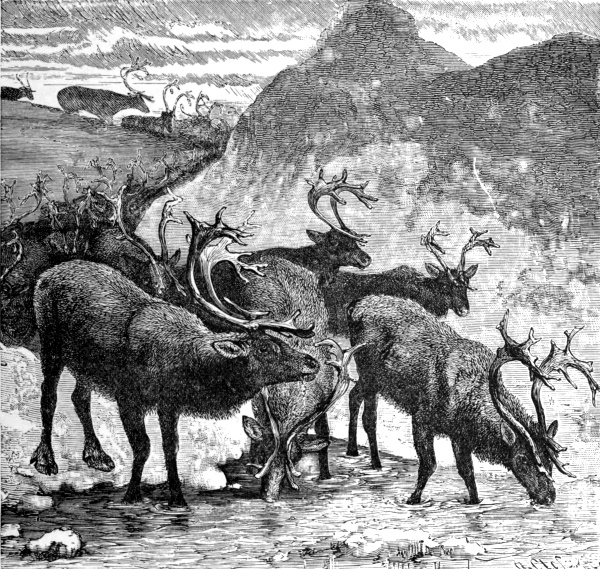
Fig. 19.—Reindeer Flocking to Drink.
The only stationary animals, in the usual sense of the word,
seem to be certain mountain species and those which hibernate in
caves and holes; all the rest migrate more or less regularly. At the
pairing and nesting time all the West Siberian animals segregate
themselves, except those which are gregarious during the breeding
season. Later on, the parents and their young combine with their
fellows in herds or flocks, which, impelled by the need for more
readily obtainable food, and perhaps also driven off by the plague
of mosquitoes, set out on their wanderings together. Localities rich
in fodder attract the herbivorous creatures, which are the first to
arrive, but on their heels come others, and finally their enemies.
Thus certain parts of the woodland are depopulated and others are
peopled, and there occur actual blocks in the migratory stream, which
must be the more striking in contrast to the usual desolateness and
emptiness of the forest. The scenes of old conflagrations are
favourite rendezvous, for, on the fertilized soil, berry-bearing bushes
of various sorts have sprung up and attained luxuriant growth.
Here, in autumn, the Siberian herbivores find a rich harvest, and not
only they, but wolves and foxes, martens and gluttons, sables and
bears, primarily attracted by the collected herds, may be seen banqueting,
devouring the berries with evident pleasure. The different
animals thus brought together seem to remain for a time in a certain
correlation. The herbivores, as observant sportsmen have
noticed, keep with unmistakable constancy to the berries; and the
carnivores follow closely in their tracks.
These migrations explain how it is that during certain years
some of the woods are filled with all kinds of beasts of the chase,
while during other years they are entirely forsaken. The traveller
from the west, who journeys in late winter or early spring in
Western Siberia, beholds with astonishment a flock of three to five
hundred black-game rise in crowded flight from the highway through
the forest, and learns with not less astonishment a little later that
the same or even more favourable woods are but sparsely stocked
with these birds. In summer he searches in the most suitable
localities for the hazel-grouse, and is discouraged because his search
is continually futile; in autumn he is pleasantly surprised to see, in
the same places, abundance of the same game.
So peculiar are the conditions due to the monotonous uniformity
of wide stretches, that the huntsman who will make sure of his
booty must be very familiar with them; indeed, even the most
skilful and experienced sportsman is always and everywhere in the
measureless forests at the mercy of chance. Whatever be the game
he pursues, he never can predict where he will find it. Yesterday
the goddess of the chase was kind to extravagance; to-day she
refuses him every aid. There is no lack of game, but the huntsman
who had to live on what he shot would starve. A sportsman’s life,
such as is possible in other latitudes, is inconceivable in Western
Siberia; the profit to be derived from the forest chase is inconsiderable.
Some animals, for example the beaver,[31] seem already
to have been exterminated; and others, especially the much-prized
sable, have withdrawn from the inhabited districts into the interior
of the forest. Everywhere in Siberia one hears the common complaint,
that game becomes scarcer every year; and it is certain that
from one decennium to another the diminution is perceptible. For
this man is not wholly responsible; the forest-fires and the devastating
epidemics which now and then break out are probably as
much, if not more, to blame. At the same time, no Siberian ever
realizes that a temporary sparing of the game is the first condition
of its preservation. Sportsman-like hunting is unknown; the
most varied means are used to kill as many animals as possible.
Gun and rifle are mere accessories; pitfalls and nets, spring-guns
and poison are the most important agents employed by natives and
immigrants alike.
“Game” to the Siberian means every animal which he can in
any way use after its death, the elk and the flying squirrel, the
tiger and the weasel, the capercaillie and the magpie. What the
superstition of one race spares falls as a booty to the other; animals
whose flesh the Russians despise are delicacies to the Mongolian
palate. Ostiaks and Samoyedes take young foxes, martens, bears,
owls, swans, geese, and other creatures, treat them tenderly as long
as they are young, care for them sedulously until the fur or plumage
is fully developed, and then kill them, eating the flesh and selling
the skin. The number of skins brought from Siberia to the
markets there and in Europe is computed in millions: the number
used in the country itself is much smaller, but still very considerable.
The quantity of furred, and especially of feathered game,
which is transported to a distance in a frozen state, also mounts up
to many hundreds of thousands. Along with the furs of mammals
the skins of certain birds are at present much exported, especially
those of swans, geese, gulls, grebes, and magpies, which, like the
furs, are used in making muffs, collars, and hat trimmings. A
single merchant in the unimportant town of Tjukalinsk passes
through his hands every year thirty thousand plover-skins, ten
thousand swan-skins, and about a hundred thousand magpies; and
some years ago his sale was much larger.[32] That the total traffic in
skins must involve a yearly diminution of the animals is certain;
and that only the inaccessibility of the wildernesses of forest and
water preserves the affected species from utter destruction will be
plain to everyone who knows the unsparing hand of the Siberian
huntsman.
Although it is plain from what we have said that the Siberian’s
conception of game is a very wide one, the animals looked upon as
worthy of hunting are really those which we ourselves regard as
furred and feathered game, or would so regard if they occurred in
Germany. In our sense of the term, the game of the forest girdle
includes the Maral stag and the roe-deer, the elk and the reindeer,
the wolf, the fox, the Arctic fox, the lynx and the bear, the Arctic
hare, the squirrel, the striped and flying squirrel, but above all,
the martens, viz., sable, pine-marten and stone-marten, pole-cat,
kolonok, ermine, weasel, glutton, and otter; besides the capercaillie,
black-grouse, and hazel-grouse. In the south must be added the
tiger, which now and then prowls within this region, the ounce, the
musk-deer, and the wild boar of the mountain forest; while the
north also yields the willow grouse, occasionally found at least on
the outskirts of the forest. These animals everyone hunts, and the
more civilized do so in a regular, if not always sportsmanlike,
fashion; for most of them ingenious and effective snares are also
laid.
Of the latter the much-used “fall-trap” is most worthy of
notice. Its arrangement is as follows:—Across clear spaces in the
forest, especially those which afford a clear view, a low and very
inconspicuous fence is stretched, and in the middle of this an
opening is left, or there may be two or three if the fence be long.
Each opening is laterally bounded by two firm stakes which bear a
cross-beam above, and are meant to guide the falling beam, which
consists of two long, moderately thick tree-stems, bound side by
side. A long lever rests on the cross-beam, on its short arm the
falling beam is suspended, while a cord from the long arm forms the
connection with a peg-arrangement. The latter is contrived as
follows. A short stick, forked at one end and pointed at the other,
is fixed with the fork against a notch in one of the stakes, and with
its pointed end fastened against another longer peg whose forked
end rests lightly on the other stake. The two pegs keep one
another in position, but on the slightest pressure they fall asunder.
When the trap is set, the peg arrangement which corresponds to
the trigger is covered with numerous light, dry twigs, not so much
to conceal it, as to form a larger surface of possible contact. When
an animal, even a small bird, steps upon the twigs, the two pegs
fall asunder, and the beam drops, killing the animal under it. If
it be set for a beast of prey, bait is laid beside the triggers; all
other kinds of game are simply guided to the trap by the direction
of the fence. In many woods all the haunts, paths, and clear spaces
are beset with these traps in hundreds and thousands, so that the
huntsman is often compensated by abundant booty for the slight
trouble which it takes to arrange his effective apparatus. Grouse,
hares, squirrels, and ermine are the commonest victims; polecat,
pine-marten, and sable, the rarest. Gluttons also and wolves often
lose their lives, but the survivors learn like dogs, and anxiously
avoid the set traps, though neither is at all afraid to steal or gnaw
at and thus destroy the booty caught in one which has sprung.
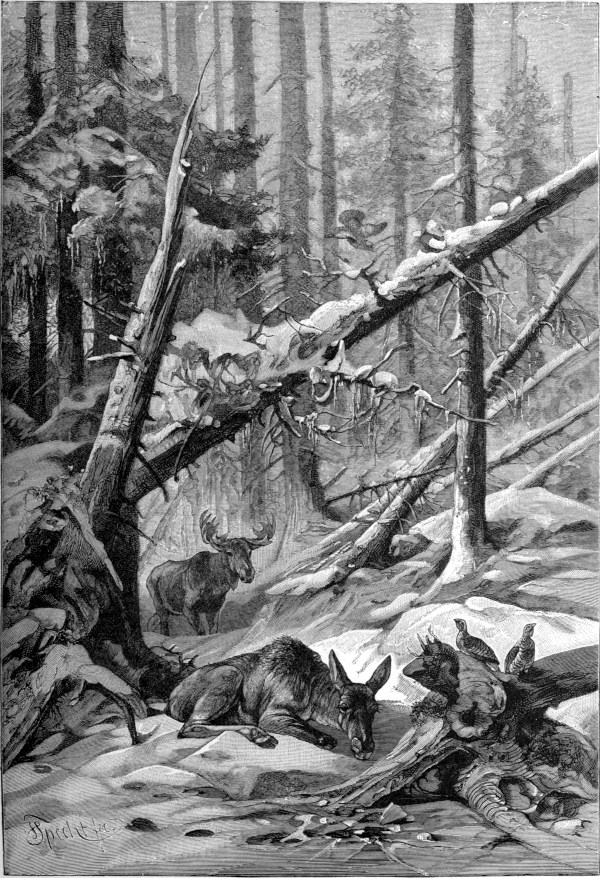
Fig. 20.—Elk and Black-cock in a Siberian Forest.
Besides the “fall-trap”, the Ostiaks and Samoyedes are fond of
using a spring-gun arrangement, fitted with bow and arrow or
automatic cross-bow. As the bow is very strong and the arrow
well made, the murderous contrivance is very effective, and exceedingly
dangerous to the inattentive explorer. Ingenious arrangements
hold the bow stretched, and keep it and the arrow in position;
a wooden clasp relaxes the bow whenever a line stretched across the
animal’s run is touched. In order to direct the arrow so that it may
pierce the heart of the victim, the ingenious people use a pillar-like
perforated target the size of the desired booty. When this is placed
on the run it has the perforation at the precise level of the beast’s
heart, and according to the distance between the heart and the
collar-bone, the hunters determine the distance between the mark
and the trigger. As all the natives are well acquainted with the
tracks of various kinds of game, the spring-gun only fails when a
creature comes along entirely different in size from that for which
the arrow was destined. Usually they are set for foxes, and with
hardly less success for wolves, or even for elk and reindeer, while
the automatic cross-bow is arranged for smaller game, especially
ermine and squirrels. For both of these, bait is spread which can
only be got at when the animal creeps through a narrow hole in
front of the lower part of the set cross-bow. In so doing the
creature touches a trigger, and is forthwith crushed by a broad,
chisel-like arrow which the cross-bow shoots forcibly down on its
appointed course.
As an important addition to these old-fashioned contrivances,
fire-arms have recently come more and more into vogue among the
natives of Western Siberia, but they do not displace the bow and
arrow. Powder and bullets are dear, and the people prefer small-bored
matchlocks and flint-locks, which are exceedingly bad; but they
use these defective weapons with remarkable skill. A fork fastened
in front to the barrel, and used as a rest, is to be seen on every gun,
and even the educated sportsmen use it as indispensable to the
effective use of the matchlock. Fowling-pieces are used by the officials
and well-to-do townsfolk, but not by the natives, who have to make
a profit by the chase, and to measure their powder, as it were, by the
grain. They fill a small horn with the expensive material, wind a
leaden wire of the diameter of their bore twice or thrice round their
waists, and thus equipped set out on the chase. The leaden wire
serves for making bullets, which are not cast but simply cut, or,
even more simply, bitten off the wire; the resulting peg-like shot is
laid without any wad directly on the powder, and thus the gun is
loaded. Of course the native huntsmen do not shoot from a distance
except when forced to, but to the height of medium-sized trees their
aim is so sure that they take the eye of the sable or squirrel for
their mark and seldom miss it.
The various species of grouse are more generally hunted than any
other creatures, and are caught and killed in hundreds of thousands.
During the pairing season capercaillie and black-grouse are almost
everywhere left unmolested. The sportsman’s joy as we know it
when the pairing grouse take wing can scarcely be experienced in
Siberia, owing to the inaccessibility of the woodland; not even for
the pairing black-grouse does one rise betimes in May; the hazel-grouse
alone is sought after by mimicking his love-call. But who
would put himself to so much trouble and discomfort for so uncertain
a prize? Only in autumn and winter does the chase reward
the Siberian as he desires and expects; when the young birds
change their plumage, when the coveys unite in large flocks, and
when these wander through the forest in search of berries, then is
the huntsman’s opportunity. Whoever is not afraid of discomforts
of all kinds pursues the migrating flocks with his dogs—usually
pitiable helpers—and generally returns with rich booty; those who
know how to use snow-shoes hunt capercaillie and black-game
even in winter. After the first heavy snowfall the migrations
are stopped, and each flock seeks out a resting-place which
promises abundant food for a few days at least. In the beginning
of winter the still ungathered cranberries afford sufficient
food, and afterwards the juniper berries; when both these supplies
are exhausted the easily satisfied birds take to the leaves of larch,
and finally of pine and fir, and to the young cones of all these
conifers. As long as possible they continue their wanderings on
foot, and often cover seven or eight miles in a day; occasionally
they come within a few hundred paces of a settlement, and leave
such distinct footprints on the fresh snow that the huntsman is bound
to discover them. When they are forced to take to a diet of pine-needles,
the sportsman is able to track them, at first by their droppings,
and eventually by their sleeping-places. For the Siberian
capercaillie and black-game differ in habit from their relatives in
Germany, and make more or less deep burrows, usually reaching
from the surface of the snow down to the ground. They leave
these in the morning, or when danger threatens, breaking with
beating wings through the coverlet of snow. These shelters are,
therefore, readily recognizable, and as they also afford sure indication
of the night on which they were used, they are most valuable
guides to the experienced sportsman. Amid continuous snowfall the
birds sometimes remain beneath the snow till towards mid-day, and
then, after they have taken to the trees and are eating, they will
allow the huntsman to come within range, for they are not scared by
the barking of his dogs, and, while watching the cur at the foot of
the tree, often overlook the marksman. The first condition of
success in such hunting is, that the snow have not only smoothed off
most of the roughness of the ground, and thus removed the greatest
obstacles to progress, but that it be sufficiently firm to afford the
necessary resistance to the huntsman’s snow-shoes.
With incomparably greater comfort, and usually with more
success, the black-grouse may be hunted by means of the decoy or
bulban. When using this the huntsman sets out before dawn in
autumn, hides in the forest in a previously-prepared or rapidly-constructed
hut, and there fixes up the bulban. This is a stuffed decoy-bird
or one fashioned of wood and tow, with black, white, and red
cloth at appropriate places, a deceptive imitation of the living bird.
It is perched by means of a pole on the highest of the surrounding
trees, with its head to the wind, and while the sportsman hides in
the hut, men and dogs drive the adjacent forest. All the young
black-game, or all which have not learned wisdom from previous
experience, fly, when disturbed, to the bulban, which, to all appearance,
is a fellow-bird sitting in reassuring security. They crowd
on to the same tree, and the sportsman beneath, equipped with a
small-bored and but slightly noisy rifle, or sometimes also with a
fowling-piece, often has the pick of dozens of silly birds. In woods
which are undisturbed throughout the summer, the black-grouse
are so heedless of the slight report of the rifle, that after a bird has
fallen dead from the tree the others do not fly away, but stretching
their necks gaze at their fallen comrade, and wait quietly until the
marksman has reloaded and claimed a second or a third victim. So
abundant are these birds that the assertion that a single sportsman
may, in the course of the morning, bring down twenty or more
without leaving his hut is perfectly credible.
Not less effective than the decoying of black-game, fascinating
moreover, and satisfactory to every sportsman, is the hunting of
the hazel-grouse as practised in Siberia. No special equipment of
any kind is required, not even trained dogs—useful auxiliaries none
the less—are indispensable. The hazel-grouse is very abundant in
all suitable parts of the West Siberian forests, perhaps more abundant
than the capercaillie and black-grouse, but it is so noiseless
that one may often miss it although there are numerous coveys in the
wood. It never forms such large flocks as its relatives, nor does
it undertake such long migrations, but it is more uniformly distributed
throughout the wide forest-wilderness, and the sportsman
who knows its ways gets more readily within shot of it than in the
case of any other bird of the woods. During spring and summer it
seems to the inexperienced to have wholly disappeared; but in
autumn it occurs everywhere, even in those places where, a few
months before, it might have been sought for in vain. It is as fond
of berries as are its relatives, and to secure these it visits the larger
clearings, which, in spring and summer, it seems to avoid. But even
there it knows how to escape observation. It lies much more
closely than capercaillie or black-cock, and, without anxiously concealing
itself on the approach of an intruder, remains as long as possible
motionless, only rising when the enemy is almost touching it.
Even then its flight is so noiseless and inconspicuous that one may
readily fail to hear or see it; even a partridge or a wood-cock makes
more noise than this charming bird, of whose flight only a gentle
whirring is perceptible. When startled, it usually, though by no
means always, flies to the nearest fir-tree and alights on the first
convenient branch, but there it sits so quietly that it is once more
as inconspicuous as it was on the ground. The sportsman often
tries for a long time in vain to discover the bird’s whereabouts, and
when he has finally decided that it has secretly flown off, he is
suddenly nonplussed by a start or movement which betrays its
presence on the very branch on which he had looked for it repeatedly.
The cleverness with which all birds of this sort hide themselves from
observation has reached a rare perfection in the hazel-grouse. For its
haunts it prefers the boggy and mossy parts of the forest, which
abound in bilberries and cranberries and are surrounded by old
dead trees and young growths. Here it knows so skilfully how to
use the cover, that one rarely perceives it until it has flown for
security to one of the lifeless giants. When it does not move, it
appears most deceptively like a knot on the tree, and it behaves as if
it knew that it could trust to the colour-resemblance between its
plumage and its surroundings. Nevertheless, whenever it shows
itself freely it keeps looking anxiously all round, and, if it suspects
danger, leaves its perch as silently as it gained it. Hazel-grouse
shooting is a true pleasure to the sportsman. He may expect the bird
almost everywhere in the forest, and can never tell how it will show
itself; he must usually dispense with all auxiliaries, but his success
is not prejudiced by awkward companions; and he is even more richly
rewarded by the continuous tension and pleasurable excitement than
by the exquisite dish afforded by this best-flavoured of game-birds.
Compared with the importance of game-birds to the sportsman,
and indeed to the community generally, the chase and exploitation
of big game in West Siberia must seem inconsiderable. The four
species of stag found in this region are for various, but equally unsatisfactory
reasons, much less appreciated than they deserve. They are
treated in a manner which, if not actually barbarous, seems to us
disagreeable or even repulsive. This is especially true in regard to
the Maral stag. This splendid creature, according to some naturalists
a large-sized red-deer, according to others a nearly related
species with larger body and stronger antlers, lives in all the
southern forests, especially on the mountains, and is probably by
no means so rare as the untiring lust for the chase on the part of
both natives and strangers has made it seem. For a strange reason
the said lust for the chase endangers this stag most seriously just
at the time when he needs most to be spared. For he is hunted by
all the North Asiatic hunters not for his flesh nor his skin, nor for
his fully-branched head, but solely and wholly for the growing,
incompletely tined, and still velvety antlers.[33] Out of this the
Chinese physicians or quacks prepare a specific, which is greatly
sought after by rich debilitated Celestials, and is sold for its weight
in gold. It is esteemed as a stimulant of rare virtue, and believed
to be replaceable by no other. Most sought after are the half-branched,
six-tined antlers, still richly filled with blood; for these
the price is from £10 to £15, while completely formed antlers, with
twelve or fourteen tines, and bared of their velvet, may be bought
for six to twelve shillings. Not only the Mongols of North and
Central Asia, but also the Siberians of Russian origin, exert themselves
to procure these valuable antlers, which, when obtained in
the proper condition, are despatched as quickly as possible, especially
by post, to Kiachta, whence, through special merchants, thousands are
sent every year to China without satisfying the demand. Siberian
peasants also keep the Maral stag in captivity for the sole purpose
of cutting off the blood-charged antlers at the proper time and
selling them. Now, since all stags when growing their antlers
avoid the dense thickets, and are less wary than at other seasons,
and as the one- and two-year-old stags are as little spared as those
with crown antlers, it is obvious that the numerical strength of the
race must be notably impoverished, and that the breeding must also
be appreciably affected. The flesh and the skin obtained in the
slaughter are but rarely taken into consideration; if it would involve
any trouble to remove the carcase, it is usually left without
reluctance to the wolves and foxes.
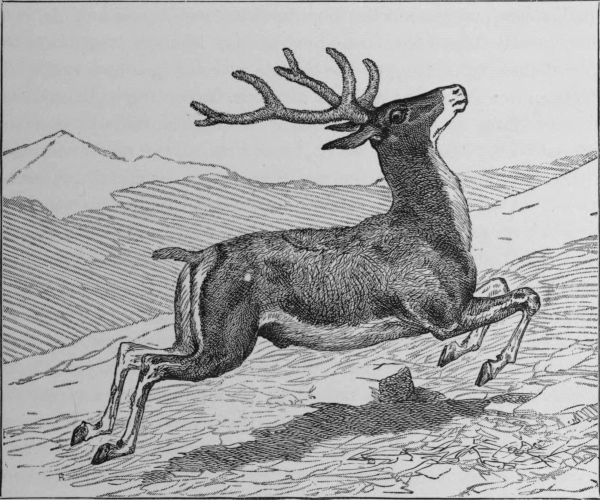
Fig. 21.—The Maral Stag.
As the Maral stag excels ours, so is it with the Siberian or large
roe-deer, which differs from ours in its larger growth and by the
high antlers with weakly developed burrs. Its specific independence,
however, is still a subject of controversy among taxonomists. In
Siberia it prefers the stretches of woodland which have begun to
recover from the effects of a conflagration, and in which the pichta
fir is abundant. It also frequents the fringes of the forest and
small woods, and ascends the mountains to considerable heights, not
unfrequently above the forest-line; it may likewise pass into the
open steppes, associating on the heights with the steinbock and wild
sheep, and on the plains with the antelope. According to the nature
of the country, it undertakes more or less regular migrations, even
without being forced to these by forest fires, and in its wanderings
it will traverse wide stretches and cross broad rivers without hesitation.
In certain circumstances it appears in regions in which it
has not been seen for years, and from these centres it makes excursions
round about. In its wanderings it usually keeps to definite
roads, but is now and then forced to follow narrow paths. The
rocky and precipitous river-banks of the larger streams compel it
to make its way through a few cross-valleys and gorges, and this
necessity is often the animal’s ruin, for the trapper rarely omits to
stretch his leading-fence across these runs, and to lay his pitfalls
fatally. Wolf and lynx press upon it at every season; Russians
and native Siberians likewise. Like other game it is hunted unsparingly;
every circumstance is utilized and every trick is tried to
effect its capture. At the beginning of the thaw, when cold nights
have frozen the top layer of snow into a thin crust of ice, the hunter
sets off on horseback or on snow-shoes with a pack of nimble dogs;
he rouses the stag with his shouts and runs it down, fatiguing it
the sooner the harder the ice is, for, as the stag bounds, the crust
breaks under its slender hoofs, and its ankles are cut. In spring,
the hunters entice the doe by imitating the cry of the fawn, and the
buck is similarly allured in the leafy season by a skilful echo of
the doe’s call; in the intermediate season and later, both sexes are
inveigled by special dainties; in autumn a drive is organized, or the
migrating deer is pursued in boats as he swims across the streams,
and is killed in the water; in early winter he is shot from the swift
sledge. In fact the only method of capture which is not resorted to
is that of snaring, so common a practice with knavish hunters at
home; but in all probability the reason for this abstinence is simply
that the spring-bow is more effective.
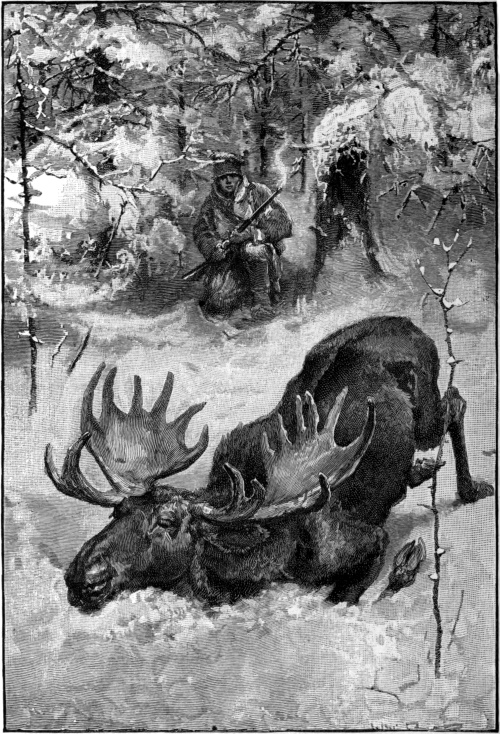
Fig. 22.—The Elk Hunter—A Successful Shot.
The elk[34] exists under decidedly more favourable conditions, and
has a firmer footing in the struggle for existence. Its haunts and
habits, its strength and power of self-defence, secure it from many,
if not most pursuers. A forest animal in the full sense of the
word, as much at home in swamp and bog as in thicket or wood,
overcoming with equal ease all obstacles of forest and morass,
assured by the nature of its diet from the scarcity of winter, it
escapes more readily than any other beast of the chase from
pursuit either by man or by other dangerous enemies. The latter
include wolves, lynxes, bears, and gluttons; but it may be doubted
whether all these beasts of prey together very seriously affect the
elk. For it is as strong as it is courageous, it has in its sharp
hoofs even more formidable weapons than its antlers, and it knows
right well how to use both of them. It may fall victim to a bear who
surprises and overcomes it; but it undoubtedly hurls a single wolf
to the ground, and may even be victorious over a pack of these
eternally hungry creatures. As to lynx and glutton, the old story
that these are able to leap on the elk’s neck and sever the jugular
vein does not seem to have been proved. Only against human
weapons are the elk’s resources ineffective. But its pursuit in
Siberian forests is a precarious undertaking, and is little practised
except by the natives. During summer the water-loving beast is
hardly to be got at; it spends the greater part of the season in the
marsh, browsing by night and resting by day among the high marsh-plants
in a place accessible only to itself. The juicy water-plants
and their roots suit it better than the sharp sedges, and it therefore
browses in the deeper parts of the bog, where it pulls the plants out
of the water, dipping its uncouth head in the muddy moisture as
far as the roots of its donkey-like ears. When it lifts its head it
blows from its nose and mouth the mud and moisture which necessarily
entered its nostrils as it grubbed, and this makes a loud
snorting noise which can be heard from afar. Experienced hunters
have based a peculiar trick of the chase on the elk’s method of
feeding. They listen to the usually watchful animal for several
nights in succession, and mark his whereabouts; thither in the daylight
they quietly carry a light, shallow-water boat; by night, guided
by the snorting, they row with muffled oars towards the browsing
creature, whose scent and hearing are dulled by his grubbing; at
close range they send a bullet through him. The clearness of the
northern summer night facilitates operations, though it renders
close approach more difficult; yet the sport is all the more exciting,
and by eager lovers of the chase it is pursued passionately, and
usually with success. On the advent of frost the elk leaves the
swamps, for the brittle coat of ice hinders his movements, and hies
to the drier parts of the forest until the thickly falling snow forces
him to wander in search of specially favourable localities. At this
season the chase of the elk, with well-trained and, above all, silent
dogs, is preferred to all other sport. In its wanderings the elk does
not avoid human settlements, and betraying itself by its unmistakable
footprints, soon has the huntsman on its heels. Now is the
time to send the dogs after it. Their duty is to keep the creature
continually agog, but never to chase it. They must never attack it
in the rear, nor ever come too near it, but must rather bark at
it continually, and keep its attention unceasingly engrossed. When
the elk sees itself thus threatened in front it stops after a short
trot, looks angrily at the dogs, seems trying to make up its mind to
attack them, but only in rare cases succeeds in carrying out the
resolution so slowly arrived at, and thus gives the sportsmen time
to get within easy range, and to take sure aim. If a small herd of
elk is suddenly surprised by the dogs and driven into a narrow
defile, they may be so nonplussed that several may fall before a
well-handled rifle. But when old experienced elks are pursued for
some time during a heavy snowfall they take the first trodden path
which they come across, and trot along it whether it lead to the
recesses of the forest or to the township; thus they are not unfrequently
led quite close to inhabited houses, on seeing which they
diverge into the woods. A hard crust of snow is not less dangerous to
the elks than to the roe-deer; and then the spirited and experienced
huntsmen pursue them even with boar-spears, speeding along on
snow-shoes, outrunning and fatiguing the impeded animals till they
can use the ancient weapons to good effect. The flesh is readily
eaten both by immigrants and natives, but it has no great market
value; the skin, on the other hand, finds ready sale at six to eight
roubles[35] a hide, and affords the professional huntsman sufficient
recompense for his trouble and exertions.
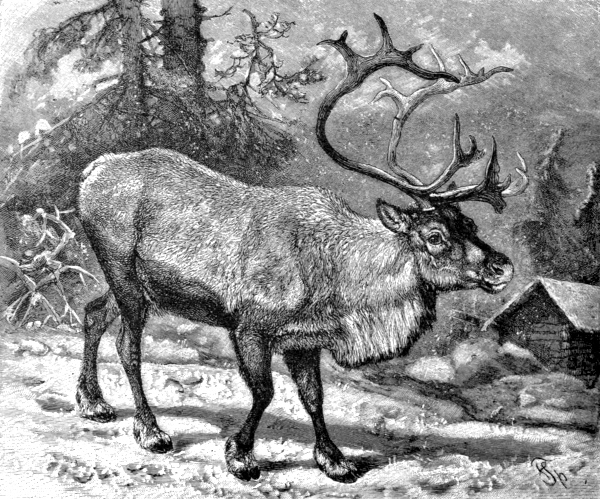
The wild reindeer belongs strictly to the tundra, but it also
occurs throughout the whole extent of the forest-zone. Along the
eastern slopes of the Urals it is frequent both in the depths of the
forest and on the mountain heights, and the huntsmen of these
parts accordingly speak with a certain emphasis of forest-reindeer
and mountain-reindeer, and seem inclined to attribute different
characteristics to the two kinds, though they cannot define their
distinctive marks. The reindeer is less shy of populated districts
than any other deer, which perhaps best explains the fact that
every year among those living in freedom individuals are captured
with slit ears and brand-marks. These have probably escaped from
the herds of the Samoyedes and Ostiaks during the breeding
season, and have wandered southwards till they met a wild stock
to which they attached themselves. Once free from bondage, they
very rapidly assume all the habits of wild life. But neither these
escaped truants nor the wild forms are regarded by the forest-folk
as of much moment among the beasts of the chase. Reindeer are
indeed captured wherever, whenever, or however that may be
possible; but apart from a few specially keen hunters of Russian
origin only the natives pursue them with persistence and eagerness.
Excepting the Semites and the Russians, all sensible people
include hares among edible game. In consequence of this exception,
the variable hare of Western Siberia is hunted only by educated
and unprejudiced Siberians of Russian origin, and by the natives of
the North, who are uninfluenced by any laws of diet. Even the
skin of the snowy hare, since it loses its fur very readily, has little
value in the eyes of the huntsman, and perhaps for this reason is
presented by the heathen peoples as an offering to the gods. Yet
in spite of the indifference with which the forest-folk regard this
rodent so highly prized by us, the hare is nowhere plentiful. Many
perish in the traps; the majority are caught by wolves, foxes, and
lynxes; and the severe winter, which often impels them to long
migrations, thins them sadly. The hare is certainly not important
among the beasts of the chase.
Among the non-edible furred beasts of the forest the first place
may be given to the wolf, since it is most bitterly hated and most
generally hunted. For although it is said that the direct injury
which it does to man is not very considerable, or at any rate
not insufferable, he misses no opportunity of destroying it. It is
certain that in West Siberia wolves only exceptionally appear in
large packs, and that they even more rarely venture to attack man,
but it is equally certain that they do much damage to domestic
animals. This is very considerable when we take into account the
destruction caused by wolves among the herds of the nomads on the
steppes and the tundra. There is no possibility of computing the
numbers of wolves in the forest-zone. They are found everywhere
and yet nowhere; to-day they fall upon the herds of a village, where
there has been no trace of them for years, and to-morrow they
ravage the sheepfolds somewhere else; they leave certain districts
suddenly, and establish themselves in them again just as unexpectedly;
here they defy their persecutors, and there precautions
against them are almost superfluous.
Broad, much-used highways and settlements rich in meadows
attract them, for on the former they find the carcasses of horses, and
by the latter they find an easy booty in the herds which wander
unhindered by any herdsman, and often stray far into the woods.
But they are not absent from those parts of the forest which lie
beyond the limits of traffic. Sometimes in broad daylight they are
seen singly or in small packs prowling near the settlements; by
night they not unfrequently pass through villages or even towns.
In a single night they destroy dozens of sheep, attack horses and
cattle also, and more rarely dogs (for which in other countries they
show a preference). The only animals which they avoid are the
courageous swine, for here and elsewhere these at once show fight,
and invariably get the best of it.
Like the Russians, the Siberians hold to the superstition that the
she-wolf suckling young carefully avoids ravaging in the neighbourhood
of her litter, but that if she be robbed of her whelps, she avenges
herself terribly, following the robber to his village home, and falling
with unbounded rage upon all his herds. For fear of this revenge,
every Siberian passes by any wolf-litter which he finds, and only
now and then does he dare to cut the Achilles tendon of the whelps,
thus laming them and keeping them near their birthplace until the
time of the autumn hunt. For, as they grow up, the mother’s love
is supposed to disappear, at least her thirst for revenge grows less,
and the skins of the young wolves caught in autumn reward the
clever foresight of the cunning peasant.
According to locality and opportunity, the methods employed in
the capture of the wolf vary greatly. Pitfalls, traps, strychnine,
and the spring-bows already described do good service; actual
driving is seldom successful. A favourite method is to pursue the
wolf with sledges, and to shoot him from the sledge. To attract
the wolf within range an ingenious device is resorted to. An old,
steady, or worn-out horse is yoked to a large sledge, in which four
comrades—the driver, two marksmen, and a fair-sized sucking-pig—take
their places. The driver, whose sole duty is to look after
his horse, takes the front seat; the marksmen sit behind, and the
pig lies in a bag between their feet. Towards evening the mixed
company sets off along a well-beaten road to a part of the forest
where during the day fresh wolf-tracks were seen. On to the
track one of the hunters throws a bag stuffed with hay, and fastened
to the sledge by a long line; while this trails along, the other hunter
teases the young pig, and makes it squeal. Isegrim hears the
complaint, and probably thinking that it comes from a young boar
separated from its mother, draws near quietly and carefully, that is,
as far as possible hidden from the road. He perceives the bundle
trailing behind the sledge, supposes this to be the squealing pig,
and, after some consideration, determines to put an end to its
sufferings. With a great bound he leaps upon the course, and
eagerly rushes after the sledge. What does he care for the threatening
forms which it bears? Such he has often inspected close at
hand, and robbed before their very eyes. Nearer and nearer he
comes, gaining on the now quickened sledge; crueller tormenting
makes the pig utter louder and more clamant squeals; they are
maddening to the robber; just another bound, and—two rifles ring
out, and the wolf rolls gasping in death.
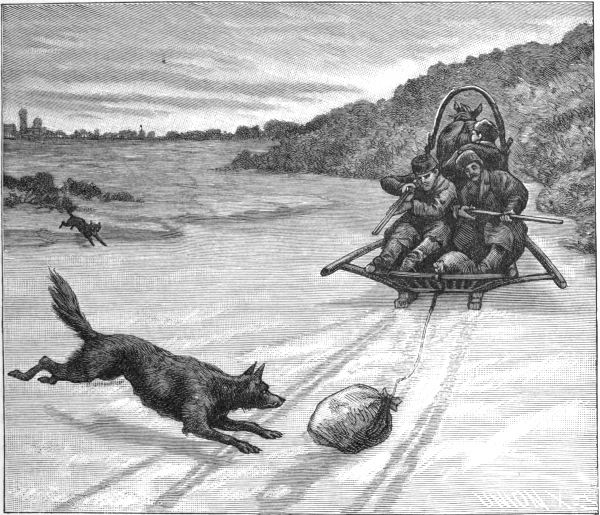
Fig. 23.—A Siberian Method of Wolf-shooting.
Equally artful is the circular trap much used in the Ural
district. At a short distance from the village a circular space
about two yards in diameter is enclosed with close-set deep-sunk
stakes; around this is formed a second similar circle at an
interval of about a foot and a half from the first. Two specially
strong posts support a solid deal door moving on firm hinges,
furnished with a spring-catch, and so arranged that it opens only
inwards, pressure outwards causing the spring-catch to shut. Both
circles are roofed over, not thickly, indeed, but firmly, and a trapdoor
in the roof admits to the inner circle. When it is perceived
that the wolves are beginning to visit the village by night, the trap
is set by placing a live goat in the inner enclosure and opening the
door of the outer ring. The pitiful bleating of the goat, frightened
by being taken from his usual surroundings, attracts Isegrim. He
does not in the least like the look of the strange enclosure, but the
frantic behaviour of the goat, still more terrified by the wolf’s
appearance on the scene, makes him forget his habitual caution,
and he begins to try to get at the welcome booty. Several times
does he prowl round the outer fence, ever more quickly and eagerly,
twisting and snuffing, sometimes coming quite near, and again retreating,
till at last he discovers the only door by which it is possible
for him to get near the goat. His appetite gets the better of his
natural cunning. Still hesitating, but yet advancing, he pushes his
head and body through the narrow doorway. With despairing cries
the goat springs to the opposite side of the inner fence. Without
further consideration or hesitation the robber follows. The goat
rushes round in a circle, and the wolf does the same, with this
difference, that he has to move between the two rows of stakes.
Then the projecting door impedes his progress. But the victim is
now so near, and apparently so sure, that the wolf dashes furiously
forwards, pressing the door outwards; the spring-catch falls with a
snap into its groove, and the distrustful, cautious dupe is trapped—trapped
without being able to get a step nearer the tempting booty.
Unable to turn round, boiling over with rage, he runs and trots and
jumps, ever forwards, ever in a circle, hurrying without a pause on
his endless circuit. The intelligent goat soon appreciates the situation,
and though still crying and trembling, remains standing in the middle
of the inner circle. The wolf also begins to see the fruitlessness of
his circling, and tries to recover his freedom, tearing splinters a foot
long out of the stakes with his teeth, howling with rage and fear,
but all in vain. After a night of torment, the daylight appears—the
wolf’s last morning. The villagers begin to move about, and
voices mingle with the barking of dogs. Dark men, accompanied
by noisy dogs, approach the scene of the tragedy.
Motionless, like a corpse, the wolf lies; scarce a wink of his eyes
betrays that there is still life in him. With furious barking the
dogs press round the outer fence, but he does not move; with mocking
welcome the men call to him, but he heeds not. But neither dogs
nor men are deceived by his shamming death. The former, pressing
between the stakes, try to get a grip of him; the latter slip the
much-used horse-noose or arkan over his head. Once more the
beast springs up, once more he rages on his path of torture, howling
he seeks to terrify, gnashing his teeth he attempts defiance, but in
vain—there is no escape from the dread noose, and in a few minutes
he is throttled.
The fox is everywhere attacked, hunted, killed, and devoured,
or at least hard pressed, by the wolf, and is therefore not abundant
in Siberia, but neither his hostile relative nor man have as yet been
able to exterminate him. In the eastern parts of the forest-zone
he sometimes undertakes long migrations, following the hares or
the grouse; in the west, observations on this point do not appear to
be recorded. They do not complain in Siberia of the damage he
does, nevertheless they hunt him eagerly, for his fur is prized by
natives and Russians alike, and is always dear. It fetches an
especially high price when it is of a certain much-appreciated
colour. As a beast of the chase, only the sable takes higher rank.
For the sake of the fox alone professional hunters undertake winter
expeditions which often take them as far into the heart of the forest
as the sable-hunters are wont to penetrate. Especially for it do the
Ostiaks and Samoyedes set their spring-bows, and they spare no
trouble in their search for the burrow where the young are hidden,
not in order to kill them, but that they may rear them carefully
and tenderly till they become large and strong, and gain, in their first
or second winter, their beautiful fur. For that the fosterers care
more than for the life of their winsome charges, and they give them
over remorselessly to the fatal noose.
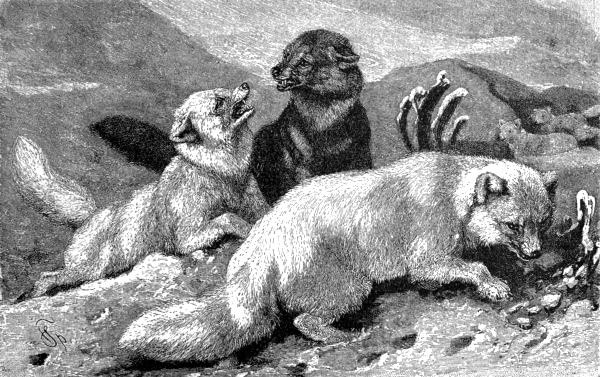
The Arctic fox may be included conditionally among the forest
animals, but it never actually penetrates into the forest. Sometimes,
however, in winter, in pursuit of hares and moor-fowl, it follows the
course of the large rivers beyond the southern limits of the tundra,
its true home.
The lynx, on the other hand, is a forest animal in the strictest
sense of the word. But in Siberia it only occurs singly, and is very
rarely captured. Its true home is in the thickest parts in the
interior of the forest, and these it probably never leaves except when
scarcity of food or the calls of love prompt it to wander to the
outskirts. Experienced hunters of the Eastern Ural say that the
lynxes not only live in the same locality as the bear, but that they
remain in the neighbourhood of the bear’s winter-quarters after he
has gone to sleep. They assert, moreover, that the preference the
lynxes show for these winter-quarters betrays the bears, since search
has only to be made where most lynx-tracks cross, and especially
where there is a circular track, for that always surrounds a bear’s
sleeping-place. The lynx’s habit of keeping to his old paths with
almost anxious carefulness must greatly facilitate the discovery of
the bear’s quarters. Moreover, it may be added that in Siberia the
lynxes show themselves very fond of fresh meat, and that they
possibly seek the neighbourhood of a bear in the hope of occasionally
sharing his booty. For, although it may be urged that the
lynx is able enough on his own account to bring down big game
without any help from so doubtful a friend as the bear, and that he
hunts the reindeer and the roe, and may in a short time overpower
them, yet the fact remains that his booty chiefly consists of small
animals, such as hares, ground-squirrels, tree-squirrels, black-cock,
capercaillie, hazel-grouse, young birds, mice, and the like. Of this
there is no doubt, and it explains satisfactorily why the lynx is so
rare in the fringes of the forest which are accessible to man. As
long as squirrels and game birds abound in the interior of the
forest, the lynx has no temptation to stray from this unvisited
wilderness; when his prey migrates, he is forced to follow. How
much he is feared by the game birds one can discern from the fact
that every wooing capercaillie or black-cock is instantaneously
dumb when a lynx lets himself be heard.
Both immigrants and natives hold the hunting of the lynx to
be right noble sport. This proud cat’s rarity, caution, agility, and
powers of defence raise the enthusiasm of every sportsman, and
both skin and flesh are of no small value. The former is preferably
sent from West Siberia to China, where it fetches a good price; the
latter, when roasted, is highly esteemed not only by the Mongolian
peoples but also by most of the Russian settlers. The lynx is but
seldom captured in the fall-traps, but he often renders them useless
by walking along the beam and stepping on the lever; he is but rarely
a victim to the spring-bow, and he usually leaps over the steel traps
in his path. So there is only the rifle left. Only in winter can he be
hunted, when the snow betrays his tracks and admits of the use of
snow-shoes. The courageous dogs, having sighted their game, drive
it with difficulty to a tree or bait it on the ground, but they often
suffer cruelly, or may even be killed. The hunter himself runs a
risk of being attacked by a furious lynx at bay.
The wild cat, which the lynx persecutes as pitilessly as the
wolf does the fox, is absent from the forest-zone of West Siberia,
but now and then the region is visited by the most perfect of all
cats,—the tiger. Two which were killed in 1838 and 1848 at Baesk
and Schlangenberg now stand stuffed in the museum of Barnaul;
another, killed in the beginning of the seventies, is preserved in the
school museum at Omsk. Towards the end of the sixties a tiger
terrified the inhabitants of the Tschelaba district (on the European
boundary of the Ural) by attacking, without provocation, a number
of peasants, from whom it was only frightened off when one of
the men threw his red cap in its face. In the steppe-mountains of
Turkestan, and throughout the south of East Siberia, the “king of
beasts”, as the Daurs call the tiger, is found everywhere and permanently
in suitable localities, and from both sides it may pass,
oftener than can be proved, to the western forest-zone, remaining
perhaps for some time unobserved and retiring unnoticed. Yet on
the whole it occurs so rarely and irregularly that we cannot do
more than name it, without reckoning it among the beasts of this
region.
It is far otherwise with the most precious of the furred beasts,
the various species of marten. Their decrease is more lamented
than that of all other beasts of the chase, but most of them are
still regularly caught, if not everywhere, at any rate in certain parts
of the forest region. Only the sable has in the last few decennia
become really rare. Old huntsmen of the middle Ural remember
having caught sable every winter in the vicinity of Tagilsk; nowadays,
at this latitude of the mountain-land, only an occasional stray
specimen is to be met with. A great forest fire in the central part
of East Ural is said to have driven off the highly-prized and much-hunted
creature. We hear the same story in the forest villages of
the lower Ob, where the hunting of the sable is still pursued, and
yields, for instance, at the Yelisaroff market, about a score of skins
every winter.
In all the forests of West Siberia the pine-marten is notably more
abundant than the sable. In the fairly extensive hunting-ground
around the already-mentioned town of Tagilsk from thirty to eighty
are still captured every winter. It is said that the pine-marten,
much more than the sable, is associated with the squirrel, and that
the two appear and disappear together. But the greedy marten is
by no means content with making the beautiful squirrel its prey;
indeed it kills every creature which it can master, and is an especially
dangerous foe of black-cock and capercaillie. Even in summer
a clever spring often enables him to capture the watchful bird; while
in winter the habit the black game birds have of sleeping in holes
in the snow greatly facilitates his stealthy operations. Sneaking
almost noiselessly from branch to branch, he comes within springing
distance of the buried bird, and springs on it from above, crushing
down the snowy roof by the force of his bound, and seizing
the sleeper by the neck before it has any chance to escape. The
stone-marten also occurs everywhere in the mountain forests, but it
is rarer than its relative. Polecat, ermine, and weasel are also
widely distributed and locally very abundant; the mink is confined
to the western side of the Ural, and is also absent from its
tributaries, the Irtish and Ob, which harbour the otter in considerable
numbers; the badger is hardly ever mentioned in West Siberia;
and the universally distributed glutton is less thought of than any
other of the martens, being hunted not so much for his skin as
because of his thefts from the traps.
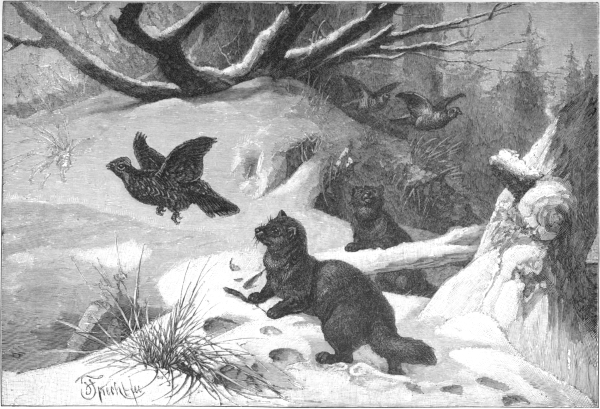
Fig. 24.—Sable and Hazel-grouse in a Siberian Forest.
Although the west of Siberia is regarded as altogether over-shot,
the forest-folk prepare every year to hunt for sable and other martens.
Some huntsmen undertake expeditions and explorations, which
compare with those of the North American trappers. Of course, they
do not confine their attention to martens, but are prepared to bag
all kinds of game; the main objects of their quest, however, are martens
and squirrels. According to the time of colour-change in the
latter the huntsmen arrange their departure from the village home,
for the change of colour in the squirrels is regarded as an indication
of the approaching winter, whether it is to be early or late, severe
or mild.
Armed and equipped as we have already described, the sable-hunters
set out, after the first snowfall, in companies of three to five.
Besides gun and ammunition each of them carries a sack on his
back, snow-shoes and a hatchet on his shoulders, and a whip in his
girdle. The sack contains the indispensable provisions:—bread,
meal, bacon, and “brick-tea”,[36] also a few utensils, such as a pan,
tea-kettle, drinking-vessel, spoons, and the like, and less frequently
a flask of spirits. The whip is used to drive out the squirrels and
to bring them into sight. Four to six dogs, which offend the eye of
every German sportsman, join the company.
Guided by the sun, which, however, is often hidden for days, and
by the known stars, the weather-beaten huntsmen traverse the inhospitable
wilds, camping out at night, feeding themselves and their
dogs on the flesh of the game they shoot, and sparing their small
store of provisions as carefully as possible. The ungainly but clever
and wide-awake dogs not only scent the tracks of game, but, spying
unfailingly the martens or squirrels hidden on the trees, bark at
them and keep them in sight till the huntsman is on the spot. He
approaches with the imperturbable quietness of all forest sportsmen,
rests his long musket carefully on a branch, or, if need be, on
the fork fastened to the barrel, takes a slow aim, and fires. At the
outset of the hunt, the squirrels and even the pine-martens are so
much disturbed by the dogs that they allow the sportsman to
approach to within a few yards; soon, however, they become wiser,
and a sure and steady aim becomes difficult. If the huntsman gets
this, and succeeds in sending a ball through the animal’s eye, then
he is well-pleased, for not only has he secured an undamaged skin,
but he can recover his precious leaden shot. As soon as he has got
possession of his fallen booty he skins it, in the case of martens
and squirrels forcing the viscera through the mouth opening. The
skull is broken open to recover the shot, and skin and body,
separated from one another, are consigned to the bag.
When squirrels are plentiful, the hunt is as profitable as it is
entertaining. Everyone utilizes the short day to the utmost; one
shot quickly follows another; and the pile of skins rapidly grows.
Loading the gun is a tedious matter, but the skinning is done all
the more quickly; and every huntsman faithfully does his utmost.
Without resting, without eating, without even smoking, the huntsmen
go forward while they may. As the dogs call, the comrades
draw together or separate; the sharp report of their guns and the
cheerful barking of the dogs is to them a stimulating entertainment.
They count the shots, and welcome or envy their neighbours’ luck.
But if the winter’s yield be a poor one, if the oft-repeated cracking
of the whip calls forth no squirrel, if there be no tracks of sable
or noble marten, of elk or reindeer to be seen, huntsmen and dogs
trudge silently and moodily through the forest, and short commons
put the finishing touch to their ill-humour.
When night comes on, our sportsmen have to think of preparing
their beds. From under an old, thick, fallen tree each shovels out
the snow, makes a trough the size of a man, and kindles a strong
fire in it. One of them then clears the snow from a circular patch
as nearly as possible in the middle of all the hollows, and under
the shelter of thick firs or pines; another gathers fuel; a third
heaps up in the clearing a still stronger fire, and a fourth prepares
supper. So many squirrels have been shot that there is no lack of
strong meat soup with which to give a relish to the porridge and
bread. The sportsmen have their supper and go shares with the
dogs, refresh themselves with tea and a pipe made of twisted paper
and then, after the fashion of their kind, discuss the exploits and
experiences of the day. Meantime the fire in each hole has melted
the snow, dried up the moisture, caught hold of the old tree-trunk
above, and thus thoroughly warmed the chamber. Carefully each
sleepy hunter pushes the still glowing fragments of wood to one
end of the hole, and into this, avoiding the side-wall of snow, he
creeps, calling his dogs after him that they too may share the warm
bed, and soon he is asleep. It is true that glowing sparks from the
smouldering tree-trunk fall throughout the night alike on the
hunter and his dogs, but a Siberian’s fur hunting-coat can stand as
much as a Siberian dog’s skin; and it is evident that a log like this
will give much more heat than a much larger free fire. It is to the
hole what the stove is to the room; it alone makes it possible for
the sportsman to camp out in the forest.
In the gray dawn the huntsmen arise refreshed, have breakfast,
and go on their way. If they reach a good hunting-ground, which
is visited every winter, they stay as long as they think fit. Here
and there they find a log-hut built in previous years and still serviceable
for shelter; in any case there are old and new fall-traps,
which have to be put in order and visited every morning. This
takes time, for the traps are often distributed over a wide range,
and so it may be that the company stay a week or more in one
part of the forest, and hunt it thoroughly, before they continue
their wanderings.
On these hunting expeditions many Siberians pass the greater
part of the winter in the forest. Before he sets out, the huntsman
usually makes a bargain with a merchant. He promises the merchant
all the skins he gets at a certain average price, provided the
merchant will buy all without selection. If the hunter has good
luck he may, even nowadays, make enough out of it to keep him
alive, or at least to defray the expenses of the winter; usually, however,
he has little recompense for his hardships and privations, and
no one less modest in his demands than the Siberian huntsman could
make it a means of livelihood.
Hunting the bear is regarded by the West Siberians as the most
honourable and the most arduous kind of sport. For in this region
Bruin is by no means the good-natured, simple creature he still is
here and there in East Siberia; he is rather, as in most regions, a
rough, uncouth fellow, who usually runs away from man, but who,
when wounded or driven into a corner, will show fight savagely
and prove himself exceedingly formidable. In spite of all persecution,
he is still far from extermination; his occurrence may be spoken
of as frequent, or, at any rate, as not uncommon. Always and everywhere,
however, he goes his own way, and does not too often cross
man’s path. Not that he is shy of human settlements, for he often
stations himself not far from these, and sometimes falls upon domestic
animals under the very eyes of their possessors; but he shows
himself so sporadically that many Siberians have never seen him face
to face, nor met him in the forest. It seems likely that he goes
a-touring all the summer. He traverses the woods with a disregard
of paths, but keeps to more or less beaten tracks when he ascends
to the heights of the mountains in late summer, or returns to lower
ground at the beginning of winter. When the corn is ripe, he
stations himself in the fringes of the forest that he may steal comfortably
from the adjacent fields; sometimes he leaves the wood
entirely and visits the steppes, or the mountain-sides with steppe
characters; he will stay a long time in one district and hurry
through another without stopping, always and everywhere keeping
a sharp look-out for the constantly recurring opportunities of securing
his favourite foods. In most districts he is emphatically a vegetarian;
here and there he becomes a formidable carnivore; in other
places he seeks after carrion. In spring he is on short commons,
and takes what he can get; he sneaks stealthily on the herds grazing
in the woodland, makes a sudden bound on a victim, or pursues
it with surprising rapidity, seizes it, drags it to the ground, kills it,
and, after satiating himself, buries the remainder for a future meal.
When a cattle plague rages, he visits the burial-places in order to
secure the carcasses, and he is even accused of being a body-snatcher.
In summer he plunders the fields of rye, wheat, and oats, robs bee-hives,
and the nests of wild-bees and wasps, destroys ant-hills for
the sake of the pupæ, rolls old trunks over to get at the beetles and
grubs beneath, and even breaks up mouldering trees to capture the
larvæ which live in rotting wood. In autumn he lives almost exclusively
on berries of all sorts, and even on those fruits which he can
gather from such trees as the bird-cherry; when the cembra-cones
are ripe he goes after these, climbing lofty trees, and breaking off not
only branches but the very tops; nor can he refrain from persistently
prowling round the stores in which the cones are temporarily
collected, or from trying to find his way in. Moreover, at all
seasons he tries his hand at fishing, and not unfrequently with
success. From man he usually runs away, but sometimes he will
attack him without further ado, not hesitating even at superior
force. According to the weather he times his winter-sleep. For
his bed he selects a suitable place under a fallen giant tree; there
he scrapes out a shallow hole, covers the floor with fine pine-twigs
and moss a foot and a half deep, cushions the side-walls with the same
material, covers the outside with branches and pieces of stem, creeps
into the interior, and allows himself to be snowed up. If the first
snowfall surprise him on the mountains, he does not always
descend, but hides in a rock-cave which he furnishes as best he
can, or else expands a marmot’s burrow till it is just big enough to
hold him, and there sleeps through the winter. Once sunk into deep
sleep, he lies dormant so obstinately that many efforts are often
necessary to rouse him; he bites savagely at the poles with which
the huntsman tries to poke him up, he growls and roars, and only
surrenders when rockets or fire-brands are thrown on his refuge.
Then, if he be not wounded, he rushes forth like a startled boar,
and seeks safety in rapid flight. According to the consistent
evidence of all experienced huntsmen, the she-bear brings forth
young only every second winter, and does not awake from her deep
sleep until a short time before the birth; she licks her cubs clean
and dry, sets them to suck, and continues her sleep in snatches. At
the end of May or in June she seeks out her older children, of two
or even four years’ growth, and compels them to do service as
nurses.[37]
Although the flesh of the bear is by no means unpalatable, it is
but little esteemed in West Siberia, where bear-hams are served up
rather in obedience to fashion than from appreciation of the dish.
Nevertheless, the bear-hunt brings in rich gain. The skin is in great
demand for sledge-rugs and fetches a high price; teeth and claws
serve not only among the Ostiaks and Samoyedes, but also among
the West Siberian peasants, as potent charms; even the bones are
now and then used. The canine of a bear slain in honourable
combat brings to the Ostiak hunter, so he believes, supernatural
gifts, especially courage, strength, and even invulnerability. A
claw, especially the fourth of the right fore-foot, which corresponds
to the ring finger, is prized by the love-lorn maiden of the Ural,
for the youth whom she secretly scratches with it is bound to
return her love ardently. Teeth and claws have, therefore, a high
value, and have more effect in inciting the huntsman to pursue the
most formidable carnivore of the forest, than any damage which
Bruin does. But the chase is neither easy nor without danger.
Traps do not seem to be of any avail. The hunter must seek out
the bear, and, weapon in hand, helped by his practised dogs, must
do battle. During the summer the restless habits of the bear make
the chase very difficult; during winter there is the chance of finding
a lair and of killing the sleeper in or near it. The poor peasant
who discovers a lair sells the bear in situ to any well-to-do sportsman,
who, on a suitable day, goes with him and the requisite
associates and surrounds the sleeper with sure marksmen. Beaters
rouse the creature from his slumbers and bring him into view, and
the huntsman shoots from the nearest possible distance. It is thus
that the great majority of the bears are secured, and to good shots
there is little danger. In summer and autumn they track the bear
with small dogs, and while these bait him on all sides, the sportsman
seizes a good opportunity for a telling shot. Or he may use
the bear-spear, as the bold Ostiaks do, and charge the animal. Or
else he may wind birch-bark several times round his left arm, and,
holding this as a shield against the angry bear, may plunge a long,
broad knife into his heart as he snaps at the bark. In these modes
of attack accidents do, indeed, often happen; but in the course of
time some hunters become so expert and cold-blooded that they
prefer the spear or knife to any other weapon. Indeed, a peasant
girl in the village of Morschowa is famous all over West Siberia for
having killed more than thirty bears with the knife.
Of undesired encounters with bears many stories are told. A
hunter, armed only with a pea-rifle, came across a large bear in the
forest, but did not dare to shoot, knowing that his weapon was
too small for such big game. He therefore remained still, so as
not to irritate the bear. But Bruin came along, raised himself,
snuffed at the huntsman’s face, and then gave him a blow which
stretched him senseless on the ground. Thereupon the bear ran
away as quickly as possible, just as if he thought that he had
played a naughty trick. Two Swedes, Aberg and Erland, were
hunting hazel-grouse on the Urals. The former approached a
bramble bush in the hope of raising a bird, when to his surprise
a huge bear jumped up and made for him at once. As flight was
impossible, Aberg raised his fowling-piece to his shoulder, aimed
at the bear’s eye, fired, and was fortunate enough to blind him.
Maddened with the pain, the bear covered the bleeding eye with
his paw, roared loudly, and rushed on at the undismayed huntsman.
But the latter coolly took aim at the other eye and fired again
with equal effect. Then he called for his comrade, and they fired
alternately at the blinded bear until he was dead.
But the merriest tale had its scene in the village of Tomski Sawod
in the district of Salair. One of the peasants was leading a load of
cembra-cones through the forest, and did not notice that the cones
were falling out of one of his sacks. A bear, who was wandering
through the forest in the rear of the cart, crossed the road, and
finding some of the cones looked for more, and followed the track
unnoticed. After a time the peasant left the horse and cart standing,
and diverged into the wood to fetch another sack which he had left
filled with cones. But before he returned with his burden, the
bear, still gathering cones, had reached the cart and climbed into it,
there to feast to his heart’s content. With no little dismay the
peasant perceived as he drew near what passenger had taken possession,
and not daring to dispute his right, left him with the horse and
cart. The horse, becoming uneasy, looked back, recognized the
bear, and forthwith trotted off as fast as he could go. But the
undesired jolting frightened the bear and prevented him from
leaping off. He was forced to sit still and hold on, venting his
increasing discontent in loud roars. The roaring only served to
increase the pace; the more the bear stormed, the faster the horse
hastened to the village. Now the village-folk had been for several
hours expecting a visit from the bishop, and were standing at their
doors in holiday attire, ready to greet his reverence when he
appeared. Already sharp-eyed boys had been posted on the outlook
on the church-tower, with instructions to toll the bells when the
bishop’s company came in sight. In the distance was seen a whirling
cloud of dust; the boys sprang to the bells, men and women
arranged themselves in rows, the priest appeared with incense
before the door of the church, every soul stood ready to give a
worthy reception to the dignitary of the church. On came the
rattling cart, and right through the festive village tore horse and
driver, the former covered with dust, sweating and panting, the
latter roaring and snorting, their mad career only ending when they
reached the peasant’s yard. Instead of the beautiful Russian psalm,
the terrified cries of half-senseless women rang out through the air,
and the men, instead of doing dutiful reverence, rushed about astonished
and affrighted. Only the church bells continued to peal.
Before these had ceased, the men had recovered presence of mind
and got hold of their weapons. The cart was followed, and the
bear, who seemed to have lost all his wits, was soon stretched dead
on the throne which he had himself chosen.
Those who know the ways of bears will allow that all might
have happened as I have described, though we may be inclined to
regard the humorous story as one of the sportsman’s budget. For
even the most serious and honourable forest-folk sometimes mingle
truth and fancy when they tell of the forests and woodcraft of
Siberia.