SHOWING THE FIRST STEPS IN INDUSTRY, COMMERCE, GOVERNMENT,
RELIGION AND THE ARTS
WITH AN ACCOUNT OF THE GREAT EXPEDITION FROM COCOANUT
HILL AND THE WARS IN ALLIGATOR SWAMP
BY
AUSTIN BIERBOWER Author of “The Virtues and Their Reasons,” “The Socialism of Christ,”
“The Morals of Christ,” Etc.
Illustrated by H. R. HEATON
CHICAGO
INGERSOLL BEACON CO
1906
COPYRIGHT 1906
BY
WM. H. MAPLE
CHICAGO
M. A. DONOHUE & COMPANY
PRINTERS AND BINDERS
407-429 DEARBORN STREET
CHICAGO
PUBLISHER’S PREFACE.
The extraordinary interest which this book has excited has
induced the publisher to issue a new and revised edition
at a reduced price, believing that, as it is the first attempt
at a prehistoric novel, it will have a wide reading. The subject,
the characters and the period are here for the first time
introduced into fiction.
The scenes are laid in the Tertiary Age when, according to
the Darwinian Theory, men were emerging from the Ape, and
they portray the supposed exploits of our ancestors at that
stage of development. The author has aimed to exhibit the
features of the time—climate, foliage, animals, etc.—as understood
by Geologists and Biologists, and to be scientifically
accurate, with no more variations in proportion than are usual
in historic fiction.
If Evolution is the true theory of man’s origin there is a
long period of forgotten history, covering thousands of centuries,
during which men lived and fought and learned, and this
book seeks to revivify it and make it realizable. In this period
nearly all the arts and industries were started, and the author
suggests their crude origin in a variety of episodes. The
origin of arms, building, religion and government, the first
use of fire and clothing and the primitive form of many social
and business problems are indicated in the course of a simple
story.
In addition to its valuable scientific hints, the work is rich
in practical wisdom. It is also spiced throughout with a vein
of quiet humor which provokes mirth and makes it highly
entertaining as well as instructive.
The illustrations by H. R. Heaton, an artist of national
reputation, are believed to be the best work of his genius.
About ninety years after the
fight between the Monkeys
and Snakes on Cocoanut
Hill, which was five hundred
thousand years before our
era, and near the end of the
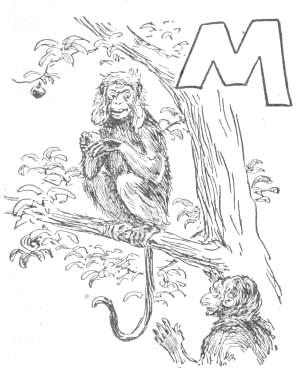
Tertiary Age, Sosee was sitting
on a limb sucking a
mango, when Koree came up
in great consternation.
“The fat baboon, from
across the swamp,” he said, “has carried off Orlee while
her mother was hunting berries in the bushes.”
“If you love me, Koree,” replied Sosee, uttering a
wild scream, “you will fetch her back, and bring me the
tail of the baboon before night.”
Sosee, who spoke these words, was a comely girl of
twelve years, one of the new race which had recently
separated from the Apes, and would no longer recognize
them as equals. There was a hostility between the Apes
and these upstarts, and frequent incursions were made
from the territory of one on that of the other.
The Apes had mostly retreated to the swamps and forests
beyond, while the new race were occupying the
region about Cocoanut Hill, which their ancestors of two
generations before had taken, after many conflicts, from
the Apes, and from which they had driven the savage
beasts. Here the parents of Sosee were living, and here
Sosee had grown to womanhood.
The Cocoanut Hill region was a large tract, in what is
now Southern France, stretching from Alligator Swamp
toward the mountains in the distance. This section was
plentifully covered with fruit trees—mangos, palms, figs
and limes; the under brush furnished berries and succulent
herbs; the waters of the swamp, which bordered
this land, abounded in fish, frogs, turtles, snakes and
alligators; while great flocks of ducks, geese and other
water fowl frequented it at seasons. The forests abounded
in Uri, Woolly Oxen, Musk-Deer and other game. This
abundance of vegetable and animal life supplied food for
the Ammi, as the new race was called, and they would
have lived in comfort but for the attacks of the Apes
beyond the water, who, keeping an envious eye on these
fruits, often came over the Swamp for food.
Shortly before the event of which we speak, some apes
in one of these predatory incursions, were met by a
larger number of the Ammi, when several of the former
were killed, and one, a small boy, taken prisoner. The
Ammi, expecting the Apes to attempt reprisals for this,
kept a watch at night, while during the day they
guarded their children.
Several times on the day mentioned signs of approaching
Apes had been seen. Gimbo, the grandfather of
Sosee, who still persisted in walking on four feet,
(although the Ammi generally had begun to walk upright),
said he could scent the trail of the Apes, and had
noticed the marks of one walking on four feet. But
Gimbo was deemed a garrulous old man, somewhat unreliable,
who claimed exceptional wisdom about the animals
lower than men, so that little attention was given
to his warning.
The mother of Orlee, however, had observed a sudden
starting up of geese from the swamp; but this also raised
little suspicion, as they might have been startled by a
fox. Later, however, her keen sense of hearing detected
successive splashings in the water, as if made by plunging
alligators or turtles on the approach of an enemy.
She was, accordingly, slow to leave the spot where her
child was playing—a girl of three years, the sister of
Sosee.
Gaining confidence, however, with the restored silence
of the swamp, she took a club with which she usually
warded off reptiles when hunting berries, or killed them
when requiring them for food; and, armed in this way,
she waded into the swamp, still keeping, however, in
sight of her child.
As the berries were plentiful, she had soon eaten all
she wanted, making thereof her morning meal, when
she was attracted by some luscious ones farther in the
swamp, which she hurried to get for the child. Having
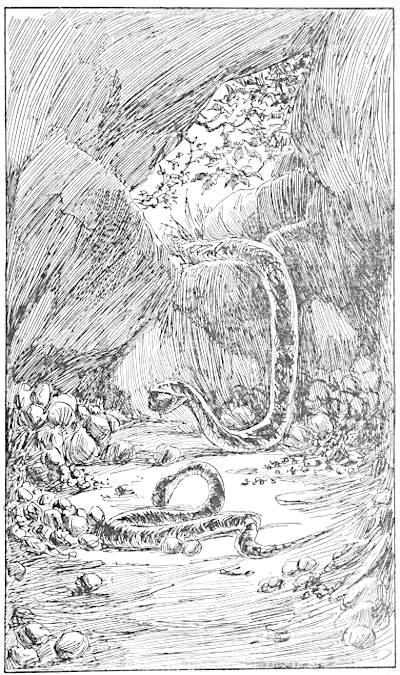
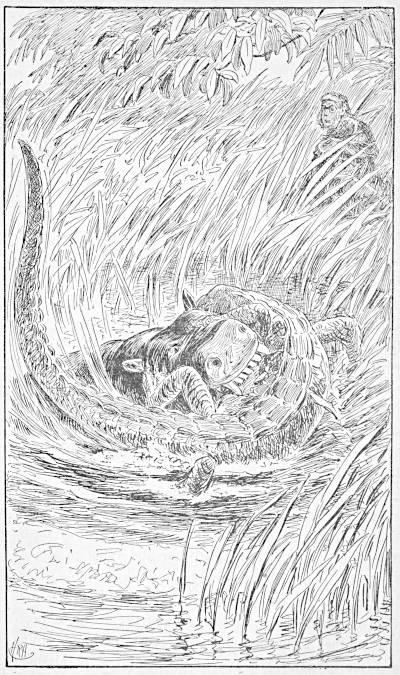
filled her hands she was next startled by a huge snake
of the Boa species, which swung suddenly down from a
tree, like a great vine and sought to fasten its coils
around her.
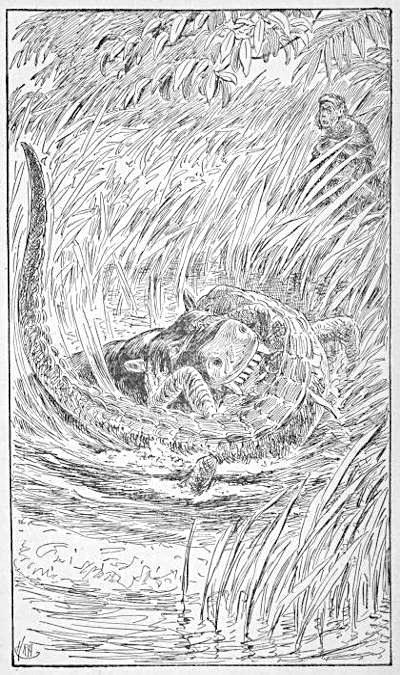
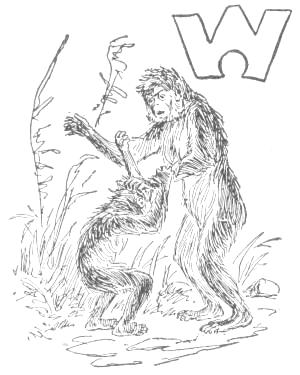
SOSEE’S MOTHER ENCOUNTERS THE SNAKE.
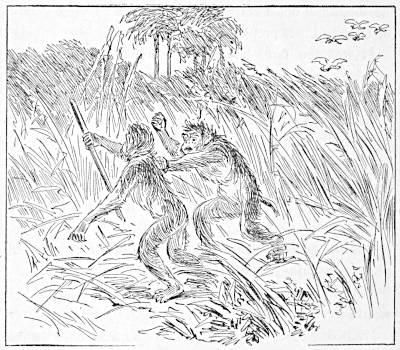
Dropping the berries and uttering a wild scream, she
seized the serpent, and, sinking her nails and teeth in its
flesh, began a fatal struggle with it. The snake, which
had fastened one coil about her leg, swung round violently
with the intention of encircling her waist. Her
screams startled the child, which began crying, and the
two noises attracted the attention of Koree, the lover of
Sosee, who was sporting in a puddle near by.
Koree started to the rescue of the woman, but, in the
tangled underbrush could not find her; but, instead, he
ran against a gigantic ape, which had also been startled
by the cries, and, in his fright, was running about in
confusion. This ape gave Koree a powerful blow with
his fist, and then ran out of the swamp to where the
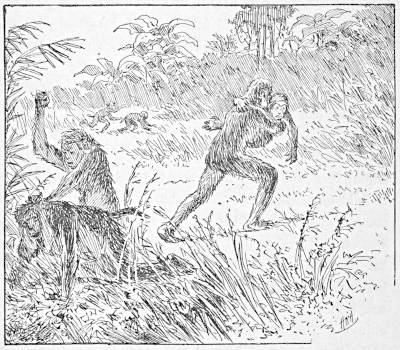
child was playing. Seizing the child he next ran with it
into the bushes and was out of sight.
Too weak, or too frightened, to follow, Koree now
hurried back to give the alarm, when he encountered
Sosee on the tree, as we have related. Sosee’s screams
and calls to Koree to rescue the child roused some men
near by, who now all rushed for the swamp.
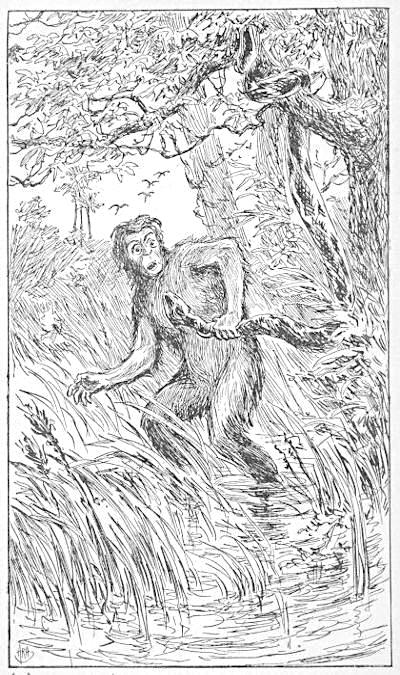
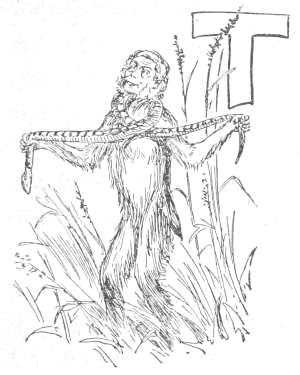
As they approached they saw the mother of the child
emerging from the bushes carrying the huge snake in
triumph about her neck, part of which was hanging
down in long folds, pending from her arms. Never was
a woman prouder over a necklace of diamonds or pearls.
Her bloody face and arms added to the terror inspired by
her Amazonian air, as, with a proud step, she advanced
to the men and threw down her trophy.
Disburdened of her load, and sinking from the stimulant
of battle, she now became faint, through loss of
blood, and was about to drop to the ground; for, in the
struggle with the serpent, she had been severely bitten
and wrenched, so that her own blood was mingled with
that of the reptile on her body.
As she was about to faint away, however, she observed
that her child was gone, when all the excitement
returned which had attended her in battle, and, on hearing
of its capture, she sent up a wail which echoed
through the forest, and flew into a rage that terrified the
bystanders.
CHAPTER II.
The events related in the preceding
chapter occurred, as
we have said, about ninety
years after the fight between
the Monkeys and Snakes on
Cocoanut Hill. As the time
of the Ammi is reckoned
from this fight, we shall go
back, for awhile, to the
affairs which immediately
preceded it.
The Apes of all kinds had, till then, been roving
promiscuously over the country along with wild beasts of
every description. The forests being free to all, and
likewise the swamps, there was a scene like that of the
jungles of Central Africa to-day. Land and water
teemed with life, and were animated with struggles
for the food of the region. Gigantic lions, tigers,
woolly rhinoceroses, mastodons, cave-bears and other
savage beasts sported in their favorite element. Serpents
were particularly abundant, especially in the great Alligator
Swamp, from which they emerged to the high
country to catch rabbits and other game. The Apes,
which were mostly vegetarians, did not at first interfere
with the more savage beasts hunting in these forests; so
that there was an endless variety of animals in the region
of which we speak.
The Apes at this time lived mostly on trees, especially
at night. This was necessary on account of the more
savage beasts which roamed over the ground. When
game became scarce the tigers and some other animals
attacked the Apes, and often killed them. The weaker
animals which could not climb the trees were generally
in danger of becoming the prey of the stronger ones.
This arboreal life became in time irksome to the Apes,
many of whom had made some progress in methods of
living and hunting. These were, accordingly, anxious
to acquire a right to the ground, and security in its possession.
They had become so large that a fall from a
tree was a serious matter. Nor was a tree always convenient
to climb when they were in danger.
They could not, however, come to the ground while so
many savage beasts occupied it. A sleeping ape was
liable to suffer death if met by a tiger, especially in
recent years when many fights occurred between the
two. The Apes, accordingly, conceived the project of
ridding the country of the more dangerous animals.
There were two principal species of Apes at this time,
the Ammi, who afterwards became known as men, and
the Lali, who were the enemies of the Ammi on the other
side of the swamp; and, though there had come to be
marked differences between the two, (of which we shall
presently speak,) they were, at this time, both living
together as Apes (the Man-Apes of Biology), and were
alike interested in ridding the country of the stronger
beasts.
A council was, accordingly, called to take measures
for their common welfare. In this council they gave
their respective views without those formalities which
now attend such gatherings. They spoke mainly in
gestures and growls, which constituted all there was of
language then, (articulate speech not having been developed
beyond a few broken sounds). One, Shamboo,
believed to be the great-grandfather of Sosee, was the
acknowledged leader of the Apes, and he directed the
deliberations of this assembly. Speaking in the manner
indicated, this Ape harangued the multitude to the following
effect:
“Tailed Apes, upright Apes, Baboons and Monkeys of
low degree: I am tired living on trees. I am getting too
old and fat to climb, and cannot go up in the air every
time I want to sleep. My eyes are bad, and can’t tell a
rotten limb from a sound one. Only two days ago,
while eating a cocoanut, the limb broke on which I was
sitting, and I fell to the ground, striking a porcupine;
and there has been a sick monkey ever since. Just
before the big rain I was chased up a tree by a hyena,
when, before I got out of reach, he seized my tail,
already reduced to a stump, and I had to let go of either
the tree or my tail. I stuck to the tree, but to-day I am
a tailless Ape! Why should the ground be conceded to
tigers and snakes? The earth was made for monkeys.
Our food is mostly on the ground, and it is easier to walk
on a level than up and down. We can run faster than
we can climb. We cannot fly, like the birds, and there
is no easy way for such big folks to get up a tree. But
we dare not come to the ground. If we do we must
fight some brute. The tigers want the earth; and we
can’t afford to maintain perpetual war. I am, therefore,
for peace, and so favor killing off our enemies. If the
forces of the trees will but combine, dropping their disputes
about the milk that is in the cocoanut, they can
conquer the forces of the earth. Resolve, then, monkeys
all, to make a fight for the land, and not be so often
found up a stump. True to your ape-hood, join me in
an oath to drive out the ground-beasts. Everything in
this valley will then be ours. We shall have the plants
and berries, and frogs, and little fishes. We can then
lie down to sleep without falling off, and run about without
getting tired. Whoever loves monkeykind will,
therefore, follow my advice. Now, all of you who are
resolved to drive out the beasts which claim this land,
swear with me by scratching your top rib while I crack
this butternut and eat the kernel.”
The eloquence of Shamboo gained the assembly to his
proposition. Every rib got a scratch, and the solemnity
of the hour was felt in every breast. An aged priest of
the Mountain Apes bowed low his head, breathing a
blessing on the undertaking; and from that hour the
savage beasts of Cocoanut Hill were doomed.
CHAPTER III.
The plan of attack on the beasts
was two-fold. One method
was to associate together and
make a combined assault by
two’s or more, according to
the strength of their antagonists.
The other was to get on
trees and spring upon the enemy
when asleep or at other
disadvantage. In this way
they hoped to so worry the
larger beasts that they would quit the region of their own
accord.
This coöperation was important as being the beginning
of association among Apes. By uniting in two’s and
three’s for attack or defense they learned to confederate,
and so laid the foundations of society. Till that time
they had roamed the forests and jungles solitary, each
one hunting alone his food, like the tigers, and forming
no lasting or frequent attachments. They met the opposite
sex casually at a spring or in the fruit regions. They
did not recognize their own children, or care for them
except for a few years after birth, until they could roam
for themselves. Only occasionally did they meet for a
common purpose, and then only for a little while. They
were not gregarious, though they sometimes met in large
numbers where food was abundant, and became slightly
acquainted. They chattered or fought while together,
and then parted to see one another perhaps no more.
Having now, however, formed a League of the Apes,
offensive and defensive, these animals, who disputed
with the tigers the right to be called the lords of the land,
soon became acquainted with one another, and therefore
learned to like each other better. They found that they
had many common interests, and there sprang up warm
attachments between them. Their mutual disagreements
disappeared before their disagreements with the tigers.
They learned to help one another that they might destroy
a common enemy, founding their unity on their common
hatred. Many sentiments were, accordingly, developed,
to which ape-hood had before been a stranger. Hearts
were touched where before there were thought to be only
stomachs, and a new sentiment—love—was awakened in
the race; and when they parted after a night’s watch, or
fight, they often presented one another with a cocoanut
or bull-frog. Unselfishness gradually took the place of
unrestrained competition, and a monkey etiquette grew up
and became recognized. Some of the apes became noticeably
polite, especially to the opposite sex, and there was
soon quite a little social intercourse between them. They
would go out by two’s and three’s for food or water, as
well as for a fight, and thus they learned to labor together,
as well as fight together.
Nor was this all. Having got together in a league, it
was not easy to separate them. They came together to
stay, and they stayed to co-operate in many measures
besides their own defense. After their wars certain industries
sprang up, among which was the damming of
part of the Swamp (where it was entered by a stream),
so as to form a lake, in which they could with more
convenience drink and wash. Having tasted the sweets
of association, they wished, in short, to remain in society;
and when subsequently the younger ones became restive,
and tried to regain the liberty of independent or single
life, the older heads compelled them to adhere to the
social compact.
Scarcely had they formed their alliance for war, when
they set out for the enemy. Their chief foe was the
tigers and snakes, because these were most numerous,
although there were some lions, pachyderms, bears, and
other savage beasts, of which also they meant to rid the
country. One proposed that they all start out together,
saying that while they would thus be fighting as
a whole, the enemy, which would be fighting singly,
could be easily overcome. Shamboo opposed this plan,
however, as likely to attract too much attention, and,
perhaps, to cause the tigers also to confederate. “Let
us,” he said, “indeed, fight each enemy singly; but it
does not require more than three apes to kill one tiger.”
They accordingly broke up into small bands, and
started on a tiger hunt. On the first day of the War of
the Beasts, a body of three, led by Shamboo, climbed a
Yew tree near the Swamp, where a great tiger was
known to come to slake his thirst. It was agreed, or
rather laid down by Shamboo as the method of attack,
that when the tiger should pass under the tree, one of
them, the youngest and strongest, should drop upon the
tiger’s back, and fasten his jaws in his neck, when the
rest would follow and dispatch their victim.
SHAMBOO’S RIDE.
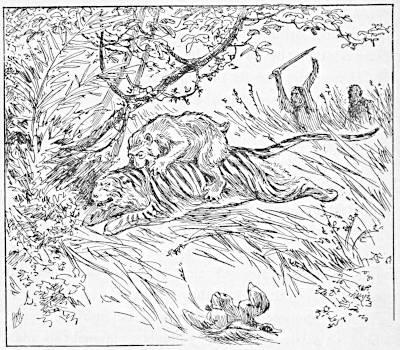
Scarcely had this been resolved upon, when the tiger
appeared, marching slowly toward their tree. He was
carrying a sheep in his mouth, and his great show of
muscular strength and fierce expression seemed to despise
danger. The ape who had been chosen to drop on the
tiger drew back in fear, and told Shamboo to do that
part himself.
No time was to be lost, and, before the words of the
timid ape were fully uttered, Shamboo dropped upon the
tiger. His great weight crushed the beast to the ground,
and compelled it to let go of the sheep. The tiger
immediately got up, however, and, not knowing what to
do, in his embarrassment, started on a full run. Shamboo
clung to his back, and away they both went, like
John Gilpin, dashing over hill and dale and through jungle
and forest. The deer fled at their approach, squirrels
ran up the trees, a flock of ducks started from a pool
near by, and the flight of birds and beasts from their
path was like the stampede which precedes a prairie fire.
Shamboo’s teeth were fixed in the tiger’s neck, and his
feet like spurs were sunk in his sides.
So they ran, and the earth rapidly receded behind
them. The other two apes followed, but at a distance,
so that the tiger and Shamboo were practically alone,
and must soon, it seemed, try their strength in single
combat. The tiger, however, was too scared to take an
inventory of what he was carrying, while Shamboo’s
thoughts were divided equally between how to hold on
and how to let go. The tiger himself soon solved this
problem for Shamboo by running through a hole in a
thicket which was too small to admit both, so that Shamboo
was knocked off. He fell into a cluster of bushes,
and the fall was so violent as to cause him to turn several
summersets, so that he did not know in which
direction he had been going. The tiger, lightened of
his load, but not of his scare, kept on, and was soon out
of sight and out of this story.
Shamboo picked himself up and, looking round, spied
the other two apes coming slowly toward him. He
limped back to them with an air of disappointment,
rather than of suffering, and, without uttering a word,
fell upon the younger ape, who had shown cowardice,
and killed him for his breach of military discipline in
disobeying orders.
The fame of that ride and that fight remains to the
time of this story, though there are different versions of
it among the Ammi and the Apes beyond the Swamp.
And long subsequent to this time, when the descendants
of these Apes got to riding on the backs of horses
and cattle, there was a legend ascribing the origin of the
uses of beasts of burden to this unwilling ride of Shamboo;
and in the mythology of the later Apes Shamboo
became the god of Domestication.
CHAPTER IV.
In the course of the contest
with the tigers, which lasted
several years, many improvements
were made in the art
of warfare, which afterwards
served the Apes in time of
peace. After the experience
of Shamboo and others, who
attacked unarmed the savage
beasts, they found it advisable
to fight at a distance. Taking
their position on trees, which was done for safety, the
problem was how to reach the enemy. They commonly
showered cocoanuts and other large fruits upon them,
which, while annoying to small animals, had little effect
on tigers. They next carried stones up the trees for
missiles, which they dropped with some effect. In time
they became expert at throwing, and could strike a
tiger’s head ten paces off. Shoozoo claimed to have
killed a hyena at a distance of many alligators’ lengths
with a rock larger than his head; but Shoozoo had a
reputation for lying, which was greatly developed during
the war.
The Apes also broke off branches of trees, with which
they pounded the savage beasts, not only by throwing
them from the trees as missiles, but by using them as
clubs, until they became skilled in the art of pounding,
as well as of making clubs. When catamounts, bears
and other climbing beasts attacked them on the trees,
and fought paw to paw with them, they used the stones
as knives, and often cut their assailants fatally, having
learned to select sharp stones for this purpose, and, in
time, to sharpen them specially. Before the war they
had used stones only to crack nuts. But now they
learned both to use them for many other purposes, and
to make them into the size and shape which best suited
them.
The first manufactures of the Apes were thus of military
implements, their necessity being the mother of
invention. In time of peace, however, they found new
uses for these implements, like their descendents who
afterwards beat their swords into plowshares and their
spears into pruning-hooks. The missiles with which
they had attacked the tigers they soon used for hunting,
and in time for building. When they came down from
the trees, and lived more on the earth, they knocked
cocoanuts down, instead of climbing after them; they
killed birds and rabbits by throwing stones at them,
instead of lying in wait for them, and they speared fish
with their clubs which they had learned to sharpen.
They could thus act at a greater distance, and so had
more power, both to defend themselves from wild beasts,
and to obtain food.
Shoozoo, the liar just mentioned, told some wonderful
stories of a stone which he sharpened and the exploits
he performed with it. He saw a lion, he said, sleeping
at the foot of a tree, when, throwing the stone, he cut
the tree from its stump, which, falling on the lion, killed
him; and he would have brought the dead lion to verify
the story, but it was so big that all the monkeys of
Cocoanut Hill could not have carried it away; but he
showed the sharpened stone as evidence.
He related also that when hunting owls at night, after
killing all that were in the forest, and having nothing
more to throw at, he threw his stone at the moon, and
hit it with such force that he cut off a piece; and, as evidence
of this, he pointed to the moon, which was, indeed,
seen to have a large piece gone, so that many Apes
believed him for once, though they knew he was habitually
a liar. For the evidence of their senses was generally
deemed enough for the Apes. Shamboo, however,
doubted the story and asked Shoozoo why he did not
bring home the other piece of the moon. “When I cut
it off,” he replied, “it fell into the Swamp and was swallowed
by an alligator. I expect to catch that alligator,
and then I will show you the rest of the moon.”
The Apes of Cocoanut Hill, however, who placed little
confidence in Shoozoo’s stories, placed less in his
promises; although the next generation, which accepted
him as the founder of their religion, believed him to be
a better man, and accepted his stories as history and his
promises as prophecy; so that what was incredible to
contemporaries became indisputable to posterity; and the
traditions that gathered about his name were sufficient to
silence the doubts in a generation later which they had
raised in a generation before. In course of time the bigger
stories only gained credence, the rest being forgotten;
so that what was received with most distrust was handed
down with most confidence; and the farther they got
from the time of their performance the easier it was
thought to be to get at the truth about them.
For many generations every alligator that was killed
was opened in order to find the moon; and, though it was
often claimed to be found, there was never as much confidence
in the story of its recovery as of its loss; for the
Apes early learned to distinguish between religious stories,
and only accepted those for which there was adequate
evidence. The uninterrupted testimony of the
fathers, which had come down in regular succession, and
had never been doubted, was deemed the best evidence.
Apes have accordingly differed about the incidentals of
the story; for many accounts have come down about the
details, which are not to be reconciled; but as to the
great essentials—that the holy Shoozoo actually did
knock off a piece of the moon, and that an alligator
swallowed it—there is a substantial agreement; and as
often as the moon, in generations later, appeared in crescent
form, the festival of the Holy Crescent was celebrated
by throwing sharpened stones in the air in honor
of the great exploit of their Founder, Shoozoo.
But, though Shoozoo, who passed in one generation
for a liar, and in the next for a God, left a questionable
heritage to the Apes, they still retained out of his age
something of substantial value. The use of implements
was invented, and the arts of making and using them
were handed down to Monkeys and Men.
CHAPTER V.
After the savage beasts had
been driven from the region
of Cocoanut Hill, and the
Apes had come down from
the trees, and were habitually
on the ground, they found
themselves encountering new
dangers. The snakes were
troublesome. The snakes
had, indeed, been troublesome
before, but it was mainly when they climbed the
trees for birds’ nests or fruits. The Apes did not then
encounter them so often, and amid the greater dangers
from the four-footed beasts, did not find it necessary to
make war against them. But now, when the Apes
walked more on the ground, they met the snakes oftener,
and under more disagreeable circumstances. The snakes,
moreover, had greatly multiplied since the destruction of
the savage beasts, many of which devoured, or fought
with, snakes, or else lived on the same food. With the
departure, accordingly, of the enemies of the serpents,
and their increase of sustenance, the serpents became
powerful, and at last threatened to drive the Apes from
the region. It became dangerous to walk abroad, especially
near the Swamp. At night they disturbed the
slumbers of the Apes. Shoozoo declared that he once
found two in his ear when he awoke, and that he had
swallowed some big ones during the night, although
Shamboo declared contemptuously that he only had worms.
Many precautions were, from time to time, taken
against the snakes. Some of the Apes persisted in still
sleeping in the trees. Most of them, however, sought
holes in the ground and caves in the rocks, which they
fortified by piling brush and earth at the entrance; while
others, not finding holes conveniently at hand, dug them
and covered them with brush, so as to form a mound.
The race had thus begun to build, and one of the first
arts—architecture—was founded. The home originated
in a fight against the serpent.
The snakes, however, soon attacked these homes, and
all the more eagerly because of the food stored in them.
For the Apes found that they could put their structures
to many uses not before known. They would hold their
provisions, as well as themselves, and would protect such
provisions from the weather, as well as from the snakes,
and so preserve them for a longer time. Their homes
accordingly became store-houses, and this facility for
keeping provisions by storage stimulated the collection
of them. Instead of gathering only what they wanted
to eat at the time, the Apes now picked up all they could
find, and placed it in their dug-outs. They soon learned
to allow nothing to go to waste, and became economical.
They even collected when they did not want anything,
from the mere fact that they could store it, and thus
became provident. They believed they might want in
the future, and so often stored large quantities; for some
Apes early became avaricious. They got in time to be
as proud of their possessions as of their homes, and
often gathered from a feeling of ambition. Shoozoo
claimed that he had enough fruits in his mound to feed
all the Apes of Cocoanut Hill for a lifetime; which
nobody of that generation believed, and nobody of the
next doubted.
These great quantities of fruits, we say, attracted the
snakes, who were soon found more plentiful about the
homes than about the swamps. Wealth always has its
enemies, and a snake no more than a man, will work for
what he can get more easily. It was thought easier to
get cocoanuts in Shoozoo’s dug-out than by climbing a
tree.
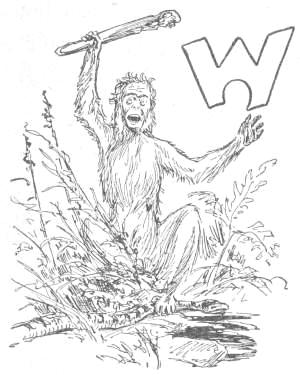
One day an ape, who had made a large collection,
found, on returning home, that all his store was gone.
The snakes had broken in and eaten what they could, and
destroyed the rest by half eating it. The only sign of
the thieves was an old snake which had eaten so much
that he could not get away, and lay, like a drunken
man, helpless on the ground. The ape soon dispatched
him; but that did not satisfy the ape. He was indignant,
and in his sense of suffering wrong we have the
first appearance of the ethical sentiment. The sense of
wrong in others appears before we recognize it in ourselves.
The snakes did not feel the wrong; nor did the
same monkey when afterwards he went to steal some of
Shoozoo’s fruit (and found none), although he felt an
indignation at Shoozoo that might be called an incipient
sense of the wrong of falsehood. He wanted to charge
Shoozoo with lying; but as that would have disclosed
his own theft, or attempt at it, he suppressed his indignation
in his prudence.
THE ROBBERS OF THE AMMI.
Other depredations were committed by the snakes, so
that almost every ape soon had a property grievance.
Added to this was a growing personal animosity between
the Apes and the Snakes. As they had frequent contests
over the fruits, they had learned to fight, and so to
hate, each other, and finally to look upon each other as
public enemies.
Nor was all the fault with the snakes. For as soon as
the Apes got to accumulating, they scoured the swamps
as well as the hills for provisions, and so met the Snakes
in their own element, who had to fight for the ungathered
fruits as well as the gathered. In fact, through
their strongly developed acquisitiveness, the Apes had
drained the country so generally of its productions, that
there was not enough left to support the Snakes, so that
the latter had to become criminals and attack the gathered
stores. Whenever the rich gather up everything
so close as to leave nothing for the poor, the latter will
turn criminals, whether they be snakes or men, and will
steal from the rich, whether these be men or monkeys.
There, accordingly, sprang up an antagonism between
the Snakes and the Monkeys, which had all the bitterness
of class feeling, as well as of race prejudice, and soon an
irrepressible conflict was impending. The Monkeys
demanded the extirpation of the Snakes as violently as
they had, in the preceding campaign, demanded that of
the tigers; and from one end of the highlands to the
other was heard the cry, “The snakes must go.”
“Steppers and crawlers,” said Shamboo, “cannot live
in the same country. If there is anything a monkey
hates it is to tramp on a snake. Only to-day one bit me
in the heel, and to-morrow I shall crush his head.
Enmity is declared between our race and theirs. A
snake in the grass can never be loved by our seed; and
so, until there shall be no more Snakes, or else no more
Monkeys, the conflict must go on. We came down from
the trees to the ground only to find others who had got
still closer to the ground, and were climbing the land as
we had climbed the trees; and it is a question whether
belly or feet shall walk the earth. When the Apes got
down off the trees they got up on their feet; and we do
not mean to again walk through life on four feet to look
for snakes.”
CHAPTER VI.
The fight with the snakes, which
now began, was not remarkable
except for the stories to which
it gave rise. The reptiles were
nearly all driven from the
country before it was over, although
many of them took refuge
in the Swamp. But many
tales of prowess were related of
that war, which made it famous
in after times, and caused it to
be the event from which subsequent time was reckoned.
Shoozoo claimed to have killed more snakes and bigger
snakes than any of the rest, and, as none could boast
much of their actual exploits, which were small compared
with those claimed by Shoozoo, they all took to lying,
and thus started the habit of making snake stories, which
has come down to their descendants. These accounts
were so great that the next generation, which was the
first to believe them, ascribed marvelous powers to the
heroes of this war, and so made it the commencement of
an epoch, as well as preserved the stories, with additions,
for their future theology.
“Why do you not,” asked Simlee, a young gorilla for
whom Shoozoo had formed an attachment, “bring home
one of those big snakes of which you kill so many, and
proudly lay it at my feet?”
“Is it not enough,” retorted Shoozoo, “that I bring
home the story of it? The honor that comes from
snakes is not in having them, but in killing them.”
“But I want the proof of both your exploits and your
love,” replied she; “the other baboons bring something
to their loved ones, and the girls are all taunting me
with your failures and your neglect. I am pining for
snakes.”
Shoozoo felt embarrassed, but, being always ready
with a promise when he lacked an achievement, said:
“I will bring you the great dragon of the swamp, the
winged alligator that rules these waters and darkens the
sun when he flies.”
“I would rather have plain snakes,” she said; “I
would entwine them in my hair, and, like the girls of Jo
and Kibboo, drape them as trophies about my neck.”
“Never doubt my love,” he replied, “You shall be
ensnaked; and my conquests and your adornments will
be the pride of all monkeydom.”
Simlee, thus reassured, ran laughing up a tree, while
Shoozoo departed to achieve, or invent, fame.
Arming himself with a club and a vivid imagination
he went out, like Don Quixote, for snakes and glory.
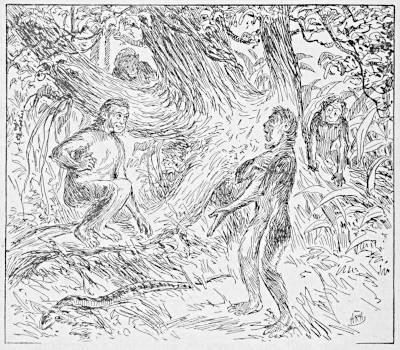
“SEE, BELOVED, HOW THE MIGHTY FALL AT THE WORD OF
SIMLEE AND THE STROKE OF SHOOZOO.”
He had not gone far when he encountered an enormous
snake, the first real one he had found since the war, notwithstanding
his stories, and one which would, indeed,
have delighted Simlee and given Shoozoo fame as its
slayer, had he brought it home. But, instead of Shoozoo
making for the snake, the snake made for Shoozoo.
Back he turned excitedly, and there was a long race
between the snake and the monkey, the monkey keeping
ahead and gaining; and long after the snake ceased to
follow Shoozoo continued to run. At last, however,
Shoozoo panting and almost out of breath, climbed a
tree, and looked about to take in the situation. And,
though he did not see the snake, he nevertheless would
not come down, but remained in the tree till night, when
he sneaked home by a route different from that by which
he came.
On nearing the place where he had left Simlee in the
morning, and wondering what account he should give of
his day’s adventure, he found another huge snake lying
in his path. He started back in fright; but, assuring
himself that it was dead, he approached with courage.
“This,” he said, “is my opportunity; it will both satisfy
Simlee and astonish the rest.” And so, shouldering
the snake he bore it proudly back to Simlee, and laid it
at her feet with these words:
“See, beloved, how the mighty fall at the word of
Simlee and the stroke of Shoozoo!”
Simlee leaped from the tree with glee, and taking up
the snake, called to the other girls who were sitting
among the branches or lying about the mounds, to witness
her good fortune.
“That’s the same snake,” replied one, “that was
brought here two days ago by Kibboo, and thrown away
this morning because it had begun to smell.”
At this Simlee grew angry, and flew at the girl with
open jaws, tearing her hair and beating her face; and
there would have been as hot a fight between the women
as between the men and the snakes, but for the return of
the warriors with their trophies, when the curiosity of
the female apes, which was greater than their anger, put an
end to the quarrel, and they all ran to possess themselves
of the snakes for ornaments.
CHAPTER VII.
We have said that the stories
of the exploits of this war
have been handed down in
the religion of the Apes.
This is due not so much to
the achievements of the heroes
as to the accounts of
them by Shoozoo, who was
much more active in relating
battles than in fighting
them; so that, as the heroes of the Trojan War owe
more to Homer than to their own prowess, (for many
great men lived before Agamemnon, whose exploits are
forgotten for want of an imaginative historian); so the
heroes of the fight about Cocoanut Hill are chiefly indebted
to the Homer of the Apes for his reports of
them. As gods, demi-gods, heroes and fair women rose
from a ten days’ skirmish on the banks of the Scamander,
so divinities, good and bad, had their origin in the
Cocoanut Hill battles by reason of a good telling. Shoozoo
was, fortunately, unlike Homer, both warrior and
historian, and so, like Xenophon and Cæsar, made himself
the chief character in his accounts. The other apes
nearly all drop out of history, and their deeds are
ascribed to him, who at the time of this story, was
deemed the chief character in that conflict; showing that
for future fame a good liar is better than a good fighter.
Thus the driving out of the snakes from Cocoanut Hill
came in time to be wholly attributed to Shoozoo, so that,
like St. Patrick, he was honored for the entire service of
their expulsion. The great dragon, or flying alligator,
of which he only spoke to Simlee as an excuse, was, in
time, believed to have been actually killed by him, as a
primitive St. George. The snake that had entered the
mound of one of the apes, and gorged himself with its
treasured fruits, and which was killed by the ape, was
alleged to have been slain by Shoozoo while guarding
great treasures in a cave, as Siegfried slew the Nibelungen
dragon. The expulsion of the snakes from
Cocoanut Hill found its way into various stories about a
primitive pair of apes—Shoozoo and Simlee—whose
fruit was stolen by snakes, for which the snakes were
driven from the country; reversing the story of Adam
and Eve, who took the fruit from the snake and were
themselves expelled, instead of the snake. Had Adam
been his own biographer, like Shoozoo, the story of
Eden might have been reversed.
The long contest and great enmity engendered
between the Monkeys and the Snakes, also caused in
time the serpent to be taken to represent everything bad,
and this conflict came in the Apian Mythology to be
represented as the conflict between good and evil, in
which a great serpent fought with Shoozoo and was overcome
by him, but not altogether slain; so that, as in the
Persian Theology, the contest between good and evil
still went on, although Shoozoo was expected to come
again in the great future, and put the serpent entirely
under his feet.
Also, as the serpent came to represent evil, it was
believed that the great winged alligator, with which
Shoozoo fought, was the King of Evil, or Devil, and,
that, being the chief of serpents, he led all assaults
against the interests of the Apes. He was pictured with
wings, tail, and great claws, and was supposed to be the
power that ruled over Alligator Swamp, or the Land of
the Bad. Apes frightened their children by saying that
the great flying Alligator would come up out of the
Swamp and devour them. Simian demonology thus had
its birth. Like Juno springing from the head of Jove, it
issued full grown out of the imagination of Shoozoo,
with an alligator for its only foundation in fact.
It will thus be seen that the fight between the Monkeys
and Snakes on Cocoanut Hill, which was important
in the history, became more important in the mythology
of the Apes, and, from its prominence in their profane
and sacred traditions, it is natural that the Apes should
make it the commencement of an epoch.
CHAPTER VIII.
After the Snakes had been
driven from the region of Cocoanut
Hill, and the land thus
rid of both wild beasts and
reptiles, the Apes, who had
now undisputed possession,
got to fighting among themselves
for the land. Those,
therefore, who had united for
defense now divided for conquest.
There were two principal varieties of Apes, as we have
said,—the Ammi from whom the Men are descended,
and the Lali, who, while resembling the former, were
inferior in manners, and more closely resembled the
present Orang-outang. They had both sprung from the
same original stock, and, until several generations before,
lived together in a more southerly country. At length
they separated, (while still in the south), the Ammi going
eastward, and the Lali westward, like the separation
between Abraham and Lot.
Being thus separated, and so removed from mutual
influence, they soon diverged in customs. The Ammi,
under more favorable circumstances, began to walk erect,
to live more on the ground, to find many uses for their
hands, and to make some progress in speech. The Lali,
who had wandered into a less hospitable country, made
no progress whatever, but rather degenerated; so that
when, generations later, the two varieties met again on
Cocoanut Hill, there were marked differences between
them.
They had both come to the Cocoanut Hill country in a
great migration of monkeys from the South, the Ammi
coming from the southeast and the Lali from the southwest.
This migration was caused by the failure of fruits
in the south on account of some cataclysm in Nature of
which we have no reliable accounts; and monkeys of
every kind came north, so that there were soon all the
varieties of which we have spoken in the Cocoanut Hill
region. And this failure of fruits, we may add, was a
principal cause of the providence of the Monkeys in
laying up stores; for they were anxious that a second
famine should not occur like that in the land from which
they had come.
These apes, having therefore met again, met with differences
such as did not separate them in the south
country; and, though they imitated one another to some
extent (the Lali picking up some of the sounds of the
Ammi, and so acquiring by degrees the habit of speaking,
and also walking at times upright and using their
hands), there were, nevertheless, irremovable differences
between the two; and, though they made common cause
as long as they had to fight tigers and snakes, they again
asserted their differences with the return of peace, and
so found it impossible to assimilate.
In view of this incongeniality the Ammi in time were
found associating wholly among themselves, and the Lali
likewise among themselves. Jealousies and suspicions
arose between the two, and frequently fights. Class distinctions
gave rise to class controversies, and finally to
class wars. The Lali were soon hated as much as the
snakes by the Ammi, who conceived the project of driving
them from the country; and the Lali, in turn,
resolved also to get the country for themselves.
After several conflicts, in which now one party and
then the other was successful, and after several temporary
compromises, in which they tried to live together,
the Lali, partly vanquished and partly persuaded, consented
to withdraw to the lands beyond the Swamp,
leaving the Ammi in possession of the Cocoanut Hill
region.
The separation, however, was no settlement. The
Lali claimed the land which they did not take, and
hoped to get in the future what they were willing to surrender
for the present. The two parties stood, like Germany
and France over Alsace and Lorraine, growling
much, but doing little. Occasionally they made incursions
into each other’s territory, and carried away some
fruit or provisions; but, though they talked chiefly of
war, they lived mainly in peace. Separated by snakes
and swamps, they were kept at peace by the difficulty of
coming together. The danger of crossing, and the delay
in going around the Swamp, were too great for war.
This was the condition and situation of the two forces
which occupied the world as known to our ancestors at
the time of this story.
Having made this digression on the antiquities of the
Apes and a bit of their history, in which we have seen
the origin of their religion, government and industries,
and of many of their customs, we shall now return to
the scenes beginning this story, which are nearly a
century later.
CHAPTER IX.
Sosee had come down from the
tree in which she received the
news of the rape of Orlee,
described in Chapter I, and,
though she had given orders
to Koree to bring back the
child, she did not herself
remain inactive. She rushed
into the crowd, and, calling
upon all, with wild screams,
to rescue the child, went herself
into the Swamp, and without any notion of where
she was going, wandered about aimlessly till night, being
completely lost. She found her way back only by the
light of the moon, whose position in the heavens was
some guide in her wanderings. Nor would she have
returned at all, had she not hoped that some one else
had, in the mean while, brought back the child.
On returning to the place from which she had started,
she was distressed to learn that Orlee was not found, and
she could scarcely be restrained from immediately starting
again in pursuit of her. As Koree, however, had
not yet returned, having searched farther and later than
any, except Sosee, she hoped that he, inspired by her
love, would come back with success. She had most
confidence in him because she had most love for him,
believing that what most pleased her fancy would best
serve her purpose.
Her first disappointment in love was when she saw Koree
return without the child; for in this crisis she felt more
for her sister than for her lover, the newly lost being ever
dearer than the long loved. Koree had failed to meet
her expectation, or rather her desire; and in times of
disappointment the little that is lacking outweighs all
that is not.
“You have failed to bring back Orlee and the tail of
the fat baboon,” she said, “Despair of my love till you
fetch me both.”
This was spoken in the half-articulate manner already
explained, as was the balance of the conversation (which
we translate, however, into modern expression).
“What all the race of the Ammi could not do,” he
replied, “you ought not to blame your lover for not
accomplishing.”
“The love of one,” she retorted, “can do more than
the indifference of many. If Orlee is ever found it will
be by love, and not by numbers.”
“I will yet fetch her back,” he said; “love’s work is
not exhausted in one effort, but requires time for its
fruit. She will come in response to your love acting
through mine. Neither man nor monkey shall defeat
me, or excel me, in this task.”
“Go, then,” she said, “and I will go with you.
Love co-operates, and never commands only.”
“I will go,” he replied: “and not care whether I
return. With Sosee at my side, I could roam forever,
indifferent whither we come, so we be still together.
Had we not gone alone before we would not have
returned without Orlee; but we came back to see each
other. Love left behind defeats its own purpose sent
before. If we separate we will be hunting each other,
instead of keeping our thoughts on Orlee.”
“Let us then go,” she said, “and keep ourselves and
our purposes united, and resolve not to return till
we come with her.”
“I will go; for then will I have everything with me,
and nothing to come back for.”
“If you go for my company only,” she said, “and
not for the child, you will soon have neither. To be my
lover you must want what I want, and not merely want
me; and if you do not get it you will soon be without
me, for love must achieve success to be rewarded with
love.”
“I want more your wish than my own, and will give
up everything for it.”
“Except me.”
“Yes, and you even.”
“You mean thing! I won’t go with you.”
“Well,” he replied, “I won’t go alone.”
“You don’t care for me a bit,” she said.
“You only care for me to serve your purpose,” he
retorted.
“I will get Kibboo to go with me,” she next said.
“He may go,” replied Koree, “and I will stay with
Alee till you return. She is a better climber, and can
run faster than you.”
“Boo! hoo! she has no hair on her back, and is
meaner than you. She ran from a little snake which I
could bite in two.”
“But she loves me, and never quarrels with me.”
“She don’t love you; she only hates me, and wants to
make you do so. She loves Ki, and picked the fleas off
him when he came from the Swamp this evening.”
“Do you love me, Sosee?” he next asked with more
tenderness.
“I won’t tell you,” she replied, sobbing.
“Will you go with me, and stay with me?”
“I never said I wouldn’t.”
Here followed a long pause, during which Sosee sobbed
and sighed, and Koree looked about in his mind for some
excuse for making peace without seeming to want to.
Sosee came to his relief, however, with a question.
“Koree?”
“Well?”
“Will you go with me to find Orlee?”
Sosee, too proud to ask for his love, had asked for his
service.
“Yes,” he replied, glad to give both, “and will not
come back till we find her.”
“Won’t that be delightful! to hunt and find her
together!”
“Yes,” he replied, “and let us start to-night, and
before morning we may find her.”
But night and weariness had settled down upon them,
and as the older men and women had determined to wait
till morning before recommencing the search, the two
lovers concluded to do likewise, saying that they could
then search with greater vigor.
They then walked awhile, though weary, in the moonlight,
and discoursed of love and Orlee, he speaking of
his devotion and she of her confidence that he would
bring back her sister.
“How approvingly,” he said “the monkey in the
moon looks down upon our love.”
“And upon our resolution,” she replied.
They then parted to sleep for the night; and soon their
love, their weariness and their purpose were all forgotten,
except in disturbed dreams, in which he thought of
wandering through unknown swamps with Sosee, and
she pictured the rescue of her sister by a heroic lover.
In the silence and longing of that night, however,
Koree audibly breathed the following sentiment, which
is the first poetry made by the human race:
What is life
Without a wife?
CHAPTER X.
As rosy-colored Morn advanced
to greet the opening eyes of
monkeys and men, and spread
her beams over Cocoanut
Hill, lifting at last the veil
of mists which hung over
Alligator Swamp, a fat baboon
was seen wending his
way with a child in his arms
to the settlement of the Lali.
All night long he had traversed
wood and swamp, picking his way through bush
and fen, eluding the serpent and fleeing from the cry of
the catamount, his only companion the moon, and his
only hope the morning.
“I have avenged the rape of Soolee,” he said, as he
approached the assembled Apes who were expecting the
several warriors back which had gone to the country of
the Ammi to recover the child that had been recently
captured by them.
Great chatterings and shouts of gratification went up
from the Lali as they saw one of their number thus return
victorious. Only the mother of Soolee appeared distressed.
“Where is my child?” she asked.
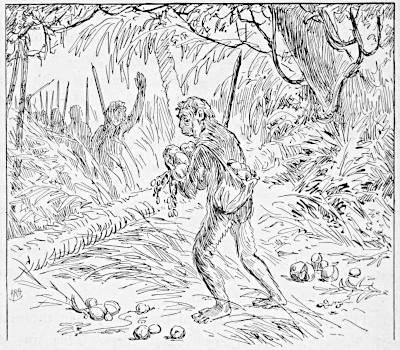
“I have brought one of the Ammi instead,” was the
response of the warrior.
“A man,” replied she, “is no compensation for a
monkey; and the finding of another is no comfort to a
mother for the loss of her own.”
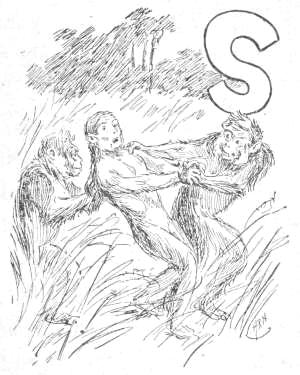
I HAVE BROUGHT ONE OF THE AMMI INSTEAD.
“You can have her for a slave,” was the reply. “You
lost one, and you get one: it makes no difference whether
you have the same or not.”
The mother, however, was not satisfied, although the
rest thought her grievance a small matter. The honor
of the Apes was asserted by the reprisal; and when the
public interest is conserved the multitude cares little for
the individual loss.
Orlee was placed in charge of this woman, who, notwithstanding
her dissatisfaction, was delighted, not only
at having a child, but at the fact that it represented the
vengeance of her people. This double relation to the
infant made her both love the child and mistreat it, the
first because it was a child, and the latter because it stood
in place of her own.
It was customary for the Apes, and also for the Men,
when they had taken prisoners from each other, to reduce
them to slavery, a custom which had arisen, however,
only since their separation; for prior to that, they had
neither property nor interest in each other’s work; and
so neither man nor ape was believed to be worth anything.
But, in acquiring property they put value on men as well
as on cocoanuts, and kept each other as a treasure where
before they had killed each other as a nuisance. Some
even went to war for the prisoners, and the more valuable
they found men to be the more they fought them, until
they soon came to want enemies more than friends, and
to like them better than allies. They fought for something
instead of against something, and numbered their
prisoners rather than their victories. Both sides became
kidnappers, instead of warriors, and the principle and
practice of slavery was established, as a result of learning
the worth of men.
The warrior Oboo, who had brought Orlee to the Lali,
was seen all day to hang around the woman in whose
charge the child had been placed. Some thought it was
on account of his interest in the child; but shrewder apes
said it was on account of his interest in the woman. As
the newly-arrived child had obtained a mother he thought
it ought also to have a father. The female ape did not
repel the advances of the warrior, but said that if he
would also restore her own child he might be father to
both. The mother was, however, much comforted for
the loss of her child by this gain of a father for it. The
two wanted both to attend to the new child, the result of
which was that the child received no attention, which
proved serious, as we shall see. For they paid so much
attention to each other that they often wholly forgot the
child.
This warrior, Oboo, had not a good reputation among
the Lali. Several scandals had already disgraced him,
and his attention to this new woman was looked upon
with suspicion.
“No good will come of it,” said an observant ape, who
remembered his gallantries to others, and who was aware
that he seized every pretext to ingratiate himself with a
susceptible female ape. His bravery, however, had made
him a favorite among the women, although his gallantry
had much to do with it. He was a Simian “Masher,”
and twice got his head pounded by male apes who did not
like his attentions to their female friends.
This ape was charged with starting out for the child,
not because he wanted it, but because he wanted the
mother, and because he hoped that his bravery would be
rewarded with her love. Thus are the motives of apes,
like those of men, impugned from jealousy, and our greatest
warriors are traduced by their rivals. No pains were
spared to suggest these suspicions to the woman herself,
especially by another ape who had loved her, and had
likewise started for her child and come back unsuccessful.
These two male apes finally came together, and when one
charged the other with cowardice, and was charged in
turn with “spooniness,” they came to blows, or rather
scratches, and would have killed each other had not the
woman interposed.
“There is not much difference between you in virtue,”
she said, “and whoever brings back my child shall be
thought the braver.”
“Will you give up that ape if I bring back your child?”
asked the new-comer.
“Yes, but I will stay with him till then for having
brought this one,” was her reply.
The ape departed at this rebuff, divided in his thoughts
between the purpose of recovering the child and that of
punishing his rival for his insolence and his success.
CHAPTER XI.
The morning after the quarrel
and make-up between Koree
and Sosee, these two lovers
started out to rescue Orlee from
the captivity just mentioned.
They tried in vain to induce
the Ammi to go out as a body
to recapture her, but nearly all
except these two had exhausted
their strength and their interest
the day before. An excitement
did not last as long with the Ammi as with their present
descendants, and when they were not all interested they
were quickly reconciled to an outrage. Koree and Sosee,
however, in their first ardor of love, knew no rest, and
had not yet learned to despair.
Arming themselves, therefore, with clubs and sharp
stones, they started around the Swamp, intending to
travel by day and at night to steal upon the camp of the
Lali and take the child by some artifice. They kept
along the border of the Swamp, and where it was not too
deep to wade, cut across its waters. The danger of
neither wild beasts nor serpents terrified them. They
were together, and were fixed on one purpose. Koree
was willing to die with his Sosee, and Sosee believed she
was in no danger with her Koree. So with resignation
or confidence they marched on, heedless of a plunging
alligator or swinging python which occasionally disturbed
the stillness of the Swamp. Occasionally they stopped
to gather mussels or climb after nuts; for they did not
think it necessary to take provisions with them. The
supplies of scouts and armies in those days were light—they
foraged on the country. They marched without
chart or compass, and yet rarely missed their way; for
they had learned to guide themselves by the sun and the
lay of the land. If occasionally, in the thick of the forest,
they could not get their bearings, they emerged from
the swamp to look at the mountains with whose ranges
they were familiar.
It was not easy for primitive man to get lost, and it
did not much matter if he was lost. Wherever he
placed his foot he was at home, carrying his citizenship
with him. Everywhere around were his possessions—the
ungathered fruits and fish and game. Everywhere
were his friends—the chance baboon or man that he
might meet. Only recently, with the association which
we mentioned, had there sprung up attachments for individuals.
Before that their love was for the race, and
anyone represented that race about equally well, as in
the case of dogs. Even since they had come to associate,
their attachments were not permanent; and they
relied much on chance-comers for their society. Should
they, therefore, be lost, they would not feel that they
were among strangers, any more than that they were
away from home.
“If we do not find Orlee will we go back?” asked
Koree.
“We will not go back till we find her,” replied Sosee.
“We could live nicely in this forest,” said he; “there
is plenty of food, and we need no company.”
“When we find Orlee,” she replied, “we will have
company.”
“Two is company,” said he, “and when we find her
and take her to her mother, shall we not come here to
live?”
“Let us first find her,” she persisted; “we can then
decide what to do next.”
“There is nothing that we can lack here,” mused
Koree; “a forest and a swamp include all human desires;”
and then, after a pause, he added, “and Sosee.”
“And Orlee,” interposed Sosee.
“Love in a cottage” was long antedated by “love in
a forest.” A sycamore tree was cottage enough for our
first parents.
“O! O! O! O!” ejaculated Sosee, too frightened to
say more, as she suddenly ran up a tree.
“Oo! Oo! Oo! Oo!” shrieked Koree, as he ran up
another tree.
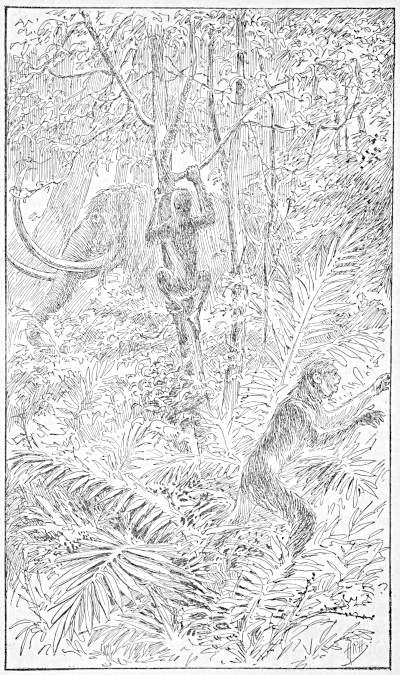
The cause of this sudden fright was a huge mammoth
which slowly lifted itself from a clump of bushes and
walked toward the lovers. A great hairy elephant, twice
as large as those now existing, with long front legs, carrying
his bushy body high up in the air, and a back gradually
sloping to the ground, like a giraffe—such was the
monster that confronted them.
KOREE AND SOSEE ENCOUNTER A MONSTER.
Sosee had run up a slim sapling which this beast could
easily have torn up with his trunk, or from which he
could have shaken her down like a cocoanut; while
Koree had run up a tree stout enough, indeed, to resist
uprooting or shaking, but so low that the monster could
easily have reached him with his long trunk. Their
safety lay, therefore, in their silence, and they were
accordingly quiet,—quiet even for lovers.
The mammoth was in no hurry to leave the place.
He browsed about slowly, picking up bunches of grass,
or reaching after leaves. Once he picked a trunk full of
leaves from the tree in which Koree was sitting; but he
took no notice of Koree, whether because he did not see
him, or because he did not care for him. Koree and
Sosee alone were concerned,—not the pachyderm. They
remained simply quiet, and left the great beast in undisputed
possession of the field. Never were two lovers
more cruelly interrupted, and never did an unwelcome
intruder stay so long.
“Two is company,” said Koree to himself, “and three
is a great big crowd.”
The lovers could neither touch nor speak.
“Would that our trees were nearer,” whispered
Koree.
“Or stouter,” replied Sosee.
“Or taller,” returned Koree.
“Never did I think,” muttered Sosee, “that anything
so great could come between our love.”
“Ugh!” shuddered they both.
The huge beast kept on eating, unconscious that he
was a bore.
“I wonder when that brute will get enough,” muttered
Sosee in impatience.
“If he is going to fill all that big carcass,” replied
Koree, “we are up here for all day.”
“Our only hope is that the leaves of these trees will
give out,” replied she, “so that he must go elsewhere to
finish his dinner.”
“Or that he will want to take something to drink with
his meal,” replied Koree, “and so go to the Swamp to
wet his snout.”
These breathings of the lovers were unnoticed by the
monster, who took them for whisperings of the wind,
and went on leisurely eating.
“Never did I see such an appetite,” said Sosee.
“Or one so contented with its dinner,” added Koree.
“I don’t like this seat,” grumbled Sosee, “I wish we
were on the same tree.”
“I neither want to sit up here,” returned Koree,
“nor get down.”
“I’m hungry,” said Sosee, after a long pause.
“Never did I sit so long at a meal, and not eat anything.”
“If this meal of the brute goes on much longer,” said
Koree, “we will both starve, or else be eaten.”
Just then, to the inexpressible relief of the tired,
hungry and bored lovers, the animal showed signs of
satiety. He quit eating, looked around with an air of
satisfaction, stretched himself, and made a start, as if
about to leave the place. Their gratification, however,
was short. He walked around a few steps, and then, to
their dismay, lay down under the tree on which Koree
was perched, and disposed himself for an afternoon nap.
Koree looked at Sosee, and was silent.
Sosee returned the look, but was too disgusted and
empty for utterance.
“If that beast sleeps as long as he eats,” she said,
“we will get neither supper nor slumber to night.”
“We will, however,” returned Koree, “be safe; for
neither ape nor snake will attack us with such a watch
at our door. So one danger wards off another.”
They were now reconciling themselves to spend the
balance of the day, and perhaps the night, in this situation,
and also to add to their weariness, hunger and
disgust, the additional discomforts of sleeplessness and
danger. For as Sosee had never slept on a tree (the
Ammi having come to the ground before her birth), it was
feared that, although her feet were still prehensile, and
served her well in climbing, they might fail her from
lack of practice when it came to holding to a limb when
asleep. Koree determined not to sleep under these circumstances,
both because he could not trust himself on
a tree when asleep, and because he wanted to watch
Sosee in order to rescue her from the mammoth in case she
should fall. Love up a tree was thus faithful to the last.
While they were making their preparations for a continued
disappointment, however, an accident, which at
first seemed disastrous, came happily to their relief.
Koree, in restlessly changing his position, fell off the
tree, and came down with a thump on the back of the
mammoth.
Whether Koree or the monster was more frightened we
know not. Koree, however, was uninjured, the great
beast breaking his fall, for the huge back of the animal
reached, when lying down, well up toward the branches
on which Koree was sitting. Sosee was, perhaps, the
most frightened of all, as one is often most scared at the
danger of another; and she gave a scream which the animal
hearing, believed, in connection with the thump on
his back, to be caused by some other animal that was
attacking him.
He started from his sleep and his position at once,
and, without looking for the cause of danger, rushed
through the forest, while Koree ran up another tree and
waited till the brute was at a safe distance. Then both
he and Sosee came down, and returned thanks to the
great Shoozoo for their deliverance.
CHAPTER XII.
The two lovers had no other adventure
until they came the
next afternoon to the farther
side of the swamp, where the
Lali were settled. There they
were astonished at the multitude
of the Lali, who greatly
outnumbered the Ammi, fairly
swarming in the trees and in
the open country beyond.
It was not deemed safe to
venture out of the Swamp in the presence of so many
apes, some of whom would doubtless recognize them as
belonging to the Ammi; so they determined to hide in
the bushes till night, and then reconnoitre.
In the meantime they had abundant opportunity to
watch the movements of the Apes, who kept in groups,
as if fearing an attack, although an occasional one was
seen alone, and some few came even into the Swamp.
The two lovers did not fear the approach of single apes,
or even of a small group; for, as there were many varieties
among the Lali, and not a single kind only, as
among the Ammi, the appearance of a new kind raised
no suspicion. The Ammi, or Men, moreover, were
hardly distinguishable from certain of the Lali, at least
by the Apes.
“The chance of finding Orlee among so many,” said
Sosee, “is not good; and if we find her we cannot take
her from them.”
“Wait till it is dark,” replied Koree, “and the groups
will disperse, when we can both approach them without
suspicion, and carry her off without resistance. Trust
your lover.”
“I trust you, or I should have not come with you, or
have asked you to come,” she answered; “but I see no
way to accomplish our object.”
“Do you see that big baboon beyond the crowd walking
alone with an ape?” he next asked. “He looks like
the fellow that struck me when Orlee was carried off.”
“It must be the same,” replied Sosee; “for there is a
child near him which looks like Orlee.”
“I think that is only a young monkey,” replied Koree,
“which has been taken out by its parents.”
“The three pay no attention to the other Apes,” replied
Sosee, “and are wandering still farther from them. Let
us approach them; in their absorption it will cause no
alarm.”
“If it is the baboon which I think it is, he will know
me,” replied Koree. “At least I cannot mistake him.”
“If we could get a little nearer,” said she, “I could
tell whether it is Orlee or not.”
“But we cannot get near the child without getting near
the parents,” replied Koree.
“She has wandered off from her keepers,” retorted
Sosee. “Let us approach slowly.”
“Wait till it is darker,” said he. “We can then get
near enough to recognize her without being recognized
by them.”
“They pay no attention to the child,” continued she,
“which is moving away from them; and if she goes much
farther we can get near enough to see her distinctly without
their noticing us.”
“They seem, however,” said he, “to be much interested
in something. Such earnestness among monkeys has a
meaning.”
“It cannot concern the child,” replied she, “and
between their absorption and her distance, we can get her
away while they are thinking about themselves.”
“I hate the looks of that baboon,” mused Koree.
“I like the looks of that child,” replied Sosee.
“I will get her if it is Orlee,” he said, “but I want to
avoid a blow from that brute. We had better be sure it
is Orlee before we take the risk of a broken head in finding
out.”
“The child keeps upright far more than the others,
which makes me think it is not theirs,” said Sosee.
“I should like to have the child just to avenge the blow
I received,” said Koree; “but I don’t want to have a
second blow to avenge.”
“I will take the blow if you will get the child,” replied
Sosee.
“As long as the two old apes are so near it, we could
not carry it off if we got it,” he said. “They would
pursue us and overtake us with our load.”
“Two ought to be able to resist two; and Orlee would
help us,” replied she.
“Before our fight could end the other apes would come
to their succor,” said he.
“Perhaps,” suggested Sosee, “they would give up
Orlee if I would stay with them instead.”
“I do not like that suggestion,” replied Koree, “I will
get Orlee and keep you. Would you rather have Orlee
than me?”
“I was not thinking of that, but only of Orlee.”
They had now approached near enough to see the girl
distinctly, whom they recognized to be Orlee. She had
wandered so far from her keepers that they did not observe
the approaching lovers. Koree and Sosee concluded to
steal up to Orlee, and, without raising any suspicion, lead
her in the direction of the Swamp and then hurry with
her into the bushes where they could not be followed.
As it was getting dark the time seemed propitious for
their scheme.
The couple in charge of Orlee, were, as will be surmised,
Oboo, the ape who had carried her off, and the
woman Oola, in whose charge she had been placed.
This ape continued his attendance on this woman without
interruption, having, while the other Lali were amusing
themselves in groups, wandered off with her and the
child to be alone. This accounts for their distance from
the rest of the Apes. They were so much absorbed,
moreover, with each other, that they did not notice that
the child, Orlee, had wandered away from them, and was
now almost out of their sight, and entirely out of their
thoughts. Oboo and the woman simply kept up their
love-making, while Koree and Sosee were approaching
their prize. What made one pair of lovers forgetful
made the other pair alert. Love shuts and opens the
eyes of mortals in turn, and lays off the harness from
one which it puts on another.
As soon as Orlee recognized her sister she gave a
scream of joy which disconcerted the plans of Sosee and
Koree. It also startled Oboo and the woman out of
their bliss, who now experienced all the horrors of interruption
which the other two lovers had suffered the day
before on the appearance of the mammoth. Oboo felt
most disappointed, and the woman most frightened.
They sprang up, and, for a minute, were bewildered,
thinking that some curious apes, perhaps rivals, had
come suddenly upon them, through jealousy or stupidity,
to interrupt their tète-a-tète. The woman instinctively
sprang in the direction of the child, while Oboo looked
around to see who was the cause of the interruption.
Soon they both took in the situation and started in pursuit
of the child.
Koree, perceiving that no time was to be lost, had
picked up the child and started for the Swamp, Sosee
following at full speed. The child, frightened by the
bustle, set up a combined screaming and chattering,
which attracted the attention of the other Apes and called
a large number of them into the pursuit. The scene for
a few minutes was like that of a couple of foxes pursued
by a pack of hounds, in which the foxes were fast making
for the woods.
CHAPTER XIII.
All now depended on whether
Koree and Sosee with the
child could reach the
Swamp in time to conceal
themselves before the Lali
should arrive. For so dense
was the under-growth in
the Swamp that it was next
to impossible to discover
man or beast that should
attempt to hide there.
Sosee could easily have gained the Swamp in time for
safety, but Koree, who was encumbered with the child,
and so could not run as fast as she, was in danger of capture
by Oboo, who was fast gaining upon him. Sosee,
indeed, had already reached the Swamp, and was about to
plunge into its thickets and out of danger, when she
turned to see if Koree and the child were making their
escape.
She was horrified to perceive that the pursuers were
close upon them; and so, instead of saving herself, she
turned on them, and made a desperate effort to rescue her
companions. Before she could reach them, however,
Koree was overtaken by Oboo, when, releasing the child,
he dealt Oboo a powerful blow, which stunned him, and,
at the same time, avenged the blow received by Koree
from the same ape some days before. Sosee now came
up, and, flying at the ape with screams and scratches,
dealt him another blow scarcely less severe than that
administered by Koree. These two blows compelled the
ape to loose his hold for the moment.
THE RESCUE OF ORLEE.
Released in this way from his pursuers, Koree picked
up the child and again started for the woods, while the
ape, recovering from his blows, again started in pursuit.
He was gaining on Koree a second time, and would have
overtaken him again, had not the course of Koree and
Sosee now begun to diverge; for in their anxiety to
escape neither had noticed the direction taken by the
other in their new start, and so they became separated.
Oboo, observing the beauty and agility of Sosee, felt a
desire to possess her which outweighed his anxiety for
the child. “She is prettier than the old woman,” he
said to himself, “and I will go for her.” Oboo always
had time, even in a fight or a race, to observe an attractive
female, and his head was invariably turned by the
sight, no matter at what business he was engaged. He
accordingly turned from the pursuit of Koree and Orlee,
and started after the girl. The scratches and pounding
which he had received from her were no warning to him,
but rather increased his infatuation by testifying to her
spirit. Love at first sight is greater among Apes than
among Men, and overcomes more obstacles. Accustomed
to fight for their females, and often to take them by overcoming
them in fight, the love of our primitive ancestors
was often “love at first fight.” Oboo, therefore, forgot
his heroism in his passion, and, abandoning all that he
had set out to accomplish, started in pursuit of his pleasure
before he was yet out of his pain, and thought of
enjoying the caresses of a lover, while still smarting
under her blows. The battle of Mars thus turned into
the battle of Cupid, and the warrior, turned lover, continued
the pursuit without much changing his method.
While Oboo was thus pursuing Sosee, Koree with the
child in his arms had reached the thicket, and was safe.
Other apes came up, indeed, to the edge of the swamp,
and penetrated its depths; but, as it was getting dark,
they soon turned back, discontinuing the pursuit. While
there were many things to be found in the Swamp, their
experience had taught them that nothing was ever found
there which was sought for. They might get other apes
or other game, but any particular thing that had escaped
in that tangled waste was deemed irretrievably lost.
In the mean time the pursuit of Sosee continued.
Love added its inspiration to that of prowess in the
breast of her pursuer. Oboo ran for both pleasure and
glory. He must have the girl both because he wanted
her, and because he dared not return without her.
Hence he ran as one who had everything at stake; and
so did she. Like Camilla, scouring the plain, she put
the Ape-land far behind her, while the distant forest
seemed, like Birnam Wood, to be fast approaching her.
Like the timid hare pursued by the hunter, which
darts straight for the shelter of the thick brush or dense
cedars, her ears laid back upon her shoulders, and her
feet in the air, gliding with a billowy motion to a place
of safety, so the swift Sosee ran, measuring off the rapid
miles under her feet, while her panting warrior-lover,
hotly pursuing, sought to take her ere she should find a
refuge in the dense groves beyond.
Sosee at last gained the swamp, and was secure from
the determined Oboo, who saw her disappear at once out
of his sight and out of his hope. The other apes, moreover,
which had pursued from a distance, abandoned the
chase when they saw her enter the jungle, as a dog
ceases to pursue a bird which has flown into the air.
But while she thus escaped her pursuers, she did not
so easily escape those who awaited her. Scarcely had
she entered the forest when she was met by several apes
who were returning from the pursuit of Koree. These,
seeing Sosee approach the forest, ran along its border
(still keeping behind the foliage), with a view of heading
her off. These now sprang suddenly upon her, and,
after a short struggle, made her a prisoner.
CHAPTER XIV.
Sosee was led back to the
settlement of the Lali,
where she was the admiration
of all the Apes. Her
bright face, her beautiful
form, and her shapely limbs
fixed the attention of old
and young. Her captors
were particularly proud and
received the congratulations
of all the rest, who
had now returned from the pursuit of the fugitives.
Oboo alone was unhappy. He was disappointed, both
because he did not capture the girl, and because another
did. One’s loss is greatest when it is another’s gain.
He had visions of love which he must now exchange for
those of jealousy. Quick to conceive a fancy he was
slow to give it up. Started on a pursuit of love, he was
never satisfied till he had achieved a success. And, to
make his condition worse, the woman Oola, in whose
charge Orlee had been given, and to whom Oboo had
been making love, flew into a rage because he had
allowed Orlee to escape.
“I am now wholly without a child,” she said; “you
are no ape, to fail to overtake a boy encumbered with a
girl. You sought my love only to betray me, and now I
am without either lover or child; for with you I will have
nothing more to do. You care less for me than for the
girl whom you followed, instead of my child. If you
ever make a soft face at me again, I will scratch out your
eyes. I have lost everything through your unmonkey-like
conduct.”
Oboo had not much to say, for he could not talk anything
well except love, and that he could not talk in
company. So he took her reproaches, but felt humiliated;
and his embarrassment was increased by the raillery
of the others, who said he could love but could not
run, and that in the tussle with the girl, he had been
beaten. They were so merry at his expense, all the company
joining in, that he got his “monkey up,” and,
becoming enraged, vented his ill humor on Ilo, the successful
ape, who had brought back Sosee.
“You could not have caught her,” he said, “if I had
not driven her into your arms.”
“You would never drive a girl into another’s arms, if
you could avoid it,” replied Ilo; at which the company
chattered merrily their assent.
“I should have caught her,” he said “had you not
interfered. She was already mine, and you only took
after her after she was captured.”
“I suppose,” replied the other, “you would like to
have her, now that you have lost the old woman.”
“I am entitled to her,” he said, “and I shall take her
from you.”
“You could not keep her when you had her,” replied
Ilo; “and do you expect to both take her from me and
keep her yourself?”
“You got her by chance, and could not help taking
her when she ran into your arms.”
“I notice, however, that you did not take her when
she ran into your arms,” was the reply.
“I will show you,” said Oboo, “that I can take her
from both herself and her captor;” at which he seized
the girl, and was about to lead her away, when the other
dealt him a severe blow.
This was the signal for a great fight. Oboo sprang at
the assailant, striking him with hand and foot. The
latter then flew at Oboo with both hands, seizing him by
the neck. There was now a hand to hand struggle, in
which Oboo tried to punch the stomach of his rival, while
the latter tried to throw Oboo to the ground. Oboo with
his great jaws seized the shoulder of Ilo, who, in turn,
dealt Oboo a blow with the other hand, and then bit off
his ear. They now fought with both hands and feet and
jaws, and the region round about echoed with their
growls. Oboo was finally thrown to the ground, when
the other jumped upon him, and nearly beat out his
breath. As often as he tried to rise the other knocked
him down, and sat upon him. The victory was evidently
with Ilo, and Oboo would have fared worse had
not the woman, who really started the quarrel, now interfered
to end it. She took the part of her quondam lover,
for whom she discovered a lingering affection, as soon as
she saw that he was likely to be slain. She growled and
seized the victorious ape, and, after a little struggle between
the three, Oboo was allowed to get up and walk
away. Too weak to fight and too cross not to, he gave
some savage growls as he retreated, and threatened to
whip his contestant and take away the girl at another
time.
Oboo felt that this was an inglorious day for him—to
lose two lovers and get one thrashing. He had, however,
only himself to blame. He persisted in making
love when he should have been watching a captive. He
failed to catch either a young man or a young girl, and
when the latter ran into his arms, he failed to retain her,
but got worsted in the struggle which ensued; and when
he finally would avenge his failures on a more successful
ape, he was ingloriously beaten. He therefore lost
prestige, military and social, for which he said all the
Apes would have to suffer. He was more angry after
his fights than in them, so that his rage came at a time
when it could not serve him. Monkeys, like men, are
more angry at others for their own failures than for anything
else, and so Oboo determined to avenge his own
blunders on others.
The only one who showed him any sympathy was the
woman Oola, who got him into all his trouble. She
indicated a willingness to take him back into favor. But
Oboo was too cross to entertain proposals even of love,
and he went grumbling away, like Achilles, to meditate
mischief and make himself more miserable.
CHAPTER XV.
Such was the wrath of Oboo,
great monkey from beyond
the Swamp, which, kindled
by defeated love, against all
mortals, sent many souls of
heroes to the Shades, and
gave their bodies a prey to
beasts and birds. Unappeased
it flamed in wars unquenchable,
and almost sent
the human race out of history,
and gave back the earth to monkeys, snakes and
wide-spreading marshes.
Instigated by the woman who had lost her child, and
who was for a second time bereaved by the loss of its substitute,
Oboo proposed the next day that Sosee be given
back to the Ammi, in exchange for the child first captured.
This was suggested, not because he cared for the
child, but because he desired to punish the ape who had
got possession of Sosee. If he could not himself have
the girl, he did not want another to have her. Such
jealousy was in the minds of sub-mortals.
This the swift-footed Ilo, captor of Sosee, stoutly
resisted. “If you touch a hair of that maiden,” he said,
“I will jump with both feet against your belly and
scratch out all monkeydom. To your licking of last
night I will add your death to-day. Hear me, O Shoozoo,
if ever monkey was so wronged as I, and help me
to avenge myself upon this insolent gusher, who has
already made love to all the apes, and now wants my
little and dear prize, which alone is to comfort my home,
and gather my plantains in the far off forests of the
uplands.”
And he walked along the shore of the loud-roaring
frog pond.
In the meantime Koree, who had eluded his pursuers,
was picking his way through the Swamp, carrying Orlee
in his arms and Sosee in his heart, hoping that his beloved
was likewise threading her way by another route to
the Ammi, where they would soon meet to enjoy perpetually
their love. This consummation, however, was not
to be reached so soon; but many adventures must first be
encountered by both.
As he journeyed on he saw a great cloud spreading
over the Swamp, darkening the skies, so that he supposed
that Night had suddenly settled down upon Day.
Great swarms of bats came out and filled the air with
their dull beatings, which added terror to the mystery.
Then followed a great rain, or flood from the skies,
which, though lasting but a few minutes, came in such
torrents that trees were broken in two and all the land
submerged. Koree believed that the Sea had suddenly
come upon the Land with the Night, and that Death had
come with both to claim him and all things else.
The sun, however, soon came out, reviving his hope;
but it came so hot, that though it scarcely penetrated the
thick foliage, which was matted with tangled vines, it
generated stifling gases, which, rising from the damp
shades, nearly strangled him; so that, having escaped
death from the water, he now expected it from the air.
Next came a great terror, and he expected to die from
fright. There was a desperate battle between a hippopotamus
and an alligator which reddened the yellow
flood, and stirred it into a wilder foam than the great
rain had done. The alligator he believed to be the great
Dragon of Shoozoo, or Devil of the Watery World.
Soon the whole swamp was filled with animals.
Called out by the rain, some had come to feed, knowing
that the waters, stirred by the shower, would be alive
with fish and reptiles, while others—great land animals—had
been disturbed in their lairs by the washout.
Among these last was a great three-toed tapir, which
seemed to be lost; and, following near it, came a more
graceful animal, having a long tail and two-toed feet,
forming a kind of intermediate type between a hog and
a deer. These two animals were closely watched by a
cave lion, which, washed out of his cave by the flood,
was approaching them stealthily in hope of a meal.
The sight was one of mingled fear and relief to Koree;
for if the lion had not his eye on some desirable game,
he would have attacked him. He awaited, therefore,
with anxiety the next movements of the beasts, expecting
another fight like that between the hippopotamus
and the alligator, when a more dreadful sight alarmed
both him and the lion, as well as the game which the
lion was pursuing, and started them all in different
directions.
THE BATTLE IN THE SWAMP.
This was the appearance of a Dinotherium running at
full speed, with another animal on its back, both engaged
in a fatal conflict. This Dinotherium looked to Koree
like a moving hill, so huge were his dimensions. He
was a combination of elephant, camel and kangaroo,
having a huge hunch on his back, powerful tusks issuing
from his jaws, and a pouch underneath, like our
Marsupials. The beast on his back was what is known
to scientists as a Machairodus, a terrible, carnivorous,
cat-like creature, with long saber-shaped canines in its
upper jaw, fitting it to pull down and destroy the huge
pachyderms (which could easily shake off a lion or
tiger.) This monster and this terror of the forest, which
together seemed like all the great animals rolled into one,
were now united in a death deal. While the cat-like
beast was fastening its fangs in the flesh of the other,
the latter tried alternately to shake him off and to roll
over him. But the savage beast, with great skill,
defeated these attempts. The huge monster next tried
to run under the horizontal limb of a tree, which, though
high, was yet too low to permit him to pass under with
his load. Koree thought that the beast on top would
now be scraped off; but not so. On approaching the
limb he jumped over it, like a circus-rider, and alighted
on the running beast on the other side. The two now
darted on through the Swamp, and at last plunged into a
deep lake. The rider was thrown from his place, and,
as he could not swim, was drowned. The other, however,
which was accustomed to navigate the lakes of this
region, and often entered even the open sea, swam
across the lake (a deep pool in the slough,) and there,
after floating awhile, like a ship unable to find a harbor,
moored himself to the bank with his tusks; and in this
position Koree left him.
“Where can Sosee be during this flood?” soliloquized
Koree, as he started again on his way; “and will she
escape the rage of all these beasts?” He remembered,
however, her agility in climbing trees, and her repeated
escapes from greater dangers; so that his fears were soon
calmed in his confidence, and the thought of meeting
her again made him quickly forget the great forces of
nature and animals which he had just seen in their
struggles.
CHAPTER XVI.
When Koree returned with
his charge to the Ammi,
these were engaged in one
of their sports, which consisted
in throwing cocoanuts,
and the rush of all to
get them, much as their
descendants now play football.
Some of the younger
ones amused themselves by
racing up and down the trees
trying to catch one
another, and occasionally shaking each other from the
branches. One little girl had caught a skunk which she
was trying to feed with figs, to the great disgust of the
skunk. All had apparently forgotten the absent ones;
for the memory of our first ancestors was short, not having
yet been exercised on history.
“I told you to drop that skunk,” said an old woman,
“and had you minded me you would not now be sneezing
and spitting so violently. Go down to the spring
and wash yourself.”
Just then a cocoanut flying through the air, struck the
woman in the eye, and for a moment she did not know
whether it was the odor from the skunk, or a ball from
the players that knocked her down.
“I told you to be careful with your cocoanuts,” she
said, “and had you minded me you would not get this
shaking;” at which she seized the nearest player by the
hair and administered several pulls and scratches.
Finally Koree made his appearance, leading Orlee by
the hand. His first anxiety was to know whether
Sosee had returned, whom he was alarmed not to see
among the players. The mother of Orlee ran franticly
to receive her child, which she fondled with an incoherent
chattering.
“Where is Sosee?” asked Koree.
“Where is Sosee?” asked the mother at the same time.
Both looked at each other in amazement, and no words
were needed to express their mutual disappointment.
“Have you restored to me one child only to lose
another?” asked the mother reproachfully.
“Have I lost a lover,” replied Koree, “only to rescue
a baby?”
Both, forgetful of what they had, were about to quarrel
over what they had not. Koree, however, was the
more inconsolable, because he had lost all that he went
for, which he had, indeed, before starting, and went to
retain rather than to acquire. For he went for Sosee
rather than for Orlee, seeking the latter only that he
might not lose the former.
“Wait,” said Gimbo, the grandfather of Sosee, “and
she may yet return. She is doubtless in the swamp
detained by some attraction or difficulty.”
“Sosee, unincumbered and swift of foot,” replied
Koree, “would not be longer in returning than I with
the child. She has either been re-captured by the Lali,
or else met with a disaster in the swamp. Perhaps the
lion I saw chasing the tapirs devoured her;” and he
grieved like Pyramus mourning for Thisbe.
Little did he think that at that moment she was the
cause of a quarrel between Oboo and Ilo in the far off
land of the Lali. The mother was less concerned, both
because she was in the first joys of receiving a restored
child, and because, in addition to the uncertainty as to
whether Sosee would not return, it was not customary
for our ancestors of that day to concern themselves
about their grown children. When their offspring had
passed the disabilities of infancy, they were allowed to
shift for themselves. Orlee, being still a child, was,
therefore, dearer to the mother than Sosee; and so,
measurably content with the former, she was willing to
trust the other to her lover or herself.
When Koree, however, became satisfied that Sosee was
lost, he resolved to find her; and, as his fears early persuaded
him that she was lost (since fear acts faster in the
absence and confidence in the presence of lovers,) he resolved
at once to get up an expedition for her recapture.
To set all doubt at rest about her whereabouts, some
neutral monkeys, who had recently visited the Lali in a
migration southward, now came to the Ammi. They
informed the latter that the chief talk among the Lali
was about the capture of a beautiful girl, and the quarrel
of two apes over her possession. They said also that
they heard it intimated among the Lali, that as the girls
of the Ammi were more beautiful than those of the Lali,
they had a project to capture more of them.
Armed with this information and these threats, Koree
now went about to rouse the infant race of men to arms.
Rumor went before him, and that which had been a hint
soon became an assertion. Horrid tales of captured
maidens filled the imaginations of Cocoanut Hill. The
young women were especially interested, some hoping
they would escape capture, and others that they would
not. The old men and women were indifferent, especially
as babies were not to be captured. But the young
men were easily aroused, especially those who had lovers,
and they determined to defend their own.
A league was, therefore, entered into by the young
men of the Ammi, which the older men soon after
joined, to proceed, like the united princes of Greece, to
recapture the stolen maiden and restore her to this earlier
Menelaus. Another and older siege of Troy was
thus planned, which, like many battles greater than
Homer’s, was lost to history, and can now be restored
only by meager relics saved from the past.
Let us then proceed, Homer-like, to build up the history
of this war, as the mammoth has been rebuilt by
putting together here and there a bone, and as Roman
history has been constructed by inspecting coins and
broken statues. Greater battles are lost than any
that are retained in history. The greatest throes of
earth and of its inhabitants have escaped even tradition,
and are now to be exhumed only from the forgotten.
We dig up history as we do potatoes, and wonder that
so much activity has been buried. History is now
built from this end, and long periods of forgetfulness
are being reclaimed. Like the bridges which span the
Mississippi, we throw up great highways across prehistoric
periods, and prospect in times and lands beyond
the known.
CHAPTER XVII.
Busy now were the preparations
for dire war. Not that
troops were to be armed, or
supplies collected for a long
campaign. No vessels were
to be fitted out to cross the
Swamp, or ambulances prepared
for the wounded. No
loans were to be negotiated
or preliminaries of diplomacy
settled. The early men were
always ready for war, in fact
were always at war. One of the first advances of mankind
was made when wars were separated from peace,
and men observed the difference. As yet war was the
natural state, and never had to be declared. Whenever
a man met an ape, or even a wild beast, the signal was
given for a fight. The race had not yet learned peace,
which had to be learned before war, the arts of peace
being all of later development. Men had fists before
they had plows, and took their food before they produced
it.
But the Ammi were, nevertheless, busy with preparations
for war. Those are often busiest who have least to
do. The excitement made them active, and they rushed
about impatient to begin the fray. They had not yet
learned to wait, or to take time for things. To resolve
was, as yet, to commence. Unaccustomed to those great
achievements which require time for preparation, they
would enter into a long war as quickly as into a single
battle. Had they found their enemy they would have
fought that day. The battle generally comes too late for
savages, the impulse for war being expended before the
fight begins.
Still a few things had to be prepared. While they expected
to get their rations from the Swamp, and to rely
on some stone heap for weapons, they remembered that
in the few years of their separate life as Men they had
accumulated some wealth. This it was thought best to
protect. They had large quantities of cocoanuts and
other fruits in their dens; they had made some valuable
instruments of stones and shells; their dug-outs themselves
were worth much to them, and would likely be
destroyed in their absence; for all which reasons some of
the older men opposed the project of war; for wealth is
always a promoter of peace.
“It is better to keep our caves and cocoanuts,” said
Oko, a stingy fellow, “then to get back a girl.”
Their very position in the Cocoanut Hill region was
deemed valuable on account of its abundant fruits and
its nearness to the Swamp with its game. They found it
advisable, therefore, to protect their homes and country,
and for that purpose determined to leave some at home.
They learned also that some of their implements might
be used in war, or rather recalled the fact, since they
were first invented for purposes of war; and it took
some time to select what they wanted and to provide for
its transportation. Some, not accustomed to hunt, or
not liking the products of the Swamp, concluded to
take with them the sweetest nuts and juiciest fruits of
the Cocoanut Hill region, while others were busy determining
the best route to the other side of the Swamp.
These things required activity, and men and women
were accordingly busy preparing for war. For the warriors
were not confined to men. There were amazons
before there were belles. Woman’s equality in public
affairs was recognized before her inferiority, and equal
rights were as yet the law of the race. Instead of leaving
the women behind to protect their homes, they concluded
to leave the old and the children behind, while
the able-bodied of both sexes were all to go to the field.
Oko, the stingy fellow just mentioned, proposed to kill
off the non-combatants, as they would eat all the cocoanuts
before the warriors should return, and perhaps not
let the latter again have possession of their homes.
“You greedy ape,” replied one to this suggestion,
“you have not yourself gathered all the fruit you now
have; you took some from others’ dens. I saw in your
hole a wedge which I made for myself, and a marrow
bone sharpened by a woman. You would now like to
kill them lest they get back what you stole from them.”
At this the avaricious ape, Oko, threw a cocoanut shell
at the speaker, but took care that it was an empty one, for
he was so economical, since he had begun the collection
of nuts, that he never wasted anything.
The other threw back a filled cocoanut at him, and
knocked him down. His generosity in using a whole
nut served him a good turn, for liberality is necessary in
war, where one may be too stingy even to fight, and lose
a battle because he begrudges the price of the weapon.
Oko picked up the cocoanut, and—kept it. The Ammi
now expected a desperate struggle between the two men;
but, one being satisfied with his victory and the other
with his gain, they parted, one going off with an air of
triumph, and the other with a cocoanut.
Other disputes arose over various details in the conduct
of the war, but none broke out into violence.
“Whose girl will Sosee be if we get her back?”
asked one.
“Mine!” replied Koree, defiantly.
“Are we all to fight, and only one to get the advantage
of it?” asked another.
“You must fight,” retorted Koree, “or you will lose
all you have. The restoration of my girl means the protection
of yours.”
“If I capture her,” replied a third, “neither Koree
nor any one else will get her. A girl, like a cocoanut,
belongs to whomsoever gets her.”
“Whoever gets her,” replied Koree, “will get a
broken head if he does not restore her to me.”
It was now feared that this altercation would lead to a
civil war before the foreign war should commence; when
the thoughts of the company were turned by the suggestion
of Oko, the stingy fellow mentioned, that the
Lali had doubtless acquired some possessions, so that
they would all return laden with the spoils of war.
“If it were not so,” he added, “I would not fight at
all.”
“Perhaps,” suggested one of the young men, “there
are also some pretty apes among them, so that instead of
one girl we may bring back many—enough for all.”
“Sosee must be recovered first,” said Koree, “when I
will help you to catch all the rest.”
Some, however, could not be made to understand what
the war was for.
“I can see no cocoanuts in it,” said one.
“I don’t want my eyes scratched out,” added another,
who had lately become interested in a girl who was sitting
beside him; “nor do I want her injured.”
“Who knows,” asked a third, “if we shall ever meet
again? I fear we shall lose this place and lose one
another.”
“Why did Koree lose his girl?” asked another. “He
should not have taken her into danger.”
“Men and warriors!” interposed Koree at this point,
fearing an insubordination that might be disastrous, “is
this your resolution? A little while ago you were impatient
for battle. Now you are seeking excuses for peace.
None of you are worthy of such honor as awaits us.
The defeat of the Lali will give glory to the Ammi, and
many women and stores. We will divide their country
among us, or, at least, have no more trouble from them.
You fight not for me only but for yourselves, and fight
that you may have to fight no more. For, this war will
destroy all our enemies. Now swear to me not only that
you will go to the war (for that you have already done),
but that you will never abandon it till Sosee is restored.”
This they all swore by scratching their ribs, and again
there was harmony in the counsels of war.
CHAPTER XVIII.
The war being resolved upon,
preparations now went on,
and consumed so much time
that many again lost interest.
They grew impatient,
first at the preparations, and
then at the expected war
itself, and so had to be repeatedly
stirred up by new
infusions of resolution.
Koree superintended the
preparations, whose chief work was to keep the minds of
the people prepared; for our early ancestors could not
hold a resolution as long as we. Their anger was soon
cool, like their love, and their attention went rapidly from
one subject to another.
“Hollow out some water-melons,” said Koree, “in
which to carry our weapons.”
The Ammi had used melon rinds for vessels, when
they wanted something larger than a cocoanut shell.
These lasted, indeed, but a short time, but they were
easily replaced.
“Water-melons are too heavy,” said one, “and will
spoil before we reach the enemy. Let us use bark which
can be tied at the ends and hung over our shoulders.”
Some, accordingly, took bark, but many preferred
melons or gourds, which, however, they exchanged for
bark before proceeding far. It takes experience to learn
what is best for war or peace.
“Sharpen your clubs,” said Koree, “but only at one
end. Let the other end be blunt, so as to serve for a
staff in marching and a weapon in battle.”
They accordingly sharpened their clubs, which served
as spears, and also aided them in digging for roots, clams
and other provisions.
They also provided split bones and broken cocoanut
shells, which were sharp, and so served both as weapons
to cut and implements to dig.
Some thought of still other things which might be
useful in war, and filled their bark knapsacks with so
much that, when they were ready to start they were so
hopelessly overloaded that they could scarcely move.
But they gained experience on the way, and soon learned
what to leave as well as what to take, thus acquiring early
the soldier’s virtue of learning to throw away.
The greedy fellow Oko, already mentioned, wanted
them to carry all their stores with them, and he tried to
get others to help carry his.
“We helped you gather those stores,” said one, “and
will not serve you again by carrying them after you have
taken them from us.”
“I did not take them by force,” he answered.
“No,” replied the first, “because you would not
fight; but you stole them, or persuaded us to give them
to you.”
“I always gave you something in exchange.”
“True, but it was in each case something worth less.”
Oko was the first man that had learned to cheat, his
avariciousness being distorted into dishonesty which
easily deceived them, since men, though they early
learned to resist force, were slow to withstand guile.
Being unable to get help in carrying his stores he concluded
to stay at home to watch them, when the thought
of getting greater stores from the Lali again changed
his mind; and his voice was now for war.
The preparations thus went on, and all seemed propitious
for a successful campaign, when suddenly a tremendous
shock was felt. A mountain range in the
distance rose to the sky, forming a ridge of the Alps. A
roar such as has not since visited the earth reverberated
through the country, shaking the air as violently as the
first shock shook the earth. The world rocked to and
fro like a vessel at sea, tumbling every man to the earth,
and rolling him over the ground. It was impossible to
stand, or even to lie still. The whole human race became
sea sick, and all were, in addition, more frightened
than sick. Down came the dug-outs with their contents
over the heads of the Ammi, and men and provisions
were rolled promiscuously over the ground. Fruits and
nuts fell from the trees, and many trees fell with them.
There seemed to be no safety for anything on the earth,
or even for the earth itself. The land appeared to be
going, and all looked for a general collapse.
THE CATASTROPHE.
To add to the disaster the Swamp overflowed, and its
waters rushed over the settlement of the Ammi, overwhelming
everything except the huts that stood on high
ground. Several of the men, and many of the women
and children, who had escaped being scared to death,
were finally drowned; while reptiles and wild beasts
again overran the region of the Ammi. All Alligator
Swamp seemed emptied upon Cocoanut Hill, and the
infant race looked to see their country, like Holland,
sink out of sight.
The return of the waves was scarcely less disastrous
than their advance. As the earth settled again, and the
flood came down from the hills, it swept away much that
the advance had left. The earth for a long time swayed
back and forth, the waters rushing alternately in each
direction. Many of the Ammi escaped only by running
into the trees, some of whom even then were shaken
down into the water. To add to the terror the sky became
dark, the sun being entirely hid by the thick
clouds of dust and smoke which issued from the crevices
of the earth. Noises were repeatedly heard as of great
explosions, and, following every rest from the rocking of
the earth, was a shaking up by intermittent convulsions.
The birds did not find even the air still enough for
flight, but many fell to the ground (or water) killed by
the concussion. None knew when the next burst would
occur, but all looked for their death, uncertain only
whether it would come by fire, water, or engulfment.
Thunder seemed to come from both the earth and sky,
and lightnings flashed out from the rents of the earth as
well as of the clouds. The world at times appeared to
be on fire, and it looked as if it would be burned up in
case it should escape all the other means of destruction.
The sun, the moon, and the stars seemed all to be
destroyed, and no human being looked again for light
except from the fire of the destruction of all things.
Death was expected to follow this disaster, in which men
and animals alike were to take part.
In the midst of this despair, however, hope arose with
the stillness that came as sudden as had the commotion.
The earth seemed again to stand. The thunderings became
quiet; the waters rushed back to their places; light
began to appear through the smoke, and in time the sun
was seen to be in his place. The distant mountain
ranges again appeared in sight, but much changed.
Some peaks were gone, or lay in heaps about the ranges,
while new ridges arose where the plain had before
stretched. A new earth seemed to greet the sky; the old
horizon was gone, and a new sky-line along the mountains
added grandeur as well as novelty to the changed
scene.
For a moment the impression prevailed that the earth
was not permanent, but changeable like the sea, the forest,
and the men. The globe was at this time passing
through a crisis as decisive as that of the human race,
preparing for our present physical geography as well as
our present society; and we may be excused for turning
aside, for a moment, from the convulsions of the human
mind in its preparations for war, to the physical convulsions
of Nature in preparing the earth itself for its future
uses.
CHAPTER XIX.
The smoke, the noise, the
fire and the water having
cleared away, the Ammi
were now discussing the
earthquake. They had forgot
their war preparations
in the presence of a greater
enemy than the Lali. They
had to make peace with the
World. What had happened?
Will it occur again?
These were among the questions they asked.
“I do not see that we made much by coming down from
the trees,” said one. “The earth is just as unstable as
the trees, and shakes as much as they. I should have
been thrown off many times had there been any place to
fall to.”
“Had we kept to the trees,” observed another, “we
should have had more experience in holding on. I got
thrown down and rolled about, because I had nothing to
hold to. When the ground rocks it is more violent than
a palm or a pine.”
“It all comes,” said Gimbo, the grandfather of Sosee,
“from walking upright. If the Apes had kept on all
fours, they would not have been thrown to the ground.
Nobody can stand on his hind legs alone, in such a
shaking. While the rest of you tumbled I remained on
my four feet. Men need to walk solidly, and nothing
gives a firmer foundation than four feet. No elephant is
fool enough to walk on two; and men, by keeping two
of their feet in the air, are always falling. It was a
great mistake to get up from the ground. Other animals
have not done it. Men were made to go on all fours.
Everything they want is on the ground, and they can see
it better when looking down than when looking up.
Their eyes are thus nearer what they are hunting, and
they are not in danger of stumbling when they are looking
at their feet.”
Another thought that the horror occurred because
they were too irreligious. They had been neglecting
their ceremonies, and there was general doubt about the
traditions of Shoozoo. “It is a divine visitation,” he
said, and he was in favor of sacrificing something.
Another said: “It was the voice of the great winged
Alligator, with which Shoozoo fought. Chained under
the Swamp this beast shook himself, which caused the
waters to flow over these regions. The fire and smoke
which he blew from his mouth, caused all the damage.
He swallowed up the sun and stars for awhile, and the
mountains which he carried off he has not yet returned.
I think we should propitiate him, or he will come
again.”
THE FIGHT WITH THE FIRE MONSTER.
The fire, which some had never before seen, or only
vaguely observed in the lightning or a distant volcano,
proved the greatest terror of all, as it was the greatest
mystery. They saw it creeping through the grass,
destroying scattered pieces of wood, as well as flaming
in various parts of the forest. They thought it was a
great serpent, and tried to kill it by throwing clubs at it,
which it in turn devoured; when they declared that it
was a monster that fed on wood, and ate whole forests.
Some thought that it was the sun that had broken loose
from the sky, and fallen in pieces to the earth; because,
in addition to its light, they felt its heat. All were inclined
to worship it as a divinity, some saying that it
was Shoozoo himself.
“It is some kind of snake,” said one, “and I never
yet saw a snake that I could not strangle;” whereat he
seized a burning brand, which he took to be the body of
the serpent, and tried to squeeze it to death. He
dropped it quickly, however, with a loud scream, saying
that it had bit him. He then jumped on the fire, thinking
to crush the monster, when the sparks flew up in
great numbers, frightening all who were present, and
igniting the hair of the assailant, who was soon rushing
about in flames.
“There is a fight between him and the monster,” said
one; “let us see which will whip.”
The man was soon burned to death and his body nearly
consumed, at which great terror seized the rest.
They called the monster the Sun-serpent, and for a
long time, whenever fire appeared, they avoided it, or
prayed to it, to avert its wrath. When it lightened they
were afraid, and prayed that it would remain in the sky,
and not come to the earth. They regarded the thunder
as its voice; and when it struck a tree or destroyed a forest,
they said it had come down to take a meal. In time,
as they got more familiar with it, they took to feeding it
with wood, to appease its hunger, and prevent it from
devouring them or their possessions. When it went out,
they thought it had crawled into the earth, like any other
snake, and rarely was anybody bold enough to try to dig
it out, or even to approach its hole. When they saw it
flying through the air, as in lightning or a falling star,
they predicted some great calamity, and were exceptionally
religious. They pointed to the many thunder storms
and to the damage done by the lightning and rain as
evidence of all this; for these disturbances were all more
frequent and violent in the Tertiary Age than at any
subsequent time, the air being never for a long time
either clear or silent.
There was, in short, so much that the early race did
not understand, that they were perpetually in awe.
Every convulsion of nature was a subject of worship to
them. They thought it was alive, or produced by some
living monster, and they feared its wrath and tried to
appease it. Earth-quakes soon got a name, and were
placed among the divinities. Thunder, Lightning,
Rain, Hail, and subsequently Snow were canonized as
heavenly spirits. The wind was the breath of Shoozoo,
or of his great Alligator. Sunshine came to be the smile
of the Great Serpent, when he was in good humor. The
air came soon to be as full of monsters as the earth, and
men’s imagination saw more than their eyes. A spirit
world had dawned upon them, and the supernatural
began to rule the race. All the unknown was fashioned
into gods, and the realm of ignorance became one of terror
and devotion.
“It all comes,” persisted Gimbo, “from looking up. If
people only walked on their four feet they would not see
the sky and its fires. I never see anything that is high,
and so am not made afraid. The cure for all these evils
is to return to all fours, when you won’t see anything
that is so far off that it does not concern you.”
“But you see more snakes, and are more frightened
by them than we,” retorted one.
“Snakes must be seen before you have to do with
them,” replied Gimbo; “if they see you first you don’t
come off so well. By keeping my eyes on the ground, I
see them before they harm me, and soon they are out of
the way, or I am. When your first acquaintance with a
snake is made by tramping on him, there is a disagreeable
surprise and a dangerous controversy. But it is not
so with the Sun-serpent or the Alligator of Shoozoo,
which you are always seeing and which never comes
near; so that you are always frightened when there is no
danger.”
A long religious controversy then ensued, which
turned mainly on whether men should keep to the ways
and traditions of their fathers, and walk, like them, on all
fours, or whether they should stand up and look ahead.
The latter course was thought to unsettle their faith and
make them introduce new gods, if not to abandon
entirely their religion. Gimbo thought there were
swamp snakes enough to engage men’s attention, without
troubling themselves about snakes in the air.
“Shoozoo’s Alligator,” he said, “is a literal swamp reptile,
and that is enough to worship. By introducing new
snakes into our theology, you will confuse all our
religion.”
Others, however, were not as conservative as Gimbo,
but believed in acknowledging snakes wherever they
found them. Religion is naturally progressive, they
thought, and advancement in religion at this time was
believed to consist in adding more snakes to theology.
While, therefore, Gimbo represented the Unitarians, or
Mono-snakists, who claimed that there was only one
great snake god—the Alligator of Shoozoo—there was a
polytheistic, or poly-snake, party, which insisted on a
many-snaked Pantheon, and particularly on a belief in
the sun-snake and the wood-eating snake, which were
thought by many to be one and the same; while still
others thought that these, with the Alligator of Shoozoo,
formed together a trinity of snakes which were in substance
all one, but manifested themselves under the three
forms of Sun-light, Wood-fire and Alligator.
CHAPTER XX.
There had up to this time
been many sects in the religion
of the Ammi. They all
agreed simply in recognizing
Shoozoo as its founder, and
his fight with the Alligator as
the great transaction on which
it rested. There was early,
however, a schism in the main
body. One class had drifted
away from the worship of
Shoozoo to the worship of
his Alligator, and in time they claimed that the Alligator
was the god, instead of Shoozoo. This came from their
habit of using the alligator, or figures representing it, as
symbols of the Shoozoo religion, whereby the symbol became
in time more important than the thing symbolized.
There were, accordingly, in the Shoozoo religion, the
pure Shoozoo party and the Alligator party, and for
nearly a generation a fierce controversy raged between
the two, resulting often in bloodshed.
The Alligator party, however, triumphed in the end,
and many of the pure Shoozooists were exiled, and have
since lived among the Lali and other apes, where they
have continued to worship Shoozoo without any mixture
of the Alligator, and have converted back some of the
Apes to their faith.
In time, however, the Alligator party came to be
divided among themselves, as the outgrowth of the same
spirit. They accustomed themselves to use, as the symbol
of the Alligator, a dragon-fly (for the alligator vanquished
by Shoozoo was admitted to be a flying alligator
which somewhat resembled a dragon-fly), and by many
the dragon-fly came at length to be taken for the Alligator
and to be worshipped as such. A fight accordingly
arose between the pure Alligator party and the dragon-fly
party that waxed more bitter than the original fight
between the Alligator party and the Shoozoo party. The
dragon-fly party were in the end victorious, and the Alligator
party were slain or banished as heretics, just as the
pure Shoozoo party had been.
There was soon after this a like division among the
successful Dragon-fly party, and from a like cause. The
people, finding it difficult to draw a dragon-fly, represented
it by a cross, or two lines drawn transversely, the
longer one representing the body of the fly, and the
shorter one its wings. This symbol, which was soon
seen on all the utensils of the Ammi, and frequently
carved on trees and rocks, especially during the
controversy with the Alligator party, came at length to
be taken for the dragon-fly, and worshipped in its stead.
This abuse was deplored by some of the Ammi, who tried
to recall the people to the worship of the dragon-fly itself,
and not its symbol. Others, however, had become
attached to the cross, and soon there was a violent controversy
between the dragon-fly party and the cross
party, and the dragon-fly party fought the cross party
more than they had both together fought the Alligator
party. The cross party were successful, however, and
the dragon-fly party were compelled to keep quiet; for by
this time they had learned the first rudiments of religious
tolerance, and stopped killing and banishing the dissenters,
provided only that they would not preach their doctrines
in public, or attempt to disturb the established faith.
Soon, however, the cross party was rent with dissensions,
one class insisting on worshiping the long beam of
the cross, and the other the short beam; and there was
soon the long-beam cross party and the short-beam cross
party in the church, and the long-beam party fought the
short-beam party more than the whole cross party had
before fought the dragon-fly party. The short-beam
party insisted at last on making the short beam as long as
the long beam, forming something like a Greek Cross,
which finally came to be their symbol, while the long-beam
party came in time to omit the short beam altogether
and use only a one-beam cross; and they took as
their symbol a straight line.
The short-beam cross party, however, were successful,
and they greatly persecuted the long-beam party, though
with less severity than their predecessors had done, because
the spirit of religious liberty was always in the
ascendant.
The short-beam cross party, however, soon broke up
into other sects owing to disputes about the nature and
form of the short-beam cross, which gave the long-beam
cross party (which had at length become the one-beam
cross party) an opportunity to urge its claims, and there
was a reaction among the short-beam cross party in favor
of the long-beam cross party, which gained many converts,
and at one time threatened the disruption of the
short-beam cross party; and it would doubtless have
accomplished this but for a great reformation which now
swept over the religious world of the Ammi.
This was a movement in favor of restoring the primitive
religion of Shoozoo, or the worship of the Alligator.
It was led by one Lookoo, who was afterwards known as
the Great Reformer. With a fiery zeal and vigorous
eloquence he called the attention of the Ammi to the
fact they had got away entirely from their original faith,
which was in the Alligator, and, instead, were worshipping
short crosses and long crosses.
“Neither short crosses nor long crosses,” said he, “are
anything, but only alligators. Not even a dragon-fly will
avail you, but only the original Alligator of Shoozoo,
who occupies the Swamp and flies through the air. He
gives us warmth in the sun, and comes to the earth in
lightning to punish his enemies. He is the Lord of the
Ammi, and will put to flight the Lali and all monkeys
beyond the Swamp. He led our fathers out from the
Apes, gave us Cocoanut Hill, taught us to make darts
and wedges, and led us to build houses. Our gathered
fruits are due to his guidance, and by his jaws the reptiles
of the great forest are kept in fear. Return, then,
to your allegiance to the great Alligator, the companion
of Shoozoo and equal deity with him.”
Lookoo gained many adherents, not only because it
was evident to all the Ammi that they had departed from
their god for his successive symbols, but because the
priests of the short-beam cross religion had established
the custom of drinking all the milk in the Cocoanut,
which they had taught the rest of the Ammi that it was
sacrilege for anybody to drink but the priests. The
reformation, accordingly, gained headway out of a desire
on the part of the common people to get some of this
milk, as well as out of a change in theological convictions.
There was a general demand for reform, and
some of the worst, as well as some of the best men, were
active in the movement. The priests made the principal
opposition to it, although a few of them, in the hope of
preferment, or because they had a grievance against the
other priests, joined the new movement and became its
leaders.
The reformation was generally successful. Some, however,
refused to be led away by it, but became more devoted
than ever to the short-beam cross worship, and
cultivated such a devotion for the short-beam cross as had
never been known. They were commonly known as
the clerical or priestly party, and constituted the conservatives
until the time of the great earthquake just mentioned.
They insisted on retaining all that their
ancestors had handed down to them, the very fact that
it had come from antiquity being evidence of its truth;
while the Reformers claimed the right of going back to
original sources and re-establishing themselves on the
truth of the great Alligator.
The tendency to skepticism and the introduction of
new gods, deplored by Lookoo, as well as the explanation
of the Alligator and other theological truths as
phenomena of nature—fire, earthquake, wind, etc.—has
generally been found among the Reformers, who early
tried to explain all religion away, or else resolve it into
natural causes and effects.
CHAPTER XXI.
Among the Lali the religion
of Shoozoo was preserved
in greater purity. There
had not been such a great
departure from Shoozoo
himself, as among the Ammi,
where he was entirely
lost in his symbols. Neither
had there been so many
splits and reformations.
The Apes preserved the
unity of the church better than the Men.
Instead, however, of losing Shoozoo in the Alligator,
like the Ammi, and then losing the Alligator in the
dragon-fly, and the dragon-fly in the cross, and the cross
in the short beam of the cross, the Lali went to the
opposite extreme of deifying and worshiping not only
Shoozoo, but everything connected with him. Before
one generation had passed Shoozoo’s wife, Simlee, was
admitted to equal divinity with him, and it was known
as the Shoozoo-Simlee religion. There was thus a male
and female deity, or king and queen of heaven. Soon
after this Shoozoo’s parents and children were likewise
added to the divine family, and worshiped by the Apes.
Next came the dart with which Shoozoo struck the
moon, and finally the moon itself.
Everything was deemed sacred with which Shoozoo
had to do, except the Alligator, which the Apes persistently
refused to worship, because the Ammi had
taken it up. They claimed, instead, that Shoozoo had
killed the alligator in order to take the swallowed moon
out of it. Many relics of the dead alligator, indeed,
were furnished, and kept as a perpetual testimony to the
achievements of Shoozoo, and as a rebuke to the unbelieving
Ammi, who dared to worship it. These relics
were worn as charms, and many cures were alleged to
have been effected by them. Among others the gallant
Oboo had been cured of a violent disease. The Swamp
in which the Alligator was killed was deemed sacred,
and in their devotions the Lali turned their faces to it.
Water from this Swamp was likewise deemed sacred,
and was always kept on the altars of the Apes, and great
devotion was paid to it when exposed to the sight of the
worshippers. Forty apes were once killed for sacrilege
committed by spilling water, most of them for being
mere witnesses of the outrage. A drop of Swamp water
was put on every Ape’s head when he was born, and the
ceremony was often repeated through life. This water
was used in the consecration of their priests, and its
application once turned the scales of war. Its appearance
was consulted for omens, and it was invoked by
monkeys when about to go after fruits. Bad luck was
attributed to certain disturbances of it. Water-songs
were the first specimens of music known to the Apes,
and were always sung at exhibitions of water taken from
the Swamp. The finest gourds and cocoanut vessels
were made to hold this water, and the decoration of these
was the first step taken in Sacred Art. Among the first
pictures sketched were crude representations of a stream.
They called their children after this water, such being
the meaning of the common names among them. “Ilo”
signifies “touched with water,” and “Oboo” means
“Soaked.” Rainy days were deemed more sacred than
clear ones, on account of their water, whose descent
from the skies was taken as influences from Shoozoo.
A flood was regarded as this god coming in disguise;
and to be drowned was to be lost in Shoozoo. The Lali
washed oftener than the Ammi, not for cleanliness, but
on account of their devotion to water; and they would
not kill a snake that was still wet. As long as anything,
indeed, had upon it water from the great Swamp, it was
supposed to be under the protection of Shoozoo. The
Apes drank water before eating, and the last thing they
did when dying was to drink. To be deprived of water
for certain rites was the most serious affliction that could
happen to an Ape, and a rebellion once broke out among
the Lali because, when on a long march, their leader
would not go out of the way to find a stream for ceremonial
purposes.
But the refinements of ritual among the Lali were not
confined to water, although at the time of which we
speak the water rites had attained their greatest ascendancy.
The Apes were accustomed to make pilgrimages
to Cocoanut Hill where Shoozoo performed his great
exploits, which was regarded as Holy Ground, and there
they often worshipped. It was the interference of the
Ammi with these privileges that led to the quarrels
between the Apes and the Men, of which we have
spoken. The Ammi, however, claimed that the Apes
came not for religious purposes, but to steal cocoanuts,
and hence the reprisals already mentioned.
One of the rules of the Lali religion was to kill
screech owls when the moon was quarter full, because it
was at this period that Shoozoo had killed the owls of
Cocoanut Hill, and all owl hunts were in commemoration
of his great exploit. Another was to hide their darts
for six days after this festival, because during this time
Shoozoo rested from his hunt and needed no more owls.
Another observance was to present snakes to one another
at a certain period in honor of the great serpent which
Shoozoo killed and presented to Simlee. For days
before this festival the young monkeys were kept busy
hunting snakes in the great Swamp. Another requirement
was that on the day before Owl-hunt the Lali
should walk upright as a preparation for the great festival,
since on this day Shoozoo walked upright to aim at
the moon. They were forbidden to take fish from the
great Swamp on Snake Day, though they might then
take them from other waters. No monkey must kill
another during these festivals, as this right was reserved
to the priests alone, who must, however, use their victims
only in sacrifice.
Departure from these rules was punished by being
plunged in the Great Swamp to wash away the guilt.
The sinner was kept under as long as the celebrant
deemed fit; and if he survived he was said to be reconciled
to Shoozoo, and if not he was deemed incapable of
purification and deservedly dead. There were other
penalties for small offenders. Most of the offences
among the Lali were religious violations, and the punishment
was in the hands of the priests, which had much
to do with the preservation of the unity of religion. Sin
was recognized before wrong, nonconformity before crime,
and ecclesiastical penalties before civil. Frequent attempts
were made to throw off the tyranny of the priesthood,
but the leaders of the revolt were quickly apprehended,
and usually put to death with great tortures.
Heresies were not infrequent among the Apes, who soon
learned, however, that it was not policy to make them
known. In general there was a remarkable unanimity
among them—a greater degree than has since been known
in religious affairs.
Among the maxims of the Lali, which were also current
among the Ammi, (for, notwithstanding their religious
differences, their morality was substantially the
same), were the following:
Keep your snout in your own cocoanut.
Never bite off an ear in sport.
Stick to the tree you are climbing.
Don’t fight over what you don’t want.
Save what you can’t eat, remembering that you must
eat again.
Don’t crack your cocoanuts on each other’s heads.
Half the time spent in washing that you spend in
scratching would keep you more comfortable.
Don’t man the Ammi, (which among the Ammi reads,
“Don’t ape the Lali.”)
Get up a tree rather than dispute the ground with a
tiger.
If you don’t pick your neighbor’s fleas you will be bit
by your own fleas.
After this digression on the religion and morality of
the Lali, we will return to the affairs of the Ammi.
CHAPTER XXII.
Having repaired the damage
of the earthquake and flood,
the Ammi set out on their
march to the country of the
Lali, having, first, however,
armed themselves with the
light weapons and provisions
already mentioned. The expedition
was led by Koree,
who labored hard to remove
every obstacle, and he set an
example of endurance, as well as infused courage in the
irresolute.
“We start out for Sosee and glory,” he said. “The
time will come when we will delight to recall the difficulties
which now trouble us.”
They marched more around the Swamp than through
it, keeping, however, near its borders. This was a
longer route, but fraught with less danger and difficulty.
At night they retired to the Swamp, lest they should be
surprised by the Lali, and when they became hungry
they scattered to collect food, of which there was great
abundance. The earthquake shock and the floods had
shaken the fruits and nuts from the trees, where they
could now readily be gathered.
Oko, the greedy fellow mentioned, suggested that they
collect stores for the whole campaign, and take them
along, since they might not find fruits so abundant as
they proceeded. “There is plenty in the Swamp,” replied
Koree, who had recently passed that way. “The
whole region between the Ammi and the Tali abounds
with things to eat. Let us not, therefore, burden ourselves
with what we may gather as we need it.”
THE GREEDY OKO.
Determined, therefore, to forage as they went, and so
to live at the expense of beasts and reptiles, they proceeded
on their march for several days almost uninterrupted.
They moved slowly, planning the details of their
campaign as they went.
Among those who took part in this expedition, and
were prominent in the counsels and events that followed,
were these:
First was Cocoanut Scooper, the great hunter of the
hills, who, if not fierce in battle with wild beasts, was no
less esteemed because of his services in procuring provisions.
He had scoured all the country round about,
and knew every tree and the quality of its fruit. He
could at a distance distinguish a palm, a walnut, a fig
and a cinnamon tree; from the appearance of a region he
knew its value as a source of supplies; he was expert in
finding thickets where rabbits and other game abounded,
and he learned all the shoals of the Swamp where crabs
and clams could be taken. This man had charge of the
commissaries, and looked out for provisions for the expedition.
During all their march his eye was on the
foliage of the forest, rather than on the trail of the
Apes, looking for something to eat rather than to fight.
Next was Fire-tamer, the bright-eyed hunter who took
prisoner the red-winged beast that feeds on wood, and,
having caught him in his lightning errand to earth, kept
him a captive in the camp of the Ammi, feeding him on
brush and bark, and confining him within an earthen
mound. The all-devouring monster could not be
satiated, but, after consuming all the wood they could
carry him, died when they stopped feeding him.
Next in valor and wise in counsel was Spread-mouth,
the first man that was known to laugh. His associates
observed the changing size of his mouth, which took as
many dimensions as the chameleon took colors, and was
seen to be biggest when he was with women. Others
learned to imitate him, which was at first thought to detract,
and then to add, to their beauty, until, at the time
of which we speak, half of the Ammi had learned to
laugh, but many of them awkwardly. The first laughs
of men were hardly distinguishable from grins and
growls, and many indulged in them unwillingly because
of the huge teeth they displayed, which called
forth shudders rather than responsive smiles. They who
laughed, laughed alone, and not for many generations did
a whole company join in laughter together. As there
was little wit to encourage laughter, the habit was of
slow growth, and its indulgence promoted quarreling
rather than good humor, because of the defiant appearance
of the laugher. Only when men became acquainted
with laughter did they learn to like it, and not
to resent it. This great Spread-mouth was, therefore,
long the terror and the puzzle of the Ammi.
Next in honor and influence was the great jawed and
big-fisted Pounder, whose mouth and hands were a
double terror to his enemies. He scorned to fight with
clubs or sharpened stones, but thought himself sufficiently
armed by nature to meet his enemy, whether man, or
ape, or wild beast. He had fought the woolly Rhinoceros
and Cave Bear; he had climbed after wild cats, and
fought in the Swamp with alligators. Pounder had a
long, narrow head, with retreating forehead, and great
jaws filled with oblique teeth, which struck terror into
an enemy. He was woolly-haired, being covered with
coarse, dark-brown bunches of hair over his whole body,
and a beard of lighter color. His arms were long,
reaching almost to the ground, so that he could walk as
well as fight with them, using sometimes one and sometimes
both. They were powerful, whether to hold an
object or deal a blow. His legs were short and thin,
with undeveloped calves, and he walked half erect with
in-bent knees, carrying a huge body that was ever ready
for assault. He was impatient to reach the enemy, and
at times quarreled with his friends that he might have
somebody to fight. Pounder was more useful in war than
in peace; and had not this conflict broken out to make
him a hero, he would have been killed as a criminal.
A very different man from this, one shrewd in counsel
and valiant in war, was Abroo, known also as Family-Man.
He had kept to one woman for years, and kept
together the children born to them, so that they constituted
a family. The children of his children were also
recognized, and they, with his other relatives were bound
together in a kind of clan. He favored this group, and
sought to gain every advantage for it from the other men.
They kept their fruits together, and lived in common.
A few others were, indeed, admitted to their number,
and all together they formed a “set,” and the social distinction
thus made was the foundation of caste. Abroo
was the leader, or patriarch, of this group, and all its
members adhered together in time of dispute. He acted
for them all, which was the beginning of representative
government. He considered more what was to their
advantage than what was to the advantage of the whole
people; and many issues turned on whether the Abrooides
or the rest of the Ammi should control. The adherents
of Abroo formed a kind of aristocracy. They
were high-minded, and, by general consent, deemed better
than the average man. Abroo had a great contempt
for Pounder, and in a recent quarrel would have been
killed by the latter, had not his clansmen interfered to
save him. Abroo proposed that they fight by clans, saying
that he would lead his own hosts; but the suggestion
did not prevail, as most of the Ammi were not grouped
in families, and did not even know their relations.
Abroo, however, persisted in keeping his party together
in war, as in peace, and in directing their movements.
There were many other valiant men who went up in
this march, and some women. Among the latter was
Watch-the-girls, who protected females from the embraces
of the stronger sex. She beat Spread-Mouth almost to
death for trying one of his smiles on a young girl in the
woods, and pulled bunches of hair out of his back.
She scratched an eye out of Goat-strut for his persistent
attentions to unwilling females, and even Pounder was
afraid of her, not that she could vanquish him in fight,
but because other men generally assisted her in a fight
against a lascivious lover. She went fearlessly to war,
and led many women and young girls to battle. For, as
yet, both sexes fought, and not the male only; and
Watch-the-girls had more followers than Abroo.
Such were the hosts that went up against the Lali.
They numbered two thousand, although subsequent
accounts placed them at many times this number. They
were less numerous, however, than the Lali; but owing
to their greater skill and to their arms, they hoped to
overcome larger numbers.
CHAPTER XXIII.
On the fourth day of their
march the Ammi came to
a body of water, which
threatened to turn them
back and defeat their expedition.
The great earthquake,
in tilting the country,
had caused the Swamp
to overflow, and cover a
great part of the dry land.
There was a large lake
formed in this way, which was connected with the Swamp
by a strait, or narrow neck of water. It was necessary
for the Ammi to cross this strait, or else go round the
new lake.
“This lake was not here when I passed this way before,”
said Koree, “so that it cannot be deep. Let us,
therefore, go through it, for we can easily wade.”
He thereupon marched in, leading the way for the
hosts of mankind to follow. He was soon, however, beyond
his depth, and ordered a retreat.
“We have not struck the right path,” he said; “let us
cross farther away from the Swamp.”
He accordingly made a second attempt, but with no
better result. The water was everywhere too deep to ford.
“I think,” said another, “that we had better go round.
If the lake is a new one it cannot be large.”
“If the water is so deep,” replied a third, “it must
extend far into the country. I think we had better go
through the Swamp.”
“There appears,” said still another, “to be more water
in the Swamp than anywhere else. I wonder where all
this water comes from.”
“To settle the matter,” said Cocoanut-scooper, “I will
climb this palm tree. From its top I can see the end of
the lake if it is small.”
Suiting his action to his words he bounded up the tree,
which was an easy matter for one who had climbed so
many in prospecting for fruit.
“There is no end of the water,” he said, on returning.
“The Swamp is flooded and the new lake extends far
out of sight.”
“There is then nothing to do,” said Koree, “but to
cross it. So let us spread out, and each hunt for a shallow
place.”
“We might,” observed another, “wait till the water
subsides.”
“Or,” said Oko, “we could go back and give up the
war. If the country is flooded everything beyond is
destroyed, and we will make nothing by conquering the
Lali, who have no doubt been washed out with all their
provisions.”
“There is plenty of fruit beyond,” said Cocoanut-Scooper,
“I observed that before coming down from the
palm. We shall have a prosperous march if we only get
over this water.”
The great flood, however, rolled, like Jordan, between
them and the promised land; and no power, human or
apian, had yet crossed such a stream.
A few limbs and trunks of trees were floating in the
water, which suggested an idea to Koree.
“If we could each get on one of these pieces of floating
wood,” he said, “we might get over the water; for
the wind is driving them in that direction.”
“Good,” said Pounder, “and I will be the first to try
it. I can handle a wild beast or an alligator, and so need
not fear a log.”
So he rushed into the water and seized the trunk of a
dead tree floating near, and was soon astride it drifting
toward the other shore.
Others followed his example, and soon the river was
full of warriors, each trying to mount a log and sail
across the lake. Some of the limbs, however, were too
small to bear their weight, and had to be abandoned.
Others were of awkward shape and would not remain
long in the same position, and so could not be controlled.
Several, however, mounted successfully, and expected
soon to reach the opposite shore. Pounder was in the
lead, and beckoned the rest to follow him.
But there were not logs enough to supply all, so that
not many followed him, and some began to disparage
this means of crossing.
“Come on,” cried Pounder. “If you are afraid of
the water, how do you expect to meet the enemy?”
“Come back,” replied Koree, “till we can all provide
ourselves with logs, or else find other means of crossing.”
POUNDER’S MISHAP.
“I will not come back,” he said; “you are cowards,
and when I get on the other side I will”—
Just then his log turned, and the great Pounder was
seen with his feet in the air, kicking at the sun. Down
he went head first into the water and out of sight.
Soon, however, he reappeared, and after spitting out a
mouthful of water, and shaking his locks, tried to regain
his log. But he could not raise himself for awhile, and
when at last he succeeded in remounting the log it
turned again and buried him a second time out of sight.
“I would rather have hold of an alligator than of this
thing,” he said, as he came up spitting and shivering.
Finding, however, that he could not mount the log
securely, he abandoned it, and swam back to the shore;
and all the rest who had not been thrown from their logs
followed his example, lest they should meet a like
disaster.
But the experiment was not lost, and the fruitless
attempt to cross in this way suggested several improvements
in navigation.
“Some logs float better than others,” observed Koree;
and there was a long discussion about how to trim and
hew them so as to make them hold a man. Many
experiments were made. They used their stone wedges
and bear’s teeth to hollow them into shape. This work
continued for days, and as a result of their consultations
and efforts, a crude canoe, or boat was formed, but not
till after many failures to make it hold its contents. The
first success was accomplished by Duco who managed,
after many dangers, to cross the lake in a vessel of his
own construction.
There was now an ambition in every one to construct
a boat, and they almost forgot the war in their enthusiasm
for this new industry. The art of ship-building
was thus begun, and a navy put in process of construction.
CHAPTER XXIV.
“We can never at this rate,” said
Koree, “construct boats
enough to cross this water.
We have already toiled
many days and only one
man has yet crossed and
returned.”
“Even if we could get
our boats ready,” replied
Pounder, “we could not
rely on them to carry us
safely across. Duco waited long for a good wind, and
when it came it blowed him in many directions before
landing him on the opposite shore. If we entered such
vessels, we would be scattered and lost.”
“Let us go back,” said Oko, “or we will lose all.”
Koree at this moment observed that several of the logs
had floated together, and were being driven about in a
cluster. The boys were amusing themselves by jumping
from one to another, and all were being carried along by
the flood.
“If we could fasten those logs together,” he said,
“they would hold many of us, and by making several
such collections we could all get across.”
This was a new idea which was immediately acted upon
by the Ammi. It did not take our early ancestors long
to adopt a suggestion or introduce an improvement.
From the thought to the act was only a step, and, though
most steps were failures, they made so many that occasionally
they achieved a success.
“Collect all the logs,” he said, “and get willows and
bark to fasten them together.”
They were, therefore, soon busy collecting the logs
that were in the water, and rolling others from the land
with their clubs, which they used as levers, thus learning
incidentally an important mechanical principle.
With their hatchets of flint they chopped off branches,
shaped the timber into the desired form, and even felled
trees for their bark or trunks. It was obvious that a raft
would soon be constructed and set afloat.
They had shortly before built in a similar manner a
small bridge near their dwellings to enable them to cross
to a dry point in the Swamp; and, seeing a flood carry it
away, (when it floated on the water), they were not
wholly unprepared to see this new raft also float.
“If one log floats why will not more?” asked Koree.
“If our bridge floated away, this also will do so,”
replied another; and they thenceforth called it the “floating
bridge.”
The raft was soon finished, and a large number of men
and women at once rushed upon it, so many, indeed, that
it began to sink.
This was looked upon as a failure, and the disappointment
of the whole human race was no less than when
Fulton’s first steamer failed to move.
“The thing will not float,” observed Oko.
“It floated,” replied Duco, “until we all got upon it.
If some would get off it would float again.”
“But we must all cross over, or none,” replied Abroo,
the Family-man.
“Let us build more rafts,” interposed Koree, “and in
several of them we can all cross.”
“Instead of this,” said Abroo, the Family-man, “let
part of our hosts cross at once, when this structure can
be brought back for the others to cross. I and my party
will cross first.”
This was agreed to, except that, instead of Abroo and
his clan, Duco was chosen to take charge of the first load.
The next difficulty was in getting the raft started. It
lay motionless with its load.
“Wait till the wind rises,” said Koree.
Presently a gust struck them, but it had no effect in
starting them.
“Let us push the thing with our clubs,” said Duco,
at which all applied themselves vigorously.
The raft was easily moved in this way, and continued
to go as long as they could reach bottom; but in deep
water it stood still, or floated at the mercy of the waves.
Pounder tried to move it by sitting on one log and pushing
with his feet against another. Others beat the water,
which had a little effect. Duco then discovered that by
pushing in the opposite direction against the water
they could make it move; and soon they were paddling
in the modern fashion. During much of the way the
water was shallow enough to permit them to use their
clubs as poles, or, to get out and push; so that they were
soon far out from land and going in the right direction.
They would now have reached the opposite shore but
for Pounder, who kept pushing in the way just described
thinking he was forcing along the raft. By reason of his
vigorous efforts he snapped the bands which held the logs
together. The raft broke in pieces and he was the first
to fall through into the water. He went down between
the logs which he was pushing apart. Others fell into
the water with him, but most remained on one part or
other of the raft; for it broke into nearly equal parts.
Pounder floundered awhile in the water; but, being
accustomed to that, through his previous plunges from
the log, he soon got hold of one of the rafts and lifted
himself out of the water.
“These things can’t be depended on,” he said, as he
regained his place on board.
They had now two rafts instead of one, and they
pushed and paddled on each. Pounder, instead of sitting
on one log and pushing against another, next took a seat
on one log and pushed with his feet against a knot on
the same log, and believed he was rendering the principal
aid in propelling the raft.
It was easier to proceed with two small rafts than one
large one, and accordingly both were soon landed on the
opposite shore, but not till several of the passengers had
fallen overboard and the craft had been badly damaged.
This was the first water voyage made by the human
race. After repairing their vessels they returned and
brought over the remaining hosts, but not without similar
mishaps. Gimbo, the grandfather of Sosee, fell, with
others, into the water, and was nearly drowned. Only
by standing on tiptoes could he keep his head above
water until he was rescued, when he made the following
observation:
“The water is the only place where it is better to walk
on two feet than on four.”
Having now crossed the lake it was proposed by Oko
that they keep the rafts. “We spent too much work on
them,” he said, “to throw them away.”
“We cannot take them with us,” replied Koree.
“We may want them when we return,” interposed
Duco; “so let us fasten them where we can find them.”
“And let us leave somebody here to watch them,” said
Oko, apprehensive lest some of their property should be
lost.
Like the ships of the Greeks on the coast of Troy
these rafts were, accordingly, made fast, so that they
should be ready for the return voyage of the warriors at
the close of the war.
CHAPTER XXV.
The Ammi now continued their
forward march with but little
interruption.
“I fear this expedition will
end in disaster,” said Gimbo;
“our falling into the water is
a bad sign.”
“I think so to,” added
Pounder, recalling his duckings;
“but before it ends I
shall have a fight with the
Apes, and smash some of their jaws.”
“What looks to me worst,” said another, “is, that
when I was sharpening my flint this morning, the Fire-monster
suddenly appeared to me, starting up out of the
flint and immediately disappearing again.”
“I saw the same thing,” added another, “when Pounder
struck me in the eye. Fire flew in all directions and then
disappeared.”
One of the scouts now returned breathless announcing
that they could see the Lali in the distance.
“Let me reconnoiter,” said Koree, who advanced rapidly
to the farther edge of the swamp, from which, indeed, the
Apes could be distinctly seen.
These were running up and down the trees, apparently
gathering fruit, and chasing one another over the plains
without any apparent purpose except sport. But men
never knew the deep designs of Monkeys.
“Where is Sosee, I wonder?” asked Koree, who was
too much interested in the object of his love to attend
closely to the requirements of war. He did not observe
that at that moment a great ape was stealthily approaching
him from one side.
For the Apes had out their pickets as well as the men,
owing to apprehensions of an attack; while others were
scattered through the Swamp hunting food.
After a little waiting and looking he thought he descried
Sosee in the distance walking with a handsome ape who
was exceedingly attentive to her.
Jealousy now succeeded to prudence, and his rage would
have at once carried him alone into the ranks of the enemy
to capture her (and be captured instead), but, another
incident prevented him from accomplishing this disaster.
“I will have her at once,” he said, “and scatter the
brains of that monkey attendant over any one who opposes
me.”
At this instant the ape who was watching him ran up
and dealt him a powerful blow, knocking his resolution,
his jealousy and his love out of him for a while.
Koree, recovering his senses, now transferred his rage
to this new quarter, and, following it up with blows, soon
brought to the ground his assailant.
This was witnessed by other scouts of the Lali who ran
to the rescue of their companion, and also by some scouts
of the Ammi who closed on the combatants, so that an
immediate fight was threatened between the pickets of
the two forces.
THE BATTLE BEGINS.
This encounter, all unpremeditated, nearly defeated the
schemes of both parties. It destroyed the hope of secrecy
on the part of the Ammi, who thought to take the Lali
by surprise; and destroyed the hope of ambush on the
part of the Lali who meant to entrap the approaching
enemy in the Swamp. Each party, moreover, being
ignorant of the force by which it was attacked, and fearing
that it might be larger than its own, shrank from fight.
As soon, therefore, as they got released from each other,
they flew apart, as if they had been fighting to escape,
and not to conquer. Both being afraid, and not daring to
seem so, they affected to despise each other, and so, showing
their teeth and grinning a defiance, they went in
opposite directions, each hoping the other would take the
encounter for a chance meeting of strange apes hunting
for food, and not a skirmish between the advance guards
of mighty hosts prepared for battle.
It was too late, however. Both powers were now
apprised of each others’ designs, and both immediately
put themselves in readiness for action.
Koree was much blamed by the Ammi for his rashness
in precipitating this encounter.
“It was your love,” said Abroo, “which brought us
here to fight, and it is your love which will now defeat us.
O that love would take sense along with it when it goes
either to woo a woman or fight a battle.”
“But it generally turns to foolishness before it accomplishes
anything,” added Cocoanut-Scooper.
“And were there not a fool also on the other side it
would never succeed at all,” said Oko.
“Koree’s case,” added a fourth, “makes more trouble
for others than pleasure for himself.”
“For his falling in love once,” said Pounder, “I fell
in the water twice.”
And so they went on reproaching poor Koree for having
such a strong love that it would not let them rest, and
such a foolish one that it would not let them fight.
Koree had nothing to say, but being himself most convinced
of his own foolishness, was angry that others agreed
with him, and so simply changed the subject.
“Be ready to fight at once,” he said, “as we may be
attacked before we have time to decide whether we will
fight or not. Between the lake and the Apes we have
nothing left but to triumph.”
“It is either to be killed by the Apes or drowned in the
water,” said Oko, “and I don’t like either.”
“We’ll kill some apes before we are killed ourselves,”
answered Pounder; “at least, I will.”
“Their forces are more numerous than ours,” insisted
Oko.
“That being so,” said Koree, who turned every objection
into a new device, “we will fight them by stealth,
creeping upon them by night, or enticing them into the
woods.”
“Let us rather,” said Duco, “attack them openly, and
all at once; though we are less numerous we are armed,
and have more skill than they.”
“I think,” said Gimbo, “that the Apes will triumph;
they walk on all fours, and people can fight better with
four feet than with two; besides, it is not right to—”
“Be still,” said Koree, “or give us your help, instead
of your fears.”
It was resolved at last, as they could neither retreat
nor stand still, to go forward; and they determined to
await an opportunity to make an assault.
And now dread Terror brooded over the hosts of men,
causing hearts to flutter and visions of death to rush on
the soul. Night and Blood and Pain visited many in
dreams, while to some Glory appeared, walking over a
vanquished foe. As Koree slept he thought he saw Sosee
coming to him in beauty with a branch of evergreen oak,
and promise that he should rule over a new race, while
she should sit by his side as queen to receive the admiration
of all men.
The Apes also quaked, and the convulsions which had
just thrown up the Alps were trifling compared with the
tremors that shook the breasts of the embattled hosts that
night. The morrow was to witness a conflict that would
decide whether the human race was to remain on earth or
go out of history in its infancy.
CHAPTER XXVI.
Aurora now appeared in the
east starting the sleepers
from their dreams, and advanced
so bright that the
terrified Ammi thought the
Fire-monster had seized the
sky, and was spreading his
wings over the whole world,
portending death to mortals.
First she tinted the new-born
Alps with gold, then chased
the mists from the valleys, and at last spread the whole
earth with day. The courage of the hosts now returned,
which had left them during the reign of the night-monsters
in their dreams.
With the coming of the light the Ammi marched
boldly up to the Lali, while the latter, thrown first into
confusion, ran about in a panic, and then, gathering
themselves into a body, offered defiance to the intruders.
As when a storm, rushing from the north, suddenly
strikes the sea, rolling the waves in mountain ridges
along the main, which again, breaking, rush back and
fall like cliffs into the deep, stirring the great cauldron of
waters to its bottom, and then spread out again into a
calm, so the Apes, mightily stirred at the approach of
stern War, and driven by their fears, rushed hither and
thither over the plain, mounting the trees and scattering
to places of safety, and then, as the storm of terror
passed on its way regained composure and settled down
on the field of battle ready for action.
First advanced from the ranks of the Ammi the mighty
Pounder, impatient for battle, and, surveying the plain
which lay between the Men and the Apes, he grinned a
challenge to the whole Lali.
Him seeing from afar the mighty Scratch-for-Fleas,
starting up from the hosts of the Lali and shaking himself,
(at which the earth trembled as when Jupiter shook
Olympus with a nod), advanced to him, saying:
“For what purpose come you to the shores of the
Lali? Have the cocoanuts failed beyond the Swamp,
or do you come for our women? We will defend our
own, be they cocoanuts or girls. Go back, or taste the
wrath of the Monkeys.”
Him answering with a grin, the fierce Pounder showed
his teeth. His great lips parted, like the swinging gates
of Babylon, bringing to view huge rows of marble-like
columns that lined, like palisades, a deep, dark gorge.
A like mouth opened on the other side; and Scratch-for-Fleas,
looking now to the east and now to the west,
advanced, first on four feet and then on two. Next he
moved sidewise, and, at last, for a moment, stood still,
moving however in contemplation his great features,
which, following his thoughts, changed fast in shape and
color like clouds in a mountain storm.
“Do you come for the maiden of Ilo?” he said. “You
will return without her. Give back your stolen fruits and
women, and we may make peace before war begins.”
Pounder thereupon, without answering, rushed for
Scratch-for-Fleas, being better fitted for war than for
diplomacy.
Scratch-for-Fleas, fearing the mighty assault, retreated
to the hosts of the Lali, unwilling to fight so great a
champion; and thereupon a loud shout went up from
the Ammi at their bloodless victory. Pounder, however,
was disappointed, for he loved fighting better than conquering.
Then the nimble-shanked Nut-picker, he who had been
reared on the slopes of Wildcat Mountain, went out from
the hosts of the Lali bearing a cocoanut in his hand.
Him seeing, the avaricious Oko, not knowing whether
it was a weapon or a truce-signal, went forth to meet,
saying, “Do you mean war or cocoanuts? If you mean
cocoanuts, produce enough and we may give up the fight.”
Then the nimble-shanked Nut-picker, true-aiming,
threw and struck him, and the cocoanut rolled to the
ground on one side, and Oko on the other. Picking up
himself and then the cocoanut, Oko thereupon retired to
the ranks of the Ammi bearing with him his defeat and
his booty.
War was now declared and begun, and the two parties,
hitherto friends, or indifferent to each other, became enemies.
So great a difference does so slight a change produce.
Then, according to the legends of the Ammi, the
great spirit of Shoozoo, looking out from the heavens at
the combatants, and fearing that his worshippers might
be destroyed, called a council of the gods. Simlee, his
wife, Queen of Heaven, appeared, leaving her mists, and
the great winged Alligator came up out of the Swamp,
dripping with the flood, and the Fire-god left his place in
the sky, and the Rainbow folded up his rays, and the
Wind left the earth and sea, (so that there was a season
of calms), and they all met in the sky to take counsel on
the events that were about to transpire on earth.
“Dire war,” said Shoozoo, “is hovering over the
world, and, unless it is averted, neither Men nor Apes nor
earth will long survive. Only recently I saw the world
mount up toward the sky, and to-day it stands on tip-toe
trying to reach the heavens; for the Alps have not yet
gone down. The great Swamp left its bed to march over
dry ground, and has not yet gone back. The noise of
the earthquake has hardly yet subsided, but still reverberates
in distant thunders; and, should war yet rage,
things will be so mixed up that nothing will remain for
earth or sky that is certain for either.”
“I will arise as a mist,” said Simlee, “and, passing
between the two armies, prevent their collision by destroying
their sight.”
“The Fire-god will soon scatter the mists,” said
Night, “so that they can fight in clear day. Let me
rather settle down upon them, through whom none can
see; and, though it be but noon, I will wipe out their
day.”
And wrapping herself in thick clouds she started for the
earth to cover the battle-field with impenetrable shadows.
“Let me rather,” said the great Alligator, “empty the
Swamp on them again, and overwhelm them with a
second flood.”
“They have made boats,” said the Wind, “and now
defy the waters. Let me rather start the air against
them. I will give it wings to beat their faces and call in
Thunder to frighten them and Rain to blind them, and
will so mix heaven and earth and sea together against
them that they cannot proceed.”
“There is nothing,” said Shoozoo, “that will avail,
but to assuage their wrath, which crosses streams and
night and outlasts weather. An interruption to-day prolongs
the war, but does not end it. Let us not, by impeding
them, add to their rage against each other and
their anger against us. For I fear that men will one day
mount to heaven and destroy the Gods.”
This advice they consented to follow, not, however, because
any of them wanted to, but because they could not
agree among themselves what to do.
It was accordingly decided that the deities, operating
all together, should descend to the combatants to work
on their minds; and so, wrapping themselves in clouds,
and mists, and rain, and shadow, and light, which were
all mistaken by Mortals for forms of the weather, they
entered the battle with both Men and Apes, and worked
for peace and a mitigation of the horrors of war.
But when Men and Gods are thus at variance, the
Gods fail; and the council of heaven having broken
up, the war of earth went on.
CHAPTER XXVII.
First Koree, unmindful of the
counsel of the skies, moved
forward, and, fearing neither
Gods nor Monkeys, sought to
begin the battle.
He stood in the plain between
the two armies, like
an oak in an open field between
two forests. Breathing
defiance to the Lali, he
called out:
“Who dares to meet me of all your hosts, and ward off
death from his brow when I discharge this dart, the
swift avenger of my wrong?”
Him seeing, and not fearing, the great Tree-climber of
the mountains ran to meet, he who had often pulled the
tails of cats, and grinned at larger beasts. Stopping
often, and then starting again, like a great river that
now rushes with violence, and then stops and whirls in
an eddy, (showing commotion in its stop as in its onward
course), he, seeming irresolute, plunged at last at
Koree, having eluded his missiles, and seized him with
hands and teeth. Hair and blood flew from Koree, who
in turn sent a blow to Tree-climber’s ribs, which loosed
his ribs and no less his fingers and teeth from Koree’s
flesh; and the great warriors, bleeding and aching, flew
apart. They stood, frowning like two mountain peaks
about to fall with a crash upon each other, but were
stayed in their rage by a return of Fear, the destroyer of
battles. Both having enough, and being uncertain what
it would be to get more, went back, one to the west like
the sun, and the other to the east like a shadow; and
there was a lull in the storm.
KOREE’S CHALLENGE.
Then Kimpoo, the skunk-scented, rising among the
Lali, went forth, breathing war from his extended
nostrils, and, scratching first his thigh and then his ribs,
said in defiant tones:
“Invaders of our homes! go back to disgrace, or come
forth to death.”
So saying he threw a cocoanut which grazed the ear of
Duco, calling forth a little blood and a big howl, and
then passed on and struck the stomach of Pounder, producing
only a grunt.
Then High-tail, the Wood-pecker hunter, ran forth,
he who knew all the holes in Possum Grove, and smelt
at many and was sad. Aiming at Kimpoo a marrow
bone, he threw it with such force, that, whistling through
the air, it was heard but not seen. It entered his head
where a flea had left a bite at early dawn; and as the
bone went in his soul went out. Down he fell with a
crash, as when a mountain fir is broken in the storm.
Then Ilko, a friend of the slain ape and lover of
huckle berries, rushed forth to avenge his death, and,
aiming a stone at the head of High-tail, threw it with
such precision that death entered where he struck, and
the losses between the two forces were equal.
Then seeing that Death was to be the companion of
this War, and uncertain which army would survive,
Koree invoked the aid of Shoozoo.
“Great spirit of the skies and Swamp, God and Alligator,”
he said, “teach us to conquer on this field or to
run away in time. May our arms be stronger than the
enemy, or our feet swifter than Death.”
And then rushing out he called on any of the Lali
to come forth to meet him in battle, and particularly Ilo,
the robber of his pleasures.
But Ilo was sitting afar off with Sosee, guarding her
against escape and the seductions of Oboo his rival, and
he heard not the challenge to battle.
But Owl-catcher heard, and, fired with anger and a
desire for glory, went forth to meet him. On all fours he
went, looking up at times as he ran and rising on his feet
to survey the field.
Koree, advancing, threw a sharpened flint at him, aiming
at where the hair is parted on the brow, and there it
entered. The distant Alps disappeared from the eyes of
Owl-catcher, and, as all things faded from his sight, he
knew not whether the world or a monkey was collapsing.
Now Ilo, hearing that he was challenged, came to the
fight; but not willingly. Sosee had demanded that he
play not the coward; for love cannot follow the timorous.
But whether she deeply designed that he should die or
be victor, none could fathom. He came to the front and
met the proud Koree who said:
“I have a plentiful supply of death for the Lali, and
for you I will send it on this bone;” and he discharged
a split marrow-bone at his breast. It was one that Sosee
had sharpened while they talked together of love and
acted out their conversation, and she had graved on it,
with a bear’s tooth, the wing of a dragon fly.
This marrow-bone pierced the flesh of Ilo, but not his
love-tickled heart; and he ran away screaming and bleeding,
not wishing to die while in the joys of his first love.
He sought out Sosee in the distance, who showered her
compassion, if not her affection, upon him; and she drew
the bone from his breast, when, seeing it was the weapon
of Koree which her own hands had fashioned, she was
thrown into consternation.
“Is my lover fighting my lover?” she asked, “and do
I make the weapons that slay them?” and she rushed to
the scene of battle and came between the lines.
At the sight of Sosee a shout arose from the Ammi,
who thought that she had escaped, or else that
the Lali, fearing their defeat, were surrendering her.
Koree ran to meet her, forgetful that the battle was raging,
when, being about to grasp her in his arms, he was
struck by a cocoanut in the ear, which had been thrown
by Tree-jumper, an ape from the Bamboo plains, who had
started in her pursuit. Koree fell to the ground, stunned
by the stroke of the ape and the sight of his beloved, for
the double blow on his eye and ear exhausted him, being
already weary from strife. But he fell unhurt, and was
picked up by friends and carried to a place of safety.
Sosee, however, was seized by Tree-jumper, and taken
back to the Lali, who placed her far from the front, where
she was safe from both death and rescue.
CHAPTER XXVIII.
Now the battle raged on all
sides. Not one but many
went forth from each army,
and were engaged in groups
fighting hand to hand, or
throwing missiles. The
sudden appearance of Sosee,
which revived the hopes of
the Ammi, who thought the
girl and the end of the war
were both within their
grasp, increased their fury
when they saw her followed
by a captor, and a general
rush was made to take the field and the girl by storm.
First Pounder entered the combat, and was met by an
ape from the north country. This ape was descended
from a long line of heroes; Sookaloo was his father, who
had fought bumble-bees in the meadows about the great
springs, and there the bones of his kindred repose. This
ape, advancing to meet Pounder, drew the battle toward
him. Both clenched and opened their jaws, and soon
both were in each other’s arms and teeth. Anger and
strength met in Pounder, and were united for the death
of his antagonist. But this was delayed awhile, and
struggles, growls and blood were yielded instead. Then
weakness followed, and at last darkness gathered about
the eyes of the ape; his thoughts took flight, and quiet
settled over him even in battle.
Striding over his body Pounder now rushed on to new
conquests, impatient for more strife. A great gorilla-like
monster next met him, approaching from afar. With
thoughts of death in his eye, he came walking on his
hands, swinging his great body between them, like a
huge kettle between two posts. He appeared to be walking
and sitting at once.
“Come you to bring new honor to these arms?” said
Pounder. “I will soon bear your death about me as a
trophy, and those that I send out of the world will not
be lonely beyond the Swamp.”
As when Day and Night meet at dawn, and, in hot
contest redden the whole sky with blood, and, Night
being slain, Day moves on over the sky in undisputed
and undivided sway, so these mighty heroes met, and in
the battle the ape was overcome and sank from the contest,
while Pounder, rising like the sun from the death of
Night, marched on victorious over the scene, and was
lord of the field.
On again rushed Pounder, like Hector at Troy; and
the Apes, seeing their warriors fall at his strokes, feared
to engage him in single combat.
“Let us attack him together,” they said; and two
great apes stood up to meet him, like twin mountain
peaks approached by a storm. One met his fist with his
eye and saw no more that day; the other seized his arm
and in that grasp laid hold of Death, whom none survive;
and as he fell the dull earth reëchoed the crash to the
mountains, which he alone did not hear.
Terror now took hold of all that beheld the mighty
Pounder, and they fled from his advance as peasants
working in a field flee from an approaching flood, some
to be overtaken and destroyed, and others to escape to a
safe place in the highlands. Pounder now chased,
instead of fought, the Apes, hunting for a foe with whom
to measure his strength and with difficulty finding one.
At last Ilo, recovering from his wound, but not his
rage, rushed again to the field, (impelled also by Sosee),
and, seeing the advance of Pounder, which drove the
Apes before him, met him with a stone, (which reaches
further than an ape’s arm). Forth into the air, like Iris
from the command of Jove, rushed this messenger of
wrath, and, singing a battle cry as it went, it struck
Pounder in the breast; when out went his breath and up
went his feet—but only for awhile. Pounder arose again,
but, being unable to fight, was carried back by his comrades;
and again the fight went on without him, to his
great disappointment.
The Apes, encouraged by the arrest of the flood of
death, now returned to the field, and everywhere were
single fights. Stones, cocoanuts, gourds and bones flew
through the air. Cries and groans mingled with growls,
and which was man and which was monkey could not be
discerned in the battle.
Finger-at-his-nose, an ape from the shores lying to the
south, where his ancestors fished for crabs with their tails,
and made mighty grimaces while waiting for a bite,
scraped the face of Stretch-mouth with a shell, and was
put to flight with a club in hands of Abroo; and, as he
ran a shower of stones followed him, and he thought the
crabs of all the Swamp were pulling at him.
Then High-climber, who was quick to look around and
unfriendly to mosquitos, advanced from among the Apes
with a cocoanut in his hand. This cocoanut he had
pulled in a dense grove at sunset and hid at the foot of a
palm, where a buzzard was feeding on an aurochs. The
buzzard dug it up and carried it to a mountain crag,
where Imko, finding it, brought it to the camp of the
Lali. There High-climber, seeing it, again took possession
of it and slew Imko the supposed thief. With this
cocoanut, High-climber, aiming at the head of Frog-catcher,
struck him where the nose separates the eyes,
like the mountains of Caucasus between two great seas.
Frog-catcher fell and one less Ammi was left to propagate
the new race.
Then Watch-the-Girls, furious with rage, rushed forth,
and, with a sharp stone and loud shout, mixed in the
fight. Ape after ape fell before her, wounded or scared.
Like a she-wolf tearing the fold she ran about dealing
destruction, while the timid flock fled on all sides, or
gathered in groups too frightened to flee. One, Bushy-face
thought to resist her, and, turning, aimed a dart at
her bright eye. But, too dazzled or too terrified to aim,
he missed his mark, when, from the same eye, she sent a
dart of defiance and from her hand a stone. Both struck
the eye which aimed the first blow, and back went retribution
on the wrong intended. Down sank Bushy-face
in darkness, and away went all things from his view. To
the world the monkey was no more, and to the monkey
the world was no more; and which was destroyed has
never been settled between them.
Then off in the distance was heard a great chorus of
screams, while a rush of all the Apes to that quarter drew
the battle with it. The girls, who had been led to the
war by Watch-the-Girls, then thought to enter the fight.
They had been restrained by their leader; but now,
impetuous, they rushed against the enemy; whom seeing,
the salacious Apes, enamoured of the daughters of Men,
and forgetting their anger in their lust, gave up the battle
for a rape, and rushed upon the girls to make them
prisoners. The girls, scorning to be carried away instead
of attacked, (having come to fight and not to be wooed),
struggled hard with their captors, but more from pride
than desire.
Then all the Ammi, seeing that their girls were about
to be taken, transferred the war to that quarter, and
fought for their own, instead of against the enemy.
Inspired by jealousy as well as rage, the battle now
waxed fiercer, as when to a raging fire is added the
wind, and the conflagration spreads into a forest. Death
moved about rapidly over the field, visiting now a man
and now an ape, and calling him to the Walhalla beyond
the Swamp; and the plain was scattered with his victims.
CHAPTER XXIX.
Oboo, hearing there was a
fight for girls, now came forward
to take part. He had
till now sulked in the rear,
because of Ilo’s good fortune
in possessing Sosee. Defeated
in love, and still
smarting from his wounds,
he had refused, like Achilles,
to fight, and, nursing his
wrath afar off, desired the
defeat of the Lali. He had long insisted that Sosee
should be restored to the Ammi, and the war ended.
But, as others continued it, he persisted in his absence,
even when the Lali were in danger of rout and their possessions
of loss. Many had fallen on account of his inaction.
Oft did the chiefs approach him to assuage his
wrath. But the volcanic fires in his breast refused to be
cooled, and awaited their time to burst out and destroy
his rivals. An ape will not waste himself on an enemy
when he has a rival for his anger.
But hearing that there was to be a capture of girls, his
anger melted into lust, and he relented. What neither
the North Wind nor the Rain could do the warmth
within him sufficed to accomplish—it moved his mighty
will. For dread War, stalking over the land and breathing
his hot breath in his face, had failed to arouse him.
Mightier Reason, borne on the tongue of Pity, could not
move him. Even Glory had no allurements to draw him
from his retreat. But Beauty, which now visited him in
fancies, tickled him into action; and, like the needle following
the invisible pole, he went, strongly impelled, to
the scene of battle, where to his thoughts a field was
pictured with delights.
Rumor went abroad, and everywhere proclaimed to the
female Apes that the great Oboo was coming to battle,
and many hearts beat at the prospect of beholding him.
Young women and maidens came to see, nor did the old
stay away. Many who had an interest in him past,
present or future, sought to look on; and those who
could not be moved by love came from curiosity.
With majestic step their hero advanced. Not as the
common warrior comes came he forth. Slowly like the
Morning, he advanced to the eyes of a wondering world.
A female ape had parted his locks in the morning and
picked the burrs from his shaggy limbs; and, as he stood
out against the sky, his form was a monument of beauty
to both the women and himself.
Looking to one side and then to the other, (not to
reconnoitre, but to receive the admiration of the females)
he reflected, as he shook his slender legs, that they who
now beheld him with solicitude would receive him back
with gratitude. Victory seemed assured in his bearing,
and, like the sun at noon, he dazzled the hosts with his
splendor.
Such was the appearance of the mighty Oboo on entering
the field; and as he advanced the eastern zephyrs
moved through his louse-less locks, and his brow, like
the forest-crowned head of Mt. Ida, seemed glorified.
Him seeing from afar the great Boomboo, calling all
the Gods to his aid, ran forth to meet. “O Shoozoo,” he
cried, “lend me all the heavens with their fires and loud
thunders to match this terror of the plains, the wrath-inflamed
fighter of men and lover of women; and to-night
I will devote to you a live dragon fly caught
where the thistles of the Swamp do bloom and the bats
are sleeping.”
So saying he seized a big water-melon, such as two
men of our day could not lift, and he raised it in mid air.
It was a melon which had grown on the sandy banks of
Alligator Swamp; three generations had eaten fruit from
that spot, and cast the seeds along the wide-reaching
shore. This great water-melon the mighty Boomboo
smashed on the head of Oboo. For, throwing it with
great force, he sent it heavily through the air, as when a
huge rock is thrown convulsively from a volcano. A
great flying terror it went, casting a moving shadow over
the earth; and it went not in vain; but, descending from
its flight, it struck the well-picked head of Oboo, and
dreadful was the sound of the thud.
Bursting with a quake, as when the earth opens, it was
scattered in countless pieces, never to be again united.
Pulp and rind and seeds were splattered over his brow
and well-smoothed locks, and the juice ran down over his
face, and covered his hairy chest, and flowed from his
limbs to the ground. Dripping and sticky the proud
Oboo, like a half-drowned rat crawling out of a well,
sneaked away, unfit to be seen, and would no longer
match his prowess against the Ammi in battle.
THE RETREAT OF THE LALI.
Inextinguishable laughter arose among the men; while
even among the Lali there was merriment. The females
were most amused at the seed-besplattered lover; and
Ilo, glad in his heart at his inglorious retreat, said with
contempt:
“Go back to the women and get dried up; you were
made not for war, but for love.”
Like a bubble blown by a boy, which swells bigger and
bigger, until the sky and mountains are reflected in it,
and then, at the moment of its greatest bulk, when it
seems to carry the whole world, bursts and settles into a
little suds, so the swelling Oboo, who matched the sun
in its splendor when he came to battle, dwindled to a sop
as he returned.
Meanwhile the girls who had been drawn into the battle,
and for whom Oboo had left his retreat, fought so
fiercely that none of them were captured, but many of
their assailants were slain or left wounded on the field.
And now all the Lali retreated from the victorious
Ammi, being demoralized by the victory of the girls and
the discomfiture of Oboo, while the Ammi prepared to
move with all their force on the Lali and to end the war
that day.
But Night settled down on the contending armies, and
the wheels of history stopped awhile.
CHAPTER XXX.
Sleep came not to the Ammi
that night, but instead Pestilence
settled down upon
them. The water of the
Swamp, stirred by the recent
floods, and the strange fruits
which they had eaten since
leaving home, had brought
Colic to the camp, and, like
Dreams, it visited the
couches of the heroes, and
rolled them about in aches
and pains. Night slackened its pace and dwelt long
among them, covering with darkness their pain; and, as
they ran about holding their stomachs and looking for
sweet relief, which came not, the Lali, who faintly discerned
their movements in the moonlight, thought they
were making preparations for battle, and so they fled, lest
disaster should follow on their defeat of the day before.
Thus did the Lali run away from the Belly-ache.
And when Aurora, closing the gates of the world on
Night, advanced, announcing with freshened breath the
Day, and her golden train fell in rich drapery over the
eastern sky, the Ammi were seen lying about in groups,
doubled up and griping, each caring not for glorious victory
but for peace within. Koree forgot his beloved
Sosee, and Pounder lay in a big heap, caring neither for
battle nor country.
Gimbo walking about on all fours administered relief,
being physician as well as priest.
“There is nothing so good for colic,” he said, “as to
pound the stomach;” and, taking a long-necked pumpkin,
he gave each a blow on the spot where the pain was
felt. This caused the patient to give a jerk and a howl.
“That is good;” said Gimbo, “it is the colic jumping
out of you;” and in very bad cases he repeated the blow.
“It is well,” he added, “to keep your stomachs
turned toward the Swamp; the colic always goes out on
that side, owing to the influence of the Alligator.”
He also applied the wing of a dragon fly to those who
had not yet contracted the complaint, with a view to keep
it away.
“When the colic sees this sign of Shoozoo,” he said,
“it is afraid to come near you.”
There were no hostilities that day, the Lali being kept
back by fear and the Ammi by colic.
On the morning following, when Pain and Fear had fled
from both camps, the combatants were far apart. The
Lali had retreated either for safety or preparations, and
the Ammi had the field, but were without an enemy
either to fight or treat with for peace.
Anxiety now took the place of colic in their breasts,
and uncertainty about what the Lali were devising made
them hesitate about their own course.
Meanwhile other matters came to occupy their attention.
“I have long noticed,” said Gimbo, “that it is getting
colder. Walking on four feet I learn things sooner than
others. I used to walk without discomfort to my hands.
But now the ground is so cold that I can hardly stand it
with either feet or hands. I must get up a tree to keep
warm, or else go into a hole.”
Others had observed the same change. In fact it was
the sudden cold, coming the night before, that helped
bring on the colic just mentioned. It disturbed the temperature
of the body, and the first inconvenience from
sudden changes of climate was felt by mankind.
Nor was this a small matter. The first Glacial Period
had set in. That great catastrophe which, at the end of
the Tertiary Age, covered the northern hemisphere with
mountains of ice, burying the earth out of sight, and
destroying all life, was beginning to make itself felt.
Farther to the north, (as they heard), the progress of
the cold was well under way, but now its influence first
reached the Ammi.
“What is that?” asked several at once, directing their
attention to the sky.
A snow storm had come. It was the first snow that
had fallen in those regions, and was a stranger to both
Men and Apes.
“It’s the clouds coming down from the sky,” said one;
“they have broken in pieces and are falling.”
“It is blossoms from the trees in heaven,” said Koree,
who had grown sentimental from long thinking about
Sosee; “Shoozoo is shaking them down as he runs
through the forests after owls.”
“I think it is dragon flies,” said Gimbo, who observed
the form of the flakes. “There is here the short-beam
and the long-beam. Surely Shoozoo is coming to the
earth, and we ought to be very devout.”
Among the Lali the snow produced still greater consternation.
Some said it was the white form of Simlee,
the wife of Shoozoo, who was coming to the Apes; and
all agreed that it came on account of the war between
the Apes and the Men. In as much as a snow-flake,
when examined, was seen to turn to water, a priest of
the Lali remarked that it was going back to Shoozoo, the
great reservoir, or Swamp, into which all things at last
return.
Suddenly there was a tremendous rush of arctic animals
over both camps, and all the country, as far as the
eye could reach, was alive with them. They came
from the north where the heavy snows had started a
migration southward. Aurochs, reindeer, Irish elk and
other kinds now extinct, were in the herds. They rushed
pell-mell before the snows, tramping down everything in
their way, and falling over one another, like a stampede
of buffaloes or wild horses. Many were trampled to death
or else left maimed in their trail. Mingled among them
were lions, leopards and other savage beasts, which followed
them for food, or were also migrating to a warmer
climate; so that there was a slaughter of many kinds in
the herds. It seemed to the Ammi as if all the beasts
had gone to war, as well as the Men and Apes, and were
marching in great armies and fighting constant battles.
“The Sky and the North are both pouring out their
forces upon us,” said Abroo.
“Let us catch them, and keep them for food,” said
Oko, who had been trying to tame a calf of the Urus
which he had captured, thus beginning the work of
domestication, which the descendants of the Ammi have
continued till now.
“It is better to let them go,” said Koree, who picked
up the clubs and missiles which they had scattered;
“we ought to be glad to be rid of them.”
For some of the Ammi had been trampled to death in the
stampede, so that this incursion of cattle upon them was
nearly as destructive as the war.
After the herds had gone by, they were seen to spread
out over the plains in the direction from which the
Ammi had come to the seat of war. There they found
grass and were leisurely grazing.
“It looks,” said Abroo, “as if they had come to stay,
so that when we return from the war they will dispute
the possession of Cocoanut Hill with us.”
The snow, however, continued to fall, which, like the
curse of the wandering Jew, was to give the fugitives no
rest.
CHAPTER XXXI.
Meanwhile the Lali who
had been worsted in the war,
and whose defeat even the
gallant Oboo could not avert,
determined on a change of
tactics. Recognizing their
inferiority as combatants (being
not so generally armed
or so skilled in the use of
arms as the Ammi), they resolved
to make up in numbers
what they lacked in
skill; and so they sent out ambassadors and summoned
all the apes from the countries beyond, shrewdly using
the respite of the last few days from battle to collect
allies.
Out into the forests and among the palm groves, therefore,
they went, calling to the inhabitants of the trees
and vines to come down, and sending their summons
into the tangled thickets of the swamps. And the apes
left their cocoanuts and cinnamon branches, and came up
out of their fisheries, (abandoning their sports with parrots,
and their fights with owls,) and hurried to the
country of the Lali and the seat of war.
The Apes were far more numerous than the men, the
latter being only one colony in the whole world, who
were now all collected on one field of battle, whereas the
Apes, though differing from one another, (being of many
species besides the Man-apes,) were practically without
limit (taking in all the country and all the varieties of
Apes,) so that it was only a question of how wide a territory
they should scour for allies, in order to bring any
number to battle.
These apes, moreover, could be easily united on almost
any project, as there were yet no conflicting interests
to dissuade them; so that in a short time an innumerable
host was assembled at the seat of war—great, small,
tailless, speechless and everything from the big gorilla to
the common monkey.
To add to the good fortune of the Lali, there had come
also, along with the migrating cattle, several large herds
of apes from the north. These, which at another time
would have met the hostility of the Lali, and perhaps
been slain as enemies, or as competitors for their food,
were now welcomed and enlisted as allies against the
Ammi.
But the Apes, though countless, were not so closely
confederated as the Men. They did not live together in
large numbers, and the few groups that did exist were
not accustomed to act long together. In fact the Apes
hardly knew one another, so that they were unconscious
alike of their power and their weakness.
The forces of the two armies were, therefore, woefully
unequal. On one side was a host as countless as the
Myrmidons, composed, indeed, of motley groups, which
might prove unmanageable in war, but which had to
fight in order to cohere at all, and to fight soon. On the
other side was a small, but skilled and disciplined body,
more homogeneous and capable of keeping to a fixed
purpose. It was obvious, therefore, that if the Apes
should make a sudden attack they would overwhelm and
extirpate the Ammi; for then, all the hosts would take
part, and, being impulsive, would fight vigorously before
having time to fall to pieces as a body.
It became as important, therefore, for the Ammi to now
have a delay of hostilities as it was before for the Lali.
This fact, however, was not known to the Ammi themselves,
who, on account of the distance between the two
forces, were not aware of the reinforcements of the Lali.
“Let us proceed at once against the enemy,” said
Koree, innocently inviting his own destruction. “They
have retreated so far that it may take some time to find
them.”
“That’s right,” said Pounder, “we should begin early
so that Night may not again overtake us before victory.”
“Come then,” said Koree, “this day will decide——”
Here there was a great surprise. As they were about
to march to battle, and to their own destruction, Sosee
burst in upon them, followed by a strange ape, both
nearly breathless from running.
Koree uttered a shout of joy, and ran to meet her.
Others seeing her pursued, seized the ape that followed
her, and were about to slay him when Sosee caused them
to desist.
“He is a friend, and has helped me to come hither,”
she said.
And then, without regarding the expressions of joy on
the part of Koree and others over her return, she called
out loudly:
“Retreat! Hide in the woods!—and be quick!”
This was startling to the Ammi, who believed they
were on the eve of complete victory.
She informed them of the countless hosts that had
joined the Lali, who expected to move immediately on
the Ammi and destroy them entirely.
“If you can retreat long enough to delay the battle,”
she said, “you may be saved. I heard the counsels of
the Lali chiefs, and they agree that if they do not fight
at once their forces can not be held together, but, being
composed of different tribes of Apes, unused to discipline,
will break up in confusion.”
Sosee then told of her escape, which was undertaken
as the only means of saving the Ammi, and accomplished
at the risk of her own life.
She had been guarded, she said, by Ilo, Oboo and
another, and so could not escape but by the greatest cunning
and good fortune. Ilo, however, being engaged
this day in the council of war, could not watch her
closely, while Oboo, having become interested in some
female apes belonging to the new comers, had wandered
off after them, so that she was left practically alone.
Being thus at liberty she persuaded the remaining guard,—a
simple ape who did not understand his business,—to
accompany her in a race, when she adroitly led him to
the camp of the Ammi, and so escaped.
SOSEE WARNS THE AMMI.
On hearing her story, Koree, overjoyed at his good
fortune and Sosee’s, said:
“There is reason in what she says. Let us retreat.”
For Koree, having now received back Sosee, did not
care what became of the war, but was ready for peace at
any price.
Pounder, however, objected.
“I’m not afraid of all the Apes between here and
sunrise,” he said, “and I am for fighting them. I’ll
kill the big ones with the little ones.”
Others, however, more prudent, agreed with Koree,
and it was decided to follow the advice of Sosee.
So the whole force of the Ammi prepared to move
back into the Swamp.
“Let us take everything with us,” said Oko. “We
may need it when we get away.”
“Delay for nothing,” said Sosee, “or you will not get
yourselves away.”
Soon, therefore, they started on their retreat; when
Sosee remarked:
“I must now go back to the Lali.”
CHAPTER XXXII.
These words of Sosee, “I
must now go back to the Lali,”
caused more surprise to
the Ammi than her sudden
appearance among them had
done.
“There is something unfathomable
in that girl,” said
Pounder. “We undertook
this war for her, and now,
when we have obtained her,
she wants to go back to the enemy. I fear she has been
won over to the Apes by flattery, or a new lover, and
comes back as a spy. Don’t let her return.”
“I wonder,” observed Koree to himself, “if she really
has a new lover.”
“If I do not go back,” she said, “all I have told you
will be in vain. If the Lali, who do not yet know that
I am here, should learn of my escape, they will attack
you at once, suspecting that I have communicated their
designs to you; and then all will be lost.”
“If you go,” replied Koree, “all will be lost at any
rate—to me.”
And Koree insisted that see should not return.
“I do not believe her story,” said Pounder, “and I
insist that we keep our ground and also keep her. Otherwise
she may carry back information to the enemy.”
“I think too,” said Koree, “that we should not give
up what we came for. If we go back without her our
escape will not be worth the making.”
Others thought it best to let her return, so that a dispute
arose and finally a quarrel. Koree, however, prevailed;
and so, against her will, she was compelled to
fall in line and enter the Swamp with the rest.
But though Koree gained her possession he did not
gain her consent. She refused to be reconciled to him,
and insisted during the retreat that she be allowed to
return.
“I know,” said Koree to himself, “that she has
another lover. But she will soon forget him, and I will
keep her now that I have her. She will be more easily
won back to me in my presence than in my absence.”
But Sosee, thus forced to remain, proved an enemy to
him rather than a lover.
“I hate you,” she said, “and will never live with you
if you do not let me go back.”
“You will never live with me if I do,” he replied.
“I can escape again,” she said, “when we have saved
the Ammi, and then I will return to you.”
“If it required so much time and fighting,” he replied,
“to get you once, how much will it take to get you
again?”
“If I escaped before without your aid, can I not do so
again?”
“I am not sure you will want to come back, with all
your ape lovers.”
“I shall not want to come back to you, if you do not
let me go; but to my mother and Orlee and the rest I
will return. If you care for nothing but your love you
are unworthy of mine.”
But Koree was determined, and would not let her go.
She thus saw all her unselfish sacrifices about to be
defeated by a selfish lover.
The conversation of the Ammi now reverted to the
probability of her story and the advisability of their
further retreat.
“Let us wait,” said Abroo, after they had gone some
distance into the Swamp, “till we see the result of the
alliances formed by the Apes.”
“I will wait,” said Pounder, “only on condition that
we return and fight them. If what the girl says is true
they will soon fall out among themselves, so that even
the cowardly need not fear them.”
“What is to be gained by fighting them at all,” asked
Oko, “if they have nothing that we want?”
“You greedy beast!” returned Pounder, savagely;
“is it nothing to vanquish the Lali? and if all the
Monkeys of the forest are collected, is it nothing to whip
them all at once? It is base to make this retreat; and I
have a notion to smash the jaw of the fellow that
proposed it.”
“This is not a retreat,” explained Abroo, calmly,
“but a movement to disable the enemy by delay. We
shall be better able to fight when they are less able to
coöperate.”
And thus the talk went on for hours, when Koree suddenly
interrupted it with the question:
“Where is Sosee?”
CHAPTER XXXIII.
The disappearance of Sosee
without anybody knowing it
was a new puzzle to the
Ammi. Was she spirited
away by some supernatural
power? or did she simply
drop out of line into the
bushes? These were among
the questions asked.
“She is a spy,” persisted
Pounder, “having first become
a traitor.”
“If her story be true,” observed Abroo, “she thinks
more of her people than of her lover, and is a great
heroine to thus sacrifice her love to save her race.”
“Whatever be the facts,” said Koree, not appreciating
this kind of unselfishness, “let us search for her. If
she be a spy she should not return to the enemy, and if
she be a heroine she should not be lost to us.”
“In either case,” said Pounder, “you want to get her
for yourself, and do not care what becomes of the war.”
“Let us first make ourselves safe,” said Abroo, “and
then talk of finding her. In this great Swamp with its
endless entanglement of bushes, we could not find her
any sooner than the Lali can find us; whereas if we save
ourselves from the danger she describes, we must retreat
farther at once.”
“I shall search for Sosee,” said Koree, “and will return
to you only when I find her.”
So saying Koree left the rest of the Ammi and started
back to find his beloved, taking several friends with him.
They were soon lost in the wilderness; but by the
position of the sun they kept their steps bent in the
direction of the Lali.
“There is only one course that she could take,” said
he; “whether she go as a spy or to a lover, she will
seek the Lali by the most direct route, and in either case
I want her, and want her soon; so let us head her off.”
Swift then through the wilds they pressed back, pushing
aside the bushes, wading in the marshes, jumping
over fallen trees, and picking out a possible route through
an almost impassable country. When they came to an
open place, they reconnoitred. Now and then they met
a serpent or alligator, and continually they feared more
savage beasts, whose cries were heard around them.
“This is a terrible wilderness for Sosee to pass
through,” observed Koree, “but if she is going to meet
a rival, or betray the Ammi, I don’t know whether I
want her to get through.”
“We will at least reach the Lali first,” said one of his
companions.
“I am not sure of that,” replied Koree. “Sosee is
swift of foot, and finds her way better than anyone I
know.”
Soon they came upon some straggling apes, but as
these differed somewhat from the Lali they paid little
attention to them, thinking they were chance hunters in
the thickets.
These apes, however, were soon met so frequently,
and finally became so numerous, that Koree remarked:
“I wonder if they are not some of the new comers of
which Sosee spoke.”
Presently he climbed a tree, from which he looked beyond
the confines of the Swamp, where he saw an
innumerable swarm of apes, filling all the country about
the habitations of the Lali. So many animals he had
never before seen together. His worst suspicions were,
therefore, confirmed.
“Sosee has, indeed, reported the truth,” he said;
“such a multitude would have overwhelmed the Ammi
in one attack, and left nothing remaining of the human
race.”
Hurrying down, therefore, from the tree, he called on
his comrades to turn back to the Ammi.
“Let us return and take precautions for our safety,”
he said; “soon those apes will scatter, or kill one another
off; no country can long support such a number.”
“But what about Sosee?” asked his companions.
“We cannot find her in this Swamp,” replied Koree;
“and, as her story of the reinforcements of the Apes is
true, the rest is not incredible, so that her return to them
may be necessary for our safety.”
Now, therefore, for the first time, did Koree appreciate
the heroism of Sosee; and the sacrifice of her lover
seemed magnanimous when it was clear that it was not
for another lover.
They retraced their steps, therefore, and before night
were again with the main body of the Ammi, to whom
they related what they had seen.
“Where is Sosee,” asked one.
“We have not seen her,” replied Koree, “but we
found her true, which is more important;” for Koree
before his search had begun to doubt the faithfulness of
his beloved, which he was now glad to establish, even at
the expense of her possession.
As night settled down on the Ammi in the Swamp a
great light appeared in the north, an object of beauty and
terror to them. The sky was illumined with brilliant
and changing rays, like a sunrise at midnight. The
heavens seemed to be on fire, and the conflagration to be
approaching the earth. It was one of those gigantic
electric storms which swept over the ancient world and
vied with the earthquakes, mountain upheavals, and
deluges of the period, when the Earth still acted as a
whole. Night and Day were apparently in conflict, mixing
great fields of light with alternate streaks of darkness,
and chasing each other over the whole heavens.
“What can this mean?” asked several at once.
“The Fire-monster is sweeping down upon us, as well
as the Monkeys,” answered one; “he has already seized
the heavens.”
“It don’t mean any good,” said Gimbo; “Shoozoo is
angry, and has sent his winged Alligator to destroy us.
I will get the dragon-fly which cured us of the colic.”
Wearied, however, they soon sank to rest, and lying
under an open sky, which seemed all on fire, they slept,
and their dreams that night were disturbed equally by
fears of the Aurora and of monkeys.
CHAPTER XXXIV.
Several times during the
night strange sounds were
heard. Once they were all
aroused, thinking the Lali
were upon them. At another
time they thought a wild
beast was prowling near
them, and again that they
heard sounds made by
the Aurora Borealis. Near
morning, when the first glimmer of light appeared, there
was a rush in the direction from which came an ominous
growl. One after another followed the leader to learn
the cause of it. In their haste the foremost stumbled on
a huge living object, which nearly frightened him to
death; while the rest, in their impetuosity, fell over the
same thing, so that soon there was a great heap of living
humanity and wild confusion.
All wondered what had thrown them, and, to increase
their wonderment, the object did not move, but seemed
indifferent to the tumbling which they did upon him.
They were afraid to approach, until the light should become
stronger; for they did not as yet have candles to
guide them at night, but had to wait for the day, or else
grope in darkness. As it dawned, however, and things
became more distinguishable, one, more venturesome
than the rest, advanced, and, to his relief, found that it
was Pounder, who was rolled up in a heap, and lay
before them dead drunk.
Among the roots dug up and eaten by the Ammi, was
a species of mandrake, which had a stupefying effect.
Pounder had become fond of this root, or rather of its
effects, and he carried it about with him for occasional
indulgence. His addiction to the habit was, perhaps,
the cause of his quarrelsomeness; for he frequently
quarrelled with others, although this was, perhaps, the
first case of well-defined spree known to humanity.
Several of the Ammi, thinking he was dead, rolled
him over, and repeated the rolling several times.
“He is only sleeping,” said one; “see how he
breathes;” and they shook him to wake him.
Presently his eyes opened, when another exclaimed:
“He is neither dead nor asleep, but sick; perhaps he
is dying. Call Gimbo.”
Soon Gimbo, who was doctor, priest and prophet, all
in one, approached with his dragon-fly and long-necked
pumpkin, and, after a brief examination, in which he
looked mysteriously wise, said:
“It comes from the colic;” and, with these words, he
seized the neck of the pumpkin, and with the big end
pounded the stomach of his patient, adding: “This will
fetch the colic out of him.”
Pounder first grunted, then groaned, and at last
opened his eyes.
Gimbo, seeing this effect, congratulated himself, and
went on pounding, saying, “He is coming out all right.”
Pounder who neither understood nor enjoyed this
treatment, raised himself half up, and, to the surprise of
all, dealt Gimbo a powerful blow with his fist, saying,
“Get out you old four-footed ape with your big
pumpkin!”
He then sank back in his stupor, but placed his hand
on his stomach for protection.
Gimbo, picking himself up, said:
“The disease acts strangely; but he is gaining
strength, and will soon be well.”
He did not recur to the pumpkin treatment, however,
but relied henceforth on the dragon-fly for a cure, which
he applied at a distance.
The Ammi now gathered about Pounder, and, with
astonishment on their faces, contemplated the change
that had come over him. The mightiest of their number
was seen lying before them the weakest and silliest. It
disgusted them that he should so put himself out of his
own power, as to be at the mercy of the smallest monkey,
and especially that he who could fight so bravely should
grin and puke so contemptibly.
But these discussions did not interest Pounder, who
slept on unmindful of his glory or his disgrace.
About this time the Ammi were again heard complaining
of the cold, which had been rapidly increasing
since the snow storm mentioned, and they cast about for
devices to reduce its discomforts.
At night they sought the leeward side of trees and hills;
they also went into caves and huddled up closely to keep
warm. But this did not suffice. They were cold both
by day and night, and every one sought other means of
warming.
From the habit of covering themselves with leaves
when sleeping, the thought was suggested, that if they
could surround themselves with leaves during the day
they might be more comfortable at all times.
“The difficulty is to make the leaves stick together,”
said Abroo; “let us fasten them by their stems, or
string them on blades of grass.”
Soon a garment of leaves and grass was woven in this
way, which was the beginning of clothing and of the
vast dry-goods interest of the world.
Up to this time the Men, like the Apes, had been
naked. They had found no use for clothing; the climate
was warm, and the feeling of shame had not yet
entered their breasts. They were covered with hair,
which grew longer since they had come north; and,
though this furnished some protection, and was highly
appreciated since the cold weather set in, it was not sufficient
for their comfort. Some had longer hair than
others, and so stood the change better, while those of
little or short hair often fell sick and died of colds, rheumatism,
and other winter complaints. The invention of
clothing, however, equalized their condition again, so
that long hair was deemed of no special advantage.
The leaf-garments, however, did not long satisfy them.
They could not make a fabric of such materials that
would stand the rough usage to which it was subjected.
In their running, climbing and other violent exercises
the wreaths broke or became detached, so that it was difficult
to keep them on. One’s whole suit sometimes fell
off in an instant, leaving him in his skin and hair.
“Bark, I think, would do better than leaves,” said
Koree, who had made himself a suit of the inner rind of
a tree. He found this so rough, however, that it soon
wore off the hair and skin in places, so that he looked
like a horse galled by the harness.
“Pound the bark to make it soft,” said Watch-the-girls,
who had made a neat garment for herself from
well-selected strips of bark, from which she had
removed the rough spots.
“Skins would keep us warm; and they are soft,” said
another woman, who had placed about her shoulders the
hide of a sheep which had been used as a receptacle for
darts.
This was an unfortunate discovery for the animals.
For in a little while the Ammi, finding that skins were
more desirable than anything else as a protection from
cold, sought animals for their skins, and killed more for
this purpose than they had before killed for food.
The use of clothing in time became general, and the
Ammi learned the important lesson that they were independent
of the weather, and could carry their climate
about with them, making it to order.
The use of clothing, however, developed into a dangerous
luxury. They soon came to have preferences, not
only on account of warmth and softness, but on account
of appearance. Bright colors were chosen as most
desirable, and those were more in esteem who dressed
well. Much of their time was accordingly given to
making garments, especially among the women, and
many bits of decoration were in time added, so that pride
and art were soon developed in dress.
Pounder, however, always despised dress, and would
not put on anything whatever; and several others, who
admired his strength and bravery, were led to follow his
example. Gimbo said it was wrong to dress, and that if
people would only keep on all fours they would not need
clothes; so he, as long as he lived, went naked and on
all fours, no matter what the weather or the occasion.
But the men went on in their vanity about dress, until
they soon wore more wool than the sheep; and Gimbo
complained that something was wrong when each animal
did not wear its own skin.
Fire-tamer said they might keep warm by getting a
wood-eating animal and keeping it in the camp.
“While I kept mine,” he said, “I was warm. When
he shook himself the Cold fled affrighted, and would not
come near again until he disappeared.”
“That’s worse than clothes,” said Gimbo; “don’t
bring it here, or we will all be killed and eaten up.”
“The beast is liable to get loose,” said another, “and
attack us any moment. We have seen what he did at
the volcano and in the forest.”
“I will get a young one,” said Fire-tamer, who
thought a small fire was an immature or half-grown animal,
and that it could be easily managed.
But the Ammi were afraid, and would not allow the
beast to be brought to the camp, dead or alive; and so
they went on shivering, and it took them some time to
shiver into sense.
CHAPTER XXXV.
The next day Fire-tamer, who
had been hunting in the
Swamp, returned to the Ammi,
with a piece of burning wood.
Having seen a tree struck by
lightning, which was nearly
consumed, and thinking he
understood the habits of the
beast, he raked in the ashes
till he found this brand.
Bringing it with him, he
thought, as the fire curled on the end of it, like a snake,
that he had caught a wood-eating animal.
“There he comes with a little one,” said Koree, as
Fire-tamer approached the Ammi. Gimbo was horrified,
and ran away. The rest, though prohibiting its introduction
the day before, had suffered so much during the
night from cold, that they were now willing to give it a
trial, which Gimbo thought very inconsistent in them.
Fire-tamer laid it down, when, to the surprise of all, it
did not run away. He then brought leaves to feed it,
when it flamed up, or became “mad,” as they thought.
None, however, would come near enough to feel its
effects; when they said it was of no use as a warmer.
THE WOOD-EATING ANIMAL IN THE CAMP OF THE AMMI.
“Wait till he shakes himself,” said Fire-tamer, “and
you will get a fanning from his wings that will warm
you all over.”
He then fed the monster with brush, when to the surprise
of all, who now approached with confidence, it ate
greedily, and soon warmed them perceptibly.
“See how he cracks the bones with his teeth,” said
Pounder, in admiration of its strength, as the fire
crackled and the sparks flew.
“See what a dust he kicks up,” said another, as he observed
the smoke.
A spark at this moment flew out and lighted on
Pounder, who gave a growl, and said the beast had
snapped at him. He could scarcely be restrained from
attacking it with his fists.
All were gratified, however, at the warmth produced;
for the day was cold, and they had not on their clothing,
or else did not know how to use it. They accordingly
huddled about the fire, and soon came to regard it as a
necessity.
“How can we keep it from running away?” asked
one, who thought of their misfortune when they should
be without it.
“How can we take it with us when we move?”
asked another. “I would not like to take hold of it or
lead it.”
“Fire-tamer can catch another,” answered Koree,
“for he is skilled as a hunter of this monster, as well as
a manager of it.”
They wondered most at the voracity of the beast, who
ate all the brush and logs they could carry to him.
“He grows bigger at once on what he feeds,” said
one, as the fire increased with the supply of several
trees; “see how fat he is getting, and how he struggles
at his meals. One would think the tree is alive at which
he is eating, and that he is fighting to kill it, as when a
tiger eats an alligator.”
When the fire died down, and it was not convenient to
get more wood, Cocoanut-scooper threw in some vegetables
and fruits, saying:
“I wonder if he will eat these. He seems, like a hog,
to eat everything.”
But the fire continued to become less, and all were surprised
that it was fastidious about its food, and would
eat nothing but wood.
More wood was, accordingly, brought, and soon the
monster had reached its full size again.
“It does not pay to keep this animal,” said Oko; “it
takes all our time to carry food to him. Loose him that,
like the urus, he may wander through the forest and
feed himself.”
“He will eat the whole forest and us too, if he gets
loose,” replied Fire-tamer.
Several approached so near that they got burned, so
that many doubted the utility of the beast on account of
its danger. One who got a whiff of smoke in the face
thought he was being attacked, and discharged a dart at
the monster.
“I am afraid to sleep at night with this brute in the
camp,” said one; “he will eat us all before morning.”
“When he appeared last night in the sky,” observed
another, referring to the Aurora, “he did not harm us.”
The people, however, were divided, some wanting to
get rid of him, and others to keep him. When it got
warm the beast became unpopular, which was about
the middle of the day; but as it cooled off toward night,
he was more in favor.
“He must be thirsty,” said Pounder; “let us bring
water and give him a drink.”
So saying he went to a pool, and, filling a gourd,
poured water on the fire, which had become low from
lack of fuel. The fire immediately went out, to the surprise
of all.
“He hates water and has run into his hole,” said
Pounder.
“Let us dig him out,” said Koree, who thought he
was a kind of woodchuck that could be easily unearthed.
On examination, however, they found no hole into
which he could have crawled, and so gave up digging.
“He will come out of a volcano soon,” said Fire-tamer,
“and I shall watch for him in the mountains.”
Gimbo was profoundly thankful, however, that he was
gone. He had worshipped him as a god out of fear; but
now that water destroyed him, he worshipped the water
instead, as a greater spirit, and he was nearly converted
to the religion of the Lali, who had great faith in the
power of water, and especially of the water of the
great Swamp, in which the winged Alligator dwelt.
As evening came, however, with its dampness, they
again suffered, and doubt came with their discomforts,
and they slept uncertain whether fire should be the companion
of their lives.
And the night was full of stars and Gimbo of fleas,
and as they passed each other on the way of time the
problems of life were unfolding to reason.
CHAPTER XXXVI.
The next day the Ammi were
startled at the sight of a
strange ape, which was at first
taken for one of the Lali, and
they thought that the rest
would soon be upon them.
He was soon seen, however,
to be of a different species,
and so was allowed to pass
unmolested. Next a whole
group of apes appeared; but,
as they were small and apparently peaceable, they produced
no consternation. It was deemed best, however,
to make a reconnoisance; and so Pounder and Cocoanut-scooper
each climbed a tree to examine the surrounding
country.
They reported the Swamp full of apes, which wandered
about in groups apparently without purpose.
There were generally a male and three or four females
together.
These were some of the immigrants which had recently
come from the north, and were going south to escape
the cold. They had remained a few days with the Lali,
and were now scattering in all directions. The Lali
themselves, they said, had all determined to migrate.
The Ammi, being therefore relieved of their fears, now
determined to return to the battle-field. For, as the
reënforcements of the Lali had dispersed, they thought
they could safely fight them again.
They accordingly started back toward the Lali with
renewed courage. The cold was still increasing, and the
waters of the Swamp through which they had come
were frozen over. For most of the way they walked on
ice, which made their return easy. They found some
animals and birds along the route, which had been frozen
to death, of which they ate as they went, and from which
they re-supplied their stores.
“The cold has made a bridge for us across the waters,”
said Koree, “and we can now walk where we before
waded.”
“True,” said Oko, “but it has taken away the water,
and we shall have no fish, and not even anything to
drink.”
“It has turned the water into stone,” observed another,
“and the land has all been changed into a white foam,
so that we shall hereafter have neither land nor water.”
The situation was critical indeed. The whole earth
seemed about to be taken from them, or else turned into
a new substance, cold, hard and forbidding.
“What can we do,” asked Oko, “but migrate like the
Lali?”
“Splash!” “Splash!” “Splash!”
Such were the sounds now heard in quick succession,
and accompanying them were cries, growls and great
confusion.
The ice had broken and let some of them into the
water. Pounder, Cocoanut-scooper, Abroo, Oko, and
others were floundering in the waves, some swimming
and others wading to their chins. The whole army was
thrown into a panic. The earth seemed to have given
way beneath them, or what they supposed to be new
formed solid rock.
THE AMMI BREAKING THROUGH THE ICE.
“It doesn’t look as if the water had given out,”
growled Pounder, with a savage glance at Oko.
“I wish it had,” observed Oko, as he tried to keep his
head above the floating ice.
A great scramble now ensued to regain the land, or a
footing on solid ice. Several got to fighting in the water,
and there was a great splashing and series of duckings.
Those who got out stood shivering in the snow, and
occasionally tried to help out others; but most were
afraid to go near the place of danger.
When all had regained solid footing it became their
chief care not to break in again. They had evidently
met a new danger greater than the Lali. It was the
water of the Swamp, which they had shortly before
bewailed as having gone forever. They moved more cautiously,
therefore, testing the strength of the ice as they
proceeded.
Before leaving the scene of the catastrophe, however,
Oko, seeking to turn their misfortune to profit, picked
up some pieces of floating ice, and proposed to take them
along.
“These rocks,” he said, “will make good missiles.
By using them on the Lali, we need not throw away our
cocoanuts.”
He accordingly filled a skin pouch with them, and carried
some in his arms, while others followed his example.
They soon found them, however, not only heavy and
bulky, but having a new inconvenience. They imparted
a sense of discomfort, now know as cold, which, being
unknown to them, was dreaded as mysterious, like the
effects of fire.
After marching awhile they were rejoined by Fire-tamer,
who had gone in search of another “wood-eating
beast.” He was successful in his search, and his game
was acceptable to the Ammi, who had learned to appreciate
the beast in cold weather. Even Gimbo was
secretly glad, though he had to protest, from force of
habit, that they were introducing a demon among them,
and that they might as well be destroyed by the cold as
eaten by the hot monster.
They now all collected brush, and soon there was a
roaring fire on the ice, at which they dried themselves
and planned their future movements. The pieces of ice
which Oko and others had carried for weapons, and
which they had laid by the fire to warm, were found to
have disappeared. They had melted and run away.
Oko thought somebody had stolen them, and he got into
a fight with Pounder over the matter, when finally a halt
melted piece was seen to be turning into water. They
then charged the theft to the wood-eating monster, which
they thought was devouring their rocks.
“He is worse than a hog,” said Oko, “to eat both
wood and stone.”
They observed at this time that neither apes nor wild
beasts approached them while they sat by the fire, but
turned off at the sight of it with fear; so that Fire-tamer
remarked:
“If we could always have this animal with us, no
other danger would come near.”
It was sometime after this, however, before men took
to building fires as a protection against wild beasts.
They observed also that some of the fruits and roots
which Cocoanut-scooper had tried to warm by placing
them near the fire (for they were frozen) became scorched,
or boiled in their own juice, and thereby much changed in
taste. They found them better for the change; so that
they soon sought to do by design what they first did by
accident—prepare their food by fire—which was the
beginning of the art of cooking.
They also discovered that their food, thus treated, was
more tender and wholesome, so that they could eat many
things which were before too hard or tough, and they
thereby greatly increased their food, which was a matter
of importance at a time when it was being reduced by
the cold.
They also observed that when the fire was burning at
night, it illumined the space about them, making a kind
of artificial day. Night fled from it, as well as Cold and
wild beasts, and stayed away as long as it remained. By
its means they could see without sun, or moon or Aurora
Borealis; and to overcome darkness in this way seemed
the greatest triumph yet made by man or beast.
Taking a stick one night which had been lighted at
a heap of coals, Fire-tamer was enabled, by carrying it
around, to find a wolf skin which Koree had lost, and
which could not be found in the dark. This opened the
eyes of the Ammi, and from that moment they began to
use fire for light, as well as heat; and that stick was the
first candle of the human race. That day could be carried
about in small pieces seemed astounding.
Through this discovery Fire-tamer gradually became
the most important man among the Ammi. Neither the
strength of Pounder, nor the courage of Koree, nor the
wisdom of Abroo impressed the populace so much as the
mastery by this man of the wood-eating beast. He was
appealed to in all matters relating to fire. No other
would venture to manage the animal. Fire-tamer came at
length to be thought sacred. The beast, it was believed,
dared not touch him. And Fire-tamer artfully used this
mystery to strengthen his influence among the Men. He
purposely kept them in ignorance and fear of the monster.
He meant to keep control of this interest, which
he had the wisdom to perceive was soon to become the
most important one among the Ammi. He had, in
short, a “corner” on fire, and meant to keep it.
The awe in which Fire-tamer was thus held, and the
influence which he had in consequence among the people,
excited the jealousy of Koree and other leaders, who
saw their own star declining. Several quarrels ensued,
and there was a crisis, when a happy solution was
reached by making Fire-tamer a sort of high priest,
whose business it was to have charge of the wood-eating
monster and keep it burning, in return for which distinction
he was to abandon his ambition to control the Ammi
in other matters. His office was the predecessor of that
of the vestal virgins, and his charge—fire—became worshipped
as a deity, while he, as keeper of it, became the
chief ruler of men in religious matters.
While they were discussing these interests, and the
reciprocal bounds of church and state were being first laid
off, there arose a great commotion among them.
“Splash!” “Splash!” “Splash!”
Such were the sounds that were now heard a second
time; but the terror was greater than before, and such a
scene of confusion had never yet been known to men.
The fire had melted the ice, which gave way, and men,
fire and all went down into the water. One over another
they tumbled, and, amid smoking logs and sissing embers,
struggled with one another and with the floating
ice. The fire was put out, and with it went the prestige
of Fire-tamer, at least for awhile.
Some thought the wood-eating monster had taken a
plunge and was running away with them. They expected
to be carried under the ice and into the ground;
and they were much relieved when they found that the
monster had gone alone and left them behind, and, as
they gradually regained the shore, or rather the firm ice,
they presented such a mass of shivering and dripping
humanity as had not been seen till that day.
CHAPTER XXXVII.
The first impulse of the Ammi,
on recovering their safety
and their senses, was to kill
Fire-tamer who was thought
responsible for the disaster.
He was supposed to know
the habits of the beast, and
was deemed negligent in allowing
them to be exposed
to such a calamity. Pounder
especially favored his death,
and proposed to inflict it himself, as he had been twice
submerged that day, and was specially out of humor.
“I knew,” said Gimbo, “that it would come to this;
but you never take the advice of an old man. I don’t
walk on four feet for nothing.”
What had become of the beast, was the next question.
“Shall we go after it?” asked one.
Another said: “Let us rather run away from it, and
kill Fire-tamer if he brings another.”
“It would be a good thing to have,” said Koree, “now
that we are so cold and wet.”
“As soon as it should dry us,” replied Pounder, “it
would plunge us again in the water.”
Fire-tamer was puzzled, and it was well that he had
nothing to say; for the Ammi were not in a condition to
listen to him. He and his beast were alike in disfavor,
and so he waited for a cold day for his vindication.
The Ammi proceeded on their way, but were terribly
afflicted with the cold, which kept steadily increasing.
Their feet and hands suffered most, for which they had
as yet provided no covering. Walking through the snow
and on the ice they had frequently frozen feet. Osa, a
young and pretty girl, admired by many, was completely
overcome, and fell back in the march to die. Aloo, her
lover, sought means of taking her along; but, after
carrying her awhile in his arms, and enlisting others to
aid him, he gave up exhausted, but stayed with her
while the rest moved on, resolved to die also. As nothing
more has been heard of them it is believed that they
perished together.
As the Ammi marched forward, they heard dreadful
reports from the Apes which they met, of the cold of the
north. The whole country was covered with snow; the
rivers were frozen; the trees were dead; the animals had
left the country, or were perishing; great mountains of
ice had formed in the valleys; all fruit had disappeared,
and the roots were under the snow and could not be dug
out of the hard ground. In the famine which accompanied
this change animals fell to eating one another,
not only the dead but the living, so that when the survivors
reached the south they were much thinned out.
“It is foolish,” said Oko, on hearing these reports,
“to go back to fight the Lali. Let us rather return
home, gather up what is left, and go south also.”
“Not till Sosee is recovered,” said Koree. “Neither
Cold, nor Snow, nor Famine shall make us desist from
war. I mean to march through all these to where she
is, and to take her from the Lali even though they fight
twice as hard as the Storm.”
“She has, no doubt, left long since with some lover
among the Lali, and is now in the south,” replied Oko.
This was a more dreadful thought to Koree than that
she should be perishing in the north. He accordingly
gave a savage look and growl at Oko, and replied:
“Whether she be in the snows or in the arms of a
lover, I shall rescue her.”
He accordingly urged the army to quicken its pace,
although to do so, they had to leave many perishing
ones to die. He feared more that they would not find
the Lali than they would, and so hurried to overtake
those whom he had shortly before hurried to escape
from.
Watch-the-girls opposed this excessive speed, on account
of the many females in her charge who could not
keep up, and whom she was unwilling to abandon in the
snow.
“If we go so fast,” she said, “we will have no forces
left when we reach the Lali, and will have to fight them
with our leaders only.”
“I can whip them all myself,” said Pounder, who
was eager for the fight, and thought little of those who
perished, whether of the enemy or of his own people.
Koree, too, urged them to quicker speed, lest the
battle, the Lali and Sosee should all escape, and they
themselves should be compelled to return without glory
or the girl. “If I must go south”, he said, “I want
the company of Sosee, and if I must die in the cold, I
want to die with her.”
And so his tenderness for one became cruelty to many;
and he led the forces hastily to the seat of war, while the
girls and the weak fell back, unable to keep up. Watch-the-girls
fell back with them, though abundantly able to
go on. She said she would die with her charge, or else
bring them up to the front later on.
And so some remained behind suffering, while others
went forward suffering. Watch-the-girls was equally
divided in her attentions between caring for the dying
and getting forward the living.
CHAPTER XXXVIII.
Meanwhile the Lali, to whom
we will now return, had been
passing through a crisis no
less serious than that of their
enemy. After failing to overtake
the Ammi, whom they
had prepared to overwhelm,
as we have related, by amassing
against them the fugitives
from the north, they
returned discouraged to their
camp, there to encounter discontent among their allies,
and finally division. They were even threatened at one
time with extermination by the new-comers, which they
averted by inducing the latter to pass on. The allies
accordingly began an exodus, and were soon out of
sight.
But they devoured, before going, nearly all the means
of the Lali, and carried off what they could not eat, so
that, with the coming of the snow and cold, the Lali
were left in destitution. This was relieved by catching
some of the animals that had come from the north,
and by gathering those that had perished in the snow.
They also learned to eat, as all do in time of war or
famine, many new kinds of food, and gathered leaves and
sprigs, which till then had not been tasted.
The flight of the Ammi before the allied Apes, which
has already been described, proved a serious loss to the
Lali. These had hoped, on conquering the Ammi, to
take possession of Cocoanut Hill, and the stores amassed
there; and, had they succeeded, they would have had
enough, both for themselves and their allies, for some
time, and could have lived in comfort.
When, accordingly, it was discovered that Sosee was
the cause of the flight of the Ammi, and so of the misfortunes
of the Lali, they resolved to put her to death.
Several attempts were at once made at this, but singular
obstacles arose from the complications of the Apes
with her, which secured her protection by starting fights
among themselves.
One, Hang-from-the-vines, who had led the combined
forces in search of the escaping Ammi, first flew at her,
and would have torn her to pieces, but for the intervention
of Ilo and Oboo, who had her in charge. Ilo
seized him by the throat, while Oboo snatched her away
to a place of safety. Hang-from-the-vines now turned in
his rage to Ilo, and these two fought together, and both
received bites and scratches; but, as Ilo fought for love
and Hang-from-the-vines for revenge, Ilo was successful,
though the other was the greater warrior.
Ilo marched proudly from his victory over Hang-from-the-vines,
expecting to receive the admiration of the
people, and especially of Sosee, who had been an indifferent
lover.
Great was his disappointment, therefore, when Oboo
claimed the girl. “For,” said Oboo, “I rescued her
when about to be slain by Hang-from-the-vines, capturing
her from you both, as you had captured her from the
Ammi in the first place. If she was yours then, she is
mine now, and I will keep her.”
This was too much for Ilo. Transported by rage he
next sprang at Oboo; when a fiercer fight ensued than
when they both fought against Hang-from-the-vines.
Hair and blood flew; growls and bites came from both
mouths; and, as when the Wind and Snow had recently
engaged in battle, these mighty chiefs filled the air with
confusion and wide-resounding thunders.
But as Ilo fought for his one love, and Oboo for one of
many, Ilo was successful, though he had not fought so
often, or won so many victories as Oboo. He accordingly
took possession of Sosee, and, crowned with two
triumphs, hoped to enjoy her forever.
But Oboo, being defeated, next resolved, in his double
loss of honor and lover, to effect her destruction. Whom
he could not win he would kill. This was more, however,
from hatred of Ilo than anger at Sosee. He could
not endure that another should take a woman, especially
from him; and so he demanded her death as a punishment
to Ilo, though ostensibly for treachery to the whole.
Joining, therefore, in a conspiracy with one whom he
had recently joined in a fight, he proposed to Hang-from-the-vines
that they kill her whom he had just
rescued from death.
But Hang-from-the-vines was now in a changed mood,
being unwilling to gratify his recent enemy even by his
own success.
“As you would not let me slay her,” he said, “you
shall perpetuate your victory as a defeat, and see her
another’s. Preventing her death when she was false to
all, you shall not get me to kill her now because she is
false only to you.”
Oboo, however, was resolved on her death, at least for
the moment, and he easily enlisted others in his design.
Oola wanted her to die because she had won from her
the affections of Oboo (which many others, however, had
since obtained). Other women desired her death because
she had been their rival for several lovers, and still
others merely because she was pretty and popular; so
that, between her charms and her offenses, she was in
double peril. All, however, urged as a pretext for her
death, not their real reason, but the excuse of her
treachery; so that the public welfare had to bear the
odium of their private jealously. Only those having no
interest in her death—the great masses—wanted it on the
ground which all alleged.
Her death, however, was ordered, and she was brought
for execution before the assembled Apes. Several were
impatient to tear her to pieces. Oola, fearing that others,
by dispatching her, would deprive her of a coveted
revenge, made a pass at her, but was restrained by a
male ape who had begun to feel an attachment for her.
A further delay was caused by a priest who insisted on
sprinkling the scene with Swamp water, which, like the
return of the ship from Delos, required time, during
which, like Socrates, she could still live.
SOSEE’S STRATEGY.
Meanwhile she looked around for some means of escape.
The chances for this were small, as the last moment had
now arrived; but her extremity made action of some
kind necessary.
While, accordingly, the Apes awaited the signal for
her death, and the silence was solemnly intense, she suddenly
sprang to her feet, and, with great animation,
pointed to the sky, accompanying her movement with a
shout.
Every eye turned from her, and fixed its gaze on the
sky. Those who had been most intently looking at her,
and expected to make the first rush upon her, were the
first to look away, and wildest in casting about their
heads to see what was the matter. There was an instant
of general panic; never did so many monkey heads move
so rapidly, or in so many directions. Nothing was to be
seen, which made the search more intense. Many looked
more at the sky than they had ever done before, and
some actually believed they saw something, and were
overcome by fright; for when people see nothing they
apprehend a great mystery.
While all eyes were thus fixed on the sky, Sosee, summoning
her strength and fleetness, started to run. Swift
as the wind, and as noiselessly, she passed away. She
went in the direction opposite to that in which they were
looking.
For awhile her movements were not observed, but were
supposed to be part of the panic caused by the dash of
all to see something; and it was some seconds before any
understood that their captive had broken away, and was
running for her life.
CHAPTER XXXIX.
The recapture of Sosee was an
easy matter, though she
had diverted from her the
attention of all before attempting
her escape; and
several, standing near, sprang
after her when they recovered
from their surprise.
These would have instantly
seized her but for Ilo and
Oboo. These two lovers and
rivals, notwithstanding their
ill success with her, were at heart unwilling that she
should die, hoping each that he might, by some means,
still possess her. Instinctively, therefore, they interrupted
the pursuit.
This was less, however, because they intended her
escape, than because they each resolved that the other
should not have her. It was also because they wanted no
one else to have her; for her captor would be entitled
to possess her, and, in the Ape customs, recapture
counted as much as original capture, (since one allowing
a female to escape forfeited his title to her).
The interruption of the pursuit, however, was only
temporary. For the whole body of apes, recovering from
their surprise, now rushed after her. Oboo and Ilo
joined in the pursuit, but still took more care that others
should not capture her, than that they themselves should.
For they feared their own success as liable to defeat their
purpose. The hope of each was that she would enter
the Swamp, where the other pursuers, becoming scattered,
could not overtake her, when he, (Oboo or Ilo),
might pursue her alone, and make her his own. These
lovers, therefore, while running faster than the rest, managed
to stumble in the way of those nearest her, and
especially in the way of each other; so that Sosee was
soon gaining on them all.
But her fleetness was of small avail, as also the rivalry
of her pursuers. The Lali closed upon her from three
sides. Had she kept running in a straight line toward
the Swamp she might have escaped; but, just as she had
gained so much on them that she was nearly out of danger,
she changed her course, and, veering to one side,
ran almost into the arms of her pursuers. It was now a
matter of only a minute when she would be caught; and
if taken she would be instantly killed, for the more savage
rabble, and not her lovers, were, by this turn,
brought nearest her. Why she made such a dangerous
detour was understood by none but herself.
Her pursuers were, therefore, confident, and their concern
was now less about whether she should be captured
than about who should capture her; for the victor would be
entitled to possess her—or kill her; so that, instead of
being a race with her, it became a race with one another.
A great bearded gorilla, after a spirited struggle to
reach the front, leaped ahead of the rest, like a racer on
the home-stretch, and, with his hair flying in the wind,
and his jaws wide open, was on the point of seizing her.
Panting and furious he stopped for a last spring, which
would have both captured her and felled her to the
ground; when a shout arose from the Lali, which, being
a shout of terror, made him stop and look before leaping.
There was abundant cause for this delay. For suddenly
out of the edge of the Swamp, which Sosee now
reached, came in full view the forces of the Ammi with
Koree at their head.
Sosee had dimly descried these a moment before, which
was the cause of her change of course; for she started to
meet them by the most direct route, knowing that if she
could maintain her pace but a minute longer she would
be safe.
The great ape who was close at her heels stopped at
the sight of the Ammi, which gave Sosee a moment more
to live, and in that moment she rushed into the arms of
Koree and her friends.
CHAPTER XL.
Sosee was, therefore, safe for
the present.
But the pursuit did not end
with the escape of the fugitive.
The momentum of the
Apes was too great to let them
stop, even when they wanted
to. They accordingly rushed
on before they had time to
think, and fell upon the ranks
of the Ammi, where their race was suddenly changed
into a fight.
Not knowing the numbers of the Ammi, and so not
fearing them, the Lali commenced, before they had yet
time to comprehend their situation, to make the best of
it. Turning their eagerness into rage, they resolved to
kill both Sosee and all her race; so that scarcely had she
reached a place of safety when she found that she had
carried danger into the ranks of her friends.
The impact of the Apes on the Men was resistless. It
astonished them as much by its shock as the Men had
astonished the Apes by their appearance.
The Ammi were thrown into a panic, and would have
taken to flight had they known where to run, (for the
Apes were enclosing them on all sides). All thoughts of
Sosee were forgotten by both sides, and even by herself.
Koree had no time to congratulate himself on her rescue,
or the Lali to reproach themselves for her escape. It
was a matter of life and death to all, and again the fate
of the human race hung in the balance.
None fight so well as those who can do nothing else.
The Apes, having got into battle by chance, had to fight
to get out; while the Ammi, drawn in reluctantly, had to
eagerly fight back. Both parties, therefore, fought
fiercely, who would gladly have quit altogether had they
only known how. But, having entered a battle which
neither could abandon, both felt that their only escape
was through victory. Both therefore fought each other
fiercely as the only way to a mutual peace.
Dreadful, therefore, was the clash of fists and nails
and teeth. The air was filled with cries and the ground
with blood. Countless bodies lay in the snow, and many
who escaped freezing, now met slaughter. Death seemed
about to settle like a cloud on both forces, and to cover
them all with one common shroud.
The Lali were both more numerous and more desperate.
Having gained an impetus communicated by their
chase, they had every advantage. The Ammi, though
more skilled and better armed, were so taken by surprise
that they could use neither skill nor arms; so that, like
the Apes, they fought chiefly with their fists and jaws.
“Let us retreat to the Swamp,” said Koree, who saw
his forces yielding at all points.
“They won’t let us,” said Abroo, who knew that the
Apes, being close, would follow them, and prevent a second
escape.
The only problem thus was how to retreat. There
seemed no way of giving up the fight any more than of
continuing it. Any sign of weakening would encourage
the enemy to rally and destroy them all.
They continued, therefore, to fight against hope, but
saw that even battle would soon end them, since only a
few now remained to either escape or be killed.
Oko proposed that they all run, and take each his
chance of escape. “By regaining the Swamp,” he said,
“we may be saved by hiding in the bushes.”
Abroo remarked that if they did so the women would
be captured, and that men without women were not
worth saving.
“Besides,” said Koree, “if we hide in the Swamp,
they will track us in the snow.”
“There is nothing to do but fight,” said Pounder, who
exhibited great courage during all the encounter.
“Let us make one desperate effort, and kill as many
Apes as we can before dying.”
This seemed their only hope, which was born of
despair; and they resolved to make a strong effort
though in weakness.
Before exhausting that hope in their own extinguishment,
Koree looked sadly upon Sosee, and uttered these
words as a last farewell:
“Bitter it is to die now that I have rescued you, and
when it would be so sweet to live. But it is more glorious
to die after success than if you were still in the
hands of the Lali. Since, therefore, we cannot live
together, let us die together.”
Sosee, however, heeded not his despairing words, but
continued fighting. For scarcely had she gained the
ranks of the Ammi when she turned on her pursuers,
and was one of the fiercest combatants against them.
“Rally to the fight,” she said, “and don’t give up to
die while you have power to kill.”
Her resolution was contagious, so that new spirit was
infused into the Ammi; and, had there been more for the
contagion to spread among, her words would have
proved their salvation; but it was an enthusiasm
imparted to the helpless.
While, therefore, they looked to see the enemy rush
upon them, bearing with them Death, they were in a
mind to receive this double enemy with fortitude.
Suddenly a commotion was observed among the Lali.
Apparent consternation seized them, and they seemed
about to retire from the field at the moment of their
complete victory.
The cause of this consternation was that reënforcements
had suddenly come to the Ammi, and from a
quarter least expected. It was not Night that had opportunely
settled down upon them, as it had before upon
the Lali when it saved them from destruction. Nor was
it a blinding Snow that beat in their faces; as if the skies
had come down to attack them by storm. Instead of the
Heavens it was the Earth that furnished their last
relief.
Watch-the-girls, who had fallen back, as we have
related, and could not keep up in the march through the
Swamp, because of the cold and fatigue of her troops,
now appeared in sight with her female warriors. Left to
die these heroines had fought their fate and conquered
the elements, and they now came up to succor those who
had forsaken them, thus offering salvation in return for
abandonment. They were first seen by the Lali, whose
faces, in fighting, were turned toward them; and this
sight was the cause of their confusion.
Out from the Swamp and into the field these women
rushed. Fatigue had left them for a while, and the cold
had loosed its grasp. Courage took the place of weakness,
and they rushed into battle without thought of
their condition. Those who were thought not strong
enough to live were now found able to fight.
As when Bluecher appeared to the Allies at Waterloo,
and turned the fortunes of war, so Watch-the-girls came
at the critical moment, and, with new troops, entered the
fight and brought back hope.
Weak as they were after their long march and privation,
these women fought with bravery, and persisted to
the end. The Lali, who had already seized the victory,
now released their grasp, and, falling in great numbers,
laid hold on Despair instead. Thrown first into confusion,
and then into rout, they found it impossible to
longer continue the contest, and so fled from the field.
Thus the victory was won by the Ammi, and the
human race was saved.
CHAPTER XLI.
The Lali being defeated, the
next question with the Ammi
was what to do with them.
Pounder proposed that they
follow them up and kill them
all. Oko seconded this, so
far as to follow them up, but
suggested that instead of killing
them, they simply take
what they have, and let them
go; for his idea of war was
robbery.
“Whether they be dead or not,” he said, “does not
matter provided we have their booty.”
Koree having obtained Sosee, the object for which he
went to the war, was willing to abandon the conflict, and
return home without anything else.
“There is nothing to fight for now,” he said; “and
nothing that we can get here will be as good as what
we can enjoy at home.”
Sosee seconded this proposal, having learned to love
the Lali notwithstanding her captivity among them; and
she did not wish to add to their distress.
“And let us go quickly,” she said, “or Oboo and Ilo
will find means of attacking us again.”
This suggestion about his rivals confirmed Koree in his
conviction that it was best to return home.
After further consultation it was finally agreed to
return at once to Cocoanut Hill.
Here, accordingly, the Ammi parted forever from the
Lali, and the separation proved the greatest turning point
in the world’s affairs. The Lali became lost to history,
like the Ten Tribes, and have been since sought as the
“Missing Link.” Wandering for generations in the
Cold and Famine they finally became extinct, the last of a
numerous race. Passing out of the world, as well as out
of history, they will be sought forever in vain. Only
under glacial beds, amid fossil bones, may their relics
now be traced.
As the Ammi were making preparations for their homeward
march, Oko suggested that, before departing, they
gather up all they had; and he even went among the
dead to see if he could find anything valuable on the
field.
With Cocoanut-scooper and Abroo he then took charge
of the baggage, including their provisions.
“For,” said Cocoanut-scooper, “the Swamp is covered
with snow, so that we may not be able to forage along
the way as we did when we came.”
The preparations for the return march were soon completed,
being few and simple, so that in a little while the
Ammi were on their way back to the Cocoanut Hill
region.
The snow was deep, and the way difficult, so that, like
the march of Napoleon from Moscow, this return of the
Ammi was a journey of suffering amid ice and snow and
privation.
Gladly as the Greeks, who, when led back from Persia
by Xenophon, beheld with tears the Euxine Sea, and
cried out with joy, “The Sea!” “The Sea!” so the
warriors of this earlier Anabasis, when they came to the
Lake where they had left their fleet, expressed great joy
at the sight of the shores beyond, which recalled their
homes.
They would have shed tears, but having only recently
learned to laugh, they had not yet learned to weep.
The rafts which they had left moored to the shore were
fast in the ice, except one which had fallen to pieces and
was now seen strewn about as stray logs.
But they had no need of rafts; for the water was frozen
and they walked across easily on the ice.
After some small adventures they reached at last their
homes with joy, and the great expedition to the Lali, and
their battles with them, were at an end.
But they found, on reaching home, that their country
was much changed. All was covered with snow where
they had left a green earth and tropical foliage. The
swarms of animals which had come from the north, like
the Goths, had, like them, swept away every vestige of
improvement, and devoured the fruits of the neighborhood.
The trees which they had left laden with mangos,
figs and nuts, were now bare, their branches breaking
with snow instead of fruit. The Swamp itself seemed
deserted, the life which had filled it being dead or
departed.
Their families too, had been depleted. Of those left
behind some had been slain by the cold or famine, while
others had wandered away. It was a desolate home,
therefore, to which the returning warriors came, like
Greece when it was regained by the soldiers after the
Trojan War.
RETURN OF THE AMMI TO COCOANUT HILL.
Pounder discovered that some one had taken possession
of his wife in his absence, or of the woman who most
nearly corresponded to such personage, and he immediately
slew him, and took her back. The two illegitimate
lovers had in his absence driven out many of the
other Ammi who had remained at home, and taken
possession of what was left in their huts. All this Pounder
now took charge of, along with the woman.
One of their number had been lost, and did not return
for many years. He wandered about the Swamp, visiting
its many shores, and meeting, like Ulysses, many
strange kinds of apes and other beasts. Long did he
search for his home, and many times he came near the
edge of the Swamp, in sight of Cocoanut Hill; but
a perverse mistake each time drove him farther away.
He wandered among thickets and vines, crossed streams
and hid in marshes. He lived on roots dug from
under the snow, and on fish caught under the ice. He
suffered many pains and aches and bruises, still seeking
his home. Twice he was chased by the mastodon, and four
times he fought with catamounts. The stars seemed to
wander from their places so that he could not even recognize
the heavens; and when he emerged at last from the
Swamp it was to look upon an unknown country. Like
the Wandering Jew he found no rest for his feet, but went
on forever, never finding what he sought. Climbing
banks and trees, and walking over ice and rocks, he yet
saw nothing familiar, but always something new; and
when at last he came within sight of his dwelling it was
found to be under a mountain of ice; and as he started
to go south, he turned, with his usual fate, to the north,
and the traditions of the Ammi say that he is wandering
to this day.
CHAPTER XLII.
As the cold continued and
strengthened, and about all
the animals had left the Cocoanut
Hill region, the
Ammi began to consider
whether they also should
not migrate. They had resisted
the change of climate
thus far by building
mounds, adding to their
clothing, and habitually using
fire. (For they had given up their superstition about
this element, to whom it long since ceased to be a
God, and was now not even an animal.)
By these and similar devices they could live in the
cold longer than other animals, and they made many
improvements in their condition, which would have defied
the weather had it been of an ordinary kind. But a
glacial period had set in, which was to last, not for a
winter, but for an age. The snow was falling that was
to pile up in mountains, and to march for centuries over
the land as glaciers, and no life could resist it; and
hence, when they were satisfied that there was to be no
thaw, or early return of warmth, they asked themselves
whether they should not abandon their homes and their
country.
“The cold has come to stay,” said Cocoanut-scooper,
“and we cannot always dig for a living. The hogs and
tapirs which excel us in rooting, have left, and we should
not try to live where a hog can’t.”
“Our fingers and toes are frozen,” said Gimbo, “and
if we don’t soon get away we will have nothing to walk
away with.”
“How do we know,” asked Koree, “that we will find
it better elsewhere?”
“I notice,” replied Abroo, “that none of the birds
or beasts that go are ever seen to come back, and they
all go one way.”
“Perhaps they are frozen, and can’t return through
the snow,” remarked Koree.
“The birds, which do not have to walk, do not come
back any more than the beasts,” retorted Abroo.
“I think,” said Gimbo, “that any place where one
can’t walk on four feet is no place to live,” and he
raised himself up on his hind feet to warm his hands by
blowing them—a method that they had only recently
learned.
At this moment a great roar was heard in the mountains,
and a shaking of the earth like that which followed
the upheaval of the Alps. A rush of snow descended
from a high peak, crashing into the valley below, and
burying everything beneath it. It was the first avalanche
seen by man, and it laid the foundation of a
mighty glacier which was to be followed by others in its
march across the country.
The Ammi were frightened at this new wonder, and
thought that part of the sky had fallen, and that the
gods would come next. Gimbo died from the fright, not
so much because of what he saw and heard, as from the
expected descent of the gods. Thus passed away the
last four-footed man.
After regaining their composure they quickly decided
to flee from the Cold, the Famine and the falling
Heavens.
It was, accordingly, determined to go South; and they
immediately began preparations for the exodus.
As soon as they were ready, they therefore left their
ancient Paradise of Cocoanut Hill—the first Eden of the
Human Race—driven by the cold, bleak God of Snow;
but they sought another Eden.
As they started South, Koree and Sosee led the way,
not caring whither they went, so they went together.
They directed their steps toward Egypt and Western
Asia, whence their ancestors had come.
They soon got beyond the snow, and out of their sufferings;
for the glacial region did not extend far south of
Cocoanut Hill. They accordingly had abundant fruits
and mild climate for their journey, and they proceeded
with merriment, as well as regret, stopping often and
delaying long where the country through which they
passed pleased them.
They were soon beyond the Alps, which they did not,
like Napoleon and Hannibal, have to scale; but many of
the present peaks and ridges were not yet thrown up in the
air, so that they easily passed through the defiles on
level ground.
Nor were they stopped by the Mediterranean; for that
sea did not then exist in its present extent. The whole
surface of Europe, indeed, differed from its present
contour. Spain was still connected with Africa at
Gibraltar, and Italy at Sicily; while the British Isles
were still joined to the continent. It was subsequent
convulsions that first tore the continents apart, and sent
deluges over Europe. For the upheaval of the Alps,
already mentioned, was to be followed by others still
greater, which would upset the basins of the old world,
and spill their contents over nearly all Europe, destroying
its life.
It was not difficult, therefore, for these primitive pilgrims
to make their way to the tropics; and, like the
Phocaeans, they went resolved never to return; and not
for many centuries was Man again seen in Europe or the
North.
The region that was covered with snow remained
a waste for ages; and it was, according to a prophecy of
the Ammi, to continue unpeopled, until one of the
descendents of Koree and Sosee should return, and,
under the name of Adam, (Ammi or Man) recapture
Cocoanut Hill, and enter again the North as a Paradise
Regained.
But some said that the man who should thus re-people
the North would be the lost one mentioned in the preceding
chapter, who would wander till the appointed time in
Alligator Swamp; and they maintained also that he
would then be found to be no other than the faithful
Aloo, who had fallen back with Osa to die; that on
account of their faithfulness these two lovers would not
be destroyed by cold, or hunger, or fatigue, or time; but
that, overcoming all hardships, they would wander on
until the Sun should come again; when they would find
rest at last amid the retreating snows, and there start a
new race, after all others had passed out of history.
INGERSOLL BEACON
A spicy little monthly at 50 cents a year.
Edited by—WM. H. MAPLE
Devoted to Science, Free Thought and the Gospel of
Reason and Good Cheer, in contrast with the
“foolish forms and cringing faiths”
of theology.
It comes to hail the morning
Of re-enfranchised man,
To sound aloud the warning
Of priest-craft’s dangerous plan.
SUBSCRIBE NOW!
Every Number is Worth the Price for a Year
INGERSOLL BEACON CO.
CHICAGO
ONE OF THE STRONG BOOKS OF THE AGE.
NO “BEGINNING”
OR THE FUNDAMENTAL FALLACY.
BY WILLIAM H. MAPLE.
“The links of its logic are riveted very firmly together,
and “No Beginning” is simply unanswerable.”
This work demonstrates the non-existence of a “first cause” for the
material universe, and proves the oneness of God with Nature.
It denies supernaturalism in all its forms, and claims that reason alone
leads to truth. Nature, it holds, is ever changing in form, but is eternal
in substance, and in its entirety constitutes the only absolute.
It is believed to be the only book in existence claiming to prove, with
the certainty of a mathematical demonstration and along common-sense
lines of thought, the negative of the above mentioned old theological
premise. In this respect it is at once a curiosity of literature and
a powerful auxiliary in the cause of rationalism versus superstition.
Its aim is to aid in popularizing a reasonable conception of the universe in
place of the old notion of its supernatural origin and control, to the end of
lessening superstition and intolerance, and that both politics and ethics may be
made to rest on scientific truth instead of pretended supernatural revelations.
It shows how the infallibility of the Pope and other cardinal church
doctrines have grown out of the old belief in the “creation” of the universe
out of nothing, and incidentally it is made to appear that religious
controversy must eventually narrow down to an issue between Rationalism
and Catholicism.
The closing chapter deals with Herbert Spencer’s argument for
an “Unknowable Absolute,” and, to quote the Chicago Chronicle,
“amounts to a very drastic, indeed, destructive criticism.”
Third Edition: 183 pages, two striking illustrations. In neat
cloth binding, 75 cents; in paper binding, 35 cents, postpaid.
ADDRESS: INGERSOLL BEACON CO., CHICAGO.
☞ For testimonials, see next two pages.
What They Say of “No Beginning.”
“Is the strongest book on earth.”—A correspondent in the
Truth Seeker.
“It is a volume that should be in every Freethought library.”—Freethought
Magazine, Chicago.
“As a champion of reason, one of the very strongest essays
we have ever read.”—Boston Ideas.
“One of the most comprehensive and conclusive works on the
subject we remember seeing.”—Truth Seeker, New York.
“I doubt very much whether more thoughts were ever compressed
into 183 small pages of print.”—T. M. Stuart, Attorney.
“It is the most sensible treatise on the question of a first creation
ever published and should be taught in the public schools.
The book is a credit to the intelligence of the age.”—Santa Ana,
(Cal.) Bulletin.
“The argument is unanswerable.... The book will at
once appeal to the reason of every reader, and leave him more
amazed than ever at the prevalence of the theory of Creation.”—The
Arena, Boston.
“He employs the resources of both logic and scientific discovery
in a convincing and common-sense way, and ought not to
offend the feelings of the most orthodox who is willing to argue
honestly.”—Review of Reviews, New York and London.
... “In my judgment it surpasses anything that has ever
been written on the subject.... Every thinking man and
woman on earth should be sure to read the book, as they will
learn something that will live in their minds as long as memory
lasts.”—T. J. Edwards, M. D., Oblong, Ill.
“I consider it one of the greatest masterpieces along its line
ever written. With one blow the author knocks out the First
Cause theory for the material universe, and, with the clearest and
most logical reasoning, he causes the veil of orthodox superstition
to rend from top to bottom.”—P. M. Harmon, late Pastor of
the People’s Church, at Spring Valley, Minn.
“It deserves a place among the strong books of the age
... evolves a world which bristles with life and thought....
To me as entertaining as a story.”—Moses Folsom, St.
Paul, Minn.
“The links of its logic are riveted very firmly together, and
‘No Beginning’ is simply unanswerable.... The book is
a rare gem of precious thought and will do great good in the
world.”—Dr. W. H. Gibbon, Chariton, Iowa.
“While the author’s smooth, argumentative style, logical
methods and cogent reasonings, exhibit the keen conception and
consummate skill of a well-trained legal mind, the kindly spirit
of toleration of views, adverse to the thought presented, reveals
the generous-hearted, noble-souled manhood with which the
author is inspired.”—Chariton (Iowa) Herald.
STRIKINGLY BOLD AND ORIGINAL.
“The book is a strikingly bold and original argument, ...
is compact, systematically built up and controversially formidable....
It [the last chapter] amounts to a very drastic, indeed,
destructive criticism of Herbert Spencer’s argument for an ‘Unknowable
Absolute.’”—Chicago Chronicle.
A WELCOME BURST OF SUNSHINE.
“A second and more careful reading of ‘No Beginning’ confirms
the favorable opinion formed from the first reading. The
clearness, thoroughness, lucidity of style, reasonableness and profound
wisdom of this invaluable volume hold the attention, convince
the judgment and command the most unqualified admiration.
I know of no man, however extensive his research or well disciplined
his reason, who would not receive benefit by a careful examination
of this work, while to the average thinker it must prove
like a welcome burst of sunshine through a rift in obscuring clouds.
A friend of mine who had just finished reading the book, emphatically
remarked to me: ‘I would rather be the author of that
book than to be president of the United States,’ and to my mind,
the sentiment did credit to his judgment and character.”—George
W. Morehouse, author of “The Wilderness of Worlds.”