British and Dutch Volunteers—Brabant—Bowker, a Colonial Staff Officer—Gaika
woman sells her child for a shin bone of beef—Volunteers
return home—The Tutu Bush—Saltmarshe killed—Stevens wounded—A
brave Colour-Sergeant—Redvers Buller slides down a cliff—Death
of Sandilli.
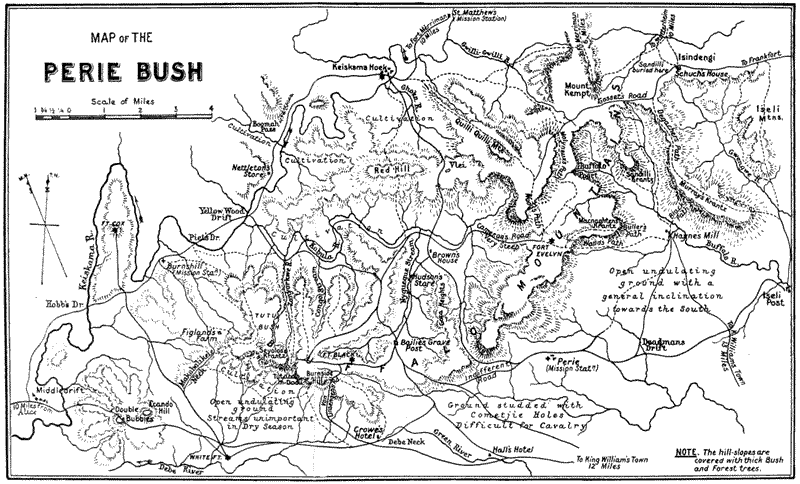
The General’s intention was to drive the Gaikas from
the Gwili-Gwili Mountain, the north-west end of the
range, where most of them were, towards the south of the
Buffalo Poort, where a line of our people awaited them. The
Keiskamma Hoek column, composed of 300 Whites (85 being
soldiers) and 300 Fingoes, was to climb the rugged western
face of the mountain, begin and direct the attack, while
Commandant Frost with 500 mounted men was to ascend
from the direction of St. Matthew’s, north-east of the Hoek,
and join hands with me. Streatfield with 250 Fingoes was
to ascend the Rabula Height, and Captain Brabant with
about 200 Whites was to go up from Bailie’s Grave and
follow in support of the right of Wood’s column. Troops
were placed east of the mountain to prevent the Gaikas going
towards the Kei.
On the afternoon of the 16th, when riding towards
Kabousie Nek to concert measures with Commandant Frost,
I met him riding with Major Buller to call on me. He lived
near Queenstown, whence he had brought 500 Burghers, many
Dutchmen. He was for a South African farmer wealthy,
and in addition to great moral courage his personal cool
bravery was remarkable even amongst daring spirits. I saw
him watch unmoved his eldest boy, serving as a Burgher,
fired on at close quarters by a Kafir. The lad escaped,
though the stock of the carbine he was aiming was cut in
twain by the Kafir’s bullet. Frost later, from his place in
the Legislative Assembly, criticised in strongly worded adverse
terms the Burgher system of using untrained Levies without
discipline.
Having arranged our concentration for daylight on the
18th, I rode southward to Bailie’s Grave to impress on
Captain Brabant the part he was to play in the drive, as to
ensure success he must wait until we passed him. At sunset
on the 17th, Mr. Bowker and his troop of Grahamstown
farmers had not arrived. Mr. Barber with 50 Cradock men,
many being Dutchmen, had been for some days at the Hoek.
Their leader was over six feet high, strongly built, with a
fine handsome face, and such frank manners as to render all
duties with him a pleasure.
At 9 p.m. I paraded my little Force, Mr. Bowker having
arrived. Above the Hoek our Fingoe scouts had counted
over 1000 Gaikas on the Gwili-Gwili Mountain, and I had
seen enough of the climb, 2000 feet above us, to have
made me uneasy, but that our Fingoes were within 300
feet of the crest, which I hoped to reach at daylight, while
the Gaikas were still chilled by cold. Although the entire
distance was only 8 miles from the Hoek, the actual ascent
was severe, and would in daylight, if opposed, have been
costly in lives. Leaving at 10 p.m., we marched in single file
through thick bush up a path so steep and rugged as to oblige
us to dismount at 1 a.m. Messrs. Lonsdale, Barber, and I
led, and without having halted we reached the crest only
at daylight, climbing the last 300 yards through boulders
of rock which a dozen determined men might have held for
hours.
Fourteen days of very hard work combined with little
sleep had brought a return of my neuralgic pains, which,
although not severe, obliged me to take doses of chloral and
bismuth, and foreseeing that I might be on the mountain
for three days, I took the precaution of getting a large bottle
from a doctor in King William’s Town, who enjoined me on
no account to finish it until the third day. When we started
my pain was worse, and it increased as I climbed, with the
result that when we reached the top of the mountain and I
sat down on a stone to rest, I had finished the bottle, and
was tormented with acute thirst. I asked each Burgher as
he came up for a drink, but there was not one of them who
had put any water in his bottle of “Cape Smoke,” and so I
had to endure the thirst until, the day having broken, we
moved on, and came to a stream.
The Gaikas retired from the clear plateau of the Gwili-Gwili
Mountain, and after breakfast Barber’s and Bowker’s
Colonials and Streatfield’s Fingoes descended into a deep
ravine which intervenes between Gwili-Gwili and Rabula
Heights, whence the Burghers emerged late in the afternoon,
exhausted by their climb.
Captain Brabant had an easier ascent, up which, indeed,
we took waggons two months later. When he gained the
crest at daylight, he saw two miles below him, to the eastward,
some Kafirs and cattle in an open glade, and advanced
till he had dense bush on either hand.144 The Kafirs opened
fire, and Brabant fell back with some slight loss, Streatfield,
who went to help Brabant out, having an officer killed.
This impatient disregard of orders spoilt the General’s plan.
Late that evening a path across the intervening ravine was
found, which Frost’s men and the Hoek columns crossed
next day. The night was cold; most of the men had a
blanket, but as we were carrying three days’ food, the officers
had left their blankets below. I personally did not suffer,
for Mr. Lonsdale emerged from the Bush at sundown, near
Brabant’s bivouac, too tired to attempt to return, so Captain
Nixon, Royal Engineers, and I sheltered under the Magistrate’s
waterproof sheet.
When we were having our coffee before advancing next
morning, Captain Nixon, who had given me much aid as a
Staff officer, warned me that he had overheard the Burghers
say that they intended to refuse to enter the Bush. I took
no notice until the men were falling in at daylight, when the
two Leaders came to me, saying that the men declined to go
into the Bush, as it was not a fit place for Europeans, and
they suggested that the driving of the main valley should be
done by Fingoes. I replied, “I do not agree with you; we
have got our orders, and you are to take your men through
the Bush.” “But the men will not go, they are all determined.”
“Well, gentlemen, I shall write to the General
that you refuse to obey orders, and having sent off my letter
I shall go in with this company of the 24th Regiment. We
shall probably not do the work as well as you can, but if I
become a casualty I do not envy your position.” I said no
more, and in a quarter of an hour the Burghers entered the
Bush, from which they did not emerge till late in the afternoon,
when some of them, hearing I was going through the
ravine to the south end of the range, where Captain Brabant
had been repulsed, formed a guard round me so that I could
not be hit except through the bodies of my escort. Until
they went home, we never had another difference, and they
endeavoured to anticipate my wishes.145
Next morning Commandant Frost and his men followed
the Hoek column across the ravine, and bivouaced in the
glade whence Captain Brabant was driven on the 18th of
March; Brabant moving a mile farther south on the mountain
range. As we advanced the Kafirs disappeared in the Bush,
followed by Mr. Lonsdale and his Fingoes. Neither Kafirs nor
Zulus fight on two successive days, unless compelled to do so.
When Lonsdale’s Fingoes went down the Buffalo Poort,
500 women and children came out of the Bush as the Fingoes
advancing came near them. The poor creatures had nothing
on except a blanket, and this we were obliged to remove to
search for powder and lead, which many of them carried.
When the operations ceased for the day, I was willing to let
them return to their husbands, as I could not feed them; but
they refused to go back, not knowing where they would find
their men, and moreover fearing ill-treatment at the hands of
the Fingoes. The starving women sat on a hill which rose
from the plateau on the mountain for twenty-six hours, and
suffered severely from cold and want of food. I was called
to them, as one wished to complain to me of a Dutchman who
she said had taken away her child. The Dutchman, who was
in Commandant Frost’s Contingent, admitted he had the boy,
but added that he had given its mother a shin bone of beef
for the child; this the mother acknowledged, but she was
unwilling to give back the beef even to obtain her boy. I
compromised the matter to the satisfaction of both parties, by
giving the man five shillings for his beef and restoring the
child to its mother.
There was another woman with a baby apparently on
the point of death, and I gave its mother a small bag
of biscuits. When we carried out the same operation on the
8th May, about half the number of women came out of the
Bush, and on seeing them I said to the interpreter, “Why,
Paliso, here are some of the same women.” “Oh no, master;
these are Seyolo’s, and the others were Sandilli’s women.” “I
can see identically the same women,” I replied, and accosting
a young woman with fine eyes, I talked to her through the
interpreter for a few minutes, and then asked her if she was
up in the same place last moon. “Yes,” she replied. “Is
the woman here who had the sick baby?” “Yes, she is
eight or ten farther down.” “Well, I recognise you—do you
recognise me?” She looked steadily at me, and replied,
“No; all White men’s faces are exactly alike.” Which is the
reproach we level at the Kafirs.
On the 20th a thick fog prevented our seeing more than
40 yards, so movements of troops became impossible, and
many of the Gaikas passed out of the Perie Bush unseen by
us on the mountain or by the troops who were guarding the
roads 2000 feet below us. Frost and I went to Brabant’s
bivouac, and arranged a drive for the 21st March. The
Hoek column was to line the path which led to Haynes’
Mill; Frost was to remain on the crest near Brabant’s bivouac,
to prevent Kafirs breaking back towards Gwili-Gwili; while
Brabant, who knew more of the Perie Bush than any other
Colonial present, was to descend the other precipitous side and
work eastwards towards the path lined by the Hoek column.
Brabant had greatly underrated the difficulties of his task.
He entered the Bush at 8 a.m., and almost immediately came
on a precipice, down which his men swung themselves on
monkey ropes.146 He failed to move eastwards, and after a
determined effort emerged at 5 p.m. on the plain almost due
south of where he entered the Bush, consequently neither
Frost’s men nor the Hoek column saw a Kafir, and at sunset
I sent the troops down the mountain, having there no food
for men or horses.
The apparent result of our three days’ operations, and four
days’ residence on the mountain, was not commensurate with
the discomfort we underwent. We killed an unknown number of
Gaikas, took several horses and some cattle, with 17 casualties,
Whites and Blacks, but on the other hand the Gaikas had
never before been harassed in the Buffalo Poort.
When the troops descended, I rode down the mountain
and round by Bailie’s Grave to General Thesiger’s camp at
Haynes’ Mill. About 6 miles from the camp I came on a
small Draft recently landed, consisting of a young officer and
a dozen men, on their way to join the Headquarters of the
battalion. Their waggon had broken down, and they were
in a state of excitement, having just killed a Kafir. After a
few minutes’ conversation, I went on to the General’s camp, but
missed him, he having gone round by the eastern side of the
mountain to see me. I dined with the General’s Staff officer,
and at half-past nine, with a bright full moon, started back on a
well-worn waggon track. When we got about 80 yards from the
waggon, four shots rang out sharply, striking the ground at my
horse’s feet. The two orderlies Frontier Light Horse unslung
their rifles to fire back, but I stopped them, and on riding up
found the small Draft, which apparently had not yet recovered
from their excitement, had mistaken us for a party of Kafirs
coming to attack them. The Musketry Instructor of the
battalion was living with me as a guest, and had told us the
day before we went up the mountain of the great improvement
he had effected in the shooting of the men. He was
consequently much chaffed when it became known that the
Regimental Armourer and three first-class shots had missed
four horsemen at 80 yards distance.
I had been in the saddle several days from 4 a.m. till
7 p.m., and rode throughout the night of the 21st-22nd
March, when my horse died of exhaustion. The work told
on me, and I had to go to bed for three days, having a high
temperature. I was at duty again, however, on the 27th, when
we received orders for another drive. The General went up the
Cwengwe Valley to Mount Kempt, leaving the direction of the
operations in my hands, regarding which the Staff officer,
Captain F. Grenfell,147 wrote, “The Lieutenant-General gives
Colonel Evelyn Wood the greatest latitude for these operations.”
Commandant Frost having joined the General’s column,
which consisted of two companies of the 24th Regiment, with
two guns, at Mount Kempt, was sent round from the north-east
to ascend the Gwili-Gwili Mountain. Captain Brabant,
placed under my orders, was to ascend the Rabula Heights. On
this occasion the orders were executed, but the result of the
operations was meagre, for the Gaikas evaded us; we now pitched
our camp on the mountain plateau, and our presence annoying
the Gaikas even more than the drives, as they could not
emerge from the Bush to bask in the sun and graze their cattle.
The next week we saw but little of the Kafirs, for all the
White men were employed in cutting broad paths in the Bush,
while the Fingoes were carrying our tents and baggage up the
mountain. When we had got enough food up, we tried another
drive, but the result was unsatisfactory; the paths, however,
annoyed the Gaikas, as they could not drive their cattle across
the glades without being seen, and thus some fell into our
hands immediately.
Nearly all the Burghers had now gone home: they disliked
being on the mountain, where their horses suffered from cold.
They had enlisted for three months, a month of which was to
be allowed for the return journey, and although in deference
to the General’s wish they had stayed on for another drive,
their patience had now become exhausted. Like all amateur
soldiers, they varied greatly in quality. Many were landowners,
well off, and serving for the love of their country;
others were men attracted by the pay of 5s. per diem, which
was more than they could earn in the towns and villages or
on farms. To the reproach that they were leaving before the
fighting was over, they replied, “We got leave from our
employers for three months; if we stay on, will the Government
guarantee us work, if our employers refuse it?” And to this
reasonable question no answer was obtainable.
On the 5th April, 700 Fingoes having arrived from the
Transkei District, the General arranged another drive, to start
from Mount Kempt, where he took up his position, straight
down the Buffalo Poort to Haynes’ Mill. The Fingoes were,
however, undisciplined, and fired away twenty rounds a man,
without any adequate results. It is only fair to state that they
had no such leader as had the Hoek Fingoes in Mr. Lonsdale,
whose men were not given more than five rounds for a day’s
operations. We moved that morning at 4 a.m., and were in
our assigned positions at six, and after eleven hours, in which
1500 Fingoes searched the Bush while the soldiers lined the
paths, the result was indeed incommensurate: 3 Gaikas killed.
When I returned to the Hoek late at night, I heard that
Captain Warren,148 Royal Engineers, with a troop of the Diamond
Field Horse, had been surrounded by 1500 Kafirs, and arranged
to start at 3.30 next morning to his relief. Sleep was impossible,
for Mr. Streatfield arrived at midnight, and Mr.
Lonsdale at 2 a.m., and it was necessary to concert with
these gentlemen the movements of the Fingoes westwards.
I heard at daylight, when at Bailie’s Grave Post, the correct
story of Captain Warren’s skirmish the previous day; he had
skilfully ambushed Seyolo,149 whose men fled. On the 4th
April, Seyolo induced the tribe to rise, and with 500 men was
seen crossing the Debe Flats early on the 5th April, making for
the Tutu Bush. Captain Warren concealed about 50 men
in a hollow, from which they fired with effect. Seyolo charged
bravely, but 20 of his men fell, and the tribe scattered in the
Bush, leaving many of their wives behind.
I anticipated the General would come down from Mount
Kempt, and so waited for a couple of hours, when he appeared,
and approved of my suggestion that I should go westward, and
prevent the Kafirs breaking out north-west to the Amatola
Basin. At Burns Hill I found a company of the 90th Light
Infantry, and two miles farther off I heard of another.
Ordering the men of both companies to eat, and parade as
soon as possible in shirt sleeves, they marched off within an
hour, going up the Makabalekile Ridge. I preceded them with
8 men, my personal Escort, and picked up near Burns Hill 80
Fingoes and 80 Hottentots. I carried them on with me, leaving
orders for two Squadrons of the Frontier Light Horse, coming
from Bailie’s Grave, to follow me. The Bush on the Makabalekile
Ridge extends for about 1500 yards, then there is an
undulating plateau, named Tutu, extending a mile from east to
west, and a mile and a half from north to south, the plateau
being bounded on its east side by a deep ravine running
practically north and south, called the Zanyorkwe. Just as my
8 men arrived, riding in extended order, a body of Kafirs
ran out of the ravine, but were driven back by my escort,
and the Fingoes coming up, I extended them at intervals along
the edge of the Bush. When two hours later the Frontier
Light Horse and a company of 90th Light Infantry arrived,
I sent them down into the Bush, and was superintending these
movements when I saw the Fingoes, whom I had left fairly
steady, running rapidly. Cantering up to them, I soon perceived
the reason: bullets were striking all around them, the line
battalion on the high ground to the east of the Intaba Indoda
Ravine having mistaken the Fingoes for Kafirs. As I led the
former back to the edge of the Bush, hoping that the Regiment,
which was only 1400 yards off, would recognise I was a
European officer, the Artillery dropped a shell 40 yards from
us; I noticed the Fingoes, like myself, had not the same fear
of shells that they had of the bullets, and after three or four
minutes the firing ceased, except for an occasional over-shot
fired at Seyolo’s men, who were in the Bush close underneath
us. We learned next day that the Transkei Fingoes had
disappointed the General, for they were driven back three
times, and for several hours left the body of two of their White
officers in the hands of Seyolo’s men.
I lost four horses, which was provoking, but in a manner
which made me admire the audacity of the Kafirs. After I had
re-established my line of Fingoes, some 20 Gaikas ran out
in the open, from a spot where the Fingoe line was weak. The
position was awkward, because I had nobody with me except
my personal escort of 8 men and the horse-holders of the
Frontier Light Horse, the other men being all below in the
Bush. When we fired, the horses broke away from the horse-holders
and careered over the plateau, four of them running
northwards in a narrow glade where the Bush closes in on
either hand. The horses chased by my orderly ran close to
the trees, from which Gaikas darting out pulled them into bush
so dense that our men who were in the ravine, and later
emerged close to the place, saw neither Kafirs nor horses.
At nightfall we marched back to Burns Hill, where I had to
provide food and shelter for the hungry, coatless companies,
90th Light Infantry. They sheltered in the Mission Church,
and as there were sheep close at hand, lumps of mutton were
soon broiled on the fires. Next day Lonsdale’s and Streatfield’s
Fingoes moving from the Rabula Valley through the
Tutu Bush, killed 20 of Seyolo’s men with but few
casualties, while with the 90th companies and Frontier Light
Horse I held the plateau. On the following day the Fingoes
advancing from the Rabula, with two companies of the 90th
and Frontier Light Horse, again went through the Tutu Bush
and drove out some of Seyolo’s men, who, after a skirmish with
the General’s small Force, then encamped at Bailie’s Grave,
succeeded in getting across to the Buffalo Range. Next day
I heard that another small tribe had broken out and were
making for the Tutu, and I followed them with a few mounted
men, but only overtook their women, the men escaping into the
Zanyorkwe Ravine.
Now for about three weeks the Rebels remained unmolested,
and Seyolo appreciating the situation, coming down from the
Intaba Indoda Bush, destroyed all the Fingoe huts within two
miles, carrying off large supplies of food and cattle. On the
23rd April he attacked Streatfield’s Fingoes, but was beaten
back, although they were obliged to shift their camp, as it was
too close into the Bush.
Captain Bowker,150 whose men had all gone home, came to
me as a Staff officer, and was very useful in many ways, as I
was new to the country. He told me a great deal that was
interesting, and was one of those who agreed with me as to our
obligations in sparing Kafirs who no longer resisted. Many
of the Colonists with whom I had talked had disagreed with me
on this subject, alleging that as the Kafirs never spared us we
should treat them in a similar manner. Several said to me on
the Buffalo Mountains, “You don’t understand; the women
you want to feed would gladly inflict nameless tortures on you
if you were their prisoner.”
The Volunteers having gone home, the General was now left
with only one battalion and two guns, for the Transkei
Fingoes being untrustworthy had been disarmed. We could
not satisfactorily clear the Intaba Indoda Range with Lonsdale’s
men, and so for three weeks the Gaikas were unmolested.
The broken country in the valley of the Zanyorkwe River,
about 6 miles from north to south, and 10 miles from east to
west of the ravine, is clothed with thick bush, the densest part
of which gives its name, Tutu, to all the adjoining woods. The
neck of land connecting the Kafirs’ stronghold with the Buffalo
Range, 4 miles farther east, is generally speaking covered with
bush, with an opening of a mile near Bailie’s Grave; thus our
difficulties were greatly increased by the vicinity of these two
natural strongholds of the Gaikas.
The General had urged the Colonial Government to collect
more Volunteers, and I was instructed to raise all the Fingoes
I could in the District to the north-west of King William’s
Town, Tini Macomo, son of Sandilli, and Chief of the Fort
Beaufort District Gaikas, being then in the Tutu Bush. General
Thesiger took me to Fort Beaufort, and being satisfied there
were no armed rebels in the District, ordered the 90th Light
Infantry to Burns Hill, to work under my command, the
Lieutenant-Colonel remaining at Fort Beaufort, in command
of some Hottentots.
I was glad to see the Water Kloof, of which I had read a
good deal. It appeared to our forefathers very difficult, but
they never penetrated the Perie Bush, with which it cannot
compare as a natural stronghold for the Black man. The
Water Kloof ravines are not nearly so deep or rugged as are
those in the Perie, and the Bush is broken up by intervening
patches of cultivation.
At the end of April the General’s preparations for driving
the Tutu Bush were complete. He was to direct the operations
on the eastern, and I on the western side; he kept
under his own command the 2nd 24th Regiment, some
Fingoes, 4 guns and White Volunteers under Von Linsingen,
who had raised also 600 loyal Kafirs. Generally speaking,
Bowker’s Rovers were to hold the mouth of the Zanyorkwe
Ravine, Lonsdale and Streatfield were to move from it, with
the two companies of the 90th Light Infantry under Major
Hackett up through the Bush, while Von Linsingen was to
advance from Debe Flats, and join me on the Tutu Plateau,
which I was to gain by passing up Makabalekile Ridge, with
three companies of my Regiment, and about 100 men of the
Diamond Field Light Horse, and a company of Hottentots.
On the evening of the 29th April, Seyolo, who was aware
of our operations, undertook to hold the ridge himself against
me, and boasted that he would capture the guns if they were
taken up the Bush path. He commanded on the Tutu Plateau,
while Tini Macomo was to hold the Tutu Bush itself.
At daylight on the 30th, the General having got into position
on the eastern crest of the Zanyorkwe Ravine, shelled the
rebel bivouac. Tini Macomo at once dispersed into the Tutu
Ravine, while all Seyolo’s men hastened westwards to support
their piquets, who were already ambushed on the Makabalekile
Ridge. It was covered with bush from 150 to 200 yards
wide, from north to south, and extended for 1500 yards,
through which the attacking Force had to pass before it reached
the open plateau.
The General had written to me on the 29th, saying he
expected to see me on the plateau half an hour after daylight,
to which I replied, “I will start in good time, but I shall not
be there so early if Seyolo knows what to do.”
One of the best companies in the battalion was commanded
by Captain Stevens, who was fortunate in having an excellent
Colour-Sergeant. It was the last company to come in from
Fort Beaufort, and I invited Stevens and his Subaltern,
Lieutenant Saltmarshe, to mess with me. I gave them a good
dinner at seven o’clock on the 29th, and awoke them soon
after midnight, when they, being young, consumed a 2 lb. tin of
Cambridge sausages and a couple of chops. Saltmarshe seeing
that I took nothing but a cup of cocoa, said to me chaffingly,
“You don’t eat, sir; are you nervous?” I said, “Yes; but even
at your age I could not breakfast heartily at 1.15 a.m., having
dined at 7 p.m. the previous evening.” At dinner-time,
Stevens, who had been intimate with me at Aldershot, had
asked whether he might lead the Attack, and I replied that
such was my intention. I was somewhat later in getting into
position than I had intended, for after extending a company
on either side of the timber-waggon track, which was about
6 feet in breadth, I was obliged to post personally a company
and two guns which I intended to fire along the southern crest
of the Tutu Plateau, on which I knew that any Kafirs reinforcing
those already on the Makabalekile Ridge would pass.
The Officer commanding the company was short-sighted, and
so unfortunately was the Lieutenant in command of the two
guns, and although later several bodies of Kafirs passed within
short range not a round was fired at them. When I cantered
up, after placing the guns, Stevens said, “You promised we
should lead, and you have left us behind.” “Yes,” I said,
“but now come on.” Riding in front of the company, I led it
on the track into the Bush. We had scarcely got 100 yards
when a fine stalwart Kafir advanced as if to shake hands; he
had apparently heard the guns moving on the flank, and did
not see us until I told one of the men to shoot him. Fire was
now opened on either side of the path, on which the company
was advancing in file, and I told Stevens, who was in front, to
press on. As he did so, Mr. Saltmarshe ran after him, but
catching him by the collar as he passed, for I was still mounted,
I said, “Go back to the rear.” “Why?” he asked, somewhat
impatiently. “Because I order you;” then seeing from the
lad’s face he felt the rebuke, I added, “I do not want, my boy,
all my eggs in one basket.” Ten minutes later, when we had
advanced 400 or 500 yards, or one-third of the distance to
the plateau, the firing increased in intensity, especially on the
northern side, although nearly all the bullets cut the trees, and
at one time my pony’s back was covered with leaves, which fell
like snow in a winter scene at a theatre. The Gaikas approached
closer and closer, till a Kafir, almost touching Stevens,
fired, and knocked a big hole in his face. I was sitting in
the centre of the company, and beckoning to Saltmarshe, as his
Captain was carried away, said, “Now it is your turn.” I noticed
that, although his face was set, and he was still eager to fight,
yet the fall of his friend had sobered him, for he asked in a
quiet voice, “What am I to do, sir?” “Go to the head of the
company, fire two or three rounds, then advance 50 yards
and drop again.” He had made one advance only, when a
Gaika fired so close to him that his chest was knocked away
by the charge. The Rebels now made a rush, and the Hottentots,
who were on the southern side of the path, whence there
came but little fire, ran down the path, carrying with them half
a dozen of my men, who had been near Saltmarshe. Colour-Sergeant
Smith, a little man, so short that I often wondered
who could have enlisted him, had a heart entirely out of proportion
to the size of his body, using most opprobrious
language to the men, led them forward again.
I sent back for Major Cherry, who was in command of the
detachment, as the company was now without officers. At
that moment Captain Stuart Smith, Royal Artillery, asked if
he might bring up a gun, and on my saying I was afraid we
should not get the horses clear of the muzzles, he observed
cheerfully, “Oh, it does not matter if we shoot them;” and in a
couple of minutes he had two guns unlimbered, and firing case
into the Bush close on the ground from whence most of the fatal
shots had come. Major Cherry now led on the company, and
in a few minutes the Gaikas drew off, and we got on to the
plateau with but little further loss. I then reaped the advantage
of my ride the previous day to Alice (Fort Hare), where I had
bought several yards of calico, for with a strange want of forethought
the signalling equipment had been left at Cape Town.
I was now able to report to General Thesiger across the ravine,
for we were standing only 1600 yards apart, and the Gaikas
had been driven below the plateau into the ravine. This fight
ended disastrously for Seyolo’s men; our columns converging
at the common centre, met them as they tried each avenue
of escape, and after nightfall, crossing the King William’s
Town-Keiskamma Hoek road, they took refuge in the Perie
Bush.
When we were on the mountain plateau in March, we felt
the want of guns, to prevent the Kafirs coming out to bask in
the sun without taking the trouble to attack them, so I was
anxious, now we had to follow Seyolo’s men, to take the
7-pounders up, although I had been told it was utterly impossible
to get anything on wheels up the face of the Rabula
Mountain, which looks at a distance precipitous. Captain
Stuart Smith, under the orders of Major Harness, Royal
Artillery, accomplished the feat. He hooked in 48 oxen, and
then, putting a pair of staunch wheelers in front, attached
them to the horns of the leading pair of oxen. The horses,
although often on their knees, kept the oxen in a straight line,
and the whole team, urged by some twenty Africanders with
long whips, eventually got both guns up to within 100 feet of
the crest, whence they were hauled up by a company 90th
Light Infantry. We began work after nightfall on the 7th,
and by daylight on the 8th were on the mountain:
with 4 companies 90th Light Infantry, 2 guns, the Frontier
Light Horse, and 1500 Fingoes. Sandilli and Seyolo had
been warned of our attack by the so-called loyal Kafirs, and
the actual number of Gaikas killed was less than in other
drives; but a determined attack led by Major Redvers Buller
so demoralised the Rebels that they never again attempted to
resist white men. Buller, with a Squadron Frontier Light
Horse, following some straggling Kafirs on the wooded precipice
overlooking Haynes’ Mill, was fired on, and though he drove
the enemy from the edge of the Bush, they held some
rocks 50 feet down, and a few men sat in high trees, which
enabled them to fire on the plateau.
Just as I arrived from another part of the elevated plateau,
which consisted of a series of terraces, Captain McNaghten,
Frontier Light Horse, fell mortally wounded. Major Buller
reported that there were only 30 Kafirs immediately below
him, the man who shot McNaghten being in a tree farther
westward along the precipice. He explained that most of the
enemy were behind a big rock, 40 feet down, a place so steep
that you could not go down without holding on, or sliding, so
it was difficult to turn them out as I wished, and he demurred
to the inevitable loss of men in the operation. I suggested that
it was only the first man down who was likely to be shot, and
signalling to Captain Laye,151 who was on a terrace 200 feet
below me, he brought up his company. While he was
climbing up, I told Commandant Lonsdale to take his men
into the Bush and extend them higher up the valley, and
Commandant Maclean to do the same farther westwards, with
orders to work round the spot where the Kafirs were lying
concealed. I explained the operation and its dangers to
Captain Laye, telling him he was to sit and slide down the
rock, ordering one of his most trustworthy men to keep close
to him. Just as the company, which had extended while in
“dead” ground, approached the edge of the precipice, Buller
jumping up, shouted, “Frontier Light Horse, you will never
let those redcoats beat you,” and forming himself into a
toboggan, he slid down, under fire, which fortunately passed
over his head, and most of the Kafirs disappeared before he
regained his footing.
Coincident with Buller’s slide, some of Lonsdale’s Fingoes
arrived at the rocks, and getting below the Gaikas, they were
caught as in a trap, but selling their lives dearly, killed two
of our men. The Fingoes lost a few men, and an old woman
came to me with a large hole in her face, a bit of the jaw-bone
having been shot away. She was unconcerned, however, and
when I proposed to hand her over for Medical aid, declared
she would much sooner have a plug of tobacco to chew. A
young Fingoe had an altercation with our doctor, a Colonial,
and I was appealed to to settle the dispute. Two of the
Fingoe’s fingers had been shot off by slugs from a Gaika’s
gun, and the hand was in such a mash that the doctor wished
to amputate the fingers at the second joint. My coloured
soldier objected strenuously, and said that if he might have
six weeks’ leave he would come back again. And so he did.
His cure, which was that ordinarily adopted by the Natives in
such cases, was peculiar. Returning to his village, he was
pegged down on the ground, the maimed hand being buried in
the earth, without any bandage or dressing upon it, and the man
was not allowed up until it had healed over. It was, however,
an unpleasant sight, for all the ragged bits of skin remained,
and the man would have had a more useful hand if he had
submitted to the doctor’s operation.
From this time till the end of May, the object of the Gaikas
was to evade our men. Forty or fifty Fingoes worked through
Bush which required 500 men on the 18th March, and daily
the small parties killed a score of Rebels.
In the third week of May, Major Buller nearly caught
Sandilli in his cave, where he lived unmolested throughout
the war of 1851–52; there was, however, a back exit, to us
then unknown, by which the old man escaped. Major Buller,
with two companies 24th Regiment, the Frontier Light
Horse, and Lonsdale’s Fingoes, remained near the cave for
forty hours, which prolonged visit caused Sandilli to move
northwards.
From the 12th March, when I left King William’s Town,
I scarcely ever slept for two nights in succession on the same
spot. Constant work, shortness of sleep, and the great alternations
of temperature, often over 40° between midnight and
noon, and the want of nourishing food, told on me. I was
unwell on the 10th May, but the General being 80 miles
away, visiting the Transkei, the 3000 White and Black soldiers
on and around the Buffalo Range were under my command,
so I stayed on the mountains until a high temperature and
pulse 104° obliged me to go down. For a fortnight the
glands in my groin, armpits, and neck had swollen; my skin
peeled off like a mummy, and chilblain-like openings appeared
on my hands. I gave four Hottentots, who are more intelligent
than Kafirs, £2 to carry me down to the Rabula
Valley, where Dr. Alcock, my Aldershot Doctor, thus
diagnosed my case: “Overwork, want of sleep and of
nutritious food.” Milk and eggs every four hours, with “All
night in,” soon restored me, and on the 27th I accomplished
a long ride, involving many hours in the saddle.
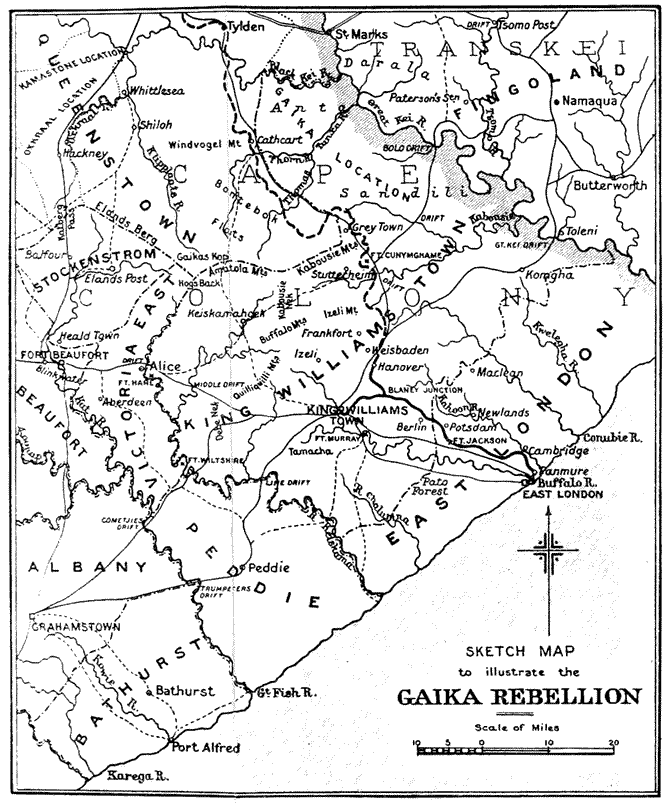
The Gaika Rebellion was now over: Tini Macomo in the
Water Kloof, Seyolo in the Fish River Bush, and Sandilli
in the Perie, were hiding in caves. On the 29th May a
patrol of Lonsdale’s men skirmished with a few Kafirs near
Mount Kempt, and were startled at the resistance, until
they recognised amongst the slain Dukwana, an elder of the
Emgwali Mission, who had shot several of our officers, and
was now killed in protecting the flight of Sandilli. He fell
mortally wounded, and with his death the rebellion ended.
He had fought in 1835, ’46, ’48, ’51-’52, and had always
previously escaped. A fortnight after his death ladies were
riding about unescorted where no small armed party could
have ventured since March, and in three months what
we may hope was the last Gaika revolt had been suppressed.
The number of Regular troops employed by General
Thesiger in suppressing this outbreak was far less than those
engaged in 1851–52, but we never had the same number of
Gaikas under arms against us, and the area was smaller;
and we had the great advantage of telegraphic communication,
the wire having been carried through Kaffraria by the Director
of Telegraphs, Mr. J. Sivewright,152 with considerable danger to
himself and Staff. In the wars of 1847–48, 1851–52, the
Kafirs always got their news before our troops; now the position
was reversed, and Mr. Sivewright’s daily bulletins, posted at
all telegraph stations, checked nearly all disaffected chiefs. The
Galekas, after a defeat, sent to the Gaikas announcing a
victory, and calling on their cousins to rise, but the messengers
were disconcerted by the Gaikas describing the Galekas’ defeat.
Moreover, tactics had undergone a change. When the 90th
Light Infantry came under my command, the battalion had
received an order, emanating from Headquarters, Cape Town,
that it was never to be employed in the Bush. In 1851–52,
Colonel Eyre, with the 73rd Regiment, broke this established
rule, to the immense disgust of Kreli, who in the quaint words
of the interpreter excused a defeat by saying, “No two men
stop one Bush; one man come, other man go.” To enter the
Bush boldly in the face of Kafirs is not only the most
efficacious, but the safest method. I can only recall one out
of the many White leaders shot in 1878 who was killed in the
dense Bush. In nearly every case our loss occurred just outside
the Bush, or in paths from unseen foes.
By the middle of June the Regular Troops were concentrated,
and the Volunteers recently collected were sent home.
I was ordered to prepare the 90th Light Infantry for a march
to Maritzburg, in Natal. I was offered at this time the
command of the Colonial Forces, to be organised into three
battalions, with a salary of £1200 and £300 travelling
expenses; I considered the offer until I learnt the Colonial
Government did not intend to let the Commandant nominate
the battalion Commanders. I had been tempted by the pay,
but on the other hand wished to command the 90th Light
Infantry, and not being allowed to suggest my own choice of
subordinates settled the question.
General Thesiger was generous in his praise. In his
Despatch, dated King William’s Town, 26th June 1878,
he wrote:—
“From the 9th to the 29th May the troops under Colonel
Evelyn Wood gave the Rebels no rest.
“Para. 62. Colonel Evelyn Wood, V.C., C.B., 90th Light
Infantry, on Special Service in South Africa, has had command
of a separate column of Imperial and Colonial troops, from
the time that I assumed the direction of Military operations
in the Field. I cannot speak too highly of the good service
rendered by this Officer. He has exercised his command
with marked ability and great tact. I am of opinion that
his indefatigable exertions and personal influence have been
mainly instrumental in bringing the war to a speedy close.
“I would beg to draw attention to those officers who are
especially brought to notice by Colonel E. Wood.
“(Signed) F. Thesiger.”
He wrote to me on the 21st June, “I have written to His
Royal Highness I could never have succeeded if it had not
been for your active and energetic aid.”