Obvious typographical errors have been silently corrected. Variations
in hyphenation have been standardised but all other spelling, accents and
punctuation remains unchanged.
The page number referenced in the the caption to Fig.39 is missing.
As in the original the Figure numbers are not sequential.
FROM INDIA TO THE PLANET MARS
A STUDY OF A CASE OF
SOMNAMBULISM
WITH GLOSSOLALIA
BY
TH. FLOURNOY
PROFESSOR OF PSYCHOLOGY AT THE
UNIVERSITY OF GENEVA
TRANSLATED BY
DANIEL B. VERMILYE
HARPER & BROTHERS PUBLISHERS
NEW YORK AND LONDON
1900
Copyright, 1900, by Daniel B. Vermilye.
All rights reserved.
[TRANSLATION.}
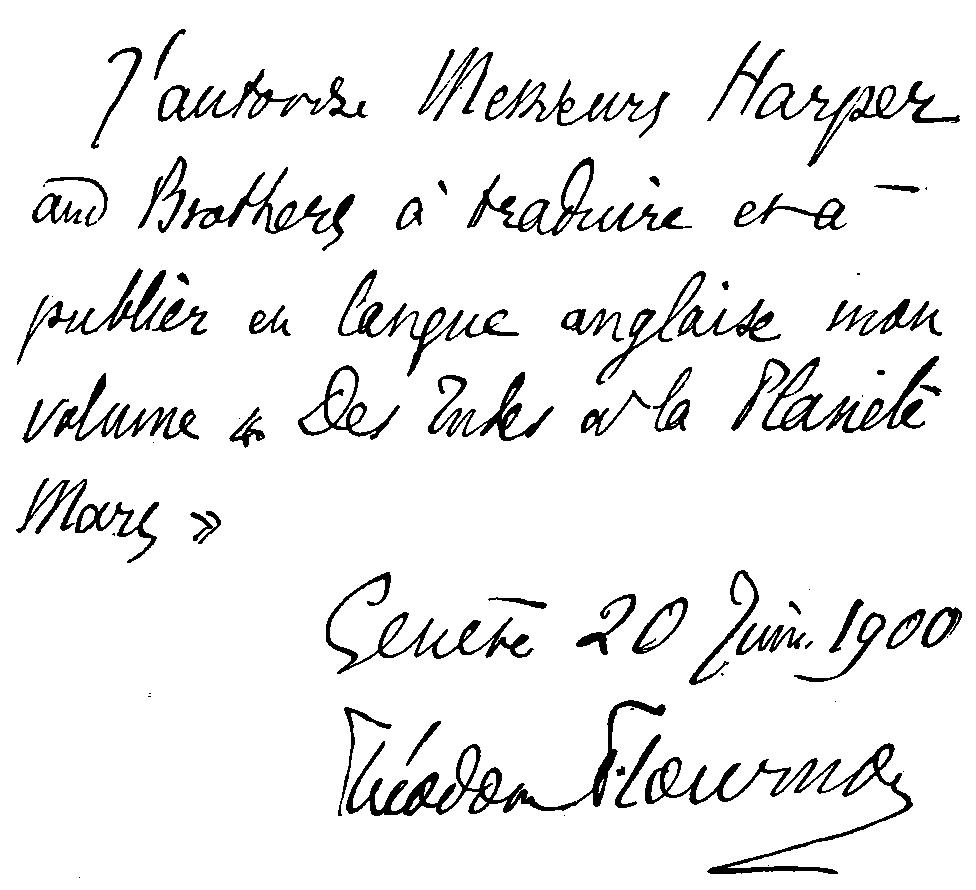
I authorize Messrs. Harper & Brothers to translate
and to publish in the English language my book “From
India to the Planet Mars.”
The translation into English of From India
to the Planet Mars has been undertaken in
response to the demand created by the widespread
and increasing interest which is manifesting
itself both in Great Britain and the United
States in the phenomena exhibited by its heroine—an
interest which marks a new era in the progress
of human knowledge.
Twenty—even ten—years ago the phenomena
which Prof. Flournoy here describes in detail, and
of which he offers a keen, skilful, psychological
analysis, would have met with the sneers of popular
science and the contempt of obscurantist orthodoxy;
the book would have found few readers.
Times have greatly changed since the Society for
Psychical Research was founded, eighteen years
ago, by a few thoughtful men (included among
them were those whose names would have conferred
honor upon any body of men) interested in
the investigation of abnormal mental or psychic
phenomena.
In explaining their reasons for organizing that
society, its founders made the following statement:
“From the recorded testimony of many competent
witnesses, past and present, including observations
accurately made by scientific men of eminence
of various countries, there appears to be,
among much illusion and deception, an important
body of remarkable phenomena which are prima
facie inexplicable on any generally recognized hypothesis,
and which, if incontestably established,
would be of the highest possible value.”
The organization of this society constituted the
first attempt in the world’s history to investigate
the phenomena of clairvoyance, automatic writing
and speaking, trance conditions, second sight, apparitions
of persons at the point of death, alleged
spirit messages, etc., by a scientific body formed
upon a broad basis.
As was to have been expected, the work and aims
of the society were met by a storm of derision and
ridicule, and by attacks which poured in from every
quarter, the bitterest of which came from the always
too numerous class of narrow-minded scientists,
whose partisan prejudices, confining them to a narrow
rut, hinder their seeing anything from a point
of view other than that of their preconceived hypotheses,
and prevent them from attaining that
open-mindedness which is indispensable to and one
of the first requisites of a true scientist in any field
of investigation.
The interest shown to-day in the work of psychical
research—among the evidences of which may
be noted the reception accorded this work of Prof.
Flournoy, which has, within a few months from
the date of its publication, attained its third French
edition—demonstrates the ultimate triumph of the
founders of that society in their efforts to bring the
thinking public to a realization of the supreme importance
of a systematic scientific study of the mysterious
psychic phenomena so long neglected by
official science, but which are now beginning to
assume their rightful place in the field of study and
observation.
Men have come to realize that the facts proved by
science have not thus far been adequate to satisfy
the needs of mankind, and many are to-day asking
whether the scientific investigation of psychic phenomena
may not succeed in proving the preamble
of all religions.
Already science has disclosed the existence of a
hidden, subliminal world within each individual being,
and it is the investigation of that part of the
individuality of Hélène Smith which our author
has undertaken in the following pages.
The importance of the subject and its intense interest
lie in the fact that psychical research hints
at a possible solution, by means of the same methods
which science has been accustomed to use in the
physical world, of the great problem of man’s future
destiny, of an answer to the question asked by Job
four thousand years ago, “If a man die, shall he
live again?” and which has been repeated in vain
by every generation of men who have since inhabited
the earth.
While, it is true, the great majority of men are
still skeptical as to the ability of science ever to
solve this problem, it is, however, a fact that a continually
increasing number of thoughtful men are
coming to believe that the hidden subliminal world
within us may point to an unseen but spiritual
world without, communication with which, if once
established, would furnish us with the solution so
ardently longed for.
Such men do not believe that it behooves them
to be content with the passivity of pure Agnosticism
are not willing that Ignoramus et Ignorabimus
should be their only creed. They are beginning
to search for new facts in the domain of the human
mind, just as they have searched for and found
them everywhere else they have looked for them.
Mr. F. W. H. Myers, the pioneer and leader of
the psychical research movement, in an address
recently delivered, says: “Starting from various
stand-points, we endeavor to carry the newer, the
intellectual virtues into regions where dispassionate
tranquillity has seldom yet been known.... First,
we adopt the ancient belief—implied in all monotheistic
religion, and conspicuously confirmed by
the progress of modern science—that the world as a
whole, spiritual and material together, has in some
way a systematic unity: and on this we base
the novel presumption that there should be a unity
of method in the investigation of all fact. We hold
therefore that the attitude, the habits of mind, the
methods by which physical science has grown deep
and wide, should be applied also to the spiritual
world. We endeavor to approach the problems
of that world by careful collection, scrutiny, testing
of particular facts; and we account no unexplained
fact too trivial for our attention.”
This is just what Prof. Flournoy has endeavored
to do in regard to the strange phenomena manifested
by Mlle. Hélène Smith. No fact has been
regarded by him as too trivial to escape his keen,
careful scrutiny from a psychological point of view.
The first task which the investigators of these
obscure mental phenomena set themselves was,
naturally, that of separating and sifting the real,
actually existent facts from the mass of fraud and
deception in which mercenary charlatans, aided
by the easy credulity of the simple-minded, had contrived
so completely to bury from sight the true
phenomena that for a long time the intelligent
public refused utterly to believe in the existence of
any real phenomena of the kind, but insisted that
everything when fully probed would be found to
be mere delusion, the result of trickery and fraud.
Probably no scientific fact since the dawn of
modern science has required so great a weight of
cumulative evidence in its favor to establish the
reality of its existence in the popular mind than
have the phenomena in question. The task, however,
has been accomplished.
Prof. Flournoy’s heroine, although she is a high-minded,
honorable woman, regarded by all her
neighbors and friends as wholly incapable of conscious
fraud, has been subjected to the closest surveillance
on the part of a number of eminent physicians
and scientists of Geneva for more than five
years past, while Mrs. Piper, the famous Boston
medium, has been subjected to an even closer scrutiny
by the Society for Psychical Research for the
past fifteen years. In spite of the fact that this
society has announced its willingness to become
responsible for the entire absence of fraud in Mrs.
Piper’s case, and of a similar declaration on the
part of Prof. Flournoy and his associates in regard
to Mlle. Smith, there still remain a considerable
number of ultra-skeptical persons who persist in
asserting that fraud and deceit are at the bottom
of, and account for, all this species of phenomena.
The well-known gentlemen who have investigated
these cases have never been accused of easy
credulity in other matters, and have cautiously
and perseveringly continued, in their endeavor to
satisfy skepticism, to pile Pelion upon Ossa in the
way of cumulative proofs of the genuineness of
the phenomena and to safeguard their investigations
in every possible manner against all possibility
of fraud, until they have finally come to feel
that more than sufficient proof has been furnished
to satisfy any honest, fair-minded, sensible doubt.
They do not feel that they have the right to devote
further time to the question of the genuineness of
the facts observed by them—time which they believe
might be better employed in endeavoring to
discover the laws by which the phenomena are
governed. They believe that those who are not satisfied
with the evidence already offered will not be
convinced by any amount of further testimony—that
their skepticism is invincible. For persons so
constituted this book will have no interest; its perusal
will afford them no pleasure.
The endeavor to explain these mysterious phenomena
by scientific investigators has resulted in
their adoption of one or other of two hypotheses, viz.:
1. That the phenomena are the product of and
originate in the subliminal consciousness of the
medium; or,
2. That the phenomena are really of supernormal
origin and emanate from the disincarnate spirits
of the dead, who return to earth and take temporary
possession of the organism of the medium,
talking through her mouth, writing with her hand
while she is in a somnambulistic state.
The first theory involves the crediting of the subliminal
consciousness with almost miraculous powers
of telepathy, since, on that hypothesis, it is necessary,
in order to account for the knowledge possessed
by the medium, to suppose that her subliminal
consciousness is able to roam at will throughout
the entire universe and read the mind of any
being possessing the information sought for.
All open-minded investigators freely admit that
either of the above hypotheses may be untrue;
that very little is known by them as yet in regard to
the nature of the phenomena; that the data are too
slight to justify more than a provisional hypothesis,
which the discovery of new facts may at any time
entirely demolish. But, thus far, the hypotheses
above given seem to be the only ones which will
in any way rationally account for the facts: in
which case, it is evident that each individual observer
will be influenced in his choice of a hypothesis
by his religious belief, which will greatly affect
the point of view from which he approaches the subject,
and also by his natural temperament, habits
of thought, etc.
Prof. Flournoy states that he has endeavored to
keep constantly in mind and to be guided by two
propositions, which he designates respectively the
“Principle of Hamlet” and the “Principle of La
Place,” the former being, “All things are possible,”
the latter, “The weight of the evidence ought to be
proportioned to the strangeness of the facts.”
Guided by these two principles, Prof. Flournoy
has come to the conclusion that Mlle. Smith really
possesses the faculty of telekinesis—the ability to
move ponderable objects situated at a distance,
without contact and contrary to known natural
laws. On the other hand, he does not believe
the phenomena manifested by her to be of supernormal
origin. The various alleged “spirit” messages,
“incarnations,” “gift of tongues,” and all
other apparently supernormal phenomena, in his
opinion, spring from Mlle. Smith’s subliminal consciousness,
and he exercises great skill and ingenuity
in his effort to trace the very wonderful and
astonishing manifestations with which he has had
to deal to natural sources.
Whether the individual reader adopts the author’s
views and theories, or finds in others a more natural
explanation of the facts narrated by Prof. Flournoy,
he cannot fail to admire the frankness, candor, and
entire freedom from prejudice displayed by him.
He evinces a true, open-minded, scientific spirit,
never distorting facts in order to make them fit his
hypotheses, and freely admitting the possibility of
the discovery of new facts at any time, of a nature
to compel him to adopt some other hypothesis than
that which he has provisionally assumed to explain
the phenomena.
A word on another subject before the reader goes
on to the perusal of this narrative of strange facts:
One who is interested in Psychical Research, when
he has finally succeeded in convincing some obstinate
skeptic of the genuineness of the phenomena—when
the doubter has at last yielded to the weight
of evidence, then, very frequently, the next question,
which comes as a wet blanket to dampen the
ardor of the enthusiastic devotee, is: “Cui bono?
Admitting the truth of the facts, what useful purpose
is subserved by their study? Science will
never succeed in solving the problem of man’s
future destiny. It is all a waste of time and will
end in nothing.” And in a review of this very book,
which recently appeared in one of our leading metropolitan
newspapers, the reviewer asks, “What will
science make of all this?” (referring to the phenomena
manifested by Mlle. Smith); and then answers
his own question by saying, “It is very unlikely
that science will ever discover the nature of these
mysterious phenomena or the laws which govern
them.”
From this conclusion the followers of Psychical
Research emphatically dissent. It seems passing
strange to them that such an opinion should be
held by intelligent men at the present stage of development
of human knowledge, in view of the
mighty discoveries which have been wrested from
nature by the laborious process of persevering observation
of seemingly trivial facts. An eighteenth-century
writer might with some show of
reason have made a similar observation in regard
to Dr. Franklin and his experiments with kite and
key in a thunder-storm. It would indeed, at that
epoch, have seemed unlikely that science would
succeed in discovering the secret of the electric fluid
by such means. But to-day, at the dawn of the
twentieth century, with all the experience of the
past to judge from, are not the probabilities all in
favor of great results to science from repeated experiments
by trained observers, such as Prof. Flournoy,
upon cases similar to that of Mlle. Smith?
If the hypothesis that the world as a whole, spiritual
and material together, has in some way a systematic
unity, be true—and that is the hypothesis
accepted by a majority of thinking men at the present
time—then the importance of collecting and
recording and analyzing such facts as those presented
to us in the present narrative cannot be
overestimated.
The scientific demonstration of a future life may
be one of the great triumphs reserved for the science
of the twentieth century to win, and Hélène Smith
and Prof. Flournoy may ultimately appear to have
contributed largely to its accomplishment.
To those who still persist in asking Cui bono? in
reference to such work as that which Prof. Flournoy
has here so ably performed, I beg leave to quote
further from Mr. Myers the following:
“The faith to which Science is sworn is a faith
in the uniformity, the coherence, the intelligibility
of, at any rate, the material universe. Science
herself is but the practical development of this
mighty postulate. And if any phenomenon on
which she chances on her onward way seems arbitrary,
or incoherent, or unintelligible, she does not
therefore suppose that she has come upon an unravelled
end in the texture of things; but rather
takes for granted that a rational answer to the new
problem must somewhere exist—an answer which
will be all the more instructive because it will involve
facts of which that first question must have
failed to take due account.
“This faith in the uniformity of material Nature
formulates itself in two great dogmas—for such
they are;—the dogma of the Conservation of Matter
and the dogma of the Conservation of Energy.
Of the Conservation of Matter, within earthly limits,
we are fairly well assured; but of the Conservation
of Energy the proof is far less complete,
simply because Energy is a conception which does
not belong to the material world alone. Life is to
us the most important of all forms of activity—of
energy, I would say—except that we cannot
transform other energies into Life, nor measure in
foot-pounds that directive force which has changed
the face of the world. Life comes we know not
whence; it vanishes we know not whither; it is
interlocked with a moving system vaster than that
we know. To grasp the whole of its manifestation,
we should have to follow it into an unseen
world. Yet scientific faith bids us believe that
there, too, there is continuity; and that the past
and the future of that force which we discern for
a moment are still subject to universal Law.
“Out of the long Stone Age our race is awakening
into consciousness of itself. We stand in the
dawn of history. Behind us lies a vast and unrecorded
waste—the mighty struggle humanam
condere gentem. Since the times of that ignorance
we have not yet gone far; a few thousand
years, a few hundred thinkers, have barely started
the human mind upon the great æons of its onward
way. It is not yet the hour to sit down in our
studies and try to eke out Tradition with Intuition—as
one might be forced to do in a planet’s
senility, by the glimmer of a fading sun. Daphni,
quid antiquos signorum suspicis ortus? The traditions,
the intuitions of our race are themselves
in their infancy; and before we abandon ourselves
to brooding over them let us at least first try the
upshot of a systematic search for actual facts.
For what should hinder? If our inquiry lead us
first through a jungle of fraud and folly, need that
alarm us? As well might Columbus have yielded
to the sailors’ panic when he was entangled in
the Sargasso Sea. If our first clear facts about
the Unseen World seem small and trivial, should
that deter us from the quest? As well might Columbus
have sailed home again, with America in
the offing, on the ground that it was not worth
while to discover a continent which manifested
itself only by dead logs.”
It is deeply to be regretted that no appeals have
availed to persuade Mlle. Smith to consent to the
publication of her photograph, in connection with
Prof. Flournoy’s account of the phenomena manifested
by her.
She shrinks from the publicity which her possession
of these strange powers has thrust upon
her. She dislikes extremely the notoriety given
to her mysterious faculties, and refuses to be interviewed
concerning them, or to discuss Prof. Flournoy’s
book.
The name Hélène Smith is, as the reader will
doubtless guess, merely a pseudonym. The individuality
designated by that name, however, is held
in highest esteem—in veneration even—by a very
large circle of friends and acquaintances in the
city on the shores of Lake Leman, in which she
has passed her life from infancy, for whose benefit
she is always ready to exercise her mysterious
gifts and to give her services freely to such as seek
her aid, refusing always to accept any pecuniary
compensation for her services. Attaching, as she
does, a religious significance to her powers, she
would deem it a sacrilege to traffic in them.
Daniel B. Vermilye.
Columbia University, New York, July, 1900.
FROM INDIA
TO THE PLANET MARS
CHAPTER I INTRODUCTION
In the month of December, 1894, I was invited by
M. Aug. Lemaître, Professor of the College of
Geneva, to attend some seances of a non-professional
medium, receiving no compensation for her
services, and of whose extraordinary gifts and apparently
supernormal faculties I had frequently
heard.
Having gladly accepted the invitation of my
worthy colleague, I found the medium in question,
whom I shall call Mlle. Hélène Smith, to be a beautiful
woman about thirty years of age, tall, vigorous,
of a fresh, healthy complexion, with hair and eyes
almost black, of an open and intelligent countenance,
which at once invoked sympathy. She
evinced nothing of the emaciated or tragic aspect
which one habitually ascribes to the sibyls of tradition,
but wore an air of health, of physical and mental
vigor, very pleasant to behold, and which, by-the-way,
is not often encountered in those who are good
mediums.
The number of those invited to take part in the
seance being complete, we seated ourselves in a circle,
with our hands resting upon the traditional
round table of spiritistic circles. Mlle. Smith—who
possesses a triple mediumship: visual, auditive, and
typtological[1]—began, in the most natural manner,
to describe the various apparitions which passed before
her eyes in the partially darkened room. Suddenly
she stops and listens; she hears a name spoken
in her ear, which she repeats to us with astonishment;
then brief sentences, the words of which are
spelled out by raps on the table, explain the meaning
of the vision. Speaking for myself alone (there
were three of us to divide the honor of the seance),
I was greatly surprised to recognize in scenes which
passed before my eyes events which had transpired
in my own family prior to my birth. Whence could
the medium, whom I had never met before, have
derived the knowledge of events belonging to a remote
past, of a private nature, and utterly unknown
to any living person?
The astounding powers of Mrs. Piper, the famous
Boston medium, whose wonderful intuition reads the
latent memories of her visitors like an open book,
recurred to my mind, and I went out from that seance
with renewed hope of finding myself some day face
to face with the “supernormal”—a true and genuine
supernormal—telepathy, clairvoyance, spiritistic
manifestations, it matters not by what name it be
called, provided only that it be wholly out of the
ordinary, and that it succeed in utterly demolishing
the entire framework of established present-day
science.
I was able at this time to obtain general information
only concerning the past of Mlle. Smith, but it
was all of a character favorable to her, and has since
been fully confirmed.
Of modest bearing and an irreproachable moral
character, she has for years earned an honorable
living as an employée of a commercial house, in
which her industry, her perseverance, and her high
character have combined to secure her a very responsible
and important position.
Some three years prior to the date of my introduction
to her she had been initiated into a spiritistic
group, where her remarkable psychic powers almost
immediately manifested themselves; and she then
became a member of various other spiritistic circles.
From its commencement her mediumship manifested
the complex type to which I have already alluded,
and from which it has never deviated. Visions
in a waking state, accompanied by typtological
dictation and auditive hallucinations, alternately appeared.
From the point of view of their content
these messages had generally a bearing on past
events usually unknown to the persons present, but
which were always verified by referring to biographical
dictionaries or to the traditions of the families
interested. To these phenomena of retrocognition
or of hypermnesia were joined occasionally, according
to the environment, moral exhortations, communicated
through the table, more frequently in
poetry than in prose, addressed to the sitters; medical
consultations, accompanied by prescriptions
generally appropriate; communications from parents
or friends recently deceased; or, finally, revelations
as piquant as they were unverifiable concerning the
antériorités (that is, the previous existences) of the
sitters, almost all of whom, being profound believers
in spiritism, would not have been at all surprised to
learn that they were the reincarnations respectively
of Coligny, of Vergniaud, of the Princess Lamballe,
or of other notable personages. It is necessary,
finally, to add that all these messages seemed to
be more or less bound up with the mysterious presence
of a “spirit” answering to the name of Leopold,
who assumed to be the guide and protector of the
medium.
I at once undertook to improve my acquaintance
with Hélène Smith. She freely consented to give
seances for my benefit, alternating with a series
which she was giving M. Lemaître, and another for
the benefit of Prof. Cuendet, vice-president of the
Geneva Society (spiritistic) for Psychic Studies, all
of which I was permitted to attend. In this way
I have been able to be present at the greater part of
Hélène’s seances during the past five years. The
personal observations that I have thus been able to
make, reinforced by notes on sittings which I was
unable to attend, kindly furnished me by MM.
Lemaître and Cuendet, form the basis of the study
which follows; to which must be added, however, certain
letters of Mlle. Smith, as well as the numerous
and very interesting conversations I have held with
her either immediately preceding or following her
seances, or at her home, where I also have had the
advantage of being able to talk with her mother.
Finally, various documents and accessory information,
which will be cited in their respective time and
place, have also been of assistance in enabling me
partially to elucidate certain obscure points. Notwithstanding
all these sources of information, however,
I am still very far from being able to disentangle
and satisfactorily explain the complex phenomena
which constitute Hélène’s mediumship.
Dating from the period at which I made the acquaintance
of Mlle. Smith (i. e., from the winter of
1894-95), while most of her spiritistic communications
have continued to present the same character
as to form and content as before, a double and very
important modification in her mediumship has been
observed.
1. As to their psychological form.—While up to
that time Hélène had experienced partial and limited
automatisms only—visual, auditive, typtomotor
hallucinations—compatible with the preservation to
a certain extent of the waking state, and not involving
noticeable loss of memory, from that time and
with increasing frequency she has been subject to
an entire loss of consciousness and a failure to retain,
on returning to her normal state, any recollection of
what has transpired during the seance. In physiological
terms, the hemisomnambulism without amnesia,
which had been her stopping-point up to that
time, and which the sitters mistook for the ordinary
waking state, was now transformed into total somnambulism
with consecutive amnesia.
In spiritistic parlance, Mlle. Smith now became
completely entranced, and having formerly been an
ordinary visual and auditive medium, she now advanced
to the higher plane of an “incarnating medium.”
I fear that this change must in a great measure
be attributed to my influence, since it followed almost
immediately upon my introduction to Hélène’s
seances. Or, even if the total somnambulism would
have inevitably been eventually developed by virtue
of an organic predisposition and of a tendency favorable
to hypnoid states, it is nevertheless probable that
I aided in hastening its appearance by my presence
as well as by a few experiments which I permitted
myself to make upon Hélène.
As is well known, mediums are usually surrounded
by a halo of veneration, which prevents any one from
touching them during their trances. The idea would
never occur to any ordinary frequenter of spiritistic
circles to endeavor to ascertain the condition of the
medium’s sensory and motor functions by feeling
her hands, pinching the flesh, or pricking the skin
with a pin. Silence and immobility are the strict
rule, in order not to hinder the spontaneous production
of the phenomena, and a few questions or brief observations
on the receipt of a message is all that is
permissible by way of conversation, and no one
therefore would, under ordinary circumstances, dare
to attempt any manipulation of the medium. Mlle.
Smith had always been surrounded by this respectful
consideration, and during the first three seances I
conformed myself strictly to the passive and purely
contemplative attitude of the other sitters. But at
the fourth sitting my discretion vanished. I could
not resist a strong desire to ascertain the physiological
condition of the charming seeress, and I made some
vigorous elementary experiments upon her hands,
which lay temptingly spread out opposite me on the
table. These experiments, which I renewed and
followed up at the succeeding seance (February 3,
1895), demonstrated that there is present in Mlle.
Smith, during her visions, a large and varied assortment
of sensory and motor disturbances which had
hitherto escaped the notice of the sitters, and which
are thoroughly identical with those that may be observed
in cases of hysteria (where they are more
permanent), and those that may be momentarily
produced in hypnotic subjects by suggestion. This
was not at all astonishing, and was to have been
expected. But one consequence, which I had not
foreseen, did occur when, four days after my second
experimental seance, Mlle. Smith fell completely
asleep for the first time at a sitting with M. Cuendet
(February 7th), at which I was not present. The
sitters were somewhat frightened, and, in trying to
awaken her, discovered the rigidity of her arms,
which were considerably contractured. Leopold
however, communicating by means of the table upon
which she was leaning, fully reassured them, and
gave them to understand that such sleep was not at
all prejudicial to the medium. After assuming various
attitudes and indulging in some amusing mimicry,
Mlle. Smith awoke in excellent spirits, retaining
as a last recollection of her dream that of a kiss
which Leopold had imprinted upon her forehead.
From that day on somnambulisms were the rule
with Hélène, and the seances at which she did not
fall completely asleep for at least a few moments
formed rare exceptions to the course of events during
the next four years. It is a great deprivation for Mlle.
Smith that these slumbers ordinarily leave her no
memory upon her awakening of what has transpired
in her trance, and she longs for the seances of former
times when the visions unfolded themselves before
her eyes, furnishing her with a pleasing spectacle
which was always unexpected, and which, continually
being renewed, caused the seances to be to her
a source of great delight. For the sitters, on the
other hand, these scenes of somnambulism and incarnation,
together with the various physiological
phenomena of catalepsy, lethargy, contractures, etc.,
which accompanied them, added great variety and
additional interest to Hélène Smith’s remarkable
and instructive triple mediumship.
The greater sometimes implies the less: simultaneously
with the access of complete somnambulism
came new forms and innumerable shades of hemisomnambulism.
The triple form of automatism
which distinguished the first years of Mlle. Smith’s
spiritistic experiences has been wonderfully developed
since 1895, and it would now be difficult to name
any principal forms of psychic mediumship of which
she has not furnished curious specimens. I shall
have occasion to cite several of them in the course of
this work. Hélène constitutes the most remarkable
medium I have ever met, and very nearly approaches
the ideal of what might be called the polymorphous,
or multiform, medium, in contradistinction to the uniform
mediums, whose faculties only concern themselves
with one kind of automatism.
2. A modification analogous to that which took
place in the psychologic form of the messages consisting
of a marked improvement in their depth and
importance, was noticeable simultaneously in their
content.
Alongside of the unimportant communications, complete
at one sitting and independent one of another,
which filled up a large part of each of Hélène’s seances
and in no wise differentiated her faculties from those
of the majority of mediums, she manifested from the
beginning a marked tendency to a superior systematization
and a more lofty chain of visions; communications
were often continued through several
seances, and reached their conclusion only at the end
of several weeks. But from the period at which I
made the acquaintance of Mlle. Smith this tendency
towards unity began to assert itself still more strongly.
Several long somnambulistic dreams began to appear
and to develop, the events of which continued to be
unfolded through months, even years, and indeed
still continue; a species of romance of the subliminal
imagination analogous to those “continued stories”
which so many of our race tell themselves in their
moments of far niente, or at times when their routine
occupations offer only slight obstacles to day-dreaming,
and of which they themselves are generally the
heroes.
Mlle. Smith has no fewer than three distinct somnambulistic
romances, and if to these is added the
existence of that secondary personality to which I
have already alluded, and which reveals itself under
the name of Leopold, we find ourselves in the presence
of four subconscious creations of vast extent, which
have been evolved on parallel lines for several years,
and which manifest themselves in irregular alternation
during the course of different seances, or often
even in the same seance.
All of these have undoubtedly a common origin in
Hélène’s subliminal consciousness; but in practice,
at least, and to all appearance, these imaginative
constructions present a relative independence and a
diversity of content sufficiently great to render it
necessary to study them separately. I shall confine
myself at present to a general view of them.
Two of these romances are connected with the
spiritistic idea of previous existences. It has, indeed,
been revealed that Hélène Smith has already lived
twice before on this globe. Five hundred years ago
she was the daughter of an Arab sheik, and became,
under the name of Simandini, the favorite wife of a
Hindoo prince named Sivrouka Nayaka, who reigned
over Kanara, and built in the year 1401 the fortress of
Tchandraguiri. In the last century she reappeared
in the person of the illustrious and unfortunate Marie
Antoinette. Again reincarnated, as a punishment
for her sins and the perfecting of her character, in
the humble circumstances of Hélène Smith, she in
certain somnambulistic states recovers the memory
of her glorious avatars of old, and becomes again for
the moment Hindoo princess or queen of France.
I will designate under the names of “Hindoo” or
“Oriental” cycle and “Royal” cycle the whole of the
automatic manifestations relative to these two previous
existences. I shall call the third romance the
“Martian” cycle, in which Mlle. Smith, by virtue of
the mediumistic faculties, which are the appanage and
the consolation of her present life, has been able to
enter into relation with the people and affairs of the
planet Mars, and to unveil their mysteries to us.
It is in this astronomical somnambulism that the
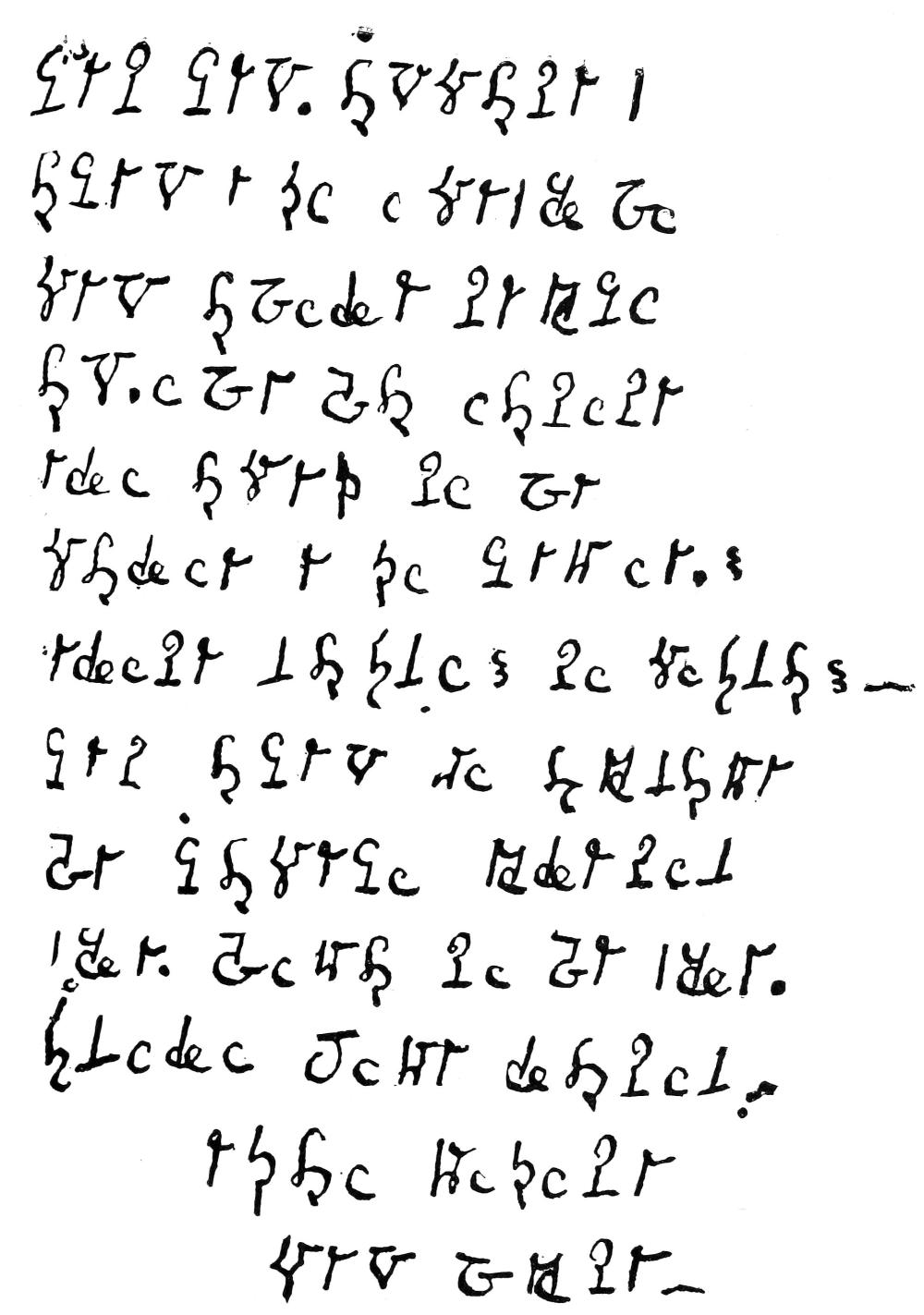
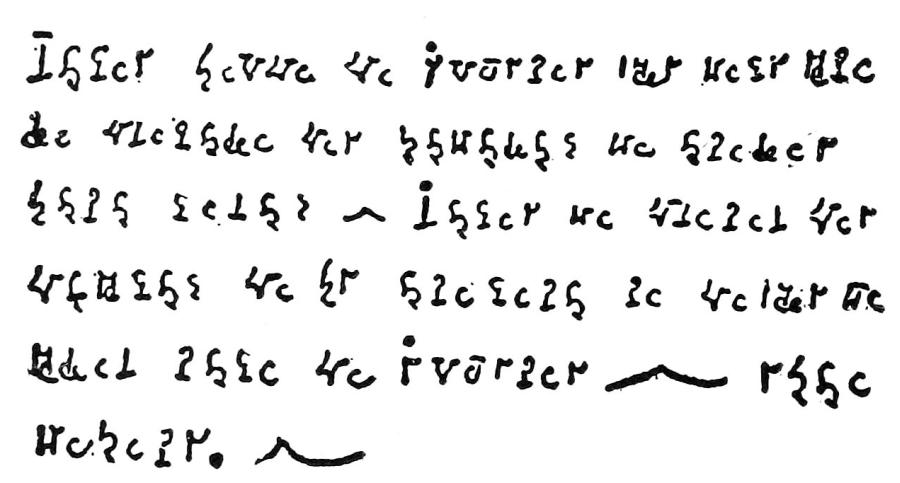
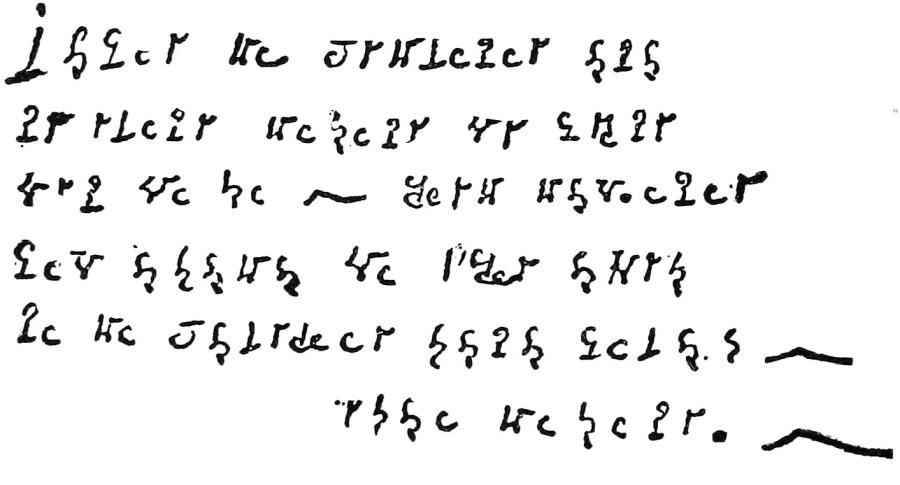
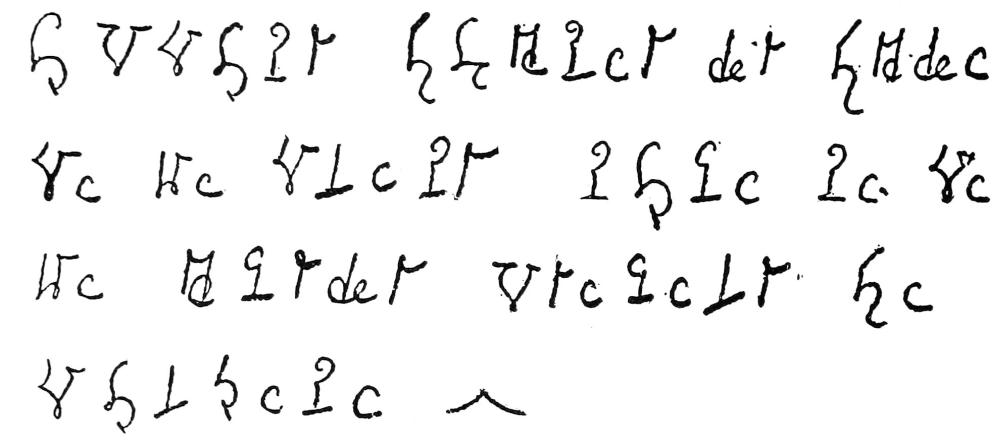
phenomenon of glossolalia[2] appears, which consists
of the fabrication and the use of an unknown language,
and which is one of the principal objects of
this study; we shall see, however, that analogous
facts are likewise presented in the Hindoo cycle.
The personality of Leopold maintains very complex
relations with the preceding creations. On the
one hand, it is very closely connected with the Royal
cycle, owing to the fact that the name of Leopold is
only a pseudonym under which is concealed the illustrious
Cagliostro, who, it appears, was madly infatuated
with Queen Marie Antoinette, and who
now, discarnate and floating in space, has constituted
himself the guardian angel in some respects of Mlle.
Smith, in whom after a long search he has again
found the august object of his unhappy passion of a
century ago.
On the other hand, this rôle of protector and spiritual
guide which he assumes towards Hélène confers
upon him a privileged place in her somnambulisms.
He is more or less mixed up in the greater part of
them; assists at them, watches over them, and perhaps
in a measure directs them. He also occasionally
appears in the midst of a Hindoo or a Martian scene,
delivering his message by certain characteristic movements
of the hand.
To sum up: sometimes revealing himself by raps
upon the table, the taps of a finger, or by automatic
writing; sometimes incarnating himself completely
and speaking by the mouth of Mlle. Smith while entranced—Leopold
fulfils in these seances the multiple
and varied functions of spirit-guide, giving good advice
relative to the manner of acting towards the
medium; of stage-manager hidden behind the scenes
watching the performance and ready at any time to
intervene; of benevolently disposed interpreter willing
to furnish explanations of all that is obscure; of
censor of morals sharply reprimanding the sitters
when he deems it necessary; of sympathetic physician
prompt at diagnosis and well versed in the
pharmacopœia, etc. He also appears under his own
name of Cagliostro to the somnambulistic gaze of
the resuscitated Marie Antoinette and answers her
questions by means of auditive hallucinations. Nor
is this all: to make our summary complete, it is necessary
also to investigate the personal connection
of Mlle. Smith with her invisible protector. She
often invokes and questions Leopold at her own convenience,
and while he remains sometimes for weeks
without giving any sign of life, he at other times
readily responds to her by means of voices or visions
which surprise her while fully awake in the course
of her daily duties, and in which he lavishes upon her
in turn material or moral advice, useful information,
or the encouragement and consolation of which she
has need.
Although I have accused myself of perhaps having
had much to do with the transformation of Hélène’s
hemisomnambulism into complete trances, I believe
myself, however, altogether innocent of the origin,
and therefore of the subsequent development, of the
great subliminal creations of which I have spoken.
The first, that of Leopold, is of very early date, even
going back probably, as we shall see, prior to Mlle.
Smith’s initiation into spiritism. As to the three
cycles, they did not, it is true, commence to display
their full amplitude until after I had made Hélène’s
acquaintance; and since they start from the time
when she first became subject to veritable trances, it
would seem as though that supreme form of automatism
is the only one capable of allowing the full expansion
of productions so complex, and the only
psychological container appropriate and adequate to
such a content. But the first appearance of all three
was clearly prior to my presence at the seances.
The Hindoo dream, where I shall be found playing
a rôle which I did not seek, evidently began (October
16, 1894) eight weeks before my admission to Mlle.
Smith’s seances. The Martian romance, which dates
from the same period, is closely connected, as I shall
also show, with an involuntary suggestion of M.
Lemaître, who made the acquaintance of Hélène in
the spring of 1894, nine months before my introduction
to her. The Royal cycle, finally, had been
roughly outlined at seances held at the home of M.
Cuendet, in December, 1893. Nevertheless, I repeat,
only since 1895 have the exuberant growth and
magnificent flowering of that subliminal vegetation
taken place under the stimulating and provocative
influence, albeit wholly unintentional and altogether
unsuspected at the time, of the varied environments
of Mlle. Smith’s seances.
As far as the indiscreet revelations in regard to my
own family, which so much astonished me at my first
meeting with Mlle. Smith, are concerned, as well as
the innumerable extraordinary facts of the same kind
with which her mediumship abounds, and to which
she owes her immense reputation in spiritistic circles,
it will suffice to return in the closing chapters of this
book.
CHAPTER II CHILDHOOD AND YOUTH OF MLLE. SMITH
The psychological history of Mlle. Smith and
her automatisms is naturally divided into
two separate periods by the important fact
of her initiation into spiritism at the beginning of
1892. Before that time, not suspecting the possibility
of voluntary communication with the world of
disincarnate spirits, she naturally manifested nothing
more than a few spontaneous phenomena, the
first flutterings of her mediumistic faculties which
still lay dormant, the exact nature and progress of
which it would be interesting to know in detail; unfortunately,
in the absence of written documents concerning
that pre-spiritistic period, we are confined to
the statements of Hélène and her parents in regard
to it, and the untrustworthiness of the memory in
connection with events of a remote past is only too
well known.
The spiritistic period, on the contrary, extending
over the last seven years, and infinitely more fertile
in artificially promoted (e.g., the seances) as well as
in spontaneous manifestations, is much better known
to us; but in order to comprehend it intelligently, it
is necessary first to pass in review the few facts
which we have been able to gather relating to the
pre-spiritistic period—that is to say, the childhood
and youth of Mlle. Smith. That will be the subject
of this chapter.
Mlle. Smith has lived in Geneva since her infancy.
After attending school, she entered as an
apprentice, at the age of fifteen, a large commercial
house, where, as I have already stated, she still remains,
and where, little by little, she has risen to a
very responsible position. Her father, a merchant,
was a Hungarian, and possessed a remarkable facility
for languages, which is of interest to us in presence
of the phenomena of glossolalia, a subject which
will be discussed hereafter. Her mother is a Genevese.
Both enjoyed excellent health and attained a
venerable old age. Hélène had a younger sister
who died in early childhood, and two brothers older
than herself, who are now fathers of families and
established abroad, where they have had successful
business careers.
I am not aware that M. Smith, who was a man of
positive character, ever displayed any phenomena of
automatisms. Mme. Smith, however, as well as
her grandmother, has experienced several thoroughly
characteristic phenomena of that kind, and one, at
least, of Hélène’s brothers, it appears, could easily
have become a good medium. This is another instance
of the distinctly hereditary tendency of mediumistic
faculties.
M. Smith, a man of active and enterprising character,
died quite suddenly, probably of an embolism,
at the age of seventy-five years. He had left Hungary
in his youth, and finally established himself at
Geneva, after having travelled extensively in Italy
and Algiers, where he remained for several years.
He spoke fluently Hungarian, German, French, Italian,
and Spanish, understood English fairly well, and
also knew Latin and a little Greek. It would seem
that his daughter has inherited these linguistic aptitudes,
but only in a latent and subliminal manner,
for she has always detested the study of languages,
and rebelled against learning German, in which she
took lessons for three years.
Mme. Smith, who is a kind-hearted woman, with
much good, practical sense, is sixty-seven years of
age. Neither she nor her husband was ever a nervous
or psychopathic subject, but both showed a
marked tendency to broncho-pulmonary affections of
a somewhat alarming type. Mme. Smith has, besides,
suffered frequently from rheumatism. Hélène
does not appear to have inherited these tendencies;
she has always enjoyed robust health, and has not
even had the slight diseases usually incidental to
childhood.
Although both M. and Mme. Smith were Protestants,
through a chain of peculiar circumstances their
daughter was baptized a Catholic shortly after her
birth, her name being inscribed some months later
on the register of the Protestant church of Geneva.
The memory of this unusual baptism has certainly
not been lost by Hélène’s subliminal imagination,
and has duly contributed to the hypothesis of a mysterious
origin. Of the years of childhood I know
nothing specially interesting. At the intermediate
school, at which she passed only a year, and where I
have consulted the records of her class, she was not
distinguished either for good or ill from the point
of view of deportment, but she certainly did not reveal
the full measure of her intelligence, since she failed
to pass the examinations at the end of the year,
a fact which decided her entrance upon an apprenticeship.
On the other hand, the worthy pastor
who gave her religious instruction somewhat later,
and who has never lost sight of her since, has furnished
me with most eulogistic testimonials as to
her character; he remembers her as a young girl of
serious disposition, intelligent, thoughtful, faithful
in the discharge of her duties, and devoted to her
family.
M. Smith never showed the least trace of mediumistic
phenomena; from having been very indifferent, or
even hostile, to spiritism until his daughter began to
interest herself in it, he finally succumbed to her influence
and became a believer in that doctrine towards
the close of his life. Mme. Smith, on the contrary,
has always been predisposed to it, and has experienced
several phenomena of that nature in the course of her
life. At the period of the epidemic of “table-tipping”
which raged in our country about the middle of this
century, she too experimented quite successfully for
a while upon the table with her friends and acquaintances.
Later, she had some sporadic visions. The
following is one of the most typical. While her little
daughter three years old was ill, Mme. Smith
awoke in the middle of the night and saw an angel,
of dazzling brightness, standing by the side of the
little bed with its hands stretched out above the
child; after some moments the apparition gradually
dissolved. Mme. Smith awakened her husband
and told him of the fatal significance which she attached
to the vision, but he, unable to see anything,
ridiculed her superstitious fears. As a matter of fact,
the child died on the following day, to the great surprise
of the physician attending her. This is a fine example
of true maternal presentiment, subconsciously
felt and transferring itself into the normal consciousness
by a visual hallucination which borrowed for its
symbolic content an appropriate popular image.
Mme. Smith never knew her mother, who died
shortly after her birth; but she recalls and has related
to me some characteristic visions of her grandmother,
who brought her up; various phenomena connected
with one of Hélène’s brothers (hearing of steps in the
night, etc.) have proved to her that one of her sons, at
least, is a medium.
Hélène Smith was certainly predisposed, both by
heredity and temperament, to become a medium, as
soon as the outward opportunity—that is, the suggestions
of spiritism—should present itself.
It is evident, indeed, from her recital of events, that
she was more or less visionary from her infancy. It
does not appear, however, that she ever manifested
phenomena capable in themselves of attracting the
attention of her family. I have not been able to discover
any indication whatever of crises or attacks of
an abnormal nature, not even of sleep-walking. Her
automatisms have been always almost entirely confined
to the sensory or mental sphere, and it is only
from her own narratives that other people have any
knowledge of them. They assume the double form
of reveries more or less conscious, and of hallucinations
properly so called.
1. Reveries.—The habit of falling into reverie, of
building castles in the air, of transporting one’s self
into other conditions of existence, or of telling one’s
self stories in which one plays the chief rôle, is more
frequent among women than among men, and in
childhood and youth than in mature years. This propensity
seems to have always been extremely marked
in the case of Mlle. Smith, since from her school-girl
days she has shown herself to be of a sedentary and
domestic temperament, preferring the quiet companionship
of her mother to the games of her comrades,
and her needle-work to out-door recreations. The
fragments which have survived in Hélène’s conscious
memory are all that is known to us of the content of
these reveries, but it suffices, nevertheless, to reveal
to us the general tone of her fictions, and to show
us that the images suddenly surging up before her
mental vision had a peculiar, often very fantastic,
character, and which enables us to see in them the beginnings
of her later great somnambulistic romances.
It is to be noticed also that the designs, embroideries,
varied artistic works, which were always the favorite
occupations of her moments of leisure and in which
she excels, were almost always, from her infancy,
not copies of exterior models, but the products of her
own invention, marked with the bizarre and original
stamp of her internal images. Moreover, these pieces
of work grew under her fingers with an ease and
rapidity that astonished herself. They made themselves,
as it were.
She was always fond of indulging in day-dreams,
and recalls many a half-hour passed motionless in
an easy-chair, on which occasions she was accustomed
to see all kinds of strange things, but, being
of a very reticent nature, she seldom mentioned them
to her parents for fear of not being understood. She
used to see highly colored landscapes, a lion of stone
with a mutilated head, fanciful objects on pedestals,
etc. She does not remember the details, but does
clearly recollect that they all bore a close resemblance
to her Hindoo and Martian visions of later years.
These phantasmagoria also appeared to her in
the night. She remembers, among other things, to
have seen, when about fourteen or fifteen years old,
a bright light thrown against the wall of her room,
which then seemed to be filled with strange and unknown
beings. She had the impression of being
fully awake, but it suddenly occurred to her that she
must have been dreaming, and it was only then that
she comprehended that it was really a “vision” which
she had experienced.
2 Hallucinations.—In the foregoing examples it
would be difficult to say to exactly which category
the psychologic facts belong, especially the nocturnal
phenomena, and one may hesitate whether to regard
them as simple dreams of a very vivid character,
hypnagogic or hypnopompic[3] visions, or as veritable
hallucinations. On the other hand, we undoubtedly
have the right to give the latter designation to the
numerous apparitions which Mlle. Smith has when
in full possession of her senses in the daytime.
One day, for example, as she was playing out-of-doors
with a friend, she saw some one following her,
and mentioned the fact to her companion, who could
not see any one. The imaginary individual, after
having followed her around a tree for a moment,
disappeared, and she was unable to find him again.
Of an entirely different order are the strange characters
which she remembers having sometimes involuntarily
substituted for French letters when writing
to her friends, which must be regarded as graphomotor
hallucinations. These were undoubtedly the
same characters which at other times appeared to her
in visual images.
This was the prelude to the phenomenon so frequently
experienced by her in the last few years, and
of which we shall hereafter see many examples—namely,
automatic writing, mingling with her ordinary
chirography in her waking state.
Alongside of hallucinations like these, which do
not show any intentional or useful character and are
only a capricious and fortuitous irruption into the normal
consciousness, mere dreams or fancies filling up
the subconscious strata, there are also manifested
in Hélène’s case some hallucinations of a manifest
utility, which have in consequence the sense of messages
addressed by the subliminal consciousness of
the subject to her normal consciousness, by way of
warning and protection. It is to be noted that these
hallucinations, which might be called teleological,
have lately been claimed by Leopold, although he
has no recollection of, and does not assert himself to
be the author of, the earlier ones.
The following is a curious example: At about the
age of seventeen or eighteen, Hélène was returning
from the country one evening, carrying a fine bouquet
of flowers. During the last minutes of the journey
she heard behind her a peculiar cry of a bird,
which seemed to her to warn her against some
danger, and she hastened her steps without looking
behind. On her arrival at home the cry followed her
into her room without her having been able to see the
creature from which it emanated. She went tired to
bed, and in the middle of the night awoke in great
pain, but was unable to cry out. At that moment
she felt herself gently lifted, together with the pillow
on which she lay, as if by two friendly hands, which
enabled her to recover her voice and call her mother,
who hastened to comfort her, and carried the
flowers, which were too odorous, out of the room.
Leopold, on being interrogated recently during a
somnambulism of Hélène as to this incident, coming
up again after so many years, has a very clear recollection
of it and gives the following explanation.
It was not really the cry of a bird, but it was he,
Leopold, who caused Hélène to hear a sort of whistle,
hoping thereby to attract her attention to the danger
lurking in the bouquet of flowers, in which was
a great deal of garden-mint of powerful odor. Unfortunately
Hélène did not understand, and retained
the bouquet in her room. He adds that his failure
to give a more clear and intelligible warning was
due to the fact that it was at that time impossible
for him to do so. The whistle which Hélène took
for the cry of a bird was all that it was in his power
to utter. It was again he who intervened at the
moment of her nocturnal illness by raising her head
in order to enable her to call for help.
I have no reason to doubt the substantial accuracy
either of the account given by Hélène and her mother,
or of the explanation recently furnished by Leopold.
The incident belongs to the category of well-known
cases where a danger of some sort not suspected by
the normal personality, but which is subconsciously
known or recognized, is warded off by a preservative
hallucination, either sensory (as here—the cry of the
bird) or motor (as in the lifting of the body). The
subliminal consciousness is not always able to give
a clear message; in the present case, the auditive
automatism remained in a state of elementary hallucination,
a simple whistle, without being able to
elevate it to a distinct verbal hallucination. Its general
warning sense, however, was understood by
Hélène, thanks to the confused feeling of danger that
she felt at the same time. Moreover, this confused
feeling, which caused her to quicken her steps, it
seems to me, ought not to be considered as the consequence
of the whistle she heard, but rather as a parallel
phenomenon; the appearance or the odor of the
mint she was carrying, while not attracting her conscious
attention, nevertheless dimly roused in her an
idea of the danger lurking in the flowers, and that
idea in turn affected her clear consciousness under the
double form of a vague emotion of danger and a verbo-auditive
translation which did not go so far as to
formulate itself explicitly.
Under circumstances of a nature calculated to cause
a strong emotional shock, and especially when the
psychic sphere which involves the sentiment of
modesty is strongly acted upon, Hélène has a visual
hallucination of a man clothed in a long, brown
robe, with a white cross on his breast, like a monk,
who comes to her aid, and accompanies her in silence
as long as the necessity for his presence continues.
This unknown protector, always silent, each time
appearing and disappearing in a sudden and mysterious
manner, is no other than Leopold himself,
according to the recent affirmations of the latter.
We should naturally expect that Hélène would have
had in her youth many striking experiences of prevision,
marvellous intuition, divination, etc., which
are among the most diffuse forms of teleological
automatism. Such, however, does not seem to have
been the fact; neither she nor her mother has recounted
to me anything remarkable of this nature,
and they confine themselves to a general affirmation
of frequent presentiments, which were subsequently
justified as to the persons and events with which they
were connected.
All the examples which I have above cited concur
in bringing to light the strong penchant of Mlle.
Smith towards automatism. But from the point of
view of their meaning there is a notable difference
between the teleological phenomena, presentiments
or hallucinations of a manifest utility, and those
which have none—mere reveries and other perturbations,
which are altogether superfluous, if not actually
detrimental, to Hélène’s normal personality.
There are dreams and other automatisms absolutely
useless which have insinuated themselves
without rhyme or reason into Hélène’s normal life.
One does not know how or in what manner to interpret
these phenomena, capricious and fortuitous as
they seem to be, and they remain isolated, inconsiderable
facts, without bearing and without interest,
since they cannot be attached to any central principle,
to one mother-idea or fundamental emotion.
We are, therefore, reduced to certain conjectures,
the most reasonable of which is that these diverse
fragments make part of some vast subconscious creation,
in which all the being of Mlle. Smith, crushed
and bruised by the conditions which the realities of life
have imposed upon her, as is more or less the case with
each one of us, gave free wing to the deep aspirations
of its nature and expanded into the fiction of an existence
more brilliant than her own. All that we know
of Hélène’s character, both as a child and as a young
girl, shows us that her dominant emotional note was
a sort of instinctive inward revolt against the modest
environment in which it was her lot to be born, a profound
feeling of dread and opposition, of inexplicable
malaise, of bitter antagonism against the whole of
her material and intellectual environment. While
showing herself always very devoted to her parents
and brothers, she had only feeble natural affinities for
them. She felt like a stranger in her family and as
one away from home. She had a feeling of isolation,
of abandonment, of exile, which created a sort of gulf
between her and her family. So strong were these
feelings that she actually one day seriously asked her
parents if it was absolutely certain that she was their
daughter, or whether it was not possible that the nurse
might some day by mistake have brought home another
child from the daily walk.
This want of adaptation to her environment, this
sort of mysterious homesickness for an unknown
country, shows itself in a characteristic manner in the
following fragment of narrative, in which Hélène,
who has always attributed great importance to
dreams, tells of one in which an isolated house figured.
“To me this retired mansion, in which I lived
alone, isolated, represents my life, which from my infancy
has been neither happy nor gay. Even while
very young I do not remember to have shared any of
the tastes or any of the ideas of the members of my
family. Thus during the whole of my childhood I
was left in what I call a profound isolation of heart.
And in spite of all, in spite of this complete want of
sympathy, I could not make up my mind to marry,
although I had several opportunities. A voice was
always saying, ‘Do not hurry: the time has not arrived;
this is not the destiny for which you are reserved.’
And I have listened to that voice, which
has absolutely nothing to do with conscience, and I
do not regret it, for since I have engaged in spiritism
I have found myself so surrounded with sympathy
and friendships that I have somewhat forgotten
my sad lot.”
This quotation speaks volumes in regard to the
turn of mind and the emotional disposition which
ruled Hélène as a little girl. It is surely, so to speak,
the vulgar story and the common lot of all; many a
child, many a youth, many an unrecognized genius,
feel themselves suffocating in their too narrow environment
when the latent energies of life begin to
ferment. But there are differences in kind and in
degree. With Mlle. Hélène Smith the sentiment of
not having been made for her environment, and of belonging
by nature to a higher sphere, was intense
and lasting. Her mother always had the impression
that Hélène was not happy, and wondered that
she was so serious, so absorbed, so wanting in the
exuberance of spirits natural to her age. Her father
and her brothers, not comprehending the real reasons
for this absence of gayety, taxed her very unjustly
with pride and hauteur, and accused her sometimes of
despising her humble surroundings. There are shades
of feeling which can only be understood when they
have been experienced. Hélène well knew that she
really had no contempt for her material and social
environment, which, on the contrary, inspired her
with respect, but which simply was not congenial to
her nature and temperament.
To this fundamental feeling of imprisonment in a
too paltry sphere was joined, in Hélène’s case, a
timid disposition. Darkness, the least noise, the
creaking of the furniture, made her tremble; by day,
a person walking behind her, an unexpected movement,
the ringing of the door-bell, gave her the impression
that some one wishing to harm her had
come to seize her and carry her off. On the whole,
Hélène’s tendency to be startled by everything and
nothing constituted with her a grievous panophobia,
a state of fear and insecurity which greatly strengthened
her impression of want of union—of mésalliance—with
an environment to which she was decidedly
superior.
It is easy now to see the connection between that
depressing emotionalism which was the attribute of
Hélène’s childhood and the slightly megalomaniac
tone of her later subliminal romances. The idea
intrudes itself that, in spite of—or by reason of—their
apparent contrast, these two traits are not
independent of each other, but bound by the tie of
cause and effect. But this causal connection is in
great danger of being interpreted in a precisely inverse
sense by the empirical psychologist and the
metaphysical occultist. The latter will explain Mlle.
Smith’s curious impression of strangeness and superiority
to the base conditions of her actual existence,
by her illustrious previous incarnations; the psychologist,
on the contrary, will see in that same impression
the wholly natural origin of her grandiose
somnambulistic personifications. In default of a complete
understanding, always dubious, between these
so different points of view, of which we shall speak
later, it will be advisable to adopt at least a provisional
modus vivendi, based on the party-wall of
the native constitution or individual character of Mlle.
Smith. On the farther side of that wall, in eternity,
so to speak, a parte ante which precedes the arrival
of Hélène into this life, the occultist will have full latitude
to imagine such a succession of existences as it
shall please him in order to explain the character she
has had from her infancy. But on this side of the
wall—that is to say, within the limits of her present
life—the psychologist will have the right to ignore all
these prenatal metempsychoses, and taking for his
point of departure the innate constitution of Hélène,
without troubling himself about anything she may
have received by the accidents of heredity or preserved
from her royal pre-existences, he will endeavor to explain
by that same constitution, as it reveals itself
in her daily life, the genesis of her subliminal creations
under the action of occasional exterior influences.
The occultist, then, can have the pleasure
of regarding Mlle. Smith’s characteristic trait as a
child, that impression of solitude and wandering
about in a world for which she was not made, as the
effect of her real past greatnesses, while the psychologist
will be permitted to see in it the cause of her
future dreams of grandeur.
The emotional disposition which I have depicted,
and which is one of the forms under which the maladaptation
of the organism, physical and mental,
to the hard conditions of the environment, betrays
itself, seems therefore to me to have been the source
and starting-point for all the dreamings of Hélène
in her childhood. Thence came these visions,
always warm, luminous, highly colored, exotic,
bizarre; and these brilliant apparitions, superbly
dressed, in which her antipathy for her insipid and
unpleasant surroundings betrays itself, her weariness
of ordinary, commonplace people, her disgust
for prosaic occupations, for vulgar and disagreeable
things, for the narrow house, the dirty streets, the
cold winters, and the gray sky. Whether these images,
very diverse, but of the same brilliant quality,
were already existent in Hélène’s subconscious
thought while still a child or a young girl, we are unable
to say. It is, however, probable that their systematization
was far from attaining to such a degree
of perfection as they have presented during the past
few years under the influence of spiritism.
All the facts of automatism to which Hélène can
assign a vaguely approximate date group themselves
around her fifteenth year, and are all included
between the limits of her ninth and twentieth years.
This evident connection with a phase of development
of major importance has been confirmed to me
by Leopold on various occasions, who says that he
appeared to Hélène for the first time in her tenth
year, on an exceptional occasion of extreme fright,
but after that, not until about four years later, because
the “physiological conditions” necessary to
his apparition were not yet realized. The moment
they were realized, he says, he began to manifest
himself, and it is at the same period, according to
him, that Hélène commenced to recover memories
of her Hindoo existence, under the form of strange
visions of which she comprehended neither the nature
nor the origin.
After the age of about twenty years, without affirming
or believing that her visions and apparitions
ceased altogether, Mlle. Smith has no striking
recollections of any, and she has not told me of any
psychic phenomenon experienced by her in the series
of years immediately preceding her entrance into
spiritism. We may infer from this, with some reason,
that the ebullitions of the imaginative subconscious
life gradually became calm after the explosion of
the period we have mentioned. They had been appeased.
The conflict between Hélène’s inner nature
and the environment in which she was forced to live
became less fierce. A certain equilibrium was established
between the necessities of practical life and
her inward aspirations. On the one hand, she resigned
herself to the necessities of reality; and if her
native pride could not yield to the point of condescending
to a marriage, honorable undoubtedly, but for
which she felt she was not intended, we must nevertheless
pay homage to the perseverance, the fidelity,
the devotion which she always brought to the fulfilment
of her family and business duties. On the
other hand, she did not permit the flame of the ideal
to be extinguished in her, and it reacted upon her
environment as strongly as possible, making its
imprint upon her personality well marked.
She introduced a certain stamp of elegance into
the modest home of her parents. She arranged for
herself a small salon, coquettish and comfortable in
its simplicity. She took lessons in music, and
bought herself a piano. She hung some old engravings
on her walls, secured some Japanese vases, a
jardinière filled with plants, cut flowers in pretty
vases, a hanging lamp with a beautiful shade of her
own make, a table-cover which she had put together
and embroidered herself, some photographs curiously
framed according to her own design; and out of this
harmonious whole, always beautifully kept, she
evolved something original, bizarre, and delightful,
conforming well to the general character of her fantastic
subconsciousness.
At the same time that Mlle. Smith succeeded in accommodating
herself to the conditions of her existence,
the state of latent timidity in which she lived
gradually diminished. She is still occasionally
overcome by fear, but much less frequently than
formerly, and never without a legitimate exterior
cause.
Indeed, judging her by these latter years, I do not
recognize in her the child or young girl of former
days, always timid, trembling, and frightened, taciturn
and morose, who has been depicted to me by
herself and her mother.
It seems to me, then, that the wildness of the
dreams and automatisms, which were symptoms of
a tendency to mental disintegration, which marked
the years of puberty, was succeeded by a progressive
diminution of these troubles and a gradual gaining
of wisdom on the part of the subliminal strata.
We may presume that this harmonization, this reciprocal
adaptation of the internal to the external,
would in time have perfected itself, and that the whole
personality of Mlle. Smith would have continued to
consolidate and unify itself, if spiritism had not come
all of a sudden to rekindle the fire which still slumbered
under the ashes and to give a new start to the
subliminal mechanism which was beginning to grow
rusty.
The suppressed fictions aroused themselves, the
reveries of former years resumed their sway, and the
images of subliminal phantasy began to be more prolific
than ever under the fertile suggestions of occult
philosophy, rallying-points or centres of crystallization—such
as the idea of former existences and reincarnations—around
which they had only to group
and organize themselves in order to give birth to the
vast somnambulistic constructions the development
of which we shall be obliged to follow.
CHAPTER III MLLE. SMITH SINCE HER INITIATION INTO SPIRITISM — I. The Mediumistic Beginnings of Mlle. Smith — II. Mlle. Smith in Her Normal State — III. Spontaneous Automatic Phenomena — IV. The Seances
Having endeavored in the preceding chapter
to reconstruct in its chief characteristics the
history of Mlle. Smith up to the time when
spiritism begins to be mixed up with it, I would have
preferred in the present chapter to make a detailed
study of her psychological life during these last years,
without however, as yet, touching upon the content,
properly so called, of her automatisms. Not having
been able to accomplish this design to my satisfaction,
for want of time and patience, I shall endeavor at least
to systematize my notes somewhat by grouping them
under four heads. I shall trace the birth of Hélène’s
mediumship as far as it is possible for me to do
so from the meagre accounts I have been able to
procure concerning a time at which I was not acquainted
with her. Then, passing to facts with
which I am more familiar, I will describe rapidly
her normal state as I have been able to see it for the
last five years. This would have been the place for a
study of individual psychology, but I have been compelled
to abandon the idea on account of multiple
difficulties. Finally, I will offer a few remarks on
the abnormal side of her existence, which it is convenient
to divide into two groups, namely, the spontaneous—that
is to say, springing up of themselves in
the course of her ordinary life; or those provoked by
the voluntary seeking for favorable circumstances,
and which constitute the seances properly so called.
In the winter of 1891-92 Mlle. Smith heard spiritism
spoken of by one of her acquaintances, Mme.
Y., who lent her Denis’s book, Après la Mort. The
perusal of this work having vividly excited Hélène’s
curiosity, Mme. Y. agreed to accompany her to her
friend, Mlle. Z., who was interested in the same
questions, and who produced automatic writing.
They then decided to form a circle for regular experimentation.
I take from the notes which Mlle. Z. has
had the kindness to furnish me, the account, unfortunately
very brief, of the seances at which Hélène’s
mediumistic faculties first made their appearance.
“It was on the 20th of February, 1892, that I made
the acquaintance of Mlle. Smith. She was introduced
to me by Mme. Y., for the purpose of endeavoring to
form a spiritistic group. She was then altogether a
novice in spiritism, never having attempted anything,
and did not suspect the faculties that have
since developed themselves in her.
“February 20.—First reunion: We seat ourselves
at the table; we succeed in making it oscillate. We
regard Mme. Y. as the medium upon whom we can
reckon. We try for writing. We receive through me
encouragements to proceed.
“February 26.—Progress; the table moves itself
considerably, salutes one by one all the members of
the group, and gives us certain names, of which only
one is recognized.... Writing: Mlle. Smith, who
tries for the first time, writes mechanically, her eyes
closed, some phrases, of which we can decipher some
words.
“March 11.—Nothing at this seance, except a communication
written by myself.
“March 18.—Progress; clear communication by the
table. Attempt to experiment in the darkness (which
was not absolute, the hall outside having some incandescent
lights which diffused a feeble light; we could
distinguish each other with difficulty). Mlle. Smith
sees a balloon, now luminous, now becoming dark:
she has seen nothing up to this time. Writing: Mlle.
Smith writes mechanically a quite long communication
from the father of M. K. [a Bulgarian student
present at the seance]; advice to him.”
At this point the sitters became so numerous that
they broke up into two groups, of which the one continuing
to meet with Mlle. Z. does not concern us.
Mlle. Smith became a member of the other, which
met at the house of a lady named N., where weekly
seances were held for a year and a half (up to the
end of June, 1893). The records of these meetings,
kept by Mme. N., are unfortunately very brief and
obscure on many points of interest to the psychologist.
Those of the first months are in the handwriting of
Mlle. Smith, who acted as secretary of the group for
thirty seances. As she only took down at the time
the headings of the communications of the spirits
and wrote out the remainder on the following day,
we cannot rely very strongly on the objective accuracy
of these accounts, which, however, have the
advantage of presenting to us the mediumship of
Hélène, as related by herself. She speaks of herself
in the third person.
The following is a summary of the two first seances
held in this new environment:
“March 25, 1892.—Eleven persons around a large
and heavy dining-table of oak with two leaves. The
table is set in motion, and several spirits come and
give their names (by raps), and testify to the pleasure
it gives them to find themselves among us. It is at
this seance that Mlle. Smith begins to distinguish
vague gleams with long white streamers moving
from the floor to the ceiling, and then a magnificent
star, which in the darkness appears to her alone
throughout the whole of the seance. We augur from
this that she will end by seeing things more distinctly
and will possess the gift of clairvoyance.
“April 1.—Violent movements of the table, due to
a spirit who calls himself David and announces himself
as the spiritual guide of the group. Then he
gives way to another spirit who says he is Victor
Hugo, and the guide and protector of Mlle. Smith,
who is very much surprised to be assisted by a person
of such importance. He soon disappears. Mlle.
Smith is very much agitated; she has fits of shivering,
is very cold. She is very restless, and sees
suddenly, balancing itself above the table, a grinning,
very ill-favored face, with long red hair. She
is so frightened that she demands that the lights be
lit. She is calmed and reassured. The figure disappears.
Afterwards she sees a magnificent bouquet
of roses of different hues being placed on the table
before one of the sitters, M.P. All at once she sees
a small snake come out from underneath the bouquet,
which, crawling quickly, perceives the flowers,
looks at them, tries to reach the hand of M.P.,
withdraws for an instant, comes back slowly, and
disappears in the interior of the bouquet. Then all
is dissolved and three raps are given on the table,
terminating the seance. [M.P. interprets the meaning
of the vision of the bouquet and the serpent as a
symbolic translation of an emotional impression experienced
by Mlle. Smith].”
Such was the birth of Hélène’s mediumship.
Scarcely anything happened on the 20th of February,
when the movements of the table were not attributed
to her (although in all probability she caused
them); in the following seances she appeared in
two attempts at automatic writing (unfortunately
lost) in imitation of the writing medium with whom
she was sitting. The outcome of this second attempt
leads us to suppose that Hélène’s faculties
would have developed rapidly in that direction if she
had not abandoned it and changed her environment.
Her visual faculty, suggested by the experiments
at obscure seances, shows itself on the 18th and 25th
of March in the form of elementary hallucinations
or vague figures having their point of departure
probably in the simple entoptical phenomena, the
retina’s own light, consecutive images, etc. Then,
encouraged by the predictions of the sitters, she attained
on the 1st of April to visions properly so
called, having a varied content and a real or symbolic
signification. At the same time her typtological
automatism was perfecting itself. We recognize it
in the name of Victor Hugo, coming especially for
Mlle. Smith, and suspect it to have been a name already
given at the second seance.
Auditive hallucinations follow closely upon the
visual, but it is impossible to know at just what
date, as the records do not clearly indicate whether
the messages recorded had that origin or were
rapped out on the table. To these known forms
of automatism must be added the frequent phenomena
of emotion, shiverings, sadness, restlessness,
fear, etc., which are experienced by Hélène
without knowing why, and are afterwards found
to be in perfect conformity to, and in evident connection
with, the content of those emotional phenomena
which they generally precede by a few moments.
Thus, in a half-dozen weekly seances, the mediumship
of Mlle. Smith was invested with a complex
psychological aspect, which from that time it
preserved intact for three years, and of which I was
a witness after I made her acquaintance. This
rapidity of development is not at all unusual; but
there is this peculiarity about Hélène, that her mediumistic
faculties, after their first appearance, remained
for a long time stationary, and then underwent
all at once, in the spring of 1895, the enormous
transformation and tremendous expansion which I
have described in the first chapter, and to which I
will not again refer.
I was about to say that in her normal state Mlle.
Smith is normal. Certain scruples restrain me, and
I correct myself by saying that in her ordinary state
she seems just like anybody else. By this I mean
that outside of the gaps which the seances and the
spontaneous eruptions of automatism make in her
life, no one would suspect, observing her performance
of her various duties, or in talking with her on all sorts
of subjects, all that she is capable of in her abnormal
states, or the curious treasures which are concealed in
her subliminal strata.
With a healthy and ruddy complexion, of good
height, well proportioned, of regular and harmonious
features, she breathes health in everything. She presents
no visible stigmata of degeneration. As to
psychic defects or anomalies, with the exception of her
mediumship itself, I know of none, the timidity of her
youth having entirely disappeared. Her physical
strength is marvellous, as shown by the fact that
she bears up under the strain of a business which
demands nearly eleven hours of her time each day,
nearly all of which she is compelled to stand on her
feet, and from which she takes only one week’s vacation
in summer. Besides this confining work away
from home, she assists her mother about the house
morning and evening, in the housekeeping duties,
and finds time besides to read a little, to practise at
her piano, and to make the lovely handiwork, which
she designs and executes herself with remarkable
originality and good taste. To a life so full must
be added, besides, the spiritistic seances which she
is generally willing to give on Sunday, and sometimes
on a weekday evening, very disinterestedly, to
persons who are interested in psychic questions or
who desire to consult Leopold on important subjects.
While hesitating to affirm that a person presenting
phenomena so extraordinary as those of mediumship
is perfectly normal in other respects, I am
pleased to discover that as far as Mlle. Smith is concerned,
through my conversations with her and as
the result of my investigations concerning her, she
does not present a single abnormality, physical, intellectual,
or moral, between the periods of the irruptions
of her automatisms. Her field of vision,
which she has permitted me to measure with a Landolt
perimeter, is normal for white as well as for colors,
for which latter she has a very delicate perception.
There is no trace of tactile anæsthesia in her
hands. There is no known motor trouble. The
tremor of the index-finger gives a line, of four oscillations
per second on an average, differing not at
all from the fines obtained from persons perfectly
normal (see Fig. 2).
It cannot be expected that I should paint a full
moral and intellectual portrait of Mlle. Smith, as I
should be in danger of hurting her feelings in case my
attempt should come to her notice. I can only touch
on a few points. One of the most striking is her great
native dignity; her bearing, her manners, her language
are always perfect, and have a certain quality of
noblesse and pride which accords well with her somnambulistic
rôles. On occasion she shows a stately
and regal hauteur. She is very impressionable, and
feels little things very keenly. Her antipathies as well
as her sympathies are quick, lively, and tenacious.
She is energetic and persevering. She knows very
well what she wants, and nothing passes her by unperceived,
nor does she forget anything in the conduct
of others towards her. “I see everything, nothing
escapes me, and I forgive but never forget,” she
has often said to me. Perhaps a severe moralist
would find in her a certain exaggeration of personal
sensibility, but that sort of self-love is a very common
characteristic of human nature, and is very natural in
mediums who are continually exposed to public criticism.
She is very intelligent and highly gifted. In conversation
she shows herself vivacious, sprightly, and
sometimes sarcastic. Psychic problems, and all questions
connected with mediumistic phenomena, of which
she is herself so striking an example, occupy her mind
a great deal and form the principal subject of her private
thoughts and of her conversations with people in
whom she is interested.
Her philosophical views are not wanting in originality
or breadth. She does not believe in spiritism,
in the generally accepted sense of the term, and has
never consented, in spite of the advances which have
been made to her, to become a member of the Geneva
Society (spiritistic) for Psychic Studies, because, as
she says, she has no fixed ideas on subjects so obscure,
does not care for theories, and “does not work in the
interest of any party.” She investigates, she observes,
she reflects and discusses, having adopted for her motto,
“The truth in all things, for all things, and always.”
There are two points in regard to which she is
uncompromising—namely, the objective reality of
Leopold, and the supernormal content of her automatisms.
No one dares tell her that her great invisible
protector is only an illusory apparition, another part
of herself, a product of her subconscious imagination;
nor that the strange peculiarities of her mediumistic
communications—the Sanscrit, the recognizable signatures
of deceased persons, the thousand correct
revelations of facts unknown to her—are but old forgotten
memories of things which she saw or heard in
her childhood. Such suppositions being contrary to
her inmost beliefs, and seemingly false in fact, easily
irritate her, as being in defiance of good sense and
an outrage on truth. But outside of these two subjects
she will examine and discuss coolly any hypothesis
one chooses. The idea that she should be the
reincarnation of a Hindoo princess or of Marie Antoinette,
that Leopold is really Cagliostro, that the
visions called Martian are really from the planet
Mars, etc., all seem to her to conform fully to the
facts; but these beliefs are not indispensable to her,
and she is ready, should they prove to be false, to
change to other theories—as, for example, telepathy,
a mixture of occult influences, a mysterious meeting
in her of intuitions coming from some higher
sphere, etc.
Undoubtedly the supposition of her pre-existences
in India and on the throne of France seems to her to
explain in a plausible manner the feeling, which has
followed her from childhood, of belonging to a world
higher than that in which the chance of birth has
imprisoned her for this life; but she does not affirm a
positive belief in that brilliant past, is not wholly
convinced of it, and remains in a sensible state of
expectancy of the true explanation of these ultimate
mysteries of her life.
There is another subject, also, which is close to
her heart. She has heard it said that in the eyes
of scientists and physicians mediums are considered
to be fools, hysterical subjects, or insane, or, in any
event, abnormal, in the bad sense of the word. But,
in the light of the experience of every day of her life,
she protests vigorously against this odious insinuation.
She declares emphatically that she is “perfectly
sane in body and mind, not in the least unbalanced,”
and repels with indignation the idea there can be
any serious abnormality or the least danger in mediumship
such as she practises. “I am far from
being abnormal,” she wrote me recently, “and I have
never been so clear of vision, so lucid, and so apt to
judge correctly as since I have begun to develop as
a medium.”
Leopold, too, speaking through her voice during
her trances, has more than once solemnly testified
as to her perfect health. He has also returned to the
subject by letter; we shall find farther on a very interesting
certificate of mental equilibrium dictated
by him and written by him with her hand, as if to
give more weight to his declarations (see Fig. 8,
p. 137.)
It is incontestable that Hélène has a very well-organized
brain, as is evidenced by the admirable manner
in which she manages the important and complicated
department which is under her direction in the
commercial establishment in which she is employed.
To accuse her of being insane, simply because she
is a medium, as some charitable souls (the world is
full of them) do not hesitate to do sometimes, is, to
say the least, a most inadmissible petitio principii.
The opinion which Mlle. Smith holds in her normal
state concerning her automatic faculties is altogether
optimistic; and there is nothing to prove her in the
wrong. She regards her mediumship as a rare and
precious privilege, with which nothing in the world
would induce her to part. True, she also sees in it
the reason for the malevolent and unjust judgments,
the jealousies, the base suspicions, to which the ignorant
multitude have in all ages subjected those
who have succeeded in elevating themselves above
it through the possession of faculties of this kind.
But, on the whole, the disadvantages are more than
counterbalanced by gains of a high order, and the
inward satisfaction attached to such a gift. And
here I desire to emphasize the statement, once for
all, that Hélène does not belong to the class of professional
mediums, nor to those who use their mediumship
for the purpose of coining money. Mlle.
Smith, who earns her living in the position which her
intelligence and fitness have secured for her, and
through which her family enjoys a modest ease,
never accepts any pecuniary compensation for her
seances or consultations. Such a traffic in faculties
which have a sort of religious signification in her
eyes would be absolutely repugnant to her feelings.
Hélène’s spontaneous automatisms have often aided
her in, without ever having interfered with, her daily
occupations. There is, happily for her, a great difference
in intensity between the phenomena of her
seances and those which break in upon her habitual
existence, the latter never having caused such disturbance
of her personality as the former.
In her daily life she has only passing hallucinations
limited to one or two of the senses, superficial
hemisomnambulisms, compatible with a certain
amount of self-possession—in short, ephemeral perturbations
of no importance from a practical point of
view. Taken as a whole, the interventions of the
subliminal in her ordinary existence are more beneficial
to her than otherwise, since they often bear the
stamp of utility and appropriateness, which make
them very serviceable.
Phenomena of hypermnesia, divination, lost objects
mysteriously recovered, happy inspirations, true presentiments,
correct intuitions—in a word, teleological
automatisms of every sort—she possesses in so
high a degree that this small coin of genius is more
than sufficient to compensate for the inconveniences
resulting from the distraction and momentary absence
of mind with which the vision is accompanied.
In the seances, on the contrary, she presents the
most grave functional alterations that one can
imagine, and passes through accesses of lethargy,
catalepsy, somnambulism, total change of personality,
etc., the least of which would be a very disagreeable
adventure for her if it should happen to
occur in the street or at her office.
But here I am obliged to leave Hélène’s ordinary
state to enter upon the study of her automatisms.
The automatisms which occur outside the seances
in Mlle. Smith’s every-day life, those, at least, which
she is able to recall and narrate, are of a frequency
very variable and utterly independent of any known
circumstances; sometimes presenting themselves
two or three times in the same day; at others, two
or three weeks will elapse without a single one.
Extremely diverse in their form and content, these
phenomena may be divided into three categories,
based upon their origin. The first proceed from
impressions received by Hélène in moments of special
suggestibility; the second are the fortuitous apparitions
above the ordinary level of her consciousness,
the romances in process of elaboration to which we
are coming; the last, which differ from the two
preceding species (which are always useless, if not
detrimental) by their beneficial character and their
adaptation to the needs of the moment, are roused
by those teleological automatisms to which I have
already called attention as having occurred in her
childhood, and which have shared in the general recrudescence
of her subconscious life under the lash
of the spiritistic experiences.
Let us pass these different cases rapidly in review.
1. Permanence of exterior suggestions.—The spiritistic
reunions are naturally their principal source. I
do not mean that she has there been subjected to
experiments in post-hypnotic suggestion. Justice to
all those who have attended the seances compels the
statement that they have never abused the suggestibility
which she shows on such occasions, by suggesting
ideas of such a nature as to cause her annoyance
on the following days. The most that has
been attempted has been the suggestion of some small
matters by way of harmless experiment, to be executed
by her a few moments after awaking from
her trance. There is no need of intentional suggestions
to influence her in a lasting manner; therefore
we have avoided as far as possible everything
that might leave disagreeable traces behind, and
have suggested to her before the end of the seance
that she have on the morrow no headache, fatigue,
etc.; but it sometimes happens that certain incidents,
often absolutely insignificant, are engraved
on her memory in a most unlooked-for manner and
assail her as inexplicable obsessions during the ensuing
week. The following are some specimens of
involuntary suggestion, which generally linger for
three or four days, but may occasionally continue
for twelve or fifteen.
Hélène told me one Sunday that she had been possessed
several times during the day by the hallucinatory
image of a straw hat, the inside of which
was turned towards her, and which remained vertically
in the air about three or four feet in front of
her, without being held by any one. She had the
feeling that this hat belonged to me, and I happened
finally to recollect that at the seance of the preceding
Sunday I happened to fan myself with this very
hat during her final trance, the image of which had
been engraved on her mind in one of the flashes in
which she opened her eyes and closed them again
instantly before her final awaking. This obsession,
said she, was very strong on Monday and the
following day or two, but lessened somewhat towards
the end of the week.
At another time she preserved during a whole week
the sensation of the pressure of my thumb on her left
eyebrow. (Compression of the external frontal and
suborbital nerves is a means I often employ to hasten
her awaking, after a hint given by Leopold.)
There happened to her also twice in the same day
an auditive and visual hallucination of an aged person
whom she did not recognize, but the extremely
characteristic description of whom corresponds so
well with that of a gentleman of Geneva who had been
mentioned to her a few days previously, immediately
before the commencement of a seance (when she was
probably already in her state of suggestibility), that
there is scarcely any doubt but that these apparitions
were the consequence of that conversation.
Following another seance where she had, at the
beginning of a Hindoo scene, made vain efforts to
detach a bracelet from her left wrist, she preserved
for three days the feeling of something grasping that
wrist, without understanding what it could be.
In the same way, various feelings of sadness, anger,
a desire to laugh or to weep, etc., the cause of which
she was unable to explain, have often followed her for
a considerable length of time after the seances of which
these feelings were the manifest emotional echo. This
is often the effect of our dreams on our waking state:
we forget the dreams, but their influence remains, and
is often more marked in the dreams of a hypnotized
person or a somnambulist than in those of ordinary
sleep.
The seances are not the exclusive source of the
involuntary suggestions which trouble Mlle. Smith
in her daily life without any benefit to herself. It is
evident that on every occasion when she finds herself
in that particular condition of least resistance which
we, in our ignorance of its intrinsic nature, designate
by the convenient name of “suggestibility,” she is
exposed to impressions capable of returning to assail
her in the course of her daily occupations. Fortunately
this condition of suggestibility does not seem
to develop itself readily in her outside of the spiritistic
reunions.
2. Irruptions of subliminal reveries.—I shall have
too many occasions to cite concrete examples of visions,
voices, and other spontaneous outpourings of
the work of imagination, which are continually going
on under the ordinary consciousness of Mlle. Smith,
to dwell long on this point. Some general remarks
will suffice.
The connection which the unforeseen phenomena
maintain with those of the seances themselves is very
varied. Sometimes we are able to recognize them as
reproductions, more or less incomplete, of episodes
which occurred at the preceding seances, and consider
them simple echoes or post-hypnotic repetitions
of these last. Sometimes, on the contrary, it appears
that we have to deal with preparatory rehearsals of
scenes which will unfold themselves at length and
will be continued at some later seance. Finally,
sometimes it is a question of tableaux, having no connection
with those which fill up the seances; they are
like leaves, flying away never to return, romances
which are continually being fabricated in the deep
subliminal strata of Mlle. Smith’s consciousness.
Hélène, in fact, does not long remember, nor in much
detail, with a few exceptions, those visions which take
place in her ordinary state, and which occur most
frequently early in the morning, while she is still in
bed, or just after she has arisen and while working
by the light of her lamp; sometimes in the evening,
or during the brief moments of rest in the middle of
the day, and, much more rarely, while in the full
activity of waking hours she is at her desk. If she
had not long since, at my request, and with great good
will, acquired the habit of noting in pencil the essential
content of these apparitions, either during the
apparition itself (which she is not always able to do)
or else immediately afterwards, we should have still
more deficiencies in the plot of her romances to deplore.
Hélène’s psychological state, during her spontaneous
visions, is known to me only by her own descriptions.
She is fortunately a very intelligent observer and a
good psychologist.
Her narratives show that her visions are accompanied
by a certain degree of obnubilation. For a
few moments, for instance, the room, the light of
the lamp, disappear from before her eyes; the noise
of the wheels in the street ceases to be heard; she
feels herself becoming inert and passive, while a feeling
of bliss and ecstatic well-being permeates her
entire individuality in the presence of the spectacle
which appears to her; then the vision, to her great
regret, slowly fades from her view, the lamp and the
furniture reappear, the outside noises again make
themselves heard, and she is astonished that the
idea did not occur to her to put down in pencil the
strange words she has heard, or that she did not
touch or caress, for example, the beautiful birds of
many-colored plumage flying and singing around
her. Sometimes she has maintained sufficient presence
of mind to scribble from dictation the words
striking her ear; but the wretched handwriting
proves that her attention, all absorbed by the apparition,
could not follow the pencil, and that the hand
directed it badly. At other times the reverse is the
fact. It appears in the course of the vision as though
some one took hold of her arm and guided it in spite
of herself; the result is splendid calligraphies, wholly
different from her own handwriting, executed without
her knowledge, and during the execution of
which her mind was wholly absent, if we can judge
from the surprise she shows on awaking when she
finds before her these strange writings, and from
analogous scenes which transpire at the seances.
The preceding is applicable especially to the more
frequent cases—that is, to the morning or evening
visions which happen to her at home, in that intermediate
condition between sleep and waking, always
so favorable, as we know, to the development of unconscious
cerebration. But there are innumerable
shades and gradations between this middle type,
so to speak, and its opposite extremes; on the one
hand is the fortunately very exceptional case where
she is seized with ecstasy while at her place of business;
and, on the other hand, that in which the automatism
limits itself to inscribing some unknown
characters or words in another hand than her own in
her correspondence and writings—peculiar lapsus
calami, which she is not slow to perceive on coming
to herself.
The following is an example of a case of ecstasy:
Having ascended one day to an upper story, to
look for something in a dark store-room, she had an
apparition of a man in a turban and large white cloak,
whom she had the impression of recognizing,[4] and
whose presence filled her with a delightful calm and
profound happiness. She could not recall the conversation
which passed between them, which, though
in an unknown language, she nevertheless had the
feeling of having perfectly comprehended. On the
departure of the mysterious visitor she was astonished
to find herself brought back to sombre reality, and
stupefied on noting by her watch that the interview
had lasted much longer than it had seemed to do.
She preserved all that day a delicious feeling of well-being
as the effect of the strange apparition.
The phenomenon of mingling strange writing with
her own is of relatively frequent occurrence, and we
shall see divers specimens of it in the following
chapters, apropos of the romances to which it especially
belongs. I will give here only one complex example,
which will serve at the same time as an
illustration of a special kind of automatism, very
harmless, to which Hélène is also subject, and which
consists in making verses, not without knowing, but
at least without intending to do so, and in connection
with the most trifling matters.
There are times when, in spite of herself, she
feels compelled to speak in distinct rhymes of eight
feet, which she does not prepare, and does not perceive
until the moment she has finished uttering
them.[5] In this particular case it is by a quatrain
(a very unusual occurrence) that she replies to some
one who had consulted her in regard to some blue
ribbon. But this quatrain, by its style, by the vision
of the blond head of a child which accompanies it,
and by the manner also in which she writes it, causes
us to hazard the conjecture that it is an inspiration
depending on the underlying Royal cycle; while in the
following letter, in which she narrates the affair to
M. Lemaître, her pen inscribes, all unknown to her,
strange characters evidently due to the cropping out
of the Martian cycle, of which she speaks in the
letter (see Fig. 1, a passage of that letter making a
Martian M and V in the words vers and rimait):
Fig. 1. Fragment of a letter (normal handwriting) of Mlle. Smith,
containing two Martian letters. (Collection of M. Lemaître.)
“I have heard some Martian words this afternoon,
but have not been able to retain them in my mind. I
send you those heard a few days ago, when I had the
vision of which I am about to make you the design
(Martian lamp). Yesterday morning I for the first
time spoke in verse, without being aware of it; it was
only on finishing the sentence that I perceived that
it rhymed, and I reconstructed it to assure myself of
the fact. A little later, on examining some ribbons,
I began anew to speak in verse, and I send those also;
they will amuse you. It is a curious thing that I
had at that same moment the vision of the blond
curly head of a child bound with a blue ribbon. The
vision lasted more than a minute. What is still more
curious, I do not at all recollect having worn ribbons
of that shade as a child: I remember some rose-colored,
some red, but I have no recollection whatever of any
blue ribbons. I really do not know why I spoke these
words; it is the more amusing. I was obliged to
speak them, I assure you, in spite of myself. I was
eager to put them on paper, and I noticed in writing
them down that, for a moment, the handwriting was
not regular, that is, it was slightly different from
mine.”
Here is the quatrain, the pencil impression of which
is too faint to enable a fac-simile to be reproduced
here, and in it I have indicated by italics the words
and syllables the calligraphy or orthography of which
differs from that of Hélène and becomes the style of automatic
handwriting called that of Marie Antoinette:
“Les nuances de ces rubans
Me rappelent mes jeunes ans;
Ce bleu verdi, je m’en souvien,
Sans mes cheveux alloit si bien!”
The head of curly blond hair, ornamented with
blue ribbons, also figures in the visions of the Royal
cycle, and appears to belong, as is here the case, sometimes
to Marie Antoinette herself, sometimes to one
or other of her children, especially the Dauphin.
While it is generally easy to connect these eruptions
of the subliminal volcano with the various dreams
from which they emanate, such is not always the case,
and there are visions the origin of which is doubtful
and ambiguous. We must not forget that, alongside
of the grand cycles of Hélène which are better known,
there also float in her latent imagination innumerable
small accessory systems, more or less independent,
which supply a large part of the seances, such
as revelations of former events connected with the
families of the sitters, etc.; it is not always possible
to identify the fragments coming from these isolated
dreams.
3. Teleological automatisms.—The spontaneous
phenomena of this category, possessing as a common
characteristic a practical utility for Hélène more or
less marked, can be subdivided into two classes, according
to their direct attachment to the personality
of Leopold, or their not belonging to any distinct personality,
and which only express in a vivid manner
the result of the normal working, although more or
less unconscious, of the faculties of memory and of
reason. I confine myself now to citing one case of
each of these classes, of which we shall see other
examples in the chapters relating to Leopold and to
supernormal appearances.
One day Mlle. Smith, wishing to take down a large
and heavy object from a high shelf, was prevented from
so doing by the fact that her uplifted arms seemed as
though petrified and incapable of being moved for
some seconds; she saw in this a warning and gave
up her intention. In a later seance Leopold said
that it was he himself who had caused Hélène’s
arms to become rigid, in order to prevent her from
attempting to lift the object which was too heavy for
her and would have caused some accident to befall
her.
On another occasion a clerk who sought vainly for
a certain pattern asked Hélène if she knew what had
become of it. Hélène replied mechanically and without
reflection, “Yes, it was sent to Mr. J.” (a customer
of the firm); at the same time there appeared before
her in large black figures about eight or ten inches in
height the number 18, and she added, instinctively, “It
was eighteen days ago.” This statement caused the
clerk to smile, because of its improbability, the rule
of the house being that customers to whom patterns
were lent for examination must return them inside of
three days or a messenger would be sent for them.
Hélène, struck by this objection, and having no conscious
recollection of the affair, replied, “Really, perhaps
I am wrong.” Meanwhile, an investigation of
the date indicated in the records of the house showed
that she was perfectly correct. It was through various
negligences, with which she had nothing at all to
do, that the pattern had not been sent for or recovered.
Leopold, on being asked, has no recollection of this
circumstance, and does not appear to have been the
author of this automatism of cryptomnesia, nor of
many other analogous phenomena through which
Hélène’s subconscious memory renders her signal
services and has gained for her a well-merited and
highly valued reputation.
Thus we see that if the spontaneous automatisms
of Mlle. Smith are often the vexatious result of her
moments of suggestibility, or the tempestuous irruption
of her subliminal reveries, they also often assume
the form of useful messages. Such compensation
is not to be despised.
Mlle. Smith has never been hypnotized. In her
instinctive aversion, which she shares with the majority
of mediums, to anything that seems like an
attempt to experiment upon her, she has always refused
to allow herself to be put to sleep. She does not
realize that in avoiding the idea she has actually
accepted the reality, since her spiritistic experiences
in reality constitute for her an autohypnotization,
which inevitably degenerates into a hetero-hypnotization,
as she is brought under the influence of one or
other of the persons present at the seance.
All her seances have somewhat of the same psychologic
form, the same method of development running
through their immense diversity of content.
She places herself at the table with the idea and the
intention of bringing into play her mediumistic faculties.
After an interval, varying from a few seconds
to a quarter of an hour, generally in a shorter time
if the room is well darkened and the sitters are perfectly
silent, she begins to have visions, preceded and
accompanied by very varied sensory and motor disturbances,
after which she passes into a complete
trance. In that state, it rarely happens, and then
only for a few moments, that she is entirely unconscious
of the persons present, and, as it were, shut
up within her personal dream and plunged into profound
lethargy (hypnotic syncope). Ordinarily she
remains in communication, more or less close, with
one of the sitters, who thus finds himself in the same
relation towards her as a hypnotizer towards his
subject, and able to take advantage of that rapport,
by giving her any immediate or future suggestions
that he may desire. When the seance consists only
of waking visions, it lasts generally only a short
time—an hour to an hour and a half—and is ended
quickly by three sharp raps upon the table, after
which Mlle. Smith returns to her normal state,
which she scarcely seems to have left. If the somnambulism
has been complete, the seance is prolonged
to double that length of time, and often longer,
and the return to the normal state comes slowly
through phases of deep sleep, alternating with relapses
into somnambulistic gestures and attitudes,
moments of catalepsy, etc. The final awakening is
always preceded by several brief awakenings, followed
by relapses into sleep.
Each of these preliminary awakenings, as well
as the final one, is accompanied by the same characteristic
movements of the features. The eyes,
which have been for a long time closed, open wide,
stupidly staring into vacancy, or fix themselves
slowly on the objects and the sitters within their
range of vision, the dilated pupils do not react, the
face is an impassive and rigid mask, devoid of expression.
Hélène seems altogether absent. All at
once, with a slight heaving of the breast and raising
of the head, and a quick breath, a gleam of intelligence
illumines her countenance, the mouth is gracefully
opened, the eyes become brilliant, the entire
countenance lights up with a pleasant smile and gives
evidence of her recognition of the world and of her
return to herself. But with the same suddenness
with which it appeared, that appearance of life lasts
but a second or two, the physiognomy resumes its
lifeless mask, the eyes becoming haggard and fixed
close again, and the head falls on the back of the
chair. This return of sleep will be followed by another
sudden awaking, then perhaps by several more,
until the final awaking, always distinguished, after
the smile at the beginning, by the stereotyped
question, “What time is it?” and by a movement of
surprise on learning that it is so late. There is no
memory of what has transpired during the seance.
A complete description of the psychological and
physiological phenomena which present themselves,
or which might be obtained in the course of
the seances, would detain me too long, since there
is absolutely nothing constant either in the nature
or in the succession of the phenomena, and no two
seances are evolved exactly in the same manner.
I must confine myself to some striking characteristics.
Three principal symptoms, almost contemporaneous
generally, announce that Mlle. Smith is beginning
to enter into her trance.
There are on the one side emotional or cœnæsthetic
modifications, the cause of which is revealed a
little later in the subsequent messages. Hélène is,
for instance, seized by an invincible desire to laugh,
which she cannot or will not explain; or she complains
of sadness, fear, of different unpleasant sensations,
of heat or of cold, of nausea, etc., according
to the nature of the communications which are approaching
and of which these emotional states are
the forerunners.
There are, on the other hand, phenomena of systematic
anæsthesia (negative hallucinations), limited
to those sitters whom the coming messages concern.
Hélène ceases to see them, while continuing
to hear their voices and feel their touch; or, on the
contrary, she is astonished to no longer hear them,
though she sees their lips moving, etc.; or, finally,
she does not perceive them in any manner, and demands
to know why they are leaving when the seance
is hardly begun. In its details this systematic
anæsthesia varies infinitely, and extends sometimes
to but one part of the person concerned, to his hand,
to a portion of his face, etc., without it always being
possible to explain these capricious details by the
content of the following visions; it would seem that
the incoherence of the dream presides over this preliminary
work of disintegration, and that the normal
perceptions are absorbed by the subconscious personality
eager for material for the building up of the
hallucinations which it is preparing.
Systematic anæsthesia is often complicated with
positive hallucinations, and Hélène will manifest her
surprise at seeing, for example, a strange costume
or an unusual coiffure. This, in reality, is the vision
which is already being installed.
The third symptom, which does not manifest itself
clearly in her, but the presence of which can be often
established before all the others by investigation, is
a complete allochiria,[6] ordinarily accompanied by
various other sensory and motor disturbances. If,
at the beginning of the seance, Hélène is asked, for
example, to raise her right hand, to move the left
index-finger, or to close one eye, she begins straightway
to carry into effect these different acts; then
all at once, without knowing why and without hesitation,
she deceives herself in regard to the side, and
raises her left hand, moves her right index-finger,
closes the other eye, etc. This indicates that she
is no longer in her normal state, though still appearing
to retain her ordinary consciousness, and with the
liveliness of a normal person discusses the question
of her having mistaken her right hand or eye for
her left, and vice versa. It is to be noted that Leopold,
on such occasions of pronounced allochiria, does not
share this error in regard to the side. I have assisted
at some curious discussions between him and Hélène,
she insisting that such a hand was her right, or that
the Isle Rousseau is on the left as one passes the
bridge of Mont Blanc or coming from the railway
station, and Leopold all the while, by means of raps
upon the table, giving her clearly to understand
she was wrong.[7]
A little after the allochiria, and sometimes simultaneously
with it, are to be found various other phenomena,
extremely variable, of which I here cite only
a few. One of her arms is contractured as it rests
upon the table, and resists the efforts of the sitters
to lift it up, as though it were a bar of iron; the
fingers of the hand also participate in this rigidity.
Sometimes this contracture does not exist before,
but establishes itself at the same instant that some
one touches the forearm, and increases in proportion
to the efforts which are made to overcome it. There
is no regularity in the distribution of the anæsthesia
(changing from one instant to another), the contractures,
or convulsions which the hands and arms
of Hélène exhibit. It all seems due to pure caprice, or
to depend only on underlying dreams, of which little
is known.
Certain analogous and likewise capricious phenomena
of anæsthesia, paralysis, sensations of all
sorts, of which Hélène complains, often appear in
her face, her eyes, her mouth, etc. In the midst of
all these disturbances the visions announce themselves,
and the somnambulism is introduced with
modifications, equally variable, of other functions,
evidenced by tears, sobbings, sighs, repeated hiccoughs,
various changing of the rhythm of respiration,
etc.
If Hélène is experimented upon and questioned too
long, the development of the original visions is obstructed,
and she easily reaches a degree of sensibility
where she falls into the standard class of public
representations of hypnotism—a charmed and
fascinated state in which she remains riveted before
some brilliant object, as, for example, the ring,
trinkets, or cuff-button of one of the sitters; then
precipitates herself in a frenzy upon the object, and
tries to secure it; or assumes emotional attitudes and
poses under the influence of joyous airs upon the
piano; experiences suggested hallucinations of all
kinds, sees terrible serpents, which she pursues with
a pair of pincers; beautiful flowers, which she smells
with deep respirations and distributes to the sitters;
or, again, bleeding wounds which have been made
on her hand, and which cause her to shed tears.
The commonplace character of these phenomena
causes their long continuance to be deprecated, and
the ingenuity of all is exercised in endeavoring by
different means, none of which is very efficacious or
very rapid, to plunge her into profound and tranquil
sleep, from which she is not long in passing of
her own accord into complete somnambulism and in
taking up the thread of her personal imaginations.
If all these disturbing investigations have been
successfully avoided, the spontaneous development
of the automatisms is effected with greater rapidity
and fulness. It is possible then to behold, in the
same seance, a very varied spectacle, and to listen,
besides, to certain special communications made in
a semi-waking state to one or other of the sitters;
then, in complete somnambulism, a Hindoo vision
is presented, followed by a Martian dream, with an
incarnation of Leopold in the middle, and a scene of
Marie Antoinette to wind up with. Ordinarily two
of these last creations will suffice to fill up a seance.
One such representation is not performed without the
loss of considerable strength by the medium, which
shows itself by the final sleep being prolonged sometimes
for an hour, interrupted, as I have said, by
repetitions of the preceding somnambulistic scenes,
easily recognizable by certain gestures or the murmuring
of characteristic words. Passing through
these diverse oscillations and the ephemeral awaking,
of which I have spoken above, Hélène finishes
by returning to her normal state; but the seances
which have been too long continued or too full of
movement leave her very much fatigued for the rest
of the day. It has also sometimes happened to her to
re-enter the somnambulism (from which she had probably
not completely emerged) during the course of
the evening or on returning home, and only to succeed
in recovering her perfectly normal state through the
assistance of a night’s sleep.
As to the real nature of Hélène’s slumbers at the
end of the seances, and her states of consciousness
when she awakes, it is difficult for me to pronounce,
having only been able to observe them under unfavorable
conditions—that is, in the presence of sitters
more or less numerous and restless. The greater
part certainly consist of somnambulisms, in which
she hears all that passes around her, since although
she seems profoundly asleep and absent, the suggestions
then given her to be carried out after awaking
are registered and performed wonderfully—at least
when Leopold, who is almost always on hand and answers
by movements of one finger or another to questions
put to him, does not make any opposition or declare
that the suggestion shall not be carried out!
There are also brief moments when Hélène seems to
be in a profound state of coma and kind of syncope
without trace of psychic life; her pulse and respiration
continue to be regular, but she does not react to
any excitation, her arms, if raised, fall heavily, no
sign of Leopold can be obtained, and suggestions
made at that instant will not be acted upon.
These lethargic phases, during which all consciousness
seems to be abolished, are generally followed by
cataleptic phases in which the hands and arms preserve
every position in which they may be placed,
and continue the movements of rotation or of oscillation
which may be forced upon them, but never for
more than one or two minutes.
In default of more complete experiments, I submit
the following comparison of Hélène’s muscular force
and of her sensibility to pain before and after a seance
lasting nearly three hours, the second half being in
full somnambulism. At 4.50 o’clock, on sitting down
at the table three dynamometric tests with her right
hand gave kilos. 27.5, 27, 25—average, 26.5. The
sensibility to pain measured on the back of the median
phalanx of the index-finger with the algesiometer
of Griesbach, gave for the right, grs. 35, 40, 20, 20—average,
29; for the left, 35, 20, 20, 15—average,
22.5 grs. (Sensibility slightly more delicate than that
of another lady present at the seance, not a medium
and in perfect health.)
At 7.45 o’clock, some minutes after the final awaking:
dynamometer, right hand, 8, 4.5, 4.5—average,
5.7; algesiometer, complete analgesia both as
to right and left, on the whole of the back of the
index as well as the rest of the hand and wrist, the
maximum of the instrument (100 grs.) was attained
and passed without arousing any painful sensation
but only an impression of contact.
One hour later, after dinner: dynamometer 22, 22,
19—average, 21; algesiometer, 20, 18 for the right;
15, 20 for the left. It is possible, then, to say that
her muscular force and sensibility to pain, both
normal immediately before her entrance upon the
seance, are still abolished in the first fifteen minutes
after awaking, but are found to be restored in
about an hour. Perception of colors, on the contrary,
appeared to be as perfect immediately after awaking
as before the seance. The tremor of the index-finger,
normal before the seance, is very much exaggerated
in its amplitude for a certain time after awaking
and reflects sometimes the respiratory movements,
as can be seen by the curves of Fig. 2. This denotes
a great diminution of kinesthetic sensibility and of
voluntary control over the immobility of the hand.
Fig. 2. Tremor of right index-finger. A, B, C, fragments of curves taken in the
normal state before the seance (A and C with closed eyes; B, with open eyes looking
at the index-finger); D, E, F, fragments of curves received in succession a
quarter of an hour after the seance. The curve F reflects the respiratory oscillations.
The curves go from right to left, and the interval between the two vertical
lines is ten seconds.
The state in which Mlle. Smith carries out the
post-hypnotic suggestions made to her in the course
of her somnambulisms, when they do not come into
collision with either the pronounced opposition of
Leopold or the states of lethargy of which I have
spoken, is interesting on account of its varied character,
which seems to depend upon the greater or less
ease with which the hallucination or the act suggested
can be reconciled with Hélène’s normal personality.
Their execution in the full waking state
seems to be confined to suggestions of simple acts,
free from absurdity, the idea of which would be easily
accepted and carried out by the normal self when the
desired moment arrived. If, on the contrary, it is a
question of more complicated and difficult things,
compatible, however, with the rational points of view
of the normal waking state, Hélène falls momentarily
into somnambulism for the execution of the order
given, unless she has permanently remained in that
state, in spite of her apparent awaking, in order not
to re-enter definitely and completely upon her ordinary
state until after the execution of the order, of which
there then remains to her no recollection whatever.
From the foregoing facts we may conclude that
little or nothing of that which goes on around her
escapes her subconscious intelligence, and it is from
this source that her somnambulistic romances are
nourished afresh.
A word more as to the preparation for the seances.
I do not refer to a conscious preparation, but to a
subliminal incubation or elaboration, unknown by
her, showing itself on the level of her ordinary personality
in the form of fugitive gleams and fragmentary
images during her sleep at night or the
moments of awaking in the morning. Mlle. Smith,
in reality, has no hold, possesses no influence, upon
the nature of her visions and somnambulisms. She
is able, undoubtedly, up to a certain point, to aid
their appearance in a general way, by cultivating
tranquillity of mind, securing darkness and silence
in the room, and by abandoning herself to a passive
attitude of mind; or to hinder it, on the other hand,
by movement, or distraction of attention; but with
the fixed and concrete content itself of her automatisms
she has nothing to do and no share in the
responsibility for it. So far as her great cycles or
her detached messages are concerned, they are fabricated
in her in spite of herself, and without her
having a word to say about their production, any
more than one has in the formation of his dreams.
When it is recollected, on the other hand, that the
phenomena of incubation, of subliminal preparation,
or unconscious cerebration, are universal facts, playing
their rôle in the psychology of every human being,
we can rely upon finding them also among the
mediums, and upon their holding a place with them
much more important than with others, owing to the
fact that their subconscious life is so much more
fully developed.
With each one of us the expectation or the simple
perspective of any event—a departure, a visit, an
errand, or undertaking to do anything, a letter to
write, in short, all the more insignificant incidents
of daily existence, when they are not absolutely
unforeseen—promote a psychological adaptation
more or less extended and profound.
Alongside of and underneath the conscious expectancy,
certain physical or mental attitudes, voluntarily
assumed in view of the event, always effect
an underlying preparation of an inward kind, a
change which we may regard, according to the side
from which we consider the individual, as a peculiar
psychical orientation or cerebral adjustment, a modification
in the association of ideas or in the dynamics
of the cortical nerves. But everything points to the
fact that in persons gifted with mediumship this underlying
preparation is capable of assuming on occasion
a greater importance than is the case with ordinary
mortals, a much more complete independence
of the ordinary consciousness.
To return to Mlle. Smith, when she knows some
time in advance who will be present at her next
seance, and what people she will almost surely meet
there, it would be altogether natural that such previous
knowledge of the environment and of the sitters
would influence her subliminal thoughts and in
some degree direct the course of the latent incubation.
It may well be asked, therefore, whether the
varied spectacle which the seances furnish is really
always impromptu and has its birth on the spur of
the moment like ordinary dreams, or whether it has
been subconsciously thought out, the seance being
only the performance of an arrested programme, the
representation coram populo of scenes already ripened
in the deep subliminal strata of the medium.
Neither of these two hypotheses, held to exclude
the other, answers to the facts, but there is some
truth in both of them.
The menu of the seances—if the expression is permissible—is
always composed of one or two plats de
résistance, carefully prepared in advance in the subliminal
laboratories, and of various hors d’œuvres
left to the inspiration of the moment. To speak
more exactly, the general plot, the chief lines and
more striking points of the scenes which unfold themselves
are fixed according to a previous arrangement,
but the details of execution and accessory
embellishments are entirely dependent upon chance
circumstances. The proof of this is found, on the
one hand, in the suppleness, the perfect ease, the appropriateness
with which Hélène’s automatisms—if
we can still apply the word automatism to those cases
in which spontaneity, self-possession, free use of all
the faculties constitute the dominant characteristics—often
adapt themselves to unexpected situations
in the environment or capricious interruptions on
the part of the sitters; on the other hand, in the
fact that Leopold, interrogated at the beginning of
the seance, ordinarily knows very well and announces
the principal vision or incarnations which are
about to make their appearance, provided, at least,
the spectators do not hinder their unfolding by their
tempestuous clamor for something else.
The animated conversations, sometimes full of spirited
repartee, between Leopold or Marie Antoinette
and the sitters, could not have been prepared in advance,
and are altogether opposed to the stereotyped
repetition which is generally expected of automatic
phenomena. But, on the other hand, such repetition,
almost entirely mechanical and devoid of sense, presents
itself on frequent occasions. I have, for instance,
seen somnambulistic scenes presented which
were entirely misplaced, and constituted at the time
veritable anachronisms, which would have perfectly
fitted the situation eight days previously in another
environment, and for which the aforesaid scenes had
been evidently intended; but, having been withheld
until the last moment by unforeseen circumstances,
the following seance gets the benefit of these postponed
messages.
Here is proof that Hélène’s subliminal imagination
prepares up to a certain point her principal productions,
in view of the conditions and surroundings under
which the seance will probably take place, and also
that these products, once elaborated, must be eliminated
and poured forth with a sort of blind necessity,
at the right or the wrong time, whenever the entrance
of Hélène into a favorable hypnoid state furnishes
them an opportunity so to do. It follows also that
her normal personality has nothing whatever to do
with the preparation of the seances, since she can
neither suppress nor change scenes badly adapted
to the actual environment, the appearance of which
sometimes greatly annoys Mlle. Smith when they are
recounted to her after the seance; nor can she provoke
the messages, the production of which she desires
and vainly hopes for—as, for example, a medical consultation
with Leopold, the incarnation of a deceased
parent, or a scene from one cycle rather than from the
others, for the benefit of a sitter who particularly desires
it, and whom she is very desirous to please.
Much more could be said concerning the psychological
side of the seances of Mlle. Smith, but I must
limit myself. It will be possible to gain a more complete
idea of this subject by studying the illustrations
in the following chapters on the chief cycles of her
brilliant subliminal fantasy.
CHAPTER IV THE PERSONALITY OF LEOPOLD — I. Psychogenesis of Leopold — II. Personification of Balsamo by Leopold — III. Leopold and the True Joseph Balsamo — IV. Leopold and Mlle. Smith
Is Leopold really Joseph Balsamo, as he pretends?
Or, since he has nothing in common with the
famous thaumaturgist of the last century, save
a certain superficial resemblance, is he, at any rate,
a real being, separate from, and independent of, Mlle.
Smith? Or, finally, is he only a pseudo-reality, a
kind of allotropic modification of Hélène herself, a
product of her subliminal imagination, just like our
dream creations and the rôles suggested to a hypnotic
subject?
Of these three suppositions it is the last which to
my mind is undoubtedly the true one, while in Mlle.
Smith’s eyes it is as certainly the false view. It
would be hard to imagine a more profound difference
of opinion than that which exists between Mlle.
Smith and myself on this subject. It is I, always,
who get the worst of a discussion with her concerning
it. I yield for two reasons. First, out of politeness;
and, secondly, because I understand Hélène perfectly,
and, putting myself in her place, realize that
I should think exactly as she does about the matter.
Given her surroundings and personal experiences,
it is impossible for her to do otherwise than believe
in the objective distinct existence of that mysterious
being who constantly enters into her life in a sensible
and quasi-material way, leaving her no room to doubt.
He presents himself before her endowed with corporeality
like that of other people, and hides objects
which are behind him exactly as an ordinary individual
of flesh and bone would do. He talks into
her ears, generally into the left, in a characteristic
voice, which appears to come from a variable distance,
sometimes about six feet off, sometimes much
farther. He jars the table on which she has placed
her immobile arms, takes hold of her wrist and writes
with her hand, holding the pen in a manner unlike
her, and with a handwriting wholly different from
hers. He puts her to sleep without her knowledge,
and she is astonished to learn upon awaking that
he has gesticulated with her arms and spoken through
her mouth in the deep bass voice of a man, with an
Italian accent, which has nothing in common with
the clear and beautiful quality of her feminine voice.
Moreover, he is not always on hand. He by no
means answers Hélène’s appeals on all occasions; is
not at her mercy; far from it. His conduct, his manifestations,
his comings and goings cannot be predicted
with any certainty, and testify to an autonomous
being, endowed with free-will, often otherwise occupied
or absent on his own affairs, which do not permit
of his holding himself constantly at the disposal of
Mlle. Smith. Sometimes he remains for weeks without
revealing himself, in spite of her wishing for him
and calling upon him. Then, all at once, he makes
his appearance when she least expects him. He
speaks for her in a way she would have no idea of
doing, he dictates to her poems of which she would be
incapable. He replies to her oral or mental questions,
converses with her, and discusses various questions.
Like a wise friend, a rational mentor, and as one
seeing things from a higher plane, he gives her advice,
counsel, orders even sometimes directly opposite
to her wishes and against which she rebels.
He consoles her, exhorts her, soothes, encourages,
and reprimands her; he undertakes against her the
defence of persons she does not like, and pleads the
cause of those who are antipathetic to her. In a
word, it would be impossible to imagine a being more
independent or more different from Mlle. Smith herself,
having a more personal character, an individuality
more marked, or a more certain actual existence.
Hélène is also fortified in this conviction by the
belief not only of members of her own family, but by
that of other cultivated people who, having attended
many of her seances, have no doubt whatever of Leopold’s
objective and separate existence. There are
those who believe so firmly in the reality of this superior
being, invisible to them, that they are in the habit
of calling upon him during the absence of Mlle. Smith.
Naturally they obtain responses, through the table or
otherwise, and that causes unforeseen complications
sometimes when she comes to learn of it. For while
she admits theoretically—and Leopold himself has
often declared the same thing—that he extends his
surveillance and protection from afar over other
spiritistic groups, and especially over all Hélène’s
friends and acquaintances, in practice and in fact,
however, it happens that neither he nor she will willingly
admit the authenticity of those pretended communications
from Leopold obtained in the absence of
the medium of his predilection. It is generally some
deceiving spirit who has manifested in his place
on these occasions. These denials, however, do not
prevent those who have become believers from continuing
to believe in the omnipresence of this good
genius, or from teaching their children to revere him,
to make vows and address prayers to him. It must
not be forgotten that spiritism is a religion. This
also explains the great respect shown to mediums,
which is like that accorded to priests.
It follows that, without in the least refraining from
speaking ill of them whenever they think they have
a grievance against them, on the other hand they
bestow on them the same marks of respect as are only
accorded to the most sublime product of the human
race.
I have known a salon where, on the centre table, in
full view and in the place of honor, were two photographs
in beautiful frames: on the one side the head
of Christ, on the other the portrait of—Mlle. Hélène
Smith. Among other believers, with less ideal but
more practical aspirations, no business matter of importance
is closed, no serious decision made, until
Leopold has been consulted through Hélène as an
intermediary, and the cases are too numerous to
mention in which he has furnished important information,
prevented a heavy pecuniary loss, given
an efficacious medical prescription, etc.
It is easily seen how all the successes obtained by
Leopold, and the mystical veneration which many
very estimable persons accord him, must contribute
to strengthen the faith of Hélène in her all-powerful
protector. It is in vain that, against this absolute
assurance, one seeks to avail one’s self of the arguments
of contemporary psychology. The example
of the fictions of the dream, the analogies taken from
hypnotism and from psychopathology, considerations
of mental disintegration, the division of the
consciousness and the formation of second personalities,
all these refined subtleties of our modern scientists
break in pieces like glass against immovable
rock. I shall not undertake to combat a proposition
which, for her, has incontestably so much evidence
in its favor, and which resolves all difficulties
in the most felicitous manner and in conformity to
good common-sense.
Nevertheless, since each individual has a right to
his own opinion in the world, I beg leave to assume,
for the time being, that Leopold does not exist outside
of Mlle. Smith, and to try to discover his possible
genesis in the mental life of the latter—solely by hypothesis
and by means of psychological experiment.
Therefore, readers who have little taste for this kind
of academic composition had better skip this chapter.
A description of the development of Leopold is not
easy, since he has a double origin, apparent and
real, like the cranial nerves which give so much
trouble to the students of anatomy.
His apparent origin, or, I should say, the moment
when he is outwardly separated from the personality
of Hélène, and manifests as an independent “spirit,”
is relatively clear and well marked; but his actual
origin, profoundly enfolded in the most inward strata
of Hélène’s personality and inextricably mixed up
with them, presents great obscurities and can only
be determined in a very conjectural manner. Let
us begin with the apparent origin, or the first appearance
of Leopold at the seances.
It is easy to understand that, once initiated into
spiritism and plunged into a current of ideas where
the comforting doctrine of spirit-guides and protectors
holds an important place, Mlle. Smith did not
delay in coming into possession of, like all good mediums,
a disincarnate spirit specially attached to
her person. She even had two in succession, Victor
Hugo and Cagliostro. It is not a question of a simple
change of name of the guide of Hélène, who presented
himself first under the aspect and the name
of the great poet and then afterwards adopted that
of the renowned thaumaturgist, but there were, at
least at the beginning, two different personalities,
apparently hostile to each other, one of whom by
degrees supplanted the other, after a struggle, a
trace of which is found in the very incomplete reports
of the seances of that period. Three phases
can also be distinguished in the psychogenesis of
Mlle. Smith’s guide: an initial phase of five months,
during which Victor Hugo reigns alone; a phase of
transition of about a year, when the protection of
Victor Hugo is seen to be powerless to protect Hélène
and her spiritistic group against the invasion
of an intruder called Leopold, who claims and manifests
an increasing authority over the medium by
virtue of mysterious relations in the course of a previous
existence; finally, the present period, which
has lasted for six years past, in which Victor Hugo
no longer figures, and which may be dated approximately
from the moment when it was revealed that
Leopold is only an assumed name, under which he
hides in reality the great personality of Joseph Balsamo.
I do not find any fact worthy of mention in the
first phase, in which Victor Hugo, who seems to have
appeared as the guide of Mlle. Smith about the 1st
of April, 1892 (see above, p. 38), played a rôle of no
importance. In the second phase, however, it is
necessary to cite some extracts from the reports of
the seances of the N. group, in order to throw light
upon the singular character which Leopold manifested
there from the beginning.
August 26, 1892.—“A spirit announces himself
under the name of Leopold. He comes for Mlle.
Smith, and seems to wish to have a great authority
over her. She sees him for some moments, he appears
to be about thirty-five years of age, and is
clothed altogether in black. The expression of his
countenance is rather pleasing, and through answers
to some questions which we put to him we
are given to understand that he knew her in another
existence, and that he does not wish her to
give her heart to any one here below.... Mlle. Smith
recognizes her guide, Victor Hugo. She is made
happy by his arrival, and asks his protection
against the obsession of this new spirit. He answers
that she has nothing to fear, that he will
always be present. She is joyful at being guarded
and protected by him, and feels that she has nothing
to fear.”
September 2.—... “Leopold comes also, but Mlle.
Smith fears nothing, since her guide (Victor Hugo)
is there to protect her.”
September 23.—... “An unpleasant evening.
A spirit announces himself. It is Leopold. He
speaks to us at once: ‘I am here. I wish to be
master of this sitting.’ We are very much disappointed,
and do not expect any good of him. He
tries, as he had already done once before, to put
Mlle. Smith to sleep, who has great difficulty in struggling
against this sleep. She rises from the table,
hoping by this means to rid herself of him, and that
he will give up his place to others. She returns in
about ten minutes, but he is still there, and apparently
has no intention of abandoning his place. We
summon our friends (spiritual) to our aid.... They
take Leopold’s place momentarily, but very soon Leopold
returns; we struggle with him, we desire him to
go away, but neither soft nor hard words have any
effect; before that dogged determination we realize
that all our efforts will be useless, and we decide to
close the seance.”
October 3.—“[Manifestation by the favorite spirits
of the group, who declare] that they have not
been able to come, as they would have liked to do;
that they were prevented by the spirit of Leopold,
who is trying to introduce himself to us; that we
should repulse him as much as possible, persuaded
that he does not come for any good end. I do not
know whether we shall be able to rid ourselves of
him, but we greatly fear that he will injure us and
retard our advancement.”
October 7.—... “Leopold announces himself.
We try to reason with him; we do not wish to forbid
his coming, but we ask of him that he shall come as
a friend to all, and not in the rôle of master. He is
not satisfied; appears to bear much malice. We
trust he will come to have better feelings. He
shows himself, walks around the table, bows to us,
and salutes each one with his hand, and retires again,
leaving his place to others.”
October 14.—“[After a quarter of an hour of motionless
and silent waiting in darkness around the
table Mlle. Smith is questioned, and she is shaken
in vain.] She is asleep. By the advice of persons
present we allow her to remain asleep, when, at the
end of five minutes, the table raises itself, a spirit
announces himself. It is Victor Hugo; we ask if he
has anything to say; he answers yes, and spells
out: Wake her; do not allow her ever to sleep. We
try to do so. We are nervous about that sleep; we
have great difficulty in awakening her.”
January 6, 1893.—“After twenty minutes of waiting,
Leopold arrives, and, as is his habit, puts the
medium to sleep for some minutes; he torments us,
and prevents our friends (disincarnate) from coming
to the table. He vexes us in every way, and goes
contrary to all our wishes. In presence of that rancor
the sitters regret the indications of ill-humor
they have shown towards him, and deplore having
to pay so dear for them. It is with difficulty that
the medium can be awakened.”
February, 1893.—“In one of the seances of this
month a remarkable thing happened: the spirit of
Leopold, who was very much irritated on that day,
twice in succession took away her chair from our
medium and carried it to the farther end of the room,
while Mlle. Smith fell heavily to the floor. Not expecting
this wretched farce, Mlle. Smith struck her
knee so hard that for several days she suffered pain
in walking. We were obliged to terminate the
seance; we were not comfortable. Why this animosity?”
This word animosity describes very well the conduct
and the feelings that Leopold seemed to have
towards the N. group and against his placid rival,
Victor Hugo. The personal recollections of the sitters
whom I have been able to interrogate confirm the
substantial physiognomy of the two figures. That of
Hugo is, in effect, effaced and altogether eclipsed by
the totally opposite character of the arrogant Leopold,
who takes a peculiar pleasure in the rôle of vindictive
and jealous mischief-maker, obstructing the appearance
of the “spirits” desired by the group, putting
the medium to sleep, or causing her to fall on the
floor, forbidding her to give her heart to another, and
breaking up the seances as far as he is able. It seems
to have finally resulted in the meetings of the N. group
coming to an end at the beginning of the summer;
then comes a break of six months, after which I find
Mlle. Smith on the 12th of December inaugurating
a new series of seances, with an entirely different
spiritistic group organized by Prof. Cuendet. Here
Victor Hugo very rarely appears, and never in the
rôle of guide, which rôle is freely accorded, without
objection, to Leopold, whose real identity (Cagliostro)
was no secret to any one in the new environment.
It was, therefore, in the course of the year 1893, at a
period which cannot be precisely determined from the
records, that the rivalry of these two personalities
was terminated by the complete triumph of the second.
It follows from the preceding recital that the appearance
of Leopold in seances of the N. group was
a phenomenon of manifest contrast, of hostility, and
of antagonism towards that group.
It is a difficult and delicate task to pronounce upon
the complex spirit of an environment of which one
was not a part, and in regard to which one possesses
only a few and not very concordant incidents. The
following, however, seem to be the facts:
The N. group, much more numerous than is convenient
in seances of that kind, was composed of very
varied elements. Alongside of serious believers were
ordinarily some students who boarded with one of
the ladies of the group, and who do not appear to
have felt the seriousness of spiritistic reunions.
That age has no mercy, and the profound signification
of the seances often escaped their superficial
and frivolous intelligence. Under such conditions
Mlle. Smith was inevitably compelled to experience
two contrary impressions. On the one hand, she perceived
herself admired, made much of, fêted, as the
unrivalled medium, which she really was, and upon
whom the group depended for its existence; on the
other hand, her secret instincts and high personal
dignity could not but be offended by the familiarities
to which she was exposed in this mixed environment.
I regard the two rival and successive guides of
Hélène as the expression of this double sentiment.
If she had been brought up like an American woman,
or if her nature had been a degree less fine, the frivolity
of the seances would undoubtedly have only given
more warmth and brilliancy to Victor Hugo; instead
of which, the victorious colors of Leopold are raised
over a nature of great native pride, extremely sensitive
on the point of feminine dignity, and whose severe
and rigid education had already exalted her
sense of self-respect. After a struggle of a year between
these two personifications of opposite emotional
tendencies, the second, as we have seen, finally triumphs;
and Mlle. Smith withdraws from the N.
group, which at the same time breaks up.
The idea I have formed of Leopold is now apparent.
He represents, to my mind, in Mlle. Smith, the
synthesis, the quintessence—and the expansion, too—of
the most hidden springs of the psychological organism.
He gushes forth from that deep and mysterious
sphere into which the deepest roots of our individual
existence are plunged, which bind us to the
species itself, and perhaps to the Absolute, and whence
confusedly spring our instincts of physical and moral
self-preservation, our sexual feelings. When Hélène
found herself in an environment not exactly dangerous,
but where she simply ran the risk, as in the
N. group, of yielding to some inclination contrary to
her fundamental aspirations, it is then that Leopold
suddenly springs up, speaking as the master, taking
possession of the medium for himself, and indicating
his unwillingness that she should attach herself to
any one here below. We here recognize the same
principle of self-protection and self-preservation
which was already active in her as a young girl in
the teleological automatisms arising on the occasion
of certain emotional shocks, of which I have spoken
on p. 25.
But, by these considerations, we have travelled
very far from the original appearance of Leopold in
the seance of the 26th of August, 1892, towards his
actual, more ancient origin. This seems to date from
a great fright which Hélène had in the course of her
tenth year. As she was walking along the street, on
her way home from school, she was attacked by a big
dog. The terror of the poor child can well be imagined,
and from which she was happily delivered by
a personage clothed in a long brown robe with flowing
sleeves and with a white cross on the breast, who,
appearing to her suddenly and as by a miracle,
chased the dog away, and disappeared before she
had time to thank him. But, according to Leopold,
this personage was no other than himself, who on
this occasion for the first time appeared to Hélène,
and saved her by driving away the dog.
This explanation was given by Leopold on the 6th
of October, 1895, in a seance in which Hélène experienced,
in a somnambulistic state, a repetition of
that scene of fright, with heart-rending cries, gestures
of struggle and defence, attempts at flight, etc.
In the waking state she very well recalls this episode
of her childhood, but cannot accept Leopold as
the person who came to her rescue, but believes it
to have been a priest or member of some religious
order who rushed to her assistance and drove the
animal away. Her parents also recollected the incident,
which she told them one day on returning
from school in a very excited state, and after which
she could not for a long time encounter a dog in the
street without hiding herself in the folds of her
mother’s dress. She has since always preserved an
instinctive aversion towards dogs.
We have seen (p. 31) that after this first incident,
matters remained in statu quo for four years, up to
the time when the age of puberty began to favor the
development of the Oriental visions. Here, Leopold,
to whom we owe this information, does not altogether
agree with himself, for at one time he says that it was
he himself who furnished Mlle. Smith with her visions
of India, at another time he says that they are reminiscences
of one of her former existences.
Alongside of these varied visions, Leopold has
clearly appeared under the form of the protector in the
dark robe in a number of cases. I will only cite two
examples, one very remote, the other quite recent.
One day Hélène went to consult her family physician
for some trifling ailment, who, having known
her for a long time and being an old friend of her
family, presumed to give her an innocent kiss. He
was quite unprepared for the explosion of wrath
which this familiarity provoked, and hastened to
make his apologies: but what is of interest to us in
this connection is the fact that under the shock of
this emotion her defender of the brown robe appeared
before her in the corner of the room, and did not leave
her side until she had reached home.
A short time ago this same protector, always in
the same costume, accompanied her several days in
succession while she was traversing a little-frequented
part of the route towards her place of business. One
evening, also, he appeared to her at the entrance to
the street leading to the locality in question, in the
attitude of barring the way, and obliged her to make
a detour to regain her house.
Mlle. Smith has the impression—and several indications
go to show that she is not deceived—that it is
with the purpose of sparing her some unpleasant sight
or a dangerous encounter that Leopold, in the brown
robe, appears to her under perfectly well-known conditions.
He rises before her always at a distance of
about ten yards, walks, or rather glides, along in silence,
at the same rate as she advances towards him,
attracting and fascinating her gaze in such a manner
as to prevent her turning her eyes away from him either
to the right or the left, until she has passed the place
of danger. It is to be noted that whereas Leopold,
under other circumstances—for instance, at the seances—shows
himself to her in the most varied costumes
and speaks on all subjects, it is always under
his hieratic aspect, silent, and clothed in his long dark
robe, that he appears to her on those occasions of real
life in which she is exposed to feelings of fright peculiar
to her sex, as he appeared to her on that first
occasion in her tenth year.
The hints I have given sufficiently justify, I think,
my opinion that the real and primordial origin of
Leopold is to be found in that deep and delicate
sphere in which we so often encounter the roots of
hypnoid phenomena, and to which the most illustrious
visionaries, such as Swedenborg,[8] seem to owe
a great part not only of the intellectual content but
of the imaginative form, the hallucinatory wrapping,
of their genius. There is a double problem to be
solved in Mlle. Smith’s case. Why have these instinctive
feelings and emotional tendencies which
are common to the entire human race succeeded in
developing in her a product so complex and highly
organized as is the personality of Leopold? and why,
in the second place, does that personality believe
itself to be Joseph Balsamo?
I instantly reply that these two results are, to my
mind, entirely the effect of autosuggestion. To
explain the first, the simple fact of her being occupied
with spiritism and engaged in mediumistic experiments,
is sufficient. Take any individual having
in her subconsciousness memories, scruples,
emotional tendencies, put into her head spiritistic
leanings, then seat her at a table, or put a pencil
in her hand: even though she may not be of a very
impressionable or suggestible temperament, or inclined
to the mental disintegration which the general
public calls the mediumistic faculty, nevertheless,
it will not be long before her subliminal elements
group themselves and arrange themselves according
to the “personal” form to which all consciousness
tends,[9] and which discloses itself outwardly
by communications which have the appearance of
coming directly from disincarnate spirits.
In the case of Mlle. Smith, Leopold did not exist
under the title of a distinct secondary personality
before Hélène began to be occupied with spiritism.
It was at the seances of the N. group, by an emotional
reaction against certain influences, as we have
seen, that he began, little by little, to take shape,
aided by memories of the same general tone, until
he finally grew into an apparently independent being,
revealing himself through the table, manifesting
a will and a mind of his own, recalling analogous
former incidents of Hélène’s life, and claiming
for himself the merit of having intervened in it in the
rôle of her protector.
Once established, this secondary self could not
do otherwise than to grow, and to develop and
strengthen itself in all directions, assimilating to
itself a host of new data favoring the state of suggestibility
which accompanies the exercise of mediumship.
Without the spiritism and the autohypnotization
of the seances, Leopold could never have
been truly developed into a personality, but would
have continued to remain in the nebulous, incoherent
state of vague subliminal reveries and of
occasional automatic phenomena.
The second problem, that of explaining why this
secondary personality, once established, believes
itself to be Cagliostro rather than any other celebrated
personage, or of remaining simply the anonymous
guardian angel of Mlle. Smith, would demand
a very complete knowledge of the thousand outside
influences which have surrounded Hélène since the
beginning of her mediumship, and which may have
involuntarily influenced her.
But on this point I have only succeeded in collecting
a very few incidents, which leave much still to be desired,
and are of such a character that it is entirely
permissible for any one to claim that the purely psychological
origin of that personality is not clearly
established, and to prefer, if he chooses, the actual
intervention of the disincarnate Joseph Balsamo
to my hypothesis of autosuggestion.
The following, however, are the facts advanced
by me in support of the latter:
The authoritative and jealous spirit, the evident
enemy of the N. group, who manifested himself on
the 26th of August, 1892, under the name of Leopold,
did not reveal his identity as that of Cagliostro
until some time afterwards, under the following circumstances:
One of the most regular attendants at the reunions
of the N. group was a Mme. B., who had long
been an adherent of spiritism, and who had previously
attended numerous seances at the house of
M. and Mme. Badel, a thoroughly convinced couple
of amateurs, now deceased, whose salon and round
table have held a very honorable place in the history
of Genevese occultism. But I learned from Mme. B.
that one of the disincarnate spirits who manifested
himself oftenest at the seances of M. and Mme. Badel
was this very Joseph Balsamo. There is, indeed,
no figure in history which accords better with the
idea of a posthumous return to the mysteries of the
round table than that of the enigmatic Sicilian,
especially since Alexandre Dumas, père, has surrounded
him with an additional halo of romance.
Not content with the public reunions of the N.
group, Mme. B. often invited Hélène to her house for
private seances, of which no record was made. At
one of these, Hélène having had a vision of Leopold,
who pointed out to her with a wand a decanter, Mme.
B. suddenly thought of a celebrated episode in the life
of Cagliostro, and after the seance she proceeded to
take from a drawer and show to Hélène an engraving
taken from an illustrated edition of Dumas, representing
the famous scene of the decanter between Balsamo
and the Dauphin at the château of Taverney.
At the same time she gave utterance to the idea that
the spirit who manifested himself at the table by means
of Hélène’s hands was certainly Joseph Balsamo;
and she expressed her astonishment that Hélène had
given him the name of Leopold, to which Hélène replied
that it was he himself who had given that name.
Mme. B., continuing her deductions, told Mlle. Smith
that perhaps she had formerly been the medium of the
great magician, and consequently had been Lorenza
Feliciani in a former life. Hélène at once accepted the
idea, and for several weeks considered herself to be the
reincarnation of Lorenza, until one day a lady of her
acquaintance remarked that it was impossible, Lorenza
Feliciani having never existed save in the imagination
and the romances of Alexandre Dumas, père.[10]
Thus dispossessed of her supposed former existence,
Hélène was not long in declaring through the table
that she was Marie Antoinette. As to Leopold, a
short time after Mme. B. had hypothetically identified
him with Cagliostro, he himself confirmed that hypothesis
at a seance of the N. group, dictating to the
table that his real name was Joseph Balsamo.
The origin of the name of Leopold is very obscure,
and many hypotheses have been advanced to account
for it without our being able to establish any
of them with certainty.
One fact, however, is certain, namely, that save for
the vague affirmation that he had known Hélène in
a previous existence, Leopold had never pretended to
be Cagliostro, or given any reason for being thought
so, before the reunion where Mme. B., who had been
for some time accustomed to manifestations of that
personage, announced the supposition and showed
Mlle. Smith immediately after the seance (at a moment
when she was probably still in a very suggestible
state) an engraving from Dumas’ works representing
Balsamo and the Dauphin. From that day
Leopold, on his part, never failed to claim that personality,
and progressively to realize the character of
the rôle in a very remarkable manner, as we shall see.
There is no need, I think, to remind the reader of
the well-known fact—so often described under the
names of objectivity of types, personification, change
of personality, etc.—that a hypnotized subject can be
transformed by a word into such other living being
as may be desired, according to the measure in
which his suggestibility on the one hand and the
vividness of his imagination and the fulness of his
stored-up knowledge or memories on the other, enables
him to fulfil the rôle which is imposed upon
him. Without investigating here to what extent
mediums may be likened to hypnotized subjects, it
is undeniable that an analogous phenomenon takes
place in them; but the process is more gradual, and
may extend itself over several years. In place of
the immediate metamorphosis which modifies at one
stroke and instantly, conformably to a prescribed
type, the attitude, the physiognomy, the gestures, the
words, the intonations of voice, the style, the handwriting,
and other functions besides, we are, in the
case of the medium, in the presence of a development
formed by successive stages arranged according
to grades, with intervals of different lengths,
which finally succeed in creating a complete personality,
all the more astonishing, at first sight, because
the involuntary suggestions have not been
noticed, the accumulations of which have little by
little caused its birth. This process of development
is present in a high degree in the case of Mlle.
Smith, in the elaboration of her secondary personality,
Leopold-Cagliostro.
In the beginning, in 1892 and 1893, this “spirit”
only manifested himself by the brief periods of sleep
which he induced in Hélène at certain seances, by
raps struck upon the table, by visions in which he
showed himself clothed in black and of youthful
appearance, and, more rarely, by auditive hallucinations.
His character and the content of his messages
were summed up in imperious, authoritative,
domineering manners, with the pretension of claiming
Mlle. Smith all for himself, of defending her
against the influences of the N. group, and, finally,
of detaching her from that environment.
There was nothing, however, in this general character
of monopoly and of protection which specially
recalled the Balsamo of history or of romance. The
personification of complete objectivity of this established
type really began only in 1894, when Leopold
had no longer to struggle with an environment foreign
to his nature. The subconscious psychological
task of realization of the proposed model could then
be followed by him more freely; in spiritistic terms,
Joseph Balsamo was able to manifest himself and
make himself known in a manner more complete
through Hélène as an intermediary, while continuing
to follow and protect her as the reincarnation
of the royal object of his passion.
At the seances held with M. Cuendet, Leopold
frequently showed himself to Hélène clothed after
the fashion of the last century and with a face like
that of Louis XVI., under the different phases of
his multiplex genius. He also showed himself to
her in his laboratory, surrounded by utensils and
instruments appropriate to the sorcerer and alchemist
that he was; or, again, as the physician and possessor
of secret elixirs, the knowledge of which is
productive of consultations or remedies for the use
of sitters who need them; or, again, as the illumined
theosophist, the verbose prophet of the brotherhood
of man, who diffuses limping Alexandrine
verses—which seem to have been inherited from
his predecessor, Victor Hugo—containing exhortations
a little weak at times, but always stamped with
a pure moral tone, elevated and noble sentiments,
and a very touching religious spirit—in short, a fine
example of that “ethico-deific verbiage” (if I may be
allowed the expression, which is an Americanism),
which, both in prose and in verse, is one of the most
frequent and estimable products of mediumship.
But it was not until 1895 that Leopold, benefiting
by the progress made by the automatic phenomena
in Hélène, multiplied and perfected his processes
of communication. The first step consisted in substituting,
in his dictations by spelling, the movements
of the hand or of a single finger for those of
the whole table. This was the immediate result of
a suggestion of mine.
Fig. 3. Handwriting of Leopold. Fragments of two letters, one in Alexandrine verse,
the other in prose, entirely in the hand of Leopold, automatically written by Mlle.
Smith in spontaneous hemisomnambulism.
Fig. 4. Normal handwriting of Mlle. Smith.
The second step in advance was the handwriting,
which shows two stages. In the first, Leopold gave
Hélène the impression of a phrase (verbo-visual hallucination),
which she copied in pencil on a sheet
of paper, in her own handwriting. The second,
which was only accomplished five months later,
and which consisted in writing directly with Hélène’s
hand, permitted the immediate establishment
of three curious facts. One is, that Leopold holds
his pen in the usual manner, the handle resting between
the thumb and the index-finger, while Hélène,
in writing, always holds her pen-handle or pencil
between the index and middle fingers, a very rare
habit with us. The next is that Leopold has an
entirely different handwriting from that of Hélène,
a calligraphy more regular, larger, more painstaking,
and with marked differences in the formation
of the letters (see Figs. 3 and 4). The third is
that he uses the style of handwriting of the last century,
and puts an o instead of an a in the tenses of
the verbs, j’amois, for j’amais, etc. These three
characteristics he has never departed from during
all the four years that I have been accumulating
specimens of his handwriting.
The following is a résumé of the seances at which
these two innovations took place.
April 21, 1895.—As I had just asked Leopold a
question which he did not like, Hélène, being in a
state of hemisomnambulism, with a pencil and some
sheets of paper placed before her, in the hope of obtaining
some communication (not from Leopold),
seemed about to plunge into a very interesting perusal
of one of the blank sheets; then, at my request,
which she with difficulty comprehended, she commenced
to write rapidly and nervously on another
sheet, in her usual handwriting, a copy of the imaginary
text which Leopold was showing her (“in
fluid letters,” as he said afterwards at the seance) as
follows: “My thoughts are not thy thoughts, and thy
wishes are not mine, friend Flournoy—Leopold.” At
the final awakening Hélène recognized perfectly her
own handwriting in his phrase, but had no recollection
of the occurrence.
September 22, 1895.—After different visions and
some stanzas of Victor Hugo, dictated by the table,
Hélène appeared to suffer considerably in her right
arm, which she was holding at the wrist with her left
hand, when the table at which she was seated gave
out the following, dictated by Leopold: “I shall
hold her hand,” meaning that it was he, Leopold,
who was causing Mlle. Smith to suffer pain by seizing
her right hand. As she seemed to feel very
badly and began to weep, Leopold was asked to desist;
but he refused, and, still speaking through the
table, said, “Give her some paper,” then, “More
light.” Writing material was furnished her and
the lamp brought in, which Hélène gazed at fixedly,
while Leopold continued to dictate (this time with
the little finger of her left hand), “Let her gaze on
the lamp until she forgets the pain in her arm.” She
then seemed, in fact, to forget her pain, and to find
satisfaction in looking at the lamp; then she fastened
her eyes on the paper, and seemed to read
something there which she endeavored to copy in
pencil. But here the right hand began a curious
alternation of contrary motions, expressing in a very
clear manner a contest with Leopold, who was trying
to compel her to hold the pencil in a certain
way, which Hélène refused to do, with a great pretence
of anger. She persisted in holding it between
the index and middle fingers, as was her wont, while
Leopold wanted her to hold it in the usual way, between
the thumb and the index-finger, and said: “I
do not wish her to ... she is holding the pencil
very badly.” The right index-finger then went
through a very comical gymnastic performance, being
seized with a tremor, which caused her to place
it on one side or the other of the pencil, according to
whether it was Leopold or Hélène who was victorious;
during this time she frequently raised her eyes,
with a look sometimes reproachful, sometimes supplicating,
as if to gaze at Leopold standing by her
side endeavoring to force her to hold the pencil in
the manner he preferred. After a contest of nearly
twenty minutes, Hélène, vanquished and completely
subdued by Leopold, seemed to be absent, while her
hand, holding the pencil in the manner she did not
like, wrote slowly the two following lines, followed by
a rapid and feverish signature of Leopold:
“Mes vers sont si mauvais que pour toi j’aurois dû
Laisser à tout jamais le poète têtu.—Leopold.”
An allusion, which was of no importance, to a remark
made by me at the commencement of the seance
on the verses of Victor Hugo and those of Leopold
frequently dictated by the table. The seance
lasted some time longer; on awakening, Hélène
vaguely remembered having seen Leopold, but knew
nothing more concerning the handwriting scene.
It is a fact that while her other incarnations are
always accomplished passively and without any
struggle, that of Leopold has the peculiarity of regularly
provoking more or less resistance on the part
of Hélène. “I do not make of her all that I wish
... she is headstrong.... I do not know whether
I shall succeed.... I do not believe I can master
her to-day....” replies he often when asked to incarnate
himself or write with her hand, and, indeed,
his efforts often fail. There exists between Hélène
and her guide a curious phenomenon of contrast and
opposition, which only breaks out in the higher and
more recent forms of motor automatism, the handwriting,
the speech, or the complete incarnation, but
from which the sensory messages and simple raps
on the table or of the finger are free. It is very possible
that the idea, very antipathetic to Hélène, of
the hypnotizer mastering his subjects in spite of
themselves—of the disincarnated Cagliostro using his
medium as a simple tool—has been subconsciously
the origin of this constant note of revolt against the
total domination of Leopold, and of the intense suffering
which accompanied his first incarnations, and
which has slowly diminished through her becoming
accustomed to the process, though it has never been
completely banished.
After the handwriting, in its turn came speech,
which also was attained by means of two stages.
In a first attempt Leopold only succeeded in giving
Hélène his intonation and pronunciation after a
seance in which she suffered acutely in her mouth
and in her neck, as though her vocal organs were
being manipulated or removed; she began to talk
in a natural tone, and was apparently wide awake
and feeling well, but spoke with a deep bass voice,
and a strong, easily recognizable Italian accent. It
was not until a year later that Leopold was finally
able to speak himself by the mouth of Mlle. Smith,
while she was completely entranced, and who did not
retain on awakening any memory of this strange occurrence.
Since then the complete control of the
medium by her guide is a frequent occurrence at
the seances, and affords a tableau very characteristic
and always impressive.
Leopold succeeds in incarnating himself only by
slow degrees and progressive stages. Hélène then
feels as though her arms had been seized, or as if they
were absent altogether; then she complains of disagreeable
sensations, which were formerly painful, in
her throat, the nape of her neck, and in her head; her
eyelids droop; her expression changes; her throat
swells into a sort of double chin, which gives her a
likeness of some sort to the well-known figure of
Cagliostro. All at once she rises, then, turning
slowly towards the sitter whom Leopold is about to
address, draws herself up proudly, turns her back
quickly, sometimes with her arms crossed on her
breast with a magisterial air, sometimes with one
of them hanging down while the other is pointed
solemnly towards heaven, and with her fingers makes
a sort of masonic sign, which never varies. Soon
after a series of hiccoughs, sighs, and various noises
indicate the difficulty Leopold is experiencing in taking
hold of the vocal apparatus; the words come forth
slowly but strong; the deep bass voice of a man,
slightly confused, with a pronunciation and accent
markedly foreign, certainly more like Italian than
anything else. Leopold is not always easily understood,
especially when his voice swells and thunders
out a reply to some indiscreet question or to the disrespectful
remarks of some skeptical sitter. He
speaks thickly, pronounces g like j, and all his u’s like
ou, accents the final syllables, embellishes his vocabulary
with obsolete words, or words which do
not fit the circumstances, such as fiole for bouteille,
omnibus for tramways, etc. He is pompous, grandiloquent,
unctuous, sometimes severe and terrible,
sometimes also sentimental. He says “thee” and
“thou” to everybody, and appears to believe that he
is still grand-master of the secret societies, from the
emphatic and sonorous manner in which he pronounces
the words “Brother” or “And thou, my sister,”
by which he addresses the sitters. Although
he generally addresses himself to one of them in
particular, and holds very little collective discourse,
he is in touch with every one, listens to everything
that is said, and each one may have his turn in conversation
with him. Ordinarily he keeps his eyelids
closed: he has, nevertheless, been persuaded
to open his eyes in order to permit the taking of a
photograph by a flash light. I regret that Mlle.
Smith would not consent to the publication of her
photographs, either in her normal state or in that of
Leopold, in connection with the reproduction of a
portrait of Cagliostro.[11] The reader may assure himself
that when she incarnates her guide she really
assumes a certain resemblance of features to him,
and there is something in her attitude which is sometimes
somewhat theatrical, but sometimes really majestic,
which corresponds well to the generally received
idea of this personage, whether he is regarded as a
clever impostor or as a wonderful genius.
Speech is the apogee of the incarnations of Leopold;
often interrupted by fits of hiccoughs and spasms,
it seems to be injurious to Hélène’s organism, and
there are some seances at which attempts to produce
it fail to succeed. Leopold, on these occasions, indicates
his impotence and the fatigue of the medium
by his gestures, and is then reduced to the necessity
of expressing himself by digital dictations or handwriting,
or else to giving Hélène verbo-auditive hallucinations,
the content of which she repeats in her
natural voice.
From the point of view of ease and mobility of the
entire organism, there is a notable difference between
Leopold and the other incarnations of Hélène: these
last seem to be effected with much more facility than
in the case of that of her guide par excellence. In
the case of the Hindoo princess and that of Marie
Antoinette, the perfection of the play, the suppleness
and freedom of movement, are always admirable. It
is true there is no question here, according to the
spiritistic doctrine and the subconscious ideas of Mlle.
Smith, of incarnations properly so called, since it
is she herself who simply returns to that which she
formerly was, by a sort of reversion or prenatal
ecmnesia; she does not undergo, in consequence,
any foreign possession, and can in these rôles preserve
her natural identity and the entire disposition
of her faculties. But still the occasional incarnation
of different personalities, such as those of deceased
parents or friends of the spectators, are often
more easily and quickly effected than that of Leopold.
Hélène moves in these cases with more vivacity and
changes of attitude. In the rôle of Cagliostro, on the
other hand, with the exception of the grandiose and
not very frequent movements of the arms, once standing,
she remains motionless, or only with difficulty
advancing a little way towards the person to whom
she addresses her discourse.
The content of the oral conversations of Leopold,
as well as of his other messages by the various sensory
and motor processes, is too varied for me to
describe here: the numerous examples scattered
through this work only can give an idea of it.
It would naturally be supposed that Leopold would
have given us, by means of the psychological perfection
of his partial or total incarnations and by the
content of his messages, such a living likeness of
Cagliostro that there would have been occasion to
ask whether it is not really the latter who actually
“returns,” in the same way that Dr. Hodgson and his
colleagues ask themselves whether it is not actually
George Pelham who manifests himself through Mrs.
Piper. Let us suppose, for example, that Leopold
possessed a handwriting, an orthography, a style
identical with that which is found here and there in
the manuscripts of Joseph Balsamo; that he spoke
French, Italian, or German, as that cosmopolitan adventurer
did, and with all the same peculiarities;
that his conversations and messages were full of
precise allusions to actual events in his life, and
also of unpublished but verifiable facts, etc. In that
case the difficult and delicate task of proving that
Mlle. Smith had no knowledge through normal
methods of these thousand exact features would still
remain, and we should not be forced to ask whether
this soi-disant authentic revenant is simply a very
well-gotten-up simulacrum, an admirable reconstruction,
a marvellous imitation, such as the subliminal
faculties are only too glad to produce for the diversion
of psychologists and the mystification of the
simple.
This problem is not given to us. I regret it, but
it is true, nevertheless—to my mind, at least, for
in these matters it is prudent to speak only for one’s
self—that there is no reason to suspect the real presence
of Joseph Balsamo behind the automatisms
of Mlle. Smith.
That there are very curious analogies between
what is known to us of Cagliostro and certain characteristic
traits of Leopold, I do not deny, but they are
precisely such as accord very well with the supposition
of the subliminal medley.
Fig. 5. Handwriting of Joseph Balsamo. Fragment of a letter to
his wife, reproduced in L’Isographie des Hommes célèbres.
Let us consider first the handwriting. To facilitate
the comparison, I have reproduced here (see pp.
109 and 111) some fragments of letters of Cagliostro
and of Leopold and of Hélène. Let us suppose—which
is, perhaps, open to discussion—that the
handwriting of Leopold, by its regularity, its firmness,
resembles that of Balsamo more than that
of Mlle. Smith; the degree of resemblance does not,
I think, go beyond that which might be expected
considering the notorious fact that handwriting
reflects the psychological temperament and modifies
itself in accordance with the state of the personality.[12]
It is well known how the calligraphy of a hypnotized
subject varies according to the suggestion
that he shall personate Napoleon, Harpagon, a little
girl, or an old man; there is nothing surprising
in the fact that the hypnoid secondary personality
of Hélène, which imagines itself to be the powerful
and manly Count of Cagliostro, should be accompanied
by muscular tensions communicating to the
handwriting itself a little of that solidity and breadth
which are found in the autograph of Balsamo. To
this, however, the analogy is limited. The dissimilarities
in the detail and the formation of the letters
are such that the only conclusion which they warrant
is that Mlle. Smith, or her subconsciousness,
has never laid eyes on the manuscripts of Cagliostro.
They are, indeed, rare, but the facilities she might
have had, of which she has not thought of taking
advantage, for consulting in the Geneva public library
the same volume from which I took Fig. 5,
would prove, at least, her good faith and her honesty,
if it were in the least necessary. The extravagant
signature of Leopold with which all his messages
are subscribed (see Fig. 7) recalls in no wise that
of Alessandro di Cagliostro at the bottom of Fig. 5.
Fig. 6. Normal handwriting of Mlle. Smith.
Fig. 7. Handwriting of Leopold. Fragment and
signature of one of his letters, written by Mlle.
Smith, in spontaneous hemisomnambulism.
The archaic forms of orthography, j’aurois for
j’aurais, etc., which appear above the first autograph
of Leopold (see p.99), and which occur again
in the messages of Marie Antoinette, constitute a
very pretty hit, of which the ordinary self would
probably never dream by way of voluntary imitation,
but by which the subconscious imagination
has seen fit to profit. It is undoubtedly a matter
for wonderment that Mlle. Smith, who has not gone
very deep into literary studies, should, nevertheless,
have retained these orthographic peculiarities
of the eighteenth century; but we must not overlook
the fineness of choice, the refined sensibility,
the consummate, albeit instinctive, art which presides
over the sorting and storing away of the subconscious
memories. By some natural affinity, the idea
of a personage of a certain epoch attracts and gathers
into its net everything that the subject can possibly
learn or hear spoken concerning the fashion
of writing, of speaking, or acting, peculiar to that
epoch. I do not know whether Balsamo ever used
the French language and the orthography that Leopold
employs. Even if he did, it would not weaken
the hypothesis of the subliminal imitation, but if,
on the other hand, it should be ascertained that he
did not, the hypothesis would be greatly strengthened
thereby.
As for the speech, I am ignorant as to how, with
what accent and what peculiarities of pronunciation,
Balsamo spoke the French tongue, and to what
degree, in consequence, his reconstruction by Hélène’s
subliminal fantasy correctly hits it. If this
point could be cleared up, it would probably be
found to be just like that of the handwriting.
Nothing could be more natural than to ascribe to
the chevalier d’industrie of Palermo a very masculine,
deep-bass voice, and, it goes without saying,
as Italian as possible. It must be noted, too, that
Mlle. Smith often heard her father speak that language,
which he knew very well, with several of his
friends; but that, on the other hand, she does not
speak it, and has never learned it. Leopold, however,
does not know Italian, and turns a deaf ear
when any one addresses him in that language.
The intonation, the attitude, the whole physiognomy,
in short, accord with these remarks. As to
the extremely varied content of the conversations
and messages of Leopold, we are not obliged to
consider Balsamo as their necessary author. When
everything relating to Mlle. Smith and the sitters,
but which has nothing to do with the last century,
has been swept aside, together with the spiritistic
dissertations in regard to the “fluid” manner in
which Leopold exists, perceives, and moves, the
three subjects or categories of communications still
remain, which merit a rapid examination.
In the first place, there are the answers of Leopold
to the questions put to him concerning his terrestrial
life. These answers are remarkably evasive
or vague. Not a name, not a date, not a precise
fact does he furnish. We only learn that he has
travelled extensively, suffered greatly, studied deeply,
done much good, and healed a great many sick
folk; but now he sees things too lofty to think any
more about historic details of the past, and it is
with unconcealed disgust or direct words of reproach
for the idle curiosity of his carnal questioners
that he hastens to turn the conversation, like Socrates,
to moral subjects and those of a lofty philosophy,
where he feels evidently more at ease. When
he is further pressed he becomes angry sometimes,
and sometimes ingenuously avows his ignorance,
enveloping it meanwhile in an air of profound mystery.
“They are asking the secret of my life, of my
acts, of my thoughts. I cannot answer.” This does
not facilitate investigation of the question of identity.
In the second place come the consultations and
medical prescriptions. Leopold affects a lofty disdain
for modern medicine and phenic acid. He is
as archaic in his therapeutics as in his orthography,
and treats all maladies after the ancient mode. Baths
of pressed grape-skins for rheumatism, an infusion
of coltsfoot and juniper-berry in white wine for
inflammations of the chest, the bark of the horse-chestnut
in red wine and douches of salt water as
tonics, tisanes of hops and other flowers, camomile,
oil of lavender, the leaves of the ash, etc.; all these
do not accord badly with what Balsamo might
have prescribed a century or more ago. The misfortune,
from the evidential point of view, is that
Mlle. Smith’s mother is extremely well versed in all
the resources of popular medicine where old recipes
are perpetuated. She has had occasion to nurse
many sick people in her life, knows the virtues of
different medicinal plants, and constantly employs,
with a sagacity which I have often admired, a number
of those remedies spoken of as “old-women’s,”
which make the young doctors fresh from the clinic
smile, but to which they will more than once resort
in secret after a few years of medical experience.
Finally, there still remain the sentiments of Leopold
for Hélène, which he claims are only the continuation
of those of Cagliostro for Marie Antoinette.
My ignorance of history does not permit me to pronounce
categorically on this point. That the Queen
of France did have some secret interviews with the
famous “gold-maker,” due to simple curiosity or to
questions of material interest, there is no doubt, I
believe; but that his feelings for his sovereign were
a curious combination of the despairing passion of
Cardinal Rohan for the queen, with the absolute respect
which Alexandre Dumas, père, ascribes to Joseph
Balsamo towards Lorenza Feliciani, appears to
me less evident.
In short, if the revelations of Leopold have truly
unveiled to us shades of feeling of Count Cagliostro
hitherto unsuspected, and of which later documentary
researches shall confirm the historic correctness—why,
so much the better, for that will finally establish
a trace of the supernormal in the mediumship of
Hélène!
The connection between these two personalities
is too complex for a precise description. There is
neither a mutual exclusion, as between Mrs. Piper
and Phinuit, who appear reciprocally to be ignorant
of each other and to be separated by the tightest
of partitions; nor a simple jointing, as in the case of
Felida X., whose secondary state envelops and overflows
the whole primary state. This is more of a
crossing of lines, but of which the limits are vague
and with difficulty assignable. Leopold knows, foresees,
and recalls very many things of which the normal
personality of Mlle. Smith knows absolutely
nothing, not only of those which she may simply
have forgotten, but of those of which she never had
any consciousness. On the other hand, he is far
from possessing all the memories of Hélène; he is
ignorant of a very great part of her daily life; even
some very notable incidents escape him entirely,
which explains his way of saying that, to his great
regret, he cannot remain constantly by her, being
obliged to occupy himself with other missions (concerning
which he has never enlightened us) which
oblige him often to leave her for a time.
These two personalities are, therefore, not co-extensive;
each one passes beyond the other at certain
points, without its being possible for us to say which
is, on the whole, the more extended. As to their
common domain, if it cannot be defined by one word
with entire certainty, it appears, nevertheless, to be
chiefly constituted by its connection with the innermost
ranges of the being, both physiological and
psychological, as might be suspected from what I
remarked above concerning the real origin of Leopold.
Physician of the soul and of the body, director
of conscience, and at the same time hygienic
counsellor, he does not always manifest himself immediately,
but he is always present when Hélène’s
vital interests are involved. This will be made
clearer by two or three concrete examples, which
will at the same time illustrate some of the psychological
processes by which Leopold manifests
himself to Hélène.
It must be admitted that there is a disagreement
and opposition as complete as possible (but how far
does this “possible” go?) when Hélène, in at least
an apparently waking state, converses with her
guide, manifestly by a partial sensory or motor automatism;
for example, in the case cited on page 64,
where Leopold, not sharing the allochiria of Hélène,
declared by the table that she was wrong, so emphatically
that she protested and became angry; also,
when in verbo-auditive hallucinations, or by automatic
handwriting, he enters into discussion with
her, and she holds her own with him; or, again,
when the organism seems to be divided up between
two different persons, Leopold speaking by Hélène’s
mouth, with his accent, and uttering his own ideas
to her, and she complaining, in writing, of pains in
her head and throat, without understanding their
cause. Nevertheless, in these cases of division of the
consciousness, which appear to amount to its cutting
in two, it is doubtful whether this plurality is more
than apparent. I am not positive of having ever
established with Hélène a veritable simultaneity of
different consciousnesses. At the very moment
at which Leopold writes by her hand, speaks by her
mouth, dictates to the table, upon observing her attentively
I have always found her absorbed, preoccupied,
as though absent; but she instantaneously
recovers her presence of mind and the use of her
waking faculties at the end of the motor automatism.
In short, that which from the outside is taken
for the coexistence of distinct simultaneous personalities
seems to me to be only an alternation, a rapid
succession between the state of Hélène-consciousness
and the state of Leopold-consciousness; and,
in the case where the body seems to be jointly occupied
by two independent beings—the right side,
for instance, being occupied by Leopold, and the
left by Hélène, or the Hindoo princess—the psychical
division has never seemed to me to be radical, but
many indications have combined to make me of the
opinion that behind all was an individuality perfectly
self-conscious, and enjoying thoroughly, along
with the spectators, the comedy of the plural existences.
A single fundamental personality, putting the
questions and giving the answers, quarrelling with
itself in its own interior—in a word, enacting all the
various rôles of Mlle. Smith—is a fitting interpretation,
which accords very well with the facts as I have
observed them in Hélène, and very much better than
the theory of a plurality of separate consciousnesses,
of a psychological polyzoism, so to speak. This
last theory is doubtless more convenient for a clear
and superficial description of the facts, but I am not
at all convinced that it conforms to the actual condition
of affairs.
It is a state of consciousness sui generis, which it
is impossible adequately to describe, and which can
only be represented by the analogy of those curious
states, exceptional in the normal waking life, but
less rare in dreams, when one seems to change his
identity and become some one else.
Hélène has more than once told me of having had
the impression of becoming or being momentarily
Leopold. This happens most frequently at night,
or upon awakening in the morning. She has first
a fugitive vision of her protector; then it seems that
little by little he is submerged in her; she feels him
overcoming and penetrating her entire organism, as
if he really became her or she him. These mixed
states are extremely interesting to the psychologist;
unhappily, because they generally take place in a
condition of consecutive amnesia, or because the
mediums do not know how, or do not wish, to give a
complete account of them, it is very rare that detailed
descriptions are obtained.
Between the two extremes of complete duality and
complete unity numerous intermediate states are to
be observed; or, at least, since the consciousness of
another cannot be directly penetrated, these mixed
states may be inferred from the consequences which
spring from them.
It has happened, for example, that, believing they
were dealing with Leopold alone, thoroughly incarnated
and duly substituted for the personality of
Mlle. Smith, the sitters have allowed to escape them
on that account some ill-timed pleasantry, some indiscreet
question or too free criticisms, all innocent
enough and without evil intention, but still of a nature
to wound Hélène if she had heard them, and from
which the authors would certainly have abstained in
her presence in a waking state.
Leopold has not stood upon ceremony in putting
down these imprudent babblers, and the incident,
generally, has had no further consequences. But
sometimes the words and bearing of Mlle. Smith for
days or weeks afterwards show that she was aware
of the imprudent remarks, which proves that the consciousness
of Leopold and her own are not separated
by an impenetrable barrier, but that osmotic changes
are effected from the one to the other. It is ordinarily
pointed and irritating remarks which cause the
trouble, which goes to prove that it is the feelings of
self-love or personal susceptibility that form in each
one of us the inmost fortifications of the social self,
and are the last to be destroyed by somnambulism, or
that they constitute the fundamental substratum, the
common base by which Leopold and Mlle. Smith form
a whole and mingle themselves in the same individuality.
The psychological process of this transmission is
varied from another cause. Sometimes it appears
that the consecutive amnesia of the trance has been
broken as to the most piquant details, and that Hélène
clearly remembers that which has been said, in the
presence of Leopold, disagreeable to herself. Sometimes
it is Leopold himself who repeats to her the unpleasant
expressions which have been used, with commentaries
calculated to lessen their effect and to excuse
the culprits: for it is an interesting trait of his
character that he undertakes with Hélène the defence
of those same persons whom he reprimands and
blames, a contradiction not at all surprising when
it is psychologically interpreted, considering the
habitual conflict of emotional motives or tendencies,
the warfare which opposite points of view is incessantly
carrying on in our inmost being. Sometimes,
again, it is in a dream that the junction is effected
between the somnambulistic consciousness of Leopold
and the normal consciousness of Hélène.
Apropos of the last case, here is an example containing
nothing disagreeable, in which Hélène remembered
in her waking state a nocturnal dream,
which was itself a repetition or echo, in natural
sleep, of a somnambulistic scene of the previous evening.
In a seance at which I assisted, shortly after my
recovery from an attack of congestion of the lungs,
Hélène, completely entranced, has a vision of Leopold-Cagliostro,
who, in the rôle of sympathetic physician,
comes to hold a consultation with me. After some
preliminaries she kneels down by my chair, and, looking
alternately at my chest and at the fictitious doctor
standing between us, she holds a long conversation
with him, in which she explains the condition of my
lungs, which she sees in imagination, and the treatment
which Leopold prescribes, somewhat as follows:
“ ... It is the lungs ... it is darker ... it is one
side which has been affected.... You say that it
is a severe inflammation—and can that be healed?...
Tell me, what must be done.... Oh, where have
I seen any of these plants?... I don’t know what
they are called ... those ... I don’t understand
very well ... those synantherous?... Oh, what
a queer name.... Where are they to be found?...
You say it belongs to the family of ... then
it has another name? Tell me what it is ... some
tissulages [sic].... Then you think this plant is good
for him?... Ah! but explain this to me ... the
fresh leaves or the dried flowers? Three times a day,
a large handful in a pint ... and then honey and
milk.... I will tell him that he must drink three
cups a day....” etc. Then followed very detailed
directions as to treatment, various infusions, blisters,
etc. The whole scene lasted more than an
hour, followed by complete amnesia, and nothing
was said to Hélène about it, as it was half-past six
in the evening, and she was in haste to return home.
The next day she wrote me a seven-page letter in
which she described a very striking dream she had
had during the night. “ ... I fell asleep about two
o’clock in the morning and awaked at about five.
Was it a vision? Was it a dream I had? I don’t
really know what to consider it and dare not say;
but this I do know, I saw my dear friend Leopold,
who spoke to me a long time about you, and I think
I saw you also. I asked him what he thought of
your state of health.... He replied that in his
opinion it was far from re-established. That the pain
you feel in the right side came from an inflammation
of the lung which has been seriously affected....
You will doubtless laugh when I tell you that
he also described the remedies you ought to take....
One of them is a simple plant, which is called,
as nearly as I can remember, Tissulage or Tussilache,
but has also another name, which I cannot recollect,
but the first name will doubtless suffice, since he says
you are familiar with the plant ...” etc.
What I have said concerning Leopold is also applicable
to the other personifications of Mlle. Smith.
The normal consciousness of Hélène mingles and
fuses itself in every way with the somnambulistic
consciousness of Simandini, of Marie Antoinette, or
some other incarnation, as we shall soon see. I pass
now to the examination of some detailed examples,
destined to throw light upon the rôle which Leopold
plays in Hélène’s existence.
Let us begin by listening to Leopold himself.
Among his numerous messages, the following letter,
written in his fine handwriting by the hand of Mlle.
Smith—in response to a note in which I had begged
him (as a spiritual being and distinct from her) to
aid me in my “psychic researches”—contains information
for which I had not asked, but which was
none the less interesting. It must not be forgotten
that it is the disincarnate adorer of Marie Antoinette
who is writing:
“Friend,—I am pleased and touched by the mark
of confidence you have deigned to accord me. The
spiritual guide of Mademoiselle [Smith], whom the
Supreme Being in his infinite goodness has permitted
me to find again with ease, I do all I can to
appear to her on every occasion when I deem it necessary;
but my body, or, if you prefer, the matter of
little solidity of which I am composed, does not always
afford me the facility of showing myself to her in a
positive human manner. [He, in fact, appeared to
her often under the form of elementary visual hallucinations,
a luminous trail, whitish column, vaporous
streamer, etc.]
“That which I seek above all to inculcate in her
is a consoling and true philosophy, which is necessary
to her by reason of the profound, unhappy impressions,
which even now still remain to her, of
the whole drama of her past life. I have often sown
bitterness in her heart [when she was Marie Antoinette],
desiring only her welfare. Also, laying aside
everything superfluous, I penetrate into the most
hidden recesses of her soul, and with an extreme
care and incessant activity I seek to implant there
those truths which I trust will aid her in attaining
the lofty summit of the ladder of perfection.
“Abandoned by my parents from my cradle, I have,
indeed, known sorrow early in life. Like all, I have
had many weaknesses, which I have expiated, and
God knows that I bow to His will!
“Moral suffering has been my principal lot. I have
been full of bitterness, of envy, of hatred, of jealousy.
Jealousy, my brother! what a poison, what a corruption
of the soul!
“Nevertheless, one ray has shone brightly into
my life, and that ray so pure, so full of everything
that might pour balm on my wounded soul, has given
me a glimpse of heaven!
“Herald of eternal felicity! Ray without spot!
God deemed best to take it before me! But to-day
it is given back to me! May His holy name be
blessed!
“Friend, in what manner shall I reply to you?
I am ignorant myself, not knowing what it will
please God to reveal to you, but through her whom
you call Mademoiselle [Smith], God willing, perhaps
we shall be able to satisfy you.
“Thy friend,
“Leopold.”
We can see, under the flowing details of the spiritistic
ideas and his rôle as the repentant Cagliostro,
that the dominant characteristic of Leopold is
his deep platonic attachment for Mlle. Smith, and
an ardent moral solicitude for her and her advance
towards perfection. This corresponds perfectly with
the character of the numerous messages which he addresses
to her in the course of her daily existence,
as may be seen from the following specimen. He is
referring to a case where, after having warned her on
two occasions during the day by auditive hallucinations
that he would manifest himself in the evening,
he gives her, in fact, by automatic writing in his
own hand, the encouragement she was actually in
need of under the circumstances in which she found
herself.
One morning, at her desk, Hélène heard an unknown
voice, stronger and nearer to her than is usual
with Leopold, say to her: “Until this evening”; a
little later the same voice, which she now recognized
as that of Leopold, but of a quality rougher and
nearer to her than was his habit, said to her: “You
understand me well, until this evening.” In the evening,
having returned home, she was excited at supper,
left the table in haste towards the end of the meal, and
shut herself up in her room with the idea that she
would learn something; but, presently, the instinctive
agitation of her hand indicated to her that she
should take her pencil, and having done so, she obtained
in the beautiful calligraphy of Leopold the following
epistle. (She says that she remained wide
awake and self-conscious while writing it, and it is
the only occasion of a similar character when she
had knowledge of the content.)
“My beloved Friend,—Why do you vex yourself,
torment yourself so? Why are you indignant,
because, as you advance in life, you are obliged to
acknowledge that all things are not as you had wished
and hoped they might be? Is not the route we follow
on this earth always and for all of us strewn with
rocks? is it not an endless chain of deceptions, of
miseries? Do me the kindness, my dear sister, I beg
of you, to tell me that from this time forth you will
cease from endeavoring to probe too deeply the human
heart. In what will such discoveries aid you?
What remains to you of these things, except tears
and regrets? And then this God of love, of justice,
and of life—is not He the one to read our hearts? It
is for Him, not for thee, to see into them.
“Would you change the hearts? Would you give
them that which they have not, a live, ardent soul,
never departing from what is right, just, and true?
Be calm, then, in the face of all these little troubles.
Be worthy, and, above all, always good! In thee
I have found again that heart and that soul, both of
which will always be for me all my life, all my joy,
and my only dream here below.
“Believe me: be calm: reflect: that is my wish.
“Thy friend,
“Leopold.”
I have chosen this example for the sake of its brevity.
Hélène has received a number of communications
of the same kind, sometimes in verse, in which
the moral and religious note is often still more accentuated.
In the greater part we meet with, as
in the next to the last phrase of the foregoing letter,
an allusion to the presumed affection of Cagliostro
for Marie Antoinette. It is to be noticed that
there is nothing in these excellent admonitions that
a high and serious soul like that of Mlle. Smith could
not have drawn from its own depths in a moment
of contemplation and meditation.
Is it a benefit or an injury to the moral and truly
religious life to formulate itself thus clearly in verbal
hallucinations rather than to remain in the confused
but more personal state of experienced aspirations
and strongly expressed emotions? Do these
inspirations gain or lose in inward authority and
subjective power by assuming this exterior garb
and this aspect of objectivity? This is a delicate
question, probably not susceptible of a uniform solution.
In the following incident, which I relate as an example
among many other similar ones, it is no longer,
properly speaking, the moral and religious sentiments
personified in Leopold, but rather the instinct
of reserve and of defence peculiar to the weaker sex,
the sense of the proprieties, the self-respect, tinctured
with a shade of exaggeration almost amounting to
prudery.
In a visit to Mlle. Smith, during which I inquired
whether she had received any recent communications
from Leopold, she told me she had only seen
him two or three times in the last few days, and had
been struck by his “restless and unhappy” air, instead
of the air “so pleasant, so sweet, so admirable,”
which he generally has. As she did not know to
what to attribute this change of countenance, I advised
her to take her pencil and to wrap herself in
meditation, with the hope of obtaining some automatic
message.
In about a minute her expression indicated that
she was being taken possession of; her eyes were
fixed on the paper, upon which her left hand rested,
the thumb and little finger being agitated and continually
tapping (about once a second), the right
hand having tried to take the pencil between the
index and middle finger (the manner of Hélène),
ended by seizing it between the thumb and the index
finger, and traced slowly in the handwriting
of Leopold:
“Yes, I am restless | pained, even in anguish. |
Believest thou, friend, that it is with satisfaction |
that I see you every day accepting the attentions,
the flatteries; | I do not call them insincere, but of
little worth, and little praiseworthy | on the part of
those from whom they come.” |
This text was written at six separate times (marked
by the vertical bars), separated by brief moments
of full wakefulness, when the tappings of the left
hand ceased, and when Hélène, repeating in a loud
voice what she was about to write, is very much
astonished, does not know to what Leopold alludes,
then at my request takes her pencil to obtain an explanation,
and falls asleep again during the following
fragment. At the end of this bit, as she persists
in saying that she is ignorant of what he refers to,
I proceed to question Leopold, who replies that for
several days Hélène has permitted herself to be
courted by a M. V. (perfectly honorably), who often
found himself on the same street-car with her, had
made a place for her beside him the last few mornings,
and had paid her some compliments on her appearance.
These revelations excited the laughter and protestations
of Hélène, who commenced to deny that it
could have come from Leopold, and accused me of
having suggested it to her little finger; but the right
hand took the pencil and traced these words in the
handwriting and with the signature of Leopold: “I
only say what I think, and I desire that you refuse
henceforth all the flowers that he may offer you.—Leopold.”
This time Hélène remembered the incident,
and recollected that yesterday morning he had
offered her a rose which he was wearing as a boutonnière.
Eight days later I paid another visit to Hélène,
and after an effort to secure some handwriting, which
was not successful, but resulted in a Martian vision
(see Martian text No. 14), she had a visual hallucination
of Leopold, and losing consciousness of the
actual environment and of my presence also, as well
as that of her mother, she flung herself into a running
conversation with him in regard to the incident
of eight days previously: “Leopold ... Leopold ...
don’t come near me [repulsing him]. You are too
severe, Leopold!... Will you come on Sunday? I
am going to be at M. Flournoy’s next Sunday. You
will be there ... but take good care that you do
not.... No, it is not kind of you always to disclose
secrets.... What must he have thought?...
You seem to make a mountain out of a mole-hill....
And who would think of refusing a flower? You
don’t understand at all.... Why, then? It was
a very simple thing to accept it, a matter of no importance
whatever ... to refuse it would have been
impolite.... You pretend to read the heart....
Why give importance to a thing that amounts to
nothing?... It is only a simple act of friendship,
a little token of sympathy ... to make me write
such things on paper before everybody! not nice of
you!” In this somnambulistic dialogue, in which
we can divine Leopold’s replies, Hélène took for
the moment the accent of Marie Antoinette (see below,
in the “Royal cycle”). To awaken her, Leopold,
who had possession of Hélène’s arms, made
some passes over her forehead, then pressed the frontal
and suborbital nerves of the left side, and made
me a sign to do the same with those of the right.
The seance of the next day but one, at my house,
passed without any allusion by Leopold to the incident
of the street-car, evidently on account of the
presence of certain sitters to whom he did not wish
to reveal Hélène’s secrets. But, three days after,
in a new visit, during which she told me of having
had a waking discussion concerning the future life
(without telling me with whom), she again wrote, in
the hand of Leopold: “It is not in such society as
this that you ought so seriously to discuss the immortality
of the soul.” She then confessed that
it was again on the street-car, and with M. V., that
she had held that conversation while a funeral procession
was passing. There was never anything
that might have been of a compromising character
in the exchange of courtesies and the occasional conversations
of Mlle. Smith with her neighbor of the
street-car. The trouble that it caused poor Leopold
was very characteristic of him, and well indicated
the severe and jealous censor who formerly had worried
the N. group; there can be heard again the
echo of that voice, “which has absolutely nothing
to do with the conscience” (see pp. p. 27 and p. 82), and
which has hitherto prevented Hélène from accepting
any of the suitors whom she has encountered in the
course of her journey through life. This austere
and rigorous mentor, always wide awake, and taking
offence at the least freedom which Mlle. Smith
allows herself in the exchange of trifling courtesies,
represents, in fact, a very common psychological attribute;
it is not every well-bred feminine soul that
carries stored in one of its recesses, where it manifests
its presence by scruples more or less vaguely
felt, certain hesitations or apprehensions, inhibiting
feelings or tendencies of a shade of intensity varying
according to the age and the temperament.
It is not my part to describe this delicate phenomenon.
It suffices me to remark that here, as in the
ethico-religious messages, the personality of Leopold
has in no way aided the essential content of those
inward experiences of which Mlle. Smith is perfectly
capable by herself; the form only of their manifestation
has gained in picturesque and dramatic
expression in the mise-en-scène of the automatic
handwritings and of the somnambulistic dialogue.
It seems as though the suggestive approach of my
presence and my questions had been necessary to excite
these phenomena; it is, however, very probable,
to judge from other examples, that my influence only
hastened the explosion of Leopold in formulated reproaches,
and that his latent discontent, hitherto
noticed in the “restless and suffering air” of his
fugitive visual apparitions, would have terminated,
after a period of incubation more or less prolonged, in
breaking out into spontaneous admonitions, auditive
or written.
It can be divined that in this rôle of vigilant guardian,
of an almost excessive zealousness for the honor
or the dignity of Mlle. Smith, Leopold is again,
to my mind, only a product of psychological duplication.
He represents a certain grouping of inward
desires and secret instincts, which the hypnoid predisposition,
encouraged by spiritism, has brought
into a peculiar prominence and given an aspect of
foreign personality; in the same way, in the phantasmagoria
of the dream, certain after-thoughts,
almost unperceived while awake, rise to the first
plane and become transformed into contradictory fictitious
personages, whose cutting reproaches astonish
us sometimes on awakening by their disturbing
truthfulness.
A final example will show us Leopold, in his rôle
of watcher over the health of Mlle. Smith and adviser
of precautions which she ought to take. He
is not troubled about her general health; when she
had la grippe, for instance, or when she is simply
worn out with fatigue, he scarcely shows himself.
His attention is concentrated upon certain special
physiological functions, of the normal exercise of
which he takes care to be assured. He does not
otherwise seem to exercise a positive action upon
them, and cannot modify them in any way; his office
seems to be confined to knowing beforehand
their exact course, and to see that Hélène is not
guilty of any imprudence which may impede them.
Leopold here shows a knowledge and prevision
of the most intimate phenomena of the organism
which has been observed in the case of secondary
personalities, and which confers upon them, in that
respect at least, an unquestionable advantage over
the ordinary personality. In the case of Mlle.
Smith, the indications of her guide are always of a
prohibitive nature, calculated to prevent her from
talking part in spiritistic reunions at a time at which
she believes herself able to do so with impunity, but
which he, endowed with a more refined cœnæsthetic
sensibility, thinks she ought not to undertake. He
has for several years formally laid his ban upon
every kind of mediumistic exercises at certain very
regular periods.
He has also on numerous occasions compelled
her by various messages, categorical auditive hallucinations,
diverse impulses, contractures of the
arms, forcing her to write, etc., to modify her plans
and to abandon seances already arranged. This
is a very clear form of teleological automatism.
As a specimen of this spontaneous and hygienic
intervention of Leopold in the life of Hélène, I have
selected the letter given below, because it combines
several interesting traits. It well depicts the energy
with which Mlle. Smith is compelled to obey
her guide.
The passage from the auditive to the graphic
form of automatism is also to be noticed in it. Apropos
of this, in the page of this letter reproduced in
Fig. 8 (see p. 137), it is made clear that the transition
of the hand of Hélène to that of Leopold is accomplished
brusquely and in a decided manner. The
handwriting is not metamorphosed gradually, slowly,
but continues to be that of Mlle. Smith, becoming
more and more agitated, it is true, and rendered
almost illegible by the shocks to the arm of which
Leopold takes hold up to the moment when, suddenly
and by a bound, it becomes the well-formed calligraphy
of Cagliostro.
“January 29, 6.15 A.M.
“Monsieur,—I awoke about ten minutes ago,
and heard the voice of Leopold telling me in a very
imperious manner, ‘Get up out of your bed, and quickly,
very quickly, write to your dear friend, M. Flournoy,
that you will not hold a seance to-morrow, and
that you will not be able to go to his house for
two weeks, and that you will not hold any seance
within that period.’ I have executed his order,
having felt myself forced, compelled in spite of
myself, to obey. I was so comfortable in bed and
so vexed at being obliged to write you such a message;
but I feel myself forced to do what he bids me.
“At this moment I am looking at my watch; it
is 6.25 o’clock. I feel a very strong shock in my
right arm—I might better speak of it as an electric
disturbance—and which I perceive has made me
write crooked. I hear also at this instant the voice
of Leopold. I have much difficulty in writing what
he tells me: ‘6.42½. Say to him this: I am, sir,
always your very devoted servant, in body and mind,
healthy and not unbalanced.’
“I stopped for some moments after writing these
words, which I saw very well, after having written
them, were in the handwriting of Leopold. Immediately
afterwards, a second disturbance, similar to the
first, gave me a fresh shock, this time from my feet to
my head. It all passed so quickly that I am disturbed
and confused by it. It is true that I am not yet quite
well. Is this the reason why Leopold prevents my
going to Florissant to-morrow? I do not know, but,
nevertheless, am anxious to follow his advice....”
Mlle. Smith always submits obediently to the commands
of her guide, since, whenever she has transgressed
them, through forgetfulness or neglect,
she has had cause to repent it.
It is clear that in this rôle of special physician of
Mlle. Smith, always au courant of her state of health,
Leopold could easily be interpreted as personifying
those vague impressions which spring forth continually
from the depths of our physical being, informing
us as to what is passing there.
A neuralgic toothache is felt in a dream hours before
it makes itself felt in our waking consciousness,
while some maladies are often thus foreshadowed
several days before they actually declare themselves.
All literature is full of anecdotes of this kind; and
the psychiatrists have observed that in the form of
circular alienation, where phases of melancholic depression
and maniacal excitation alternately succeed
one another more or less regularly with intervals
of normal equilibrium, it is frequently in sleep that
the first symptoms of the change of humor can be
detected which has already begun in the depths of
the individuality, but will only break forth on the
outside a little later. But all the hypnoid states are
connected, and it is not at all surprising that, in the
case of a subject inclined to automatism, these confused
presentiments should arise with the appearance
of a foreign personality which is only a degree higher
than the process of dramatization already so brilliantly
at work in our ordinary dreams.
Fig. 8. A page from a letter of Mlle. Smith, showing the spontaneous irruption
of the personality and the handwriting of Leopold during the waking state of
Hélène.
It will be useless to lengthen or further multiply
examples of the intervention of Leopold in the life
of Mlle. Smith. Those which I have given show
him under his essential aspects, and suffice to justify
Hélène’s confidence in a guide who has never deceived
her, who has always given her the best counsel,
delivered discourses of the highest ethical tone,
and manifested the most touching solicitude for her
physical and moral health. It is easy to understand
that nothing can shake her faith in the real, objective
existence of this precious counsellor.
It is really vexatious that the phenomena of dreams
should be so little observed or so badly understood
(I do not say by psychologists, but by the general
public, which prides itself on its psychology), since
the dream is the prototype of spiritistic messages, and
holds the key to the explanation of mediumistic phenomena.
If it is regrettable to see such noble, sympathetic,
pure, and in all respects remarkable personalities
as Leopold reduced to the rank of a dream
creation, it must be remembered, however, that
dreams are not always, as idle folk think, things to be
despised or of no value in themselves: the majority
are insignificant and deserve only the oblivion to
which they are promptly consigned. A very large
number are bad and sometimes even worse than reality;
but there are others of a better sort, and “dream”
is often a synonym for “ideal.”
To sum up, Leopold certainly expresses in his central
nucleus a very honorable and attractive side of
the character of Mlle. Smith, and in taking him as
her “guide” she only follows inspirations which are
probably among the best of her nature.
CHAPTER V THE MARTIAN CYCLE — I. Origin and Birth of the Martian Cycle — II. Later Development of the Martian Cycle — III. The Personages of the Martian Romance — Esenale — ASTANÉ — Pouzé Ramié—Various Personages — IV. Concerning the Author of the Martian Romance
The title of this book would naturally commit
me to a review of the Hindoo romance before
investigating the Martian cycle. Considerations
of method have caused me to reverse this order.
It is better to advance from the simple to the
complex, and while we certainly know less concerning
the planet Mars than of India, the romance which
it has inspired in the subliminal genius of Mlle. Smith
is relatively less difficult to explain than the Oriental
cycle. In fact, the former seems to spring from pure
imagination, while in the latter we meet with certain
actual historical elements, and whence Hélène’s memory
and intelligence have gained a knowledge of
them is an extremely difficult problem for us to solve.
There is, then, only one faculty at work in the Martian
romance, as a professional psychologist would
say, while the Oriental cycle calls several into play,
making it necessary to treat of it later, on account of
its greater psychological complexity.
While the unknown language which forms the
vehicle of many of the Martian messages cannot
naturally be dissociated from the rest of the cycle,
it merits, nevertheless, a special consideration, and
the following chapter will be entirely devoted to it.
It does not figure in the present chapter, in which
I shall treat of the origin and the content only of the
Martian romance.
“We dare to hope,” says M. Camille Flammarion,
at the beginning of his excellent work on the planet
Mars, “that the day will come when scientific methods
yet unknown to us will give us direct evidences
of the existence of the inhabitants of other worlds,
and at the same time, also, will put us in communication
with our brothers in space.”[13] And on the
last page of his book he recurs to the same idea, and
says: “What marvels does not the science of the
future reserve for our successors, and who would dare
to say that Martian humanity and terrestrial humanity
will not some day enter into communication
with each other?”
This splendid prospect seems still far off, along
with that of wireless telegraphy, and almost an Utopian
dream, so long as one holds strictly to the current
conceptions of our positive sciences. But break
these narrow limits; fly, for example, towards the illimitable
horizon which spiritism opens up to its
happy followers, and as soon as this vague hope
takes shape, nothing seems to prevent its immediate
realization; and the only cause for wonder is
found in the fact that no privileged medium has
yet arisen to have the glory, unique in the world,
of being the first intermediary between ourselves
and the human inhabitants of other planets; for
spiritism takes no more account of the barrier of
space than of time. The “gates of distance” are
wide open before it. With it the question of means
is a secondary matter; one has only the embarrassment
of making a choice. It matters not whether
it be by intuition, by clairvoyance, by telepathy,
or by double personality that the soul is permitted
to leave momentarily its terrestrial prison and make
the voyage between this world and others in an instant
of time, or whether the feat is accomplished
by means of the astral body, by the reincarnation
of disincarnate omnisciences, by “fluid beings,”
or, in a word, by any other process whatever. The
essential point is, according to spiritism, that no
serious objection would be offered to the possibility
of such communication. The only difficulty would
be to find a mediumistic subject possessing sufficient
psychical faculties. It is a simple question of fact;
if such a one has not yet been found, it is apparently
only because the time is not yet ripe. But now
that astronomers themselves appeal to those “unknown
methods of actual science” to put us en rapport
with other worlds, no doubt spiritism—which
is the science of to-morrow, as definite as absolute religion—will
soon respond to these legitimate aspirations.
We may, therefore, expect at any moment
the revelation so impatiently looked for, and every
good medium has the right to ask herself whether
she is not the being predestined to accomplish this
unrivalled mission.
These are the considerations which, to my mind,
in their essential content inspired in the subliminal
part of Mlle. Smith the first idea of her Martian romance.
I would not assert that the passages from
M. Flammarion which I have quoted came directly
to the notice of Hélène, but they express and recapitulate
wonderfully well one of the elements of the
atmosphere in which she found herself at the beginning
of her mediumship. For if there are no
certain indications of her ever having read any work
on the “heavenly worlds” and their inhabitants,
either that of M. Flammarion or of any other author,
she has, nevertheless, heard such subjects discussed.
She is perfectly familiar with the name of
the celebrated astronomical writer Juvisy, and knows
something of his philosophical ideas, which, by-the-way,
is not at all surprising when we consider the
popularity he enjoys among spiritists, who find in
him a very strong scientific support for their doctrine
of reincarnation on other planets.
I also have evidence that in the circle of Mme. N.,
of which Hélène was a member in 1892, the conversation
more than once turned in the direction of
the habitability of Mars, to which the discovery
of the famous “canals” has for some years specially
directed the attention of the general public. This
circumstance appears to me to explain sufficiently
the fact that Hélène’s subliminal astronomy should
be concerned with this planet. It is, moreover, quite
possible that the first germs of the Martian romance
date still further back than the beginning of Hélène’s
mediumship. The Oriental rôle shows indications of
concerning itself with that planet, and the very clear
impression which she has of having in her childhood
and youth experienced many visions of a similar
kind “without her noticing them particularly,” gives
rise to the supposition that the ingredients of which
this cycle is composed date from many years back.
Possibly they may have one and the same primitive
source in the exotic memories, descriptions, or pictures
of tropical countries which later branched out
under the vigorous impulsion of spiritistic ideas in
two distinct currents, the Hindoo romance on the
one side and the Martian on the other, whose waters
are mingled on more than one occasion afterwards.
While, on the whole, therefore, it is probable that
its roots extend back as far as the childhood of Mlle.
Smith, it is nevertheless with the Martian romance,
as well as with the others, not a mere question of the
simple cryptomnesiac return of facts of a remote past,
or of an exhumation of fossil residua brought to light
again by the aid of somnambulism. It is a very active
process, and one in full course of evolution, nourished,
undoubtedly, by elements belonging to the
past, but which have been recombined and moulded
in a very original fashion, until it amounts finally,
among other things, to the creation of an unknown
language. It will be interesting to follow step by step
the phases of this elaboration: but since it always,
unfortunately, hides itself in the obscurity of the subconsciousness,
we are only cognizant of it by its occasional
appearances, and all the rest of that subterranean
work must be inferred, in a manner somewhat
hypothetical, from those supraliminal eruptions and
the scanty data which we have concerning the outward
influences which have exerted a stimulating influence
upon the subliminal part of Hélène. It was
in 1892, then, that the conversations took place which
were to prepare the soil for this work of lofty subliminal
fantasy, and planted in Hélène’s mind the
double idea, of enormous scientific interest, that she
could enter into direct relation with the inhabitants
of Mars, and of the possibility, unsuspected by scientists,
but which spiritism furnishes us, of reaching
there by a mediumistic route. I doubt, however,
whether that vague suggestion on the part of the environment
would have sufficed to engender the Martian
dream—since for more than two years no sign of
its eruption manifested itself—without the intervention
of some fillip more concrete, capable of giving a
start to the whole movement. It is not easy, unfortunately,
for want of records of the facts, to assign
with precision the circumstances under which and the
moment when Hélène’s subconscious imagination received
that effective impulsion, but an unequivocal
trace is discovered, as I am about to show in the contemporaneous
report of the proceedings of the first
distinctly Martian seance of Mlle. Smith.
In March, 1894, Hélène made the acquaintance of
M. Lemaître, who, being exceedingly interested in
the phenomena of abnormal psychology, was present
with others at some of her seances, and finally begged
her to hold some at his house. At the first of these
(October 28, 1894), Hélène met a lady, a widow, who
was greatly to be pitied. Besides suffering from
a very serious affection of the eyes, Mme. Mirbel
had been terribly afflicted by the loss of her only
son, Alexis, seventeen years old, and a pupil of M.
Lemaître. While not yet fully convinced of the truth
of spiritism, it is easy to understand that Mme. Mirbel
was very anxious to believe in that consolatory
doctrine, and ready to accept it, if only some proofs
could be furnished her; and what more convincing
testimony could she ask or receive than that of a
message from her beloved child? Moreover, it was
probably not without a secret hope of procuring a
communication of this nature that she accepted the
invitation which M. Lemaître had sent her with the
idea of procuring some moments of distraction for
the unhappy mother. As happens frequently in
Hélène’s case, this first seance fully satisfied the
desires of the sitters and surpassed their expectations.
Speaking only of that which concerns Mme. Mirbel,
Hélène had the vision, first, of a young man, in the
very detailed description of whom there was no difficulty
in recognizing the deceased Alexis Mirbel;
then of an old man whom the table called Raspail,
brought by the young man that he might treat his
mother’s eyes, who thus had the double privilege of
receiving through the table words of tenderness from
her son, and from Raspail directions for the treatment
of the affliction of her eyes. Nothing in that
seance recalled in any way the planet Mars, and it
could not be foreseen from anything that occurred
there that Alexis Mirbel, disincarnated, would return
later under the name of Esenale as official interpreter
of the Martian language.
It was altogether different a month later (November
25), at the second reunion at M. Lemaître’s, at
which Mme. Mirbel was again present. On this occasion
the astronomical dream appeared at once and
dominated the entire seance.
From the beginning, says the report of the seance,
Mlle. Smith perceived, in the distance and at
a great height, a bright light. Then she felt a tremor
which almost caused her heart to cease beating,
after which it seemed to her as though her head were
empty and as if she were no longer in the body. She
found herself in a dense fog, which changed successively
from blue to a vivid rose color, to gray, and
then to black: she is floating, she says; and the
table, supporting itself on one leg, seemed to express
a very curious floating movement. Then she sees
a star, growing larger, always larger, and becomes,
finally, “as large as our house.” Hélène feels that
she is ascending; then the table gives, by raps:
“Lemaître, that which you have so long desired!”
Mlle. Smith, who had been ill at ease, finds herself
feeling better; she distinguishes three enormous
globes, one of them very beautiful. “On what am
I walking?” she asks. And the table replies: “On
a world—Mars.” Hélène then began a description of
all the strange things which presented themselves
to her view, and caused her as much surprise as
amusement. Carriages without horses or wheels,
emitting sparks as they glided by; houses with
fountains on the roof; a cradle having for curtains
an angel made of iron with outstretched wings,
etc. What seemed less strange, were people exactly
like the inhabitants of our earth, save that
both sexes wore the same costume, formed of trousers
very ample, and a long blouse, drawn tight about
the waist and decorated with various designs. The
child in the cradle was exactly like our children,
according to the sketch which Hélène made from
memory after the seance.
Finally, she saw upon Mars a sort of vast assembly
hall, in which was Professor Raspail, having in the
first row of his hearers the young Alexis Mirbel, who,
by a typtological dictation, reproached his mother
for not having followed the medical prescription
which he gave her a month previously: “Dear
mamma, have you, then, so little confidence in us?
You have no idea how much pain you have caused
me!” Then followed a conversation of a private
nature between Mme. Mirbel and her son, the latter
replying by means of the table; then everything
becomes quiet, the vision of Mars effaces itself little
by little; the table takes the same rotary movement
on one foot which it had at the commencement of the
seance; Mlle. Smith finds herself again in the fogs
and goes through the same process as before in an
inverse order. Then she exclaims: “Ah! here I
am back again!” and several loud raps on the table
mark the end of the seance.
I have related in its principal elements this first
Martian seance, for the sake of its importance in different
respects.
The initial series of cœnæsthetic hallucinations,
corresponding to a voyage from the earth to Mars,
reflects well the childish character of an imagination
which scientific problems or the exigencies of logic
trouble very little. Without doubt spiritism can explain
how the material difficulties of an interplanetary
journey may be avoided in a purely mediumistic,
fluid connection; but why, then, this persistence
of physical sensations, trouble with the heart,
tremor, floating sensation, etc.? However it may
be, this series of sensations is from this time on the
customary prelude, and, as it were, the premonitory
aura of the Martian dream, with certain modifications,
throughout all the seances; sometimes
it is complicated with auditive hallucinations (rumbling,
noise of rushing water, etc.), or sometimes
olfactory (disagreeable odors of burning, of sulphur,
of a coming storm), oftener it tends to shorten and
simplify itself, until it is either reduced to a brief
feeling of malaise, or to the initial visual hallucination
of the light, generally very brilliant and red,
in which the Martian visions usually appear.
But the point to which I wish to call special attention
is that singular speech of the table, on the
instant at which Mlle. Smith arrives on the distant
star, and before it is known what star is concerned:
“Lemaître, that which you have so much
wished for!” This declaration, which may be considered
as a dedication, so to speak, inscribed on the
frontispiece of the Martian romance, authorizes us,
in my opinion, in considering it and interpreting it
in its origin, as a direct answer to a wish of M.
Lemaître, a desire which came at a recent period to
Hélène’s knowledge, and which has enacted with
her the initiatory rôle of her astronomical dream.
It is true that M. Lemaître himself did not understand
at the moment to what this preliminary warning
referred, but the note which he inserted at the
end of his report of that seance is instructive in this
regard: “I do not know how to explain the first
words dictated by the table: ‘Lemaître, that which
you have so much wished for!’ M. S. reminds me
that in a conversation which I had with him last summer
I said to him: ‘It would be very interesting to
know what is happening upon other planets.’ If
this is an answer to the wish of last year, very well.”
It must be added that M. S., who had been sufficiently
struck by this wish of M. Lemaître to remember it
for several months, was, during all of the time referred
to, one of the most regular attendants upon
the seances of Mlle. Smith; and, to one who knows
by experience all that happens at the spiritistic reunions,
before, after, and during the seance itself,
there could hardly be any doubt but that it was
through M. S., as intermediary, that Mlle. Smith
had heard mentioned M. Lemaître’s regret at our
relative ignorance of the inhabitants of other planets.
This idea, probably caught on the wing during the
state of suggestibility which accompanies the seances,
returned with renewed force when Hélène was invited
to hold a seance at the house of M. Lemaître, and
made more vivid also by the desire, which is always
latent in her, of making the visions as interesting as
possible to the persons among whom she finds herself.
Such is, in my opinion, the seed which, falling into
the ground and fertilized by former conversations concerning
the inhabitants of Mars and the possibility
of spiritistic relations with them, has served as the
germ of the romance, the further development of
which it remains for me to trace.
One point which still remains to be cleared up in
the seance, as I come to sum up, is the singularly artificial
character and the slight connection between the
Martian vision, properly so called, and the reappearance
of Raspail and Alexis Mirbel. We do not altogether
understand what these personages have to
do with it. What need is there of their being to-day
found on the planet Mars simply for the purpose of
continuing their interview with Mme. Mirbel, begun
at a previous seance, without the intervention of any
planet? The assembly-hall at which they are found,
while it is located on Mars, is a bond of union all
the more artificial between them and that planet in
that there is nothing specifically Martian in its description
and appears to have been borrowed from
our globe. This incident is at bottom a matter out
of the regular course, full of interest undoubtedly for
Mme. Mirbel, whom it directly concerns, but without
intimate connection with the Martian world. It was
evidently the astronomical revelation, intended for M.
Lemaître, and ripened by a period of incubation, which
should have furnished the material for this seance;
but the presence of Mme. Mirbel awoke anew the memory
of her son and of Raspail, which had occupied
the preceding seance, and these memories, interfering
with the Martian vision, become, for good or ill, incorporated
as a strange episode in it without having
any direct connection with it. The work of unification,
of dramatization, by which these two unequal
chains of ideas are harmonized and fused the one
with the other through the intermediation of an assembly-hall,
is no more or no less extraordinary than
that which displays itself in all our nocturnal phantasmagoria,
where certain absolutely heterogeneous
memories often ally themselves after an unexpected
fashion, and afford opportunity for confusions of the
most bizarre character.
But mediumistic communications differ from ordinary
dreams in this—namely, the incoherence of the
latter does not cause them to have any consequences.
We are astonished and diverted for a moment as we
reflect upon a dream. Sometimes a dream holds a
little longer the attention of the psychologist, who
endeavors to unravel the intricate plot of his dreams
and to discover, amid the caprices of association or
the events of the waking state, the origin of their
tangled threads. But, on the whole, this incoherence
has no influence on the ultimate course of our
thoughts, because we see in our dreams only the
results of chance, without value in themselves and
without objective signification.
It is otherwise with spiritistic communications, by
reason of the importance and the credit accorded
them.
The medium who partially recollects her automatisms,
or to whom the sitters have detailed them after
the close of the seance, adding also their comments,
becomes preoccupied with these mysterious revelations;
like the paranoiac, who perceives hidden meanings
or a profound significance in the most trifling
coincidences, she seeks to fathom the content of her
strange visions, reflects on them, examines them in
the light of spiritistic notions; if she encounters difficulties
in them, or contradictions, her conscious or
unconscious thought (the two are not always in accord)
will undertake the task of removing them, and
solving as well as possible the problems which these
dream-creations, considered as realities, impose upon
her, and the later somnambulisms will bear the imprint
of this labor of interpretation or correction.
It is to this point we have come at the commencement
of the astronomical romance of Mlle. Smith.
The purely accidental and fortuitous conjunction
of the planet Mars and Alexis Mirbel in the seance
of the 25th of November determined their definitive
welding together. Association by fortuitous contiguity
is transformed into a logical connection.
This development was not effected in a regular
manner; but for the most part by leaps and bounds,
separating stoppages more or less prolonged. After
its inauguration in the seance of November 25, 1894, it
suffered a first eclipse of nearly fifteen months, attributable
to new preoccupations which had installed
themselves on the highest plane of Mlle. Smith’s
subconsciousness and held that position throughout
the whole of the year 1895.
Compared with the seance of November, 1894, that
of February, 1896 (of which a résumé follows), shows
interesting innovations. Raspail does not figure in
it and henceforth does not appear again, which
was probably due to the fact that Mme. Mirbel had
failed to make use of the method of treatment which
he had prescribed for her eyes. Young Mirbel, on
the contrary, sole object of the desires and longings
of his poor mother, occupies the highest plane, and is
the central figure of the vision. He now speaks Martian
and no longer understands French, which complicates
the conversation somewhat. Further, not
possessing the power of moving tables upon our globe,
it is through the intervention of the medium, by incarnating
himself momentarily in Mlle. Smith, that
he henceforth communicates with his mother. These
two latter points in their turn cause certain difficulties
to arise, which, acting as a ferment or a suggestion,
will later usher in a new step in the progress of the
romance: Alexis Mirbel cannot return to incarnate
himself in a terrestrial medium if he is imprisoned
in his Martian existence; he must first terminate
that and return to the condition in which he again
floats in interplanetary space; which “fluid” or wandering
state permits him at the same time to give us
the French translation of the Martian tongue; since,
according to spiritism, a complete memory of previous
existences, and consequently of the various
languages pertaining to them, is temporarily recovered
during the phases of disincarnation.
These anticipatory hints will assist the reader in
following more easily the thread of the somnambulistic
romance in the résumé of its principal stages.
February 2, 1896.—I sum up, by enumerating
them, the principal somnambulistic phases of this
seance, which lasted more than two hours and a half,
and at which Mme. Mirbel assisted.
1. Increasing hemisomnambulism, with gradual
loss of consciousness of the real environment—at the
beginning the table bows several times to Mme. Mirbel,
announcing that the coming scene is intended
for her. After a series of elementary visual hallucinations
(rainbow colors, etc.), meaning for Mme.
Mirbel that she would finally become blind, Hélène
arose, left the table, and held a long conversation with
an imaginary woman who wished her to enter a curious
little car without wheels or horses. She became
impatient towards this woman, who, after having at
first spoken to her in French, now persisted in speaking
in an unintelligible tongue, like Chinese. Leopold
revealed to us by the little finger that it was the
language of the planet Mars, that this woman is the
mother of Alexis Mirbel, reincarnated on that planet,
and that Hélène herself will speak Martian. Presently
Hélène begins to recite with increasing volubility
an incomprehensible jargon, the beginning of
which is as follows (according to notes taken by
M. Lemaître at the time, as accurately as possible):
“Mitchma mitchmon mimini tchouainem mimatchineg
masichinof mézavi patelki abrésinad navette
naven navette mitchichénid naken chinoutoufiche”....
From this point the rapidity prevented
the recognition of anything else, except such scraps
as “téké ... katéchivist ... méguetch,” ... or “méketch
... kété ... chiméké.” After a few minutes,
Hélène interrupts herself, crying out, “Oh, I have had
enough of it; you say such words to me I will never
be able to repeat them.” Then, with some reluctance,
she consents to follow her interlocutrix into the car
which was to carry her to Mars.
2. The trance is now complete. Hélène thereupon
mimics the voyage to Mars in three phases, the
meaning of which is indicated by Leopold: a regular
rocking motion of the upper part of the body
(passing through the terrestrial atmosphere), absolute
immobility and rigidity (interplanetary space),
again oscillations of the shoulders and the bust (atmosphere
of Mars). Arrived upon Mars, she descends
from the car, and performs a complicated pantomime
expressing the manners of Martian politeness: uncouth
gestures with the hands and fingers, slapping
of the hands, taps of the fingers upon the nose, the
lips, the chin, etc., twisted courtesies, glidings, and
rotation on the floor, etc. It seems that is the way
people approach and salute each other up there.
3. This sort of dance having suggested to one of
the sitters the idea of performing upon the piano,
Hélène suddenly fell upon the floor in an evidently
hypnotic state, which had no longer a Martian character.
At the cessation of the music she entered into
a mixed state, in which the memory of the Martian
visions continually mingle themselves with some idea
of her terrestrial existence. She talks to herself.
“Those dreams are droll, all the same.... I must
tell that to M. Lemaître. When he [the Martian
Alexis Mirbel] said ‘Good-day’ to me, he tapped
himself upon the nose.... He spoke to me in a
queer language, but I understood it perfectly, all the
same,” etc. Seated on the ground, leaning against
a piece of furniture, she continues, soliloquizing in
French, in a low voice, to review the dream, mingling
with it some wandering reflections. She
finds, for example, that the young Martian (Alexis)
was a remarkably big boy for one only five or six
years old, as he claimed to be, and that the woman
seemed very young to be his mother.
4. After a transitory phase of sighs and hiccoughs,
followed by profound sleep with muscular relaxation,
she enters into Martian somnambulism and murmurs
some confused words: “Késin ouitidjé” ...
etc. I command her to speak French to me; she
seems to understand, and replies in Martian, with
an irritated and imperious tone, I ask her to tell
me her name; she replies, “Vasimini Météche.”
With the idea that, perhaps, she “is incarnating”
the young Alexis, of whom she has spoken so much
in the preceding phase, I urge Mme. Mirbel to approach
her, and thereupon begins a scene of incarnation
really very affecting; Mme. Mirbel is on her
knees, sobbing bitterly, in the presence of her recovered
son, who shows her marks of the most
profound affection and caresses her hands “exactly
as he was accustomed to do during his last illness,”
all the time carrying on a discourse in Martian
(tin is toutch), which the poor mother cannot understand,
but to which an accent of extreme sweetness
and a tender intonation impart an evident
meaning of words of consolation and filial tenderness.
This pathetic duet lasted about ten minutes,
and was brought to an end by a return to lethargic
sleep, from which Hélène awakened at the end of a
quarter of an hour, pronouncing a short Martian
word, after which she instantly recovered the use
of her French and her normal waking state.
5. Questioned as to what had passed, Hélène,
while drinking tea, narrates the dream which she
has had. She has a sufficiently clear memory of her
journey and of what she has seen on Mars, with the
exception of the young man, of whom she has retained
only a recollection of the scene of incarnation.
But suddenly, in the midst of the conversation,
she begins to speak in Martian, without appearing
to be aware of it, and while continuing to chat with
us in the most natural manner; she appeared to
understand all our words, and answered in her
strange idiom, in the most normal tone, and seemed
very much astonished when we told her that we did
not understand her language; she evidently believes
she is speaking French.[14] By questioning
her concerning a visit which she had made a few
days before to M. C., and asking her the number
and the names of the persons whom she met there,
we succeed in identifying the four following Martian
words: Métiche S., Monsieur S.; Médache C., Madame
C.; Métaganiche Smith, Mademoiselle Smith;
kin’t’che, four. After which she resumes definitively
her French. Interrogated as to the incident
which has transpired, she is astounded, has only
a hesitating and confused memory of her having
spoken at all this evening of her visit to M. C., and
does not recognize nor understand the four Martian
words given above when they are repeated to her.
On several occasions during this seance I had made
the suggestion to Hélène that at a given signal,
after her awaking, she would recover the memory
of the Martian words pronounced by her and of their
meaning. But Leopold, who was present, declared
that this command would not be obeyed, and that
a translation could not be obtained this evening.
The signal, though often repeated, was, in fact,
without result.
It has seemed to me necessary to describe with
some detail this seance, at which the Martian language
made its first appearance, in order to place
before the reader all the fragments which we have
been able to gather, without, of course, any guarantee
of absolute accuracy, since every one knows how
difficult it is to note the sounds of unknown words.
A curious difference is to be noticed between the
words picked up in the course of the seance and the
four words several times repeated by Hélène, the
meaning and pronunciation of which have been determined
with complete accuracy in the post-hypnotic return
of the somnambulistic dream. Judged by these
latter, the Martian language is only a puerile counterfeit
of French, of which she preserves in each word a
number of syllables and certain conspicuous letters.
In the other phrases, on the contrary, also making
use of later texts which have been translated, as
we shall see hereafter, it cannot be discovered what
it is. We are constrained to believe that these first
outbreaks of Martian, characterized by a volubility
which we have rarely met with since then, was only
a pseudo-Martian, a continuation of sounds uttered
at random and without any real meaning, analogous
to the gibberish which children use sometimes
in their games of “pretending” to speak Chinese
or Indian, and that the real Martian was only created
by an unskilful distortion of French, in a post-hypnotic
access of hemisomnambulism, in order to
respond to the manifest desire of the sitters to obtain
the precise significance of some isolated Martian
words.
The impossibility, announced by Leopold, of procuring
a translation that same evening of the pretended
Martian spoken for the first time during that
seance, and the fact that it could not again be obtained,
give some support to the preceding theory.
The circumstance that Hélène, in remembering
her dream in phase No. 3, had the sentiment of having
well understood this unknown jargon, is not an
objection, since the children who amuse themselves
by simulating an uncouth idiom—to recur to that
example—do not retain the least consciousness of the
ideas which their gibberish is assumed to express.
It seems, in short, that if this new language was
already really established at that time in Hélène’s
subliminal consciousness to the point of sustaining
fluently discourses of several minutes’ duration,
some phrases at least would not have failed to gush
forth, spontaneously sometimes, in the course of ordinary
life, and in order to throw light upon visions
of Martian people or landscapes. More than seven
months had to elapse before that phenomenon, which
was so frequent afterwards, began to appear.
May we not see in this half-year a period of incubation,
employed in the subliminal fabrication of a
language, properly so called—that is to say, formed
of precise words and with a definite signification, in
imitation of the four terms just referred to—to replace
the disordered nonsense of the beginning?
However it may be, and to return to our story,
one can imagine the interest which that sudden and
unexpected apparition of mysterious speech aroused,
and which the authority of Leopold would not allow
to be taken for anything other than the language
of Mars. The natural curiosity of Hélène herself,
as well as that of her friends, to know more about
our neighbors of other worlds and their way of expressing
themselves should naturally have contributed
to the development of the subliminal dream.
The following seance, unhappily, did not justify
the promise with which it began.
February 16, 1896.—“At the beginning of this
seance, Hélène has a vision of Alexis Mirbel, who
announces, by means of the table, that he has not
forgotten his French, and that he will give a translation
of the Martian words another day. But this
prediction is not fulfilled. Whether Hélène, for
the reason that she is not feeling well to-day, or that
the presence of some one antipathetic to her has hindered
the production of the phenomena, the Martian
somnambulism, which seemed on the point of breaking
forth, did not make its appearance. Hélène
remains in a crepuscular state, in which the feeling
of present reality and the Martian ideas on the level
of consciousness interfere with and mutually obscure
each other. She speaks in French with the sitters,
but mingling with it here and there a strange word
(such as méche, chinit, chéque, which, according
to the context, seem to signify pencil, ring, paper),
and appears far away from her actual surroundings.
She is astonished, in particular, at the sight
of M. R. occupied in taking notes by the procès verbal,
and seems to find that manner of writing with
a pen or pencil strange and absurd, but without explaining
clearly how it was to be otherwise accomplished.
The importance of this seance is in the
fact that the idea stands out clearly (which was not
to be realized until a year and a half later) of a mode
of handwriting peculiar to the planet Mars.”
This seance, which was almost a failure, was the
last of that period. Hélène’s health, which became
more and more impaired by standing too long on
her feet and overwork at her desk, necessitated her
taking a complete rest. I have mentioned the fact
that during these six months, without any regular
seances, she was subject to a superabundance of
spontaneous visions and somnambulisms; but these
automatisms belonged to the Hindoo or other cycles,
and I do not believe that she experienced during that
time any phenomena which were clearly related to
the Martian romance. On the other hand, as soon
as she was re-established in and had returned to her
normal mode of life, the latter appeared again with
all the more intensity, dating from the following nocturnal
vision. (See Fig. 9.)
September 5, 1896.—Hélène narrates that having
arisen at a quarter-past three in the morning to take
in some flowers that stood upon the window-sill and
were threatened by the wind, instead of going back
to bed immediately she sat down upon her bed and
saw before her a landscape and some peculiar people.
She was on the border of a beautiful blue-pink lake,
with a bridge the sides of which were transparent
and formed of yellow tubes like the pipes of an organ,
of which one end seemed to be plunged into the water.
The earth was peach-colored; some of the trees had
trunks widening as they ascended, while those of
others were twisted. Later a crowd approached the
bridge, in which one woman was especially prominent.
The women wore hats which were flat, like plates.
Hélène does not know who these people are, but has
the feeling of having conversed with them. On the
bridge there was a man of dark complexion (Astané),
carrying in his hands an instrument somewhat
resembling a carriage-lantern in appearance, which,
being pressed, emitted flames, and which seemed to
be a flying-machine. By means of this instrument
the man left the bridge, touched the surface of the
water, and returned again to the bridge. This tableau
lasted twenty-five minutes, since Hélène, upon returning
to consciousness, observed that her candle
was still burning and ascertained that it was then
3.40 o’clock. She is convinced that she did not fall
asleep, but was wide awake during all of this vision.
(See Figs. 10 and 11.)
From that time the spontaneous Martian visions
are repeated and multiplied. Mlle. Smith experiences
them usually in the morning, after awaking and before
rising from her bed; sometimes in the evening,
or occasionally at other times during the day. It is in
the course of these visual hallucinations that the Martian
language appears again under an auditive form.
September 22, 1896.—During these last days Hélène
has seen again on different occasions the Martian
man, with or without his flying-machine; for
example, he appeared to her while she was taking a
bath, at the edge of the bath-tub. She has had several
times visions of a strange house the picture of
which followed her with so much persistency that
she finally painted it (see Fig. 12). At the same
time she heard on three different occasions a sentence
the meaning of which she does not know, but which
she was able to take down with her pencil as follows:
“Dodé né ci haudan té méche métiche Astané ké
dé mé véche.” (As was ascertained six weeks after,
by the translation given in the seance of the 2d of
November, this phrase indicates that the strange
house is that of the Martian man, who is called
Astané.)
This phrase was undoubtedly Martian, but what
was the meaning of it? After having hoped in vain
for nearly a month that the meaning would be revealed
in some way or other, I decided to try a disguised
suggestion. I wrote to Leopold himself a
letter, in which I appealed to his omniscience as well
as to his kindness to give me some enlightenment
in regard to the strange language which piqued our
curiosity, and, in particular, as to the meaning of the
phrase Hélène had heard. I asked him to answer me
in writing, by means of Hélène’s hand. We did not
have to wait long for a reply. Hélène received my
letter the 20th of October, and on the evening of the
22d, seized with a vague desire to write, she took a
pencil, which placed itself in the regular position,
between the thumb and the index-finger (whereas
she always held her pen between the middle and index-finger),
and traced rapidly, in the characteristic
handwriting of Leopold and with his signature, a
beautiful epistle of eighteen Alexandrine lines addressed
to me, of which the ten last are as follows,
being an answer to my request that the secrets of
Martian be revealed to me:
“Ne crois pas qu’en t’aimant comme un bien tendre frère
I have been very sensible to the pledges of fraternal
affection that Leopold has accorded me, but this
time I was especially moved, and although the very
uncommon name of Esenale meant absolutely nothing
to me, I took care not to forget the singular rule
which had been furnished me. At the following
seance an opportunity for using it presented itself,
and Leopold went so far as to direct himself the application
of his method by giving us his instructions,
sometimes with one finger, sometimes with another,
during Hélène’s Martian trance.
Monday, November 2, 1896.—After various characteristic
symptoms of the departure for Mars (vertigo,
affection of the heart, etc.), Hélène went in a deep
sleep. I had recourse to the prescribed method, but
Leopold, by the fingers of the right hand, indicated
that the proper moment had not yet arrived, and said:
“When the soul shall again have regained possession
of itself thou shalt execute my order; she will
then describe to you, while still asleep, that which
she shall have seen on Mars.” Shortly after he
adds, “Make her sit down in an easy-chair” (instead
of the uncomfortable one which she had taken,
as was her wont); then, as her peaceful sleep still
continued, he informs us again that she is en route
towards Mars; that once arrived up there she understands
the Martian spoken around her, although
she has never learned it; that it is not he, Leopold,
who will translate the Martian for us—not because
he does not wish to do so, but because he cannot;
that this translation is the performance of Esenale,
who is actually disincarnate in space, but who has
recently lived upon Mars, and also upon the earth,
which permits him to act as interpreter, etc.
After half an hour of waiting, Hélène’s calm sleep
gave way to agitation, and she passed into another
form of somnambulism, with sighs, rhythmic movements
of the head and hands, then grotesque Martian gestures
and French words murmured softly to the hearing
of Leopold, who seems to accompany her on Mars,
and to whom she confides some of her impressions in
regard to that which she perceives. In the midst of
this soliloquy a vertical movement of the arm, peculiar
to Leopold, indicates that the moment has arrived for
carrying out his directions. I place my hand on
Hélène’s forehead, and utter the name of Esenale,
to which Hélène replies in a soft, feeble, somewhat
melancholy, voice: “Esenale has gone away ...
he has left me alone ... but he will return, ...
he will soon return.... He has taken me by the
hand and made me enter the house [that which she
saw in her vision, and of which she made the drawing
a month ago—see Fig. 12].... I do not know where
Esenale is leading me, but he has said to me, ‘Dodé
né ci haudan té méche métiche Astané ké dé mé
véche,’ but I did not understand; ... dodé, this;
né, is; ci, the; haudan, house; te, of the; méche,
great; métiche, man; Astané, Astané; ké, whom;
dé, thou; mé, hast; véche, seen.... This is the
house of the great man Astané, whom thou hast
seen.... Esenale has told me that.... Esenale
has gone away.... He will return ... he will
soon return ... he will teach me to speak ...
and Astané will teach me to write.”
I have abridged this long monologue, constantly
interrupted by silences, and the continuation of which
I only obtained by having constant recourse to the
name of Esenale as the magic word, alone capable of
extracting each time a few words from Hélène’s confused
brain. After the last sentence or phrase, in which
one can see a categorical prediction of the Martian
writing, her weak, slow voice was finally hushed, and
Leopold directs by means of his left middle finger the
removal of the hand from the forehead. Then follow
the customary alternations of lethargic sleep, sighs,
catalepsy, momentary relapses into somnambulism,
etc. Then she opens her eyes permanently, very
much surprised to find herself in the easy-chair. Her
brain is greatly confused. “It seems to me as though
I had a great many things on my mind, but I cannot
fix upon anything.” By degrees she regains a clear
consciousness, but of the entire seance, which has
lasted an hour and a half, there only remain some
fragments of Martian visions and no recollection
whatever of the scene with Esenale and that of the
translation.
This process of translation, the first application of
which is here presented, becomes from this time the
standard method.
For more than two years and a half, the imposition
of the hand upon Hélène’s forehead and the uttering
of the name of Esenale at the proper moment during
the trance constitute the “open sesame” of the Martian-French
dictionary buried in the subliminal strata
of Hélène’s consciousness. The idea of this ceremonial
is evidently to awaken by suggestion—in a
certain favorable somnambulistic phase, which Leopold
recognizes and himself announces by a gesture
of the arm—the secondary personality which has
amused itself by composing the phrases of this extra-terrestrial
language.
In spiritistic terms, it amounts to invoking the
disincarnate Esenale, otherwise called Alexis Mirbel,
who, having lived on both planets, can easily
devote himself to the functions of an interpreter.
The only difference between this scene of translation
and other seances is in the ease and rapidity
with which it is performed. Esenale seems sometimes
to be thoroughly asleep and difficult to awaken;
Hélène persists in replying by the stereotyped refrain,
and incessantly repeats, in her soft and melancholy
voice, “Esenale has gone away—he will soon return—he
has gone away—he will soon return.”
Then some more energetic passes or friction on the
forehead are necessary, instead of the simple pressure
of the hand, in order to break up this mechanical
repetition, which threatens to go on forever, and
in order to obtain, finally, the repetition and translation,
word by word, of the Martian texts. Otherwise
the voice continues identical with that of the refrain,
soft and feeble, and one can never know whether
it is Esenale himself who is making use of Hélène’s
phonetic apparatus without modifying it,
or whether it is she herself, repeating in her sleep
what Esenale has told her; the categorical distinctness
and absence of all hesitation in pronunciation
of the Martian are in favor of the former supposition,
which is also corroborated by the fact that
it was also in this same voice that Alexis Mirbel
(Esenale) spoke to his mother in the scenes of incarnation.
(See Fig. 13.)
Fig 13. Martian landscape. Greenish-yellow sky. A man with a yellow complexion,
dressed in white, in a boat of brown, yellow, black, and red colors on a
blue-green lake; rose-tinted rock, with white and yellow spots; dark green vegetation;
buildings of brown, red, and rose-lilac tints, with white window-panes and
curtains of bright blue.
It would be wearisome to recount in detail all the
further manifestations of the Martian cycle, which
occur frequently in numerous seances and also under
the form of spontaneous visions in the daily life
of Mlle. Smith. The reader can gain an idea of
them both from the remarks of the following paragraph,
as well as from the explanatory résumés
added to the Martian texts, which will be collected
in the following chapter. It merely remains for
me to say a word here as to the manner in which the
pictures of Hélène relative to Mars, and reproduced
in autotype in the Figs. 9 to 20, have been made.
None of these pictures has been executed in complete
somnambulism, and they have not, consequently,
like the drawings of certain mediums, the interest
of a graphic product, absolutely automatic, engendered
outside of and unknown to the ordinary consciousness.
They are nothing more than simple compositions
of the normal consciousness of Mlle. Smith.
They represent a type of intermediary activity, and
correspond to a state of hemisomnambulism. We
have seen above (p. p. 20) that already in her childhood
Hélène seems to have executed various pieces
of work in a semi-automatic manner. The same
performance is often reproduced on the occasion
of the Martian visions, which sometimes pursue her
so persistently that she decides to execute them with
pencil and brush; work which, in anticipation,
often frightens her by its difficulty, but which, when
the time comes, accomplishes itself, to her great astonishment,
with an ease and perfection almost mechanical.
Here is an example:
One Tuesday evening, having already retired,
Hélène saw on her bed some magnificent flowers,
very different from ours, but without perfume, and
which she did not touch, for during her visions she
has no idea of moving, and remains inert and passive.
The afternoon of the following day, at her
desk, she found herself enveloped in a red light, and
at the same time felt an indefinable but violent affection
of the heart (aura of the voyage to Mars).
“The red light continues about me, and I find myself
surrounded by extraordinary flowers of the kind
which I saw on my bed, but they had no perfume.
I will bring you some sketches of them on Sunday.”
She sent them to me, in fact, on Monday, with the
following note: “I am very well satisfied with my
plants. They are the exact reproduction of those
which it afforded me so much pleasure to behold
[No. 3, in Fig. 16, which, beforehand, Hélène despaired
of being able to render well], which appeared
to me on the latter occasion, and I greatly
regret that you were not here to see me execute the
drawing: the pencil glided so quickly that I did not
have time to notice what contours it was making.
I can assert without any exaggeration that it was
not my hand alone that made the drawing, but that
truly an invisible force guided the pencil in spite of
me. The various tints appeared to me upon the
paper, and my brush was directed in spite of me towards
the color which I ought to use. This seems incredible, but it is, notwithstanding, the exact truth,
The whole was done so quickly that I marvelled
at it.”
Fig. 9. Martian landscape. Pink bridge, with yellow railings plunging down into a
pale-blue and purple-tinted lake. The shores and hills of a red color, no green being
visible. All the trees are of a brick-red, purple, or violet tint. [From the collection
of M. Lemaître].
Fig. 15. Light-brown and yellow trunk and leaves; double-lobed flowers of a vivid
red, out of which proceed yellow stamens like black threads.Fig. 16. Large
leaves, light yellowish brown; flowers with purple petals with black stamens and
black stems covered with little purple leaves like petals.Fig. 17. Large violet
fruit with black spots, surmounted by a yellow and violet plume. The trunk of
brown color with black veins, with six branches of the same character ending in
a yellow hook. Red-brick soil.
The house of Astané (Fig. 12), and the extensive
landscapes of Figs. 13 and 14, are also the products
of a quasi-automatic activity, which always
gives great satisfaction to Mlle. Smith. It is, in a
way, her subliminal self which holds the brush and
executes, at its pleasure, its own tableaux, which also
have the value of veritable originals. Other drawings,
on the contrary (for example, the portrait of
Astané,Fig. 11), which have given Hélène much
trouble without having satisfied her very well, should
be regarded as simple copies from memory, by the
ordinary personality, of past visions, the memory of
which is graven upon her mind in a manner sufficiently
persistent to serve as a model several days
afterwards. In both cases, but especially in the first,
Hélène’s paintings may be considered as faithful reproductions
of the tableaux which unfold themselves
before her, and consequently give us better than most
verbal descriptions an idea of the general character
of her Martian visions.
Let us see now what kind of information the messages
and somnambulisms of Hélène furnish us in
regard to the brilliant planet whose complicated
revolutions formerly revealed to a Kepler the fundamental
secrets of modern astronomy.
In using the word “romance” to designate the Martian
communications, taken as a whole, I wish to
state that they are, to my mind, a work of pure imagination,
but not that there are to be found in them
characteristics of unity and of internal co-ordination,
of sustained action, of increasing interest to the final
dénouement. The Martian romance is only a succession
of detached scenes and tableaux, without order
or intimate connection, and showing no other common
traits beyond the unknown language spoken in
it, the quite frequent presence of the same personages,
and a certain fashion of originality, a color or quality
badly defined as “exotic” or “bizarre” in the landscapes,
the edifices, the costumes, etc.
Of a consecutive plot or intrigue, properly so called,
there is no trace. I naturally speak only of that
which we have learned from the seances of Mlle.
Smith, or from the spontaneous visions which she
recollects sufficiently to narrate afterwards. But
this fails to shadow forth the hidden source whence
they all spring.
Without determining the question, I am inclined,
nevertheless, to accord to the Martian romance, in
some profound stratum of Hélène’s being, a much
greater continuity and extent than would appear
from judging it solely by the fragments known to
us. We have only, in my opinion, a few pages, taken
at hazard from different chapters; the bulk of the
volume is wanting, and the little we possess does not
enable us to reconstruct it in a satisfactory manner.
We must, therefore, be content with sorting this débris
of unequal importance, according to their content, independently
of their chronological order, and grouping
them around the principal personages which
figure in them.
The anonymous and mixed crowd which forms
the base of some of the Martian visions only differs
from that of our own country by the large robe common
to both sexes, the flat hats, and the sandals
bound to the feet by straps. The interest is confined
to a small number of more distinct personages having
each his own name, always terminating in an
e with the men and in an i with the women, except
only in the case of Esenale, who occupies, however,
a place by himself in his quality of disincarnated
Martian, fulfilling the function of interpreter. Let
us begin by saying a few words about him.
We have seen (p. 164) that this name was hinted
at by Leopold on the 22d of October, 1896, without
any other explanation as a means of obtaining the
signification of the Martian words. Then at the
first recurrence to this talisman (November 2d, see p.
166) we learn only that he was a deceased inhabitant
of Mars, whose acquaintance Leopold had recently
made in interplanetary space. It was only at the
following seance (November 8th), where we find Mme.
Mirbel, that, after an incarnation of her son Alexis,
followed by the scene of translation (see text 3) and
in response to questions of the sitters—which answered
very well the purpose of suggestion—Leopold
affirmed by the left index-finger that Esenale
was Alexis Mirbel. It cannot be determined whether
that identification constituted a primitive fact
which it pleased Leopold to keep secret, only revealing
it at the end of a seance at which Mme. Mirbel
was present, or whether, as I am inclined to regard
it, it was only established at that same seance, under
the domination of the circumstances of the moment.
As a translator of Martian, Esenale did not
show great talent. He had to be entreated, and it
was necessary often to repeat his name while pressing
or rubbing Hélène’s forehead, in order to obtain
the exact meaning of the last texts which had
been given. He possessed, it is true, an excellent
memory, and faithfully reproduced, before giving
it word by word, the French for the Martian phrases
which Hélène had heard several weeks before and only
seen again five or six months afterwards (text 24),
and of which there had been no previous opportunity
to obtain a translation. But it was to these latter
texts, not yet interpreted, that he confined his
willingness; on two occasions only did he add, of
his own accord, some words of no importance (texts
15 and 36.) Text No. 19, for instance, has always
remained untranslated, and my later efforts (June
4, 1899) to obtain the meaning of the unknown
words milé piri have been in vain; moreover, Esenale
has not been able to fill up the gaps in text
No. 24.
Alexis Mirbel, after the two first Martian seances,
reported on pp. 146 and 154, called Esenale, often
accorded his mother, in scenes of incarnation,
somewhat pathetic, touching messages of filial tenderness
and consolation (texts 3, 4, 11, 15, and 18).
It is to be noted that, although opportunities for continuing
this rôle were not wanting, he appears to
have completely abandoned it for the last two years.
His last message of this kind (October 10, 1897, text
18) followed a month after a curious seance in which
Leopold sought to explain to us spontaneously—no
one had mentioned the subject—certain flagrant
contradictions in the first manifestations of Alexis-Esenale.
Here is a résumé of that scene, with the
text of Leopold’s communication:
September 12, 1897.—After sundry waking visions,
Mlle. Smith hears Leopold speaking; her eyes
are closed, and, appearing to be asleep, she repeats,
mechanically and in a slow and feeble voice, the
following words, which her guide addresses to her:
“Thou art going to pay close attention. Tell
them now [the sitters] to keep as quiet as possible,
that is what often mars the phenomena, the comings
and goings, and the idle chatter of which you
are never weary. You recollect there was, several
months ago, a young man, that young man Alexis
Mirbel, who came to give counsel to his mother at
a reunion you held with M. (I do not understand
the name he gave) ... at Carouge[16].... Well,
at that moment he happened—that is to say, two
days before—to die on ... (I could not understand
the name) ... where he had been ...
or he had regained life.[17] This is why I have come to
tell you to-day he was in that phase of separation of
the material part from the soul which permitted him
to recollect his previous existence—that is to say,
his life here below in this state; he not only recollects
his first mother, but can speak once more the
language he used to speak with her. Some time after,
when the soul was finally at rest, he no longer
recollected that first language; he returns, he hovers
about (his mother), sees her with joy, but is incapable
of speaking to her in your language.[18] Whether
it will return to him I do not know and cannot say,
but I believe that it will. And now listen.” Here
Mlle. Smith seems to awake, opens her eyes, and
has a long Martian vision, which she describes in
detail. She now sees a little girl in a yellow robe,
whose name she hears as Anini Nikaïné, occupied
with various childish games—e. g., with a small wand
she makes a number of grotesque little figures dance
in a white tub, large and shallow, full of sky-blue
water. Then come other persons, and, finally, Astané,
who has a pen in his fingers, and, little by little,
takes hold of Hélène’s arm and throws her into
a deep trance for the purpose of causing her to write
text No. 17.
These spontaneous explanations of Leopold are
interesting in that they betray clearly the subliminal
desire to introduce some order and logic into the
incoherences of the mediumistic reveries. It is a
form of the process of justification and retrospective
interpretation intended to make the incidents of the
past accord with the dominant ideas of the present
(see p. 95). In appearance, the theory upon which
Leopold rested, after having doubtless meditated
long, is quite awkward; but perhaps it was difficult
for him to do better, since no one can accomplish the
impossible.
“The great man Astané” is the reincarnation on
Mars of the Hindoo fakir Kanga, who was a devoted
companion and friend of Simandini. He has preserved
in his new existence the special character of
savant or of sorcerer, which he formerly possessed
in India, and he has equally retained all his affection
for his princess of old, who has been restored to
him in Mlle. Smith; he frequently utilizes his magic
powers to evoke her—that is to say, to re-enter into
spiritual communication with her, notwithstanding
the distances between their actual places of habitation.
The ways and means of that evocation remain,
however, enveloped in mystery. We cannot
say whether it was Hélène that rejoined Astané on
Mars during her somnambulism, or whether it was
he who descended “fluidly” towards her and brought
to her the odors of the far-distant planet.
When Astané says to Hélène, during a seance:
“Come to me an instant. Come and admire these
flowers,” etc. (text 8), or shows her the curiosities of
his Martian abode, it seems as though he had really
called her to him through space; but when he appears
to her, while awake, at the edge of her bath-tub,
and expresses his chagrin at finding her still
on this miserable earth (text 7), it must be admitted
that it is he who has descended to her and inspires
her with these visions of an upper world. It is of
no importance, on the whole. It is here to be noted
that, in these evocations, Astané only manifests himself
in visual and auditive hallucinations, never in
tactile impressions or those of general sensibility; in
the sphere of emotion his presence is accompanied
by a great calm on the part of Hélène, a profound
bliss, and an ecstatic disposition, which is the correlative
and pendant of the happiness experienced by
Astané himself (texts 10, 17, etc.) at finding himself
in the presence of his idol of the past. The social
state of Astané—I should rather say his name,
his quality of sorcerer, and his previous terrestrial
existence in the body of Kanga—was not immediately
revealed.
Nevertheless, at his first apparition (September 5,
1896, see p. 162), he rises superior to the crowd, inasmuch
as he alone possesses a flying-machine incomprehensible
to us. In the following weeks Mlle. Smith
hears his name, and sees him again on many occasions,
as well as his house (Fig. 12), but it is only at
the end of two months and a half that his identity and
his “evocative” powers become known, at a seance
at which I was not present, and during which Hélène
did not, contrary to her usual custom, fall completely
asleep. The following is a résumé of the notes, which
I owe to the kindness of M. Cuendet:
November 19, 1896.—Contrary to the experience
of the preceding seances, Mlle. Smith remained constantly
awake, her arms free on the table, conversing
and even laughing all the while with the sitters. The
messages were obtained by means of visions and
typtological dictations. Hélène having asked Leopold
how it happens that she had been able to communicate
with a being living on Mars, she has a vision
in which Astané appears to her in a costume more
Oriental than Martian. “Where have I seen that
costume?” asks she; and the table replies “In India,”
which indicates that Astané is an ex-Hindoo reincarnated
on Mars. At the same time Hélène has a
vision of an Oriental landscape which she believes
she has already seen before, but without knowing
where. She sees Astané there, carrying under his
arm rolls of paper of a dirty white color, and bowing
in Oriental fashion before a woman, also clothed in
Oriental garments, whom she also believes she has
seen before. These personages appear to her to be
“inanimate, like statues.” The sitters ask whether
the vision was not a simple tableau (of the past) presented
by Leopold; the table replies in the affirmative,
then inclines itself significantly towards Mlle. Smith,
when some one asked who that Oriental woman might
be, and the idea is put forth that possibly she represents
Simandini. Finally, to further questions of
the sitters, the table (Leopold) dictates again that
Astané in his Hindoo existence was called Kanga,
who was a “sorcerer of the period”; then that “Astané
on the planet Mars possesses the same faculty of evocation
which he had possessed in India.” Leopold is then
asked if the power of Astané is greater than his. “A
different power, of equal strength,” replies the table.
Finally, Hélène desiring to know whether Astané
when he evokes her sees her in her real character or
that of her Hindoo incarnation, the table affirms that
he sees her in her Hindoo character, and adds: “and,
in consequence, under those characteristics which she
[Hélène] possesses to-day and which are in such striking
harmony with those of SimaNdini,” insisting on
the N in the middle of the name.
It is to be remarked that at this sitting it was Leopold
who gave all the information in regard to the
past of Astané, and that he recognizes in him a power
over Hélène almost equal to his own. It is strange
that the accredited guide of Mlle. Smith, ordinarily
so jealous of his rights over her and ready to take
offence at all rival pretensions, so freely accords such
prerogatives to Astané. This unexpected mildness
is still more surprising when the singular similarity
of position of these two personages in regard to Hélène
is considered. Kanga, the Hindoo fakir, holds in
the life of Simandini exactly the same place as Cagliostro
in the life of Marie Antoinette, the place of a
sorcerer giving beneficial counsel, and at the same
time of a platonic adorer, and both of them in their
actual rôles of Astané and of Leopold preserve for
Mlle. Smith the respectful attachment which they had
for her illustrious former existences. How is it these
two extra-terrestrial pretenders do not hate each other
the more cordially since their rival claims upon Hélène
have identical foundations? But, far from in the
least disputing her possession, they assist each other
in the most touching fashion. When Astané writes
in Martian by Mlle. Smith’s right hand that the
noise of the sitters threatens to make him insane (see
text 20) it is Leopold who comes to his rescue in making
them keep silent by his gestures with the left arm.
When Leopold indicates to me that the moment for
pressing Hélène’s forehead has arrived, it is Astané
who lends him his pencil in order that the message
may be written (see below, seance of September 12,
1897, and Fig. 23), and the exchange of powers takes
place between them without the medium experiencing
the least shock, and without its betraying itself outwardly
otherwise than by the difference of their handwriting.
It is true that Leopold’s apparitions to
Hélène are infinitely more frequent and his incarnations
much more complete than those of Astané, who
shows himself to her at increasing intervals, and has
never attained to speaking by her mouth. It makes
no difference: these two personages resemble each
other too much for mutual toleration—if they are
really two.
My conclusion presses. Astané is, at bottom,
only a copy, a double, a transposition in the Hindoo-Martian
manner of Leopold. They are two variations
of one primitive theme. In regarding these
two beings, as I do, in the absence of proof to the
contrary, not as real and objective individualities,
but as pseudo-personalities, dream fictions, fantastic
subdivisions of the hypnoid consciousness of
Mlle. Smith, it may be said that it is the same fundamental
emotion which has inspired these twin rôles,
the details of which have been adapted by the subliminal
imagination to correspond to the diversity of
the circumstances. The contradiction painfully felt
between the proud aspirations of the grande dame
and the vexing ironies of reality has caused the two
tragic previous existences to gush forth—intrinsically
identical, in spite of the differences of place and
epoch—of the noble girl of Arabia, having become
Hindoo princess, burned alive on the tomb of her
despot of a husband, and of her Austrian highness,
having become Queen of France and sharing the
martyrdom of her spouse.
On parallel lines, in these two dreams issuing from
the same emotional source, it is the universal and
constant taste of the human imagination for the
marvellous, allied to the very feminine need of a respectful
and slightly idolatrous protector, which on
the one side has created out of whole cloth the personage
of Kanga-Astané, and on the other hand
has absorbed, without being careful in modifying
authentic history, that of Cagliostro-Leopold. Both
are idealistic sorcerers, of profound sagacity, tender-hearted,
who have placed their great wisdom at
the service of the unfortunate sovereign and made
for her, of their devotion, amounting almost to adoration,
a tower of strength, a supreme consolation in
the midst of all the bitternesses of real life. And as
Leopold acts as guide for Hélène Smith in the general
course of her actual earthly existence, so Astané
seemingly plays the same rôle in the moments of
that life in which Hélène leaves our sublunar world
to fly away to the orb of Mars.
Fig. 12. House of Astané. Blue sky; soil, mountains, and walls of a red color.
The two plants, with twisted trunks, have purple leaves; the others have long
green lower leaves and small purple higher leaves. The framework of the doors,
windows, and decorations are in the shape of trumpets, and are of a brownish-red
color. White glass (?) and curtains or shades of a turquoise-blue. The railings of
the roof are yellow, with blue tips.
Fig. 14. Martian landscape. Sky of yellow; green lake; gray shores bordered by a
brown fence; bell-towers on the shore, in yellow-brown tones, with corners and pinnacles
ornamented with pink and blue balls; hill of red rocks, with vegetation of
a rather dark green interspersed with rose, purple, and white spots (flowers);
buildings at the base constructed of brick-red lattice-work; edges and corners
terminating in brown-red trumpets; immense white window-panes, with turquoise-blue
curtains; roofs furnished with yellow-brown bell-turrets, brick-red battlements,
or with green and red plants (like those of Astané’s house,Fig. 12). Persons
with large white head-dresses and red or brown robes.
If, then, Astané is only a reflection, a projection of Leopoldd in the Martian sphere,
he has there assumed a special coloring, and has outwardly harmonized
himself with this new situation.
He is clothed in a voluminous, embroidered robe;
he has long hair, no beard, a yellow complexion,
and carries in his hand a white roll, on which he
writes with a point fastened to the end of the index-finger.
His house (Fig. 12) is quadrangular, with gates
and windows, and reminds one by its exterior aspect
of some Oriental structure, with a flat roof embellished
with plants.
The inside is also appropriate. The furniture recalls
ours by force of contrast. We have few details;
with the exception of a musical instrument with vertical
cylinders, closely related to our organs, upon
which Hélène sometimes sees and hears Astané playing,
seated on a stool with one foot, resembling a
milking-stool.
When we pass to the garden the same amalgam
of analogies and unlikenesses to our flora are discovered.
We have seen that Hélène has been often
haunted in the waking state by visions of Martian
plants and flowers, which she finally draws or paints
with a facility approaching automatism; these
specimens, as also the trees scattered over the landscapes,
show that Martian vegetation does not differ
essentially from ours. Of the animals we do not
know much. Astané has often with him an ugly
beast, which caused Hélène much fright on account
of its grotesque form—about two feet long, with a
flat tail; it has the “head of a cabbage,” with a big
green eye in the middle (like the eye of a peacock
feather), and five or six pairs of paws, or ears all
about (see Fig. 18). This animal unites the intelligence
of the dog with the stupidity of the parrot,
since on the one hand it obeys Astané and
fetches objects at his command (we do not know
how), while, on the other hand, it knows how to
write, but in a manner purely mechanical. (We
have never had a specimen of this handwriting).
(See Fig. 18.)
In fact, as to other animals, beyond the little black
bird cited, without description (text 20), and a species
of female deer for the purpose of nursing infants
(text 36), Hélène saw only horrid aquatic
beasts like big snails, which Astané caught by
means of iron nets stretched over the surface of the
water.
Astané’s property is enclosed by large red stones,
on the border of the water, where Hélène loves to retire
with her guide to converse in peace and to recall
to mind with him the ancient and melancholy memories
of their Hindoo existence; the general tone of
these conversations is entirely the same as that of
her conversations with Leopold.
There is a mountain also of red rocks, where Astané
possesses some excavated dwelling-places, a
kind of grotto appropriate to the sorcerer-savant
which he is.
Fig. 18. Astané’s ugly beast. The body and tail are rose-colored; the
eye is green with a black centre; the head is blackish; the lateral appendices
are brownish-yellow, covered, like the whole body, with pink
hair.
Fig. 11. Astané. Yellow complexion, brown hair; brown sandals; roll
of white paper in his hand; variegated costume, or red and white; brick-red
belt and border.Fig. 19. Martian lamp, standing against a rose and
blue-colored tapestry.
The corpse of Esenale, admirably preserved, is also
to be seen there, among other things, about which
the disincarnate Esenale sometimes floats in “fluid”
form, and which Hélène still finds soft to the touch,
when, after much hesitation, and not without fright,
she gained courage to touch it with the end of her
finger, at the invitation of Astané. It is also in this
house, excavated in the rock, that Astané has his
observatory, a pit traversing the mountain, by means
of which he contemplates the heavens (text 9), our
earth included, by means of a telescope, which the
beast with the head of a cabbage brings him.
To these qualities of savant Astané joins those of
wise counsellor and of patriarchal governor. We
also see a young girl named Matêmi coming to
consult him frequently (texts 22 and 28), perhaps
on matrimonial affairs, since Matêmi reappears
on several occasions with her lover or her fiancé,
Siké, and, among others, at a great family fête, presided
over by Astané. (See Fig. 19.)
The following are some details concerning that
vision, which occupied the greater part of a seance
(November 28, 1897). Hélène sees, in a vast, red, initial
light, a Martian street appear, lighted neither by
lamps nor electricity, but by lights shining through
small windows in the walls of the houses. The
interior of one of these houses becomes visible to
her: a superb, square hall, lighted at each angle by
a kind of lamp, formed of four superposed globes,—two
blue and two white—not of glass (Fig. 19);
under each lamp a small basin, over which was a
kind of cornucopia pouring forth water. There
were many ornamental plants. In the middle of
the hall, a grove, around which are placed a number
of small tables with a polished surface like nickel.
There are young people in Martian robes; young
girls with long hair hanging down their backs, and
wearing at the back of the head a head-dress of roses;
colored blue or green butterflies attached to the neck.
There were at least thirty speaking Martian (but
Hélène did not hear them distinctly). Astané appeared
“in a very ugly robe to-day,” and showed himself
full of friendly gallantry towards the young girls.
He seats himself alone at one of the tables while
the young people take their places at others, two
couples at each. These tables are adorned with
flowers different from ours: some blue, with leaves
in the shape of almonds; others starry, and as white
as milk, scented like musk; others, again, the most
beautiful, have the form of trumpets, either blue or
fire colored, with large rounded leaves, with black
figures. (See Fig. 20.)
Hélène hears Astané pronounce the name “Pouzé.”
Then come two men in long white trousers with a
black sash; one wears a coat of rose color, the other
a white one. They carry ornamented trays, and, passing
in front of each table, they place square plates
upon them, with forks without handles, formed of
three teeth an inch in length: for glasses they had
goblets like tea-cups, bordered with a silver thread.
Then they brought in a kind of basin a cooked animal
resembling a cat, which is placed before Astané, who
twists it and cuts it rapidly with his fingers, tipped with
sharp silver tips; square pieces are distributed, among
the guests, on square plates with furrows around the
edges for the juice. Every one is filled with a wild
gayety. Astané sits at each table in succession, and
the girls pass their hands through his hair. New
plates are brought, and pink, white, and blue basins
tipped with flowers. These basins melt, and are eaten
like the flowers. Then the guests wash their hands
at little fountains in the corners of the room.
Fig. 10. Flying-machine held by Astané, emitting
yellow and red flames. [From the collection of
M. Lemaître.]
Fig. 20. Plant of Martian design. Fire-red flowers;
violet-gray leaves.
Now one of the walls is raised, like the curtain of
a theatre, and Hélène sees a magnificent hall adorned
with luminous globes, flowers, and plants, with the
ceiling painted in pink clouds on a pink sky, with
couches and pillows suspended along the walls. Then
an orchestra of ten musicians arrive, carrying a kind
of gilded funnel about five feet in height, with a
round cover to the large opening, and at the neck a
kind of rake, on which they placed their fingers. Hélène
hears music like that made by flutes and sees
every one moving; they arrange themselves by fours,
make passes and gestures, then reunite in groups of
eight. They glide about gently, for it could not be
called dancing. They do not clasp each other’s
waists, but place their hands on each other’s
shoulders, standing some distance apart. It is terribly
warm. It is “boiling hot.” They stop, walk,
talk, and it is then that Hélène hears a tall young
brunette (Matêmi) and a short young man (Siké) exchange
the first words of text No. 20. Then they
depart in the direction of a large bush with red
flowers (tamiche) and are soon followed by Ramié
and his companion.
At this moment the vision, which has lasted an
hour and a quarter, passes away. Hélène, who had
remained standing during the whole description, now
enters into complete somnambulism, and Astané
causes her to write Martian phrases which she had
heard and repeated a short time before. During the
entire vision Leopold occupied her left hand, which
was hanging anæsthetically down her body, and replied
by his index-finger to the questions which I
asked in a low voice. I thus learned that this Martian
scene was not a wedding, or any special ceremony,
but a simple family fête; that it was no recollection
or product of Hélène’s imagination but a reality actually
passing on Mars: that it was not Leopold but
Astané who furnished this vision and caused her to
hear the music: that Leopold himself neither saw
nor heard anything of it all, yet knows all that Mlle.
Smith sees and hears, etc.
This résumé of a family fête, presided over by Astané,
gives the measure of the originality of the people
of Mars. The visions relating to other incidents
are of the same order: read the description of the
Martian nursery (text 36), of the voyage in a miza
a sort of automobile, the mechanism of which is entirely
unknown to us (text 23), of the operation of
chirurgery (text 29), of the games of the little Anini
(p. 176, etc.). We see always the same general mixture
of imitation of things which transpire among
us, and of infantile modifications of them in the minute
details.
Of the other personages who traverse the Martian
visions we know too little to waste much time upon
them. The name of the one who appears most frequently
is Pouzé. He is present at the banquet, and
we meet him also in the company of a poor little withered
old man with a trembling voice, in connection
with whom he occupies himself with gardening or
botany, in an evening promenade by the shore of
the lake (text 14). He also figures again by the
side of an unknown person named Paniné, and he
has a son, Saïne, who had met with some accident
to his head and had been cured of it, to the great joy
of his parents (texts 23 and 24).
Finally, we must devote a few words to Ramié,
who manifests himself for the first time in October,
1898, as the revealer of the ultra-Martian world, of
which we shall soon take cognizance. Ramié seems
to be a relative of Astané, an astronomer, not so brilliant
as Astané, but possessing the same privilege,
which the ordinary Martians do not seem to enjoy,
of being able to take hold of Hélène’s arm, and of
writing with her hand. There is, to my mind, no
fundamental difference between Leopold, Astané,
and Ramié, in their relation to Hélène; they are
only a reproduction in triplicate of one identical emotional
relation, and I do not think I am mistaken
in regarding these three figures as three very transparent
disguises of the same fundamental personality,
which is only a hypnoid subdivision of the real being
of Mlle. Smith.
It is much wiser to leave to the future—if the Martian
and ultra-Martian romances continue to develop—the
task of enlightening ourselves more
completely as to the true character of Ramié. Possibly
some day we shall also know more concerning
the couple called Matêmi and Siké, as well as many
others, such as Sazéni, Paniné, the little Bullié,
Romé, Fédié, etc., of whom we now know scarcely
more than their names, and understand nothing
in regard to their possible relationships to the central
figures of Astané and Esenale.
The general ideas which the Martian cycle
suggests will most assuredly differ, according to
whether it is considered as an authentic revelation
of affairs on the planet Mars, or only as a simple
fantasy of the imagination of the medium; and
meanwhile, holding, myself, to the second supposition,
I demand from the Martian romance information
in regard to its author rather than its subject-matter.
There are two or three points concerning this unknown
author which strike me forcibly:
First: He shows a singular indifference—possibly
it may be due to ignorance—in regard to all
those questions which are most prominent at the
present time, I will not say among astronomers, but
among people of the world somewhat fond of popular
science and curious concerning the mysteries of
our universe. The canals of Mars, in the first place—those
famous canals with reduplication—temporarily
more enigmatical than those of the Ego of the
mediums; then the strips of supposed cultivation
along their borders, the mass of snow around the
poles, the nature of the soil, and the conditions of
life on those worlds, in turn inundated and burning,
the thousand and one questions of hydrography,
of geology, of biology, which the amateur naturalist
inevitably asks himself on the subject of the planet
nearest to us—of all this the author of the Martian
romance knows nothing and cares nothing. Questions
of sociology do not trouble him to a much greater
extent, since the people occupying the most prominent
place in the Martian visions, and making the
conversation, in no wise enlighten us as to the civil
and political organization of their globe, as to the
fine arts and religion, commerce and industry, etc.
Have the barriers of the nations fallen, and is there
no longer a standing army up there, except that of
the laborer occupied in the construction and maintenance
of that gigantic net-work of canals for communication
or irrigation? Esenale and Astané
have not deigned to inform us. It seems probable
from certain episodes that the family is, as with us,
at the foundation of Martian civilization; nevertheless,
we have no direct or detailed information in
regard to this subject. It is useless to speculate.
It is evident that the author of this romance did not
care much for science, and that, in spite of her desire
to comply with the wishes of M. Lemaître (see
p. p. 149), she had not the least conception of the questions
which arise in our day, in every cultivated
mind, as to the planet Mars and its probable inhabitants.
Secondly: If, instead of quarrelling with the Martian
romance about that which it fails to furnish us,
we endeavor to appreciate the full value of what it
does give us, we are struck by two points, which I have
already touched upon more than once in passing—viz.,
the complete identity of the Martian world, taken
in its chief points, with the world in which we live,
and its puerile originality in a host of minor details.
Take, for example, the family fête (p. p. 188). To be
sure, the venerable Astané is there saluted by a caress
of the hair instead of a hand-shake; the young couples
while dancing grasp each other not by the waist
but by the shoulder; the ornamental plants do not
belong to any species known to us: but, save for these
insignificant divergences from our costumes and
habits, as a whole, and in general tone, it is exactly
as with us.
The imagination which forged these scenes, with
all their decoration, is remarkably calm, thoughtful,
devoted to the real and the probable. The miza,
which runs without a visible motor power, is neither
more nor less extraordinary to the uninitiated spectator
than many of the vehicles which traverse our
roads. The colored globes placed in an aperture of
the walls of the houses to light the streets recall
strongly our electric lamps. Astané’s flying-machine
will probably soon be realized in some form or
other. The bridges which disappear under the
water in order to allow boats to pass (text 25) are,
save for a technical person, as natural as ours which
accomplish the same result by lifting themselves in
the air. With the exception of the “evocative” powers
of Astané, which only concern Mlle. Smith personally
and do not figure in any Martian scene, there
is nothing on Mars which goes beyond what has been
attained or might be expected to be accomplished by
ingenious inventors here below.
A wise little imagination of ten or twelve years old
would have deemed it quite droll and original to make
people up there eat on square plates with a furrow for
the gravy, of making an ugly beast with a single eye
carry the telescope of Astané to him, of making
babies to be fed by tubes running directly to the
breasts of animals like the female deer, etc. There
is nothing of the Thousand and One Nights, the
Metamorphoses of Ovid, fairy stories, or the adventures
of Gulliver, no trace of ogres nor of giants nor
of veritable sorcerers in this whole cycle. One would
say that it was the work of a young scholar to whom
had been given the task of trying to invent a world
as different as possible from ours, but real, and who
had conscientiously applied himself to it, loosening
the reins of his childish fancy in regard to a multitude
of minor points in the limits of what appeared admissible
according to his short and narrow experience.
Thirdly: By the side of these arbitrary and useless
innovations the Martian romance bears in a
multitude of its characteristics a clearly Oriental
stamp, upon which I have already often insisted.
The yellow complexion and long black hair of
Astané; the costume of all the personages—robes embroidered
or of brilliant hues, sandals with thongs,
flat white hats, etc., the long hair of the women and
the ornaments in the form of butterflies for their coiffures;
the houses of grotesque shapes, recalling the
pagoda, kiosk, and minaret, the warm and glowing
colors of the skies, the water, the rocks, and the
vegetation (see Figs. 13 and 14), etc.: all this has a
sham air of Japanese, Chinese, Hindoo. It is to be
noted that this imprint of the extreme East is purely
exterior, not in any wise penetrating to the characters
or manners of the personages.
All the traits that I discover in the author of the
Martian romance can be summed up in a single phrase,
its profoundly infantile character. The candor and
imperturbable naïveté of childhood, which doubts
nothing because ignorant of everything, is necessary
in order for one to launch himself seriously upon an
enterprise such as the pretended exact and authentic
depictions of an unknown world. An adult, in the
least cultivated and having some experience of life,
would never waste time in elaborating similar nonsense—Mlle.
Smith less than any one, intelligent and
cultivated as she is in her normal state.
This provisional view of the author of the Martian
cycle will find its confirmation and its complement in
the following chapters, in which we shall examine
the Martian language, from which I have until now
refrained.
CHAPTER VI THE MARTIAN CYCLE (CONTINUED)—THE MARTIAN LANGUAGE — I. Verbal Martian Automatisms — II. The Martian Texts — III. Remarks on the Martian Language — IV. Mlle. Smith and the Inventor of Martian
Of the various automatic phenomena, the
“speaking in tongues” is one which at all
times has most aroused curiosity, while at
the same time little accurate knowledge concerning
it has been obtainable, on account of the difficulty
of collecting correctly the confused and unintelligible
words as they gush forth.
The phonograph, which has already been employed
in some exceptional cases, like that of Le
Baron, will doubtless some day render inestimable
service to this kind of study, but it leaves much still
to be desired at the present moment, from the point
of view of its practical utilization in the case of subjects
not in their right mind, who are not easily manageable,
and who will not remain quiet long enough
while uttering their unusual words to allow the instrument
to be adjusted and made ready.
There are different species of glossolalia. Simple,
incoherent utterances, in a state of ecstasy, interspersed
with emotional exclamations, which are
sometimes produced in certain surcharged religious
environments, is another matter altogether from the
creation of neologisms, which are met with in the
dream, in somnambulism, mental alienation, or in
children. At the same time this fabrication of arbitrary
words raises other problems—as, for example,
the occasional use of foreign idioms unknown to the
subject (at least, apparently), but which really exist.
In each of these cases it is necessary to examine further
whether, and in what measure, the individual
attributes a fixed meaning to the sounds which he
utters, whether he understands (or has, at least, the
impression of understanding) his own words, or
whether it is only a question of a mechanical and
meaningless derangement of the phonetic apparatus,
or, again, whether this jargon, unintelligible to the
ordinary personality, expresses the ideas of some
secondary personality. All these forms, moreover,
vary in shades and degrees, and there are, in addition,
those mixed cases, possibly the more frequent,
where all the forms are mingled and combined.
The same individual, and sometimes in the
course of the same spasm, also exhibits a series of
neologisms, comprehended or uncomprehended, giving
way to a simple, incoherent verbiage in common
language, or vice versa, etc.
A good description and rational classification of
all these categories and varieties of glossolalia would
be of very great interest. I cannot think of attempting
such a study here, having enough already to
fully occupy my attention, by reason of having
involved myself with the Martian of Mlle. Smith.
This somnambulistic language does not consist,
as we have already discovered, either in speaking
ecstatically or in religious enthusiasm, nor yet in
the use of a foreign language which really exists;
it represents rather neologism carried to its highest
expression and practised in a systematic fashion,
with a very precise signification, by a secondary
personality unknown to the normal self. It is a
typical case of “glosso-poesy,” of complete fabrication
of all the parts of a new language by a subconscious
activity. I have many times regretted
that those who have witnessed analogous phenomena—as,
for example, Kerner, with the Seeress of
Prevost—have not gathered together and published
in their entirety all the products of this singular
method of performing their functions on the part of
the verbal faculties. Undoubtedly each case taken
by itself seems a simple anomaly, a pure arbitrary
curiosity, and without any bearing; but who knows
whether the collection of a large number of these
psychological bibelots, as yet few enough in their
total, would not end in some unexpected light? Exceptional
facts are often the most instructive.
In order to avoid falling into the same errors of
negligence, not knowing where to stop, in case I
wished to make a choice, I have taken the course of
setting forth here in full all the Martian texts which
we have been able to gather. I will have them follow
a paragraph containing certain remarks which
that unknown language has suggested to me; but,
very far from flattering myself that I have exhausted
the subject, I earnestly hope that it will find readers
more competent than myself to correct and complete
my observations, since I must acknowledge
that as a linguist and philologist I am very much
like an ass playing the flute. It is expedient, in
beginning, to give some further details regarding
the various psychological methods of manifestation
of that unknown tongue.
I have described in the preceding chapter, and will
not now return to it, the birth of the Martian language,
indissolubly bound up with that of the romance
itself, from the 2d of February, 1896, up to the
inauguration of the process of translation by the entrance
of Esenale upon the scene on the 2d of November
following (see pp. 154-165). During several
months thereafter the Martian language is confined
to the two psychological forms of apparition in which
it seems to have been clothed during the course of
that first year.
First: Verbo-auditive automatism, hallucinations
of hearing, accompanying visions in the waking
state. In the case of spontaneous visions, Hélène notes
in pencil, either during the vision itself or immediately
afterwards, the unintelligible sounds which strike her
ear; but to her great regret many of them escape her,
since she is sometimes only able to gather the first or
the last phrase of the sentences which her imaginary
personages address to her, or scattered fragments of
conversations which she holds with herself; these
fragments themselves often contain inaccuracies,
which are ultimately rectified at the moment of translation,
Esenale having the good habit of articulating
very clearly each Martian word before giving its
French equivalent. In the case of the visions which
she has at the seances, Hélène slowly repeats the
words she hears without understanding them, and
the sitters make note of them more or less correctly.
Secondly: Vocal automatism (“verbo-motor hallucinations
of articulation,” in the cumbersome official
terminology). Here again it is the sitters who gather
as much as they can of the strange words pronounced
in a state of trance, but that is very little,
since Hélène, in her Martian state, often speaks with
a tremendous volubility. Moreover, a distinction
must be made between the relatively clear and brief
phrases which are later translated by Esenale, and
the rapid and confused gibberish the signification
of which can never be obtained, probably because
it really has none, but is only a pseudo-language
(see pp. p. 154-159).
A new process of communication, the handwriting,
made its appearance in August, 1897, with a
delay of perhaps eighteen months as to the speech
(the reverse of Leopold’s case, who wrote a long time
before speaking). It is produced, also, under two
forms, which constitute a pendant to the two cases
given above, and also complete the standard quartette
of the psychological modalities of language.
Thirdly: Verbo-visual automatism—that is, apparitions
of exotic characters before Hélène’s eyes when
awake, who copies them as faithfully as possible
in a drawing, without knowing the meaning of the
mysterious hieroglyphics.
Fourthly: Graphic automatism—i.e., writing traced
by the hand of Hélène while completely entranced
and incarnating a Martian personage. In this case
the characters are generally smaller, more regular,
better formed than in the drawings of the preceding
case. A certain number of occasions, when the
name has been pronounced by Hélène before being
written, and especially the articulation of Esenale
at the moment of translation, have permitted the
relations between her vocal sounds and the graphic
signs of the Martian language to be established.
It is to be noted that these four automatic manifestations
do not inflict an equal injury upon the
normal personality of Mlle. Smith. As a rule, the
verbo-auditive and verbo-visual hallucinations only
suppress her consciousness of present reality; they
leave her a freedom of mind which, if not complete,
is at least sufficient to permit her to observe in
a reflective manner these sensorial automatisms,
to engrave them on her memory, and to describe
them or make a copy of them, while she often adds
remarks testifying to a certain critical sense. On
the contrary, the verbo-motor hallucinations of articulation
or of writing seem to be incompatible with
her preservation of the waking state, and are followed
by amnesia. Hélène is always totally absent
or entranced while her hand writes mechanically,
and if, as seldom happens, she speaks Martian automatically,
outside of the moments of complete incarnation,
she is not aware of it, and does not recollect
it. This incapacity of the normal personality
of Mlle. Smith to observe at the time or remember
afterwards her verbo-motor automatisms denotes
a more profound perturbation than that she experiences
during her sensory automatisms.
The Martian handwriting only appeared at the
end of a prolonged period of incubation, which betrayed
itself in several incidents, and was certainly
stimulated by various exterior suggestions during
a year and a half at least. The following are the
principal dates of this development.
February 16, 1896.—The idea of a special handwriting
belonging to the planet Mars occurs for the
first time to Hélène’s astonishment in a Martian
semi-trance (see p. 161).
November 2.—Handwriting is clearly predicted
in the phrase, “Astané will teach me to write,” uttered
by Hélène in a Martian trance, after the scene
of the translation by Esenale (see p. 166).
November 8.—After the translation of text No. 3,
Leopold, being questioned, replies that Astané will
write this text for Mlle. Smith, but the prediction is
not fulfilled.
May 23, 1897.—The announcement of Martian
handwriting becomes more precise. “Presently,”
says Astané to Hélène, “thou wilt be able to trace
our handwriting, and thou wilt possess in thy hands
the characters of our language” (text 12).
June 20.—At the beginning of a seance, a Martian
vision, she demands of an imaginary interlocutor
“a large ring which comes to a point, and with which
one can write.” This description applies to M. R.,
who has with him some small pocket-pens of this
kind, capable of being adjusted to the end of the index-finger.
June 23.—I hand Hélène the two small pocket-pens
which M. R. has brought for her, but they do
not please her. After trying to use one, she throws
it away and takes up a pencil, saying that if she must
write Martian, the ordinary means will suffice as
well as those peculiar pocket-pens. In about a minute
she falls asleep, and her hand begins automatically
to trace a message in Leopold’s handwriting.
I then ask that individual whether the pocket-pens
of M. R. do not meet the exigencies of Martian, and
whether Mlle. Smith will some day write that language,
as has already been announced. Hélène’s
hand thereupon responds in the beautiful calligraphy
of Leopold: “I have not yet seen the instrument
which the inhabitants of the planet Mars use
in writing their language, but I can and do affirm
that the thing will happen, as has been announced
to you.—Leopold.”
June 27.—In the scene of the translation of text 15,
Hélène adds to her usual refrain, “Esenale has gone
away; he will soon return; he will soon write.”
August 3.—Between four and five o’clock in the
afternoon Hélène had a vision at her desk, lasting
ten or fifteen minutes, of a broad, horizontal bar,
flame-colored, then changing to brick-red, and which
by degrees became rose-tinted, on which were a multitude
of strange characters, which she supposes
to be the Martian letters of the alphabet, on account
of the color. These characters floated in space before
and round about her. Analogous visions occur
in the course of the weeks immediately following.
August 22.—Hélène for the first time writes in
Martian. After various non-Martian visions Mlle.
Smith turns away from the window (it rained hard,
and the sky was very gray) and exclaims, “Oh,
look, it is all red! Is it already time to go to bed?
M. Lemaître, are you there? Do you see how red
it is? I see Astané, who is there, in that red; I
only see his head and the ends of his fingers; he
has no robe; and here is the other (Esenale) with
him. They both have some letters at the ends of
their fingers on a bit of paper. Quick, give me some
paper!” A blank sheet and the pocket-pen are handed
to her, which latter she disdainfully throws down.
She accepts an ordinary pencil, which she holds in
her customary fashion, between her middle and index-finger,
then writes from left to right the three
first lines of Fig. 21, looking attentively towards the
window at her fictitious model before tracing each
letter, and adding certain oral notes, according to
which there are some words which she sees written
in black characters on the three papers—or, more
correctly, on three white wands, a sort of narrow
cylinder, somewhat flattened out—which Astané,
Esenale, and a third personage whose name she
does not know but whose description corresponds
with that of Pouzé, hold in their right hands. After
which she again sees another paper or cylinder,
which Astané holds above his head, and which bears
also some words which she undertakes to copy (the
three last lines of Fig. 21, p. 205). “Oh, it is a pity,”
says she, on coming to the end of the fourth line,
“it is all on one line, and I have no more room.” She
then writes underneath the three letters of line 5, and
without saying anything adds line 6. Then she
resumes: “How dark it is with you ... the sun
has entirely gone down” (it still rains very hard).
“No one more! nothing more!” She remains in
contemplation before that which she has written,
then sees Astané again near the table, who again
shows her a paper, the same, she thinks, as the former
one. “But no, it is not altogether the same;
there is one mistake, it is there [she points to the
fourth line towards the end] ... Ah, I do not see
more!” Then, presently she adds: “He showed
me something else; there was a mistake, but I was
not able to see it. It is very difficult. While I was
writing, it was not I myself, I could not feel my
arms. It was difficult, because when I raised my
head I no longer saw the letters well. It was like a
Greek design.”
At this moment Hélène recovered from the state of
obscuration, from which she emerged with difficulty,
which had accompanied the Martian vision and the
automatic copy of the verbo-visual text. But a little
later in the evening she only vaguely remembered
having seen strange letters, and was altogether ignorant
of having written anything.
The very natural supposition that the three first
words written were the names of the known personages
(Astané, Esenale, Pouzé), who bore them on
their wands, led to the discovery of the meaning of
many of the Martian characters and permitted the
divining of the sense of the three last words.
Fig. 21. Text No. 16; seance of August 22, 1897.—First Martian
text written by Mlle. Smith (according to a visual hallucination).
Natural size. [Collection of M. Lemaître.]—Herewith its
French notation.
astane esenale pouze
mene simand ini. mira.
The new alphabet was enriched by certain other
signs on the following days, thanks to the echos
of that seance in the ordinary life of Hélène, who
happened on several occasions to write not the true
Martian as yet, but French in Martian letters, to
her great stupefaction when she found herself after
a while in the presence of these unknown hieroglyphics.
Fig. 22. Examples of isolated French words (française, lumière, prairie) automatically
traced in Martian characters by Mlle. Smith in her normal handwriting. See
also Fig. 1, p. 56.
The first manifestation of that graphic automatism,
being as yet concerned only with the form of
the letters and not the vocabulary, dates from the
day after the following seance:
August 23.—“Here,” wrote Hélène to me at noon,
sending me some memoranda from which I have
taken the three examples of Fig. 22—“here are some
labels which I made it my business to make this
morning at ten o’clock, and which I have not been
able to finish in a satisfactory manner. I have only
just now emerged from the rose-colored fog in which
I have been continuously enwrapped for almost two
hours.”
Three weeks later a complete automatic Martian
handwriting was produced in a seance at my house,
of which the following is a summary.
September 12, 1897.—At the end of a quite long
Martian vision, Mlle. Smith sees Astané, who has
something at the end of his finger and who signs to
her to write. I offer her a pencil, and after various
tergiversations she slowly begins to trace some Martian
characters (Fig. 23). Astané has possession of
her arm, and she is, during this time, altogether anæsthetic
and absent. Leopold, on the contrary, is at
hand, and gives various indications of his presence.
At the end of the sixth line she seems to half awaken,
and murmurs, “I am not afraid; no, I am not afraid.”
Then she again falls into a dream in order to write
the four last words (which signify “Then do not fear,”
and which are the response of Astané to her exclamation).
Almost immediately Leopold substitutes himself
for Astané and traces on the same sheet, in his characteristic
handwriting (considerably distorted towards
the end): “Place thy hand on her forehead,”
by means of which he indicates to me that the time
has arrived to pass on to the scene of translation by
Esenale.
Fig. 23. Martian text No. 17; seance of September 12, 1897. Written by Mlle.
Smith incarnating Astané (then Leopold for the French words at the end). See
the translation, p. 222. Too many l’s at the end of the first line immediately produced
the scrawls intended to strike them out. (Reproduction one-half natural
size.)
Fig. 24. Martian alphabet, summary of the signs obtained. (Never has been given
as such by Mlle. Smith.)
We may conclude from these successive stages
that the Martian handwriting is the result of a slow
autosuggestion, in which the idea of a special writing
instrument, and its handling, for a long time played
the dominant rôle, then was abandoned, without
doubt, as impracticable to realize. The characters
themselves then haunted for several weeks Hélène’s
visual imagination before they appeared to her on
the cylinders of the three Martians in a manner sufficiently
clear and stable to enable her to copy
them and afterwards to be capable of subduing her
graphomotor mechanism. Once manifested outwardly,
these signs, which I have assembled under
the form of an alphabet in Fig. 24, have not varied for
two years.
Moreover, some trifling confusion, of which I shall
speak a little later, shows well that the personality
which employs them is not absolutely separated from
that of Hélène, although the latter, in a waking state,
might hold the same relation to Martian which she
holds to Chinese—that is, she knows its general very
characteristic aspect, but is ignorant of the signification
of the characters, and would be incapable of reading
it.
Hélène’s Martian handwriting is not stereotyped,
but presents, according to circumstances, some variations
in form, especially in the size of the letters.
This may be established by Figs. 21 to 32, in
which I have reproduced the greater part of the texts
obtained by writing. When the Martian gushes
forth in verbo-visual hallucinations, Hélène transcribes
it in strokes of large dimensions, lacking
firmness, full of repetitions (Figs. 21, 26, 31), and
she always remarks that the original, which is before
her eyes, is much smaller and clearer than her copy.
In the texts which have come automatically from
her hand—i.e., supposedly traced by the Martians
themselves—the handwriting is really smaller and
more precise. Here again are some curious differences.
Astané has a calligraphy less voluminous
than that of Esenale, and Ramié has a much finer
one than Esenale (Figs. 28 and 29).
It would be altogether premature for me to launch
myself upon the study of Martian graphology, and,
therefore, leaving that line to my successors, I take
up the texts which have been collected in their chronological
order.
It is not always easy to represent a language and
its pronunciation by means of the typographical
characters of another. Happily the Martian, in spite
of its strange appearance and the fifty millions of
leagues which separate us from the red planet, is
in reality so near neighbor to French that there is
scarcely any difficulty in this case.
The dozen written texts[19] which we possess, and
which Mlle. Smith either copied from a verbo-visual
hallucination, or which were traced by her hand in
an access of graphomotor automatism, are readily
translated into French, since each Martian letter
has its exact equivalent in the French alphabet.
I have confined myself to placing accents on the
vowels (there are none in the Martian writing), conformably
to the pronunciation of Esenale at the
moment of translation. It is only necessary to read
the following texts aloud, articulating them as
though they were French, in order to secure the
Martian words almost exactly as they proceed from
the mouth of Mlle. Smith; I say almost, because
there still remains, naturally, in the speech of Esenale,
as in that of every one, a special mannerism
of strengthening certain syllables and slurring others—in
short, that of delicate shades of accentuation,
which cannot be adequately represented, and
which the hearers did not attempt to take note of
at the seances.
In the auditive or vocal texts, those which have
not been obtained by writing, I have adopted the
more probable orthography, according to the pronunciation
of Esenale, but (with the exception
of words known by means of the written texts) I
naturally cannot guarantee their absolute correctness.
The manner in which Hélène takes down in pencil
the Martian phrases which strike her ear is not of
great assistance to us in that respect, because, as
I have said above (p. 158), she finds herself at the
time of these verbo-auditive hallucinations in the
situation of a person who hears some unknown
words, and spells them as well as she is able, after
a quite arbitrary and often faulty fashion. She
writes, for example, “hezi darri né ciké taisse,”
which, according to the pronunciation of Esenale
and other written texts, should be “êzi darié siké
tés”; or, again, “misse messe as si lé,” instead of
“mis mess ass ilé.” We cannot, therefore, depend
upon the orthography of Hélène, but I have naturally
followed it in every case in which there seemed to
be no good reason to depart from it. In stating that
the following texts should be articulated like French,
two remarks must be added: First, the final consonant,
very rare in Martian, is always aspirated;
the word ten is pronounced as in the French gluten;
essat, like fat; amès, like aloes; mis and mess, like
lis (flower), and mess (of an officer), etc. In the second
place, for the different values of the e I have
adopted the following rule: the e broad is always
indicated by the accent grave è; the e medium,
which is only found at the beginning and in the middle
of a word, is marked with the acute accent é;
the e short, by the acute accent at the end of a word
(or before a final e mute), and by the circumflex at
the beginning or in the middle; the e mute, or demi-mute,
remains without accent.
The pronunciation, therefore, will be, for example,
the e’s of the Martian words mété, bénézee, like
those of the French words été, répétée; êvé, like
rêvé, tès, as in Lutèce, etc.
There will be found in italics, underneath the
Martian texts, their French equivalents, word for
word, as given by Esenale in the manner described
above (see pp. 166-168).[20] I have also indicated the
kind of automatism—auditive, visual, vocal, or
graphic—by means of which each text was obtained,
also the date of its appearance, and (in parentheses)
that of the seance, often quite remote, at which it
was translated. I have also added such explanations
as seemed to me to be necessary.
2. dodé né ci haudan té mess métiche astané ké dé Ceci est la maison du grand homme Astané que tu mé véche. as vu.
This is the house of the great man Astané, whom thou hast seen.
Auditive. About September 20, 1896 (translated
November 2).—Heard by Hélène at the same time at
which she had the vision of Fig. 12 (see p. 166).
3. modé iné cé di cévouitche ni êvé ché kiné liné Mère adorée, je te reconnais et suis ton petit Linet.
Adored mother, I recognize thee, and am thy little Linet.
Words addressed to Mme. Mirbel by her son Alexis
(Esenale) in a scene of incarnation altogether analogous
to that described on p. 156.
4. i modé mété modé modé iné palette is O mère, tendre mère, mère bien-aimée, calme tout ché péliché ché chiré né ci ten ti vi ton souci, ton fils est près de toi.
Oh, mother, tender mother, dearly loved mother, calm all thy
care, thy son is near thee.
Vocal. November 29, 1896 (translated same seance).—Spoken
by Esenale and addressed to Mme.
Mirbel, in a scene of incarnation analogous to the
preceding. At the moment of translation, Esenale
repeated, very distinctly, the last words, as follows:
“né ci, est près [“is near”], ten ti vi, de toi (“thee”).”
This was evidently an error, since it appears from numerous
later texts that est près de toi corresponds to
né ten ti vi; it follows that it would be natural to
translate the word ci by là, ici, or tout, if these words
had not been differently rendered in other texts. (A
confusion of the adverb là with the article la, translated
by ci in text 2, might also be suspected.)
5. i kiché ten ti si ké di êvé dé étéche mêné Oh! pourquoi près de moi ne te tiens-tu toujours, amie izé bénézée enfin retrouvée!
Oh! Why dost thou not keep thyself always near me, friend,
at last found again?
Auditive. December 4, 1896 (translated December
13). Fragment of a long discourse by Astané
to Hélène, during an apparition which she had of
him about nine o’clock in the evening, as she was
about to go to bed. This sentence, which he uttered
twice, is the only one which she has been able to recall
with sufficient precision to note down immediately
after the vision. She has the feeling of having
understood Astané’s whole discourse while he
was delivering it, and thinks she would have been
able to translate it into French, perhaps not word for
word, but in its general sense. She expected to
transcribe it the following day, but in the morning
when she awoke she was unable to recall either
the words of Astané or their meaning, not even that
of this sentence, written on the previous evening.
Heard again, as the second part of the following
text, in the seance of the 13th of December.
6. ti iche cêné éspênié ni ti êzi atèv astané êzi De notre belle “Espénié” et de mon être Astané, mon érié vizé é vi... i kiché ten ti si ké di êvé âme descend à toi... oh! pourquoi près de moi ne te tiens-tu dé étéche mêné izé bénézée toujours, amie enfin retrouvée!
From our beautiful “Espénié” and from my being Astané, my
soul descends to thee—Oh! why dost thou not keep thyself always
near to me, friend, at last found again?
Auditive. December 13, 1896 (translated same
seance).—Heard in the far-away voice of Astané,
Hélène having all the while a painful sensation, as
though the skin of her face around her eyes, on the
back of her wrists and hands, was being torn off.
In the translation the word Espénié remains as it is,
being a proper name; the left index-finger (Leopold)
points heavenward, and says that it might be rendered
by terre, planète, demeure.
7. cé êvé plêva ti di bénèz éssat riz tès midée Je suis chagrin de te retrouver vivant sur cette laide durée cé ténassé riz iche éspênié vétéche ié ché atèv hêné terre; je voudrais sur notre Espénié voir tout ton être s’élever ni pové ten ti si éni zée métiché oné gudé ni zée darié et rester près de moi; ici les hommes sont bons et les cœurs grêvé larges.
I am sorry to find you again living on this wretched earth; I
would on our Espénié see all thy being raise itself and remain
near me; here men are good and hearts large.
Auditive. December 15, 1896 (translated January
17, 1897).—Words spoken by Astané to Hélène
in a morning vision. The following fragment
of the letter in which she sent me this text merits
being cited as an example of those quite frequent
cases in which Mlle. Smith, without knowing the
exact translation of the foreign words, nevertheless
divines their general signification and comprehends
them by their emotional equivalent. “This morning,
at a quarter before six, I saw Astané at the foot
of my bed. The general sense of his language was
at that moment quite clear to my mind, and I give
it to you as I understood it—that is, in as clear a
manner as possible, having noted it down afterwards:
‘How much I regret your not having been born in
our world; you would be much happier there, since
everything is much better with us, people as well as
things, and I would be so happy to have you near
me.’ That is about what it seemed to me to mean;
perhaps some day we may be able to be sure of it.”
8. amès mis tensée ladé si—amès ten tivé avé Viens un instant vers moi, viens près d’un vieil men—koumé ié ché pélésse—amès somé têsé ami fondre tout ton chagrin: viens admirer ces misaïmé—ké dé surès pit châmi—izâ méta ii fleurs, que tu crois sans parfum, mais pourtant si borêsé ti finaïmé—iâ izi dé séïmiré pleines de senteurs!... Mais si tu comprendras!
Come towards me a moment, come near an old friend to melt
away all thy sorrow; come to admire these flowers, which you
believe without perfume, but yet so full of fragrance! But if
thou couldst understand.
Auditive and vocal. January 31, 1897 (translated
same seance).—Hélène, in hemisomnambulism,
sees Astané, who tells her to repeat his words;
she replies to him: “But speak plainly ... I will
gladly repeat them ... but I do not understand
very well....” Then she pronounces slowly and
very distinctly the foregoing text, in groups of
words, separated by a moment of silence (marked
in the text by the sign—). It is remarked that
these groups, with the exception of the sixth, correspond
to the hemistiches of the French translation
obtained in the same seance. After the sixth group
Hélène remains silent for a long time, and finally
says: “I cannot understand;” then utters the four last
words, which are the reply of Astané to her objection.
9. ané éni ké éréduté cé ilassuné té imâ ni C’est isi que, solitaire, ie m’approche du ciel et bétiné chée durée regarde ta terre.
It is here that, alone, I bring myself near to heaven and look
upon the earth.
Auditive. February 24, 1897 (translated March
14).—Reclining in her easy-chair, after the noonday
meal, Hélène hears this sentence, while at the
same time she has the vision of a house, constructed
by digging into a Martian mountain, and traversed
by a sort of air-shafts, and which represents
Astané’s observatory.
10. simandini lé lâmi mêné kizé pavi kiz atimi Simandini, me voici! amie! quelle joie, quel bonheur!
Simandini, here I am! friend! what joy! what happiness!
Auditive. March 14, 1897 (translated same seance).—See
following text.
11. i modé duméïné modé kêvi cé mache povini O mère, ancienne mère, quand je peux arriver poénêzé mûné é vi saliné éziné mimâ nikaïné modé quelques instants vers toi j’oublie mes parents Nikaïné, mère! —i men —ô ami!
Oh, mother, former mother, when I can arrive a few instants
near thee, I forget my parents Nikaïné, mother!—Oh
friend!
Vocal. March 14, 1897 (translated same seance).—From
the beginning of this seance Hélène
complained of cold hands, then a great desire to
weep, and of a buzzing in the ears, which kept increasing
and in which she finally heard Astané
address to her the Martian words of text 10. Immediately
after she passes into full somnambulism;
her respirations, very short and panting, rise
to three per second, accompanied by synchronous
movements of the left index-finger; then she stops
suddenly with a long expiration, immediately followed
by a deep inspiration: then her breast heaves,
her face assumes an expression of suffering, and the
left index-finger announces that it is Esenale (Alexis
Mirbel) who is incarnated. After a series of spasms
and hiccoughs, Hélène arises, and, placing herself
behind Mme. Mirbel, takes her neck in her hands,
bows her head upon hers, tenderly pats her cheek,
and addresses to her the words of text No. 11 (except
the two last words). Then she raises her head, and
again, with panting respiration (accelerated to thirty
inspirations in sixteen seconds), walks towards M.
Lemaître (whose pupil Alexis Mirbel had been at
the time of his death). She places her hands upon
his shoulders, affectionately grasps his right hand,
and with emotion and continued sobbing addresses
to him the two words i men! After which she goes
through the pantomime of extending her hand to Leopold
and of allowing him to conduct her to a couch,
where the translation of texts Nos. 10, 11, and 9 is obtained
by the customary process, but not without
difficulty.
12. lassuné ké nipuné ani tis dé machir mirivé Approche, ne crains pas; bientôt tu pourras tracer iche manir sé dé évenir toué chi amiché zé forimé notre écriture, et tu posséderas dans tes mains les marques ti viche tarviné de notre langage.
Approach, fear not; soon thou wilt be able to trace our writing,
and thou wilt possess in thy hands the signs of our language.
Auditive. May 23, 1897 (translated same seance).—Shortly
after the beginning of the seance,
Hélène, still being awake, has a vision of Astané,
who addresses her in these words, which she repeats
slowly and in a feeble voice. I give the text as it
was heard and uniformly noted by several sitters,
both at the moment of its utterance and at its subsequent
translation. Many corrections, however,
would be necessary, in order to make it correspond
with the later written texts: ké nipuné ani, et ne
crains pas (“and I am not afraid,” or, “and I do not
fear”) should be changed to kié nipuné ani, ne crains
pas (see text 17); sé or cé only stands here for et,
which everywhere else is given as ni; viche is used
in error for iche (unless the v was added for the sake
of euphony, of which there is no other example) and
tis for tiche.
13. (adèl) ané sini (yestad) i astané cé fimès astané mirâ C’est vous, ô Astané, je meurs! Astané, adieu!
It is you, oh Astané, I am dying! Astané, farewell!
Vocal. Same seance as the preceding text, after
which Hélène passes into full somnambulism, begins
to weep, pants, holds her hand on her heart,
and pronounces this sentence, mingling with it the
two words Adèl and yestad, which are not Martian,
but belong to the Oriental cycle; they also do not
appear in the text as it was repeated at the time of
its translation. This intrusion of terms foreign to
the Martian dream is explained by the imminence
of a Hindoo scene ready to appear, which occupied
the latter half of the seance in which the Arab servant,
Adèl, plays a leading rôle. The mingling of
the two romances is greatly accentuated a few moments
later, in a long discourse, devoid of r’s and
very rich in sibilants, and spoken with so great volubility
that it was impossible to gather a single word.
At the time of the translation, at the close of the
seance, this tirade was repeated with the same rapidity,
preventing any notation; according to the
French translation which followed, it concerned
memories of the life of Simandini which Hélène recalled
to Astané and in which there is much mention
of the aforesaid Adèl (see Hindoo Cycle, Chap.
VII.).
14. eupié zé palir né amé arvâ nini pédriné évaï Eupié, le temps est venu; Arva nous quitte; sois diviné lâmée ine vinâ té luné—pouzé men hantiné heureux jusque au retour du jour.—Pouzé, ami fidèle, êzi vraïni né touzé med vi ni ché chiré saïné—ké mon désir est même pour toi et ton fils Saïné.—Que zalisé téassé mianiné ni di daziné—eupié—pouzé l’élément entier t’enveloppe et te garde!—Eupié!—Pouzé!
Eupié, the time has come; Arva leaves us; be happy till the
return of the day. Pouzé, faithful friend, my wish is even for
thee, and thy son Saïné.—May the entire element envelop thee
and guard thee!—Eupié!—Pouzé!
Auditive. June 18, 1897 (translated June 20).—During
a visit I made to Mlle. Smith she has a
vision of two Martian personages walking on the
shore of a lake, and she repeats this fragment of
their conversation which she has heard. According
to another text (No. 20), Arva is the Martian name
of the sun.
15. modé tatinée cé ké mache radziré zé tarvini va Mère chérie, je ne puis prononcer le langage où nini nini triménêni ii adzi cé zé seïmiré vétiche i nous nous comprenions si bien! Je le comprends cependant; ô modé inée kévi bérimir m hed kévi machiri cé di triné mère adorée, quand reviendra-t-il? Quand pourrai-je te parler ti éstotiné ni bazée animina i modé cé méï adzi de ma dernière et courte existence? O mére, je t’ai bien ilinée i modé inée cé ké lé nazère ani—mirâ reconnue, ô mère adorée, je ne me trompe pas!—Adieu modé itatinée mirâ mirâ mirâ mère chérie, adieu, adieu, adieu!
My dearest, I cannot pronounce the language in which we
understood each other so well! I understand it, however; oh!
adored mother, when will it return? When shall I be able to
speak to thee of my last and short existence? Oh! mother, I
have well recognized thee, oh! adored mother, I am not
mistaken!—Farewell, dearest mother, farewell, farewell, farewell!
Auditive. June 27, 1897 (translated same seance).—Mme.
Mirbel being present, Hélène perceives Esenale,
who remains in the vicinity of his mother and
addresses these words to her. The “adieux” at the
close were not spoken at that time, but were uttered
by Esenale immediately following and as a complement
of the translation; this is the only case (outside
of text 36) in which he did not confine himself
strictly to the texts already gathered and in which he
permitted himself to introduce a new phrase, which
otherwise does not contain a single unknown word;
itatinée, chérie, is evidently a slip which should be
corrected either to tatinée, chérie, or to it atinée, ô
chérie. The precise French equivalent of triménêni
is probably entretenions.
Visual. August 22, 1897.—This text, for which
there is no need of a translation, constitutes the first
appearance of the Martian handwriting. See above,
Fig. 21, and the résumé of that seance, pp. 203-205.
* 17. taniré mis méch med mirivé éziné brimaξ ti tès Prends un crayon pour tracer mes paroles de cet tensée—azini dé améir mazi si somé iche nazina instant. Alors tu viendras avec moi admirer notre nouveau tranéï.—Simandini cé kié mache di pédriné tès luné ké cé passage. Simandini, je ne puis te quitter ce jour. Que je êvé diviné—patrinèz kié nipuné ani suis heureux!—Alors ne crains pas!
Take a pencil to trace my words of this moment. Then thou
wilt come with me to admire our new passage. Simandini, I
cannot leave thee this day. How happy I am!—Then fear not!
Graphic. September 12, 1897 (translated same seance).—See
p. 207 and Fig. 23.
* 18. modé tatinée lâmi mis mirâ ti ché bigâ kâ Mère chérie, voici un adieu de ton enfant qui ébrinié sanâ é vi idé di zé rénir—zé mess métich kâ é pense tant à toi. On te le portera, le grand homme qui a zé valini iminé—ni z [é] grani sidiné le visage mince et le corps maigre.
My dearest, this is a farewell from thy child, who thinks so
much of thee. The big man, who has a thin face and a slender
body, will bear it to thee.
Fig. 25. Text No. 18 (October 10, 1897), written in pencil by Mlle. Smith, incarnating
Esenale. Reproduction in autotype two-thirds of the natural size.
Fig. 26. Text No. 26 (August 21, 1898), which appeared in visual hallucination, and
was copied by Mlle. Smith. Reproductions in autotype.
Auditive, then Graphic. October 10, 1897 (translated
same seance).—Hélène has a vision of a Martian
landscape, in which Esenale floats discarnate
around the plants and speaks these words, which she
repeats. (It is understood from the translation that
this text was intended for Mme. Mirbel, who was
then in the country, but to whom the person very
clearly indicated by the final characteristic was
about to pay a visit and could carry the message.)
I then offer Hélène a pencil in the hope of obtaining
this same text in writing; after various tergiversations
and grimaces, denoting a state of increasing
somnambulism, she finally takes the pencil between
her index and middle fingers, tells Esenale that she
still sees him and makes him sit down by her side,
and then begins to write, completely absent and fascinated
by the paper. The left index-finger (Leopold)
informs us that it is Esenale himself who is writing
by means of Hélène’s arm. Twice she interrupts
herself in order to say to Esenale, “Oh! do not go
yet, stay a little while longer!” She appears nervous
and agitated, and often stops writing to stab
her paper with her pencil or to make erasures or
scribble on it (see Fig. 25); in the zé of the last line,
she forgets the é (this did not prevent Esenale from
pronouncing the word correctly at the time of its
translation).
* 19. m[en] cé kié mache di triné sandiné téri (Amie, je ne puis te parler longtemps comme né êzi vraïni zou réch mirâ milé piri mirâ est mon désir; plus tard, adieu adieu.)
(Friend, I cannot speak to thee a long time, as is my desire;
later, farewell, farewell!)
Graphic, then Auditive. October 24, 1897 (there
has never been any translation of this text, two
words of which are still unknown).—Hélène first
sees the table illumined by a green light in which
some designs appear which she copies, and which
give this text, except the two last letters of the first
word, the place of which remains blank. Immediately
after she hears Martian spoken, which she repeats.
It is the same text; then she has a vision of
Astané, Esenale, and a little girl whose name she
hears as Niké; but this soon gives way to other non-Martian
somnambulisms. (See Fig. 25.)
* 20. Siké évaï diviné zé niké crizi capri né amé Siké, sois heureux! Le petit oiseau noir est venu orié antéch é êzé carimi ni êzi érié é nié pavinée hed frapper hier à ma fenêtre, et mon âme a été joyeuse; il lé sadri dé zé véchir tiziné Matêmi misaïmé kâ lé me chanta: tu le verras demain.—Matêmi, fleur qui me amèz essaté Arvâ ti éziné udâniξξ amès tès uri amès fais vivre, soleil de mes songes, viens ce soir, viens sandiné ten ti si évaï divinée Romé va né Siké longtemps près de moi; sois heureuse!—Romé où est Siké?—Là-bas, atrizi ten té taméch épizi près du “taméche” rose.
Siké, be happy! The little black bird came yesterday rapping
at my window, and my soul was joyful; he sang to me:
Thou wilt see him to-morrow. Matêmi, flower which makes me
live, sun of my dreams, come this evening; come for a long
time to me; be happy!—Romé, where is Siké?—Yonder, near
the “taméche” rose.
Auditive, then Graphic. November 28, 1897 (translated
same seance).—Fragments of conversation
heard during the vision of the Martian fête described
on p. 185. Siké (a young man) and Matêmi (a
young girl) form the first couple who pass by and
walk off in the direction of a large bush with red
flowers (taméche); then a second couple exchange
the last words of the text while going to rejoin the
first. After this vision, which she contemplated
standing and described with much animation, Hélène
seated herself and began to write the same
Martian phrases. It is ascertained from Leopold
that it was Astané who held her hand (in holding
the pencil between the thumb and the index-finger—that
is, after the manner of Leopold and not that of
Hélène as she had held it in writing text No. 17).
The writing being finished, Leopold directs that Hélène
shall be made to seat herself on the couch for the
scene of translation.
21. véchêsi têsée polluni avé métiche é vi ti Voyons cette question, vieux homme; à toi de bounié seïmiré ni triné chercher, comprendre et parler.
Now this question, old man; it is for thee to seek, to understand
and speak.
Auditive. January 15, 1898 (translated February
13).—Fragment of conversation between two Martian
personages seen in a waking vision.
22. astané cé amès é vi chée brimi messé téri Astané, je viens à toi; ta sagesse grande comme ché pocrimé lé... ton savoir me...
Astané, I come to thee; thy great wisdom as well as thy
knowledge to me....
Auditive. About January 25, 1898 (translated
February 13).—Vision, at six o’clock in the morning,
of a young Martian girl (Matêmi?) traversing
a tunnel through a mountain and arriving at the
house of Astané, to whom she addresses this utterance,
followed by many others which Hélène could
not grasp with sufficient distinctness to note them
down.
23. [A] paniné évaï kirimé zé miza ami grini Panine, sois prudent, le “miza” va soulever; ké chée éméche rès pazé—[B] pouzé tès luné soumini que ta main se retire!—Pouzé, ce jour riant... arvâ ii cen zé primi ti ché chiré kiz pavi luné— Arva si beau... le revoir de ton fils... quel heureux jour—
[C] saïné êzi chiré izé lineï kizé pavi êzi mané Saïné, mon fils, enfin debout! quelle joie!... Mon père ni êzé modé tiziné êzi chiré êzi mané cé êvé adi et ma mère... Demain, mon fils... Mon père, je suis bien anâ maintenant.
Paniné, be prudent, the “miza” is about to arise; remove
thy hand! Pouzé, this laughing day ... Arva so beautiful ...
The return of thy son ... What happy day—Saïné, my son,
finally standing! What joy!... My father and my mother ...
To-morrow, my son ... My father, I am well now.
Auditive. February 20, 1898 (translated same
seance).—Very complicated Martian vision. First,
three small, movable houses, like pavilions or Chinese
kiosks, going about on little balls; in one of
these, two unknown personages, one of whom puts
her hand out of a small oval window, which occasions,
on the part of her companion, the observation
of the first sentence (A) of the text; at this
instant, in fact, these rolling pavilions (miza) assume
an oscillatory movement, which makes a noise
like “tick-tack,” and then glide like a train upon
rails. They go around a high red mountain and
come into a sort of magnificent gorge or ravine, with
slopes covered with extraordinary plants, and where
they find white houses on an iron framework resembling
piles. The two men then alight from their
“miza,” chatting together, but Hélène can only hear
fragments (B) of their conversation. A young man
of sixteen to eighteen years of age comes to meet
them, who has his head tied up in a kind of nightcap,
and having no hair on the left side. Martian salutations
are exchanged; they mutually strike their heads
with their hands, etc. Hélène complains of hearing
very confusedly that which they are saying, and can
only repeat ends of sentences (C). She has pain in
her heart, and Leopold dictates to me by the left index-finger,
“Put her to sleep,” which presently leads
to the customary scene of translation of the text.
24. saïné êzi chiré iée êzé pavi ché vinâ ine ruzzi Saïné, mon fils, toute ma joie, ton retour au milieu ti nini né mis mess assilé atimi... itéche... de nous est un grand, immense bonheur... toujours... furimir... nori aimera... jamais.
Saïné, my son, all my joy; thy return to our circle is a great,
an immense happiness ... always will love ... ever.
Auditive. March 11, 1898 (translated August 21).—“Yesterday
morning, on jumping out of bed,”
wrote Hélène to me, when sending me this text, “I
had a vision of Mars, almost the same as that which
I had before (at the seance of February 20). I saw
again the rolling pavilions, the houses on piling,
several personages, among them a young man who
had no hair on one side of his head. I was able to
note some words. It was very confused, and the
last words were caught on the wing, when here and
there something a little clear came to me....”
25. dé véchi ké ti éfi mervé éni Tu vois que de choses superbes ici.
Thou seest what superb things (are) here.
Auditive. August 21, 1898 (translated same seance).—Waking
vision of a river between two rose-colored
mountains, with a bridge (like that in Fig.
9) which lowered itself into the water and disappeared
in order to allow five or six boats to pass
(like that in Fig. 13), then reappeared and was restored
to its place. As Hélène describes all this,
she hears a voice speaking to her the above Martian
words of the text.
26. Astané né zé ten ti vi Astané est là près de toi.
Astané is there, near to thee.
Visual. August 21, 1898 (translated same seance).—Following
the preceding scene: Hélène perceives
“in the air” (illumined and red—that of her
Martian vision) some characters unknown to her,
which she copies (see Fig. 26). I ask her, showing
her the word zé (which elsewhere always stands
for le), if she is not mistaken. She verifies it by
comparing it with the imaginary model before her
and affirms it to be correct.
27. siké kiz crizi hantiné hed é ébrinié rès amêré é Siké, quel oiseau fidèle! il a pensé se réunir à nini éssaté ti iche atimi matêmi hantiné hed né nous, vivre de notre bonheur!—Matêmi fidèle, il est hantiné êzi darié siké tès ousti ké zé badêni lassuné fidèle mon cœur!—Siké, ce bateau que le vent approche mazi trimazi hed é ti zi mazêté é poviné é nini zé priâni avec force! il a de la peine à arriver à nous; le flot é fouminé ivraïni idé é ti zi mazêté é vizêné zé est puissant aujourd’hui; on a de la peine à distinguer le chodé “chodé.”
Fig. 27. Text No. 28 (October 8, 1898), written by Mlle. Smith, copying a text of
Matêmi, seen in a visual hallucination. [The slight tremor of some of the lines is
not in the original, but occurred in the copying of the text in the ink, which was
written in pencil and too pale for reproduction.
Siké, what (a) faithful bird! he has thought to reunite himself
to us, to live of our happiness!—Matêmi faithful, my heart
is faithful!—Siké, this boat which the wind brings near with
force! it has some difficulty in reaching us; the current is strong
to-day; one has some difficulty in distinguishing the “chodé.”
Auditive. About the 4th of September, 1898
(translated October 16).—Hélène heard and noted
this phrase at the same time at which she had the vision
of the two young Martian people who were walking
in a kind of flower-garden, and saw a boat arrive,
like that in Fig. 13. The meaning of chodé has
not been ascertained.
*28. men mess Astané cé amès é vi itéch li tès Ami grand Astané, je viens à toi toujours par cet alizé néümi assilé kâ ianiné êzi atèv ni lé élément mystérieux, immense, qui enveloppe mon étre et me tazié é vi med iéeξ éziné rabriξ ni tibraξ. men amès di lance à toi pour toutes mes pensées et besoins. Ami, viens te ouradé ké Matêmi uzénir chée kida ni ké chée brizi pi souvenir que Matêmi attendra ta faveur, et que ta sagesse lui dézanir. évaï diviné tès luné répondra. Sois heureux ce jour.
Friend great Astané, I come to thee always by this element,
mysterious, immense, which envelops my being and
launches me to thee by all my thoughts and desires. Friend,
come thou to remember that Matêmi will await thy favor, and
that thy wisdom will answer him. Be happy to-day.
Visual. October 3, 1898 (translated October 16).—At
a quarter before nine in the evening Mlle.
Smith, desiring to obtain a communication from
Leopold for herself and her mother, sat down in an
easy-chair and gave herself up to meditation. Presently
she hears the voice of Leopold telling her that
he cannot manifest himself that evening, but that
something much more interesting and important
is being made ready. The room seems to her to become
completely obscured, except the end of the
table at which she is sitting, which is illumined with
a golden light. A young Martian girl in a yellow
robe and with long tresses then comes and seats
herself beside her and begins to trace, without ink
or paper, but with a point on the end of her index-finger,
black figures on a white cylinder, at first
placed on the table, afterwards on her knees, and
which is unrolled as she writes. Hélène is near
enough to see the characters clearly, and copies them
in pencil on a sheet of paper (see Fig. 27), after which
the vision vanishes and her mother and the room reappear.
29. sazêni kiché nipunêzé dodé né pit léziré bèz Sazeni pourquoi craindre? Ceci est sans souffrance ni neura évaï dastrée firêzi zé bodri né dorimé zé danger, sois paisible; certainement le os est sain, le pastri tubré né tuxé sang seul est malade.
Sazeni, why fear? This is without suffering or danger, be
peaceful; certainly the flesh is well, the blood alone is ill.
Auditive. October 14, 1898 (translated October
16).—Morning vision of an unknown gentleman
and lady, the latter having her arm, spotted with
red, applied to an instrument with three tubes placed
on a shelf fastened to the wall. These words were
spoken by the man; the lady said nothing.
30. modé ké hed oné chandêné têsé mûné ten ti Mère, que ils sont délicieux ces moments près de vi bigâ va bindié idé ti zâmé tensée zou réche toi!—Enfant, où trouve on de meilleurs instants? plus tard med ché atèv kiz fouminé zati pour ton être quel puissant souvenir.
Mother, how delightful they are, these moments near to
thee!—Child, where finds one better moments? later for thy
being what (a) powerful remembrance.
Auditive. October 22, 1898 (translated December
18).—“At a quarter-past six in the morning;
vision of a pebbly shore; earth of a red tint; immense
sheet of water, of a bluish green. Two
women are walking side by side. This was all I
could gather of their conversation.”
Fig. 28. Text No. 31 (October 27, 1898), written by Mlle. Smith,
incarnating Ramié. Natural size.
*31. Râmié bisti ti Espênié ché dimé ûni zi Ramié habitant de Espénié, ton semblable par la trimazi tié vadâzâξ di anizié banâ mirâξ Ramié di force des “vadazas,” te envoie trois adieux. Ramié te trinir tié toumaξ ti bé animinâ ni tiche di uzir nâmi parlera des charmes de sa existence et bientôt te dira beaucoup ti Espênié. évaï divinée de Espénié. Sois heureuse!
Ramié, dweller in Espénié, thy like, by the force of the “vadazas,”
sends thee three adieux. Ramié will speak to thee of
the charms of his existence, and presently will tell thee much of
Espénié. Be happy!
Graphic. October 27, 1898 (translated December
18).—“Ten minutes to one in the afternoon. No
vision, but a severe cramp in the right arm and a
strong impulse to take pencil and paper. I write, I
know not why.” (It is seen by the translation given
two months later that the text refers to the first manifestation
of Ramié and is an announcement of the
ultra-Martian vision which came a few days later.)
See Fig. 28. The term vadazas, which has never
been explained, has not a Martian appearance, and
appears to have been borrowed from the Hindoo cycle.
As to Espénié, see text No. 6.
32. anâ évaï maniké é bétiné mis tié attanâ Maintenant sois attentive à regarder un des mondes kâ di médinié bétinié tès tapié ni bée atèv kavivé qui te entourent. Regarde ce “tapié” et ses êtres étranges. danda anâ Silence maintenant!
Now be attentive to behold one of the worlds which surround
thee. Look at that “tapié” and its strange beings. Silence
now!
Auditive. November 2, 1898 (translated December
18).—Hélène has a morning vision of a Martian
(Ramié) who encircles her waist with one arm and
with the other shows her, while speaking these words,
a strange tableau (tapié) containing extraordinary
beings speaking the unknown language of the following
text. At the moment the vision is effaced Hélène
writes, without perceiving that she has done so, text
No. 34. (For further details, see the following chapter
on the Ultra-Martian.)
33.
bak
sanak
top
anok
sik
sirima
nêbé
viniâ-ti-mis-métiche
ivré
toué
rameau
vert
nom de un homme
sacré
dans
étip
vané
sanim
batam
issem
tanak
viniâ-ti-misé-bigâ
azâni
maprinié
imizi
kramâ
ziné
nom de une enfant
mal
entré
sous
panier
bleu
vanem
sébim
mazak
tatak
sakam
viniâ-ti-mis-zaki
datrinié
tuzé
vâmé
gâmié
nom de un animal
caché
malade
triste
pleure.
Branch green—name of a man—sacred—in—name of a child—bad—entered—under—basket—blue—name
of an animal—hidden—ill—sad—weeps.
Auditive, as to the non-Martian text (see following
chapter) which Hélène heard spoken on the
2d of November by the strange beings of the tableau
of the preceding vision. Vocal, as to the Martian
translation of this text, which was given by Astané
(incarnated in Hélène and speaking the unknown language
by her mouth, followed by its Martian equivalent
for each word), in the seance of the 18th of December,
1898. Immediately after, Astané yielded his
place to Esenale, who in turn repeated the Martian
phrase, translating it word for word into French by
the customary process.
Fig. 29. Text No. 34 (November 2, 1898), written by Mlle. Smith,
incarnating Ramié. Natural size.
*34. Ramié di pédrinié anâ né ériné diviné Ramié te quitte maintenant, est satisfait, heureux
té mûné ten ti vi. hed dassinié mis abadâ ti ché du moment près de toi. Il garde un peu de ton atèv ni di parêzié banâ mirâξ.—évaï divinée être et te laisse trois adieux. Sois heureuse!
Ramié leaves thee now, is satisfied, happy for the moment
near to thee. He retains a little of thy being and leaves thee
three adieux. Be happy.
Graphic. November 2, 1898 (translated December
18).—Hélène only perceived after its accomplishment
that her hand, which she felt “firmly held,” had
written this text at the close of the preceding vision
(see Fig. 29).
35. [A] attanâ zabiné pi ten té iche tarvini mabûré Monde arriéré, très près du nôtre, langage grossier, nubé téri zée atèv [B] Astané êzi dabé fouminé ni curieux comme les êtres!—Astané, mon maître puissant et ié ti takâ tubré né bibé ti zé umêzé tout de pouvoir, seul est capable de le faire.
Hidden world, very near to ours, coarse language, curious
like the beings.—Astané, my powerful master and all powerful,
alone is capable of doing it.
Auditive. December 5, 1898 (translated December
18).—Working by lamp-light at seven o’clock in
the morning, Hélène again had a vision of the Martian
(Ramié) who had clasped her waist with one arm
while showing her something with a gesture of the
other (probably the tableau of the preceding vision,
though Hélène did not see it) and uttering the first
phrase of it (A). The second phrase (B) is the reply
of this same Martian to a mental question of Hélène
asking him to translate the strange language
of the other day. (She must, therefore, have understood
the meaning of the first phrase in order to
have replied to it by her appropriate mental question.)
Fig. 30. Text No. 37 (March 24, 1899), written by Mlle. Smith, incarnating Astané.
[Collection of M. Lemaître.] Owing to a defect of the stereotype plate a dot is
lacking on the first letter.
36. [A] aé aé aé aé lassunié lâmi rêzé aé aé aé Aé, aé, aé, aé!—Approche; voici Rêzé... aé, aé, aé, aé niké bulié va né ozâmié zitêni primêni—[B] ozâmié aé, petit Bulié... où est Ozamié? Zitêni, Primêni... Ozamié, viniâ ti mis bigâ kêmâ zitêni viniâ ti misé bigâ kêmisi nom de un enfant mâle; Zitêni, nom de une enfant femelle; primêni viniâ ti misé bigâ kêmisi Priméni, nom de une enfant femelle.
Aé, aé, aé, aé! Approach, here is Rézá ... aé, aé, aé, aé,
little Bulié ... where is Ozamié? Zitêni, Primêni ... Ozamié,
name of a male child; Zitêni, name of a female child; Primêni,
name of a female child.
Fig. 31. Text No. 38 (March 30, 1899), written by Mlle. Smith copying a text of
Ramié, who appeared to her in a visual hallucination. [Collection of M.
Lemaître.]
Auditive. March 8, 1899 (translated June 4).—Hélène
heard the phrase (A) during the vision of which
the description follows. At the translation, as the
sitters did not at once understand that the three first
words are proper names, Esenale adds the phrase
(B) with its French signification. “I was unable to
go to sleep yesterday evening. At half-past eleven
everything around me was suddenly lighted up, and
the vivid light permitted me to distinguish surrounding
objects. I arose this morning with a very clear
remembrance of that which I then saw. A tableau
was formed in that light, and I had more before me
than the interior of a Martian house—an immense
square hall, around which shelves were fastened,
or rather little tables suspended and fastened to
the wall. Each of these tables contained a baby,
but not at all bundled up; all the movements of
these little infants were free, and a simple linen
cloth was thrown round the body. They might
be said to be lying on yellow moss. I could not
say with what the tables were covered. Some men
with strange beasts were circulating round the hall;
these beasts had large flat heads, almost without
hair, and large, very soft eyes, like those of seals;
their bodies, slightly hairy, resembled somewhat
those of roes in our country, except for their large
and flat tails; they had large udders, to which the
men present fitted a square instrument with a tube,
which was offered to each infant, who was thus fed
with the milk of these beasts. I heard cries, a great
hurly-burly, and it was with difficulty that I could
note these few words [of this text]. This vision
lasted about a quarter of an hour; then everything
gradually disappeared, and in a minute after I was
in a sound sleep.”
*37. Astané bounié zé buzi ti di triné nâmi ni Astané cherche le moyen de te parler beaucoup et ti di umêzé séïmiré bi tarvini de te faire comprendre son langage.
Astané searches for the means to speak to thee much and to
make thee understand his language.
Graphic. March 24, 1899 (translated June 4).—“Half-past
six in the morning. Vision of Astané.
I was standing, about to put on my slippers. He
spoke to me, but I could not understand him. I
took this sheet of paper and a pencil; he spoke to
me no more, but seized my hand which held the
pencil. I wrote under this pressure; I understood
nothing, for this is as Hebrew to me. My hand was
released; I raised my head to see Astané, but he had
disappeared” (see Fig. 30).
*38. fédié amès Ramié di uzénir tès luné amès zé Fédié, viens; Ramié te attendra ce jour; viens, le boua trinir frère parlera.
Fédié, come; Ramié will await thee to-day; come, the brother
will speak.
Visual. March 30, 1899 (translated June 4).—Seated
at her toilet-table, at half-past nine o’clock
in the evening, Hélène found herself suddenly enveloped
in a rose-colored fog, which hid one part
of the furniture from her, then was dissipated, allowing
her to see, at the farther end of her room,
“a strange hall, lighted with rose-colored globes
fastened to the wall.” Nearer to her appeared a
table suspended in the air, and a man in Martian
costume, who wrote with a kind of nail fastened to
his right index-finger. “I lean towards this man;
I wish to place my left hand on this imaginary table,
but my hand falls into empty space, and I have great
difficulty in restoring it to its normal position. It
was stiff, and for some moments felt very weak.”
Happily the idea occurred to her to take pencil and
paper and copy “the characters which the Martian,
whom I had seen several times before [Ramié], traced;
and with extreme difficulty—since they were much
smaller than mine—I succeeded in reproducing them”
(the Martian text of Fig. 31). All this lasted about a
quarter of an hour. I went immediately to bed, and saw
nothing more that evening, nor on the following day.
Fig. 32. Text No. 39 (April 1, 1899), written by Mlle. Smith, incarnating
Ramié. [Collection of M. Lemaître.] Natural size.
*39. Ramié pondé acâmi andélir téri antéch Ramié, savant astronome, apparaîtra comme hier iri é vi anâ. riz vi banâ mirâξ ti Ramié ni souvent à toi maintenant. Sur toi trois adieux de Ramié et Astané. évaï divinée Astané. Sois heureuse!
Ramié, learned astronomer, will appear as yesterday often to
thee now. Upon thee three adieux from Ramié and Astané.
Be happy!
Graphic. April 1, 1899 (translated June 4).—“Again,
on going to bed at five minutes past ten, a
new vision of the personage seen day before yesterday
[Ramié]. I thought he was about to speak,
but no sound issued from his lips. I quickly take
pencil and paper, and feel my right arm seized by
him, and I begin to trace the strange handwriting
attached hereto (see Fig. 32). He is very affectionate;
his bearing, his look, everything breathes
both goodness and strangeness. He leaves me
really charmed.”
40. ramié ébanâ dizênâ zivênié ni bi vraïni Ramié, lentement, profondément, étudie, et son désir assilé né ten ti rès kalâmé astané êzi dabé né zi immense est près de se accomplir. Astané mon maître est là med lé godané ni ankôné évaï bané zizazi divinée pour me aider et réjouir. Sois trois fois heureuse!
Ramié, slowly, deeply studies, and his great desire is near to
being accomplished. Astané, my master, is there to aid me and
to rejoice. Mayst thou be thrice happy!
Auditive. June 4, 1899 (translated same seance).—Hemisomnambulism,
in which Hélène, without having
a vision, hears a voice addressing words to her,
from which, with some difficulty, she collected the
preceding sentences.
41. To these texts, forming sentences, in order
to complete the whole, some isolated words must be
added, gathered on various occasions, the meaning
of which is obtained with sufficient certainty, either
from the French context in which they were framed,
or from Hélène’s description of the objects which they
designated. These words are chèke, papier (“paper”);
chinit, bague (“ring”); asnète, espèce de
paravent (“kind of screen”). Anini Nikaîné, proper
name of a little girl (see p. 176), probably the Martian
sister of Esenale, who floats beside her, invisible
to her, and watches over her during an illness,
after the fashion of spirit protectors. Béniel,
proper name of our earth, as seen from Mars (which
is called Durée in texts 7 and 9).
Provided the reader has given some attention to
the foregoing texts, if only to the two first, he undoubtedly
will have been easily satisfied as to the
pretended language of the planet Mars, and perhaps
will be astonished that I have spent so much time
upon it. But, as many of the habitués of the seances
of Mlle. Smith—and, naturally, Mlle. Smith herself—hold
seriously to its authenticity, I cannot absolve
myself from stating why the “Martian” is, in my
opinion, only an infantile travesty of French. Even
in default of the astronomical importance which
is claimed for it on the authority of Leopold, this
idiom preserves all the psychological interest which
attaches to automatic products of subconscious activities
of the mind, and it well deserves some minutes
of examination.
It is necessary at the start to render this justice to
the Martian (I continue to designate it by that name,
for the sake of convenience)—namely, that it is, indeed,
a language and not a simple jargon or gibberish
of vocal noises produced at the hazard of the moment
without any stability. It cannot be denied the following
characteristics—First: It is a harmony of clearly
articulated sounds, grouped so as to form words. Secondly:
These words when pronounced express definite
ideas. Thirdly, and finally: Connection of the
words with the ideas is continuous; or, to put it differently,
the signification of the Martian terms is
permanent and is maintained (apart from slight inconsistencies,
to which I will return later on) from one
end to the other of the texts which have been collected
in the course of these three years.[21] I will add that in
speaking fluently and somewhat quickly, as Hélène
sometimes does in somnambulism (texts 4, 11, 15, etc.),
it has an acoustic quality altogether its own, due to
the predominance of certain sounds, and has a peculiar
intonation difficult to describe. Just as one distinguishes
by ear foreign languages which one does
not understand, the whole dialect possessing a peculiar
accent which causes it to be recognized, so in this
case one perceives, from the first syllables uttered,
whether Hélène is speaking Hindoo or Martian, according
to the musical connection, the rhythm, the
choice of consonants and vowels belonging to each
of the two idioms. In this the Martian, indeed, bears
the stamp of a natural language. It is not the result
of a purely intellectual calculation, but influences of
an æsthetic order, emotional factors, have combined
in its creation and instinctively directed the choice of
its assonances and favorite terminations. The Martian
language has certainly not been fabricated in
cold blood during the normal, habitual, French (so
to speak) state of Mlle. Smith, but it bears in its characteristic
tonalities the imprint of a peculiar emotional
disposition, of a fixed humor or psychical Orientation,
of a special condition of mind, which may be
called, in one word, the Martian state of Hélène. The
secondary personality, which takes pleasure in linguistic
games, seems, indeed, to be the same, at its
source, as that which delights in the exotic and highly
colored visual images of the planet of red rocks, and
which animates the personages of the Martian romance.
A glance at the ensemble of the foregoing texts
shows that Martian, as compared with French, is
characterized by a superabundance of é, ê, and i’s,
and a scarcity of diphthongs and the nasal sounds.
A more accurate statistical table of sounded vowels
which strike the ear in reading aloud the Martian
texts on the one hand, and their translation into
French on the other, gives me the percentages of Table
I., which follows. But it is well known that the
vowels are distinguished, from the acoustic point
of view, by certain fixed characteristic sounds, and
that they are distributed at different heights in the
musical scale.
Table I.—Statistics of Vowel Sounds
Martian
French
a
%
16.3
13.7
e mute (like those of casemate)
“
3.6
20.8
e closed or half-closed (like those of
hébété, rêvé)
“
36.9
14.3
e open (like that of aloès)
“
2.1
4.6
i
“
34.3
13.4
o
“
2.3
5.7
u
“
2.3
3.1
Diphthongs and nasals (ou, oi, eu, an,
in, on, un)
“
2.1
24.5
Table II.—Grouping from Point of View of Height
Martian
French
Vowels, high (i and e sounded)
%
73.3
32.3
Vowels, middle (a and o)
“
18.6
19.4
Vowels, low or hollow (u; diphthongs
and nasals; e mute)
“
8.0
48.4
i and é are the highest, a and o occupy the middle
place, u and ou are found in the lower part of the
scale. In adding to the latter, therefore, the nasals,
which are always hollow, and also e mute, Table I.
divides itself into the three groups of Table II. from
the point of view of height and sonorousness. It
is, therefore, clear that the Martian is of a general
tonality much higher than the French; since, while
the two languages have almost the same proportion
of middle vowels, the low, hollow, or mute sounds,
which constitute almost one-half of the French vowels,
amount to scarcely one-twelfth in Martian,
in which the high sounds, on the contrary, represent
in bulk three-quarters of the vowels, against one-third
only in the French. On the other hand, researches
in the field of colored audition have demonstrated
that a close psychological connection
exists, based on certain emotional analogies and an
equivalence of organic reactions, between the high
sounds and the bright or vivid colors, and the low or
hollow sounds and the sombre colors. But this same
correlation is found in the somnambulistic life of Mlle.
Smith, between the brilliant, luminous, highly colored
visions which characterize her Martian cycle and
the language of the high and sonorous vowels which
gushes forth in the same cycle. It is allowable to
conclude from this that it is really the same emotional
atmosphere which bathes and envelops these
varied psychological products, the same personality
which gives birth to these visual and phonetic
automatisms. The imagination cannot, however,
as is easily understood, create its fiction out of nothing;
it is obliged to borrow its materials from individual
experience. The Martian tableaux are,
therefore, only a reflection of the terrestrial world,
but of that part of it which possesses the most warmth
and brilliancy—the Orient; in the same way, the
Martian language is only French metamorphosed
and carried to a higher diapason.
I admit, then, that Martian is a language, and a
natural language, in the sense that it is automatically
brought forth in the emotional state, or by the
secondary personality, which is the source of all the
remainder of the cycle without the conscious participation
of Mlle. Smith. It remains for me now to
mention some of the characteristics which seem to
indicate that the inventor of this subliminal linguistic
work had never known any idiom other than
French, that it is much more sensible to verbal expression
than to logical connection of ideas, and
that it possesses in an eminent degree that infantile
and puerile character which I have already pointed
out in the author of the Martian romance. It now
becomes necessary to examine rapidly this unknown
language, from the point of view of its phonetics and
its writing, its grammatical form, its syntax, and its
vocabulary.
1. Martian Phonetics and Handwriting.—Martian
is composed of articulate sounds, all of which,
consonants as well as vowels, exist in French.
While on this globe languages geographically our
neighbors (not to mention those farther away) differ
each from the other by certain special sounds—ch,
German, th, English, etc.—the language of the planet
Mars does not permit of similar phonetic originalities.
It seems, on the contrary, poorer in this respect
than the French. As yet I have not found in
it the hissing j or ge (as in juger), nor the double
sound x. Martian phonetics, in a word, are only an
incomplete reproduction of French phonetics.
The Martian alphabet, compared with ours, suggests
a remarkable analogy. The graphic form of
the characters is certainly novel, and no one would
divine our letters in these designs of exotic aspect.
Nevertheless, each Martian sign (with the single
exception of that of the plural) corresponds to a
French sign, although the inverse is not the case,
which indicates that here again we are in the presence
of a feeble imitation of our system of handwriting.
The twelve written texts upon which I base my
comparison comprise about 300 words (of which 160
are different) and 1200 signs. There are altogether
twenty-one different letters, all of which have their
exact equivalents in the French alphabet, which also
has five others which Martian lacks; j and x, of
which the sounds themselves have not been observed,
and q, w, and y, of which there is a double
use, with k, v, and i. This reduction of graphic material
manifests itself in two other details. First,
there are neither accents nor punctuation marks,
with the exception of a certain sign, resembling the
French circumflex, used sometimes in the shape of
a point at the end of phrases. In the second place,
each letter has only one form, the diversity of capitals
and small letters not seeming to exist in Martian.
Of ciphers we know nothing.
There are still three small peculiarities to notice:
1. In default of capitals, the initials of proper names
are often distinguished by a point placed above the
ordinary character.
2. In the case of double letters the second is replaced
by a point situated at the right of the first.
3. Finally, there exists, in order to designate the
plural of substantives and of some adjectives, a special
graphic sign, answering to nothing in the pronunciation
and having the form of a small vertical undulation,
which reminds one a little of an amplification of
the French s, the usual mark of the plural in French.
These peculiarities, outside the ordinary form of the
letters, constitute the sum total of ingenuity displayed
in Martian handwriting.
It must be added that this handwriting, which is
not ordinarily inclined, goes from left to right, like
the French. All the letters are of nearly the same
height, except that the i is much smaller, and that
they remain isolated from each other; their assembly
into words and phrases offers to the eye a certain
aspect of Oriental hieroglyphic inscriptions.
The Martian alphabet never having been revealed
as such, we are ignorant of the order in which the
letters follow each other. It would seem as though
the letters had been invented by following the French
alphabet, at least in great part, if one may judge
according to the analogies of form of the Martian
characters corresponding to certain series of French
letters: compare a and b; g and h; s and t; and
also the succession k, l, m, n.
It is in the phonetic value of the letters—that is to
say, in the correspondence of the articulated sounds
with the graphic signs—that the essentially French
nature of the Martian may be seen. The only notable
difference to be pointed out here between the two languages
is the much greater simplicity of the Martian
orthography, resulting in the employment of no useless
letters. All are pronounced, even the final consonants,
such as s, n, z, etc., which are generally silent
in French. This gives the impression that the Martian
handwriting is moulded on the spoken language,
and is only the notation of the articulated sounds
of the latter by the most economical means. In so
far it realizes the type of a handwriting truly phonetic—that
is to say, where each sign corresponds
to a certain elementary articulation, constant and invariable,
and vice versa. It is full, on the other hand,
of equivocations, of exceptions, of irregularities, which
make one and the same letter to have very different
pronunciations, according to circumstances, and, reciprocally,
which causes the same sound to be written
in different ways without our being able to perceive
any rational explanation for all these ambiguities—were
it not for the fact that the very same thing is to
be found in French!
Martian is only disguised French. I will mention
only the most curious and striking coincidences,
all the more striking from the fact that the field from
which I have collected them is very limited, being confined
to the dozen texts written and pronounced, which
contain only 160 different words.
The simple vowels of the Martian alphabet correspond
exactly to the five French vowels, a, e, i, o, u,
and have the same shades of pronunciation.
The Martian c plays the triple part which it also
fulfils in French. The s has the same capricious
character as in our language. It is generally hard,
but between two vowels it becomes soft, like z.
2. Grammatical Forms.—The ensemble of the texts
which we possess does not as yet permit us to make
a Martian grammar. Certain indications, however,
warrant the prediction that the rules of that grammar,
if it ever sees the light of day, will be only the
counterpart of, or a parody upon, those of French.
Here, for example, is a list of personal pronouns,
articles, possessive adjectives, etc., which have appeared
hitherto:
jecé
melé, moisi
tonché
cetès, cestêsé
deti
tudé
tedi, toivi
tachée
cettetês, têsée
destié
ilhed
serès, luipi
teschi
le (pron.) zé
duté
nousnini
monêzi
sonbi
quikâ, queké
auine
voussini
maêzé
sabé
quelkiz, quellekizé
ilshed
meséziné
sesbée
unmis, unemisé
onidé
notreiche
le, la, les (art.) zé, zi, zée.
There are some texts where the feminine is derived
from the masculine by the addition of an e mute,
and the plural by the small, unpronounced sign,
which has all the appearance of being a reminiscence
of French s.
Between these two languages there is another order
of points of contact, of a more special interest, because
it shows the preponderating rôle which verbal images
have often played in the making of Martian to the
prejudice of the intrinsic, logical nature of the ideas.
I should say that at all times the Martian translates
the French word, allowing itself to be guided by auditive
analogies without regard to the real meaning, in
such a way that we are surprised to discover in the
idiom of the planet Mars the same peculiarities of
homonyms as in French. It is also the case that two
vocables identical as to pronunciation, but of entirely
heterogeneous signification, as the preposition à and
the a of the verb avoir, are rendered in Martian by
the same word, é.
Other curious coincidences are to be noted. In
French the conjunction et only slightly differs, from
the point of view of phonic images, from the verb est;
in Martian also there is a great analogy, between ni
and né, which translate these two words. Between
the past participle nié of the verb to be and the conjunction
ni there is only the difference of an é, just
as between their French equivalents été and et.
It must be admitted that all these coincidences
would be very extraordinary if they were purely
fortuitous.
3. Construction and Syntax.—The order of the
words is absolutely the same in Martian as in
French. This identity of construction of phrases is
pursued sometimes into the minutest details, such as
the division or amputation of the negation ne ...
pas (texts 15 and 17), and also the introduction of a
useless letter in Martian to correspond to a French
euphemistic t (see text 15), Kèvi bérimir m hed,
quand reviendra-t-il? (“when will he return?”)
If it is admitted hypothetically that the succession
of words, such as is given us in these texts, is not
the natural ordering of the Martian language, but
an artificial arrangement, like that of juxtalinear
translations for the use of pupils, the very possibility
of that correspondence absolutely word for word
would remain an extraordinary fact without a parallel,
since there is not a single language that I know
of in which each term of the French phrase is always
rendered by one term, neither more nor less, of the
foreign phrase. The hypothesis referred to is, moreover,
inadmissible, since the Martian texts, of which
Esenale gives the literal translation, were not previously
arranged by him with that end in view;
they are the identical words which Mlle. Smith heard
and noted in her visions, often weeks and months
before Esenale repeats them for the purpose of translating
them, and which constitute the conversation,
as such, taken from life, of the Martian personages.
We must conclude from this that these in their elocution
follow step by step and word by word the
order of the French language, which amounts almost
to saying that they speak a French the sounds of
which have simply been changed.
4. Vocabulary.—From an etymological point of
view, I have not been able to distinguish any rule of
derivation, even partial, that would permit the suspicion
that the Martian words had come from French
words, according to some law. Apart from the entire
first text, where it is difficult to deny that the people
of Mars have stolen French terms of politeness,
at the same time distorting them, no clear resemblance
is to be seen between Martian words and the
French equivalents; at most, there are traces of borrowing,
like merve, superbe, which might have been
abridged from merveille (text 25), and vechi, an imitation
of voir.
Still less does the Martian lexicon betray the influence
of other known languages (at least to my
knowledge). A term which suggests such similarity
is hardly ever met with—e.g., modé, mère (“mother”),
and gudébon (“good”), cause us to think of
German or English words; animina (“existence”)
is like anima; various forms of the verbs être and
vivre (“to be” and “to live”), êvé, évaï, essat, recall
the Latin esse or the Hebrew évé, and that passage
of the Biblical story of the Creation where Eve
is called the mother of all living beings. A linguist
who happened to be at the same time a savant and
a humorist would doubtless succeed in lengthening
this list of etymologies, after the mode of the eighteenth
century. But, cui bono? In that rarity of
points of contact between the idioms of our terrestrial
sphere and the Martian glossary, an argument
might be found in favor of the extra-terrestrial
origin of the latter, if, on the other hand, it did not
seem to betray the influence of the French language
from the fact that a notable proportion of its words
reproduce in a suspicious manner the same number
of syllables or letters as their French equivalents;
note, for example, besides the terms of politeness
already mentioned, the words tarvine, langage;
haudan, maison; dodé, ceci; valini, visage, etc., and
the great majority of the little words, such as cé, je;
ké, que; ti, de; dé, tu; etc.
With the exception of such examples as these, it
must be acknowledged that there is no trace of parentage,
filiation, of any resemblance whatever between
the Martian and French vocabularies, which
forms a singular contrast to the close identity which
we have established between the two languages in
the preceding paragraphs.
This apparent contradiction carries its explanation
in itself, and gives us the key to Martian. This
fantastic idiom is evidently the naïve and somewhat
puerile work of an infantile imagination, to
which occurred the idea of creating a new language,
and which, while giving to its lucubrations certain
strange and unknown appearances, without doubt
caused them to run in the accustomed moulds of the
only real language of which it had cognizance. The
Martian of Mlle. Smith, in other words, is the product
of a brain or a personality which certainly has taste
and aptitude for linguistic exercises, but which never
knew that French takes little heed of the logical connection
of ideas, and did not take the trouble to make
innovations in the matter of phonetics, of grammar,
or of syntax.
The process of creation of Martian seems to have
consisted in simply taking certain French phrases
as such and replacing each word by some other
chosen at random. That is why, especially in the
texts at the beginning, the structure of French
words is recognized under the Martian. The author
herself was undoubtedly struck by it, and from
that time exerted herself to complicate her lexicon,
to render her words more and more unrecognizable.
This research of originality—which, however,
she has never extended beyond the purely material
part of the language, never having an idea that
there might be other differences in languages—represents
an effort of imagination with which she
must be credited. Homage must also be rendered
to the labor of memorizing, which the making of a
dictionary has necessitated. She has sometimes,
indeed, fallen into errors; the stability of her vocabulary
has not always been perfect. But, finally,
after the first hesitation and independently of some
later confusions, it gives evidence of a praiseworthy
terminological consistency, and which no doubt
in time, and with some suggestive encouragement,
would result in the elaboration of a very complete
language—perhaps even of several languages, as
we may augur from text 33, to which we shall return
in the following chapter.
5. Style.—It remains to investigate the style. If
it is true that “manners make the man”—that is to
say, not the impersonal and abstract understanding,
but the concrete character, the individual temperament,
the humor and emotional vibration—we ought
to expect to find in the style of the Martian texts the
same special stamp which distinguishes the visions,
the sound of the language, the handwriting, the personages—in
short, the entire romance, that is to say,
the curious mixture of Oriental exoticism and of
childish puerility of which the secondary personality
of Mlle. Smith, at work in this cycle, seems
to be composed. It is difficult to pronounce upon
these matters of vague æsthetic impression rather
than of precise observation; but, as well as I can
judge, there seems to me to be in the phraseology
of the texts collected an indefinable something which
corresponds well with the general character of the
entire dream. As these words are evidently first
thought in French—then travesties in Martian by a
substitution of sounds, the choice of which, as has
been seen, apropos of the high tonality of this language,
reflects the general emotional disposition—it
is, naturally, under their French aspect that we
ought to consider them in judging of their actual
style. Unfortunately, we do not know how far the
translation given by Esenale is identical with the
primitive original; certain details seem to hint that
there are divergences sometimes. However that
may be, it is clearly to be perceived that the literary
form of the majority of the texts (taken in French)
is more akin to poetry than to prose. While no one
of them is in verse, properly speaking, the large
number of hemistiches which are met with, the frequency
of inversion, the choice of terms, the abundance
of exclamations and of broken phrases, betray
a great intensity of sentimental and poetic emotion.
The same character is found, with a strong shade
of exotic and archaic originality, in the formulas of
salutation and farewell (“be happy to-day,” “three
adieux to thee,“ etc.), as well as in many expressions
and terms of phrases which rather recall the obscure
and metaphorical parlance of the Orient than the
dry precision of our language of to-day (”il garde
un peu de ton être; cet élément mystérieux, immense,”
etc.)
If, now, it is recollected that everywhere in literary
history poetry precedes prose, imagination comes before
reason, and the lyric style before the didactic, a
conclusion according with that of the preceding
paragraphs is reached. Which is, that, by its figures
and its style, the Martian language (or the French
phrases which serve it for a skeleton) seems to bring
to us the echo of a past age, the reflex of a primitive
state of mind, from which Mlle. Smith to-day finds
herself very far removed in her ordinary and normal
states of mind.
The preceding analysis of the Martian language
furnishes its support to the considerations which the
content of the romance has already suggested to us
in regard to its author (p. 194). To imagine that by
twisting the sounds of French words a new language
capable of standing examination could actually be
created, and to wish to make it pass for that of the
planet Mars, would be the climax of silly fatuity or
of imbecility were it not simply a trait of naïve candor
well worthy of the happy age of childhood.
The whole Martian cycle brings us into the presence
of an infantine personality exuberant of imagination,
sharing, as to their light, color, Oriental exoticism,
the æsthetic tendencies of the actual normal
personality of Mlle. Smith, but contrasting with it
outside its puerile character in two points to be
noted.
First: It takes a special pleasure in linguistic
discussions and the fabrication of unknown idioms,
while Hélène has neither taste nor facility for the
study of languages, which she cordially detests and
in which she has never met with success.
Secondly: Notwithstanding this aversion, Hélène
possesses a certain knowledge, either actual or potential,
of German—in which her parents caused her to
take lessons for three years—whereas the author of
Martian evidently knows only French. It is, in fact,
difficult to believe that, if that author had only a very
slight knowledge of the German language (so different
from the French by the construction of its
sentences, pronunciation, its three genders, etc.), that
some reminiscences of it, at least, would not have
slipped into its lucubrations. I infer from this that
the Martian secondary personality which gives evidence
of a linguistic activity so fecund, but so completely
subject to the structural forms of the mother-tongue,
represents a former stage, ulterior to the
epoch at which Hélène commenced the study of
German.
If one reflects, on the other hand, on the great facility
which Mlle. Smith’s father seems to have possessed
for languages (see p. 17), the question naturally
arises whether in the Martian we are not in the
presence of an awakening and momentary display
of an hereditary faculty, dormant under the normal
personality of Hélène, but which she has not profited
from in an effective manner. It is a fact of common
observation that talents and aptitudes often skip a
generation and seem to pass directly from the grandparents
to the grandchildren, forgetting the intermediate
link. Who knows whether Mlle. Smith,
some day, having obtained Leopold’s consent to her
marriage, may not cause the polyglot aptitudes of her
father to bloom again with greater brilliancy, for the
glory of science, in a brilliant line of philologists and
linguists of genius?
Meanwhile, and without even invoking a special
latent talent in Hélène’s case, the Martian may be
attributed to a survival or a reawakening under the
lash of mediumistic hypnoses of that general function,
common to all human beings, which is at the
root of language and manifests itself with the more
spontaneity and vigor as we mount higher towards
the birth of peoples and individuals.
Ontogenesis, say the biologists, reproduces in
abridged form and grosso-modo phylogenesis; each
being passes through stages analogous to those
through which the race itself passes; and it is known
that the first ages of ontogenic evolution—the embryonic
period, infancy, early youth—are more favorable
than later periods and adult age to the ephemeral
reappearances of ancestral tendencies, which would
hardly leave any trace upon a being who had already
acquired his organic development. The “poet who
died young” in each one of us is only the most common
example of those atavic returns of tendencies
and of emotions which accompanied the beginnings
of humanity, and remain the appanage of infant
peoples, and which cause a fount of variable energy in
each individual in the spring-time of his life, to congeal
or disappear sooner or later with the majority;
all children are poets, and that in the original, the
most extended, acceptation of the term. They create,
they imagine, they construct—and language is not
the least of their creations.
I conclude from the foregoing that the very fact of
the reappearance of that activity in the Martian
states of Hélène is a new indication of the infantile,
primitive nature left behind in some way and long
since passed by her ordinary personality, of the subliminal
strata which mediumistic autohypnotization
with her puts in ebullition and causes to mount
to the surface. There is also a perfect accord between
the puerile character of the Martian romance,
the poetic and archaic charms of its style, and the
audacious and naïve fabrication of its unknown language.
CHAPTER VII THE MARTIAN CYCLE ( CONCLUDED ). —THE ULTRA-MARTIAN
All things become wearisome at last, and the
planet Mars is no exception to the rule. The
subliminal imagination of Mlle. Smith, however,
will probably never tire of its lofty flights in
the society of Astané, Esenale, and their associates.
I myself, I am ashamed to acknowledge, began, in
1898, to have enough of the Martian romance.
Once having satisfied myself as to the essential
nature of the Martian language, I did not desire to
make a profound study of it, and since the texts had
made their appearance so slowly, for two years, as to
threaten to continue during the remainder of my
natural existence, as well as that of the medium,
without coming to an end; finding, on the other
hand, that the texts, considered as simple psychological
curiosities, varied but little and were at length
likely to become burdensome, I decided to try some
experiment which, without drying up their source,
might at least break through this monotony. Up
to that time, without giving a positive opinion as to
the Martian, I had always manifested a very real
interest in these communications, as well as in Mlle.
Smith in her waking state, and in Leopold in his
incarnations. Both of these showed themselves
fully persuaded of the objective verity of this language,
and of the visions which accompanied it.
Leopold had not ceased, from the first day, to affirm
its strictly Martian authenticity. Hélène, without
maintaining absolutely that it came from Mars rather
than from any other planet, shared the same
faith in the extra-terrestrial origin of these messages;
and, as appeared from many details of her conversations
and conduct, she saw in it a revelation of the
loftiest import, which might some day cause “all
the discoveries of M. Flammarion” to sink into insignificance.
What would happen if I made up my
mind to strike this strange conviction a telling blow,
and demonstrate that the pretended Martian was only
a chimera, a product, pure and simple, of somnambulistic
autosuggestion?
My first tentative experiment, addressed to Leopold,
had no appreciable influence on the course of the
Martian cycle. It was at the seance of February 13,
1898. Hélène was profoundly asleep, and Leopold
was conversing with us by gestures of the arm and
spelling on the fingers. I categorically informed him
of my certainty that the Martian was of terrestrial
fabrication, and that a comparison with the French
proved it so to be. As Leopold responded by emphatic
gestures of dissent, I detailed to him some
evidences, among others the accord of the two languages
as to their pronunciation of ch, as to the homonym
of the pronoun and article le. He listened
to me, and seemed to understand my arguments,
but he refused to admit the force of these characteristic
coincidences, and said: “There are some things
more extraordinary,” and was unwilling to give up
the authenticity of the Martian. We stood by our
respective opinions, and the later texts do not show
any trace of our interview. It seemed, therefore,
that it was not through the intervention of Leopold
that a modification of the Martian romance was to
be suggested.
I allowed some months to pass, then tried a discussion
with Hélène while she was awake. On two
occasions, in October, 1898, I expressed to her my
utter skepticism as to the Martian. The first time,
on the 6th of October, in a visit which I made to her
outside of any seance, I confined myself to certain
general objections to it, to which she replied, in substance,
as follows: First, that this unknown language,
by reason of its intimate union with the visions,
and in spite of its possible resemblances to the
French, must necessarily be Martian, if the visions
are. Then nothing seriously opposes that actual
origin of the visions, and, consequently, of the language
itself; since there are two methods of explaining
this knowledge of a far-off world—namely, communications
properly spiritistic (i. e., from spirits to
spirits, without material intermediary) the reality
of which cannot be held to be doubtful; and clairvoyance,
that faculty, or undeniable sixth sense, of
mediums which permits them both to see and hear
at any distance. Finally, that she did not hold
tenaciously to the distinctly Martian origin of that
strange dream, provided it is conceded that it comes
from somewhere outside herself, it being inadmissible
to regard it as the work of her subconsciousness,
since she had not, during her ordinary life,
absolutely any perception whatever, any sentiment,
not the shadow of a hint of that alleged interior
work of elaboration to which I persisted in attributing
it against all the evidence and all common-sense.
Some days later (October 16th), as Mlle. Smith,
perfectly awake after an afternoon seance, passed
the evening at my house, and seemed to be in the
fulness of her normal state, I returned to the charge
with more of insistence.
I had until then always avoided showing her the
full translation of the Martian texts, as well as the
alphabet, and she only knew by sight, so to speak,
the Martian handwriting, and was ignorant of the
value of the letters.
This time I explained to her in detail the secrets of
the language, its superficial originalities and fundamental
resemblances to French; the frequent occurrence
of i and e, its puerile construction, identical
with French, even to the slipping in of a superfluous
euphonic m between the words bérmier and
hed in order to imitate the expression reviendra-t-il?
its numerous caprices of phonetics and homonyms,
evident reflexes of those to which we are accustomed,
etc. I added that the visions seemed to me to be also
suspicious through their improbable analogies with
that which we see on our globe. Supposing that the
houses, the vegetation, and the people of Mars were
constructed on the same fundamental plan as those
here below, it was nevertheless very doubtful whether
they had the same proportions and typical aspect; in
short, astronomy teaches us that on Mars the physical
conditions—the length of the year, the intensity
of weight, etc.—are all other than with us: the last
point, in particular, should act on all the products,
natural and artificial, in such a way as to alter
greatly the dimensions as well as the proportions of
height and size which are familiar to us. I observed,
again, that there are doubtless on Mars, as on the
earth, a great variety of idioms, and the singular
chance which made Esenale speak a language so
similar to French was very astonishing. I concluded,
finally, by remarking that all this was easily explicable,
as well as the Oriental aspect of the Martian
landscapes and the generally infantile character
of that romance, if it were regarded as a work
of pure imagination, due to a secondary personality
or to a dream state of Mlle. Smith herself, who recognized
having always had “great taste for that which
is original and connected with the Orient.”
For more than an hour Hélène followed my demonstration
with a lively interest. But to each new
reason, after having appeared at first a little disconcerted
by it, she did not hesitate to repeat, like a triumphal
refrain and as an unanswerable argument,
that science is not infallible; that no scientist has yet
been on Mars; and that consequently it is impossible
to affirm with any certainty that affairs there are not
conformable to her visions. To my conclusion she
replied that, as far as concerns Mars or anything
else, her revelations did not, in any case, spring from
sources within herself, and that she did not understand
why I was so implacable against that which is
the most simple supposition, that of their authenticity,
or why I should prefer to it this silly and absurd
hypothesis of an underlying self plotting in her,
unknown to her, this strange mystification.
Maintaining all the while that my deductions
appeared to me strictly correct, I felt bound to admit
that science is not infallible, and that a voyage to
Mars could alone solve all our doubts as to what takes
place there. We parted good friends, but that conversation
left me with a very clear impression of the
complete uselessness of my efforts to make Mlle.
Smith share my conceptions of the subliminal consciousness.
But this, however, neither surprises nor
grieves me, since from her point of view it is perhaps
better that she thus believes.
The following shows, however, that my reasonings
on that evening, sterile in appearance, were not without
effect. If they have not modified Mlle. Smith’s
conscious manner of seeing, and, above all, the opinion
of Leopold, they have nevertheless penetrated to the
profound strata where the Martian visions are elaborated,
and, acting there as a leaven, have been the
source of new and unexpected developments. This
result brilliantly corroborates the idea that the whole
Martian cycle is only a product of suggestion and
autosuggestion. Just as formerly the regret of M.
Lemaître at not knowing that which passes on other
planets had furnished the first germ of that lucubration,
so now my criticisms and remarks on the language
and peoples of that upper world served as a
point of departure for new circuits of Hélène’s subliminal
imagination. If, in fact, the content of our
discussion of the 16th of October, which I have above
briefly summed up, is compared with the visions of
the following months (see beginning with text 30), it
is clear that these latter contain an evident beginning
of an answer, and are an attempt to satisfy the
questions which I raised. A very curious attempt
is there made, naïve and infantine, like the whole
Martian romance, to escape the defects of which I
complained on that occasion, not by modifying and
correcting it—that would have been to reverse and to
contradict herself—but by going beyond it in some
sort, and by superposing upon it a new construction,
an ultra-Martian cycle, if I may be permitted that
expression, hinting at the same time that it unfolds
itself on some undetermined planet still farther away
than Mars, and that it does not constitute an absolutely
independent narrative, but that it is grafted on
the primitive Martian romance.
The suggestive effect of my objections of the 16th
of October was not immediate, but became a work of
incubation. Text 30, coming the following week,
differed but slightly from the preceding, save for the
absence of a euphonic letter, which, however, had
been better in place between the words bindié idé,
trouve-t-on, than in the bèrimir m hed of text 15, to
which I had attracted Hélène’s attention; possibly
it is allowable to regard this little detail as a first
result of my criticisms. The apparition, a little
later, of a new Martian personage, Ramié, who
promised Hélène some near revelations as to a
planet not otherwise specified (text 31), proves that
the ultra-Martian dream was in process of subconscious
ripening, but it did not burst forth until the
2d of November (seventeen days after the suggestion
with which I connect it), in that curious scene in which
Ramié reveals to Mlle. Smith an unsuspected and
grotesque world, the language of which singularly
differs from the usual Martian. The detailed description
of that strange vision, which Hélène sent
me, is worth the trouble of citing (see also texts 32
to 35):
“I was awakened, and arose about twenty minutes
ago. It was about a quarter-past six in the morning,
and I was getting ready to sew. Then, for an
instant, I noticed that my lamp was going out, and
I ended by not seeing anything more. At the same
moment I felt my waist clasped, strongly held by
an invisible arm. I then saw myself surrounded
by a rose-colored light, which generally shows itself
when a Martian vision is coming. I quickly took
paper and pencil, which are always within reach on
my toilet-table, and placed these two things on my
knees, in case some words should come to be noted.
“Hardly were these preparations concluded when
I saw at my side a man of Martian visage and costume.
It was, in fact, the personage [Ramié] who
had clasped my waist with his left arm, showing
me with his right hand a tableau, at first indistinct,
but which finally outlined itself quite clearly. He
spoke also some sentences, which I can note very
well, it seems to me [text 32, where Ramié attracts
the attention of Hélène to one of the worlds which
surround him and makes her see strange beings.]
“I saw then a section of country peopled by men
altogether different from those which inhabit our
globe. The tallest of all were three feet high, and
the majority were an inch or two shorter. Their
hands were immense, about ten inches long by eight
broad; they were ornamented with very long black
nails. Their feet also were of great size.
“I did not see any tree, any bit of verdure. I saw
a medley of houses, or rather cabins, of the most
simple style, all low, long, without windows or doors;
and each house had a little tunnel, about ten feet
long [see Fig. 33] running from it into the earth.
Fig. 33. Ultra-Martian houses. Drawn by Mlle. Smith after her vision of
November 2, 1898.
“The roofs were flat, supplied with chimneys, or
tubes. The men, with arms and bodies bare, had
for all clothing only a sort of skirt reaching to the
waist and supported by a kind of suspenders thrown
over the shoulders, which were apparently very
strong. Their heads were very short, being about
three inches high by six inches broad, and were close
shaven. They had very small eyes, immense mouths,
noses like beans. Everything was so different from
what we are accustomed to in our world that I should
have almost believed it to be an animal rather than
a man I saw there, had there not suddenly issued
from the lips of one of them some words, which,
fortunately—I hardly know how—I was able to note
down. This vision lasted a quarter of an hour. Then
I found my waist liberated, but my right hand was
still firmly held, in order to trace strange characters
on the paper” (text 34, adieux of Ramié to Hélène).
A little later there was a continuation, or an
abortive repetition, of the same vision; the table did
not appear distinctly, and Ramié (text 35) contented
himself with teaching Hélène things concerning
a world beyond, a near neighbor to Mars, and a
coarser language, of which Astané alone could furnish
a translation. This is, in effect, what took
place two weeks later: Astané incarnated himself
with gestures and peculiar spasmodic movements,
and repeated (in Hélène’s ordinary voice) the barbaric
text, followed word by word by its Martian
equivalents, which Esenale, in turn, succeeding
Astané, interpreted in French, in his customary
manner. Leopold also informed us, in reply to a
question of one of the sitters, that this uncouth and
primitive world was one of the smaller planets; but
it is to be presumed that he would also have answered
in the affirmative if he had been asked if it were called
Phobos or Deimos; and, in short, one of the satellites
of Mars would answer better than the asteroids
to the globe “very near to ours,” of which Ramié
spoke.
Up to this point the ultra-Martian messages were
confined to the preceding. The last texts obtained
(37 to 40) seem to announce that the end has not been
reached on that side, and cause us to hope for new
revelations, when the astronomer Ramié, as the result
of his having studied under the skilful direction
of his master Astané, shall be in a position to make
further discoveries in the Martian sky. Psychologically
speaking, this amounts to saying that the
process of latent incubation continues; a new ultra-Martian
language is in a state of development in
the subliminal depths. If it bursts forth some day,
I shall hasten to bring it to the knowledge of the
scientific world—in another edition of this book.
For the present I limit myself to remarking how
much the little ultra-Martian we possess already indicates
the wish to answer my questions of the 16th
of October.
I had accused the Martian dream of being a mere
imitation, varnished with brilliant Oriental colors,
of the civilized environment which surrounds us—and
here is a world of terrifying grotesqueness, with
black soil, from which all vegetation is banished, and
the coarser people of which are more like beasts
than human beings. I had insinuated that the people
and things of that upper world ought really to
have other dimensions and proportions than with
us—and here are the inhabitants of that farther
world veritable dwarfs, with heads twice as broad
as they are high, and houses to match. I had
made allusion to the probable existence of other languages,
referred to the superabundance in Martian
of i and e, impeached its syntax and its ch, borrowed
from the French, etc.—and here is a language absolutely
new, of a very peculiar rhythm, extremely
rich in a, without any ch at all up to the present moment,
and of which the construction is so different
from the French that there is no method of discovering
it.
This latter point, above all, seems to me to present
in its apogee the character of childishness and puerility
which clearly shows itself in that unexpected
appendix to the Martian cycle, as in the entire cycle
itself. Evidently the naïve subliminal philologist of
Mlle. Smith has been struck by my criticisms on
the identical order of the words in Martian and in
French, and has endeavored to avoid that defect in
her new effort at an unknown language.
But not knowing in just what syntax and construction
consist, she has found nothing better to
suit her purpose than the substitution of chaos for
the natural arrangement of the terms in her thought,
and the fabrication of an idiom which had decidedly
nothing in common with the French in this respect.
Here is where the most beautiful disorder is practically
a work of art. It has, moreover, succeeded,
since, even with the double translation, Martian and
French, of text 33, it is impossible to know exactly
what is meant.
It is possibly the little girl Etip who is sad, and
who weeps because the man Top has done harm
to the sacred animal Vanem (which had hidden,
sick, under some green branches), wishing to enter in
to a blue basket. At least it could not have been the
branch, the man, or the basket which was sacred,
the child sick, etc.
The green branch is out of harmony with a world
in which, according to Hélène’s vision, there were
neither trees nor verdure; but Esenale has not specified
whether it means vert or ver, vers, etc., nor whether
caché and entré are participles or infinitives. I
leave this rebus to the reader and come to my conclusion,
which will be brief, since it accords with
the considerations already given at the end of the
two preceding chapters.
The whole Martian cycle, with its special language
and its ultra-Martian appendix, is only, at bottom,
a vast product of occasional suggestions on the part
of the environment, and of autosuggestions which
have germinated, sprouted, and borne abundant
fruit, under the influence of incitement from the outside,
but without coming to amount to anything but
a shapeless and confused mass, which imposes on
one by its extent much more than its intrinsic worth,
since it is supremely childish, puerile, insignificant
in all aspects, save as a psychological curiosity.
The author of this lucubration is not the real adult
and normal personality of Mlle. Smith, who has very
different characteristics, and who feels herself, in
the face of these automatic messages, as though in
the presence of something foreign, independent,
exterior, and finds herself constrained to believe
in their objective reality and in their authenticity.
It seems, indeed, rather a former, infantine, less
evolved state of Hélène’s individuality, which has
again come to light, renewed its life, and once
more become active in her Martian somnambulisms.
It is hardly necessary to add, in conclusion, that
the whole spiritistic or occult hypothesis seems to
me to be absolutely superfluous and unjustified in
the case of the Martian of Mlle. Smith. Autosuggestibility
set in motion by certain stimulating influences
of the environment, as we come to see through
the history of the ultra-Martian, amply suffices to
account for this entire cycle.
CHAPTER VIII THE HINDOO CYCLE — I. Apparition and Development of the Oriental Cycle — II. Sivrouka and M. de Marlès — III. The Arab Elements of the Oriental Cycle — IV. The Hindoo Language of Mlle. Smith — V. The Sources of the Hindoo Dream
While the Martian romance is purely a
work of fantasy, in which the creative
imagination was able to allow itself free
play through having no investigation to fear, the
Hindoo cycle, and that of Marie Antoinette, having
a fixed terrestrial setting, represent a labor of construction
which was subjected from the start to very
complex conditions of environments and epochs.
To keep within the bounds of probability, not to be
guilty of too many anachronisms, to satisfy the multiple
demands of both logic and æsthetics, formed
a particularly dangerous undertaking, and one apparently
altogether beyond the powers of a person
without special instruction in such matters. The
subconscious genius of Mlle. Smith has acquitted
itself of the task in a remarkable manner, and has
displayed in it a truly wonderful and delicate sense
of historic possibilities and of local color.
The Hindoo romance, in particular, remains for
those who have taken part in it a psychological enigma,
not yet solved in a satisfactory manner, because
it reveals and implies in regard to Hélène, a knowledge
relative to the costumes and languages of the
Orient, the actual source of which it has up to the
present time not been possible to discover. All the
witnesses of Mlle. Smith’s Hindoo somnambulisms
who are of the same opinion on that subject (several
refrain from having any) unite in seeing in it a curious
phenomenon of cryptomnesia, of reappearances
of memories profoundly buried beneath the normal
waking state, together with an indeterminate amount
of imaginative exaggeration upon the canvas of actual
facts. But by this name of cryptomnesia, or resurrection
of latent memories, two singularly different
things are understood. For me it is only a question
of memories of her present life; and I see nothing of
the supernormal in that. For while I have not yet
succeeded in finding the key to the enigma, I do not
doubt its existence, and I will mention later certain
indications which seem to me to support my idea
that the Asiatic notions of Mlle. Smith have a wholly
natural origin.
For the observer inclined towards spiritism, on the
contrary, the sleeping memory which is awakened
in somnambulism is nothing less than that of a previous
existence of Mlle. Smith, and that piquant explanation,
which was first given by Leopold, profits
in their eyes from the impossibility which I find in
proving that it is anything else.
Doubtless, if one was familiar with all the incidents
of Hélène’s life from her earliest childhood, and if it
were absolutely certain that her knowledge of India
had not been furnished her from the outside, through
the normal channel of the organs of sense, it would
be necessary to seek elsewhere for the solution of the
riddle, and to choose between the hypothesis of an
atavic memory, hereditarily transmitted across fifteen
generations, and actual telepathic communication
with the brain of some Indian savant, or a spiritistic
reincarnation. But we do not find ourselves
in that position. There is nothing less known, in its
details, than the daily life of Mlle. Smith in her childhood
and youth. But, when all the feats of which
the subconscious memory of our present life is capable
are considered, it is not scientifically correct to have
recourse to a pretended “anteriority,” of which the
only guarantee is the authority of Leopold, in order
to explain the somnambulistic apparitions of facts
of which Mlle. Smith in her waking state has no remembrance,
I admit, but the origin of which may
well have been hidden in the unknown recesses of
her past life (reading, conversation, etc.).
The plot of the Hindoo romance, which I have already
briefly hinted at on divers occasions, is as
follows:
Hélène Smith was, at the end of the fourteenth century
of our era, the daughter of an Arab sheik, possibly
named Pirux, whom she left in order to become,
under the name of Simandini, the eleventh wife
of Prince Sivrouka Nayaka, of whom I have the
honor to be the actual reincarnation. (I pray the
reader once for all to pardon me the immodest rôle
which has been imposed upon me in this affair
against my will.)
This Sivrouka, who reigned over Kanara, and built
there, in 1401, the fortress of Tchandraguiri, does not
seem to have been a very accommodating person;
although not bad at heart, and quite attached to his
favorite wife, he had a wild humor and very uncouth
manners. More could not be expected of an Asiatic
potentate of that epoch. Simandini, nevertheless,
passionately loved him, and at his death she
was burned alive on his grave, after the fashion of
Malabar.
Around these two principal personages are grouped
some secondary figures, among others a faithful
domestic named Adèl, and a little monkey, Mitidja,
which Simandini had brought to India with her from
Arabia; then the fakir Kanga, who occupies a much
more important place in the Martian romance, in
which we have seen him reincarnated as Astané,
than in the Hindoo cycle.
Some other individuals, all masculine—Mougia,
Miousa, Kangia, Kana—appear in obscure rôles,
concerning which nothing certain can be said.
The hypnoid states, in which this romance has
manifested itself with Hélène, present the greatest
variety and all degrees, from the perfect waking
state (apparently), momentarily crossed by some
visual or auditive hallucination, the memory of which
is preserved intact and allows a detailed description,
up to total somnambulism, with amnesia upon awakening,
in which the most striking scenes of ecstasies
or incarnations are unfolded. We shall see divers
examples in the following pages.
Without recurring to the strange and little-known
visions which already haunted the childhood and
youth of Mlle. Smith (see pp. 20-25), I will retrace the
principal stages of her Asiatic romance from the
birth of her mediumship.
During the three first years there were but few
manifestations of this sort, in the seances, at least,
while as to the automatisms which developed at
other times, especially at night, or in the hypnagogic
state, we know nothing.
In November, 1892, two seances of the N. group
are occupied with the apparition of a Chinese city—Pekin,
according to the table—in which a disincarnate
spirit, a parent of one of the group, is found
performing a mission to a sick child.
In her seances of 1894, Hélène had on several occasions
detached visions belonging to the Orient,
as appeared from their content, or hints dictated by
the table. She also saw Teheran; then the cemetery
of the missions at Tokat (June 12th); a cavalier with
a white woollen cloak and a turban bearing the
name of Abderrhaman (September 2d); and, finally,
an Oriental landscape, which depicted a ceremony of
Buddhist aspect (October 16th). This latter vision,
more especially, seemed to be a forerunner of the
Hindoo romance, since the records of the seances
of that period show an ensemble of characteristic
traits which will be again met with in the later Hindoo
scenes—e.g., an immense garden of exotic plants,
colonnades, rows of palm-trees, with enormous stone
lions at the head; rugs of magnificent design, a
temple surrounded by trees, with a statue, apparently
that of Buddha; a procession of twelve women
in white, who kneel, holding lighted lamps; in the
centre another woman, with very black hair, detaches
herself from the procession, balances a lamp, and
burns a powder which expands into a white stone
(the continuation of the romance shows this woman
to be Simandini, of whom this was the first appearance).
February 17, 1895.—At the end of a rather long
seance, the table dictates Pirux sheik, and replies to
our questions that it refers to an Arab sheik of the
fifteenth century. At this moment Hélène awakes,
saying that she had seen a man with a black mustache
and curly hair, wearing a cloak and a turban, who
seemed to be laughing at and mocking her. The
spelling out of Pirux was not very clear, and Leopold,
when interrogated later, neither affirmed categorically,
nor did he deny, that this name was that of
the sheik, father of Simandini.
March 3.—Seance with six persons present, all
having their hands upon the table. After a brief
waiting, Hélène is surprised at no longer being able
to see my left middle finger, while she can see all my
other fingers quite clearly. My bunch of keys,
which I then place upon my middle finger, likewise
disappears from her view. This very limited, systematic,
visual anæsthesia authorizes the prediction,
following numerous examples of former seances,
that the phenomena about to appear will concern
me. Presently begins a long vision, consisting of
scenes which Hélène believes she has already partially
seen before.
She describes a pagoda, which she draws with her
left hand, with a few strokes of her pencil; then an
avenue of palms and statues, a procession, and ceremonies
before an altar, etc.
The principal rôles are played by a personage in
sandals, a great yellow robe, a helmet of gold, ornamented
with precious stones (first appearance of
Sivrouka) and by the woman with black hair and
white robe, already seen on the 12th of October (Simandini).
In the first part of the vision, Hélène, who follows
that woman with ecstatic gaze, describing her to us,
sees her coming towards me, but at that moment
the invisibility of my finger was extended to my
entire person, and Hélène neither sees nor hears me.
While she was fully conscious of the other sitters,
she was astonished at seeing this woman make “on
the empty air” certain gestures of laying-on of hands
and benediction, which were made upon my head.
On several occasions I change my place, and seat
myself in different parts of the room. Each time,
after a few seconds, Hélène turns towards me, and,
without perceiving me, sees the woman with black
hair place herself behind my seat and repeat her
gestures of benediction in space, at a height corresponding
to that of my head.
As the vision continues, I do not play any further
rôle, but it has to do with a ceremony during which
the Hindoo woman with a diadem on her head burns
incense in the midst of her twelve companions, etc.
During all this time the table, contrary to its custom,
gave no explanation; but Hélène, having herself
asked some questions, remarks that the imaginary
woman replies to her by certain signs of her
head and reveals to her many things that she had
known in a former existence. At the moment of the
disappearance of the vision, which had lasted more
than an hour, Mlle. Smith hears the words (“Until
presently”). The continuation, in fact, was not long
delayed.
March 6.—Repetition and continuation of the preceding
seance, with this degree of progress—viz., that
the visual hallucination of the woman with the black
hair was changed into a total cœnæsthetic hallucination—i.e.,
instead of a simple vision an incarnation
was produced. After a very impressive scene of
benediction, Hélène gave herself up to a succession
of pantomimes in which she seemed to take part in
a fearful spectacle and to struggle with enemies
(scene of the funeral pile). She ended by seating
herself on the divan when she recovered her normal
state, after a series of psychical oscillations, various
attitudes, etc. The last of her phases of mimicry
was to tear off and throw away all the ornaments
which an Asiatic princess could wear—rings on all
her fingers, bracelets on her arms and wrists, a necklace,
diadem, ear-rings, girdle, anklets. Once awake,
she had no recollection of the scene of benediction,
but recalled quite distinctly the dreams corresponding
to the other pantomimes. She saw again the black-haired
woman, the Oriental landscape of the preceding
seance, etc. In the course of her description the
passage of the simple vision into the scene of incarnation
was reflected in a change of the form of her narrative;
she spoke to us of the woman in the third person,
then suddenly adopted the first person, and said “I”
in recounting among other things that she—or the
black-haired woman—saw a corpse on the funeral
pile, upon which four men, against whom she struggled,
endeavored to force her to mount. When I
drew her attention to this change of style, she replied
that, in fact, it seemed as though she herself
was that woman.
Independently of the Hindoo romance, these two
seances are interesting from a psychological point of
view, because the change from a visual, objective hallucination
into total cœnæsthetic and motor hallucination
occurs in it, constituting a complete transformation
of the personality. This generalization
of partial automatism at the beginning, this subjugation
and absorption of the ordinary personality
by the subliminal personality, does not always produce
amnesia with Hélène, that unique impression
which she might describe on awakening as being
herself and some one else at the same time. (Compare,
p. 119.) It must be noted that in the particular
case of the identification of the black-haired
Hindoo woman with Mlle. Hélène Smith of Geneva,
the problem of the causal connection is susceptible of
two opposite solutions (and the same remark will be
equally appropriate in the case of Marie Antoinette).
For the believing spiritist it is because Mlle. Smith
is the reincarnation of Simandini—that is to say,
because these two personages, in spite of the separation
of their existences in time and space, are substantially
and metaphysically identical—that she
really again becomes Simandini, and feels herself to
be a Hindoo princess in certain favorable somnambulistic
states. For the empirical psychologist it is,
on the contrary, because the visual memory of a
Hindoo woman (her origin is of no importance) grows
like a parasite and increases in surface and in depth
like a drop of oil, until it invades the whole impressionable
and suggestible personality of the medium—this
is why Mlle. Smith feels herself becoming this
woman, and concludes from it that she formerly
actually was that person (see p. 28-30). But we
must return from this digression to the Hindoo
dream.
March 10.—After various waking visions relating
to other subjects, Hélène enters into somnambulism.
For twenty minutes she remains seated with her
hands on the table, by means of raps struck upon
which Leopold informs us that a scene of previous
existence concerning me is being prepared; that I
was formerly a Hindoo prince, and that Mlle. Smith,
long before her existence as Marie Antoinette, had
then been my wife, and had been burned on my
tomb; that we should ultimately know the name
of this Hindoo prince, as well as the time and place
of these events, but not this evening, nor at the next
seance. Then Hélène leaves the table, and in a silent
pantomime of an hour’s duration, the meaning of
which, already quite clear, is confirmed by Leopold,
she plays, this time to the very close, the scene of
the funeral pile as outlined in the preceding seance.
She goes slowly around the room, as if resisting
and carried away in spite of herself, by turns supplicating
and struggling fiercely with these fictitious
men who are bearing her to her death.
All at once, standing on tiptoe, she seems to ascend
the pile, hides, with affright, her face in her
hands, recoils in terror, then advances anew as though
pushed from behind. Finally she falls on her knees
before a soft couch, in which she buries her face covered
by her clasped hands. She sobs violently. By
means of her little finger, visible between her cheek
and the cushion of the couch, Leopold continues to
reply very clearly by yes and no to my questions.
It is the moment at which she again passes through
her agony on the funeral pile: her cries cease little
by little; her respiration becomes more and more
panting, then suddenly stops and remains suspended
during some seconds which seem interminable. It
is the end! Her pulse is fortunately strong, though
a little irregular. While I am feeling it, her breathing
is re-established by means of a deep inspiration.
After repeated sobs she becomes calm, and slowly
rises and seats herself on a neighboring sofa. This
scene of fatal dénouement lasted eight minutes. She
finally awakens, remembering to have seen in a dream
the dead body of a man stretched on a funeral pile,
and a woman whom some men were forcing to ascend
the pile against her will.
There was nothing Oriental in the succeeding seances,
and the Hindoo dream did not appear again
until four weeks later.
April 7.—Mlle. Smith went quickly into a mixed
state, in which the Hindoo dream was mingled and
substituted, but only so far as concerns me, for the
feeling of present reality. She believes me absent,
asks other sitters why I have gone away, then rises
and begins to walk around me and look at me, very
much surprised at seeing my place occupied by a
stranger with black curly hair and of brown complexion,
clothed in a robe with flowing sleeves of
blue, and with gold ornaments. When I speak to
her she turns around and seems to hear my voice
from the opposite side, whither she goes to look for
me; when I go towards her she shuns me; then,
when I follow her, she returns to the place I had just
left. After some time occupied in these manœuvres
she ceases to be preoccupied with me and my substitute
in the blue robe, and falls into a deeper state.
She takes on the look of a seeress, and describes a
kind of embattled château on a hill, where she perceives
and recognizes the before-mentioned personage
with the curly hair, but in another costume and
surrounded by very ugly black men, and women
“who are good looking.”
Interrogated as to the meaning of this vision, Leopold
replies: “The city of Tchandraguiri in Kanaraau”
(sic); then he adds, a moment later, “There is
a letter too many in the last word,” and ends by giving
the name Kanara, and adding the explanation “of
the fifteenth century.” Upon awaking from this somnambulistic
state, which lasted two hours, Hélène recalls
having had a dream of a personage with curly
hair, in a blue robe, richly ornamented with precious
stones, with a cutlass of gold, bent backward, suspended
from a hook. She recollects having held
a long conversation with him in a strange language
which she understood and spoke very well herself,
although she no longer knows the meaning of it.
April 14.—Very soon passing into a deep sleep,
Mlle. Smith leaves the table and gives herself up to
a silent pantomime, at first smiling, then finishing
in sadness and by a scene of tears.
The meaning of this is explained by Leopold as
follows: Hélène is in India, in her palace of Tchandraguiri,
in Kanara, in 1401, and she receives a
declaration of love from the personage with the curly
hair, who is the Prince Sivrouka Nayaka, to whom
she has been married for about a year. The prince
has flung himself upon his knees, but he inspires
in her a certain fright, and she still regrets having
left her native country in order to follow him. Leopold
affirms that she will remember, on awaking,
in French, all that the prince has said to her in Sanscrit,
and that she will repeat to us a part of it, but
not all, because it is too private. After awaking
she seems in reality to recall clearly her entire
dream, and tells us that she found herself on a hill,
where they were building; that it was not exactly a
city, nor even a village, since there were no streets;
that it was rather an isolated place in the country,
and that which was being built was not in the form
of a house; it had holes rather than windows (a
fortress and loop-holes).
She found herself in a fine palace, very beautiful
as to its interior, but not its exterior. There was
a great hall, decorated with greens, with a grand
staircase at the end, flanked by statues of gold.
She held a long conversation there, not in French,
with the swarthy personage with the black curly
hair and magnificent costume; he finally ascended
the staircase, but she did not follow him.
She appeared to recall well the meaning of all that
he said to her in their conversation in a foreign language,
but seemed embarrassed by these memories,
and would not consent to relate them to us.
May 26.—In the course of this seance, as Hélène,
in a silent somnambulism, incarnates the Hindoo
princess, I hand her a sheet of paper and a pencil
in the hope of obtaining some text or drawing. After
divers scribblings she traces the single word Simadini
in letters which are not at all like her usual
hand (see Fig. 34).
Fig. 34.
Then taking a fresh sheet, she seems to write on
it with a happy smile, folds it carefully and thrusts
it in her corsage, takes it out again, and rereads it
with rapture, etc. Leopold informs us that Simadini
is the name of the Hindoo princess, and that she is
reading a love-letter from Sivrouka. On awaking
she remembers having been “in such a beautiful
palace,” and of having received there a very interesting
letter, but the contents of which she refused to
disclose to us, being evidently too confidential.
I intercalate here two remarks apropos of the name
Simadini, which is one of the first known examples
of a handwriting of Mlle. Smith other than her own
normal hand.
First: When, four months later, Leopold began to
communicate in writing (pp. 98-103), a certain analogy
in the formation of the letters, and the identical way
of holding the pencil, caused us to believe that it was
he who had already traced the word in Fig. 34. But
he has always denied it, and we have never been able
to discover the author of it. Secondly: I said above,
(p. 204), that there had been divergences in the
orthography of this name. Here, in substance, is a
fragment of a letter which Mlle. Smith wrote me in
the winter following (February 18, 1896), depicting
to me the vexatious impressions which she still had
concerning it.
“ ... I am very sad, and I cannot tell why. I
have a heavy heart, and for what reason I do not know
myself. It came to such a pass to-day (you are going
to laugh) that it seemed to me as though my left
cheek had grown perceptibly thinner. I am sure
that at this moment you would not recognize Simadini,
so piteous and discouraged is her countenance!
Think, that at the very moment in which I trace these
words, I hear a voice speaking to me in my right ear:
“Not Simadini, but Simandini!” What do you
think that can be? It is very strange, is it not?
Have we misunderstood that name? Or, perhaps,
may it not be I who have misunderstood it?...”
Mlle. Smith here forgets that the name did not
come to her on the first occasion by auditive hallucination,
in which case it might be that she had misunderstood
it, but by writing in somnambulism,
which excludes any mistake of her ordinary consciousness.
We must confine ourselves to registering
as a fact, inexplicable hitherto, this correction of
a graphic automatism by an auditive automatism at
the end of several months. Between the two orthographies,
I have adopted the second, which has undergone
no further changes, and figures only in the
Martian texts (10, 16).
June 16.—Fuller repetition of the scene of the letter
of the Hindoo prince. Impossible to learn the contents
of it. I suggest to her to remember and to relate
them to us upon awakening, but Leopold replies:
“She will not reveal it. Why have you not gained her
confidence sufficiently, that she may tell you everything
without fear?” and the suggestion had no effect.
June 30.—Somnambulism with silent pantomime,
the meaning of which is given by Leopold: It is the
scene of the betrothal of Simandini and Sivrouka at
Tchandraguiri. There is first a phase of oppression,
with sighs and gestures as of a struggle against
various pretenders who wish to seize her; then
laughter and ecstasy, provoked by the arrival of
Sivrouka, who delivers her and drives off his rivals;
finally, joy and admiration on accepting the flowers
and jewels which he offers her.
I have reported, too much at length perhaps,
though still greatly abridged, these first appearances
of the Oriental romance, because they form a continuous
series, in the reverse of the chronological
order, conformably to a spiritistic theory which holds
that in these memories of previous existences the
mediumistic memory goes back and recovers the
“images” of the more recent events before those
which are more remote. During this first period of
four months, the Hindoo cycle made irruption into
eight seances (about one-twentieth of those at which
I have been present since I have had knowledge of
them), and has manifested itself somewhat like the
panorama of a magic lantern, unfolding itself in
successive tableaux.
This whole history can be summed up by a few
principal tableaux: there was the scene of the death
on the funeral pile, prepared in vision in the seance
of the 6th of March and executed on the 10th; then
the scene of the interior of the palace and the fortress
in process of construction (7th and 14th of April);
that of the love-letter (26th of May and 16th of
June); finally, the betrothal (30th of June). There
must be added to these the grand tableau at the beginning,
first presented in vision the 3d of March,
then realized three days later with the astonishing
exclamation Atièyâ Ganapatinâmâ. The meaning
of this scene has never been explained by Leopold,
but seems to be quite clear. A species of prologue
can be seen in it, or even apotheosis, inaugurating
the entire romance; it is the Hindoo princess of four
centuries ago recognizing her lord and master in flesh
and blood, under the unexpected form of a university
professor, whom she greets with an emphasis wholly
Oriental in blessing him, very appropriately, in the
name of the divinity of science and of wisdom—since
Ganapati is an equivalent of Ganesâ, the god with
the head of an elephant, patron of sages and savants.
It can be easily conceived that these two words of
Oriental resonance, spoken aloud at a period at which
the Martian was not yet born—and followed by all
the conversations unfortunately unheard by us,
which at the waking at the subsequent seances
Hélène recalled having held in a strange language
(in Sanscrit, according to Leopold) with the Hindoo
prince of her dreams—would excite a lively curiosity
and a desire to obtain longer audible fragments
of this unknown idiom. It was only in September,
1895, that this satisfaction was afforded us, during
a seance at which the Oriental romance, which had
given no further sign of life since the month of June,
made a new outbreak. Starting from that moment,
it has never ceased during these four years to reappear
irregularly, and, suffering some eclipses,
accompanied on each occasion by words of a Sanscritoid
aspect. But the plot of the romance has
no longer the same clearness that it showed at the
beginning. In place of tableaux linking themselves
in a regular chronological order, they are often no
more than confused reminiscences, memories, without
precise bonds between them, which gush forth from
the memory of Simandini. As the fragments of our
youthful years surge up incoherent and pell-mell
in our dreams, Mlle. Smith, too, finds herself easily
assailed in her somnambulisms by visions connected
with certain episodes, and not forming an
entire continuation of supposed Asiatic pre-existence.
Some of these scenes concern her life as a young
Arab girl. One sees her there, for example, playing
joyously with her little monkey, Mitidja; or
copying an Arab text (see Fig. 35, p. 312), which
her father, the sheik, surrounded by his tribes, furnishes
her; or embarking on a strange boat, escorted
by black Hindoos, for her new country, etc. But
much the larger number of her somnambulistic
trances and her spontaneous visions have reference
to her life in India and to the details of her daily existence.
Her bath, which the faithful domestic Adèl
prepares for her; her walks and reveries in the
splendid gardens of the palace, all full of a luxurious
vegetation and rare birds of brilliant colors; her
scenes of tenderness and of affectionate effusions—always
stamped, this is to be noted, with the most
perfect propriety—towards the Prince Sivrouka,
when he is kindly disposed; scenes of regret also
and abundant tears for the memory of her far-off
native land, when the capricious and brutal humor
of the Oriental despot makes itself too severely felt;
conversation with the fakir Kanga; devotions and
religious ceremonies before some Buddhist image,
etc., all this forms an ensemble extremely varied
and full of local color. There is in the whole being
of Simandini—in the expression of her countenance
(Hélène almost always has her large eyes open in
this somnambulism), in her movements, in the quality
of her voice when she speaks or chants Hindoo—a
languishing grace, an abandon, a melancholy
sweetness, a something of languor and of
charm, which corresponds wonderfully with the
character of the Orient, as the spectators conceive
it to be, who, like me, have never been there, etc.
With all this a bearing always full of noblesse and
dignity conforms to that which one would expect of
a princess; there are no dances, for example, nothing
of the bayadère.
Mlle. Smith is really very wonderful in her Hindoo
somnambulisms. The way in which Simandini
seats herself on the ground, her legs crossed, or half
stretched out, nonchalantly leaning her arms or her
head against a Sivrouka, who is sometimes real
(when in her incomplete trance she takes me for
her prince), sometimes imaginary; the religious
and solemn gravity of her prostrations when, after
having for a long time balanced the fictitious
brazier, she crosses her extended hands on her
breast, kneeling and bowing herself three times,
her forehead striking the ground; the melancholy
sweetness of her chants in a minor key, wailing and
plaintive melodies, which unfold themselves in certain
flute-like notes, prolonged in a slow decrescendo,
and only dying away at the end of a single note held
for fully fourteen seconds; the agile suppleness of
her swaying and serpentine movements, when she
amuses herself with her imaginary monkey, caresses
it, embraces it, excites it, scolds it laughingly, and
makes it repeat all its tricks—all this so varied mimicry
and Oriental speech have such a stamp of originality,
of ease, of naturalness, that one asks in
amazement whence it comes to this little daughter
of Lake Leman, without artistic education or special
knowledge of the Orient—a perfection of play to which
the best actress, without doubt, could only attain at
the price of prolonged studies or a sojourn on the
banks of the Ganges.
The problem, as I have already stated, is not yet
solved, and I am obliged still to endeavor to discover
whence Hélène Smith has derived her ideas in regard
to India. It seems that the more simple method
would be to take advantage of the hypnotic state of
the seances to obtain a confession from Hélène’s
subconscious memory, and persuade it to disclose
the secret; but my efforts in that direction have not
as yet succeeded. It is doubtless incompetency on
my part, and I will end, perhaps—or some one better
qualified than I—in finding the joint in the armor.
The fact is that hitherto I have always run up
against Leopold, who will not allow himself to be
ejected or ridiculed, and who has never ceased to
affirm that the Sanscrit, Simandini, and the rest
are authentic. All the trails which I have thought
I have discovered—and they are already numerous—have
proved false. The reader must pardon me for
not going into the details of my failures in this
regard.
If it was only a question of the Hindoo pantomime
the mystery would not be so great: some recitations
at school, newspaper articles concerning the incineration
of the widows of Malabar, engravings and descriptions
relative to the civil and religious life of
India, etc.—in short, the varied sources of information
which, in a civilized country and at our epoch
of cosmopolitanism, inevitably meet some time or
other the eyes or ears of every one of us and form
part of the equipment (conscious or unconscious) of
every individual who is not altogether uncultured,
would more than suffice to explain the scene of the
funeral pile, the prostrations, and the varied attitudes.
There are, indeed, some well-known examples
showing how small a thing a cunning intelligence,
furnished with a good memory and a fertile and
plastic imagination, needs in order to reconstruct
or fabricate out of nothing a complex edifice, having
every appearance of authenticity, and capable of
holding in check for a considerable length of time
the perspicacity even of skilled minds. But that
which conscious and reflecting labor has succeeded
in accomplishing in the cases referred to, the subliminal
faculties can execute to a much higher degree
of perfection in the case of persons subject to
automatic tendencies.
But two points remain, which complicate the case
of the Hindoo romance and seem to defy—thus far, at
least—all normal explanation, because they surpass
the limits of a simple play of the imagination. These
are the precise historical information given by Leopold,
some of which can be, in a certain sense, verified;
and the Hindoo language spoken by Simandini,
which contains words more or less recognizable, the
real meaning of which is adapted to the situation in
which they have been spoken. But, even if Hélène’s
imagination could have reconstructed the manners
and customs and scenes of the Orient from the general
information floating in some way in cosmopolitan
atmosphere, still one cannot conceive whence she
has derived her knowledge of the language and of
certain obscure episodes in the history of India.
These two points deserve to be examined separately.
When Kanara, Sivrouka, Simandini, etc., successively
made their appearance, slowly spelled out
by Leopold, with the date of 1401, my companions
of the seance and I hastened to investigate Brouillet,
who brought to mind the province of Malabar in connection
with the first of these names, but left us in
utter darkness as to the others. The geography
of Vivien Saint-Martin revealed the existence of no
fewer than three Tchandraguiris—a hill, a river, and
a small town in the district of Arcot-Nord (Madras).
The latter—or rather its citadel on the summit of the
hill—answered quite well to the description given by
Hélène in her visions of the 7th and 14th of April,
but the construction of this fortress dates back only
to 1510, and this locality is very far removed from the
Kanara where Leopold locates this entire story (see
pp. 286-288).
As to Sivrouka and his surroundings, neither biographical
dictionaries nor encyclopædias were able
to furnish me the least hint on this subject. Living
historians or Orientalists to whom I addressed myself
were of a discouraging unanimity in replying that
they did not recognize even the names, the historic
correctness of which they regarded as doubtful, and
they did not at all remember having met with them
in works of fiction.
“I have there,” said a learned professor of history,
showing me a good-sized bookcase, “numerous
works on the history of India; but they relate
only to the north of the peninsula; and as to what
transpired in the south during the period to which
you refer, we know almost nothing. Your names
are unknown to me and do not recall to my mind
any personage, real or fictitious.”
“The very name of Sivrouka seems to me improbable
as a Hindoo name” replied another, who
was unable to give me any more information on the
subject.
“I greatly regret,” wrote a third, on receipt of Hélène’s
texts, “not to have succeeded in getting upon
the trail of the recollections of your medium. I cannot
think of any book which would be likely to furnish
the information. Tchandraguiri and Mangalore
(where several scenes of the Hindoo cycle are
located) are correct, but Madras (id.) did not exist in
1401. Its name and foundation do not go further
back than the seventeenth century. That region
was then a dependency of the kingdom of Vijayanagara,
and a naïk in the service of those princes
resided successively at Tchandraguiri and at Mangalore.
I can make nothing of Sivrouka; the
king of Vijayanagara, in 1402, was Bukkha II., or
Bukkha called Siribukkha, Tiribukkha. But the
naïk who so often changed his residence was evidently
not a ruling prince. Was it a romance?
Certain details caused me to doubt it. A romancer
so careful in regard to local coloring as to introduce
into his narrative Indian words, would not have
given the title of the prince under the Sanscrit form
Nayaka, but would have used the vulgar form naïk;
he would not have made the wife, in speaking to her
husband, call him by his name Sivrouka (as Hélène
constantly does in this somnambulism). I have no
recollection of having read anything of this kind,
and I know of no work of fiction from which the story
might have been taken.”
It will be readily understood that I was annoyed at
not being able to establish clearly my presumed
Asiatic previous existence. However, while professional
science was administering to me these cold
douches, I continued, on my own account, to search
the libraries at my disposal, and here one fine day I
accidentally came across, in an old history of India,
in six volumes, by a man named De Marlès, the following
passages:
“Kanara and the neighboring provinces on the
side towards Delhi may be regarded as the Georgia
of Hindustan; it is there, it is said, that the most
beautiful women are to be found; the natives, however,
are very jealous in guarding them, and do not
often allow them to be seen by strangers.”
“Tchandraguiri, which signifies Mountain of the
Moon, is a vast fortress constructed, in 1401, by the
rajah Sivrouka Nayaka. This prince, as also his
successors, belonged to the sect of the Djaïns.”
At last! With what a beating heart did I fasten
my eyes on that irrefutable historic evidence that my
preceding incarnation, under the beautiful skies of
India was not a myth! I felt new life in my veins.
I reread twenty times those blessed lines, and took a
copy of them to send to those pretended savants who
were ignorant even of the name of Sivrouka, and
allowed doubts to be cast upon his reality.
Alas! my triumph was of brief duration. It
seems that the testimony of De Marlès is not of the
highest order. This author is held in slight esteem
in well-informed circles, as may be seen from the
following passage in a letter of M. Barth, which
merely expresses, in a vigorous and lively manner,
an opinion which other specialists have confirmed:[22]
“It is through a letter of M. Flournoy that I learn
that there has existed since 1828 in Paris, printed in
Roman characters, a history of India by De Marlès
containing a statement that the fortress of Candragiri
was built in 1401, and that its founder was
Sivrouka Nayaka. What new facts there are in
books one no longer consults! And that of De
Marlès is, indeed, one of those that are no longer
consulted. I found it yesterday at the library of the
Institute. It would have been impossible to have
done worse, even in 1828. But sometimes we find
pearls in a dung-hill, and perhaps this Sivrouka
Nayaka is one of them. Unfortunately, the author
gives no hint as to the sources of his information;
and later, in his fourth volume, in which he narrates
the history of the twelfth to the sixteenth centuries,
he does not say a word more either of Candragiri or
of Sivrouka.”
Here was a terrible blow to my Hindoo existence,
which poor M. de Marlès had so well established for
me.
Nevertheless, the hope still lingers that his information,
although not reproduced by later writers more
highly esteemed, may perhaps still be correct. This
is quite possible, since science has not yet spoken its
last word in this department, hardly even its first, if
men still more competent may be believed, beginning
with M. Barth himself.
“Up to the present moment,” says he, “there is no
trustworthy history of the south of the peninsula....
The Dravidian languages of India is a domain
very unfamiliar to the majority of Indian scholars....
There is nothing to draw upon but some works
and monographs on the aboriginal chronicles and
legendary traditions; and it would be necessary
to know the Dravidian languages on the one hand
and Arabic on the other, to be able to examine or
even consult them with profit. The only works which
we are able to follow are those which undertake to
make this history by epigraphic documents, but these,
thus far, say nothing of Simandini, of Adèl, of Mitidja,
or even of Sivrouka.”
This silence of epigraphy is certainly to be regretted;
but who knows whether it will not some day
enlighten us by proving De Marlès to be right—and
also Leopold—by narrating to us the true story of
the Hindoo princess, the Arabian monkey, and the
slave Adèl! It costs nothing to hope! Already,
thanks again to M. Barth, I have gained information
concerning another Tchandraguiri than the one of
the District of North Arcot mentioned by Vivien de
Saint-Martin—i.e., a Tchandraguiri, situated in South
Kanara, and in the citadel of which a hitherto unknown
inscription has been discovered which must
date back to the time of King Harihara II., of Vijayanagara,
who reigned at the beginning of the fifteenth
century.[23] Here is something approaching the somnambulistic
revelations of Mlle. Smith. While awaiting
their definite confirmation by new archæological
discoveries, traces of Sivrouka may be sought for in
the earlier works upon which De Marlès must have
drawn. Unfortunately these works are not easy to
find, and are inconvenient to consult. Professor
Michel, of the University of Liège, has had the
kindness to run through those of Buchanan[24] and
of Rennell,[25] but without result.
If De Marlès did not invent Sivrouka out of whole
cloth, which is hardly supposable, it was very probably
in the translation of Ferishta by Dow,[26] that he
found his facts. I have, unhappily, not yet been able
myself to consult that very rare work, which is not
to be found in Geneva, so far as I am aware, nor to
obtain accurate information regarding its contents.
The uncertainty which hovers over the historical
problem extends, naturally, to the psychological problem
also. It is clear that if certain inscriptions, or
even some old work, should come some day to tell us
not only of Sivrouka, but of Simandini, of Adèl, and
the other personages who figure in Hélène’s Hindoo
romance, but of whom De Marlès does not whisper a
word, we should no longer care about the latter
author, and the question would then be as follows:
Could Mlle. Smith have had cognizance of these early
works, and if not, how do their contents reappear
in her somnambulism? But in the actual condition
of things, and all allowance made for possible surprises
in the future, I do not hesitate to regard as the
more probable and more rational supposition, that it
was really the passage of De Marlès, quoted above,
which furnished the subliminal memory of Hélène
the precise date of 1401—and the three names of the
fortress, the province, and the rajah.
Various other traits of the visions of Mlle. Smith
betray likewise the same inspiration. The scene in
which she sees them engaged in building, and her
description of that which is being built, suggest
clearly the idea of a fortress furnished by the text.
The translation Mountain of the Moon contributed to
causing her to locate the scene upon a hill. The
beauty of the women of the country, on which De
Marlès dwells, has its echo in the remark of Hélène
that the women whom she sees are “good looking.”
Finally, the princely character of Sivrouka, mentioned
by De Marlès, is found throughout the length of
the entire romance, and displays itself in the splendor
of his costume, of the palace, of the gardens, etc.
It is possible that the names and the nationality
of the other personages—Simandini, Adèl, the
monkey, the sheik, etc.—may have been borrowed
from some unknown work, which would be, for the
Arabian portion of the narrative, the pendant to
De Marlès for the Hindoo past.
This may be, but it is not necessary. It is permissible
to regard, provisionally, the imaginations
built up around Sivrouka, as an ingenious expedient,
by means of which Hélène’s imagination finds
a way of binding to that central figure, and also of
blending in a single whole, her other Oriental memories
not specifically Hindoo.
The hypothesis which I am about to assume,
which connects directly with De Marlès the data of
Hélène’s Asiatic dream, contained likewise in the
work of that author, arouses, nevertheless, two objections.
The first is drawn from the slight differences
of orthography between the text of De Marlès
and the words spoken by Leopold. This difficulty is
only insurmountable by elevating the inerrancy of
the subliminal memory to the plane of absolute infallibility,
though the latter must be admitted to be ordinarily
very much superior to that of the conscious
memory. But the favorite comparison of the forgotten
memories, reappearing in somnambulisms,
to unchangeable, absolutely true photographic impressions,
causes us readily to exaggerate the fidelity
of the unconscious memory-images. The example
of certain dreams—in which memories of
childhood sometimes return with a startling clearness,
but, nevertheless, altered or distorted in some
details, conformably to later experiences or to recent
events—suffices to show that automatisms of the
memory are not always sheltered by influences of
the imagination, nor absolutely free from error.
In this particular case there are two divergences
between De Marlès and Leopold: the latter has substituted
a k for the c in Nayaca, and has omitted
the n in Tchandraguiri (compare pp. 286 and 288).
Another mistake, which he immediately corrected,
consisting in dictating first Kanaraau, was evidently
a confusion such as frequently occurs in writing, occasioned
by a too rapid passing from the word Kanara
to the information following, and already about
to come—“au fifteenth century.” The spelling
Nayaka, instead of Nayaca, is attributable to the
termination of the word Sivrouka, which precedes it.
Identity of pronunciation has produced identity of
orthography.
The second objection is of a negative character.
It consists in the impossibility of showing where,
when, or how Mlle. Smith obtained cognizance of
the text of De Marlès.
I admit frankly that I know nothing about it, and
I give full credit to Hélène for the indomitable and
persevering energy with which she has never ceased
to protest against my hypothesis, which has the
faculty of exasperating her in the highest degree—and
one readily understands that it would naturally
do so. For it is in vain that she digs down to the very
bottom of her memories; she does not discover the
slightest trace of this work. And not only that, but
how can one seriously suppose that she has ever
had the slightest intimation of it, since she never
studied the history of India, has neither read nor
heard anything on the subject, the very name of De
Marlès having been utterly unknown to her up to the
day on which she learned that I suspected that author
of being the source of the Hindoo romance? It must, indeed,
be admitted that the idea of the passage in
question having come before the eyes or ears of Mlle.
Smith through any ordinary channel seems a trifle
absurd. I only know in Geneva of two copies of the
work of De Marlès, both covered with dust—the one
belonging to the Société de Lecture, a private association
of which none of the Smith family nor any
friend of theirs was ever a member; the other in the
Public Library, where, among the thousands of
more interesting and more modern books, it is now
very rarely consulted. It could only have happened,
therefore, by a combination of absolutely exceptional
and almost unimaginable circumstances that the
work of De Marlès could have found its way into Hélène’s
hands; and how could it have done so and
she not have the slightest recollection of it?
I acknowledge the force of this argument, and that
the wisest thing to do is to leave the matter in suspense.
But if the question must be decided, though
there is scarcely any choice, extravagance for extravagance,
I still prefer the hypothesis which only invokes
natural possibilities to that which appeals to
occult causes.
Possibly the work of De Marlès may have been
heard of by Mlle. Smith without her normal consciousness
taking note of it. Either when among
her friends or acquaintances, or with her parents,
she might have heard some passages read in her
young days, etc. The fact that she has no conscious
recollection of it proves nothing against such
a supposition to any one who is at all familiar with
the play of our faculties.
It goes without saying that my method of reasoning
is the inverse of that which generally prevails in
spiritistic circles. Witness the celebrated Aksakoff,
as a single example, who, discovering that a curious
typtological message was found already in print in a
book which could not readily have come to the knowledge
of the medium, and recognizing the fact that the
message came from that book, says: “But in what
way could the brain of the medium have been made
aware of the contents of the book? There is the
mystery. I refuse to admit that it could have been
through natural means. I believe it was by some occult
process.”
Very well! this is plain language, and the frankness
of the declaration charms me to such a degree
that I cannot resist the temptation to appropriate it
for myself in the case of Mlle. Smith and M. de Marlès,
transposing only two words: “I refuse to admit that it
could have been through occult means. I believe it was
by some natural process.” Evidently, in doubtful cases
(which are in an enormous majority), in which the
natural and the occult explanations are in direct opposition,
without the possibility of a material demonstration
as to which is true in fact, a decision must be
reached in accordance with personal taste and feeling.
Between these two methodological points of view a
reconciliation is scarcely possible. The reader may
think what he will. But, right or wrong, I claim the
first of these as my opinion, and regard the tendency
of the supernatural and occult to substitute themselves,
on account of the insufficiency of our knowledge,
for the acquired rights of natural hypothesis,
as an unjustifiable reversal of rôles.
To those who shall find my hypothesis decidedly
too extravagant—or too simple—remains a choice between
the multiple forms of occult hypothesis. Shall
it be Leopold who, in his all-powerful state of disincarnation,
has read in the closed volume of De Marlès?
Or has there, indeed, been a telepathic transmission
of this passage from the brain of some unknown terrestrial
reader to that of Mlle. Smith? Shall it be
with her a case of clairvoyance, of lucidity, of intuition
in the astral body; or, again, of trickery on the part of
some facetious spirit? And if, taking the reincarnationist
theory seriously, it is admitted that Sivrouka,
1401, and Tchandraguiri, are indeed really
reminiscences of the past life of Simandini, how explain
that curious coincidence in their choice and
their spelling with precisely the designations used
by M. de Marlès?
Verily my brain reels in the midst of all these
alternatives, and I hasten to pass to another subject.
Here is a problem for the partisans of the Oriental
pre-existence of Mlle. Smith: How comes it
that, recovering in her trances the use of the Hindoo
which she formerly spoke at the court of Sivrouka,
she has totally forgotten Arabian, which, however,
had been her mother-tongue in that same previous
existence, and which she was accustomed to
use exclusively up to the time of her departure from
her native land, in her eighteenth year?
If the emotions caused by her royal marriage had
destroyed all memory of the past, one could understand
how the idiom might have become obscured
along with the rest in that loss of memory of her life
as a young girl.
But such was not the case. She preserved very vivid
memories of her father the sheik, of his tents gleaming
in the sunlight, of the people, of the camels and
landscapes of Arabia. In many seances and spontaneous
visions she finds herself carried back to that
first half of her Asiatic existence. But then she narrates
in French that which is unfolded before her eyes,
or gives herself up to a silent pantomime. She has
never spoken or written anything at all resembling
Arabian. Can it be supposed that already in her
Hindoo life she had assimilated the language of her
adopted country to the point of losing even the latent
memories of her maternal language? That would
be contrary to all known psychological analogies.
However, in saying that Hélène has never written
or spoken Arabian I exaggerate. On one occasion
she spoke four words of it. It is the exception which
proves the rule. In fact, not only did she fail to
accompany that single text with any pronunciation,
but she executed it as a drawing, and apparently
copied, without comprehending, a model which an
imaginary person presented to her.
Here is a review of that incident:
October 27, 1895.—Shortly after the beginning of
the seance Mlle. Smith has an Arabian vision: “Look
at those tents! There are no stones here—it is all
sand ... [she counts the tents one by one]. There
are twenty of them. That one is beautiful. Don’t
you find it so, M. Lemaître—that largest one? It is
fastened by cords and small stakes ...“ etc. Then
she describes the personages: The one who is
smoking, seated in a corner, with his legs crossed;
others all black (the table says they are negroes,
and that the scene takes place in Arabia); then a man
clothed in white, whom Hélène has the feeling of
knowing without being able to recognize him; she
places her finger upon her forehead, in the attitude
of a person trying to remember, and the table (on
which she has her left hand) informs us then that she
lived in Arabia in her life as Simandini, and that she
is trying to recollect those far-distant times. A quite
long scene follows, in which her Arab reminiscences
alternate and mingle with the consciousness of the
real environment, though she neither sees nor hears
us. At this point a state of mental confusion ensues,
which seems to be very painful to her.
“ ... M. Lemaître! M. Flournoy! are you there?
Answer me, then. Did I not come here this evening?
If only I could ... however, I am not en voyage....
I really believe it is Sunday at last ... I understand
nothing more about it. I think my brain is so
tired that all my ideas are mixed up ... however,
I am not dreaming.... It seems to me that I have
also lived with them ... [the sitters at the table],
and with them [the Arabs of her vision].... But
I know them—all those men. Tell me, then, who
you are! Did you arrive in Geneva lately? [They
are, says the table, Arabs who lived five centuries
ago, among them the father of Simandini.] Come
nearer, then, come here. I want you to speak to me!
M. Lemaître! Oh, that pretty little sketch! What
is that sketch? [The table having said that it is a
drawing which her father is presenting to her, and
that she can copy it, a pencil and a sheet of paper
are placed before her, the latter of which seems to
be transformed into papyrus in her dream.] That
green leaf is pretty. Of what plant is it the leaf?
I think I have a pencil; I am going to try to make
this sketch....”
After the usual struggle between the two methods
of holding the pencil (see pp. 100-102), she yields to Leopold’s
manner of holding it, saying, “So much the
worse”; then traces, slowly and with great care,
Fig. 35, from left to right, often raising her eyes to
her imaginary model, as if copying a drawing. After
which she goes profoundly asleep; then other somnambulisms
come.
On awaking she recollects the state of confusion
through which she had passed. “Wretched evening,”
said she. “I was unhappy. I felt that I was
living here, as I always have, and I saw some things
as though I were a foreigner. I was with you, but I
was living elsewhere,” etc.
This whole scene gives the distinct impression that
the Arab phrase only existed in Hélène’s recollection
as a visual memory, without meaning or any
verbal images. It was for her an incomprehensible
piece of writing, a simple drawing, like Chinese or
Japanese characters would be for us. Evidently it
was a text which had come before her eyes at some
propitious moment, and, having been absorbed by
the subliminal imagination—always on the watch
for matters of Oriental aspect—had been incorporated
in a scene of the Asiatic dream.
Fig. 35. Arabian text drawn from left to right by Mlle. Smith in hemisomnambulism:
elqalil men elhabib ktsir, the little from the friend (is) much.
Natural size.
Such, at least, is the supposition which seems to
me the most plausible. For, to regard it as a fragment
of Arabian, which Hélène could speak and
write fluently if she were in an appropriate state of
somnambulism—as Leopold pretended one day to
be the fact—seems to me an hypothesis still more
arbitrary, and little in accord with the other trance
phenomena of Mlle. Smith.
Occasions have not been wanting to her in the five
years during which her exotic romances have been
unfolding themselves to make use of her supposed
philological reserves by speaking and writing Arabian,
if her subliminal memory had so desired.
She has presented all degrees and kinds of somnambulism,
and more visions of Arabia than could
have failed to awaken by association the corresponding
idiom, if it really was slumbering in her. The
complete and total isolation of the text given above,
in the midst of this flood of Oriental scenes, seems to
me, therefore, to testify strongly in favor of my supposition
that it has to do with a visual flash, unique
in its kind, accidentally encountered and stored up,
and that the Asiatic secondary personality of Mlle.
Smith is absolutely ignorant of Arabic.
Concerning the other details of the Arab somnambulisms
of Hélène, I have nothing to say; they do
not go beyond the ideas which she could unconsciously
have gathered from the surrounding environment;
and to the other sources of her knowledge
must be added whatever she might have heard from
her father, who had at one time lived in Algeria.
The proper names connected with the Arab scenes,
with the possible exception of Pirux, awaken certain
associations of ideas, without making it possible to
affirm anything with certainty as to their origin.
The nature of the Hindoo language of Hélène is
less easy to explain clearly than that of the Martian,
because it has never been possible to obtain either
a literal translation of it or written texts. Besides,
being ignorant of the numberless dialects of ancient
and modern India, and not believing it to be incumbent
upon me to devote myself to their study solely
that I might be able to appreciate at their proper
value the philological exploits of an entranced medium,
I am not in a situation to allow myself any
personal judgment in regard to this matter.
There is not even left to me the resource of placing
the parts of the process as a whole before the reader,
as I have done in the case of the Martian, for the
reason that our ignorance of Hélène’s Hindoo, added
to her rapid and indistinct pronunciation—a real
prattle sometimes—has caused us to lose the greater
part of the numerous words heard in the course of
some thirty Oriental scenes scattered over a space of
four years.
Even the fragments which we have been able to
note down present for the most part so much uncertainty
that it would be idle to publish all of them.
I have communicated the best of them to several
distinguished Oriental scholars. From certain information
which they have kindly given me, it appears
that the soi-disant Hindoo of Hélène is not
any fixed idiom known to these specialists; but, on
the other hand, there are to be found in it, more or less
disfigured and difficult to recognize, certain terms
or roots which approach more nearly to Sanscrit
than any actual language of India, and the meaning
of which often very well corresponds with the
situations in which these words have been uttered.
I proceed to give some examples of them:
1. The two words, atiêyâ ganapatinâmâ, which
inaugurated the Hindoo language on the 6th of
March, 1895 (see p. 282), and which were invested
at that moment, in the mouth of Simandini, with
the evident meaning of a formula of salutation or
of benediction, addressed to her late husband, inopportunely
returned, were articulated in a manner
so impressive and so solemn that their pronunciation
leaves scarcely any room for doubt.
It is all the more interesting to ascertain the accord
of my scientist correspondents upon the value
of these two words; the first recalls to them nothing
precise or applicable to the situation, but the second
is a flattering and very appropriate allusion to
the divinity of the Hindoo Pantheon, which is more
actively interesting to the professional world.
M. P. Oltramare, to whom I sent these words, without
saying anything as to their source, replied: “There
is nothing more simple than the word ganapatinâmâ;
it means, ‘who bears the name of Ganapati,’
which is the same as Ganesa.... As to atiêyâ, that
word has not a Hindoo appearance; it might perhaps
be atreya, which, it seems, serves as a designation for
women who have suffered an abortion, an explication
which, however, I do not guarantee. [In order to
affirm more concerning these words, it would be necessary
to know] whether they are really Sanscrit,
since if they belong to the vulgar languages, I excuse
myself absolutely.”
M. Glardon, who is more familiar with the vulgar
languages and speaks Hindustani fluently, did not
hint to me of any other meaning for atiêyâ and saw
also in the other word “an epithet of honor, literally,
‘named Ganapati,’ familiar name of the god Ganesa.”
M. de Saussure also found no meaning whatever
for the first term, in which he inclines now to see an
arbitrary creation of the Martian order, and he remarked
that in the second, “the two words, Ganapati,
well-known divinity, and nâmâ, name, are constructed
together, in some inexplicable manner, but
not necessarily false. It is quite curious,” adds he,
“that this fragment, which is mixed up with the name
of a god, may be properly pronounced with a kind of
solemn emphasis and a gesture of religious benediction.
This denotes, indeed, an intelligent and
intentional use.”
According to this first brief specimen, therefore,
Hélène’s Hindoo appears to be a mixture of improvised
articulations and of veritable Sanscrit words
adapted to the situation. Later specimens only
serve to corroborate this impression.
2. The next outbreak of Hindoo took place five
months later (September 15, 1895), in the midst of a
very long Oriental seance, in which I only refer to
points especially interesting to us—to wit, Hélène’s
supposed Sanscrit, the French interpretation which
Leopold gave of it, and the curious evidences of agreement
of these two texts.
In one tender scene, with sighs and tears, in connection
with Sivrouka, Hélène uttered in an exceedingly
sweet voice the following words: ou mama priva (or
prira, priya)—mama radisivou—mama sadiou sivrouka—apa
tava va signa damasa—simia damasa
bagda sivrouka. During the various phases which
precede the awaking, I ask Leopold the meaning of
these words. He at first refused to give it, saying,
“Find it out yourself”; then, as I insist, “I would have
preferred that you found it out yourself.” I beg him
to give at least the correct spelling of an Oriental
text furnished us in so uncertain a manner, but he
disappeared, saying he was ignorant of Sanscrit. By
means of later questions which he answers by “yes”
and “no,” it is discovered that they are words of love
from Simandini to her husband, who was about to
leave her for a voyage to his principality. Then suddenly,
as the awaking seems to be approaching,
Leopold moves the index-finger feverishly, and commences
to dictate impatiently: “Hasten [to spell] ...
My good, my excellent, my dearly loved Sivrouka,
without thee where to find happiness?” His
answers to our questions lead us to understand that
this is the substantial meaning of all the Sanscrit
spoken that evening (and given above), that it is not
he, Leopold, who speaks this language to Hélène,
because he does not understand it, but that it is indeed
he who gives us the French equivalent for it,
not by a literal translation of the words themselves,
since he does not understand them, but by interpreting
the inmost feelings of Mlle, Smith, with which he
is perfectly familiar. Shortly afterwards Hélène
awakes without recollection.
According to M. de Saussure there are certainly in
this text some Sanscrit fragments answering more
or less to the interpretation of Leopold. The most
clear are mama priya, which signifies my dear, my
dearly loved, and mama sadiou (corrected to sâdhô),
my good, my excellent. The rest of the phrase is
less satisfactory in its present condition; tava could
well be of thee, but apa tava is a pure barbarism,
if it is intended for far from thee. In the same way
the syllable bag in bagda seems to mean, independently
of the translation of Leopold, bhâga, happiness,
but is surrounded by incomprehensible syllables.
3. In a subsequent seance (December 1, 1895),
Hélène gave herself up to a varied series of somnambulistic
pantomimes representing scenes in the life
of Simandini, which were thought to be located at
Mangalore, and in the course of which several Hindoo
words escaped her, of which, unhappily, no interpretation
could be obtained from Leopold. But here
again, if one is not too difficult to satisfy, a meaning
more or less adapted to the pantomime is finally discovered.
In the midst of a playful scene with her little monkey,
Mitidja, she tells him in her sweetest and most
harmonious tones (A), mama kana sour (or sourde)
mitidya ... kana mitidya (ter). Later, answering
her imaginary prince, who, according to Leopold,
has just given her a severe admonition (the reason
for which is not known), and to which she listened
with an air of forced submission, and, almost sneeringly,
she tells him (B), adaprati tava sivrouka ...
nô simyô sinonyedô ... on yediô sivrouka. Returning
to a better feeling and leaning towards him,
she murmurs with a charming smile (C) mama plia
... mama naximi (or naxmi) sivrouka ... aô
laos, mi sivrouka.
In the fragment (A), one may suppose the mama
kana to be a term of affection, taking the kana to be
equivalent to the Sanscrit kânta, “beloved,” or kanistha,
“darling,” unless it be translated, as M.
Glardon does, kana (corrected to khana) mitidyato eat for Mitidja.
In the phrase (B), according to M. de Saussure,
“the last words might, with some show of reason,
make us think of the word anyediuh, the following
day, or, another day, repeated twice; and,
on the other hand, the first word might be transformed
into adya-prabhrti, starting from to-day;
which, combined with other syllables, themselves
conventionally triturated, might give something
like: adya-pra-bhrti tava, sivruka ... yôshin ...
na anyediuh, any ediuh: from to-day, of thee,
Sivrouka, that I am ... wife ... not another day,
another day—which, besides (if it has any meaning
at all,) has scarcely any connection with the
scene.”
In the phrase (C) the words mama plia evidently
mean the same as the words above, mama priya,
my beloved; naxmi might be lakshmî, beauty and
fortune; and the last words might contain asmi, I
am.
While, therefore, recognizing some words of pure
Sanscrit, the whole appearance of these first texts
presents, on the other hand, certain matters quite
suspicious, from the point of view of construction,
of the order of the words, and possibly also the correctness
of the forms.
“E. g.,” observes M. de Saussure, “I do not remember
that one can say in Sanscrit, ‘my Sivrouka,’
nor ‘my dear Sivrouka.’ One can well say mama
priya, my well beloved, substantively; but mama
priya Sivruka is quite another thing: but it is my
dear Sivrouka which occurs most frequently. It
is true,” adds my learned colleague, “that nothing
can be affirmed absolutely, especially concerning
certain epochs at which much bad Sanscrit was
made in India. The resource always remains to us
of assuming that, since the eleventh wife of Sivrouka
was a child of Arabia, she had not had time
to learn to express herself without error in the idiom
of her lord and master, up to the moment at which
the funeral pile put an end to her brief existence.”
The misfortune is, in assuming by hypothesis the
point of view of the romance, one exposes himself
to another difficulty. “The most surprising thing,”
remarks M. de Saussure, “is that Mme. Simandini
spoke Sanscrit, and not Pracrit (the connection of
the first with the second is the same as that between
Latin and French, the one springing from
the other, but the one is the language in which the
savants write, while the other is the spoken language).
While in the Hindoo drama the kings, the
brahmins, and the personages of high degree are observed
habitually to use Sanscrit, it is questionable
if such was constantly the case in real life. But,
under all circumstances, all the women, even in the
drama, speak Pracrit. A king addresses his wife in
the noble language (Sanscrit); she answers him always
in the vulgar language. But the idiom of Simandini,
even though it be a Sanscrit very hard to
recognize, is not in any case the Pracrit.”
The numerous Hindoo speeches of Mlle. Smith during
these latter years give rise to certain analogous
observations, and do not throw any new light on
their origin. I shall confine myself to a few examples,
which I have chosen less for the sake of the
Sanscritoid texts themselves, which are also always
defective and distorted, than for the reason that the
varied circumstances in which they have been produced
afford a certain psychological interest.
4. Scene of Chiromancy. In the course of a long
Arab seance, then Hindoo (February 2, 1896), Hélène
knelt down by the side of my chair, and, taking me
for Sivrouka, seized and examined my hand, all the
while carrying on a conversation in a foreign language
(without seeming to notice my actual words).
It seems that this conversation contained some expression
of anxiety in regard to my health, which had
inspired several somnambulisms of Mlle. Smith during
the preceding months (an example will be found
on pp. 121-122).
At the same time at which she attentively examines
the lines of my hand, she pronounces the following
fragmentary sentences, separated by silences
corresponding to the hallucinatory replies of Sivrouka:
“Priya sivrouka ... nô [signifying No, according
to Leopold] ... tvandastroum sivrouka ...
itiami adia priya ... itiami sivra adia ... yatou ...
napi adia ... nô ... mama souka, mama baga sivrouka
... yatou.” Besides sivra, which, Leopold says,
is an affectionate name for Sivrouka, we can divine in
this text other terms of affection: priya, beloved;
mama soukha, mama bhâga, “Oh, my delight, oh,
my happiness!” M. Glardon also calls attention to
the word tvandastroum, which approaches the Hindustani
tandarast (or tandurust), “who is in good
health”—tandurusti, “health,” coming from the two
words tan, “physical condition,” and durust, “good,
true,” of Persian origin. But he adds that it is possibly
only a coincidence, and seems to me doubtful
whether he would have thought of the connection if
it were not found in a scene of chiromancy.
5. The Hindoo cycle, like the others, makes numerous
irruptions into the ordinary life of Mlle. Smith,
and affects her personality in most varied degrees,
from the simple waking vision of Oriental landscapes
or people up to the total incarnations of Simandini, of
which Hélène preserves no memory whatever. One
frequent form of these spontaneous automatisms consists
in certain mixed states, in which she perceives
personages who seem to her objective and independent,
while continuing to have the feeling of a subjective
implication or identification in regard to them, the
impression of an indefinable tua res agitur. It then
easily happens that the conversations she has with
them are a mixture of French and a foreign language
which she is wholly ignorant of, though feeling the
meaning of it. The following is an example:
March 1, 1898.—Between five and six in the morning,
while still in bed but wide awake, as she affirms,
Hélène had “a superb Hindoo vision.” Magnificent
palace, with a huge staircase of white stone, leading
to splendid halls furnished with low divans without
cushions, of yellow, red, and more often of blue materials.
In a boudoir a woman (Simandini) reclining
and leaning nonchalantly on her elbow; on his
knees near her a man with black curly hair, of dark
complexion (Sivrouka), clothed in a large, red, embroidered
robe, and speaking a foreign language, not
Martian, which Hélène did not know, but which, however,
she had the feeling of comprehending inwardly,
and which enabled her to write some sentences of it
in French after the vision. While she listened to
this man speaking, she saw the lips of the woman
open, without hearing any sound come from her
mouth, in such a way that she did not know what
she said, but Hélène had at the same time the impression
of answering inwardly, in thought, to the conversation
of the man, and she noted his reply. (This
means, psychologically, that the words of Sivrouka
gushed forth in auditive images or hallucinations,
and the answers of Simandini-Hélène in psycho-motor-spoken
images of articulation, accompanied
by the usual representation of Simandini effectuating
the corresponding labial movements.) Here is a
fragment of conversation noted by Hélène in pencil
at the outset of the vision, in her ordinary handwriting,
but very irregular, attesting that she had
not yet entirely regained her normal state.
(Sivrouka.) “My nights without repose, my eyes
red with tears, Simandini, will not these touch at
last thy attamana? Shall this day end without
pardon, without love?” (Simandini.) “Sivrouka, no,
the day shall not end without pardon, without love;
the sumina has not been launched far from me,
as thou hast supposed; it is there—dost thou see?”
(Sivrouka.) “Simandini, my soucca, maccanna
baguea—pardon me again, always!“
This little scrap of conversation, it may be remarked
in passing, gives quite correctly the emotional
note, which is strong throughout the whole
length of the Hindoo dream in the relationship of
its two chief personages. As to the Sanscritoid
words which are there mingled with the French,
they have not an equal value. “Sumina,” says
M. de Saussure, “recalls nothing. Attamana, at
most âtmânam (accusative of âtmâ), l’âme, ‘the
soul’; but I hasten to say that in the context
in which attamana figures one could not make
use of the Sanscrit word which resembles it, and
which at bottom only signifies (âme) ‘soul’ in philosophical
language, and in the sense of ‘l’âme universelle,’
or other learned meanings.”
6. The apparition of isolated Hindoo words, or
words incorporated in a non-Hindoo context, is not
very rare with Hélène, and is produced sometimes
in auditive hallucinations, sometimes in her writings
(see, e. g., Fig. 37, p. 333); sometimes, again,
in the course of words uttered in hemisomnambulism
more or less marked. The list which has been
collected of these detached terms shows the same
mixture of pure Sanscrit and unknown words, which
can only be connected with that language by some
transformation so arbitrary or forced as to destroy
altogether the value of such comparison.
To this second category belong, for example, gava,
vindamini, jotisse, also spelled by Mlle. Smith. These
terms, of whose signification she is absolutely ignorant,
struck her ear in the course of a Hindoo vision
which occurred in the morning when she first
awoke. The last of these words recalls to M. de
Saussure the Sanscrit jyôtis, “a constellation”; but
then he would pronounce it djiôtisse, which hardly
corresponds to the manner in which Hélène heard
and wrote it. There must be added to these examples
certain Hindoo words which have made irruptions
into some Martian texts.
These are Adèl, a proper name, and yestad, “unknown,”
in text 13; and (in text 31) vadasa, which,
according to the rest of the sentence, seems to designate
some divinities or some powers, and in which
MM. de Saussure and Glardon suspect a mangled
reminiscence of the Sanscrit term dévâ-dâsa, “slave
of the gods.”
7. To crown these specimens of the Sanscrit of
Hélène, let us cite her “Hindoo chant,” which has
made half a dozen appearances in the last two years,
and of which Leopold deigned, on a single occasion,
to outline the translation.
The utterances consist essentially of the Sanscrit
word gaya “chant,” repeated to satiety, with here and
there some other terms, badly articulated and offering
discouraging variations in the notes taken by
the different hearers. I will confine myself to two
versions.
Fig. 36. Modulation of a Hindoo song. The final G of the three variations was
held with perfect steadiness during fourteen seconds. The series A was often
doubled and trebled before the continuation.
One of them is by Hélène herself. In a spontaneous
vision (May 18, 1898, in the morning, upon awaking),
she perceived a man, richly dressed in yellow
and blue (Sivrouka), reclining upon beautiful cushions
near a fountain surrounded by palm-trees; a
brunette woman (Simandini) seats herself on the
grass, sings to him in a strange language a ravishing
melody. Hélène gathers the following fragments
of it in writing, in which may be recognized
the disfigured text of her ordinary song, “Ga haïa
vahaïyami ... vassen iata ... pattissaïa priaïa.”
The other version is that of M. de Saussure, very
much better qualified than we are to distinguish
the Hindoo sounds. He was quite near Hélène, who
sang seated upon the ground, whose voice for the
moment articulated so badly that several words escaped
him, and he does not vouch for the accuracy
of his text, which is as follows, as he wrote it to the
measure: “Gâya gaya naïa ia miya gayä briti ...
gaya vaya yâni pritiya kriya gayâni i gâya mamatua
gaya mama nara mama patii si gaya gandaryô
gâya ityami vasanta ... gaya gaya yâmi gaya
priti gaya priya gâya patisi....”
It was towards the end of this same seance that
Leopold, undoubtedly with the idea of doing honor
to the distinguished presence of M. de Saussure,
decided, after a scene of Martian translation (text 14,
by Esenale), to give us, in Hélène’s voice, his interpretation
of the Hindoo chant, which follows, verbatim,
with its mixture of Sanscrit words: “Sing, bird,
let us sing! Gaya! Adèl, Sivrouka, sing of the
spring-time! Day and night I am happy! Let us
sing! Spring-time bird, happiness! ityâmi mamanara
priti, let us sing! let us love! my king!
Miousa, Adèl!”
In comparing these translations of the Hindoo
text, certain points of resemblance are discovered
between them. Outside the two perfectly correct
words, gâya, song, and vasanta, spring-time, the idea
of “let us love” is discovered in priti and briti (Sanscrit
prîti, the act of loving), and an approximate
equivalent of “my king” in mama patii, recalling
the Sanscrit mama patê, “my husband, my master.”
It is, unfortunately, hardly possible to carry the
identification further, except perhaps for bird, which,
with some show of reason, might be suspected in
vayayâni, vaguely recalling vâyasân (accusative
plural of vâyasabird).
As to the melody of this plaintive ditty, M. Aug.
de Morsier, who heard it at the seance of the 4th of
September, 1898, has kindly noted it as exactly as
possible (see Fig. 36).
The preceding examples suffice to give an idea of
Hélène’s Hindoo, and it is time to conclude.
It apparently does not belong to any actually existing
dialect. M. Glardon declares that it is neither
ancient nor modern Hindustani, and, after having
put forth at the beginning, by way of simple hypothesis,
the idea that it might be Tamil, or Mahratta,
he now sees in it a mélange of real terms, probably
Sanscrit and invented words. M. Michel, likewise,
is of the opinion that the grotesque jargon of Simandini
contains fragments of Sanscrit quite well adapted
to the situation. All my correspondents are, on the
whole, of exactly the same view, and I could not better
sum up their opinion than by quoting the words
of M. de Saussure:
“As to the question of ascertaining whether all
this really represents Sanscrit, it is evidently necessary
to answer, No. One can only say:
“First: That it is a medley of syllables, in the
midst of which there are, incontestably, some series of
eight to ten syllables, constituting a fragment of a sentence
which has a meaning (especially exclamatory
phrases—e. g., mama priya, mon bien-aimé (“my well-beloved”);
mama soukha, mes délices (“my delight”)).
“Secondly: That the other syllables, of unintelligible
aspect, never have an anti-Sanscrit character—
i. e., do not present groups materially contrary or in
opposition to the general figure of the Sanscrit words.
“Thirdly and finally: That the value of this
latter observation is, on the other hand, quite considerably
diminished by the fact that Mlle. Smith seldom
launches out into complicated forms of syllables,
and greatly affects the vowel a; but Sanscrit is a
language in which the proportion of the a’s to the
other vowels is almost four to one, so that in uttering
three or four syllables in a, one could hardly
avoid vaguely encountering a Sanscrit word.”
It follows from this last remark of M. de Saussure
that it ought not to be very difficult to fabricate Sanscrit
after the mode of Simandini, if only one is possessed
of some veritable elements which can serve
as a model and give tone to the remainder. And
there is no need to know very much of it, either, as
M. Barth remarks:
“Has Mlle. Smith been in communication with
any person from whom she could have taken some
scraps of Sanscrit and of history? That would suffice,
in this case, for the original germ, even though it
were but slight. Imagination would do the rest.
Children are very frequently onomatopoioi”
But it is, naturally, Mlle. Smith herself who
furnishes us, in her own Martian, the fact most likely
to throw light upon her Hindoo. It evidently is not
difficult for a subconscious activity capable of manufacturing
a language out of whole cloth to make
another by imitation and by spinning out some
real data. Also, as to the beginning of the Martian
(a year later, as we have seen, to that of the Hindoo),
M. de Saussure does not hesitate to make this comparison,
and explains, e.g., the initial Sanscritoid
text, the famous phrase of benediction, atiêyâ ganapatinâmâ,
by the same process of fabrication which
shone forth in the words of Esenale or Astané.
I am not convinced that the general process of replacing
word for word the French terms by terms
of Oriental aspect, which is certainly the process employed
in the fabrication of the Martian, has been
made use of in the case of Hélène’s Oriental words.
Leopold, who has laid so much stress on procuring
us a quasi-magical means of obtaining the literal
translation of the Martian, has never condescended
to do the same thing for the Hindoo, but has
confined himself to outlining for us some free and
vague interpretations, which scarcely add anything
to that which the pantomime permits us to divine.
This leads us to think that an entire precise translation
of the Hindoo is impossible—in other terms,
that Hélène does not fabricate her pseudo-Sanscrit by
following step by step a French plot, and by maintaining
in her neologisms the meaning which has
been once adopted, but that she improvises and leaves
the result to chance, without reflection (with the exception
of some words of true Sanscrit, the meaning
of which she knows and which she applies intelligently
to the situation).
It is not, then, to the Martian texts proper, in my
opinion, that we must compare Hélène’s Hindoo, but
to that pseudo-Martian jargon spoken with volubility
in certain seances, and which have never been
noted with certainty nor translated by Esenale.
It is understood, too, that while Hélène’s subliminal
self can safely give itself up to the creation of a
definite language in the freedom which the planet
Mars affords, where there is no pre-existing system
to be conformed to nor any objective control to fear,
it would be very imprudent and absurd to repeat
the process in connection with India: the few words
of pure Sanscrit which were at its disposal kept it
from inventing others, the falseness of which would
be evident at the first attempt at a literal and verbatim
translation. It, therefore, contented itself with these
veridical elements, insufficient in themselves alone for
the construction of complete sentences, being a jargon
devoid of meaning, but in harmony through their
dominant vowels with the authentic fragments.
Now how could these authentic fragments have
come into the possession of Mlle. Smith, who has no
recollection whatever (nor has her family) of ever having
studied Sanscrit, or of having ever been in communication
with Oriental scholars? This is the
problem which my researches have encountered
hitherto, and as a solution of which I can think of
nothing more likely than that of a fortunate chance,
analogous to that which enabled me to discover the
passage of De Marlès. I am, for the time being,
reduced to vague conjectures as to the extent of
Mlle. Smith’s latent knowledge of Sanscrit, and the
probable nature of its manner of acquisition.
I had long thought that Hélène might have absorbed
her Hindoo principally by auditive means, and
that she had, perhaps, in her infancy lived in the same
house with some Indian student, whom she had heard,
across the street or through an open window, speaking
aloud Sanscrit texts with their French translation.
The story of the young domestic without education
is well known, who, seized with a fever, spoke
both Greek and Hebrew, which had been stored up in
her mind, unknown to her, while she was in the service
of a German savant. Se non è vero è ben trovato.
In spite of the just criticisms of Mr. Lang, apropos of
its poorly established authenticity, this standard anecdote
may be considered as a type of many other
facts of the same kind which have since been actually
observed, and as a salutary warning to distrust
subconscious memories of auditive origin. But Indian
scholars are rare in Geneva, and this trail has
yielded me nothing.
I am really inclined to admit the exclusively visual
origin of Hélène’s Sanscrit. First, it is not necessary
for her to have heard that idiom. Reading of texts
printed in French characters coincides very well
with a pronunciation so confused and badly articulated
as hers; and, further, it alone can account
for certain inexplicable errors of pronunciation
if Mlle. Smith had acquired that language by
ear.
The most characteristic of her errors is the presence
in Hindoo of the French sound u, which does
not exist in Sanscrit, but is naturally suggested by
reading if it has not been previously ascertained
that that letter is pronounced ou in the Sanscrit words
in which it appears.
Other observations militate in favor of the same
supposition. Never in the seances has Simandini
ventured to write Sanscrit, and it is in French letters
that her name was given (see p. 288).
Fig. 37. Fragment. Final sentence of a letter of Mlle. Smith, finished (or rather remaining unfinished), during the irruption of a spontaneous
access of Hindoo somnambulism. Note foreign words, boulboul (Persian name for nightingale), Kana (Hindoo slave of Simandini),
and radyiva (Sanscrit name for blue lotus); also the Sanscrit letters a, e, i, d, r, taking the place of the French initials. Note
also the change of form of the t’s.
Still, Hélène subconsciously possesses a part, at
least, of the Devanagari alphabet, since sometimes
certain characters belonging to it slip into her normal
writing. But it is to be noted that her knowledge
of this kind does not seem in any way to go beyond
that which might have resulted from a rapid
glance at a Sanscrit grammar.
In certain cases this irruption of foreign signs
(altogether analogous to that which has been seen in
the case of the Martian) is connected with an access
of spontaneous somnambulism and makes part
of a whole troop of images and of Oriental terms.
An interesting example is found in Fig. 37, which
reproduces the end of a letter which Hélène wrote me
from the country. All the rest of this six-page letter
is perfectly normal, both as to handwriting and
content, but suddenly, tired by her effort of prolonged
attention, she begins to speak of her health,
sleep overcomes her, and the last lines show the invasion
of the Oriental dream.
Kana, the slave, with his tame birds, and the brilliant
plants of the tropics, substitute themselves
little by little for the actual room. The letter reached
me unfinished and without signature, as is shown
in Fig. 37; Hélène closed it mechanically during
her somnambulism, without knowledge of this unusual
termination, at which she was surprised and
annoyed when I showed it to her later.
Examination and comparison of all these graphomotor
automatisms show that there are in Hélène’s
subconsciousness some positive notions, albeit superficial
and rudimentary, of the Sanscrit alphabet.
She knows the exact form of many isolated
characters, and their general value, in the abstract,
as it were, but she does not seem to have any idea
of their concrete use in connection with other letters.
In a word, these fragments of graphic automatisms
betray a knowledge of Hindoo writing such as
a curious mind might be able to acquire by perusing
for some moments the first two or three pages of a
Sanscrit grammar. It would retain certain detached
forms; first, the a and the e, which, striking
the eye at the commencement of the two first lines
(containing the vowels, and usually separated from
the following lines containing the consonants) of
the standard arrangement of the Hindoo letters in
ten groups; then the series of ciphers, occupying
a line by themselves and easy to retain; finally,
some other simple signs gleaned at hazard; but
there will probably not be retained any of the too
complicated figures resulting from the union of several
characters in order to form words. This supposed
genesis entirely corresponds with the extent
of the notions as to Sanscrit writing of which Mlle.
Smith’s subconsciousness gives evidence.
It will suffice in summing up, to account for Mlle.
Smith’s Hindoo language, that perhaps in the N.
group, or in some other spiritistic environment of
which I am ignorant, some one, for the sake of curiosity,
may have shown her and allowed her to glance
over a Sanscrit grammar or lexicon, immediately
after a seance, during that state of suggestibility in
which the exterior suggestions are registered very
strongly in her case, often without leaving traces in
her conscious memory. The fact will also be explained
that Hélène has no memory whatever of it,
is absolutely convinced that she never saw or heard
the least fragment of Sanscrit or any other Oriental
language.
Fig. 38. Examples of Sanscrit characters, automatically substituted for French
words and ciphers, in words and figures appearing in the normal writings of Mlle.
Smith (lame, rubis, 166, plis, 2865, 154). Natural size.
I ought also to add that the information which I
have up to the present time been able to gather has
furnished me with no positive indication of the truth
of my supposition, while, on the other hand, it has
not tended to establish its falsity.
This paragraph will have no meaning whatever
for those who hold the Oriental cycle to be in reality
the reappearance in Mlle. Smith’s somnambulistic
states, of memories belonging to an anterior existence
in which she was an Asiatic princess, and I myself
naik of Tchandraguiri, Professor Seippel, an Arab
slave, etc.
I shall confine myself in this case to an expression
of regret that the chance which has united us afresh,
after five centuries of separation, did not leave us in
the midst of those tropical splendors instead of transporting
us to the banks of the Rhône just where
the fog is densest in winter. It is a severe punishment
for our past misdeeds. But when one pushes
his skepticism so far as only to see in the entire Hindoo
dream a fantastic product elaborated out of certain
scattered facts, as I have done in the preceding paragraphs,
one is likewise punished for his want of faith
by the obscure problems which are met with on the
subject of the sources of this dream. I would say
also that it is difficult to understand why the hypnoid
imagination of Mlle. Smith gave itself up to
such pranks, and distributed as it did the rôles of
this comedy.
It is easy to understand how a nature given to
subconscious reveries, and such as I have described
in the first chapters of this book, has taken pleasure
in the fiction of the tragic destiny of Simandini, and
also that she felt specially attracted towards the
career of Marie Antoinette.
But M. Seippel, whom I quoted above, has nothing
about him of the Arab, and still less of the slave, neither
in outward appearance nor in character; and as
to myself, let us say here, M. F.—if I may be permitted
to substitute harmless initials for the always odious
“I”—as for M. F., there is generally to be met with
in him, under some diffidence, a certain mildness of
manner and disposition, which would scarcely seem
to predestinate him to the energetic and wild rôle of
a violent, whimsical, capricious, and jealous Oriental
despot.
As to the psychological origins of the Hindoo
dream—considered not so much in its Oriental decoration,
but in its essential note, which is the relation
of Simandini to Sivrouka (the pretended anteriority
of M. F.)—two hypotheses can be framed, between
which it is difficult to choose.
First. From the point of view of psychopathology
I should be tempted to cause this entire somnambulistic
romance to be included in that which Freud calls
Abwehrpsychosen, resulting from a sort of autotomy
which frees the normal self from an affective idea
incompatible with it; which idea revenges itself by
occasioning very diverse perturbations, according to
the subjects, from disorders of innervation, coming
to disturb the daily life (hysteria by somatic conversion
of the affective coefficient of the repulsed
idea), up to the case in which the self only escapes
the intolerable contradiction between the given reality
and the idea which besets it by plunging itself entirely
into the latter (mental hallucinatory confusion,
delirium, etc.).
Between these varied results may be found that in
which the idea excluded from the consciousness becomes
the germ of hypnoid developments, the point
of departure of a secondary consciousness unknown
to the ordinary personality, the centre of a somnambulistic
life in which the tendencies which the normal
self has driven far away from it may take refuge
and give themselves free play.
This is, perhaps, the happiest solution, from a practical
and social point of view, since it leaves the individual
in a state of perfect equilibrium and free
from nervous troubles, outside of the very limited
moments in which the underlying processes break
out in accesses of somnambulism.
Such may be the case of the Hindoo dream and
the origin of the attributing of the rôle of Sivrouka
to M. F. Nothing, assuredly, in the normal life or
being of Mlle. Smith would cause the suspicion that
she had ever consciously felt towards the latter the
absurd sentiments which good sense would have condemned
in advance; but divers hints of her subliminal
life, independently of the Hindoo cycle itself
(certain dreams, etc.), have sometimes seemed to betray
a latent conflict, which the sane and reasonable
self would have quickly gotten rid of by the banishment
from the ordinary personality of the affective
idea, inadmissible in the given conditions of reality.
Hence, with a temperament accustomed to mediumistic
doubling of personality and imbued with spiritistic
doctrines, the birth and development, underneath
the level of the normal consciousness, of this
romance of a former existence, in which emotional
tendencies incompatible with the present life have
found on occasion a sort of theoretic justification
and a free field for expansion.
Secondly: It may also be presumed, and I prefer
to admit, that the sentiments of Simandini towards
her fictitious rajah, far from being the reflection and
somnambulic transposition of an impression really
felt by Mlle. Smith in regard to some one real and
determined, are only a fantastic creation—like the
passion with which juvenile imaginations are sometimes
inflamed for an ideal and abstract type while
awaiting the meeting with a concrete realization
more or less like it—and that the assimilation of
Sivrouka to M. F. is only a coincidence due to the
simple chance of Mlle. Smith having made the acquaintance
of M. F. at the time when the Hindoo
dream was about to begin. Two points strengthen
this hypothesis of a contingent and superficial confusion
between M. F. and Sivrouka. First, the
Hindoo dream was evidently begun by a characteristic
vision in which Simandini appeared, almost
two months before the admission of M. F. to the
seances (see pp. 279-281). Instead of supposing
that the subconsciousness of Mlle. Smith foresaw
already the probable arrival of this new spectator,
and reserved for him in advance a leading
rôle in the romance of former existence which she
was in process of elaborating (which is not altogether
impossible, it is true), it hardly seems
as though M. F. could have stood for anything
in the dream-personage of Sivrouka. In the second
place, it is only in the light somnambulisms and
her mixed or crepuscular states that Mlle. Smith
happens to take M. F. for the Hindoo prince and to
seat herself at his feet in attitudes of tenderness and
abandon (without otherwise ever departing from
the bounds of perfect propriety); as soon as the
trance becomes profound and the Hindoo somnambulism
complete, M. F. ceases to exist for her, as well
as the others present, and she then is concerned
only with an absolutely hallucinatory Sivrouka. This
is the place to state that Hélène has never presented
any phenomenon similar to—far from it—certain
cases in which have been seen the awakening in the
hypnotic subject of gross and more or less bestial
tendencies, for which the subjects would have blushed
in their waking state. There is nothing of that nature
in Mlle. Smith. Somnambulism does not detract
in any way from the elevation of her moral
sense. The same is true of her deepest trances or
when she “incarnates” personages very different from
her ordinary character—she never departs from that
real dignity which is a trait of her normal personality.
To sum up—the hypothesis of a purely accidental
identification, a kind of association by simple contiguity
between the Hindoo prince and M. F., seems
to me, on the whole, the most natural. It releases
the latter, besides, from all responsibility (altogether
involuntary, however) for the sentiments so profound,
so disinterested, so worthy of a less tragic
fate, which the imaginary personage of Sivrouka
Nayaka inspires in the poor Princess Simandini.
CHAPTER IX THE ROYAL CYCLE
If I were obliged to give this cycle a place proportioned
to that which it occupies in the somambulic
life of Mlle. Smith, a hundred pages
would not suffice. But permit me to pass rapidly
over facts concerning which I should only be obliged
to repeat the greater part of the observations called
forth by the preceding romances, which apply equally
well, mutatis mutandis, to the personification of
Marie Antoinette by Hélène.
The choice of this rôle is naturally explained by
the innate tastes of Mlle. Smith for everything that
is noble, distinguished, elevated above the level of
the common herd, and by the fact that some exterior
circumstance fixed her hypnoid attention upon the
illustrious queen of France in preference to the
many other historic figures equally qualified to serve
as a point of attachment for her subconscious megalomaniac
reveries.
In default of absolutely certain information on
this point, I strongly suspect the engraving from the
Memoirs of a Physician, representing the dramatic
scene of the decanter between Balsamo and the Dauphiness,
of having given birth to this identification
of Hélène with Marie Antoinette, as well as to
that of her secondary personality of Leopold with
Cagliostro.
We have, in fact, seen that this engraving (pp. 94-95),
so well calculated to impress the imagination,
was shown to Mlle. Smith by Mme. B. at the end of a
seance—that is, at a moment when one is never sure
that Hélène’s return to her normal state is complete,
and in which her hypnoid personality, still on a level
with consciousness, so to speak, is very prone to absorb
the interesting suggestions which the environment
may furnish. It was several months—a year
and a quarter, possibly—after this incident (the precise
date of which, in 1892 or 1893, it is impossible
to determine) that announcement was made by the
table, on the 30th of January, 1894, that Hélène
was the reincarnation of Marie Antoinette. It is to be
recollected that in the interval she had for some time
believed herself to be the reincarnation of Lorenza
Feliciani; it is, however, to be noted that these two
successive identifications did not have the same
guarantee or psychological signification. In fact, it
was Mlle. Smith, in the waking states—that is, in her
normal personality—who accepted the supposition
of Mme. B., that she was the reincarnation of Lorenza;
but the table—i.e., her subconsciousness—always
remained silent on this point. On the contrary, the
idea of having been Marie Antoinette does not seem
to have occurred to Hélène’s ordinary consciousness
up to the time at which Leopold revealed this secret,
by the table. If any conclusion may be drawn from
this, it is that, under the multiple suggestions of the
engraving from Dumas’ works and the suppositions
of Mme. B., the hypnoid imagination of Mlle. Smith
at first preferred to the rôle of Lorenza that of Marie
Antoinette, which is undoubtedly more flattering and
more conformable to Hélène’s temperament, and then
elaborated and matured it, very slowly, it is true,
but not excessively so, in comparison with other examples
of subliminal incubations of Mlle. Smith.
From the point of view of its psychological forms
of manifestation, the Royal cycle from that time followed
an evolution analogous to that of its congeners
described in the preceding chapters. After some
months, during which it unfolded itself in visions
described by Hélène and accompanied by typtological
explanations dictated by the table, the trance
became more profound. Mlle. Smith began to personate
the queen in pantomime, of which Leopold
gave the exact signification by digital indications.
Speech was added the year following, at a date
which I cannot fix, but the first occasion on which
I was a witness to it was on the 13th of October,
1895. Handwriting only made its appearance, as
far as I am aware, two years later (November 1,
1897, see Fig. 39), when the royal incarnation attained
its apogee and Hélène was in the habit of retaining
in memory the somnambulistic rôle of Marie
Antoinette for several hours. Since then the rôle
has maintained itself at a very remarkable level of
perfection, but it scarcely seems to me progressing,
and seems likely to become stereotyped. The objectivity
of the general type of queen must be distinguished
in this brilliant personality, or at least
that of a lady of great distinction, as well as a realization
of the individual characteristics of Marie
Antoinette of Austria. As to the first point there is
almost nothing left to be desired. Mlle. Smith seems
by nature to possess all that this rôle demands, and
hypnoid autosuggestion finds no lack of material
upon which to work.
Fig. 39. First known example of automatic irruption of the orthography and handwriting
called that of Marie Antoinette among the normal writings of Mlle. Smith.
Fragments of a letter of Hélène of November 1, 1897, narrating a seance during
which she had successfully incarnated the queen of France and the Hindoo princess.
[Collection of M. Lemaître.] See also p.
When the royal trance is complete no one can fail
to note the grace, elegance, distinction, majesty sometimes,
which shine forth in Hélène’s every attitude
and gesture.
She has verily the bearing of a queen. The more
delicate shades of expression, a charming amiability,
condescending hauteur, pity, indifference, overpowering
scorn flit successively over her countenance
and are manifested in her bearing, to the filing by
of the courtiers who people her dream. The play of
her hands with her real handkerchief and its fictitious
accessories, the fan, the binocle with long handle, the
scent-bottle which she carries in a pocket in her girdle;
her courtesyings, the movement, full of grace
and ease, by which she never forgets at each turning
around, to throw back her imaginary train; everything
of this kind, which cannot be described, is perfect in its
ease and naturalness. Special personification of the
unhappy Austrian wife of Louis XVI. is of a less evident,
and moreover doubtful, accuracy. To judge of
it from the only objective point of comparison at our
disposal, the handwriting (see Figs. 39 to 41), the
Marie Antoinette of Hélène’s somnambulisms little
resembles her supposed prototype, for there is less
of difference between the autographs of Cagliostro
and of Leopold (see p. 109) than there is between that
of the real queen and that of her pretended reincarnation
in Mlle. Smith, the latter having a rounded, inclined
calligraphy, much more regular than in her
normal state, instead of the angular and illegible writing
which was characteristic of the queen of France,
to say nothing of the glaring differences in formation
of many letters. Some orthographic analogies (Hélène
writes instans, enfans, étois, etc.) have nothing
specific about them, and simply recall the general
habits of the last century (see p. 112).
Fig. 40. Writing of Mlle. Smith incarnating Marie Antoinette. Seance of November
7, 1897. Beginning of a letter, written in ink and addressed to Philippe
d’Orléans (M. Aug. de Morsier, who was not present at the seance). After the
ink-stains of the last line, Hélène threw down her pencil, then began again and
finished her letter in pencil in a still more regular and slanting hand than the
above.
Fig. 41. Writing and signature of Marie Antoinette. Fragment of a letter written
from the Temple to General de Jarnayes, and reproduced in the Isographie des
Hommes célèbres. [Collection of fac-similes published under the direction of Duchesne,
Sr., Paris, 1827-30.]
Not having discovered any indication as to Marie
Antoinette’s manner of speaking, I do not know
whether the hypnoid imagination of Hélène has
succeeded better than with the handwriting in adopting
in her royal incarnations certain intonations
and a pronunciation which have nothing of German
in them, and would rather recall the English accent.
The timbre of her voice does not change, but her
speech becomes trailing, with a slight rolling of the
r’s, and takes on something precise and affected, very
pretty, but slightly irritating by its length. We already
know that there is not an absolute wall of
separation between Hélène’s various trances. Just
as is the case with the Martian and the Hindoo,
the handwriting or the spelling of the queen sometimes
slips into the correspondence of Mlle. Smith
(see Fig. 39), and she also sometimes assumes the
accent of Marie Antoinette, if not in the ordinary
waking state (I do not know whether that is ever the
case), at least outside her Royal cycle, especially in
the phases of transition in which she begins or ends
by incarnating Leopold, the Martians, etc. (see, for
example, p. 56).
From the point of view of its content, the Royal cycle
forms a collection of scenes and varied tableaux, like
the Martian dream, lacking any continuous plot, and in
which marked historic events scarcely hold a place—e. g.,
in it the queen is never seen to mount the scaffold
as Simandini ascends her funeral pile. One does not
always even know whether the spectacle before our
eyes is supposed to be the repetition, the exact recollection,
of unknown but real episodes in the life of
Marie Antoinette, or indeed whether it has to do with
new, actual incidents passing now between the reincarnated
queen and her old acquaintances whom
she discovers in the persons present at the seance or
in the disincarnate spirits in mediumistic relationship
with her. That depends on the case—e. g., on
the 25th of December, 1896, Mlle. Smith, entranced,
addresses touching exhortations to a lady present
whom she took for the Princess Lamballe, which,
according to Leopold, is a reproduction of the last
evening which the unhappy queen, sustained by her
companion in captivity, passed in this world. (It is
true that at Christmas, 1792, the princess had already,
three months previously, fallen a victim to the
massacres of September.) Again the Abbé Grégoire
dictates by the table, which bows significantly to
Hélène, “I desired to save you, but I was not able”; or
the sinister Hébert says to her by the same process,
“I was the cause of your death.... I suffer; pray
for me.” Ought we to consider real the homage and
the posthumous remorse which these two disincarnate
spirits bring after the lapse of a century to
their sovereign, finally recognized in the person of
Mlle. Smith?
Generally it is impossible to decide whether the
incident transpiring pretends simply to republish
the past or constitutes a new fact.
The location of the royal scenes and visions is
often undetermined. Many are located in the gardens
or the apartments of the Petit Trianon, and
the furniture which Hélène describes there is, indeed,
always pure Louis XVI. More rarely Marie
Antoinette is found at the Temple, or at certain
rendezvous—innocent, but very imprudent—in some
secret abode in Paris. She is never seen in Austria,
since, unlike the Hindoo princess still filled with her
Arab memories, she seems to have completely lost
sight of her past as a young girl.
In the surroundings of the queen, the king is
conspicuous by his absence; very rarely she makes
some allusions to him with a marked indifference.
The greater part of the personages known
to that epoch, whom I refrain from enumerating,
figure in it incidentally, but there are three who
continually reappear and hold the first rank. There
is, first, the Count of Cagliostro, “mon sorcier,”
or “ce cher sorcier,” as the queen familiarly calls
him, who never has enough of his visits and his
conversations, which are very varied, including the
discussion of philosophic subjects, such as the future
life and the existence of God as well as the gossip
of the last fête at Versailles. There is, secondly,
Louis Philippe d’Orléans (Equality); while the third
is the old Marquis de Mirabeau; all of whom, especially
the first, have served as hallucinatory interlocutors
towards Hélène in numerous scenes—up to
the time at which, to the great amusement of the
sitters, the somnambulistic monologue was transformed
into real and lively conversation, in consequence
of the introduction into the seances of M. Eugène
Demole, then of M. Aug. de Morsier, in whom
Marie Antoinette immediately recognized the two
personages last above mentioned.
Since this unexpected meeting with her two contemporaries,
reincarnated, like herself, the somnambulistic
queen freely permits herself, on occasion, the
pleasure of renewing the little suppers and joyous
evenings of long ago. When a seance which has
lasted from four o’clock until seven in the afternoon
seems to have come to an end, and Mlle. Smith, after
having awakened from a long series of Hindoo,
Martian, and other scenes, has been invited to dine
and refresh herself before taking up her household
duties, it often happens that, perceiving M. Demole
or M. de Morsier among the persons present, she
gives a slight start, with a change of countenance,
sometimes barely perceptible, but which there is no
mistaking; then, in her very characteristic accent
of Marie Antoinette, exclaims, “Oh, marquis, you
have been here, and I had not noticed you before!”
And then follows a somnambulistic vigil which may
be prolonged until nearly ten o’clock in the evening,
maintained by means of the suggestive amiability of
her improvised companions in sustaining their rôles
of Mirabeau or Philippe d’Orléans.
They descend to the dining-room. The queen
takes her place at the table alongside of the marquis
(or of Philippe). She has eyes and ears for him
alone, the other guests and the servants remaining
shut out from her dream. She eats and drinks only
that which he sets before her, and it is no sinecure
to supply the wants of this august neighbor, since
she possesses a truly royal appetite. The amount
of food which she devours and the goblets of wine
which she drinks off one after another, without suffering
any inconvenience, are astounding, as in her
normal state Mlle. Smith is sobriety itself and eats
very little. After dinner they pass into the salon,
with many compliments and obeisances, and Marie
Antoinette takes coffee. On the first occasions of
this kind, she also accepted a cigarette from Philippe
and smoked it—Mlle. Smith never smokes in her
waking state—but the remarks of the persons present
upon the historical untruthfulness of this feature
must have been registered, and bore fruit, since at the
following seances she did not seem to understand
the use of tobacco in that form; she accepted, on
the other hand, with eagerness, a pinch of imaginary
snuff, which almost immediately brought about by
autosuggestion a series of sneezes admirably successful.
The evening passes in most varied conversation,
until, evidently feeling fatigue, the queen becomes
silent, closes her eyes, and goes to sleep in an
easy-chair. At that instant Leopold, who gives
no sign of life, and from whom no response can be
obtained during the royal somnambulism, reappears
and answers by the fingers or manifests himself
in spontaneous gestures. Hélène’s hand, e. g.,
is raised, and makes passes on her forehead to accentuate
the restorative sleep which is about to bring
her back to her normal state. At the end of some
time—half an hour or more—she awakes without
any recollection of the evening, believing that she
has not yet dined, and complaining of hunger and
thirst, as if her stomachic sensibility participated
in the amnesia and other modifications which accompany
the change of personality. Nevertheless,
at such times I have never seen her accept anything
more than a couple of glasses of water, after which
she feels wide awake.
In escorting her home, I was witness on one occasion
to a return of the royal somnambulism. She
was exceedingly desirous of going to the house of a
well-known personage (whom she had perceived in
her vision during the seance), who had been received
at the court of Marie Antoinette, and who died
in Geneva in the first quarter of this century; it
was only upon arriving before the house in which
he had lived, and as she was upon the verge of entering
it, that I finally succeeded in awakening and
restoring her to herself, without memory of the incident,
and very much astonished at the unaccustomed
streets in which we found ourselves.
It is useless to give a more circumstantial narration
of these dinners and soirées of Marie Antoinette.
They are very entertaining for the spectators, but lose
much of their interest when related in their entirety.
Their details are exactly what might be expected
of a lively subliminal imagination, alert and full of
verve, abundantly supplied, on account of the illustrious
queen, with notions still more easily explicable,
thanks to the intellectual atmosphere of France,
than those of the Hindoo cycle.
Numerous anachronisms, however, slip into them,
and her Majesty sometimes falls into the snares
which the marquis or Philippe take a malicious
pleasure in setting for her. She often escapes them
when they are too clumsy, and, with a most comical
display of temper, is at first confused, then curiously
questions, or manifests uneasiness in regard to the
mental state of her interlocutors when they introduce
the telephone, the bicycle, steamships, or the
modern scientific vocabulary into their eighteenth-century
conversation. But, on the other hand, she
herself employs terms still more malapropos, such
as, “to derail” (figuratively), “metre” and “centimetre,”
etc. Certain words, such as “tramway” and
“photography,” have occasioned serious conflicts.
Marie Antoinette first allows the treacherous word
to pass unnoticed, and it is evident that she perfectly
understood it, but her own reflection, or the smile of
the sitters, awakens in her the feeling of incompatibility;
she returns to the word just used, and pretends
a sudden ignorance and astonishment in regard
to it. Spiritism explains these blunders by
accusing the Machiavelian companions of the queen
of grossly abusing the suggestibility attached to
the trance state by jumbling her ideas and throwing
her into confusion. Psychology is not surprised
that the subliminal imitation, however remarkable
it may be, presents some little defects, and
every one is in accord in regard to her thoughtless
manner of expressing herself, in attributing
these anachronisms to an accidental mingling of
the memories of her ordinary personality and of the
present life with those of the royal personality revived
during the somnambulism. In her rôle as
queen, Mlle. Smith gives evidence of a great deal
of ingenuity. She is full of witty repartées, which
disconcert her interlocutors, the style of which is
sometimes perfectly after the manner of the epoch.
This ease and readiness of dialogue, excluding
all reflective or calculating preparation, denote a
great freedom of mind and a wonderful facility for
improvisation. There are mixed with these, on the
other hand, some witticisms and episodes which are
not at all impromptu, but are the evident result of a
preliminary elaboration in the course of the subconscious
reveries and various automatisms which
the royal romance causes to surge up in Hélène’s
ordinary life.
There are some scenes whose development or repetition
can be followed in a series of seances and spontaneous
visions as it passes through the other cycles.
The following is one example among many:
At the end of a seance at which M. de Morsier was
present (October 10, 1897), Mlle. Smith enters into
her dream of Marie Antoinette. During dinner she
makes several allusions to her son, the Dauphin,
speaks of her daughter, tells of having demanded of
her sorcerer the sex of her next child, etc.—matters
all foreign to the conversation of Philippe, and which
seem to announce some underlying scene ready to
break forth. In fact, in the middle of the soirée
the queen becomes absorbed and distrait, and finally
falls on her knees in a dark corner of the salon; her
monologue indicates that she is before the cradle
where the little Dauphin and his sister are lying
asleep. Presently she returns to seek Philippe and
to conduct him to admire the sleeping children, to
whom, in a very soft voice, she sings an unknown
nursery rhyme (“Sleep in peace,” etc.) of a plaintive
melody analogous to that of the Hindoo chant; the
tears gush from her eyes; tender kisses upon the
imaginary cradle and a fervent prayer to the Virgin
terminate this extremely touching maternal scene.
Several weeks after (the 1st of December), a new
romance makes its appearance in a spontaneous
access of visual, auditive, and graphic automatism,
the recital of which Hélène sent me the following
day. That evening, while alone with her mother, she
had interrogated Leopold upon an affair in which
she was greatly interested, and had obtained from
him an answer: “As soon as his communication
was ended, I saw everything disturbed around me;
then at my left, at a distance of about thirty feet, a
Louis XVI. salon, not very large, was outlined, in
the middle of which was a square piano, open. Before
this piano was seated a woman, still young,
the color of whose hair I could not distinguish.
Whether it was blond or gray I could not clearly
see. She played and sang at the same time. The
sounds of the piano, the voice even, reached me, but
I could not catch the words of the song. A young
girl and a boy stood on either side of the piano. Not
far from them was seated a young lady holding
an infant on her lap.[27] This charming vision lasted
a very short time, not longer than ten minutes.”
After the disappearance of the vision, Hélène had
the idea of taking up her pencil. “With pencil in hand,
I was asking myself what I should write, when all at
once I heard again the melody; then, this time very
distinctly, the words, but without any vision. The
whole passed into my head, into my brain, and
instinctively I pressed my hand to my forehead in
order to hear and understand better. I felt myself
compelled to hold the pencil in a manner different
from my habitual way of holding it. Here are the
words of the song heard and traced at that instant.
As you see, the handwriting is not like mine; there
are also some very glaring errors of orthography.”
“Approchez-vous approchez-vous | enfans chéris approchez-vous
| quand le printemps sur nous ramène | ses frais parfums
ses rayons d’or | venez enfans sous son haleine | gazouiller bas
mes doux trésors | approchez-vous approchez-vous | enfans
chéris approchez-vous | êtres chéris enfans bénis—approchez-vous
de votre mère | son doux baiser petits amis | calme et guérit
toutes misères | approchez-vous approchez-vous | enfans chéris
approchez-vous.”[28]
Some months later the two preceding scenes were
reproduced, with variations of detail, on the same
evening, during which Marie Antoinette first conducts
Philippe towards the fictitious cradle of her
cherubs and sings to them her first song: “Sleep in
peace,” etc. Then she leads him to the piano, and,
displaying an imaginary sheet of music beneath
his eyes, obliges him to accompany her while she
sings the “Song of Elizabeth.”
M. de Morsier, who, fortunately, is not easily embarrassed,
improvised an accompaniment to which
the queen accommodated herself after some criticism,
and to which she sings in a very sweet, pure
voice some words which were found to be, word for
word, identical with those automatically written by
Hélène on the preceding 1st of December. In this
example is seen the mixture of preparation, of repetition,
and of impromptu, which are inferred from the
varied incidents which constitute the royal soirées.
It is probable that if it were possible to be a witness
of, or if Mlle. Smith could remember all the spontaneous
automatisms which aid in nourishing the
royal romance, nocturnal dreams, hypnagogic visions,
subconscious reveries during the waking state,
etc., there would be presented interminable imaginary
conversations with the marquis, Philippe, Cagliostro,
and all the fictitious personages who occasionally
make their appearance in the somnambulistic
scenes of Marie Antoinette.
It is by this underlying and unknown work, perhaps
never interrupted, that the personality of the
queen of France is slowly prepared and elaborated,
and which shines forth and displays itself with so
much of magnificence in the soirées with Philippe
d’Orléans and the Marquis de Mirabeau.
I have stated that, except these two gentlemen,
who always form part of the royal dream when they
are present (and even sometimes when absent), the
others present at the seances are excluded. It is
understood that they do not pass unperceived on
this account.
In the same manner as in the negative hallucinations
or systematic anæsthesia of hypnotized subjects,
that which seems to be not felt is nevertheless
registered; so, in like manner, it is altogether probable
that nothing of that which passes around her
escapes the fundamental individuality of Mlle. Smith.
The royal personality which occupies the foreground
of the scene and finds itself in an elective rapport,
limited to Philippe and the marquis, merely causes
the other personalities to be relegated to the background
without breaking their connection with the
environment. There are many proofs of this. For
example, in walking, Marie Antoinette never runs
against any of the others present. The remarks and
criticisms of the latter are not lost upon her, since
very frequently her conversation betrays their influence
after some minutes. At the same time, if
any one pinches her hand or tickles her ear, her lips,
her nostrils, she seems anæsthetic; still, at the end
of a few seconds she turns her head away, and if the
tickling is persisted in, she experiences a kind of
agitation accommodated to the circumstances of her
dream, changes her position on some pretext, etc.
It is manifest, in short, that the excitations to
which she seems to be insensible at the moment, far
from having no effect, are stored up and produce, by
their sum total, reactions which are retarded for some
minutes and which are intelligently adapted to the
somnambulistic scene, but with an intensity much
more exaggerated than diminished by this period of
latency.
Music also affects her, precipitating her out of the
dream of Marie Antoinette into a common hypnotic
state, in which she assumes passionate attitudes,
which have in them nothing of the regal, and which
conform to the varied airs which follow each other
upon the piano.
In her phases as Marie Antoinette, Hélène has an
accent characteristic of it; she recognizes me vaguely;
she has some allochiria, a complete insensibility of
the hands, and a large appetite; she does not know
who Mlle. Smith is; if she is asked to give the actual
date, she replies correctly as to the month and day,
but indicates a year of the last century, etc. Then all
at once her state changes; the royal accent gives
way to her ordinary voice, she seems wide awake,
all mental confusion has disappeared, she is perfectly
clear as to persons, dates, and circumstances, but
has no memory of the state from which she has just
emerged, and she complains of a sharp pain in her
finger (where I had pinched it while in her preceding
phase). I took advantage one day of these alternations
to offer her a pencil, and dictated to her the
sentence of Fig. 42. In her normal moments she
holds the pencil in her accustomed manner, between
the index and middle fingers, and writes in her
usual hand; during the returns of the royal somnambulism
she holds it between the thumb and
index-finger and assumes her handwriting and orthography
known as that of Marie Antoinette,
exactly as her voice is invested with the accent.
It is to be presumed that all her other functions, if
one could examine them, would show parallel analogous
variations, the changing of the personality
being naturally accompanied by connected changes
not only of the memory and the sensibility, but of
motility of the emotional disposition—in brief, of all
the faculties of the individuality.
Fig. 42. Differences of handwriting of Mlle. Smith at the end of an incarnation of
Marie Antoinette, according to whether she is in her normal state (upper lines, in
her usual handwriting), or in a return of the royal dream (lower lines; note the
word foisoit). Natural size. The tremor of some of the strokes is not in the
original, but occurred in the reproduction in ink.
I must add that in each of her states Hélène has
the memory of preceding periods of the same kind,
but not of another state: it was, for example, necessary
to dictate anew, for the second test, the sentence
of Fig. 42, which she did not remember having heard
or written a few minutes previously. This separation
into distinct memories is not, however, absolute,
nor very profound: the personality of Marie Antoinette
is, in short, a modification—of an intensity
and extent which vary greatly with the seances—of
the ordinary personality of Mlle. Smith, rather than
an alternating and exclusive personality, of which so
many striking cases have been observed.
For the mere spectators, the royal somnambulism is
perhaps the most interesting of all of Hélène’s cycles,
on account of the brilliancy and life of the rôle, the
length of time during which it may be sustained,
the unexpected happenings which the presence of
other real persons brings into it. It is truly a comedy.
But for the lovers of the supernormal it is the least
extraordinary of the subliminal creations of Mlle.
Smith, because the general environment, being in
France, is so imbued with historic or legendary memories
of the illustrious and unfortunate queen that
there is nothing surprising in the hypnoid reconstruction
of a personage so well known.
Finally, the psychologist and moralist who undertakes
to reflect on the inner meaning of things
cannot escape the impression of sharp contrast as
compared with reality which this sparkling romance
affords.
In themselves, Mlle. Smith’s royal somnambulisms
are almost always gay and joyous; but, considering
their hidden source, in so far as they are the ephemeral
and chimerical revenge of the ideal upon the
real, of impossible dreams upon daily necessities, of
impotent aspirations upon blind and crushing destiny,
they assume a tragic signification. They express
the sensation lived through, felt, of the bitter
irony of things, of futile revolt, of fatality dominating
the human being. They seem to say that all
happy and brilliant life is only an illusion soon dissipated.
The daily annihilation of the dream and the
desire by implacable and brutal reality cannot find
in the hypnoid imagination a more adequate representation,
a more perfect symbol of an emotional
tonality, than her royal majesty whose existence
seemed made for the highest peaks of happiness
and of fame—and ended on the scaffold.
CHAPTER X SUPERNORMAL APPEARANCES — I. The Study of the Supernormal — II. Physical Phenomena — III. Telepathy — IV. Lucidity — V. Incarnations and Spirit Messages
The mediumship of Mlle. Smith is full of facts
supernormal in appearance, and the question
which offers itself for our solution is that of
determining to what extent they are supernormal
in reality.
The title of this chapter, I must assert, is not to be
understood in a partisan sense. The term “appearances”
is not used in its unfavorable acceptation, as
meaning that they are deceptive, and that there is
nothing behind them. It is taken in a frank and impartial
sense, to designate simply the exterior and
immediate aspect of a thing, without prejudging its
real nature, in order, by the very force of this neutrality,
to provoke investigation destined to separate the
true from the false, the pure gold from the dross. It
is precisely this investigation which constitutes my
present task.
A rather difficult task, for it is always risky to
touch upon a subject which is an apple of discord
among psychologists, and which has even been
considered the “Dreyfus case of science.” The matter
is complicated, too, in this particular case, by the
absolute faith of Mlle. Smith and her friends in the
supernormal character of her phenomena; a state of
mind extremely worthy of respect, but which is not
calculated to facilitate research, all desire of ordinary
analysis and explanation being resented by
them as an unjustifiable suspicion, interpreted as
being an indication of invincible skepticism.
The term “supernormal” has been used for some
years by the investigators of the Society for Psychical
Research to take the place of the old word “supernatural,”
which has become impracticable on
account of interloping connections, which finally
caused its use to be limited to theological and philosophical
environments. Mr. Meyers, to whom the
credit is due, if I am not mistaken, of coining this as
well as many other new terms used to-day in the psychical
vocabulary, applies it to every phenomenon or
faculty which passes beyond ordinary experience, and
reveals either a degree of higher evolution not yet attained
by the mass of humanity, or an order of transcendental
things superior to the world of sense. In
these two cases one finds one’s self, indeed, in the presence
of facts which are above the normal, but which
are by no means to be taken as foreign or contrary to
the true laws of human nature (as the word “supernatural”
would imply).
It is to be observed that the definition of Mr. Meyers
lays stress upon the character of superiority of supernormal
phenomena. I shall, however, separate
this character from it in the present chapter, and in
spite of the etymology, and for lack of any better
term, shall simply use the word “supernormal” to
designate facts which come within the actual framework
of the science of to-day, and the application of
which would necessitate principles not yet admitted—without
occupying myself, however, with endeavoring
to ascertain whether these facts are messengers
of a superior economy or forerunners of a future evolution
rather than the survival of a condition of things
which has disappeared, or whether they are purely
accidental, lusus naturae, denuded of signification.
It goes without saying that in treating of the supernormal
we must admit theoretically its possibility, or—which
amounts to about the same thing—fail to believe
in the infallibility and perfection of present-day
science. If I consider it, à priori, absolutely impossible
for an individual to know, some time before the arrival
of a telegram containing the news, of an accident
by which his brother at the antipodes has been killed,
or that another can voluntarily move an object at a
distance without having a string attached to it, and
contrary to the laws of mechanics and physiology, it
is clear that I will shrug my shoulders at every mention
of telepathy, and I shall not move a step to be
present at a seance of Eusapia Paladino. What an
excellent means of enlarging one’s horizon and of
discovering something new, by being satisfied with
one’s ready-made science and preconceived opinion,
quite convinced beforehand that the universe ends at
the wall opposite, and that there is nothing to be obtained
beyond that which the daily routine has accustomed
us to look upon as the limit of the Real! This
philosophy of the ostrich, illustrated formerly by those
grotesque monuments of erudition—over whom Galileo
did not know whether to laugh or weep—who refused
to put their eyes to the glass for fear of seeing
something that had no official right to existence; and,
again, that of many brains petrified by the unseasonable
reading of works of scientific vulgarization, and
the unintelligent frequenting of universities—these
are the two great intellectual dangers of our time.
If, on the other hand, the philosophical doubt degenerates
in the presence of these scientific impossibilities
into blind credulity; if it suffices that a thing
be unheard of, upsetting, contrary to common-sense
and to accepted truths, in order to be immediately
admitted, practical existence, without speaking of
other considerations, becomes unbearable. The
convinced occultist ought never to allow the creaking
of a piece of furniture to pass without assuring
himself that it is not the desperate call of some great-grandaunt
trying to enter into conversation with
him; nor to complain to the police when he finds his
house upset during his absence—for how is he to
know that it is not some “elementals” from the
world beyond who have done the deed? It is by the
fortunate failure of consequences alone, and a continual
forgetting of the doctrine, that one can continue
to live in a universe constantly exposed to the
capricious incursions of the “invisibles.”
These opposite turns of the mind—the invincible
fatuity of some and the silly superstition of others—inspire
many people with an equal repugnance. The
need of a happy medium between these opposed excesses
has been felt for some time. Here are, for
example, a few lines, which have lost nothing after
the lapse of two centuries:
“What are we to think of magic and witchcraft
[to-day we would say ‘occultism’ and ‘Spiritism’]?
Their theory is obscure, their principles vague, uncertain,
approaching the visionary; but—they are
embarrassing facts, affirmed by grave men, who
have seen them, or who have heard of them from persons
like themselves; to admit them all, or to deny
them all, seems equally embarrassing, and I dare
to assert that in this, as in all extraordinary things
which depend upon customary rules, there is a happy
medium to be found between credulous souls and
strong minds.”
It is the voice of reason itself that the sagacious
author of Les Caractères permits us to hear. We
must, however, add that this “happy medium to be
found” would not consist in a theory, a doctrine, a
ready-made and entire system, from the height of
which, as from a tribunal of arbitration, we would
judge the “embarrassing cases” which reality places
in the path of the seeker; for this system—however
perfect it might be—would again be one more
infallibility added to all those which already encumber
the road to truth. The “happy medium” dreamed
of by La Bruyère can be but a “method” always
perfectible in its application and prejudging in nothing
the results of investigation which go against
the grain of the dogmatic points of view, equally
authoritative and sterile, which characterize the two
extremes of the “credulous souls” and “strong minds.”
To develop here this methodology of psychical
research which might guide the investigator struggling
with the apparent or real supernormal, would
take me too far from Mlle. Smith. But I will briefly
indicate its essence and general spirit, of which an
excellent summary may be found in the following
passage of Laplace:
“We are so far from knowing all the agents of
nature and their divers modes of action that it would
not be philosophical to deny phenomena solely because
they are inexplicable in the actual state of our
knowledge. But we ought to examine them with
an attention all the more scrupulous as it appears
more difficult to admit them.”
In writing these words Laplace hardly thought of
telepathy, of the spirits, or the movements of objects
without contact, but only of animal magnetism,
which represented the supernormal of his time. This
passage remains none the less the rule of conduct
to be followed concerning all the possible manifestations
of this multiform subject. Two inseparable
facts, completing each other, as the faces of a medal,
may be distinguished in it; but it is advisable, in
order to place them the better in the light, to formulate
them separately into two propositions representing
the governing principles, the axioms of all investigations
of the supernormal. The one, which I shall
call “Principle of Hamlet,” may be condensed.
in these words: All is possible. The other, to which
it is but just to leave the name of “Principle Of
Laplace,” is susceptible of many forms of expression.
I shall express it thus: The weight of the
evidence should be proportioned to the strangeness of the
facts.
The forgetfulness of the “Principle of Hamlet”
makes the “strong minds,” for whom the limits of
nature would not exceed those of their system, the
simpleton popes of all times and of all kinds, from
the burlesque adversaries of Galileo to the poor Auguste
Comte, declaring that the physical constitution
of the stars would never be known, and to his noble
rivals of the learned societies, denying the aërolites or
condemning railroads beforehand. In its turn, the
ignorance of the “Principle of Laplace” makes the
“credulous souls,” who have never reflected that, if
all is possible to the eyes of the modest seeker, all is,
however, not certain, or even equally possible, and
that some evidence would yet be necessary in order
to suppose that a stone falling on the floor in an occult
reunion arrived there through the walls by the
aid of a dematerialization, rather than to admit that
it came there in the pocket of a joker.
Thanks to these axioms, the investigator will avoid
the doubly signalled danger, and will advance without
fear into the labyrinth of the supernormal in advance
of the monsters of the occult. However fantastic
and magical the things may be which will
spring up before his eyes or which will fill his ears,
he will never be taken unawares, but, expecting all
in the name of the “Principle of Hamlet,” he will not
be astonished at anything, and simply say: “Be it
so! Why not? We shall see.” On the other hand,
he will not allow the wool to be pulled over his eyes,
and he will not easily be satisfied in the matter of
evidence; but, firmly intrenched behind the “Principle
of Laplace,” he will show himself all the more
exacting as to the proofs, in proportion to the degree
in which the phenomena or the conclusion, which
they may wish him to accept, may be extraordinary,
and he will oppose a merciless non liquet to every
demonstration which still seems suspicious or lame.
I wish to speak a word here of the inevitable rôle
which the personal coefficient of the turn of mind and
character plays in the concrete application of the
“Principle of Laplace.” This latter is of a vagueness
and a deplorable elasticity which opens the door
to all divergences of individual appreciation. If we
could express in a precise manner and translate in
ciphers, on the one hand, the strangeness of a fact,
which makes it improbable; on the other hand, the
weight of evidence which tends to make it admissible;
and, finally, the demandable proportion between these
two contrary factors, so that the second may counterbalance
the first and secure assent—that would be
perfect, and everybody would soon come to an agreement.
Unhappily, the means to accomplish this result
is not yet perceived.
We must pass now to the weight of the evidence.
We may, up to a certain point, submit it to an objective
judgment and to an impartial estimation by
following the rules and methods of logic, in the
broadest sense of the term. But the strangeness of
the facts, or, as Laplace said, the difficulty in admitting
them! Who, then, is to be the judge of
them, and by what universal standard can we
measure them?
We must recognize that we are here in presence
of an eminently subjective and emotional factor,
changeable from one individual to another.
It is necessary to take some stand. In the matter
of the supernormal there are too many interior
and personal factors (intellectual idiosyncrasies,
æsthetic temperaments, moral and religious sentiments,
metaphysical tendencies, etc.) tending to
determine the quality and intensity of the characteristic
of the strangeness in the facts in litigation,
to enable one to flatter himself upon a disinterested,
objective, and quasi-scientific verdict upon their degree
of probability or improbability. It is only when,
after the accumulation of cases and evidences of
similar character, a tacit agreement shall finally have
been reached by those who have studied the subject,
that the problem can be said to be solved, either by
the relegation of pretended supernormal phenomena
to the domain of vanished illusions and abandoned
superstitions, or by the recognition of new laws and
forces in nature. The phenomena considered till
then as supernatural will cease to be so; they will
form a part of established science, they will have
nothing more in them that is strange, and will be
admitted by everybody. As long as this mile-post
is not reached, as long as the supernormal phenomenon
is discussed as such, there are but individual
opinions on this subject, subjective certitudes or
probabilities, verdicts in which reality is only reflected
as closely welded to the personality of their
authors.
Two suggestions seem to me to spring from this.
First, authors who take it upon themselves to give
their advice upon the extraordinary facts coming
to their knowledge ought always to begin by making
their confession, so that the reader may the
better distinguish the intimate factors which may
have influenced them. It is true that we are not
always thoroughly acquainted with ourselves, but it
would be something to say frankly what we believe
we have discovered in ourselves as to the position
involuntarily taken by us, obscure inclinations for
or against the hypothesis involved in the phenomena
in question. This is what I shall try to do here,
by confining myself to the problems raised by the
mediumship of Mlle. Smith, and without entering
upon the boundless domain of “psychical research.”
I shall, therefore, begin each of the following paragraphs
by giving my personal advice and my subjective
sentiment on the point upon which Hélène’s
supernormal appearances touch.
It seems to me, in the second place, that the only
rational position to take, concerning the supernormal,
is, if not a complete suspension of judgment,
which is not always psychologically possible, at
least that of a wise probability, exempt from all dogmatic
obstinacy. The fixed beliefs, the unshakable
opinions as to the reality and the meaning of
life, are certainly subjective conditions, indispensable
to all properly moral conduct, to all human
existence truly worthy of this name—that is to say,
all that which pretends to be above the animal routine
of inherited instincts and social slavery. But
these firm convictions would be absolutely misplaced
on the objective ground of science, and consequently
also that of supernormal facts, which, though still
situated outside of the scientific realm, hope shortly
to be received within its pale. Practical necessities
make us but too often forget that our knowledge of
the phenomenal world never attains absolute certitude,
and as soon as one passes beyond the brutal
facts of the senses, the best-established truths, as
well as the most thoroughly refuted propositions,
do not rise above a probability which, however great
or insignificant we may suppose it to be, never equals
infinity or zero. The intellectual attitude which
common-sense prescribes in the supernormal consists,
for very strong reasons, in never absolutely
and irrevocably denying or affirming, but provisionally
and by hypothesis, as it were. Even in cases
when, after having examined everything scrupulously,
one imagines he has finally reached certitude,
it must not be forgotten that this word is but a mode
of expressing one’s self; because, in point of fact,
one does not rise above a probable opinion, and the
possibility of an unsuspected error, vitiating the most
apparently evident experimental demonstration, is
never mathematically excluded.
This reserve is particularly indicated in cases of
phenomena like those of Mlle. Smith, which often
leave much to be desired concerning accessory information,
which would be necessary in order to express
one’s self categorically on their account. My
appreciation of these phenomena, far from pretending
to an infallible and definite character, demands,
therefore, from the start, the right of modification
under the influence of new facts which may be produced
subsequently.
For the sake of clearness I shall set off again in
four groups the supernormal appearances with which
I shall have to occupy myself in this chapter—viz.,
so-called physical phenomena, telepathy, lucidity,
and spirit messages. The boundaries of these three
last categories are but poorly defined and might
easily be fused into one. But my division is but a
kind of a measure of order, and not a classification.
This designation again covers several rather diverse
categories of strange facts. I shall only speak
of the two kinds of which Mlle. Smith has furnished
samples (and which I have never personally witnessed)—that
is to say, “apports” and “movements
of objects without contact.”
1. Apports.[29]—Besides the unknown causes presiding
over their aërial transportation, the arrival of
exterior objects in a closed space, often coming from
a considerable distance, implies, in order that they
may pass through the walls of the room, either the
subterfuge of a fourth dimension of space, or the
penetration of the matter—that is to say, the passage
of the molecules or atoms of the object (its momentary
dematerialization) between the molecules or atoms
of the wall. All these impediments to our vulgar
conception as to the stability of matter, or, what is
worse, to our geometrical intuition, seem to me so
hard to digest that I am tempted to apply to them
the words of Laplace: “There are things that are so
extraordinary that nothing can counterbalance their
improbability.” This is not to declare as false, à
priori, all the stories of this kind, for we know that
the true is not always the probable; but assuredly,
even in the case of the good Mr. Stainton Moses,
the weight of the proof does not, in my opinion, equal
the strangeness of the facts.
So far as concerns the apports obtained at the
seances of Mlle. Smith, they all took place in 1892-93,
in the reunions of the N. group, where the obscurity
favored the production of marvellous things in close
relation with the visions and typtological messages.
I will cite from memory certain acoustic phenomena
mentioned in the reports: The piano sounded
several times under the touch of the favorite disincarnate
spirits of the group; the same happened to
a violin and to a bell; once we also heard metallic
sounds that seemed to come from a small musical
box, although there was none in the room. As to
the apports, always received with delight by the
members of the group, who are ever anxiously wishing
for them and asking their spirit friends for them,
they were frequent and varied enough. In mid-winter
roses showered upon the table, handfuls of
violets, pinks, white lilacs, etc., also green branches;
among other things there was an ivy leaf having
engraved upon it in letters, as though by a punching-machine,
the name of one of the principal disincarnate
spirits at play. Again, at the tropical and
Chinese visions sea-shells were obtained that were
still shining and covered with sand, Chinese coins,
a little vase containing water, in which there was
a superb rose, etc. These last objects were brought
in a straight line from the extreme East by the spirits,
in proof of which they had the honor of a public presentation
at a seance of La Société d’Études Psychiques
de Genève, and were placed upon the desk
of the president, where all, myself included, could
satisfy themselves at their leisure as to their reality.
2. Movements of objects without contact.—The displacing,
without contact and in the absence of all
known mechanical processes, of objects situated
at a distance (telekinesis), is very strange. However,
it only upsets physiological notions, and does
not, as is the case with the apports, go as far as
to overthrow our conceptions in regard to the constitution
of matter or our spatial intuitions. It only
supposes that the living being possesses forces acting
at a distance, or the power of putting forth at intervals
a species of invisible supernumerary prehensile
organs, capable of handling objects, as our hands
do (ectenic forces of Thury, ectoplasms of Richet,
dynamic members of Ochorowicz, etc.). Such are
the ephemeral but visible pseudopodes that the amœba
puts forth in all directions.
It may be conceived that, as the atom and the molecule
are the centre of a more or less radiating influence
of extension, so the organized individual, isolated
cell or colony of cells, is originally in possession
of a sphere of action, where it concentrates at times
its efforts more especially on one point, and again on
others ad libitum. Through repetition, habit, selection,
hereditary and other principles loved by biologists,
certain more constant lines of force would be
differentiated in this homogeneous primordial sphere,
and little by little could give birth to motor organs.
For example—our four members of flesh and blood,
sweeping the space around us, would be but a more
economic expedient invented by nature, a machine
wrought in the course of better adapted evolution, to
obtain at the least expense the same useful effects as
this vague primitive spherical power. Thus supplanted
or transformed, these powers would thereafter
manifest themselves only very exceptionally,
in certain states, or with abnormal individuals, as
an atavic reapparition of a mode of acting long ago
fallen into disuse, because it is really very imperfect
and necessitates, without any advantage, an expenditure
of vital energy far greater than the ordinary
use of arms and limbs. Unless it is the cosmic power
itself, the amoral and stupid demiurge, the unconsciousness
of M. de Hartman, which comes directly
into play upon contact with a deranged nervous
system, and realizes its disordered dreams without
passing through the regular channels of muscular
movements.
But enough of these vapory metaphysical or pseudo-biological
speculations to give an account of a phenomenon
for which it will be time enough to find
precise explanation when its authenticity shall be
beyond dispute, if that time shall ever arrive.
Three groups of proofs, of a diverse nature, have
gradually brought me to look upon the reality of these
phenomena—in spite of the instinctive difficulty of
admitting them—as an infinitely more probable
hypothesis than its opposite.
First: I was first unsettled by the reading of the
too-much-neglected memoir of Professor Thury, which
seems to me to be a model of scientific observations,
the weight of which I could only overlook by rejecting,
à priori—in the name of their strangeness—the possibility
itself of the facts in question, which would
have been against the Principle of Hamlet. The
conversations which it was my privilege to hold with
M. Thury have greatly contributed to arouse in me
a presumption in favor of these phenomena, which
the book would evidently not have done in the same
degree if the author had not been personally known
to me.
Secondly: Once created, my idea of the probability
of these facts became rather strengthened than weakened
by a number of foreign works of more recent
date; but I doubt whether any, or all of these combined,
would have been sufficient to create it. The
displacement of objects without contact being once
hypothetically admitted, it seems easier to me to explain
Crookes’s observations on the modifications of
the weight of bodies in the presence of Home by
authentic phenomena of this kind (in spite of the
well-deserved criticisms that Crookes’s publications
brought upon him) than to suppose that he was
simply Home’s dupe. The same is true with the
cases of Esprits tapageurs (Poltergeister), published
by the Society for Psychical Research, the exclusive
hypothesis of the “naughty little girl,”
without the addition of any trace of telekinesis,
which seems to me a less adequate and more improbable
explanation than that of real phenomena,
which would have tempted fraud. Naturally all
depends on the preconceived opinion one may have
as to the general possibility or impossibility of these
facts, and my feeling in regard to the matter would
certainly be different without the preceding or the
following groups of evidence.
Thirdly: The probability of the movement of objects
without contact has reached with me a degree practically
equivalent to certitude, thanks to M. Richet, to
whom I am indebted for my presence at his house last
year at several seances of Eusapia Paladino, under
conditions of control which gave no room for doubt—at
least without challenging the combined witness
of the senses of sight, hearing, and touch, as well as
the average quantity of critical sense and perspicacity
with which every ordinary intelligence flatters itself
it is endowed; or, again, of suspecting the walls of M.
Richet’s study had been tampered with, and he himself,
with his attending colleagues, of being impostors,
in collusion with the amiable Neapolitan herself—a
supposition which the most elementary sense of propriety
would absolutely forbid me to entertain. From
that moment I believed in telekinesis by constraint of
the perception, sensata et oculata certitudine, to borrow
the expression of Galileo, who certainly did not mean
by that an unreflecting adhesion to the evidences of
the senses, like that of the casual onlooker at the tricks
of the prestidigitator, but rather the final crowning of
an edifice having for its rational framework the reasoned
analysis of the conditions of observation, and
of the concrete circumstances surrounding the production
of the phenomenon.
In saying that I believe in these facts, I will add that
there is no question here of a conviction, in the moral,
religious, or philosophical sense of the term. This belief
is for me devoid of all vital importance; it does
not move any essential fibre of my being, and I would
not feel the least inclination to submit to the slightest
martyrdom in its defence. Whether the objects move
or do not move without contact is absolutely indifferent
to me. Should any one some day succeed in unveiling
the physical tricks or the fallacious psychological
processes which have led into error the best
observers of telekinesis, from M. Thury down to M.
Richet, with a number of other witnesses, myself included,
I would be the first to laugh at the trick that
art and nature had played upon me, to applaud the
perspicacity of the one who discovered it, to congratulate
myself, above all, in seeing supernormal appearances
returning to the ordinary course of things.
This is a disproportionally lengthy preamble to
facts of which I shall have to speak here, for they are
reduced to a few displacements of objects without
contact (raising of tables, transporting or projecting
of flowers and diverse things placed out of reach),
of which Hélène and her mother were witnesses on
several occasions at their house. I cannot be accused
of stubborn skepticism, since I admit the reality of
telekinesis. In the present case, however, all the
stories which have been told me leave much to be desired
from an evidential point of view. Without suspecting
in any way the perfect good faith of both
Mme. and Mlle. Smith, it suffices to recall the possibility
of malobservation and errors of memory in the
stories of supernormal events in order not to attribute
a great evidential value to the absolutely sincere evidence
of these ladies.
Incapacitated as I am from pronouncing judgment
upon phenomena of which I was not a witness, I shall,
however, put forth a fact which might militate in
favor of their authenticity (their possibility having
been first hypothetically admitted)—namely, that
these phenomena have always been produced under
exceptional conditions, at a time when Hélène was
in an abnormal state and a prey to a deep emotion.
On the one side, this circumstance increases the
chances of malobservation, while, on the other, the
day on which it shall be well established that (as divers
observations cause us to think) certain abnormal
and emotional states set at liberty in the organism
latent forces capable of acting at a distance, it
will be permitted us to suppose that perhaps something
analogous has taken place in Mlle. Smith’s
case. Here is, as an example of these perplexing
cases, a fact which happened to her during a period
of general indisposition. Abridging the story, I
reproduce it as Hélène sent it to me the following
day:
“Last night I had a visit from M. H. I do not
need to give you an analysis of my impressions;
you will understand them as well as I do. He came
to tell me that he had held a seance with a lady who
was a stranger to me, and that this lady had seen
Leopold, who had given her a remedy for the indisposition
from which I was suffering. I could not refrain
from telling him that Leopold had assured me
that he manifested himself only to me, and that it
would consequently be difficult for me to admit his
alleged utterances to others.” But that is not the
most interesting part of the story.
“While M. H. spoke to me I felt a sharp pain in
my left temple, and, perhaps two minutes afterwards,
my eyes, constantly directed towards the piano, on
which I had placed two oranges the evening before,
were entirely fascinated with I know not what. Then,
suddenly, at the moment when we least expected it—we
were all three (M. H., my father, and myself) seated
at a reasonable distance from the piano—one of
the oranges displaced itself and rolled to my feet.
My father maintained that it had no doubt been
placed too near the edge of the lid, and at a certain
moment had fallen in a natural way. M. H. saw
immediately in this incident the intervention of
some spirit. I myself dared not pass my opinion
on it. Finally, I picked up the orange, and we
spoke of other things.
“M. H. remained about an hour; he went away
exactly at nine. I went to my mother’s room to
give her a few details of M. H.’s visit. I described
to her the fall of the orange, and what was my surprise
when, on returning to the drawing-room and
stepping up to the piano to take the lamp I had
placed on it, I found the famous orange no longer
there. There was but one left; the one I had picked
up and replaced by the side of the other had disappeared.
I looked for it everywhere, but without success.
I went back to my mother, and while I spoke
to her we heard something fall in the vestibule. I
took the lamp to see what might have fallen. I
distinguished at the farthest end (towards the door
of the entrance to the apartment) the much-sought-for
orange!
“Then I asked myself quite frankly whether I was
in presence of some spiritistic manifestation. I tried
not to be frightened. I took the orange to show it to
my mother. I returned to the piano to take the second
orange, so as not to be frightened in a similar
way. But it, in its turn, had disappeared! Then
I felt a considerable sensation of trembling. I returned
to my mother’s room, and, while we discussed
the matter, we heard again something thrown with
violence, and, rushing out to see what had happened,
I saw the second orange placed in exactly the same
spot where the other had been, and considerably
bruised. Imagine how astonished we were! I
took both oranges, and, without losing an instant,
went to the kitchen and put them in a cupboard, where
I found them again the following morning; they
had not moved. I did not go to bed without some
fear, but fortunately I quickly went to sleep. My
mother is sure that it is M. H. who brought some
evil spirit into the house, and she is quite uneasy....”
From the oral explanations of Mlle. Smith and her
mother, and also from the location of the places, it
follows that the oranges had been thrown at a distance
of ten yards from the piano, through the wide-open
parlor door leading to the vestibule, against the
door of the apartment, as if to follow and strike fictitiously
M. H., who a few moments before had left
by this door.
One has undoubtedly always the right of discarding
at the outset, as presenting too little guarantee of
genuineness, the extraordinary stories of a person
subject to hallucinations. In the present case, all
that I know of Mlle. Smith and her parents keeps me
from doing so, and persuades me that her story is
thoroughly exact, which, however, does not amount
to saying that there is anything of the supernormal
about it. One has, in fact, the choice between two
interpretations.
First: In the hypothesis of veritable telekinesis,
the following is the manner in which the adventure
would be summed up: the emotion due to the unexpected
and unpleasant visit of M. H. had brought
about a division of consciousness. The feeling of
irritation, anger, and repulsion against him had condensed
themselves into some secondary personality,
which, in the general perturbation of the entire psychophysiological
organism, had momentarily recovered
the use of these primitive forces of action at a
distance, entirely removed from the will, and without
the participation of the ordinary self, and thus automatically
accomplished outwardly the instinctive
idea of bombarding this ill-bred visitor. Notice
is to be taken of the painful aura at the temple
and the fascination of gaze, which, according to
Hélène’s story, preceded the first signs of the phenomenon,
the orange falling and rolling at her
feet.
Secondly: But the most natural supposition is
certainly that Mlle. Smith, by the ordinary use of
her limbs, had taken and thrown these projectiles in
an access of unconscious muscular automatism. It
is true that this would not agree with the presence of
her father, mother, or M. H., who did not see her make
the supposed movements. But an absent-mindedness
of even normal witnesses will seem easier to admit
than the authentic production of a supernormal phenomenon.
These episodes which have happened to Mlle.
Smith and her mother since I have known them are
very few, amounting to half a dozen at the most,
and I will not dwell longer upon this subject. Hélène
is not conscious of possessing any faculty of
movement at a distance, and she always attributes
these phenomena to spirit intervention. Leopold, on
the other hand, has never acknowledged that he is
the author of them. He claims that Hélène possesses
within herself supernormal powers, and that, in order
to succeed, she would only have to set them to work,
but that she did not wish to do so. All my suggestions
and repeated entreaties with Leopold and Hélène—either
awake or in a state of somnambulism—in
the hope of obtaining in my presence some physical
phenomenon, have been in vain up to the present
time.
One may almost say that if telepathy did not exist
one would have to invent it. I mean by this that a
direct action between living beings, independent of
the organs of the senses, is a matter of such conformity
to all that we know of nature that it would
be hard not to suppose it à priori, even if we had no
perceptible indication of it. How is it possible to
believe that the foci of chemical phenomena, as complex
as the nervous centres, can be in activity without
giving forth diverse undulations, x, y, or z rays,
traversing the cranium as the sun traverses a pane
of glass, and acting at a distance on their homologues
in other craniums? It is a simple matter of
intensity.
The gallop of a horse or the leap of a flea in Australia
causes the terrestrial globe to rebound on its opposite
side to an extent proportional to the weight of
these animals compared to that of our planet. This
is little, even without taking into account the fact that
this infinitesimal displacement runs the risk at every
moment of being neutralized by the leaps of horses
and fleas on the other hemisphere, so that, on the
whole, the shocks to our terrestrial globe resulting
from all that moves on its surface are too feeble to
prevent our sleeping. Perhaps it is the same with
the innumerable waves which coming from all other
living beings, shock at every moment a given brain:
their efforts are counterbalanced, or their resultant
too slight to be perceived. But they exist none the
less in reality, and I confess I do not understand
those who reproach telepathy with being strange,
mystical, occult, supernormal, etc.
As to the knowledge whether this theoretical telepathy
offers results open to experimental demonstration—that
is to say, whether this chain of intercerebral
vibrations into which we are plunged exercises any
notable influence on the course of our psychic life;
and whether, in certain cases, we happen to feel emotions,
impulses, hallucinations, which the psychological
state of one or another of our own kind exercises
directly upon us, across the ether and without the
ordinary intermediary of the channel of our senses—that
is a question of fact arising from observation and
experience. We know how much this question has
actually been discussed, and how difficult it is to solve
it in a decisive way, as much on account of all the
sources of errors and illusions, to which one is exposed
in this domain, as on account of a probably
always necessary concurrence of very exceptional
circumstances (which we do not as yet know how to
accomplish at will), in order that the particular action
of a determined agent should sweep away all rival
influences, and betray itself in a manner sufficiently
marked and distinct in the life of the percipient.
Everything considered, I strongly lean towards the
affirmative. The reality of telepathic phenomena
seems to me difficult to reject in presence of the cluster
of very diverse evidences, entirely independent of
each other, that militate in its favor. Undoubtedly
none of these evidences is absolutely convincing
when taken separately; but their striking convergence
towards the same result gives to their entirety
a new and considerable weight, which tips the scale,
in my opinion, while awaiting an inverse oscillation,
which may some day destroy this convergence, or
explain it by a common source of error. Besides,
I understand very well why those to whom telepathy
remains a mystic, and to our scientific conceptions
heterogeneous, principle, should obstinately resist it.
But, seeing nothing strange in it myself, I do not hesitate
to admit it, not as an intangible dogma, but as
a provisional hypothesis, corresponding better than
any other to the condition of my certainly very incomplete
knowledge of this department of psychological
research.
Although predisposed in favor of telepathy, I have
failed in finding striking proofs of it in Mlle. Smith,
and the few experiments I have attempted with her
on this subject offered nothing encouraging.
I tried several times to make an impression upon
Hélène from a distance and to appear before her during
the evening, when I thought she had returned to
her home, which is a kilometre distant from mine.
I obtained no satisfactory result. My only case
of striking success, lost among a number of nonsuccesses,
can be explained by mere coincidence as
well, and, after taking all the accessory circumstances
into consideration, does not deserve a lengthy
discussion.
As to spontaneous telepathy, a few indications
would make me think that Mlle. Smith sometimes
involuntarily submits to my influence. The most
curious is a dream (or a vision) that she had one
night at a time when I had suddenly fallen ill
during a stay in the country some twenty leagues
distant from Geneva. She heard the ringing of a
bell at her door, then saw me entering, so emaciated
and apparently so tired that she could not refrain
from speaking to her mother on the following morning
of her uneasiness concerning me. Unfortunately
these ladies took no note of the exact date of
this incident, and Hélène did not speak of it to M.
Lemaître until three weeks later, when he told her
about my illness, the beginning of which dated back
to the approximate time of the dream. The evidential
value of this case is weak. On other occasions
Mlle. Smith announced to me that, to judge
from her dreams or vague intuition in a waking
state, I was to have on a certain day an unexpected
vexation, a painful preoccupation, etc. But the
cases in which she was right were counterbalanced
by those in which she was wrong. It does not appear
that Hélène’s telepathic relations with other persons
are closer than with me, and among the cases known
to me there is not one that deserves the trouble of
being related. An exception must, however, be
made on behalf of a M. Balmès (pseudonym), who
was for some time employed in the same business
house as Mlle. Smith, and concerning whom she
had several really curious phenomena. This M.
Balmès was himself “a sensitive medium” of a very
nervous and vibrating nature. He was working
in the story above that of Hélène, and stopped
sometimes to talk concerning spiritism with her.
Their relations, which they did not extend beyond
the office, ended there. There never seemed to be
any personal sympathy or special affinity between
them, and it is not known how to account for the
telepathic bond that seemed to exist between them.
The following are examples:
1. One morning M. Balmès lent a newspaper to
Hélène in which there was an article on spiritism.
He himself had received this paper from one of
his friends, M. X., a Frenchman who had been in
Geneva for some three weeks only and who did not
know Hélène even by name. This M. X. had
marked the interesting article in red and had added
on the margin an annotation in black. During her
noon meal at home Hélène read the article rapidly,
but for lack of time did not read the annotation marked
in black. Having returned to her office she began
again to work. However, at a quarter-past three her
eyes fell on the annotation of the paper, and as she
was taking up her pen to make some calculation in her
note-book, “I do not know,” she wrote to me, “either
how or why I began to draw on this writing-tablet
the head of a man entirely unknown to me. At the
same time I heard the voice of a man, of a high, clear,
and harmonious quality, but unfortunately I could
not understand the words. A great desire came
over me to run and show this drawing to M. Balmès.
He examined it, and seemed astonished, for the head
drawn in ink was no other than that of his friend
who had lent him the paper marked in pencil. The
voice and the French accent were, as it seems, entirely
correct also. How was it that at the sight
of an annotation I found myself in communication
with a stranger? M. Balmès, in presence of this
curious phenomenon, hastened that very evening
to his friend and learned that at the time when I drew
his portrait there was a very serious discussion in
progress concerning him (M. Balmès) between M. X.
and other persons.”
Strictly speaking, this case may be normally
explained by supposing: First, that Mlle. Smith,
without consciously noticing or remembering him,
had seen M. X. during his short stay in Geneva,
walking in the street with M. Balmès, and that the
paper, which she knew had been lent to M. Balmès by
one of his friends, had, by means of a subconscious
induction, awakened the latent memory of the face
and voice of the stranger whom she had seen with
him. Secondly, that there is but a fortuitous coincidence
in the fact that M. X. spoke of M. Balmès at precisely
the hour when Hélène traced the face and heard
the voice of the aforesaid M. X. in an access of automatism,
set free at the sight of his annotation on
the paper.
In the telepathic hypothesis, on the contrary, the
incident would have been explained somewhat as follows:
The conversation of M. X. concerning M.
Balmès (which was, as it appears, of an excited nature)
had telepathically impressed the latter and awakened
in him subliminally the remembrance of M. X.
M. Balmès, in his turn, without consciously suspecting
it, had transmitted this remembrance to Mlle.
Smith, who was already predisposed to suggestion on
that day by the loan of the paper, and with whom the
said remembrance broke forth into a graphic, auditive,
and impulsive (the desire of showing her drawing
to M. Balmès) automatism. The subconscious
strata of M. Balmès had thus served as a link between
M. X. and Mlle. Smith.
2. “Some eight days after the preceding case,
being a few minutes after noon in an open street-car,
I saw before me this same M. Balmès talking to
a lady in a room apparently close to the street-car.
The picture was not very clear. A kind of mist
seemed to extend over the whole, which was, however,
not strong enough to hide from me the personages.
M. Balmès, especially, was quite recognizable, and
his somewhat subdued voice made me overhear these
words: ‘It is very curious, extraordinary.’ Then
I felt a sudden, violent commotion, and the picture
vanished at the same time. Soon I found myself
again riding in the street-car, and, according to the
progress which it had made, I understood that the
vision had lasted but three minutes at the most.
Notice must be taken of the fact that during these
few minutes I did not lose for a single moment the
consciousness of my situation; I knew and felt that
I was riding home, as I was in the habit of doing each
day, and I felt entirely like myself, without the
slightest mental disturbance.
“Two hours later I went up to M. Balmès. Approaching
him frankly—yes, even a little abruptly—I
said to him: ‘Were you satisfied with the short
visit you made a few minutes after twelve, and would
it be indiscreet to ask what you found so curious, so
extraordinary?’ He seemed confused, astonished,
pretended even to be vexed, and looked as if he wished
to ask me by what right I permitted myself to control
his actions. This movement of indignation
passed as quickly as it came, to give way to a sentiment
of the greatest curiosity. He made me tell him
in detail my vision, and confessed to me that he really
had gone at noon to call upon a lady, and that they
had discussed the incident about the newspaper. He
had really pronounced the words that I had heard:
‘It is curious, extraordinary,’ and, strange to say,
I also learned that at the end of these words a violent
ringing of the bell had been heard, and that the conversation
between M. Balmès and his friend had suddenly
come to an end by the arrival of a visitor. The
commotion felt by me was, therefore, nothing more
than the violent ringing of the bell, which, putting
an end to the conversation, had also put an end to
my vision.”
3. At the beginning of a seance one Sunday afternoon
at a quarter to four, I handed to Hélène a
glass ball, of the kind used for developing clairvoyance
by means of gazing into a crystal. Shortly
afterwards she saw in it M. Balmès and his friend,
and above their heads an isolated pistol, but which
seemed to have nothing to do with them. She told
me then that M. Balmès had received the day before
at his office a telegram which very much upset him,
and which obliged him to leave Geneva that very
evening for S. She seemed to apprehend some misfortune
about to befall M. Balmès, but soon fell asleep.
By his digital dictations Leopold tells us that he sent
her to sleep to save her some painful visions seen
in the crystal, and that she, Hélène, has a mediumistic
consciousness in regard to all that is passing
at S., and that the pistol is connected with M. Balmès.
It was impossible to learn more, and the remainder
of the seance was taken up with other matters.
M. Balmès, who returned to Geneva on the following
Monday, and whom I saw the same evening, was
very much struck with Hélène’s vision, for, on Sunday
afternoon he really took part in a scene which
came near being tragic, and in the course of which
his friend X. had offered him a pistol which he always
carried with him. Mlle. Smith and M. Balmès
did not hesitate to see in this coincidence a highly
characterized supernormal phenomenon. This case
offers, however, some difficulty—viz., that the incident
of the pistol at S. did not take place till more
than two hours after Hélène’s visions, and that M.
Balmès, as he affirms, had no premonition of the affair
at the time when Hélène had her vision. It follows
from this that there was a kind of anticipated telepathy,
a premonition experienced by another than
the interested principal, and this raises the great
question of the supernormal knowledge of future
events. I find it easier to admit that, although M.
Balmès did not consciously foresee the incident of
the pistol, he foresaw subconsciously the event, and
that this idea passed telepathically to Hélène. Perhaps
this case might be explained without having
recourse to the supernormal at all. Mlle. Smith,
knowing M. Balmès’ character, and up to a certain
point his personal circumstances, having been present
the evening before when M. Balmès received the
telegram, and foreseeing (as she said at the seance),
the gravity of the situation, could easily imagine the
intervention of a fire-arm in the affair. Besides,
no detail of the vision indicates that the pistol seen in
the glass ball corresponds to that of M. X.
How far the delicate sense of probabilities can go,
and how often spontaneous inferences, with people
of a quick imagination, are correct, one never knows.
Undoubtedly we often see a supernormal connection
where there is, in reality, only a striking coincidence,
due to a happy divination and prevision, which is
very natural. I ought to add that this manner of
evicting the supernormal and reducing the vision of
the pistol to a mere creation of the subliminal fantasy,
seems inadmissible to Hélène, who remains absolutely
certain that this was a convincing case of
telepathy.
The above example, 2, which is the best of all, in
my opinion, is still not irreproachable.
All the facts of lucidity (clairvoyance, second-sight,
etc.) which are attributed to Mlle. Smith may be explained
by telepathic impressions proceeding from
living persons. This means that I not only admit
from the start the possibility of such phenomena by
virtue of the “Principle of Hamlet,” but, since telepathy
is not, in my opinion, anything very strange,
I shall feel no subjective difficulty in accepting the
reality of Hélène’s supernormal intuitions, provided
that they present some serious guarantee of authenticity,
and do not explain themselves still more simply
by normal and ordinary processes.
Leopold, who appears in almost all of these veridical
messages—whether he recognizes himself as the
author or whether he accompanies simply by his
presence their manifestation through Hélène—has
never deigned to grant me one under entirely satisfactory
conditions, and he censures my insistence
as vain and puerile curiosity. As to the innumerable
phenomena with which others more fortunate
than myself have been gratified, they have always
offered this singularity: when they appeared to be
really of a nature calculated to furnish a decisive and
convincing proof as to their supernormal origin, I
never succeeded in obtaining a written, precise, and
circumstantial account, but only uncertain and incomplete
tales, too intimate and too personal to be
divulged by those interested in them; and, again,
when my friends were quite willing to write out a detailed
account and to answer to my demand for exact
information, the fact reduced itself to such a small
matter that it was beyond my power to see anything
of the supernormal in it.
Taking everything into consideration, I am inclined
to believe that Mlle. Smith, in truth, possesses
real phenomena of clairvoyance, not, however, passing
beyond the possible limits of telepathy; only,
in order that they may be produced, it is necessary
that Leopold—that is to say, the special psychic state
of Hélène which is necessary for the reception and
externalization of these telepathic impressions—be
aided from the outside by the influence of certain
favorable temperaments, more frequently met with
among convinced spiritists than among persons
who are normal, and that he be not impeded, on the
other hand, by the paralyzing presence of hostile
temperaments, such as that of a critical observer.
It is greatly to be regretted that the naïve believers
who inspire and succeed in obtaining magnificent
phenomena of lucidity usually care so little for the
desiderata of science, and, above all, refuse to submit
themselves to an examination which might explain
the phenomena in a natural manner; while the
investigators in search of “convincing” proofs are
not inspiring and obtain almost nothing.
However it may be, I shall give a few examples of
Mlle. Smith’s proofs of lucidity, which are not very
varied, and can be divided into the three categories
of the medical prescriptions and diagnoses, of lost
objects found again, and of retrocognitions of events
more or less remote.
1. Medical Consultations.—In promising specimens
of extraordinary facts of this kind I have gone
too far. Many such have been told me—as, for instance,
Leopold dictating an unknown and complicated
recipe of a hair tonic for a gentleman living
abroad, a single bottle of which was sufficient to bring
forth a full growth of hair on a head which had become
bald before middle age; or, again, Leopold,
being consulted about the health of a lady living
at a great distance from Geneva, revealing both the
veridical nature of her illness, which was unknown
till then to her physicians, and its origin, which was
due to certain unsuspected but perfectly true incidents
connected with her childhood, and, finally,
the treatment, which was crowned with success.
But the absence of written testimony and precise
information as to the concomitant circumstances
of these marvellous cures reduce them to the rank
of amusing stories, the value of which cannot positively
be estimated. As to better-attested episodes,
it is true I have been able to obtain authentic stories,
but they are those in which the probability of a supernormal
element has been reduced to a minimum—imperceptible
to me. I will cite but one case.
M. and Mme. G. having invited Mlle. Smith during
the month of August to pass a day with them
in the country, a few leagues distant from Geneva,
took advantage of the visit to hold a seance in order
to consult Leopold on the health of one of their
children. I will tell the incident from a written account
sent me by Mme. G. soon afterwards:
“Our little girl was suffering from anæmia, and
fell frequently into a state of weakness, in spite of
intervals of improvement. Dr. d’Espine had been
recommended to us for the time of our return to Geneva.
The medium [Mlle. Smith] knew nothing of
this; we had taken the precaution to keep it from
her.” The seance begins with a few kind words
from Leopold, whom M. G. then asks whether he
would do well in consulting Dr. d’Espine. “And I,”
replied Leopold, “can I do nothing for you? Ungrateful
people!” But when he was asked to indicate
some treatment, he replied: “Wait till your return
to Geneva.” Then, upon being asked whether
an egg mixed with brandy would be good for the
child, he replied that the egg would be good, but the
brandy was not necessary in her case. Then he
recommended that the child be taken for an hour’s
walk in the open air every day. As to the prescription
relating to her food, he repeated: “I told you to
wait till your return to Geneva.”
On their return to Geneva in the middle of September,
M. and Mme. G. held a second seance. This
time Leopold was more exact; he advised: “Not too
much milk, but rather a few glasses of good pure wine
at each meal.” Then he added: “Treat the anæmia
first and you will triumph over the throat trouble,
which would finally weaken her too much. Her blood
is so weak that the least cold, the slightest emotion, I
will go so far as to say that the expectation of a pleasure
even, would be sufficient to bring the angina to a
crisis. You ought to have foreseen that.” “Leopold,”
M. G. notes here, “has enabled us to put our finger
upon such of the details as we did not know how to
explain. At each sentence my wife and I looked at
each other with stupefaction.” Leopold ordered also
many green vegetables, warm salt-water douches of
three minutes’ duration in the evening, and: “The
principal thing now is five drops of iron in half a
glass of water twice a day before the meal. Do this
and you will see the result in a month.” In two weeks’
time the little girl was hardly recognizable.
I have cited this case because it is among those that
have most struck M. and Mme. G., and upon which
they build their conviction of the independent existence
and supernormal knowledge of Leopold, and
because it shows how little is needed to kindle the
faith among spiritists. I forgot to say that the G.
family was well known by Mlle. Smith, and that during
the whole winter and the preceding spring she had
held weekly seances at their home. There is but one
thing that astonishes me, and that is, that Leopold, at
the time of the first improvised consultation, should
have been taken unawares up to the point of postponing
his orders until later, and adhering to such commonplace
things as a walk in the open air and the
suppression of brandy. In the second seance one
sees the effect of a month’s incubation. Leopold has
had time to recover in Hélène’s memory the remembrance
concerning the little girl who was anæmic and
subject to sore throat; also the prescription which, in
the given case, surely proved most efficacious, but
which hardly denotes a supernormal knowledge. One
does not even need here telepathy to explain messages
which are amply accounted for by the subconscious
functions of Mlle. Smith’s ordinary faculties.
Examples of this kind, drawn from Mlle. Smith’s
mediumship, might be almost indefinitely multiplied;
but cui bono? Once more, I do not claim that
Leopold has never given any medical consultation
surpassing Hélène’s latent knowledge and implying
supernormal powers of clairvoyance. I only say that
I have not yet succeeded in finding a single case
where the proofs reached the height of that conclusion.
2. Objects Recovered.—I do not know any case in
which Mlle. Smith has indicated the situation of an
object which had been hidden, and as to the location
of which she could have had no information through
natural channels. All her discoveries consist, so far
as I have been able to judge, in the return, under a
spiritistic and with a dramatic aspect, of memories
either simply forgotten or properly subliminal, which
depended upon the incidents concerned having first
belonged to the ordinary consciousness, or their having
always escaped it and having been from their
origin registered in the subconsciousness.
These are facts of cryptomnesia pure and simple—i. e., explicable by a normal psychological process
very common in its essence, while the picturesque
embellishments added by the mediumistic imagination
give to these teleological automatisms a certain
mysterious and supernormal appearance which in
other surroundings would certainly create for Hélène—or
rather for Leopold—a place alongside St.
Anthony of Padua. I confine myself to two examples.
Mlle. Smith being charged with the duty of
making ready the merchandise sent out from her
department, was handed a telegram one day from a
customer who asked that four yards of No. 13,459
be despatched to him immediately. “This brief
order,” said Hélène, “was not calculated to hasten
the forwarding of the goods. How could I readily
find this No. 13,459, in the midst of six or seven thousand
others in the store? Pondering, telegram in
hand, I was wondering how I could find it, when a
voice outside of but very near me said to me: ‘Not
there, but here,’ and involuntarily I turned round,
without knowing why, and my hand laid itself mechanically
on a piece of goods which I drew towards
me, and which actually bore the No. 13,459.”
It is not necessary to be a medium to know by experience
these happy reminiscences or inspirations
which sometimes come to free us from embarrassment
by shining forth like a light at an opportune
moment; but that which in the case of ordinary
persons remains in the feeble condition of an idea or
internal image, among mediumistic temperaments
assumes readily the fixed and vivid form of an hallucination.
Instead of simply “suddenly recollecting”
in the case of the No. 13,459, as would have
happened to any one else, Hélène hears an exterior
voice, and perceives her hand moving involuntarily
in a given direction. It is noted that this automatism
assumed an auditive and motor form which is the
pendant of the vocal and visual automatism which I
have referred to on pp. 58-59. It is to this same class
of facts, well known and almost common to-day, that
the following example likewise belongs, although
the subliminal imagination had surrounded it with
the form of an intervention on the part of Leopold.
One Sunday evening, on returning home, Mlle.
Smith noticed that she had lost a small breastpin
which had been fastened to her corsage, and which
she greatly valued as a souvenir. The following
day she returned to look for it where she had been the
evening before, but in vain, and a notice which she
caused to be inserted in the “lost” columns of a daily
newspaper gave no result. Here I leave the narration
of the story to her: “Persuaded that my pin
was really lost, I did my best to think no more about
it, but this was a difficult matter, since one night I
was awakened suddenly by three raps struck against
my bed. Somewhat frightened, I looked around,
but saw nothing. I tried to go to sleep, but again
many raps were struck, this time near my head. I
seated myself on my bed (I was agitated), trying to
discover what was happening, and hardly had I
seated myself when I saw a hand shaking my lost
breastpin before my eyes. This vision lasted only
a minute, but that was long enough for it to make
a deep impression upon me.”
The following Tuesday evening (ten days after
the loss of the trinket) Hélène held a seance at the
house of M. Cuendet, at which two other persons were
also present. She told of the loss of her pin and the
curious vision above described; then all seated themselves
at the table. After a typtological dictation
upon an altogether different subject, the following
incident occurred, the account of which I have borrowed
from notes taken by M. Cuendet (it was in 1894,
and I only knew Mlle. Smith by reputation at the time):
“We notice that from the beginning of the seance
Mlle. Smith describes to us our familiar spirit [Leopold]
as holding a lantern in his hand. Why? The
table is shaken anew, about to tell us something.
The following is then dictated to us by it: ‘Arise.
Take a lantern. Extend your walk to the Municipal
Building. Take the path which crosses the meadow,
and which ends at the Street of the Baths. In the middle
of the path, to the left, a few yards distant, a block of
white stone will be found. Starting from the block of
stone, only one yard away from it, towards the setting
sun, the pin so much sought for will be found. Go, I
accompany you.’
“I copy verbatim this communication, which was
obtained letter by letter. I add nothing, take nothing
from it. General stupefaction! We hesitate!
Finally, we all four rise, we light a lantern and set
out. It was twenty minutes to ten o’clock.
“We walk slowly; we arrive at the Municipal
Building, and take the path which leads from it to
the Street of the Baths. In the middle, to the left,
some yards distant, we, in fact, find the block of
stone indicated. We search for a moment without
result, and begin to fear we shall find nothing.
Finally, towards the setting sun, a yard from the
block of stone, I find buried in the grass, covered
with sand, and consequently badly soiled, the pin
indicated.
“Some one had evidently stepped on it, as it was
slightly bent. Mlle. Smith uttered an exclamation
of surprise, and we all four returned to the house, to
recover from our very natural emotion.”
This case has remained in the eyes of Mlle. Smith
and her spiritistic friends as one of the most striking
and irrefragible proofs of the objective and independent
reality of Leopold. For the psychologist it constitutes
a very beautiful and interesting example of
cryptomnesia, well worthy to figure among the very
instructive cases collected by Mr. Myers, in which
the memory of a subliminal perception (i. e., registered
immediately without striking the normal personality)
appears as a revelation in a dream of ordinary
sleep, or under some other equivalent form
of automatism. Here is “Leopold”—the subconsciousness
of Hélène—who, having felt the pin fall
and noticed where it rolled, first manifested himself
in a passing nocturnal vision, and then took advantage
of the next spiritistic gathering to restore completely
her latent memories. It is not necessary to
see anything intentional in this restitution, the simple
play of association of ideas sufficing to explain
that the memory of the situation of the pin stored up
in a subliminal stratum and stimulated by a desire
to recover the lost object might have mechanically
reappeared at the moment of the seance, thanks to
mediumistic autohypnotization, and gushed forth
under the dramatic form, naturally appropriate to
the environment, of an apparently supernormal piece
of information furnished by Leopold.
3. Retrocognitions.—The apparently supernormal
revelations in regard to the past, furnished at the
seances of Mlle. Smith, can be divided into two groups—namely,
whether they concern universal history, or
deal with private interests relative to the families of
the sitters.
First: The messages of the first group abound,
under the form of visions accompanied by typtological
explanations, in Hélène’s seances of 1894, but
have almost wholly come to an end since I made her
acquaintance, and I have never been witness of any.
According to the reports which I have seen, all these
retrocognitions have reference to the history of Protestantism,
or that of the French Revolution—i. e.,
to two classes of facts which are among the best
known in France to-day.
It goes without saying that the firmly convinced
spiritistic group in which these messages were received
have never had a doubt that the apparitions
which Hélène perceived were the veritable personages
they asserted themselves to be, habited as they were
in the costume of the period to which they belonged,
communicating by means of the table, and speaking
in the first person (except when Leopold acted as
showman and dictated in his own name the explanations
asked for).
But as the content of these messages is always the
verbatim reproduction or almost exact equivalent of
information which is to be found in historical and
biographical dictionaries, I cannot avoid being inclined
to the impression that we here are concerned
with common facts of cryptomnesia.
If the intervention of the supernormal be absolutely
insisted upon in this case, it can only be manifested
under the form of a telepathic transmission from the
sitters to the medium. In favor of that supposition
two facts may be urged: first, that Mlle. Smith passed
in that group as devoid of all historical knowledge,
and was very much surprised at these revelations of
facts totally unknown to her; secondly, that there
were regularly in attendance at these seances one or
more members of the teaching body, who by their
general education possessed, without any doubt whatever,
either consciously or in a latent manner, all the
historical knowledge, which, after all, was not very
great, displayed by Leopold.
But these arguments are not of much weight in my
opinion. To begin with the second: as the sitters had
their hands on the table at the same time with the medium,
according to the spiritistic custom, they could
themselves, without any telepathy, properly speaking,
and simply by their slight, unconscious muscular
contractions, have directed, unknown to themselves,
the movements of that piece of furniture, Mlle. Smith
only augmenting these shocks proceeding from her
neighbors.
As to the supposed ignorance of Mlle. Smith, it is
not at all so great as has been imagined, and the historical
revelations obtained at her seances do not
in any degree surpass the level of that which she
could have absorbed, consciously or unconsciously,
at school and in her surroundings.
Moreover, the hypothesis which appears to me the
most probable, and on which I rest, is that the messages
come essentially from Hélène herself—I ought
rather to say from her subliminal memory; that,
however, does not exclude a certain amount of co-operation
on the part of the sitters, whose conversation,
on the one hand, and their unconscious muscular
action upon the table, on the other, have often
maintained and directed the course of the subconscious
ideas of the medium and the automatic unfolding
of her latent memories.
Secondly: Retrocognition of family events, which
are exhibited in Mlle. Smith’s seances, have generally
the savor of the unknown for the sitters, from the fact
that they concern incidents of the past which have
never been printed save in the memories of certain
aged persons or of a few lovers of local anecdotes.
I do not hesitate to see in these stories of other days,
gushing forth in visions and in dictations by the table
in the course of Hélène’s hemisomnambulisms, narratives
heard in her childhood and long since forgotten
by her ordinary personality, but which reappear by
the aid of mediumistic autohypnotization, bringing
the deepest strata to the surface; the simple play of association,
in an entirely natural manner, then causes
the memories relative to the families of the persons
present at the seance to be poured forth. There is
nothing whatever of the supernormal in all this, in
spite of the dramatic form, the piquant and unexpected
art, the amusing embellishments, of which the
subliminal imagination bethinks itself—or I should
rather say Leopold, in his rôle of historiographer
and scene-shifter of the past.
The judgment which I have pronounced is the result
of a course of inductive reasoning based on the retrocognitions
of Mlle. Smith concerning my own family.
I trust it may be allowable for me to enter upon
some details designed to justify my opinion.
I note first that all these retrocognitions with which
Leopold honored me took place in the first six seances
which I had with Hélène, after which there
has not been a single one in the whole five years
which have since elapsed. This argues in favor of
a limited group of latent memories, which my introduction
to the seances set free, a sort of subliminal
sac or pocket which was emptied once for all on the
first occasions of my presence.
In the second place, this knowledge only concerns
outside details, susceptible of striking the attention
of the gallery and of being carried from mouth to
mouth. Since family histories have no great interest
for the ordinary reader, I will confine myself to citing,
by way of example, the vision which so astonished
me at my first meeting with Hélène (p. 2), and which
has already been published by M. Lemaître. I reproduce
his narrative, giving real names:
“The medium [Mlle. Smith] perceives a long trail
of smoke, which envelopes M. Flournoy. ‘A woman!’
cries the medium, and, a moment after, ‘Two
women ... quite pretty, brunettes ... both are
in bridal toilet!... This concerns you, M. Flournoy!’
[The table approves by a rap.] They remain
motionless; they have white flowers in their
hair and resemble each other a little; their eyes,
like their hair, are black, or, at all events, very dark.
The one in the corner appears under two different
aspects; under both forms she is young—perhaps
twenty-five years old; on the one hand she remains
with the appearance already described (bridal
toilet), and on the other she appears very luminous
in a great space, a little more slender of visage, and
surrounded by a number of pretty children, in the
midst of whom she appears very happy; her happiness
manifests itself by her expression, but still
more in her surroundings. Both women seem ready
to be married. The medium then hears a name,
which at first escapes her, then returns little by little.
‘An!... An!... Dan ... Ran ...
Dandi ... Dandiran!’
“‘To which of these two women does this name belong?’
demands M. Flournoy—‘to the one you see
under two aspects, or to the other?’ Answer: ‘To
the one who is presented under two forms.’ The medium
does not see the other woman as distinctly as
the first, but all at once distinguishes a tall man by
her side, who only passes by, when the table dictates:
‘I am his sister; we will return!’ after
which the scene changes and we pass to another
subject.”
This vision revolves altogether around the facts
that my mother and her sister were married on the
same day; that they were brunettes, quite pretty,
and looked alike; that my father was tall; that
my aunt married M. Dandiran and died while still
young, without children; all matters which should
have been of public notoriety in a small city like
Geneva. But the same is true of all the other retrocognitions
of Mlle. Smith; their content is always
veridical, but at the same time is also such
as could not fail to be known to a host of people.
This causes me to doubt whether there is at the
base of these phenomena a really supernormal faculty
of retrocognition.
A third striking feature is, that all Hélène’s retrocognitions
concerning me are relative to the family
of my mother, and are connected with two quite precise
and brief periods, the first of which is many years
previous to Mlle. Smith’s birth. This limitation as
to times and persons seems to me significant.
To clear up the matter, if possible, I addressed myself
to the last representative of the present generation
of my family, Professor Dandiran, of Lausanne,
and laid the case before him. He did not immediately
remember whether my grandparents Claparède had
any communication, nearly half a century before,
with the Smith family, but on the following day he
wrote me that he distinctly recalled a young woman
of that name in whom his mother and aunt had been
greatly interested, and who had been employed by
them as a dressmaker previous to her marriage to
a Hungarian.
One understands that I had a reason for not addressing
myself first to Mme. Smith herself; but I
must do her the justice to state that when I questioned
her in turn, she very obligingly gave me all the information
I desired, and which was in perfect accord with
the statements of M. Dandiran.
Without entering into details wearisome to the
reader, it will be sufficient for me to state that all the
retrocognitions in which I was involved were connected
with two periods in which Mme. Smith had
relations with my mother’s family, periods separated
by an interval during which these relations were suspended
by the fact of M. and Mme. Smith making
a sojourn of several years in a foreign country. It
would have been possible for Hélène to know directly
the facts of the second period, at which time she was
about five or six years of age. As to the first period,
which was many years prior to her birth (the time
of the double marriage of my mother and her sister in
1853), it is evident that Mme. Smith has had many
opportunities at a later date to narrate these facts
to her daughter; and it would have been altogether
natural for her to have done so.
Ab uno disce omnes. Although I am less familiar
with the retrocognitions of Mlle. Smith concerning
other families, everything contributes to prove to me
that they are explicable in the same manner. In
two cases, at least, proof has been obtained that the
mother of Mlle. Smith was found to have been in direct
and personal communication with the families concerned,
exactly as was the case with my grandparents,
and this circumstance is sufficient to account for the
knowledge, very astonishing at first sight, contained
in the revelations of Leopold.
To sum up—pure cryptomnesia seems to me to
furnish a sufficient and adequate explanation for
Hélène’s retrocognitions, both as to family events as
well as historic facts.
And no more in this domain of knowledge of the
past than in those of recovered objects and medical
consultations have I thus far succeeded in discovering
in her the least serious indication of supernormal
faculties.
The time having arrived to speak of spiritism, I
feel ill at ease and embarrassed by my surroundings,
for divers reasons, some of which I will set forth,
without, however, endeavoring to explain them at
length, since my aim is simply, as has been seen
above (p. 373), to indicate my subjective ideas as to
the standing of that doctrine, in order that the reader
may share, if he pleases, in my appreciation of the
phenomena of this class presented by Mlle. Smith.
1 confess, in the first place, that spiritism is a subject
which has the faculty of arousing my mirth, and
develops a spirit of playfulness. I really do not
know why this should be the case, since that which
concerns the dead and the great beyond ought not
to be a matter for joking. Perhaps the cause is to be
found in the nature of the intermediaries, and the
character of the messages with which the spirits are
accustomed to favor us. However it may be, I have
ordinarily much difficulty in preserving a serious
countenance in the presence of manifestations of
“disincarnates.”
But I reproach myself bitterly with this facetious
humor when I reflect that it is indulged in at the expense
of conceptions and beliefs which supported the
first steps of our race on its painful ascent, the survival
or atavic reapparition of which is yet, even to-day,
a source of moral strength, of happy certitude,
of supreme consolation for a host of my contemporaries,
many of whom I have learned to know, and
who, moreover, inspire me with respect as well as
admiration by their uprightness of life, their nobility
of character, the purity and elevation of their
sentiments.
In the second place, I have often had the deceptive
experience that, when it comes to a discussion of it,
spiritism possesses a great advantage for its defenders,
but which is most inconvenient for those who
would investigate it closely—of being fugitive and incapable
of being grasped on account of the fact of its
double nature—a science and religion at the same
time—which never permits it to be wholly and entirely
the one or the other.
When we come to analyze and criticise, according
to strict scientific methods, the positive facts upon
which it pretends to base its fundamental argument
—the reality of communication with the spirits of
the departed, through the intervention of mediums—as
soon as the adepts begin to unpack for you their
stock of theories (I was about to say their stock theories!)
they are astonished at the lack of ideal on the
part of these terrible materialist-scientists, who are
intent upon searching for the “hidden rat” in the
demonstrations of spiritism, instead of falling on
their knees before the splendor of its revelations.
A third cause of my uneasiness whenever obliged
to approach this subject is the fear of being misunderstood
or misinterpreted, thanks to the naïve and
simple classification which prevails in the environments
which the “disincarnates” frequent.
Spiritism or materialism—these are the brutal alternatives
to which one finds himself driven in spite
of himself. If you do not admit that the spirits of
the dead reveal themselves by raps on the table or
visions of the mediums, you are, therefore, a materialist!
If you do not believe that the destiny of the
human personality is terminated at the grave, you
are a spiritist! This mode of nomenclature and
labelling is surely puerile. Moreover, no one willingly
consents to be thrust into the company of those
with whom, no matter how honorable they may be,
he is not in sympathy.
I also wish to state that I absolutely repudiate
the above alternative. There is greater variety of
choice in the cabinet of human thought. In the
last century, for example, outside the spiritism of
Swedenborg and the materialism of Baron d’Holbach,
there was yet the criticism of one named
Kant, who made some noise in the world and whose
vogue is even now not absolutely extinct. I should
not fear to range myself among his followers. And
in our own times, if it was necessary for me to choose
between Büchner and Allan Kardec, as the spiritist
seems sometimes to believe, I would not hesitate
to choose—in favor of M. Renouvier, or my deceased
compatriot Charles Secrétan.
I hold to no other philosophy, and it suffices me,
in order to repulse the whole of materialism and spiritism,
to be the disciple—unworthy, but convinced—of
the Nazarene, who replied to the materialists
of his time, not by spiritistic evocations, but by the
simple words, “God is not the God of the dead but of
the living, for all live unto Him.” I am not sure
whether this argument convinced the Sadducees,
but it pleases me by its simplicity, and I have no
desire for any other.
If God exists—I should say, if the supreme reality is
not the unconscious and blind force-substance of conventional
monism, but that sovereign personality (or
supra personality) which in the clear consciousness
of Christ made its paternal presence to be continually
felt—if God exists, it is not, apparently, in order to
play the rôle of a perpetual undertaker of funereal
pomp that he consents to exist, or to allow to fall forever
into nothingness the poor creatures who wait
upon Him.
They may disappear from before our eyes, but they
do not disappear from before His; for they are dead
to us, but for Him, and, consequently, in actual reality,
they are living. Otherwise He would not be God.
This is all I need. I see nothing clearly, it is true, as
to the concrete conditions of that other existence, of
which the manner even, if it were revealed to me,
would probably remain a sealed book to my intelligence,
hampered by the bonds of space and time.
But of what importance is it? That which I am ignorant
of, God knows; and while waiting for Him to call
me to rejoin those who have preceded me, He is great
enough for me to leave to Him the mysterious fate of
our personalities. “Since all live unto Him,” I ask
no more than that, and as for the pretended demonstrations
of spiritism, true or false, I do not care a
farthing.
Or I would prefer them to be false. And if they are
true, if it is actually a law of nature that during long
years to come, after this terrestrial existence, we must
drag ourselves miserably from table to table and medium
to medium, the best of us (not to speak of the
others) displaying without shame the proofs of our
mental decrepitude in pitiable nonsense and wretched
verses—oh, so much the worse!
It is one misery and shame the more added to all
those of which this satanic world is made up, a new
calamity coming to crown the physical and moral ills
of a world against which the Christian continually
protests as he repeats “Thy kingdom come,” an additional
scandal condemned to disappear when “His
kingdom shall have come.”
There is nothing in common between the empirical,
spatial, and temporal survivals which spiritism pretends
to establish and that “eternal life” proclaimed
by the Prophet of Nazareth. These things, said Pascal,
are not of the same order. That is why I am not
a spiritist.
Here rises a last point, which worries me when I
ought to speak my mind in regard to spiritism in the
presence of spiritists. “You do not personally hold,”
it has been often objected to me, “to these communications
of the living with those who have gone before
us into the great unknown, and you cry out against
spiritistic demonstrations. It is all very well for you,
who are a mystic, and to whom the existence of God
in Jesus Christ seems a sufficient guarantee of the destinies
of human personality and its ultimate palingenesis.
But every one has not the same temperament,
and does not take so blithely his ignorance of the kind
of life which awaits him beyond the tomb. To believe
in God, and to abandon to Him with closed eyes
the fate of those who leave us, carrying away with
them the best portions of our being, is all very well,
but it is very difficult. The times of the psalmist who
could say ‘Though He slay me, yet will I trust Him’
are no more; and as for Christ, He was certainly
a very remarkable medium, but His simple affirmation
would scarcely be taken to-day for gospel words.
The solid and the palpable are necessary to the
‘fools’ of our epoch. They are not capable of admitting
a higher world than that of sense, unless they are
enabled to touch it with their finger by means of messages
and the return of the dead themselves. Whence
it results that every attack, every hostile attitude towards
spiritism tends directly to break down the
only rampart which might henceforth be efficacious
against materialism and its disastrous consequences
—infidelity, egotism, vice, despair, suicide, and, finally,
the destruction and annihilation of the entire social
organism. On the other hand, when science at length
shall recognize and consecrate spiritism officially,
thereupon, simultaneously with the tangible certainty
of another life, courage and strength will return to
the hearts of individuals, devotion and all virtues will
begin to flourish once again, and an elevated humanity
will soon see heaven descend upon the earth,
thanks to the connection established and daily practised
between the living and the spirits of the dead.”
My embarrassment is easily seen. On the one
hand, I do not in any way admit the foregoing objection.
I do not think that the gospel has had its day
or is above the reach of “fools,” since it was for them
that its author designed it. I believe, on the contrary,
that the Christian faith, the faith of Christ or
faith in Christ, is, in its inmost essence, a psychological
reality, a personal experience accessible to the
most humble, a fact of consciousness which will survive
when all theological systems shall have been
forgotten and all the clergy shall have been abolished.
That vital and regenerating power will save
our civilization (if anything can save it) by means
of the individuals whom it shall have regenerated,
without owing anything to spiritistic theories or
practices. Inversely, I do not share the optimism of
those who would make of spiritism a social panacea,
and who imagine that when the moral consciousness
on the one side and the religious consciousness
on the other have ceased to make themselves heard,
the messages of the “disincarnates” will have better
success. (“If they hear not Moses and the prophets,
neither will they be persuaded though one rose from
the dead.”)
But, on the other hand, there are individual cases
which are interesting and which certainly merit consideration.
And for millions, and by a hundred different
titles—religious belief, moral consolation, solemn
and mysterious rites, old habit, etc.—spiritism
is to-day the pivot around which existence turns, and
also its only support; would not the destruction of
it, then, be productive of more harm than good, and
would it not be better to let matters take their
course? Why prevent man from delighting in
dreams, if he so pleases?
All things are possible, and was it not of the revenants
that Hamlet was thinking in his celebrated
apostrophe, from which I have taken this principle?
These are the things which perplex me: while
waiting to find a way out of them, and by way of
summing up, it seems to me indispensable to separate
distinctly spiritism-religion, which is an assemblage
of beliefs and practices dear to many, from
spiritism-science, a simple hypothesis designed to explain
certain phenomena arising from observation.
The first tells me nothing, or rather it amuses me
or repels me according to circumstances; but the
more elevated sentiments, and those worthy of all respect,
which it inspires in its adepts, impose upon me
the duty of passing it by and ignoring it here. The
second, on the contrary, does not fail to interest me,
as it does all who are curious in regard to natural
phenomena.
For the question, Do human or animal individualities
continue to intervene in an effective manner
in the physical, physiological, or psychological phenomena
of this universe after the loss of their corporeal
and visible organism? is not an ordinary one. If
there are facts which peremptorily establish an affirmative
answer, what problems will arise, what an unexpected
field of investigation will it not open up
to our experimental sciences! And even if the hypothesis
is false, how captivating the study of the
singular phenomena which have been able to give it
birth, which simulate the return of the dead to our
observable world! It is understood, therefore, that,
even despoiled of all the emotional accessories in
which it so easily wraps itself in the heart and imagination
of men, the empirical question of immortality
and spiritistic interventions, apparent or
real, preserves its scientific importance, and merits
being discussed with the calm serenity, independence,
and strictness of analysis which belong to the experimental
method.
It goes without saying that, à priori, the hypothesis
of spirits to explain the phenomena of mediums
has in it nothing of the impossible or the absurd.
It does not even necessarily contradict, as is sometimes
imagined, the directing principle of physiological
psychology—the psychological parallelism—which
demands that every mental phenomenon shall
have a physical correlative. For, in spite of our
habit of considering the molecular or atomic phenomena
of the brain, the katabolism of the nerves,
as the true concomitant of conscious processes, it
may well be—it is even very probable—that these
molecular movements do not constitute the ultimate
physical term immediately paralleling the mental
world, but that the real physical correlatives (spatial)
of the (non-spatial) psychological phenomena
should be sought for in the vibrations of imponderable
matter, the ether, in which the ponderable
atoms and molecules are plunged somewhat like
grains of dust in the atmosphere, in order to make
a sensible though somewhat inaccurate comparison.
The ethereal body, perispiritistic, astral, fluid, etc.,
of the occultists, and of many thinkers who are not
believers in occultism, is only a notion scientifically
absurd when it is made to be an equivocal and cloudy
intermediary between the soul and the body, an unassignable
tertium quid, a plastic mediator of which
nothing is known as to its being material or spiritual
or something else. But conceived as a system of
movements of the ether, it contains nothing absolutely
anti-or extra-scientific in its nature; the connection
between the subjective facts of consciousness
and the objective, material facts, remains essentially
the same whether one considers the material world
under the imponderable form of ether or under the
ponderable form of chemical atoms, of physical molecules,
and of anatomical elements. Nothing, then,
would be radically opposed, from the point of view
of the natural sciences, to the existence of disincarnate
spirits wandering through space.
The foregoing will doubtless please my spiritistic
friends. Here are two facts which will please them
less. First: I separate myself from them when they
pass prematurely from mere abstract possibilities to
the affirmation of actualities. Perhaps the outcome
will prove them right some day; perhaps in the
near future, but we have not yet reached that
point. I freely admit that never have circumstances
been so favorable for the spiritistic doctrines as at
present. The authentic return of George Pelham and
other deceased persons, through Mrs. Piper entranced,
as intermediary, seems to be admitted by so many
acute observers, the phenomena observed for fifteen
years past in the case of this incomparable medium
are at times so marvellous and surrounded
with such solid scientific guarantees—the case is, in
a word, so unheard of and astounding in all respects,
that those who are only acquainted with it from a distance,
by printed reports and oral narratives of immediate
witnesses, feel themselves in a poor position
for formulating their doubts and reservations upon
this subject.
I fear, in the second place, for mediums and practical
spiritists, that when their hypothesis shall have
been scientifically demonstrated the result may be
very different from that which they now imagine it
will be.
It might well happen that the cult of the table,
mechanical writing, seances, and all other mediumistic
exercises, may receive their death-blow from the
official recognition of spirits by science. Suppose,
in fact, that contemporaneous researches should at
last have proved clearly that messages actually come
from the disincarnate; it has already followed from
the same researches that in the most favorable cases
the veritable messages are very difficult to distinguish
from those which are not authentic. When
people come to understand that this sorting of messages
is almost always beyond their power, they
will, perhaps, be put out of conceit with experiments
in which they have ninety-nine chances against one
of being dupes of themselves or others, and in which—a
still more vexatious matter—if they should even be
so fortunate as to light upon the hundredth chance,
they would have no certain means of knowing it.
This subject, decidedly, is fatal to me. I lose myself
in digressions when discussing it—very useless
they are, too, since the verdict which the future will
pronounce upon the theory of spirits, with or without
an ethereal body, matters little as far as the actual examination
of the messages furnished by Mlle. Smith
is concerned. Even having become scientifically
verified, spiritism will never absolve us from bringing
to the analysis of the pretended communications less
care and rigor than while it was only an undemonstrated
hypothesis; each particular case will always
demand to be scrutinized by itself, in order to make
the distinction between that which in all probability
only arises from many non-spiritistic causes, and the
residue eventually proceeding from the disincarnate.
I ought to state at the outset that, as far as Hélène’s
mediumistic phenomena are concerned, their careful
analysis has not revealed to me in them any evident
vestige of the other world, not even of traces of a telepathic
transmission on the part of the living. I have
only succeeded in perceiving in them very beautiful
and instructive examples of the well-known
tendency of the subliminal imagination to reconstruct
the deceased and to feign their presence, especially
when the favorable suggestions of the surrounding
environment incites them to do so. Not being infallible,
and bearing in mind Hamlet’s principle, I
will guard myself well from affirming that these subliminal
imitations and simulacra are absolutely free
from any spirit collaboration; I content myself with
repeating that I have not discovered any, and that it
seems to me in the highest degree improbable, and
with leaving it to others to demonstrate its reality,
if they think they are able to do so. Some examples
taken from the principal incarnations of Mlle. Smith
will enable me to show after a more concrete fashion
my manner of regarding them.
1. Case of Mlle. Vignier.—This case has no evidential
value whatever, since (as has been seen,
p. 411), there were formerly relations between the
Vignier family and Mme. Smith which suffice to explain
the veridical knowledge manifested by Hélène
in this incarnation.
I give an abridged recital of it, nevertheless, for the
sake of certain points of psychological interest. None
of the spectators had any suspicion of these relations
at the time of this scene, which was absolutely enigmatical
to all of them.
In a seance at my house (on March 3, 1895, after a
Hindoo vision, described p. 280), Mlle. Smith saw an
unknown lady appear, of whom she gave the following
description: “A nose bent and hooked like the
beak of an eagle; small gray eyes, very close together;
a mouth with three teeth only; a wicked smile, mocking
expression; simple dress; a collar not of the
fashion of to-day; she draws near to this portrait,[30]
and gazes at it not ill-naturedly.”
The name of this person is asked, and the table
(Leopold) commences to spell: “Mademoiselle”—but
refuses to go further, while Hélène sees the apparition
laughing, “with a sly air”; as the name is insisted
on, the table dictates: “That does not concern you,”
then she begins to jump and skip as though glad of
an opportunity to mock us.
Presently Hélène falls asleep and enters into somnambulism;
she leaves the table and moves towards
the portrait in question, before which she remains
fixed, completely incarnating the unknown lady of
her vision. I take down the portrait and place it in
its frame upon an easy-chair; immediately she kneels
before it and contemplates it with affection; then, taking
the frame in her right hand, while the left, very
much agitated, plays with the cord, she ends, after
many vain attempts, by saying with a great stammering,
“J—j—je l’aimais b—b—beaucoup: je
n’aime pas l’autre—j—j—je ne l’ai jamais aimée
l’autre—j’amais bien mon neveu—adieu!—je le vois.”
“I liked it very much: I do not like the other one:
I never liked the other one. I was very fond of my
nephew. Adieu! I see him.”
It was impossible to obtain any explanation of
this incomprehensible scene, until, having slipped
a pencil and a writing-tablet into Hélène’s hand,
she scribbled feverishly, in a hand not her own, these
two words “Mademoiselle Vignier”; then she fell
into a cataleptic phase, from which she awakened
without memory at the end of half an hour.
This name of Vignier evoked in me far-off memories
and vaguely recalled to my mind the fact that
Professor Dandiran (who had married, as we have
seen, my mother’s sister) had an ancestress of that
name; was it she who returned to express to me
by means of Mlle. Smith her affection for my mother,
whose portrait she had so attentively regarded,
and her regrets, perhaps, that her nephew had not
been preferred to my aunt?
On the other hand, M. Cuendet recollected a Mlle.
Vignier who had been a friend of his family, but who
did not correspond at all with the description of Hélène’s
visions; he promised to obtain information,
and, in fact, wrote me on the following day: “Dear
Sir,—Here is some information on the subject of our
seance of yesterday. This morning I asked my
mother: ‘Did you ever know another Mlle. Vignier
than the one who was your friend?’ After an instant
of reflection: ‘Yes,’ replied she; ‘I did know
another. She was M. Dandiran’s aunt, of Lausanne,
his mother’s sister. She stammered, and
was not always very good-natured; she had three
large teeth which projected, and a hooked nose.’ It
is useless to state to you that this was the first time
I had heard her spoken of.”
This information, coinciding with my remembrances
and Hélène’s vision, was later confirmed by
M. Dandiran, who gave me the following information:
“Your aunt, Mlle. Vignier, who died about
thirty-five or forty years ago, loved her nephew
very much; but she was made very angry by
his marriage, and the sentence uttered before my
mother’s portrait could not have referred to a difference
of sentiment in regard to the two sisters, for
whom she always had an equal affection. This
sentence, on the contrary, is wonderfully well explained
by the following facts: My mother and her
sister having become betrothed at the same time,
oil-paintings of both, of natural size, were made by
the same painter. These portraits were not of equal
merit, and Mlle. Vignier, who was herself something
of an artist, always considered that of my
mother excellent, while the other, that of my aunt,
she did not like at all. Mlle. Vignier was very lively,
and M. Dandiran finds that the epithet ‘sly’
and the table dictating ‘That does not concern you,’
very well express her character; she was, however,
not at all malicious or mocking at heart, but it is
true that persons who knew her slightly could easily
have gained that impression of her. She had three
or four prominent teeth and stammered badly. In
her photograph she wears a white collar, has a nose
long and arched, but the eyes are rather large and
wide apart. She always wore gold eye-glasses, of
which the medium did not speak.”
If the reader has had patience to read these details,
he will have remarked that the distinctive traits of
Mlle. Vignier in the vision and her incarnation by
Hélène (the stammering, the teeth, the shape of the
nose, the ill-natured air) coincide with those spontaneously
indicated by M. Cuendet, who had known
her slightly; and that while M. Dandiran, better
posted as to his aunt’s character, finds the note of
maliciousness or want of good-nature false, he acknowledges
that people outside of her family could
have been deceived concerning it. That is to say,
has not the imagination of Mlle. Smith produced
the exterior memory, the description according to
public notoriety, as it were, which Mlle. Vignier left
behind her? And if it be recalled that at the period
at which the two fiancées were painted, Mme. Smith
was in communication with my maternal grandparents
through the only sister of Mlle. Vignier,
there would be a probability amounting almost to
a certainty that these are contemporary remembrances,
narrated some time or other to Hélène by
her mother, and which furnished the material for
this somnambulic personification.
In this example, to which I might add several analogous
ones, the apparent spirit control is reduced to
latent memories of recitals formerly heard by Hélène.
In other cases, in which, for lack of information, it
has hitherto been impossible to discover this wholly
natural filiation of facts, simple analysis of the circumstances
and of the content of the communications
indicates that, in all probability, they proceed from
reminiscences and impressions appertaining to living
individuals much rather than from disincarnates. In
other words, these messages and personifications too
evidently reflect the point of view of the medium or
other living persons for it to be permissible to regard
them as due to the intervention of deceased persons,
whose attitude towards them would, in all probability,
be wholly different.
2. Case of Jean the Quarryman.—We have here
to deal with a very curious spirit message concerning
Mme. Mirbel, in which I cannot fail to see actual
memories of the latter—transmitted I know not how
(but not necessarily in a supernormal manner) to
Mlle. Smith—rather than an authentic communication
from a pretended disincarnate.
In a seance at which Mme. Mirbel was not present,
Hélène had the hallucination of a very strong odor of
sulphur; then the vision of a quarryman from the
foot of Salève, in which she perceived and described
in detail an unknown man, who, by the dictations of
the table, was declared to be Jean the Quarryman,
and charged the sitters with an affectionate message
for Mme. Mirbel. The latter, interrogated on the following
day, recognized in the very circumstantial description
of this man, and under all the features of
Hélène’s vision, perfectly correct facts connected with
her childhood, and which had passed away from the
habitual circle of her ideas for more than twenty
years. It concerned a workman employed in her
father’s quarries, and who, when she was a little
girl, had always evinced a special affection for her.
Let us suppose—in the absence of all proof that
Mlle. Smith had ever heard these remembrances of
Mme. Mirbel’s childhood mentioned—that recourse
must be had to the supernormal in order to explain the
case. It still would not amount to an intervention of
the deceased quarryman; and M. Lemaître was perfectly
right, in my opinion, in clinging to telepathy
and in hazarding the idea of an etheric influence, to
which Hélène was subjected by Mme. Mirbel, who at
the hour of this seance happened to be half a kilometre
distant from the place of the seance. Without
going out of the domain of telepathy, I still would prefer
the hypothesis of a previous transmission in the
course of one of the seances at which Mme. Mirbel
was present to that of telepathy at a great distance
at the time of the seance. It is, in fact, not contrary
to that which is believed to be known of mental suggestion,
to admit that Hélène’s subliminal, in the
state of Esenale, for example, could in some way
draw from Mme. Mirbel’s subliminal the latent memories
which there lay buried for some time before
being ready to reappear at a seance at which she
had some reason to think Mme. Mirbel would again
be present.
Whatever the mode of its transmission may have
been, the content of this vision seems to me to indicate
clearly that it has its origin in the personal memories
of Mme. Mirbel rather than in the posthumous memory
of Jean the Quarryman. All the presumptions
in this case are, to my mind, in favor of a memory of
Mme. Mirbel, and not of a veritable communication
from the other world. The personal aspect of the
messages supposed to be dictated by the quarryman
do not constitute an obstacle to my interpretation or
a guarantee of spiritistic authenticity, this aspect being
the form that the automatisms habitually assume
among mediums.
3. Case of the Syndic Chaumontet and of the Curé
Burnier.—The following case is the last. It is a
very recent one, in which the spiritistic and the
cryptomnesiac hypotheses exist face to face, apropos
of signatures written by Mlle. Smith in somnambulism
which do not lack similarity to the authentic
signatures of the deceased persons to whom they are
supposed to belong.
In a seance at my house (February 12, 1899), Mlle.
Smith has a vision of a village on a height covered
with vines; by a rocky road, she sees descending
from it a little old man, who has the air of a quasi
gentleman; he wears shoes with buckles, a large
felt hat, the collar of his shirt is unstarched, and has
points reaching up to his cheeks, etc. A peasant
in a blouse, whom he meets, makes reverences to him,
as to an important personage; they speak a patois
which Hélène does not understand She has the impression
of being familiar with the village, but vainly
searches her memory to discover where she has seen
it. Presently the landscape fades away, and the
little old man, now clothed in white and in a luminous
space (i. e., in his actual reality of a disincarnate), appears
to draw near to her. At this moment, as she
leans her right arm upon the table, Leopold dictates
by the index-finger: “Kiss her arm.” I execute the
order; Hélène’s arm at first resists strenuously, then
yields suddenly. She seizes a pencil, and in the
midst of the customary struggle relative to the manner
of holding it (see p. 100), “You are holding my hand
too tightly,” says she to the imaginary little old man,
who, according to Leopold, wishes to make use of it in
order to write. “You hurt me very badly; do not hold
it so firmly.... What difference does it make whether
it is a pencil or a pen?” At these words she throws
away the pencil and takes up a pen, and, holding it
between the thumb and index-finger, slowly traces
in an unknown hand: “Chaumontet, syndic” (see
Fig. 44).
Then the vision of the village returns; at our desire
to know the name of it she ultimately perceives
a sign-post on which she spells “Chessenaz,” a name
which is unknown to us. Then, having by my advice
asked the little old man, whom she still sees,
at what period he was syndic, she hears him answer,
“1839.”
It is impossible to learn more; the vision vanishes
and gives way to a total incarnation of Leopold, who,
in his deep Italian voice, speaks to us at length of
various matters. I take advantage of it in order to
question him upon the incident of the unknown village
and syndic; his replies, interrupted by long digressions,
may be summed up about as follows: “I
am searching.... I traverse in thought the ascent of
this great mountain pierced through at its foot by
something, the name of which I do not know; I see
the name of Chessenaz, a village on a height, and a
road which ascends to it. Search in this village; you
will certainly find the name (Chaumontet); seek to
examine his signature; this proof you will find there;
you will find that the handwriting was that of this
man.”
To my question whether he sees this in Hélène’s
memories and whether she has ever been at Chessenaz,
he replies in the negative as to the first point and
evasively as to the second: “Ask her; she has a
good memory for everything. I have not followed
her in all her wanderings.”
Awakened, Hélène could not furnish us any information.
But the following day I found on the map
a little village called Chessenaz, in the Department
of Haute-Savoie, twenty-six kilometres, in a straight
line, from Geneva, and not far from the Crédo. As
the Chaumontets are not rare in Savoy, there was
nothing unlikely in the fact of a person of that name
having been syndic there in 1839.
Two weeks later I made a visit to Mme. and Mlle.
Smith—there was no seance held—when Hélène
suddenly assumed the voice and accent of Leopold,
without being aware of the change, and believing
me to be joking when I sought to cause her
to notice it. Presently the hemisomnambulism becomes
accentuated; Hélène sees the vision of the
other day, the village and then the little old man (the
syndic) reappear, but the latter is accompanied this
time by a curé with whom he seemed on good terms
and whom he called (which she repeats to me all the
while with Leopold’s Italian accent), “My dear friend
Burnier” As I ask whether this curé could not
write his name with Hélène’s hand, Leopold promised
me by a digital dictation that I should have that
satisfaction at the next seance; then he begins to
talk to me of something else by Hélène’s mouth, she
being now entirely entranced.
At the following seance at my house (the 19th of
March), I remind Leopold of his promise. He answers
at first by the finger: “Do you very much desire
that signature?” and it is only upon my insisting
that he consents. Hélène then is not long in again
seeing the village and the curé, who after divers incidents
takes hold of her hand as the syndic had
done, and traces very slowly with the pen these words,
“Burnier greets you” (Fig. 44); then she passes into
other somnambulisms. The moment had arrived
to clear up the matter. I wrote at hazard to the mayor’s
office at Chessenaz. The mayor, M. Saussier,
had the kindness to answer without delay: “During
the years 1838-39,” stated he to me, “the syndic
of Chessenaz was a Chaumontet, Jean, whose signature
I find attached to divers documents of that
period. We also had as curé M. Burnier, André,
from November, 1824, up to February, 1841; during
this period all the certificates of births, marriages,
and deaths bear his signature.... But I
have discovered in our archives a document bearing
both signatures, that of the syndic Chaumontet and
that of the curé Burnier. It is an order for the
payment of money. I take pleasure in transmitting
it to you.” I have caused to be reproduced in the middle
of Fig. 44 the fragment of this original document
(dated July 29, 1838), bearing the names of these two
personages; the reader can thus judge for himself
in regard to the quite remarkable similarity which
there exists between these authentic signatures and
those automatically traced by the hand of Mlle.
Smith.
My first idea was, as may be supposed, that Mlle.
Smith must some time or other have seen some certificates
or documents signed by the syndic or by the
curé of Chessenaz, and that it was these forgotten
visual flashes, reappearing in somnambulism, which
had served her as inner models when her entranced
hand retraced these signatures. One may likewise
imagine how angry such a supposition would make
Hélène, who has no recollection whatever of having
ever heard the name of Chessenaz nor of any of its
inhabitants, past or present. I only half regret my
imprudent supposition, since it has availed to furnish
us a new and more explicit manifestation of
the curé, who, again taking hold of Mlle. Smith’s
arm at a later seance (May 21st, at M. Lemaître’s)
comes to certify to us as to his identity by the attestation,
in due and proper form, of Fig. 43. As is there
seen, he makes it twice; being deceived as to the
signature, he incontinently, with disgust, crosses
out that which he had so carefully written, and recommences
on another sheet; this second draft, in
which he has omitted the word “soussigné” (“undersigned”)
of the first, took him seven minutes to trace,
but leaves nothing to be desired as to precision and
legibility. This painstaking calligraphy is very
like that of a country curé of sixty years ago, and in
default of another specimen for comparison, it presents
an undeniable analogy of hand with the authentic
receipt of the order for payment of money of
Fig. 44.
Fig. 43. Certificates written (May 21, 1899) by Mlle. Smith while in a trance. The one above was feverishly crossed out
in finishing the faulty signature. The one below was afterwards written in seven minutes. Natural size. [From the
collection of M. Lemaître.]
Neither Mlle. Smith nor her mother had the least
notion in regard to the curé or the syndic of Chessenaz.
They nevertheless informed me that their
family formerly had some relatives and connections
in that part of Savoy, and that they are still in communication
with a cousin who lives at Frangy, an
important town nearest the little village of Chessenaz.
Hélène herself made only a short excursion
in that region, some dozen years ago; and if,
in following the road from Seyssel to Frangy, she
traversed some parts of the country corresponding
well to certain details of her vision of the 12th of February
(which she had the feeling of recognizing, as
we have seen, p. 432), she has not, on the other hand,
any idea of having been at Chessenaz itself, nor of
having heard it mentioned. “Moreover,” says she,
“for those who can suppose that I could have been
at Chessenaz without remembering it, I would affirm
that even had I gone there I would not have been
apt to consult the archives in order to learn that a
syndic Chaumontet and a curé Burnier had existed
there at a period more or less remote. I have a good
memory, and I positively affirm that no one of the
persons around me during those few days while I
was away from my family ever showed me any
certificate, paper—anything, in a word—which could
have stored away in my brain any such memory.
My mother, at the age of fourteen or fifteen, made
a trip into Savoy, but nothing in her remembrances
recalls her ever having heard these two names uttered.”
The facts are now presented, and I leave to the
reader the privilege of drawing such conclusion from
them as shall please him.
Fig. 44. Comparison of the signatures of the syndic Chaumontet and of the curate
Burnier, with their pretended signatures as disincarnates given by Mlle. Smith in
somnambulism. In the middle of the figure, reproduction of a fragment of an
order for payment of money of 1838. Above and below, the signatures furnished
by the hand of Hélène. Natural size.
This case seemed to me worthy to crown my rapid
examination of the supernormal appearances which
embellish the mediumship of Mlle. Smith, because
it sums up and puts excellently in relief the irreconcilable
and hostile respective positions of the spiritistic
circles and mediums on the one side, perfectly
sincere but too easily satisfied—and investigators
somewhat psychological on the other, always pursued
by the sacrosanct terror of taking dross for
gold. To the first class, the least curious phenomenon—an
unexpected vision of the past, some dictation
of the table or the finger, an access of somnambulism,
a resemblance of handwriting—suffices to
give the sensation of contact with the unknown and
to prove the actual presence of the disincarnate world.
They never ask themselves what proportion there
could well be between these premises, however striking
they may be, and that formidable conclusion.
Why and how, for example, should the dead, returning
at the end of a half-century to sign by the hand
of another person in flesh and blood, have the same
handwriting as when alive?
The same people who find this altogether natural,
although they have never seen any absolutely certain
cases of it, fall from the clouds when the possibility
of latent memories is invoked before them, of
which the present life furnishes them, moreover,
daily examples—which they have not, it is true,
ever taken the trouble to observe.
The psychologists, on the contrary, have the evil
one in them in going to look behind the scenes of the
memory and the imagination, and when the obscurity
prevents them from seeing anything, they have
the folly to imagine that they will end by finding
that which they are seeking—if only a light could
be had.
Between these two classes of temperaments so
unlike, it will, I fear, be very difficult ever to arrive
at any satisfactory and lasting understanding.
CHAPTER XI CONCLUSION — FOOTNOTES:
This volume reminds me of the mountain which
gave birth to a mouse. Its length would be
excusable if only it marked a step in advance
in the field of psychology or physiology, or as to the
question of the supernormal. As such is not the
case, it is unpardonable, and nothing more is left me
to do except to make clear its deficiencies in this
triple aspect.
First: From the physiological point of view, it
is apparent that Mlle. Smith, as is doubtless true of
all mediums, presents during her visions and somnambulisms
a plenitude of disturbances of motility
and sensibility, from which she seems entirely free
in her normal state.
But these trifling observations do not suffice to
solve the neuropathological problem of mediumship,
and the question still remains open as to whether
that term corresponds to a special category of manifestations
and to a distinct syndrome, or whether it
merely constitutes a happy euphemism for various
scientific denominations already in use.
To endeavor to fix the connections of mediumship
with other functional affections of the nervous system,
it would first be necessary to possess exact intelligence
on a number of important points still enveloped
in obscurity. In regard to some of these,
such as the phenomena of periodicity, of meteorological
and seasonal influences, of impulses, and of fatigue,
etc., we have only very vague and incomplete
hints. And we know almost nothing of other still
more essential questions, such as the relations of
equivalence and substitution between the various
modalities of automatism (nocturnal visions, crepuscular
states, complete trances, etc.), the effect of
spiritistic exercises, and especially of that of the
seances upon nutrition or denutrition (variations of
temperature, of urotoxicity, etc.), which would permit
the comparison of spontaneous seizures and
those excited by mediumship with those of the more
serious nervous affections, the phenomena of heredity,
similar or reversed, etc.
Let us hope that a near future will establish some
good mediums and their observers in practical conditions
favorable to the elucidation of these various
problems, and that the day will come when the true
place of mediumship in the framework of nosology
will be discovered.
Secondly: From the psychological point of view,
the case of Mlle. Smith, although too complex to be
reduced to a single formula, is explicable grosso modo
by some recognized principle, the successive or concurrent
action of which has engendered her multiple
phenomena. There is, in the first place, the influence,
so often verified, of emotional shocks and of certain
psychic traumatisms upon mental dissociation. By
means of these the birth of hypnoid states may become
the germ either of secondary personalities more
or less strongly marked (we have seen that the first
manifestations of Leopold in the childhood of Hélène
are attributable to this cause) or of somnambulistic
romances, which hold the same relation towards the
normal state as does that exaggeration of stories and
indulgence in reveries to which so many are addicted—perhaps
all of us.
We must also take into consideration the enormous
suggestibility and auto-suggestibility of mediums,
which render them so sensitive to all the influences
of spiritistic reunions, and are so favorable to the
play of those brilliant subliminal creations in which,
occasionally, the doctrinal ideas of the surrounding
environment are reflected together with the latent
emotional tendencies of the medium herself. The
development of the personality of Leopold-Cagliostro,
starting from the moment at which Mlle. Smith began
her seances, is easily explained in this manner, as
well as the Martian dream and the previous existences
of the Hindoo princess and the queen of France.
And, finally, we must note the phenomena of
cryptomnesia, the awakening and setting to work of
forgotten memories, which easily account for the elements
of truth contained in the great preceding constructions
and in the incarnations or casual visions
of Mlle. Smith in the course of her seances.
But besides this general explanation how many
points of detail there are which remain obscure! For
example, the precise origin of Hélène’s Sanscrit,
and many of her retrocognitions, for want of information
concerning the thousand facts of her daily life
whence the ideas which nourish her somnambulism
may have been drawn! And how difficult it is to
gain a correct idea of her case as a whole, on account
of the crudity of our actual notions as to the constitution
and organization of the human being, of our almost
total ignorance of psychological ontogeny!
Without mentioning Hélène’s ephemeral incarnations
(in which I have shown there is no reason far
seeing anything beyond the imitations due to autosuggestion),
the divers more stable personalities
which manifest themselves in her hypnoid life—Leopold,
Esenale, and the actors of the Martian romance,
Simandini, Marie Antoinette, etc.—are only, in my
opinion, as I have hinted on many occasions, the
varied psychological states of Mlle. Smith herself—allotropic
modifications, as it were, or phenomena of
polymorphism of her personality. For no one of
these personalities corresponds sufficiently with her
ordinary personality by intellectual faculties, the
moral character, separation of memories, to justify
the hypothesis of a foreign possession.
But the theory of psychic polymorphism is still
very imperfect, and inadequate to explain the embryological
shades which shine forth in Hélène’s subliminal
products—the retrograde perspective which
they open as to the different stages or periods of
her evolution. The Martian cycle, with its unknown
language, evidently betrays an eminently
puerile origin and the display of an hereditary linguistic
aptitude, buried under Hélène’s ordinary
self; whereas the Hindoo romance denotes a more
advanced age, and that of Marie Antoinette seems
to have sprung from still more recent strata, contemporaneous
with the actual normal personality
of Mlle. Smith. The primitive nature and different
ages of the various hypnoid lucubrations of Mlle.
Smith seem to me to constitute the most interesting
psychological fact of her mediumship. It tends to
show that the secondary personalities are probably,
in their origin, as the idea has been sometimes suggested,
phenomena of reversion of the ordinary actual
personality, or of momentary returns of inferior
phases, long since passed, and which normally
should have been absorbed in the development of
the individuality, instead of breaking forth again in
strange proliferations.
Thirdly: As to the supernormal, I believe I have
actually found a little telekinesis and telepathy.
As to lucidity and spiritistic messages, I have only
encountered some brilliant reconstructions, which
the hypnoid imagination, aided by latent memory,
excels in fabricating in the case of mediums. I do
not complain of this, since for psychology, which
is not specially enamoured of the marvellous, these
admirably successful imitations are also interesting
and instructive on account of the light which they
throw upon the inward workings of our faculties.
Of course Mlle. Smith and her friends see things
in a very different light. With Hélène everything,
or almost everything, is supernormal, from the reminiscences
of her lives as Marie Antoinette and Simandini,
to the Martian and the incarnations of Cagliostro,
of Mlle. Vignier, or of the curé of Chessenaz.
And now let us admit, hypothetically, that I have
not been able to see the supernormal, which was
plainly before my eyes, and that it is this blindness
of mine alone which has prevented me from recognizing
the real presence of Joseph Balsamo, my own
mother, the Hindoo princess, etc.—or, at all events,
the presence of real, disincarnate, independent spirits.
It is, of course, to be regretted, but then it is I alone
who will be in disgrace on the day when the truth
shall be made manifest.
For, as to progress in our knowledge of things,
everything is to be feared from easy credulity and
obstinate dogmatism, but that progress will not be
arrested or seriously retarded by possible errors,
committed in good faith, through an exaggerated
severity of application and a too strict observance
of the principles themselves of all experimental investigation;
while, on the contrary, the obstacles
and the difficulties which the necessities of the method
multiply along its path have always been a strong
stimulant, producing new movements forward and
more durable conquests based on better demonstrations.
It is better, then, to follow my advice—in the well-understood
interest of and for the advancement of
science, in a domain where superstition is always
ready to give itself free play—it is better to err through
excess of caution and strictness of method than to
run the risk of being sometimes deceived; it is better
to allow some interesting fact to escape for the moment,
rather than to open the door to the follies of the
imagination by a relaxation of necessary caution.
As to Mlle. Hélène Smith, supposing that I have
failed to recognize in her phenomena which are really
supernormal (which, in that case, will some day
be better set forth by other observers), she will, nevertheless,
accomplish more in the way of discovering
the real truth, whatever it may be, in submitting
herself disinterestedly to my free criticisms, than
by doing as so many useless mediums have done,
who, afraid of the light, in their foolish eagerness for
the triumph of a cause very dear to their hearts, have
shunned close investigation, and would have us
rely upon their word alone.
They forget the saying of Bacon, which is ever
being confirmed: “Truth is the daughter of time,
not of authority.”
THE END
[1]I. e., Spirit-rapping—the faculty of obtaining responses by
means of raps upon a table.
[2] Glossolalia signifies the “gift of tongues,” or the ability to
speak foreign languages without having consciously acquired
them.
[3] This term is used to designate the visions which manifest
themselves at the moment of awakening from sleep immediately
prior to complete awakening, and which form a pendant to
the well-known, much more frequent hypnagogic hallucinations,
arising in the intermediate state between sleep and waking.
[4] Vision relating to the Oriental cycle; the man was the Arab
sheik, the father of Simandini.
[5] The following are some of these impromptu rhymes, surely
up to the level of the circumstances which inspired them, but by
which we ought not to judge the conscious poetic faculties of
Mlle. Smith:
To a little girl proud of her new shoes:
“Marcelle est là, venez la voir,
Elle a ses petits souliers noirs.”
In a “culinary” discussion:
“Vous détestez les omelettes,
Autant que moi les côtelettes.”
To a person slightly vain:
“Vos richesses, ma chère amie,
Ne me font point du tout envie!”
[6] The confusion of sensations in the two sides of the body, as
when a person locates in the right leg a touch upon the left leg.
[7] See, on allochiria, P. Janet, Stigmates mentaux des hysteriques,
pp. 66-71; and Nevroses et idées fixes, vol. i. p. 234.
[8] See Lehmann’s Aberglaube und Zauberei, p. 217 et seq. Stuttgart,
1898.
[9] W. James, “Thought Tends to Personal Form.” Principles
of Psychology, vol. i. p. 225 et seq. New York, 1890.
[10] Alexandre Dumas, père, Memoirs of a Physician, chap. xv.
[11] The one which is found, for example, at the beginning of
the Vie de Joseph Balsamo, etc., translated from the Italian (3d
edition, Paris, 1791), and which has been several times reproduced.
Mlle. Smith has hanging over her fireplace a fine copy
of this portrait.
[12] See, e.g., Ferrari, Hericourt, and Richet, “Personality and
Handwriting,” Revue philosophique, vol. xxi. p. 414.
[13] C. Flammarion, La Planète Mars et ses conditions d’habitabilité,
p. 3. Paris, 1892.
[14] Compare the case of Mlle. Anna O. Brener et Frend, Studien
über Hysterie, p. 19. Vienna, 1895.
“Do not think that in loving you as a tender brother
I shall tell you all the profound mysteries of heaven;
I shall help you much, I shall open for you the way,
But it is for you to seize and seek with joy;
And when you shall see her released from here below,
When her mobile soul shall have taken flight
And shall soar over Mars with its brilliant tints;
If you would obtain from her some light,
Place your hand very gently on her pale forehead
And pronounce very softly the sweet name of Esenale!”
[16] Allusion to the seance of November 25, 1894, at M. Lemaître’s.
See p. 1146.
[17] That is to say, he died on Mars, where he had been reincarnated.
[18] Allusion to seance of February 2, 1896. See p. 154.
[19] These are texts 16-20, 26, 28, 31, 34, 37-39. They are further
distinguished by an asterisk.
[20] A literal English translation of each text will be found immediately
beneath the French equivalents of the Martian words.
[21] If it is objected that the Martian lacks the essential character
of a language—that is to say, a practical sanction by use; by the
fact of its serving as a means of communication between living
beings—I will not answer, like Mlle. Smith, that after all we know
nothing about that, but will simply say that the social side of
the question does not concern us here. Even if Volapük and
Esperanto are not used, they are none the less languages, and
the Martian has, in regard to its artificial construction, the psychological
superiority of being a natural language, spontaneously
created, without the conscious participation, reflective or willing,
of a normal personality.
[22] De Marlès’ General History of India, Ancient and Modern,
from the Year 2000 B. C. to our Own Times. Pp. 268-269. Paris,
1828.
[23] Robert Sewell. Lists of Antiquarian Remains in the Presidency
of Madras. Vol i. p. 238 (1882.) Citation by M. Barth. I
have not been able to consult this work.
[24] Buchanan. A Journey from Madras through the Countries of
Mysore, Canara, and Malabar, etc. 3 vols. 4to. London, 1807.
[25] James Rennell. Description Historique et Géographique de l’Indostan.
Translated from the English. Paris, an. VIII. (1800).
3 vols., 8vo and atlas 4to.
[26] Dow. History of Hindustan. Translated from the Persian
of Ferishta. London, 1803. M. Michel suggests Wilks’s Historical
Sketches of the South of India (London, 1810) as having possibly
served as a source of information for De Marlès. If some
learned reader may discover any traces of Sivrouka antecedent
to De Marlès, I shall be under great obligation to him if he will
communicate the information to me.
[27] It will be readily understood that this vision represents
Marie Antoinette with her three children and Madame Elizabeth.
[28] I have respected the orthography as well as the complete absence
of punctuation of this bit of automatic writing, confining
myself to marking by vertical bars its evident separation into
verses of eight feet. It is written in the inclined and regular
hand called that of Marie Antoinette (like that of Fig. 40), but
with a pencil too pale to permit its reproduction.
[29] By this is meant the bringing or conveying of material objects
into a closed space—the passage of one solid body through
another.