OR other First-Class Steamer, Sails regularly
between GRANTON and ICELAND during
the Season, (unless prevented by unforeseen
circumstances) carrying Mails and Passengers. The
“Camoens” is a full-powered, fast Steamer, with
superior Passenger accommodation; has spacious
Saloon, Ladies’ Cabin, well ventilated State-rooms,
and Smoke-room.
Carries full staff of Stewards, & Stewardess.
FARES:—First Cabin, £5; Return, £8. Second
Cabin, £3; Return, £5.
Separate State-rooms may be had by special agreement.
For Time Bills, Cabin Plan, &c., apply to
R. & D. SLIMON, LEITH.
Crown 8vo. 180 pages, cloth, limp.
GUIDE TO ICELAND.
A useful handbook for Travellers and Sportsmen,
with a large Map showing every recorded site of
volcanic activity, Places of Interest, Salmon Rivers,
Reindeer Tracts, Farms where night quarters are
obtainable, Routes, &c., by W. G. LOCK, F.R.G.S.
Sent post free, on receipt of P.O. for 5s.
R. & D. SLIMON, LEITH.
THE MIDNIGHT SUN — From England to Iceland ;
As seen from the North of Iceland.
Extract from the Notes of an Iceland Tourist.
On board S. S. “Camoens.”
The entire day had been lovely. Hardly any
wind was blowing, and the few clouds, that in the
morning had given some relief to the landscape
before us, had melted away with the declining sun.
We were all on deck that night, to watch when the
sun would set. That there would be no visible difference
in the daylight, we knew from the experience
of the last two days; but as we were now at the
highest latitude that we could reach (66 deg. 40 sec.),
some eight miles inside the Arctic circle, there was a
good deal of hope that the sun might perhaps not set
at all. Deeper and deeper it sank, assuming a fiery
red colour, and painting the snow-covered mountains
with the most delicate touches of pink and purple.
However, when it came within 2 degrees of the
horizon, it seemed to stop on its downward course,
and before we knew of anything we heard eight
bells. Here was twelve o’clock at night, and the
sun right in the north a considerable distance above
the water, not a cloud on the sky, not a wrinkle on
the water, not a sound to disturb the exquisite picture.
Was it a wonder that we could not leave the
deck? As the sun slowly rose again, a quantity of
light feather-clouds gathered on the northern half of
the sky, which were all fringed with crimson and
gold, while the sky itself ran through all the shades,
from the palest yellow in the north, to the deepest
purple over the island to the south of us.
i“Iceland shone with glorious lore renowned,
A northern light when all was gloom around.”
Montgomery.
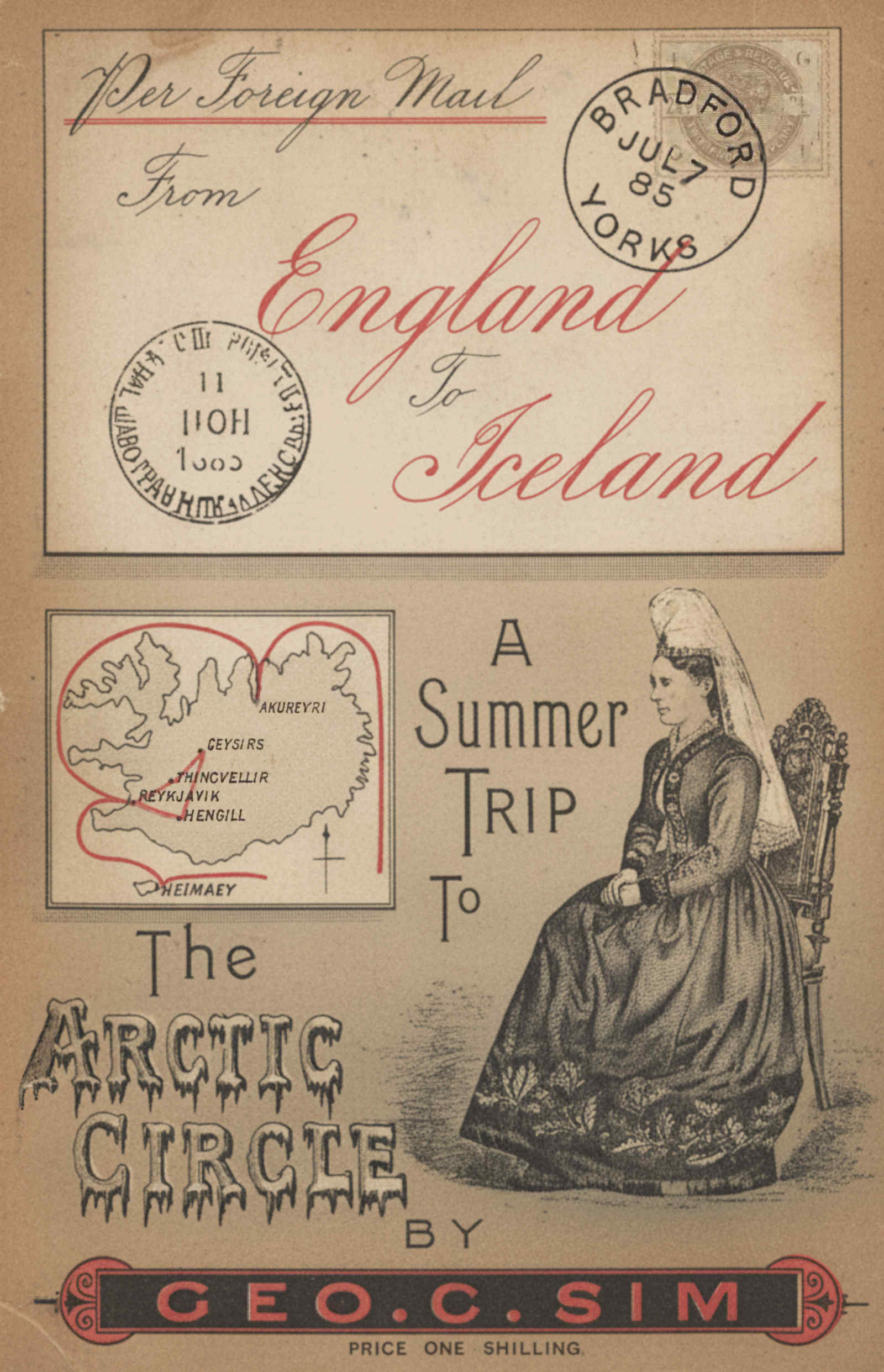
A Summer Trip to the Arctic Circle.
by
GEORGE CHARLES SIM.
WITH FORTY-FIVE ILLUSTRATIONS,
CHIEFLY FROM ORIGINAL PHOTOGRAPHS.
BRADFORD: HENRY GASKARTH.
LONDON: HAMILTON ADAMS AND CO.
iiiTO
MY FRIEND
John Speak, Esq.,
OF
WARM LEE HOUSE, AMBLER THORNE,
HALIFAX,
THE COMPANION OF MANY WANDERINGS
BY
THE WORLD’S WAYSIDES,
I AFFECTIONATELY INSCRIBE
THIS RECORD OF
OUR EXPERIENCES IN
Iceland.
PREFACE.
v
“Without, or with, offence to friends or foes,
I sketch the world exactly as it goes.”—Byron.
In September, 1883, the author, and the friend to whom
this little volume is inscribed, visited Ohinemutu and
Rhotomahana, in the famous Hot Lake District of
New Zealand. Subsequently, early in June, 1884,
as members of the Pioneer Party of the year—a
party of eight, including guides—they succeeded in
forcing their way into that extraordinary region of
marvels the Yellowstone National Park, a vast tract of
country which covers a total area of more than three
thousand five hundred square miles in the Territories
of Wyoming, Montana, and Idaho; and has been
“dedicated and set apart by ‘Act of Congress’ as a
public park or pleasure ground for the enjoyment and
benefit of the people of the United States for ever.”
Actuated by a natural desire to complete the chain
of their experiences, they resolved last summer to
take a Trip to Iceland, the oldest—in point of date
of discovery—though now neither the most interesting,
nor the most attractive, of the Three Great
Volcanic Wonderlands of the World.
viIn the following pages—re-printed from the
columns of the Bradford Illustrated Weekly Telegraph—the
writer has attempted to describe the scenery
and phenomena of Iceland; the social condition of
its people; and the incidents of a voyage to the
Arctic Circle, exactly as these came under his own
observation, and in those aspects in which they would
probably have presented themselves to the minds
of most of his readers.
It is recorded that the Mayor of an English city
once apologised to Queen Elizabeth for having
omitted to receive her with the customary royal
salute, and gave the three following reasons for his
apparent act of official discourtesy: first, the city
had no powder; second, it had no cannon; and,
third, if it had had both, there was no one among its
population who knew anything about either. Her
Majesty, under the circumstances, was graciously
pleased to hold him excused.
Similarly, the indulgence of the reader is claimed
for the omission in this book of all abstruse scientific,
or philological explanations or theories. These
may be found in other and more important works
written by competent authorities. Being neither
scientist nor philologist the author has refrained from
touching, even lightly, upon the curious problems
which everywhere provoke scientific speculation and
enquiry in Iceland; neither has he interlarded his
pages with those philological puzzles, in the shape of
Icelandic characters and words, with which some
otherwise very interesting narratives are, if anything,
a little over-weighted.
His object has rather been to tell the story of his
own experiences for the guidance of the intending
tourist; to furnish the general reader with some
useful information regarding a lonely island in the
North Atlantic, about which “tout le monde et sa
viifemme” have hitherto concerned themselves but
little; and to help to awaken in the hearts of his
fellow-countrymen a sympathetic interest in a poor,
isolated, kindly people who claim to be included
among “our kin across the sea;” and who, after
centuries of thraldom and hardship, are at last
beginning, under improved social and political
conditions, to look forward to a brighter and more
prosperous future.
Ultima Thule—a land of mystery—introductory
retrospect—Bradford to Leith—afloat—a catastrophe
averted—landmarks of Auld Reekie—shores of the Forth—the
Bass Rock—John o’ Groat’s House—a gale in the
North Atlantic—Orœfajökull—no night—Portland Point—volcanic
reefs—the Westmann’s Islands—Heimaey—Heimaeyklett
and Ystaklett—purity of the atmosphere—Myrdalsjökull—Elirey
and Bjarnarey—arrival of the
Camoens, a great event.
Ashore—a colonial contrast—Iceland and New
Zealand—appearance of the people—the “hufa”—early
colonization by Irish—fish curing—dried cods’ heads—view
from Helgafell—the church—congregation—form of
religion—how Christianity was established—God’s acre—Thingis
Hus—turf-and-rubble cottages—dried-bird-fuel—an
Icelandic Esculapius—the caves—sail for Reykjavik—poverty
of the Icelander—his difficulties—former tyrannous
legislation—the “tick and truck” system—break in cloud
of misrule—dawn of happier times.
The capital from the sea—our guide—view from the
Observatory—founding of the city by Ingolfr—why named
Reykjavik—National Anthem—a sailor-mason—cost of
labour, living, and rent—marriage—influence of præsturs—awful
sufferings and disasters—climate—summer
salutation—the Althing—Upper and Lower houses, how
constituted—candidate’s qualification—the franchise—revenue
of Iceland—our little company.
At Thingvellir—the Lögberg—scenes once witnessed
there—Execution Pool—our ponies run away—we
start without guide—Ravnegja—lava floods—a plain of
desolation—wilderness, mountain, and sky—Laugerdal—Hekla—we
miss our way—snuffing—handshaking and
kissing—honesty of Icelanders—Efstaydalr—precious
grass—the Bruera—a midnight halt—we reach the
Geysirs—and sleep in a church—some of our comforts—our
menu—and ecclesiastical domicile—waiting for the
Strokr to spout—the Great Geysir and the Strokr—their
temperature, dimensions, &c.—a contrast—the Grumbler—“there
shall be no night there.”
A night ride—the ferryman—the Zog—the Kalda—the
ponies swim—an extra rider required—Villingavatn—an
Icelandic farm house—Eider down—our breakfast—great
Icelandic writers—no theatre in Iceland—farm
rents—haymaking—sheep-shearing—size of farms—what
constitutes a rich man—fine view—a dreary spot—Hengill—sulphur
springs—scenery wilder and more
weird than ever—through the “Doorway”—an elderly
equestrienne—side saddles—women’s heads muffled—we
arrive at Reykjavik—our itinerary—we sail for Akureyri—the
Liberator of Iceland—the leader of the Young Iceland
Party—good grass land a safe investment—no
agricultural implements—Snaefellsjökull—rugged coast—French
fishing smacks—the Soudan—the Australian contingent—a
refractory navvy—“There she blows”—whale
fishing—discovery of Greenland and America by Icelanders—Snaeland—origin
of name Iceland—national flag.
Akureyri—Dr. Jon. A. Hjaltalin—temperature of sea
and air—Icelandic gloves—curious custom—state of
agriculture—imported seed a failure—schools of agriculture—reason
for neglect of farming—a fact worth
noting—stock raising—quality of grass—wool trade—desirability
of direct trade with England—obstacles—necessity
for improvement in fibre—peculiarity of Iceland
sheep—their number—weight of wool—we go ashore—shark
oil factory—a few facts about the shark fishery—the
only trees in Iceland—the Falls of the Glera—shipping
ponies—“Jack’s” love for animals—value of ponies—homeward
bound—a strange scenic effect—within the
Arctic Circle—a courteous judge—close time for birds
and animals in Iceland—indigenous birds—the Great
Auk—Langenes—in a fog—deep sea soundings—we
land at Thurso—conclusion.
LIST OF ILLUSTRATIONS.
xi
The following illustrations, drawn by Mr Alexander
Shepherd, A.M., of Bradford, have been prepared—with
a few exceptions—from original photographs taken
by the author:—
Note.—The route followed is indicated upon the
front cover, which has been specially designed by the
writer.
xiv
PLATE I.
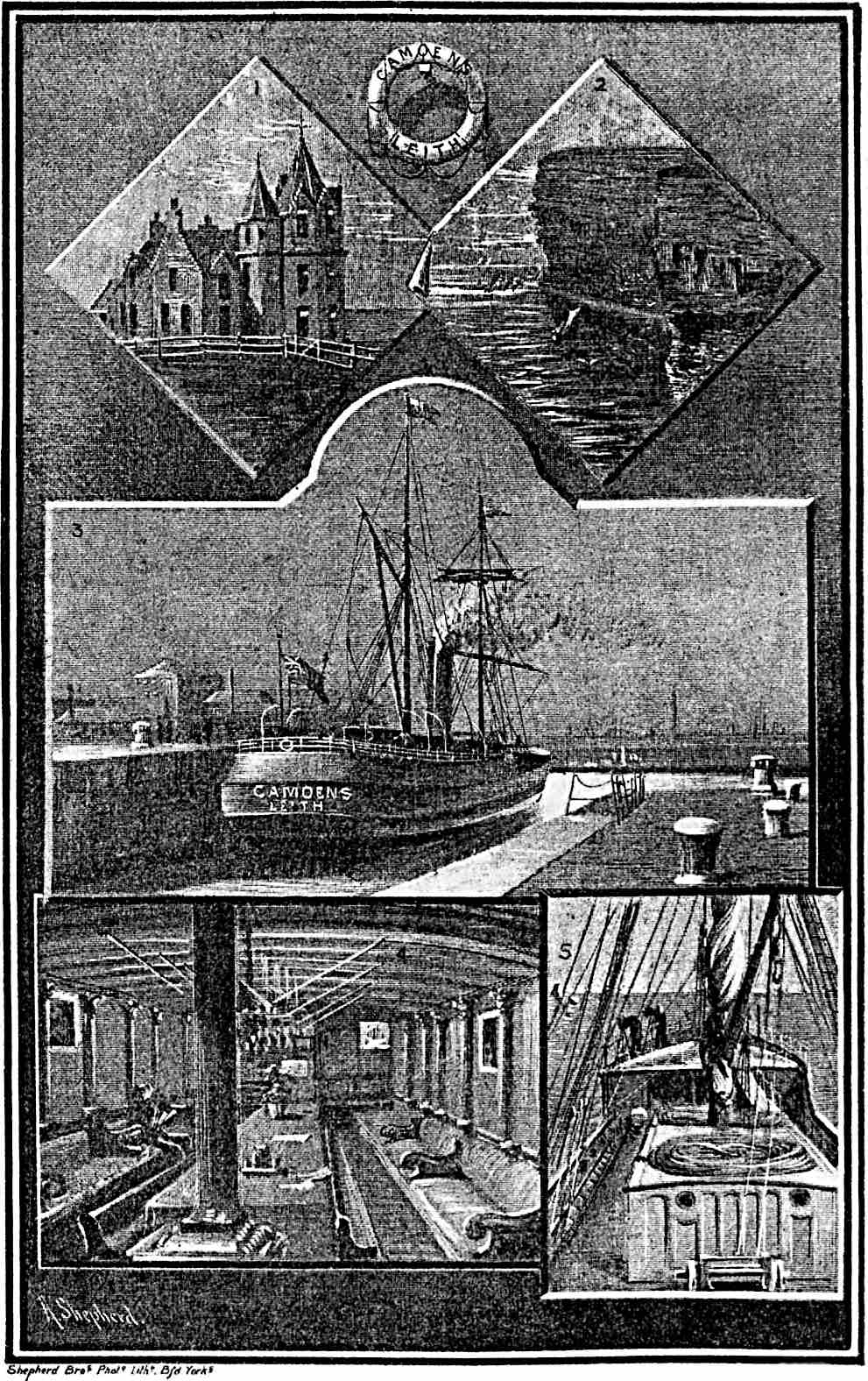
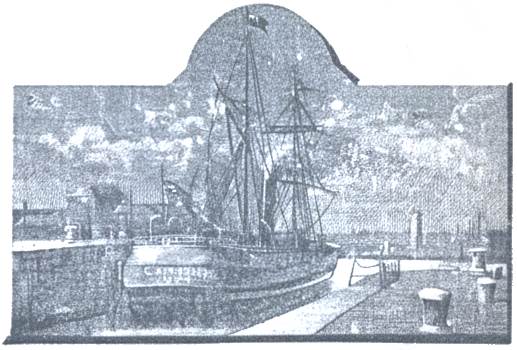
1 John o’ Groat’s House.—2 Duncansby Head. 3 The S. S. Camoens in dock, Leith.—4 Saloon of S. S. Camoens. 5 Amateur Photographers on board of S. S. Camoens.
FROM ENGLAND TO ICELAND.
1
“This is a traveller, Sir, has ploughed up sea so far
Till both the poles have knocked; has seen the sun
Take coach, and can distinguish the colour
Of his horses and their kinds.”
Beaumont and Fletcher.
Far away on the very verge of the Arctic Circle,
where the dark waters of the North Atlantic
sweep on to meet the ice-floes of the Polar Sea,
lies the Ultima Thule of the ancients—the Iceland
of to-day.
To poets and historians who wrote before
and immediately after the dawning of the Christian
era it was a land of mystery, “an island
hid by snow and winter,” as one of them has
well expressed it, and even to us, whose lot has
been cast in more enlightened days, it is to
some extent a land of mystery still. Modern
science has unlocked many of its secrets, and explained
many of its marvels, but there are, in this
great wonderland of Europe to-day, problems yet
unsolved, and regions yet untraversed, which
await the scientific enquirer and the adventurous
explorer.
2It is not, however, in either of these capacities
that I invite the reader to accompany me on a
trip to Iceland. I make no pretension to be
either the one or the other. It is rather as
a companion bent on enjoying to the full a
summer holiday on one of the least-frequented
bye-paths of the Northern Hemisphere; as an
admirer of Nature amid her strangest phenomena,
and in her sternest, as well as in her
kindliest moods; as a wanderer familiar with
much of the world and with many of its ways;
as an interested observer who has noted the
conditions of life among savage and civilised,
in many a foreign clime; as a business man,
keenly alive to the increasing necessity for
new markets for our products and manufactures;
and as an advanced political student,
to whom there is much that is both instructive
and attractive in the story of the little
community, which for more than a thousand
years, in loneliness and isolation, and amid
alternate seasons of deepest winter-gloom and
midnight summer-sunshine, has “lived and
moved and had its being,” heedless of the social
revolutions which have broadened the foundations
of human liberty, and comparatively unaffected
by the dynastic changes that have
drenched Europe with blood, wasted its resources,
hindered its progress, and turned it,
even in this nineteenth century, into an armed
camp of professional cut-throats.
Colonised in 874 by some of the bravest and
boldest blood of Scandinavia, Iceland for four
hundred years remained an independent commonwealth.
In 1262 she passed under the yoke of
Norway, and subsequently in 1380 under that of Denmark,
3whose suzerainty she acknowledges to-day.
Famed in early times for the power and prowess
of her vikings, and for the genius of her skalds or
song writers, she has not only created a language,
of which it has been said that “no one who has
not read the masterpieces written in Icelandic can
judge fairly of the capacity, force, and sweetness
of this most classic tongue,” but has made it
the medium of bequeathing to the world, in her
historical “sagas”—or prose epics—a wealth of
information regarding the deeds and heroes of the
Teutonic race, which has been of priceless value to
the historians of Europe.
With the loss of her independence, however,
she gradually declined in self-respect, and speedily
sank into a state of apathy and lethargic hopelessness
from which, thank Heaven, she is at last
beginning to arouse herself. Rip-van-Winkle-like
she has recently risen from a sleep of centuries,
and having, by peaceful agitation, succeeded in
obtaining the right of Parliamentary self-government,
there seems to be every prospect that—in
spite of their poverty, and the natural disadvantages
under which they labour—her sons will yet
prove themselves worthy of their high ancestry,
and redeem their country from the decadence into
which they have unhappily permitted her to sink.
It is in a spirit of hopefulness for her future,
that I take up my pen to record my impressions of
both country and people, as well as with a sincere
desire that I may succeed in creating an interest
in, and furnishing some useful information regarding,
a land about which Englishmen generally
know little and perhaps care less.
So much by way of preface. Let me now ask the
reader to suppose that we have started together
4from a busy manufacturing town in the West Riding
of Yorkshire, and are hurrying on to Edinburgh
by Midland Express to catch the S.S. Camoens,
advertised to sail from Leith, at noon on the 8th
of July, 1885. We pass Settle, that most charming
of Yorkshire country towns, nestling at the foot
of its fine background of encircling hills, stop for
a few minutes for refreshments at Carlisle, where
in the days of the old Border feuds many a Scottish
reiver met with a short shrift and a sudden
death, and an hour later cross the Tweed, loved
and immortalised by “The Great Unknown.”
We look with all a Yorkshireman’s interest upon
the shed roofs and smoking chimneys of Hawick
and Galashiels, which remind us that we are
travelling through the great textile manufacturing
district of Scotland.
We see Melrose, not indeed “by moonlight and
alone,” but in the “summer gloaming” and over
the heads of a small crowd of canny Scots who
are thronging the station, and thinking not of
“the brave days of old,” not of princes and
prelates, of abbeys and abbots, of monks and
monasteries, but of the state of the wool market,
of the prospects of trade, of “hanks,” “pirns,” and
“shots,” and of “warp” and “weft” and “web,”
and of the hundred and one other prosaic matters
which demand the attention of the industrious
weaver, who has supplanted the red-handed
warrior; and whose shuttle, as it clicks from
morn till night, tells of better times for mankind
than those when the sound most frequently
heard in these same streets was the clash of
swords, and the clang of armed men.
We are on our way to a land whose poverty is
great and whose progress has been slow, but as we
5recall the fact that, according to Macaulay, Scotland
from “having been one of the most turbulent
countries in Europe, has become one of the most
highly civilised, one of the most flourishing, one
of the most tranquil;” that according to Froude
“she has scored a deeper mark upon the world’s
history than any nation either ancient or modern,
perhaps the Athenians and Jews excepted,” we
feel that the Icelander need never despair, if he
will but try to bring about the regeneration of
his country by pursuing, and seeking to perfect
himself in, the peaceful arts of industry.
Night has banished twilight when we reach
Edinburgh, and after a trip to Leith by tram to see
the vessel that is to be our home “on the ocean
wave” for the next two or three weeks, we retire
to rest, “perchance to dream” of the discomforts
inseparable from “a life on the rolling deep.”
On the following morning we sail from Leith
punctually at the appointed hour, and within
five minutes after leaving the quay are face to face
with what seems likely to prove a catastrophe.
We are gliding down between the massive sea
walls that line the channel of entrance to the
docks, when a battered old tug, having several
mud-barges in tow, steers right across our course.
There is no room in which to turn, and a collision
seems inevitable. Just, however, at the instant
when we are expecting to see the little boat cut in
two she manages, somehow or other, to swing clear
of our bows as we forge past. A sound of crashing
timber is heard as her stern is forced against one of
the barges behind her. A solitary seaman, who
appears to be both captain and crew, rushes to the
bulwarks, and in a dancing rage shakes his clenched
fist at us in impotent fury, at the same time pouring
6forth a torrent of vituperation of which fortunately
only a few words reach our ears, though
if judged by the little we hear, his language is
certainly strong enough to have travelled further.
The sun is shining pleasantly from a bright blue
sky, and the landmarks of “Auld Reekie” stand
out grandly on the horizon behind the intervening
wilderness of roofs and chimneys that slope
upwards from port to capital. Arthur’s Seat, Salisbury
Crags, the Calton Hill, the Castle, the Scott
Monument, and other picturesque features which
combine to make Edinburgh, what it undoubtedly
is, the most beautiful city in the world,
are all clearly discernible by the naked eye.
On the shores of the Firth, as we steam towards
Granton, before heading for the ocean, lie the
lovely seaside resorts which add so much to the
pleasures of life in the Scottish metropolis. Having
transferred the managing agent to a gaily painted
tug, we circle round and steer north-east, passing
on our left the cultivated slopes and quiet little
coast-towns of the kingdom of Fife, while away
ahead, over our starboard bow, rises the shadowy
form of the famous Bass Rock, whose name is
associated with some of the grimmest tragedies
of Scottish history, and in whose dungeons, in
the dark days of ecclesiastical tyranny and persecution,
so many of those “of whom the world
was not worthy,” were left to perish miserably.
Keeping well in towards the land we make steady
progress at the rate of about nine knots per hour,
and have sighted and passed the lights of Aberdeen
before bed-time. Early on the following morning
we find ourselves off Duncansby Head, the extreme
north-east point of Scotland, a bold and
dangerous promontory. Not a tree nor a human
7habitation is to be seen on the landscape till we
round the point, when we all rush to the bridge,
glass in hand, to take a look at John o’ Groat’s
House, a rather pretentious-looking new hotel built
in the Scottish baronial style of architecture, and
situated near the beach, within a stone’s throw of
the Pentland Firth, whose powerful tide, so
dreaded in stormy weather, is breaking heavily
upon the rocks.
A flag-staff in the centre of a mound on the
left of the hotel, is pointed out as marking the
original site of Mr John de Grout’s residence. In
some old maps, however, this is indicated upon
the summit of Duncansby Head. A small
cairn of stones erected there seems to support the
theory of those antiquarians who are inclined to
accept these maps as correct, and who contend
that in the old piratical days it was much more
usual for a man to build his house, as the eagle
builds its eyrie, upon some bold cliff or headland
whence he could watch for danger, and prepare to
meet it; than upon a flat, or in a hollow, where
he would be liable to be surprised. Be this as it
may, it is a satisfaction to all of us to see a spot
which geographical circumstances have rendered
so interesting.
Passing through the channel, between Stroma
and South Ronaldsha, two of the Orkney Islands,
and leaving the Skerries with their two lighthouses
behind us, we shape our course for the north-west.
“As we pace along
Upon the giddy footing of the hatches”
the outlines of Dunnet Head the most northerly,
and Cape Wrath the most significantly named,
8point on the wild and rockbound coast of Scotland,
gradually fade from view, and long before nightfall
we are out in the open sea, and experiencing
the unpleasant effects of a heavy swell in the
North Atlantic. Towards evening the breeze
freshens though the passengers do not. Seats
at table began to be vacant early yesterday,
and these increase in number “as” the ship
and “the moments roll.” Even I, who have
hitherto defied Neptune on many a stormy
ocean in both hemispheres succumb at last,
and begin to study the waves with a pathetic
interest, and to find myself saying, in the
words of the old song, “Oh, dear, what
can the matter be?”
On the morning of the third day out, (Saturday,
July 11th), the breeze increases to a strength
of about nine windforce, equivalent to what is
known among seamen as “a fresh gale,” ten
being “a strong gale,” eleven “a storm,” and
twelve “a hurricane.” The waves are tolerably
high, being estimated by our captain at from ten
to fifteen feet above sea-level or from twenty to
twenty-five feet from hollow to crest, and the
Camoens, which rolls fearfully, is a mere plaything
under such conditions. It is needless to say that
the number of invalids does not decrease.
During the afternoon the wind moderates, and
shortly before dinner we sight the coast of Iceland,
whose highest mountain, Orœfajökull (6,426 feet),
with its snow-clad crest and slopes, and extensive
glaciers is distinctly visible through the clear bright
air at a distance of more than seventy miles. A very
considerable portion of the surface of Iceland is
covered with glaciers, which feed the mountain
torrents, and the gradual subsidence of which
9forms not one of the least of the terrible dangers
that constantly threaten immense tracts of country
with destruction. Orœfa is the apex, or coast
extremity, of Vatnajökull, the largest of these, an
icefield, which covers an area of between 3,000
and 4,000 square miles, or about one-twelfth of
the total area of the island. The word “jökull,”—meaning
ice hill—is attached as a terminal to
the names of all mountains on which glaciers
are known to exist.
As we gradually near the land Orœfa rises
grandly beyond the low level plain that lies like
a long black line between its base and the ocean.
This plain, of the extent of which we can form no
conception from the sea, stretches away back to the
coast range for a distance of about thirty miles, and
is at least about twice that length from east to west.
The fogs which are continually, and often very unexpectedly,
encountered in these latitudes render
it a source of anxiety to navigators, who not unfrequently
find themselves aground before they are
conscious of danger, there being neither lights nor
landmarks to guide them. Though but sparsely
peopled, it is covered with nutritious grass,
and has become the great pony-breeding district
of Iceland.
Ever since we began to steer north the days
have been growing longer, and night having
now quite disappeared, we are able to read
small print by the light of the sun at
what the chronometer indicates as midnight, and
can distinguish the coast quite clearly at an hour
when in more southern latitudes it would be
shrouded in darkness.
It is not till after 1 a.m., as we are passing
Portland Point, and its wonderful water-worn arch
10and fantastic group of basaltic needle-rocks, that
we go down to our berths, comforted by the captain’s
assurance that if we do not find ourselves
high and dry upon the summit of some volcanic
cone which may suddenly rise under us “from
the bottom of the deep blue sea,” we may expect
to be lying safely at anchor off the Westmann’s
Islands long before it is time to get up. In 1783,
a month previous to the outbreak of the Shaptarjökull—the
most terrible eruption that has ever
occurred in Iceland—a submarine volcano near
what are called the Fire Rocks, forty miles
south-west of Cape Reykjanes, burst forth and
covered the sea with pumice stone to such a depth
and extent that ships were impeded by it. Within
a few months the volcano disappeared, but now
forms a dangerous reef.
Having been in Java six months after the
catastrophe at Krakatoa, which in August, 1883,
destroyed thirty thousand human beings; having
seen the vast fields of pumice stone then floating
in the Indian Ocean and in the Java Sea; and
sailed in a steamer which, while lying in the
Straits of Sunda, two days subsequent to the
dreadful disaster above referred to, had a marvellous
escape, only succeeding with the greatest
difficulty in forcing her way through the immense
mass of volcanic scum that covered the ocean
for hundreds of miles round about to a depth
of several feet; having seen evidences of the
fearful nature of a submarine outburst in the
huge breaches, in the massive sea wall at Batavia,
made by the spent force of the great wave which—more
than a hundred miles away—had absolutely
swept two thriving cities—Anjers and Telokbetong—out
of existence; and having slept at the
11foot of Gedeh, a burning mountain at Scindanlaija,
which only a few years ago caused great destruction
of life and property at Tjandoer, the
captain’s grim joke has a significance for me
that it might not otherwise have possessed. It
does not, however, disturb my rest.
On awaking, the absence of motion, and a strange
stillness unbroken by the horrid grinding of the
propeller—that greatest of all the bêtes noires of
the ocean traveller—satisfy me that we have
safely reached port at last. Hurrying on deck I
find myself gazing upon a scene of wild grandeur
and picturesque beauty, which charms and impresses
me, and whose attractiveness increases as I
become familiar with its details.
We are lying at anchor, in smooth water, in a
pretty little bay situated on the north shore of
Heimaey—(Home Isle)—the largest of the group
known as the Vestmanneyjar or Westmann’s Islands.
About a mile ahead of us, on the left shore,
and partly hidden behind a rampart of black
weed-covered rocks, lies the collection of wooden
sheds, and huts, and turf-and-rubble dwellings, in
which a total population of five hundred and ten
souls lives, and carries on its chief occupation of
fish-curing. The town extends from the sea inland
towards Helgafell, a volcanic cone about 750 feet
high, whose shelving stone-strewn slopes, and
jagged cairn-crowned crest, standing out clearly
against the bright blue cloudless sky, form a fine
background to the view in that direction.
Turning our eyes away from Helgafell and Heimaey,
and with a passing glance at the pretty little
Danish sloops moored opposite the wharf, we face to
the right about, where a gigantic rocky mountain
promontory, with two huge humps known respectively
12as Heimaeyklett and Ystaklett, stretches
itself, like a protecting arm, between us and the
western sea. Its precipitous inaccessible overhanging
cliffs tower hundreds of feet above the
deep blue waters that kiss its feet, and every ledge
and nook, and cranny of the bold brown beetling
crags that frown down upon us is crowded with
sea-fowl, whose screams as they watch us from
their places of vantage on the rock, or fly in tens of
thousands above our heads, fill the air with a continuous
clamour. From the verge of the precipice
grass-grown slopes incline steeply upwards to the
summits of both humps, and on these a few
sheep can be seen grazing in places where, to all
appearance, there is scarcely foothold, even for a
goat.
The clearness and purity of the atmosphere in
this part of the world, when the weather is fine,—which
is not very often,—has been remarked by
many travellers. It would be impossible for us to
view the scene around us under more favourable
conditions in this respect. On the coast of the
mainland, distant ten or twelve miles across the
intervening Strait, Myrdalsjökull, another well-known
and beautiful volcano, asserts itself magnificently
amid the lower cones by which it
is surrounded. Its white peak, pure as an angel’s
robe, its glaciers, and its slopes on which purple
and silver meet at the snow-line, gleam in
glorious loveliness under the morning sunshine.
In mid-channel Elirey and Bjarnarey, two
brown-faced weather-worn basaltic island-rocks,
with crowns of brightest emerald, rise almost
perpendicularly out of the shimmering sea, not
only heightening the effect of the scene by
13affording a resting-place for the eye, but forming
a striking and picturesque addition to one
of the most beautiful panoramas I have seen.
We are loth to leave the deck even for breakfast,
but console ourselves with the reflection
that we shall be able to see a good deal during
the twelve hours at our disposal before the time
fixed for sailing.
Though it is Sunday morning, the cargo is
meanwhile being rapidly transferred to the large
whale boats, which began to fetch it soon
after our arrival, and from the number of men
employed, and the evident bustle and excitement
on shore, I conclude that the little white
church, which forms the most conspicuous object
on the outskirts of the town, will have plenty
of room for the accommodation of strangers, and
that the poor præstur will not improbably have to
preach to a “beggarly array of empty benches.”
The coming of the Camoens is a great event
in the lonely Westmann’s Islands. It not only
breaks the monotony of what must be a dull and
dreary existence, but is a source of general rejoicing
amongst all classes of the community,
for her freight is precious in the eyes of a
people who are compelled to depend upon an
outside, and to them far-away world, not only for
the very means of life, but for many of the comforts,
and all the luxuries, which their limited
means will permit them to enjoy. I come to the
conclusion, therefore, that the recording angel who
with a tear blotted out Uncle Toby’s oath will
bend a pardoning eye upon what to some would
appear to be Sabbath desecration, but what is
really and in the truest sense a work of necessity.
CHAPTER II.
14
“Yet still even here, content can spread a charm,
Redress the clime, and all its rage disarm.
Though poor the peasant’s hut, his feast though small,
He sees his little lot, the lot of all;
Sees no contiguous palace rear its head
To shame the meanness of his humble shed;
No costly lord the sumptuous banquet deal
To make him loathe his vegetable meal;
But calm, and bred in ignorance and toil,
Each wish contracting, fits him to the soil.”
Goldsmith.
“Who’s for shore?” cries the captain immediately
after breakfast. “I am,” “and I,” “and I,”
respond about a dozen of us, and in a few minutes
we are afloat in the gig, and steering towards
Heimaey. We soon find ourselves in very shallow
water, and passing over, and between, a number of
black reefs, which must not only be dangerous to
the fishing craft in stormy weather, but present a
grand sight
“When there’s a gale a blowin’, and the waves run in and break
On the shore with a roar like thunder, and the brown cliffs seem to shake.”
The weather is rarely such that the Camoens can
lie at her present anchorage, for during the north
and north-east gales the bay is “a hell of waters”
which it is impossible to enter.
I am reminded very strongly of another lovely
summer Sunday morning nearly two years ago,
when my companion and myself landed, under
exactly similar circumstances, on the very spot
where Captain Cook first put foot on the shores of
New Zealand. In the pier at Heimaey, crowded
with men and women, and in the wooden huts
beyond it on the hill side, and along the beach, I
seem to see Gisborne once more.
15But how different the social conditions and
prospects of the two communities,—of the
Danish and the British colonist! Iceland with
an area of 40,000 square miles—little less than
that of the North Island of New Zealand, which
contains 44,000,—was colonised a thousand years
ago; New Zealand a hundred years ago. Yet the
population of the one, which in the year 1100
was estimated at 50,000 has, after a lapse of nearly
eight centuries, only increased to 72,000, while the
other is inhabited to-day by half a million of people
of European descent. Both countries are of
volcanic origin, both are subject to earthquakes,
both boast of their burning mountains
and geysers. One, however, to use an
expression more forcible than elegant which
fell from the lips of a sailor on the Camoens, is
“naething but a dawmed cinder,” the other is,
comparatively speaking, a Paradise.
As I stand on the pier a few minutes later and
watch the busy gangs of women and girls engaged
in carrying sacks of flour on handbarrows to the
neighbouring stores; or stroll among the hardy
fishermen who are loafing about in groups, eagerly
discussing the news brought by our good
ship; or exchange smiles with the neatly-dressed,
bright-looking, good-featured little lads
and lassies, who are looking on with childish curiosity;
I cannot help wishing that I could spirit them
all away to the “Brighter Britain” in the Southern
Seas, where Nature has bestowed her blessings
upon man with bounteous profusion. I suppose,
however, that were I to tell the people round me
what is passing through my mind there is scarcely
a man among them who would not turn his eyes
all the more fondly towards the little cot where he
16was born and bred, and where he no doubt hopes
“to die at home at last.”
“Dear is that shed to which his soul conforms,
And dear that hill that lifts him to the storms;
And as a child, when scaring sounds molest,
Clings close and closer to the mother’s breast;
So the loud torrent and the whirlwind’s roar,
But bind him to his native mountains more.”
Meanwhile, the women, who are working in
couples, toil like ponies, and the crews of the
whale boats are of course actively employed; but
it seems to me that some of the strong men who
are looking on, with their hands in their pockets,
and their pipes in their mouths, ought to be
between the shafts of the handbarrows instead of
“their sisters and their cousins and their aunts.”
It would be unfair to forget that they take their
share of work, as well as of danger and hardship,
during the fishing season; but I am afraid that
the condition of woman in Iceland is no better
than in the fishing and agricultural districts of
England and Scotland, though probably scarcely
so bad as that of the girls whom I have seen
slaving round the coal pits of Lancashire.
PLATE II.
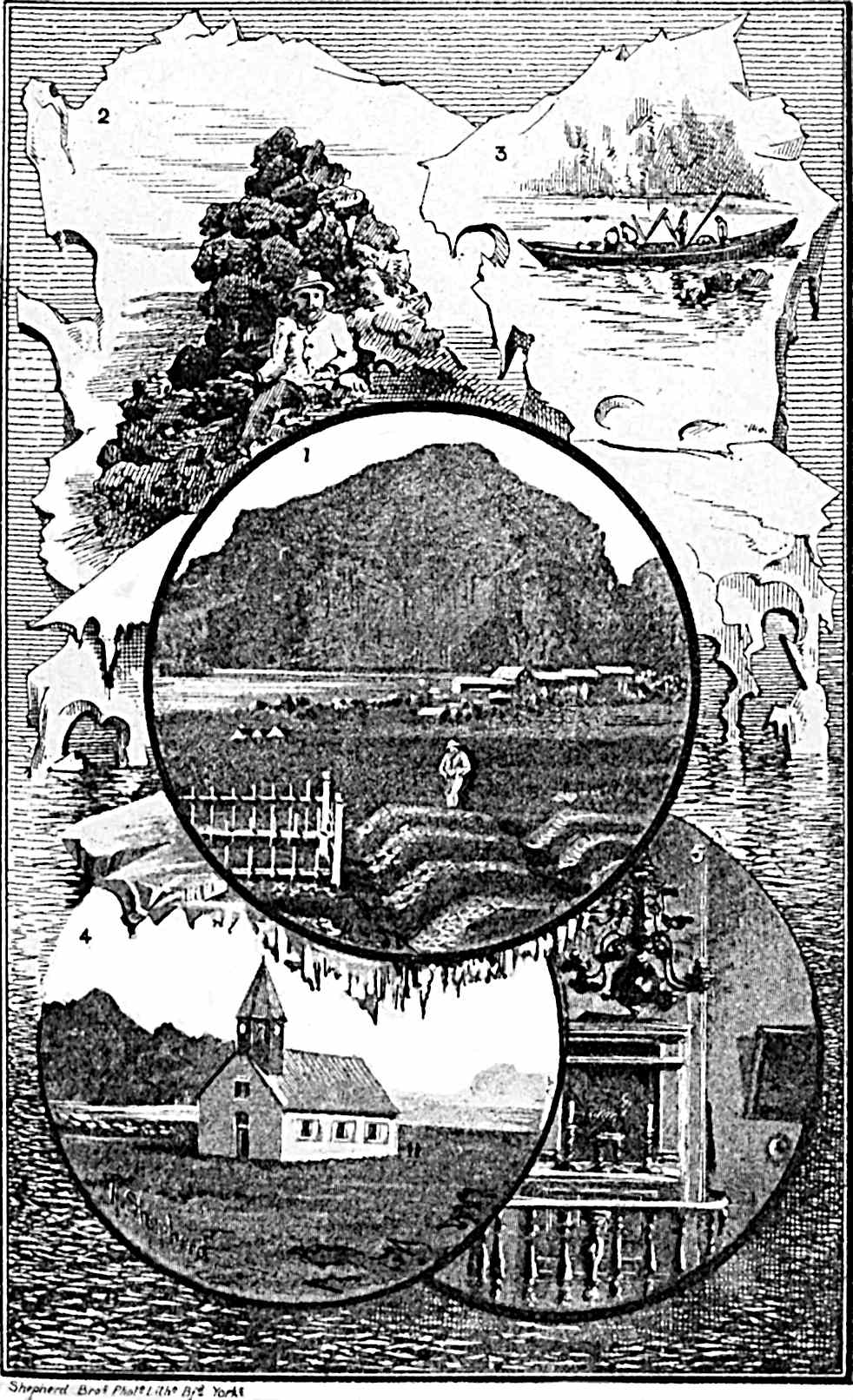
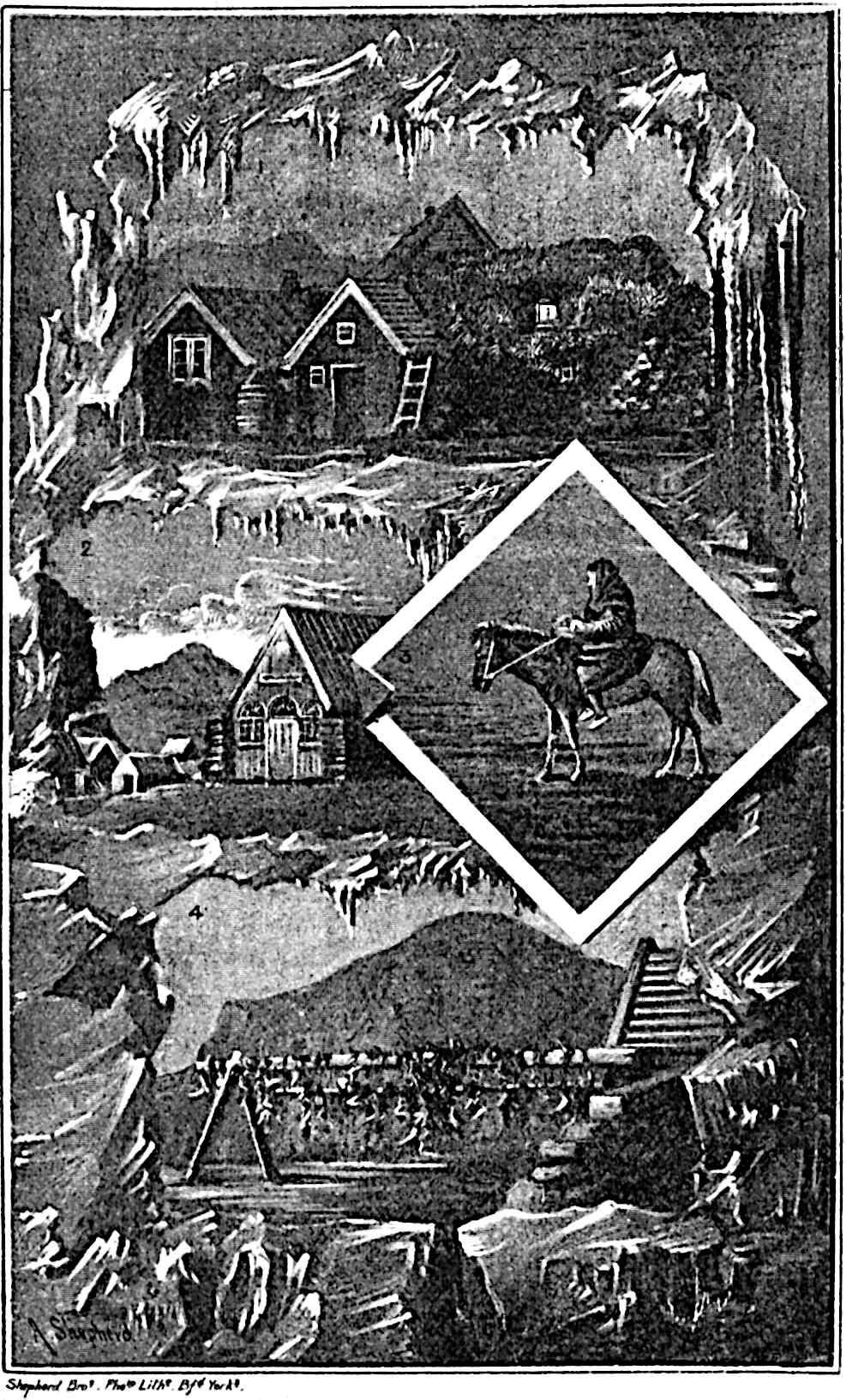
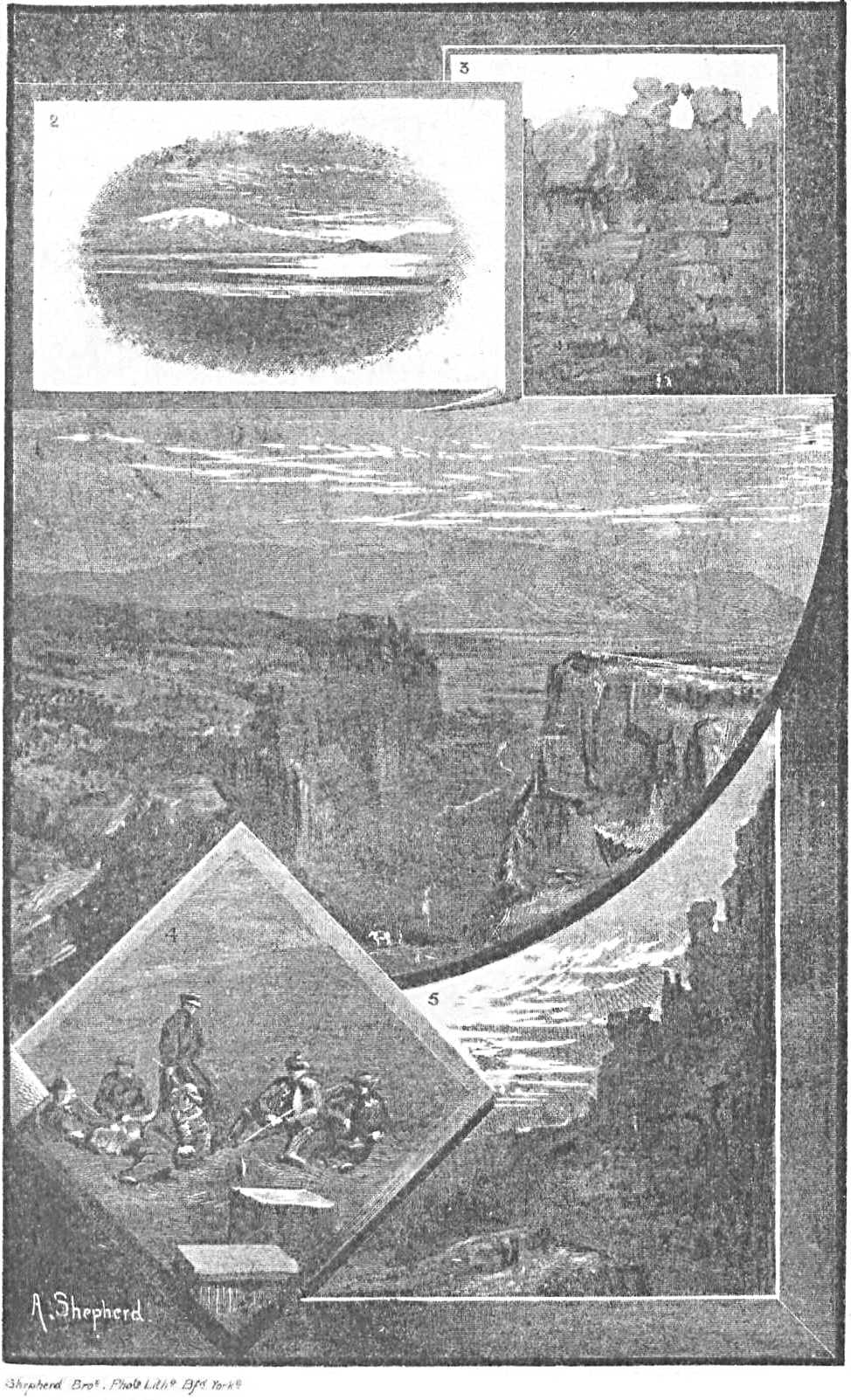
1 Heimaey and Heimaeyklett, from the Cemetery. 2 Lava Cairn on Helgafell.—3 An Icelandic Whaleboat. 4 The Church at Heimaey.—5 Altar and Candelabrum of Church.
Let me describe the appearance of the people
near me. “Place aux dames;” of course, if only as
a compliment to their industry. They are strong
fresh-faced fair-haired maids and matrons, who
regard us modestly, but curiously, out of cold pale-blue
long-lashed eyes, as they trot backwards and forwards
with an energy and an alertness which speak
volumes for their physical powers. As a rule they
are by no means pretty, but there are, of course,
exceptions, and here and there we see a face which
would attract notice, even in an English ball-room,
where, I have no hesitation in saying, one may look
17for—and find—the loveliest women in the world.
Their figures are not good, as is to be expected
from their mode of life, and owe nothing to their
dress, which is exceedingly plain and unbecoming,
though, no doubt, warm and comfortable. Their
gowns, made of linsey-woolsey, or similar heavy
material, are sombre in colour, unrelieved by a single
bit of bright ribbon, or a yard of trimming, tight-sleeved,
and just short enough in the skirt to afford
every opportunity of admiring a shapely foot,
a neat ankle, or a well-turned leg, were there any
or either of these to admire, which unfortunately
there is not. A loose cotton jacket, a coloured
apron, thick grey worsted stockings, and peculiar
sheepskin shoes, pointed at the toes, without
soles, and sewn into shape by cross-stitching,
complete their costume. The latter, which would
make very comfortable slippers, seem to be ill-adapted
for a country whose roads,—where there are any,—are
so rough and stone-strewn, but are nevertheless
generally worn, imported boots and shoes
being rarely seen among the poorer classes. The
hair, which is generally fair, is smoothed down
neatly on each side of the brow, and plaited at the
back into two long queues which are looped up,
and fastened to the crown of the head, in such a
fashion as to form cross-festoons.
Every woman, however, has on one distinctive
article of attire, the “hufa,” or national head-dress, a
small knitted cap, in shape resembling a night-cap,
worn jauntily on either side of the head—generally
on the left—like the forage cap of a British hussar.
It is invariably black, no other colour being used,
is made of either silk or wool, and is ornamented
with a heavy black silk tassel which hangs down
as far as the shoulder from a brass, silver-gilt, or solid
18silver ferrule about two inches long, and half an
inch in diameter, that adds greatly to its smartness.
The men, bronzed and bearded, are dressed in
rough woollen jackets and trousers, wear caps,
billycocks or sou-westers, and bear a strong
family likeness to “oor fisher folk at hame,”
the only thing which strikes us as peculiar being
the sheepskin shoes to which I have already
referred.
Our worthy captain—one of the kindest-hearted
and most genial men I have ever met, and
certainly the most obliging skipper I have ever
sailed with,—informs me that the Westmann’s
Islands were originally so called because they
were discovered, and occupied, by emigrants
from Ireland, who are said to have been the
first Icelandic colonists. On this point let me
quote Dr Jon A. Hjaltalin, one of the best
informed and most reliable authorities in Iceland,
a gentleman who has lectured in many towns in
England, and to whom I had the pleasure of
being introduced at Akureyri. In a little historical
pamphlet which he wrote on the occasion of the
“Thousandth Anniversary of the Norwegian Settlement
in Iceland,” and which he has been kind
enough to send me since my return, Dr Hjaltalin
says “If we can believe the Irish monk Dicuil
the Irish were the first discoverers of Iceland.
Dicuil, who wrote his book ‘De mensura orbis
terrarum’ about the year 825, states that, some
thirty years before, clerics had told him that they
had been to an island far to the north, where
there had been daylight throughout the night at
the summer solstice, and where they were able to do
whatever they wanted by night as well as by day.
19Local names, preserved to this day, as well as
the records of the old Icelanders, prove the fact that
Irish monks had visited the island before the
Norwegians.”
Subsequently the Scandinavian settlement took
place, and emigrants arrived from the Orkneys,
the North of Scotland, and Ireland. It is not
surprising, therefore, that I should remark to my
companion, as we leave the pier, that if the children
of Heimaey were at a port in my own country,
instead of where they are I should pass them
without notice; it is so evident they spring from
the same stock as ourselves. It is worthy of
note before I leave this subject, “that the Irish do
not seem to have met with any human being, or
aborigines, when they discovered Iceland, nor
have any traces of such been found in later times.”
Passing between the two lines of female porters,
who are ascending and descending like the angels
on Jacob’s ladder, we turn to the right into a
narrow macadamised path, or street, containing
several little dwelling-houses, two or three sheds
or stores crammed with imported produce, and a
number of rough wooden huts filled with fish
either cured or in process of being cured. Outside
each of the latter stands a deal table on which the
fish are prepared, the heads being cut off and dried
for home consumption, and the remainder set aside
for export.
These dried cods’ heads tied up in bundles, and
ready for conveyance into the interior on pony-back,
may be seen everywhere, and you will
probably not meet a single train of ponies, on
any track in the whole country, whose load does
not include some of these necessary articles of
diet. I am told on enquiry that they are worth
20about a penny each, which I consider a high price,
and that, in times of scarcity, after all the flesh
has been carefully picked off, the very bones are
often eaten, having first been softened in buttermilk.
The offal is thrown to the dogs and ponies,
which sometimes also get the powdered fish bones
when these can be spared by the family. In rear
of some of the houses in the outskirts we observe
large square platforms built of round undressed
lava stones, and raised about a foot from the
ground. On these the fish are exposed to dry in
the sun.
The stench in this neighbourhood exceeds
the combined odours of the nine and forty
distinct smells for which Cologne is said to be
remarkable, and is such that, with our noses in the
air, and taking care to sniff as seldom as possible,
we hurry on towards Helgafell, which we have
made up our minds to ascend before returning
to the Camoens for lunch. We stop for a moment
at the house of the Syslumann or Sheriff to say
au revoir to our friend the captain who has
some business to transact with this official. Then
we strike across a few fields so thickly covered
with stones of every shape and size that it seems
as if Heaven must have rained them from the
skies; jump one or two low stone fences; stumble
over some of the thousands of green frost-made
hummocks that form such a curious feature of the
landscape; tramp along the bottom of several of
the foot-deep winding rain-channels that are commonly
used as paths; and then boldly attack the
precipitous mountain slope. Up, up, up we go,
now slipping upon black shifting volcanic sand;
now tramping upon sharp-edged fragments of
lava; now clambering up very steep places on
21hands and knees; and not unfrequently pausing to
take breath, and to wipe the perspiration from our
brows at some friendly boulder, which affords us
secure foothold, or the opportunity of sitting down.
We arrive at the edge of the crater at last, and
descend into its grassy hollow, where a few sheep
are quietly grazing. Making a final rush towards
the cairns which some of our companions have
already reached, we see a panorama on every side
of us to which no other name than magnificent can
possibly be applied. In front on the distant mainland
both Hekla and Myrdalsjökull rise in all their
snowy beauty; and the islands of Elirey and
Bjarnarey, the harbour with its shipping, and
guardian promontory, the little straggling town
stretching along the beach and inland towards the
farmhouses on its outskirts that stand within their
small stone-fenced enclosures or crofts under grass
or potatoes,—green spots which look like so many
oases in a waste of treeless barrenness—are all
spread out before us. On our right and on our left,
and behind us, washing the shores of the low encircling
line of hills that beats back its surges, is the
Atlantic Ocean, studded with huge island-rocks of
various shapes and sizes,—(including one which we
specially note on account of its extraordinary
resemblance to a haystack)—and so calm and
peaceful under the flood of sunshine that pours
down upon its glassy surface from the blue
heavens above, that one can scarce believe that it
is so often a source of dread and danger and death
to the poor fishermen of Heimaey.
We spend half an hour in gazing admiringly
upon the scene before us, and then reluctantly,
but rapidly, make our way down the hillside
towards the little white-washed church, at
22which we arrive shortly before the hour of service.
The præstur, or pastor, and a few of his
flock are standing outside in serious conversation,
and we take advantage of the opportunity to enter.
There is only one door, which is under the hexagonal
belfry, whose clock with three dials is a
hopeful sign in a place where one sees so many
evidences of poverty and so few of progress. There
are six windows with diamond panes, and the interior
has a clean and comfortable appearance. A
chastely decorated altar, railed off in front, occupies
the end opposite the porchway. A handsome candelabrum,
a well-executed painting of a sacred subject,
and two smaller pictures, one on either side of
the latter, greatly add to the general effect, which
is altogether rather pretty.
It is near the hour of prayer, and men, women,
and children may be seen approaching from different
directions. The sobriety and seriousness of
their demeanour, the neatness and cleanliness of
their dress, and the general air of well-being and
well-doing which characterises them, impress me
favourably, and I cannot help recalling the fact
that in many of our crowded cities at home,
there are at the same moment, thousands, aye
tens of thousands of people, who though rich
in comparison with the members of this little
Icelandic congregation would be unable, even
if they were willing, to go to church so comfortably
and so respectably clad. It occurs to
me that there may be advantages even
in a life of poverty and isolation. I
remember that Cæsar, in his commentaries, over
which I used to pore in my school days, records the
fact that of the three great tribes among whom
Gaul was divided in his time the Belgæ were the
23bravest, “because,” as he puts it, “merchants had
least access to them to import those things which
tended to effeminate their minds.” As I remember
the passage it occurs to me that the Icelander
ought perhaps to be grateful to Heaven for the
poverty which protects him from “luxury’s contagion
weak and vile,” and leaves him in possession
of virtues which under other circumstances he
might have been unable to retain.
The established form of religion in Iceland is
that of the Lutheran Church, which superseded
Roman Catholicism between 1540 and 1551, as the
latter had superseded Paganism in the year 1000, at
which time the worship of Thor and Odin and the
other deities of Scandinavia prevailed. The story of
the manner in which Christianity was introduced
is an interesting one. At a meeting of the Althing,
or Parliament, it was proposed to abolish heathenism,
but the proposition was strongly opposed,
and there appeared to be danger of a war
of religions, which was, however, happily averted by
the judgment of the Speaker, or President of the
Althing, who influenced by the bribes,—perhaps
even more than by the arguments,—of
the Christians accepted the task of proposing such
legislation as would satisfy both parties. The
curious manner in which he prepared himself for,
and effected this undertaking is thus referred to
by Dr Hjaltalin, who says “He (the President)
went to bed, and covered himself up for twenty-four
hours. Then he rose, and called all the
assembled multitude to follow him to the
Lögberg or Law Rock. On arriving there he
explained the serious consequences to which the
disruption of the Commonwealth was likely
to lead. ‘If we have not laws and religion in
24common,’ said he, ‘our peace is gone.’ Such was
the persuasive power of his words that both parties
promised to keep the laws propounded by him. He
then proposed that all Icelanders should become
Christians by being baptised, but to pacify the
heathen party, suggested that they should be permitted
to worship the old gods and to eat horseflesh
in secret. If the latter, however, was done in
the presence of witnesses, it was to be punished
with outlawry. These propositions were accepted
by both parties, and thus Christianity was established
in the land.” Would that all religious
differences could be as happily settled now-a-days
by the exercise of a little mutual forbearance, and
in reliance upon the old adage, “magna est veritas
et prævalebit.”
From God’s house we proceed to God’s acre,
a small rectangular area in two divisions enclosed
within four walls of turf and rubble, and covered
with a number of green mounds, from two to three
feet high, each marking a grave. One or two of these
are railed round, and iron crosses have been placed
on others—(in one instance a quaint and artistically-carved
headstone)—but in nineteen cases out of
twenty the Westmann’s Islanders seem to share, not
the ostentatious pride and vainglory of the great
emperor Shah Jehan, who built for himself and a
favourite wife the grandest and most costly sepulchre
in the world, the famous Tag Mahal at Agra;
but rather the touching humility of his daughter,
whose pious wish engraved on the simple stone
that marks her last resting place amid the ruined
tombs of Delhi, is beautifully expressed in these
words, which I remember listening to with a
feeling of reverence as our guide translated them:
“Let no rich canopy cover my head; grass alone
25is the only covering for the poor in spirit.”
On our way from the city of the dead to the pier
we have once more to pass through the city of the
living, and the first shanty that there attracts our
attention is the “Thing Hus,” or Parliament house,
which is really the Town Hall, although dignified
with a higher title. It is a shabby little wooden
shed, to extend or reconstruct which on the same
scale would not cost many pence in the pound on
even the rateable value of Heimaey.
Near it are several curious-looking dwellings,
one of which we stop to examine. I will attempt to
describe it. Imagine a low one-storied building, irregular
in shape, and looking as if it had been built
by instalments to provide room for a crib for
every separate addition to the owner’s family. The
roof is made of shingle, but the walls, built principally
of rough undressed lava stones, imbedded
in layers of turf which bind them together and fill
up the chinks, are thick and substantial. Entrance
is effected through a low wooden porchway leading
into a long narrow dark passage, with turf-and-rubble
walls, and a mud floor. This
passage admits to another which crosses it at right
angles, and is if possible dingier still. Into this
second passage the doors of several stuffy, inconvenient,
badly-ventilated, smoke-filled dens—(it
would be a libel on the English language to call
them rooms)—open. The cooking is carried on in
the “Eld hus” (Fire House) or kitchen, and the
smoke escapes into the chimney through a hole
in the roof. The whole of the exterior,
except parts of the shingle roof, is covered
with green sods, which convert it into an
inhabited tumulus, on which the grass flourishes so
luxuriantly that it seems a pity the half-starved
26ponies cannot walk on the perpendicular like the
house fly, for if they could they might find excellent
pasture on the walls and roof of the mansion
before us.
There are a number of more modern houses
built of wood, roofed with shingle, and painted
drab. We enter one of these on the courteous
invitation of the doctor, who has just been good
enough to explain to us in very broken English
that the ghastly-looking, mutilated, long-billed,
dark-feathered objects which are hanging from a
sort of miniature goalpost in an adjoining croft
are the bodies of sea-fowl which have been killed,
and are being dried for—“For what! Sir?” we
ask in surprise? “For fuel,” is the reply. “The
breast having been removed for food the remainder
of the bird will probably be used to cook it.”
I have eaten meals in South Africa prepared
over a fire made of cakes of dried cow-dung;
I have warmed myself in New Zealand and in the
American backwoods at a log fire; I have been
half-stifled in a Highland shieling by the
smoke of a peat fire; I have drunk many a cup of
tea in Japan infused with water boiled on a
smouldering fire of charcoal ashes, but this is the
first time among savage or uncivilised that I have
come across fuel for a dried-bird fire. “Necessity,”
I remark, “is said to be the ‘mother of invention.’
If so the life of a Patent Office official in Iceland
ought to be no sinecure, for ‘necessity’ stares one
in the face everywhere.”
The doctor’s residence,—a humble one for the
only consulting physician and surgeon in the
Westmann’s Islands,—seems to consist of little
more than what the Scotch call a “but” and a
“ben.” It is scantily and plainly furnished, and
27contrasts somewhat ludicrously with the gilded
salons of some of his professional brethren in the
chief city of the adjacent island of Great Britain
who, with perhaps little more skill and knowledge
but greater opportunities than those of our kindly
host, pocket fees, in the course of a single
forenoon, which exceed the total annual income
received by the Icelandic Esculapius for looking
after the health of an entire community. From this
reference to the social surroundings of a leading
citizen,—one of an élite which scarcely includes
more than the Syslumann (Sheriff), the præstur
(parson), the doctor, and a vice-consul or two,—it
will be inferred that the Westmann’s Islands
cannot boast many people of fashion or “culchaw,”
and that the population generally is a very humble
one.
After lunch, having obtained permission to take
one of the ship’s boats, we row ourselves to the
caves of Heimaklett and Ystaklett, and spend an
hour in sailing into these, in awakening the echoes,
and in ineffectual attempts, at the risk of broken
bones and worn-out unmentionables, to scale the
cliffs, and get among the screaming puffins that
literally darken the air above us as they dart
or circle over our heads. Then we go ashore again
and take another saunter through the streets, and
then dinner-hour arrives, and our experiences of
the Westmann’s Islands for the present come to an
end.
About 9.0 p.m. we sail for Reykjavik, and as we
are slowly steaming out of the bay, a whale boat,
manned by six rowers, rounds Ystaklett and makes
for Heimaey. An Icelander from America, who
has just joined us, says that the occupants of the
boat having sighted the Camoens on the previous
28evening have come over from the mainland to buy
provisions. He tells me that his countrymen are
miserably poor, and that this year they are even
worse off than usual, the fishing having proved a
failure for the third year in succession, and the
grass being late and scarce in consequence of the
inclemency of the weather. Fancy a state of being
in which an entire community literally depends
for existence upon the fish it catches in a stormy
sea, and the grass yielded by its untilled pastures!
He adds that on the mainland people are even
poorer than on the islands, and mentions the case
of a woman who recently made her way on foot
along the coast, and crossed the Straits in an open
boat, to beg bread for her starving children. She
was so emaciated and so weak and worn out from
famine and exhaustion that she had to be carried
from the pier to a place of shelter.
The charity of the poor towards the poor is
proverbial.
Few, save the poor, feel for the poor,
The rich know not how hard
It is to be of needful rest
And needful food debarr’d.
The poverty-stricken Icelander is no exception to
a rule that happily applies to all mankind. Out of
their scanty and insufficient store the people of
Heimaey supplied the poor creature with food for
herself and family, and sent her on her way
rejoicing.
In the course of conversation with my informant,
who was once a clerk in a store in the Westmann’s
Islands, but has for some years been
earning 65 dols. a month as a foreman platelayer on
the Denver and Rio Grande Railway, I learn that a
29number of his countrymen have emigrated to
America during recent years, not a few of whom
have joined the Mormons. One almost regrets that
the whole population cannot be deported en masse,
but with local self-government, increasing knowledge,
and the stimulus of unrestricted trade, it is
not improbable that the Icelander,—who has hitherto
been “contentit wi’ little” and “canty wi’ mair,”—may
yet succeed in making something out of his
inhospitable country, whose progress has been so
hindered and handicapped by the ravages of fire,
frost, flood and famine.
It is not with Nature alone that he has to contend.
He has but few sources of wealth, and even
these until comparatively recently have been
prevented from development by iniquitous laws
imposed upon him by the Danish Government
whose subject he is. Did I say sources of wealth?
I withdraw the words. Let me rather say means
of existence. Until a few years ago—when the
Leith firm to whom our good ship belongs began
to open up a trade with his country on the basis of
ready-money, which they imported from Denmark
for the purpose,—he scarcely knew what money
was like, except in the petty transactions of daily
life.
Between 1600 and 1788 he was shut out by the
most tyrannous restrictive legislation, from direct
commercial intercourse with the world, being
compelled to do all his business with a few Danish
Trading Companies, who had, by heavy payments,
secured from Government the privilege of absolute
monopoly. These companies took from the Icelander
his dried fish, his shark oil, his wool, and his skins,
and gave him in exchange the barest necessaries,
30and such articles as were absolutely indispensable
in his simple mode of life. On all imports the
importer, being master of the situation, naturally
put enormous profits.
The consequence of a business thus conducted on
the basis of what is known as “the tick and truck
system” was that not only the commercial prosperity,
but the improvement of the social and
intellectual well-being of the population were
grievously retarded. And as if to render the condition
of the Icelander more hopeless and intolerable
still the Danish Government by law prohibited
him from building or purchasing a decked vessel;
a high-handed and one-sided policy the object of
which was to make the monopoly of the trading
companies more secure, and by the establishment of
protection in its worst form to enrich the mother
country at the expense of its great island-colony.
It is unnecessary to dwell too strongly upon the
iniquity of the past policy pursued by Denmark,
and it would ill become a Briton to do so in the
face of the fact that a similar line of action
adopted by the British Parliament years ago led to
the almost total extinction of the Irish woollen
trade. When we behold the mote that is in our
brother’s eye it is well to consider the beam that is
in our own.
In 1788 there was a break in the cloud of misrule
which had so long over-shadowed Iceland.
The law relating to decked vessels was repealed,
and the power of the monopolists broken to a
certain extent, inasmuch as not only Danes, but all
Danish subjects,—(which of course included the
Icelanders)—were permitted to engage in foreign
trade. On the 25th of April, 1854, the last vestige
31of monopoly was swept away, and from that date
until the present hour, the ports of the country
have been open to the traders of the whole world.
Let us hope that the present policy which has
happily inaugurated a better state of things, both
politically and commercially, may result in an
improved condition of the people, and in the
development of the resources of the country; and
that the sun of prosperity may rise and shine upon
a land which has enjoyed few natural advantages,
and which has hitherto been prevented, by the
unwisdom of its rulers, from turning even these to
the best account.
The Icelander is accused by his detractors of
being lethargic, indolent, and wanting in ambition
and enterprise. If he be so, and I am not disposed
to deny it, the reason is, in my opinion, not far
to seek. No man will work under conditions
similar to those imposed upon the galley-slave, and
to enrich either trader or landed proprietor who has
him at his mercy, and who, whether by a hateful
system of monopoly, or by unjust and oppressive
laws, can prevent him from enjoying the fruits of
his labour. Take away from a man or from a
nation the incentive to exertion, by denying him
or them the legitimate rewards of toil, and there
must be moral and material deterioration. It has
been so in Iceland, as it has been in that unhappy
country whose sons were its first discoverers, and
for much of whose misery and discontent and
crime we, as a nation, are seriously responsible.
Happily in both cases rulers have become alive to
a higher sense of their duties, and now see that it is
only by drastic reforms and just laws that they
can bring about political regeneration.
32More happily still the people recognising the
force and truth of the Laureate’s words:—
“Are figs of thistles? or grapes of thorns?
How can a despot set men free?”
have taken their future, to a great extent, into
their own hands, and are looking forward to
better times in the immediate future. May
the results in both countries be shown by their
marked improvement in social and moral well-being,
and by their progress in all those things
which tend to exalt nations, and which alone can
make them great!
PLATE III.
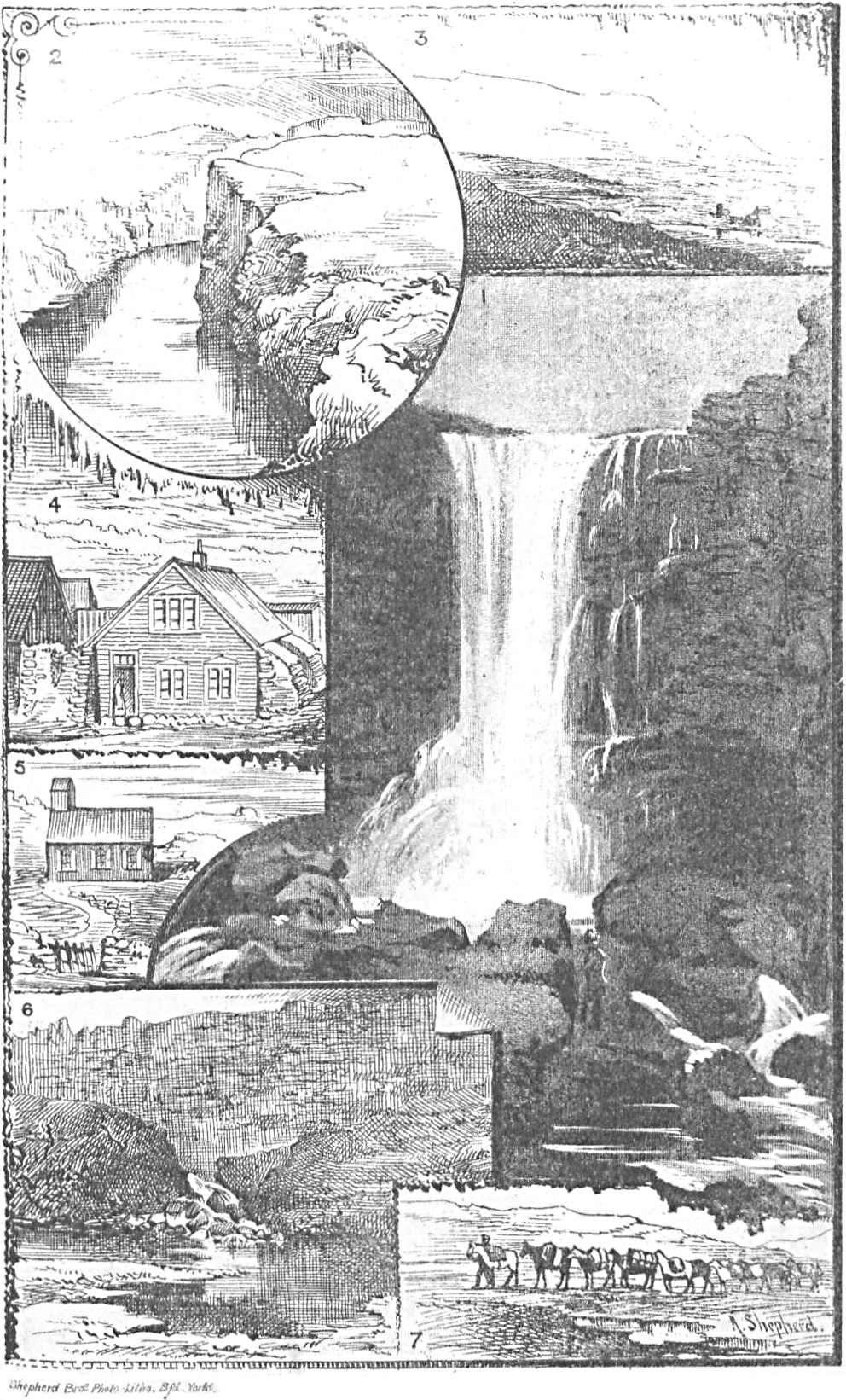
1 Turf and rubble-cottage, Heimaey. 2 The Althingis Hus, Heimaey.—3 Woman riding man-fashion. 4 Drying birds for fuel.
CHAPTER III.
33
When I was at home I was in a better place,
But travellers must be content.—Shakespeare.
Last night after leaving the Westmann’s Islands
we lingered on deck till the weird rocks that stud
the ocean on the west of Heimaey had become mere
black specks on the silver sea, and the Midnight
Sun, which had just set, was filling the heavens
with a halo of crimson and gold as he rose once
more on the distant horizon where sea and sky met.
But nevertheless we were up early this morning
to gaze curiously on the capital of Iceland which we
find ourselves rapidly nearing about breakfast time.
On our left a huge whale-backed mountain-island
rises magnificently from the calm blue sea, almost
within a stone’s throw of the extreme point
of the barren treeless promontory that stretches
away for a mile or two in the direction of the town.
An iron beacon near the shore, and a few wooden
out-buildings and a farm house on the ridge, are the
only objects in the immediate foreground; and
there is not a sign of cultivation of any kind to be
seen anywhere. A round tower—the Observatory—crowns
the summit of the promontory and
overlooks the strange collection of dingy painted
weather-board houses, huts, and sheds, which form
the city of Reykjavik, and which extend down the
slope to the black, weed-strewn, rock-bound shore,
where two or three shelving wooden piers, several
barn-like stores, a number of small boats, a few fishing
smacks, and a group of men engaged in mending
their nets, can be distinguished without the aid of
a glass. A church,—whose ugly little tower, or
34belfry, thrusts itself pretentiously above the roofs
of the buildings that cluster round it,—and several
public institutions, not one of which possesses the
shadow of a claim to architectural beauty, are prominent
simply because of the humility of the houses
that surround them. But neither these nor any of the
other objects over which our restless eyes wander
within a radius of half-a-dozen miles at all prepossess
us in favour of Reykjavik and its suburbs,
which do not indeed bear comparison even with a
small colonial settlement in the earliest days of its
existence. It is difficult to believe that the city
we are approaching was founded by a band of
adventurous Norsemen more than a thousand years
ago, and in the primitive appearance of the capital
of his country we see another evidence of the
poverty and indolence of the Icelander. From a
flagstaff in a prominent position the Danish ensign
flutters in the breeze, and a good deal of bunting
is also displayed on several of the Consulates and
stores in honour of our arrival.
As we slowly creep on towards our anchorage,
past several dangerous reefs, bare at low water, an
extensive panorama lies spread out before us. The
sterile water-worn snow-streaked slopes of a very
common-place mountain chain on our left, and an
extensive wilderness of barren heath which touches
the grey-clouded sky on the horizon on our right,
contrast strangely with the black irregular fantastic
peaks of the volcanic range that rises
picturesquely behind—though at a great distance
beyond—the city, and form an interesting picture
in which nothing is so striking as the want of life
and warmth and colour.
A three-masted sailing ship, three schooners, one
yacht, a few fishing boats, and a battered old coal
35hulk, are riding at anchor in the roadstead, each
and all of them
“As idle as a painted ship
Upon a painted ocean.”
Not a sound indicative of human existence is
carried to our ears from ship or shore to break the
silence which settles down upon us as our engines
suddenly stop, and leave us to drift slowly on to
our anchorage. The deep stillness on land and
sea and in the streets of the apparently deserted
city remind me of Campbell’s famous lines—
“Ships were drifting with the dead
To shores where all was dumb,”
and I am just beginning to wonder what
manner of people they are who can exist
without noise, when the clarion cry of
a rooster rings through the air and re-assures
me. It recalls a good story which I heard at the
dinner-table the other day of a cock in Iceland
which, deceived by the absence of night, crowed
itself to death during the summer solstice, under a
mistaken sense of duty. Lord Dufferin, whose
“Letters from High Latitudes” are well worth
reading, is credited with the authorship of this
amusing exaggeration.
Presently, however, we observe two or three
boats put off from one of the piers, and in a
few minutes are boarded by guides and hotel-proprietors.
We arrange with one of the former,
by name Thorgrimur Gudmundsen,—a big, strapping,
intelligent-looking fellow, who stands over six
feet high in his stocking soles,—to accompany us
to Thingvellir, the Geysirs, and Hengill, and to have
ponies ready for an early start to-morrow.
36On landing at the pier a little later we are met
with the inevitable stench from the fish-stores,
and after securing rooms at the Island Hotel—(Island
is the Icelandic word for Iceland not
for island)—we stroll out to see the city.
Being desirous of a breath of fresh air we flee
from the horrors of the many stenches and from the
dirty dusty uneven uncausewayed streets, and bend
our steps almost instinctively in the direction of the
Observatory, preferring rather to look down upon
the city from a purer atmosphere, and to command
a view of it and its surroundings from a respectful
distance, than to stand gaping at its one-and-two-storied,
black-roofed, drab-painted, weather-board
huts, which form an aggregation of impressive ugliness
that has a tendency to induce melancholia.
Thick mists are settling down upon the summits
and slopes of the distant hills, and there are signs
of a change for the worse in the weather which
make us rather anxious, for to-morrow we are to
commence a ride of at least a hundred and fifty
miles through a country where there is little or no
accommodation for the storm-bound traveller.
But the sun is shining out pleasantly, though not
too powerfully, and the air is clear, bracing, and invigorating,
so we dismiss our fears, and turn our
attention to the scene before us. There is not
a single tree, nor even a bush a foot high,
nor one square yard of cultivated land anywhere.
The hilly plateau on which we stand is
traversed, for a few miles, by a brown dusty
macadamised road—almost the only one in the
island we are informed—on each side of which, for
miles around, nothing is to be seen but vast fields of
lava, hundreds of acres of undulating country
covered with stones and boulders, so thickly
37strewn that, there is scarcely room for
a blade of grass to grow between any
two of them, were a blade of grass so unwise
as to attempt such a feat.
We miss the rustling leaves, the green springy
turf, the yellow waving corn, the rippling streams,
and the song of lark, or thrush, or blackbird, or
even the chirping of the despised sparrow, as we
look upon the panorama before us with an interest
which arises chiefly from its absolute want of these
or any other features which render a landscape attractive.
As we sit and chat about our experiences in
many a foreign land, and institute comparisons
between the view before us and others that we
have travelled much further to see, our minds naturally
go back to the time more than ten centuries
ago, when Ingolfr and his companions—fleeing from
Norway to Iceland—because as the sagas quaintly
say, “it was the only place within their reach
at the time where they could live undisturbed by
kings and evil-doers,”—first sighted the snow-capped
peaks of Orœfa, and prepared to land on the silent
shore.
As they approach nearer to the coast they throw
overboard the pillars of the chief’s high seat which
they have brought with them, in the belief that,
directed by the gods, these will be carried by the
tide to a spot divinely selected for the new settlement.
But alas! during the night they lose sight of
the floating pillars that were to guide them, and on
landing look for them in vain. Three years pass
away, and still the search is fruitless. At length
the long-lost pillars are found on the present site of
the capital, and there, in reliance upon the directing
providence of the gods, Ingolfr and his little company
settle.
38Their new town must of course receive a name, so
it is called Reykjavik, or Smoking Village, because
on approaching the bay the wondering Norsemen
saw steam—which they not unnaturally mistook
for smoke—issuing from the earth in various parts
of the coast.
Such is an outline of the founding of the city before
us. Its progress has been slow, and its population
to-day, set down at about 2,500, is probably not
much greater than it was seven or eight hundred
years ago.
But we live in stirring times, and may, therefore,
be allowed to hope that under present conditions,
which are much more favourable than at any
previous period of its history, Reykjavik may
yet become the thriving capital of a country redeemed
from desolation by the patriotic enterprise
and energy of a free and enlightened nation.
Then will these words of their national anthem
“Eldgamla Isafold,
Astkœra fósturmold,
Fjallkonan fríth;
Mögum thin muntu kœr.
Methan lönd girthir sœr
Og gumar girnast mœr,
Gljár sól á hlíth.”
acquire a deeper meaning as they fall from
the lips of a grateful people, who see their
fatherland gradually becoming great and happy
as it steadily triumphs over the difficulties
and obstacles with which Nature, in an angry
mood, seems to have tried her best to retard its
progress and hinder its prosperity.
The words above quoted are interesting as an
example of Icelandic. Dr Hjaltalin having kindly
furnished me with the following literal translation:
39“Iceland old as fire, beloved native land, fair mountain
bride, thou wilt be dear to thy sons, while the
sea surrounds the land, and men’s desire is to maidens,
and the sun shines on the hillside,” I have endeavoured
to turn it into English verse without materially
deviating from the original words and metre.
Fair Iceland, old as fire,
Mountain bride our hearts’ desire
Sweet fosterland.
While woman loved shall be
By man; or sun shines free;
While land is girt by sea
Thou shalt be dear.
The tune to which the anthem is sung—God Save
the Queen—is claimed by the Icelander.
As we are on the point of returning to the ship
for lunch we espy a couple of neatly dressed
maidens, one of whom is rather pretty. We succeed
in making the latter understand by signs that we
are exceedingly anxious to take her portrait that we
may carry it with us across the seas, and flattered
by the attention, and willing to oblige, she consents
with a modest blush which we are able
particularly to observe, because her face is clean,
which is more than can be said for the Icelanders
generally, who, if report be true, dislike cold water
when applied to the skin, or unless mixed
with corn brandy.
This objection would seem to be inherited, and as
Mark Twain says, “to run in the blood like wooden
legs,” if we are to believe the traditions of early
history, for it is recorded that the greatest objection
of the Pagans to Christianity arose from the
necessity of being baptised. This difficulty was
only overcome by an agreement that the ceremony
should be performed by immersion in one of the
“Laugs” or hot-springs.
40We are fortunate in getting into conversation
with a Dane, who is mixing mortar for the walls
of a stone dwelling-house in course of erection in
a side street, and at the same time superintending
two labourers who are busily engaged in carrying
stones on a handbarrow.
The first thing we note is that the rough
blocks are actually being quarried out of some large
boulders which lie embedded in the middle of the
street in which we are standing, and must therefore
have seriously obstructed traffic had there been
any to obstruct. Our friend the builder, who speaks
very good English, having lived in Scotland for some
time, tells us that he came to the country three
years ago, and that, though a sailor by profession, he
has the distinguished honour of being the
first man to build a stone house in Iceland.
When he proposed to make the attempt he was
greeted with derision, it being considered impossible
to work lava stone. “But,” says he, emphatically,
“I knowed better, and I done it.” He has now
erected several substantial buildings in Reykjavik
which he points out with modest pride.
We learn from him that he pays his labourers
2 kroner and 75 öre per day of eleven hours, being
at the rate of 25 öre per hour. Let me remark here
that the kroner is a Danish silver coin value thirteen
pence half-penny sterling, and that it contains 100
öre; the labourer’s daily wage therefore reckoned
in English money amounts to about 3s 1d. Skilled
workmen earn from 3 kroner (3s 4½d) to 3 kroner
and 50 öre (3s 11d) per day. The hours of labour
are from 6.0 a.m. till 7.0 p.m., one hour each being
allowed for breakfast and dinner. There is no half
holiday, but Sunday is strictly observed as a day of
rest and devotion. Flour at present costs about
4118 kroner (20s 3d) per bag of 200lb, about the same
as in England, and beef—seldom eaten—from 25 to
40 öre (3½d to 5½d) per lb, or from 45 to 50 öre (6d
to 6¾d) when scarce, or very fat and good.
There is no such thing as a butcher’s shop
in Reykjavik, but as the Scotsman said “every
one kills himself,” taking care to apportion
the animal before he does so. The people generally,
however, live upon dried-fish, flour-cakes, rye-bread,
butter, and curds. Female servants are
paid about 40 kroner (45s) per annum, men
receiving from 60 to 70. They are, of course,
boarded and lodged, and one of the items of their
allowance of food is 2lbs of butter per week.
Every woman must be able to milk, and every
man must know how to shoe a horse, as I understand
every Icelander does from the Bishop—who
is the greatest and richest man in the country—downwards.
Sugar-candy is commonly used
instead of sugar to sweeten tea or coffee, the reason
given by the captain of the Camoens being that it
is not so apt to melt in damp weather. Our informant’s
explanation is as follows: “Sugar-candy don’t
run away in their mouths.” The Icelander evidently
prefers, if I may use a common expression, to roll
the candy like a sweet morsel under his tongue.
We enquire the cost of rent, and, pointing
to the house of a tailor close by, he informs us
that it is let for 20 kroner (22s 6d) per month, and
contained three rooms and a kitchen.
The cowskin shoes, so universally worn, cost from
2 kroner upwards. It is a custom of the women
in Iceland when they are “donned,” as we say in
Yorkshire, to wear a bright coloured apron, a white
front to the bodice, and a bow at the back, like
that of the Japanese girls, made of a length of
stuff one fathom (6 feet) long.
42A marriage license costs 36 kroner (40s 6d), and
people can be married either in church or in their
own homes if they prefer it, and at any hour,
according to the sensible custom which also
prevails in Scotland. The præsturs or parsons,
who exercise great influence in the country, are
especially careful that the women shall be educated,
and I was reliably assured that no woman
has much chance of securing a husband who is not
able to teach her children at least the elements of
education. There used to be a law forbidding a
man to marry unless he owned “one hundred of
land”—land worth 120 ells of Vathmál or homespun—or
“a six-oared boat in trim.”
We subsequently learnt that our informant unfortunately
introduced the measles into Reykjavik
on his arrival three years ago, and that the dreadful
disease spreading like wildfire, carried off no fewer
than 37 persons in the thousand of the entire population
of the island. Iceland has always been
subject to plague, pestilence and famine, as well
as to the havoc and desolation wrought by
volcanic outbursts. In the seventeenth century
many of its unfortunate inhabitants were carried
into slavery by Algerine pirates; in 1707 from
16,000 to 18,000 people died of small-pox out of a
total population of 50,000; in 1759 famine swept
off 10,000 persons, and between the years 1781 and
1785 other 9,000 perished from the same cause.
Starvation again made fearful ravages amongst
them in 1824 and 1825; in 1827 an epidemic
decimated the survivors, and there have been
frequent minor calamities since. One finds it
difficult to understand how it is that, in the course
of a thousand years, the population has never exceeded
the 72,000 which is its total to-day;
43but the continued recurrence of
such disasters as those just mentioned,
and the ravages of fire, frost, flood, and famine
help to explain the matter. It is impossible to
think without a shudder of the horrors and miseries
which must have been endured by a people so circumstanced.
I have, however, been digressing, and must
return to our friend, the builder, who proves to
be quite a mine of information. We question
him about the climate, and learn that it is
by no means so severe as foreigners generally
suppose, the registered mean temperature at
Reykjavik of the whole year being 39deg., of
summer 53deg., and of winter 29deg. At Akureyri,
which is further north, these figures are
respectively 32deg., 45deg., and 20deg. Rain falls
heavily night and day at frequent intervals during
the months of August and September, but
from September till November the weather
is fairly good. During winter the days are necessarily
short, there being, at Reykjavik, only
3 hours and 58 min. of sunlight on the shortest day,
and 20 hours, 54 min. on the longest. A great deal
depends, however, upon what people call daylight.
There are some men who would argue that in England
we have daylight in November. At midsummer in
the north the sun never sets for a whole week, and
at mid-winter it never rises for a corresponding
period. Summer is so short and variable as to remind
one of the Scotsman’s advice to a friend who
was about to visit North Britain: “When you get
there,” said he, “don’t take off your overcoat till
midsummer day, and put it on again the day after.”
When summer comes it is customary for people
at its commencement to wish one another “a
44good summer,” just as we wish one another
“A Happy New Year.” The words used by our
informant in communicating this fact are rather
amusing. They are as follows: “A man will say
to you, ‘I wish you a good summer,’ and perhaps
it will be snewin’ like blazes.” The expression
“snewin’ like blazes” is worthy of the great
Irish Parliamentary orator who “smelt a rat
and saw it floating in the air,” but who
nevertheless determined “to nip it in the bud.”
Bidding our friend “Good day,” with many
thanks for his courtesy, and being still as inquisitive
as a Yankee interviewer, we stroll down to
the Althing or Parliament House in search of
another victim who is willing to be cross-examined.
We find one in a pleasant-mannered young Clerk
of the House, who shows us over the building, the
largest and finest in Iceland, substantially built of
dressed stone, and situated on one side of a small
public park or garden, which contains a statue of
Thorwaldsen, the great sculptor, whose father was
a native of Iceland.
We are conducted by our guide first to the Lower,
and next to the Upper Chamber: both of which are
plain square rooms of moderate size, containing
seats and desks for the members and a rostrum
for the president. They are simply furnished,
unrelieved by elaborate decoration, and quite large
enough for those who occupy them when Parliament
is sitting.
The Lower House consists of twenty-four members,
except immediately after a general election,
when thirty members take their seats as the representatives
of the people. Of these thirty, however,
six are at once transferred to the Upper House
by the vote of a majority of their colleagues, where
45with six others nominated by the Crown,—making
twelve in all,—they form the Senate or House
of Lords. Each of these assemblies is presided
over by a President, who receives an official salary.
Members of both chambers are paid 6 kroner
(6s 9d) per day, while Parliament is sitting, and
receive in addition their travelling expenses to and
from Reykjavik.
No man is eligible or qualified for a seat in
either house unless he is a Danish subject, not
less than thirty years of age, and has resided in
Danish dominions for at least five years. The
franchise is possessed by “all officials, ecclesiastics,
university graduates, students who sign themselves
‘Candidat,’” holders of farms on lease, those who
pay a minimum of eight kroner per annum in
government taxes, and country people who pay
cess, or parish rates, provided they are of unblemished
character, at least twenty-five years of age,
and have resided not less than twelve months in an
electoral district. Women are excluded from the
franchise as in all other civilised (?) countries; so are
minors, paupers and criminals.
The total revenue of the country in 1884 was
863,932 kroner, in round numbers about £48,000,
and was derived, according to the official year
book which our informant kindly turns up for
us, from the following sources:—(a) Land tax
levied on farmers only, (b) cattle tax, (c) house
tax, (d) income tax, (e) sale of property tax,
(f) tax on incomes from other sources, (g) tax on
tithes, (h) tax on exports, (i) tax on imports, (j)
tax on tobacco, (k) post office revenue, (l) light
and harbour dues.
Deferring any further notes with reference to
the history of government till we reach the
46famous spot at Thingvellir where, a thousand years
ago, the ancient Althing was wont to assemble, we
return to the ship to tiffin, to find that a few seats
at table will be vacant when we start for Akureyri
on Saturday, as several of our little company
have already secured quarters ashore with the intention
of remaining in the country till the next voyage
of the Camoens. These are an enthusiastic angler
who has visited Iceland several times, and who
has taken an excellent trout-stream on lease;
a young city merchant,—also a disciple of Isaak
Walton—a very nice fellow, the up-turned ends of
whose attenuated moustache, however, are so wonderfully
waxed that one almost longs to try to hang
a hat and coat upon them; an officer of a crack
regiment of dragoons who was at Majuba,
and who knows South Africa well; a kind-hearted
sociable old clergyman who put
himself to great trouble to arrange a whist
party at an early stage of the voyage,—not
on his own account, but with a view
of making some of us happier,—and who hopes
to return to his parish in Suffolk with recruited
energies after having made the ascent of Hekla,
and bumped his poor bones over the lava-fields of
South-Western Iceland; and last—but by no means
least in his own estimation—a pawkie talkative
self-opinionated exceedingly well-informed old
Scotsman, who is burning with ardour to make a
weary journey across the Sprengisandr (bursting
sands) desert, and to ascend to the very crater of a
famous volcano called Askja; a feat which on a
previous visit he was unfortunately prevented from
doing. He is perhaps not so much animated by a
desire to increase the world’s knowledge as to
“smash” another traveller who, having had the
47coveted honour of reading a paper before the Royal
Geographical Society, inconsiderately omitted to
mention his indebtedness for a good deal of information
to notes supplied to him by our injured friend.
The remainder of our compagnons de voyage—who
are “jolly companions every one”—are going
on with us to Akureyri and will stay by
the ship like ourselves till we get back to
Scotland. They include two brothers of
Scotch parentage but born in England, who like
myself are constantly engaged in amateur photography;
two young sparks from a Midland town
famous for the loveliness of its ladies and the
beauty of its lace, and who are familiarly
known in the smoke-room as
“Me and Arthur;” a tall, dark, agreeable
philologist from the Cumberland fells who reads
but does not speak Icelandic; and three gentlemen
from London, viz:—an embryo barrister, nephew of
one of the greatest living novelists; a budding shipbroker
who, though a genuine Cockney, greatly admires
Burns’ poems which he has read from beginning
to end, including the glossary (!); and a fine-looking,
handsome young fellow who would make
splendid food for powder should he choose the
army as a profession, as his father and grandfathers
and great-grandfathers have done before him.
Everybody has been good-tempered, our worthy
skipper setting the example, and granting us a
degree of freedom in little things which many a
less genial man would have refused. The stewards
and stewardess have been most attentive to our
wants, and exceedingly obliging; our table has
been well supplied with necessaries and luxuries,
and the voyage has hitherto been a pleasant one.
It is astonishing how men thrown together on
48board an ocean-going steamer fraternise with one
another, and it is always a real regret to me when
a little community, formed under such circumstances,
begins to break up. Partings, however, are
constantly experienced in this world.
“Friend after friend departs
Who hath not lost a friend?
There is no union here of hearts
That hath not here an end.”
All we can do therefore is to bid our friends “Good-bye,”
and to hope that they may each and all
have “a good time,” as a Yankee would say, not
only during their stay in Iceland, but on the
voyage of life.
PLATE IV.
1 View of Reykjavik.—2 Woman wearing holiday head-dress. 3 Woman wearing “Hufa.”—4 Snaefellsjökull.—5 Building stone houses, Reykjavik.—6 Cathedral and Parliament House, Reykjavik. 7 Lava plain, near the Observatory, Reykjavik.
CHAPTER IV. — AMERICAN STUDENT SONG.
49
“Though sluggards deem it but a foolish chase,
And marvel men should quit their easy chair
The toilsome way, and long long league to trace,
Oh! there is a sweetness in the mountain air
And life, that bloated ease can never hope to share.”
Byron.
There are no pleasanter memories of an ocean
voyage than those that cluster round what is known
afloat as “a Sing Song,” when a little group of
fellows, whom fate has thrown together for a week
or two, gather together on deck, under the bright
blue starlit sky, and to the accompaniment of banjo
or guitar, make the night-air melodious—or otherwise—with
song and chorus.
Fletcher of Saltoun, a famous Scottish patriot, is
credited with the oft-quoted saying “Let me make
the songs of a nation and I care not who shall make
its laws.” I have often felt how natural
is the aspiration thus expressed, and never
more than when the monotony of life at sea has
been relieved by the willing efforts of a few sweet
singers. But if the man who writes the words of
a stirring song be such a benefactor what shall we
say of the professionally-despised musician whose
rattling choruses, full of melody, and easily learnt,
make the strangers who sing them feel like old
friends? My own opinion is that, had he any choice
in the matter, he could desire no greater reward than
the appreciation with which his music is sung by a
grateful little company, such as I have just referred
to.
50Last night a few of us held “a Sing Song”
in the large room of the Island Hotel, and
spent our first evening ashore most enjoyably.
The captain had brought his violin with him, by
invitation, and as we drew our chairs round a little
table near the piano, we were presently joined in
a cup of café noir by a pleasant and highly-intelligent
Icelander, who was introduced as editor or
proprietor of a newspaper; by our guide, Thorgrimur
Gudmundsen, who came to report progress in his
arrangements for the morrow; and by a fellow-Yorkshireman,
who has been enjoying a few weeks’
sport on some of the trout streams, and who returns
to England with us on Saturday. Giving our
melodious instincts full play, we treated the company
in the adjoining bar to a little vocal and instrumental
music, which made up for its occasional
want of tune and precision by its unmistakeable
heartiness.
It also unearthed a young Yankee “masher,”
whose get-up and general appearance, as he suddenly
appeared in the doorway and approached our merry
circle, caused us to pause in the midst of a chorus to
gaze at him with undisguised astonishment and
open-mouthed admiration. It was his costume
rather than his personal beauty—though he was a
good-looking young fellow—that provoked us to
the unpardonable rudeness of staring. Let me try
to describe it. He was attired in a short loose velveteen
coatee, elaborately braided, and cut away
in front in such a fashion as to expose
a maximum of white shirt front admirably displayed
by a minimum of velvet waistcoat. On his
head he wore a little round tweed billycock in
shape like a milk-bowl, and he had managed by a
supreme effort to thrust his shapely legs into knee-breeches,
tight as the skin of a kettledrum, and
51fastened at the knees with buckles; while his
calves, evidently a source of reverential pride from
the care taken to show them off to advantage,
stretched a pair of superfine stockings to such an
extent as to make one tremble for the stitches.
His feet were encased in a natty pair of patent
leather shoes ornamented, on each instep, with
a large bunch of black ribbon, and a pair of
silver buckles which if melted down into United
States currency would probably have yielded dollars
enough to pay his hotel bill for a week; and
his tout ensemble suggested alternate thoughts
of a London flunkey, a tailor’s block, and Apollo
Belvidere.
His accent was just sufficiently nasal to leave no
doubt on our minds as to his nationality, even if he
had omitted—as he did not—to inform us that he
hailed from
“The Land of the West, the land of the free,
Where mighty Missouri rolls down to the sea.”
He proved himself a good fellow, and a pleasant
companion, however; was troubled with little or
none of the bashfulness which is such a distinguishing
characteristic of his countrymen; and soon contributed
to the harmony of the evening by singing
several songs, one of which,—described by him as
an “Amurican Stoodent Sawng,”—exercised such
a fascination over us on account of its
“catching” melody, and the ease with which we
picked up the chorus, that we made the rafters ring
with it at least a dozen times before we broke up.
I wrote it down from memory as soon as I got the
piano to myself, and here are the words of the first
verse, and also the air which I have transposed into
the tonic sol-fa notation for the convenience of the
printer.
Ring, ching, ching,Ring,ching,ching,Ringoutyebells, I
playonmySpanishguitar;Ching!Ching!
╰───────╯
Chorus.
Stimulated by the applause with which his efforts
were received our friend the captain astonished us
with the pathos he managed to put into “The flowers
o’ the forest,” “Auld Robin Gray,” and “Robin
Adair,” while his bowing and “double stopping”
suggested thoughts (we were in an imaginative
humour be it remembered) of a combination of
Paganini, Sivori, Vieuxtemps, and Carrodus.
At a late hour the would-be explorer of the
mysteries of Askja stirred to the depths of his
contentious soul by the competition of rival performers,
produced an accordion on which he proved
himself to be no mean performer.
“A sound of revelry was heard by night” in
53Reykjavik to which its peaceful inhabitants were
probably unaccustomed, and the “Nicht drave on
wi’ sangs and clatter.” The Icelandic editor,
delighted with our efforts, invited us to take wine
with him, and a bottle of sherry was accordingly
brought in and duly emptied with mutual good
wishes and much clinking of glasses. Then an
Englishman present insisted upon returning the
compliment, and the mirth and fun were growing
fast and furious when the gentleman with the
accordion—who was a staunch teetotaller—thrilled
us with the inspiriting strains of a Scotch reel.
Instantly half a dozen of us sprang to our feet and
“Reeled and set, and crossed and cleekit,
Till ilka carline swat and reekit.”
For the next quarter of an hour I verily believe
that the little knot of Danish sea-captains, who
had by this time established themselves in a distant
corner of the room, and the studious boy who was
poring over a book by the light of the midnight
sun that streamed in through the unblinded
windows, looked upon us as a party of lunatics who
had escaped from an English asylum.
“But pleasures are like poppies spread,”
The time came round to go to bed.
So to bed we went, with the generally expressed
wish that we might all meet again under similar
circumstances on our return from our trip into the
interior.
At ten o’clock this morning (July 14th) our guide
arrived with the ponies, and on looking out of the
hotel window we saw seven sturdy little animals of
various colours standing in the lane outside. There
54are no carriages or wheeled conveyances of
any kind in Iceland; at any rate none that I
have as yet seen, with the exception of a solitary
handcart of American manufacture, which does not
appear to have been much longer in the country
than ourselves. All travelling is done on pony-back,
and every man, woman and child is
accustomed to the saddle from infancy. Two
ponies have been provided for each of us, including
the guide, and one for our baggage, making seven
in all. A brief reference to the arrangements
made with our guide yesterday may be interesting
and useful to intending tourists. We are to pay
two kroner (2s 3d) per day for each of the
seven ponies which form our cavalcade; and
the guide’s fee is five kroner (5s 7½d) per day with
food, or six kroner (6s 9d) without. In
addition to these items there will be a charge of
twenty öre (2¾d) per diem for pasturage for each of
the ponies, so that our daily expenses for ponies
and guide, reckoning the fee of the latter
at 6s 9d, will amount to 24s in all, or
12s each person. In addition, however, we
have had to provide a supply of bread and
tinned provisions for four days, and shall have
to pay for bed and breakfast at the parsonage or
farmhouse where we may stay for the night; the
usual charge for such accommodation being about
three kroner. The daily total, including the cost of
the food we have purchased, will therefore be not
much less than a pound a day, which is what the
tourist may expect it to cost him.
We are disappointed to find that our valises
must be unpacked, and the few necessary articles
of clothing which we have decided to take with
us transferred to the two strong wooden boxes
55which already contain our stock of provisions,
and which have been slung across
the back of our pack-pony, where they rest
upon a pad of dry turf to prevent chafing. There is
no help for it, however, for our guide assures us that
we are about to ride over a country so rough that
no ordinary straps or buckles can stand the jolting,
and that it is also absolutely necessary to equalise
the burden of the patient little creature that is
to carry our baggage. We accordingly submit, and
while the transfer is being arranged my companion
disappears and presently returns wearing a pair of
huge wading boots, and a yellow oilskin sou’wester.
The former we subsequently find to be
quite indispensable in the case of anyone who
objects to wet feet, for there are fords innumerable
to cross between the capital and the Geysirs.
At length, our preparations being completed, we
mount, and driving the three spare ponies and our
baggage-carrier—(which are allowed to run
perfectly free)—before us we ride off up the hill
towards the Observatory. We have scarcely
proceeded more than half-a-mile on our journey
when we hear a wild shout behind us,
and are presently joined by the captain of the
Camoens, who comes tearing along on a sturdy
little brute, and begins to enliven the proceedings
by sending us all off at full gallop, which he does
by a free use of one of the short-handled
flat-thonged whips common in Iceland.
He rides like a “centaur,” not like a “sailor,”
but not having served an apprenticeship to the
circus business myself, and being as yet rather
strange to the saddle, I am not altogether
sorry when he reins up to return to town. It
would afford me much pleasure to have his company
56all the way, but I am afraid I should only enjoy it
at the risk of a broken neck, for the road over
which we are trotting is one of the roughest of which
I have ever had experience, and having a lively
recollection of colonial roads that is saying a good
deal. At the first important ford we halt for a few
minutes along with seven of our shipmates who have
formed an expedition of their own under the care
of one of Zoega’s men. Zoega, I may observe, is a
well-known man in Reykjavik, and has long been
recognised as the chief of the fraternity of guides.
From this point the road gradually ascends, now
crossing some wild mountain stream, cold as the
snow and ice that feed it, and clear as the blue sky
that it reflects; now winding, in and out, round the
bases of ranges of barren stone-strewn treeless hills,
heart-breaking in their monotony of unloveliness;
and now traversing the dreary uncultivated unfenced
plain, on which, at rare intervals, a little turf-covered
farm house, with its adjoining folds and outbuildings,
may occasionally be seen standing in the midst
of the “tun,” or “home-field,” whose luxuriant
grass tinged by the yellow butter-cup, refreshes the
wearied eye, and forms a pleasant contrast, to the
desolation that reigns everywhere around.
The melancholy cry of the curlew as it flies
above our heads is the only sound—except
the clatter of our ponies’ hoofs—that breaks the
deep stillness, and the pretty wild flowers that—like
the seed spoken of in the parable of “The
Sower”—have “sprung up in stony places,” are
the only other living things that seem to whisper a
word of hopefulness to the despairing landscape.
If people were but willing to look for it, there is
always something to beautify the dreariest desert,
just as there is always some tender spot
57even in the hardest heart, some good
thought in the most selfish mind, and some good
deed even in the vilest life. How many men travel
only to indulge in constant carping and captious
criticism; to find fault with everything they see,
and to abuse everybody they meet. How many
seem even to turn away their eyes lest they should
observe anything which they might be tempted to
admire. Iceland is no place for such men, for they
would find too much occupation, and make
themselves and their companions miserable by their
continual growling. Happily there are none such
in our party.
But the sky begins to grow grey and
clouded. Not a streak of blue is to be seen either
before or behind us, and the deep shadows that fill
the fissures and ravines of the distant hills are
clearly defined against the brown weather-beaten
water-worn slopes. As we plod along we are at
pains to examine the nature and depth of the soil
where opportunity occurs, and soon come to
the conclusion that there must be tens of thousands
of acres of land in Iceland which might be brought
under the plough. From the bright appearance of
the “tun” to which I have already referred, as well
as from the fact that potatoes and turnips are
grown in small patches, here and there, as food for
man and beast, we are forced to conclude that the
absence of cultivation must be due quite as much
to the want of energy and enterprise of the
farmer, as to want of capital, or the recurrence
of unfavourable seasons. On this point, however,
I shall be able to speak more authoritatively after
we have seen more of the country and learnt more
of its natural conditions.
About 2.0 p.m. we halt for dinner, and to
58give the ponies a rest and a feed. By this
time a Scotch mist has begun to fall and the air
has grown much colder; but as we recline on a
damp grassy bank with a chunk of dry bread in
one hand and a portion of stringy Australian beef
in the other, the weather does not materially interfere
with our enjoyment. After a stoppage of
about an hour we on-saddle and resume our
journey, but soon pull up for a minute or two on
the edge of a stretch of flat country literally
covered, as far as the eye can see, with stones and
boulders large and small.
There is no path through this lava-desert,
but the route is indicated by the scratches and marks
made upon the rocks by the shoes of the trains of
ponies that daily travel to and fro between the
capital and the interior; and at points where the
ground is higher than the general level, large heaps
of stones, or cairns, have been erected to guide the
traveller when the country is under snow.
As my pony steps cautiously, but confidently,
upon this lava field, I begin to
wish that I had insured my life in the
Accidental. I also recognise the wisdom of the
wily old Scotsman who played the accordion last
night, who not having a single tooth in his head
has prudently prepared himself for his journey
over the Sprengisandr by bringing with him a
small case in which to place and pocket his false
teeth, that he may not inadvertently swallow them,
or gash his poor gums, when stumbling over a tract
of country like that before us.
After a long and fatiguing march across this
stone-strewn waste we once more get on to turf,
only, however, to find ourselves riding along
a succession of the deep narrow rain channels,
59which form almost the only paths throughout
Iceland. These wind in and out among the millions
of grave-like frost-made mounds that give the
landscape for many miles round the appearance of
a huge cemetery, and remind me somewhat of the
ant-hills so common in parts of South Africa, save
that they are green instead of brown. Indeed the
resemblance between the scenery of Iceland
and that of many parts of Cape Colony is very
striking, the chief points of difference being the
numerous streams of clear running water and the
prevalence of snow on the mountain peaks and
slopes.
It is no easy matter, even for an accomplished
horseman, to ride across country in Iceland,
for when the pony is not picking its way painfully
over a wilderness of stones, it is probably ambling
between two rows of these frost-mounds, which
are often so near each other on account of
the narrowness of the track, and so high, that if the
rider be not careful to keep a sharp look-out ahead
and to tuck in his toes he is liable to come into
contact, with them, and to find himself
pitched out of the saddle, especially as the girths
are never properly tightened.
If, however, he should come to grief, as he
may expect to do occasionally, he has the satisfaction
of knowing that, if he do not break his neck
in the fall, he need fear nothing from his pony,
for more docile hardy willing and good-tempered
little creatures than the Iceland ponies
do not exist. During the summer the grass of the
home-field is reserved exclusively for the cattle,
whose lot in winter even under the most favourable
conditions is often one of semi-starvation. But the
poor pony, after a summer of hard work and no
60corn, is turned out in winter to try to find wild-grass
enough to keep him alive till the melting
snows give him another chance of putting some
flesh on his emaciated frame.
About 7 p.m. we sight Lake Thingvellavatn,
the second largest lake in Iceland, a fine sheet of
fresh water about twenty-five miles in circumference,
in the middle of which rise two or three
small islands black as night, and absolutely
destitute of vegetation. These and the surrounding
ranges of barren hills, deeply shaded in tones of dark
brown and black, are reflected upon the glassy surface
of the dull blue-gray waters, and serve but to intensify
the gloomy grandeur of a picture which is only
relieved from its oppressive blackness by the white
peaks and snow-streaked slopes of the distant mountains,
prominent among which, away to the south,
towers the rugged form of Hengill. The scene is one
that would inspire a Dante or a Doré by its wild
and weird magnificence.
An hour later, we stand upon the summit of
the Almannagja—(“‘all men’ or ‘great’ rift,”)—so
called because in ancient times “all the
people” met upon its eastern flank during
the sitting of the Althing or Parliament.
It is one of the great sights of Iceland, so we
pause to observe and describe it, before descending
the steep and rugged path which leads to the valley
below. The Almannagja is the result of a rupture or
gigantic crack caused by the subsidence of the lava-field,
which stretches away for many a mile
beyond it, though at a considerably lower level.
Two huge walls, from two to three miles
in length, have thus been formed one on
each side of a narrow defile. That on the left, said
to be about 180 feet in height, is absolutely perpendicular;
61is cracked in ten thousand times ten
thousand places; and looks like an immense
barrier built by Titanic hands. That on the
right, which is about 80 feet lower, has evidently
fallen away from the precipitous rock opposite; but
the two together as they frown down upon the
ravine below, give the scene such an appearance of
gloom and desolation that it seems a fitting entrance
to the Infernal regions.
The summits of both cliffs are covered, all along
the sky-line, with rocks of various shapes and sizes,
some of which overhang in a manner which seems
to threaten destruction to the train of men and
ponies below that sink into insignificance in comparison
with the majesty of their surroundings.
A few hundred yards beyond the place where the
valley is blocked by hundreds of moss-clad
boulders, piled one on the top of the other in picturesque
confusion, the river Oxara (Axewater),
which has just taken a magnificent leap from the
top of the precipice a little further on, completes
its descent to the plain, by tumbling, with loud
roaring and impetuous fury, from rock to rock till it
takes its final plunge into Execution Pool, whence
it flows silently on, past church, parsonage, and
graveyard, into Lake Thingvellavatn.
Descending by the rough precipitous path—whose
difficulties and dangers have, we find, been
somewhat exaggerated in a description given to
us before we left Reykjavik—we ride along the
bottom of the rift, and, looking round about us, or
glancing upwards to the black frowning crags on
the ridges over our heads, are struck with the
desolate wildness of the scene which impresses us
even more forcibly than it did from the
heights above. Leaving the Almannagja, near
62the second fall of the Oxara, and fording
the stream a little to the right we reach Thingvellir
at last, and are not sorry that the day’s journey is
at an end.
My companion and Gudmundsen, having fortunately
preceded me, have managed to secure
not only the best room in the parsonage, but,
what is much more important, the two best
beds. They have thus forestalled the members
of the other expedition, who have resolved
themselves into a committee of ways and means and
are deeply engrossed in discussing the serious question
as to which of the seven ought,—in virtue of age,
delicacy of constitution, or other sufficient reason,—to
occupy the only two remaining beds. It is an
anxious moment for the five unfortunates who
after a hard ride of nearly forty miles—(which in
at least one instance has resulted in the loss of a few
square inches of epidermis)—will probably have to
lie down upon bare boards.
Another serious matter is also weighing heavily
upon their minds. They have already been on the
premises for upwards of an hour, and it is now
nearly nine o clock at night, yet there are no signs
of supper, and they are all desperately hungry.
“All things come to those who know how to wait,”
however, even in Iceland, and shortly after my
arrival a repast, which includes coffee, brown
bread, cheese, butter, and boiled char (the latter
fresh from the lake) is spread before us and enjoyed.
Having satisfied our appetites, we stroll through
the churchyard, where we see the famous stone
used in days of old as the national standard of
measure. The church itself, like all the sacred
edifices in the country, is a plain little wooden
structure capable of holding comfortably about
63fifty or sixty persons. Here we meet our host the
præstur, Sira Paulsen, who speaks English fairly
well, and whom we find to be an exceedingly
pleasant well-informed gentleman.
Subsequently in conversation with our guide
I learn that churches are built by subscription,
and that land (the best in the country) generally
comprising from three to four farms, is set apart
by the State in every case as an endowment.
These farms, which of course vary in value, are
called “Kirk farms” and are let to tenants, with
the exception of what is called the “home farm”
which surrounds the præstur’s house, and is cultivated
by himself. The præstur receives marriage fees,
rents of Kirk farms, and tithes on live stock and
produce. A house is also provided for
him which he is bound to keep and leave in good
repair. On induction, or ordination, he is presented
with from one to four cows, and from six to twenty-four
sheep, according as the living is a poor one or
a rich one, and on leaving is required either to
restore these in good condition, or to provide satisfactory
substitutes. The average income of a well-paid
clergyman from all sources does not probably
exceed a thousand kroner, and he is therefore
“passing rich” on barely “sixty pounds a-year.”
In many cases the stipend is not half of this sum.
As regards his qualifications for his sacred office,
he must have attended the Latin School for five or
six years, and subsequently spent two years at the
Theological College. If approved on examination
he is appointed to a church either by the Bishop, or
by the Governor with the sanction of the Bishop,
according to the conditions of the presentation.
There are, however, more churches than parsons
at present, and it is not uncommon for a præstur
64to have to officiate at four or five different places
at a considerable distance from each other. In
such cases the services are of course occasional.
The people strongly disapprove of the present
system of patronage, and are agitating for the
right of electing their ministers, which will, it is
thought, probably be granted by the Althing next
year. There is only one bishop for the whole of Iceland,
who resides at Reykjavik, and whose official
salary is 3,416 rixdollars or about £380 per annum.
But in each of the different counties—of which
there are altogether twenty-one—there is a dean,
or Bishop’s deputy, who looks after the temporal
and spiritual condition of the churches, and superintends
the education of children.
There is one Government School called the Latin
School at Reykjavik, and a School of Science has recently
been established in the north near Akureyri.
Education in these is free, and the students who
attend them, having generally been privately
prepared by the præstur, or by tutors, may
be considered the pick of the country. Those
who are too poor to support themselves receive
an allowance from the State for maintenance.
The remainder of the schools are what are
known in England as “private adventure schools,”
and the fees usually paid in these vary from ten to
twenty kroner per session of six months, commencing
on the 1st of October and ending on the 1st of
April. During summer education is at a standstill,
the children being engaged in haymaking,
and other work, or permitted to enjoy
a long holiday. They thus probably forget a
good deal of what they had learnt during
the winter. Our guide, who is a schoolmaster,
informs us that he teaches his pupils reading,
65writing, arithmetic, orthography, geography,
history, mathematics, Danish, and English, but no
branch of either art or science.
PLATE V.
1 The Almannagja from the South. 2 Lake Thingvellavatn and Hengill.—3 Rocks on summit of Almannagja.—4 A rest by the way. 5 The Almannagja from the North.
But it is getting well on to midnight, and we
have a long ride to-morrow so I shut up my notebook
and make for the house, stopping on the way
to my own room to take a look at the arrangements
made for the five poor fellows who are to sleep
on shake-downs. I find them ruefully contemplating
sundry deal planks and wooden boxes, on
which, without bedding, and with a bare sufficiency
of rugs or other coverings, they are about to stretch
their weary bones. I feel that it would sound like
a cruel mockery to wish them a “Good night,” and
as I turn into the bed that has been prepared for
me on the sofa in our sitting-room, it is with an
uncomfortable feeling that there is something
decidedly selfish in the satisfaction I experience at
being better off than my neighbours. But
“Sleep that knits up the ravell’d sleave of care,
The death of each day’s life, sore labour’s bath,
Balm of hurt minds, great nature’s second course,
Chief nourisher in life’s feast,”
soon seals my heavy eyelids, and ends my first
day’s experiences of travel in the interior of Iceland.
CHAPTER V.
66
“From Nature’s constant or eccentric laws,
The thoughtful soul this general inference draws,
That an effect must pre-suppose a cause.”
Prior.
The weather is so charming, the sky so clear,
the sunshine so bright, and the air so pure and invigorating
that it would be a shame to lie abed under
such circumstances, so in spite of the fatigues of
the previous day we are up early on the morning
after our arrival at Thingvellir and have visited
and photographed half-a-dozen interesting scenes
before breakfast. These are the Almannagja, described
in the previous chapter, the Upper and Lower
Waterfalls, Execution Pool, the ford of the Oxara,
and the famous Lögberg, or Law Hill.
The latter,—by far the most classical spot
in Iceland,—is interesting to the traveller
principally on account of its historical associations.
Before I refer to a few of these let me
try to describe its appearance.
The Lögberg is situated on the same side of the
river as the church and parsonage, is reached
by clambering over two or three hundred yards
of hilly ground, and is simply a long irregular-shaped
tongue of grass land in the centre of an undulating
plateau which forms the summit of a low lava-hill.
Two immense fissures, one on either side, completely
surround it, save at the point of approach.
These fissures, into which you can look down from
their precipitous edges, vary in width in different
67places from perhaps ten to twenty feet. It is
impossible, however, to judge their depth with any
accuracy, for, at about thirty feet from the surface,
they are filled with beautifully clear water, which
flows into and out of them by subterranean
channels, and almost converts the Lögberg into an
island.
Here, however, on the green oasis under our feet,
which contrasts so strikingly with the grey moss
and bare rocks that encircle it, the first Althing,
or Parliament of Iceland, assembled in the year
929 to consider a code of laws which had been
drawn up, and submitted for adoption, by one of
the settlers well versed in the laws of the mother-country
Norway.
Here occurred the scene, already described, when
Christianity subverted Paganism; and here parliamentary
meetings, and general courts of justice
continued to be held for centuries.
Here also as recently as June 26th, 1873, as if to
seek inspiration in their struggle for civil liberty
amid scenes that reminded them of the brightest
days of their history,—the days of the Icelandic
Commonwealth,—a great gathering of delegates
from all parts of the country assembled, and
pledged themselves to obtain either absolute independence
or the right of self-government.
And when in 1874 the new constitution was signed
by the King, and Iceland received that which is the
inalienable right of all free nations, Home Rule—subject,
and wisely subject, only to Imperial
interests—it was towards the Lögberg that the
hearts of the people turned in all their rejoicings.
And here, too, in “the good old days,” which have
happily given place to better and older days, many
a dreadful tragedy was witnessed. Below yonder,
68where the Oxara takes its second leap, is a deep
quiet pool in which, under the very eyes of the
assembled multitude who looked down upon the
scene from the spot on which we now stand, it was
customary to drown poor miserable women convicted
of offences against the moral law. There,
close by, criminals were executed, and witches burnt
to death; and on the plain at the base of the hill
many a quarrel between individuals or parties was
settled by an appeal to the ordeal of combat.
Thank Heaven the days of Feudalism, of Kingcraft,
and of Priestcraft have all but come to an end
in Iceland as in other free countries, and there is now
“government of the people, by the people, for the
people.”
On returning to the parsonage to breakfast we
are met with the unpleasant news that three of
our ponies have taken it into their heads to run
away, and that our guide has started in search of
them. As we are bent upon visiting the Geysirs,
and also upon crossing Hengill, a task which
some of the knowing ones at Reykjavik have pronounced
to be too difficult to be performed in four
days, the delay thus caused is both unfortunate
and annoying. There is nothing for it, however,
but “to possess our souls in patience.”
“Whatever can’t be cured,
Must with patience be endured.”
The traveller,—especially the traveller in Iceland,
which is not a land flowing with milk and honey—can
learn no more useful lesson than the one contained
in the foregoing couplet from an old English
song. It will stand him in good stead “many a
time and oft,” and will even help him occasionally
to derive amusement from his misfortunes.
69About noon after three or four hours’ hard riding
Gudmundsen returns to report his non-success, and
shortly afterwards sets out again in another direction.
Growing tired of loafing about the graveyard,
or paddling down the river in the parson’s boat,
we make up our minds to go on with the
three ponies which are standing tethered to the
church gate; leaving our guide to follow
should he find the wanderers before nightfall. Sira
Præstur Paulsen who kindly volunteers to accompany
us a few miles on our way, gives us careful
instructions as to the route, and at our request also
furnishes us with the following question which we
take down in Phonetic Icelandic, “Whar er veyaguerin
till Geysis?” which means “Which is the
way to the Geysirs?” He further instructs us to
enquire for a farm called Efstaydalr, about half-way,
and to wait there till Gudmundsen joins us,
as he thinks it may not be safe to ford the Bruera
without a guide.
After winding along the plain by a narrow and
very rough path for several miles the kindly parson
pulls up, bids us “good bye,” and starts off to hunt
up Gudmundsen, having learnt that the missing
ponies are in custody on a neighbouring farm.
We ride rapidly on, and gradually ascend through
a country which seems to grow wilder and drearier
as we advance into it; passing on the way several
lava-rifts similar to, but smaller than, the Almannagja,
the largest of which is called Ravnegja, or
Raven’s Rift.
It is recorded in Professor Geikie’s work on
Physical Geography that “the floods of lava which
poured from Shaptarjökull during the years
1783–5 were the most tremendous ever known.
Torrents of molten rock destroyed the surface of
70the country for many hundreds of square miles,
filling up water courses, ravines, and lakes, and
reaching to an extreme distance of forty-five miles
in one direction, and of fifty miles in another. In
some level places where the lava spread out, the
stream attained a breadth of fifteen miles, and a
thickness of one hundred feet, but it accumulated
in narrow valleys sometimes to a depth of six
hundred feet. It has been computed that the total
mass of lava poured forth during that series of
eruptions would form a mountain equal in bulk
to Mont Blanc.”
The awful nature of such occurrences as the
foregoing is a subject of conversation during the
next two hours, at the expiration of which we reach
a veritable plain of desolation, covered on each side
of us with boulders of immense size, and broken
fragments of lava of the most fantastic shapes.
The snow-drifts in cleft and crevice that look, as
Shakespeare says: “like snow upon a raven’s back,”
contrast vividly with the shelving slopes—black
and smooth as those of a colliery embankment—of
the group of hills on our left, whose steep
overhanging summits wear crowns of grim and
jagged rock, that literally appear to have become
solidified in the very act of boiling over while the
lava was in its molten state.
On our right the stony wilderness, terrible in
its utter desolation, and unrelieved by a single
tree or patch of cultivation, stretches away till it
meets the sky, and Hope and Despair kiss each
other on the horizon. Away ahead of us, and
many a hundred feet below, lies the plain
whither we are hastening, bounded by a chain
of distant mountains, beyond which we hope
soon to see the snow-clad crest of Hekla.
71No trains of ponies, tied head to tail, such
as we often met yesterday, plodding patiently
along the stony paths with their burdens of
timber, cod’s heads, brandy-skins, and other necessaries
and luxuries are to be seen either before
or behind us, and there are neither folds filled with
bleating ewes waiting to be milked, nor little
grass-covered farm houses, with their adjoining
cattle-shelters, to indicate the presence of
human beings. A few birds, with breasts the
colour of the moss from which they rise, are the
only living things that meet our eyes for at least
an hour as we ride over a landscape whose description
may be summed up in three words—wilderness,
mountain, and sky.
But after a long descent by a steep path which
winds round the base of one of the hills on our left,
we arrive at an extensive plain called Laugerdal,
on which sheep and ponies are grazing not far
from a party of men who have pitched tents in the
middle of it. We have hitherto followed the track
without much difficulty, but are now a little at
fault. Riding up to one of the tents, however, we
put our one question and are understood, the path
is pointed out, and away we go across a barren undulating
plateau till we reach a second plain,
where, on the shores of a large lake, we see steam
issuing from the ground in various places, these
being the first signs that we are at length nearing
the region of volcanic hot springs.
Away beyond the lake,—distant about fifty
miles, and lying to the left of two other cones
which seem to rival it in height, but lack its shapely
beauty,—rises Hekla, once included among the
seven wonders of the world, and still the best
known, though perhaps not the most important, of
72the burning mountains of Iceland. Unfortunately
its summit is shrouded in mist, and we are only
able to distinguish the lower portions of its snow-covered
slopes, which rise gracefully behind a
low intervening range of hills. The setting sun
throws the latter into complete shadow, and it
lies across the horizon like a line of intensest
black, above which the white glistening mountain
beyond shines like a dream of heaven.
Turning to the left we skirt the plain, ford the
river, pick our way over a stretch of bog-land,
scramble up a rocky slope, and at last reach a
church and a farm house, where being satisfied
that we have missed the road, we apply to
a youth for information, dwelling particularly
in our enquiry on the word Efstaydalr.
We manage to understand one another, and with
the help of a bright little fellow, who joins us,
and who knows what “milk” means, succeed
in conveying to the good lady of the house
the fact that we should like something to eat,
and are accordingly shewn into the best room and
presently served with hot milk, coffee,—excellent
coffee too—and sweet biscuits apparently home-made.
I have never tasted better coffee in any
part of the world, and attribute this to the fact
that the beans were ground in an adjoining room
while we were waiting. It is the favourite
beverage of the Icelanders, and they take care to
have it good.
While we are refreshing ourselves, the youth
first addressed, a pleasant-faced good-natured
intelligent fellow persists in addressing us in Icelandic,
stopping in his discourse every now and
then to apply to his nose a snuff bottle which
resembles a small brandy-flask. This is generally
73made of wood, and has a stopper attached to
it by a few inches of silver chain. The snuffer
having removed the stopper puts the neck of the
bottle into one or other of his nostrils and sniffs
up the tobacco dust. The habit, which is a
vicious one, is so universal that one is constantly
reminded of the old distich:—
“Tobacco is an Indian weed,
It was the devil sowed the seed,
It drains the pocket, spoils the clothes,
And makes a dust-bin of the nose.”
Paying our hostess a couple of kroner—twice
as much as she asks—we start about 9.0 p.m.
for Efstaydalr, accompanied by the talkative
youth, who throws himself across our spare pony
and constitutes himself our guide. We ascend a
very steep hill, from whose summit we can see the
distant ocean and Myrdalsjökull—we might have
seen the Westmann’s Islands had the sky been
clearer—ride at a rapid pace along a path
cut through dwarf-birch scrub, and arrive in a
short time at a spot whence our guide points out
Efstaydalr. He then takes his leave, but on
pocketing the kroner which he gets for his willing
services insists upon shaking hands with us, and
does so very heartily. This we simply regard as
an act of friendliness on his part, for the Icelanders
strike us as being a kindly-disposed good-natured
polite people, who almost invariably salute strangers,
and each other, by removing their hats and uttering
a word (sœlir) which sounds like “silur” and means
“May you be blest or happy.”
We learn subsequently, however, that it is customary
for the recipient of a gift to shake hands
with the donor. The Icelanders also shake hands all
74round after a meal, beginning with the host or head
of the family. Men salute one another by kissing,
and I am told it is usual,—and no doubt very
much more satisfactory,—for them to salute women
in the same way. Even the most desolate regions
have something to commend them.
Everyone with whom we have conversed—especially
among those whose opinions are entitled to
most weight—bears emphatic testimony to the
honesty of the Icelander; and to his willingness
to oblige. One of our friends on the Camoens
told us that having lost the winch of his fishing-rod
it was brought to him by a man who
rode twenty miles to restore it. Our captain
stated that on one occasion he entrusted a large
sum of money—amounting to £2,000—in silver to
a man who undertook to convey it across country
to Messrs Slimon & Co.’s resident agent. The
money was packed in boxes and carried as usual on
ponies, one of which unfortunately broke down on
the road. The man in charge left the boxes containing
the bullion in a mud-hole by the wayside,
and went on with the remainder, returning to fetch
the other two a few days later, when the money was
found untouched. The captain also mentioned the
case of a passenger who had travelled with him—an
officer in the British army—who, having
unfortunately started off into the interior without
his watch, borrowed one from a man whom he
met on the road. The latter gave it up without
any hesitation on the understanding that it was
to be left at a house in Reykjavik which he was
in the habit of visiting when in town. Being
thoroughly honest himself, the poor Icelander had
perfect faith in the honesty of the stranger, and
fortunately was not deceived, for on calling for his
75watch some time afterwards at the place appointed
it was returned to him with a handsome gratuity.
At Efstaydalr—(Upper Dale)—we dismount and
knock at the doors of the long row of turf-covered
buildings that form the homestead. There seems
to be no one at home, however, and we are wondering
what we shall do next when two men turn
up who seem somewhat anxious to get rid of
us. We have a shrewd guess that their anxiety
arises from the fact that our poor ponies are taking
advantage of the opportunity to nibble a few
blades of the rich grass which is growing upon the
“tun.” This grass is so precious in the farmer’s
eyes that he guards it with jealous care, it being
reserved for his cattle, and not intended for ponies
or sheep. It grows naturally upon the few acres
of hummock-covered land round the farm, and it
is manured only by the cattle that feed upon it. It
is never ploughed up nor otherwise prepared for
seed, neither is it sown. I may here remark that
we have not yet seen a single plough, harrow or
other agricultural implement of any kind during
the whole course of our journey up to the present.
Our next stage is the Bruera—(Bridge Water)—which
after about an hour’s riding we reach in
company with two or three trains of pack-ponies,
which like ourselves are travelling late. Remembering
the Præstur’s advice not to cross the river
without a guide, but to wait at Efstaydalr for
Gudmundsen, we deem it prudent to keep near the
lad who is in charge of the leading team, but on
reaching the ford find that there is neither difficulty
nor danger. Though it is eleven o’clock at
night, the sun is still shining just below the horizon,
and the light is as clear as that of an English
summer evening.
76Before us a stream, apparently fifty or sixty
yards broad, rushes with loud roaring from a defile
on the left, and at the spot where we ford it, leaps
into a rift or chasm in mid-channel, and forms a
sort of miniature horse-shoe fall. From this chasm
which we cross by a frail bridge of wooden planks,
the river takes another plunge to a lower level
where it again broadens out by a series of stages,
till, after rushing between two high natural gateways
of rock, it once more rolls grandly between
its green banks on to the sea. On reaching the
opposite side we halt to give the ponies a rest,
being still a long way from the Geysirs.
Leaving the patient animals to crop the scanty
herbage, wherever they find it best and sweetest,
we lie down under the shelter of a bank where we
are protected from the breeze by a belt of dwarf-birch
scrub. Taking out of my pocket a valued and
favourite companion, a little birthday book which
has been round the world with me, and which
contains extracts from Longfellow’s poems, I while
away the time till midnight by reading selections
to my friend by the soft light that fills the
sky above. I have just read the following appropriate
extracts:—
“The day is done; and slowly from the scene,
The stooping sun upgathers his spent shafts,
And puts them back into his golden quiver!”
“The Golden Legend.”
and
“Silently one by one in the infinite meadows of heaven,
Blossomed the lovely stars, the forget-me-nots of the angels.”
Evangeline.
and we are discussing the beauty of the thoughts
therein expressed, when we hear the clatter of
hoofs, and are presently joined by our errant guide.
77After a few words of explanation we resume our
journey, and for more than two hours plod on
again over the wild desolate country that lies
between us and the Geysirs, which we eventually
reach about 2.15 a.m.
Riding over the silicious crust, and rivulets of
boiling water, with which we are so familiar from
our experiences in the Wonderlands of New Zealand
and the United States, we pass the great Geysir.
Two or three tents have been pitched close to it, in
which we guess that a couple of our late shipmates—soldier
and parson—are lying sound asleep. Being
by this time very tired and very stiff, and rather
sleepy, we would willingly lie down even
under a tree, if there were one, but have to push on
for other three-quarters of an hour till we arrive at
a farmhouse about two miles beyond the hot
springs, and on the other side of the river.
With a little difficulty we succeed in rousing an
elderly lady who, in petticoat and chemise, barefooted
and bare-headed, and with a big black smudge
on a nose dirtier than the rest of her dirty face, and
a sleepy look in her half-closed eyes, but with
perfect good nature, hands us the key of the little
church, that stands in the centre of the adjoining
grave-yard. We subsequently find that we
should have been almost as well off—(so far as
comfort is concerned)—had she given us what is
slangily known as “the key of the street.”
She next retires into the house and presently
returns with three beds, two horse rugs,
and a couple of pillows—but neither pillow
slips nor sheets—and throwing these on the floor,
leaves us to arrange them in the spaces right and
left of the altar, which we lose no time in doing. We
then lie down and stretch out our weary limbs with
78a sense of relief, for we have been on the march for
eleven hours and in the saddle for nine and a half,
during which time we have ridden nearly forty-five
miles. My companion wisely avails himself of the
third bed, brought by mistake, and placing it,
German-fashion, on the top of him, and covering
his feet with several of the old gowns which
are hanging on nails on the church walls, is
soon sound asleep.
I am not equally careful, but merely putting a
little wooden footstool—(which I hunt up in one of
the pews)—under my head to raise the apology-for-a-pillow,
and spreading the horse-rug over me,
I close my eyes and try hard to sleep, alas! without
success. My legs project a considerable
distance beyond the bottom of the bed, which is
barely long enough to accommodate me as far as
the knees. The rug, though probably one of the
best our hostess has to give us,—like Nanny’s sark
in “Tam o’ Shanter”—“in longitude is sairly scanty,”
and the consequence is that, unlike Nanny, I feel
far from “vaunty.” The wind whistles and howls
round the little wooden building, finding its way
in through a hundred unseen cracks and crevices,
and attacking me in front and rear. My feet numbed
by the long ride, and by the wetting they have
received a score of times in consequence of fording
rivers without riding boots, are cold as ice. These
discomforts and a constant succession of shivering fits
prevent me from enjoying the rest I so much need.
After four hours of troubled dozing, broken every
five minutes by a convulsive start, I rise about
seven o’clock, and threading my way among the
green mounds that mark the last resting places
of many who after “Life’s fitful fever are sleeping
well,” stroll down to the river and there
perform my ablutions.
79Having completed our toilette we procure hot
milk and boiling water from the house, unpack our
provisions, and sit down in one of the narrow
straight-backed pews to breakfast under the very
shadow of the pulpit. The good lady has provided
neither plates nor knives nor forks, and only a
single spoon, so we are compelled to make considerable
use of our fingers and begin to appreciate
the old saying that “fingers were made before
forks.” Gudmundsen’s jack-knife is found useful as
a sardine-opener, and a few scraps of newspaper
do duty for plates. Our menu includes cocoa,—sweetened
with dirty sugar candy,—dry biscuits,
hard boiled eggs—brought from England, for eggs
are scarce in Iceland,—and sardines à l’huille.
These delicacies are discussed with an appetite
sharpened by two days’ hard riding.
Before we leave I take “a last fond look” at
our ecclesiastical domicile, which presents a curious
spectacle. It is a small building about thirty
feet long, fifteen feet broad, and twelve feet
high, constructed of weatherboard, with three
windows on each side, and a little belfry over the
door. On entering I almost touch with my head
the floor of a loft which extends half way into the
church. This loft, reached by a rickety stair, on
the left of the entrance, contains some old saddles,
a little lot of wool, a spinning wheel, and several
heaps of lumber. At the further end of the church
is a railed altar on which stand two common brass
candlesticks each containing a half-burnt tallow
candle. The space under the altar has been converted
into a cupboard. Right and left of this are
our beds and bedding, and from the walls are suspended
not only ecclesiastical vestments but sundry
other nameless garments belonging both to men and
80women. On the left of the altar as we face the
door is the pulpit, once as gaudy as red and blue
and yellow paint could make it, though its glory has
evidently long ago departed. Fifteen pews, with
perpendicular rail-backs and narrow knife-board
seats about seven or eight inches broad, occupy the
remainder of the edifice, and fill me with pity for the
unfortunate Christians who are obliged to receive
spiritual consolation under such uncomfortable
conditions. An elaborate brass chandelier depends
from the centre of the ceiling, and a large pewter
plate, used to receive the collection, hangs significantly
on the wall behind the pulpit. A curious
notice-board, apparently specifying high-days and
holidays, is affixed to a beam in front of the altar,
and the ends of two or three of the pews are decorated
with our overcoats, a pair of stockings, and
sundry other articles of attire placed there last
night to dry.
Having packed up our traps, saddled our ponies,
and paid all charges, we commence our journey to
Hengill by way of the Geysirs, which can be seen
steaming furiously at a short distance on the other
side of the river. On reaching the tents, previously
referred to, we are welcomed by our two compagnons
de voyage who hospitably entertain us while we
wait a few hours in the hope of seeing “the Strokr”
spout. The old farmer, who is making a fortune by
cutting turf to throw into it, tells us that we
may expect it to go off in about three-quarters of
an hour. After waiting more than twice that time
in the vain, but momentary, expectation of seeing it
erupt, our friends order a second load of turf to be
thrown in, which is accordingly done. Then we
retire into the tent for lunch, keeping our eye
anxiously fixed meanwhile upon the hole where
81the sulky Strokr is bubbling furiously, and
sending up great clouds of steam; but alas!
no column of boiling water. Having satisfied
our appetites we again moon round the edge of the
crater for a couple of hours, but there being no
appearance of an outburst, my friend and the
guide decide to ride on, leaving me to follow in the
course of an hour, as I am anxious to get a photograph
of the Strokr in action. I am compelled,
however, to follow my companions without being
more successful than themselves.
PLATE VI.
1 The Upper Fall of the Oxara, Thingvellir. 2 The Lögberg.—3 View of plain at Thingvellir.—4 The Parsonage. 5 The Church.—6 Execution Pool.—7 Train of pack-ponies.
While we are refreshing ourselves in the tent,
the parson, who is fond of a joke, observes that he
wishes the Strokr, like a reformed betting-man,
would “throw up the turf.” Pardoning the pun in
consideration of the cup of good tea which he has
just brewed for us with water boiled in one of
Nature’s own kettles, we take advantage of the
delay to inspect the great Geysir, which is a large
circular pool of water seventy-two feet in diameter
and four feet in depth, with a shaft in the centre
from four to nine inches in diameter, and according
to Professor Bunsen from sixty to seventy-four
feet deep. The temperature, according to the
same authority, varies, but the maximum is 270 deg.
Fahrenheit, or 58 deg. above boiling point, and is
given by other scientific observers at from 168 deg.
to 188 deg. Fahrenheit on the surface. The water
is green in colour and wonderfully clear.
The basin of the Strokr is about eight feet in
diameter at the mouth, with a shaft in the centre
forty-four feet deep and about ten inches in diameter.
The turf sinking into the shaft clogs it up at the
narrowest part, and thus excites the violent action
which results in a fountain of hot water.
Burton mentions that in 1770 the great Geysir
82spouted eleven times, and in 1814 only four times,
per day of twenty-four hours. It is now quiescent
for much longer periods. The height it attains is
variously stated by different observers at from
60ft. to 360ft.; but the mean height, according to
the best authorities, is 80ft., which is exactly equal
to that of the “Great Fountain” at Versailles.
To any one who has visited the Wonderlands of
Rhotomahana in New Zealand, and the Yellowstone
Park in the United States of America, the Geysirs
of Iceland seem by comparison unimportant. One
misses, for instance, the Paints Pots or pools of
boiling mud of various colours, the curious formations,
the roaring steam-vents, the Obsidian cliffs,
and more than all these, the wonderful Terraces, up
which the traveller may climb from ridge to ridge,
till he reaches the top where the Geysir is bubbling
and steaming furiously in the centre of the crater,
and whence he is able to look down upon a
succession of receding alabaster shell-like basins,
each carved by Nature’s hand with the most
delicate fret-work, and filled with water so exquisitely
blue in colour that no description can
convey even a faint idea of its loveliness. For
these substitute an extensive wilderness dreary
barren and treeless, and bordered by distant hills.
In the centre of this waste on the summit of a
silicious mound, imagine several holes in the ground
of greater or less size, filled with pure or dirty
boiling water, which is sending up clouds of steam,
and you have a picture of the Geysirs of Iceland
before you.
Not far from the Great Geysir there is a little mud
hole, which our reverend friend nicknames “The
Grumbler.” He says, that it reminds him of a
man who on seeing the ocean for the first time
83remarked “Do yon be always a-troublin’ itself
like that?” I may mention here that “Geysir” is
the Icelandic for “Gusher.” Would it be very wrong
to apply it, in this sense, to some of the spouters
who are now wooing the new constituencies?
On resuming my journey I put my pony on its
mettle and overtake my companion a mile or two
from the Bruara, where we halt to rest the
ponies. Again pushing on we stop for tea about
eight p.m. near a farm house on the plain, a mile or
two beyond Efstaydalr, and in the course of the
following hour, as we ride on our way to Laugerdal,
have a series of splendid views of Hekla from the
top of the highest of its three peaks down to the
point where its slopes appear to touch the intervening
hill. There is no time when the scenery of Iceland
is seen to such advantage as during the summer
nights when the light of the midnight sun bathing
the landscape in softened radiance, and deepening
the tint of the clear blue sky, causes the dark fire-scarred
crags and snow-white cones of the mountain
ranges to stand out with marvellous clearness and
photographic minuteness, tingeing them at the same
time with ever-varying hues that change with its
own intensity.
As we ride along amid a silence that is unbroken,
I am reminded of the words in which it is
said of Heaven that “there shall be no night
there,” and realise, perhaps more than ever I did
before, the depth and fulness of their meaning.
CHAPTER VI.
84
“The palaces of nature whose vast walls
Have pinnacled in clouds their snowy scalps,
And throned eternity in icy halls
Of cold sublimity, where forms and falls
The avalanche—the thunderbolt of snow.”
Byron.
It is considerably after midnight before we
reach Laugerdal, and after a short halt on the
plain we remount our ponies and set out for Zog,
taking a southerly direction, a little to the east of
Lake Thingvellavatn. We have been on the march
with an interval of rest at the Geysirs, from about
eleven o’clock in the forenoon; but the ponies step
out bravely, and we do the distance from Laugerdal
to the Zog in better style than any previous
portion of the journey, though in many places the
road is rough and stony, the country around being
simply a howling wilderness.
About three a.m. we knock up the ferryman,
who, after rubbing his sleepy eyes, accompanies us
with perfect good nature, for about a mile, to the
spot where his boat lies. I cannot help thinking that
if he were either an Englishman or a Scotsman he
would neither look so pleasant, nor be so good-tempered
under the circumstances. To be roused
out of bed at such an untimely hour, to row a
couple of wandering Englishmen and their guide
across the swift rushing stream, would try the
patience of many a man! The Icelander, however,
makes no difficulty about it, but, on the contrary,
85shews every disposition to oblige, and behaves
generally with the greatest courtesy and civility.
On the right, on the way to the ferry, we have
a splendid view of the river Zog, which here
rushes down a long, precipitous incline, in such
volume, and at such a rate of speed, that it is
one oft-broken sheet of foam from its first fall till
it finds its level and broadens out towards the
waters of the lake. It is said to be the finest fishing
stream in Iceland, and is therefore a favourite resort
of anglers. One of our friends, who camped on its
banks for a week, had excellent sport, killing, with
his own rod, as many as fifty pounds of trout and
char daily.
On the left a smaller torrent, called the “Kalda”—(Cold
Stream)—leaps from rock to rock till, near
the ferry, it mingles its waters with those of the
larger stream.
The name “Zog” means “the act of drawing a
long breath,” and is applied to the river to indicate
the noise made by it in its steep descent.
While we are unsaddling the ponies, and removing
the bridles, to prepare them for their long swim
to the opposite shore, the ferryman rows across to
his nets, hauls them in, and returns with a few
fine trout. I then seat myself in the stern of
the boat, the saddles and bridles are laid at my
feet, the boatman bends to his oars, and the little
white pony, which I hold by a halter that has been
tied round its upper jaw and nostrils, takes the
water under compulsion, and strikes out bravely.
His six companions, which are perfectly free,
plunge in after him without hesitation, and
with dilated eyes, and much snorting, keep
well up with their tethered leader.
On reaching the further shore, which rises
86almost precipitously from the stream, they at once
make tracks for the hilltop in search of
grass, and I find full occupation for my
time, while my companion and our guide are
being ferried across, in climbing after them in
order to turn them back, and keep them from
wandering. It is after three o’clock in the morning;
we have been in the saddle at least ten hours,
and still have to travel a few miles to reach the
house where we propose to sleep; and it would, therefore,
be a serious misfortune if any of the ponies
were to succeed in making their escape. Fortunately,
the natural goodness of their disposition
prevents them from doing so, and in a short time,
with the assistance of the ferryman, we manage
to collect and saddle them.
It is the general custom for tourists, when
travelling in the interior of Iceland, to take
with them, in addition to the guide, a man
whose sole duty is to keep the spare ponies
in the track, and prevent them from straying
in search of grass, which they invariably do
whenever they have the slightest opportunity.
Having neglected to provide ourselves with this
necessary rider, we are obliged to perform the duty
ourselves, and thus cover a good many extra miles
over country that would astonish an Irish fox-hunter,
and tax the powers of a Montana cow-boy.
By this time I am beginning to feel thoroughly at
home in the saddle, nor have my powers of endurance
been unduly strained by the hard work of the past
three days. But I want sleep, and am glad, between
four and five a.m., to see on a little eminence ahead
of us, on the other side of an extensive meadow,
the farm of Villingavatn, at which our guide has
arranged to stop.
87A few minutes after our arrival the farmer makes
his appearance, and bids us welcome, and presently
we are ushered through the long, low, narrow passage,
common to Icelandic farm-houses, and past
the doors of several dingy, peat-smelling rooms,
into the best sleeping-chamber, where we lie
down on beds which, we have every reason to
believe, have just been vacated by three or four
girls and women—whom we see peeping round
the edge of one of the doorposts—one of whom, a
buxom, good-looking lassie, in a few minutes enters
our room with a large basin full of new milk,
which we find very refreshing.
It is considerably after ten o’clock before we
awake, and the first thing that catches my eyes
on opening them is a portrait engraving of Sira
Halgrimur Petursson, who is staring down upon
me with the severe melancholy of a sacred
poet, such being his claim to distinction.
The little room in which we are lodged
contains the two beds which we occupy. These
are placed end to end along the right hand side
of the wall, and fill one-half of the floor space.
The rest of the furniture consists of a table, a
chair, a common American clock, and a dilapidated
tarnished looking-glass. Light is admitted
through one small window so constructed as not to
open, and there is consequently a decided want of
ventilation.
The beds, as well as the coverlets commonly
used in Iceland instead of blankets, are filled
with the down of the Eider duck, highly
esteemed in the country and largely exported.
The annual supply in 1870, according to
Bunsen, was 7,909 lbs., worth about as many pounds
sterling. An inferior class of feathers, obtained
88from the “puffin,” is also exported, the quantity
sent out of the country in 1870 being 32,081lbs.
I am told that it takes about a pound and a half of
feathers to make a good bed. The eider duck is
bred and carefully farmed for the sake of its
feathers only. It plucks its own breast of the finer
down in order to make its nest, which is appropriated
by the farmer as soon as finished. The bird
then makes a second nest, which is also removed,
and even the third is sometimes taken, though
generally left. By this time the breast of the little
creature has become quite bare, and like man it
may almost be called an “unfeathered biped.”
As soon as we are dressed breakfast is placed
upon the table in our sleeping apartment, and
includes hot milk, skyr (curd), hardurfiskur
(dried fish), kaka (cake), rugbrand (rye bread),
skonrug (rusk), in addition to tinned meats, white
bread and cocoa from our own supplies. The “skyr”
resembles curded milk, in the condition in which it
is put into the press to be made into cheese, and is
a very common article of diet in Iceland. So is the
dried fish, which is eaten uncooked, and is considered
exceedingly nutritious. The rye bread, commonly
used, is very black and rather sour, the cakes and
rusks being much more palatable to an English
taste.
While at breakfast, haunted by the eyes of
Sira Halgrimur Petursson, which seem to follow
us everywhere, we question our guide about the
literature of Iceland, and obtain a smattering
of information on the subject. He furnishes us
with the following names of the great authors;—Snorri
Sturlusson, author of her greatest historical
tales, and regarded as the Shakespeare of Iceland;
Bejarni Thorarensen, her greatest poet; Jonas Halgrimmson,
89John Thoroddsson, and Steingrimur
Thorsteinsson, also poets. He tells us that the
greatest historian—Thorkall—is still living, and that
the greatest living poet is Matthias Jochumsson.
There is no theatre in Iceland; but she has
had playwrights whose works have been performed
in Reykjavik upon stages erected for
the occasion.
Through our interpreter we cross-question our
host about his farm, which is a tolerably large
one, and forms part of the church lands. He
says that he pays an annual rent of one hundred
kroner—equal to £5 12s 6d of our money—and
that he grows a few potatoes and turnips, but that
the bulk of his land is under natural grass.
The great summer work of the Iceland farmer
is “haymaking,” which occupies most of his time,
and is a task of some difficulty on account of the
unevenness of the land caused by the frost mounds,
which, as I have said before, are never levelled
by the plough, and therefore impede the action of
the scythe. Fifteen years ago there was not a pair
of shears in Iceland, and wool was not clipped,
but pulled off the sheep’s back at the time
when it was shedding its coat naturally.
Some persons have referred to this practice as a
cruel one; but we are assured that it is not so, as
the wool comes away in the hand without difficulty,
and without causing any pain to the animal.
Shearing is now becoming general, indeed if the
sheep are in good condition it is necessary to clip,
for we are told that the fact of the wool “sloughing”
is a sign of the poor condition of the animal
on which it grows.
Manure though not often used by the farmer, is
sometimes during winter placed upon the snow
90that as the latter melts the tillage may sink down
upon the land.
Farms are of different sizes—and as my informant
stated, must be reckoned not by acres,
but by square miles—a small one supporting two
cows and about sixty sheep, a large one ten cows,
and from five hundred to six hundred sheep. Where
held as freeholds the prices vary from three thousand
to ten thousand kroner,—more or less,—according
to extent and quality of the land.
I ask our guide who is the richest man in Iceland?
He replies “The Bishop,” though the income of his
lordship—if I am correct in thus styling him—is
less than a tithe of that of the poorest of his
Episcopal brethren in England. A man is considered
well off if he possesses 10,000 kroner, that
is between £500 and £600, and very rich if he has
ten times the amount.
Shortly after noon we start on our way back to
Reykjavik by way of Hengill, and have not been
long in the saddle before I begin to pity the ponies,
for the road which lies over the mountains is both
precipitous and rough.
On reaching the summit of the first high hill we
cross—which rises from the grey lava-plain that
extends a short distance inland from the shores of
Lake Thingvellavatn, which we have to skirt to
reach it—we have a magnificent view of the
Lake, its mountains and islands, and also of the
snow ridges beyond. We are even able to distinguish
Thingvellir in the distance, including the
upper fall of the Oxara, which, like a thread of
silver, divides the Almannagja in the centre, and
deepens the shadows in the clefts of the surrounding
rocks which are clearly visible to the
naked eye.
91The spot on which we halt for a few minutes to
look upon this panorama is one of the dreariest
and most desolate that could be imagined, the
mountain summit being literally covered with
tremendous crags and boulders, which rise like
islands out of the sea of stones that everywhere
surrounds them.
From this point we push on towards Hengill,
whose snow-streaked sides tower above us on the
left. On a little slope, considerably higher than
the path along which we are travelling, are several
hot sulphur-springs, the steam from which can be
seen issuing from the ground. Here the path descends
almost precipitously to a fine grass-covered
plain, on which, however, not a single animal can
be seen grazing.
Having given the ponies a short rest, we
commence another ascent, and shortly reach a
scene of desolation wilder and more weird
than anything that has as yet come under
our notice. Rocks, rent by some Titanic convulsion,
and split up into huge, blackened, sharp-peaked
masses, hang over our head on both sides of the
track, and shut us out from the brighter world
beyond—from lake, plain, and glistening snows—by
an encircling wall of mountains so bare, barren,
and fire-blasted, as to remind us instinctively of
that place which is “filled with the blackness of
darkness for ever.”
Through a ravine, called “Dyravegur” or “Door
Way” we make our way out of this gloomy scene to
a slope, whence, away beyond an extensive plain,
we can once more see the blue waters of the distant
ocean. On reaching the plain we halt for our evening
meal, over which, however, we do not linger as
we have still several hours’ journey before us, and
92cannot hope to reach Reykjavik much before midnight.
Plodding steadily on, across bog and meadow,
along winding rain-channels, and over miles of
frost hummocks, we find ourselves about ten p.m.,
much to our satisfaction, once more upon a high
road, on which from time to time we have
opportunities of again seeing a few of our fellow
creatures, as we are frequently passed by men and
women driving long trains of ponies.
At Heimaey, with her kind permission, I
photographed an elderly lady who was riding
astride of her pony in man-fashion, and I took
it for granted—no doubt correctly—that she
was not the only woman in the country who
occasionally did so. The general custom, however,
is for women to use a side-saddle, which differs
from our own in having a circular support for the
back, like that of the armchairs familiar to frequenters
of bar parlours.
When walking, it seems to be the invariable
custom of women to muffle up their heads in
shawls, thus almost entirely concealing their
features, and when on horseback they generally
wear in addition a many-coloured scarf which
crosses their chest like the double shoulder-belts
worn by our soldiers in “good King George’s
golden days.”
Shortly before midnight we arrive in the
outskirts of Reykjavik, and being almost as
tired as our wearied ponies, are glad when the
familiar outline of the Observatory rises upon the
horizon like an old friend to welcome us back. At
midnight, “that hour o’ nicht’s black arch the keystane,”
we ride past the windows of the Island
Hotel, from which we receive the smiling salutations
of our worthy captain, several of our shipmates
93and other friends, whom I presently join
in the mazy dance.
We learn that a great ceremony has taken place during
the afternoon, the Camoens having been publicly
presented with a portrait of Sugersson, the Liberator
of Iceland, as he is called, and that a ball was
extemporised after the speeches were over.
Having supped and had a chat with our friends
I turn into bed, thankful once more to have an
opportunity of enjoying a good night’s rest in a
comfortable bed, but at the same time highly
satisfied with the experiences of the past four days,
and by no means indisposed to rough it again,
even under less favourable conditions, should
another opportunity present itself.
The following itinerary is given for the benefit of
any who may make the trip:—From Reykjavik to
Thingvellir, the distance is about thirty-five miles;
from Thingvellir to the Geysirs, forty-three miles;
from the Geysirs to the Zog, at least forty-five
miles; from the Zog to Reykjavik, forty miles.
I am satisfied that these figures are by no means
over stated, and to them must be added the extra
miles covered in driving the ponies back to the
path when they strayed, as they did scores of
times during the journey, in search of a mouthful
of grass.
On the first day we were in the saddle from
10.30 a.m. till 8.30 p.m., with a rest of about
an hour; on the second day from 4 p.m., till 3 a.m.,
with two rests of about three-quarters of an hour
each; on the third day from 11 a.m. till 5 a.m
on the following morning, with a halt at the
Geysirs of about four hours, and a rest at three
subsequent stages of the journey, one of half-an-hour,
and the other two of three-quarters of an
94hour each, the stages referred to being the Bruara,
Efstaydalr, and Laugerdal; and on the fourth day
from 12.30 p.m. until midnight, with two stoppages
of about three-quarters of an hour each. We have
therefore been actually in the saddle altogether in
the course of the four days for upwards of forty
hours out of eighty-five, and have had about fifteen
hours’ broken sleep during that period.
At noon on the morning after our return from
the interior we sail from Reykjavik for Akureyri,
but before we leave the Island Hotel are introduced
to Mr Jonsson, a leading merchant. He is a
nephew of Sugersson, the Liberator of Iceland, a
man who holds a high place in the hearts of his
grateful countrymen as the patriot to whose untiring
efforts and powerful eloquence the granting of
Home Rule in 1874 is universally attributed.
Mr Jonsson is himself a well-known political
speaker, and is the leader of the young Iceland
party. He informs me that the Danes do not associate
with the Icelanders, regarding themselves as a
superior race, and consequently holding themselves
aloof from intercourse with those of their fellow-subjects
who are natives of the country in which
they have made their homes. He says that
so strong is this feeling that even on board ship
Danes and Icelanders, although travelling together,
and free subjects of the same Power, do not fraternise
as other people do. On this point, however,
there is a difference of opinion among Icelanders,
some of whom speak much more kindly of their
Danish compatriots.
Mr Jonsson tells me that he has a small farm
outside Reykjavik—bought for one thousand kroner
(£56 5s),—which supports two cows that would
cost him two hundred kroner (£11 5s.) per annum
95for grass if he had to buy fodder. These
figures prove that good grass land will pay
a splendid interest as an investment, and confirm
me in the belief which I have formed that by
sowing grass, as has been done in New Zealand, and
by the extensive use of the plough, the stock-raising
capacity of the country can be enormously increased
in spite of climatic disadvantages.
Mr Jonsson also states that the best ponies, and
the best farms are undoubtedly in the northern portion
of the island, and mentions that some more
enlightened men are actually beginning to drain
their land. This fact, and the sight of one solitary
iron plough, which was lying idle on a farm near
the Geysirs, are the only indications of agricultural
progress we have as yet seen or heard of.
Shortly after weighing anchor as we are steaming
across the Faxa Fiord, we sight Snaefellsjökull,
(4713 ft.) one of the highest mountains in Iceland. We
keep it in view for several hours both on approaching
and after leaving it, and the sky being perfectly
clear and blue have a splendid opportunity of
seeing it to perfection. The little cones at its apex
shine out with peculiar brightness in the afternoon
sun, contrasting even in this respect with the
white snow-covered slopes below, which extend
well down towards the black surf-beaten rocks at
their base.
The coast line on each side is wild, rugged,
and hilly, and utterly destitute of vegetation of
any kind. Along the water’s edge are numerous
fine specimens of basaltic columns, some of which,
in the Bay of Stapi—so a fellow passenger informs
me,—have been graphically described by Jules
Verne in one of his interesting romances.
In this neighbourhood we observe several French
96fishing-smacks and sight a French war vessel, which
we expect to signal us respecting letters. She
does not do so, however, but steams away north.
Our captain says that there are sometimes as many
as ten thousand Frenchmen engaged in fishing in
these waters, which they do by means of long lines,
to which baited hooks are attached. The French
Government, with the view of making the fishing
industry a nursery for the navy, grants a bounty of
from thirty to forty shillings per month to every
man who pursues this occupation afloat. In addition,
the fisherman receives a proportion of the value of
the “take.”
The fish are salted as they are caught, the centre
of the boat being used to work in, while the chambers
fore and aft are utilised to store the fish after
they are salted, a mode of preparation which in the
case of herrings accounts for the superiority of the
Dutch brands over our own.
The vessels employed in this important industry
are ordinary two-masted schooners, and carry a
crew of from twenty to thirty men. There is a
duty on dried fish imported into France, in foreign
bottoms, and the Icelander exports chiefly to Spain,
the Mediterranean, and South America.
This afternoon in the course of conversation we
discussed the war in the Soudan. Speaking of
Suakim, from which he recently returned—the
“Camoens” having been engaged by the Government
as “No. 82” in the Medical Transport Service—our
captain said that the heat was so excessive that
the water in which his ship there lay at anchor
shewed a temperate of 90 degrees when tested by
the thermometer. How different the atmospheric
conditions that now surround us!
PLATE VII.
1 The Bruera and Bridge. 2 Washing clothes in the “laugs,” or hot springs. 3 Tourists’ tents at the Geysirs.—4 The Great Geysir. 5 The Strokr in the sulks.—6 The Strokr in action.
The general opinion on board which I gather from
97both officers and crew, is that the campaign
would probably have lasted longer had the climate
been even tolerable; but the discomforts and
miseries of camp life on the shores of the Red Sea
were so many and so unendurable, that neither
soldiers, sailors, nor civilians were sorry when the
wretched business collapsed, and released our army
of occupation.
All on board speak of the Australian contingent
with unstinted praise. The men who
composed it are represented as having been fine
specimens of British bone and muscle; courageous,
and soldierly; thoroughly amenable to discipline;
and animated by a spirit of the staunchest loyalty
and patriotism. This is only what any one who
has visited our Australian colonies would have
expected to hear, for nowhere in the whole world
is the old flag held dearer than among our fellow-subjects
at the Antipodes.
The navvies—who were employed by Messrs.
Lucas and Aird in laying down the railway—were
a wild lot, and caused a good deal of trouble
and annoyance to the authorities. On Lord
Wolseley’s arrival they were mustered and drawn
up in line, that he might address them, which he did
in strong terms, animadverting severely upon the
disgrace they had brought upon their country and
themselves by their misconduct. In the middle of
his harangue he was completely “flabbergasted”
by a broad-shouldered Yorkshire navvy who broke
the ranks, stepped to the front, and with the
remark, “Look ’ere we aint no bloomin’ soldiers,”
turned on his heel and walked off amid the
sympathetic applause of his fellow-labourers. The
Commander-in-Chief had not another word to say
and rode off in disgust.
98The same evening the stores having been removed
from a shed in the outskirts of Suakim, the navvies
were ordered to occupy it, which they did. One
of them—evidently a witty fellow—succeeded
in getting possession of a telegram-form, and
wrote out the following message which he
managed to deliver at head-quarters—“Navvies
ordered to the front; Guards retreating.” It is
needless to say, that although it created a good
deal of amusement in high circles this despatch
travelled no further.
When passing Snaefell I am reminded by a
remark of one of our fellow-passengers that the
name first given to Iceland was “Snaeland,”
or Snowland, a very much more appropriate designation
than its present one, for as yet, save of
course on the distant glaciers, we have seen no ice
either on land or sea.
“There she blows” is becoming quite a common
cry amongst us, for we are now in waters in which
whales “do congregate,” and have therefore frequent
opportunities of seeing them spout as they rise to
the surface for air. The discovery of mineral oils
has no doubt seriously affected the prosperity of the
whale fisheries everywhere, not only in Scotland,
but in the Southern Seas. There is still a small
fleet of whalers, however, belonging to the port of
Dundee, which annually braves the dangers of the
Arctic Circle in search of blubber. It seems to me,
therefore, that the Icelander who has the advantage
of being so much nearer the fishing ground, ought
to have turned his attention to this, as one among
other industries, which he might follow with profit
to himself and advantage to his country, for as
Dr. Hjaltalin says, “the sea round the coast might
be an inexhaustible mine of wealth, if the fisheries
99were not carried on in the most primitive
fashion.”
We are not more than 250 miles from the ice-bound
shores of Greenland, another colony of Denmark
now used as a penal settlement. In the course
of conversation this afternoon, the fact was
mentioned that it was accidentally discovered
about the year 1000 by an adventurous Icelander,
called Eirikr the Red, who settled there, and in
order to attract settlers called it “Green” Land in
contradistinction to the “Snow” Land or “Ice” Land,
from which he had migrated.
It is asserted, on what is considered undoubted
evidence, that not only did Icelanders in these early
days succeed in getting as far north in the Arctic
regions as the most adventurous explorers of modern
times, but that, during “the first decade of the
eleventh century they also discovered the mainland
of America and made several unsuccessful attempts
to settle on the east coast, south of Newfoundland.”
It is also believed that it was from Iceland that
Columbus originally obtained the information
which induced him to sail to the West in search of
the New World.
The origin of the name Iceland is thus related by
Dr Hjaltalin—“Between the years 860 and 870 the
island was visited by two Norwegians, called Naddoddr
and Garthar, who were driven to it by stress
of weather, and thus discovered it accidentally.”
It was subsequently also visited by Floki, a
Norwegian, “who sailed with the object of discovering
a new land, the existence of which was
rumoured among the Scandinavians.” Floki
prepared for the voyage by entertaining his friends
at a great feast, and by consecrating three ravens
to Odin. These ravens were to be his compass and
100pilots. “He went first to the Shetland, and then to
the Faroe Islands. When he had sailed a considerable
distance he liberated one of the ravens, which
flew back in the direction of the Faroes, from which
he concluded that these were still the nearest land.
After some time he sent forth the second raven,
which returned to the ship. The third raven which
was set free, flew towards Iceland, and was
followed by Floki, who sailed round the south
coast into a bay in the north-west, where he found
abundant fishing, both in sea and rivers. He had
brought some cattle and sheep with him; but these
perished during the winter for want of food, which
he had neglected to provide for them in the summer.
One day, in winter, having ascended a mountain
near his temporary dwelling, he discovered in
the north a firth filled with Polar ice. This firth
he called ‘Isa Fjorthr,’ or ‘Ice Firth,’ and the land
‘Is Land,’ or ‘Ice Land.’ On his return to Norway he
gave a poor account of the country; but was contradicted
by one of his companions, who said ‘it
was a land flowing with butter.’
It is generally believed that the island in the
ninth century had more attractions for the settler
than it has in the nineteenth.” Dr Hjaltalin says,
however, that “there was a stronger reason than
choice which made the colonists go to Iceland.
It was necessity.” They were compelled
to leave Norway in search of liberty, that
priceless blessing for which all men who have
real manhood in them have ever been willing to
dare, and to sacrifice, so much.
The national flag of Iceland to-day represents a
raven on a blue ground, and has been selected in
reference to the historical circumstance abovementioned.
101Fortunately, we have none of the hardships to
endure which were experienced by Floki and his
companions. Our good ship is both well-manned
and well-found, and as she steadily ploughs her
way through the dark waters round her, we find
ourselves admiring her excellent sea-going qualities.
Even when she rolls—as all ships do when
they encounter storm or swell—she does so gracefully
and easily, and having had an arm broken
last year in mid-ocean in consequence of the vicious
lurching of a crack Atlantic liner, I think I am
qualified by painful experience to express an
opinion on the subject.
Fortunately, too, we are able to rely upon
more certain guidance than that of the ravens of
the ancient Norwegian voyagers, and should we
escape being hindered by the fogs which so often
surround vessels in these latitudes, and render
navigation both difficult and dangerous, we hope
to round the North Cape early to-morrow morning,
and to reach Akureyri late to-morrow night.
CHAPTER VII.
102
“In such a world, and so stormy, and where none
Finds happiness unblighted, or if found,
Without some thistly sorrow at its side,
It seems the part of wisdom, and no sin
Against the law of love, to measure lots
With less distinguished than ourselves, that thus
We may with patience bear our mod’rate ills,
And sympathise with others suffering more.”
Cowper.
Since leaving Reykjavik at noon yesterday,
we have passed into, and out of the Western
Hemisphere, and have almost touched the Arctic
Circle.
We spend our second Sunday in High Latitudes at
sea, and shortly after midnight drop anchor off the
port of Akureyri, the principal town on the north
coast of Iceland. It contains a population numbered
only by hundreds, and is pleasantly situated
on the right hand side of a land-locked bay, which
forms the southern extremity of—and is entered
through—a narrow channel from the Eya Fiord.
The encircling mountains, even at this advanced
season of the year, are streaked with snow, which
not only covers their summits, but in many places
creeps down the slopes till it touches the weed-strewn
beach. There is plenty of deep water in
the magnificent harbour before us, in which, to all
appearance, the combined navies of the world might
lie at anchor at one time.
At an early hour on Monday morning (July 20)
103the Camoens is boarded by Dr Jon. A. Hjaltalin,
the Physician General of Iceland, to whose extensive
knowledge of the history and condition of his
country our captain has made frequent reference
during the voyage, and to whom he presently
introduces us. In the course of conversation Dr
Hjaltalin kindly enlightens me on a few points
about which I have been in doubt.
Nothing could be brighter or more enjoyable than
the weather with which we are favoured; but I
am informed by Dr Hjaltalin that this is the first
fine day the people of Akureyri have had for
ten days, the sun not having been seen during
that period in consequence of constant rain and
fog, and the thermometer having shown no less than
six degrees of frost at night. One of our shipmates
tested the temperature of the water in the fiord
at half-past ten o’clock last night and found
it to be forty-three degrees, that of the atmosphere
at the same hour being indicated as forty-nine
degrees.
But from published returns I learn that though
the winter is much keener in the north, the summer
is proportionately milder. In winter the fiord is
filled with ice, and a photograph taken by a local
photographer represents it under such circumstances,
and gives one an excellent idea of the
severity of the Arctic winter.
The Icelanders generally wear knitted worsted
gloves, with two thumbs but no fingers, the object
of which must be economy, for gloves so made,
being reversible, can be worn on either hand, and
thus exchanged when they become shabby.
Dr Hjaltalin confirms the statement I have heard
that women are not expected to marry in Iceland
until they are able to educate their own children, and
104tells me that the people generally—though by no
means remarkable for scholarship—are able, one and
all, to pass a creditable examination in the elements
of education.
I have heard that in Iceland the wife does
not sit down to table along with her husband,
family, or guests; but either serves them, or sits in
an adjoining room where she can see and be seen
during the progress of the meal. This I learn to be
correct! It does not arise, however, as I naturally
supposed, from any assumption of superiority on
the part of the man, or from any intention on
his part to indicate the inferiority of the
woman, for such is not the case, the sexes occupying
that position of equality which invariably
distinguishes highly civilised from comparatively
uncivilised communities. The fact is that the food,
being served in portions—a custom which has
originated no doubt on account of its scarcity and
the consequent necessity for care in its distribution—the
wife, who is entrusted with the household
management, naturally takes upon herself the duty
of supplying the wants of her family and friends
to prevent waste. When she does not herself
wait at table she sits in an adjoining apartment,
for the ostensible purpose of superintending her
servants, whom—like many mistresses elsewhere,—with
or without reason, she has a habit of distrusting.
An Englishman who had dined with a
man of good social position in Iceland told me
that he had been greatly struck with the absence
of his hostess from the table, especially as he
observed her seated, handsomely dressed, in the
next room. It is high time that such a custom
were abolished, for it is certainly out of sympathy
with those of other European communities where
105woman, in the family and social circles, is treated
with becoming respect.
Referring to the state of agriculture in Iceland,
a subject on which I am beginning to be somewhat
interested, Dr. Hjaltalin states that the Icelander of
early days cultivated a good deal more land than his
descendants do; that he himself is one of those who
believe that the climatic and other difficulties which
stand in the way of cultivation, though very great,
are not altogether insuperable; and that there are
no doubt large tracts of land, hitherto untouched
by the plough, which might, if the people possessed
more energy and more enterprise, be made to yield
crops of some sort.
He tells me that imported seed has been sown in
Iceland experimentally, but that after repeated
trials it has proved a failure. He admits, however,
that there is force in my suggestion that there
must be some kinds of fruits and cereals—not
indigenous—which with the exercise of skill and
care might be coaxed to become acclimatised.
I learn with pleasure that in various parts
of the country schools of agriculture have been
established which are conducted by teachers
who have been educated in Norway. Believing,
as I do, in the absolute necessity for
technical education in every trade and calling to
which it can be applied, I note this fact with surprise
and satisfaction, especially when I remember
that in England, where the farming interest is so
great, no attempt has hitherto been made to teach
the science of agriculture to those engaged in that
occupation which the Chinese—with the shrewdness
and common sense which characterise so many of
their ways and habits—rank as the highest that a
man can follow; placing the farmer first in
106order of social precedence, and the soldier last;
the one being regarded as a national benefactor, the
other as a necessary evil.
In many of our colonies, where both Governments
and people are alive to the folly of
neglecting this branch of national education, Schools
of Agriculture have been established, notably in
Canada, at Guelph, Ont., where there is an admirable
and world-famed institution. It must, therefore,
be regarded as a sign of ignorance and apathy
on the part of British tenant-farmers and landed proprietors
alike, that though the material interests of
both might be largely advanced thereby, they have
as yet taken no steps either to supply the want
of such teaching as is now being given to the
poor peasants of Iceland, or even to agitate for its
provision by the State. I am quite aware that
there are several institutions in Great Britain
where agricultural science is taught to a superior
class of students, but I believe nothing has been done
in the direction I have indicated. Dr. Hjaltalin himself
presides over a large institute, or college, at Modruvellir,
in which the students receive thorough training
in scientific and other branches of higher education.
On asking for a reason for the general and evident
neglect of agriculture by the people, he tells me
that during the continuance of the oppressive monopoly,
to which I have already referred at length,
the Icelander worked for a drudge’s wages in preference
to cultivating his land, because the monopolists
wanted fish and oil and not agricultural produce.
The poor peasant being literally “between the
Devil and the deep sea,”—between Monopoly and
Starvation—had no alternative but to apply himself
to those industries which would afford him the
means of eking out his miserable existence, and
107thus allowed land to lie untilled which ought to
have yielded sufficient food to have rendered him
more independent.
There were, however, in early days, as now,
isolated families and communities, who lived in
the interior, a long way from the sea, and it is a
striking fact, and one worth mentioning in these
days of coming land reforms, that these peasant
proprietors, to use Dr. Hjaltalin’s own words,
“were the best off, no doubt, because necessity,
which is a hard taskmaster, compelled them to
depend upon the produce of the land instead of
that of the sea.”
I remark to Dr. Hjaltalin that I am inclined to
believe the country is capable of raising stock
to a greater extent than is done at present, and
he agrees with me. He says that the grass in
Iceland is better in quality than that of Scotland,
and can be cut, in favourable districts, three times
during a season, though the latter cannot be said
to last more than five months. Land is considered
good which produces one ton of grass per annum
per Danish acre of nine hundred square fathoms.
The ponies, which exist in a state of semi-starvation
during winter, can be kept on grass alone,
without oats or any other kind of food. Cows
in Iceland give more milk, in proportion to what
they eat, than those of any other country, the
average yield of each cow per annum being about
two thousand quarts. Dr. Hjaltalin has one milker
which gave more than three thousand quarts last
year. Each cow eats about twenty-five pounds of
grass per diem. A sheep can be kept indoors
during winter on three hundred pounds of hay.
Being aware that Iceland exports a considerable
quantity of wool which is used in the West Riding
108I put a few questions to Dr Hjaltalin on the subject,
especially with the view of ascertaining how
it is that wool consumed in Yorkshire is shipped to
Copenhagen, and not to Leith. He tells me that it
arises from the fact that there is still a little difficulty
in persuading farmers to sell their wool for money,
they having been accustomed for many years to set
it aside to be exchanged with the Danish merchants
for the necessaries of life.
They are now fast becoming wider awake, however,
and it is probable that before long the trade
in wool, and in everything else, will be conducted,
not upon the “tick and truck system,” but upon
the basis of currency. When that time arrives,
Iceland wool will no doubt find its way
direct to the English market, but the result
of the present mode of doing business is that
there is what Dr Hjaltalin calls “an inflation”
price both for goods imported and exported. Just
now washed wool fetches about sixty öre (8d) in
exchange for goods; and nothing more clearly
indicates the viciousness of the truck system and
its restraining influence on trade, than the fact that
the Danish exporter not only pays freight to
Copenhagen, and thence again on reshipment to
Leith, but actually sells the wool to the English
consumer, at considerably less than the price which
he professes to pay to the grower.
During the afternoon Mr Kristjan Jonasarsson,
of Narfastodum, Reykjadal, near Akureyri, comes
on board and asks for the gentleman from the
West Riding of Yorkshire. I at once acknowledge
my identity, and on going upstairs have a pleasant
chat with Mr Jonasarsson, who has been sent to me
by Dr Hjaltalin. I find that it is under the consideration
of the farmers of Akureyri to send him
109to England to make enquiries as to the best modes
of wool-washing, &c., and to compare notes generally
with the Yorkshire consumers with a view of
subsequently bringing about a direct trade in wool
between Iceland and England, and this is his
apology for waiting upon me.
He tells me that thirteen years ago—in 1872—Iceland
wool was selling for 137 öre (about 18½d)
per Danish pound—(one hundred and one and a
half Danish pounds are equal to one hundred and
twelve English pounds)—and scarcely seems able to
realise the enormous decline in values since then,
and the depreciation of bright wools in consequence
of change of fashion.
Under present conditions of purchase there is
only one price for wool, whether good or bad,
and the farmer has therefore no inducement to
bestow extra care upon his flocks with a view of
improving the quality of the fleece, in order to
increase his profits.
In his recent admirable work on “The
Structure of the Wool Fibre,” Dr F. H. Bowman,
than whom there is probably no greater
authority in England, says that he is of opinion
“that our perfection in spinning is in excess of our
perfection in preparing the fibres for spinning,
and”—(the remark is worth noting)—“decidedly in
advance of the present state of perfection of
the raw material we have to use.” “Nothing,” he
adds, “will more improve our manufacture than
improvement in the growth of the wool itself,
which will reduce the irregularities in the component
fibres, and thus render them better fitted
for making a comparatively good yarn.”
In the face of these statements it seems imperatively
necessary that the Icelander, if he
110wishes to develope the wool trade and to increase
his exports, should bestir himself to bring about
an exchange of commodities on business principles,
direct with the English consumer, and without the
intervention of a foreign and far-away middleman.
The proposal to send an agent to England to make
enquiries is a proof that the people are beginning
to be alive to the fact that they have lived in a
Sleepy Hollow long enough; and is one which, if
carried out, will no doubt eventually lead to
advantageous results.
Dr. Bowman mentions that the Iceland sheep—of
which there are two breeds—have this peculiarity
that they have seldom fewer than four, and
sometimes as many as eight, horns. “When the
horns are not more than five they are placed in one
row, and all spring from the frontal bone, as in the
case of the native sheep of Cyprus, but when
there are more than five they are placed in rows
one behind the other.” This curious freak of nature
is, I am assured, exceptional, most of the Iceland
sheep having not more than two horns.
Mr Jonasarsson tells me that a year-old sheep will
yield an average of from one and a half pounds to
two pounds, and those from two years old and upwards
of about three pounds, of washed wool per
annum. The total export of wool is estimated at
upwards of one million pounds weight. In 1871,
according to official statistics, there were about
370,000 sheep of all kinds in Iceland; but my
informant puts the present total down on a
rough estimate at 500,000. There is no doubt
whatever in my own mind, and I am confirmed
in the belief by Mr Jonasarsson, that with an increasing
demand, and better facilities for disposing
of the supply on cash terms, the quantity of wool
111might be considerably increased, and its quality
greatly improved. The skins, which are exported
to Denmark, also fetch nominally fictitious prices.
At Akureyri the local agent of Messrs. R. & D.
Slimon, has arranged for a shipment of ponies, and
there being deep water close in-shore the Camoens
is presently berthed alongside a little pier, and at
once commences to discharge cargo.
A number of us, prior to this, manage to
land in a boat which we find tied to the
gangway. The owner, as he rushes frantically to
the bulwarks in an excited state of mind, seems to
fear that we are going to run away with it, for
being perilously overladen, we actually refuse to
permit him to enter his own boat, a piece of impudence
which we subsequently explain, and for
which we apologise.
On reaching the shore we find ourselves in
the midst of a crowd of men and ponies,
congregated in the vicinity of several small
wooden stores or sheds, which form the trading
station. A little further on, a large weather-board
many-windowed building, which seems to
be the principal place of business on the coast, is
flaunting the Danish flag in honour of our arrival,
and in the adjoining fields, and along the shore, we
see hundreds of ponies, and numerous groups of
men, women, and children.
Passing through these we make our way to
Akureyri along a road which skirts the beach, stopping
for a few minutes to inspect a shark oil manufactory
where nothing is to be seen, however,
but a number of large iron cauldrons in which a
thick dirty-looking brown liquid is bubbling lazily.
This is an important industry in Iceland, the oil
being exported to Denmark, and largely used in
the manufacture of soap.
112The following extract, which I have condensed
from an English newspaper, is rather interesting:
“The shark caught is known as the ‘Squabus
Borealis.’ The liver only is used, the flesh, however,
being sometimes preserved for food. The fish
vary in size up to from eighteen to twenty feet in
length, and from four to five feet in diameter at
the thickest part. The yield of oil runs from five to
fifty gallons per fish. The schooners employed in
the trade are from thirty to fifty tons burden, and
are manned by from eight to ten men. The usual
fishing season is from January or February until
August. In winter the sharks are found in shallow
water, twenty miles from land, at a depth
of fifty fathoms or thereabouts. In summer
they make for deeper water and go further
out to sea, being found about one hundred
miles from the coast, and at a depth of about two
hundred fathoms. The hooks used are from twelve
to eighteen inches long and are baited with horseflesh
or seal blubber, the quantity required for each
hook weighing about eight pounds. To the end of
the line—which measures one and a half inches in
diameter—two yards of chain are attached and the
bait is drawn up to a height of about two fathoms
from the bottom. On being brought to the surface
the shark is attacked with harpoons and lances and
when dead is cut open to remove the liver. The
crew get about 55s per month and a bonus of 6d
per barrel each. The captain receives two kroner
(2s 3d) on each of the first hundred barrels of the
season’s catch, and three kroner (3s 4½d) on the
remainder.”
We spend an hour or two at Akureyri, and
having previously heard that there are actually
three trees in Iceland, and that these are to
113be seen at Akureyri, one of the main objects of our
visit is to see them. I am glad to be able to report
that I counted no fewer than five mountain ash,
or rowan trees, which are a source of great pride to
the inhabitants.
PLATE VIII.
1 Landing place at Akureyri. 2 One of the five trees at Akureyri.—3 Principal store. 4 Fishing in the Glera.—5 Waterfall of the Glera. 6 Shipping ponies.
It is said that an Icelander who, for the first time
in his life, looks upon “a spreading chestnut tree,”
or “a brave old oak,” regards it with even more
interest and curiosity than he does a locomotive.
We lunch at the new weatherboard hotel on the
hill side, and there meet two English gentlemen—sportsmen
and naturalists—who are packing up
in order to join us on the return voyage to Granton.
Hearing that there is a “Foss” or waterfall a
mile or two distant which is worth seeing, a few
of us make our way thither, and after an easy
climb obtain a good view of the tumbling stream,
the Glera—(clear stream)—which leaps from a
plateau into a rocky chasm or rift, whence, on
emerging, it makes its way, by half a dozen
channels, across the pebbly beach to the fiord.
The sky is gradually becoming clouded, and as
rain is threatening we make our way back to the
ship, where we find the crew busily engaged in
shipping ponies, at which they exhibit considerable
expertness, the result of frequent practice. The little
animals, having been driven on to an enclosed pier,
or pen, are passed on, one by one, to a sloping
platform that touches the sides of the vessel. A
broad girth having been placed under the belly of the
foremost, a signal is given to the man at the winch,
and in a few seconds the poor little frightened
animal may be seen swinging high in the air over the
open hatch, into which it is speedily lowered. On
reaching the lower deck it is placed with several
companions in one or other of a series of stalls built
for the purpose. I timed the men and found that
114it took an average of just one minute to transfer
each pony from pier to hold.
Messrs Slimon and Co. have greatly developed
this important trade, and on one voyage the Camoens
conveyed to Scotland no fewer than 975 ponies.
Experience has resulted in considerable improvements
in the mode of transporting them. Formerly,
in rough weather, it was not uncommon to
lose a large number, accidents being frequent
and deaths numerous. Now, however, the deck is
covered with sand and gravel to a depth of from
six to eight inches, and the patient animals are thus
provided with a safe foothold which enables them
to keep their legs even in the stormiest weather.
Everybody credits “Jack” with the possession
of a kind heart, and I have often noticed on shipboard
how fond the crew are of some dumb creature
which has made its “home on the rolling
deep.” Personally I am strongly of opinion that
a dog ought to be the first and constant companion
of a child from its cradle.
“Dogs are honest creatures,
Ne’er fawn on any that they love not;
And I’m a friend to dogs,—
They ne’er betray their masters.”
I feel assured that were children accustomed from
infancy to regard some dumb brute with affectionate
kindness, there would be much more likelihood
of their turning out humane and tender-hearted
men and women, for there is no greater truth than
that expressed in these beautiful and well-known
lines of Coleridge:—
“He prayeth best who loveth most
All things both great and small,
For the good God who loveth them
Hath made and loved us all.”
115These thoughts suggest themselves to my mind
because I observe that the sailors, one and all, are
exceedingly kind in their treatment of the little
trembling creatures, and that everybody on board
who speaks of them does so in terms which are
almost affectionate. Every precaution is taken to
ensure that during the voyage they shall be carefully
and regularly supplied with water and excellent
hay, and the hatches are well ventilated.
Indeed I should imagine that if a pony could speak
it would express its regret at being obliged to leave
the Camoens, especially if it knew that its probable
destination in England or Scotland was the bottom
of a coal pit.
The market value of the ponies varies of
course, according to quality, prices for ordinary
animals when we were at Akureyri being about
fifty shillings per head; but we saw several which
were valued at as much as £20 each.
I have heard it stated that at one time they
were actually killed for bait by the shark fishers,
and I almost wonder that in a country where
cereals are imported and food is so scarce hippophagy
is not prevalent under the circumstances.
It is to the fact that in heathen times
horseflesh was eaten at the sacrificial feasts,
that its disuse in Christian countries is mainly
attributable, Christians rejecting it because of
its former use in the idolatrous worship of their
heathen brethren, I suppose on the same principle
as those, of whom we read in the New Testament,
who refused meat which had been offered to idols.
But every holiday comes to an end.
“The world must turn upon its axis
And all mankind turn with it heads or tails,
And live or die, make love, and pay our taxes,
And as the veering wind shifts, shift our sails.”
116Between 9.0 p.m. and 10 p.m., the last of the ponies
having been safely slung aboard, we weigh anchor,
“shift our sails,” and steam up the fiord homeward bound.
As we glide along, the tops and higher slopes of
the mountains on each side of us seem to be
playing at hide and seek with the rolling clouds
of mist that enshroud them from base to summit,
and the result is a scenic effect whose weird
picturesqueness is altogether different from anything
we have previously observed.
The midnight sun is resting just below the horizon,
preparatory to starting on another round of beneficence,
and the sky is streaked with the hues and
colours of early morning, which, along with the clouds
and dark mountain slopes, are reflected upon the
shimmering surface of a sea that resembles a sheet
of glass.
The French man-of-war,—which left the harbour
an hour or two before us,—and a few sailing vessels
are seen like black specks in the distance ahead;
but there is no sound to break the stillness of the
night air except that throbbing of the engine amidships,
and the rippling of the ocean at our bows.
About 8 a.m., on reaching deck after a sound
sleep, we find ourselves steaming past a dark hilly
rockbound coast, under a clouded sky, and learn
that we are several miles within the Arctic Circle,
which is the name given to “that portion of the
earth’s surface that lies north of 66 degrees and
24 minutes north latitude, where during summer
the days are continuous.”
Though we are many hundreds of miles from
the Pole, or even from the regions of perpetual
ice, we gaze upon the dark expanse of ocean around
us with an interest which arises chiefly from the
117pathetic tragedies with which its mysteries are
associated.
At the breakfast table conversation turns upon
the subject of Arctic discoveries, and one of the
two naturalists who joined us yesterday—a parson
in mufti and a thoroughly good fellow—remarks,
after mention has been made of the hardships endured
by Arctic explorers, that he once heard of
a ship-wrecked mariner who had been reduced to
the necessity of eating his boots, which were full
of holes, and who on being asked how he liked
them, replied that “on the whole the holes tasted
better than the boots!”
The same gentleman mentions that when in
Akureyri he paid a morning call to arrange
the amount of the fine to be inflicted
upon him by the Sheriff for having, in
violation of the law, shot birds out of season.
The Sheriff very courteously invited him to his
house to settle the matter, where having compounded
the offence, much to his satisfaction, by
payment of a fine of three kroner (3s 4½d), our
companion spent a pleasant hour in friendly conversation
with his hospitable judge.
I ought to remark here that the birds were shot
purely in the interest of science, our informant being
a well-known collector and a member of several
scientific societies. Until recently the tourist was
at liberty to shoot birds or animals whenever and
wherever he found them; but this has been wisely
altered, and although the law is no doubt constantly
evaded, it is well that steps have been
taken to prevent indiscriminate slaughter.
The gentleman above referred to informed me
that there are four species of indigenous birds in
Iceland, viz.:—The Iceland Falcon, the Iceland Golden-eyed
Duck, the Rock Ptarmigan, and the Harlequin
118Duck. There used to be another species called the
Great Auk, which is now extinct. It was found
principally on the islands south of Reykjavik, and is
supposed to have been destroyed during a volcanic
eruption. I have been told that a French naturalist
who visited Iceland some time ago offered a reward
of £500 for a living specimen, but has hitherto been
unable to obtain one.
During the afternoon we round Langenes, the
north-east extremity of Iceland, and steam south,
keeping the coast constantly in view. On the third
day out from Akureyri we pass the Faroe Islands
during the night, but on the following morning
are enveloped in a fog from an early hour, and
have to stop the engines several times to take
soundings in order to ascertain from the character
of the bottom what is our probable position.
We find that we are in sixty-three fathoms of water,
and over a bank of shells and gravel, and on going
down with the captain to his room he is able to point
out our approximate latitude and longitude by comparing
the evidence thus obtained with the soundings
indicated on the Admiralty Chart. No one who
has not had experience of the difficulties of navigation
can form any idea of the inestimable boon
which has been conferred upon mankind by the
patient researches of those naval officers who have,
from time to time, surveyed the oceans of the
world, and recorded their observations for the
guidance of their brother sailors.
Early on the morning of Friday (July 24th) we
arrive off Thurso, where we land in a fishing boat
in order—after a visit to the Orkney and Shetland
Islands—to make our way home by way of Wick,
Strathpeffer, Inverness, and the Caledonian Canal to
Oban, Glasgow, and the West Riding of Yorkshire.
We bid good-bye regretfully to captain and crew,
119as well as to our fellow-passengers, most of whom
turn out in dishabille to shake hands and wave
farewell. The last sound borne to our ears on the
morning breeze, as the vessel, which we are just
beginning to regard as a home, steams on her way
to Leith, is the refrain of the “Stoodent Sawng,”
contributed by our American friend at Reykjavik,
but neither the singers, nor the pleasant days spent
in their company, will readily fade from my recollection,
for “I think of them now when afar.”
It is an invaluable educational experience no
doubt for a man to see the world, to gaze with
admiration upon its beauties, and with wonder upon
its mysteries and marvels; but there are no
memories of travels—at least such is my own
experience—so grateful and so abiding as those
which centre round the kind hearts that one finds
everywhere. If the man who denounces humanity,
as I have heard men do, and complains of having
received incivility, neglect, and discourtesy, from
strangers in strange lands, will but be honest
with himself he will probably find the true
explanation of the treatment he has met with,
in his own churlishness, or unwillingness to be
friendly.
For my own part I have often had to thank
strangers for having, at great personal inconvenience,
made my path smooth, and for having greatly contributed
to my comfort and enjoyment, and there
is not a country, in any part of the world that I
have visited, in which I have not received some
unexpected attention, or had reason to be grateful
for some disinterested kindness.
From those Icelanders with whom I came into
personal contact I received only courtesy and
civility, and I shall ever look back upon my trip
to the Arctic Circle, and my wanderings in the great
120Wonderland of Europe, as amongst the most
enjoyable of all my experiences as a traveller.
Though apparently almost overwhelmed by
natural disadvantages, and hindered by his own
lethargy and want of enterprise the Icelander has
many excellent qualities, and has earned the good
opinion of those who know him best; and I cannot
help hoping and believing that a bright future lies
before him which will to some extent compensate
for the miseries and calamities of the past.
Let me add in conclusion that no Briton, fagged
with hard work, whether physical or mental, who
seeks restoration to health and energy in the
invigorating atmosphere of Iceland, or who spends
a holiday amongst its geysirs and volcanoes, or in
the pursuit of sport on the banks of its trout and
salmon streams, will ever have reason to regret
having been brought into social intercourse with
the poor, but kindly and well-disposed people he
will find there in town or country. Though
“They their stormy mansion tread,
And force the churlish soil for bread,”
they have a true love for their native land, and
having now achieved political liberty, and secured
the inestimable right of self-government, I for one
do not doubt that actuated by that patriotism
which Chateaubriand calls “L’instinct le plus noble
du genre humain,” they will yet redeem their
island-home from its present barrenness and
crushing poverty, and in spite of snow and winter
“make the wilderness to smile and blossom like
the rose,” even in Ultima Thule.
TOURISTS & SPORTSMEN
ABOUT TO
Visit Iceland
MAY OBTAIN INFORMATION
AS TO THE SAILINGS OF
The S.S. “Camoens,”
BY APPLYING TO
Messrs. R. & D. SLIMON,
Leith and Iceland Steam Shipping Co.,
LEITH
Transcriber’s Notes
Note: Various archaic spellings have been retained. Printer’s errors and apparent
misspellings have been changed and are noted below
Note: Hyphenation has been standardized in cases noted below, where there is a
predominant form in the text
Note: The author’s spelling of Icelandic is quite variable. No attempt has been made
to standardize spelling except to maintain internal consistency in usage within this book.
Pg. Front matter: Missing or worn away period added: ‘F.R.G S.’ to ‘F.R.G.S.’
Pg. viii: Corrected typo: ‘Heimaeyklett and Istaklett’ to
‘Ystaklett’—Ystaklett elsewhere
Pg. ix: œ/æ mixup resolved: ‘prœsturs’ to ‘præsturs’—æ elsewhere