FROM DIXIE TO CANADA Romances and Realities OF THE UNDERGROUND RAILROAD
Transcriber’s Note:
The cover image was created by the transcriber and is placed in the public domain.
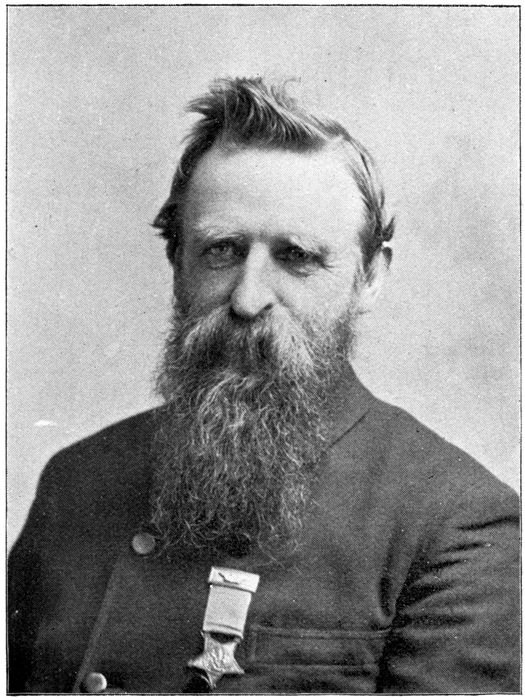
H. U. JOHNSON.
BY
H. U. JOHNSON
AUTHOR OF “SEVENTEEN SEVENTY-SIX AND OTHER POEMS” AND “OBED IN THE GREAT CO-PARTNERSHIP.”
VOL. I
FIRST THOUSAND
ORWELL, OHIO
H. U. JOHNSON
BUFFALO
CHARLES WELLS MOULTON
1894
Copyright, 1894,
By H. U. JOHNSON.
(ALL RIGHTS RESERVED.)
Printed by Charles Wells Moulton, Buffalo, N. Y.
DEDICATION.
To the millions of happy grand-children of a generation
fast leaving the stage of action, and who
must get their knowledge of the Rebellion and its causes
from the lips of those who saw and participated or from
the pages of history, as we, the grand-parents, got ours
of the Revolution from those long since passed away,
and from the written records of that thrilling period,
this little volume of unique but wonderful history is
sincerely and most affectionately dedicated by one of the
Grandfathers.
PREFACE.
v
The years intervening since the abolition of
American slavery leave a majority of our people
ignorant of its workings, and of matters
connected with it, except as they are gleaned from
the pages of history, or from the lips of those now
grown old.
It is not the purpose of this little volume to discuss
the history of the “peculiar institution” in detail,
but simply to give so much of it as will make appreciable
the cause for another one equally “peculiar,”
known for the last twenty years of its existence as the
Underground Railroad,—a name for a mode of
operation, and not of a corporation or material object.
During the years of its operation, secrecy was a
cardinal, an imperative principle of its management,
as the following pages will make apparent. On the
breaking out of the War of the Rebellion, thus putting
an end to its operations, every other subject was swallowed
up in the excitement of the great struggle, and
subsequently in that of Reconstruction. Thus the
Road dropped measurably out of sight, leaving but
meager reports and archives to tell the story of its
working.
The promptings of a desire to leave to posterity
some realistic record of this, one of the most wonderful
and thrilling features of our national history,
vino parallel to which is afforded in the annals of time,
must be the excuse for these pages. During the
eighties, the writer, who had lived amid its excitements
for years, and was more or less familiar with
the writings of Coffin, Pettit, the Clarkes and others,
undertook a systematic research into the matter, the
result of which was the accumulation of a large fund
of incident and information pertaining to the Road,
much of which was published in the Home Magazine
between the years 1883 and 1889, inclusive. Those
articles, in part, carefully revised, are now placed before
the reader in this more permanent form, with
the hope that they may receive the generous approval
of an appreciative public.
The quiet of a midsummer night had settled down
over the city of Washington, when, in August,
1839, a dusky form came, with stealthy tread, from
among some buildings not far away, and cautiously
approached the eastern entrance to the Capitol. Laying
his hand upon the cold steps in the shadow of
the great building, Jim Jones, a colored boy of
about seventeen, attentively listened as if in expectation
of some preconcerted signal.
He had waited but a moment thus, when the hand
of a patrol was laid heavily upon his shoulder and
the rough query, “What does this mean, you black
rascal?” fell upon his ear.
“Dunno, Massa,” was the reply of the startled boy.
“Don’t know, you black imp?”
“No, Massa, dunno what fo’ I was hea.”
“Well, you know, you young nigger, you have no
business here at this hour of the night.”
“Yes, Massa, I knowed de night am for white
folks, and I jus’ cum for to see—”
“Some d—d abolitionist who is trying to get you
away.”
“No, no, Massa.”
“Well, come along and we shall see,” saying which
he rudely hurried the boy away to a place of safe
keeping.
10In the early morning Jim was recognized by his
master, who vainly tried to extort from him by questioning
the cause of his nocturnal ramble. Failing
in this, the boy was taken to a blacksmith shop and
his thumbs placed end to end in the jaws of a vice.
“Now,” said the master, “tell me why you were
abroad last night.”
“I dunno,” replied Jim.
A half turn of the screw, and a groan of pain escaped
the boy; another turn and he writhed in
agony.
“Now you black son of a b——ch, why were you
at the Capitol last night?”
“O Lor’, Massa, a white man tol’ me I should
come.”
“What did he want of you?”
“Fo’ to go norf’.”
“And so you were going?”
“Y-e-s—Massa—I—was—fo’—to—go.”
“How?”
“On a railroad undah de groun’.”
“Under the ground?”
“Yes, Massa, so the gem’an said. He was jus’
comin’ to open de way, when Massa da’ cotched
me.”
“Who was he?”
“Dunno, Massa.”
Another turn of the screw, and in the agony of
despair the boy yelled, “Dunno, dunno, Massa,
dunno,” and swooned away.
11After resuscitation the torture was again applied,
but nothing farther was elicited, as the boy continued
to aver he had never heard the name of the
man who was to lead him; and, indeed, he had met
him only in the dark.
Though for years slaves had from time to time
been stealing away from the kind attentions of their
masters, and, indeed, very frequently of late, yet
never before had the latter dreamed that their “chattel”
went by subterranean transit, and the theme became
one of such absorbing interest that, when two
months later five prominent slaves escaped from the
city in a single night, a Washington morning paper
heralded the matter before the world for the first
time as follows:—
“UNDERGROUND RAILROAD!
A Mystery Not Yet Solved.”
“The abolition incendiaries are undermining, not only
our domestic institutions, but the very foundations of our
Capitol. Our citizens will recollect that the boy Jim, who
was arrested last August, while lurking about the Capitol,
would disclose nothing until he was subject to torture by
screwing his fingers in a blacksmith’s vice, when he acknowledged
that he was to have been sent north by railroad; was
to have started near the place where he stood when discovered
by the patrol. He refused to tell who was to aid
him—said he did not know—and most likely he did not.
Nothing more could be got from him until they gave the
screw another turn, when he said: ‘The railroad goes
under ground all the way to Boston.’ Our citizens are losing
all their best servants. Some secret Yankee arrangement
has been contrived by which they ‘stampede’ from three to
12eight at a time, and no trace of them can be found until they
reach the interior of New York or the New England States.
They can not have gone by railroad, as every station is closely
watched by a secret police, yet there is no other conveyance
by which a man can reach Albany in two days. That they
have done so, is now clearly demonstrated. Colonel Hardy,
a tobacco planter residing in the District, about five miles
from the city, lost five more slaves last Sunday evening.
They were pursued by an expert slave catcher, but no trace
of them was discovered. The search was abandoned this
morning, the Colonel having received a paper called the
Liberty Press, printed in Albany, with the following article
so marked as to claim his attention:
“‘Arrived, this morning, by our fast train, three men and
two women. They were claimed as slaves by Colonel
Hardy, of the District of Columbia, but became dissatisfied
with the Colonel’s ways of bucking Harry, making love
to Nancy and other similar displays of masterly affection, and
left the old fellow’s premises last Sunday evening, arriving
at our station by the quickest passage on record.’
“The article recites many incidents that have transpired
in the Colonel’s family, that correspond so exactly with facts
that the Colonel says: ‘Nobody but Kate could have told
that story!’ Said article closes by saying: ‘Now, Colonel
H., please give yourself no trouble about these friends of
yours, for they will be safe under the protection of the British
Lion before this meets your eyes.’”
The term which had been given to poor Jim, in
confidence, as the means by which he was to make
his escape from bondage, and extorted from him by
torture, having thus been given to the world from
the city of Washington, became henceforth the universal
appelation for a corporation which, for more
than twenty years thereafter, extended its great trunk
13lines across all the northern states from Mason and
Dixon’s line and the Ohio River to the Queen’s
Dominion, and its ramifications far into the southern
states. It was most efficiently officered, and had its
side tracks, connections and switches; its stations
and eating houses all thoroughly well recognized by
the initiated; its station agents and conductors, men
undaunted in danger and unswerving in their adherence
to principle; its system of cypher dispatches,
tokens and nomenclature which no attaché
ever revealed except to those having a right to receive
them, and its detective force characterized by a
shrewdness in expedients and a versatility of strategy
which attached to any mere money making enterprise
would have put “millions in it.” It received
the support of men and women from every class,
sect, and party, though from some more than from
others; its character was engraven, as by a pen of
fire, in the hearts and consciences of men, burning
deeper and deeper, until finally abrogated in that
grand emancipation proclamation of Abraham Lincoln,
when it was found that its stock, always unwatered
but by tears, had yielded an incomputable
percentage in the freedom secured to over thirty-six
thousand fugitives from human bondage, and embodied
in houses, lands, schools, churches and social
and domestic happiness.
Now that the track is all pulled up; that the rolling
stock has disappeared; that most of the operators
and passengers have gone down into silence or are
14dwelling in forgetfulness of accumulating years, and
that only a few of the old stations remain as they
were, a new generation pertinently inquires, “What
called such a road into existence and how were its
gigantic operations so successfully and yet so secretly
carried on?”
To the first of these questions it may be replied
that the history of American slavery is older than
the story of Plymouth Rock. In the year 1619 a
cargo of Africans, kidnapped on the coast of the
“Dark Continent,” was sold from the deck of a
Dutch man-of-war at Jamestown, Va., to be used in
the cultivation of tobacco along the river.
At that time very little was thought about the
enormity of human slavery. The labor proved remunerative,
and the institution spread over the original
colonies, with little or no question, so that at the
breaking out of the Revolution there were 500,000
bondmen, a standing menace to the cause of freedom,
and yet technically said to be “armed in the holy
cause of liberty.”
On the adoption of the constitution in 1787, public
sentiment had become so strong against the African
slave trade that provision was made for its abolition
in 1808. Persistent effort was also made, particularly
by the Quakers, for the ultimate abolition
of slavery itself, but without avail, as it was claimed
by its apologists that it would ultimately die of its
own accord—a prophecy in some sense fulfilled,
though in a manner all undreamed by those who
made it.
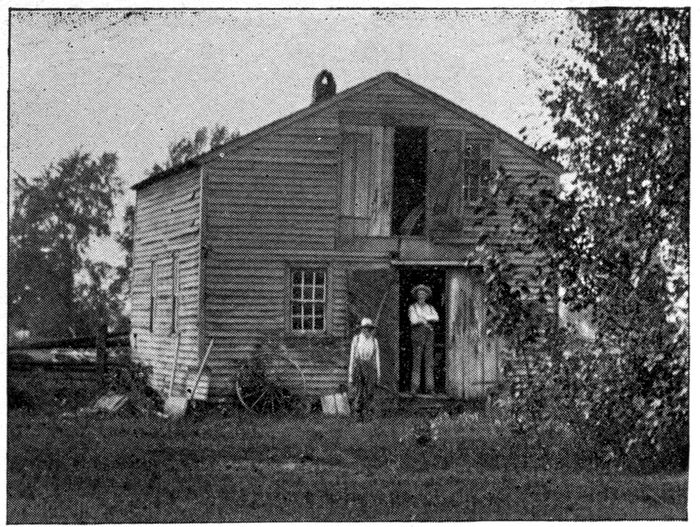
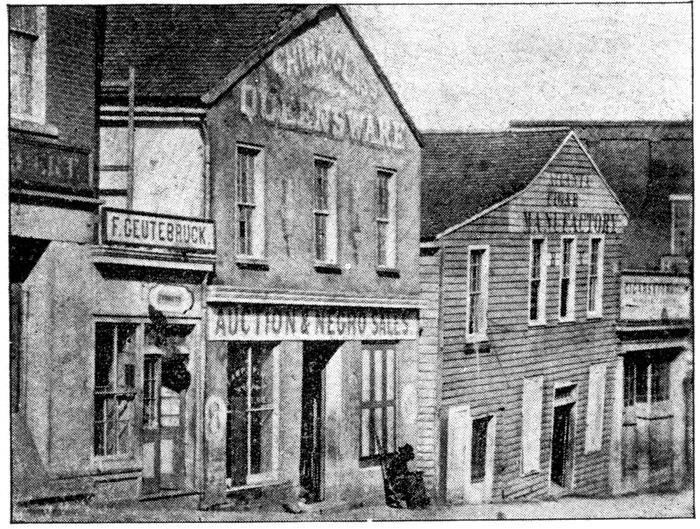
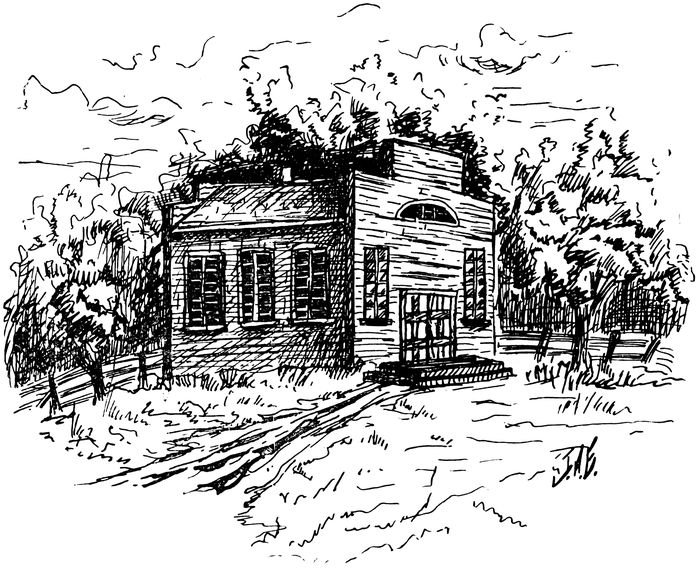
THE TRACY WAGON SHOP.
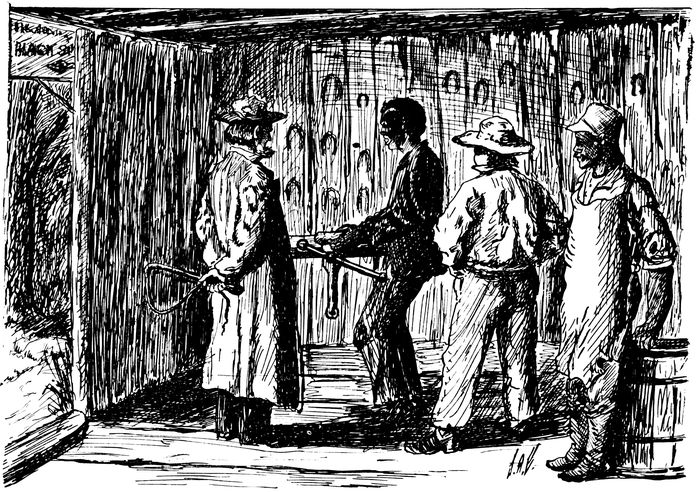
SLAVE PEN IN ATLANTA, GA.
(PHOTOGRAPHED WHILST GEN. SHERMAN’S ARMY HELD THE CITY.)
15Though Anti-slavery Societies had long been in
vogue, of one of which Benjamin Franklin had been
president, it was found by the census of 1800 that
the country contained 893,000 slaves. From this
time forward one after another of the Northern
States abolished it, until it finally disappeared from
New York last of all, July 4th, 1827. In the meantime
it was strengthened in the South. The invention
of the cotton gin and the extensive manufacture of
sugar in the Gulf States, made the rearing of slaves
in those farther north very lucrative, and slave marts
were set up in many of their cities and towns to
which men, women and children were brought and
sold upon the auction block and at private sale.
The slaves thus purchased in Maryland, Virginia,
Kentucky and elsewhere for the more southern markets
were either driven across the country like so many
cattle, or, if more convenient, taken down the Ohio
and Mississippi on steam-boats or in flats, all those
deemed likely to give trouble being handcuffed together
across a coffle chain, thus constituting a
“coffle.”
On their arrival at the place of destination, they
were more or less jaded and warm, and hence unmarketable
until properly fitted up. To facilitate
this, buildings or “pens” were provided where they
were well fed and given liberal rations of whiskey.
Under the management of some genial dealer, they
were induced to tell stories, sing songs and make
merry. In this way they were soon recuperated and
16ready for the ordeals of another sale in which they
were subjected to much the same scrutiny of body
and limb that is bestowed upon a horse when the
person would ascertain its physical condition.
To escape this degradation and the hardships of
the southern plantations, the more intelligent and
hardy of the slave population early began to flee to
the free states as an asylum from cruel bondage. As
if in anticipation of this, the constitution had provided
for their return, and under its provisions many
were restored to their masters, through the cupidity
of sordid northern men, for the rewards offered.
Finding so many of their chattels escaping and the
sentiment against their return growing stronger and
stronger, the southern people, with the aid of abettors
at the north, succeeded in 1850, in securing the passage
of the Fugitive Slave Law, which imposed heavy
fines and even imprisonment for in any way aiding
a fugitive from slavery to escape. By its provisions
every man at the North was virtually made a slave catcher.
Canada now became the goal of the fugitive, and
to its safe retreat thousands escaped, and yet so successful
was the business of slave culture that in 1860
the whole number of persons held as mere chattels,
without a vested right in land, or home, or wife, or
husband, or child, or life, even, that might not be
served by the will of the master, amounted to 3,953,000
souls. The bitterness of sectional feeling engendered
by such a state of affairs, and the intense
17activity of nerve and intellect called forth thereby,
can never be duly appreciated except by those who
were active participants in the affairs of ten years
ante bellum.
The second question, and, also, many points
covered by the first, will be best answered by following
the thread of these “Romances and Realities of
the Underground Railroad,” gathered as they are
from personal observation, extensive reading, visitations
along many of the old lines, and numerous
interviews and extensive correspondence with those
heroic men and women who dared their fortunes and
their personal liberty in the cause of humanity and
right, still lingering among us, as, also, with many a
passenger over this truly wonderful thoroughfare.
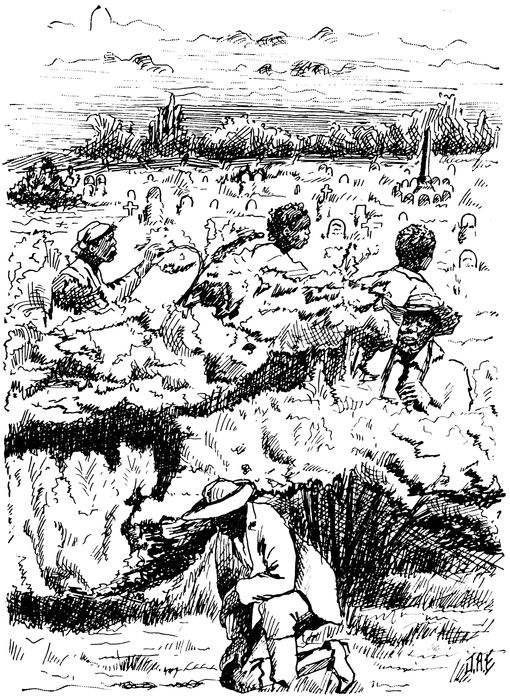
REFUGEES IN WASHINGTON CHURCHYARD.
CHAPTER I. JO NORTON. — I. — II. — III. — IV. — LAVINIA. — A RUSE. — VI. — VII. — VIII. — THE ORIGINAL “JERRY.” — A COOL WOMAN.
19
So many and varied have been the changes of
half a century, and so rapid the growth of the
city in the past twenty-five years, that few of the
present inhabitants of Washington, and less of its
old-time frequenters, now ever think of the cemetery
that skirted the stage road leading north from the
city. True, in those by-gone days it was a popular
burial place, even for the first families of the capital,
but like many another “silent city” it long since fell
into disuse, and consequently became for years the
most desirable place near the city for an underground
railroad station, and to such use it was assiduously
appropriated.
In this solitary place, on a quiet Sabbath evening
of October, 1839, there was heard just as the last faint
twilight trembled on the western horizon a low, distinct
whistle. Immediately there arose from among
the growth of bushes and from behind already reclining
headstones five dusky forms, actuated evidently
by the same impulse. The whistle was
repeated, and the forms cautiously approached the
point whence it proceeded, and there gathered in
20presence of a stranger to them all, but with no previous
knowledge of each other’s intent, though all of
them were the property of the same man, Colonel
Hardy, a tobacco planter of the District of Columbia,
as previously stated in the “Introduction” to these
“Romances and Realities.”
The first exclamations of surprise over, their unknown
companion proceeded to give them the
instructions for the night, after allaying their superstitious
fears, that they were to sink into the earth
for a time, and be under the conduct of invisible
personages. Indeed, so far from that being the case
they soon found very much depended upon their
own physical exertion. No sinking down into the
ground among the dead, no sojourn among spooks
and ghosts, impressions that had almost gotten the
better of their thirst for freedom, was to be theirs.
On the contrary they were to take at once to the
pike and follow it until they came to the said road,
which was then to be their pathway, only turning
out to pass around villages and stations until they
came to a man standing in the track who should
signal them by the simple name “Ben.” To him
they were to yield themselves implicitly.
Seeing the little company once fairly started, the
stranger returned to the city, and as he passed the
post-office deposited therein a letter addressed,
“JOHN JONES, Esq.,
Albany,
N. Y.”
21Leaving this missive and the fugitives to pursue
their respective journeys, we pause to inquire into
the personalities of the latter. They were named,
respectively, Nancy, Kate, Robert, Harry and Jo, or
more complete, Jo Norton.
As has been said, they were the property of one
man, and when not needed on the plantation, were
hired out in the city. Harry was recognized among
his fellows as a man of spirit and ability; but the
latter quality never saved him from the frequent
“buckings” engendered by the too free play of the
former. Nancy, an octaroon, was well formed, about
twenty years of age, and according to Kate, who had
a spontaneous gift of gossip, a special favorite of the
“Kunnel.”
Jo Norton was a sprightly, intelligent fellow, and
had a wife named Mary, who, with their little boy,
was the property of a Mr. Judson, residing in the
city. In his boyhood Jo had been continually employed
upon the plantation, but after he was sixteen
was engaged at a hotel during the winter for several
years. For a long time in this place it was his
special duty to wait upon Daniel Webster at table
and otherwise. It was whilst thus employed that
he became acquainted with and won Mary, who had
the care of the great statesman’s rooms. During the
summer, the Colonel, when reasonably good natured,
allowed Jo to visit his wife and child once in two
weeks, on Sunday. When too choleric to grant his
“chattel” this indulgence, a pass was readily secured
22from the old man’s daughter, who was his private
secretary, and with whom Jo was a great favorite.
In these visits the possibility of an escape, more
especially for the sake of their boy, was frequently
discussed, though no plan was ever perfected.
One evening whilst returning from one of these
visitations, Jo fell in company with a gentleman
whose manner so impressed him that he asked if he
were not from “de Norf.”
“Yes, from Massachusetts,” said the stranger.
“Wy, Massa, dat am de home ob de great Dan’l
Webster.”
“Yes; I know him very well.”
“Yes, Massa, an’ doan dis chile knows dat great
man to?”
“How is that?”
“Wy, Massa, doan I stan’ ’hind his chaah all dese
winters wen him comes to Congress?”
“Ah, I see. But wouldn’t you like to go north
and be free?”
“Lor’ Massa, dat was wat Mary and I talks ’bout
dis blessed day.”
“Who is Mary?”
“Mary am my wife, sah, and James am my little
boy. Da’longs to anuder man.”
“A wife and child!” said the stranger half musingly.
“Well my good fellow, we will see what can
be done, but we must talk no more now. Meet me
on the corner of “F” and the Avenue two weeks
from to-day at noon.”
23“Yes sah,” and the two parted.
Two weeks passed, and, as agreed, the parties met,
the one readily assuming the air of a southern gentleman
and the other instinctively falling into the
role of his servant. Thus they passed on until a
quiet place was reached, when it was agreed that Jo
should take a designated place in the old cemetery
three weeks from that night, but that Mary and the
child should be left in the city till a fitting way for
their escape presented itself. In the mean time the
other parties had been separately interviewed, and
assigned their several hiding places, and given the
signal which would call them into the presence of a
stranger. Thus it was that they came together unawares.
Once upon the public highway the little party
struck out briskly for the railroad upon which they
turned their faces towards Baltimore, and following
their instructions were making fine progress, when,
about midnight, as they were passing around a village
the heavens became suddenly overcast with
clouds, and for an hour or more they wandered in
uncertainty. A halt being called, a lively discussion
based upon five different opinions arose, and how it
might have terminated no one can tell had not the
heavens just then cleared up, enabling Harry, who
was both conductor to and astronomer for the train,
to get their bearings from “de ol’ norf.” So much
24time had thus been lost that daybreak was just beginning
to tinge the east when the mystical word
“Ben” fell from the lips of a man standing upon
the track, whom they at once followed for some distance
into a corn-field, where he removed several
bundles from a stack of corn-fodder, and the two
women entered a “dodger” apartment, whilst the
men were similarly secreted a little farther on.
A thirty mile walk had given them a good appetite
for the bountiful breakfast provided, after partaking
of which they lay down and slept soundly,
whilst “Old Ben,” a free negro who had been furnished
the means to rent and till this field and arrange
it as a “way station,” kept constant vigil and
obliterated their tracks by husking corn and carefully
drawing the stocks over them.
Morning came in the city, and soon the absence of
the servants from their employers was reported at
the plantation, where the non-appearance of Jo had
already caused the Colonel to give his daughter a
special cursing for “letting that d—d nigger, Jo, have
a pass.” Hounds and hunters were at once called
into requisition, but all in vain. All about the
country was scoured and searched, but Uncle Ben’s
field was so public and he so honest, that no one
thought of troubling it, or him.
Night came, and under cover of the first hour of
darkness the two women were taken in charge by a
25man who led them rapidly along the railroad track
till they came to a road where a carriage received
them and they were driven rapidly into the city of
Baltimore and there carefully secreted. Scarcely
had they departed when a pack of hounds came into
the field, and, after scenting around for some time,
struck their track and were off in pursuit with such
a wild scream as to waken the men from their quiet
slumber.
Meanwhile the letter addressed to Mr. Jones was
speeding on its way, and in due time on an editorial
derived therefrom, the compositors in the office of
the Liberty Press at Albany were busy, and on Friday
Col. Hardy received a marked copy of that paper
which informed him that his “chattels” arrived safe
in Albany on Tuesday evening, and of course all
farther effort for their recovery was stopped, though
the atmosphere was for some time blue from the effects
of the forcible vocabulary which this piece of
news, manufactured specially for a southern market,
eliminated from the old Colonel’s tongue.
All imminent danger from direct pursuit being now
over, early on Saturday evening Ben led the boys
forth and placed them in charge of a sprightly colored
boy about thirteen years of age, whom they were to
keep constantly in sight as they passed through
Baltimore, and, as he bestowed on them a little
money, he said: “Now, boys, follah yer guide, and
26feah no danjah, and de good Lor’ bress you and
bring you safe to freedom.”
With nimble steps they passed over the road to the
city, and there stopped for a short time at a meeting
of colored Methodists, of which faith were Jo and
Harry, and joined lustily in the “Hallelujahs” and
songs of praise. The meeting over, they fell in with
the departing congregation, and as they passed
through the principal streets were vociferous in their
praise of “the pow’fu’ preachin’ ob dat ’sidin’ eldah,
and de snipshus singin’ ob de yaller gal wid de red
rib’n,” stopping occasionally to buy a few nuts or
apples at some grocer’s stand, ever keeping their
little woolly headed conductor in sight, and before
the hour forbidding the presence of colored people
on the streets, were beyond the city limits, and again
in company with Kate and Nancy, who had been
brought to a place of rendezvous by a gentleman
who proceeded to give the party specific instructions
for the night. This done, fleetly they sped forward
as directed until well towards day-dawn, when conductor
Harry espied two flickering lights placed side
by side in an upper window, and exclaimed: “Bress
de Lor’ dah am de sign of rest.”
“Yes, bress de Lor’, O my sou’,” ejaculated the
thoroughly wearied Kate, “an if dis be de unner
groun’ railroad whar ebery one furnish his cah hisself,
I’d radder ride wid ol’ Lijah in a charyot ob fiah.”
“Hush, honey, what foah you complain? dis am
gwine ober Jordan to de lan’ ob res’.”
27“Yes, an’ Jordan am a hard road to trabel,
shu——” but the sentence was abruptly broken by
the clear enunciation of “Thee will tarry here for the
Sabbath.”
The words proceeded from beneath a broad-brimmed hat which emerged from among some
shrubbery, and the party were quickly conducted
into a spacious Quaker kitchen where a bountiful repast
was in waiting for them, after partaking of
which they were consigned to safe quarters for the
day.
From this hospitable retreat, they sallied forth on
Monday evening for another night journey, only to
find in its ending a duplicate of the preceding one;
and in this way the whole distance from Baltimore
to Philadelphia was made on foot.
Once in the Quaker city, they were quietly put on
a fishing smack and conveyed to Bordentown. At
the latter place, under the management of a shrewd
Quaker, a personal friend of the railroad agent, the
boys were hid away among boxes and bales of goods
in a freight car and were soon on their way to
Gotham. Meanwhile the girls were dressed for the
occasion, and at evening, closely veiled, just as the
train was starting, were escorted into a coach by a
gentleman assuming the full Southern air, and who
had no hesitancy in pushing aside a watcher for runaways
stationed at the door. At New York they
again rejoined the “way freight,” and the whole
party were at once sent on to Albany, where they
28arrived after a journey of twenty days instead of two
as supposed in Washington.
Apropos of the lamentable exhibitions of mob-violence,
court-house burning, Sabbath desecration
and election frauds presented by Cincinnati in the
past few years, it may not be amiss to give a little
exhibition of the spirit there manifested by the men
of a past generation and see whence some of her present
unenviable reputation comes. The city was well
known to be intensely pro-slavery and to her came
many a haughty Southron for purposes of business
or pleasure, bringing with him more or less of his
chattels as attendants. Among the comers of the
summer of 1843, was a man named Scanlan, visiting
his brother-in-law, one Hawkins. He brought with
his family a pretty slave girl named Lavinia, some
ten years old.
Before the party left New Orleans, the mother of
the girl, a slave in that city, had given her the following
admonitory instruction:—“Now ’Vinya, yer
Massa’s gwine for ter take yer Norf, an’ wen yer gets
to Sinsnate, chile, yer free, an’ he’ll sen’ some good
anj’l for to hide yer un’er him wing; an’ if you doan
go wid him, but kum back to dis Souf wid yer ol’
Massa, dis very han’ll take yer black skin right off
yer back shuah. Mebbe wen yer safe in dat free lan’,
yer ol’ muder’ll fin’ yer thar if the good Lor’ be
willin’.” Then she placed around the neck of the
29girl a small gold chain which was to be continually
worn, that if they ever chanced to meet in Canada,
the mother might know her child.
Once in Cincinnati, Lavinia began looking carefully
for some “good anj’l,” but instead, soon found
two in the person of a colored man and his wife living
near Mr. Hawkins’. To those she carefully committed
her mother’s counsel and threat. These
parties entered heartily into her proposition to escape,
and one night dressed her in a suit of boy’s
clothes and took her to the head of Spring street,
near the foot of Sycamore Hill, and gave her in
charge of Samuel Reynolds, a well-known Quaker,
where she was successfully concealed for a number
of days whilst Scanlan was raging about and as far
as possible instituting a vigorous search.
Not far from Mr. Reynolds was the home of Edward
Harwood in whose family resided John H.
Coleman, a dealer in marble. The Harwoods and
Colemans were ardent Abolitionists and ready to
stand by any panting fugitive to the last. Mrs.
Harwood’s house stood on a side hill with a steep
grade in front, and the narrow yard was reached by
a flight of some twenty steps, whilst the side and
rear were easily accessible.
After a time Mrs. Harwood, who had become
much interested in Lavinia, took her home, where
she was carefully concealed during the day, but allowed
a little exercise in the dusk of the evening in
the front yard, which was so high above the street as
to be unobservable.
30One evening when the girl was thus engaged the
great house dog, Swamp, which always accompanied
her kept up such a growling and snarling, as induced
the men to think there might be foul play brewing
and they went out several times but could detect
nothing. Finally one of them said, “That child had
better come in; some one may be watching for her,”
upon which Mrs. Coleman put her head out of the
window and calling her by name, bade her come in,
after which all was quiet for the night.
Dinner over the next day, the gentlemen had
taken their departure down town, the ladies were
busy about their work; an invalid gentleman was
reclining in an easy chair and the girl had fallen
asleep up-stairs, when a man suddenly appeared at
the top of the flight of steps and very uncermoniously
entered the front door which was open, and
looking hurriedly around roughly demanded,
“Where’s my child? I want my child, and if you
don’t give her up there’ll be trouble.”
It needed no further evidence to convince the
ladies it was Scanlan, an impression which had
seized them both even before he had spoken, but
then they were not the kind to be scared by his
bluster, and Mrs. Coleman replied with spirit “You
have no child here and if you were a gentleman you
would not be here yourself.”
At this Scanlan turned upon her and whilst his
fists were clinched and his face livid with rage, exclaimed,
“I tell you she is here, my slave girl,
31Lavinia; I saw her last night myself; and if it had
not been for you, madam, and that devilish dog there,
I should have gotten her then. I had her nearly
within my grasp when you bade her come in. I say
where is my child? Give her up.”
“You have no child here,” coolly replied Mrs.
Coleman again.
“I say I have, and if she hears me call she will
answer me.” Saying which he went to the stairway
and called “Lavinia, Lavinia.”
The child heard the voice, recognized it, and at
once quietly hid herself within the bed. Though
the call was repeated several times, no answer came,
and Mrs. Coleman inquired, “Are you satisfied
now?”
“I know my child is here, and you cursed Abolitionist
have hidden her away,” said the now almost
frantic Scanlan. “You need not think you are going
to fool me. I’m going to have my child, my
slave, my property. I shall go down town and get
a warrant and an officer to search your house, and
you’ll get no chance to run the girl away either, for
I shall leave a guard over you whilst I am gone,”
then stepping to the door he said, “Hawkins, come
in here,” and the brother-in-law, before unseen by
the inmates of the house, entered. “Now, Mr.
Hawkins, I am going for a warrant, and I want you
to see that my child does not get away till the officer
comes,” saying which Scanlan took his departure
and Hawkins a seat, though evidently very ill at ease.
32When part way down town the Southron recognized
Mr. Harwood coming up the hill in his buggy,
and thinking to intimidate him said, “I am after
my slave girl who is in your house. Your women
refuse to give her up. You will find the place well
guarded, and I will soon have a warrant to search
the place.”
“I’ll make it hotter than tophet for any one guarding
my house, and the man who comes about my
premises with a search warrant until I am accused
of murder or theft, does so at his peril,” was the
warm reply, as Mr. Harwood started rapidly towards
his home. Arriving there he thus addressed Mr.
Hawkins: “I am told, sir, you are here to guard
my house and family. We have need of no such
attention, and if you do not immediately depart
from our premises I shall pitch you headlong into
the street. Be gone you miserable tool of a most
miserable whelp.” Just then the cowed and crestfallen
Hawkins made a practical application of his
knowledge of Shakespeare, and “stood not upon his
going.”
Remembering the great pro-slavery mob of 1836,
when the office of James G. Birney’s paper, The
Philanthropist, was destroyed, and that of 1841, when
but for the prompt action of Governor Corwin in
aiding the arming of the students, an attack would
have been made upon Lane Seminary as a “d—d
Abolition hole,” Scanlan hastened to the “Alhambra,”
then a popular saloon, gathered about him a
33band of roughs and after a treat all round proceeded
to harangue them regarding his loss and also his unavailing
efforts to regain his chattel. Under the influence
of his speech and the more potent one of an
open bar, the crowd readily promised him their support,
and arranged to be at the hill in the evening
time to see the fun.
Meantime Mr. Harwood was apprising his friends
of the state of affairs, and these were beginning to
gather at his house. One of them, an employee of
Mr. Coleman, as he came up the hill, found a
number of flags already set to guide the mob to the
Harwood residence. These were torn down. Before
the arrival of Mr. Coleman a crowd of excited people
had assembled in the street below the house. Seeing
among them an officer notorious for his cupidity and
in entire sympathy with the slave catchers, Mr. Coleman
approached him and shaking hands said, “Why
how do you do, Mr. O’Neil? I am told you have a
search warrant for my house.”
“For your house?”
“Yes; here is where I live and I wish to know
on what grounds you intend to search my house, as
I am not aware of having laid myself liable to such
a process.”
“There must be some mistake,” said the officer.
“Indeed, Mr. Coleman, I must have been misinformed
as to the merits of the case.”
“Let me see the paper,” persisted Mr. Coleman.
“No,” said O’Neil, “there is a blunder somewhere,”
34and he pushed his way, in a discomfited manner,
through the crowd and disappeared.
As the crowd increased in the streets, the friends
of Mr. Harwood arrived, until all the Abolitionists
in the city, some forty in number, were present. Mr.
Harwood stood on the front steps with Swamp, and
when anyone evinced a purpose to ascend the steps
the fine display of ivory in the dog’s mouth cooled
his ardor. Mr. Coleman and Alf. Burnet, afterwards
well known in anti-slavery circles, went to a Dutch
armory and secured a quantity of arms and ammunition;
the women took up the carpet in the parlor,
which soon presented the appearance of a military
bivouac, whilst papers and valuables were hurried
off to other houses, and a strong guard was placed
before the door. An application was made to the
sheriff for protection, but he only replied, “If you
make yourself obnoxious to your neighbors, you
must suffer the consequences.”
Whilst Scanlan was making his inflammatory
speeches down town, and subsidizing the saloons, Lavinia
was redressing in her boy’s suit and was quietly
taken out on a back street to a Mr. Emery’s, the
crowd meanwhile crying, “Bring out the lousy
huzzy; where is the black b——ch?” and other
equally classic expressions. One blear-eyed ruffian
exclaimed, “If my property was in thar, I’d have it
or I’d have the d—d Abolitionist’s heart’s blood, I
would.” Another one, equally valorous called out,
“Go in boys; why don’t you go in?” and a score of
35voices responded, “Go in yourself. The nigger ain’t
ourn. Where’s the boss? Guess he’s afraid of
shootin’ irons,” a feeling that evidently pervaded the
whole assemblage.
Being without a leader, and having no personal
interest at stake, about dark the mob moved down
the street, stoning and materially damaging the
house of Alf. Burnett’s father as they passed by.
The old gentleman gathered up a large quantity of
the missiles and kept them on exhibition for several
years as samples of pro-slavery arguments.
Scanlan vented his spleen and breathed out his
threatenings through the city papers, but being unable
to get any redress, and finding he was to be
prosecuted for trespass, he hastily decamped for
New Orleans.
After a week or two, Lavinia, dressed in her masculine
suit went with some boys who were driving
their cows to the hills to pasture, and was by them
placed in the care of a conductor, by whom she was
safely forwarded to Oberlin. Here she was found to
have a fine mind, was befittingly educated, and ultimately
sent as a missionary to Africa. After the
lapse of several years she returned to this country,
and whilst visiting the friends in Cincinnati, who
had so kindly befriended her in the days of her
childhood, suddenly sickened and died.
36
Serious and earnest as was the work of our railroad,
it was made the pretext for many a practical
joke and arrant fraud. In the north part of Trumbull
county, Ohio, lived an ancient agent named
Bartlett, having in his employ a newly married man
named DeWitt, a rollocking kind of a fellow, and
well calculated to personate a son of Ham, or a
daughter as well. DeWitt conspired with his wife
and some of the female members of the old gentleman’s
family to have a little fun at Mr. Bartlett’s expense.
Some thrown off apparel of Mrs. Bartlett
was procured from the garret, and, properly blackened,
he was attired in a grotesque manner.
Just at evening a decrepid wench applied for admission
at Mr. Bartlett’s door. The women appeared
very much frightened and were about shutting the
door in her face, when the old gentleman, hearing
the negro dialect came to the rescue. Soon the
wanderer was comfortably seated, and to Mr. Bartlett’s
inquiry as to where she was from replied, “Oh Lor’,
Massa, I’se from ol’ Virginny an’ I’se boun’ for
Canady, and Massa Sutlifft, he tells me I mus’ cum
heah, but de white missus scare at dis ol’ black face.”
“O well, never mind that, they are all right now.”
“Bress de Lor’ for dat.”
Speaking to his wife, Mr. Bartlett directed some
supper be prepared before he should send her on.
“O no, Massa, I’se been done and eat supper dis
bressed day.”
37“Well, then, we’ll arrange to send you on soon,
but come and see my grandson,” a lad lying sick in
the other part of the room, saying which he arose
and took the hand of the dame and led her to the bedside,
and laying his hand across her stooped shoulders,
began to speak tenderly of the little sufferer.
The risibilities of the counterfeit Dinah were now
at their utmost tension and she contrived to place a
foot heavily upon the caudal appendage of the great
house dog lying near. There was a sudden bound of
the brute, accompanied by a most unearthly howl,
and away darted the decrepid fugitive, shrieking, “O
Lor’ de houn’, de houn’.”
It was in vain the philanthropic old agent called
after her, that there was no danger; on she sped until
an opportunity offered to restore herself to Japhetic
hue and male attire.
Mr. Bartlett long upbraided the female portion of
his household for want of humanity on that occasion,
but was allowed to die in blissful ignorance of
the ruse played upon him, and DeWitt confessed
that the ultimate fun derived therefrom scarcely
compensated for the annoyance of the old gentleman
and the trouble of removing the cork.
A year has passed anxiously at Albany with Jo.
Rumors reached him that in an attempt to escape,
Mary had been captured and sold into the south
forever beyond his reach. Gathering up his earnings
38and bidding his companions good-by, he started
rather aimlessly westward, and where he would
have brought up no one can tell, had he not one day
met a stranger, a pleasant, benevolent looking gentleman,
near the village of Versailles, N. Y. It was
just at the close of that most hilarious campaign in
which the cry of “Tippecanoe and Tyler too,” with
“two dollars a day and roast beef,” mollified with
liberal potations of “hard cider,” rendered “Little
Matty Van a used up man,” though the result was
not yet ascertained, for no telegraph had learned to
herald its lightning message in advance of time. If
no other good came from the campaign, it had given
every class of men the free use of the tongue in
hurrahing for his favorite candidate, and foot-sore
and hungry as he was, there was something about
the gentleman that said to Jo, “Now is your opportunity,”
and touching his hat in genuine politeness
he called out, “Hooraw for Ol’ Tip.”
Good naturedly the gentleman responded, “Well,
my good fellow, it is a little late for you to be hurrahing
for any candidate now that election is over,
and, though you didn’t quite strike my man, I shall
find no fault. I know what you want more than
‘hard cider.’ It is a night’s food and lodging.”
“Thank you Massa, I’se tired and hungry, an’ de
fac’ am I doan know what to do with myself.”
“Well, no matter about that just now. Come
along;” and Eber M. Pettit, long known as an
earnest Abolitionist in Cattaraugus and Chautauqua
39counties, led the disheartened wanderer to his home,
where, after supper, he questioned him as to his
history, and when he had learned his unvarnished
tale, he suggested that the man should stay with him
that winter as a man-of-all-chores, and attend the
village school.
As a result of that evening’s conference there appeared
among the children of the district school in a
few days a colored man of about twenty five years
of age, learning with the youngest of them his a b c.
This was an innovation, unique in the extreme.
Some of the villagers turned up their noses at the
“nigger,” but the social standing of Mr. Pettit, and
the story of Jo which was freely circulated among
the people, together with his genial disposition and
kindness of manner, soon silenced all cavil and the
school quietly progressed.
Learning that the editor of the Liberty Press was
in Washington, Mr. Pettit addressed him in the following
letter:
Versailles, N. Y., Dec. 1, 1840.
Dear General.—I have at my house a colored man named
Jo Norton. Something over a year ago he left a wife and
child in the Capital, the property of a Mr. Judson. She was
to have been brought off directly after he left, but the effort
failed and he understands she has been sold South. Will
you be so kind as to inquire into the matter and see what
can be done in the case if anything? Make your return to
Jo Norton, direct.
Yours Truly,
E. M. Pettit.
Gen. W. L. Chaplain,
Washington, D. C.
40This letter was duly posted, and on the morrow an
ebony face, the very picture of expectancy, put in an
appearance at the village post office with the query,
“Any letter for Jo Norton, Massa pos’ massa?”
Thus it was twice a day for a week, when his unsophisticated
importunity was rewarded by a missive
bearing the address,
Jo Norton, Esq.,
Versailles,
N. Y.
Care E. M. Pettit, Esq.
and bearing the post-mark of the Capital. It read
as follows:
Mr. Norton, Dear Sir:
The woman about whom Mr. Pettit wrote me is here.
After her husband’s escape she was detected in what was
thought to be an effort to leave and was thrown into prison,
where she lost an infant child. After three months she was
visited by her master, and on a solemn promise never to
make another effort to run away she was taken back to the
family where she and the boy appear to be treated with great
kindness. Though he has been offered $800 for her, Mr.
Judson said he never sold a slave, and never will, but if her
husband can raise $350 for them by March 4th, proximo,
they will be given free papers so I can bring them North
with me at that time.
Truly,
W. L. Chaplain.
At the reading of this letter, Jo, prompted by the
fervent piety of his nature, broke into hysterical fits
of laughter, interspersed with “Bress de Lor’, bress
de Lor’.” But when the first paroxysm of joy was
over he became very despondent, for he had no $350
41and no friend to whom to appeal for it; but here, as
before, Mr. Pettit came to the rescue.
“See here, Jo,” he said, “there are nearly three
months to the fourth of March, and yours is a wonderful
story. You shall go forth and tell it to the
people, and the money will come.”
“Wy, bress de Lor’, Massa Pettit, dis chile can
nebber do dat. De people would jus’ laf at de
nigger.”
“Never mind the laugh, Jo. If you love Mary
and the boy you can stand the laughing. Now be a
man. I will go with you and see you start;” and
before bed-time he had laid out the work for his
ward, in whom he had now become thoroughly interested,
and had listened several times to his rehearsal
of his story of escape and tale of plantation life, and
offered such suggestions as he thought advisable, and
that night Jo went to bed “to sleep; to dream.” To
dream of wife and boy in slavery, and himself making
speeches among the white people of the North
for their deliverance.
The next morning Mr. Pettit went out into the
country a few miles where he had a number of
Abolition friends and made full arrangements for
Jo’s speaking there early the next week. In the
meantime the word was thoroughly circulated whilst
Jo was most effectively schooled to his new field, and
on the appointed evening the school-house was filled
to overflowing. Jo told his story in such a manner
as to draw out rounds of approbative applause
42from the mouths of the audience, and six dollars
from their pockets when the hat was passed round.
Meetings were held immediately in the several school
districts in the vicinity with marked success, and
then Jo, highly inspired, left school and started out
on a systematic course of lectures which took him
to Westfield, Mayville and other villages of Chautauqua
county as well as Cattaraugus.
On the 25th day of January Mr. Pettit received
the following from Washington:
“Dear Pettit.—If Judson can have $300 by February first,
he will deliver up the woman and child of whom we have
had correspondence.
In haste,
W. L. Chaplain.”
He hastened to Ellicottville and found that Jo had
already realized $100. A meeting was immediately
called in an office in the village, at which were present
Judge Chamberlin, of Randolph, E. S. Coleman,
of Dunkirk, and several other gentlemen. The letter
was read, and at the suggestion of the Judge a note
for two hundred dollars was drawn and signed by
ten of them, with the understanding that they were
to share equally in the payment of any deficit after
Jo had done his best. The money was advanced
by Mr. Coleman, and one of the party drove fifty
miles to Buffalo, through a pelting storm, purchased
a draft, forwarded it to Mr. Coleman, and before the
“days of grace” had expired Mary and her child
were duly registered and delivered as free people.
43Meanwhile Jo’s story had gotten into the papers
of Western New York, and he had calls from various
places to lecture; indeed, he had become quite a
local lion, and so successful that early in March
when word came that Mary and the child had
reached Utica, he was the possesser of $195. This
he deposited in the hands of Mr. Pettit who returned
him $30 and told him to go and make provision for
his wife and child, and pay the balance of the note
when he could. Though he had walked that day
from Buffalo, a distance of nearly thirty miles, Jo
immediately returned, and early the next day, in
the home of a leading Abolitionist in Utica there
was a regular “Hal’lujer; Bress de Lor’, for de Lor’
will bress his people,” time when Jo and Mary met
after their seemingly hopeless separation.
Ten years and more had passed; the Ellicottville
note had been long settled; Jo had laid aside his
mission as a lecturer and gone into business in Syracuse,
N. Y., where he owned a pleasant home and
had a family of intelligent children attending the
public school; New York State, like the country at
large, had been convulsed over the slavery question,
and the city of his adoption had become a town of
intensely Abolition sentiment. As the outgrowth of
the slavery agitation there had come the enactment
of the “Fugitive Slave Law,” as it was popularly, or
rather unpopularly called, by means of which the
44South thought to render imperative the rendition of
their runaway slaves. But they had counted without
their host. Though successful in cracking their
whips over the heads of Northern law-makers in the
Capitol, the great mass of the people of the free
states, no matter what their political affiliations, felt
outraged at the idea of being converted into a set of
legally constituted slave-hunters. Few places more
excited the ire of the chivalry than Syracuse, and the
threat was defiantly made that if another anti-slavery
convention was held in the city it should be enlivened
by the seizure of a fugitive of whom a test
case could be made.
Not to be thus intimidated, a call for such a convention
was issued and at the appointed time commenced.
Whilst the delegates were organizing in the
old Market Hall, in a cooper shop in another part of
the city, all unconscious of danger, a colored man
named Jerry, who had some years before escaped
from slavery, was busy engaged at his labor, when
he was suddenly pounced upon by a marshal and
his deputies from Rochester, and, after a brave resistance,
overpowered, manacled and thrown into a
cart secured for that purpose, and hurried away to
the commissioner’s office, closely guarded. The news
of the arrest spread like wild-fire, and soon the streets
were thronged with excited people. A man rushed
into the convention and called out: “Mr. President
a fugitive has been arrested and they are trying to
hurry him away.” Without motion, the convention
45adjourned, and the delegates and attendants were
added to the throng already in the street. The uproar
was equal to that, when, for the “space of two
hours,” the people cried, “Great is Diana of the
Ephesians,” but more concentrated, and the cause of
coming together better understood.
Jerry was hurried into the commissioner’s office,
the lower door to which was heavily barred and the
upper one securely bolted, so that it was with difficulty
that his council and more immediate friends
obtained admission.
The court once opened, within there was contention,
parley, quibble and delay until twilight fell;
without, the building was immediately surrounded
by fugitives who had found an asylum in and about
the city, and free colored people, among whom Jo
Norton towered like Saul among his brethren, and
beyond these an immense multitude of citizens who
had stood waiting all the afternoon of that eventful
day, manifesting no disposition to retire.
When it was announced that the court had adjourned
for supper, it was soon evident that the
decisive hour had come. A heavy timber was lifted
to the shoulders of some sturdy negroes, and using
the temporary space accorded them, at the watchword
“Jo” they hurled it with such force against
the door that bars and hinges gave way, and Norton,
crowbar in hand, at the head of a storming column
entered the stairway hall. The marshal was a man
of nerve and disclaimed against any attempt on the
46inner door, but in vain. A few vigorous blows of
the crowbar forced it open; there was the sharp report
of a pistol succeeded by a quick blow of the
bar, and Jo unharmed, stood master of the situation,
whilst the right arm of the marshal hung useless at
his side. The posse scattered, the marshal saving
himself by jumping from the second story window
and skulking away in the dark; Jerry, who had
been very roughly treated, was unloosed, and by
daylight was well on his way to Canada, whilst the
convention resumed its deliberations the next day
amid the congratulations of many who before had
looked upon its purpose with indifference or absolute
opposition.
As for Jo, though defying slave-hunters and their
hirelings as such, having now arrayed himself by an
act of violence against the government, he took
the advice of judicious friends, and soon removed to
Canada, where for years he was an esteemed citizen,
and a friend and adviser of those who came to his
locality as fugitives.
As an index of Jo’s native quickness of perception,
the following excerpts, taken from Pettit’s “Sketches
of the Underground Railroad,” published some years
ago by W. McKinstry & Son, are added, the only
change being that the places where the events are
thought to have taken place are given.
Jo was a serious, devoted Christian, yet his wit
47and mirthfulness were often exhibited in keen, sarcastic
repartee. At Delanti the question was asked,
‘Did you work hard when you were a slave?’
‘No! I didn’t work hard when I could help it.’
‘Did you have enough to eat?’
‘Yes, such as it was.’
‘Did you have decent clothes?’
‘Yes, midlin’.’
‘Well, you were better off than most people are
here, and you were a fool to run away.’
‘Well, now, the place I lef’ is there yet, I s’pose.
Guess nobody’s never got into it, and if my frien’
here wants it, he can have it fo’ the askin’, though
p’raps he better get his member of Congress to recommend
him.’
At Westfield, a fellow asked, ‘Is the speaker in
favor of amalgamation?’
‘’Gamation! what’s dat?’
‘It means whites and blacks marrying together.’
‘O dat’s it! as fo’ such things they ’pends mostly
on peples’ tas’. Fo’ my part, I have a colored
woman fo’ a wife,—that’s my choice,—an’ if my
frien’ here wants a black wife, an’ if she is pleased
with him, I’m suah I shan’t get mad about it.’
Soon after he commenced collecting funds to redeem
his family from bondage, he was invited to go
to a school-house in Villenova. When near the
place he saw two boys chopping, and heard one of
them say: ‘There’s the nigger.’
Jo stopped and said: ‘I ain’t a nigger! I
48allus pays my debts; my massa was a nigger. See
here! when you chop, you be a chopper, ain’t dat
so?’
‘Yes,’ responded the boys.
‘Well, when a man nigs, I call him a nigger.
Now ol’ massa nigged me out of all I earned in my
life. Of course he is a nigger.’ Then Jo sang the
chorus to one of Geo. W. Clark’s Liberty songs:
‘They worked me all de day,
Widout one cent of pay;
So I took my flight
In de middle ob de night,
When de moon am gone away.’
‘Now, boys, come over to the school-house this
evening and I’ll sing you the res’ of it.’ That evening
Jo had a full house and a good collection.
Having given a brief account of the “Jerry Rescue”
at Syracuse, a circumstance fraught with momentous
consequences, and no inconsiderable factor
in precipitating the “Impending Crisis,” I now pass
to consider the real original “Jerry Rescue.”
In the early summer of 1834, there came to
Austinburg, Ohio, a colored man of middle age, of
whose escape to Ohio tradition, even, gives little account,
only that he was the property of a Baptist
deacon who followed him in close pursuit. Both
parties upon the ground, matters became marvellously
lively in the quiet country town.
49Jerry was shifted from place to place, but the
deacon would in some way get a clue to his whereabouts,
and another move would be made to thwart
the pursuer, some one being always ready to ask
him what he would take for the man; but it was
always with him, “I want the nigger, not money.”
Wearied at length with the continued baffling, and
believing he had found the retreat of his chattel, the
pious deacon went to Jefferson and secured the service
of Sheriff Loomis to make an arrest. The twain
came upon him just before daybreak, but not to
catch him napping. He was up and off just in time
to elude their grasp but not until they caught a
glimpse of him making across the fields in the direction
of Eliphalet Austin’s, who lived near where
Grand River Institute now stands.
Rapping at the door, Jerry was admitted by Mr.
Austin, who was just in the act of dressing himself.
Reading in the excited manner of the fugitive the
state of the case, Mr. Austin pointed under the
family bed where his wife still lay. Jerry took the
hint, and in a moment was hugging the wall in the
darkest corner under the bed. Mr. Austin quietly
closed the bed-room door, started a fire, and was at
the well drawing a pail of water when the pursuers
came up.
“Have you seen my nigger this morning?”
queried the Deacon.
“It is pretty early to see an object so dark as a
colored man, if that is what you are inquiring about,”
was the response.
50“Well, early as it is, we have seen him, and believe
he is secreted in your house.”
“Oh, you do, do you? Well, gentlemen, you
have the fullest liberty to search my premises and
satisfy yourselves,” and, whilst the sheriff kept watch
without, Mr. Austin furnished the Southerner the
most abundant opportunity within. Candle in
hand he led the way to the cellar, then to the garret.
The children’s bed-rooms and the closets of the
chamber, the parlor, spare bed-room and pantry below
were all carefully examined, but no Jerry was
found, and the Deacon apologetically remarked:
“I beg your pardon, Mr. Austin, for this intrusion,
and for the injustice I did you in supposing you
were harboring my slave.”
“What,” said Mr. Austin, who was also a pious
man and a licentiate minister, “I hope you are not
through looking yet.”
“Why, I have been all over the house already.”
“O no, you have not been in my wife’s bed-room
yet,” said he rather sarcastically. “Go in, Deacon.
Wife is not up yet; you may find your ‘nigger’
with her.”
Dropping his head in very shame, the Deacon excused
himself, and going out, with the sheriff rode
off.
As soon as they were well out of sight, Jerry was
taken to the woods and hidden in an old sugar
house, where he remained for some days. Meanwhile
time and perplexity began to soften the Deacon,
51and he finally concluded that three hundred and
fifty dollars ($350) in hand would be worth more
than “a nigger on foot,” which was raised and paid
over, the original subscription being now in the
hands of the writer.
The money paid over and the freedom papers
made out, the Deacon had no difficulty in obtaining
an interview with Jerry, a meeting very satisfactory
to the latter personage, now that he could meet “Ol’
Massa on perfec’ ’quality as gemen.”
There were two things connected with this case
which the sturdy old Austinburgers always regretted.
The one was that as the work of purchase was completed
late Saturday afternoon, the Deacon accepted
the proffered hospitality of Mr. Austin for the Sabbath,
and with him attended church in the old historic
“meeting house” at the Center, where the Rev.
Henry Cowles dispensed the gospel in the form of a
red-hot anti-slavery sermon, to which the Deacon
listened with great expressed satisfaction if not profit.
During the evening service, some unprincipled persons
shaved his horse’s main and tail, which, when
known, led several of the first citizens of the town to
save its reputation and show their appreciation of
the gentlemanly qualities of their visitor, by giving
him in exchange for his disfigured horse one equally
good, thus sending him back to Dixie with a high
regard for their honesty, as well as sincerity.
The other was, Jerry, once a free man, went to
Conneaut and established himself as a barber, but
52unable to bear prosperity, he soon fell into habits of
drinking and dissipation, thus rendering worthless
the investment philanthropy and generosity had
made in him.
The following is the subscription referred to above,
together with the names of donors and the amount
given so far as they can be deciphered:
We whose names are hereto affixed, promise to pay to Eliphalet
Austin the sums put to our names, for the purpose of
liberating from slavery a colored man whose master is supposed
to be in pursuit, and offers to free him for three hundred
and fifty dollars.
Austinburg, July 23, 1834.
Eliphalet & Aaron E Austin. $50.
J. Austin, $40.00.
J. S. Mills, $2.00.
A. A. Barr, $1.00.
G. W. St. John, $25.00.
Luman Whiting, $2.00.
I. Hendry, $5.00.
Amos Fisk, $5.00.
Daniel Hubbard, $1.00.
Mr. Sawtell, $2.00.
L. M. Austin, $5.00.
Dr. A. Hawley, $2.00.
Ward, $5.00.
Jefferson, $20.00.
Orestes K. Hawley, $50.
L. Bissell, $20.00.
T. H. Wells, $3.00.
Harvey Ladd, Jr., $2.00.
James Sillak, $3.00.
Benjamin Whiting, $1.00.
Giddings & Wade, $10.
Russell Clark, $2.00.
Henry Harris, $1.00.
E. Austin, Jr., $15.00.
Ros. Austin, $5.00.
W. Webb, Jr., $5.00.
Henry, $5.00.
A Friend, 50 cents.
The $20.00 from Jefferson was a kind of religious
collection.
Apropos the deliberation of Mr. Austin, there
comes an incident from southern Ohio illustrating
53how cool a woman may be in case of emergency. A
slave named Zach had escaped from Virginia and
was resting and recuperating himself in the family
of a benevolent man in one of the southern counties
previously to pursuing his onward course, when one
evening the house was surrounded by his owner and
a number of other men, and the right of searching
the premises demanded. The husband was much
agitated and appealed to his wife to know what was
to be done.
“Why,” said she, “let them in, and search the
lower part of the house first, and leave Zack to me.”
“But I tell you, wife, the man can’t be got off
without being caught.”
“Don’t I know that? Do as I say.”
The husband took her advice, and whilst he was
leading a searching party through the cellar and
lower rooms of the house, she placed the fugitive
carefully between the feather and straw ticks of the
family bed, and by the time the posse reached the
room she was composedly in bed as though nothing
unusual was transpiring. The result was that the
search proved a bootless one, and the whole party
left, believing they had been misdirected by some
one bent on deceiving them.
CHAPTER II. JACK WATSON. — I. — II. — III. — IV. — V. — VI. — VII. — VIII. — IX. — X. — XI.
54
Fifty years ago there lived in Caldwell County,
Kentucky, a well-to-do individual named Wilson.
He owned a large estate, to which were attached
numerous slaves. Such was the character of the
master that bondage sat lightly upon them. Provident
and indulgent, Mr. Wilson allowed his people
to do largely as they chose. To them the words of
the old plantation song,
“Hang up de shubel and de hoe.”
had much of reality.
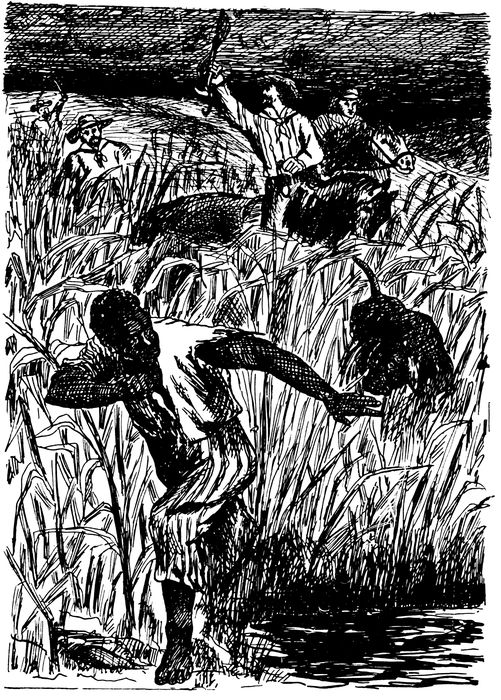
A SLAVE HUNT.
55Strangers came and went among them freely;
they heard much of the ways of escape northward,
of which many from plantations surrounding them
availed themselves, but the bonds of affection were
so strong between Mr. Wilson and his people that no
effort was ever made on the part of the latter to escape.
But things were not always to remain thus.
In 1853, Mr. Wilson sickened and died, a circumstance
which brought not only grief but consternation
to his “people,” for they soon learned they were
to be divided among the heirs. Jack and Nannie, a
brother and sister who had grown up on the estate
tenderly attached to each other and to their old
master, fell to the lot of a drunken and licentious
man named Watson, who took them to his farm in
Davies County, not far from the Ohio River. Here,
as common field hands, they were brutally treated,
and soon began to plan means of escape. Before
these were consummated the old cook died, and
Nannie, who was of attractive form and manners,
was taken from the field to fill her place. This only
added to the degradation of her condition, for she
was now continually called upon to repel the lecherous
advances of her brutal master. As a punishment
for this she was at length placed in close confinement
from which her brother succeeded in freeing
her. They set out at once for the river, hoping to
escape, but were soon overtaken, brought back and
so cruelly whipped by Watson, that Nannie soon
died from the effects.
The sight of his lacerated, dying sister, the only
tie that bound him to earth, continually haunted
Jack, and he vowed escape, and vengeance if it were
possible. His plans were carefully laid. In perambulating
the numerous swamps in the neighborhood
whose outlets led to the river, he had discovered
a hollow tree broken off some twenty feet above the
surrounding water. By climbing an adjacent sapling
he discovered that the hollow within the stub
would furnish a secure and comfortable retreat,
should necessity require. By divers acts of plantation
civility he had gained the confidence of “Uncle
Jake” and “Aunt Mary,” an old couple who
56sympathized deeply with him, and promised him any
aid in their power, provided it was such as “Massa’ll
neber know.” All Jack asked was that in case he
disappeared, they should set the third night after his
disappearance something to eat on a shelf where he
could reach it, and every fourth night thereafter until
it should, for two successive times, be untaken. He
also gave them in keeping a package of cayenne
pepper to be placed with the edibles. In his visits
to the river he had noted the fastenings of the skiffs,
and had provided himself with both a file and an
iron bar which would serve the double purpose as a
means of defense and for drawing a staple. These
he carefully secreted in his prospective retreat, waiting
only an opportunity to occupy it.
Such an opportunity was not long in presenting
itself, for one night the master came home late from
a drunken revel, and found Jack awaiting him as
ordered. Becoming enraged at some supposed act of
disobedience, he flew at Jack with an open knife.
The hour of vengeance had come. Seizing a hoe,
with a single stroke Jack felled him to the ground, a
lifeless form. A moment only he waited to view
the gaping wound—to compare it with poor Nan—then
gathering up a few things that he could, he was
off with the fleetness of a deer. Passing two or
three miles down the country, he entered the outlet
of the swamp, and after passing down it for some
distance, keeping so near the shore as to make his
tracks observable, he struck in, directly reversing his
57footsteps, and before the dawn was safely ensconced
in his selected tower.
Morning came and with it the knowledge of Watson’s
death. The cause was easily divined—there
was the bloody hoe, and Jack, who was left to wait
his coming, was gone. Blood hounds and fierce
men were soon upon his trail. His course was
easily traced to the brook, and his descending footsteps
discerned, but no trace of him could be discovered
beyond that. The greater part thought he
had reached the river, and escaped to the Indiana
shore by swimming, at which he was an expert, or
had been drowned in the attempt. Others believed
his footsteps only a decoy and searched all the adjacent
swamps, sometimes passing very near him, but
all in vain. Flaming posters, advertising him, were
sent broadcast, and slave catchers on both sides of
the river were on the alert.
On the second day a great concourse assembled at
Watson’s funeral. There were many conjectures,
and much argument, and loud swearing about the
“nigger” who had done the deed, and as a means of
intimidating the weeping—none more so than Uncle
Jake and Aunt Mary—chattels gathered around,
terrible things were promised Jack should he be
caught.
The services over, the crowd dispersed, and the
next morning all hands were set to work as usual.
At night when all was quiet, Aunt Mary, whose cabin
was the farthest of any from the “mansion,” placed
58a liberal ration of hoe cake and bacon, together with
the pepper, upon the designated shelf, and betook
herself to the side of Uncle Jake who was already
resting his weary limbs in the land of forgetfulness.
Shortly after midnight a hand was thrust cautiously
through the open window, the packages were softly
lifted, a little pepper was deftly sifted in retreating
footsteps, and in a short time Jack was safe again in
his water-shut abode, and when old uncle and auntie
were talking of the “wun’ful ang’l” that had visited
the house that night, Jack was quietly enjoying a
morning nap.
Several weeks passed, the excitement about Watson
had measurably died away, two successive depositions
of provisions had been left untouched and
the good old couple knew “Dat de angel was feedin’
Jack no moa’, like de rabens fed ol’ ’Lijer.” They
were sure, “Jack am safe.”
Taking his appliances, Jack had descended the
outlet some distance one starlight night, and then
striking across the country, had reached the river
just below the little village he had been accustomed
to visit before the death of his sister. The finding
of a skiff and the wrenching away of the fastening
occupied but a short time and at daylight he was
safely secreted in an Indiana forest. Knowledge
previously gained enabled him soon to put himself
in charge of an underground official, but instead of
making direct for Canada he shipped for the Quaker
settlement near Salem, Ohio, of which he had heard
59much from a fruit tree dealer before the death of
Mr. Wilson, and ultimately, in the quaint home of
Edward Bonsall found a secure asylum, and in his
nurseries desirable employment, so far from his
former home that little disturbed his mind except
the frequent recurring remembrances of his slain
master with the cruelly lacerated form of his sister
ever rising in justification of the summary punishment
that had been inflicted upon him.
In the autumn of 1856, Jack went with Mr. Bonsall
to Pittsburgh. Whilst walking along the street,
he met face to face a half-brother of his late master.
At first sight he thought it an apparition and turned
and ran rapidly away, but not until he was himself
recognized. So dextrous had been his motions that
he eluded the pursuit immediately instituted and
was soon among the hills beyond the city limits.
Hand bills minutely describing him were again
widely circulated, particularly along the belt of
country bordering the Pittsburgh and Erie canal, as it
was argued he would try and make his escape by that
route to Canada, and all the appliances of an odious
law were called into requisition to secure his apprehension.
Rap, rap, rap, came a knuckle against the door
of Thomas Douglass, of Warren, Ohio, in the silent
60hours of the night. Such occurrences were not frequent
of late at the home of the honest Englishman
whose love of justice and humanity had risen above
all fear of the pains and penalties of an unrighteous
law. Hastily dressing himself, he inquired, “Who
comes?”
“Ol’ Diligence,” a name recognized at once by Mr.
Douglass as the appelation of a colored conductor
from Youngstown.
“Hall right; wat’s aboard?”
“Subjec’, Massa Douglass, and hard pressed, too.”
“’Ard pressed his ’e? Well, come in.”
The door was opened, a brief explanation followed,
and Jack Watson and “Old Diligence” were consigned
to a good bed for the night. In the morning
his faithful guide, who had himself escaped from
bondage many years before gave Jack some money,
a supply of which he always had in hand, and left
him with the emphatic assurance, “Massa Douglass
am a true man.” But Jack was hard to be assured,
and when seated at breakfast with the master machinist’s
hands, he trembled like an aspen.
Three gentlemen, Levi Sutliff, John Hutchins and
John M. Stull had been early summoned to devise
the best means for forwarding Jack safely. The two
former of these had been long experienced operators;
the latter was rather a novice at the business. A few
years previously, an ambitious young man, he had
gone south as a teacher, thinking little and caring
less about the “peculiar institution.” He had been
61in Kentucky but a short time when a slave auction
was advertised and his Buckeye inquisitiveness
prompted him to witness it. Two or three children
were struck off and then the mother, a well formed,
good-looking octaroon, was put upon the block.
“Now, gentlemen,” said the auctioneer, a hard-shelled
Baptist preacher, “I offer you a valuable
piece of property. She’s a good cook; can make
clothes, or handle a hoe as well as a man. She’s a
healthy woman, gentlemen, an more’n that, she’s a
Christian. Gentlemen, she’s a member of my own
congregation.”
The buyers crowded around. They examined
her teeth, her hands, her feet, her limbs as though
she had been a horse on sale.
Our spectator began to feel himself getting white
in the face, and swear words were rising in his
throat, and he beat a hasty retreat.—John was under
conviction.
A few mornings after our young teacher was
wakened by the sound of heavy blows and cries of
pain proceeding from another part of the hotel.
That evening when Harry, the boy appointed his
special waiter, came to his room, Mr. Stull cautiously
inquired who had been punished in the morning.
“Dat was me Massa. De ol’ boss gib’d me a
buckin.”
“What was the trouble, Harry, and what is a
bucking?”
“Why Lor’ bress you, Massa, dis chile slep’ jus’ a
62minit too long, an’ de ol’ boss cum’d wid his ‘buck,’
a board wid a short han’l and full ob holes, an’ he
bent Harry ober, like for to spank a chil’, an’ o Lor’
how he struck.” (Then lowering his voice,) “Say,
Massa Stull, can you tell de Norf star?”
The boy had been all care, attention and manliness.
The soul of the teacher was fully aroused.—Stull
was converted.
Waiting the coming of these gentlemen, Jack had
gone into the back yard, and when they arrived he
was nowhere to be found. A prolonged search failed
to reveal his whereabouts, and when at length night
fell kind Mrs. Douglass placed an ample plate of
provisions in the back kitchen and continued it for
several weeks, hoping he might return, but no angel
ever spirited a particle of it away.
Years ago, even before Wendell Phillips, Abbey
Kelley and others of their school began to hurl their
bitter anathemas at the institution of slavery, there
lived upon a far-reaching Virginia plantation in the
valley of the James a man who had taken a truly
comprehensive and patriotic view of the institution
that was blighting the reputation of his state, as well
as impoverishing her soil. He had inherited his
fine estate, encumbered by a large number of slaves,
and his soul revolted at the idea of holding them in
bondage. A man of fine physique, commanding
mien and superior intellectual endowments, John
63Young could not brook the idea of eating bread that
savored of the sweat of another’s brow, and the
thought of living amid the withering, blighting
scenes of slave labor and slave traffic was not at all
congenial to his tastes. Casting about, he soon found
a purchaser for his broad acres. Before disposing of
his plantation, however, he made a trip into western
Pennsylvania, and in Mercer county, on the rich
bottoms of Indian Run, made purchase of an extensive
tract of valuable land. Returning to the Old
Dominion, he at once concluded the sale of his estate,
and vowed his intention of going North.
His friends were amazed at the idea of his becoming
a “Pennymight” farmer, and his people were thrown
into consternation, as they expected soon to be exposed
on the auction block. The sallies of one class
he easily parried; the fear of the other he quickly
allayed by calling them together and presenting them
with freedom papers. There was a moment of
silence, of blank astonishment, and then arose shouts,
and cries, and hallelujahs to God, amid laughter and
tears, for this wonderful deliverance.
When the excitement had somewhat subsided the
late master revealed to them the fact that he was going
north where it was respectable for a white man
to labor, and if any of them should ever come his
way they would see him chopping his own wood and
hoeing his own corn, and that they were now free to
go where they chose, only they must see they did
not lose their papers.
64“Bress de good Lor’, Massa, we’ll go wid you to
dat new plantashun and be spect’ble too, and make
light work for ol’ Massa.”
Though foreign to the purpose of Mr. Young, he
yielded to the importunity of those he had manumitted,
and soon there appeared on the Pennsylvania
purchase a spacious residence, built rather in
the Virginia style, and around it were grouped numerous,
cabins, occupied by the sable colony that had
followed the Caucassian proprietor. The family
equipage was brought along, and Alexander Johnson
always persisted in being Massa’s coachman and
driving him in state.
The farm improved rapidly under the guidance of
intelligence, aided by paid labor, and John Young’s
house soon became known as a hospitable home, and
to none more so than to the fugitive from bondage,
for he early became an influential agent on the great
thoroughfare to Canada.
Securing the aid of a few neighbors and friends,
rather as a matter of compliment than otherwise,
Mr. Young had erected, at a convenient site, a nice
country chapel, now a Methodist church in which the
writer has been privileged to speak, and here the people
of the neighborhood, white and black, met for worship.
The Sabbath evening service in this little church
had closed and the speaker, J. W. Loguen, an eloquent
man, though a former fugitive from slavery,
but at that time pastor of a Baptist church in Syracuse,
N. Y., and largely engaged in the underground
65transit business, sat conversing with Mr. Young, in
the home of the latter gentleman, when Uncle ’Lec,
as the old coachman was familiarly called, entered
and excitedly exclaimed, “Mass Young, him am
come, him am come.”
“Who has come, Alec?” queried the host kindly.
“Why, Massa, dat runaway wot de han’ vill tell
bout, an’ him am fearfu’ scar’ an’ no mistake, fo’ he
say de catchers am arter him shua.”
“Bring him in, Alec,” said Mr. Young, and in a
moment more there was ushered into the room a
tall, muscular colored man, bearing evident traces of
white blood and answering fully the description of
Jack Watson. His story, other than what we have
already learned, was that at Warren, being suspicious
of so many white men, he had gone out of the back
yard of Mr. Douglass and a short distance along the
canal and secreted himself until night in an old
ware-house, still well remembered as bearing the inscription,
“Forwarding and Commission. M. B.
Taylor & Co.” In the evening he had struck out for
Indian Run, of which Old Diligence had told him.
He had traveled all the night, but not being able to
reach his destination, had lain secreted during the
day, and now hungry and fearful he appealed to Mr.
Young for food and protection, both of which were
readily accorded.
After the cravings of appetite had been satisfied, a
conference was held, and it was decided that Jack
should try and make Syracuse, after which Mr.
66Loguen would assure both safety and employment.
Owing to the well-known character of Mr. Young
and his attachés, and unmistakable evidences of
close pursuit that had preceded Jack’s coming, it
was further determined to forward him at once to
“Safe Haven.” In accordance with this decision the
family carriage, an imposing piece of “rolling stock,”
soon stood at the door with ’Lec consequentially
seated upon the box. A moment later, Jack, Mr.
Loguen, and stalwart John Young emerged from the
mansion, and as they took their seats in the carriage,
Mr. Young said: “Now, Alec, look well to your
lines and remember the ‘Haven’ is to be made before
daylight.”
“Yes, Massa, dis ol’ chile keep an eye to de lines,
de road, an’ anyting ’spicuous, an’ rouse up ol’
missus long afor’ de chicken’ ’gin to crow,” saying
which, he gave a gentle chirrup and the carriage
went rolling away to the northward.
Whoever was accustomed, a third of a century
ago, to travel over the road from Warren, O., to
Meadville, Pa., will remember a wayside inn, whose
sign bore in German character the euphonious name
of “Aughfeultwangher House.” The house itself,
like its name, was of German origin, a genuine example
of a Dutch farm house, bespeaking both comfort
and thrift. The occupants were of the same
name as the house, the proprietor being an honest,
67quiet, well-meaning man, with no special personality.
Not so his better half, however. She was a character—a
decided personality. Kind and generous, she
had a temper, which when let loose became a very
tornado. She was neat and tidy as a housekeeper,
and unexcelled as a cook. A regular embodiment
of piety and profanity; of sympathy and execration;
of wit, repartee and scurrilous invective, her very
off-handedness made the house immensely popular
with drovers and road-men, and it was quoted from
the prairies of the west to the Quaker City itself;
and many is the man who has traveled an extra five
miles to gain the hospitable roof of the “Awfultricker
House,” as it came to be called by those who
failed to accomplish the German of it.
As an illustration of the without and the within
of the place, a little personal experience is introduced.
At the end of a bleak November day, I
found myself taking the advice of a friend and making
an extra exertion with jaded beast, in order to
enjoy the hospitality of the “Aughfeultwangher.”
Knowing the reputation of the hostess I greeted her
with: “Well, Auntie, can you keep a stranger to-night?”
Looking at me with a quizzical expression and
evidently pleased at the appellation used, she replied:
“Dot is von long face to keeps all in von
house.”
“O, well, never mind, I can let a part of it stay in
the barn.”
68“Vell, I guess we growds es all in dem house,”
and running to the back door, she called out, “Fater,
fater, here bist einer mann, unt ein pferd vas Shineral
Shackson rote. Nehms du es dem stolle vilst Ich
das abend essen for dem manne erhalten.”
Obedient to the summons the host came at once,
and took the wearied beast, whilst I was ushered
into the little bar-room, whose well-filled box-stove
was sending out a genial warmth, and away went
the sprightly dame to prepare supper, whose savory
odors soon filled the house.
Directly the door into the great family kitchen
opened, and I did not wait for a repetition of the
hearty “Coome Meister, your supper bist ready.”
Entering, I found the room seated after the German
style, and was greeted with the sight of a great, open
fire-place, with its bake-oven and pot-hole attachment.
Upon the table were rich slices of ham, eggs,
bread, such as only a genuine German woman can
bake, and other things in abundance. When I was
seated and the good woman had poured out a cup of
delicious coffee, she took a chair opposite, and after
eying me a moment, inquired:
“Vell, Meister, var from you come?”
“From Ohio, auntie.”
“You bist von Yankee, then.”
“No, I’m a Buckeye.”
“Von Puckeye! vas ish dat, eh?”
“One born in Ohio.”
“Unt vas your fater ein Sherman?”
69“No, auntie, but my grandfather was.”
“O your grossfater. Vell, I tot dare vas some
Shermeny blud; dot lickt hair und blau eyes zint
der sign, meister.”
“Well, auntie, ’tis not bad blood, is it.”
“O nein. Mein Got, es ist dot best, but das
Yankee is shust so goot,” to which of course I
assented, with the remark that the two together are
a little better, thus causing the old lady to laugh
outright.
After a moment’s pause, in which there seemed to
be a studying of what tactics to pursue, she said,
“Vell, meister, it bist none of my pisness, but vas
you stoon in das velt?”
Wishing to make a fine conquest, I summoned
what little German I could muster and replied,
“Ich bin einer school-meister.”
“Got in himmel! du bist einer schulmeister, O
Ich vish de kinder vare to house—”
Just then the host came in, and there was a rapid
discharge of pure German between them, the outcome
of which was a passing of a very pleasant evening,
though the English on the one side and the German
on the other were both very broken, and when the
hour for retiring came I was escorted by the old
couple to what was evidently the best room in the
house. Approaching the bed the hostess laid back a
fine feather tick, revealing sheets of snowy whiteness
overspreading another, and then with a feeling of
conscious pride exclaimed, “Dot, Her Schulmeister,
70is mine bester bett, unt do canst schlafen on der top,
in der mittel or unter das bett, shust as you bleze.
Guten abent.”
Such was the house, such were the Aughfeultwanghers,
with the addition of being Jacksonian
Democrats of the straightest sect, the least likely
people, apparently, to have any sympathy with the
underground work, yet shrewd John Young, ever
fertile in expedients, had approached this couple, and
as a result of the conference there was arranged a
snug little room over and back of the oven with the
way of entry by the pot-hole. This room was never
to be occupied but by one individual, and he was to
be brought by Mr. Young in person, who was also to
provide for the taking away. In view of these facts
he had christened the place “Safe Haven,” and its
existence, outside of the family, was known only to
himself, Alec and one or two others of his retainers
and “Mose” Bishop, a tall, slim man, residing at
Linesville, having a perfect hatred of creeds and
cant, but an enthusiastic supporter of every cause
demanding sympathy and justice, and who on account
of his Jehu style of driving, was known along
the road as “The Lightning Conductor.”
True to his promise, before the first cock had
sounded the approaching morn on that late October
night, Alec reined up at the Aughfeultwangher, and
Mr. Young, alighting, rapped at the door, and all
71questions being satisfactorily answered, Jack was
admitted, and the carriage rolled rapidly down to
the little village at the foot of Conneaut lake, and at
the hotel breakfast was ordered for men and beasts.
Having washed themselves, they were waiting the
progress of culinary processes in the kitchen, meanwhile
regaling themselves by reading the hand-bill
advertising Jack, which was conspicuously posted in
the bar-room, when two horsemen, one a constable
from Mercer county, rode up and also ordered breakfast
and feed for their horses.
The constable and Mr. Young readily recognized
each other, and though no word was passed it was evident
to each that his business was understood by his
neighbor, hence the breakfast passed in silence, and
when his bill was settled, the carriage of the ex-Virginian
took a homeward direction.
No sooner was it gone than the constable remarked
to Boniface, “I have been after that turnout all night.
When it started there was a passenger in it, answering
to that bill there.”
“You’ve been making the old fellow a close call,”
said the landlord, “but you’ll find him a hard one
to handle.”
“Yes; but if I could catch the nigger, the $500
wouldn’t come bad. We have been close on his
track for several days. We know he was at Young’s
last night but where in the d—— he is now is the
question.”
“Dropped somewhere, likely.”
72“Yes, dropped. Old Alec was too much for us,
and we lost the trail. From which direction did
they come?”
“From towards Meadville.”
“Do you know any station that he could have
touched?”
“No, unless Aughfeultwangher’s.”
“Awfultricker’s! ha! ha! Upon my life that is a
bright idea. Why the old woman would make even
Young think the day of judgment had come if he
were to bring a nigger to her home.”
“So I would have thought once, and so I am disposed
to think now, but I have sometimes thought
his bland manners have overcome her Democracy
and that somewhere about the premises there is a
station; yet ’tis all guess work with me. I give you
the information; if you, gentlemen, can make $500
out of it, you are welcome to the fee.”
After a short consultation between the constable
and the stranger, a regular catcher who had undertaken
to capture Jack, they ordered their horses and
were off towards the Aughfeultwangher.
Immediately on receiving Jack into the house, the
good landlady supplied him with an ample dish of
provisions and removing the dye tub and other obstructions
from the pot-hole pointed him to her bed-room
for “zingle shentelmens,” and when he had
disappeared, she replaced her pots and kettles, taking
73care to place the dye tub in which the yarn for
family stockings were receiving its finishing tint of
blue, in the very mouth of the hole. This done she
went about her morning duties and was thus busily
engaged when the two horsemen rode up, dismounted
and came in. After paying the compliments of the
morning and taking a drink, the constable inquired,
“Has Mr. Young been here this morning?”
“Mister Yoong, vat Yoong you means?”
“John Young.”
“Vat, dot Shon Yoong fon town in Merzer
gounty?”
“Yes.”
“O ya, er trive up unt vater ees team.”
“Was there anybody with him?”
“O ya, dot black Alec alvays goes mit him.”
“Did you see anybody get out?”
“Nein.”
“And he didn’t leave anyone here?”
“Vell, shentelmens, dot is von great kweschon.
You tinks I have von of tem niggers pout here.
You shall zee. Now, shentelmens, you looks all
apout; you shall shust go in te barn and dru dis
house shust as you blese. Den you knows if Shon
Young leaves von black mans here.”
So saying the old lady led them through the barn
and all parts of the house until the kitchen was
reached. Here she bade them look into the oven,
and then that they might peer into the pot-hole she
began removing the dye tub, but in so doing was
74careful to spill a little of the liquid. As the fumes
spread through the room the catcher exclaimed as
they reached his olfactories, “O the d—l.”
“Yes, der toiful, shentelmens, der toiful; you comes
to mine house as if de Aughfeultwangher wo’dt keep
ein runavay nigger; you go dru, you go unter mine
parn; you goes indo mine pet rooms; you climps
down into mine shamber, unt you goes up indo
mine seller, and now der toiful! You peest tswi tam
deeps, unt if you no go so gwick as von leetel minit,
I sets mine tok on you unt er makes you into sausage
meat fore von hour. Pounce! here Pounce,
here!” and a great house dog came rushing into the
back door as the two runaway-seekers beat a hasty
retreat, each catching a glimpse, as he passed out, of
the huge animal called to act as judgment executioner
upon them. Though foiled, they were not
discouraged, but transferred their place of watching
to other parts.
Reaching home, Mr. Young immediately wrote
Mr. Bishop, as follows:—
“—o— —56—10—28—81.
Dear—— ——,
Piratical craft square rigged, but our wind was good and
we holed the duck. (— — —) ‘Mine Got, mine Got, mine
Got——for XXX——’ Greeley’s advice. Day and night;
day and night; day and night. With an eye to foxes, let ’er
slide.
Yours,
o——o”
75On its receipt, Mr. Bishop took the necessary precautions
to execute the contents of the letter, and on the
third night proceeded to carry them out, being not
unaware of the fact that he was closely watched.
Two men were standing in their respective doorways
in the village of Andover, Ohio, on a November
afternoon. The one was a broad-shouldered,
full-chested man, with a flowing beard, a merry
twinkle in the eye, a kind of devil-may-care negligence
in his appearance, with a physique that betokened
great power and endurance. This man had long
been known technically as “Thribble X” of station
“1001,” at Gustavus, Ohio, from which place he had
migrated to Andover to proclaim the principles of
the Universalist faith, and was known among his
people as Elder Shipman, or more familiarly, “Uncle
Charley.”
The other gentleman was of slimmer build, sandy
complexion, thoughtful mien, and the very manner
in which he handled his pipe would guarantee that
he was of “Hinglish stock.”
As they thus stood, a buggy came driving from
the east at break-neck speed, and dashing up to the
parsonage the driver exclaimed, “Elder, can you do
anything for this duck, for they’re after us hotter’n
h—ll.”
“Don’t you know there is no such place as that,
Mose?” was the calm reply.
76“Well, well, I’ve no time to discuss theological
matters now; all I know is if there is no such place,
there ought to be a new creation at once for the sake
of two fellows that must already be this side of the
Shenango.”
“So near as that? Set him out.”
Immediately the colored man was bidden to
alight, and whilst he and the elder struck out for the
woods a short distance to the southwest, the buggy
was turned and driven rapidly toward Richmond.
Scarcely was it out of sight, when two horsemen
came galloping into town, and riding up to our English
friend, who had been an interested spectator of
the little scene just described and was wont to express
his satisfaction of English laws by quoting,
“Slaves cannot breathe in Highland; if their lungs
Received ’er hair, that moment they are free;”
and inquired, “Stranger, did you see a buggy drive
into town from the east a short time ago with two
men in it?”
“Hi ’ave, gentlemen.”
“Was one of them black?”
“’E was, gentlemen.”
“Should you think the other was the man they
call Mose Bishop?”
“Hi should, gentlemen.”
“Which way did he drive?”
“To the north, gentlemen.”
“Thank you, sir, and good day.”
“Good day, gentlemen.”
77Clapping spurs to their horses, the riders were
away with a bound, under the inspiration of the
first genuine cry of “On to Richmond.”
Reaching the proper point, Bishop turned eastward
and dashed down through Padan-aram, much
to the surprise of the denizens of that sequestered
community, whilst his pursuers swept on to the
Center, and on inquiry at the village store, were
blandly informed by the proprietor, Mr. Heath, that
there had been no buggy at all in the place that day.
Had Mose and the elder heard the refined language
that then made the very atmosphere about Richmond
blue, they would both have been converts to
the orthodox doctrine of sulphuric cleansing.
Watching the departure of the others, Shipman
and his charge crossed the road to the eastward, and
were soon threading the woodlands bordering the
Shenango, and about midnight sought quarters at a
friend’s of the elder, not far from Linesville. Arming
themselves with heavy walking sticks, just before
evening of the next day they set out for Albion.
They had not proceeded far before they saw they
were to encounter four sinister-looking fellows.
“Now, Jack,” said the elder, “You have endured too
much to be taken back. I do not wish to pay a
thousand dollars fine nor go to prison for your sake.
We may have to use these canes. Do you understand?”
78“Yes, Massa, you can trus’ dis Jack.”
A call to halt was answered by so vigorous a
charge and such effective use of the walking sticks
that two of the challengers soon lay upon the ground
and the others beat a hasty retreat. Taking advantage
of circumstances the little train switched, and
under the pressure of a full head of steam reached
the “Old Tannery” station near Albion before daylight.
The conductor was now on strange ground, but
knowing there was an agent in the vicinity named
Low, he hunted him up and received such information
as enabled them to make a little clump of hemlocks
on the bank of a ravine not far from the
residence of Elijah Drury, of Girard, the following
night.
Farmer Drury was a stalwart, standing little less
than six feet in height, always ready for any good
word and work, and had been for many years engaged
in the transportation business. Always wary,
however, he was not to be deceived when, in the
morning, our bewhiskered conductor presented himself
and asked for something to eat.
“O yes,” said Mr. Drury, “I can always furnish a
man, though a stranger, something with which to
satisfy hunger.”
“But I want something also for a friend.”
“A friend! What do you mean?”
“I mean that I have a friend down yonder in the
thicket, who is both weary and hungry.”
79“Mister, do you know what I think?”
“I am not a prophet, sir.”
“Well, it is my opinion that you are a horse
thief.”
“Will you come down and see the last nag I
trotted off?”
Together the two men went down to the little
thicket, and there the Elder not only exhibited the
passenger, but to remove all suspicions, showed him
the scars that indicated the floggings to which the
slave had been subjected, a sight which Mr. Drury
often afterwards said came very near making him
swear outright. Thus commenced a friendship between
the two men long continued and fraught with
many acts attesting the generous nature of both.
When evening came, time being precious, our conductor
drew the reins over Mr. Drury’s best roadsters,
and about midnight deposited his passenger at
the doorway of an old-fashioned house, with gable
to the street, wing projecting northward, and a large
elm tree nearly in front, standing on Federal Hill,
in what is now South Erie, and for the first time
XXX greeted officially a most redoubtable Keystone
agent, known as the “Doctor,” in those days one of
Erie’s well-known characters. He had gained some
knowledge of herbs and roots, which he learned to
apply medicinally, thus acquiring his appellation,
which he wore with great satisfaction, soon coming
80to look upon all mere “book doctors” in great contempt.
He was accustomed to drive about town
with an old brown horse attached to a kind of carryall
vehicle; always took his whisky straight and in
full allopathic doses, though he affected to despise
the practice generally, and prided himself on being
the most reliable agent in Erie county.
Into the Doctor’s private sanctum Jack was at once
admitted, and properly cared for for a number of
days, until measurably recuperated from his weeks
of incessant vigil and solicitude, when he was taken
in charge by Thomas Elliott, Esq., of Harborcreek,
and conveyed to Wesleyville, four miles east of the
city. Here, inasmuch as fresh news was obtained of
his pursuers, it was thought best to secrete him anew,
and he was therefore deposited in Station “Sanctum
Sanctorum”—the garret of the Methodist Church.
Whoever passes through the village on the “Buffalo
Road,” fails not to notice this unpretentious
little brick structure standing by the wayside. Like
most churches built so long ago, it has undergone
various remodelings. The “battlements” have been
taken off; doors and windows have shifted places,
but within it is little changed; the seating below and
the three-sided gallery remaining much as of old.
From the time of its first dedication onward, it has
been the scene of many a revival, and for years it
was the “horn of the altar” upon which the panting
fugitive laid his hand, and was safe, for its use as a
“station” was known only to a “selected few.”
OLD CHURCH, WESLEYVILLE, PA.
81At the time we speak of, a protracted meeting had
already been begun, for the bleakness of winter had
early set in. The services were conducted by Rev.
Jas. Gilfillin, a sterling old Scotchman, who had received
a large part of his training in the collieries of
his native land, and before the mast as a sailor on
the high seas, assisted by Rev. William Gheer, a
young man of timidity and all gentility of manner.
The interest was most marked, and crowds came
nightly to listen, to weep, to become penitents, not
only from up and down the “road,” but from Gospel
Hill, and far beyond, bringing even grand old father
and mother Weed, who had assisted at the
formation of the society over thirty years before,
from away up in the “beechwoods,” and with them
Nehemiah Beers, an exhorter, particularly felicitous
in the construction of unheard-of words and expressions.
Under such circumstances Jack was deposited,
early one morning, in his rude apartment, measurably
warmed by the pipe which came up from the
great box-stove below, and cautioned that he must
keep particularly quiet during the devotional exercises
below. Here he remained for several days,
listening to the praises of new-born souls and the
hosannas of the older brethren during meeting hours,
and then descending and making himself comfortable
in the well-warmed room when all was quiet
and safe. Indeed, so well did he play his part as
fire-tender, that the Chambers boys, who chopped
82the wood, which was hauled to the church “sled-length”
by the brethren, emphatically declared, as
they wondered at the marvellous disappearance of
fuel, “It takes a power of wood to run a red-hot revival,
and we shall be glad when the meeting
closes,” and it required no little effort on the part of
their father, the main source of supply, to induce
them to persevere in their “labor of love.”
Thus matters passed until Sunday evening came,
when the interest of the meeting seemed to culminate
in a Pentecostal shower. The Rev. James Sullivan,
then a young man, preached a sermon of great
eloquence and power, encouraged by many a hearty
Amen from Father Weed and the older brethren,
and the responsive hallelujahs of hale old Sister
Weed and the other “Mothers in Israel.” The sermon
ended, men clapped their hands in ecstatic
rapture, and struck up that grand old revival hymn,
“Come ye sinners, poor and needy,”
whilst the old pastor rose in his place, and earnestly
exhorted sinners to come to the “mourner’s bench”
and find pardon and peace, until the feeling of excitement
burst forth in one simultaneous, “Amen,
hallelujah to God!”
The Spirit had reached the garret, and in the fervor
of excitement Jack forgot himself, and, “Amen,
hallelujah to God!” came back in responsive echo,
sufficiently loud enough to attract the attention of
those in the gallery, who looked at each other in
startled amazement.
83Down on his knees went Brother Beers, and in the
midst of an impassioned prayer, exclaimed: “O!
Lord-ah, come down to-night-ah, and rim-wrack and
center-shake the work of the devil-ah.”
Influenced more by the Spirit than the phraseology
of the prayer, there went up from the worshipping
throng a hearty “Amen, and Amen!”
“Amen, and Amen!” came down from above,
only to increase the astonishment of the crowded
gallery, most there believing that an angel hovered
over them. As if in perfect accord with the surroundings,
Parson Gheer struck up,
“Behold the Savior of mankind,”
without waiting for
“Nailed to the rugged cross,”
the stentorian voice of the old pastor rang out, “Yes,
He comes! He comes!”
“Yes, He comes! He comes!” shouted the embodied
seraph in the garret, in tones sufficiently
loud to catch the ear of the sexton, who immediately
mounted aloft, as he often did to adjust the stovepipe,
and though the meeting continued for an hour
longer, there were no farther angelic demonstrations,
yet some in the gallery long persisted that they had
that night been permitted to listen to seraphic
strains.
Before daylight Jack was shipped by way of Col.
Moorhead’s and North East, to Conductor Nutting,
at State Line, and by him to Syracuse, where he
84safely arrived and remained until the breaking out
of the war, when he went south and rendered valuable
service to the Union cause, in a way that may
be told in due time.
CHAPTER III. UNCLE JAKE. — I. — II. — III. — IV. — V. — VI.
85
Years ago, before the permanent organization of
the Underground Railroad, when the escape
of fugitives was largely a haphazard matter, there
lived on the sacred soil of Virginia, back a few miles
from Wheeling, a pleasant, companionable man,
owning a number of slaves, among them one known
as “Uncle Jake,” the happy husband of an exemplary
wife, who had borne him several children,
some of whom they had seen grow to manhood and
womanhood, while others still remained with them
in the cabin.
Uncle Jake was an expert mason, and brought his
master large wages. The latter, in the generosity of
his heart, had stipulated that a certain per cent. of
these should be credited up to Jake for the purchase
of the freedom of himself and wife. When he turned
his fifty-ninth birthday the sum agreed upon was
nearly reached, and the faithful man went out to a
job in Wheeling, with the full assurance that on his
sixtieth anniversary he and his hale old wife should
go forth to the enjoyment of the blessings of free
86people. Thus incited, his trowel was nimbly handled
as the days flew by.
A little improvident and immethodical in his business,
the master had contracted large obligations,
which he was unable to meet; his paper matured;
his creditors swooped down upon him simultaneously,
and in a single day he was stripped of everything.
His slaves, with the exception of Uncle Jake,
who was purchased at a round figure by a neighbor
who had long coveted him, were sold to a southern
trader, and on Saturday morning, chained into separate
coffles, the unhappy wife and mother, with her
children, forming one by themselves, whilst the
father, indulging in pleasant day-dreams of the future,
was busily plying his craft in one part of the
town, were driven through another, down to the
river, and put on board a steamer for New Orleans.
Evening came, and the week’s work ended, Uncle
Jake started with a light heart homeward. When
he reached the neighborhood sometime after nightfall,
he was apprised by a friend on the lookout for
him, of the fate of the master—of himself and loved
ones. Had a thunderbolt fallen at his feet, he could
not have been more shocked. Learning, also, that
his new master, a tyrannical man, was waiting his
coming, he turned aside to give vent to his grief.
Had he been sold with the family he could have endured
it, for then there might have been a chance of
occasional meeting; indeed, he and his wife might
have been sold to the same plantation; but now they
87were gone—separated forever. Under the blue dome
of heaven, with the myriad stars looking down upon
him, he wept—wept as only a man can weep under
such circumstances—until the reaction came, when a
lion-like manhood asserted itself in the laconic expression,
“Not one more stroke in slavery.”
Arising with the clear-cut resolution to obtain his
freedom or perish in the attempt, he proceeded
stealthily to his cabin, armed himself with a large
butcher knife and a heavy walking stick, and taking
one last look at objects, though humble, still dear to
him, he set out with elastic step towards the river.
About one-half the distance had been gone over,
when he perceived himself pursued. He turned
aside, hoping to secrete himself, but in vain; he had
been sighted, and was summoned to surrender.
To the challenge, he responded: “I am yours if
you can take me.”
The two men, his new master and an attendant,
dismounted and hitched their horses, thinking the
conquest of the “cowardly nigger” would be an
easy matter. But not so. The man who for nearly
three-score years had manifested only the meekness
of a child, was now endowed with the spirit and
prowess of a giant. A well-aimed blow of the
bludgeon laid his master a quivering corpse at his
feet, and several well-directed strokes of the butcher
knife sent the other covered with ghastly, bleeding
wounds, fainting to the roadside.
Mounting the fleetest horse, Jake made his way
88rapidly to the river, and plunging in soon found
himself landed safely on the Ohio shore. Taking to
a highway soon found, he followed the lead of the
north star, and just at daybreak turned into a woodland
ravine, and spent the quiet autumnal Sabbath
watching the grazing of the faithful horse upon such
herbage as he could find, and in meditating upon
the wonderful revelations and events of the past
twenty-four hours.
Night clear and beautiful, came again, and Jake
pursued his onward way, and in the early morning
turned his jaded beast loose in a retired pasture lot
not far from Salem; threw the saddle and bridle
into a ravine, on the principle that “dead men tell
no tales,” and prospecting about for some time, saw
emerge from a farm house a broad-brimmed hat,
which he had learned was a sure sign of food and
protection. Approaching the Quaker farmer, Uncle
Jake declared himself a fugitive, and applied for
food and shelter, which were freely granted.
Tuesday the stage coach brought into Salem a
hand-bill giving a full description of Uncle Jake, telling
of the killing of the master, the probable mortal
wounding of the other, and offering a large reward
for his apprehension.
“Thee oughtest to have struck more carefully,
friend,” said the Quaker, when he had learned thus
fully the measure of his protégé’s adventure, “but
then as it was in the dark, we may pardon thee thy
error, but Salem is not a safe place for such as thee.
89I shall take thee to my friend, Dr. Benjamin Stanton,
who will instruct thee as to what thee is to do.”
Accordingly, when nightfall made it safe, the
Quaker took Jake to the house of his friend, who
was none other than a cousin of Lincoln’s great War
Secretary, where having exchanged his laborer’s
garb for a suit of army blue, richly trimmed with
brass buttons, a style of dress much admired by
colored people in those old days of militia training,
and a high-crowned hat, he was immediately posted
off to the care of one Barnes, residing on the confines
of Boardman, bearing to him the simple admonition,
“It is hot.”
Not appreciating the full merits of the case, Barnes
took him in the early morning and started for Warren
by way of Youngstown. Here he was espied by
two questionable characters, who having seen the
hand-bill advertising Jake, and knowing the antecedents
of Barnes, justly surmised that the black
gentleman in blue might be none other than the individual
for whom the reward was offered, and at
once planned a pursuit, but not until the eagle eye
of the driver had detected their motions. Leaving
the main road, he struck across the Liberty hills.
When near Loy’s Corners he perceived they were
pursued, and bade Jake alight and make for some
place of safety, while he would try and lead the pursuers
off the trail.
In a land of strangers and without protective
weapons save his knife, Jake could do nothing more
90than to run up to a little wagon shop by the wayside,
in the doorway of which stood an honest
Pennsylvania Dutchman named Samuel Goist, and
exclaimed, “Lor’ Massa, save me from the slave
catcher.”
Now, Mr. Goist was a Democrat of the straightest
sect, and had long sworn by “Sheneral Shackson;”
he had never before seen a panting fugitive and
knew nothing of secretive methods, but when he saw
the venerable, though unique form before him, his
generous heart was touched, and he replied: “Hite
gwick in ter hay yonder till I cums,” pointing at the
same time to a last year’s haystack, into which the
cattle had eaten deep recesses.
It was but the work of a moment, and sable form,
blue suit and plug hat were viewless in what the
winter before had often sheltered the semi-farmer’s
choicest steer from pitiless storm.
Scarcely was this feat executed when the Youngstown
parties came up and knowing the political complexion
of the honest wagon-maker inquired, “Halloo,
old dad, have you seen a buggy go by here with
a white man, and a nigger dressed in blue, in it?”
“Ya, shentelmen, py shimmeny; dot puggy vent
py das corner ond yonder not more as den minit aco,
unt er vas trifing das horse, py shingo. I dinks you
not oferdakes him much pefore Vorren.”
With an expression of rough thanks, the men
struck off under a full gallop which carried them
into Warren right speedily, but in the meantime
91Barnes had watched his opportunity, turned off
through Niles, and pursued his homeward journey
by way of Austintown.
Turning from his shop when his interrogators were
out of sight, Mr. Goist called his good frou and said,
“Vell, Mutter, I kes I haf lite shust a lidel.”
“Vot, you, fater, haf lite? O mine!”
“Vell, Mutter, you zee von plack man comes along
unt asks me him for to hite, unt I say in dem stock;
unt den cums sum mans fon Youngstown unt says
he ‘Olt dat, you sees von puggy mit nigger unt vite
man goes dis vay?’ Unt I say, ‘Ya, dot puggy vas
kon py like a shtreak.’”
“O mine, fater, das vas no liegen; you shust say
dot puggy vas kon.”
“Vell, if dot mans was Sheneral Shackson, I
should him tell shust der zame.”
That evening Uncle Jake received an ample supper
from the larder of good Mother Goist, and was
then placed in a wagon under a cover of straw and
conveyed close to the house of a Mr. Stewart near
the corner of Vienna, whom rumor had pointed out
to the honest Dutchman as one of “dem aperlishioners.”
Here he was bidden “goot py,” and soon
found his way to the cabin indicated, whence in due
time he was forwarded to General Andrew Bushnell,
a prominent anti-slavery man south of the centre of
Hartford.
Even at that early day, Hartford and Vernon had
92established for themselves a wide-spread reputation
for expertness in the forwarding business. General
Bushnell, on account of his age and experience was
looked upon as the acknowledged front of affairs,
but his work was ably seconded by many others,
particularly by two young men, Ralph Plumb, of
Burgh Hill, and Levi Sutliff, who still resided with
his parents in the north part of Vernon. These
young men were ever on the alert for daring enterprise,
but just now discretion was considered the
better part of valor, for slow as news moved, it was
not long before the chase from Youngstown to Warren
became known in Hartford, and anti-fugitive eyes
became unusually vigilant about town, and it was
whispered that the blue suit might come that way
and some one might pick up a handsome reward.
For some days Uncle Jake was carefully secreted
in a hay-barn, together with a young man who had
previously reached the General’s. Plumb and Sutliff
were so carefully watched, it was thought best to
commit the carrying of the twain to other hands—but
whose should they be?
Young Plumb had a sister Mary, about twenty
years of age, the affianced of Sutliff, and the General
had a daughter bearing the same name a year or two
younger, both spirited, resolute girls, and ready for
any good work. When only fourteen, Miss Bushnell,
in a case of special emergency, had hitched up
the family carriage, (a one-horse wagon,) and conveyed
a fleeing family from her father’s to the Sutliff
93home, a distance of eight miles, encountering a
fearful thunderstorm on the way, and returning before
the first peep of morning light.
One day when conversing on the best way of disposing
of the case in hand, Ralph said: “Leve,
suppose we commit this mission to the Marys; I
believe they will put the stock safely through to the
lake.”
“Capital,” replied his companion; “have you matured
a scheme?”
“Partially.”
“What is it?”
“Well your father is to have a load of hay of the
General. Come along with the team and I’ll help
you get it. We’ll pack Uncle Jake and the boy into
the load, take Mary on with us and bring her down
to our house, there take on sister, and when the hay
is in the Sutliff barn the rest can be easily arranged.”
“But will the girls consent?”
“The Bushnell has been tried, and you are the
last man that ought to raise a question about the
Plumb.”
That afternoon the team of the senior Sutliff was
driven through the center of Hartford and to the
hay-barn of Andrew Bushnell, where it was duly
loaded, the two choicest spires being extended longitudinally
a short distance from the top. Passing
the house, Mary was taken on and a merry trio proceeded
northward only to be expanded to a jubilant
quartette on arriving at the Hill. No suspicion was
94aroused, for those were days when a woman’s worth
and modesty were not lessened by her being seen in
sun-bonnet and shawl upon a load of hay.
One, two, three, ——, ——, ——, ——, ——, ——,
——, ——, twelve, went the clock in the old, low
Sutliff mansion; a light two-horse wagon, the bed
filled with hay as if covering a “grist,” was backed
out of the barn; two strong horses were attached;
warm kisses were administered to ruby lips; and a
couple of well-wrapped female forms ascended to the
seat; a delicately gloved hand laid hold of the lines,
and the team sped briskly towards the “Kinsman
woods.”
Deacon Andrews, in the old farm house still standing
on the brink of the little ravine south of the
hamlet of Lindenville, had put up his morning
prayer for the drowning host of Pharaoh, the Greeks,
the Romans and the Jews, said “Amen” and arisen
from his knees, when his wife, looking out of the
window, exclaimed: “See, husband, there’s the
Sutliff team; but who is driving? As I live, if it
isn’t a couple of girls, and all the way up from Vernon
so early as this! What can they want?”
“Going to the ‘Harbor’ with grain, I presume;
likely the men folks are busy.”
“But then I didn’t know the Sutliffs have any
girls.”
95“Well, wife, likely they’ve hired the team to some
of the neighbors. You start the children out after
chestnuts, quick.”
There was a lively scampering of young Andrews
to the woods; a hasty breakfasting of girls and
horses; a close examination of the sacks under the
hay to see if all was right; a pleasant “good morning,”
and the team went northward and the deacon
to his work, mentally exclaiming: “Great and
marvelous are the works of the Almighty—and Plumb
and Sut—” but he checked the irreverent conclusion.
It was high noon at Jefferson, and Ben Wade
brought his fist down upon the cover of the volume
of Blackstone he had closed, as he arose to go to
dinner, and ejaculated, “Who the d—l is that, Gid?”
The pleasant, bland countenanced gentleman to
whom these words were addressed looked up, and
there in front of the little office bearing the unpretentious
sign,
“GIDDINGS & WADE,
ATTORNEYS AT LAW.”
were two plump, rosy-cheeked girls, each engaged in
hitching a horse.
“Zounds, Ben, you ought to know your Trumbull
county friends. It hasn’t been so long since you
taught school at the Center of Hartfort that you
should have forgotten the Bushnells and the Plumbs.”
“The h—ll! I wonder if those two lasses can be
the little Mollies I used to enjoy so much.”
96“They are the Miss Bushnell and Miss Plumb I
met at Sutliff’s a few days ago, though I do not
know their names.”
The two attorneys, as yet unknown to fame, attended,
without fees, to the consultation of the young
ladies, treated them and theirs to the best fare of him
who was afterwards well known in Railroad circles
as “Anno Mundi,” and then sent them forward with
a kind letter of introduction to “Doctor” Henry
Harris, the most likely man to greet them.
“Can you direct us to Dr. Harris?” said a sweet
voiced girl to a trim, quick-stepping, rather fashionably
dressed young gentleman on the street in the
little village of Ashtabula, as she reined up a two-horse
team.
“Hem, ’em ’em, Dr. Harris? ’em, why, that is
what they call me.”
“Are you the only Dr. Harris in town?”
“’Em, yes, Miss. What can I do for you?”
The letters of the Jefferson attorneys was placed
in his hands.
“’Em, hem,” he exclaimed, after reading it.
“Freight! we can not ship now; shall have to stow
it in our up-town ware-house;” saying which he led
the way out to a country home, now occupied as a
city residence, where the freight was deposited in a
hay-mow, whilst the kind-hearted old Scotchman,
Deacon McDonald and his wife most graciously
cared for the intrepid drivers for the night.
97The young man Ned was soon sent away, but
Uncle Jake lingered in the vicinity for considerable
time. The winter of 1836 he spent at the Harbor in
the family of Deacon Wm. Hubbard, rendering valuable
service in “pointing” the walls and plastering
the cellar of the house now occupied as a store and
residence by Captain Starkey. He is still well remembered
by A. F. Hubbard, Esq., whose father
offered him a home in his family; but Jake finally
left and nothing is known of his subsequent course.
Of the two young ladies so intimately connected
with this history, Miss Bushnell ultimately married
a Mr. Estabrook, and was for many years one of the
most esteemed ladies of Warren, O., and now sleeps
in Oakwood Cemetery near that beautiful city. The
other joined her destiny with that of her affiance
shortly after that memorable ride, and a few weeks
since I stood in the little churchyard at Burgh Hill,
shrouded as it was in a far-reaching coverlet of snow
and copied the following from a small marble headstone:
“MARY P. SUTLIFF,
Died March 1st, 1836.
AE., 23.
First Sec’y of the Female Anti-Slavery Society of Vernon, A. D., 1834.”
CHAPTER IV. GEORGE GREEN, OR CONSTANCY REWARDED.
98
[The circumstances of the following narrative were partially
written up when secured by the author.]
“Do you believe you can succeed, George? It is
a great undertaking.”
“If we can not succeed, Mary, we can try. This
servitude is worse than death.”
“But our master is very good.”
“Yes, master is good and kind, and no harm shall
come to him. But no master is as good as freedom.”
“But then the whites have all the power on their
side.”
“The whites, Mary! Who are whiter than we—than
you and I? You the slave of your own father;
I sold from my mother’s arms that my features
might not bring disgrace upon a man of position.
White folks, indeed!”
“True, George, our lot is a wretched one, but then
as you love me, and as master and mistress are so
kind, would it not be better to remain quiet, lest we,
too, are separated, and all our hopes for life
blighted?”
“We are taking a great risk, Mary, but Nat says
99we can not fail. I sometimes fear that we shall and
I know the consequences, and will meet them like a
man, for I know you will love me still, Mary.”
“Yes, George, but the love of a poor helpless slave
girl can not compensate you for what you may have
to endure, perhaps for life itself.”
“Mary, dear as you are to me, liberty for us both
or death in attempting to secure it, will be a far
greater boon, coupled with your love, than to share
that love, however fervent, through a life-long servitude.”
“But, George, don’t you remember how often you
have heard master and his guests talk about those
strange people, Poles and Greeks they call them, and
how they have struggled for freedom, only mostly to
make their condition worse?”
“Yes, Mary, and I have heard them tell how they
would like to go and help them fight for their liberty.
Then I have heard master tell how his own father
fought in the war he calls the Revolution, and didn’t
the Judge say in his speech last Independence that
that is the day, above all others, which proclaims
that ‘all men are created free and equal?’ Am I
not a man, and should I not be equal to any one
who calls himself master and me slave? No, Mary,
the die is cast and six hundred slaves—no, men—will
strike for freedom on these plantations in less
than a week. But there is the horn, and I must go.”
The above conversation took place in the home of
a Virginia planter more than sixty years ago. The
100parties were young, less than twenty; both white,
both slaves, for the peculiar institution by no means
attached itself to the sable African alone. The fettered
were of every hue, from that of ebon blackness
to the purest Caucassian white. Slavery knew no
sacred ties, but only the bonds of lust. Hence this
strange gradation of color, for as the master acknowledged
nothing more than a conventional marriage,
so he held out no encouragement to the slave women
to be virtuous and chaste. The girl Mary was, indeed,
the daughter of Mr. Green, her master, and
George the son of a high government official, his
mother being a servant in the Washington hotel
where the official boarded. The boy looked so akin
to his father that he was early sold to a slave dealer
that the scandal might be hushed. From this dealer
he was purchased by Mr. Green, who was indeed a
kind-hearted man and treated his slaves with great
consideration.
Both being house servants, and thrown much together,
an earnest attachment sprang up between
them. This was by no means discouraged by master
or mistress. Though they could neither read nor
write, their natural aptness and constant association
with family and guests soon imparted to them a
good degree of culture and general information.
The cause of the conversation above referred to
was the revelation to Mary by her lover of a plot on
the part of about six hundred slaves of the county
of Southampton to rise in rebellion and obtain their
101freedom. From any participation in it she would
gladly have dissuaded him, though in perfect sympathy
with his feelings, but the proud Anglo-Saxon
blood and spirit of George were fully enlisted in the
undertaking, and when “Nat Turner’s Insurrection”
broke upon the astonished planters there was no
braver man in its ranks than George. But six hundred
slaves, imperfectly armed as they were, could
make but little headway. They were soon defeated.
Those who were not captured fled to the Dismal
Swamp. Here ordered to surrender, they challenged
their pursuers. A furious struggle ensued between
the owners and their human chattels, men and
women. They were hunted with bloodhounds, and
many who were caught were tortured even unto
death. Not until the United States troops were
called in, was their forlorn hope, struggling for freedom,
entirely vanquished.
Among the last to surrender was George. He was
tried before a civil court and condemned to be
hanged. Ten days only were to elapse before the
carrying out of the sentence.
Being a member of a Christian church, Mary
sought and obtained, through the influence of her
mistress, with whom George had been an especial
favorite, permission to visit him in the jail and administer
the consolation of religion. Seated by his
side but four days before the day of execution, she
said:
“George, you made an effort for freedom against
102my wish, now will you make another, one in which
I fully accord?”
“For me there is no hope. Whilst it is hard to
part from you, I am not afraid to die.”
“If you are hanged, we must be separated, if you
escape it can be no more.”
“Escape! how?”
“Well, listen. You shall exchange clothes with
me. Then at my accustomed time of leaving you
shall depart, and I will remain in your place. They
will not harm me, and so nearly are we of a size, and
so close the general resemblance, that you will have
no difficulty in passing the guard. Once without
the gate, you can easily escape to the woods, the
mountains, to a land of liberty. May be——”
“Never can I consent to this. These miserable
men would wreak their vengeance on you.”
“Never fear for me, and may be when you are
safe in Canada you can provide for my coming to
you.”
“If it were possible, but—”
The turnkey gave the signal for departure, and
Mary arose and left.
During the next day she carefully prepared a
package of provisions and hid it in a secluded place.
The day was dark and gloomy, portending a storm.
Just at evening she presented herself at the prison
door and was readily admitted. Once beside her
lover, she again importuned him to make an effort
to escape. At last he consented. It was but the
103work of a moment to exchange clothing, to impart
the necessary instructions with regard to the provisions,
to pledge one another to eternal constancy,
when the door opened and the harsh voice of the
keeper exclaimed, “Come, Miss, it is time for you to
go.”
It was now storming furiously. Weeping and
with a handkerchief applied to his face, as was
Mary’s custom when leaving, George passed out and
the door immediately closed upon the innocent inmate
of the cell.
It was now dark, so that our hero in his new
dress had no fear of detection. The provisions were
sought and found, and poor George was soon on the
road to Canada. But neither he nor Mary had
thought of a change of dress for him when he should
have escaped, and he walked but a short distance
before he felt that a change of his apparel would
facilitate his progress. But he dared not go among
even his colored associates, for fear of being betrayed.
However, he made the best of his way on
towards Canada, hiding in the woods by day and
traveling by the guidance of the pole star at night.
One morning George arrived on the banks of the
Ohio river, and found his journey had terminated
unless he could get some one to take him across in a
secret manner, for he would not be permitted to
cross in any of the ferry boats. He concealed himself
in tall grass and weeds near the river to see if
he could not secure an opportunity to cross. He
104had been in his hiding place but a short time, when
he observed a man in a small boat, floating near the
shore, evidently fishing. His first impulse was to
call out to the man and ask him to take him across
the river to the Ohio shore, but the fear that he was
a slaveholder or one who might possibly arrest him
deterred him from it. The man after rowing and
floating about for some time, fastened the boat to the
root of a tree, and started to a farm house not far
distant. This was George’s opportunity, and he
seized it. Running down the bank, he unfastened
the boat and jumped in, and with all the expertness
of one accustomed to a boat, rowed across the river
and landed safely on free soil.
Being now in a free state, he thought he might
with perfect safety travel on towards Canada. He
had, however, gone but a few miles, when he discovered
two men on horseback coming behind him.
He felt sure that they could not be in pursuit of him,
yet he did not wish to be seen by them, so he turned
into another road leading to a house near by. The
men followed, and were but a short distance from
George, when he ran up to a farm house, before
which was standing a farmer-looking man, in a
broad-brimmed hat and straight-collared coat, whom
he implored to save him from the “slave catchers.”
The farmer told him to go into the barn near by; he
entered by the front door, the farmer following and
closing the door behind George, but remaining outside,
gave directions to his hired man as to what
105should be done with him. The slaveholders had
by this time dismounted, and were in front of the
barn demanding admittance, and charging the farmer
with secreting their slave woman, for George was
still in the dress of a woman. The Friend, for the
farmer proved to be a member of the Society of
Quakers, told the slave-owners that if they wished to
search his barn, they must first get an officer and a
search warrant. While the parties were disputing,
the farmer began nailing up the front door, and the
hired man served the back door the same way.
The slaveholders, finding that they could not prevail
on the Friend to allow them to get the slave, determined
to go in search of an officer. One was left to
see that the slave did not escape from the barn, while
the other went off at full speed to Mt. Pleasant, the
nearest town.
George was not the slave of either of these men,
nor were they in pursuit of him, but they had lost a
woman who had been seen in that vicinity, and
when they saw poor George in the disguise of a female,
and attempting to elude pursuit, they felt sure
they were close upon their victim. However, if they
had caught him, although he was not their slave
they would have taken him back and placed him in
jail, and there he would have remained until his
owner arrived.
After an absence of nearly two hours, the slave-owner
returned with an officer, and found the Friend
still driving large nails into the door. In a
106triumphant tone, and with a corresponding gesture,
he handed the search warrant to the Friend, and said:
“There, sir, now I will see if he can’t get my
Nigger.”
“Well,” said the Friend, “thou hast gone to work
according to law, and thou canst now go into my
barn.”
“Lend me your hammer that I may get the door
open,” said the slaveholder.
“Let me see the warrant again.” And after reading
it over once more, he said, “I see nothing in
this paper which says I must supply thee with tools
to open my door; if thou wishest to go in thou must
get a hammer elsewhere.”
The sheriff said: “I will go to a neighboring
farm and borrow something which will introduce us
to Miss Dinah;” and he immediately went off in
search of tools.
In a short time the officer returned, and they commenced
an assault and battery upon the barn door,
which soon yielded; and in went the slaveholder
and officer, and began turning up the hay and using
all other means to find the lost property; but, to
their astonishment, the slave was not there. After
all hopes of getting Dinah were gone, the slave-owner,
in a rage, said to the Friend:
“My Nigger is not here.”
“I did not tell thee there was anyone here.”
“Yes, but I saw her go in, and you shut the door
behind her, and if she wa’nt in the barn what did
you nail the door for?”
107“Can not I do what I please with my own barn
door? Now I will tell thee. Thou need trouble
thyself no more, for the person thou art after entered
the front door and went out the back door, and is a
long way from here by this time. Thou and thy
friend must be somewhat fatigued by this time;
won’t thee go in and take a little dinner with me?”
We need not say that this cool invitation of the
good Quaker was not accepted by the slaveholders.
George in the meantime had been taken to a
Friend’s dwelling some miles away, where, after laying
aside his female attire, and being snugly dressed
up in a straight-collared coat, and pantaloons to
match, he was again put on the right road towards
Canada.
His passage through Ohio, by the way of Canfield
and Warren, was uneventful, but at Bloomfield he
was detained several days on account of the presence
of some slave hunters from his own state, and who
had a description of him among others. In this
town is a great marsh or swamp of several thousand
acres, at the time of our story all undrained. In the
center of this swamp, Mr. Brown, the owner, had
erected a small hut, one of the very first special stations
built on the Underground Railroad. To this
secluded retreat George was taken, and there remained
until the departure of his enemies, when he
was safely conveyed to Ashtabula Harbor, whence
he was given free passage, by the veteran agent,
Hubbard, of the Mystic Line in Canada. Arriving
108at St. Catharines, he began to work upon the farm of
Colonel Strut, and also attended a night school,
where he showed great proficiency in acquiring the
rudiments of an education.
Once beginning to earn money, George did not
forget his promise to use all means in his power to
get Mary out of slavery. He, therefore, labored with
all his might to obtain money with which to employ
some one to go back to Virginia for Mary. After
nearly six month’s labor at St. Catharines, he employed
an English missionary to go and see if the
girl could be purchased, and at what price. The
missionary went accordingly, but returned with the
sad intelligence that on account of Mary’s aiding
George to escape, the court had compelled Mr. Green
to sell her out of the State, and she had been sold to
a Negro-trader and taken to the New Orleans market.
As all hope of getting the girl was now gone, George
resolved to quit the American continent forever. He
immediately took passage in a vessel laden with
timber, bound for Liverpool, and in five weeks from
the time he was standing on a quay of the great
English seaport. With little education, he found
many difficulties in the way of getting a respectable
living. However, he obtained a situation
as porter in a large house in Manchester, where he
worked during the day, and took private lessons at
night. In this way he labored for three years, and
was then raised to the position of clerk. George was
so white as easily to pass for Caucassian, and being
109somewhat ashamed of his African descent, he never
once mentioned the fact of his having been a slave.
He soon became a partner in the firm that employed
him, and was now on the road to wealth.
In the year 1842, just ten years after, George
Green, for so he called himself, arrived in England,
he visited France, and spent some days at Dunkirk.
It was towards sunset, on a warm day in the
month of October, that Mr. Green, after strolling
some distance from the Hotel de Leon, entered a
burial ground and wandered long alone among the
silent dead, gazing upon the many green graves and
marble tombstones of those who once moved on the
theatre of busy life, and whose sounds of gayety
once fell upon the ear of man. All nature was
hushed in silence, and seemed to partake of the general
melancholy which hung over the quiet resting-place
of departed mortals. After tracing the varied
inscriptions which told the characters or conditions
of the departed, and viewing the mounds beneath
which the dust of mortality slumbered, he had
reached a secluded spot, near to where an aged weeping
willow bowed its thick foliage to the ground, as
though anxious to hide from the scrutinizing gaze of
curiosity the grave beneath it. Mr. Green seated
himself upon a marble tomb, and began to read
Roscoe’s Leo X., a copy of which he had under his
arm. It was then about twilight, and he had scarcely
read half a page, when he observed a lady dressed in
black, and leading a boy some five years old up one
110of the paths; and as the lady’s black veil was over her
face, he felt somewhat at liberty to eye her more
closely. While looking at her, the lady gave a
scream and appeared to be in a fainting position,
when Mr. Green sprang from his seat in time to save
her from falling to the ground. At this moment an
elderly gentleman was seen approaching with a rapid
step, who, from his appearance, was evidently the
lady’s father, or one intimately connected with her.
He came up, and in a confused manner asked what
was the matter. Mr. Green explained as well as he
could. After taking up the smelling bottle, which
had fallen from her hand, and holding it a short
time to her face, she soon began to revive. During
all this time the lady’s veil had so covered her face
that Mr. Green had not seen it. When she had so
far recovered as to be able to raise her head, she
again screamed, and fell back in the arms of the old
man. It now appeared quite certain that either the
countenance of George Green, or some other object,
was the cause of these fits of fainting; and the old
gentleman, thinking it was the former, in rather a
petulant tone, said, “I will thank you, sir, if you
will leave us alone.” The child whom the lady was
leading had now set up a squall; and amid the
death-like appearance of the lady, the harsh look of
the old man, and the cries of the boy, Mr. Green left
the grounds and returned to his hotel.
Whilst seated by the window, and looking out
upon the crowded street, with every now and then
111the strange scene in the grave-yard vividly before
him, Mr. Green thought of the book he had been
reading, and remembering that he had left it on the
tomb, where he had suddenly dropped it when
called to the assistance of the lady, he immediately
determined to return in search of it. After a walk of
some twenty minutes, he was again over the spot
where he had been an hour before, and from where
he had been so uncermoniously expelled by the old
man. He looked in vain for the book; it was nowhere
to be found; nothing save the bouquet which
the lady had dropped, and which lay half buried in
the grass from having been trodden upon, indicated
that any one had been there that evening. Mr.
Green took up the bunch of flowers, and again returned
to the hotel.
After passing a sleepless night, and hearing the
clock strike six, he dropped into a sweet sleep, from
which he did not awake until roused by the rap of a
servant, who, entering the room, handed him a note
which ran as follows:—
“Sir: I owe an apology for the inconvenience to which
you were subjected last evening, and if you will honor us
with your presence to dinner to-day at four o’clock, I shall
be most happy to give you due satisfaction. My servant
will be in waiting for you at half-past three.
I am, sir, your obedient servant,
J. Devenant.
October 23.”
To George Green, Esq.
The servant who handed this note to Mr. Green
informed him that the bearer was waiting for a
112reply. He immediately resolved to accept the invitation,
and replied accordingly. Who this person was,
and how his name and hotel where he was stopping
had been found out, was indeed a mystery. However,
he waited somewhat impatiently for the hour
when he was to see his new acquaintance, and get
the mysterious meeting in the grave-yard solved.
The clock on the neighboring church had scarcely
ceased striking three, when the servant announced
that a carriage had called for Mr. Green. In less
than half an hour he was seated in a most sumptuous
barouche, drawn by two beautiful iron grays,
and rolling along over a splendid gravel road, completely
shaded by large trees which appeared to have
been the accumulated growth of centuries. The
carriage soon stopped in front of a low villa, and this
too was imbedded in magnificent trees covered with
moss. Mr. Green alighted and was shown into a
superb drawing-room, the walls of which were hung
with fine specimens from the hands of the great
Italian painters, and one by a German artist representing
a beautiful monkish legend connected with
“The Holy Catharine,” an illustrious lady of Alexandra.
The furniture had an antique and dignified
appearance. High-backed chairs stood around the
room; a venerable mirror stood on the mantle shelf;
rich curtains of crimson damask hung in folds at
either side of the large windows; and a rich Turkish
carpet covered the floor. In the center stood a table
covered with books, in the midst of which was an
113old-fashioned vase filled with fresh flowers, whose
fragrance was exceedingly pleasant. A faint light,
together with the quietness of the hour, gave a
beauty, beyond description, to the whole scene.
Mr. Green had scarcely seated himself upon the
sofa, when the elderly gentleman whom he had met
the previous evening made his appearance, followed
by the little boy, and introduced himself as Mr.
Devenant. A moment more, and a lady—a beautiful
brunette—dressed in black, with long curls of a
chestnut color hanging down her cheeks, entered the
room. Her eyes were of a dark hazel, and her whole
appearance indicated that she was a native of a
southern clime. The door at which she entered was
opposite to where the two gentlemen were seated.
They immediately arose; and Mr. Devenant was in
the act of introducing her to Mr. Green, when he observed
that the latter had sunk back upon the sofa,
and the last word that he remembered to have heard
was, “It is she.” After this all was dark and dreary;
how long he remained in this condition it was for
another to tell. When he awoke he found himself
stretched upon the sofa with his boots off, his neckerchief
removed, shirt-collar unbuttoned, and his head
resting upon a pillow. By his side sat the old man,
with the smelling bottle in one hand, and a glass of
water in the other, and the little boy standing at the
foot of the sofa. As soon as Mr. Green had so far
recovered as to be able to speak, he said:
“Where am I, and what does this mean?”
114“Wait awhile,” replied the old man, “and I will
tell you all.”
After a lapse of some ten minutes he rose from the
sofa, adjusted his apparel, and said:
“I am now ready to hear anything you have to
say.”
“You were born in America?” said the old man.
“Yes,” he replied.
“And you were acquainted with a girl named
Mary?” continued the old man.
“Yes, and I loved her as I can love none other.”
“That lady whom you met so mysteriously last
evening is Mary,” replied Mr. Devenant.
George Green was silent, but the fountains of mingled
grief and joy stole out from beneath his eyelashes,
and glistened like pearls upon his pale and
marble-like cheeks. At this juncture the lady again
entered the room. Mr. Green sprang from the sofa,
and they fell into each other’s arms, to the surprise
of the old man and little George, and to the amusement
of the servants, who had crept up one by one,
and were hidden behind the doors or loitering in
the hall. When they had given vent to their feelings,
they resumed their seats, and each in turn related
the adventures through which they had
passed.
“How did you find out my name and address?”
asked Mr. Green.
“After you had left us in the grave-yard, our little
George said, ‘O, mamma, if there ain’t a book!’
115and picked it up and brought it to us. Papa opened
it, and said, ‘The gentleman’s name is written in it,
and here is a card of the Hotel de Leon, where I suppose
he is stopping.’ Papa wished to leave the book,
and said it was all a fancy of mine that I had ever
seen you before, but I was perfectly convinced that
you were my own George Green. Are you married?”
“No, I am not.”
“Then, thank God!” exclaimed Mrs. Devenant,
for such her name.
The old man, who had been silent all this time,
said:
“Now, sir, I must apologize for the trouble you
were put to last evening.”
“And are you single now?” asked Mr. Green,
addressing the lady.
“Yes,” she replied.
“This is indeed the Lord’s doings,” said Mr. Green,
at the same time bursting into a flood of tears.
Although Mr. Devenant was past the age when
men should think upon matrimonial subjects, yet
this scene brought vividly before his eyes the days
when he was a young man, and had a wife living,
and he thought it was time to call their attention to
dinner, which was then waiting. We need scarcely
add that Mr. Green and Mrs. Devenant did very little
towards diminishing the dinner that day.
After dinner the lovers (for such we have to call
them) gave their experience from the time that
George Green left the jail, dressed in Mary’s clothes.
116Up to that time Mr. Green’s was substantially as we
have related it. Mrs. Devenant’s was as follows:
“The night after you left the prison,” she said,
“I did not shut my eyes in sleep. The next morning,
about eight o’clock, Peter, the gardener, came to
the jail to see if I had been there the night before,
and was informed that I had left a little after dark.
About an hour after, Mr. Green came himself, and I
need not say that he was much surprised on finding
me there, dressed in your clothes. This was the
first tidings they had of your escape.”
“What did Mr. Green say when he found that I
had fled?”
“O,” continued Mrs. Devenant, “he said to me
when no one was near, ‘I hope George will get off,
but I fear you will have to suffer in his stead.’ I
told him that if it must be so I was willing to die if
you could live.”
At this moment George Green burst into tears,
threw his arms around her neck, and exclaimed, “I
am glad I have waited so long, with the hope of
meeting you again.”
Mrs. Devenant again resumed her story: “I was
kept in jail three days, during which time I was visited
by the magistrates and two of the judges. On
the third day I was taken out, and master told me
that I was liberated upon condition that I be immediately
sent out of the State. There happened to be,
just at that time, in the neighborhood, a Negro-trader,
and he purchased me and I was taken to New
117Orleans. On the steamboat we were kept in a close
room where slaves are usually confined, so that I
saw nothing of the passengers on board, or the towns
we passed. We arrived at New Orleans, and were
all put in the slave market for sale. I was examined
by many persons, but none seemed willing to purchase
me; as all thought me too white, and said I
would run away and pass as a white woman. On
the second day, while in the slave market, and while
planters and others were examining slaves and making
their purchases, I observed a tall young man
with long black hair eyeing me very closely, and
then talking to the trader. I felt sure that my time
had now come, but the day closed without my being
sold. I did not regret this, for I had heard that
foreigners made the worst of masters, and I felt confident
that the man who eyed me so closely was not
an American.
“The next day was the Sabbath. The bells called
the people to the different places of worship. Methodists
sang, and Baptists immersed, and Presbyterians
sprinkled, and Episcopalians read their prayers,
while the ministers of the various sects preached
that Christ died for all; yet there were some twenty-five
or thirty of us poor creatures confined in the
‘Negro-Pen,’ awaiting the close of the holy Sabbath
and the dawn of another day, to be again taken into
the market, there to be examined like so many
beasts of burden. I need not tell you with what
anxiety we waited for the advent of another day.
118On Monday we were again brought out, and placed
in rows to be inspected; and, fortunately for me, I
was sold before we had been on the stand an hour.
I was purchased by a gentleman residing in the city,
for a waiting-maid for his wife, who was just on the
eve of starting for Mobile, to pay a visit to a near
relative. I was dressed to suit the situation of a
maid-servant; and, upon the whole, I thought that
in my new dress I looked as much the lady as my
mistress.
“On the passage to Mobile, who should I see,
among the passengers, but the tall, long-haired man
that had eyed me so closely in the slave market a
few day before. His eyes were again on me, and he
appeared anxious to speak to me, and I as reluctant
to be spoken to. The first evening after leaving
New Orleans, soon after twilight had let her curtain
down, while I was seated on the deck of the boat,
near the ladies’ cabin, looking upon the rippled
waves, and the reflection of the moon upon the sea,
all at once I saw the tall young man standing by my
side. I immediately arose from my seat, and was in
the act of returning to the cabin, when he in broken
accent said:
“‘Stop a moment; I wish to have a word with
you. I am your friend.’
“I stopped and looked him full in the face, and
he said, ‘I saw you some days since in the slave
market, and I intended to have purchased you to
save you from the condition of a slave. I called on
119Monday, but you had been sold and had left the
market. I inquired and learned who the purchaser
was, and that you had to go to Mobile, so I resolved
to follow you. If you are willing I will try and buy
you from your present owner, and you shall be free.’
“Although this was said in an honest and offhand
manner, I could not believe the man was sincere
in what he said.
“‘Why should you wish to set me free?’ I asked.
“‘I had an only sister,’ he replied, ‘who died
three years ago in France, and you are so much like
her that, had I not known of her death, I would
most certainly have taken you for her.’
“‘However much I may resemble your sister, you
are aware that I am not her, and why take so much
interest in one whom you have never seen before?’
“‘The love,’ said he, ‘which I had for my sister is
transferred to you.’
“I had all along suspected that the man was a
knave, and his profession of love confirmed me in
my former belief, and I turned away and left him.
“The next day, while standing in the cabin and
looking through the window, the French gentleman
(for such he was) came to the window, while walking
on the guards, and again commenced as on the
previous evening. He took from his pocket a bit of
paper and put it into my hand, at the same time
saying:
“‘Take this; it may some day be of service to
you. Remember it is from a friend,’ and left me
instantly.
120“I unfolded the paper and found it to be a $100
bank note, on the United States Branch Bank, at
Philadelphia. My first impulse was to give it to my
mistress, but upon a second thought, I resolved to
seek an opportunity, and to return the hundred dollars
to the stranger. Therefore I looked for him, but
in vain; and had almost given up the idea of seeing
him again, when he passed me on the guards of the
boat and walked towards the stern of the vessel. It
being nearly dark I approached him and offered the
money to him.
“He declined, saying at the same time, ‘I gave it
you—keep it.’
“‘I do not want it,’ I said.
“‘Now,’ said he, ‘you had better give your consent
for me to purchase you, and you shall go with
me to France.’
“‘But you cannot buy me now,’ I replied, ‘for
my master is in New Orleans, and he purchased me
not to sell, but to retain in his own family.’
“‘Would you rather remain with your present
mistress than to be free?’
“‘No,’ said I.
“‘Then fly with me to-night; we shall be in Mobile
in two hours from this time, and when the passengers
are going on shore, you can take my arm,
and you can escape unobserved. The trader who
brought you to New Orleans exhibited to me a certificate
of your good character, and one from the
minister of the church to which you were attached
121in Virginia; and upon the faith of these assurances,
and the love I bear you, I promise before high
heaven that I will marry you as soon as it can be
done.’
“This solemn promise, coupled with what had
already transpired, gave me confidence in the man;
and, rash as the act may seem, I determined in an
instant to go with him. My mistress had been put
under the charge of the captain; and as it would be
past ten o’clock when the steamer would land, she
accepted an invitation of the captain to remain on
board with several other ladies till morning.
“I dressed myself in my best clothes, and put a
veil over my face, and was ready on the landing of
the boat. Surrounded by a number of passengers,
we descended the stage leading to the wharf and
were soon lost in the crowd that thronged the quay.
As we went on shore we encountered several persons
announcing the names of hotels, the starting of boats
for the interior, and vessels bound for Europe.
Among these was the ship Utica, Captain Pell, bound
for Havre.
“‘Now,’ said Mr. Devenant, ‘this is our chance.’
“The ship was to sail at twelve o’clock that night,
at high tide; and following the men who were seeking
passengers, we were immediately on board. Devenant
told the captain of the ship that I was his
sister, and for such we passed during the long voyage.
At the hour of twelve the Utica set sail, and
we were soon out at sea.
122“The morning after we left Mobile, Devenant met
me as I came from my state-room and embraced me
for the first time. I loved him, but it was only that
affection which we have for one who has done us a
lasting favor; it was the love of gratitude rather than
that of the heart. We were five weeks on the sea,
and yet the passage did not seem long, for Devenant
was so kind. On our arrival at Havre, we were married
and came to Dunkirk, and I have resided here
ever since.”
At the close of this narrative, the clock struck ten,
when the old man, who was accustomed to retire at
an early hour, rose to take leave, saying at the same
time:
“I hope you will remain with us to-night.”
Mr. Green would fain have excused himself, on
the ground that they would expect him and wait at
the hotel, but a look from the lady told him to accept
the invitation. The old man was the father of
Mrs. Devenant’s deceased husband, as you will no
doubt long since have supposed.
A fortnight from the day on which they met in the
grave-yard Mr. Green and Mrs. Devenant were joined
in holy wedlock; so that George and Mary, who
had loved each other so ardently in their younger
days, were now husband and wife.
A celebrated writer has justly said of women:
“A woman’s whole life is a history of affections.
The heart is her world; it is there her ambition
strives for empire; it is there her avarice seeks for
123hidden treasures. She sends forth her sympathies
on adventure; she embarks her whole soul in the
traffic of affection; and if shipwrecked, her case is
hopeless, for it is bankruptcy of the heart.”
Mary had every reason to believe that she would
never see George again; and although she confessed
that the love she bore him was never transferred to
her first husband, we can scarcely find fault with her
for marrying Mr. Devenant. But the adherence of
George Green to the resolution never to marry, unless
to his Mary, is, indeed, a rare instance of the
fidelity of man in the matter of love. We can but
blush for our country’s shame, when we call to mind
the fact, that while George and Mary Green, and
numbers of other fugitives from American slavery,
could receive protection from any of the governments
of Europe, they could not in safety return to their
own land until countless treasure, untold suffering
and anguish, and the life blood of half a million
men, had been paid as the price of the bondman’s
chain.
CHAPTER V. HOW SOL. JONES WAS LEFT. — I. — II. — III. — IV.
124
During the decade of the thirties, and for
years afterward, there resided on an affluent
of the Rappahannock, in Culpepper county, Virginia,
one Solomon Jones. Mr. Jones was the inheritor
of an estate with all that term would imply
fifty years ago in the “Old Dominion”—numerous
slaves, the F. F. V. idea of domination of race, and
those false conceptions of right begotten of “chattel”
ownership. Though naturally possessed of many
excellent traits of character, he was harsh and unrelenting
towards those who sustained to him the relation
of property.
On the little stream running through his domain
he had erected a grist mill for his own accommodation
and the profit to be derived therefrom in doing
the work of his neighbors, and in supplying adjacent
towns with the product of his mill; for Solomon
had business tact and push far beyond his
surroundings and time.
The business of distributing his merchandise was
entrusted to a mulatto named Sam, who traveled far
and near in the discharge of his duties, and being a
125shrewd, intelligent fellow, was enabled to pick up
much valuable information relative to the ways of
the outside world.
The estate also possessed a blacksmith in the person
of a stalwart negro, Peter, who rejoiced in no
drop of Caucassian blood. The wife of each of these
men was respectively the sister of the other, but
Dinah, the wife of Sam, for some reason history has
not recorded, was a free woman, and both families
were childless. This fact was not at all pleasing to
the owner of the plantation, and became the source
of much annoyance and abuse as the master saw less
and less prospect of replenishing his coffers from the
sale or labor of a second generation.
Stung by the continued upbraidings and base advances
of “Old Sol,” as Jones ultimately came to be
called, the two families began seriously to discuss
the propriety of emigrating Northward. The knowledge
picked up by Sam now became available. He
had heard much in his journeyings of the methods
of escape, and the courses pursued, and having unlimited
control of the teams about the mill and a
general acquaintance for miles away was, consequently,
deemed the proper person to direct the escape.
Acting upon his advice the women quietly
laid in such a stock of provisions as would suffice
them for several days, together with so much of
clothing as was deemed indispensable. Thus equipped,
one Saturday night, in July, 1843, the men
saddled two of the best horses on the plantation and
126with their wives mounted behind them set out and
by daylight were far away among the mountains to
the northwestward. A halt was made for the day in
a secluded ravine where some pasturage was found,
and again at night they pushed vigorously on, putting
two nights of fleet travel between them and the
plantation before their flight was discovered, as the
master and family were absent and none other had
thought of inquiring into their whereabouts.
On returning to his home on Monday, Mr. Jones
learned of the absence of Peter from the smithy, Sam
from his accustomed duties and the women from the
cabins, and the conviction flashed upon him that he
was minus three valuable pieces of property, and
when the disappearance of his best horses was ascertained,
his wrath knew no bounds. A plan of search
was instituted, but before it was thoroughly organized,
two or three more days had elapsed.
Meanwhile, the fugitives were making their way
rapidly towards the Ohio river which they crossed
with little difficulty a short distance below Wheeling,
and were soon threading the hill country of Southeastern
Ohio. Arriving in Harrison county after the
lapse of some twenty days, they thought they might
safely betake themselves to the more public highway
and to daylight. Here was their mistake, for on
the first day of this public exhibition of confidence,
when a few miles north of Cadiz, they looked back
and a short distance in the rear beheld “Ol’ Massa”
and two or three men in pursuit. They betook
127themselves to the adjacent woods and all but Sam
succeeded in escaping. He, poor fellow, was captured
and lodged in jail at Cadiz whilst the pursuit
of the others was continued, but in vain; for avoiding
every human habitation and moving only under
cover of night they pushed forward and reached the
home of a Mr. Williams, a Quaker, residing near
Massillon, where Sam’s wife learned of his capture,
and bidding good-bye to the others, retraced her
footsteps slowly to her Virginian home, expecting
to find her husband. Not so however.
Immediately a portion of the people of Cadiz
found a slave had been incarcerated in the jail for
safe keeping, whilst the master was in search of
others, they sued out a writ of habeas corpus, and there
being none to appear against the prisoner or show
cause why he should not be released, he was soon set
at liberty by the judge. Grown wiser by experience,
he betook himself to the cover of forests, secluded
pathways and darkness and all trace of him was
soon lost.
After a vain search for the others, Mr. Jones returned
to Cadiz only to find that the official cage had
been opened and that his bird was flown. His imprecations
upon the devoted town were terrible, but
no damage was done farther than shocking moral
and religious sensibilities, and when the ebullitions
of his wrath had somewhat subsided he returned
128home, where in a few days he was accosted by Sam’s
faithful Dinah, whom he most impiously rebuffed
when she inquired as to the whereabouts of her husband.
Infused with the hope of making a fortune out of
the Morus multicaulis speculation which spread as
a craze over the country during the later years of the
decade, there came to Massillon, from the east, in
1837, Cyrus Ford, a man of progressive ideas, who
soon associated himself with the Quakers of the
neighborhood in acts of underground philanthropy.
His hopes with regard to mulberry riches failed, but
his fears with respect to the ague was more than realized,
as he imbibed the dense malarial exhalations
arising from the Tuscarawas to such an extent as to
shake him in his boots, and in 1841 he abandoned the
valley and settled himself on a purchase east of what
was then known as “Doan’s Corners,” now East
Cleveland, a short distance from where Adelbert College
stands. For years he resided in an unpretentious
house situated just in front of the site of the
present hospitable home of his son, Horace Ford,
Esq., Euclid Avenue.
One September morning, in 1843, young Horace
had been started early after the cows, but scarcely
had he left the door when, in the early dawn, he
was hailed from the roadside. Approaching the
caller he found standing at the gateway the Williams
129turnout from Massillon, and on the box the old
gentleman’s son Ed, a young man about his own
age.
“What’s up, Ed?” said young Ford.
“Not much. Don’t thee see the curtains are
down?” was the reply.
“O, ah, I see.”
“Not exactly thee don’t, for them curtains are
opaque, but there are two persons within for whom,
as we believe, search is now being made in town
yonder. Massillon was thoroughly searched, and it
was not until last evening we dared to start out.
Thee and thy father must now provide for the poor
beings and see them off to the Queen’s Dominion.”
Without further ceremony Peter Jones and Mary,
his wife, were bidden to alight and in a few minutes
were safely secreted on the premises of Mr. Ford.
On Seneca street, in that early day, near the present
site of the criminal court rooms stood John Bell’s
barber-shop, the more euphonious term, “tonsorial
parlors,” being then all unknown. John was a sterling,
wide awake darkie, and for years one of the
principal forwarding agents in the growing city. To
him during the day young Ford applied for transportation
for the arrival of the morning, but was
informed that matters were entirely too hot to undertake
their shipment at that time, but that he should
wait until the third evening and then bring them in
130promptly at nine o’clock and he would have everything
ready for their transfer. They were taken into
the city in accordance with this arrangement and in
thirty minutes were out on the blue waters of Erie
duly headed for Canada.
Scarcely three weeks had elapsed when the Williams’
establishment again stood at the gate of Mr.
Ford, this time having brought Sam who had succeeded
after weary watchings in reaching the Quaker
settlement at Massillon. He was anxious to tarry
and wait the coming of his wife, who he thought
could be duly appraised of his whereabouts by letter.
To this end he gave young Horace the name of a
friend to whom he could safely write and inform her
of his escape from jail and safe arrival at the lake.
Dr. Edwin Cowles, Jarvis F. Hanks and Cornelius
Coakly were called in to advise in the matter and it
was unanimously agreed that Sam should go forward,
and if his wife could be found she was to be
sent to him as soon as possible. In accordance with
this decision Sam went to Canada, but much to the
surprise of Mr. Ford returned in about three weeks,
almost frantic for the recovery of his wife. A second
letter was written, advising the unknown friend of
Sam’s whereabouts.
Awaiting an answer, Sam went to work for Mr.
Ford chopping upon the sloping hillside a short distance
west of the site of the Garfield Monument.
He had been engaged thus about a month when the
Williams carriage again drove up, this time bringing
131Dinah, whose meeting with her husband was of a
most emotional character, manifested in shouts and
praises and thanksgiving to God, and choicest blessings
called down upon the head of Horace whose
second epistle had reached its destination, on receipt of
which she had immediately set out on her long
journey to join him. In a day or two the twain
were forwarded to Canada. Immediately on their
departure, the junior Ford mailed the following:
“Cleveland, O., Dec. —, 1843.
Solomon Jones, Esq.
Dear Sir:—I have seen your chattels, Pete, Mary and Sam,
safe off for Canada. If I can serve you any farther, I am at
your command.
Truly, ——”
CHAPTER VI. EDWARD HOWARD. — I. — II. — III. — IV. — V. — VI. — VII. — VIII.
132
“I say, Ed, if you get away with me, it will have
to be done soon.”
“Yes, Massa Coppoc; da’s ’ginnin’ to spishun you
right smart.”
“I know that, Ed, and if you are ready to strike
for freedom to-night, we will see what can be done.
If not, I must be off.”
“Well, Massa, dis chil’ am ready. Him no lan’
to sell, no truck to ’spose of, no wife an’ chil’n to
’cupy his detention, an’ he ’queaths his ’sitiashun to
any one wat wants it.”
“Very well, Ed, as soon as all is quiet, meet me at
the shed in your Sunday best; and now be off.”
“Suah, sartin, bof, Massa Coppoc.”
The above conversation took place about twenty
miles back from Ohio between a young Buckeye who
was ostensibly vending some kind of wares among
the F. F. V’s., but really paving the way to that
startling episode at Harper’s Ferry, in which he, a
few years later, played so conspicuous a part; and a
genuine descendant of Ham, after the real Virginian
133type, quaint, ungainly, and standing about six feet
six, and rejoicing in the sobriquet, Ed. Howard.
Coppoc had been some little time in the neighborhood,
and the impression began to prevail that his
presence boded no guaranty of the retention of movable
property. This his shrewd eye had perceived,
and his resolve to rescue Ed. led to the above conversation,
the conclusion of a series that had transpired
between them.
Eleven o’clock came, and with it a black cloud,
which completely cut off all sight of the twinkling
stars from a man who stood pensively listening, beneath
an old shed that stood back on the plantation,
and from the cloud, “a still small voice saying:” “Is
you heah, Massa Coppoc?”
“Here, Ed., and now follow me without a word,”
saying which he led the way to a pasture field where
two fleet horses were soon bridled and saddled, and
the two men rode deliberately away. Once out of the
neighborhood their speed was quickened, and long
before daybreak the horses were turned loose a short
distance out from Wheeling. Entering the city they
proceeded directly to the wharf, where a boat was
found just leaving for Pittsburgh. On this they took
passage, as master and servant, for Wellsville.
Once in the latter place, Ed. was consigned to the
shipping department of the Road, and young Coppoc
hastened to his home, near Salem, conscious that
134confusion would likely follow as a result of last
night’s ride.
Daylight crept slowly over the Virginian hills, and
when it was ascertained that Ed. and the two best
horses were gone, there was a commotion indeed.
A rally was at once made, and dogs and men put
upon the track, and about noon the horses were
found near where they had been turned loose, but
no trace of the fugitives could be obtained for some
little time, owing to the hour in which they took the
boat, but at length some one reported having seen
two such persons take the night packet up the river.
Taking advantage of the first steamer up, Ed’s master
hastened to Pittsburgh, where he learned of the
debarkation of his property, and returned to Wellsville
on the first boat.
In the meantime there had come down from the
immediate vicinity of Salem, a Mr. Pennock, a blacksmith,
the owner of a small farm. Going to the
river town several times in the year for his supplies,
Mr. Pennock had fitted a long close box, opening in the
rear, to his “running gears” and in this the bars of
iron were thrust, frequently of such length as to project
several feet.
Now it so happened that the day after Ed. was
left in Wellsville, Mr. Pennock went in for a supply
of iron. When he had made his purchase and was
about to return to his hotel, the dealer, who like Mr.
135Pennock, was an underground man, said, “See here.
Pennock, I’ve a soft bar about six feet and a half
long, I’d like to send up to Bonsall.”
“How much does it weigh?”
“About one sixty, I’d judge.”
“That will make me a deal of a load, besides I
don’t see how it can be done.”
“You can leave that to me.”
“Where is it; I’d like to see how it looks.”
“No, that will not do. It is in Excelsior Station
and the probabilities are there will be vigorous efforts
made to recapture it, so you must ‘eyes off.’ If you
undertake the carrying I will see to the rest.”
“All right.”
That night there was made a little readjustment of
the wagon box, some hay and a blanket were placed
on top of the projecting bars and there, extended at
full length, was the form of Edward Howard, when
in the early morning Mr. Pennock was ready to depart.
Meanwhile his master had procured from a Virginia
friend, a couple of good horses and himself as
an assistant, and entered Wellsville on the morning
of Mr. Pennock’s departure. After a half day’s fruitless
search with the aid of an officer, they became
satisfied that the object of their regard had been forwarded,
so they took the road north. Overtaking
the old blacksmith with his iron rattling along, they
enquired, “Have you seen any nigger along the
road?”
136“What kind of a one was he?”
“Why a black one with a woolly head, tall and
slim like a d—d yankee bean pole.”
“Well, gentlemen, I haven’t seen no such a one,
indeed I have seen none at all.”
“Well, have you heard of any?”
“I’ve not heard the word nigger since I left home,
two days ago, until now.”
“Where are you from?”
“Salem, and like enough you’ll find him there,
for they say them Bonsalls keeps a power of runaways.”
“Well, we’re going up to see. Good day, sir.”
“Good day, gentleman,” and each party pursued
its way.
That night Pennock stayed at the “Old Buckeye
House,” New Lisbon, the wagon was run into the
barn, and at a proper hour the “soft bar” was taken
out and placed in the hay-mow, “to prevent rust,” as
the blacksmith facetiously remarked to his friend
Boniface. The next day on arriving home, he
learned his interlocutors had preceded him some
hours, and were registered at one of the taverns as
cattle buyers or drovers rather, where young Coppoc
had caught a glimpse of them, and informed his
friends of their real character.
On the morrow the pseudo dealers called on a
neighboring farmer and desired to be introduced
among the best stock raisers of the vicinity.
“Thee had better be leaving these parts, gentlemen,”
137said the honest Quaker, to whom the appeal
was made. “If thee knows when thee is well off,
for thy errand is understood, and thee will have the
Coppocs and the Bonsalls down on thee in an hour,
and I could not assure thy lives for a moment when
they come.”
There was no parley, but two horses were headed
southward, and none too soon, for in a short time
half a dozen young men armed to the teeth, rode up
and inquired for the strangers. When informed of
their departure they started in pursuit. Then began
one of the most exciting races ever witnessed in
Columbian county. The pursued had smelled mischief
in the air, and away they flew, and after them
the pursuers, dashing over hill and across valley,
occasionally catching glimpses of each other, until
the whole distance to the Ohio was passed. Reaching
Gardiner’s Ferry, at East Liverpool, the Southerners
put their jaded horses aboard the boat and
were soon on the sacred soil of Virginia. When
Gardiner returned the other party was in waiting, but
reluctantly took his advice to remain on the soil of
their native state.
All apprehension of immediate danger removed,
Ed., who, by the advice of Coppoc, assumed the
name “Sam,” remained quietly at Mr. Pennock’s for
some time, in fact, made it his headquarters for the
winter, working for his board and doing odd jobs,
138from the proceeds of which he purchased some
clothes and a long smooth-bore rifle, of which he
was passionately fond, and with which he practiced
much, often repeating, “I shall put a hole through
the man suah, who comes to claim that ’wa’d,” for
the whole region from the river to the lake had been
flooded with bills minutely describing him and
offering $500 for his apprehension.
When spring fairly opened he made up his mind
to seek the Queen’s Dominion as rapidly as possible,
and accordingly packed his few effects in a bandana,
threw “’Tection,” as he called his smooth-bore,
across his shoulder, and proceeded cautiously northward.
Arriving at Warren, he sought the home of a
colored family that had been pointed out to him as
a safe retreat. Approaching the door, he heard a
number of voices, which he recognized by the melody
as being of his kind, singing with great gusto:
“Matthew’s saint
Without putty or paint,
And Joel’s a prophet, we know it;
Whatever they say
Don’t refuse to obey,
But shut up your eyes and go it,”
words perpetrated by one John Morley on two distinguished
local politicians of the Democratic persuasion
of the period of ’56, and very popular as
part of a campaign song.
Fully assured by the style of the singing, Sam, the
139only name he now recognized, made his presence
known and was cordially received by the colored
brethren present, among them the distinguished
tonsorial artist, Prof. A. L. C. Day, and Benjamin F.
Scott, familiarly known as “Old Ben,” a darkey
whose cupidity and avarice knew no bounds. Recognizing
in Sam, as he believed, the Edward Howard
of the hand-bill, he began planning for the reward.
Ascertaining what was up, Dr. D. B. Woods and
Postmaster Webb, two sterling Democrats, got possession
of Sam and took him to a by-road about two
miles out of town, where they enjoined him to keep
away from the more public highways and proceed
about twenty miles north where he would find a
colored man named Jenkins, in whom he could rely.
Whilst the doctor and his friend were thus
humanely engaged, the colored brethren of Warren
took Old Ebony out of town and so severely flogged
him that his back presented the appearance of a
genuine plantation administration. Determined to
realize something for his time and pains, the old sinner
proceeded to the northern part of the county
and palmed himself off as a genuine fugitive, and so
adroitly did he play the role as to secure twelve or
fifteen dollars before the counterfeit was detected.
As for Sam, he took the advice of his Democratic
deliverers, and in due time found himself under the
hospitable roof of “Nigger” Jenkins, as he was more
commonly called, residing in the township of Mesopotamia,
and by him was forwarded to the home of
Joseph Tinan, near the centre of Rome.
140“Uncle Joe” was a famous agent in his day.
Tall and imposing in appearance, and of more than
ordinary intelligence, he commanded universal respect,
and so pronounced were his opinions on the
curse of slavery that his home had long been recognized
as “Old Reliable Station.” By him Sam was
cordially received, and his arm carefully inspected.
Then the old gentleman would have Sam make an
exhibition of his skill as a marksman. So well did
the efforts of his temporary ward please him, that
Uncle Joe was constrained to show him the armory
of the “Black String Band,” an organization that
had then but recently sprung into existence and having
for its more immediate object the protection of
John Brown, should his arrest be attempted. The
distinctive badge of this band was a small black cord,
used instead of a button in fastening the shirt collar.
Hence the name.
The sight of the glittering barrels made Sam’s
eyes fairly dance with delight, and he exclaimed,
“Massa Coppoc say thay’s gwine to be wah an’ de
cullud pussons will all be free.”
“O no, Sam, there’s going to be no war. These
guns are for another purpose.”
Little did Uncle Joe, well as he was posted, know
of the ultimate plans of Old Osawatomie. His
dusky visitor was even a little in advance of him
with regard to what was already fomenting in Dixie.
In the northwest part of Andover, Ohio, resides an
old patriarch, Jehaziel Carpenter, familiarly known
141as “the Deacon,” now numbering his over ninety
summers. For over sixty years he has tenanted on
the same farm, and his home has ever been one of
the broadest hospitality, and to none more so than
to the panting fugitive. Just a little way off stands
the rather tall, old-fashioned country house of his
former neighbor, Garlic, whose language never betrayed
the fact that he had any official church relation.
In fact we think his name, significant as it
was, had no place on the muster roll of the church
militant, and yet he was game in many a hard fight
for truth and righteousness.
Cleveland and vicinity was flooded with circulars,
advertising a man, wife and child, who had been
traced to that city, and offering a large reward for
their delivery to the reputed owner. Friend and foe
were alike on the lookout. Efforts were making by
the one to secure them a passage across the lake,
whilst the other was as assiduously watching every
vessel to prevent their escape.
Thus matters stood when the man, Martin by
name, looking out of an upper window, espied his
master among the passers by on Water street. This
being communicated to those who had them in
charge, it was at once determined the family should
not be shipped by lake.
That night, when all was quiet and still, a close carriage
passed out Pittsburgh street, and before daylight
142Martin and his wife were in safe quarters near
Chagrin Falls. Thence they were taken the next
night to the home of Mr. Cook, in Middlefield, and
as rapidly transmitted by him to a pious old deacon’s
in Gustavus.
Night had settled down over village and farm
house; Deacon Jehaziel’s evening prayers had been
said and he was quietly dreaming of the time
“When you and I were young, Maggie,”
and Garlic, just returned from Jefferson, had turned
his horse into the pasture, when up to the door of
each came a vehicle. Garlic at once recognized the
horse of the old Baptist Boanerges, Tinan, from
Rome, whilst the deacon was aroused by the quieter
voice of his Congregational brother from Gustavus.
What transpired from this time until the city of Erie
was reached is buried in the tombs of Garlic, a Hayward,
a Gould and a Drury.
In the township of Harbor Creek, Pa., east of the
city of Erie, and a short distance out of Wesleyville,
was the farm house of Frank Henry, a man of
medium size, black hair, eyes of the same hue and
sparkling like diamonds, nervous temperament,
quick, wiry and the soul of honor and generosity.
For a young man he was one of the best known and
most efficient conductor-agents in Western Pennsylvania.
About midsummer, 1858, he received the
following note:—
143Erie, Pa., 51, 7, 5881.
Dear Frank:
The mirage lifts Long Point into view. Oooo. Come up
and see the beautiful sight. I can’t promise a view to-morrow.
Truly,
Jehiel Towner.
That evening found Mr. Henry early in the presence
of Mr. Towner, inquiring diligently as to the
great natural phenomenon which had brought the
land of the Canucks so distinctly to view.
“Yes, yes, it became visible last night about
twelve o’clock, when Drury’s team came in from
Girard bearing three fugitives. They are down in the
‘Retreat Himrod,’ and must be put across the lake
in the shortest and safest possible manner, for parties
in town are on the lookout for them, as all are
liberally advertised. I believe you are just the man
to undertake the transportation. Will you do it?”
“Are they to go from the ‘Retreat,’ as usual?”
“Not as usual. So close a watch is kept for them
that it is thought best to send them off and have
them shipped from some point along the beach.”
“There’s a big risk, Towner.”
“Yes, a chance to pay a thousand dollars and see
the inside of the ‘Western’ without charge. But
you know you are to have nothing to do with runaway
niggers. I will just send you some ‘passengers’
to forward. Shall they be sent?”
“I shrink from no humanitarian work. Let them
come.”
144A few preliminaries were settled and the parties
separated. The next night Hamilton Waters, a
nearly blind mulatto, long a resident of Erie, guided
by a little boy, drove into Mr. Henry’s yard and unloaded
a cargo which the receiver thus describes:
“The old man brought me three of the strangest
looking passengers you ever saw. I can, to-day,
remember how oddly they looked as they clambered
out of the wagon. There was a man they called Sam,
a great strapping fellow, something over thirty years
old, I should say. He was loose jointed, with a
head like a pumpkin and a mouth like a cavern, its
vast circumference always stretched in a glorious
grin; for no matter how bad Sam might feel, the
grin had so grown into his black face that it never
vanished. I remember how, a few nights after, when
the poor fellow was scared just about out of his wits,
that his grin, though a little ghastly, was as broad as
ever. Sam was one of the queerest characters I ever
met. His long arms seemed like wrists, his long
legs all ankles; and when he walked his nether limbs
had a flail-like flop that made him look like a runaway
windmill. The bases upon which rested this
fearfully and wonderfully made superstructure were
abundantly ample. Unlike the forlorn hope who
‘One stocking on one foot he had,
The other on a shoe,’
he on one foot wore an old shoe—at least a number
twelve—and on the other an enormously heavy boot,
and his trouser-legs, by a grim fatality, were similarly
145unbalanced, for while the one was tucked in the
boot-top, its fellow, from knee down, had wholly
vanished. Sam wore a weather-beaten and brimless
‘tile’ on his head, and carried an old-fashioned,
long-barrelled rifle. He set great store by his ‘ole
smooth bo’,’ though he handled it in a gingerly kind
of a way that suggested a greater fear of its kicks
than confidence in its aim.”
Sam’s companions were an intelligent-looking
negro about twenty-five, named Martin, and his
wife, a pretty quadroon girl with thin lips and a
pleasant voice, for all the world like Eliza in Uncle
Tom’s Cabin. She carried a plump little picaninny
on her breast, over which a shawl was slightly
drawn. She was an uncommonly attractive young
woman, and I made up my mind then and there
that she shouldn’t be carried back to slavery if I
could help it.
As there was close pursuit, station “Sanctum
Sanctorum” was again called into requisition, though
as it was summer, no draft was made on the church
wood-pile. Here they were kept for several days,
none knowing of their whereabouts except two intimate
friends of Mr. Henry, whose house being under
nightly espionage necessitated their assistance.
Through Wesleyville runs a little stream, Fourmile
Creek, to the lake, and nearly parallel to it a
public highway. From the mouth of this creek it
was proposed to ship the fugitives to Long Point,
Canada, a distance of some thirty-five or forty miles,
146but for some days the wind was unfavorable. At
length one dark and stormy night Mr. Henry received
notice that the wind was favorable and a boat
in readiness.
What was to be done? It would not do for him
to take anything from his house, that would excite
suspicion; the same would be true if he went to the
houses of his friends. Bethinking himself of an
honest Jacksonian Democrat, a man with a generous
heart, residing about half way down to the lake, he
decided to take a venture. Proceeding to the old
church he formed the little party in single file and
marched them through the rain to the door of this
man, familiarly known as “General” Kilpatrick, a
man of giant proportions, and afterwards sheriff of
Erie county.
Rap, rap, rap, went the knuckles of the leader
against the door, which soon stood wide ajar, revealing
the proprietor with a thousand interrogation
points freezing into his face that July night, as he
paused for a moment, one hand holding aloft a candle
whilst the other shaded his eyes as he peered out
upon the wet and shivering crowd gathered about
his doorway, the very picture of dumfounded astonishment.
The situation was soon grasped; he
hustled the party into the house, gave the door a
significant slam and in a pious air that would have
startled even Peter Cartwright, exclaimed, “Henry,
what in hell does this mean?”
“It means, General,” replied Mr. Henry, “these
147are a party of fugitives from slavery I am about
sending to Canada; they are destitute, as you can
see, and closely pursued; their only crime is a desire
for freedom; that young woman and mother has
been sold from her husband and child to a dealer in
the far South for the vilest of purposes, and if recaptured
will be consigned to a life of shame.”
Meanwhile the woman’s eyes were pleading eloquently;
whilst a dubious grin overspread the entire
of Sam’s ebony phiz, and the host looked assumedly
fierce and angry as he retorted, “Well, what the d—l
do you want of me?”
“Clothing and provisions.”
“You do, do you?” came back in tones even
gruffer than before. “See here you darkies, this is a
bad job. Canada is full of runaway niggers already.
They’re a-freezin’ and a-starvin’ by thousands. Why,
I was over there t’other day, and saw six niggers
dead by the roadside. More’n forty were strung up
in the trees with the crows feedin’ on their black
carcasses,” and turning to Sam, “You better go back,
d’ye hear! They’ll make your black hide into razor
strops ’nless than a week. I paid a dollar for one
made from a black nigger. They’re sending hundreds
of them across the sea every week.”
During this harangue, Sam was shaking in his
footgear and his eyes rolled widely on the background
of that inexpressible grin. His fingers
clutched convulsively his shooting-iron, and he evidently
didn’t know which to do, turn it upon his
148Democratic entertainer or keep his “powder dry”
for Canuck crows. The woman caught, through
this assumed roughness, the inner heart of the man,
and though she shuddered at the pictures drawn,
and the possibilities of a grave in the lake, yet she
preferred that, or even to be food for the vultures of
Canada, to return to an ignominious servitude.
Then came a strange medley: Blanket and hood—“there,
the huzzy”—a basket of provisions—“d—m
me if I’ll ever help a set of runaway niggers,
no sir, it’s agin my religion”—off came his own coat
and was hurled at the astonished Sam with, “There
you black imp, you’ll find ’em on the Pint waitin’
for ye; they’ll catch ye and kill ye and skin yer carcass
for a scare-crow and take yer hide for a drum
head, and play ‘God save the Queen’ with your
bones. Yes, sir, I shall see them long shanks converted
into drum-sticks the next time I go over.”
All else being done, he thrust his hands into his
pockets and drawing thence a quantity of change bestowed
it upon the woman, exclaiming, “There, take
that; it will help bury the baby, if you will go.
Better go back, you huzzy; better go back.”
Everything ready, the party was shoved out, but
as he passed over the threshold, Sam’s tongue was
loosened, and with the smile all the time deepening,
and the great tears rolling down his sable cheeks, he
broke forth:
“Look ’e hyar, Massa, you’s good to we uns, an’
fo’ de Lo’d I tank you. Ef enny No’then gemmen
149hankah fur my chances in the Souf I’zins in favor
ob de same. For de good Lo’d, I tank you, I do
suah.”
“Hist, you black rascal,” said the man in the
doorway, “And see here, Henry, remember you
never were at my house with a lot of damned niggers
in the night. Do you understand?”
“All right, sir. No man will ever charge you
with abolitionism. If he does, call on me. I can
swear you denounce it in most unmeasured terms.”
The rain had now ceased; the stars were out and
the party trudged rapidly down to the lake, caring
little for the mud and wet. The boat was found in
waiting, and Martin and his wife had just waded out
to it when Henry and Sam, standing on the shore,
had their attention attracted by a noise, as the crushing
of a fence-board, and looking to the westward
they saw a man sliding down the bank into the
shadow. Old “’tection” was immediately brought
to aim, so exact that had Henry not struck the barrel
upward just as the trigger was pulled, sending the
ball whistling in the air, there could not have failed
a subject for a “first-class funeral.” The sneak took
to his heels, Sam took to the boat, and Henry stood
long upon the shore peering into the darkness,
catching the rich, mellow tones of Mrs. Martin’s voice
as she warbled forth in real negro minstrelsy, interrupted
by an occasional “’lujah” from Sam as the
boat receded,
150“There is a railrod undergroun’
On which de negroes lope,
An’ when dey gets dare ticket
Dare hearts is full ob hope;
De engine nebber whistles
An’ de cars dey make no noise,
But dey carry off de darkies,
Dare wives, an’ girls, an’ boys.”
Returning homeward, Mr. Henry traced the human
sleuth-hound by his footsteps in the mud, the
nibbling of his horses where they had been left, and
the marks of his carriage wheels at Wesleyville
where they turned toward Erie, and were lost in the
new made tracks of the early morning marketers.
Time passed; the years of the war came and went;
peace smiled upon the country; John Brown and
young Coppoc slept beneath sodded mounds, whilst
the soul of the former went “marching on,” and the
genial, generous Henry was keeping the lighthouse
on the eastern extremity of Presque Isle, at the entrance
of Erie harbor or bay. Going over to the city
one day he received a letter bearing the Dominion
post-mark. It was without date, and with some
difficulty he deciphered the following:
Dere Ser, Mistur Henri:
I’ze glad ter bee abul to rite ye. I’ze dun wel sens dat
nite. I’ze got a wife an’ chilin’. De lor sen me into de ile
kentry bress him and Sam make sum muni. I sen to yer a
151draf for 100 dollars gib fift to de men in de bote an’ kepe 50
fo’ buks fo’ you one selfe tel de kros man Sam feah no kro
’oz no razr strap, tank de lor.
Your lubbin fren Sam,
wo wuz Edwud Howud.
CHAPTER VII. PLUCKY CHARLEY. — I. — II. — III.
152
“Cha’ley, I say Cha’ley, a’ my chil’ns gone
’cept you, and Massa’s done gone an’ sol’
you, and I’ll nebber see you ’gin in a’ dis bressed
wu’l’, nebber! nebber!”
“Guess not, mudder; ol’ Massa promised you
when he put de udders in de coffle to keep me
allus.”
“Yes, Cha’ley, dat am so, but dis bery mornin’ I
hear ’im tell dat unspec’ble trader he’ll sen’ you to
him Monday mornin’ shu’ah, an’ dat he mus’ put
yer in jail till he start de drove fur down de riber.
May de Lor’ help yer my chil’ when yer ol’ mudder’s
ha’t am clean broke.”
“De Lor’ help you, mudder; dis chil’ help hisself,
so jus’ gib me my dinnah, mudder, fo’ I mus go to
de fiel’ to do Massa’s arran’ to de boss.”
Had the ear of the reader been present in the little
back kitchen of a fine plantation residence in Loudoun
county, Virginia, in the autumn of 1855, the above
conversation might have been heard between a
colored woman rather past middle life and her son,
an athletic young man of about twenty years of age,
153as they conversed in low tones. The woman had
long been the cook in the family and had lived to
see her husband and all her children except Charley,
the youngest, sold for the southern market, joined in
the coffle like so many beasts and driven away.
To alleviate her agony, she had been promised that
Charley should ever remain with her, and resting in
this promise she had toiled unrepiningly on, whilst
the growing lad had been kept as a kind of boy-of-all
chores about the house, going occasionally, as a
kind of body servant with his master to Washington,
Baltimore and Wheeling, thus being enabled, by
close observation, to pick up a little general knowledge.
Thus things had passed until the morning of the
day in question, when she accidently overheard the
sale of the boy, and with an aching heart communicated
the news to him as he came to the kitchen as
usual for his dinner. How earnestly her mother’s
heart may have prayed that the Lord would open up
a way of escape for her darling boy no one can tell,
neither does it matter, for no sooner was the fact of
the sale communicated to him than the mental resolve
of the youth was taken to effect an escape.
The frugal dinner was dispatched in silence, the
mission to the field duly executed and a prompt return
thereof made, much to the satisfaction of the
master.
154
Night, sable goddess, had spread her curtain over
earth, and the valleys amid the Alleghenies were
sleeping in quiet, when Charley, crawling from his
couch, so stealthily, indeed, as not to disturb the
early slumbers of his mother, crept softly to the
stable, saddled his master’s best steed, noiselessly led
it to the public highway beyond the mansion, and,
turning its head toward the realm of freedom,
mounted, and giving the noble beast the rein, was
soon moving with such velocity as to place fifty miles
between him and his master and mother by the time
the first gray tinge of morning began to break along
the eastern hills. Hiding deep into a wooded ravine
he secured the horse for the day, and then betook
himself to sleep. At evening he unloosed the beast
stripping it of saddle and bridle, and then betook
himself to the woods and by-ways, shunning all
towns and subsisting on green corn and such fruits
as he could find for a period of fifteen days, when,
weary and forlorn, he entered Wheeling just before
daylight. An utter stranger, and almost perishing
with hunger, he knew not what to do, but seeing a
light in the bar-room of the City Hotel he resolved
to enter, hoping to find some attendant of his own
race, to whom he could appeal for food and assistance
across the river. Instead of an attaché, the
landlord was himself already astir. Though residing
on sacred soil and in many respects a typical
155Virginian, mine host kept only hired servants, and
though in no wise disposed to discuss the merits of
the peculiar institution pro or con, he was often able
to make wise suggestions to the thoughtless or inconsiderate
of both sections who might temporarily be
his guests.
Once fairly within and under the scrutinizing
gaze of this man, Charley made bold to ask for bread.
“Bread, you want, do you, you black runaway?”
said the landlord rather roughly.
“I’ze no runa—”
“Yes you are you black rascal. Come go with
me and I’ll show you something.”
Instinctively following the footsteps of the landlord,
Charley was led to the stable where he recognized
at once his master’s horse. Then the man
took a paper from his pocket and read a complete
description of him, and closed by saying: “You are
this Charley and your master will give $500 to any
man who will return you.”
Seeing he was caught, Charley pleaded, “O Lor,’
Massa, doan gib me up.”
“No, I’ll not; your master is close at hand. Do
you see that house across the lot yonder?”
“Yes, Massa, I sees.”
“Well, you go there quick. Tell them I sent you
and that they must take care of you. Go right in
at the back door. Be quick or you’ll be caught.”
With both heart and feet a-bound, Charley made
for the designated place. He found only a woman,
156sick upon her bed. Ere he had fairly made his
errand known, there was heard the sound of horses’
feet upon the street, and looking out, Charley saw his
master and another man coming at full speed, and
began to cry.
“Get under the bed, quick, and keep perfectly
still,” said the woman; a command which was
obeyed without questioning. Catching up her baby,
the woman gave it a tumble which set it to crying
like mad. Just then the master thrust his head in
at the door and inquired, “Have you seen a young
nigger come in here?”
“Hush h-u!” “Wah ka-wa!” “What did!”
“Wha-ka wa wa!” “hush there—did you say?”
“Ka-wha wa wah.”
“I say did”—“ka wha ka wha wa!” “did you
see a young nigger come in here?”
“We wha ke wah wa!” “hush-t-h-e-re!”—“husband
is”—“we wa wah!”—“at the barn!”—“we
wa ah!”—“he can tell you!”—“wa we wah ke
wha!” and the door was slammed to by the disgusted
Southeron.
Whilst the trio were hastening to the barn,
Charley, in obedience to the woman’s directions,
hastily ascended a ladder in the corner of the room,
which he drew up, and placed a board in such a
way as to obliterate all appearance of an opening in
the floor.
The conference at the barn was short, and away
went the riders up the road in hot pursuit of a
157mythical nigger the man at the barn had seen running
in that direction not half an hour before.
In a few minutes the husband returned to the
house, milk pail in hand, but entirely ignorant of
what had transpired within. “What about the boy,
wife, those men were enquiring about? I supposed
they were in pursuit of some one, so I sent them up
the road after an imaginary man,” he said.
“Well, I don’t know anything about your imaginary
man, but I know about the boy,” replied the
wife.
“Well, where is he?”
“He went from under my bed up the ladder
whilst the men were going for you. Baby helped
the matter mightily. Now you must carry the poor
fellow something to eat.”
As soon as it was deemed safe, the ladder was let
down, and Charley was supplied with a hearty
breakfast, and then bidden to make himself comfortable
for the day, a thing he was not slow to do,
as he had slept little since his flight began. When
evening came, he was called down, and after a
bountiful supper, which was dispatched in silence,
he was taken to the road where three horses were
standing. On one of these a man was already
seated; the second Charley was bidden to mount,
and into the saddle of the third his kind host
vaulted.
Moving around the town, they came to a road
leading northward, Charley’s feelings alternately
158ebbing and flowing between fear and hope, for, notwithstanding
the kindness of his host and hostess,
he could but fear that he was to be given up for the
$500.
Proceeding some distance up the river, the horses
were hitched in some bushes and the party descended
to the river, where a boat was loosened and
Charley was bidden to enter. When all were seated,
the little craft pushed out into the stream, and soon
Charley and his host stepped onto the other shore.
Going up the bank into a public highway, the man
placed in his hands some little articles of clothing
and some bread, and then, pointing with the index
finger, said: “Yonder is the North Star; you are
now in a free state and may go forward; may God
bless you; good-by;” and before Charley, in his
astonishment, could utter a word, he was gone. A
few moments the fugitive stood in a reverie which
was broken by the splash of the oar in the river below,
and he awoke to the consciousness that he was
again alone. On the one hand was the beautiful
river, whose outline he could dimly see; on the
other were far-reaching fields, with no habitation
looming up in the darkness, and above him was the
star bespangled sky, among whose myriad twinklers
he looked in vain for the one which had so recently
been pointed out to him. Alas, the defectiveness of
his education! whilst others of his kind had been
diligent in securing a definite knowledge of this
loadstone of the Heavens, he had been happy in the
159discharge of the light duties of his childhood home,
never once thinking of flight until the fact of his sale
was broken to him by his mother, and then there
was no time for schooling. The dazed condition in
which he now found himself from the revelations of
the past hour caused him to look up to the starry
firmament as into vacancy, finding nothing with
which to guide himself. At length he proceeded a
short distance, but becoming bewildered he sat down
and soon fell asleep and dreamed that two men
came and were putting him in jail. His struggles
and resistance wakened him, and he set out and
proceeded as best he could in the darkness. Just at
daylight he espied a piece of paper nailed to a fence.
Approaching it he perceived it had upon it the
picture of a negro running, and in every way looked
like the one the landlord had shown him in the
barn. Whilst standing thus before the picture,
wrapped in thought as to what to do next, he felt a
hand laid upon his shoulder, and turning saw a man
with a very broad-brimmed hat and so peculiarly
clothed as he had never seen one before. He was
about to run when the man said: “Stop, friend,
thee need not run. What have we here?” and
reading the bill, he at once remarked: “Why,
friend, this means thee, and thy master is ready to
pay any man $500, who will place thee in his hands.
Come with me or somebody may enrich himself at
thy expense.”
There was something so kind and frank in the
160manner and words of the man that Charley followed
him to a retreat deep in the woods. Seeing that he
had bread with him, the stranger said: “Keep
quiet and I will bring thee more food to-night,” and
immediately left.
As was customary in other cases, hand-bills minutely
describing Charley had been widely distributed,
and, of course, read by everybody, and it being a
free country everybody had a right to apply the information
gained as he saw fit. So it was that when
Charley’s master crossed into Ohio twelve hours after
his chattel, and proceeded northward, he found no
lack of persons who had seen just such a person that
very day. Even our friend of the early morning described
him minutely and had seen him wending
his way into the interior only a few hours before,
bearing with him a little bundle. As the route at
this season of the year was supposed to be towards
Sandusky or Detroit, the pursuers were decoyed on
by the way of Carrollton, Allian and Ravenna
towards the lake, by the smooth stories of men who
had seen him only a day or two before—but only on
paper. Wearied, however, they at length committed
his capture to the hands of the organized set of biped
hounds which infested the whole south shore from
Detroit to Buffalo, and returned homeward.
When Charley’s friend returned to him in the
evening, he informed him of the little interview he
had had with his master, and that it would be necessary
for him to remain some time in his charge.
161He was consequently taken to a more comfortable
hiding place, and after the lapse of some three weeks
was forwarded by way of New Lisbon, Poland, and
Indian Run, to Meadville, and thence by way of
Cambridge and Union to the parsonage at Wattsburg.
The traveler who has been swept along on the Nickle
Plate or Lake Shore Rail Road over the Black Swamp
country and onward through Cleveland, Ashtabula
and Erie, seeing little that savors of roughness, except
perchance the gulches about the Forest City, the
bluffs at Euclid and Little Mountain in the distance,
would little think as he crosses the unpretentious
bridges spanning Six-Mile-Creek, east of Erie, that
just a little way back it passed through some wild
and rugged country; yet such is the fact. Down
through a deep gorge come its crystal waters, whilst
high above them on its precipitate banks the hemlock
has cast its somber shadows for centuries. Into
a thin, scarcely accessible portion of this gorge came
years ago John Cass, and took possession of a primitive
“carding works,” where he diligently plied his
craft, rearing his sons and daughters to habits of industry,
frugality, virtue, and a love of their little
church, which is situated some two miles away on an
elevated plateau, which, from its largely Celtic population
has acquired the appelation of “Wales.”
The little Celts of this rural community were very
much surprised one winter day to see their old pastor,
162Parson Rice, who resided at Wattsburg, go dashing
by the school-house with a colored man in his
sleigh. Never before had their unsophisticated eyes
seen such a sight, and what they that day beheld
was the all-engrossing theme in the homes of the
Joneses, the Williamses and the Davises that night.
As for Parson Rice, he kept right on down, down,
until he reached the carding works of his worthy
parishioner, where the woolly head of Charley was
safely hidden amid fleeces of a far whiter hue.
In this retreat he remained for some time, and
was taught his letters by the young Casses, William,
Edward, Jane and the others. When, at length, it
was deemed safe to remove him, he was taken by
Mrs. Cass to the office of the True American in the
city. From this, after a little delay, he was conveyed
to the home of Col. Jas. Moorhead, who passed
him on to Parson Nutting, at State Line, by whom
he was duly forwarded to Knowlton Station, Westfield,
New York.
Though the temperature was below zero, it was
again getting hot for Charley, for vigilant eyes all
along the line were watching for the young nigger
whose return to his master was sure to bring $500,
and that he had reached the lake shore was now a
well ascertained fact, and unusual activity was
noticed among the kidnapping crew.
It was a bitter cold day, with the snow flying and
drifting, that Mr. Knowlton’s spanking team of jet
blacks, still well remembered by many a Westfielder,
163came out of his yard attached to a sleigh, in the bottom
of which was a package evidently of value, as it
was carefully covered with blankets and robe.
Under a tight rein the team headed eastward, and
with almost the fleetness of the wind passed Portland,
Brocton, and turning at the old Pemberton
stand, in Fredonia, made Pettit Station. Here
Charley was made safe and happy for the night, and
the next day was landed safely in the Queen’s
Dominion from Black Rock.
CHAPTER VIII. STATIE LINES. — I. — II. — III.
164
It was in the decade of the forties that an enterprising
farmer, named Barbour, of the Empire
State, said to his neighbor, “Smith, I’ve a project in
my head.”
“Nothing strange in that,” was the response; “I
never knew the time when you didn’t have one; but
what is it?”
“Well, you know I spent a few days about Washington
recently, and I believe there is money to be
made in going into its vicinity and buying up some
of the worn-out farms and applying to them our
agricultural methods, and raising products specially
for the city market.”
“What can they be purchased for?”
“Anywhere from $5.00 to $10.00 an acre, any
amount of them. I tell you there’s money in it.”
“But it would be to ostracise one’s self. You
know that there they consider it a disgrace for a
white man to labor.”
“All right. All I propose is head work.”
“How is that? Democrat as you are, I don’t
believe you would go so far as to invest in slaves.”
165“No, indeed. I am fully satisfied that slavery is
the curse of the South, yet it exists there, and I am
bound to make some money out of it and its fruits.
You see the land has been rendered worthless by
slave labor in the hands of the masters, hence the
extremely low price of it. As a result of the deteriorated
condition of their farms, the owners of slaves
are now hiring them out for wages which range
much lower than with us here in New York. Whilst
loathing slavery in the abstract, I confess I propose
to use it for a while on wages, if some of my neighbors
will join me in a purchase, so we can have a
little society of our own. Will you take a hand,
Smith?”
“I’ll think of it.”
As a result of the above conversation there were
purchased in a few weeks seven or eight worn-out
farms in the immediate vicinity of Washington, and
in a short time they were occupied by as many sterling
families from Onondaga county, N. Y. Modern
methods of agriculture were applied, fertilizers were
abundantly used, and though slave labor was extensively
employed the fields soon yielded luxuriantly,
and everything was at high tide with the newcomers,
disturbed only by the twinges of conscience
at the employment of southern chattel.
Among those who furnished these, was a Mr.
Lines, residing just across the Potomac, in Virginia.
Of him Mr. Barbour hired a number of slaves, among
them a woman named Statie, nearly white, who was
166the mother of an amiable little girl six or seven years
of age, bearing a close resemblance to the children
belonging in the Lines mansion. This woman had
the privilege of hiring herself out on condition of
paying her master $10 per month and clothing herself
and child. This she did cheerfully, laying by
what she could, under the hope of being able ultimately
to buy the freedom of her little girl, Lila, who
was permitted to be with her at Mr. Barbour’s where
mother and child were both very kindly and considerately
treated.
The excellent qualities of Statie as a cook having
been noised about, her services were sought for a
Washington hotel where much higher wages were
paid than Mr. Barbour could afford and he advised
her to go, as a means of the sooner freeing her child,
which was consequently transferred to the home of
her owner, where her services could now be made of
some little avail.
At the end of a quarter Statie was permitted to
visit home, where she soon learned through a fellow
slave that a dealer had been negotiating for Lila and
that at his return in a few weeks a price was to be
fixed and he was to take her. The heart of the
mother was wrung with agony, but the soul of the
heroine rose triumphant and she went into the presence
of Mr. Lines with a smile upon her face and the
cheery words, “Here, Master, are your thirty dollars,
and I’ve half as many laid by for the purchase of
Lila,” upon her lips.
167“Indeed, Statie, you’ve done well. It won’t be
long till I’ll have to give the little doll up if you go
on at this rate.”
“I hope not, master, for I long to see the darling
with her free papers in hand.”
With a lying effort, the master replied, “I hope
you may succeed, for I would much sooner sell her
to you than to any one else, and I shall wait on you
as long as possible.”
Expressing her thanks for what she knew was a
hypocritical promise, Statie asked that the child
might be allowed to accompany her to the capital for
a few days, a request readily granted by Mr. Lines
that he might the more easily avert any suspicion of
his real purpose.
Cutting short her visit, Statie soon started with her
child for the city, but walked several miles out of
her way to lay her troubles before Mr. and Mrs. Barbour,
who were greatly shocked at the revelation.
Though depreciating anything in the line of underground
work, Mr. Barbour, to whom Lila had specially
endeared herself by her childish ingenuousness,
after a few moments reflection said, “Wife, you know
I propose making a journey across Pennsylvania
soon to the vicinity of our old home. Will there be
any harm in my seeing that Lila gets there?”
“No, husband; and you have my permission to
see that Statie goes too. I don’t think your politics
ought to cripple your humanity, much less your religion.
Do unto others as ye would that they should do
unto you.”
168Mr. Barbour’s mind was soon made up, and Statie
was dismissed with instructions to meet him on a
by-road a little way out from the old north burial
ground soon after dark on the Wednesday evening
following.
In arranging for his proposed trip, Mr. Barbour
had provided himself with a good team and a “Jersey
wagon” well covered with oil cloth, supported
by bows. In this wagon he placed a high box so
cut down in front as to furnish a seat for himself,
and so arranged that a person could sit upright in
the hinder part with feet projecting forward. To the
rear of this box, were attached doors, secured by a
padlock whilst a good supply of straw, clothing and
provisions were placed within. When all else was
ready, the Jersey was labeled “Clocks,” and Wednesday
night Mr. Barbour drove out to the point of
rendezvous where Statie and Lila were found waiting,
they were immediately placed in their extemporized
retreat and the unique emancipation car moved
northward across the hills of Maryland at a rapid rate.
It was court time in Warsaw, N. Y., and a large
number of people were gathered about the principal
hotel when a man holding the reins over a spanking
team drove up and ordered accommodations for the
team and himself. Beckoning the hostler forward
he proceeded with the team. As he passed, a bystander
remarked, “A right, royal team, that.”
169“Pretty good for a peddler,” remarked another.
“Do you call that man a peddler?” queried a
third.
“Didn’t you see ‘Clocks’ on the cover?” came
back from No. 2.
“No, indeed,” was the reply, “I was too intent in
looking upon the horses to notice anything else.
Some down easter I suppose; sold out his load over
among the pennymights, and is now on his way
home likely.”
Breakfast over the traveler inquired of the landlord
if he knew one Col. C. O. Shepard, of Attica.
“Very well,” was the reply, “he is here attending
court.”
“I shall be glad to see him. As he is a stranger
to me, you will please call him in.”
The Colonel soon appeared when the stranger said,
“This is Col. Shepard, I believe.”
“Shepard is my name, but I have not the honor
of knowing you, sir.”
“It is not essential that you should; to me it is
politic you should not. I wish to make a little consignment
to you,” saying which he led the way to
the barn, followed by the Colonel and a number of
by-standers, where he opened a box in his vehicle
from which emerged a well-formed octaroon woman
of some thirty summers and a sprightly girl, white
as any in the homes of Warsaw. At the sight of
these there went up a rousing three times three, at
the conclusion of which the stranger said, “These,
170gentlemen, are what among my neighbors are called
chattel and treated as such, and that with my tacit
endorsement, at least. Ten days ago if any man had
told me I would assist one to escape, I should have
laughed him to scorn; but when this poor woman
who had worked faithfully in my family to earn the
wherewith to buy the freedom of her own flesh and
blood, which, against honied professions to the contrary
from him who should have been the innocent
one’s firmest protector, was about to be sold into an
ignominious servitude, came to me and pleaded for
the deliverance of her child and my wife quoted,
‘Do unto others as ye would that they should do
unto you,’ my sense of right and humanity rose
above all political antecedents and predilections and
here I am. Since leaving the Potomac, no human
eye has looked upon these beings but mine until this
moment. My affiliations and the fact it was well
known I was coming north on business will shield
me from suspicion, therefore ask no questions. To
the direct care of Colonel Shepard, of whom the slave-owners
in Dixie well know and to the protection of
you all, I now consign them, trusting that no master’s
hand shall ever again be laid upon them.”
There was again vociferous cheering, at the conclusion
of which Col. Shepard said, “We accept the
charge and I ask as a special favor that you give me
the box in which you have brought them thus far on
their way, as a kind of memento,” a request that was
readily acceded to, and in a few minutes a Jersey
171wagon labeled “Clocks” was speeding rapidly eastward,
whilst in a day or two the box and its former
occupants were taken triumphantly to Attica, the
home of Col. Shepard.
The time was when every person holding an office
under the general government was supposed to be in
sympathy with the slave power and ready to obey
its behests, an idea somewhat erroneous. It was
under such impressions that two strangers rode up
to the post-office in the village of Attica and inquired
for the postmaster. On that functionary’s presenting
himself they inquired if he knew anything of a slave
woman, nearly white, with her little girl, being in
the neighborhood, as such persons had recently escaped
from the vicinity of Washington, and were believed
by them to be in the immediate vicinity.
The postmaster invited them to alight and come
inside, which being complied with, he said, “Gentlemen,
the persons you seek are within a half mile
of you, but though I might under some circumstances
be willing to assist you, my advice is, let
them alone. Every man, woman and child in the
town is ready to protect them. You can not raise
men enough in this county to secure their apprehension.
I see by the commotion in the street the people
are apprehensive of mischief. Such a thing as
an abduction has never been attempted here, and if
you are wise you will not attempt one now. Indeed
172I would not like to guarantee your limbs or life fifteen
minutes longer.”
Beholding the commotion, the would-be kidnappers
quickly mounted their horses and rode silently
out of town, no demonstration being made by the
multitude until the meddlers reached the bridge, when
cheer on cheer arose, causing them to put spurs to
their horses and get quickly out of sight, notwithstanding
their threats to secure their prey, a thing
they never attempted.
Statie died within two years after her escape; Col.
Shepard long kept the box in which she was brought
off as the only “through car” he had ever seen;
Lila is still a resident of the Empire State, whilst Mr.
Barbour, having disposed of his real estate sought a
clime more congenial to his sense of justice and humanity.
CHAPTER IX. GEORGE GRAY. — I. — II. — III. — IV.
173
“My deah chile, ’tis too bad.”
“Too bad, mother! I tell you I’s agoin’ to
run away. Ole Massa can’t whip dis chile no moah.
I’d rather be shot or hab the dogs tear me to pieces.”
“Hush, chile, hush! you’ll break your ole mudder’s
heart, ’cause it’s a’most done gone smashed
afore, an’ now she knows you can neber, neber, get
across the big river an’ de great lake. I tell yer,
chile, you better stay wid ole mas’r if em do whip.”
“Mother, my mine is made up. Massa Jones
hab whipped George Gray for de las time. I hate
to leave you, mother, but then I’s agoin’. Some day
de Massa’ll sell me as he did father an’ de res’ of us
down South, an’ then you shall see George no moah,
an’ I’d hab no blessed chance for ’scape, so now I’s
goin’ for freedom or I’s goin’ to die. I say ole massa
can’t whip me no moah.”
“De will ob de Lor’ be done, chile; but how is
you agoin’ to do it?”
“I’ll tell you mother, ole Massa’ll neber s’pec’ you.
He’ll neber look for George ’bout dis shanty. So I’s
agoin’ down to de river an’ cross down in de skiff,
174den I goes to de swamp an’ comes carefully back
an’ crawls under your bed. When Massa misses me,
you can tell him I’s runned away, an’ he’ll start the
horses an’ the men for de swamp, an’ for two or
three days they’ll hunt for George there jus’ as they
did for Uncle Pete; den Massa’ll put me in de papers
as a runaway nigger, an’ then when all is ober
heah I’s comin’ out an’ goin’ at de river an’ cross
de mountins till I gits to Canidy.”
“De bressed Lor’, an’ doan yer s’pec’ ole Massa’ll
hunt dis shanty frough an’ frough, chile?”
“Ole Massa’ll never s’pec’ you, mother; you’s been
wid him too long. He never whipped you, an’ when
he comes in de mornin’, for to inquire, you mus’ be
prayin’; prayin’ for me that I may be cotched.”
“Bress de Lor’, he mus’ ’ov put all dis in de head
of de chile as he put his son Moses in de bullrushes
down dar in de lan’ of Canin. Chile, your black ole
mudder’ll cover you wid her bed like as the ole black
hen covers her chicks when de hawk comes to steal
de little ones from dar mudder’s lub. Now, chile,
jus’ you fix it all up an’ de Lor’ ob dat big feller,
Sabot, yes dat was de man, be wid you, an’ it doan
matter bout dis ole woman no moah.”
The above conversation took place many years ago
in a cabin in the negro quarter of the plantation of
Samuel Jones on the James river, in Virginia. Mr.
Jones was a thriving planter and an extensive dealer
in slaves. Though in some respects of the better
class of slave-breeders, he inherited many of the
175legitimate characteristics of the peculiar institution.
Towards the men slaves he was tyrannical in the extreme,
whilst eyeing the fairer and younger among
the women with an eye of lechery.
The plantation had come to him from his father,
and with it the family of John Gray consisting of
himself and wife, known for miles around as “Prayin’
Hanner,” and several children. The father and
older children, all having a slight tinge of the Caucassian
about them, Mr. Jones early sold to southern
dealers, retaining only the mother and her infant
George.
The mother, on account of her acknowledged piety
and ability to labor, was assigned a special cabin and
for years had done the family laundry work and
baking and discharged other duties of a similar character.
Resigned to her condition, she labored on
year after year, ever singing and praying and with
her loyalty all unquestioned. Not so with her growing
boy, however. The white blood that was in him,
though limited, constantly rebelled against his condition,
and as his years advanced, brought on frequent
conflicts between him and his master, which
invariably ended in the boy’s being severely whipped.
Though feeling for him, on such occasions, as only a
mother can feel, still Hannah Gray exhorted him to
be obedient and submissive. Whenever the master
threatened to sell him south, then it was that her
prayers that one of her kin might be left to her
mightily prevailed. The natural adaptability of the
176youth secured for him many privileges, and he had
been with his master several times to the national
capital and other points and had picked up much
general intelligence, and his mode of expression had,
to some extent, risen above the plantation vernacular.
The conflict on this particular occasion had arisen
between master and slave because George had asked
the privilege of visiting a young quadroon of the
plantation on whom Jones had fastened his lecherous
eyes. As usual the controversy ended in the
young man’s being bound to a post by some of the
hands and then inhumanly flogged by his owner.
Stung to madness, when all were settled for the
night, he left his quarters and sought the cabin of his
mother, and there, as we have seen, divulged his determination
to seek a land of freedom. True to his
purpose, when he had gained his mother’s consent,
he went down to the river and unloosing a skiff
floated down with the current some distance and
then landing, struck boldly across to a neighboring
swamp. Entering this, he passed on a short distance
until he came to a small creek which led directly to
the river. He now divested himself of his clothing
which he safely placed upon his shoulders, and following
the cove soon reached the river into which he
plunged, and being an expert swimmer, was soon on
the home side again, and making his way quietly to
his mother’s cabin, where he was safely secreted beneath
what he had augured an impregnable citadel,
her bed.
HANNAH PRAYING.
177Morning came soon, and the hands sallied from
their quarters but with them came no George Gray.
The word spread rapidly and soon reached both the
cabin of Prayin’ Hanner and the mansion that he
was missing. As soon as the proprietor could dress
himself and make proper inquiries, he hastened to
the shanty of the mother whom he found at her
morning devotions, having begun them just as she
saw his approach. Not wishing to disturb her he
stopped before the door and caught these words of
invocation:
“Bressed Lor’, dey say my poah, dear chile am
gone. Am he drown? may de Lor’ raise de body
up dat dis ole black form may follow in its sorrow to
de grabe. Hab he killed hisself? may de Lor’ hab
mercy on his soul, for Geog’ was a bad boy; he made
mas’r heaps o’ trouble. O Lor’, if he hab runned
away, may mas’r cotch him agin—not de houn’, but
mas’r an’ de men, an’ den when mas’r Jones whip
him, may de bressed Lor’ sen’ down ole Lija, an’
’vert his soul, dat he no moah disrember mas’r but
dat he do his will for his ole mudder’s sake, an’ for
de sake ob his good mas’r, an’ for de sake ob dat
heben whar de Lor’ is. Dis, Lor’, am de prayer of
poah ole Hanner, amen.”
The prayer ceased and the master entered, only to
find, as he inferred from it, that the intelligence of
George’s departure had preceded him, and farther
that the boy had been in there the night before and
acted very strangely; that the mother had advised
him to go to his quarters and be a good boy.
178Leaving the woman to her work, he went out and
gave orders for a search. Soon it was discovered
that the skiff was gone and directly after it was found
half a mile down the river with footsteps leading
towards the swamp. A pack of hounds belonging
on a plantation below was sent for and search begun
in earnest, and kept up unceasingly for three days
but without success, and then the hands were called
in. In the meantime there appeared in the Lynchburg
Herald the following:
$500.00 Reward.
“Run Away from the subscriber,
George Gray, a negro, nearly pure, about
twenty-one years old, and weighing one-hundred
and fifty pounds. He talks pretty
good English. Five hundred dollars will
be given for him alive.” Samuel Jones.
Antwerp, Va., June 25, 1841.
During these days the cabin of Prayin’ Hanner
was filled with sacred songs, earnest prayers and
sympathizing visitors, not one of whom, white or
black, as he listened to, or participated in the devotions,
supposed for one moment that he who had
called them all forth, that “deah chile,” was quietly
drinking them in. When the nights came, and
everything was still, then George emerged for a little
time to rest and refresh himself.
GEORGE GRAY’S ESCAPE.
179Thus matters passed until the fourth night came.
The sun set amid gathering clouds. The returned
hunters gathered in their quarters, some of them to
tell how earnestly they had sought to find nothin’;
others to depict their true loyalty to Mar’s Jones,
and the whites in their homes around, to swear vengeance
on every nigger caught fleeing. As the storm
broke and the darkness became more intense, George
came forth. A little bundle of clothing, with three
days’ rations of food, had been carefully prepared
for him. There was an embrace, tender as though
the participants had been free, a “God bless you,
Mother,” a “May de Lor’ still be wid yer as he hab
bin,” uttered as earnestly as though by cultured lips,
and mother and son parted, never to see each other
again.
George Gray went forth fearlessly into the darkness.
The country he knew for miles around, and
for weary hours he made his way directly up the
south bank of the James. Long after midnight the
moon arose, and seeking a fitting place, he crossed
the river and just as the first gray streakings of the
dawn appeared, quietly secreted himself in a jungle
of bushes upon the mountain which here comes
down close to the river. The rain had obliterated all
traces of his course; he was thought to have gone in
an opposite direction four days before. Thus far
his plans had worked admirably, and feeling safe,
he partook of his rations and lay down to a refreshing
sleep.
Night found him again in motion, and by the time
morning came he had made considerable progress.
Again he rested and refreshed himself, and quietly
180surveyed the prospect for the future. He knew he
was a long way from the Ohio; that much of the
way was wild and mountainous, and that wherever
there were people the dangers were greatest. His little
stock of provisions would soon be gone, and then
the berries and fruits of the forest would be his
almost sole dependence, only occasionally he might
go down to some bondman’s cabin. With these
facts before him he faltered not, but pressed resolutely
forward, only to find as he approached the
river, after weary weeks of vigil, that his master’s advertisement
had preceded him, and that base men
were watching that they might claim the reward.
This news came to him from colored men whom he
occasionally contrived to see, for the great humanitarian
thoroughfare of the days ante bellum had its
ramifications among the mountains of Virginia, as
well as its broader lines on freer soil, though unlike
those of the latter their officers were of somber hue.
Taken in charge by one of these, George was safely put
across the river one stormy night, and in care of a
genuine “broad-brim conductor” on a main trunk
line, but not until his presence had been scented by
a pack of white bloodhounds all too anxious for the
recompence of reward, and whose unholy avarice
was equalled only by the wary alertness of the disciple
of George Fox.
181
“O for a thousand tongues to sing
My great Redeemer’s praise;
The glories of my God and King,
The triumphs of His grace.”
Thus sang Azel Tracy as he stood running a wheel
in his little shop in Hartford, Ohio. The last words
were uttered in a subdued tone. This done, the air
was continued in a fine specimen of genuine Yankee
whistling, intermingled with occasional snatches
from “China,” or “Coronation.”
It was only a sample of Mr. Tracy’s railroad telegraphy,
for the low attic of his shop, filled, in part,
with bits of lumber and parts of defunct wagons, was
an important station and it frequently became necessary
to signal the waiting passengers, of whom nearly
one-hundred, according to the family reckoning,
found rest and protection within its narrow limits, a
fact one would scarcely believe as he passes it, looking
to-day almost identical with its appearance fifty
years ago.
Notwithstanding Hartford is a historic anti-slavery
town, there were not wanting those within its borders,
who for “the recompense of reward,” would willingly
have divulged the presence of any fugitives in keeping
had he known their whereabouts. It was to
guard against this class of persons frequenting his
shop that the old wagon-maker had adopted a
musical system of signalizing those in his care.
When any danger threatened, and silence was
182imperative, he would sing a snatch of some familiar
hymn or whistle its air; but when “the coast was
clear,” Hail Columbia or Yankee Doodle was the signal
for “unlimbering.”
On this occasion both the words quoted and the
whistling of “Old Hundred” were considered necessary
as a double danger signal, for only three nights
before there had climbed the narrow ladder in the
corner of the shop, drawn it up and let down a board,
thus completing the floor, an individual filling to a
“dot” the description given in the hand-bill previously
referred to, and which was already liberally
scattered through Eastern Ohio and Western Pennsylvania.
No questions had been asked and only
necessary instructions and provisions given. Thirty-six
hours later two strangers had put in an appearance
in the quiet town, and soon avowed themselves
as in quest of the subject of the reward offered.
They had continued to lounge about the village
till this Saturday afternoon, much of the time in uncomfortable
proximity to the Tracy wagon shop, for
they claimed the object of their search had been seen
approaching it, and they were even now directly in
its front in the highway, holding a colloquy with
Dudley, the junior Tracy, and at present, 1894, the
inheritor of his father’s trade and shop. “Dud,” as
he is familiarly called, was then a strapping boy in
his middle teens, bare-footed, without coat or vest,
tow-headed, and to all appearances a fine subject for
an interview.
183“See here, boy,” said one of the strangers, “have
you seen anything of a young nigger about here
within a day or two?”
“What do you mean, one of them black fellers
like that’n the bill tells about yonder?”
“Yes, he’s the chap we want to find.”
“Wal, no, I hain’t seen no such feller, but I hearn
about him two or three days ago.”
“How?”
“Why I was a layin’ in the bushes up back of the
church and the Gen’ral an’ Sam Fuller cum along
and the Gen’ral sez he, ‘Fuller, that boy’s got to be
got off. They’r arter him.’”
“Who’s the General?”
“Wal, that’s Mr. Bushnell. They say he keeps
some of them black ’uns some times.”
“Tell us what they said.”
“Wal, Fuller he said, ‘What’s going to be done?’
and the Gen’ral said, ‘You come up with the team
after dark and take him down to the tow-path that’s
down in Pennsylvanee and tell him to keep north
till he came to some colored fokeses and they’d send
him to Jehu and then he’d be all right.’”
“How far is it to the tow-path?”
“O I don’t know; that’s on the canawl where they
drive the hosses hitched to the boats, an’ I never
was so fur from hum.”
There was some farther parleying, seemingly entirely
satisfactory to the strangers, then they dropped
a “bit” into Dud’s hands, and under the influence
184of spurs two horses struck out briskly for the land of
the Pennymights.
“Dud, I say Dud, come here quick,” called the
senior Tracy to the boy who stood gazing after the
rapidly receding forms of the horsemen, and the
junior slowly responded to the call.
As soon as Dud was within the door the query was
raised, “What did the gentlemen want?”
“O nothing much, only they asked me if I’d seen
the nigger advertised on the hand-bill yonder?”
“Well, what did you tell them?”
“O not much; I just yawned a little, telling them
I heard the Gen’ral tell Mr. Fuller that he must get
the boy down to Clarksville and start him north for
Bishop, who would get him to the lake.”
“Why, Dud, what a—”
“Come now, dad, no accusations. Didn’t I just
hear you tuning your gospel melody as much as to
say, ‘Keep still up there,’ and didn’t I hear you tell
mother last night, when you thought we children
were asleep, you didn’t know what to do? But I did,
and I’ve done it and now you needn’t try to keep this
thing from me any longer. You’ve thought I don’t
know what’s up, but I guess I’ve seen the last twenty
darkies you’ve holed in the shop and Uncle Sam has
taken away, and now that I’ve got those fellows off,
I think you can afford to let me take a hand after
this.”
A look of astonishment, mingled with satisfaction,
overspread the countenance of Azel Tracy at this
185revelation of the fact that his son was acquainted
with so much of the method of the road, a thing of
which he and many another parent, for prudential
reasons, tried to keep their children in ignorance, and
taking the hand of the boy he replied, “You shall
have all the hand in it you wish, my son.”
The sun had dropped below the western horizon
when the aforesaid bare-footed boy might have been
seen making his way eastward to the home of farmer
Fuller, bearing the following note:
48 to 1001.
Dud has cooked the goose. The feathers are left—they are
good for Fennland, and the parson needs a text for to-morrow.
The loft is good—the cellar better.
Leza.
As a result of this note, when darkness had settled
down upon the earth, when candles were extinguished
alike in farm house and village home, the
old-fashioned buggy of Samuel Fuller stood before
the little Hartford shop, and Dud, the Caucassian,
surrendered his seat to an African of deepest sable,
and soon the vehicle was speeding rapidly northward.
Night, sable goddess, had let her curtains down
not only upon a day, but upon a week of toil, for the
“Cotter’s Saturday Night” had come to all alike, and
the good people of Gustavus, Ohio, had been several
hours in the Land of Nod; the dome on the old
academy and the spires of the village churches were
186already casting moonlight shadows eastward, and
good old Parson Fenn was dreaming of “Seventeenthly”
in to-morrow’s sermon, when there came
three distinct raps upon his back door. Such signals
were in no wise unusual to him, and he immediately
responded to the call, only to find there a friend
from fifteen miles away, and beside him a dusky
figure crouching and trembling as if fearful of the
moonbeams themselves.
“There’s no time to be lost, Parson,” said he from
without. “The hounds are on the track of this
game. It has only been by the most indefatigable
energy that he has been kept from their grasp from
the Ohio to near here. Even now they are abreast
of us, only lured across the Pennsylvania line.”
“He can be gotten no farther to-night,” said the
Parson musingly, “and all we can do is to put him
in hold and keep him till the day goes by. You
know the rest.”
There was no word of reply, but a figure gliding
silently into the street, a vehicle, with muffled wheels,
was headed southward and driven rapidly away.
The parson having partially dressed himself, took a
jug of water from the well, a loaf of bread and a
large slice of meat from the pantry and beckoning
the silent figure to follow him, proceeded to a building
on the northwest corner of the square, on the
front of which appeared the name, “George Hezlip.”
Passing to the rear, he pushed aside a door. Both
having entered, the door was closed, a light struck
187and the strange figure was soon reposing in one of
several hogsheads carelessly stowed away there,
whilst good Benjamin Fenn returned to his bed only
to ponder on that mysterious providence which had
predestined him to this materialistic work of salvation.
The Sabbath came, and with it, at the appointed
hour, the people to the village church. The pastor
preached with great power from the words, “Proclaim
liberty throughout the land, to all the inhabitants
thereof.”
That sermon was long a matter of comment among
the people, a balm to some, a firebrand to others, according
to the political faith they entertained, but
orthodox to us all after the lapse of many years.
The services ended and dinner over, the Parson sat
down to his study-table and penned the following:—
5—9—081—1001—S——s——g.
XXX. In Rome when the white rabbit hangs high the
Prætor leads the Vestal band by linden fields, that he may
hear the tuning of the great profaner’s voice ere the game
goes to Quintus Anno Mundi.
49—1001—U.g.r.r.
The note thus written, was sealed and given to a
trusty lad who soon placed it in the hands of an athletic,
theological nimrod living in the village, whose
love of humanity and admiration for universal redemption
were only equalled by that of his affection
for his dog, his gun and fishing tackle. When he
had read the note, he bade the messenger tell the
188Parson “When the stars are out,” and proceeded at
once to change his Sunday garb for a hunting suit.
The bell had already rung for the evening service,
and the villagers and the country folk were thronging
to the church when two horsemen, on jaded
steeds, came down from the north and reigned up at
the tavern across from Hezlip’s store and requested
refreshments for themselves and horses. The animals
were taken in charge by the hostler whilst the
riders proceeded to the bar-room and washed and
cleaned themselves from the effects of their dusty
ride.
Waiting supper, they had a private interview with
the landlord in which they stated that they were in
pursuit of a young negro who had crossed the Ohio
river a few days before and been secreted by an old
Quaker. They had traced him as far north as Hartford.
There they had been decoyed into Pennsylvania
whilst they believed that the fugitive had been
run into a line farther west. After going as far north
as Espyville they had come across to see if they could
not regain the trail.
They were informed, in return, that there were
persons in the neighborhood in the employ of the
Underground Railroad, of whom the old Parson was
the chief, and that it was thought from the energy
with which he had preached that morning that there
must be a passenger somewhere about. At the least,
Boniface assured the officials, for such they had
avowed themselves, that after supper he would show
189them one of the company’s waiting rooms which he
had accidentally discovered.
Twilight had deepened into evening; the “Gustavus
House” bell was ringing refreshments for two,
and Parson Fenn was praying fervently, “Lord, send
sure deliverance to him that fleeth from oppression,
and bring to naught the efforts of them that pursue
for blood money,” just as a square-rigged form, with
elastic step, and showing great power of endurance
stepped into the rear of the Hezlip building. Shoving
open the door the man uttered a low whistle
which was immediately responded to, and a dusky
form emerged from one of the hogsheads and followed
the leader without a word. Passing through
the fields a short distance, they crossed the public
highway beyond the churchyard and took to the
woods on the right. With rapid strides they passed
across fields and through forests for several miles until,
leaving the little hamlet of Lindenville to the
right, they descended to the Pymatuning flats where
the guide deposited his ward in one of those little
“hay barns,” so common on the Reserve forty years
ago. Returning by the home of the owner, whom
he signaled at his bed-room window, he left the laconic
instruction, “Feed the yearling steer,” and
pressed rapidly on to regain his home, which he did
shortly after midnight.
Supper ended at the tavern, the host took a lantern
and led his guests across the street to the basement
of the store, where the jug, emptied of its contents,
190and fragments of the bread and meat were readily
found, and an accidental application of the hand to
the inner surface of the extemporized bed-room
showed it still warm from the contact of human
flesh.
The language which escaped the foiled pursuers
when they found how near they had probably been
to the object of their pursuit, was far more forcible
than classic. They would have instituted a pursuit
at once but Boniface told them such a thing would
be useless there, for the old Parson, who was expounding
Calvinism across the way, and a young
Universalist in the village, who were perfectly at
loggerheads on matters of theology, were so in unison
on the matter of running off fugitives that they would
make it hotter than —— for any one who should
assist them, as the most of the community were on
the side of the “road.” He advised that they go to
Ashtabula, where the runaway would probably take
boat for Canada, as their best plan.
This advise they accepted, and after a night’s rest
and some observations made about the village in the
morning, they departed northward, and in due time
drew up at the “American” in Jefferson where their
presence soon attracted the attention of a “road
official.”
Having breakfast, our liberal theologian sauntered
through the village, taking in the dimensions of the
strangers and noting their departure northward, then,
waiting until the sun had passed the meridian, he
191took his gun upon his shoulder and struck eastward
as though meaning to make the Kinsman forests.
Reaching a convenient point, he changed his course,
and an hour before sunset threw down a half dozen
squirrels upon the doorstep of the man whose slumbers
he had disturbed the previous night. There
was a little good-natured parleying as to who should
dress the game, then busy hands were at work, and
as the sun sank behind the western woodlands the
family and hunter-guest sat down to a feast that
would have tempted the appetite of a king.
Supper over, the guest challenged the host to take
him to an appointment he had a few miles north,
which was acceded to, and whilst the latter was getting
ready the former went on the way a little to
look after a trap he had set sometime before. An
hour later and a vehicle with two men in the seat
and a straw-covered bundle beneath was driven
rapidly towards Jefferson. Arrived within a mile of
the town, a halt was called under cover of a little
clump of trees, one of the men alighted and stirred
up the straw from which emerged a human figure.
These two took a field path to the village, whilst the
driver turned a little out of the public highway to
await returns.
Twenty minutes later there was a rap at the side
door of bluff Ben Wade’s home.
“Who the d—l is there?” said a gruff voice from
an upper window.
“‘Thribble X’ from ‘A Thousand and One,’” was
the quick response.
192“What the h—l do you want at this time of
night.”
“I have a white rabbit.”
“Take the black k—ss to Atkins; he’ll stuff his
hide.”
A half hour more and the “white rabbit” was
stowed in the capacious garret of “Anno Mundi”
and “Thribble X” was being driven at a gay pace
toward the confines of Old Trumbull.
A company of persons awaiting a western bound
train stood chatting with the veteran Seely upon the
platform at Girard, Pa. Among them, evidently well
up in the sixties, was a man of unusually muscular
frame. His countenance was open and pleasant, but
mostly enveloped in a heavy beard of almost snowy
whiteness. Judging from the appearance of his eyes,
he was endowed with a more than average gift of
language. Indeed he was the central figure in the
company. The “Toledo” rolled up and as the
group passed into the coach a colored man seated a
little back took a close survey of this individual. As
they seated themselves in his rear, the negro arose,
passed to the front of the car and turning round
placed his eyes squarely upon the face of the old
gentleman. Thus he stood until Springfield was
passed, until Conneaut was nearly reached. Feeling
annoyed himself, and noticing that the gaze was attracting
the attention of his fellow passengers, the
gentleman arose and going forward said:
193“Stranger, let us have this out. I can tolerate this
impertinence no longer.”
“No ’pertinence, massa, no’ ’pertinence at all,” responded
the negro, “I knowed yer the minit yer
comed aboard.”
“You know me? I never saw you before that I
remember.”
“Bery like, bery like, massa, you’s named Shipman,
and doan yer remember the ‘white rabbit’ yer
crawled on the hands and knees wid through the
tater patch arter you’d got him out of the cellar whar
the old Parson had stowed him. Dis chile hab never
forgot that face though it had no whiskers then. The
Lor’ bress yer, massa, doan yer ’member so long
ago?” and the overjoyed man held out his hand
which was grasped in a hearty shake by that of his
whiter brother.
Seating themselves together, the colored man told
the story of his early servitude, and how, armed with
no weapon but a butcher knife for defense, he had
made that long flight across the mountains without
one sense of fear until he had crossed into Ohio and
learned that men were there watching for him to
claim the reward offered for his return.
“But how,” queried the venerable Shipman, “did
you get along after I left you?”
“Lor’ bress you, massa, de next mornin’ that ole
swearer, Massa Wade, he comed over to dat Massa
Atkins an’ he say, ‘Doan sen’ dat black k—ss to de
harb’r, kase h—ll’s a watchin’ for him.’ So dey sen
194me on anuder road to Erie an’ put me on the
‘Thomas Jefferson,’ the name of that great author of
liberty from ole Virginy, and soon I was safe in
Canidy.”
“And what then?” said Uncle Charley.
“An’ den, Massa Shipman, George Gray went to
work to earn money to buy his old mother, but when
he had enough he learned she was dead, so he bought
him a little home, and then the great wah comed
and set all his people free, an’ so now he’s jus’ agoin’
down inter that country to see if Massa Jones hab
eber heard from dat ‘deah chile’ who was ‘drown,’
or ‘killed hisself’ or ‘runned away.’ But here am
my stoppin’ place, an’ may the good Lor’ bress and
save Massa Shipman forever, am the prayer ob de
White Rabbit.”
There was another hearty hand-shaking, amid the
cheerings of the little throng who had been attentive
listeners to the conversation, mutual pledges to meet
on the “other shore,” and the old ex-conductor from
“station 1001, U. g. r. r.,” and his sable passenger
parted company under far pleasanter circumstances
than they did in the long ago on the doorstep of
Anno Mundi in the village home of Giddings and
Wade.
TRANSCRIBER’S NOTES
Silently corrected typographical errors and variations in spelling.
Archaic, non-standard, and uncertain spellings retained as printed.