The text of this e-book has been preserved as in the original,
including archaic spellings, but some illustrations have been
repositioned closer to the relevant text.
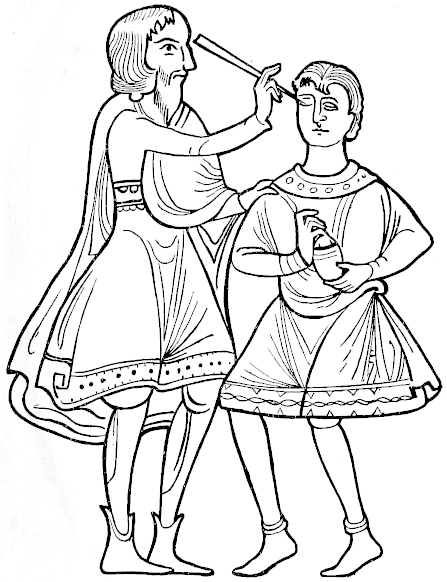
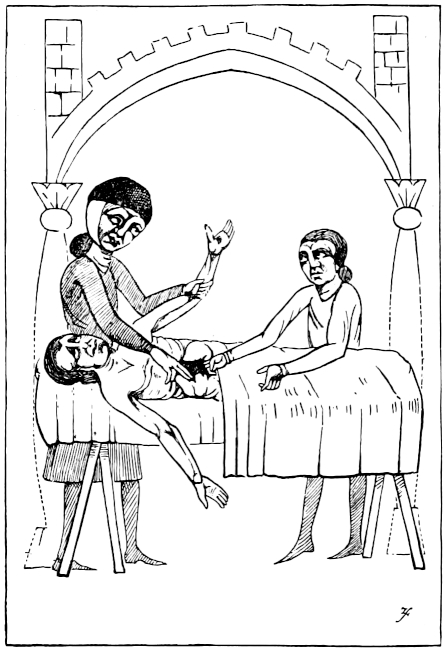
An Operation on the Eye From an MS. of the XIII century
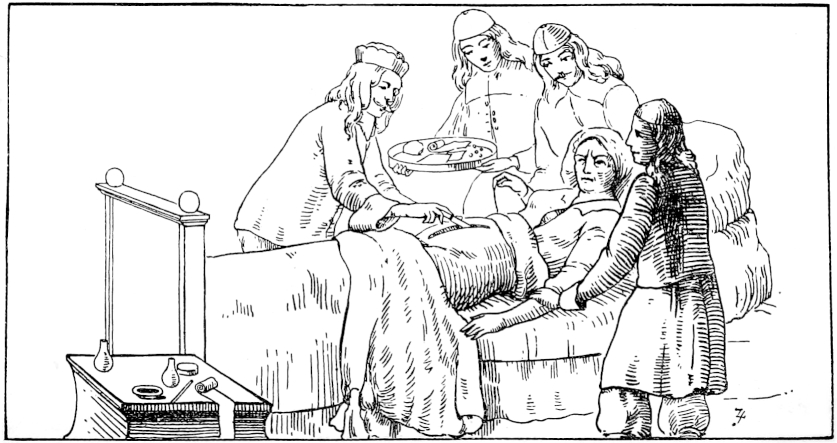
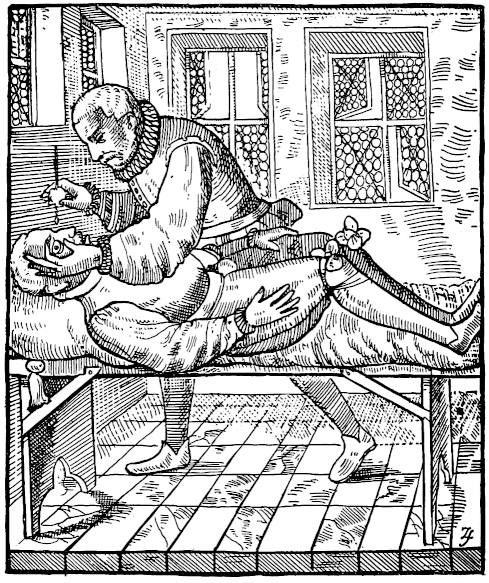
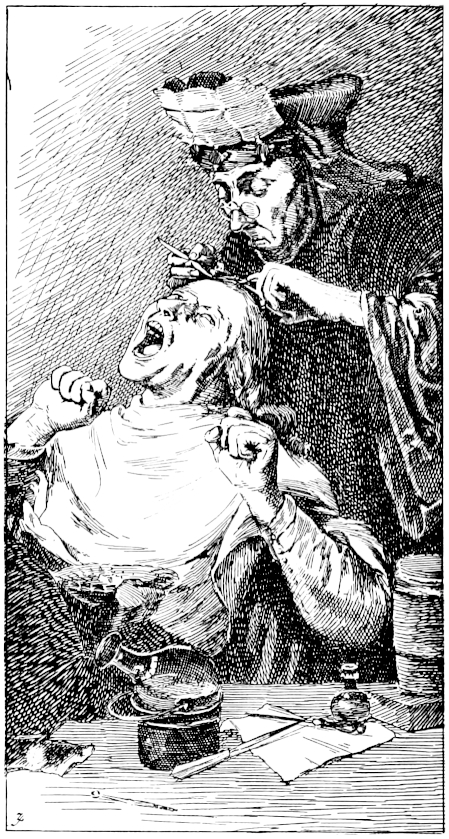
A Surgeon Performing an Operation From a woodcut of the XVII century
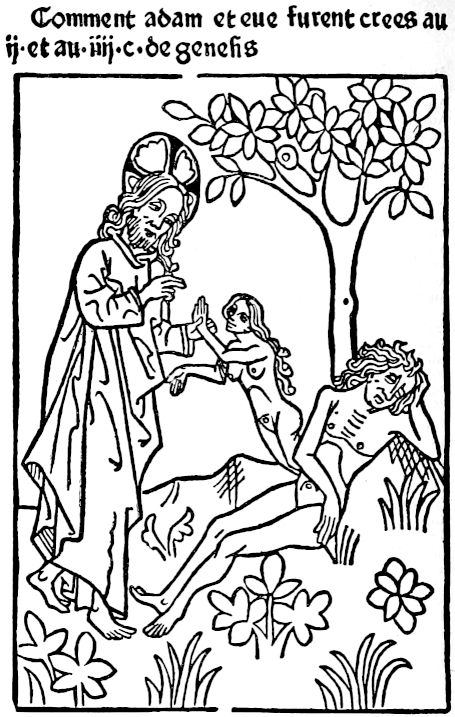
“And the Lord God caused a deep sleep to fall upon Adam, and
he slept: and He took one of his ribs, and closed up the flesh instead
thereof.” Genesis, chap. ii, verse 21
Anæsthetics, Antient and Modern An Historical Sketch of Anæsthesia — Mandragora as an Anæsthetic — Hindu Anæsthetics — Anæsthetics in the Middle Ages — The Chemical Era of Anæsthetics — Mesmerism as an Anæsthetic — The Nitrous Oxide Era — The Ether Epoch — The First Dental Operation under Ether — The Discovery of Chloroform as an Anæsthetic — Local Anæsthetics — The Necessity for Absolute Purity in Chloroform
“So God empal’d our Grandsire’s (Adam’s) lively look,
Through all his bones a deadly chilness strook,
Siel’d up his sparkling eyes with Iron bands,
Led down his feet (almost) to Lethe’s sands;
In briefe so numm’d his Soule’s and Bodie’s sense,
That (without pain) opening his side from thence
He took a rib, which rarely He refin’d,
And thereof made the mother of Mankind.”
The Dawn of Anæsthesia
Thus a sixteenth century poet quaintly describes,
and draws an impression of, from sacred records, the
first operation tempered by anæsthesia. It has been
claimed that in the “deep sleep” that the Creator
“caused to fall upon Adam” is the germ of the idea
of anæsthesia that has come down to us from the dim
ages of the past. It is probable that primitive
man employed digital compression of the
carotid arteries to produce anæsthesia, as
the aboriginal inhabitants of some countries
do to-day. According to Caspar Hoffmann, this
method was practised by the antient Assyrians before
performing the operation of circumcision. Curiously
enough the literal translation of the Greek and Russian
terms for the carotid is “the artery of sleep.”
Early Egyptian anæsthetics
The antient Egyptians are believed to have used
Indian hemp and the juice of the poppy to
cause a patient to become drowsy before a
surgical operation. Pliny relates that they
applied to painful wounds a species of rock brought
from Memphis, powdered, and moistened with sour
wine, which is the first record we have of local
anæsthesia with carbonic acid gas.
The “Wine of the Condemned”
The “sorrow-easing drug” which, as we are told
in the fourth book of the “Odyssey,” was given by
Helen to Ulysses and his comrades, probably consisted
of poppy juice and Indian hemp. It is indeed
actually stated that she learned the composition from
Polydamnia, the wife of Thone, in Egypt.
It is possible also that the “wine of the
condemned,” mentioned by the prophet
Amos, may have been a preparation of these drugs.
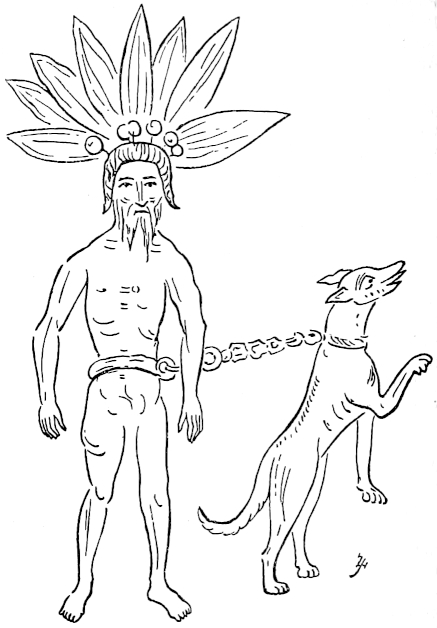
Mandragora (the Phallus of the Field)
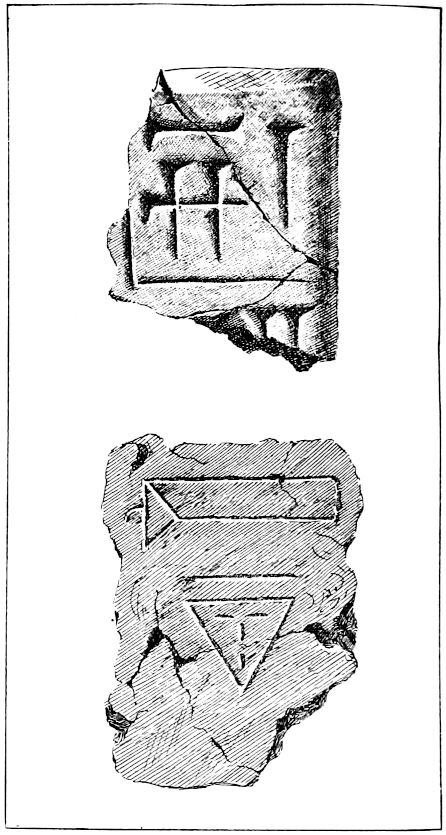
Inscribed in cuneiform characters and in Egyptian hieroglyphics
ca. 3000 B.C.
There are several passages in the Talmud which
point to the fact that the practice of easing the pain of
torture and death, by stupefying the sufferers, was a
very antient one.
Thus it is stated: “If a man is led forth to death,
he is given a cup of spiced wine to drink, whereby his
soul is wrapped in night”; and again, “Give a stupefying
drink to him that loseth his life, and wine to
those that carry bitterness in their heart.”
In connection with crucifixion, which was a common
punishment for malefactors among the Jews before the
Christian era, with the sanction of the Sanhedrin, the
women were wont to ease the terrible death agony of
the sufferers by giving them something in the nature of
a “wine of the condemned” upon a sponge. It is
probable that the “wine mingled with myrrh” which,
according to St. Mark, was offered to Christ before
nailing Him upon the Cross, was indeed a narcotic
draught, given with the object of lessening His
sensibility to the agony.
The earliest reference to anæsthesia by inhalation is
contained in the works of Herodotus, who states that
the Scythians were accustomed to produce intoxication
by inhaling the vapour of a certain kind of hemp, which
they threw upon the fire or upon stones heated for the
purpose. This was probably Cannabis indica, or Indian
hemp, which was employed by Oriental races as an
anæsthetic from very early times.
Anodyne poultices to deaden pain
At the siege of Troy the Greek army surgeons
employed anodyne and astringent poultices
to assuage the pain of the wounded. Thus
Patroclus, when his dagger from the thigh
of Euryphylus—
Cut out the biting shaft; and from the wound
With tepid water cleansed the clotted blood;
Then, pounded in his hands, the root applied
Astringent, anodyne, which all his pain
Allay’d; the wound was dried, and stanched the blood.
Iliad.
Gathering Mandragora
From an MS. of the XII century
From this interesting description of the manner in
which the early Greek surgeons treated a wound, it is
evident that, although they had no actual knowledge of
anæsthetics, they had found from experience the
advantage of cleansing the wound and applying an
astringent and anodyne dressing to deaden sensibility
to pain, which probably, unknown to them, also
possessed antiseptic qualities.
The anæsthetics of antient Greece
That the early Greeks also used certain methods for
deadening sensibility to pain is evidenced by several of
the antient writers. Pindar states “Machaon
eased the sufferings of Philoctetes with a
narcotic potion.” Theocritus also alludes to
Lucina, the goddess of the obstetric art, as
“pouring an insensibility to pain down all the limbs of
a woman in the throes of labour.” Aphrodite, to
assuage her grief for the death of Adonis, is said
to have thrown herself on a bed of lettuce and
mandragora.
There is no medicinal plant around which cluster
more mysterious and quaint associations than mandragora.
The Babylonians employed it more than 2000
years B.C., and a figure cut from the root was used at
that early period as a charm against sterility. It is
probable that the antient Hebrews also believed it to
possess these properties, judging from the story of
Rachel related in the book of Genesis. The early
Egyptians employed mandragora, which they called the
“phallus of the field,” as a medicinal agent, both as an
anodyne and an anæsthetic, and also used it in many
of their superstitious rites.
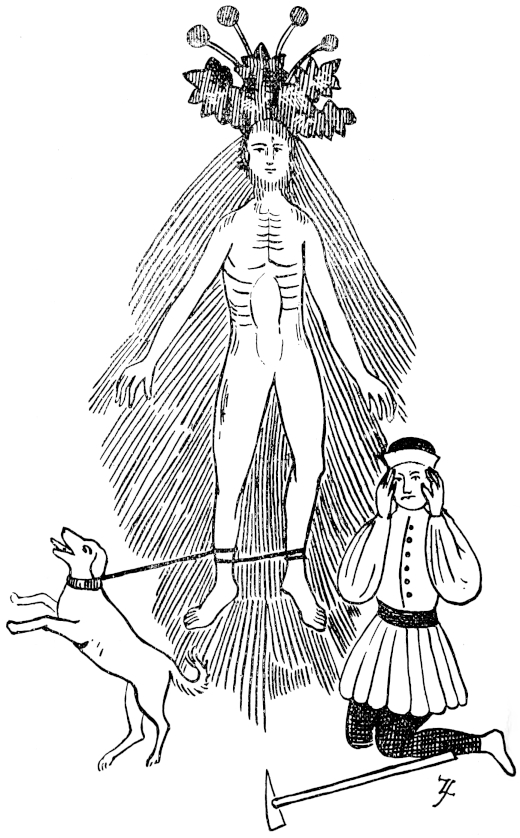
Gathering Mandragora
From an MS. of the XIII century
“To gather ye mandragora, go forthe at dead of nyght and take a dogge or
other animal and tye hym wyth a corde unto ye plante. Loose ye earth round
about ye roote, then leave hym, for in hys struggles to free hymself he wyll
teare up ye roote, which by its dreadfull cryes wyll kyll ye animal.”
Theophrastus is the earliest writer on botany to
allude to the virtues of mandragora, among which he
mentions its property of inducing sleep, and of its use
as an aphrodisiac in love potions. The Greeks gave
mandragora the name of “Circeum,” derived from that
of the witch Circe, and believed that an evil spirit dwelt
in the plant; for, when uprooted, it was said to utter
such frightful shrieks that no mortal man might hear
them and live.
To prevent this catastrophe, it was usual in gathering
the plant to take a dog and let him be sacrificed to the
rage of the demon. This method is thus described by
an antient writer:—“To gather ye mandragora, go
forthe at dead of nyght and take a dogge or other
animal and tye hym wyth a corde unto ye plante.
Loose ye earth round about ye roote, then leave hym,
for in hys struggles to free hymself he will teare up
ye roote, whych by its dreadfull cryes wyll kyll ye
animal.”
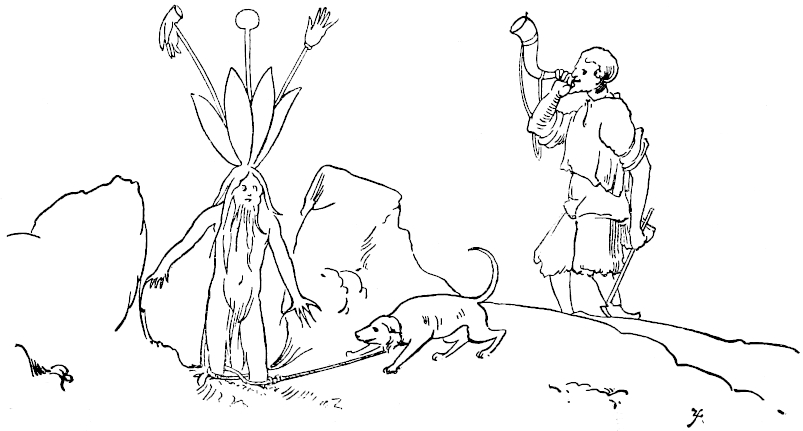
Certain rites and ceremonies were sometimes performed
before gathering the root, such as making three
circles round it with a sword, and the earth being
loosened with an ivory spade, while to drown the cries
of the fatal herb a horn was sometimes blown by the
gatherer.
According to an antient German legend, the mandragora
always grew with greater luxuriance beneath
or near a gallows, for the flesh of the felons hanged
thereon was believed to nourish the mysterious root
in which the demon dwelt. Another legend current
was, that the leaves of the plant sometimes glowed with
a peculiar light at night.
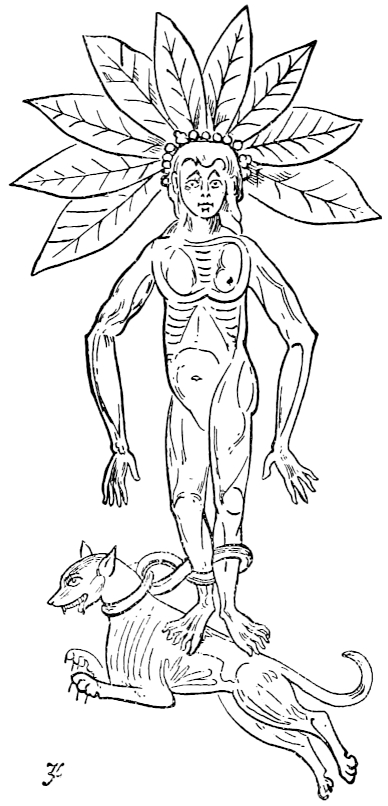
The supposed likeness of the root to the human form
gave rise to many of the superstitions connected with
mandragora, and it was believed in early times that there
were actually two distinct species, viz., male and
female. These roots were often carved to resemble
the human figure, and were worn as charms to ward
off disease.
Mandragora
From an MS. of the XV century
Mandragora as an anæsthetic
The first mention of mandragora (Mandragora Atropa,
L.), as an anæsthetic, is made by Dioscorides (ca.A.D.
100), who evidently recognised the difference
between the hypnotic and anæsthetic effects
of the drug, from which one may assume
that it was employed for both purposes in the medical
practice of that day. Respecting the former, he states:
“Eating which [mandragora] shepherds are made
sleepy,” and, referring to the latter property, he
remarks that “three wine-glassfuls of a liquid preparation
of the root are given to those who are about to
be cut or burnt, for they do not feel the pain.”
Of the preparations of mandragora, he gives the
following: “There are those who boil the root in
wine to a third part, and preserve the decoction, of
which they give a cyathus [small glass] in want of
sleep or severe pains in any part, and also before operations
with the knife, or the actual cautery, that they may
not be felt”; also “a wine is prepared from the bark
of the root, without boiling, and three pounds of it are
put in a cadus [eighteen gallons] of sweet wine; of this,
three cyathi are given to those who require to be cut
or cauterised, when, being thrown into a deep sleep,
they do not feel any pain.”
“Morion,” a Grecian anæsthetic
Dioscorides also refers to a substance called “morion,”
believed to be the white seed of the mandragora root,
which is mentioned also by Pliny as a narcotic
poison. “A drachm of it,” he states, “taken
in a draught, or in a cake or other food, causes
infatuation, and takes away the use of the reason; the
person sleeps without sense, in the attitude in which he
ate it, for three or four hours afterwards. Physicians
use it when they have to resort to cutting or burning.”
These allusions serve to prove how frequently anæsthesia
was practised by the physicians of antient Greece,
to whom the narcotic property of mandragora, which
is allied to Atropa Belladonna, or deadly nightshade,
was well known.
Gathering Mandragora
From a drawing of the XVI century
The plant is being uprooted by the struggling dog, whilst a horn is blown to drown the cries of the fatal herb
The younger Pliny (A.D. 32–79), in his “Natural
History,” also describes the use of mandragora as a
narcotic, and gives preference to the use of the leaves
over the root for that purpose. “The dose,” he says,
“is half a cyathus, taken against serpents, and before
cuttings and puncturings, that they may not be felt.”
He further adds: “For these purposes it is sufficient
for some persons to seek sleep from the smell,” from
which it is clear that this anæsthetic was also used
by inhalation.
With reference to mandragora, Sir Benjamin Ward
Richardson once prepared a draught according to one
of the recipes given by Dioscorides, and took it. He
tells us that “the phenomena repeated themselves with
all faithfulness, and there can be no doubt that, in
the absence of our now more convenient anæsthetics,
‘morion’ might still be used with some measure of
efficacy for general anæsthesia.”
Further allusion is made to mandragora as a surgical
anæsthetic by Apuleius in his “Liber de Herbis,” in
which he says: “If anyone is to have a limb mutilated,
burnt, or sawn, he may drink half an ounce of mandragora
with wine; and while he sleeps the member may
be cut off without any pain or sense.”
Avicenna, the Father of Arabian medicine, gives
special directions as to the employment of mandragora,
both as an anæsthetic and a hypnotic; while
Averrhöes, another Arabian physician, refers to the
soporific effects of the fruit of the same plant. Galen
also alludes to its powers to paralyse sensation, and
Paulus Ægineta states: “Its apples are narcotic, when
smelled to, and also their juice, that if persisted in
they will deprive the person of his speech.” According
to Isidorus, “a wine of the bark is given to those about
to undergo operations, that, being asleep, they feel no
pain”; and Serapion confirms this statement in his works.
Anæsthesia in Roman times
Evidence of the practice of surgical anæsthesia
is to be found in the writings of several
physicians during the time of the Roman
Empire. It is probable that the practice came to them
from the Greek school, for mandragora, which they
almost invariably used, grew largely in the Grecian
Archipelago. Celsus recommends a pillow of mandragora
apples to induce sleep.
From ancient records it appears probable, that the
Hindus inhaled the fumes of burning Indian hemp as
an anæsthetic at a period of great antiquity. As early
as the year 977 they also knew of other drugs which
they employed for the same purpose.
Pandit Ballala describes an interesting surgical
operation which was performed on King Bhoja at that
period. The patient was suffering from severe pain in
the head, and, his condition becoming critical, two
brother-physicians happened to arrive in Dhar, who,
after carefully considering the case, came to the conclusion
that a surgical operation was necessary to give
relief. They are said to have administered to him a drug
called sammohini to render him insensible, and while
he was completely under its influence they trepanned
his skull and removed the real cause of the complaint.
They closed the opening, stitched up the wound, and
applied a healing balm.
After the operation, they are said to have
administered to the King a drug called sanjivini,
to accelerate the return of consciousness and to
minimise the chances of death.
An antient Chinese anæsthetic
It is recorded that “a Chinese physician named
Hoa-Tho, who lived about A.D. 220 or 230,
was accustomed to administer to his patients
on whom he wished to perform painful operations,
a preparation called ‘Ma-yo’ (Indian hemp,
probably), the effect of which was that, after a
few moments, they became insensible as if they were
deprived of life.”
Miss Isabella Bird, when visiting the Tung-wah
Hospital, in Hong-Kong, states: “The native surgeons
do not use chloroform in operations, but they possess
drugs which throw their patients into a profound sleep,
during which the most severe operations can be performed.
One of them showed me a bottle containing
a dark brown powder, which, he said, produced this
result; but he would not divulge the name of one of its
constituents, saying it was a secret taught him by his
tutor.”
From very early times the fumes of burning
lycoperdon (Lycoperdon gygantum) have been used for
stupefying bees before taking honey from the hive.
Thus it will be seen from the many allusions we
have quoted from writers in the early ages, it is evident
that mandragora and Indian hemp were the two drugs
which were more or less in general use as anæsthetics
in antient times.
An early Irish anæsthetic
In a Celtic manuscript of the twelfth century on
materia medica, a preparation called “potu oblivionis”
is mentioned, of which mandragora was
probably an ingredient. A draught of this
preparation was used by the early Irish
to induce sleep.
The “Sleeping Sponge”
Coming to the fifteenth century, the method of producing
insensibility to pain by the inhalation of the
volatile principles of drugs, which had been handed
down by tradition from the early ages, seems to have
been revived by Hugo of Lucca, a Tuscan physician.
He is described as “chief of a school of surgeons that
treated wounds with wine, oakum and bandaging, with
happy success.” Theodoric, his son, who was a monk-physician,
and practised surgery, mentions, in 1490,
a preparation used by his father which he calls
“oleum de lateribus.” This he describes as
“a most powerful caustic, and a soporific
which, by means of smelling alone, could
put patients to sleep on occasion of painful operations
which they were to suffer.” The mixture was
Method of using the
“Sleeping Sponge”placed on a sponge in hot water, and then applied
to the nostrils of the patient, and was called the
“spongia somnifera.” The following is the composition
of the “sleeping sponge” and the method
of using, as stated by Theodoric: “Take of opium,
of the juice of the unripe mulberry, of hyoscyamus, of
the juice of hemlock, of the juice of the leaves of
mandragora, of the juice of the woody ivy, of the
juice of the forest mulberry, of the seeds of lettuce,
of the seeds of dock, which has large round apples, and
of the water-hemlock, each an ounce: mix all these in
a brazen vessel, and then place in it a new sponge; let
the whole boil as long as the sun lasts on the dog-days,
until the sponge consumes it all, and has boiled
away in it. . . . As oft as there shall be
need of it, place this sponge in hot water for
an hour, and let it be applied to the nostrils of
him who is to be operated on until he has fallen asleep,
and so let the surgery be performed.”
An Operation on the Liver
From an MS. of the XIV century
According to Bodin, the sleep produced was so
profound that the patient often continued in that
condition for several days afterwards. The method of
arousing the patient employed by Hugo, however, is
thus described: “In order to awaken him, apply
another sponge, dipped in vinegar, frequently to the
nose, or throw the juice of fenugreek into the nostrils;
shortly he awakens.”
According to Canappe, in his work “Le Gyidon pour
les Barbiers et les Chirurgiens,” published in 1538, the
“Confectio soporis secundum dominum Hugonem” was
used by surgeons at that period.
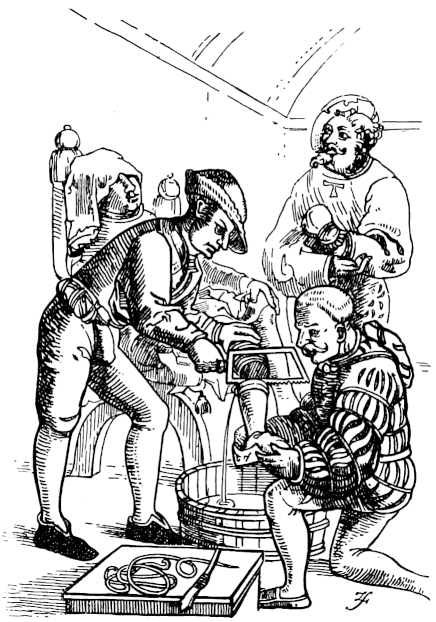
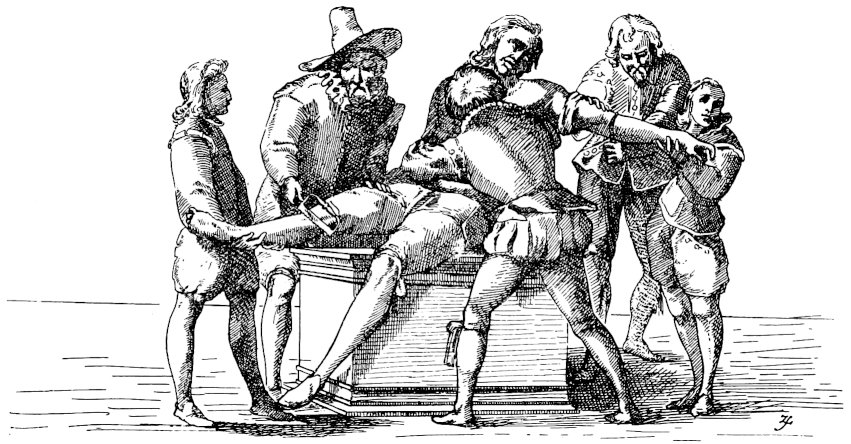
A Surgeon Amputating a Leg
From a woodcut of the XVI century
Reginald Scott, in a work written in the sixteenth
century, gives the following recipe for making an
anæsthetic: “Take of opium, mandragora bark and
henbane root, equal parts; pound them together, and
mix with water. When you want to sew or cut a
man, dip a rag in this, and put it to his forehead
and nostrils. He will soon sleep so deeply that you
may do what you will. To wake him up, dip the rag
in strong vinegar. The same is excellent in brain-fever,
when the patient cannot sleep; for if he cannot sleep,
he will die.”
Anæsthesia in romance
The writers and poets of mediæval romance in more
than one instance allude to anæsthesia produced by
drugs. Boccaccio, who wrote his “Decameron”
in 1352, in the story of Dionius, alludes to a
certain anæsthetic liquid of Surgeon Mazzeo
della Montagna, of Salerno. “The doctor,” he says,
“supposing that the patient would never be able to
endure the pain without a soporific, deferred the operation
until the evening, and in the meantime ordered
the water to be distilled from a certain composition,
which, being drunk, would throw a person asleep as
long as he judged it necessary.” Boccaccio, probably,
borrowed his idea from the recipe given by Nichols,
a provost of the famous old school of Salerno, who
published a recipe for making an anæsthetic, similar to
that of Reginald Scott.
In Brooke’s “Tragicall Historye of Romeus and
Julietta,” printed in 1562, which supplied Shakespeare
with the plot and much material for his play
“Romeo and Juliet,” Friar Laurence thus speaks to
Julietta: “I have learned and proved of long time
the composition of a certain paste which I make of
divers somniferous simples, which beated afterwards to
powdere, and dronke with a quantitie of water, within
a quarter of an houre after, bringeth the receiver into
such a sleepe, and burieth so deeply the senses and
other spirits of life that the cunningest phistian will
judge the party died.
“And, besides that, it hath a more marvellous effect,
for the person which useth the same feeleth no kind of
grief, and, according to the quantitie of the draught, the
patient remaineth in a sweete sleepe; but when the
operation is perfect and done, he returneth unto his
first estate.”
A Surgeon Amputating a Leg
From a woodcut of the XVI century
Shakespeare’s references to mandragora, poppy and
other “drowsy syrups,” are too well known to need
quotation; but the following allusion by Middleton, in
his play called “Women beware Women!” is not
without interest:—
I’ll imitate the pities of old surgeons
To this lost limb, who, ere they show their art,
Cast one asleep, then cut the diseased part.
William Bulleyn, the author of “A Bulwark of
Defence against Sickness,” who practised as a surgeon
in the reign of Henry VIII, describes an anæsthetic
which he directs to be prepared from the juice of a
certain herb (probably mandragora) “pressed forth,
and kept in a closed earthen vessel according to art,
bringeth deep sleep, and casteth man into a trance, or
deep terrible sleep, until he shall be cut of the stone.”
Allusions to anæsthesia
by antient poets
The poet Marlowe thus refers to mandragora
in his play “The Jew of Malta”:—
Barabas:
I drank of poppy and cold mandrake juice,
And being asleep, belike they thought me dead,
And threw me o’er the walls.
Du Bartas, as translated by Sylvester in 1592, makes
the following allusion to anæsthesia:—
Even as a surgeon minding off to cut
Som cureless limb; before in use he put
His violent engins in the victim’s member,
Bringeth his patient in a senseless slumber:
And griefless then (guided by use and art)
To save the whole, saws off the infested part.
Porta, writing in 1579, says: “It is possible to extract
from several soporific plants a quintessence, which is
to be shut up in a well-covered leaden vessel, lest the
drug should evaporate. When it is to be used, the lid
is to be removed and the medicament held to the
nostrils, when its vapour will be drawn in by the breath
and attack the citadel of the senses, so that the patient
will be sunk in a deeper sleep not to be shook off
without much labour.”
A Surgeon Performing an Operation on the Eye
From a woodcut of the XVII century
Besides mandragora, opium, Indian hemp, and other
plants with narcotic properties already referred to, that
were used for anæsthetic purposes in mediæval times,
certain substances are mentioned by early writers that
cannot be identified. Thus Albertus Magnus mentions
an animal product, of which he says: “Any person
smelling it falls down as if dead and insensible to pain,”
but there is no reference to such a drug by other
writers of the period.
Local anæsthetics
in antient times
Local anæsthesia was not unknown during the
middle ages, and Cardow recommends the
inunction of a mixture consisting of “opium,
celandine, saffron, and the marrow and
fat of man, together with oil of lizards.”
He also adds: “If the patient drinks wine in which
the seeds of the patulica marina have been steeped
for a week, it will prevent him feeling any pain.”
First mention of
freezing as an anæsthetic
Bernard mentions that it was customary in Salerno
to mix the crushed seeds of poppy and henbane,
and apply them as a plaster, to deaden
sensibility, to parts that were about to be
cauterised; while Bartolinus states that local
anæsthesia was sometimes produced by freezing,
thereby foreshadowing the use of ether and ethyl
chloride as local anæsthetics.
During the seventeenth century the belief in the
narcotic draughts of the antients for producing anæsthesia
appears to have waned, and few allusions are
made to them until the middle of the eighteenth
century, when fresh interest seems to have been excited
in the subject. The famous Boerhaave is said to have
used opium as an anæsthetic, both by inhalation of its
vapour and also by internal administration in powder.Boerhaave’s anæsthetic
According to Van Swieten, in his commentaries upon
Boerhaave’s “Aphorisms,” the following is given as
the recipe: “Oil of cinnamon, 2 drops; oil
of cloves, 1 drop; citron peel, 2 grains; sugar,
2 drachms. Mix and add red coral, prepared, 1 drachm;
pure opium, 2 grains. Mix for two doses, one of which
is to be taken one hour before the operation, and the
other one quarter hour before it, if the patient has not
slept.”
An Operation in the Seventeenth Century
From a painting by Franz Hals
An operation on the King of Poland
In 1782, Weiss is said to have operated on the foot
of Augustus, King of Poland, having previously placed
the royal patient under the influence of “a
certain potion surreptitiously administered.”
Shortly afterwards Sassard, a surgeon of La
Charité, in Paris, suggested that patients who were
about to be operated upon should be drugged with
narcotics as a means of preventing shock. That this
method was sometimes practised is evidenced from a
chapter in “Bell’s Surgery,” where the author not only
refers to it but objects to the method on account of
the sickness and vomiting it produced.
As late as 1847, Chisholm, of Inverness, recorded his
use of a drug given internally to produce anæsthesia
for surgical purposes; he substituted the internal use
of morphine for ether inhalation in a case of ablation
of the breast successfully performed upon a woman, who
declared that she felt no pain during the operation.
Anæsthesia by compression of the
carotid arteries revived
Other means of producing insensibility were suggested
in the eighteenth century, and the antient
method of compressing the carotid arteries
was revived. This method had been used by
Valverdi about 1560, and Morgagni employed
it about 1750 in his experiments on animals,
and suggested that it might be used on human
beings. Compression of the nerves of the limb about
to be removed, was also proposed, by James Moore in
1784, and tried by Hunter and others, but the results
could not be regarded as successful.
Nelson’s arm amputated
Surgical operations at this time meant periods of
agonising pain, and the stoutest hearts often quailed
at the prospect. It is said that Lord Nelson
was so painfully affected by the coldness of
the operator’s knife when his right arm was
amputated at Teneriffe, that at the Battle of
the Nile he gave orders to his surgeon to have hot
water kept ready, so that at the worst he might be
operated upon with a warm knife.
The dawn of a new era
Thus from the dawn of creation anæsthesia for
surgical operations had been practised to some extent,
but, owing to the uncertainty of the potency
and action of the powerful narcotics and
palliatives administered, and the danger
attending their use when exact science was unknown,
the practice seemed likely to fall into oblivion.
At last a series of brilliant discoveries in chemistry
created a new epoch in the history of anæsthesia.
Priestley’s discoveries
The discoveries of Priestley about 1767 led up to the
plan of administering gases and vapours of definite
composition by inhalation through the lungs,
and directly he had demonstrated the existence
of “vital air,” or oxygen, the properties
of this body were tested in the hope of great results in
the art of medicine. Priestley’s experiments concerning
the inhalation of oxygen were in time followed by those
of Beddoes, who recommended the inhalation of oxygen,
hydrogen and other gases in the treatment of disease.
It seemed only natural that experiments with other
gases and vapours by inhalation should follow.
Pearson, of Birmingham, administered ether in this
way in 1795 for the relief of consumption, and ten
years afterwards Warren, of Boscombe, employed
ethereal inhalation to relieve the sufferings attending
the later stages of phthisis.
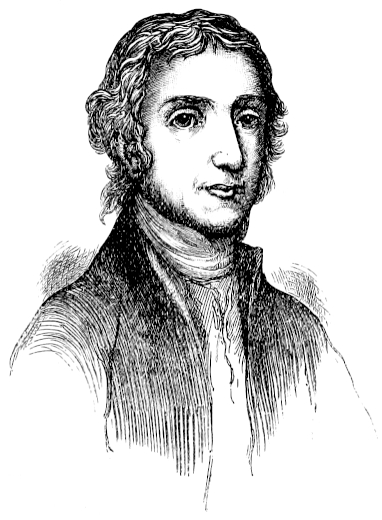
Joseph Priestley
Priestley’s discoveries of the method of liberating and
collecting gases, and his demonstrations that certain
gases could be absorbed and compressed in water, led
to the introduction of aërated waters—carbonic acid
gas being the first to be employed.
In the course of time, nitrous oxide, which had
been discovered by Priestley in 1776, was compressed
in water, and came into general use as a medicinal
agent.
Anæsthetic properties
of nitrous oxide
In 1798, a Medical Pneumatic Institution was
established at Bristol by the exertions of Beddoes
and others, and Humphry Davy was appointed superintendent.
It was here that he commenced and carried
on his notable researches on nitrous oxide. In
one of his experiments he constructed a box
or chamber in which he inhaled the gas in
measured quantities. One day, in the year
1799, when suffering from toothache or inflammation of
the gums, he resorted to the inhalation of the gas, and
discovered to his great delight that it relieved the pain,
which led him to the conclusion he expresses in the
following words in “Researches Chemical and Philosophical,”
1800: “As nitrous oxide in its extensive
operation seems capable of destroying physical pain,
it may probably be used with advantage during surgical
operations in which no great effusion of blood takes
place.”
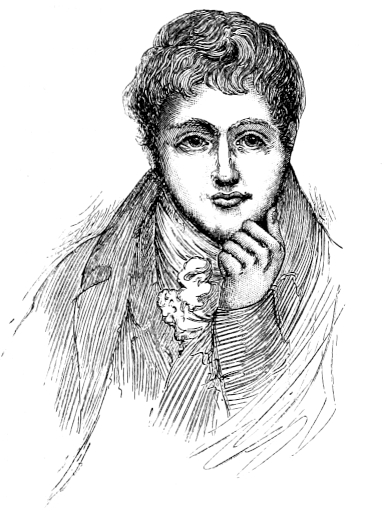
Sir Humphry Davy
Faraday points out similarity in
the effects of nitrous oxide and sulphuric ether
About 1806, Woolcombe, of Plymouth, prescribed
for Lady Martin, a patient suffering from asthma, the
inhalation of sulphuric ether to relieve the attacks.
Lady Martin found the inhalation gradually caused her
to become unconscious, from which state she would
recover in a short time, with the result that the paroxysm
of dyspnœa had disappeared. But the teaching of this
case, and even the more explicit account of
Humphry Davy, was overlooked; and no
further development occurred until the year
1818, when Faraday pointed out, in “The
Quarterly Journal of Science and Arts,” that
the inhalation of the vapour of sulphuric ether
produced effects similar to those caused by nitrous oxide.
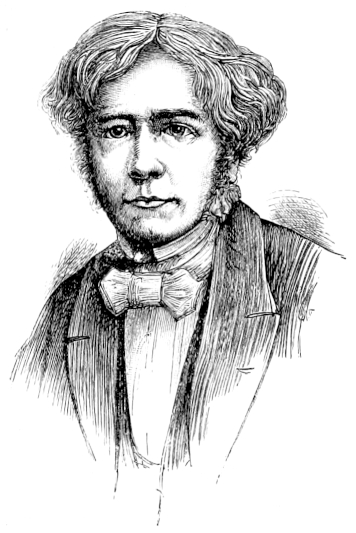
Michael Faraday
About this time Professor Thompson, of Glasgow,
was accustomed annually to amuse his students by
allowing them to inhale ether and nitrous oxide until they
were intoxicated, and occasionally became unconscious,
when it was noticed that they were insensible to the
prick of a pin, or a blow. In these cases the gas or
ether was inhaled from a bladder. Two drachms of
rectified and washed ether were poured into a bladder
and allowed to diffuse. Then the mixture of air and
ether vapour was breathed, the expired air being
allowed to enter the bladder also. Curiously enough,
very little improvement has been made on this method
of administration to the present day.
On the brink of the discovery
It is an extraordinary fact that, even in the face of
such experiments as those we have referred to, no one
among the investigators who stood at this time
on the brink of so great a discovery ventured
over the threshold. It is almost inconceivable
in these days to realise, that for thirty-nine
years these substances were used for experimental purposes,
and even for amusement, without a realisation of
the great blessing to humanity that lay almost within
grasp. The things that are apparently most plain may
lie longest buried; so with the discovery of efficient
anæsthesia, which even then developed in an indirect
manner.
Mesmerism in antient times
From the earliest ages the apparent power of some
men to influence the minds and bodies of others has
been known. Certain diseases were said to be affected
by the touch of the hand of certain persons, who were
supposed to communicate a healing virtue to the
sufferer, and these practices were often connected with
religious and magical rites. This method of healing
was practised in antient times by the Chaldæans,
Babylonians, Egyptians, Persians, Hindus, Greeks
and Romans. Their priest-physicians are said to have
effected cures and to have thrown people into deep
sleep in the precincts of the temples. Such
influences were at that time held to be due
to supernatural power, a belief which was no
doubt fostered by the priesthood. In the middle of
the seventeenth century an Irishman named Valentine
Healing by “stroking”
Greatrakes aroused great interest in England by his
supposed power of being able to cure scrofula by
stroking the patient with his hand. Most of the
distinguished scientific men of the day, such as
Sir Robert Boyle, witnessed and attested his cures, and
thousands of sufferers crowded to him from all parts of
the country. Since his time other men have
come forward with similar claims, notably one
Gassner, a Roman Catholic priest of Swabia,
who in the early part of the eighteenth century attracted
attention by stating that he could cure the majority
of diseases by exorcism. His method had an extraordinary
influence over the nervous systems of his
patients, who in the end generally confessed themselves
cured.
Mesmer’s experiments
In 1766, Mesmer, who was a pupil of Hehl, professor
of astronomy at Vienna, and an advocate of the efficacy
of the magnet for the cure of disease, met
Gassner, and observed that the priest effected
cures without the use of magnets and by
manipulation alone. This led him to believe that
some kind of occult force resided in himself, by means
of which he could influence others. He held that this
force permeated the universe, and more especially
affected the nervous systems of men. In 1778, he
removed to Paris, and shortly afterwards the French
capital was thrown into a state of great excitement by
the fact that human beings could be placed in a state
of artificial sleep or trance, which was then called
“mesmerism.”
Mesmer’s disciples claimed that even painful operations
could be performed on patients in this condition
without consciousness of pain.
Braid’s researches on hypnotism
Braid, who made a further investigation of the
subject, dissented from the mesmerists as to
the cause of the phenomenon, and called
the condition “hypnotism.” In 1846, the
Deputy-Governor of Bengal appointed a committee
to observe and report on the surgical operations
Esdaile operates on
hypnotised patients
that were then being performed in India by Esdaile
upon his patients, while under the influence of alleged
mesmeric agency. The Committee reported on various
experiments carried out under their observation, some
of which had apparently been performed with great
success. But from further investigation it
was apparent that the method was uncertain,
and success seemed to be due to the peculiar
susceptibility of the patient operated upon.
These experiments are worth recording, as they
indirectly led to the practice of administering certain
vapours to produce anæsthesia.
Robert Collier one of the first
pioneers
One of the pioneers in the practice of inhalation was
Robert H. Collier, who was a believer in mesmerism.
In 1835 he was present at a lecture given by Dr. Turner,
Professor of Chemistry at University College, London,
and in the course of some experiments in the inhalation
of ether was himself rendered unconscious, and also
observed that his fellow-students who had inhaled it
were insensible to pain. Four years later he went to
America, and, while visiting his father’s estate
near New Orleans, he was called to one of the
negroes who had become insensible by
inhaling fumes from a vat of rum, and who,
in falling, had dislocated his hip. Finding the muscles
flaccid, Collier reduced the dislocation without exciting
the least sensation of pain in the patient. A little later
he performed two operations upon patients while under
mesmeric influence, with apparent success. These
facts led him to connect the phenomenon of mesmerism
with narcotism produced by inhalation, and in 1840
he commenced a lecturing tour throughout America
on the subject. Three years later he returned to this
country, and at Liverpool, where he landed, gave his
first lecture, which he illustrated by experiments in
mesmerism, and also showed the possibility of rendering
a subject unconscious by the fumes of alcohol in
which poppy-heads and coriander had been macerated.
The theory he advanced, and attempted to prove
throughout, was that the so-called mesmeric influence
was identical in action with that of narcotic vapours.
Uses his alcoholic
mixture as an anæsthetic in 1842
He claimed to have administered the fumes of his
alcoholic mixture to a Mrs. Allen, of Philadelphia, in
1842, and while under its influence he extracted
a tooth without causing her pain. Collier’s
lectures excited general attention at the time,
and there is little doubt that they gave a fresh
impetus to research on the subject of anæsthesia
by inhalation. He must therefore be
regarded as an important pioneer, who, had he given
up his ideas of mesmerism and proceeded systematically
with his plan of making the body insensible by inhaling
the vapour of alcohol, would have had no one to dispute
with him in priority.
Although, as already stated, Humphry Davy had
discovered the anæsthetic properties of nitrous oxide
as far back as the year 1800, forty-four years elapsed
before his idea was put into practical use.
Colton lectures on
nitrous oxide
On December 11th, 1844, Dr. G. Q. Colton, a well-known
lecturer on popular scientific subjects in
America, and a pupil of Professor Turner, of
London, delivered a lecture at Hartford,
Connecticut, during which he gave a demonstration
of the action of nitrous oxide gas.
Horace Wells, a dentist, then in practice in the same
town, formed one of the audience.
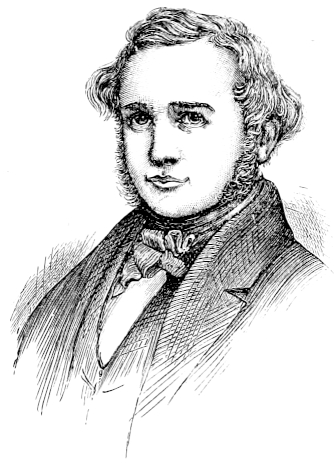
Horace Wells
Wells makes his historic
experiment
Among the persons who were invited by the lecturer
to inhale the gas for the amusement of the audience
was a man named Cooley, who wounded himself
severely by falling against the benches, and only
became aware of the fact when he saw the
blood. Wells was greatly struck by this
incident, and he determined to test the
anæsthetic effects of the gas upon himself the
next day by having a decayed upper molar extracted
while under its influence. After the lecture he asked
Dr. Colton if he would come to his house and
administer the gas to him; and, on receiving his
promise, he induced a Dr. Riggs to be the operator.
“A new era in tooth-pulling”
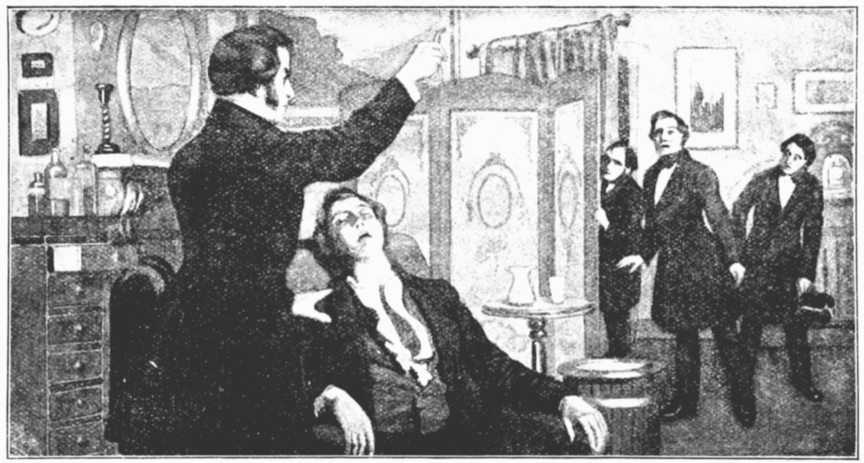
The historic event is described by the latter as
follows: “A few minutes after I went in, and, after
conversation, Dr. Wells took a seat in the operating
chair. I examined the tooth to be extracted, with a
glass, as I usually do. Wells took a bag of gas from
Dr. Colton and sat with it in his lap, and I stood by
his side; he then breathed the gas until he was much
affected by it: his head dropped back, I put my hand
to his chin, he opened his mouth, and I extracted the
tooth. His mouth still remained open some time. I
held up the tooth with the instrument that the others
might see it; they, standing partially behind the
screen, were looking on. Dr. Wells soon
recovered from the influence of the gas so as
to know what he was about, discharged the
blood from his mouth, and said, ‘A new era in
tooth-pulling!’ He said it did not hurt him at all.
We were all much elated, and conversed about it for
an hour later.”
“A New Era in Tooth-Pulling”
The first dental operation performed on Horace Wells whilst under the influence of nitrous oxide gas
After this, Wells extracted several teeth from his
patients under nitrous oxide gas with equal success,
and then went to Boston in order to make his discovery
known to the medical profession in that city. He
remained there some days in the hope of being allowed
to try the gas in a case of amputation in the Massachusetts
General Hospital, but the experiment was
postponed. Dr. Warren, senior surgeon to the institution,
however, invited him to address his class on the
subject of anæsthesia, after which he was asked to
administer the gas in a case of tooth extraction. He
was assisted on this occasion by Morton, a Boston
dentist who had been his pupil, and afterwards, for a
time, his partner. The experiment, as Wells himself
confesses, was not quite a success, the gas-bag having
been removed too soon. The whole thing was
denounced as a piece of humbug, and Wells was
hissed out of the room as an impostor.
Wells disheartened by failure
Disheartened at length by the failure of his repeated
attempts to establish his claims to priority as the
discoverer of anæsthesia, his mind appeared to become
affected, and for a time he wandered about
the streets of New York. On January 4th, 1848,
he was arrested and charged with throwing
vitriol, but while in gaol he opened his radial artery,
having first inhaled ether to make death painless.The death of Horace Wells
This sad event closed, at the age of
thirty-two, the career of Horace Wells, to
whom at least belongs the credit of having first
shown the practicability of producing insensibility by
nitrous oxide, and of having thus, in his own words,
“established the principle of anæsthesia.”
Probably the first published account of the use of
ether as a medicinal agent was made by Morris in a
letter read before the Society of Physicians in London,1
on December 18th, 1758, in which he advocates its use
internally, and also as an external application.
1
“Med. Obs. and Enq.” by the Society of Physicians in London, vol. 2,
page 176, 1764.
In 1818, Faraday, as already stated, had called attention
to the anæsthetic properties of ether, and showed
that the vapour of sulphuric ether, when inhaled, produced
effects similar to those of nitrous oxide. After
Wells’ failure at Boston nothing further seems to have
been done for a time to investigate the use of nitrous
oxide as an anæsthetic.
Early experiments with ether
In 1839, William E. Clarke, a young medical student
of Rochester, New York, was in the habit of amusing
some of his friends, among whom was another
student named W. T. G. Morton, by the
inhalation of ether. Emboldened by his experiences,
in 1842 he is said to have administered ether,
by means of a towel, to a young woman named Hobbie,
and during the period of insensibility which followed,
one of her teeth was extracted by a dentist named
Elijah Pope.
J. Marion Sims relates the following incident which
he states happened in the year 1839:—“A number of
youths in Anderson, South Carolina, were exhilarating
themselves one day with the seductive vapour of ether.
In their excitement they seized a young negro who was
watching their antics, and compelled him to inhale the
drug from a handkerchief which they held over his
mouth and nose by main force. At first his struggles
only added to the amusement of his captors, but they
soon ceased as the boy became unconscious, stertorous
and apparently dying. After an hour or two of anxiety
on the part of the spectators he, however, revived, and
was apparently no worse for his alarming experience.”
Long claims to have used
ether in 1842
Three years after this incident one of the participators
in the affair, named Wilhite, became the pupil of
Dr. Crawford W. Long, a physician then
practising in Jefferson, Jackson County,
Georgia. Both the doctor and his pupils used
occasionally to amuse themselves by inhaling
ether, and the former often noticed that while thus
excited he was insensible to blows and bruises. Wilhite
recounted to him his memorable experience with the
negro boy; and, in March, 1842, Long is said to have
persuaded a patient, on whom he was about to
operate for a small encysted tumour, to inhale ether
until he was insensible. The patient consented, and
the tumour was removed without any pain or accident.
This memorable event was simply recorded by Long in
his ledger thus:—“James Venable, 1842. Ether and
excising tumour, $2.00.” Three months later he removed
another tumour from the same patient in a similar way,
and also performed three other operations during that
year. He is said to have again repeated the experiment
in 1843 and 1845, but the district in which he lived was
so far removed from contact with the large cities and
centres of thought, that the discovery remained unknown
and unpublished until long after the anæsthetic
properties of ether had been fully proved elsewhere.
Long himself admits that he considered ether impracticable
owing to the shortness of the anæsthetic
state, and he therefore abandoned its use.
Marcy’s experiment
Towards the end of the year 1844, Dr. E. E. Marcy,
a surgeon of Hartford, is said to have
administered ether to a patient, and to have
removed an encysted tumour about the size
of a walnut from the scalp.
It is stated that Horace Wells was present at this
operation, which was quite successful, but, being warned
that ether was dangerous to life, the experimenters
abandoned its use in favour of nitrous oxide gas.
Morton’s experiments with ether
In 1846, W. T. G. Morton (referred to previously)
who had been in partnership with Wells as a dentist,
and assisted him in the unfortunate experiment
with nitrous oxide in Boston, now directed his
attention to the finding of a more suitable
anæsthetic for painless operations in dental surgery.
After many unsuccessful attempts with various narcotics,
Charles T. Jackson, a chemist of Boston, whose
pupil he had been, suggested that he should try sulphuric
ether, the properties of which had been known for so long.
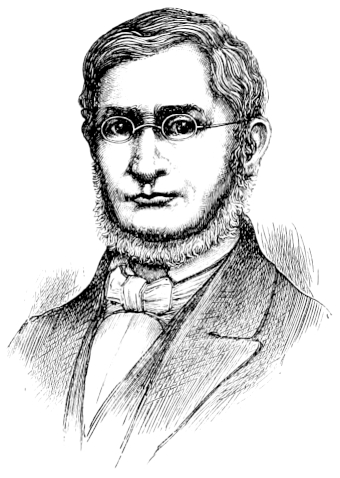
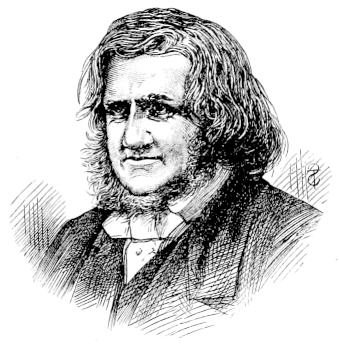
Charles T. Jackson
Jackson’s story
It was about the end of September, 1846, that
Jackson states he informed Morton that he had
experimented on himself by inhaling ether
on a folded towel. He found that he lost all
power over himself, and fell back in his chair
in a state of curious sleep. Morton, however, tells
another story, and relates how, having procured some
chemically pure ether on September 30th, 1846, he
shut himself in a room alone and inhaled the vapour.
He states: “I found the ether so strong that it partly
suffocated me, but produced no decided effect. I then
saturated my handkerchief and inhaled it from that. I
looked at my watch and soon lost consciousness. As
I recovered I felt a numbness in my limbs, and a
sensation like nightmare. I thought for a moment I
should die in that state, but at length I felt a slight
tingling of the blood in the end of my third finger,
and made an effort to press it with my thumb, but
without success. At the second effort I touched it, but
there seemed to be no sensation. I attempted to rise
from my chair, but fell back, and looked immediately
at my watch and found that I had been insensible
between seven and eight minutes.”
Morton soon had an opportunity of making a practical
experiment with the anæsthetic, for the same evening,
about nine o’clock, a man named E. H. Frost called
upon him suffering from a violent attack of toothache.
“Can’t you mesmerise me?” asked the sufferer.
“Upon which,” says Morton, “I told him that I had
something better than mesmerism by means of which I
could take out his tooth without giving him pain. He
gladly consented, and saturating my handkerchief with
ether, I gave it to him to inhale. He became
unconscious almost immediately. It was dark, and
Dr. Hayden held the lamp. My assistants were
trembling with excitement, apprehending the usual
prolonged scream from the patient while I extracted a
firmly-rooted bicuspid tooth. I was so agitated that I
came near throwing the instrument out of the window.
But now came a terrible reaction. The wrenching of
the tooth had failed to rouse him in the slightest
degree. I seized a glass of water, and dashed it in
the man’s face. The result proved most happy. He
recovered in a minute, and knew nothing of what had
occurred.”
First surgical
operation under ether
Morton next appealed to Dr. John C. Warren, who
was then Senior Surgeon at the Massachusetts
General Hospital, and obtained permission to
test his new anæsthetic on a patient about
to undergo a surgical operation. The date
fixed was Friday, October 16th, 1846, and at the
appointed time a large number of medical men had
assembled in the theatre. Morton administered the
anæsthetic successfully, and the operation, which was
for a congenital vascular tumour of the neck, in a young
man named Gilbert Abbot, was completed in about
five minutes without a groan from the patient. When
it was finished, Dr. Warren exclaimed: “Gentlemen,
this is no humbug!” The interest excited amongst those
who witnessed the operation was naturally very great,
and Dr. Henry J. Bigelow, who was present, said to a
friend whom he met later in the day: “I have seen
something to-day that will go round the world!”
His prophecy proved correct.
Up to this time Morton had not disclosed the nature
of the agent he employed, and nothing more was done
until November 7th, when he expressed his willingness
to reveal the secret. On this date two major operations
were performed under ether, one by Dr. Hayward and
the other by Dr. Warren.
From this time ether took its place as a general
anæsthetic, and the practice of anæsthesia was firmly
established.
The origin of the words
“anæsthesia” and “anæsthetic”
Soon after the memorable 16th of October, a meeting
was held in Boston, to choose a name for the new
anæsthetic agent, and the word “letheon”
was chosen by Morton himself; but, subsequently,
Dr. Oliver Wendell Holmes
suggested the name “anæsthesia” for the
condition, and “anæsthetic” for the agent, which
names have since come into general use.
Although it has never been very clearly established
whether Morton or Jackson was the prime originator of
the use of ether as an anæsthetic, the former was
recognised by the United States Government as the
discoverer, and received from it a handsome award. It
seems most probable that Jackson supplied the inspiration,
while Morton practically demonstrated it.
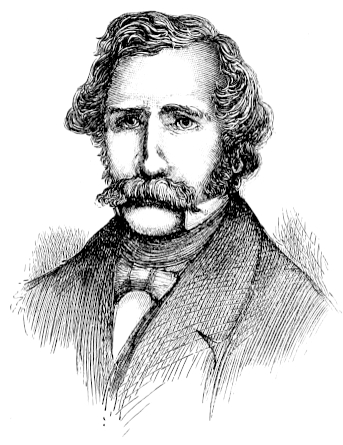
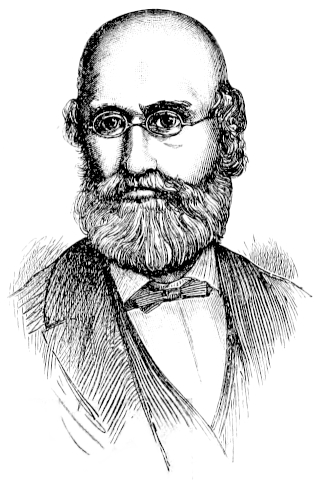
W. T. G. Morton
In reviewing the steps which led up to the discovery,
it must not be forgotten that both Morton and Jackson
were after all but followers of Collier, who first rendered
himself unconscious with ether in the laboratory of
University College, London, and forged one of the
most important links in the chain of development.
Morton spent most of the remainder of his life in
disputes about priority, and in efforts to secure recognition.
He died bankrupt and broken-hearted on July
15th, 1868, before he had completed his forty-ninth year.
Curiously enough, Jackson, like Wells, became insane,
and died in an asylum in 1880. When the friends of
the rival claimants of the discovery of anæsthesia were
proposing that monuments should be erected to each,
Oliver Wendell Holmes characteristically suggested
that all should unite in erecting a single memorial, with
a central group symbolising painless surgery, a statue
of Jackson on one side, a statue of Morton on the other,
and the inscription underneath:—
TO E(I)THER
The news of the “ether process for removing pain,”
as it was then called, spread rapidly. A private letter
from Dr. J. Bigelow to
Dr. Francis Boote, of Gower
Street, carried the first
news to England, and was
communicated to the medical
profession in London
on December 17th, 1846.
Two days later, Mr. James
Robinson, a dentist, of
Gower Street, performed
the first dental operation
under ether in England,
the patient being a Miss
Lonsdale, and the operation
the extraction of a firm molar tooth.
On December 21st the first surgical operation under
the new anæsthetic in England was performed by
Robert Liston, in University College Hospital, London.
First surgical operation
under ether in Great Britain
In the operating theatre, thronged with students, were
the late Sir John Erichsen, the present Lord
Lister, and many other famous surgeons.
Mr. Barton relates an amusing incident which
happened prior to the operation. Before the
patient was brought in, the anæsthetist
asked the students who crowded the benches in the
theatre from floor to ceiling for some volunteer who
would submit himself to be anæsthetised. A young
man, Sheldrake, of very powerful build and a good
boxer, at once offered to take the new anæsthetic, and
came into the arena. “He lay on the table, and the
anæsthetist proceeded to administer the ether. After
the administration had proceeded for about half a
minute, the subject of the experiment suddenly sprang
up and felled the anæsthetist with a blow, and, sweeping
aside the assistants in the arena, sprang shouting up the
benches, scattering the students, who fled like sheep
before a dog. He fell at the top bench, where he was
seized and held down till he regained his senses. The
whole scene hardly occupied a minute.”
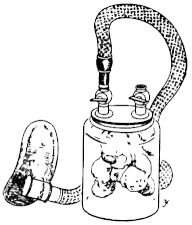
An apparatus called “Letheon”
One of the earliest employed for the
administration of Ether
New method of administration
Before operating, Liston addressed a few words to
those present as to the nature of the experiment about
to be tried. The ether was administered
by Mr. William Squire in an apparatus he
had devised, which consisted of a large
bell-shaped receiver containing the ether,
to which was attached a long tube and mouthpiece.
The patient, a middle-aged man, who was
suffering from malignant disease of the skin and tissues
of the calf of the leg, for which amputation of the thigh
was deemed necessary, passed easily into complete
insensibility, and Liston rapidly removed the thigh, the
cutting operation being declared to have lasted only
thirty-two seconds. In a few moments the patient
completely recovered consciousness, and apparently
did not know that the limb was off. When the towel
was removed from the uplifted stump so that he could
see it, he burst into tears and fell back on his pillow.
Both surgeon and patient were much affected, and the
scene in the theatre was most impressive. All appeared
to see what an incalculable boon was in store for the
human race, and Liston could scarcely command his
voice sufficiently to speak.
A story of Liston
Some amusing stories are related of Liston, who was
a very big, powerful man. His fine physique was often
useful in the pre-anæsthetic days, when a patient’s
nerve gave way at the last moment at the
sight of the crowded theatre and the operating-table
with its straps. It is said that on one
occasion a patient, losing his courage at the last
moment, rushed shrieking down the long corridor
of the hospital, with Liston at his heels. The man
locked himself in a room, but the surgeon with
his shoulder broke in the door, and half-dragged
half-carried the poor wretch back to the operating
theatre, where the operation for stone was successfully
performed.
First surgical operation
under ether in Scotland
The practice of using ether was soon followed in
other hospitals, and not only medical men but
distinguished laymen crowded to witness its use.
In Scotland, Dr. Moses Buchanan, Professor
of Anatomy in Anderson’s University, was
the first to have news of the event, and
immediately after his lecture that day he
experimented with ether inhalation. On the following
day, in the operating theatre of Glasgow Royal
Infirmary, a patient was placed under the anæsthetic
and successfully operated on for fistula. So rapidly,
indeed, did the practice spread from one centre to
another, that by the end of the first quarter of 1847 the
use of the new anæsthetic may be said to have become
general in all operation cases.
Simpson proves value of
ether in midwifery
The value of ether in midwifery practice still remained
to be proved, and Sir James Simpson was
the first to suggest and test its use in this
department. On January 9th, 1847, he first
administered ether to a patient in order to
facilitate the operation of turning. The result, he
reported, was most satisfactory and important, for it at
once afforded evidence of the one great fact upon which
the whole of the practice of anæsthesia in midwifery is
founded, viz., that though the physical sufferings of the
patient could be relieved by the inhalation of ether,
yet the muscular contractions of the uterus were not
interfered with.
The next epoch-making event in the history of
anæsthesia was the discovery of the anæsthetic
properties of chloroform. The substance itself had
been known for over a quarter of a century. Thomson,
in his “System of Chemistry,” 1820, describes a liquid
which is formed by the union of chlorine and olefiant
gas, called “Dutch liquid,” or chloric ether. Early
in the year 1831, Samuel Guthrie of Brimfield, Massachusetts,
who was then residing in Sackett’s Harbour,
New York State, in consequence of a statement that
he had read that the alcoholic solution of this
chloric ether was useful in medicine as a diffusible
stimulant, devised an easy method of preparing it.
This being done, he wrote an article which he entitled
“A Spirituous Solution of Chloric Ether,” and forwarded
it to the editor of the “American Journal of
Science and Art,” in which it was published in October
of the same year. In this article he fully describes
his method of preparation. A few months later, in
January, 1832, Soubeiran published a paper in a French
journal, stating that he had discovered this method in
1831, and to the distilled fluid he produced he had
given the name of “bichloric ether,” the formula being
CHCl. Still a third claimant to the discovery came
forward in the person of Liebig, who published his
account in November, 1831, six months after Guthrie’s
manuscript was in the publisher’s hands, and one
month after its publication. The formula which Liebig
deducted from his analysis was C4Cl5, and he called
his product “chloride of carbon.” Although there
may be some doubt as to which of these claimants
was actually the first to manufacture the liquid, it
is clear that Guthrie was the first to publish the
account of the discovery. He was born in 1782, was
a surgeon in the United States Army in 1812, and
died in 1848.
From an account given by D. B. Smith, of Philadelphia,
in the “Journal of the College of Pharmacy”2 in
1832, there can be little doubt that the liquid first made
by Guthrie was a fairly pure chloroform. He describes
it in the following words: “The action of this ether
on the living system is interesting, and may hereafter
render it an object of importance in commerce. Its
flavour is delicious, and its intoxicating properties
equal to or surpassing those of alcohol.” In 1834,
Dumas examined the liquid as prepared by Soubeiran,
and declared that he had not obtained it pure, and
further, that Liebig had made an error in its composition.
On further research, Dumas gave the liquid the
name of “chloroform,” and first worked out the real
formula, C2HCl3 (or, using the present system of atomic
weights, CHCl3).
Although its narcotising properties were known to
some extent, no one who used it at that time seems to
have conceived the idea of fully testing its
properties. In 1831, Ives, of Newhaven,
treated a case of difficult respiration by actual
inhalation of the vapour, and published the
facts in “Silliman’s Journal” in January, 1832. Four
years later, Dr. Formby, of Liverpool, prescribed it
in hysteria; and Tuson, of London, employed it in the
treatment of cancer and neuralgia in 1844.
Simpson’s investigations
The fact that one or two deaths had been attributed
to the use of ether about this time, caused
many workers to make a search for other
agents with similar properties. Foremost
among these investigators was Dr. James Young Simpson,
Professor of Midwifery in the University of Edinburgh,
who personally experimented with several chemical
liquids in the hope of finding something less disagreeable
and persistent in smell than ether.
David Waldie
Waldie suggests the use of
chloroform
About this time, Jacob Bell, a chemist, and a founder
of the Pharmaceutical Society, published a suggestion
that chloric ether should be used for inhalation
instead of sulphuric ether; but his suggestion
was apparently never put into practice. In
October, 1847, Waldie, a chemist of Liverpool,
was visiting Edinburgh, and in conversation
with Professor Simpson, suggested to the latter the
use of chloroform. He recommended the Professor
to try it as an anæsthetic, and promised to make
and send him some on his return to his home in
Liverpool.
Sir James Young Simpson
It appears to have been in that city that the drug
was first introduced and probably first used in
England as a medicinal agent. Waldie states that
about the year 1838 a prescription was brought to the
Apothecaries’ Hall, Liverpool (where he held the
position of manager), of which one of the ingredients
was chloric ether. The preparation was at that timen
apparently not known in this country, for Dr. Brett,
the chemist of the Company, specially prepared some
from the formula he found in the United States
Dispensatory. Its properties pleased some of the
medical men, particularly Dr. Formby, by whom it was
introduced into local practice. Waldie, finding that the
preparation was not uniform in strength, improved the
process by separating and purifying the chloroform,
and dissolving it in pure spirit, by which a product of
sweet flavour was obtained.
There seems little doubt that Waldie was the first
to suggest the use of chloroform, as an anæsthetic, to
Professor Simpson, who at once resolved to try it by
experimenting on himself and his assistants. He made
the first experiment in his own house on November 4th,
1847, and in a letter written to Waldie thus describes
the event: “I am sure you will be delighted to see
part of the good results of our hasty conversation. I
had the chloroform for several days in theOn the eve of the great discovery.
house before trying it, as, after seeing it such
a heavy, unvolatile-like liquid, I despaired of
it, and went on dreaming about others. The first
night we took it, Dr. Duncan, Dr. Keith and I all tried
it simultaneously, and were all ‘under the table’ in a
minute or two.” Professor Miller, who was a neighbour
of Simpson’s, used to come every morning to see if the
experimenters had survived! He describes how, “after
a weary day’s labour, Simpson and his assistants sat
down and inhaled various drugs out of tumblers, as was
their custom. Chloroform was searched for and found
beneath a heap of waste paper, and with each tumbler
newly charged the inhalers resumed their occupation. . . .
A moment more, then all was quiet; then a crash.
On awakening, Simpson’s first perception was mental.
‘This is far stronger and better than ether,’ said he
to himself. His second was to note that he was prostrate
on the floor, and that among the friends about
him there was both confusion and alarm. Of his
assistants, Dr. Duncan he saw snoring heavily, and
Dr. Keith kicking violently at the table above him.
They made several more trials of it on that eventful
evening, and were so satisfied with the results that
the festivities did not terminate until a late hour.”
On November 10th, 1847, Simpson communicated
his discovery to the Medico-Chirurgical Society of
Edinburgh, in a paper entitled, “Notice of a new
anæsthetic agent as a substitute for sulphuric ether.”
A day or two afterwards an arrangement was made
with Simpson to administer the new anæsthetic to a
patient who was about to be operated upon, but, owing
to some cause, he was unable to be present. The
operation went on without him, and the patient died
on the first incision of the knife. Simpson’s absence
was providential indeed, for it saved the reputation
of chloroform at the outset. On November 15th,
chloroform was used for the first time in a surgical
operation in the Edinburgh Royal Infirmary.Simpson achieves success
Three patients were operated on successfully
under its influence. One, who was a soldier,
was so delighted with the effect that, on awaking after
the operation, he is said to have seized the sponge with
which administration had been made, and, thrusting
it into his mouth, again resumed inhalation more
vigorously than before.
To Simpson, there is no doubt, belongs the merit of
having made anæsthesia triumph over all the opposition,
which was at first, actively, offered to its use. For
this he well deserved the rewards which fell upon him
in the evening of his life.
Among those who aided in the establishment of the
use of anæsthetics, mention must be made of the work
of John Snow, who by his researches placed the
practice on a scientific basis.
The advent of chloroform gave an impetus to other
investigators in the field of anæsthesia, and during the
last fifty years many other bodies have been introduced
and tried with more or less success for the same
purpose. Methyl chloride, which was discovered by
Dumas and Peligot, was introduced by Deboe in 1887,
who used it extensively in local affections. In 1867,
Sir B. W. Richardson introduced methyl bichloride
or methylene [methylene dichloride]. He formed
a very high estimate of its properties as a good
general anæsthetic, and said he preferred it for many
reasons to chloroform, as he found that the anæsthetic
sleep was produced more quickly and was more
prolonged.
Sir T. Spencer Wells also advocated its use, and
stated, in 1872, that it had fewer drawbacks than any
then known anæsthetic. Tetra-chloride of methyn
[carbon tetrachloride], which much resembles chloroform,
was discovered by Regnault in 1839, and its
anæsthetic properties were first made known by Sansom
and Harley in 1864. Simpson was of the opinion
that it had a more depressing effect upon the heart
than chloroform, and was more dangerous generally as
an anæsthetic.
Nunneley, of Leeds, also contributed work of value
in this department of research, and introduced ethyl
bromide and chloride of carbon. He dispelled the
idea, long prevalent, that anæsthetics could be found
only in a limited class of chemical compounds.
Among other substances which have been introduced
during the last twenty-five years, but which, owing to
one defect or another, have since been practically
abandoned, mention should be made of butylic hydride
[butane], ethylene, amylene, ethyl nitrate, aldehyde
(introduced by Poggiale), carbon bisulphide, ethidene
dichloride [ethylene dichloride] (discovered by Regnault
and first used as an anæsthetic by Snow), and ethyl
bromide, first prepared by Serullus in 1827.
Local anæsthesia, already alluded to as probably the
earliest form of numbing sensibility to pain, was
practised in antient times by the inunction of various
narcotics, but after the seventeenth century the practice
seems to have almost entirely gone out of use. The
latter end of the nineteenth century, however, marks a
new era in this department.
On September 15th, 1884, considerable interest was
aroused by a communication made at the Ophthalmological
Congress at Heidelberg, by Karl Koller, of
Vienna, in which he demonstrated the effects of cocaine
as a local anæsthetic.
The discovery of Cocaine
The alkaloid now known as cocaine was isolated by
Gädeke, from the leaves of the Erythroxylon Coca as far
back as 1855. He called it ethroxylene. Four
years later a further investigation of the
plant was made by Nieman, who noticed that
the leaves produced a numbness of the tongue; and
in 1874 Hughes Bennett demonstrated that cocaine
possessed anæsthetic properties. In 1880, Von Anrep,
who made a careful investigation of the drug, hinted
that the alkaloid might be of use in general surgery as
a local anæsthetic, and Koller undertook a series of
experiments on animals in the laboratory of Professor
Stricker, in which he found that complete anæsthesia
of the eye, lasting, on an average, ten minutes, followed
the introduction of a two per cent. solution of the
alkaloid.
The immense value of such an anæsthetic in
ophthalmic operations was universally recognised, and
it at once came into general use. In painful conditions
of mucous surfaces, and for minor operations, cocaine
has been found of great service, and as a local anæsthetic
it has a large field of usefulness. Since the
introduction of cocaine, other substances have been
brought forward, which, after extensive trials, have
proved to be of real clinical value. Of these may be
mentioned eucaine, a synthetic product (benzoyl-vinyl-diaceton-alkamine)
discovered by Merling, and first
studied by Vinci in Liebreich’s laboratory. Of the two
forms of this drug used, which are known as A and B,
the latter was soon found to be the only one suitable
for producing local anæsthesia. Its properties are
similar to those of cocaine, with the exception that it
produces no vaso-constriction, and it is claimed that
it is equal in anæsthetic power, whilst its toxicity is
very much less.
Stovaine and Tropa-cocaine
Stovaine, or benzoyl-ethyl-dimethylaminopropanol
hydrochloride, more recently introduced, is a synthetic
product elaborated by Fourneau, and derived
from tertiary amyl alcohol. It is much less
toxic than cocaine, but its comparative value
still remains to be proved by further trial. Tropa-cocaine,
a drug closely allied to cocaine, and derived
from the leaves of the Java coca plant, has recently
been much used in Germany, but it does not appear
to possess any advantages over cocaine or eucaine.
Novocaine, or para-amido-benzoyl-diethylamino-ethenol
hydrochloride, has lately been found to
possess satisfactory properties as a local anæsthetic
in dental operations. It is said to be free from the
toxic and local irritant action common to other local
anæsthetics.
Administration of Chloroform
Considerable attention has been directed to
different methods of administering chloroform, and
various forms of apparatus have been devised
which claim to reduce to a minimum the
dangers of anæsthesia. Assuming a most
skilled and competent administrator, an ideal method
of administration, and a suitable patient, an unsatisfactory
result can only be attributed to the chloroform
employed. Purity an essentialPurity of chloroform is a most
important factor in contributing to safe anæsthesia.
The physician claims that absolute
purity shall characterise all medicinal agents, and
the justice of the claim is acknowledged by the
trend of recent legislation.Danger of impurities Purity is a prime
essential of any anæsthetic. The presence
of impurities largely increases the risk inseparable
from the use of chloroform. The
train of symptoms observed during the normal process
of anæsthesia may be masked and altered, and
dangerous results may supervene under the most
competent, careful and observant administrator.
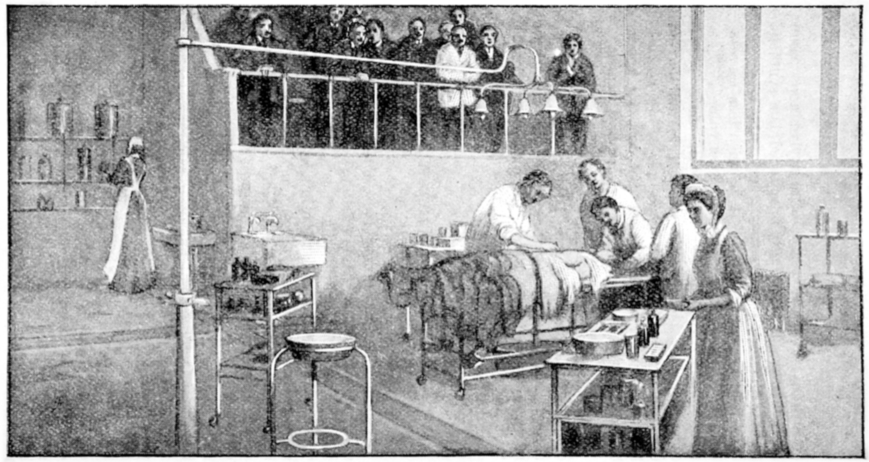
An Operation in the Twentieth Century
Expert testimony
That some of the chloroform offered to the profession
may reasonably be regarded with suspicion is evidenced
by the words of a prominent obstetrician,
based on the experience of 40 years in the
use of chloroform; this authority expresses
himself as follows: “I may say I fear the chloroform
in common use is often far from being as pure as it
should be, and is sometimes very defective in this
respect.”
Effects of impurities
Impurities may result from the process of manufacture,
or from decomposition. Conspicuous amongst
these undesirable elements are chlorine, hydrochloric
acid and carbonyl chloride (phosgene), which irritate
the lining membrane of the respiratory tract
and interfere with the normal process of
respiration. Such irritation may result in
arrest of cardiac action or may produce a severe
form of bronchitis. It is obviously of great importance
that chloroform should be free from irritating
properties, that the respiratory passages should not be
obstructed, and that during anæsthesia the breathing
and the circulation should approximate the normal.
Superadded to these results, produced by local irritation,
is the effect of other impurities which exert
their action after absorption. These latter markedly
increase the cardiac depression which has been shown
to follow the administration of pure chloroform. Such
an action is difficult of detection, and is, probably, in
large degree responsible for a considerable number of
the accidents reported.
Contradictory results
Of recent years increased knowledge has elaborated
exact tests, which ensure the absence of these impurities.
Nevertheless, anæsthetists of wide experience have
obtained results which could not be reconciled with the
use of pure chloroform. It has been observed that
different chloroforms, all of which answer the official
tests for purity, give effects which are difficult to harmonise,
and the interpretation of which only
appears satisfactory on the assumption that
the chloroforms differ in composition. Whilst
one chloroform acts most satisfactorily, another produces,
during the early stages of administration, a
marked excitement and an irregularity of breathing,
which prolongs the period of induction. Recent researchFurther investigation
has therefore been deemed necessary,
and a comprehensive and careful research has
elucidated the cause of these hitherto unexplained
phenomena (Wade and Finnemore, “Journal
of the Chemical Society,” 1904, 85, 938). In the chloroforms
which produced anæsthesia in a satisfactory
manner, has been demonstrated the presence of ethyl
chloride in minute and varying quantities. Ethyl chlorideWhen
the undesirable effects were noted, no ethyl
chloride was detected in the anæsthetic. A
physiological test conclusively proved that
ethyl chloride was the factor which determined these
differences.
Value of the investigation
A chloroform which had previously given undesirable
effects, and in which the presence of ethyl chloride
could not be demonstrated, was modified so as to
contain a small proportion of the latter. The chloroform
then proved a most satisfactory anæsthetic,
and there was entire absence of the excitement and
respiratory irregularity previously observed. The
results of this research are of the utmost
value. In the initial stages of the induction
of chloroform anæsthesia, the presence of a
small quantity of ethyl chloride has a beneficial effect,
leading to the absence of mental excitement, and
steadies the breathing. The respiration is stimulated
and becomes regular and deep. In these circumstances,
satisfactory anæsthesia is induced with rapidity
and ease.
A Chronological Table of Chief Events and Discoveries in the History of Anæsthesia
‘Wellcome’ Brand Chloroform represents the
results of the most recent researches. It embodies
the
essentials of
purity and
uniformity,
the necessary
basis of
a satisfactory
chloroform. Some chloroforms which satisfy
official standards have yet been shown to vary in
composition and in effect, the result depending
on the occurrence in the preparation of a
small and varying quantity of ethyl chloride.
‘Wellcome’ Brand Chloroform is of constant composition
and gives uniform effects. Conforms to B.P.
It conforms in every respect to the requirements of the
B.P., and contains a small and definite proportion
of ethyl chloride, which has been found to
assist the satisfactory induction of anæsthesia.
‘Wellcome’ Brand Chloroform, 30 c.c., in hermetically-sealed
tube. Length of tube, 5-1/4 in.
Proved value
‘Wellcome’ Brand Chloroform is the result of prolonged
laboratory experiment and careful clinical
observation. Its reception by the profession
verifies the theory upon which its production
is based. It has been largely used in hospital
and in private practice, and with gratifying results.
Reports from most experienced anæsthetists agree in
regarding ‘Wellcome’ Brand Chloroform as a distinct
advance. Its constancy in composition gives confidence
in administration, and its freedom from irritating and
Confidence in administration
depressant principles removes the source of
many of the accidents which have hitherto
been regarded as grave objections to the
employment of chloroform as an anæsthetic.
‘Wellcome’ Brand Chloroform is issued in 2 oz.,
1/4 lb., 1/2 lb. and 1 lb. amber-coloured bottles; also in
30 c.c. and 60 c.c. hermetically-sealed tubes, as
illustrated on the previous page.
‘Wellcome’ Brand Ether is prepared specially for
anæsthesia and is thoroughly pure and reliable. When
the administration of ether is desired, this product will
be found eminently suitable.
Ideal packing
The method of packing in hermetically-sealed tubes
is especially desirable with such a volatile substance
as ether, and the shape of the glass
tube admits of the contents being readily
transferred to the graduated bottles usually employed.
Conforms to B.P.
‘Wellcome’ Brand Ether conforms to the
requirements of the British Pharmacopœia
for Æther Purificatus, and has a specific gravity of 0·720.
‘Wellcome’ Brand Ether is issued in hermetically-sealed
tubes containing 30 c.c. and 60 c.c., similar to
the Chloroform packing illustrated on the previous
page.
The anæsthetics issued under the ‘Wellcome’ Brand
denote the highest degree of perfection and purity.
It is well known that considerable variation exists in
the quality and activity of the medicinal chemicals of
commerce.
The need for reliable
Medicinal Chemicals
Purity and reliability are matters of the utmost
importance to prescriber, dispenser and
patient alike, and every opportunity should
therefore be taken to ensure the supply of
only those chemicals and galenicals which
are known to be thoroughly pure and trustworthy.
In order that goods answering to this description
in the highest sense may be at the disposal of the
profession, Burroughs Wellcome & Co. manufacture
and issue a series of fine chemicals, alkaloids, etc.,
to which they have recently added a series of
standardised liquid and granular extracts and concentrated
tinctures, under the distinctive title of
the ‘Wellcome’ Brand.
Standardised galenicals
The advantages of galenicals containing a definite
proportion of active principle over those that vary in
strength with every sample of drug employed are now
fully recognised, and several such have been admitted
into the Pharmacopœia. With regard to galenicals,
Burroughs Wellcome & Co. have extended
the standardisation by total alkaloid assay,
and have never adopted the basis of total
extractive, regarding it as misleading and useless.
Total alkaloid estimations have been adopted in so
far as they secured definite standards of truly representative
activity, but the firm has not been content
to rely on this means alone. As the result of extensive
research, they are able to offer many other
standardised preparations in addition to the
official ones. Physiological standards Those galenicals which are
known to be extremely variable in their character and
action, and by their nature do not admit of exact
control by chemical means, have been the subject of
physiological research. Not being satisfied with the
methods hitherto available, special processes of
standardisation have been developed which give
more complete control over the finished products.
This subject is still one of continuous research.
The standards adopted have been chosen after the
examination of very many different samples of drugs,
and represent the average of the amounts of active
principle found in preparations made from good specimens.
Thus the dose remains the same as that of
the older preparation, but the prescriber is certain
of always obtaining the proper effect instead of one
varying from time to time with the particular batch
of extract of tincture used, and the advantage of this
certainty, both to the reputation of the prescriber and
the health of the patient, can hardly be over-estimated.
Prolonged scientific research
To attain the highest standard in these as in other
preparations for medicinal use, extensive scientific
research and many technical experiments
have been made. Long-continued researches
in the Wellcome Chemical and Physiological
Research Laboratories led to the issue of ‘Hemisine,’
a physiologically standardised product which presents
the active principle of the medulla of the supra-renal
gland in a dry, soluble state. It is perfectly stable in
all climates, and permits of the instant preparation of
fresh reliable solutions possessing the characteristic
hæmostatic and other properties of the supra-renal
gland. Similarly, as the result of researches carried
out at the Wellcome Physiological Research Laboratories,
crystalline salts of a specific alkaloid,
which produces the characteristic effects of
ergot on the blood-pressure and the uterus,
have been obtained in a state of chemical purity. ‘Ergotoxine’
To this alkaloid the scientific name “Ergotoxine” has
been given. In ‘Ernutin,’ Burroughs Wellcome & Co.
are enabled to present a preparation of uniform
potency, containing the specific active therapeutic
principles of ergot, chief of which is the alkaloid ergotoxine,
in a state of purity which up to the present has
never been approached. It is physiologically standardised
by observation of its effects on the vaso-motor
functions of the sympathetic nervous system.
Aconitine
Aconitine as met with in commerce has been found
to vary greatly in purity, and therefore in physiological
effect. It is of the utmost importance that
a definite strength should uniformly attach
to so powerful a drug, and this is secured in the
‘Wellcome’ Brand product, which is free from pseudaconitine
and japaconitine, and from the non-toxic
aconine and benzaconine.
Atropine Cocaine
The alkaloid Atropine is, under this brand,
issued free from hyoscine and hyoscyamine.
Cocaine and its hydrochloride are prepared
in a state of purity answering fully the most rigid tests.
Aloin, Crystal
Aloin (Crystal). This greatly improved product
is barbaloin in well-defined crystals, and is
free from resin.
Bismuth Salicylate
The bismuth salts have received much attention, a
notable improvement being made in the quality of
Bismuth Salicylate. It is well known
that there has been a lack of uniformity in
the composition of this article, and that not
infrequently preparations have been sold under this
name which have consisted merely of a mixture of
salicylic acid with the oxide or some salt of bismuth.
‘Wellcome’ Brand Bismuth Salicylate is made
from physiologically pure salicylic acid, and is uniform
in composition.
Stable and soluble
The scale salt known as Bismuth and Ammonium
Citrate is a very unsatisfactory preparation. Bismuth
Citrate (Soluble), ‘Wellcome’ Brand, has
the same therapeutic properties, but is much
more stable in character. Being very freely
soluble in water and yielding a bright solution, it is
well adapted for the extemporaneous preparation of
a solution corresponding to Solution of Bismuth and
Ammonium Citrate, B.P., or for preparations in which
the U.S.P. salt is used. Like the latter, which it is
designed to supersede, it is not compatible with acid
liquids.
Bismuth and Lithium Citrate (Soluble), ‘Wellcome’
Brand. This new combination, in the form of
handsome colourless scales, is readily soluble in water.
It is thus particularly convenient when the effects of
both lithium and bismuth are desired, as in gouty
dyspepsia.
Sedative and hæmatinic
Bismuth and Iron Citrate (Soluble), ‘Wellcome’
Brand, permits the sedative properties of the bismuth
to be exerted on the digestive organs, while
the iron, which is presented in a soluble, non-irritating
and non-astringent condition, is
readily absorbed to attack the anæmia which is the
exciting cause in some cases of dyspepsia. The salt
is in the form of yellowish-green scales, readily soluble
in water.
Definite composition
Iron Arsenate (Soluble), ‘Wellcome’ Brand,
differs from the insoluble amorphous powders, of
indefinite composition, so often prepared
under this name, in being a scale preparation
readily soluble in water, and containing an
amount of arsenic equivalent to 34–35 per cent. of
anhydrous ferric arsenate.
Soluble Manganese Salts
A series of solubleManganese Salts and combinations
of the same with Arsenic, Quinine
or Strychnine are unique forms in which
this chemical may be prescribed with the
best effect.
Pilocarpine
The ‘Wellcome’ Brand salts of Pilocarpine, as
a result of prolonged and costly investigations, are free
from the less active isopilocarpine and the
inactive pilocarpidine with which they are
usually found to be associated. The melting point
indicates the high purity of these salts.
Quinine Sulphate
A special feature is made of Quinine
Sulphate in the convenient form of compact
crystals occupying one-third the space of the
bulky chemical ordinarily offered.
Read From an Ms. of the Xiii Century] (1907) — Full Text Online Free | Open Old Books