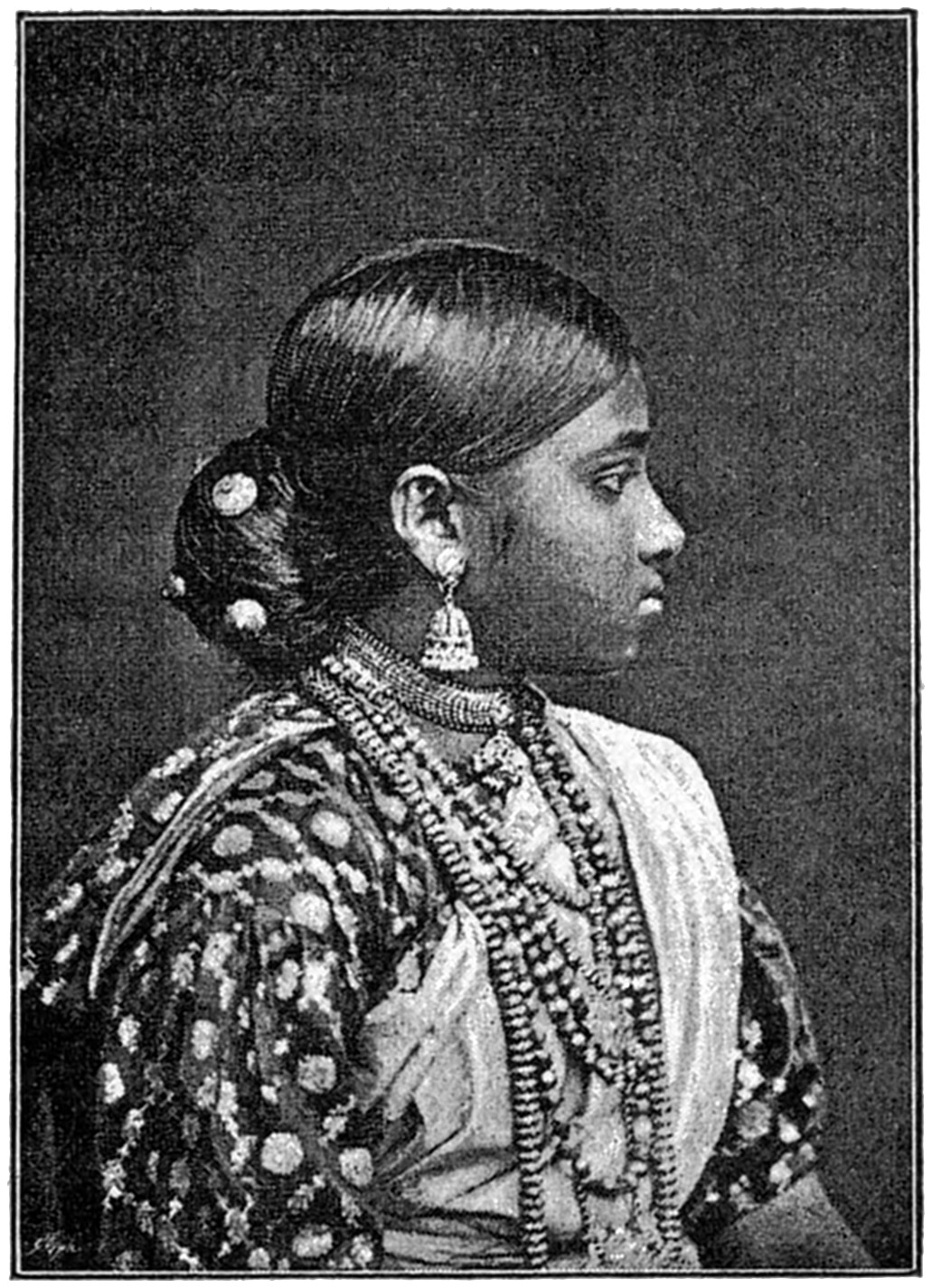
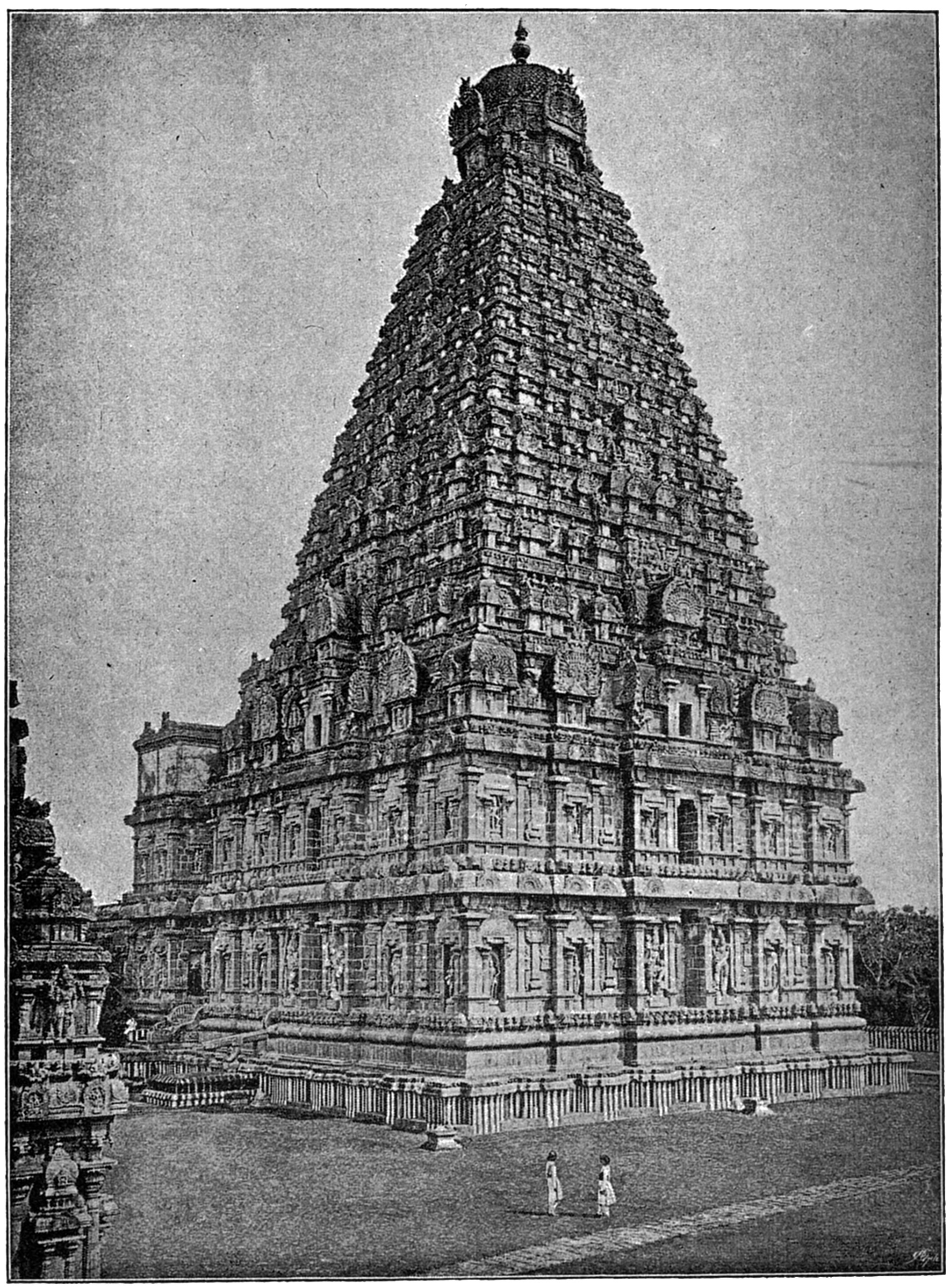
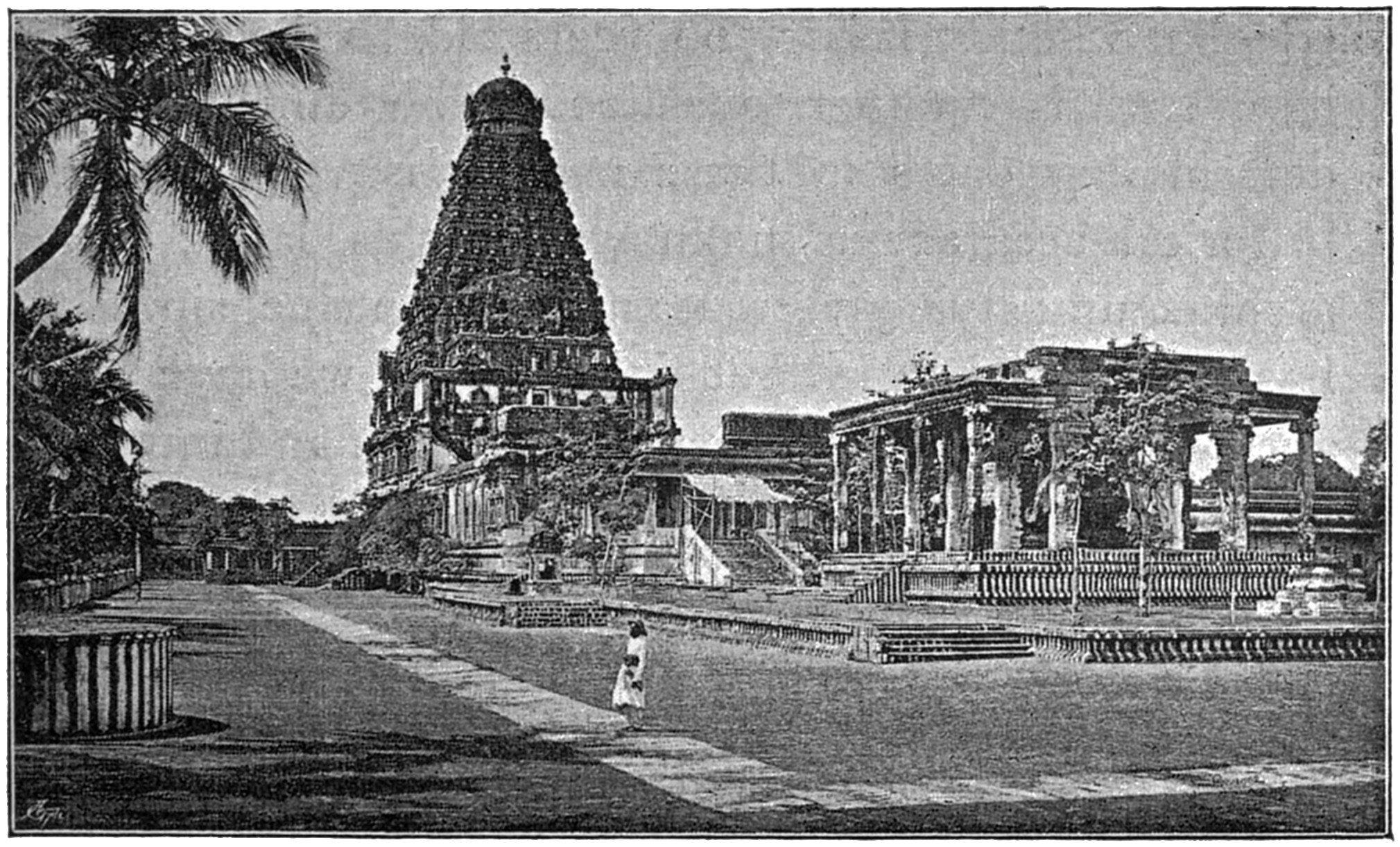
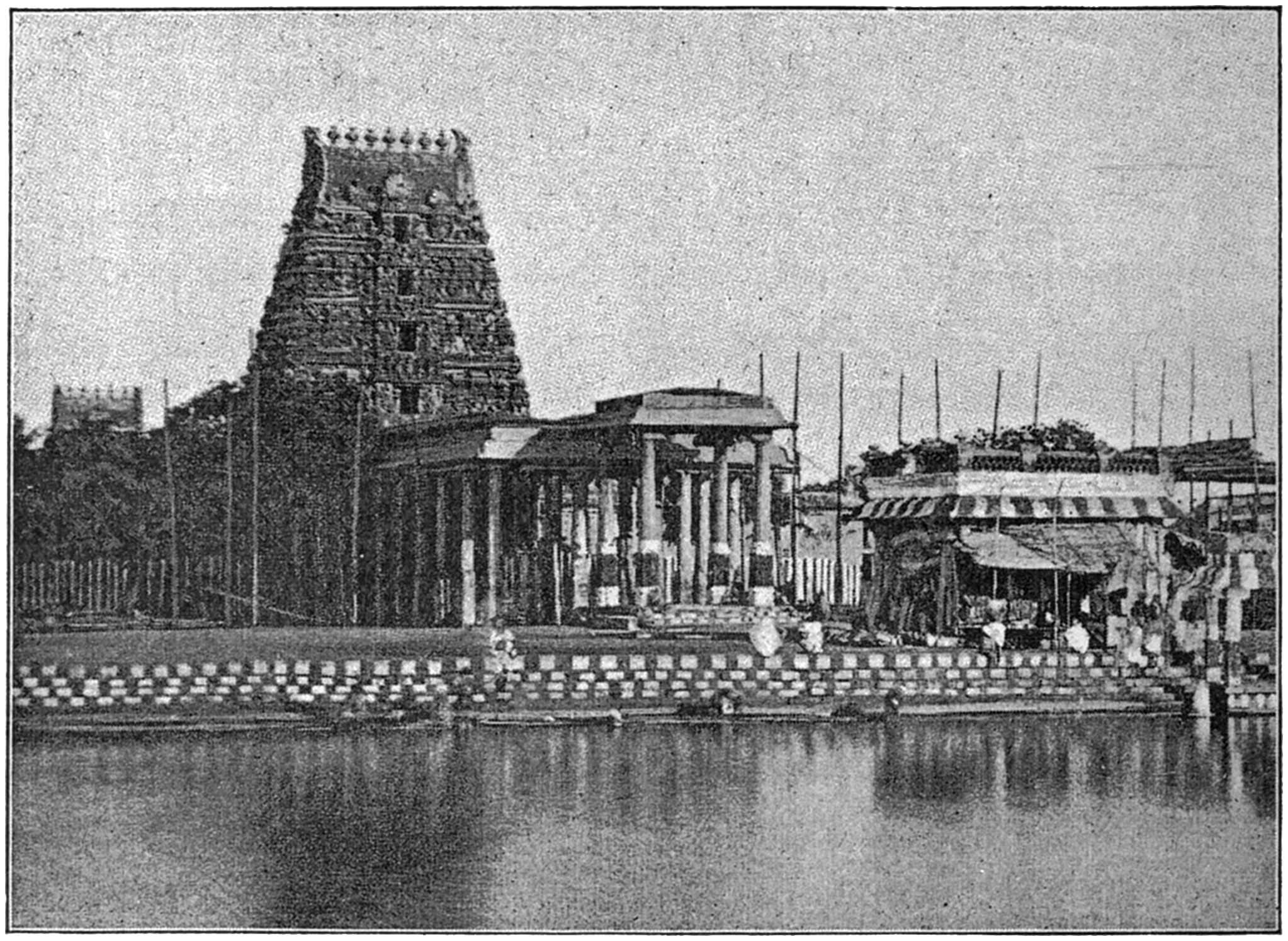
Larger versions of most illustrations may be seen by right-clicking them
and selecting an option to view them separately, or by double-tapping and/or
stretching them.
ENGLAND’S IDEAL, and other papers on
Social Subjects. Crown 8vo, cloth 2s. 6d.;
paper wrappers 1s.
CHANTS OF LABOUR: A Song Book of
the People. With a frontispiece and title-page
designed by Walter Crane. Music
and Words. Imp. 16mo, cloth 2s.; paper
wrappers 1s.
CIVILISATION, ITS CAUSE AND
CURE: and other Essays. Crown 8vo,
cloth 2s. 6d.
“In ‘England’s Ideal’ and ‘Civilisation’ Mr. Carpenter
sets forth in prose his criticism (unsurpassed at times
by Ruskin, his master in this field) of the diseases of polite
society, and his faith as to their meaning and the method
of their abatement.”—Daily Chronicle.
Swan Sonnenschein & Co.: London.
TOWARDS DEMOCRACY. Third Edition,
1892, with numerous added poems, pp. 367.
Crown 8vo, cloth 5s.
Butler & Tanner, The Selwood Printing Works, Frome, and London.
PREFACE
If asked to write a book about his own country and
people a man might well give up the task as hopeless—yet
to do the same about a distant land in which he has
only spent a few months is a thing which the average
traveler quite cheerfully undertakes. I suppose this may
be looked upon as another illustration of the great fact
that the less one knows of a matter the easier it is to write
or talk about it. But there is, it is sometimes said, a
certain merit of their own in first impressions; and I trust
that this may appear in the present case. Certainly though
there are many things that are missed in a first glance
there are some things that stand out clearer then than
later.
In the following pages I have tried to keep as far as
possible to the relation of things actually seen and heard,
and not to be betrayed into doubtful generalisations. It
is so easy in the case of a land like India, which is as large
as Europe (without Russia) and at least as multifarious
in its peoples, languages, creeds, customs, and manners, to
make the serious mistake of supposing that what is true
of one locality necessarily applies to the whole vast
demesne, that I must specially warn the reader not only
against falling into this error himself, but against the
possibility of my having fallen into it in places.
As far as actual experience of life in Ceylon and India
is concerned I have perhaps been fortunate; not only in
being introduced (through the kindness of local friends)
into circles of traditional teaching which are often closed
against the English, and in so getting to know something
of the esoteric religious lore of South India; but also in
obtaining some interesting glimpses behind the scenes of
the Hindu ceremonial. I have too had the good luck to
find friends and familiar acquaintances among all classes
of native society, down almost to the lowest; and I must
say that the sectional view I have thus obtained of the
mass-people in this part of the world has made me feel
with renewed assurance the essential oneness of humanity
everywhere, notwithstanding the very marked local and
superficial differences that undoubtedly exist.
The spectacle of the social changes now taking place in
India is one that is full of interest to any one who has
studied and taken part in the Socialistic movement at
home; and the interest of it is likely to increase. For
though the movement in India is not the same as that at
home, it forms a curious counterpart to the latter; and
being backed by economic changes which will probably
persist for years to come is not likely to die out very
soon.
For the rest the book must rely on the description of
scenes of nature and of ordinary human life, whose unexpected
vividness forced me to portray them—though
to begin with I had no intention of doing so. The
illustrations are many of them taken from the excellent
photographs of Messrs. Scowen of Colombo, Messrs.
Bourn of Bombay, and Messrs. Frith of Reigate.
The Suez Canal—Port Said—Gulf of Suez—The Red Sea—Colombo—Its streets and population—Picturesque glimpses—Tommy Atkins in a jinrickshaw—The Tamils and the Cinghalese—Costume and Character—Language and Literature—The British and the Eurasians—Social arrangements and amenities—“Spicy gales”—The coco-nut palm—A catamaran
Primitive habits of the Cinghalese—“Ajax” arrives from England—A peasant-cabin near Kandy—Marriage-customs—Devil-dancing—Kalua and Kirrah—Their rice-fields and mode of life—The great Buddhist temple at Kandy—The tooth-relic—Ancient MSS.—A Librarian-priest—The talipot palm—The British and the natives—The “oyster”—Nuwara Ellia
Cinghalese views on Politics—Kornegalle—The Elephant-rock—The general landscape in Ceylon—Tanks and irrigation—The Paddy tax—Modern Commercial policy—Poverty of the people—The village bath—Decorum and passivity in manners—The bazaar and the shops—My friend the opium-seller—The policeman—The gaol and the prisoners—A Tamil official and his mode of life—The Bungalow—Mosquitos—Vegetable curries—The Hindu priest in the household—Native servants, their relation to British masters—The pariahs, and our slum-dwellers
Ascent of Adam’s Peak—A night on the summit—The unclad natives endure the cold—Advantage of sun-baths—A society for the encouragement of nudity—Moonlight view from the summit of the Peak—History of the mountain—Sunrise—The shadow on the mist, and other phenomena—Adam’s foot-print—The pavilion on the summit, and the priests—Caliban doing poojah—Descent by the pilgrim-track—The great woods—Fauna and Flora—Ratnapura, the city of jewels—Boat-voyage down the Kaluganga to Kalutara—Descent of rapids—Kalua enjoys the voyage—A tea-planter at home—Wage-slavery on the tea-plantations—The tea-factory—Letters from “Ajax” about the coolies
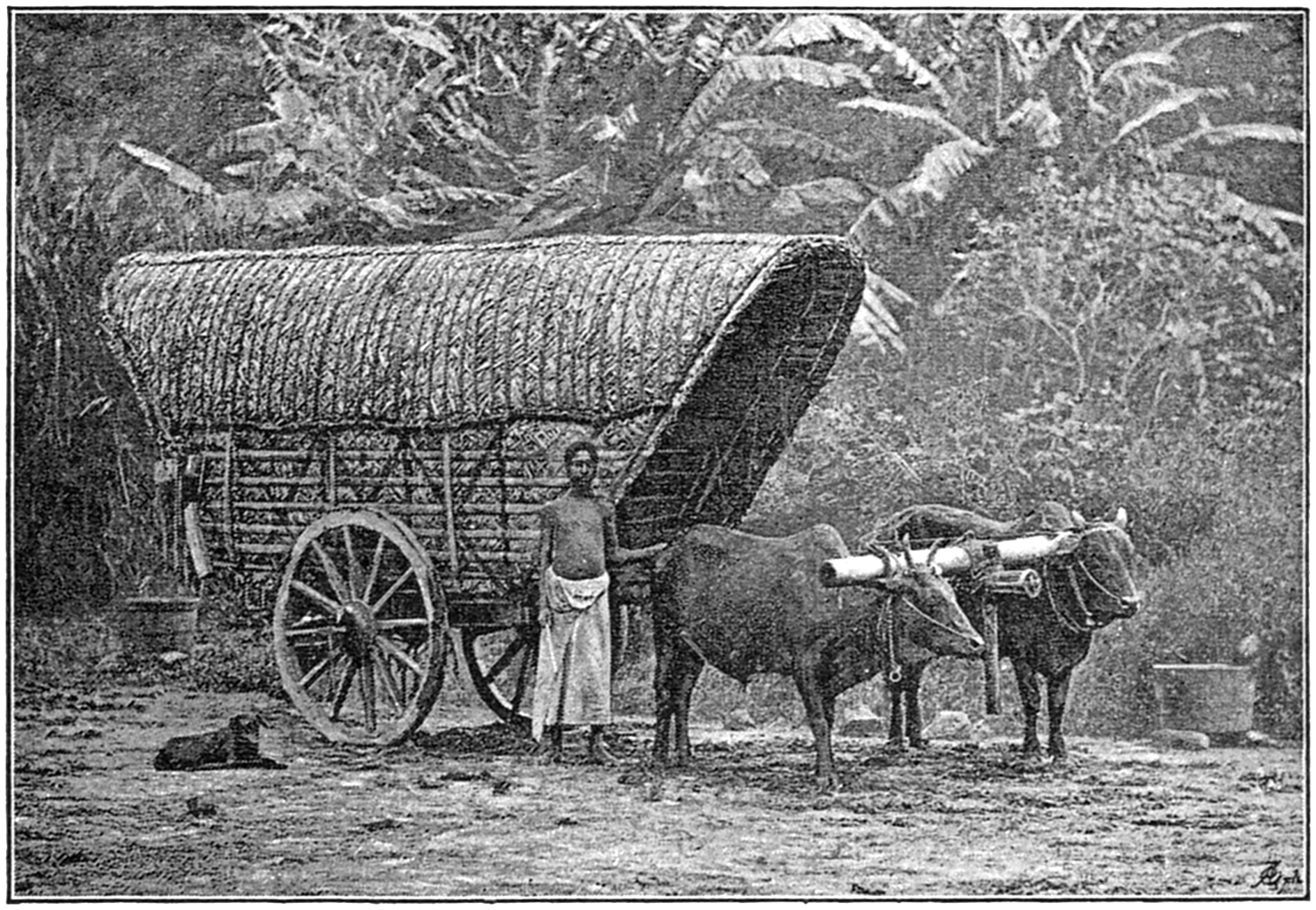
The courts a great centre of popular interest—A means of wreaking personal revenge—The district court—A case of burglary—The British ideal of life does not appeal to the natives—A Tamil student of philosophy—To Dambulla in a bullock-cart—A coterie of Eurasians—The cave-temples of Dambulla—A boy-priest and his cook—Other Buddhist temples
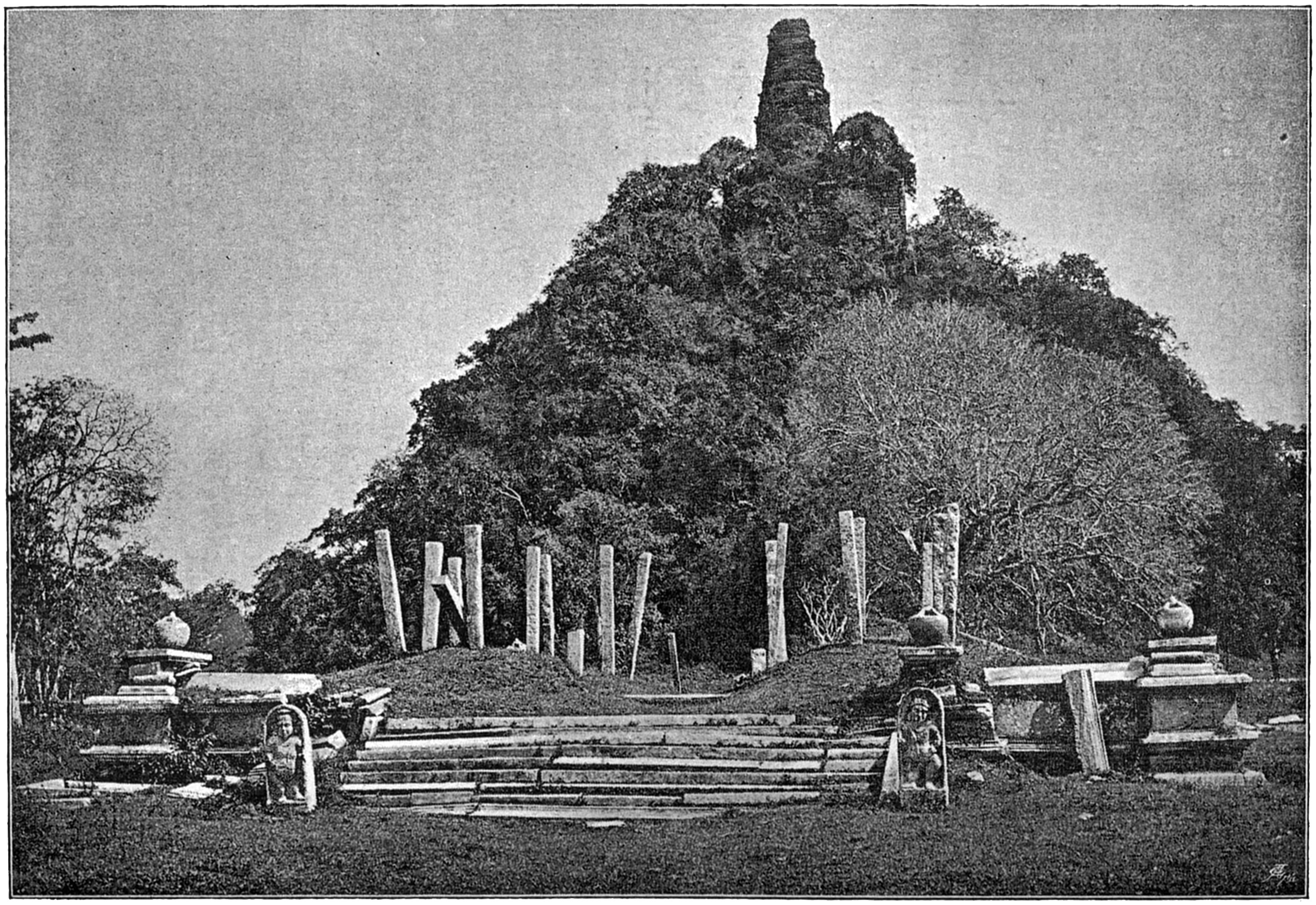
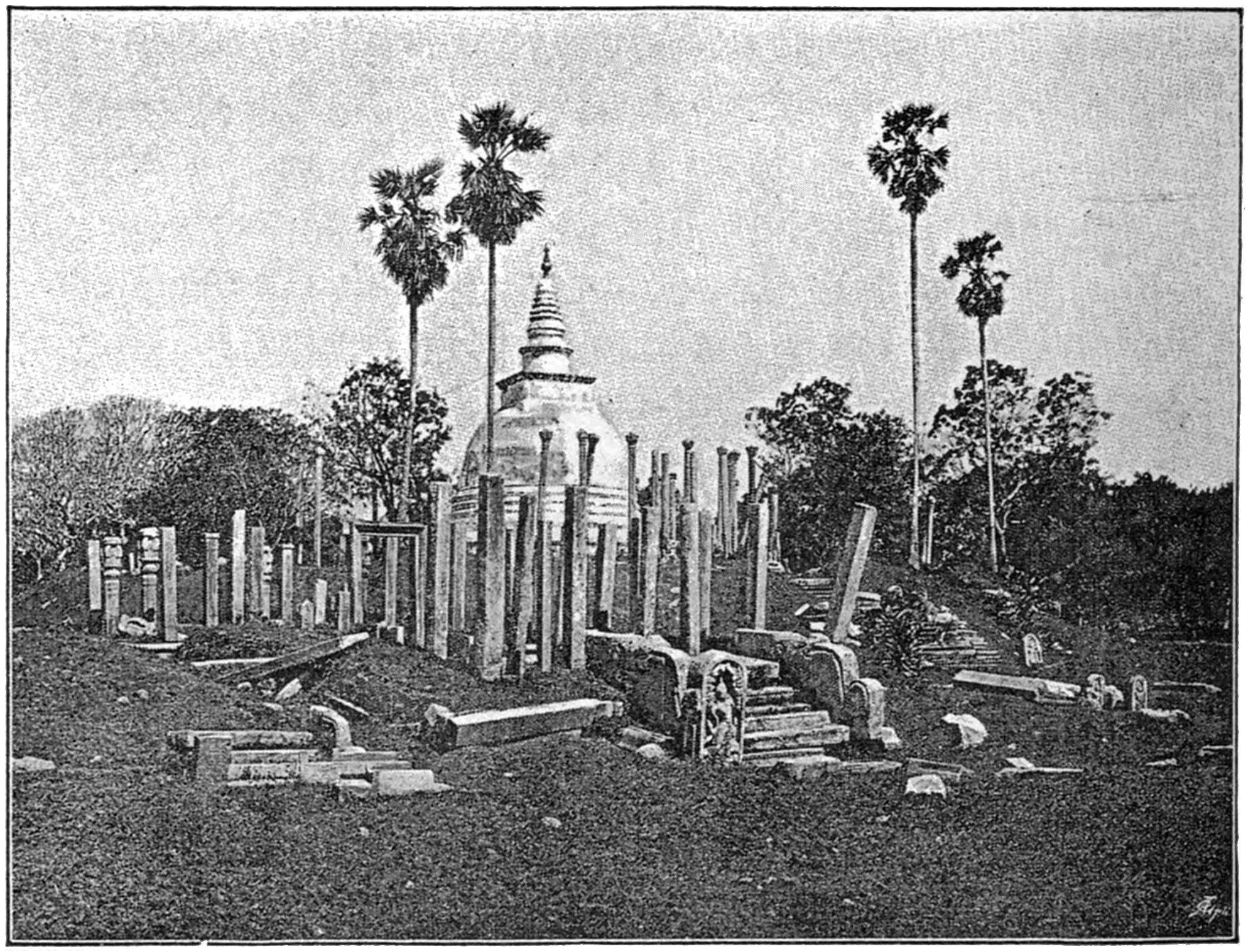
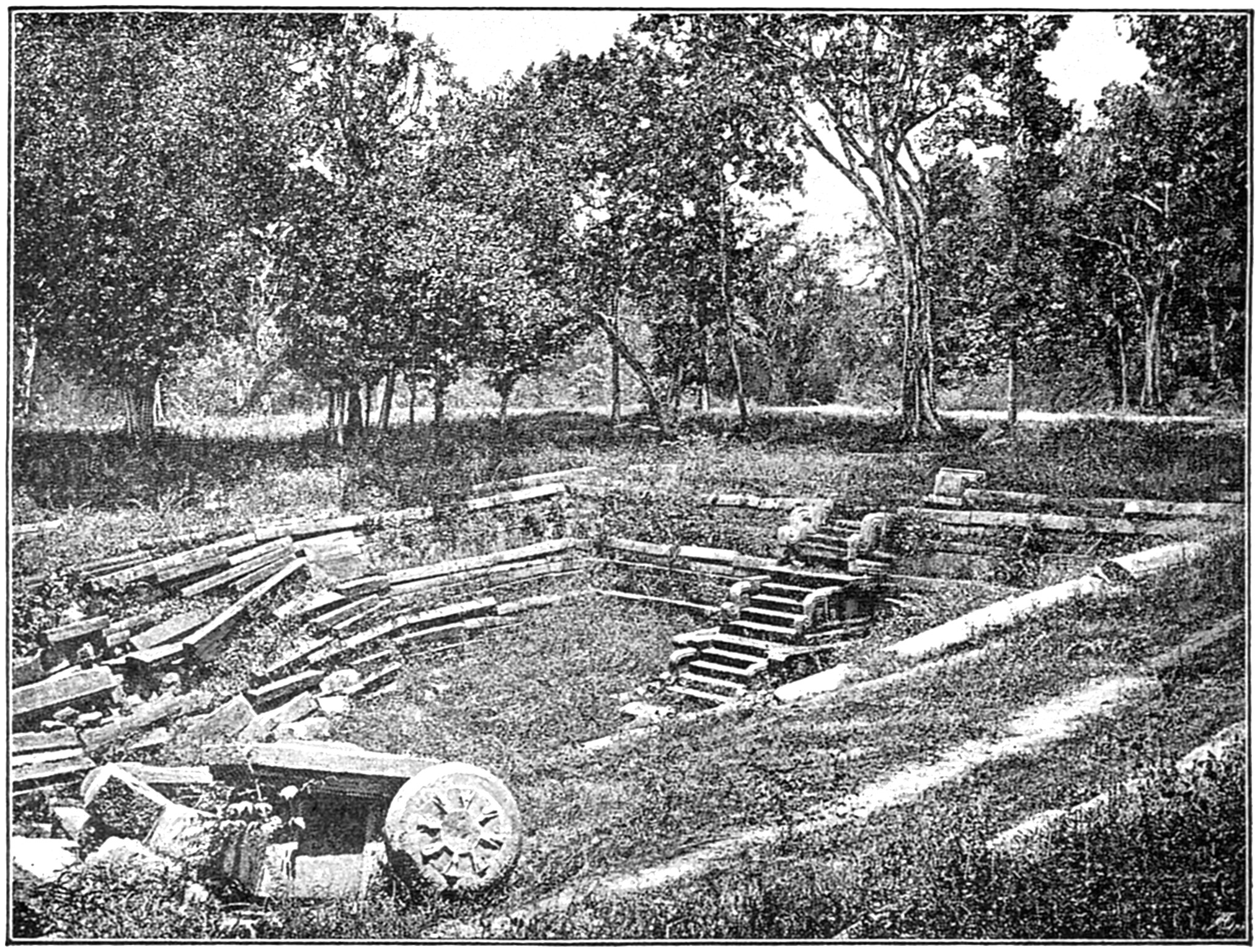
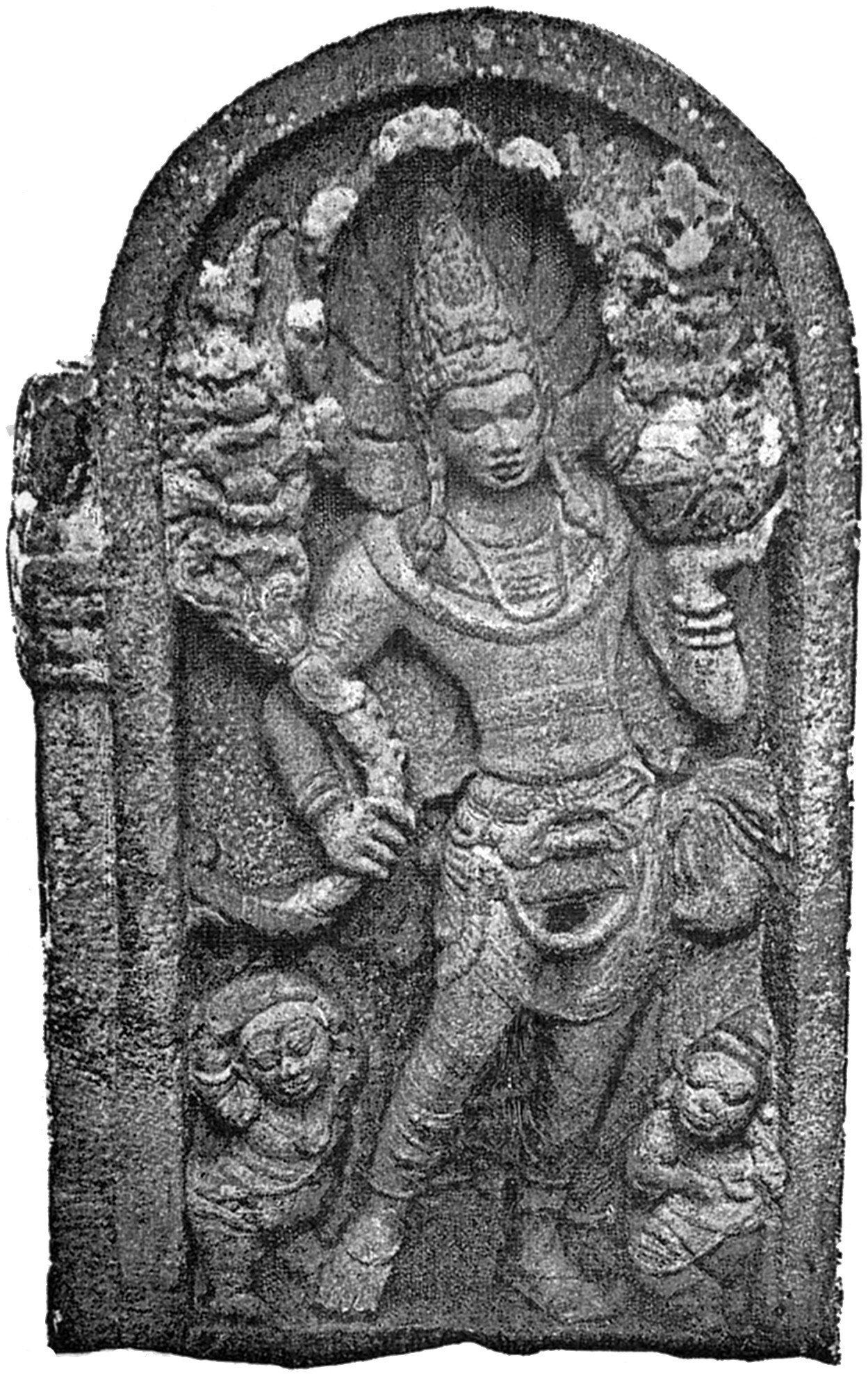
A night in the “mail-coach”—The present village of Anurádhapura—“Pools of water and a habitation for the bittern”—The remains of the Brazen Palace—The oldest tree in the world—Ruins of enormous dágobas—Specimens of early sculpture—Temples, porticos, stone troughs, cisterns, bathing tanks—A fine statue of Buddha—The city as it was in the 7th century—Its history—View to-day from the Abhayagiria dágoba—Moral and sentimental reflections
The festival of Taypusam—The temple, the crowd, and blowing up of trumpets in the full moon—Image of Siva, the raft and the sacred lake—Hymns and offerings to the god—Fearful and wonderful music—Temper of the crowd, and influences of the ceremonial—Interior of Temple—The lingam and the worship of sex—The bull Nandi—Great procession of the gods round Temple—Remindful of Bacchic processions—The Nautch girls, their dress, and dances—Culmination of the show—Revelation of Siva
Two schools of esoteric teachers, the Himalayan and South Indian—A South-Indian teacher—Three conditions for the attainment of divine knowledge or gñánam—The fraternity of Adepts—Yogam the preparation for gñánam—The yogis—Story of Tilleináthan Swámy—Democratic character of his teaching—Compare stories of Christ—Tamil philosophy and popular beliefs concerning Adepts—The present teacher, his personality and habits—“Joy, always joy”
What is the nature of a Gñáni’s experience? Answer given in modern thought-terms—Slow evolution of a new form of consciousness—Many a slip and pause by the way—A consciousness without thought—Meaning of “Nirwana”—Phenomena of hypnotism—Theory of the fourth dimension—The true quality of the soul is Space, by which it is present everywhere—Freedom, Equality—The democratic basis of Eastern philosophy
Physical methods adopted by some of the yogis—Self-mesmerism, fasting, severe penance—The Siddhi or miraculous powers—Mental methods, (1) the Concentration, and (2) the Effacement of Thought—Difficulties of (1) and (2), but great value for the Western peoples to-day—Concentration and Effacement of Thought are correlative powers—They lead to the discovery of the true Self—Moral methods, gentleness, candor, serenity—Non-differentiation—The final deliverance—Probable difference between Eastern and Western methods of attainment—Through the Will, and through Love
Difficulty of giving any concise account of Indian teaching—Personal rapprochement to the Guru, but alienation from the formalities of his doctrine—Mediæval theories of Astronomy and Geology—Philosophy of the Siddhantic system—The five elements, five forms of sensation, etc.—The twenty-six tatwas, and the Self which stands apart from them all—Evolution and Involution—The five shells which enclose the soul—Death and Birth—Crudities of Astrology, Physiology, etc.—Double signification of many doctrines—Resemblance of modern Guru to a Vedic Sage—His criticisms of the English and of English rule—Importance to the West of the Indian traditions
Colombo to Tuticorin—The plains of the Carnatic—Thirty great Dravidian temples—The temple at Tanjore—Colossal monolithic bull—The pagoda, a fine piece of work—“It casts no shadow”—Subsidiary temples and frescoed arcades—A regiment of lingams—The Tanjore palace—The temple at Mádura—The Choultrie, the Eastern gate, and the Hall of a thousand Columns—Crowds in the temple precincts, gloom and stillness of the interior—Juggernath cars in the streets—The Temple of Chidámbaram, a goal of pilgrimage and a den of Brahmans—The weird hall of a thousand columns, haunted by bats—A cranky Brahman—Goldsmiths at work for the Temple—A truculent pilgrim
The streets of Madras—Comparison with Ceylon—Impositions of drivers, boatmen, hotel managers, etc.—A straggling dull city—A centre however of Hindu political and literary life—Visit to Adyar and the Theosophist headquarters—Blavatsky curios—Scenes of native life—The river Hooghly—Calcutta city and population—Festival of bathing in the Ganges—A Circus—Poverty of the people—Meeting of the Dufferin Fund—British philanthropy in India—A native school—A group of Bengalis—Their love of long yarns, and of music—Panna Lall and his gymnast friends—Chundi Churn performs on the sítar—The Indian music
The plains of the Ganges—The crops, and the peasant life—Sentiment of the great expanse—Sacredness of the river—Far-back worship of Siva—Benares a centre of Hindu life—The streets and shops—The Golden Temple—The riverside, characteristic scenes—A spring festival—A talk with a yogi—The burning ghauts—Panna Lall wants to bathe—Religious ablutions—A self-mutilated fakir
Allahabad—Difficulty of really knowing India—The great gulf of race-difference—The Hindu does not understand “Duty”—The duty-loving Englishman does not understand the Hindu—Race-divisions in the United States—We came to India as conquerors—The gulf remains, and will remain—Criticisms by an educated “oyster”—Aligarh affords an instance of friendly feeling between the two sections—The M.A.O. College—A convivial dinner-party—Sir Syed Ahmed and the Mahomedan influence—Horse-fair at Aligarh—Cabulees, and a native wrestling-bout
Approach to Delhi—The Fort and the old Palace—The town and population—The Jumma Mosque—The environs of Delhi, a waste of ruined cities—The Kutab Minar and the old fortress of Lalkab—Agra, the Fort and the Palace—The Jessamine Tower—Lovely marble and mosaic—The Taj at twilight—A fairy scene—Flocks of green parrots—Moonlight on the Jumna—“Do we not respect our women?”—A coterie of professors—The population of Agra—Scenes at the railway stations—A favorable specimen of Young India—An incident in the train
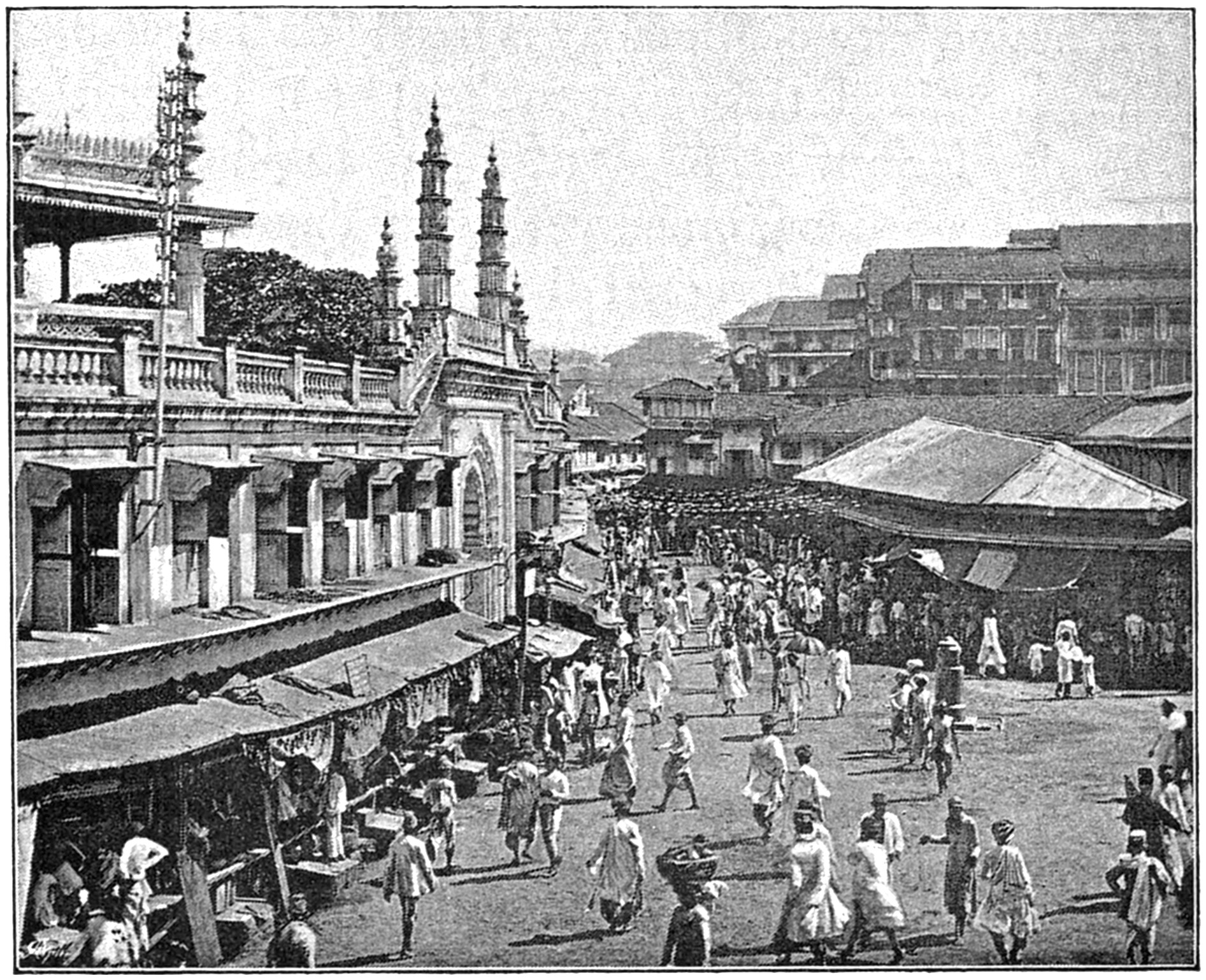
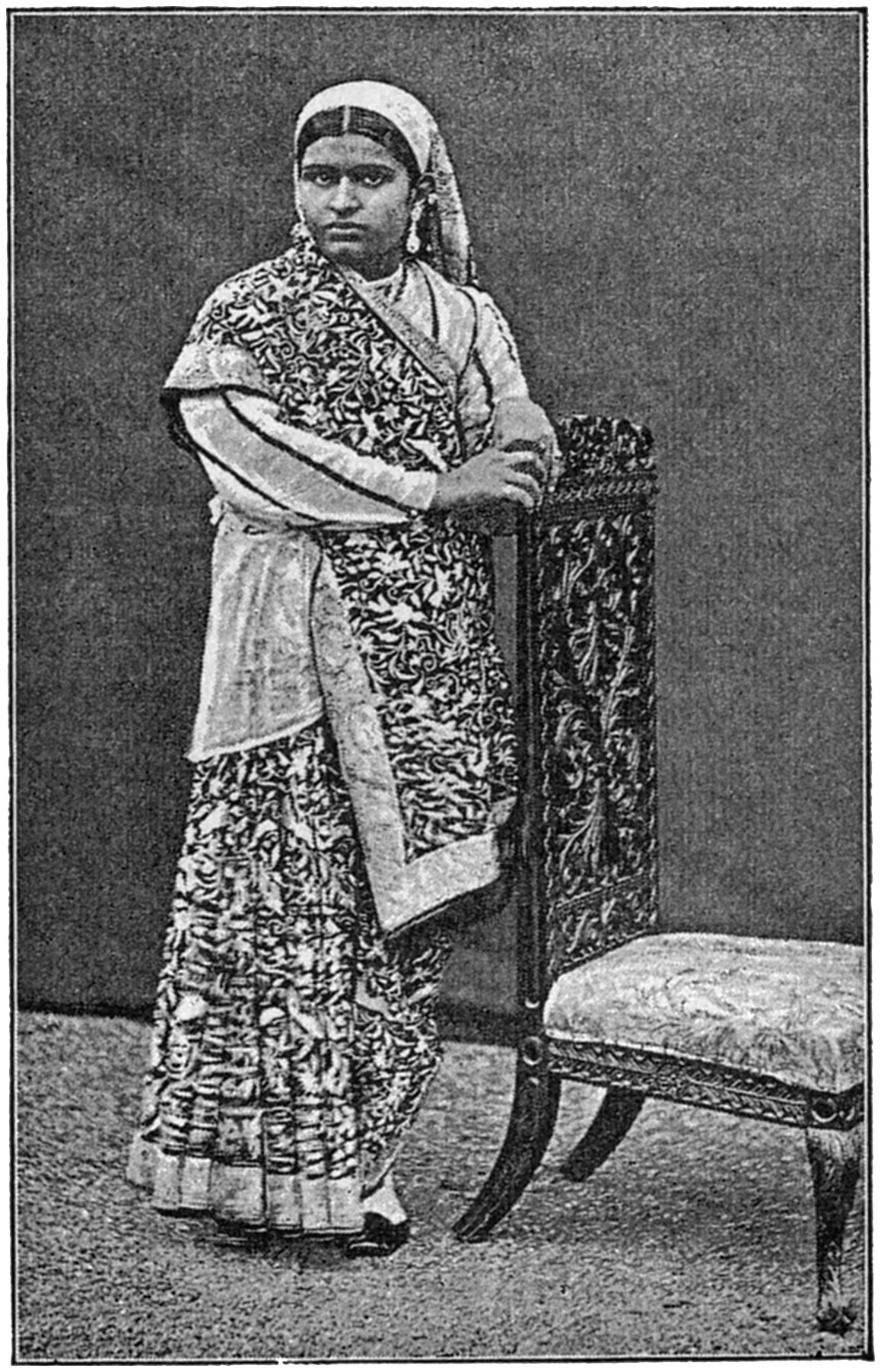
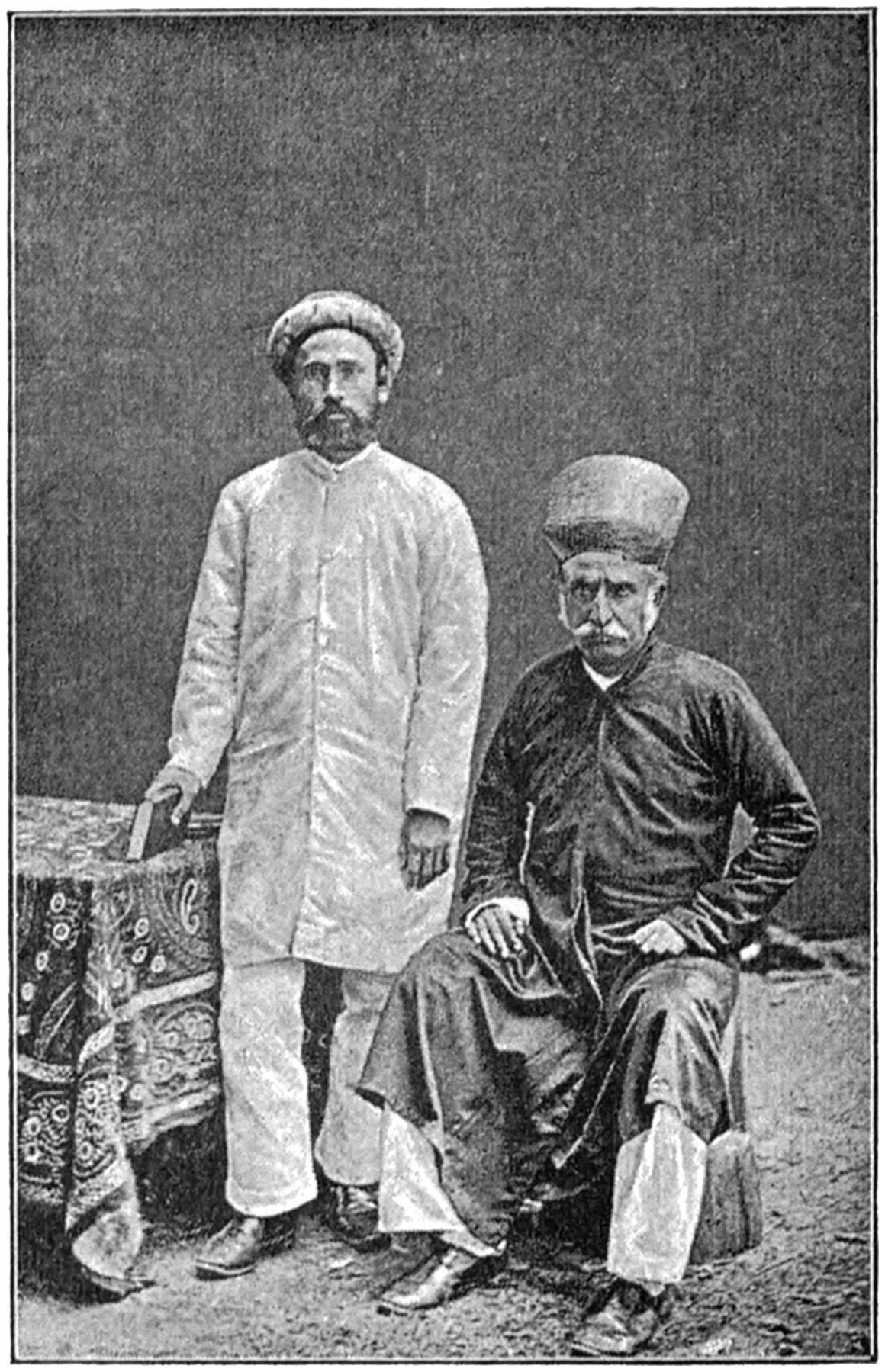
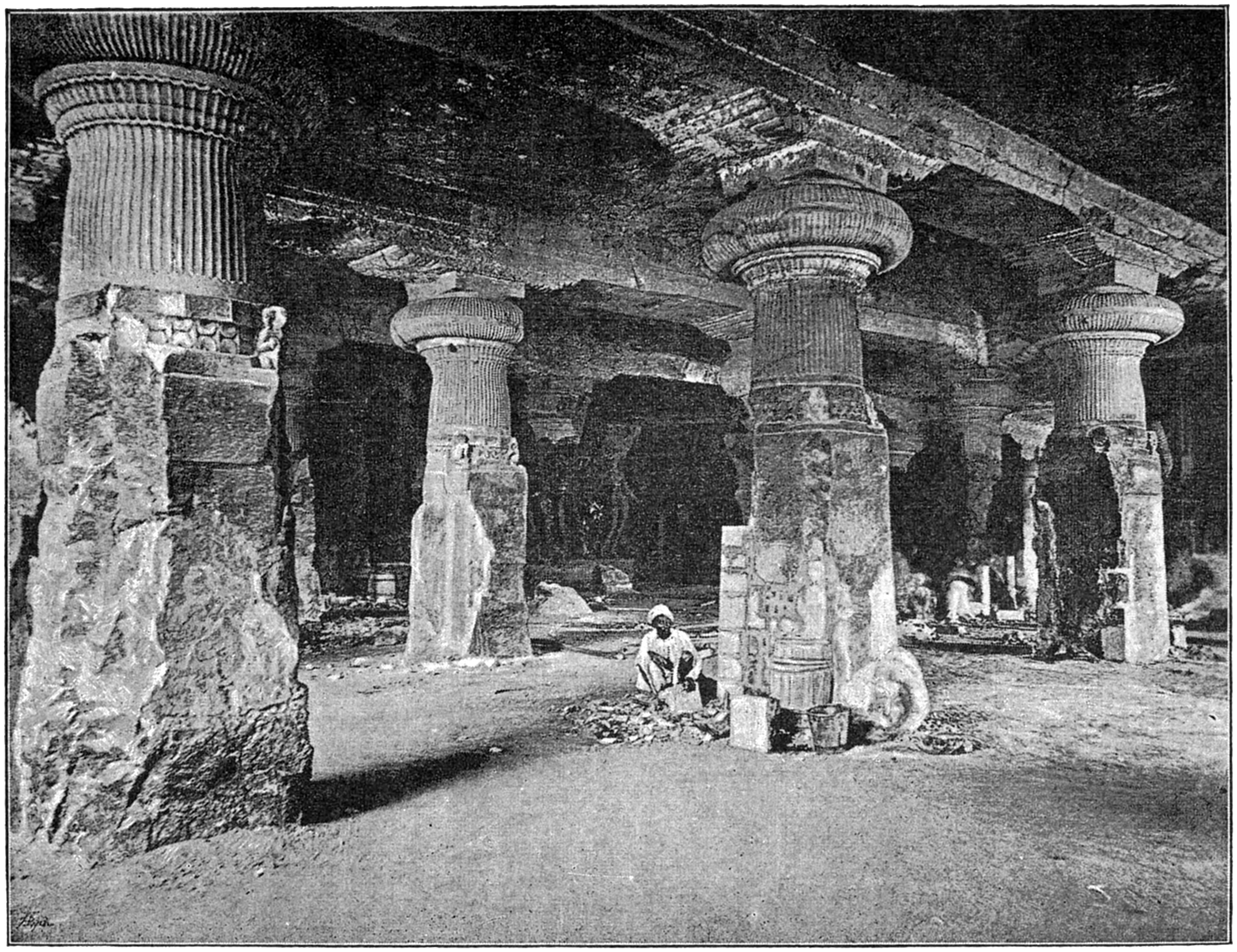
The native Bombay a wonderful spectacle—Workshops, saleshops, opium dens, theatres, temples, mosques—The population, Mahrattas and Parsees—The modern city and the manufacturing quarter—The Parsee nose—Justice Telang, a Mahratta—The Bunya Caste—Tribhovan Das at home—View from the Malabar Hill—A Bunya wedding—Native theatres—The Salvation Army—Across the harbor to Elephanta—The great cave-temple—Sculptured panels, the Hindu Trinity—The human-divine life of Siva—Impressive effect of the whole—An opium den—Various sorts of “ecstasy” produced by these and other drugs—The proletariat at home—Music and conversation—Dream of a “United India”—Bombay at night—On the way to Aden—A calm and starlit ocean—A beautiful panorama.
Remarkable social movement in India—Complexity and corruption of Caste system—The Brahmans—Defence of caste from native point of view—Specimens of caste regulation—Caste tyranny—Story of a widow re-marriage—Pharisaism of respectability—Caste in its other aspect as a Trade-Guild—Tempering competition—Instances of this—Communism, the second great feature of social life—Village, Caste and Family communism—The last still flourishing—Anecdotes—Old sanctions being destroyed by commercialism—Sacredness of Family tie
The New Influences: Western Science and Commercialism.
Great spread of Western education—Euclid and Political Economy at Tuticorin—Schools and Colleges throughout India—Cricket and golf—Young India—“We are all Agnostics now”—Similar spread of Commercialism—Interior of a cotton-mill at Bombay—Large profits, conditions of labor—Numerous trading posts and clerkships—The National Indian Congress—Its ideals and influence—Disliked by the British—The social gulf again—Our future in India—The break-up of village life—Problem of pauperism, Sir Henry Maine—Incongruity of Commercialism with the genius of India—Probable ascendancy of the former for a time—But only for a time
FROM ADAM’S PEAK TO ELEPHANTA. — CHAPTER I. COLOMBO.
Imagine a blue-green ribbon of water some 60 yards
wide, then rough sandy dunes 10 or 20 feet high,
and then beyond, the desert, burning yellow in the
sun—here and there partly covered with scrub, but
for the most part seeming quite bare; sometimes
flat and stony, sometimes tossed and broken, sometimes
in great drifts and wreaths of sand, just like
snowdrifts, delicately ribbed by the wind—the whole
stretching away for miles, scores of miles, not a
moving form visible, till it is bounded on the horizon
by a ridge of hills of the most ethereal pink under
an intense blue sky. Such is the view to the east
of us now, as we pass through the Suez Canal
(19th October, 1890). To the west the land looks
browner and grayer; some reeds mark a watercourse,
and about 10 miles off appears a frowning
dark range of bare hills about 2,000 feet high, an
outlying spur of the hills (Jebel Attákah) that
bound the Gulf of Suez.
In such a landscape one of the signal stations,
with its neat tiled cottage and flagstaff, and a few
date palms and perhaps a tiny bit of garden, is quite
an attraction to the eye. These stations are placed
at intervals of about 6 miles all along the canal.
They serve to regulate the traffic, which is now
enormous, and continuous night and day. The
great ships nearly fill the waterway, so that one
has to be drawn aside and moored in order to
let another pass; and though they are not allowed
to go faster than 4 miles an hour they create a
considerable wave in their rear, which keeps washing
down the banks. Tufts of a reedy grass have
been planted in places to hold the sand together;
but the silt is very great, and huge steam-dredges
are constantly at work to remove it. Here and there
on the bank is a native hut of dry reeds—three
sides and a flat top—just a shelter from the sun;
or an Arab tent, with camels tethered by the leg
around it. At Kantarah the caravan track from
Jerusalem—one of the great highways of the old
world—crosses the canal; there are a few wood
and mud huts, and it is curious to see the string of
laden camels and the Arabs in their unbleached
cotton burnouses coming down—just as they might
be coming down from the time of Father Abraham—and
crossing the path of this huge modern steamship,
with its electric lights and myriad modern
appliances, the Kaiser Wilhelm now going half-way
round the globe.
The desert does not seem quite devoid of animal
life; at any rate along the canal side you may see
tracks in the sand of rabbits and hares, occasional
wagtail-like birds by the water, a few crows hovering
above, or a sea-gull, not to mention camels and
a donkey or two, or a goat. Near Port Said they
say the lagoons are sometimes white with flocks of
pelicans and flamingoes, but we passed there in the
night. It was fine to see the electric light, placed
in the bows, throwing a clear beam and illuminating
the banks for fully half a mile ahead, as we slowly
steamed along. The driven sand looked like snow
in the bluish light. The crescent moon and Venus
were in the sky, and the red signal lights behind us
of Port Said.
The canal is 90 miles long, and a large part of
it follows the bed of a very ancient canal which
is supposed to have connected the two seas. It
appears that there is a very slight movement of the
water through it from south to north.
We are now nearing Suez, and the heat is so
great that it reverberates from the banks as from a
furnace; of course the deck is under an awning.
The remains of a little village built of clay appears,
but the huts have broken down, split by the fierce
sun-rays, and some light frame-houses, roofed and
walled with shingles, have taken their place.
Gulf of Suez.—The town of Suez is a tumbledown
little place, narrow lanes and alleys; two-storied
stone houses mostly, some with carved
wooden fronts, and on the upper floors lattice-work,
behind which I suppose the women abide. Some
nice-looking faces in the streets, but a good many
ruffians; not so bad though as Port Said, where the
people simply exist to shark upon the ships. In
both places an insane medley of Arabs, fellahs, half-castes
and Europeans, touts, guides, donkey-boys,
etc., and every shade of dress and absurd hybrid
costume, from extreme Oriental to correct English;
ludicrous scenes of passengers going on shore,
ladies clinging round the necks of swarthy boatmen;
donkey-boys shouting the names of their donkeys—“Mr.
Bradlaugh, sir, very fine donkey,” “Mrs.
Langtry,” “Bishop of London,” etc.; fearful altercations
about claimed baksheesh; parties beguiled
into outlying quarters of the town and badly blackmailed;
refusals of boatmen to take you back to
the ship while the very gong of departure is sounding;
and so forth. Suez however has a little
caravan and coasting trade of its own, besides the
railway which now runs thence to Cairo, and has
antique claims to a respectability which its sister
city at the other end of the canal cannot share.
Now that we are out in the gulf, the sea is deep
blue, and very beautiful, the rocks and mountains
along the shore very wild and bare, and in many
parts of a strong red color. This arm of the Red
Sea is about 150 miles long, and I think not more
than 20 miles wide at any point; in some places it
is much less. We pass jutting capes and islands
quite close on the west of us—great rocky ravine-cut
masses absolutely bare of vegetation. On the
east—apparently about 10 miles distant, but very
clear—stands an outlying range of Sinai—Jebel
Sirbal by name—looks about 5,000 or 6,000 feet
high, very wild and craggy, many of the peaks
cloven at the summit and gaping as if with the
heat; farther back some higher points are visible,
one of which is probably Jebel Musa. A most
extraordinary land; at some places one can discern—especially
with the aid of a glass—large tracts or
plains of loose sand, miles in extent, and perfectly
level, except where they wash up in great drifts
against the bases of the mountains. Across these
plains tall dark columns can be distinguished slowly
traveling—the dreaded sand-clouds borne on eddies
of the wind.
Indian Ocean, Oct. 25th.—Much cooler now.
In the Red Sea, with thermometer at 90° in the
cabins, heat was of course the absorbing topic.
Everybody mopping; punkahs in full swing. I
believe the water there frequently reaches 90° F.,
and sometimes 95°; but here it is quite cool, probably
not much over 60°, and that alone makes a great
difference. It is a queer climate in the Red Sea:
there seems to be always a haze, due to dust blown
from the shores; at the same time the air is very
damp, owing to the enormous evaporation, clothes
hung up get quite wet, and there are heavy dews.
When the wind is aft the oppression from the heat
is sometimes so great that ships have to be turned
back and steamed against the breeze; but even so
casualties and deaths are not uncommon. Owing
to the haze, and the breadth of the Red Sea which
is as much as 200 miles in parts, little is seen of the
shores. A few rocky islands are passed, and a
good many awkward reefs which the passengers
know nothing of. The Straits of Bab-el-Mandeb are
curious. The passage between the Island of Perim
and the Arabian mainland is quite narrow, only a mile
or two wide; tossed wild-looking hills on the mainland,
3,000 or 4,000 feet high, with French fortifications.
The island itself lower and more rounded,
with English fort and lighthouse; but looking very
black and bare, though owing to the moisture there
is some kind of stunted heathery stuff growing on
it. There are a few English here, and a native
town of waggon-like tents clustered round the fort;
some little fishing and sailing boats along the
shores. Turning eastwards along the south coast
of Arabia the same awful land meets the eye as in
the Gulf of Suez. A continual cloud of dust flies
along it, through which one discerns sandy plains,
and high parched summits beyond. There must
however be water in some parts of this region, as
it is back from here in this angle of Arabia that
Mocha lies and the coffee is grown.
Colombo.—I fear that the Red Sea combined with
mutual boredom had a bad effect on the passengers’
tempers, for terrible dissensions broke out; and after
six days of the Indian Ocean, during which the only
diversions were flying-fish outside and scandal-mongering
inside the ship, it was a relief to land
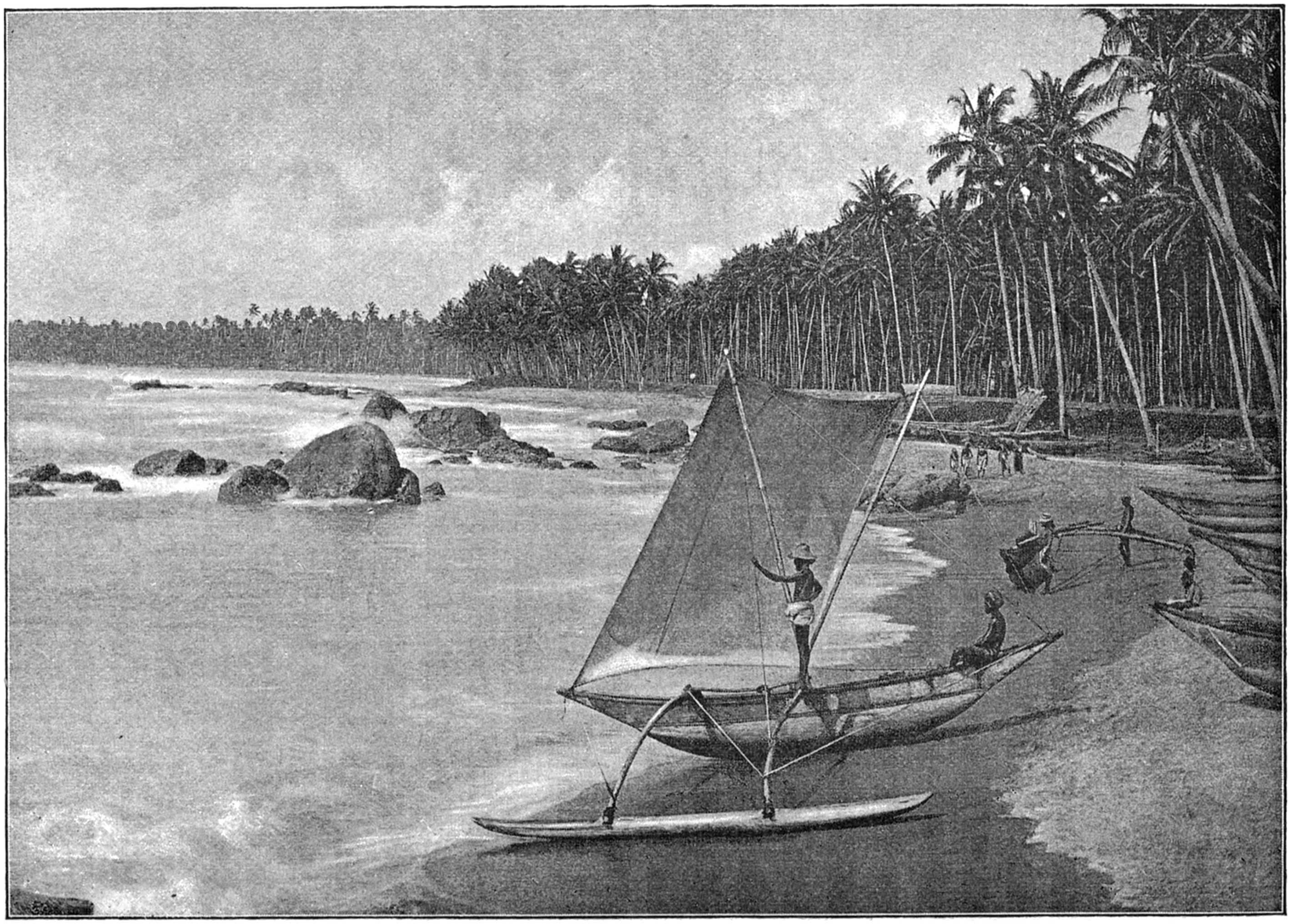
on the palm-fringed coast of Ceylon. The slender
catamarans—or more properly outrigged canoes—manned
by dusky forms, which come to take you
ashore, are indeed so narrow that it is impossible to
sit inside them! They are made of a “dug-out”
tree-trunk (see frontispiece), with parallel bulwarks
fastened on only 10 inches or a foot apart; across
the bulwarks a short board is placed, and on that
you can sit. Two arms projecting on one side carry
a float or light fish-shaped piece of wood, which rests
on the water 8 feet or so from the canoe, and
prevents the vessel from capsizing, which it would
otherwise infallibly do. Impelled by oars, or by a
sail, the boat bounds over the water at a good speed;
and the mode of traveling is very pleasant. There
is no necessity however to embark in these frail
craft, for respectable civilised boats, and even steam-launches,
abound; we are indeed in an important
and busy port.
A great granite mole, built five years ago, has converted
an open roadstead into a safe and capacious
harbor, and there is now probably no place in the
East better supplied with mails and passenger boats
than Colombo. It is the calling place for the great
lines of steamers en route for Australia, for China and
Japan, and for Calcutta and Burmah, not to mention
smaller coasting boats from the mainland of India,
and so forth. The city itself has only the slightest
resemblance to a European town. There is a fort
certainly, and a Government House, and barracks
with a regiment of infantry (part of whom however
are generally up country); there are two or three
streets of two or even three-storied houses, with
shops, banks, mercantile offices, etc.; a few hotels
and big goods stores, a lighthouse, and a large
engineering works, employing some hundreds of
Cinghalese and Tamil operatives; and then you
have done with the English quarter. The land is
flat, and round about the part just described stretch
open grass-covered spaces, and tree-fringed roads,
with the tiny booths or huts of the darkies on both
sides of them. Here and there are knots and
congeries of little streets and native markets with
multifarious life going on in them. Here is a street
of better built cottages or little villas belonging
to Eurasians—the somewhat mixed descendants of
old Dutch and Portuguese settlers—small one or
seldom two-storied houses of stuccoed brick, with a
verandah in front and a little open court within,
clustering round an old Dutch church of the 17th
century. Here is the residential quarter of the
official English and of the more aspiring among the
natives—the old Cinnamon Gardens, now laid out in
large villa-bungalows and private grounds. Here
again is a Roman Catholic church and convent, or
the grotesque façade of a Hindu temple; and everywhere
trees and flowering shrubs and, as one
approaches the outskirts of the town, the plentiful
broad leaves of coco-palms and bananas overshadowing
the roads. Nor in any description of
Colombo should the fresh-water lake be forgotten,
which ramifying and winding in most intricate
fashion through the town, and in one place coming
within a hundred yards of the sea, surprises one
continually with enchanting glimpses. I don’t know
any more delightful view of its kind—all the more
delightful because so unexpected—than that which
greets the eye on entering the Fort Railway Station
at Colombo. You pass through the booking-office
and find yourself on a platform, which except for the
line of rails between might be a terrace on the lake
itself; a large expanse of water with wooded shores
and islands, interspersed with villas, cottages and
cabins, lies before you; white-sailed boats are going
to and fro; groups of dark figures, waist-deep in
water, are washing clothes; children are playing
and swimming in the water; and when, as I saw it
once, the evening sun is shining through the transparent
green fringe of banana palms which occupies
the immediate foreground, and the calm lake beyond
reflects like a mirror the gorgeous hues of sky and
cloud, the scene is one which for effects of color
can hardly be surpassed.
Up and down these streets and roads, and by the
side of this lake, and along the seashore and
through the quays and docks, goes, as may be imagined,
a most motley crowd. The Cinghalese and
the Tamils are of course the most numerous, but
besides these there are Mahomedans—usually called
Moor-men here—and some Malays. The English
in Ceylon may be divided into three classes: the
official English, the planters, and the small trading
English (including employees on railway and other
works). Then there are the anglicised native gentry,
Cinghalese or Tamil, some of whom occupy official
positions, and who largely adopt European dress
and habits; the non-anglicised ditto, who keep to
their own ways and costume, and are not much seen
in public; the Dutch Eurasians, many of whom
become doctors or solicitors (proctors); and the
Portuguese, who are frequently traders in a small
way.
Specimens of all these, in their different degrees
of costume and absence of costume, may be seen in
Colombo, as indeed in almost any place in Ceylon
which can be dignified with the name of a town.
Here for instance is a great big Moor-man with
high fez of plaited grass, baggy white pants and
turned-up shoes; a figured vest on his body, and
red shawl thrown over one shoulder. [He is probably
a well-to-do shopkeeper; not an agreeable
face, but I find the Mahomedans have a good reputation
for upright dealing and fidelity to their word.]
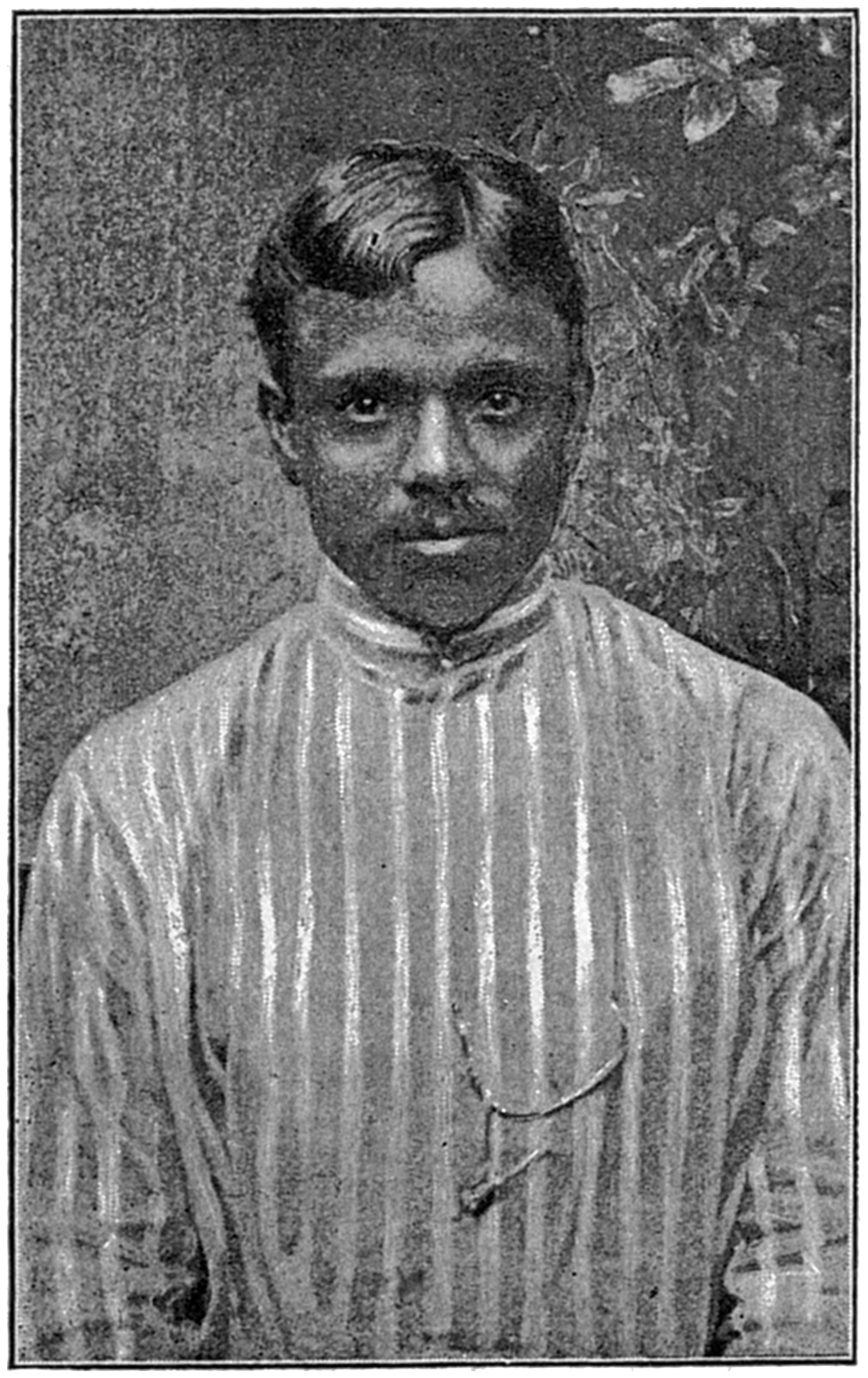
Here a ruddy-brown Cinghalese man, with hairy
chest, and nothing on but a red loin-cloth, carrying
by a string an earthenware pot, probably of palm-beer.
[A peasant. The Cinghalese are generally
of this color, whereas the Tamils tend towards
black, though shading off in the higher castes to
an olive tint.]
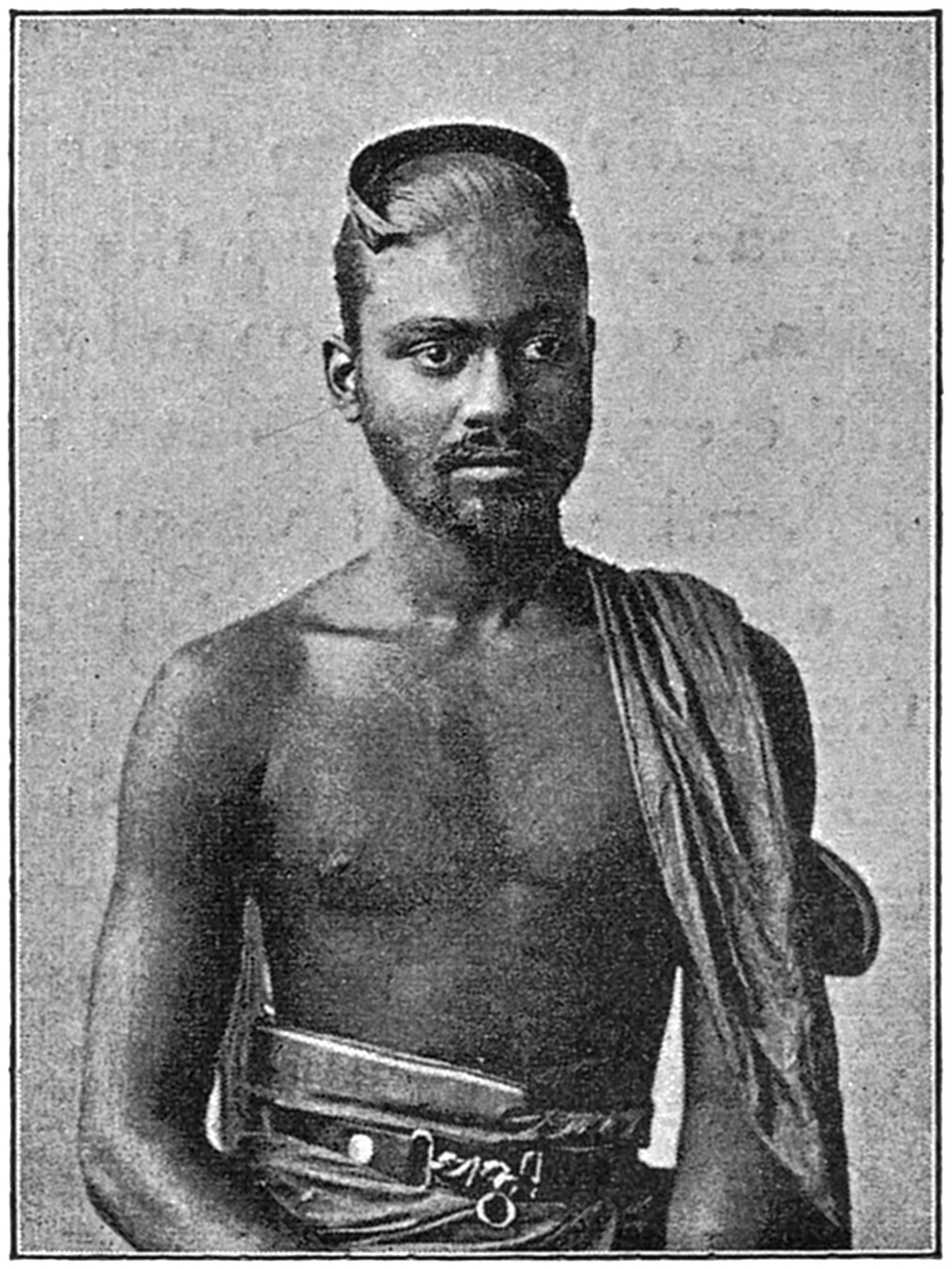
CINGHALESE MAN.
Another Cinghalese, dressed all in white, white
cotton jacket and white cloth hanging to below the
knees, with elegant semicircular tortoise-shell comb
on his head; a morbidly sensitive face with its
indrawn nose and pouting lips. [Possibly a private
servant, or small official of one of the courts, or
Arachchi. The comb is a great mark of the low-country
Cinghalese. They draw the hair backwards
over the head and put the comb on horizontally,
like an incomplete crown, with its two ends sticking
up above the forehead—very like horns from a
front view! The hair is then fastened in a knot
behind, or sometimes left hanging down the back.
This is a somewhat feeble face, but as a rule one
may say that the Cinghalese are very intelligent.
They make excellent carpenters and mechanics.
Are generally sensitive and proud.]
A JAFFNA TAMIL.
Here come two Englishmen in tweed suits and
tennis shoes—their umbrellas held carefully by the
middle—apparently of the planter community,
young, but rather weedy looking, with an unsteady,
swimmy look about the eyes which I fear is not uncommon
among the planters; I have seen it already
well-developed in a mere boy of eighteen.
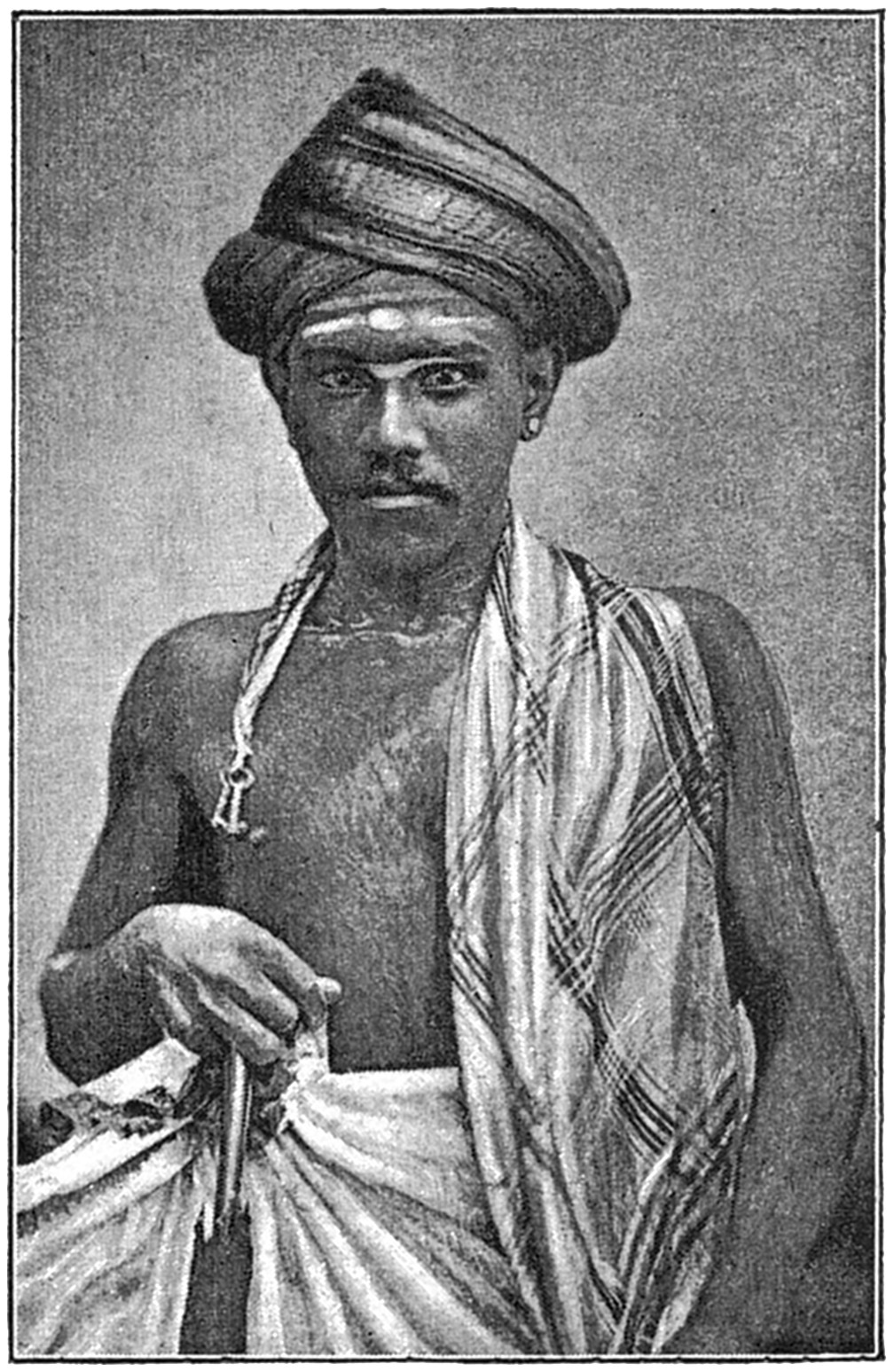
Here a dozen or so of chetties (a Tamil commercial
caste), with bare shaven and half-shaven
heads, brown skins, and white muslins thrown
gracefully round their full and sleek limbs; the
sacred spot marked on their foreheads, red betel
in their mouths, and avarice in their faces.
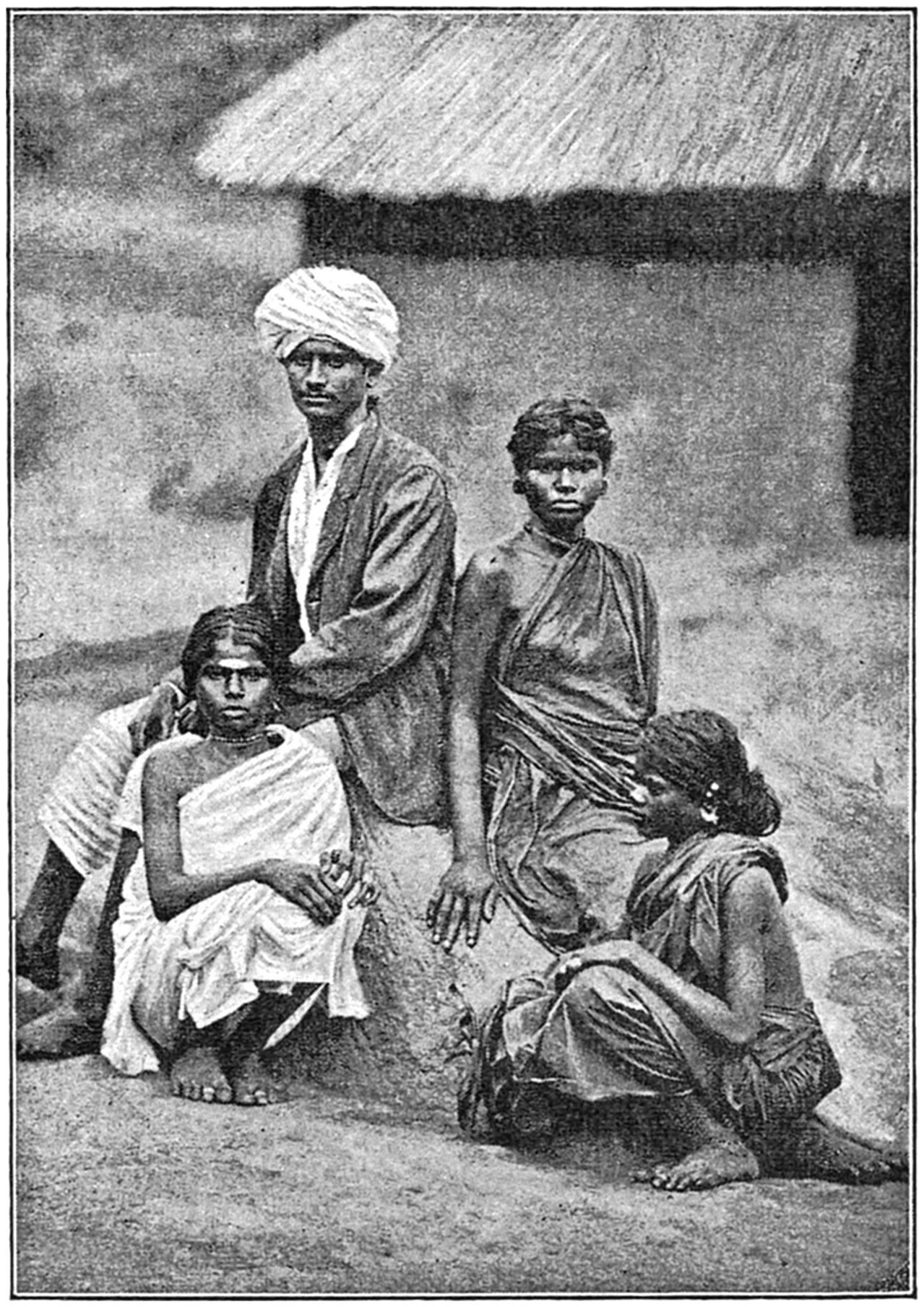
There a Tamil coolie or wage-worker, nearly naked
except for a handkerchief tied round his head, with
glossy black skin and slight yet graceful figure.
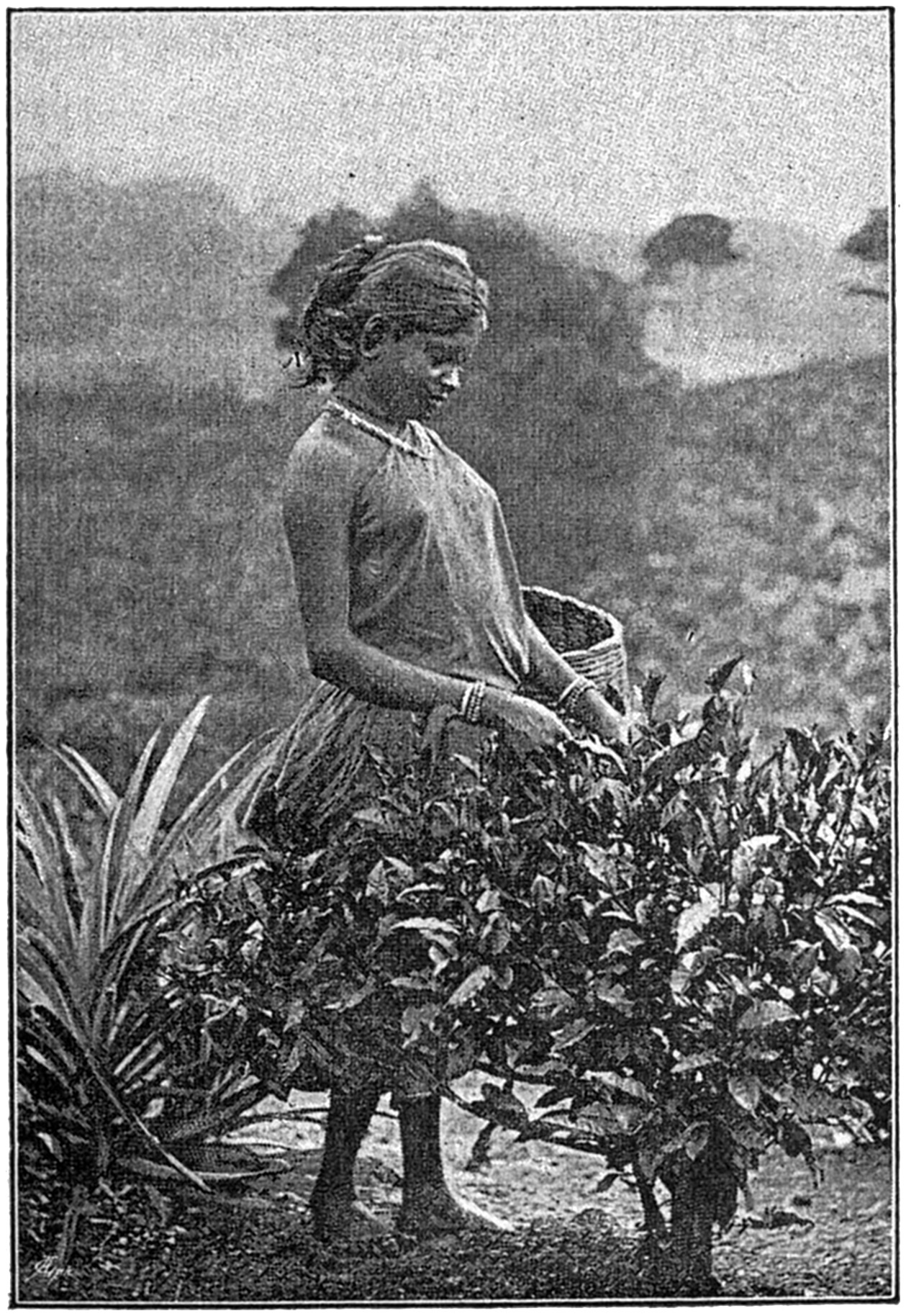
Here a pretty little girl of nine or so, with blue
beads round her neck, and the usual white cotton
jacket and colored petticoat or çilai of the Cinghalese
women, walking with a younger brother.
Here three young Eurasian girls in light European
costume and straw hats, hair loose or in pigtails
down their backs, very pretty. [They are off for
a walk along the Galle Face promenade by the sea,
as the heat of the day is now past.]
Here also an English lady, young and carefully
dressed, but looking a little bored, driving in her
pony-trap to do some shopping, with a black boy
standing behind and holding a sunshade over her.
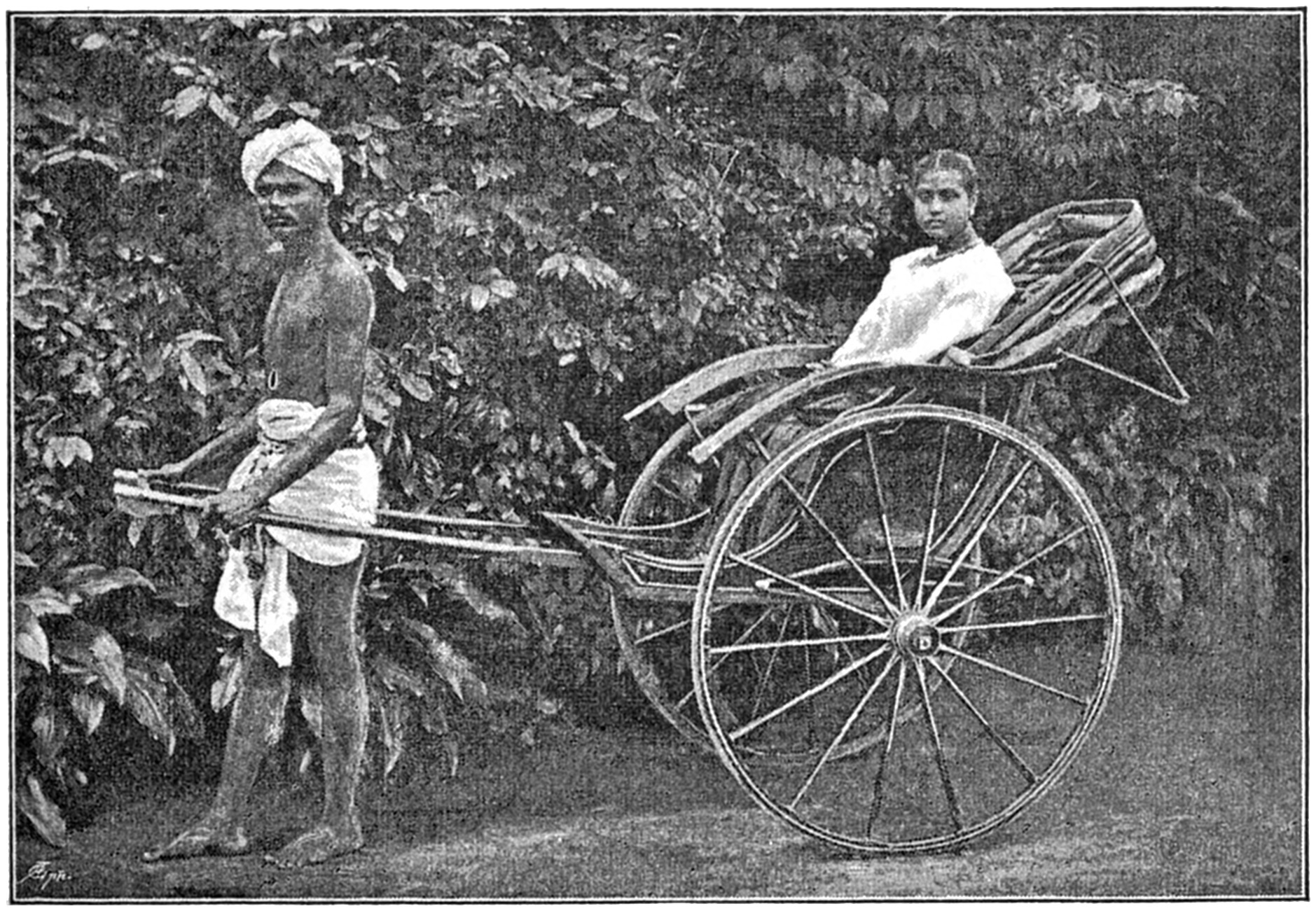
A JINRICKSHAW.
(Tamil cooly, Eurasian girl.)
One of the features of Colombo are the jinrickshaws,
or light two-wheeled gigs drawn by men,
which abound in the streets. These Tamil fellows,
in the lightest of costumes, their backs streaming
under the vertical sun, bare-legged and often bare-headed,
will trot with you in a miraculous way
from one end of Colombo to the other, and for the
smallest fee. Tommy Atkins delights to sit thus
lordly behind the toiling “nigger.” At eventide
you may see him and his Eurasian girl—he in one
jinrickshaw and she in another—driving out to the
Galle Face Hotel, or some such distant resort along
the shore of the many-sounding ocean. The Tamils
are mostly slight and graceful in figure, and of an
active build. Down at the docks they work by
hundreds, with nothing on beyond a narrow band
between the thighs, loading and unloading barges
and ships—a study of the human figure. Some of
them of course are thick and muscular, but mostly
they excel in a kind of unconscious grace and fleetness
of form as of the bronze Mercury of Herculaneum,
of which they often remind me. Their
physiognomy corresponds with their bodily activity;
the most characteristic type that I have noticed
among them has level brows, and eyes deep-set
(and sometimes a little close together), straight nose,
and well-formed chin. They are a more enterprising
pushing and industrious people than the
Cinghalese, eager and thin, skins often very dark,
with a concentrated, sometimes demonish, look between
the eyes—will-power evidently present—but
often handsome. Altogether a singular mixture of
enterprise with demonic qualities; for occultism is
rife among them, from the jugglery of the lower
castes to the esoteric philosophy and speculativeness
of the higher. The horse-keepers and stable boys
in Ceylon are almost all Tamils (of a low caste), and
are a charming race, dusky active affectionate
demons, fond of their horses, and with unlimited
capacity of running, even over newly macadamised
roads. The tea-coolies are also Tamils, and the
road-workers, and generally all wage-laborers; while
the Cinghalese, who have been longer located in the
island, keep to their own little peasant holdings and
are not at all inclined to come under the thumb of
a master, preferring often indeed to suffer a chronic
starvation instead.
The Tamil women are, like their lords, generally
of a slighter build than the Cinghalese of the same
sex, some indeed are quite diminutive. Among
both races some very graceful and good-looking
girls are to be seen, up to the age of sixteen
or so, fairly bright even in manner; especially
among the Cinghalese are they distinguished for
their fine eyes; but at a later age, and as wives,
they lose their good looks and tend to become rather
heavy and brutish.
The contrast between the Cinghalese and the
Tamils is sufficiently marked throughout, and
though they live on the island on amicable terms
there is as a rule no love lost between them. The
Cinghalese came to Ceylon, apparently from the
mainland of India, somewhere in the 6th century
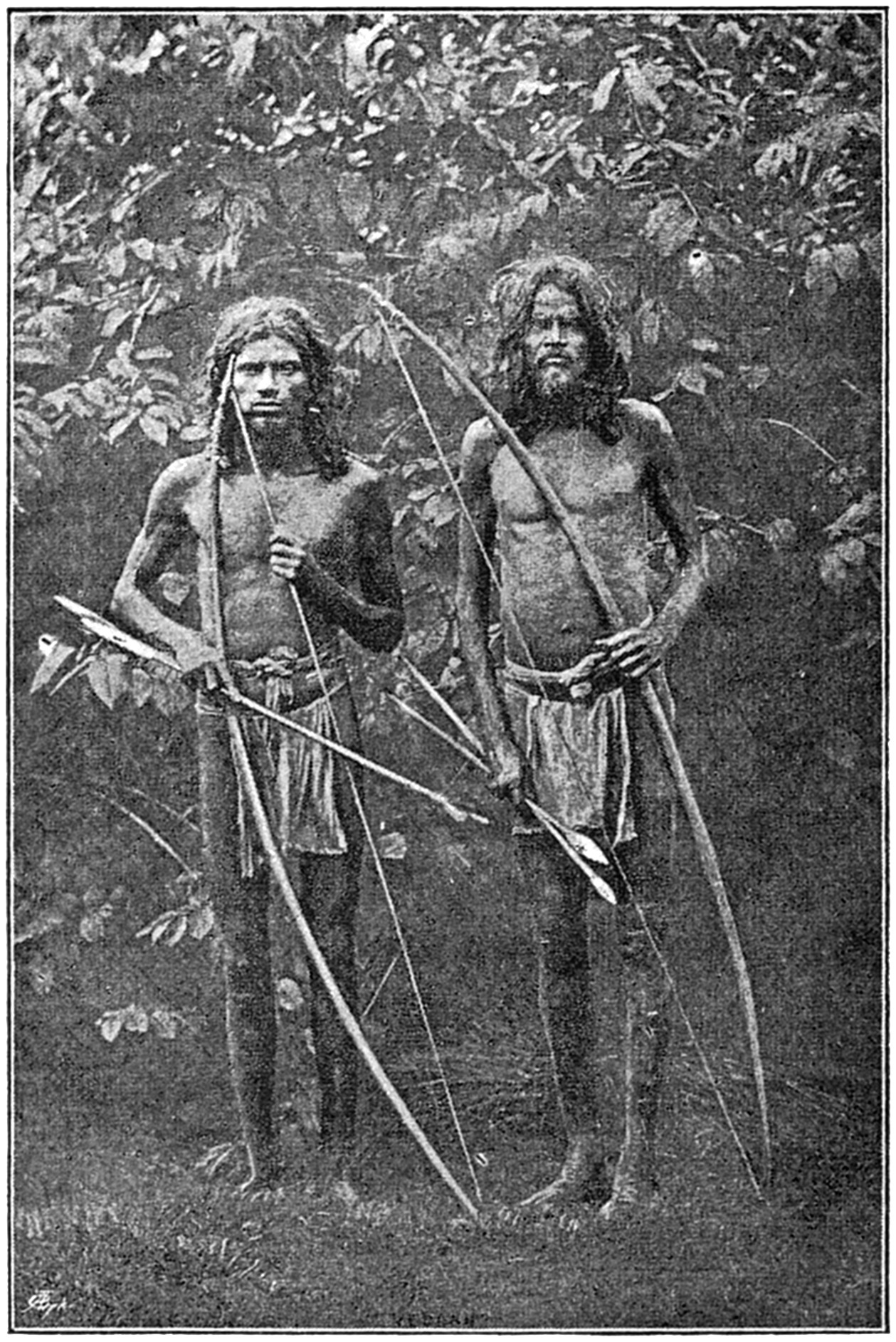
B.C., and after pushing the aborigines up into the
woods and mountains (where some of them may yet
be found), occupied the whole island. It was not
long however before the Tamils followed, also from
India; and since then, and through a long series of
conflicts, the latter have maintained their position,
and now form the larger part of the population in
the north of the island, while the Cinghalese are
most numerous in the south. Great numbers of
Tamil peasants—men, women, and children—still
come over from the mainland every year, and go
up-country to work in the tea-gardens, where there
is a great demand for coolie labour.
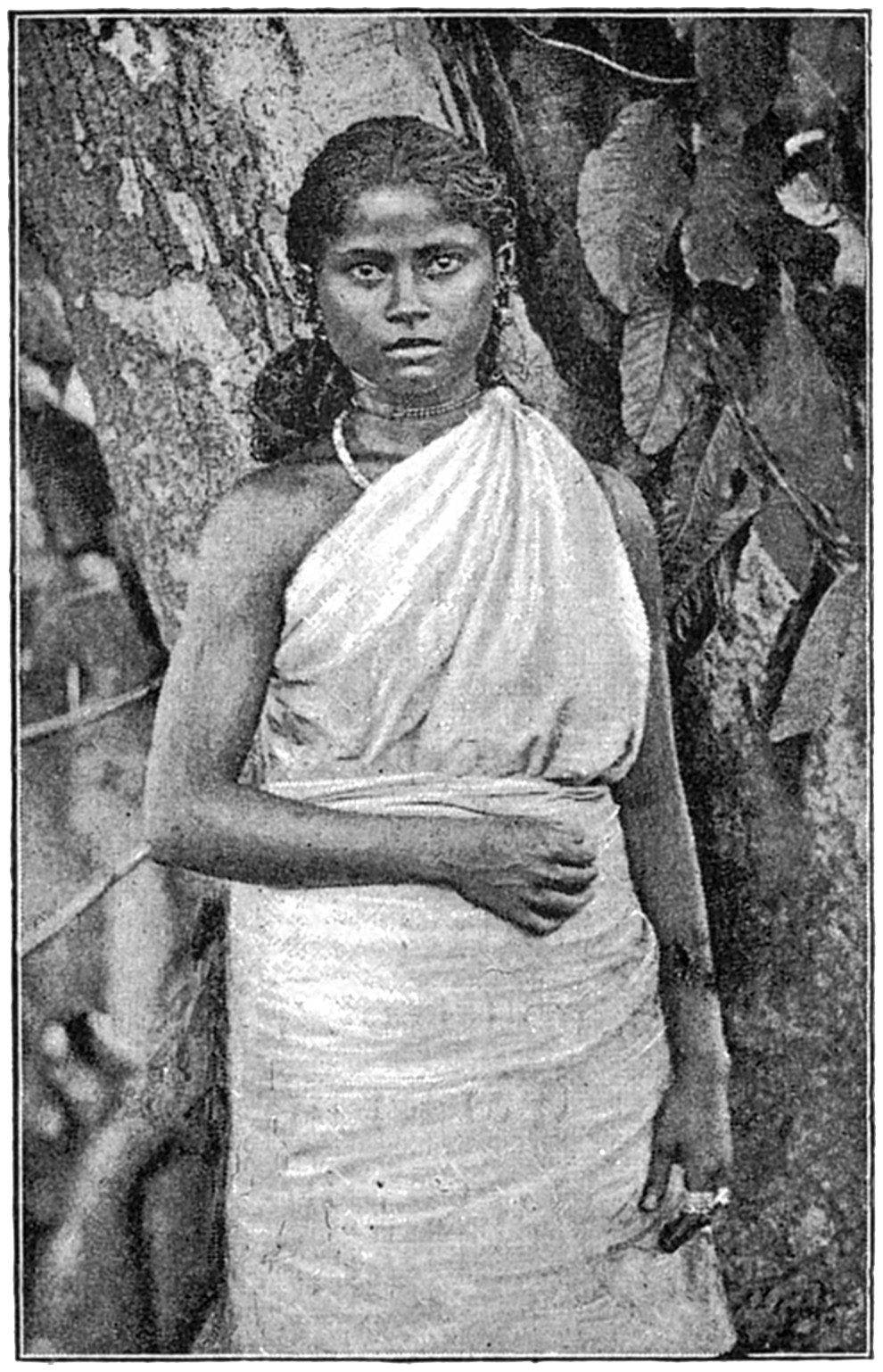
CINGHALESE GIRL.
In character the Cinghalese are more like the
Italians, easy-going, reasonably idle, sensitive,
shrewd, and just a bit romantic. Their large eyes
and tortoise-shell combs and long hair give them a
very womanly aspect; and many of the boys and
youths have very girlish features and expressions.
They have nearly always grace and dignity of manner,
the better types decidedly handsome, with their
well-formed large heads, short beards, and long
black hair, composed and gentle, remindful of some
pictures of Christ. In inferior types you have thick-featured,
morbidly sensitive, and at the same time
dull-looking persons. As a rule their frames are
bigger and more fleshy than those of the Tamils,
and their features less cleanly cut. Captain R.
Knox, in his “Nineteen Years’ Captivity in the
Kingdom of Conde Uda” (1681), says of them:—“In
carriage and behaviour they are very grave
and stately, like unto Portuguese; in understanding
quick and apprehensive; in design, subtle and
crafty; in discourse, courteous, but full of flatteries;
naturally inclined to temperance both in meat and
drink, but not to chastity; near and provident in
their families, commending good husbandry.”
The Cinghalese are nearly all Buddhists, while
the Tamils are Hindus. Buddhism was introduced
into Ceylon about the 4th century B.C., and has
flourished here ever since; and Buddhist rock-temples
are to be found all over the island. The
Tamils have a quite extensive literature of considerable
antiquity, mostly philosophical or philosophical
poetical; and their language is very rich in
vocabulary as well as in its grammatical forms and
inflexions—though very terse, with scanty terms
of courtesy (“thank you,” “good-morning,” and such
like), and a little harsh in sound, k’s and r’s flying
through the teeth at a great rate. Cinghalese is
much more liquid and pleasant in sound, and has
many more Aryan words in it. In fact it is supposed
to be an offshoot of Sanskrit, whereas Tamil seems
to have no relation to Sanskrit, except that it has
borrowed a good many words. The curious thing
is that, so little related as races, the Tamils should
have taken their philosophy, as they have done,
from the Sanskrit Vedas and Upanishads, and really
expressed the ideas if anything more compactly
and systematically than the Sanskrit books do.
Though poor in literature I believe, yet the Cinghalese
has one of the best books of chronicles which
exist in any language—the Mahawanso—giving a
very reliable history of the race (of course with
florid adornment of stupendous miracles, which can
easily be stripped off) from their landing in Ceylon
down to modern times. The Mahawanso was
begun by Mahanamo, a priest, who about 460 A.D.
compiled the early portion comprising the period
from B.C. 543 to A.D. 301, after which it was continued
by successive authors right down to British
times, i.e., A.D. 1758!
There are two newspapers in Colombo printed in
the Cinghalese language, one of which is called
The Buddhist World; there is also a paper
printed in Tamil; and there are three English
newspapers. In “places of entertainment” Colombo
(and the same is true of the towns in India) is
very wanting. There is no theatre or concert-hall.
It can be readily understood that though the population
is large (120,000), it is so diverse that a sufficiently
large public cannot be found to support such
places. The native races have each their own
festivals, which provide for them all they require
in that way. The British are only few—5,000 in
all Ceylon, including military, out of a population
of over three millions; and even if the Eurasian
population—who of course go in for Western manners
and ideals—were added, their combined numbers
would be only scanty. An occasional circus
or menagerie, or a visit from a stray theatrical
company on its way to Australia, is all that takes
place in that line.
For the rest there is a Salvation Army, with
thriving barracks, a Theosophist Society, a branch
of the Royal Asiatic Society, and various other little
clubs representing different sections. Society is
of course very much broken up into sections. Even
the British, few as they are, are sadly divided by
cliques and jealousies; the line between the official
English and the “second-class” English is terribly
severe (as indeed all over India); and between
these again and the Eurasians. Even where Cinghalese
or Tamil or Eurasian families of old standing
attain important official positions, an insuperable
stiffness still marks the intercourse between them
and the British. “Ah!” said a planter to a young
friend of mine who had just shaken hands rather
cordially with a native gentleman, “Ah! my boy, you
won’t do that when you’ve been here three years!”
Thus a perfect social amalgamation and the sweetness
of brethren dwelling together in unity are things
still rather far distant in this otherwise lovely isle.
Talking about the beauty of the island, I was
very much struck, even on my first landing, with its
“spicy gales.” The air is heavy with an aromatic
fragrance which, though it forced itself on my attention
for three or four weeks before I got fairly
accustomed to it, I have never been able to trace
to any particular plant or shrub. It is perhaps
not unlike the odor of the cinnamon leaf when
bruised, but I don’t think it comes from that source.
I am never tired of looking at the coco-nut palms;
they grow literally by the million all along this coast
to the north and south of Colombo. To the south
the sea-shore road is overshadowed by them. I
have been some miles along the road, and the belt
of land, a hundred yards or so wide, between it and
the sea, is thick with their stems right down to the
water’s edge, over which they lean lovingly, for they
are fond of the salt spray. On the other side of the
road too they grow, and underneath them are little
villas and farmsteads and tiny native cabins, with
poultry and donkeys and humped cows and black
pigs and brown children, in lively confusion; while
groups of peasant men and women in bright-colored
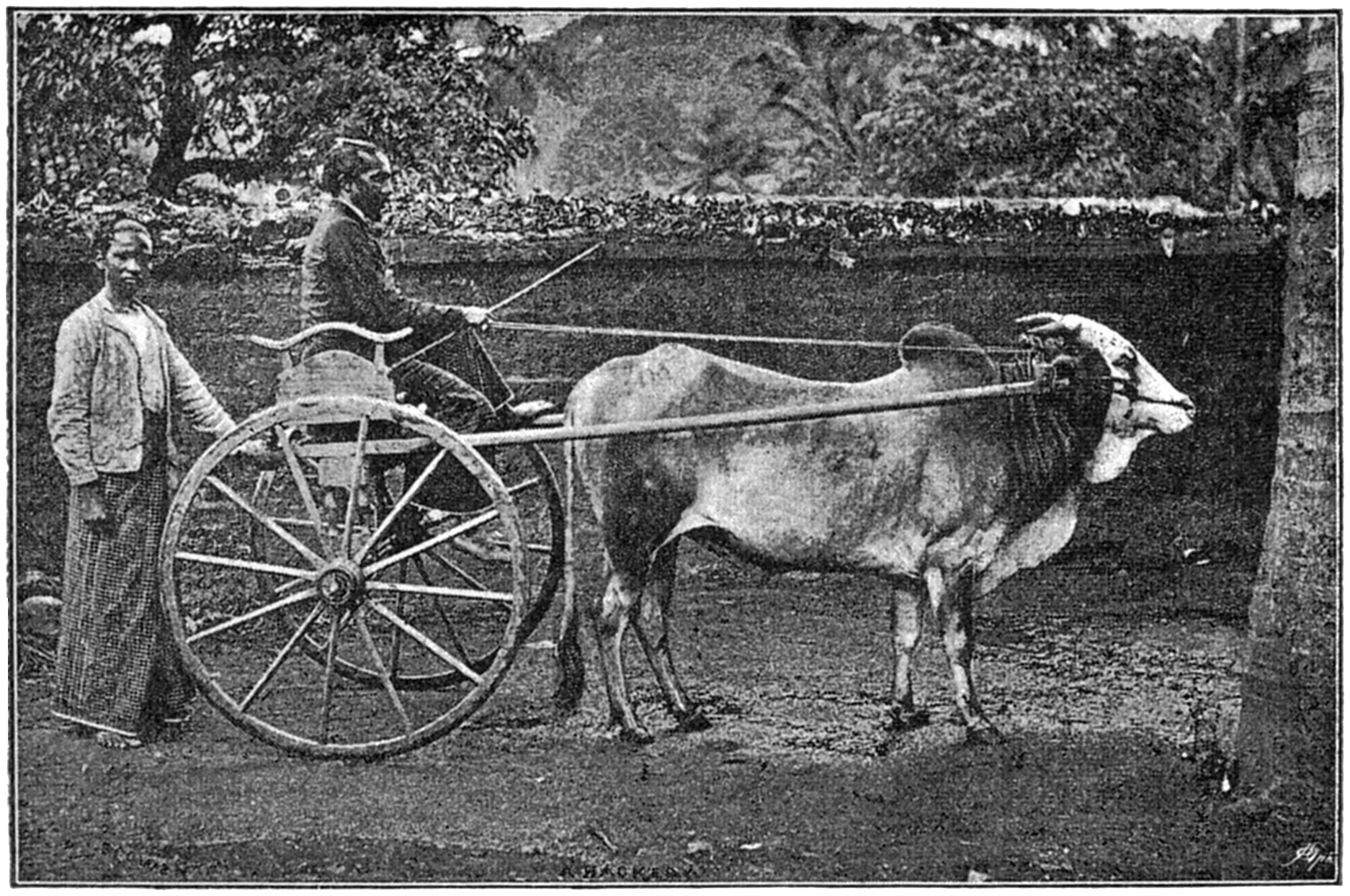
wraps travel slowly along, and the little bullock
gigs, drawn by active little brahmin bulls with jingling
bells, trot past at a pace which would do credit
to an English pony—a scene which they say continues
much the same the whole way to Galle (80
miles). These palms do not grow wild in Ceylon;
they are all planted and cared for, whether in huge
estates, or in the rood of ground which surrounds a
Cinghalese cabin. The Cinghalese have a pretty
saying that they cannot grow afar from the sound of
the human voice. They have also a saying to the
effect that a man only sees a straight coco-palm
once in a lifetime. Many of the other kinds of palms
grow remarkably straight, but this kind certainly
does not. In a grove of them you see hundreds of
the grey smooth stems shooting upwards in every
fantastic curve imaginable, with an extraordinary
sense of life and power, reminding one of the way
in which a volley of rockets goes up into the air.
Then at the height of 50 or 60 feet they break
into that splendid crown of green plumes which
sparkles glossy in the sun, and waves and whispers
to the lightest breeze.
Along this palm-fringed and mostly low and
sandy shore the waves break—with not much
change of level in their tides—loudly roaring in the
S.W. monsoon, or with sullen swell when the wind
is in the N.E., but seldom altogether calm. A
grateful breeze tempers the 90° of the thermometer.
A clumsy-hulled lateen-sailed fishing boat is
anchored in the shelter of a sandy spit; two or
three native men and boys are fishing with rod and
line, standing ankle-deep at the water’s edge. The
dashing blue waves look tempting for a bathe, but
the shore is comparatively deserted; not a soul is to
be seen in the water, infested as it is by the all-dreaded
shark. Only, 300 or 400 yards out, can be
discerned the figure of a man—also fishing with a
line—apparently standing up to his middle in water,
but really sitting on a kind of primitive raft or boat,
consisting of three or four logs of wood, slightly
shaped, with upturned ends, and loosely tied together—the
true catamaran (kattu maram, tied
tree). The water of course washes up and around
him, but that is pleasant on a hot day. He is safe
from sharks; there is a slender possibility of his
catching something for dinner; and there he sits, a
relic of pre-Adamite times, while the train from
Kalutara rushes by with a shriek to Colombo.
CHAPTER II. KANDY AND PEASANT LIFE.
Ernst Haeckel in his book about Ceylon says
that the Cinghalese, though a long civilised race,
are as primitive as savages in their dress, cabins,
etc.; and this remark strikes me as very true. As
soon as you get off the railways and main roads you
find them living in their little huts under their coco-palms
in the most primitive fashion, and probably
much as they did when they first came to Ceylon,
2,000 or 3,000 years ago.
On the 4th of this month (December), my friend
“Ajax” landed at Colombo from England. He is
on his way to Assam, in the tea-planting line, and
is staying a week in the island to break the journey.
He is a thorough Socialist in feeling, and a jolly
fellow, always bright and good-natured, and with a
great turn for music. We came up here to Kandy,
and shortly after our arrival went to call on a Cinghalese
peasant whose acquaintance I had lately
made—Kalua by name—and found him in his little
cabin, about a mile out of the town among the hills,
where he lives with his brother Kirrah. Leaving
Kandy by footpaths and alongside hedgerows overrun
by a wild sunflower, and by that extraordinary
creeper, with a verbena-like blossom, the lantana,
which though said to have been introduced only
about fifty years ago now runs in masses over the
whole island, we came at last to a lovely little glen,
with rice-lands laid out in terraces at the bottom,
and tangles of scrub and jungle up the sides, among
which were clumps of coco-nut and banana, indicating
the presence of habitations. Under one of
these groves, in a tiny little mud and thatch cabin,
we found Kalua; in fact he saw us coming, and
with a shout ran down to meet us. We were soon
seated in the shade and talking such broken English
and Tamil as we could respectively command. The
brothers were very friendly, and brought us coco-nut
milk and chágeri beer (made by cutting the
great flower-bud off the chágeri palm, and letting
the sap from the wounded stem flow into a jar,
where it soon ferments; it has a musty flavor, and
I cannot say that I care for it). Then their father,
hearing of our arrival, came from half a mile off to
have a look at us—a regular jolly old savage, with
broad face and broad belly—but unfortunately, as
we could not speak Cinghalese, there was no means
of communicating with him, except by signs. This
little valley seems to be chiefly occupied by the
brothers and their kindred, forming a little tribe, so
to speak. Kalua and his father both own good
strips of rice-land, and are perhaps rather better off
than most Cinghalese peasants, though that is not
saying much. Married sisters and their children, and
other relatives, also occupy portions of the glen; but
Kalua and Kirrah are not married yet. It seems
to be a point of honor with the Cinghalese (and
indeed with most of the East Indian races) not to
marry till their sisters are wedded. Like the Irish,
the brothers work to provide a dowry for their
sisters; and generally family feeling and helpfulness
are very strong among them. To strike a father or
a mother is, all over Ceylon (and India), a crime of
almost unheard-of atrocity. Kalua gives a good
deal of his earnings to his parents, and buys additions
to the family rice-lands—which as far as I can
make out are held to a considerable extent as
common property.
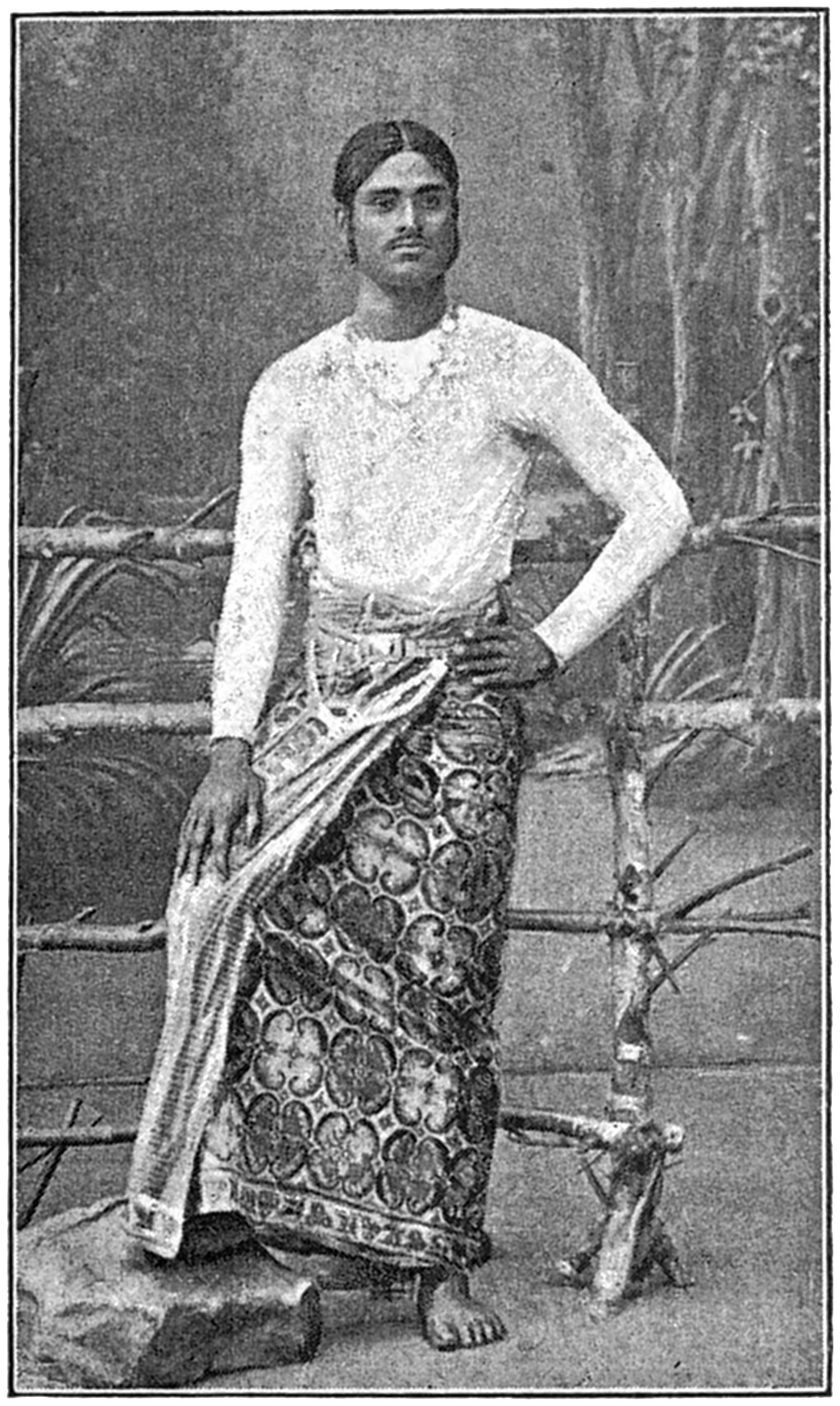
KALUA.
There was a native king and kingdom of Kandy
till about eighty years ago (1814), when the British
overthrew it; and it is curious that the old Kandian
law—which was recognised for some time by the
British—contains very evident traces of the old
group-marriage which is found among so many
races in their pre-civilisation period. There were
two kinds of marriage treated of in the Kandian
law—the Deega marriage, in which the wife went
(as with us) to the house of her husband, and became
more or less his property; and the Beena
marriage, in which he came to live with her among
her own people, but was liable to expulsion at any
time! The latter form is generally supposed to be
the more primitive, and belongs to the time when
heredity is traced through the woman, and when
also polygamous and polyandrous practices prevail.
And this is confirmed by a paragraph of the
Kandian law, or custom, which forbade intermarriage
between the children of two brothers, or
between the children of two sisters, but allowed it
between the children of a brother and a sister—the
meaning of course being that two brothers might
have the same wife, or two sisters the same husband,
but that a brother and sister—having necessarily
distinct wives and husbands—would produce children
who could not be more nearly related to each
other than cousins. It is also confirmed by the
fact that a kind of customary group-marriage still
lingers among the Cinghalese—e.g. if a man is
married, his brothers not uncommonly have access to
the wife—though owing to its being discountenanced
by Western habits and law, this practice is gradually
dying out.
Kalua has seen rather more of the world than
some of his people, and has had opportunities of
making a little money now and then. It appears
that at the age of twelve or thirteen he took to
“devil-dancing”—probably his father set him to it.
He danced in the temple and got money; but now-a-days
does not like the priests or believe in the
temples. This devil-dancing appears to be a relic
of aboriginal Kandian demon-worship: the evil
spirits had to be appeased, or in cases of illness
or misfortune driven away by shrieks and frantic
gestures. It is a truly diabolical performance. The
dancers (there are generally two of them) dress
themselves up in fantastic array, and then execute
the most extraordinary series of leaps, bounds,
demivolts, and somersaults, in rhythmical climaxes,
accompanied by clapping of hands, shrieks, and
tomtomming, for about twenty minutes without
stopping, by the end of which time the excitement
of themselves and spectators is intense, and the
patient—if there is one—is pretty sure to be either
killed or cured! When the Buddhists came to the
island they incorporated these older performances
into their institutions. Some two or three years ago
however Hagenbeck, of circus celebrity, being in
Ceylon engaged a troupe of Kandians—of whom
Kalua was one—to give a native performance for
the benefit of the Europeans; and since that time the
old peasant life has palled upon our friend, and it is
evident that he lives in dreams of civilisation and
the West. Kalua is remarkably well-made, and
active and powerful. He is about twenty-eight,
with the soft giraffe-like eyes of the Cinghalese, and
the gentle somewhat diffident manner which they
affect; his black hair is generally coiled in a knot
behind his head, and, with an ornamental belt sustaining
his colored skirt, and a shawl thrown over
his shoulder, he looks quite handsome. Kirrah is
thinner and weaker, both mentally and physically,
with a clinging affectionateness of character which
is touching. Then there are two nephews, Pinha
and Punjha, whom I have seen once or twice—bright
nice-looking boys, anxious to pick up phrases
and words of English, and ideas about the wonderful
Western world, which is beginning to dawn on their
horizon—though alas! it will soon destroy their
naked beauty and simplicity. To see Punjha go
straight up the stem of a coco-nut tree fifty feet
high is a caution! He just puts a noose of rope
round his two feet to enable him to grasp the stem
better with his soles, clasps his hands round the
trunk, brings his knees up to his ears, and shoots up
like a frog swimming!
The coco-nut palm is everything to the Cinghalese:
they use the kernel of the nut for food, either
as a curry along with their rice, or as a flavoring
to cakes made of rice and sugar; the shell serves
for drinking cups and primeval spoons; the husky
fibre of course makes string, rope, and matting; the
oil pressed from the nut, in creaking antique mills
worked by oxen, is quite an article of commerce,
and is used for anointing their hair and bodies, as
well as for their little brass lamps and other purposes;
the woody stems come in for the framework
of cabins, and the great leaves either form an excellent
thatch, or when plaited make natural screens,
which in that climate often serve for the cabin-walls
in place of anything more substantial. When
Ajax told Kirrah that there were no coco-palms in
England, the latter’s surprise was unfeigned as he
exclaimed, “How do you live, then?”
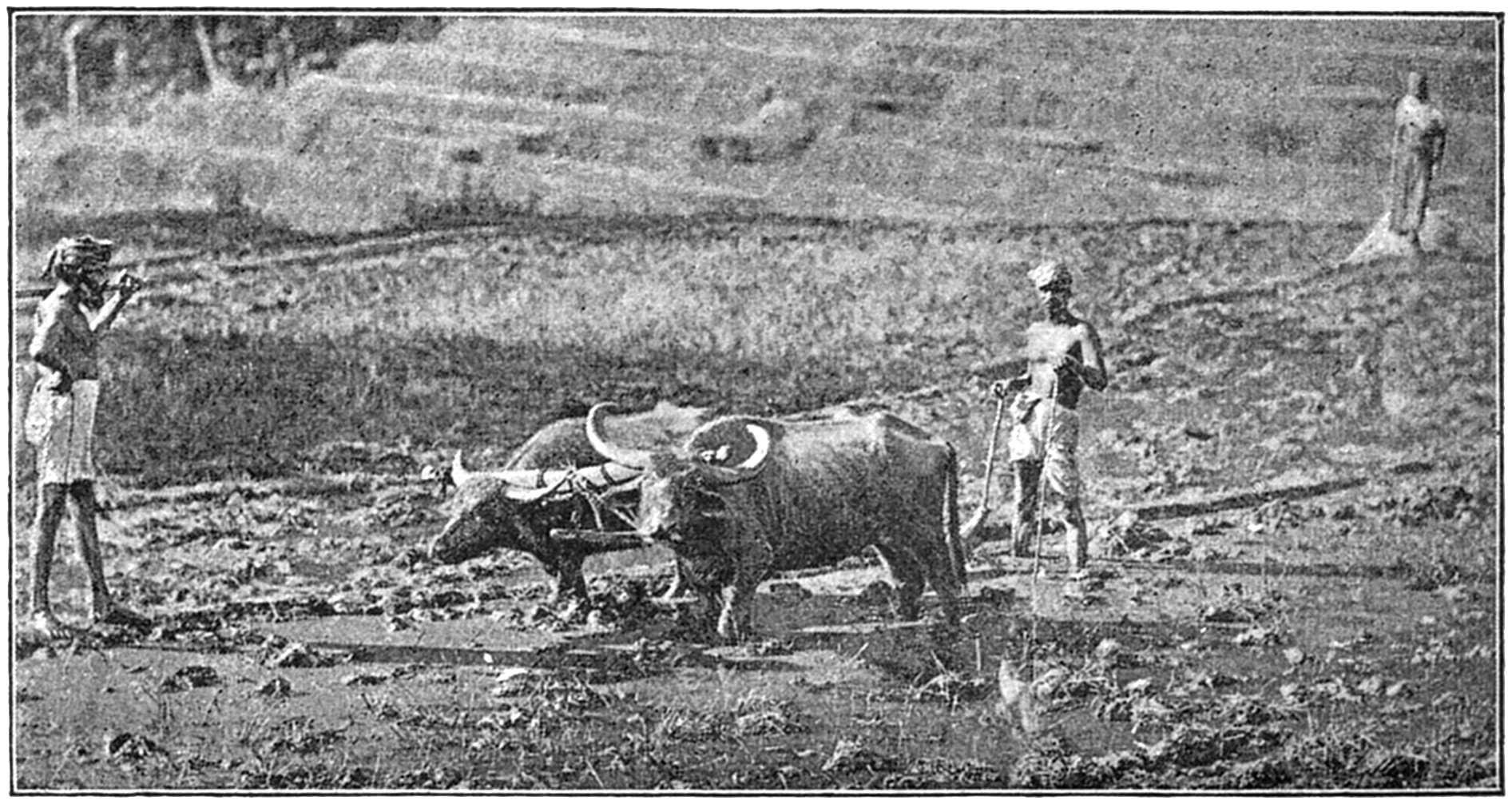
PLOUGHING IN THE RICE-FIELDS, WITH BUFFALOS.
The other great staple of Cinghalese life is rice.
Kalua’s family rice-fields lay below us in larger
patches along the bottom of the glen, and terraced
in narrow strips a little way up the hill at the head
of it. The rice-lands are, for irrigation’s sake,
always laid out in level patches, each surrounded by
a low mud bank, one or two feet high; sometimes,
where there is water at hand, they are terraced
quite a good way up the hillsides, something like the
vineyards in Italy. During and after the rains the
water is led onto the various levels successively,
which are thus well flooded. While in flood they
are ploughed—with a rude plough drawn by humped
cattle, or by buffalos—and sown as the water subsides.
The crop soon springs up, a brilliant green,
about as high as barley, but with an ear more resembling
oats, and in seven or eight weeks is ready
to be harvested. Boiled rice, with some curried
vegetable or coco-nut, just to give it a flavor, is
the staple food all over Ceylon among the natives—two
meals a day, sometimes in poorer agricultural
districts only one; a scanty fare, as their thin limbs
too often testify. They use no bread, but a few
cakes made of rice-flour and ghee and the sugar of
the chágeri palm.
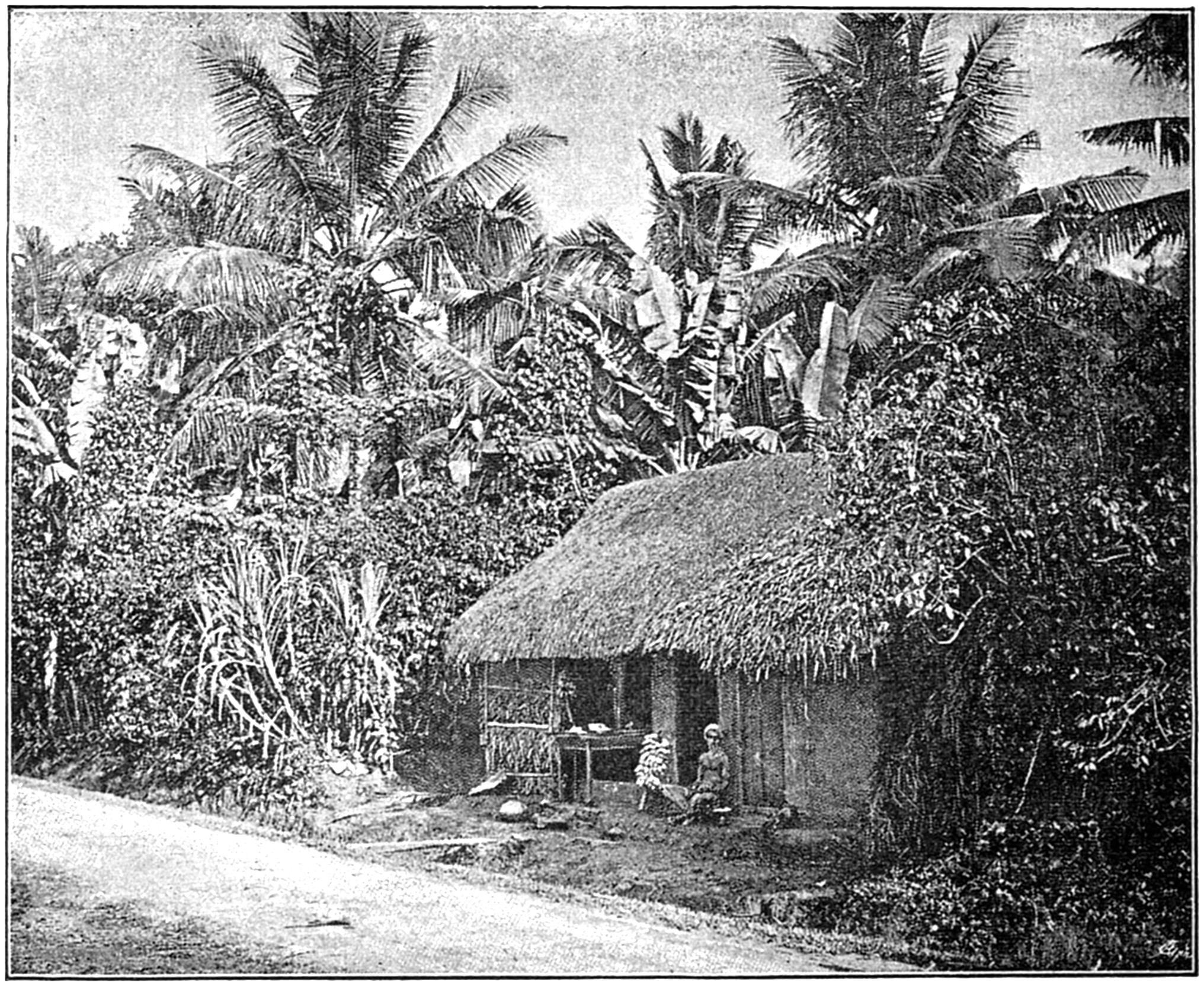
The brothers’ cabin is primitive enough—just a
little thatched place, perhaps twelve feet by eight,
divided into two—a large wicker jar or basket
containing store of rice, one or two boxes, a few
earthenware pots for cooking in, fire lighted on
the ground, no chair or table, and little sign of
civilisation except a photograph or two stuck on
the wall and a low cane-seated couch for sleeping
on. The latter however is quite a luxury, as the
Cinghalese men as often as not sleep on the earth
floor.
We stayed a little while chatting, while every
now and then the great husked coco-nuts (of which
you have to be careful) fell with a heavy thud from
the trees; and then Kalua came on with us to
Kandy, and we went to see the great Buddhist
temple there, the Devala Maligawa, which contains
the precious tooth-relic of Buddha.
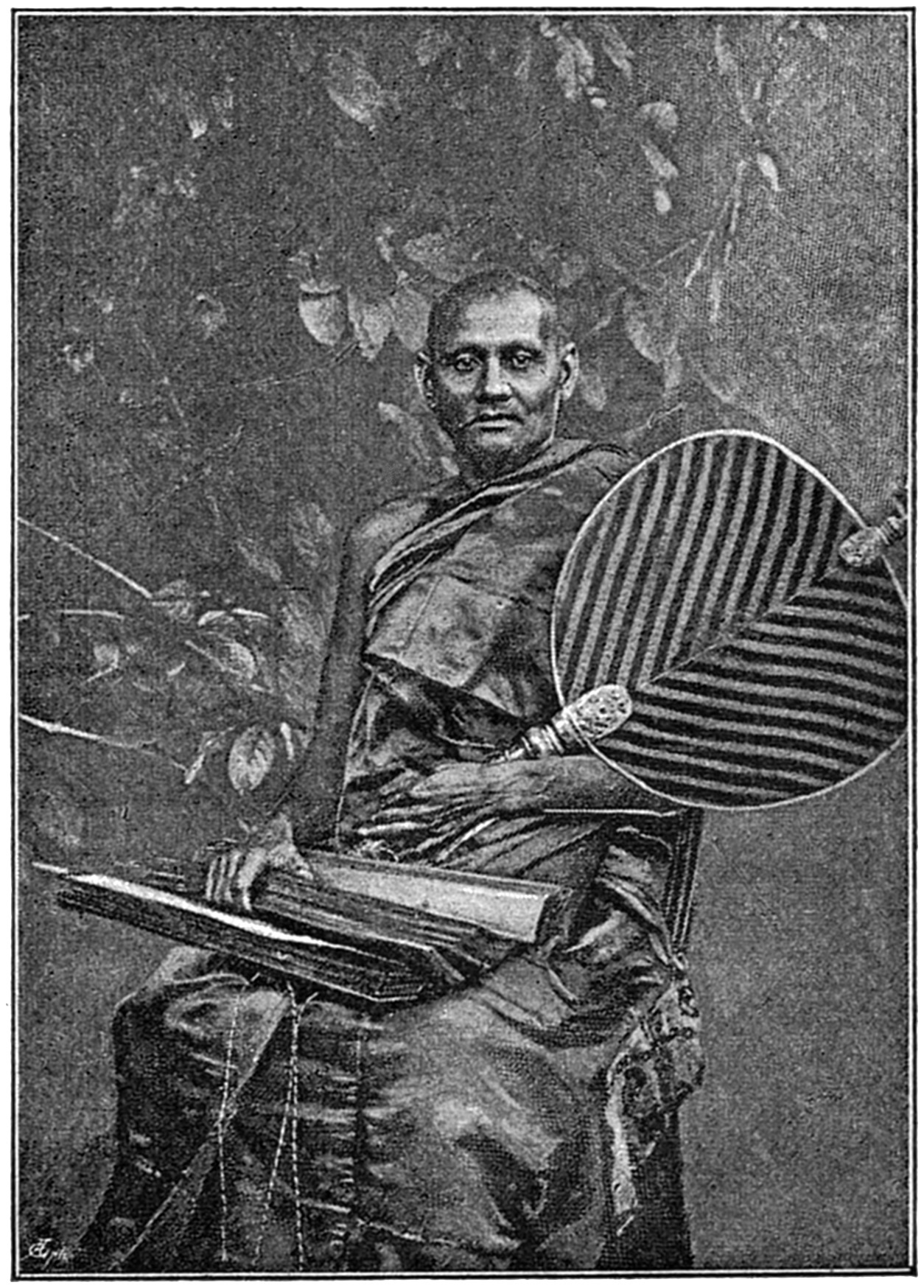
BUDDHIST PRIEST.
(Librarian at the Temple at Kandy, with palm-leaf MS. book in lap.)
Architecturally nothing, the temple is interesting
for the antique appearance of its gardens, shrines,
priests’ cottages, library, fishponds, etc.; sacred fish
and turtles coming to be fed by the pious; rude
frescoes of the infernal torments of the wicked, not
unlike our mediæval designs on similar subjects;
the sacred shrine itself with ivory and silver doors;
the dirty yellow-stoled priests arriving with huge
keys to open it, but first washing their feet in the
forecourt; the tomtoms and horns blowing; flowers
scattered about; and then the interior chamber of
the shrine, where behind strong bars of iron reposes
a golden and bell-shaped cover, crusted with jewels—the
outermost of six successive covers, within the
last of which is the tooth itself (reported by Emerson
Tennent to be about two inches long, and probably
the fang of a crocodile!); then the little golden and
crystal images of Buddha in various little shrines to
themselves; and, most interesting of all, the library
with its old MS. books written on strips of talipot
palm leaf, beautifully done in Cinghalese, Pali, Sanskrit,
etc., illuminated with elegant designs, and
bound by silk cords in covers of fretted silver. The
old librarian priest was a charming specimen of a
Buddhist priest—gentle, intelligent, and apparently
with a vein of religious feeling in his character—and
spoke with interest about the various texts and
manuscripts. It is a pity that so much cannot be
said of the Buddhist priests generally, who are as a
rule—in Ceylon at any rate—an ignorant, dirty,
betel-chewing and uninviting-looking lot.
At the botanical gardens at Peradeniya—three
or four miles out of Kandy—we saw a specimen of
the talipot palm in full flower. This beautiful palm—unlike
the coco palm—grows perfectly erect and
straight; it flowers only once, and then dies.
Haeckel says that it lives from fifty to eighty
years, and that the blossom is sometimes thirty or
forty feet long. The specimen that we saw in blossom
was about forty-five feet high in the stem; and
then from its handsome crown of huge leaves sprang
a flower, or rather a branched spike of numerous
white flowers, which I estimated at fifteen feet high
(but which I afterwards saw described in the newspapers
as twenty feet high). Baker says that the
flower bud is often as much as four feet long, and
that it opens with a smart report, when this beautiful
white plume unfolds and lifts itself in the sun.
The natives use the great leaf of the talipot—which
is circular and sometimes eight or nine feet in diameter—as
an umbrella. They fold it together along
its natural corrugations, and then open it to ward
off sun or rain.
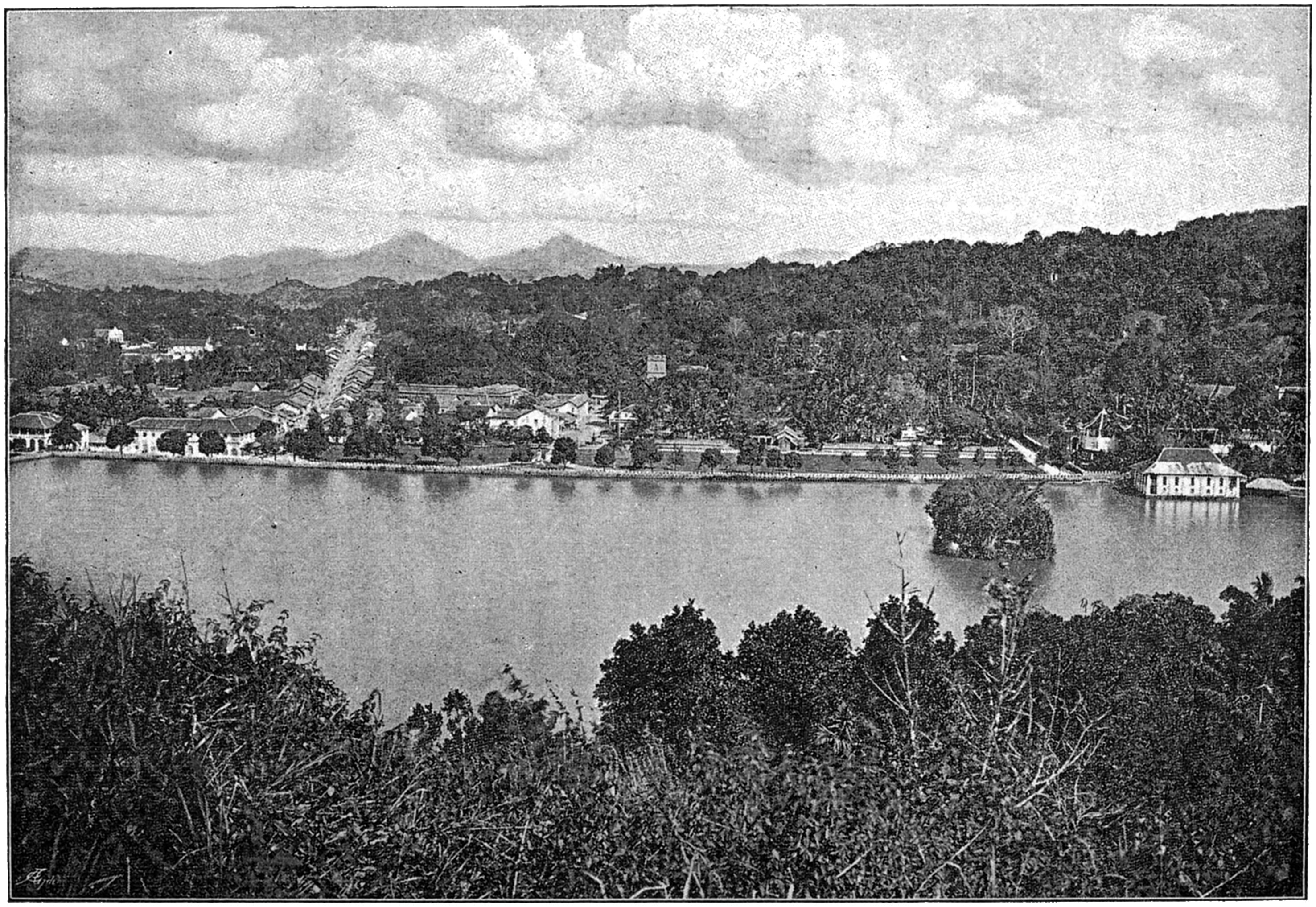
GENERAL VIEW OF KANDY.
(Native street on left, Buddhist temple on right, English church in centre.)
Kandy is very beautiful. It stands nearly 2,000
feet high, by the side of an artificial lake which the
old kings of Kandy made, and embosomed in hills
covered by lovely woods full of tropical plants and
flowers and commanding beautiful views from their
slopes and summits. There is a small native town
containing the usual mixed population of Cinghalese,
Tamils, and Moor-men; there are one or two English
hotels, a church, library and reading-room; a few
residents’ houses, and a scattered population of
English tea-planters on the hills for some miles
round, who make Kandy their rendez-vous.
Ajax makes great friends with the native youths
and boys here; he has an easy friendly way with
them, and they get hold of his hand and walk alongside.
Of course they are delighted to find any
Mahate who will treat them a little kindly; but
I fear the few English about are much shocked at
our conduct. When I first came to Ceylon my
Tamil friend A. chaffed me about my way of calling
him and the rest of the population, whether Tamil
or Mahomedan or Cinghalese, all indiscriminately
natives, “as if we were so many oysters.” I told
this to Ajax, and of course there was nothing for
it after that but to call them all oysters!
We find the few British whom we have come
across in our travels very much set against the
“oysters.” There is something queer about the
British and their insularity; but I suppose it is more
their misfortune than their fault. Certainly they
will allow that the oysters are not without merit—indeed
if one keeps them to it they will often speak
quite warmly of the tenderness and affectionateness
of servants who have nursed them through long illnesses,
etc.—but the idea of associating with them
on terms of equality and friendship is somehow
unspeakable and not to be entertained. It seems
almost de rigueur to say something disparaging
about the oyster, when that topic turns up—as a
way of showing one’s own breeding, I suppose; after
that has been done, however, it is allowable to grant
that there are exceptions, and even to point out some
kindly traits, pearls as it were, which are occasionally
found in the poor bivalve. It strikes me however
that the English are the chief losers by this
insular habit. They look awfully bored and miserable
as a rule in these up-country parts, which must
almost necessarily be the case where there are only
five or six residents in a station, or within accessible
distances of each other, and confined entirely to each
other’s society.
One day Ajax and I went up to Nuwara Ellia.
The railway carriage was full of tea-planters (including
one or two wives and sisters), and there were
a few at the hotel. It was curious to see some
English faces of the cold-mutton-commercial type,
and in quite orthodox English attire, in this out-of-the-way
region. The good people looked sadly
bored, and it seemed a point of honor with them
to act throughout as if the colored folk didn’t exist
or were invisible—also as if they were deaf, to judge
by the shouting. In the evening however (at the
hotel) we felt touched at the way in which they
cheered up when Ajax and I played a few familiar
tunes on the piano. They came round, saying it
reminded them of home, and entreated us to go on;
so we played for about two hours, Ajax improvising
as usual in the most charming way.
Nuwara Ellia is 6,000 feet above the sea—a little
village with an hotel or two—a favorite resort from
the sultry airs of Colombo and the lowlands. Here
the Britisher finds fires in the sitting-rooms and
thick mists outside, and dons his great-coat and
feels quite at home. But we, having only just come
from the land of fogs, did not appreciate these joys,
and thought the place a little bleak and bare.
CHAPTER III. KURUNÉGALA.
On my way here, on the coach, I fell in with
Monerasingha, a Cinghalese of some education and
ability, a proctor or solicitor. He is a cheerful
little man, an immense talker, and very keen on
politics. He was very amusing about the English;
says they are very agreeable at first, “but after three
months’ stay in the island a complete change comes
over them—won’t speak to us or look at us—but I
can give it them back.” His idea seems to be that
representative institutions are wanted to restore to
the people that interest in public life which has been
taken from them by the destruction of their communal
institutions under British rule. He seems to
be a great hater of caste, and thinks the English
have done much good in that matter. “I am loyal
enough, because I know we are much better off than
we should be under Russia. The English are stupid
and incapable of understanding us, and don’t go
among us to get understanding; but they mean well,
according to their lights.”
This place (called Kornegalle by the English) is a
little town of 2,000 or 3,000 inhabitants, fifty miles
from Colombo and eleven miles (by coach) from
Polgahawella, the nearest railway station. It lies
just at the foot of the mountain region of Ceylon,
and takes its name, Kurunégala or Elephant-rock,
from a huge Gibraltar-like rock, 600 feet high, at the
base of which it nestles—and whose rounded dark
granite structure, wrinkled with weather and largely
bare of trees or any herbage, certainly bears a remarkable
resemblance, both in form and color, to a
couchant elephant. Ascending its steep sides, on
which the sun strikes with fierce heat during the midday,
one obtains from the summit a fine view—westward
over low plains, eastward over mountain ranges
rising higher and higher towards the centre of the
island. The prevailing impression of the landscape
here, as elsewhere in Ceylon, is its uniform green.
There is no change of summer or winter. (Though
this is the coolest time of year, the daily temperature
ranges from 85° to 90° in the shade.) The trees
do not cast their leaves at any stated time, though
individual trees will sleep at intervals, resting so.
In every direction the same color meets the eye—tracts
of green scrub, green expanses of forest, green
rice-fields, and the massed green of bananas and
coco-palms. A little monotonous this in the general
landscape, though it is plentifully compensated on a
near view by the detailed color of insect and flower
life. One curious feature is that though the country
is well populated, hardly a trace of habitation is to
be seen from any high point such as this. Even
Kurunégala, which lies at our feet, is only distinguishable
by its court-house and prison and one or
two other emblems of civilisation; the native cabins,
and even in many cases the European houses—which
are of one storey only—are entirely hidden by trees.
Those clumps however of coco-palms which you see
standing like oases in the general woods, or breaking
the levels of the rice-fields, with occasional traces
of blue smoke curling up through them, are sure
indications of little native hamlets clustered beneath—often
far far from any road, and accessible only
by natural footpaths worn by naked feet.
NATIVE HUT.
(Among banana and coco-palms.)
From the top of the rock one gets a good view of
the tank which supplies irrigation water for the town
and neighborhood. It is about three-quarters of a
mile long and half a mile broad, and forms a pretty
little lake, over which kites hover and kingfishers
skim, and in which the people daily bathe. These
tanks and irrigation channels are matters of the
utmost importance, to which I think Government can
hardly give too much attention. Their importance
was well understood in past times, as indeed the
remains and ruins of immense works of this kind,
over a thousand years old, in various parts of the
island fully testify. A little is being done towards
their renewal and restoration, but the tendency to-day
is to neglect the interests of the rice-growing
peasant in favor of the tea-planting Englishman.
The paddy tax, which presses very hardly on the
almost starving cultivator, while tea goes scot-free,
is an instance of this. Tea, which is an export and
a luxury, and which enriches the few, is thought to
be so much more important than an article which is
grown for home consumption and for the needs of
the many. It is of course only an instance of the
general commercial policy of all modern Governments;
but one cannot the less for that think it a
mistake, and an attempt to make the pyramid of
social prosperity stand upon its apex. There is
something curious—and indeed is it not self-contradictory?—in
the fact that every country of the
civilized world studies above all things the increase
of its exports—is engaged, not in producing things
primarily for its own use, but in trying to get other
people to buy what it produces!—as if we all stood
round and tried to shuffle off our bad wares on the
others, in the hope that they by some accident might
return us good stuff in exchange. Somehow the
system does not seem as if it would work; it looks
too like the case of that island where the inhabitants
all earned a precarious living by taking in each other’s
washing. What, one may ask, is really the cause of
the enormous growth of this practice of neglecting
production for use in favor of production for export
and for the market? Is it not simply money and
the merchant interest? Production at home by the
population and for its own use is and always must
be, one would think, by far the most important for
the population and for its own comfort and welfare,
though a margin may of course be allowed for the
acquirement by exchange of some few articles which
cannot be grown at home. But production such as
this does not necessarily mean either money or mercantile
transaction. Conceivably it may very well
take place without either these or the gains which
flow from their use—without profits or interest or
dividends or anything of the kind. But this would
never do! The money and commercial interest,
which is now by far the most powerful interest in
all modern states, is not such a fool as to favor a
system of national economy which would be its own
ruin. No; it must encourage trade in every way,
at all costs. Trade, commerce, exchange, exports
and imports—these are the things which bring
dividends and interest, which fill the pockets of the
parasites at the expense of the people; and so the
nations stand round, obedient, and carry on the futile
game till further orders.
As a matter of fact in these hot countries, like
Ceylon and India, almost unlimited results of productiveness
can be got by perfected irrigation, and
as long as the peasantry in these lands are (as they
are) practically starving, and the irrigation works
practically neglected, the responsibility for such a
state of affairs must lie with the rulers; and naturally
no mere shuffling of commercial cards, or encouragement
of an export trade which brings fortunes
into the hands of a few tea-planters and merchants,
can be expected to make things better.
It is sad to see the thin and famished mortals who
come in here from the country districts round to
beg. Many of them, especially the younger ones,
have their limbs badly ulcerated. One day, going
through the hospital, the doctor—a Eurasian—took
me through a ward full of such cases. He said that
they mostly soon got better with the better hospital
diet; “but,” he added, “when they get back to their
old conditions they are soon as bad as ever.” In
fact the mass of the population in a place like
Colombo looks far sleeker and better off than in
these country districts; but that only affords another
instance of how the modern policy encourages the
shifty and crafty onhanger of commercial life at the
cost of the sturdy agriculturist—and I need not say
that the case is the same at home as abroad.
It is quite a pretty sight to see the bathing in
the tanks. It takes place in the early morning, and
indeed during most of the day. Cleanliness is a
religious observance, and engrained in the habits
of the people. Of course there are exceptions, but
save among the lowest castes this is the rule. An
orthodox Hindu is expected not only to wash himself,
but his own cloth, at least once a day. The
climate makes bathing a pleasure, and the people
linger over it. Men and boys, women and children,
together or in groups not far distant from each
other, revel and splash in the cool liquid; their
colored wraps are rinsed and spread to dry on the
banks, their brass pots glance in the sun as they
dip the water with them and pour it over their own
heads, their long black hair streams down their
backs. Then, leaving the water, they pluck a twig
from a certain tree, and, squatting on their hams,
with the frayed twig-end rub their teeth and talk
over the scandal of the day. This tooth-cleaning
gossiping business lasts till they are dry, and often
a good deal longer, and is, I fancy, one of the most
enjoyable parts of the day to the mild oyster. In
unsophisticated places there is no distinction of
classes in this process, and rich and poor join in
the public bathing alike—in fact there is very little
difference in their dress and habits anyhow, as far
as regards wealth and poverty—but of course where
Western ideas are penetrating, the well-to-do natives
adopt our habits and conduct their bathing discreetly
at home.
The people never (except it be children) go into
the water quite naked, and the women always
retain one of their wraps wound round the body.
These wraps are very long, and the skill with
which they manage to wash first one end and then
the other, winding and unwinding, and remaining
decorously covered all the time, is quite admirable.
I am struck by the gravity and decorum of the
people generally—in outer behavior or gesture—though
their language (among the lower castes) is
by no means always select! But there is none, or
very little, of that banter between the sexes which
is common among the Western populations, and
even among the boys and youths you see next to
no frolicking or bear-fighting. I suppose it is part
of the passivity and want of animal spirits which
characterise the Hindu; and of course the sentiment
of the relation between the sexes is different
in some degree from what it is with us. On sexual
matters generally, as far as I can make out, the
tendency, even among the higher castes, is to be
outspoken, and there is little of that prudery which
among us is only after all a modern growth.
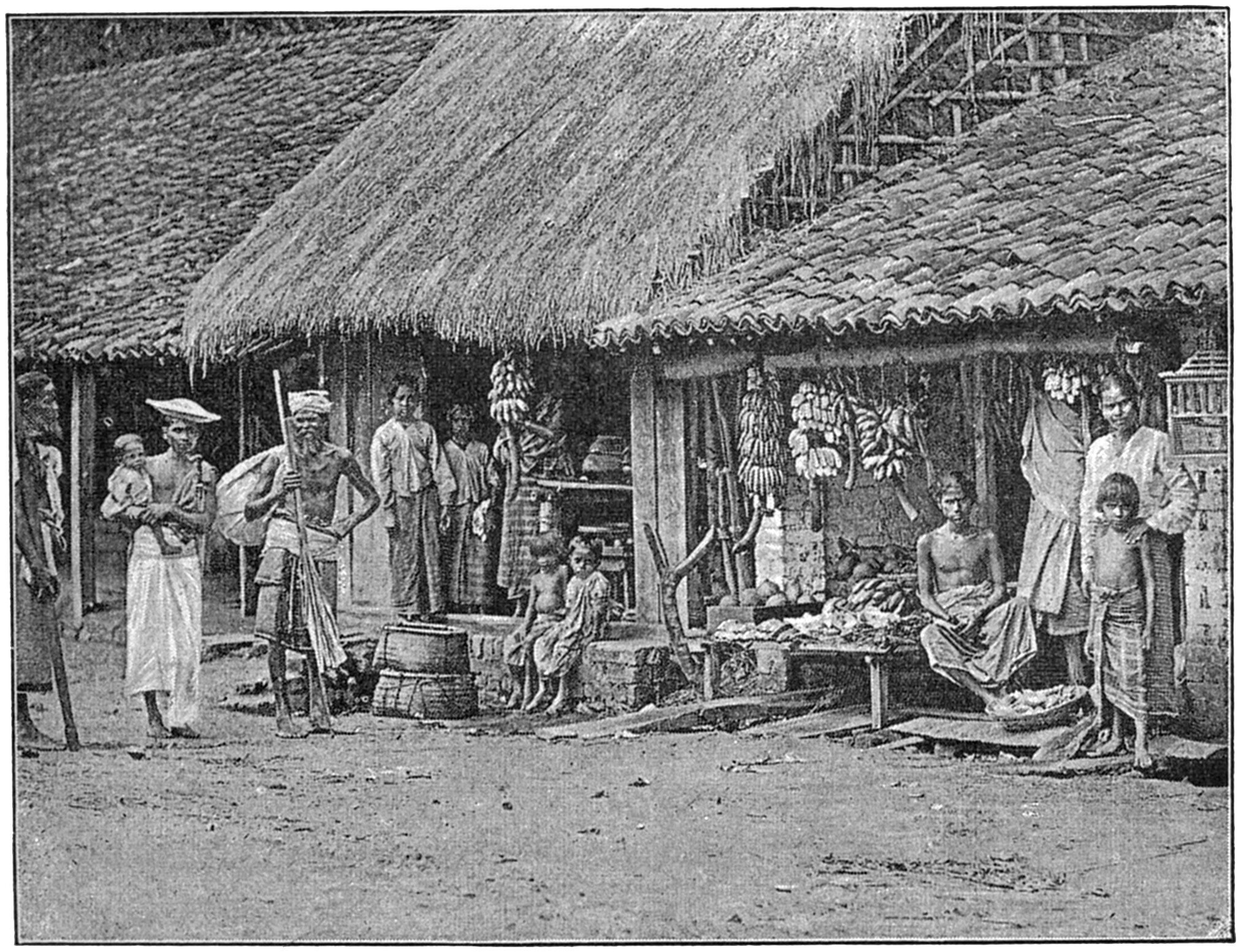
NATIVE STREET, AND SHOPS.
The town here is a queer mixture of primitive
life with modern institutions. There are two or
three little streets of booths, which constitute the
“bazaar.” Walking down these—where behind
baskets of wares the interiors of the dwellings are
often visible, and the processes of life are naïvely
exposed to the eye—one may judge for one’s self
how little man wants here below. Here is a fruit
and vegetable shop, with huge bunches of plantains
or bananas, a hundred in a bunch, and selling at five
or six a penny; of a morning you may see the
peasant coming in along the road carrying two such
bunches—a good load—slung one at each end of
a long pole, or pingo, over his shoulder—a similar
figure to that which is so frequent on the Egyptian
monuments of 3,000 years ago; pineapples, from
1d. up to 4d. each for the very finest; the breadfruit,
and its queer relation the enormous jack-fruit,
weighing often as much as 12 to 14 lbs., with its
pulpy and not very palatable interior, used so much
by the people, growing high up over their cabins
on the handsome jack-tree, and threatening you
with instant dissolution if it descend upon your
head; the egg-plant, murngal, beans, potatos, and
other vegetables; and plentiful ready-prepared
packets of areca nut and betel leaf for chewing.
Then there is a shop where they sell spices, peppers,
chilis, and all such condiments for curries, not
to mention baskets of dried fish (also for currying),
which stink horribly and constitute one of the chief
drawbacks of the bazaars; and an earthenware
shop,—and I must not forget the opium shop. Besides
these there are only two others—and they
represent Manchester and Birmingham respectively—one
where they sell shoddy and much-sized cotton
goods, and the other which displays tin ware, soap,
matches, paraffin lamps, dinner knives, and all sorts
of damnable cutlery. I have seen these knives and
scissors, or such as these (made only to deceive),
being manufactured in the dens of Sheffield by boys
and girls slaving in dust and dirt, breathing out
their lives in foul air under the gaslights, hounded
on by mean taskmasters and by the fear of imminent
starvation. Dear children! if you could only come
out here yourselves, instead of sending the abominable
work of your hands—come out here to enjoy
this glorious sunshine, and fraternise, as I know
many of you would, with the despised darkie!
The opium-seller is a friend of mine. I often
go and sit in his shop—on his one chair. He
teaches me Tamil—for he is a Tamil—and tells me
long stories, slowly, word by word. He is a thin,
soft-eyed, intelligent man, about thirty, has read a
fair amount of English—of a friendly riant child-nature—not
without a reasonable eye to the main
chance, like some of his Northern cousins. There
are a few jars of opium in its various forms—for
smoking, drinking, and chewing; a pair of scales
to weigh it with; a brass coconut-oil lamp with two
or three wicks hanging overhead; and a partition
for the bed at the back,—and that is all. The shopfront
is of course entirely open to the thronged
street, except at night, when it is closed with shutterboards.
At the corner of the street stands a policeman,
of course, else we should not know we were being
civilised. But, O Lord, what a policeman! How
a London street arab would chuckle all over at the
sight of him! Imagine the mild and somewhat
timid oyster dressed in a blue woollen serge suit
(very hot for this climate), with a belt round his
waist, some kind of turban on his head, a staff in
his hand, and boots on his feet! A real live oyster
in boots! It is too absurd. How miserable he
looks; and as to running after a criminal—the thing
is not to be thought of. But no doubt the boots
vindicate the majesty of the British Government.
While we are gazing at this apparition, a gang of
prisoners marches by—twenty lean creatures, with
slouched straw hats on their heads, striped cotton
jackets and pants, and bare arms and lower legs,
each carrying a mattock—for they are going to work
on the roads—and the whole gang followed and
guarded (certainly Ceylon is a most idyllic land) by
a Cinghalese youth of about twenty-one, dressed in
white skirts down to his feet, with a tortoise-shell
comb on his head, and holding a parasol to shade
himself from the sun. Why do not the twenty
men with mattocks turn and slay the boy with the
parasol, and so depart in peace? I asked this
question many times, and always got the same
answer. “Because,” they said, “the prisoners do
not particularly want to run away. They are very
well off in prison,—better off, as a rule, than they
are outside. Imprisonment by an alien Government,
under alien laws and standards, is naturally no
disgrace, at any rate to the mass of the people, and
so once in prison they make themselves as happy as
they can.”
I visited the gaol one day, and thought they
succeeded very well in that respect. The authorities,
I am glad to say, do all they can to make
them comfortable. They have each a large dish
of rice and curry, with meat if they wish, twice a
day, and a meal of coffee and bread in the morning
besides; which is certainly better fare than they
would get as peasants. They do their little apology
for work in public places during the day—with a
chance of a chat with friends—and sleep in gangs
together in the prison sheds at night, each with his
mat, pillow, and night suit; so possibly on the
whole they are not ill-content.
My friend A——, with whom I am staying here,
is a Tamil, and an official of high standing. He became
thoroughly Anglicised while studying in England,
and like many of the Hindus who come to
London or Cambridge or Oxford, did for the time
quite outwesternise us in the tendency towards
materialism and the belief in science, ‘comforts,’ representative
institutions, and ‘progress’ generally.
Now however he seems to be undergoing a reaction
in favor of caste and the religious traditions of his
own people, and I am inclined to think that other
westernising Hindus will experience the same reaction.
He lives in an ordinary one-storied stone house,
or bungalow, such as the English inhabit here.
These houses, naturally cover a good deal of ground.
The roof, which is made of heavy tiles or thatch, is
pitched high in the middle, giving space for lofty
sitting-rooms; the sleeping chambers flank these at
a lower slope, and outside runs the verandah, almost
round the house, the roof terminating beyond it at
six or seven feet from the ground. This arrangement
makes the interiors very dark and cool, as
the windows open on the verandah, and the sun
cannot penetrate to them; but I am not sure that
I like the sensation of being confined under this
immense carapace of tiles, with no possible outlook
to the sky, in a sort of cavernous twilight all the
while. The verandah forms an easy means of
access from one part to another, and in this house
there are no passages in the interior, but the rooms
all open into one another; and plentiful windows—some
mere Venetian shutters, without glass—ensure
a free circulation of air.
Mosquitos are a little trying. I don’t think they
are more venomous than the English gnat, but
they are far ’cuter. The mosquito is the ’cutest
little animal for its size that exists. I am certain
from repeated observations that it watches one’s eyes.
If you look at it, it flies away. It settles on the
under side of your hand (say when reading a book),
or on your ankles when sitting at table—on any
part in fact which is remote from observation; there
is nothing that it loves better than for you to sit in
a cane-bottomed chair. But it never attacks your
face—and that is a curious thing—except when you
are asleep. How it knows I cannot tell, but I have
often noticed that it is so. If you close your eyes
and pretend to be asleep, it will not come; but as
sure as you begin to drowse off you hear the ping
of its little wing as it swoops past your ear to your
cheek.
At night however the mosquito curtains keep
one in safety, and I cannot say that I am much
troubled during the day, except on occasions, and
in certain places, as in the woods when there is no
breeze. A. is a vegetarian, and I fancy diet has
a good deal to do with freedom from irritation
by insects and by heat. The thermometer reaches
90° in the shade almost every day here; to sit and
run at the same time is a gymnastic feat which one
can easily perform, and at night it is hot enough to
sleep without any covering on the bed; but I enjoy
the climate thoroughly, and never felt in better
health. No doubt these things often affect one
more after a time than at first; but there seems
almost always a pleasant breeze here at this time of
year, and I do not notice that languor which generally
accompanies sultry weather.
A. has most lovely vegetable curries; plenty of
boiled rice, with four or five little dishes of different
sorts of curried vegetables. This, with fruit, forms our
breakfast—at ten; and dinner at six or seven is
much the same, with perhaps an added soup or side-dish.
His wife sometimes joins us at dinner, which
I take as an honor, as even with those Hindu
women who are emancipated there is often a little
reserve about eating with the foreigner. She has
a very composed and gentle manner, and speaks
English prettily and correctly, though slowly and
with a little hesitation; approves of a good deal of
the English freedom for women, but says she cannot
quite reconcile herself to women walking about
the streets alone, and other things she hears they
do in England. However, she would like to come
to England herself and see.
The children are very bright and charming.
Mahéswari (three years old) is the sweetest little
dot, with big black eyes and a very decided opinion
about things. She comes into the room and lifts up
one arm and turns up her face and prophesies something
in solemn tones in Tamil, which turns out to
be, “Father is very naughty to sit down to dinner
before mother comes.” Then she talks Cinghalese
to her nurse and English to me, which is pretty
good for a beginner in life. Mahadéva and Jayanta,
the two boys (seven and nine respectively), are in
the bubbling-over stage, and are alternately fast
friends and fighting with each other two or three
times a day, much like English boys. They are
dressed more after the English fashion, though they
are privileged to have bare knees and feet—at any
rate in the house; and Jayanta has a pony which he
rides out every day.
A. sets apart a little room in this house as a
“chapel.” It is quite bare, with just a five-wicked
lamp on a small table in one corner, and flowers,
fruit, etc., on the ground in front. I was present
the other day when the Brahman priest was performing
a little service there. He recited Sanskrit
formulas, burned camphor, and gave us cowdung
ashes and sandalwood paste to put on our
foreheads, consecrated milk to drink, and a flower
each. The cowdung ashes are a symbol. For as
cowdung, when burnt, becomes clean and even purifying
in quality, so must the body itself be consumed
and purified in the flame of Siva’s presence.
A. says they use a gesture identifying the light (of
Siva) within the body with the light of the flame, and
also with that of the sun; and always terminate their
worship by going out into the open and saluting the
sun. The Brahman priest, a man about forty, and
the boy of fifteen who often accompanies him, are
pleasant-faced folk, not apparently at all highly
educated, wearing but little in the way of clothes,
and not specially distinguishable from other people,
except by the sacred thread worn over the shoulder,
and a certain alertness of expression which is often
noticeable in the Brahman—though the trouble is
that it is generally alertness for gain.
The priests generally here, whether Buddhist or
Hindu (and Buddhism is of course the prevailing
religion in Ceylon), occupy much the same relation
to the people which the priests occupy in the country
districts of France or Ireland—that is, whatever
spiritual power they claim, they do not arrogate to
themselves any worldly supremacy, and are always
poor and often quite unlettered. In fact I suppose
it is only in the commercially religious, i.e. Protestant,
countries that the absurd anomaly exists of a
priesthood which pretends to the service of the Jesus
who had not where to lay his head, and which at
the same time openly claims to belong to “society”
and the well-to-do classes, and would resent any
imputation to the contrary. There are indeed many
points of resemblance between the religions here—especially
Hinduism—and Roman Catholicism: the
elaborate ceremonials and services, with processions,
incense, lights, ringing of bells, etc.; the many
mendicant orders, the use of beads and rosaries,
and begging bowls, the monasteries with their
abbots, and so forth.
VEDDAHS.
(Aborigines of Ceylon.)
There is one advantage in a hot damp climate
like this; namely that things—books, furniture,
clothes, etc.—soon get destroyed and done with, so
that there is little temptation to cumber up your
house with possessions. Some English of course
try to furnish and keep their rooms as if they were
still living in Bayswater, but they are plentifully
plagued for their folly. The floors here are of some
cement or concrete material, which prevents the
white ants surging up through them, as they infallibly
would through boards, and which is nice and
cool to the feet; carpets, cupboards, and all collections
of unremoved things are discountenanced. A
chest of drawers or a bookcase stands out a foot or
two from the wall, so that the servants can sweep
behind it every day. Little frogs, lizards, scorpions,
and other fry, which come hopping and creeping in
during or after heavy rain can then be gently
admonished to depart, and spiders do not find it
easy to establish a footing. The greatest harbor
for vermin is the big roof, which is full of rats. In
pursuit of these come the rat-snakes, fellows five or
six feet long, but not venomous, and wild cats; and
the noises at night from them, the shuffling of the
snakes, and the squeals of the poor little rats, etc.,
I confess are trying.
We have three or four male servants about the
house and garden, and there are two ayahs, who look
after the children and the women’s apartments. I
believe many of these Indian and Cinghalese races
love to be servants (under a tolerably good master);
their feminine sensitive natures, often lacking in
enterprise, rather seek the shelter of dependence.
And certainly they make, in many instances and
when well treated, wonderfully good servants, their
tact and affectionateness riveting the bond. I
know of a case in which an English civilian met with
an accident when 200 miles away from his station,
and his “bearer,” when he heard the news, in
default of other means of communication, walked the
whole distance, and arrived in time to see him before
he died. At the same time it is a mistake to suppose
they will do anything out of a sense of duty.
The word duty doesn’t occupy an important place
in the Oriental vocabulary, no more than it does
among the Celtic peoples of Europe. This is a
fruitful source of misunderstanding between the
races. The Britisher pays his Indian servant regularly,
and in return expects him to do his duty, and
to submit to kicks when he doesn’t. He, the
Britisher, regards this as a fair contract. But the
oyster doesn’t understand it in the least. He would
rather receive his pay less regularly, and be treated
as “a man and a brother.” Haeckel’s account of the
affection of his Rodiya servant-lad for him, and of
the boy’s despair when Haeckel had to leave him,
is quite touching; but it is corroborated by a
thousand similar stories. But if there is no attachment,
what is the meaning of duty? The oyster,
in keeping with his weaker, more dependent nature,
is cunning and lazy—his vices lie in that direction
rather than in the Western direction of brutal energy.
If his attachment is not called out, he can make his
master miserable in his own way. And he does so;
hence endless strife and recrimination.
The Arachchi here, a kind of official servant of
A.’s, is a most gentle creature, with remarkable tact,
but almost too sensitive; one is afraid of wounding
him by not accepting all his numerous attentions.
He glides in and out of the room—as they all do—noiselessly,
with bare feet; and one never knows
whether one is alone or not. The horse-keeper
and I are good friends, though our dialogues are
limited for want of vocabulary! He is a regular
dusky demon, with his look of affectionate bedevilment
and way of dissolving in a grin whenever he
sees one. A. says that he thinks the pariahs, or
outcastes—and the horse-keepers are pariahs—are
some of the most genuine and good-hearted among
the people; and I see that the author of Life in an
Indian Village says something of the same kind.
“As a class, hardworking, honest, and truthful,” he
calls them; and after describing their devotion to
the interests of the families to whom they are often
hereditarily attached, adds, “Such are the illiterate
pariahs, a unique class, whose pure lives and noble
traits of character are in every way worthy of admiration.”
It is curious, but I am constantly being struck
by the resemblance between the lowest castes here
and the slum-dwellers in our great cities—resemblance
in physiognomy, as well as in many unconscious
traits of character, often very noble; with the
brutish basis well-marked, the unformed mouth, and
the somewhat heavy brows, just as in Meunier’s fine
statue of the ironworker (“puddleur”), but with
thicker lips.
CHAPTER IV. ADAM’S PEAK AND THE BLACK RIVER.
January 1st, 1891.—Sitting by an impromptu wood-fire
in a little hut on the summit of Adam’s Peak—nearly
midnight—a half-naked Caliban out of the
woods squatting beside me, and Kalua and the
guide sleeping on the floor. But I find it too cold
to sleep, and there is no furniture in the hut.
Altogether an eventful New Year’s day. Last
night I spent at Kandy with Kalua and his brother
in their little cabin. They were both very friendly,
and I kept being reminded of Herman Melville and
his Marquesas Island experiences—so beautiful the
scene, the moon rising about ten, woods and valleys
all around—the primitive little hut, Kirrah cooking
over a fire on the ground, etc. We were up
by moon and starlight at 5 a.m., and by walking,
driving, and the railway, reached Muskeliya at the
foot of the peak by 2.30 p.m. There we got a guide—a
very decent young Tamil—and reached here by
7.30 or 8 p.m. Our path lay at first through tea-gardens,
and then leaving them, it went in nearly
a direct line straight up the mountain side—perhaps
3,000 feet—through dense woods, in step-like
formation, over tree-roots and up the rocks, worn
and hacked into shape through successive centuries
by innumerable pilgrims, but still only wide enough
for one. Night came upon us on the way, and the
last hour or two we had to light torches to see our
route. Elephant tracks were plentiful all round us
through the woods, even close to the summit. It
is certainly extraordinary on what steep places and
rock sides these animals will safely travel; but we
were not fortunate enough to see any of them.
This is a long night trying to sleep. It is the
wretchedest hut, without a door, and unceiled to
the four winds! Caliban makes the fire for me as
I write. He has nothing on but a cotton wrap and
a thin jersey, but does not seem to feel the cold
much; and the guide is even more thinly clad, and
is asleep, while I am shivering, bundled in cloth
coats. There is something curious about the way
in which the English in this country feel the cold—when
it is cold—more than the natives; though
one might expect the contrary. I have often
noticed it. I fancy we make a great mistake in
these hot lands in not exposing our skins more to
the sun and air, and so strengthening and hardening
them. In the great heat, and when constantly
covered with garments, the skin perspires terribly,
and becomes sodden and enervated, and more sensitive
than it ought to be—hence great danger of
chills. I have taken several sun-baths in the woods
here at different times, and found advantage from
doing so.
[Since writing the above, I have discovered the
existence of a little society in India—of English
folk—who encourage nudity, and the abandonment
as far as possible of clothes, on three distinct
grounds—physical, moral, and æsthetic—of Health,
Decency, and Beauty. I wish the society every success.
Its chief object, as given in its rules, is to
urge upon people “to be and go stark naked whenever
suitable,” and it is a sine quâ non that members
should appear at all its meetings without any covering
Passing over the moral and æsthetic considerations—which
are both of course of the utmost
importance in this connection—there is still the consideration
of physical health and enjoyment, which
must appeal to everybody. In a place like India,
where the mass of the people go with very little
covering, the spectacle of their ease and enjoyment
must double the discomforts of the unfortunate European
who thinks it necessary to be dressed up to the
eyes on every occasion when he appears in public.
It is indeed surprising that men can endure, as they
do, to wear cloth coats and waistcoats and starched
collars and cuffs, and all the paraphernalia of propriety,
in a severity of heat which really makes only
the very lightest covering tolerable; nor can one
be surprised at the exhaustion of the system which
ensues, from the cause already mentioned. In fact
the direct stimulation and strengthening of the skin
by sun and air, though most important in our home
climate, may be even more indispensable in a place
like India, where the relaxing influences are so terribly
strong. Certainly, when one considers this
cause of English enervation in India, and the other
due to the greatly mistaken diet of our people there,
the fearful quantities of flesh consumed, and of
strong liquors—both things which are injurious
enough at home, but which are ruinous in a hot
country—the wonder is not that the English fail to
breed and colonise in India, but that they even last
out their few years of individual service there.]
There is a lovely view of cloudland from the
summit now the moon has risen. All the lower
lands and mountains are wrapped in mist, and you
look down upon a great white rolling sea, silent,
remote from the world, with only the moon and
stars above, and the sound of the Buddhist priests
chanting away in a low tone round the fire in their
own little cabin or pansela.
This is a most remarkable mountain. For at least
2,000 years, and probably for long enough before
that, priests of some kind or another have kept watch
over the sacred footmark on the summit; for thousands
of years the sound of their chanting has been
heard at night between the driven white plain of
clouds below and the silent moon and stars above;
and by day pilgrims have toiled up the steep sides
to strew flowers, and to perform some kind of worship
to their gods, on this high natural altar. The
peak is 7,400 feet high, and though not quite the
highest point in the island, is by far the most conspicuous.
It stands like a great outpost on the
south-west edge of the mountain region of Ceylon,
and can be seen from far out to sea—a sugar-loaf
with very precipitous sides. When the Buddhists
first came to Ceylon, about the 4th century b.c.,
they claimed the footmark as that of Buddha. Later
on some Gnostic Christian sects attributed it to
the primal man; the Mahomedans, following this
idea, when they got possession of the mountain,
gave it the name of Adam’s Peak; the Portuguese
consecrated it to S. Eusebius; and now the Buddhists
are again in possession—though I believe the
Mahomedans are allowed a kind of concurrent right.
But whatever has been the nominal dedication of
this ancient “high place,” a continuous stream of
pilgrims—mainly of course the country folk of the
island—has flowed to it undisturbed through the
centuries; and even now they say that in the month
of May the mountain side is covered by hundreds
and even thousands of folk, who camp out during
the night, and do poojah on the summit by day.
Kalua says that his father—the jolly old savage—once
ascended “Samantakuta,” and like the rest
of the Cinghalese thinks a great deal of the religious
merit of this performance.
Ratnapura, Jan. 3rd.—Sunrise yesterday on the
peak was fine, though “sunrises” are not always a
success. The great veil of clouds gradually dissolved,
and a long level “rose of dawn” appeared
in the eastern sky—Venus brilliant above it, the
Southern Cross visible, and one or two other crosses
which lie near it, and the half moon overhead; a
dark, peaked and castellated rampart of lower mountains
stretched around us, and far on the horizon
were masses of cumulus cloud rising out of the lowland
mists, and catching the early light; while the
lower lands themselves remained partly hidden by
irregular pools and rivers of white fog, which looked
like water in the first twilight. A great fan-like
crown of rays preceded the sun, very splendid, of
pearly colors, with great beams reaching nearly to
the zenith. We could not see the sea, owing to
mists along the horizon, nor was any habitation
visible, but only the great jungle-covered hills and
far plains shrouded in the green of coco-nut
groves.
The shadow of the peak itself, cast on the mists
at sunrise, is a very conspicuous and often-noted
phenomenon. Owing to the sun’s breadth, the effect
is produced of an umbra and penumbra; and the
umbra looks very dark and pointed—more pointed
even than the peak itself. I was surprised to see
how distant it looked—a shadow-mountain among
the far crags. It gradually fell and disappeared as
the sun rose.
There is another phenomenon which I have
somewhere seen described as peculiar to Adam’s
Peak; though this must be a pious fraud, or one of
those cases of people only being able to see familiar
things when they are in unfamiliar surroundings,
since it is a phenomenon which can be witnessed
any day at home. It is that if when there is dew
or rain upon the grass, and the sun is not too high
in the heavens, you look at the shadow of your head
on the grass, you will see it surrounded by a white
light, or ‘glory.’ It arises, I imagine, from the
direct reflection of the sunlight on the inner surfaces
of the little globules of water which lie in or
near the line joining the sun and the head, and is
enhanced no doubt by the fact that the light so
reflected shows all the clearer from having to pass
through a column of shadow to the eye. Anyhow,
whatever the cause, it is quite a flattering appearance,
all the more so because if you have a companion
you do not see the ‘glory’ round his head,
but only round your own! I once nearly turned
the strong brain of a Positivist by pointing out to
him this aureole round his head, and making as if I
could see it. He of course, being unable to see a
similar light round mine, had no alternative but to
conclude that he was specially overshadowed by the
Holy Ghost!
The sripada—“sacred foot”—is better than I expected:
a natural depression in the rock, an inch or
so deep, five feet long,1 of an oblong shape, and
distantly resembling a foot; but they have “improved”
it in parts by mortaring bits of tile along
the doubtful edges! There are no toes marked,
though in “copies” of it that I have seen in some
Buddhist shrines the toes are carefully indicated.
The mark is curiously situated at the very summit
of the rock—which is only a few feet square, only
large enough, in fact, to give space for the foot and
for a little pavilion, open to the winds, which has
been erected over it; and on the natural platform
just below—which (so steep is the mountain) is itself
encircled by a wall to prevent accidents—are some
curious bits of furniture: four old bronze standard
lamps, of lotus-flower design, one at each corner of
the platform, a bell, a little shrine, and the priests’
hut before mentioned. Looking into the latter
after dawn, I beheld nothing resembling furniture,
but a pan in the middle with logs burning, and three
lean figures squatted round it, their mortal possessions
tied in handkerchiefs and hanging from the
roof.
1 Captain Knox, above quoted, speaks of it as “about two feet
long”; but he does not appear to have actually seen it.
The priests were horribly on the greed for
money, and made it really unpleasant to stay on
the top; but I delayed a little in order to watch
Caliban doing poojah at the little shrine I have
mentioned. He brought a hot ember from the
fire, sprinkled frankincense on it, burned camphor
and something that looked like saltpetre, also
poured some kind of scented water on the ember,
causing fragrance. Very ancient gnarled rhododendron
trees, twenty or thirty feet high, rooting in
clefts and hollows, were in flower (carmine red) all
round the top of the rock. No snow ever falls here,
they say; but there are sometimes hoar frosts, which
the natives mistake for snow. I don’t suppose the
temperature that night was below 50° Fahr., but it
felt cold, very cold, after the heat of the lowlands.
The sun rose soon after six, and at 7.30 we
started downwards, on the great pilgrim-track
towards Ratnapura. The final cone, for about 1,500
feet, is certainly a steep bit of rock. I have seen it
from several points of view, but the summit angle
was always under 90°. Steps are cut nearly all
down this part, and chains hang alongside in all
places of possible difficulty—chains upon chains,
things with links six inches long, all shapes and
curiously wrought, centuries and centuries old—the
pious gifts of successive generations of pilgrims.
Here and there are long inscriptions, in Cinghalese
characters, on the rock-faces; and everywhere signs
of innumerable labor of successive travelers in
hewing and shaping the path all the way—not to
mention resting-sheds and cabins built in convenient
spots lower down. These however are largely
fallen to decay; and indeed the whole place gives
one the impression that the sripada has come somewhat
into disrepute in these modern times, and is
only supported by the poorer and more ignorant
among the people.
Ratnapura is only 150 feet or so above the sea;
and for twenty-four miles the path to it from the
summit—well-marked but single file—goes down
over rocks and through vast woods, without coming
to anything like a road. Nearly the whole, however,
of this great descent of 7,000 feet is done in
the first twelve miles to Palábaddala—a tiny hamlet
at the very foot of the mountains—and I don’t know
that I ever felt a descent so fatiguing as this one,
partly no doubt owing to the experiences of the
day and night before, and partly no doubt to the
enervation produced by the climate and want of
exercise; but the path itself is a caution, and the
ascent of it must indeed be a pilgrimage, with its
huge steps and strides from rock to rock and from
tree-root to tree-root, and going, as it does, almost
straight up and down the mountain side, without
the long zigzags and detours by which in such
cases the brunt is usually avoided. All the same
it was very interesting; the upper jungle of rhododendrons,
myrtles, and other evergreen foliage forming
a splendid cover for elephants, and clothing the
surrounding peaks and crags for miles in grey-green
wrinkles and folds, with here and there open grassy
spaces and glades and tumbling watercourses; then
the vegetation of the lower woods, huge trees 150
or even 200 feet high, with creepers, orchids, and
tree-ferns; the occasional rush of monkeys along
the branches; butterflies and birds; thick undergrowth
in parts of daturas, pointsettias, crotons,
and other fragrant and bright-colored shrubs;
down at last into coco-nut plantations and to the
lovely Kaluganga, or Black river, which we forded
twice; and ultimately along its banks, shadowed by
bamboos and many flowering trees.
Although, curiously enough, the fig is not grown
as a fruit in Ceylon, yet the ficus is one of the most
important families of trees here, and many of the
forest trees belong to it. There is one very handsome
variety, whose massive grey stem rises unbroken
to a great height before it branches, and
which in order to support itself throws out great
lateral wings or buttresses, reaching to a height of
twelve or twenty feet from the ground, and spreading
far out from the base of the trunk,—each buttress
perhaps three or four inches thick, and perfectly
shaped, with plane and parallel sides like a sawn
plank, so as to give the utmost strength with least
expenditure of material. This variety has small
ovate evergreen leaves. Then there are two or
three varieties, of which the banyan (ficus Indica)
is one, which are parasitic in their habit. The
banyan begins existence by its seed being dropped
in the fork of another tree—not unfrequently a
palm—from which point its rootlets make their way
down the stem to the ground. With rapid growth it
then encircles the victim tree, and throwing out
great lateral branches sends down from these a
rain of fresh rootlets which, after swinging in air
for a few weeks, reach the ground and soon become
sturdy pillars. I have thus seen a banyan encircling
with its central trunk the stem of a palm,
and clasping it so close that a knife could not be
pushed between the two, while the palm, which had
grown in height since this accident happened to it,
was still soaring upwards, and feebly endeavoring
to live. There is a very fine banyan tree at Kalutara,
which spans the great high-road from Colombo
to Galle, all the traffic passing beneath it and
between its trunks.
Some of the figs fasten parasitically on other
trees, though without throwing out the pillar-like
roots which distinguish the banyan; and it is not
uncommon to see one of these with roots like a
cataract of snakes winding round the trunk of an
acacia, or even round some non-parasitic fig, the
two trees appearing to be wrestling and writhing
together in a fierce embrace, while they throw out
their separate branches to sun and air, as though to
gain strength for the fray. The parasite generally
however ends by throttling its adversary.
There is also the bo-tree, or ficus religiosa, whose
leaf is of a thinner texture. One of the commonest
plants in open spots all over Ceylon is the sensitive
plant. Its delicately pinnate leaves form a bushy
growth six inches to a foot in depth over the
ground; but a shower of rain, or nightfall, or the
trampling of animals through it causes it to collapse
into a mere brown patch—almost as if a fire had
passed over. In a few minutes however after the
disturbance has ceased it regains its luxuriance.
There are also some acacia trees which droop their
leaves at nightfall, and at the advent of rain.
There are two sorts of monkeys common in these
forests—a small brown monkey, which may be seen
swinging itself from tree to tree, not unfrequently
with a babe in its arms; and the larger wanderoo
monkey, which skips and runs on all fours along the
ground, and of which it is said that its devotion to
its mate is life-long. Very common all over Ceylon
is a little grey-brown squirrel, with three yellow
longitudinal stripes on its back; almost every tree
seems to be inhabited by a pair, which take refuge
there at the approach of a stranger, and utter a
sharp little whistle like the note of an angry bird.
They are very tame however, and will often in
inhabited places run about the streets, or even make
their appearance in the houses in search of food.
The Hindus take no pleasure in killing animals—even
the boys do not, as a rule, molest wild creatures—and
the consequence is that birds and the
smaller four-footed beasts are comparatively bold.
Not that the animals are made pets of, but they
are simply let alone—in keeping with the Hindu
gentleness and quiescence of disposition. Even
the deadly cobra—partly no doubt from religious
associations—is allowed to go its way unharmed;
and the people have generally a good word for it,
saying it will not attack any one unless it be first
injured.
On the whole the trouble about reptiles in this
country seems to me to be much exaggerated.
There are some places in the forests where small
leeches—particularly in the wet seasons—are a great
pest. Occasionally a snake is to be seen, but I
have been rather disappointed at their rarity; or
a millipede nine inches long. The larger scorpion
is a venomous-looking creature, with its blue-black
lobster-like body and claws, and slender sting-surmounted
tail, five inches long in all; but it is not
so venomous as generally supposed, and most of
these creatures, like the larger animals—the chetah,
the elk, the bear, the elephant, etc.—keep out of
the way of man as well as they can. Of course
native woodmen and others tramping bare-legged
through the tangles occasionally tread on a snake
and get bitten; but the tale of deaths through such
casualties, though it may seem numerically large,
taken say throughout Ceylon and India, is in proportion
to the population but a slight matter—about
1 in 15,000 per annum.
There are many handsome butterflies here, especially
of the swallow-tail sort—some of enormous
size—and a number of queer insects. I saw a
large green mantis, perhaps six inches long—a most
wicked-looking creature. I confess it reminded me
of a highly respectable British property owner. It
sits up like a beautiful green leaf, with its two foreclaws
(themselves flattened out and green to look
like lesser leaves) held up as if it were praying—perfectly
motionless—except that all the time it
rolls its stalked eyes slowly around, till it sees a poor
little insect approach, when it stealthily moves a
claw, and pounces.
The birds are not so numerous as I expected.
There are some bright-colored kinds and a few
parrots, but the woods seem quiet on the whole.
The barbet, a green bird not quite so big as a
pigeon, goes on with its monotonous bell-like call—like
a cuckoo that has lost its second note—on and
on, the whole day long; the lizards cluck and kiss,
full of omens to the natives, who call them “the
crocodile’s little brothers”—and say “if you kill a
little lizard the crocodile will come and kill you”;
the grasshoppers give three clicks and a wheeze;
the small grey squirrels chirrup; the frogs croak;
and the whole air is full of continuous though subdued
sound.
At Palábaddala, the tiny little hamlet at the foot
of the mountains, I was dead-beat with the long
jolting downhill, and if it had not been for the faithful
Kalua, who held my hand in the steeper parts, I
should fairly have fallen once or twice. Here we
stopped two hours at a little cabin. Good people
and friendly—a father and mother and two lads—the
same anxious, tender mother-face that is the
same all over the world. They brought out a kind
of couch for me to lie on, but would not at first believe
that I would eat their food. However, after a
little persuasion they made some tea (for the people
are beginning to use tea quite freely) and some curry
and rice—quite palatable. I began to eat of course
with my fingers, native fashion; but as soon as I did
so, they saw that something was wrong, and raised a
cry of Karandi! (spoon); and a boy was sent off,
despite my protests, to the cabin of a rich neighbor
half a mile off, and ultimately returned in triumph
with a rather battered German-silver teaspoon!
I felt doubtful about doing another twelve miles
to Ratnapura; however thought best to try, and off
we went. But the rest had done little good, and
I could not go more than two miles an hour. At
4 p.m., after walking about four miles, we came
out into flat land—a good path, little villages with
clumps of palm and banana, lovely open meadows,
and tame buffalos grazing. Thence along the side
of the Kaluganga, most lovely of rivers, through
thickets of bamboo and tangles of shrubs, and past
more hamlets and grazing grounds (though feeling
so done, I thoroughly enjoyed every step of the
way), till at last at a little kind of shop (kadai)
we halted, about 6 p.m. Got more tea, and a few
bananas, which was all I cared to eat; and then
went in and lay down on a trestle and mat for an
hour, after which we decided to stay the night.
Kalua stretched himself near me; the men of the
place lay down on the floor—the women somewhere
inside; the plank shutters were built in, and lights
put out. I slept fairly well, and woke finally at the
sound of voices and with dawn peeping in through
the holes in the roof. Had a lovely wash in a
little stream, and an early breakfast of tea, bananas,
and hot cakes made of rice, coco-nut, and sugar—and
then walked four miles into this place (Ratnapura),
where at last we came to a road and signs
of civilisation.
The rest-house here is comfortable; have had
another bath, and a good solid breakfast, and made
arrangements for a boat to start with us this evening
down the river to Kalutara (60 miles).
Sunday, Jan. 4th.—After walking round the town
yesterday, and getting fruit and provisions for our
voyage, we embarked about 6 p.m., and are now
floating lazily down the Kaluganga. The water is
rather low, and the speed not good; but the river
is very beautiful, with bamboos, areca-palms, and
other trees, leaning over in profusion.
Ratnapura (the city of jewels) is only a small
town—hardly so big as Kurunégala—just about one
long street of little booths and cabins, a post-office,
court-house and cutcherry, and the usual two or
three bungalows of the English agent and officials
standing back in park-like grounds in a kind of
feudal reserve. The town derives its name from
the trade in precious stones which has been carried
on here for long enough—rubies, sapphires, and
others being found over a great part of the mountain
district. In perhaps half the little shops of
Ratnapura men and boys may be seen squatted on
the floor grinding and polishing jewels. With one
hand they use a bow to turn their wheels, and with
the other they hold the stone in position. The
jewels are also set and offered for sale—often at
what seem very low prices. But the purchaser must
beware; for the blessings of modern commerce are
with us even here, and many of these precious stones
are bits of stained glass supplied wholesale from
Birmingham.
This boat, which is of a type common on the
river, consists of two canoes or “dug-outs,” each
twenty feet long, and set five or six feet apart from
each other, with a flooring laid across them, and a
little thatched cabin constructed amidships. The
cabin is for cooking and sleeping—a fire and cooking
pots at one end, and mats laid at the other. At
the front end of the boat sit the two rowers, and the
steersman stands behind. We have a skipper and
four crew (an old man, Djayánis; a middle-aged
man, Signápu; and two lads, Duánis and Thoránis).
The name of the skipper is Pedri. About two miles
below Ratnapura we drew to the shore and stopped
below a temple; and Pedri and the old man went
up to offer money for a favorable voyage! They
washed a few coppers in the river, wrapped them in
a bo-tree leaf, which had also been washed, sprinkled
water on their foreheads, and then went up. They
soon came back, and then we started.
RICE-BOATS ON THE KALUGANGA.
(A clump of bamboos on the right.)
Hardly any signs of habitation along the river.
Now and then rude steps down to the shore, and a
dark figure pouring water on its own head. The
river varying, a hundred yards, more or less, wide.
At about seven it got too dark and we halted
against a sandbank, waiting for the moon to rise,
and had dinner—rice, curried eggs, and beans, and
a pineapple—very good. Then got out and sat on
the sand, while the boys lighted a fire. Very fine,
the gloom on the tall fringed banks, gleams from
the fire, voices of children far back among the woods,
playing in some village. After a time we went
back on board again, and sat round teaching each
other to count, and laughing at our mistakes—ekkai,
dekkai, tonai, hattarai—one, two, three, four. The
Cinghalese language (unlike the Tamil) is full of
Aryan roots—minya, man; gáni, woman; and so
on. The small boy Thoránis (12 years) learnt
his “one two three” in no time; he is pretty sharp;
he does the cooking, and prepares our meals, taking
an oar between times. The man Pedri seemed
good to the lads, and they all enjoyed themselves
till they got sleepy and lay in a row and snored.
Started again at moonrise, about midnight; after
which I went to sleep till six or so, then went
ashore and had a bath—water quite warm. Then
off again; a few slight rapids, but nothing much.
We go aground every now and then; but these boats
are so tough—the canoes themselves being hollowed
trees—that a bump even on a rock does not seem
to matter much. The lads quite enjoy the struggle
getting over a sandbank, and Duánis jumps down
from his perch and plunges through the water with
evident pleasure. The old man Djayánis steers—a
shrewd-faced calm thin fellow, almost like a North
American Indian, but no beak. See a monkey or
a kite occasionally; no crocodiles in this part of the
river, above the rapids; some large and handsome
kingfishers, and the fruit-crow, whose plumage is
something like that of a pheasant.
Kalua enjoys the voyage. It suits his lazy sociable
temperament, and he chats away to Pedri and the
crew no end. His savage strength and insouciance
are splendid. All over Adam’s Peak he walked
barefoot, with no more sign of fatigue than if it had
been a walk round a garden,—would lie down and
sleep anywhere, or not sleep, eat or not eat, endure
cold or heat with apparent indifference; yet though
so complete a savage physically, it is interesting to
see what an attraction for him civilisation, or the
little he has seen of it, exerts. He is always asking
me about Europe, and evidently dreaming about its
wealth and splendor. All the modern facilities and
inventions are sort of wonderful toys to this child
of nature; and though I think he is attached to me,
and is no doubt of an affectionate disposition, still it
is partly that I am mixed up in his mind with all
these things. I tried one day to find out from
K. his idea of god or devil, or supreme power of
any kind; but in vain. His mind wandered to
things more tangible. Many of the Cinghalese
however have rather a turn for speculations of this
kind; and at one hotel where I was staying the
chamber-servant entertained me with quite a discourse
on Buddha, and ended by ridiculing the
Christian idea that a man can get rid of the results
of sin by merely praying to God or believing in
Jesus.
We have now passed the nárraka-gála (bad rock)
rapid, which is about half-way down the river, and
is the only rapid which has looked awkward, the
river narrowing to five or six yards between rocks,
and plunging over at a decided slope. We went
through with a great bump, but no damage! The
sun and smells on board are getting rather trying;
this dried-fish smell unfortunately haunts one wherever
there are native cabins. But we shall not be
long now before reaching my landing-place, a little
above Kalutara.
There are a good many boats like ours on the
river, some laden with rice going down, others poling
upwards—sometimes whole families on the move.
Quantities of ragged white lilies fringing the shore.
Jan. 6th.—Kalua and I left our friends and their
boat in the afternoon, and spent Sunday night at
P——’s bungalow. P. is manager of a tea plantation—a
bit of a Robinson Crusoe, living all by
himself—native servants of course—with two dogs,
a cat, and a jackdaw (and at one time a hare!)
sharing his meals. Some of these planter-fellows
must find the life a little dreary I fancy, living isolated
on their plantations at a considerable distance
from European neighbors, with very small choice
of society at the best, and prevented no doubt by
their position from associating too closely with the
only folk who are near them—their own employees.
The more kindly-hearted among them however do
a good deal for their workers in the way of physicking
and nursing them when ill or disabled, advising
them when in difficulties, etc.; and in these cases the
natives, with their instinct of dependence, soon learn
to lean like children on their employer, and the latter
finds himself, after a few years, the father (so to
speak) of a large family. There are 200 Tamil
coolies permanently employed on this plantation, and
a hundred or two besides, mostly girls and women,
who come in to work when wanted from neighboring
Cinghalese villages.
GROUP OF TAMIL COOLIES, OR WAGE-WORKERS.
But the system, like the commercial system wherever
it is found to-day, is pretty bad and odious in
itself, and is no doubt in many cases a cover for
shameful abuses. The Tamil coolies—men, women,
and children—come over in gangs from the mainland
of India. An agent is sent out to tout for them, and
to conduct them by sea and land to their destination.
On their arrival on the tea-estate each one finds
himself so many rupees in debt for the expenses of
transit! An average wage is 6d. a day, but to keep
them up to the mark in productiveness their work is
“set” for them to complete a certain task in a certain
time, and if they do not come up to their task they
get only half pay; so that if a man is slow, or lazy,
or ill, he may expect about 3d. per diem! Under
these circumstances the debt, as may be imagined,
goes on increasing instead of diminishing; the
estate is far up country, away from town or village,
and the tea company acts as agent and sells rice and
the other necessaries of life to its own coolies. Poor
things, they cannot buy elsewhere. “Oh, but they
like to be in debt,” said a young planter to me, “and
think they are not doing the best for themselves
unless they owe as much as the company will allow.”
He was very young, that planter, and perhaps did
not realise what he was saying; but what a suggestion
of despair! Certainly there may have been
some truth in the remark; for when all hope of ever
being out of debt is gone, the very next best thing is
to be in debt, as much as ever you can. At the end
of the week the coolie does not see any wage; his
rice, etc., has forestalled all that, and more; only
his debt is ticked down a little deeper. If he runs
away to a neighboring estate he is soon sent back
in irons. He is a slave, and must remain so to the
end of his days. That is not very long however;
for poor food and thin clothing, and the mists and
cool airs of the mountains soon bring on lung diseases,
of which the slight-bodied Tamil easily dies.
“I dare say 3d. a day seems a very small wage to
you,” said the planter youth, “but it is really surprising
how little these fellows will live on.”
“It is surprising, indeed, when you see their thin
frames, that they live at all.”
“Ah, but they are much worse off at home; you
should see them when they come from India.”
And so the conversation ended.
And this is how our tea, which we set so much
store by, is produced in Ceylon and other places.
These plantations are sad-looking places. Commercialism
somehow has a way of destroying all natural
beauty in those regions where it dwells. Here the
mountain sides are torn up, the immense and beautiful
forests ravaged from base to summit, and the
shaly escarpments that remain planted in geometrical
lines with tea-shrubs. You may walk for miles
through such weary lands, extending rapidly now
all over the mountain region from the base to near
the tops of the highest mountains, the blackened
skeletons of half-burnt trees alone remaining to tell
of the old forests, of which before long there will be
but a memory left.
It is curious, when one comes to think of it, that
such huge spaces of the earth are devastated, such
vast amounts of human toil expended, in the production
of two things—tea and wine—which to say the
least are not necessaries, and which certainly in the
quantities commonly consumed are actually baneful.
If their production simply ceased, what a gain it
might seem! Yet the commercial policies of the
various nations stimulate these, and always to the
neglect of the necessaries of life. They stimulate
the stimulants. We need not be hypercritical, but
there must be something peculiar in the temper of
the modern nations that they make such tremendous
sacrifices in order to act in this way.
TAMIL GIRL COOLIE, PLUCKING TEA.
On each tea-plantation there are the “lines”
(rows of huts) in which the coolies live, and the
“factory”—a large wooden building, with rows of
windows, a steam engine, and machinery for the
various processes concerned—withering, fermenting,
rolling, firing, sorting, packing, etc. The tea-bushes
(a variety of the camellia) are not allowed to grow
more than three or four feet high. In Ceylon the
plucking goes on almost all the year round. As
soon as the young shoots, with five or six leaves,
have had time to form since the last plucking, a
gang of workers comes round—mostly girls and
women for this job—each with a basket, into which
they pluck the young leaves and the little rolled-up
leaf-bud, most precious of all. When taken to the
factory the leaves are first spread out to wither,
then rolled by machinery (to look like buds), then
dried or baked by artificial heat. After this they
are sorted through a huge sieve, and the finest
quality, consisting of the small leaf-bud, is called
Flowery Pekoe; the next size, including some of
the young leaf, is called Broken Pekoe; and the
coarser leaves come out as Pekoe Souchong, Souchong,
etc. The difficulty with tea, as with wine, is
that no two yields are alike; the conditions of plucking,
fermenting, firing, etc., all make a difference in
the resultant flavor. Hence a dealer, say in London,
who reckons to supply his customers with tea
of a certain constant flavor, has simply to make
such tea as best he can—namely by “blending” any
teas which he can lay hold of in the market, and
which will produce the desired result. The names
given in these cases are of course mostly fictitious.
* * * * *
I may as well insert here one or two extracts from
letters since received from our friend “Ajax,” which
will perhaps help to show the condition of the coolies
in the tea-gardens where he is now working. He
says:—
“One gets very fond of the coolies, they are so
much like children; they bring all their little grievances
to one to settle. A man will come and complain
that his wife refuses to cook his food for him;
the most minute details of family affairs are settled
by the sahib of the garden. The coolies have a
hard time, and are treated little better than slaves;
most willing workers they are. Still all I can say is
that they have a much better time than the very
poor at home, such as the factory girls, tailoresses,
etc., and laborers. On this garden they have met
with exceptionally hard lines; the manager being an
ill-bred man has had no consideration for his men,
and they have died in hundreds from exposure to
weather in the garden and houses, which had all
crumbled away from neglect. Many families of ten
or eleven in number have dwindled away to one
or two. In one case, two little fellows of eight and
nine, living together on five rupees a month, are the
only representatives (of a former family)....
“I was sorry to leave (the former garden), very; I
had got to know the coolies, 300 of them at any rate
who were under my charge, and they had got to
know me. Many of them wanted to come with me
here, but that is not allowed. Some said they would
‘cut their names,’ that is take their names off the
garden labor-register, and go wherever I went, but
of course they could not do that. I don’t know why
they were so anxious to come, because I know I
worked them very hard all the time I was there. I
think my predecessor used to fine them and thrash
them a good deal, often because he did not know
what they said, and could not make them understand.
I like the coolies very much, and one gets
quite attached to some of them; they seem instinctively
polite; and if you are ill, they tend you just
like a woman—never leave one in fact. The higher
and more respectable class of Baboos are just as
objectionable, I think.”
CHAPTER V. BRITISH LAW-COURTS AND BUDDHIST TEMPLES.
Kurunégala.—I have come to the conclusion that
the courts and judicial proceedings out here are a
kind of entertainment provided for the oysters at
the expense of the British Government, and that the
people really look upon these institutions very much
in that light. Poor things! their ancient communal
life and interests, with all the local questions and
politics which belonged thereto, and even to a great
extent the religious festivals, have been improved
away; they have but few modern joys—no votes
and elections such as would delight our friend
Monerasingha—no circuses, theatres, music-halls.
What is there left for them but the sensations of the
police-courts? The district court here is, I find,
the one great centre of interest in the town. Crowds
collect in the early morning, and hang about all day
in its vicinity, either watching the cases or discussing
the judgments delivered, till sunset, when they
disperse homeward again. Cooling drinks are sold,
beggars ply their trade, the little bullock-hackeries
trot up and down, and the place is as busy as a
fair. There is no particular stigma in conviction by
an alien authority; there is a happy uncertainty in
the judgments delivered by the representatives of a
race that has difficulty in understanding the popular
customs and language; and the worst that can
happen—namely relegation to prison life—affords a
not unpleasant prospect. Besides, these institutions
can be used to gratify personal spleen; cases can be,
and frequently are, cooked up in the most elaborate
manner. Damages can be claimed for a fictitious
assault; and when an injury has really been done, the
plaintiff (and this I find is a constantly recurring
difficulty) will accuse not only the author of the
mischief, but Tom, Dick, and Harry besides, who
have had nothing whatever to do with it, but who
are the objects of personal spite, in the hope of
getting them too into trouble. The Cinghalese, as
I have said before, are a very sensitive people. Any
grievance rankles in their bosom, and in revenge
they will not unfrequently use the knife. An Eurasian
friend, a doctor, says that he quite thinks cases
might occur in which a man who had been wounded
or assaulted by another would die out of spite in
order to get the other hanged!—would connive
with his relations and starve himself, and not try to
heal the wound. He says however that the cases
of ruptured spleen—of which we so frequently hear—are
genuine, as frequent fevers often cause immense
enlargement of the spleen, which then bursts for a
comparatively slight cause, e.g. a planter and a stick.
BULLOCK-HACKERY, COLOMBO.
The courts in this country are generally large
thatched or tiled halls, sometimes with glass sides,
but often open to the wind, with only a low wall
running round, over which, as you sit inside, a crowd
of bare arms and heads and bodies appears. At
one end sits the English official, dutifully but wearily
going through his task, a big punkah waving over his
head and helping to dispel the slumbrous noontide
heat; below him stands the mudaliar, who acts as
interpreter—for the etiquette properly enough requires
that the transactions of the court shall be
given in both languages, even though the official
be a native or an Englishman knowing the native
language perfectly; at the table in the centre are
seated a few reporters and proctors, and at the other
end are the prisoners in the dock, and the policemen
in their boots.
The cases are largely quarrels, and more or less
unfounded accusations arising out of quarrels, thefts
of bullocks or of coco-nuts, and so forth. The
chief case when I was in court some days ago was
rather amusing. A few days before, three or four
men, having been accused, possibly wrongfully, of
burglary, and having (on account of insufficient
evidence) been acquitted, went off straight from the
court to an arrack shop and got drunk. They then
made it up between them that they would rob the
man thoroughly that evening, even if they had not
done so before, and give him a good hiding into the
bargain; and taking to themselves some other congenial
spirits went off on their errand. They found
the man asleep in the verandah of his cabin, and
tying him down gave him some blows. But—as it
came out in the evidence with regard to the very
slight marks on the body—before they could have
hurt him much, the man, with great presence of
mind, died, and left them charged with the crime
of murder! An old woman—the man’s mother—with
a beautiful face, but shaking with age, came
forward to give evidence. She said she was nearly
100 years old, though the evidence on this point
was not very clear. Anyhow, her head was remarkably
clear, and she gave her testimony well;
identified several of the prisoners, said they had
broken into the cabin and carried off valuables, and
that one, the leader, had motioned her into a corner
of the cabin, saying, “Stand aside, old mother, or
you’ll get hurt,” while another had come up to her
and said, “I think I had better take those bangles
from you, as they are no good to you now, you
know.” There were nine men charged with the
offence, and they were committed for trial in a
higher court—very decent-looking scaramouches on
the whole, just about average types of humanity.
The English officials that I have seen here and at
other places strike me as remarkably good-hearted
painstaking men; but one feels the gulf between
them and the people—a gulf that can never be
bridged. Practically all that a Government like
ours does, or can do, is to make possible the establishment
of our social institutions in the midst of an
alien people—our railways, education, Bible missions,
hospitals, law-courts, wage-slavery, and profit-grinding,
and all the rest of it, in the midst of a
people whose whole life springs from another root,
namely religious feeling. The two will never blend,
though the shock produced by the contact of two
such utterly different civilisations may react on both,
to the production of certain important results. Anyhow
for a well-meaning official it must be depressing
work; for though he may construct a valuable tank,
or what not, from the highest motives according to
his own lights—i.e. for the material welfare of the
people and the realisation of a five per cent. profit to
Government—still he never comes near touching the
hearts of the millions, who would probably pay much
more respect to a half-luny yogi than to him and
all his percentages.
A.’s friend, Sámanáthan, comes to read English
with me every day, and teaches me a little Tamil in
return. He is something of a dandy, with his green
silk coat and hair plaited down his back, and delicate
hands and manners—a fellow over thirty, with a
wife and children, and yet not earning any livelihood,
but remaining on at home with his parents, and
dependent on them! And what seems to us most
strange, this is quite an admitted and natural thing
to do—such is the familiar communism which still
prevails. He is very much of a student by nature,
and in his native town (in India) gives lectures,
philosophical and theological, free of charge, and
which are quite popular. He is reading S. Mark
with me, and reads it pretty well, being evidently
familiar even with the more philosophical words,
though doubtful about the pronunciation of some.
He is interested in the story of Jesus, and thinks
Jesus was no doubt a “sage”—i.e. an adept—or at
any rate versed in the arcane lore of the East. But
he is much amused at the Christian doctrine of the
redemption, which I suppose he has got hold of,
not from Mark but the missionaries.
* * * * *
On the 10th of this month (January), F. Modder
and I went off on an excursion from here to Dambulla
(35 miles), and thence to Anurádhapura (42
miles). Dambulla is celebrated for its Buddhist
rock-temples, and Anurádhapura is the site of a very
ancient city, now in ruins amid the jungle.
Despite all sorts of reports about the length of
the journey and its difficulty—the chief difficulty
being that of getting any exact information—M.
managed to secure a bullock-cart with springs, and
two pairs of bullocks; and we made a start about
6.30 p.m. A mattress in the cart and a pillow or
two made all comfortable. We sat and talked for
a couple of hours, then walked, and then went to
sleep. With an average speed of two miles an hour
we reached the rest-house at Gokarella at midnight,
changed bulls, and immediately went on. Another
six hours brought us to the house of a Government
medical practitioner—a Cinghalese—where we got
an early breakfast, and finally we reached Dr.
Devos’ house, at Dambulla, about midday.
CINGHALESE COUNTRY-CART.
(Thatched with palm-branches.)
The little bulls went patiently on during the night,
the Tamil driver chirruping “Jack” and “Pitta” to
them (corresponding to our carters’ “Orve” and
“Gee,”) which some cheerful English traveler is
said to have interpreted into the statement that the
natives of Ceylon call all their cattle either Jack
or Peter; the stars shone bright—the Milky Way
innumerable. The road was bad, with occasional
descents into dry sandy torrent beds; jungle
stretched all around (with here and there, M. says,
the remains of some town buried in undergrowth);
but we slept—M. slept, I slept, the driver slept, and
occasionally even the good little bulls slept. Once
or twice we came thus to a total stoppage, all sleeping,
and then woke up at the unwonted quiet.
Just the first light of dawn, and a few strange
bird-calls in the bush; the great ficus trees with
their mighty buttresses stretching white stems up
into the yet ghostly light; ant-hills, conical and
spired, all along the road-side; tangles of creepers,
and then, as the sun rose, quantities of butterflies.
I know nothing of butterflies, but the kinds in this
country are very various and beautiful. There is one
which is very common, about four inches across, black
and white, with body a bright red, and underwing
spotted with the same colour—very handsome; and
one day, when taking a sun-bath in the woods, an
immense swallow-tail hovered round me, fully ten
inches across from tip to tip of wings.
Modder is a cheerful fellow, of Dutch descent
probably, of about thirty years of age, a proctor or
solicitor for native cases, well up in Cinghalese and
Tamil, and full of antiquarian knowledge, yet can
troll a comic song nicely with a sweet voice. I find
he is a regular democrat, and hates the whole caste
system in which he lives embedded—thinks the
U.S. must be “a glorious country.” He says he
has often talked to the Tamil and Cinghalese people
about the folly of caste. At first they can’t understand
what he means—are completely at a loss to
imagine anything different, but after a time the idea
seems to take hold on them.
Found Devos at Dambulla—a fine clear-faced
man of about thirty-three, genuine, easy-going,
carrying on a hospital in this slightly populated district—just
a large native village, no more—but the
mails come through this way, and a few English
on their way to Anurádhapura, and other places.
Gangs of Tamil coolies also, from the mainland of
India, pass through Dambulla in going up country,
and have to be medically examined here, for fear of
cholera, etc. Living with Devos are two younger
fellows, Percy Carron, who is also an Eurasian, and
a Cinghalese youth, both foresters—a small easy-going
bachelors’ household, and all very chummy
together. Thought they also treated their Tamil
“boy” John well—actually called him by his name,
and did not shout at him. These fellows all talk
English among themselves, in a close-lipped, rapid,
rather neat way. The other two chaffed the Cinghalese
a good deal, who was of the usual sensitive
clinging type.
In the afternoon we went up the rock to see
the temples. A great rock, 500 or 600 feet high,
similar to that at Kurunégala. Half-way up stretches
a broad ledge, 100 yards long, commanding a fine
view over hill and dale, and between this ledge and
an overhanging layer of rock above are niched five
temples all in a row. No façade to speak of, mere
stucco walling, but within you pass into large
caverns full of rude statues. The largest of the
temples is 150 feet long, 40 deep, and 23 high in
front—a great dark space with perhaps fifty colossal
images of Buddha sitting round in the gloom with
their sickly smile of Nirvana, and one huge figure,
30 or 40 feet long, lying down in illumined sleep;
all crudely done, and painted bright yellows and
reds, yet rather impressive. The sides too and roof
of the cavern are frescoed in the same crude manner
with stories from the life of Buddha, and with
figures of the Hindu gods. Withal, a fusty smell, a
thousand years old, of priests none too clean, of flaring
oil-lamps, of withered flowers and stale incense,
oppressed us horribly, and it was the greatest relief
to get out again into the open. Devos says the
scene is very striking at the great festivals, when
multitudinous pilgrims assemble and offer their
lights and their flowers and their money, on benches
each before the figure they affect. Tomtoms beat,
worshipers recite their prayers, lights twinkle, and
outside the light of the full moon pours down upon
the rock. Monkeys native to the rock are fed on
this ledge in hundreds by the priests.
Ceylon is of course mainly Buddhist, and all over
the hilly part of the island rock-temples of this sort,
though smaller, are scattered—some mere shrines
with a single seated or recumbent image of Buddha.
They are commonly built among the woods, under
some overhanging brow of rock, and the story
generally runs that the cavern had in earlier times
been occupied by some hermit-saint, or yogi, and
that the temple was built in remembrance of him.
There is a little one of this kind half-way up the
rock at Kurunégala, and it is tended by a boy priest
of about thirteen years of age, who, barehead and
barefoot, but with his yellow priest-robe wound
gracefully about him, attends in a dignified manner
to the service of the shrine. He is generally
followed by a little attendant (every one has an
attendant in the East)—a small boy of about nine—who
turns out to be his khoki, or cook! This sounds
luxurious, but by rule the Buddhist priests should
live the most abstemious lives. They are supposed
to have no money or possessions of their own, and
to be entirely celibate. Each morning they go out
with their begging bowls on their arm to get their
daily food. They go to a house and stand near the
door, asking nothing. Then presently the woman
comes out and puts a little rice in the bowl, and the
priest goes on to the next house. When he has
got sufficient he returns, and his attendant cooks
the food (if not already cooked) and he eats it.
For each priest has the privilege to choose a boy
or youth to be his attendant, whom he trains up
to the priesthood, and who takes his place after
him. This perhaps explains the presence of the
small boy khoki above.
The Buddhist priests, like the Hindu priests, are
drawn mostly from the comparatively uneducated
masses, but there is no need in their case that they
should be Brahmans. A vast tolerance, and gentleness
towards all forms of life, characterises the
Buddhist institutions; but in the present day in
Ceylon the institutions are decadent, and the priests,
with a few exceptions, are an ignorant and incapable
set. The efforts of Col. Olcott however, on
behalf of the Theosophical Society, and of Sumángala,
the present high priest of the island, a man of
great learning and gentleness, have done something
in latest years to infuse a new spirit into the Buddhism
of Ceylon and to rehabilitate its esoteric side.
At Kandy in one of the Buddhist temples outside
the town there is a standing figure of Buddha twenty-seven
feet high, carved in the face of the solid rock,
and the temple built round it—rather fine—though
with the usual crude red and yellow paint. It belongs
to the time of the kings of Kandy, and is
only about 150 years old. Many of the ordinary
cave-temples are extremely old, however—as old as
Buddhism in the island, 2,000 years or more—and
likely were used for religious purposes even before
that.
After looking at the Dambulla temples, which are
said to have been constructed by the king Walagambahu
about 100 B.C., we gained the summit of
the rock, whence you have a view over plains towards
the sea and of ranges of hills inland, not
unlike that from the rock at Kurunégala; and then
descended, not without difficulty, the precipitous
side. Evening fell, and darkies came out with
lamps to our aid.
The same night I pushed on by mail-coach to
Anurádhapura, leaving Modder behind, as he unfortunately
had to return to Kurunégala the next
day.
CHAPTER VI. ANURÁDHAPURA: A RUINED CITY OF THE JUNGLE.
The remains of this ancient city lie near the centre
of the great plain which occupies the north end of
the island of Ceylon. To reach them, even from
Dambulla, the nearest outpost of civilisation, one
has to spend a night in the “mail-coach,” which in
this case consists of a clumsy little cart drawn at
a jog-trot through the darkness by bullocks, and
generally full of native passengers. Six times in
the forty-two miles the little humped cattle are
changed, and at last—by the time one has thoroughly
convinced oneself that it is impossible to sleep in
any attainable position—one finds oneself, about
6 a.m., driving through woods full of ruins.
Here, on the site of a once vast and populous
town, stands now a small village. The care of
Government has cleared the jungle away from the
most important remains and those lying just around
the present site, so that the chief feature is a beautiful
park-like region of grass and scattered trees, in
which stand out scores, and even hundreds, of
columns, with statues, huge dágobas, fragments of
palaces, and innumerable evidences of ancient
building. It is a remarkable scene. The present
cutcherry stands on the shore of one of the large
reservoirs which used to supply the city and neighborhood,
but which at present, owing to want of
rain and deficiencies of channels, is nearly dry. On
climbing the embankment the bed of the lake
stretches before one, with hundreds of tame buffalos
and other cattle grazing on its level meadows; a few
half-naked darkies are fishing in a little water which
remains in one corner; on either hand the lakebottom
is bounded by woods, and out of these woods,
and out of the woods behind one, high above the
trees loom green and overgrown masses of masonry,
while below and among them labyrinths of unexplored
ruins are hidden in thick dark tangle. It is
as if London had again become a wilderness, above
which the Albert Memorial and S. Paul’s and the
Tower still reared confused heaps of grassy stone
and brickwork, while sheep and oxen browsed
peacefully in the bed of the Thames, now diverted
into another channel.
JETAWANARAMA DÁGOBA, ANURÁDHAPURA.
(Ruins of a temple in foreground.)
Here for instance still standing in a great square,
on a piece of ground over an acre in extent, are
sixteen hundred rough-hewn columns, solid granite,
projecting about ten feet out of the ground, and
arranged in parallel rows at right angles to each
other. They are supposed to form the foundation
storey of a building nine storeys high, no doubt
built of wood, but according to the ancient chronicles
of the Mahawanso gorgeously decorated, with its
resplendent brass-covered roof and central hall of
golden pillars and ivory throne, erected in the
second century B.C., occupied by the royal folk and
the priests, and called the Brazen Palace.
Close by is the glory of Buddhism and of Ceylon,
the oldest historical tree in the world, the celebrated
bo-tree of Anurádhapura, planted 245 years before the
Christian era (from a slip, it is said, of the tree under
which Buddha sat when the great illumination came
to him), and now more than twenty-one centuries
old. Extraordinary as the age is, yet the chronicles
of this tree’s life have been so carefully kept (see
Emerson Tennent’s Ceylon, where twenty-five
references from the Mahawanso and other chronicles
are given, covering from B.C. 288 to A.D. 1739), that
there is at least fair reason for supposing that the
story is correct. The bo-tree, though belonging to
the fig family, has a leaf strongly resembling that
of an aspen. The mid-rib of the leaf is however
prolonged some two inches into a narrow point,
which is sometimes curved into quite a hook. The
tremulous motion of the leaf and the general appearance
of the tree also resemble the aspen, though
the growth is somewhat sturdier. Thousands of
bo-trees are planted all over India and Ceylon in
memory of Buddha (though the tree was probably
an object of veneration before his time); the ground
is sacred where they stand, and a good Buddhist
will on no account cut one down, however inconveniently
it may be growing. This particular tree,
it must be confessed, is somewhat disappointing. It
is small, and though obviously old, does not suggest
the idea of extreme antiquity. It springs from the
top of a mound some fifteen feet high, and the probability
I think is that this mound has in the course
of centuries been thrown up round the original
trunk to support and protect it—just as has happened
to Milton’s mulberry tree at Cambridge, and
to others—and thus has gradually hidden a great
part of the tree from view. And this idea seems,
to be supported by the fact that six or seven other
and lesser stems branch out from neighboring parts
of the same mound, the terraces and shrines which
occupy the mound helping to conceal the fact that
these also are, or were at one time, really all parts
of one tree. Anyhow the whole enclosure, which is
about an acre in extent and is surrounded by an
ancient wall, is thickly planted with bo-trees, some
of really fine dimensions, so that the pious pilgrim
need have no difficulty in securing a leaf, without
committing the sacrilege of robbing the venerable
plant.
Here, to this sacred enclosure, and to deposit
flowers and offerings within it, come at certain festivals
thousands of Buddhist pilgrims. Trudging in
on foot or driving by bullock-cart they camp out in
the park-like grounds in the immediate neighborhood
of the present village, and after paying their
respects to the holy tree go to visit the dágobas
and other monuments which enshrine a bone or a
tooth or a hair from the brow of their great teacher.
For the rest of the year these places are left almost
unvisited. There are no guides to importune the
rare tourist or traveler, and one wanders alone
through the woods for a whole day and sees no
one, except it be a troop of monkeys, with tails
erect, playing leap-frog over the stumps of fallen
columns, as if in ridicule of the old priests, or sitting
like fakirs on the tops of those still standing.
The dágobas, which are by far the most important
remains here, are bell-shaped structures mostly
of solid brick, originally built to enshrine some relic.
They might ingeniously be mistaken for ornamental
candle-extinguishers made on a vast scale, and have
mostly in their time been coated with a white plaster
and decorated here and there with gold or
brass. Round them have been courts supported on
stone columns; and generally at the four points—North,
East, West, and South—have been placed
little shrines with well-cut steps and ornamental
balustrades leading up to them. The interiors of
these dágobas—such as they may have been—have
never been accessible except to the priests; sometimes,
no doubt, treasures have been concealed
within them, but for the most part probably they
have concealed nothing except the supposed relic,
and have been built to gratify the pride and add to
the popularity of the monarch of the day.
The Thuparama Dágoba, which stands at the
northern extremity of the park-like clearings above
mentioned, is supposed by Fergusson (Handbook to
Architecture, vol. i., p. 41) to be older than any
monument now existing on the continent of India.
It was built by King Dewanipiatissa in B.C. 307 to
enshrine the right collar-bone of Buddha, and was
restored some years ago by the pious, so that one
gets a good idea from it of the general appearance
these objects originally presented. It is white, bell-shaped,
and some sixty-five feet high, with a brass
pinnacle on the top; and some elegant columns
about eighteen feet high stand yet in admired disorder
in the court below. In the accompanying
illustration the dágoba and surrounding columns
appear some distance in the background, and the
stone pillars and steps in the foreground are the
remains of the Dalada Maligawa—a temple which
was built to receive the sacred tooth of Buddha
when it was first brought over to Ceylon from the
mainland. Round this tooth battles raged, and in
the struggle for its possession dynasties rose and
fell. The enormous saurian fang, which purports
to be the same tooth, is now preserved in great state
in the well-known Buddhist temple at Kandy, as I
have already mentioned. The little figure of a
gate-keeper or dhworpal at the foot of the steps is
an excellent specimen of early Buddhist sculpture,
and is very graceful and tender. It is given on a
larger scale in a separate illustration (page 113).
THUPARAMA DÁGOBA, ANURÁDHAPURA.
(With ruins of Dalada Maligawa in foreground.)
The Ruanweli (or Gold-dust) Dágoba, which
rears its unshapely form close to the present village,
gives one a notion of the massiveness of these
ancient structures, and at the same time of the
ravages which lapse of years has wrought upon
them. In outline it resembles a gigantic but ill-made
circular haystack, 150 feet high. All the
upper part of it is covered with thick grass, except
where recent lapses have exposed the close yet
rather soft brickwork of which the whole is compacted.
The more accessible lower parts and surrounding
terraces have lately been cleaned of undergrowth;
and at the foot, among some well-executed
carvings, stand four or five fine statues, about eight
feet high—one of King Dutugemunu who is said to
have begun the building about B.C. 161, the others
apparently of Buddha, and all dignified and noble in
conception, if not anatomically perfect in execution.
But the dágobas which best show the gradual
effacement of human handiwork by Nature are the
Jetawanarama and the Abhayagiria, both of which
stand some distance out in the woods, and tower
above the foliage to the heights of 250 feet and 300
feet respectively. The former of these (see plate
at beginning of this chapter) presents a vast cone
of brickwork some 200 feet high, surmounted by
a cylindrical column of the same; and the conical
portion is simply overgrown by dense masses of
trees, which inserting their roots into the crevices
of the bricks are continually dislodging portions of
this artificial mountain. Cactuses, varieties of fig,
and other trees climb to the very base of the
column, and here, where the brickwork is too steep
to be covered with foliage, the omnipresent wanderoo
monkey may be seen disporting itself on the very
summit.
The Abhayagiria is of similar shape, but only
covered at present with a shrub-like growth.
Originally it was the largest dágoba in Ceylon,
being 405 feet high—or as high as S. Paul’s—but
time has reduced it to somewhere about 300 feet.
A rather precipitous path leads from the base to the
summit, which has recently been restored in some
fashion, and from thence a fine view may be
obtained.
As you roam through the woods by jungle paths,
or along the two or three roads which have been
made in late years to open up the ruins, you come
upon innumerable smaller remains. Most frequent
among these are groups of columns still standing,
twenty or thirty together, sometimes only rough-hewn,
sometimes elegantly shaped, with carven
capitals, which either formed the foundation storeys
of wooden buildings, or being themselves covered
with roofs constituted porticos for the resting-places
of the gods in their processions, or habitations for
the use of the priests. There are very few remains
of walled buildings, stone or brick, but plentiful
foundation outlines of what may have been public
or sacred enclosures of one kind or another—some
with handsome flights of steps and balustrades
leading up to them, and for the lowest step the
frequent half-moon stone carved with elegant devices
of the elephant, the lion, the horse, the brahman
bull, the goose, and the lotus-flower. Here among
the tangle is a flight of half-a-dozen steps, springing
from nowhere and apparently leading nowhither.
There is a gigantic stone trough, sixty-two feet long
by four feet four inches wide, over which the learned
are in doubt whether it was used to contain food
for the royal elephants or boiled rice for the priests!
Here at any rate is a cistern ten feet long by five
wide, elegantly carved out of a single block of
granite, which, tradition says, served for the priests’
rice-dish; and which only a few years ago was,
by the subscription of a neighboring country side,
filled full of food (see S. M. Burrows’ Buried Cities
of Ceylon; London, Trübner & Co., 1885) for the
pilgrims of the June full moon. There again is one
of the numerous flat slabs which may be found,
bearing an ancient inscription on its face; and in
almost every direction are solid stone swimming
baths or tanks, ten, twenty, or thirty yards up to
(in one case) fully 100 yards in length. Two of
these pókunas, so-called—the twin pókunas—stand
near the northern circular road, and are still in good
preservation; the one given in the illustration on
next page is forty-four yards long, the other about
thirty, and both have handsome flights of steps at
each end by which to descend to the water, and
step-like tiers of stonework round the sides. They
were of course not covered, but open to the sun
and air.
A RUINED BATHING TANK, ANURÁDHAPURA.
As you go along the road after leaving these
tanks, at a turn you suddenly come upon a seated
image of Buddha—by the wayside, under the trees.
The figure is about seven feet high as it sits. It is
of dark-colored granite, and though slightly defaced
is still by far the best thing of its kind in the place.
Most of the images of Buddha in the present temples
of Ceylon are painfully crude productions; but this
has caught something of the grace of the great
Guru. The eyelids are just shut, yet so slightly as
to suggest that the figure is not lost in the ordinary
material sleep, but only in that luminous slumber
which, while closing itself to the outward and transitory
world, opens on the eternal and steadfast consciousness
behind. A deep calm overspreads the
face—so deep that it insensibly affects the passerby.
He involuntarily stops and gazes, surrendering
himself to its influence, and to that of the silent
forest. His thoughts subside, like waves on water
when the wind ceases. He too for a moment
touches the well-spring of being—he swims into
identity with the universe; the trees flicker in the
evening light, the Buddha just gives the slightest
nod, as much as to say, “That’s it”; and then—he
is but stone again, and the road stretches beyond.
Curious that one man should so affect the world
that he should leave his bo-trees and his dágobas
and his images in thousands over half a continent;
that he should gather vast cities round his name,
and still, when they have perished and passed away,
should remain the most glorious thing connected
with them; yet Buddha could not have had this
ascendancy had not other people in their thousands
and hundreds of thousands experienced in greater
or less degree the same facts that he experienced.
We must forgive, after all, the dirty yellow-robed
priests, with their greedy claws and stinking shrines.
It was Buddha’s fault, not theirs, when he explored
poor human nature so deeply as to invest even its
lowest manifestations with sanctity.
Where this image now sits perhaps once it looked
down upon the busy turmoil of a great street. The
glories of the capital of the Cinghalese kingdom
unrolled before and beneath it. Hear how the
chronicler of the seventh century (quoted by Emerson
Tennent) describes—with justifiable pride—the
splendor of the city in his day: “The temples and
palaces whose golden pinnacles glitter in the sky, the
streets spanned by arches bearing flags, the ways
strewn with sand, and on either side vessels containing
flowers, and niches with statues holding
lamps. Here are multitudes of men armed with
swords and bows and arrows. Elephants, horses,
carts, and myriads of people pass and repass—jugglers,
dancers, and musicians of all nations, with
chank shells and other instruments ornamented with
gold. The distance from the principal gate to the
east gate is four gows, and the same from the north
to the south gate. The principal streets are Moon
Street, Great King Street, Hinguruwak, and Mahawelli
Street—the first containing 11,000 houses,
many of them two storeys in height. The smaller
streets are innumerable. The palace has large
ranges of buildings, some of them two and three
storeys high, and its subterranean apartments are
of great extent.”
Fa Hian, the Chinese traveler, who visited Ceylon
about 413 A.D., also says: “The city is the residence
of many magistrates, grandees, and foreign merchants;
the mansions beautiful, the public buildings
richly adorned, the streets and highways straight
and level, and houses for preaching built at every
thoroughfare.” Nor was the civilisation of Anurádhapura
merely material in its scope, for Tennent tells
us that beside public gardens and baths, halls for
music and dancing, rest-houses for travelers, almshouses,
etc., they had hospitals in which animals as
well as men were tenderly cared for. “The corn of
a thousand fields was set apart by one king for their
use; another put aside rice to feed the squirrels
which frequented his gardens; and a third displayed
his surgical skill in treating the diseases of elephants,
horses, and snakes.”
Founded by Cinghalese invaders of the island
somewhere in the fifth or sixth centuries B.C., the city
attained its first splendor under King Dewanipiatissa,
who came to the throne in B.C. 306. “It was
in his reign,” says Burrows, “that the royal missionary
Mahindo, son of the Indian king Dharmasoka,
landed in Ceylon, and either introduced or regenerated
Buddhism. The monarch and all his court, his
consort and her women, became ready converts to
the new tenets; the arrival of Mahindo’s sister,
Sanghamitta, with a branch of the identical tree
under which Gautama obtained Buddha-hood, consummated
the conversion of the island; and the king
devoted the rest of his reign to the erection of enormous
monuments, rock-temples, and monasteries, to
mark his zeal for the new faith.”
After him troubles began. The Tamils of Southern
India—whose history has been for so long entangled
with that of the Cinghalese—or some branch of the
race, attracted probably by the wealth of the new
city, landed in Ceylon about 200 B.C. And from
that time forward the history of Anurádhapura is the
record of continual conflict between the races. There
was a second great invasion in B.C. 104, and a third
about A.D. 106, in which the Tamils are said to have
carried back to the mainland 12,000 Cinghalese captives,
as well as great quantities of treasure. But
the peaceful quiet-loving Cinghalese, whose chief
talents lay in the direction of agricultural pursuits
and the construction of those enormous tanks and
irrigation works which still form one of the most remarkable
features of the country, were no match in
the arts of wars for the enterprising genius of the
Tamils. The latter gradually pushed their way in
more and more, dissensions between the two peoples
more and more disorganised the city, till at last, for
some reason not very clearly explained, in A.D. 769
the then king (Aggrabodhi IV.) evacuated his
capital and established himself at Pollanarua, now
also a buried city of the jungle.
From that time, it may be supposed, Anurádhapura
rapidly dwindled away; the streets were no
more filled with gay crowds, the slight habitations
of the populace soon fell to pieces, leaving no trace
behind (except a soil impregnated for miles and
miles with the débris of bricks); the stone palaces
and temples lapsed into decay. And now Buddha
sits in the silence of the forest, folded in the ancient
calm, just as he sat centuries and centuries ago in
the tumult and roar of the city; night falls, and the
elephant and the bear roam past him through the
brushwood, the herds of spotted deer are startled for
a moment by his lonely form in the moonlight.
If one ascends the Abhayagiria dágoba, from its
vantage height of 300 feet he has a good bird’s-eye
view of the region. Before him to the west and
north stretches as far as the eye can see a level
plain almost unbroken by hills. This plain is covered,
except for a few reservoirs and an occasional but
rare oasis of coco-nut palm, by dense woods. On
all sides they stretch, like a uniform grey-green
carpet over the earth; even the present village of
Anurádhapura hardly makes a break,—so small is it,
and interspersed with trees. Through these woods
run narrow jungle paths, and among them, scattered
at intervals for miles and miles, are ruins similar to
those I have described. And this is all that is left
to-day of the ancient city.
SMALL GUARDIAN FIGURE, OR DHWORPAL.
(At entrance to Dalada Maligawa.)
I suppose the temptation to make moral reflections
on such subjects is very strong! For myself
I can only say that I have walked through these and
other such scenes with a sense of unfeigned gratitude
that they belong to a past which is dead and
done with. That Time sweeps all these efforts of
mortality (and our own as well) in due course into
his dustbin is a matter for which we can never be
sufficiently thankful. Think, if all the monuments
of human pride and folly which have been created
were to endure indefinitely,—if even our own best
and most useful works were to remain, cumbering
up the earth with their very multitude, what a nuisance
it would be! The great kings caused glorious
palaces and statues and temples to be made, thinking
to outvie all former and paralyse all future
efforts of mankind, perpetuating their names to the
end of the years. But Time, wiser, quickly removed
all these things as soon as their authors were decently
out of the way, leaving us just as much of them as
is sufficient to convey the ideas which underlay them,
and no more. As a vast dágoba, containing bricks
enough to build a good-sized town of, is erected to
enshrine a single hair from the head of a great man,
so the glorious temples and statues and pictures and
palaces of a whole epoch, all put together, do but
enshrine a tiny atom of the eternal beauty. Let
them deliver that, and go their way.
What a good thing even that our bodies die! How
thankful we ought to be that they are duly interred
and done with in course of time. Fancy if we were
condemned always to go on in the same identical
forms, each of us, repeating the same ancient jokes,
making the same wise remarks, priding ourselves on
the same superiorities over our fellows, enduring the
same insults from them, wearing the same fusty garments,
ever getting raggeder and raggeder through
the centuries—what a fate! No; let us know there
is something better than that. These swarms of idle
priests who ate rice out of troughs at the public expense;
these endless mumbo-jumbo books that they
wrote; these mighty kings with their royal finery,
their harlots, and their insane battles; these animal
hospitals; these ruins of great cities lost in thickets;
these Alexandrian libraries burnt to ashes; these
Greek statues broken and buried in the earth—all
that is really durable in them has endured and will
endure, the rest is surely well out of the way.
Certainly, as one jogs through the mortal hours of
the night in that said mail-cart, returning the forty-two
miles from Anurádhapura to Dambulla (where
one meets with the nearest horse coach), wedged in
with five or six other passengers, and trying in vain
to find a place for one’s feet amid the compacted mass
of baggage that occupies the bottom of the cart, or
to avoid the side-rails and rods that impinge upon
one’s back and head—kept well awake by the continual
jingling of bells and the yells and thwacks of
the driver, as he urges his active little brahminy
bulls through the darkness, or stopping to change
team at wayside cabins where long conversations
ensue, between dusky figures bearing lamps, on the
state of the road and the probabilities of an encounter
with the rogue-elephant who is supposed to
haunt it—all those twelve long hours one has ample
time to make suitable reflections of some kind or
other on the transitory and ineffectual nature of our
little human endeavor.
CHAPTER VII. A NIGHT-FESTIVAL IN A HINDU TEMPLE. — A VISIT TO A GÑÁNI
The festival of Taypusam is one of the more important
among the many religious festivals of the
Hindus, and is celebrated with great rejoicings
on the night of the first full moon in January each
year. In the case of the great temples of Southern
India, some of which are so vast that their enclosures
are more than a mile in circumference,
enormous crowds—sometimes 20,000 people or
more—will congregate together to witness the
ceremonials, which are elaborately gorgeous. There
are a few Hindu temples of smaller size in Ceylon,
and into one of these I had the good fortune to
be admitted, on the occasion of this year’s festival
(1891), and at the time when the proceedings were
about to commence.
It was nine o’clock, the full moon was shining
in the sky, and already the blaring of trumpets and
horns could be heard from within as I stood at the
gate seeking admittance. At first this was positively
denied; but my companion, who was a person, of
some authority in the temple, soon effected an
entrance, and we presently stood within the precincts.
It must be understood that these temples
generally consist of a large oblong enclosure, more
or less planted with palms and other trees, within
which stands the sanctuary itself, with lesser shrines,
priests’ dwellings and other buildings grouped
round it. In the present case the enclosure was
about one hundred yards long by sixty or seventy
wide, with short grass under foot. In the centre
stood the temple proper—a building without any
pretensions to architectural form, a mere oblong,
bounded by a wall ten or twelve feet high; unbroken
by any windows, and rudely painted in
vertical stripes, red and white. At the far end,
under trees, were some low priests’ cottages; and
farther on a tank or reservoir, not very large, with a
stone balustrade around it. Coming round to the
front of the temple, which was more ornamented,
and where the main doorway or entrance was, we
found there a considerable crowd assembled. We
were in fact just in time to witness the beginning
of the ceremony; for almost immediately a lot of
folk came rushing out through the doorway of the
temple in evident excitement; torches were lighted,
consisting of long poles, some surmounted with a
flaming ring of rags dipped in coco-nut oil, others
with a small iron crate in which lumps of broken
coco-nut burned merrily. In a few moments there
was a brilliant light; the people arranged themselves
in two lines from the temple door; sounds of music
from within got louder; and a small procession
appeared, musicians first, then four nautch girls,
and lastly a small platform supported on the
shoulders of men, on which was the great god
Siva.
At first I could not make out what this last-named
object was, but presently distinguished two
rude representations of male and female figures,
Siva and his consort Sakti, apparently cut out of
one block, seated, and about three feet high, but so
bedone with jewels and silks that it was difficult to
be sure of their anatomy! Over them was held a
big ornamental umbrella, and behind followed the
priest. We joined the procession, and soon arrived
at the edge of the reservoir which I have already
mentioned, and on which was floating a strange
kind of ship. It was a raft made of bamboos lashed
to empty barrels, and on it a most florid and
brilliant canopy, covered with cloths of different
colors and surmounted by little scarlet pennants.
A flight of steps down to the water occupied the
whole of one side of the tank, the other three sides
were surrounded by the stone balcony, and on these
steps and round the balcony the crowd immediately
disposed itself, while the procession went on board.
When the god was properly arranged under his
canopy, and the nautch girls round about him, and
when room had been found for the crew, who with
long poles were to propel the vessel, and for as
many musicians as convenient—about a dozen souls
in all—a bell rang, and the priest, a brown-bodied
young Brahman with the sacred thread over his
shoulders and a white cloth edged with red round
his loins, made an offering of flame of camphor in
a five-branched lamp. A hush fell upon the crowd,
who all held their hands, palms together, as in the
attitude of prayer (but also symbol of the desire to
be joined together and to the god)—some with their
arms high above their heads; a tray was placed on
the raft, of coco-nuts and bananas which the priest
opening deposited before the image; the band burst
forth into renewed uproar, and the ship went
gyrating over the water on her queer voyage.
TAMIL MAN.
What a scene! I had now time to look around
a little. All round the little lake, thronging the
steps and the sides in the great glare of the torches,
were hundreds of men and boys, barebodied, barehead
and barefoot, but with white loin-cloths—all in
a state of great excitement—not religious so much as
spectacular, as at the commencement of a theatrical
performance, myself and companion about the only
persons clothed,—except that in a corner and forming
a pretty mass of color were a few women and girls,
of the poorer class of Tamils, but brightly dressed,
with nose-rings and ear-rings profusely ornamented.
On the water, brilliant in scarlet and gold and blue,
was floating the sacred canopy, surrounded by
musicians yelling on their various horns, in the
front of which—with the priest standing between
them—sat two little naked boys holding small
torches; while overhead through the leaves of
plentiful coco-nut and banana palms overhanging
the tank, in the dim blue sky among gorgeous
cloud-outlines just discernible, shone the goddess of
night, the cause of all this commotion.
Such a blowing up of trumpets in the full moon!
For the first time I gathered some clear idea of
what the ancient festivals were like. Here was a
boy blowing two pipes at the same time, exactly as in
the Greek bas-reliefs. There was a man droning a
deep bourdon on a reed instrument, with cheeks
puffed into pouches with long-sustained effort of
blowing; to him was attached a shrill flageolet
player—the two together giving much the effect of
Highland bagpipes. Then there were the tomtoms,
whose stretched skins produce quite musical
and bell-like though monotonous sounds; and lastly
two old men jingling cymbals and at the same time
blowing their terrible chank-horns or conches.
These chanks are much used in Buddhist and
Hindu temples. They are large whorled sea-shells
of the whelk shape, such as sometimes ornament our
mantels. The apex of the spiral is cut away and a
mouthpiece cemented in its place, through which the
instrument can be blown like a horn. If then the
fingers be used to partly cover and vary the mouth
of the shell, and at the same time the shell be
vibrated to and fro in the air—what with its natural
convolutions and these added complications, the
most ear-rending and diabolically wavy bewildering
and hollow sounds can be produced, such as
might surely infect the most callous worshiper with
a proper faith in the supernatural.
The temper of the crowd too helped one to
understand the old religious attitude. It was
thoroughly whole-hearted—I cannot think of any
other word. There was no piety—in our sense of
the word—or very little, observable. They were
just thoroughly enjoying themselves—a little
excited no doubt by chanks and divine possibilities
generally, but not subdued by awe; talking freely
to each other in low tones, or even indulging occasionally—the
younger ones—in a little bear-fighting;
at the same time proud of the spectacle and the
presence of the divinity, heart and soul in the ceremony,
and anxious to lend hands as torch-bearers or
image-bearers, or in any way, to its successful issue.
It is this temper which the wise men say is encouraged
and purposely cultivated by the ceremonial institutions
of Hinduism. The temple services are made
to cover, as far as may be, the whole ground of life,
and to provide the pleasures of the theatre, the art-gallery,
the music hall and the concert-room in one.
People attracted by these spectacles—which are very
numerous and very varied in character, according to
the different feasts—presently remain to inquire
into their meaning. Some like the music, others
the bright colors. Many men come at first merely
to witness the dancing of the nautch girls, but afterwards
and insensibly are drawn into spheres of
more spiritual influence. Even the children find
plenty to attract them, and the temple becomes
their familiar resort from early life.
The theory is that all the ceremonies have inner
and mystic meanings—which meanings in due time
are declared to those who are fit—and that thus the
temple institutions and ceremonies constitute a great
ladder by which men can rise at last to those inner
truths which lie beyond all formulas and are contained
in no creed. Such is the theory, but like all theories
it requires large deductions before acceptance.
That such theory was one of the formative influences
of the Hindu ceremonial, and that the latter
embodies here and there important esoteric truths
descending from Vedic times, I hardly doubt; but
on the other hand, time, custom and neglect, different
streams of tradition blending and blurring
each other, reforms and a thousand influences have—as
in all such cases—produced a total concrete
result which no one theory can account for or coordinate.
Such were some of my thoughts as I watched
the crowd around me. They too were not uninterested
in watching me. The appearance of an
Englishman under such circumstances was perhaps
a little unusual and scores of black eyes were
turned inquiringly in my direction; but covered as
I was by the authority of my companion no one
seemed to resent my presence. A few I thought
looked shocked, but the most seemed rather pleased,
as if proud that a spectacle so brilliant and impressive
should be witnessed by a stranger—besides
there were two or three among the crowd whom I
happened to have met before and spoken with, and
whose friendly glances made me feel at home.
Meanwhile the gyrating raft had completed two
or three voyages round the little piece of water.
Each time it returned to the shore fresh offerings
were made to the god, the bell was rung again,
a moment of hushed adoration followed, and then
with fresh strains of mystic music a new start for
the deep took place. What the inner signification
of these voyages might be I had not and have not
the faintest idea; it is possible even that no one
present knew. At the same time I do not doubt
that the drama was originally instituted in order to
commemorate some actual event or to symbolise
some doctrine. On each voyage a hymn was sung
or recited. On the first voyage the Brahman priest
declaimed a hymn from the Vedas—a hymn that
may have been written 3,000 years ago—nor was
there anything in the whole scene which appeared
to me discordant with the notion that the clock
had been put back 3,000 years (though of course
the actual new departure in the Brahmanical rites
which we call Hinduism does not date back anything
like so far as that). On the second voyage
a Tamil hymn was sung by one of the youths
trained in the temples for this purpose; and on
the third voyage another Tamil hymn, with interludes
of the most ecstatic caterwauling from chanks
and bagpipes! The remainder of the voyages I
did not witness, as my conductor now took me to
visit the interior of the temple.
That is, as far as it was permissible to penetrate.
For the Brahman priests who regulate these things,
with far-sighted policy make it one of their most
stringent rules that the laity shall not have access
beyond a short distance into the temple, and
heathen like myself are of course confined to the
mere forecourts. Thus the people feel more awe
and sanctity with regard to the holy place itself
and the priests who fearlessly tread within than
they do with regard to anything else connected with
their religion.
Having passed the porch, we found ourselves in
a kind of entrance hall with one or two rows of
columns supporting a flat wooden roof—the walls
adorned with the usual rude paintings of various
events in Siva’s earthly career. On the right
was a kind of shrine with a dancing figure of the
god in relief—the perpetual dance of creation;
but unlike some of the larger temples, in which
there is often most elaborate and costly stonework,
everything here was of the plainest, and there was
hardly anything in the way of sculpture to be seen.
Out of this forecourt opened a succession of chambers
into which one might not enter; but the dwindling
lights placed in each served to show distance after
distance. In the extreme chamber farthest removed
from the door, by which alone daylight enters—the
rest of the interior being illumined night and day
with artificial lights—is placed, surrounded by lamps,
the most sacred object, the lingam. This of course
was too far off to be discerned—and indeed it is,
except on occasions, kept covered—but it appears
that instead of being a rude image of the male
organ (such as is frequently seen in the outer courts
of these temples), the thing is a certain white stone,
blue-veined and of an egg-shape, which is mysteriously
fished up—if the gods so will it—from the
depths of the river Nerbudda, and only thence.
It stands in the temple in the hollow of another
oval-shaped object which represents the female
yoni; and the two together, embleming Siva and
Sakti, stand for the sexual energy which pervades
creation.
Thus the worship of sex is found to lie at the
root of the present Hinduism, as it does at the root
of nearly all the primitive religions of the world.
Yet it would be a mistake to conclude that such
worship is a mere deification of material functions.
Whenever it may have been that the Vedic prophets
descending from Northern lands into India first
discovered within themselves that capacity of spiritual
ecstasy which has made them even down to to-day
one of the greatest religious forces in the world,
it is certain that they found (as indeed many of the
mediæval Christian seers at a later time also found)
that this ecstasy had a certain similarity to the
sexual rapture. In their hands therefore the rude,
phallic worships, which their predecessors had with
true instinct celebrated, came to have a new meaning;
and sex itself, the most important of earthly
functions, came to derive an even greater importance
from its relation to the one supreme and heavenly
fact, that of the soul’s union with God.
In the middle line of all Hindu temples, between
the lingam and the door, are placed two other very
sacred objects—the couchant bull Nandi and an
upright ornamented pole, the Kampam, or as it is
sometimes called, the flagstaff. In this case the bull
was about four feet in length, carved in one block
of stone, which from continual anointing by pious
worshipers had become quite black and lustrous on
the surface. In the great temple at Tanjore there
is a bull twenty feet long cut from a single block
of syenite, and similar bull-images are to be found
in great numbers in these temples, and of all sizes
down to a foot in length, and in any accessible situation
are sure to be black and shining with oil. In
Tamil the word pasu signifies both ox—i.e. the
domesticated ox—and the soul. Siva is frequently
represented as riding on a bull; and the animal
represents the human soul which has become subject
and affiliated to the god. As to the flagstaff, it was
very plain, and appeared to be merely a wooden
pole nine inches or so thick, slightly ornamented,
and painted a dull red color. In the well-known
temple at Mádura the kampam is made of teak
plated with gold, and is encircled with certain rings
at intervals, and at the top three horizontal arms
project, with little bell-like tassels hanging from
them. This curious object has, it is said, a physiological
meaning, and represents a nerve which
passes up the median line of the body from the
genital organs to the brain (? the great sympathetic).
Indeed the whole disposition of the parts
in these temples is supposed (as of course also in the
Christian Churches) to represent the human body,
and so also the universe of which the human body
is only the miniature. I do not feel myself in a
position however to judge how far these correspondences
are exact. The inner chambers in this
particular temple were, as far as I could see, very
plain and unornamented.
On coming out again into the open space in front
of the porch, my attention was directed to some low
buildings which formed the priests’ quarters. Two
priests were attached to the temple, and a separate
cottage was intended for any traveling priest or lay
benefactor who might want accommodation within
the precincts.
And now the second act of the sacred drama was
commencing. The god, having performed a sufficient
number of excursions on the tank, was being
carried back with ceremony to the space in front of
the porch—where for some time had been standing,
on portable platforms made of poles, three strange
animal figures of more than life-size—a bull, a
peacock, and a black creature somewhat resembling
a hog, but I do not know what it was meant for.
On the back of the bull, which was evidently itself in
an amatory and excited mood, Siva and Sakti were
placed; on the hog-like animal was mounted another
bejewelled figure—that of Ganésa, Siva’s son; and
on the peacock again the figure of his other son,
Soubramánya. Camphor flame was again offered, and
then a lot of stalwart and enthusiastic worshipers
seized the poles, and mounting the platforms on
their shoulders set themselves to form a procession
round the temple on the grassy space between it and
the outer wall. The musicians as usual went first,
then came the dancing girls, and then after an
interval of twenty or thirty yards the three animals
abreast of each other on their platforms, and bearing
their respective gods upon their backs. At this
point we mingled with the crowd and were lost
among the worshipers. And now again I was
reminded of representations of antique religious
processions. The people, going in front or following
behind, or partly filling the space in front of the
gods—though leaving a lane clear in the middle—were
evidently getting elated and excited. They
swayed their arms, took hands or rested them on
each other’s bodies, and danced rather than walked
along; sometimes their shouts mixed with the
music; the tall torches swayed to and fro, flaring to
the sky and distilling burning drops on naked backs
in a way which did not lessen the excitement; the
smell of hot coco-nut oil mingling with that of
humanity made the air sultry; and the great leaves
of bananas and other palms leaning over and glistening
with the double lights of moon and torch flames
gave a weird and tropical beauty to the scene.2
In this rampant way the procession moved for a few
yards, the men wrestling and sweating under the
weight of the god-images, which according to orthodox
ideas are always made of an alloy of the five
metals known to the ancients—an alloy called
panchaloka—and are certainly immensely heavy;
and then it came to a stop. The bearers rested
their poles on strong crutches carried for the purpose,
and while they took breath the turn of the
nautch girls came.
2 Mrs. Speir, in her Life in Ancient India, p. 374, says that we
first hear of Siva worship about B.C. 300, and that it is described
by Megasthenes as “celebrated in tumultuous festivals, the worshippers
anointing their bodies, wearing crowns of flowers, and
sounding bells and cymbals. From which,” she adds, “the
Greeks conjectured that Siva worship was derived from Bacchus
or Dionysos, and carried to the East in the traditionary expedition
which Bacchus made in company with Hercules.”
NAUTCH GIRL.
Most people are sufficiently familiar now-a-days,
through Oriental exhibitions and the like, with the
dress and bearing of these Devadásis, or servants of
God. “They sweep the temple,” says the author
of Life in an Indian Village, “ornament the floor
with quaint figures drawn in rice flour, hold the
sacred light before the god, fan him, and dance and
sing when required.” “In the village of Kélambakam,”
he continues, “there are two dancing girls,
Kanakambujam and Minakshi. K. is the concubine
of a neighboring Mudelliar, and M. of Appalacharri
the Brahman. But their services can be
obtained by others.” I will describe the dress of
one of the four present on this occasion. She had
on a dark velveteen tunic with quite short gold-edged
sleeves, the tunic almost concealed from view
by a very handsome scarf or sari such as the Indian
women wear. This sari, made of crimson silk profusely
ornamented with gold thread, was passed over
one shoulder, and having been wound twice or thrice
round the waist was made to hang down like a
petticoat to a little below the knee. Below this
appeared silk leggings of an orange color; and
heavy silver anklets crowned the naked feet. Handsome
gold bangles were on her arms (silver being
usually worn below the waist and gold above), jewels
and bell-shaped pendants in her nose and ears, and
on her head rose-colored flowers pinned with gold
brooches and profusely inwoven with the plaited
black hair that hung down her back. The others
with variations in color had much the same costume.
To describe their faces is difficult. I think I
seldom saw any so inanimately sad. It is part of
the teaching of Indian women that they should
never give way to the expression of feeling, or to
any kind of excitement of manner, and this in the
case of better types leads to a remarkable dignity
and composure of bearing, such as is comparatively
rare in the West, but in more stolid and ignorant
sorts produces a most apathetic and bovine mien.
In the case of these nautch women circumstances
are complicated by the prostitution which seems to
be the inevitable accompaniment of their profession.
One might indeed think that it was distinctly a
part of their profession—as women attached to the
service of temples whose central idea is that of sex—but
some of my Hindu friends assure me that this
is not so: that they live where they like, that their
dealings with the other sex are entirely their own
affair, and are not regulated or recognised in any
way by the temple authorities, and that it is only, so
to speak, an accident that these girls enter into commercial
relations with men—generally, it is admitted,
with the wealthier of those who attend the services—an
accident of course quite likely to occur, since they
are presumably good-looking, and are early forced
into publicity and out of the usual routine of domestic
life. All the same, though doubtless these things
are so now, I think it may fairly be supposed that
the sexual services of these nautch girls were at one
time a recognised part of their duty to the temple
to which they were attached. Seeing indeed that
so many of the religions of antiquity are known to
have recognised services of this kind, seeing also
that Hinduism did at least incorporate in itself
primitive sexual worships, and seeing that there is
no reason to suppose that such practices involved
any slur in primitive times on those concerned in
them—rather the reverse—I think we have at any
rate a strong primâ-facie case. It is curious too
that, even to-day, notwithstanding the obvious
drawbacks of their life, these girls are quite recognised
and accepted in Hindu families of high standing
and respectability. When marriages take place
they dress the bride, put on her jewels, and themselves
act as bridesmaids; and generally speaking
are much referred to as authorities on dress. Whatever,
however, may have been the truth about the
exact duties and position of the Devadásis in old
times, the four figuring away there before their gods
that night seemed to me to present but a melancholy
and effete appearance. They were small and
even stunted in size, nor could it be said that any of
them were decently good-looking. The face of the
eldest—it was difficult to judge their age, but she
might have been twenty—was the most expressive,
but it was thin and exceedingly weary; the faces of
the others were the faces of children who had ceased
to be children, yet to whom experience had brought
no added capacity.
These four waifs of womanhood, then, when the
procession stopped, wheeled round, and facing the
god approached him with movements which bore
the remotest resemblance to a dance. Stretching
out their right hands and right feet together (in
itself an ungraceful movement) they made one step
forward and to the right; then doing the same with
left hands and feet made a step in advance to the
left. After repeating this two or three times they
then, having first brought their finger points to
their shoulders, extended their arms forward towards
the deity, inclining themselves at the same
time. This also was repeated, and then they moved
back much as they had advanced. After a few
similar evolutions, sometimes accompanied by chanting,
they wheeled round again, and the procession
moved forwards a few yards more. Thus we halted
about half a dozen times before we completed the
circuit of the temple, and each time had a similar
performance.
On coming round to the porch what might be
called the third act commenced. The platform of
the bull and the god Siva was—not without
struggles—lowered to the ground so as to face the
porch, the other two gods being kept in the background;
and then the four girls, going into the
temple and bringing forth little oil-lamps, walked in
single file round the image, followed by the musicians
also in single file. These latter had all through the
performance kept up an almost continuous blowing;
and their veined knotted faces and distended cheeks
bore witness to the effort, not to mention the state
of our own ears! It must however in justice be
said that the drone, the flageolet, and the trumpets
were tuned to the same key-note, and their combined
music alone would not have been bad; but a chank-shell
can no more be tuned than a zebra can be tamed,
and when two of these instruments together, blown
by two wiry old men obdurately swaying their heads,
were added to the tumult, it seemed not impossible
that one might go giddy and perhaps become theopneustos,
at any moment.
The show was now evidently culminating. The
entry of the musicians into the temple, where their
reverberations were simply appalling, was the signal
for an inrush of the populace. We passed in with
the crowd, and almost immediately Siva, lifted from
the bull, followed borne in state under his parasol.
He was placed on a stand in front of the side shrine
in the forecourt already mentioned; and a curtain
being drawn before him, there was a momentary
hush and awe. The priest behind the curtain (whom
from our standpoint we could see) now made the
final offerings of fruit, flowers and sandalwood, and
lighted the five-branched camphor lamp for the last
time. This burning of camphor is, like other things
in the service, emblematic. The five lights represent
the five senses. As camphor consumes itself
and leaves no residue behind, so should the five
senses, being offered to God, consume themselves
and disappear. When this is done, that happens in
the soul which was now figured in the temple service;
for as the last of the camphor burned itself
away the veil was swiftly drawn aside—and there
stood the image of Siva revealed in a blaze of light.
The service was now over. The priest distributed
the offerings among the people; the torches were
put out; and in a few minutes I was walking homeward
through the streets and wondering if I was
really in the modern world of the 19th century.
CHAPTER VIII. A VISIT TO A GÑÁNI.
During my stay in Ceylon I was fortunate enough
to make the acquaintance of one of the esoteric
teachers of the ancient religious mysteries. These
Gurus or Adepts are to be found scattered all over
the mainland of India; but they lead a secluded existence,
avoiding the currents of Western civilisation—which
are obnoxious to them—and rarely come into
contact with the English or appear on the surface
of ordinary life. They are divided into two great
schools, the Himalayan and South Indian—formed
probably, even centuries back, by the gradual retirement
of the adepts into the mountains and forests
of their respective districts before the spread of
foreign races and civilisations over the general continent.
The Himalayan school has carried on the
more democratic and progressive Buddhistic tradition,
while the South Indian has kept more to caste, and
to the ancient Brahmanical and later Hindu lines.
This separation has led to divergencies in philosophy,
and there are even (so strong is sectional
feeling in all ranges of human activity) slight
jealousies between the adherents of the two schools;
but the differences are probably after all very superficial;
in essence their teaching and their work may
I think be said to be the same.
The teacher to whom I allude belongs to the
South Indian school, and was only sojourning for a
time in Ceylon. When I first made his acquaintance
he was staying in the precincts of a Hindu
temple. Passing through the garden and the
arcade-like porch of the temple with its rude and
grotesque frescoes of the gods—Siva astride the
bull, Sakti, his consort, seated behind him, etc.—we
found ourselves in a side-chamber, where seated on
a simple couch, his bed and day-seat in one, was an
elderly man (some seventy years of age, though he
did not look nearly as much as that) dressed only
in a white muslin wrapper wound loosely round his
lithe and even active dark brown form: his head
and face shaven a day or two past, very gentle and
spiritual in expression, like the best type of Roman
Catholic priest—a very beautiful full and finely
formed mouth, straight nose and well-formed chin,
dark eyes, undoubtedly the eyes of a seer, dark-rimmed
eyelids, and a powerful, prophetic, and withal
childlike manner. He soon lapsed into exposition
which he continued for an hour or two with but few
interjections from his auditors.
At a later time he moved into a little cottage where
for several weeks I saw him nearly every day. Every
day the same—generally sitting on his couch, with
bare arms and feet, the latter often coiled under him—only
requiring a question to launch off into a long
discourse—fluent, and even rapt, with ready and
vivid illustration and long digressions, but always
returning to the point. Though unfortunately my
knowledge of Tamil was so slight that I could not
follow his conversation and had to take advantage
of the services of a friend as interpreter, still it was
easy to see what a remarkable vigor and command
of language the fellow had, what power of concentration
on the subject in hand, and what a wealth of
reference—especially citation from ancient authorities—wherewith
to illustrate his discourse.
Everything in the East is different from the West,
and so are the methods of teaching. Teaching in
the East is entirely authoritative and traditional.
That is its strong point and also its defect. The
pupil is not expected to ask questions of a sceptical
nature or expressive of doubt; the teacher does not
go about to “prove” his thesis to the pupil, or support
it with arguments drawn from the plane of the
pupil’s intelligence; he simply re-delivers to the
pupil, in a certain order and sequence, the doctrines
which were delivered to him in his time, which have
been since verified by his own experience, and which
he can illustrate by phrases and metaphors and citations
drawn from the sacred books. He has of course
his own way of presenting the whole, but the body
of knowledge which he thus hands down is purely
traditional, and may have come along for thousands
of years with little or no change. Originality plays
no part in the teaching of the Indian Sages. The
knowledge which they have to impart is of a kind in
which invention is not required. It purports to be a
knowledge of the original fact of the universe itself—something
behind which no man can go. The West
may originate, the West may present new views of
the prime fact—the East only seeks to give to a man
that fact itself, the supreme consciousness, undifferentiated,
the key to all that exists.
The Indian teachers therefore say there are as a
rule three conditions of the attainment of Divine
knowledge or gñánam:—(1) The study of the sacred
books, (2) the help of a Guru, and (3) the verification
of the tradition by one’s own experience.
Without this last the others are of course of no use;
and the chief aid of the Guru is directed to the
instruction of the pupil in the methods by which he
may attain to personal experience. The sacred
books give the philosophy and some of the experiences
of the gñáni or illuminated person, but they
do not, except in scattered hints, give instruction as
to how this illumination is to be obtained. The
truth is, it is a question of evolution; and it would
neither be right that such instruction should be given
to everybody, nor indeed possible, since even in the
case of those prepared for it the methods must
differ, according to the idiosyncrasy and character
of the pupil.
There are apparently isolated cases in which
individuals attain to Gñánam through their own
spontaneous development, and without instruction
from a Guru, but these are rare. As a rule every
man who is received into the body of Adepts receives
his initiation through another Adept who
himself received it from a fore-runner, and the whole
constitutes a kind of church or brotherhood with
genealogical branches so to speak—the line of
adepts from which a man descends being imparted
to him on his admission into the fraternity. I need
not say that this resembles the methods of the ancient
mysteries and initiations of classic times; and indeed
the Indian teachers claim that the Greek and
Egyptian and other Western schools of arcane
lore were merely branches, more or less degenerate,
of their own.
The course of preparation for Gñánam is called
yogam, and the person who is going through this
stage is called a yogi—from the root yog, to join—one
who is seeking junction with the universal spirit.
Yogis are common all over India, and exist among
all classes and in various forms. Some emaciate
themselves and torture their bodies, others seek only
control over their minds, some retire into the jungles
and mountains, others frequent the cities and exhibit
themselves in the crowded fairs, others again carry
on the avocations of daily life with but little change
of outward habit. Some are humbugs, led on by
vanity or greed of gain (for to give to a holy man
is highly meritorious); others are genuine students
or philosophers; some are profoundly imbued with
the religious sense, others by mere distaste for the
world. The majority probably take to a wandering
life of the body, some become wandering in mind;
a great many attain to phases of clairvoyance and
abnormal power of some kind or other, and a very
few become adepts of a high order.
Anyhow the matter cannot be understood unless
it is realised that this sort of religious retirement is
thoroughly accepted and acknowledged all over
India, and excites no surprise or special remark.
Only some five or six years ago the son of the late
Rajah of Tanjore—a man of some forty or fifty
years of age, and of course the chief native personage
in that part of India—made up his mind to become
a devotee. He one day told his friends he was
going on a railway journey, sent off his servants and
carriages from the palace to the station, saying he
would follow, gave them the slip, and has never been
heard of since! His friends went to the man who
was known to have been acting as his Guru, who
simply told them, “You will never find him.” Supposing
the G.O.M. or the Prince of Wales were
to retire like this—how odd it would seem!
To illustrate this subject I may tell the story of
Tilleináthan Swámy, who was the teacher of the
Guru whose acquaintance I am referring to in this
chapter. Tilleináthan was a wealthy shipowner of
high family. In 1850 he devoted himself to religious
exercises, till 1855, when he became “emancipated.”
After his attainment he felt sick of the
world, and so he wound up his affairs, divided all his
goods and money among relations and dependents,
and went off stark naked into the woods. His
mother and sisters were grieved and repeatedly pursued him,
offering to surrender all to him if he would
only return. At last he simply refused to answer
their importunities, and they desisted. He appeared
in Tanjore after that in ’57, ’59, ’64 and ’72, but
has not been seen since. He is supposed to be
living somewhere in the Western Ghauts.
In ’58 or ’59, at the close of the Indian Mutiny,
when search was being made for Nana Sahib, it
was reported that the Nana was hiding himself
under the garb (or no garb) of an “ascetic,” and
orders were issued to detain and examine all such
people. Tilleináthan was taken and brought before
the sub-magistrate at Tanjore, who told him the
Government orders, and that he must dress himself
properly. At the same time the sub-magistrate, having
a friendly feeling for T. and guessing that he
would refuse obedience, had brought a wealthy merchant
with him, whom he had persuaded to stand bail
for Tilleináthan in such emergency. When however
the merchant saw Tilleináthan, he expressed his
doubts about standing bail for him—whereupon T.
said, “Quite right, it is no good your standing bail
for me; the English Government itself could not
stand bail for one who creates and destroys Governments.
I will be bail for myself.” The sub-magistrate
then let him go.
But on the matter being reported at head-quarters
the sub. was reprimanded, and a force, consisting of
an inspector and ten men (natives of course), was
sent to take Tilleináthan. He at first refused and
threatened them, but on the inspector pleading that
he would be dismissed if he returned with empty
hands T. consented to come “in order to save the
inspector.” They came into full court—as it happened—before
the collector (Morris), who immediately
reprimanded T. for his mad costume! “It
is you that are mad,” said the latter, “not to know
that this is my right costume,”—and he proceeded
to explain the four degrees of Hindu probation and
emancipation. (These are, of course, the four stages
of student, householder, yogi and gñáni. Every one
who becomes a gñáni must pass through the other
three stages. Each stage has its appropriate costume
and rules; the yogi wears a yellow garment; the
gñáni is emancipated from clothing, as well as from
all other troubles.)
Finally T. again told the collector that he was a
fool, and that he T. would punish him. “What will
you do?” said the collector. “If you don’t do
justice I will burn you,” was the reply! At this
the mass of the people in court trembled, believing
no doubt implicitly in T.’s power to fulfil his threat.
The collector however told the inspector to read
the Lunacy Act to Tilleináthan, but the inspector’s
hand shook so that he could hardly see the words—till
T. said, “Do not be afraid—I will explain it to
you.” He then gave a somewhat detailed account
of the Act, pointed out to the collector that it did
not apply to his own case, and ended by telling him
once more that he was a fool. The collector then
let him go!
Afterwards Morris—having been blamed for letting
the man go—and Beauchamp (judge), who had
been rather impressed already by T.’s personality,
went together and with an escort to the house in Tanjore
in which Tilleináthan was then staying—with
an undefined intention, apparently, of arresting him.
T. then asked them if they thought he was under
their Government—to which the Englishmen replied
that they were not there to argue philosophy but to
enforce the law. T. asked how they would enforce
it. “We have cannons and men behind us,” said
Morris. “And I,” said T., “can also bring cannons
and forces greater than yours.” They then left
him again, and he was no more troubled.
This story is a little disappointing in that no
miracles come off, but I tell it as it was told to me
by the Guru, and my friend A. having heard it
substantially the same from other and independent
witnesses at Tanjore it may be taken as giving a
fairly correct idea of the kind of thing that occasionally
happens. No doubt the collector would look
upon Tilleináthan as a “luny”—and from other stories
I have heard of him (his utter obliviousness of ordinary
conventionalities and proprieties, that he would
lie down to sleep in the middle of the street to the
great inconvenience of traffic, that he would sometimes
keep on repeating a single vacant phrase over
and over again for half a day, etc.), such an opinion
might, I should say, fairly be justified. Yet at the
same time there is no doubt he was a very remarkable
man, and the deep reverence with which our
friend the Guru spoke of him was obviously not
accorded merely to the abnormal powers which he
seems at times to have manifested, but to the profundity
and breadth of his teaching and the personal
grandeur which prevailed through all his eccentricities.
It was a common and apparently instinctive practice
with him to speak of the great operations of
Nature, the thunder, the wind, the shining of the
sun, etc., in the first person, “I”—the identification
with, or non-differentiation from the universe (which
is the most important of esoteric doctrines) being in
his case complete. So also the democratic character
of his teaching surpassed even our Western records.
He would take a pariah dog—the most scorned of
creatures—and place it round his neck (compare the
pictures of Christ with a lamb in the same attitude),
or even let it eat out of one plate with himself! One
day, in Tanjore, when importuned for instruction by
five or six disciples, he rose up and saying, “Follow
me,” went through the streets to the edge of a brook
which divided the pariah village from the town—a
line which no Hindu of caste will ever cross—and
stepping over the brook bade them enter the defiled
ground. This ordeal however his followers could
not endure, and—except one—they all left him.
Tilleináthan’s pupil, the teacher of whom I am
presently speaking, is married and has a wife and
children. Most of these “ascetics” think nothing of
abandoning their families when the call comes to
them, and of going to the woods perhaps never to be
seen again. He however has not done this, but lives
on quietly at home at Tanjore. Thirty or forty years
ago he was a kind of confidential friend and adviser to
the then reigning prince of Tanjore, and was well up
in traditional state-craft and politics; and even only
two or three years ago took quite an active interest
in the National Indian Congress. His own name was
Ramaswámy, but he acquired the name Elúkhanam,
“the Grammarian,” on account of his proficiency in
Tamil grammar and philosophy, on which subject
he was quite an authority, even before his initiation.
Tamil is a very remarkable, and indeed complex
language—rivaling the Sanskrit in the latter respect.
It belongs to the Dravidian group, and has few
Aryan roots in it except what have been borrowed
from Sanskrit. It contains however an extraordinary
number of philosophical terms, of which some
are Sanskrit in their origin, but many are entirely
its own; and like the people it forms a strange
blend of practical qualities with the most inveterate
occultism. “Tamil,” says the author of an article in
the Theosophist for November, ’90, “is one of the
oldest languages of India, if not of the world. Its
birth and infancy are enveloped in mythology. As
in the case of Sanskrit, we cannot say when Tamil
became a literary language. The oldest Tamil
works extant belong to a time, about 2,000 years
ago, of high and cultured refinement in Tamil poetic
literature. All the religious and philosophical poetry
of Sanskrit has become fused into Tamil, which
language contains a larger number of popular treatises
in Occultism, Alchemy, etc., than even Sanskrit;
and it is now the only spoken language of India
that abounds in occult treatises on various subjects.”
Going on to speak of the Tamil Adepts, the author
of this article says: “The popular belief is that there
were eighteen brotherhoods of Adepts scattered
here and there, in the mountains and forests of the
Tamil country, and presided over by eighteen Sadhoos;
and that there was a grand secret brotherhood
composed of the eighteen Sadhoos, holding its meetings
in the hills of the Agasthya Kútam in the
Tinnevelly district. Since the advent of the English
and their mountaineering and deforestation, these
occultists have retired far into the interior of the
thick jungles on the mountains; and a large number
have, it is believed, altogether left these parts for
more congenial places in the Himalayan ranges. It
is owing to their influence that the Tamil language
has been inundated, as it were, with a vast number
of works on esoteric philosophy. The works of
Agasthya Muni alone3 would fill a whole library.
The chief and only object of these brotherhoods has
been to popularise esoteric truths and bring them
home to the masses. So great and so extensive is
their influence that the Tamil literature is permeated
with esoteric truths in all its ramifications.” In fact
the object of this article is to point out the vast number
of proverbs and popular songs, circulating among
the Tamils to-day, which conceal under frivolous
guise the most profound mystic truths. The grammar
too—as I suppose was the case in Sanskrit—is
linked to the occult philosophy of the people.
To return to the Teacher, besides state-craft and
grammar he is well versed in matters of law, and not
unfrequently tackles a question of this kind for the
help of his friends; and has some practical knowledge
of medicine, as well as of cookery, which he
considers important in its relation to health (the
divine health, Sukham). It will thus be seen that
he is a man of good practical ability and acquaintance
with the world, and not a mere dreamer, as is
too often assumed by Western critics to be the case
with all those who seek the hidden knowledge of the
East. In fact it is one of the remarkable points of
the Hindu philosophy that practical knowledge of life
is expressly inculcated as a preliminary stage to initiation.
A man must be a householder before he becomes
a yogi; and familiarity with sexual experience
instead of being reprobated, is rather encouraged, in
order that having experienced one may in time pass
beyond it. Indeed it is not unfrequently maintained
that the early marriage of the Hindus is advantageous
in this respect, since a couple married at the
age of fifteen or sixteen have by the time they are
forty a grown-up family launched in life, and having
circled worldly experience are then free to dedicate
themselves to the work of “emancipation.”
During his yoga period, which lasted about three
years, his wife was very good to him and assisted
him all she could. He was enjoined by his own
teacher to refrain from speech and did so for about
a year and a half, passing most of his time in fixed
attitudes of meditation, and only clapping his hands
when he wanted food, etc. Hardly anything shows
more strongly the hold which these religious ideas
have upon the people than the common willingness
of the women to help their husbands in works of
this kind, which beside the sore inconvenience of
them, often deprive the family of its very means
of subsistence and leave it dependent on the help of
relations and others. But so it is. It is difficult
for a Westerner even to begin to realise the conditions
and inspirations of life in the East.
Refraint from speech is not a necessary condition
of initiation, but it is enjoined in some cases.
(There might be a good many cases among the
Westerners where it would be very desirable—with
or without initiation!) “Many practising,” said the
Guru one day, “have not spoken for twelve years—so
that when freed they had lost the power of
speech—babbled like babies—and took some time to
recover it. But for two or three years you experience
no disability.” “During my initiation,” he added,
“I often wandered about the woods all night, and
many times saw wild beasts, but they never harmed
me—as indeed they cannot harm the initiated.”
At the present time he lives (when at home) a
secluded life, mostly absorbed in trance conditions—his
chief external interest no doubt being the teaching
of such people as are led to him, or he is led to
instruct. When however he takes up any practical
work he throws himself into it with that power and
concentration which is peculiar to a “Master,” and
which is the natural corollary of the power, of abstraction
when healthily used.
Among their own people these Gurus often have
small circles of disciples, who receive the instruction
of their master and in return are ever ready to
attend upon his wants. Sometimes such little
parties sit up all night alternately reading the sacred
books and absorbing themselves in meditation. It
appears that Elukhanam’s mother became his pupil
and practised according to instructions, making good
progress. One day however she told her son that
she should die that night. “What, are you ill?”
he said. “No,” she replied, “but I feel that I shall
die.” Then he asked her what she desired to be
done with her body. “Oh, tie a rope to it and
throw it out into the street,” was her reply—meaning
that it did not matter—a very strong expression,
considering caste regulations on the subject. Nothing
more was said, but that night at 3 a.m. as they and
some friends were sitting up (cross-legged on the
floor as usual) reading one of the sacred books, one
of those present said, “But your mother does not
move,”—and she was dead.
When in Ceylon our friend was only staying temporarily
in a cottage, with a servant to look after
him, and though exceedingly animated and vigorous
as I have described, when once embarked in exposition—capable
of maintaining his discourse for
hours with unflagging concentration—yet the moment
such external call upon his faculties was at an end,
the interest that it had excited seemed to be entirely
wiped from his mind; and the latter returned
to that state of interior meditation and absorption
in the contemplation of the world disclosed to the
inner sense, which had apparently become his normal
condition.
I was in fact struck, and perhaps a little shocked,
by the want of interest in things and persons around
him displayed by the great man—not that, as I
have said, he was not very helpful and considerate in
special cases—but evidently that part of his nature
which held him to the actual world was thinning
out; and the personalities of attendants and of those
he might have casual dealings with, or even the
scenes and changes of external nature, excited in
him only the faintest response.
As I have said he seemed to spend the greater
part of the twenty-four hours wrapt in contemplation,
and this not in the woods, but in the interior
of his own apartment. As a rule he only took a
brief half-hour’s walk mornings and evenings, just
along the road and back again, and this was the
only time he passed out of doors. Certainly this
utter independence of external conditions—the very
small amount of food and exercise and even of sleep
that he took, combined with the great vigor that
he was capable of putting forth on occasion both
bodily and mentally, and the perfect control he had
over his faculties—all seemed to suggest the idea of
his having access to some interior source of strength
and nourishment. And indeed the general doctrine
that the gñáni can thus attain to independence and
maintain his body from interior sources alone (eat
of the “hidden manna”) is one much cherished by
the Hindus, and which our friend was never tired
of insisting on.
Finally, his face, while showing the attributes of
the seer, the externally penetrating quick eye, and
the expression of illumination—the deep mystic
light within—showed also the prevailing sentiment
of happiness behind it. Sandósiam, Sandósiam
eppótham—“Joy, always joy”—was his own expression,
oft repeated.
Perhaps I have now said enough to show—what
of course was sufficiently evident to me—that, however
it may be disguised under trivial or even in
some cases repellent coverings, there is some reality
beneath all these—some body of real experience, of
no little value and importance, which has been
attained in India by a portion at any rate of those
who have claimed it, and which has been handed
down now through a vast number of centuries
among the Hindu peoples as their most cherished
and precious possession.
CHAPTER IX. CONSCIOUSNESS WITHOUT THOUGHT.
The question is, What is this experience? or rather—since
an experience can really only be known to
the person who experiences it—we may ask, “What
is the nature of this experience?” And in trying
to indicate an answer of some kind to this question
I feel considerable diffidence, just for the very
reason (for one) already mentioned—namely that it
is so difficult or impossible for one person to give a
true account of an experience which has occurred
to another. If I could give the exact words of the
teacher, without any bias derived either from myself
or the interpreting friend, the case might be different;
but that I cannot pretend to do; and if I
could, the old-world scientific forms in which his
thoughts were cast would probably only prove a
stumbling-block and a source of confusion, instead
of a help, to the reader. Indeed, even in the case
of the sacred books, where we have a good deal of
accessible and authoritative information, Western
critics though for the most part agreeing that there
is some real experience underlying, are sadly at
variance as to what that experience may be.
For these reasons I prefer not to attempt or pretend
to give the exact teaching, unbiassed, of the
Indian Gurus, or their experiences; but only to
indicate as far as I can, in my own words, and in
modern thought-forms, what I take to be the direction
in which we must look for this ancient and
world-old knowledge which has had so stupendous
an influence in the East, and which indeed is still
the main mark of its difference from the West.
And first let me guard against an error which is
likely to arise. It is very easy to assume, and very
frequently assumed, in any case where a person is
credited with the possession of an unusual faculty,
that such person is at once lifted out of our sphere
into a supernatural region, and possesses every
faculty of that region. If for instance he or she is
or is supposed to be clairvoyant, it is assumed that
everything is or ought to be known to them; or
if the person has shown what seems a miraculous
power at any time or in any case, it is asked by
way of discredit why he or she did not show
a like power at other times or in other cases.
Against all such hasty generalisations it is necessary
to guard ourselves. If there is a higher form of
consciousness attainable by man than that which he
for the most part can claim at present, it is probable,
nay certain, that it is evolving and will evolve
but slowly, and with many a slip and hesitant pause
by the way. In the far past of man and the animals
consciousness of sensation and consciousness of self
have been successively evolved—each of these
mighty growths with innumerable branches and
branchlets continually spreading. At any point in
this vast experience, a new growth, a new form of
consciousness, might well have seemed miraculous.
What could be more marvelous than the first revealment
of the sense of sight, what more inconceivable
to those who had not experienced it, and
what more certain than that the first use of this
faculty must have been fraught with delusion and
error? Yet there may be an inner vision which
again transcends sight, even as far as sight transcends
touch. It is more than probable that in the
hidden births of time there lurks a consciousness
which is not the consciousness of sensation and
which is not the consciousness of self—or at least
which includes and entirely surpasses these—a consciousness
in which the contrast between the ego
and the external world, and the distinction between
subject and object, fall away. The part of the
world into which such a consciousness admits us
(call it supramundane or whatever you will) is probably
at least as vast and complex as the part we
know, and progress in that region at least equally
slow and tentative and various, laborious, discontinuous,
and uncertain. There is no sudden leap
out of the back parlor onto Olympus; and the
routes, when found, from one to the other, are long
and bewildering in their variety.
And of those who do attain to some portion of
this region, we are not to suppose that they are at
once demi-gods, or infallible. In many cases indeed
the very novelty and strangeness of the experiences
give rise to phantasmal trains of delusive speculation.
Though we should expect, and though it is
no doubt true on the whole, that what we should call
the higher types of existing humanity are those most
likely to come into possession of any new faculties
which may be flying about, yet it is not always so;
and there are cases, well recognised, in which persons
of decidedly deficient or warped moral nature
attain powers which properly belong to a high grade
of evolution, and are correspondingly dangerous
thereby.
All this, or a great part of it, the Indian teachers
insist on. They say—and I think this commends
the reality of their experience—that there is nothing
abnormal or miraculous about the matter; that the
faculties acquired are on the whole the result of long
evolution and training, and that they have distinct
laws and an order of their own. They recognise
the existence of persons of a demonic faculty, who
have acquired powers of a certain grade without
corresponding moral evolution; and they admit the
rarity of the highest phases of consciousness and
the fewness of those at present fitted for its attainment.
With these little provisos then established I think
we may go on to say that what the Gñáni seeks
and obtains is a new order of consciousness—to
which for want of a better we may give the name
universal or cosmic consciousness, in contradistinction
to the individual or special bodily consciousness
with which we are all familiar. I am not aware that
the exact equivalent of this expression “universal
consciousness” is used in the Hindu philosophy;
but the Sat-chit-ánanda Brahm to which every yogi
aspires indicates the same idea: sat, the reality, the
all pervading; chit, the knowing, perceiving; ánanda,
the blissful—all these united in one manifestation
of Brahm.
The West seeks the individual consciousness—the
enriched mind, ready perceptions and memories,
individual hopes and fears, ambitions, loves, conquests—the
self, the local self, in all its phases and
forms—and sorely doubts whether such a thing
as an universal consciousness exists. The East
seeks the universal consciousness, and in those cases
where its quest succeeds individual self and life thin
away to a mere film, and are only the shadows cast
by the glory revealed beyond.
The individual consciousness takes the form of
Thought, which is fluid and mobile like quicksilver,
perpetually in a state of change and unrest, fraught
with pain and effort; the other consciousness is not
in the form of Thought. It touches, sees, hears,
and is these things which it perceives—without
motion, without change, without effort, without distinction
of subject and object, but with a vast and
incredible Joy.
The individual consciousness is specially related
to the body. The organs of the body are in some
degree its organs. But the whole body is only as
one organ of the cosmic consciousness. To attain
this latter one must have the power of knowing
one’s self separate from the body, of passing into a
state of ecstasy in fact. Without this the cosmic
consciousness cannot be experienced.
It is said:—“There are four main experiences in
initiation, (1) the meeting with a Guru, (2) the consciousness
of Grace, or Arul (which may perhaps be
interpreted as the consciousness of a change—even
of a physiological change—working within one),
(3) the vision of Siva (God), with which the knowledge
of one’s self as distinct from the body is closely
connected, (4) the finding of the universe within.”
“The wise,” it is also said, “when their thoughts
cease to move perceive within themselves the
Absolute consciousness, which is Sarva sakshi,
Witness of all things.”
Great have been the disputes among the learned
as to the meaning of the word Nirwana—whether
it indicates a state of no-consciousness or a state
of vastly enhanced consciousness. Probably both
views have their justification: the thing does not
admit of definition in the terms of ordinary language.
The important thing to see and admit is that under
cover of this and other similar terms there does
exist a real and recognisable fact (that is a state of
consciousness in some sense), which has been experienced
over and over again, and which to those
who have experienced it in ever so slight a degree
has appeared worthy of lifelong pursuit and devotion.
It is easy of course to represent the thing as
a mere word, a theory, a speculation of the dreamy
Hindu; but people do not sacrifice their lives for
empty words, nor do mere philosophical abstractions
rule the destinies of continents. No, the word represents
a reality, something very basic and inevitable
in human nature. The question really is not
to define the fact—for we cannot do that—but to
get at and experience it.
It is interesting at this juncture to find that
modern Western science, which has hitherto—without
much result—been occupying itself with mechanical
theories of the universe, is approaching
from its side this idea of the existence of another
form of consciousness. The extraordinary phenomena
of hypnotism—which no doubt are in some
degree related to the subject we are discussing, and
which have been recognised for ages in the East—are
forcing Western scientists to assume the existence
of the so-called secondary consciousness in the
body. The phenomena seem really inexplicable
without the assumption of a secondary agency of
some kind, and it every day becomes increasingly
difficult not to use the word consciousness to describe
it.
Let it be understood that I am not for a moment
assuming that this secondary consciousness of the
hypnotists is in all respects identical with the cosmic
consciousness (or whatever we may call it) of
the Eastern occultists. It may or may not be. The
two kinds of consciousness may cover the same
ground, or they may only overlap to a small extent.
That is a question I do not propose to discuss.
The point to which I wish to draw attention is that
Western science is envisaging the possibility of the
existence in man of another consciousness of some
kind, beside that with whose working we are
familiar. It quotes (A. Moll) the case of Barkworth
who “can add up long rows of figures while carrying
on a lively discussion, without allowing his attention
to be at all diverted from the discussion”; and asks
us how Barkworth can do this unless he has a
secondary consciousness which occupies itself with
the figures while his primary consciousness is in the
thick of argument. Here is a lecturer (F. Myers)
who for a whole minute allows his mind to wander
entirely away from the subject in hand, and imagines
himself to be sitting beside a friend in the audience
and to be engaged in conversation with him, and
who wakes up to find himself still on the platform
lecturing away with perfect ease and coherency.
What are we to say to such a case as that? Here
again is a pianist who recites a piece of music by
heart, and finds that his recital is actually hindered
by allowing his mind (his primary consciousness) to
dwell upon what he is doing. It is sometimes suggested
that the very perfection of the musical performance
shows that it is mechanical or unconscious,
but is this a fair inference? and would it not seem
to be a mere contradiction in terms to speak of an
unconscious lecture, or an unconscious addition of
a row of figures?
Many actions and processes of the body, e.g.
swallowing, are attended by distinct personal consciousness;
many other actions and processes are
quite unperceived by the same; and it might seem
reasonable to suppose that these latter at any rate
were purely mechanical and devoid of any mental
substratum. But the later developments of hypnotism
in the West have shown—what is well known
to the Indian fakirs—that under certain conditions
consciousness of the internal actions and processes
of the body can be obtained; and not only so, but
consciousness of events taking place at a distance
from the body and without the ordinary means of
communication.
Thus the idea of another consciousness, in some
respects of wider range than the ordinary one, and
having methods of perception of its own, has been
gradually infiltrating itself into Western minds.
There is another idea, which modern science has
been familiarising us with, and which is bringing us
towards the same conception—that namely of the
fourth dimension. The supposition that the actual
world has four space-dimensions instead of three
makes many things conceivable which otherwise
would be incredible. It makes it conceivable that
apparently separate objects, e.g. distinct people, are
really physically united; that things apparently sundered
by enormous distances of space are really quite
close together; that a person or other object might
pass in and out of a closed room without disturbance
of walls, doors, or windows, etc.; and if this fourth
dimension were to become a factor of our consciousness
it is obvious that we should have means of
knowledge which to the ordinary sense would
appear simply miraculous. There is much apparently
to suggest that the consciousness attained to
by the Indian gñánis in their degree, and by
hypnotic subjects in theirs is of this fourth-dimensional
order.
As a solid is related to its own surfaces, so, it would
appear, is the cosmic consciousness related to the
ordinary consciousness. The phases of the personal
consciousness are but different facets of the other
consciousness; and experiences which seem remote
from each other in the individual are perhaps all
equally near in the universal. Space itself, as we
know it, may be practically annihilated in the consciousness
of a larger space of which it is but the
superficies; and a person living in London may not
unlikely find that he has a backdoor opening quite
simply and unceremoniously out in Bombay.
“The true quality of the soul,” said the Guru one
day, “is that of space, by which it is at rest, everywhere.
But this space (Akása) within the soul
is far above the ordinary material space. The
whole of the latter, including all the suns and stars,
appears to you then as it were but an atom of the
former”—and here he held up his fingers as though
crumbling a speck of dust between them.
“At rest everywhere,” “Indifference,” “Equality.”
This was one of the most remarkable parts of the
Guru’s teaching. Though (for family reasons) maintaining
many of the observances of Caste himself,
and though holding and teaching that for the mass
of the people caste rules were quite necessary, he
never ceased to insist that when the time came for
a man (or woman) to be “emancipated” all these
rules must drop aside as of no importance—all distinction
of castes, classes, all sense of superiority or
self-goodness—of right and wrong even—and the
most absolute sense of Equality must prevail towards
every one, and determination in its expression.
Certainly it was remarkable (though I knew that
the sacred books contained it) to find this germinal
principle of Western democracy so vividly active
and at work deep down beneath the innumerable
layers of Oriental social life and custom. But so it
is; and nothing shows better the relation between
the West and the East than this fact.
This sense of Equality, of Freedom from regulations
and confinements, of Inclusiveness, and of the
Life that “rests everywhere,” belongs of course more
to the cosmic or universal part of man than to the individual
part. To the latter it is always a stumbling-block
and an offence. It is easy to show that men
are not equal, that they cannot be free, and to point
the absurdity of a life that is indifferent and at rest
under all conditions. Nevertheless to the larger
consciousness these are basic facts, which underlie
the common life of humanity, and feed the very
individual that denies them.
Thus repeating the proviso that in using such
terms as cosmic and universal consciousness we do
not commit ourselves to the theory that the instant
a man leaves the personal part of him he enters into
absolutely unlimited and universal knowledge, but
only into a higher order of perception—and admitting
the intricacy and complexity of the region so
roughly denoted by these terms, and the microscopical
character of our knowledge about it—we
may say once more, also as a roughest generalisation,
that the quest of the East has been this universal
consciousness, and that of the West the personal or
individual consciousness. As is well known the East
has its various sects and schools of philosophy, with
subtle discriminations of qualities, essences, god-heads,
devilhoods, etc., into which I do not propose
to go, and which I should feel myself quite incompetent
to deal with. Leaving all these aside, I will
keep simply to these two rough Western terms, and
try to consider further the question of the methods
by which the Eastern student sets himself to obtain
the cosmic state, or such higher order of consciousness
as he does encompass.
CHAPTER X. METHODS OF ATTAINMENT.
The subject of the methods used by the yogis for
the attainment of another order of consciousness
has its physical, its mental, and its moral sides—and
doubtless other sides as well.
Beginning with the physical side, it is probable
that the discounting or repression of the physical
brain—or of that part of it which is the seat of the
primary consciousness—is the most important: on
the theory that the repression of the primary consciousness
opens the way for the manifestation of
any other consciousness that may be present. Thus
hypnotism lulls or fatigues the ordinary brain into
a complete torpor—so allowing the phenomena
connected with the secondary consciousness to come
out into the greater prominence. It need not be
supposed that hypnotism induces the secondary consciousness,
but only that it removes that other consciousness
which ordinarily conceals or hinders its
expression. Some of the methods adopted by the
yogis are undoubtedly of this hypnotic character,
such as the sitting or standing for long periods
absolutely fixed in one position; staring at the sun
or other object; repeating a word or phrase over
and over again for thousands of times, etc.; and the
clairvoyant and other results produced seem in many
respects very similar to the results of Western
hypnotism. The yogi however by immense persistence
in his practices, and by using his own will
to effect the change of consciousness, instead of
surrendering himself into the power of another
person, seems to be able to transfer his “I” or
ego into the new region, and to remember on his
return to ordinary consciousness what he has seen
there; whereas the hypnotic subject seems to be
divided into a double ego, and as a rule remembers
nothing in the primary state of what occurred to
him in the secondary.
Others of the yogis adopt prolonged fasting,
abstinence from sleep, self-torture and emaciation,
with the same object, namely the reduction of the
body, and apparently with somewhat similar results—though
in these cases not only insight is supposed
to be gained, but added powers over nature, arising
from the intense forces of control put forth and
educed by these exercises. The fact that the Siddhi
or miraculous powers can be gained in this way is so
universally accepted and taken for granted in India
that (even after making all allowances) it is difficult
not to be carried away on the stream of belief.
And indeed when one considers the known powers
of the will—cultivated as it is to but a feeble degree
amongst most of us—there seems to be an inherent
probability in the case. The adepts however as
a rule, though entirely agreeing that the attainment
of the Siddhi powers is possible, strongly condemn
the quest of them by these methods—saying with
great justice that the mere fact of a quest of this
kind is a breach of the law of Indifference and
Trust, and that the quest being instigated by some
desire—ambition, spiritual pride, love of gain, or
what not—necessarily ends either by stultifying
itself, or by feeding the desire, and, if some powers
are gained, by the devotion of them to evil ends.
Thus the methods that are mainly physical produce
certain results—clairvoyances and controls—which
are largely physical in their character, and are
probably for the most part more or less morbid and
dangerous. They are however very widely spread
among the inferior classes of yogis all over India,
and the performances which spring from them, by
exciting the fear and wonder of the populace, often
become—as in the case of mesmeric performances
in the West—a source of considerable gain to the
chief actor.
There remain two other classes of methods—the
mental and the moral.
Of the mental no doubt the most important is the
Suppression of Thought—and it is not unlikely that
this may have, when once understood, a far-reaching
and important influence on our Western life—over-ridden
and dominated as it is by a fever of
Thought which it can by no means control. Nothing
indeed strikes one more as marking the
immense contrast between the East and the West
than, after leaving Western lands where the ideal of
life is to have an almost insanely active brain and
to be perpetually on the war-path with fearful and
wonderful projects and plans and purposes, to come
to India and to find its leading men—men of culture
and learning and accomplishment—deliberately
passing beyond all these and addressing themselves
to the task of effacing their own thoughts, effacing
all their own projects and purposes, in order that
the diviner consciousness may enter in and occupy
the room so prepared.
The effacement of projects and purposes—which
comes to much the same thing as the control of
desire—belongs more properly to the moral side of
the question, and may be considered later on. The
subjection of Thought—which obviously is very
closely connected with the subjection of Desire—may
however be considered here.
The Gñana-yogis (so called, to distinguish them
from the Karma-yogis who rely more upon the external
and physical methods) adopt two practices,
(1) that of intense concentration of the thoughts on
a fixed object, (2) that of the effacement of thought
altogether.
(1) The thoughts may be fixed on a definite
object, for instance, on one’s own breathing—the
inflow and outflow of the atmosphere through the
channels of the physical body. The body must be
kept perfectly still and motionless for a long period—so
that it may pass entirely out of consciousness—and
the thoughts fixed on the regulated calm tide of
respiration, to the complete exclusion of every other
subject. Or the name of an object—a flower for
instance—may be repeated incessantly—the image of
the object being called up at the same time—till at
last the name and the image of the object blend and
become indistinguishable in the mind.
Such practices have their literal and their spiritual
sides. If carried out merely as formulæ, they
evidently partake of a mesmeric (self-mesmeric)
character, and ultimately induce mesmeric states of
consciousness.4 If carried out with a strong sense of
their inner meaning—the presence of the vast cosmic
life in the breathing, the endeavor to realise Brahma
himself in the flower or other object contemplated—they
naturally induce a deeper sense of the universal
life and consciousness than that which belongs to
the mesmeric state. Anyhow they teach a certain
power and control over the thoughts; and it is a
doctrine much insisted on by the Gurus that in life
generally the habit of the undivided concentration
of the mind on that which one is doing is of the
utmost importance. The wandering of the mind,
its division and distraction, its openness to attack by
brigand cares and anxieties, its incapacity to heartily
enjoy itself in its work, not only lame and cripple
and torment it in every way, but are a mark of the
want of that faith which believes in the Now as
the divine moment, and takes no thought for the
Morrow. To concentrate at all times wholly and
unreservedly in what you are doing at the moment
is, they say, a distinct step in Gñánam.
4 The Rev. H. Callaway, in a paper on “Divination among the
Natives of Natal” (Journal of the Anthropological Institute, vol. i.
p. 176), says that the natives, “in order to become clairvoyant,
attempt to effect intense concentration and abstraction of the
mind—an abstraction even from their own thoughts.” And this is
done by herdsmen and chiefs alike—though of course with varying
success.
(2) The next step, the effacement of Thought, is
a much more difficult one. Only when the power of
concentration has been gained can this be attempted
with any prospect of success. The body must be
kept, as before, perfectly motionless, and in a quiet
place free from disturbance; not in an attitude of
ease or slumber, but sitting or standing erect with
muscles tense. All will-power is required, and the
greatest vigilance. Every thought must be destroyed
on the instant of its appearance. But the
enemy is subtle, and failure—over a long period—inevitable.
Then when success seems to be coming
and Thought is dwindling, Oblivion, the twin-foe,
appears and must also be conquered. For if Thought
merely give place to Sleep, what is there gained?
After months, but more probably years, of intermittent
practice the power of control grows; curious but
distinct physiological changes take place; one day
the student finds that Thought has gone; he stands
for a moment in Oblivion; then that veil lifts, and
there streams through his being a vast and illumined
consciousness, glorious, that fills and overflows him,
“surrounding him so that he is like a pot in water,
which has the liquid within it and without.” In this
consciousness there is divine knowledge but no
thought. It is Samádhi, the universal “I Am.”
Whatever people may think of the reality of this
“Samádhi,” of the genuineness or the universality
of the consciousness obtained in it, etc. (and these
are questions which of course require examination),
it is incontestable that for centuries and centuries it
has been an object of the most strenuous endeavor
to vast numbers even of the very acutest and most
capable intellects of India. Earthly joys paled
before this ecstasy; the sacred literatures are full of
its praise. That there lurks here some definite and
important fact of experience is I think obvious—though
it is quite probable that it is not yet really
understood, either by the East that discovered it
or the West that has criticised it.
Leaving however for the present the consideration
of this ultimate and transcendent result of the
effacement of Thought, and freely admitting that the
Eastern devotees have in the ardor of their pursuit
of it been often led into mere absurdities and
excesses—that they have in some cases practically
mutilated their thinking powers—that they have refrained
from speech for such prolonged years that at
last not only the tongue but the brain itself refused
to act—that they have in instances reduced themselves
to the condition of idiots and babbling children,
and rendered themselves incapable of carrying on
any kind of work ordinarily called useful—admitting
all this, it still remains true I think that even in its
lower aspects this doctrine is of vast import to-day
in the West.
For we moderns, while we have dominated
Nature and external results in the most extraordinary
way through our mechanical and other sciences,
have just neglected this other field of mastery over
our own internal mechanism. We pride ourselves
on our athletic feats, but some of the performances
of the Indian fakirs in the way of mastery over the
internal processes of the body—processes which in
ordinary cases have long ago lapsed into the region
of the involuntary and unconscious—such as holding
the breath over enormous periods, or reversing the
peristaltic action of the alimentary canal throughout
its entire length—are so astonishing that for the
most part the report of them only excites incredulity
among us, and we can hardly believe—what I take it
is a fact—that these physiological powers have been
practised till they are almost reduced to a science.
And if we are unwilling to believe in this internal
mastery over the body, we are perhaps almost
equally unaccustomed to the idea of mastery over
our own inner thoughts and feelings. That a man
should be a prey to any thought that chances to
take possession of his mind is commonly among us
assumed as unavoidable. It may be a matter of
regret that he should be kept awake all night from
anxiety as to the issue of a lawsuit on the morrow,
but that he should have the power of determining
whether he be kept awake or not seems an extravagant
demand. The image of an impending
calamity is no doubt odious, but its very odiousness
(we say) makes it haunt the mind all the more pertinaciously—and
it is useless to try to expel it.
Yet this is an absurd position—for man, the heir
of all the ages, to be in: hag-ridden by the flimsy
creatures of his own brain. If a pebble in our boot
torments us we expel it. We take off the boot and
shake it out. And once the matter is fairly understood
it is just as easy to expel an intruding and
obnoxious thought from the mind. About this
there ought to be no mistake, no two opinions. The
thing is obvious, clear, and unmistakable. It
should be as easy to expel an obnoxious thought
from your mind as to shake a stone out of your
shoe; and till a man can do that, it is just nonsense
to talk about his ascendancy over Nature, and all
the rest of it. He is a mere slave, and a prey to
the bat-winged phantoms that flit through the
corridors of his own brain.
Yet the weary and careworn faces that we meet
by thousands, even among the affluent classes of
civilisation, testify only too clearly how seldom this
mastery is obtained. How rare indeed to meet a
man! How common rather to discover a creature
hounded on by tyrant thoughts (or cares or desires),
cowering wincing under the lash—or perchance
priding himself to run merrily in obedience
to a driver that rattles the reins and persuades him
that he is free—whom we cannot converse with in
careless tête-à-tête because that alien presence is
always there, on the watch.
It is one of the most prominent doctrines of the
Gñánis that the power of expelling thoughts, or if
need be of killing them dead on the spot, must be
attained. Naturally the art requires practice; but
like other arts, when once acquired there is no more
mystery or difficulty about it. And it is worth
practice. It may indeed fairly be said that life
only begins when this art has been acquired. For
obviously when instead of being ruled by individual
thoughts, the whole flock of them in their immense
multitude and variety and capacity is ours to direct
and despatch and employ where we list (“for He
maketh the winds his messengers and the flaming
fire his minister”), life becomes a thing so vast and
grand compared with what it was before that its
former condition may well appear almost antenatal.
If you can kill a thought dead, for the time being,
you can do anything else with it that you please.
And therefore it is that this power is so valuable.
And it not only frees a man from mental torment
(which is nine-tenths at least of the torment of life),
but it gives him a concentred power of handling
mental work absolutely unknown to him before.
The two things are correlative to each other. As
already said this is one of the principles of Gñánam.
While at work your thought is to be absolutely concentrated
in it, undistracted by anything whatever
irrelevant to the matter in hand—pounding away
like a great engine, with giant power and perfect
economy—no wear and tear of friction, or dislocation
of parts owing to the working of different forces at
the same time. Then when the work is finished, if
there is no more occasion for the use of the machine,
it must stop equally absolutely—stop entirely—no
worrying (as if a parcel of boys were allowed to
play their devilments with a locomotive as soon as
it was in the shed)—and the man must retire into
that region of his consciousness where his true self
dwells.
I say the power of the thought-machine itself is
enormously increased by this faculty of letting it
alone on the one hand and of using it singly and
with concentration on the other. It becomes a true
tool, which a master-workman lays down when done
with, but which only a bungler carries about with
him all the time to show that he is the possessor
of it.
Then on and beyond the work turned out by the
tool itself is the knowledge that comes to us apart
from its use: when the noise of the workshop is
over, and mallet and plane laid aside—the faint
sounds coming through the open window from the
valley and the far seashore: the dim fringe of
diviner knowledge, which begins to grow, poor
thing, as soon as the eternal click-clack of thought
is over—the extraordinary intuitions, perceptions,
which, though partaking in some degree of the
character of thought, spring from entirely different
conditions, and are the forerunners of a changed
consciousness.
At first they appear miraculous, but it is not so.
They are not miraculous, for they are always there.
(The stars are always there.) It is we who are
miraculous in our inattention to them. In the
systemic or secondary or cosmic consciousness of
man (I daresay all these ought to be distinguished,
but I lump them together for the present) lurk the
most minute and varied and far-reaching intuitions
and perceptions—some of them in their swiftness and
subtlety outreaching even those of the primary consciousness—but
to them we do not attend because
Thought like a pied piper is ever capering and
fiddling in front of us. And when Thought is gone,
lo! we are asleep. To open your eyes in that
region which is neither Night nor Day is to behold
strange and wonderful things.
* * * * *
As already said the subjection of Thought is closely
related to the subjection of Desire, and has consequently
its specially moral as well as its specially
intellectual relation to the question in hand. Nine-tenths
of the scattered or sporadic thought with
which the mind usually occupies itself when not
concentrated on any definite work is what may be
called self-thought—thought of a kind which dwells
on and exaggerates the sense of self. This is hardly
realised in its full degree till the effort is made to
suppress it; and one of the most excellent results of
such an effort is that with the stilling of all the
phantoms which hover round the lower self, one’s
relations to others, to one’s friends, to the world at
large, and one’s perception of all that is concerned
in these relations come out into a purity and distinctness
unknown before. Obviously while the
mind is full of the little desires and fears which
concern the local self, and is clouded over by the
thought-images which such desires and fears evoke,
it is impossible that it should see and understand
the greater facts beyond and its own relation to
them. But with the subsiding of the former the
great Vision begins to dawn; and a man never feels
less alone than when he has ceased to think whether
he is alone or not.
It is in this respect that the subjection of desire
is really important. There is no necessity to suppose
that desire, in itself, is an evil; indeed it is
quite conceivable that it may fall into place as a
useful and important element of human nature—though
certainly one whose importance will be found
to dwindle and gradually disappear as time goes on.
The trouble for us is, in our present state, that
desire is liable to grow to such dimensions as to
overcloud the world for us, emprison, and shut us
out from inestimable Freedom beneath its sway.
Under such circumstances it evidently is a nuisance
and has to be dominated. No doubt certain sections
of the Indian and other ascetic philosophies have
taught the absolute extinction of desire, but we
may fairly regard these as cases—so common in
the history of all traditional teaching—of undue
prominence given to a special detail, and of the exaltation
of the letter of the doctrine above the spirit.
The moral element (at which we have now arrived)
in the attainment of a higher order of consciousness
is of course recognised by all the great Indian
teachers as of the first importance. The sacred
books, the sermons of Buddha, the discourses of
the present-day Gurus, all point in the same direction.
Gentleness, forbearance towards all, abstention
from giving pain, especially to the animals, the
recognition of the divine spirit in every creature
down to the lowest, the most absolute sense of
equality and the most absolute candor, an undisturbed
serene mind, free from anger, fear, or any
excessive and tormenting desire—these are all
insisted on.
Thus, though physical and mental conditions are
held—and rightly—to be important, the moral conditions
are held to be at least equally important.
Nevertheless, in order to guard against misconception
which in so complex a subject may easily arise,
it is necessary to state here—what I have hinted
before—that different sections and schools among
the devotees place a very different respective value
upon the three sets of conditions—some making
more of the physical, others of the mental, and
others again of the moral—and that as may be easily
guessed the results attained by the various schools
differ considerably in consequence.
The higher esoteric teachers naturally lay the
greatest stress on the moral, but any account of
their methods would be defective which passed over
or blinked the fact that they go beyond the moral—because
this fact is in some sense of the essence of
the Oriental inner teaching. Morality, it is well
understood, involves the conception of one’s self as
distinct from others, as distinct from the world, and
presupposes a certain antagonism between one’s own
interests and those of one’s fellows. One “sacrifices”
one’s own interests to those of another, or
“goes out of one’s way” to help him. All such
ideas must be entirely left behind, if one is to reach
the central illumination. They spring from ignorance
and are the products of darkness. On no
word did the “Grammarian” insist more strongly
than on the word Non-differentiation. You are not
even to differentiate yourself in thought from others;
you are not to begin to regard yourself as separate
from them. Even to talk about helping others is a
mistake; it is vitiated by the delusion that you and
they are twain. So closely does the subtle Hindu
mind go to the mark! What would our bald commercial
philanthropy, our sleek æsthetic altruism,
our scientific isophily, say to such teaching? All the
little self-satisfactions which arise from the sense of
duty performed, all the cheese-parings of equity between
oneself and others, all the tiny wonderments
whether you are better or worse than your neighbor,
have to be abandoned; and you have to learn to
live in a world in which the chief fact is not that you
are distinct from others, but that you are a part of
and integral with them. This involves indeed a
return to the communal order of society, and difficult
as this teaching is for us in this day to realise, yet
there is no doubt that it must lie at the heart of
the Democracy of the future, as it has lain, germinal,
all these centuries in the hidden womb of the
East.
Nor from Nature. You are not to differentiate
yourself from Nature. We have seen that the
Guru Tilleináthan spoke of the operations of the
external world as “I,” having dismissed the sense of
difference between himself and them. It is only
under these, and such conditions as these, that the
little mortal creature gradually becomes aware of
What he is.
This non-differentiation is the final deliverance.
When it enters in the whole burden of absurd cares,
anxieties, duties, motives, desires, fears, plans, purposes,
preferences, etc., rolls off and lies like mere
lumber on the ground. The winged spirit is free,
and takes its flight. It passes through the veil of
mortality and leaves that behind. Though I say
this non-differentiation is the final deliverance (from
the bonds of illusion) I do not say it is the final
experience. Rather I should be inclined to think it
is only the beginning of many experiences. As, in
the history of man and the higher animals, the consciousness
of self—the local self—has been the basis
of an enormous mass of perceptions, intuitions, joys,
sufferings, etc., incalculable and indescribable in
multitudinousness and variety, so in the history of
man and the angels will the consciousness of the
cosmic and universal life—the true self underlying—become
the basis of another and far vaster knowledge.
There is one respect in which the specially Eastern
teaching commonly appears to us Westerners—and
on the whole I am inclined to think justly—defective;
and that is in its little insistence on the idea of
Love. While, as already said, a certain gentleness
and forbearance and passive charity is a decided
feature of Indian teaching and life, one cannot help
noting the absence—or less prominence at any rate—of
that positive spirit of love and human helpfulness
which in some sections of Western society
might almost be called a devouring passion. Though
with plentiful exceptions no doubt, yet there is a
certain quiescence and self-inclusion and absorbedness
in the Hindu ideal, which amounts almost to
coldness; and this is the more curious because
Hindu society—till within the last few years at any
rate—has been based upon the most absolutely
communal foundation. But perhaps this fact of the
communal structure of society in India is just the
reason why the social sentiment does not seek
impetuously for expression there; while in Europe,
where existing institutions are a perpetual denial of
it, its expression becomes all the more determined
and necessary. However that may be, I think the
fact may be admitted of a difference between the
East and the West in this respect. Of course I am
not speaking of those few who may attain to the
consciousness of non-differentiation—because in their
case the word love must necessarily change its
meaning; nor am I speaking of the specially individual
and sexual and amatory love, in which there
is no reason to suppose the Hindus deficient; but I
am rather alluding to the fact that in the West we
are in the habit of looking on devotion to other
humans (widening out into the social passion) as the
most natural way of losing one’s self-limitations and
passing into a larger sphere of life and consciousness;
while in the East this method is little thought
of or largely neglected, in favor of the concentration
of one’s self in the divine, and mergence in the
universal in that way.
I think this contrast—taking it quite roughly—may
certainly be said to exist. The Indian teachers,
the sacred books, the existing instruction, centre
consciously or unconsciously round the development
of Will-power. By will to surrender the will; by
determination and concentration to press inward
and upward to that portion of one’s being which
belongs to the universal, to conquer the body, to
conquer the thoughts, to conquer the passions and
emotions; always will, and will-power. And here
again we have a paradox, because in their quiescent,
gentle, and rather passive external life—so different
from the push and dominating energy of the Western
nations—there is little to make one expect such
force. But while modern Europe and America has
spent its Will in the mastery of the external world,
India has reserved hers for the conquest of inner
and spiritual kingdoms. In their hypnotic phenomena
too, the yogis exhibit the force of will, and
this differentiates their hypnotism from that of the
West—in which the patient is operated upon by
another person. In the latter there is a danger of
loss of will-power, but in the former (auto-hypnotism)
will-power is no doubt gained, while at the same
time hypnotic states are induced. Suggestion, which
is such a powerful agent in hypnotism, acts here too,
and helps to knit the body together, pervading it
with a healing influence, and bringing the lower self
under the direct domination of the higher; and in
this respect the Guru to some extent stands in the
place of the operator, while the yogi is his subject.
Thus in the East the Will constitutes the great
path; but in the West the path has been more
specially through Love—and probably will be. The
great teachers of the West—Plato, Jesus, Paul—have
indicated this method rather than that of the
ascetic will; though of course there have not been
wanting exponents of both sides. The one method
means the gradual dwindling of the local and external
self through inner concentration and aspiration,
the other means the enlargement of the said self
through affectional growth and nourishment, till at
last it can contain itself no longer. The bursting of
the sac takes place; the life is poured out, and ceasing
to be local becomes universal. Of this method
Whitman forms a signal instance. He is egotistic
enough in all conscience; yet at last through his
immense human sympathy, and through the very
enlargement of his ego thus taking place, the barriers
break down and he passes out and away.
“O Christ! This is mastering me!
In at the conquered doors they crowd. I am possessed.
* * * * *
I embody all presences outlawed or suffering;
See myself in prison shaped like another man,
And feel the dull unintermitted pain.
* * * * *
Enough! enough! enough!
Somehow I have been stunned. Stand back!
Give me a little time beyond my cuffed head, slumbers, dreams, gaping;
I discover myself on the verge of a usual mistake.
That I could forget the mockers and insults!
That I could forget the trickling tears, and the blows of bludgeons and hammers!
That I could look with a separate look on my own crucifixion and bloody crowning.”
But such expressions as these—in which the
passion of humanity wraps the speaker into another
sphere of existence—are not characteristic of the
East, and are not found in the Indian scriptures.
When its time comes the West will probably adopt
this method of the liberation of the human soul—through
love—rather than the specially Indian
method—of the Will; though doubtless both have
to be, and will be in the future, to a large extent
concurrently used. Different races and peoples
incline according to their idiosyncrasies to different
ways; each individual even—as is quite recognised
by the present-day Gurus—has his special line of
approach to the supreme facts. It is possible that
when the Western races once realise what lies beneath
this great instinct of humanity, which seems
in some ways to be their special inspiration, they
will outstrip even the Hindus in their entrance to
and occupation of the new fields of consciousness.
CHAPTER XI. TRADITIONS OF THE ANCIENT WISDOM-RELIGION. — INDIA
I have dwelt so far on the nature of certain experiences
(which I have not however attempted to
describe) and on the methods by which, specially in
India, they are sought to be obtained; and I have
done so in general terms, and with an endeavor to
assimilate the subject to Western ideas, and to bring
it into line with modern science and speculation. I
propose in this chapter to dwell more especially on
the formal side of our friend’s teaching—which will
bring out into relief the special character of Eastern
thought and its differences from our present-day
modes of thought.
I must however again warn the reader against
accepting anything I say, except with the greatest
reserve, and especially not to broaden out into
sweeping generalities any detailed statement I may
happen to make. People often ask for some concise
account of Indian teaching and religion. Supposing
some one were to ask for a concise account
of the Christian teaching and religion—which of us,
with all our familiarity with the subject, could give
an account which the others would accept? From
the question whether Jesus and Paul were initiates
in the Eastern mysteries—as the modern Gurus
claim that they were, and as I think there can be no
doubt that they were, either by tradition or by
spontaneous evolution; through the question of the
similarity and differences of their teaching; the
various schools of early Christianity; the Egyptian
influences; the Gnostic sects and philosophy; the
formation and history of the Church, its organisations,
creeds and doctrines; mediæval Christianity
and its relation to Aristotle; the mystic teachers
of the 13th and 14th centuries; the ascetic and
monastic movements; the belief in alchemy and
witchcraft; the miracles of the Saints; the Protestant
movement and doctrines, etc., etc.; down
to the innumerable petty sects of to-day and all
their conflicting views on the atonement and the
sacraments and the inspiration of the Bible, and all
the rest of it—who would be so bold as to announce
the gist and resume of it all in a few brief
sentences? Yet the great Indian evolution of
religious thought—while historically more ancient—is
at least equally vast and complex and bewildering
in its innumerable ramifications. I should feel
entirely incompetent to deal with it as a whole—and
here at any rate am only touching upon the
personality and utterances of one teacher, belonging
to a particular school, the South Indian.
This Guru was, as I have said, naturally one of
those who insisted largely—though not by any
means exclusively—on the moral and ultra-moral
sides of the teaching; and from this point of view
his personality was particularly remarkable. His
gentleness and kindliness, combined with evident
power; and inflexibility and intensity underlying;
his tense eyes, as of the seer, and gracious lips and
expression, and ease and dignity of figure; his
entire serenity and calm—though with lots of
vigor when needed; all these were impressive.
But perhaps I was most struck—as the culmination
of character and manhood—by his perfect simplicity
of manner. Nothing could be more unembarrassed,
unselfconscious, direct to the point in hand, free
from kinks of any kind. Sometimes he would sit
on his sofa couch in the little cottage, not unfrequently,
as I have said, with bare feet gathered
beneath him; sometimes he would sit on a chair
at the table; sometimes in the animation of discourse
his muslin wrap would fall from his shoulder,
unnoticed, showing a still graceful figure, thin, but
by no means emaciated; sometimes he would stand
for a moment, a tall and dignified form; yet always
with the same ease and grace and absence of self-consciousness
that only the animals and a few
among human beings show. It was this that made
him seem very near to one, as if the ordinary
barriers which divide people were done away with;
and if this was non-differentiation working within,
its external effect was very admirable.
I dwell perhaps the more on these points of character,
which made me feel an extraordinary rapprochement
and unspoken intimacy to this man, because
I almost immediately found on acquaintance that on
the plane of ordinary thought and scientific belief
we were ever so far asunder, with only a small
prospect, owing to difficulties of language, etc., of
ever coming to an understanding. I found—though
this of course gave a special interest to his conversation—that
his views of astronomy, physiology,
chemistry, politics and the rest, were entirely unmodified
by Western thought and science—and that
they had come down through a long line of oral
tradition, continually reinforced by references to the
sacred books, from a most remote antiquity. Here
was a man who living in a native principality
under an Indian rajah, and skilled in the learning
of his own country, had probably come across very
few English at all till he was of mature years, had
not learned the English language, and had apparently
troubled himself but little about Western ideas
of any kind. I am not a stickler for modern science
myself, and think many of its conclusions very
shaky; but I confess it gave me a queer feeling
when I found a man of so subtle intelligence and
varied capacity calmly asserting that the earth was
the centre of the physical universe and that the sun
revolved about it! With all seriousness he turned
out the theory (which old Lactantius Indicopleustes
introduced from the East into Europe about the
3rd century A.D.)—namely that the earth is flat,
with a great hill, the celebrated Mount Meru, in the
north, behind which the sun and moon and other
heavenly bodies retire in their order to rest. He
explained that an eclipse of the moon (then going
on) was caused by one of the two “dark planets,”
Ráku or Kétu (which are familiar to astrology),
concealing it from view. He said (and this is also
an ancient doctrine) that there were 1,008 solar or
planetary systems similar to ours, some above the
earth, some below, and some on either hand. As
to the earth itself it had been destroyed and recreated
many times in successive æons, but there
had never been a time when the divine knowledge
had not existed on it. There had always been an
India (gñána bhumi, or Wisdom-land, in contradistinction
to the Western bhoga bhumi, or land of
pleasure), and always Vedas or Upanishads (or
books corresponding) brought by divine teachers.
(About modern theories of submerged continents
and lower races in the far past he did not appear
to know anything or to have troubled his head, nor
did he put forth any views on this subject of the
kind mentioned by Sinnett in his Esoteric Buddhism.
Many of his views however were very
similar to those given in that book.)
His general philosophy appeared to be that of the
Siddhantic system, into which I do not propose to
go in any detail—as it may be found in the books;
and all such systems are hopelessly dull, and may
be said to carry their own death-warrants written
on their faces. The Indian systems of philosophy
bear a strong resemblance to the Gnostic systems
of early Christian times—which latter were no
doubt derived from the East. They all depend
upon the idea of emanation—which is undoubtedly
an important idea, and corresponds to some remarkable
facts of consciousness; but the special forms
in which the idea is cast in the various systems are
not very valuable.
The universe in the Siddhantic system is composed
of five elements—(1) ether, (2) air, (3) fire,
(4) water, and (5) earth; and to get over the
obvious difficulties which arise from such a classification,
it is explained that these are not the gross
ether, air, fire, water and earth that we know, but
subtle elements of the same name—which are themselves
perfectly pure but by their admixture produce
the gross elements. Thus the air we know is not
a true element, but is formed by a mixture of the
subtle air with small portions of the subtle ether,
subtle fire, subtle water, and subtle earth; and so on.
This explains how it is there may be various kinds of
air or of water or of earth. Then the five subtle
elements give rise to the five forms of sensation in
the order named—(1) Sound, (2) Touch, (3) Form,
(4) Taste, (5) Smell; and to the five corresponding
organs of sense. Also there are five intellectual
faculties evolved by admixture from the subtle
elements, namely, (1) The inner consciousness, which
has the quality of ether or space, (2) Thought
(manas) which has the quality of aerial agitation
and motion, (3) Reason (buddhi) which has the
quality of light and fire, (4) Desire (chittam) which
has the emotional rushing character of water, (5)
The I-making faculty (ahankára), which has the
hardness and resistance of the earth. Also the five
organs of action, the voice, the hands, the feet, the
anus, and the penis in the same order; and the five
vital airs which are supposed to pervade the different
parts of the body and to impel their action.
This is all very neat and compact. Unfortunately
it shares the artificial character which all
systems of philosophy have, and which makes it
quite impossible to accept any of them. I think
our friend quite recognised this; for more than once
he said, and quoted the sacred books to the same
effect, that “Everything which can be thought is
untrue.” In this respect the Indian philosophy
altogether excels our Western systems (except the
most modern). It takes the bottom out of its own
little bucket in the most impartial way.
Nevertheless, whatever faults they may have, and
however easy it may be to attack their thought-forms,
the great Indian systems (and those of the
West the same) are no doubt based upon deep-lying
facts of consciousness, which it must be our business
some time to disentangle. I believe there are
facts of consciousness underlying such unlikely
things as the evolution of the five subtle elements,
even though the form of the doctrine may be
largely fantastic. The primal element, according
to this doctrine, is the ether or space (Akása), the
two ideas of space and ether being curiously identified,
and the other elements, air, fire, etc., are
evolved in succession from this one by a process
of thickening or condensation. Now this consciousness
of space—not the material space, but the space
within the soul—is a form of the supreme consciousness
in man, the sat-chit-ánanda Brahm—Freedom,
Equality, Extension, Omnipresence—and
is accompanied by a sense which has been often
described as a combination of all the senses, sight,
hearing, touch, etc., in one; so that they do not
even appear differentiated from each other. In the
course of the descent of the consciousness from this
plane to the plane of ordinary life (which may be
taken to correspond to the creation of the actual
world) the transcendent space-consciousness goes
through a sort of obscuration or condensation, and
the senses become differentiated into separate and
distinct faculties. This—or something like it—is a
distinct experience. It may well be that the formal
doctrine about the five elements is merely an
attempt—necessarily very defective, since these
things cannot be adequately expressed in that way—to
put the thing into a form of thought. And
so with other doctrines—some may contain a real
inhalt, others may be merely ornamental thought-fringes,
put on for the sake of logical symmetry or
what not. In its external sense the doctrine of the
evolution of the other elements successively by
condensation from the ether is after all not so far
removed from our modern scientific ideas. For the
chief difference between the air, and other such gases,
and the ether is supposed by us to be the closeness
of the particles in the former; then in the case of
fire, the particles come into violent contact, producing
light and heat; in fluids their contact has
become continuous though mobile; and in the earth
and other solids their contact is fixed.
However, whatever justification the formal analysis
of man and the external world into their
constituent parts may have or require, the ultimate
object of the analysis in the Indian philosophy is to
convince the pupil that He is a being apart from
them all. “He whose perception is obscured
mistakes the twenty-six tatwas (categories or
‘thats’) for himself, and is under the illusions of
‘I’ and ‘mine.’ To be liberated by the grace of a
proper spiritual teacher from the operation of this obscuring
power and to realise that these are not self,
constitute ‘deliverance.’” Here is the ultimate fact
of consciousness—which is the same, and equally
true, whatever the analysis of the tatwas may be.
“The true quality of the Soul is that of space,
by which it is at rest, everywhere. Then,” continued
the Guru, “comes the Air quality—by which
it moves with speed from place to place; then the
Fire-quality, by which it discriminates; then the
Water-quality, which gives it emotional flow; and
then the Earth or self-quality, rigid and unyielding.
As these things evolve out of the soul, so they must
involve again, into it and into Brahm.”
To go with the five elements, etc., the system
expounded by the Guru supposes five shells enclosing
the soul. These, with the soul itself, and
Brahm, the undifferentiated spirit lying within the
soul, form seven planes or sections—as in the Esoteric
Buddhism of Sinnett and the Theosophists.
The divisions however are not quite identical in the
two systems, which appear to be respectively North
Indian and South Indian. In the North Indian we
have (1) the material body, (2) the vitality, (3) the
astral form, (4) the animal soul, (5) the human soul,
(6) the soul proper, and (7) the undifferentiated
spirit; in the South Indian we have (1) the material
shell, (2) the shell of the vital airs, (3) the sensorial
shell, (4) the cognitional shell, (5) the shell of
oblivion and bliss in sleep, (6) the soul, and (7) the
undifferentiated spirit. The two extremes seem the
same in the two systems, but the intermediate layers
differ. In some respects the latter system is the
more effective; it has a stronger practical bearing
than the other, and appears to be specially designed
as a guide to action in the work of emancipation.
In some respects the other system has a wider
application. Neither of course have any particular
value except as convenient forms of thought for
their special purposes, and as very roughly embodying
in their different degrees various experiences
which the human consciousness passes through in
the course of its evolution. “It is not till all the
five shells have been successively peeled off that
consciousness enters the soul and it sees itself and
the universal being as one. The first three are
peeled off at each bodily death of the man, but they
grow again out of what remains. It is not enough
to pass beyond these, but beyond the other two also.
Then when that is done the student enters into the
fulness of the whole universe; and with that joy no
earthly joy can for a moment be compared.”
“Death,” he continued, “is usually great agony,
as if the life was being squeezed out of every part—like
the juice out of a sugar-cane; only for those who
have already separated their souls from their bodies
is it not so. For them it is merely a question of
laying down the body at will, when its karma is
worked out, or of retaining it, if need be, to prolonged
years.” (It is commonly said that Vasishta
who first gave the sacred knowledge to mankind, is
still living and providing for the earth; and Tilleináthan
Swámy is said to have seen Tiruválluvar,
the pariah priest who wrote the Kurral over 1,000
years ago.) “In ordinary cases the last thoughts
that cling to the body (‘the ruling passion strong in
death’) become the seed of the next ensuing body.”
In this system the outermost layer of that portion
of the human being which survives death is the
shell of thought (and desire). As the body is modified
in every-day life by the action of the thought-forms
within and grows out of them—so the new
body at some period after death grows out of the
thought-forms that survive. “The body is built up
by your thought—and not by your thought in this
life only, but by the thought of previous lives.”
Of the difficult question about hereditary likeness,
suggesting that the body is also due to the thought
of the parents, he gave no very detailed account,—only
that the atomic soul is carried at some period
after death (by universal laws, or by its own affinities)
into a womb suitable for its next incarnation,
where finding kindred thought-forms and elements
it assimilates and grows from them, with the result
of what is called family likeness.
Some of his expositions of Astrology were very
interesting to me—particularly to find this world-old
system, with all its queer formalities and deep under
lying general truths still passively (though I think
not actively) accepted and handed down by so able
an exponent—but I cannot record them at any length.
The five operations of the divine spirit, namely (1)
Grace, (2) Obscuration, (3) Destruction, (4) Preservation
and (5) Creation, correspond to the five elements,
space, air, fire, water and earth, and are
embodied in the nine planets, thus: (1) Ráku and
Kétu, (2) Saturn, (3) the Sun and Mars, (4) Venus,
Mercury and the Moon, (5) Jupiter. It is thus that
the birth of a human being is influenced by the position
of the planets, i.e. the horoscope. The male
semen contains the five elements, and the composition
of it is determined by the attitude of the nine
planets in the sky! There seems here to be a
glimmering embodiment of the deep-lying truth that
the whole universe conspires in the sexual act, and
that the orgasm itself is a flash of the universal
consciousness; but the thought-forms of astrology
are as indigestible to a mind trained in Western
science, as I suppose the thought-forms of the latter
are to the philosopher of the East!
When I expostulated with the Guru about these,
to us, crudities of Astrology, and about such theories
as that of the flat earth, the cause of eclipses, etc.,
bringing the most obvious arguments to attack his
position—he did not meet me with any arguments,
being evidently unaccustomed to deal with the
matter on that plane at all; but simply replied that
these things had been seen “in pure consciousness,”
and that they were so. It appeared to me pretty
clear however that he was not speaking authentically,
as having seen them so himself, but simply
recording again the tradition delivered in its time to
him. And here is a great source of difficulty; for
the force of tradition is so tremendous in these
matters, and blends so, through the intimate relation
of teacher and pupil, with the pupil’s own experience,
that I can imagine it difficult in some cases for
the pupil to disentangle what is authentically his
own vision from that which he has merely heard.
Besides—as may be easily imagined—the whole
system of teaching tends to paralyse activity on the
thought-plane to such a degree that the spirit of
healthy criticism has been lost, and things are
handed down and accepted in an otiose way without
ever being really questioned or properly envisaged.
And lastly there is a cause which I think
acts sometimes in the same direction, namely that
the yogi learns—either from habit or from actual
experience of a superior order of consciousness—so
to despise matters belonging to the thought-world,
that he really does not care whether a statement is
true or false, in the mundane sense—i.e. consistent or
inconsistent with other statements belonging to the
same plane. All these causes make it extremely
difficult to arrive at what we should call truth as
regards matters of fact—appearances alleged to have
been seen, feats performed, or the occurrence of past
events; and though there may be no prejudice
against the possibility of them, it is wise—in cases
where definite and unmistakable evidence is absent,
to withhold the judgment either way, for or against
their occurrence.
With regard to these primitive old doctrines of
Astronomy, Astrology, Philology, Physiology, etc.,
handed down from far-back times and still embodied
in the teaching of the Gurus, though it is impossible
to accept them on the ordinary thought-plane, I
think we may yet fairly conclude that there is an
element of cosmic consciousness in them, or at any
rate in many of them, which has given them their
vitality and seal of authority so to speak. I have
already explained what I mean, in one or two cases.
Just as in the old myths and legends (Andromeda,
Cupid and Psyche, Cinderella and a great many
more) an effort was made to embody indirectly, in
ordinary thought-forms, things seen with the inner
eye and which could not be expressed directly—so
was the same process carried out in the old science.
Though partly occupied with things of the Thought-plane,
it was also partly occupied in giving expression
to things which lie behind that plane—which
we in our Western sciences have neither discerned
nor troubled ourselves about. Hence, though confused
and defective and easily impugnable, it contains
an element which is yet of value. Take the
theory of the flat earth for instance, already mentioned,
with Mount Meru in the north, behind which
the sun and moon retire each day. At first it seems
almost incredible that a subtle-brained shrewd
people should have entertained so crude a theory at
all. But it soon appears that while being a rude
explanation of external facts and one which might
commend itself to a superficial observer, it is also
and in reality a description of certain internal phenomena
seen. There are a sun and moon within,
and there is a Mount Meru (so it is said) within, by
which they are obscured. The universe within the
soul and the universe without correspond and are
the similitudes of each other, and so (theoretically
at any rate) the language which describes one should
describe the other.
It is well known that much of the mediæval
alchemy had this double signification—the terms
used indicated two classes of facts. Sometimes the
inner meaning preponderated, sometimes the outer;
and it is not always easy to tell in the writings of
the Alchemists which is specially intended. This
alchemical teaching came into Europe from the East—as
we know; yet it was not without a feeling of
surprise that I heard the Guru one day expounding
as one of the ancient traditions of his own country a
doctrine that I seemed familiar with as coming from
Paracelsus or some such author—that of the transmutation
of copper into gold by means of solidified
mercury. There is a method he explained, preserved
in mystic language in some of the ancient
books, by which mercury can be rendered solid.
This solid mercury has extraordinary properties: it
is proof against the action of fire; if you hold a
small piece of it in your mouth, arrows and bullets
cannot harm you; and the mere touch of it will turn
a lump of copper into gold.
Now this doctrine has been recognised by students
of the mediæval alchemy to have an esoteric meaning.
Quicksilver or mercury—as I think I have already
mentioned—is an image or embodiment of Thought
itself, the ever-glancing, ever-shifting; to render
quicksilver solid is to fix thought, and so to enter
into the transcendent consciousness. He who does
that can be harmed neither by arrows nor by bullets;
a touch of that diviner principle turns the man
whose nature is but base copper into pure gold.
The Guru however expounded this as if in a purely
literal and external sense; and on my questioning
him it became evident that he believed in some at
any rate of the alchemical transmutations in this
sense—though what evidence he may have had for
such belief did not appear.
I remember very well the evening on which this
conversation took place. We were walking along
an unfrequented bit of road or by-lane; the sky
was transparent with the colors of sunset, the
wooded hills a few miles off looked blue through
the limpid air. He strode along—a tall dark figure
with coal-black eyes—on raised wooden sandals or
clogs—his white wrapper loosely encircling him—with
so easy and swift a motion that it was quite a
consideration to keep up with him—discoursing all
the while on the wonderful alchemical and medical
secrets preserved from ages back in the slokas of the
sacred books—how in order to safeguard this arcane
knowledge, and to render it inaccessible to the
vulgar, methods had been adopted of the transposition
of words, letters, etc., which made the text
mere gibberish except to those who had the key;
how there still existed a great mass of such writings,
inscribed on palm and other leaves, and stored away
in the temples and monasteries—though much had
been destroyed—and so forth; altogether a strange
figure—something uncanny and superhuman about it.
I found it difficult to believe that I was in the end
of the nineteenth century, and not three or four
thousand years back among the sages of the Vedic
race; and indeed the more I saw of this Guru the
more I felt persuaded (and still feel) that in general
appearance, dress, mental attitude, and so forth, he
probably resembled to an extraordinary degree those
ancient teachers whose tradition he still handed
down. The more one sees of India the more one
learns to appreciate the enormous tenacity of custom
and tradition there, and that the best means to realise
its past may be to study its present life in the proper
quarters.
His criticisms of the English, of English rule in
India, and of social institutions generally, were very
interesting—to me at any rate—as coming from a
man so perfectly free from Western “taint” and
modern modes of thought, and who yet had had
considerable experience of state policy and administration
in his time, and who generally had circled
a considerable experience of life. He said—what
was quite a new idea to me, but in the most
emphatic way—that the rule of the English in
the time of the East India Company had been
much better than it had become since under the
Crown. Curiously enough his charge was that “the
Queen” had made it so entirely commercial. The
sole idea now, he said, is money. Before ’57 there
had been some kind of State policy, some idea of a
large and generous rule, and of the good of the
people, but in the present day the rule was essentially
feeble, with no defined policy of any kind
except that of the money bag. This criticism impressed
me much, as corroborating from an entirely
independent source the growth of mere commercialism in Britain
during late years, and of the nation-of-shopkeepers
theory of government.
Going on to speak of government generally, his
views would I fear hardly be accepted by the
schools—they were more Carlylean in character.
“States,” he said, “must be ruled by Justice, and
then they will succeed.” (An ancient doctrine, this,
but curiously neglected all down history.) “A king
should stand and did stand in old times as the
representative of Siva (God). He is nothing in
himself—no more than the people—his revenue is
derived from them—he is elected by them—and he is
in trust to administer justice—especially criminal
justice. In the courtyard of the palace at Tanjore
there hung at one time a bell which the rajah placed
there in order that any one feeling himself aggrieved
might come and ring it, and so claim redress or
judgment. Justice or Equality,” he continued, “is
the special attribute of God; and he who represents
God, i.e. the king, must consider this before all
things. The same with rich people—they are bound
to serve and work for the poor from whom their
riches come.”
This last sentence he repeated so often, at different
times and in different forms, that he might almost
have been claimed as a Socialist—certainly was a
Socialist in the heart of the matter; and at any rate
this teaching shows how near the most ancient
traditions come to the newest doctrines in these
respects, and how far the unclean commercialism
out of which we are just passing stands from
either.
As to the English people he seemed to think them
hopelessly plunged in materialism, but said that if
they did turn to “sensible pursuits” (i.e. of divine
knowledge) their perseverance and natural sense of
justice and truth would, he thought, stand them in
good stead. The difficulties of the gnosis in England
were however very great; “those who do attain
some degree of emancipation there do not know that
they have attained; though having experience they
lack knowledge.” “You in the West,” he continued,
“say O God, O God! but you have no definite knowledge
or methods by which you can attain to see
God. It is like a man who knows there is ghee
(butter) to be got out of a cow (pasu, metaph. for
soul). He walks round and round the cow and
cries, O Ghee, O Ghee! Milk pervades the cow, but
he cannot find it. Then when he has learned to
handle the teat, and has obtained the milk, he still
cannot find the ghee. It pervades the milk and has
also to be got by a definite method. So there is a
definite method by which the divine consciousness
can be educed from the soul, but it is only in India
that complete instruction exists on this point—by
which a man who is ‘ripe’ may systematically and
without fail attain the object of his search, and by
which the mass of the people may ascend as by a
ladder from the very lowest stages to such ‘ripeness.’”
India, he said, was the divine land, and the source
from which the divine knowledge had always radiated
over the earth. Sanskrit and Tamil were divine
languages—all other languages being of lower caste
and origin. In India the conditions were in every
way favorable to attainment, but in other lands not
so. Some Mahomedans had at different times
adopted the Indian teaching and become Gñánis,
but it had always been in India, and not in their
own countries that they had done so. Indeed the
Mahomedan religion, though so different from the
Hindu, had come from India, and was due to a great
Rishi who had quarrelled with the Brahmans and
had established forms and beliefs in a spirit of opposition
to them. When I asked him what he thought
of Christ, he said he was probably an adept in
gñánam, but his hearers had been the rude mass of
the people and his teaching had been suited to their
wants.
Though these views of his on the influence of
India and its wisdom-religion on the world may
appear, and probably are in their way, exaggerated;
yet they are partly justified by two facts which
appear to me practically certain: (1) that in every
age of the world and in almost every country there
has been a body of doctrine handed down, which,
with whatever variations and obscurations, has
clustered round two or three central ideas, of which
perhaps that of emancipation from self through
repeated births is the most important; so that there
has been a kind of tacit understanding and freemasonry
on this subject between the great teachers
throughout history—from the Eastern sages, down
through Pythagoras, Plato, Paul, the Gnostic
schools, the great mediæval Alchemists, the German
mystics and others, to the great philosophers and
poets of our own time; and that thousands of individuals
on reaching a certain stage of evolution have
corroborated and are constantly corroborating from
their own experience the main points of this doctrine;
and (2) that there must have existed in India, or in
some neighboring region from which India drew
its tradition, before all history, teachers who saw
these occult facts and understood them probably
better than the teachers of historical times, and who
had themselves reached a stage of evolution at least
equal to any that has been attained since.
If this is so then there is reason to believe that
there is a distinct body of experience and knowledge
into which the whole human race is destined to rise,
and which there is every reason to believe will bring
wonderful and added faculties with it. From whatever
mere formalities or husks of tradition or abnormal
growths have gathered round it in India,
this has to be disentangled; but it is not now any
more to be the heritage of India alone, but for the
whole world. If however any one should seek it
for the advantage or glory to himself of added
powers and faculties, his quest will be in vain, for
it is an absolute condition of attainment that all
action for self as distinct from others shall entirely
cease.
GREAT PAGODA IN TEMPLE AT TANJORE.
(192 feet high.)
CHAPTER XII. THE SOUTH INDIAN TEMPLES.
Leaving Colombo by steamer one evening in the
later part of January, I landed on the sandy flat
shores of Tuticorin the next day about noon. The
deck was crowded with 250 of the poorest class of
Tamils, coolies mostly, with women and children,
lying in decent confusion heaped upon one another,
passively but sadly enduring the evil motion of the
ship and the cold night air. One man, nameless,
unknown, and abjectly thin, died in the night and
was cast overboard. I was the only Englishman on
board beside the captain and officers. Said the
second officer, “Well, I would rather have these
fellows than a lot of English emigrants. The lowest
class of English are the damnedest, dirtiest,
etceteraest etceteras in the world.”
Tuticorin is a small place with a large cotton mill,
several Roman Catholic churches and chapels, relics
of Portuguese times, and a semi-christianised semi-wage-slaving
native population. From there to
Madras is about two days by rail through the great
plains of the Carnatic, which stretch between the
sea-shore and the Ghauts—long stretches of sand
and scrub, scattered bushes and small trees, and the
kittool palm; paddy at intervals where the land is
moister, and considerable quantities of cotton on the
darker soil near Tuticorin; mud and thatch villages
under clumps of coco-palm (not such fine trees as in
Ceylon); and places of village worship—a portico or
shrine with a great clay elephant or half-circle of
rude images of horses facing it; the women working
in the fields or stacking the rice-straw in stacks
similar to our corn-stacks; the men drawing water
from their wells to run along the irrigation channels,
or in some cases actually carrying the water in pots
to pour over their crops!
These plains, like the plains of the Ganges, have
been the scene of an advanced civilization from
early times, and have now for two thousand years
at any rate been occupied by the Tamil populations.
Fergusson in his History of Architecture speaks
of thirty great Dravidian temples to be found in this
region, “any one of which must have cost as much
to build as an English cathedral.” I visited three,
those of Mádura, Tanjore, and Chidámbaram; which
I will describe, taking that at Tanjore first, as
having the most definite form and plan.
I have already (chap. VII.) given some account of
a smaller Hindu temple. The temples in this region
are on the same general plan. There is no vast
interior as in a Western cathedral, but they depend
for their effect rather upon the darkness and inaccessibility
of the inner shrines and passages, and
upon the gorgeous external assemblage of towers and
porticos and tanks and arcades brought together
within the same enclosure. At Mádura the whole
circumference of the temple is over 1,000 yards,
and at Sri Rungam each side of the enclosure is as
much as half a mile long. In every case there has
no doubt been an original shrine of the god, round
which buildings have accumulated, the external
enclosure being thrown out into a larger and larger
circumference as time went on; and in many cases
the later buildings, the handsome outlying gateways
or gópuras and towers, have by their size completely
dwarfed the shrine to which they are supposed to be
subsidiary, thus producing a poor artistic effect.
TEMPLE AT TANJORE, GENERAL VIEW.
(Portico with colossal bull on the right, priests’ quarters among trees on the left.)
In the temple at Tanjore the great court is 170
yards long by 85 wide. You enter through a gateway
forming a pyramidal structure 40 or 50 feet
high, ornamented with the usual carved figures of
Siva and his demon doorkeepers, and find yourself
in a beautiful courtyard, flagged, with an arcade
running round three sides, the fourth side being
occupied by priests’ quarters; clumps of coco-palms
and other trees throw a grateful shade here and
there; in front of you rises the great pyramidal
tower, or pagoda, 190 feet high, which surmounts
the main shrine, and between the shrine and yourself
is an open portico on stone pillars, beneath which
reposes a huge couchant bull, about six yards long
and four yards high, said to be cut from a solid
block of syenite brought 400 miles from the quarries.
This bull is certainly very primitive work, and is
quite brown and saturated with constant libations of
oil; but whether it is 2,700 years old, as the people
here say, is another question. The difficulty of
determining dates in these matters is very great;
historical accuracy is unknown in this land; and
architectural style gives but an uncertain clue, since it
has probably changed but little. Thus we have the
absurdity that while natives of education and intelligence
are asserting on the one hand that some of
these temples are five or even ten thousand years old,
the Western architects assert equally strongly that
they can find no work in them of earlier date than
1000 A.D., while much of it belongs to the sixteenth
and seventeenth centuries. Probably the architects
are in the main right. It is quite probable however
that the inner shrines in most of these cases are
extremely old, much older than 1000 A.D.; but they
are so buried beneath later work, and access to
them is so difficult, and if access were obtained their
more primitive style would so baffle chronology, that
the question must yet remain undetermined.
Close to the bull is the kampam or flagstaff, and
then, beyond, a flight of steps leading up to the
main sanctuary and the tower or pagoda. The
sanctuary is all fine and simple work of red sandstone
in which horizontal lines predominate. At its
far end and under the pagoda would be no doubt
the inner shrine or holy of holies—the vimana or
womb of the temple, a cubical chamber, in which
the lingam would be placed. Into these mysteries
we did not penetrate, but contented ourselves with
looking at the pagoda from the outside. It is a
very dignified and reposeful piece of work, supposed
by Fergusson to belong to the early part of the
fourteenth century; ninety-six feet square at the
base, with vertical sides for about fifty feet, and
then gradually drawing in narrower through thirteen
stories to the summit (see plate at head of this
chapter). The red sandstone walls at the base are
finely and quietly paneled, with statues of Siva—not
grotesque, but dignified and even graceful—in
the niches. Higher up in the pyramidal part the
statues are fewer, and are mingled with couchant
bulls and flame-like designs composed of multitudinous
cobras and conches and discs (symbols of the
god—who is lord of Time, the revolving disc, and of
Space, represented by the sounding conch) in tiers
of continually diminishing size to the summit, where
a small dome—said to be also a single massive
block of stone—is surmounted by a golden pinnacle.
The natural red of the stone which forms the lower
walls is artificially deepened in the panels, and the
traces of blue and green tints remaining, together
with silvery and brown incrustations of lichen in the
upper parts, give a wonderful richness to the whole.
I am afraid however that the pyramidal structure
is not stone, but brick covered with plaster. The
frequency of the bull everywhere throughout this
and other Saivite temples reminds one of the part
played by the same animal in Persian and Egyptian
worship, and of the import of the Zodiacal sign
Taurus as a root-element of the solar religions.
The general structure and disposition of these
buildings might I should think also recall the
Jewish and Egyptian temples.
All round the base of the great sanctuary and in
other parts of the temple at Tanjore are immense
inscriptions—in Telugu, says one of the Brahmans,
but I cannot tell—some very fresh and apparently
modern, others nearly quite obliterated.
The absolute incapacity shown by the Hindus for
reasoned observation in religious matters was illustrated
by my guide—who did not in other respects
appear to be at all a stickler for his religion. When
he first called my attention to the pagoda he said,
adding to his praise of its beauty, “Yes, and it
never casts a shadow, never any shadow.” Of
course I did not trouble to argue such a point, and
as we were standing at the time on the sunlit side
of the building there certainly was no shadow visible
there. Presently however—after say half an hour—we
got round to the other side, and were actually
standing in the shadow, which was then quite extensive,
it being only about 9 a.m., and the sun completely
hidden from us by the pagoda; I had forgotten
all about the matter; when the guide said
again and with enthusiasm, “And it has no shadow.”
Then seeing my face (!) he added, “No, this is not
the shadow.” “But,” said I, “it is.” “No,” he repeated,
“this is not the shadow of the pagoda, for
that never casts any shadow”—and then he turned
for corroboration to an old half-naked Brahman
standing by, who of course repeated the formula—and
with an air of mechanical conviction which
made me at once feel that further parley was
useless.
It might seem strange to any one not acquainted
with the peculiarities of human nature that people
should go on perhaps for centuries calmly stating
an obvious contradiction in terms like that, without
ever so to speak turning a hair! But so it is, and
I am afraid even we Westerners can by no means
claim to be innocent of the practice. Among the
Hindus, however, in connection with religion this
feature is really an awkward one. Acute and subtle
as they are, yet when religion comes on the field
their presence of mind forsakes them, and they make
the most wild and unjustifiable statements. I am
sorry to say I have never witnessed a real good
thungeing miracle myself. We have all heard plenty
of stories of such things in India, and I have met
various Hindus of ability and culture who evidently
quite believed them, but (although quite willing and
ready-equipped to believe them myself) I have always
felt, since that experience of the shadow, that
one “couldn’t be too careful.”
On either side of the great pagoda, and standing
separate in the courtyard, are two quite small temples
dedicated, one to Ganésa and the other to
Soubramániya, very elegant, both of them; and one
or two stone pandals or porticos for resting places
of the gods in processions. One can imagine what
splendid arenas for processions and festivals these
courts must afford, in which enormous crowds sometimes
assemble to take part in ceremonials similar
to that which I have described in chapter VII.
Owing however to former desecrations by the
French (who in 1777 fortified the temple itself), and
present treatment by the British Government, this
Tanjore temple is not so much frequented as it used
to be. The late Rajah of Tanjore, prior to 1857,
supported the place of course with handsome
funds; but the British Government only undertakes
necessary repairs and allows a pension of four
rupees a month to the existing temple servants.
They are therefore in a poor way.
The arcade at the far end and down one side of
the court is frescoed with the usual grotesque subjects—flying
elephants trampling on unbelievers,
rajahs worshiping the god, women bathing, etc.,
and is furnished the whole way with erect stone
lingams—there must be at least a hundred of them.
These lingams are cylindrical stones a foot and
a half high or so, and eight or nine inches thick,
some bigger, some smaller, standing in sort of oval
troughs, which catch the oil which is constantly
poured over the lingams. Women desiring children
pay their offerings here, of flowers and oil, and at
certain festivals these shrines are, notwithstanding
their number, greatly in request.
* * * * *
The palace at Tanjore is a very commonplace
round-arched whitewashed building with several
courts—in part of which the women-folk of the late
rajah are still living behind their bars and shutters;
the whole place a funny medley of Oriental and Western
influences; a court of justice opening right on
to one of the quadrangles, with great oil paintings
of former rajahs; a library; a harness and dress
room, with elephants’ saddles, horses’ head-gear,
rajah’s headgear, etc.; a reception room also
quite open to a court, with sofas, armchairs, absurd
prints, a bust of Nelson, and a clockwork ship on
a troubled sea; elephants wandering about in the
big court; painted figures of English officers on the
sideposts of one of the gates, and so forth.
Round the palace, and at some little distance
from the temple, clusters the town itself with its
narrow alleys and mostly one-storied cottages and
cabins, in which the goldsmiths and workers in copper
and silver repoussé ware carry on their elegant
trades.
* * * * *
The ancient city of Mádura, though with a population
of 60,000, is even more humble in appearance
than Tanjore. At first sight it looks like a mere
collection of mud cabins—though of course there
are English bungalows on the outskirts, and a
court-house and a church and an American mission-room
and school, and the rest. The weavers are a
strong caste here; they weave silk (and cotton)
saris, though with failing trade as against the incoming
machine-products of capitalism—and you see
their crimson-dyed pieces stretched on frames in the
streets.
The choultrie leading up to one of the temple
gates is a colonnade 110 yards long, a central walk
and two aisles, with carven monolithic columns—a
warrior sitting on a rearing horse trampling shields
of soldiers and slaying men or tigers, or a huge
seated king or god, in daring crudeness—and great
capitals supporting a stone roof. Choultries were
used as public feeding-halls and resting-places for
Brahmans, as well as for various ceremonies, and
in old days when the Brahmans were all-powerful
such places were everywhere at their service, and
they had a high old time. This choultrie has however
been turned into a silk and cotton market, and
was gay, when I saw it, with crowds of people, and
goods pinned up to the columns. Emerging from
it, the eastern gate of the temple stands on the
opposite side of the road—a huge gópura, pagoda
form, fifteen stories or so high, each tier crowded
with figures—Siva hideous with six arms and
protruding eyes and teeth, Siva dancing, Siva contemplative,
Siva and Sakti on the bull, demon
doorkeepers, etc.—the whole picked out in the usual
crude reds, yellows, greens, blues, and branching
out at top into grotesque dragon-forms—a strange
piece of work, yet having an impressive total effect,
as it rises 200 feet into the resplendent sky over the
little mud and thatch cottages—its crude details harmonised
in the intense blaze, and its myriad nooks
of shadow haunted by swallows, doves and other
birds.
There are nine such gópuras or gate-towers in all
in this temple, all on much the same plan, ranging
from 40 to 200 feet in height, and apparently used
to some extent as dwelling-places by priests, yogis,
and others. These, together with the various halls,
shrines, tanks, arcades, etc., form a huge enclosure
280 yards long by nearly 250 wide.
On entering the huge doorway of the eastern
gópura one finds oneself immediately in a wilderness
of columns—the hall of a thousand columns—besides
arcades, courts, and open and covered spaces,—a
labyrinth full of people (for this temple is much
frequented)—many of whom are selling wares, but
here more for temple use, flowers for offerings, cakes
of cowdung ashes for rubbing on the forehead,
embroidered bags to put these in, money-changers,
elephants here and there, with bundles of green
stuff among the columns, elephant-keepers, the
populace arriving with offerings, and plentiful Brahmans
going to and fro. The effect of the numerous
columns—and there are fully a thousand of them,
fifteen feet high or so—is very fine—the light and
shade, glimpses of sky or trees through avenues of
carved monsters, or cavernous labyrinths of the same
ending in entire darkness: grotesque work and in
detail often repulsive, but lending itself in the mass
to the general effect—Siva dancing again, or Ganésa
with huge belly and elephant head, or Parvati with
monstrous breasts—“all out of one stone, all out of
one stone,” the guide keeps repeating: feats of marvelous
patience (e.g. a chain of separate links all cut
from the same block), though ugly enough very
often in themselves.
And now skirting round the inner sanctuary to
the left, we come into a sort of cloister opening on
a tank some fifty yards square, from whence we get
a more general view of the place, and realise its
expanse. The five or six gópuras visible from our
standpoint serve to indicate this—all painted in
strong color but subdued by distance, roofs of
various portions of the temple, clumps of palm and
other trees, two gold-plated turrets shining brilliantly
in the sun, the tank itself with handsome
stone tiers and greenish waters where the worshipers
wash their feet, the cloisters frescoed with
elaborate legendary designs, and over all in the
blue sky flocks of birds—swallows, doves, and bright
green parrots chattering. Once more we plunge
into dark galleries full of hungry-eyed Brahmans,
and passing the shrine of Minakshi, into which we
cannot gain admittance, come into the very sombre
and striking corridor which runs round the entire
inner shrine. The huge monoliths here are carven
with more soberness and grace, and the great capitals
bear cross-beams which in their turn support
projecting architraves. Hardly a soul do we meet
as we make the circuit of the three sides. The last
turn brings us to the entrance of the inner sanctuary
itself; and here is the gold-plated kambam which I
have already described (chap. VII.), and close behind
it the bull Nandi and the gloom of the interior lit
only by a distant lamp or two. To these inner parts
come only those who wish to meditate in quiet; and
in some secluded corner may one occasionally be
seen, seated on the floor with closed eyes and crossed
legs, losing or endeavoring to lose himself in
samádhi.
Outside the temple in the streets of Mádura we
saw three separate Juggernath cars, used on occasions
in processions. These cars are common
enough even in small Hindu towns. They are
unwieldy massive things, often built in several
tiers, and with solid wooden wheels on lumbering
wooden axles, which look as if they were put on
(and probably are) in such a way as to cause the
maximum of resistance to motion. At Streevelliputhur
there is a car thirty feet high, with wheels
eight feet in diameter. The people harness themselves
to these things literally in thousands; the
harder the car is to move, the greater naturally is
the dignity of the god who rides upon it, and the
excitement becomes intense when he is at last fairly
got under weigh. But I have not witnessed one of
these processions.
* * * * *
The temple of Chidámbaram is in some respects
more interesting than those of Tanjore and Mádura.
It is in fact more highly thought of as a goal of
pilgrimage and a place of festival than any other
South Indian temple, and may be said to be the
Benares of South India. The word Chidámbaram
means region of pure consciousness, and Siva is worshiped
here under his most excellent name of
Nátarája, lord of the dance. “O thou who dancest
thy illimitable dance in the heaven of pure consciousness.”
There is a little railway station of Chidámbaram,
but it is two or three miles from the temple and the
town; and though the town itself numbers some
20,000 to 30,000 inhabitants, there is not a single
Englishman resident in the place or within some
miles of it, the only white-faced inhabitant being a
Eurasian druggist who keeps a shop there. When
I was there the whole temple was in course of repair,
and the Brahmans were such a nuisance that
I really did not get so good an idea of the place as I
could have wished. These gentry swarm here, and
descend upon one like birds of prey, in quest of tips;
indeed the physiognomy of a great many of them
suggests the kite family—sharp eyes, rather close
together, and a thin aquiline nose; this with their
large foreheads looking all the larger on account of
the shaven head does not give a very favorable
impression.
The ascendancy of the Brahman caste is certainly
a very remarkable historical fact. It is possible
that at one time they really resembled the guardians
of Plato’s ideal republic—teachers and rulers who
themselves possessed nothing and were supported
by the contributions of the people; but before so
many centuries had gone by they must have made
the first part of their functions subsidiary to the
second, and now—though a good many of them ply
trades and avocations of one kind or another—the
majority are mere onhangers of the temples, where
they become sharers of the funds devoted to the
temple services, and bleed the pockets of pious
devotees. When a Hindu of any worldly substance
approaches one of these places, he is immediately
set upon by five or six loafers of this kind—each
of whom claims that his is the Brahman family
which has always done the priestly services for the
visitor’s family (and indeed they do keep careful
note of these matters), and that he therefore should
conduct the visitor to the proper quarter of the
temple, take his offerings to the god, and receive
his reward accordingly.
This temple is I should think about the same
size as that at Mádura, but more open like the Tanjore
temple. There are four gópuras of about equal
size—120 feet high or so—at the four points of the
compass. On entering by the eastern one the hall
of a thousand columns stands away in the court to
the right, and gives the idea of a complete temple
in itself. The sides and back end are closed in,
but the front forms a sort of portico, and columns
similar to those of the portico—every one a monolith—extend
through the entire interior. There is
a lane or aisle down the middle, and then on each
side they stand thick, in rows perhaps ten feet apart.
As you go in the gloom gets deeper and deeper.
Only here and there a gap in the external wall
throws a weird light. The whole suggests a rock
cave cut in multitudinous pillars to support the overlying
weight, or a gloomy forest of tree-trunks. But
the columns are commonplace in themselves, and
their number and closeness together under a flat
roof of no great weight is not architecturally admirable.
When you reach the interior sanctum, where
you might expect to find the god at home, you discover
a mere bare cavity, so dark that you cannot
see the roof, and occupied by innumerable bats who
resent your intrusion with squeaks and shrieks.
But my guide explained to me that twice a year
the god does come to dwell there, and then they
clean the place up and decorate it with lamps for a
season.
A large tank stands just west of this hall—a tank
200 feet long I should think—in which men (and
women) were washing their feet and clothes. These
tanks are attached to every temple. At Mádura
there is a very beautiful one, “the golden lotus
tank,” two miles away from the temple, with a
pagoda on an island in the midst of it—to which
they resort at the Taypúsam festival. Also at Mylapore,
Madras, there is a handsome tank with pagoda
just outside the temple; but mostly they are within
the precincts.
TEMPLE AND TANK AT MYLAPORE, MADRAS.
Entering the inner inclosure at Chidámbaram you
come to various arcades and shrines, where Brahmans
and chetties raged. The chetties have great
influence at Chidámbaram; their caste supplies I
believe the main funds of the temple—which is practically
therefore in their hands. I was presented
with flower garlands and a lime, and expected to
make my money-offering in front of a little temple,
of Vishnu I think, which they seasonably explained
to me was to be roofed with gold! On the other
hand—to the left—was a temple to Siva—both these
forms being worshiped here. Into the shrine of
Parvati I did not penetrate, but it looked ancient
and curious. Fergusson says that this shrine belongs
to the 14th or 15th centuries, and the inner
sanctuaries to somewhere about 1000 A.D., while
the hall of the thousand columns—which shows
Mahomedan influence—is as late as the 17th century.
An elderly stoutish man, half naked, but with
some authority evidently—who proved afterwards to
be the head of the chetties—announced in a loud
voice that I was to be treated with respect and
shown as much as possible—which only meant that
I was to give as large an offering as possible. Then
an excited-looking fellow came up, a medium-sized
man of about forty, and began talking cockney
English as fluently and idiomatically as if he had
been born by the Thames, rattling off verses and
nursery rhymes with absurd familiarity. The rest
said he was a cranky Brahman with an insane gift for
language—knew Sanskrit and ever so many tongues.
Escaping from these I left the temple and went
into the village to see the goldsmiths who are employed
(by the chetties) on work connected with its
restoration. Found a large workshop where they
were making brass roof-pinnacles, salvers, pedestals
for images, etc., and plating the same with gold leaf
or plates—also store of solid gold things—armlets
and breastplates for the gods, etc.—another touch
remindful of Greek life. The gold leaf was being
beaten out between thin membranes—many leaves
at once—with a hammer. All handwork, of course.
My guide—who is the station clerk and a Brahman,
while his station-master is a Sudra (O this
steam-engine!)—told me on the way back that the
others at the station often advised him to give up
his caste practices; but he had plenty of time in the
middle of the day, between the trains, to go through
his ablutions and other ceremonies, and he did not
see why he should not do so.
As we walked along the road we met two pilgrims—with
orange-colored cloths—coming along.
One of them, a hairy, wild, and obstinate-looking
old man, evidently spotted the hated Englishman
from afar, and as he passed put his tongue gently
but firmly out at me!
CHAPTER XIII. MADRAS AND CALCUTTA.
India beggars description—the interminable races,
languages, creeds, colors, manners, costumes.
The streets of Madras (Blacktown) are a blaze
of color—predominant white, but red, orange,
brilliant green and even blue cloths and turbans
meet the eye in every direction. Blacktown reminds
one of Pompeii—as it may have been in its
time—mostly one-storied buildings, stuccoed brick
with little colonnades or lean-to thatches in front,
cool dark stone interiors with little or no furniture—a
bit of a court somewhere inside, with a gleam of
the relentless sun—a few mango leaves over the
door in honor of the Pongal festival (now going
on), and saffron smeared on doorposts; a woman
standing half lost in shadow, men squatting idling
in a verandah, a brahman cow with a bright brass
necklace lying down just in the street—(sometimes
in the verandah itself); a Hindu temple with its
queer creepy images fronting on the street, and a
Juggernath car under a tall thatch, waiting for its
festival; or a white arabesqued and gimp-arched
mosque with tall minarets pinnacled with gold
spiring up into the blue; absurd little stalls with
men squatted among their baskets and piled grains
and fruits; and always this wonderful crowd going
up and down between.
I should think half the people have religious
marks on their foreheads—black, white, or red spots
on the frontal sinus—horizontal lines (Saivite), vertical
lines (Vaishnavite)—sometimes two vertical
white marks joined at the base with a red mark
between, sometimes a streak of color all down the
ridge of the nose—and so forth. It is as if every
little sect or schism of the Christian Church declared
itself by a symbol on the brow.
How different from Ceylon! There is a certain
severity about India, both climate and people. The
dry soil, the burning sun (for though so much
farther north the sun has a more wicked quality
about it here), are matched by a certain aridity and
tension in the people. Ceylon is idyllic, romantic—the
plentiful foliage and shade everywhere, the easy-going
nature of the Cinghalese themselves, the
absence of caste—even the English are softened
towards such willing subjects. But here, such
barriers, such a noli-me-tangere atmosphere!—the
latent feud between Hindu and Mussulman everywhere,
their combined detestation of the English
springing out upon you from faces passing; rigid
orthodoxies and superiorities; the Mahomedans
(often big and moderately well-conditioned men)
looking down with some contempt upon the lean
Hindu; the Hindus equally satisfied in their own
superiority, comforting themselves with quotations
from Shastras and Puranas.
As to the boatmen and drivers and guides and
servants generally, they torment one like gadflies;
not swindling one in a nice open riant way like the
Italians of the same ilk, but with smothered dodges
and obsequious craft. The last hotel I was at here
was odious—a lying Indian manager, lying and
cringing servants, and an idiotic old man who acted
as my “boy” and tormented my life out of me,
fiddling around with my slippers on pretence of
doing something, or holding the towel in readiness
for me while I was washing my face. On my
leaving, the manager—as he presented his bill with
utmost dignity and grace—asked for a tip; so did
the head-waiter, and all the servants down to the
bath-man; then there were coolies to carry my
luggage from the hotel steps (where the servants
of course left it) to the cab, and then when I had
started, the proprietor of the cab ran after it, stopped
it, and demanded a larger fare than I had agreed
to! On one occasion (in taking a boat) I counted
eleven people who put in a claim for bakshish.
Small change cannot last for ever, and even one’s
vocabulary of oaths is liable to be exhausted in time!
It requires a little tact to glide through all this
without exposing oneself to the enemy. Good old
John Bull pays through the nose for being ruler of
this country. He overwhelms the people by force,
but they turn upon him—as the weaker is prone to
do—through craft; and truly they have their revenge.
Half believing in the idea that as sahib and
ruler of the country he must live in such and such
style, have so many servants, etc., or he would lose
his prestige, he acquiesces in a system of impositions;
he is pestered to death, and hates it all, but he must
submit. And the worst is one is conscious all the
time of being laughed at for one’s pains. But
British visitors must not commit the mistake—so
commonly made by people in a foreign country—of
supposing that the classes created in India by our
presence, and who in some sense are the reflection
of our own sins, are or represent the normal population—even
though we naturally see more of them
than we do of the latter.
There are however in the great cities of India
little hotels kept and frequented by English folk
where one is comparatively safe from importunities;
and if you are willing to be altogether a second-rate
person, and go to these places, travel second class
by train, ride in bullock-hackeries, and “undermine
the empire” generally by doing other such undignified
things, you may travel with both peace of mind
and security of pocket.
* * * * *
Madras generally is a most straggling, dull, and
(at night) ill-lighted place. Blacktown, already
described, and which lies near the harbor, is the
chief centre of native life; but the city generally,
including other native centres, plexuses of commercial
life, knots of European hotels and shops,
barracks, hospitals, suburban villas and bungalows,
stretches away with great intervals of dreary roads
between for miles and miles, over a dead flat on
whose shore the surf beats monotonously. Adyar,
where the Theosophists have their headquarters—and
which is still only a suburb of Madras—is seven
miles distant from the harbor. The city however,
though shorn of its former importance as far as the
British are concerned, and slumbering on its memories
of a hundred years ago, is a great centre of
native activity, literary and political; the National
Indian Congress receives some of its strongest
support from it; many influential oysters reside
here; papers like the Hindu, both in English and
vernacular, are published here, and a great number
of books printed, in Tamil and other South Indian
languages.
At Adyar I saw Bertram Keightley and one or
two others, and had some pleasant chats with them.
Col. Olcott was absent just at the time. The Theosophist
villa, with roomy lecture-hall and library,
stands pleasantly among woods on the bank of a
river and within half a mile of the sea. Passing
from the library through sandalwood doors into an
inner sanctum I was shown a variety of curios connected
with Madame Blavatsky, among which were
a portrait, apparently done in a somewhat dashing
style—just the head of a man, surrounded with
clouds and filaments—in blue pigment on a piece of
white silk, which was “precipitated” by Madame
Blavatsky in Col. Olcott’s presence—she simply
placing her two hands on the white silk for a moment.
Keightley told me that Col. Olcott tested a small
portion of the silk so colored, but found the pigment
so fast in the fibre that it could not by any means
be washed out. There were also two oil portraits—heads,
well framed and reverently guarded behind
a curtain—of the now celebrated Kout Houmi,
Madame Blavatsky’s Guru, and of another, Col.
Olcott’s Guru—both fine-looking men, apparently
between forty and fifty years of age, with shortish
beards and (as far as I could see, for the daylight
was beginning to fail) dark brown hair; and both
with large eyes and what might be called a spiritual
glow in their faces. Madame Blavatsky knew Col.
Olcott’s Guru as well as her own, and the history
of these two portraits (as told me by Keightley) is
that they were done by a German artist whom she
met in the course of her travels. Considering him
competent for the work—and he being willing to
undertake it—she projected the images of the two
Gurus into his mind, and he painted from the mental
pictures—she placing her hand on his head during
the operation. The German artist medium accounted
for the decidedly mawkish expression of
both faces, as well as for the considerable likeness to
each other—which considering that Kout Houmi
dates from Cashmere, and the other (I think) from
Thibet, might not have been expected. All the
same they are fine faces, and it is not impossible
that they may be, as I believe Madame Blavatsky
and Col. Olcott considered them, good likenesses.
Keightley was evidently much impressed by the
“old lady’s” clairvoyant power, saying that sometimes
in her letters from England she displayed a
knowledge of what was going on at Adyar, which
he could not account for. Altogether I had an
interesting conversation with him.
Among other places in Madras I visited one of the
little Pompeiian houses in Blacktown, which I have
already described—where a Hindu acquaintance,
a small contractor, is living: a little office, then a
big room divided in two by a curtain—parlor in
front and domestic room behind—all cool and dark
and devoid of furniture, and little back premises
into which I did not come. He is an active-minded
man, and very keen about the Indian Congress
to which he was delegate last year, sends
hundreds of copies of the Hindu and other “incendiary”
publications about the country each week,
and like thousands and hundreds of thousands of
his fellow-countrymen to-day, has learnt the lessons
taught him by the British Government so well that
the one thing he lives for is to see electoral and
representative institutions embedded into the life of
the Indian peoples, and the images of Vishnu and
Siva supplanted in the temples by those of John
Stuart Mill and Herbert Spencer.
While I was there two elderly gentlemen of quite
the old school called—innocent enough of Herbert
Spencer and of cloth coats and trousers—with their
white muslins round their bodies, and red shawls
over their shoulders, and grey-haired keen narrow
faces and bare shins and horny feet, which they
tucked up onto their chairs as they sat; but with
good composed unhurried manners, as all Easterns
of the old school seem to have. This habit of the
mild Hindu, of tucking his feet under him, is his
ever-present refuge in time of trouble or weariness;
at the railway station or in any public place you may
see him sitting on a seat, and beneath him, in the
place where his feet ought to be, are his red slippers;
but of visible connection between them and his
body there is none—as if he had already severed
connection with the earth and was on the way toward heaven.
Calcutta.—Arrived 6th Feb., about 4 p.m.—steaming
all day since dawn up the Hooghly, 130
miles from the light-boat at its mouth to Calcutta—a
dismal river, with dismal flat shores, sandy and
dry in places and only grown with scrub, in others
apparently damp, to judge by the clumps of bamboo;
landscape often like Lincolnshire, trees of similar
shape, stacks of rice-straw looking just like our
stacks, mud and thatch villages; in other places the
palmyra and coco-nut palm; and doubtless in parts
wild tangles and jungles haunted by tigers; aboriginal
boats going up and down; and the Hooghly
narrowing at last from four or five miles near its
mouth to half a mile at the Howrah bridge of boats.
Nearing Calcutta brick-kilns and the smoky tall
chimneys of civilisation appear along the banks, and
soon we find ourselves among docks and wharfs,
and a forest of shipping alongside of a modern-looking
city (that part of it).
Calcutta is built on a dead flat. There is a considerable
European quarter of five-storied buildings,
offices, warehouses, law-courts, hotels, shops, residences,
wide streets and open spaces, gardens, etc.;
after which the city breaks away into long straggling
lines of native dwellings—small flat-roofed tenements
and shops, crowded bazaars and tram-lines—embedding
almost aboriginal quarters, narrow lanes
with mere mud and tile cabins—labyrinths where a
European is stared at.
The white dome of the Post Office, like a small
St. Paul’s, dominates the whole riverside city with
its crowded shipping and animated quays—fit
symbol of modern influences. Round no temple or
mosque or minster does the civilising Englishman
group his city, but round the G.P.O. It would
almost seem, here in Calcutta, as if the mere rush of
commercial interests had smashed up the native
sanctions of race and religion. The orderly rigor
of caste, which is evident in Madras, is not seen;
dress is untidy and unclean, the religious marks if
put on at all are put on carelessly; faces are low
in type, lazy, cunning, bent on mere lucre. The
Bengali is however by nature a versatile flexile
creature, sadly wanting in backbone, and probably
has succumbed easily to the new disorganising
forces. Then the mere mixture of populations here
may have a good deal to do with it. A huge turmoil
throngs the bazaars, not only Bengalis, but
Hindustanis, Mahomedans, Chinese, and seedy-looking
Eurasians—in whom one can discern no
organising element or seed-form of patriotism,
religion, or culture (with the exception perhaps of
the Chinese). It seems to be a case of a dirty
Western commercialism in the place of the old
pharisaism of caste and religion, and it is hard to
say which may be the worst.
Sunday (the 8th) was a great day for bathing in
the river. I did not know that the Hooghly was
for such purposes considered to be a part of the
Ganges, but it appears that it is; and owing to
an important and rare astronomical conjunction,
announced in the almanacs, bathing on that day was
specially purificatory. In the morning the waterside
was thronged with people, and groups of
pilgrims from a distance could be seen coming in
along the roads. Wherever the banks shelved down
to the water, or the quays and river-walls allowed,
huge crowds (here mostly dressed in unbleached
cotton, with little color) could be seen preparing
to bathe, or renewing themselves afterwards—beggars
at all the approaches spreading their cloths
on the ground to catch the scanty handfuls of rice
thrown to them; everywhere squatted, small vendors
of flowers for offerings, or of oil, or sandalwood
paste for smearing the body with after the bath, or
of colored pigments for painting sect-marks on the
forehead; strings of peasants followed by their wives
and children; old infirm people piloted by sons and
daughters; here a little old woman, small like a
child, drawn in a clumsy wooden barrow to the
waterside; there a horrible blind man with matted
hair, squatted, yelling texts from the holy books;
here family groups and relatives chatting together,
or cliques and clubs of young men coming up out
of the water—brass pots glancing, and long hair
uncurled in the wind. If you imagine all this taking
place on a fine summer’s day somewhere a little
below London Bridge, the scene would hardly be
more incongruous than it is here by the handsome
wharfs of Calcutta Strand, under the very noses of
the great black-hulled steamships which to-day
perhaps or to-morrow are sailing for the West.
The evening before the festival I went with
Panna Lall B. to a European circus which happened
to be in the place—same absurd incongruity—dense
masses of “oysters” perched or sitting cross-legged
on their benches—their wraps drawn round them,
for the night was really cold—watching under the
electric light the lovely and decidedly well-developed
Miss Alexandra in tights performing on the trapeze,
or little “Minnie” jumping through rings of flame.
Considering that, except among the poorest classes
(peasants, etc.), the Bengalis keep their women
closely shut up, and that it is a rare thing to see a
female (unless it be a child or old woman) in the
streets of Calcutta—a scene of this kind at the circus
must cause a sufficient sensation; and indeed the
smile which curled the lips of some of these rather
Mephistophelean spectators was something which I
shall not easily forget.
But the mass of the people of India must be
wretchedly poor. These half-starved peasants from
the surrounding country wandering about—their
thin thin wives and daughters trailing after them,
holding on to the man’s unbleached and scanty
cotton cloth—over the maidan, through the Asiatic
Museum, through the streets, by the riverside—with
gaping yet listless faces—are a sad and touching
sight; yet it only corroborates what I have seen in
other parts. “Wide and deepening poverty all over
the land, such as the world has never before seen on
so vast a scale,” says Digby; and with some testimony
to show that the people in the native states
are in a better condition than those under our
organisation. Even if the poverty is not increasing
(and this is a matter on which it is most difficult
to form a definite opinion), there seems to be no
evidence to show that it is decreasing. The famines
go on with at least undiminished severity, and the
widespread agricultural paralysis is by no means
really compensated by a fallacious commercial prosperity,
which in the larger centres is enriching the
few at the expense of the many.
After watching these pathetic crowds on Sunday,
I went the next day to a meeting of the Countess
of Dufferin’s Fund for the Medical Education of
Indian Women—a well-meant movement, which
after being launched with all advantages and éclat
has only met with moderate success. A very
varied spectacle of dress and nationality. Rajahs
and native chiefs of all sorts of hues and costumes;
yellow silk tunics figured with flowers, flowing purple
robes, dainty little turbans over dark mustachioed
faces, sprays and feathers of diamonds; English
ladies in the pink of fashion, military uniforms, and
the Viceroy and Lady Lansdowne in the centre in
quiet morning costume. The English speakers
belauded the native chiefs present, and the native
chiefs complimented the English ladies; but after
the spectacle of the day before the general congratulations
fell rather flat upon me, nor did they
appear to be justified by the rather melancholy and
inefficient appearance of the bevy of native women
students and nurses present. Sir Chas. Elliott, the
Lieut.-Governor, made a kindly speech, which left
on one the unpleasant impression that one sometimes
gets from those big-brained doctrinaire persons
whose amiability is all the more hard and narrow-minded
because it is so well-intentioned. Lord
Lansdowne underneath an exterior (physical and
mental) of decadent aristocracy seems to have just
a spark of the old English high-caste ruling quality
about him—which was certainly good in its time, but
will be of little use I fear to the half-starved peasants
of to-day.
I fancy, with all respect to the genuine good
intention shown in these zenana missions, medical
education funds, etc., there must be something
rather comical to the natives themselves in philanthropic
efforts of this kind, made by a people who
understand the country so little as the English do;
just as there is something rather comical to the
masses at home in the toy “charities” and missions
of the lady and gentleman here, and suggestive of
an old parable about a mote and a beam. In a
lecture given by the Maharajah of Benares, in July,
1888, he chaffed these philanthropists somewhat—recounting
how one such lady “actually regretted
that the peasant cultivators could not provide themselves
with boots! while another had a long conversation
with a Rani on the ill effects of infant
marriage, and was surprised to hear that the Rani
had been married at the age of seven, and had sons
and grandsons, all of whom were happy and contented.
The Rani then turned to the lady, and
observing that her hair was turning grey, inquired
whether no one had ever offered her proposals of
marriage, and suggested that the English laws
required some modification to insure ladies against
remaining so long in a state of single blessedness.”
But the most interesting people, to me, whom I
have met here, are a little côterie of Bengalis who
live quite away in the native part of the city.
Chundi Churn B. is a schoolmaster, and keeps a
small school of thirty or forty boys, which lies
back in a tangle of narrow lanes and alleys, but is
quite a civilised little place with benches and desks
just like an English school—except that like all the
schools in this part of the world it is quite open to
the street (with trellised sides in this case), so that
passers-by can quite easily see and be seen. Chundi
Churn told me that he started the school on purely
native lines, but had poor success until he introduced
the English curriculum—English history, science,
Euclid, Algebra, etc.—when he soon got as many
boys as he wanted. As in all the Indian schools
they work what appear to us frightfully long hours,
7–9 a.m.; then an hour for breakfast; 10 a.m. to
2 p.m., and then an hour for dinner; and again from
3 till 6. I fancy they must take it fairly easy; and
then it is certain that the native boys—though they
have active little brains—are much more quiescent
than the English, are content to sit still, and the
master has little trouble in keeping order.
CHUNDI CHURN B.
I have been round several evenings after school
hours and chatted with Chundi Churn and his
brother and various friends that dropped in—an
intelligent little community. Two of them are
Brahman fellows of about thirty, with the eager
tense look that the Brahmans mostly have, but
good imaginative faces. We discuss the Indian
Congress, English and Indian customs, the child-marriage
question (which is raging just now), and
the great question of Caste. They insist on my
eating various sweet cakes of native preparation,
but will not eat with me; and they smoke hubble-bubble
pipes, which they pass round—but the Brahmans
must have a hubble-bubble to themselves!
At the same time they are careful to explain that
“no one believes in all this now”; but as they are
at home, and only trellis-work between us and the
lane, it would not do to violate the rules. And this,
I believe, is largely the state of affairs. The
anglicising population, for the sake of parents’
feelings (and they are tender on this point), or
respectability, or commercial connection, keep up a
show of caste rules which they have ceased or are
ceasing to believe in; and it is an open secret that
Brahman gentlemen of high standing in their caste,
not unfrequently when traveling, or in places where
they are not known, resort to British hotels and
have a high feed of beefsteaks and champagne!
One of the Brahmans is clerk in a mercantile
establishment in the English part of Calcutta, and
some of the others are students at the Metropolitan
College. Western education is going on at a tremendous
rate—so much so that there will soon be an educated
proletariat (what Grant Duff calls “the worst
of evils”) in the great cities of India. Two or three
of the party are very quick at mathematics—which
seems to be a subject in which the Bengalis excel—and
readily picked up the key to one or two little
problems which I presented to them. They all seem
to be much impressed with the greatness of Western
civilisation—for the present at any rate, but will
react probably before so very long. Finding I
knew something of astronomy they pelted me with
questions about the stars, and insisted on going
out at night and trying to hunt up the ecliptic
among the constellations! Then after a time they
would relapse into tale-telling and music. The fellows
still show a truly Oriental love of long stories,
and would listen with rapt attention to one of their
party relating some ancient yarn about the child of
a king who was exposed in the woods and ultimately
came back after many convolutions of adventure and
claimed his kingdom—just as if they had not heard
it before; or about the chaste Draupatha (in the
Mahabhárata) who—when Duriyodhana, desiring
to insult her before a large assembly, gave orders
that she should be stripped of her cloth—thought of
Vishnu, and her cloth went on lengthening and unwinding
indefinitely—their stories lengthening and
unwinding like Draupatha’s cloth, in a way that
would have delighted the heart of William Morris.
PANNA LALL B.
Panna Lall, Chundi Churn’s brother, is a bright-mannered
youth of about twenty, of a modest affectionate
disposition, and with a certain grace and
dignity of bearing. He doesn’t care about books,
but has a good ear and plays one or two musical
instruments in an easy unstudied way; lives in quite
primitive style with his father down in one of these
back lanes—but has a tiny little room of his own
where he takes me to sit and chat with friends.
There is no furniture, but you squat cross-legged on
the floor—so there is plenty of room for quite a
party. There may be a box or two in a corner, and on
the walls some shelves and a few prints. Indeed it
gives one a curious sensation to see crude colored
woodcuts, framed under glass and exactly resembling
the pictures of the Virgin or of Christ common
in Catholic countries, and then on nearer approach
to find that they represent Siva or Parvati, or among
the Bengalis Chaitanya, or some other incarnation
of the divinity, standing or seated on a lotus flower
and with benign head encircled by an aureole.
These pictures are printed in Calcutta.
Panna Lall is quite an athlete, and interested in
anything in that line. He took me one day to a
little bit of ground where he and some friends have
their horizontal bars, etc.; they did some good
tumbling and tight-rope walking, and with their
golden-brown skins and muscular bodies looked well
when stripped. The Bengali Babu is often of a
lightish-brown colour. The people generally wear
more clothing than in South India, and at this time
of year throw a brown woollen shawl over their
shoulders, toga fashion; their heads are almost
always bare, but they have taken a great fancy
lately in Calcutta to wearing narrow-toed patent-leather
shoes, which look sufficiently absurd and
must be fearfully uncomfortable on their well-developed
broad feet. Only it is a mark of distinction
and civilisation! Panna Lall every now and then,
when walking, entreats me to stop and rest under a
tree, and then takes off his shoes and waggles his
toes about to soothe and refresh them! I am never
tired of admiring the foot in its native state. It is
so broad and free and full and muscular, with a
good concave curve on the inner line, and the toes
standing well apart from each other—so different
from the ill-nourished unsightly thing we are accustomed
to. I sometimes think we can never attain
to a broad free and full life on our present understandings
in the West.
Another absurd custom of the young Babus here
(I am speaking of the mass of the people) is that
of putting on a Manchester cotton shirt, pure and
simple, when they wish to appear in full dress! As
they do not wear trousers, the effect (combined
with the patent-leather shoes) is very naïve and
touching.
On the whole Calcutta does not impress me very
favorably. There is the official society, and the
trading and commercial ditto, and the educational
and legal sections, and a considerable racing population,
including a great number of jockeys and horse-trainers
who come over with their girls from Australia
for the season; there-is a fine zoological garden
and a botanic garden, and the Asiatic Museum,
and various public buildings, and two or three
colleges, including a college for native women; but
all these interests seem to serve chiefly in the direction
of disorganizing the mass of the people and the
primitive sanctions of their life. Taking it at its
worst the general population is dirty, lazy and rapacious.
As in our slums, a kind of listlessness and
despair marks the people in the poorest quarters—who,
instead of congregating as with us round a
beershop, may be seen perching about on doorsteps
and even on the tops of walls, sitting on their heels
with knees drawn up to the chin, and a draggled garment
about them—looking painfully like vultures,
and generally chewing betel, that common resource
against hunger. One notes however, even here, a
few fine faces, and a good many very pathetic ones,
of old people.
Chundi Churn plays a little on the sítar—the
original of our guitar I suppose—an instrument
with a long neck and small belly made of a pumpkin
shell, and four or five wires (originally three wires,
from si, three, and tar, string). The frets are movable,
so that keeping the same key-note you can
play in major, minor, or other modes. I am beginning
to understand the Indian music better now,
after having heard a little in different places; but
have not very much systematic knowledge about it.
It appears that they divide the octave into twenty-two
exactly equal parts, called sruti—each part having
its own special name. An interval of four srutis
may then be said to constitute a major tone, three
srutis a minor tone, and two a semitone—though this
is not quite exact; and out of these three intervals,
major tone, minor tone, and semitone, a seven-step
scale is constituted very nearly similar to ours, and
having the semitones in the same places. The key-note
of this scale is called Sa or Ansa, and corresponds
to our Do, and though not exactly a key-note
in the modern sense of the word, it is the most
accentuated note and “rules the others.” By adopting
any of the other six notes as key-note scales are
got very nearly corresponding to the seven Gregorian
scales of the old church music; and one very
commonly in use, if I am not mistaken, corresponds
to the Phrygian mode—i.e. that which we produce
on the piano by using E as tonic and playing all the
white keys.
These seven scales constituted the first system of
Hindu music; but they had a second system in
which the notes, though preserving their names,
could be, any of them, raised or dropped by a sruti;
and a third system in which one or two notes being
omitted, five or six-step scales were produced.
Out of the hundreds (or thousands) of possible
scales thus producible, the Oriental mind, unable to
find the scientific root of the whole business, made a
fantastic selection. There were six sons of Brahma
and Saráswati called Rágas—the genii of the passions.
Six principal scales were named after these
genii and called Rags, and then each of these had
five feminine sub-scales or Raginas attached to it; and
so forth. Then the numbers five, six and seven
became typical of divisions of the year, days of the
week, the number of planets, etc., and very soon a
most fanciful system was elaborated—the remains
only of which have lingered to the present day. The
old notation appears to have died out; but a vast number
of time-honored melodies, or rather phrases, in
the different modes and scales, have been preserved
by tradition—and are now called rags and raginas,
though these names were formerly applicable to the
scales only. These rags and raginas are not what
we should call tunes, but are brief or extended
phrases, which have been classified as suitable for
various occasions, emotions, festivals, times of day,
seasons of the year, and the like; and these the
musician uses and combines, within limits, to his
taste; and in the hands of a skilful person they are
very effective, but become abominably insipid and
conventional if treated in a mechanical way.
Besides the regular notes belonging to any given
scale, the Hindus use the quarter tones, or srutis, a
good deal in the little turns and twanks of which
they are so fond; and sometimes by slurring they
pass through every intermediate gradation of tone.
The slur, which is congenial to the mystic vague
melody of the East, and so foreign to the distinct
articulation of Western music, is often used in singing;
and on the sítar a slight slurring rise of tone
is produced by drawing the string sideways along
the fret—a device which recalls the clavichord of
which Sebastian Bach was so fond, in which instrument
the hammer which struck the string was also
the bridge which defined its length, so that an increased
pressure by the finger on the key after the
first striking of the note raised the bridge a little,
tightened the string, and so produced a plaintive
rise of tone.
WOMAN PLAYING SÍTAR.
All this gives the idea of a complicated system of
music; and it will be seen that in the range of mere
melody the Hindu music has really a greater capacity
of subtle expression than ours. But in harmony
it is deficient—the ground idea of their harmony
being the use of a drone bass—which bass, though
it may change not unfrequently, always seems to
preserve the drone character. And of course the
deficiency in harmony reacts on and limits the play
of melody.
The general character of the music, like that of
much of the Indian life, reminds one of our own mediæval
times. The monkish plain-song and the early
minstrel music of Europe were probably very similar
to this. There was the same tendency to work from
a droning bass rather than from a key-note in our
sense of the word, the same tendency to subordinate
the music to the words, causing vague and not
always balanced flights of intricate melody, the same
love of ornamental kinks, and the same want of
absolute definition in the matter of time.
The instruments most commonly used, besides the
Sítar and its relative the Vina, are the Manda, a
horizontal harp somewhat resembling the Tyrolese
zither; the Sigara, a small clarinet; a bamboo
flageolet, which has a very sweet and mellow tone;
the Tabala, a small kettledrum; and the Taus, a
four-stringed fiddle played with a bow. This last is
a very curious instrument. Beneath the four main
strings are stretched a number of other fine wires,
which by their vibration lightly reinforce and sustain
the notes played. The effect when not played too
fast is very graceful and clinging, with subtle harmonics;
and I have heard some most bewitching
phrasing on this instrument—a dialogue one might
say between it and the voice—with accompaniment
of the little Tabala. The Tabala itself is very
charming, with its gurgling and bell-like sounds and
sudden explosions and chattering accompaniments,
executed by the fingers and the butt end of the
hand on two drums simultaneously. The great
effect of the sítar, whose tone on the whole is thin,
is undoubtedly the side tension of the strings, which
gives much expression to it.
At its best the Indian music seems to me to produce
a powerful impression—though generally either
plaintive or frenzied. On the deep background of
the drone are wrought these (Wagnerian) phrases,
which are perfectly fluent and variable according to
the subject conveyed, which are extraordinarily subtle
in expression, and which generally rise in intensity
and complexity as the piece progresses, till the
hearers are worked into a state of cumulated excitement.
When there are several instruments and
voices thus figuring together over the same bass, the
effect is fine. The little tambours with their gurgling
notes record the time in a kind of unconscious
way and keep the musicians together. The big
drums and the lower strings of the vina give the
required basses, the taus and sítars and voices fly
up and down in delightful intricacy, quarter notes
touched here and there create a plaintive discord,
and even the slur judiciously used adds a weird
effect as of the wind in the forest.
When not at its very best however it is certainly
(to me) damnably rambling, monotonous and wearisome—notwithstanding
chromatic effects of admitted
elegance and occasional passages of great tenderness.
What the music most seems to want is
distinct form and contrast, and the ruder rockier
elements—nor is their time-system sufficiently developed
to allow change of accent in successive bars,
etc. They all say however that the art is not cultivated
to-day, and indeed is greatly decadent and to
some extent actually lost. Like all branches of learning
in India, and the caste-system itself, it has been
subject to intense pedantry and formalism, and has
become nearly stifled amid the otiose rules which
cumber it. On the other hand it is interesting to
find that the Hindus call our music not only monotonous
(as we call theirs, and which may be accounted
for by mere unfamiliarity—as a town-bred man
thinks all sheep alike), but also coarse and rude—by
which I fancy they mean that our intervals are
all very obvious and commonplace, and the time-system
rigid—while probably our sequences of harmony
are lost upon them. Panna Lall, I find, picks
up our tunes quite easily; and seems to like them
fairly, but always adds a lot of little kinks and
twanks of his own.
After all, though the vaguely-floating subtle recitative
style of the Indian music has its drawbacks
and makes one crave for a little more definition and
articulateness, it presses upon one as possible that
our music might gain something by the adoption
and incorporation of some of these more subtle
Eastern elements—if only at times, and as an enhancement
of our range of expression by contrast
with our own generic style.
CHAPTER XIV. BENARES.
The great plains of the Ganges are very impressive;
so vast—with a stretch, roughly speaking, of a
thousand miles, and breadth from 200 to 300 miles—so
populous,5 yet with such an ancient world-old
village life; and dominated always by these tremendous
powers of sun and sky. All the way from
Calcutta to Delhi (and beyond) this immense plain,
absolutely flat, spreads in every direction, as far as
eye can see the same, dotted park-like with trees
(mangos many of them), which thickening here and
there into a clump of palmyra palms indicate the
presence of a village. The long stretches of bare
land with hardly a blade of grass, shimmering in
the noonday heat; oases of barley and dhol (a shrub-like
lentil) looking green at this time of year, but
soon to be reaped and stowed away; patches of
potatos, castor-oil plant, poppy in white flower,
small guava trees, indigo, etc.; here and there a
muddy pool or irrigation channel; a herd of slow
ungainly buffalos or the more elegant humped
cow’s, browsing miraculously on invisible herbage;
a woman following them, barefoot and barehead,
singing a sad-toned refrain, picking up the precious
dung (for fuel) and storing it in a basket; long
expanses of mere sand with a few scrubby trees,
brown crop-lands without a crop, straggling natural
roads or tracks going to the horizon—not a hedge
for hundreds of miles—strings of peasants passing
from distant village to village, donkeys laden with
produce, and now and then a great solid-wheeled
cart labouring and creaking by over the unbroken
land. The villages themselves are mostly mere
collections of mud huts, looking when partially
broken down very like anthills; and some villages
are surrounded by rude mud walls dating from
older and less settled times, and having a very
primitive appearance. The people on the whole
(after Southern India) look rather dirty in their
unbleached cotton, but here and there one meets
with bright colors and animated scenes.
5 With an average density of population of 500 per square
mile, or nearly double that of the United Kingdom!
Here are two peasants drawing water all day from
the well to irrigate their rice-field; one guides the
bucket down to the water, the other runs out on the
long lever arm of a horizontal pole—holding on to
the branches of a neighboring tree as he does so—and
so brings the bucket up again. And thus they
continue from earliest dawn to latest dusk, with a
few hours’ rest at midday.
Here is one watering his fields by hand, carrying
pots and emptying them over the thirsty plants—a
fearful toil!
Here again is the classical picture—the two mild-eyed
cows harnessed at the well mouth. The rope
passes over a pulley and draws up a huge skin full
of water as the cows recede from the well; then, as
they remount the slight slope, the skin again falls
to the water. To and fro go the cows; one man
guides them, another empties the skins into the
water channel; and so day-long the work continues.
But out on the great plain you may go for hundreds
of miles, and mark but little change or variation.
Flocks of green parrots, or of pigeons, fly by, or
lesser birds; kites perpetually wheel and float overhead;
occasionally you may see an antelope or two
among the wilder scrub, or a peahen and her little
family; the great cloudless blue (though not by any
means always cloudless) arches over to the complete
circle of the horizon, the whole land trembles
in the heat, a light breeze shivers and whispers in
the foliage, the sun burns down, and silence (except
for the occasional chatter of the parrots or the
plaintive song of the peasant) reigns over the vast
demesne.
In many of these villages the face of a white man
is seldom or never seen. Even such centres as
Allahabad are mere specks in an ocean; the railway
is a slender line of civilisation whose influence
hardly extends beyond the sound of the locomotive
whistle; over the northern borders of the plain the
great snows of the Himalayas dawn into sight and
fade away again mornings and evenings, and through
its midst wind the slow broad-bosomed waters of
the sacred Ganges.
Over all this region, when night comes, floats
a sense of unspeakable relief. The spirit—compressed
during the day in painful self-defence against
the burning sun above and the blinding glare below—expands
in grateful joy. A faint odor is
wafted from the reviving herbage. The flat earth—which
was a mere horizon line in the midday light—now
fades into nothingness; the immense and
mystic sky, hanging over on every side like a veil,
opens back into myriads and myriads of stars—and
it requires but little imagination to think that this
planet is only an atom in the vast dome of heaven.
To the Hindu, Life is that blinding sun, that fever
of desire and discomfort, and night is the blessed
escape, the liberation of the spirit—its grateful
passage into Nirwana and the universal.
One understands (or thinks one does) how these
immense plains have contributed to the speculative
character of the Hindu mind. Mountains and
broken ground call out energy and invention, but
here there is no call upon one to leave the place
where one is, or to change one’s habits of life, for
the adjoining hundreds of miles present nothing
new. Custom undisturbed consolidates itself; society
crystallises into caste. The problem of external
life once solved presents no more interest,
and mechanical invention slumbers; the mind retires
inward to meditate and to conquer. Hence two
developments—in the best types that of the transcendental
faculties, but in the worst mere outer
sluggishness and lethargy. The great idea of Indifference
belongs to these flat lands—in its highest
form one of the most precious possessions of the
human soul, in its lowest nothing better than apathy.
The peasant too in these plains has for several
months nothing to do. He sows his crop, waters
it, and reaps it; works hard, and in a few months
the rich land rewards him with a year’s subsistence;
but he can do no more; the hot weather comes, and
the green things are burnt up; agriculture ceases,
and there remains nothing but to worship the gods.
Hence from February to the end of May is the
great time for religious festivals, marriages, and
ceremonies and frolics of all kinds.
That the Ganges should be sacred, and even an
object of worship, is easily intelligible—not only on
account of its fertilising beneficence to the land, but
there is something impressive in its very appearance:
its absolute tranquillity and oceanic character
as it flows, from half a mile to a mile wide, slowly,
almost imperceptibly, onward through the vast hot
plain. The water is greenish, not too clear, charged
even in the lower portions of its course with the
fine mud brought from the mountains; the banks
are formed by sandy flats or low cliffs cut in the
alluvial soil. As you stand by the water’s edge
you sometimes in the straighter reaches catch that
effect—which belongs to such rivers in flat countries—of
flowing broad and tranquil up to and over the
very horizon—an effect which is much increased by
the shimmer of heat over the surface.
In the Mahabhárata Siva is god of the Himalaya
range—or rather he is the Himalayas—its icy crags
his brow, its forests his hair. Ganga, the beautiful
Ganga, could not descend to earth till Siva consented
to receive her upon his head. So impetuously
then did she rush down (in rain) that the god grew
angry and locked up her floods amid his labyrinthine
hair—till at last he let them escape and find their
way to the plains. The worship of Siva is very
old—was there perhaps when the ancestors of the
Brahmans first found their way into these plains—though
we do not hear of it till about 300 B.C.—one
of those far-back Nature worships in which the
phenomena of earth and sky are so strangely and
poetically interwoven with the deepest intimations
of the human soul.
On the banks of the Ganges, in the midst of the
great plain, stands Benares, one of the most ancient
cities of India, and the most sacred resort of
Northern Hinduism. Hither come pilgrims by the
hundred and the thousand all the year round, to
bathe in the Ganges, to burn the bodies of their
friends or cast their ashes in the stream, and to
make their offerings at the 5,000 shrines which are
said to exist in the city. Outside the town along
the river-side and in open spots may be seen the
tents of pilgrims, and camels tethered. The city
itself stands on the slightest rising ground—hardly
to be called a hill—and the river banks, here higher
than usual, are broken and built into innumerable
terraces, stairs, temples, and shrines. The scene
is exceedingly picturesque, especially as seen from
the river; and though taken in detail the city
contains little that is effective in the way of architecture—the
shrines and temples being mostly quite
small, the streets narrow, and the area of the place
circumscribed considering its large population—yet
it is the most characteristic and interesting town of
India that I have hitherto seen.
The English make no show here—there are no
residents, no hotels—the English quarter is four
miles off, the names of the streets are not written
in English characters, and you hardly see a shop
sign in the same. And I must say the result of all
this is very favorable. The sense of organic life
that you immediately experience is very marked in
contrast to a mongrel city like Calcutta. As you
thread the narrow alleys, along which no vehicle
can pass, with houses three or four storeys high
forming a close lane above you, balconies and upper
floors projecting in picturesque confusion not unlike
the old Italian towns, you feel that the vari-colored
crowd through which you elbow your way is animated
by its own distinct standards and ideals. A
manifold ancient industry little disturbed by modern
invention is going on in the tiny shops on either
hand—workshops and saleshops in one. Here is
a street full of brass-workers. The elegant brass
pots which the whole population uses—for holding
or carrying water or oil, for pouring water over the
head in bathing, for offering libations in the temples,
and so forth—and which form such a feature of
Indian folk-life—are here being made, from miniature
sizes up to huge vessels holding several gallons.
Then there are little brass images, saucers to
carry flowers in, and other fancy ware of the same
kind.
Another street is full of sandal and leather
workers; another of sweetmeat or sweet-cake confectioners;
another is given to the sale of woollen
and cotton wraps—which are mostly commercial
products of the West; stone and marble effigies,
and gems, form another branch of industry; and
cookshops—innocent fortunately of the smell of
meat—of course abound. There are many fine
faces, both old and young, but especially old—grave
peaceful penetrative faces—and among the better
types of young men some composed, affectionate,
and even spiritual faces—withal plenty of mere
greed and greasy worldliness.
Niched among these alleys are the numerous
shrines and temples already mentioned—some a
mere image of Vishnu or Siva, with a lingam in
front of it, some little enclosures with several
shrines—the so-called Golden Temple itself only a
small affair, with one or two roofs plated with gold.
In many of the temples brahman cows wander loose,
quite tame, nosing against the worshipers, who
often feed them; and the smell of litter and cowdung
mingles with that of frankincense and camphor.
Vulture-eyed Brahmans are on the alert round the
more frequented sanctuaries, and streams of pilgrims
and devotees go to and fro.
The river-side is certainly a wonderful scene. A
mere wilderness of steps, stairs, terraces and jutting
platforms, more or less in disorder and decay,
stretching for a mile or more by the water.
Flights of a hundred steps going up to small
temples or to handsome-fronted but decayed palaces,
or to the Mosque of Aurungzebe, whose two tall
red-sandstone minarets (notwithstanding the incongruity)
are the most conspicuous objects in this
sacred metropolis of Hinduism; the steps covered
with motley groups going down to or coming
up from the water—here an old man, a wanderer
perhaps from some distant region, sitting perched
by himself, his knees drawn up to his chin, meditating;
there another singing hymns; groups under
awnings or great fixed straw umbrellas, chatting,
or listening to stories and recitations; here a string
of pilgrims with baskets containing their scanty
bedding, etc., on their heads, just emerging from
one of the narrow alleys; there on a balcony
attached to a big building appear half a dozen young
men, stripped, and with Indian clubs in their hands—their
yellow and brown bodies shining in the early
sun; they are students at some kind of native
seminary and are going through their morning
exercises; here are men selling flowers (marigolds)
for the bathers to cast into the water; here is a
yogi squatted, surrounded by a little circle of admirers;
there are boats and a quay and stacks of
wood landed, for burning bodies; and there beyond,
a burning ghaut.
THE GHAUTS AT BENARES.
One morning Panna Lall—who had come on with
me from Calcutta—wanted to bathe at a particular
ghaut (as each family or caste has its special sanctuaries),
so we went off early to the river-side. He
looked quite jaunty in his yellow silk coat with
white nether garment and an embroidered cap on
his head. As it happened, a spring festival was
being celebrated, and everybody was in clean raiment
and bright colors, yellow being preferred.
As we approached the river the alleys began to get
full of people coming up after their baths to the
various temples—pretty to see the women in all
shades of tawny gold, primrose, saffron, or salmon-pink,
bearing their brass bowls and saucers full of
flowers, and a supply of Ganges water.
The ghauts were thronged. Wandering along
them we presently came upon a yogi sitting under
the shade of a wall—a rather fine-looking man of
thirty-five, or nearing forty, with a kindly unselfconscious
face—not at all thin or emaciated or
ascetic looking, but a wild man decidedly, with his
hair long and matted into a few close ringlets, black
but turning brown towards his waist, a short unkempt
beard, and nothing whatever on but some
beads round his neck and the merest apology for a
loin-cloth. He sat cross-legged before a log or two
forming a small fire, which seemed grateful as the
morning was quite cold, and every now and then
smeared his body with the wood-ashes, giving it a
white and floury appearance. For the rest his
furniture was even less than Thoreau’s, and consisted
apparently of only one or two logs of firewood
kept in reserve, a pair of tongs, and a dry
palm-leaf overhead to ward off the sun by day and
the dews by night. I looked at him for some time,
and he looked at me quietly in return—so I went
and sat down near him, joining the circle of his
admirers of whom there were four or five. He
seemed pleased at this little attention and told me
in reply to my questions that he had lived like this
since he was a boy, and that he was very happy—which
indeed he appeared to be. As to eating he
said he ate plenty “when it came to him” (i.e. when
given to him), and when it didn’t he could go without.
I should imagine however from his appearance that
he did pretty well in that matter—though I don’t
think the end of his remark was mere brag; for
there was that look of insouciance in his face which
one detects in the faces of the animals, His friends
sat round, but without much communication—at any
rate while I was there—except to offer him a whiff
out of their pipes every now and then, or drop a
casual remark, to which he would respond with a
quite natural and pleasant laugh. Of any conscious
religion or philosophy I don’t think there was a
spark in him—simply wildness, and reversion to a
life without one vestige of care; but I felt in looking
at him that rare pleasure which one experiences
in looking at a face without anxiety and without
cunning.
A little farther on we came to one of the burning
ghauts—a sufficiently dismal sight—a blackened
hollow running down to the water’s edge, with room
for three funereal pyres in it. The evening before
we had seen two of these burning—though nearly
burnt out—and this morning the ashes only remained,
and a third fresh stack was already prepared.
As we stood there a corpse was brought
down—wrapped in an unbleached cloth (probably
the same it wore in life) and slung beneath a pole
which was carried on the shoulders of two men.
Round about on the jutting verges of the hollow
the male relatives (as we had seen them also the
day before) sat perched upon their heels, with their
cloths drawn over their heads—spectators of the
whole operations. I could not help wondering
what sort of thoughts were theirs. Here there is
no disguise of death and dissolution. The body is
placed upon the pyre, which generally in the case
of the poor people who come here is insufficiently
large, a scanty supply of gums and fragrant oils is
provided, the nearest male relative applies the
torch himself—and then there remains nothing but
to sit for hours and watch the dread process, and at
the conclusion if the burning is complete to collect
the ashes and scatter them on the water, and if not
to throw the charred remains themselves into the
sacred river. The endurance of the Hindu is
proverbial—but to endure such a sight in the case
of a dear and near relative seems ultra-human.
Every sense is violated and sickened; the burning-ground
men themselves are the most abhorred
of outcasts—and as they pass to and fro on their
avocations the crowd shrinks back from the defilement
of their touch.
We did not stay more than a few minutes here,
but passed on and immediately found ourselves
again amongst an animated and gay crowd of worshipers.
This was the ghaut where Panna wished
to bathe—a fine pyramidal flight of stairs jutting
into the water and leading up to the Durga Temple
some way above us. While he was making preparations—purchasing
flowers, oil, etc.—I sat down
in the most retired spot I could find, under an
awning, where my presence was not likely to
attract attention, and became a quiet spectator of
the scene.
After all, there is nothing like custom. One
might think that in order to induce people to bathe
by thousands in muddy half-stagnant water, thick
with funeral ashes and drowned flowers, and here
and there defiled by a corpse or a portion of one,
there must be present an immense amount of religious
or other fervor. But nothing of the kind.
Except in a few, very few, cases there was no more
of this than there is in the crowd going to or from
a popular London church on Sunday evening.
Mere blind habit was written on most faces.
There were the country bumpkins, who gazed about
them a bit, and the habitués of the place; there
were plenty with an eye to business, and plenty as
innocent as children; but that it was necessary for
some reason or other to bathe in this water was a
thing that it clearly did not enter into any one’s
head to doubt. It simply had to be done.
The coldness of the morning air was forced on
my attention by a group of women coming up,
dripping and shivering, out of the river and taking
their stand close to me. Their long cotton cloths
clung to their limbs, and I wondered how they
would dress themselves under these conditions.
The steps even were reeking with wet and mud,
and could not be used for sitting on. They
managed however to unwind their wet things and
at the same time to put on the dry ones so deftly
that in a short time and without any exposure of
their bodies they were habited in clean and bright
attire. Children in their best clothes, stepping
down one foot always first, with silver toe-rings and
bangles, were a pretty sight; and aged people of
both sexes, bent and tottering, came past pretty frequently;
around on the various levels were groups
of gossipers, and parties squatting opposite each
other, shaving and being shaved. Nearly opposite
to me was one of the frequent stone lingams which
abound here at corners of streets and in all sorts of
nooks, and I was amused by the antics of a goat
and a crow, which between them nibbled and nicked
off the flowers, ears of barley, and other offerings,
as fast as the pious deposited them thereon.
While I was taking note of these and other
features of the scene, my attention was suddenly
arrested by a figure standing just in front of me,
and I found that I was looking at one of those
self-mutilating fakirs of whom every one has heard.
He was a man of a little over thirty perhaps, clothed
in a yellow garment—not very tall though of good
figure; but his left arm was uplifted in life-long
penance. There was no doubt about it; the bare
limb, to some extent dwindled, went straight up
from the shoulder and ended in a little hand, which
looked like the hand of a child—with fingers inbent
and ending in long claw-like nails, while the thumb,
which was comparatively large in proportion to the
fingers, went straight up between the second and
third. The mans face was smeared all over with
a yellow pigment (saffron), and this together with
his matted hair gave him a wild and demonish
appearance.
One often reads of such things, yet somehow
without quite realising them; certainly the sight of
this deliberate and lifelong mutilation of the human
body gave me a painful feeling—which was by no
means removed by the expression of the face, with
its stultified sadness, and brutishness not without
deceit. His extended right hand demanded a coin,
which I gladly gave him, and after invoking some
kind of blessing he turned away through the crowd—his
poor dwindled hand and half-closed fingers
visible for some time over the heads of the people.
Poor fellow! how little spiritual good his sufferings
had done him. His heavy-browed face haunted me
for some time. For the rest he was well-liking
enough, and it must be said that these fellows for the
most part make a fair living out of the pious charity
of the people, though I would not be understood to
say that all of them adopt this mode of life with
that object.
When Panna came up out of the water and had
dressed himself, and I had satisfied the curiosity of
one or two bystanders who wanted to know whether
I had come with him all the way on this pilgrimage
out of friendship, we went up to the temple above—where
a little band was playing strange and grisly
music, and a few devotees were chanting before
an image of Siva—and having made an offering
returned to our hotel.
CHAPTER XV. THE ANGLO-INDIAN AND THE OYSTER.
Allahabad.—It certainly is a very difficult thing to
see the real India, the real life of the people. You
arrive at a railway station, give the name of a hotel,
and are driven there. When you wake up in the
morning you find yourself in a region of straight
shady avenues, villa residences, hotels and churches,
lawn-tennis and whisky pegs. Except that the
residences are houses of one storey instead of three,
and that the sun is rather glaring for February, you
might just as well be at Wandsworth or Kew. In
some alarm you ask for the native city and find
that it is four miles off! You cannot possibly walk
there along the dusty roads, and there is nothing for
it but to drive. If there is anything of the nature
of a “sight” in the city you are of course beset by
drivers; in any case you ultimately have to undergo
the ignominy of being jogged through the town
in a two-horse conveyance, stared at by the people,
followed by guides, pestered for bakshish, and are
glad to get back to the shelter of your hotel.
If you go and stay with your Anglo-Indian friend
in his villa-bungalow, you are only a shade worse
off instead of better. He is hospitality itself and
will introduce you cordially to all the other good
folk, whom (and their ways) you have seen more
than once before at Wandsworth and at Kew; but
as to the people of the country, why, you are no
nearer them physically, and morally you are farther
off because you are in the midst of a society where
it is the correct thing to damn the oyster, and all
that is connected with him.
The more one sees of the world the more one is
impressed, I think, by the profundity and the impassibility
of the gulf of race-difference. Two races
may touch, may mingle, may occupy for a time the
same land; they may recognise each other’s excellencies,
may admire and imitate each other; individuals
may even cross the dividing line and be
absorbed on either side; but ultimately the gulf reasserts
itself, the deepset difference makes itself felt,
and for reasons which neither party very clearly
understands they cease to tolerate each other. They
separate, like oil and water; or break into flame and
fierce conflict; or the one perishes withering from
the touch of the other. There are a few souls, born
travelers and such like, for whom race-barriers do
not exist, and who are everywhere at home, but
they are rare. For the world at large the great
race-divisions are very deep, very insuperable.
Here is a vast problem. The social problem which
to-day hangs over the Western lands is a great one;
but this looms behind it, even vaster. Anyhow in
India the barrier is plain enough to be seen—more
than physical, more than intellectual, more than
moral—a deepset ineradicable incompatibility.
Take that difference in the conception of Duty,
to which I have already alluded. The central core
of the orthodox Englishman, or at any rate of the
public-school boy who ultimately becomes our most
accepted type, is perhaps to be found in that word.
It is that which makes him the dull, narrow-minded,
noble, fearless, reliable man that he is. The moving
forces of the Hindu are quite different; they are,
first, Religion; and second, Affection; and it is
these which make him so hopelessly unpractical, so
abominably resigned, yet withal so tender and imaginative
of heart. Abstract duty to the Hindu has
but little meaning. He may perform his religious
exercises and his caste injunctions carefully enough,
but it is because he realises clearly the expediency
of so doing. And what can the Englishman understand
of this man who sits on his haunches at a
railway station for a whole day meditating on the
desirability of not being born again! They do not
and they cannot understand each other.
Many of the I.C.S. are very able, disinterested,
hardworking men, but one feels that they work
from basic assumptions which are quite alien to the
Hindu mind, and they can only see with sorrow
that their work takes no hold upon the people and
its affections. The materialistic and commercial
spirit of Western rule can never blend with the profoundly
religious character of the social organisation
normal to India. We undertake the most obviously
useful works, the administration of justice, the construction
of tanks and railways, in a genuine spirit
of material expediency and with a genuine anxiety
to secure a 5 per cent. return; to the Hindu all this
is as nothing—it does not touch him in the least.
Unfortunately, since the substitution of mere open
competition for the remains of noblesse oblige, which
survived in the former patronage appointments to
the I.C.S., and with the general growth of commercialism
in England, the commercial character of
our rule has only increased during the last thirty
years. There is less belief in justice and honor,
more in 5 per cent. and expediency—less anxiety to
understand the people and to govern them well,
more to make a good income and to retire to England
with an affluence at an early date.
Curious that we have the same problem of race-difference
still utterly unsolved in the United States.
After all the ardor of the Abolitionists, the fury of
civil war, the emancipation of the slaves, the granting
of the ballot and political equality, and the prophecies
of the enthusiasts of humanity—still remains
the fact that in the parts where negroes exist in any
numbers the white man will not even ride in the same
car with his brother, or drink at the bar where he
drinks. So long does it take to surpass and overcome
these dividing lines. We all know that they
have to be surpassed—we all know that the ultimate
and common humanity must disentangle itself and
rise superior to them in the end. The Gñáni knows
it—it is almost the central fact of his religious philosophy
and practice; the Western democrat knows it—it
is also the central fact of his creed. But the
way to its realisation is long and intricate and bewildering.
We must not therefore be too ready to find fault
with the Anglo-Indian if he only (so to speak)
touches the native with the tongs. He may think,
doubtless, that he acts so because the oyster is a
poor despicable creature, quite untrustworthy, incapable,
etc.—all of which may be true enough, only
we must not forget that the oyster has a corresponding
list of charges against the Anglo—but the real
truth on both sides is something deeper, something
deeper perhaps than can easily be expressed—a
rooted dislike and difference between the two peoples.
Providence, for its own good reasons, seems
to have put them together for a season in order that
they may torment each other, and there is nothing
more to be said.
And, putting race-difference aside, it is obvious
that the circumstances of our presence in India
make any fusion of the two parties very difficult.
Certainly the spectacle of our domination of this
vast region is a very remarkable one—something
romantic, and almost incredible—the conquest and
subjection of so many tribes and of such diverse
elements under one political rule and standard, the
mere handful of foreigners holding the country
at such a vast distance from home and from their
base of operations, the patience and pluck with
which the problem has been worked out, the broad
and liberal spirit of administration with less of rapine
than perhaps ever known in such a case before,
and even an allowance and tenderness for native
customs and institutions which are especially remarkable
considering the insular habits of the conquerors—all
this makes one feel how wonderful
an achievement the thing has been. But as far
as intercourse between the two peoples goes, the
result has been inevitable. We came to India as
conquerors, we remain there as a ruling caste. There
is a gulf to begin with; how can it be bridged over?
A young man at the age of twenty-two or twenty-three
comes out to join the official ranks. He finds
two societies existing, quite sundered from each
other. He cannot belong to both. He may have
the most cosmopolitan ideas; he might even prefer
to associate with the subject race, but that would be
obviously impossible; he must join his own people—which
means the use of the tongs when a native
gentleman calls. As a mere lad, even though of
strong character, it is impossible for him to withstand
the tremendous pressure which the Anglos
will bring to bear on him. When he is forty, he
will have accommodated his views to his position.
Thus the gulf remains as wide as ever.
Then the people themselves are the conquered,
and they have learned their lesson only too well.
Walking through an Indian city is as bad as walking
through a Devonshire parish, where the parson
and the squire have done their deadly work, and the
school-children curtsey to you and the farm-laborer
pulls his forelock and calls you “Sir,” if you only
ask the way. I have walked alone through a
crowded city in this part of India for two or three
hours without seeing a single white face—one among
scores of thousands—and the people officiously
pushing each other out of the way to make room
for me, the native police and soldiers saluting and
shouldering arms as one went by, and if one chanced
to look too straight at a man he covered his face
with his hands and bowed low to the ground! This
does not happen fortunately in the great centres
like Bombay and Calcutta, but it does in some of
the up-country cities; and it is a strange experience,
impressing one no doubt with a sense of the power
of the little mother-country ten thousand miles away,
which throws its prestige around one—but impressing
one also with a sinister sense of the gulf between
man and man which that prestige has created. It
may be imagined that a long course of this kind of
thing soon convinces the average Anglo-Indian that
he really does belong to a superior order of being—reacting
on him just as the curtseys and forelock-pulling
react on the class-infatuation of squire and
parson—and so the gulf gets wider instead of lessening.
At dinner last night I met a dozen or so of the
chief officials here, and thought them a capable, intelligent
and good-hearted lot—steeped of course in
their particular English class-tradition, but of their
class as good a sample as one could expect to meet.
Talking with a Bengali gentleman who was present—one
of the numerous Bannerji clan—he reiterated
the usual complaint. “The official people,” he said,
“are very good as long as the governed submit and
say nothing; but they will neither discuss matters
with individual natives nor recognise the great social
movement (National Congress, etc.) that is going on.
Their methods in fact are those of a hundred years
ago.” “It is a great pity,” he continued, “because
in a few years the growing movement will insist on
recognition, and then if that leads to altercation and
division the future will be lost, both for the English
and the native. The people of India are most
friendly to the Government, and if the official classes
would stretch out a hand, and give and take so to
speak, they would be loyal to death.”
With these last expressions I am much inclined
to agree, for having talked with oysters of all classes
on this subject—from the lowest to the highest—I
have always found but one sentiment, that of satisfaction
with the stability and security which our rule
has brought to the country at large—not of course
without serious criticisms of our policy, but with the
general conviction, quite spontaneously expressed,
that a change of government—as to that of Russia—or
even a return to the divided rule of native princes,
would be a decided change for the worse. While
however thus gladly and unasked expressing their
loyalty, my interlocutors have (I think in every case)
qualified their remarks by expressing their dissatisfaction
at the personal treatment they receive from
the English. As one friend mildly expressed it,
“The English official calls upon you, and you of
course take care to return his call; but he takes
care to confine the conversation to the weather and
similar topics, and makes you feel that it is a relief
when the visit is over, and so there is not much
cordiality.”
No doubt as rulers of the country and inheriting,
as I have said, a tradition of aloofness and superiority
over the ruled, it is difficult for our Anglo-Indian
folk to act otherwise than they do. Some of them
I think feel really grieved at the estrangement.
One of the officials here said to me in quite a pathetic
tone, “There is a gulf between us and the people
which it is very difficult to bridge.” The native
gentleman on the other hand is, very naturally,
extremely sensitive about his dignity, and not inclined—under
such conditions—to make advances;
or, if not sensitive, tends in some cases to be a toady
for his own ends; in either case further estrangement
results. If the English are to keep India
together (supposing that really is a useful object)
they must rule no doubt, and with a firm hand. At
the same time the rapidly growing public opinion
beneath the surface has to be recognised, and will
have to be recognised even more in the future. I
myself am inclined to think that timidity has a good
deal to do with the policy of the English to-day.
Conscious that they are not touching the people’s
hearts, and cut off from them so as to be unable
to fathom rightly what is going on in their minds,
they magnify the perils of their own position, and
entrenching themselves in further isolation and exclusiveness,
by so doing create the very danger that
they would avoid.
Aligurh.—This place affords a striking example
of a rapprochement taking place between the rulers
and the ruled. It is the only place in India which
I have visited where I have noticed anything like
a cordial feeling existing between the two sections;
and this is due to the presence here of the Mahomedan
Anglo-Oriental College, run by Englishmen
whose instincts and convictions lie a little outside
the Anglo-Indian groove. And the fact shows how
much might be done by even a few such men scattered
over India. Our friends Theodore Beck and
Harold Cox, both Cambridge men, and the latter
a decided Socialist in opinion, being connected with
the college at its first start a few years ago, naturally
made a point of cultivating friendly relations
not only with the boys but with their parents—especially
those who might happen to be residing
in the place. Being also, naturally, on friendly
terms with the Anglo-Indians and officials of Aligurh,
they (and the college) became a point of contact
between the two sections of the community.
At cricket matches, prize-givings, supper-parties,
etc., the good people of both sides met and established
comparatively cordial relations with each
other, which have given, as I say, a quite distinctive
flavor to the social atmosphere here.
Last night (Feb. 17th) I came in for a dinner-party,
given in the college reception-room by one
of the Mahomedan taluqdars, or landlords, of the
neighborhood—a little grey timid man with gold-braided
cap and black coat—somewhat resembling
the conductor of a German band. Very amusing.
Gold caps on beaked and bearded faces, and gorgeous
robes; speeches in Hindustani by Englishmen,
and in English by Mahomedans; a few Hindus
present, sitting apart so as not to eat at the
table with us; healths enthusiastically drunk in tea,
etc.! and to crown it all, when the health of the
Mahomedans and Hindus present was proposed,
and the English—including officials, collector, and
all—stood up and sang, “For they are jolly good
fellows”—the astonishment of the natives, hardly
knowing what it all meant and unaccustomed to
these forms of jollification, was quite touching.
But the influence of Sir Syed Ahmed here must
of course not be overlooked. He is the originator
and founder of the M.A.O. College, and one of the
leading Mahomedans of India, as well as a confidant
of the British and of the Government—a man of
considerable weight, courage, and knowledge of the
world, if a little ultra-Mahomedan in some of his
views and in his contempt of the mild Hindu. He
was a member of Lord Ripon’s Council and opposed
Lord Ripon with all his might in the matter of the
proposed system of popular election to Local Boards
and Municipal Councils. The Mahomedan is poles
asunder from the modern Radical, and Carlylean in
his contempt of voting machinery. His fingers still
itch, even in these degenerate days, to cut the Gordian
knot of politics with the sword. He hates the
acute and tricky Bengali, whom he cannot follow in
his acuteness, and whom he disdains to follow in his
tricks, and cannot away with his National Congress
and representative reforms. But all this perhaps
recommends him the more to Anglo-Indian sympathies.
There is something in the Mahomedan,
with his love of action and dogmatic sense of duty,
which makes him more akin to the Englishman than
is the philosophical and supple-minded Hindu. And
one can easily understand how this race ruled India
for centuries, and rejoiced in its rule.
Yet to-day it seems to be the fact that the
Mahomedan population is falling into considerable
poverty, which—according to some opinions—must
end either in the extinction of their influence or their
adoption of Western ideas and habits. With the
advent of commercialism the stiff-necked son of
Islam finds himself ousted in trade by the supple
chetty or Brahman. Hence the feud between the
two races, which to a certain extent in the country
parts was scarring over with mere lapse of time,
seems likely now in the more advancing districts
and commercial centres to break out afresh. “In
Bundelkhand,” says Beck in his Essays on Indian
Topics, “where society is very old-fashioned, the
Rajas are quite Islamized in their customs and
thoughts; while in Calcutta, where English influence
has been longest, the anti-Mahomedan feeling reaches
its greatest height.” That is to say, that in Calcutta
and such places the English have brought with them
commercialism and a desire among the Hindus for
political representation, both of which things have
only served to enrage the two parties against each
other—Hindu against Mahomedan, and Mahomedan
against Hindu.
When a man of authority and weight could make
such a jingo speech as that of Sir Syed Ahmed at
Lucknow in 1887—who in the extremity of his contempt
for the Hindu said, “We do not live on fish;
nor are we afraid of using a knife and fork lest we
should cut our fingers (cheers). Our nation is of
the blood of those who made not only Arabia but
Asia and Europe to tremble. It is our nation which
conquered with its sword the whole of India, although
its peoples were all of one religion”—one realises
how deep-set is the antagonism still existing.
Though forming a minority, fifty or sixty million
descendants of a powerful race sharing such sentiments
cannot be ignored; and it is obvious that the
feud between the two races must for a long period
yet form one of the great difficulties and problems
of Indian politics.
A few years ago the Hindus tied a pig at night-time
in the midst of the Jumma Mosque at Delhi,
where it was found in the morning by the infuriated
Mahomedans. They in retaliation cut up a brahman
cow and threw it into a well used by Hindus.
Street fights and assassinations followed and many
people were killed—and the affair might have grown
to a large scale but for the interference of British
troops. Such little amenities are not infrequent,
at any rate in certain districts.
* * * * *
There is a big horse-fair going on here just now.
A hundred booths or more arranged in four little
streets in form of a cross, with decorations. All
round, bare sandy land with horses tied up for sale.
The Cabulees—great tall men with long hair and
skin coats, fur inside, and ramshackle leggings and
shoes—ride in with their strings of horses, 300 or
400 miles from the frontier—where they are obliged
to pile their arms until they return, as they would
play the deuce in the country if they were to bring
their guns with them. They look tidy ruffians, and
no doubt would overrun the country if not held back
by the English or some military power.
Outside the fair is a wrestling arena, with earth-banks
thrown up round it, on which a motley crowd
of spectators was seated to-day. Saw several bouts
of wrestling. The Aligarh champion’s challenge
was accepted by a big Punjaubee, a fellow from
Meerut, over sixty years of age, but remarkably
powerful—burly, with small nose, battered ears, and
huge frontal prominences like some African chieftain
or Western prize-fighter—good-humored too
and even jolly till accused of unfair play, when he
raged among the mob, and the meeting broke up
in insane noise and blows of sticks—a small whirlwind
of combatants eddying away for some distance
over the plain. It was characteristic though, that
when they had had enough of fighting, the two
parties came back and appealed for fair play to Beck
and me—the only two Englishmen present—though
there did not seem the least reason why they should,
and we were quite unable to afford them any proper
satisfaction.
CHAPTER XVI. DELHI AND AGRA.
The train rushes over an iron girder bridge,
crossing the Jumna, into Delhi. There are sandy
flats and bits of garden by the river-side, and then
the great red-sandstone walls of the fort, 30 or
40 feet high, surmounted by remnants of the old
white marble palace of Shah Jehan, looking out
eastward over the great plain. Here are the Pearl
Mosque—a little pure white shrine—the Shah’s
private audience hall, the zenana apartments, and
the royal baths, still standing. The women’s apartments
are certainly lovely. White and polished
marble floor and marble walls inlaid with most
elegant floral and arabesque designs in mosaics of
colored stones, and in gold; with marble screens
of rich lace-like open work between the apartments
and the outer world; and a similarly screened
balcony jutting over the fort wall—through which
the river and the great plains beyond are seen shimmering
in the heat. The private audience hall is
of like work—a sort of open portico supported on
some twenty marble columns, with marble floor and
rich mosaic everywhere (see illustration), and the
baths the same. Indeed the old Shah with his
fifty queens must have had some high old times in
these baths—one for himself, one for the queens, and
one for his children, all opening conveniently into
each other.
Behind the fort used to be the densest part of
the city; but after the Mutiny this was cleared away,
and now an open space extends from the fort walls
up to the Jumma Mosque and the present Delhi.
DEWAN KHAS, OR AUDIENCE HALL, IN PALACE AT DELHI.
A large city of narrow alleys and courtyards—here
and there a broad tree-planted avenue with
disheveled little two-storey houses on each hand,
and occasional banks, hotels, and offices. Crowds
of people. A finer-looking race than southwards—more
of the Mahomedan element—and about the
Hindus themselves more fling and romance and
concreteness; some handsome faces, verging a little
towards the Greek or Italian types—but looking
fine with their dark skins. I suppose that in the
Punjaub the men are finer and taller still, and look
down a little on the folk at Delhi. Cows and brahman
bulls throng the streets, and come out of
courtyards in the mid-city. Some of these bulls
are public property, belong to no individual and
live on the highways and mingle with the herds of
cows. When they want food they go into the
market, and the Hindus feed them with their hands.
The Jumma Mosque is the first large mosque I
have seen in India, but I am a little disappointed
with it. These Indian mosques differ a little from
the Turkish—being quite open to sun and sky. The
idea seems to be, first a large open square, 100 feet
across, or 100 yards, or more, paved with marble
if possible, with a tank in the middle for worshipers
to wash their feet in, and an arcade round
three sides, very likely open-work of stone, with
fine gateways in each side—and on the fourth
side a sort of very handsome portico, with its
floor raised above the general court, and surmounted
by three domes. Right and left of the portico stand
the two tall minarets. To be perfect the whole
should be of white polished marble inlaid with
arabesques and scriptures from the Koran. One of
the main points is the absolute purity of the place.
There is nothing whatever under the portico—no
likeness of beast or bird—only three recesses in which
one might fairly expect to see an altar or an image,
a flight of three steps on which the reader stands to
read the Koran, and that is all. Attendants continually
dust the whole courtyard with cloths to
keep it clean.
From a distance the effect of the domes, the minarets,
the open-work of the arcade, the handsome
gateways, and the little kiosks is very attractive;
but within one misses something. It seems as if the
portico ought to open back on a vast interior; but
it doesn’t. There is no mysterious gloom anywhere—not
a cranny for a hobgoblin even. There is no
nice Virgin Mary in the niches, or nasty gurgoyle
on the angles, no meditative Buddha or terrifying
Kali with necklace of skulls, no suggestion of companionship
human or divine, no appeal to sense. It
doesn’t give one a chance of even having a make-believe
god. How different from Hinduism with
its lingams and sexual symbols deified in the profound
gloom of the temple’s innermost recess!
THE JUMMA MOSQUE, DELHI.
What an extraordinary region is this to the south
and west of Delhi—a huge waste sprinkled with the
ruins of six or seven previous Delhis! Emperors
in those days had a cheerful way—when they
thought they had found a securer or more convenient
site—of calmly removing a whole city from its
old location. Now you pass through an arid land,
here and there green with crops, but running up
into stony ridges and mounds, and dotted with ruins
as far as the eye can see. Stumpy domes of decayed
mosques in every direction looming against
the sky, mere lumps of brickwork, now turned into
barns and farmyards, or with herds of goats sheltering
from the sun beneath their arches—the land in
some parts fairly covered with loose stones, remnants
of countless buildings. Here and there, among
some foliage, you see a great mosque tomb in better
preservation—kept up by the Government—that of
Safdar Jung, for instance, who died 1753, Akbar’s
Vizier, or of the Emperor Humayoun, or the marble
shrine of the poet Khusro. Along the roads go
bullock-carts of all kinds, some with curtains to
them, concealing women folk; and camels with
loads of grass, and donkeys with huge panniers of
cowdung; and by the wayside are ash trees and
peepul trees, and wells worked by brahman cows
drawing up water in huge skins.
Eleven miles south of Delhi stands the great
Kutab Minar, a huge tower 240 feet high and 50
feet diameter at its base—tapering through five
storeys to its summit, which unfortunately has lost
its four-columned watch-turret and has only now a
wretched iron rail—a kind of multiple column breaking
out into a sort of scroll-work capital at each
landing—not very beautiful, but impressive in its
lonely vastness. The twin column or minar—hardly
to be called a minaret—was never finished; its
base alone stands to a height of 40 or 50 feet.
Between them lie the remains of a handsome
mosque, and within the courtyard of the mosque the
columned arcades of an ancient Hindu temple;
while the whole group stands within the lines of
the old Hindu fortress of Lalkab built about A.D.
1060. The mosque and minar were built by Kutab-ud-din
about 1200 A.D.; but the Hindu temple is
no doubt considerably older. Within the latter
stands the celebrated iron pillar (22 feet high above
ground—and said to be an equal depth below the
surface—by 16 inches diameter at base)—whose
construction at that early date is somewhat of a
puzzle. It evidently is not a casting, but hammered.
It is of pure iron, and was probably, I should say,
welded to these huge dimensions piece by piece.
A Sanskrit inscription on it, recording a victory
over the Bahilkas near the seven mouths of the
Indus, fixes its date at A.D. 360–400.
This huge Kutab Minar is supposed to have been
built as a kind of glorification of the triumph of
Mahomedanism over Hinduism; but now from its
top one looks out over a strange record of arid lands
and deserted cities—both Mahomedan and Hindu—fortified
places built one after another in succession
and razed to the ground or deserted. The circles
of their old walls are still however mostly traceable.
One of these, which was called Toglakabad, and was
destroyed by Tamerlane in 1398, lies to the south-east.
Another, which the English call the old Fort,
and which lies nearer Delhi, I visited on my way
back to the city. Like most of the villages it stands
on an eminence composed of the débris of former
habitations. The walls, 40 feet high, of this little
fortress, whose irregular sides are none of them
probably much more than a quarter of a mile in
length, are very rude but bold stonework, and command
a dry ditch. Within there are now only a
hundred or so mud huts, and a red-sandstone
mosque of rather good appearance—from the terrace
of which you look out over the Jumna and see the
minarets of the present city only three or four miles
off. Owing however to the dust flying in the air
the views were by no means very clear.
Agra.—The fort here is quite on the same lines
as that at Delhi, but of earlier date—built by Akbar
in 1566 or so—and even finer in conception. There
is indeed something very grand about this bold
stern and practical Mahomedan structure with its
lofty seventy-foot walls and solid gateway of red
sandstone, surmounted by the glitter of the marble
and gilt-roofed domes and arcades and terraces
which formed the royal palace within. All these
buildings of the royal palace, like the Taj and other
monuments, are now kept and repaired by the British
Government, and with tender care, and are open
for visitors to walk through at their own sweet will—subject
to the trivial importunities of a few guides.
One may wander for a whole day through the many
courts of the palace at Agra and keep finding fresh
beauties and interest. After one guide has been
exhausted and paid off the others leave one respectfully
alone, and one may sit down in the lovely arcade
of the Dewan Khas, or in the canopied balcony
called the Jessamine Tower, and enjoy the shade
and coolness of the marble, or the sight of the
brilliant landscape between the arches—the river
banks and the busy folk washing themselves and
their linen—or study the beautiful floral mosaics
upon walls and columns, at one’s leisure.
PERFORATED MARBLE SCREEN IN PALACE AT DELHI.
In marble and mosaic it is impossible to imagine
anything more elegant than the Mahomedan work
of this period—as illustrated by numbers of buildings—the
brilliant coloring and richness of inlaid stone
in coral, agate, jade, bloodstone, turquoise, lapis-lazuli,
or what not; the grace of running leaf and
flower; the marble reliefs—whole plants—in panels,
the lily or the tulip or the oleander conventionalised—one
of the most beautiful in the Dewan Khas
being a design of the tomato plant; and then the
inimitable open-work screens (often out of one great
slab of stone)—of intricately balanced yet transparently
simple designs—some in the zenana apartments
here almost as elaborate as lacework; and
the care and finish with which they have all been
wrought and fitted. It was from this fort and
among these arcades and balconies that 500 English
during the early days of the Mutiny watched the
clouds of flame and smoke going up from their
burning homes.
* * * * *
Here at Agra I find myself as usual at least an
hour’s walk from the native city, measuring by milestones—but
how far I am from any possibility of
converse with the people there, considering that I
cannot speak their language, that they bow to the
ground if I only look at them, and that my view of
noblesse oblige as a Britisher should forbid my associating
freely with them, is more than I can calculate.
To go and see the Taj Mehul is easy: enough; but
to explore what lies behind some of these faces that
I see on the road—beautiful as they are, something
more wonderful than even the Taj itself—is indeed
difficult. All this is very trying to people of democratic
tendencies; but perhaps it will be said that
such people ought not to visit India, at any rate
under its present conditions.
One must I suppose console oneself with the
Taj. I saw it for a few brief minutes this evening
under the magic conditions of deep twilight. I was
standing in the middle of the garden which opens
like a lovely park in front of the tomb. Cypresses
and other trees hid its base; the moonlight was
shining very tenderly and faintly on the right of the
great white building; and on its left a touch of the
blush of sunset still lingered on the high dome.
The shadows and recesses and alcoves were folded
as it were in the most delicate blue mist; the four
minarets were (in the doubtful light) hardly visible;
and in the heart of the shrine, through the marble
lacework of doors and screens, was seen the yellow
glow of the lights which burn perpetually there.
THE TAJ, AT AGRA.
I think this is the best point of view. The garden
foliage hides the square platform on which the Taj
stands—which platform with its four commonplace
minarets is an ugly feature, and looks too obtrusively
like a table turned upside down. Indeed the near
view of the building is not altogether pleasing to
me. The absolute symmetry of the four sides,
which are identical even down to the mosaic designs,
and the abrupt right angles of the base give the
thing a very artificial look. But the inlaid work of
colored and precious stones—only to be seen on a
near view—is of course perfect.
The Taj stands on a terrace which falls perpendicular
into the Jumna river (behind the building
in the above illustration). A mile and a half away
to the west lies the sombre line of the fort walls
crowned with the marble kiosks and minarets of the
royal palace. A mile or two beyond that again lies
the city of Agra, with one or two spires of English
churches or colleges; while to the east the lovely
tomb looks out over a wild ravine land, bare and
scarred, which suggests a landscape in the moon as
much as anything.
In the daytime the ornamental garden of which
I have spoken, with its gay flowers, and water-tanks,
and children at play, sets off the chaste beauty of the
building; while the reflected lights from the marble
platform, with their creamy tints, and blue in the
shadows, give an added aerial charm. The thing
certainly stands solid as though it would last for
centuries—and might have been built yesterday for
any sign of decay about it. Indeed I was startled—as
if my own thoughts had been echoed—when I
heard a voice behind me say in good English,
“This is rather a different style from your English
jerry-building is it not?”—and looking round saw
a somewhat jerry-built native youth, whose style
showed that he came from one of the great commercial
centres, saluting me in these mocking tones.
The small green parrots (the same that one
commonly sees in cages in England) which are
common all over India, and which haunt the Taj
here and its garden, billing and chattering close by
one, are quite a feature of the place; their flight,
with the long tail straight behind, is something like a
cuckoo’s or a hawk’s. Occasionally one may see a
vulture perched upon some point of vantage looking
down upon them with an envious eye. In Delhi,
walking through a crowded street, I saw a kite swoop
down and actually snatch something—some eatable
I think—out of a child’s hand a little in front of me.
It then soared up into the air, leaving the little one
terrified and sobbing on a doorstep.
This great river (the Jumna, and the Ganges the
same) and the plain through which it slowly winds
have a great fascination for me—the long reaches
and sandy spurs, the arid steep banks and low cliffs
catching just now the last red light of sunset—here
and there a little domed building standing out on
a promontory, with steps down to the water—or a
brown grass-woven tent on the sands below; the
great vultures slowly flapping hitherward through
the fading light; a turtle splashing into the water;
the full moon mounting into the sky, though yet
with subdued glory, and already the twinkle of a
light in a house here and there; and on my right
this great mountain of marble catching the play of
all the heavenly radiances.
She must have been very beautiful, that queen-wife
“the crown of the palace,” to have inspired
and become the soul of a scene like this; or very
lovely in some sense or other—for I believe she
was already the mother of eight children when she
died. But indeed it does not matter much about
external or conventional beauty; wherever there is
true love there is felt to be something so lovely that
all symbols, all earth’s shows, are vain to give utterance
to it. Certainly if anything could stand for the
living beauty of a loved creature, it might be this
dome pulsating with all the blushes and radiances
of the sky, which makes a greater dome above it.
Across the river, just opposite, you dimly distinguish
the outline of a vast platform—now mainly
ploughed up and converted into fields—on which the
good Shah intended to have built a similar or twin
tomb for his own body; fortunately however he
died long before this idea could be carried out, and
now he lies more appropriately by the side of his
loved one in the vocal gloom of that lofty interior.
“You say we Mahomedans do not respect our
women, yet where in all Europe can you point out
a monument to a woman, equal to this?” said Syed
Mahmoud triumphantly to me one day. And
then one remembers that this precious monument
(like so many others that the world is proud of) was
made by the forced and famine labor of 20,000
workmen working for seventeen years—and one
thinks, “What about them and their wives?”
* * * * *
Called on a coterie of professors connected with
the university college at Agra—A. C. Bose, who is
professor of mathematics; Gargaris, professor of
physics; Nilmani Dhar, law lecturer; and A. C.
Bannerji, judge of small cause court—an intelligent
and interesting lot of fellows. I found Bose reading
a book on Quaternions; when he learnt that I had
known W. K. Clifford at Cambridge he was much
interested, and wanted to hear all about him—has
read his book on “The Common Sense of the
Exact Sciences,” and was interested in the theory
of “crumpled space” and the fourth dimension.
They told me a good deal about family communism
as it exists among the Bengalis, and spoke rather feelingly
of its drawbacks—in respect of the incubus of
poor relations, etc. They also asked some questions—rather
touching—about sending their sons to study
in England, and what treatment they might expect at
the hands of the English at home—“if it were the
same as we receive here, we would never consent to
send our sons.” Of course I assured them that
their reception in England would be perfectly
cordial and friendly. At the same time I said that
they must not think ill of the English people generally
because of the unfortunate gulf existing between
the two races in India; because after all the officials
and Anglo-Indians generally—though an honorable
body—could not be taken to represent the whole
people of England, but only a small section; and
that as a matter of fact the masses of the people in
England made much the same complaint against
the moneyed and ruling sections there, namely, that
they were wanting in good manners. Bannerji
asked me if I saw the Lieut.-Governor (Sir A.
Colvin) at Allahabad, and I said that I had had
some conversation with him, and that I thought
him a man of marked ability and culture, and probably
having more liberality in his real opinions
than his natural reserve and caution would allow him
to give rein to.
Gargaris is a big-headed logical-minded slowish
man who inquired much after the Positivists, and
apparently thinks much of them—being indeed
of that type himself. Nilmani Dhar seemed very
enthusiastic about the Brahmo Somaj, which I cannot
say I feel any interest in. He is of course a
Theist, but most of the folk now-a-days who go in
for Western learning and ideas are Agnostics, and
adopt the scientific materialism of Huxley and
Tyndall.
* * * * *
The men in the streets here—and I noticed the
same at Nagpore—are very handsome, many of them,
with their large eyes and well-formed noses, neither
snub nor hooked, and short upper lips. With great
turbans (sometimes a foot high) on their heads,
and fine moustaches, they look quite martial; but
like mermaids they end badly, for when you look
below you see two thinnest shins with little tight
cotton leggings round them, and bare feet. How
they get these leggings on and off is a question
which I have not yet been able to solve. Anyhow I
have come to the conclusion about the Hindus generally
that their legs are too thin for them ever to do
much in the world.
The people sitting by the hundred at all the
railway stations in this part of India, waiting for
their trains, are quite a sight. They congregate in
large sheds or areas—hardly to be called waiting
rooms—reserved for this purpose; and whether it be
that their notion of time is so defective, or whether
it be for the sake of society or of rest or shelter
that they come there, certain it is that at any hour
of day or night you may see these compacted crowds
of thin-shanked undemonstrative men, with wives
and children, seated squatting on their hams, talking
or meditating or resigning themselves to sleep, as
if the arrival of their train was an event far remote,
and of the very least importance. They must however
really enjoy this method of traveling, for the
third-class carriages are generally crowded with the
poorer natives. They squat on the seats in all
attitudes, and berth-like seats being let down overhead,
they sometimes occupy these too—forming two
storeys of cross-legged mortals. The women and
children have a carriage to themselves—a fine exhibition
generally of nose-rings and ear-rings. It
is the third class that pays; first and second are
only scantily used; the first by English alone, the
second by mixed English and higher class natives.
Though the distances to be covered by the traveling
Englishman are generally large the conditions
are not uncomfortable. Journeys are made largely by
night, for coolness; first and second class are generally
small saloons with couch-like seats; and these
couches with the berths available above generally
allow of one’s having a good stretch and a sound
sleep.
Traveling second class one meets (though not
always) with some pleasant bivalves. As a specimen
(and a favorable one) of the Young India that
is growing up under modern influences I may mention
a railway goods clerk who was my companion
in the train between Nagpore and Bombay; a very
bright face with clear well-balanced expression,
and good general ability,—said he worked ten
hours a day on the average, Rs. fifteen a month, but
would be raised next year; was leaving Nagpore
district because it was so out of the way—no papers,
etc. “In Bombay you knew what was going on all
over the world. Why he had only heard of Mr.
Bradlaugh’s death yesterday—two months after
date.” The English rule was very good. “Under
the Mahrattas you were liable any day to have your
goods stolen, but now there was general security,
and peace between the different peoples instead of
dissension as there would be if the English were to
go”—a real nice fellow, and I felt quite sorry when
he left the train.
Later on the same evening, in the same train, a little
incident occurred which may be worth recording. I
and another Englishman were the sole occupants of
the compartment; it was in fact near midnight, and
we were stretched on our respective couches, when
our slumbers were disturbed by the entrance of a
family of four or five Parsees, among whom were a
lady and a child and an old gentleman of somewhat
feeble but refined appearance. Of course, though
we were not disturbed, there was a little conversation
and discussion while couches were being arranged
and berths let down, etc.—till at last my fellow-countryman,
losing his little store of patience, rolled
over among his rugs with a growl: “I wish you
would stop that chattering, you Parsees.” To which,
when they had settled themselves a bit, one of them
replied, “Please to sleep now, Mr. Gentleman.”
CHAPTER XVII. BOMBAY. — THE OLD ORDER AND THE NEW INFLUENCES
The native city of Bombay is really an incredible
sight. I walked through some part of it I suppose
every day for a week or more, trying to photograph
its shows upon my brain, yet every day it seemed
more brilliant and original than before—and I felt
that description or even remembrance were nothing
to compare with the actual thing. The intense
light, the vivid colors, the extraordinarily picturesque
life, the bustle and movement; the narrow
high tumbled houses with projecting storeys, painted
shutters, etc., and alleys simply thronged with people;
the usual little shops with four or five men
and boys squatted in each, and multifarious products
and traffic—gold and silver work of excellent
quality, elegant boxes and cabinets, all being produced
in full view of the public—embroidery and
cap shops, fruit shops, sweetmeat shops, cloth merchants,
money-changers; such a chattering, chaffering
and disputing, jokes shouted across the street
from shop to shop; Hindu temples, mosques, opium
dens, theatres, clubs; and at night, lights and open
casements and balconies above with similar groups;
handsome private houses too scattered about, but
some of them now converted into warehouses or
lodging-houses, and looking dirty enough.
STREET IN BOMBAY, NATIVE QUARTER.
(Little shops on each side, a mosque on the left.)
Imagine a great house towering above the rest,
with projecting storeys and balconies and casements—the
top tiers nothing but painted wood and glass,
like the stern of a huge three-decker. The basement
storey is open and fronted with great carved
wooden columns. Here are a few plants standing,
and among them—his gold-brown body thrown up
against the gloom behind—stands a young boy of
eight or nine, nearly naked, with silver wristlets and
string of blue beads round his neck. The next
houses are low, only two or three storeys, and their
basements are let out in tiny shops only a few
feet square each. Here squatted among cushions,
smoking his long pipe, sits an old money-lender
with white cap and frock and gold-rimmed spectacles.
Near him are boys and assistants, totting up
accounts or writing letters on their knees. The
man is worth thousands of pounds, but his place
of business is not bigger than a dining-room table—and
there are scores like him. The next few
shops are all silversmiths—four or five in each shop,
couches and cushions as before, and cabinets full of
trinkets. Further on they are hammering brass
and copper—a score of shops at least consecutive.
Now we come to an archway, through which behold
a large reservoir, with people bathing. There is a
Hindu temple here, and they do not like us to
enter; but under the arch sits an old ascetic. He
has sat cross-legged for so many years that he can
take no other position; sometimes for extra penance
he gets them to lift him up and seat him on a spiked
board; but I fancy he is such a hardened old sinner
that he does not feel even that much! He is a
well-known character in the city.
PARSEE WOMAN.
A little farther on, in a balcony, is a group of
girls, with henna-black eyes, somewhat daintily got
up, and on the look-out for visitors. Now a covey
of Parsee women and children comes by, brilliant
in their large silk wraps (for even the poorer Parsee
females make a point of wearing these)—pale-green,
or salmon color, or blue—drawn over their heads
and depending even to their feet—their large dark
eyes shining with fire and intelligence, not the
timid glance of the general run of Indian women.
Many of the Parsee fair ones, indeed—especially of
the well-to-do classes—are exceedingly handsome.
But the women generally in Bombay form quite a
feature; for the Mahrattas, who constitute the bulk
of the population, do not shut up their women, anymore
than the Parsees do, and numbers of these—mostly
of course, though not exclusively, of the
poorer classes—may be seen moving quite freely
about the streets: the Mahratta fisher-women for
instance, dressed not in the long depending cloak
of the Parsees, but in the ordinary Indian sari,
which they wind gracefully about the body, leaving
their legs bare from the knees down. Of the
Parsees I understand that they are very helpful to
each other as a community, and while leaving their
women considerable freedom are at pains to prevent
any of them falling through poverty into a life
of prostitution.
If you take this general description of the native
Bombay, and add to it a handsome modern city,
with fine Banks, Post and Government offices,
esplanades, parks, docks, markets, railway stations,
etc.; and then again add to that a manufacturing
quarter with scores of chimneys belching out smoke,
ugly stretches of waste land, and all the dirt of a
Sheffield or Birmingham (only with coco-palms
instead of oak-trees shriveling in the blight); then
distribute through it all a population, mainly colored,
but of every nation in the world, from sheerly
naked water-carriers and coolies to discreet long-raimented
Parsees and English “gentlemen and
ladies”—you will have an idea of Bombay—the
most remarkable city certainly that I have visited
in this part of the world.
The Parsee nose is much in evidence here. You
meet it coming round the corner of the street long
before its owner appears. It is not quite the same
as the Jewish, but I find it difficult to define the
difference; perhaps though larger it is a little
suaver in outline—more suaviter in modo, though
not less fortiter in re. It is followed by a pair of
eyes well on the alert, which don’t miss anything
that the nose points out. At every turn you meet
that same shrewd old gentleman with the beautifully
white under-raiment falling to his feet, and a
long China silk coat on, and black brimless hat—so
collected and “all there”; age dims not the lustre
of his eye to biz. Somehow he strangely reminds
one of the neighborhood of the London Stock
Exchange, only it is a face of more general ability
than you often see in the City.
PARSEE MERCHANTS.
And (what also is more than can be said for his
city confrère) he is up early in the morning for his
religious exercises. At sunrise you may see him on
the esplanades, maidans, and other open places, saying
his prayers with his face turned towards the east.
He repeats or reads in an undertone long passages,
and then bows three times towards the light; then
sometimes turning round will seem to go through
a similar ceremony with his back to it. The peculiarity
of the physiognomy (not forgetting the nose
of course) seems to lie in the depth of the eye.
This together with the long backward line of the
eyelid gives a remarkable look of intelligence and
earnestness to the finer faces.
The younger Parsee is also very much to the fore—a
smartish fellow not without some Brummagem
self-confidence—pushing in business and in his
efforts to join in the social life of the English; who
in revenge are liable to revile him as the ‘Arry of
the East. Anyhow they are a go-ahead people,
these Cursetjees, Cowasjees, Pestonjees, and Jejeebhoys,
and run most of the cotton mills here (though
one would think that they might manage to get
on without quite so many “jees”). Justice Telang
spoke to me highly one day of them as a body—their
helpful brotherly spirit and good capacity and
versatility. He said however that they were not
taking the lead in business quite so much as formerly,
but turning rather more to political life.
Telang himself is a Mahratta—a sturdy well-fleshed
man, of energy and gentleness combined—able,
sound, and sensible, I should say, with good
judgment and no humbug. He of course thinks the
creation of a united India a long and difficult affair:
but does not seem to despair of its possibility; acknowledges
that the Mahomedan element is mostly
indifferent or unfriendly to the idea, but the Parsees
are favorable.
I was in Telang’s court one day, and admired
much the way he conducted the business. On the
whole I thought the English barristers present
showed up only feebly against the native judge
and pleaders. I certainly am inclined to think
the educated oysters quite equal or if anything
superior to the Englishman in matters of pure intellect
(law, mathematics, etc.); where they are wanting—taking
the matter quite in bulk, and with many
individual exceptions—is in that quality which is
expressed by the word morale; and it is that defect
which prevents them being able to make the best use
of their brain power, or to hold their own against
us in the long run. So important is that quality.
The Anglo-Saxons, with deficient brains, have it in
a high degree, and are masters of the world.
I called another day on Tribhovan Das, who is
head of the Bunyas here—a large and influential
merchant caste. He occupies the house which
belonged to his father, Sir Mungal Das, who was
member of the Bombay Legislative Council and a
great man in his time both in wealth and influence.
The house is a large one standing in the native
city. We went and sat in state in a big drawing-room,
and then made a tour of the other reception
rooms and the library, and solemnly inspected and
admired the works of art—oscillating models of
ships in a storm, pictures with musical boxes concealed
behind them, a huge automatic musical
organ, wax-flowers and fruits in the library, fountains
in the garden, etc.—all quite in the style of
the reception rooms of wealthy natives twenty years
or so ago. Tribhovan showed me over it all with
that mingled air of childlike pride and intense
boredom which I have noticed before in Orientals
under the same circumstances; then took me out for
a drive in his swagger barouche, with white horses
and men in sky-blue livery—along the Malabar drive
and up to the reservoir on the hill-top, a very
charming seaside road, and thronged at that hour
on Sunday evening with carriages and the motley
aristocracy of the city. The view from the reservoir
is famous. The Malabar hill is a promontory
jutting southward into the sea, and occupied largely
with villa residences. Westward from its summit
you look over the open ocean, dotted with white
sails; eastward, or south-eastward, across a narrow
bay, is seen the long spit of flat land on which
modern mercantile Bombay stands, with its handsome
public buildings and long line of esplanade
already at that hour beginning to twinkle with
lamps. Beyond that spit again, and farther eastward,
lies another much deeper and larger bay,
the harbor proper, with masts of ships just discernible;
and beyond that again are the hills of
the mainland. At the base of the spit and a little
inland lies the native portion of Bombay—largely
hidden, from this point of view, by the masses of
coco-nut trees which grow along its outskirts and
amongst its gardens.
Tribhovan said he would much like to come to
England, but that as head of the caste it was quite
impossible. He told me that many people think
the Bunyas took their dress (the cylindrical stiff hat
like an English chimney-pot hat without a brim,
and the long coat buttoned close round the neck)
from the Parsees; but it was just the opposite—the
Parsees when they came to India having adopted
the dress of those Hindus amongst whom they first
found themselves, namely the Bunyas.
Whilst driving back through the city we came
upon a marriage ceremony going on—a garden full
of lights, and crowds of people conversing and
taking refreshments. Two houses opened on the
same garden, and one of these was occupied for the
occasion by the bridegroom and his friends, and the
other by the bride. This is the orthodox arrangement,
enabling the bridegroom to descend into the
garden and go through the ceremony of taking his
bride; and my host explained that houses thus
arranged are often kept and let solely for this purpose—as
few people have houses and gardens of
their own large enough for the array of guests asked,
or suitably built for the ceremony. In the thick of
the city the bridegroom will sometimes manage to
hire or get the loan of a house in the same street and
opposite to that in which his bride dwells, and then
the street is turned into a temporary garden with
ornamental shrubs and branches, and lanterns are
hung (for the ceremony is always in the evening)
and chairs placed in rows, and a large part of the
processions and festivities are as public as the
gossips can desire. All this adds much to the charm
of life in this most picturesque city.
The native theatres here are a great institution—crowded
mostly by men and boys of the poorer sort—the
performance a curious rambling business, beginning
about 9 p.m. and lasting say till 2 or 3 in
the morning! Murderous and sensational scenes
carried out by faded girls and weak ambrosial
youths, and protracted in long-drawn agonies of
operatic caterwauling, with accompaniment of wondrous
chromatic runs on the taus and a bourdon
bass on some wind-instrument. Occasionally a few
sentences spoken form a great relief. What makes
the performance so long is the slowness of the
action—worse even than our old-fashioned opera; if
the youth is madly in love with the girl he goes
on telling her so in the same “rag” for a quarter
of an hour. Then she pretends to be indifferent,
and spurns him in another “rag” for fifteen minutes
more!
Another feature of Bombay now-a-days, and indeed
of most of the towns of India, including even
quite small villages, is the presence and work of the
Salvation Army. I must say I am Philistine enough
to admire these people greatly. Here in this city
I find “Captain” Smith and young Jackson (who
were on board ship with me coming out), working
away night and day in the “cause,” and always
cheerfully and with a smile on their faces—leading a
life of extreme simplicity, penury almost, having no
wages, but only bare board and lodging—with no
chance even to return home if they get sick of the
work, unless it were by the General’s order. “I
should have to work my way back on board ship if
I wanted to go, but I shall not want to go, I shall
be happy here,” said Jackson to me. These two at
any rate I feel are animated by a genuine spirit.
Whatever one may think of their judgment or
their philosophy, I feel that they really care for
the lowest and most despised people and are glad
to be friends and brothers with them—and after all
that is better philosophy than is written in the
books. They adopt the dress of the people and
wear turbans and no shoes; and most of them
merge their home identity and adopt a native name.
Of course it is easy to say this is done out of mere
religious conceit and bravado; but I am certain that
in many cases it springs from something much
deeper than that.
One day I joined a party of five of them on their
way to the Caves of Elephanta—“Captain” and Mrs.
Smith, “Sikandra” (Alexander), and two others.
Mrs. Smith is a nice-looking and real good woman
of about thirty years of age, and Sikandra is a boy
of ability and feeling who has been out here about
three years. They were all as nice and natural as
could be (weren’t pious at all), and we enjoyed our
day no end—a three hours’ sail across the bay in a
lateen-sailed boat with two natives—the harbor a
splendid sight, with its innumerable shipping, native
fish-boats, P. and O. and other liners, two or three
ironclads, forts, lighthouses, etc.—and then on beyond
all that to the retired side of the bay and the
islands; picnic on Elephanta Island under the shade
of a great tamarind tree—visit to the caves, etc.;
and return across the water at sundown.
Very Indian these islands—the hot smell of the
ground covered with dead grass and leaves, the faint
aromatic odor of sparse shrubs, with now and then
a waft of delicious fragrance from the little white
jessamine, the thorns and cactus, palms, and mighty
tamarinds dropping their sweet-acid fruit. Then
the sultry heat at midday, the sea lying calm and
blue below in haze, through which the ridged and
rocky mountains of the mainland indistinctly loom,
and the far white sails of boats; nearer, a few
humped cows and a collection of primitive huts,
looking, from above, more like heaps of dead
palm-leaves than human habitations.
THE GREAT CAVE AT ELEPHANTA.
(Some of the rock-pillars being restored, sculptured figures visible in background.)
The great cave impressed me very much. I have
not seen any other of these Indian rock-sanctuaries,
but this one gave me a greater sense of artistic power
and splendid purpose than anything in the way
of religious architecture—be it mosque or Hindu
temple—that I have seen in India. It is about half-way
up the hillside from the water, and consists of
a huge oblong hall, 50 yards square, cut sheerly into
the face of the rock, with lesser halls opening into
it on each side. Huge pillars of rock, boldly but
symmetrically carved, are left in order to support the
enormous weight above; and the inner roof is flat—except
for imitations of architraves running from
pillar to pillar. The daylight, entering in mass
from the front, and partly also by ingenious arrangement
from the sides, is broken by the many great
pillars, and subdues itself at last into a luminous
gloom in the interior—where huge figures of the
gods, 18 feet high, in strong relief or nearly detached,
stand out from the walls all round. These figures
are nobly conceived and executed, and even now
in their mutilated condition produce an extraordinarily
majestic effect, making the spectator fancy that
he has come into the presence of beings vastly
superior to himself.
On the back wall immediately opposite the entrance
are three huge panels of sculpture—the most
important objects in the temple. The midmost of
these consists of three colossal heads—Brahma,
Vishnu and Siva—united in one; Brahma of course
full faced, the others in profile. Each head with its
surmounting tiara is some twelve feet high, and the
portions of the busts represented add another six feet.
The whole is cut deep into the rock so as to be
almost detached; and the expression of the heads—which
are slightly inclined forwards—is full of
reserved power and dignity. It is Brahm, the unrealisable
and infinite god, the substratum of all, just
dawning into multiple existence—allowing himself to
be seen in his first conceivable form.
In this trinity Vishnu of course represents the idea
of Evolution—the process by which the inner spirit
unfolds and generates the universe of sensible forms—as
when a man wakes from sleep and lets his
thoughts go out into light and definition; Siva represents
the idea of Involution, by which thought
and the sensible universe are indrawn again into
quiescence; and Brahma represents the state which
is neither Evolution nor Involution—and yet is
both—existence itself, now first brought into the
region of thought through relation to Vishnu and
Siva.
Each figure with a hand upturned and resting on
the base of its neck holds an emblem: Vishnu the
lotus-flower of generation, Brahma the gourd of
fruition, and Siva a cobra, the “good snake” whose
bite is certain dissolution. Siva also has the third
eye—the eye of the interior vision of the universe,
which comes to the man who adopts the method of
Involution. There is good reason to suppose, from
marks on the rock, that the recess in which this
manifestation of deity is carved was closed by a veil
or screen, only to be drawn aside at times of great
solemnity. A hollow behind the triple head is
pointed out, in which it is supposed that a concealed
priest could simulate the awful tones of the god.
PANEL OF SIVA AND HIS CONSORT PARVATI, ELEPHANTA.
Of the three forms of the trinity Siva is the most
popular in Hindu devotion, and he forms the centre
figure of all the other panels here. The panel on
the right of the principal one just described portrays
the next devolution of godhead—namely into the
form of humanity—and represents Siva as a complete
full length human being conjoining the two sexes in
one person. This idea, of the original junction of
the sexes, though it may be philosophically tenable,
and though it is no doubt supported by a variety of
traditions—see the Bible, Plato, etc.—and by certain
interior experiences which have been noticed (and
which are probably the sources of tradition) is
inartistic enough when graphically portrayed; and
the main figure of this panel, with its left side
projecting into a huge breast and hip, is only a monstrosity.
As to the sexual parts themselves they
are unfortunately quite defaced. The cloud of moving
figures however around and above, who seem to
be witnessing this transformation, are very spirited.
The third panel—on the left of the principal one—in
which the differentiation is complete, and Siva
and his consort Sakti or Parvati are represented side
by side as complete male and female figures, in
serene and graceful pose—he colossal and occupying
nearly the centre of the panel, she smaller and a little
to one side—is a great success. Round them in the
space above their heads a multitude of striding clean-legged
figures bear witness to the energy of creation
now fully manifested in this glorious pair.
The rest of the panels though still colossal are on
a slightly smaller scale, and seem to represent the
human-divine life of Siva: his actual marriage, his
abandonment of home, his contest with Rávana, his
terrible triumph over and slaughter of his enemies,
his retirement into solitude and meditation, and his
ultimate reabsorption into Brahm, figured by his
frenzied dance in the “hall of illimitable happiness”—that
most favorite subject of the Hindu sculptors.
This last panel—though the legs and arms are all
broken—has extraordinary vigor and animation, and
is one of the very best. The whole series in fact,
to those who can understand, is a marvelous
panorama of the human soul. The work is full of
allegorical touches and hints, yet hardly ever becomes
grotesque or inartistic. It provides suggestions of
the profoundest philosophy, yet the rudest peasant
walking through these dim arcades could not but be
affected by what he sees. In every direction there
are signs of “go” and primitive power which point to
its production as belonging to a time (probably about
the 10th cent. A.D.) of early vigor and mastery and
of grand conception.
INTERIOR SHRINE, ELEPHANTA.
I should not forget to mention that in a square
chamber also hewn out of the rock, but accessible
by a door in each of the four sides, is a huge lingam—which
was probably also kept concealed except on
great occasions; and round the exterior walls of the
chamber, looking down the various aisles of the
temple, are eight enormous guardian figures, of fine
and composed workmanship. (See illustration—in
which a man is standing beneath the torso of the
nearest figure.) Altogether the spirit of the whole
thing is to my mind infinitely finer than that of the
South Indian temples, which with their courts and
catacomb-like interiors suggest no great ideas, but
only a general sense of mystery and of Brahmanical
ascendancy.
March 6th.—A little after sunset yesterday
“Sikandra” took me to see an opium den in the
native quarter. It was rather early, as the customers
were only just settling in, but the police close
these places at nine. Much what I expected. A dark
dirty room with raised wide bench round the sides,
on which folk could lie, with little smoky lamps for
them to burn their opium. For three pice you get a
little thimbleful of laudanum, and by continually
taking a drop on the end of a steel prong and frizzling
it in the flame you at last raise a viscid lump hardly
as big as a pea, which you put in a pipe, and then
holding the mouth of the pipe in the flame, draw
breath. Two or three whiffs of thick smoke are thus
obtained—and then more stuff has to be prepared;
but the poison soon begins to work, and before long
the smoker lies motionless, with his eyes open and his
pipe dropping out of his hand. I spoke to a man
who was just preparing his dose, and who looked
very thin and miserable, asking him if he did not
find it damage his health; but he said that he could
not get along without it—if he gave it up for a day
or two he could not do his work, and felt nervous
and ill.
The effect of these drugs, opium, haschisch (hemp
or ganja),6 as well as of laughing gas, sulphuric ether,
etc., is no doubt to produce a suspension of the
specially bodily and local faculties for the time, and
with it an inner illumination and consciousness, very
beatific and simulating the real “ecstasy.” Laughing
gas (nitrous oxide) produces a species of illumination
and intuition into the secrets of the universe
at times—as in the case of Sir Humphry Davy, who
first used it on himself and who woke up exclaiming,
“Nothing exists but thoughts! the universe is composed
of impressions, ideas, pleasures and pains.”
The feelings induced by opium and haschisch have
often been described in somewhat similar terms; and
it has to be remembered that many much-abused
practices—indulgence in various drugs and strong
drinks, mesmeric trance-states, frantic dancing and
singing, as well as violent asceticisms, self-tortures,
etc.—owe their hold upon humanity to the same fact,
namely that they induce in however remote and
imperfect a degree or by however unhealthy a
method some momentary realisation of that state of
cosmic consciousness of which we have spoken, and
of the happiness attending it—the intensity of which
happiness may perhaps be measured by the strength
of these very abuses occurring in the search for it,
and may perhaps be compared, for its actual force
as a motive of human conduct, with the intensity of
the sexual orgasm.
6 As a curiosity of derivation it appears that these two words
hemp and ganja are from the same root: Sanskrit goni, ganjika;
Persian, Greek and Latin, cannabis; French chanvre; German
Hanf; Dutch hennep. Canvas also is the same word.
* * * * *
One evening two or three friends that I had made
among the native “proletariat”—post-office and railway
clerks—insisted on giving me a little entertainment.
I was driven down to the native city, and
landed in a garden-like court with little cottages all
round. To one of these we were invited. Found
quite a collection of people; numbers increasing on
my arrival till there must have been about fifty. Just
a little front room nine feet square, with no furniture
except one folding chair which had been brought
from heaven knows where in my honor. A nice
rug had been placed on the ground, and pillows
round the walls; and the company soon settled down,
either inside the room (having left their shoes at the
door), or in the verandah. A musician had been
provided, in the shape of an old man who had a
variety of instruments and handled them skilfully as
far as I could judge. But the performance was rather
wearisome and lasted an unconscionably long time.
It was very curious to me, as a contrast to English
ways, to see all these youngish fellows sitting round
listening to this rather stupid old man playing by
the hour—so quiescent and resigned if one might
use the word. They are so fond of simply doing
nothing; their legs crossed and heads meditatively
bent forward; clerks, small foremen and bookkeepers,
and some probably manual workers—looking
very nice and clean withal in their red
turbans and white or black shawls or coats.
There is a certain tastefulness and grace always
observable in India. Here I could not but notice,
not only the Mahratta dress, but all the interior
scene; plain color-washed walls edged with a running
pattern, the forms of the various instruments, a
few common bowls brought in to serve as musical
glasses, the brass pot from which water was poured
into them—all artistic in design and color, though
the house was of tiniest proportions—only apparently
two or three rooms, of the same size as that one.
After the music a little general conversation
ensued, with coffee and cigarettes, talk of course
turning on the inevitable Congress question and the
relations of England and India—a subject evidently
exciting the deepest interest in those present; but
not much I think was added to former conversations.
One of the company (a post-office clerk) says
that all the educated and thoughtful people in India
are with the Congress, to which I reply that it is
much the same with the socialist movement in the
West. He thinks—and they all seem to agree
with him—that the condition of the agricultural
people is decidedly worse than it used to be; but
when I ask for evidence there is not much forthcoming,
except references to Digby. I guess the
statement is on the whole true, but the obvious
difficulty of corroborating these things is very great;
the absence of records of the past, the vastness of
India, the various conditions in different parts, etc.,
etc., make it very difficult to come to any general and
sweeping conclusion. The same friend pointed out
(from Digby) that mere statistics of the increasing
wealth of India were quite illusive “as they only
indicated the increase of profits to merchants and
foreigners, and had nothing to do with the general
prosperity”; and to this I quite agreed, telling him
that we had had plenty of statistics of the same kind
in England; but that this was only what might be
expected, as the ruling classes in both countries being
infected with commercialism would naturally measure
political success by trade-profits, and frame their laws
too chiefly in view of a success of that kind.
Several of those present maintained that it was
quite a mistake to say the Mahomedans are against
the Congress; a certain section of them is, but only
a section, and education is every day tending to
destroy these differences and race-jealousies. I put
the question seriously to them whether they really
thought that within 50 or 100 years all these old
race-differences, between Mahomedan and Hindu,
Hindu and Eurasian, or between all the sections of
Hindus, would be lost in a sense of national unity.
Their reply was, “Yes, undoubtedly.” Education,
they thought, would abolish the ill-feeling that
existed, and indeed was doing so rapidly; there would
soon be one common language, the English; and one
common object, namely the realisation of Western
institutions. Whether right or not in their speculations,
it is interesting to find that such is the ideal of
hundreds of thousands of the bulk-people of India
now-a-days. Everywhere indeed one meets with
these views. The Britisher in India may and does
scoff at these ideals, and probably in a sense he is
right. It may be (indeed it seems to me quite likely
to be) impossible for a very long time yet to realise
anything of the kind. At the same time who would
not be touched by the uprising of a whole people
towards such a dream of new and united life? And
indeed the dream itself—like all other dreams—is a
long step, perhaps the most important step, towards
its own realisation.
Thus we chatted away till about midnight, when
with mutual compliments, and the usual presents of
flowers to the parting guest, we separated. These
fellows evidently prize a little English society very
much; for though they learn our language in the
schools and use it in the business of every-day life,
it rarely, very rarely, happens that they actually get
into any friendly conversation with an Englishman;
and I found that I was able to give them useful
information—as for instance about methods of getting
books out from England—and to answer a
variety of other questions, which were really touching
in the latent suggestion they contained of the
utter absence of any such help under ordinary circumstances.
It struck me indeed how much a
few unpretending and friendly Englishmen might
do to endear our country to this people.
SIDE CAVE, ELEPHANTA.
It is quite a sight at night walking home—however
late one may be—to see on the maidans and
open spaces bright lamps placed on the dusty turf,
and groups of Parsees and others sitting round them
on mats—playing cards, and enjoying themselves
very composedly. Round the neighborhood of
the Bunder quay and the club-houses and hotels
the scene is rather more gay and frivolous. How
pleasant and cool the night air, and yet not too cool!
The darkies sleep out night-long by hundreds in
these places and on the pavements under the trees.
They take their cloths, wrap them under their feet,
bring them over their heads, and tuck them in at
the sides; and lie stretched straight out, with or
without a mat under them, looking for all the world
like laid-out corpses.
* * * * *
Indian Ocean.—On the way to Aden. The
harbor of Bombay looked very beautiful as we
glided out in the SS.Siam—with its variegated
shore and islands and shipping. I went down into
my berth to have a sleep, and when I awoke we
were out of sight of India or any land. Most lovely
weather; impossible to believe that England is
shivering under a March sky, with north-east winds
and gloom. The sea oily-calm; by day suffused with
sunlight up to the farthest horizon—only broken,
and that but seldom, by the back-fin of a porpoise,
or the glance of flying-fish; by night gleaming
faintly with the reflection of the stars and its own
phosphorescence. Last night the sea was like a
vast mirror, so smooth—every brighter star actually
given again in wavering beauty in the world below—the
horizon softly veiled so that it was impossible
to tell where the two heavens (between which one
seemed suspended) might meet. All so tender and
calm and magnificent. Canopus and the Southern
Cross and the Milky Way forming a great radiance
in the south; far ahead to the west Orion lying
on his side, and Sirius, and the ruddy Aldebaran
setting. Standing in the bows there was nothing
between one and this immense world—nothing
even to show that the ship was moving, except the
rush of water from the bows—which indeed seemed
an uncaused and unaccountable phenomenon. The
whole thing was like a magic and beautiful poem.
The phosphorescent stars (tiny jelly creatures)
floating on the surface kept gliding swiftly over
those other stars that lay so deep below; sometimes
the black ocean-meadows seemed to be sown thick
with them like daisies. The foam round the bows
lay like a luminous necklace to the ship, and fell
continually over in a cascade of brilliant points,
while now and then some bigger jelly tossed in the
surge threw a glare up even in our faces.
One might stand for hours thus catching the
wind of one’s own speed—so soft, so mild, so warm—the
delicate aroma of the sea, the faint far suggestion
of the transparent air and water, wafting,
encircling one round. And indeed all my journey
has been like this—so smooth, so unruffled, as if one
had not really been moving. I have several times
thought, and am inclined to think even now, that
perhaps one has not left home at all, but that it has
been a fair panorama that has been gliding past
one all these months.
CHAPTER XVIII. THE OLD ORDER: CASTE AND COMMUNISM.
There is certainly a most remarkable movement
taking place in India to-day, towards modern commercialism
and Western education and ideas, and
away from the old caste and communal system of
the past—a movement which while it is in some
ways the reverse of our Western socialist movement
answers curiously to it in the rapidity and intensity
of its development and in the enthusiasm which it
inspires. The movement is of course at present
confined to the towns, and even in these to sections
and coteries—the 90 per cent. agricultural population
being as yet practically unaffected by it—but
here again it is the old story of the bulk of
the population being stirred and set in motion by
the energetic few, or at any rate following at some
distance on their lead; and we may yet expect to
see this take place in the present case.
Knowing as we do at home the evils which
attend our commercial and competitive order of
society it is difficult to understand the interest
which it arouses in India, until we realise the decay
and degradation into which caste and the ancient
communism have fallen. On these latter institutions
commercialism is destined to act as a solvent,
and though it is not likely that it will obliterate
them—considering how deeply they are rooted in the
genius of the Indian people, and considering how
utterly dissimilar that genius is to the genius of the
West—still it may fairly be hoped that it will clean
away a great deal of rubbish that has accumulated
round them, and free them to be of some use again
in the future, when the present movement will probably
have had its fling and passed away. On all
sides in India one meets with little points and details
which remind one of the Feudal system in our
own lands; and as this passed in its due time into
the commercial system so will it be in India—only
there is a good deal to indicate that the disease, or
whatever it is, will not be taken so severely in India
as in the West, and will run its course and pass over
in a shorter time.
The complexity into which the caste system has
grown since the days when society was divided into
four castes only—Brahmans, Kshattriyas, Vaisyas,
and Sudras—is something most extraordinary. Race,
occupation and geographical position have all had
their influence in the growth of this phenomenon.
When one hears that the Brahmans alone are
divided into 1,886 separate classes or tribes, one
begins to realise what a complicated affair it is.
“The Brahmans,” says Hunter in his Indian
Empire, “so far from being a compact unit are
made up of several hundred castes who cannot
intermarry nor eat food cooked by each other.” Of
course locality has a good deal to do with this sub-division;
and it is said that a Brahman of the North-West
is the most select, and can prepare food for all
classes of Brahmans (it being a rule of all high
caste that one must not touch food cooked by an
inferior caste); but family and genealogical descent
also no doubt have a good deal to do with it; and
as to employment, even among the Brahmans, though
manual labor is a degradation in their eyes, plentiful
individuals may be found who follow such trades
as shepherds, fishermen, porters, potters, etc. Dr.
Wilson of Bombay wrote two large volumes of
his projected great work on Caste, and then died;
but had not finished his first subject, the Brahmans!
In the present day the Brahmans are I believe
pretty equally distributed all over India, forming
their own castes among the other races and castes,
but of course not intermarrying with them, doing as
a rule little or no manual work, but clustering in
thousands round temples and holy places, full of
greed and ever on the look-out for money. Though
ignorant mostly, still they have good opportunities
in their colleges for learning, and some are very
learned. They alone can perform the temple services
and priestly acts generally; and oftentimes
they do not disguise their contempt for the inferior
castes, withdrawing their skirts pharisaically as they
pass, or compelling an old and infirm person to
descend into the muddy road while they occupy
the narrow vantage of the footway.
This pharisaism of caste marks not only the
Brahmans, but other sections; a thousand vexatious
rules and regulations hedge in the life of every
“twice-born” man; and the first glance at the
streets of an Indian town makes one conscious of
something antagonistic to humanity, in the broad
sense by which it affords a common ground to the
meeting of any two individuals. There are difficulties
in the way of mere human converse. Not
only do people not eat together (except they belong
to the same section); but they don’t touch each
other very freely; don’t shake hands, obviously;
even the terms of greeting are scanty. A sort of
chill strikes one: a noli-me-tangere sentiment, which
drives one (as usual) to find some of the most
grateful company among the outcast. Yet the
people are disposed to be friendly, and in fact are
sensitive and clinging by nature; but this is the
form of society into which they have grown.
The defence of the system from the native religious
point of view is that Caste defines a man’s
position and duties at once, limits him to a certain
area of life, with its temptations and possibilities and
responsibilities—(caste for instance puts a check on
traveling; to go to sea is to break all bounds)—and
saves him therefore from unbridled license and the
insane scramble of the West; restricts his outward
world and so develops the inward; narrows his life
and so causes it to reach higher—as trees thickly
planted spire upward to the sky. Caste, it is said,
holds society in a definite form, without which vague
turmoil would for ever ensue, distracting men to
worldly cares and projects and rendering them incapable
of the higher life. When however this last
is developed within an individual, then—for him—the
sanction of caste ceases, and he acknowledges it
no more. As to the criticism—so obvious from the
Western point of view—of the unfairness that a man
should be confined all his life to that class or stratum
in which he is born, to the Indian religioner this is
nothing; since he believes that each man is born
in those surroundings of life which belong to his
stage of progress, and must get the experience which
belongs to that stage before moving farther.
However this may be, the rigidity of caste as it
yet exists gives a strange shock to one’s democratic
notions. “Once a dhobi always a dhobi,” says the
proverb. The washerman (dhobi) is one of the
poorest and most despised of men; the word is in
fact a common term of reproach; but once a washerman,
a washerman (save in the rarest cases) you will
remain. And once a pariah always a pariah—a
thing that no caste man will touch. Yet—and here
comes in the extraordinary transcendental democracy
(if one may call it so) of the Hindu religion—Brahm
himself, the unnameable God, is sometimes
called the dhobi, and some of the greatest religious
teachers, including Tiruvalluvar, the author of the
Kurral, have been drawn from the ranks of the
Pariahs.
The English themselves in India hardly realise
how strong are the caste feelings and habits among
all but the few natives who have fairly broken
with the system. At a levee some few years back
a Lieut.-Governor, to show his cordial feeling towards
a native Rajah, put his hand on the prince’s
shoulder, while speaking to him; but the latter, as
soon as he could decently disengage himself, hurried
home and took a bath, to purify himself from the
touch! Nor to this day can the mass of the people
of India get over the disgust and disapprobation
they felt towards the English when they found that
they insisted on eating beef—a thing that only the
very lowest classes will touch; indeed this habit has
not only done a good deal to alienate the sympathies
of the people, but it is one of the chief reasons why
the English find it so hard or next to impossible to
get servants of good caste.
An acquaintance of mine in Ceylon who belongs
to the Vellála caste told me that on one occasion he
paid a visit to a friend of his in India who belonged
to the same caste but a different section of it. They
had a Brahman cook, who prepared the food for
both of them, but who being of a higher caste could
not eat after them; while they could not eat together
because they did not belong to the same section.
The Brahman cook therefore ate his dinner first,
and then served up the remainder separately to the
two friends, who sat at different tables with a curtain
hanging between them!
I myself knew of a case in which an elderly native
gentleman was quite put to it, and had to engage an
extra servant, because, though he had a man already
who could cook and draw water for him to drink,
this man was not of the right caste to fill his bath!
Can one wonder, when caste regulations have fallen
into such pettiness, that the more advanced spirits
hail with acclaim any new movement which promises
deliverance from the bondage?
Another curious element in the corruption of caste
is the growth of the tyranny of respectability.
Among certain sections—mainly I imagine the merchant
and trading castes—some of the members
becoming rich form themselves into little coteries
which take to themselves the government of the
caste, and while not altogether denying their communal
fellowship with, do not also altogether conceal
their contempt for, the poorer members, and the
divergence of their own interests and standards from
those of the masses. Of course with this high-flying
respectability goes very often (as with us) a pharisaical
observance of religious ordinances, and a good
deal of so-called philanthropy.
I have before me a little book called “The Story
of a Widow Re-marriage,” written by a member of
the Bunya caste, and printed (for private circulation)
at Bombay in 1890. The author of this book some
years ago married—in defiance of all the proprieties
of high-caste Hinduism—a lady who was already
a widow; and he tells the story of this simple act
and the consequent caste-persecution which he had
to endure in a style so genuine and at once naïve
and shrewd that the book is really most interesting.
The poor girl whom he married had lost her husband
some years before: he in fact was a mere boy
and she a child at the time of his death. Now she
was an “unlucky woman,” a widow—one of those
destined to spend all her life under a ban, to wear
black, to keep away from any festivity lest she
should mar it by her presence. “What happiness
in the world have I,” said she, when the author at
their first meeting condoled with her on her fate;
“nothing but death can relieve me of all my woes.
I have abjured food for the last twelve months; I
live only on a pice-worth of curd from day to day.
I starve myself, in order that any how my end may
come as soon as possible. I have often thought,”
she continued, “of committing suicide by drowning
myself in the sea or in the neighboring tank of
Walkeshwar, or by taking opium. But there are
many considerations which hold me back. According
to our Brahmans the Shastras say that those
who commit suicide are doomed to die a similar
death seven times over in their future existence.
Moreover I myself believe that taking one’s own
life is as sinful as taking the life of any other person.
This gives me pause, and I do not do what I would
do. I have however forsaken all food, in order
that the happy deliverance may come to me in a
short time. I have nothing in this life to live for.
If I had a child of my own, I would have had some
cause for hope.”
Moved by the sufferings of the unhappy
Dhunkore, as well as by her youth and beauty,
Madhowdas fell genuinely in love with her; and
she, in return, with him; and ere long they determined—notwithstanding
the relentless persecution
of the more influential members of the caste, which
they knew would follow—to get married. Madhowdas
was in business, and there was the utmost
danger that he would be boycotted and ruined. To
Dhunkore her chief trouble was the thought of the
grief this step would occasion to her mother (with
whom she lived). She might be intimate with
Madhowdas “under the rose”—that would be venial;
she might if there were any serious consequences
go a “pilgrimage,” as so many widows do, to some
quiet place where a delivery would not attract attention;
but to be publicly married—that could never be
forgiven. Not only her wealthy relations, but even
her mother, would never see her again. So inexcusable
would be the act, so dire its consequences.
Nevertheless the pair decided to go through with
it. With the utmost secrecy they made their preparations,
knowing well that if any rumors got
abroad the arrangements would likely be interfered
with by mercenary violence; the young woman
might even be kidnapped—as had happened in a
similar case before. Only sympathisers and a few
witnesses were invited to the actual ceremony, which
however was safely performed—partly owing to the
presence of a European officer and a body of police!
The next morning the Times of India, the Gazette,
and other Bombay papers were out with an account
of the widow re-marriage, and the native city was
convulsed with excitement—the community being
immediately divided (though very unequally) into
two hostile camps over their views of it.
The mother’s alarm at the mysterious disappearance
of Dhunkore was only partly allayed when she
found among her daughter’s trinkets a little note:
“Be it known to my dear mother that not being
able to bear the cruel pangs of widowhood, I forsook
all kinds of food, and ate only a piece of curd every
day. The consequence was that I became very
weak, but did not die, as I hoped.... My dear
mother, it is not at all likely that we shall meet
again hereafter. You may therefore take me for
dead. But I shall be very happy if I ever hear
from the lips of any one that you are all doing well.
I have not done this thing at the instigation of any
one, but have resolved upon it of my own free
will; so you will not blame anybody for it. I have
taken away nothing from your house, and you will
kindly see for yourself that your property is quite
safe....” And the alarm was changed into
dismay when the news came of what had really
happened. A meeting of wealthy relations and
influential members of the caste was called; everything
was done to damage the credit and ruin the
business of Madhowdas; and finally he and his
wife were solemnly excommunicated!
The pair however struggled on, contending
against many difficulties and trials, and supported by
a few friends, both among their own caste and the
resident English, for some years. Though crippled,
their worldly prospects were not ruined. Gradually
Madhowdas established himself and his business,
drew round him a small circle of the more advanced
spirits, settled in a roomy house at Girgaon, and
snapped his fingers at his enemies. Indeed his
house became a centre of propaganda on the subject
of widows’ wrongs, and an asylum for other couples
situated as he and his wife had been; meetings, of
both English and native speakers, were held there;
quite a number of marriages were celebrated there;
and it appears that the house, to confirm its mission,
now goes by the name of “Widow Re-marriage
Hall!”
But what I set out to note in telling this story was
the curious way in which wealth asserts itself even
in the caste system of India to form a tyranny of so-called
respectability and of orthodoxy—dividing the
caste, in some cases at any rate, into distinct parties
not unlike those which exist in our society at home.
“The real opponents of widow re-marriage,” says
Madhowdas in his book, “are not generally the
simple and poor members of a caste, but its Shetthias.
They pose before the public as the most enlightened
members of their caste. In their conversation
with European or Parsi acquaintances they
declare themselves to be ardent advocates of social
reform, and they pretend to deplore the folly, the
stupidity, and the ignorance of their caste-fellows.
But as a matter of fact it is these same Shetthias,
these leading citizens, these enlightened members of
society, who are really the bitterest and most uncompromising
enemies of social progress....
Can the reformer turn to the educated classes for
help? I am grieved to say, yet the truth must be
told, that their moral fibre is capable of a great deal
of strengthening; and as to their active faculties,
they still lie perfectly dormant. They have indeed
the intelligence to perceive social evils. But their
moral indignation on the tyranny and barbarism of
custom evaporates in words.... A race of
idle babblers these. They will speak brave words
from the political platform about their country’s
wrongs and their countrymen’s rights. But talk to
them of something to be done, some little sacrifice
to be made, they will shrink away, each one making
his own excuse for his backsliding.... The
world generally believes them; and if they occasionally
give a few thousand rupees towards some
charity, their reputation for liberality and large-mindedness
is confirmed still more, and their fame
is trumpeted forth by newspapers as men of munificence
and enlightenment.”
* * * * *
It must not be thought however, because the
caste-system is in many ways corrupt and effete, that
it is without its better and more enduring features—even
in the present day. Within the caste there is
a certain communal feeling, which draws or tends to
draw all the members together, as forming a corporate
body for common ends and fellowship, and
giving every member a claim on the rest in cases of
distress or disability. Moreover a great many of
the castes, being founded on hereditary occupation,
form trade societies, having their own committees
of management, and rules and regulations, fines,
feasts and mutual benefit arrangements, almost
quite similar to our old trade-guilds and modern
unions. Thus there are the goldsmiths (a powerful
caste which in South India, says Hunter, for centuries
resisted the rule of the Brahmans, and claimed
to be the religious teachers, and wore the sacred
thread), the brass-workers, the weavers, the fishers,
and scores of others—each divided into numerous
sub-sections. The caste-guild in these cases regulates
wages, checks competition, and punishes delinquents;
the decisions of the guild being enforced
by fines, by causing the offender to entertain all
his fellows at a feast, and by other sanctions. The
guild itself derives its funds not only from fines, but
also from entrance fees paid by those beginning to
practise the craft, and from other sources. In any
case whether trade-guild or not, the caste—while it
assures its members against starvation—exercises
a continual surveillance over them, as we have seen
in the case of Madhowdas—extending to excommunication
and even expulsion. Excommunication being
of three kinds: (1) from eating with other members
of the caste, (2) from marriage with them, and (3)
from use of the local barber, washerman, and priest.
Expulsion is rare; and it is said that it seldom takes
place unless the offender is a real bad lot.
As an instance of trade-unionism in caste,
Hunter mentions the case of the bricklayers at
Ahmedabad in 1873. Some of the bricklayers were
working overtime, and thus were getting a few pence
a day extra, while at the same time others of them
were unemployed. The guild therefore held a
meeting, and decided to forbid the overtime—the
result of which was that employment was found for
all.
When I was at Kurunégala in Ceylon, an
amusing dispute took place between the barber
caste and the Brahmans of the locality. The
barbers—though a very necessary element of Hindu
society, as shaving is looked upon as a very important,
almost religious, function, and is practised in a
vast variety of forms by the different sections—are
still somewhat despised as a low caste; and it
appeared that the Brahmans of the place had given
offence to them by refusing to enter the barbers’
houses in order to perform certain religious ceremonies
and purifications—the Brahmans no doubt
being afraid of contaminating themselves thereby.
Thereupon the barbers held a caste meeting, and
decided to boycott the Brahmans by refusing to
shave them. This was a blow to the latter, as
without being properly scraped they could not perform
their ceremonies, and to have to shave themselves
would be an unheard-of indignity. They
therefore held a meeting, the result of which was
that they managed to get a barber from a distant
place—a kind of blackleg—who probably belonged
to some other section of the barber community—to
come over and do their scraping for them. Things
went on merrily thus for a while, and the blackleg
no doubt had good times, when—in consequence of
another barbers’ meeting—he was one day spirited
away, and disappeared for good, being seen no more.
The barbers also, in defiance of the Brahmans,
appointed a priest from among their own body to
do their own religious choring for them—and the
Brahmans were routed all along the line. What
steps were taken after this I do not know, as about
that time I left the place.
When at Bombay I had another instance of how
the caste-guild acts as a trade-union, and to check
competition among its members. I was wanting to
buy some specimens of brass-work, and walking
down a street where I knew there were a number of
brass-workers’ shops, was surprised to find them all
closed. I then proposed to my companion, who was
a Hindu, that we should go to another street where
there were also brass-workers’ shops; but he said
it would be no good, as he believed this was a half-holiday
of the brass-workers’ caste. “But,” I said,
“if it is a half-holiday, there may yet be some who
will keep their shops open in order to get the custom.”
“Oh, no,” he replied with a smile at my
ignorance, “they would not do that; it would be
against all caste rules.”
Thus we see that the caste-system contains
valuable social elements, and ancient as it is may
even teach us a lesson or two in regard to the
organization of trades.
When we come to the other great feature of
Indian social life, Communism, we find it existing
under three great forms—agricultural, caste, and
family communism. Of the first of these—agricultural
communism—I know personally but little,
having had no opportunity of really studying the
agricultural life. The conditions of village tenure
vary largely all over India, but apparently in every
part there may be traced more or less distinctly the
custom of holding lands in common, as in the
primitive village life of Germany and England. In
most Indian villages there are still extensive outlying
lands which are looked upon as the property
of the community; and of the inlying and more
settled lands, their cultivation, inheritance, etc., are
largely ruled by common custom and authority.
Maine, however, points out in his Village Communities
that the sense of individual property, derived
from contact with the West, is even now rapidly
obliterating these ancient customs of joint tenure.
Of the second, the caste communism, I have
already spoken. It no doubt is less strongly
marked than it was; but still exists, not certainly as
an absolute community of goods, but as a community
of feeling and interest, and some degree of mutual
assistance among the members of the caste. The
third is the family communism; and this is still
pretty strongly marked, though the first beginnings
of its disintegration are now appearing.
In speaking of the Family it must be understood
that a much larger unit is meant than we should
denote by the term—comparatively distant relations
being included; and there seems to be a tacit
understanding that the members of this larger
Family or Clan have a claim on each other, so that
any one in need can fairly expect support and
assistance from the others, and without feeling
humiliated by receiving it. This has its good side—in
the extended family life and large-heartedness
that it produces, as well as in its tendency to keep
wealth distributed and to prevent people playing
too much for their own hands; but it has its drawbacks,
chiefly in the opportunity it affords to idle
“ne’er-do-weels” to sponge upon their friends.
I have mentioned the case (p. 90) of a young
man who came to read English with me in Ceylon,
and who, though married and having children,
turned out to be living with and dependent on his
parents. I must not speak of this as a case of a
ne’er-do-weel, as the fellow was genuinely interested
in literature, and was in the habit of giving lectures
on philosophy in his native place—and if one began
calling such people names, one might not know
where to stop; but to our Western notions it was a
curious arrangement. Certainly a Bengali gentleman
whom I met one day complained to me very
bitterly of the system. He said that he was in an
official position and receiving a moderate salary, and
the consequence was that his relatives all considered
him a fair prey. He not only had his own wife and
children, and his father and mother, to support—of
which he would not make a grievance; but he had
two or three younger brothers, who though of age
had not yet found anything to do, and were calmly
living on at his cost; and besides these there were
two aunts of his, who had both married one man.
The husband of the aunts had died leaving one of
them with children, and now he, the complainant,
was expected to provide for both aunts and children,
besides the rest of his family already mentioned!
To a man once bitten with the idea of “getting on”
in the Western sense of the word, one can imagine
how galling it must be to have indefinite strings of
relations clinging around one’s neck; and one can
guess how forcibly the competitive idea is already
beginning to act towards the disruption of family
communism.
In Calcutta and other places I noticed considerable
numbers of grown youths loafing about with
nothing to do, and apparently with no particular
intention of doing anything as long as their friends
would support them. And this no doubt is a
great evil, but I think it would be hardly fair
to lay it all at the door of the family communal
habits. It is rather to the contact of the old
communal life with the new order of things, and
to the dislocation of the former which ensues, that
we must attribute the evil. For under the old order
a youth growing up would no doubt, by the obligations
of his caste, religion, etc., have his duties and
calling so distinctly set out for him, that the danger
of his giving himself up to idleness and infringing on
the hospitality of his family would seldom arise; but
now the commercial and competitive régime, while
loosening his old caste and religious sanctions, often
leaves him quite unprovided with any opening in
life—indeed forbids him an opening except at the
cost of a struggle with his fellows—and so tempts
him to relapse into a state of dependence.
The closeness of the family tie still subsisting is,
when all is said, a beautiful thing. The utmost
respect is accorded to parents; and to strike a father
or mother is (as I think I have already remarked)
an almost unheard-of crime. I was much impressed
in talking to Justice Telang at Bombay by the
way in which he spoke of his parents. I had asked
him whether he intended coming over to England
for the National Congress—to be held in London in
1893—and reply was that he should like to, but
his parents “would not let him” (no doubt on
account of the loss of caste in crossing the sea).
This from a man of forty, and one of the leading
Mahrattas, indeed one of the most influential politicians
in Bombay, was sufficiently striking; but it
was said with a tenderness that made one feel that
he would forego almost anything rather than wound
those of whom he spoke.
Thus as in the social progress of the West the
sword descending divides, with often painful
estrangement, brother from sister, and child from
parent; so is it also in the East. Only that in the
East the closeness of the parental tie makes the
estrangement more odious and more painful, and
adds proportionately to the obstacles which lie in
the path of progress.
CHAPTER XIX. THE NEW INFLUENCES: WESTERN SCIENCE AND COMMERCIALISM. — Transcriber’s Notes
The first objects that I saw in India—indeed I saw
them while still well out at sea—were a lighthouse
and a factory chimney! This was at Tuticorin, a
little place in the extreme south; but afterwards I
found that these objects represented remarkably
well the vast spread of Western influences all over
the country, in their two great main forms, science
and commercialism.
I had no idea, until I landed, how Western ideas
and education have of late years overrun the cities
and towns, even down to the small towns, of India;
but I was destined to be speedily enlightened on
this subject. Having a few hours to spare at
Tuticorin, I was walking up and down by the sad
sea-waves when I noticed a youth of about seventeen
reading a book. Glancing over his shoulder,
to my surprise I saw it was our old friend “Todhunter’s
Euclid.” The youth looked like any other
son of the people, undistinguished for wealth or rank—for
in this country there is no great distinction in
dress between rich and poor—simply clad in his cotton
or muslin wrap, with bare head and bare feet; and
naturally I remonstrated with him on his conduct.
“O yes,” he said in English, “I am reading
Euclid—I belong to Bishop Caldwell’s College.”—“Bishop
Caldwell’s College?”—“Yes,” he said, “it
is a large college here, with 200 boys, from ages of
13 or 14 up to 23 or 24.”—“Indeed, and what do
you read?”—“Oh, we read Algebra and Euclid,”
he replied enthusiastically, “and English History
and Natural Science and Mill’s Political Economy,
and” (but here his voice fell a semitone) “we learn
two chapters of the Bible by heart every day.” By
this time other boys had come up, and I soon found
myself the centre of a small crowd, and conversing
to them about England, and its well-known scholars
and politicians, and a variety of things about which
they asked eager questions. “Come and see the
college,” at last they said, seeing I was interested; and
so we adjourned—a troop of about fifty—into a courtyard
containing various school-buildings. There did
not seem to be any masters about, and after showing
me some of the class-rooms, which were fitted
up much like English class-rooms, they took me
to the dormitory. The dormitory was a spacious
room or hall, large enough I daresay to accommodate
most of the scholars, but to my surprise it contained
not a single bit of furniture—not a bed or a chair or
a table, far less a washstand; only round the wall
on the floor were the boys’ boxes—mostly small
enough—and grass mats which, unrolled at night,
they used for sleeping on. This (combined with
J. S. Mill) was plain living and high thinking
indeed. Seeing my look of mingled amusement
and surprise, they said with a chuckle, “Come and
see the dining-hall”—lo! another room of
about the same size—this time with nothing in it,
except plates distributed at equal distances about
the floor! The meal hour was just approaching,
and the boys squatting down with crossed feet
took each a plate upon his lap, while serving-men
going round with huge bowls of curry and rice
supplied them with food, which they ate with their
fingers.
It certainly impressed me a good deal to find a
high level of Western education going on, and
among boys, many of them evidently from their
conversation intelligent enough, under such extremely
simple conditions, and in so unimportant
a place as Tuticorin might appear. But I soon
found that similar institutions—not all fortunately
involving two chapters of the Bible every day, and
not all quite so simple in their interior instalments—existed
all over the land. Not only are there
universities at Madras, Calcutta and Bombay, granting
degrees on a broad foundation of Western learning,
and affiliated to Oxford and Cambridge in such
a way that the student, having taken his B.A. at
either of the Indian universities, can now take a
further degree at either of the English ones after
two years’ residence only; but there are important
colleges and high schools in all the principal towns;
and a graduated network of instruction down to the
native village schools all over the land. Besides
these there are medical colleges, such as the Grant
Medical College at Bombay; women’s colleges,
like the Bethune College at Calcutta, which has
fifty or sixty women students, and which passed six
women graduates in the Calcutta university examinations
in 1890; and other institutions. In most
cases the principals of these higher institutions are
English, but the staff is largely native.
And as a part of Western education I suppose
one may include our games and sports, which are
rapidly coming into use and supplanting, in populous
centres, the native exercises. It is a curious
and unexpected sight to see troops of dark-skinned
and barefooted lads and men playing cricket—but
it is a sight one may meet with in any of the towns
now-a-days in the cooler weather. At Bombay the
maidans are simply crowded at times with cricketers—Parsee
clubs, Hindu clubs, Eurasians, English—I
reckoned I could count a score of pitches one day
from the place where I was sitting. The same at
Calcutta. The same at Nagpore, with golf going on
as well. Yet one cannot help noticing the separation
of the different sections of the population, even
in their games—the English cricket-ground, the
“second-class” English ground, the Eurasian
ground, the Hindu and Mahomedan—all distinct!
The effect of this rush of Western ideas and
education is of course what one might expect—and
what I have already alluded to once or twice—namely,
to discredit the old religion and the old
caste-practices. As my friend the schoolmaster
said at Calcutta, “No one believes in all this now”;
by no one meaning no one who belongs to the new
movement and has gone through the Western curriculum—the
“young India.”
The question may be asked then, What does the
young India believe in? It has practically abandoned
the religion of its fathers, largely scoffs at it,
does it accept Christianity in any form in its place?
I believe we may reply No. Christianity in its missions
and its Salvation armies, though it may move
a little among the masses, does not to any extent
touch the advanced and educated sections. No,
the latter read Mill, Spencer and Huxley, and they
have quite naturally and in good faith adopted the
philosophy of their teachers—the scientific materialism
which had its full vogue in England some
twenty years ago, but which is now perhaps somewhat
on the wane. As one of these enthusiasts
said to me one day, “We are all Agnostics now.”
With that extraordinary quickness and receptivity
which is one of the great features of the Hindu
mind, though beginning the study so much later
in the day, they have absorbed the teachings of
modern science and leapt to its conclusions almost
as soon as we have in the West. That the movement
will remain at this point seems to me in the
highest degree unlikely. There may be a reaction
back to the old standpoint, or, what is more hopeful,
a forward effort to rehabilitate the profound teachings
of their forefathers into forms more suited to
the times in which we live, and freed from the
many absurdities which have gathered round the
old tradition.
* * * * *
The second great factor in modern India is the
growth of Commercialism. This is very remarkable,
and is likely to be more so. Not only at Tuticorin,
but at a multitude of places are factory chimneys
growing up. At Nagpore I saw a cotton-mill
employing hundreds of hands. At Bombay there
are between thirty and forty large cotton-mills, there
is a manufacturing quarter, and a small forest of
chimneys belching forth their filth into the otherwise
cloudless blue.
I visited one of the largest of these mills (that
of the United Spinning and Weaving Co.) with a
friend who at one time had worked there. It was
the counterpart of at Lancashire cotton-mill. There
was the same great oblong building in three or four
storeys, the same spinning jenny and other machinery
(all of course brought out from England, and
including a splendid high-pressure condensing
engine of 2,000 H.P.), the same wicked roar and
scream of wheels, and the same sickening hurry and
scramble. But how strange to see the poor thin
oysters working under the old familiar conditions of
dirt and unhealth—their dark skins looking darker
with grease and dust, their passive faces more
passive than ever—to see scores of Hindu girls
with huge ear-rings and nose-rings threading their
way among the machinery, looking so small, compared
with our women, and so abstracted and dreamy
that it hardly seemed safe. And here a little naked
boy about 10 years of age, minding a spinning
jenny and taking up the broken threads, as clever
and as deft as can be. Fortunately the Hindu
mind takes things easier than the English, and
refuses to be pressed; for the hours are shamefully
long and there is but little respite from toil.
There is no doubt that great fortunes have been
and are being made in this cotton business. It can
hardly be otherwise, for as long as Manchester is in
the market the goods of Bombay are in a line as to
price with the products of English manufacture;
but they are produced at very much less cost. I
suppose the average wage for adults in one of these
mills is not more than 8d. a day (if so much), and
the difference between this and 2s. 8d. a day say
as in England, gives 2s. per diem saved on each
employee. In the mill that I visited there are 1,100
hands—say 1,000 adults; that gives a saving of
1,000 × 2 shillings, or £100, a day; or £30,000 a
year. Against this must be set the increased price
of coal, which they get all the way from England
(the coal of the country being inferior) at Rs. 15 to
17 per ton—say 25 tons a day at 20s. added cost to
what it would be in England—i.e., £25 a day, or
£7,500 a year. Then it is clear that despite this
and some other drawbacks, the balance in favor
of production in India is very great; and the dividends
of the cotton-mills at Bombay certainly show
it, for they run at 20, 25, 50 and even 80 per
cent., with very few below 20.
It is clear that such profits as these are likely to
draw capital out to India in rapidly increasing
degree, and we may expect a vast development of
manufacturing industry there during the next
decade or two. The country—or at any rate the
town-centres—will be largely commercialised. And
as far as the people themselves are concerned,
though the life in mills is wretched enough, still it
offers a specious change from the dull round of
peasant labor, and something like a secure wage
(if only a pittance) to a man who in his native
village would hardly see the glint of coin from one
year’s end to another; the bustle and stir of the
town too is an attraction; and so some of the same
causes which have already in England brought
about the depletion of the land in favor of the congestion
of the cities, are beginning to work in India.
Then beside the manual employment which our
commercial institutions provide there are innumerable
trading posts and clerkships, connected with
merchants’ houses, banks, railways, post-offices, and
all manner of public works, all of which practically
are filled by natives; and some of which, with the
moderate salaries attached, are eagerly sought after.
One hardly realises till one sees it, how completely
these great organizations are carried on—except for
perhaps one or two Englishmen at the head—by
native labor; but when one does see this one
realises also how important a part of the whole
population this section—which is thus ministering
to and extending the bounds of modern life—is
becoming. And this section again is supplemented
by at least an equally numerous section which, if
not already employed in the same way, is desirous
of becoming so. And of course among both these
sections Western ideals and standards flourish;
competition is gradually coming to be looked on
as a natural law of society; and Caste and the
old Family system are more or less rapidly disintegrating.
* * * * *
Such changes as these are naturally important,
and indeed in an old and conservative country like
India strike one as very remarkable—but they are
made even more important by the political complexion
they have of late years assumed. In the
National Indian Congress we see that not only the
outer forms of life and thought, but the political and
social ideas which belong to the same stage of
historical development, have migrated from West
to East. The people—or at least those sections of
it of which we are speaking—are infected not only
with Darwin and Huxley, but with a belief in the
ballot, in parliaments and town-councils, and in
constitutionalism and representative government
generally. The N. I. C. brings together from
1,000 to 1,500 delegates annually from all parts
of India, representing a variety of different races
and sections, and elected in many of the larger
towns with the utmost enthusiasm; and this by itself
is a striking fact—a fact quite comparable in its way
with the meetings of the Labor Congresses in late
years in the capitals of Europe. Its conferences
have been mostly devoted to such political questions
as the application of the elective principle to municipal
and imperial councils, and to such social
questions as that of child-marriage; and these
subjects and the speeches concerning them are
again reviewed and reported by a great number
of newspapers printed both in English and the
vernacular tongues, and having a large circulation.
Certainly it is probable that the Congresses will not
immediately lead to any very striking results—indeed
it is hard to see how they could do so; but the fact
of the existence of the N. I. C. movement alone is a
pregnant one, and backed as it is by economical
changes, it is not likely—though it may change its
form—to evaporate into mere nothingness.
In fact—despite the efforts of certain parties to
minimise it—it seems to me evident that we are
face to face with an important social movement in
India. What the upshot of it may be no one
probably can tell—it may subside again in time, or
it may gather volume and force towards some
definite issue; but it certainly cannot be ignored.
The Pagetts, M.P., may be ponderously superficial
about it, but the Kiplings merry are at least equally
far from the truth. Of course in actual numerical
strength as compared with the whole population
the party may be small; but then, as in other such
movements, since it is just the most active and
energetic folk who join them, their import cannot
be measured by mere numbers. It is useless again
to say that because the movement is not acknowledged
by the peasants, or by the religious folk, or
because it is regarded with a jealous eye by certain
sections, that therefore it is of no account; because
similar things are always said and always have been
said of every new social effort—in its inception—however
popular or influential it may afterwards
become.
The question which is most interesting at this
juncture to any one who recognises that there really
is something like a change of attitude taking place
in the Indian peoples, is: How do the Anglo-Indians
regard this change? and my answer to this—though
given with diffidence—since it is a large
generalisation and there may be, certainly are, many
exceptions to it—is: I believe that taken as a
whole the Anglos look upon it with a mingled
sentiment of Fear and Dislike. I think they look
upon the movement with a certain amount of Fear—perhaps
not unnaturally. The remembrance of the
Mutiny of ’57 is before them; they feel themselves
to be a mere handful among millions. And I am
sure they look upon it with Dislike, for as said
above there is no real touch, no real sympathy,
between them and the native races. However it
may be for the liberalising Englishman at home to
indulge in a sentimental sympathy with the aspiring
oyster, the Britisher in India feels that the relation
is only tolerable as long as there is a fixed and
impassable distinction between the ruler and the
ruled. Take that away, let the two races come into
actual contact on an equality, and ... but the
thought is not to be endured.
And this feeling of race-dislike is I think—as I
have hinted in an earlier chapter—enhanced by the
fact that the Britisher in India is a “class” man in
his social feeling. I have several times had occasion
to think that the bulk-people of the two countries—though
by no means agreeing with each
other—would, if intercourse were at all possible,
get on better together than the actual parties do at
present. The evils of a commercial class-government
which we are beginning to realise so acutely
at home—the want of touch between the rulers and
the ruled, the testing of all politics by the touchstone
of commercial profits and dividends, the consequent
enrichment of the few at the expense of the many,
the growth of slum and factory life, and the impoverishment
of the peasant and the farmer, are
curiously paralleled by what is taking place in India;
and in many respects it is becoming necessary to
realise that some of our difficulties in India are not
merely such as belong to the country itself, but are
part and parcel of the same problem which is beginning
to vex us at home—the social problem, namely.
The same narrowness of social creed, the entire
decadence of the old standards of gentle birth
without their replacement by any new ideal, worthy
to be so called, the same trumpery earmarks of
society-connection, etc., distinguish the ruling classes
in one country as in the other; and in both are the
signals of coming change.
At the same time it would be absurd to assume
that the native of India is free from serious defects
which make the problem, to the Anglo-Indian, ever
so much more difficult of solution. And of these
probably the tendency to evasion, deceit, and underhand
dealing is the most serious. The Hindu
especially with his subtle mind and passive character
is thus unreliable; it is difficult to find a man who
will stick with absolute fidelity to his word, or of
whom you can be certain that his ostensible object
is his real one; and naturally this sort of thing
creates estrangement.
To my mind this social gulf existing between the
rulers and the ruled is the most pregnant fact of
our presence in India—the one that calls most for
attention, and that looms biggest with consequences
for the future. Misunderstandings of all kinds flow
from it. “When this want of intercourse,” says
Beck in his Essays on Indian Topics, “between the
communities or a reasonable number of people of
each, is fixed on my attention, I often feel with a
sinking of the heart that the end of the British
Indian Empire is not far distant.”
I have already pointed out (p. 276) how clear it
is by the example of Aligarh that friendly intercourse
is possible between the two sections—though
we have allowed that it is difficult to bring about.
Mr. Beck corroborates this in his Essays by strong
expressions. He says (p. 89), “An Englishman
would probably be dubbed a lunatic if he confessed
that the only thing which made life tolerable in his
Indian exile was the culture, the interest, and the
affection he found in native society. Such an
Englishman will therefore at most hint at his condition”;
and again—“As one whose circumstances
have compelled him to see more of the people of
India than the average Englishman, I can only say
that the effort repays itself, and that, incredible
though it may appear, all degrees of friendship are
possible between the Anglo-Indian and his Eastern
fellow-subject.” And further on, after urging the
importance, the vast importance, of cultivating this
intercourse, and so attempting to bridge the fatal
gulf, he says:—“To know the people, and to be so
trusted by them that they will open out to us the
inmost recesses of their hearts; to see them daily;
to come to love them as those who have in their
nature but an average share of affection cannot help
loving them when they know them well—this is our
ideal for the Indian civilian. Some Englishmen act
up to this ideal: in the early days of our rule
several did. If it become the normal thing the
Indian Empire will be built upon a rock so that
nothing can shake it. Agitation and sedition will
vanish as ugly shadows. Had it existed in 1857
the crash would not have come.”
The writer of the above paragraphs thinks nothing
of the N. I. C. movement, or rather I should
say thinks unfavorably of it; but of the importance
of bridging the social gulf he cannot say
enough—and in this latter point, as far as I feel
competent to form an opinion at all, I entirely agree
with him. But will it ever be bridged? Unfortunately
the few who share such sentiments as those
I have quoted are very few and far between—and
of those the greater number must as I have already
explained be tied and bound in the chains of officialdom.
“The Anglo-Indian world up to the hour
when the great tragedy of ’57 burst upon them was
busily amusing itself as best it can in this country
with social nothings”—and how is it amusing itself
now? The most damning fact that I know against
the average English attitude towards the natives, is
the fact that one of the very few places besides
Aligarh, where there is any cordial feeling between
the two parties, is Hyderabad—a place in which, on
account of its being under the Nizam, the officials
are natives, and their position therefore prevents
their being trampled on!
* * * * *
If the Congress movement is destined to become
a great political movement, it must it seems to me
eventuate in one of two ways—either in violence
and civil war, owing to determined hostility on the
part of our Government and the continual widening
of the breach between the two peoples; or,—which
is more likely—if our Government grants more and
more representative power to the people—in the
immense growth of political and constitutional life
among them, and the gradual drowning out of
British rule thereby. There is a third possibility—namely
the withdrawal of our government, owing to
troubles and changes at home. Either of these
alternatives would only be the beginning of long
other vistas of change, which we need not attempt
to discuss. They all involve the decadence of our
political power in India, and certainly, situated as we
are—unable to really inhabit the country and adapt
ourselves to the climate, and with growing social
forces around us—I can neither see nor imagine any
other conclusion.
The Congress movement being founded on the
economical causes—the growth of commercialism,
etc.—it is hard to believe that it will not go on and
spread. Certainly it may alter its name and programme;
but granted that commercialism is going
to establish itself, it is surely impossible to imagine
it will do so, among so acute and subtle a people as
the Hindus, without bringing with it the particular
forms of political life which go with it, and really
belong to it.
One of the most far-reaching and penetrating
ways in which this Western movement is influencing
India is in its action on the sense of property. The
conception of property, as I have already pointed out
once or twice, is gradually veering from the communistic
to the highly individualistic. In all departments,
whether in the family or the township or
the caste, the idea of joint possession or joint regulation
of goods or land for common purposes is
dying out in favor of separate and distinct holding
for purely individual ends. It is well known what
an immense revolution in the structure of society
has taken place, in the history of various races and
peoples, when this change of conception has set in.
Nor is it likely that India will prove altogether an
exception to the rule. For the change is going on
not only—as might fairly be expected—in the great
cities, where Western influence is directly felt, but
even in the agricultural regions, where ever since
the British occupation it has been slowly spreading,
partly through the indirect action of British laws
and land settlements, and partly through the gradual
infiltration, in a variety of ways, of commercial and
competitive modes of thought.
Now no estimate of Indian affairs and movements
can be said to be of value, which does not take
account of the weight—one might say the dead
weight—of its agricultural life: the 80 or 90 per
cent. of the population who live secluded in small
villages, in the most primitive fashion, with their
village goddess and their Hindu temple—hardly
knowing what government they live under, and apparently
untouched from age to age by invention and
what we call progress. Nor can the conservative
force so represented be well exaggerated. But if
even this agricultural mass is beginning to slide, we
have indeed evidence that great forces are at work.
If the village communities are going to break up,
and the old bonds of rural society to dissolve, we
may be destined to witness, as Henry Maine
suggests, the recurrence of “that terrible problem
of pauperism which began to press on English
statesmen as soon as the old English cultivating
groups began distinctly to fall to pieces.” “In
India however,” he says, “the solution will be far
more difficult than it has proved here.”
All this assumes the continued spread and growth
of the commercial ideal in India—which is a large
question, and wide in its bearings. Considering all
the forces which tend now-a-days in that direction,
and the apparent inevitableness of the thing as a
phase of modern life at home, its growth in India
for some years to come seems hardly doubtful. But
it is a curious phenomenon. Anything more antagonistic
to the genius of ancient India—the
Wisdom-land—than this cheap-and-nasty, puffing
profit-mongering, enterprising, energetic, individualistic,
“business,” can hardly be imagined; and the
queer broil witnessed to-day in cities like Bombay
and Calcutta only illustrates the incongruity. To
Hindus of the old school, with their far-back spiritual
ideal, a civilisation like ours, whose highest
conception of life and religion is the General Post
Office, is simply Anathema. I will quote a portion
of a letter received from an Indian friend on the
subject, which gives an idea of this point of view.
Referring to the poverty of the people—
“All this terrible destitution and suffering throughout
one-seventh of the world’s population has been
brought about without any benefit to the English
people themselves. It has only benefited the
English capitalists and professional classes. The
vaunted administrative capacity of the English is
a fiction. They make good policemen and keep
order, when the people acquiesce—that is all. If
this acquiescence ceases, as it must, when the people
rightly or wrongly believe their religion and family
life in danger from the government, the English
must pack up and go, and woe to the English capitalist
and professional man! I feel more and more
strongly every day that the English with their
commercial ideals and standards and institutions
have done far more to ruin the country than if it
had been overrun periodically by hordes of savage
Tatars.”
That Commercialism is bringing and will bring
great evils in its train, in India as elsewhere—the
sapping of the more manly and martial virtues,
the accentuation of greed and sophistry, the
dominance of the money-lender—I do not doubt;
though I do not quite agree with the above denunciation.
I think if the English have infested and
plagued poor India, it is greatly the fault of the
Indians themselves who in their passiveness and
lethargy have allowed it to be so. And I think—taking
perhaps on my side a too optimistic view—that
this growing industrialism and mechanical
civilisation may (for a time) do much good, in the
way of rousing up the people, giving definition, so
much needed, to their minds and work, and instilling
among them the Western idea of progress, which
in some ways fallacious has still its value and use.
Only for a time however. We in England, now
already witnessing the beginning of the end of the
commercial régime, are becoming accustomed to the
idea that it is only a temporary phase; and in India
where, as I have said, the whole genius of the land
and its traditions is so adverse to such a system, and
the weight of ancient custom so enormous, we can
hardly expect that it will take such hold as here, or
run through quite so protracted a course of years.
Commercialism will no doubt greatly modify and
simplify the caste system—but to the caste system in
some purified form I am inclined to think the people
will return; it will do something also to free the
women—give them back at least as much freedom
as they had in early times and before the Mahomedan
conquests, if not more; and finally Western
science will strongly and usefully criticise the prevalent
religious systems and practices, and give that
definition and materialism to the popular thought
which is so sadly wanting in the India of to-day;
but the old underlying truths of Indian philosophy
and tradition it will not touch. This extraordinary
possession—containing the very germ of modern
democracy—which has come all down the ages as
the special heritage and mission of the Indian
peoples, will remain as heretofore indestructible and
unchanged, and will still form, we must think, the
rallying point of Indian life; but it is probable and
indeed to be hoped that the criticism of Western
thought, by clearing away a lot of rubbish, will
help to make its outline and true nature clearer to
the world. However there we must leave the
matter.
THE END.
Butler & Tanner, The Selwood Printing Works, Frome, and London.
Punctuation, hyphenation, and spelling were made
consistent when a predominant preference was found
in the original book; otherwise they were not changed.
Simple typographical errors were corrected; unbalanced
quotation marks were remedied when the change was
obvious, and otherwise left unbalanced.
Illustrations in this eBook have been positioned
between paragraphs and outside quotations. In versions
of this eBook that support hyperlinks, the page
references in the List of Illustrations lead to the
corresponding illustrations.
The “illustration” under “WORKS BY THE SAME AUTHOR”
is just a decoration. The illustration on the
Title page is the publisher’s logo.
Page 110: “chank shells” was misprinted as
“chanks hells”; corrected here.