There was one large wicker chair on the piazza,
and in the chair sat a girl. It was a spacious piazza,
the roof of which was supported by gnarled tree-trunks,
the bark and the knots carefully preserved
so as to look "rustic." The deep eaves drooped in
a rustic manner also, and there were trumpet-vines
and wistaria, and various other creeping things of
the vegetable world, wandering about in a careful
carelessness, like the hair of a woman when it is
dressed most effectively.
The lawn swept down rather steeply and stopped
suddenly against a thick stone wall that was covered
with ivy.
On top of this wall, ruthlessly trampling back and
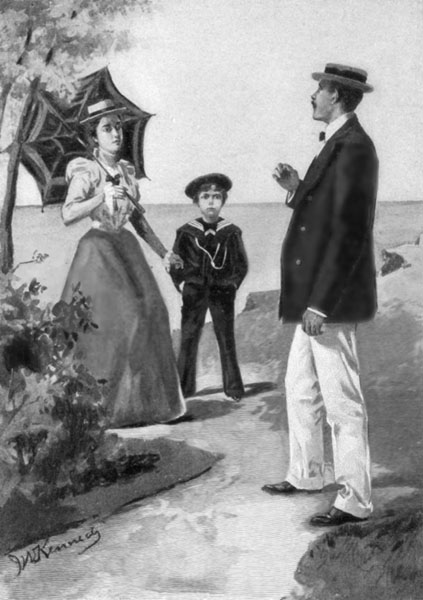
forth on the leaves, was a small boy dressed in the
fashion of a member of the navy. His blue pantaloons
flapped very widely at the ankles, and were
belted about him by a leather belt on which was the
word "Vireo," in gilt letters; his brimless cap was
tipped perilously on that part of his head where the
warm affections used to be located in the days of
phrenology. On this cap also appeared the word
"Vireo," in gilt. This figure, outlined as it was
against the bright blue of the sky, had the effect of
not being more than about sixteen inches long. And
in truth Leander Ffolliott was very small for his age,
which was ten years and five months. He did not
feel small, however; his mind might suitably have
inhabited a giant's frame, so far as his estimation of
himself and the Ffolliott family generally was concerned.
But the rest of the family did not always
agree with him in this estimation, and at such times
of disagreement the boy was given to screaming and
kicking until the air round about this summer residence
resounded, and seemed actually to crackle and
glimmer in sympathy with the mood of Leander.
Just now he had stopped in his trampling of the ivy
leaves. He was standing with his legs wide apart,
and was bending forward somewhat, stirring with a
stick something on the top of the wall in front of
him. His atom of a face was screwed up, his lips
sticking out,
"Sis!" he suddenly shrieked; "I say, sis!"
The girl on the piazza stopped reading, and looked
at the boy.
"What's the matter?" she called out.
"You just come here; you come here this minute!
Stop readin' that nasty book, 'n' come along!"
"Carolyn, you'd better go," said a voice from the
inner side of an open window; "if you don't he may
be so tried with you that he'll fall off the wall. I've
told him not to get on that wall, anyway."
The girl rose and turned her book down open upon
her chair. Then she sauntered slowly along over
the lawn, so slowly that her brother Leander stamped
his foot and called to her to hurry, for he couldn't
wait.
"You'd better hurry, Carolyn," said the gentle
voice at the window; "I'm so afraid he may fall."
So the girl hastened, and in a moment was leaning
against the wall and asking, without much interest:
"What is it, Lee? You do shriek so!"
Leander was now standing upright. He had put
his foot, encased in yellow leather, hard down on the
something he had been poking at. His freckled face
was red, his eyes shining with excitement.
"By George!" he exclaimed; "you can't guess in
a million years what I've found! No, not in ten
million! I ain't picked it up yet. I wanted you to
see me pick it up. Oh, thunderation! won't I just
do what I darn please with the money? You bet!
Fifty dollars! Cousin Rod owes me fifty dollars!
I don't s'pose he'll be so mean as to say that ad. of
his has run out 'n' he don't owe me anything. Do you
think he'll be so mean as that, Caro? Say!"
At this thought Leander's face actually grew pale
beneath tan and freckles.
The girl was not very much impressed as yet by
her brother's excitement. She was used to seeing
him excited.
"You know Rod wouldn't do anything mean," she
replied, calmly. "But what are you talking about?
Of course it can't be—"
"Yes, 'tis, too. And it's fifty dollars. Now you
needn't go 'n' tell Rod he no need to pay it, 'cause
'twas one of the family. I won't stand it if you do!
I—"
"Stop your gabble!" interrupted the girl, imperatively.
"Lift up your foot."
She took hold of the boy's arm as she spoke. A
certain spark had come into her eye.
The foot was withdrawn. In a cleft between the
stones, where the ivy leaves had hidden it, lay a ring.
It was turned so that the stone could but just be
seen.
She extended her hand, but it was promptly
twitched away by her brother.
"None er that!" he cried. "I ain't goin' to let
you pick it up; then you'll be wantin' to share in the
fifty dollars. You can't do that,—not by a long
streak. Here she goes!"
He stooped and then held up a ring between his
finger and thumb. The sun struck it, and made
the engraved carbuncle shine dully red.
"That's the very critter!" exclaimed Leander,
triumphantly.
"Let me take it," said the girl.
She spoke shortly, and in a way that made the
boy turn and look at her curiously. But he obeyed
instantly. He laid the ring in the palm of her hand,
thrust his own hands into his pockets, and stood
gazing down at his sister.
Carolyn Ffolliott looked at the trinket with narrowing
eyes. Her lips were a trifle compressed.
"There ain't any mistake, is there?" the boy
asked, at last, speaking anxiously. "That's the
ring Rod lost, ain't it? Anyway, it's one exactly
like it,—that red stone with something cut into it."
"There isn't the least chance of any mistake,"
was the answer. "Of course it's Rod's."
Carolyn gave back the ring.
"And I sh'll have the reward?"
"Of course."
The girl appeared to have lost all interest in the
matter. She turned to go back to the piazza.
Leander made an extremely tight, hard, dingy fist
of one hand, with the ring enclosed, and then he
leaped down from the wall, landing so near to his
sister that she staggered away from him.
"I wish you would behave respectably!" she
cried.
"Pooh!" said Leander. He ranged up by her
side and walked across the lawn with her towards
the house.
He had now put the ring on his thumb and was
holding it up in front of him, gazing at it. He
was greatly surprised that his sister took no more
notice of it. But you never knew what to expect
of a girl. Anyway, she shouldn't have any of that
money.
"I'll bet I know how the ring got there," he
remarked, presently.
"How?"
"Why, you gaby you, the crow, of course. But
I don't know how he got it. Flew into Rod's room
sometime, I s'pose. If he thinks such an almighty
lot of it, Rod better look out. I guess fifty dollars'd
get a lunkin' lot of cannon crackers, don't you think,
sis?"
"Yes," absently.
"But I better have some pin-wheels, 'n' Roman
candles, don't you think?"
"Yes."
Leander turned, and peered up at his sister's face.
"You mad 'cause you didn't find it?" he asked.
"No."
"All right. I guess I'll get you 'n' marmer some
kind of a present. I'll make marmer tell me what
she'd like for 'bout fifty cents. Hi! marmer! I'll
let you have three guesses 'bout what I've found—"
Here Leander slammed in through the wide
screen door which opened from the piazza into
the hall.
Leander's sister resumed her seat. She had taken
up her book, and now sat looking at it in much the
same attitude that had been hers when her brother
called her. She could hear his shrill voice inside the
house, as he told his mother of his find.
After a few moments Carolyn heard the clock in
the hall strike ten. At about ten the mail for "Savin
Hill," as their place was called, was brought over
from the village.
But she continued to look intently down at her
book for several minutes more. Then she rose
slowly; she stood and gazed off across the lawn
to where a sharp line of glitter showed between
some savin-trees that had been left standing on the
other side of the wall. These trees slanted south-westerly,
as do most of the trees on the south shore
of Massachusetts, being blown upon so much of their
lives by the northeast wind.
That line of glitter was Massachusetts Bay.
Across the girl's vision moved two or three sails;
but she did not seem to see them. Her eyes
showed that she was not thinking of what was
before her.
Presently a clock somewhere in the house struck
the half-hour after ten.
A servant came out on the piazza with some
papers and letters in her hand. She hesitated, then
came forward. "You told me to bring the mail out
here, Miss Ffolliott," she said, as if in apology.
"So I did; thank you."
"Why, Carolyn!" exclaimed a middle-aged lady,
hurrying by the servant, "isn't this odd about
Rodney's ring?"
"Very," answered the girl. She held the papers
in her hand and did not raise her eyes as she spoke.
"I do wonder what he'll say," went on her mother.
"I do wonder if he still cares. How upset he was!
And how curious that he should have lost the ring
just before the engagement was broken! It did
seem almost like a forerunner."
Mrs. Ffolliott held the trinket in her hand. Her
son was standing beside her still, with his hands in
his pockets. He was watching the ring somewhat
as he would have watched it if his mother had been
likely to devour it.
"You know Devil took it, of course," answered
Carolyn, without raising her eyes. "There's no
other way to account for its being in the wall
there."
"It always seems so profane to speak of the crow
in that way," murmured Mrs. Ffolliott.
Whereat her son frankly exclaimed, "Oh, marmer,
don't be a jackass! That's the crow's name, you
know."
"But he ought never to have been named in that
way. I objected to it from the first."
"Pooh!"—this from Leander.
"I know," went on the lady, "that it was Rodney
himself who named him, but—"
"Come, now, marmer," the boy interrupted, impatiently,
"you always say that."
"Here's a letter from Prudence at last."
It was the girl who spoke, now looking up at her
mother.
"Read it to me, dear," was the response. But it
was some moments before the mother and son could
finish the altercation now entered into as to who
should have charge of the ring until such time as it
could be returned to the owner.
Mrs. Ffolliott succeeded in gaining permission,
Leander perceiving that the article would be safer in
her care. But he cautioned her not to expect any
share of the reward.
Then he walked out of sight to some region
momentarily unknown to his parent, and peace
reigned on the piazza.
Mrs. Ffolliott sat down in the chair and placidly
waited.
Carolyn stood leaning against the wall of the
house. The open letter hung from her hand.
"That new man hasn't brought back the veranda
chairs since he swept here," now remarked Mrs.
Ffolliott. "I wish you'd tell him—"
"Yes, I will, presently," replied the girl. "Shall
I read this to you now? She's coming home."
"Coming home!"
"Yes. Here's what she says: 'My dear old
fellow—'"
"Does she call you that?" interrupted Mrs. Ffolliott.
There was a slight smile on the girl's face as she
answered:
"Yes; she seems to mean me."
"Oh, dear! Well, it's just like her. But then,
anything is just like her. Go on, please."
"'My dear old fellow,'" again began Carolyn, "'I
suppose there is stuff that martyrs are made of, but
none of that stuff got into my make-up, so I don't
mean ever to pose for that sort of thing. That is,
never again; but I've been doing it for the last four
weeks.
"'You see, mamma would have me stay with her at
Carlsbad. It has seemed as if I should die. And
how horrid you would feel if you should have to tell
people, "My dear cousin Prudence died at Carlsbad."
Because, you see, they don't die at Carlsbad; they
hustle off somewhere to die and be buried. And if I
should give up the ghost here I should be thought
quite odd. But I shouldn't care for that. Only I
want to live, and I mean to. That's why I'm not
going to stand it.
"'There hasn't been a man here that it would pay
to speak to, much less to look at. I might just as
well have been a nurse. I shouldn't have been so
bored, for if I had really been one that knowledge
would have sort of upheld me,—at least I think
it would.
"'And mamma will have me with her when she
takes the mud baths. I have to stay right there and
see her step into the big tub of ground peat and sprudel
water. And there are snakes in it; anyway,
mamma feels just as if there were, and makes me feel
so, which amounts to much the same thing, because
if there were, they wouldn't be poisonous, you know.
She sits up to her neck for half an hour. Black mud!
Then a nurse comes and lifts out one arm; pours
water over it. Then the other arm; pours water
over it. Then mamma gradually rises and goes
into a regular sprudel bath. I'm just pervading
about as the dutiful daughter who is staying at Carlsbad
with her mother. Every third day sprudel is
omitted.
"'Mamma has me with her when she goes to the
springs to drink. Drinks six glasses; stops after each
glass to walk one-quarter of an hour. We walk one
solid hour before breakfast. I go with the procession
of drinkers, with mamma on my arm. Oh, that
procession of drinkers solemnly walking the time
out!
"'I always look to see if there are any new men.
You know I must do something. And there always
are some new ones. But they are watching themselves,
their insides, you know, to see what the mud
baths and the water are doing for them already.
And I can tell you as a positive fact that a man who
is watching to find what a mud bath has done to
him is as uninteresting as a dummy. You try it
and see, if you don't believe me.
"'One day I did have a bit of a sensation. I was
going along just as primmy as prim, with mamma on
my arm, when I suddenly felt as if somebody were
staring at me. So I turned my eyes, and there was
Lord Maxwell gazing right at me. He was one of
the procession of drinkers. He was limping. Perhaps
he has rheumatism, or, rather, of course he has
it, or he wouldn't be here.
"'I wonder if I flushed. I couldn't positively tell.
But I bowed, and he raised his hat, and his face grew
red. But the procession kept right on. If I should
see him, he wouldn't talk of anything but how many
glasses he had to drink; he wouldn't, because it can't
be done here in Carlsbad.
"'Mamma converses a great deal about her food.
For some reason she makes me listen, or pretend to
listen. I know all about how she can eat bread, but
no butter, and stewed fruits, and once in awhile an
egg. You can skip this if you want to, but I can
assure you I can't skip it; I have to take it three
times a day, and sometimes in the night,—the talk
about it, I mean. I have a bed in mamma's room,
and I have to be wakened and told how mamma
detests bread without butter; and she never did like
eggs.
"'I've borne the whole thing like an angel, I do
believe; particularly since Lord Maxwell came. He
hasn't been very interesting, but I was hoping all the
time he would be. He still wears red neckties
in the morning. He has gone now. He thought
some other mud might do more for him than this
mud. And I've told mamma that she positively must
get along now with her maid and her nurse. And
she's a lot better, anyway. And I'm going to start
from Antwerp; and I shall alight at Savin Hill about
as soon as you get this. And you must receive me
with frantic delight. My love to Aunt Letitia, and to
Leander, and to Devil; and millions of kisses to your
own self. But I'll give them to you. I "don't nohow
expect" that Rodney Lawrence is to be in Massachusetts
this summer. But if he should be with you,
kind remembrances to him. I saw a man a few
weeks ago from New York who said that Mr. Lawrence
was bound to make his mark. I don't suppose
he cares for compliments any more.
"'Ever your "'Prudence.'"
As Carolyn finished reading the letter she folded
it carefully and stood there in silence.
Her mother drew a long breath. She contemplatively
patted a bow of ribbon on her morning dress.
"That's just like Prudence Ffolliott," she said, at
last.
"What is like her?"
"Why, starting off and coming home all in a
moment like that."
"She has been abroad more than a year."
"Has she? Well, I've missed her unaccountably,
but I must say I was relieved when she went. And
now I shall be glad when she comes."
Carolyn turned her head and gazed at her mother
for a moment. Then she smiled, slightly, as she
said, "One is bound to miss Prue one way or the
other."
Mrs. Ffolliott continued to smooth the bow of
ribbon.
"And Rodney coming, too!" she exclaimed.
"That will make it interesting to all of us, don't
you see?"
The girl made this remark a trifle satirically.
"And Leander has found the ring she gave
him!"
The pronouns in this sentence were so indefinite
in their reference that Carolyn smiled at them. But
she did not take the trouble to reply. She knew her
mother's manner of speaking.
Mrs. Ffolliott rose from her chair after a moment.
She came to her daughter and put her hand on her
arm as she asked, impressively:
"Can't you telegraph to Rodney not to come?"
At this instant something made the girl turn
quickly. Her face flushed crimson. She uttered
an exclamation, and ran forward to the open door.
On the other side of the screen there stood a man.
He was tall, he was young, and at just this juncture
he was laughing silently.
He hastily swung open the wire door and stepped
on to the piazza. He put one arm about the elder
woman and one about the younger, and kissed first
one and then the other.
"Aunt Tishy," he said, "I reached that door just
in time to hear you ask if I couldn't be telegraphed
to not to come. No, I can't be."
Mrs. Ffolliott was gazing with delight up at the
young man's face. Carolyn stood looking at him
demurely.
"Is the scarlet fever here, and are you afraid I'll
take it?" he asked.
"Did you hear anything else we said?" she
inquired.
"Not a word."
"It has happened so unfortunately," now began
the elder lady. "But what are we going to do?"
"Mamma!" exclaimed Carolyn.
The young man began to be puzzled. A line came
between his eyes.
"If you really want me to go—" he began.
"No; mamma is silly, that's all," said Carolyn,
frankly.
"As if that were not enough!" Here Lawrence
laughed, but the line did not leave his forehead.
"You'll have to tell him now, mamma," said the
girl, "or he will really think we don't want him."
Mrs. Ffolliott hesitated. And as she hesitated
a glitter grew quite decidedly in Lawrence's eyes.
The Ffolliott home had always been his home, and
though "Aunt Tishy" was not his aunt, but only a
second cousin, she had been very kind to the boy
whom she had persuaded her husband virtually to
adopt when he had been left alone before he was ten
years old.
"Yes, you will certainly have to tell me," he said;
and he drew himself up a little as he spoke. "I
thought," he went on, "when I overheard you speak
of sending me a message, that you were going away
somewhere; but if it's not convenient for you to
have me—"
"Now it's you who are silly," Carolyn interrupted.
"You see," said Mrs. Ffolliott, "we have just
heard from Prudence."
"Well?"
Lawrence knew that Carolyn was carefully
refraining from looking at him, and this knowledge
keenly exasperated him.
"I thought that—I didn't know but—"
Having proceeded thus far, Mrs. Ffolliott paused.
Lawrence laughed, not quite pleasantly.
"You thought that if a man was once a fool he
was always a fool?" he asked.
"I don't know, I'm sure," the lady answered,
helplessly. "Caro, you tell him."
"One would think you were going to cut off an
arm or a leg," he said.
"It's all quite ridiculous," the girl began. "Prudence
writes that she is tired of staying abroad, and
she is coming here. What she says is that she may
'alight at Savin Hill at any moment.'"
Lawrence walked to one of the piazza pillars, and
leaned against it.
"I suppose I must have been even more of a
raving maniac about Prudence Ffolliott than I knew,
and I knew I was the most infernal idiot that ever
walked on the face of the globe," he said, looking at
Carolyn. "At least I came to know it, you understand.
But a man gets over a lot of things. You'll
find there won't be a bit of melodrama or anything
of the sort. You'll have to let me stay, if that's all
you've got against my staying." Here the speaker
laughed gaily.
"That's so nice, I'm sure," said the elder lady,
comfortably; "and now we won't think anything
more about it."
But Lawrence did not seem to hear her. He was
still gazing, somewhat markedly, at the girl, who
smiled a little constrainedly at him, as she said:
"It's very odd, but Leander has just found that
ring that Prue gave you, and that you lost so
unaccountably."
"Has he?" The young man closed his lips
tightly for an instant. Then he laughed, and said,
"In that case I must owe the boy fifty dollars.
That's the reward I offered. I remember at the
time I wanted to offer five hundred, but you told
me, Caro, that the smaller sum would be just as
effective."
Lawrence turned and walked across the veranda.
Mrs. Ffolliott went into the house. The young man
returned to Carolyn's side.
"It all seems a thousand years ago," he said. "I
was wild—wild for her. I suppose I was somebody
else; don't you think I was somebody else,
Caro?"
"No. And it is not quite two years since then."
"How literal you are!"
"Am I?" she asked, smiling.
"Yes. And such a comfort to me. Caro, I'm
going to kiss your hand."
He took both of the girl's hands, held them closely,
then kissed them gently.
"I'm sorry you and Aunt Tishy seemed to think
you must arrange so that I shouldn't see Prudence.
It makes me appear such a weak fellow. Do you
think I am a weak fellow, Caro?"
"No."
"Honest Indian?"
"Honest Indian."
"Oh, I'm glad of that. I find I am asking myself
so many times if Caro thinks this or that of me.
Perhaps you call that weak?"
But the girl only laughed at this remark.
Then they talked of a great many things, until
Lawrence asked, suddenly, "Where did Leander find
that ring?"
Carolyn told him.
"Odd! Of course it was Devil's work?"
"Yes. He took my gold thimble, you know."
The young man said, "I'm sure Lee won't let me
off; he'll exact every penny. I would gladly have
given all my possessions to get it back again when I
lost it. But now—"
Here Lawrence paused. He was gazing persistently
at his companion. But she did not seem to be
aware of this gaze. She did not try to help him out
with his sentence. She was standing in perfect quiet;
she was not a nervous woman, and she could remain
for several moments without moving.
It was six months since Lawrence had seen Carolyn.
He was wondering if she had always impressed
him as she impressed him now. If she had done so,
he thought it was inexplicable that he should have
forgotten.
But then, formerly, he had seen somebody else.
That accounted for everything, of course.
At this fancy he smiled.
And he wished that carbuncle had not been found.
It seemed awkward to have that turn up now when
he had ceased to care for it. It was like a ghost
stalking out of the past.
He took a step towards the door.
"I'm as dingy with heat and dust as a savage,"
he remarked. "I suppose I can have my old
room?"
"Of course."
"All right, then. Do stay out here until I come
down, Caro; will you?"
He advanced now towards her.
"Will you?"
"If mamma doesn't call me."
"Very well."
Lawrence went into the hall and to the foot of
the stairs. With his hand on the post, he paused.
He stood there an instant, then he turned back. He
rejoined the girl on the piazza. She had walked to
the railing and was leaning both hands upon it.
Lawrence caught a glimpse of her profile, and his
own face grew tender at sight of it.
"Where in the world have my eyes been?" he
asked himself.
She turned quickly as he came through the door.
"I came back because I was afraid Aunt Tishy
would call you," he said.
"Oh!"
"Yes."
Then the two stood in silence.
"You see, I wanted to ask you about that man
person who was hanging around you when I was at
home the last time."
"What man person?"
"No wonder you don't know. I ought to be more
specific. I mean the Morgan fellow."
"Nothing about him that I know."
Lawrence flung back his shoulders. His eyes
began to sparkle.
"All the better for me, then," he exclaimed.
"Caro," he went on, more softly, "do you think
you could possibly make up your mind to marry
me?"
There was a moment's silence, during which the
girl's eyes were drooped. She had not flushed; she
had grown white.
"Could you do it?" he repeated, gently.
He bent and took her hand. She withdrew it.
"I'm sorry you've asked me this," she said.
To these words he made no reply. His face grew
a trifle set.
"Because," she went on, hesitatingly,—"because
I feel almost sure—at least I'm afraid—"
"Well?" He spoke peremptorily.
"I'm nearly certain that you don't know surely
that—that you've stopped loving Prudence."
He burst into a laugh; but he stopped laughing
directly. He took her hand again. "Is that all?"
he asked.
"Yes; I think that's all. And that's quite enough.
You see, I was here when you were in love with her;
I know something about how you loved her. You
did love her. And you can't have forgotten it in less
than two years. Why, I couldn't forget such an experience
in a lifetime. It must have been like—like
fire sweeping over your heart."
"But a man comes to his senses; a man gets over
everything, you know. And I've had my lesson."
Lawrence was speaking eagerly now. His whole
face began to glow.
"If you could only say yes to me, dear Caro!"
he went on. "If you feel hopeful that you could
learn to love me,—tell me, do you think you could
learn?"
She smiled, and Lawrence asked himself why he
had never before particularly noticed her smile.
"I think I could learn," she said, at last.
"Then you are promised to me? Caro, say, 'Rodney,
I am promised to you.'"
He had drawn her more closely.
"Say it."
"Rodney, I am promised to you."
"Thank you, dear little girl, thank you. We shall
be as happy as the day is long. I begin to be happy
already."
She looked up at him wistfully. Her features
were not quite steady.
"Oh," she whispered, "I hope you haven't made
a mistake!"
"I'm sure I've not."
He kissed her, but she shrank a little from him.
She put her hand on his breast, and thrust him from
her.
"If you find you have made a mistake," she said,
solemnly, "remember you are not bound,—not
bound one instant after you see how blind you've
been."
"I am glad to be bound to you," he returned, as
solemnly as she had spoken,—"grateful beyond
words, Caro, as time will prove to you."
The girl suddenly took the man's hands, and held
them fast, looking earnestly in his face as she did
so.
Then she said, nearly in a whisper:
"Yes, I love you, Rodney."
But the instant she had uttered those words, she
was aware that he had not spoken thus, and a scorching
blush rose to her face, and burned there until
she was almost suffocated with it.
"Bless you for that! Oh, you don't know how I
bless you for that!" exclaimed Lawrence, quickly.
"And I love you with a love that lasts,—that means
something,—that takes hold on life."
He spoke fervently. He had his arm about Caro
now. His eyes were shining.
It was at this moment that a small figure in a naval
suit appeared on the outside of the piazza, at the
farther end of it. This figure noiselessly vaulted
over the railing, and as noiselessly came forward.
Within a few yards Leander paused, with his
hands thrust to the very depths of his pockets, and
his small legs wide apart. His eyes were what romance
writers used to call "glued" to the two
standing there. His mouth was stretched in an
appreciative grin. Directly it changed from a grin
to a round shape, and a shrill whistle was emitted
from it.
The two started. Lawrence wheeled round,
frowning. He subdued his first impulse, which
was to take that atom and fling him over the
railing.
Leander nodded amicably.
"How de do?" he inquired.
"I'm pretty well, thank ye," answered Lawrence.
The boy looked with a new and curious interest at
his sister. "Was she in love?" he was asking himself.
And he immediately put the question aloud:
"I say, sis, are you in love? Is that why you 'n'
Rodney were huggin' so?"
"Hold your tongue," Lawrence promptly commanded.
"All right." Then, contemplatively, "I s'pose
you 'n' sis are spoons, ain't you? That's what
the new chambermaid 'n' the coachman are. He
told me the other day that he 'n' she were spoons.
They were huggin', too. And I asked him about
it."
"I'll swear you asked him about it," responded
Lawrence.
Then the young man made a diversion. He
walked forward, and laid hold of Leander's shoulder.
"I heard you found a ring," he said.
The boy puckered his face, and gazed up at the
face above him.
"You bet," he replied at last. "Prove property
and pay for this advertisement, and—fork over the
fifty dollars,—that is, if you want her."
At this stage in the conversation, Leander's sister
escaped to her own room, where she sat for a long
time by the window, looking off on the bay.
Below she heard the murmur of voices, the shrill
tones of her brother, and the deeper tones of Rodney.
She put her hand down to her belt. Her fingers
touched something which rustled. She had thrust
her cousin's letter into her belt. She now drew it
out, and read it again. She read it as if it were
written in a foreign language, and as if she
were translating it word by word.
CHAPTER II. A SLIGHT ACCIDENT.
When it is summer-time, and you are engaged to
the most perfect man in the world, and you are at a
lovely seaside cottage with him, and are boating, and
playing tennis, and trying to play golf, and cycling,
and it is a little too early for any of all those people
who are going to visit you really to arrive,—when
such conditions prevail, you don't expect time to
drag.
And time did not drag with Carolyn Ffolliott,—it
flew.
A week had gone when one day at breakfast Mrs.
Ffolliott remarked that she had almost a good mind
to worry.
Her daughter looked at her questioningly, and
Leander, with his mouth full, said that "Marmer'd
rather give a dollar any time than miss a worry."
But marmer took no notice of her son; she continued
to gaze at Carolyn, with her brows wrinkled.
"Prudence, you know," she went on. "She said
she might come any minute."
"I suppose she changed her mind."
"Perhaps. But I've been dreaming about her;
I thought she was drowned, and when I told you,
Caro, you laughed, and said it was a good thing. I
was so shocked I—but, good heavens! Caro, what
makes you look like that?"
"Like what?"
"Why, just as you did in my dream,—that same
light in your eyes—"
"Mamma!" broke in the girl, angrily. But she
did not say anything more.
At that moment a servant came into the room
with a salver in her hand, and on the salver lay a
yellow telegraph envelope.
Carolyn half rose from the table, then she sat
down, for she saw the servant was coming to
her.
To these people a telegram was little different
from an ordinary note. Everybody telegraphed
about everything. Notwithstanding this, the girl
could not keep her hand quite steady as she tore
open the cover.
Her mother watched her face; she was still
thinking of her dream.
Immediately Carolyn began to smile. She read
aloud:
"Please send your wheel over to station for 11.40 train. "Prudence Ffolliott."
The elder woman stirred her coffee desperately.
"She isn't drowned, then," she said.
"Apparently not, since she wants my wheel."
"Shall you send it?"
"Yes."
"Sha'n't you drive over to meet her?"
"No."
"Well," said the elder lady, forcibly, "I call it
ridiculous, coming home from Europe on a bicycle!
I don't see when she learned, either. I thought she
had been giving her mother mud baths, and all that
sort of thing, and being devoted and—and what not."
"As for that," responded Carolyn, "I don't know
but Prue would be able to learn to ride a wheel in a
mud bath itself."
"Bully for Prue!" cried Leander.
"My son!" said his mother, at which he grinned,
but kindly refrained from repeating the remark.
Carolyn had risen from the table. She held the
message crumpled in her hand.
"Sha'n't you meet her anyway?"
"How can I if I send my wheel?—but I have an
idea that she doesn't care. I don't precisely know
what she does mean, so I shall wait."
"I sha'n't wait," suddenly announced Leander.
"I shall spin down there myself."
"And when is Rodney coming back, did you
say?"
"Not until to-morrow."
Mrs. Ffolliott indulged in some remarks on the
ways of young people at the present time, to which
no reply was made.
So it happened that when the eleven-forty train
steamed up to the little station, there were on the
platform but two people, the agent and a small boy
in a suit so close and abbreviated as to be almost no
suit at all.
This boy was standing by his own wheel, and another
bicycle leaned against the wall of the building.
Leander was scowling along the steps of every car,
and saying to himself:
"I'll bet she hasn't come. Women never do
anything right. I wanted to race her home."
Three men and a small girl had alighted. It was
no use looking any more. There, the train was
moving.
"Oh, thunder!" said the boy.
He was turning away, when something touched his
shoulder, and somebody asked:
"Leander, why are you saying 'thunder?'"
He flung about quickly. He snatched off his atom
of a cap and looked up at the tall girl beside him.
"Now, that's O. K.," he said, "and I'll race you
home. How de do? You do look grand, though.
And you can't ride a bike in that suit,—no more'n
a bose."
"Can't I? We'll see. Let us kiss each other,
Leander."
"All right. I ain't no objections."
The two kissed. Then Leander put on his
cap.
Prudence Ffolliott was dressed with extreme
plainness in a perfectly fitting suit of brown with a
white hat, and she had on gloves like those which
a few girls can find, and which most girls pass all
their lives trying to find. And yet it might seem
an easy matter to get rather loose brown gloves
like these. She had a small leather bag in one
hand.
She glanced up and down the platform. The
train had sped away. The long waste of track lay
desolate beneath the brilliant sun. The woods came
up close on the other side of the rails. On this side
a country road wound up a slight acclivity. There
was one "open wagon," drawn by a sorrel horse,
slowly ascending this hill. In the wagon sat three
men very much crowded on the one seat. In the
still air was a low, continuous sound.
Prudence listened; she sniffed the air.
"I hear the waves," she said. "The tide is
coming in; and the wind is east."
"Yes," said Leander, "I should have gone perchin'
if I hadn't come down here. And I might as well
have gone, for you can't ride. Just look at all the
pleats and pipes 'n' things on your skirt! It's too
bad! And sis sent her bike down. You wired for
it, you know."
"Yes," said the girl, "I know I wired for it. Wait
for the transformation scene. How is Caro?"
"She's well enough," said the boy, shortly.
"And Aunt Letitia?"
"Well's ever."
"Any company yet?"
"Only Rodney."
It was an instant before the girl asked:
"Is Mr. Lawrence there?"
"Yep. 'N' he 'n' sis are such spoons that they
ain't either of 'em any fun."
"Spoons, are they?" Prudence laughed slightly.
"Yep. 'N' I found Rod's ring, and marmer 'n'
sis raised a most awful row 'bout my takin' the
reward. They said it wasn't gentlemanly of me,
bein' a friend and relation, to take it. Still they did
let Rod give me two ten spots. But I didn't get
marmer any present out of that, you bet!"
"What ring was it?"
While Prudence was talking she opened her bag
and selected from its contents a leather strap.
Leander was so absorbed in watching her, and in
wondering what she would do, that he did not hear
her question.
He already began to have faith that she would be
equal to any emergency,—that is, as nearly equal
as anything feminine could be.
"What ring did you find?" she repeated.
As she spoke, she took a pair of white gloves from
the bag, and extended them to the boy.
"Please hold them," she said. His little brown
fingers closed over the gloves.
"Why," he answered, "that red stone, you know,
with the head cut into it."
"Oh!"
She made no other remark for some time. The
boy continued to watch her. He rather admired the
deft way in which her hands removed something
which made her belt slip from its place, and the next
moment her skirt, which he had derided, dropped
down to the floor of the platform, her jacket was
flung off, and there Miss Ffolliott stood in a full
bicycle suit of white flannel. It was then that
Leander noticed that her shoes and hat were white,
as he said, "to begin with."
He jumped up and down. "Hurray!" he cried,
in his thin, sharp voice. "I guess you c'n do it."
"I guess I can," she answered. "Now I want to
strap up this skirt, and we'll take it and the bag
along. Are you good on a bike?" She turned and
looked at her companion with a laugh in her eyes.
She had just now so lithe and active an appearance
that the boy wanted to clap his hands. She took
the white gloves from him, and began to put them
on.
"Good on a bike?" he repeated. "Well, you
just wait. Are you good on one yourself? I ought
to be; marmer says she's expectin' every minute to
see me brought in with all my bones smashed. But
I don't take headers nigh so often's I used to.
Ready?"
Leander gallantly brought forward his sister's
wheel, and held it. Within the station the agent
was peering out from his window at the girl in white.
He was shocked, but he was extremely interested,
and he did not wink in his gaze until the boy and
woman had wheeled out of sight along the lonely
country road.
Leander immediately found that his small legs
were called upon to do their utmost, but he kept on
bravely. And he would not pant; he assumed an
easy appearance. He even tried to whistle, but he
had to give that up.
He glanced covertly at his companion. She sat up
straight, and her figure showed very little movement.
Presently she asked, "Why didn't Caro come to
meet me?"
"She kinder thought you didn't care to have her,
as you sent for her wheel."
No answer. Then, "Perhaps she's gone somewhere
with Mr. Lawrence."
"No, she ain't, either. Rodney's off just now—comin'
back to-morrow. I say!"
"Well?"
"Slow up a bit. I can't stand this. I give in. I
guess my legs ain't long enough. You're stunnin'
on a bike. Caro's rather good, but—Hullo! what's
that ahead, anyway? Let's put in 'n' get to it."
So they put in. In another moment they saw that
the something was a man; then that he was lying
flat on his face; then that it was Rodney Lawrence.
It was the girl who discovered who it was. Instead
of shrinking back a little, as Leander had done
in spite of himself, when they found that it was a
man lying there, Prudence forced her wheel up to
the prostrate body, jumped off, and looked down at
him. She stood perfectly still for an instant. Then
she turned towards Leander.
"It's Rodney," she said, in a low voice.
"I don't believe it!" cried the boy.
He felt that it was impossible for Rodney to be
hurt so that he would lie as stiff and dreadful as
that. Some other man might be hurt thus, but not
Rodney. With this rebellious disbelief in his fast-beating
heart, Leander dismounted; he stood a little
behind Prudence, and peered round her at the object
on the ground.
"It is Rodney," repeated the girl.
Her face was quite white, and her eyelids, as she
looked down, fluttered as if they would close over
her eyes and thus shut out the sight of the senseless
man. But she was calm enough as she turned to
the boy.
She did not immediately speak. She glanced
around the place. There was a wood on each side of
the road. They might be there half a day, she knew,
and no one would come along. It was not the main
road, which itself was not much travelled.
She seemed to give up her intention of speaking.
She pulled off a glove and knelt down in the
gravel. She put out one hand, and gently turned
the head so that the face was a little more visible.
She shuddered as she did so. The vertical sun
struck on a diamond on her hand, and made it
send out sharp rays of light.
With a swift motion the girl turned the stone
inward. Then she shuddered again. She rose.
"I'll go on to the first house," she said, "and get
help."
"No, I'll go," exclaimed Leander, quickly, and in
an unsteady voice.
"I can go in much less time than you could do
the distance. You don't know how fast I can ride.
It's almost three miles to the next house. Are you
afraid to stay here and wait?"
The boy trembled and hesitated. Then he was
ashamed to say he was afraid.
"I'll wait here," he said, huskily.
Prudence sprang on her wheel and started off.
Leander watched her. For an instant he forgot
everything else in admiration as he saw her whiz out
of sight.
"By George!" he said to himself.
Then he looked back at that still figure. He braced
himself up. He remembered that he was a boy
instead of a girl.
He sat down on a stone by the wayside. He
leaned his chin on his hands and stared at Rodney.
Was that Rodney? If the man were dead, why,
then it was not anybody; it was—oh, what was
it?
And how could Rodney, so full of life and health
and strength, be there so helpless?
A great many strange and solemn thoughts came
to the boy's mind as he sat there.
And all the time he was listening for wheels, hoping
that a carriage would come along.
The mosquitoes buzzed about his face and stung
him unheeded.
He noticed that Rodney wore corduroys and
leather leggings, and that a whip lay on the ground
a few yards off. Leander went and picked up the
whip, which he knew very well.
But how strange even the whip seemed! So Rodney
had been riding; and he had come home sooner
than he had been expected.
If he should be really dead, Leander supposed that
his sister would mourn herself to death. He supposed
his sister was in love with this long, still
figure of a man.
All at once the little watcher felt the tears springing
up and blinding him. He rubbed his fists into
his eyes, but the tears would come. It was while he
was doing this that he thought he heard a sound; as
he could not distinguish what the sound was, he
dared not take his hands from his face, and he dared
not move.
Was it really a groan?
His curiosity overcame his terror. He looked at
the man in the road. Lawrence had raised himself
on his elbow, but he immediately sank back
again.
Leander ran to him.
Lawrence gazed in a blind sort of way at the
boy. Then he half smiled, and said, feebly, "I
suppose you're dead too, Lee, and we're both in
heaven."
"I ain't dead, for one," answered the boy. And
then he sobbed outright in the intensity of his
relief.
"Then perhaps I'm not."
A long silence, during which Lawrence stared
rather stupidly at nothing, and Leander stared at
him.
After a little the boy bethought himself to ask if
he couldn't help.
"I don't know. I thought I'd wait until my
mind cleared more."
He raised his head again.
"What's that?" he asked.
He was looking at a white glove that lay near him
on the ground.
He dropped his head and slowly reached forth his
hand till he grasped the glove.
"It's hers," was the answer.
"Hers? Caro's?" he asked, eagerly.
But as he spoke the faint odor of iris came to him
from the bit of leather in his grasp. He knew that
odor of iris; it had always been inseparable from
anything belonging to Prudence Ffolliott.
"No," replied Leander; "it's Prue's."
Lawrence lay silent. His face was dull and
clouded.
"Oh, I do wish I could do something!" exclaimed
Leander. "She's gone on for help."
"Who's gone on?"
"Why, Prue, of course."
Lawrence lifted himself up on his elbow again.
"I had a nasty fall," he said. "I thought I was
done for. Where's my horse?"
"I ain't seen any horse."
"It was one I was trying. Luckily, he'll go
home to his own stable, and the stablemen won't
break their hearts with anxiety."
The young man spoke quite like himself; and his
face began to gain in color. He pressed his hand to
his head. He laughed a little. "I must have a
thick skull of my own," he said.
He turned and twisted, and then he rose to a
sitting posture.
The glove had dropped to the ground. He looked
down at it, made a slight motion as if he would take
it, then turned away.
"I'm sorry I've made such a scene as this," he
said. "It's unlucky that you should have happened
along here now. You see I should have come to
myself all right, and nobody been frightened. Give
me a hand, Lee. There! The deuce! I can't do
it, though!"
Lawrence sank back on the ground, and again lay
quiet.
Leander could prevent himself from wringing his
hands only by remembering that he was a boy. He
recalled how in all the stories of adventure he had
read the right person always had a bottle of whisky
or brandy to produce at the right moment. But he
had nothing. He hadn't even a string in his pocket.
He "went in" for the lightest possible weight when
on his wheel.
Thank fortune, there was Prue coming back. She
had made good time, even to his anxious mind.
The girl's wheel glided up, and she alighted from
it as swiftly as a bird would have done.
CHAPTER III. "I WANT TO ASK YOU A QUESTION."
She bent down over Lawrence, who opened his
eyes and looked at her.
"Oh!" she said, in a whisper. The thought
which sprang swiftly into her mind was the thought
of the last time she had seen this man. It was the
time when she had told him that she had changed
her mind about marrying him, and had decided to
marry Lord Maxwell. But later, Lord Maxwell, for
financial reasons and under parental influence, had
also changed his mind, and had married somebody
else. This was in Prudence's thought as she said,
"Oh!" in a whisper.
"You see I'm not dead," remarked Lawrence,
"only devilishly unlucky."
Prudence stood up erect.
"It quite relieves me to hear you say devilishly,"
she responded; "cheers my heart, indeed."
"But why?"
"Because men who are mortally hurt are more
pious; if they wanted to say a bad word they would
not do it. Thank you."
Lawrence smiled.
"I could cheer your heart still more," he answered,
"for there are a lot of bad words just
galloping to be said."
Prudence did not reply. She turned to Leander,
and asked if Mr. Lawrence had been conversing like
this, and had he been shamming when they had first
found him.
At this Lawrence groaned. After a few moments
the boy and woman assisted him to rise. He leaned
heavily on them, but seemed to improve somewhat.
"I don't think you've done much more than break
a few ribs and a collar-bone or so," said the girl,
cheerfully.
"And p'raps concussed your brain a bit," added
Leander, whose spirits were rising rapidly.
"There comes the cart," announced Prudence.
"It hasn't any springs, but I didn't know but you
were past minding springs. I did insist on a mattress
being put in; only it isn't a mattress, but a
feather bed."
Lawrence groaned again.
"That's right," she said; "don't suffer in
silence."
It was not long now before the two men who
came in the cart had assisted Lawrence into it. At
first he refused to sit down on the feather bed. He
caught a glimpse of Prudence's laughing face as she
said, "If you don't, I shall think you're ungrateful
for all we've done for you."
On this the young man sank down on the bed.
"I've only been stunned," he said, morosely, "and
you needn't make any more fuss about it."
"All right; have it your own way; but I insist on
the ribs and the collar-bones. Now I'll go on and
prepare the minds of your friends."
Before anything more could be said, Miss Ffolliott
pedalled away.
Leander lifted his machine into the cart, and then
placed himself between it and the feather bed. The
horse started on his walk to Savin Hill.
As he started, Lawrence raised his head and
looked back to the spot of ground where he had
fallen. He saw something white lying there, and he
knew that it was Miss Ffolliott's glove.
Miss Ffolliott herself rode swiftly along the shady,
solitary road. She knew the way very well. She
had ridden and driven here many times with the man
who was lying there in the farm cart. He had been
in love with her,—extravagantly, furiously, delightfully.
She smiled as she remembered. Some men
could make love so much more agreeably than others.
She supposed that was a matter of temperament.
And he wasn't hurt very much, after all. And he
and Caro were "spoons" now. She smiled more
broadly.
"I always suspected that Caro cared," she thought,
"and I was right. How funny it is! Well, I shall
know precisely the state of the case in three seconds
after I've seen them together. And I've come now."
She seemed to slide without propulsion along the
road. She whistled two or three bars of a tune she
had often whistled while she had sat beside her
mother when the latter lady had been up to her
neck in ground peat and sprudel water.
Sometimes the girl flung back her head and
sniffed the air, much as a young colt sniffs when
it has just been let out into a field after a long
confinement.
But she did not relax her speed. It was not long
before she turned into a better kept road, and here
she saw ahead of her, and walking towards her, the
figure of her cousin Carolyn, who began to hasten
directly.
They fell on each other's necks, after the manner
of girls, and kissed and hugged.
Then Prudence held her off, and examined her,
smiling slightly all the while.
"Lee told me you were no good any more," she
said, at last.
Then Caro blushed and blushed.
"I suppose you're happy?"
"Yes."
"Of course. Well, I've been to the mud baths of
Carlsbad, and I'm not particularly happy. However,
I congratulate you; and I won't be de trop any
more than is absolutely necessary for the sake of
appearances."
Prudence propelled her wheel with one hand; the
other arm she put about her companion's waist, and
so the two went out.
"Mr. Lawrence has returned," presently said
Prudence.
"How do you know?" the other asked, quickly.
"Because we met him, Leander and I, on the
Pine-wood road. Now if you scream I won't tell you
anything more; and it really isn't anything to speak
of, only he is on his way here now, and on a feather
bed also, because they didn't have any mattresses.
If it isn't ribs it's collar-bone,—what was it the
Physiology used to call collar-bone?—and he's sane,
and knew me, and wanted to swear, but wouldn't,
much. So you see you needn't be alarmed a
particle."
Carolyn had detached herself from her companion,
and was gazing at her, her lips growing white, as she
listened.
"His horse threw him," added Prudence, shortly.
"Threw him?"
"Yes," with still more impatience. "What else
do you want me to say. Didn't I tell you he was on
his way home, and that it was a feather bed only
because I couldn't get a mattress? I did as well as
I could."
Here Prudence gave a short laugh, and lightly
kissed her companion's cheek.
Carolyn tried to appear calm. Her imagination
had leaped to every dreadful thing. She wanted
to turn her back on this girl, but, instead of doing
that, she looked at her intently, and asked, steadily:
"Are you telling me the truth?"
"Absolutely. I don't think your precious young
man is hurt much, only shaken up a bit."
The two girls were silent for a few moments.
Carolyn had turned, and they were both walking
back over the road, that they might the sooner meet
the cart that was bringing Lawrence to Savin Hill.
"Providence made a great mistake in sending me
to find your lover," at last said Prudence. "If Providence
had wished to do the perfectly correct thing,
you would have been on the Pine-wood road this
morning. But then, when does Providence act
quite up to the mark? I am tired of Providence
myself."
Though Carolyn gazed at the speaker, she did not
apparently hear her. Her eyes wandered off down
the road.
After another short silence, Prudence spoke again.
"I hope there are people coming to the house
this summer. I should go raving mad if I had only
you and Rodney, and you two in love with each
other."
The girl shrugged her shoulders, and shuddered.
As there was no answer, she repeated:
"I suppose you are in love with each other, aren't
you?"
"I suppose so," mechanically.
"That's what I thought. Are there people coming?"
"Oh, yes."
"Men?"
"A few."
"Ah, I revive! If you had had as much to do
with sprudel water as I have, you would be as thankful
as I am at the prospect of seeing some men who
are not slyly feeling their pulse while they talk to
you. You needn't look so curiously at me. It is
strictly proper for a girl to like men, only it's very
improper to acknowledge the liking. And when
they begin to get in love—Oh, isn't that the head
of the procession appearing? Yes. Now, Caro,
run and throw yourself on your betrothed, and sing
in a high soprano how thankful you are to see him
yet again—again—a-g-a—in! You see, I've not
forgotten my opera."
But Carolyn did not run. She walked slowly forward,
her hands very cold, hanging inertly down, her
lips pressed tightly together.
Of one thing she was sure,—that she would not
make a scene. Yes, she would die rather than make
a scene.
There was the bed, and there was Lawrence lounging
upon it. Leander was standing rigidly straight,
grasping the stakes of the cart. He shouted shrilly
as he saw his sister. The old horse, which always
stopped on any pretext whatever, stopped now, and
drooped, as if he would lie down.
"I say, sis," said Leander, jumping from the tail
of the cart, "don't you go and begin to cry, and all
that stuff."
"I don't think your sister will cry, Leander,"
remarked Lawrence, with some dryness.
Carolyn came to the side of the cart. She said
that she hoped Mr. Lawrence was not much hurt,
and Mr. Lawrence replied that he should be all right
in a few hours.
Then the horse was induced to start on. After a
while they all reached the house, and Lawrence was
helped to his room, while Leander volunteered to go
on his wheel for the doctor.
In due time the doctor came, and pronounced that
the young man would be as well as usual again in a
few days.
The two girls were standing on the piazza,
when this decision was announced to them by
Mrs. Ffolliott.
Carolyn walked quickly to the nearest chair, and
sat down. She fixed her eyes on that line of dazzling
brightness which was the sea. But she saw
nothing. Prudence sauntered to the railing, and
leaned against it.
Presently Mrs. Ffolliott returned to the house,
and the two were alone.
Prudence walked to a long chair near her cousin,
and placed herself luxuriously in it. She still wore
her bicycle suit. She crossed her legs, and, leaning
forward, embraced her knees with her clasped
hands.
"Got a smoke about you, Caro?" she asked.
"No. And I didn't know you had taken up
smoking."
"No more I have. But my attitude, and the
piazza, and a certain natural depravity in my own
breast suggested the question. I think I shall try
cigarettes. And one can have a truly divine thing
in cigarette-cases now. And a woman's hand is
peculiarly fitted to show jewels when holding a
weed out—thus."
The speaker extended her left hand, while she
seemed to puff smoke from her lips as she did
so.
Carolyn smiled slightly, as she said:
"You are just the same, aren't you?"
"Of course. You didn't think I had met with a
change, did you?"
"Hardly."
Carolyn clasped her hands, and gazed down at
them. A cloud was on her face.
"You are not worrying about that great strapping
fellow up-stairs, are you?" Prudence asked the
question sharply.
"No."
"You didn't seem to feel much when you met him
just now," remarked Prudence.
"I didn't want to make a scene," was the reply.
Prudence contemplated her companion for a moment
in silence. Then she said that she had a bit of advice
to offer; advice was easily given, and it never hurt
any one, because no one ever followed it.
"What is it?"
"Don't be quite so self-controlled, or Rodney will
begin to think you seem indifferent because you feel so.
You know men are creatures who have no intuition,
and who can't see the fraction of an inch below the
surface. And though they say they don't like scenes,
they do, when it's love for them that makes the scene.
I don't charge you a cent for this information. I do
wish I had a cigarette; I'd try it this very minute.
"''Twas off the blue Canary Isle
I smoked my last cigar!'"
Prudence sang in a deep bass that threatened to
choke her. She grew red in the face, and did not
try to go on any further with the song.
Carolyn glanced at her and laughed.
"Somehow," she said, "I believe I thought Carlsbad
would make you over."
"You see I think I might have been made over if
I had taken mud baths myself," was the reply; "but
only seeing mamma take them didn't seem to have
much effect,—only to bore me almost to death. Did
you ever notice that, after you have been bored to
extinction, and have escaped, you are liable to commit
very nearly anything? You are so exhilarated,
you know. Now I'm going to do something startling.
I don't know yet whether I shall steal the
Ffolliott silver, or—" here the girl paused to laugh—"or
Carolyn Ffolliott's lover. For the first I
might be put in jail; for the latter there's no punishment
that I know."
Prudence leaned back now and clasped her hands
over the top of her head.
"I do wish you wouldn't talk so!" Carolyn
exclaimed.
"Why? It's fun to take out the stopper and let
yourself bubble over."
"Prudence—"
"Ma'am?"
"I want to ask you something."
"Go right ahead. Questions cheerfully answered;
estimates given upon application."
But Carolyn hesitated. Then she said that she
wished her cousin would be serious.
"Serious! You don't call me gay, do you? Why,
the solemnity that dribbled over me from mamma
isn't washed off yet. It will take a whole summer,
and several men in love with me at once, and fighting
about me, to take away the melancholy that I
acquired at Carlsbad."
As she finished speaking, Prudence rose, and
stepped out on to the lawn. She ran across it and
leaned on the wall at the end of it. Beyond lay
the bay, flashing brightly in the sunlight; but her
strong eyes did not blench as she gazed.
"Is that the Vireo in the sandy cove?" she
asked.
"Yes."
"It's a little thing, isn't it?"
"Yes."
"I believe I could almost manage that myself."
"Yes."
Prudence turned towards her cousin, flung her
head back, and laughed. A young man lying impatiently
on a bed in a room on the second floor
heard that laugh, and tossed his head on the pillow
as he heard.
He inwardly compared the sound with Carolyn's
musical gurgle when she was amused, and then said
aloud that it was amazing that he had ever fancied
that he had cared for Prudence Ffolliott. She must
be out there by the wall. He raised himself on his
elbow, but, though he could look through the window,
he could see only the ocean and the sails on it,
and the long trails of smoke from two steamers that
were gliding away towards "the utmost purple rim."
That phrase came into his mind, and with it the
memory of one evening, down on the beach, when
Prudence had quoted that verse, and how her voice
had sunk and thrilled as it pronounced the words and
she had glanced up at him.
What an ass he had been! Well, he was thankful
that was all over. It was incredible that he had
been moved so by that woman. He was beyond all
that now; and he was in love with the dearest girl
in the world.
Prudence laughed again, and again Lawrence raised
himself on his elbow, and once more saw nothing but
the ocean and the sails. Then he turned with his
back to the window, groaned by reason of his hurts,
muttered something that sounded like "Damn it,"
and in a few moments fell asleep.
Prudence still remained by the wall, her arms
upon it and her brilliant face towards the sea. And
Carolyn still sat in her chair on the veranda. She
was not looking at Massachusetts Bay, but at her
cousin. She was wondering about her with an intensity
that was almost painful. Among other things,
she was trying to determine what it was in Prudence
Ffolliott's face that made it interesting, and that gave
it something very much more effective than beauty
of feature. It was a mocking, flashing, melting, fiery,
tender face; a face full of daring, of possibilities, and
suggestions, and shadows, and brightnesses; and it
was unscrupulous, and passionate, and cruel, and
selfish, and—
Having thought of all these adjectives, Carolyn
roused herself and smiled at her own folly, and told
herself it was an impossible thing that any human
countenance should be so contradictory. She recalled
the story her own mirror told her. As for beauty,
she possessed a share of that.
This thought strengthened and comforted her.
She left her chair and joined her cousin by the
wall. Prudence put her arm about Carolyn, and
the two stood in silence a few moments. The water
before them was vivid, shining green and blue and
purple; and it was just ruffled by a gentle east wind
that made the whole world seem a bright, joyous
place to live in.
"How many times I've thought of just this place
on the Savin Hill lawn, and just this outlook over
the bay!"
Prudence spoke very gently, and sighed slightly
as she spoke.
"Have you?"
"Indeed I have. What did you imagine I thought
of in that dreadful hotel with mamma and the maid
and the nurse and the peat and the water? I had
to think of something. And I wondered if I should
ever sail in the Vireo. And now I mean to sail in
her the very first minute I can manage it. I got me
the loveliest sailor hat in Paris, and a ribbon with
'Vireo' on it, and a yachting suit that looks as if it
were made in Paradise. Yes, I sail the Vireo the salt
seas over."
"I didn't know you went to Paris."
"I did. I wanted some clothing fit for mamma's
daughter and your cousin to wear. And I've got it.
You just wait and see. That's why I was a little
late in coming across. Oh, how divine that color is
beyond Long Ledge! Life is worth the living, isn't
it, Caro dear? Yes, it is certainly a blessed thing
to be alive. This world is a beautiful place. Yes, I
must go out in the Vireo this very day, even if the
wind isn't right for much of a sail."
Prudence leaned her head lightly on her companion's
shoulder while she recited in a half-voice
and with exquisite penetrating intonation:
"The day, so mild,
Is Heaven's own child,
With earth and ocean reconciled.
The airs I feel
Around me steal
Are murmuring to the murmuring keel.
"Over the rail
My hand I trail
Within the shadow of the sail;
A joy intense,
The cooling sense
Glides down my drowsy indolence.
"With dreamful eyes
My spirit lies
Where Summer sings and never dies.
O'erveiled with vines,
She glows and shines
Among her future oil and wines."
As she finished the lines Prudence lifted her head
and smiled at her companion.
That smile somehow made Carolyn's heart sick, it
was so softly brilliant. She had a wild notion, for
the instant, that a woman who could smile like that,
and whose eyes melted like that, was a woman to fly
from across the whole world.
"Prudence—" began Carolyn, as she had once
before begun.
This time Prudence did not say, "Ma'am." She
responded, "Yes," in a half whisper.
Carolyn stood up a little more erectly; she felt
her hands growing cold. She went on:
"I've often wondered how you happened to engage
yourself to Rodney Lawrence."
"I shouldn't think you'd wonder about that, when
you've just been and done the same thing yourself,"
was the response.
"Now don't be flippant."
"No, I won't be. Go on."
"Well," Carolyn began again, "perhaps I ought
to say that I wonder how, having engaged yourself
to Rodney, you could jilt him for anybody else in
the world."
"Not for Lord Maxwell?"
"Not for a thousand Lord Maxwells."
"One is quite enough, thank you. Well, if I did
wrong, I was speedily punished. I jilted Mr. Lawrence
for his lordship; his lordship jilted me for the
brewer's daughter. I notice that brewers' daughters
over in England get much more than their share of
the male nobility."
"You said you wouldn't be flippant."
"So I did. Have you any more remarks to
make?"
"Yes. I remark that I thought you were in love
with Rodney."
There was now a short silence. Prudence was
standing with her hands clasped among the vines on
top of the wall in front of her.
"Did I seem so?" she asked.
"Yes."
Prudence turned still farther away as she answered:
"I was in love with him."
"Oh, Prudence, you are certainly unaccountable!"
burst out Carolyn.
"That's just what I think myself."
As she spoke, the girl turned back towards her
companion and laughed.
"Oh, yes, I was certainly in love with him. The
sun rose and set in his eyes for me; I thought of
him by day and dreamed of him by night; when he
looked at me I felt my heart give one delightful
throb and then go on as if it were beating to delicious
music. He was never absent from me really;
he—"
"That's quite enough," interrupted Carolyn,
harshly; and she added, after a moment:
"I don't believe one word you have said."
"Why not?" Prudence lifted her eyebrows.
"Because if you had loved him like that you
would not have thought of any one else."
"Pshaw! While the fever was on, you mean."
"Prudence, why won't you be serious?"
"Because you are serious enough for two,—yes,
for a dozen."
Carolyn's face had been gradually growing white.
She now walked away, following the wall and staring
out towards the ocean.
Prudence leaned forward on the wall, her arms
extended over the thick green of the creeper that
covered the stones. There was some new light in
her eyes, but it was not easy to tell what that light
meant.
When Carolyn returned she met her gaze with
frankness, and said:
"Caro, what is it you want to say to me? You
haven't said it yet."
"No, I haven't. I'm trying to ask you a question."
"Go on."
But the other girl still seemed to find extreme
difficulty in saying what was in her mind. Finally
she asked:
"Are you going to try to win Rodney back to
you?"
There was something deeply piteous in Carolyn's
lovely face as she spoke; a pain, a hope and doubt
which made the tears rise to the eyes of her companion.
"You dear little thing!" cried Prudence. "How
ridiculous you are! I couldn't do it if I tried."
"Oh, I don't know," was the response. "I wish
you hadn't come now. Mamma dreamed that you
were drowned, and that I was glad of it. That was
horrible. It frightened me. I remember how Rodney
felt about you. It's useless to pretend that I
don't remember, or that he is in love with me in
that kind of a way. You'd find out all about it, and
I may just as well tell you. I've loved him ever
since I can remember; I suffered when you and
he were engaged; but I meant to be reconciled
to anything that would make him happy. You see,
I want him to be happy, whatever happens—"
"You foolish thing!" here Prudence murmured.
But the other did not seem to hear this exclamation.
She went on:
"And if I didn't think he'd be happy with me I
never would have said yes to him,—no, not for anything
in the world. I know he has a strong affection
for me, and I—" The tender voice faltered
for an instant, then went on. "I love him beyond
anything I can imagine in this world or the next. I
suppose I am wicked, and an idolater, and all that,
but it's the truth, and I can't help it. Now are you
going to—are you going to be very, very kind to
him? You know you almost broke his heart once,
and now I think you might let him alone. Will
you?"
Instead of replying immediately, Prudence hurriedly
passed her hand over her eyes; then she
said, lightly:
"I don't think you have any idea how much
breaking a man's heart will bear, and 'brokenly live
on.'"
She smiled as she made the quotation.
"You needn't answer me like that," said Carolyn.
"I suppose men's hearts are something like the
hearts of women, after all. But we won't discuss
that. I want you to reply to me. I've talked so
frankly to you because I thought on the whole I
would do so. I was determined that there should
be no misunderstanding. Now, what are you going
to do?"
"Nothing."
"Do you mean it?" she asked, eagerly.
"Absolutely nothing,—save to look on, when I
can't help it, at this beautiful drama of love—"
"And you are not going to flirt with Rodney?"
Carolyn interrupted.
"No," the other said, firmly.
Carolyn drew a deep breath; then she laughed.
"I know I've been talking in the most ridiculous
way possible," she said; "but no matter. I had a
desire to have you give me your promise, and you
have. But you needn't think I don't know exactly
how foolish I've been; because I do."
As Carolyn finished speaking she came to her
cousin's side and took her hand for an instant.
To her surprise, she found it as cold as her own,
though the sun was shining hotly down upon the
two.
"If I were a man," began Prudence, "and saw
two girls like you and me, I shouldn't look at me, I
should just go and fall in love with you."
"No; you wouldn't do any such thing; you'd
think—oh, I know what you'd think. Oh, dear!"
she partially turned towards the house, "is that
Leander's voice? There's no one in the universe
but a boy who can be in all places at once. I
thought he had gone fishing. Leander," turning
and speaking with some asperity, "I thought you
had gone codding."
"You must be a fool, then," promptly replied
Leander, coming forward with his hands in his
pockets. "I ain't goin' coddin' with the sun like
this, 'n' the tide like this, 'n' late as this, I tell you.
What you two been talkin' about?" He scanned
the faces before him, squinting his eyes almost shut
as he did so. "I declare, you look exactly as if
you'd been tellin' secrets. Have ye?"
"Yes, we have," answered Prudence.
Leander came yet nearer. He reached out one
grimy hand and took hold of his sister's skirt and
pulled it.
"Tell me," he said. "It's such good fun to have
a secret. I know two of the cook's and one of that
new chambermaid's."
"Then you know enough."
"No, I don't, either. I never tell on one if I
promise, you know; but I scare 'em half to death
sayin' I will tell if they don't do so and so, you know.
There's the cook, now. She's got so she makes my
kind of choc'late cake 'bout every day 'cause she
thinks if she don't I'll tell marmer something she
did one time when you were all gone."
Here the boy laughed, and danced a short shuffle
on the close-cut grass.
"You're a low-bred little cad, then," said Carolyn,
so sharply that she rather wondered at herself.
Leander stopped dancing. His face grew very
red.
"You dasn't say that again!" he shouted. "I
guess you wouldn't say such rotten, nasty things if
Rodney was here. You're as sweet as California
honey when he's round. And I ain't a cad. 'N' if
I am, who's a better right? 'N' you're a cad's
sister, then,—that's what you are!"
"Welcome diversion!" cried Prudence. "We
were getting very tired of telling secrets. Where's
that tame crow? I haven't seen him yet."
But the boy could not answer. His face seemed
swelling, his sharp eyes were filling.
"Leander, I beg your pardon," hastily said his
sister.
"I ain't a cad!" said the boy, in a shrill quaver.
"Rodney told me I was real gentlemanly 'bout that
reward." Then, with a sudden fury, "I hate you,
Carolyn Ffolliott, 'n' you needn't beg my pardon."
Leander spun around, and hurried away. As he
did so, a black speck appeared over the savin-trees.
CHAPTER IV. "I REALLY OUGHT TO HAVE BEEN AN ACTRESS."
Carolyn called imperatively to her brother to come
back. Immediately after her call, Mrs. Ffolliott
appeared on the piazza.
"Caro," she said, remonstrantly, "what have you
been saying to Leander?"
"I've been calling him a little cad."
"My dear! How could you? Now he'll be somewhere
kicking and screaming, and probably doing
himself an injury. How could you be so thoughtless?"
The girl made no reply; but Prudence ventured
to suggest that if Leander was screaming at the
present moment, he would be heard plainly in
the part of the world where his mother and sister
were standing.
Mrs. Ffolliott twisted her hands together. "Leander
is so sensitive," she said, pathetically.
By this time, Carolyn had started forward to
find her brother. But she paused, at her cousin's
exclamation:
"Why, here's Devil now. And why has he a
cord tied to his leg?"
The black speck that had sailed up over the
savins gently descended and alighted in front of
Prudence. It was a glossy black crow, that now
immediately pulled up one foot, cocked its head on
one side, and gazed knowingly at the girl, as she
extended a finger towards it.
It looked at the finger, and drew back a little, as if
it had said, "No, you don't!"
Prudence laughed. She was glad to laugh.
She wanted to stretch up her arms in her relief.
She had hardly known how great had been the
tension upon her in these few moments with her
cousin.
"You'd better tell Leander you're sorry," called
Mrs. Ffolliott to her daughter; "and I wish you'd
be a trifle more careful—"
Here she was interrupted by a whoop from somewhere,—reenter
Leander at a full run.
"I say!" he yelled, "Devil's gnawed his cord. I
was punishin' him. I say, sis, have you been 'n'
done anything to him? Oh, there he is! He's got
to catch it for this!"
The boy threw himself forward with his hands out
to seize the cord that extended from the crow's leg
over the wall and off to the top of the nearest tree.
But, as the tips of his fingers touched the string,
Devil gave a hoarse caw, and sailed off towards the
water.
Leander shrieked out, "Oh, darn that Devil!" hit
his toe on a bat he had left on the lawn, and fell forward
with great force on his nose, which immediately
began to bleed profusely.
Then there was running to and fro by the three
women, and a demanding of lint, and alum, and this
thing and that, by Mrs. Ffolliott. She looked with
terror at the stream of blood that poured from that
small nose.
As Carolyn had often said, her mother was frightened
when Leander was well, fearing he might be
ill, and when he was ill, being sure he was going to
die.
As soon as Leander could speak, he demanded
cobwebs. He said that cobwebs were to be stuffed
into his nose, and he should immediately die if this
remedy were not applied.
"Does he think we have our pockets full of cobwebs?"
asked Prudence, in so light a tone that the
boy, as he half lay in his mother's arms, kicked one
leg violently in resentment, and said indistinctly that
he wished Prue's nose bled worse 'n his.
"Thank you," sweetly responded Prue; "then we
could bleed and die together, and there'd be no more
worry about us."
This the boy also resented as savoring of mockery,
and he kicked again. Mrs. Ffolliott was actually
weeping by this time, lest her son should do himself
an injury. She begged Prudence to be careful; she
asked her not to speak again, for she might inadvertently
say something that dear Leander might
not like.
Upon this Prudence turned and walked away, but,
at the end of the piazza, she paused to inform the
group assembled that she was going to the barn, for
she was positive she had once seen cobwebs in the
roof of the hay-loft.
She did go to the stable, and climbed into the
mow, but by the time she had reached the door by
which hay was put in, she forgot all about Leander
and his nasal hemorrhage. The door was open,
and there was the sea but some rods away, with no
intervening wall in front. The building stood on a
bit of rising ground, and the girl looked on a short
stretch of glittering sandy beach. She sat down on
the threshold, her feet hanging out.
After she had gazed intently for a few moments,
she exclaimed aloud:
"It's just the place for a soliloquy. Enter the
heroine in a white cycling suit, having come for
cobwebs. Why, yes, it was cobwebs I came for.
But I'm not a cat, and I can't go up into the peak
there after them. No doubt Leander will presently
stop bleeding, and, if he doesn't, there are already
more than enough boys in the world."
She glanced up into the roof, a half smile on her
face. Then she resumed her gaze at the sea, swinging
her feet outside the door as she did so.
"I always did think soliloquies were great fun,"
she said, aloud, "particularly if it's the heroine who
is doing the talking. Now, I suppose I'm the heroine
at Savin Hill; if I'm not, I mean to be, somehow.
It's always best to be the heroine if it's possible. A
second fiddle has its uses, but it's pleasanter to be
first fiddle. I should just like to ask what you
expect of a girl who has been a Carlsbad nurse for
months,—expect of her when she gets out, I mean.
You expect some kind of a fling, don't you? Very
well; all right; I don't think you'll be disappointed.
Just wait until the folks begin to come here, and
until I begin to wear my new frocks. Of course
Rodney Lawrence can't be counted now. He's out
of the running. He is going to marry Carolyn
Ffolliott, and be adored all the rest of his life. At
forty he'll be a fat, self-satisfied wretch.
"I hope there isn't anybody near enough to hear
me."
She looked about the big chamber, which now had
very little hay in it. She inhaled the air, which was
odorous with the ocean smell and the fragrance of
a thicket of wild roses which grew among the rocks
in front of the barn and slightly to the left. Nowhere
do wild roses grow more rankly, more
beautifully, than on the New England coast; the
keen salt wind seems to stimulate them to a greater
loveliness.
She leaned back again upon the side frame of the
door, and resumed her gaze at the sea. She had
discontinued her monologue.
A sail came floating along around the point of
rocks that guarded the northern side of the cove. It
was a small craft, a tiny, sky-blue yacht, in which sat
one man holding the tiller as he leaned back in a
half-reclining position, his eyes scanning the shore,
but scanning it lazily, and not as though he expected
to see anything familiar. The wind was light and
puffy, and sometimes the boat seemed as if it would
stop, swinging slowly over the waveless water.
"I could manage a boat like that well enough,"
Prudence said to herself, "and it would be great fun,
too.
"I heed not if
My rippling skiff
Float swift or slow from cliff to cliff;
With dreamful eyes
My spirit lies
Under the walls of Paradise."
Having repeated the lines, she suddenly leaned forward
and said, "Ah!" with a quick, keen interest.
The man in the boat was looking at her; he took
off his cap and waved it.
He seemed to be a very tall, athletic person,
wearing white trousers, a blue sack coat, and a white
cap. He had thick, light hair very closely cut, long,
light Dundreary whiskers, a smooth chin that was so
markedly retreating that it apparently required courage
to refrain from allowing it to be covered with
a beard, prominent blue eyes, short upper lip, and
extremely white teeth. This newcomer was sufficiently
near the shore to permit all these items of
personal appearance to be noted.
"May I land, Miss Ffolliott?" he called out.
"I don't know why not. But I'm not the owner
of the beach here," she answered.
In response the man laughed. The next moment
he had half reefed the single sail. He took the oars,
and brought the boat crunching on the sand; he
flung out the anchor, and then leaped after it,
pressing it down with his foot. Then he stood up
and looked at the door of the barn, where Prudence
still sat in the same position. She had watched his
movements, a half smile on her face, her eyes narrowed
to two glittering lines.
"This is jolly good luck, isn't it?" he asked.
Then he hastily added, "For me, I mean. When
did you come?"
"This morning," she answered.
"Oh, I say, now," he continued, "isn't this jolly,
though? Are you going to stay long?"
"All summer, if I feel like it."
"I say, now, are you really?"
"Not really, but apparently, you know. Really
I shall be somewhere else."
The man laughed delightedly.
"May I come up there in that hay-loft? It is a
hay-loft, isn't it?"
"Yes, it is a hay-loft; but it isn't mine, any more
than the beach is mine."
"Then I shall come."
He ran up the steps two at a time. Miss Ffolliott
shook hands with him without changing her position,
save to reach forth a hand negligently. He sat down
at the other side of the doorway. He looked out at
the sea.
"Jolly kind of a prospect, isn't it?"
"Yes, if one likes salt water. How came you
over here?"
"Came in the Cephalonia."
"When?"
"Two weeks ago."
"You look very well. Did the mud baths cure
you?"
"I suppose so; anyway, something cured me.
I'm as fit as a man need be."
"Why don't you say 'as right as a trivet?'"
"Didn't think of a trivet. Isn't it jolly to see
you, though?"
"Thank you."
The two gave one full glance at each other, then
Prudence laughed.
"Why do you laugh?" he asked, in an aggrieved
tone.
"I don't know unless it's because your conversation
sounds so familiar."
"Well, laugh if you feel like it: I know conversation
isn't my strong point."
"I know it isn't."
"I say, you're not very polite."
"And you're not very polite to tell me I'm not
polite," she retorted.
The man laughed again, and began, "I say,
now—" when Prudence interrupted him.
"Don't tell me it's jolly to see me."
"No, I won't; but it is—"
"There, you are at it again!"
"Oh, I beg your pardon."
The newcomer threw his head back and laughed
once more. His companion did not join him. She
gazed at him with apparent seriousness. When he
had ceased laughing, Prudence inquired:
"Did Lady Maxwell come over with you?"
Lord Maxwell's face grew more grave.
"Yes; we took the trip for her health. The doctors
said a sea voyage would tone her up, so we
came over here. And now they've sent her to the
Sulphur Springs. I've just taken her there. Her
mother's with her, you know, and her maid, and her
mother's maid, and somehow it seemed as if I'd
better take a run round over the States, you know."
"Is Lady Maxwell's health improved?"
"I can't exactly tell. Some days she seems better,
and then she'll be all down; malaria, you know."
"No, I didn't know."
"Yes; had Roman fever once, so her mother says.
Wasn't treated right. I say, is this what they call
Massachusetts Bay?"
Lord Maxwell swept out his arm towards the water.
"Yes, that's what they call it."
The gentleman expatiated again upon the beauties
of his surroundings; he assured his companion that
she must have no end of a jolly time, and then asked,
with some abruptness, "Any men here?"
"One now; but a prospect of more."
There was a brief silence after this question
and answer. Then Lord Maxwell exclaimed, "I
say—"
Prudence looked at him, a smile lurking about her
lips and in her eyes.
"You're always laughing at me, Miss Ffolliott,"
he said, but his manner showed that the fact did not
make him miserable.
"What were you going to say?" she inquired.
"Only that it isn't a bad hotel over yonder where
I'm stopping, and if you'd let me come here and call
now and then, I'd stay there a week or two. Is this
your Aunt Ffolliott's place that you told me about,—that
you called one of your homes?"
"Yes."
"Would she permit me to call?"
"Certainly. Any friend of mine would be welcome,"
with a little air of hauteur and distance.
"Oh, thanks. And now I suppose I must go."
He rose and looked down at her, as if he were
hoping she would tell him not to go so soon. But
she said nothing.
"I suppose you wheel?" glancing at her dress.
"Yes, of course."
"I might have known you would; so do I. Perhaps
you'll let me take a spin with you?"
"Perhaps."
"And you like sailing as well as ever?"
"Yes."
"Then I hope you'll go out in this bit of a boat of
mine; she's a real fine one; and I like something I
can manage all myself, so I got a small one. You'll
try her?"
"Perhaps."
"You don't seem very eager."
"Don't I?"
"No. And we're old friends, aren't we?"
He asked the question with a wistful frankness.
Before she could answer it, he went on in some
haste:
"I never knew whether to believe you really when
you told me you forgave me. You said you understood
precisely how I was situated, and that you
didn't blame me, for you might have done the same
thing. Do you remember?"
"Oh, yes, I remember all about everything. And
I do forgive you."
"I'm so glad! And we are friends?"
"Yes, we are friends."
Prudence had risen to her feet now. Her eyes
were raised to the face above her, and the man met
a softly brilliant look that recalled the past vividly to
him and made him think that he could not do better,
since he must kill time some way, than to stay over
at that seaside hotel, though he had been thinking a
half-hour ago that he might as well move on. He
was also telling himself that Prudence Ffolliott was
more sensible than most girls; she understood how
a "fellow might be obliged to do some things when
he wanted to do other things;" this was the way
Lord Maxwell put the case in his own mind. And
she wasn't going to lay anything up.
He looked at her gratefully. What a fetching
kind of a face she had! He didn't know whether
there was a really pretty feature in it, but that didn't
matter. It had been a devilish set of circumstances
that had obliged him to break off with her; yes, a
devilish set. He had done it as honorably as he
could; but he had never liked to think of his behavior
at that time. It was such an immense relief to
know that she didn't bear malice.
"Well," he said, abruptly, "I'll go now. Good-by."
He held out his hand, and Prudence put her fingers
in it for the briefest space of time.
He ran down the stable stairs and down the slope
of beach.
As he lifted his anchor to fling it into his boat, a
crow flew down between him and the anchor, cawing
as it flew.
He started back with an exclamation.
"It's only Devil," called out the girl from the
door, laughing gaily as she spoke.
"That's just what I thought it was," was the
response.
Lord Maxwell gazed an instant after the bird,
which flew up to where Prudence stood and perched
on the threshold beside her, curving its black neck
and looking down at the man.
Maxwell pushed out and spread his sail. At the
bottom of all his thoughts concerning this meeting
was a feeling of pique that, after all, Miss Ffolliott
cared so little for his failure to marry her. But he
ought to be glad of that. Did he want her sighing
and dying for him?
He glanced up at the sail, which almost flapped,
so light was the wind. He had stopped thinking of
Prudence, and was now thinking of the woman he
had married. His thoughts did not often linger upon
that subject. He didn't know of any earthly reason
why they should. But just now he remembered with
exceeding distinctness that Miss Arabella Arkwright
had a thick waist and thick fingers; that she had at
first shown a very annoying inclination to call him
"my lord," but, thank fortune, he had made her drop
that; and he was quite sure that she no longer referred
to him as "his lordship;" he was glad of that also.
And she had greatly toned down in regard to her
dress. There was no fault to find with her money,
however. She had no end of it,—literally no end,
Lord Maxwell was grateful to know. Even the payment
of his debts had not appreciably lessened the
amount.
It had been extremely jolly for the first six months
for this nobleman to be aware that he had no creditors,
and to have no fear that he should overdraw
on his banker. But it was sadly true that even the
novelty of having money enough for every whim
began to be what he called "an old story." He
could get used to that, but he couldn't quite get
used to the fact that Arabella Arkwright was his
wife. He knew she was not to blame for his having
had to break with a woman he fancied, and who
could amuse him, but he often caught himself feeling
as if she were to blame. At such moments Lord
Maxwell fiercely reproved himself for a low-bred
wretch. He was "not much for intellect," as he
often said, but he thought he wanted to have the
feelings of a gentleman, and to act like one.
Prudence Ffolliott resumed her seat in the door
of the hay-mow. Devil remained beside her. The
cord which Leander had tied to its leg still dangled
from it. Occasionally the bird pecked at the string,
but he had not yet succeeded in detaching it.
Now as he sat he would turn a bright eye towards
his companion, looking as if he knew unutterable
things about her, but would never tell them, never,
never.
She extended her hand and touched the top of the
bird's head with the tip of her finger.
"You and I know strange things, don't we,
Devil?" she asked.
Devil turned his head this way and that. He
hopped a few inches nearer.
"Do you care for Rodney Lawrence, Devil? Oh,
you don't? Because he saved your life when you
were just out of the shell; and he tamed you; and
all you are you owe to him. You don't care if you
do? All right. That's like a human being; that's
ingratitude. And you stole his ring from him, did
you? and hid it in the wall, and it wasn't found until
he didn't care for it any more. No, he doesn't care
now."
Prudence rose, and walked about over the hay-strewn
floor. Her cheeks had grown red. Her eyes
had sparks in them. Suddenly she put her hands
together, then flung them out with a dramatic gesture.
Then she smiled.
"I really ought to have been an actress," she said,
looking at the crow, and speaking as if addressing it.
CHAPTER V. BEING A CHAPERON.
Rodney Lawrence decided that he would not
stay in his room more than twenty-four hours.
Therefore on the following morning he essayed to
dress himself, and was much disgusted to find that
somehow his head was odd, and that a general stiffness
and soreness made him feel as he fancied a man
of eighty years must feel.
So he gave up the attempt. He donned a dressing-gown
and put himself with some violence on a
lounge near the window with a book in his hand.
This he did for three consecutive days.
Company had arrived meantime. The young man
heard talking and laughing and singing and piano
and banjo playing in the house, and apparently all
about him.
Once in the forenoon and once in the afternoon
Mrs. Ffolliott paid him a short visit. She always
told him she was glad to see he was improving, and
always asked if he wouldn't like some calf's-foot
jelly.
This morning, when she had made her customary
visit, he had immediately volunteered this remark:
"Aunt Tishy, I don't want any calf's-foot jelly.
I never did like it, and I don't like it now."
The lady had smiled in a somewhat vague manner
as she patted the young man's cheek in response.
Then she said that Rodney was so fond of his
joke.
"I suppose you'll be down-stairs by to-morrow,
won't you?" she asked; and this also was her
customary question.
Lawrence made an impatient movement. He was
fond of Aunt Tishy, but he often wished she were not
quite so inconsequent.
"I shall be down as soon as I can, you may be
sure of that," he answered. "Are the same people
here?"
"Yes, but Mrs. Blair goes this afternoon. Good-by,
Rodney dear. I'll send you up a fine dinner."
Then Mrs. Ffolliott walked towards the door. But
the young man recalled her.
"Aunt Tishy, where's Leander? He's only been
here twice, and he was on the wing then. He isn't
entertaining Mrs. Blair and the rest, is he?"
"Oh, no." Here Mrs. Ffolliott smiled approbatively,
as she often did when her son was mentioned.
"Lee says he's in the chaperon business."
"The chaperon business? What on earth does
he mean by that?" Lawrence tried to speak
amiably.
"Why, he's been boating and cycling with
Prudence and Lord Maxwell a good deal."
Lawrence instantly averted his eyes from his
companion's face. His voice had a deeper note
in it, though it sounded quite indifferent, as he
said:
"I didn't know Lord Maxwell was here."
"Oh, yes; that is to say, he isn't here; he is over
at the Seaview. He's stopping there, but he has
been over here often."
"Oh, he has? And Lee is chaperoning Prudence,
is he?"
"That's what he calls it; anyway, Prudence said
of course she wasn't going out alone with Lord
Maxwell. She said it would bore her to death to
go alone with him."
"And so Leander goes to keep her from being
bored to death?"
"Yes. She says Leander makes everything
amusing."
"I wish, then, he'd come and amuse me. I don't
have even Lord Maxwell."
"I'll tell Lee. You'll be sure to be down
to-morrow, Rodney?"
So Mrs. Ffolliott swept out of the room. Lawrence
turned again towards the window, magazine in
hand. He seemed to read assiduously; he turned
over the leaves regularly; his eyes ran along the
lines scrupulously.
Presently there came a soft tap on the door.
Lawrence's face brightened; he dropped the book
on the floor and rose laboriously. He went to the
door and opened it.
Carolyn stood there. She had on a hat and seemed
in some haste. She carried a red rose in her hand.
Lawrence seized the hand eagerly. He drew her
in and kissed her. She glanced back through the
open door along the hall. She blushed delightfully.
"You're not afraid that some one will see me kiss
you and thus know that you belong to me?" he
asked, banteringly.
"It's too much like a chambermaid to be kissed
in the hall," she answered, with a laugh.
"Oh, is it?"
"But I'm not afraid that people will think I
belong to you; I'm—"
She hesitated so long that Lawrence drew her yet
nearer, with a fine disregard of the open door.
"You're what?" he asked.
"I'm proud to be yours."
Here she turned her face away and held up the
rose to shield her.
"My darling!" he exclaimed. She glanced at
him shyly. It was enchanting to see the lovely face
so happy.
"Now I must go," she went on, after a moment.
"They're waiting for me. Oh, I wish you were able to
come to drive with us! You are truly much better?"
"Truly. I shall surely be out in a day or two.
Stay one minute. Why didn't you tell me Lord
Maxwell was over at Seaview?"
Carolyn flushed deeply, but she answered, promptly,
"Because I thought I wouldn't recall anything disagreeable
to you; and I know he must be disagreeable."
"Pshaw! What do I care about him? Why,
Carolyn," his voice sinking to a tender intonation,
"haven't I got you to think of, to live for, now?
What more do I want, and what can hurt me so long
as I have you?"
The young man's face was full of a feeling that
accorded with his words.
"Carolyn!" called her mother from the lower
hall.
"Let me see you once more to-day," whispered
Lawrence, and then the girl ran down the stairs.
Lawrence hobbled back to his lounge again. He
was thinking that he was the luckiest fellow in the
world, and why shouldn't he and Carolyn be married
in the very early fall, say the first day of September?
He was still thinking this, when a sharp, fine
rat-tat on the door made him call out:
"Come in!"
Whereupon the door was opened and shut with
great swiftness, and Leander Ffolliott advanced to
the lounge.
He was dressed in his suit as a member of the
United States Navy, the same habiliments which
he wore when we first had the honor of meeting
him. He once explained why he liked these "togs"
better than anything else he had, better even than
the much-abbreviated cycling-suit, in which he
looked like a mere atom of humanity. These,
he said, were regular trousers; they were not
the "darn things that came only to his knees." It
will be seen that he was already looking forward to
pantaloons.
Leander paused near where Lawrence was lying.
He had his hands in his pockets, of course, and he
was jingling jackstones industriously.
"Well," he said, "how does it go?"
"It doesn't go at all," was the response. Then
Lawrence held out his hand and said, "Shake, old
fellow."
The boy extended a hand and grinned appreciatively.
"I s'pose you ain't goin' to be hauled up long?"
he asked.
"I don't know. I hear you've got a job. How do
you like it?"
"What?"
"Why, being a chaperon."
Leander laughed shortly. He sat down on the
edge of a chair.
"I tell you, ain't Prue jolly?" he exclaimed.
"Do you find her so?"
"You bet I do! No end. So does the Britisher."
"The Britisher?"
"Yes, you know,—the lord fellow that's got eyes,
but no chin to speak of. You've seen him, ain't
you?"
"Never had that pleasure."
"That so? Thought you had. He's in plain
sight here a lot."
"He hasn't been in plain sight much from this
window," said Lawrence.
The boy looked at him keenly. "Got a pain?"
he asked.
"No. Why?"
"You spoke so sharp. I s'pose you ache a good
deal?"
"Some. Are you always with Maxwell when he
comes?"
"Lordy! no, I ain't. In the evening, if he 'n'
Prue are walkin' round in the garden, I ain't with
'em then. But I'm along if they ride horseback, or
go in the boat,—the Britisher's boat, you know,—or
wheelin', and so on. Prue says I make things
more interestin'."
"Oh, you go to make things interesting?"
"That's about it."
Leander's shrewd little eyes would roam about the
moor and then come back to the face of the man on
the lounge. He now added, "But I guess I don't
make things as interestin' as Prue does."
"I guess you don't."
"No, you bet. She's a one-er for that, ain't she?"
he remarked, with animation.
"Yes, she is."
There was a short silence now, during which
Leander took a set of jackstones from his right
pocket and began a game on his knee, getting no
farther, however, than "two-sers," as his knee was
very small.
Lawrence watched him. He was amused and interested.
There were many questions he might ask,
but he would not interrogate the boy, save in a
general way.
"The Britisher never wants to go back to his
hotel," at last remarked Leander. "I don't see why
he stays at a hotel if he doesn't want to stay. I say,
do lords always have that sort of a chin?"
"I don't know."
"And when they come over here, do they always
put their wives into some kind of sulphur
springs?"
"I don't know."
"'Cause that's where his wife is, in sulphur springs,
and it don't do her any good, either."
Lawrence burst into a laugh, and, after staring an
instant, Leander joined him shrilly.
After that the conversation turned to other subjects.
Leander gave a detailed account of how his
nose was finally stopped from bleeding, and informed
his friend that, though his mother was scared almost
to death, he himself was not in the least alarmed.
Having exhausted this subject, he went to the window
and immediately cried out, "There's Devil! Do you
know what I'm doin' when I ain't chaperonin'?"
No, Lawrence did not know.
"I'm teachin' Devil to carry letters,—just as if he
were a carrier-dove, you know." Here he chuckled.
"You oughter have heard Flora Blair sing, 'Oh,
carry these lines to my lady-love!'"
Leander raised his voice to a high squeak and shut
his eyes languishingly as he mimicked the singer. He
opened them again and continued:
"She said 'twas an old song, and, oh, wasn't it
lovely? Her singin' that made me think of havin'
Devil learn, you know. I tie a teenty bit of paper
on his leg, and then—oh, I'll tell you all about it
some time. Prue's helpin' me. She says it may
come handy when one of us is shut up in a dungeon,
you know. Don't you think so?"
Lawrence nodded. His mind was hardly following
the boy's words now. There was creeping upon
him a dull sense of dissatisfaction, he knew not
why.
Leander prattled on, the words sounding confusedly
in the still room. At last Lawrence's ears caught
the sentence, "For Caro wouldn't let Lord Maxwell
have the Vireo and take us all down to the Point of
Rocks. She was as silly as she could be, but she
wouldn't give in. When I asked her afterwards, she
said the Vireo shouldn't go out till you were able to
sail her."
Lawrence inwardly called himself childish because
of the warm glow that came to his heart as he
heard.
"Bless her! bless her!" he said to himself. "She
cares for me."
In two days more the young man was down-stairs.
He still moved rather stiffly, but his face was radiant
as he sat on the piazza with Carolyn.
"We're going to have a long morning all by ourselves,"
said the girl, but she had scarcely spoken
when two people came strolling along in the shrubbery
at the left of the lawn.
Lawrence did not suppress an exclamation of
impatience when Prudence came in sight, followed
by a tall man whom Lawrence had not seen.
Prudence hastened forward. She came to Lawrence
and held out her hand, looking up at him with
a warm glance of delight.
"Welcome, Mr. Lawrence, welcome!" she said, in
a low voice.
"Thank you," he responded, somewhat coldly.
"And so you're really better?"
"Oh, I'm all right now. I suppose you have all
been desolated by my absence."
Lawrence knew that these last words were in very
poor taste, but an inexplicable bitterness in his heart
made him say them. He tried immediately to laugh
them off.
"Oh, yes," returned Prudence, "we have refrained
from smiling, all of us, save Leander, who is a heartless
wretch."
Then she introduced the two men to each other,
and they bowed stiffly, and Lord Maxwell said it
must be no end of a bore to be shut up in a room;
he had tried it and he knew.
Having said thus much, his lordship turned
markedly to Prue. "I say, let's see what's the
matter with your wheel. You've forgotten all about
it, you know."
As the two walked away, Lawrence avoided looking
after them. He turned towards Carolyn, and saw
that she had her eyes fixed upon Prue's retreating
figure. There was a look of anxiety on her face.
"Oh, I do wish she wouldn't do so!" he exclaimed.
"Do what?"
"Why, go on so with Lord Maxwell. Of course
everybody notices it."
"And his wife in sulphur springs," laughed Lawrence.
The girl glanced at him quickly, and then laughed.
"That's what Lee told me," Lawrence explained.
Then he added, with some edge to his tone, "I suppose
no one but an Englishman would have the
courage to shave such a chin as he wears. Most of
us poor men-folks would let a beard hide that. Why,
it makes him look almost imbecile."
And again Lawrence had the unpleasant consciousness
that he was speaking childishly.
Carolyn leaned a little towards her companion.
She smiled charmingly, as she said, in a bantering
tone, "Don't let us care anything about the Maxwell
chin."
Then they both laughed.
It was an hour later in the day that Prudence,
walking down towards the shore, came upon Lawrence,
sitting on the ground, placidly smoking a
cigar.
She was alone, and she paused irresolutely, as she
saw him.
CHAPTER VI. THE EVENING BEFORE.
Lawrence rose, and threw away his cigar.
"Where's Carolyn?" she asked, quickly.
"Called into the house. Where's Lord Maxwell?"
"Gone back to Seaview. It seems as if we ought
to console each other, doesn't it?"
"Yes. But I won't even try to make Maxwell's
place good."
"Thank fortune you can't!"
"Is that the way you speak of absent friends?"
Prudence deliberately sat down in the shade of the
tree near where Lawrence had been sitting.
"Let us converse," she said.
The young man resumed his position.
"No," remarked Prudence, presently; "that isn't
the way I speak of absent friends. I don't know
that Lord Maxwell is a friend—"
"What is he, then, I should like to know?"
"Oh, well, perhaps you may call him 'first flirter'
just now."
Here Prudence pulled a long blade of grass, and
thoughtfully examined it.
"First flirter? Ugh!"
After this Lawrence kept silence, and the girl
picked the grass to pieces. He glanced at her; he
saw that her face was softening in a way he remembered.
He thought he would rise and walk away;
then it did not seem quite courteous to leave her so
markedly.
"I hope you enjoy it," he said, finally.
"Sitting here with you? Oh, yes," she replied,
in a gentle voice, but with a quizzical smile.
"No," he said, rather too forcibly; "flirting with
Maxwell."
"I don't enjoy it at all," she remarked, plaintively.
"Then I'd be hanged if I'd do it!" he commented,
emphatically. "I suppose he likes it, though."
"Rodney, please don't talk to me so."
Prudence suddenly lifted her eyes, and looked at
Lawrence. Her whole face seemed to quiver for an
instant with some uncontrollable emotion. Then she
turned her head aside, and was silent.
Lawrence sat there rigid, waiting for the next
words to be spoken. He did not intend to be the
one to speak them; but after a moment he said,
slowly forming his sentence:
"I think a friend would advise you not to keep up
this apparent intimacy with Lord Maxwell."
Prudence laughed, as one laughs who will not
weep.
"One must do something," she said.
She did not glance at him now, but he looked at
her, boldly and insistently.
"What do you mean?" He put the inquiry
authoritatively.
She turned still farther away. "Do you require
everything to be explained?" she asked, in a voice
just audible.
He hesitated. Then he answered, "I beg your
pardon. I require nothing."
She seemed to be waiting that she might have
herself more under control. At last she said, "I
deserve that you should speak in that way to me."
Lawrence thrust his hands into the pockets of his
loose coat. He could shut them fast there and no
one would see them.
"Deserve?" he repeated. "I don't understand."
"Yes, you must understand."
The words were spoken softly and tremulously;
but the head was still averted. Prudence now went
on hurriedly, as if she could not speak fast enough,
and as if she were saying something that had long
been in her mind to be spoken.
"It must be right to tell you how I've suffered for
my—my mistake—I could almost call it crime—of
two years ago. I—I—oh, I have suffered!"
The voice ceased, and the speaker covered her
face with her hands.
Lawrence felt his heart growing hot with the sudden
access of crowding emotions. He gave the girl
one look, which took in the graceful, well-remembered
figure, as if it were then and there being
stamped afresh on his mind.
"Before you married and were happy with the
woman you love," Prudence now went on, quickly,
"I wanted you to say you forgave me."
"I forgive you," he said, promptly, and with
unnecessary distinctness.
Prudence raised her head. Her face was wet,
her eyes large and full of light.
"I didn't mean to make a scene," she said, still
more hurriedly. "I know you don't like scenes, and
I don't like them myself. But I didn't expect ever
to see you alone again, and, happening to meet you,
I had to tell you that I couldn't live if you didn't
forgive me. You do?"
"Yes."
"Give me your hand upon it."
Lawrence drew a hand from his pocket, and extended
it, grasping closely the hand Prudence placed
in it.
"It's a strong hand and true," she said, smiling;
"Carolyn will be happy. And she deserves to
be."
Prudence withdrew her hand immediately. The
two sat in silence, both gazing straight ahead with
a look in their eyes as if they saw nothing.
"You will be so much happier with Caro than you
would have been with me." Prudence spoke quite
cheerfully. "I don't suppose I would have been
anything like a model wife, and Caro will be. She'll
be always wanting you to be comfortable; while I—I
shouldn't have been so thoughtful, I'm afraid; I
should only have just—" She stopped abruptly.
Lawrence, with his face still straight ahead,
repeated:
"Only have just—"
"Loved you,"—in a tone so penetrating and so
sweet that the man who heard it looked like a stone
man, in that he made no visible response. She went
on directly, in a matter-of-fact way, "I mean, you
know, if things had gone on as we once planned."
"If you had not jilted me."
"Yes." She hesitated, and then said, "But you
just told me that you forgave me."
"So I do."
"You ought; for if I had not done that, you
wouldn't now be engaged to Caro; and you'll be so
happy with her."
Lawrence moved uneasily. He glanced about him
indefinitely. It did not seem to him as if he could
abruptly walk away from this girl.
"Are you very tired of me?" she unexpectedly
inquired. "Do you want me to go up to the house
and tell Caro you are waiting here?"
Here she laughed, the sound ringing out in the
still air. But before he could reply, the girl had
risen to her feet.
Lawrence rose quickly also. "Are you going?"
he asked.
"I bore you so," she said. She was standing
before him, her hands clasped and hanging down in
front of her. Her face was turned to him, but her
eyelids were drooped.
He gave a short laugh. He tried to speak, but
his tongue blundered over the words. At last he
said, constrainedly, "You speak that which is not."
Then he tried to laugh again.
Prudence looked about her rapidly. She took a
step nearer to her companion.
"It isn't in the least likely that we shall ever be
alone together again," she said, in a half voice; "so
why need we quarrel?"
"Why, indeed? I have forgiven you, and we are
going to be friends. Isn't that our attitude towards
each other?"
Prudence clasped her hands. "Oh, Rodney,
you don't forgive me, and you don't like me any
more!"
He stood silent, grimly looking at the woman
before him.
"I can't go on with my life thinking you bear me
ill-will,—I tell you I can't!" she said.
"But I don't bear you ill-will. If Lord Maxwell
had not married some one else, do you think you
would have experienced this access of repentance?"
The instant Lawrence had spoken thus he would
have given much to be able to take back the words.
But the sting of bitter memory, the recollection of
past suffering, overwhelmed him.
Prudence turned so white that it almost seemed as
if she would fall. But she did not fall; she stood
up straight and stiff. Even her lips appeared to be
stiff, for she tried twice to speak before she said:
"Mr. Lawrence, will you give me that ring?
Leander says you have it again."
For answer Lawrence put his thumb and finger in
his waistcoat pocket, and drew forth a ring in which
was set a large, dark red stone. He held out the
trinket in silence, and laid it in the palm of the
extended hand.
"I believe this is the end," he said, after a
moment.
Her whole aspect changed in a flash. She smiled
while she closed her fingers over the ring. She was
glancing at some object behind Lawrence.
"It's not the end," she responded, in a low voice;
"it's what I call the sequel." Then, louder, "I'm
glad you've come, Caro, for I don't know what would
have happened if we had been left to ourselves, Mr.
Lawrence is that belligerent. We have quarrelled
about everything we've mentioned."
Carolyn advanced along the path behind Lawrence,
who, for the life of him, could not refrain from hesitating
perceptibly before he turned. In the violence
of the revulsion he could hardly breathe. What
would Carolyn think of him if she saw his face,
which he knew must tell her something, and which
he was sure would tell the wrong thing? And how
odd in him to hesitate.
There was Prudence strolling negligently away.
Just now she reached a curve in the path. She
paused and turned back. She waved her hand. She
sang gaily:
"Oh, Love has been a villain
Since the days of Troy and Helen,
When he caused the death of Paris
And of many, many more!"
"What good spirits Prudence has!" Carolyn exclaimed,
as she reached her lover's side.
"Yes," he answered; then the eyes of the two
met, and the girl drew back somewhat.
"Has anything happened?" she asked, in a
whisper.
"Nothing,—nothing," he returned, and then
added, violently, "I thank heaven that it's you who
will be my wife,—you, you, Caro, and no one
else!"
She shrank from him still more, but he caught her
hands and insisted upon drawing her nearer. With
her head on his shoulder she said, indistinctly:
"I hope, oh, I do hope, Rodney, that you are not
making a mistake! You're sure, aren't you?"
"Sure? A thousand times sure," he replied,
eagerly. "And why should we put off our marriage?
You haven't any reason."
"Yes, I have; a very strong one."
"I doubt it; and I shall not consider it."
"I want you to be positive, sure beyond question,
that you know your own mind."
"Ah!" came triumphantly from Lawrence, "then
we'll be married to-morrow."
From that day the young man was possessed with
the resolve that his marriage should not be deferred.
And of course he won over Carolyn and her mother.
Really, there seemed no need of delay. The two
had always known each other; they had sufficient
means.
So the day was set for the first week in September.
Lawrence came and went in the very highest spirits.
They were to start on a long journey, going in the
Cunard steamer that sailed on the afternoon of the
day. "We will be gone two years at least," Lawrence
said. "We'll go everywhere and see everything.
Nobody will ever be as happy as we will
be."
And Carolyn was quite sure that no one was ever
as happy as she was then. She wrote a long letter
to Prudence, who was in Newport with her mother,
who had come back from Carlsbad. She told her
every detail. There was to be no wedding party,
only just the family present; mamma had insisted
otherwise, but she and Rodney had overruled her;
they would probably never be married again, and
they wanted things their own way. Only Prue and
her mother must come.
And so Prue and her mother came the day before,
and were met by Lawrence, who was very thin, with
black hollows under very brilliant eyes, and whose
manner was full of spirit and gaiety.
"It is evident enough that Rodney is in love with
you, my dear," said Prue's mother as she kissed her
niece, "and you'll be happy ever after, of course;
and that's the way things ought to be."
The marriage was to take place on the morrow.
At eight o'clock on the night before, the family rose
from the dinner-table. The two girls disappeared
up the stairs. The mothers sat in the drawing-room
over a fire of logs on the hearth, talking over, for the
twentieth time, every detail of the next day. Had
Caro really got everything in her trunks? Was she
to have the right wraps on board ship?
Lawrence went out of the house. He lingered on
the piazza. He lighted a match and looked at the
barometer.
"Set fair," he said, aloud. He took off his hat
and passed his hand over his forehead.
"That's good," he went on, still aloud; "I'm glad
it's set fair. Caro ought to have everything fair;
and I shall have fair weather, too, if I'm with her.
There was never a luckier fellow in the world than
I am."
He kept his hat off. He looked up at the sparkling
heavens as he said, reverently:
"Pray God I may make her as happy as she
deserves to be!"
He went on down the path that led towards the
water, not minding much which way he was going.
There was a brisk southwest wind blowing, though
it was not cool; rather there was a softness in the
air, which was full of the noise of insects.
All at once the young man turned with a distinct
purpose towards the bay. He had thought of the
Vireo, which lay moored at the wharf in the inlet.
"I'll go out for an hour in her," he thought. He
hastened across the field, and in a few moments was
going down the slope of the shore.
It was not a clear night, for clouds swept up from
the south and hastened over the sky, so that the
stars shone out only intermittently in the deep blue-black
of the heavens. This was a wind to drive the
Vireo at a fine pace over the bay.
Lawrence was impatient to be off. As he unfastened
the rope from the post on the wharf, something
came pell-mell down the beach, clattering over the
shingle and up to his side.
"Oh, I say!" cried Leander, "is that you? I
didn't know but it was some scamp goin' to steal
the Vireo."
"Did you think you could help it?" asked Lawrence,
as he flung down the rope.
"You bet. Goin' out?"
"Yes. Why aren't you in bed?"
"Bed? Ain't you green? Guess I'll go with you."
And Leander prepared to clamber on board.
But Lawrence was not in a mood to hear the boy's
chatter. He reached forward and took hold of Lee's
jacket collar, lifting him back on to the wharf.
"I'd rather be alone," he explained; "and Aunt
Tishy'd be sure to worry about you."
As he spoke he leaped into the boat and began to
push it off from the planks.
Contrary to Lawrence's expectation, Leander submitted
calmly, not to say hilariously. He was heard
to dance about on the wharf, and to laugh.
"Goin' alone, are you? All right; go it. If you
want any chaperonin' done, just send a cable message;
money back if you're not suited. Ta-ta! Be good!"
Leander sat down on the wharf and drew his knees
up to his chin. In this position he pulled out of his
pocket two cigarettes which he had that day taken
from Lawrence's case. Then he took a match from
another pocket and "lighted up," puffing so fast that
he soon began to choke.
Meanwhile, Lawrence, with the facility of custom,
and notwithstanding the darkness, had put up
the sail, and the boat skimmed swiftly out over the
water.
There was a tiny cabin, a place only made for
shelter in a storm. At the entrance of this cabin
now a voice asked:
"Is that you, Lee? How did you get the sail up
without my help?"
"'I BORE YOU SO,' SHE SAID."
CHAPTER VII. "A BLESSED CHANCE."
When Lawrence heard that voice his hand suddenly
slackened on the rope and the sail almost
swung loose. The boat wavered, then with a quick
firmness his grasp on the tiller and rope strengthened,
and the craft gathered herself and darted forward,
the water splashing away from her sides, the
wind humming.
Lawrence did not turn his head, and at first he did
not speak. The sail and the darkness shielded him.
"I thought I heard talking," went on the voice,
"but the wind blew so I couldn't be sure. I hope no
one knows about our lark. It would spoil the fun;
besides, they'd worry."
Silence again. The boat gained in speed as it left
the shelter of the land.
Was it a moment or was it a half-hour that passed
before the voice said, sharply:
"Leander!"
"It's not Leander," was the just audible answer.
To this there was no response for so long a time
that Lawrence almost began to think that his sense of
hearing had played him false. Had he really heard
anything? He made a great effort to become calmer.
He had pulled the sail taut and fastened it. He now
stood perfectly still, with the tiller in his hand. The
boat was heeling over as she went on, the water hissing
past her. He took note that the sky seemed to be
clearing; the stars were brighter.
He remembered that Leander and Prudence used
to go out in the Vireo sometimes by themselves, for
Prudence, as Carolyn often said, was better than most
skippers, and Lee made a good second officer.
After awhile Lawrence knew that Prudence had
left the cabin; he knew that she was standing close
to him, steadying herself by the mast.
"Sit down," he said, with authority.
She obeyed, placing herself in the stern-seat near
where he stood. In a moment he sat down beside
her. He wondered if he should think to hold the
tiller, his surprise was so great.
"Did you know I was here?" she asked.
"No. I felt a sudden wish to take a sail. I came
down here; I met Leander at the wharf; I wouldn't
let him go."
"You wanted to be alone?'
"Yes," he said, with hesitation.
A silence, and then Prudence exclaimed, "Oh,
how strange this is!"
"Yes."
Lawrence spoke mechanically. Presently he asked,
"Shall I put the boat about?"
"I think you might better."
"Yes; of course we'll go back directly."
Another silence. Lawrence made no movement
to turn. Then he coldly suggested that, now they
were out, they might as well run across the bay.
To this there was no reply.
After awhile Prudence asked softly, leaning near,
that she might be heard, "I hope you're not too unhappy
because you happen to be with me; are you?"
"No."
"You know I'm not to blame. You know I didn't
plan it."
"I know that."
The boat went on. Neither of the two spoke for a
long time. Then Lawrence put a question. "Are
you miserable?"
"No."
"And yet I'm not Lord Maxwell."
"Oh, please don't!"
"Prudence, give me your hand."
The girl's hand, cold as an icicle, was reached
towards him, and was instantly crushed in his. He
must still hold the tiller with his other hand, must
still think of his boat.
"Prudence—"he hesitated.
He heard her whisper, "Rodney—"
Then he cried, "Why did you do such a damnable
thing? Why? Why? We might have been two
years man and wife."
At first she made no reply. He felt her shiver,
then draw nearer to him.
The wind drove a blast towards them, and then
all at once grew more gentle.
"I was mad to do it," she said, "and now I am
punished,—punished cruelly,—and I shall suffer all
my life. But you're going to be happy. I'm glad of
that."
There were pauses between her sentences.
"Shall you be glad to have me happy with some
one else?"
His voice had fallen to the cadence she remembered
so well.
"Anything,—anything,—so that you are happy."
She spoke passionately, and she sobbed heavily
after her words.
Lawrence drew himself away, as if by command of
something outside of himself. Then quickly he came
nearer. He put his free arm about her and kissed
her; he kissed her again and again, her lips responding
to his caress, touching his own as they had
done—ah, how long ago was it? It seemed as if
time had been annihilated and he was back to that
day when she had said she loved him. And how he
had loved her!—as the cataract rushes over the cliff;
the old trite comparison was the true one. At the
meeting of their lips the torrent rushed over his soul
again. What did anything matter, so that he had
her again? Her arms were about his neck, her face
was against his. He heard her say, "Dearest," in the
same tone in which she had first spoken it to him,
more than two years ago,—the tone he had tried to
forget.
"We are not to blame," she said. "We didn't try
to meet. It was a blessed chance,—oh, a blessed
chance! And now we have met, how can we part?"
She hung upon him. She seemed to have flung
from her all the self-control which she knew so well
how to maintain.
It was as if her love had mastered all else;
Lawrence felt it to be thus. It was love for him,
he felt, that was stronger than everything besides.
This conviction went to his head; it made him long
to forget the present, that was not hers, in that past
which had been hers.
And how strange, how unaccountable, that he
should have found her in the boat. Was it a
blessed chance?
Another and a wilder rush of wind; a black cloud
just overhead sent down a dash of wind, which
ceased as suddenly as it began.
It seemed to Lawrence that he had great presence
of mind because he continued to keep control of the
rudder. He tried to think as well as to feel, but his
quick-coursing blood prevented thought.
How could he ever have believed for one moment
that he loved Carolyn? Why, his whole heart
belonged to this woman who was clinging to him as
if it would be death to her to be put away.
He wished to speak, to say something that he ought
to say, but his voice stopped in his throat.
The Vireo flashed by a dark body that had a light
shining at its bows,—some ship swinging at anchor.
Vaguely Lawrence heard a man on the deck above him
shout out something, he could not distinguish what.
He and Prudence were flying through space—together.
Then, still vaguely, and with a threatening
horror, he thought of that picture of Francesca
and her lover flying always through trackless air, never
stopping, gulfs below them, infinitude above them.
They had supped full of love, and now—
"Dearest!"
It was the voice of Prudence saying that word
again. Lawrence wished to rouse himself to some
sense of duty; but duty appeared to be something
indefinite and very far away; and then perhaps he
had been cherishing some old-fashioned, mistaken
sense of what was duty. If that was so—
"Are you going to turn towards the shore?"
Prudence asked the question as if she were speaking
of a thing impossible to do. She was looking
at him with eyes whose beauty and deep, seductive
power he could perceive through the dusk.
He held her still closer.
"Do you tell me to turn?" he murmured.
He knew that she hesitated; he felt a slight
shudder go through her frame. Her very hesitation
spurred him.
"If you tell me to turn," he said, in the same half-tone,
close to her cheek, "I shall obey. But you will
not tell me."
Silence. The spray from the waves sprinkled over
the two. Far ahead, but growing brighter, a line of
lights showed where the north shore curved.
Prudence pressed still nearer to him.
"God forgive me!" she cried; "but I can't ask
you to go back."
"And if we go on now, we shall not part again?"
He spoke rapidly; there was a note of desperation in
his words which she perceived.
"Go on," she said; "we will never part again."
She kissed his lips lightly, then put her head on
his breast.
"God forgive us! God forgive us!" Lawrence
also cried; and he added, as he held his burden
tightly, "I can't let you go. No, not if heaven and
hell tried to part us. Now you are mine."
But not all the intoxication of that moment could
prevent the picture of Carolyn's face from coming
suddenly and clearly before Lawrence as he spoke.
That once it came, then vanished.
It was several moments before Prudence lifted her
head and looked about her.
The north shore had approached still nearer,—so
near that her strong eyes could see bonfires on the
beach, and children feeding the flames, and cottages
behind, lighted up by the flickering brilliance.
"Where are you going?" she asked.
"I don't know. Wherever you say. Somewhere
where there's a clergyman who will marry us?"
"Yes. And we must make some definite plan."
"You make the plan."
"I will try. As for me, I'd like to go on like this
for days, driven by the warm wind between ocean and
sky, and with no one but you,—no one but you."
She repeated the words in a tone just loud enough
for him to hear. "You love me, then?"
"Love you? Do I not prove it?" he asked.
"Yes, yes," she cried, in that intense tone which
seems the voice of passion itself; "and as for me—oh,
I will also prove to you how happy you make
me."
A short time after Lawrence rose; he trimmed the
sail. He looked at his watch; it was ten o'clock.
The breeze was abating, and he succeeded in keeping
the match-flame ablaze as he examined the dial.
"If the wind holds on at all," he said, "we can
make Salem, or some of those towns."
"Why not Boston?" asked Prudence, who deftly
helped her companion with the sail, or steered while
he worked.
He glanced towards her. They had lighted a lantern
and fastened it in the bows. Its rays fell on
the girl's face. It was radiantly, excitedly pale; the
soft luminousness of it might make a man forget
many things.
"And the Scythia sails to-morrow," she said.
She spoke after thought; she feared her words
would hurt, but she had already roughly arranged
her plan.
It was the Scythia in which Lawrence had engaged
passage for himself and wife.
Prudence knew that he grew white, that he shut
his lips tightly; but she also felt sure that the plan
would soon present itself to him as the most feasible.
Lawrence would go abroad with his wife; only his
wife would not be Carolyn Ffolliott, but Prudence
Ffolliott.
In that case all arrangements were already perfected.
How could she have done better if she had
known Rodney was coming down to the boat that
night? She was striving with all her powers to
think clearly and to the point.
She turned towards her companion and looked at
him pleadingly, gently, and yet with power. Her
face showed love, utter love; and it was that love
which he could not resist.
"Let it be the Scythia," he said, shortly. Then,
with tender violence, "Prudence, do you guess
how I must love you? Do you guess what you
must be to me? Good heavens! I don't know
myself!"
Before the girl could reply, in a lull of the decreasing
wind, some indefinite, curious sound was
heard in the bit of a cabin.
Lawrence started nervously. "What can that
be?" he asked, sharply.
"Rodney," she said, persuasively, "don't let's be
superstitious. That must be Devil."
"That crow? Is he on board?"
"Yes; Leander brought him, for fun, he said;
he wanted to find out if Devil had any sea-legs.
The crow perched on the back of a chair and
seemed to go to sleep. I suppose he has wakened
now."
"I don't know what we shall do with him."
"Let him loose before we leave the boat."
"But Aunt Letitia—they are attached to him."
"He will find his way home. Don't you know
Lee has been drilling him,—taking him away and
letting him go back, and tying a note to his leg?
You need not fear; Devil knows enough."
At this moment the crow appeared in the narrow
doorway, a ray of light striking him and bringing
out his form in a curious, uncanny way. He made
a harsh noise, lifting one foot as he did so, and
looking first at Lawrence and then at Prudence.
The girl held out her hand and exclaimed:
"Oh, you dear Devil, what are you thinking when
you look like that?"
Her light tone relieved the tension which both
had been feeling. The crow hopped forward towards
Prudence's hand.
"What if we tie a note to him?" she asked.
"Don't you think we might do that?"
Before Lawrence could reply, there was a loud
shout close to them and above them—a sound of
men swearing—a blow on the Vireo—a rush of
black waters—another sound as of the coming
together of heaven and earth—in the midst of it
all a strange cry from the crow.
Lawrence had caught Prudence in his arms.
Presently he came to his senses and knew clearly
that he was in the water, that Prudence was floating
easily on his arm, that the Vireo had been run into
and perhaps destroyed.
"Prudence," he said, quickly, "I'm sure they'll
pick us up."
"Yes," she answered, quite calmly, "I'm sure
they will."
It was a coastwise steamer, and almost immediately
they saw her black bulk a few rods away; and then
a light fell on the water from a boat near, and a
man shouted. Lawrence raised his own voice in reply.
CHAPTER VIII. ON BOARD THE SCYTHIA.
The two were lifted into the boat. They were
shivering in the wind, but their eyes were on fire
with the excitement of the last two hours.
"Don't take us to that steamer," said Lawrence
to one of the men who was rowing; "put us on
board something that will carry us to the land. We
must be in Boston to-morrow. Must,—do you
hear?"
The young man spoke imperatively. He was
possessed by an imperious longing to get to a
clergyman, that he and Prudence might be married
directly; and they must embark on the Scythia.
That was the one feasible thing to do,—the one
thing now to which he would bend all his energies.
He was burning to get to the shore. He thought
he could almost attempt to swim there,—anything,
rather than the perplexities and delays which would
come if they were obliged to go on board that
coastwise steamer.
"I can't do it, you know. I can't do it," answered
the man, "'less we happen to come upon somethin'.
There's the steamer hove to 'n' waitin'. No, I don't
see how it can be done."
Lawrence was fuming. How was he going to
bear any delays? It was as if the very air he
breathed were poisoning him until he could leave
America behind him. He had a fancy that if
America were only far away, there would be no
clouds over his sky.
"What's that?" hurriedly asked Prudence, interrupting
the man, who was again saying that "it
couldn't be done, nohow."
A tug was coming puffing and panting along, a
little thing, dirty and reeling in a reckless way over
the water, with three men in it, all of them, by the
light of their lantern, gripping pipes between their
teeth.
"Hullo!" shouted Lawrence, leaning forward.
"Fifty dollars if you'll take two passengers up to
Boston to-night."
"Hey?"
Steam was shut off, and the two crafts came
alongside each other. Lawrence repeated his offer.
"Why, there's a woman!" was the response. "We
can't take no woman; no 'commydations, no nothin'."
He replaced his pipe in his mouth and then said,
"I don't s'pose she could stand it."
"I sha'n't mind," said Prudence, quickly. "Rodney,
we'll go aboard."
As she rose, a little black shape, forlorn and
draggled, came fluttering from somewhere in the
rowboat and alighted on the girl's shoulder. Her
first impulse was to push the crow from its resting-place,
but she restrained that impulse, and the bird
maintained its position when she stepped into the
tug, for she assumed that the master of it would
take them to Boston.
So in ten minutes from the time they had been
picked up the two were steaming towards the city.
One of the men had brought forward an old coat,
which he offered to Lawrence, suggesting that he
"wrap it around his wife."
Prudence appeared not to hear the words, but she
drew the garment closely about her and tried not to
shiver. Lawrence sat near her; he put his arm about
her and held her to him. Often he turned and looked
down at her face, upon which the lamp shone. At
those moments he told himself that he could not live
without her; that he had been insane to think he
could do so.
The little craft rolled and spun over the bay,
puffing, and reeking with odors of oil; sometimes
sliding down into black water as it came upon the
wash of a big vessel; but always it held on its way,
and in an hour the lights of Boston began to show
plainly, as the craft moved in and out among the
shipping in the harbor.
"I wish that crow had not come," exclaimed
Lawrence once, when a hoarse murmur from behind
Prudence came to his ear.
Prudence smiled rallyingly.
"Are you going to be superstitious?" she asked.
"No; but that crow is a link with Savin Hill. I
want to forget that I was ever there."
The girl made a movement nearer her lover.
"I will help you to forget," she said, with a glance,
"or"—and she drew herself up slightly—"there
is yet time to go back. Leander knows it was by
accident we were on the Vireo. We can take a train
from Boston out to Savin Hill, tell them about our
accident, and all will be as before. You will return
to your old life, and I,—God help me!—I return to
mine, in which I must never think of you. It is not
too late, Rodney. Choose."
As she spoke, Prudence held herself aloof, looking
at Lawrence. The crow crept out from behind her
and hopped on to her knee, cocking his sharp eye up
at Lawrence and making a chuckling noise as it
did so.
"I have chosen," he answered, in a whisper, "and
I would not go back. Do you think I could leave
you,—you? No, not though I were to go through
even more dishonor to gain you."
The crow chuckled again. A dark flush rose to
the young man's forehead.
"I will throw him into the sea!" he cried, in
a smothered voice.
But Prudence stroked the bird's head with her
finger.
"No," she said; "we will send him back to Savin
Hill when it is daylight. He will go. And shall I
tie a note for Aunt Tishy to his leg?"
"No," was the answer. "I don't know yet that
I want to send any word. Dear, let us cast the past
behind us. Don't let us refer to it. We begin to-night
a new life. Oh, surely love will atone, my
darling,—my darling!"
"If you are only sure you will be happy." She
was gazing up at him.
"Sure!" A tender fury was in his voice. "Prudence,
it is paradise to be with you."
So they sat beside each other in the dirty little
tug, and murmured the extravagant words which are
not half enough extravagant, because no words have
ever been made which do much more than hint at any
height of emotion, be it what emotion it may.
In Boston the two took a carriage at the wharf.
Lawrence parted from his companion in the public
parlor of a quiet hotel at the South End. He explained
briefly how they came to be in such a plight,
and the matron of the house furnished Prudence with
some garments until her own should be dry. Once in
her room, the girl called for pen and ink and paper.
"If Rodney will not write to them, I must," she
thought.
Sitting at the table beneath the gas-jet, Prudence's
face showed pallid and weary, but there was an invincible
light in her eyes, a crimson on her lips, that
spoke of something besides fatigue.
The crow was perched on the back of a chair near
her. He had drawn one foot up in his feathers and
closed his eyes.
Prudence held her pen in her hand and looked at
Devil. Then she laughed slightly as she said, aloud,
"We made an odd group, didn't we, Devil? No
wonder the clerk stared. A drenched man and
woman and a crow arriving at eleven o'clock at
night, with no luggage.
"Will you go back to Savin Hill in the morning,
Devil? As for me, I will never go back. How
could I? And Rodney shall be happy. Oh, yes,
he shall be happy; for I love him."
She put the pen to the paper; she wrote, "Dear
Aunt Letitia," then her hand stopped. She sat looking
forward; there was a beautiful light upon her face.
A clock struck somewhere in the building; it
struck twelve. The girl roused herself and looked
down at the paper before her.
"After all," she thought, "why should I write?
How they will hate me! Let Rodney tell them what
he chooses."
She walked about the room for a few moments.
She tried to lie down on the couch, but she could
not remain quiet. A fire of memory, and hope, and
a strange, indefinite fear were in her heart. Her
pulses beat so heavily it was out of the question to
try to rest.
It seemed to Prudence that she recalled every
word she had ever said to Carolyn Ffolliott. Plainest
of all she remembered how she had promised not
to try to win Rodney back to her. What a ridiculous
promise! Could any one expect such a promise
to be kept? Absurd!
Prudence walked about the room again. She supposed
it would be morning sometime. Sometime
the hour would strike when she and her lover would
be on the ocean and beyond recall.
It was a strange thing that she could so clearly
remember Carolyn's honest eyes when she had asked
for that promise.
Prudence shook herself impatiently. Then she
tried once more to write the note to her aunt. But
she could not do it. She tore the paper across and
flung it into the grate; after this she began to walk
again. The crow got down on the floor and hopped
along behind her, sometimes pecking at the carpet.
She turned to him in a kind of fury. She was wishing
she had the courage to wring his neck. But she
would make him go back in the morning. She could
not have him with her. How bright his eyes were!
Now, as she gazed at him, she fancied his eyes said:
"You're a liar! You're a liar!"
Thank fortune, he could not speak. She would
surely kill him if he could speak. But she had
never killed anything yet, and it must be rather
a dreadful thing to do. Still, of course, it could be
done. Anything could be done.
When it came to be three o'clock the girl was so
exhausted that she laid herself on the bed and
pulled the clothes up about her. As her fingers
touched her throat she shuddered, thinking of how
she could stop the crow's breath. She had left the
light burning, and she now lifted her head and
glanced about. Yes, there was Devil on the back
of a chair near the fire. She smiled.
"It is like Poe's raven," she murmured. "Perhaps
he will say 'nevermore' to me."
Then she resolutely shut her eyes, and was asleep
directly.
A few hours later, in the bright sunlight of a
lovely September morning, Prudence scoffed at her
fancies of the darkness.
She was dressed in her own clothes, and was
waiting for Lawrence. She had drunk a cup of
strong coffee, and had been walking in the little
park near the hotel. No one was out, apparently,
save servants and market-men, and then a man or
woman hurrying by with a satchel to catch a train.
The crow had gone with Prudence. She had
permitted him to go, hoping he would spread his
wings and fly away. But no; he hopped sedately
behind her, and when she turned he blinked up at
her mildly. Once she took him in her hand, and
flung him up in the air, for that was the way she
and Leander had taught him to fly off home. Now
Devil flapped his wings obstinately, then alighted on
the ground near her.
Two or three children stopped to gaze at him.
Prudence asked a boy if he would like to have a
tame crow, but he promptly answered that his cat
would eat it.
Thus it happened that when the Scythia left the
wharf that day, near a certain man and woman, who
stood together on deck, there was a little black
shape sitting on some luggage. One of the hands
began to take up the bags.
"Hullo! Where sh'll I stow the bird?" he called
out.
Lawrence turned, and his face darkened. But a
hand was laid softly on his arm.
"Dear," said his wife's voice, "let us call the
crow our mascot. Surely you can't blame him
because he won't forsake us."
Then Prudence promised the man that she would
pay him well if he would take care of Devil during
the voyage.
She glanced laughingly at her companion.
"I couldn't give him away, he wouldn't leave us,
and I can't kill him."
Lawrence's face cleared. He put his hand over
the hand on his arm. "Nothing matters," he said,
in an undertone, "so long as we are together."
CHAPTER IX. "COLD PORRIDGE HOT AGAIN."
A small boy in a blue navy suit was running up
the beach. The wind was blowing against him as
he ran, and he frequently stumbled; but he didn't
mind the stumbles. He was chuckling to himself,
and, when he burst into the room, where his mother
sat with her sister, his chuckle became a noisy laugh.
"Don't laugh so loud, Lee," said Prudence's
mother, holding up her hand. "I think I'm going
to have a headache."
But Leander did not stop his laugh in the least.
He came up to the hearth between the two women,
and stood in front of the fire; for there was a low
fire,—"to cheer her up," Mrs. Ffolliott had said.
"I tell you, marmer," he exclaimed, "here's a go!"
Before he could further explain his remark the
door opened again and Carolyn entered. She went
up to her mother and sat down on a footstool by
her, leaning on her lap.
"I wanted to be with you, mamma, this last
evening," she said.
Mrs. Ffolliott felt her eyes fill, but she spoke
cheerfully.
"Where's Prue?" she asked. She stroked her
daughter's hair.
"Oh, she went out half an hour ago," was the
reply. "She said she was so nervous she couldn't
stay in the house; besides, she had an engagement
with Leander. What are you here for, Lee?" She
looked in surprise at her brother.
"What you here for, yourself?" was the immediate
response. Then the boy resumed his laugh.
"Won't there be a lammin' s'prise on the Vireo?"
he exclaimed. "I hope he'll think she's a ghost.
But I got cheated out of my sail all the same, 'n'
the wind's just whizzin' good."
Leander glanced at his sister, and cried out,
"What you lookin' at me so for?"
"Is there any reason why I shouldn't look at
you?" she asked, calmly.
"No; only you needn't eat me."
Carolyn turned her eyes towards the fire and
remained silent. A red spot came quickly to each
cheek; yet she could hardly have explained why her
face should burn. And what was Lee talking about?
Why wasn't he in his bed long ago if he wasn't with
Prue?
"It's too windy for you to go sailing," said the
boy's mother.
"Is it? You bet 'tain't, then. And they'll have
a first-class breeze. The Vi'll go, I tell you."
"Who's gone?"
Mrs. Ffolliott put the question with little interest,
but she saw that her son wished to talk on the
subject, therefore he must be allowed to do so.
"Why, Rodney 'n' Prue. 'N' the joke of it is
that Rodney didn't know anybody was aboard, 'n'
all the time there was Prue in the cabin; 'n' Devil
was there, too. Rod came rushin' down, 'n' I was
goin' to get in, too, 'n' he said no, he wanted to go
alone. 'N' so I let him; 'n' I bet he'll be frightened
out of his boots, when Prue walks out. If she's
bright, 'n' she is, she'll come a ghost, or somethin',
on him. She could do that splendid. Couldn't she
do a ghost splendid, Caro?"
"Yes," said Caro.
Caro's mother glanced at her smilingly; the affair
was a good joke to her also; and how funny Lee had
made it. Then she glanced again in a startled way.
She leaned over and drew her daughter to her, but
the girl would not lean against her.
"Carolyn," cried her mother, in a sharp voice,
"what is it? There's something dreadful in your
eyes! It is like what I dreamed about you when you
wished Prudence was drowned. You remember?"
Carolyn drew herself up. She put a hand over
her eyes for an instant.
"Mother," she said, reproachfully, "how can you
be so foolish? And you must have a very vivid
imagination to-night. There's nothing dreadful in
my face, is there, Aunt Ellen?"
Prudence's mother smiled languidly and replied
that Letitia was full of notions this evening.
A strong rush of wind came shrieking about the
house; a puff of smoke leaped out of the chimney
across the hearth.
"Bully time for a spin in the Vireo," remarked
Leander. "It was kinder mean that Rodney didn't
let me go. Do you s'pose he's found out yet that
Prue's on board, Caro?"
The boy was rubbing his smarting eyes as he
spoke. His sister had now risen; she was standing
by the hearth, with one hand on the mantel. She
was telling herself that the first involuntary movement
of her heart had been mean and disloyal, and
she had thrust that emotion from her. Did she distrust
the man to whom she gave herself? And
Rodney did not know Prudence was on board. How
ridiculous, nay, how dishonoring to her own soul
had been that involuntary distrust!
"Do you s'pose he's found it out yet, Caro?"
persisted Leander.
"I don't know, I'm sure—yes, of course. How
the wind does blow!" Another gust came sweeping
down from the land.
"Yes, bully. I say, you ain't afraid, are you, sis?
They both know how to sail the Vi. I wonder how
far they'll go?"
"Don't talk so much, Lee; you confuse me."
Carolyn deliberately walked away from the hearth
and to the door that led into the hall.
"You're not going out, are you?" asked her
mother.
"Yes; I want to go."
"How can you? Why, it's a real September
gale."
But Carolyn opened the door and went into the
hall. She was followed by her brother, who flung
open the outer door and ran out ahead. The two
walked around to the south side of the house, where
the wind swept in full force. But Carolyn was
aware, in spite of her anxiety, that she had no real
cause to fear for the safety of those on the Vireo,
since they knew how to manage a sailboat. The
wind was off shore; if it drove the boat, it would
drive it out to sea. She herself had been out more
than once in a wind like this. It was the return
which was not so easy, or rather the return required
a longer time.
"Let's go down to the wharf," suggested Leander;
and his sister was glad to go. The wind hastened
their steps. They stood a few moments on the
narrow planking. The water was black before them;
the tide was coming in, but the waves were flattened
by the southerly wind.
"'Twas mean of Rodney not to let me go,"
Leander repeated. This grievance seemed to grow
upon him. "But he'll find he isn't alone, for all
that," he chuckled.
Carolyn was thinking one thought over and over:
"To-morrow we shall have left Prudence,—to-morrow
we shall have left Prudence."
Then she suddenly stopped that iteration by telling
herself that it was true that Rodney no longer
cared for Prudence. Had he not shown plainly
enough that he had recovered from that infatuation?
Was it an infatuation? How often we like to call
the love which is not offered us, or which we do not
quite understand, by that term!
"And to-morrow we shall be far away. I will
make him happy. Surely, surely, God will let me
make him happy."
The girl turned back towards the house. And
now the wind seemed trying to take her up bodily
and fling her into the sea.
Leander struggled on beside her, talking, talking.
She wished his tongue might be still for one
moment.
At last he dropped a little behind by the path
which led to the stable. He shrieked after his
sister that he was going to see if his ducks had got
loose.
Carolyn walked on, her body bent forward to
meet the gale. Thus walking she came suddenly
upon a man who was hurrying in an opposite direction.
He drew back, uttering an exclamation, and taking
off his hat as he did so.
Neither could see the other at first in the
darkness.
"Oh, I beg your pardon," he said. "Is it Miss
Ffolliott?"
"It is Carolyn Ffolliott," was the answer; "and
you are Lord Maxwell?"
"Yes;" and then the gentleman hesitated.
Even in the dusk, and notwithstanding her preoccupation,
Carolyn had the impression that Lord
Maxwell was under some unusual excitement.
"May I walk back to the house with you?"
Without waiting for her reply, Lord Maxwell
turned, and the two went on.
"Miss Prudence Ffolliott is here?"
There was a certain intensity in his voice which
added to the girl's emotion.
"Yes—no," she answered, in some confusion;
"she is staying here, as you know, but just now is
out in the Vireo."
"When will she be in?" He put the question
quickly.
"I don't know."
Having given this answer, Carolyn expected the
man to leave her immediately; but he did not. He
kept on beside her until they reached the piazza,
where hung a lamp. By the light of this lamp Carolyn
saw his face. She restrained any manifestation
of her surprise, but she asked, quietly, "Are
you ill, Lord Maxwell?"
"No, thank you, no."
He moved restlessly as he stood. His face was
flushed to a deep red; his prominent eyes had a
strange fire in them. Carolyn's instant thought was
that he had dined, and had also drunk more than
was usual with him.
She was silent for an instant, then she said,
"Won't you come into the house and see mamma?"
He moved again.
"No, no," he said, hastily. "You are very good,
but I can't, really I can't. I say, now," he added,
abruptly, "it's too confounded beastly that Miss
Prudence is gone, you know."
Yes, he had certainly been drinking too much.
Carolyn drew herself up a little. She wondered how
long he would stay.
"I've had a telegram,—Sulphur Springs, you
know. Lady Maxwell worse,—not likely to live."
"Oh, I'm so sorry!"
"Eh? Oh, yes, of course,—sorry, you know."
The speaker pulled a handkerchief from his
pocket and passed it over his face.
"It isn't the least likely she'll live," he said,
huskily. "I'm going to take the next train, you
know; but I had time to come over here. I wanted
devilishly to see your cousin,—oh, I beg pardon, I
wanted very much to see her, you know. We're old
friends and all that, you know. When did you think
she'll be back?"
"I don't know."
"Hope she didn't go alone; dev—I mean, hard
wind, you know. Is she alone?"
"No."
"Who's with her?"
"Mr. Lawrence."
Carolyn spoke with the utmost coldness, but she
answered promptly.
"Lawrence? Damn him! What's he—"
"Lord Maxwell!"
"Oh, I beg pardon,—ten thousand times, I'm
sure. Do forgive me! You see, Thorbury—know
Sir Charles Thorbury?—has just come over, and
he and two or three of us have been dining. And if
I take a drop more'n usual it plays the dev—it goes
to my head. Beastly shame! Do forgive me! But
I know what I'm about well enough; I want to see
the other Miss Ffolliott. I'd give a thousand pounds
to see her 'fore I start."
Lord Maxwell drew out his watch and held it
beneath the lamp.
"Jove! I've got to go this very minute! But you
tell her, won't you, Miss Ffolliott, that Lady Maxwell's
very ill,—not expected to live,—Sulphur
Springs no good, after all. Good-by. Wish you
joy,—wish you joy. Forgot 'bout your marriage.
Good-by."
Carolyn did not speak, and he walked away,—walked
with perfect steadiness, though he had talked
thus. In fact, he was as much affected by his
sudden news as by his champagne.
Carolyn remained a few moments where he had
left her. She was thinking that if Lady Maxwell
died, then surely this time Prudence would herself
become Lady Maxwell. But how could her cousin
consent to pass her life with a man like that. Good-natured?
Yes, perhaps, but a mere animal? Then
the girl caught herself comparing the Englishman
with Rodney Lawrence. She always compared
every man with Lawrence, much to the advantage
of the latter.
After a few moments Carolyn returned to the
house. She walked restlessly up the stairs, and then
into the tower which overlooked the ocean. She
opened the window next the water and leaned out
of it; the warm air swept over her as it rocked the
tower. How dark it was! And to-morrow she was
to be married.
At that moment it seemed to her that she would
never see Rodney again,—that on this night all life,
that was really life, would stop for her.
She roused herself quickly from such morbid
fancyings.
The rack of cloud was rushing over the heavens,
the stars shining now and then between the dark
masses. Carolyn's gaze was fastened on the sea,
which lay black and strangely still beneath the wind;
but a southerly wind was like a calming hand on the
water of this part of the bay.
"There is not the least danger,—not the very
least," she said, aloud. "They know how to manage
a boat. Rodney will only go a little way. In an
hour or two they will be back."
So the girl resolved not to yield to any such
imaginings. She hastened down to the room where
her mother and aunt still sat over the smouldering
fire on the hearth. She walked calmly up to her
mother's side and resumed her place on the footstool
by her.
"Have they come home yet?" asked Prudence's
mother.
"No; it's hardly time."
"There's one consolation," said the elder lady,
"nothing ever happens to Prue; she'll do the
strangest things, and nothing ever happens to
her. We needn't worry in the least."
"No, not in the least," responded Carolyn.
She sat at her mother's feet and watched the
ashes gather over the coals on the hearth. The
women talked fitfully, and the girl tried to listen to
what they said. One of them recalled how nervous
she had been when her own wedding-day had been
set. She said that, though she never doubted her
lover in the least, she had a dreadful conviction that
something would happen to keep him from coming
to be married. Here the speaker laughed as she
went on:
"My father said that if I had such an opinion as
that of Leander Ffolliott I'd better never marry him,
even if he did come."
"But he was there,—he was not a minute late?"
asked Carolyn, with uncontrollable interest.
Her mother smiled at her, as she answered, complacently,
"He was early; of course he was early.
But why do you look so pale, Caro?"
Carolyn had no time to answer, for Leander came
plunging into the room fresh from the pen where
he kept his fowls. He announced that the wind
was going down, and that it was time for "Rod 'n'
Prue" to be back. He was besought by his mother
to go to bed, but refused utterly, saying that he was
going to sit up for Prue.
He threw himself down on the rug before the fire,
and in less than five minutes was asleep.
The three women sat on. Occasionally Prudence's
mother inhaled the odor from her vinaigrette and
made some insignificant remark. She was evidently
trying to keep awake. At last, when the clock
struck eleven, she rose and said that she must try to
be fresh for the next day, and that Prue was very
thoughtless to stay out so long.
Thus Carolyn and her mother and the sleeping
boy were left in the room. The girl went herself
and brought more wood, which she placed carefully
on the coals, as carefully as if her own fate depended
upon the sticks igniting. Presently the flames curled
up about the fuel, licking the bark, with a purple
light at the edges.
Mrs. Ffolliott leaned back and dozed a little; Carolyn
gazed steadily at the fire. After awhile the
clock struck twelve.
The wind had subsided now, save for an occasional
long-drawn moan about the house.
Mrs. Ffolliott sat up straight. She tried to look
as if she had not been asleep.
"Really," she exclaimed, "I must say that they
are very thoughtless, very thoughtless, indeed. I
wonder at them."
Carolyn made no reply. She did not change her
position in the least. She sat with her arm across
her mother's lap, her face towards the hearth.
"Yes," Mrs. Ffolliott repeated; "I do wonder at
them. Are you going to sit up any longer, Caro?"
"Just a little while longer," was the answer, in a
quiet voice; "but you go, mother; you'll need the
rest."
"No, no; I'll stay with you."
The speaker drew the afghan more closely over
the boy asleep on the hearth. Then she put her
head against the back of the chair and again fell
asleep.
When she had breathed heavily for a time, Caro
carefully withdrew from her position beside her and
walked noiselessly to the window. She flung aside
the curtain and looked out. A heavy rack of cloud
was in the east and south, but above the stars shone
clearly.
Carolyn stood with her hands pressed closely on
her breast, gazing up at the heavens where the stars
glittered.
"I must keep still,—still," was her only coherent
thought.
At last she began to walk towards the door, going
noiselessly, lest she waken the sleepers. Silently
she opened the door, and silently she closed it. She
lingered a brief space, leaning against the wall and
listening.
"They may be coming now," she was thinking.
She bent her head forward. Had she heard steps
and voices?
No, she had heard nothing; it was her own fancy.
Her temples were throbbing so that she could not
hear plainly.
She went on to the outer door. This had been
locked and bolted. But she turned the key and
drew back the bolt. When she stepped without she
actually gasped in the intensity of her excitement.
But she moved quietly, her lips held tightly together,
her eyes gleaming, her face colorless.
Once outside the door, she stepped off the piazza
and began to run. She ran at the full speed of which
she was capable; but, curiously, she did not run
towards the shore, but down the carriage-drive that
led to the public highway. Once on the road, she did
not slacken her pace until she was so breathless that
she must pause. Then she stood still in the middle
of the road, panting, but conscious of a certain relief
from the tension that had been upon her as she had
sat by her mother's side.
"I could not have kept still one moment longer,—no,
not one instant."
She spoke loudly into the silence of the night. A
low wind sobbed through some birches near her. It
was only a low wind now; all violence had gone out
of it.
When Carolyn looked back upon this night, she
always recalled precisely how the wind sounded in
the birches as she stood in the road, struggling
for breath after her run. There was a damp perfume
of rose-geranium clinging to her skirts, for she
had trampled upon a shrub of geranium as she had
once swerved from the path.
She tried not to listen, but she could not help
straining forward to hear something, though she was
fully aware that she had come away from the shore.
She was also fully aware that by this time Lawrence
and his companion could easily have returned; that
is, if they had gone a few miles only, as was to be
expected.
They had gone farther. What was Prudence saying
to Rodney? What the tone of her voice? What
the glance of her eyes in the dusk?
"What? What?"
Carolyn shouted out that word. She was almost
beside herself, and, knowing this, she shrank back
as she heard her own voice call thus into the darkness.
"I must be still,—still," she said, again. "If I
give way, I cannot tell what I shall do."
A pause, during which she listened. Then she
said, with a terrible vindictiveness:
"I hate her! hate her! hate her!"
There was a wild satisfaction in shouting this to
the night.
"But how foolish I am!"
She pushed her hair back from her face, and was
startled to feel how burning hot her cheeks felt to
her cold hands.
Soon she turned and walked homeward,—walked
soberly, as if she were thinking calmly of a subject
indifferent to her. She went in at the door, which
had been open, and softly entered the room she had
just left.
Her mother wakened and raised her head.
"They've come, haven't they?" she asked.
"No."
"Oh, well," she said, comfortably, "I suppose
they went farther than they intended; but it was
very thoughtless of them,—very; and I shall tell
them so. Don't you think we might better go to
bed, Caro dear?"
"You go, mamma; do go," was the girl's response.
"Oh, no, not without you." Mrs. Ffolliott leaned
forward in her chair, looking into the fire. "What
curious things one will dream," she said, with a
smile. "I must have been asleep, for I wakened
trying to think of the last two lines—do tell me,
Caro:
"Cold porridge hot again,
That loved I never—
"What is the rest? It's so annoying, a little thing
like that. Can't you tell me?"
The girl stood behind her mother's chair, and
repeated, softly:
"Old love renewed again,
That loved I ever."
CHAPTER X. THE PASSENGER LIST.
All days and all nights pass, therefore this night
passed. The first light of morning came palely in
at the windows upon the two women who were still
by the hearth. But Leander, when half awake, had
been kind enough to yield to his mother's entreaties
at about two in the morning, and had allowed her to
lead him to his room.
After that hour Mrs. Ffolliott had not slept. She
grew more and more alarmed. She fidgeted about
from door to window, to the piazza, to the grounds.
But Carolyn did not accompany her; she sat by the
fire, sometimes shivering as she crouched forward.
Every few moments she repeated to herself the lines
her mother had brought to her memory:
"Old love renewed again,
That loved I ever."
It was one of the clearest, loveliest mornings of
September.
"They are drowned; perhaps their bodies will be
washed ashore. Oh, my poor Caro!" Thus Mrs.
Ffolliott, embracing her daughter when she came in
from the piazza. She continued at intervals to say,
"They are drowned! They are drowned!"
The servants rose and began gaily the duties of
Miss Carolyn's wedding-day, but directly they also
were enveloped in the gloom. Prudence's mother
had an attack of hysteria as soon as she came into
the breakfast-room, and it was Carolyn who led her
back to her own chamber. It was Carolyn who
organized what search was possible, and who sent
out messages to towns along the shore. She did it
persistently and nervelessly, her face coldly set, her
voice clear and even.
Her mother looked at her in helpless wonder;
her aunt repeated again and again that she wished
she had as little feeling as Caro, but then too much
feeling had always been her curse. Caro must "take
after" the Ffolliotts.
On the morning of the third day Carolyn sent
word to her mother that she would not be down to
breakfast; she thought she must have taken cold,
and she did not wish anything sent up. So
her mother presently appeared in her daughter's
room.
"It isn't a cold, it's a fever," the elder woman
exclaimed, as she looked in the girl's face.
"Oh, no," said Carolyn; "I'm not so lucky as
that; it's only heroines who have brain fevers and
die in such circumstances; and I'm not a heroine."
She spoke the truth in part. She only had a
lingering, low fever, from which she began to
recover when the weather became frosty.
It was when Carolyn was able to walk out upon
the piazza that her mother told her that parts of the
Vireo had been found and identified unmistakably;
they had been washed ashore a few miles down the
coast.
"It's no use hoping any longer," she said.
"I don't hope; I haven't hoped from the very
first," was the answer.
There was something so strange in the girl's tone
that her mother looked at her in a kind of terror.
Carolyn, closely wrapped, was sitting in the sunlight
on the veranda.
"I don't know what you mean," said Mrs. Ffolliott,
feebly. "I'm sure I had the strongest hope for
several days. It seemed to me they must have been
saved somehow; and Rodney was such a good
swimmer."
"So was Prudence a good swimmer," said Carolyn.
"Yes, she was. But I don't see what happened
to the boat; they were—"
"Mother," said Carolyn, wearily, "don't go on
talking like that."
"No, no," the mother said, soothingly, but in a
perplexed voice; "I won't say anything. We have
to bear whatever Providence sends upon us."
Carolyn suddenly sat upright in her chair. "Do
we?" she asked, fiercely. Then she made an effort
to restrain her words. She sank back again upon
the seat. "They are not drowned," she said, calmly,
as if merely asserting an evident fact.
Mrs. Ffolliott came close to her daughter and
gently stroked her forehead.
"There, there," she said, as if speaking to a child;
"we won't talk about it." Then she added, as an
afterthought, "But I've ordered the mourning."
"The mourning!"
Again Carolyn sat upright. This time she laughed.
At that laugh the mother drew back a little.
"I tell you they are not drowned," the girl repeated.
"Then where are they?"
"What does it matter where they are? They are
together."
"Carolyn!"
"Yes, together."
"Poor child! Don't let's talk of this any longer.
When you are stronger, your mind will be stronger,
and you won't have these fancies."
Carolyn did not reply to these words. She lay
silently in her chair, gazing off to the line where the
horizon met the ocean.
She was thinking, suddenly, that it was here on the
piazza that she had been sitting when Leander had
found the ring that Prudence had given to Rodney;
and then Rodney had come and had asked her,
Carolyn Ffolliott, to be his wife.
Well, it was all over. But she would not put on
black because her lover was faithless.
As the weeks went on, nothing more was heard of
the two who went out in the Vireo that night; that
is, nothing was heard by the people at Savin Hill.
But they went nowhere, and saw only a very few
friends; and as the season grew on towards winter
they saw fewer and fewer. The neighbors had gone
back to their city homes. Prudence's mother had
left them for the South.
Flurries of snow began sometimes to hide the ocean
from the girl, who sat often at her chamber window.
Then came three or four perfect days in November,
the Indian summer. It was on one of these days that
Mrs. Ffolliott entered the room where her daughter
sat by the hearth. Carolyn was reading, or seemed
to be reading. She held a book in her hand nearly
always when she was not at work.
Mrs. Ffolliott had a copy of a Boston daily paper,
and the paper fluttered and rustled in her hand as she
came forward nervously.
"Carolyn," she said, in a high voice, "you just read
that; you might as well read it first at last. The
strange part of it is that we haven't seen it before.
Of course other folks have seen it. And they
wouldn't tell us. I call that unkind. I happened
upon this paper in a waste-basket. It had never
been unfolded. I don't know what we've done to
have such a thing happen to us. I'm glad you held
out about not putting on black. How ridiculous we
should have looked, going around in black!"
While she talked Mrs. Ffolliott held the paper
beyond her daughter's reach, though the latter
extended her hand for it.
"Let me see it," said Carolyn, authoritatively.
The mother hesitated an instant, then she put the
paper on the girl's lap and pointed to the list of
passengers on the Scythia.
"Mr. and Mrs. Rodney Lawrence," Carolyn read,
then she read again. She heard her mother
saying:
"It's the same steamer and the same date that you
were going with him."
Mrs. Ffolliott was not thinking of grammar as she
spoke.
Carolyn looked up, a hard light in her eyes.
"Only he married Prudence instead of me," she
said. "It was a fine plan, wasn't it? No one
could have made a better. Of course people hated
to tell us. Oh!"
She dropped the paper and clasped her hands. In
a moment the hard look had left her face. Her lips
quivered as she said, "He always loved her; he never
loved me. No, he never loved me. Do you suppose
he'll be happy with her?"
"I'm sure I hope not," was the angry reply, "and
I don't see how it's possible, either. The scoundrel!
The ungrateful wretch!"
"Oh, mamma!"
"You don't mean to say you're going to defend
him, Carolyn Ffolliott!"
"No, no," she said, in a low voice that trembled
piteously; "but I can't stop loving him because he
doesn't love me. You see, mamma, I've got to love
him. Oh, I wish I hadn't! I wish I could thrust
him out of my mind!"
"Got to love him!" cried Mrs. Ffolliott. "Carolyn,
I'm ashamed of you. I thought you had more
spirit. Are you going to whine in this way? Why,
I'll—I'll have you shut up! Do you think I'd
have gone on like this if your father had served
me so?"
The girl did not answer. She was sitting motionless,
with her hands lying inertly in her lap.
Mrs. Ffolliott, in the suddenness of this discovery,
hardly knew what she did. She grasped her daughter's
shoulder and shook it.
"Have some pride!" she exclaimed.
But Carolyn did not resent the words or the touch.
She was staring straight in front of her mother, a
nerveless droop to her mouth, a touching despair in
her whole aspect.
"You are not going to go about wearing the
willow, are you? Oh, the scamp! The villain!"
The sharp voice echoed in the place.
Carolyn now tried to rise. She turned indignantly
to her mother, her eyes flashing.
"If you call him such names I'll leave the house,"
she said, firmly.
"Good heavens! She defends him! The vile—"
"Mother!"
"Carolyn!"
The girl asserted herself. She spoke with dignity.
"You are speaking of the man who was to be my
husband; please remember that. And I love him;
remember that also. By accident he met that—that—"
her voice sharpened—"he met Prudence.
She, of course, tempted him; she would tempt an
angel from heaven. And he loved her. It was all
a mistake, his thinking he cared for me,—that is, to
marry me. Now we've got to bear it. Prudence—but
no," coldly, "why should I talk of her?"
"You defend him!" Mrs. Ffolliott cried, with
hysterical repetition. "That a child of mine
should—"
"Mother!" said the girl again, "we won't talk of
this."
"Not talk of this insult!—this—I say he's a
scamp, and he shall never come into my house
again!"
"He will probably never try. We shall never see
him again. And he won't be happy with her. Oh,
I want him to be happy, whatever happens!"
Carolyn said the last words as if she did not know
she was not alone. Her face at that moment had a
look of such fervid loveliness that her mother involuntarily
turned away as if from something sacred.
"'LET ME SEE IT,' SAID CAROLYN."
CHAPTER XI. A KNOCK-DOWN BLOW.
After this Carolyn refused to talk of Lawrence or
Prudence. She immediately decided to go back to
their city house and go on with the winter precisely
as usual.
Mrs. Ffolliott made two remarks, and then
dropped the subject. One of these remarks was,
"I can't tell how thankful I am that we didn't put
on black, though I should have done it if you hadn't
stopped us, I must say." The other was, "If your
father had been living, Caro, things wouldn't have
happened like this;" though how Carolyn's father
would have prevented these things from happening
was not explained.
The girl and her mother went everywhere and
received the same as usual. After their five hundred
friends had looked at Caro in great but partially concealed
curiosity as to "how she took it," they all
tried to act as if nothing had happened, and most of
them conceded that it was wise of Miss Ffolliott to
go right on with her ordinary life.
Some of them remarked, "But there is a curious
look about her eyes, isn't there? I suppose she really
cared for that man."
One afternoon in January, while Carolyn was in
her own room, her furs still on, for she had just come
in from a walk, a servant brought her a card. As she
read "Lord Maxwell" on the pasteboard, her face
changed. She hesitated an instant, then she said, "I
will go down."
The gentleman was standing by the hearth; a
thick yellow beard covered his chin, and this change
so improved his appearance that Carolyn was surprised
almost into doubting his identity.
"It's so good of you to see me," he began, "so
awfully good, you know."
She held out her hand. She was trying not to be
agitated. It seemed to her that she was very weak
because at sight of this Englishman her pulses began
to flutter. She sat down on one side of the hearth;
he continued standing. He laughed slightly, and
said he believed he was getting nervous; he'd rather
stand; no, on the whole he'd sit. So he sat down
also.
"I say, Miss Ffolliott," he spoke hurriedly, "I
hope you'll pardon me for calling, you know. I was
going to be in town, and I hunted up your address.
Is—is your cousin, Miss Prudence, with you?"
"No."
Carolyn found it at first a simple impossibility to
add more. The very strength of her wish to give
the information concerning her cousin in a matter-of-fact
way prevented her from doing so.
Lord Maxwell leaned forward with his hands on
his knees. His large, prominent eyes were fixed
on the fire.
"You were anxious about Lady Maxwell when
I saw you last," now said Carolyn.
"Yes; I remember. She died; yes, she died,
you know." The gentleman sat up straight. "We
did everything we could, but it wasn't any use. I
didn't feel like going back to England. Her mother
went. I've been out to the Rockies; been hunting
no end,—big game, you know; but, somehow, I
didn't care much. My wife was a good woman,
Miss Ffolliott."
Carolyn made an inarticulate murmur in response.
"Yes," he went on, "I came right here. Thought
I'd call and see old friends, you know. Made sure
you could tell me where Miss Prudence Ffolliott is.
Can you?"
"No." And again the girl found it almost impossible
to go on. But this time she did continue:
"Prudence married Mr. Rodney Lawrence, Lord
Maxwell. They never came back that night. I
wonder you had not heard?"
The young man rose to his feet, but immediately
sat down again. His face grew red, and then pale.
He opened his lips to speak, and presently said,
"Haven't seen a paper; haven't heard any news.
By Jove!"
The exclamation came harshly,—so harshly that
he immediately begged pardon.
He sat gazing intently into the fire. It was
really painful to witness his struggle towards composure.
As for Carolyn, she was wondering now at
her own calmness. She was thinking, "He loves
her, too."
Then she fell to wondering what Prudence would
think and feel when she knew that now, by her own
act, she had missed a brilliant marriage, for the
second time had missed a peerage. But below everything
in her mind was the keen, insistent question,
"Why do they love her so?"
Lord Maxwell evidently tried to rouse himself.
He looked at the girl opposite; something in her
face made his eyes grow dim. He wanted to speak;
his thoughts groped for words that should express—what?
His mind was in a painful confusion; he
hated to suffer as he was suffering now. And this
girl who was looking at him,—how kind she was!—and,
by Jove, she had just been going to marry Lawrence!
He had forgotten that at first. What a
cursed muddle it all was! Had she cared, too?
But women were so strange, and proud, and—All
at once Maxwell was pouring out hurried words,
having a confidence that this girl would not scorn
him, would be kind, and he must speak to some one;
a man couldn't hold his peace when such a thing as
this had happened. And he had been sure that
Prudence would engage herself to him, and they
would be married as soon as it was respectable.
Hadn't she jilted Lawrence for him? Hadn't she—but
what had he done himself? And now he wondered
if she had loved Lawrence all the time; but
surely she had loved him, Maxwell, when—He
wanted to swear again.
"Here I've been thinking of her every minute,"
he burst out,—"thinking of her when I ought to
have remembered my wife. But I didn't care; I
didn't care for anything but to get a smile from
Prudence. Damn it! Oh, do forgive me, Miss
Ffolliott! A man doesn't know what he's saying.
And when Lady Maxwell died, I wouldn't write; I
was bound I'd wait till I came back here, you know;
I resolved on that,—kind of penance, and that sort
of thing, and—"
"It was too late, Lord Maxwell," interrupted
Carolyn, coldly, "already too late before you had
joined your wife."
"Was it?" Maxwell was now walking about the
room, his hands in his pockets. "I'll wager ten to
one you think I'm a fool to care so, and so I am.
But what's a fellow to do? I tell you I'm hard hit,—devilishly
hard hit,—beg pardon."
"Men seem to be fools about Prudence Ffolliott,"
remarked Carolyn; "she seems to be that kind of a
woman."
Though she spoke in a very quiet voice, hearing
her own tones made her shrink from herself in a
contemptuous surprise. Had she fallen so low as to
allow herself to speak thus? She would have given
much to recall her sentence. She drew herself up
with some haughtiness as she added, "Please forget
that I used such words. Naturally I don't like to
think of my cousin. I will say to you, Lord Maxwell,
that you are not the only one who has suffered
by reason of that woman."
Carolyn succeeded in pronouncing the words "that
woman" in an entirely neutral tone. Having done
so, she immediately fell to despising herself for having
said them at all. They seemed to her far beneath
her own ideal of what she ought to be. In the
sudden stress of her penitence and pain she leaned
forward and made a gesture for her companion to
stop in his walk.
"Lord Maxwell," she said, tremulously, "I don't
mean to bear malice, or to judge. How am I to
know the strength of temptation which besets somebody
else? I am always praying to be forgiven.
The seeing that you suffer—yes, it must be that—makes
me talk to you in this way, though I don't
know you much,—though—"
Her voice trembled into silence. Her eyes, dim
with tears, were lowered. Lord Maxwell seized her
hand; he held it fast in both his own for an instant.
"By Jove!" he exclaimed, "you're a good woman!
I wish I'd known a woman like you years ago. I
did have a sister, but she died; somehow a fellow
can't get on if he doesn't have a good sister, or know
some woman like you."
He paused and dropped her hand. Two tears fell
from his eyes to his cheeks. He took out his handkerchief
and openly wiped them away.
"I'm a regular donkey, don't you know?" he said;
"but you can't tell what it is to me to see a woman
like you. I knew there must be such women somewhere;
and I've had such a load of things on my
mind lately. And I've been wishing I'd tried more
to make my wife have a better time; but I couldn't
get Prudence out of my mind no way. Fact is, she
bewitched me. And I counted on finding her now,
and—and—well, you see, hearing she's married
was a regular knock-down blow,—took the stiffening
right out of me. So I've been and behaved like a
baby,—and I an Englishman!"
Here the speaker smiled in a doleful manner.
Then he turned towards the door. "I believe I'll go
now; might as well. Good-by, Miss Ffolliott."
He turned back again, shook hands, and then
walked out of the room.
Carolyn remained in her chair by the fire. She
leaned her head back and closed her eyes. Her
features gradually became as calm as if they did not
belong to a being who could be happy, and who could
also suffer.
CHAPTER XII. "DON'T BE CRUEL TO ME."
"Did you bring my wrap,—the gray velvet?"
The man addressed slightly raised his arm to
draw attention to the fact that he was carrying a
garment.
"Oh, thanks. Is there anywhere to go this
morning?"
"I thought we were to sit somewhere in the old
fort. You signified a wish to that effect."
"Did I? If I've signified a wish, do let's carry it
into effect. We will sit on the water-battery, then;
though I've noticed that only lovers sit there."
The man made no reply. The two walked across
the Plaza, mounted the sea-wall, and were presently
established on the battery, apparently absorbed in
gazing across the Matanzas River out towards the
open sea.
"Shall we play we are lovers?" asked Prudence,
after awhile, turning to her husband with a smile.
"I'm afraid the attempt will be too great a strain
upon you," answered Lawrence; but he smiled back,
and leaned a trifle nearer his companion.
She turned her eyes away immediately, and seemed
to drop the idea of playing at lovers.
Lawrence's figure stiffened slightly as it withdrew;
but he said nothing until he took a cigar-case from
his pocket. Then he remarked:
"I'm so glad you don't object to smoking."
"But it seems coarse to go beyond cigarettes," she
answered.
"Does it? Then you are not coarse yet."
"Thank fortune, no. I wonder if Leander has
learned to chew tobacco."
No reply. Lawrence smoked slowly, gazing intently
at a large yacht that was just entering the
river.
"Four months is a tremendous while, isn't it?"
Prudence put up her hand to yawn behind it as she
spoke.
"That depends," said Lawrence, gravely.
"On what, for instance?"
"On the degree in which you are bored."
"Ah! Well, there's something in that, Rodney.
But tell me truly, how long does it seem to you since
we were married?"
"Precisely four months and three days and a
half."
"You are nothing if not accurate, dear."
She put up her hand and yawned again.
"Accuracy is something," he returned.
He was holding his cigar in his hand now, and
looking down at the red tip with the utmost apparent
interest.
After a short silence, Prudence said, "I wish you
happened to have a cigarette about you, Rodney."
"I have. Your case is in my pocket."
She held out her hand. "Give me one, then. I
didn't know this water-battery was so deadly dull."
Lawrence made no movement to accede to her
demand. He flung away his own half-burnt cigar.
"Give me one, please."
"No. I prefer that you shouldn't smoke here in
public."
"Oh!"
Her eyes narrowed as she looked at her husband;
then she burst into a light laugh, and turned to look
again at the river. Lawrence glanced at her, then
he, too, gazed at the water.
A little shallop shot into sight close to the battery.
It was rowed by a man who looked up and saw the
two. He lifted his cap; he stared persistently at
the woman, his eyes showing an open admiration.
Then his boat glided on towards the wharves.
"Is that Meramble?"
"Yes; quite an Italianized-looking man, isn't
he?"
There was a slight access of color on Lawrence's
face, but his voice was perfectly even in its lightness,
as he responded:
"Was that an Italianized stare he gave you?"
Prudence shrugged her shoulders; and that was
the only reply she made to the question.
More boats and more yachts came by. Sometimes
there was waving of hats and handkerchiefs
from those on board to the two on the battery.
"We must look quite a Darby and Joan," remarked
Prudence.
"Quite," said Lawrence.
Again Prudence turned her eyes quickly on her
husband. Then she asked:
"Do you remember what Mr. Meramble sang at
the Ormistons' last night?"
"No."
"I do; it was so cute. You were close to the
piano; you ought to remember."
"I recall Mr. Meramble's shirt-collar and his tie,
but not his song." As he spoke, Lawrence laughed.
It must be confessed that his laugh was extremely
irritating.
"Listen," said Prudence.
Then, in a veiled, sweet voice, she sang:
"Can you keep the bee from ranging,
Or the ring-dove's neck from changing?
No. Nor fettered love from dying
In the knot there's no untying."
Lawrence sat so motionless that he almost had an
air of rigidity. He continued his straight-ahead stare
as he remarked, in an indifferent voice, "Meramble
looks like a man who would not only sing like that,
but act like that."
Prudence did not speak for some moments. Then
she said she wondered why men seemed to hate each
other so; she never could understand it.
"Then what you have not understood may be
beyond your comprehension altogether."
Here Lawrence drew out another cigar, contemplated
it, and then returned it to its case.
"How pleasant the water-battery is!" exclaimed
Prudence.
"Perfectly delightful," was the man's response.
Another silence. Then Prudence turned with an
indescribable, confiding movement towards her husband.
She slowly removed her glove, looking down
at it as she did so. She gently and caressingly laid
her bared hand in her husband's, which was lying
listlessly on his knee. The masculine fingers closed
quickly about the feminine ones.
But Lawrence did not yet turn his head. He
knew that Prudence had moved imperceptibly nearer.
Presently he heard a soft whisper, "Dearest."
He turned now, and his eyes met a warm glance
that was even more thrilling than the word had
been.
A fire sprang instantly to his eyes as he
murmured:
"My darling! My darling wife!"
She responded to the eager pressure of his hand,
the eager brilliance of his eyes. Then she said, with
tender gaiety, "It isn't so stupid on the water-battery,
after all, is it?"
"How can it be stupid where you are?"
"Oh, thank you! That's just what I intended you
should say, Lawrence. It's so nice not to have
you disappoint me."
Here the two smiled into each other's eyes; and
then Prudence added, "You are never dull, you dear
old fellow, only when you choose to be. That's why
it's so very, very trying, you know."
"But I don't want to try you," Lawrence
responded.
"Perhaps it's just because you're a man, dear,"
she said lightly, but still with the sweet warm look in
her eyes.
"Then I fear I can't help it if the trouble is so deep-seated
as that." There was an ardent strain below
the lightness in his voice. "Prue," he added, in a
half whisper, laughing slightly, "if we were not on
the water-battery I'm almost certain I should kiss
you."
"On the Plaza, for instance?" she asked, with a
raising of the brows. "I suppose we look quite
ridiculous, as it is. Please throw my mantle over
our hands; that is, if you insist on keeping my hand
in yours."
Lawrence flung the gray wrap over their clasped
hands. He began to talk gaily. Suddenly he
ceased speaking. Group after group had gone past
them as they sat there, but now a man in white
pantaloons, with a blue coat over a white rowing
jersey, came walking over the battery. This man
was middle-aged, swarthy, with a heavy black, carefully
kept beard, and black eyes with a puffiness
beneath them. He came up hat in hand.
"Of course I know I'm de trop, Mrs. Lawrence,"
he said, easily; "but then a man may decide to be
even that for the sake of a word with you."
He nodded at Lawrence, who bowed with extreme
distance in return, and who altogether had a look, as
his wife informed him later, of wishing to rise and
throw this newcomer into the sea.
"Only you'd have had a terrible armful, dear,"
she concluded, with a laugh and a glint of the
eyes.
Having spoken thus, Mr. Meramble calmly sat
down on the other side of Mrs. Lawrence and asked
her if she didn't think he had rowed by in excellent
form. Whereupon they entered into a brisk talk
about rowing and yacht-racing and kindred topics.
Lawrence grew more and more glum, and at last
rose and said he believed he would go back to the
Ponce.
To his surprise, Prudence also rose.
"Wait a moment, dear," she said, sweetly, "and
I'll go with you."
And of course Meramble rose, and refrained from
accompanying them.
"I wish you were not quite such a donkey, Rodney,"
said Prudence, as the two walked away.
"Thanks for your good wish." Lawrence had
a sense of suffocation upon him. This sense was
caused by his now having fully decided in his own
mind that his wife used just such tones and just
such glances with other men as she had used—nay,
as she still used—with him. This conviction, he
felt, was reached rather soon after his marriage, and
he was in the first acute suffering of the full discovery
which had been slowly, like a dull pain, coming
to his consciousness.
"I don't mean that you are habitually a donkey,"
she went on, as they strolled through the Plaza,
"but only occasionally, and, of course, just when you
particularly ought not to be."
Here the speaker bowed to an acquaintance, and
Lawrence hurriedly raised his hat without seeing
whom they had met.
"Just now," she continued, "you ought to have
been especially sweet to Mr. Meramble."
"Why? Because the creature is a blackguard
and a male flirt?"
Prudence raised her brows again. But she
touched her husband's sleeve, and her glance tried
to meet his.
"Because," she answered, "he is one of those
animals who like to make husbands jealous."
Lawrence turned towards his wife with a restrained
ferocity.
"And you would let him?" he asked, speaking in
a whisper lest he should speak too loud.
Prudence threw back her head and laughed; the
merry sound made people near turn and look at her.
"Good heavens!" muttered Lawrence under his
breath, "what a thing it is to be a woman!"
"Not half so much of a thing as it is to be a man.
A man is a miracle of suspicion and trust, of belief
and incredulity. Don't you believe me, you angry
old Rodney?" she asked, with another touch on his
arm, and a swift, sweet modulation of voice.
"Yes," he answered, grimly; "I believe everything
you tell me."
"Oh, no, you mustn't do that, for soon you'll be
blaming me for deceiving you. But we're getting
off the subject,—Mr. Meramble. He likes to make
you jealous. It is kind of exciting, you know, to
suspect that some one is behind a door, or somewhere,
fuming and biting his nails down to the
quick; you've noticed that jealous people always
bite their nails to the quick, haven't you?"
"I can't say I have."
"Well, they do; I suppose they enjoy it. Now
about Mr. Meramble; have you anything special
against him, Rodney dear?"
"Yes."
"What?"
"Do you want it in plain words?"
"Oh, dear, yes. I'm not afraid of plain words;
and really I'm getting interested in him."
"Are you? The plain words are that he is a
gambler and a seducer of women."
"Oh! And perhaps he smokes, too?"
The words left the smiling lips with a flippancy
that seemed to Rodney nothing less than atrocious.
And yet he could not help hoping that she was
saying them only to shock him. He had often
thought of late that she liked to shock him; he
could not understand such amusement, however.
"We won't talk any more here in public on this
subject," Lawrence said, when he believed he could
speak in his ordinary tone; "if we wish to exhaust
the topic, let us go back to the hotel."
"Very well; and perhaps you'll have me whipped
if I don't agree with you. I heard of a man the
other day who said it was only cowardice on his part
that he didn't whip his wife."
To this remark Lawrence made no reply. The
two were walking now towards the Ponce. Unconsciously
Lawrence hastened his steps.
When the door had closed upon them in their own
apartments, Prudence suddenly turned to her husband,
flung her arms about his neck, and pressed
her head against his breast. She sobbed; she clung
to him as if she could never let him go; and when
he sat down with her held close in his arms, she
lifted her tear-wet face, put a hand under his chin,
and held his face away while she looked long and
tenderly into his eyes.
How could he have been so angry? How could
he ever forget for a moment the look he saw on her
face now?
These were the questions he was asking himself,
while his heart beat with the old rapture, the old
intensity of joy in her presence.
"You ought not to be cruel to me," she murmured,
after awhile. Then, with a long, quivering breath,
her head sank on his shoulder, and the two sat silent.
At last Lawrence became aware that his wife had
fallen asleep. He looked down at her with inexpressible
tenderness. He lightly kissed her forehead.
He was already telling himself that he had been
harsh, brutal. Was she never to speak to any one
save him?
But, though he thought thus, though the burden
in his arms was so unutterably dear to him, he had
a conviction that he should not be able to refrain
from returning to the subject of Meramble. Things
were not yet satisfactorily settled. Lawrence could
not understand how any self-respecting man could be
willing that any of his womankind should be more
than barely civil to a person like Meramble. Even
women here in St. Augustine, who skimmed very
near the fence that separated the respectable from
those that were not respectable, stopped at Meramble.
Some of them looked over the fence longingly,
for Meramble was said to be mysteriously entertaining,
and charmingly devoted when he chose to be so.
And there was about his appearance something that
seemed a cross between a man of the world and a
bandit. And he could sing; why, those who had
heard him averred that even Mario could never have
so "charmed with a tenor note the souls in purgatory"
as could this man.
Still, Meramble was "in society" and yet was
only tolerated. The stories about him perhaps
made him more interesting, while they made people
afraid. The men nodded distantly at him; what
friends he found were women who would not be
thought intimate with him, but who would not cut
him dead, on "account of his brigand face," their
husbands said.
It may be permitted to remark here that the time
when a man thinks he has been "harsh and brutal"
is the time when his wife can most easily "twist him
about her finger."
When Prudence woke, ten minutes later, she
found Lawrence sitting motionless lest he should
disturb her. She opened her eyes and gazed sleepily
at him for an instant. Then she smiled and nestled
still nearer to him.
"You dear old thing," she said, in a whisper, "you
must be aching in every bone. You may move
now."
Lawrence changed his position slightly, but still
held her.
"There's one thing I want to ask," he said,
presently.
Prudence raised her head. "Oh, dear!" she
exclaimed, with a smile, "when a person wants to
ask one thing it's sure to be something dreadful."
She began to stroke her husband's face. Lawrence
took her hand and held it fast.
"Nevertheless, I must ask it," he said.
"Well," she said, resignedly, "go on."
She lay looking at him with soft shining eyes,
her lips curved in something far sweeter than a
smile.
"Are you going to be cruel to me?" she asked.
"Was I ever cruel?"
"No, no, dear old boy. Now go on."
At this moment it seemed really ridiculous to
Lawrence to ask what he had in mind to ask. But
he kept to his resolve.
"I want you to promise not to—well, promise to
snub that Meramble. Don't be any more than barely
civil to him. You know what I mean. It's pollution
for a woman to be kind to such a man."
Prudence raised her head and laughed.
"Is that all?" she said. "Ask me something
harder than that. What do I care for Mr. Meramble?
Pshaw! I can give you that promise easily
enough."
"Oh, you will, then?" he asked, eagerly.
"Certainly."
And upon this Lawrence was afraid he had been a
silly tyrant. But he now inquired why, then, Prudence
smiled on that confounded scamp.
"Smiled on him?" she inquired, in bewilderment.
"Yes; in a—well, in a peculiar way, calculated
to make him think you cared for him—or would
like him to care for you—or—oh, no matter what.
Stop smiling on him, anyway."
Here Lawrence tried to laugh. He felt awkward
and foolish.
Prudence rose. She knelt down in front of her
husband and crossed her arms over her bosom.
"My lord," she said, in a low voice, "your will is
my law. So be it, even as you have said. I will
smile no more on that Meramble man person. And
if your slave does not obey, cut off her head; then
she will smile no more on any one."
Lawrence leaned forward and caught his wife
back in his arms.
His spirits suddenly rose wildly, and they kept at
this high tide for several days. Prudence was as
she had been immediately before and after their
marriage, passionately in love with him, gay, saucy,
tender, caressing.
Therefore he was somewhat surprised that, when
he came home from Jacksonville one morning, he
should meet an acquaintance who should say:
"You've missed the excursion down to Matanzas,
Lawrence."
"Yes, but I meant to miss it," was the reponse.
Afterward Lawrence remembered that the man
looked at him with some curiosity as he remarked,
carelessly:
"Mrs. Lawrence likes such junketings better than
we do. She's gone in Meramble's launch."
"Yes," Lawrence heard himself saying, carelessly,
"she's always happy in a boat. How did the tennis
match come out? Eustace won, of course?"
Then Lawrence walked slowly from the station by
this man's side, and put questions about the tennis
match, and seemed interested in the lengthy replies.
But when he was at last left alone he strode eagerly
down to the wharves. He knew there was no regular
conveyance to Matanzas, but as he felt now he
would go if he had to walk or swim there. He would
not try to analyze or subdue the fury in his heart.
It was not that he was jealous in the ordinary sense
of the word. But that broken promise gave him a
poignant and terrible sense of desecration.
As he asked here and there at the wharves for
a sailboat, he could hardly bring himself to listen to
the replies because of the agony of humiliation that
overwhelmed him. He recalled with piercing vividness
every look and tone as his wife had given the
promise. What had she meant? And did she
love him? Impossible to doubt it; and yet—The
sting of that "yet" was unbearable.
He found a small sailboat which he could hire.
The wind was just right, and he started. It seemed
to him that he did not look to the right or left as his
boat glided down between the Florida bank and the
shore of Anastasia Island. The soft air was sweet
with the smells of pine woods and salt water. The
white gulls flew over him; the marsh ponies galloped
up to the brink of the river to look at him, then as
he came nearer they snorted and galloped away again,
mane and tail flying.
It was several hours before his craft sailed up to
the rickety old wharf near the ruin of the Spanish
fort.
Two or three people were strolling on the beach,
poking the fiddler-crabs with canes, or looking idly
off about them.
"Hullo, Lawrence; so you decided you'd come,
after all, eh?"
"Yes; thought better of it when I found I got
back from Jacksonville in time."
Lawrence would not ask concerning his wife. A
burning pain seemed to have seized his heart. He
had not eaten since morning, and then but a few
morsels of food. He was obliged to battle against
a certain tremor of the limbs that sometimes came
upon him. He walked along among the fiddler-crabs
that were everywhere darting into their holes and
then coming out again. He examined these crabs
as if they were of the greatest interest to him.
He talked a great deal with the people he met.
Two or three of them spoke afterwards of his
appearance, and some averred that there was a
peculiar expression in his eyes. But there are
people who make use of such phrases after a thing
has happened.
CHAPTER XIII. AN INVOLUNTARY BATH.
Strolling thus in front of the old house with its
big chimneys and verandas, Lawrence thought he
would go and sit down on one of those verandas:
people who saw him would suppose he was enjoying
the scenery, and he was conscious of an imperative
desire to think calmly. That was what he had been
trying to do all the way down here,—think calmly.
He called himself an idiot, an unmitigated idiot, for
coming at all. How should he better things by
coming?
He rose from the old bench on which he had been
sitting, and walked around the corner of the house.
Walking, thus, he came upon a man and a woman
standing there within the shade of some thick
clambering vines.
The man's back was towards Lawrence but the
woman's face was plain to his sight, with upraised
eyes and—he could not be sure of the expression,
for Prudence instantly advanced, saying, briskly:
"So nice of you, Rodney, to come, after all. Mr.
Meramble was just suggesting that we go back to
the launch and take a turn outside and see where
Menendez and his ruffians came in."
"Capital idea," responded Lawrence, a trifle too
pleasantly. "I always thought Menendez was rather
overestimated as a scamp. You remember we looked
the whole thing up when we came to Augustine,
Prudence?"
He glanced at his wife with a most amiable
expression. Meramble hastened to ask Lawrence
to go in the launch, and Lawrence accepted with
rather profuse thanks. He talked glibly as the
three made their way to the bit of a craft, which
required no work save what its owner could do
himself.
Two or three times Prudence gave her husband
a swift look in which perhaps there was a hint of
questioning terror. She had never seen him in the
least like this. She recalled, for the first time since
she had heard it, the remark her Aunt Letitia had
once made to the effect that Rodney had a terrible
temper when he was roused, but that he usually kept
it under control.
You would have said that these three people were
on the best of terms with one another as they went
talking and laughing down to the launch, and as they
embarked and the little craft began to glide out into
the open sea. Prudence afterward told some one that,
as her husband looked full at her with such extremely
pleasant eyes, she didn't know why she should think
of Bluebeard and a few other characters noted for
amiability to their wives.
At any rate, there was something in the suavity of
Lawrence's manner that soon made it a great effort
for Prudence to speak at all, try as she would. Her
smile became constrained; her heart beat heavily.
She sat under the little awning and looked at the
two men.
Lawrence was telling a story with good effect;
sometimes he smiled as he talked; he was really
very entertaining and very good-humored. His
wife endeavored to forget the time when she had
given him a certain promise. Were such promises
ever kept, any more than the false vows that
men were continually making?
The launch was going quite fast, straight out on
the smooth water to sea. The land was already two
or three miles away.
Prudence saw Lawrence turn and look towards the
coast that lay low, its white sand glittering in the
bright light. Then he glanced towards Meramble.
"Can you swim, Mr. Meramble?" he asked,
presently.
"Certainly," the man replied, with a slight accent
of surprise.
"So fortunate," returned Lawrence.
"Why fortunate?"
"Because I am presently going to throw you into
the sea," was the suave answer.
The other man thought this was a joke, and a very
poor joke. But he laughed, and said there might be
a difference of opinion about that.
"Oh, no, I think not; I think I can do it easily."
"Ah!"
Meramble's white teeth glittered in his black
beard. Yes, it was a joke in the very worst possible
taste, and before Mrs. Lawrence, too. But
he smiled all the same as he uttered the interjection.
The sense of electricity in the clear air suddenly
became almost intolerable.
"Damn him!" Meramble was saying to himself,
"what's he talking like that for?"
Lawrence sat silent for a few moments, gazing
towards the shore. Prudence made an effort to
keep up some kind of conversation. Though Rodney
terrified her, she was secretly admiring him.
She was thinking that she had not known he could
be exactly like this.
Lawrence turned from his contemplation of the
receding shore to objects nearer.
He rose with the utmost quietness of movement.
He stooped slightly, and, notwithstanding
the quick and furious warding motion made by
Meramble, that gentleman was lifted bodily up, and
flung over the boat's side, where he fell splashing
into the water.
The boat darted away from him, but not so soon
that the two in it could not hear the terrible oath
he uttered.
"Oh, Rodney!" cried Prudence, starting from
her seat.
"Sit down," said Rodney, calmly, but his face
was not quite steady. Now that his anger had
done something to satisfy itself, he must begin to
feel the reaction in some way.
"He will drown," said Prudence.
"No matter."
"But you will be hanged."
"In that case you will be a widow."
Here Lawrence began to laugh. Drops of moisture
appeared on his forehead.
Prudence rose again. This time she came and
was going to sit down by her husband, but he made
a gesture for her to go back.
"He won't drown,—never fear," he said.
"As if I cared whether he drowned or not!" she
cried. "It's you I care for."
At this Lawrence laughed again. He was watching
Meramble, who was swimming after them, his
black head shining on top of the water.
Now he withdrew his eyes from Meramble, and
fixed them on his wife. He felt as if a devil were
in him that was not yet satisfied. And why should
he still have that furious, unreasoning love for this
woman? Had she not jilted him once, and when
she could not get her English lord, had she not won
him again? Did she love him? Had she ever
loved him? Good God! it was dreadful to look
at her now and doubt her. There was terror in
her face, but there was something else, too, the thing
which had lured him and held him, and which he was
afraid would always hold him; and it seemed to be
love for him,—some cruel passion which a woman
like her was capable of feeling, even while she
coquetted with other men. He did not understand;
he was not going to endure it.
Lawrence was sitting in the place just occupied by
Meramble. He wished to be ready to attend to the
launch; he had put it about directly, and they were
now returning to the shore. Prudence had taken
her seat near him. With some appearance of timidity
she leaned forward and touched his sleeve.
"I would never testify against you," she said, in
an awed whisper, her terror plainly visible.
"Testify?" he repeated, scornfully; "never fear
about that. That creature won't drown; and he'll
never tell how he came to have this bath. I didn't
seem to have any opportunity to thrash him, so I
threw him over. If you think he's going to drown,
I'll stop and pick him up. I'm afraid he won't love
me any the better for this. I had to do it, however,
or kill him outright."
Lawrence spoke so rapidly that his words were
hardly distinguishable. He no longer attempted to
seem amiable. There was a ferocious light in his
eyes, and he was very pale. Altogether he looked
as a man may look who for the time has given
himself over to the devil. Being an honorable man
with an unseared conscience, he would have to pay
a good price in self-contempt for the last half-hour.
But the time for the self-contempt had not yet
struck.
Prudence sat quietly trembling,—nay, she was
almost cowering,—watching her companion with
great eyes that made her face wild and strange.
Why is it that an outbreak of savage Berserker blood
so often excites admiration in the spectator? Does
a drop of that same barbarian blood mingle yet with
the milder current of civilization?
It was not the way of Prudence to keep silent,
no matter what was happening. But she was afraid
to speak now, and afraid to remain silent. She hesitated;
she wanted to grasp her husband's arm, but
the slight touch she had given him was all she dared.
Was this the man whom she had been able to influence?
Odd that she should be so proud of him
because he had picked up Meramble and tossed
him over the boat's side. Odd that she should be
sure that she should never have any interest in
Meramble again. How contemptible he had looked,
flying over the side! But he had had a great way
with his eyes, and he was said to be dangerous.
Here she laughed hysterically.
Meramble, swimming along behind, happened to
hear that laugh, and he gnashed his teeth as if he
were the villain of a melodrama. And he swore
also, and swam still faster through the smooth
water. If he had had a pistol in his hand at that
moment, it is quite probable that he would have
fired at those two in the launch, and I am quite
certain he would have aimed at the woman first.
Fortunately, however, in these days of high enlightenment
we do not usually have revolvers within
reach every time we are indignant.
"Do let him get in, Rodney," Prudence at length
exclaimed, as soon as she could stop laughing.
At this Lawrence literally glared at her. Then
he asked if she were so anxious concerning her
friend's safety.
"No," she answered, hardily; "I don't care a
penny whether he drowns or not. But you—oh,
I'm afraid for you! He won't love you after this."
Then, in spite of herself, she began to laugh
again, and then she burst into a violent fit of weeping,
bending forward and hiding her face in her
hands as she did so.
"No," said Lawrence, grimly; "I don't think
I've done anything to win his affection."
As he spoke, he slowed the launch. Its owner
presently came up alongside and laid hold of the
boat's edge.
"Do you want to get aboard?" inquired Lawrence.
It was an instant before Meramble could reply.
Poor devil, it was hard on him!
"Is there any other craft near?" he asked, finally.
Lawrence gazed leisurely about him. "None
within five miles, I should say," was the answer.
To this Meramble made no reply in words. The
launch came to a stand, and he scrambled aboard.
It is dreadful when a human being has within him
quite so much of a wild-beast rage. Meramble knew
that he had been made ridiculous before this woman.
He knew that he was dripping and ridiculous now.
He had not been in any real danger; real danger
would have eliminated the ridiculous.
Lawrence rose, bowed, and relinquished the charge
of the launch to its owner.
Meramble sat down without a word. Since he
could not use the violent oaths which were all the
words he wanted to use, he did not know why he
should speak at all.
So it was in entire silence that the three went
back to land. The group on the shore came down
to the wharf, uttering exclamations and inquiries.
Meramble explained that he had been awkward
enough to fall into the water, but that Lawrence
(with a look at that gentleman) had been kind
enough to rescue him, and he added that he,
Meramble, should never rest until he had been
able to do as much for Mr. Lawrence.
Somebody on the wharf affirmed that, at this
speech, Mrs. Lawrence shuddered unmistakably.
Therefore, a wise few immediately asserted that
there was more in Meramble's falling into the water
than met the eye.
When Lawrence tried to recall how he and his
wife reached St. Augustine and the Ponce that
night, he could never remember the slightest thing.
Apparently they did get back the same as the rest
of the party.
The next day the owner of the sailboat came to
Lawrence and demanded to know what had become
of it. Then Lawrence endeavored to carry his mind
back to the sailboat, and to explain. But it ended
in his paying the man an exorbitant price for the
boat, and so settling the matter that way.
CHAPTER XIV. A BULL TERRIER.
After this Prudence said she would not stay in
St. Augustine another day; she affirmed that the
place was hateful to her. She said she expected
to find Rodney with a dagger stuck through him,
if he left her for a moment.
Lawrence listened calmly to all this. The two
were on the water-battery of the old fort again, and
he was smoking. It was the week following the
expedition to Matanzas.
Prudence looked pale and very charming in a
white suit that fitted as her clothes always fitted.
Lawrence once told her, with a suspicion of bitterness
in his tone, that if she were to be led out to
execution she would not pray, she would only ask if
her gown were becoming, and was her hair right?
"Where do you want to go?" he inquired.
"I don't care."
"That means you do care."
He reached forward, and knocked the ash from
his cigar against a stone. To-day his face was
almost colorless, and his eyes were hard; and the
dreadful thing about his eyes was that when they
were turned upon his wife they did not change.
As for Prudence, she would have said that her
heart was like lead. She dared not soften her
voice when she addressed her husband, lest he
might turn savagely upon her, though his manner
now was as gentle and cold as a flake of snow.
She glanced at him shyly, and was inwardly irritated
that she should feel timid. She did not wish
to be afraid of anything. One is not comfortable
when one is afraid. And she was admiring him
also; and she wished to tell him of that admiration,
and hang upon him, and smile, and caress him.
"No," she said, at last, in response to his words;
"it means exactly what I say."
"Since when have you meant what you say?"
He turned his cool, veiled eyes upon her, scanning
her interrogatively.
She plucked up courage, and replied, lightly:
"Oh, I've always had seasons of meaning what I
say."
"Indeed! But how is one to know when it is the
season for truth?"
He spoke carelessly, as if he had no interest in the
reply, whatever it should be. He puffed out a cloud
of smoke and watched it float away.
Prudence drew her light mantle closely about her.
She would not press her hands together beneath it,
though she was tempted to do so.
She had expected an explanation, storm, tears,
renewed tenderness. Surely he could not be tired
of her so soon.
She did not answer his question, but apparently
he did not notice this.
"Rodney, let us go away," she said, earnestly. "I
hoped Mr. Meramble would go, but, since he stays,
I can't endure my anxiety about you. I can't—I
can't!"
Her voice grew unsteady. She looked at her
husband entreatingly; tears gathered in her eyes.
"I am sorry to have you suffer from anxiety on
my account," he responded, courteously; "but I
think we will remain here. Augustine is a small
place, I know, but it will hold Mr. Meramble and
me."
"Please go!"
She moved a little nearer. A faint flush came
to his face.
"Sorry to refuse you, Prudence, but you ought to
see that after having flung Meramble into the water
I can't run away as if I were afraid of him. Still, we
don't fight duels nowadays, you know."
"But sometimes folks kill some other folks," she
returned.
Lawrence shrugged his shoulders and said nothing.
"And Mr. Meramble's smile is so very glittering;
it makes my backbone cold," Prudence went on;
"and when he looks at you I feel like screaming."
"I wouldn't scream, if I were you," Lawrence
remarked.
"I sha'n't, if I can help it; but I'm sure the time
will come when I can't help it."
"In that case I'll call you insane and put you into
an asylum."
Lawrence spoke these words so calmly that his
wife shivered again, though she knew he was jesting.
The glance she gave him now was not pleasant.
She turned towards the river and gazed at it, while
her companion smoked. Already it seemed months
since the other day when he and she had sat there
and she had made him look at her with love.
"I'm nearly certain that it has leaked out that Mr.
Meramble didn't fall into the water," said Prudence,
after a silence. "I suppose somebody must have
been looking through a glass at us. People are
always looking through a glass at the ocean and
telling each other what they see. That man will
do something, I tell you. He isn't smiling in such
a shining way for nothing."
"Very well; let us wait and see what he does.
We shall have thus some interest in life left to us;
that will be something for which to be grateful to
your friend."
"My friend!"
"Certainly; and he may thank you for his
ducking."
Lawrence again puffed out a cloud of smoke and
watched it dissipate in the blue air. But his wife
refrained from speaking.
A few more days passed. On one of them Prudence
remarked that they had made a great mistake
in leaving Europe; in Europe they wouldn't have
met Mr. Meramble.
"It might as well be Meramble as another; it was
sure to be somebody," Lawrence returned.
That afternoon a great many of the winter residents
attended a tennis match. Of course Mr. and
Mrs. Lawrence were there; so was Meramble; and
just as the game was over this latter gentleman suddenly
appeared near Lawrence, who was in the midst
of a group of men and women.
Meramble's face was crimson, and he was smiling.
People looked at him curiously as he made his way
among them. He carried a dog-whip in his hand;
but then there was a bull-terrier at his heels, following
closely, his red eyes watching his master.
"How do you do, Mr. Lawrence?" Meramble
asked.
His voice was a trifle loud; but Lawrence spoke
very low as he answered, distinctly, "How do you
do, Mr. Meramble?"
"Never was better in my life, thanks. I owe you
one. Sometimes I have a fancy to pay my debts—as
now."
There was quite a theatrical air about the man as
he spoke; indeed, his appearance usually savored of
the melodrama.
"Ah! That so?" said Lawrence, calmly. He
was thinking, "That fellow knows that people
know I flung him in."
He had barely time to finish this thought when
Meramble started forward and swung his dog-whip
square across Lawrence's face. Lawrence felt a
stinging blindness that confused him and made
him reel for the instant. And he could not gather
himself before something else had come upon him.
Meramble's dog was at his throat; the brute had
fastened himself there and was swinging by his
hold.
There was a rush, a shouting, a scramble of several
men forward to get the dog off.
Meramble stood back and looked on; he was still
smiling with a glitter of black eyes and white teeth.
Somebody got hold of the dog's legs. But somebody
else was nearer still, and in the utter confusion
in Lawrence's senses he yet heard a voice say, sharply,
"No! no! His throat! His throat!"
And all the time he himself was trying to find the
dog's throat; but he was like a man whose hands
would not obey him. The stroke so near his eyes
had cut like a knife, and his brain was still reeling
from it, and from the onset of the dog.
But he thought he recognized the voice crying out
thus; and, curiously, in the hurrying blackness of the
moment he was aware that he inhaled the odor of
iris.
It was really but a second before he knew that his
wife's fingers, strong and unflinching, were choking
the beast from him. He heard him panting, then he
heard the gurgle in the dog's throat; the teeth had
to let go.
The terrier dropped to the ground, and was caught
up by some masculine grasp and flung somewhere.
Lawrence blindly opened his arms and gathered
his wife unto them. She lay trembling on his
breast.
Some irrepressible in the crowd uttered a cheer for
Mrs. Lawrence; the cheer was taken up, and every
man there, save two, roared lustily in another "cheer
for Mrs. Lawrence."
In the midst of it all, Lawrence, holding Prudence,
heard her whisper, with her lips on his face:
"My dearest!"
In that instant his heart gave a glorious bound of
ecstatic happiness.
Immediately she withdrew from his arms; somebody
went off for a physician, for Lawrence's throat
was torn and bleeding; somebody else offered an
arm to him to assist him back to the hotel. There
was a babel of talk and exclamation, and in the midst
of it Meramble, still almost purple in the face, and
still smiling, walked away.
When he was well clear of the crowd this gentleman
paused and looked about him. Then he whistled
a long-drawn-out note. A moment after this note
had died on the air a black and white bull-terrier with
red eyes, and with some drops of blood on his muzzle
and chest, came at a slow sling trot from some place
unseen and ranged at his master's heels. Then dog
and man walked out of sight, and I think out of the
pages of this chronicle.
Lawrence's lacerated throat kept him in his room
for some days. He lay on a lounge and tried to
listen to Prudence as she read or talked to him. She
was very sweet and very lovely. Lawrence felt the
old charm of her presence, her smile, and her voice;
he thrilled as he recalled over and over again her
voice, and her words, and her act when the dog was
at his throat.
But all the time, notwithstanding everything, there
was with him the dull memory of her wantonly broken
promise about her behavior to Meramble. He could
remember too vividly her face as she had been talking
with Meramble on the veranda of the old house
at Matanzas.
When this remembrance was at its keenest, it was
only by great self-restraint that Lawrence refrained
from starting up and shouting out a curse for the
woman who could do such a thing. But she loved
him? The old, dreadful question; she loved him?
Even now, in the midst of smiles and tears and
kisses, she could make him believe her.
For the first three days Prudence was devotedly
attentive; she scarcely left his side, and her devotion
was plainly spontaneous.
A slight fever had set in, though the wounded
throat was doing as well as such a hurt could do.
Prudence began to grow listless in the very slightest
degree.
Lawrence made her leave him and go down into
the court, where a party were heard laughing and
talking. After she had gone, with painful intentness
he listened for her voice.
Ah! there it was. He raised himself on his
elbow. Yes, honey sweet, gay, seductive, suggestive.
He listened, his wounded throat throbbing as
he did so. It was not that he desired to know what
she said, it was only her tones that he must hear.
And he groaned as he heard them.
He wished he might be able to understand her.
He was not the first man who has wished to be able
to understand a woman.
As Lawrence sank again on his couch, another
day came back to his mind,—that day when he had
been lying in his room at Savin Hill and had heard
Prudence laugh outside.
Then he had been going to marry Carolyn Ffolliott.
Then—he groaned again and moved uneasily.
It was terrible for a man like Lawrence to have
one spot in his life which he dared not touch. He
winced every time he came near that place in his
mind. He wished that it might be covered up, encysted
like some morbid growth in the body, and not
remain so atrociously alive. As a man runs away
from some place where he knows he will be hurt, so
Lawrence's mind always ran away from the thought
of Carolyn. Yet somehow, within the last few
weeks, he could not help thinking of her.
He had stopped his ears against any news from
Savin Hill. He even shrank from looking too closely
at a Boston newspaper, lest he should see the name
of Ffolliott.
Not a week ago Prudence had silently put before
him a paper with her finger on a paragraph. This
was the paragraph:
"At a reception lately given by Mrs. Letitia Ffolliott at her
residence on Commonwealth Avenue, among the prominent
guests was Lord Maxwell. His lordship came to the States
some months ago, bringing an invalid wife. His friends will
learn with regret that Lady Maxwell has since died. We
understand that Lord Maxwell will remain in Boston for
some weeks."
Lawrence's lip curled as he read these lines, and
Mrs. Lawrence laughed.
"His lordship!" she exclaimed, and laughed again.
"How the fair women will smile upon him!"
cynically remarked Lawrence; and he added, "Well,
he hasn't a teaspoonful of brains, but he has his
title."
"Yes," said Prudence, "and now he has the brewer's
money without the brewer's daughter. Perhaps
he will marry Carolyn Ffolliott."
Having sent this shaft, Prudence refrained from
looking to see if it went home.
Lawrence said quietly that he did not believe
Carolyn would marry a man she did not love; but
then, she might love Maxwell.
And here the subject had dropped; but neither of
these two forgot it.
Lawrence grew very restless during those days
when he was confined to his room at the hotel. The
lacerated wound induced some fever, but still he was
doing as well as possible. After the first, Prudence
did not stay with him. She could bravely attack a
dog in his behalf, but it appeared that she could not
stop in a sick-room. Lawrence urged her to go, and,
after a due amount of reluctance, she went. Her
husband had plenty of time to think; he could not
always thrust remembrance from him. He seemed
to himself to be a very poor kind of a being. Where
were his hopes for a career of usefulness and
dignity in the world? Were they all lost for a
woman's smile? And his self-respect? Had he
bartered the peace of years for the rapture of
moments?
And Prudence was getting tired of him. It was
impossible any longer to doubt that fact; as impossible
as it was to doubt that other fact that she had
once had a passion for him which she was willing to
indulge when she could not marry an English nobleman.
She greatly preferred him, Lawrence. Here
Lawrence uttered a very grim-sounding word.
In spite of himself, Lawrence did a great amount
of thinking in those days, when he did not mean to
think at all, and when he could often hear, in court
or veranda, his wife's gay laugh mingling with the
plash of fountains and the murmur of music.
But she said she was greatly bored, that it was
hard to wait until Rodney could get out again.
The second time she said this, Lawrence responded
by saying that as soon as he was able they would go
North.
"What! before spring?" she asked, in surprise,
and with a hint of indignation.
"Yes, before spring. I've been idle long enough.
You've forgotten that I'm a lawyer. I had just
begun to have a little success. I'll put on harness
again."
Prudence glanced at him with an elevation of
eyebrow; she was wise in her way, and she knew
that now was one of the times when it would do
no good for her to plead.
Thinking over the matter afterwards, Prudence
decided that it would, after all, be more interesting
to go North.
CHAPTER XV. "TOO MUCH FOR ANY WOMAN TO FORGIVE."
Though summer comes very slowly to New England,
it yet does come, and when it has fully arrived
its sumptuous beauty makes amends for all delays.
It was summer again at Savin Hill. There was
the ocean in its splendor just as it had been the year
before. The year before? Was it not rather a dozen
years before? This was the question Lawrence put
to himself as he stood on one of the cliffs from
which he could see the towers of the Ffolliott summer
residence. He and his wife had come down
to Seaview to stay for awhile. He thought that,
unless he chose, he would not be likely to see the
Ffolliotts. He could hardly understand why he
longed to be at the old familiar shore. He supposed
it was because he was not quite well,—not
ill, by any means, but not in his usual robust health.
He hardly knew what was the trouble. He seemed
to have recovered from the attack of the dog. The
physician whom he consulted did not mention any
disease, but he gave strong advice against work at
present. "Just have a good time," he had said,
at which Lawrence had laughed.
Now, as he stood on this cliff, his eyes dwelt upon
that château-like house which had once been a home
to him. Never a home to him again. Sometimes
his dishonorable way of leaving that place so rankled
in him that he wanted to cry aloud, or weep like a
hysterical woman. That was because he was not
well, of course, though not ill; no, indeed, not ill.
He would soon be at work again. When he could
once work he would cease to be so weak. As for
Prudence, she no longer hung upon him with passionate
caresses; she was careless, though good-natured.
He fancied he had seen a half-concealed
contempt in her glance of late. Well, no one could
despise him as much as he despised himself. He
sometimes thought that he was one of those poor
creatures who could do evil, but who were not
strong enough to stop thinking about it after it
was done.
"In short," he said, aloud, "I haven't the courage
of my wickedness."
At first Prudence had made him forget everything
but herself; she was a kind of hasheesh to him.
But she was getting weary of him,—nay, was already
weary.
Lawrence had sat down on the cliff by this time.
Somebody was coming up the other side. In a
moment a boy's head appeared. Lawrence leaned
forward quickly. Leander Ffolliott sprang up and
came forward,—a little taller for one year's growth,
but otherwise much the same.
"I bet ten to one 'twas you," he said, "when I saw
you first."
He held out his hand, and the two greeted each
other cordially. Lawrence was sorry for himself
that he should be so glad to see this youth, but he
perceived by Leander's manner that the boy knew
nothing of any reason why they should not be on
good terms. This knowledge touched the man. He
leaned back and put his hands under his head as
he gazed at his companion. How ridiculously glad
he was to see him!
There stood the boy, feet wide apart, hands in his
pockets, hat tipped to the back of his head.
"You ain't well, are you?" was Leander's first
question.
"Pretty well, thank you. How is it with you?"
"Tip-top. I say, where's Devil? Is he alive?"
"Very much alive. We take him everywhere."
"That so? Wish you'd give him to me."
"I will."
"Golly! Will you?" The boy jumped on one
foot, and then on the other. "I'll go back with you
after him. But mebby you'll bring him?"
"No. You may take him."
Leander screwed up one eye and contemplated
Lawrence on the rock before him.
"I will. Say, you married Prue, didn't you?"
"Yes."
"So I thought, near's I could tell. Folks been
awful mum 'bout the whole thing. I s'pose 'twas
kind of odd, wa'n't it?"
"Perhaps."
"Yes, I guess 'twas," was the response, "'cause I
asked Caro one day if 'twas odd. She said 'twasn't
odd, 'twas natural; but I didn't believe her, all the
same. Been sick much?"
"I'm not sick."
"You don't look right, somehow. Let's go down
to the house. Folks'll be awful glad to see you.
Come on."
"I don't think I'll go now."
"Why not? I say, ain't it funny that the Britisher's
there again this summer?"
"Is he?"
"Yes. Comes a lot. Sparkin' sis, I s'pose.
Sparkin' Prue last summer, you know,—wife takin'
sulphur somewhere. Wife dead now. I say, is
Prue's much of a brick's ever."
"I think so."
"It must be awfully jolly, then, to have her around
all the time, same's you have folks when you're
married to 'em. I wanted Prue to wait for me, 'n'
marry me. She said she would; but you see she
didn't."
"Yes, so I see; but if I should happen not to live
you might have a chance still."
Leander eyed the speaker for some seconds in
silence before he said, "You wa'n't drowned when
the Vireo went to pieces?"
"Apparently not."
"Yes, it does seem so. Did she go on a
rock?"
"No; run into."
"And what became of you 'n' Prue?"
"Picked up."
"So you thought you'd get married?"
"Yes."
"Well, the folks felt awful when they thought
you were all dead; 'n' so did I. Afterward I overheard
marmer say she didn't think it possible you could be such a scamp. I s'pose she meant as not
to be drowned. Funny, though, wasn't it?"
"Very."
"They were goin' to put on black, but Caro
wouldn't; she said you wa'n't drowned. I say, how
do you lug the crow round?"
"We have a big cage and have it in the baggage-car."
Leander contemplated this fact in silence for a
time. It was plain that some things puzzled him.
Then he took out his watch, evidently something
new, for he had already looked at it twice in this
interview.
"I guess it's about time she was here," he
remarked.
"Who?" asked Lawrence, quickly.
"Why, Caro, of course. I was going to show her
how my new fish-pole works. It's down below
there. Oh, there she is now."
Lawrence sprang to his feet. He was too late.
Carolyn stepped up on to the rock where the two
stood.
She had not noticed any sound of voices; she was
there in front of this man, and could not retreat.
But she gave no sign of wishing to retreat. After
the first instantaneous and uncontrollable flutter of
features, she was calm,—how calm she was! So
Lawrence thought. He supposed it was the calmness
of contempt. He knew that she ought to feel
contempt for him; more than that, he ought to wish
her to feel it.
If he had only been manly in his manner of desertion!
If he had only told her that his old passion
for Prudence had sprung into life again stronger
than ever; that would have been bad enough, but
that now seemed honor itself compared with what he
had really done.
He gave one look into her steady, lovely eyes.
Had she always been as beautiful as she was now?
He told himself, meanly and bitterly, that she
couldn't have suffered much from what he had done.
After all, he might have been very much mistaken
in his estimate of her love for him. Perhaps women
could not love deeply, anyway.
Lawrence did not know how pale he was; but he
soon perceived that Carolyn was growing white after
her glance at him.
"I hope you'll be kind enough to speak to me,
Miss Ffolliott," he said, as soon as he could command
his voice.
When he had spoken thus, he was afraid there
was too much pleading in his tone.
He had often pictured himself as writing to her,
explaining everything, and beseeching her to pardon
him; but he had never quite dared, even in his
thoughts, to stand before her as he did now. And
yet he had come to this shore because he longed
to come; he must have known in the bottom of his
thoughts that here it would be possible to meet her,
though he might guide his movements so as to make
such a meeting improbable.
"Certainly," Carolyn answered, promptly, "I will
speak to you. I am sorry to see you looking so
ill."
"You need not be sorry. I have been ill, but
I am greatly improved now. I hope to go to work
in the fall."
He turned about somewhat confusedly to look for
his hat, which was lying on the rock. He picked it
up and seemed to be going. But he did not go. In
the midst of his painful consciousness was the wish
that Leander were not present. But the boy was
quite visible, and was plainly listening to every word,
while his eyes dwelt first upon one face and then
upon the other. Was he scenting a "secret?" He
still retained his love of secrets, and it must be a
jolly one that could make these two people look precisely
like this. Things had been very odd indeed
the time the Vireo did not come back; perhaps he
really would find out now.
"Did you bring your fishing-rod, Lee?" asked
Carolyn.
"Yep," said the boy, but he did not stir.
The girl turned. "Come," she said, "and let us
see how it works." She spoke with perfect steadiness,
but a small, bright red spot had now appeared
on each cheek.
"Miss Ffolliott!" exclaimed Lawrence.
She paused and looked back at him. Lawrence
had now forgotten the boy; he had almost forgotten
everything but that he must try and get this girl's
forgiveness. For the instant nothing in the world,
save her forgiveness, seemed worth anything.
"I wanted to ask you one question," he said,
humbly.
He did not know that his hand which held his hat
was trembling pitiably; but Carolyn saw it tremble.
She seemed to hesitate, then she said, quickly:
"Leander, run down to the beach and wait for
me."
Leander mumbled something, but he did not quite
dare to disobey when his sister spoke like that. He
walked away as slowly as he could possibly move,
and he was continually turning his head back to look
at these two. But even at this gait he did in time
reach the little sandy beach, and they saw him
sitting there and piling up sand over his feet.
Now Carolyn turned and asked, "Did you wish to
say something to me, Mr. Lawrence?" and immediately,
"Will you please sit down? You look very
ill."
"No; I will stand. I won't detain you long. I
wanted to ask you if you think you can ever forgive
me?"
Lawrence's voice was low and shaken; his hollow
eyes, darkly marked beneath them, were fixed on the
girl's face.
She hesitated; he hastened to say, "I hope you
don't think I mean for not marrying you,—I know
well enough that that was a happy chance for you,—but
for the grossly insulting way in which I left you.
It is very little to say it was not planned—that I did
not seek—that it was a chance—that—"
But the man would not intimate what part Prudence
had acted on that evening. He resumed, in
a harsh tone, "Chance gave me the opportunity to
be a villain, and I embraced the opportunity. Now
can you forgive me?"
Still Carolyn was silent. She was standing without
the least movement, save the tremulous motion
of the knot of silk at her throat. She was not looking
at her companion; her eyes were fixed on the
ground.
Presently he began again. "I see how it is. It
is too much to beg of any woman to forgive. Now
I ought to ask you to forgive me for asking you to
forgive. Can you do that?"
He did not wait for an answer to this last question.
Still with his hat in his trembling hand, he turned
away and began to descend the rock. But a sudden
and imperative physical weakness made him stumble.
He could have cursed that weakness.
Carolyn sprang forward; she caught hold of his
arm.
"You are ill!" she said, in a half whisper. "Will
you sit down here for a moment?"
From very helplessness Lawrence was obliged to
comply. He sat down; he did not try to speak.
He had nothing more to say; and he was beginning
to know how foolish he had been to say as much as
he had said.
Carolyn sat down also, a few feet away from him.
The tide had turned, and the waves were splashing
intermittently against the base of the rocks below
them; out in the bay the water had assumed that
look of new life which the incoming of the tide
produces. The girl dully wondered why, at such
a moment, she should note all this. But she did
think of these phenomena more keenly than when
her mind was at liberty. And at the same time it
seemed as if she saw nothing and knew nothing but
that ghastly face with its terribly brilliant eyes that
had been looking at her like eyes from some other
world.
She moved her hands now, as if some movement,
however slight, would be a help to her.
This was Prudence Ffolliott's husband. And it
was plain that he was not happy. But perhaps that
was because he was ill. She tried not to be confused
by the pity his physical weakness excited in her.
She wished to be kind, but not too kind. She wondered
what was the exact way in which she ought to
behave.
She glanced swiftly at Lawrence. He was sitting
with his hands resting on his knees, his gaze fixed
unseeingly before him; she knew that he did not see
anything; and she knew how indignant he would be
if he realized how weak he looked. She must not
wound him. Her eyes melted, her whole face softened
indescribably, and her voice, when she spoke, partook
of this change.
"You see, don't you," he said, quickly, "that all
that I can say to you is to beg for pardon. After
that I will not annoy you."
"I forgive you," she answered, at last. "I forgave
you long ago."
"God bless you for that! Oh, Caro, God bless
you for that!"
The words burst from his white lips, and the old
familiar name came unconsciously.
How differently he was behaving from the way he
had meant to behave if he ever saw Carolyn again!
When he had spoken thus, some consciousness of
this fact seemed to come to him. He sat up more
erectly. Then he rose to his feet.
"It was all a mistake, our engagement," said Carolyn,
now speaking as if she were referring to the
affairs of some other woman. "I am to blame. I
ought never to have allowed it. Let us not mention
the subject again."
"Very well. But you have been to blame in
nothing. Good-by."
Lawrence walked slowly down towards the beach
where Leander was still piling up sand. He did not
even see that youth, or hear him when he shouted,
"Remember about Devil." The man walked on as
fast as he could. The boy gazed after him, muttering
that he should like to know what was the matter,
anyhow. He immediately climbed the rocks again.
Evidently his sister did not hear him, and Leander
stood gazing at her in silence, with a growing conviction
that he had by no means fathomed the
matter, but that he would do so yet.
Carolyn was sitting crouched forward, with her
knees drawn up and her hands over her face.
"If she's crying, she'll be whimpering so I can
hear her," thought the boy. But she did not
whimper so that any one could hear her.
Leander waited until he became impatient; then
he called out that if she wanted to see the fishing-rod
she had better come along.
The girl rose immediately and accompanied her
brother; she succeeded in displaying a proper degree
of interest in the rod, so that its owner offered
no criticism on her conduct.
As for Lawrence, he did not stop in his walk,
following the shore until he reached the hotel.
He had not expected to find his wife in, but she
was at a table in their sitting-room, apparently writing
letters. The crow was on the back of her chair,
occasionally thrusting his head about so that he
could look over her shoulder, as if he could read
the words she had written.
Lawrence sat down quickly. He thrust his hand
into the breast-pocket of his coat and drew out his
cigar-case. Having selected a cigar, he did not light
it, but sat looking at it.
Prudence laid down her pen.
"You look rather done up," she remarked, in an
indifferent voice.
"Yes, I feel so," was the response.
"I shouldn't think you'd walk so far," she said,
with the same indifference.
There was no answer to this.
Presently Lawrence said, "I've given Devil
away."
At this the bird drew himself up and looked at the
speaker.
"What?" came somewhat sharply from Prudence.
Lawrence repeated his words.
"But I'm not going to part with the crow," said
Prudence, positively. "He knows all my secrets,"—here
she laughed,—"and, besides, he's my mascot.
No, I sha'n't part with him."
"He hasn't brought you any great luck, it seems
to me."
Lawrence put his unlighted cigar back in the case,
stretched out his legs, and gazed at the toes of his
shoes.
"That's true enough," returned Prudence, "but
I'm always hoping he will. I'm going to keep him.
To whom did you give him?"
"Leander Ffolliott."
Prudence started perceptibly. She looked for an
instant intently at her husband, her eyes narrowing
in their old way as she did so.
"Have you been there?" she asked.
"No; I saw the boy on the rocks."
"Perhaps you saw the boy's sister also."
"Yes, I did."
"Oh!"
Prudence tipped her head back and laughed ringingly,
her eyes still upon her husband's face. There
was a little added color on her cheeks. The laugh
was somehow so exasperating, so strangely insulting,
that Lawrence rose to his feet in a fury.
But he sat down again directly and resumed his
old position.
"You seem to be amused," he remarked, coldly.
"Yes." She laughed again. "I was imagining
the meeting,—such astounding propriety as I know
characterized it. You would do the right thing, and
Caro is nothing if not proper. Caro is a darling
girl, and I love her dearly, but you must confess
that she is proper, Rodney dear."
"Yes, I confess that," he said, grimly.
"Certainly; she would never take the least little
part in a French novel."
"Never," he agreed, with emphasis.
Prudence gazed at her husband a moment without
speaking. Her eyes changed. She rose and went
to him; she stood by his side, put an arm lightly
about his neck, and bent down slightly towards him.
He sat perfectly quiet.
"I'm sorry you allowed yourself to get so tired,"
she said.
"Oh, I shall get over that," he replied, carelessly.
"Yes, but it hurts you."
He smiled in silence.
She moved slightly nearer. There was the old
indefinite something in her manner which had once
charmed him so.
"Don't reproach yourself," she said, pleadingly;
"you know you didn't love her then."
No answer.
Prudence bent nearer and kissed her husband's
lips. But they did not respond.
"You loved me," she murmured, kissing him
again.
In the silence that followed, during which Lawrence
sat like a stone, Prudence gradually drew away
from him. She stood looking at him, and the softness
left her face.
"Perhaps you don't love me any more," she said,
finally.
Lawrence roused himself. Everything seemed
black before him, but he was conscious of trying to
be gentle and courteous.
"Perhaps I never loved you," he answered.
"Oh!"
It was strange how the woman's countenance had
darkened; it did not look grieved, but angry. At
that instant, if her face had worn a different look,
Lawrence's heart might have suddenly melted and
some things have happened differently. But no, he
told himself afterward, how could she change herself?
What was to be would be. The old fatalistic
saying recurred to him again and again. But what
was he, that he should blame any one for anything?
"Prudence," he said. He put out his thin, burning
hand and took hers; but in a moment she withdrew
it. She stood before him, her graceful, erect figure
in a blaze of sunshine that poured in through the
window behind her.
Lawrence wondered that her touch could give him
no thrill now; his blood ran coldly beneath her kiss.
Was he beginning to know her? or was it that he
had known her when she had so enthralled him?
These questions went through his mind so persistently
that he was confused.
"I have been a puppet in your hands," he said.
He added, with an inexplicable smile, "But then,
there was Mark Antony."
He leaned wearily back in his chair. Prudence
went to her own chair and sat down in it. The
crow hopped round to her knee; he sat there looking
at her, first with one eye and then with the
other. She thought it was curious that she should
recall, just at this moment, that night she had spent
in the Boston hotel after the Vireo had been run
down, the night before she had been married. She
and the crow had been together then, and she had
thought of killing him. It seemed to her that the
bird had called her a liar—a liar. She tried to throw
off this remembrance.
She looked at the man sitting so wearily opposite
her. So he believed he had never loved her? Well,
she still believed that she had loved him. It was
galling that he should have told her that. He ought
to have known better than to say such a thing. So
she had been a kind of Cleopatra to him? Well, he
was not a Mark Antony to be held by love; but he
hadn't loved, he said. She also was becoming confused.
She put her cold fingers up to her temples
and pressed them there for an instant.
"Never shall amorous Antony
Kiss kingdoms out for you."
Where had she read those lines? But it was no
matter where she had read them.
"Your interview with Carolyn seems to have had
a disastrous effect," she said. "What did she say to
you?"
"She said she forgave me."
"Indeed!"
"Yes; I asked her, you know."
"You asked her?" she said, with an elevation of
the eyebrows.
Lawrence nodded. In a moment his wife said,
"Now I should really hate to have a man ask me to
forgive him for not marrying me. I should hate that.
I should want somebody to come and thrash that
man for me."
Lawrence raised his head and met his companion's
sparkling glance of resentment.
"Of all the stupid things you ever did, Rodney
Lawrence, that was the most stupid."
"But I didn't ask her precisely that," he said.
"I told her she was lucky not to have me for a
husband; but I did beg for forgiveness for the way
in which I left her."
"Oh!"
Prudence's way of uttering this interjection was
as if she had struck a stinging blow across her companion's
face. He winced inwardly, but still he met
the stroke bravely. He had told her this in accordance
with a resolve he had made long ago that he,
on his part, would have no concealments from his
wife. Perhaps the discovery that she sometimes
prevaricated, sometimes colored simple statements,
sometimes told downright falsehoods, had strengthened
this resolve in him. On his side he would have
simple, straightforward truth. But what was he, that
he should rebuke her? Had he not broken the most
sacred word a man can give,—broken it in the most
insulting way possible? This thought came to him
when he was tempted to rebuke. Then he would tell
himself, with a corroding bitterness of feeling, that
as a man sows so he must reap. He was reaping
now.
"I suppose you think you love Carolyn." Prudence
said this after a silence.
"LAWRENCE SPRANG TO HIS FEET."
CHAPTER XVI. TÊTE-À-TÊTE.
Lawrence allowed himself an uneasy movement
in his chair, and he did not answer.
Prudence sat stroking the head and neck of the
crow, which still remained on her knee.
"Since we are having such a very interesting conversation,"
she said, "pray let's continue it. There's
nothing so spicy and agreeable as a tête-à-tête between
husband and wife who are thoroughly disillusioned;
don't you think so?"
Lawrence said nothing. He glanced about the
room like one who would be glad to escape. He was
weary and faint, but he would not seem weary if he
could help it; and there was a weight like lead on
his heart. He thought, with seeming triviality, that
he had never before quite known what that phrase,
"a heart as heavy as lead," meant.
"You have decided now that you never loved me,"
she continued.
"Why need we discuss that question?" he asked.
"Oh, because it suits me to discuss it. I feel analytical
this morning. Let us dissect a few feelings.
My husband has just had an interview with an old
flame, and now he comes and tells me he thinks
he never loved me. You must believe that I
shall be interested in this subject. Pray, Rodney, if
I may ask, what did you feel that made it possible
for you to take me to Boston that night?"
Lawrence sat gazing at Prudence as she spoke.
He had a fanciful notion that his heart was like ashes
as well as like lead. How could he have been so
blind? He could not now imagine that he had felt
what he had felt for Prudence. Some one has said
that there is nothing so dead as a dead passion.
"I suppose," he said, slowly and drearily, "that I
had a fancy for you. You infatuated me; it was a
kind of intoxication."
"Do you eliminate passion from love?"
She put the question as if she were making an
inquiry concerning a symptom of disease.
"No, but love is not all passion. It has a basis of
tenderness and respect; it is not a delirium."
"From which you recover to despise yourself?"
She seemed to add this to his sentence.
Lawrence rose; he stood a moment in front of his
wife, gazing down at her. He was bewildered by the
tumult of his emotions, by his strange indifference to
Prudence, and, perhaps more than all, by his physical
weakness.
He turned towards the couch near and stretched
himself out upon it. His wife rose and put a shawl
over him, and he said, "Thank you," in a mechanical
way. Then he asked, trying to prevent his voice
from showing irritation:
"Is it really necessary for us to continue this
talk?"
"Perhaps not; but if I prefer to go on, dear
Rodney?"
Lawrence closed his eyes.
"Go on," he said.
"How kind of you to let me have the last word!
But you see I think I'll take up the study of psychology,
with you and me as object-lessons. Can't we
mount a scrap of our feelings on a bit of glass and
put it under that microscope of yours? Really, I
didn't think I should come to look back almost with
envy to that time when I nursed mamma at Carlsbad.
At least I wasn't married then, and Lord Maxwell
came to the place. To be sure, he had symptoms,
and a man with symptoms isn't much better than a
block of wood to flirt with."
Prudence's voice was running on with a semblance
of gaiety; and now she laughed.
"I wonder what sort of a flirter Caro finds Lord
Maxwell. Of course he's stupid, for is he not a man?
I heard Mrs. Yorke say yesterday that people began
to talk as if Maxwell would marry Carolyn. She
may be the countess in the family, after all. Then
mamma can say, 'My niece, Lady Maxwell,' instead
of 'My daughter, Lady Maxwell.' Of course it won't
be quite so fine, but it will do. I suppose Caro will
visit every cottage on his lordship's estate, and will
make no end of flannel petticoats. In novels, you
know, the good lady carries petticoats and strong
soups to the poor, and reads to them. Can't you see
Caro doing that, Rodney?"
Lawrence lay with his eyes closed. He opened
them now to glance at his wife. She was looking
full at him, and their mutual gaze met as two
shining bits of steel might meet. It almost seemed
as if one listening might have heard the clash of
metal on metal.
Lawrence immediately closed his eyes again.
"Can't you see Caro doing that?" repeated Prudence,
relentlessly.
"I haven't an active imagination like you," he
answered, at last.
"What a pity!"
Prudence, after a moment, turned to her writing
again. Her husband lay there, and heard her pen
going over the paper.
He began to think more calmly, and it came to
him that he had not done a good thing in telling
Prudence that he had never loved her. There was
no need of his saying that. He would give much
now if he could recall those words; but he knew he
could not remove the sting of them. What a brute
he had been! What a very different person he was,
every way, from the person he had meant to be!
He did not feel able to understand it all. He
wished he could banish the memory of Carolyn's
lovely, truthful face. He was sorry he had seen
her. Did human beings always want the thing
they could not have?
For what seemed a long time, he heard his wife's
pen on the paper; then the noise grew indistinct,
and Lawrence knew that he was going to sleep, and
was thankful for the knowledge.
But he did not sleep long. Nothing special awakened
him, however. He opened his eyes; they rested
on Prudence, who had stopped writing. She was
sitting with her hands folded on her lap, gazing
at him. How old and hard her face appeared!
She smiled immediately, smiled brilliantly and without
any softness.
"I was waiting for you to waken," she said.
"Well?"
"I hadn't quite had the last word yet," she said,
with a slight laugh.
Lawrence sat up.
"I was a brute to tell you I had never loved you,"
he exclaimed, abruptly.
"Never mind; we must always tell the truth, you
know," she returned, lightly.
He said nothing. He was trying to brush the
clouds away from his brain and think clearly.
"And since we must speak truth," she went on,
"I was waiting to tell you I was distractedly in
love with you,—it was no make-believe,—but that
I was deadly tired of the whole thing in a few
months. It's not quite a year yet, is it? That's
why I wanted to amuse myself with Mr. Meramble,
or somebody. But when you flung Meramble into
the ocean you did it so well, and he seemed so insignificant,
that I was almost in love with you again.
But it didn't last. Now I've had the last word; I
imagine we understand each other."
She rose and stretched her arms above her head.
She glanced at her watch.
"I'm going sailing with Mrs. Yorke and a few
others. I hope you won't need anything before I
come back. Don't you think you'd better try to
have another nap? You look very tired. And I
hope you won't forget your medicine, and all that
kind of thing."
She went into the inner room, and in a few moments
came back with hat on and parasol in her hand.
Lawrence was walking back and forth in the
room. He paused near his wife, and laid his hand
on her arm.
"I hope you won't remember the foolish things
a poor half-sick fellow says," he began. "I hope,
since we are to spend our lives together, we may
be on friendly terms, Prudence."
Prudence was occupied in furling her parasol, and
in fastening the folds. She did not raise her eyes,
as she answered, "Of course we shall be friendly.
You didn't think I should begin to quarrel with you,
did you? I'm not quite so vulgar as that. I'm not
going to mend your stockings, or warm your slippers,
or that kind of thing, you know. We are like
other people, that's all."
Prudence now glanced up at her companion.
There was a fire in her eyes that blazed still
more, as she continued:
"I imagine I have a great deal of temperament,
as the French say. Now, good-by. I don't know
whether we shall sail down to Plymouth, or not."
She left the room. The crow walked after her to
the door, made a guttural sound, then occupied himself
by pulling threads from the carpet.
Lawrence leaned against a window-casing, and
gazed vaguely at the bird.
"What did she mean by that?" he asked, aloud.
"What is it to have a great deal of temperament?
Perhaps I have it myself."
He turned towards the window, from which he
could see the ocean.
"Not quite a year ago. Really, it's horrible to
come to this in less than a year. There they go.
How charming Yorke thinks her! See him take
her parasol and carefully hold it between her and
the sun. His wife is carrying her own sunshade.
See Prudence look up at her cavalier and smile at
him. Oh, what an egregious ass I have been. And
now let me drink what I have brewed."
He turned from the window. He gave a short
laugh. "Why, I am actually becoming a soliloquizer.
To how much lower depths shall I sink, I wonder?"
After a short time he left the hotel, and walked
out to a group of rocks that at low tide stood up
bare and brown in the sunlight. Just now no one
was there so he chose them as a resting-place. His
tall, gaunt form, as it made its way slowly along the
beach, looked out of tune with its gay surroundings.
When he had seated himself, a sail came gaily
round the little promontory, and glided within a few
rods of him. Some one waved a handkerchief at
him; he lifted his hat mechanically, and saw that
it was his wife who was saluting him. Then the
craft gathered speed, and reeled away out into
the great blue space.
Prudence, sitting in the bows, leaned forward as
if to greet still more quickly the immensity and
grandeur of the sea. She never tired of the ocean.
Her whole face seemed to kindle; beautiful curves
came to her lips as she sat there silently. The sensuous
nature drank in, with a kind of dainty greediness,
the scene before her. To love the beautiful
passionately, to be moved strongly by it, and revel
in it, and be drunk with it,—perhaps Prudence
did not actually formulate the belief that to do this
made her a refined person, somehow above the
merely upright human being; but she certainly had
a nebulous conviction to that effect. She had an
unexpressed contempt for those people who pretended
to be guided by their consciences, or by what
they called religious principle. Of course it was all
a matter of temperament, she said. She once remarked,
with one of her light laughs, that she did not
know what it was to be a pantheist, but she rather
thought that she was one; she would be either that or
a devout member of the Roman or Greek Church,—something
which had a gorgeous ritual into which
she could plunge her senses and stimulate them with
sumptuous dreams, and images, and music, and perfume
of incense. Yes, after all, she believed she
preferred that kind of thing to being a pantheist;
though, on second thoughts, perhaps pantheism included
all these.
CHAPTER XVII. "ARE YOU GOING TO MARRY LORD MAXWELL?"
Carolyn Ffolliott was sitting on the piazza at
Savin Hill, sitting in much the same position and
with the same surroundings as when we first met
her in the opening chapter of these chronicles.
Only it was a year later. A year usually writes
very little on the human face, though it may have
brought experiences which will in time make their
imprint visible.
Carolyn was reading; her brother Leander was
sitting on the lawn, trying to unravel the tail of a
kite; her mother was walking slowly back and forth,
watching her son. There was the sea, just as it had
been; and apparently there were the same sails,
and the same coal-barges drawn by tugs, and the
same steamers far away in the offing.
"It's rather stupid here this summer, don't you
think?" remarked Mrs. Ffolliott; "and I'm afraid
Leander isn't having as good a time as usual. Are
you, Lee dear?"
"Yep, bully," was the prompt reply. "Only
there's Prue ain't here, you know."
As if as a sort of comment upon this remark,
there was the sound of steps at the other end of the
veranda, and a young woman in a bicycling suit came
walking forward. There was a bright color on her
face, but then she had been "biking," and it was
warm.
Carolyn, as she saw Prudence, rose quickly, her
own face growing red, a spark coming to her
eyes.
Prudence came on, going straight to Mrs. Ffolliott.
"Dear aunty," she exclaimed, "I've wanted to see
you so"—kiss—"that I finally decided I would
come over"—kiss—"and I was sure you couldn't
bear any malice after all this long while. You dear
Aunt Tishy, you, you were always as much like a
mother as my own mother herself; and then you
didn't have rheumatism, either; so you were better-natured,
you know."
Here the speaker laughed excitedly. She still
held her aunt's hand in both her own. She did not
seem, at this moment, to see her cousin, who was
gazing steadily at her.
"You're not going to turn me out, are you, Aunt
Tishy? You don't know how I've missed Savin
Hill. It's more like home to me than any place in
the world. You won't turn me out?"
In the bottom of her heart Mrs. Ffolliott was
thankful for this diversion. She remembered, first,
that time did not usually hang heavily where Prudence
was; but then, immediately she remembered,
secondly, that Prudence had run away with Carolyn's
lover on the eve of their marriage; she had not forgotten
that,—how could she? But—oh, dear, how
complicated things were!
She now kissed her niece with an air of not knowing
what she was doing, as indeed she hardly did
know. Then she began by saying she was sure, she
was very sure she was sure—and just here Leander
dashed up and cried out that this was the jolliest
thing that could happen, and he'd get his wheel, and
they'd go down the east road, and he'd beat her all
holler in no time.
"Perhaps you'll beat me, but you won't beat me
holler, I'm positive," she responded.
She shook hands with the boy; then she stooped
and kissed his forehead; whereupon, to the amazement
of the witnesses, Leander flung his arms about
her neck and kissed her cheek resoundingly.
When Prudence lifted her head, the girl standing
there watching her was surprised to see that there
were tears in her cousin's eyes.
We are often surprised when people whom we
think rather wicked and false show signs of natural
feeling or affection.
Carolyn was moved, too. She was a tender-hearted
creature, who could never bear to see anything suffer;
and she was sure that Rodney was not happy
with his wife. No man who looked as he did was
a happy man. If she had believed that he was
happy, would she have been able to do as she did
now? Who can tell? The human heart, besides being
"desperately wicked," is a very mysterious organ.
Carolyn advanced a few steps, and the two looked
into each other's eyes for the first time since Prudence
had been Rodney's wife. In the eyes of Prudence
were pleading, and deprecation, and just
enough unhappiness to win upon her cousin; and
all these feelings were also truly in her heart. She
was one of those subtly wise women who know how
to make use of genuine emotion.
Carolyn did not put out her hand. She could not
quite do that,—not yet, anyway. She said, "How
do you do, Prudence?" in quite the ordinary way,
and as if the two had met the day before, and
nothing particular had happened since.
"Very well, thanks. Are you well, Cousin
Caro?" was the response.
To this Carolyn answered that her health had
never been better. Then Mrs. Ffolliott, with some
nervousness in her manner, asked after Rodney's
health, adding that she had heard very distressing
rumors about him.
Carolyn looked away from Prudence as the latter
made reply:
"Rodney, poor boy, is getting to be a terrible
hypochondriac. I don't know what we shall do
with him. We must all try to amuse him."
As she pronounced the word "all" she glanced
markedly at Carolyn, who was gazing off to the
horizon.
"Then he isn't really ill?" asked Carolyn, turning
calmly towards her guest and speaking as if referring
to some stranger.
"She certainly has good stuff in her," was the
mental comment of Prudence as she answered, aloud,
"Not very ill, I'm sure. A few functional disturbances
of some of the organs, I forget just what
ones; the liver, I imagine, and heart."
"I should think being at the seashore might
benefit him," said Mrs. Ffolliott, solicitously.
"Oh, yes, of course it will."
Thus Prudence dismissed the subject.
She walked to where Carolyn had taken her place
immediately after greeting her, a pillar of the piazza
against which she was leaning.
"Caro," she said, softly, "let me see you a moment,
please."
Carolyn showed the surprise she felt. She lifted
her brows interrogatively as she asked, "Do you
mean alone?"
"Oh, yes; what can one say with Leander
present?"
"Let us go down to the beach, then," answered
Carolyn, and the two started, being followed by
Leander, until that person consented to go back on
condition that Prue would return and ride a race
with him that very morning.
On the ridge of dry sand above high-water mark
Carolyn and her cousin sat down. Neither spoke
for some time; Carolyn was resolved not to be the
first to break the silence. She would not aid Prudence
in whatever she had to say, and she was so
weakly human that she could hardly help shrinking
a little away from her as she sat beside her. But
she did not shrink; she sat with that utter quiet
of which she was capable, hardly an eyelash stirring.
As for Prudence, she put one hand down in the
warm sand and burrowed into its depths, trying to
absorb herself in the action. She had come
on an impulse to see Carolyn and to gain an
entrance to Savin Hill again. It had been
uncomfortable to have to reply that she did not
know, when people put inquiries to her about the
Ffolliotts. And she was tired of suffering this sort
of banishment. She wanted her aunt and cousin
to be reconciled to her. People in the end always
thus far had been obliged to become reconciled to
her. This, to be sure, was rather a difficult matter.
How very irritating Caro's face was! This she
felt as she glanced at that face calmly contemplating
the movements of a dory which a man was
rowing out to his fishing-smack.
"Caro, dear," she at last begun.
Carolyn turned promptly towards her, and waited.
This waiting was, for some reason, inexpressibly
exasperating to Prudence, whose face flushed, and
who was obliged to wait on her own account before
she could speak as she wished to speak. Evidently
she was to receive not the slightest help from her
companion.
With the rapidity of lightning, Prudence changed
her plan as to what she would say. There came
a certain line on either side of her mouth, a line
which Carolyn had seen before and wondered
about.
"Do you want to know the very inmost, secret
reason for my coming, Caro?" she asked.
She removed her hand from the sand and carefully
dusted her fingers with her handkerchief,
smiling to herself as she did so.
"If you'd like to tell," was the answer.
"I'm dying to tell," she said, turning now fully
towards her cousin and fixing her eyes upon her
face.
"Then," said Caro, placidly, "if you're dying to
tell, I'll try to wait until you speak."
Prudence felt her fingers tingle with a vixenish
desire to slap the face before her. Really, was Caro
so provoking as this in the old days?
"Well, then, I came to congratulate you, my
dear."
"Congratulate me?"
"Certainly. I hear one thing said every time
your name is mentioned."
Here Prudence came to a full stop, and tried to
be patient until Carolyn should ask a question. But
Carolyn resumed her watching of the man in the
dory, who had now nearly reached the smack.
Prudence began to plunge her hand once more
in the sand. Her face was growing red. What had
changed matters between her and the girl beside
her? Formerly she had easily maintained the
ascendency; now, indefinitely, she felt that she
had lost this ascendency.
There was color in Carolyn's face,—her blood
she could not control,—but her features were as
calm as if she could not think or feel. This one
fact made Prudence afraid that when she did speak
she might stammer from sheer anger and astonishment.
Was this the cousin whom she had considered
a sort of namby-pamby, goody-goody girl who
would be easily controlled?
It wasn't of the least use to wait for some word
from Carolyn; so Prudence said:
"You seem so calm, I suppose everything is all
settled."
"What is settled?"
"Your marriage to Lord Maxwell."
For reply Carolyn gave a glance of contemptuous
interrogation.
"Oh, yes," Prudence reasserted, "and let me tell
you that every girl is not so lucky."
No response.
"I suppose you're flesh and blood, and not wood!"
she cried, indignantly.
"I don't think I'm wood."
"I've a great mind to pinch you and see."
"Very well."
"Caro, do you remember that time when you told
me how you loved Rodney?"
Now the girl winced visibly beneath this cruel
thrust. But she answered, promptly, "Yes."
"Well, I don't believe a word of it; I don't believe
you could ever love anybody,—lucky creature that
you are!"
Carolyn looked for one instant at the eyes fixed
upon her. Then Prudence suddenly threw her arms
about her cousin, and exclaimed, with an outburst of
tears:
"Oh, do forgive me! I'm half crazed! I don't
know what I'm saying! I have to suffer so, and nobody
seems to think a woman like me can suffer!"
Carolyn remained rigidly quiet; she would not
pretend to respond to this embrace; inwardly she
turned sick at it. Yes, of course Prudence could
suffer; and she ought to suffer.
Carolyn was astonished at the vigor of her own
resentment. And why had Rodney Lawrence's wife
come here? To spy out the land? Well, she should
not be much rewarded if that had been her object.
Finding that her embrace and her tears seemed
productive of very little, Prudence sat up and put
her handkerchief to her face for a moment.
"I know," she said from its folds, "that there are
some things a woman cannot forgive. But, though
I stole your lover away from you, I've not been
supremely happy since. And I know you used to
pity unhappiness."
"I hope I'm still sorry for any one who is
unhappy," said Carolyn, steadily.
"I suppose you're going to marry Lord Maxwell;
aren't you?"
This question was put with abrupt rapidity, and
Prudence dropped her handkerchief and darted a
look at the face beside her.
Carolyn could not tell why she suddenly resolved
not to reply to this question; perhaps she made this
resolution because of the eager curiosity which leaped
from her cousin's eyes as she spoke. She did not
answer; she averted her face lest Prudence should
read the truth there, but she was conscious of a sense
of shame as she did so.
"Won't you tell me?" persisted Prudence.
"I would rather not say anything on the subject,"
was the response.
Prudence's eyes flashed fire. Until now she had
not in the least believed the rumor.
Was this girl—this—this—oh, was she to
become Lady Maxwell, while she, Prudence Ffolliott,
had cut herself off from such a congenial career
as that with a husband whom she could twist this
way and that—while she, because of the passion of
a moment, was tied to a man who was tired of her,
and whom just now she was sure she hated?
Thoughts like these rushed hotly through her mind
in a confused troop.
So, after all, Carolyn was just like other girls.
Why, of course she was. Why shouldn't she be?
And Maxwell was now very wealthy. Prudence sat
up straight. She thrust her handkerchief into the
pocket of her little cycling-jacket.
"I beg your pardon," she said, with great suavity.
"I didn't know but that you might be willing to
tell me. I suppose I must wait, however, until the
announcement is made."
Having said this, she rose and brushed the sand
from her garments. She remarked that she would
run up to the house and have a spin with Leander.
Carolyn walked up with her, and the two conversed
affably, and parted with great politeness on both sides.
But as Prudence mounted her wheel outside, her
hands trembled, and she was white instead of being
flushed.
When Leander returned, he informed his mother
and sister that Prue wasn't any good any more, and
that he had beat her all holler without half trying.
Also, as an afterthought, he said they had met Lord
Maxwell on his wheel at the turn in the east road,
and that the Britisher had gone on home with Prue.
CHAPTER XVIII. LEANDER AS A MEANS.
You don't marry a woman because she is religious
or is inclined to tell the truth, or has this or that
trait of mind. You are much more likely to fall
deeply in love and to ask her to be your wife because
of a certain droop of a lock of hair over her forehead;
or perhaps a particular trick of smiling lips caught
your fancy and set it on fire. Why, I know a man
who begged a woman to be his wife just because he
was convinced that she had the most delightful little
lisp in the world. Fortunately, or unfortunately, she
refused him, and he has since united himself to a
woman whose speech is remarkable for clearness of
tone. I often wonder whether he wishes that she
lisped, or if he has decided that he can be happy
without a lisping wife. And how remarkable it is
that, when once you have won your love, the little
thing which attracted you, for some mysterious
reason, ceases to be attractive, and you wish her
mind was something more in sympathy with yours,
or that her temperament was better fitted to yours.
Ah, that matter of temperament! One can put up
with a good deal that is wrong if only the temperaments
be rightly adjusted.
I am not going to claim these as particularly my
thoughts. They were the thoughts that were going
rather indefinitely through Lawrence's mind one
afternoon as he lounged in a little sailboat opposite
the hamlet where he was spending the summer. His
wife had gone on an all-day's cycling trip with Lord
Maxwell. The two had left the hotel at about ten
in the morning. As Prudence had put on her gloves
before leaving her room, she had remarked to her
husband that she hoped he would amuse himself in
some manner while she was gone. There was Caro
only three miles away; he might call on her if he
were not so odd.
As she spoke thus, Prudence had looked steadily
for a moment at the man standing in the window
with his back to the light. She could not forgive
him for refusing to visit at the Ffolliotts'. His
refusal seemed so absurd to her; but he persisted
in it. It was now two weeks since the time when
she had ventured there, and had come away thinking
that Carolyn was engaged to Lord Maxwell. Since
then she herself had seen a good deal of that nobleman,
but she had not quite been able to make up
her mind as to the existence of an engagement
between him and her cousin.
Lawrence did not think it worth while to reply to
this suggestion that he call on Carolyn. He was
engaged at this moment in intently watching Prudence
as she pulled on her gloves. Having drawn
them on, she came to his side and extended a hand
for him to fasten the glove.
As he performed this little office with his customary
deftness, she regarded him with more care
than was of late usual with her.
Since one particular interview, she had hardly
been able to look at him without remembering that
he had told her that he had never loved her. As
she had not a particle of what she called love left
for him, it was rather surprising that this remembrance
should so rankle in her mind. And he did
not betray—worse than that, she was sure he did
not feel—the slightest irritation that she was so
much with Lord Maxwell of late. How very disagreeable
he was! And she had loved him; yes,
she had certainly loved him even before the spice
of the attempt to get him away from his betrothed
was added to that feeling.
She lingered a moment after her gloves were
fastened, still gazing at her companion.
"What do you think of a separation?" she asked.
He looked at her quickly. "I had not thought,"
he answered.
"Please think, then. You let me have the crow,
and a generous allowance, and I'll go my way.
There seems no reason why life should be so
extremely disagreeable as it has been of late.
Good-by. Don't get too tired, and don't forget
your medicine."
She opened the door and left the room. She
returned immediately to say that she had promised
Devil he might go with her to-day. She chirruped,
and the bird hopped out of the door, which was
closed again.
Lawrence stood in the window and saw the two
ride away on their wheels, the crow flying along
leisurely after them, alighting occasionally to investigate
something on the ground. He saw his wife
turn and call Devil just before she wheeled out of
sight.
It seemed to Lawrence that he was always standing
in the window watching his wife go somewhere;
and always she was gay and spirited, and people
liked to be with her.
There was that long, light-colored Englishman,—was
there any truth in the talk about him and Miss
Ffolliott? It would be rather a curious thing if
Prudence should take two lovers from Carolyn.
Here Lawrence shut his hand tightly, and, being
alone, indulged himself in flinging his fist out into
the air. But he immediately felt that this was an
extremely childish action.
He supposed she was not really sincere in her
remarks about a separation, but if she were—He
did not finish this thought.
Recalling this day later in his life, Lawrence's
mind was always somewhat confused concerning it.
He knew that after lunch he had gone out in his
boat, and that, instead of sailing, he had dropped
anchor not far off shore. It had been a gray, cloudy
day, with very little wind. Lying with his hat over
his face, Lawrence had fallen into a deep sleep; and
he remembered that he had dreamed horribly. When
he fully awoke it was sunset, and the first thing he
saw was the crescent of a very new moon set in the
flush of the west, with its attendant star near it.
The clouds had all dispersed; it was a superb sunset.
There was not a breath of wind now, so he rowed
in towards the shore; he was obliged to row very
slowly, for he was not strong; it often seemed to him
of late as if an unconquerable weakness had fastened
upon him, and he had a morbid conviction that his
wife would soon have her coveted freedom. It was
unnecessary to make arrangements for a separation.
Lawrence went up to the hotel and tried to eat
his dinner. Then he sat on the piazza and made
an attempt to smoke. Some people who had been
cycling came home, a buzz of talk and laughter
heralding their approach.
In the white glare of the electric lights Lawrence
looked to see Prudence and her escort wheeling up
the broad driveway.
"Saw Mrs. Lawrence and Lord Maxwell on the
Jerusalem Road," said one young man, as he sat
down near Lawrence and lighted a cigarette. "I
vow I don't know which is the better rider, your
wife or Maxwell. They were talking of going over
to Hull. They challenged me to come along, but I
thought of the fifteen miles back here."
Presently the young man went in to dinner.
Lawrence still kept his seat, though the wind had
come up east with the turn of the tide towards the
flood. He began to shiver, and at length rose to go
and get an outside coat. He returned immediately
with the coat buttoned closely about him.
It was not until near ten o'clock that he really
began to wonder why Prudence did not return; and
even then he was aware that this hour was not late,
and particularly it was not late in these long summer
days, when it seemed to be still day until far into the
evening.
There was a dance in the parlors, and Lawrence
tried to watch the dancers from his place on the
veranda. When another hour, and yet another, had
gone, and the clocks had struck twelve, the man's
heart began to burn within him. It seemed to him
also that one spot, on the top of his head, was on
fire. But he was no longer conscious of being weak
and ill. He believed he had never felt stronger in
his life. He ran up the stairs to his room; but
when he had arrived there he forgot what it was he
had come for. He thought he said, "That cursed
woman!" below his breath.
He wished he could see Carolyn Ffolliott,—not
see her to speak with her, of course, but just look in
her face. Just to look in her face would strengthen
and comfort him, he was sure.
With this thought in his mind he left the hotel
and walked away in the direction of Savin Hill. It
was three miles there.
He did not expect to see Carolyn at this time of
night, but the walk would take up his mind, and he
was stronger than he had been since his illness. By
the time he returned to the hotel perhaps Prudence
and Lord Maxwell would be back.
He had got over the ground rapidly. In a short
time he had entered the side gate which opened into
the vegetable garden.
The brilliant starlight made it possible for him to
see his way with sufficient clearness; every yard of
ground was familiar and dear to him. He passed on
slowly along the dew-wet path until he came to a
small space which was Carolyn's flower-garden; he
knew she worked in this spot with her own hands,
digging and weeding, and that she allowed here only
her own especial favorites.
He stood a moment here. He could not distinguish
the different plants, but the warm night air
brought out heavily the perfume of heliotrope and
mignonette. Carolyn used to be in the habit of
wearing every day a little bunch of these flowers.
But then that time was a thousand years ago.
Lawrence stepped carefully into the garden and
peered about until he found and gathered a sprig
of each of these flowers. Holding them in his hand,
he went towards the house.
As he saw a light in the room that he knew was
"Aunt Tishy's," he began to fear that some one
might be out in the grounds this lovely evening,
and come upon him. That would be a very awkward
meeting for him. But if he could happen to
see Carolyn—
He walked on slowly. The turreted house towered
up blackly. He heard Mrs. Ffolliott's little terrier
barking somewhere within the building. He leaned
against a tree that stood on the edge of the lawn.
He felt like an outcast. Where were all his dreams
of usefulness and happiness? He had an idea that
he had been considered what is called "a promising
young man." And he had really meant to do something.
He smiled forlornly and tried to rouse himself.
He thought that his musing was like the
musing of an old man. What an inconceivable
act of folly he had committed!
He shook his shoulders impatiently. He turned,
thinking to retrace his steps to his hotel. Perhaps
Prudence had returned by this time.
Was it possible that Carolyn was going to marry
Lord Maxwell? And was that one reason why Prudence
was so excessively kind to the Englishman now?
His mind went galloping from one subject to another.
Something moved in the tree above him. He
raised his head and looked up into the darkness of
the leaves.
"There are some birds there," he said, idly.
The sound was made again, and now Lawrence
started quickly as something fluttered down to the
ground near him. He could only dimly see a dark
object which hopped close to his feet, making a little
rasping noise as it did so.
Lawrence stooped quickly and lifted Devil in his
hand. The crow's feet clung about his fingers,
and the bird made his chuckling, strange sound
and pecked blindly at the hand that held him.
Lawrence knew that he was unreasonably startled
at the presence of Devil. He walked forward quickly
along the gravel path, not noticing that he was on
the way that led from the house.
Had Prudence returned, or had the bird decided
that he would himself come home? It was not
strange that the crow had flown to Savin Hill.
Leander, who sometimes rode his bicycle to the
hotel, had given the information that Devil was
frequently at his old home.
Lawrence began to hurry. He would go back to
the hotel. It had been very foolish of him to come
thus far. And suddenly he was conscious of being
tired; but he did not slacken his pace.
All at once he became aware that there were steps
behind him, steps running.
He drew back quickly into the shrubbery. Were
there other prowlers besides himself in the Ffolliott
grounds to-night? He hoped that he should not be
seen.
The next moment he saw that it was a woman
coming, and the next he was sure it was Carolyn.
She must be in trouble; something must have
happened.
She seemed to fly by him, so fast she went. He
heard her panting.
He stepped from the shrubbery after she had
passed. His only thought was to help her.
"Carolyn!" he called.
She stopped short.
He hastened up to her.
"Carolyn!" he said, again.
She drew back a step. "What! You?" she
said, in a half whisper.
"Yes. What is the matter? Oh, do let me help
you!"
She came nearer now, as if in time of trouble
she would naturally draw near to him. Then she
started back and began to fly on again. But she cried
in answer, "Lee is dreadfully ill. I'm going to send
Jack on the black horse to the village for a doctor."
The words came distinctly to him as he hurried
on after her. When he had taken in the meaning of
her reply he stopped in the walk. There was the
stable close by, and the man Jack slept in a room of
the building.
Lawrence stood a moment undecided. Ought he
to go away?
No; surely it was proper for him to stay and
know how it was with the boy. And this used to
be like a home to Lawrence. It was terrible for
him to feel that it was home no longer. All the
old and natural sense of protective tenderness
towards this household sprang into full life again.
He hastened to the house, pausing at the side
door to which he knew Carolyn would return; and
indeed he found this door opened, and a light burning
in the room close by. He stood here listening. All
the time the crow had remained securely perched on
his hand. It now flew up on his shoulder.
Presently he heard the sound of a horse's hoofs
going rapidly along the road to the village. Then
the light, quick footfall on the walk again, and
Carolyn came up to the door.
Lawrence moved aside. The girl just glanced at
him, as she hurried forward.
"Only let me wait here until you can let me know
how he is," said Lawrence, quickly.
"Come in," she said, hastily. "You must not
stay outside."
Carolyn passed on into another room, and then he
heard her go up the stairs. The young man was so
well acquainted with the house that he could locate
every sound.
After a few moments of waiting, Lawrence grew
uncontrollably anxious. Sometimes, when a door
opened, he could hear the high, sharp tones of
Leander, tones that revealed that the boy was not
in his right mind; sometimes the tones rose to a
furious shout.
At last Lawrence could bear it no longer. He
pulled the crow from his shoulder, and put it down
in a chair. Then he ran up the stairs, forgetting
that he was not as strong as usual. He entered
Leander's room just as the boy was trying to leap
from his bed, and his mother and sister were
struggling to keep him there.
"Oh, Rodney! help us!" cried Mrs. Ffolliott,
breathlessly.
Lawrence walked forward and put the two women
aside. He held out his arms; Leander sprang into
them, nearly throttling him in the violence of his
embrace.
But Lawrence could not sustain the burden for
more than a moment. He turned to find a seat,
then he sank down on the bed, holding the boy fast
all the time.
Mrs. Ffolliott was wringing her hands and crying,
"Oh, what shall I do! Oh, what shall I do!"
But Carolyn was standing straight and still, her
eyes on Lawrence, watching to discover if there was
any way for her to help.
Leander's eyes were wildly dilated; his limbs
seemed to have a convulsive movement.
"Let us try a hot bath," said Lawrence.
Then Carolyn flew to prepare it. Meanwhile
Lawrence sat on the bed, the boy's arms fast about
his neck, the mother walking frantically here and
there in the room. Every few moments she exclaimed,
"Will the doctor never come?"
But Lawrence did not say anything. His heart
was heavy within him. To this mother the world
itself seemed to circle about simply that her son
might live upon it.
Carolyn came back to say that the bath would
soon be ready. She went to her mother and put her
arm about her. "Let us be as brave as we can,"
she whispered; and she kissed her mother's cheek.
The time dragged in that deadly way which so
many of us know.
Lawrence did not rise. He sat rigidly still, holding
Leander. He looked at Carolyn, whose face
suddenly blanched still more. She turned to her
mother.
"Please see if the water is just right, mamma;
you'll find Jane there."
Mrs. Ffolliott went out of the room.
"Carolyn," said Lawrence, in a voice just above a
whisper.
The girl came slowly to the bed.
CHAPTER XIX. "I SHALL COME BACK."
"Dear Caro," said Lawrence, in the same whisper,
"can you bear it?"
The girl sank on her knees by the bed. She
reached up, and caught hold of Lawrence's arm;
she clung to it.
"No, no!" she cried, in a half voice; "it can't
be! Let us try the bath! Let us try everything!
The dear little brother! I will not have it so!"
She rose as quickly as she had knelt. She endeavored
to take the boy from the arms that held
him.
"I will carry him," said Lawrence, rising. He
had no hope, but he walked steadily to the bathroom.
He helped the mother put the rigid form
in the hot water.
The next moment he uttered a quick exclamation
below his breath.
Had a faint flush come to the white little face?
The mother bent over her son. She rubbed his
limbs; she pressed her cheek to his; she seemed
almost to breathe her own breath into him.
Carolyn stood leaning against the door-frame. She
could do nothing more; she could only wait, her
pulses beating in her throat and threatening to
choke her.
Suddenly Lawrence stood upright. "Thank God!"
he breathed. He turned to Carolyn and took her
hand, holding it firmly. They did not speak; they
stood there hand in hand.
It had all happened so quickly to him, the terror,
the relief, that now it still seemed as if he had not
come to Savin Hill, as if he must be in his own
room at the hotel, and dreaming all this.
But the touch of that soft, tender, and strong
hand,—was not that real? And now the hand was
withdrawn.
"Hullo, Rodney! That you?" A small, piping
voice from the bath-tub thus spoke.
"Run and get another blanket," said Mrs.
Ffolliott.
In another moment the blanket was tightly
wrapped about the boy in his dripping nightgown,
and Rodney had taken him again in his
arms. Thus the procession started back to the
chamber they had just left. Mrs. Ffolliott was
now weeping aloud and as unrestrainedly as a
child.
"What's the row, anyway?" asked a weak voice
from Lawrence's shoulder.
"Wait," said Carolyn from behind.
"I won't wait, either," said the boy, feebly, but
quite in character. "Tell me now."
"You've been ill."
"Have I? I feel kinder queer, I do believe."
A silence followed, and continued, until the boy
had been invested with a dry night-robe and covered
in bed.
"I don't want Rod to go," he now announced.
"I want Rod to lie down on this bed."
"Rodney, you must," said Mrs. Ffolliott.
"But, mamma, it may not be convenient—" began
Carolyn.
"I want Rod!"
There were indications that the small legs under
the bed-cover were about to kick with what strength
they had.
"I'll stay," said Lawrence.
So it came about that he did not go back to the
hotel that night, and that the crow spent the remainder
of the time until morning on the same chair
where his master had placed him in one of the lower
rooms at Savin Hill.
The doctor came and spoke vaguely of "convulsive
seizure," said nothing could have been better than a
warm bath, left some medicine, and drove away.
Lawrence kept his promise to the boy, and passed
the night on the bed by Leander's side.
In the early morning he rose. The boy was
asleep, but it was evident that he would be ill,—how
ill could not yet be told.
Weary, indescribably depressed, the young man
went slowly down the stairs.
A servant had apparently been watching for him,
for a tray with hot coffee and bread and butter was
immediately brought to him. Having eaten and
drunk, a spark of courage seemed to come to his
consciousness.
He looked out of the window. An east fog had
risen in the early morning, and all the world was a
dense mist. He could hear the low booming of the
sea against the shore.
Do you think he thought of Carolyn as those in
battle think of peace, as those in despair think of
that time when they may hope?
He turned from the window and went to the room
where he had left Devil. He would take the crow
and go back to his own life again. He shivered
uncontrollably.
The house was utterly still. A clock struck six.
Mrs. Ffolliott was with her son.
Yes, there was the crow, looking as if it had not
stirred all night. But it moved now as its master
approached, raised itself, and turned its head that it
might gaze at him with one eye. It lifted its
wings also, and stretched out one leg, gaping as it
did so.
The man's pulses gave a great start, and he sprang
forward, seized the bird, and found a small roll of
thin paper fastened to its wing.
"So you are a carrier-dove," he said, harshly.
He took the paper to the window and unfolded it
with hands that trembled in spite of all his efforts to
make them firm.
Yes, there was his wife's handwriting, close, upright,
regular; her hand had not trembled when she
had penned these lines.
Lawrence's lips set themselves hardly under his
mustache, as his eyes, beneath heavily frowning
brows, glanced at the first words. These words were
"My dear Rodney."
Having read thus much, Lawrence turned and
pulled a chair up to the window. Then he looked at
the door; what if some one should come in? It not
being his own room he could not turn the key. He
felt as if he were on the brink of a precipice and he
must be alone that he might gaze over the edge of it
unhindered.
Was it possible that he hated the woman who had
written this? And now had she disgraced him?
He walked out of the room with the letter held
tightly in his hand. As he reached the outer door
Mrs. Ffolliott's voice called from above the stairs:
"Rodney! You mustn't go! Lee may want you
when he wakes."
"I will come back," he answered.
"Be sure! Come right back."
Lawrence made an inarticulate sound in response,
then he closed the outer door behind him and stood
in the open air.
He hastened beyond a thicket of syringa; then,
leaning against a tree, he opened the paper again.
"My dear Rodney:—It strikes me that Devil will be a
remarkably fit messenger for the letter I'm going to write you.
You see, I shall have it all written when I ride away this morning,
but I think it will be more appropriate to take it with me
and let Devil deliver it. You'll be sure to find it sooner or
later.
"I'm going away with Lord Maxwell. I suppose you'll
think I'm the only one to blame in the affair, and perhaps I
am. But no matter about that. You needn't believe for a
moment that I'm the least little bit in love with him, for I'm
not. Who could love a man with a chin like his, and who
was always telling you how jolly you are? No, I don't love
him, and I was intensely in love with you. I've made a fine
plan, I think. This is it: I go off with Donald—that's Lord
Maxwell, you know. That makes a kind of scandal, to be
sure, but it will soon blow over. I'm so deadly tired and
deadly dull being with you, and you're so deadly tired
and deadly dull being with me, that I, for one, think almost
anything would be better than our staying together. You'll be
able to get a divorce without the slightest trouble; and I'll get
my freedom, too. Then we can change partners, as if the
dance were over, and we glad enough that it is over. Marriage
need not be such a hard and fast affair, for there's nothing
in the world that people make such mistakes about as they
do about marriage. Now, why not 'all change hands,' as
they used to do in the old dances?
"I'm going to be very frank with you, Rodney. I'll confess
that I might not take such a decided step as this if I were not
afraid Maxwell would marry Carolyn. The dear girl! She has
already refused him once, so he tells me; but what does one
refusal mean? Just nothing at all; though it might with
Carolyn. But I don't want to risk that. They say the third
time never fails, and I shall be Lady Maxwell sooner or later.
Of course I shall be under a cloud for awhile, but I'm not
afraid but that I can win my way. And Donald is perfectly
infatuated with me. That goes without saying. This time no
brewer's daughter will step between us. How I am going on!
But I wanted you to understand the whole thing. I hope you
won't delay any about the divorce. Of course I know you love
Carolyn; of course I know you'll thank me in time for what
I'm doing. Why didn't I wait and try the incompatibility
plea? Because Maxwell might marry Carolyn, and then you'd
be as disappointed as I. So I'm sure, on the whole, you'll
agree with me. And for the sake of regaining your freedom
you'll forgive me for the scandal I make by doing this way.
I'm sorry this way seemed to be necessary, for I don't mind
saying I shrink from it. Now, my dear Rodney, don't swear;
you'll live to thank me."
Thus the letter ended, without even a name signed
to it.
"But it doesn't need a name," Lawrence said.
He stood there and read the pages three times, each
reading seeming to shed a still brighter glare on the
character of the writer.
"That is the woman I married," he was thinking.
"That woman!"
He turned about and faced the house, the turrets
of which he could see above the trees, blurred in
the mist. He walked out from among the syringas,
walking unevenly, like a man who is drunk.
Above, in her chamber, Carolyn saw him. She
was standing by the open window. She leaned
forward and watched him, her tired eyes dilating
as she watched. After a moment she left the room
and ran quickly down the stairs and out of the
house.
Suddenly, as Lawrence went staggering on, a
slender shape glided up to him and drew his hand
quickly within an arm.
"Rodney, lean on me," said Carolyn, in an unsteady
voice, "Oh, how ill you are! Here, sit on
this bench. I will go and get some one to help
you."
Lawrence sank down on the bench, but he caught
at the girl's skirt, saying, breathlessly:
"Stay! Stay! Read this."
The letter fluttered out towards her. She stopped,
standing perfectly still. She recognized her cousin's
writing, and her eyes darted over the lines, not reading
much, but taking in, as by a flash of lurid light,
the whole sense of the base epistle. She did not
speak, but stood gazing down at the letter after she
had ceased to read it. She did not wish to look in
her companion's face; she felt that she could not.
Her own cheeks were hot with humiliated indignation.
Lawrence had leaned his elbows on his knees and
covered his face with his hands. He was not thinking;
he was not even feeling. A dull sensation of
sinking down—down, he knew not where, was all
that he was conscious of. Then some keen stab, as
if from a hot knife, went through him. He started
up, turning his face towards Carolyn. He flung out
his hands as if he were groping blindly.
"Oh, Caro, my love!" he cried, not knowing
what he said.
Then he fell forward on the ground at her feet.
The climax of illness and anxiety and unhappiness
seemed to have been reached. The inanimate
body was taken to the room which had always been
Lawrence's, and put upon his old bed.
Then followed days and weeks of illness, during
which the man was sometimes delirious, sometimes
lying in a stupor.
A nurse and Mrs. Ffolliott and Carolyn watched
over him.
At last, when summer had waned towards its end,
and there were already hints of the autumn glories,
Lawrence opened his eyes and saw Mrs. Ffolliott
sitting by him.
"Is it a good while?" he asked, feebly.
She bent over him. "A few weeks."
"And Lee?"
"He's all right. Don't talk."
"No. I can't."
Then, in a moment, "Aunt Tishy, I'm going to
die, and I'm glad of it."
"No, no!"
"Yes, I am. And I want you to tell Caro that I
love her,—love her—"
He closed his eyes; he spoke dreamily, then was
silent.
But he did not die. He began to gain steadily,
and he often remarked that it was a great mistake;
then was the time for him to die.
Carolyn came no more to his room. Sometimes
he heard her voice when a door opened, or he could
hear her singing far off somewhere.
Frequently the crow was allowed to come to the
chamber, where he would gravely amuse himself by
hopping over the floor, occasionally picking at something;
or he would sit on the top of a chair and look
at the man on the bed.
At last Lawrence could go down-stairs and sit in
the sun on the lawn, the shadow of a man, his long,
bony frame stretched out, his gaunt face and great
eyes turned towards the shining blue water.
Every day he told himself that perhaps the next
day he could go away. He was longing to work; he
felt the springs of life and strength slowly rising
within him. Happiness was not for him, but there
was work.
One day Mrs. Ffolliott came across the grass and
sat down beside him. Indeed, she often did this,
but he thought there was something special in her
manner just now.
"You're getting very much stronger and better,
aren't you, Rodney?" she asked.
"Oh, yes; I shall soon be all right," was the
reply. "And I shall go away as soon as I can.
How good you've been to me!"
"Don't mention such a thing. Rodney—"
The speaker paused. She looked uneasily about
her.
"Caro says it's time you were told," she went on,
and then stopped again.
Lawrence sat up erect. He began to brace himself
for he knew not what.
"You might hear it from some one else, now—"
"Hear what?" in an imperative voice.
Mrs. Ffolliott twisted her fingers together. But
she tried to go on.
"That day when Prudence went bicycling with
Lord Maxwell—"
"Yes, I have her letter; I know all about it," he
said, in a hard voice. "Don't be afraid to speak of it."
"No, you don't know. Oh, how can I tell it?
She was killed. They were run into; she was
thrown on to a rock,—killed instantly. Lord Maxwell
was badly hurt, but is nearly recovered. We
couldn't tell you before. We knew it the next day.
Oh, the dreadful, dreadful thing!"
Mrs. Ffolliott had risen. "Oh, don't look so!"
she cried.
"Aunt Tishy, please leave me a few minutes."
She could hardly hear what he said, but she did
hear it, and walked away.
She looked back and saw him leaning forward in
the old attitude, with his hands over his face.
Up-stairs Caro saw him also. Her own face was
ashen. She left the window and sat down.
He was still sitting thus when Mrs. Ffolliott went
back to him. She put her hand on his shoulder.
"Rodney," she said, "I must remind you that no
one knows what—what there was in her letter,—that
they were going away together,—only Lord
Maxwell, and you, and I, and Caro. You see,
there'll be no scandal."
"And she is dead. Now I am going to leave you,
really."
It was three days later that Lawrence announced
that he was going, and he would not yield to remonstrances
and assertions that he was not well
enough.
He saw Caro alone when he bade her good-by:
he had asked to see her alone.
"Lee is going to keep Devil," he said. "The
boy wanted him."
Caro was in the embrasure of a window, leaning
against it. She made a silent motion of assent.
Lawrence walked about the room.
"I'm going to try to make something of my life,"
he went on.
He came and stood a moment before the girl. He
took both her hands. But all he said was:
Selections from
L. C. Page and Company's
List of New Fiction.
An Enemy to the King. From the Recently Discovered Memoirs of the
Sieur de la Tournoire. By Robert Neilson Stephens.
Illustrated by H. De M. Young.
1 vol., library 12mo, cloth $1.25
An historical romance of the sixteenth century, describing
the adventures of a young French nobleman at the Court of
Henry IV., and on the field with Henry of Navarre.
The Continental Dragoon. Romance of Philipse Manor House, in 1778.
By Robert Neilson Stephens, author of "An Enemy
to the King." Illustrated by H. C. Edwards.
1 vol., library 12mo, cloth $1.50
A stirring romance of the Revolution, the scene being laid in
and around the old Philipse Manor House, near Yonkers, which
at the time of the story was the central point of the so-called
"neutral territory" between the two armies.
Muriella; or, Le Selve. ByOuida. Illustrated by M. B. Prendergast.
1 vol., library 12mo, cloth $1.25
This is the latest work from the pen of the brilliant author of
"Under Two Flags," "Moths," etc., etc. It is the story of the
love and sacrifice of a young peasant girl, told in the absorbing
style peculiar to the author.
The Road to Paris. ByRobert Neilson Stephens, author of "An
Enemy to the King," "The Continental Dragoon," etc. Illustrated by H. C. Edwards.
1 vol., library 12mo, cloth $1.50
An historical romance, being an account of the life of an
American gentleman adventurer of Jacobite ancestry, whose
family early settled in the colony of Pennsylvania. The scene
shifts from the unsettled forests of the then West to Philadelphia,
New York, London, Paris, and, in fact, wherever a love of
adventure and a roving fancy can lead a soldier of fortune.
The story is written in Mr. Stephens's best style, and is of
absorbing interest.
Rose à Charlitte. An Acadien Romance. By Marshall Saunders,
author of "Beautiful Joe," etc. Illustrated by H.
De M. Young.
1 vol., library 12mo, cloth $1.50
In this novel, the scene of which is laid principally in the land
of Evangeline, Marshall Saunders has made a departure from
the style of her earlier successes. The historical and descriptive
setting of the novel is accurate, the plot is well conceived
and executed, the characters are drawn with a firm and delightful
touch, and the fortunes of the heroine, Rose à Charlitte, a
descendant of an old Acadien family, will be followed with
eagerness by the author's host of admirers.
Bobbie McDuff. ByClinton Ross, author of "The Scarlet Coat,"
"Zuleika," etc. Illustrated by B. West Clinedinst.
1 vol., large 16mo, cloth $1.00
Clinton Ross is well known as one of the most promising of
recent American writers of fiction, and in the description of the
adventures of his latest hero, Bobbie McDuff, he has repeated
his earlier successes. Mr. Ross has made good use of the
wealth of material at his command. New York furnishes him
the hero, sunny Italy a heroine, grim Russia the villain of the
story, while the requirements of the exciting plot shift the scene
from Paris to New York, and back again to a remote, almost
feudal villa on the southern coast of Italy.
In Kings' Houses. A Romance of the Reign of Queen Anne. By
Julia C. R. Dorr, author of "A Cathedral Pilgrimage,"
etc. Illustrated by Frank T. Merrill.
1 vol., library 12 mo, cloth $1.50
Mrs. Dorr's poems and travel sketches have earned for her a
distinct place in American literature, and her romance, "In
Kings' Houses," is written with all the charm of her earlier
works. The story deals with one of the most romantic episodes
in English history. Queen Anne, the last of the reigning
Stuarts, is described with a strong, yet sympathetic touch, and
the young Duke of Gloster, the "little lady," and the hero of
the tale, Robin Sandys, are delightful characterizations.
Sons of Adversity. A Romance of Queen Elizabeth's Time. By L.
Cope Conford, author of "Captain Jacobus," etc.
Illustrated by J. W. Kennedy.
1 vol., library 12 mo, cloth $1.25
A tale of adventure on land and sea at the time when Protestant
England and Catholic Spain were struggling for naval
supremacy. Spanish conspiracies against the peace of good
Queen Bess, a vivid description of the raise of the Spanish
siege of Leyden by the combined Dutch and English forces,
sea fights, the recovery of stolen treasure, are all skilfully woven
elements in a plot of unusual strength.
The Count of Nideck. From the French of Erckman-Chatrian, translated
and adapted by Ralph Browning Fiske. Illustrated
by Victor A. Searles.
1 vol., library 12 mo, cloth $1.25
A romance of the Black Forest, woven around the mysterious
legend of the Wehr Wolf. The plot has to do with the later
German feudal times, is brisk in action, and moves spiritedly
from start to finish. Mr. Fiske deserves a great deal of credit
for the excellence of his work. No more interesting romance
has appeared recently.
The Making of a Saint. By W. Somerset Maugham. Illustrated by Gilbert
James.
1 vol., library 12mo, cloth $1.50
"The Making of a Saint" is a romance of Mediæval Italy, the
scene being laid in the 15th century. It relates the life of a
young leader of Free Companions who, at the close of one of
the many petty Italian wars, returns to his native city. There
he becomes involved in its politics, intrigues, and feuds, and
finally joins an uprising of the townspeople against their lord.
None can resent the frankness and apparent brutality of the
scenes through which the hero and his companions of both
sexes are made to pass, and many will yield ungrudging praise
to the author's vital handling of the truth. In the characters
are mirrored the life of the Italy of their day. The book will
confirm Mr. Maugham's reputation as a strong and original
writer.
Omar the Tentmaker. A Romance of Old Persia. By Nathan Haskell
Dole. Illustrated by F. T. Merrill.
1 vol., library 12mo, cloth $1.50
Mr. Dole's study of Persian literature and history admirably
equips him to enter into the life and spirit of the time of the
romance, and the hosts of admirers of the inimitable quatrains
of Omar Khayyam, made famous by Fitzgerald, will be deeply
interested in a tale based on authentic facts in the career of the
famous Persian poet. The three chief characters are Omar
Khayyam, Nizam-ul-Mulk, the generous and high-minded Vizier
of the Tartar Sultan Malik Shah of Mero; and Hassan ibu
Sabbah, the ambitious and revengeful founder of the sect of
the Assassins. The scene is laid partly at Naishapur, in the
Province of Khorasan, which about the period of the First
Crusade was at its acme of civilization and refinement, and
partly in the mountain fortress of Alamut, south of the Caspian
Sea, where the Ismailians under Hassan established themselves
towards the close of the 11th century. Human nature is
always the same, and the passions of love and ambition, of
religion and fanaticism, of friendship and jealousy, are admirably
contrasted in the fortunes of these three able and remarkable
characters as well as in those of the minor personages of
the story.
Captain Fracasse. A new translation from the French by Gautier.
Illustrated by Victor A. Searles.
1 vol., library 12mo, cloth $1.25
This famous romance has been out of print for some time,
and a new translation is sure to appeal to its many admirers,
who have never yet had any edition worthy of the story.
The Rejuvenation of Miss Semaphore. A farcical novel. By Hal Godfrey. Illustrated
by Etheldred B. Barry.
1 vol., library 12 mo, cloth $1.25
A fanciful, laughable tale of two maiden sisters of uncertain
age who are induced, by their natural longing for a return to
youth and its blessings, to pay a large sum for a mystical water
which possesses the value of setting backwards the hands of
time. No more delightfully fresh and original book has appeared
since "Vice Versa" charmed an amused world. It is
well written, drawn to the life, and full of the most enjoyable
humor.
Midst the Wild Carpathians. By Maurus Jokai, author of "Black Diamonds,"
"The Lion of Janina," etc. Authorized translation
by R. Nisbet Bain. Illustrated by J. W. Kennedy.
1 vol., library 12 mo, cloth $1.25
A thrilling, historical, Hungarian novel, in which the extraordinary
dramatic and descriptive powers of the great Magyar
writer have full play. As a picture of feudal life in Hungary it
has never been surpassed for fidelity and vividness. The translation
is exceedingly well done.
The Golden Dog. A Romance of Quebec. By William Kirby. New
authorized edition. Illustrated by J. W. Kennedy.
1 vol., library 12mo, cloth $1.25
A powerful romance of love, intrigue, and adventure in the
time of Louis XV. and Mme. de Pompadour, when the French
colonies were making their great struggle to retain for an ungrateful
court the fairest jewels in the colonial diadem of
France.
Bijli the Dancer. By James Blythe Patton. Illustrated by Horace
Van Rinth.
1 vol., library 12mo, cloth $1.50
A novel of Modern India. The fortunes of the heroine,
an Indian Naucht girl, are told with a vigor, pathos, and a
wealth of poetic sympathy that makes the book admirable from
first to last.
"To Arms!" Being Some Passages from the Early Life of Allan
Oliphant, Chirurgeon, Written by Himself, and now
Set Forth for the First Time. By Andrew Balfour.
Illustrated by F. W. Glover.
1 vol., library 12mo, cloth $1.50
A romance dealing with an interesting phase of Scottish and
English history, the Jacobite Insurrection of 1715, which will
appeal strongly to the great number of admirers of historical
fiction. The story is splendidly told, the magic circle which
the author draws about the reader compelling a complete
forgetfulness of prosaic nineteenth century life.
Friendship and Folly. A novel. By Maria Louise Poole, author of "In a
Dike Shanty," etc. Illustrated by J. W. Kennedy.
1 vol., library 12 mo, cloth $1.25
An extremely well-written story of modern life. The interest
centres in the development of the character of the heroine, a
New England girl, whose high-strung temperament is in constant
revolt against the confining limitations of nineteenth
century surroundings. The reader's interest is held to the end,
and the book will take high rank among American psychological
novels.
A Hypocritical Romance and other
stories. By Caroline Ticknor. Illustrated by J. W. Kennedy.
1 vol., large 16mo, cloth $1.00
Miss Ticknor, well known as one of the most promising of
the younger school of American writers, has never done better
work than in the majority of these clever stories, written in a
delightful comedy vein.
Cross Trails. By Victor Waite. Illustrated by J. W. Kennedy.
1 vol., library 12mo, cloth $1.50
A Spanish-American novel of unusual interest, a brilliant,
dashing, and stirring story, teeming with humanity and life.
Mr. Waite is to be congratulated upon the strength with which
he has drawn his characters.
A Mad Madonna and other stories. ByL. Clarkson Whitelock, with eight half-tone
illustrations.
1 vol., large 16mo, cloth $1.00
A half dozen remarkable psychological stories, delicate in
color and conception. Each of the six has a touch of the supernatural,
a quick suggestion, a vivid intensity, and a dreamy
realism that is matchless in its forceful execution.
On the Point. A Summer Idyl. By Nathan Haskell Dole, author
of "Not Angels Quite," with dainty half-tone
illustrations as chapter headings.
1 vol., large 16mo, cloth $1.00
A bright and clever story of a summer on the coast of Maine,
fresh, breezy, and readable from the first to the last page.
The narrative describes the summer outing of a Mr. Merrithew
and his family. The characters are all honest, pleasant people,
whom we are glad to know. We part from them with the
same regret with which we leave a congenial party of friends.
Cavalleria Rusticana; or, Under the
Shadow of Etna. Translated from the Italian of Giovanni Verga, by
Nathan Haskell Dole. Illustrated by Etheldred
B. Barry.
1 vol., 16mo, cloth $0.50
Giovanni Verga stands at present as unquestionably the
most prominent of the Italian novelists. His supremacy in
the domain of the short story and in the wider range of the
romance is recognized both at home and abroad. The present
volume contains a selection from the most dramatic and characteristic
of his Sicilian tales. Verga is himself a native of
Sicily, and his knowledge of that wonderful country, with its
poetic and yet superstitious peasantry, is absolute. Such
pathos, humor, variety, and dramatic quality are rarely met
in a single volume.
Transcriber's notes
Clear printer's errors were corrected, but original spelling was not modified or harmonized,
with one exception: "reënter" was changed by "reenter" (Chapter IV): "Here she was interrupted by a whoop from somewhere,—reënter
Leander at a full run."