THE INSPECTOR'S LETTER BOX
This chapter is made up of excerpts from letters and
diaries written by men in the Field Service, which, in
one way or another, have found their way into Mr.
Andrew's office. They are presented as a series of
snapshot views taken by men in the course of daily
work and no attempt has been made to weave them
into a connected narrative.
Our Ambulances
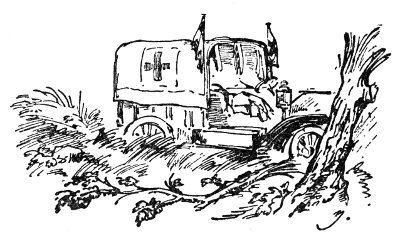
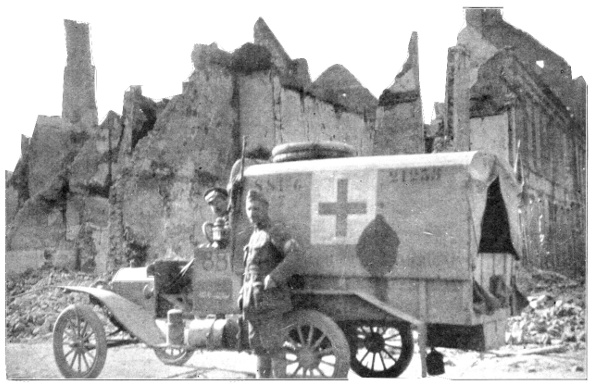
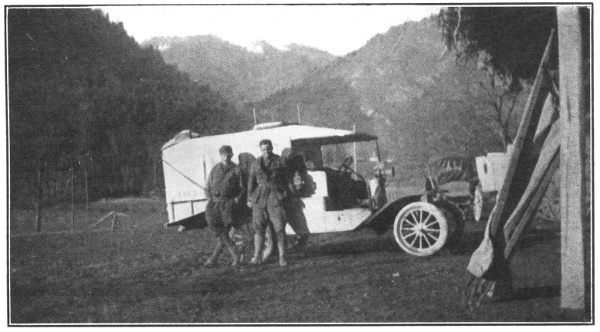
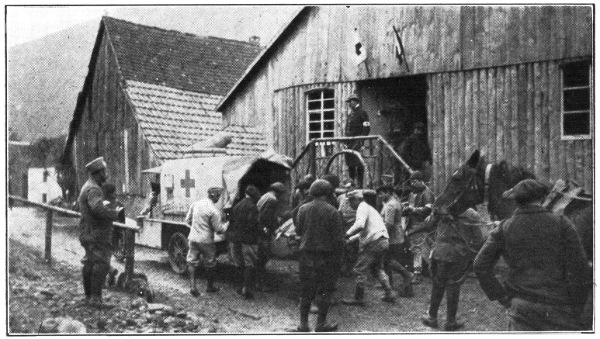
A word about the structure of the small motor ambulances
as perfected by our experience during the
war. Upon the chassis as received from the States is
built a strong, light ambulance body of tough wood
and canvas. The design provides for the utmost economy
of space, and although the cubical contents are
perhaps not more than half of that of the body of an
ordinary ambulance of the kind constructed to carry
four stretchers, the typical cars of the American Ambulance
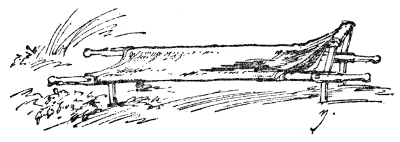
can carry three. Two stretchers stand on the
floor of the car and the third is supported under the
roof by a simple and ingenious contrivance designed
by one of the Section leaders to meet the special needs
of the service. When not in use this mechanism folds
up and rests flat against the sides of the ambulance,
and with a couple of seats added, which can be fixed
in position immediately, the car is transformed in a
moment into an ambulance for four sitting cases. In
addition to these room has been found, by means of
specially constructed seats placed by the driver, for
three more sitters, making a total of three lying and
three sitting cases for each trip. In emergency as
many as ten wounded men have been carried at one
time, the inside of the car being crowded to its capacity,
and the foot-plates and mud-guards serving as
extra seats.
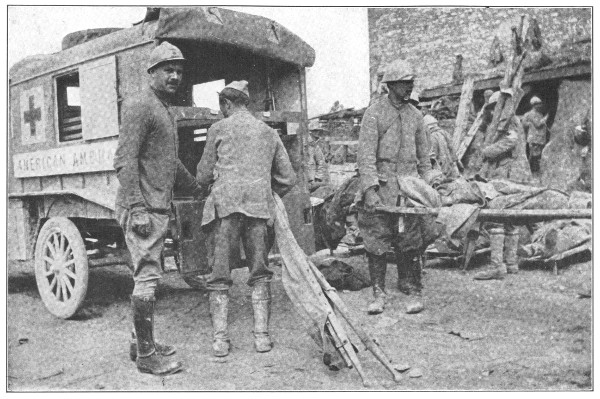
An ambulance loaded like this is an interesting sight.
The driver seems almost buried under his freight; he
has not an inch of room more than is necessary for the
control of his car. Covered with mud, blood-stained,
with startlingly white bandages against their tanned
skin; with puttees loose and torn, heavy boots, shapeless
uniforms gray from exposure, and with patient,
suffering faces still bearing the shock and horror of
bombardment, the wounded roll slowly from the postes
de secours to shelter and care, shivering, maybe, in the
cold and grayness of dawn, but always with a hand
to help each other and a word of thanks to the driver.
A. P. A.
How the Cars reach Paris
Towards the end of February three of us went down
to Havre to unpack eight cars which had just arrived.
In three days the work was done, and as I was one of
the first drivers to get to work, I was able to choose
the car I liked best for the trip down to Paris. Unfortunately
it rained steadily during our passage
through Normandy, so that we could not appreciate
to the full one of the most beautiful countries in the
world. After spending the night in Rouen, we set out
for Paris, which was reached in good time, my only
mishap being a puncture.
In Paris I drove the little car, with its soap-box
body, as a light delivery wagon to do odd jobs in
town, to give driving lessons, to carry fellows going to
the front as far as the station, and other similar tasks,
for some two weeks, when it went to the carriage-builders.
As it happened, this particular carrossier,
who had not been employed by the American Ambulance
before, turned out the best and strongest bodies
for the five cars I was interested in, among which was
the one presented by St. Paul's School.
Henry M. Suckley
En route for the Front
It appeals to the French people that so many Americans
are standing by them in their tragic hours. The
little that we in America have actually done seems
small, indeed, compared with the size of the situation,
but its main object and its main effect are to show to
the people of France that we believe in them and in
the justice of their cause; that we still remember what
they did for us in the darkest hour of our own history;
and that, as members of a great sister Republic,
our hearts and hopes are with them in this most
unnecessary war. All day long, wherever we have
stopped, people have come out and offered us flowers
and fruit and food and friendly greetings, very
much as our ancestors of a hundred and forty years
ago must have offered them to the compatriots of
Lafayette.
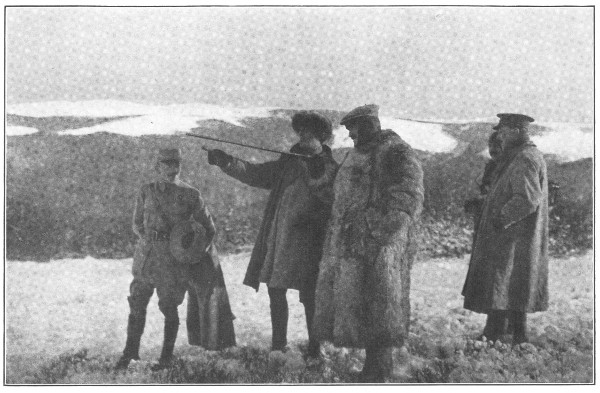
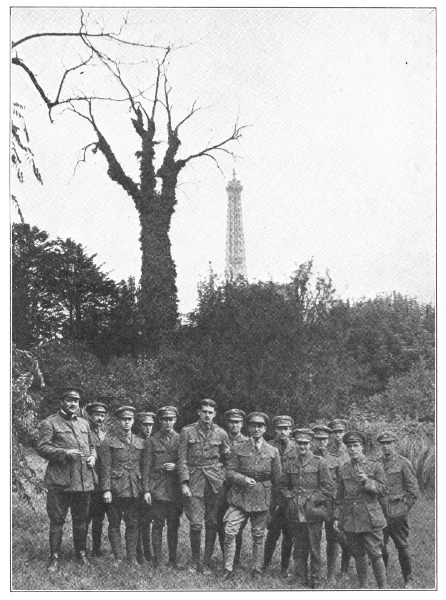
AN INSPECTION TRIP IN ALSACE
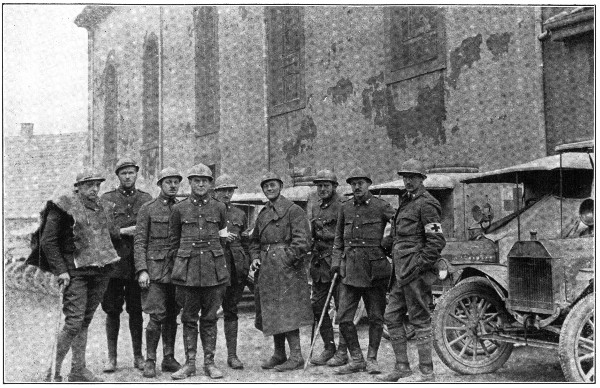
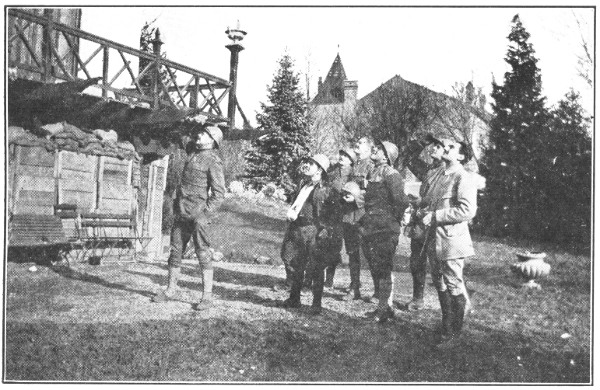
Lieut. Duboin
Mr. Andrew
Mr. Bacon
Dr. Gros Mr. Hill
Our trip has been full of touching and appealing
impressions crowding one upon the other. As our
picturesque convoy ran through the little villages,
and we stopped here and there for some one to clean
a spark-plug or mend a tire, children crowded around
us, and asked questions about America, and we often
got them to sing the "Marseillaise" or some of the
topical songs of the moment about "Guillaume" and
the "Boches" (people in France seldom speak of the
Germans as such, they call them simply "Boches"
which seems to mean "brutal, stupid people"). After
a long, hard drive we reached Saint-Omer about
eleven. The hotels were full, the restaurants were
closed, and no provision had been made either for our
food or our lodging. So we wheeled into the public
square and slept on the stretchers in our ambulances—without
other food than the chocolate and crackers
we had in our pockets. All day yesterday, as we
ran past the quaint towns and villages, we could hear
the great cannon on the front booming like distant
thunder. It is hard to realize that for five hundred
and more miles these cannon are booming day after
day all day long, and often throughout the night.
A. P. A.
First Impressions
After a few more short delays (inseparable from
times and states of war), the Section at last found
itself within a mile of one of the most stubbornly contested
points of the line. In a little town not far from
the front they came in swift progression into hard
work, bombardment, and appreciation by the army.
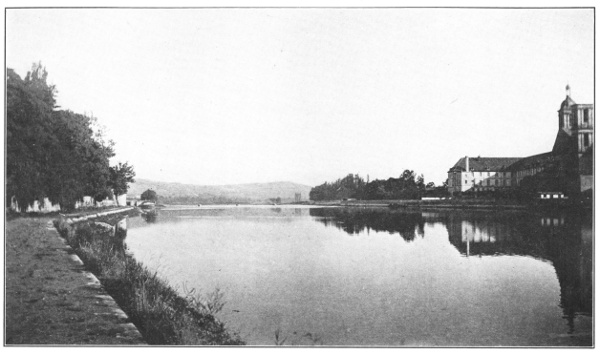
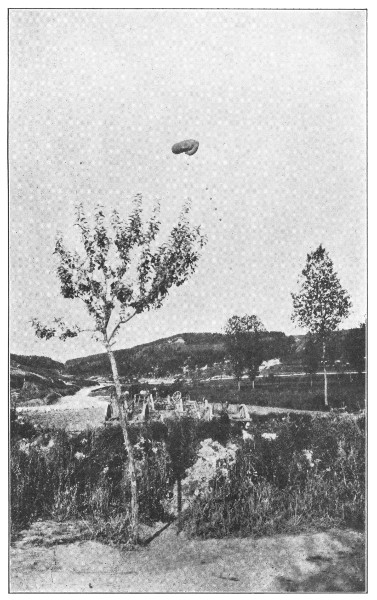
WITHIN SIGHT OF THE GERMAN TRENCHES
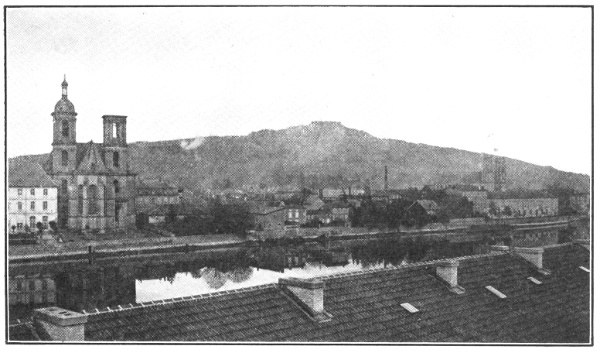
(On the hill in the background)
Pont-à-Mousson is in a district in which low hills,
many of them covered with thick woods, lie along the
valley of the Moselle. Down towards the river, on
both banks and at right angles to it, stretch the interminable
lines of trenches, east and west; batteries of
guns crown the adjacent hills for two or three miles
back from the trenches, alike in the enemy's country
and that of the French; and intermittently, day and
night, these batteries defy and seek to destroy each
other, the valleys echoing with the roar of their guns
and the sharp scream of shells high overhead. Back
of the trenches for several miles every village is full
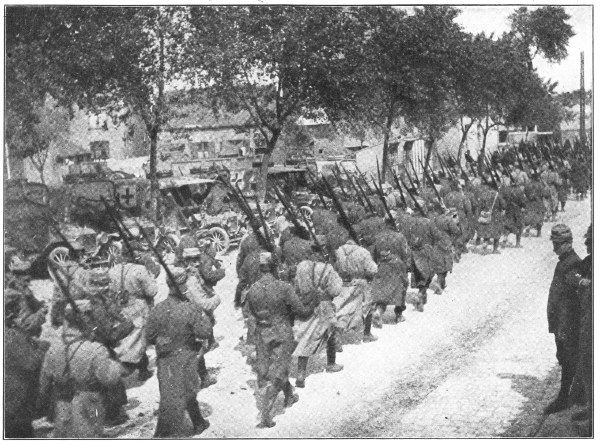
of soldiers resting or in reserve; the roads are filled
with marching troops, horses, mule trains, baggage
wagons, guns and ammunition carts. At every crossroad
stand sentries with bayonets. After sunset the
whole country is dark, no lights being permitted, but
the roads are more crowded than by day, as it is under
cover of night that troops and guns are generally
moved. The whole country near to the active lines is
one great theatre of war. Everywhere are sights and
sounds forbidding a moment's forgetfulness of the
fact. Yet—and it is one of the most curious and
touching things one sees—the peasant life goes on
but little changed. Old men dig in their gardens,
women gather and sell their vegetables, girls stand
in the evenings at their cottage doors, children run
about and play in the streets. Often, not more than
two miles away, a desperate attack may be in progress.
Between the concussions of the cannon throwing
their missiles from the hills over the village can be
heard the rattle of rifle-fire and the dull pop-pop-pop
of the mitrailleuses. In an hour or two, scores, maybe
hundreds, of wounded men, or lines of prisoners, will
file through the village, and at any moment shells
may burst over the street, killing soldiers or women
indifferently, but the old man still digs in his garden,
the girl still gossips at the door.
J. Halcott Glover
The Daily Programme
About 6 o'clock those sleeping at the caserne get up
and dress, rolling up their blanket-rolls, and coming
into the dining-room for coffee at about 6.30. Towards
7, the men who have slept at the different
postes arrive. After coffee, ambulances which are to
be stationed elsewhere for service as required, leave
the caserne. Men on day duty see to their cars and
await calls by telephone which are received by our
French assistant. Particulars are entered by him
upon a printed slip and given to the driver next in
turn to go out. On the driver's return, this slip is
handed in with the number of wounded carried and
the figures are entered in our record book. At 11
o'clock everybody comes in for déjeuner. The dining-room—a
large apartment capable of holding three
times our number—has been pleasantly decorated
with festoons and flags by our orderly, Mignot. The
afternoon is taken up in evacuating wounded to
Belleville, bringing in fresh wounded as required, or,
in slack moments, in reading, writing, or sleeping.
We have a little garden and easy-chairs, and, considering
the state of war and the very close proximity of
the enemy, it is remarkable that we should have so
many luxuries. At 6 we have dinner, after which men
who are to sleep at Dieulouard go off for the night.
By 9 the rest of us have generally turned in. One car
every night waits at Montauville, and, should there
be too many wounded for one car to convey, as many
more are as required are summoned by telephone.
During severe attacks, all cars may be called for: in
which case one man is appointed to take charge of arrivals
and despatches at Montauville, leaving drivers
free to come and go with as little delay as possible.
J. H. G.
Handling the Wounded
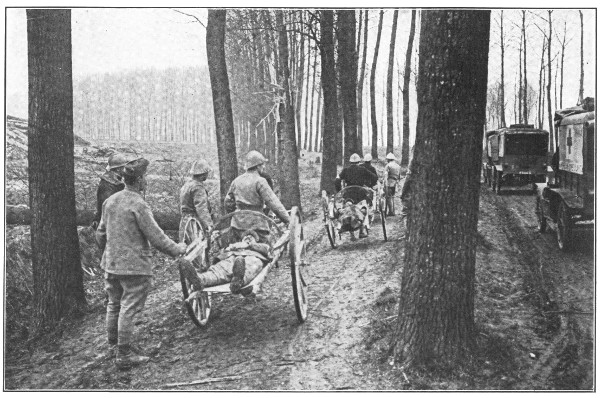
STRETCHERS SLUNG BETWEEN TWO WHEELS ON THEIR WAY FROM THE TRENCHES
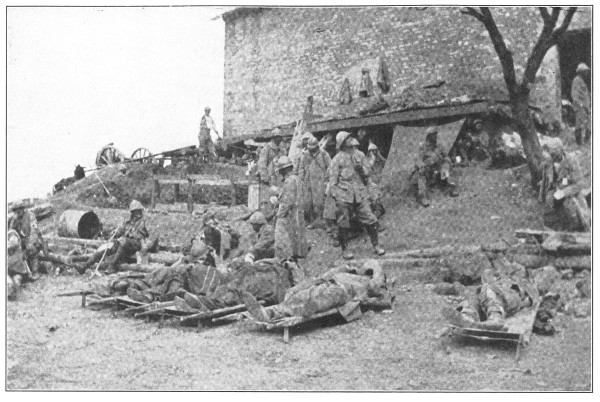
The wounded are brought by the army brancardiers
direct from the trenches to one or other of the postes
de secours established in the villages behind the
trenches and are carried on stretchers slung between
two wheels. Two men convey them. They usually
come two or three kilometres over rough tracks or
open fields from the lines where they fell. The work
of the brancardiers is exhausting and dangerous, and
enough cannot be said in their praise. This war being
one of barbarous weapons, the condition of the
wounded is often terrible. Shells, shrapnel, hand-grenades,
and mines account for most of the injuries,
and these are seldom clean wounds and often very
serious. The wounded arrive, after rough dressing on
the field, sometimes so covered with blood and dirt
as to be unrecognizable. Often they are unconscious,
and not unfrequently they die before adequate help
can be got. One hears few utterances of pain, and
no complaints. Stretchers are carried into the poste
de secours, where a doctor examines the wound and
re-dresses it if necessary; the blessé is then brought out
and given to us. Our cars can carry three stretcher
cases or five or six sitting; only the most seriously
injured can be allowed the luxury of lying down.
Our business then is to convey them gently, and as
fast as is consistent with gentleness, to hospitals.
Here the wounded receive further treatment; or, if
their case is hopeless, are allowed peacefully to die.
The following day, or perhaps several days afterwards,
if the wounded man is not fit to travel, he
comes into our hands again, to be carried to the
trains sanitaires for evacuation to one of the many
hospitals throughout France.
J. H. G.
The Wounded
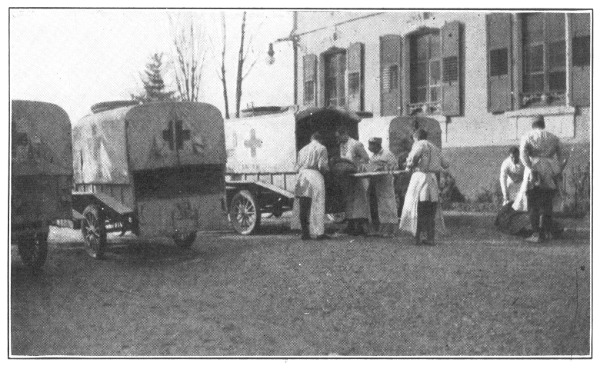
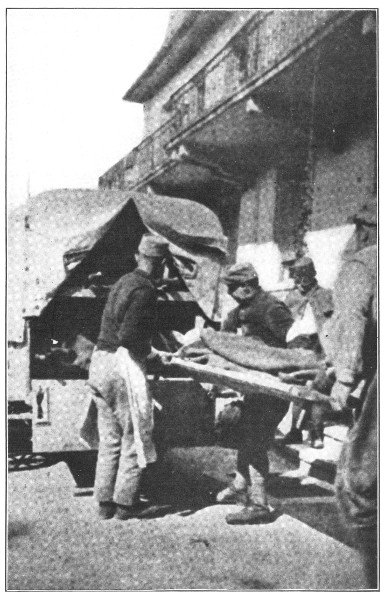
EVACUATING A HOSPITAL
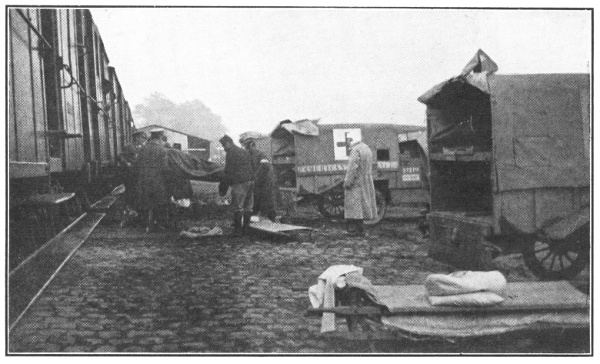
TRANSFERRING THE WOUNDED TO THE TRAIN
One would like to say a little about the wounded
men, of whom we have, by this time, seen some thousands.
But it is difficult to separate one's impressions:
the wounded come so fast and in such numbers, and
one is so closely concerned with the mechanical part
of their transportation, that very soon one ceases to
have many human emotions concerning them. And
there is a pitiful sameness in their appearance. They
are divided, of course, into the two main classes of
"sitting" and "lying." Many of the former have
come down on foot from the trenches; one sees them
arrive in the street at Montauville looking round—perhaps
a little lost—for the poste de secours appointed
for this particular regiment or company.
Sometimes they help one another; often they walk
with an arm thrown round some friendly shoulder.
I have seen men come in, where I have stood waiting
in the poste de secours, and throw themselves down exhausted,
with blood trickling from their loose bandages
into the straw. They have all the mud and sunburn
of their trench life upon them—a bundle of heavy,
shapeless clothes—always the faded blue of their
current uniform—and a pair of hobnailed boots, very
expressive of fatigue. They smell of sweat, camp-fire
smoke, leather, and tobacco—all the same, whether
the man be a peasant or a professor of mathematics.
Sometimes, perhaps from loss of blood, or nervous
shock, their teeth chatter. They are all very subdued
in manner. One is struck by their apparent freedom
from pain. With the severely wounded, brought in
on stretchers, it is occasionally otherwise. If it is
difficult to differentiate between man and man among
the "sitting" cases, it is still more so with the "lying."
Here there is a blood-stained shape under a
coat or a blanket, a glimpse of waxy skin, a mass of
bandage. When the uniform is gray, men say
"Boche" and draw round to look. Then one sees the
closely cropped bullet head of the German. One
might describe the ghastliness of wounds, but enough
has been said. At first, they cause a shudder, and I
have had gusts of anger at the monstrous folly in man
that results in such senseless suffering, but very
soon the fatalism which is a prevailing tone of men's
thoughts in this war dulls one's perceptions. It is just
another blessé—the word "gravement," spoken by
the infirmier, as they bring him out to the ambulance,
carries only the idea of a little extra care in
driving. The last we see of them is at the hospital.
At night we have to wake up the men on duty there.
The stretcher is brought into the dimly lighted, close-smelling
room where the wounded are received, and
laid down on the floor. In the hopeless cases there
follows the last phase. The man is carried out and
lies, with others like himself, apart from human interest
till death claims him. Then a plain, unpainted
coffin, the priest, a little procession, a few curious
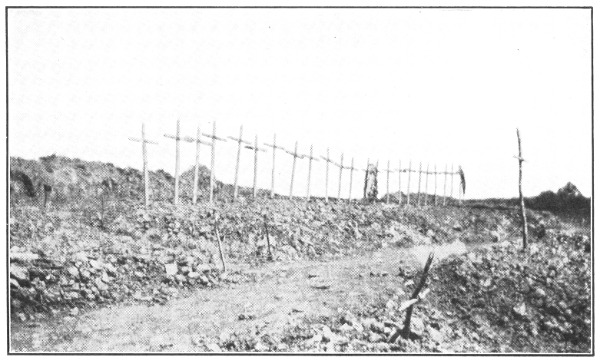
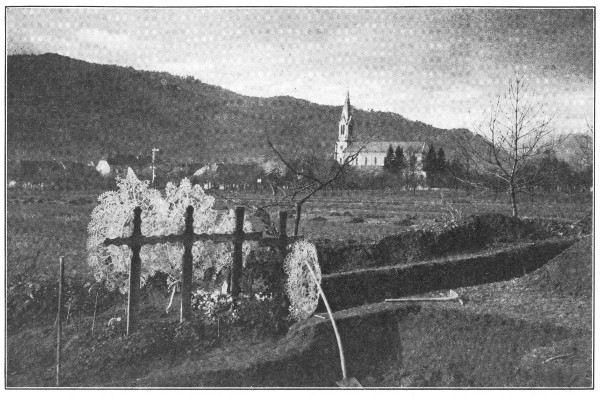
eyes, the salute, and the end. His grave, marked by a
small wooden cross on which his name and grade are
written, lies unnoticed, the type of thousands, by the
roadside or away among the fields. Everywhere in
the war zone one passes these graves. A great belt
of them runs from Switzerland to the sea across
France and Belgium. There are few people living in
Europe who have not known one or more of the men
who lie within it.
J. H. G.
Night Duty
A few days after our arrival at the front I had my
first experience of a night call. It was very dark and
we had to feel our way forward. Nothing gives one a
stronger sense of the nearness of war than such a trip.
The dark houses, deserted streets, the dim shape of
the sentry at the end of the town, the night scents of
the fields as one passes slowly along them, are things
not to be forgotten. We strained our eyes in the darkness
to avoid other vehicles, all, like our own, going
without lights. In those days, not being so well known
as we are now, the sentries challenged us: their "Halte-là"
in the darkness brought us frequently to an
abrupt stop. As we drew near the trenches we heard
the guns very clearly, and saw over the crest of a hill
the illuminating rockets with which both armies
throw a glare over their attacks. They throw a greenish
and ghastly light over the country, hanging in the
air a few seconds before falling. At our destination
everything was dark. We left the cars in the road and
went up under the trees to the poste de secours. Here
we found some men sleeping on straw, but had to
wait close upon two hours before our wounded were
ready. From time to time a battery of 75's startled us
in the woods near by. At last in a drizzling rain we
came back to quarters, passing several small bodies
of soldiers marching silently up to the trenches.
Another night, remaining near the trenches till half-past
four in the morning, I saw the wounded brought
in, in the gray of dawn, from a series of attacks and
counter-attacks. I had been waiting in one of the
postes de secours, where, by candlelight, particulars
were being written down of the various wounded.
The surgeon, in a long white linen coat, in many
places stained with blood, was busy with his scissors.
Many wounded lay on straw round the room, and at
rare intervals one heard a groan. The air was warm
and heavy, full of the smell of wounds and iodine. A
window was opened, the light of morning making the
candles dim and smoky, and it was pleasant to go out
into the cool air. The wounded being brought in
looked cold and wretched. There were many who had
been hit in the face or head—more than one was
blind.
I overheard a few words spoken between a brancardier
and a wounded man who—rare sign of suffering—was
weeping. "You will be safe now—you
are going to your wife," spoken in tones of sympathy
for comfort, and the reply: "No, no, I am dying."...
Later, as the sun was rising and lifting the blue mist
in the hollows of the hill, I watched some shells bursting
in a field; a brown splash of earth, a ball of smoke
which drifted slowly away.
J. H. G.
Fitting into the Life
During the months of May, June, and July the
Section, increased in number to twenty cars, broke all
records of the American Ambulance. The work was
so organized and men brought such devotion to their
duties that it may be said that, of all the wounded
brought down from daily and nightly fighting, not one
was kept waiting so much as ten minutes for an ambulance
to take him to the hospital.
Where, before the coming of the American cars,
ambulances came up to the postes de secours only
when called, and at night came after a delay occasioned
by waking a driver sleeping some miles away,
who thereupon drove his car to the place where he was
needed, the American Section established a service on
the spot, so that the waiting was done by the driver
of the ambulance and not by the wounded. The
effect of this service was immediate in winning confidence
and liking, of which the members of the Section
were justly proud. Their swift, light, easy-running
cars were a great improvement on the old and
clumsy ambulances which had served before them.
In the early days, when these old ambulances were
working side by side with ours, wounded men being
brought from the trenches would ask to be carried by
the Americans. That the latter should have come so
far to help them, should be so willing to lose sleep and
food that they should be saved from pain, and should
take the daily risks of the soldiers without necessity
or recompense seemed to touch them greatly. It was
not long before the words "Ambulance Américaine"
would pass a man by any sentry post. The mot, or
password, was never demanded. And in their times of
leisure, when others were on duty, men could eat with
the soldiers in their popotes and become their friends.
Many of them have become known and welcomed in
places miles apart and have formed friendships which
will last long after the war.
J. H. G.
Paysages de Guerre
I went early one morning with one of our men, by
invitation of an engineer whose acquaintance we had
made, up to the part of the Bois-le-Prêtre known as
the Quart-en-Réserve. We started at three, marching
up with a party going up to identify and bury the
dead. The sites of all the trenches, fought over during
the winter, were passed on the way, and we went
through several encampments where soldiers were
still sleeping, made of little log houses and dug-outs,
such as the most primitive men lived in. It was a
gray morning, with a nip in the air; the fresh scents of
the earth and the young green were stained with the
smoke of the wood fires and the mixed smells of a
camp. After a spell of dry weather, the rough tracks
we followed in our course through the wood were passable
enough; the deep ruts remaining and here and
there a piece of soft ground gave us some idea of the
mud through which the soldiers must have labored a
few weeks before. And it is by such tracks that the
wounded are brought down from the trenches! Small
wonder that when the stretcher is laid down its occupant
is occasionally found to be dead. In about half
an hour, nearing the top of the hill which the Bois-le-Prêtre
covers, we noticed a change both in the scene
and in the air. The leafage was thinner, and there
was a look, not very definable yet, of blight. The
path we were following sank deeper, and became a
trench. For some hundreds of yards we walked in
single file, seeing nothing but the narrow ditch winding
before us, and bushes and trees overhead. With
every step our boots grew heavier with thick, sticky
mud. And a faint perception of unpleasant smells
which had been with us for some minutes became a
thing which had to be fought against. Suddenly the
walls of our trench ended, and in front of us was an
amazing confusion of smashed trees, piles of earth
and rock—as though some giant had passed that
way, idly kicking up the ground for his amusement.
We climbed out of the remains of our trench and
looked round. One had read, in official reports of the
war, of situations being "prepared" by artillery for
attack. We saw before us what that preparation
means. An enlarged photograph of the mountains on
the moon gives some idea of the appearance of shell-holes.
Little wonder that attacks are usually successful:
the wonder is that any of the defenders are left
alive. The difficulty is to hold the position when captured,
for the enemy can and does turn the tables.
Here lies the whole of the slow torture of this war
since the open fighting of last year—a war of exhaustion
which must already have cost, counting all
sides, more than a million lives. The scene we looked
round upon might be fittingly described by the Biblical
words "abomination of desolation." Down in the
woods we had come through, the trees were lovely
with spring, and early wild flowers peeped prettily
from between the rocks. Here it was still winter—a
monstrous winter where the winds were gunpowder
and the rain bullets. Trees were stripped of their
smaller branches, of their bark: there was scarcely a
leaf. And before us lay the dead. One of the horrible
features in this war, in which there is no armistice,
and the Red Cross is fired upon as a matter of course,
is that it is often impossible to bury the dead till long
after they are fallen. Only when a disputed piece of
ground has at last been captured, and the enemy is
driven well back, can burial take place. It is then that
companies of men are sent out to pick up and identify.
Of all the tasks forced upon men by war, this must be
the worst. Enough to say that the bodies, which were
laid in rows on the ground awaiting their turn to rest
in the sweetness of the earth, were those of men who
fought close on two months before. I pass over the
details of this awful spectacle, leaving only two things:
one of a ghastly incongruity, the other very moving.
Out of a pocket of a cadavre near to me I saw protruding
a common picture post-card, a thing of tinsel,
strange possession for one passed into the ages. And
between two bodies, a poppy startlingly vivid, making
yet blacker the blackened shapes before us....
J. H. G.
Soldier Life
The main street of Montauville gives, perhaps, a
characteristic glimpse of the life of the soldier on
active service, who is not actually taking his turn in
the trenches. He is under the shade of every wall;
lounges in every doorway, stands in groups talking
and laughing. His hands and face and neck are
brown with exposure, his heavy boots, baggy trousers,
and rough coat are stained with mud from bad
weather. He laughs easily, is interested in any trifle,
but underneath his surface gayety one may see the
fatigue, the bored, the cynical indifference caused by
a year of war, torn from every human relationship.
What can be done to humanize his lot, he does with
great skill. He can cook. Every cottage is full of soldiers,
and through open doors and windows one sees
them eating and drinking, talking, playing cards, and
sometimes, though rarely, they sing. In the evening
they stand in the street in great numbers, and what
with that, the difficulty of making ears accustomed to
shrapnel take the sound of a motor horn seriously,
and the trains of baggage wagons, ammunition for
the guns, carts loaded with hay, etc., it is not too easy
to thread one's way along. In our early days here
curiosity as to who and what we were added to the
difficulty, crowds surrounding us whenever we appeared,
but by this time they are used to us, and not
more than a dozen at once want to come and talk and
shake hands.
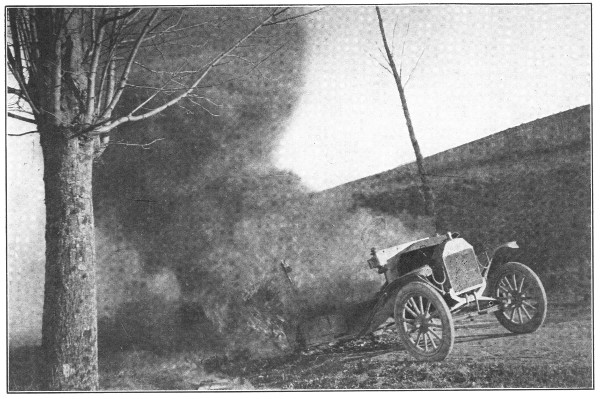
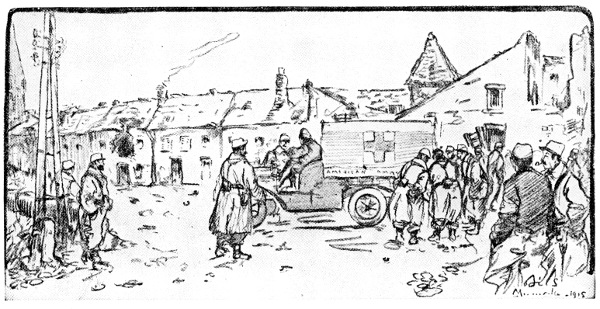
THE END OF AN AMBULANCE
Perhaps the most interesting time to see Montauville
is when, after a successful attack by the French,
the German prisoners are marched through the village.
These, of course, without weapons and with
hands hanging empty, walk with a dogged step between
guards with fixed bayonets, and as they pass,
all crowd near to see them. Almost invariably the
prisoners are bareheaded, having lost their caps—these
being greatly valued souvenirs—on their way
down from the trenches. They are housed temporarily,
for interrogation, in a schoolhouse in the main
street, and when they are lined up in the school-yard
there is a large crowd of French soldiers looking at
them through the railings. Afterwards, they may be
seen in villages behind the lines, fixing the roads, or
doing similar work, in any old hats or caps charity
may have bestowed upon them.
J. H. G.
July 22 at Pont-à-Mousson
On Thursday, the 22d, we had a quiet day. In the
evening several of us stepped across to the house
where Smith and Ogilvie lived, to have a little bread
and cheese before turning in. They had brought some
fresh bread and butter from Toul, where duty had
taken one of them, and these being our special luxuries,
we were having a good time. Coiquaud was at
the Bureau and two or three of our men were in or
about the caserne. There were nine of us at the house
at the fork of the road, which, no doubt, you remember.
Suddenly as we sat round the table there came
the shriek of a shell and a tremendous explosion. The
windows were blown in, the table thrown over, and
all of us for a second were in a heap on the floor. The
room was full of smoke and dust. None of us was hurt,
happily, except Holt, who had a cut over the right
eye, and who is now going about bandaged like one of
our blessés. We made a scramble for the cellar, the
entrance to which is in a courtyard behind the house.
As we were going down the stairs there followed another
shell, and quickly on top of that, one or two
more, all very near and pretty heavy. We stayed in
the cellar perhaps ten minutes, and then, as I was
anxious to know how things were at the caserne, I
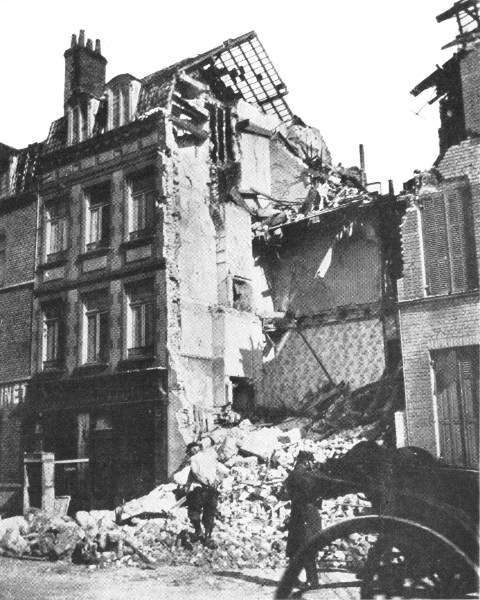
went up and, letting myself out into the street, ran
for it, seeing vaguely as I passed fallen masonry and
débris. The moon was shining through the dust and
smoke which still hung a little thick. When I got to
the caserne, the first thing I heard was Coiquaud crying,
"Oh! pauvre Mignot!" and I was told that the
poor fellow had been standing, as was his wont,
in the street, smoking a pipe before going to bed. He
was chatting with two women. Lieutenant Kullmann's
orderly (I think they call him Grassetié) was
not far away. The same shell which blew in our windows
killed Mignot and the two women, and severely
wounded Grassetié, who, however, was able to walk
to the caserne to seek help. He was bleeding a good
deal from several wounds; had one arm broken; his
tongue was partially severed by a fragment which
went through his cheek. He was taken immediately,
after a rough bandage or two had been put on, to try to
check the loss of blood from his arm, where an artery
appeared to be severed, to Ambulance No 3 at Pont-à-Mousson,
whence he was afterwards taken to Dieulouard
and to Toul. He will probably recover.
[11] A boy,
the son of our blanchisseuse, who was wounded at the
same time, will, it is feared, die. As I was told that
Mignot still lay in the street, I went out again, and
saw him lying, being examined by gendarmes, on the
pavement. He seems to have been killed instantaneously.
The contents of his pockets and his ring were
taken from the body by Coiquaud and handed to me:
they will, of course, be sent to his wife. He leaves two
children.... Poor Coiquaud, who had shown great
courage, became a little hysterical, and I took his
arm and led him back to the caserne. When we all,
except those who had left with Grassetié and some
who had taken Mignot's body to Ambulance No 3
(there was such confusion at the time and I have
been so constantly occupied since I don't yet know
exactly who took that service), collected at the
Bureau, our jubilation at our own escape—if the
shell had travelled three yards farther it would have
killed us all—was entirely silenced by the death of
Mignot, for whom we all had a great affection. He
served us well, cheerfully from the beginning, honestly
and indefatigably. He was a good fellow, possessing
the fine qualities of the French workman to a
very high degree. A renewed bombardment broke
out about this time, and we went down to the cellar.
A shell striking the roof of one of our houses knocked
in all our windows. I think we may all honestly confess
that by this time our nerves were rather shaken.
I was specially anxious about the cars in the barn,
including the Pierce-Arrow and the Hotchkiss. One
shell falling in the midst of them would have crippled
half our cars—and if an attack on Bois-le-Prêtre
had followed...! Our telephone wires were broken,
so we were isolated. Lieutenant Kullmann and I decided,
after consultation with all our men who were
present, to report the situation to the médecin
divisionnaire. So long as our men kept in the cellar
they were safe enough. The Lieutenant and I left
in the Peugeot brought by him to the Section, our
leaving chancing to coincide with the arrival of four
or five fresh shells. It was nervous work driving out;
fragments of tiles and of shells—the latter still red-hot—fell
about us but without hitting us. After
seeing the médecin divisionnaire we returned to the
caserne and spent the rest of the darkness in the cellar.
From time to time more shells came, but soon
after daybreak the firing ceased.
In the morning we were very anxious for a while
about Ogilvie. He had, unknown to the rest of us,
gone to sleep at Schroder's and Buswell's room, and
in the night two more shells struck his house, one of
them penetrating right through to the cellar, making
complete wreckage there. Some of us spent a little
time looking in the débris for his body.
You would have been very moved if you could
have been present at poor Mignot's funeral. We did
what we could for him to show our respect, and I concluded
I was only carrying out what would be the
wishes of the American Ambulance by authorizing
the expense of a better coffin and cross than he was
entitled to in his grade in the army.
At eight in the evening as many men as were off
duty went to Pont-à-Mousson to attend the funeral.
A short service was read in the chapel of the Nativité.
There were four coffins: Mignot's, covered with a flag
and with many flowers, and those of three civilians,
killed on the same evening. It was a simple and impressive
ceremony: the dimly lighted chapel, the dark
forms of some twenty or thirty people of Pont-à-Mousson,
our men together on one side, the sonorous
voice of the priest, made a scene which none of us can
forget. Colonel de Nansouty, Commandant d'Armes
de Pont-à-Mousson, and Lieutenant Bayet were
present; and when the little procession was formed
and we followed the dead through the darkened
streets and across the Place Duroc, they walked bareheaded
with us. At the bridge the procession halted,
and all but Lieutenant Bayet, Coiquaud, Schroder,
and the writer turned back, it being desired by the
authorities that only a few should go to the cemetery.
We crossed the river and mounted the lower slope of
the Mousson hill. Under the trees in the cemetery
we saw as we passed the shattered tombs and broken
graves left from the bombardments, which even here
have made their terrible marks. In a far corner, well
up on the hillside, the coffin of Mignot was laid down,
to be interred in the early morning. We walked quietly
back in company with Lieutenant Bayet, and were at
last free to rest, after so many hours of unbroken
strain.
J. H. G.
Incidents of a Driver's Life
On the 3d of May No 6 went back on me for the
first time. I was returning from Toul when the car
broke down in half a dozen different places at once. I
could not fix it, but would have reached Dieulouard
on three cylinders if it had not been for a steep hill.
Twice No 6 nearly reached the top, only to die with a
hard cough and slide to the bottom again. On account
of this hill I was forced to walk fourteen kilometres
to Dieulouard for help. The next night I had
my first experience at night driving. A call came in
at half-past nine to get one wounded man at Clos
Bois. McConnell, driver of No 7, went with me. We
neither of us had ever been there, so it was somewhat
a case of the blind leading the blind. It made little
difference, however, as the night was so black that
nothing but an owl could have seen his own nose. We
felt our way along helped by a distant thunderstorm,
the flicker of cannon, and the bursting of illuminating
rockets, picked up our wounded man, and were returning
through Montauville when we were stopped
by an officer. He had a wounded man who was dying,
the man was a native of Dieulouard and wished to die
there, and the officer asked us to carry him there if the
doctor at Pont-à-Mousson would give us permission.
We took him. He had been shot through the head.
Why he lived at all I do not know, but he not only
lived, but struggled so hard that they had to strap
him to the stretcher. When the doctor at the hospital
saw him, he refused to let us carry him to Dieulouard
because the trip would surely kill him and he might
live if left at the hospital. Whether he did live or die
I was never able to find out.
Carlyle H. Holt
Our life here is one of high lights. The transition
from the absolute quiet and tranquillity of peace to
the rush and roar of war takes but an instant and all
our impressions are kaleidoscopic in number and contrast.
The only way to give an impression of what
takes place before us would be a series of pictures, and
the only way I can do it is to describe a few incidents.
Sometimes we sit in the little garden behind our caserne
in the evening, comfortably drinking beer and
smoking or talking and watching the flash of cannon
which are so far away we cannot hear the report. At
such times, the war is remote and does not touch us.
At other times, at a perfectly appointed dinner-table,
laden with fresh strawberries, delicious cakes, and
fine wine, and graced with the presence of a charming
hostess, the war is still more distant. Pont-à-Mousson,
moreover, is rich in beautifully conceived gardens
of pleasant shade trees, lovely flowers, and tinkling
fountains. Lounging in such a place, with a book
or the latest mail from America, the war is entirely
forgotten. Yet we may leave a spot like that and immediately
be in the midst of the realities of war. One
evening, about seven-thirty, after the Germans had
been firing on Pont-à-Mousson and the neighboring
villages for some hours, I was called to Bozeville.
This village, which is on the road to Montauville, is a
small cluster of one-story brick and frame buildings
constructed in 1870 by the Germans for their soldiers.
When I reached this place it was on fire, and the Germans,
by a constant fusillade of shrapnel shells in and
around the buildings and on the roads near them,
were preventing any attempt being made to extinguish
the fire. To drive up the narrow road, with the
burning houses on one side and a high garden wall,
thank Heaven, on the other, hearing every few seconds
the swish-bang of the shells, was decidedly nervous
work, anything but peaceful. After picking up
the wounded, I returned to Pont-à-Mousson, where
conditions were much worse. At this time the Germans
were throwing shells of large calibre at the
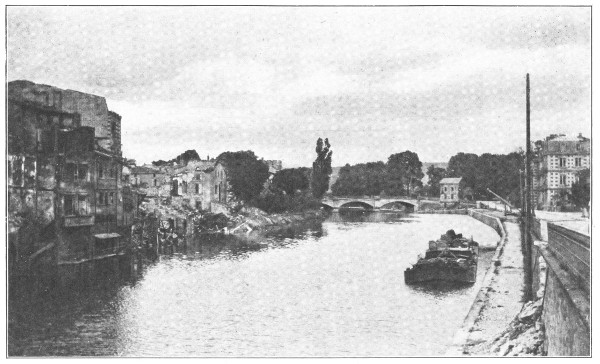
bridge over the Moselle. To reach the hospital to
which I was bound, it was necessary to take the road
which led to the bridge and turn to the left about a
hundred yards before coming to it. Just as I was
about to make this turn, two shells struck and exploded
in the river under the bridge. There was a
terrific roar and two huge columns of water rose into
the air, and seemed to stand there for some seconds;
the next instant, spray and bits of wood and shell fell
on us and around us. A minute later I turned into the
hospital yard, where the effect, in the uncertain and
fast-fading light, was ghostly. Earlier in the evening
a shell had exploded in the yard and had thrown an
even layer of fine, powder-like dust over everything.
It resembled a shroud in effect, for nothing disturbed
its even surface except the crater-like hole made by
the shell. On one side of the yard was the hospital,
every window broken and its walls scarred by the
pieces of shells; in the middle was the shell-hole, and
on the other side was the body of a dead brancardier,
lying on his back with a blanket thrown over him. He
gave a particularly ghastly effect to the scene, for
what was left of the daylight was just sufficient to
gleam upon his bald forehead and throw into relief a
thin streak of blood which ran across his head to the
ground. Needless to say I left that place as quickly
as possible.
Another scene which I do not think I will soon forget
happened in Montauville. It was just after a successful
French attack and shows war in a little different
light, with more of the excitement and glory
which are supposed to be attached to battle. Montauville
is a straggly little village of one- and two-story
stone and plaster houses built on the two sides of the
road. It is situated on a saddle which connects one
large hill on one side of it with another large hill on
the other side of it. It is used as a dépôt and resting-place
for the troops near it. On this particular day
the French had attacked and finally taken a position
which they wanted badly, and at this time, just after
sunset, the battle had ceased and the wounded were
being brought into the poste de secours. The tints of
the western sky faded away to a cloudless blue heaven,
marked here and there by a tiny star. To the south
an aeroplane was circling like a huge hawk with puffs
of orange-tinted shrapnel smoke on all sides of it. In
the village the soldiers were all in the streets or hanging
out of the windows shouting to one another. The
spirits of every one were high. They well might be,
for the French had obtained an advantage over the
Germans and had succeeded in holding it. A French
sergeant entered the town at the lower end and
walked up the street. At first no one noticed him;
then a slight cheer began. Before the man had walked
a hundred yards, the soldiers had formed a lane
through which he strode. He was a big fellow, his
face smeared with blood and dirt and his left arm
held in a bloody sling. On his head was a German
helmet with its glinting brass point and eagle. He
swaggered nearly the entire length of the village
through the shouting lines of soldiers, gesticulating
with his one well arm and giving as he went a lively
account of what happened. Some one started the
"Marseillaise" and in a few minutes they were all
singing. I have heard football crowds sing after a
victory and I have heard other crowds sing songs, but
I have never heard a song of such wild exultation as
that one. It was tremendous. I wish the Germans
could have heard it. Perhaps they did! They were
not so far away, and the sound seemed to linger and
echo among the hills for some minutes after the last
note had been sung.
Our work here on this sector of the front is about
three kilometres in length. We do it all, as there are
no French ambulances here. We usually carry in a
week about eighteen hundred wounded men and our
mileage is always around five thousand miles. The
authorities seem to be pleased with our work and we
know that they have never called for a car and had to
wait for it. At any rate, we have had the satisfaction
of doing the best we could.
C. H. H.
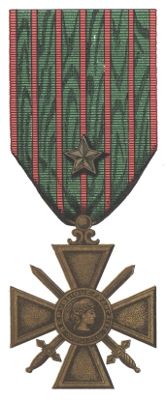
Three Croix de Guerre
Several bombardments have taken place near the
first-aid posts and hospitals where our cars are on
duty. On the 6th, the Germans bombarded a road
that runs along the top of a ridge several hundred
yards from the post at Huss. One of the first shells
landed on a farmhouse just below the road, in which
some Territorials were quartered, killing three of
them and wounding five others. Two of our men, accompanied
by the médecin auxiliaire of the post, immediately
drove their cars over to the farm and rescued
the wounded while the bombardment was still
going on. As a result of this prompt and courageous
action on their part, all three men were cited in the
order of the division and will receive the Croix de
Guerre.
P. L.
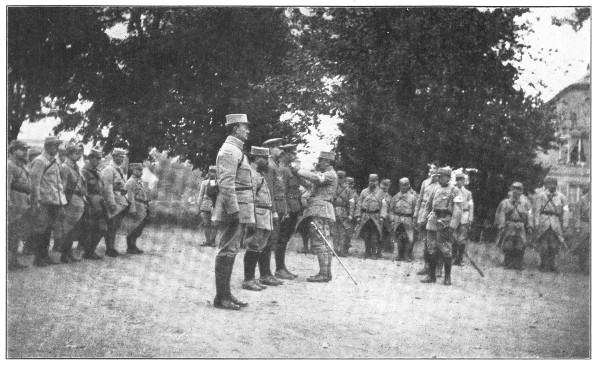
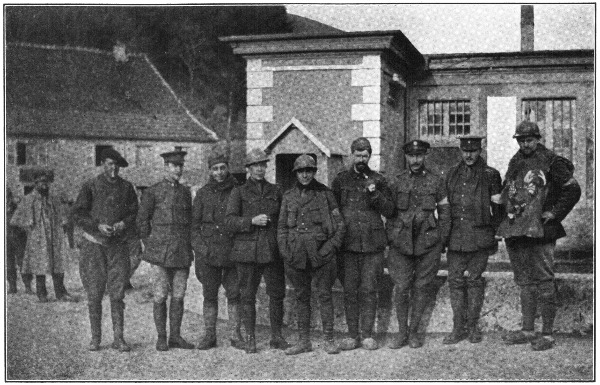
DECORATION OF CAREY AND HALE
From Day to Day
October 26. The head of the Sanitary Service of the
French Government, accompanied by three generals,
made a tour of inspection of all the units in this Sector
to-day. Mr. L——, accompanied by Lieutenant
K——, went to B——, where a formal inspection was
held. Mr. L—— was thanked as Section Commander
for the service rendered by Section Sanitaire Américaine
No 2. The remarks were exceedingly complimentary.
General L—— and the médecin divisionnaire,
who accompanied the party as representatives
of the Sanitary Service in this Sector, added their
compliments to those of General L——.
November 14. We had the first snow of the season
to-day. All the morning it snowed and covered the
fields and trees with a thick coating of white. In
the roads it melted and they became stretches of
yellow slush.
B—— broke his arm cranking his car this morning.
He will be out of commission for three weeks, so the
surgeon who set it informed him.
November 16. We received a phone message in
the morning asking us to go to the "Mairie" to meet
a high official. Four of us went over. A number of
large cars were drawn up in the Place D——. One
bore the flag of the President of France. We were to
meet Poincaré. We formed a line inside the sandbag
barricaded arcade. The President and his entourage
passed. He stopped in front of us. "One finds you
everywhere," he said; "you are very devoted."
Then he shook hands with each of us and passed on.
We wandered on down the arcade to watch the party
go down into the shelled area of the town. A sentry
standing near us entered into conversation. He addressed
himself to Pottle: "Did he shake hands with
you?" he asked. "Oh, yes," replied Pottle. "Hell,"
said the sentry; "he isn't a bit proud, is he?"
November 25. Thanksgiving—and we celebrated
it in the American style. We had purchased and
guarded the turkeys, and they were prime. C——
did wonders with the army food, and it is doubtful
if any finer Thanksgiving dinner was eaten any place
in the world than the one we enjoyed two thousand
yards from the Huns.
November 26. An enemy plane, flying high above
us this morning, was forced to make a sudden descent
to a height of three hundred metres from earth. He
was either touched by shrapnel or his mixture froze
and he had to seek a new level. He passed very low
over us. One of the Frenchmen attached to our Section
fired at him with a rifle, but did not get him.
November 30. B—— was shelled and a few stray
shots were sent into town and on the troop roads near
us.
Under S—— the meals have been sumptuous repasts
and we marvel at the change.
The writer, with two others of the Section, was
crossing the Place —— after dark. As we passed the
breach in the sandbag barricaded roads made by
Rue ——, we were lighted up by the yellow glare
coming from the shops next to the "Mairie." The
sentry there on duty saw us. "Pass along, my children,
and good luck—you are more devoted than we
are," he cried to us.
I was startled by the voice out of the darkness and
the surprising remarks. I glanced towards the sentry's
post, but the light blinded me and I could not
see him. From his voice I knew he was old—one of
the aged Territorials.
"Oh, no!" I answered, for lack of anything better
to say.
"Yes, you are. We all thank you. You are very
devoted," he said.
"No, not that, but I thank you," I said; and we
were swallowed up in the darkness. Then I was sorry
one of us hadn't gone back to shake hands with the
kind-hearted old fellow. It seemed to me that it was
the spirit of France speaking through him, voicing as
usual her appreciation for any well-intentioned aid,
and that we should have replied a little more formally.
James R. Mcconnell
From Another Diary
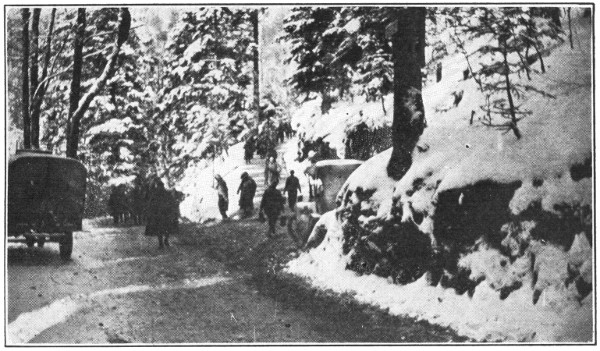
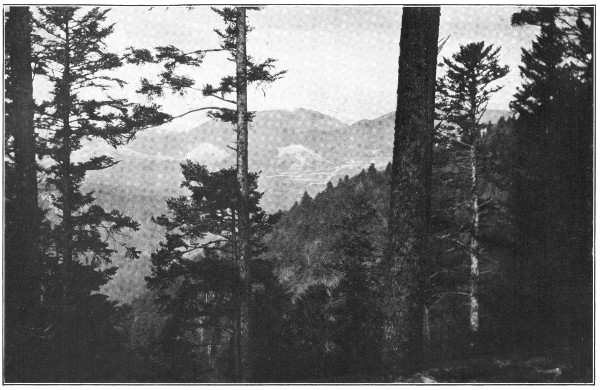
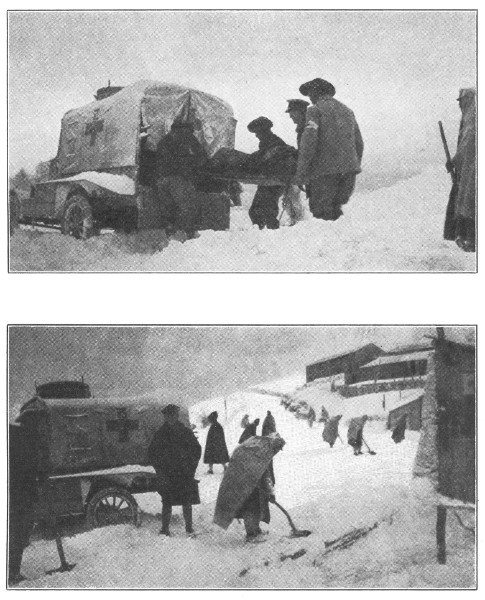
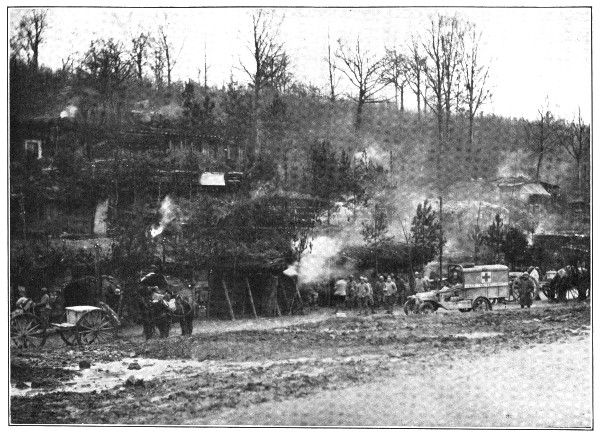
A WINTER MORNING
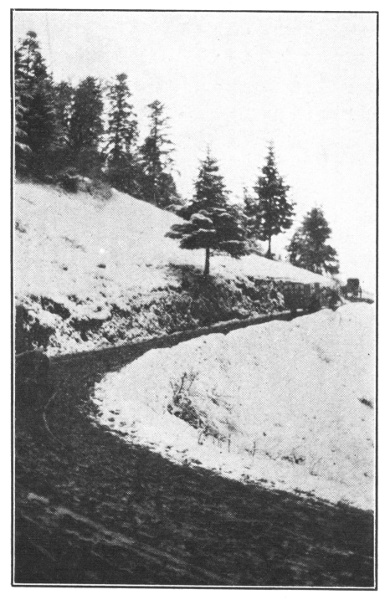
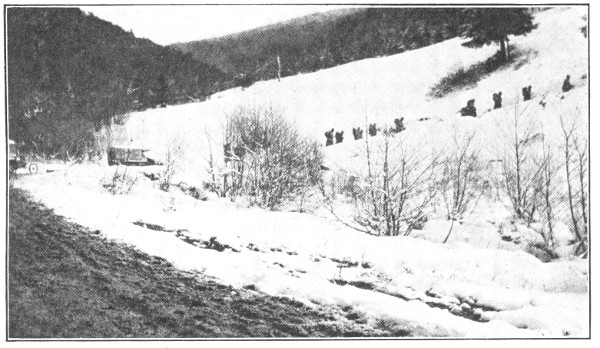
ALSATIAN WOODS IN WINTER
November 13. A bad number and a grim day for
168. At daybreak one blessé, one malade, to Moosch.
Brake loose as an empty soap-bubble. Endless convoy
of mules appeared at bottom of hill. Tail-enders
received me sideways or full breach—couldn't stop—didn't
think to put on reverse, so did some old-fashioned
line-plunging. Heard cases crack, men
swear, mules neigh, but heard no brake taking hold.
Tried to stop later, but only succeeded in doing so by
dragging against bank, which was so straight car
rubbed along like an old elephant scratching its cutlets,
and padlocks, keys, tools, side-boxes removed
like flies. Incidentally a young army on the way up
the hill—a few casualties if I had not stopped.
Tornado of rain. A big tree had fallen across the road
this morning—just got under it—had been chopped
down on the way back. Nothing doing since, but
frightful weather—good chance to write in diary—most
devilish wind in p.m. Walked over to Bain-Douches
in the evening to see Hartmann's by night
by star bombs, but weather too bad and saw no
bombs. The valley of the Rhine so near our feet—impossible
to realize that somewhere between us and
that flat vast plain, with all its villages alight at
night, were both lines of trenches—yet the trees
only moved in the wind and the only noise the batteries
to the rear.
November 14. Got up about an hour earlier than
any one else, looked out to find trees covered with
snow—most splendid. The two Fords snowed into
the background. Built fire for sleeping sluggards.
Took two "birds" and one brancardier down the hill—brakes
refused to work—used reverse successfully—no
mules slaughtered or even touched—oxen
in the way, of great service—dropped my men
at Moosch. Blow-out just pulling into Wesserling
with two malades—let 'em walk—put on new tube—also
blew out—ran into hospital—put on new
tire—no lunch.
November 15. Cold and clear, mountains amazingly
fine—was orderly. Tried to move an eight-story
Boche stove with Carey from wall to centre of room
where heat might radiate more effectually—weight
two tons—toppled like Tower of Pisa. I held it one
second saving Carey's life after imperilling it first—just
got out before the whole damn shooting-match
crashed to floor a mass of broken cast-iron, broken
baked clay, and ashes. With great patience and science
utilized lower stones still standing by fixing top,
shortening pipe, etc. Now in centre of room where
one can sit, talk, read, etc. Two vain trips with
Carey to see Burgomaster to report catastrophe.
November 17. Snowing to beat hell. All hands to
Bussang to evacuate hospital—minus usual sumptuous
repast. Fenton moved rear roller of his boat in
usual dashing style—came around the corner a minute
later with conservative momentum and received
from master-mechanic a severe dissertation on over-speeding,
etc., standing on his own ruins as he spoke.
Got late to Krüth—found Douglass there—then
eased victuals into us at the "Joffre"—six eggs in
my inner tube. Took three frozen feet to Bussang.
We slipped as skating-rink camions stuck all along
the line—snow packed in hard. 168 ran poorly on
way back—slow going on slippery road—the col
magnificent—trees loaded with fresh snow.
December 3. To Thoms—enormous amount of
heavy artillery on the road—eternal convoys of
mules on way up. Kept getting stuck—finally got
through—found Galatti—terrible weather, road
sea of mud, mountain torrents across it. In the afternoon
we each took down a load of four—difficult
driving—so tired when we got to Moosch. We had
dinner there. My carbide worked feebly, so G. followed
with electric lights to show me the way. On
steep grade after zigzag I stuck—backed into bank.
G. thought he had callé'ed his wheel, but voiture
rolled downhill into the gutter. An hour's hellish
pushing, cranking, etc., of no avail. Finally I got out
a trench spade and dug away bank and he backed—some
tringlots came by and we pushed him up. Next
assault was on steep turn. G., having burned out his
electric lights trying to get out of gutter, went ahead
of me with his barnyard lantern on bowsprit. He
missed the road. I slowed up and we rested side by
side, neither daring to lift the toe on the brake. Finally
G. backed into a frightful hole—got out, callé'ed
my voiture, and we went in and routed up some charbonniers
in some log cabins off the road—two cabins
full—got out of bed with most charming grace and
pulled the car out and we finally got back—three
hours from Moosch to there—très tired, tous les
deux.
December 7. Hung around expecting to leave early
to-morrow—took a contagious call in Hall's car,
mine being chargée, to Wesserling, where at the end of
the valley between the mountains three avions were
flying around—two French, one German. The sky
clear for once and, lit by sun about to sink over
Ballon d'Alsace, was studded with white shrapnel
puffs—while the German puffs were flaked into
black clouds. On the way to Bussang with my contagious
passed Hill who yelled, "We stay."
Waldo Peirce
Further Pages
January 9. Took Maud [the name of his car] out
in the morning with Hill at the wheel.—Went first
to Moosch then back by Urber to test hill. Maud
pronounced fit for military burial after Hill's autopsy.
In p.m. made inventory of Mellen's old car to
take out to-morrow. Bad dreams at night about
Thoms.
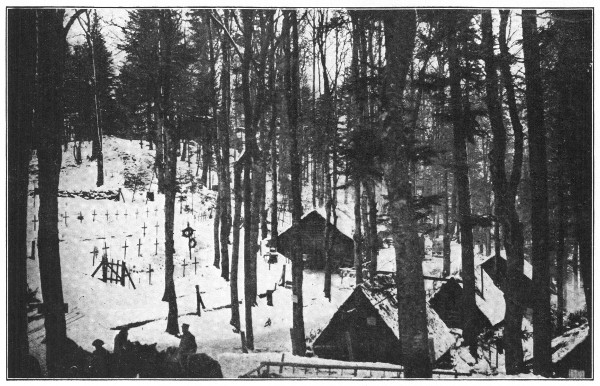
THE "POSTE DE SECOURS" NEAR HARTMANNSWEILERKOPF
January 10. Nightmare of last night not up to
actuality. Got up with Mellen's car at Thoms after
sticking first short of watering-trough. Cate and I
had a stake to plant at the place where Hall fell and
start a cairn of stones. At watering-trough, just as
I started up, a shell lit near and caused a rush of air
by my head. As we planted the stake and gathered
stones shells whistled round. Mellen's car a heller to
crank. Arrived at Thoms finally sweating blood
under my steel casque in spite of temperature—about
zero. Found Suckley, Phillips, Carey and
Cate present. Carey and Phillips went to Paste for
wounded—Suckley to Herrenfluh—Cate and I left
alone. Shell No 1 arrives—every one to abri—Cate
and I stay outside in kitchen. Bombardment of
about half an hour or three quarters—can't judge.
Last shell sent window, door, and stove in on us and
blew us off the bench. Peeped into the next room.
All blown to hell—shell had landed just to right of
entrance.... A very low p.m. Rice came tearing up
from Henry's a minute or so after the bombardment.
I saw one hundred yards of messed-up wire moving
mysteriously down the road—was attached to Rice's
car. He hurdled scalloped tin, etc., where tringlots
had been killed. Cate coolest man in Christendom—was
reading account of sinking of Lusitania when last
shell arrived—just at part where torpedo struck....
When some wounded came in on mules I parted with
extreme pleasure.
W. P."
A Night Trip
The most anxious drive I ever had in a checkered
automobiling experience was in the evening of September
30. It was at a new post in the mountains,
not far from Hartmannsweilerkopf. I was there for
the first time when a call came from —— (a station just
behind the lines where a shower bath is established).
It was dusk already, but I knew no better than to
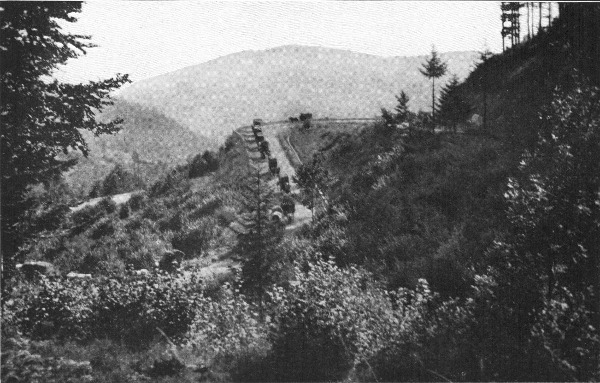
start. The road is new since the beginning of the war;
it follows the steep route of an old path and no lights
are allowed on it for fear the Germans might locate
and shell it. It is narrow, winding, and very steep, so
steep that at places at the top of a descent it looks as
if the road ended suddenly. There was barely enough
twilight through the mass of trees to allow me to see
the pack-mules returning from the day's ravitaillement,
but I finally made my way to the post.
I was given a poor, blind soldier to carry back.
What a trip he must have had. If it was trying for
me, it was worse for him.
It was now dark, a moonless, starless night in the
woods. When I started back, I could seldom see the
road itself. I had to steer by the bank or by the gaps
in the trees ahead. Occasionally I would feel one of
the front wheels leave the crown of the road, and
would quickly turn to avoid going over the precipice,
but with all this I had to rush the grades which
I could not see, but could only feel.
At last the machine refused a hill and stalled. I
knew that there were steeper hills ahead, worse roads
and thicker woods. I decided that a German bullet
would be better than a fall down the mountain-side,
and so I lit one of my oil lamps. Some passing soldiers
gave me a push and by the flickering light of the lantern
I felt my way more easily back to the post. I was
glad to arrive.
Tracy J. Putnam
An Attack
A few more hours and the steady line of ambulances
began its journey downward to crawl up again
for another load, always waiting. We deposited our
wounded at the first hospital in the valley—there
the British took them and moved them on towards
France. During that first night and day the wounded
men could not filter through the hospital fast enough
to let the new ones enter. Always there were three or
four Fords lined up before the door, filled with men,
perhaps dying, who could not be given even a place
of shelter out of the cold. And it was bitterly cold.
The mountain roads were frozen; our cars slipped and
twisted and skidded from cliff to precipice, avoiding
great ammunition wagons, frightened sliding horses
and pack-mules, and hundreds of men, who, in the
great rush, were considered able to drag themselves
to the hospitals unaided.
I was on my way to the nearest post to the lines on
the afternoon of the 27th when I was ordered to stop.
Shells were falling on the road ahead and a tree was
down across it. I waited a reasonable time for its removal
and then insisted on going on. At that time
I had never been under fire. For two kilometres I
passed under what seemed like an archway of screaming
shells. Branches fell on the car. At one time, half
stunned, half merely scared, I fell forward on the
wheel, stalled my engine, and had to get out and
crank up, with pandemonium around me. Then I
found the tree still down. For an hour I lay beside
my car in the road, the safest place, for there was no
shelter. We were covered with débris. Then dusk
came, and as we must return from that road before
dark, I tried to turn. The road was narrow, jammed
with deserted carts and cars, and with a bank on one
side, a sheer drop on the other. I jerked and stalled
and shivered and finally turned, only to discover a
new tree down behind. There could be no hesitating
or waiting for help—we simply went through it and
over it, in a sickening crash. And then our ordinary
adventures began.
John W. Clark
There we had lived and eaten and sometimes slept
during the attack. The soldiers of the ——th had
practically adopted each and all of us, giving up their
bunks and their food and wine for us at all times and
sharing with us the various good things which had
come from their homes scattered from the Savoie to
Brittany. No lights were ever shown there; no
shells had fallen anywhere near. On January 8, the
first ones came, shrapnel and asphyxiating gas. Four
men were killed. One of the brancardiers came out
and stood in the road, unsheltered, to warn any
American car that might be coming up. A car broke
down and I took 161 up that afternoon. We climbed
the road among the shells, and near the top a man was
struck just in front of us. I picked him up and on
the way down again we went through a running fire.
Two days later our hut up there was struck and demolished.
So we moved.
J. W. C.
Poilu Hardships
The work during the past month has put an unusual
strain upon every part of our cars. But it saves
the wounded hours of painful travel, and is appreciated
in the most touching manner by men as brave
and uncomplaining as ever did a soldier's duty, who
have more to face than is probably generally realized.
All the horrors of modern war are known here—high
explosives, burning oil, asphyxiating gases, and
in addition it is no gentle country to campaign in.
There are long marches and hard climbs, where the
wind blows cold, and it rains, and soon will snow, for
days at a time.
It is, indeed, a privilege to see the courage and good
cheer of the men who are facing these things. The
ravitaillement may be delayed; their allotted period
in the water-soaked trenches may be doubled, or
trebled, and yet it is always "Ça ne fait rien." It is
a keen satisfaction to think that your work will help
to make the horrors of cold weather a little less painful
for such as they.
D. D. L. Mcgrew
Winter in Alsace
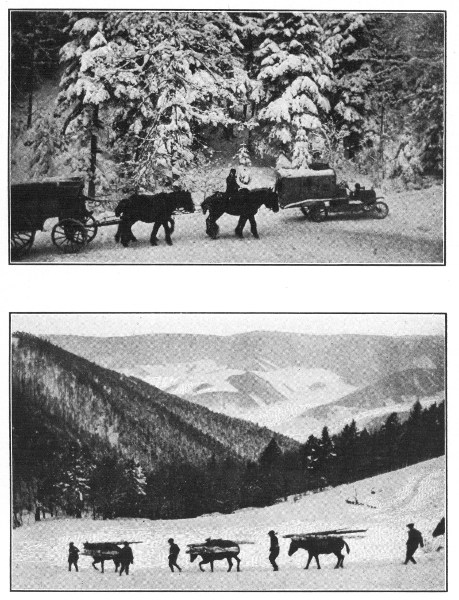
WINTER IN ALSACE
We now received our first taste of winter, and my
first experience made me put more faith in the rumors
of large falls of snow than an American likes to concede
to any country but his own. I was sent to our
regular station at the poste de secours at Mittlach.
It was the farthest away, up the mountain to Treh,
along the bare crest for five kilometres and then
twelve more on a winding, narrow road to the valley
of Metzeral. There was little work then, and the car
that I was to relieve got a trip late that night in what
was, even at Mittlach, a terrific rainstorm. The next
morning it continued raining, but I could see the
peaks of the mountains covered with snow; still no
wounded, so I waited, a little anxious, as no relieving
car had arrived. Late in the afternoon, just after
dark, the familiar sound of a Ford brought me out of
the poste de secours, and I found Rice, with his car
covered with snow which even the rain hadn't yet
melted. His story was of helping the car I had relieved,
all morning, in their efforts to pull it on to the
road from which a heavy ammunition wagon had
pushed it, neither vehicle being able to stick to the
icy road. Farther on he had met continual snow-drifts.
His eagerness to bring me chains, my only
chance of getting up, persuaded him to keep on, and
he eventually got through with everybody's help on
the road. We decided to wait until the storm was
over, our only alternative, and proceeded to make
ourselves as comfortable as we could, which means a
stove, somewhere to sleep, and plenty to read and
smoke. It was four days before the snow let up and
we had visions of a long and lonely winter, but as soon
as the storm broke we started up, and, as it proved, in
the nick of time, as the five kilometres along the crest
were again swept by snow and sleet and drifts were
beginning to form. The Mittlach service had to be
abandoned after this, although in late November
and early December a car could go through, but it was
impossible to assure the service and it was found better
to have sleighs and wagons do the work.
Stephen Galatti
The cold has been intense during the last few days
and breaking the ice to wash is a usual morning performance.
A temperature of 5° below zero Fahrenheit
does not facilitate starting a Ford ambulance that
has been standing out all night; in fact, almost every
morning it takes about fifteen minutes to start each
car with the aid of hot water, hot potiers, and other
appliances that the inventive genius of our various
drivers supplies.
On either side of you a wilderness of snow. Take
your eyes off the road and you seem to be in the great
forests of a new country. Look back on the road and
turn sharply to avoid the first of a convoy of brand-new
American tractors, or a maze of telephone wires
with their red-and-white labels which have been pulled
from their supports by the snow. The great rocks and
banks resplendent with their coating of ice, the trees,
the snow, the occasional deer, fox, or rabbit contrast
strangely with the road—the narrow, winding, mountain
road serving for almost all forms of traffic, save
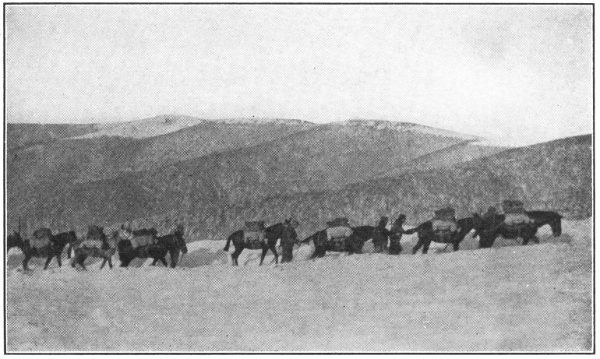
the railroad, known to man. Mules, mules, mules,
always mules, with their drivers hanging on to the
beasts' tails.
H. Dudley Hale
Weeks of Quiet
With the change of conductors No 170 has fallen
upon evil times. She has carried meat and bread for
the Section, and even coal; she has run through miles
of snowstorm to bring relief to those who were suffering
from toothache, scarlatina, or mumps; and she
has patiently borne permissionnaires from hospital to
railroad station; but the shriek of shot and shell has
become entirely unfamiliar to her ears. At first it was
the fault of the conductor, who had never conducted
before reaching Bordeaux, and only some half-dozen
times between leaving Bordeaux and arriving in
Alsace. He was not adjudged capable of conducting
up any mountain in general nor up the slopes adjoining
Hartmannsweilerkopf in particular. He went up
once or twice without 170, to inspect and experience,
but it is an experience of which a little goes a long
way when not prompted by duty. Afterward it was
the fault of those who sit in the seats of the mighty,
and still is, and apparently will remain so; but at no
time was 170 to blame.
We left Alsace one morning early in February
when the valleys were filled with tinted mist and the
snowy hill-slopes were glowing pink with sunrise, and
we hated doing it. Various reasons have been offered
for our departure by various persons in authority,—but
none of them satisfactory and convincing,—and
we still look back upon it as the Promised Land.
We formed a convoy of twenty-three cars, in which
170 was placed immediately behind the leader—an
arrangement to which twenty-one persons objected.
Every time the side boxes came open and the extra
tins of gasoline scattered over the landscape, or when
the engine stopped through lack of sympathy with the
engineer, three or four cars would manage to slip by.
It was a sort of progressive-euchre party in which 170
never held a winning hand. No one concerned had
the least idea whither we were headed. The first
night we spent at Rupt, where there is an automobile
park. We took it on hearsay that there was an automobile
park, for we left the next morning without
having seen it; but when two days later we joined the
Twentieth Army Corps—the Fighting Twentieth—at
Moyen, we were reported as coming straight from
the automobile park at Rupt. Consequently we were
assumed to be ready for indefinite service "to the last
button of the last uniform," and when we had explained
that mechanically speaking our last uniform
was on its last button the Fighting Twentieth shook
us off.
However, we spent a week at Moyen—in it up to
our knees. The surrounding country was dry and
almost dusty, but Moyen has an atmosphere of its
own and local color—and the streets are not clean.
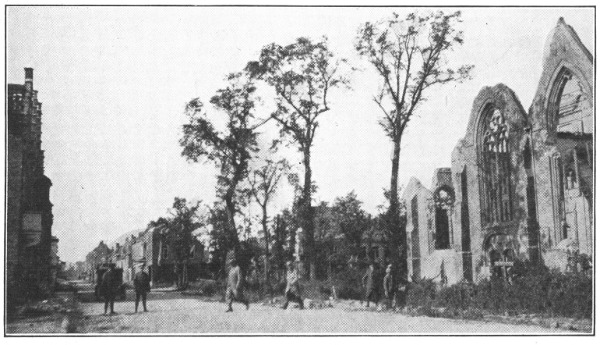
Yet to most of us the stay was intensely interesting.
It lies just back of the high-water mark of German invasion,
and the little villages and towns round about
show like the broken wreckage tossed up by the tide—long
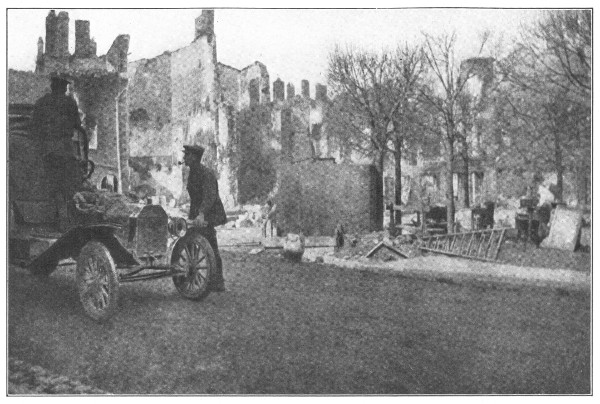
streets of roofless, blackened ruins, and in the
midst the empty skeleton of a church. The tower has
usually been pierced by shells, and the broken chimes
block the entrance. Nothing has been done to alter or
disguise. The fields surrounding are pitted with shell
craters, which have a suggestive way of lining the
open roads; along the edge of the roads are rifle pits
and shallow trenches filled with a litter of cartridge
boxes and bits of trampled uniform and accoutrement,
blue and red, or greenish gray, mixed together,
and always and everywhere the long grave mounds
with the little wooden crosses which are a familiar
feature of the landscape. It lacks, perhaps, the bald
grim cruelty of Hartmannsweilerkopf, but it is a place
not to be forgotten.
From Moyen we moved on to Tantonville, a place
not lacking in material comforts, but totally devoid
of soul; and from there we still make our round of
posts—of one, two, or four cars, and for two, four,
or eight days. In some, the work is fairly constant,
carrying the sick and second-hand wounded from post
to hospital and from hospital to railroad; in others,
one struggles against mental and physical decay—and
it is from the latter of these in its most aggravated
form that the present communication is penned.
At Oëlleville, we saw the class of 1916 called out,—brave,
cheerful-looking boys, standing very straight
at attention as their officers passed down the line, and
later, as we passed them on the march, cheering
loudly for "les Américains"—and so marching on to
the open lid of hell at Verdun. The roads were filled
with soldiers, and every day and all day the troop-trains
were rumbling by to the north, and day after
day and week after week the northern horizon echoed
with the steady thunder of artillery. Sometimes, lying
awake in the stillness of dawn to listen, one could
not count the separate explosions, so closely did they
follow each other. The old man who used to open the
railway gate for me at Dombasle would shake his head
and say that we ought to be up at Verdun, and once
a soldier beside him told him that we were neutrals
and not supposed to be sent under fire. I heard that
suggestion several times made, and one of our men
used to carry in his pocket a photograph of poor Hall's
car to refute it.
There was a momentary thrill of interest when a
call came for four cars to Baccarat—a new post and
almost on the front; there was an English Section
there in need of assistance, and we four who went intended
to "show them how." But it seemed that the
call had come too late and the pressing need was over;
the last batch of German prisoners had been brought
in the day before and the active fighting had ceased.
We stepped into the long wooden cabin where they
waited—the German wounded—and they struggled
up to salute—a more pitiful, undersized, weak-chested,
and woe-begone set of human derelicts I
hope never to see again in uniform; and as we stood
among them in our strong, warm clothes, for it was
snowing outside, all of us over six feet tall, I felt suddenly
uncomfortable and ashamed.
The officer in charge of the administration said
that a car was needed to go down the valley to Saint-Dié,
but we must be very careful for Saint-Dié was
under bombardment. Once we were startled at lunch
time by an explosion near the edge of town. Three of
us stepped to the door. We were eating the rarity of
blood sausage and the fourth man kept his seat to
help himself from the next man's plate. As we looked
out there came a second explosion a little farther off,
and then in a few moments a telephone call for an
ambulance, with the news that a Taube had struck a
train. When I reached the place the train had gone
on, carrying ten slightly wounded to Lunéville, and
I brought back the other two on stretchers—one a
civilian struck in a dozen places, but otherwise apparently
in excellent health and spirits; the other was
a soldier in pretty bad shape. It must have been excellent
markmanship for the Taube, since we had seen
nothing in the clear blue sky overhead nor heard the
characteristic whir of the motor, and yet both shell
craters were very close to the tracks. In Alsace they
were constantly in sight, but seldom attacked and
almost never scored a hit, while the French gunners
seemed perfectly happy to fire shrapnel at them all
afternoon with the same indecisive result. One could
not even take the white shrapnel clouds as a point of
departure in looking for the aeroplane—though the
French artillery is very justly famous for its accuracy
of fire. In this instance as in all air raids the success
scored seemed pitifully futile, for it was not a military
train, and most of the wounded were noncombatants.
It had added its little unnecessary mite of suffering,
and of hatred to the vast monument which Germany
has reared to herself and by which she will always be
remembered.
W. Kerr Rainsford
Night
You can little imagine how lonely it is here under
the black, star-swept sky, the houses only masses of
regular blackness in the darkness, the street silent as
a dune in the desert, and devoid of any sign of human
life. Muffled and heavy, the explosion of a torpedo
inscribes its solitary half-note on the blank lines of
the night's stillness. I go up to my room, and sigh
with relief as my sulphur match boils blue and breaks
into its short-lived yellow flame. Shadows are born,
leaping and rising, and I move swiftly towards my
candle-end, the flame catches, and burns straight and
still in the cold, silent room. The people who lived
here were very religious; an ivory Christ on an ebony
crucifix hangs over the door, and a solemn-eyed, pure
and lovely head of Jeanne d'Arc stands on my mantel.
What a marvellous history—hers! I think it the
most beautiful, mystic tale in our human annals.
Silence—sleep—the crowning mercy. A few
hours go by.
Morning
"There is a call, Monsieur Shin—un couché
à——"
I wake. The night clerk of the Bureau is standing
in the doorway. An electric flashlight in his hand
sets me a-blinking. I dress, shivering a bit, and am
soon on my way. The little gray machine goes cautiously
on in the darkness, bumping over shell-holes,
guided by the iridescent mud of the last day's rain. I
reach a wooded stretch——phist! a rifle bullet goes
winging somewhere. A bright flash illuminates the
road. A shell sizzles overhead. I reach the poste de
secours and find a soldier in the roadway. More electric
hand-lamps. Down a path comes a stretcher and
a man wounded in arm and thigh. We put him into
the wagon, cover him up, and away I start on my long,
dark ride to the hospital, a lonely, nerve-tightening
ride.
Stray Thoughts
The voice of war is the voice of the shell. You hear
a perfectly horrible sound as if the sky were made of
cloth and the Devil were tearing it apart, a screaming
undulating sound followed by an explosion of fearful
violence, bang! The violence of the affair is what impresses
you, the suddenly released energy of that murderous
burst. When I was a child I used to wander
around the shore and pick up hermit crabs and put
them on a plate. After a little while you would see a
very prudent claw come out of the shell, then two
beady eyes, finally the crab in propria persona. I was
reminded of that scene on seeing people come cautiously
out of their houses after a shell had fallen, peeping
carefully out of doorways, and only venturing to
emerge after a long reconnoitring.
I am staying here. It was my design to leave at the
beginning of the year, but why should I go? I am very
happy to be able to do something here, very proud to
feel that I am doing something. In times to come
when more Americans realize their lost opportunity,
there will be many regrets, but you and I will be content.
So wish me the best. Not that there is anything
attractive to keep me here. To live continually under
shell fire is a hateful experience, and the cheerless life,
so empty of any domesticity, and the continuous
danger are acid to any one with memories of an old,
beloved New England hearth and close family ties and
friendships. To half jest, I am enduring war for peace
of mind.
How lonely my old house must be when the winter
storms surge round it at midnight. How the great
flakes must swirl round its ancient chimney, and fall
softly down the black throat of the fireplace to the
dark, ungarnished hearth. The goblin who polished
the pewter plates in the light of the crumbling fire-brands
has gone to live with his brother in a hollow
tree on the hill. But when you come to Topsfield, the
goblin himself, red flannel cap and all, will open the
door to you as the house's most honored and welcome
guest.
A fusée éclairante has just run over the wood—the
bois de la mort—the wood of the hundred thousand
dead. And side by side with the dead are the living,
the soldiers of the army of France, holding, through
bitter cold and a ceaseless shower of iron and hell, the
far-stretching lines. If there is anything I am proud
of, it is of having been with the French army—the
most devoted and heroic of the war.
H. Sheahan
A Gallant Blessé
I was stationed at one of our postes de secours the
other night during a terrible rainstorm. The wind
does blow on top of these mountains when it begins!
About bedtime, which is at 7.30 (we eat our dinner at
4.30—it is pitch dark then), a call came from one of
our postes three kilometres nearer the line. There was
a captain wounded and they asked me to go for him.
I cannot speak French well, but I made them understand.
The poste is at the foot of the mountain, hidden
from the Boches by the trees in the woods only.
At night we cannot use lights, for the Germans would
see us easily, and then there would be a dead American
in short order. Of course, I told them I would go,
but it would be dangerous for the blessé. I could
jump out in case I should run into a ravine, but I
could not save the man on the stretcher if anything
happened. They understood, and, after about half
an hour, we heard another knock on the cabin door,
and they brought the captain in—four men, one on
each corner of a stretcher. They put him on the floor,
and in the lantern light of the room (made of rough
timbers) one could see he was vitally stricken by the
death color of his face and lips. He had his full senses.
It was my duty then to take him down the opposite
slope of the mountain to the hospital. I started my
car and tried to find my way through the trees in the
dark. The wind was almost strong enough to blow
me off the seat, and the rain made my face ache. The
only light I had was that of the incendiary bombs of
the French and the Germans at the foot of the hill,
about one and a half kilometres away. These bombs
are so bright they illuminate the whole sky for miles
around like a flash of lightning. I must admit my
nerves were a little shaken, taking a dying man into
my car under such conditions, almost supernatural.
It did seem like the lights of the spirits departing
mixed with the moaning wind and the blackness of
the night, and the pounding of the hand-grenades in
the front lines so near. They gave me another blessé
with the captain. This man had been shot through
the mouth only, and was well enough to sit up in back
and watch the captain. I could use my lights after I
had passed down the side a short distance out of sight
of the lines. We must run our motors in low speed or
we use up our brakes in one trip. All the poor capitaine
could say during the descent was "J'ai soif," except
once when he requested me to stop the car, as the road
was too rough for him, and we had to rest. When we
reached the hospital, I found a bullet had struck one
shoulder and passed through his back and out the
other shoulder. He also had a piece of shell in his side.
A few hours before he had walked back from the
trenches into the woods to see a position of the Germans;
they saw him—and seldom does a man escape
when seen at fairly close range. He was vitally
wounded. I climbed up the mountain watching the
fire-flashes in the sky, feeling pretty heavy-hearted
and homesick, but with strengthened resolve to help
these poor chaps all I possibly could.
The next day I had another trip from the same
station on the mountain to the same hospital at five
o'clock in the afternoon—then dark as midnight.
The sisters told me the capitaine was better; the ball
had not severed the vertebra and there was hope for
him. They told me also that the general had arrived
and conferred upon him the Cross of the Légion
d'Honneur. It was reassuring to hear that he was better
and had distinguished himself so well, and I went
back up the trail this night with a lighter heart. I had
felt really guilty, for I did not have a thing in my car
to give him the night before when he asked me to stop
the car and said, "J'ai soif." Never did I want a
spoonful of whiskey more and never have I regretted
not having it more. I could not give him water—he
had some fever; besides, though there are many
streams of it running down the mountain, no one
dares to touch it. Water is dangerous in war-time, and
we have all been warned against it.
I was called the next morning for the same trip and
when I reached the hospital at eight o'clock it was
still raining—now for three days! I met Sœur Siegebert
in the hall—carrying her beads, her prayer-book
and a candle. She is one of the good nuns who always
gives me hot soup or tea with rum in it when I come
in cold, wet, and hungry—and many times I and the
others have blessed her! My first question was:
"Comment ça va avec le capitaine ce matin?" All she
said and could say was "Fini." He had passed out a
short time before I got there. He was only thirty
years old, tall and handsome, and they say he led a
whole battalion with the courage of five men.
A little later I stepped into the death chamber in a
little house apart from the hospital. It was cold, wet,
and smelled strongly of disinfectant, just as such
places should, and in a dim, small room lighted by two
candles, upon a snowy white altar made by the nuns,
there he lay on a bier of the purest linen beautifully
embroidered, whiter even than the pallor of his features
and hands, and as I came near him the only
color in the room was the brilliant touch of red and
silver in his Légion d'Honneur medal, which was
pinned over his heart. His peaceful expression assured
me he was happy at last, and made me realize
that this is about the only happiness left for all
these poor young chaps I see marching over these
roads in companies for the trenches, where their only
shelter is the sky and their only rest underground in
dug-outs. When they go into the trenches they have
a slim chance of coming out whole again, and they
pass along the road in companies with jovial spirits,
singing songs and laughing as though they were going
to a picnic. I see them come back often, too; they are
still smiling but nearly always in smaller numbers.
What can they have in view when they see their numbers
slowly but surely dwindling! I marvel at their
superb courage!
Luke C. Doyle
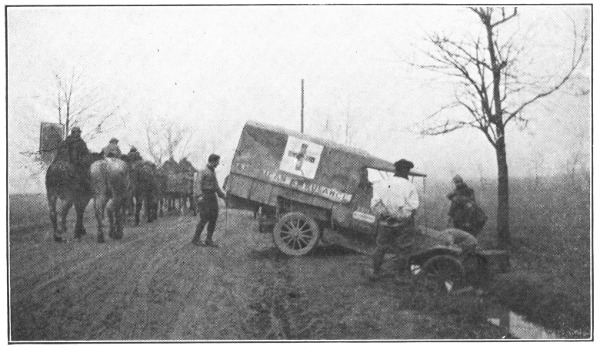
WHAT NIGHT TRIPS WITHOUT LIGHTS SOMETIMES MEAN
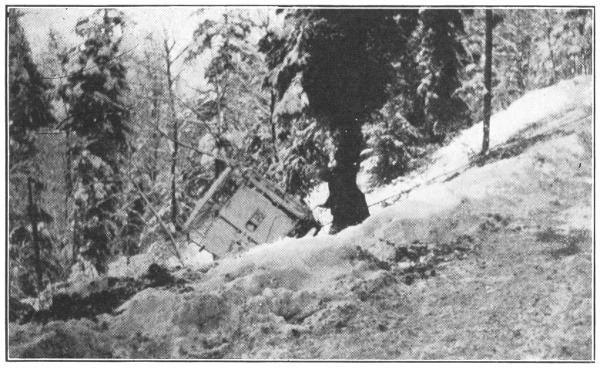
THE DANGERS OF THE ROAD
Perils of a Blizzard
The other night, just as I was going to crawl in,
three blessés arrived from the trenches, another was
down the road in a farmhouse waiting for the médecin
chef; he was too badly wounded to go farther. They
asked me to take the men to the hospital at Krût,
which is back over the mountains twenty miles, and
of course I said I would. I dressed again (I hated to
because it was warm in the little log shack and it had
begun to rain outside); I lit my lantern, and went
out to the shelter where the cars were, got my tank
filled with gas, and my lights ready to burn when I
could use them. It was so black one could see nothing
at all. We put two of the blessés on stretchers and
pushed them slowly into the back of the car; the other
sat in front with me. We did this under the protection
of the hill where the poste de secours is located.
When one goes fifty yards on the road beyond the
station there is a valley, narrow but clear, which is
in full view of the trenches, and it is necessary to go
over this road going and coming. In the daytime one
cannot be seen because the French have put up a row
of evergreens along it which hides the road. I started
and proceeded very carefully, keeping my lantern
under a blanket, and we soon arrived at the house
where the other blessé was waiting for the doctor. It
was a typical French farmhouse, little, old, and dirty
inside, and white outside. I pushed in the door and
stepped down into the flagstone kitchen. On the
floor lay the chasseur on a stretcher, his face pale under
the lamplight from the table. The médecin chef
was bending over him injecting tetanus (lockjaw)
anti-toxin into his side, and with each punch of the
needle the poor fellow, already suffering from terrible
wounds, would squirm but not utter a word. The
soldiers stood around the tiny room, their heads
almost touching the brown rafters above. We took
the man out to my car on the stretcher, carrying the
light under the coat of one of the stretcher-bearers.
If the Germans see a light moving anywhere in the
French territory, they will fire on it if they think it
near enough. I started up the mountain with my
load of wounded. On either side of the road the
French guns at certain places pounded out their
greetings to the Boches, and the concussion would
shake the road so that I could feel it in my car. I
could light my lights after about a mile, so I proceeded
slowly up the mountain in low speed. The heat
from my motor kept the blessés and myself warm.
About halfway up, we ran into the clouds and it
became so foggy one could scarcely see; farther up
it became colder and began to snow. I had no chains
on my car (none to be had). They need so many
things here, if they only had the money to buy them.
I thought of the time you and I got stuck at Princeton,
and it worried me to be without chains, especially
since I had three helpless men inside and one
out. I kept climbing up and the higher I went the
more it snowed and the harder it blew. Near the top
it became veritably blinding—snow, sleet, and wind—a
typical northeasterly American blizzard. The
little car ploughed on bravely; it stuck only once on a
sharp turn, and by backing it I was able to make it
by rushing it. I could not see the road, the sleet was
blowing into my face so and the snow was so thick.
At last I reached the summit and the wind was so
strong there it actually lifted my car a little at one
time. On one side of the road was a high embankment
and on the other a ravine sloping down at least one
thousand feet. I was scared to death, for without
chains we were liable to skid and plunge down this
depth. The snow had been falling all day, and it had
drifted in places over a yard deep. Twice I took a
level stretch to be the road, but discovered my mistake
in time to back up; the third time was more serious;
I plunged ahead through a drift which I thought
was the road, and finally I stuck and could move
neither way. I could not leave these men there all
night wounded, and the blizzard did not stop, so my
only means was to find help. I walked back to what
I thought was the road and kept on toward a slight,
glimmering light I could see in the right direction. It
was an enclosure for mules which haul ammunition
over the mountains, and I felt safe again, for I knew
there were a lot of Territorial soldiers with them.
I hauled them out of bed; it was then 10.30. They
came with me and pushed me back on the road, also
pushed me along—ten of them—until they got me
on the descent, and from there on the weight of my
car carried me down through the drifts. I arrived at
the hospital at 12.30 and was the happiest man you
have ever seen to get those poor fellows there safely.
I was sent back to Mittlach the next day to get
four more wounded. They were what are called assis,
not couchés, fortunately, because the snow on top of
Trekopf had been falling and drifting all day and
night. When I got to the top of the mountain and
started down, the roads had been broken and beaten
down by munition wagons and were like a sheet of
ice. I started down without chains, and with all my
brakes on the car began to slide slowly down the road.
It slid toward the edge of the ravine and the two front
wheels went over; it stopped, I got it back on the
road, and turned the radiator into the bank on the
other side and tried tying rags on the rear wheels to
keep the car from going down, when a big wagon with
four horses came down the hill behind me. It was so
slippery that the horses started to slide down on their
haunches, and, with brakes on, the driver could not
stop them. The horses came on faster and they slid
into the rear of my car, pushed it along for about six
feet, and then nothing could stop it. It started down
the road. I yelled to the wounded, "Vous, jetez vous."
They understood and piled out just in time. The car
ran across the road and plunged down into the ravine.
There was a lot of snow on the side of the ravine, and
it had piled up so that it stopped the car part way
down, and it was not injured very much. It took nine
men and as many mules to pull it out. Now that the
snow has come, I think our service to Mittlach will
have to be abandoned.
L. C. D.
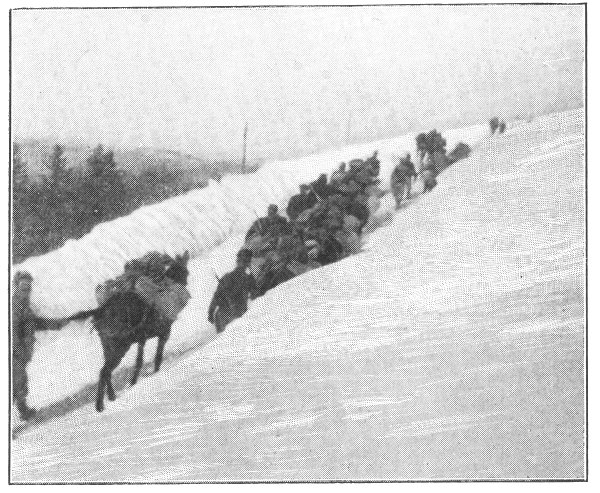
MULE CONVOY IN ALSACE
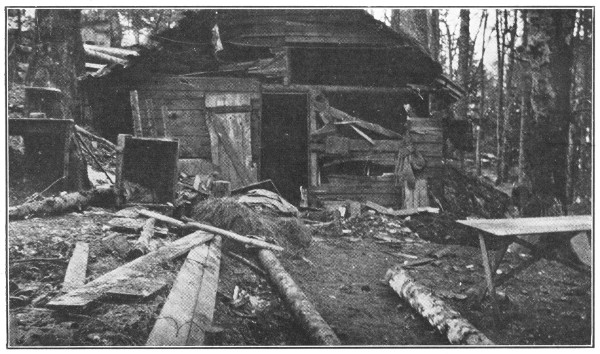
THE "POSTE" NEAR HARTMANNSWEILERKOPF AFTER A BOMBARDMENT
At Tomansplatz the other day an officer and I
started for ——, one of our postes. We took a short
cut over a high hill from which one could look easily
down on ——, where all the fighting had been going
on. There is a path over this hill which is hidden by
trees, and on the top is a long boyau to pass through
so as to keep out of sight of the Germans in clear
weather. When we reached the top, we stepped out
of the path to get a view of the valley, and it was
wonderful looking down on the French and German
trenches, and to see the hill all shot to pieces and the
trees broken to stubs—living scars of the fighting
that had gone on. We did not get by unseen, for the
Germans are always on the job. They have observation
posts in the trees, hard to be seen, but easy to see
from. There was a lot of firing going on, and we could
see the French shells landing in the German lines. I
had a premonition that something was going to happen
and stepped behind a tree. I heard particularly
one big gun fire, and wondered if by any chance it was
meant for us. It took only three or four seconds to
confirm my suspicion, for the shriek of a shell came
our way. As they often pass high over our heads and
we are familiar with the sound, I was still in doubt,
when it burst not fifty yards away. We did not wait
to investigate further, but jumped for the boyau when
another shriek was heard, and we were just in time,
for the shell burst not far behind us. We could tell
when they were firing at us, for we could hear the gun
fire,—it sounded like a 150 mm., which is about 6-inch
bore,—then came the shriek, and then the bursting.
It certainly is a strange, unwelcome sound when
you know you are the target. We ran down the boyau
toward the back of the hill for all we were worth, and
they followed us, but we did not stop to look or listen,
we almost rolled down the other side of the hill, but
it was to safety, thank Heaven. The only thing that
happened to me was a scratch on the back of my
hand. Never again! The sensation of shells coming
at one is novel but nauseating, and I keep away from
the lines from now on.
I must tell you that we have received a citation, and
Colonel Hill's brother the Croix de Guerre for the work
we did during the attack of October 15 to 19. Two
more citations and we receive, each one, the Croix de
Guerre.
L. C. D.
Poignant Impressions
I had a wild ride last night in the rain. A German
shell landed in a town only two kilometres from the
front and killed four civilians and wounded one
woman. I had to go and get her. For two kilometres
the road runs over a slight rise in the plain, in full
view of the Germans. It is all screened off with brush
cut and stuck up along the side toward the lines, but
here and there the brush was blown down by the
terrific wind which came with the storm. We could
not use lights, but we did not need them, for, though
it was raining like fury, the Germans were sending up
illuminating bombs which lighted up the country for
miles around. They are the most fascinating yet
weird things you have ever witnessed. This ball of
fire rises from the trenches to a height of one hundred
feet, and then floats along slowly through the air for
a quarter of a mile, illuminating everything around.
At one time one came directly for us, and we stopped
the car and watched it. At the roadside stood a huge
crucifix, and, as this ball of fire approached, it silhouetted
the cross, and all we could see was the beautiful
shadow of the figure on the cross rising from the
earth against the weird glow of white fire. It seemed
like the sacrifice of Calvary and the promise of success
for poor France.
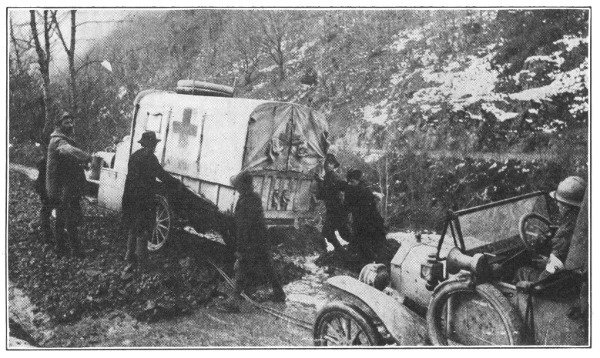
ONE OF OUR CARS IN TROUBLE
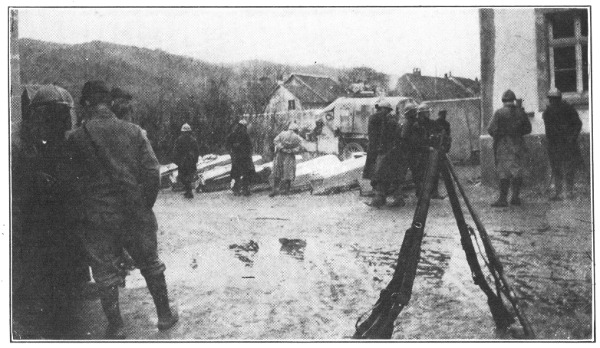
COFFINS IN COURTYARD OF BASE HOSPITAL IN ALSACE—AMONG
THEM RICHARD HALL'S
We did not dare to use our low speed for fear the
Boches would hear us, so we tore over this road on
high, rushing past the bare spots, afraid of being seen.
The illuminating bombs are used for this purpose
only; the one which came toward us went out before
it reached us, for which we were grateful. We got
the woman. She had to have her arm amputated.
December 27
We have had very strenuous times, as a big attack
has just taken place and the wounded have come in so
fast and so badly cut up they could not give them the
care they would like to, as everything is so crowded.
The Germans lost a lot of trenches, and almost two
thousand of them were taken prisoners. They have
been shelling the French lines and towns constantly;
since the 22d, our cars have been more or less under
fire. We moved our quarters about six kilometres
nearer the line and bring the wounded in to the hospital
three times a day. The Germans shelled this
place,—why we do not know, for there is nothing
military here but the hospital, and why should people
of any intelligence and feeling wish to shell a hospital?
One of our men was killed on Christmas Day and
we are terribly broken up over it. He was going from
this hospital to the poste we go to daily over a road up
the mountain. At four o'clock Christmas morning
one of our boys started up this road, which goes up
and up with no level place on it. He passed the middle
of the journey when he thought he noticed a
wagon turned over about forty feet down in the ravine.
He went to a point where he could stop his car,
took his lantern, and walked back. He found one of
our Fords so demolished it could not be distinguished.
The top of the car was up in a tree and so were the
extra tires; there was nothing on the ground but a
chassis. He saw no one around, but on going down a
little farther, he saw a bundle of blankets which we
always carry for the wounded, and, on walking up to
it, he found one of our fellows, Dick Hall. He was
lying on his side with his arms fixed as if driving and in
a sitting position, cold and rigid. He had been dead
a couple of hours. Walter, who found him, went back
up the road for assistance, and, while there, Hall's
brother came along in his car and asked what the
matter was and offered his assistance. Walter told
him his brakes were not working and he was fixing
them, so Hall, knowing nothing of his brother, passed
on up the mountain, got his load of wounded, and
took them to the hospital.
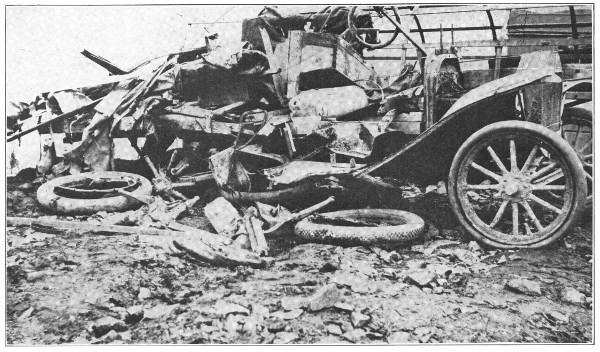
RICHARD HALL'S CAR AFTER SHELL LANDED UNDER IT
In the Hospital
January 1, 1916
This brings the war home to us! This and the suffering
and torments of the wounded make me sick at
heart. I have seen them suffer particularly since this
last attack, as I am a blessé myself—and am in a
French hospital. It is only a slight arm wound; the
bone is cracked a little, but not broken. I am here to
have the piece of shell drawn out and am assisting
these poor wounded all I can. I was sent to the poste
we have nearest the lines, on the other side of the
mountain and hidden in the woods. The trenches
begin at this poste. The poste itself is an abri, a bomb-proof
dug-out in the ground. The roof and supports
are made of timbers a foot or more thick, over these
are placed two feet of heavy rock and again two feet
of earth. When I got there the Germans began bombarding,
and fired shells into these woods and into
this poste for almost five hours. I never want to see
another such bombardment; it was frightful. I saw
shells land among horses, smash big trees in half
within ten and twenty yards. I saw three men hit; one
had his face shot away. The poste became so full of
wounded we had to stand near the doorway, which is
partly protected by a bomb-proof door. It was not
exactly safe inside, for the shells, if big enough, when
they hit such an abri often loosen the supports, and
the roof, weighing tons, falls in and buries people
alive. A man in the same room with me in the hospital
here was in an abri not far from where we were
when it was struck; the roof fell and killed three men
who were with him and he was buried for an hour. A
shell struck a tree not eight feet off from where we
were standing and smashed it in half; it fell and almost
killed one of two brancardiers (stretcher-bearers)
who were carrying a dead man past the door. A piece
of the éclat hit the other brancardier in the head and
killed him. The man standing beside me had his hand
shot off, and I got hit in the elbow. Three pieces went
through my coat, but only one went into the arm. If
I had not been standing against the door I might have
fared worse. I was carried with two other wounded
by one of our fellows up the steep mountain road to
our second poste. They were bombarding that road as
well as the poste. We could see the sky redden from
the flash of the guns below and we could hear the
shells shriek as they came toward us, and the éclat not
too far away. Twice we started the Ford on the way
up; it stalled and took five precious minutes to get it
going again. The force of one explosion knocked the
fellow with me over when he walked ahead to try and
make out the road. We stuck in the road twice, not
daring to pass a wagon conveying munitions. We
could not make the hill, it was so steep, and we had to
seek men to push us. It was pitch-black and we could
not use our lights. This with two gravely wounded
men on our hands rather took the nerve out of us. We
finally got back to headquarters and found them bombarding
there, one shell having struck not far from
the hospital.
January 20
I am still in the hospital, but am glad to say my
arm is almost quite well again. It does take time.
The bombardment by the Germans of all our former
postes has become pretty nerve-racking. The house
we took for the attack has been hit twice. We had
moved out only the day before. They struck a schoolhouse
close by and killed a nun and wounded three
harmless children. Our cars have been hit by scraps
of shell, but fortunately when none of the men were
in them.
The suffering of the men in this hospital and the
cries in the night make it an inferno. Though I am
glad I can help a little, I must say it is on my nerves.
In this hospital—which is one of the best—they
need very badly beds for men who have had their
vertebræ broken. These men live from two to six
months in a frame on their backs all the time. This is
the way they spend the last months of their lives.
We have three men in this condition now, and each
time they are moved it takes at least four men to
change them and they suffer terribly. The special
beds I speak of are made on pulleys with bottom and
sides which can be opened for washing and service
purposes. They cost forty dollars and France cannot
afford to buy them, as she has so many needs. If you
could raise some money for this purpose, you would
be doing these poor fellows the last favors they will
have on this earth and help them in their suffering.
L. C. D.
New Quarters
August 6, 1915
I was delighted to see "Doc" to-day. He arrived
yesterday evening from Paris, but I was on M——
duty, so we did not meet until this morning. We had
a long talk and I told him the story of the fatal 22d;
the recital of it only seems to have reimpressed me
with the horror of that night.
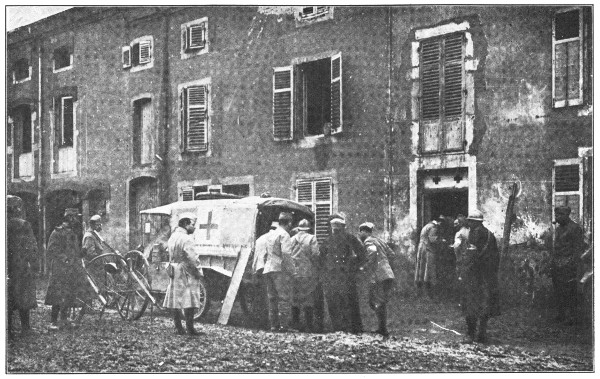
A "POSTE DE SECOURS" AT MONTAUVILLE
We are now quite comfortably settled in our new
quarters, a house never shelled until just after our
occupation of it, when we received a 77 a few feet
from our windows. I do not know why it has been
spared unless the Boches were anxious not to destroy
a creation so obviously their own. Architecturally it
is incredible—a veritable pastry cook's chef d'œuvre.
Some of the colors within are so vivid that hours of
darkness cannot drive them out of vision. There is
no piano, but musical surprises abound. Everything
you touch or move promptly plays a tune, even a
stein plays "Deutschland über alles"—or something.
Still the garden full of fruit and vegetables will make
up for the rest. Over the brook which runs through
it is a little rustic bridge—all imitation wood made
of cast iron! Just beneath the latter I was electrified
to discover a very open-mouthed and particularly
yellow crockery frog quite eighteen inches long! A
stone statue of a dancing boy in front of the house
was too much for us all. We ransacked the attic and
found some articles of clothing belonging to our absent
hostess, and have so dressed it that, with a tin
can in its hand, it now looks like an inadequately clad
lady speeding to her bath-house with a pail of fresh
water.
Last night "Mac" and I were on night duty at
M——, and when we arrived at the telephone bureau—where
we lie on stretchers fully dressed in our blankets
waiting for a call (the rats would keep you awake
if there were no work to do)—we were told that they
expected a bad bombardment of the village. "Mac"
and I tossed up for the first call, and I lost. "Auberge
Saint-Pierre, I bet," laughed "Mac." That is our
worst trip—but it was to be something even more
unpleasant than usual. About eleven o'clock the
Boches started shelling the little one-street village
with 105 shrapnel. In the midst of it a brancardier
came running in to ask for an ambulance—three
couchés, "très pressé." Of course, I had to grin and
bear it, but it is a horrid feeling to have to go out into
a little street where shells are falling regularly—start
your motor—turn—back—and run a few
yards down the street to a poste de secours where a
shell has just landed and another is due any moment.
"Are your wounded ready?" I asked, as calmly as
I could. "Oui, monsieur." So out I went—and was
welcomed by two shells—one on my right and the
other just down the street. I cranked up No 10, the
brancardier jumped up by my side, and we drove to
our destination. I decided to leave the ambulance on
the left side of the road (the side nearer the trenches
and therefore more protected by houses from shell-fire),
as I thought it safer on learning that it would be
fifteen minutes before the wounded were ready; and
luckily for me, for a shell soon landed on the other
side of the road where I usually leave the ambulance.
My wounded men were now ready; it appeared that
one of the shrapnel shells had entered a window and
exploded inside a room where seven soldiers, resting
after a hard day's work in the trenches, were sleeping—with
the appalling result of four dead and three
terribly wounded. As I felt my way to the hospital
along that pitch-black road, I could not help wondering
why those poor fellows were chosen for the sacrifice
instead of us others in the telephone bureau—sixty
yards down the street.
However, here I am writing to you, safe and sound,
on the little table by my bedside, with a half-burnt
candle stuck in a Muratti cigarette box. Outside the
night is silent—my window is open and in the
draught the wax has trickled down on to the box and
then to the table—unheeded—for my thoughts
have sped far. To Gloucester days, and winter evenings
spent in the old brown-panelled, raftered room,
with its pewter lustrous in the candlelight; and the
big, cheerful fire that played with our shadows on the
wall, while we talked or read—and were content.
Well—that peace has gone for a while, but these
days will likewise pass, and we are young. It has
been good to be here in the presence of high courage
and to have learned a little in our youth of the values
of life and death.
Leslie Buswell
The Poetry of War
We have had much talk to-night about the probable
effect of the war upon art and literature in different
countries, and gradually the discussion shifted
from prophecy to history and from the abstract to the
concrete, and narrowed down to the question as to the
best poem the war has already produced. In France
enough verse has been inspired by the war to fill a
"five-foot shelf" of India-paper editions, but we all
had finally to admit that none of us was in a position
to choose the winner in such a vast arena. Among
the short poems in English, some voted for Rupert
Brooke's sonnet which begins:—
"If I should die, think only this of me:
That there's some corner of a foreign field
That is forever England."
But nothing that any of us has seen is more inspired
than the verses which poured from the heart
and mind of a young American in the Foreign Legion
here in France. His name is Alan Seeger, and the
poem was written in, and named from, the region in
which his regiment was stationed. It is called "Champagne,
1914-15," and was printed in the North American
Review for October, 1915.
CHAMPAGNE, 1914-15
In the glad revels, in the happy fêtes,
When cheeks are flushed, and glasses gilt and pearled
With the sweet wine of France that concentrates
The sunshine and the beauty of the world,
Drink, sometimes, you whose footsteps yet may tread
The undisturbed, delightful paths of Earth,
To those whose blood, in pious duty shed,
Hallows the soil where that same wine had birth.
Here, by devoted comrades laid away,
Along our lines they slumber where they fell,
Beside the crater at the Ferme d'Alger
And up the bloody slopes of La Pompelle,
And round the city whose cathedral towers
The enemies of Beauty dared profane,
And in the mat of multicolored flowers
That clothe the sunny chalk-fields of Champagne.
Under the little crosses where they rise
The soldier rests. Now round him undismayed
The cannon thunders, and at night he lies
At peace beneath the eternal fusillade....
That other generations might possess—
From shame and menace free in years to come—
A richer heritage of happiness,
He marched to that heroic martyrdom.
Esteeming less the forfeit that he paid
Than undishonored that his flag might float
Over the towers of liberty, he made
His breast the bulwark and his blood the moat.
Obscurely sacrificed, his nameless tomb
Bare of the sculptor's art, the poet's lines,
Summer shall flush with poppy-fields in bloom,
And Autumn yellow with maturing vines.
There the grape-pickers at their harvesting
Shall lightly tread and load their wicker trays,
Blessing his memory as they toil and sing
In the slant sunshine of October days.
I love to think that if my blood should be
So privileged to sink where his has sunk,
I shall not pass from Earth entirely,
But when the banquet rings, when healths are drunk,
And faces, that the joys of living fill,
Glow radiant with laughter and good cheer,
In beaming cups some spark of me shall still
Brim toward the lips that once I held so dear.
So shall one, coveting no higher plane
Than Nature clothes in color and flesh and tone,
Even from the grave put upward to attain
The dreams youth cherished and missed and might have known.
And that strong need that strove unsatisfied
Toward earthly beauty in all forms it wore,
Not death itself shall utterly divide
From the beloved shapes it thirsted for.
Alas, how many an adept, for whose arms
Life held delicious offerings, perished here—
How many in the prime of all that charms,
Crowned with all gifts that conquer and endear!
Honor them not so much with tears and flowers,
But you with whom the sweet fulfilment lies,
Where in the anguish of atrocious hours
Turned their last thoughts and closed their dying eyes,
Rather, when music on bright gatherings lays
Its tender spell, and joy is uppermost,
Be mindful of the men they were, and raise
Your glasses to them in one silent toast.
Drink to them—amorous of dear Earth as well,
They asked no tribute lovelier than this—
And in the wine that ripened where they fell,
Oh, frame your lips as though it were a kiss.
Alan Seeger
ALAN SEEGER
SOLDIER OF THE FOREIGN LEGION
KILLED IN ACTION
JULY 4, 1916
Yet, sought they neither recompense nor praise,
Nor to be mentioned in another breath
Than their blue-coated comrades whose great days
It was their pride to share, ay! share even to death.
Nay, rather, France, to you they rendered thanks
(Seeing they came for honor, not for gain),
Who, opening to them your glorious ranks,
Gave them that grand occasion to excel,
That chance to live the life most free from stain
And that rare privilege of dying well.
From a poem written by him in memory of American Volunteers fallen
for France, upon the occasion of a memorial service held before the Lafayette-Washington
statue on the Place des États-Unis in Paris, May 30, 1916.