62. Lubrication has for its objects, both the reduction of friction and
the prevention of excessive injury from wear; and the mechanician
resorts to the expedient of interposing between the rubbing surfaces a
substance having the lowest possible coefficient of friction with the
greatest possible capacity for preventing wear.
The valuable qualities of lubricants are determined by their power of
reducing friction, and by their endurance as well as that of the
surfaces on which they are used. The amount of frictional resistance to
the motion of machinery is obviously determined by the character of the
lubricating material.[12]
63. The Animal Oils have had a wide and varied application in general
machinery, and much testimony might be produced to show the superiority
of any one kind over all the other kinds. Each variety has some
particular property which some of the others may not have to such a
degree.
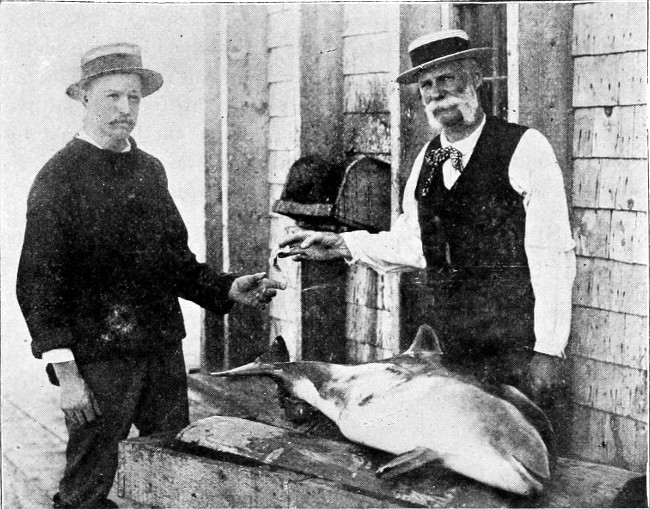
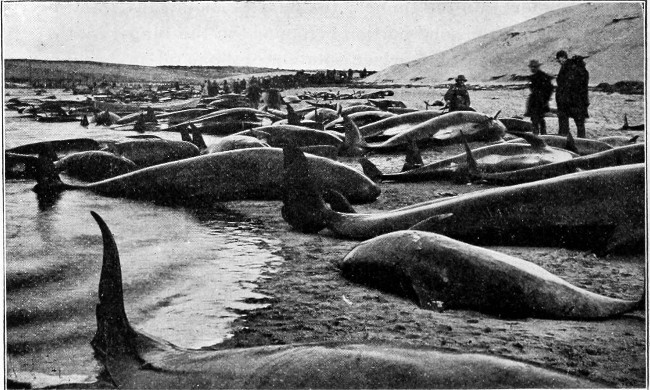
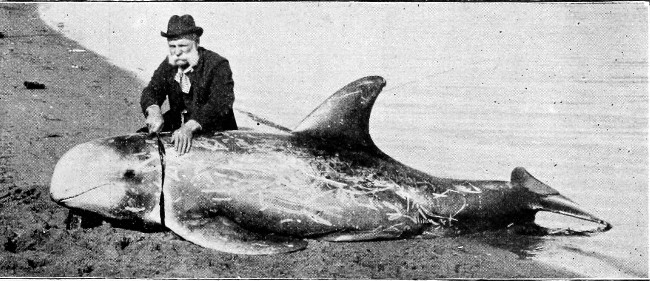
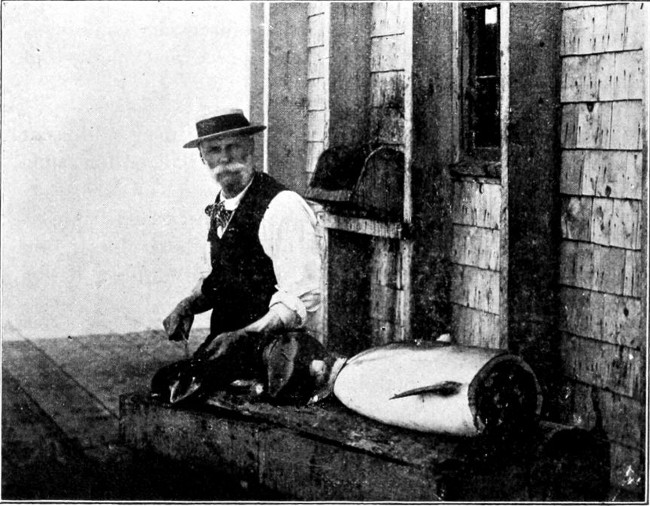
64. Porpoise Jaw Oil[13] and Blackfish Melon Oil have certain good
qualities which have made them very popular, particularly on this side
of the Atlantic. When properly refined (4-6) they are no doubt very
suitable for the work of reducing friction in small and delicate
mechanism.
65. Sperm Oil (7) had been used to some extent as a lubricant for
time-keeping contrivances; in fact, many tower clock experts still
employ it on the heavier bearings. A. Long, writing to the British
Horological Journal, describes a trip to the Arctic regions in 1814 and
1815, in which he states that a certain portion of the sperm oil they
obtained never congealed, which they preserved and applied to their
chronometers, and thus kept them going through the winter.
Others have experimented with it, and it was at one time largely used;
while some tower clock makers claim that they find it satisfactory. It
is, however, open to the objection that it would produce serious
variation when used in time-keeping mechanisms, as its viscosity varies
greatly with varying temperatures caused by the alteration of the
spermaceti it contains, thus causing sudden fluctuations of its
coefficient of friction (81). It also absorbs oxygen rapidly when it is
exposed to the air and loses quality seriously, gradually becoming
"gummed" or resinous. A gain of two to three per cent in weight in
twelve hours when exposed to the air at 140° F. (60 C), is caused by
this absorption of oxygen (10).
66. Bone Oil (8) has been widely used both in this country and in
Europe, and possesses some good qualities, not the least of which is the
property of resisting evaporation and oxidation.
67. Neatsfoot Oil (9) has been largely used, especially in Europe. The
writer regrets that he has not procured samples in order to ascertain
its relative value.
68. Olive Oil (10) has at least one good quality. It is one of the most
perfectly non-drying of all the oils, resisting both oxidation and
evaporation (24). But it is next to impossible to entirely remove its
acid qualities, small traces of which remain after the most thorough
treatment. It is also liable to decomposition, generating acids even
after refinement.
69. Mineral Oil (11) has been used as a lubricant for time keeping
mechanism; but as there are so many varieties on the market, each
differing from the others and possessing properties peculiar to itself,
and as many have made experiments which have not demonstrated that such
oils possess all the essential qualities of a perfect lubricant in
horology, the author believes that the abundance of kinds and qualities
of mineral oils has in the past been more or less confusing to the
majority of those who have experimented; and believes further, that if
the proper kind and quality of such oils had been used, all that could
be desired in a lubricant would have been shown to have been contained
therein.
Past experience has shown that many lubricants remained for years unused
for special purposes to which, when tried, they were found specially
adapted.
Though E. Rigg was probably in error in the matter previously discussed
(44) his otherwise excellent lecture contains the following:—[14]
"But there is another subject that has a still closer bearing on
friction as met with in time keeping instruments, and I cannot bring my
lecture to a close without reference to that most fruitful source of
trouble to the watchmaker—oil. Breguet, a very famous horologist, and
D'Arcet, an equally celebrated chemist, worked together at this problem
and what was the result? They produced an oil that was, according to
their theory, perfect; but when applied to watches it proved to be worse
than the ordinary oils of commerce. Since their day the chemistry of oil
has not made much progress, and the methods recommended for testing oil
are still very ineffectual. The only test of any use is actual trial for
a long period, and under varying conditions as to temperature, nature of
atmosphere, etc.; and there are several oils on the market more or less
satisfying the required conditions. So far as my knowledge goes,
however, all are liable to dry; and this prompts me to draw your
attention to a lubricator that has come into use for heavy machinery in
recent years, in the hope that it may afford a suggestion for the
improvement of watch oils. I allude to the mixture of certain kinds of
mineral oil with an oil that has a tendency to dry. Even a small
percentage is asserted to entirely check this tendency and the resulting
mixture is said to have the property of not in any way acting on or
damaging the metal to which it is applied. The thickness, or 'body,' is
made to vary according to the pressure to which the oil is subjected. *
* * * Would it be oversanguine to hope that some such mixture, prepared
from perfectly pure materials, might help even the chronometer maker to
secure more uniform rates? Absolute freedom from acidity means a
reduction of such electrical action as may occur at the pivots, and,
therefore, a greater permanency of the oil from this point of view."
70. Neutral Oil (14) seems to be especially adapted for use in horology.
Used in a pure state, or mixed in variable quantities with a good animal
oil, it can readily be made to fulfill the various conditions required
in all parts of watches, chronometers, mantel and tower clocks.
It is usually sold as such, but sometimes under the names "liquid
paraffine," "glycoline," "albolene," etc., while "solid paraffine,"
"white cosmoline," "solid alboline," are the names given to the thick
butyraceous mass from which neutral oils are made. Sometimes this
substance, as well as the liquid paraffine, is medicated or perfumed;
but it is hardly necessary to state that when thus treated it is unfit
for use in horology.
71. The Properties of Neutral Oil are stated to be:[15]
"It is a clear oily liquid, having a specific gravity of not less than
0.840 and boiling not below 360° C. (680° F.). It should be free from
colored, fluorescing, and odorous compounds.
"When heated for a day by means of a water bath, the paraffine should
not become dark colored, and the sulphuric acid should become only
slightly brownish. Metallic sodium treated in a similar manner should
retain its metallic lustre. Alcohol boiled with paraffine should not
have an acid reaction."
72. The Properties of Solid Paraffine (13) are given as follows:[16]
"The melting point of commercial paraffine varies much. Obtained from
the residuum of petroleum distillation it is usually 43° C. (109.4 F.),
or somewhat higher."
The acid and metallic sodium tests given for liquid paraffine will apply
to the solid paraffine.
73. The Value of a Lubricant as a lubricant is independent of the
market price; and it is at a maximum, according to Thurston, when it
possesses the following characteristics:
1. Enough "body," or combined capillarity and viscosity (82), to keep
the surfaces between which it is interposed from coming in contact at
maximum pressures.
2. The greatest fluidity consistent with the preceding requirements, i.
e., the least fluid friction allowable.
3. The lowest possible coefficient of friction under the conditions in
actual use, i. e., the sum of the two components, solid and fluid
friction, should be a minimum.
4. A maximum capacity for receiving, transmitting, storing and carrying
away heat.
5. Freedom from tendency to decompose or to change in composition by
gumming or otherwise, on exposure to the air (79) while in use.
6. Entire absence of acid or other properties liable to produce injury
of materials or metals (77) with which they may be brought in contact.
7. A high temperature of vaporization and a low temperature (83) of
solidification.
8. Special adaptation as to speed and pressure of rubbing surfaces under
which the unguent is to be used.
9. It must be free from grit and from all foreign matter.
The author will add that for use in horology:
10. It must possess a minimum variation of viscosity (84) in varying
temperatures.
The writer can see no reason why a mineral oil which has been properly
refined and of the proper consistency, either alone or mixed with
animal oil, could not be used to great advantage in horology. Indeed,
the possibilities in this direction seem to be so pregnant with promises
of good results that some space will be devoted to the matter.
74. The Special Advantages of Mineral Oils as lubricants in horology
are:
1. Mineral oils can be made entirely pure, and possess uniform and known
properties when derived from the same or a similar source; while the
quality of animal and vegetable oils varies from year to year,
depending, in animal oils, on the season of the year when the crude oil
is obtained, on the age and condition of the animal, and on the kind,
quality and quantity of food which it had (5) recently consumed; and in
vegetable oils on the season, soil, climate and method of treatment.
2. According to Thurston "All vegetable and animal oils are compounds of
glycerine with fatty acids. When they become old, decomposition takes
place and the acid is set free, by which action the oils become rancid.
This rancid oil or acid will attack and injure machinery. Again, all
animal oils contain more or less gummy matter, which accumulates when
exposed to the action of the atmosphere, and will, consequently, retard
the motion of the machinery."
3. Spon, in his Encyclopedia of the Arts, gives his views to the effect
that "The best oil is that which has the greatest adhesion to metallic
surfaces and the least cohesion in its own particles. In this respect
fine mineral oils stand first, sperm oil second, neatsfoot oil third.
Consequently the best mineral oils are the best for light bearings. The
best oil to give body to fine mineral oils is sperm oil."
4. "Mineral oils do not absorb oxygen," and consequently do not "gum" or
become viscous.—Thurston.
5. Mineral oils never become rancid in any climate, as they possess no
fatty acids.
6. Mineral oils produce very little fluid friction.
7. Mineral oils withstand a high temperature without decomposition or
vaporization, and a low temperature without solidification.
8. Properly prepared mineral oils are free from grit and all foreign
substances.
9. In addition to the above, a minor property of mineral oil is that
they are very cheap comparatively, while they do not possess any odor if
properly refined.
10. The variation of viscosity in varying temperatures is less in
mineral oils than in animal or vegetable oils.
75. Methods of Testing Oils are necessary in order to determine which
may be adapted to a specific purpose. Their peculiar characteristics
must be studied in order to know which will best fulfill the conditions
arising in actual practice. Experiments are necessary in which the oil
is subjected to conditions approximating, as nearly as possible, to the
conditions proposed in its actual use.
Saunier states[17] that "success depends largely on the skill of the
manipulator; and if he is not endowed with the power of judging, mainly
by the taste, whether oil satisfies certain prescribed conditions, he
can never be certain of the result." As the author's abilities in this
regard are not up to the required standard, and as some oils are
sometimes in such a state of decomposition that even the odor is
unpleasant, he has used other, and perhaps more satisfactory, methods of
determining the relative values of the various oils.
The following experiments show the relative values of oils that have
been, or may be, used in horology:
J. J. Redwood has made experiments on the action of oils upon metals,
especially for the purpose of determining which oils were best adapted
for use on the various metals and for ascertaining which oils were most
suitable for mixing as lubricants. He has tabulated the results of his
researches in two tables, which show that:[18]
Mineral oil has no effect upon copper and zinc, and attacks lead most.
Olive oil attacks copper most, tin least.
Sperm oil attacks zinc most, copper least.
The experiments show, on the other hand, that:
Brass is attacked most by olive oil.
Copper is not attacked by mineral lubricating oil, least by sperm oil.[19]
Dr. Watson states in regard to this action:
1. That of the oils used, viz., olive sperm, neat's-foot, and paraffine,
the samples of paraffine oil on copper was least affected, and that
sperm was next in order of inaction.
2. That the appearances of the paraffine oil and the copper were not
changed after an exposure of 77 days.
He later[20] experimented further with the following results noted,
after one day's exposure, with iron:—
1. Neat's-foot.—Considerable brown irregular deposit on metal. The
oil slightly more brown than when first applied.
2. Sperm.—Slight brown deposit with irregular markings on the metal.
Oil of dark brown color.
3. Olive.—Clear and bleached by exposure to light and air. The
appearance of metal the same as when first immersed.
4. Paraffine.—Oil bright yellow and contains a little brown deposit.
The action of oils on iron exposed to their action for twenty-four hours
and on copper after ten day's exposure was found to have been:—
| OILS. | IRON DISSOLVED IN 24 HOURS. | COPPER DISSOLVED IN 10 DAYS. |
| Neat's foot | .0875 grain. | .1100 grain. |
| Sperm | .0460 " | .0030 " |
| Olive | .0062 " | .2200 " |
| Paraffine | .0045 " | .0015 " |
76. Various Experiments have been made by the writer with a number of
oils that may be, or have been, used in horology, as well as with the
principal watch oils on the market. At first he did not intend to
mention the names of the manufacturers; but, after seeking advice of
several eminent watchmakers, and on mature consideration, he decided to
do so for the following reasons:—
1. The object of the Society before which these lectures were
delivered[21] is "to promote and to secure concerted action for the
purpose of mutual improvement in the practice of our profession as
horologists, by a study of both the practical and theoretical divisions
of the science and art of horology; to publish the results of such
study for the benefit of all in the profession; to preserve the same
for the use of our successors; to elevate the standard of workmanship;
and to encourage in the members a higher conception of what our art
really is."
As this object cannot be attained without the names of manufacturers
being mentioned in connection with their oils, the author considers that
this is sufficient justification.
2. No injustice can have been done the manufacturers when the author
states that the results obtained by him are not to be considered as
conclusive evidence regarding the properties of the oils tested, as the
samples he used may have been better than, or not so good as, the usual
output of the manufacturers whose names were on the labels.
3. Some of the manufacturers of oils sent samples subject to the
condition of the publication of the results, with the request that the
oils should be submitted to test, and if found wanting, they (the
manufacturers) certainly wished to know it.
| SYMBOLS EMPLOYED. | MANUFACTURER. | OIL. |
| NAME. | LOCATION. | KIND. | NAME. | SOURCE. |
| GENERIC. | SPECIFIC. |
| [B]E. K. w | Ezra Kelley | New Bedford, Mass. | Watch | Superfine | Animal | Porpoise jaw or blackfish—melon |
| [B]W. F. N. w | W. F. Nye | New Bedford, Mass. | Watch | Superior | Animal | Porpoise jaw or blackfish—melon |
| [A]D. C. S. w | D. C. Stull | Provincetown, Mass. | Watch | Superfine | Animal | Porpoise jaw or blackfish—melon |
| [A]D. C. S. ch | D. C. Stull | Provincetown, Mass. | Chronometer | Superfine | Animal | Porpoise jaw or blackfish—melon |
| [A]D. C. S. cl | D. C. Stull | Provincetown, Mass. | Clock | Superfine | Animal | Porpoise jaw or blackfish—melon |
| [B]W. C. w | W. Cuypers | Dresden, Germany | Watch | Superfine | Animal | Bone |
| [A]B. & K. w | Breitinger & Kunz | Philadelphia, Pa. | Watch | Superfine | Animal | Bone |
| [A]S. B. & Co. wc | Stevenson Bro. & Co. | Philadelphia, Pa. | Watch & clock | Album | Mineral | Neutral |
| [A]C. L. Co. w | Chem. Lub'g Co. | Brooklyn, N. Y. | Watch | Perfect | Mixed | Neutral & —— ? |
| [A][C]C. L. Co. No. 1 | Chem. Lub'g Co. | Brooklyn, N. Y. | Lubricating | No. 1 Synolene | Mineral | Neutral |
| [A][C]Glyc | Bullock & Crenshaw | Philadelphia, Pa. | Lubricating | Glycolene | Mineral | Neutral |
| [B][C]Alb. f | McKesson & Robbins | Philadelphia, Pa. | Lubricating | Fluid alboline | Mineral | Neutral |
| [B][C]Alb. s | McKesson & Robbins | Philadelphia, Pa. | Lubricating | Solid alboline | Mineral | Paraffine |
| [B][C]Sp | ——? | ——? | Lubricating | ——? | Animal | Sperm, whale |
| [B][C]Ol | ——? | ——? | Lubricating | ——? | Vegetable | Olive |
[Note A: Obtained as sample from manufacturer.]
[Note B: Purchased in open market.]
[Note C: Not sold as watch oil.]
4. On hearing of these experiments, others in the profession may be
tempted to make similar or other investigations and publish them.
5. In that case, if the results of many experiments demonstrate the
superiority of one particular kind of oil, the whole profession will be
profited thereby.
6. The manufacturers of oils may be caused to exert their utmost to keep
abreast of the times, and will see for themselves in what way their oils
may not fulfill the required conditions, thereby being the better
prepared to overcome the difficulties with which they meet.
For the sake of convenience the author has tabulated a list of the oils
which he has subjected to various tests, showing the name, kind and
source of each oil tested; also those which were obtained as samples,
and those which were purchased in open market, as well as those which
were not sold as watch oils, but which may be tried.
This is shown in table III.
77. The Action Of Oils On Brass has been determined by the author by
using a piece of good sheet brass into which suitable recesses were made
for the retention of the various oils. This plate was submitted to the
action of the air at temperatures varying from 24° to 37.5° C. (about
76° to 100° F.), for 100 days.
The results of this test are shown in Table IV. A further test, under
different conditions, gave results as shown in Table V.
SYMBOLS ACCORDING
TO TABLE III. | CONDITION. |
| | OF OIL. | OF BRASS. |
| E. K. | Light brown. | Brown. |
| W. F. N. | " | " |
| W. C. | " | Light brown. |
| B. & K. | " | " |
| C. L. Co. w. | Spread. | " |
| C. L. Co. No. 1 | Unaltered. | " |
| Glyc. | " | " |
| Sp. | Light brown. | Greenish-brown. |
| Ol. | Green. | Dark greenish-brown. |
SYMBOLS ACCORDING
TO TABLE III. | CONDITION. |
| | OF OIL. | OF BRASS. |
| E. K. w. | Very Light Brown. | No change. |
| W. F. N. w. | " " " | " " |
| D. C. S. w. | " " " | " " |
| D. C. S. ch. | " " " | " " |
| D. C. S. cl. | " " " | " " |
| W. C. w. | No change. | " " |
| B. & K. w. | " " | " " |
| S. B. & Co. w. & cl. | " " | " " |
| C. L. Co. w. | " " | " " |
| C. L. Co. No. 1 | " " | " " |
| Glyc. | " " | " " |
| Alb. f. | " " | Very light brown. |
| Alb. s. | " " | Unaltered. |
78. The Effect of Oils on Steel, with a view of ascertaining their rust
preventing properties, especially to see if the treatment of hairsprings
with a very slight film of oil (56), would prevent rust in warm, damp
climates was ascertained by the author, as follows: Each of twelve brass
pins, stuck vertically in a block of wood, had a colleted hairspring on
its upper end. The block of wood was allowed to float in water and
covered by a glass. One hairspring was left as it came from the factory,
while each of the others had been treated with a solution of porpoise
jaw oil and benzine, varying proportions of one to ten per cent of oil
being used, the balance being benzine. The hairsprings were dipped into
the solution, and, on withdrawing, were immediately placed between two
folds of soft linen cloth. In any case not enough oil remained on the
hairsprings to cause the coils to adhere. One per cent of nitric acid
was added to the water, and after ten days the hairsprings showed on
examination that they had rusted in proportion to the amount of oil that
had been used. Another trial, without acid in the water, and with one
hairspring treated with ether, one with benzine, one each with one, two,
five and ten per cent of porpoise jaw oil in benzine, and one each with
the same quantity of mineral oil in benzine, showed after thirty days
that the hairspring treated with ten per cent mineral oil was slightly
rusted, while those treated with ether and benzine were badly rusted,
and all the others were rusted more or less.
79. The Gumming and Drying of Oils is a very important consideration,
the former being caused by oxidation, while the latter is due to
evaporation.
In order to determine these properties in various oils the author used a
number of watch glasses, their convex side being glued to a board. Two
drops of oil were placed in each watch glass and spread over its concave
surface, and the board placed in a covered box in which suitable air
holes had been made, and allowed to remain in a temperature varying from
21° to 37.5° C. (= 70° to 110° F.) for 100 days, and at the end of that
time the results shown in table VI were noted.
SYMBOLS ACCORDING
TO TABLE III. | CONDITION. |
| E. K. w. | Slightly dried. |
| W. F. N. w. | Very slightly dried. |
| W. C. w. | Slightly gummed. |
| B. & K. w. | No change. |
| C. L. Co. w. | Slightly dried, and spread. |
| C. L. Co. No. 1. | No change. |
| Glyc. | No change. |
| Sp. | Slightly gummed. |
| Ol. | No change. |
80. The Viscosity Of Oils denotes an approximate measurement of their
relative lubricating power.
Professor Thurston states[22] that "large consumers of oil sometimes
purchase on the basis of this kind of test solely. It is regarded as
satisfactory and reliable as any single physical or chemical test known,
and is second only to the best testing machine methods.
The less the viscosity, consistently with the use of the oil under the
maximum pressure to be anticipated, the less is, usually, the friction.
The best lubricant, as a rule, is that having the least viscosity
combined with the greatest adhesiveness. Vegetable oils are more viscous
than animal, and animal more so than mineral oils. The fluidity of an
oil is thus, to a large extent, a measure of its value."
The relation between the viscosity and the friction reducing power of
oils has been determined by Mr. N. C. Waite[23] and others to be very
close.
An oil having little viscosity is suitable for the escapement and
lighter parts of the train, but is not a good lubricant for the bearings
of the center pinion and barrel arbor and the mainspring, which require
a more viscous lubricant; while a still greater viscosity renders it
more serviceable on the stem winding mechanism (59) and in the pendant
(60).
Again, an oil that possesses sufficient "body," or combined capillarity
(32) and viscosity, to resist the tendency to be "squeezed" from between
the bearing surfaces in the heavier parts of the mechanism will produce
a great excess of fluid friction in the lighter parts of the train and
in the escapement.
81. The Relative Viscosity of Oils is determined in several ways.
Various machines have been devised for testing the lubricating
properties of oils, but as the cheap ones are of no use, and as those
which are reliable are so expensive as to prohibit their general use
except in laboratories and large factories, a simple method of
ascertaining the relative viscosity of oils is desirable.
The author used a piece of plate glass of suitable size on which one
drop of each oil to be tested was placed near its end. The glass
inclined from the horizontal, longitudinally—the angle of inclination
being 6 degrees—and was placed in a constant temperature of 15.5° C. (=
60° F.)
The total distance in centimeters which each had traveled by the end of
each day, as well as the appearance of the "track" which it had left is
shown in table VII.
SYMBOLS ACCORDING
TO TABLE III. | DISTANCE IN CM. TRAVELED BY OIL AT THE END OF EACH DAY. | WIDTH OF TRACK. |
| DAYS. | 1 | 2 | 3 | 4 | 5 | 6 | 7 |
| E. K. w. | 16 | 18 | Stat. | ... | ... | ... | 18 | Medium. |
| W. F. N. w. | 15 | 16.5 | 18 | 19 | 20 | Stat. | 20 | " |
| W. C. w. | 17.5 | 19 | 20 | Stat. | ... | ... | 20 | Narrow. |
| B. & K. w. | 12.5 | 15 | 17.5 | 20 | Stat. | ... | 20 | " |
| C. L. Co. w. | 7.5 | 10 | 12.5 | 15 | 17.5 | Stat. | 17.5 | Very wide. |
| C. L. Co. No. 1. | 15 | 16.5 | 18 | Stat. | ... | ... | 18 | Medium. |
| Glyc. | 15 | 16.5 | 18 | Stat. | ... | ... | 18 | " |
| Sp. | 0 | 2.5 | 5 | 7.5 | 9 | 10 | 11 | Narrow. |
| Ol. | 5 | 6.5 | 7 | Stat. | ... | ... | 7 | " |
Table VII not only shows the relative viscosity of the various oils, but
also their tendency to gum or dry (79.) The "width of the track" left by
the oil is an indication of the cohesion (20) and adhesion (21) which
exists, respectively, in the oil and between the oil and the glass. A
narrow track denotes great cohesion and little adhesion; a wide track
denotes great adhesion and little cohesion; while a medium track
indicates that both properties are more nearly equal.
If an oil possess great adhesion and little cohesion it is more liable
to resist the tendency to be squeezed out of bearings, but it is also
more likely to spread.
Another test made in the manner just described (table VII) gave results
as shown in table VIII:
SYMBOLS ACCORDING
TO TABLE III. | DISTANCE IN CM. TRAVELED BY OIL AT THE END OF EACH DAY. |
| Days. | 0.3 | 1.3 | 2.3 | 3.3 | 4.3 | 5.3 | 6.3 | 7.3 |
| E. K. w. | 14 | 23 | 26.5 | 28.5 | 29.5 | 31.5 | 32.5 | 33 |
| W. F. N. w. | 12.5 | 20 | 26.5 | 29 | 31 | 32.5 | 33.5 | 34 |
| W. C. w. | 19 | 24 | 26.5 | 28 | 29 | 30.5 | 32 | 33 |
| B. & K. w. | 14 | 17.5 | 25 | 27 | 29.5 | 31.5 | 33 | 33.5 |
| S. B. & Co. w. c. | 10 | 20 | 26 | 26.5 | 27 | 27.5 | 28 | 28.5 |
| C. L. Co. w. | 29 | 38 | 40.5 | 42.5 | 43 | 43.5 | Stat. | 43.5 |
| C. L. Co. No. 1. | 17.5 | 23 | 27 | 28 | 29 | 30 | 31 | 32 |
| Glyc. | 17.5 | 23 | 28 | 30 | 32 | 34 | 35 | 35.2 |
| Alb. f. | 15 | 20 | 29 | 33 | 35 | 37 | 38 | 38.5 |
The author once heard a watchmaker say to a customer, when the latter
called for a clock which had been left for repairs, "I have cleaned your
clock thoroughly; and, as you are a good customer, I made as good a job
of it as I could. I even oiled it with watch oil." This watchmaker
evidently thought he was right. It is hardly necessary to mention that
a stock of oils of different viscosity should be kept on hand and
intelligently used; the different bearings in any time keeping mechanism
requiring oils of different viscosity. It is not to be supposed that the
author means each bearing in a watch is to have a separate oil
applied; but a distinction should be made between the light and heavy
pressures.
82. The Effect Of Heat On Oils is very marked in all cases; some oils
being much more subject to change than others, in viscosity and other
properties, under the influence of an increase of temperature.
The lubricating power of an oil is decreased, while its tendency to
spread is increased, with a rise of temperature. In order to ascertain
the relative values of various oils in this respect the writer used a
plate of glass 28 cm. x 40 cm., placed it flat on a table, and,
depositing one drop of each oil near one of its longer edges, allowed it
to remain in a temperature of 21° C. (= 70° F.) for 30 minutes. At the
end of this time the glass plate was placed in a vertical position, with
its edge near which the drops of oil had been deposited uppermost and
horizontal. The time required by each oil to run down to the bottom, a
distance of 25 cm., was noted. The width of the track, at a point 3 cm.
from the location of the drop at the start, was measured when the oil
had passed that point, and again measured at the same point when the
oil had reached the bottom.
The same test was repeated, with all the conditions similar except that
the temperature of the room was raised to 38° C. (= 100° F.) before the
oil was placed on the glass; but the glass was allowed to remain in this
temperature also for 30 minutes.
The results of both experiments are shown in table IX.
| SYMBOLS ACCORDING TO TABLE III. | MINUTES REQUIRED TO FLOW 25 CM. AT A TEMPERATURE OF | WIDTH OF TRACK IN MM. AT A POINT 3 CM. BELOW STARTING PLACE WHEN THE OIL HAD FLOWED |
| 21°C. =70°F. | 38°C. = 100°F. | Temp. 21°C (=70°F.) | Temp. 38°C. (=100°F.) |
| 3 CM. | 25 CM. | 3 CM. | 25 CM. |
| E. K. w. | 21 | 14 | 5 | 5 | 5 | 5 |
| W. F. N. w. | 18 | 12 | 5 | 5 | 5 | 5 |
| D. C. S. w. | 20 | 13 | 5 | 5 | 5 | 5 |
| D. C. S. ch. | 15 | 10 | 5 | 5 | 5 | 5 |
| D. C. S. cl. | 20 | 11 | 5 | 5 | 5 | 5 |
| W. C. w. | 13 | 8 | 5 | 1 | 5 | 1 |
| B. & K. w. | 13 | 11 | 5 | 0 | 5 | 0 |
| S. B. & Co. w. c. | 15 | 11 | 6 | 6 | 6 | 8 |
| C. L. Co. w. | 17 | 15 | 6 | 7 | 7 | 8 |
| C. L. Co. No. 1. | 15 | 10 | 6 | 6 | 5 | 5 |
| Glyc. | 14 | 10 | 6 | 6 | 5 | 8 |
| Alb. f. | 14 | 10 | 6 | 6 | 5 | 6 |
| Sp. | 10 | 7 | 6 | 1 | 5 | 0 |
| Ol. | 14 | 12 | 5 | 2 | 5 | 1 |
While the relative viscosity of oils in varying high temperatures is
shown in table IX, the width of the track indicates the same properties
as were explained in reference to table VII. Thus it is seen that the
third and fifth columns of figures denote the relative adhesion of the
oils, approximately according to the value of the figures; while the
fourth and sixth columns exhibit their relative cohesion, and absence of
adhesion, approximately according to the inverse value of the figures.
Thus the tendency of the oil to spread, in the warm temperature to
which time keeping mechanisms are frequently subjected, is indicated.
83. The Effect Of Cold On Oils is very observable in some varieties,
converting them into greases, or even into hard, waxy solids. For
out-of-door work unguents must be selected that will "feed" at any
temperature to which they are exposed in the working of the bearings to
which they are applied.
The author has subjected various oils to a low degree of temperature,
using a sufficient number of thin glass test tubes of 3 cubic
centimeters capacity,[24] into each of which 2 cubic centimeters of the
oils to be tested were poured. The test tubes were then tightly corked
and properly secured to a thin board, and placed in a temperature of
-15° C. (= 5° F.) the condition of the oils being noted at various
intervals, the result of which is shown in table X.
84. The Variations of Viscosity of Oils in Varying Temperatures always
create fluctuations of their friction reducing power; while the
variations of fluid friction which result are also of great importance
in horology. When it is known that the viscosity and lubricating power
of an oil are usually (80) very closely related, it is seen that change
of temperature has an exceedingly important effect upon oils, even for
general lubricating purposes; but particularly so when they are applied
to small and delicate mechanisms.
An oil of the proper viscosity at ordinary temperatures may be very
unsuitable in an extreme of heat, or cold, to which timepieces are
frequently subjected—on account of being too limpid in high
temperatures to properly separate the rubbing surfaces; while in low
temperatures it may become so viscous as to seriously impede the motion
of the escapement and the lighter parts of the train.
SYMBOLS ACCORDING
TO TABLE III. | CONDITION OF OIL. |
| TIME. | 15 MIN. | 30 MIN. | 1 HOUR. | 6 HOURS. | ORDER OF
VISCOSITY |
| E. K. W. w. | ... | ... | ... | ... | 2 |
| W. F. N. w. | ... | ... | t-f. | t-f. | 4 |
| D. C. S. w. | ... | ... | ... | ... | 2 |
| D. C. S. ch. | ... | ... | ... | ... | 2 |
| D. C. S. cl. | s-s. | s-s. | s-s. | s-s. | 6 |
| W. C. w. | ... | ... | ... | ... | 2 |
| B. & K. w. | ... | ... | ... | ... | 2 |
| S. B. & Co. w. c. | ... | ... | ... | ... | 1 |
| C. L. Co. w. | s-s. | s-s. | s-s. | s-s. | 5 |
| C. L. Co. No. 1. | s-s. | s-s. | s-s. | s-s. | 7 |
| Glyc. | ... | ... | ... | ... | 1 |
| Alb. f. | ... | ... | ... | ... | 3 |
| Sp. | s-s. | s-s. | s. | v-s. | 8 |
| Ol. | v-t-f. | s-s. | s. | v-s. | 9 |
T. F. = Thickly fluid; or like honey. V. T. F. = Very
thickly fluid; or like jelly. S. S. = Semi-solid; or like
butter at 60° F. S. = Solid; or like butter at freezing
point. V. S. = Very solid; or like paraffin wax.
The figures in the last column denote the apparent relative
viscosity, as ascertained by inverting the test tubes
repeatedly.
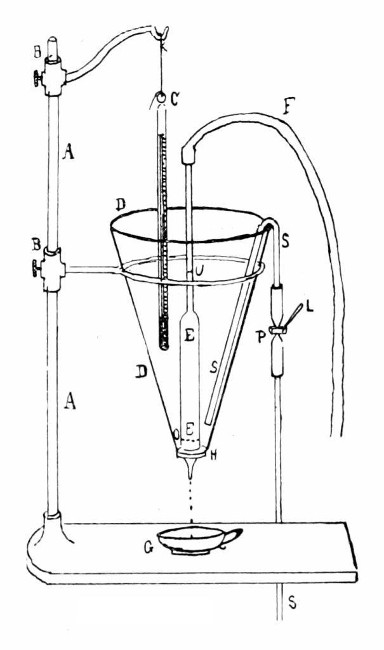 Fig. 15
Again, even if the oil were viscous enough in high temperatures to
resist the tendency to be "squeezed" out of the bearings, the rate of
the timepiece would be seriously affected by the variation of solid and
fluid friction—especially the latter—caused by a variable viscosity of
the oil.
When a watch, chronometer or clock has been so adjusted as to keep a
maximum even rate, the oil is one of the factors of the variation
which has been overcome; and it is obvious that if another oil be used,
in which a greater or less variation of viscosity exists than in the oil
with which such timepiece was lubricated prior to adjustment, the
variation so produced will be more or less observable.
It is, then, evidently necessary to be able to ascertain, with the
greatest possible exactness, what change in this respect is produced in
the various oils by a change of temperature. The means previously given
(81-83) have their value; but when supplemented by a method for
determining the particular property under consideration, the results
obtained are exceedingly interesting and valuable. On account of the
importance of this matter the author has made investigations in this
direction, using a "viscosimeter" as shown at Fig. 15, and of which the
following is a description:
AA represents an ordinary retort stand, with adjustable arms, BB, for
holding in position the thermometer C, and the funnel DD capable of
holding about one pint of water. EE is the viscosimeter proper, a glass
tube, swollen at the lower end, and terminating in a circular orifice of
1 millimeter (= .04 inch) in diameter;[25] being a "pipette" holding one
cubic centimeter of oil between the dotted lines U and O.
F is a flexible gum elastic tube fitting with an air-tight joint to the
upper end of the glass tube. The funnel is closed at its lower end by a
tightly-fitting cork H, in which an opening is made, through which
opening the pipette passes and projects slightly below. G is a small,
shallow vessel, preferably of glass, of sufficient capacity to receive
the contents of the pipette. S is a syphon composed of a glass tube in
two sections—united by a short piece of rubber tube on which the
device P pinches by the adjustment of the lever L—the bent section
beginning near the bottom of the funnel, while the straight section
terminates below the level of the table on which the retort stand is
placed.
In operating with this, the author proceeded as follows: The funnel was
partially filled with water, and hot water added until its temperature
reached 43° C. (= 110° F). A sufficient quantity of the oil to be tested
was placed in the glass vessel G, and drawn into the viscosimeter by
gentle suction of the mouth until it exactly reached the line U, where
it was retained, by a slight pressure with the thumb and finger, for
five minutes, the temperature of the water in the funnel being kept
constant. At the end of that time, after being sure that all the
conditions as to temperature and quantity of oil were satisfied, the
pressure of the thumb and finger was relaxed, when the oil began to drop
through the lower end of the pipette.
The time required for the upper surface of the oil to fall from U to O
was carefully ascertained by means of a "stop watch," and the number of
seconds noted. In case of doubt the test was repeated.
The temperature of the water in the funnel was then lowered by the
addition of ice, to 38° C. (= 100° F.), when the operation was again
performed as just described. This was repeated at regular intervals of
temperature down to 4° C. (= 40° F), when the water was again heated,
the pipette thoroughly cleansed by introducing benzine into the pipette
in a manner similar to that by which the oil was introduced. The surplus
water which accumulated in the funnel was allowed to escape through the
syphon by relaxing the lever of the pinching device. It is obvious that
the number of seconds, in each case, corresponds to the viscosity. Other
oils were put through the same course, the results obtained being shown
in table XI.
| SYMBOLS ACCORDING TO TABLE III. | SECONDS REQUIRED FOR 1 C. C. OF OIL TO FLOW THROUGH AN ORIFICE OF 1 MM. (= .04 IN.) |
| Temp.{A} | CENT. | 4.5 | 10 | 15.5 | 21 | 26.5 | 32 | 37.5 | 43 |
| FAHR. | 40 | 50 | 60 | 70 | 80 | 90 | 100 | 110 |
| E. K. w. | 25 | 20 | 17 | 15 | 10 | 8.5 | 7 | 6 |
| W. F. N. w. | 27 | 20 | 14 | 11 | 9 | 8 | 7 | 6 |
| D. C. S. w. | 32 | 23.5 | 19 | 15 | 12.5 | 11.5 | 9.5 | 8 |
| D. C. S. ch. | 28 | 23 | 17 | 14 | 11.5 | 9 | 7 | 6 |
| D. C. S. cl. | 29 | 20 | 17 | 14.5 | 11 | 8.5 | 7 | 6.5 |
| W. C. w. | 24 | 20 | 18 | 13 | 11.5 | 10 | 8 | 7 |
| B & K. w. | 46 | 35 | 25 | 20 | 17 | 15 | 11.5 | 10 |
| S. B. & Co. w. c. | 21 | 16 | 11.5 | 10 | 9 | 8 | 7 | 6.5 |
| C. L. Co. w. | 14 | 10 | 9 | 6.5 | 5 | 4.5 | 4 | 3.5 |
| C. L. Co. No. 1. | 32 | 28 | 12.5 | 10 | 8.5 | 7.5 | 6.5 | 6 |
| Glyc. | 19 | 13 | 10 | 9.5 | 7.5 | 6.5 | 5.5 | 5 |
| Alb. f. | 25 | 19 | 16 | 13 | 10 | 8 | 6.5 | 5.5 |
[Note A: The readings of the Centigrade and Fahrenheit scales given here
are not exactly equivalent; but they are near enough for all practical
purposes.]
85. Mixed Oils have been tried by many who have been desirous of
obtaining a better lubricant. A mixture of different kinds of animal or
vegetable oils—or a combination of both—has usually proved worse than
any single one of the components; as, when it is known that
"alterations[26] of composition occur in the animal and vegetable oils
with exposure to air and light and with advancing age" (74-2), it is
obvious that this chemical action is accelerated by a mixture.
The mineral oils are not subject to such alterations to any serious
extent; and, when they are compounded with animal or vegetable oils, the
resulting mixture partakes of the good qualities of both, according to
experiments which the author has made. It would make this paper[27] too
lengthy to insert the results; however, a future opportunity may not be
wanting.
86. Various Manufacturers of watches, chronometers and clocks, have
favored the writer with more or less valuable information in answer to
queries on the subject, which has been tabulated and which is shown in
table XII.
It is necessary to know just what kind of oil has been used by the
manufacturer of a time piece for three reasons:—
(1.) If some of the bearings need a small quantity of oil, being
otherwise in such good condition—because of never having been used, in
fact "new"—that it is unnecessary to take all the mechanism apart and
clean it, it is very important that the operator know what kind, or
variety, of lubricant has been previously used, in order not to "mix
oils;" or, if a mixture is thus made, to make it intelligently. (85.)
(2.) When the oil which has been applied in the factory has not
performed its functions properly in any part of a time piece, it is
necessary to know what particular variety of lubricant has been used in
order to substitute an oil which possesses the properties lacked by the
oil previously used. (61.)
(3.) In a watch which has been so adjusted as to keep a maximum even
rate, the oil is one of the factors of the variation which has been
overcome. It is necessary, then, on putting the watch in order, to
employ a lubricant which possesses the same variation of viscosity as
the oil which was used during adjustment. (84.)
Some other interesting facts are shown in table XII, as well as the
foregoing. The queries were as follows:—
QUESTIONS ASKED.
1. What oil do you use?
2. What oils have you tried?
3. What has been your experience with mixed oils?
4. Do you use the same grade of oil on all parts of your ——?
5. If not, what is your practice?
6. What amount of oil do you use annually?
The answers are given in Table XII.
87. Impurities in Oils and all foreign matter exert a very injurious
effect. The method of sealing the bottles with sealing wax or gum labels
should be avoided; the former, as the wax is brittle and liable to break
in very fine pieces which lodge around the cork from whence they get
into the oil; and the latter because the gum with which it is caused to
adhere remains on the bottle, only to be absorbed by the oil.
Paraffin wax makes a very good sealing material, as it is not brittle,
and keeps the oil protected from the air. An extra long cork should
accompany each bottle.
| Manufacturer. | 1 | 2 | 3 | 4 | 5 | 6 |
| American Waltham Watch Co. | Several. | Several. | Small. | No. | Heavier oil on barrel arbors and winding Wheels. | 8 quarts |
| Elgin National Watch Co. | Smith's on fine work. Nye's. | Kelley's. Cook's. Nye's. Wheeler's. Smith's. | | No. | Light oil on escapements, and oil with more body in mainspring boards. | 1-1/2 gallons. |
| Hampden Watch Co. | Kelley's. | Kelley's. | Unsatisfactory | Yes. | | |
| Illinois Watch Co. | Nye's. | Kelley's. Cook's. And others. | Do not use Mixed Oils. | | | 3 quarts. |
| New Columbus Watch Co. | Nye's. | Nye's. Kelley's. | None. | No. | Chronometer oil on stem-wind and do no experimenting. | 1 gross bottles regular size. |
| New York Standard Watch Co. | Kelley's. | Kelley's. | None. | No. | Watch oil on train pivots, and clock oil on stem wind. | 2 quarts each. |
| Rockford Watch Co. | Kelley's. | Kelley's Ayer's. Guyjers? Smith's. | | Yes. | | |
| Trenton Watch Co. | Nye's. | | | Yes. | | |
| Waterbury Watch Co. | Smith's. | Kelley's. Nye's. Smith's. And others. | Not a Success. | Yes. | | 1 gallon. |
| Seth Thomas Clock Co. | Nye's. | Most others. | None. | Yes. | Watches, lightgrade. | |
| Yes. | Clocks, medium grade. |
| Yes. | Tower Clocks, heavy grade. |
|
| E. Howard Watch & Clock Co. {1} | Sine Dolo | Stevenson's. Blackfish. Porpoise-jaw. Rock. | None. | No. | On all bearings the same oil, but on mainspring a rock oil. | 1 gallon. |
| {2} | Kelley's. | | None. | Yes. | | 1 gallon. |
| {3} | Rock Oil. | | Satisfactory. | Yes. | | 10 gallon. |
| H. H. Heinrich,Chronometer Maker. | Stull's. | Every kind in the market. | Unsatisfactory. | No. | Light oil for small pivots and heavier oil for larger pivots. | 1 pint. |
| New Haven Clock Co. | Stull's. Kelley's. | Stull's. Blackfish. Porpoise. | Unsatisfactory. | Yes. | A light oil on clock-watches. | 20 gallons. |
| Yes. | A heavy oil on clocks. |
| Ingraham Clock Co. | Porpoise. | Rock. Mixed. | Unsatisfactory. | Yes. | | 12 gallons. |
| Waterbury Clock Co. | Stull's. | Stull's. Smith's. Stevenson's. | None. | Yes. | | 15-20 gals. |
| Wm. L. Gilbert Clock Co. | Nye's. | Nye's. Smith's. Kelley's. Comstock's. | | | | 10-12 gals. |
[Note 1: Watch.]
[Note 2: Regulator.]
[Note 3: Tower Clock.]
Then again some workmen leave the oil bottle standing open, which is
obviously a very careless proceeding. The author has seen a bottle one
quarter full of dust, the oil still being used from the top. When oil is
to be placed in the oil-cup, it should be done by using a small, clean
glass rod—kept for the purpose—and never poured out of the bottle.
The oil cup should always have the cover on except when taking oil from
it. Before it is refilled it should be very carefully cleaned.
The oiler should be perfectly clean, that kind which has a hexagonal nut
on the handle and a gold tip being very excellent. Some careless workmen
wipe the oiler on the back of the hand, on the clothes, on a dirty rag,
on an old chamois, etc. The tip of the oiler should never touch the hand
or fingers, as the acids in the perspiration are sure to cause a bad
effect on the oil.
The following is a list of "oilers" which the author has seen used:—Peg
wood, broom straw, quill, toothpick, match-stick, screw driver,
tweezers, rat-tail file, piece of copper wire, horse-shoe nail, steel
pen.
If dust be on the bench paper, or in the movement tray, the pivots will
surely transfer some of it to the bearings when the wheels are being put
to place.
The scape-wheel, mainspring and other parts, the rubbing surfaces of
which may come in contact with the fingers, should be so handled as to
allow no perspiration to become deposited on any surface which may
afterwards require oiling, as the acids contained in the perspiration
will exert an injurious effect on the oil.
The owners of watches sometimes subject them to very hard treatment by
using perfumes, etc., and then some people perspire more than others,
while the perspiration of some persons contains more acids, or is more
rancid, than that of others. For these reasons the method of testing oil
by putting it on watches kept to loan to customers as Saunier recommends
cannot be relied on.
Oils should be kept in a clean, cool, dark place. The wrapper or label
on the bottle should be dark blue or black, to exclude all light, as, if
this is not done, the oil will be more liable to decomposition, except
in the case of a mineral oil, which is not affected by light. All
vegetable and animal oil which has been "bleached" by exposure to the
light is more liable to decomposition on exposure to air than that which
is unbleached.
88. The Effect of Age on Oils. Writing on this subject Mr. Henry G.
Abbott[28] states as follows: "There is a popular fallacy existing in
the trade that oils should be used when fresh, and even that
acknowledged authority, Saunier, says, 'do not buy from motives of
economy bottles that have laid for years in the shop.' This may be true
and probably is in regard to animal and vegetable oils, which are likely
to become rancid if kept for a long time, but William F. Nye, one of the
largest and most celebrated manufacturers of fine watch and chronometer
oils in the world, declares that blackfish oils are improved by age, and
his oils are seldom placed on the market in the same year as obtained.
We are indebted to the same authority for the statement that oils of
this kind are clearer and more brilliant after some years than fresh
oils." Though Mr. Abbott has made some very valuable additions to the
literature of the profession, the author begs permission to call
attention, in reference to this, to the following facts:
Mr. Abbott says that vegetable and animal oils are likely to become
rancid if kept for a long time, but blackfish oils are not. Brant[29]
states that the porpoise or Phocoena communis, Cuv., and the
blackfish, or Phocoena globiceps, are of the subdivision
Delphinodea, or dolphins, of the family of Cetacea, or whales, an
order of the vertebrated mammiferous marine animals. Adler Wright[30]
states that "the term 'train oil,' strictly speaking, applies to any oil
extracted from the blubber of cetaceans and the allied marine mammalia,
such as the seal, porpoise, dolphin and walrus." Huxley classes among
cetacea the dolphins, porpoises, grampus and narwhal. Authorities might
be quoted ad infinitum to show, not only that porpoise-jaw oil and
blackfish-melon oil are animal oils, but that they possess properties
similar to other animal oils as far as their liability to decompose by
age, more or less, is concerned.
Furthermore, Thurston[31] states that "all vegetable and animal oils are
compounds of glycerine and the fatty acids. When they become old
decomposition takes place, and acid is set free, by which action, as is
commonly said, the oils become rancid." Thus Saunier is borne out in his
admonition.
89. In Conclusion, the author wishes to state, that as he has been able
to find but little in the literature of the craft in English, French or
German, he has pursued the study of the "properties and relative values
of lubricants in horology" upon lines which have suggested themselves as
being best adapted to give good results. As much that is herein
contained is new and original in its application in horology, the
theories advanced may be in some respects incorrect. The tests of
various oils have, no doubt, been subject to personal error; but it has
been the earnest desire of the author to give the subject the attention
it deserves.
In order that truth may prevail and that justice may be done to the
various manufacturers of oils, as well as to the author and his subject,
he will again request criticism through the trade press in any matter in
which he may seem to be at fault. He further wishes that others may
become interested, and that the makers and repairers of watches,
chronometers and clocks, as well as the manufacturers of oil, will
further assist in these investigations by making similar or other
experiments, and report the result of the same through the trade press
in order that this very important subject may be thoroughly understood.
In furtherance of this object the author will furnish samples of oils
free to anyone wishing to make experimental tests of any kind, on
condition that the results of such tests shall be published or
communicated to the author for future publication. Address, W. T. Lewis,
President Philadelphia Horological Society, Philadelphia, Pa.