During a visit to Italy in the summer of last year the writer made some
notes on the composition, colour, technique, and present state of some
of the Italian frescos, which he hopes may interest the reader.
Among the frescos by Giotto (1276-1336) which still exist in Florence,
perhaps the finest are those in the Bardi Chapel, in the Church of Santa
Croce, where so many of the illustrious Florentines are laid at rest.
“ ... here repose
Angelo’s, Alfieri’s bones, and his,
The starry Galileo, with his woes;
Here Machiavelli’s earth returned to whence it rose.”
The three small frescos on the walls of the cloisters of the Church of
Santa Maria Novella are of great interest to students, as they were
painted by Giotto when his artistic powers were in full maturity, and
are among the best examples of the master.
On the walls and ceiling of the Bardi Chapel, Giotto has painted a
series of frescos illustrating scenes in the life and death of St.
Francis of Assisi. On the right wall, beginning from the top, is the
“Confirmation of the Rules of his Order by the Pope”; “St. Francis
before the Sultan”; “Challenging the Magi to the Ordeal of Fire”; “St.
Francis blessing Assisi”; and, his appearing to the Bishop of Assisi. On
the left wall are the paintings, “St. Francis flees from his Father’s
House,” and, his Death, where he is surrounded by his sorrowing
confraternity. The latter fresco is the lowest one on the left, and is
one of Giotto’s best compositions, though it is not much more than a
coloured outline, and has been much repainted. It is the only painting
of the series in this chapel which has been noticed by Vasari in his
life of Giotto. The figures in this fresco are painted almost in
grisaille, with the exception of the cloak of the kneeling figure of the
podesta, which is a deep red. The sky, which has been repainted, is a
dark blue, in the centre of which appears the figure of the saint in a
halo, surrounded, or supported by four angels on clouds. The colouring
of this portion is in beautiful golden tints, and is evidently the
untouched work of Giotto’s hand. The background architecture is
expressed in broken tints of a yellowish stone-colour. In spite of the
repainting, the complete design and some of the original colouring and
handling still remain. It is
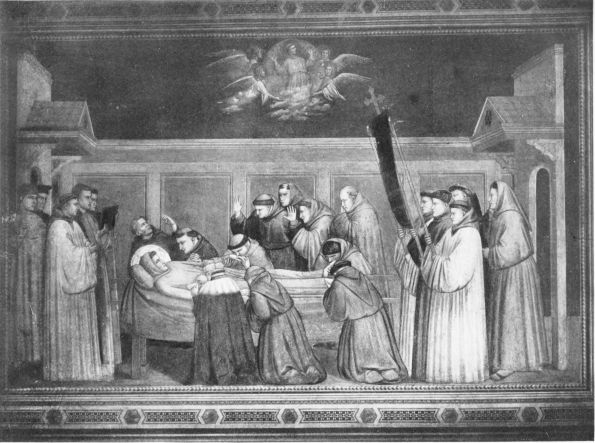
Photo. Alinari.
[To face p. 40.
Plate 12.—Death of St. Francis
Giotto, Bardi Chapel, Sta. Croce, Florence
one of the best of Giotto’s didactic works, apart from the excellence of
its design. The saint, sketched calmly in death; the intense, yet
dignified sorrow of some of his surrounding brethren; and the eager
examination by others of the marks of the stigmata, are well expressed
in the attitudes and faces of the central groups of figures, while both
sides of the painting are occupied by observant and stately figures, who
look on the central scene where all the action is represented. This
symmetrical kind of composition, produced by placing the more quiescent
and choragic figures at either side of the picture, and the chief actors
in the centre, was a favourite design of Giotto’s, which he adopted in
many of his great works—among others, for example, in “St. Francis
fleeing from his Father’s House,” painted on the upper part of the left
wall, and in the “Ordeal of Fire,” on the centre of the opposite wall.
It may be pointed out that many Italian artists subsequent to Giotto
have also adopted this arrangement in their decorative compositions.
It is a moot question whether Giotto thought the illustration of the
scene, or the story, or the correct balance and distribution of the
units of his composition was the more important; in any case, however,
he invariably told his story well, no one could tell it better, while at
the same time his compositions are undoubtedly consistent with the
principles of good decoration.
In this chapel of the Bardi, on either side of the window, Giotto has
painted life-size figures of St. Louis (King of France), St. Louis of
Toulouse, St. Elizabeth of Hungary, and St. Claire. Each is standing
under a painted niche of the Campanile-Gothic architecture. The “St.
Louis of France” is the most interesting, and the finest figure of the
series; and although considerably repainted, it has still much of
Giotto’s work left untouched, especially in the head and hexagonal
pointed crown. It is a most dignified and serious rendering of the
saintly king, as he stands in a firm and easy pose, Osiris-like, with
his kingly attributes of sceptre and whip of authority in either hand.
The three small frescos by Giotto, painted on the walls of the
cloisters, in the Church of Santa Maria Novella, at Florence. Two of
these, the “Meeting of Joachim and Anna at the Golden Gate,” and the
“Birth of the Virgin,” are on the recessed wall, on either side of the
tomb of the Marchessa Strozzi-Ridolfi, and on the right of these two
will be found the third, the “Presentation of the Virgin at the Temple.”
These small frescos measure each about 4 feet in width, and are shaped
like quarters of a circle. From the technical point of view, the
“Meeting of Joachim and Anna” is the most interesting, as it has
suffered least of the three from repainting, and there are some fine
passages of beautiful, though faded colour, and of frank and decisive
brushwork, which is decidedly characteristic of the hand of
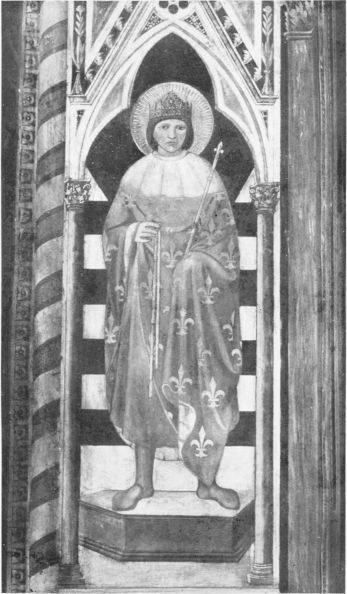
Photo. Alinari.
[To face p. 42.
Plate 13.—St. Louis, King of France
Giotto, Bardi Chapel, Sta. Croce, Florence
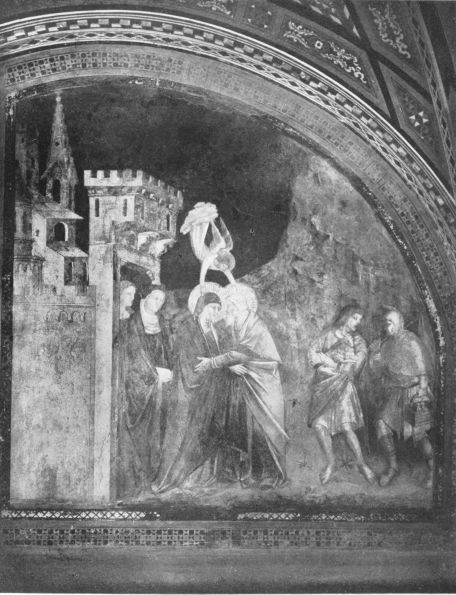
Photo. Alinari.
[To face p. 43.
Plate 14.—Meeting of SS. Joachim and Anna at the Golden Gate
Giotto, Cloisters of Sta. Maria Novella, Florence
Giotto. Joachim is clothed in red drapery, the folds of which are very
naturally arranged, and the technique of the painting of this garment
reveals the swift and sure touch of the master. There is no hesitation
in the execution of the brush-drawn folds, the colour is laid on thinly
and transparently, so that the effect of the light ground is still
apparent through the superimposed tints. Giotto painted his frescos, as
far as one can make out, very thinly, and so aimed in getting a luminous
and almost transparent effect, so we may safely come to the conclusion
that when certain parts of his frescos look heavy and solid we may be
sure that those parts have been repainted by some one else. St. Anna has
blue drapery, and the figure next, on the left, has an orange cloak. The
delightful little angel, repainted however, is of a yellow golden
colour, and the sky has been repainted in a rather too dark blue colour;
it is quite likely that the latter has been originally much lighter, and
the angel deeper and warmer in tone. The architecture of the Golden Gate
and the adjacent buildings, behind the figures, is painted in creamy
white and pinkish tints. The two figures of the passing men with game
are coloured in greys and pale reds, and afford good examples of the
early Italian costume. The landscape of the background is very much
faded to a neutral grey; it may have been clothed with flowers by
Giotto, but the little tufts of vegetation which are now sprinkled over
the hillside are evidently recent additions.
If we wish to see some of the best works in fresco that have been
executed by Beato Fra Angelico (1387-1455), we must visit his old
monastery of St. Mark’s, now the Museum of St. Mark’s, in Florence, and
the best of all are the series of the small frescos painted by him
between 1436 and 1445, walls of the cells, formerly occupied by the
monks of this old monastery. In fourteen of the cells will be found the
small frescos, one in each cell, each measuring about six feet in
height, by about four in width. The remaining cells contain frescos
painted by Fra Angelico’s brother, Fra Benedetto, and the others by his
pupils or assistants. The latter are very inferior in design and
workmanship to those of the first-mentioned series.
In the first cell on the left is painted the scene at the Sepulchre,
where “Christ appears to the Magdalen,” the design and colour of which
are extremely good. The robe on the figure of Christ is of a linen-white
tone, with umberish shades; that of the Magdalen is of a yellowish pink
colour; the hurdle fence which runs across the background of the picture
is of a golden straw colour; trees, flowers and foliage are chiefly in
tints of broken greens, and the rock work and entrance doorway to the
tomb are in cool greys. In the fresco of the second cell, the
“Deposition of Christ in the Sepulchre,” the composing lines of the
draperies and of the rocks flow harmoniously into, and also out of each
other, the figures are so arranged as to form a decorative
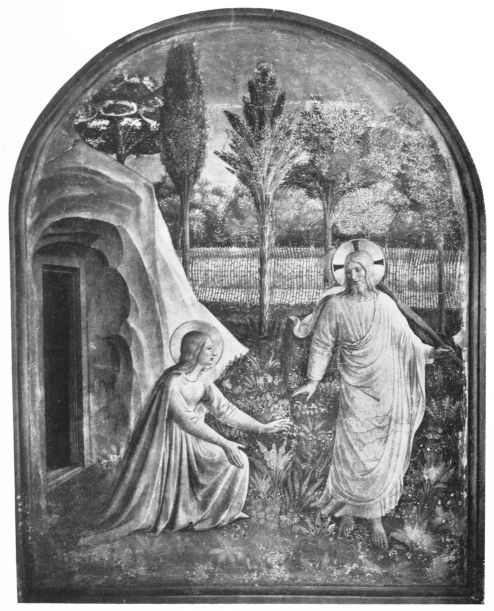
Photo. Alinari.
[To face p. 44.
Plate 15.—Christ Appearing to Mary Magdalene
Fra Angelico, Monastery of St. Mark, Florence
pattern-like effect, at the same time the intense fervour and piety of
the subject is well expressed. The figure of the female saint at the
feet of Christ has a red dress, the remainder of the lower figures have
purple garments, and St. Dominic has the black and white dress of his
order. The “Resurrection,” painted in the eighth cell, has a colour
arrangement of pale purples, greens, white, and dark blue, which is very
harmonious. The colouring of the fresco in the last or inner cell on the
right, the “Adoration of the Magi,” though somewhat faded, is still very
beautiful: the Virgin has a blue dress, and for the rest of the
colouring, peach and plum, and golden tints prevail. The colour schemes
of the frescos in the other cells, that have been painted by Fra
Angelico, are similar to those of the first and second of the series,
with the exception of the tenth, which has the entire background of the
subject, the Presentation in the Temple, painted in a broken Venetian
red colour, which can hardly have been the original colour.
The execution or technique of these small frescos by Angelico is
exceedingly firm and direct; they are frankly painted, without any
apparent hesitation of touch—indeed, in these paintings the student
will find a more masterly freedom in the workmanship than in the case of
the laboured and miniature-like paintings of the more popular
altar-pieces and easel pictures of this master. These remarks apply to
those of the cell frescos, which are the authentic work of this master;
and under this head would come more particularly the first, the third
(the “Annunciation”), sixth (the “Transfiguration”), ninth (“Coronation
of the Virgin”), and the “Adoration of the Magi,” on the wall of an
inner cell.
Two better-known works of Angelico are, the “Annunciation,” on the wall
of the upper corridor, facing the staircase, and his larger work, the
lunette of the “Crucifixion” in the chapter-house of this monastery. The
fresco of the “Annunciation,” which has been considerably repainted, is
very simple in composition, but very effective; and the colouring,
though now dull and opaque, has still something reminiscent of
Angelico’s colour arrangements. The Virgin’s dress is dark blue, with
olive-green lining; the angel’s dress is a pinkish dove-colour; the
grass, foliage, and flowers are in grey greens and white; architecture,
a light stone-colour; and the paling behind is a warm grey.
The great work of the “Crucifixion” in the chapter-house is in a fairly
sound condition, but it has been much repainted. The colour treatment of
the background is somewhat unusual, as it is marked out in three
distinct and sharply divided bands of colour: the upper portion being of
a dark purplish red (the original colour may have been a dark blue), the
central horizontal band of a light vellum tint, and the lower, or ground
colour, of a golden yellow. The painting of the figures in their present
condition is
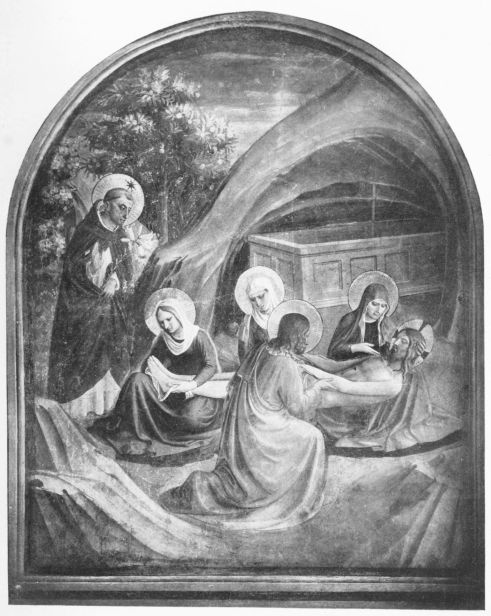
Photo. Alinari.
[To face p. 46.
Plate 16.—The Deposition in the Sepulchre
Fra Angelico, Monastery of St. Mark

Photo. Alinari.
[To face p. 47.
Plate 17.—Detail of The Crucifixion
Fra Angelico, Monastery of St. Mark, Florence
most careful in execution: those on the right half, the Dominican
fathers and brothers, and other founders of religious orders, are in the
dark grey, white, and brown dresses of their orders, the balance of
colour on this side being obtained by the bright red of the Cardinal’s
hat and of a book-cover, and the golden-coloured nimbi of the figures. A
warmer scheme of colour is noticed on the left half of the painting,
where golden tints, soft reds, grey greens, white, and grey complete an
excellent harmony. The figure of Christ on the Cross is in very pale
flesh tints, and has a white garment; the flesh tints of the thieves on
either side being darker in tone. The general effect of the colouring is
very pure and luminous.
After Giotto, we may say, that the artist whose influence is most
apparent in Italian art was the Florentine painter, Masaccio
(1401-1428?). His most important works are the frescos he painted in the
Brancacci Chapel of the Church of S. Maria del Carmine, at Florence. The
instructor of Masaccio is supposed to have been Masolino da Panicale
(1384-1435), who first painted some frescos in the above chapel, and
who, according to Vasari, was commissioned to decorate the chapel with
scenes from the history of St. Peter, some of which he had executed, but
they are no longer in existence, unless we place to his credit the “Adam
and Eve” fresco on the right wall, although some writers have ascribed
this work to Filippino Lippi (1460-1505), the son of the painter
Filippo Lippi, and a scholar of Botticelli.
There are really very few works left by Masaccio, but those which still
are in existence clearly prove that he was far in advance of any artist
of his time in his complete mastery of the human figure, as shown by his
searching and accurate draughtsmanship, his great knowledge of anatomy,
and his facility in giving spirit, action, and vitality to his
decorative compositions. His gifts in these directions place him at the
head of the greatest artists of the early half of the fifteenth century.
His achievements are all the more wonderful if we believe, as it is
said, that he died at the early age of twenty-six, though some
authorities state that he reached the age of forty-one years. The finest
authentic work from his hand is the fresco of “The Tribute Money,” which
he painted on the left wall of the Brancacci Chapel, and this work still
remains as a monument to his great powers. This work is a picture which
includes three scenes in its composition; namely, (1) The central group,
where Christ rebukes St. Peter, around whom are the standing figures of
the apostles, with varied expressions of indignation; the figure in the
foreground, back view, in this group is that of the tax-collector, and
the last figure of this central group, on the right, is a portrait of
Masaccio. (2) The scene on the left, middle distance, represents St.
Peter finding the money in the body of the fish, and (3) that on the
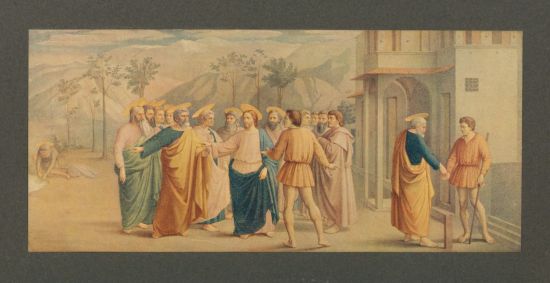
right is St. Peter giving the money to the tax-collector. The figures
are all admirably drawn, and painted with great breadth of treatment;
that of the back view of the tax-collector is more especially a
remarkable example of accurate drawing and of easy freedom in the pose
and action. The same person, but in front view, represented in the right
scene, has a similar freedom of pose and action, and there is an
intensely gratified expression in his face as he receives the tribute
money. The natural treatment of the hilly landscape of the background is
also far in advance of the landscape-painting of Masaccio’s time.
On the altar wall there is another fresco by this painter, though now in
a very bad state; the subject is “St. Peter baptizing,” where, among
other figures, is the celebrated nude figure of a benumbed and shivering
youth, a figure so well drawn, and so correct in anatomy, that, as Lanzi
says, “it has made an epoch in the history of art.”
Another very fine and authentic work by Masaccio is the “Expulsion from
Paradise,” painted on the left wall of the chapel, where Adam and Eve
are represented as being driven from the gates of Eden by the angel with
the flaming sword. The figures in this intensely dramatic composition
have been borrowed, with little alteration, by Raffaelle, and used in
one of the Loggia frescos, and he has also adapted some other figures
from the paintings in this chapel for the cartoons, and in his frescos
of the Stanze of the Vatican; and yet he, to whom so many others were
indebted, was, as Vasari tells us, “little esteemed in life.” It was
after his death that his real greatness was discovered; for do we not
read that the great artists of Italy and other countries came to study
the work of Masaccio in that veritable school of art, the Brancacci
Chapel of the Carmelite Church, and it was only then that he was truly
honoured? Filippino Lippi founded his style on the work of Masaccio, and
Ghirlandajo, Verocchio, Leonardo, Perugino, Raffaelle, and Michael
Angelo acknowledged his greatness and learned of him. This painter who
was, like many other great men, so little esteemed in life, had, after
his death, this epitaph written on him—
“I painted, and my picture was as life;
Spirit and movement to my forms I gave—
I gave them soul and being. He who taught
All others—Michael Angelo—I taught:
He deigned to learn of me....”
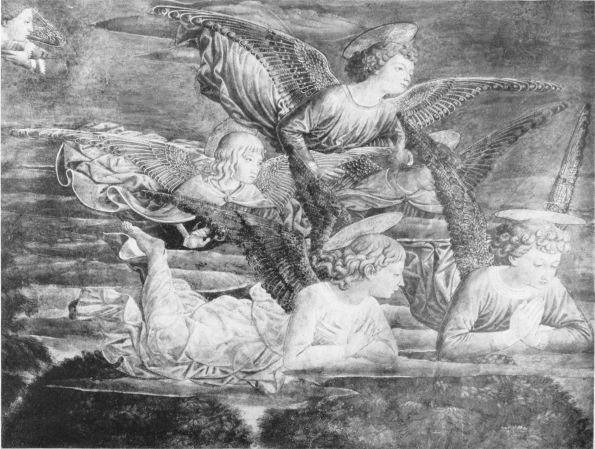
Photo. Brogi.
[To face p. 51.
Plate 19.—Angels. Detail from The Paradise
Benozzo Gozzoli, Riccardi Palace, Florence


