Edited by William Harbutt Dawson. 12ᵒ. Illustrated.
Each, net $1.20. By mail, $1.30
NOW READY
French Life in Town and Country.By Hannah
Lynch.
German Life in Town and Country.By W. H.
Dawson, author of “Germany and the Germans,”
etc.
Russian Life in Town and Country. By Francis H.
E. Palmer, sometime Secretary to H. M. Prince
Droutskop-Loubetsky (Equerry to H. M. the Emperor
of Russia).
Dutch Life in Town and Country. By P. M. Hough.
Swiss Life in Town and Country. By Alfred T.
Story.
IN PREPARATION
Spanish Life in Town and Country. By L. Higgin.
Italian Life in Town and Country. By Luigi
Villari.
G. P. PUTNAM’S SONS, New York and London
OUR EUROPEAN
NEIGHBOURS
EDITED BY
WILLIAM HARBUTT DAWSON
FRENCH LIFE IN TOWN AND
COUNTRY
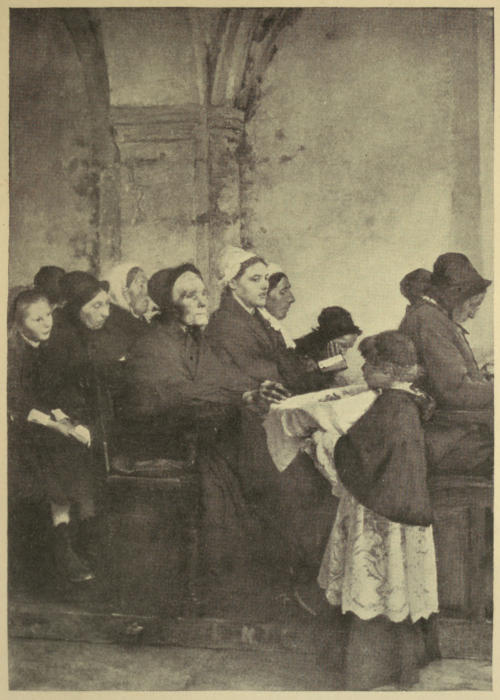
THE PEASANT AT HOME—THE CANDIDATE
Michelena
FRENCH LIFE
IN TOWN AND
COUNTRY
By HANNAH LYNCH
ILLUSTRATED
G. P. PUTNAM’S SONS NEW YORK AND LONDON The Knickerbocker Press
1902
Copyright, 1901
BY
G. P. PUTNAM’S SONS
Set up and electrotyped March, 1901
Reprinted August, 1901; January, 1902
Among the nations of the earth there exists
no more striking contrast than that between
the people of Paris and the people of
France. While the capital is a political furnace,
where all sorts of conflicting ideas and opinions
are continually boiling with such a rage of effervescence
that the inhabitants, unaccustomed to
the sense of calm and security, work, dance, and
rest on the brink of an ever-menacing revolution;
in the provinces town life drags through
its monotonous days, absorbed in dull provincial
interests, and rural life knows no other
changes or menaces than those of the seasons.
We distribute to each race certain broad characteristics,
and trace out for them in all circumstances
an ideal of conduct from which, if they
will be true to their blood, they must not deviate.
And so we are all decided upon the general
French characteristic, excitability, forgetting
the immense provincial differences that are to be
found in the people of France as well as elsewhere.
The heavy Flemish natives of Picardy,
large eaters, deep drinkers, hard workers, slow
of speech, somewhat coarse and unperverted,
are as French as the natives of Latin Provence,
garrulous, sober, alert, and exuberant. They
are not less French than the wily, hard-bargaining
Norman, who eats and drinks as much, but
brings a clearer brain into business, and may always
be relied upon to get the better of his
neighbour in all transactions; or the dreamy
Celt of the Breton coast, the thriftless slave of
superstition, with brains to spare as well as
prejudices, but not intended by nature as a pillar
of the Temple of Wisdom. Not less French the
rich green midlands than the white and sunburnt
south, the champagne vineyards eastward, and
the rocky Cévennes rolling southward. Could
anybody differ, more from the morose and inhospitable
Lyonese, in whose eyes every outsider
is the enemy against whom he sedulously
barricades his doors, in whose esteem the pick
of humanity is the prosperous silk-merchant,
than the pushing, loud-mannered Marseillais,
with what he would fain have us take for his
heart so aggressively upon his sleeve, emotion
so transparently transient ever on the surface,
subtly disguising self-interest and calculation?
For every diversity of character equal diversity
of scenery—from the Alpine grandeur of the
Dauphiny land to the beautiful lagoons of the
Marais; the Vendean plain washed by the long
blue roll of the Atlantic; Provence, land of salt
lagoons and dead old cities of Greece and Rome;
the central provinces, with their lovely rivers
and chestnut woods; Celtic Brittany, half English;
Normandy, with its glorious capital, one
of the fairest of France; the radiant cities of the
Loire, French river of romance; the bright and
witching little kingdom of Béarn, exquisite Roussillon,
with its old hum of wars and troubadour
songs, its delicate sweetness of herb and leaf and
bloom, its quaint old towns breathing of Spain,
and its high air of legend; the east, with its
mountains and dense pine forests, up to sunnier
Ardennes. And the patois of these so different
districts are not less distinct than the scenery,
the note of town and province, and the characteristics
of each race. Shelley most seriously wrote
that there was nothing worth seeing in France.
Even the tourist will find more to delight his eye
in going from one department to another than
he will find place to record in the most voluminous
note-book. Let him only content himself
with such a province as Touraine, with its
rich and pleasant landscape, its castles of undying
interest, its river of thrilling associations.
Or let him wander in summer amid the cherry
orchards of the Jura country, with the rampart
of mountains above the pine-tops and the touch
of Swiss beauty around; or dream away the
present in musing upon forgotten Mediterranean
glories among the ruins of dead Provençal cities
between the grey-green silver of the olive and
the sapphire waters beyond the broad grey river
bends.
It is true that the townsman all over the land
is largely governed by a need for excitement,
and having, as a rule, no personal initiative to
enable him to minister to it, he contents himself
with looking toward the capital with envy, and
devours the newspapers from Paris in eager expectation
of the “something” he is in daily hope
of happening. But whatever does happen in
Paris rarely makes itself felt in the intellectually
sleepy, industrious provinces; thanks to which
wide-spread spirit of commercial and bucolic
denseness to the inflammatory influences of the
capital, France thrives now as she throve before
the war, when at a word she could produce
funds to pay off an enormous indemnity, without
flinching or hesitating.
When you travel in the country or through
small French towns, you are struck with the
gaiety, intelligence, and good-will of the people
and of the little shopkeepers, and with a
certain unintelligent stiffness, pretension, and
moroseness of the middle class, whose ambition
it is to pass for the aristocracy, or at least for
des gens de bonne famille. As these pretensions
are rarely in keeping with their actual fortunes,
these ambitious provincials, the victims of the
political follies born of hostility to the Third Republic,
think fit to garb themselves in the unbecoming
vices of ill-humour, rancour, and idle
pride. These they conceive to be the adjuncts
of noble birth. If the fathers have refrained,
the sons are certain to announce themselves,
sooner or later, by titles of their own choosing.
The general preference runs to count and viscount,
though baron is not despised. I have
known of a respectable middle-class family in
the provinces, where the eldest son, a lawyer,
is content to remain a republican, and the second
son, an officer, a gentleman of aristocratic instincts,
eager to profit by the present enthusiasm
for the army in anti-governmental circles, calls
himself a count. The humorous part of the
situation lies in the fact that the wife of the plain
Monsieur is not satisfied with her lot, since
destiny, ruled by her brother-in-law’s will, has
given the latter a title; and so at the recent
marriage of that military worthy, the newspapers
spoke of M. le Comte giving his arm to his
sister-in-law, Madame la Comtesse, while the
disgusted republican elder brother stayed in the
country, indifferent to the self-appointed glories
of his relatives.
Within late years, tennis parties are beginning
to introduce a little stir in certain select circles
of small provincial towns, where these entertainments
are still regarded as novel; but, speaking
generally, the dulness of such centres in
France cannot be surpassed anywhere. Social
life is at as low a level as intellectual life. Few
books are read, fewer still are discussed. The
very aspect of the streets—with their sealed
doors, shut persiennes, sullen absence of neighbourly
trust and geniality, high-walled gardens—is
morose and incommunicative. They wear,
however, as compensation, a look of distinction,
not infrequently accompanied by a picturesque
charm. Should a river roll in view, or a little
street slope down to a busy quay, where the
washerwomen kneel and lend mirth and colour
to the scene, while above, an old historic castle,
high against the sky, on a dusty square, or the
grey of Gothic stone and delicate spire add a
hieratic note to the quaint picture you forget
the unfriendly reserve of those barred and blinded
houses, you forget the somewhat aggressive
coldness and inhospitality of their front, in recognition
of the tempered brilliance, the graceful
and distinguished effects around you. Mingle
then with the market-folk, and listen to their
speech—pleasant vocables, rendered pleasanter
still by vivacity of gesture and vividness of gaze;
neat peasant women, in spotless caps and sabots,
who look all the merrier because they are so
hard-worked; tanned, wrinkled faces, that smile
as they did in youth, hard-set, but not unkindly,
in the rapacity of commerce; responsive to a
joke, unflinching in the teeth of trouble, not
destitute of a promise of comfort in life’s softer
hours—though softness is the very last quality
they betray. A genial hardness is, perhaps, the
dominating character of the French peasant woman’s
expression: it would never be safe to
trust in the hope of finding her head napping
and her heart too wide awake. But if she is
not soft to others, she is implacably hard to herself.
Her industry is amazing, and only less
amazing is her resourcefulness. A more competent
woman does not exist anywhere. Nothing
of a dreamer, she is contented with her
lot, provided only there is neither thriftlessness,
waste, nor idleness about her. She will willingly
work for four, if the men will honestly work
for one. And while the men loiter and squander
substance and health in the wineshops, this
gallant creature continues to labour and save
and scold, to deprive herself of small comforts
in favour of others—a son, a daughter, as the
case may be; and, thanks to her, the country
ever prospers.
Country life is, of course, far less dull than
provincial town life; less unneighbourly, and
less destitute of all the charities of existence.
For one thing, nature is the eternal friend, benefactor,
and instructor of man. The thousand
vulgarities of towns are forgotten in the midst
of her bounties. A man who lives in bucolic
silence, watching the seasons and counting new-born
things, dreaming of oats, of crops, of fruit,
is essentially the superior of his fellows who
dwell amid the sordid details of small towns,
commerce, and rivalries, the gossip and drivel
which make a spurious animation in the circles
of the provinces. There are diversities among
the type hobereau (a kind of French squire), as
among all other types in France and elsewhere.
Many years ago I travelled through a charming
south-western province, furnished amply with
letters of introduction. I well remember the
extraordinary contrast between two families of
hobereaux I once visited. A relative of the
small squire, who lived in a dull, quaint little
town, drove me out to see her bucolic son-in-law
and his bucolic parents. The family was
described to me as “exceedingly rich.” We entered
a brilliant bit of park and avenue on a hot
afternoon in July, drenched with the dews of
heat, athirst from the dust of the broad, long
white road. On the perron stood the young
couple and their parents to receive us. The
bride was gaudily and hideously attired in yellow
and brown satin and silk; the groom in
grey, with straw hat and leggings, more appropriately
adorned the landscape. He was a heavy-eyed,
high-complexioned, silent youth, who
seemed at ease and happy only in the society
of his most beautiful dogs. To them alone did
he sometimes discourse in heavy undertones,
while he surveyed me furtively under his lashes
in unmistakable awe, but addressed me no word.
His father-in-law looked like a farmer or a
yeoman, and cracked small jokes. He quizzed
his son, who blushed the hues of fire, and his
son’s mother-in-law, who ingeniously strove to
make me believe that she did not understand
him, and he nudged his daughter-in-law in a
way she must have resented. Without exaggeration,
I have never met a more peasant type
of country gentleman in my life. His wife was
a simple, ill-mannered person, who talked
chiefly about the weather. The grounds were
lovely, the orchard a splendid dream, but the
floors of the “château,” as every country-house
in France is pretentiously called, were mere
unvarnished planks; not a rug anywhere, not
a hint of beeswax, and even the drawing-room
was disfigured with ugly presses. When liquid
refreshment was called for—chartreuse and
iced water—we were served in coarse glasses,
and the iced water was brought in in a kitchen
jug. There was not even a flower in a vase,
not a pretty window curtain, and the drawing-room
chairs were of horsehair. Whatever
occult advantages their wealth may have procured
them, it cannot be said that beauty, comfort,
the joy of living, were amongst them, for
a more undecorated interior and duller persons
I have never met, and yet, with so much comfortlessness,
there was not a touch of vulgarity.
The squireen was a rough son of the soil, but
you accepted him as the animals of the field;
you felt he belonged to the land, and, as such,
claimed indulgence. You would not elect to
pass your days in his society, any more than
you would care to have a bear prancing about
your drawing-room, but you instinctively felt
his superiority to the town fop, who thinks
himself a very fine fellow, with a little tailoring
and a vast amount of pretension.
The second hobereau dwelt in the same department,
but I visited him with very different
results. I was invited to lunch, and my host
drove me seven miles in a pony-cart. Here,
also, were an imposing park and avenue, and an
immense manor, which seemed all windows.
There was among the guests a magistrate from
Poictiers, who was witty as only a Frenchman
can be witty. Our host was a charming, bright-eyed,
lean little old man, full of vivacity, of
charm, and intellectual alertness. He was voluble,
and avid for information, and walked me up
and down a delightful berceau to obtain my
views of the woman’s question and the relative
positions of the young French and English girl.
He even pressed me to contrast the French and
English novel, and said he greatly preferred
Scott to Zola—an opinion I endorsed with fervour.
People drove over from neighbouring
places, and we were quite a large party at lunch.
The talk was capital—local, but interesting; no
cheap gossip, but plenty of genial wit, anecdote,
and repartee. The women were dowdily
dressed, as provincial Frenchwomen frequently
are. I judged them as dense, impervious to
ideas, utterly uncultivated, never, in all probability,
having read anything except the thin religious
literature on which the virtuous ladies of
France nourish their minds; but they could well
hold their own in conversation, could cap a
phrase with elegant neatness, and the hostess
deserved well of her kind for the evidence she
furnished of a perfectly ordered household. It
would, however, be a mistake to credit them
with grace because they are Frenchwomen.
Nothing comes with such a shock upon the
traveller in France, used to the feminine grace
and charm and witchery of dress in Paris, as
the dowdiness and want of ease, the total lack
of taste in dress, the heavy figures and unexpressive
faces of many of the women of the provinces.
They dress shabbily, will even wear
cotton gloves and badly cut boots when they
consider themselves extremely exclusive, and
carry off these defects of costume with a singular
and unmistakable air of distinction. The commoner
kind prefer to shine in fashions and colours
unfamiliar to the eye of Paris; and, as a
rule, look clumsy and obtrusive in their fine
feathers. The same applies to the men. These,
when they prefer to be shabby and roughly arrayed,
look far better than the pretentious gallants
who, by means of obvious tailoring, offer
destruction to the susceptible dames around
them. There can be no doubt that an elegant
male costume is out of place and a vulgar blot
along a sleepy little street where men in blouses
pass and bonneted girls and women wheel
barrows before them.
The farmer’s life has undoubtedly a larger share
of natural interests than that of the hobereau. It
is more purely animal, without any attachments
to a world unconnected with the land. Ask a
farmer what he thinks of politics, and he will tell
you that he has nothing on earth to do with idiots
or tricksters. He who must warily watch the humours
of the seasons cannot trouble himself
with the humours of electors and the ravings of
voluble deputies. He walks his dew-washed
meadows at dawn in wide-leafed felt; and, as
he surveys the produce of his labour, his long
hours of sweating travail, can he feel other than
contempt of the highly remunerative and windy
profession of the politician? The superiority of
the lord of the soil to whom he pays tribute, he
will readily acknowledge, but none other. In
the west he will speak of his family as “my sons
and the creatures,” meaning his daughters. In
the land of the Cévennes, his children are les
drôles, and the same unquestioning obedience is
expected from both sexes by this rough and
silent tyrant of the soil. Outside his farm he has
little esteem to waste upon his fellows; within,
is far from prodigal of tenderness to his women-folk.
These he expects to stand at meals in a
corner of the kitchen, while he and his sons sit
to eat. He governs haughtily, with few words;
but in his rude heart he knows that the real, the
silent, and unobtrusive government lies in the
hands of his wife, who, with the tact and watchfulness
of affection, corrects the errors of his
harsh temper, and smooths out the asperities of
home-life. It would be difficult to find a people
to whom modern feminism is more repugnant
than the French, and hard to name one that
owes more to the intelligence, good-will, and incessant
labour of women. Frenchmen object to
women in the liberal professions, and make a
desperate hue and cry the day a talented lady
seeks leave to wear the lawyer’s toque and
gown. Yet the fields are tended by women;
flags are waved at railway gates by them; in
the lower ranks they bravely do all the rougher
work of men, and nobody lifts a voice in protest.
Woman may leave her home to make money
in the humbler walks of labour, and cause no
flutter in male bosoms; but let her elect to do
so in paths where ambition lures and pay is
higher, and instantly a howl of dismay runs
through the ranks of her oppressors and slaves.
And yet, if common sense and logic were general
instead of rare virtues, even in France, it
would be understood that the abandonment of
the homes by peasant women is of much more
serious consequence to a nation than the infrequent
flight into legal and medical circles. The
woman lawyer will always be the exception,
and if she makes a good thing of her venture
nobody is a penny the worse. But examine the
home where the wife and mother spends her
day in a factory, in the field, whose occupation
requires no talent or ambition, and their physical
and moral effects are of a very different nature
from those that follow the winning of diplomas.
The woman works as hard and as long as her
husband, and is paid less. They return home to
a cold hearth, an uncooked dinner. The man,
never an angel where his stomach is concerned,
swears and threatens, then sulks and goes off to
the wine-shop. There is no compensation for
the missing comfort in the few miserable francs
earned. No women are more admirably adapted
for making the home happy than Frenchwomen.
Their general competence is matched only by
their industry; and it is a pity to see these fine
domestic qualities wasted on outdoor work. Of
course, in the case of widows nothing can be
said. When the bread-winner is taken away,
the woman must perforce shut the house door,
and go abroad in quest of the right to live. Girls
are in their proper sphere, too, in working manfully
on their father’s farm until their marriage,
and fatherless girls, without that most useful of
national institutions, the dot, must needs find
bread wherever they can. But the outside labour
of the wife and mother can never be too
deeply deplored, above all in the case of the best
of wives or mothers, such as Frenchwomen,
taking them as an average, usually are.
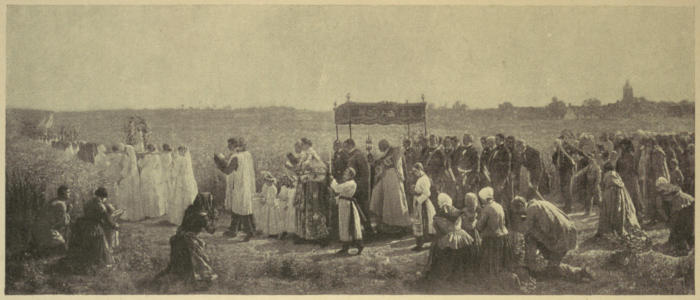
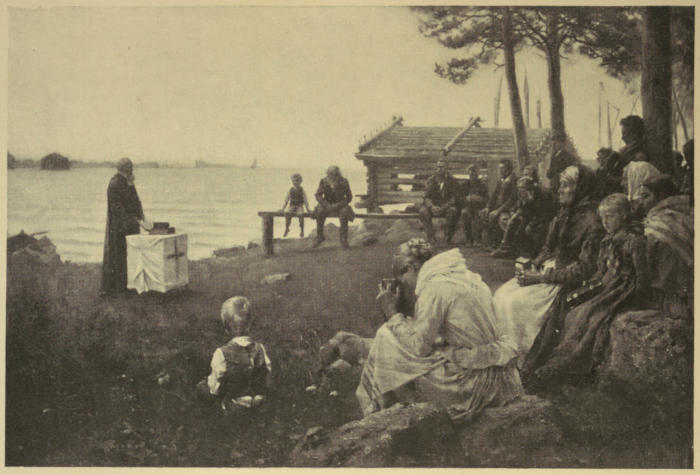
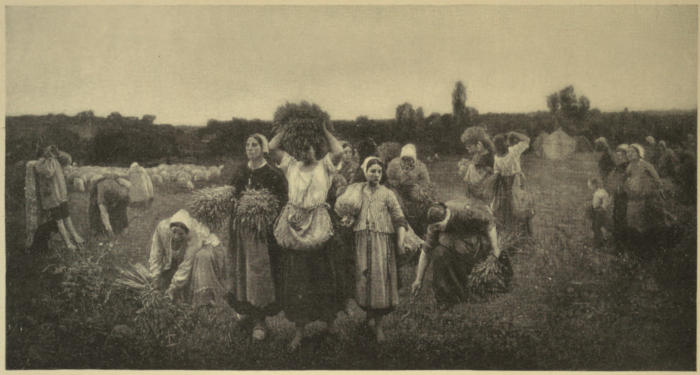
BLESSING THE WHEAT
J. A. Breton
Connected with rural and provincial life are
some quaint and pretty religious ceremonies. I
need not refer to the Fête-Dieu, familiar to all
travellers in Catholic countries. The sight of
this well-known procession will please or repel
you according as it appeals to your head or your
imagination. But a far more picturesque procession,
and one containing an element of poetry
not at all discoverable in the Fête-Dieu, is the
blessing of the fields and orchards between
dawn and sunrise. What a novel and peaceful
treat I used to find this ceremony in my far-off
French schooldays, whereas the Corpus Christi
procession was but a scorching misery! To
rise in the blue crepuscular light, with the early
birds just stirring in their nests and heard behind
the unshuttered windows, and emerge from the
deep convent porch into the dew-washed country,
following and followed by all the town,
walking in two long lines, widely apart, behind
the priests in their stoles and surplices, and
chanting solemn Latin hymns! It was a rich
Norman land we wandered along, now by glittering
rills, with the smell of violets in the air,
by narrow green paths through the newly
ploughed earth, while the mounting sun cast joy
into our faces, warming the chill spring wind,
and provoking the birds to rival our hymns with
their clearer and sweeter notes; then through
continents of apple bloom, whole lakes above of
pink-white blossoms on either side, with rivulets
of upper blue seen through the tracery of foamy
waves. Who, watching that solemn procession
of amiable enthusiasts, chanting hymns to God
and beseeching Him with confidence and fervour
to bless the earth and all its produce,—wheat,
wine, fruit, and flower, the water we drink, and
the grass we tread upon,—could smile or carp at
the sprinkling of the ground, of trees, of river-bed
with holy water? There was something
deeply impressive in the hymns sung at that
early hour, while the towns still slept and the
woods were scarce awake. As a superstition it
seemed to carry us back to the great primal
superstitions that have run through the earlier
religions. It remains ever upon memory as a
large and noble and beautiful form of belief,
where Pagan and Christian of all time meet in
their fear of inclement nature. Religion has ever
associated itself with the rural dread of disaster.
Priests say masses for sick cattle, and if the cattle
do not benefit by this harmless custom, the
peasants are thereby greatly comforted; they
have the satisfaction of knowing, at any rate,
that should the cattle so prayed for die, it was
in the design of Providence, against which even
the prayer of devout man was inefficacious. If
religion never made more injurious concessions
than these to ignorance, the wildest freethinker
that ever unsheathed a sword against it must be
shamed into laughter at his bellicose attitude.
Indeed, it is not only the Catholics of France
who expect their ministers to stand between
them and rural misfortunes by prayer and holy
water; in the Protestant Cévennes a pastor of
the Reformed Church has been known to exorcise
a field of evil spirits, or tackle by prayers
the devils in a poor beast, and even in an entire
herd of cattle; and the peasants dread even
more than the devil a mysterious god called
the Aversier.[1] An apologist for these peculiar
customs maintains that since Christianity cannot
prevent superstition it is wise in directing it,—sending
it thus into a right and beneficial
channel. This is surely debatable ground. Superstition
is by no means the appanage of
ignorance only, and we must be grateful when
we find it inoffensive and poetical.
In Paris to-day, you will meet educated Frenchwomen
who are convinced that St. Anthony of
Padua went to heaven and was canonised in the
exclusive interest of their lost property. A friend
of mine, witty, cultivated, a wide reader and
traveller, accompanying me on a walk, dropped
one of her gloves just outside the avenue door.
She perceived her loss when we had gone a few
paces ahead. “Oh, dear good St. Anthony,”
she exclaimed fervently, “make me find my
glove, and I will light a candle in your honour.
And now I am reminded, dear St. Anthony, that
I owe you already a candle for my note-book
which I lost and found last week; I will pay
both on the recovery of my glove.” I listened
to the prayer in stupefaction. We turned on
our heel, and there at the porte-cochère lay
her glove. She pounced upon it, and cried,
“Thanks, thanks, good St. Anthony, you will
have your two candles this afternoon.” Now,
this was not a peasant, a servant, an ignorant
little bourgeoise. She was a woman of liberal
education, a frequenter of the noble Faubourg,
the friend, guide, and philosopher of several
authentic counts and countesses and marchionesses
and diplomats, a woman who had travelled
in Russia, Poland, Germany, and England,
and admired all these races; in fact, a charming
old lady, a mass of pride and prejudice, yearning
to-day for another St. Bartholomew, and yet devoted
to several Protestants and to at least one
freethinker; who professes an ancien-régime
hatred and scorn of the lower classes, and treats
her servant, her portress, her frotteur, the woman
who sells her milk, and the woman who
sells her vegetables as her dearest friends, from
sheer largeness of heart and generosity of nature.
She is not the first person of whom I can truthfully
say, “Her virtues are all her own, her vices
belong to her religion.”
In Brittany it is the custom to bless houses,
and this ceremony is not always accomplished
without some bluster; above all, if the spirit of
the dead should be attached to it. When a
Breton suspects his house to be under ghostly
domination, he sends for a powerful fellow in
sacerdotal raiment to dislodge the devil. The
priest comes, clad in surplice, and, holding his
stole in hand, takes off his boots, so that he
“shall be a priest to the very ground.” We are
told that the staircase and the floors are inevitably
covered with sand as evidence of the traces of
the ill-intentioned dead. The priest must follow
those sandy traces as far as the chamber where
they stop. There he shuts himself up, bursts
into fervent prayer, and has a hand-to-hand fight
with the evil spirit. His triumph is asserted as
soon as he succeeds in casting his stole over the
neck of the dead, who has taken the shape of
an animal, usually a black dog. The beadle and
the sacristan are told off to carry away the possessed
animal. They lead it to a sterile marsh,
or a forsaken quarry, or a meadow hollow, and
the priest cries, “Here shalt thou henceforth
dwell,” and lets the evil spirit go free; saying
this, he makes a wide circle, and departs.[2]
Coming from a feverish centre like Paris,
where, as a rule, lives are too crowded with
interests, one wonders at the limited interests of
rural and provincial life. Sometimes you will
meet a country gentleman who dabbles in literature,
writes a local guide or an historical essay
on some personage or fact connected with his
own particular town or village, and then you
may count yourself fortunate. Depend upon
his natural wit to make the place interesting to
you. Such a pleasant squire once imparted a
sort of glow and charm for me to Taillebourg,
and that dullest of little towns, St. Jean d’Angély.
He peopled the neighbourhood with great names,
and the very pavements instantly grew sacred.
His erudition went so far as to revive Blue Beard,
an ancestral neighbour, and show me the Marquis
of Carabas, with his immortal feline friend, getting
married in the reign of Francis I., from the
castle at which I was a guest; and though the
life at that summer castle was frightfully monotonous,
one forgot the monotony in romantic
associations. But this is an infrequent blessing.
Unless you form one of a hunting party, I know
nothing that palls more quickly upon the outsider
than the kind of existence led in French
châteaux. There are no day or evening amusements.
Ladies between meals sit under trees
and talk. If they always talked brilliantly upon
general topics, this would be pleasant enough,
but as all roads lead to Rome, so do all topics
to-day in France lead directly or indirectly to
politics, and this is fatal. Literature is only a
tepid discussion on the latest novel: and this
does not carry one far. Then there is a solemn
walk with your hostess about the grounds, or a
drive outside, and in the evening after dinner a
game of bezique with somebody, or the pleasure
of watching somebody else play “patience,” and
conversation of a not too thrilling kind. Should
your hostess or any other visitor be exceptional,
delight and pleasure can be extracted from notable
talk; but in the case of ordinary men and
women, it is very trying to meet together for
the dismal satisfaction of being bored simultaneously.
The proprietors naturally do not realise
this. They have the excitement of receiving
guests, whose arrival must be a change in the
burthen of inalterable routine. But I have never
left a French château without a feeling of sincere
gratitude for not possessing one. The sensation
of imprisonment, of futile chains, is oppressive.
Here, as elsewhere, individuality is effaced by
inexorable common law. To be original is to
be amusing, no doubt; but, still more, unseemly
and mad. You may be a little wild in speech,
provided you walk the respectable step of your
fellows without the slightest deviation. Your
wit, if you happen to have any, will never be
more appreciated, for on that ground the French
are exquisite judges; but if you cross your
knees, or pick blackberries, or dance a hornpipe,
or climb a tree, or smoke a pipe, or whistle a
tune (I mix up the offences of both sexes against
French propriety), you are safe to go forth with
a blighted reputation. Many years ago, before
I knew these things, I shocked an amiable country
gentleman and his son, a correct young
officer down from St. Cyr, by breaking away
from them to gather and eat lovely blackberries
along our path. They told me it was considered
extremely improper in France. They mentioned,
upon pressure, so many other things that are
regarded in rural esteem as improper, that I suggested
writing, with their aid, the things a man
and a woman (especially a woman) cannot do
in France, but on consideration found it would
make too large a volume. Here is exhibited the
lasting charm of the French character. Had I
said such a thing to an Englishman, imbued
with a sense of his own correctness, he would
have resented it as a foreign impertinence. My
French host was charmed with a criticism which
he understood to be meant good-naturedly, and
added, “I have ever wondered at the reputation
we give the English in France for excessive
formality, for, personally, I have always found
them to be a great deal more genial and easy
than ourselves, and I readily recognise that we
are much more formal.” When you read French
and English newspapers, and see these two
great races, the greatest of the world, showing
their teeth like angry dogs, you might believe
both nations incapable of a just or generous
word of each other. Well, I, who am neither
French nor English, can testify to the magnanimous
recognition of national virtues of both to
each other. A feeling of rivalry, of jealousy, of
bitterness, may exist on either side, but I know
none who have expressed more cordial admiration
of British qualities than the French, none
who have returned the compliment to them
so generously as the English. I still remember
the words of a gallant French officer to me
one evening after dinner: “It is an unfortunate
misunderstanding, exploited by infamous
journalists of both countries, between two races
made to sympathise with and admire each other.
English and French, we complete one another,
and as friends would hold the world.” And
how true this is! There are faults on both sides,
as there always are in a misunderstanding. The
English are admirable, the French are lovable,
and both have the defects of these qualities.
Even now, as I write these lines, feeling runs
high in both countries, one against the other;
higher and more aggressive in France, I admit,
than in England, and yet I should fill a volume
were I to attempt to repeat the splendid and
noble things I have lately heard said of England
in France, the proofs of regret for this lamentable
and, I trust, fugitive state of affairs which
I have received from various sources, beginning
with cultured men of letters and science, then
from Catholic women of the world, who see no
reason to hate England because their newspapers
tell them to do so; and lastly from workmen,
women of the people, from my washerwoman,
who once wisely said to me, “If we listen to
the newspapers, French or English, we shall all
become as stupid and degraded as the Boxers of
China.”
What one first remarks about the French
peasantry is the clean and comfortable aspect
they present: tidy blue blouses, sabots, strong
shoes, neatly patched trousers, and their air of
natural breeding. Among the mountains they
are of rougher build and manners; but in the
plains of Berry, in the flat, green department of
the Loiret, where the landscape looks like a
little bit of Holland on the edge of the still and
sedgy Loire where it ceases to be navigable, the
very labourers more resemble well-to-do and
well-bred farmers than the class to which they
belong. Their breeding and neatness, if you
come upon them in the wild solitude of the
fields, are in keeping with the gracious silence of
shepherd life, instead of being a blot upon it,
and their civilised speech does not jar upon the
banks of grey, flowing water, or among the
warm, sunlit meadows.
Farther south-west the manners are less commendable.
Mistrust of the foreigner is more
visible; and if you ask your way, you risk falling
upon the practical joker, who deliberately
sends you wrong out of gaiety of heart. Landscape
is decided by region, and local character
is decided by religion. Volubility and Catholicism
seem to go hand in hand; rigidity and
sternness with Protestantism. La Rochelle and
Rochefort are Protestant towns on the coast;
the Cévennes territory is Protestant, also the
towns of Nîmes and Montpellier in Provence.
Speaking broadly, I should say the French
Protestants are more intelligent, the Catholics
brighter; the Protestants deeper in brains and
sentiments, the Catholics more winningly vivacious.
You esteem the Protestants, you like
the Catholics; and your sympathy for each will
be prompted by temperament, intellect, and instinct.
Catholics will always regard Du Chayla,
the Christian persecutor of the Cévennes, as a
martyr; Protestants, more justly, will pronounce
him a hateful persecutor. Religious persecutors,
the world over, find their fervent apologists, and
it may be said that a large proportion of the
French race approve to-day of their St. Bartholomew,
and yearn for a repetition of it; just as
the good Catholics of the Spanish race find little
to condemn in the horrors of the Inquisition. If
there should break out a second Revolution in
France (we have been living so long on the
brink of it that I am constantly reminded of the
story of the boy and the wolf, and ask myself in
dismay, How long have we to run before meeting
with the famous moral of the story?), be
sure this time that religion will prove the provocation.
I cannot predict on which side it will
burst, but assuredly the red flag will be “anti-Semitism.”
In the provinces this sentiment runs
in a feebler, less aggressive channel, and the
rural atmosphere seems to cleanse the air of it
entirely. Here religious feeling is either stagnant
because of the absence of religious rivalry, or it
is a dull assertion of hostility in abeyance, only
waiting for the occasion to break out in a torrential
downpour. In provincial circles known
as clerical, bicycling is regarded as improper,
because it has been pronounced unfashionable.
At Orleans you will see women and young girls
punting as you wander out beyond the suburbs
towards the source of the Loiret, in the charming
demesne of the Polignacs, but you will not encounter
a woman on a bicycle, for Orleans is a
clerical town, and, consequently, all that is most
fashionable and pretentious. France is aware of
the ills which clericalism has brought upon Spain;
yet, for the moment, she is deliberately walking
backward, through the strenuous efforts of the
snobs and of a defunct aristocracy. These reactionary
influences are the work of a coterie of
intriguing women and ambitious priests in Paris,
and now even material and private interests are
menaced by conspiring malcontents.
CHAPTER II PARIS AND PARISIANISM
The exaggerated Parisianism of the foreigners
who settle in Paris is one of the things
the French of to-day profess to resent; it is one
of the reasons of the great Nationalist cry,
“France for the French!” as the Chinese yell
more murderously, “China for the Chinese!”
Such a feeling of resentment ignores the tribute
paid by these foreigners to the indescribable
charm and fascination of Paris. For it is not the
affairs of France that the foreigners meddle with,
but exclusively those of Paris. The provinces
are much like other provinces, and you might
live therein a half-century and fail to find out
that there was anything particularly catching in
French politics,—anything absorbing in the questions
of the hour. I have known foreigners
established for years in Florence, in Venice, in
Rome, who have never once opened an Italian
newspaper; who take not the slightest interest
in anything that concerns Italy beyond that
which picturesque Italian peasants and noble
stones may inspire. Not so with this bewitching
and exacting Paris. Everything here combines
to force your powers of resistance; and
while you are musing in the Louvre or the Musée
de Cluny, behold, the roar of revolution is heard
without, and down the solemn halls must you
hurry into the blithe air,—forgetful of past, of
dreams, of historic associations, of sentimental
reveries in front of Leonardo’s “Gioconda,” to
learn the latest whim of a petulant city, to learn
the latest black deed of whichever party you
have come to detest as a personal enemy.
Elsewhere will you meet architectural effects
more beautiful,—quaint old streets a thousand
times more captivating, reaches of river more
lovely and more strange,—but nowhere else will
you find modern life unrolling in an atmosphere
of such beguilement, set in a frame of such large
and harmonious beauty. Nowhere else will
you find the very poorest in a measure to be envied,
since even they, with a little good will and
an eye to look about and enjoy, may make
something cheerful of their lives by reason of
their environment. The perspective of starvation
is not an agreeable one anywhere on earth,
but surely a dry crust may be not altogether ungratefully
munched walking along the quays of
Paris, with those broad sweeps of lines and hues
of enchantment upon either horizon; and something
not unlike a step of delight may be danced
along the joyous, noisy “Boul’ Mich’” with an
empty pocket, even if one be the victim of the
remorseless term-day, or have no prospect but
the shelter of the doss-house at night. For
there is no squalor in Paris, no griminess, and
penury itself is decent, discreet, admirably self-respecting;
and even drunkenness, though of a
far more perilous character, if we are to believe
the newspaper reports, than in London, abstains
from the revolting outrages against sight and
hearing we are accustomed to in the cities of the
British Isles. To be poor in London is to be the
poorest of poor devils upon the globe, for there
life offers you no compensation. You live in
such a slum as the Parisian eye has never gazed
upon; the faces around you are sour or bloated,
according to temperament and habits. There is
no lightness of air, no brilliance of perspective,
to distract the eye from the inward contemplation
of daily misery, unless you put on your hat
and trudge endless miles to get a glimpse of the
long, bright boulevard of Piccadilly, or the sophisticated
wonders of the Strand. The attractions
of these I willingly admit, and own the
Strand, on a wet, lamp-lit winter’s evening, to
be a beautiful, strange vision of grandeur and
diversity. But then how far these all are from
the slums, and the way in London is long, and
if your pocket is empty, how are you to get on
the top of an omnibus to enjoy a change of view?
But in Paris, should your pocket be empty
and your room sordid, you need only saunter
into the clear, vivacious air to find yourself
within walking distance of every charming point
of the radiant city. Between her broad and
winding river, Paris lies, a two-volumed tale of
romance; on every leaf, as you turn it, matters
for musing and rapture, life around you full to
overflowing,—the life that has been lived still
vivid to remembrance, not clothed in sadness,
but in the gracious gaiety of tradition. The
scenes of dead hours are animated with floating
suggestions. In the Marais, with all these neat,
alert workwomen, well hosed, hair alluringly
dressed, contented with their lot, which is laborious
and frugal, so long as they can brighten it
with laughter and the customary joys of beautiful
objects which abound here on all sides,—who
is to weep for the days of old, and the
great historic dames who made its ancient glory?
You remember the great ladies of yore, and you
are thankful for the sight of the sympathetic
workwomen of to-day, and greet them with a
tributary smile. For it is the women of Paris
who create the better part of its living charm,
whether in the populous quarters, where they
toss their morning greetings to each other, or to
their swains, along the freshly awakened faubourgs
and clean streets, with their shining runlets
of water which you must dexterously jump,
by broad boulevard and acacia avenues; or,
later in the day, in the regions of luxury and
millions, where the sirens of fashion, arrayed
with a taste Solomon never dreamed of at the
time sacred tradition supposes him to have envied
the lily of the field, corollas emerging from
exquisite sheaths, with the plumage of paradise
upon their frivolous heads, pass and repass on
their mission of smiling destruction, of ruthless
rivalry, of scented glory. As well dream of a
city of London without its trousered armies,
rushing on the wings of time in pursuit of gold,
as try to imagine a Paris with woman dethroned.
She holds all the strong places; she vivifies the
town from the old Place of the Bastille to the
heights of Montmartre, where the texture and
trimming of her garments is the topic of the
hour; and men gather on the boulevards at the
hour of absinthe, in devout expectation of seeing
her pass by. Whether they discuss politics or
art, be certain she is at the bottom of all their
talk. The talk is assuredly not of the most respectful
kind, nor is the attitude of Parisians to
her such as we could with accuracy describe as
clean or chivalrous, but they give to her what
she, light-minded as she is, demands,—their full
attention, a consideration of her charms, her
dress, her vagaries, her virtues, her vices,—an
attention that never wanders, the most generous
measure of contempt, admiration, eternal gratitude,
and eternal faithlessness that the perversest
witch ever clamoured for. Such is her
power that I am tempted to believe that if her
ideal were a high, instead of a low, one, she
might invent a type of Parisian very different
from the well-known boulevardier and hero of
French romance. But alas! this is her failing.
She has no other ideal than that of ruling by the
senses, and mastering the worst in man by the
worst in herself. The ideal in her is wrecked
on the alluring rock of her own making,—dress,
for which she lives, and without which Paris
would not be the Paris we know; and, being
frail and human and sadly silly, as the best of us
are,—Heaven be praised!—we admire even when
we would fain deplore.
The finest impression the life of London
leaves on memory is that of the wealthy quarters.
The pageant of Rotten Row is unforgetable.
The splendid roll of life and movement
along Piccadilly, the bright impressiveness of
Park Lane, of those squares of lofty town palaces,
give such a notion of privilege and purse
as may be had on no other spot of the globe.
But the happiest and most lasting impression of
Paris lies in the poor and populous quarters.
Who in memory dwells most on the magnificence
of the Champs Elysées? Who in after
years, remembering Paris, cares about all the
luxury of the Park Monceau, with its fashionable
and expensive avenues? But what we do remember,
with pleasure and surprise, are the
agreeable aspects of labour, of every-day life, of
outdoor breathing, the variety, labour, vivacity,
and insistent beauty, at every turn, of public
existence. It is the delights of street study
which hold our imagination enthralled. In Paris
we realise that the Revolution has indeed
brought about something very near to human
equality, since here the poorest know and love
the feeling of independence, and we understand
the world to be made for them and not exclusively,
as in London, for the privileged few.
Here aristocracy is an incident in social existence,
and any attempts at insolence or haughty airs,
which thrill to admiration the soul of the British
burgess and small shopkeeper, would in this
democratic Paris speedily bring insult on the
head of the offender. The Parisian workman
will “Monsieur-le-Comte” the aristocrat to his
liking, but Monsieur le Comte must mind his
manners and be careful not to trespass. He
took his head off once, and he hopes that will
prove enough, not being more bloodthirsty than
his own interests and privileges demand. Who
can consistently pity a populace, however hard
it may work, and however ill it may feed, that
has the right of way along such well-kept
thoroughfares; that has such fine statuary and
elegant architecture to keep it in good humour!
Who is really poor that may refresh his eye upon
the terrace of the Tuileries, across the Concorde
Place, and take his airing along the boulevards,
or in the lovely, old-fashioned Luxembourg Gardens?
What point of Paris is dull to look at?
Where are the shop-fronts that do not fascinate?
Take even one of those old aristocratic streets of
the noble Faubourg Varenne, or of Saint Dominique.
At first glimpse it looks a long, dull
harmony of stone,—a uniform grey, with high
emblazoned gates and closed lodges. But note
the peeps into flowery old courtyards, the
charming tufts of garden foliage lifting their
green branches above the high walls. Glance
down the sudden break in the street, where a
kind of tall walled terrace runs, trellised, rich in
leafage, as silent as the street of a dead city,
where wealth shelters itself from envy by its
tone of subdued and sober elegance. And yet it
is not more trim than are the haunts of commerce,
the abodes of labour. Who would not
envy the flower-women of the Quai des Fleurs,
with their glorious vista of stone and waterway?
The curving Seine, ribboned round its beautiful
old island, grey-walled, upon the river’s brink;
the spire of the Sainte Chapelle, painted gold,
upon a soft or brilliant sky, and the magnificent
gates of the Palace of justice, as much theirs as
are the rich man’s priceless possessions in his
own house. The pleasure of possession alone is
lacking in their enjoyments; but they miss its
anxieties, and they have not to pay for the keeping
in order of all those splendours upon which
their eyes daily repose.
To talk of taste in connection with Paris seems
as unnecessary to-day as to speak of coals in
Newcastle. And yet it is the prevalence of taste
everywhere that perpetually surprises inhabitants
of less privileged places. Whatever these
people do, whatever they make, whatever they
wear, the result is pleasing to the eye. If the
picturesque is not always achieved, be sure neatness
is. Give a poor woman an old skirt or
bodice, and instantly will she go home, take it
to pieces, and make a new skirt or bodice out of
it that will gladden the eye, once upon her. So
in her modest way will she improve the general
view, and freshen up a porter’s lodge or little
doorway. It is by the united action of all those
various devices of a race of unerring taste and an
indestructible sense of neatness, that Paris, in all
its open corners, and byways, and thoroughfares,
is, by outward manifestations, the home of permanent
and unchequered grace and suavity.
It is a particularly pleasant feature of Parisian
life that people of small means can live both
decently and economically there. Of course,
economy is the chief virtue of the race; and
though it would be difficult to name a less attractive
one, because of its close alliance to
avarice and meanness, it deserves our respect
because of its national significance. To it do
we owe the exterior neatness of person and
home, the tidiness of the poorest interior of
Paris. Where else but in Paris will you find a
concierge living with her family in one small
room and a kitchen just large enough to turn in,
and able to preserve that space scrupulously
clean, inoffensive to sight and smell, with not so
much as an article of clothing hanging about,
nor a speck of dust visible, nor an ornament or
chair disturbed? I have not penetrated into the
ragpicker’s City of the Sun, about which Maxime
du Camp wrote so eloquently in the Revue
des deux Mondes some years ago; but I
have no doubt that even in that elemental nest
of humanity I should find orderliness, as far as
it is compatible with the ragpicker’s trade, to
be the general law. Does not M. de Haussonville,
in his Enfance à Paris, assure us, after repeated
visits to the doss-houses of London and
Paris, that the striking difference between these
fugitive shelters for the refuse of mankind in
both capitals is a certain dim striving towards
cleanliness and taste noticeable in the Parisian
outcast, and utterly lacking in the London pariah?
The impartial traveller, who knows little of
France and French characteristics, will have no
difficulty in believing this when he crosses the
Channel, and the first thing his eye encounters
in London is the frowsy female, with horrid
bonnet or atrocious hat and feathers askew,
hateful alcoholic visage, and sordid frippery all in
tatters. Need one follow the squalid and ghastly
vision to its lair to guess the conditions of its
dwelling, the habits of its home? There are
many blessings France might fittingly borrow of
England and be the better for them, but we cannot
deny that England, the mightiest empire of
the world, would be improved by imitation of
French exterior decency. It would brush from
English public life many a brazen horror. The
love-making of the masses would then be relegated
to the privacy of four walls, and we would
not see at every turn of our path Harry and his
girl with their arms round each other’s waist, or
giggling girls in omnibuses sitting on soldiers’
knees, or sights far worse than these, that scare
the virtuous and make foreigners stare.
It is a settled thing that Paris is the home of
vice. French novels of the day attest this fact; so
do the lyrics of the halls of pleasure, where that
decadent songstress, Yvette Guilbert (admired
of decadent London), offers the strangest entertainment
that ever delighted mankind in search
of distraction; so, above all, do the songs of
the unpublished poets of Montmartre, who fondly
and seriously take themselves for misprized
genius in the lump, and pose as so many Verlaines.
Yet nothing in Paris offends the eye of
the casual lounger through its streets as the eye
is offended constantly in London. In Paris you
have to look for manifestations of wickedness,
and then it is known that you will find them in
abundance, but they are not thrust under your
nose at every street corner. You may walk the
streets and boulevards at the small hours of the
morning, or in the full glare of evening gas, or
in the gathering gloom of midnight, when the
lights are being put out, and if nobody assassinates
you, you risk no evil sight or sound. There
are quarters, we know from the daily papers,
where vile creatures of both sexes group themselves
for the peril of the passer-by, where blood
is shed, and hideous language befouls the air,
but these lie off the travelled highways of the
city; and if you never read a newspaper, you
might live for fifty years in Paris and never suspect
that such a thing as crime took place within
its fortifications.
Rents in Paris are comparatively high, and
space is precious; hence the exiguity of the
average home of the middle and lower classes.
Spare rooms are unknown, and closets and presses
must be packed with the nicest precision.
But it is surprising how soon one becomes reconciled
to want of room in a French flat, and in
how short a time one learns to pity the London
householder—above all his wife and servants—for
his superfluity of chambers. Once you have
climbed up the stairs of your flat, there is no
more climbing, no futile running up and down
stairs. Everything is at hand. You walk from
your dining-room into your salon and across a
level floor into your bedroom; and it needs no
excessive labour to keep all things straight, and
polished, and spotless. If you are fond of experimental
cooking and light housework, you
can dispense with the trouble and cost of a servant;
avail yourself of the services of a femme
de ménage, in a land where women of the people
are admirably competent and honest, and
potter about your doll’s-kitchen to your liking.
Fuel you will find much cheaper than in London,
thanks to the little charcoal furnaces in enamel
fireplaces, which can be lit and extinguished at
will, at a nominal expense. And so a poor lady,
a teacher, or a student, can live respectably and
agreeably in Paris on an income that would
mean squalor and misery in London. A flat
consisting of three bright rooms, a kitchen, several
presses, a closet large enough to stow away
endless boxes in, and serve as well as a hanging-clothes
closet, plenty of water, and excellent
sanitary arrangements may be had in an enviable
spot, with pleasant outlook and good entrance,
for six hundred francs a year (£24); a
femme de ménage who will cook, market, mend,
and clean up as a French woman knows how, for
six sous (threepence) an hour; and if you treat
her fairly well and secure her loyalty, she will
give you devotion and friendship, as well as excellent
service and amazingly intelligent speech.
For here you need never be at the expense or
trouble of cooking complicated dishes. These
are sold at the pastry-cook’s or the baker’s for
considerably less than they will cost you at
home; so that you can live well and keep your
household bills within your means, even if meat
in Paris be dear. And then, when you want
amusement, should your income not permit of
frequent theatre-going what need to open your
purse? You have but to open your house door,
and emerge upon the public Place. On a summer
afternoon or evening a ride on the top of an
omnibus or tram is better entertainment than
that offered by many a theatre in London. A
walk through old Paris, or along the ever lovely
quays, is refreshment enough for eye and fancy.
Three sous will take you from the Madeleine to
the Bastille; and where is it you may not go
from the Bastille for another three sous? If the
chestnuts are in bloom, on foot, or on the impériale
of a public vehicle, in imagination you
are wandering through your own avenues; and
you really have little envy for the rich in their
cushioned victorias. This is why I contend that
the philosopher of either sex, whose purse is
light and whose tastes are frugal, can make shift
with less in Paris than elsewhere; can live and
be infinitely happier there on small means than
in London. So much beauty is provided for him
gratis, that he must be a churl who can spend
his time in moaning and whining because his
private walls are undecorated, or costly carpets
do not cover his floors. Let him go to the
Louvre or Cluny Museum when the fit takes
him, and count himself a king without the cost
and care of sovereignty. Let him sit in the Tuileries,
and call them his private gardens while he
feeds the sparrows; let him loaf among the
book-stalls of the Seine, and leisurely turn the
pages of books he means not to buy. Where
will he better such luxuries, even at his own
price, if fortune stepped his way? In London,
poverty is galling because there is no escape
from its meannesses and its miseries. That is
why the poor in London may be pardoned for
taking to drink. That seems the only door, for
it would need that a poor man living in a London
slum should be very drunk indeed to find
beauty of any kind in his environment. But
poverty in Paris may be found both amusing and
instructive. I am not sure that it is not the
poor, the needy, the small clerk, the overworked
teacher, the shop-girl, the underfed student, who
do not get the best of Paris; feel to the fullest
measure its common joys, which lie not in wait
for the rich and worldly. These are in too great
a hurry between their amusements and frivolities,
their dress, their precarious triumphs, their
fugitive passions and idle loves, the consuming
cares of social ostentation and rivalry, to understand
Paris, to seize the thousand-and-one delights
of its streets and squares and river-bends,
to realise how much enjoyment may be got out
of an hour in the Luxembourg or Tuileries Gardens,
of a penny run down the river to Auteuil,
and from Auteuil to Suresnes. When I read
a fashionable Parisian novel, where the titled
heroine, doubly veiled, is invariably driving in
a fiacre to a perfumed and luxurious bachelor’s
entresol, in a house with two exits; and
the hero, when he is not in an elegant “smoking”
costume, is making most fatiguing love to
his neighbour’s wife in evening dress, I am always
very sorry for these misguided creatures,
and think how much better employed they
would be, how much happier and high-spirited
they might be, if they only went down the river
in a penny boat, or watched the children play,
and fed the sparrows in some dear nook of the
enchanting public grounds of Paris.
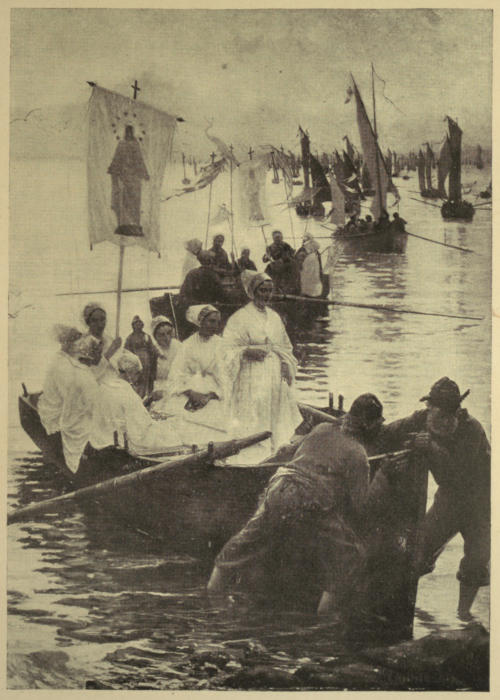
THE PARDON OF SAINT ANNE (BRITTANY)
Guillou
Another source of pleasure are the markets
of Paris. The great Halles Centrales one generally
visits once, and no more, as a truly wonderful
sight; but the flower-markets of the
quays, of the Madeleine, and St. Sulpice are
scenes of perpetual delight. There are many
markets in the different quarters of Paris, where
your servant may go in search of vegetables,
fruit, eggs, and fowls for the national pot-au-feu.
It is a small luxury, however, which I do not
recommend, though widely practised by the
bourgeois, who has a positive genius for the
slow and ingenious saving of sous.
It is for all these reasons, and thousands more
that creep into the blood and the brain beyond
the range of analysis, that Paris takes such a grip
of the foreigner, and becomes the birth-town of
his maturity. In other towns you sojourn as
a stranger or a contemplator. You live apart,
either in your own world of dreams, among old
stones, ruins, and faded pictures, amid the dim
aisles of Gothic poems, or else you form part of a
foreign coterie, and give and go to afternoon teas,
living like invaders, in insolent indifference to
the natives around you, except in your appreciation
of them should they be courteous enough to
lend themselves to your notion of the picturesque,
or treat you with the consideration and
kindness you naturally deem yourself entitled to
expect along the highways of Europe. But Paris
will have none of this patronage. If you settle
there it is inevitable that you will become Parisianised.
I do not say anything so flattering as that
your taste in dress, if you happen to be a woman,
will, of necessity, become that of your adopted
sister, but there will be a chance that her eye for
colour will modify your barbaric indifference to
it, and the cut of her gown and shape of her hat
will insensibly beguile you into altering yours.
Nor, in the case of the young gentlemen of Great
Britain, would I imply that long residence in
Paris will affect their excellent tailoring, or turn
them into the overdressed popinjays of the
boulevards. The Englishman and the Parisian
woman will always remain the best-dressed of
their kind wherever they may live; and, while
the Frenchman, in morals and manners, can descend
to odious depths unsuspected by the blunt
and open-minded Saxon, he can also, when the
race shows him at his best, reveal virtues of subtler
and more captivating quality. I know no
form of young man more charming than a good
young Frenchman, and can never understand
why he figures so little in French fiction. There
is nothing of the prig about him. He does not
spend his days in being shocked at his neighbour;
he is under no compulsion to be narrow and dull;
he does not quote the Bible, nor does he desire,
like the British virtuous youth, to mould all humanity
upon his own stiff and starched effigy.
His wisdom is woven with a great deal of gaiety;
and when he happens to be dull, he carries off
his dulness with an imperturbable amiability.
This type of Frenchman a woman will never
find offensive. He can oblige her with simplicity,
and courtesy and gentleness are the most
distinctive features of his character.
Foreigners in Paris seem to be very much
swayed in their judgments and adoption of
French politics by the mental and moral atmosphere
they breathe, as well as by their own
natural tendencies. The average Briton far too
rarely stoops to consider the question of Republicanism,
but condemns it beforehand on aristocratic
principles. Mr. Bodley, who wrote a
singularly pretentious work on France, frequented
Bonapartist circles, and sat at the feet of the
Comte de Mun, and sundry other political noblemen
of the same mind; and the consequence is
two tomes to prove that what France wants is
another Napoleon—the very thing that nearly
ruined her. The daughter of a sister Republic
carries her millions into France by marriage with
some needy nobleman, who has already figured
in no estimable light in the pages of contemporary
history written by fashionable romancers, under
the guise of fiction, and she perhaps brandishes
her parasol at the head of a band of miscreants,
called La Jeunesse Royaliste, in enthusiastic admiration
of its mission to batter the hat of a guest,
an old man, the Head of the State, the Representative
of France before the world. Mr. Bodley’s
ideal appears to be not the good of France,
but the triumph of the ideal of the archbishops
and owners of castles. The Republic is bad
form, and he would fain see it overthrown for
the pleasure of his good friend, the Comte de
Mun. What the Parisianised, ennobled American
subject wants is to see her admirable and
chivalrous husband Court Chamberlain, or something
of the sort;—she, too, yearns for the life
which every other countess in Paris wants, a
Court to confer a forgotten dignity upon herself,
and if she longs for the re-establishment of the
old privilege, it is in order to patronise and protect
those she fondly deems her inferiors. Other
rich or needy foreigners in Paris wish for a Court
to shine at, a monarchy or an empire, to be able
to boast of their powerful relations. And what
none of them will see is that France, in her several
experimental moods, is seriously labouring
to discover the form of government best suited
to her needs, and that the elect of the people still
hope, through trial and blunder, to reach the
ideal of a progressive liberality. But the passion,
the earnestness, of all these Parisianised foreigners
in their adoption of the several prejudices
and aspirations of Paris prove the truth of my
assertion, that Paris absorbs us in her furnace of
ardent sentiments and theories as no other place
does. We can not stand by and view the spectacle
of her follies and furies like a philosopher.
Needs must we go down into the fray, which in
reality does not concern us, and brandish the
stick or parasol of revolt, whatever our nationality.
Needs must we adopt a party in the land
which regards us mistrustfully as foreigners, and
rewards our generous enthusiasm for its multiple
causes by calling us “Sans-patrie,” “Jews,” and
“Traitors from Frankfort,” subsidised by a
mythical syndicate, like the Czar, the Emperor
of Germany, the King of Italy, and the Pope of
Rome. Needs must we fret and fume, grow
irritable and ill, perhaps long to hear the tocsin
ring for another St. Bartholomew’s, if we are on
one side,—that of the large, unenlightened, and
foolish majority; yearn to people the Devil’s
hole with sundry scoundrels we have come to
hate if on the other side, that of the elect and
liberal minority, with a passion of hatred no
public men in our own country have ever inspired.
What is the meaning of it? Is there
some subtle magnetism in the air of Paris which
makes us see French rascals as so different from
other rascals, French tragedy as more poignant
and intense than any other? I know I could
cheerfully get through the remainder of my days
in Spain or Italy without giving a thought to
either government or caring a straw whether
Sagasta or Crispi were in or out of office. I
never see much difference between the gentlemen
who in turn manage the affairs of England;
in fact, I never have the ghost of an idea who is
at the head of each department, and could not
for the life of me distinguish between Mr. Codlin
and Mr. Short. Not so in this brilliant, variable,
light-headed, light-hearted, graceless, and
bewitching Paris. I am burningly anxious to
know all there is to be known about each minister
of war, and take their repeated defections
almost as a personal grievance. I eagerly examine
the interpellations and their consequences,
count majorities and minorities in the turbulent
Chamber, follow the fortunes of the Senate, applaud,
disapprove of all that happens with the
ferocity of a citizen who pays to keep the machine
going. I know well that I am a fool for
my pains, and that I would be far better employed
in minding my own business. But it is
all the fault of Paris for being so abominably, so
mischievously interesting. She it is who will
not let you let her alone. She is like a vain
woman; she must have all attention concentrated
upon herself. She clamours for your
notice, and despises you for giving it. If you
stand aside with folded arms and look elsewhere,
she will get into a passion, create a
frightful scene to attract your attention, and
when you obey her and give it in unstinted
fashion, she turns on you and sneers and rails at
you for a foreign spy and busybody. Poor Mr.
Bodley, all ignorant of the fretful indignation he
often roused in France by his thirst for information,
was for long regarded by many an honest
Frenchman as a spy.
Oddly enough, I hold that the pleasure side of
Paris, its fashionable world, is the least of all to
be envied. If I were a millionaire, I think I
should prefer London, with its larger public life,
its more varied hospitalities, for the investing
of my millions in the thing called experience.
Even a British ass, with time on his hands, and
millions to squander, can discover an original
method of going to the dogs and casting his
millions into the bottomless pit. But what can
the French idiot do after he has sent his shirts to
London to be washed, and invested in an automobile?
He is such a superlative dandy and
humbug—I would fain use a hideous word,
which describes him still better in three letters,
if it were not for its inexcusable offensiveness—that
he cannot bring sincerity to bear upon his
imaginary passion for sport, and looks ten times
more absurd when he is playing the athlete than
when he is contentedly playing the fool. He is
“the sedulous ape,” not to literature, like Stevenson
in his young days, but to the Anglo-Saxon;
and the folly lasts on to the brink of age.
The Faubourg holds itself more aloof than
ever. It is now not even on saluting terms with
the Republic. Still its life must be lived after a
fashion, and it must give balls, if for no other
reason than the ignoring of ministers and their
wives. It cannot be said that the country at
large is much affected by its doings; and if we
are to judge the inhabitants by the fiction of the
day,—the dialogue novels of Gyp, of Lavedan, of
Abel Hermant, the psychological studies of MM.
Bourget, Hervieu, Prévost,—the sane and intelligent
person may thank his stars that he is still
free to choose his society, and is not condemned
by an accident of birth to tread such a mill of vaporous
frivolity and futility, of intellectual blankness
and arrogance, and of senseless corruption.
I do not presume to say that these clever writers
are invariably accurate in their delineation of
fashionable Paris, nor do I deny that there may
be a good deal of exaggeration in their sombre
and revolting pictures,—for what lies under the
sparkling effervescence of the brightest and
wittiest of Gyp’s earlier work if it is not a dead-level
of inanity and perversity? But their singularity
consists in the fact that all are unanimous
in their conclusions, in the general tenor of the
life they portray. Pride of birth is the only sort
of pride this class seems to possess, and for a
nod the heroines of all those heraldic pages fall
into the arms of the first comer and the last
alike. When you make the acquaintance of a
viscount, you may be sure he has an entresol
somewhere for varied clandestine loves, and
passes his time between encounters here, le boxe,
and his “circle.” One solid, useful action never
seems to be entered to his account. His days
and nights are devoted to accomplished idleness
and seduction, and his busiest hours are those
spent on his toilet. And the women of this
dreary and monotonous fiction,—how shall we
qualify them? They have all the frailty of the
wicked, red-heeled, minuetting eighteenth century
without any of its charm, its wit, and real
intellect. For if the marquise of the old school,
passed into perfumed memory, were a rake, she
was not a fool, she was not a rowdy, and she
had a feeling for great deeds and great thoughts.
She stands on a picturesque eminence in the history
of her land. We cannot say the same for
the titled rake of to-day. It is the fashion to
treat her as a détraquée, because she subsists
mainly upon excitement. But what needs altering
is her standard; what should be overthrown
is the altar upon which she sacrifices her futile
existence. Not that she is the only example of
her class, but somehow the novelists have not
thought fit to present us with any other. The
strange thing about it is, that she and her mate
in the game of battledore and shuttlecock with
reputation and morality, the incorrigible viscount,
have been brought up under a supervision and
care exceeding northern conception. Neither
was permitted a moment of licensed childhood.
Priest and nun were at the side of each, in constant
attendance upon their minds and manners
and morals. The male cherub lost his wings
when the abbé made his last bow and retired,
leaving his charge alone on the brink of temptation,
a youth with a budding moustache. The
maid ceased to be an angel before the honeymoon
had well begun; and, if we are to believe
polite fiction, was already one of the pursued of
snaring sinners before she was a week a bride.
The Paris of this class is not the Paris that
charms and holds you in its spell. The fast,
luxurious, and expensive Paris belongs to it; the
cosmopolitan Paris, kept going by the millions
of the foreigners who come here to amuse themselves.
Theirs is the Rue de la Paix, the Concours
Hyppique, the Arménonville Restaurant,
the Bois, the avenues of the Champs Elysées and
the Parc Monceau, the race-courses, the Théâtre
Français “Tuesdays,” the charity bazaars, the
flower feasts and exhibitions, the automobile
competitions, the “five-o’clocks,” and M. Brunetière’s
lectures on Bossuet. This is the rowdy,
reactionary Paris, ever on view, which disapproves
of the Pope, and would assuredly array
itself in garments of gaiety if M. Loubet were
assassinated. This is the Paris which sneers at
rasta-quouères, and is ever on the lookout for
American heiresses for its needy titled sons,
which is rabidly anti-Semitic, and supports its
prestige upon Jewish millions. Quite recently,
when anti-Semitism was raging in France, and
we were informed in every tone of fury and
contempt that no self-respecting Catholic could
possibly regard a Jew as an honest man or a
French subject, an authentic French marquis
married the daughter of a Hebrew millionaire,
and to console themselves for the obligation of
profiting by their noble comrade’s good fortune,
his friends summed up the young lady’s qualities
in three amusing lines:—
“Belle comme Vénus,
Riche comme Crœsus,
Innocente comme Dreyfus.”
The raillery did not prevent “tout Paris” from
being present at the splendid marriage ceremony,
and inscribing its best names upon the wedding
gifts. It could not do less, seeing that its king
and master, Philip of Orleans, the digne (for
alas! there is no English equivalent of that indescribable
French word as applied to a man)
representative of the House of France, is said to
have accepted a million from the bride’s anti-Semitic
Hebrew mother.
There is another side, less known, of aristocratic
Paris. This is the quiet, exclusive,
genuinely religious side, that of old-fashioned,
rigid noblewomen, who live apart in their dull,
old houses of the Faubourg, given up to prayer
and good works. There is a charming distinction
about them, a musty, conventual odour, as
you enter the halls of their faded hotels. They
preside over ouvroirs, where ladies of their like
meet to make church articles and decorate altar
pieces. Sometimes they carry piety and good-will
to the poor to excess, for I know of one,
a baroness, who neglected her children to make
perfume and soap of her own invention, which
she sold for the benefit of the poor. The instinct
of trade so developed that she ended by opening
a shop, on which she duly bestowed a saint’s
name; and here, if you are willing to pay exorbitant
prices, you may find wherewithal to
wash and scent yourself with the labours of
aristocratic hands, and tell yourself you are doing
so for the good of mankind. Not that I would
laugh at those ladies, who are the salt, the redemption
of their class. I once lodged in the
dismantled hotel of such a countess, and was
edified by the stately, chill dignity of her austere
existence. Her private rooms were furnished
with a touching simplicity. Even in winter
there was not a carpet anywhere, no sign of
luxury or comfort; but in her private chapel,
where Mass was celebrated every day, the vestments
and ornaments were both beautiful and
precious. She herself had nothing whatever to
do with the frisky countesses of French fiction.
She was in every sense of the word a great
lady,—handsome, with aquiline features, and
with hair worn high off a noble forehead, reserved,
possibly too haughty in bearing and
expression for her reputation of piety, but essentially
one of the elect of this earth, the kind of
woman that an aristocrat should be, and too
rarely is, to justify her privileges and pretensions.
Here, far off from the roar of reaction and the
rumble of revolt, such women dwell amidst the
dim splendours of an impoverished house, unfamiliar
to the frequenters of routs and races;
whose names never appear in the society columns
of the Figaro; who are chiefly known to the
poor and the priests of their neighbourhood; and
they it is who preserve some charm for the
Faubourg, who help us to regard it with some
indulgence and sympathy in its futile discontent.
For what can be the benefit to itself or to France
of this fine attitude of disdain? Every part of a
nation should go with the times, and the Faubourg
would have served its own cause as well
as its country’s in abandoning its belated ambitions,
and making the best of its existing circumstances.
It feeds its pride on its absurd
exclusiveness; and who is the better for this?
It is largely due to this insane vanity, that Paris
has become the centre of rowdy cosmopolitanism,
the pleasure-ground of the entire world, for
it is the titled malcontents who attract the class
they are pleased, with signal ingratitude, to call,
contemptuously, rastas, instead of looking after
the affairs of their country. Since they will not
earn their right to live, they must be amused,
and amusement is the costliest thing in the
world. Not having enough money for this profession,
they needs must set themselves out for
the capture of alien millions; and then when
the foreign millions fall into their laps, by way
of Frankfort, or New York, or South America,
they mourn and lament because the foreigners
take root, Parisianised by the sorceress Paris,
and cry out that France no longer belongs to the
French, and that Paris is sold to a band of cosmopolitan
miscreants.
CHAPTER III SOCIAL DIVERSIONS AND DISTINCTIONS
With a race that has so thoroughly mastered
the art of living, and not merely
working or vegetating, the question of diversion
is of paramount interest. In the fashionable
world, sport monopolises the better part of
man’s hours. This is an overseas passion,
adopted with frenzy and fervour. M. Rémy de
Saint Maurice has given us the odyssey of the
record cyclist in an amusing and humorous
book, Le Recordman, where we see the wealthy
idlers of France in awed adoration before the
prowess of the racing-wheel. The champion
cyclist raises storms of emotion wherever he
runs, be it in Paris or in the provinces. When
he returns to his native town, all the authorities
come to meet him and do him honour.
The French race is essentially a conversational
and not a sporting one. It has a natural predilection
for the amenities of life, and we feel how
inappropriate is this present craze for rude and
unsocial games. You need only watch a Frenchman
on horseback, and contrast him with a
British horseman to assure yourself of the fact
that the point of view of each is quite different.
The Anglo-Saxon rides ahead with the air of
thinking only of his horse. The Frenchman
trains his beast, like himself, to have an eye to
the arts and graces, to curvet and prance minuettingly,
to arch its neck as he himself bows, and
he brings a suggestion of the salon among the
shadows of the Bois de Boulogne. Should there
be a mortuary chapel on their road to this sophisticated
paradise, stand and note the pretty way
these dashing creatures will salute death. Spaniards
would do it, I admit, much more gracefully,
for in the art of salutation the Spaniard comes
first beyond a doubt. But you will not see anywhere
in the British Isles so pleasing a spectacle.
Some bend altogether over their steeds, hat
curved outward on a wide sweep; others pause
midway, less ostentatious and theatrical in their
respect, and hold their hats in a direct line from
their eyebrows, admirably suggestive of diplomatic
reticence, younger and elder men all expressing
every shade of effective recognition of
alien grief with a subtlety, a dramatic felicity of
movement and line the stiff Anglo-Saxon could
never hope to achieve. Of course the supercilious
Englishman would say he had no mind to
play the monkey, and find a cause for just pride in
the rigidity of his body, and the stoniness of his
well-trained and inexpressive visage. But here
I differ from him. A man loses nothing by outward
grace, and there is no reason on earth why
he should rejoice in the fact that he cannot bow.
The motor craze has superseded the cycle
craze. The bourgeois bicycles so much that
the youth of fashion needs something to distinguish
him on the road from his inferior brother.
So somebody came to his rescue with the motor-car.
Go to Paris if you would realise what a
perilous thing the crossing of a street may be.
In such a neighbourhood as the Place Pereire it is
almost mortal. I imagine it as a machine invented
by the upper classes to replace the guillotine,
and run down the miserable foot-passengers to
avenge the beheadings of a century ago. Whenever
I return home, and discover that I have
lost a purse, a book, a packet according to my
invariable habit, I am so thankful to feel that I
am still alive, in spite of the automobile which
charges through the streets in such a dreadful
way, that I balance loss and gain, and count myself
still a winner in the game of life by every
new day to my account. In London you are
everywhere enveloped in a sense of public protection.
The cab drivers know how to drive,
a feature of their trade they are most imperfectly
aware of in Paris. The policeman is there when
he is wanted, and, thanks to him, the nervous
passer-by is valiant and unafraid. But in Paris
the driver regards him with an eloquent hostility.
His one hope is to get a free chance of
running over him. He is insolent, overbearing,
and menacing, unfettered by policeman or law
in his man-crushing career. And, as if regretting
the very slight limits still left him, Paris cast
forth upon the public way the motor-car. This
machine of destruction hisses along, leaving a
trail of petroleum in the air, and you have barely
time to start back for its passage, such is the
fury of the horror in the hands of its fashionable
owner. There are many motor-cars in use for
the big shops and public offices; but these, being
in no sense competitive in luxury, measure the
ground by a speed less fatal, the drivers seem
to desire to leave you whole, and suggest by
their pace and bearing, some glimmering of humanity
in their heart. For it is only the rich
young men who give one the notion of wishing
to avenge the massacres of the French Revolution.
For the benefit of these flowers of the race,
exhibitions of motor-cars take place, under the
patronage of dukes and counts more or less authentic.
And, so encouraged, these wild Parisians
set out in their automobiles for the harmless
and distant provinces, and charge down the long
French country roads with purpose often more
deadly than that displayed in the capital. The
newspapers acquaint us with frequent accidents;
and whatever the general sentiment regarding
these accidents may be, I always feel that they
are a well-merited chastisement. Why must
the poor, the obscure, the inoffensive clerk and
shop-girl, go in fear and trembling of their lives,
that the privileged few may add a fresh sensation
to their list of entailed emotions? Is not the
luxury of a horse good enough for those busy
idlers, without adding heart disease to our inherited
disorders?
Boxing and fencing are also favourite exercises,
as well as polo and tennis amongst games. One
of the more serious of diversions is the duel, the
first of which must be fought in early youth,
and the last when temperament and politics shall
have said their final word. Then come the
amusements of club life, which absorb a good
deal of masculine leisure, of course, and where
men meet to talk and be entertained, as well as
to eat, and read the newspapers. The races
and the horse-show are sources of pleasure at
which every self-respecting Parisian drinks.
Not to be connected with horses or exhibitions
would be almost as bad as not to possess an
automobile, not to be seen in the foyer on great
theatrical nights, not to have fought a duel.
But beyond even all these pleasures are the noisy
suppers of the fashionable restaurant, where
everybody who is anybody meets “tout Paris”;
where the dresses of the women find rivalry
in the decorations of the men, and the scene
approaches the ideal paradise, the mundane city
peopled with brilliant personages.
In all things the French bourgeoise is more
difficult to divert than her aristocratic sister.
She is much more particular and infinitely more
restricted in her ideas upon feminine liberty.
While the women of the upper class arrogate
to themselves the right to amuse themselves
in whatever fashion they like, with lovers or
without them, bicycling, skating, shooting, on
horseback, in automobile (the Duchesse d’Uzès
was the first Frenchwoman to obtain a certificate
as woman driver of the motor-car), private
theatricals, they can smoke or scale the mountains
of the moon with impunity. All these
varied avenues of distraction are rigorously
denied the bourgeoise. She is the most conventional
of creatures, and anything like marked
originality in one of her sex terrifies her and fills
her with distrust. She was bred in the conviction
that girls should resemble their great-grandmothers,
be clothed until marriage in the
integrity of imbecility, and after marriage in
the narrowness of piety, and know no other
amusements than those strictly suitable to a
“feminine” woman. The path her mother and
grandmother trod is the path she must never
deviate from. She must be just as religious as
they were, taking care, however, to follow the
fashions of her own class, in order to guard
from so dangerous and disreputable a pitfall as
originality, which, with her, means pronounced
eccentricity. When she lives in Paris she dresses
well; but the province often transforms her into
an inconceivable shape of dowdiness. In Paris,
thanks to the lectures, music, drama, literature,
the multiple elements of culture, it is impossible
for her to escape, unless her days be entirely
devoted to domestic economy and good works;
she is rarely destitute of that agreeable worldliness
that makes commerce with her, however
shallow and superficial she may be, facile and
often instructive. And when she has the hardihood
to plunge into deeper waters and think for
herself, when she ceases to be beset with a craving
for the ordered in conventional circles, and
to think ill of originality and individual character;
there is no woman on earth more charming,
more capable, of readier wit, of less intellectual
prudery, wedded to a wholesome independence
of judgment and principle.
But as I have said, the amusements of the
bourgeoise, “big” or “little,” are very restricted:
books, theatres, balls, dinner-parties, with the
excitement of religious ceremonies, an academy
reception, a noisy sitting of Parliament, the
hourly expectation of revolution, a correct evening
party,—the dullest thing on earth wherever
it takes place. But, on the other hand, we
may be sure she will find ample entertainment
in looking after her admirably managed establishment,
in making her own and her husband’s
means go a very long way in accomplishing a
thousand little domestic meannesses unknown
to the thriftless Anglo-Saxon, and all with a
certain geniality and discretion that win her the
esteem and goodwill of her fellows. For of
womankind she is the most genial and well-mannered,
and though she may, in straitened
circumstances, deny every pleasing luxury to
her family, her good humour will keep those
around her in good humour, and the counting
of lumps of sugar and of grains of coffee will
seem a slight matter compared with the flavour
of domestic courtesy that accompanies the process.
I have known of an English family where
at table forced strawberries and peaches were
daily eaten, and vegetables at a fabulous price,
upon the finest damask and priceless china, to
the accompaniment of glasses flung by sisters
and brothers at an argumentative head, plates
flying, and oaths showered like missiles. Who
would not prefer the economical French middle-class
table, where, in well-to-do families, lunch
is often served on shining oilcloth or table as
polished as a mirror, to save washing, and where
the amenities are as carefully guarded as if the
household were on view?
In this world the young men, as elsewhere,
have the best of it. Theirs the licence of manhood
in all things. The moment dinner is over
they put on their evening suit and file off (filer,
as they say themselves, in their pleasant French
slang) in the quest of pleasure. If they are well-to-do
they have no difficulty in getting accepted
in the world of third-rate titles. Tarnished
dukes will cordially shake their hands. As
there is no peerage in France to control aristocratic
pretensions, they may have as much as
reasonable man can desire of the society of
marquises and counts, provided they take these
exalted personages on trust, and do not seek to
examine too closely their blazons. The method
of making one’s self a count or a baron in Paris
under the Third Republic is very simple. You
may purchase a Papal title at a not exorbitant
cost. In Abel Hermant’s Le Faubourg, a porcelain
manufacturer was awarded the title of count
by the Pope in return for a dinner-service he sent
him, which was explained on the grant as pour
service exceptionelle. In France and America
only are Papal titles taken with gravity, and pronounced
with all the sounding magnificence of
hereditary names. But a simpler way still, and
less costly even than the interference of Rome, is
to buy a plate, and have graven on it first a
name prefixed by the particle de. When this has
been accepted without demur, and the newspapers
have a dozen times announced you here,
there, and everywhere as M. de ⸺, then boldly
apply the title of your predilection, and behold
you are, without more ado, a noble of France.
No need of papers or permissions. You are noble
by the grace of your own goodwill; and as
most of the people around you are playing the
same game, there is no earthly reason why your
friend should be more of a count than you are
of a baron. And so you may aspire to a larger
dot from your bride. If you are in the army,
you may even look as high as your general’s
daughter; and when you travel abroad or
journey in the provinces, you will be made to
understand what a fine thing it is to be able,
thanks to your own valour and judgment, to inscribe
yourself in hotel books as M. le Baron or
M. le Comte. You will be served better than
when you were plain Mr. So-and-So. Waiters
will help you off and on with your coat with a
deference hitherto not enjoyed by you in your
anterior plebeian state, and the society papers
will record your great doings with gusto and fervour.
Who, under these circumstances, would
not be a count or a marquis? Had I known
years ago of the facilities and advantages offered
in France to titled adventurers, I might have had
the wit and wisdom to style myself countess of
this or baroness of that, the sole existing representative
of an Irish King or a Norman house.
Indeed, such is the predisposition of the French
bourgeois to believe in the noble origin of his
acquaintance, that one stoutly maintained before
me that O and Mac were the Irish equivalents of
count; and my remark that every second washerwoman
or policeman in Ireland rejoiced in
those attributes of nobility was received with
frosty incredulity. A French officer’s wife of
the name of Mahon assured me that her husband
was of noble origin, and related to Marshal
MacMahon; but that, unfortunately, the papers
identifying the relationship were lost, and, in
consequence, they could not call themselves MacMahon.
As the good lady really believed every
word she was saying, I could not in courtesy
point out to her that Mahon and MacMahon are
equally common names in Ireland, and, for that
matter, in the British Isles, and that every MacMahon
deems himself a connexion of the late
marshal, though not one would have thought of
claiming the relationship if Marshal MacMahon
had remained in obscurity.
A substantial source of income is occasionally
derived by the authentic nobles for the presentation
of the other kind into the halls of social
greatness, and for standing sponsors for them in
exclusive clubs. Another source of income for
avid noblemen lies in their shooting and hunting
grounds. So much is paid for an invitation, still
more for the button, which permits parvenus
to hunt on equal terms with their so-called betters.
The extraordinary things these nobles will
do passes the imagination. I know of a viscountess
who possesses magnificent hunting
land on which men from all parts are invited to
hunt. The guests departing naturally tip gamekeepers
and servants according to their means.
Every tip, by order, under penalty of expulsion
from the château, must be brought intact to the
viscountess, and out of these tips are the servants
paid their wages.
The life of fashion in Paris is pretty much the
same as the life of fashion elsewhere. Men and
women ride in the Bois in the early hours, and
it must be admitted that they could not find a
pleasanter spot to ride in anywhere. The landscape
is charming, and if you break away from
the Allée des Acacias—the Parisian Row—you
may even make a feint at losing yourself under
columns of tall trees, by little, moss-grown
paths, where the branches meet overhead, with
ever in view grassy rolls of sward and bright
trellises of foliage above the broad white roads.
In the early hours this trim paradise is cool and
quiet; and even an Anarchist on foot will have
no cause to envy his prosperous enemy on horseback,
for the same delights of herb and leaf, of
sky and water, are his at a cheaper rate. Indeed,
there is no land on earth where a good-humoured
taste of vicarious pleasures may be so freely and
fully enjoyed as in France. Amiable petits gens
sit on chairs and watch the great parade of the
Bois without a trace of envy in their looks, comment
on dresses, horses, equipages, bearing, as
if it were but a pageant got up for their benefit.
I am not sure that this is not one of the advantages
of Society—one of its objects—to minister
to the kindly and generous vanity of the workers
of a country. These, by their labours,
maintain it, dress it, wash for it, build for it,
manufacture for it, keep in order for it the public
roads, give the best of their blood, brains,
nerve, and force to its triumphs, and are content
to see how well the result of all this gigantic
travail of a race looks in the show hours of national
existence. The big dressmakers are repaid
when, sitting in their loge of inspection,
they watch the effect of their several creations
on Varnishing Day, at Auteuil or Longchamps.
The artistic temperament is at the root of all this
contentedness, of these subtle gratifications
which the Philistine workman does not apprehend.
The Frenchman brings this sentiment of
art into all he does. The word “artist” is applied
to cook, dressmaker, milliner, hair-dresser.
In many ways M. Demolins has shown us that
the race is inferior to the Anglo-Saxon races, but
it has one essential superiority—the absence of
vulgarity in the artisan and shopkeeping classes.
You can hold converse with pleasure and profit
with your washerwoman, who also will, in all
probability, be something of an artist, with the
artist’s personal point of view; with your char-woman,
your hair-dresser; and the grocer’s boy
on his daily rounds, if you come in contact
with him, you will find to be an intelligent
and well-mannered youth. It is only when you
get a little above this class that you light upon a
trace of commercial vulgarity. The commis voyageur
is something of a trial on the public road.
He is not a pattern of manners, and he is apt to
be aggressive in his desire to obtain the value of
his money. Go still higher, among the wealthy
bourgeois, and in no land of all the world will
you find men who can comport themselves
worse. In their attitude to women they seem
to possess no standard of courtesy whatever.
When a Frenchman of this class is polite to a
woman, you may be in no doubt of his views in
her regard, and you may be perfectly sure of her
social and pecuniary value; for he is the least
chivalrous, the least kind, the least disinterested
of mortals, speaking generally, though here, as
elsewhere, you will find noble exceptions. I
hardly know an American or English woman
who has travelled or stayed any time in France
who has not had occasion to note how much
less courteous to women Frenchmen are than
their own men. Two young English ladies,
finding themselves in some dilemma with regard
to trains or luggage, had occasion to call on one
of the chiefs of the Gare du Nord. This gentleman,
elegant, disdainful, and fatuously rude,
received them in a luxurious office, fitted up
with such splendour as to suggest some of the
complications of the Parisian drama, and bore
himself towards them with such intolerable insolence,
that, on going out, one of the travellers,
to be even with him, said: “Everything may
be found in Paris, I see, except a gentleman!”
This, of course, is angry exaggeration, for nobody
can be more delightful than a Frenchman,
when he chooses to give himself the trouble to
please and to serve; but it is as good an example
as I can give of the attitude of the French
functionary to the public. Put a uniform of any
sort on a Frenchman, invest him in any kind of
office, and he is apt to become insupportable.
Rudeness he practises as part of his official dignity.
It never occurs to him that he is there to
assist the public. He conceives himself to be
there to insult and domineer over the public.
In France, social distinctions are less insusceptible
of permutation than elsewhere. Everything is
possible in a land where a tanner may hobnob with
a Czar, be embraced and addressed by that august
personage as “friend.” The nations of Europe
may object to this state of things, but the nations
of Europe must put up with it. Amongst
these same nations France cannot be left out of
the reckoning. Her capital is always felt to be
the best morsel of foreign travel. It is she who
gives “tone,” for I do not speak of anything so
obvious as the unquestioned prestige of her
fashions. A day may come when this prestige
shall have passed elsewhere, but even when that
day comes Paris will continue for long years to
subsist upon her ancient renown. Even now
there are signs of revolt against her sovereignty.
For in my own town, Dublin, contempt for her
fashions is openly expressed, it being alleged
here that the women of Dublin dress with far
greater taste than their sisters of Paris. Those
who are inclined to make light of these pretensions
should go to Dublin in the Horse Show
week, where I am assured that the dresses of
the girls and women of Dublin leave Paris nowhere.
So the good people of Dublin say, for
they have a fine conceit over there, and profess
to hold Europe in light esteem. But in spite of
this it is not improbable that Paris will continue
to maintain its superiority.
Under republican rule, woman has no official
position, is in all matters of state a mere cipher.
And so it is not possible for the President’s wife
to start a fashion, or for any Minister’s wife to
guide the vagaries of taste. This in itself suffices
to explain to us the fact that a large majority
of women are anti-republican. They feel
that their sex is insulted by a Government which
takes no recognition of their charm and influence,
presumes to govern without the assistance
of their presence, without any loophole for their
unauthorised supremacy. There is no chance for
a Pompadour under a Republic, and whatever
other abuses may exist to-day, ladies of light
morals cannot hope to attain heraldic glory and
hereditary wealth by the “primrose path of dalliance”
with royal Lotharios. And so social
distinctions are now in France more complex and
less stringent than under the ancien régime.
Complexity lies in the variety of claims not
known in former days, when the division between
the classes was sharp and infrangible. In
the world of toque and robe there are men who
count themselves the superiors of the crusaders;
in the army there are generals of plebeian origin
who think themselves the first of Frenchmen;
there are fashionable doctors and surgeons,
painters, authors, politicians, men of science,
and merchant princes who regard themselves
almost as the equals of the crowned heads of
Europe.
All these varied ranks of society meet at a
general point—social pretension. Wealth is
the sole degree they really acknowledge, though
“good family” is their vaunted consideration.
They are aware that fashion and birth are no
longer synonymous terms, that the goal is
quickest won by the longest purse. A duchess
with a hundred a year may feast on her own
prestige in the eyes of a few intimates, but the
world at large will forget her existence to run
after the capitalist of yesterday’s standing. With
the suppression of the power of the aristocracy,
its removal in a body from the governing centre,
the field was left free to money and talent;
and with industry and education both may now
be said to be within reach of everybody. The
aristocracy groan, ineffectual and undignified,
while a large majority of the nation heeds them
not. It is perfectly aware of the impotence of
these discontented idlers, aware that, with a few
chivalrous exceptions, who must be admired for
their fidelity to tradition, it is not at all the good of
the country they are working for, but their own
personal triumph. Who to-day is going to stop
to examine the rights, the promises, of the candidates
of the three mutually destructive parties
working for the hour conjointly in their vindictive
hatred of a Government able to get on
without them? But all know very well that
should the Nationalists win and overthrow the
Republic, as they desire to do, it is only then
the country would be hurried into a ruinous civil
war. The inoffensive President holds the balance
between Legitimist, Imperialist, and Orleanist,
and as soon as arms against the Republic shall
be laid down by all three we may prepare to see
them showing their teeth to each other. For one
of the three parties must triumph, and how will
the other two that have fought with it on equal
terms tolerate this obvious consequence of its
success?
While admitting that Frenchmen have brought
much grace along with the continual gratification
of the senses into the diversions of outdoor existence,
it is questionable if they enjoy them really
as the English do. We cannot easily conceive a
French Minister shaking off the cares of office
to refresh himself with all the gusto of a schoolboy
on the golf links. Taste and national character
would be much more likely to lead him
to seek change and distraction in that temple of
fame, the salon. Here we may picture him
talking with the consummate and exquisite ease
of his race. Their sports, like their clubs, the
French have borrowed from England, and, according
to the point of view, have improved or
disfigured these noble institutions; but their
salon is their own. No other race has even tried
to compete with them on this famous ground,
for the reason that no other race has the art of
general conversation. You must have the instinct
of good conversation, be yourself something
of an artist in it, be able to bring an
attention, a readiness of wit and intelligence and
information, demanded in this national pastime.
The French speak well because they know how
to listen so well. With them there is no such
thing as talking down the company. The deference
given is duly claimed and granted, and the
first thing that strikes you in a salon is the complete
absence among the men of that vexatious
British habit of lounging. Frenchmen in their
families do not lounge as Englishmen lounge in
strange drawing-rooms. I once heard a Russian
woman who had sojourned in both countries
say, Les Anglais n’ont pas de tenue.
And this is true. An Englishman who counts
himself a gentleman will put his feet on railway
cushions when women are present, he will
sprawl before women in rooms, keep his hands
in his trousers pockets while talking to them,
nurse his foot at an afternoon call—in a word,
do everything but sit on the chairs or seats of
civilisation in a simple and inoffensive attitude.
Not one of these things have I ever seen Frenchmen
do, even in intimacy. Their correctness in
a drawing-room is scrupulous. Familiarity is the
very last thing they suggest, though the house
you meet them at may be one they have been
in the habit of visiting once a week at least for
many years. Englishwomen to whom I have
remarked this peculiar characteristic of their
countrymen retort that the behaviour of Frenchmen
in dining-rooms is as inferior, compared
with that of their compatriots, as ever could
be the behaviour of Englishmen, tested by the
same standard, in drawing-rooms. I willingly
admit the accusation, and I confess I should find
both races more delightful if each borrowed the
best of the other, and so mended their ways and
became perfect. I do not care on which side the
lesson begins, if only Frenchmen will eat as well
as Englishmen, and Englishmen will imitate the
perfect “tone” of the Frenchman in a drawing-room.
The niceties observed by each in its
sphere are equally admirable and equally necessary
if we are ever to arrive at that indefinable
and still distant state called civilisation. But to
hear the Anglophobe in France (or, still worse,
read him), and the Gallophobe in England talk of
one another, it might be believed that these two
great races stood farthest off from the goal we all
aspire to reach instead of being both in their several
ways nearest to it.
I will be honest, and confess that the race of
my predilection, France, is far the worse sinner
of the two. To soothe her wounded vanity,
and an imaginary hurt of honour skilfully exaggerated
by the Press, she has descended to
foolish misrepresentation of a neighbour with
whom she had far better live on terms of amity.
The Russian alliance turned her head, and for
once she had not wit enough to see that she
was being deliberately fooled for purposes not
in the least connected with her own interests.
Since that memorable date, she has gradually
raised the tone of her hostility to England, till
now her chief aspiration, if we are to believe the
nonsensical Nationalist Press, is to avenge the
old defeats of Crécy, Poictiers, and Agincourt.
We will not speak of Waterloo. That victory is
associated with Germany and Russia, and her intention
is, for the moment, to pass as the very
good friend of both. Left to herself, France would
never have unearthed these ancient hostilities of
the War of a Hundred Years, for she is in the
main both sane and intelligent; but the Nationalists
do not for nothing profess hostility to the
Government, and they are ready for war, even if
it but lead to the reversal of the ministry, and the
removal of President Loubet. For they hate
poor M. Loubet with ferocity; and I have seen
in the eyes of some of my Nationalist friends,
devout Catholics and Conservatives, that is, rabid
partisans of the lost cause of the aristocracy, a
gleam of joy when one night the late roars of the
newspaper boys led us to fear that the President
had been murdered. On a assassiné Emile!
they shouted, leaping to their feet, and flinging
down their cards. If their lips did not simultaneously
pronounce the words, “Thank God!”
there was not present an expression of countenance,
a tone of voice, that did not eloquently
utter the unchristian thanksgiving at the thought
but my own. And yet these people are all excellent
citizens; possess many lovable qualities,
are capable of kindness to friends, to the poor, to
foreigners even. And so I am led, from intimate
knowledge of the “Boxers” of France, to conclude
that the “Boxers” of China may not be
in themselves reprehensible creatures, but only
wild and misguided “patriots.” Patriotism is
accounted one of the noble virtues of mankind;
and when we obey the dictates of patriotism
who is to pronounce them criminal even when
they prompt us to massacre all the foreigners at
our gate, and torture all their partisans within
those same gates?
The pastimes of the “little people” are infinitely
more interesting than those of their betters.
Here is no idle waste of money on fashion
and display. Every penny spent brings in compound
interest in relaxation and enjoyment. For
the “little people” are mighty careful of their
sous. When the small shopkeeper, with his
wife and limited family, go to dine at a restaurant,
it is an excellent lesson in domestic
economy to watch their proceedings. One good
dinner will be ordered, and the waiter places
this, with a second relay of plates, before the
shopkeeper, who shares this dinner with his
wife, and the children feed surreptitiously off the
parents’ plates. Thus four persons will have
dined, and well, at the restaurant price of one.
As foreigners are not supposed to be up to these
dodges, they will find their adaptation of them
difficult and discouraging. Those who prefer to
picnic in the public woods on a Sunday have a
better time. They fill a lunch basket according
to purse and palate, and set out on the impériale
of the tram from the Louvre, which takes them
for three sous each to the wood of Vincennes,
one of the most charming of Parisian fringes.
The people of Paris are more spoiled than any
other, for public pleasure-grounds abound, and
no one can complain that the rich have the
monopoly of the best. Where will you find
such an exquisite park as the dear little Parc
Monceau, with its ruins, and emerald slopes cut
and watered to look like carpets of plush, its
alleys and gorgeous flower-beds? In London
such a cultivated bit of fairy-land would be the
exclusive property of the wealthy residents round
this park; not so in Paris, where verdure and
flowers are cared for for the public, to whom
they belong. The people of Paris have won
their freedom for ever, and the privileges of the
wealthy are reduced to those they can pay for.
Were they to attempt the appropriation of
others, the Parisian workmen are quite ready to
start another revolution. Their argument is that,
so long as they are willing to work, they have a
right to live, and living implies not only bread
and meat, but a fair share of pleasures. These
pleasures for them must be inexpensive, and
their pleasure-grounds must be maintained at
the cost of the public, which in turn is maintained
at the cost of their labour. And so they
are free of the Bois de Boulogne, a gem of
public woods; of Vincennes, less prepared and
perfumed and rigorously trimmed, with its wilder
bits of scenery along the Marne, its hillsides
and quaint solitudes; of Fontainebleau, that airy
heaven of the artist, on the edge of one of the
cemeteries of the ancien régime, the grand old
palace of kings which now belongs to the nation,
the little town asleep on its forest marge,
where of old the Court played at life in high
dramatic fashion, and “minuetted” itself with
grace into the grave.
The surrounding scenery of Paris is unimaginably
enchanting. Luckily for themselves, and
unluckily for the fastidious dreamers, the people
have spoiled all this beauty with their gingerbread
fairs, their rowdy diversions, their feasts
and improprieties. Bougival is given over to
ladies of indecorous habits and their fugitive
mates, Asnières is now a place where fast men
take women at war with respectability and
virtue to dwell at ease, so that these pretty resorts
are closed to the puritan holiday maker.
If you have not lived in the neighbourhood of a
French fair for the traditional three weeks of its
duration, you cannot understand to what extent
a nation or a city may be martyrised for the
pleasure of its people. The clamour of diverse
sounds begins at ten A.M. and ends only at one
A.M., fifteen hours later. There are the roars of
the wild beasts, the tambour beating outside each
booth at intervals, the whiz and whistle of the
merry-go-rounds, the frightful music of the dancing
halls, each repeating without intermission
the same airs and all simultaneously, so that you
hear the waltz of Faust, of Mme. Angot, the
jingle of the Danse du Ventre, and polkas and
marches in a maddening mingle. Add to this
the uninterrupted popping of guns, and the
shouting of the booth proprietors, and you
have all the elements of an inferno never imagined
by Dante. To complain were idle. The
people are taking their pleasures, and the people
must live. So the world of fashion, when
a fair comes its way as it does at Neuilly,
makes the best of it with the good-humoured
philosophy of France, and goes down into its
midst. At the fair of Neuilly it is the chic thing
for the elegant diners to attend in evening dress,
and admire the pugilist, the lions and tigers, the
merry-go-rounds, and the exhibitions of the
tents.
The behaviour of the people at these public
entertainments is admirable. No rowdiness, or
drunkenness, or ribald conduct, for the poorest
devil in France has the art of taking his pleasures
decently. But as the reverse of the medal, no
people could be less innocent, less clean in its
choice of amusements, and so these gingerbread
fairs are well provided with obscene spectacles.
I need cite only one case to prove how deep lie
the roots of the national perversity of a race
which reveals in all things such remarkable exterior
grace and refinement. My servant, an excellent
creature, well-bred, of the very highest
moral character, and a delicacy of sentiment and
instinct many a lady might envy, a woman a
duchess might make her friend and count herself
the gainer, has a child, a little lad of ten. She
has brought up this boy so perfectly that if fate
transformed him to-morrow into a prince, he
would have nothing to learn. She has insisted
in his training on an exquisite modesty, the delicacy
of a girl, and a corresponding innocence.
I gave this little fellow the other day half a franc
to go down to the fair, then in my avenue, and
told him to go and see a brown bear and a delightful
young camel with which I had made
friends; but before the child reached the wild-beast
booth, an elderly gentleman, going into
another booth, invited him to accompany him.
Now, the elderly gentleman knew where he was
going, and why; the child did not, and he trustingly
went in, paid his twopence, and followed
the elderly reprobate to see—what?—a series of
anatomical models in wax; the man explained
the spectacle to the child, and sent him back to
his mother troubled and unhappy. François
communicated all that had passed to my servant,
who came to me with tears in her eyes, and we
both felt it a hard thing that a boy in Paris could
not be trusted to amuse himself in a harmless
way while waiting for his mother, and almost
within range of her glance, without disgusting
snares being laid in wait for him, with no excuse
even on the score that his elders were seeking
entertainment where he was not expected to be
found.
Other pastimes of the people, besides fairs and
picnics, are the cheap excursions down the river
with inexpensive refreshments on the water-edge,
the public dancing of the 14th of July, and
the illuminations, carnivals, and the feast of the
washerwomen with the coronation of their
queen, the free afternoons at the state theatres.
All these are edifying sights, for they show you
how decorously and charmingly the French
people can take their diversions and how good-humoured
and well-mannered a French crowd
can be. If you venture up to Montmartre, the
hill of impropriety, you will find a different
quality in the entertainment offered. You will
be less convinced of the moral and mental value
of the nation. A great deal of hot blue wine is
consumed, and the desperadoes of misprized
genius meet to shock and shake the foundations
of the hill by their stupid ruffianism in
verse. Ladies display their underwear, and
their havoc of virtue is gauged by the length
of their laundress’s bill. Tenth-rate journalists,
unread and unreadable authors, penniless,
whose talent consists in their indecency, inane
and flatulent “masters,” pose here and enjoy
in their several ways the sensation of going
to the dogs in a body. They drink out of skulls,
and count themselves original. A waiter dressed
as a devil addresses them, Que veux tu, damné?
Satan at the counter, with hoofs, horns, and
tail, welcomes them to hell, and they think they
have accomplished unheard-of villainy when
they get drunk. It is not unusual to hear that
these amiable gentlemen live upon the profits
of prostitution, while awaiting their merited
recognition from a dense and ungrateful world.
Sometimes, but rarely, real talent has travelled
down to the Boulevards by way of Montmartre
and the dull Red Mill of Folly. Maurice Donnay
is a brilliant example. He dwelt awhile on his
high perch of misprized genius, but he was
speedily valued at his worth, and carried in triumph
into a cleaner and more intelligent atmosphere.
There is nothing drearier in Paris than
its resorts of vice, such as the Moulin Rouge,
Bullier, its “halls of brandy and song.” They
are quite as vulgar as elsewhere, and infinitely
more disgusting.
CHAPTER IV THE ARMY AND THE NATION
The question of the hour in France is militarism
and anti-militarism. The emotions
roused by this fierce duel between these two
parties of the nation are poignant and absorbing,
and threaten us ever with civil war. It is impossible
to blink away all the perils and grievances
and wrong-doing in which the final
triumph of militarism could involve France; and
still less possible to deny the sad fact that a large
proportion of the country are in favour of military
triumph. This fact is mainly due to the
infamous campaign of a Press with little instinct
of honour or truth, which persuades the unthinking
multitude that the salvation of France lies in
the hands of a group of unscrupulous and incompetent
generals who, since Sedan, have not
done anything to justify the extraordinary confidence
reposed in them by their credulous and
easily fooled countrymen.
A REVIEW AT LONGCHAMP
Thanks to Napoleon, the French are unable to
bear defeat. The race is a nervous, excitable
one, susceptible to great moments of dejection,
and easily plunged into terror under the influence
of anxiety. They have not recovered from the
effects of ’70, and their souls are still stamped
with the horrors of that terrible year. They
wince at the memory of Sedan, and have only
been able to check the depressing work of remembrance
by a buoyant conviction in the near
hour of vengeance. For years they have fed
upon the hope of the revanche. Only a general
can give them this desired satisfaction, they believe,
and hence their absurd worship of their
army, and their still more absurd readiness to
fling themselves under the feet of any soldier
who will fool them with tall talk, and intimidate
them with the discovery of traitors. Their apprehension
of treason in their own midst is one
of the most significant symptoms of demoralisation.
According to the modern French, every
man seems to have his price, and every Frenchman
is only longing for an opportunity to sell
his country. Not even the Chinese have an intenser
distrust of the foreigner. In the lamentable
Affaire Dreyfus, the immense majority were
honestly convinced that the nations of the world
(Spain excepted) were banded together to work
the ruin of France, and cast shame upon her
army. They knew the figures paid to the Czar,
their ally, to the Emperor of Germany, and to
the King of Italy by the Jews. England as a
rich country was supposed to be one of the
paymasters of Europe in its unequal struggle
against the honour of France. It was the Affaire
Dreyfus that revealed to the amazed world the
sudden passion of the French people for its
army. The army saw its opportunity, seized
it, and may now be said to be in revolt against
the nation. Let us be in no doubt of the fact
that France does not desire a military dictator,
and that such a dictatorship would be the very
worst calamity that could happen to her. It is
easy enough to detect the wire-pullers behind a
parcel of mischievous journalists; discontented
shopkeepers, whose suffrages are obtained by
the promise of brisker commerce under a new
condition of things; the large middle class
always in terror of socialism, which might rob
them of their cherished luxuries. There are two
great powers diminished under republican government—the
aristocracy and the Church. These
are working together to overthrow what they
regard as a common enemy, and any means are
welcome to them, whether foul or fair. Hence
we see a marquis who has denied his order, an
atheist and blasphemer who has shocked every
religious and aristocratic conviction, and wounded
every decent French susceptibility by pen and
speech, M. Henri Rochefort, the leading light of
the present agitation, a man who has heaped
obloquy and contempt on French generals in
days gone by, now the honoured mouthpiece of
the army, fighting, with his usual weapons, the
battle of the Church and the aristocracy. Devout
Catholics will say to-day of the man
whose name some years ago they could not
bring themselves to mention: C’est un bien
brave homme (“Such an honest fellow!”) and
well-born ladies of unimpeachable morals and
manners will spend their halfpennies on the
Intransigeant, in which this amiable gentleman
exhales his patriotic wrath. A more singular
union has never been celebrated even in France,
land of incongruous contracts and odd proximities,
than that between M. Henri Rochefort
and the army of France, the Church, and the
aristocracy.
The attitude of the army to-day may be traced
to the two parties in the land already mentioned,
through its commanders and officers, who naturally
belong to either or both. The officers who
are not well born—and they are many—would
fain conceal the circumstance in a snobbish
democracy, and, as a consequence, adopt with
exaggerated fervour the prejudices of the class
to which they desire to be admitted. For there
are no partisans of aristocratic privilege so impassioned
and so silly, as the middle class, who
ape their ways and espouse their cause through
snobbishness. It is upon the weakness of this
class that the nobles of France are playing so
recklessly. Every second officer calls himself a
count, or viscount, and is accepted as such with
joy in provincial circles and by wealthy parvenus.
I should be sorry to deny the respectability of
honest religious convictions, but Catholicism at
the present hour in France is too much a question
of fashion and politics to inspire respect.
Men who, to my knowledge, believe in nothing,
make a point of ostentatiously attending religious
services and simulating attitudes of advanced
piety, because they think it “good form,” and
that it will give them tone in the eyes of their
neighbours. They are well aware that they cannot
hope to place Philip of Orleans on an unstable
throne, being too cognisant of the fact
that that singular pretender is held in light esteem
even by his followers and would be far
from welcome to the large majority of his intelligent
compatriots, still less to the working classes,
and so they pin their faith to the military dictator.
The popularity of the French army to-day, the
outcome, be it said, of a well-worked political
campaign, in which credulous French officers
have been shamelessly used as mere tools, is
hard for us to understand, if it were for nothing
else but the heavy mortgage on man’s freshest
and most ardent years which it implies. How,
one asks one’s self, can independent citizens
accept such a tax when combined resistance
to it ought to be so easy? For, after all, in a
democracy it should be the voice of the people
that rules, and not the law of a dead tyrant. Militarism
to the outsider appears to be not only a
demoralising force, but a monstrous expense;
and it passes imagination how so thrifty a race
as the French can go on complacently squandering
millions on the support of an army that has
stood still for thirty years and may not move for
thirty more. It would be compensation enough
if one could only believe what, in the face of
facts, experience teaches us to be false, that military
life hardens and solidifies a man and gives
him an ideal of honour higher than any he
would learn in any trade or profession that
might assist him to a fortune. The proof that it
does not solidify the citizen may be accepted
when we remember the coarsening influences of
the barracks. How general is the complaint
that the three years spent in the army have unfitted
a country lad for farm service, a town
youth for the shop; and when you dwell on
the rapid downward careers of retired officers,
of men dismissed from service, of their inability,
once out of regiment lines, to stand alone and
cope with the difficulties of individual strife, it is
impossible to agree to the theory that intelligence
and force of character are acquired in the
army. I once heard that bête comme un militaire
is an accepted conclusion in diplomatic circles;
and I think the conclusion a just one. An
intelligent soldier over thirty is very rare to find,
however bright and pleasant young officers may
sometimes be. As for the military ideal of honour,
that is hardly a thing to speak of with
patience.
Recent events in France have proved how
fatal it is to allow the army of a country to dabble
in politics. The military code of honour is
good enough for the battle-field, where all we
need of men is the courage to fight well and
the capacity to provoke and profit by the enemy’s
blunders. When the battle is won, it
would be a churlish people who would ask to
peer too closely into the method of winning it.
For this reason a licence is permitted to soldiers
that could never be tolerated in civilians. But
bring those same morals into civil existence, and
you may judge of the results by an impartial
study of the Affaire Dreyfus. Where the civilian,
bred to allow the individual some rights,
would hesitate, the spurred and sabred hero
knows no fear. He is accustomed to the effacement
of the individual, to the suppression of all
personal rights, to an unmitigated harshness of
rule, to the dictator’s unquestioned authority.
The law has no terrors for him, for he possesses
his own law, which is summary and implacable.
All means which lead to the end he has in view
are alike serviceable and honest, since he is
bound to win, and, as a soldier, must make
short work of all obstacles in his path. And so,
when he drifts into politics, liberty, life, honour,
justice are words he recognises not. He is apt
to treat his opponents as the enemy, to be circumvented
at all costs, and into politics he carries
the nefarious theory that all is fair in war.
Unhappily, France for the tristful hour shares his
belief. If militarism were not the execrable
plague it is, such a lamentable state of things
could never have been brought about amongst a
fairly sane and intelligent people. Nowhere will
you find a higher ideal of justice, of honour, of
delicate and noble sentiment, than in France
among the elect. This fact alone proves the
French capable of every generous feeling, which
we may be sure militarism will tend to destroy.
One of the worst things about the French
army is, undoubtedly, conscription. Who is to
measure the amount of evil done to the country
by taking young men of twenty-one away from
the work which is to make them independent
citizens—to the commerce, the tillage, the liberal
professions of a land where everything must
stand still while its youth learns enough of
soldiering to detest it, as a rule, without any
serious profit to the army? I have gathered
many impressions of barrack-life from Frenchmen
and have never found that they were imbued
with an excessive admiration of it. The
good-humoured and indifferent make a joke of
their trials; but it is plain to the simplest intelligence
that their time, for themselves and their
country, would have been better employed at
home than dodging and ducking from the furies
of corporals or captains. Here are some impressions
culled from a young soldier’s notes, sent
to me by a scientific student, whose time was
lamentably squandered in his year of futile
service.
“Monotony is not the only thing a soldier
complains of. I remember suffering many fits of
indignation and of fury, principally in the beginning.
A most remarkable thing about the army
is that you are punished, not only for your own
faults, which is quite right, but also for those of
each of your comrades; and so you are responsible
for the behaviour of the whole army—six
hundred thousand men. Suppose you are at
Brest. You will not, of course, be hanged if a
soldier at Marseilles misbehaves, but if a soldier
on leave a hundred leagues off comes back tipsy
and obstreperous, the leave you hoped to have
will perhaps not be given, and the time you
might have employed in a pleasanter manner
will be spent in cleaning the floor with the
bottom of a bottle, without wax. These vicarious
punishments occur much oftener in your
own regiment, above all, in your own company;
so that the nearer the sinner is to you the more
threatening is he; and if you have the ill-luck to
have for comrade a stupid or awkward fellow,
you will be insulted and punished until that poor
devil converts himself. I well remember such
an idiot I suffered constantly for. The sergeant
would tread on his feet when he was cold, and,
consequently, more sensitive, and I have seen
tears in his eyes more than once. Nobody, however,
pitied him; everyone laughed at him; and
such was his misery, his loneliness, his deep distress,
that I have seen him weeping in bed like a
child. He entered the army a good, poor creature,
and will probably leave it a hardened
blackguard. From military life, the school of
patriotism, honour, and abnegation, he will only
learn evil.... Sometimes it was so evident
that our sufferings diverted our chiefs, and
had no other object, that I fell into indescribable
anger; though I am not bloodthirsty, I would
gladly have killed some of my superior officers—this
is no exaggeration; and I well remember one
day weeping from impotent rage.”
Elsewhere he remarks that the only feeling a
soldier comes to cherish is resignation. “He
knows very well that none of his superiors will
ever say a kind word to him, and that his destiny
is to pay for every annoyance they undergo. If
he behaves himself he will be compelled to toil
all day without evening recreation, and his only
reward will be to be called an idiot by his comrades,
to be punished for them, and not be
allowed out oftener than they, and, in the case
of a clever comrade, have his work forced upon
him—for in the regiment the clever fellows do
nothing, the fools do everything. Oh, the things
I have seen! A black-hearted sergeant, who
always chose for attack weak and sickly men; a
Parisian workman, one of my comrades, on the
brink of manslaughter or self-murder from persecution,
not ill-natured, but destined to be sent
to Africa for indiscipline or rebellion. Those
who can’t hold their tongues or their tempers are
greatly to be pitied. I saw one strike a chief,
and he was right. I sometimes scorn myself for
not having done so too. It makes a great difference,
of course, when you have a good captain
or a good lieutenant. The beginning is the hardest
time in barracks. The cavalry and artillery
regiments are the worst of all. You would not
believe half the dreadful things I could tell you
of them. The great evil of the army comes from
this. The corporal can injure you; that is all he
can do. He may punish, but he cannot reward.
He can prevent you from going out, but he cannot
give you leave of absence before the regulated
hour. But if his power to do good is small,
his power to do evil is immense. The general
cannot give a leave if the corporal opposes it.
In the army the punishment always suppresses
the reward, but the reward never suppresses the
punishment; and as the number of those who
can punish is at least twenty times greater than
that of those who can reward, nearly everything
that happens is disagreeable. In fact, rewards
are unknown. To show a curious example:
leave of absence is not a reward; the privation
of it is a punishment. A soldier’s paradise is
outside the barracks. Offer him fifteen days of
prison and after that fifteen days’ furlough, and
he will not hesitate. What the corporal and
sergeant wish to avoid is being bored, and so, to
get out of work, they punish and govern by
the terror they inspire. The men do not wash
their clothes because they should be washed,
but from fear the sergeant should find them
dirty. The idea of duty does not exist in the
army; it is the kingdom of fear, into which no
ray of hope or justice penetrates.”
I have left these notes of a young French
soldier in their original English, with hardly an
alteration. This is one of the anecdotes concerning
military denseness he sends me: “In
the town where my regiment was quartered
there was an exhibition, and the directors of the
exhibition, knowing how light a soldier’s purse
is (a soldier’s purse is one of the most remarkable
things I ever saw. It contains everything:
thread, needles, pins, nails, white and black wax,
buttons of six or seven sorts; but if you wish
to dig so far as to find money, you are as likely
as not to reach the ground), wrote to the colonel
to say that a certain number of soldiers—sixty,
I believe—could visit the exhibition free every
day. In the beginning it was all right. The
soldiers had as lief go to the exhibition as do
exercise. They understood nothing; they were
watched by a corporal, and could not go away
before the regulated hour. After two weeks
there were not sixty volunteers to be found,
and after a month not twenty; after six weeks
not even five. The colonel’s order was that each
day sixty soldiers could go to the exhibition,
but the corporal understood must go, and so
every day sixty unfortunates were bidden to
dress themselves in their best and go and be
bored for two mortal hours between pictures
and ploughshares, so that in the end the visit
to the exhibition was used as a punishment.
This surely was not the intention of the kind-hearted
director.”
Something must be said of how conscription
is worked in France. Military life begins at
twenty-one and ends at forty-five, which means
that every Frenchman is subject to the military
authorities during twenty-five years, three in
the Armée Active, ten in the Réserve, six in
the Territoriale, and six in the Réserve de
la Territoriale. A youth, when he reaches
twenty-one, draws a lot in February; he enters
the barracks in November and remains there
until September three years later, and is then
guaranteed as a proper defender of his country.
After that, for ten years, he forms part of the
Réserve, and twice he must return to the
regiment for twenty-eight days. In the Territoriale
he must serve once for fourteen days,
and after that he is let alone unless war should
break out, when he must shoulder his gun and
knapsack, and go to the front with the rest.
The drawing of lots takes place in the town
hall, where the mayor sits with a big box filled
with numbers written on bits of wood. Each
youth draws out a number. Formerly this ceremony
had a meaning, for the owner of a lucky
number was exempt from military service, or
only served a year. Now all must serve for
three years, and the numbers count as nothing.
Then comes the Revision Council, a most important
thing. If a man passes he enters the
barracks six months later; if not, he waits a year
and begins again. If he is refused once, he
serves only two years; if twice, one year;
if three times, none at all. But it is exceedingly
rare that a candidate is refused three times, as it
is considered disgraceful not to serve as a soldier,
though you should die in barracks or always be
ailing. Men are passed even in advanced stages
of heart disease or consumption, too weak almost
to hold a gun. The chiefs argue that military
service will strengthen the weak, and be
very good for the strong. My scientific correspondent
ironically adds: “It is, above all, very
good for those who die in the middle of their
three years, for, indeed, they were not hardened
enough for such a difficult thing as life.” But
there are so many ways of escaping from the
three years’ servitude, the wonder is all do not
profit by the opportunities offered. These are
the lucky ones: the eldest son of seven brothers,
the eldest son of a widow, of an invalid father,
or of one blind or over seventy; those who have
a brother “under the flag,” or students of all
sorts. To quote my correspondent again:
“There are, I believe, at least a hundred kinds
of students, coming from you could never imagine
where. I had a comrade who was a clerc
de contentieux. I have never known, nor has
anybody I have asked known, what on earth
was a clerc de contentieux. He himself did not
know, and when questioned about it he would
answer, ‘Something in the way of law.’ He
knew nothing more about his own profession.
I am sure that he had none, but those magic
words saved him two years’ service.”
One of the worst consequences of militarism
has of late years been witnessed in France for
the stupefaction and edification of Europe—the
terrorising of all classes. In 1898, we saw how
the army comported itself in the Palace of Justice,
which it may be said to have carried by assault.
The whole place was packed with officers in
uniform and in mufti, spurred and sabred menace
going through the hall. The law was laughed
at with amazing cynicism by these booted warriors.
They refused to reply to the questions
put to them, and threatened the civilians who
presumed to differ from them with the horror
of “a butchery.” They held the field with
unexampled effrontery, and the terrorised jury
spoke at their bidding. You must go far back
in the Middle Ages to find another such tale
of wholesale assassinations, perjuries, forgeries,
cynical traffic with justice, insolent manipulation
of documents, suppressed correspondence, distorted
telegrams, bribed evidence, strident vituperation
and manifestation of despotism, the more
extraordinary by the multiplicity of despots;
and so delighted was the befooled populace by
this parade of rabid defiance and booted revolt
against national tribunals (had the magistrates
been honest and the jury courageous, and both
held out in the performance of their duty, the
suffrages of the people would just as likely have
been on their side, since the successfulness of
success is proverbial) that Vive l’armée came to
mean everything on earth, from the servant-maid’s
traditional love of a uniform, the street
Arab’s passion for the blare of a trumpet, the
sentimental citizen’s yearning for Alsace and
Lorraine, and the longing of Imperialist, Royalist,
and every other form of fractious opponent
of the Republic to overthrow the Government.
In a word, it became the cry of sedition, admirably
worked up by the Church, the Army, and
Society. M. Urbain Gohier’s famous book,
L’Armée contre la Nation, undoubtedly contains
much exaggerated abuse of French officers and
French chiefs, but it also contains many indisputable
truths. When one hears French officers
speaking of civilians with indescribable contempt
as “pekins,” and remembers that all of these
miserable pekins have served in the army and will
be called upon, without reward or pay, to defend
their country with their lives, it is difficult not to
regard such a passionate attack as his as justified.
The Nationalists to-day have the hardihood to
describe themselves as the only true patriots,
the only pure Frenchmen. The Temps once
pertinently asked what they expected to do in
war more than any other kind of Frenchman or
patriot—carry two muskets instead of one?
One sees MM. Coppée, Lemaître, and Barrès,
the literary chiefs of the patriots, thus accoutred
with an incredulous smile. After twenty-five
years the patriots are still stalking the shades of
Alsace and Lorraine, and hurling defiance towards
the Vosges, while every honest Alsatian
with them passes for a traitor.
The army owes its present unwonted prestige
and popularity to the fear war breeds in the
modern mind, and this fear it has evidently
utilised through its mouthpiece—the militarist
Press. Every event is pressed into its service;
the return from Fashoda of a brave man, the
procession of the École Polytechnique at the
grand review, admired for its ill-treatment of
an eminent professor, M. Georges Duruy, the
son of Victor Duruy, because in the intervals of
lecturing to them he presumed to write articles
in the Figaro expressing doubts of the culpability
of an unfortunate French officer, one of
themselves. The sight of these young gentlemen
suffices to create a delirious enthusiasm,
which is fondly hoped by the authors of the frantic
display will prove the death-knell of the Republic.
Never has a nation worshipped stranger,
more incongruous warrior-gods than France of
to-day. She has embraced and wept rapturously
over the military virtues and honour of an
Esterhazy; she has melted in the furnace of
adoration before Major Marchand; she has prostrated
herself in reverence and gratitude at the
feet of General Mercier, and now she is pantingly
waiting for the generalissimo of her
dreams—another Boulanger, plumed, handsome,
and haughty, on a black charger. It used
to be for the revanche she so ardently desired
this deliverer, but now the hated enemy is no
longer beyond the Vosges, but on the other side
of the Channel. A French boy once wrote to
an English comrade that he wanted to put his
hand through the sleeve (the channel, in French,
la manche), and shake hands cordially with him.
Alas! it is her sword that bellicose France wishes
to put through the sleeve, if we are to believe
the Nationalists, and slay perfidious Albion.
It is, perhaps, an exaggeration to describe
barracks, as M. Urbain Gohier does, as “the
school of all crapulous vices: idleness, lying,
debauchery, drunkenness, obscenity, and moral
cowardice.” But there is much truth in his
contrasting statement, that “the surprising vitality
and progress in every way of the Anglo-Saxon
races are due to the fact that these latter
escape the corrupting and degrading influence
of the barracks.” In war men may herd together
and be the better for it, since they suffer and
bear privation together. But in peace it is impossible
that general life of this comfortless kind
can have any but a disastrous action upon character.
The twenty-eight days of the reservists
may be an excellent farce, if the discomforts and
trials are borne with high spirits and a sense of
fun. From this point of view it is easy enough
to laugh at such amusing plays as Champignol
Malgré Lui, and the coarse and witty comedies
of Courteline, whose military studies are steeped
in a good-humoured but terrible realism. You
must laugh at that brutal but brilliant little piece,
Lidoire, capitally acted at Antoine’s, even while
you are filled with an unutterable sense of
sadness in contemplation of the futile suffering
of barrack-life. Why should grown men, under
pretext that their country may some day be attacked,
be submitted to the disennobling trials
of the general dormitory, to the annihilating
process of inflexible and petty discipline, at the
mercy of the temper and caprices of superiors?
The audience at Antoine’s shout with laughter
when the sober fellow is brutalised for his
drunken comrade, whom he is trying to shield,
but the thinking spectator is saddened by
the realistic travesty of justice so peculiar to-day
in militarist France. One applauds the more
the magnificent outburst against the army
in that remarkable play of MM. Donnay and
Descaves, La Clairière, where the tortured
workman shouts, “There is no such thing as an
intelligent bayonet.” Think, then, what it must
mean for the young fellow dragged reluctantly
from his chosen work, to waste three years fretting
in servitude that does his country no good,
to share the common life of men more often
than not repulsive to him. In the case of the
poor it is far worse, for they have no means of
avoiding the obligatory three years’ service; and
if you would have some idea of the corrupting
influence of this experience on a farmer’s son,
read M. René Bazin’s charming story, La Terre
qui Meurt, where the young soldier back from
Africa has acquired such habits of idleness, of
café loungings, of little glasses, and martial
vanity that his downward career is traced out
almost on the page that introduces him, and the
poor fellow goes to the dogs, not from inherent
viciousness, but because the barracks has spoiled
him for farm-work, for steady labour.
The lucky students destined for civil professions
when they leave the Polytechnique, the
École Centrale, the École Forestière, have only a
year’s service, and that under the most comfortable
circumstances. They are officers at once,
with £100 a year, a servant, and lodgings in
town. This cannot be said to be much of a
sacrifice upon the altar of patriotism compared
with that the ordinary citizen makes in shouldering
his gun and heavy knapsack, in undergoing
all the weary and repugnant experiences of barrack-life.
As Urbain Gohier says: “Under a
Democratic Republic there is only one way of
escaping from the terrible barracks—the wearing
of the epaulette; there is only one means of not
being a soldier—becoming an officer.” You will
find in France that it is precisely the people who
benefit by these means of escaping the worst
consequences of militarism, and women who
know nothing at all about it and could never endure
five minutes of the martyrdom, who are its
most violent eulogists. It is difficult to explain
military arrogance in France, for it certainly is
not based on the fact that officers alone go to
the wars. When the battle-cry rings over the
land the whole nation arms itself and goes off to
fight, as well as the officers, and when the nation
stays at home, so do the officers. When I
asked a friend of General de Gallifet the motives
of his resignation, he replied haughtily: “How
could you expect Gallifet to tolerate the interference
in military affairs of a miserable pekin
like Waldeck-Rousseau?” In vain did I point
out that when an officer mixes himself up in
politics and tries, in a mischievous and underhand
fashion, to injure the Government, the
Prime Minister has every right to interfere, since,
in his quality of “miserable pekin,” politics is his
business and not a general’s. And the man who
was speaking to me was but a “pekin” himself,
who, like the Prime Minister, had served in the
army, and yet quite approved of martial contempt
for all who do not wear a sabre or a
plumed kepi. Watch these generals ride through
the streets of Paris, beribboned and befrogged,
and note the lofty, godlike way they gaze down
upon the adoring multitude. Are they back from
the wars? Do all these glorious and shining
medals mean battles won? Where has Zurlinden
fought with conspicuous glory? Where Mercier?
Billot? Gonse? And yet they all look as proud
and fatuous as the marshals of Bonaparte returning
from their successful raids across Europe.
I have heard in France a great deal of fine talk,
which would be admirable and noble if it were
true, about the soldier’s abnegation, his lack of
ambition, his disinterestedness, and modest pay.
A Frenchman who had just returned from a
tour through America once said to me: “It is
our army which maintains our superiority;
through it we keep intact a high ideal. I was
struck by this fact in America, where there is
no army and consequently no ideal. There
must be a generous part of the nation kept aside
for disinterested work.” We need only glance
through the military history of the world to
recognise the utter bombast and falseness of this
view. Officers are no more disinterested than
other men, and there are, in fact, no men so
splendidly paid for their services in all lands.
The general who wins a battle is a hero for ever,
though no better brains, no finer qualities may
go to the winning of that battle than go to the
making of a useful law, the winning of an election,
and less than goes to a scientific discovery
or the writing of a great book. He has, as well
as his pay, his prestige, his popularity; probably
a title and an estate. Jove himself could scarcely
ask for more. Take, then, the ordinary officer.
What does he work for if it is not for military
advancement? Is not the title of captain, of
major, of colonel, of general, dearer to him far
than the millions of the millionaire? And surely
our payment is measured by the price we put
upon it! The man who prefers millions nowadays
does not become a soldier, though in Napoleon’s
days, with the sacking of all Europe in
view, it was perhaps the swiftest road to fortune.
But he is paid for his services in the coin he
loves best; and what more can he require?
Why pose as the victim of his own virtues, and
prate of his disinterestedness? I was very much
struck by a tragic military novel written recently
by two French officers: Au Tableau, a tale of
army deceptions and bitternesses in preferment.
Here is the truth put nakedly, and here is a revelation
of military want of judgment, of justice.
The general is a dense brute and a snob, who
chooses his officers by their rank and fortune,
and not by their merit. The hero, of Irish extraction,
is a man of culture, of delicate sentiment,
of intensely active conscience and brains.
He is sacrificed all along the line to the base
intrigues of inferior men, comrades who spy
and tittle-tattle, idiot aristocrats who look down
on their untitled brother officers, and dazzle by
their expensive hospitality. Defeated and discouraged,
he leaves the army to find himself an
outcast, a déclassé, with nothing before him but
suicide. The moral of the tale, of course, is,
that even in the army it is better to stay there,
however hard things may go with an officer;
for outside there is nothing for him but suspicion,
averted glances, ill-will, and slander. But the
picture it draws of the army from within is one
of unspeakable sadness. This vaunted French
school of abnegation is full of intrigues, perfidies,
injustices, petty persecutions, petty miseries. It
makes men glad to be outside it, breathing the
air of liberty and personal responsibility.
An Englishman said to me one day, “There
was only one honest man in the French army,
and they turned him out.” This is naturally an
extravagant assertion, but it expresses in wild
fashion a secret feeling in the minority. “I
was bred in the worship of the army, and
brought up a fervent Catholic,” said an eminent
French writer lately; “well, it is with difficulty
now I keep myself from looking away when I
see an officer or a priest.” There can be no
denial that soldiers with a delicate conscience are
not approved of in the French army. They are
regarded as dangerous subjects, apt to create
“affairs.” When a colonel exposed a scandalous
abuse in a certain regiment, the President of the
day sent him word that “a due regard for the
honour of the army should prevent every officer
from making an accusation, however justified, or
creating any scandal that could diminish the prestige
of the army.” The army, we see, is the one
institution insusceptible to the rigours of justice,
wherein ill-doers enjoy immunity (if they are not
of Jewish persuasion) for the sake of that extraordinary
thing called the “honour of the army.”
CHAPTER V SECULAR AND RELIGIOUS EDUCATION
Education in France has neither the moral
nor social value it has in England. In the
first place, public-school life has nothing like the
importance it has with us, where a university
education almost suffices to make a gentleman
of a young man, for, whatever his origin may
be, the Oxonian is pretty sure to plume himself
on the prestige of his training. In France there
is no equivalent for this rank. Where a man has
been educated is of no consequence to him in
after life. While he is at school, his parents, if
they happen to be nobles, or snobs who desire
to pass for nobles, or as belonging to a set bien
pensant, like to be able to say that their son is at
the school of Vaugirard, Madrid, La Poste, or
at the Marists. This fact suffices to pose a family
with the hall-mark of indisputable correctness.
Neither the Jesuits nor the Marists offer
such solid advantages in the way of pretension
and reputation as the English universities do,
but they secure youth from the taint of Republicanism,
and Society knows that it can rely on
their support when the long and expected coup
d’êtat comes off. In certain circles, to be educated
Is not the main thing, but not to be mistaken
for one of the canaille.
M. Demolins wrote a book, A quoi tient la
supériorité des Anglo-Saxons, which made a
considerable stir. The author maintains that the
violent contrast between the two races starts in
the schoolroom, and reveals to us already the
deep-seated causes of their differences. The
French boy is trained in the suppression of all independence,
the discouragement of all initiative.
Those brought up in the secular lycées have
nothing to remember but unqualified misery.
The system is less intolerable for the day-pupils.
These come at eight and leave at seven. Each
class lasts two hours, and if the boy’s way lies
through any of the big gardens, he can enjoy,
with other outdoor comrades, many an hour of
play. The indoor martyrs are less privileged,
for each moment of recreation is as severely
guarded as the hours of class. They have stated
intervals for play; in the earlier years they are
contented with running, but, by-and-by, they
crave for more violent and interesting exercise,
and when these are denied them, they give up
play. Until lately, all violent games were forbidden
in the lycées because they were regarded
as dangerous, and the college principals are responsible
for all accidents that happen in their
schools. Not long ago a proviseur was heavily
fined because one of the students, in flinging a
stone, had accidentally broken a window and
hurt another boy’s eye. It is easy enough, under
such extraordinary circumstances, to understand
the proviseur’s persistent discouragement of
rough games. Skating is not allowed, for this,
too, is dangerous; and, for the same reason,
gymnastics are permitted only once a week,
each student going in turn to the gymnasium
and staying there for about three minutes. And
so in French colleges these blustering years of
boyhood know no other variety of pleasure than
the treadmill of the courtyard. Backwards and
forwards they walk in recreation hours, talking
together; and need it be supposed that the
words of wisdom are ever on their lips? As I
have said, the day-students do not need much
pity. They can make the lycée merely a daily
accessory of life—a place they go to generally
with the intention of wasting their time. Should
they have the good-fortune to light upon a first-rate
teacher, which is rare, they will get some
profit from the hours spent at the lycée. But the
indoor student is wretched. He is a dejected
being, with none of the distractions of his age—unboyish,
unjoyous, watched and watching,
prematurely demoralised by his fellow unfortunates,
and, like them, the slave of the very
worst possible system of education.
CONSECRATED BREAD
Dagnan-Bouveret
M. Demolins complains that the French rely
too much on stiff examinations as a test of
knowledge, and a French youth writes me on
this subject: “We have a great many schools
in France; as many as there are professions,
since nobody who has not spent two or three
years in some sort of school, and undergone innumerable
examinations, can hope to do anything.
For instance, I have undergone nine
examinations, and it is not even over! Naturally,
I only refer to necessary examinations. They
begin at the age of fifteen or sixteen. Before
that period you must have been at a lycée or
college. A lycée is a government establishment,
and a college belongs to its township. The
training is identical, but the college professors
are less well paid. Their inferiority to the lycée
professors lies in the fact that they have not
undergone so many examinations as these, or,
perhaps, only have come out of them less successfully.
In the lycées and colleges there are
two methods—the literary or old method, and
the scientific or new one. The old method is
general: literature, geography, history, German
or English (never both), Latin, Greek, mathematics,
every year; in the first years only zoölogy,
botany, and geology, and in the last years
philosophy. But always the most important
thing is Latin. The youth who has gone through
the course of philosophy has learnt Latin for
seven years, Greek for five years and a half, but,
knowing that his Latin will be of no service to
him after he has passed his baccalauréat, as soon
as he thinks he knows enough for that examination—and
he thinks so at an early hour—he
flings his Latin books at the head of his professor
or recklessly goes to sleep upon them, if he be
working merely for place as a bureaucrat; and I,
for one, have not the heart to blame him. Unfortunately,
it is the same thing for German, and
English, and everything else. Amongst a hundred
young men in the philosophy class, not
more than two will understand or speak German,
and never more than one will speak
English. Amongst a hundred French youths
speaking German or English you will find that
ninety-nine have spent some years in Germany
or England; the hundredth is a phenomenon.
Besides, it is fashionable to-day in France not to
know a word of a foreign tongue. The scientific
method is less general than the literary
method. It comprises chiefly sciences and modern
languages—German, English, Spanish, and
Italian. It is certainly more serious than the
other. There is a baccalauréat, too, but unlike
the literary baccalauréat, which is an aim, the
scientific baccalauréat is only the means of arriving
at an aim. The literary baccalauréat
leads to nothing, or to the law school, which is
almost the same thing, for, speaking generally,
the students have no other object than the avoidance
of the three years’ military service.” The
scientific baccalauréat leads to the Polytechnique
school, to St. Cyr, or to the school of medicine,
but those who wish to become officers or doctors
do not leave the lycée after the baccalauréat,
and some stay on three or four years longer.
The externes, that is, those who go to the
lycées only for the classes, are well off, for these
find their pleasures and moral training where
they should be found, at home and with comrades
of their own choosing. But the demi-pensionnaires
are nearly as unfortunate as the
internes, as these are condemned to most of
the prison tortures of one of the worst gifts the
genius of Napoleon gave to the land he so
basely used. “Everyone knows well enough
our dreadful college,” writes M. Demolins,
“with its much too long classes and studies, its
recreations far too short and without exercise,
its prison walks, a monotonous going and coming
between high, heart-breaking walls, and
then every Sunday and Thursday the military
promenade in rank, the exercise of aged men
and not of youth.”
For this reason you will never hear a French
boy speak with any kindly sentiment of his
school-days. Napoleon, who invented the
horrid system, was a creature absolutely destitute
of kindness or humanity. He wanted more
destructive machines, willing for the chance of
what is euphemistically called “glory.” Virile
independence in boyhood was just the very last
thing a man like Napoleon could be expected
to value. An English schoolboy will cheerfully
go to the wars by force of his own good-will,
but he will not be whipped thither by Government
whether he wills it or not. And you
would never find him submitting, as his French
brother does, with patience and resignation to a
scholastic system which atrophies his body and
unduly heats his brain. The instincts of his
race must be considered, and these make for
energy, action, and independence.
From the lycée to French fiction is a big jump,
and at first blush neither seems to have any connection
with the other, yet I do not hesitate to
blame the unhealthy, enervating, and unmanly
training of the former for many of the lamentable
scandals of the latter. English boys are not
saintly, but they are certainly admitted, by those
who have had opportunities of judging both,
to be cleaner-minded, with a more vigorous and
healthy outlook, than French lads. The same
difference exists between French and English
girls. To begin with, the French are naturally less
frank and truthful; and where there is practised
dissimulation it is not easy to answer for the
moral and mental cleanliness of the young.
These young fellows, whose sole distraction
from excessive and futile mental labour has been
the daily promenade in the courtyard, who have
been the recipients of insidious confidences and
unhealthy talk, leave school blighted and perverted.
We need not ask ourselves what, in
nine cases out of ten, follows, the tenth being
the admirable youth who takes himself and his
future responsibilities seriously, who loves knowledge
with the disinterestedness and capacity for
sacrifice to it that a Frenchman of the best kind
is capable of. But these others, unsoundly bred,
without an outlet for the barbarous spirits of
the youthful male,—what will be their experiences?
Denied exercise, they cannot even fall
back upon innocent flirtation with girls of their
own age, for this is not possible in France.
And so these newly emancipated citizens straightway
wander off in search of romance into a
world that it would have been wise and right to
keep them out of, and whatever freshness the
grisette may leave them can speedily be lost in
the still more destructive hands of an unprincipled
married woman. It is the shabby and
monotonous love-affairs of this uninteresting
rake, his steady degradation, that procure renown
for the popular romances; to paint him and
his dreary deceptions and drearier outrages on
decent feeling a whole school of novelists exists
and thrives, and the great desire of the newly
married bride, never before permitted to read
the fiction of her own land, is to learn what life is
through his unmanly and ignoble adventures.
Had the boy been trained differently he would
have had another ideal, and there would have
been some place for noble aspirations and generous
sentiment in a heart not yet hardened by
squalid cynicism.
THE REFECTORY
A. Bouvin
The great defect of the lycée system is its
impersonality. The Republican professors should
borrow a hint from their more successful ecclesiastical
rivals, the Marists and Jesuits, and hold
their pupils by the influence of personal relations,
win them by the direct exercise of moral guidance.
There are two courses to adopt in training
youth—that followed by the priesthood,
which is insidious, and which regards them not
as so many young men to be taught how to live
and conduct themselves as honourable men, but
as so many souls to be saved in a world to come.
The second is the British method, the object of
which is to make men of boys, to teach them to
think and act for themselves, to be self-sufficing,
self-supporting, to know how a gentleman
should act in all circumstances, and, should
nature have denied him intelligence, to prove
himself, in the depths of his stupidity, at least
a “gentlemanly” ass. I give my preference,
I will own, to the British system, like M. Demolins,
but what I should prefer to it even
would be a third, not yet practised, by which
youth might profit by the best in the English
course of training and the best in the French;
that is to say, a combination of the superior
French intellectual education and the superior
English moral training. If there were nothing
between a well-brought-up fool and an intellectual
cad, then, in Heaven’s name, give us
nothing but the sympathetic fool; but how
much better if we could have the well-bred
“intellectual” too! Some years ago a Greek
minister, about to send his son to a public school
either in France or England, did me the honour
to take me for a wise and intelligent person,—which
I have no pretension to be,—and asked
my advice on the question of a choice of countries.
I told him he would have to decide between
knowledge and education. If he wished
his son to be brought up in a healthy, virile
fashion, taught to conduct himself on the lines
of the British ideal, which for all practical purposes
is about as fine a one as is to be found,
though it, too, has limitations it were well to
recognise and acknowledge—then let it be
England, and Oxford or Cambridge. If, on the
other hand, he wished to see his son a proficient
scholar, well grounded in the classics, intellectually
trained in the course of a couple of miserable
years, his brain overworked in the depressing
atmosphere of a prison, then let the French lycée
be his choice. The minister decided for knowledge;
and I believe his son returned to Athens
a very brilliant young fellow, and all that a statesman
could desire his son to be. He would have
learnt less in England, but certainly he would
have had a pleasanter time; and to me it always
seems that our real education only begins when
we have left off compulsory learning; that what
we teach ourselves and not what others teach
us is of consequence. A duffer will always be
a duffer, however much you may stuff his
head; the main thing is that he should be an
honest duffer. The brilliant boy will never fail
to light upon food for his brains wherever he
may find himself.
The misfortune is that everything in France
leads to politics, and hence we have had the disgraceful
sight of students in revolt against their
professor, hissing and pelting him because elsewhere
he had chosen to express political views
to which these wise and learned young gentlemen
objected, or because his politics were not
those of their parents. The class of an eminent
professor at Bordeaux was deserted, and stones
were flung at him in the street by his pupils, for
a graceful and manly reference to the cause of
the death of the dean of his university, whose
funeral oration he was called upon to pronounce.
Under such circumstances, it is difficult to acquire
a beneficial influence as a professor, for personal
prestige, the value of character—which is the
highest thing we can value in a teacher—are of
no account in a land where, generally speaking, a
man is loved or hated, not for the life he leads,
the acts he commits, the duties he leaves unfulfilled,
but solely for the political side he takes.
In modern France character is nothing; politics
everything. What students first demand is that
their professors shall be on the side approved of
by this immature class. After that they will
condescend to listen to them. But the notion of
being guided and influenced by the older mind,
the riper judgment, does not enter their heads.
The only professors who know how to grip
and mark for life these malleable natures are
the Jesuits. When Jesuit boys break away
from their keepers, the Jesuits have no bitterer
enemies. What intelligent Protestant has ever
given us arguments so powerful and damning
against Jesuit training as those two novels by their
old pupils, Le Scorpion of Marcel Prévost, and
L’Empreinte by Estaunié? L’Empreinte (The
Stamp) is much the greater study of Jesuitism
of the two. Here you see a young, pliable nature
for ever caught in its meshes, not brutalised
or overtly captured, but insidiously demoralised,
directed unconsciously into the path of dissimulation
and unsleeping watchfulness, out of which
the manliest efforts he makes afterwards, when
he has shaken off its vice-like grasp of his individuality,
never carry him. Here you understand,
as no melodramatic stories of Sue or
Dumas could make you understand, the shuddering
intensity of moral hold; the implacable,
mild pursuit; the potency and success of the
Jesuits all the world over. It is a mistake to associate
this self-rooted dislike of the Jesuits with
bigoted Protestantism or blatant atheism. Read
the exquisite stories of Ferdinand Fabre, studies
by a sincere Catholic of Catholic life, which bear
upon the underhand persecution of excellent,
well-meaning country priests by what are called
the Congregationalists, the Black Army, the Jesuits
chiefly. Read that delightful study of Cévennes
life under the Restoration, Jacquou le Croquant,
by Eugene Le Roy, and see how a good French
Catholic, who loves and reveres the saintly village
curate, can loathe his enemies, the Jesuits.
Here, too, as in Ferdinand Fabre’s Mon Oncle
Celestin, a beautiful soul, a kind of early Christian,—who
lives only to do good around him,
whose life is one long lesson of love, of sacrifice,
and abnegation,—is hounded out of the priesthood,
falsely accused, horribly slandered, and
excommunicated; and all by the secret manœuvres
of the Jesuits, because he accepted the
Republic, deeming it more the priest’s duty to
concern himself with the private interests and
sorrows and trials of his flock than to dabble in
politics; more occupied in spreading the evangelical
precept, “Love one another,” than in
maintaining the power of the Church. I count
among my friends Jesuits whom I like and appreciate,
for whose private character I have the
highest possible esteem, whom I have found in
all respects amiable, educated gentlemen, full of
gaiety and charm, and of a sympathetic address
rarely to be met with in any other class of men.
But of the order and its principles, based upon
knowledge, I feel nothing but dislike. The Jesuits
in China, in South America, have, I understand,
and willingly believe, done good work.
We know that they are brave, and can sacrifice
their lives in the cause of their religion. I know
from personal experience that they can be the
most charming and sympathetic of men. But
can anyone point out the good they have done
in Europe? What are their charities? What
are their good deeds? What noble use do they
make of their extraordinary worldly influence?
For, wherever they establish themselves, it is the
world of fashion, and not the poor, they gather
round them. When they open schools, it is for
the rich, for the powerful, for the aristocrats of
the land. If you pass their doors, it is carriages
you will see there; well-dressed ladies and men
of fashion you will find on their steps, and not
the outcast, the abandoned wife and children,
miserable, poor, and withered humanity. The
order is essentially a political and not a Christian
order, established to work upon the wealthy,
and to obtain their suffrages.
In proof of this statement I need only quote a
common phrase among middle-class Catholics,
“If you are not rich or clever, never go near the
Jesuits.” They appreciate brains as much as
money, for they can make good use of both, but
you will never hear their praises sung by the
poor, the “little” class, useful neither socially
nor politically, through whom they cannot hope
to advance their order and secure it prestige.
The order was founded by an aristocrat and a
soldier. Aristocratic it has ever since remained
in its sympathies; and the moral of the Dreyfus
affair has given us a good notion of the
military principles of honour, justice, and truth
which modern France owes to its training. For
assuredly it is the Jesuits who have exercised a
wider influence upon the educational forces of
France than any other society; it is they who
are the deadliest enemy of the Republic; and as
they hold all the forts of tradition, aristocratic,
fashionable, and military, France may be said to
be in their hands. It is to be hoped that when
posterity comes to judge the recent crisis through
which France has passed it will not spare a society
which deserves ill at the hands of humanity.
One of the things for which the Jesuits are to
be praised or blamed, according as you may
view the proceeding, is the extraordinary way
they follow their pupil out into the world and
through the various phases of his career. If he
forsakes them, as the harassed hero of L’Empreinte
does, an invisible hand arrests his course
at every step. He is the victim of the implacable
pursuit of those who trained him, while he
can never throw off the habit of dissimulation
acquired in his impressionable youth. Let him
go where he will, let him be what he will, the
moral of M. Estaunié’s masterly study is that he
is stamped with the imperishable stamp of Jesuitism.
He cannot be frank and straightforward,
even with a violent effort, and he knows that,
whatever he does, he is being watched and followed.
L’Empreinte is a book that should be
given to every newly married pair, in the hope
of making them think twice when their son is
born, before deciding to have him brought up by
the Jesuits. Since France is, on the whole, a
Catholic country, it would be unfair to the large
majority of the race to attempt to suppress the
seminaries, and prevent French boys from being
trained by priests. If the professors are laymen,
with a tolerably free hand, there is no reason
why the principals should not be ecclesiastics.
A good priest can do no harm anywhere, if only
he will abstain from politics and sedition. Indeed,
if he thought a little more of rigid truthfulness,
and recognised the value of sports in a
boy’s training, I should be disposed to regard
him as an excellent college principal, for we
may be sure that his influence will be directed
against vice of every kind. Unfortunately, the
ecclesiastical temperament tends to undue interference
and espionage, for which the habits
of the confessional are mainly responsible. In
these novels by Jesuit pupils in revolt, the abuses
of the confessional in the training of boys are
clearly indicated, and though these abuses are
considerably diminished in the case of secular
priests, I still have no faith in the discretion of
the good Fathers of Stanislas.
When I was present at the distribution of
prizes at the Sorbonne, a very imposing spectacle,
the display of Stanislas was that of a charming,
well-bred group of French lads, but behind
each I saw the spectre of dissimulation, the insidious
suggestion of the “priestly Father,” and
the glory of the Church to the detriment of the
State, the significant, inalterable law of Catholicity,
that the triumph of good is the justification of
evil, and that the law of Christ is less important
than the maintenance of sacerdotal prestige and
power. I looked attentively at those boys, and
asked myself what the value of such training
could be for them. For the priests who have
educated them, they represent so many prized
instruments against the Republic, and possibly
so many future souls in paradise. But they
themselves? When the present fashionable
craze for mere “exterior” Catholicity—which is
nothing more than an exasperated revolt against
foreign influences, on a level, in the record of
modern civilisation, with the outbreak of the
Boxers of China—shall have exhausted itself,
many of the lads will be mediocre freethinkers;
the greater part will be what are euphemistically
called “non-practical Catholics,” that is, men
who are not expected to go to Mass of a Sunday
in the shooting season, because it interferes with
their sport; who regard confession as a distraction
for women; who allow neither God nor the
devil to stand between them and the most
shameless vices, but who are married and buried
by the ritual of Holy Mother, the Church, and
whose friends, after their death, piously contemplate
them aloft, wreathed and winged, playing
harps and chanting hymns, who in life never
listened with pleasure to any but ribald songs
and unedifying verse.
I have read attentively a little mémoire of the
Stanislas College, relating all that is to be told
about its routine and order. A sadder pamphlet
in connection with boyhood could not be found
anywhere. Not a moment’s liberty, not an hour
of honest gaiety; under the eye of the overseer
from their up-rising to their down-lying. It is
bad enough to think of girls so trained in convents;
but as the world expects less initiative,
less independence, from women, it matters less
for them, though it matters much more than
parents believe. But who can expect such an
unhealthy system as that of Stanislas to turn out
straightforward, manly youths? I will translate
some of the laws of the institution, and the
reader may judge for himself. If it makes him
wish to have been brought up at Stanislas, under
the care of the good Marists (priests devoted to
the service of Mary), I can only say that I do not
envy his taste. To begin with, the system of
emulation I regard as disastrous; it invariably
opens the door to cheating and lying, to jealousy
and ill-will. Pride, sense of duty, affection for
their masters, are much higher incentives to
study than marks, which imply too much espionage
on the part of the masters. Stanislas
teaches by the desire of reward and the fear of
punishment. Even in the case of very young
children I hold that this system is deplorable;
in that of youths, who are fencing, riding,
studying philosophy and the higher mathematics,
I can only qualify it as idiotic. Why should
a boy receive a prize for behaving himself decently?
The moment you put a premium on
good conduct you invite the hypocritical to perfect
themselves in the art of duplicity in order to
compete for it. What master can honestly pronounce
on a boy’s character, and swear that the
good boy is quite as good as he looks? The
moment you tell him that to appear good is to
merit a prize, his goodness ceases to be disinterested,
and, therefore, virtuous; and in order not
to lose his own prize, won by the assiduous
suppression of impulse, of temperamental revelation,
of all natural instinct, is he not apt to fall
into the approved vice of assisting in the discovery
of the faults of his rivals? The only prizes
we can accept without moral danger are those
awarded for actual work done. These have
their pitfalls for character too, but there is not
nearly such peril of demoralisation. The conduct
and work of pupils are appreciated every
week by the number of marks, and rewards and
punishments are allotted accordingly. A hundred
marks buys an outing. Is not this atrocious?
That bad conduct should keep a boy
indoors when he might be out with his parents
is a recognised form of punishment for ill-behaviour;
but that he should have to purchase by
marks the right to go out seems to me altogether
wrong. Even a boy should have his
rights, his heritage of free birth; and to be
forced to pay for these upon the judgment of
others is an iniquity. Forty-one long pages are
devoted to the explanation of this futile, shabby,
and spying system of emulation, a kind of artificial
moral respiration, in which all apertures for
simplicity, frankness, and spontaneity are hermetically
sealed.
THE CHAMBER OF DEPUTIES
Here, now, are the rules of the establishment.
Silence is compulsory, except at recreation
hours, and then speech is strictly controlled by
the president, for, says the pamphlet, “One of
the first conditions of the college order is silence;
those who are unable to keep silence are running
the risk of utter ignorance and worthlessness.”
One of the attributes of piety, also
enjoined, is found to be “friendship for those
who are worthy of it.” I should like the Marists
to explain to me what they mean by such an
extraordinary assertion. In the first place, who
is to pronounce on the kind of person worthy of
friendship, least of all a schoolboy? Is the pious
boy himself worthy of inspiring the sentiment?
Many a pious person is incapable of feeling
friendship for anybody. This does not take from
his piety. It merely proves that he is charming,
or cordial, or good-natured, which many an impious
soul may be. And why seek to turn a
pleasing young animal into a hateful little prig,
asking himself, when he should be playing
games and flattening an enemy’s nose, if the
boy he projects bestowing his friendship on is
worthy or not of it? Let the other boy be a
black, a brute, or a beggar, his comrade should
be content if he likes him. Friendship can never
have a more solid, human, and wholesome basis.
When we read this sentence we feel that the
little Stanislas prig, with his eyes turned down,
and his toes turned out, wants a good kicking.
If only one could hope to see his nose bleed!
but alas! these are the laws of the recreation
ground: “All violent and dangerous games are
forbidden, likewise all games that touch upon
gambling, and cries, and songs, and whistling,
and, in general, all that resembles disorder of
any kind. It is forbidden to fling stones, to
communicate with pupils of another division, to
lie on the ground, to drag one another about,
to fight. And the pupils can never leave the
recreation-ground without leave.”
If, after that, the reader does not agree with me
that it is a fine thing to be a British lad, with his
cricket, his football, his occasional black eyes,
his surreptitious feeding, his long-drawn accounts
with the lemonade and ginger-wine merchant,
his chatter, and escapades, I can only advise that
misguided individual to send his son with all
haste to Stanislas, and let him be turned out in
its approved fashion, a first-rate, consummate
prig and humbug, a well-mannered, French-speaking
young hypocrite, perfected in the art
of duplicity and self-repression, who, on the
order of the Marist Fathers, only bestows his
friendship on those worthy of it—individuals,
it is to be hoped, of his own self-conscious,
sanctimonious way of thinking. He has been
bred to calculate the value of every action and
every word, for each leads to punishment or
reward. He has never, for five mortal minutes,
been permitted to show himself for the young
barbarian he is. He is a pious old diplomat, a
rascal in posse, a sage in esse, when he ought to
be a simple, high-spirited, or dreaming child.
Between his spiritual readings, his meditations,
his confessions, church services, retreats, and
rigid discipline, whose control of every minute
only ceases when the poor martyr enters the
lovely land of dreams,—where the Marists, if
they could, would follow him, to see that imagination
played no tricks on their training, and
that in that world of vagaries and topsyturvyism
he was still the pious, silent, and obedient lad
they had formed,—he is not a form of boyhood it
is pleasant to contemplate. He is allowed fifteen
minutes to dress of a morning, under watch, to
see “that he dresses promptly and decently beside
his bed,” and out of that there is not much
time for ablutions. Possibly, like the kings of
France, his washing consists of ten fingers dipped
into a basin no larger than a milk-bowl. In class
he must make no movement of foot or desk,
his mind must not wander, he may not open
any other book but the class-book in use, he must
not draw, or give himself up to any frivolous occupation—presumably
verse-making. If he has
need to open his desk, he must only lift the lid
half-way, and never lock it, as the prefect visits
it once a week. He washes his feet once a week
and his body once a month, and in summer
bathes twice a week. In the parlour he can be
visited only by his parents, or persons duly
authorised by his parents, and when he goes
home of a Sunday he must be escorted from the
college and back by a “person of confidence,”
furnished with a signed and dated letter. This
person can under no circumstances be accepted
if a young man.
Those who have the responsibility of the
Stanislas pupil on his outing must observe the
precautions exacted by the directors. On going
out he receives an entrance ticket, which his
parents or guardian must fill up with the details
of his day, and this account is verified and
stamped on his return to the college. The pupil
who returns without an escort is punished for a
month. Should he obtain leave on false pretences,
he is expelled. He can advance by a day
or prolong for a day his winter and Easter vacations,
by payment of three thousand marks.
His letters to his parents or guardian are not read,
but they must bear the signature of these on the
envelope to assure their privacy; all the rest of
his correspondence is under strict control, and
the introduction of a book, not a class one, a
pamphlet, or a newspaper, constitutes an infraction
of the rules so grave as to merit expulsion.
This system of education begins at childhood,
when he enters the eleventh class and graduates
into the preparatory classes for the Naval School
and St. Cyr, when his moustache is beginning
to bud and he is still supposed to bestow his
friendship on those who are worthy of it. Poor
youth! He has learnt everything—from the
Catechism to mathematics, from philosophy (of
a kind) to fencing, riding, and gymnastics (also
of a kind, and warranted never to last longer than
half an hour, twice a week)—except simple
manliness, independence, and the real philosophy,
which will help to carry him decently through the
surprises and snares of existence, and help him to
meet unaided an emergency. Toss him roughly
from his Stanislas bark upon the turbulent sea of
experience, and what may you expect from this
fatuous, trained young hypocrite? The wave
rolls over him, carries him to the bottom, and he
comes up all covered with mud. Of course he
abuses freedom, a stimulant he has never known,
and he speedily converts it into the intoxicant
of licence.
It will be seen that the training of boys,
whether in French seminaries or in French lycées,
is not the most perfect of its kind. There is the
careful home-training, too, which is, of course,
the best. But here also the shadow of the
Church towers over childhood. The boy leaves
his nurse’s hands to toddle into those of his ecclesiastical
tutor, Monsieur l’Abbé. He attends
cours and studies at home, with the priest,
and when he attends the classes of a lycée he
is duly escorted back and forth, with all imaginable
precautions to prevent from getting in
his mind what should not be there; and finally
he is sent to St. Cyr or Saumur, with the usual
results. Gyp has given us an amusing sketch
of the innocent little lad of this period in Le
Petit Bob, about as black a little rascal as ever
breathed, and of the model Jesuit boy, “Monsieur
Fred,” an accomplished rake, when he is not
supposed to look above the rim of his prayer-book.
And now let us glance at the training of the
girls. This is, if possible, more deplorable than
that of the boys. But it is an admirable testimony
to the natural superiority of the Frenchwoman’s
character that even the long-persistent
effort to spoil her in early years does not prevent
her from turning her liberty, when it comes, to
excellent account. The little French girl in her
mother’s home is happier, I believe, than any
other little girl of the world. No child has such
tender, such watchful, such devoted, parents as
she. She is enveloped in love and care from
her cradle, and her privilege is to hear delightful
speech about her. A foreign gouvernante will
be engaged to teach her whatever language it is
intended she shall speak fluently—German or
English. If she is not to go to a convent (and
this will be, in her interest, the only intelligent
decision) she attends cours like her brother, and
the gouvernante is superseded by the certificated
governess. A good governess, that is, a cultured
and liberal-minded lady, is a priceless blessing,
but, unhappily, she is rare. I do not know
why the best class of women avoid the mission
of training the young, for, in the case of a
woman without children of her own to train, it
ought to be regarded as an exceptionally noble
undertaking. It is not, however; and more’s
the pity. Society is to blame, with its inane
traditions, and, along with it, the senseless passion
for inflicting slight and pain upon those in
an inferior position which besets so many women
in their own homes. And so, not wishing
to be treated as servants, without any proper
status or dignity, the superior women, who
would make the best governesses, seek more independent
and congenial occupation; and the
training of girls at home falls into the hands of
hopeless mediocrities, who have little knowledge
and less manners, whose point of view is squalid
and shabby and personal. I have listened to the
complaints of many an unhappy governess, and
I will own I have always been shocked and sickened
by the silly way these women allow their
lives to be poisoned by considerations they should
have the dignity to ignore. How are young
women to acquire a noble influence over their
pupils when they are busy lamenting the fact
that biscuits at lunch were not offered to them,
or other such material and vulgar slights which
they usually dwell upon as unendurable? If they
have heart enough to love, and brains enough to
teach and guide, their pupils, and sufficient independence
of character not to let themselves be
trampled upon, overworked, or snubbed, of what
would they have to complain? Let them raise
the tone of their position, and they will get all
the respect they need and have a right to. I
know Frenchwomen who are grandmothers,
who still love and admire the feeble and disabled
governesses of their girlhood who have helped
to train their children and their grandchildren.
But in France the superior woman, who might
have made an excellent governess, is apt to
enter one of the teaching orders, where, instead
of doing the good she was intended to do singly,
she helps in the crowd to work evil.
The home education of girls will be referred to
in another chapter; here I wish to treat of the
other kind,—the conventual training. Speaking
from extensive knowledge of it, and of wide
personal experience, I do not hesitate to qualify
it as the very worst possible. It is bad everywhere,
but nowhere is it so bad as in France. Its
essential object is the destruction of independence
and candour. I do not say that a frank girl will
never be met with in a convent, but you will
never find her among the privileged ones; she
will be one of the black sheep, one of the
unpliable, one of those who cannot be utilised
to full advantage for the greater glory of God,
A. M. D. G.! There never was a more subtle
legend invented by man for the pursuit of his
own aims under the mantle of self-abnegation.
The convent girl is the creature of her environment.
You will know her by the hall-mark
of her manners. These will be perfect
when she comes out of The Assumption, or any
other Parisian convent of fashionable renown.
Wealthy converted Jews, of rabid anti-Semitic
tendencies, send their daughters to these famous
establishments for the knotting of useful social
ties. I have known of the children of a great
foreign merchant being accepted in one of these
centres of aristocratic exclusiveness, on the condition
that they concealed the fact that they belonged
to the commercial classes, and the result
was that the unfortunate children, with the natural
ease of their imaginative years, drifted into
glorious bragging and lying. There was no objection
on the part of their trainers to any exercise
of imagination that served to ennoble them;
the objection would have been provoked by betrayal
of the truth. It will be said that this is
an exceptional example perhaps. Not so. The
last thing recognised by nuns is the virtue of
poverty, the value of the lowly born. This fact
is so widely recognised by women who visit
convents that they themselves will not conceal
from you the importance nuns attach to dress,
and their indifference to shabbily attired visitors.
I still vividly remember a rebuke addressed to a
girl in an Irish convent who had got into a scrape
with a companion of inferior social rank. “I
am surprised at your choice of companion,” said
the nun loftily. “Remember, should you and
she encounter outside these walls, you will be
in your carriage and she will be on foot, and she
may count herself honoured if you are permitted
to salute her.” There is no reason why there
should not be vulgar-minded women within convent
walls as well as within the walls of pomp
and fashion, for, alas! vulgarity and snobbishness
abound; but it is significant that nuns, of
whatever nationality you find them, have a
strong predilection for the wealthy and well-born.
So, it will be said, have the large majority
of people, regarding these as the elect of the
earth. Well, if so, let girls, when they come to
be women, find this out for themselves. But as
children and girls, let not their freedom, their
spontaneity, be hampered by such unlovely distinctions.
Teach them to love all that is good
and pleasant in humanity, and let the daughter
of a marchioness at school make friends with
the daughter of a grocer, without condescension
on one side, or undue humility or concealment
on the other. Why should not a school seek
rather to be a republic, based upon the lovable
and republican principles of Christ’s Christianity?
The children of both classes will be the gainers,
and each will leave school with a hearty esteem
for the other. Relations can terminate here, for
there is no reason why school girls should continue
to be friends if their parents see any cause
for objection to the intimacy; but there is every
reason that they should learn to appreciate the
good there is to be found in those of a different
social rank from theirs—inferior or superior.
This is the very last thing they may hope to
learn in a fashionable convent, since there are no
greater worshippers at the shrine of birth and
fortune than nuns. I am aware that the difficulties
in the way of maintaining such a free
mingling of the classes would assuredly come
from the parents. The nobles would be horrified
if assurance were withheld of perfect social
exclusiveness for their offspring, and still more
angry would be the sham nobles, the purse-proud
snobs, whose selection of a convent for
their daughters depends solely upon its fashionable
reputation. It may also be contended that
the society of the better classes unfits a girl of
the commercial class for her after surroundings.
But this fact also is based upon false prejudice.
Lift the girl’s moral tone, and she will find
something else in the acquirement of good manners
than contempt of her equals.
My next and still greater charge against conventual
education is the elimination by strict
supervision of all sentiment of honour. In
France two girls are forbidden to talk in the
recreation-ground. When they are seen to do
so, instead of being separated in an open fashion,
a third is secretly ordered to go and join them
in a friendly way, and then return and report
the subject of their talk to the nun in charge.
Needless to say, only the girls regarded as
trustworthy and virtuous are told off for this
diplomatic duty. I myself, being a hopelessly
black sheep, and, in consequence, excellent material
for the exercise of this peculiar form of
virtue, was long enough its victim before I
grasped the fact, and could not understand how
reverend mothers and such exalted personages
came to be familiar with all my whispered revolutionary
chatter. It would be wonderful if
girls so trained should in after life scruple to
read letters, to steam them if necessary, to listen
at doors, and to betray confidences of every kind.
And girls who know no other form of distraction
and play than the dull walking up and
down the recreation-ground, the nightly trial of
round games, where you sit in a large circle on
benches, with a string and a button attached to
it, which one girl passes to the other through
her closed fist, all singing French rondes, such
as J’ai perdu le cor de ma clarionette, or
Malbrouck s’en va-t-en guerre, or the glories
of Cadet Roussel? And this, remember, for
girls of sixteen and seventeen—craving intelligent
and exciting pastimes!
How fervently I used to bless the headache or
cold that permitted me to slip up to bed after
supper, and escape from the evening recreation
into the more peopled and interesting solitude
of my own thoughts. Things may be better
since my day. Tennis, bathing, golf, cricket,
and racing may now be admitted as feminine
pastimes in those holy establishments where I
spent so many miserable and profitless years.
I hear that even baths are introduced, and that it
is no longer deemed by French nuns an offence
against modesty to wash oneself. But I recall
a very different state of affairs—a state so curious
that my French friends do not like to credit
it when I assure them of it. I was fourteen
when I was sent to school in France to acquire
the tongue of courts and diplomacy. On the
first morning that I awoke in the long, white-curtained
dormitory, I proceeded to wash and
dress myself as I had been taught to wash and
dress in English convents. I had deposited my
dressing-gown on my bed, and was splashing
my neck with water, when, to my astonishment,
a nun approached me noiselessly, lifted
my dressing-gown from the bed, and holding
her shocked glance averted murmured, La
pudeur, mon enfant, la pudeur, as she covered
my dripping neck in the folds of my dressing-gown.
When I clamoured for an explanation, I
was told it was not considered decent in France
for a young girl to wash her neck. We were
worse off than the young gentlemen of Stanislas,
whose feet are washed once a week; ours were
washed only once a fortnight, and then a cloth
was kept over them, lest the sight of our naked
feet in the water should lead to the loss of our
souls. For the years I was there, nobody, to my
knowledge, ever had a bath of any kind. However,
this is all changed, I am happy to say.
French nuns have had to move with the times
and accept the modern institution of baths.
I hope they have also grown to accept the institution
of men. When I was at school we
were strictly forbidden to lift our eyes to a
man’s face. When the old doctor of eighty
passed through the courtyard, if any of us happened
to be about there was an instant cry of
alarm, Baissez les yeux, mesdemoiselles. Il y a
du monde.Du monde always meant the wolf
in trousers and coat, and we were invited ever
to tremble, blush, and lower our eyes in the
dreadful creature’s presence. It was a garrison
town, and whenever we walked abroad and
found officers upon our path nuns would skurry
down our black-robed ranks, crying in terrified
undertones, Baissez les yeux, mesdemoiselles.
Messieurs les officiers vous regardent. Will any
one explain to me the mental and moral value
of such training? Is it not shocking that innocent
girls should be bred in the notion that there
is any reason why they should not look men
frankly and simply in the face?
CHAPTER VI NATIONAL INSTITUTIONS
Among the national institutions of France,
the place of honour must undoubtedly be
given to the Académie Française; not because
of its utility, still less for the amount of respect
and admiration it deserves. My own opinion is,
that a more fantastic and ridiculous institution
was never invented; and to-day it has no connexion
between our democratic times and the
monstrous period in which it was founded.
Why forty respectable gentlemen who happen
to have written books more or less good (and
by no means always such as to justify their
election), composed tolerable operas, written
amusing or instructive plays, as the case may be,
should not have been content with the applause
and pence of their fellows, but must needs array
themselves in an absurd uniform, with triumphant
green palm-leaves embroidered over a
modern coat, and a toy sword at their side,
and play at immortality, is what I have never
been able to understand. As if the votes of his
contemporaries can possibly decide the question
of a man’s immortality!
Read over the lists of academicians since
Richelieu’s time, and see how many among all
those names you will ever have heard of. Intrigue
and prejudice frequently settle the question
of a day’s immortality. But in the case of a
century’s fame it requires solid merit of a higher
order than that which is often necessary to
secure the election of a candidate to an armchair
among the favoured Forty. Flaubert
and Maupassant assuredly hold very different
places in French literature from those occupied
by the mild André Theuriet and the dull Paul
Bourget; and it is as difficult to explain the absence
of Balzac from this literary club half a
century ago as it is to explain the presence there
to-day of M. Henri Lavedan. The mystified
foreigner notes that Balzac created the colossal
Comédie Humaine, and that M. Lavedan wrote
Le Vieux Marcheur, and is apt to tell himself
gleefully that the judgment of the elect in France
is no wiser, no more judicious, than that of the
common herd elsewhere. But of course the
institution, with its pretentious traditions, its
mock air of the ancien régime, is only a club,
whose members choose their society upon other
than intellectual grounds. There is a great deal
of wire-pulling, too, in the matter, chiefly done
by women. In fact, when the noble dames of
the Faubourg decide to run a candidate, he is
pretty certain to be elected. Loti was run by
those ladies, and the first thing he did was to
scare the club by breaking with all its traditions
and making a mockery of academic urbanity.
Lavedan, as a reactionary candidate, was naturally
the protected of clericals, aristocrats, and
the flower of snobbery, and committed a still
greater breach of academic etiquette than Loti,
by a veiled and sneering attack upon the dead
he was deputed to belaud.
THE FRENCH ACADEMY
I was present at this extraordinary séance,
and, although the Marquis Costa de Beauregard
is an academician whom posterity may in all
safety be reckoned on to ignore, it was impossible
to withhold cordial recognition of the justice
and good taste of his sharp retort to the inexcusable
offender. Meilhac, whose empty chair
M. Lavedan was elected to fill, may or may not
have been as black as his appointed eulogist
painted him, but the Academy was not the place
to attack this character, and the occasion chosen
by M. Lavedan was as indelicate as if he had selected
a man’s open grave, with mourning relatives
and friends around, for disrespectful usage
of his name. Stupefied, as was everyone else
by this singular proceeding, I questioned a friend
whose privilege it is to wear the palm-embroidered
coat and mother-of-pearl sword, and was
told that this was M. Lavedan’s way of avenging
the disapproval of the Academy of his Vieux
Marcheur, played only after his election. These
nervous elderly gentlemen, unacquainted with
the literature of their new colleague, were desperately
alarmed when they were made aware
of the nature of this popular and shocking play.
The sensations of the hen affrighted on the edge
of a pool where her duckling is disporting were
nothing to theirs; and so the author, at bay,
took his revenge by endeavouring, with more
talent than taste, to prove to them that, if they
did not relish the Vieux Marcheur (something
in the style of “sad old rake”) out of their
doors, they could be extremely indulgent to the
same type of gentleman within those sacred precincts.
At a more recent election, that of M.
Paul Hervieu, M. Brunetière, reversing the order
of contumely, was nothing loath to poke blame
at the newly received Immortal because of his
social cynicism and the unkind pictures M.
Hervieu has drawn of the world of men and
women M. Brunetière delights to honour. But
we need not penetrate beneath the surface to
explain such an inhospitable fashion of receiving
a candidate into this classical club. M. Brunetière,
the discoverer of Bossuet, is a fervent reactionary.
The Church, the Army, Society,—behold
his gods!—with the result that, in the deadly conflict
waged for two years round an unfortunate
Jew, M. Brunetière went with the unjust majority,
while M. Hervieu, the author of that dramatic
and brilliant thesis on Feminism, La Loi
de l’Homme, went with the just and liberal
minority. It needed nothing more to give him
over as a meal to the omnivorous editor of the
Revue des deux Mondes, whose virtuous indignation
against M. Hervieu’s generous cry for
justice to women knew no bounds.
In the present divided state of France, with
anti-Semitism raging and disaffection rife in
all quarters, even a pacific academical reception
approaches the verbal war waged in the arena
of politics conducted with leisure and urbanity.
The ceremonial is imposing and of a supreme
dulness. If you have a centre seat, the wise
thing to do is to go early and amuse yourself by
watching the arrivals; or manage to arrive at the
last moment, and you will have the best seat of
all, in the very middle of the hall, literally at the
feet of the Immortals. If you know all Paris,
you will enjoy yourself, for you will see and be
seen of all Paris, and the dresses are usually worth
looking at. After that you have the mild excitement
of watching the Immortals enter, to your
surprise not in academical raiment, but in ordinary
coats, wearing the air of ordinary men.
Only the godfathers of the newly elected, the perpetual
secretary, the chancellor, always the latest
member, and the gentleman deputed to receive
the new Immortal wear the sword and palm-embroidered
coat. There are no arm-chairs, but
wooden benches ill adapted to the ease of age.
The classical hall is about as squalid and uncomfortable
a vestibule of posterity as one could
wish to see, and is so ill-ventilated that, when it
is full, as it always is, to excess, the spectators
are frequently threatened with apoplexy or syncope.
Whenever I get away sound and alive
from beneath the celebrated cupola, I always feel
that I have escaped unharmed from actual peril.
Then the newly elected stands at a reading-desk
and reads out the eulogy of his predecessor,
which a committee has already been
convened to consider, and when he terminates
his “discourse,” his godfathers warmly shake
his hand, and he sits down. The academician
who receives him in the name of the august assembly
replies, and reads his discourse sitting,
placed between the chancellor and secretary, at
the centre table, on a high daïs. When the
speakers read their discourses as M. Brunetière
reads his, it is a pleasure, whether you agree
with them or not; but this is rare, for M.
Brunetière was meant by nature to be a preacher
or an actor. His elocution is magnificent, his
voice arresting; whereas the average man is hard
to follow and, in winter, is apt to have a cold in
his head. After the ceremony, greetings during
the exit, which is slow and precarious, and in
the big courtyard proclaim you a fashionable
person, and reveal to you the utter vanity of the
whole affair. Then you understand why it is
that women are supposed to be the pillars of
the institution. There is something essentially
wrong about fashionable women. They must,
perforce, worship false gods. When they admire
a writer, or a musician, or a dramatist, they
are not happy until they see him in a false position.
They must make a fool of him before
they can consent to worship him. He administers
to their vanity, and they administer to his.
And so they go in a body to crown him; and
not to be present at the crowning is a confession
of social inferiority. Being more intelligent
than the same class of women elsewhere, their
folly takes this form of rendering interesting
men ridiculous. If I thought them capable of
humour and irony (which they are not), I might
regard this as the supreme vengeance of their
sex, excluded by national prejudice from all
public honours. But, alas! no. They are in
deadly earnest, and take their great men with
rapture and gravity. They, at any rate, and
the Immortals themselves, really believe in the
Academy. They swallow each other, and piously
give thanks for the meal. The fashionable
woman hastens to invite the new Immortal
to dinner for the exquisite satisfaction of giving
him the place of honour and conferring distinction
upon herself.
“However,” as Sainte-Beuve says, “we may
jeer at the French Academy, but it has not
ceased to be popular in Europe.” Foreigners
and Parisians are equally eager for tickets, and
French genius more eager than either for the
prizes and renown it confers. It is one of the
monarchical institutions restored by the Convention
after its suppression in the Terror. Only,
instead of the monarchical Institute it had been,
it became a national Institute, existing by grace
of the State and the people, and not by that of a
minister like Richelieu, or a monarch like Louis
XIV. It was thus composed of a hundred and
forty-four members in Paris, and an equal number
in the provinces, with power to associate
twenty-four learned men with its corps. It was
divided into three parts: Physical and Mathematical
Sciences, Moral and Political Sciences,
and Literature and the Fine Arts. This new national
Institute was opened on the 4th of April,
1796, when Daunou pronounced the inaugural
address. In those days there was no such thing
as a perpetual secretary. The excellent republican
spirit of the State was naturally modified
under the Consulate, and completely demoralised
under the Empire. Napoleon reinstituted the
perpetual secretary of the ancien régime, suppressed
the class of Political and Moral Sciences,—the
least to be expected of a political dictator
without any notion of morality,—and divided
the two other classes into three, and thus restored
the ancient Academy of Sciences, French
Academy, Academy of Inscriptions and Letters,
the Academies of Painting and Sculpture.
Hence grew the ambition to connect, in unbroken
continuity, the defunct institution of
a vanished monarchy and the new institution
of the Directory. In 1803, it began the reactionary
period, and posed as Royalist in sentiments
and opinions. Sainte-Beuve defines
the Academy as that of the reigning perpetual
secretary.
What the Academy really remains is the home
of tradition. Here the main thing is not intellect,
but distinction; not genius, but the consummate
perfection of expression. Urbanity is
its hall-mark, and what it most dreads in originality
is the abuse of novelty. You may have
little to say; only see that your way of saying
it cannot be bettered. It has been blamed for
excluding from its ranks so much real genius;
and this blame would, of course, be earned by
it if its object were so much the recognition of
genius as the welcome to its midst of a congenial
spirit. Gautier, with his long hair and
red waistcoat, was not a congenial spirit, though
if finish of style, charm, urbanity, and exquisite
grace are accounted academical graces, there
never was a writer to whom the term “born
academician” was more applicable. But the
Academy always sees that there is a bulldog on
the threshold to show his teeth to the “masters”
of to-morrow; a pedagogue to teach the aspirants
to academical honours how they should
write and think, and what small beer their
literary pretensions are regarded by the Forty
Immortals he speaks for so arrogantly. The
bulldog of the hour is M. Brunetière. This unamiable
pedant, the enemy of individualism and
youth, the enemy of all things not hall-marked
with his pontifical approval, has announced that
Zola can enter the Academy only across his dead
body. He has many hatreds to balance the immensity
of his single love and admiration, the
Eagle of Meaux, but none that can compare
with his implacable hostility to Zola. And yet
this academical pontiff, who disapproved of
Daudet, wiped out the Naturalists, shot bilious
blame at M. Jules Lemaître (that was before this
amiable individual sought ridicule in the famous
Ligue de la Patrie Française, a sentiment he,
MM. Coppée, and Barrès were the first Frenchmen
of their time to discover) and at Anatole
France, whose shoe-strings he is not fit to tie,
allows M. Henri Lavedan to sit beside him, and
does not repudiate Le Vieux Marcheur.
While all France has been divided of late, it
would be demanding a superhuman effort of
urbanity and harmony from the Immortals to
expect a concord of sweet sounds to be heard
beneath the famed cupola. Politics have introduced
their consequent animosity and bitterness
here as elsewhere, and the academicians,
like the rest of their compatriots, are ranged
in two defiant and hostile camps. I am bound
to say that the élite is with the splendid and
disinterested minority. It is sad to witness
the extraordinary capers, the passion for popularity
in which an intelligent man like M.
Lemaître indulges, and to see him brandishing
a wild pen and shouting in every tone of
anger; so little dignity and common sense are
left a Frenchman when hate and rancour hold
him and when race-fury rolls over the land
like a tidal wave, Vive l’armée! This famous
critic has betaken himself to a sort of politics invented
for the hour—a feverish antagonism to
foreigners and all foreign influences, and a passion
for every form of sabred hero. He goes
from the Clotilde to Notre Dame, from Notre
Dame to the Madeleine, in the glorious attitude
and humour of the Irishman at Donnybrook Fair,
seeking for somebody in the crowd who will
tread upon the tail of his coat. This offence
may be committed by cheering the Republic or
its President; then there is instant competition
in pugilism. And so M. Lemaître, accompanied
and admirably assisted by his no less heroic and
patriotic fellow academician, M. Coppée, forgets
academical urbanity in wild and incoherent abuse
of living persons and respectable citizens who
happen not to think as he does.
This state of affairs has given rise to countless
rumours and jokes over the compilation of the
eternal dictionary upon which the illustrious
company is engaged. How is it possible for
men who disagree upon the essentials of morality,
justice, honour, and truth to agree upon the
definition of a word? In olden days the occasional
antagonisms of this renowned salon were
rare or were revealed with a sympathetic vivacity
and wit. Sainte-Beuve could say: “The
Academy is the place where literature is the best
discussed and where all the amenities are most
rigorously observed.” Now all that is changed.
Happily, as an interlude in internecine warfare,
there is the yearly examination of books and
prizes to award. These are many. It is a
mistake to believe that a book crowned by the
Academy is necessarily good. Noting one year
that several absolutely bad, as well as many
mediocre, books had been crowned, and sums
of money awarded to the malefactors who had
perpetrated them, I asked an academician how
it was. His explanation was, that so much must
be spent on prizes every year, whether there are
books to crown or not, as it would excessively
complicate the affairs of such a rich body if these
sums were allowed to accumulate. Of course
there are certain large prizes, such as the Jean
Reynaud (£400), which are carefully and justly
disposed of, but the multiple insignificant ones
of £10, £20, and £40, are distributed as well
as they can be in days when there is not a
plethora of real talent in France. It is not
only literary works that merit academical prizes.
There is the Montyon prize, awarded to “the
poor French man or woman who has done the
most virtuous action during the year.” The sum
spent on prizes under this head is £800, and it is
divided between several poor persons whose
lives are looked into, and of whom usually a
touching and admirable picture is drawn. It
would not be in the nature of things if the distribution
of this prize did not provoke much humorous
comment in France. Some satirists maintain
that the candidates for the Montyon prize invariably
go to the dogs after they have been rewarded.
I was once present at the reading out of the numerous
actions so recompensed by M. Brunetière,
and I was never more deeply impressed by the
splendid record of virtue, of unparalleled abnegation
and generosity, among the French poor.
The second Montyon prize is destined to reward
the most useful moral book written during the
year. There are also prizes destined to alleviate
literary misfortunes, that is, unfortunate authors
or their widows and families in trouble.
The old house of Molière is, like the Academy,
a permanent attraction of Paris. It stands in the
Rue de Richelieu, on a Place of its own, a light,
animated, illuminated Place, dominated by the
columns of the Théâtre Français. This was established
here after the Revolution, and, thanks
to the famous Decree of Moscow, its name is
almost as eternally linked with that of Napoleon
as with those of the immortal Molière and of
Louis XIV., a more liberal but not less exacting
master of France than the Corsican adventurer.
There is not a civilised land that has not
something to learn of other lands. While the
French may well envy the more stable and self-respecting
government of England, England
might just as well borrow something of France;
and one of the things it ought to envy is the
establishment, two centuries ago, of a national
theatre. The result for France has been the
most perfect dramatic school of the world. The
suppression of excessive individuality is a benefit
to the entire company, as it forbids any ambition
to “star.” We have seen what the star
system has done for the two great artists who
broke away from its traditions to amass fortunes
and fling their reputations to all the quarters
of the globe. South America has had the privilege
of hearing Sarah Bernhardt, but the artist
who left the Théâtre Français had genius of a
finer quality and theatrical cultivation of a higher
order than those displayed to-day by this extraordinary
woman in the various more or less
mediocre plays she acts in, often without a
single other actor or actress worth listening to.
The starring system is essentially the development
of all that is worst in the artist—vulgarity,
crude bids for personal popularity, blighting
vanity, and egotism; in a word, all the cheapest
characteristics of the charlatan. It is precisely
these ugly defects that such an institution as the
Comédie Française tends to suppress. There
the reputation of the company and not of the
individual is at stake. Minor parts are played
by eminent artists, and the excessive vanity and
pretension of the one become the plague of the
many. I will not advance the assertion that
everybody in the famous company of the Comédie
Française is equally admirable. Temperament
will, of course, prompt your criticism.
For instance, Mounet-Sully is the beloved of
many a nation as well as of thousands of his
own countrymen, and I can scarcely listen to
Mounet-Sully with patience. A greater bore I
cannot conceive. He belongs to the Byronic
school, the days of cloaked and sabred romance.
His sombre voice lifts itself on a volume of
sound, and is flung in mournful and passionate
reproach against the implacable walls of destiny.
But yet in your most exasperated mood, with
nerves on edge from his excess of clouded despair
and desperate anguish, you must admit
that the man is a perfect artist, and that such a
temperament starring about the globe, without
the control of the company to which he belongs,
would drift into ineffable charlatanism. Poor
M. Claretie has much ado to keep him in order.
What would happen if he had a stage of his
own to rant and roar upon? A lesser Sarah
Bernhardt, without her inexpressible charm and
her undoubted genius, which in soft interludes
help us to bear with the shrieking, hysteric, high
moments. It would be a mistake to regard the
Français as a kind of happy family, living in
perfect amity and peace. The roar of domestic
war sometimes penetrates without, and all Paris
was excited lately by M. Le Bargy’s noisy menace
of resignation. Le Bargy, on his own boards,
in his own atmosphere, surrounded by his own
company, has made his mark as a well-cravatted,
fashionable young lover; but what will Le Bargy
do elsewhere, in a theatre where, with his prestige,
and coming from such a house, he will be
expected to fill the stage? I doubt if there is
the stuff of the star in him, and upon the Boulevards
there are many actors as good as and better
even than he. This is the triumph of the Français,—that
by means of inexorable tradition and
training, without individuality or genius, actors
acting harmoniously, guided by a common standard,
may attain an eminence in their profession
achieved in no other land. And though the
chances of fortune and popularity are much
greater outside its walls, popular actors are always
proud of the honour of election into its
illustrious company.
The theatre was founded by Louis XIV., by
whom it was made a co-operative association,
and who established pensions for retiring members.
It has two classes of actors: sociétaires,
who have each an interest in the theatre, have a
voice in its government, a share of the profits,
assist at the choice of plays, and retire with a
pension. On retirement, they possess not only
their pension, but a little capital of their own,
the half of their share of the profits of the theatre
having been annually invested for them. The
second class is composed of pensionnaires, engaged
yearly at a fixed salary, and at the end of
a certain period of probation nominated sociétaires.
Napoleon chose the most astonishing
hour of his astonishing career for consideration
of the destiny of the Théâtre Français. At Moscow
he diverted his mind from colossal disaster
by framing the celebrated Decree of
Moscow. The theatre is a State institution,
subsidised by an annual vote of 240,000 francs,
in return for which it is bound to play the old
classical repertory twice or thrice a week. By
this means the memory of the masters of the
French drama, Racine, Corneille, and Molière, is
kept ever green in France, and is not less fresh
to-day than that of the modern dramatists.
And so one understands how the entire world
was affected by the dreadful catastrophe not long
ago in the burning of this great old house.
Neither M. Claretie, with his eyes full of tears,
nor any of the distracted company was bemoaning
a personal loss, was thinking of private interests
in sight of the devastating flames; but all
were throbbing, as one heart, before a national
calamity. The civilised world felt it had lost a
precious and a unique thing. The new building
will contain most of the rescued works of art,
but the figures of Rachel, of Delaunay, of so
many shades of departed dramatic glory, have
gone. The new theatre will probably be handsomer
than the old one, and it could easily be
that; it will also be more modern, more comfortable;
it may even be fitted up with luxury,
and, Heaven permit it! that horrid national institution,
the ouvreuse, may be abolished. Blessed
changes! but we of our generation will ever be
grateful that it was on the old stage we saw Got
and Reichemberg, Worms, Barretta, and Bartet.
L’École des Beaux Arts is another national institution.
In all things the French passion for
art is visible. Art is the one thing the entire race
takes seriously. The capital is laid out to please
the eye and captivate the senses like a work of
art. This School of Fine Arts itself is connected
with one of the most radiant bits of
Paris. The bridge, called after it, seizes
one of the loveliest views of the city. It spans
the river between the glorious Louvre and the
imposing dome of the Institute. Stand midway,
and here, in the heart of modern life, will
you find yourself in the midst of enchantment.
Let the vision be a morning vision, and the lights
about you will be pearly, the blue of the air
rose-tinged, the gold of the sun-rays, as it shimmers
over the water, broken and tossed against
its blithe, persistent grey. Or see it at the magical
hour of sunset. All the gilt of the Louvre
glistens like living light. Towers and fretted
spires are pencilled in the lovely glow, seemingly
enlarged by the large serenity of the atmosphere.
Below, the roll of the river curls into the deep
grey hollows of the mysterious isle whose gates
of romance are fittingly guarded by the high
towers of Notre Dame, the church that foreigners
will persist in regarding as the most beautiful of
Paris, and whose architectural value has been
absurdly overrated, I suppose because of Victor
Hugo; while Saint Étienne-du-Mont, with its
delightful jubé, Saint Germain l’Auxerrois, home
of poetry, and the exquisite Sainte Chapelle are
neglected for this second-rate edifice. On one
side Richelieu’s dome, fronted by its circling
space which breaks the winding, gracious line
of quay and bookstalls; on the other, Saint
Germain l’Auxerrois, bending its Gothic shadow
to the bright glory of the Louvre, and the
upward view running past bridges and gardens,
past the grey temple of legislation, to sweep
upon a wide curve into the colonnaded heights
of the Trocadero. The picture is enhanced by
the bright verdure of the Tuileries gardens; by
the gay, swift passage of boats; by all the
sparkling diversities of Parisian life which fill the
streets with so much colour and charm. When
you have crossed the Pont des Beaux Arts, on
which I have kept you standing awhile, you will
enter the school by the busy, old-fashioned, almost
provincial Rue Bonaparte. What a pleasant
place it is to be sure, this modern school of
art! Here it is that the famous Prix de Rome is
given, which sends hopeful youths to the very
fount and cradle of art for its instruction and
gratification, but not infrequently for the careful
destruction of all individuality of sprouting
genius in thrall to academic rule. It is the rigidity
of this academic rule in France which produces
such explosions of anarchy in literature
and art. Precision and clarity are such essential
characteristics of the genius of the race that,
when turbulent youth in a tempest of revolt
against the discipline of the implacable academies
decides to fling its cap over the mill, and carve
out its own fresh road to the devil, we are
shocked by eccentricities that elsewhere would
leave us unmoved.
If youth must occasionally go mad, at least we
demand that French youth shall go mad with
sanity of taste and judgment. His Anglo-Saxon
brother in a like predicament may be as imprecise,
as vague and obscure, as racial character and the
genius of his language permit, but we exact of
this raging Gaul that his insanity shall be beautifully
measured by the canons of art. And so his
excesses in anarchy appear to our judgment far
more grievous crimes against taste and tact than
those of less intellectually and artistically disciplined
races. When he falls away from the lines
of beauty his defection is more deplorable than
another’s. We are accustomed to count upon
him as a model of elegance in all the finer paths
of pleasure; and when he dips into crabbed
prose or rude verse, or paints us, as a symphony
of modern morals, a naked woman playing the
piano, with a fashionable hat on a vulgarly
dressed head, we resent the hideous joke as evidence
of unjustifiable lawlessness. The Prix de
Rome may have something to do with these
outbreaks. The best art of the world has been
spontaneous and not academic; and though we
may admit that training is a priceless advantage
in all paths, the individual influence of one master
of his craft is far above that of all the academies
ever formed. The French in all things depend
too exclusively on institutions. They tired of
the tyranny of Throne and Church, and overthrew
the one and shook the altars of the other.
But the abiding tyranny of institutions they unmurmuringly
accept and submit to as their substitution.
Louis XIV. and Napoleon ruled the
people with a rod of iron; each combined in his
personal prestige and power all the resources of
the various institutions which, united, now represent
the authority of a single man. The traditions
of subservience that they left were not to
be shaken off, in spite of revolutions and occasional
canters down the wild road of anarchy.
There dwell permanently in the race a terror and
distrust of individualism and initiative. Since it
has shaken off the shackles of kings and dictators,
it must walk in willing servitude to the
countless smaller, and, it must be admitted, less
obnoxious, tyrannies it maintains for the clipping
of its own wings, and which form a kind of
stable throne for its prestige. For what would
France be in the eyes of the world without its
five Academies, without its École des Beaux Arts,
its Théâtre Français, the house of Molière,
without its high literary tradition, the distinction
and elegance of all that emanates from
its genius? The liberty of the gypsy is undoubtedly
the greatest blessing of life, freedom
to paint, to write, to act, to speak, to breathe, by
spontaneous and untrammelled effort, freedom
to ride upon the crests of inspiration unmindful
of the approval of the fogies of tradition, to tilt
against the windmills of discord in one’s own
manner without a thought for “conservatoire” or
national opera-house, to go a-sailing on the lake
of dreams, without calculating the benefit it may
be to your pocket, and dive for pearls of fancy
without reckoning their market value. But civilisation
sets too just a value upon the benefits of
tradition and discipline to tolerate this nomad
contempt of their advantages; and in no country
are these advantages more highly prized than in
France, the land of revolution and unrest. Even
the follies of the Latin Quarter, as long as they
lasted, were rigidly based upon the traditions of
that wild spot. La Vie de Bohème, for all its
apparent recklessness of rowdy students and
Mimi Pinsons and Lisettes, had its traditions in
vice and virtue, deviation from which was regarded
an infraction as intolerable as ever could
be deviation from those of the five Academies or
the Comédie Française. The student in the process
of going to the dogs was bound to go thither
in the way of the Quarter. He inherited from a
long line of genius his hat and his garments, the
cut of his hair and beard, his sins and attitudes.
The road of pleasure and pain, of wickedness
and repentance, of distraction and despair, was
cut out for him upon tradition as unswervable as
that of the most respectable institution, and to
act the proper part assigned him in the triumph
of disreputableness he should take Villon for his
model, or wring out the sombre folds of the
poet’s mantle in the gaiety and genial ruffianism
of the modern ideal of the Latin Quarter. But
here, happily, we alight upon an institution in
process of doom. The Quarter is in the pangs
of transformation, and soon the cheap and unsympathetic
heroes of Mürger will be but a
memory, and not a decent one at that. Along
the “Boul. Mich.” youths are beginning to pay
their way, for all the world like the common
“beastly burgess” across the river.
THE FOYER OF THE OPERA-HOUSE
The Conservatoire is another national institution.
Like the Academy and the Comédie Française,
it is a home of traditions. The airy foreigner
who wishes to assist at one of its concerts cannot
hope to open its doors with a golden key. Its seats
are subscribed for and constitute personal property.
Should the foreigner be fortunate enough
to possess a friend with one of these seats who
is willing to sacrifice a concert for his benefit, he
will hear a marvellous orchestra. For a short
time the scene of this unique harmony of sound
was shifted from the neighbourhood of the
Upper Boulevards to the boards of the Opera-house,
and the result was sheer disaster. The
orchestra of the Conservatoire is just suited to
its own select little hall, but it is too delicate, too
perfect, for transposition to a big theatre like the
Opera-house of Paris. There you need instrumentation
of a coarser quality, music less subtly
rendered. Where the polka may be fitly danced,
the pavane would be out of place. M. Taffanel,
the able conductor of the Conservatoire orchestra,
cannot compare with the great German conductors;
he has not the genius of Mottl, nor the
magical temperament of Weingartner, nor the
individuality of the French conductor, the late
Lamoureux. But in his quiet, measured way he
is an incomparable artist, to judge him by the
results of his lead. When Weingartner and
Mottl conduct, the attention is continually drawn
to them. Indeed, in the case of Weingartner,
who is unreasonably affected, and, like every
other artist with a “temperament,” is apt to exaggerate
its privileges, the audience is ever more
conscious of him than of his instruments. He is
a superb master, but one wishes him less histrionic.
Now, M. Taffanel has not a suspicion
of affectation or histrionism. He is simplicity
itself, the very model of impersonality. He so
effaces himself that you are conscious of his
presence only by the perfection of his orchestra.
He is so easy and subdued that he hardly seems
necessary in this admirable triumph of art. Of
course, as his house is the home of tradition,
Wagner is excluded. Wagner dominates outside,
but in here it is the masters consecrated by
unmixed approval who rule the ear. Mounet-Sully
will read to you, in his inimitable, sombre
Byronic way, the ravings of Manfred, while
Schumann will roll your soul over the crests of
musical passion. Beethoven will speak to your
heart and brain like a god, and Mozart will captivate
you with his joyous melody and sweetness,
but not a note of Wagner, the modern Colossus.
It is well that this exclusive home of music should
be kept up upon its aristocratic traditions—the
best orchestra of the world and the least accessible;
but the evil effect of exclusiveness is at
once visible in a glance around at the audience.
Daudet has written that the French do not in
their hearts really like classical music. I think it
is true. They delight too much in conversation
to delight in music as the duller, the denser, and
more sentimental Germans do. But to have a
seat at the Conservatoire denotes wealth, the
prestige of fashion; and so they go to each
concert more to see and be seen than to hear.
In doing so they are conscious of being part of
the chic world. In the loges around you, men
and women talk of every mortal thing except
the music heard; and the chief anxiety of both
sexes, if I may judge by the testimony of my ears
on repeated occasions, is to know what baron,
count, marquis, marchioness, or duchess is present,
with smart remarks upon their dress. The
Conservatoire is a traditional school of music
and of the drama; prizes are awarded upon the
test of examination, and reputations started here
which may end in celebrity.
CHAPTER VII HOME-LIFE IN FRANCE
There is no race on the face of the earth
whose home-life is so enviable as that of
the French. Both men and women bring the
best of their qualities to the making and maintaining
of this admirable domestic institution.
It is, perhaps, too perfect, too wadded, for any
people which may hold the theory that domestic
happiness is an inferior ideal. It explains to us
why the French are bad colonists, why initiative
and enterprise are less developed here
than in the regions of rougher interiors. The
atmosphere of a French home is the most delightful
I know. I cannot see why men and
women should be expected willingly to tear
themselves away from it in search of dubious
prosperity and happiness among barbarians.
After all, it seems to me that human happiness is
as high an ideal as any of us can justly lay claim
to; and if we want our own happiness we are
pretty certain to want that of others, for the few
who find their happiness in the misery of those
around them are lower than the brutes. In England
and in Ireland I have seen men and women
of this sort, persons of diseased selfishness, who,
in their homes, surrounded by others, live only
for themselves, and whose sole mission in life apparently
is to render those same victims of their
proximity as wretched as possible.
Frenchwomen are not perfect, we know,
since they are human. They have their meannesses,
their spites, their pettinesses, and jealousies,
like others; they are largely tainted with the
vice of avarice, and it cannot be said that they
are, in general, capable of climbing the heights
of disinterestedness. They love money, and
they save it. But, whatever their faults, I dare
to say that no race of women can show a smaller
percentage of shrews and reckless mischief-makers.
Their discretion is extraordinary, and
no less extraordinary is the equable, dignified
nature of their domestic rule. They have their
tantrums like other women, but they are surprisingly
free from the vice of scolding. The
word “termagant” was never invented for the
pleasing and tactful Frenchwoman. She will
blight your life by other means should she have
that fancy. Economy is her great and unlovable
virtue. If she clips the wings of romance so
ruthlessly, it is always in the interests of economy.
I do not give her ideal as the highest or
the noblest; it is even lower, perhaps, than that
of many other classes of women, since it is exclusively
occupied with the state of her own and
her progeny’s purse. But the process by which
she attains this ideal is charming in itself. She
cheerfully makes every personal sacrifice needful,
and counts herself blest when she places the
hand of a son or daughter in that of a suitable
match, with fortune proportionate and prospects
of equal promise. She lives for her husband
and children; and if, as the fashionable novelists
assure us, she often deviates from the path of
virtue,—makes, as the boulevardiers say, a rent
in the marriage contract,—not even those romancers
dare affirm that she neglects, for such
caprices, the interests of either.
She is in all things literally the better half of
her people. Observe her in all classes, and you
will have no further need of explanation of the
striking prosperity, strength, and self-sufficiency
of France itself. Cheerful, competent, thrifty
creature, how could the land that owns her go
to the dogs, whatever the decadents and politicians
may do? She is the force of the country,
its stable influence and salvation. The home
rests upon her, and she makes of it a delicious
nest for her children, who may exaggerate the
outward form of their love for her, but who can
never exaggerate the inward devotion they owe
her. She has taught them, it is true, to think
too much about money, to be too ready to
dispute the wills of recalcitrant relatives who wish
to leave their fortunes to others than themselves;
she has left them too little liberty, and
trained them in ignorance of such a virtue as
disinterestedness; she is too apt to encourage
her son in the theory of the wild oats-sowing,
without even the saving grace of limiting that
period to pre-nuptial days, being trained herself
in the fixed conviction of her land, that man is a
tameless beast who cannot exist without fugitive
loves throughout his chequered career. Indeed,
I have heard a very pious old French lady assert
that a married man may have a hundred
mistresses and be a perfectly honest man whom
nobody should criticise. When I made respectful
mention of the wife’s injuries, she shrugged,
called me an unsophisticated fool, and said that
every sensible girl, on her wedding-morn, understood
what she was facing, and, if she were
well-bred, she was wise enough to keep her
eyes shut. No wife, she maintained, could expect
to learn anything to her advantage by prying
into her husband’s habits and distractions
outside the portals of home, and so her wisdom
lay in studied ignorance. The thing to prevent
in a husband or son was extravagance. So long
as the purse-strings remained unloosened, and
the health was uninjured, a judicious woman
should ask for nothing more from the men
around her. For this reason, the novelists show
us the French mother as charmed to discover
that her son has started romantic relations with
the wife of a wealthy friend. She is convinced
that he must have a mistress, and her only hope
is that he shall choose one who will not ruin
him in purse or in health. Of his heart and happiness
in these matters she seems to care not a
pin, possibly because of the talent for cynicism
possessed by the French, which declines to recognise
heart outside the family. If every poison
has its antidote, so has every quality its drawback.
This beautiful maternal devotion we so
admire is practised to the detriment of all outsiders.
The French mother would make a
holocaust of all humanity on the altar of her
offspring’s advancement and interest. She will
gladly toil for him or for her, save francs and
pence for either, deprive herself of what she
most loves, accomplish for her child every virtue
in the world but that of justice or generosity
toward outsiders. For the French ménagère, the
outsider is the enemy. Indeed, for all the French
family the outsider is a reptile to be crushed.
Let a wealthy Frenchwoman take a strong fancy
to an outsider, and the hostility awakened in the
breast of every member against this inoffensive
outsider will be found to be a sentiment to
which only Balzac could do justice. Sons and
daughters, cousins, nephews, and nieces, will
combine to slight or insult the reprobate.
In the case of a widower, or an unmarried
uncle, marriage is the terror; in the case of the
wealthy woman I suspect the last will and
testament arouses the scare. Anyway, whatever
the unexpressed sentiment may be, the
French family of all classes joins in this unreasonable
hatred, suspicion, and jealousy of the
outsider. I remember when I first came to Paris
many years ago, having a letter of introduction
to Madame Blaze de Bury, a very singular and
clever old lady, who said to me: “You will find
the French as hard as a granite wall when you
come to knock against them. To the superficial
glance they are so easy, so accessible, so pleasant.
Well, I have lived long enough among
them to discover that they are just like the
Chinese. They hate foreigners, even when they
are delightful to them. And this hatred of the
foreigner is shown in family life, where the foreigner
is everyone who is not a direct relation.”
Subsequent experience did not prove Madame
Blaze de Bury altogether right as regards the foreigner,
for I, a foreigner, have found in France
kindness, sympathy, generosity, and affection,
and all from the French of the very French. In
criticising Frenchwomen, I am criticising the
part of humanity I like best, appreciate and admire
most on earth. Give Frenchwomen the
freedom, the liberal education of England, a dash
of Protestantism—that is, mental and moral
independence—and you will have womanhood in
its perfection. They have little of the snob, they
are naturally simple and unpretentious, and they
are competent, intelligent, and discreet.
The two features that most strike the foreigner
in French home-life are the careful economy
practised everywhere, in city and country, among
the poor and the rich, and the pretty courtesies
and tendernesses which help to keep the wheels
of domestic machinery so admirably oiled. The
notion that relationship is merely the privilege
of making one’s self as disagreeable as possible,
and indulging in cruelties of speech and action,
does not exist in France, or exists in a very
diminished degree.
A study of the economies practised in aristocratic
and prosperous bourgeois circles in France
leads us to strange facts. Taine quotes an incident
in his Carnets de Voyage that happened in
the neighbourhood of Poitiers. A Parisian was
hunting by invitation on a friend’s lands, and,
without knowing it, crossed the border-land of
those of a certain viscountess. He was not
shooting, but carried his gun under his arm; he
had lost his way. Up came a keeper and
stopped him. The Parisian explained the circumstances,
and insisted that he was not shooting.
His host and he decided to visit the
viscountess personally, and put the case before
her in order to avoid unjust proceedings. They
were received in a superb chamber hung with
tapestries. The viscountess listened to them,
and put her hand out: “Twenty francs each to
pay,” was all she said. I think I can tell a better
tale still, that of the interested hospitality of
a well-known Flemish countess, whose shooting
lands are among the best in France. The guests
of this lady who liked a liberal supply of sugar in
their morning coffee were obliged to provide
themselves with it before coming, for every
lump consumed in the castle was counted by
the thrifty châtelaine; and the servants were
bound, on penalty of dismissal, to give up to
her all the tips they received. These were
dropped into a cash-box, and at the proper time
were returned to them under the form of wages.
The good lady also makes a fine thing of her
invitations to shoot upon her land, and may
be said to merit a high place in the ranks of
economists.
And yet there is much to be said in favour
of French thrift, not only for the good it brings
to the country, which is immense, but still more
for the inappreciable advantages it affords the
family, above all, the girls. Go to Ireland and
observe with lamentation and indignation the
havoc made of home-life, of family dignity, of
the lives of unfortunate girls, by the miserable
wastefulness of parents. On all sides you will
hear sad tales of girls, obliged to work hard for
shocking rates of payment, who were brought
up in foolish luxury, whose parents “entertained”
in that thriftless, splash, Irish fashion,
drank champagne, drove horses, when the
French of the same class would be leading the
existence of humdrum small burgesses, depriving
themselves of all that was not absolutely necessary
for their position, and teaching their children
the art of counting, of saving, and of
laudable privation. The Irish way is the jollier,
I admit, but it is a cowardly, selfish way, for it
is the children who always have to pay the
piper, and, more often than not, the unhappy
trades-folk who supply these gay and festive
spendthrifts.
We laugh at the counted lumps of sugar in
France, forgetting that sugar here is sixpence a
pound, and becomes an item to be considered.
I remember once feeling some sympathy with
the French carefulness of sugar. An Irish girl,
whom I did not know, somewhere in the twenties,
and consequently supposed to conduct
herself like a reasonable being, thrust accidentally
upon me for hospitality for a single night,—which,
owing to unforeseen circumstances, was
prolonged to ten or twelve days,—did me the
honour to consume a pound of sugar a day at
my expense. In every cup of tea she melted
nearly a dozen large French lumps of sugar, and
she drank many cups in the day; also she ate
sugar continually as other women munch sweets,
and as she disliked cold red wine, she insisted
on heating it with quantities of sugar until it
was turned into a syrup. When my grocer sent
in his monthly account, with sugar at sixpence
a pound in enormous excess, I felt it would be a
singular advantage for Ireland if a little judicious
thrift were practised in Irish homes. The young
lady’s father went bankrupt shortly afterwards,
and I cannot say I was at all surprised. He was
an ordinary burgess, who worked hard to maintain
a large and extravagant family, and my
guest once told me that her sister frequently ran
up a bill at the florist’s for boutonnières to the sum
of thirty shillings a month, which her father had
to pay. French thrift, if it does so often touch
hands with meanness, at least implies the exercise
of a quality we all should admire, even
when we cannot practise it, thanks to taste,
training, or temperament—hardness to ourselves,
the capacity for voluntary self-suffering.
The first thing that strikes you as you enter a
French beeswaxed flat in winter is the chill of it.
Few but the very rich know the delights of
generous fires, of well-carpeted houses, of warm,
comfortable, and luxurious interiors. Silver appointments
and splendid napery, which you will
find nowadays in the commonest Irish homes,
are here unknown, and people of the class who
in England dress for dinner here wear the clothes
they have lunched in, and are none the worse
off for it. They have, along with their thrift,
much less pretension, and are simpler and more
intelligent in their home-life than we of the British
Isles. In one way they live better, because
their food is better cooked and is more varied,
and for dinner you are sure to have brighter
conversation. In certain rich and snobbish circles,
above all in the shooting season, you risk
being bored to death, for here nothing is talked
of but titles, game, and fortunes. The wonder
to me is how women, who themselves do not
shoot, can sit placidly through a long afternoon
and evening and listen to men who talk incessantly
of their own bags or their neighbours’
bags—of how the prince shot this snipe, the
count shot that partridge, and how many pheasants
the marquis bagged. I suppose it is to
keep the men in good-humour that these amiable
Frenchwomen—against whom I can bring no
other charge than vacuity and snobbishness, two
parasites of wealth—feign the intensest interest.
They are paid in the coin they desire, and if
they are bored nobody is a penny the wiser,
and they probably do not mind it.
I have said the lack of material comfort and
plenty in middle-class French homes is striking.
I, of course, refer to people who are not rich,
where the husband is a state functionary on a
modest salary in Paris, to small professors, to
the wives of military officials, the widows of
colonels and broken-down aristocrats. I have
had a glimpse of all these classes of homes, and
in winter found them unseasonably chill and
frugal. Thirty years ago, I am assured, it was
far worse, for then carpets were unknown,
and fires less used than to-day. Such economies
are practised here as in England would accompany
only harsh poverty, but they must
not be taken as the symbol of such. Your
grocer and his wife, who eat behind the shop
in a sanded and comfortless space walled off,
and on Sunday afternoon go out, neatly arrayed
in well-fitting but dowdy and serviceable garments,
have tidy fortunes stowed away, while
their flashy, splash-loving brethren of the British
Isles, with their dog-carts, bicycles, and up-to-date
attire turned out by fashionable tailors,
dressmakers, and milliners, are pulling the devil
by the tail and stupidly patronising their betters,
who are contented with less display.
I retired lately to Ireland to write this little
book, and was struck, after long residence in
France, by the violent contrast between French
and Irish character in these respects. I was
used to the simple, courteous, willing, active
trades-people of Paris, who give themselves no
airs, dress dowdily, live modestly. I found the
same class in Ireland, even in a small village,
dressed daily as Solomon in all his glory never
was, with tailor-made gowns worth ten and
twelve guineas, and with haughty manners that
would bewilder a princess of the blood; the one
cutting the other, Heaven only knows on what
assumption of superiority, and all hastening from
their counters in smart turnouts, duly to subscribe
their loyal names to the list of the Queen’s visitors.
I felt like Rip Van Winkle—as if I had
waked in my native land and found everyone
gone mad with pride and pretension. When I
ventured into a shop to make an insignificant
purchase, a gorgeous dandy with a lisp condescended
to attend to me, or a lady looking like
a duchess, and most desirous that you should
take her for such, dropped from the height of
her grandeur to my humble person, and was
good enough in her superior way to look after
me. Everybody was seemingly so above trade
or business or bread-winning of any kind that I
was glad enough to pack up my papers and
things and come back to a race more simple
and less pretentious, where the people work
with good-will, and sell you a yard of tape or
a hat without insufferable condescension, and
where tradesmen and their wives do not think
it necessary to confer on crowned heads the
honour of their call. In pursuit of my investigations
on this subject I was taken to the house
of a very small trades-person, who lived over
her shop. The owner wore a twelve-guinea
silk-lined gown trimmed with Irish point. I
could well imagine what sort of residence hers
would be in France. For Ireland it was a sort
of Aladdin surprise. Majesty indeed might have
sat in that sitting-room. It was furnished with
faultless taste: beautiful old Sèvres, proof engravings
exquisitely framed, buhl cabinets;
everything—curtains, chairs, sixteenth-century
benches and couches, quaint ornaments, the
spoils of frequent auctions of gentlemen’s houses—was
chosen with the best of judgment by
an ignorant peasant woman, whose bringing
up, surroundings, and life had been of the most
sordid kind. I was shown the bedroom, and
found it a no less pleasing and surprising vision,
a nest of modern luxury and beauty, such a bedroom
as in Paris you would see only along the
handsome and expensive avenues.
Another time I obtained a glimpse of the home
of a bankrupt widow of a “little burgess” who
had had to vacate a house with grounds to take
up her residence in a more modest dwelling.
Such a woman in France would be content to
live and die a very plain and simple person, and,
having had to compound with her creditors,
would have considered herself bound to lay out
her new existence upon lines of the most rigid
economy, above all, as there was a large family
of sons and daughters not yet of an age, nor
having the requisite education, to provide for
themselves. The house I visited was one of a
row, a poor, mean quarter, where no sane person
would look for any appearance of affluence.
Over the fan-light the house rejoiced in an imposing
Celtic name in three words in raised
white letters, not the cheapest form of house
nomenclature. A gardener was engaged trimming
the infinitesimal garden front; the youngest
girl, of twelve, was mounting her bicycle to
career off with a companion; in the hall were
three other bicycles belonging to different members
of the family. The furniture of the drawing-room
was new and expensive, and a young lady
was playing up-to-date waltzes on the piano,
without a trace of concern or anxiety; no sign
anywhere of economy, of sacrifice, of worry.
Yet I knew I was entering a house where there
was practically nothing to live upon, and where
the proceeds of a sale that should have gone to
the woman’s creditors had been squandered on
unnecessary things. One may criticise the
meannesses to which thrift drives the frugal
French, but I never felt more near to falling in
love with what is to me an uncongenial vice than
I did on leaving my native land after this visit,
to have commercial dealings once more with
people not above their business, instead of trading
with the spurious descendants of kings, whose
sole anxiety is to make you feel their social
superiority and extraordinary condescension,
to find these excellent French “little people”
all that Lever told us the Irish were but have
ceased to be—cordial, delightful, intelligent,
and simple. For that is the great, the abiding
charm of the French middle class—the absence
of vulgar pretension. Every man to his trade,
and an artist at that—such is the wise French
motto. I begin to suspect the late Felix Faure,
the tanner of France, must have had some Irish
blood in his veins, for he was well worthy to
play the sovereign to that mock prince of the
blood, the Irish tradesman.
The home of the French middle classes, I have
already said, is not, in the Anglo-Saxon conception
of the word, an abode of comfort. Small
economies are too rigidly practised therein. The
salon, or sitting-room, is apt to be shut up all
the week in the interest of the furniture, and
only opened on the single afternoon the lady of
the house is supposed to be at home to her
friends. Then in winter, just before the hour
of reception, the meagre wood-fire is set ablaze,
and sometimes tea is prepared, along with biscuits
far from fresh. You may be thankful—if
tea is to be offered you, a rare occurrence—should
the tea be no staler than the biscuits,
I have known a Frenchwoman, the sister of a
professor at Stanislas College, who admitted to
me naïvely that she changed the leaves of her
tea every four or five days. She informed me
that this economical hint was given her by a
Scotchwoman, who assured her that in Scotland
nobody was extravagant enough to make fresh
tea every day. I hope this Scotchwoman was
an invention of the Frenchwoman. It would
be terrible to believe that all the families of
Scotland drink their daily dose of slow poison.
In winter also are the two meals of noon and
evening consumed in a frigid atmosphere, for
such a thing as a dining-room fire is unheard of
in the class I refer to. The napery will be of
the coarsest quality, and oftener coloured than
white.
The house is generally run with a single maid-of-all-work,
who receives a monthly wage of
from thirty to forty francs, and her life is not an
easy one. The lady already referred to had her
bonne from the country, where existence is still
harsher than in Paris, and paid her thirty francs
a month. The unfortunate bonne for this sum
had to wash, clean, scour, cook, market, make
beds, and sew. The lady was pious, and a
philanthropist, but pious and philanthropic persons
are sometimes harsh taskmasters, and not
infrequently dishonest. The bonne was obliged,
out of her scant wages, to pay a hundred francs
a year for her bedroom, which was merely a box
under the roof, without ventilation or fireplace,
so that in winter she froze, and in summer she
was baked. She also had to buy her own wine
and coffee, if she needed either, and never, from
week’s end to week’s end, tasted of dessert or
sweets, or knew what it was to dine off fowl,
when by rare chance fowl was served at table.
I was this lady’s “paying guest” for four or five
months; and if my lot was a hard one, I could
console myself with the reflection that the servant’s
was infinitely harder. True, the servant
did not, as I did, pay an exorbitant price for
those discomforts, but we could both say that
we had to deal with a singularly pleasant, affable,
well-spoken, and agreeable woman, surprisingly
intelligent, who kept her house in
admirable order. She was secretary for several
Catholic philanthropic works, and taught catechism,
for a consideration, to poor children in
some disreputable quarter of Paris. I thought
of her, as I have thought of many another Christian
philanthropist, Catholic and Protestant, how
much more in keeping with the doctrine of
Christ it would be to stay unpretentiously at
home and practise the modest virtue of honesty,
doing unto others as one would be done unto.
On her way to her catechism class she would
drop in to the woodman’s to order wood for me,
as a favour for which it was my duty to thank
her, pay the woodman three francs, and virtuously
charge me five in the bill. I was ill, and
in the same spirit of benevolence she ordered
everything needful for me—for a consideration.
For all that, she was the nicest, the cheerfulest,
and most pleasing robber and humbug I have
ever known. I defy any Anglo-Saxon to give
the fleeced as much value in the way of agreeable
speech and cordiality and beaming smiles as
this religious Norman lady gave me. She broke
the heart of a trusting friend, and, having gracefully
beggared her, drove her to America ruined
and embittered, yet went on her own confident
way along the path of virtue, assured of nothing
more than her indisputable right to a seat in
Paradise.
A SEASIDE SERVICE
Edelfelt
But she was not the first to initiate me into the
economical mysteries of the French home. Before
this I had been the “paying guest” of a native
of Burgundy with an Alsatian title as long as an
Alexandrian verse. She professed to have known
Lamartine in her youth, and when I spoke of the
poet by his name, she corrected me with a grand
and reproving air: “Mademoiselle, we of Macon
say Monsieur de Lamartine.” Here the same
mysteries of locked salon all the week round,
open only for a few hours on the famous reception
day of Madame la Baronne; the same
absence of plenty at the board—lunch for three
persons invariably three boiled eggs, three tiny
cutlets and three boiled potatoes, three little rolls
and three small apples. Never a fourth of anything,
should one of the three happen to be a little
hungrier than the other two. Only, as I had to
do with a broken-down aristocrat, there reigned,
instead of the beaming cordiality of the bourgeoise,
an awful, desperate, glacial reserve.
The baroness’ attitude to life may be described
fitly as resembling her attitude to the late
lamented poet, whom she apostrophised stiffly
as Monsieur de Lamartine. She was frightfully
dignified, even in starving her unfortunate paying
guest on twelve pounds a month. It is true,
paying guests are not infrequently regarded by
ladies as creatures predestined to starvation and
prompt payment in their hands, and in business
matters I can safely say, from singularly sharp
experience, that there are no more heartless and
rapacious landladies on the face of the earth than
needy and educated women. The greed of the
common woman runs to pence, while that of the
lady runs to shillings; and whereas the former,
when she is dishonest, has a lingering consciousness
of it, and flies into a wholesome rage on
detection, the latter is armoured in the brass of
breeding, and looks cool and surprised that you
should object to being fleeced by her. Upon any
approach to complaint, instead of excuses, she
shows you cynically that she took you in in
order to fleece you. A French “woman of
letters,” in the lowest acceptance of that unpleasing
term, the old, semi-extinguished type of
bluestocking, once told me that she always calculated
on making a clear profit of two hundred
francs a month on the board of her “paying
guest,” otherwise she did not regard herself as
having made a good thing out of it. As she
charged a hundred francs a month for a bedroom,
twelve pounds a month was the sum she counted
upon as legitimate profit. Her terms were sixteen
pounds a month—light, fire, afternoon tea,
and wine extras—so that the unfortunate fleeced
one had exactly the value of four pounds for the
sixteen disbursed. Needless to say, this literary
hostess only found stray fools from perfidious
Albion, recommended by amiable folk over-seas,
who guilelessly believed the young ladies despatched
to her would enjoy the benefit of exalted
social relations, since titles were never out of her
mouth, and upon her own description of herself
she entertained daily the highest of the land.
She traded upon the British weakness for titles,
but took care to conceal from these gulled ones
the fact that French doors, whether of nobles or
of commoners, are not easily opened to foreigners,
and never to “paying guests,” whom the
careful French fear as possible adventurers.
I have heard English people criticise the parsimony
of the first French breakfast, because
you generally find a couple of lumps of sugar on
the side of your saucer instead of a sugar-bowl,
and a pat of butter and a single small roll instead
of the domestic loaf and a butter-basin. I
own I give my preference altogether to the dear,
neat little French tray. When I go on visits to
friends in France, I find nothing so charming as
to be wakened every morning by a beaming
Frenchwoman of the people, whose manners
are always so perfect, who is a human being,
and not, like the well-trained English servant, a
machine; who opens the shutters and lets in
light with her fresh, soft “Good-morning,” and
approaches the bed with a small, dainty tray,
exquisitely laid; such coffee or chocolate as you
will get nowhere else, and everything so trim
and minute—the two lumps of sugar, the tiny
pat of butter, the hot roll—what ogre could demand
more on returning from the land of
dreams? Naturally, the English fashion calls for
a more liberal supply, because there you are
cleansed, combed, and buckled in the shackles
of civilisation downstairs, perhaps after a morning
run—and the scent of bacon and eggs is refreshing
to the keen nostril. But more than this
neat little French tray contains would be too
much in a bedroom, and nobody but that Irish
girl I referred to, with morbid taste, could clamour
for a sugar-bowl to sweeten a single cup of
coffee.
Then mid-day, when the sun is high in the
heavens, gathers the family round the second
breakfast-table. Amongst the well-to-do this
is a meal to shame the frugal British luncheon.
It consists of an entrée, a roast dish, vegetables,
a cold dish, a sweet, dessert, and cheese. No
need to mention the cooking. That is sure
everywhere to be excellent, though even among
French cooks there are grades. Here you will
of a surety not be struck by the pervasion of
economy, but that of plenty. You will understand
why the comfortably-off French, when
they lunch at British tables, lament that they are
starved. Indeed, when you have the good luck
to partake of French hospitality, you will find it
the best in the world. At no tables will you eat
so well and so plentifully as at the tables of your
French friends, and in no land on earth will you
enjoy such delightful conversation as theirs,
where they know how to speak and have something
to say. In England people are always on
their guard, are often afraid to talk their best,
lest they shall prove bores or eccentrics. In
France the bore is the person who has nothing
to say, and the eccentric is thanked for frankly
revealing himself as such. Only be intelligent,
be individual and interesting, and then you may
rattle on to your liking, and provided you tumble
with glory, you may choose between the
devil and the deep sea with equal unconcern.
The people around you, the most susceptible
and sympathetic to individual value, will be far
too busy listening to what you have to say—provided
it is worth the saying—to give a
thought to picking you to pieces.
In spite of the romancers and all the twaddle
they talk in the interest of the psychological
novel, there are no women capable of warmer and
more generous friendships than Frenchwomen,
none capable of a deeper, discreeter, more abiding
loyalty. They are astonishingly indulgent, too,
which is part of their great sense, and even their
intolerance, where it exists, they have the grace
to clothe in the suavity of tact. If they talk, as
they too often do, a great deal of nonsense
about the English, and cherish vast illusions
about their own nation, this is only in the nature
of things, seeing that there is no race in the
world brought up in more astonishing ignorance
of every other race, and more trained to cherish
denser prejudices. At school they learn only
French geography, French history, French grammar.
The rest of Europe comprises mere congested
districts round France; and while it takes
several volumes to learn the history of France,
the history of other peoples may be told in a few
paragraphs. Boys may fare differently, but in
my time this is how French girls were taught.
England, as the traditional enemy, must necessarily
expect rough treatment at the hands of
the French; and in a country where the Press
is a blatant monument of misrepresentation, the
women cannot be wiser than their country, led
by such a disastrous influence. French prejudices
against England are as substantial and
impenetrable as the walls of Pekin; you may
ride round them, marvel at them, but never
hope to demolish them. But the French mind
that manages to keep outside these walls becomes
surprisingly enlarged, and then you need
ask for no finer or more generous judgment. It
needs this finish of magnanimity to so sympathetic
a character, rare though it be in France,—for
magnanimity is the last quality we may allow
the race in general,—to show us how delightful
the French can become. For this you must look
among the cultured workers of France, the
thinkers, the teachers, and men of science.
These alone—and they are not loved for it—can
recognise and tell the truth about even the
mediæval enemy, perfidious Albion.
Frenchwomen of all classes live much more
in their bedrooms than Englishwomen do. Of
a morning they study, read, work there, give
orders to their servants, write letters. These
bedrooms are generally very pleasant places,
with dressing-rooms off, and clothes closets,
so that intimate friends of either sex may pass in
and out without indiscretion or awkwardness.
The bed itself is a handsome piece of furniture,
with curtains to match the big bed-cover, which
hides every atom of white, and sometimes, with
the pillows in the middle and silk or satin-covered
bolster at either end under this covering,
it resembles those imposing mediæval
couches we see in the Cluny Museum. On the
other hand, the sexes in family life are more
apart than in England. They meet at table, but
their amusements, interests, and work are accepted
as widely different. The relations of
husband and wife are based upon a more intelligent
understanding than elsewhere; and those
of parent and child are the nearest approach to
perfection with which I am acquainted, if only
a higher moral training were added to the tenderness
and incessant care, for the French wife and
mother is undoubtedly the best of her kind; and
if her mate is less worthy, at least he is a kinder,
more considerate, and courteous mate than his
Anglo-Saxon brother. His sins, when he is
volatile and bad, run to the cabinet particulier
or the foyer of fast theatres, while the other
flies to perdition on the fumes of alcohol, and
sins against home in public bars, upon race-courses,
in the hostels of fugitive dalliance. The
Frenchman will tell you that he is the better man
of the two, for he brings a little sentiment into
his infidelities, while the Anglo-Saxon, when
he turns his back upon home and the domestic
virtues, is brutal and gross.
I think there is something to be said for the
erring Frenchman in his frailty. Lisette, while
her reign lasts, is somebody for him whom he
must study and consider, to whom he is bound
to be kind, until he makes up his mind to leave
her, or until she leaves him. But this is not a
point I need dwell on. In the matter of virtue,
the Britishers make themselves out to be such
honest, invulnerable fellows, unlike the chattering,
bragging sinners on the other side of the
Channel, that it is only the state of the public
streets of Great Britain at nightfall that fronts us
with the universal charge against them of Pharisaism.
And so I come back to my contention,
that since infidelity to the marriage vow does
exist, the light-headed sons of France choose
the more open way of sinning. Their view of
the case, as expressed in their fiction, is frankly
odious, and, on his own showing, there is something
essentially unclean in the Frenchman’s
mind, though I have always found his conversation
fastidiously correct and inoffensive, and it
is sad to think of such a fine and splendid race
of women playing the unsavoury rôle they are
made to play by the dramatists and novelists of
their land. The women, of course, must be
greatly to blame for the misesteem expressed in
their regard by their fashionable and popular
writers. Too fearful of displeasing, and too
sensitive to Gallic ridicule, they do not understand
that it rests with them to claim and obtain
the respect due to them. They applaud and
admire the writers who most persistently degrade
them under the flattering guise of a passionate
interest and concern. They, who so
wisely dominate at home, have seemingly little
or no objection to play the animal on paper.
Of course there is a cultured and distinguished
class who detest the modern fiction and plays
of their country, who protest against them at
home and in the Press, who will tell you they
read only foreign novels, to avoid being dragged
through the mire of their own.
This brings me to the consideration of woman’s
rôle in France. The foreigner who only
judges that rôle from the novels he reads, mostly
pornographic, and from the drama, increasingly
gross and immoral, will be all at sea as regards the
part woman plays in French life. He will conceive
her first playing the hypocrite up to the time
of marriage, and then living without restraint
ever afterwards. He will wonder what time is
left her for domestic duties, and judge her social
duties merely as convenient stages along the
downward path. If he enjoys that sort of thing,
she will amuse and interest him, but he will
underestimate her position in reality. For no one
plays a more important rôle in the ranks of humanity
than the Frenchwoman. She it is who
rules the home, and in what an admirable way
she rules it can never be sufficiently extolled.
She it is who trains, fashions, guides man in every
step of his career, from his boyhood into his first
love-affair, and makes of him the courteous and
indulgent creature he proves in matrimony. As
mother, aunt, sister, wife, and daughter, the
Frenchman relies on his womankind throughout
his whole career. She is, in the best and
fullest sense of the word, his helpmeet; assists
him in his business, enjoys his entire confidence,
because he knows so well that she is the better
part of the institution, bears more than half of
his troubles. As a mother, she knows how to
efface herself, and in acting to her sons as their
best friend and confidant, keeps her sovereignty
stable. It is because she is such a sensible and
dignified ruler, indulgent where indulgence is
needful, that the men around her rarely feel the
impulse to break from her sway. She moulds
the politicians, takes the poets and novelists by
the hand, holds the social sceptre with ease and
charm, pulls the academical wire-strings, aids
youth to success and triumph, names the fashion
in literature,—and here she does less wisely and
less well,—makes and mars reputations, is responsible
for more of the commercial prosperity
of the land than her mate, and brought, of her
own thrift and labour, a bigger share to the
millions that went to Germany than he. An
England without her women could be conceived
as still standing, so effaced is their rôle; but
France may almost be said to exist by hers. If
the women would only consent to go to the
colonies, the French would, I am convinced,
turn out capital colonists.
CHAPTER VIII PEASANT AND ARTISAN
From earliest youth I had been accustomed
to the trim and pleasing aspect of the
French peasant, but lived long in Paris without
ever having had occasion to examine this class
more closely than a walk in the country permits.
I chanced to summer one year in the Saintonge,
and friends made me acquainted there with an
excellent miller and his wife who dwelt upon
their lands. I published in the Speaker something
about these delightful people afterwards,
and I cannot do better than quote from that forgotten
source:
“In the Saintonge, as elsewhere, the local
mood is ruled by politics, and private friendship
gives way to public rivalry. I learnt all
about these feuds from my friend the miller
of La Pellouaille. Intellect was not his strong
point, but there was a cheerful cynicism about
him to lend flavour to his commonplaces. While
others affected the heroic or patriotic, he was
content to accommodate himself to circumstances.
In reply to my query—to which party
he belonged—he said, with a humorous smile,
‘Dame, I go with the strongest, naturally,’
which did not prevent him from giving his own
sly hit at the Government. I give his views for
what they are worth—neither brilliant nor original,
but expressed with a certain geniality of
tone and temper that kept him from bucolic
dulness. If the Republic kept France out of
mischief for the next twenty years, and carried
her into fair prosperity, he believed, by that time,
neither Bonapartist nor Legitimist would be remembered.
For the moment the land was in a
state of ferment, and he thought it a pity such
excessive use should be made of those big
words, Liberty, Equality, and Fraternity. These
three republican assurances be qualified as mere
blagues; and told me of a jocose tobacconist
who wrote them on the sign-board of his shop,
with an empty tobacco-pouch suspended from
each, the pouches in France being called blagues.
But the miller’s wife was certainly his pleasanter
half. It was a delight to look upon a creature so
human and wholesome and resourceful. She
was a large, handsome woman, with a smile as
fresh as new milk, and hazel eyes as clear as
daylight, beaming with good-will, with vitality,
and interest in her fellows. The kine browsing
in the fields were not more mild. Such a woman
has you right at nature’s heart—big and broad
and bountiful. She is peasant in the best sense,
proud of her spotless cap and apron, free and
independent in her carriage, with shoulders that
know no cringing stoop and voice that cannot
whine.”
This good creature took me rambling through
the woods, she picking the nuts, and I devouring
them; and I found her talk ever sensible
and entertaining. Thanks to the natural good
manners and intelligence of the French people,
there is far less difference than in England between
the uneducated and educated classes. My
friends of the mill honoured me once with an
invitation to dinner. The sky was menacing,
and, as I entered the long park avenue whence
the mill was visible, I saw the miller and his son
anxiously scanning the heavens and the green-roofed
aisle of walnut and sycamore by which I
came. They hailed me with vigorous welcome,
and, as I rested in their beautifully clean kitchen,
with broad and generous fireplace, where the
wood crackled pleasantly, and shone upon polished
brass dogs and gleaming bronze pots,
with the high French bed in the deep recess,
the miller’s wife mixed me some cassis and
water. A more excellent dinner I have never
eaten than that cooked, without fuss, or haste,
or delay, by the miller’s wife. In a twinkling,
as it seemed to me, she had savoury tomato-soup
on the table; and while she laid the cloth, the
miller sat in front of the capacious mouth of
flames, and saw that the browning chicken was
kept moist with grease. I told them the story
of Alfred and the cakes, and the miller’s wife
cried, “She struck a king—a peasant just like
myself!” “Dame,” laughed the miller, “it doesn’t
make much difference, when it is a woman,
whether she be queen or peasant!” And I
thought the remark one that an English peasant
would have been incapable of making. He would
have been incapable of such a point of view.
The French peasant has not the charm of the
Irish peasant—the women, above all, lack the
lovely complexion and beautiful eyes of the Irish—and
he has less of the grand air. He is much
more the son of the soil and less of the gentleman.
The writer, wishing to be true to life,
could never make such enchanting “copy” out
of him as Jane Barlow made of the Irish peasant
in her delightful Idylls. There is too little
poetry about him, and he is too evenly balanced
and cool-headed to offer us many of the adorable
surprises of humour. I have heard it said, by
French persons who live in the country, that
Zola comes nearer to truth and reality in his presentment
of the peasant than George Sand in
her exquisite pastorals, or M. René Bazin in such
a tender and lovely story as La Terre qui Meurt.
But Balzac himself did not weave us tales of
romance and delicate feeling when he touched
upon the theme; and so it is very likely that the
fellow is more of a brute than he seems to be in
casual intercourse, without, however, sinking to
the loathsome depths of the realism of La Terre.
I, when I recall him to mind, own that I ever
see him a dignified, well-mannered figure in blue
blouse, generally clean, sometimes incredibly
patched by his thrifty wife, frugal, sober, hard-worked,
not too garrulous, and yet not resentful
of easy speech, nor suspicious of the stranger
who accosts him with courtesy. I find him in
all things, as he presents himself to the eye and
offers himself for observation, the superior of his
British brother Hodge, neither so gross nor so
unintelligent, with a look in his eye much resembling
humour. He has his demands upon
life, too, which are not those of the clownish
brute, the inarticulate rustic. Not for nothing
was the Revolution made, since by it has he
learnt that he has his own share in the joys of
civilisation, and that if he work hard enough
his sons may aspire to such a measure of education
as a harsher lot denied him. When business
brings him into a little town or a great city,
his eye alights on beautiful objects, placed there
as much for him as for the owners of seigneurial
dwellings. Flowers, trim parks, legends in
stone, splendid cathedrals, every gracious blending
of line and colour, combine to train his eye
in beauty and refine his nature. He need thread
these quaint and lovely streets with no slouching
step, for he, and such as he, are too conscious
of their stable efforts in the general work
of order and national prosperity. He need
touch his forelock to no great lord for permission
to breathe the free air of heaven, for does not he,
too, possess his bit of land, his little dwelling,
from which none can oust him? And, on feast-days
and Sundays, are there not always public
museums at hand for his instruction and entertainment?
No country in the world takes such
care to provide museums for the people throughout
all the provinces as France. Every year the
State purchases pictures at the annual exhibitions
of Paris to add to these provincial collections;
and in every little town you pass through you
are personally urged by some native to visit the
Musée. This fact may have something to do
with the astonishing intellectual superiority of
the French peasant over Hodge beyond the
Channel. For the fact remains that you can talk
to the blue-bloused son of the soil and hope to
learn something from him, when the absence of
loquacity and ideas and manners in Hodge will
leave you discouraged and in despair. The
French peasant loves so many things that educate
and refine—flowers and pictures and
military bands, spectacles of all kinds, and independence.
AN OUTDOOR MEAL
Zimenez
His standard is by no means an exalted one.
His frugality is practised in the interest of his old
age. His honesty is chiefly, I suspect, a shrewd
protection against the probable dishonesty of
others, for the simple law of comradeship demands
that you shall treat fairly the man who
treats you fairly. And his religion does not
go down as deep as his soul, or whatever may
serve him as such. It is with him merely a
material influence, since it furnishes a serviceable
plank for getting safely across the perilous
abyss into a better world, and enables him to be
decently baptised, married, and buried as a member
of a Christian community. All other phases
of religion—its emotions, exactions, penalties, and
devices—he leaves to the foolish women-folk.
Indeed, this seems to be the conviction of the
average male Catholic the world over, if I may
except Ireland, the one Catholic country in
which I have found men to take their religion
seriously, and the little Celtic corner of France,
where the blue-eyed Bretons so closely resemble
them. When I have visited at a French country-house
in the shooting season, I have never
known a male guest to attend mass, the explanation
given being that la chasse had begun before
the hour of mass. But if a woman stayed
away from mass she would create a scandal. In
Spain I have seen acquaintances of mine, while
their women-folk knelt and prayed with fervour,
stand throughout the Sunday service with a
bored and perfunctory air, only looking towards
the altar and the priest at the moment of the
elevation of the Host in a casually respectful
way, as an officer might salute the passage of a
military chief, and seemingly relieved to be able
to examine again the faces and dresses of the
women about them. Children barely in their
teens, young lads going to school, carefully imitate
this attitude of merely tolerant recognition
of religious form, and their elders never dream
of encouraging them to use a prayer-book, or
kneel, or show any sign that the weekly mass is
to them more than the bored attendance at an
official ceremony.
What is a moral influence with them? High
above religion is their sturdy passion for independence.
It is this passion that enables them
to scrape, and serve, and suffer privation with
dignity and patience. However meagre their resources
may be, they are content with their lot,
provided the roof they sleep beneath is their
own, the land they till their own, the goat, the
pig, the poultry, theirs to do with what they
will. This is no mean standard, and it works
miracles in France. Would they were by nature
and instinct kinder to their beasts! but this, too,
is not a Catholic characteristic. I am assured
that the Bretons and Provençals are the worst
offenders. However, they do not sink so low
in cruelty to animals as the purely Latin races,
like the callous Spaniards and the Italians; and
even in France the condition of animals is considerably
ameliorated, though horses and donkeys
are still often maltreated, and geese are
killed in the cruelest fashion, their prolonged
agonies, in peasant esteem, lending flavour to the
cooked flesh.
What should, however, be a source of perennial
admiration is the extraordinary absence in
this class of anything approaching snobbishness.
The eternal simplicity and unpretentiousness of
the race are my constant wonder and delight.
You will see a man in blue blouse, his wife in
spotless cap and coloured kerchief, the man in
appearance and fashion of speech and manners a
gentleman, the woman educated, with her brevet
supérieur, not destitute of music or art, working
and living like peasants because they are working
their own land, and receiving on lines of
perfect equality their humbler neighbours, without
any thought of giving themselves the vulgar
airs so common in my own land and in England.
When they take their well-earned holiday at the
seaside or among mountain waters, you will
rarely find them seeking to pass for other than
they are, or talking loudly of their advantages of
fortune or station. Their natural dignity is such
that they are content to abide by it and be
judged accordingly. This class of the French
race may be described as the least vulgar, the
least boastful of the world. With these cleanly
and self-respecting toilers there is no insane
aping of the idler, no cheap imitation of the
bourgeoise in dress, no awful spectacle of girls
with hideous feathers and hats the grossest assertion
of ill-placed ambition. Finery of any
kind is recognised as the advertisement of something
worse than bad taste,—of the bonnet gone
clean over the mill and morals gone after it.
The peasant woman’s vanity is to dress as her
mother dressed before her, her pride is to belong
to her land and her people. And it is because
of this wholesome vanity and this noble pride
that France is France, and the land is such a
pleasant one to travel over.
This hard-working race is not without its
amusements. It must, as I have said, have its
share of the joys of life. They are never too
tired after a day’s work to dance to the music
and measure of song, which they love; and
whenever you chance upon them congregated
for diversion, whether at a fair, on a moonlit
sward, over a hilarious meal, you will always
find their behaviour seemly and their gaiety attractive
and measured. If the feathers and hats
of holiday trim of Great Britain are lacking
here, so also are the repulsive giggles and the
hateful love-making of those latitudes. The
French, we know, are not patterns of virtue,
but they certainly are patterns of deportment
abroad. In that clever little book, The Island,
Mr. Whiteing depicts the love-making of this
class in England as certainly the worst enemy
of the French could never write with any semblance
of truth of the same portion of the race
in France. “Like their North-American sisters,
fond of feathers and bright hues. No gaudier
thing in nature than the coster-girl in her holiday
dress of mauve, with the cruel plume that seems
to have been dyed in blood. Relation of female
to male, singular survival of primitive state.
Love-making always, in form at least, an abduction
of the virgin. A meeting at the street
corner in the dusk for the beginning of the ceremony;
then a chase round the houses, the heavy
boots after the light ones, with joyous shrieks to
mark the line of flight; after that the seizure,
the fight, with sounding slaps for dalliance that
might knock the wind out of a farrier of the
Blues. In the final clutch skirts part in screeching
rents, feathers strew the ground. Then the
panting pair return hand in hand to the street
corner, to begin again.” Of the meeting of
these dreadful lovers later in the public-house
Mr. Whiteing adds—and here, too, he paints a
picture exclusively British, that never could be
seen in France: “Nightfall brings them together
at the universal rendezvous from every
near or distant scene; men and those that were
once maidens, mumbling age and swearing
infancy, stand six deep before the slimy bar, till
the ever-flowing liquor damps down their fiercest
fires, and the great city is once more at rest.
The imagination of him that saw hell could
hardly picture the final scene.” And yet you
will read such things printed of the French not
immediately under your inspection that make
you ask yourself if the rowdy love-making and
public-house bars constitute the worst possible
degradation of humanity. The most obvious,
the most offensive assuredly, but not the least
innocent. M. Octave Mirbeau has recently done
me the honour to send me his latest book, Le
Journal d’une Femme de Chambre. Not even
Zola could conceive a more terrible indictment
against his own race. All classes are therein
depicted as equally corrupt, shameless, brutalised
by irrepressed and irrepressible vice,—nobles,
bourgeoisie, servants of both sexes, city and
country folk, artisans and peasants. The book
has an air of sincerity, of being the truthful
record of a lady’s-maid’s career in Paris and in the
country, so that one cannot discuss it as mere
vicious raving, and every character introduced is
worse than the one that went before. I question
if humanity has ever been dragged into such
infamous depths with such a singular display of
enjoyment in its degradation. I read such
charges, and I am stupefied with their divergence
from my own personal experience. The French
servants I have known have all been excellent
creatures, devoted to their mistresses, grateful
for any kindness or interest shown them, surprisingly
intelligent, honest, sober, of lives of
conspicuous virtue. They have the national
failing, which is a tendency to insolence on
slight provocation—for you cannot reason with
French people. They fire up angrily at the least
hint of an opinion that displeases them, and their
very independence of character makes them sin
on the other side of servility. But those monsters
of their fiction—where are they to be met
with? How do they manage to hide themselves
so cleverly from daily scrutiny, if they are,
as we are assured, so persistently around us?
Have any of the sweet-mannered Eugénies, the
Irmas, the Marguerites, the Louises, I meet at the
different houses of my friends, who greet me
with such cheerful welcome, who take my umbrella
or cloak with such suggested sympathy,
and put fresh flowers in my room with such
graceful pleasure, anything in common with M.
Mirbeau’s unspeakable wretch, Mlle. Celestine?
The same admiration I am compelled to entertain
for the French peasant, I feel for the French
artisan, whether in town or country. Yet he,
too, has been depicted as a creature of loathsome
perversity; but I can only speak of him as
I have found him. Some years ago, going from
Cognac to Angoulême, I decided to abandon
the dull, incommunicative travellers of the second
class and try my chances among the loquacious
third-class voyagers. Here I fell into the
very midst of good-humoured, general conversation,
and learnt more about the stirring local
events of Cognac and Angoulême than I should
have known after a week’s residence in either
town. A young girl with a round, baby face
addressed me in excellent English, so evidently
beaming with the joy of being able to do so
that I lavished my congratulations instantly, and
learnt that she had been for two years a nurse in
Warwickshire, where she had picked up fluent
English and met with so much kindness and
innocent pleasures of all sorts that she adored
the name of England ever afterwards. Certainly
not a sister of M. Mirbeau’s ineffable Mlle.
Celestine, this dear, sentimental little maid of
Angoulême. It was a case of attraction at first
sight, for she begged of me to use her room instead
of going to a hotel, and be her guest at her
father’s, a little watchmaker, during the three
days I projected staying at Angoulême. I accepted,
enchanted at a proposal that offered me
such an out-of-the-way and original glimpse of a
French town. “Sweetness and light” are words
that best describe this delicious little creature.
She was like a round, innocent kitten, all gaiety
and brightness, and sparkled and danced along
the streets beside me, crazy with the delight of
talking English again. Girls, she moaned dejectedly,
were most unhappy creatures in France;
they had no pleasures, no freedom. She could
not take her beautiful big dog Tom, given her
as a puppy in Warwickshire, out for a walk
because it is not proper in France for a young
girl to be seen out-of-doors with a dog. Poor
little martyr, she did not look much of a
victim, and missing and yearning for the larger
ways of England had not thinned or paled her
rosy, vivacious, round visage. Here she was, as
happy as a queen because she was going to
sleep on her grandmother’s sofa that a stranger
from whom she would take no money might
sleep comfortably in her bed. She insisted on
carrying my bag, too, as if that were another
beaming source of satisfaction; and as we
trudged blithely up from the valley of the station
to the quaint street in which a quaint, dim-eyed
old man lived and made and mended watches in
an altitude rivalling the stars, I saw that Jeanne
was a popular personage. Not this the timid
French girl who slips in and out of life unnoticed,
and says, Oui, monsieur; Non, monsieur, to
the trousered wolves. The station-master cast
her a cordial nod; the doctor, climbing into his
gig, heard her speak English, and turned with a
big, gruff laugh as he waved his hand to her.
“There’s Mlle. Jeanne, happy at last. She is
able to calumniate us all in good English to an
insolent foreigner. Pauvres de nous!” and
wherever we went together those three days, I
saw that the townspeople in shops, down by
the river the boatmen and boys, the women who
showed us over the museum and over the town-hall,
the Alsatian manager of Laroche Joubert’s
huge paper factory, whither Jeanne and I drove
next day, the servants at the Duc de la Rochefoucauld’s
castle, all knew, admired, and respected
Jeanne, the artisan’s daughter and
Warwickshire nurse. She was not pretty nor
distinguished, she dressed like a dowdy nurse,
and wore cotton mittens, but I would I knew
anybody in her position who could attain such
popularity in a town like Angoulême out of France.
And all with the utterest simplicity, and an excellent
breeding. A heart-broken shoemaker, a
melancholy widower, who wanted her for wife,
came to me and begged me to use my influence in
his behalf. He confided to me the tale of his love,
and felt sure that if Jeanne were urged to marry
him in the language of Shakespeare she would
consent. She brought in to be introduced to me a
soldier to whom she was teaching English, a
nice, mild young fellow, who told me with
gravity that in order to keep himself abreast of
English literature he had subscribed to Pick Me
Up for himself and Jeanne, getting this luminous
organ from Bordeaux. The doctor and
his wife invited Jeanne to take her foreign lion
over one evening, and we were made much of,
and given syrup and water to drink. We stayed
out shockingly late of nights, for there was a
splendid moon and I could not be torn from the
river. But when we entered on our upward toil
along the dark and silent streets, Jeanne would
say: “Talk English very loud. It is a woman’s
best safeguard in France.” She called the English
tongue “a coup de pistolet in French ears.”
So whenever she saw a silhouette in uniform, she
fired off an aggressive shot of British vocables,
and when midnight, or later, found us under the
watchmaker’s roof the old man lifted his hands
in horrified astonishment at our staying abroad
so late. It was another evidence of English
eccentricity.
When I bade Jeanne good-bye at the station, I
with difficulty prevailed upon her to name a
sum at least for my excellent board, if not for
the pretty bedroom I had used for three delightful
days. Judge of my amazement when at length
she said, to put me at ease, and quite reluctantly,
that she would accept three francs for my three
days’ board. This I regarded as so ludicrous that
I laughingly told her I would rather discharge my
debt from Paris, for I preferred to be remembered
by a present than take out of my purse three
miserable francs in return for all I had enjoyed.
I declare there were tears in the child’s eyes,
and she sorrowfully assured me her holiday was
over. She had never had such a time at Angoulême
since her birth: rows on the river by sunset
and moonlight, she steering, I rowing, and all
the boatmen looking on and cheering lustily;
walks here, drives there, and Tom, the glorious
Tom, in honour of my nationality, permitted to
walk with her, free beneath the free heavens.
I saw many artisans at Jeanne’s, and never in
one of either sex a hint of grossness, of boorishness,
of stupidity. Jeanne, I admit, was the
pearl of her set, speaking with polished diction,
of manners gentle and urbane, only a nurse, and
yet a perfect lady in everything. Her bedroom
denoted her own charming refinement, with its
blue and white curtains, its spotless prettiness,
the flower vases, and little bookcase not ignobly
filled. She spoke continuously of herself, of her
wishes and dreams. Well, never once did I get
a suspicion of a flirtation in her life. She spoke
of men with dignity and simplicity, without
simper or giggle, and made no effort to lead me
to believe that she was pursued by lovers.
When she referred to the shoemaker’s addresses,
it was simply to express her judicious fear of
the immense responsibility of the post of stepmother.
Her dreams were not sordid or vulgar.
She wanted more liberty as a young girl, freedom
to walk about with Tom, and not be
hampered with so many unwise and unwritten
laws. For the rest, she seemed content with the
modest place she had in the world; and I have
known many a wealthier woman who might
with reason have envied this bright little French
nurse,—an honour to her country, her sphere,
and her sex. I have seldom parted with a roadside
friend with keener regret.
My next friend of the working class, and she,
I am proud to say, is a friend of several years’
standing, is my Parisian washerwoman. But
here, I am bound to confess, I am fronted with
an exceptional character,—witty, brilliant, of a
liberal and bountiful nature, and original almost
to the point of genius. My washerwoman
comes every Tuesday, and brings gaiety and
delightful wit along with her. She is all sorts
of odd things together: a fierce Nationalist, a
hard politician, a violent atheist, a hater of Jesuits
and freemasons, inclined to Protestantism,
if, unfortunately, the English were not Protestants
already; intelligent enough not to have been
dazzled by the Russian alliance, even when all
France went mad on the Czar’s visit. “He
wants our money, mademoiselle,” she said to
me in those mad times, “and we are fools
enough to believe in his friendship.” Whenever
you mention the Russian alliance to her, she
promptly asks who has seen that alliance written
out on paper, stamped, and signed. And at the
time of the Dreyfus Affair she could tell me to a
centime the sum the Jews and the English had
paid the Czar, the Pope, and the Emperor of
Germany. I was used to an excellent, witty,
and extravagant lecture on the intricacies of the
Affair every Tuesday which delighted me, as
she always had some ineffable monstrosity on
the part of the Jews, the English, the Germans,
or the crowned heads of Europe to impart; and
took my joking with such delicious good humour
that I did not know how to fill up the gap
after the verdict of Rennes, for she is a very
seemly, dignified little woman, my Parisian
washerwoman. She stands upon her manners,
and says nothing more than “Good morning,
mademoiselle,” if you give her eloquence no
opening. And what an eloquence it is! What
a flow of admirably chosen words, so expressively
enunciated, with fitting gesticulations and
the most wonderful grimaces of the wittiest and
ugliest face I have ever seen! Then came the
Transvaal War, and here she shone. Indeed, I
have repeatedly begged her to abandon the obscure
calling of a washerwoman, and betake
herself to public speaking. I have never known
a woman more astonishingly fitted for the part.
With her, too, as with the peasant, the distinctive
characteristic is an indomitable spirit of
independence. I have never seen her anything
else but gay and charming, but two Englishwomen
to whom I recommended her complained
of her insolence, because, being the soul of
honesty and an excellent washerwoman, she
will stand no “observations” either about her
washing or her prices; nor will she tolerate
anything like airs. She maintains that she is
quite as good as the Czarina, quite as useful, and
probably more intelligent, as, if they changed
places, she is convinced she would make
a better hand at sitting on the throne than
the Czarina would make with her washtub.
The Englishwoman, I suppose, made some remarks
that wounded this susceptible pride, and
the fiery little washerwoman neatly tied up her
bundle of soiled linen, and with a magnificent
and haughty gesture laid it at her feet. “Madame
can wash her own linen or look elsewhere
for a laundress; I decline madame’s custom,”
and walked out. The race have an eye, an unerring
instinct, for the drama, and know how
to render even the rejection of soiled linen
picturesque and effective. They will cheerfully
wash your linen for you and black your boots;
but, as well as payment in coin, they demand
that you shall recognise their right to consideration
and courtesy as human beings. With the
ancien régime, servility was swept away, and
when your boots are blacked you are expected
to give thanks for the service instead of lifting
the toe of contempt in your servant’s direction.
A Scottish woman who married a Frenchman
used to convey her opinions and wishes to her
servants by means of a horsewhip, and, though
some years dead, is still a legend in Paris for her
domestic difficulties and interior wars. She belonged
to the earlier period, now happily ended,
when a kick was administered for a pair of
clean boots, and servants were supposed to
swallow strong language with a grin. Slave-driving,
too, is restricted here, for I have never
caught a glimpse of the poor London “slavey,”
overworked almost to disease and insanity.
This may be due to the system of flats,
which saves labour, and does away with the
necessity for carrying cans of water up several
flights of stairs, but I am inclined to think
that French character goes for much in the
suppression.
Domestic service is despised by the average
peasant, the girls looking forward to marriage,
the men to peasant proprietorship, which works
so admirably in France. And in many provinces
very young children of both sexes go out as
servants. At the different houses and châteaux
I visited in the Saintonge it was always little
girls and boys between seven and ten who
served at table, answered bells, and helped in
the house-cleaning. I cannot say I found the
houses particularly clean, which may be a consequence,
but it was interesting and amusing
to see a tiny lad enveloped in a blue working
bib sweeping the stairs, and little creatures at
table removing the plates with not an excessive
clatter. One of the good results of this infant
service was the indulgent and maternal attitude
of master and mistress. Such wee, willing
creatures could not be scolded seriously when
they broke plates or glasses, and you could not
take in their regard the high, impersonal air of
England, where servants are mere instruments,
not accepted as flesh-and-blood humanity. Here
you must, if human yourself, smile and thank
and pat a curly head or diminutive shoulder as
the quaint creature offers you a course, with,
oh! such a stern determination to hold it steady
and not accomplish disaster in the neighbourhood
of your garments.
The standard of comfort, especially in the
matter of sanitary appliances, has in France
made an enormous progress during the last ten
years. Ten years ago in the country even the
better classes were little, if at all, in advance
of Spain. I have seen such things in châteaux
as would not bear description, and could not be
credited except upon personal experience. So I
ask myself what must be the state of peasant
homes and of artisans’ dwellings. With, however,
the advance in schooling, comes an appreciation
of domestic improvements, and the
kitchen is rapidly ceasing to be the best bedroom.
Under the Third Republic, so much maligned,
public schools for peasant girls have increased,
which are considerably an advance on the old
convent system of education. Nuns are the
worst teachers in the world and the least conscientious.
We have the exposure by the
Archbishop of Nancy of the method of the
nuns of the Bon Pasteur, who train orphans, and
instead of teaching them, merely exploit them,
and keep up a flourishing institution on the hard
labour of children and girls, and, when the time
for leaving the convent arrives, cast them out
without an outfit or a farthing of all the immense
sums they have earned for the convent when
they ought to have been learning lessons. Of
course, these republican schools are thwarted and
vexed by every kind of petty persecution on the
part of the clerical party. The French Catholics
detest the lay teachers, whom they regard as the
rivals of the Christian Brothers and the nuns, and
make them suffer accordingly. Their writers of
predilection make a point of holding them up
for public scorn and ridicule, and so M. Henri
Lavedan shows us, in that detestable play, Le
Vieux Marcheur, a country teacher, Mademoiselle
Léontine Falempin, all that she ought not to be;
and M. de Vogüé, to be true to the modern traditions
of the French aristocrat, when he makes
the base heroine of his dull novel, Les Morts qui
Parlent, go wrong, jeeringly says, “So acted the
pupil of the good M. Pécaut.” M. Pécaut, a
respected and popular citizen who died lately,
established an excellent lay institution for girls at
Fontenay-aux-Roses, and M. de Vogüé’s cowardly
attack upon a dead man of whom the
world knew nothing but good, by implying that
a woman is impure because she has been brought
up in his college, aroused the just indignation
of every fair-minded Frenchman. If the theme
were not too unsavoury M. de Vogüé would deserve
that I should retort by revealing the tales
of scandal and vice I have learned of a fashionable
convent near Paris,—and these stories do not
reach me from outsiders, but from four women
who were educated therein.
It is a source of astonishment to me how inventive
the French “little people” are in the matter
of domestic stores. In Ireland, certainly, you
will see nothing like it, but perhaps it may be
different in England. Here all sorts of things
are made at home: wines, spirits, liqueurs, and
essences; jams, jellies, oil, vinegar, linen, bread,
and honey. Everything in nature is turned to
useful account, and the housewives are never
idle. They have fruit and vegetables in abundance,
and live, on the whole, well, if frugally.
Their lands produce flax, hemp, cloves, colza,
wheat, maize, every kind of flower, according
to season and soil; and such is the elasticity
of their temperament and their unsleeping industry,
that they have been able to float above
that tidal wave, the phyloxera, as great as any
of the Egyptian plagues, as they floated above
the national disaster of “’70.”
The hero of M. René Bazin’s most charming
novel La Terre qui Meurt, is a métayer; and métayage
is land worked on the half-profit system,
a midway position between labourer and freeholder.
The sermon preached by this mournful
little story is that the French land is dying for want
of cultivation, as the peasants are swarming into
the big towns, where they are not wanted, and
leaving to waste the land that needs them. Each
name in France is selected with a regard for the
dignity of mankind. The cook and the barber
call themselves “artists,” and thereby efface any
menial touch from their calling. The retired servant
calls himself a rentier, and the retired labourer
decks himself in the gentlemanly title of
cultivateur. You may be a cultivateur with
“lands and proud dwellings,” like the earl in
the song, or you may modestly cultivate a single
acre.
With such a fine name in prospect, I wonder
any peasant lad is lured from the country to the
big, unsatisfactory towns, as M. Bazin laments
in his tale of the métayer and his sons. In the
métairie system the partnership between landlord
and métayer is worked in this wise. The landlord
supplies stock, land, and implements; the
métayer brings the labour, and the profits are
equally divided. The métayer boards his labourers,
and their wages vary, according to season,
from seventy-five centimes to two and a half
francs per day. The agent, on this system, is
done away with, and the landlord and his partner
stand as man to man. The artisan, too, in
the country enjoys a pleasant independence. He
builds his own house, he makes and maintains
his own home with thrift and ambition. The standard
of honesty is high. There is little beggary
or drunkenness, and early marriages are frequent.
Of course the peasant is grasping,—it were
idle to hide this, even in praising his frugality.
He is close-fisted and hard-headed, and would
rather part with his blood than with a franc;
but he and his brother, the artisan, have made,
and help to keep, France where she is. However
deplorable the pictures of their land which
French novelists and story-tellers may offer us,
we may believe, without fear of error, that it is not
La Terre which represents the French peasantry,
so human and so lovable, despite its lack of disinterestedness
and generosity; and it is not M.
Octave Mirbeau’s appalling heroine who represents
the great hard-working, honest, and intelligent
artisan class. Both of them have
qualities above and beyond any to be looked
for in the same classes elsewhere; and if there
were nothing else to admire, surely we must
find admirable their rectitude and their love of
independence.
CHAPTER IX THE PRESS AND THE PEOPLE’S COLLEGES
The French bring an artistic instinct into the
manufacturing of all things, and so it follows
that they could not be content to compose
newspapers on the lines of British journalism,
which accepts the propagation of mere news as
the aim and object for which journalism was instituted.
It is not necessarily what is true, but
what will amuse and please his subscribers that
the editor thinks of. If these want fiction, then
give them fiction, by all means, but mix it up in
a literary ragout. And so, when you have
turned from the political article of your paper,
which is frequently written in questionable taste,
you will find little paragraphs, half-columns
about the nothings of the hour, written with a
delicate wit, an infinite grace and humour. Most
of the contributors to the Figaro are remarkable
writers. Of M. Anatole France there is nothing
to be said here, once we salute him as the living
master of French literature. Every Wednesday
he offers the fortunate readers of the Figaro a
scene of contemporary history which constitutes
a morning delight. This front column is reserved
for the elect. Since the split in the
French nation over an unhappy Jewish officer,
many of the old contributors have been replaced
by writers more in accord with the present line
of the Figaro in politics. M. Cornély, the practical
editor to-day, used to be a frantic Monarchist,
the pillar of the Gaulois. Now the Government
has no more firm upholder than this Conservative
Catholic. His brilliant leaderettes each
morning in the Figaro are a daily joy, so full of
sense, of logic, of humour, and of wit are they.
Then the brief and delicious dialogues of M.
Capus, who would miss them? To see the
name of Capus to a half-column of dialogue on a
topic of the hour is to be glad you have lived
another day. It was by sheer imperturbable
good-humour that the Figaro so splendidly
fought the governmental campaign during the
severe crisis it passed through after the verdict
of Rennes, and out of which it came so
triumphantly. Since the Revolution no French
Government has had such an hour of triumph as
that which the brave and excellent old man, M.
Emile Loubet, and his brave and able Minister,
M. Waldeck-Rousseau, enjoyed on the 22nd of
September, 1899, at the unforgetable banquet of
twenty-two thousand mayors of France, come
from all parts of the country to gather enthusiastically
round the head of the State in a loyal
protest against all the base and scandalous
machinations of his enemies. It is not often
one can congratulate a French editor on the
political conduct of his paper, and M. Cornély
deserves hearty congratulations for his skilful
management of the governmental campaign in
the columns of the Figaro. It is true he was
magnificently supported by M. France, a host in
himself, whose witching satires on Nationalism
will remain among the most delicate and dainty
of contributions to political literature of this or
any country. It was a battle worthily won, the
weapons, used with a surprising dexterity, being
wit, charm, grace, and humour. The Figaro
has also an old contributor, Le Passant, who out
of nothing will fabricate you a half-hour of delicious
hilarity, and for articles of a more serious
and intellectual quality, the distinguished woman
of letters who writes under the pseudonym of
Arvède Barine.
Add to these intellectual features the bright
interspersion of graceful little Parisian notes on
anything, from a cabmen’s or washerwomen’s
strike to the fraternity of European soldiers in
China, from the weather to the circulation of
false silver, the literary and theatrical chronicle
at the end of such papers as the Temps and the
Débats, always intrusted to writers of wide renown.
For the criticism of books in Paris is
done by competent critics, who sign their articles,
or is not done at all. Unsigned reviews in
Paris are regarded merely as publishers’ advertisements;
and as well-known and responsible
critics are few, it wisely follows that few books
are ever seriously noticed. This is as it should
be. If the London Press would adopt this manner,
and suppress the daily trivial reviews of
trivial books, less time would be wasted on
mediocrities, and more time devoted to the few
makers of literature. It is, thanks to this indifference
to the large majority of incompetent and
unoriginal scribblers in France, that here there
are far less spurious reputations than across the
Channel, where popularity and frantic eulogies
in the columns of the newspapers seem to be
based on the possession of no conceivable literary
quality.
“We publish more than our own share of
worthless trash,” once said a French writer to
me, “but it is always better written than your
trash, for our bad writers must have some knowledge
of grammar, which it appears yours lack,
and they must write with what looks like a certain
measure of style, whereas your bad writers
shine by absence of the smallest pretension to
style of any kind”; which means, of course, that
illiterate French men and women know their
language better than illiterate English men and
women know theirs. They have been better
trained and disciplined in the maintenance of
grammatical laws. And while English journalism
would, I am confident, never descend into
the gross personalities and insults of the low
French Press,—that kind of journalism presided
over by MM. Drumont of La Libre Parole, Millevoye
of La Patrie, Judet of Le Petit Journal,
and Rochefort of L’Intransigeant, the unspeakable
Intransigeant,—more intellect, education,
and style are expended in the columns of an
ordinary French paper than would be needed to
carry on a dozen successful London papers. No
London journalist would think it worth his while
to spend an entire morning over the “confection”
of a bright leaderette, read to-day and
forgotten to-morrow, or be content to cast real
brilliance on the ambient air in the reckless fashion
of the polished French journalist. The thousand
exquisite things Daudet in this fashion
flung into the bottomless abyss of journalism
without a thought—Provençal spendthrift that
he was!—that he was wasting his intellectual
capital!
The Temps, a Protestant organ, is the most
serious, the best informed, and the most respectable
of Parisian newspapers. It has not the
dash, the astonishing verve, the invincible courage
of the Figaro, but it is always well written,
moderate, and interesting. The dramatic and
literary columns are special features. The day
of the Débats is over. It once held the first
place as an intellectual and political paper, but it
has lost all vitality, and it has become that unacceptable
thing in such an atmosphere as Paris,
démodé. Few of its subscribers have remained
faithful to it, and only one or two of its distinguished
contributors.
The Débats, like the Temps, is eminently respectable,
and never uses that recognised weapon
of French journalism, calumny, which makes
the loss of its prestige on political grounds to be
deplored. For, in its method of fighting its
political campaigns, the French Press to-day has
descended to strange depths of dishevelled freedom.
Under the Second Empire the Press had
hardly more liberty than that which it enjoyed
under the iron heel of Napoleon, and the supervision
exercised by the censor in songs, plays,
pamphlets, and literature was assuredly of greater
benefit to the nation, even when making allowances
for errors of judgment, than the coarse
and outrageous licence permitted under the Third
Republic. It was nothing but an act of stupid
prudery to have taken proceedings against a
grave masterpiece like Madame Bovary, but the
Public Prosecutor, M. Bulot, should certainly
have taken measures to summon before a court
of justice M. Octave Mirbeau for writing such an
irredeemable study as Le Journal d’une Femme
de Chambre. The working-man, the artisan,
those whom the conditions of existence have
excluded from the privileges of education, who
can pay only a sou for their daily supply of
political information, cannot be too deeply pitied
for having to rely upon such sources of news as
La Patrie and L’Intransigeant. They go into
the wine-shop then, primed with the awful
lesson in civilisation they daily receive, their
minds poisoned against all those in public office
by the ferocious hate, the slander, the ignoble
lies they have read and discussed in their newspaper.
How are these to distinguish between
truth and falsehood? No critical faculties in
them have been cultivated by training or education.
They accept as educated the men who
write these pernicious articles, and if the writers
solemnly assure their readers that every public
man in France is a thief and traitor, the latter suppose
these men must know, and, being by nature
suspicious of those who rule and tax them, they
are only too ready to believe all they read. And
so they credit M. Loubet with a capacity for
every dark crime.
The unpretentious dignity and courage, above
all, the bourgeois simplicity of M. Loubet’s presidentship
of the Republic should bid us hope for
France in our worst hour of despondency. There
is a fine sense of duty in the race, for which
this simple civilian stands without brag, assumption,
or a trace of French panache. Honour
came to seek him uncourted, and he has not
wavered or been bullied into resignation by the
most appalling insults, outrages, calumnies, and
actual assaults that have ever been showered on
one mortal man. As a figure of civic integrity
and of unassuming merit, I know none worthier
of admiration in France to-day. For the terrible
price paid in Paris for public office is not only
abuse of person and principles, but the digging
into every private corner of family history with
a deliberate intent to injure and wound by attacks
upon the dead. It is this extraordinary
Nationalist Press that has so brutalised the
imagination of the great reading public, that its
readers do not even exact logic or a shadow of
consistency from those who cater their politics
for them. A little while ago two French officers
killed their superior officer sent to arrest them
on their way into the heart of Africa. Those
two officers were then despatched by their own
men, and the Patrie Française made a great
splash in the way of a patriotic funeral for the
assassinated colonel. Had the colonel been
murdered by two civilians all would have been
well. But the assassins were officers, and officers,
when they are not Jews, must always be
respected, admired, and adored. So when the
patriots had done weeping over Colonel Klobb,
since he had been interred with national and
military honours, MM. Coppée and Lemaître, in
the name of the nation, acting as chief mourners,
they decided to forget him and wax exceedingly
and patriotically wroth over the fate of his glorious
assassins. Why were Voulet and Chanoine
killed? Who had dared to kill so sacred a thing
as a French officer? It must be the Government,
the wicked, infamous, Jew-paid Government.
M. Loubet, of course, gave the order,
and M. Waldeck-Rousseau transmitted it, and
then, lest anyone should live to tell the tale,
Waldeck-Rousseau wired instructions to kill off
anyone else belonging to the mission. My
Catholic friends are ever lamenting the lack of
freedom under the Third Republic. I wonder
if any Catholic Government has ever tolerated
its enemies in the very heart of its rule writing
daily in a hostile Press that it traffics in assassination.
And nobody seems to find the charge
in this case laughable. Nationalism is certainly
in direct hostility to all sense of humour.
But France is too sound and honest and sober
a race to live contented with no other public
influence than that of her untrustworthy Press.
The Catholics have always understood that religious
ideas are most happily and lastingly
spread by direct personal influences, hence the
prestige of their clergy. Catholic clubs and
societies abound, but the want of liberal education
in the working-man was deeply felt in the
revelations of the Affaire. To write of France
to-day is to hark back perpetually to the Dreyfus
Affair. Everything seems to date from it, everything
to touch it, everything to be explained by
it. The misfortunes of no single man in all
history have ever left such abiding and momentous
consequences as those of the Alsatian Jewish
officer, whose return to his native land
all Europe stood still to watch with thrilled
pulses. And so it was felt, as infamy after
infamy practised against him was discovered,
that the people should be educated to think
for themselves, to know and understand what
is being done in their name. It was felt, too,
that they should have their share of the intellectual
ideas, the moral and mental beauty that
brightens life and gives it zest, hitherto appropriated
by the rich and leisured classes. What
M. Deherme calls the co-operation in idea, the
basis of the people’s colleges of Paris, is really
the popularisation of culture. Anything is good
that will help to keep the workmen out of the
wineshops, where they are poisoned with inferior
and inflammable alcohol, and guard them
from the political garbage of their inferior and
inflammable newspapers. If you cannot give
the workman space, privacy, wealth, and luxurious
home-life, at least make him free in his
heritage of the thoughts that move the ages,
put him in contact with the current of ideas
in the ambient air. And so M. Deherme’s
notion “caught on,” and from it sprang the
“Universités Populaires” opened in several of
the populous working-quarters of the capital,
where every evening, during certain periods,
every different kind of distinguished citizen gives
some of his leisure and some of his brains to
the poor.
A subscription of fivepence a week, afterwards
reduced to sevenpence halfpenny a month,
from the numerous members was thought sufficient
to pay for rent and light, while the rich
should lend their pictures, give their books, and
under the form of lectures impart their knowledge—this
was the practical form of co-operation
of ideas. Then it was decided that a doctor should
have his free consultation-room, and working-men’s
families be able to come on Sundays and
enjoy reading and plays or amusements of divers
kinds. In winter, as well as books and papers,
light was at their service, which was a small
economy that balanced the small charge for
these privileges. At its worst, it was always
better and cheaper than the wineshop. M. Deherme
hired a small lecture-room in the Rue
Paul Bert, and for two years, even in the summer
months of holiday, arranged for commercial
lectures, debates, entertainments provided by
the disinterested professional class—always the
readiest to assist the poor. The wealthy sometimes
give of their superfluous income—and
how little! Contrast with it the much that
doctors, lawyers, professors, men of science,
give of their less as regards actual income!
When men like Zola and Léon Daudet sneer at
surgeons and fashionable doctors, I ask myself
if, for a moment, they realise all that these
surgeons and doctors do for the needy for nothing.
You give a subscription for some charitable
object duly recorded in the newspapers. You
have the benefit of your charitable reputation,
and your self-advertisement; you have earned
both without any actual sacrifice.
How many doctors and surgeons have their
hours set aside regularly for free consultations,
and add to these gifts of money for medicine
and wine! If I were to try to enumerate all the
kindnesses and liberal charities done by big doctors
and surgeons, and by small doctors, and never
a word of it recorded, I should have to embark
in several volumes. I know no class of men
so disinterested and generous, except perhaps,
barristers and professors. In France we need
seek no more splendid examples in this class
of men than the present French Prime Minister,
M. Waldeck-Rousseau, who gave up a lucrative
profession, being the most brilliant and best paid
advocate of France, to become an ill-paid Minister,
sacrificing in the hour of a great national
crisis something like fifteen thousand a year;
and Maître Labori, who, in order to defend an
unpopular cause, not only risked his life but
fell from the height of professional wealth to
something nearly approaching professional poverty.
The Université Populaire, a liberal institution,
with, in consequence, Church, Army,
aristocracy and snobbish upper-middle class
against it, was supported by such professors
and writers, the glory of hard-working, thoughtful
and intelligent France: M. Gabriel Séailles,
philosopher; M. Ferdinand Buisson, educationalist;
M. Emile Duclaux, director of the Pasteur
Institute; the Pasteur Wagner, M. Paul Desjardins;
M. Daniel Halévy, the brilliant young son
of the illustrious writer, Ludovic Halévy, one of
the simplest and most charming of Frenchmen
it is my privilege to know; M. Anatole France,
whom I do not hesitate to call the greatest of
living French writers; M. Paul Hervieu, a kind
of French George Meredith, with all the qualities
and defects, the generosity and passion for justice
of his great English brother, and others less
known across the Channel.
Now the mother-house of the Université
Populaire is in the Faubourg St. Antoine, the
big nerve of labouring Paris. Here, in the heart
of the Socialist movement, serious and honourable
men strive nobly to combat the current of
anarchy by fraternity in ideas and intellect with
those who work by their hands and the sweat
of their brow to keep France where she is, and
where she will ever remain as long as her children
so strive, the centre of civilisation. The
new building has a spacious lecture-hall, a museum,
billiard-room, theatre, and library. The
fame of its brilliant lectures has drawn such
a large gathering from the centres of fashion
and idleness that many a time the workman,
the real “lord of the soil,” has been turned away
from his own door, having arrived late, when
all the places were taken by the well-dressed
usurpers from the boulevards and wealthy
avenues.
Branch colleges have happily been established
on the same lines at Montmartre, Grenelle, Belleville,
the Boulevard Barbés, the Barrière d’Italie,
the Rue Mouffetard, and, without the city wall,
where the idea first started under the personal
superintendence of its noble founder, M. Deherme,
at Montreuil sous Bois. Alas, it cannot
be said that the impetus that formed these
admirable institutions has continued with the
same force. Some of the people’s colleges are
temporarily closed, because the workmen have
not shown ardour of late in attending them. It
may only mean the defection that accompanies
all strong reactions. Nobody but Don Quixote
could for ever live and die at the fever-point of
chivalry. Humanity traverses passionate crises,
which reveal in a transient flash all that is best
and worst in it, and then calms down to the
ordinary level of contentment, which has neither
best nor worst, but which denotes merely the
humdrum desire to live as easily as possible.
The historical social crisis France has gone
through has done this good, that a freer current
was established between the intellectual and the
manual workers of France, the guiding soul and
hand of the race; and though for the moment
the great emotions which served as intermediary
between them are forgotten, something of their
union will remain. Neither the Church nor militarism,
neither the worst influences of caste nor
of the clerical party, can undo the good done by
this late union. Let us hope the Université Populaire
will pull up in the coming crisis of the
Liberal Government, against which every base
engine and infamy will be used, and that such
an excellent institution as one which provides
the teaching of the best intellects of France for
the working-classes, libraries (from which are
excluded any novels that respectable women and
girls could not read), concerts, public reading-rooms
well lighted and heated in winter, free consultations
of brilliant lawyers and doctors on
stated days, for the modest subscription of sevenpence
halfpenny a month for an entire family,
will not perish for want of general encouragement.
The French Liberals are making giant efforts
to spread enlightenment, comfort, and fraternity
among their poorer brethren, and under the
name of solidarity, are founding cheap restaurants,
bath-houses, workmen’s dwellings, and a
nursing institute. Their efforts have inspired
a Conservative rivalry, most excellent for the
good of the country, as all rivalries are which
strive for the improvement of the condition of
the artisan class and the poor. The difference
between them lies in the fact that the Catholic
party is opposed to education. They wish to
give as charity the Republic’s offer as a right
earned by labour.
There are two other influences at work upon
the artisans of France; one exclusively masculine,
and the other an influence equally strong
with each sex—the wineshop and the public
ball. Statistics assure us that France leads the
list for the consumption of alcohol—and statistics
are weighty and respectable matter. But
can it be true? one asks one’s self in amazement,
remembering the evil sights of London and the
astonishing absence here of drunken men in the
streets. Now and then you will meet such a
thing as a drunken man, but the sight is unusual
enough to attract notice. Tippling is the
general form of drinking to excess here. The
men go into the wineshop to have a drink, and
to talk things over. There is always something
to be talked about, and the public bar is
the best place to have it out with your neighbour,
and the marchand de vin, sly rogue, is
accused of supplying queer, unwholesome drinks
that provoke thirst, so that one drink follows
another.
The marchand de vin sells more than liquors.
He is the local post-office keeper, sells stamps,
postcards, tobacco, and usually has a rude little
dining-saloon where workmen and coachmen
gather. So it stands to reason that there is a great
deal of coming and going, of movement and life;
there is always something to be learnt in the
way of rumour, and someone to listen to you
in the hour of revolt. Thus many private and
personal revolutions are planned here and it is
decided here whether, on the occasion of public
functions, the cry shall be, Vive l’Armée or Vive
la République. As a different decision will
probably be taken at the next wineshop, when
these valiant heroes meet in the streets we are
threatened with a renewal of the barricades.
After the first or second shudder at these menaces,
the citizens come to take them very quietly. I
remember the afternoon the Chamber of Deputies
met under the protection of the troops, when
the whole large Place de la Concorde was laid
out in bivouacs, mounted police and cavalry
gathered in knots around groups of resting
horses, both sides of the bridges guarded by
lines of sergeants de ville through which a needle
could not pass, except by wily and clever entreaties;
egress to the avenues, Rue de Rivoli,
Rue Royale, all severely barred. You rubbed
your eyes, and wondered if the city were besieged.
Well, not a soul sought to cross the
Place de la Concorde, except some curious, inoffensive
spectator like myself. So quiet, so still
and silent, was everything that it was impossible
to account for all these regiments and this look
of a besieged city. Visiting a friend who lives
near the Pont des Invalides, she informed me
that two young English girls had just left her in
a state of acute disappointment. “We came to
Paris to see the great French Revolution, and
there was nothing.” That has been the true
state of affairs in Paris for the past two or three
years. We were constantly sallying forth into
the streets, and there never was anything much
to be seen. What little there was in the way of
civic uproar was centred round the reactionary
and anti-semitic beershop Maxeville on the
Boulevard. It rarely led to anything but a few
arrests of a few hours’ duration, and then we
quieted down to await with fortitude and patience
the next explosion.
The public ball is, if less revolutionary in its consequences,
more morally disastrous. The French
love dancing; when they dance together in the
open or in big kitchens, as the peasants dance,
there is nothing for us to do but cheer and envy
them. Here we recognise in the dancing of
tired workers a legitimate outlet for compressed
activities, the eternal measure of joy which children
of nature must ever tread. If it lead to love
and marriage, or, maybe, only through the dalliance
of flirtation, that, too, is in the fitness of
things, since men and women must flirt, make
love, marry or jilt; and the only thing we have to
ask of humanity is that it shall do these things
with decorum and taste. It is just this sense of
decorum, of taste, which is so conspicuous in the
French of all classes, and so absent in the British
Isles. And the only place where this decorum
and taste fail them is at the public ball. Here
they literally go off their heads, and become
vulgar, gross, and indecent. Modest little grisettes
come to these vile rendezvous for the first time,
well-mannered, timid, perhaps with some of the
bloom of youth about them still, a reserve which
might be interpreted as a kind of virtue,—such a
pretty, engaging dignity does it give them,—and
this they leave behind in the empty bowl of hot
blue wine, with the slices of lemon or orange
floating in it. They breathe the air of obscenity,
and grow vain and audacious, believing this is
life, and that they have learnt it. Inept and stupid
rascals think it a grand thing to dye their
souls in purple-black, and make a foolish mockery
of all things sacred. Tenth-rate, vulgar-minded
scribblers haunt these halls of horror, and pretend
to prefer the popularity earned by their
brutish impurities, couched in coarse verse, in
such abodes of vice to that of the reading public.
And when, by chance, you see printed, or
hear one of those hymns of Montmartre of the
glories of Bullier or the Moulin Rouge, it seems
to you a proof of infallible justice on the part of
contemporary judgment that these mediocre
scoundrels should have failed.
Yet the Parisian grisette, even when she is far
from being a model of virtue, if she has not been
vitiated by the bal public is a very well-behaved
and gracious little creature. Her standard of life
is not high, but such as it is, it is attained with
surprising dignity, and it is thanks to the lover
who leads her to the public ball, that she becomes
acquainted with the ignoble, the profane,
and the outrageous. Left to herself, she would
ask for nothing better than a quiet and refined
interior, a little money to spend capriciously, as
many pretty, inoffensive fineries to wear as are
necessary to make her always pleasant to be
looked at, an occasional cheerful outing, with a
picnic at Robinson or in the woods of Vincennes,
or safe water-excursions at Bougival, with the
certainty of replacing the present lover on the
same discreet and advantageous lines. She takes
no heed of the morrow, and it is this improvidence
and the public ball that inevitably accomplish
her ruin when she does not find—and it
must be admitted she more frequently than
not does find—an honest workman willing to
overlook her past and to start married life with
her. Made for the stability of home, neat and
competent, she soon settles down, and proves
herself a good housewife.
CHAPTER X THE PARISIAN LECTURE AND SALON
In no city in the world is the public lecturer so
popular as in Paris. The Conférence is almost
a national institution, like the salon and
the foyer. I will frankly confess that I find
the average Parisian lecturer overrated, and the
whole thing sadly overdone. In the winter
and spring there are a great deal too many lectures,
on too many subjects, but that is the way
the Parisian, above all, Parisian woman, likes
to take a dose of culture. When the season
opens in January, you will generally find that
your friends have subscribed somewhere or
other for a course of lectures—six or twelve.
Sometimes they take place in the lecture-hall of
the Rue Caumartin, or in a lecture-hall in the
Rue Boissy d’Anglas, or at the Société Géographique
on the Boulevard St. Germain. Then
there are the lectures of the Sorbonne, or the
Collége de France, where the salaried professors
of the State lecture, and a host of stray lectures
on every subject under the sun, in various
private dwellings or hired rooms. In spite of
the competition between the well-known French
lecturers, professors, men of letters and of science,
foreigners are given courteous hearing, and
if they have anything novel and interesting to
say, are heartily thanked as well as generously
paid for saying it. This I know, for I have had
the honour of giving several lectures in Paris on
modern English literature, and had reason to
congratulate myself on my sympathetic and
appreciative audience of intelligent and cultivated
Frenchwomen. They dress so well, these
pleasant-looking Frenchwomen, and listen with
such speaking, sparkling visages, that no wonder
there is so much competition between the male
lecturers. Even a morose man of science, when
he casts his eye over his audience, must be gladdened
and freshened by their presence. He may
prefer communion with the masculine intellect;
but he must find his countrywoman’s alert and
agreeable face, under its ever-becoming bonnet,
a welcome vision.
Distinguished foreign writers, if they know
enough French, are generally invited to lecture
by some society. Fogazzarro was asked to
lecture here on his recent visit, and a very pleasant
little lecture it was, delivered in the best and
easiest manner possible; and after him came
Madame Pardo Bazán, the Spanish writer, with
a few commonplaces about Spain. The fashionable
resort for the lecture fanatic has been, for
some years past, the Bodinière, in the Rue St.
Lazare. This is an old theatre, a concert hall,
a kind of fast musical chamber, where ballets,
songs, and lectures all mingle strangely, and the
lecturer, when the curtain rises, is revealed
seated before a table, with ballet-girls heel-and-toe-tipped
on the walls around him. The first
time I attended a fashionable lecture at the
Bodinière, it was to hear the Abbé Charbonnel
talk to us on Lamennais. I am not easily
shocked, but I found both incongruous and indecorous
the picture made by an abbé in his
uniform of religion, between two ballet-girls,
with images everywhere of public dance and
light morals. The lecture was an impressive
one, far above the average Parisian lecture, eloquent,
original, solemnly grave, polished as only
a Frenchman’s prose is polished, with a note of
burning revolt running through it. This, too,
surprised me. When all London gathered to
hear why an eminent clergyman of the Church
of England left the faith of his fathers, they congregated
in a church, and listened with a sense
of solemnity to a solemn avowal. Here was a
French abbé talking to us with a just indignation
of the tyranny of Rome; talking with passion
and admiration of Lamennais’s revolt and
the injustice of Rome, talking as only a man
who felt and shared the moral sufferings of his
hero could talk. It was undoubtedly beautiful
and thrilling. It was like hearing a heart beat,
like watching a brain throb, feeling one’s self
face to face with a naked soul in one of its great
crises. But was a fashionable lecture-hall the
place for such a public confession? Were frivolous,
fluttering women of society a fitting audience
in such an hour? Were these ladies of the
ballet painted on the walls, this theatrical curtain,
seemly environment? And was it in his
abbé’s robe that Victor Charbonnel should have
denounced the tyranny of Rome in public?
Shortly afterwards the Abbé Charbonnel was excommunicated,
which was no more than everybody
expected; and though there was not a
word he uttered in that remarkable lecture on a
remarkable subject with which I did not sympathise,
I should have preferred to hear it delivered
elsewhere,—in other and more solemn
surroundings.
There is one thing that I have always noticed
in the Parisian lecturer,—his complete lack of
timidity, of want of self-confidence. However
dull he may be, however mediocre, however
uneloquent,—and he is often one, or all three,—no
matter, he is sure of himself. He has
chosen to shine as a lecturer, and as a lecturer
he will under no circumstance be induced to
recognise himself as a failure. This stupendous
self-conceit is a masculine characteristic, I
know, but the Parisian lecturer carries it off
with art. He is an artist in his genius for believing
in himself. How many great men have
I gone forth to hear talk of their art or of
themselves, and come away amazed by the
string of admirably delivered commonplaces
they have uttered!
M. Gustave Larroumet is a lecturer all Paris
was wild about some years ago. I was told
that for love or money you could not get a place
at one of his lectures, unless you subscribed beforehand
for the whole course, and even then
that he was bombarded with declarations, like a
popular tenor, and that young girls died of undeclared
love for him. Never was such a popular
lecturer as M. Larroumet! I went in dread and
awe. Should I, too, succumb, and add one more
to the daily thousand and one declarations of a
hopeless passion? The vast hall was thronged,
the dresses were exquisite, the bonnets dazzling.
All the young girls of fashionable Paris were
there, with note-books and scented pocket-handkerchiefs
for the expected great emotions.
He came, the popular lecturer, and never was I
more grievously disillusioned. He spoke well,
his gesticulation and enunciation were equally
delightful to hear and behold. He was, what
one might expect him to be after such a course
of public worship, the blasé fine gentleman of
the lecture-hall, good-looking, youngish, the very
tenor of lecturers. But to what hopeless mediocrities
he treated us, what lieux-communs he imperturbably
walked us through! It was one of
Gresset’s plays he analysed. The gist of it all
was that our grandmothers were better bred than
we are, because they indulged in persiflage and
we in blagues. And this was the great lecturer
of the hour!
Everybody knows the initial story of the French
salon, and the fortunate influence on manners
and literature of the prestige of the Hôtel de
Rambouillet; Molière, who laughed at everything,
even at his own desperate sufferings,
laughed at it in his Les Précieuses Ridicules, for
nothing on earth is sacred to a Frenchman.
Whatever his name, in whatever century he was
born, he must, in consistency with his nationality,
prove himself a scoffer; and as he has the art of
mocking admirably, it is always very difficult to
know when he is serious or when he is laughing
in his sleeve. A Frenchman will work night and
day with frenzy for a purpose dearer to him than
anything on earth, and all the while will deliberately
make a mockery of his labour and his
devotion. Writing to me on this subject, the
eternal passion of the French for blagues (my
correspondent defines in lucid English the word
blaguer, “To say about somebody or something
one admires or respects, jokes of which one does
not believe the first word,” and I leave the definition
with its pleasing French savour of composition
and sentiment), a Frenchman says:
“There is not a man in the whole of France
about whom we have more joked than about M.
Brisson, the ancient minister, the only political
man to whom nothing could ever be reproached,
but the epithet ‘austere’ deprived him of three-fourths
of his authority, though Frenchmen are,
after all, as sensible as other people to the virtue
of honesty.” And so may be said of Molière.
He was as well aware as anyone could be of the
immense benefit to his race and to his language
of the establishment of the salon, even when he
laughed at it.
Though the century of the salon has passed
away, and carried along with it some of the glory
of French literature, some of its traditions still
linger, and will never be lost as long as the race
delights in good conversation. English people
visit to kill time, to fulfil a social obligation, and
consider that their duty to themselves and their
neighbours is done if they happen to remark that
it is a fine day. Now, the French visit to talk.
A pretty and well-dressed woman will, perhaps,
have other more private and personal preoccupations,
and wish to distract masculine attention to
an adorable gown or a bewitching bonnet; this
was one of the reasons why that model keeper of
a salon, Madame Geoffrin, excluded women from
hers. She found they interfered with serious
conversation. I advisedly call Madame Geoffrin
the “keeper” of a salon, because she
made a business of it, and ruled and tamed
her literary menagerie by a discreet and liberal
use of her purse. I have often wondered
if her great men in their hearts did not sometimes
revolt against the thraldom in which they lived
from the moment they became celebrated. To
be bound to be brilliant and witty, in return for
a good dinner and a consideration every evening
of one’s life! And to be condemned to meet
none but brilliant and witty persons, and listen
to their splendid talk when not talking splendidly
oneself! There is matter for reflection here to
make dull and obscure persons occasionally
thank their stars. If good talk is not spontaneous,
I own it has no charm for me, but then I
have never aspired to hold a salon, and if you
hold a salon and wish it to be a success, talk
cannot be spontaneous.
Quite recently Madame Aubernon died, and
Paris lost a literary salon, modelled, at a long distance,
on that of Madame Geoffrin. Madame
Aubernon was a rich bourgeoise, with no pretensions
on the score of age, good looks, or dress.
Her only ambition was to form a menagerie of
celebrities. She gave them every evening dinners
by no means as good as those of Madame Geoffrin,
and checked, controlled, made them march
to her liking. She, too, professed mistrust of
pretty women, whom she invited only to lunches
and teas and such entertainments, because she
feared that their pretty frocks, their arms and
shoulders, would divert the attention of her great
men from their duty to her and her salon. She
kept a little bell beside her, and only allowed the
great men to talk in turn. “Now, M. Renan,”
and Renan poured forth to order. “If you
please, M. Dumas,” and behold M. Dumas acquitting
himself with docility and force. The famous
story of the petits pois is told of every distinguished
guest of Madame Aubernon. Sometimes
you hear it with Dumas’s name, or Renan’s,
or Pailleron’s. It does not matter, but the incident
remains a delightful illustration of the
inconveniences of eating your dinner on the understanding
that you are to pay for it in wit.
The great man opened his lips out of turn, when
the hostess stormily rang the bell, and ordered
him to shut them again. Somebody else was
speaking with permission. When he ceased,
Madame Aubernon turned graciously to her tame
lion, and said: “Now you may speak. What
was it you wanted to say?” “Oh, nothing,
madame. I only wanted to ask for another helping
of peas.” Musical celebrities are not so easily
trained. When, after dining at some Parisian
countess’s, Chopin was asked to play, he quietly
retorted: Madame, j’ai si peu mangé. But if
the great men of letters had been such bears as
Chopin there would never have been the salon, and
the story of Parisian life would be the poorer.
And, after all, it is an excellent discipline. Men acquire
the art of listening as well as that of talking,
and it is a virtue of national importance to teach
people not to be dull. For if you are dull you
have no possible place in a salon. Your hostess
has no desire to crowd her rooms with inanimate
or bored figure-heads. You come on a distinct
treaty, the conditions of which are accepted by
your appearance,—to amuse and be amused. If
you speak, either you must have something to
say, or you must say whatever you wish to
utter well.
Since the Faubourg has been sulking, and the
aristocracy is no longer a power in the land, the
aristocratic salon has dwindled into a tradition.
The young men are so desperately taken up
with sport, with automobiles, that they have
not the leisure their elders had for the arts
and graces of life. The rosse literature has
spoiled the traditions of the Faubourg for us.
The French aristocracy has come to mean Gyp
and Lavedan for us, and a course of those
writers may be warranted to drive any intelligent
reader into the society of washerwomen
and tramps as a pleasing change. The absence
from all these heraldic pages, in which everybody
is more or less titled, of such a thing as
a gentleman, or even an ordinarily honest man,
is what stupefies me. What their admirers can
imagine would be the benefit to France in upsetting
the Republic in order to place in power
a party, upon its own testimony, so scantily
furnished with brains or honour, is what I am
unable to grasp. And if their women-folk had
their way, we should have back the “White
Terror,” and science and liberal thought would
receive an emphatic blow. But happily there is
no immediate fear of their triumph. The Duc
d’Aumale and the Prince de Joinville took with
them to the grave all the prestige that was left
the House of France, and not even his followers
take the Duke of Orleans seriously.
Political intrigue is, of course, worked in the
salon, as Academy elections are helped. The
Frenchwoman’s influence is too great not to find
an opening in every question of the hour. If she
has no vote, she inhabits a land where the sorcery
of her sex exercises a wider and deeper,
a more permanent power than any political
rights could ever give her, though, for many
reasons, I am inclined to believe that it would be
better for her and for her race if the significance
of this power were other than it is. In a country
where the courtesan plays a triumphant part,
where newspapers solemnly recount her doings,
describe her toilettes at Longchamps, at Auteuil,
and interview her, we can scarcely expect
women not to misuse their sovereignty. They
know that the day it bores them to be chaste,
they need not cloak sin in the mantle of night.
They may wear their lovers on their sleeves in
broad daylight, and lose not a pennyweight of
consideration. The salon of the woman who is
known to have had (or to have) sentimental adventures
will be thronged, and people will only
smile and say of her that she “distracts” herself.
I remember hearing an extraordinary story once
of a beautiful woman, the admired and courted
holder of a famous salon. The cousin of the
friend who told me the story fell a victim to
her charms, and was staying with his mother at
some Mediterranean resort, when he learnt of
the siren’s arrival at a neighbouring town. He
forsook his mother to rush after her, and remained
with her during the greater part of the
long summer vacation. When their holiday had
drawn to a close, the lady took the train, and
called on her lover’s mother, and in the highest
ancien régime manner, said: “Madame, I come
to return your dear son to you.” His little fugue,
she said, was at an end. The two ladies parted
on the best of terms, the one to welcome back
the erring sheep (not that a French mother regards
her son under these circumstances as an erring
sheep), and the other to open the doors of
her closed salon in Paris to all the notabilities she
had left sighing for her brilliant and hospitable
roof. What will you? When a woman is not
his own wife, a Parisian does not put any price
upon her honour. True, he makes up for this
laxity in regard to his neighbour’s wife by
arrogating to himself the right to murder his
own faithless wife with impunity. By this legal
ferocity he buys back the privilege of considering
himself at times a model of Roman virtue.
The salon is all very well, so are the songs
of Montmartre, the Théâtre Rosse, but there
is just one little point, a solitary point, on which
the Frenchman is in no mood to blaguer, not
being Molière, and that is his wife’s fidelity
to the marriage vow, which vow, if we are
to believe him (I confess I do not) he spends
his own life in breaking. He laughs at most
other things, but here he displays a desperate
and unhumorous gravity. The law considerately
assists him, by telling him that killing is
no murder. But if he doesn’t laugh, his neighbours
round him laugh joyously for him. The
infidelity of another man’s wife is the best of
all jokes in France, and public sympathy always
goes with the wife.
GLEANERS
J. A. Breton
And yet, while laughing at himself, and at all
things round him, the Frenchman offers us the
ideal of an indefatigable worker in whatever
road he has elected to run his career. If he can
talk well, he can work hard, and no race seeks
so strenuously as his to achieve perfection in
every path. The alacrity and precision of his
speech he brings into all he does, and I know
no men who have won renown able to wear
it so simply, with such a delightful absence
of pompousness, as distinguished Frenchmen.
Victor Hugo was, of course, the big exception
indispensable for the proof of the rule, for Victor
Hugo sat in pontifical state on his Throne of
Letters, and posed as a sort of Napoleon. But
that was a part of his flamboyant genius, which
had to make a life apart for itself. Renan, with
his delicate scepticism, his good-humoured tolerance,
was a much more convincing figure of
French genius; he was more in keeping with
the urbane, gentle traditions of his race. The
French language lends itself to such a daily dignity
of existence, that this may partly be the
reason there always seems to me something
peculiarly and indescribably harmonious about
intimate life in France, as well as in its larger
social phases. Everybody about you, beginning
with your servant, speaks so well, that
long intercourse with them unfits you for latitudes
where speech is less admirable and less
choice.
CHAPTER XI THE “LITTLE PEOPLE” OF PARIS
The “little people” of Paris are not confined
to any particular quarter of the city. They
are to be found everywhere, in spacious avenues,
in streets of heraldic renown, in the sinister
neighbourhood of La Roquette, through the noisy
length of St. Denis. Opposite the palace of the
Duke of La Rochefoucauld in the Rue de Varennes
will you see an old curiosity shop, and close
by work a mild-eyed cobbler and his wife, a
little sempstress. Excellent types, both of these
indefatigable little people of Paris, living in two
tidy attics of this aristocratic street, with an air
of quiet independence. The little people are of
all sorts: beginning with the “little” bourgeoise
and ending with the rag-picker and the marchand
de quatre saisons. The little bourgeoise
is a curious study, and to penetrate into the
precincts where she breathes and thrives, the
foreigner must be her boarder. Else will he
obtain none but a superficial view of her; and
as her aspect is generally cheerful, her manners
pleasing, he will be disposed to think better of
her than she altogether deserves. The thrift
of the little bourgeoise must be given its real
and ugly name, avarice, for it is nothing else.
It has turned its back upon the virtue of economy,
and has assumed the coarseness of a vice.
And so when she furnishes a spare room, it is
that she shall exploit mercilessly the stranger
at her gates. The traveller in search of experience
may drop in upon her, but those not
supplied with patience, with fortitude in the
endurance of cynical imposition and lucre to
meet complacently exorbitant demands upon
their purse, should avoid this interesting creature,
and go to a hotel. In the first place, the opening
of private doors to the traveller or over-seas
student is so foreign to the habits and instincts
of her race, that once she has allowed the brilliant
idea of “taking in” a foreign boarder to
enter her narrow mind, she starts immediately
by magnifying her legitimate profits, and in her
ardour to amass francs on ground where she is
practically free from all commercial or professional
restrictions, she is not beset by any paltry
fear of overstepping the limits of honesty. Her
sole conception of that homely virtue lies in its
rigid application in her own regard, in an austere
resolution to see that nobody on earth shall cheat
her of the value of a single farthing. I know
not which is the more astounding: her inflexible
insistence on the honesty of her bonne,
or the flexibility of her conscience when she
comes in contact with alien claims upon her own
honesty.
Her favourite boarder is the young American
or English art student. Young women she
naturally prefers, because it is easier to fleece
them, and they are shyer of monetary disputes
than men or experienced women. She will not
scruple to demand for the poorest table imaginable
and the perfunctory service of a single maid-of-all-work,
the terms of a first-rate pension or
a comfortable hotel, where there are servants in
plenty and the table is varied and excellent.
Her excuse is that, not being a boarding-house
keeper or a hotel keeper (“Would that she were
either!” dejectedly moan her victims), she is
entitled to relatively higher prices for the privilege
of a seat at a private table. In the region
of bills she is altogether her own mistress, for
she has no commercial reputation at stake to
balance her notions on the subject of profits,
which are colossal, and so she enters every extra
she can think of with gaiety of heart, and a
smiling conviction that all is fair that puts cash
into the big pocket of the rapacious little bourgeoise.
Not that she will risk frightening off
a possible boarder by a revelation of this view
beforehand, and no mention of those formidable
trifles called “extras” will be made in the preliminary
treaty. Then it will be all beguilement
and blandishment, allurement and promise, with
a hint of paradise through the open door of her
modest establishment. Within there, seems to
say this cheering creature, will you find the
warmth of home, maternal care and tenderness
when you are ill, and intelligent sympathy in all
hours. Ten pounds a month seems a small sum
to pay for this, and you enter gratefully, not
disposed to criticise, on the contrary, eager to
see everything through the rose hue of satisfaction,
to find another fifty or seventy francs
added to your bill at the end of the month for
wine, light, coffee, service, linen, and baths.
When fire comes to be included, you discover
that you might have boarded, with comfort,
independence, and good living, for the same
price in one of the hotels of the Rue de Rivoli.
For independence is the very last thing the
little bourgeoise is disposed to allow her “paying
guest.” It needs a quality of brain of which
she is destitute, to recognise a single woman’s
right to liberty.
The foreign boarder’s days under her roof constitute
a march through surprises. Here no
gleaming glass and shining damask at table; no
flowers, no silver, no tasteful arrangement of
desert; for tablecloth a coarse sheet and cloths
to match for napkins, sometimes patched, and
invariably sewn down the middle. There is
nothing to please the eye or the palate, but the
disappointed boarder must stoically hold her
tongue if she would maintain agreeable relations.
The hostess is an arbitrary as well as a parsimonious
and dishonest housekeeper. The exactions,
the arrogance, must be allowed to remain
all on her side and the malcontent has nothing
to do but pay a month’s board and lodging in
advance and pack up her things. If she stays,
a hushed civility is expected from her, and all
payments rigidly in advance. Why, the little
bourgeoise should have instituted this singular
law, that a month’s food should be paid for before
it has been consumed, I have never been able
to understand: but I confess I have never been
able to master the complicated ethics of this interesting
woman. She is a fervent Catholic,
attends church regularly morning and evening,
confesses, teaches Catholicism and morality to
the outcast infant, and never seems to suspect
that honesty is one of the virtues incorporated in
the Christian doctrine. When she orders anything
for you she will pay one price in the shop
and charge you another; yet, good, consistent
creature, she goes to market on market days
after Mass to take note of the prices, in order to
calculate to a farthing what the day’s purchases
will cost, so that the bonne shall not cheat her of
the value of a sou. This is hard on the bonne,
whom she pays as little as she can, and underfeeds,
and overworks, and who is thus defrauded
of one of the acknowledged perquisites of the
servant in France,—le sou du franc. When a
Parisian servant makes a purchase over a franc,
each tradesman returns her a sou on every franc
paid in cash. The avid “little bourgeoise” usually
insists on having this sou back, and if the
bonne is meek and afraid she gives up the sou,
for her mistress understands the question of perquisites
only in her own right. She watches
her servant closely, though there is nothing of a
shrew or a Sally Brass about her. She victimises
her through the attendant vice of avaricious,
unsleeping suspicion. And so she visits the
kitchen when the girl has left, to see if a lump
of sugar or a piece of bread, or anything else,
should be secreted anywhere. Perhaps once a
week she will give the domestic martyr a half-dozen
rotten strawberries or cherries when these
can be had for next to nothing, or the last spoonful
of rice or stewed prunes when the enraged
boarders have turned their eyes from nauseous
remains of these choice dishes three or four days
old.
Her cuisine is a thing to gape at. You forget
you are in France, the land of good, inexpensive
living, and pronounce it frankly execrable.
The dinner usually consists of vegetable water
or greasy water with pieces of bread floating
about, of ragged bouilli (the meat used in the
boiling of this insipid liquid), a tasteless dish of
sorrel and of stewed prunes that will be served
no less than four or five times successively until
the very last of the dish has been consumed, or
a dish of rice which will also in its half-finished
condition make its successive appearance until
the last grain has vanished, and the dish, presumably
on the score of economy, on which
these luxuries are served will not even be
changed. In the same quaint spirit the remains
of cold vegetables are reheated and served again,
with such result for eye and palate as no pen can
describe. Whatever you find at her table you
may know beforehand will be of the worst and
cheapest of its kind, and there will be as little as
possible of it. When fruit outside, in the markets,
along the streets in barrows, in the shops,
is plentiful, excellent, and absurdly cheap, she will
assure you it is far too expensive for her table,
and treat three art students, each paying, exclusive
of extras, ten pounds a month, to musty
biscuits and dried figs that taste like caked sawdust.
As for sweet dishes, creams, sauces,
varieties of well-cooked vegetables, all the thousand
little kickshaws we associate with the
dainty French term cuisine, these you are as
likely to find at her table as ice-cream or champagne.
The home life of the little bourgeoise is a
strange and a dull one. She possesses a house,
one wonders why, when a bedroom seems to
be all that she requires. She lives in her bedroom
as Englishwomen of the same class live in
their parlours. That a salon was made for use,
to be sat in and worked in and talked in, never
enters her head. She uses her dining-room only
for meals, and thus never has any fire in it during
the winter, does not dream of lighting the stove
which every French salle à manger has, however
small. She puts on a shawl to go into lunch
and dinner. The salon is hermetically sealed all
the week, and opened gingerly should she have
an at-home day; if not, it is opened only
when some very important visitors call. I
have known a little bourgeoise, whose “paying
guest” I, for my misfortune, happened to be,
who allowed the inmates of her establishment
to pass into the salon after dinner for exactly an
hour. At nine o’clock she rose and graciously
dismissed us from the sacred precincts, bidding
us disperse to our chambers, while she locked
up the holy of holies. Here, as elsewhere, I
discovered that such a thing as a comfortable
chair or sofa is unknown, undreamed of by
the little bourgeoise. To do her justice, she
never lounges herself, and consequently does
not understand the need. This is the admirable
side of her character,—the complete absence of
self-indulgence. She swindles you, not for her
comfort, but for the security of her old age.
She is circumspect and formal in all her attitudes,
absolutely self-respecting, of a cordial coldness,
and there is something impersonal, something
claustral in her selfishness. I have remarked
that nuns resemble her astonishingly in all their
material relations with the world: the same implacable
hardness, the same smiling austerity,
the same lack of honesty or of consideration for
others, the same resolute determination to get
the best of outsiders in the matter of labour or
bargains, to give as little and obtain as much as
possible in all transactions, to underfeed, underpay,
and overwork,—and all with the same high
air of self-approval and righteousness.
Religious communities will cheerfully, singing,
as it were, hymns of thanks, do for the glory of
God things modest pagans would shrink from
in honour of the devil, and the little French
bourgeoise has much of this inexplicable complacency
in dishonesty. Like the nuns, she is
active and virtuous, and she is most pleasant as
long as you are pliant and uncomplaining,—the
ideal art student! But she is essentially a
despot, the unyielding mistress of her own
house; and she is cynically indifferent to your
dissatisfaction should you think fit to make it
visible. She has no hesitation whatever in letting
you understand, with a sincerity that does her
honour, that she did not take you as a boarder
with the naïve intention of rendering you comfortable
or giving you an adequate return for
your money, but with the simpler design of
making a considerable profit on you. She will
say to you, with that French independence I
ever admire, that it is not your purse but hers
that is in question; and I judge her to regard as
idiots such saints as Martin of Tours and Francis
of Assisi. Truth is no more conspicuous than
charity and honesty among her virtues, for she
will lie with a courage befitting a nobler cause
in the interests of her pocket. The minute and
persevering genius of Balzac alone could follow
her through the maze of economical twists she
has devised wherewith to save or make a sou.
She is impaled in my memory over her sugar-bowl
like the king of nursery legend counting out
his money. If avarice be an impediment to reception
within the gates of Paradise I fear my
arrogant, self-approving little friend has small
chance in the next world. Yet far be it from
me to deny her good qualities and her charm.
She is so well-mannered, so pleasant, so intelligent,
such a plausible villain when off the field
of her illegitimate profits, that fain would I see
her flourish and triumph. After all, money
matters are not the sole test of virtue. I have
known persons of the most unimpeachable
honesty and delicacy on this ground, utterly insupportable
in all things else, with horrid tempers
and tongues, an utter lack of heart, which is
not the little bourgeoise’s failing, for if you are
ill she will overwhelm you with kindness and
attentions, accompanied ever with her equable,
smiling cordiality; and if your bill is the heavier,
well, at least you have had the pleasure of the
attentions; and her presence, when you are not
considering its consequences in your bill, is more
often than not a tonic and a ray of sympathy
and gaiety. Of so priceless a quality is gaiety,
that good-humoured roguery is better any day
than sour, ill-natured honesty.
The small dressmaker is another pleasing
picture of the humbler walks of Paris. The
grisette I deem to be as extinct as the dodo,
while the class of work-girl I have in view may
be supposed to step out of her rank. But the
novelist who would try to turn her into copy for
Musset or Mürger would be all abroad. She
earns her bread honestly and diligently in the
skilful exercise of her art, with a band of juvenile
needle-women round her who ought to be playing
in the fields, but who, instead, are content to
sit in a tiny workroom and sew and snip all day.
Nothing more dignified, more modest, more self-respecting
than all this young world, seemingly
unaware of any reasons for dissatisfaction. The
youthful mistress exercises her authority with
good-humour and gentleness, and her willing
little workers appear really fond of her. It is in
Paris that I have become converted to Tolstoi’s
belief that the humble class is the vrai grand
monde, a thousand times more interesting and
instructive, worthier of our admiration, than the
wealthy and educated classes. The deeper you
penetrate into these obscure lives, the deeper
you feel a sense of humiliation by confrontation
with the futility of education, breeding, blood,—the
accepted adjuncts of superiority. The poor
and humble of the world are inarticulate, and
they live and die unconscious of the heroism of
their existence. But the average woman of the
people gathers more virtue into a single day than
the educated woman, who enjoys the priceless
benefits of leisure, space, and ease, spreads over
a week. Mark the gaiety and content with
which she will toil for inadequate pay, rising
early, resting late, with few pleasures, fewer
distractions, maintaining through all her never-ending
trials a dignity of bearing, an ideal of
honesty, an incomparable altitude of disinterestedness
that should shame us for the idle price
we put upon birth and education. Let us pick
out of the crowd one figure of the small dressmaker
Dickens or Daudet might have made a
charming study of. I have been observing her
life now for some years with friendly interest,
and have not found a flaw in it. She is good to
look upon, a supple French figure, clear skin,
pretty features, reddish soft eyes, and red hair a
painter would delight to paint. Young, too,
with winning manners, she would not have far
to look for assistance in her difficulties with
term-day, work-girls, and other expenses. Her
father, an invalid, and her mother live in a suburb,
and she dwells alone all the week in a somewhat
squalid flat near the Bon Marché, her own protector,
and needing none other; such is her indestructible
purity. No well-born girl could
show a more delicate reserve towards men than
this pretty French dressmaker, no nun could reveal
herself less of a flirt. Her sole desire is to
please her customers and extend her connexion,
to work early and late, sometimes into the small
hours of the morning; and her sole distraction,
after a week’s hard labour, is to go out to her
parents in a dusty suburb beyond Sant-Ouen,
from Saturday evening to Monday morning.
She never grumbles, she is never unhappy; and
though I give her books and encourage her to
talk to me about them, I have never detected
in her remarks a particle of envy or discontent
with her humble lot. Her mind is clear
and fresh, essentially a lady’s mind, and her
notions on the score of honesty are as primitive
as those of the poet who taught us in our
infancy that it was a sin to steal a pin. Quite
as good and graceful pictures may be drawn
from the lower class of sempstresses who
come to the house and work by the day.
These, too, have their ideal of conduct, which
owes nothing to education, and which a lady
need not disown.
The concierge belongs to a more complex order
of being. These often run down to desperate
depths of degradation, and, in the wealthy quarters
especially, constitute one of the curses of
Parisian life. I suspect it is the tips and the
endless sources of gossip that demoralise them.
And yet I can remember a delightful old lady,
who looked as if she had stepped out of a perfumed
page of the last century, with her lovely
white hair fluffy and soft under a black mantilla;
tiny, elegant, wrinkled hands; gentle glance
and exquisite smile, with the manners as well as
the appearance of a French marquise. She was
my concierge, and a sweeter, more disinterested
little creature I have never known. I lived on
the fifth floor, and had no servant, contenting
myself with the services of a femme de ménage
in the morning. I was seriously ill for months;
and had this dear, gentle old lady been a relative
or a friend she could not have nursed me more
devotedly, and never a farthing in coin would
she accept. She overwhelmed me with thousands
of charming attentions, and the only payment
she would take gratefully was the assurance
that they gave me pleasure.
So, though I constantly hear terrible tales of
the wicked doings of the Paris concierge, I have
to pass them over lightly for the sake of my
white-haired little marquise. Whenever I want
to show an English friend what an enchanting
creature a Frenchwoman of the people can be, I
make a point of passing through her street, for
the pleasure of looking in on her, and saying,
“Good-day” to my old friend. The concierge,
should he or she happen to be disagreeable, can
do a singular lot of mischief, and make the
lodger’s life a burden to him. If you are out,
friends who call can be sent up several flights of
stairs for nothing; if you are in, your callers
will be assured you are out. Letters can be held
over, mislaid, or forgotten; your servants can be
set by the ears in the concierge’s parlour; evil
reports can be spread of you in the neighbourhood;
hints given to trades-people against your
solvency. All these things I have known to
happen to persons in discordant relations with
their concierge; so that it is recognised in Paris
that if the concierge does not like you, the best
thing you can do is to pack up your things, pay
a term in advance, and go.
The rag-picker of Paris is a familiar figure.
To him belongs, I know not why, some of the
glory of romance. Everybody feels a sneaking
tenderness for the rag-picker. When, some
years ago, M. Poubelle, the Prefect of Police,
decided that the rubbish of Paris was no longer
to be left outside along the pavements, but that
each house should have its big refuse-box, called
ever since by his name, there was a general uproar
in the Press. What! disturb the amiable
customs of the interesting rag-picker! Diminish
the income of these delicious Parisians!
Little by little their favourite and most famous
citadels have been demolished, their oddly
named groups dispersed. There used to be the
Cité des Singes and the Cité des Mousquetaires,
now no longer in existence. The rag-pickers
are everywhere, and live just like other citizens.
I visited the rag-pickers of my quarter the other
day. I found them in an airy quarter of Grenelle,
like a quiet little town of the provinces on the
edge of a wide river. Who would dream it
was Paris, and that broad splash of dull grey,
the lively brilliant Seine that flows past the
Louvre? When I reached the rag-picker’s dwelling,
she was out, and two neighbours from
different doors appeared to assist me. If they
had known me all their lives they could not
have given me a more friendly greeting. One
went off in search of the rag-picker, the other
pressed me to take a seat in her room. The
rag-picker came, one of the jolliest and pleasantest-looking
women I ever saw. She spoke
admirably, with perfect gesticulation, with
inflection of voice, management of eyebrows
that would have won her distinction in a salon.
Her expressive face was clean, but her hands
were the hue of soot, and her hair was the grey
of dust. Her little room, kitchen and sleeping-chamber,
was freshly washed and in perfect
order. Outside the window clothes hung drying,
and below in the courtyard a pile of rubbish
lay for sorting. It would be impossible to find
anywhere a healthier-looking or a happier
creature. Yet this has been her life from the age
of twelve: she gets up at four A.M. winter and
summer, hail or snow; she heats some milk
for her dog, boils coffee for herself and her
husband, leaves coffee simmering for her three
children, who, when she and her husband, with
their cart and dog, have gone off on their rag-gathering
mission, get up, dress, and go off to
school. She paid fifty francs to her fellow-rag-pickers
for the whole of the Avenue de Breteuil,
which was then only half built upon, and to-day
her practice is worth three hundred francs.
I imagined the tax was paid to the town; but
no, it is paid to a sort of guild of rag-pickers,
who thereby assure her and her husband that
they only have the right to the refuse of the
avenue. When they have picked up all the
refuse, they return and sort it out in the yard.
She told me the prices of each thing, and hair is
the most valuable,—above all, white hair. The
honesty of the Parisian rag-picker is proverbial,
and I know something of it, for once a silver
spoon of mine was accidentally flung out, and
the next day the rag-picker brought it back to
the concierge.
Her visage shone with a positive radiance of
soul. Her cheerfulness was so contagious that
it set me wishing to be a rag-picker too. Her
devotion to her husband and her children, of
whom she spoke in rapturous terms, was hardly
more touching than her devotion to a saintly
priest, who seems to do an immense deal of
good in the neighbourhood.
This man is quite remarkable; and a friend,
speaking of him to me, and of his well-known
enthusiasm for rag-pickers and their like, told
me he once said to her: “See you, when once
you get into the heart of that class, you can’t
endure any other. It becomes a passion.” And
I can well understand it, from all I have seen of
the humbler classes of Paris. There is a fulness
of life, of vitality, of inarticulate, unconscious
goodness about them that puts you in sympathy
with Tolstoiïsm. But instead of the mysticism,
the intensity of the Russian character, you have
here that irresistible French gaiety, which is not
by any means so light as it is said to be. Action
is its virtue. Its mental horizon is brightened
by a personal charm of character, as a twilight
sky is enriched by an arch of radiant colour. In
spite of the false romancers, morality is in the
air, everywhere about us.
In these humbler walks I refer to, pure girls,
faithful husbands, devoted wives, hard-working,
honest sons and daughters abound, and
the force, as well as the weakness of all may
be found in the love of home and family.
The temple of self-respect is lit with the unquenchable
flames of independence. All these
admirable “little people” work so hard and
so contentedly that they may enjoy the delights
of freedom and a hearth, and they work
the more contentedly, without embittered or
soured temper, because they have the inestimable
art of living and enjoying themselves
when they leave aside work. The lower down
you go among the people, the greater the readiness
to open the purse, and a workman bent on
a holiday will not hesitate to pay twenty or
thirty francs for a picnic carriage for the day,
and fill the hamper with an abundance of good
fare and drink. I remember once hearing a
well-to-do woman violently complain because
her coachman’s brother-in-law had paid such a
price for a vehicle to take a marriage party out
into the country. I could not share her indignation,
to her disgust. The French people work
so hard, and so gallantly, and so well, that I
think they earn their right to an outbreak now and
then. They at least pay for their pleasures and
dissipations with the sweat of their brow,
and we who profit by their labour owe them all
thanks and indulgence.
CHAPTER XII ORGANISED PHILANTHROPY AND PUBLIC ASSISTANCE
It would be difficult to say whether or no
France compares favourably with England in
the matter of philanthropy and the poor laws.
But this much must be admitted in favour of the
Republican Government,—charity was never so
widely practised, was never so effectual or so
free-handed, as it is to-day in France. You will
hear the futile nobles and those who would pass
for a part of the aristocracy by the mere virtue
of adopting its vices and prejudices, assure you
that everything was better under the ancien
régime; that shopkeepers, peasants, farmers,
and workmen were all better off when they depended
upon an absolute king. French Catholics,
like nearly all other Catholics I know, soar
above argument, logic, the surprises, revelations,
and irrefragable testimony of history.
What they desire to have been, to have happened,
must have been and happened, and there
is nothing more to be said. And so to-day,
whenever a handful of titled malcontents out
of office, followed by a train of wealthy and
fashionable imitators, rail at a Government indifferent
to their interests, it is solemnly maintained
that the people groan and sweat under
tyrannical laws, and that France has gone to the
dogs. A statement more contrary to truth and
fact could not possibly be made.
Without examining even the enormous efforts
of private charity to improve the condition of
the poor, we need only take up the subject of
Public Assistance to assure ourselves that the
incessant preoccupation, under republican rule,
of the municipalities all over France is the
amelioration of the lot of the unfortunate classes
of humanity. If you lend an indulgent ear to
the Catholics, they will assure you that the
municipality of Paris, because hitherto it has
been democratic and secular, is a mere gang of
thieves, that the public funds are squandered on
private ends, and that not a penny of its vast
revenues finds its way into the pockets of the
poor. This is simply a calumny—a stupid,
groundless invention. The Assistance Publique
has done more for the poor than all the kings of
France put together. In the days of Louis XIV.
there was no such thing as a public lying-in
hospital. Wretched women, without a home,
or means of any kind to obtain shelter for the
birth of their children had to go to the Hôtel de
Ville, where they lay on the floors, and even
two occupied each of the few beds, and childbirth
took place in a state of indescribable filth
and discomfort.
The calumniated Assistance Publique has built
a large maternité, where mothers and infants receive
all possible care; and, in case of pressure
on their space, they pay midwives, properly
diplomaed, to take charge of poor women in
their own houses. Everything at present is so
comfortably organised in these public institutions
that many women of small means prefer
to avail themselves of them rather than endure
the domestic upheaval of a confinement at home.
It should, however, be admitted that the Assistance
Publique took the idea from M. Pinard’s
charmingly situated maternité of the Boulevard
Port Royal. M. Pinard is something more than
a celebrated accoucheur; he is a philanthropist,
or, as his enthusiastic disciple, Dr. Franck Brentano,
said of him when kindly doing me the
honours of the maternité of the Boulevard Port
Royal, he is a saint. He decided that his hospital
should be cheerfully situated, and so it lies
in lovely gardens, and, on every side, the patients
have views of flowers and trees and
green spaces between well-kept paths. Not a
hospital this, surely, but an elegant old mansion,
through whose long, open windows the fragrance
and bloom of flowers carry joy to the
senses, while the song of birds makes perpetual
music for the weary convalescents. Dr. Franck
Brentano showed me the trim rose-beds with
the proud intimation that it was M. Pinard who
reared them exclusively for his invalids. From
time to time he gathers them, and places a rose,
moist with its early dew, beside a patient, bringing
her, with such delicacy, the assurance that
she is, for him, something more than a public
patient. Not so were cherished unfortunate women
under the ancien régime. We laugh at the
official legend bequeathed France by the Revolution,
and, of a surety, we are not justified in that
laughter. If liberty, equality, and fraternity are
not all that they might be in France to-day, there
has been made a considerable step towards their
accomplishment which the conscientious observer
is forced to recognise. If brotherhood
is still in a nebulous state, the same cannot be
said of equality. Where, in London, will you
find the head of a large hospital cultivating roses
and gathering them at sunrise to carry a breath
of delight to a worn-out woman of the people?
Such a division and infrangible distance as exist
between classes in England are here no longer
known. The people are the better for it, and
certainly society is not the worse. If republican
independence has done nothing else for France,
it deserves national gratitude for having abolished
what flourishes so desperately in England,—the
painful whine of poverty, not ashamed to cringe,
and the smirking curtsey and bob of the people,
proud to acknowledge what they are pleased to
call their betters.
I have heard a great deal of abuse of the lay
nurses who replace the sisters now in public
hospitals. All I can say is, that I was struck
with the spirit of cordiality and exquisite humanity
which seemed to emanate from everybody I
encountered at M. Pinard’s maternité. This, of
course, may be due to the governing hand, for
where so rare a nature as the chief commands
the illimitable devotion and passionate admiration
of his subordinates, it is but natural we
should find an atmosphere of disinterestedness
and good-will. That M. Pinard’s delicate consideration
for oppressed womanhood does not
end or even begin in this well-ordered hospital
is proven by the establishment of his admirable
asylum close by. This is a home for friendless
women awaiting their turn to be received into the
hospital. Here they may come for two or three
months, free to live and work as they like, to
go to mass, to the temple or synagogue, or to
no church whatever; and, by sewing or some
such light labour, to earn a little to put by for
the day they leave the maternité. Surely this is
the most practical of all forms of free philanthropy.
No propaganda, no religious exclusiveness,
no other preoccupation, but the wish to
persuade a despairing creature to live and give
life under the best conditions of care and personal
kindness. Yes; let us frankly admit that
the Revolution has not been in vain, in spite of
its horrors, its inexplicable baseness, its acts of
inconceivable cowardice. The men who made
it were no heroes, and we can bear at this hour
to call them remorselessly by their proper names.
But the evil they did in the cause of humanity
has finally led to the amelioration of their race.
Lay France, with all her liberal aspirations, with
her generous hatred of injustice, tyranny, and
oppression, bids fair to construct a France which
shall be the real and not the illusive home of
freedom. The land that can produce men and
women like M. Pinard and Madame Coralie Cahen
need have no fear of the triumph of decadence.
There were nearly seven thousand births during
the past year at the maternité. When we remember
that women are not obliged to give
their names, and that their secret is honourably
kept in the teeth of all inquiries that may be
made, there seems less and less reason to-day
for the extremities of despair.
The Assistance Publique is not exclusively concerned
with hospitals. The increase of its income
and the increase of its expenditure sufficiently
testify to the extent of public charity in France.
In 1834 its income reached 9,946,874 francs,
and in 1894, 43,043,935 francs. The number
of patients received in hospitals in 1834 was
66,521, and in 1894, 172,500; of children
helped in 1834, 21,781, and in 1894, 48,000. It
disposes of 11,989 beds in hospitals, 12,370 beds
in asylums, and the average of persons helped is
480,600 a year. In outdoor help it spends
11,365,951 francs.
Again to compare the ancien régime with the
new order of things. It was not until 1660 that
the horrors of forsaken childhood obtained commiseration.
Yet St. Louis had lived; more
than one king had been called the father of his
people, and the good King Henri IV. of legend
had asserted his royal wish that each family
should have a fowl boiling in the pot. It was
the work of St. Vincent of Paul who, after
founding the excellent order of Sisters of Charity,
bethought himself of unwelcome babes left to
suffer the consequences of their parents’ fault.
Since then the idea has rapidly progressed. In
1881 the Conseil Général de la Seine instituted
what is greatly superior to the mere
animal succour of new-born infancy, the Service
des Moralement Abandonnés. The morally
abandoned! How much more needful, how
much more clamorous for the good of the race,
is the succour of these little creatures, morally
depraved, from want of training! In 1888 this
society received 2062 boys and 905 girls, the
numerical difference being explained by the fact
that there are always more ways of disposing of
girls than of boys, and their adoption by private
persons is much more frequent.
Too much praise cannot be given to the Assistance
Publique for the admirable fashion in
which it discharges its duty to the children placed
under its protection. Zola in Fécondité records
the improbable tale of a whole town in Normandy
living solely upon the slow murder of
babies put out to nurse by the institution. I
need give only one example of what has come
under my own notice. My servant, unfortunately
married, was deserted many years ago with
three children, one new-born. The Public Assistance
took the two elder boys and placed
them out to nurse in a farmhouse, where every
quarter an inspector visited them, and himself
inquired into the condition of their health and
general welfare. The inspector makes his report
to the prefect, and his visits are supplemented
by the doctor’s. It is he who signs the
agreement of apprenticeship, distributes clothes,
and pays the nurses and adopted parents. As
an encouragement to treat the children well, these
receive a present of money when each child
reaches the age of thirteen; an outfit is bestowed
upon the child, who is then apprenticed,
preferably for farm-work, and, in order that the
precious ties of family life shall not be broken,
it is invariably exacted that the boys shall
continue to live with their foster parents during
the years of apprenticeship. A portion of the
boy’s earnings is placed in the Caisse d’Épargne
to make him a tiny capital, when of age to start
upon his own account. My servant’s children
were well-treated and happy, and when she
went down to the farm to spend ten days with
them, she found two healthy lads and a hospitable
family to receive her, and in their midst
enjoyed a delightful holiday. The boys had
their pass-books, and could make her a present
each of twenty-five francs. The other day one
of them decided to come to Paris to earn his
bread, and even at the station the mother was
not allowed to claim him, it being a notorious
fact that boys fresh from the country often fall
into evil hands at the big railway stations. Scrupulous
in the acquittal of its duties, the Assistance
Publique will only deliver its charge into
the mother’s hand in official circumstances that
render all fraud impossible. The boy wore a
fine new suit of clothes and new boots, and
his great fear was that, leaving the care of
the Assistance Publique these peacock feathers
would be taken from him. But they were not,
and when he came to see me, I found, instead
of a cowed charity lad, a pink-cheeked, open-eyed
youth, well dressed and strong, with an
independent air and an excellent fashion of
speech. I sent him with a card of recommendation
to the Figaro, and he was engaged on
the spot. It speaks well for the people who
brought him up, that he already regrets them
and their quiet shepherd-life, and says he
was much happier in the country than ever
he expects to be in Paris. In the case of
children leaving the correctional schools, the
State has organised several schools of apprenticeship
for the young prisoners of both sexes.
There are, as well, a considerable number of
these establishments under the direction of private
persons and charitable societies. The boys
are taught a trade and are classed according to
their antecedents, if brought up in town or country.
They work seven hours a day, and the
money they earn is placed to their account in the
Savings Bank. The colony at Belle-Ile-en-Mer
receives the pick of this corrupt young world,
and trains them for marine service. They are
taught reading, writing, history, geography, and
arithmetic, while Sunday is given up to gymnastics
and long walks with their professors.
The rewards for good behaviour are—praise,
additional food, good-conduct stripes with pecuniary
remuneration, gifts, a grant of three
francs a month, confidential employment, and
weekly leave of absence, provisional freedom,
and military service. The Maison Darnetal for
girls, near Rouen, has excited such admiration
that the Italian Government has ordered its nuns
to imitate it. Young girls here, when they leave
the correctional school, are trained as farm wives,
to grow fruit and vegetables, to make butter
and cheese, to rear fowl; and they themselves
carry to market the produce of their labour and
learn to make excellent bargains. When they
have earned their freedom, they are independent
young women, capable of directing a farm, with
all the thrift, the natural, keen intelligence and
unsleeping industry of that most admirable portion
of the French race, the hard-working,
good-humoured women of the people.
For years past there has been raging in France
a bitter war between the Catholics and the Radicals
on the subject of hospital nurses. The Republic,
which mistrusts the Catholic party, has
sought to limit their power in every direction.
It was a mistake, I think, to attack them at hospital
beds, for if there is a place which belongs by
divine right, if I may say so, to the nun, it is the
side of a sick-bed. With their guimps and coifs,
their life of religious meekness, their cheerfulness
and self-abnegation, they make ideal sick nurses.
Then, the patient feels that with them it is not a
profession, the means to an end, that money is
not their object, nor are they likely to forget
their duty in a flirtation with the doctor. In
England and France I have had, unfortunately,
experience of both kinds of nurses, and I unhesitatingly
give my preference to the French
nun. She is softer, kinder, gayer, and more
delicate and modest in her handling of a patient
than the average lady nurse of England. She
nurses you for love of nursing, or for the good
of her soul, and she has the secret of a boundless
sympathy and untiring good-will. Yet many
scientific Frenchmen and doctors, while praising
her disinterestedness and purity of motive, allow
her unsatisfactory peculiarities. For instance,
they complain of her indocility to the doctor and
surgeon, and state that when a difference of
opinion between them and the mother superior
arises, the religious sick nurses will obey the
latter rather than those in whose hands lies the
fate of the patient. Dr. Fauvel, of le Hâvre,
stated before the International Congress of Assistance,
relative to the laity of the new hospital
of that town: “As regards primary instruction
and professional education, the nuns are in no
wise superior, quite the contrary; with an incomplete
professional education, the lay staff
has shown special knowledge ignored by the
nuns, nursing the sick with greater intimate
skill, preparing instruments, baths, helping the
doctors and pupils more efficiently, being more
docile in taking the thousand precautions ordered
in operations and the dressing of wounds....
It is a mistake to regard as false all the accusations
made against the sisters; and I declare
emphatically that I have found in lay nurses an
equal and often a more spontaneous devotion.”
This is quite possible, but I maintain, upon personal
experience of both methods, that the
religious atmosphere brings a refinement and
delicacy into the sick room by no means to be
despised. Whatever throws a charm, a grace, a
sweetness over the sick-bed carries an inappreciable
value, and Frenchwomen, at least, however
religious, have that delightful tact of their race
to prevent them from worrying a recalcitrant
patient on the subject of her faith.
At Lyons, as early as the fifteenth century, a
medium was found between congregational and
secular sick-nursing. It appears to work excellently,
though the persons in this state affair who
deserve our pity are the unfortunate sick nurses,
whose sole reward for a life of unceasing labour
is the precarious value of fifty low masses
after death. I cannot, for the life of me, see
why these poor women, so wretchedly paid in
life, should not at least enjoy the glory of fifty
high masses and a monument. But women
who devote themselves to public service are, in
all lands, and under every régime, ancient or
modern, gallantly exploited. It is a recognised
duty to overwork them, underfeed them, and
pay them next to nothing, and then expect gratitude
from them for permitting them to waste
their lives in the service of their ungrateful fellow-men.
In mediæval times the town of
Lyons decided to profit by the repentance of
loose women, and ordered them to attend the sick
for the good of their souls. They took no
vows, but little by little they adopted a uniform,
and, in 1598, a meeting of Lyonese doctors resolved
that this lay order of sick nurses should
be known as servants of the poor. There is
such a pretty mediæval twang about this name,
that we salute it, still existing in these modern
days, with respect. This lay order has existed
throughout all the storms of French history, and
works as well to-day as when it was founded
four centuries ago. True, it is now recruited
from quite a different class, and is divided into
three terms of service: novices, prétendants,
sœurs croisées, or decorated sisters. When a
young girl wishes to become a “servant of the
poor,” she is severely catechised as to the reasons
of her choice, is compelled to furnish proofs of
her capacity for her chosen task, and the consent
of her parents or guardians. Inquiries are made
about her, and if she is accepted, her novitiate
lasts a year, during which period she wears no
uniform. Then she becomes a prétendant, and
wears a uniform, receiving in payment of her incessant
service the sum of eighty francs a year,
out of which she must pay for her uniform and
linen. She can leave when she likes, or the
hospital committee can discharge her for any
reason whatever. She obeys a superior nurse,
who in turn obeys the administration, and her
period of service lasts from twelve to fifteen
years. Imagine her, then, wishful of rest, far
away from lint and bistouries and hospital
odours. Her £3 4s. a year will not have afforded
her much chance of putting anything by.
But if, happily, her vocation for unrewarded
service lasts, she is decorated with a silver cross;
and though she still takes no vows, and can
leave when she wishes, she is regarded as having
a life-claim upon the administration. They cannot
now turn her into the streets, and there is
no fear of her dying of hunger. In return for
this assurance her salary is reduced to forty
francs a year. But she is titled Cheftaine, with
also its pretty ringing sound of the Middle Ages;
she has seventeen days holiday every year, and
she has her silver cross and fifty low masses!
There are eight hundred of these disinterested
creatures in the city of Lyons; and it will be
admitted that the great silk centre of France
knows how to manage its affairs with prodigious
economy.
It would be impossible, in a short chapter dealing
with organised philanthropy in France, to
mention even a tenth of the private institutions
and associations that abound. In Paris alone
there are thirty orphanages for boys and a hundred
and twenty for girls, the deficiency on the
side of the boys being supplied by innumerable
patronages, or boys’ clubs. There are forty-three
societies for infancy, eighty-seven crèches,—an
excellent institution invented nearly fifty years
ago by M. Marbeau,—two hundred and ten infants’
schools, first established by a Protestant
clergyman in the Vosges, and now spread all over
France. In 1895, 37,253 children were placed
in the country, entailing an expense of 9,336,711
francs, and every year the number increases.
Each denomination has its private and organised
charities, and the late Maxime du Camp
awards the palm of incomparable perfection in
this path to the children of Israel. The Rothschild
hospital, the Rothschild asylum for old
ages of both sexes, the children’s school, and
school for girls of Madame Coralie Cahen, are
the best of their kind in Paris. When one reads
the story of Jewish charities in Paris, one is stupefied
by the senseless outburst of mad and
wicked anti-semitism which rages in France
to-day. The Baron Henri de Rothschild has instituted
a sort of mothers’ refuge up in the poor
and populous quarter of Belleville, where he gives
advice to mothers, and supplies them with a litre
of sterilised milk daily. Believe me, when you
dive below the surface of Paris, you will find it
to be something nobler than a city of pleasure.
Poverty and misery abound because, alas! they
are inseparable from existence; but there is
no city in the world where poverty is more
endurable than in Paris, none where it is sweetened
with a surer and more efficacious fraternity.
Between the classes there is not that intolerable
arrogance and impertinence which constitute the
blight of British philanthropy. In England I
have seen charitable women go into poor men’s
cottages with the air of tamers entering a menagerie.
They ask unendurable questions, fling
open windows without consulting their victims,
pooh-pooh everything said to them, order this,
command that, till I have marvelled at the
long-suffering of the poor, and wondered that
they restrained themselves from flinging their
torturers out of the window. And I have remarked
that these busybodies, under the guise of
philanthropy, rarely brought the victims of their
implacable sense of Christian duty anything but
their arid advice. Now, whatever the failings of
the French are, I can confidently assert that tactless
spiritual arrogance is not among them, still
less an impertinent interference in private matters.
They will not open their purse as freely as
the English do—the French themselves are the
first to admit it—and the secretary of the Academy
of Medicine, speaking to me of English private
charities, and the vaster scale on which they are
managed, said, with delightful gaiety of admission,
“In England, you know, you always find
a benevolent old lady or gentleman, who will
give you for a charitable project £20,000, as I
might give you two sous”; but they will not
thrust their advice upon the poor with wounding
contempt as the English do.
If you would obtain the most striking possible
contrast of the hospital workings of the old and
new régimes, comparison should be made of the
authentic plan of the old hospital under the kings
of France, and the new hospital of the Institut
Pasteur under the directorship of M. Duclaux.
Under the old system, patients suffering from
various maladies, all more or less contagious, lay
four in one bed, two with their heads above,
two with their heads below, the legs of the four
touching. We may imagine the rest of the details
in keeping with this frightful situation—sanitary
details not improved between the eighth
and eighteenth centuries—food, attendance of
doctors, surgeons, and nurses of the worst and
coarsest kind, sickness not other than a filthy
and hideous visitation of destiny, the inevitable
precursor of the common ditch of burial. One
wonders what degree of physical despair and
disgust it was necessary to reach in those days
to face the horrors of a public hospital. The
courage such awful contact entailed means, to
me, greater far than any involved in fronting the
vicissitudes of battle. To die untended and forsaken
on the bloodiest field of history, with unchanged
linen, unwashed and unbound wounds,
the visible prey of vultures, without hope of
decent burial, were surely an end more honourable
and less nauseous than illness and death in a
public hospital of Paris in the much lauded and
poetised days of the ancien régime.
A well-known charitable institution of France
is the order of the Little Sisters of the Poor.
These Little Sisters are highly popular, and whenever
anyone bien pensant (as the Catholics call
themselves) dies, his or her relatives hasten to
send all the wardrobe of the defunct to the Little
Sisters. A branch house is almost beside me,
and I see cartloads of clothes driven off frequently
for sale from its door. I visited the
establishment once, and cannot say that I was
much impressed with the spirit of charity revealed
to me. To enter this asylum, men and
women must have attained the age of sixty.
The old men are better cared for, better treated,
by the Little Sisters than the old women. The
best side of the house is theirs; they have a
handsome covered terrace to walk along when
they are not in the gardens, have a smoking-room,
and can spend their days playing cards.
Their quilts are of silk and velvet patchwork,
while the old women must be thankful for
cotton, and the nun who showed me over the
establishment reserved for the men all her smiles
and pleasant greetings. The poor old women
got nothing but sour looks and silence, and
while the men amused themselves, these were
condemned to hard work in the big laundry and
kitchen. “As we have no servants,” said the
nun, “the old women must work.” To enter
a charitable institution over sixty, having worked
hard all one’s life, in order to stand over a wash-tub,
seems a dubious advantage. A very devout
Catholic friend, with whom I discussed
this fact, has told me of a lasting grievance she
has against these Little Sisters of the Poor. A
broken-down gentle old washerwoman, near
seventy, in whom she took an interest, was
recommended to them, a friend paying four
hundred francs to the asylum. The nuns are
not supposed to take money, but it is never
refused, and in this case the generous donor
meant to secure a little extra comfort for the
hard-worked old soul. She was put in there
to rest from the wash-tub, but the excellent
nuns understood it differently, and placed her
at once before it. Within a year she died
from overwork. Whenever you penetrate below
the surface of conventual charities, they will
always be found profitable for the order and
never for the individual. The hearts of nuns
seem implacably steeled against human suffering,
steeled against pity and generosity. They are
among the worst paymasters and taskmasters
in the world, on the pretext that, being hard to
themselves, nobody has the right to expect that
they shall be soft to others.
The Mont-de-Piété is a civil institution, which
exists for the benefit of the needy. It is not in
the least like our pawn-offices, for here no
usury is practised, and the town benefits by
any profits that accrue. The central house is
in the Rue des Blancs-Manteaux, and there are
four large branch offices. Money is advanced
on the objects offered, and when the sum is
brought back, interest is charged, and the objects
are restored. If no claim is put in at the end of
eighteen months, the objects are sold, and the
profits are handed over to the Assistance Publique.
All classes of society in straitened circumstances
have recourse to the Mont-de-Piété
which is a most useful institution.
Turn now to the latest public edifice for the
poor under the Third Republic. The late Baroness
de Hirsch, a Jewess, was one of the several
founders—all of them women—of this splendid
hospital, attached to the Pasteur Institute. Here
each patient has a room to himself free on the
raised ground-floor or on the story above. Below
there are bath-rooms and douches; there is
a workshop for the carding of mattresses, each
patient sleeping on a new mattress, each mattress
passing through an immense steriliser. To
improve upon the old method, by which doctors
and surgeons visit the patient at stated hours,
a private house of handsome dimensions has
been built expressly for the doctor, who must
be always on the spot. In the case of contagious
sickness there is the process of purification
in the lower cells, while ordinary cases of illness
are, after the consultation à la hâte, despatched
to one of the bright, clean, little sick rooms on
the ground-floor. Here the rooms are divided
by glass partitions, which are muffed or not, as
may be required. Grown patients are more
likely to wish for the privacy of muffed-glass
panels, whereas it is preferable that the panels
should be transparent when the patients are children
and need constant supervision. During convalescence,
the patients, weary of solitude, can
seek change by transportation to a public ward,
and there is a long glass gallery, or winter
garden, well located, and gay with green seats
and tables, where they can walk up and down,
and receive their friends among the palms and
India-rubber trees. This part of the establishment
has more the air of a convalescent home
than a public hospital. As deaths may occur
even in the best regulated hospitals, there is a
subterranean passage constructed for the service
des morts, by which means the living are spared
all contact with lugubrious eventualities. M.
Duclaux calculates that the yearly expenditure
of this admirable institution will reach £20,000.
Let us hope that those who profit by this foundation
will prove not destitute of good feeling
towards those who have spent so much time,
labour, money, science, and thought on their
behalf. But, alas! the poor are essentially mistrustful
of public charities. I know not why,
but it is, nevertheless, a fact that they seem to
labour under the impression that such edifices
exist mainly to exploit and defraud them in
some mysterious fashion. One would approve
of a sentiment of independence, and the conviction
of a sacred claim in their usage: but
the feeling of distrust of them is ever to be
deplored.
It is due, no doubt, to groundless suspicions
among the benefited themselves, the flame of
discontent being steadfastly and perfidiously
fanned by the Catholics, ever yearning for Catholic
rule in France, that all sorts of reports are
spread as to maladministration of the Assistance
Publique. The fact is, of course, that centralised
state assistance to the poor can never be so
cordial, so satisfactory and helpful, as that administered
by private hands. The State is a
functionary-tyrannised machine, which nobody
thanks, and from which everything is expected.
INDEX — Our European Neighbours — I.—FRENCH LIFE IN TOWN AND COUNTRY — II.—GERMAN LIFE IN TOWN AND COUNTRY — III.—RUSSIAN LIFE IN TOWN AND COUNTRY — IV.—DUTCH LIFE IN TOWN AND COUNTRY — V.—SWISS LIFE IN TOWN AND COUNTRY — SPANISH LIFE IN TOWN AND COUNTRY — ITALIAN LIFE IN TOWN AND COUNTRY
“Miss Lynch’s pages are thoroughly interesting and suggestive.
Her style, too, is not common. It is marked by vivacity without
any drawback of looseness, and resembles a stream that runs
strongly and evenly between walls. It is at once distinguished and
useful.... Her five-page description (not dramatization) of the
grasping Paris landlady is a capital piece of work.... Such
well-finished portraits are frequent in Miss Lynch’s book, which is
small, inexpensive, and of a real excellence.”—The London Academy.
“Miss Lynch’s book is particularly notable. It is the first of a
series describing the home and social life of various European
peoples—a series long needed and sure to receive a warm welcome.
Her style is frank, vivacious, entertaining, captivating, just the
kind for a book which is not at all statistical, political, or controversial.
A special excellence of her book, reminding one of Mr.
Whiteing’s, lies in her continual contrast of the English and the
French, and she thus sums up her praises: ‘The English are
admirable: the French are lovable.’”—The Outlook.
By W. H. Dawson, author of “Germany and the
Germans,” etc.
“The book is as full of correct, impartial, well-digested, and
well-presented information as an egg is of meat. One can only
recommend it heartily and without reserve to all who wish to gain
an insight into German life. It worthily presents a great nation,
now the greatest and strongest in Europe.”—Commercial Advertiser.
By Francis H. E. Palmer, sometime Secretary to
H. H. Prince Droutskop-Loubetsky (Equerry to
H. M. the Emperor of Russia).
“We would recommend this above all other works of its character
to those seeking a clear general understanding of Russian life,
character, and conditions, but who have not the leisure or inclination
to read more voluminous tomes... It cannot be too highly
recommended, for it conveys practically all that well-informed
people should know of ‘Our European Neighbours.’”—Mail and
Express.
By P. M. Hough, B.A.
Not alone for its historic past is Holland interesting, but also
for the paradox which it presents to-day. It is difficult to reconcile
the old-world methods seen all over the country with the advanced
ideas expressed in conversation, in books, and in newspapers.
Mr. Hough’s long residence in the country has enabled him to present
a trustworthy picture of Dutch social life and customs in the
seven provinces,—the inhabitants of which, while diverse in race,
dialect, and religion, are one in their love of liberty and patriotic
devotion.
“Holland is always interesting, in any line of study. In this
work its charm is carefully preserved. The sturdy toil of the
people, their quaint characteristics, their conservative retention of
old dress and customs, their quiet abstention from taking part in
the great affairs of the world are all clearly reflected in this faithful
mirror. The illustrations are of a high grade of photographic
reproductions.”—Washington Post.
By Alfred T. Story, author of the “Building of
the British Empire,” etc.
Switzerland forms one of the smallest states of Europe, being
little more than half the size of Scotland, and is almost the only
one whose history is the history of its people. It is the centre of
the grandest scenery, the birthplace of four of its best known and
most considerable rivers, and has for centuries enjoyed the special
distinction of being the home of democracy and freedom.
As Mr. Story points out, the average tourist, passing more or
less rapidly through the country, while impressed by the grandeur
of the scenery, fails utterly to secure any true insight into the home
life of the people. Mr. Story has, however, pitched his tent among
the Alps and has made a careful and sympathetic study of Swiss
life,—the keynote of which is simplicity and sincerity.
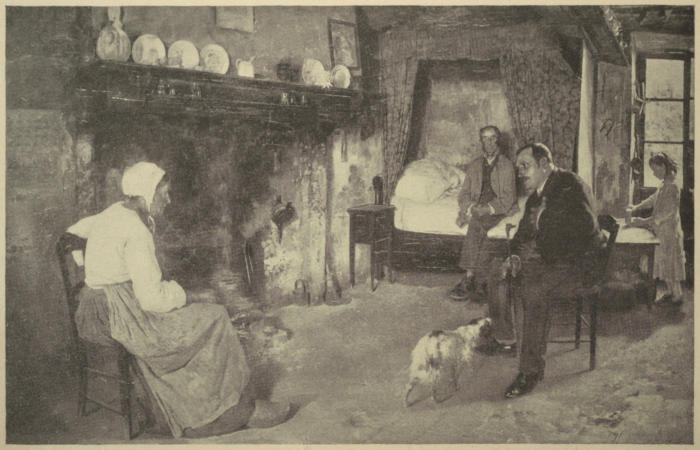

 By HANNAH LYNCH