French Enterprise in Africa by Émile Auguste Léon Hourst
Whole book · 17 sections
French Enterprise in Africa
FRENCH ENTERPRISE IN AFRICA The Exploration of the Niger
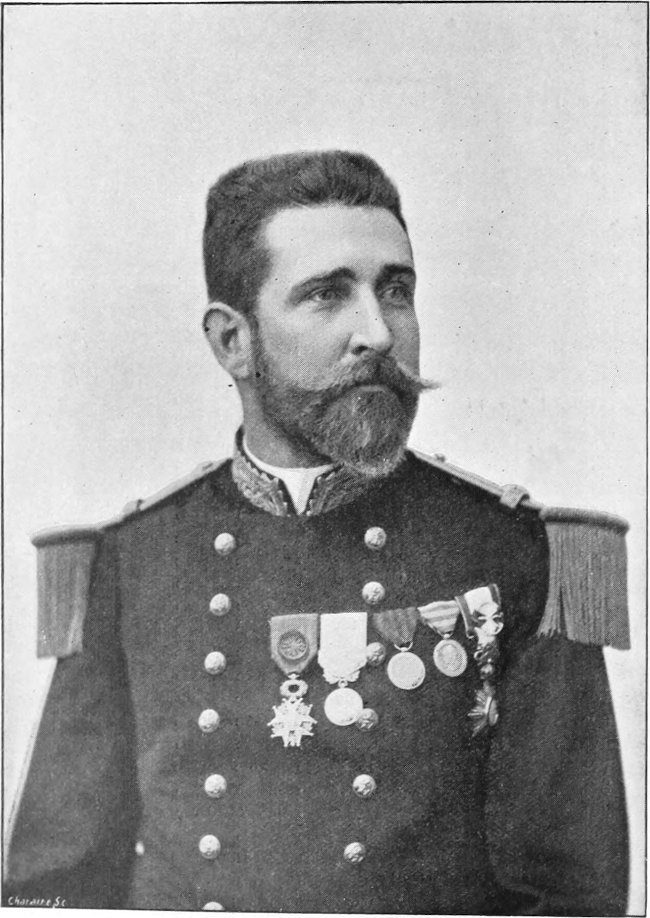
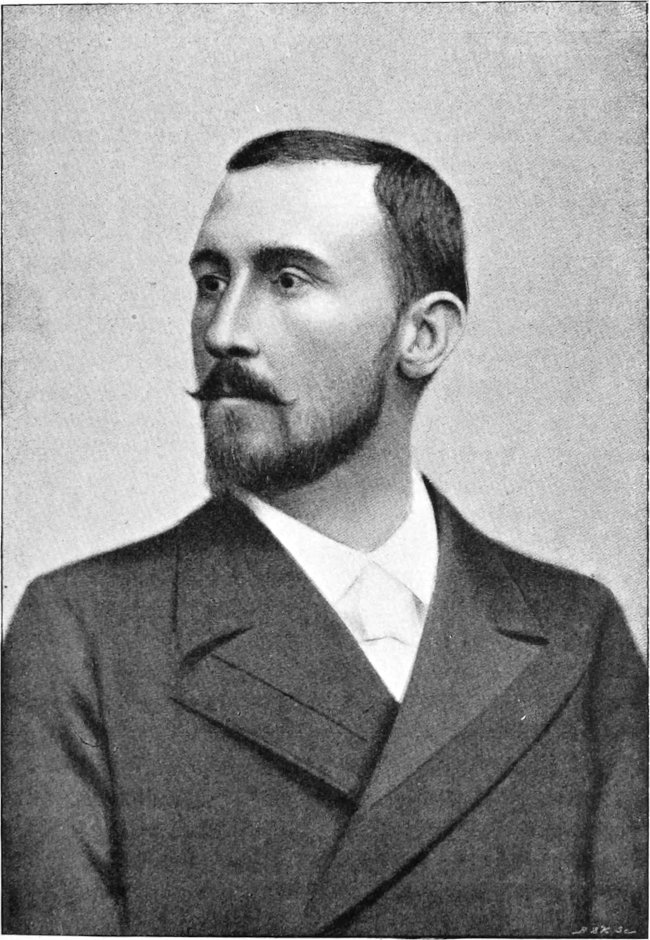
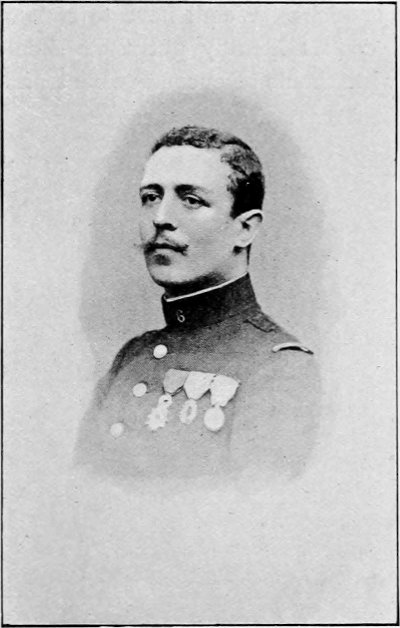
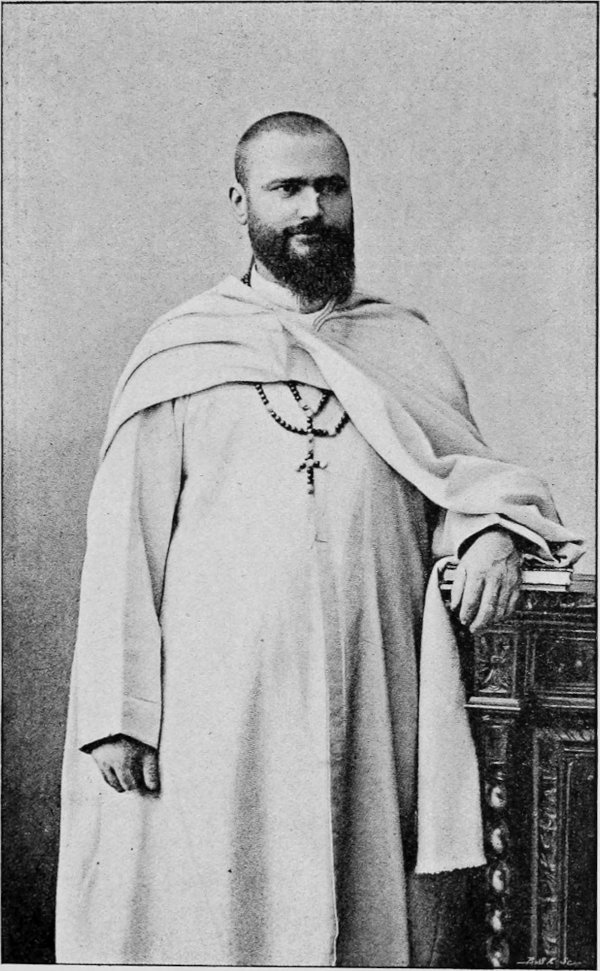
LIEUTENANT HOURST.
THE PERSONAL NARRATIVE OF LIEUT.
HOURST OF HIS Exploration
of the Niger
Translated by Mrs. ARTHUR
BELL (N. D’Anvers) AUTHOR OF ‘THE ELEMENTARY HISTORY OF ART,’
‘THE SCIENCE LADDERS,’ ETC.
WITH 190 ILLUSTRATIONS
AND MAP
LONDON: CHAPMAN & HALL, Ld.
1898
[All rights reserved]
Richard Clay & Sons, Limited,
London & Bungay.
TRANSLATOR’S NOTE
The appearance of this brightly-written
record of an adventurous voyage down the Niger, from Timbuktu to
the sea, such as has never before been accomplished, is just now
peculiarly opportune, when attention is so much concentrated on the
efforts of the French to extend their influence in Africa,
especially in the Western Sudan.
The author of the Exploration of the Niger is, of
course, greatly prejudiced against England, and his jealous
hostility to those he habitually calls “our rivals” peeps out at
every turn, but for all that the work he has done is good and
valuable work, adding much to the knowledge of the Niger itself,
its basin, and the various tribes occupying the riverside
districts. It is remarkable, that in spite of much opposition
Lieutenant Hourst managed to keep the peace with the natives from
the first start from Timbuktu to the arrival at Bussa. Whilst the
footprints of too many of his predecessors were marked in blood, he
and his party passed by without the loss of a single life, and in
this most noteworthy peculiarity of his journey, the brave and
patient young leader may claim to rank even with that great pioneer
of African discovery, David Livingstone.
True the Lieutenant owed the good relations he was able to maintain with the
chiefs to a fiction, for acting on the advice of a certain Béchir
Uld Mbirikat, a native of Twat, whom he had met at Timbuktu, he
passed himself off as the nephew of Dr. Barth, the great German
traveller, who had everywhere won the love and respect of the
people with whom he was brought in contact. Assuming the name of
Abdul Kerim, or the Servant of the Most High, the Frenchman solved
all the difficulties which threatened to stop his progress by the
simple assertion that he was the nephew of Abdul Kerim, as Barth
was and still is called in the Sudan. “I was thus able,” says Abdul
Kerim, “to emerge safely from every situation, however
embarrassing,” explaining that the natives do not distinguish
between different European nationalities, but simply class all
together as “the whites.”
Apart from this initial falsehood, of which the Lieutenant does
not seem to be in the least ashamed, his dealings with the natives
were marked by perfect straightforwardness; every promise, however
trivial, made to one of them he faithfully performed, whilst from
the officers under him and the coolies in his service he won the
utmost devotion and love. He deserves indeed very great credit for
the ever ready tact with which he turned aside rather than met the
difficulties assailing him at every turn, and Dr. Barth would have
had no cause to be ashamed of his relative if the young gentleman
had indeed been his nephew.
Lieutenant Hourst’s chapter on the much misjudged Tuaregs is
especially interesting, and, most noteworthy fact, full of hope for
the future. He attributes their many excellent qualities to their
reverence for their women. The husband of one wife only, the Tuareg
warrior looks up to that wife with something of the chivalrous
devotion of the knights of the Middle Ages, presenting in this
respect a very marked contrast to his Mahommedan neighbours, of
whom, by the way, the Frenchman has the lowest possible opinion;
charging them with a total disregard of morality, beneath the cloak
of an assumed religious zeal. On the so-called marabouts he is
especially severe, giving many instances of the evil influence they
exercise over the simple-minded natives.
It would be unfair to the author to spoil the interest of his
narrative by any further revelations of its contents; suffice it to
add, that in spite of his all too-evident bias against the English,
he is unable to deny that he was kindly treated by the individual
members of the Royal Niger Company, with whom he came in contact.
His only wish, he naïvely remarks, is that some of the warm-hearted
men who welcomed him back to civilization had belonged to his own
nationality. There is something truly pathetic in the plea with
which the courageous young explorer winds up his record of his year
of arduous work, and yet more arduous waiting, hoping against hope
for the instructions from home which never came. He knows, he says,
that all the countries suitable for colonization—Australia was the
last of them—are already occupied by “our rivals,” but there is
still room, he thinks, for French “colonies of exploration,” where
talented young men, unable to find a career in their native
country, may usefully employ their energies in turning the natural
wealth of French acquisitions to account. That is all he hopes for;
but he cannot help adding a few touching words of appeal to the French colonial
authorities, asking them to cease from sending out expeditions only
to abandon them to their fate, taking no notice of their requests
for instructions or for help.
Reading between the lines of this record of a brave struggle
against terrible odds, it is only too easy to realize that the
policy of prevarication of the French Government in all matters
colonial is a well-considered policy, as astute as it is unfair,
alike to the gallant officers in command of abortive exploring
expeditions as to the “rivals” so cordially disliked.
Dr. Henry Barth, the greatest traveller
of modern times, our illustrious predecessor on the Niger, was a
prisoner at Massenya. Loaded with chains, and in hourly expectation
of death, he was still devoted to his work, and had the superb
courage to write—“The best way of winning the blacks from their
barbarism is to create centres on the great rivers. The civilizing
influence will then spread naturally, following the
water-highways.”
In his generous dream, which might be his last, he consoled
himself in thinking that soon the ideas of tolerance and progress
would advance by the river-roads, by the “moving paths,” as he
called them, to the very heart of the dark continent. Perhaps the shedding of his
blood might then further the cause of that humanity of which he was
the apostle.
More than any other, perhaps, the Niger district lends itself to
this idea of Dr. Barth’s. There it is, on the banks of the river,
fertilized by timely inundations, that life appears to be
concentrated. It is by following the streams and rivers, and
crossing the lakes, that the forward march must proceed. The Niger,
with its affluents and its lacustrine systems, still partially
unknown, gives, even when only seen on the map, the impression of
an organism complete in itself. As in the human body, the
blood-vessels and the nerves carry the life and transmit the will
of their owner, so does a mighty river with its infinite
ramifications, seem to convey to the remote confines of a
continent, commerce, civilization, and those ideas of tolerance and
of progress which are the very life and soul of a country.
To utilize this gigantic artery—and this is a task which we
Frenchmen have undertaken, for, at the demand of France, these
countries have been characterized as under French
influence—it was necessary first of all to know it.
It is to this task we have devoted ourselves, my companions and
I. Providence has aided us, Providence has willed our success, in
spite of difficulties of every kind. We had the great joy of
returning with ranks unbroken, all safe and sound. Yet more rare,
our journey did not cost a single human life, not even amongst
those who were hostile to us and opposed our passage.
This I consider the greatest honour of the expedition of which I
was in command.
Moreover, logic as well as humanity demanded that we should, in
every case, as far as possible pursue a pacific policy. What could men, whether negroes or
others, think of the civilization we endeavour to introduce amongst
them, if its first benefits are volleys of bullets, blood-shed—in a
word, war?
The reader must not, however, misunderstand me. It has often
been necessary, it will still long be necessary, even in conformity
with our most honourable and elevated sentiments, to have recourse
in certain cases to war, to enforce our ideas of justice. In the
present state of barbarism of African races, especially where the
false civilization of Islam has penetrated, the moral elevation of
the lower classes is injurious to the material interests of
directors, chiefs, sorcerers, or marabouts; and against them, of
course, force must be used.
The motto chosen by the Royal Niger Company—was it in irony, or
for the sake of rhythm?—“Pax, Jus, Ars,” is certainly most
beautiful, most complete, most suitable, for a people who dream of
combining venal profits with humanitarian ameliorations in their
colonization of native districts. This motto cannot, however, be
acted upon without some trouble and conflict. Peace? How about the
successful slave raids undertaken under the cloak of religion, on
which the Samorys, the Amadus, the chief of Sokoto and their bands
depend for their livelihood? Justice? Suppose the races oppressed
because of their very gentleness, ground down because of their
productiveness, refuse to obey their conquerors, Toucouleurs,
Fulahs, or whoever they may be; will the captive find himself the
equal of the master? Art? the Knowledge and the Toil which should
win freedom? Grant them, and what will become of the sorcerers, and
the starving marabouts with their impostures and their mummeries?
There have been, there inevitably will be again, prolonged and
obstinate resistance. That resistance must be overcome, and
the struggle must cost
bloodshed, but that bloodshed will increase the future harvest.
It is altogether different, however, with an exploring
expedition. Its mission is not to dictate, but to persuade—not to
conquer, but to reconnoitre. This, however, scarcely lessened the
difficulty of our task. In a new country, ignorance alone, rather
than actual ill-will founded on serious reasons, is enough to make
the natives hostile. They look upon the traveller as a malevolent
intruder, a sorcerer, a devil. They want to hinder his progress, to
make him turn back, and when they despair of doing that they try to
pillage and to destroy him.
Weapons of precision, discipline, a single blow may perhaps
sometimes break through the obstacle, and the traveller will pass
on. But afterwards?
Afterwards, the road will be closed before him. One tribe after
another will rise, and if the explorer has any armed followers, it
will be with him as it was with Stanley in his blood-stained
course, the path behind him will be marked by corpses.
Afterwards, moreover, the road behind him will also be
barred—closed for long years to every pacific attempt. This sort of
thing means, in fact, difficulties increased, sometimes indeed
rendered positively insurmountable to those who would resume or
complete the task begun.
True, I cannot claim to have left behind me tribes entirely
devoted to us, or districts completely won over to our ideas, to
which France has but to send her traders and her directors; but I
think I can say that where our passage did nothing to ameliorate
the situation, it at least made it no worse; and of this I am
proud.
Briefly stated, what we did on our expedition was, to ascend the
Senegal, reach the Niger at its highest navigable point, and go
down it to the sea.
This was not a new
idea. My friend Felix Dubois claims, not unjustly, that the same
thing occurred to Colbert. For all that, however, scarcely a
century ago no one knew the exact position either of the source or
the mouth of the Niger; and those who were anxious to learn
something about its geography, had only Herodotus, Ibn Batuta, and
Leo Africanus to guide them.
But we must do justice to our rivals: the English were the first
to attempt to realize the dream of Colbert. In 1797, the Scotchman
Mungo Park reached the Upper Niger by way of Guinea. “Are there
then no streams, no rivers, no anything in your country,” a chief
of Kasso said to him, “that you come at the peril of your life to
see the Joliba?” (the Upper Niger). Park stopped at Silla, near our
present settlement at Sansanding, and renewing his attempt a few
years later, he met his death—how, no one knows exactly, somewhere
near Bussa.
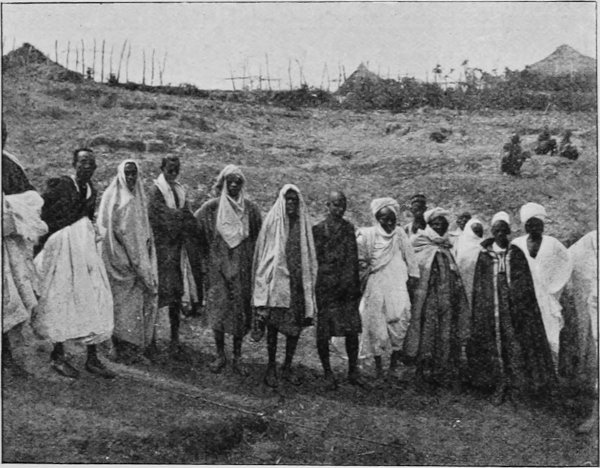
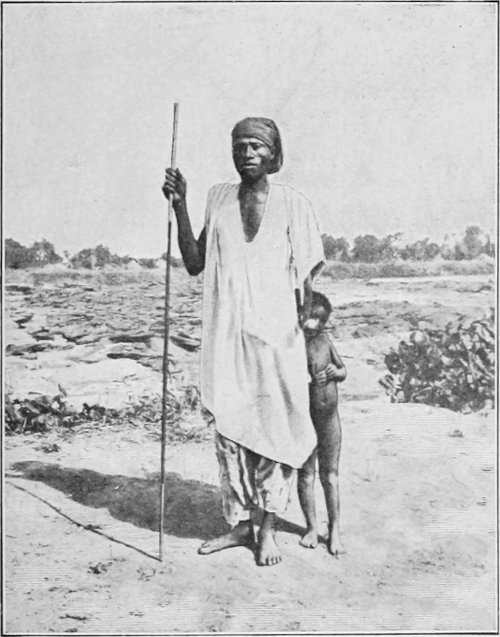
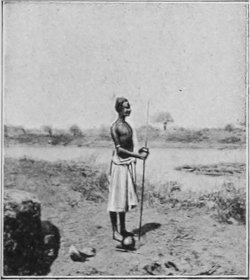
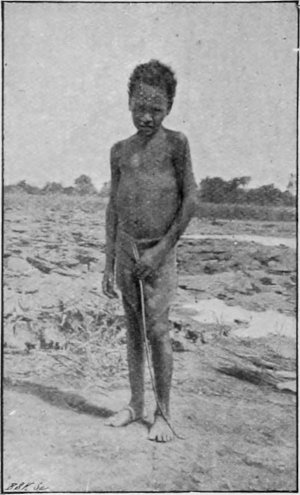
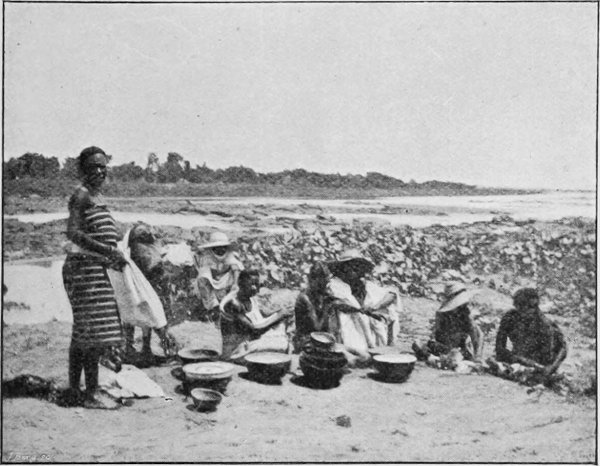
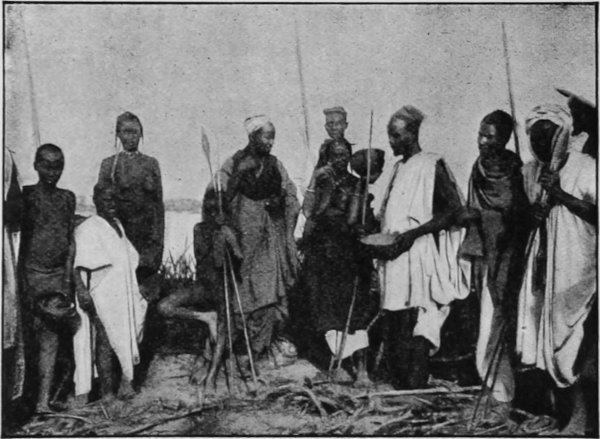
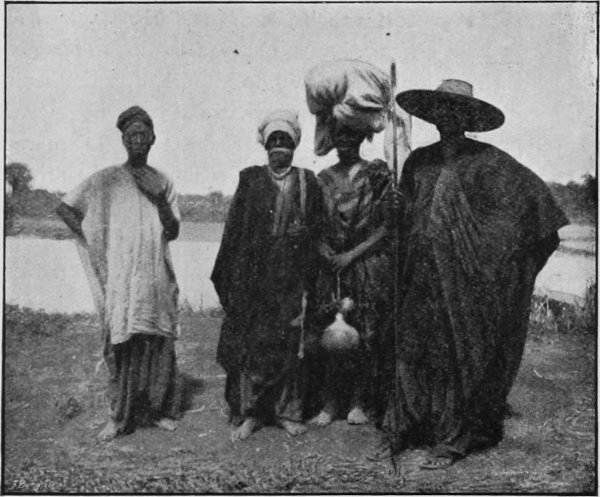
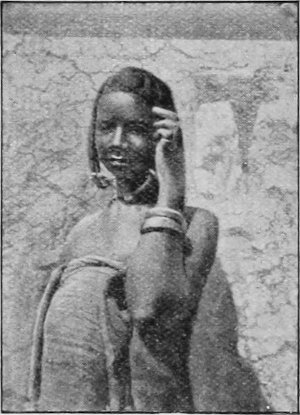
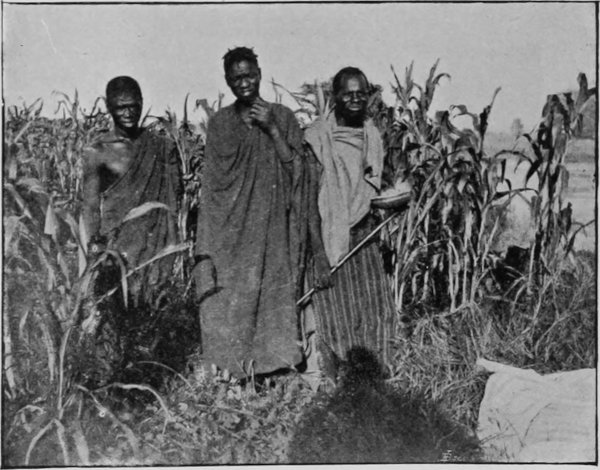
NATIVES OF THE BANKS OF THE SENEGAL.
Although very
celebrated in England, Mungo Park was quite unknown to the French,
even in their colonies. I give the following well-known anecdote
from memory. “In 1890 a highly educated person said to M. X———, a
French colonial officer of high rank, ‘There is a future before the
Niger districts. See what Mungo Park says about them;’ and he
followed this up with a lot of quotations from Park’s book. ‘Oh,
that is all very interesting,’ said the other; ‘if Mungo Park is in
Paris, you had better take him to the Minister.’ Then when the
death of Park in 1805 was explained, M. X——— cried, thinking he had
found an unanswerable argument, ‘I bet your Park died of
fever!’”
Perhaps after all he confused him with the Parc
Monceau, the healthiness of which had lately been called in
question.
Our journey was accomplished just one century after Mungo Park’s
first attempt. We started from about the same point, too, as did
the great Scotch traveller, only from the Senegal instead of the
Gambia, but our attempt was crowned by success.
Of course, it will be said, that we had fewer unknown districts
to go through. Since 1805, Europeans have conquered half the
continent of Africa. We stepped from a French colony into an
English Protectorate. Moreover, earlier travellers than ourselves
explored certain sections of our route, whilst Park had everywhere
to work his way through virgin territory.
Perhaps, however, all these supposed advantages in our favour
really only added to our difficulties.
Happening to find myself in Paris in October 1893, on the eve of
my return to my Staff duties in the French Sudan, I one day met
Colonel Monteil. “Go,” he said to me, “and find Monsieur Delcassé”
(then Under Secretary of State for the Colonies), “he has something
to say to you.” The
next day I presented myself at the Pavillon de Flore. “You
are leaving for the Sudan,” said Monsieur Delcassé; “what are you
going to do there?” “It is not quite decided yet,” I replied. “I
heard some talk of a hydrographic exploration of the courses of the
Bafing and the Bakhoy” (two streams which meet at Bafulabé, to form
the Senegal). “You no doubt know more about it than I do.” “Well!”
he replied, “I would rather you went down the Niger, in accordance
with the project Monteil spoke to me about, and which you, it
seems, submitted to my predecessor.”
“I should prefer it too,” I said; “it is just what I have been
asking for for the last five years.”
“Well, then, that is settled; send me a report and an estimate
of expenses.”
Thus in two minutes the exploration of the Niger was decided
upon.
It is, in fact, true (see Report of December 1888) that I
suggested such an expedition five years ago; but it is really ten
years since a similar plan was proposed by another, and that other
my venerated chief, my friend, and my master in all things
connected with the Sudan, Naval Lieutenant Davoust. He died in
harness.
After the occupation of Bamaku, Naval Ensign Froger, a man of
immense energy, endurance, and indomitable perseverance, whose name
comes in whenever there is any talk of French work in the Sudan,
took a French gunboat, piece by piece, to the Niger. God only knows
at what cost. There he put her together, launched her, and since
1884 she has remained on the river. This gunboat, baptized the
Niger, was commanded, on the retirement of Froger, by
Davoust, who in accepting the appointment, hoped to take his vessel
up to Timbuktu. As a logical consequence, of course, he asked
permission to go down to the opening of the navigable portion of the great river, or,
if it were possible, to the sea itself, but the authorization was
refused. He was stopped at Nuhu in Massina. Weakened by dysentery
and fever, he was compelled, greatly against his will, to return to
France, without having even reached Timbuktu.
That honour was reserved for his successor, Caron, who, with
Sub-Lieutenant Lefort and Dr. Jouenne, reached Koriomé, the port of
the mysterious town; but the intrigues of the Toucouleurs and the
merchants of the north made the Tuaregs hostile. He was unable to
enter the ancient capital of the Sahara, but he brought back with
him a magnificent map on the scale of ¹⁄₅₀₀₀₀ of the course of the
river, such as had, perhaps, never before been made of any river of
Africa. It proved beyond a doubt, that from Kulikoro to Timbuktu,
that is to say, for a length of about 500 miles, the Niger is
perfectly navigable, free from obstacles, everywhere accessible to
small craft, and nearly always to steamers and barges of
considerable draught.
Davoust returned to the charge in 1888, when he did me the
honour of taking me as his second in command, and it was decided
that we should go down the river, until the absolutely insuperable
obstacles in our path barred our progress.
Alas! it was decreed that Davoust should never realize
success.
What happened? Just as we were going to start came an order that
we were to do nothing. We wintered at Manambugu, a terribly
unhealthy spot, and there, with infinite trouble, we constructed a
few wretched huts of straw and loam, to protect ourselves and our
goods. Under such conditions, death soon wrought havoc in our
ranks. We white men numbered eighteen when we started; less than a
year later we were but five. The rest we had buried along our path as we returned, or in
our little cemetery at Manambugu.
Poor Davoust reached Kita but to die. The order forbidding us to
start had been his death-blow. Until then he had, however, kept up
only by force of his intense determination. It was but his hope of
success which sustained him; he existed only for the sake of his
great scheme. “Merely having failed to descend the Niger,”
he exclaimed to me one day, “made Mungo Park famous, but we, we
shall succeed.”
He could not bear to see all his long-cherished plans upset for
no real reason, on the very eve of realization. It was too severe a
blow for the little strength which remained to him. He nevertheless
continued to help me in fitting out the Mage, a gunboat
like the Niger, which we had brought from France; he even
made some trial trips; but in the month of December he set off for
home, to try and regain his strength in his native land, and buoyed
up with the hope of being able to win over our colonial authorities
to his views.
He never reached France; he rests at Kita. When we thought all
was lost, and our mission hopelessly compromised, we gathered round
his tomb. Perhaps it was our doing so which brought us good fortune
at last.
How many, aye, some even greater men than he, have fallen thus!
Alas! it has been with the dead bodies of our countrymen that the
soil of the French Sudan, which we hope will some day yield so rich
a harvest, has been fertilized! Dare we add, that those who went
there in the hope of winning gold braid and crosses, got “crosses”
indeed, but they consisted only of two bits of wood clumsily nailed
together by some comrade, and set up in the corner of a field of
millet, beneath the shade of some baobab tree; poor ephemeral
crosses, soon eaten up by white ants, incapable even of preserving the memory of
the brave fellows buried beneath them.
But we must not bemoan too much the fate of these noble dead. We
must honour them and follow their example.
Well then, Davoust being dead, without having accomplished his
task, I vowed that a boat bearing his name should descend the
river. This promise I made in 1888, but it was not until 1896 that
I was able to redeem it. Now I have fulfilled my vow.
There is no doubt that it would have made all the difference in
the political results of my mission, if it could have been
undertaken eight or ten years earlier. For instance, in the
negotiations which took place in 1890, and were so inauspicious for
our influence on the Lower Niger, our plenipotentiaries would have
been able to assert, that the rapids at Burrum existed only in the
imagination of Sir Edward Malet, a fact not without its
importance.
But we will not trouble ourselves with what the expedition ought
to have done—we will merely record what it did do.
My project, adopted by M. Delcassé, was that of Davoust,
slightly modified. Instead of employing gunboats drawing about
three feet of water, I found it best to employ barges of very
slight draught worked with oars. An attentive study of Dr. Barth’s
narrative reveals how very great were the difficulties of
navigation, at least on those parts of the river he himself
explored; for it must be remembered that he never spoke by hearsay.
Of course a boat drawing a foot or so only of water would easily
pass over rapids, where such vessels as the Mage and the
Niger must inevitably come to grief.
Moreover, a steam-boat needs fuel, and that fuel would have to
be wood. Then we must go and cut that wood, which would give the
natives opportunities for hostility. Moreover, the machinery might get out of
order. Of course, rowing is slower than steaming, but it is much
safer. Then, too, we had the current in our favour; we had but to
let ourselves go and we should certainly arrive at some goal, if
not at a good port. The stream would carry our barges down, with us
on or under them, as Spartan mothers would have said.
Besides, there was something graceful about this mode of
progression. To row down the Niger at the end of the nineteenth
century, was not only amusing, but there was really something
audacious about it, when it might have been done so differently,
and, after all, I was right; for never could gunboats have passed
where my plucky little boat, the Davoust, made her
way.
This resolution come to, the next thing was to build the boat
which was to be the inseparable companion of our journey. “As you
make your bed you must lie upon it,” I thought, and I gave my whole
mind to the matter.
She must be strong but light, and easily taken to pieces; she
must not exceed the minimum space needed to hold us all; she must
be capable of carrying eight to ten tons, and she must not be
difficult to steer.
During the year 1893, it happened that great progress had been
made in the working of aluminium, and Monteil had actually ventured
to employ that metal in the construction of a little boat intended
for use on the Ubangi. It seemed, however, rather hazardous to
follow his example, for, after all, what could be done with
aluminium had not been actually put to the test, and our very lives
depended almost entirely on the durability of our boat. Still, I
had to take into account the fact that the craft would sometimes
have to be carried overland, and then the lightness of the metal
would be immensely in its favour.
In a word, I decided for aluminium. Truth to tell, however, I confess I am not very
proud of the decision I came to. The material was not hard enough;
it was easily bent; it staved in at the slightest shock, and I
often wished I had decided on a steel boat. At the same time, it
should be admitted that its chief quality—that of lightness—was
never really put to the test; for throughout the journey we never
once had to take our craft to pieces, for the purpose of carrying
it in sections, over otherwise insurmountable obstacles. As she was
launched at Kolikoro, so she arrived at Wari. This was perhaps as
well; for I really do not know whether the bolts once taken out of
their strained sockets would ever have fitted properly again. To
sum up, however, the Davoust, an aluminium boat, reached
the mouth of the Niger, which was really all that was expected of
her.
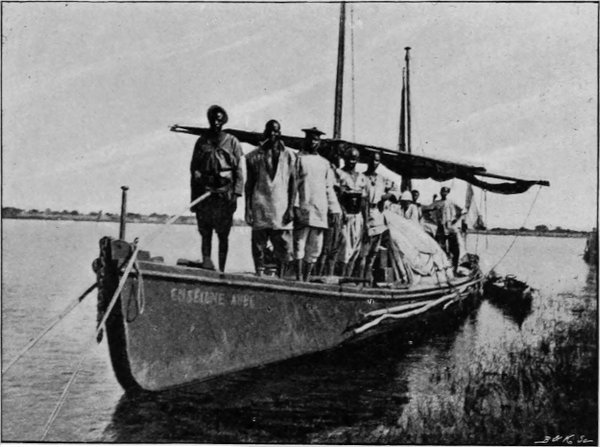
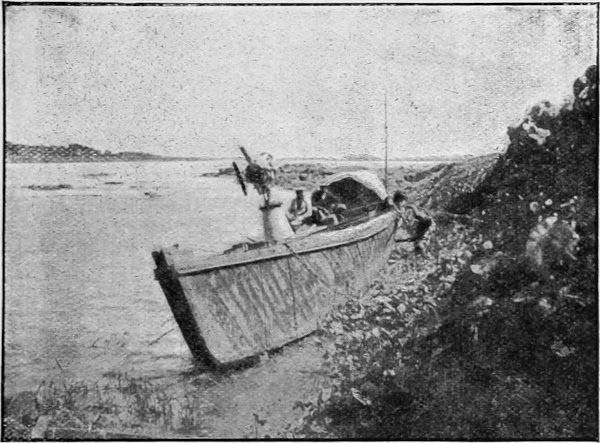
Now let me introduce my Davoust properly. She is not
exactly a handsome craft. She looks more like a wooden shoe or a
case of soap than anything; that is to say, the stern is square,
whilst the bow runs up into a point. This pointed bow, I must
remark en passant, will be very useful for jumping on
shore from without wetting our feet.
She is about 98 feet long by 7½ feet wide, and only draws about
a foot and a quarter of water, which does not prevent her from
carrying nine tons. Two water-tight partitions divide her into
three compartments, the central one of which forms the hold, where
are stowed all our valuables, food, ammunition, and bales of goods.
The hold is covered in with steel plates, which serve as a deck,
and at the same time greatly add to the general strength of the
craft.
The other two compartments, covered in by thin planking, serve
as cabins. The planks, as will be readily understood, are but
little protection against the heat of the sun and in storms; but,
of course, it was impossible for me to add needlessly to the weight
of the boat, merely for the sake of comfort. In the centre is
placed a machine gun. In the fore part of the steel deck will sit the
oarsmen, or, to be strictly nautical, the rowers.
Three sails, two triangular and one square, will help us along
when the wind is favourable. True, this rig-out of sails on a
vessel the size of ours is not exactly what is generally seen in
the Navy, but what does that matter in the wilds of Africa, with no
companions and no engineers to make fun of my innovation? How well
it will sound, too, will it not, when we reach their territories if
the English telegraph to Europe, “A French three-master has
descended the Niger from Timbuktu!”
All this finally settled, the next thing to do was to divide the
boat into sections. The problem was, how to manage to do this so
that these sections could be carried on the heads of our porters,
no one of them weighing more than from about 55 to 66 lbs. This is
really all we can expect of a black porter who was not brought up
in the ship-building trade.
To begin with, I divide my boat longitudinally from bow to stern
into two equal sections, which are afterwards sub-divided. These
two sections are to be bolted on to a sheet of steel which will
serve as a keel. The joints are of leather. The heaviest piece,
that is to say, the stern, weighs some 81 lbs., but two porters can
carry it together.
This flat-bottomed craft of ours will be steered by means of a
long rudder, the wheel of which is placed at the threshold of my
cabin, so that I shall have it close at hand. On my cabin roof is
the steering compass, and the tent to protect us in the day, which
tent is made of brown and red striped cloth with a scalloped edge.
We fancy ourselves on the beach of Normandy when we are in it. The
roof of my cabin will serve me as a table on which to work at my
hydrographical observations.
The Davoust was just big enough to hold us all.
She could be handled
easily enough; she contained only what was absolutely
indispensable, and all I asked of her was that she should carry us
safely to our goal.
It would not do for me to embark alone to descend the Niger. The
next thing was, therefore, to choose my crew. Of all the lucky
chances which marked the course of our trip, and contributed to its
success, there was one for which I ought to have been more grateful
to Providence than I was, and that was, that He gave me just the
companions who went with me.
All who know from experience what the sun of Africa is, who are
aware of the combined effects of illness and privations, such as
the want of sufficient nourishment, of perpetual danger, of
never-ceasing responsibility, who have themselves suffered from
working with uncongenial companions, whose worst faults come out
under the stress of suffering and fatigue, who know what the
unsociability of the tropics often is, will realize the force of
what I have said.
We started five companions, we returned five friends: that is
the most astonishing part of what we did!
First of those who joined me, who shared all my hardships as
well as my success, was Naval Ensign, now Lieutenant Baudry.
One of those who had laboured in the vineyard from the first, M.
Baudry had begged me to take him with me, should the chance ever
occur, long before my expedition was decided on. He happened to be
in Paris at the time, for, like myself, he was about to start for
the Sudan on Staff duty. He too had been bitten by the Colonial
tarantula, causing a serious illness, only to be cured by an actual
journey to the colonies. A few minutes after the decision of the
Under Secretary of State for Colonial Affairs the matter was
settled: he was to go with me.
NAVAL ENSIGN BAUDRY,
Second in command of the Hourst Expedition.
He has been my
comrade in happy and in dreary hours. Together we suffered from the
events which kept us imprisoned, so to speak, in the French Sudan
for nearly two years before we could really make a start. He
adopted my ideas, he made them his own, and set to work immediately
to carry them into action. It is but just that I should speak of
him first of all in these terms of praise, for always and
everywhere I was secure of his help and co-operation.
We made up the rest of our party at St. Louis, for Baudry and I
were at first the only two white men in the expedition. We had to
choose eight Senegal coolies, one of whom was a non-commissioned
officer lent to us by the naval authorities. I knew that I should
be able to engage any number of brave and sturdy fellows, faithful
to the death down there, and so it proved.
The grave question of the choice of a native interpreter still
remained to be solved. I had my man in my mind, but I did not know
whether I could secure him. I lost no time in asking the
authorities at Senegal to place Mandao Osmane at my disposal.
I had known and learnt to value Mandao on the Niger flotilla; he
and his family had already rendered more devoted services to France
than I could count. Well-read, intelligent, very brave, very
refined, and very proud, Mandao was the type of an educated negro.
He would have been a valuable assistant and a trusted friend to us.
I knew that it was his great ambition to be decorated like his
father, who had been one of General Faidherbe’s most valued
auxiliaries. He was to die on the field of honour, killed during
the Monteil expedition.
If some inquirer asks you, “What is the first thing to do to
prepare for an exploring expedition to Central Africa?” answer
without hesitation, “Buy some of the things which are being sold
off in Paris.” And this is why. The usual currency on the Niger is the little cowry
found on the coast of Mozambique. Five thousand represent about the
value of a franc. As will at once be realized, this means a very
great weight to lug about, as heavy, in fact, as the Spartan
coinage, and besides, it is not known everywhere even in Nigritia.
In many villages everything is sold by barter. “How much for that
sheep?” you ask, and the answer is “Ten cubits” (about six yards)
“of white stuff, or fifty gilt beads, so many looking-glasses, so
many sheets of paper, or so many bars of salt,” according to what
the seller wants most.
One must provide oneself with the sort of things required.
Besides all this, presents are needed, and all sorts of
unexpected articles come in usefully for them. Black-lead sold in
tubes is used for blackening and increasing the brilliance of the
eyes of Fulah coquettes; curtain-loops are transformed into
shoulder ornaments or belts to hold the weapons of warriors; whilst
the various dainty articles used in cotillons are much appreciated
by native belles, who are also very fond of sticking tortoise-shell
combs into their woolly locks. Take also some pipes,
tobacco-pouches, fishing-tackle, needles, knives and scissors, a
few burnouses made of bath-towels, china and glass buttons, coral,
amber, cheap silks, tri-coloured sunshades, etc.
We had to give powerful chiefs such things as embroidered velvet
saddles, weapons, costly garments, and valuable stuffs. Tastes
change from one generation to another; the fashion is different in
different villages; besides, we were expected, it was specified in
our instructions, to open commercial relations with the natives for
the travellers who should succeed us. So we were bound to have with
us as great a variety of samples of our wares as possible.
Moreover, Tuaregs and negroes alike are only big children. They fight just to
amuse themselves when they happen to have a sword or a gun. They
would play just as happily with a mechanical rabbit, a peg-top, or
a doll which says “Papa.” So we must take some toys with us, such
as crawling lizards, jumping frogs, musical boxes, even a miniature
organ which plays the quadrille à chahut,[1] as
it consumes yards of perforated paper. And even now I have not
enumerated all the things we took.
Face to face with this very incoherent programme, suppose for
carrying it out you have two naval officers, one just come back
from the Sudan, the other from China, and you say to them, giving
them the necessary funds, “Now you go and settle things up.” Well,
you will soon see what they can do, but if they are up to their
work they will go straight away and secure the help of Léon Bolard,
a commercial agent who is a specialist in providing for exploring
expeditions. And then these two will amuse themselves like a couple
of fools for a month at least; that is what we did.
Long shall I remember these prowlings in furnishing shops, where
the owners were not always very civil, for we turned their premises
upside down sometimes for mere trifles. Some days we tramped for
eighteen miles along the pavements of Paris, measured by the
pedometer.
Our most amusing experiences were when we went in search of
bargains at sales. Slightly soiled stuffs and remnants are
first-rate treasure trove for explorers who are at all careful of
the coffers of the State; but how one has to walk, and how one has
to climb to fourth and fifth storeys to realize these economies! We
once got about 1600 yards of velvet for nineteen sous, and we
picked up knives with handles representing the Eiffel Tower, with
others bearing political allusions to Panama, etc.
At the end of a
month Baudry and I were quite knocked up. Bolard alone continued
indefatigable. But we had bought twenty-seven thousand francs’
worth of merchandise, which was all piled up in the basement of the
Pavillon de Flore. Such an extraordinary heap it made;
bales of calico on top of cavalry sabres, Pelion on Ossa.
We received several distinguished visitors there, too. M.
Grodet, just appointed Governor of the French Sudan, came to see
us, and was very amiable, seeming to take a great interest in what
we were doing. Quantum mutata . . .
Next came the packing, which was anything but an easy task. An
explorer ought to be also an experienced packer of the very first
rank. No package must exceed 55 lbs. in weight. To begin with, all
the luggage must be absolutely water-tight, easily handled, and of
a regular geometrical shape, so as to be stowed away in our hold
without much difficulty. Then the various articles making up each
package must be so arranged as not to get damaged by rubbing
against each other or shifting about. Lastly, and this was the
greatest difficulty of all, the bales must be made up so that we
could easily get out what we wanted without constantly opening them
all. And what a responsibility the whole thing was!
Then we had certain things with us which were sure to strike the
imagination of the natives, notably Baudry’s bicycle, some
Geissler’s vacuum tubes, and an Edison phonograph—the cinematograph
was not then invented. Our instrument was, in fact, one of the
first which had been seen even in France. It would repeat the
native songs, and I relied on it to interest the chiefs and the
literati, for to amuse them would, I hoped, make them forget their
hostile designs.
For weapons the Minister of War gave us ten Lebel rifles of the 1893 pattern, ten
revolvers of the very latest pattern, with ten thousand cartridges,
which represented one thousand per man, more than enough in my
opinion. Lastly, the naval authorities let us have a quick-firing
Hotchkiss gun, with ammunition and all accessories.
On December 25 all was ready, except that the Davoust
was not quite finished. On Christmas Day Baudry started for
Bordeaux, with the larger portion of our stores, and on January 5,
I, in my turn, embarked on the steamship Brazil of the
Messageries Maritimes, taking with me my boat in sections.
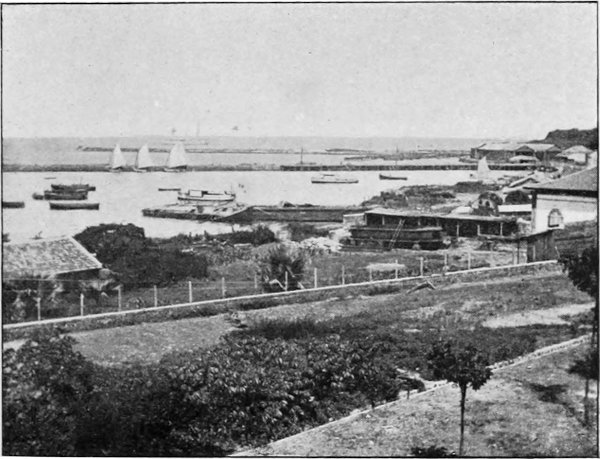
THE PORT OF DAKAR.
Dakar lies low at the extremity of the bay on which it is built,
at the foot of the heights, which together form Cape Verd. It has
inherited the commercial position of Fort Goree, and looks like an
islet of verdure framed amongst sombre rocks and gleaming
sands.
Alas! if Dakar were English, what a busy commercial port it would be! Into what an
impregnable citadel, what a well-stocked arsenal, our rivals would
have converted it.
But Dakar is French, and although we cannot deny that it has
made progress, there is no shutting our eyes to the fact that the
progress is slow. Yet it would be simply impossible to find a
better site on the western coast of Africa. It is a Cherbourg of
the Atlantic. The roadstead is very safe, it can be entered at any
time, the anchorage is excellent, the air comparatively healthy,
and there is plenty of water.
And what a splendid position too from a military point of
view!
When war is declared, and the Suez Canal is blocked, the old
route to India and the far East will resume its former importance,
and Dakar will become, as Napoleon said of Cherbourg, “a dagger in
the heart of England.” Well stored with coal, and provided with
good docks and workshops, etc., Dakar might in the next great war
become a centre for the re-victualling of a whole fleet of rapid
cruisers and torpedo boats, harassing the commerce of England. It
will also be the entrenched camp or harbour of refuge in which our
vessels will take shelter from superior forces. Let us hope that
this vision will be realized. Meanwhile the rivalry between St.
Louis, Dakar, and Rufisque is not very beneficial to any one of the
three towns.
Dakar is of special importance to the Niger districts, and this
is why I have dwelt a little on its present position and probable
future. Some day no doubt it will become the port of export of the
trade of the Sudan, which will, I think, become very considerable
when Kayes is connected with St. Louis and Badombé with Kolikoro by
the great French railway of West Africa.
Dakar interested me for yet another reason. It was there I set
foot once more on African soil after an absence of two long years. I flattered myself
that now I should have to contend face to face with material
difficulties only, before I realized my schemes; so that when I saw
all my bales and packages and the sections of the Davoust,
with absolutely nothing missing, lying symmetrically arranged on
the quay of the Dakar St. Louis railway, it was one of the happiest
hours of my life. It has often been said that the most difficult
part of an expedition is the start. Well, I thought I had
started, and was now sure of success. Alas! what a humbling
disillusioning was before me!
Thanks to the hearty co-operation of everybody, including the
Governor, M. de Lamothe, and the Naval Commander, M. Du Rocher,
Baudry had got everything ready for me.
There was, however, no time to be lost. An accident to her screw
had delayed the Brazil three days, and we must start
immediately for the Upper Niger, so we were off for St. Louis the
very next morning. The sections of the Davoust were of an
awkward shape, and being only hastily packed and tumbled on board
anyhow at Bourdeaux, danced a regular saraband in the open wagons
of the line, and I felt rather anxious about my poor vessel. But
never mind, she would have plenty of bumping about later, and I
wasn’t going to make myself miserable about her on this auspicious
day.
Just a couple of words about the Dakar St. Louis railway. The
Cayor, as the country it traverses is called, is slightly
undulating, badly watered, and dreary looking. The natives living
in it were hard to subdue. In continual revolt, they more than once
inflicted real disasters on the French by taking them by surprise.
At Thies the whole garrison was massacred, at M’ Pal a squadron of
Spahis perished, for the Cayor had chiefs such as the Damels,
Samba-Laobe and Lat-Dior, the last champions of resistance who
became illustrious in the annals of Senegambia—real heroes, who made us regret that
it was impossible to win them over to our side.
The successive governors of Senegambia struggled in vain against
the resistance of Cayor to their authority, and the constant
insubordination of the natives. But what Faidherbe, Vinet-Laprade,
and Brière de l’Isle, to name but the most celebrated, failed to
achieve was accomplished peacefully by the railway in a very few
years. Nor is that all, for many tracts, previously barren and
uncultivated, now yield large crops of the Arachis hypogea,
or pea-nut, which are taken away by the trains in the trading
season.
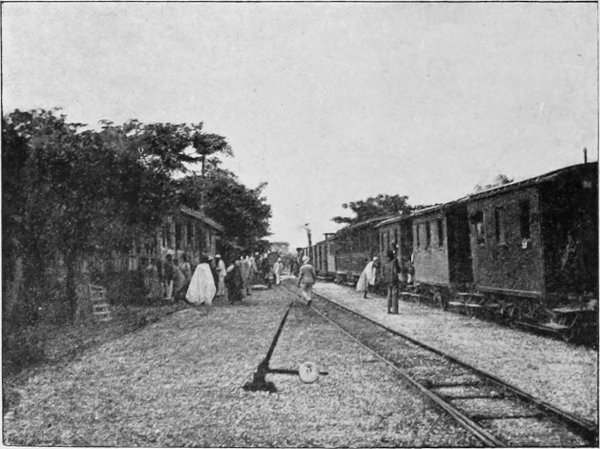
PART OF THE DAKAR ST. LOUIS LINE.
Does not this prove how true it is that peace and commerce
advance side by side; that the best, indeed the only way to pacify
a country, and to conciliate the inhabitants, is to give them
prosperity by opening up outlets for their commerce?
Hurrah, then, for
the Dakar St. Louis line! Three cheers for it, in spite of the
delays and mistakes which were perhaps made when it was begun.
To say that it has every possible and desirable comfort would of
course be false. In the hot season especially it is one long
martyrdom to the traveller, a foretaste of hell, and the advice
given to new-comers at Dakar still holds good—“Take ice, plenty of
ice, with you, you will find it of double use, to freshen up your
drinks by the way and to put in a handkerchief on your head under
your helmet. With plenty of ice you may perhaps escape without
getting fever or being suffocated.”
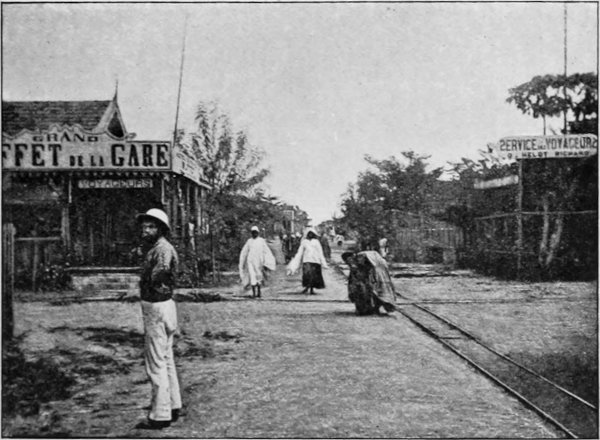
RAILWAY BUFFET AT TIVIWANE.
The trip by this line, which no European would care to take for
pleasure, is really to the negroes a treat, who go by the train as
an amusement. The directors did not count upon receipts from the
blacks when they started the line, especially after a train which
ran off the metals smashed up a whole carriage full of natives against a
huge baobab tree. Of course, when that happened no one thought the
negroes would patronize the railway again. But it turned out quite
the contrary. From that day they came in crowds, but they had
provided themselves with talismans!
The marabouts, who do a brisk business in charms, had simply
added a new string to their bow, for they sold gris-gris
against the dangers of the iron road!
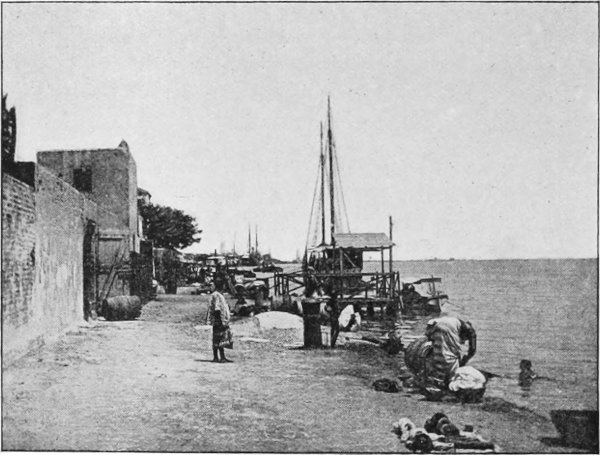
THE QUAY AT ST. LOUIS.
This is the negro all over. If he has but confidence in his
gris-gris, he will brave a thousand dangers. If he has but
confidence in his chief, he will follow him without hesitation, and
without faltering to the end of the world. Inspire him then with
that confidence, and you will be able to do anything with him.
Baudry had come to meet me on the line, and with him was a negro
wrapped up in a tampasendbé, or native shawl. This man was
Mandao, the interpreter I had asked for. He had decided to go with us without a
moment’s hesitation. This was yet another trump card for us, and
all would now go well.
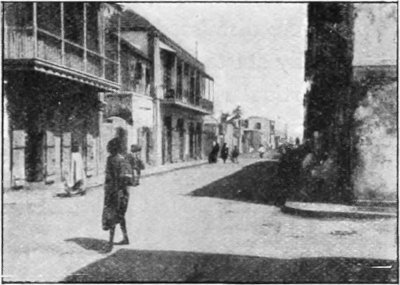
A STREET IN ST. LOUIS.
We reached St. Louis at six o’clock in the evening on January
17. An officer on the Staff of the Governor was waiting for me. M.
de Lamothe, who was, by the way, an old friend of mine, received me
most graciously, and was ready to do everything in his power to
help me.
The Brière de l’Isle of the Deves and Chaumet company
was to start on the 19th for the upper river. She was, however,
already overloaded. What should we do? Time was pressing!
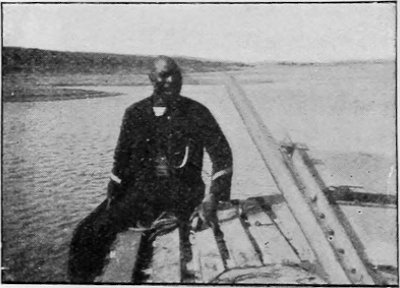
BOUBAKAR-SINGO.
On the morning of the 18th I engaged the coolies who were to
follow us. Most of them were Sarracolais, whose tribe lives on the
Senegal between Bakel and Kayes. From amongst a hundred candidates
Baudry had already picked out twelve, and to these had been added a
second master pilot belonging to the local station. All these were
experienced campaigners, who had long been in the French service;
they were sturdy, well-built fellows, eager for adventure. I had but to eliminate
three, and to confirm Baudry’s choice of the others, for we were
limited to eight men, including their leader. After all, however,
the coolies were dismissed by order of Governor Grodet before we
actually started, so there is no need to introduce them more
particularly. Boubakar-Singo, the second leader, who became pilot
of the Davoust, alone deserves special mention. He was a
splendid-looking Sarracolais, a first-rate sailor, who, when a
storm came on, would jump into the water stark naked intoning all
the prayers in his repertory.
THE COOLIES ENGAGED AT ST. LOUIS.
Our coolies engaged, we had not only to equip, but to dress
them. We set them to work at once, for we had already solved the
difficulty of how best to transport our stores. The governor lent
us a thirty-five ton iron lighter, into which we stowed away
everything, and the Brière de l’Isle took her in tow.
It was not,
however, without considerable trouble that we managed the stowing
away of all our goods, but we succeeded somehow in being ready in
good time. On the evening of the 19th the Brière weighed
anchor, and we started for the upper river; our friends at St.
Louis, the Government officials, the sailors, the tradespeople
waving their hats and handkerchiefs in farewell, and shouting out
“Good luck.”
What a Noah’s ark was this thirty-five ton barge of ours, and
what a mixed cargo she carried, with our bales and her sails, not
to speak of the passengers! coolies, stately Moors, sheep and
women. With the sails of the Davoust we rigged up a kind
of shed in the stern to protect all these people, who, with nothing
to do all day, crept about on the sloping roof sunning themselves
like lizards. We turned the two days during which we were towed
along to account by going over our numerous bales yet once more.
Strange to say, almost incredible indeed, nothing was missing. It
was worth something to see Bilali Cumba, a herculean coolie, pick
up the instruments, weighing in their galvanized case more than 240
lbs., as easily as a little milliner would lift a cardboard
box.
It was Bilali who made me the following sensible answer the
other day, when we had given out wooden spoons to the men for their
own use. Of course, like all negroes, they ate with their fingers,
making their porridge up into a ball, and rolling it till it was
quite hard before putting it into their mouths. I was laughing at
Bilali about this when he said, “Friend, tell me what is the good
of your spoon?” then spreading out the palms of his toil-worn hands
he added, “What is good to work with is good to eat with.”
As Joan of Arc with her flag, he dedicated his hands to toil and
honour too.
Our trip did not pass off without certain little
accidents; the
constant splashing of the water loosened the joints of the barge,
and we had to stick them together as best we could. However, we
arrived on the 23rd at Walaldé, then the highest navigable point of
the river. Probably it would be possible to go much further up, as
far as Kaheide, in fact, at all times of the year, but it would
have to be in boats with a different kind of keel to that now in
use, and we have not got to that yet.
The Brière de l’Isle now left us to descend the river
again.
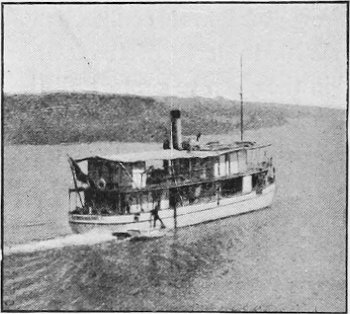
THE ‘BRIÈRE DE L’ISLE.’
Henceforth we were to fly with our own wings. Painfully and
slowly we made our way in our thirty-five ton barge, towed along by
a rope from the bank, the river gradually widening out as we passed
Kaheide, Matam, Saldé.
Then, alas! we got one piece of bad news after another.
At Saldé we heard of the death of Aube; at Bakel of the massacre
of Colonel Bonnier and his column.
Too much fuss has been made about these glorious deaths, say
many foolish critics. Over the ashes of soldiers killed in battle,
there has been too much heated discussion. Well, at least, hyænas
only do their terrible work at night!
As for me, I lost a chief whom I loved, and many old comrades
with whom I had been under fire or in garrison. Hastily we pushed
on for Bakel and Kayes, eager for further news, not only plunged in
the deepest grief, but somewhat anxious about what was in store for
ourselves.
On February 13 we arrived at Kayes. I went at once with Baudry and Mandao to
the Governor, M. Grodet, who told me that he had received
despatches authorizing him to suspend my expedition, and
to employ us as he liked! Our party was at once broken up. Baudry
was sent to make forced marches to the Niger to escort some convoys
of provisions on their way to re-victual Timbuktu. I should be
disposed of later, and, as a matter of fact, I was eventually sent
to take command of the Niger flotilla.
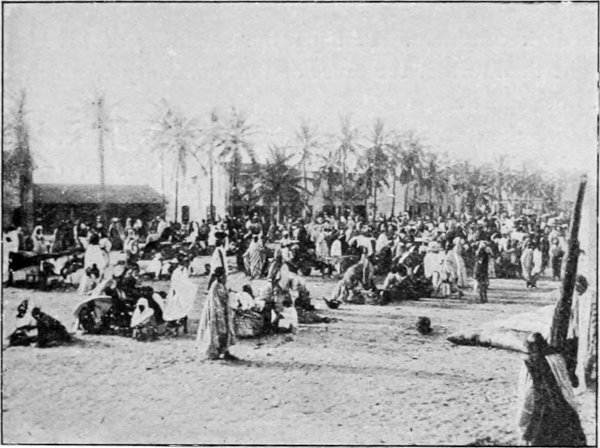
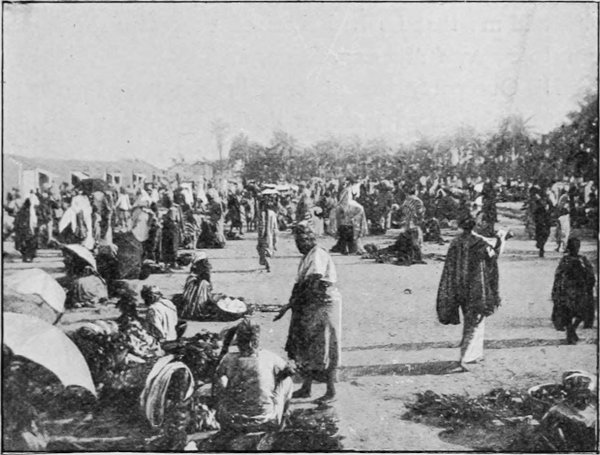
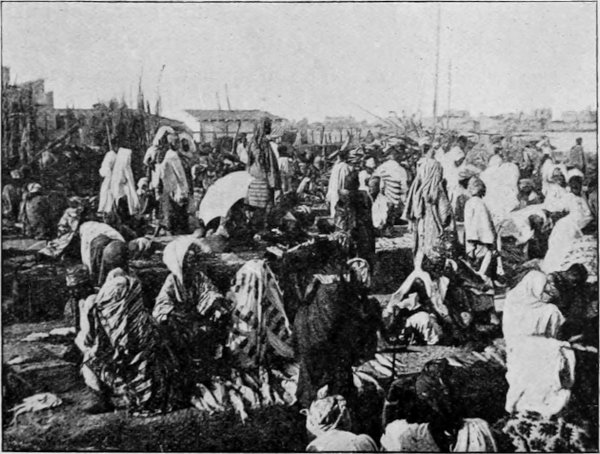
THE MARKET-PLACE AT ST. LOUIS.
THE MARKET-PLACE AT ST. LOUIS.
GOVERNMENT HOUSE, KAYES.
I must quote the actual words of this despatch, so fatal to us,
for not long since M. Grodet was defending himself from the charge
of having been somehow the cause of the delay to our expedition of
two whole years. The despatch was addressed—“Colonies à
Gouverneur, Sudan,” and ran thus—“Autorise surseoir
Mission Hourst, et disposer de cet officier.”[2]
As will be observed, the Governor of the Sudan was
authorized, that is to say, he could do as suggested or
not, to suspend, that is to say, to stop us, for the
limited time which seemed desirable to him. But any
further disputing about it would do no good now.
One remark, however, I must make: we were stationary for two
years on the banks of the Niger above Timbuktu, doing no particular
service to our country. Decœur, Baud, and others were marching on
Say from Dahomey. Can one fail to see what immediate political and
diplomatic advantages
would have accrued to France from a junction which would have
united the hinterlands of the two colonies?
It is true that Decœur and Baud were not starting from the
Sudan, but from Dahomey, where Governor Ballot was sending out
exploring expeditions, not stopping them.
But I have done. It is worse than useless to dwell on the
endless petty mortifications, annoyances, and disappointments we
had to endure. Useless indeed to recall all our own bitter
experiences, which could but damp the enthusiasm of future
explorers as eager to advance as we were. We succeeded in spite of
everything in making ourselves useful. Even whilst re-victualling
Timbuktu, which was threatened with famine—here again the
responsibility rested with very highly placed officials—I was able
to survey the whole of the system of lakes extending on the west of
the town.
The most important of these lakes, Faguibine, is a regular
inland sea, with its islets, its promontories, and its storms. It
is a vast basin nearly 68 miles long by 12 broad, with a depth,
which we sounded, exceeding here and there 160 feet. It is fed by
the Niger when that river is in flood. We made a peaceful raid on
this fine sheet of water in the Aube, a boat I shall
introduce to you later, whilst the terrible Ngouna chief of the
hostile Kel Antassar tribe retreated from us along its banks. Here
for the first time I came into actual contact with the Tuaregs.
Baudry meanwhile explored the Issa-Ber (already visited by
Caron) in his barge, and proved the navigability of the river at
high tide.
I feel full of respectful gratitude to the military authorities
of Timbuktu, especially Colonels Joffre and Ebener, for the almost
affectionate consideration with which they treated me, and for
being willing to employ us, for giving us something definite to do to relieve the
monotony and ennui of our detention. This was really an
immense consolation to us, the best that any officer can hope
for.
In May 1895 I received orders to return to France. Baudry, who,
I am happy to say, was worn out mentally rather than physically,
had preceded me by two months. As already stated, our coolies had
been disbanded—from motives of economy, said the order. Our stores,
too, were dispersed. Our boat was still at Bafulabé, and, mon
Dieu, in what a state! One might have sworn that its sections
had been intentionally twisted out of shape with blows from a
hammer. Our chronometers—little torpedo-boat watches, regular
masterpieces of precise time-keeping, made by that true artist M.
Thomas—were being used at Badumbé in the telegraph office. Our
bales, of the charge of which I had never been relieved, had been
sent to Mopti for the Destenave expedition, which had been allowed
to start. My friends in France, to whom I had addressed despairing
appeals, remained silent; even Baudry gave not a sign of life.
Everything seemed finally lost. My expedition had not been
superseded, it had been dissolved, destroyed.
I confess that when I embarked once more in the winter to make
my way, by slow stages, back to France, I did for the first time
despair of my unlucky schemes, and as I dwelt upon them, I believed
that they were at an end for ever.
I had at least the consolation, as Davoust had had before me, of
having struggled to the last.
On July 20, when I was halting at Bafulabé, and gazing with
inward rage though outward calm at the dented sections of my
Davoust, a telegram was handed to me. It was from Colonel
De Trentinian, who had—at last!—succeeded M. Grodet as Governor of
the French Sudan.
It said, “The
Colonial Minister resumes the original project of your
expedition.”
I have had a few minutes of wild joy and happiness in my life.
But not even on the day when, after I had been struggling nearly a
month against fearful odds in the revolted district of Diena, I saw
the column of succour approaching; nor again, last December, when,
as we embarked at Marseilles, I thought all our difficulties were
surmounted and all our dangers were left behind, did I experience
such an immense sense of relief and delight as now. I could keep my
oath after all! and by successful action put to confusion those
who, either because they were badly advised or unscrupulous, had
thrown obstacles in our way.
This is what had happened.
In France they say the absent are always in the wrong, and our
story goes to prove it. Of all those who, when I left, had
protested their devotion, had congratulated me in advance, who had
even warmly embraced me, scarcely any—I had almost said not one—had
taken our part or pleaded for us. In France, scientific societies,
geographical and others, spring up like mushrooms, and form little
cliques, hating each other like poison, and losing no opportunities
of abusing each other in their speeches and declamations at their
various banquets. Without running any risk themselves, or making
any special exertion, their big-wigs—I was nearly saying their
shareholders—get a lot of notoriety and patting on the back,
through the work of a few members who are toiling far away from
home.
If you ask their help in your difficulties, or even their moral
support, they take absolutely no notice of you; but later, when you
return, and have extricated yourself from your troubles by your own
unaided efforts, and if you are also very docile, they will make no
end of noisy fuss over you.
I have often
thought of these scientific swells when I have watched negro chiefs
marching along followed by their satellites. They strut about,
playing on the flute or the fiddle, beating their drums and
shouting out compliments in a deafening manner. Every epithet seems
suitable to their chief; he is their sun, their moon, and all the
rest of it. “Thou art my father, thou art my mother, I am thy
captive!” they shout.
But when adversity overtakes this flattered chief of theirs,
when he is in trouble of any kind, gets the worst of it in some
skirmish, for instance, what becomes of all the toad-eating
satellites? They melt away, to go and offer their incense of flute
and violin playing and bell-ringing to some more fortunate
favourite of the hour.
Oh, these self-interested sycophants, how well I know them!
I have, however, a grateful pleasure in adding that there are
exceptions to the rule. I will mention but one here. My dear and
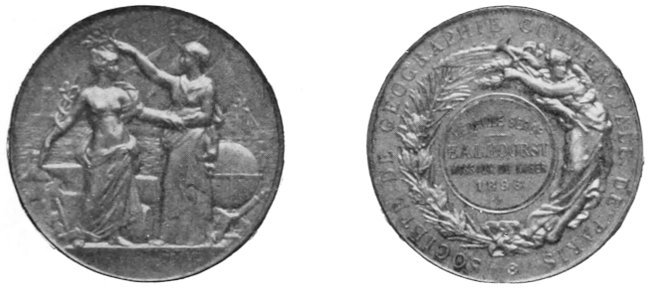
venerated friend, M. Gauthiot, chief secretary of the Société
de Géographie Commerciale, was always ready to cheer us in our
hours of discouragement, to aid us in our hopeful days; putting at
our disposal all his influence, all his persuasive power, and
exercising on our behalf the undoubted authority he possessed in
all things geographical and colonial.
Directly he reached Paris Baudry went to seek him, not of course
without some arrière pensée. “Well, how goes the mission?”
he asked at once. “Done for, unless you can save us,” was the
reply. “I’ll see about it,” said M. Gauthiot at once.
Then he went to my old friend Marchand, who was expected to do
such great things on the Congo. “And Hourst and the descent of the
Niger?” “You see what has come of that,” was the answer. “Well,
perhaps something may yet be done.”
Both did their
utmost for us, but it was M. Gauthiot who took the last redoubt.
The money question appeared to be the greatest difficulty, for they
were trying to cut down the expenditure budget as much as possible.
“Monsieur le Ministre,” said my friend, “I have come with
my hands full!” And five thousand francs were in fact voted for my
exploring expedition by the Comité de l’Afrique
Française.
In a word, the efforts of our new allies turned the scale in our
favour.
At that time M. Chautemps was, fortunately for us, Colonial
Minister, whilst M. Chaudie was Governor-General of French West
Africa, and Colonel (now General) Archinard Director of Colonial
Defence, and it was on these three that the final order depended. I
need only add, that they, with M. Gauthiot, became the four
sponsors of the re-organized expedition, and we are full of
respectful gratitude to them all.
“All I had to do in the matter,” said Baudry to me, “was simply
to put in an appearance.”
I alluded above to the question of funds. Well, the whole thing
was re-arranged on a fresh footing, otherwise the conditions were
less favourable than they had been two years before. Nothing had
changed with regard to the Tuaregs, but news had come by way of the
Sudan that Amadu Cheiku, the dethroned Sultan of Sego, was trying
to re-establish an empire on the banks of the Niger. Then the
Toutée expedition was already on its way; no news had been received
from it, and it is often more difficult to be second than first in
traversing a new district.
Colonel Archinard, therefore, wished to increase the strength of
our expedition considerably. To begin with, we were to have three
barges instead of one, and that meant twenty coolies instead of
eight. Then Lieutenant Bluzet, who, though still of low rank in the
service, was quite an old and experienced officer of the French Sudan,
was to take charge of the military training of our men. “Take a
doctor too,” said the Colonel, “he will make one more gun at
least;” and I choose Dr. Taburet, who had been my medical adviser
with the Niger flotilla, engaging his services by telegram.
All this of course added to the expense, and it was no easy
matter to balance the accounts of so big an expedition with so very
small a budget. However, we managed to do it somehow: Bluzet and
Baudry made advances from their pay, and Bolard went on campaign
once more with all his usual zeal and energy.
“You start four,” said Marchand to Baudry, when he saw him off
at the Orleans station, “only one will return!”
Thank God, however, we all came back!
Directly I received the telegram from Colonel de Trentinian I
set to work without losing a moment. I had to collect all our
scattered stores again at Bafulabé from here, there, and
everywhere. The Davoust had to be got into working order,
and the only way to do that was to put her together and launch her,
there would then be no unnecessary delay when the time for starting
came. I was aided in this by a quarter-master with a turn for
mechanics, a man named Sauzereau, who had already rendered me great
service when I had charge of the Niger flotilla. It was hard work,
but we succeeded, and it was a happy day when we baptized our boat
by her already chosen name of Davoust at the little
station of Bafulabé. It was the first time she had been afloat
since we tried her near the Pont Royal in Paris. A missionary from
Dinguira had come over at considerable inconvenience on purpose to
pronounce a benediction over her. Colonel de Trentinian was good
enough to travel from Kayes to be present, and I can tell you my
Davoust presented a very fine appearance on the Bakhoy. I would rather see
her there than on the Seine. Digui, who had been second master
pilot on the Niger flotilla, and whom I had chosen as Captain in
place of Bubakar, dismissed, was delighted with his boat.
When all was counted over, there were many missing loads.
Fortunately Captain Destenaves had only brought a few of the
valuable bales to Mossi, the rest were at Sego, but of the tins of
preserves and other provisions nothing was left but one case of
fine Cognac, which, taken in very small doses, was our greatest
luxury. There was still a little left a year later when we were at
Fort Archinard. See how temperate we were! Baudry’s bicycle, which
we had baptized Suzanne, I don’t know why, was in a pitiable state
when we found her again. But Sauzereau was a specialist in such
cases, and she was soon rolling along the Badumbé road, to the
great astonishment of the blacks.
I had now nothing more to do but to wait for Baudry at Kayes. I
went down there, and one fine morning he flung himself into my arms
with Bluzet and twenty coolies behind him. Of course with regard to
the coolies I speak figuratively. With a view to economy these
coolies had not been rigged out, and they really looked like a band
of brigands. Still they impressed me very favourably. I knew
several of them, who had already served under me. They were not, it
is true, quite equal to those I had engaged at first, and been
obliged to disband by order of the Governor, but they were not bad
fellows, and they would get into good working order by the way.
All had gone well with Baudry and Bluzet; they had even found
time on board the boat, which had brought them up from St. Louis,
to make up some rhymes, and in the evening, after copious
libations—I mean copious for Africa—we had the honour of listening to a
sonnet of which they were the joint authors. Here it is:
NIGHT ON THE RIVER.
Slow through the reaches of the oily
stream,
Unshapely, huge, and heap’d with cumbrous
freight,
The steamer drags along its ponderous
weight,
And panting, breathes a cloud of eddying
steam;
Upon the deck the wearied negroes
dream,
In sleep’s fine thraldom—humble, candid,
great,—
While overhead the moon in regal
state
Trails robes of gauze enmesh’d with
astral gleam.
The misty night exhales a poisonous
balm
From vague-spread margins, where the
shadows lie,
Of softly-tufted bush and tropic
palm;
Then from the silence, echoless, on
high
Mounts through the torpor of the deadly
calm,
To ethereal plains the siren’s piercing
cry.
ON THE SENEGAL.
EN ROUTE.
CHAPTER II FROM KAYES TO TIMBUKTU
On October 10, 1895, we finally left
Kayes. Our packages had been piled up the evening before in three
railway wagons, and our party now took their places in the
carriages. Baudry, Bluzet, and Sauzereau our engineer, who were to
go up in the Davoust, remained, and the rest of my staff
were the following: the second master pilot, Samba Amadi, generally
called Digui, a man of colossal height and herculean strength, but
more remarkable still for his zeal, his fidelity, and his nautical
skill; the native interpreter Suleyman Gundiamu, who had been to
Timbuktu with Caron as one of his coolies; the Arabic translator,
Abdulaye Dem, a cunning and intelligent little Toucouleur, more
cultivated than most of the negro marabouts; and twenty coolies, or
native sailors.
We reached
Bafolabé in the evening without incident. A ferry-boat took us
across the Bafing, one of the two rivers which unite to form the
Senegal. A road some two feet wide starts from the right bank of
the Bafing, and follows the course of the other affluent, the
Bakhoy, to the village of Djubeba, where we camped on the evening
of the 13th.
Thus far our journey had been effected by the aid of very
civilized means of transport. On leaving Djubeba, however, our
difficulties were to begin.
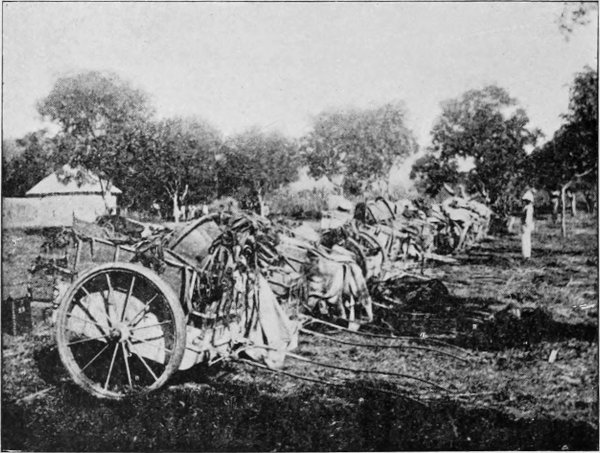
LEFEBVRE CARTS UNHARNESSED.
The carriage, or rather cart, which is used in the French Sudan
for taking down provisions and other necessaries to our different
stations on the Niger is of the kind known as the Lefebvre, about
which there was so much talk during the Madagascar expedition. It
consists of a big case of sheet iron mounted on a crank axle, and
provided with two wheels. It is drawn by a mule.
Is it an ideal
equipage? or is it as bad as it is painted? I do not venture to
decide the question. The truth, perhaps, lies between the two
extremes. On the one hand, these carts were always able to follow
our troops in the Sudan; but on the other, their intrinsic weight
might very well be lessened. The chief advantage of metal rather
than of wooden carts, is that they are watertight, and that when
unloaded they can be floated across streams or rivers, but as I
have never seen a Lefebvre cart execute this manœuvre, I feel a
little sceptical about it still.
LOADING OUR CONVOY.
When the packages to be carried are small, compact, and about
the same size and shape, it is easy enough to stow them away, but
this was by no means the case with ours, and our large packages
would be fearfully difficult to arrange and balance in the heavy
metal carts.
On the 14th the mules arrived, some of which were to be harnessed to the carts,
whilst others were to carry pack-saddles. The whole of that day and
the next were occupied in the arranging and loading.
The sections of the Davoust could not, of course, have
been carried in carts in any case. I had asked for seventy porters
to take charge of them, and these porters arrived in the evening.
There was nothing now to prevent our starting.
The route from the French Sudan, so often traversed to
re-victual our stations, has been too many times described for me
to pause to speak of the stages by which the traveller passes from
the banks of the Senegal to those of the Niger. For us, the usual
difficulties were increased by the variety of our means of
transport, including as they did carts, mules with pack-saddles,
and porters. Moreover, ours was the first convoy which had passed
over the route since the winter, and the road had not yet been
mended all the way. The first few days were very tiring, and men
and animals were all alike done up when we reached our first
halting-place a little after noon. But every one did his best, and
became more skilful at managing, so that in three days after the
start our black fellows were as well up to their work as we were
ourselves.
This was our general mode of dividing the day. At two o’clock in
the morning the blowing of a horn roused everybody; the drivers
gave the animals their nose-bags containing a few handfuls of
millet to keep up their strength on the road; Bluzet, to whose
special care I had confided the porters, collected his people,
whilst our cook quickly warmed for each of us a cup of coffee which
had been prepared overnight. An hour later we were off, the porters
leading the way, our path lighted by torches of twisted straw, the
fitful gleam of which made our negroes look like a troop of devils
come to hold their sabbat in Central Africa.
Bluzet rides at
the head of the caravan, looking back every now and then, whilst
two or three coolies run in the rear or on the flanks of our little
column, like sheep dogs keeping a flock together. About a hundred
yards behind the carts come jolting along on their rumbling iron
wheels, whilst the pack animals bring up the rear.
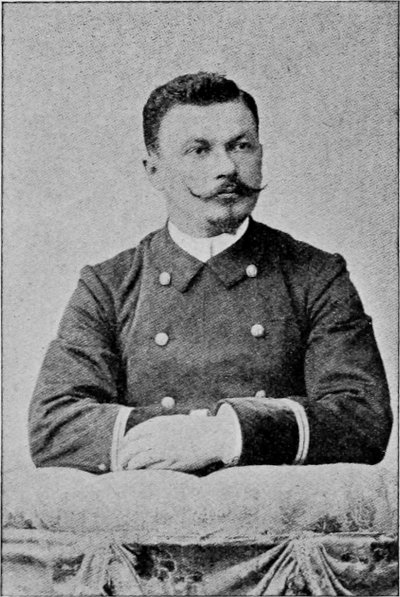
LIEUTENANT BLUZET.
For one moment we file silently through the hush and calm of the
tropical night, only broken by the cry of some bird, or the tap-tap
of the Sudan woodpecker. But presently we come to a big hole in the
ground, there is a shout of “Attention—Kini bulo!” (to the
right), and from one leader to another the cry Kini bulo!
is repeated, and
averts a catastrophe by letting every one know how to avoid the
obstacle. A great galloping now ensues to catch up the leading
cart, and this time the difficult place is passed without accident;
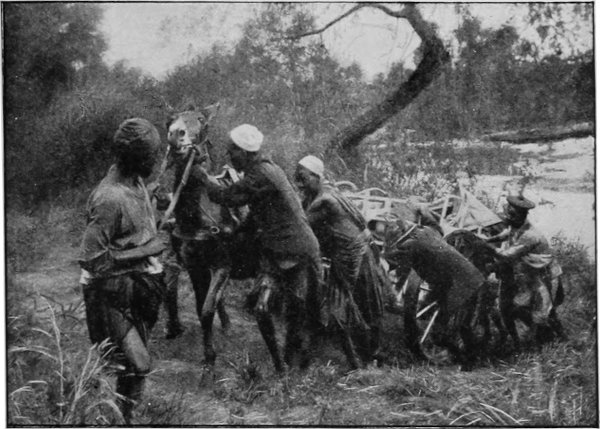
but often enough a wheel slips into the bog, and in spite of all
the poor mule’s tugging at her collar there it sticks. We all have
to rush to the rescue, drivers and coolies literally put their
shoulders to the wheel, and with shouts of encouragement and oaths
they finally extricate it. It is out again at last, and we resume
our march.
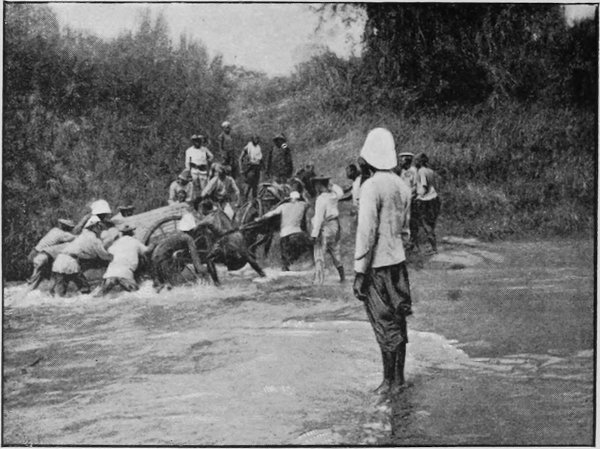
CROSSING A MARIGOT.
Then we come perhaps to what is called a marigot in
West Africa, that is to say, a little stream which is dried up part
of the year, and is a characteristic feature of the country. Before
the rainy season it has probably been bridged roughly over, and a
few planks have been thrown down at its edge, but in the torrential
downpours of rain of the winter the planks have sunk, and the
bridge has been
partially destroyed. We have to call a halt; to cut wood and grass
to mend the bridge, and carry stones and earth to make
stepping-stones, etc., so that it is often an hour or two before we
can get across.
But now the horizon begins to glow with warm colour. The sun is
rising, and as it gradually appears, its rays, which are not yet
powerful enough to scorch us, softened as they are by the mists of
the early morning, give a fresh impulse to the whole caravan. One
of the drivers gives a loud cry, alike shrill and hoarse: it is the
beginning of a native chant, in which the names of chiefs and
heroes of the past, such as Sundiata, Sumanguru, Monson, and Bina
Ali, occur again and again. The singer’s comrades take up the
refrain in muffled tones. Then another negro brings out of his
goat-skin bag a flute made of a hollow bamboo stem, and for hours
at a time keeps on emitting from it six notes, always the same. The
porters also have their music, and our griot[3]
Wali leads them on a kind of primitive harp with cat-gut strings,
made of a calabash and a bit of twisted wood, from which hang
little plaques of tin, which tinkle when the instrument is
played.
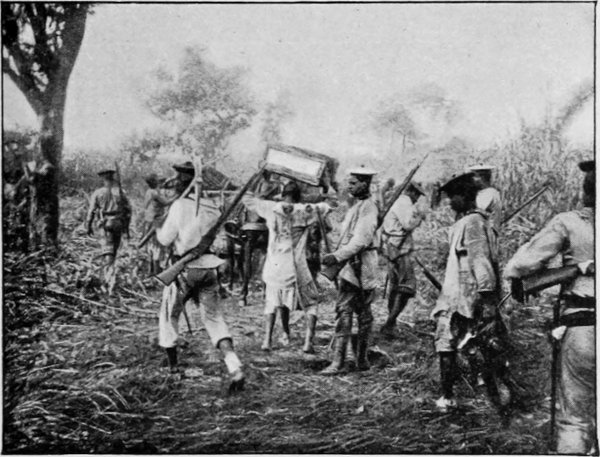
WE ALL HAVE TO RUSH TO THE RESCUE.
And so we leave the long miles behind us. Every other hour we
let the men and beasts have ten minutes’ rest, until the moment
arrives when we catch sight amongst the trees of the pointed
thatched roofs or the flat terraces of mud huts of the village at
which we are to camp.
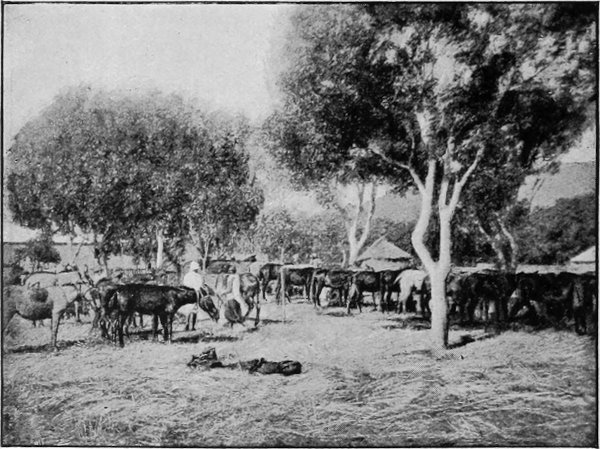
OUR TETHERED MULES.
The mules are unharnessed or unsaddled, as the case may be, and
tethered in a row by ropes fastened to one foot, whilst the carts
are packed like artillery. Presently we shall take the animals to
drink at a neighbouring stream, and then their food will be thrown
down before them, and they will fling themselves upon it like
gluttons, eating the
grain at once, but chewing the straw for the rest of the day.
Just a glance now over the loads to see that all is right.
Nothing is missing. That’s a good job! Meanwhile our black cook has
set up his saucepan on three stones, and a folding table has been
opened beside some rapidly constructed grass huts which smell
delicious. Breakfast over, we give ourselves up to the delights of
a siesta.
In the afternoon we go and look at the animals, who refreshed by
their rest, joyfully prick up their ears at our approach. They are
good beasts, these mules, or Fali-Ba (big asses), as the negroes
call them. They were torn from their native land, Algeria, huddled
together between-decks on some crowded boat, where they suffered
much from the motion, and were then taken to Kayes, where fresh
martyrdom awaited them. Beneath the broiling sun to which they have
never been accustomed, they have to drag their carts, as a convict
does his chain. Instead of the barley and oats of their own land,
they have to put up with hard and bitter millet, instead of scented
hay they get the coarse rough grass of the Sudan. As long as they
live—and that won’t be more than five years at the most—they will
have to plod along the same road again and again, and cross the
same marigots, until the moment of release comes, when they will
fall between their shafts, and their emaciated bodies will be
thrown aside in the bush, there to feast the hyæna and the jackal,
whose jarring laugh and shriek so often disturb the rest of the
weary traveller.
Was it the heat of the African sun, I wonder, which converted
some of the members of our expedition into poets, and led to such
outpourings as I quote below? I cannot say, but these are the words
written by one of our party to the manes of the Fali-Ba,
who have fallen beneath the burning sky of the Sudan. I pray critics to
be merciful to these inter-tropical effusions.
THE TETHERED MULE.
With lean neck stretch’d toward the
scatter’d grain,
He scents his provender with dainty
air,
Casts one side glance at his companions
there,
And beats with twitching ear a glad
refrain.
Gone all remembrance of the anguish’d
strain
’Neath kicks and blows, and ’neath the
scorching glare
Of torrid skies above the hillside
bare,
And of the toil that ever comes
again.
His banquet ended, calmly he
digests,
While o’er him sweeps a most divine
repose:
Faintly in dreams his memory
suggests
Long lost repasts, whereat his dark eye
glows;
Thus, bathed in vague nostalgia, he
rests,
While through the bush the sunset tremor
flows.
At last the sun sets, the sentinels are chosen and posted for
the night, and we gather once more round our little table for
supper, chatting now about our plans for the future, now about the
past, telling stories which ere long will become so familiar that
we could all repeat them by heart and give them each a number of
its own. Then one after the other we retire to our camp-beds to
enjoy such repose as the horrible mosquitoes, which are so clever
in finding the tiniest holes in the nets, will allow, till the
morning réveil is sounded on the horn, and we begin
another day, exactly like its predecessor.
Such was our life for twenty days, with slight variations, such
as the crossing of rivers, the over-turning of carts through the
breaking of axles or shafts, etc.
At Kita, however, a very unusual thing occurred: we were able to
indulge in a bicycle race. Our own bicycle, which we had called
Suzanne, met a rival. After all she was not the first comer to the French Sudan, for
a trader at Kita owned another. The match took place near the
post-office, on a really excellent course, and Suzanne won,
although she was not, like her antagonist, provided with pneumatic
tyres. During the race we were entertained by the playing of a band
of little negroes under the care of the Pères du Saint
Esprit. The boys, who were some of them scarcely as big as
their instruments, gave us several charming selections from their
repertory. Their conductor was Brother Marie Abel, who with his
long beard towered above his troupe, and reminded me of pictures of
the Heavenly Father surrounded by cherubs, only these cherubs
had passed under the
blacking brush. You see we were not without amusements in the
Sudan.
DOCTOR TABURET.
On November 8 we reached Bamako, and after a day’s rest started
for Kolikoro, which was the last stage of our journey by land, for
we were now to become sailors.
On the eve of our arrival, as we were breakfasting at
Tolimandio, who should suddenly appear but our good friend Dr.
Taburet, hot, perspiring, and out of breath with the haste he had
made to join us. I have already said that the two barges, the
Enseigne Aube and the Dantec, belonging to the
Niger flotilla, had been placed at my service. Taburet, who had
received my telegram, had come from Jenné to Sego, and taken the
boats to Kolikoro. Then, eager to be en route, he had gone
up stream on the Dantec as far as Tolimandio in advance of
us.
We plied each other with questions, of course. Taburet knew only
one thing, and that was that he meant to accompany me on my
expedition. I had to tell him all that had happened since our
parting in June, and we made the last stage of our journey to
Kolikoro riding side by side, and discussing every detail of our
plans.
Kolikoro, or more correctly perhaps, Korokoro, which means the
old rock, was well known to me. I had stopped there in 1889 with
the Niger flotilla for nearly a year. It occupies an extremely
important position, marking as it does the highest navigable point
of the central stretch of the Niger. Of course it is possible to
go, as Taburet had just done, as far as Tolimandio, or even to
Manambugu, at very high tide, but on account of the numerous
impediments in the bed of the stream, it is far better to stop at
Kolikoro, which has, moreover, other advantages in its favour.
I was indeed glad when we came in sight of the curiously abrupt
outlines of the hill overlooking the village. This hill is
surmounted by a plateau on which we had camped once before, and there is a legend
connected with it and Kolikoro, relating to the exploits of
Somangoro, and the long struggle which was at one time maintained
between the Soninké of the Niger districts and the Malinké from
Kita.
ARRIVAL AT KOLIKORO.
Sundiata was the seventh son of a hunter of Kita and a native
woman of Toron. He was stunted and deformed from his birth, and
could never go with his brothers to the chase, or bring home game
for his mother. She was ashamed of him, and went so far as to curse
the boy who did her so little credit. “Better death than
dishonour,” said Sundiata. “Moun kafisa malo di toro,” so
runs the refrain sung by the negroes. He fled to the woods, and
there he met a sorceress, who by means of her charms converted the
cripple into the strongest warrior of the district. He went back to
his father, and pretending to be still infirm, he asked for a stick
to lean upon. The hunter cut him a branch from a tree, but Sundiata
broke it as if it were a straw; then his father gave him a small
tree stem, next a gigantic trunk, and lastly a huge iron rod, which
all the blacksmiths of the country had been at work on for a year,
but the young fellow broke them all. In face of this evident
miracle his father and brothers admitted his superior strength. His
courage, his power, and the knowledge of magic which had been
bequeathed to him by the sorceress, drew all the Malinké to
Sundiata, and Samory himself, who is a Malinké, claims at this
present day to be Sundiata returned to earth.
Somangoro, a mighty warrior, and, moreover, learned in
witchcraft, reigned on the banks of the Niger. Certain terrible and
mysterious nostrums rendered him invincible, and he could only be
beaten by an enemy who should succeed in snatching from him the
first mouthful of food he raised to his lips. Now Sundiata, who had
made up his mind to
possess himself of the lands belonging to Somangoro, and knowing
the magic power which protected his enemy, pretended to seek his
friendship and alliance by offering to him his own sister Ma in
marriage.
Somangoro had fallen in love with Ma, so he married her, and
took her to his own land. He soon trusted his wife so entirely that
he allowed her alone to prepare and serve his food.
BANKS OF THE RIVER AT KOLIKORO.
Well, one day when the Soninké chief had drunk rather too much
dolo or mead, Ma brought him his food, and having placed
before him the calabash containing the tau (boiled millet
or maize), just as he was raising the first handful to his mouth
she sidled up to him as if about to caress him, and, by an
apparently accidental movement, made him drop it.
“Leave that bit, dear friend,” she said, “it is dirty!” and she
flung it into a corner of the hut. Somangoro, intoxicated with love
as well as with liquor, did not take any notice of what the traitress had done. Then
the cunning Ma, when her husband had left her, picked up the
mouthful of tau, and sent it to her brother. Sundiata
could now march against his rival.
This is what happened. The two armies met at Massala; the
Soninkés were beaten. Somangoro hung his weapons on a tree, which
is still pointed out opposite the entrance to the village, and fled
to Mount Kolikoro, where his rival changed him, his horse, and his
favourite griot into stone.
But although he is petrified the Soninké chief retains his magic
power, and the village is still under his protection. At the foot
of the hill two sacred rocks receive the offerings of the negroes,
consisting of ears of millet, chickens, and calabashes filled with
degue (millet flour boiled and strained).
Somangoro is supposed, or rather was supposed, not to tolerate
neighbours, so that when in 1885 a post-office was for the first
time set up on the plateau of the hill, the chief of the village
thought it his duty to warn the officer in charge that it would
certainly fall down. And so it did, for it had been put up too
hurriedly, and collapsed in a violent storm. In 1889 I, in my turn,
tried to build nine earthen huts on the same spot to accommodate
the staff of the Niger flotilla. Pressed for time, I began by
putting up a wooden framework, and the roof was being put on
simultaneously with the adding of the earthen walls. Of course I
had supported the corners of my framework by pieces of wood, but my
mason, finding himself in want of them, did not hesitate to remove
them, and therefore, just what might have been expected happened—my
house went down like a castle of cards, dragging the roof and the
men at work on it with it. Fortunately no one was hurt. Naturally
the influence of Somangoro was supposed to have been at the bottom of the catastrophe,
and I could not get any natives from the village to work for me on
that spot again. I was very much vexed, but fortunately I suddenly
remembered how a certain General of the first Republic managed to
get the blood of Saint Januarius to liquefy when it rebelled
against performing the miracle expected of it. I presented
Somangoro with a white sheep, and at the same time told the
sorcerer who superintends the rites of the hero’s worship that he
had a choice of a good present or a flogging, according to the
answer his master should make to them through him. Under the
circumstances, I added, Somangoro would surely do the best he could
for the welfare of his faithful servant. The event was as I
foresaw. The oracle, when consulted, declared that full permission
was granted me to reside where I liked. Since then I have been
supposed throughout Bambara to be on excellent terms with
Somangoro.
Mount Kolikoro is a harbour of refuge for escaped slaves who
have fled from the injustice and brutality of their masters, and
declare themselves to be the captives of Somangoro. No one dares to
touch them as long as they keep close to the rock, so they have
built huts there and till the ground for food.
Another noteworthy fact with regard to this mountain is, that an
oath taken by it whilst eating degué is inviolable. He who
should perjure himself by a lie after that would be sure to lose
his life. When I was in command there I often turned this belief to
account, and got at the truth in matters far too complicated to be
solved by the ordinary light of human reason.
I must also add that Somangoro is also the enemy of thieves.
When anything has been stolen in the village of Kolikoro, a crier
is heard going through the streets at night, calling upon the dead
hero to cause the death of the culprit if he does not return the fruit of
his larceny. Generally the person robbed recovers his property. I
do not know why, but this easy mode of invoking the power
attributed amongst Catholics in Europe to Saint Anthony of Padua is
called Welle da, which means literally to appeal to the
door.
The first days of our stay at Kolikoro were occupied in
unpacking and going over our stores. We landed our two wooden
barges from the old flotilla, brought down by Taburet, to have the
necessary repairs done. Alas! what a disagreeable surprise we had!
It was not mere repairs they needed, but a complete overhauling.
During the previous winter the wood of the outside had rotted,
partly from being badly kept, and more than half the boarding had
to be replaced with new. The only thing to do was to set to work
vigorously to remedy the evil. Fortunately our friend Osterman, who had already
rendered us so many services, was now at Kolikoro superintending
the building of canoes for the re-victualling of the river
stations, and he was ready to help us again in every way. We
succeeded in putting our three little barks in order, but we never
made them as watertight as they were originally, and especially
with the Aube the leakage was a constant source of anxiety
to us all through our trip.
REPAIRING THE ‘AUBE.’
TIGHTENING THE BOLTS OF THE ‘DAVOUST.’
Our engineer, Sauzereau, meanwhile was busy putting the
Davoust together, an operation the difficulty of which was
greatly increased by the fact that several of the sections had got
bent and twisted, either on the road or during the time when she
was left at Badumbé. In her case also we had to resort to various
ingenious contrivances, supplementing the original metal with
pieces of wood or iron rods. On November 19 we launched her, but
the water rushed in in floods through the badly fitting joints, and
our unfortunate vessel seemed more like a huge strainer than
anything else. Well, we must tighten the bolts somehow! So in
somewhat primitive costumes we armed ourselves with turn-screws, and with our feet
in the water did our best. Taburet especially distinguished himself
at this work, and was so full of zeal, that in his too eager
efforts he even broke off some of the heads of the bolts. We were
obliged to check our good doctor’s ardour a little. At last, what
with blows from our turn-screws, and the use of plenty of putty and
a little tow, we succeeded in draining the boat.
PROCESSION OF BOYS AFTER CIRCUMCISION.
We made two straw couches on the Aube, and—unheard-of
luxury!—we covered over the plank ceilings of the Davoust
with pretty yellow mats made in the country, the colours of which
harmonized well with the light grey of the wood.
Whilst we were thus at work we were able to make our
observations at our leisure on the life of the village. We happened
to have arrived just at the time of an annual fête, which is the
delight of all the natives of Bambara, except perhaps those on
whose account it is held. I allude to the ceremony of Buluku, or
circumcision, which is performed on male negroes at the age of
twelve, whilst young girls of a similar age are subjected to an
operation of a corresponding but more barbarous kind. Male and
female blacksmiths, who, amongst all the Sudanese tribes, are a
class apart, are the operators. The victims are taken outside the
village to a wood considered sacred, and there they are compelled
to dance and shout till they are exhausted with fatigue, and
reduced with the further aid of copious draughts of libo,
or millet beer, to a state of semi-insensibility. The operation of
circumcision is then performed with a sharp little knife, on a
mortar for grinding millet turned upside down. The poor children
must not utter a cry or even moan, although, judging from the
expression of their faces, they suffer a good deal. The young girls
undergo a similar treatment, but whereas their brothers
are all right again
two or three days afterwards, they are ill for more than a month.
During the period of convalescence the children are not allowed to
return to the huts of their parents. Under the care of the
blacksmiths they are to be seen going round and round the villages
in small parties singing, and during this march they are allowed to
take anything they fancy without paying for it. All this time the
girls are covered by big white veils, whilst the boys wear a cap of
a peculiar shape; both sexes carry a musical instrument made of
pieces of calabash, threaded on a thin branch of some tree, the
clinking of which is heard a long way off.
THE SACRED BAOBAB OF KOLIKORO.
At Kolikoro, the
year after this ceremony, the girls who have been operated on give
a fête called the Wansofili. In the centre of the village
is a huge baobab tree many centuries old, which is held sacred by
the natives, and is supposed to have the power of making women
prolific. The girls alluded to above gather about this tree in
groups and rub their stomachs against the trunk with a hope of thus
ensuring offspring. The ceremony winds up with a debauch, during
which scenes occur which have perhaps more to do with the
perpetuation of the race of the Bambaras than even the venerated
baobab. One evening when I had gone to witness a
Wansofili, I was obliged to imitate the example of Jacob’s
son and to flee from the daughters of the village, lest my dignity
as Commander of the expedition should be compromised. It was too
hot for me to be wearing a mantle, otherwise I should certainly
have left it behind me.
On the occasion of the Buluku a certain Kieka-Sanké came to give
us a tam-tam of his own. Kieka-Sanké, I must explain, is a
member of the Koridjuga tribe, a caste with its own special customs
and its own dancers and singers, I might almost say composers.
Sanké was an old acquaintance of mine, and his mummeries had
often amused me. Moreover, the information he had given me had
often been most useful, for the right bank of the river was then
still in the power of the Toucouleurs, and I had neighbours at
Guni, and in Sanké’s own village, on whom it was necessary to keep
a vigilant watch.
Now Sanké’s profession enabled him to go everywhere and to see
everything without being suspected, so that he was often able to
warn me in good time of what the Toucouleurs were thinking of
doing. But those anxious days are over now, and he came to Kolikoro
on this occasion merely to exercise his art. His greatest
successes have been
achieved when he has been disguised as a woman, for he is
wonderfully clever at imitating feminine ways. As he dances he
strikes a calabash full of little flints, and composes songs on the
spot which are full of caustic humour. One of his privileges, and
he values it greatly, is that he can say anything to or of anybody
without giving offence.
During my first stay at Kolikoro, Sanké was particularly fond of
taking off the Mussulman Toucouleurs, and I remember one day how,
à propos of their many prostrations and genuflexions, he
said, “What pleasure can these fellows give to Allah by showing Him
their backs three times a day!” My lady readers must pardon me; the
Bambara language is in certain expressions no more refined than the
Latin.
THE FLEET OF MY EXPEDITION.
This time Sanké, after having as usual given us all the news,
imitated the taking of a village. Wearing huge plumes on his head, and riding astride on
a stick with a horse’s head, which represented his war steed, and a
wooden gun in his hand, he was in his own person the besieger and
the besieged. It was really interesting to see him imitate, with a
skill many comedians might envy, the fierce gestures of a mounted
warrior charging, the crafty bearing of the foot soldier hidden
behind some cover waiting to rush out on the unsuspecting enemy,
the fall of the wounded, the convulsions of the dying. The
performance ended with a song in praise of the French in general
and ourselves in particular. In these impromptu verses Sanké
advised women to lay aside their spinning-wheels, for the white men
would give them money and fine clothes for much less tiring work. I
refrain from quoting more.
On December 12 we embarked our last load, and at half-past two
we started.
On the 17th we anchored opposite Sego, where we were to receive
from the Government stores the greater amount of the reserve
provisions for three months which we had to take with us in some
hundred and fifty cases. Bluzet raised his arms to Heaven in
despair when he saw the huge piles. “We shall never get them into
our hold!” he cried, “unless the axiom that the lesser cannot
contain the greater is not true after all.” He did not, however,
realize what skilful stowage could do. Baudry disappeared at the
bottom of the hold, and nothing more was seen of him that day. And
what he did then as second in command he had to do again and again
for a whole month, unpacking and repacking, hunting about amongst
the confusion of packages and cases for the one containing what was
wanted. I confess I often pitied him from the bottom of my heart,
the more that the temperature beneath the metal roof of our hold
was not one easily borne by a European.
At half-past two
in the afternoon Captain Destenaves, at one time resident at
Bandiagara, arrived from Massina, where he had been in command for
more than a year.
Destenaves had led our expedition to Mossi and Dori. From the
latter town, which is situated on the borders of the Tuareg
districts, he had brought much interesting information, and he was
also accompanied by an old man named Abdul Dori, who declared
himself ready to join our expedition.
DIGUI AND THE COOLIES OF THE ‘JULES DAVOUST.’
Abdul was what is known in these parts as a diavandu
Fulah, that is to say, a Fulah belonging to a family which
resembles in certain respects the griots of whom I have
had more than once occasion to speak. A diavandu attaches
himself to the person of some chief, whom he serves as a
confidential agent, courier, etc. He toadies his master to the top
of his bent, and so makes a good thing out of him, by hook or by crook. Even if he is
not exactly a noble character, it is impossible to deny that the
diavandu is often very full of intelligence and address.
If Abdul had really resolved to join us he might have rendered us
very great services, but, as will be seen, the sly fellow had his
own particular schemes to further, and was perhaps even a spy in
the pay of the Toucouleurs sent to watch and circumvent us.
Destenaves was, moreover, in a great state of indignation, for
though his expedition had succeeded at Dori, it had come to grief
at Mossi. He had even had to fire a few shots. He laid all the
blame, not without reason, on the former Governor of the French
Sudan. In fact, M. Grodet, instead of letting Destenaves go first
to Bobo Diulasso, where he would have been sure of a good
reception, made him adopt an unfortunate course. Unable, in face of
his instructions from home, to stop the expedition altogether, as
in our case, he ordered its leader to go towards the districts
occupied by the Mossi, who were wholly unprepared to receive
it.
We left Sego on the morning of the 18th, and arrived the same
day at Sansanding, where my good friend Mademba was waiting for
us.
Every traveller who has been to Mademba’s, and has since written
an account of his journey, has made a point, not without justice,
of bearing grateful testimony to the merits of this noble
fellow.
Mademba Seye is a native who was at one time in the employ of
the French post and telegraph office. He especially distinguished
himself during the construction of the line which, keeping
alongside of the Senegal, crosses the Toucouleur districts of the
Senegalese Foota. Just now the Toucouleurs were very much irritated
against us, and full of arrogance because no punishment had been
inflicted on them for
their daily misdeeds. They stopped barges coming up from St. Louis,
they molested the traders and pillaged their merchandise, and the
greatest skill, courage, and savoir faire were needed on
the part of Mademba to conquer the difficulties besetting his
path.
MADEMBA.
Later he did wonders in the Sudan, and his defence of the
village of Guinina was a glorious feat of arms. He was victorious
over the troops of Fabu, the brother of Samory, though he had no
one with him but the few employés helping him to put down the line.
Colonel Gallieni sent for him to be a kind of chief interpreter,
and he held that position until, the Toucouleurs having been driven
from Sego and Nioro,
the country just conquered by the French was properly
organized.
A small kingdom, with Sansanding as capital, was placed under
Mademba; he had in his service a certain number of sofas,
or captive Amadu warriors, who had surrendered to the French and to
the natives. Our postmaster-general soon became the Fama
Mademba, the word fama signifying a chief or king
among the natives of Bambara.
Mademba gathered a court about him, showing a very clear sense
of the right policy to pursue. When with us his manners and tastes
were quite civilized, but he knew that to get an influence over his
new subjects he must adopt the customs of their chiefs. He began by
building himself a palace, which consists of a vast rectangular
enceinte, with a door embellished with rough ornaments in clay. In
the first vestibule, or bolo, are the guards, or
dalasiguis, armed with muskets. This porch gives access to
a series of courts and other bolos, where of an evening
bellow the cattle and bleat the sheep belonging to the chief. A
last door, guarded or rather watched over by some fifteen children,
gives access to the favourite apartment of the Fama. Why
should children be employed? Because they are the only people who
can be depended on to tell the truth, and if they notice anything
unusual they are very sure, sooner or later, to tell what they have
seen. For the same reason, perhaps, and also on æsthetic grounds,
the Fama is waited on by women only, most of whom are the
daughters of blacksmiths or griots, specially attached to the
chief, their name, Korosiguis, meaning, “those who sit
beside.” Moreover, Mademba showed great acumen in his choice of
servants, and I never saw so many pretty girls anywhere else in the
Sudan.
Behind the royal apartments, and completely surrounding the vast
enclosure, are the huts of Mademba’s wives; but there begins the private life of
the chief, and I can’t introduce you to that, for the simple reason
that I have never seen anything of it myself.
Surrounded by his male and female griots, wearing a grand green
burnous, on which gleamed the Cross of the Legion of
Honour, the reward of his courage in the service of France, Mademba
came to the banks of the river to welcome us. Shouts and
acclamations of delight and sympathy with us greeted us as we
landed, and if we had not known what all the fuss meant, we might
have mistaken it for a declaration of war.
We went home with the Fama, and there, taking off his
burnous, the black chief disappeared, to be replaced by
our old friend Mademba, cultivated, refined, a charming talker,
quite up-to-date in all that was going on in Europe, the man whom
all Frenchmen who have been in the Sudan know and appreciate. He
did the honours of an excellent, almost European meal, and we drank
a glass of champagne together, in spite of his being a good
Mussulman, for he has none of the stupid fanaticism of his fellow
believers.
Just before we started I had made the following little speech to
my coolies: “My friends, I know I am asking what will cost you a
good deal of self-denial, but you must oblige me by not being too
attentive to the women you meet until we have reached Timbuktu. You
know that that sort of thing leads to disputes, sometimes even to
regular quarrels, with the natives, and we shall have quite enough
hostility to contend with without creating any ill-feeling
ourselves. I warn you, moreover, that I shall give you no more pay
after we leave Sansanding till we reach our goal. I will, however,
give you two months’ pay in advance at Sansanding, and you will
have three days to spend it in. For a year therefore, and perhaps
more, after you leave Sansanding, remember, you have done with
women.”
Truth to tell, I
had learnt from experience that the ardent temperaments of negroes
forming the escorts of expeditions really often jeopardized
success, if their amours did not actually bring about failure. Of
course I can’t be sure that my orders, which I repeated later, were
always strictly obeyed, but at all events I did a good deal to
lessen the evil.
YAKARÉ.
I gave my jolly fellows three days to enjoy themselves in, and
they took me at my word. Until half-past one on the 22nd I saw next
to nothing of them on board, and when the time for starting arrived
I had to send to hunt up our little Abdulaye Dem, who had
quite forgotten how
the time went in the society of a coal black Circe.
Meanwhile, we Europeans amused ourselves far more usefully in
arranging for our further journey, and in trying the effect on the
natives of our most attractive possessions, viz. the little organ,
the bicycle, and the phonograph.
The organ had already done wonders, and as for our
Suzanne, as we called our bicycle, she caused a perfect
delirium of joy.
Mademba had an ancient-looking negress of Amadu, named Yakaré,
in his suite. She was really only about forty years old, but she
was considered one of the cleverest women in all Bambara.
There was a certain ring about her songs of war and love which
would be appreciated even in Europe, and the following specimen, in
which she glorifies Donga or the vulture, Monson, the greatest
fama of Bambara, will serve to give an idea of the
rhythm.
Braves! Heroes, who of you dares rail at
Donga?
I tell you evil will come upon you if you
mock at him.
Raillery of him was fatal to Diakuruna
Tutun.
Samaniana Baci thought to play with
Donga,
He fancied he could make merry with
him;
But that did not please the
vulture,
And he took Bamana Dankun
And cut off his head, yes, took his head
from his shoulders.
You can just imagine the sensation when, after the negress had
finished her chant, the phonograph repeated it without anybody’s
help.
LARGE NIGER CANOES.
But all good things must come to an end, and to the great regret
of my coolies, I gave the signal for departure on the 22nd.
Below Sansanding the Niger increases sensibly in depth. This
fact explains alike the former and the future importance of the
village as a commercial centre. The trade of the country is, in
fact, conveyed up and down by water in big canoes some 60 feet
long, capable of carrying twenty tons, and made of planks tied
together. Holes are pierced in these planks, through which ropes are
passed made of the fibres, which are very strong, of the leaves of
a kind of hibiscus. When Sansanding, Jenné, and Timbuktu were
prosperous places, when the savage hordes of Toucouleurs had not
yet spread death and desolation everywhere in the name of Islam,
these heavy craft, sometimes drawing more than six feet, used to
halt at Sansanding. For the traffic further up stream smaller boats
were used, which plied to and fro nearly all the year round. A
central mart was absolutely indispensable to the Sudan merchants,
and Sansanding was fitted by nature to become that mart. I believe
that in its most prosperous times it numbered from thirty to forty
thousand inhabitants, though now these are reduced to some three or
four thousand, in spite of the fresh impulse given by the more
prosperous times of to-day, and the intelligence of the governor
Mademba.
When the railway has been pushed from Kayes to Kolikoro, and
when steamboats ply on the Niger, similar causes will of course
produce similar results. Steamboats will not, however, be able to
go beyond Sansanding all the year round, for no amount of
improvement in their build can reduce their draught below one and a
half or two feet. Above this point, however, the river is navigable
for a longer or shorter time every year in such barges as are now
in use. At the most, the traffic is only interrupted for about four
months in the year. Sansanding will again become a central emporium
and transhipping station; all its old importance will be restored
to it.
I may add, that it has fortunately many other advantages,
including good anchorage and landing places, where boats can be
moored in shelter during the violent storms of Central Africa; the
soil too is very dry, so that the place is healthier than many
others in the Sudan, and the people are gentle, intelligent, and
industrious.
Beyond Sansanding
the course of the Niger changes considerably. Thus far the river
flows between pretty straight uniform banks, but now the hills are
lower, and behind them the country is perfectly flat, without so
much as an undulation, so that they are completely flooded, often
for an immense distance, when the water is high. Here and there
villages rise from slight eminences, the clumps of hibiscus
surrounding them rendering them visible from afar. Now too appears
the sweet grass which the natives call burgu, a special
characteristic of the riverside vegetation as far as Say. It is a
kind of aquatic couch-grass nearly level with the soil when on the
subsiding of the floods the ground becomes dry again. Directly the
soil is once more inundated, however, the burgu sends out shoots
with extraordinary rapidity, and they grow so fast that they soon
reach the top of the water. The natives make a sweet beverage of
the leaves of this grass, of too sickly a taste to be fancied by
Europeans, but negroes are very fond of it. For our hydrographical
surveys the burgu was a most invaluable help, growing as it does,
as I have already remarked, wherever the solid ground reappears
after the floods. If, therefore, we should be overtaken by a
tornado on the open river, we can always take refuge from the waves
by anchoring in the middle of the submerged tracts.
On January 1 we reached Gurao on Lake Debo, where I had recently
resided for two years in charge of the Niger flotilla, consisting
of the two gunboats Niger and Mage, and a few
barges made of the wood of the country. Two of these barges, it
will be remembered, were now part of our exploring expedition.
We paid a visit between whiles to the tomb of Sidi Hamet Beckay,
in the village of Saredina. I shall often have occasion later to
refer to this worthy, so I will content myself with adding but a
few words about him here. It was thanks to him that Barth was able to stop
six months at Timbuktu, pursue his voyage in safety, and go down
the river by Say to Sokoto, whence he had started eighteen months
before. Thanks to him too, Barth was able to send details to Europe
of the hitherto mysterious city of Timbuktu, which had previously
been visited by no white men except René Caillé.
When El Hadj Omar and his fanatical hordes came to devastate
Massina, Hamet Beckay did his utmost to stop the course of the
Toucouleur conqueror, by urging on him his own interpretation of
the Mussulman religion, which he also professed: an interpretation
too noble and elevated to be adopted by any but a few votaries. It
was all in vain; his remonstrances were unheeded by El Hadj. Beckay
had to be content with organizing a stout resistance; he summoned
to arms his faithful friends the Tuaregs and the Fulahs, his former
adversaries. But, alas! he died at Saredina before he could
accomplish anything. The story goes, that when in perfect health he
was seized with a gloomy presentiment of his approaching end. He
called his intimate friends together, telling them that he might
perhaps soon be summoned to make a distant journey, and giving to
them his turban and his sword, the former for his son Abiddin, the
latter for his son-in-law, Beckay Uld Ama Lamine, which signified
that he bequeathed his spiritual power to Abiddin and his temporal
authority to Ama Lamine. Then he begged to be left alone to pray
during the hour of the siesta. When his followers returned they
found the great marabout, his chaplet, clasped in his hands, and
his eyes closed in an attitude of ecstasy. After watching him for a
short time they became alarmed at his immobility, they touched him
to try and awake him. But his lifeless body fell to the ground, the
spirit of Hamet Beckay had left its earthly tabernacle. Beckay Uld
Ama Lamine continued
the struggle begun by his father-in-law, and to him and his
faithful adherents is due the honour of having besieged and killed
El Hadj Omar at Hamdallahi. The blood-stained course of the
Toucouleurs was checked for the moment, and the Western Sudan was
saved from falling into the hands of the ferocious warriors of El
Hadj.
Saredina is about two and a half miles from the river, and to
reach it we had to cross a partially inundated plain over-grown
with grass, in which nested quantities of aquatic birds. Arrived at
the village we asked to be directed to the tomb, and found it to
consist of little more than a small earthen case upheld by wooden
poles, for the mass of dried bricks which had originally formed the
monument to Hamet Beckay had all but disappeared. The natives of
the neighbourhood had shown little respect for the great chief’s
resting-place, and had used the materials of his tomb to weight
their nets and make their agricultural implements. In my report to the governor of
the French Sudan I put in a plea for a grave more worthy of Hamet
Beckay. I hope my suggestion will be attended to, for it would be
not only fitting, but good policy to preserve the memory of a man
whose character was the more estimable in that such tolerance as
his is rare indeed amongst his fellow believers. Such an act of
pious respect for a Mussulman on our part would greatly increase
our moral influence amongst the Mahommedans of the neighbourhood,
especially amongst those of the interesting Kunta tribe to which
Hamet Beckay belonged.
THE TOMB OF HAMET BECKAY AT SAREDINA.
SARAFÉRÉ.
At Gurao we had to collect the ammunition for our guns and
cannons, and also to pick up some of our actual weapons, notably a
certain machine gun which had belonged to the Niger flotilla. The
work involved in all this delayed us till the 3rd, but on the
afternoon of that day we resumed our journey.
On the 7th we
reached Saraféré, an important market-place near the junction of
the Niger and the Kolikolo, which latter is an arm of the river,
branching off from it a little above Lake Debo. Here old Abdul
Dori, the guide we had engaged at Sego, brought us a young man
named Habilulaye, who was a Kunta, and I seize the opportunity of
his visit to say something about the tribe to which he belonged, as
I shall often have to refer to it.
The Kuntas are of the Arab race, and are descended from the
famous conqueror of North Africa, Sidi Okha, who was a native of
Yemen. After winning over to the religion of Mahomet a considerable
portion of North Africa, his dominion extending nearly to Tangiers,
the victor was assassinated near Biskra, where his tomb is still to
be seen.
His descendants spread in many directions, and the Kuntas took
root at Tuat, where as venerated marabouts they exercised, indeed
they still exercise, a very great influence.
During the first half of the present century, Timbuktu occupied
a very difficult and most precarious position. About 1800 a Fulah
marabout, named Othman dan Fodio, carved out for himself a regular
empire between Lake Tchad and the Niger, and his example led to the
revolt, and the generally successful revolt, of nearly all the
Fulahs distributed throughout the river basin. At Massina, Amadu
Lobbo Cissé, a chief—of Soninké birth, it is true, but who had long
resided amongst the Fulahs—raised the standard of revolt in the
name of Islam, and his attempt, after various vicissitudes,
succeeded. He and his son founded later an empire, the influence of
which, with Hamda-Allahi as its capital, soon extended on both
banks of the Niger as far as Timbuktu. Arrived there, however, the
Fulahs found themselves face to face with the Tuareg tribes, who were very jealous of
the maintenance of their independence. War of course soon broke
out, and it lasted for half-a-century without any subjugation of
the Tuaregs. It was not until later that the invasion of the
Toucouleurs, led by El Hadj Omar, united the combatants against
their common foe.
During this time of struggle and trouble Timbuktu, standing as
it did between the two contending parties, passed first to one and
then to the other, and pillaged by both sides, she rapidly declined
in prosperity, and was in danger of complete ruin.
Under these trying circumstances, the merchants of the city,
eager to obtain some sort of security for their lives, their goods,
and their trade, sent to Tuat an earnest petition that some
venerated Kunta marabout should come and live near Timbuktu, hoping
that the respect felt for his piety might put a stop to the
depredations of which their town was the victim.
Sidi Moktar responded to this appeal. He came, and took up his
abode with his family and a few of his more distant relations near
Timbuktu. Of these relations the most celebrated were his brothers
Sidi Aluatta and Sidi Hamet Beckay with his nephew Amadi.
Barth has told us much about them all, but we have now specially
to deal with Hamet Beckay, the doctor’s chief protector.
Imbued through reading Barth’s travels with a belief that the
very fate of my expedition might depend on finding, as he did, some
man universally loved and respected to take me and my followers
under his protection, I earnestly hoped to find such a man amongst
the Tuaregs, with whom I had become well acquainted during my two
years’ residence in the Sudan.
As will be borne out by my further narrative, these Tuaregs seemed to me far less
black than they were painted in Europe. At the same time, I
recognized that certain peculiarities of their character might
involve me in great difficulties. If they were not exactly
instinctively ferocious, I knew that they were quick to take
offence, defiant, full of dread of innovation, and ready to look on
every stranger as a spy. To them a traveller is but the harbinger
of some warlike expedition, which will wrest from them their
greatest treasure, their independence.
But I had to get some one to go bail for me, some one to take me
under his patronage and protection, and I had resolved, if it could
possibly be done, to find that some one amongst the Kuntas. Surely,
I thought, the traditions of tolerance of which Hamet Beckay had
given such striking proof, must have been handed down to some of
his descendants.
I did not, however, disguise from myself that in the very nature
of things, since other marabouts had, since Beckay’s death, come to
preach a holy war, and to inculcate hatred of the infidel, that the
Kuntas would necessarily be forced—if they did not wish to lose
their prestige—to howl with the rest of the wolves. But I reflected
there is still time to appeal to the example of their grandfather,
and experience proved that I was right.
I put out all my eloquence and powers of persuasion to win over
young Habibulaye, and I succeeded. From him I learned that the
Kuntas were now divided into several groups. He and his brother
Hamadi, the sons of Sidi Aluatti, the brother of Hamet Beckay, had,
however, remained at Timbuktu when the French occupied that town,
and had all espoused our cause.
Aluatti, the son of Amadi, was in authority on the southern side
of the river, and he looked on our expedition with a favourable
eye. Further on, Baye and Baba Hamet, the sons of Hamet Beckay, would, I expected,
be useful auxiliaries to us if only for the sake of their father’s
memory.
Habibulaye did not, it is true, conceal from me the fact that
other Kuntas were bitterly hostile to us, notably a certain
Abiddin, who generally resided at Tuat, and who meant to rouse the
Hoggars against us. He had, in fact, twice gone quite close to
Timbuktu to try and make the people rise against the French.
More confirmed than ever by all that I heard in my resolve, and
having now got all the information I could out of Habibulaye, who
was but a child, I made up my mind, as soon as I got to Timbuktu to
take Hamadi into my confidence, and get him to give me
recommendations to his relations.
A strong east wind, which lashed the river into waves and was
dead against us, delayed us so much that we did not reach Kabara
until the evening of January 11.
As is well known, Timbuktu is not actually on the river, but at
low water is some eight or nine miles off. Djitafe is then the
nearest point of approach for canoes, but when the river rises they
go up a lateral arm, and come first to Koriomé and then to Day. At
certain times a stream, the bed of which is said to have been
hollowed out, or at least deepened by the hand of man, enables very
small craft to get up to Kabara, whilst more rarely, that is to
say, when the inundations are at their height, the various
excavations behind the Kabara dune are successively filled up, and
boats can reach the capital itself. As a general rule, however,
merchandise is taken into Timbuktu on the backs of camels and
asses, the route varying according to the state of the river.
The ancient capital of Nigritia, or the Sudan, as it was still
called not long ago in geographical text-books, has
lost all its mystery
since it passed into the hands of the French, and opinions are
divided as to its present and future position. My friend Felix
Dubois has described it, and it would be alike a waste of time and
presumption on my part to attempt to supplement what he has said so
well. I shall content myself with noting the reason of the former
great commercial importance of Timbuktu; relatively considered of
course. “Timbuktu,” says an Arab author, “is the point of meeting
of the camel and the canoe.” That fact alone would not, however, be
enough to account for its prosperity; many other places on the
river fulfil this condition, as well if not better than Timbuktu,
for, as we can ourselves testify, the canoe and the camel only meet
there a few days in the year, and not always even as often as
that.
In my opinion we have to seek the explanation elsewhere, and I
think I have found it. Here it is: camels cannot with impunity
approach rivers or other water-courses, for this reason. The banks
are subject to constant inundations, and, especially in the Niger
basin, quantities of succulent grass, containing a great deal of
water, everywhere spring up, which, though the camel eats them
gluttonously, are fatal to the “ship of the desert,” used as it is
to dry food.
Now by a strange freak of nature, the part of the desert, I will
not say exactly the driest part, but certainly the portion
containing neither streams nor permanent pools, that vast expanse
improperly called the Sahara, stretches up to the very gates of
Timbuktu, so that caravans can reach the city without any risk to
the animals. In a word, may we not say that Timbuktu is not a port
of the Niger in the Sahara, but a port of the Sahara near the
Niger?
As long as the trade of Timbuktu is carried on chiefly by
caravans coming from the north, it will, in my opinion, retain its
importance, but as soon as the Sudan railway is completed,
merchandise will come by way of it and the river, and the commerce of Timbuktu will be
reduced to a trifling trade in salt, which is dug out in
considerable quantities from the mines of Towdeyni, about twenty
days’ march on the north.
When we arrived, we could only bring our boats up to Kabera. The
port was blocked with big canoes made of planks tied together in
the manner already described, and a brisk trade in salt and grain
was going on on the quays.
A MOSQUE AT TIMBUKTU.
The next day I went to Timbuktu, and was received with open arms
by the commandant, M. Rejou, who was in charge of the whole
district.
I had one thing very much at heart, and I set to work to see
about it at once. It was to persuade Father Hacquart, superior of
Pères blancs mission at Timbuktu, to accompany us on our
expedition.
When I said persuade, I did not perhaps use quite
the right word, for I
did not for one moment doubt the readiness of the good father to go
with us. The companion of Attanoux in his journey amongst the
Tuaregs of the north, formerly Commandant des Frères armés
of Mgr. Lavigerie, Father Hacquart could not fail to be won over by
the idea of accomplishing a similar journey. But I knew him to be
too devoted to his duty to hesitate an instant between a project,
however attractive to his tastes and desires, and the interests of
the mission, which had been under his direction at Timbuktu for
more than a year, and to which his rare qualities had already given
such life and success.
On the other hand, even from the point of view of the work to
which Father Hacquart and his companions had devoted themselves,
going down the Niger, opening relations with the natives on its
banks, and obtaining all the information necessary for the work of
their future evangelization, was really perhaps to bring about the
good results hoped for years before they could otherwise have been
achieved. The aim of Father Hacquart was really the same as ours,
to see, to study on the spot, and to make friends, leaving to his
superiors the task of deciding how his future campaign should be
carried out.
As for me, nothing could be better for the success of my
undertaking than the co-operation of Father Hacquart. Already
familiar with the manners and customs of the Tuaregs, he would be a
most valuable adviser; a distinguished Arabic scholar, he could in
many cases converse without an interpreter with the natives, a
matter of the greatest importance. He could, moreover, check the
translations and reports of my Arab interpreter, Tierno Abdulaye
Dem. Then his intelligence, the loftiness of his aims and views,
the uprightness and energy of his character, were a sure guarantee
that in him I should find a most valuable controller of my own acts and schemes, for of
course I should ever be ready to listen to what he might
suggest.
FATHER HACQUART.
Father Hacquart turned out indeed to be all that I have just
described. I often changed all my plans in accordance with his
advice, and I never had cause to regret having done so. He must
pardon me for giving expression here to all my gratitude, and for
proclaiming it on every occasion as loud as I can, for it was in a
very great measure to him I owed the remarkable fact, that my Niger
expedition was accomplished in the midst of tribes so diverse and
sometimes badly disposed towards the French—without the firing of a
single shot.
As I hoped, Father Hacquart yielded to my persuasions, and we
now numbered five Europeans.
On the other hand, our native escort was reduced. One of our
coolies, Matar Samba, had been out of sorts ever since we left
Sansanding. During the last few days he had become worse, and both
Dr. Taburet and a medical man at Timbuktu were of opinion that he
was suffering from tubercular disease, and would only hamper, not
help me, in the further journey. I decided therefore to leave him
at Timbuktu, and when I came back from Dakar on our return I had
the pleasure of finding him much better, if not completely
cured.
Aided by Father Hacquart, I at once opened relations with
Hamadi, the Kunta of whom I have already spoken, and he promised to
do all he could to persuade his relation Aluatta to go with us. It
was significant that when I begged Hamadi to join us himself, he
replied, “No; I might merely arouse opposition, and you might
suffer through my being with you. I would rather write to Aluatta;
he will be more likely to say yes then, for, like a dutiful
relation, I shall only urge him to come and share the windfall of
all your beautiful presents.”
The next thing I
did was to try and meet at Timbuktu with some natives who were on
friendly relations with the Awellimiden, the important Tuareg tribe
to which I shall so often have to refer later, but whether they
spoke the truth or were deceiving me, one and all declared that
they knew absolutely nothing about them.
To make up for this, however, a native of Tuat, a certain Bechir
Uld Mbirikat, who had long lived at Timbuktu, and whom I had met
before, gave me some letters for his cousin Mohammed, who was
living amongst the Igwadaren Tuaregs, and for Sheriff Salla Uld
Kara, chief of the village of Tosaye, who had once been the pupil
of Hamet Beckay, and the friend of Barth.
Moreover, Bechir gave me a valuable bit of advice, which I
immediately followed, without, however, fully realizing its
importance at the time. This counsel, perhaps, contributed more
than anything we did to the success of our expedition. “Tell them,”
said Bechir, “that you are the son of Abdul Kerim.” Now Abdul Kerim
was the Arab name assumed by Dr. Barth during his journey. This
custom of taking an Arab name seemed almost comic, and reminded me
of a little play I once saw acted at the Châtelet Theatre in Paris.
I forget the name of it, but a traveller figured in it, who took
his servant with him to the heart of Africa. The latter, who was
passionately fond of travelling, and took an eager interest in all
the doings and adventures of explorers, made but one request, and
that was to be allowed to change his name of Joseph to that of
Mohammed Ben Abdullah. “It was more euphonious,” he said, and the
audience roared with laughter.
Well, Joseph was quite right, and if Barth had not done as he
did, the negroes and Tuaregs would never have remembered his
European name, it would never have become engraved on their memories, it would
never have been transmitted to their descendants, and I should not
have been able to solve all difficulties, however great, and emerge
safely from every situation, however embarrassing, by the simple
words “I am the son, or rather the nephew of Abdul Kerim.”
It is impossible to admire too much the lofty, upright character
of Barth, which so impressed all with whom he came in contact on
his journey, that nearly half a century after his death the mere
fact of his having traversed a district—poor as he was, and exposed
to all manner of dangers, the friendship of Beckay his only
safeguard—should be enough to open the way for a pretended relation
of his.
How few travellers could boast of having done as much, even in
modern times. Too many explorers have indeed, after forcing their
way through a country against the will of the natives, left behind
them a legacy of increased difficulty and danger to their
successors.
I was very anxious to secure the services of a political agent
with a thorough knowledge of the country, and the language of the
Tuaregs. I wished to send him, if I could find him, in advance of
our party to take letters to the chiefs, or to plead our cause with
them.
Acting on the advice of Hamadi, I chose a certain Sidi Hamet,
distantly connected with the Kuntas, and then employed in the
Custom House at Timbuktu, under one Said, the interpreter of the
Post-Office.
I must do this justice to Said, he yielded with anything but a
good grace to the employment of his subordinate on our service, and
did more to dissuade him than to further our wishes. We had to
invoke the aid of Commandant Rejou, and later, at Tosaye, Sidi
Hamet piteously entreated me to let him go back, and I expect
Said’s objection to
his joining us had something to do with his faltering. However, I
forgive him with all my heart. Sidi Hamet was the interpreter’s
right hand, his chief source of information on every subject, and
he found it hard work to fulfil his own duties, even those of an
interpreter, without him.
On the 16th I went back to spend a day at Kabara, where I had
invited all the notables of Timbuktu to come and listen to the
wonders of the phonograph. It was an exhibition which long dwelt in
the memory of those present. Amongst the most attentive listeners
were the two sons of the chief of the Eastern Kuntas, who lives at
Mabrok. I felt sure that the rumour of the extraordinary things I
had done would precede me.
Commandant Rejou had already warned Sakhaui, or Sarrawi, chief
of the Igwadaren Aussa, the first Tuareg tribe we should meet on
our way down the river, of our approach. In the evening two envoys
from this chief arrived with a missive, which it was almost
impossible to decipher, but from which, in spite of its ludicrous
phraseology, we managed to make out two things, one being that
Sakhaui had no desire to see us, the other that he was very much
afraid of us.
We did our best to reassure and impress the messengers, and
finally succeeded in convincing them that we had no evil intentions
with regard to the Igwadaren, and armed with a fresh document from
us they set off to return to their chief.
Meanwhile Sidi Hamet, who had been well coached in what he was
to say and do, had started on his way to Aluatta, to ask him to
meet us at Kagha, a little village on the right bank about
thirty-one miles from Timbuktu. For the first time I now announced
my pretended relationship with Abdul Kerim, taking myself the Arab
name of Abd el Kader, or the servant of the Most High.
This mission with
the Kuntas accomplished, Sidi Hamet was to go to the Igwadaren of
Sakhaui and wait for us.
Having settled everything to the best of our ability, visited
the boats, and repaired any little damage which had been done by
the way, we had now only to give ourselves up to the current of the
river and to the will of God.
It was not without a certain emotion that, on Wednesday, January
22, we started from Kabara, seen off by all our brother officers of
the garrison of Timbuktu, and escorted to our boats by a great
crowd of natives, who, with more or less enthusiasm, invoked the
protection of Allah on our behalf.
WE LEAVE KABARA.
As long as our boats were in sight of the station we could see
handkerchiefs and helmets waving to us in token of adieu, and when
the flag of the fort disappeared from view our hearts felt somewhat
oppressed, for we were leaving all that in our exile from France
represented our native country. Henceforth we five white men, with
our twenty-eight black followers, were thrown on our own resources,
and had to depend upon ourselves alone. How many of us would
return? How many of us were destined to sleep our last sleep
beneath the soil of Africa?
AT TIMBUKTU.
DROVE OF OXEN.
CHAPTER III FROM TIMBUKTU TO TOSAYE
On January 22 we made a very short
stage, and moored about mid-day at Geïgelia, a little village
picturesquely perched on rising ground of a reddish hue, a little
below the mouth of the stream, which, as I have said, gives access
to Day and Kabara.
We determined to spend the afternoon in making things snug.
Hitherto we had put off from day to day the task of arranging our
cabins. Now our three little craft are all the world to us, the
floating castles which must drift down with us to the sea, Inch
Allah! (God willing), as the Mussulmans say. We must shake
down in them as comfortably as possible.
I occupy the fore-cabin of the Davoust. On one side is
my plank bed, with, for mattress, the wrappings of the presents which we take out one
by one as required, replenishing them from the bales in the
hold.
On the other side is a big table, with packing cases serving as
legs. Everywhere books and instruments, an iron chest containing
the more valuable presents: caftans, velvet burnous,
gold-embroidered turbans, etc.
On the mats which cover the partitions, I have fixed the
photographs of a famous singer, purchased in the Rue de Rivoli, in
a moment of musical enthusiasm. I found them by chance at the
bottom of a trunk, into which they must have slipped when I was
leaving France. These portraits, as will be seen, played a part in
the politics of the Niger. Opposite them, an engraving of the
President of the Republic, or rather, Sultan of France, as they
call him here. Nor must the phonograph in its ingenious case be
forgotten, with the voltaic piles, Geissler’s tubes, little
electric lamps, forming a fairy crown, which is lighted on pressing
a button. Such articles as have hitherto figured in the baggage of
none but the passengers of Jules Verne.
The after-cabin is Père Hacquart’s sanctum, and also the
arsenal. The Father rests peacefully on a couch of rice and biscuit
tins, with the conventional bedding of package wrappings; on the
partitions, the ceiling, everywhere, I have fixed guns for
presentation, revolvers, etc., for exchange; a goodly number of
cases of cartridges, moreover, give this retreat the appearance of
an armoury. On the bridge, all round the machine-gun, are more
cases, which serve as benches for the oarsmen.
Our hold is a masterpiece of packing, due to Baudry’s ingenuity.
I defy the most skilful to insert as much as a needle more. On
board the Aube, the fore-cabin protects Baudry and Bluzet;
there is not much elbow-room for two, in such a confined space. The
hinder one is reserved for Taburet and his medicine chests.
The little barge
Dantec, also provided with a shelter, will carry all
surplus articles. At present, until it is used as an infirmary,
which I trust may be as seldom as possible, it is the refuge of the
destitute, where Suleyman, the interpreter, and the Arab
translator, Tierno Abdulaye Dem, are quartered.
I may now describe more minutely our dusky auxiliaries. At first
there were twenty coolies, reduced to nineteen by the defection of
Matar Samba. Their head-man Digui, of whom I have spoken, will be
judged by his deeds; there is no need now to mention all the
blessings he deserves.
THE ‘AUBE’ AND HER CREW.
Suleyman Gundiamu and Tierno are the scholars of the party.
Suleyman almost speaks French, although he says la noce
for un os, cherchicane for certificat,
and always translates keffir (Infidel) by Christian. As
for Tierno, he is a sly, cunning dog, of whose fidelity I have
often had my doubts: evidence is against me, however, and I must
do him the justice to
say, that on all occasions he has sided with us against his
co-religionists, his compatriots, and even his relations. Idle as a
dormouse in everything but writing Arabic, but isn’t that just what
he is for? Altogether he is not a bad boy, and we should scarcely
find a better fellow amongst his people.
Our carpenter, Abdulaye, is a big Wolof, strong as Hercules,
intelligent, only idle by fits, and not very serious ones
either.
“Abdulaye, something has gone wrong with your working hand!”
This is how we call him to order; if the appeal is not attended to,
a good blow follows as punishment; Abdulaye is aware of his guilt,
sets to work again, and does the tasks of four.
Abdulaye is certainly not a marabout. He is even addicted to
spirituous liquors, but he has not had many opportunities on the
journey of indulging this taste; he was, however, overcome on our
arrival at Dahomey. For six days we never set eyes on him, for he
was never sober.
My first acquaintance with Abdulaye arose from his love of the
bottle. In May 1894, when I took command of the flotilla, Abdulaye
having found the door of the store-room open, gave way to his
propensity, and I found him dead drunk beside a very respectable
number of empty bottles. The awakening was anything but pleasant,
and Abdulaye never forgets the capers he cut on that occasion. Such
is our staff, or I should rather say, these are the native officers
of our expedition. Besides this, each of us has his own servant.
Mine is Mamé, an intelligent Saracolais, who speaks Songhay, the
language of the blacks on the banks of the Niger from Jenné to
below Say. He is a very faithful and devoted lad; the point about
him is the excessive deliberation of every motion, which gives him
something of the appearance of a chameleon. Lucky fault, or
rather precious gift,
which all who have been served by Sudanese will appreciate. Thanks
to it, Mamé has never broken anything of mine.
Baudry’s servant’s name is Mussa; his father is head-man of
Diamu, a village on the banks of the Senegal. He is the
philosopher, the learned man of our military establishment. He
reads and writes French pretty correctly, but his studies occupy
some of the attention due to his master. If Baudry has employed his
talents as a teacher to the full on a most willing pupil, in return
his boots have seldom been blacked—or rather greased—in the course
of the voyage.
Fate decreed that Bluzet should have as servant a son of the
blacksmith of Mussa’s father. Fily is his name, and by reason of
his parentage he is the confidant and devoted slave of Mussa.
Provided he is treated firmly, Fily is an excellent servant, and
a cook of the first order (for that country, be it understood), and
the cakes we used to call his nougats aux arachides, have
often been fully appreciated at our table.
Lastly, Father Hacquart and Taburet have two boys at their
disposal, both answering to the name of Mamadu; to distinguish them
one is called Father Mamadu, the other Doctor Mamadu.
Add to these a yellow dog, Meyer by name, why so called I cannot
say, and the menagerie is complete.
We did possess two cats, one an excellent swimmer, in spite of
all preconceived notions; but these little animals, who behaved
themselves anything but decently on board, disappeared in the
course of a very few days.
In spite of his denials, I have always suspected Bluzet, a sworn
enemy of the feline race, of aiding and abetting their desertion,
for they seemed to have a special grudge against him.
I have forgotten
old Abdul Dori, but he did not make a long stay on board. I have
already mentioned that I suspected him of evil designs in taking
service with us. He got me to advance him a pretty round sum on the
voyage to Massina, which he said he owed to one of his countrymen,
and desired to repay before he entered upon a venture so full of
danger. As soon as the sly rogue had gained his end, he changed his
tactics. From Sego, according to him, the voyage would be
comparatively easy. His debt paid, he attempted to terrify my
coolies, telling them the most ridiculous tales about the ferocity
of the Tuaregs, and giving the most discouraging account of the
rapids, which in the end we unfortunately found partly true.
He soon discovered he was wasting his time. My men came of their
own accord, and reported that Abdul was trying to dishearten them.
I soon made him understand I would not stand that kind of thing.
Seeing the failure of these manœuvres, and in no way anxious to
remain with us, he shammed sickness, pretending to be attacked with
dysentery. The doctor soon discovered the trick, and I told him
that, ill or well, he would have to follow me.
His plan having miscarried, he set about making himself really
ill, and lay down to sleep without any covering on the chilliest
nights. At this game, if he did not procure the dysentery of his
dreams, he at least contracted inflammation of both lungs, which
developed the very day of our departure. He remained two days
longer with us; then really seriously ill, he became delirious.
Moved with pity, I decided to send him back to Timbuktu in a canoe
hired at the village of Burrem. I don’t know what became of him,
but I advise those who may come across him hereafter, and are
deceived by his honeyed words and ways, to beware of him. As far as
we are concerned, I consider it a blessing that his cowardice overcame the
desire for doing evil. He might have proved a great source of
danger, especially at Say, his native place, where he would have
aided and abetted our enemies.
The first and most important object of the expedition was to
trace as correctly as possible the course of the river which we had
to follow. For this purpose I had observing instruments of very
accurate construction made for each barge, which would afford us
the means of making a triangulation of the river en route.
Two barges were to coast along the banks, while the third kept in
the deep channel.
We tried this plan on January 23, the first day on which we
navigated an almost unknown region. It was soon found
impracticable. By evening we had gone less than four and a half
miles. At this rate, counting necessary stoppages, it would take a
year to reach the mouth of the river. We therefore adopted the
following plan: the Davoust followed the left bank; the
Aube the right one while on surveying duty, the two barges
frequently taking their places.
At the same time, Baudry on the Dantec tacked about in
search of the deep channel, taking frequent soundings. Any
inaccuracies were guarded against by taking the mean draught of the
two larger vessels, and constantly determining the position by
astronomical observations.
This system was invariably followed down to Ansongo, that is,
for the whole navigable course of the Niger. Though we did not
secure the accuracy of a regular survey, still to me it appeared
quite enough; for the first vessels that might come after us, will
possess an indication of the position of the deep channel
relatively to the banks and their configuration, the distances from
one point to another, the position of the villages, and the
peculiarities of the soil, etc.
Below Ansongo,
in the region of the rapids, Baudry and I had to abandon all survey
work, and devote our attention exclusively to the boats. Bluzet
completed the map, which is of no practical value, as it is
impossible to determine any navigable channel, especially for
steamers, in those dangerous rapids. The only object of its
existence is to prove that a navigable channel does not exist. So
that all that can be done is to choose the least undesirable means
of access to the Western Sudan from among the many that have been
proposed.
After passing the villages of Koa, Burrem and Bori, where the
people came out in canoes with presents of goats, sheep, eggs and
poultry, we arrived abreast of Kagha, about one o’clock on the
25th. The moment we reached the mouth of the creek which leads to
it—for the village is not on the main stream, but a little
inland—we were hailed from a canoe by a great giant with an
intelligent face and woolly hair, forming a halo round his head,
which was more picturesque than clean. He was a Kunta, knew French,
had been in the villages of Mediné and Nioro, in the French Sudan,
and even spoke a little Soninké, the maternal language of most of
our coolies.
He acted as pilot for us, but, in spite of all his efforts, we
could not get up to Kagha, for there was not sufficient depth of
water; so we had to pitch our camp at the foot of a little hill
covered with dwarf palms rather more than a mile from the nearest
huts.
A deputation of the Kuntas of the village soon joined us, who
told us that Sidi Hamet had arrived two days before with my letter
for Aluatta; but the latter was from home, and no one knew exactly
where to find him, nor if my missive had reached him.
In fact, fifteen days before, a band of Kel Gossi, a Tuareg
tribe whose territory is about the centre of the bend of
the Niger, had
carried off a hundred head of cattle belonging to the chief of the
southern Kuntas; Aluatta had set off to overtake the raiders, and
induce them in the name of Allah and Mahomet to restore their
ill-gotten gains.
However extraordinary the following custom may appear, it is
actually prevalent in the Tuareg districts. One tribe steals from a
neighbour all or part of his herds; if the latter is not strong
enough to recover by force that which he has been deprived of, he
tries conciliation, and generally regains, if not all, at least a
portion of his chattels. This invariably occurs when the injured
party is a marabout, and be it remembered these raids do not
involve war: the same Kel Gossi will be quite prepared to come the
next day to ask Aluatta to implore for them the protection of
Heaven, and to purchase talismans from him.
Whatever the result, this troublesome episode made me fear I
should not see Aluatta. Unable to confer with him, I betook myself
to his relations and endeavoured to secure their friendship,
telling them the story of my connection with Barth, or Abdul
Kerim.
This produced a marvellous change in their demeanour; reserved
before, they became most cordial. To strengthen the effect still
further I brought the phonograph into play. One of the head Kuntas
sang an Arab song in his tent. It was really the battle hymn of
Hamet Beckay, the friend of my “uncle,” and it was really something
to see the amazement of all when the instrument repeated the song.
From that time we were the best of friends. All expressed their
regret that I could not have a palaver with their chief. “Not
wishing to deceive you,” said they, “we will not promise a visit
from Aluatta, but, if you like to wait, you shall see his brother,
Abiddin, who at this moment is at Arhlal, about twelve miles away.
We will send and fetch him at once.”
The proposal
pleased me too much to be refused, and the messengers departed.
Along with our friends the Kuntas, there came a little band of
Tuareg Kel Temulai, who lived further down stream in the direction
of Ganto, who were evidently sent to give information.
They were tall, strong fellows, spare and active. As this tribe
has no camp on the banks of the river, I told them I should ascend
the creek which leads to Ganto for the purpose of seeing them. In
fact, I wished to ascertain their intentions. The Kel Temulai were
one of the two tribes which divided the dominion of the region
around Timbuktu; Kabara and the southern portion of the plain which
surrounds the city belong to them. The French drove them from it,
and they fell back towards the east, gathering round their chief
Madunia, who lived near Ganto and was more than a hundred years
old.
On the next day, the 26th, a despatch actually arrived, which
the Commandant of Timbuktu had managed to send on to us by canoe. A
fortnight later we were to receive yet another at Rhergo, and our
delight may be imagined, for we had had no news from home for ten
months.
In the afternoon Abiddin arrived. Tall, strong, and well-made,
he looked anything but amiable, and was far from communicative. I
confess his first appearance struck me as anything but pleasing. He
was by no means anxious to get into our good graces, and replied
very dryly to my protestations of friendship. We talked together
for about an hour, but I failed altogether to mollify him, and I
began to despair of bringing him round.
In the evening I found out something more about him, and the
position he occupies in the country. He is older than Aluatta, but
from his very boyhood he showed such a warlike disposition, and one so very
unlike the gentle nature which is naturally expected of a marabout,
that his father named Aluatta his successor instead of him,
refusing him the baraka or paternal blessing usually
bestowed on the first-born. Does not this remind one of the story
of Jacob and Esau?
However, Abiddin did not seem to mind the elevation of his
brother to what should have been his own position as religious
chief of the Kuntas, but devoted himself gladly to the direction of
the warlike expeditions of his tribe.
He seems to excel as a leader, and the Kel Antassar, the tribe
which longest resisted French influence in the districts round
Timbuktu, knew something of his valour. At the head of a little
body of men he surprised their camp at least a hundred times, and I
now began to understand the real reason why Abiddin had treated me
so coldly; he would have liked to have been allowed to take his
part in the play now that, after what he thought our culpable
inactivity of more than a year, we had again made up our minds to
act. This would have given him a fine chance of revenging himself
on his old enemy N’Guna, the chief of the Kel Antassar. It really
was a pity that the authorities at Timbuktu had ignored the
existence and the character of such a man. If only as guides, he
and his Kuntas would have been admirable auxiliaries for us.
We concocted a diplomatic plan to win the confidence of Abiddin.
When he came to see us the next morning I dwelt much upon my
relation to Abdul Kerim, and I roused his curiosity by showing off
the phonograph. Then when his manner became a little less churlish,
I held my peace and let Father Hacquart have his turn. The father
began by taking him roundly to task in Arabic for his want of
politeness and amiability. He actually brought Abiddin to acknowledge himself in the
wrong, and ended by getting him to promise not only to help us
himself, but to give us recommendations to his friends. In the
evening he actually returned bringing us three letters, one for
Salla Uld Kara, another for a certain sheriff named Hameit, whom we
should meet beyond Al Walidj, and the third and most important for
Madidu, chief of the Awellimiden Tuaregs.
This letter for Madidu simply delighted me. I was to some extent
already acquainted with the various tribes we should have to deal
with on our way down the river. The first were the Igwadaren,
divided into two sections hostile to each other, under two chiefs,
brothers, though enemies, named Sakhaui and Sakhib. Beyond them we
should come to the Kel Es Suk, marabouts of the great Tuareg
family, a small tribe of the Tademeket Kel Burrum, to whose chief,
Yunes by name, Abiddin also gave us a letter; and beyond them, that
is to say, after passing Tosaye, we should enter the territory of
the great Awellimiden Confederation, but how far it extends I did
not as yet know.
Abiddin, who had passed a month with the chief of the
Awellimiden a year ago, could not say enough in his praise, whilst,
on the other hand, he warned us very earnestly against the small
tribes addicted to pilfering through whose districts we should have
to pass to begin with. “Madidu,” he said, “is a lion, the other
chiefs are mere jackals!”
“Madidu,” he added, “makes war, and of course the plunder he
takes in war is a lawful prize, but he would scorn to pillage
peaceful folk, such as the negro cultivators of the soil, or
inoffensive merchants with no one to fight for them, in the
reckless manner of the Kel Temulai or the Igwadaren. There is no
one higher than Madidu unless it be God.”
Of course I knew
that Abiddin exaggerated, as all Orientals do, and that much of his
enthusiasm for Madidu was only cupboard love, the result of the
good cheer he had enjoyed in his camp. Still I gathered from what
he said that his chief really was somebody worth reckoning with.
Writing to the Lieutenant-Governor of the French Sudan by the
returning canoe which had brought our despatches I said, “I am now
pretty well convinced that if Madidu really wishes it we shall pass
without hindrance, but that if he opposes us we shall have the
greatest difficulty in going down the river.” This was, however,
but a façon de parler, for I was mentally resolved that,
with or without Madidu’s help and permission, we would go down the
Niger, though if he did try to prevent us, we should most likely
leave our bones in the river.
It will readily be understood how much this passage through the
Awellimiden district occupied our thoughts. It was the chief
subject of all our talks with Abiddin, and we had every reason to
congratulate ourselves on having so far won him over. But we meant
to do far more than that. He was altogether our friend now, and
never left the boat except to eat. I reminded him of the former
grandeur of his race, of Sidi Moktar and his brothers, who had
acted as mediators between the tribes of the neighbourhood, and
pointed out to him that it was the outburst of fanaticism, against
which his grand-uncle had struggled so hard, which had led to the
decrease of the influence of the Kuntas. We too, I told him, had to
contend against those who propagated the doctrines declared by
Hamet Beckay to be false and contrary to the true morality of
Islam, and we had succeeded in what that great man wished to
accomplish, for we had driven back the invading Toucouleurs.
If, I urged, we whites, who had considerable forces at
our disposal, made
a firm alliance with the Kuntas, who would in their turn place at
our service all their religious influence, their ancient power
would be restored, they would be our trustworthy agents, working
loyally for the pacification of the country, which would owe to
them all the benefits of peace, for which they would never cease to
be grateful.
On the other hand, I pointed out, that if we made an alliance
with the Awellimidens, whose lands we did not in the least covet,
all the small pilfering tribes, such as the Igwadaren and the Kel
Temulai, would be compelled to cease their depredations, because
all the merchants on the river would be under the protection of the
French, or of their new friends. Placed as they would necessarily
be between us and the Awellimiden, they could not without risk of
destruction, or at least of severe reprisals, insult either of the
two contracting parties.
Abiddin seemed much taken by my arguments, which appealed
forcibly to his sympathies and intelligence. He was a decidedly
clever fellow, and I struck whilst the iron was hot, by adding that
it seemed to me that this proposal, if made to the Kunta chief,
would solve the problem of the pacification, and add immensely to
the value of the districts surrounding Timbuktu.
We should very soon relieve those under our protection from all
fear of molestation by the Tuaregs, we should promote the creation
of centres of commerce and outlets for trade, and moreover, we
should greatly reduce our expenses at Timbuktu, for our gains would
help us to pay and support the troops quartered in that town.
“It is evident,” answered Abiddin, “that if you could come to
terms with Madidu, and be really friends with him, it would be a
very good thing for us all. We shall, however, want somebody to act as go-between, but
the question is, whom could we choose.”
“Houa!” (thou), said Father Hacquart, suddenly striking
into the conversation. Abiddin started; the idea that he might go
himself had evidently not occurred to him. The father now put out
all his eloquence to persuade him, and finally won his consent.
Abiddin spent the whole of the next day with us, and asked the
doctor to give him some medical advice, for he suffered greatly
from rheumatism and cystitis. I arranged with him that we should go
to Rhergo, and there wait for news from him. If he should send us
word to go on we should know that he had already passed us, and was
en route for Madidu’s camp.
On the 29th, despairing of seeing Aluatta, who was still
negotiating with the Kel Gossi, we decided to leave Kagha, but we
had scarcely left our moorings when we were met by such a violent
wind that it was absolutely impossible to proceed, and we went to
take refuge in an opening on the left bank. It was not until after
a delay of two hours that we were at last able to go on and anchor
opposite Milali. We were asleep, when our watch aroused us with the
news that a canoe was approaching, the man in which was shouting
out something at the top of his voice. It turned out to be a
courier from Aluatta, who had at last received our despatch, and
would come the next day to Kagha, where he begged us if possible to
return.
Only too glad to hear from him at last, we went back the next
day, and about four o’clock in the afternoon Aluatta came to see us
with his retinue of followers. He was a handsome young fellow, with
a very dark skin and a most intelligent face, a gentle but rather
proud expression. He is supposed to have the gift of prophecy, and
to be able to perform miracles. It is said that he predicted the death of
Tidiani, a former chief of the Massina, a year before it took
place.
Everything having already been settled with Abiddin, Aluatta had
only to ratify our agreement with his brother, and this he did
readily. Of course we showed off our phonograph and bicycle to our
visitor, and a telescope greatly aroused his admiration, because he
was able to see and recognize the people of Kagha through it. We
spent the whole January 30 with Aluatta, and then, this time in
earnest, we resumed our voyage.
INTERVIEW WITH ALUATTA.
We were dreadfully hindered by a strong contrary wind from the
east, and it was not until February 3 that we arrived at Kunta,
where we were to see the Kel Temulai.
At our approach the negroes of the village (the Tuaregs have
their encampment on the opposite side of the river some little
distance inland) at once begun carefully to sweep the bank where we
should disembark, and very soon our tent was up, our camp-stools were
beneath its shelter, and our visitors the Kel Temulai arrived,
including R’alif, the brother of R’abbas, chief of the tribe, with
the two sons of the latter and a small retinue.
The palaver was carried on under difficulties for want of some
one understanding the Ta-Masheg or the Tuareg language, and we had
to converse in Songhay, our servant Mamé acting as interpreter.
This was the first time we had seen the Tuaregs in their own land,
and we were all deeply interested in them. They are many of them
very finely built fellows, and their features, all you can see of
them, for the lower part of their faces is always
obstinately hidden
by the tagelmust or veil, are of a purer Kel Temulai type
than I have ever seen elsewhere. They all wear breeches coming down
to the instep, and mantles, or as they call them bubus, of
dark blue material. The more important members of the tribe have a
kind of pocket of red flannel on their breasts. In the right hand
they hold an iron spear some six feet long, and on the left arm a
dagger is kept in place by a bracelet without causing its owner the
slightest inconvenience, so that it is always within easy reach of
the hand, and can be used at a moment’s notice. Lastly, a few of
them also have a straight sword with a cross for a hilt, reminding
us of those in use in the Middle Ages, and which is hung on the
left side by a rope.
A LITTLE SLAVE GIRL OF RHERGO.
TUAREGS AND SHERIFFS AT RHERGO.
The palaver ended amicably enough, and presently other Tuaregs
crossed the creek in canoes to swell the numbers of our visitors.
We now made acquaintance with one of their most characteristic and at the same
time detestable peculiarities, namely, their incorrigible love of
begging. I know well enough that the poor fellows have nothing to
depend on but their flocks and the produce of their fields, which
are cultivated for them by the negroes, who are paid by a certain
royalty on the results. Our arrival, laden with fine stuffs,
wonderful glass beads, and all manner of gewgaws, must of course be
turned to account as much as possible. Naturally they exaggerated
our resources, and the word ikfai (give me) became a
refrain dinned into our ears every day for months. I must add,
however, that no Tuareg ever in my hearing enforced his begging by
a threat. I gave often and I gave much, for my firm belief is, that
the one way for a traveller to succeed is to conciliate the natives
and win the sympathy of the people through whose country he is
passing. It is best for his own interests, and also for those of future explorers, to
be generous whenever it is possible, but he should never give
against his will, or give anything but just what he himself
chooses.
OUR PALAVER AT RHERGO.
I often yielded to respectful and courteous importunity, but
would never have done so in compliance with a demand, which would
have made a free gift appear like a compulsory tribute.
Amongst our new friends was the son of Madunia, the centenarian
chief to whom I have already alluded. He was only about twelve
years old, an incidental proof of the vigorous constitution of the
Tuaregs, or perhaps rather of the truth of the reply of a
celebrated doctor to an inquirer—“Men sometimes have children at
fifty, at sixty never, but at eighty always.”
My little friend had a very pretty face but a very bad temper. I
made him very angry by putting a five franc piece in a calabash
full of water, which I defied him to pick out. He looked at me with
a cunning expression and put out his hand, but directly he touched
the water he gave a scream and fell backwards, holding his arm as
if in pain. The fact was, I had put a bit of Ruhmkorff wire, of
which I had a coil hidden in my tent, in the bowl. The poor boy was
furious, and when the people standing about laughed at him, he wept
with rage. I consoled him with a present, and in the end we parted
the best of friends.
The next day before we started some more Tuaregs came to see us,
and I must add to beg a little present. Two of them, with a
confidence in us which quite touched us, went with us on the
Davoust, and remained on board till twelve o’clock,
proving how completely reassured they were as to our intentions.
One was the son of R’abbas, the other his brother R’alif. The
former was only about ten years old, and did not as yet wear the
veil. Both were
very fine specimens of the physical beauty which, as I have already
said, characterizes the Kel Temulai race.
ARRIVAL AT THE VILLAGE OF RHERGO.
On the 6th, still much bothered by the contrary wind, we reached
Rhergo, a very large village, more ancient even, it is said, than
Timbuktu, which rose in importance at the expense of its older
rival. Recently, however, through the culpable policy which left
the districts surrounding the French settlement unprotected, Rhergo
has regained some of the trade of Timbuktu. A razzi or raid of
Hoggars, the Tuaregs from the south who murdered Flatters, cut
short the growing prosperity of the capital by almost completely
ruining it. I was surprised to hear about the Hoggars so far from
their usual haunts, but what I have just said is true enough, as
will presently be proved.
We made all our arrangements for spending a few days at Rhergo,
so as to give Abiddin time to communicate with us.
The next day the natives decided to open relations with us, and
a deputation came to interview us the first thing in the morning.
We saw them filing along the path leading from the village, which
was almost three quarters of a mile off. Before actually entering
our camp they halted, and each one of them made us a solemn salaam.
Protestations of friendship, offers of services, expressions of
devotion followed. Finally a paper was handed to us with very great
ceremony, which turned out to be a protectorate treaty which had
been concluded with Timbuktu.
There exists a perfect mania in Africa for so-called treaties, a
mania which would be harmless enough if it did not give an
altogether false idea of colonial questions to French people, who
are ignorant of the true conditions of the countries to which they
refer.
These treaties, in fact, very often prove bones of contention
and litigation between different European powers, and thus attain an importance
which but for this would be altogether wanting. In the partition of
Africa European governments began by imagining a kind of rule of
the game, which consisted in giving to so-called treaties with
native chiefs a certain fictitious value. We fell in with this
idea, and it would be difficult now to go back to the old belief,
that in a game of chance the ace is more powerful than the king. To
follow the fashion therefore when we appear on the boards before
international conferences, we have to be provided with plenty of
trumps, and to produce treaties with people, shady folk enough
sometimes, whom we dub for the nonce kings or princes. Our treaties
are as valid as those made by Germans, Spaniards, or Italians, and
all of them added together, if truth and good faith were
considered, would amount simply to zero, as I shall presently have
occasion to prove.
TRADERS AT RHERGO.
But when there
is no special reason for pretending to the contrary, what is the
good of having such endless diplomatic rigmaroles and such
long-winded treaties, of which one of the contracting parties does
not understand a single solitary sentence?
Imagine then my astonishment at seeing on the commercial treaty
between Rhergo and Timbuktu, that the former place was bound to pay
an annual tribute to the French! Now if any one is in authority at
Rhergo it is Sakhaui, chief of the Igwadaren, and not the French,—I
speak now of course of when we were passing through on our voyage
down the Niger,—so that this promised tribute, which was never
paid, never even demanded, was certainly not calculated to add to
French prestige in these parts.
SO-CALLED SHERIFFS OF RHERGO.
The people of Rhergo, who were worse than cunning, pleased us
but little. They called themselves sheriffs, or descendants of Mahomet, but I
think they would find it difficult to prove their parentage, for
they have neither the beauty of feature nor the paleness of
complexion characteristic of true Arabs.
In the evening Sidi Hamet returned to us from his visit to the
Igwadaren. He had been pretty well received by them, but when he
told them of our imminent approach they took fright, and thinking
that our party was a large and formidable one, they wanted to leave
the banks of the river and take refuge in the interior.
THE ‘DAVOUST’ AT ANCHOR OFF RHERGO.
Their women, however, cried shame on them, reproaching them for
losing such a chance of presents; and to cut short all further
discussion, they threatened that any man who was coward enough to
flee from an imaginary danger would have to go without his
wife.
The prospect of having their wives imitate the strike
of the women of
Mycenæ, as described by Aristophanes, put a stop to the desire of
the husbands to decamp, and Sidi Hamet wound up by telling me that
all was now arranged for our friendly reception. Amongst the
Igwadaren he had seen Mohamed Uld Mbirikat, the cousin of my friend
Bechir, to whom I had a letter, and he brought back with him a
rifle which had been taken from Colonel Bonnier, and had remained
for some time in the possession of the chief of the Eastern Kel
Antassar. On hearing of our arrival the chief, not liking to keep
anything so compromising, had hastened to give the rifle to
Mohamed.
The fact is, if we could only have gone immediately to Sakhaui
we should no doubt have been well received; but unfortunately we
had promised Abiddin to wait for him at Rhergo, and during the
delay our enemies, especially the marabouts, had plenty of time to
poison the minds of the natives against us.
On the 8th Taburet and Father Hacquart went to the village,
where they met with a merchant of Timbuktu whose goods had been
stolen by an Igwadaren named Ibnu, a relation of Sakhaui, who had
probably been sent to Rhergo to spy on us. The merchant wanted to
complain to us, but the chief of the village told him that if he
did he would cut his throat when we were gone.
This chief being very infirm, I sent for his son and read him a
good lecture. I also sent for Ibnu, who came at once, and protested
his repentance for what he had done. I pretended to accept his
excuses, and presently he reappeared dragging two goats behind him,
which he offered to me. I accepted them, earnestly hoping that he
had stolen them from the sheriffs of the village, who pleased me
less and less. Then I in my turn gave him some presents, notably a
garment for his wife.
The next day we had a visit from Alif, the brother
of Sakhaui, who
offered us a fine bull. We killed it with a shot from a Lebel
rifle, which alarmed the Tuaregs not a little. The next day, the
9th, back comes Ibnu with another goat, this time for sale. But the
chief object of his visit is to ask for another length of stuff for
the dress I had sent to his wife, who he explained was as big round
as our tent, and the material I had given him would only dress
one-half of her. From the Tuareg point of view she must have been a
splendid woman, for amongst this tribe weight counts as beauty. The
desired corpulence is obtained by eating quantities of a mixture of
which curdled milk is the chief ingredient, in fact, they fatten
themselves up much as the French do the geese which are to produce
paté de foie gras.
POLITICAL ANXIETIES.
Clouds were now beginning to gather on our political horizon.
Our prolonged sojourn at Rhergo, where we waited in vain for letters from Abiddin,
must have seemed very strange to the Tuaregs, who can have had no
inkling of the reason. Moreover, a courier had come down in a canoe
from Timbuktu to see us, and though I sent him away immediately, I
felt sure that he had been seen. Putting myself in the place of
Sakhaui, and knowing the distrustful nature of the Tuaregs, I was
convinced that in his mind we were the advance guard of a more
numerous party who were to come from Timbuktu, and of whom he stood
in dread. The arrival of the courier would be enough to confirm his
suspicions. It was very evident that we ought to start at once, if
indeed there was still time for us to open really cordial relations
with the Igwadaren. Between two aims of an importance so unequal I
thought it would be wise to make a final choice. Now to us French
the Igwadaren were really not worth much, and besides, had not they
also a protectorate treaty with Timbuktu? whilst, as I have said
before, the good-will of the Awellimiden would be of vital value to
us, and I would not, if I could possibly avoid it, lose the
advantages which Abiddin’s visit to them might win for our
expedition.
On the evening of the 10th, however, all my fine plans were
completely upset. Sidi Hamet, who had been to the village, came
back with a letter for me, which had been brought by a Tuareg and
given to a slave belonging to one of the sheriffs. Strange postal
arrangements indeed! Taken in connection with the news brought to
us by Sidi Hamet, the letter was perfectly incomprehensible. In it
Sakhaui begs me to return to Timbuktu, where he says I shall find
all that I could hope to meet with further away; indeed, he pledges
himself to secure my success. At the same time, if we choose to go
on he will watch over us, but towards the end his letter becomes
almost threatening, for he says, “Take care, above all things
beware of doing any harm to any of my people!”
The next day Sidi Hamet started with a letter, and he returned
at midnight not alone, but accompanied by a big Igwadaren of manly
bearing and intelligent countenance, who answered to the name of
R’alli.
The letter from Sakhaui, he now explained to me, had been
written for him, as, like all Tuaregs, he did not know how to write
himself, by a marabout named Kel es Suk, and his meaning had been
completely distorted. Sakhaui was perfectly well-disposed towards
us, he was impatiently awaiting us, etc., etc.
Of course I only half believed what our friend R’alli said.
Moreover, he added that the marabouts, especially one who was at
Kabara before we arrived, were trying to get up an agitation
against us. We had now been waiting in vain for more than a week
for news of Abiddin, and I began to think we should never hear from
him, so I decided to go to Sakhaui, who, as already stated, was
then chief of the Igwadaren.
On the 14th we anchored close to a little tongue of land which
separates a lagoon, forming an admirable port, from the river. We
were told that the camp of Sakhaui was behind the dunes which we
could see from our anchorage.
In the evening we were hailed from a canoe by an Arab of stunted
growth, with masses of long matted hair and bright, intelligent
eyes. He turned out to be the chief attendant of Mohamed Uld
Mbirikat. His name was Tahar, and he had been a follower of the
great Beckay, the friend of Barth.
He brought us bad news. Mohamed was ill with fever, but, he
added, for all that he would probably join us the next day.
The next morning
we went round the peninsula, entered the little lake called Zarhoi,
and cast anchor opposite the spot we had just left. Faithful to his
promise, Mohamed caught us up on our way there.
About ten o’clock the beach, which had been deserted on our
arrival, became full of life and animation, for envoys arrived from
Sakhaui, his brother, a dirty fellow, more ragged than any Tuareg I
had yet seen, leading the way, with the chief of the Kel Owi, a
tribe belonging to the little confederation which has taken the
general name of the Igwadaren.
The palaver began at once: Sakhaui is ill, besides, there is no
need for him to come himself, as his messengers are authorized to
speak for him.
In fact, the reception was not exactly what Sidi Hamet and
R’alli had led us to hope. However, Mohamed confirmed what our
messenger had said, telling us that Sakhaui had sent for him a few
days before to ask his advice, and he having assured the chief that
he would run no danger by doing so, the great man had said he would
receive us in person.
It was evident that since then the marabouts had accomplished
their purpose, describing us as traitors, perhaps even magicians
armed with terrible powers. In fact, according to their usual
custom, they had done all they could to prevent Europeans from
entering into confidential relations with the Tuaregs, for of
course such relations would be fatal to their influence.
Sakhaui’s absence put me out dreadfully. Not that I was
particularly anxious to see him, for I had no proposals to make to
him, he being under the direct control of the authorities at
Timbuktu; but I feared, and that with very good reason, that if he,
the first chief we passed on our way down the river, would not see
us, his example would be followed by all the other Tuareg
leaders. It turned out just as I expected.
Mohamed went to Sakhaui’s camp to try and persuade him to come
to us, but it was all in vain. To make up for his absence, however,
our friends of the morning came with others to beg for presents,
and I treated them liberally, for this was my last trump card, and
by playing it I hoped to induce their chief to see me.
We had other things to worry us. To begin with, the
Aube leaked terribly. We had to take everything out of the
hold, and we tried to stop up the fissures in her bottom, through
which the water poured, with lumps of putty, but it was not much
good, and throughout the whole of the rest of the voyage we were
haunted with the fear of losing one of our vessels, or at least of
having to leave her behind us.
Then one of my coolies, Semba-Sumaré, was very ill with
pneumonia, and Dr. Taburet was afraid he would die. He was
delirious, but fortunately quiet enough. Still he required careful
watching, lest in an access of fever he should be guilty of some
mad freak.
We remained where we were for the whole of the 16th, and our
friend R’alli came on board to tell us, in his comically eloquent
way, that Sakhaui really would come to see us. He was very uneasy
about us, pulled this way and that, many of his advisers urging him
not to visit us, but he, R’alli, would make him do so!
There might have been something in what R’alli said, and
although I did not much believe in his influence over the chief, I
gave him a nice present. It never does to be niggardly with these
natives, one must advertise oneself well by generous gifts.
In the evening the number of visitors increased yet more, and we
saw a good many people who were interesting to us, because they or their relations had
been mentioned by Dr. Barth, including the son of El Waghdu, who
had been the German traveller’s faithful friend on his journey, and
Kongu, a little Tuareg who had been very fond of him, and who, in
spite of certain sad presentiments he had had of a terrible fate,
had survived until now, so many years after the death of the Doctor
himself. Every one still talked of that doctor under the name of
Abdul Kerim, every one still remembered him, and once more I must
bear witness, as I shall have to do yet again and again, to the
wonderful impression left behind him by the genial German.
SAKHAUI’S ENVOYS.
Whilst we were chatting with our visitors some envoys from
Sakhaui arrived, bringing back the presents I had given to R’alli
in the morning. “He is a low impostor,” the chief had told his
messengers to tell me; “I am ashamed of his behaviour, for he never ceases to
talk, without rhyme or reason, and he promised to give us a cow as
a present when every one knows he has not got one.”
R’alli sent to ask if I would see him again, and when I replied
that I would, he came and held forth for a long time. He began by
declaring that he wished he were dead. He wanted to return the
presents, extraordinary desire indeed in a Tuareg. As he went on
the people standing by began to make hostile demonstrations,
daggers were half drawn from their sheaths, and for a moment I
feared that the whole thing was a farce got up with a view to
pillaging us in the confusion of a pretended tumult. But I was
wrong, and the weapons were sheathed again without having drawn any
blood. The other Igwadaren were really jealous of R’alli, because
they thought he had been better treated than themselves, and they
were also perhaps indignant with him for the friendly feeling he
had manifested for us. If R’alli really was a humbug, as I always
fancied he was, yet he had been the first to approach us without
any of that stupid suspicious defiance which so long prevented us
from living on really good terms with the Tuaregs. All this I
explained to the assembled crowds as best I could, winding up with,
“If R’alli really is so little worthy of confidence, wasn’t it too
bad of Sakhaui to send him to us at Rhergo as his accredited
messenger?”
Moreover, I declared that I meant to do as I choose with my own
property, even if I gave it to a slave or a dog, so I ordered
R’alli to take back his presents, which he was evidently glad
enough to do, and all ended peaceably.
We also had a visit from Achur, the brother of Sakhaui, chief of
the so-called imrads or serfs, and the son of the chief of the
Eastern Kel Antassar, who, though he had not joined his relation
N’Guna in his struggle against the French, had nevertheless
withdrawn on our approach.
I had now lost
all hope of seeing Sakhaui. Was he afraid of compromising himself
with his people? I wondered. Had the marabouts incited him against
us by rousing his fears of some hostile intentions on our part? The
best plan, I thought, would be to give up urging him to visit us,
and to go to his brother and enemy Sakhib, whose camp was opposite
to his on the other side of the river.
Our passage through the country, if it did not do much good,
could not do much harm either. So near to Timbuktu, with people all
virtually under French protection, I should not venture to engage
in any diplomatic or military enterprise on my own account, for of
course to do so would be to encroach on the province of the supreme
authority in the French Sudan. Is it too much to hope that our
gentleness and our patience will make it easier later to establish
really satisfactory relations with the Tuaregs? We shall have shown
by our conduct that we are not the ferocious beasts our enemies
chose to represent us to be. Moreover, some of the Tuaregs, no
matter how few, will be grateful for the presents we have given
them, and as those presents really were very handsome ones, I hope
that the fame of our generosity will precede us, and incite the
tribes through whose territories we have to pass to make friends
with us.
To avoid having to give any more presents we got under sail
early on the 17th, but the wind got up and compelled us to anchor
amongst the grass at the entrance to the Zarhoi lagoon. We were
scarcely gone before, as we had foreseen, the Igwadaren arrived in
numbers at the scene of our recent encampment, and were greatly
discomfited at finding that the goose which laid the golden eggs
had flown away. But they soon spied us in our new anchorage, and
hurried to hail us, entreating us again with eager gestures and shouts to land.
They wanted to re-open the profitable intercourse with us, but the
comedy was played out now. At about eleven o’clock we were able to
resume our voyage along the left bank, followed for some little
distance by a regular cavalcade, amongst whom Sidi Hamet thought he
recognized Sakhaui himself. We now crossed the river, and cast
anchor near another tongue of land a little above Sakhib’s camp at
Kardieba, where Mohamed Uld Mbirikal was to rejoin us.
OUR COOLIES’ CAMP AT ZARHOI.
It soon became pretty evident that we should see no more of
Sakhib than we had of Sakhaui. If he had wished ever so much to pay
us a visit, his dignity would have compelled him to act exactly as
his brother had done. His envoys, however, duly arrived, charged
with friendly messages, and accompanied, or rather preceded, by
Mohamed.
By right of
birth Sakhib is the true chief of the Igwadaren. His brother turned
against him, and seduced a part of the tribe from their allegiance,
on account of a love affair which was related to me as follows: a
belle of the neighbourhood had been the mistress of Sakhaui when
still quite a young girl. Knowing nothing of this, Sakhib,
enamoured of her charms, married her with an ingenuous haste by no
means peculiar to Africa, and discovering too late that he had been
forestalled, he repudiated her. This modern Helen then returned to
form a new union with her former lover Sakhaui. Inde
iræ.
The story may or may not be true, but my private opinion is that
the real reason for the enmity between the brothers is to be sought
in the Igwadaren character, which is also the cause of the state of
perpetual anarchy in which the natives live, resulting in the
absolute ruin of the Niger districts from Rhergo to Tosaye.
I shall have more to say later of the peculiarities of the
Tuaregs, but I prefer to relate my experiences amongst them before
I presume to pass judgment on them. I think very highly of them in
many respects, but for all that I do not shut my eyes to their
defects. In the interests of truth, however, I wish to remark here,
that from the very first I saw reason to draw a broad line of
demarcation between what I may call the large confederations, ruled
by laws sanctioned by long tradition, and the small tribes
altogether inferior to them in morality, which may be said to form
a kind of scum on the borders of the more important societies.
There are, in fact, certain hordes of mere brigands, who obey no
chief, and depend entirely for their livelihood on robbery and
pillage, and there is also amongst the Tuaregs, with whom we have
now especially to deal, one important tribe which has gradually,
partly from the ambition to be independent and to obey no laws but its
own, and partly from contact with the foreigner, has lost all the
virtues of the Tuaregs and retained all their defects.
The tribe to which I allude is that known as the Igwadaren, from
which sprang the Ioraghen, who form so large an element in French
Algeria, and for a long time they were the allies, or rather were
subject to the Awellimiden. Just at the time of Barth’s voyage they
had tried to separate from the rest of their tribe, and relying
upon the aid of the Fulahs, who had invaded Massina, to get the
upper hand. From Barth’s narrative we know that the great desire of
his protector El Beckay was to prevent the division, and his
greatest grief the fact that he failed to do so.
The Awellimiden repulsed the Fulahs, and since then the
Igwadaren, traitors to their fellow-countrymen, have been looked
upon by them as enemies whom they were justified in raiding
whenever they got the chance, and really I cannot blame them, for
it serves the Igwadaren right.
When for the second time El Hadj Omar and his Toucouleurs tried
by force of arms to restore the supremacy of an intolerant and
barbarous Islamism, El Beckay, as we have already said, rose up
against him in the cause of tolerance and a more humane
interpretation of the doctrines of Mahomet. The Awellimiden, with
the Iregnaten of the right bank of the Niger, were his auxiliaries.
The great leader, as we have seen, died before his work was done,
but he had broken the shock of the storm. A last wave of the
tempest of revolt which had arisen in the west surged up to the
walls of Timbuktu, which had been reached by an army of
Toucouleurs, but they were surprised and massacred near Gundam.
Once more the Tuaregs were saved, and all the prudent measures of
Tidiani, the politic successor of El Hadj, could not
advance the
invasion by so much as a single step. It taxed to the uttermost all
the resources of his astute and supple genius to maintain the
territory already conquered in a state of servitude. It was
reserved to the French to drive from it his cousin and successor
Amadu.
In all the struggles which followed, however, and peace was not
restored for thirty years, the Igwadaren always, if it were anyhow
possible, sided with the foreigner against their
fellow-countrymen.
The state of anarchy which began with the chiefs of course
spread downwards amongst the mere warriors, and whilst amongst the
larger confederations of tribes there are certain traditions
checking the unrestrained use of brute force, there is nothing of
the kind with the Igwadaren, with whom might is right. Sakhaui and
Sakhib, brothers though they were, came to open blows. Each warrior
of the tribe joined the leader he preferred, but this very fact
reduced the power of both to next to nothing. The negro villages
passed into the possession first of one side and then of the other,
according to the varying fortunes of war, and the traders had their
goods stolen with no hope of redress. The result in the ruin of the
country was only too patent to every one’s observation.
The arrival at Timbuktu of the French was a very lucky thing for
the Igwadaren. As they could no longer count upon the support of
the Toucouleurs, who were at loggerheads with us, they might easily
have been reduced to servitude by the Awellimiden, and no doubt but
for our presence they would in their turn have become, as had so
many others, mere imrads or serfs.
Acting on the wise advice of Mohamed, Sakhaui sent some
messengers to Timbuktu. He had signed, or was supposed to have
signed—for no Tuareg can read or write Arabic—all the treaties he
was asked to, and that all the more readily that he did not understand a
single word of their contents. Whilst expressing all the good
feeling towards us of which he had just given our party such a
striking proof, he sheltered himself under our moral protection
against his powerful neighbours on the east. Having thus turned the
presence of the French to the best possible advantage, and that
really very cleverly, Sakhaui and his people were free to continue
their evil doings unchecked, whilst Sakhib, at war with his
brother, also knew as well as he did how to play his cards in the
diplomatic game.
The one thing then which the Igwadaren dreaded was, that the
French should make an alliance with the Awellimiden, for that would
upset all their plans. Though they did not dare oppose our passage
by force, they painted us in the very blackest colours to their
nearest neighbours, and we had to thank them for the bad reception
we got from their relations the Tademeket Kel Burrum at Tosaye, and
also for the difficulties we had had to contend with at the
beginning of our negotiations with the Awellimiden.
I was told that Sakhib was more just in his dealings and less of
a robber than his brother, with whom he had hastened to patch up a
temporary truce when he heard of our approach. Moreover, just then
the Igwadaren Aussa under Sakhaui had no intention of fighting.
There was a rumour that the Awellimiden were about to make a raid
upon them, and from our boat we could see oxen, sheep, and women
hurrying to the banks on the opposite side of the river, in the
hope of finding a refuge on the islands dotting its course. I did
not put much faith in the rumour myself. If, however, it be well
founded, we shall no doubt be able to turn it to account.
The whole of the 19th was occupied in receiving visits from all
the brothers, cousins, uncles, and big and little nephews of the petty chief. At
one time our camp really presented a most imposing and picturesque
appearance. I had had a cord stretched all round it, and this cord
formed a kind of moral protection—for of course it could easily
have been passed—against the curiosity of our visitors, whilst at
the same time it prevented our coolies from mixing too freely and
getting involved in quarrels with them.
OUR BICYCLE SUZANNE AMONGST THE TUAREGS.
Baudry mounted our bicycle Suzanne, and to the intense
astonishment of the Tuaregs spun round the flat ground separating
our camp from a low line of dunes. The iron horse, as she was
dubbed, very soon became celebrated far and near, and crowds came
daily to stare at her.
Our visitors were really many of them very fine-looking fellows
in their long Tuareg bubus or mantles, with the red pocket
on the breast. Their naturally picturesque attitudes lent them a really regal
appearance, and they might very well have passed for proud,
highly-born nobles, when, leaning on their spears, they looked
about them, their great black eyes gleaming from the voluminous
folds of their veils. But when the distribution of presents began
the glamour disappeared, the haughty noble was gone, to be replaced
by a greedy, rapacious savage, until, his big pocket as full as it
would hold, he resumed his disdainful attitude.
OUR PALAVER AT SAKHIB’S CAMP.
All this is really very excusable. Imagine the effect in any
European country place, of the arrival of a wealthy nabob
distributing diamonds and other precious stones wherever he goes. I
wager that our own fellow-countrymen would not comport themselves
in a more worthy way than did these Tuaregs, and it must be borne
in mind that though our presents, such as pipes, small knives,
bracelets and
rings, or white and coloured stuffs were of little intrinsic value,
the natives set as much store by them as we should by jewels.
Numerous as was the crowd, however, Sakhib was conspicuous by
his absence; neither did the women put in an appearance, a proof
that the Tuaregs were not quite sure of our good intentions. Only
one of the fair sex did we see, and she was a female blacksmith,
who said she was ill, and wanted the doctor to prescribe for her.
Taburet tried in vain to find out what was the matter with her, and
my private opinion is that her illness was only an excuse, that her
motives in visiting our camp were none of the best, and that she
would be ready to accept our hospitality for a night in return for
a good fee.
We, however, with thoroughly British bashfulness, resisted the
blandishments of the siren, and when darkness fell all our
visitors, who had been less extortionate in their demands than
Sakhaui’s people, decided to withdraw.
Mohamed Uld Mbirikat alone remained on the beach with us, and we
talked together till far into the night. He really was a good
fellow, and it was no fault of his that we had not succeeded in
seeing Sakhib and Sakhaui, for he had put forth all his eloquence
on our behalf. His interests, moreover, are closely bound up with
those of the Igwadaren, amongst whom he lives without protection,
buying grain of them to sell it again in Timbuktu, so that any help
he gave us beyond a certain point would seriously compromise him. I
gave him a valuable present, and he in his turn presented me with a
stock of rice he owned at the village of Gungi on the islet of
Autel Makhoren, where we should be the next day.
After a quiet night we resumed our voyage, but the never-ceasing
enervating wind forced us to anchor soon, and we were presently
joined by a canoe in which was an unfortunate man in chains, a brother of
Sakhib, who had been out of his mind for five years. He is quiet
enough, they told me, when he is rendered powerless for harm by
being bound, but directly he is released he becomes furious, and
strikes and abuses every one about him. Taburet prescribed for him
as best he could, shower-baths and strait waistcoats being out of
the question in these parts. We passed the village of Agata, where
lives Hameit, a sheriff to whom we had a letter from Abiddin, and
where we saw some fifty canoes drawn up high and dry on the banks.
In the evening we halted near a little village on an islet, the
chief of which had had his arm broken by a blow from the spear of
an Igwadaren, whom he had refused to allow to carry off his store
of rice. There is no doubt that the natives on the right bank of
the river behave better than those on the left, and—which it is
rather difficult to understand—it is the negroes, that is to say the
Songhay, who, though more numerous and as well armed as their
oppressors, allow themselves to be ill-treated in this way without
making any attempt at defence. Their cowardice prevents me from
feeling as much sympathy as I otherwise should for their miserable
condition.
THE VILLAGE OF GUNGI.
We started very early the next morning, but our guide got
confused, and did not know the way to Gungi. Some men in a canoe,
however, directed us, and we had to go up-stream again beyond
Agata, and get into another arm which we had passed on the left. We
then, though not without some difficulty, succeeded in reaching the
village, passing several artificial dykes, beyond which stretched
rice-fields now inundated. Gunga, a wretched little place, is
peopled by slaves taken in war by the sheriffs of Agata. Mohamed’s
rice was handed over to us, but it was all still in the husk, and
it would take us the whole of the next day to get it shelled.
During the night a Kel es Suk arrived, who, in a very important
manner, informed me that he had very serious news to communicate.
The whole of the tribes of the Sahara, he said, had combined
against the French, and were advancing upon Timbuktu. Awellimiden,
Hoggars and all the rest of them were up, and Madidu himself was at
Bamba at the head of his column. This was really too big an
invention, and the narrator overreached himself by going so far.
Without losing my sang-froid for a moment, I thanked my
informant, Father Hacquart acting as interpreter, for my visitor
spoke Arabic well, and begged him to take my best compliments to
Madidu. The old rogue then turned to the subject he really had most
at heart, and tried to make me give him a garment of some kind as a
present, but I was too deep for that, and sent him off
empty-handed.
OUR PEOPLE SHELLING OUR RICE AT GUNGI.
Directly we
stopped we were inundated by visitors, all nearly as worrying as
the rain, which had been falling without ceasing since the evening
before. To begin with, on the morning of the 22nd came messengers
from Sakhaui to ask in his name for advice. The Commandant of
Timbuktu had sent him a letter announcing the approaching arrival
of Colonel de Trentinian, Governor of the French Sudan. The
Commandant ordered Sakhaui to go to Timbuktu, and he was very much
frightened. I did my best to reassure the messenger, but I am very
certain that Sakhaui does not mean to budge. The message would,
however, do us no end of harm, and from my journal that day I
perceive that I felt very indignant at the policy pursued by our
authorities in the Sudan. I find written there—“We really are an
extraordinary people, we seem to expect that the Tuaregs will come
and throw themselves into our arms of their own accord, without our
having employed any conciliatory or coercive means to induce them
to do so. But, good Heavens! if they could send us to the Devil,
from whom their marabouts tell them we come, they would gladly do
it. And really I don’t blame them, for I see well enough what they
have to lose by our presence in their land, though I don’t quite
see what they are to gain. Taking into account the apathy with
which commercial questions are treated, I do not yet foresee the
day when amends will be made for the imposts now levied by force,
by the granting of new rights of way, and the supplying of new
means of transport.”
Nor have I seen reason since to change my opinion, for to talk
of colonial questions in France is to preach in the desert.
Nevertheless, I am firmly convinced that then as now I wrote only
the exact literal truth.
It was now R’alli’s turn again. We had not seen the fellow for
some time, but I am willing to swear three times by Allah, that since we
treated him as we did at Zarhoi he had been our most faithful and
devoted adherent. He would never let us go anywhere without
preparing the way before us, so he had gone on in advance of our
barges now, and spread our fame amongst the sheriffs and other
idiots, who did not know us as he did, and who received his reports
by beating the tabala or war-drum; or, to speak with more strict
accuracy, he found the drum being beaten, and fearing that the
sound of that one instrument would lead to the beating of others,
he confiscated it at once. Then he, R’alli, having inquired what
all the noise meant, the owner of the drum replied that he was
afraid the white men were coming to take away his goods, his oxen,
his sheep, and so on. “Then,” added R’alli, with an air of extreme
amiability, “to show him he had nothing to fear, I took everything
away from him.” I began to shout at him—“And that is the way you
make friends for us!” “To give everything back when you have passed,” he went on
with a smile. If the story he told me is true, and I shouldn’t like
to swear that it was, I wouldn’t mind taking my oath that the poor
sheriff will not get all his property back. However, the unabashed
R’alli continued, “You ought to dress me now as you do your other
soldiers, for am not I now one of your troops?”
SHERIFF’S HOUSE AT GUNGI.
I observed that I had already given him stuff enough to clothe
his whole family.
“But my bubu and breeches are dirty now!” he replied. “Well, go
and wash them, you wretch!” was the angry rejoinder. “What!” he
cried, “would you like a soldier under such a chief as you to
demean himself by such work as that?”
Sheriff Hameit, to whom I had sent Abiddin’s letter the evening
before, answered us very impolitely, declaring that his religion
forbade him to have anything to do with infidels.
I consoled myself for this fresh failure by having a chat with
the little Kunta Tahar, Mohamed’s companion, who had come on to
Gungi to see that the rice was duly handed over to us.
He told me of the death in 1890 near Saredina of Abiddin, the
son of Hamet Beckay, of whom he had been a faithful retainer when
at Gardio near Lake Debo.
This Abiddin and his followers had come to make a pilgrimage to
the tomb of the great marabout, and also to try to win recruits
against the Toucouleurs of Massina, with whom Abiddin carried on
the struggle begun by his father. Two columns had marched forth
against them, one from Mopti, the other from Jenné, and surrounded
them. Abiddin was wounded and taken prisoner, but his faithful
Bambaras of Jenné, who had always followed his fortunes, rescued
him from the hands of the enemy. But, alas! no less than three bullets hit the doomed
man after this first escape, killing him on the spot, and a great
storm then arose which put an end to the battle, only a few of
those engaged in it escaping to tell the tale.
The wind, which was very violent and dry, whirled up such
quantities of sand that the corpse of Abiddin was buried beneath
it, and no one was ever able to discover the place where he lay, as
if Nature herself wished to protect his body from desecration and
insult.
WEAVERS AT GUNGI.
Tornadoes play a great part in the histories of Kunta wars.
Hamet Beckay is supposed to have had the power of calling them up
when he liked, and to have by their means several times overwhelmed
armies sent to attack him, but that of Saredina came too late to
save his son.
Can it have been the story told to me by my friend the Kunta
which caused a tremendous tornado to sweep down upon us that very evening,
with thunder and lightning and torrents of rain all complete,
soaking everything and everybody on board?
Our rice shelled, put into bags, and stowed away in the hold, we
went on and anchored the next morning opposite Baruba to breakfast
there. The ancient town, the Kaaba of the Tuaregs, which was still
standing in the time of Barth, has since been destroyed, but its
site is marked by piles of rubbish such as are still characteristic
of the environs of Timbuktu, and from their vast extent prove that
it was a city of considerable importance.
The country round about is extremely picturesque. The
descendants of those who dwelt in the old city have moved a little
further down stream to a dune which is so completely surrounded
with water during inundations as to form an island. They bury their
dead beneath the shade of the thorny bush beyond their settlement.
At Baruba we saw some date trees which had reverted to the wild
state, and were very majestic looking. We visited the site of the
old town, and then anchored opposite its successor. Now that the
waters of the Niger were beginning to subside, and the island was
becoming a peninsula only, the inhabitants were losing their sense
of security, and talking of migrating to an islet in the river
itself opposite their present home. A few huts had already been put
up on it, making white spots amongst the dense green verdure.
There we received envoys from the chief named Abder Rhaman, who
brought us a letter in which we were informed that the reason the
writer did not come to see us was, that he was afraid we should not
understand each other, and bad results might ensue.
Then came a band of Kel-Owi, serfs of the Igwadaren, bringing
ten, twenty, or thirty sheep, which they informed us they meant to give us. The
number of animals seemed increasing at every moment, and I at once
feared there was some sinister intention behind this unusual
generosity. But no, I was wrong. They were really good fellows
these Kel-Owi, though the merit of their munificence rather melts
away when you examine closely into motives. It was present for
present, as of course they knew I should not take their beasts
without giving them something in exchange. I had the greatest
difficulty in making our visitors understand that our boats were
not sheep-pens, and that all I could do was to choose out the five
finest animals.
FATHER HACQUART AND HIS LITTLE FRIEND.
All the
imrads or serfs with whom I came in contact seemed to me
quiet, inoffensive folk, when one does not pick a quarrel with
them, in which they differ entirely from the Tuaregs of Algeria.
They are of much paler complexion than the nobles or Ihaggaren.
In spite of what Abder Rhaman said in his letter, he decided to
come and see us. He was an Arma, or descendant of the old
conquerors from Morocco, with a proud, dignified bearing, and
seemed to be a good and energetic ruler.
We had a very friendly conversation with him, during which the
halt and lame, with all the sick people of the village, came to ask
for medical advice. The doctor really multiplied himself in an
extraordinary way, working miracles of healing.
During the night of the 23rd to the 24th of May we were roused
by a great commotion in the village, and prepared for every
contingency, but in the morning Abder Rhaman came to explain the
mystery, telling us that the Hoggars had made a raid on the
Igwadaren settlements. Sakhaui had sent ten men to reconnoitre, one
of whom was his brother. They had met the enemy, whose force was
superior to theirs, and had had to beat a retreat, with two of
their number wounded. Sakhaui’s brother had had his horse killed
under him.
On the rumour of the approach of the Hoggars, which had reached
Baruba, during the night, the village was deserted, every one
carrying off all the property he could, and the noise we had heard
was that made by the canoes taking over the wretched goods and
chattels of the poor people and the materials of their huts to the
point called Ansel Makkoren. They had not dared to warn us for fear
of being fired on by our sentry.
I greatly regret that I was not at Zarhoi when the news came of
the arrival of the Hoggars. We might have given Sakhaui timely aid in
repulsing them, and thus have aided to avenge the murder of
Flatters, whilst the danger he was in would very likely have driven
the Igwadaren chief into our arms.
Later, however, I had the satisfaction of hearing that the
column of Hoggars who had advanced towards Timbuktu had been
surprised and partly destroyed by the spahis of Captain
Laperrine.
LITTLE NEGROES AT EGUEDECHE.
A short march in the afternoon brought us to Eguedeche, where we
cast anchor opposite a little slave village on the very edge of the
river. At first the negroes all ran away, and when we landed we
found nothing but empty huts. Presently, however, a wail went up
from amongst the fugitives, for Father Hacquart made a sudden dash
at them, and emerged carrying a little boy of about a year old
in his arms, who
screamed in terror, but was soon reassured by the caresses of the
father, and began playing with his long beard.
The little fellow’s parents were not far off, and they watched
what was going on from behind some dwarf palms, where they had
taken refuge with the rest of the villagers, and, their fears
allayed, they now came out followed by their comrades.
The large village of Eguedeche is some little distance from the
river, and is hidden behind a dune. The inhabitants, who are the
masters of the slaves in the little village near which we had
anchored, are Kuntas. They showed us the ruins of an earthen hut
which had belonged to Sidi el Amin, one of Hamet Beckay’s brothers.
The chief of Eguedeche came to meet us in person, accompanied by
one of his relations, who belonged to that part of the tribe which
was under the rule of Baba Hamet, a son of El Beckay. I persuaded
him to go back and tell his chief of our approach, that I was the
nephew of Abdul Kerim, and anxious to see Baba Hamet and his
brother Baye.
The news of the Hoggar raid was confirmed by the people
here.
Though we were able to remain on pretty good terms with the
inhabitants of the left bank of the Niger, we felt that an
obstinate hostility to us was growing on the other side, and during
the day of the 25th an adventure occurred which proved that we were
right.
We had to halt about 8 o’clock. The Aube was already
anchored at the base of a dune, and the Davoust was
amongst the grass near a village, the inhabitants of which had come
to barter their eggs and poultry for our glass beads. The wind had
fallen, and I had already given the signal to start, when from amongst a group
of Tuaregs who had been posted on the dune watching our boats
without approaching, a negro was sent to say they wished to speak
to us.
In his hand the envoy held a red woollen coverlet which I had
sent from Rhergo to Mohamed Uld Mbirikat, and which he told me had
been taken from him partly by persuasion and partly by force by
Abu, a brother of Sakhib.
This coverlet, the messenger explained, was sent to prove that
he came from Abu, who exhorted us to keep away from the right bank
of the river, to go down stream if we liked, but to refrain from
landing.
The Aube had already started, and on account of the
tiresome wind, which made us lose the best hours every day, we had
very little time to push on, so I resisted my desire to remain
where I was and see what Abu would do. I sent him an answer,
however, to the effect that I was going on, not because he ordered
me to, but because I wished to do so, as I had already made an
arrangement with his elder brother. I added, I had nothing at all
to do with Abu, and did not recognize him as having any authority
whatever in the country.
In the evening we tried in vain to anchor near the village of
Moyadikoira, the weeds quite prevented our getting in, and we had
to content ourselves by stopping near a little island opposite to
it. We tried without success to attract the natives. They came, it
is true, in their canoes as far as the boundary of weeds and
rushes, but they would not land on our island. I was very anxious,
however, to find out what was in the wind among the Tuaregs, and
also to buy some wood for burning. In these parts, where weeds and
grass often make it impossible to land, the question of how to get
fuel for cooking purposes is often a very serious one, and we had to be very
economical with what we did succeed in obtaining. It is not that
there is not plenty of wood to be had, if there were not steam
navigation would be indeed difficult here; but in order to procure
it, it is necessary to go to the first line of dunes beyond the
highest point of the great inundations. There are plenty of gum
trees there, and all we have to do is to get the natives to cut
them down, and carry the wood to the boats. It throws out a great
heat when burning.
On the 26th a canoe passed us in which were some people from
Bamba, who told us that the Tademeket Kel Burrum had met at Dongoe
with the intention of attacking us.
On hearing these tidings Sidi Hamet burst into tears, and in the
end he entreated me to let him leave us at Tosaye to go back to
Timbuktu.
Since we had passed through the Igwadaren districts, the
character of our guide had undergone a complete transformation,
which was anything but an improvement. I knew he had had a letter
from Timbuktu, but I did not know what was in it. I do know,
however, that the silly fellow is a great fool, and very jealous
about his wife. “She is such a beautiful woman,” he informed us one
day, “and so beautifully dressed. She carries the value of at least
four bars of salt on her back.” Is he afraid of the fate of the
husband described by Molière? Is his fear real or feigned? Anyhow
he is, or pretends to be, a constant prey to the greatest terrors.
He who, till we reached Kardieba, was always so gay and so bold,
ready to carry out every enterprise I entrusted to him, he, who had
always expressed such immovable confidence in the success of all
our schemes of alliance with the Awellimiden, could now only dwell
on the melancholy fate which awaited him and us: we should be murdered, he too of
course, and he should never see his dear wife again who has the
value of four bars of salt on her back, etc. I had tried by
kindness and by scolding to restore his moral tone, but it was no
good, and feeling how foolish it would be to place confidence in
such a coward, who was quite ready to deceive us if he could thus
prevent us from going further, I gave him the permission he asked
for, seasoning my compliance, however, with a few pretty severe
remarks. This quieted him for a bit, but he very soon recommenced
his jeremiads on the dangers he would incur on his way back to
Timbuktu. To cut the matter short, however, I at last forbid him
ever to mention the matter to me.
There was, however, some truth in all that Sidi Hamet said. The
natives we met grew more and more hostile. On the morning of the
27th we crossed the rocky pass known as Tinalschiden, and then
Dongoe, where rumour said we were to be attacked. We were, in fact,
followed on either bank by troops of mounted Tuaregs, some thirty
altogether, I should say, but this was not a very formidable force,
and after all they abstained from any hostile manifestation. The
wind compelled us to halt for a few minutes opposite Dongoe on the
left bank, and a horseman rode forward and hailed the
Davoust. I exchanged greetings with him, a necessary
prelude to every conversation, even if that conversation is to lead
to a quarrel. I asked him to give me the news of the country, and
he told me I should get them at Tosaye from Sala Uld Kara.
At about two o’clock we perceived in front of us two great
masses of rock. These were the Baror and Chalor mentioned by Barth,
which form land, or rather water-marks at the defile of Tosaye. A
canoe at once put out from the left bank, in which was a relation
of Sala, who came
to offer his services as guide. The numbers of the Tuaregs on the
right bank now increased, and I wished to parley with them, but our
pilot prevented it. A few strokes of the oar soon brought us
opposite Sala’s town, known as Sala Koira or Tosaye. We landed.
TAKING ASTRONOMICAL OBSERVATIONS.
TOSAYE, WITH THE BAROR AND CHABAR ROCKS.
CHAPTER IV FROM TOSAYE TO FAFA
Tosaye is a village of sheriffs. They
are as pacific and timid a set of people as can possibly be
imagined, but for all that, they gathered on the beach on our
arrival in warlike array, trying to make up for the courage they
lacked by being armed to the teeth. Each marabout was really a
walking arsenal. This made us feel inclined to laugh; but what was
a far more serious matter, was the fact that groups of Tuaregs, who
seemed to be waiting for us, had gathered behind the village. Our
guide, who had sprung ashore directly we landed, had disappeared,
and no one seemed anxious to enter into conversation with us. I
told Sidi Hamet to come down and take me to Chief Sala, or to one
of his representatives; but our political agent at first stoutly refused to do
so. We had to drag him from the boat almost by force, and then he
went up to one of the groups which appeared the least hostile,
entered a hut, and kept us waiting outside for his return for
half-an-hour.
He came at last, with a brother of Sala, bearing very bad news.
Sala by an unlucky chance had gone on a journey, and the people of
the village, fearing that we were going to fight with the Tuaregs,
would be very glad if we did not land here at all. This was
succeeded by a whole rigmarole of information—much of it
contradictory, but all alarming. A great gathering of Awellimiden,
Tademeket Kuntas, etc., was massed at the Tosaye defile to oppose
our passage, etc. Sala himself was amongst the rest of our
enemies.
What was to be done? We were in need of provisions, our reserve
stores were beginning to give out, and I wanted to lay in a stock
of grain, for who could tell what we might expect further down the
river?
I also wanted guides. Ever since we had left Timbuktu the
narrowness and difficulties of the Tosaye defile had been dinned
into our ears. Even Dr. Barth is not very reassuring in what he
says about it, for he asserts that a stone could be flung by a
vigorous hand from one bank to the other, and speaks of the
probable existence of very strong currents, perhaps even of
rapids.
We were told that some twelve years ago an army of Toucouleurs
had tried to descend the Niger in canoes. They were, however,
completely annihilated at Tosaye, crushed beneath masses of rocks
which the natives rolled down on them from the top of the cliffs.
Of course I knew that allowance must be made for exaggeration, but
for all that I feared that we should be at very great disadvantage
in the narrow pass if we did have a conflict with the natives. We must therefore
put out all our diplomacy to avoid a struggle.
Without seeming to give any credence to the alarmist reports of
Sidi Hamet, or to be in the least disconcerted by them, I entered
into conversation with Sala’s brother, and very soon managed to
introduce the subject of Abdul Kerim.
I revealed my relationship to him, and as usual it produced the
anticipated effect. Sala was not aware that I was the nephew of
Barth; he must at once be told. As a mark of gratitude and a token
that I really was speaking the truth, I gave him the name of the
cook of his former leader, El Beckay. Her name was Diko.
No doubt when Barth, with his usual German precision, registered
the name of that humble but useful personage, the information did
not seem likely to be of very great importance to future
generations. He little knew the service he would render nearly
half-a-century afterwards to his pretended nephew.
With such a proof as this who could fail to believe that I
really was the nephew of my “uncle,” especially as Diko was not yet
dead, but was living at a camp in the interior? The result of my
news was that Sala had not, after all, gone on a journey, and would
perhaps visit us. His brother at once hastened to land to take the
tidings to him, his whole manner and expression completely
transformed.
He soon came back to report that Sala was not gone, but still in
the village, and when his brother had told him who I was he had
wept, for he saw in my arrival the fulfilment of a prophecy made by
his leader.
The fact was, that when Barth, accompanied by El Beckay, arrived
at Tosaye, the German explorer had no doubt been in more danger
than at any other time during his adventurous expedition.
The Tademeket
Kel Burrum had resolved on his death, and all the eloquence, all
the religious influence of his protector could not soften their
feelings of animosity towards him.
At this crisis, and seeing that a terrible outbreak of hatred
and fanaticism was imminent, El Beckay, in the interests of his
friend, came to a weighty resolution. He told the Tuaregs that
neither they nor he were powerful enough to decide a matter so
important as the fate of Barth, and that El Khotab, head of the
great confederation of the Awellimiden, alone had the right to
final judgment.
Leaving the banks of the river, El Beckay then went alone to El
Khotab, and persuaded him to give a safe-conduct to Barth, whom he
looked upon as his own protégé.
Barth never knew the danger he had run. In his book he merely
mentions that El Beckay was away for four days to fetch fresh
camels to take the place of their weary animals, which was of
course a mere pretext on the part of his protector, and is a fresh
proof of the delicate tact and consideration for the doctor shown
by the great Kunta marabout.
Now it so happened, that whilst he was discussing the matter
with the Tademeket, El Beckay was seized with one of his attacks of
prophetic delirium, and prophesied that some day the son of Abdul
Kerim would return with three boats.
We had three boats. I claimed, giving irrefragable proofs, to be
the nephew of Barth; it was impossible to deny that the prophecy
was fulfilled. We must add, to round off the story, that Madidu is
the son of the very El Khotab who saved my “uncle.”
Sala sent me word by his brother that he would not himself come
on board for fear of doing me harm by showing the friendship which really now
united us; but anxious to be useful to us, he would go to Madidu,
or at least write to him, and he hoped to have the same success as
his master, El Beckay, had had before him. Meanwhile he would
supply us with all we needed.
In fact, the next morning we were able to buy as much grain as
we wanted, and Sala gave us his own son Ibrahim as a guide.
THE ROCK BAROR AT TOSAYE.
We started about one o’clock on Saturday, February 29, and
passed between the Baror rock and the left bank. We very soon saw
the Tuaregs already alluded to gathering on the right bank. They
were of the Tademeket tribe, against whom Sala had warned us. They
followed our boats, but as yet made no hostile demonstrations.
We arrived at the picturesque entrance to the defile without
incident.
From the right bank juts out a line of rocks, partly barring the passage. In the
narrow opening, which is all that is left, the current is probably
very strong when the water is low, but just now, when the river was
at its highest, it was perfectly calm, and only moved very slowly
round, its surface flecked with foam in the restricted space in
which it is confined, the width of that space varying from 390 to
490 feet.
On either side rise red and black cliffs, which look as if they
had been calcined, cut across here and there with veins of white
quartz, giving to the scene a grand though somewhat melancholy
character. Barth relates that according to the natives the skin of
a young bull cut into strips and joined together would not be long
enough to reach the bottom of the river at this spot. Business of a
very different kind prevented us from verifying this belief.
Presently, exactly at the place specified by Barth as the
narrowest part of the gorge, a group of horsemen detached
themselves from the Tademeket, and one of them advanced towards the
edge of the cliff holding up a letter for us to see.
Already the evening before we had talked over what it would be
best to do under certain circumstances should they arise. I now had
the Davoust steered close to the cliff so as to be able to
receive the letter from the Tuareg, but the Dantec and the
Aube remained, one on the right the other on the left,
ready to rake the banks with a crossfire if any hidden ambush
should be discovered.
I took the letter, and Father Hacquart read it at once. It was a
regular declaration of war, couched in very suitable language;
diplomatists could have found no fault with it.
Yunes, chief of the Tademeket, saluted me a thousand times and
wished me all prosperity. It would afford him the greatest pleasure
to let us pass down the river and even to help us to do so. Unfortunately,
however, we followed different routes, and I was of a different
religion to his. This being so, all I had to do was to return to
Timbuktu, and if I did not he would be under the necessity of
declaring war against me.
I answered that it took two to go to war, and my tastes, as well
as the instructions I had received from my chief, were to avoid it
at any price. I should therefore go quietly down the Niger as far
as it was navigable. If, however, the river became so bad that the
natives on the bank were able to prevent our further progress, they
could attack us, and they would then see what my reply would
be.
Whilst the Father and Tierno were reading the letter I had a
good look at the herald who had brought it. After delivering it he
had prudently taken refuge behind a piece of rock, but seeing that
we took no notice of him he first peeped out with one eye, then
with both eyes, and finally ventured into the open and thus
addressed me—
“Is there any hope, after all, of my getting a pair of
breeches?”
The question appeared to me infinitely naïve and appropriate,
for the breeches he wore were in such rags that they were scarcely
decent, and the holes, drawn together with coarse thread, were
bursting out afresh. Still it was not exactly the moment for asking
for a new pair.
The fellow was a very good example of a begging tramp. This
fault of begging has, however, its advantages, and I felt pretty
sure that if we had acceded to his request in the first instance,
and given a few presents to the other Tademeket, we should easily
have converted their hostility to friendship.
I did not attempt it because I wanted to reserve myself for the
real Awellimiden, and I was, moreover, afraid if I once began
giving that some mistake or petty quarrel might make it more difficult than ever to
establish good relations later.
My reply delivered, we resumed our voyage. Seeing us move off
the Tuaregs uttered savage cries. We had now a perfectly clear
course before us, not so much as a boulder impeding our passage
over the black water, shut in between the lofty cliffs, on which
the Tademeket very soon appeared. There were now at least a hundred
horsemen and a number of runners on foot. They shouted and fumed,
working themselves up into a fury as they struck their spears on
their shields covered with white antelope skin. It was just such a
scene as one pays to see at a circus, and, but for our fears for
the future, we should have been delighted with it. Women and
children too now joined the procession, watching us as we slowly
sped on over the quiet waters of the pass.
Very soon the banks became lower, green meadows contrasted with
the black rocks of Tosaye; and noticing a little islet called
Adria, we anchored off it.
Our coolies now began to show signs of discontent. The shouts,
the cries, and the menacing gestures of the Tuaregs had aroused
their warlike instincts, and they conversed gloomily together. I
put a stop to this at once, and broke up their discussion; but it
wasn’t only the negroes who gave me black looks, Bluzet and Taburet
were also furious and full of bitterness at the way we had been
treated. I confess I too began to feel put out, and I had to put
great stress on myself, and call up all my reasoning powers, to
keep my temper. Should I have been able to succeed if Father
Hacquart had not been there? I would rather not answer that
question.
Fortunately for us he kept his composure far better than we did.
He pointed out that it would have shown no particular courage to
reply with our guns to the insults of natives armed only with spears, and he told
me that when he was travelling with Attanoux amongst the Azgueurs
they were received with similar hostility, but that a calm
demeanour and the exercise of tact had made their enemies of one
day the best friends of the next.
THE TADEMEKET ON A DUNE ON THE BANKS OF THE NIGER.
I harangued my people. Peace was restored, and that so
completely that we were presently amusing ourselves with catching
the goats grazing on the island and decking them out with collars
of different-coloured velvets.
Some negroes, who lived in a village on a little island near
ours, came to see us, bringing us some sheep. They did not seem at
all excited about what was going on, and in truth were accustomed
to the ways of the Tuaregs.
“They are dancers,” one of them said to me, pointing to the
Tademeket, who still continued to gesticulate at us.
The next day, March 1, we continued our journey, accompanied as
before by Tademeket on the right bank. We passed the Burrum
islands, where the river is very wide, and beyond which it flows
between two lines of dunes forming its banks.
The scenery is perhaps finer here than anything else we have
seen on the Niger. The mighty dunes look as if they had never been
disturbed by man, for the wind at once obliterates all trace of the
footsteps of passers by. There is a melancholy poetry about them,
and their outlines are rather marked than disguised by the thin
line of green bush at the edge of and in the water. How well I
understand the effect produced on the traveller by the Sahara in
spite of its apparent monotony. It exercises on those who gaze on
it for long at a time something of the hypnotic attraction of the
sea. I am not the only one who feels in this way about the dune of
Africa, for Baudry one day read us the following sonnet he had
composed on the subject:—
THE DUNE.
Vague summits on the dim, far distance
rise;
Then wâdys, mirage, and that northern
pass
Where flocks in summer seek the mountain
grass;
Next, this long sand-hill that
outstretchèd lies;
Nought else! Six æons long the solar
dyes
Have steep’d the dune with ochreous gold
and brass;
Flash’d in the silica like broken
glass,
And dried the courses dug by wrathful
skies.
Yon camel’s formless bulk against the
blue
Seems parcel of the wild chaotic
scene;
With grounded lance and figure sharp in
view,
His master stands, a statue—well-knit,
lean—
Then striding slow athwart the tawny
sand,
Sits motionless beside the river
strand.
Every now and then our Tuareg companions reappeared from behind
the yellow crest of sand, but their enthusiasm of the morning had
considerably cooled down. Horses and men alike were tired, and the
latter were dragging the former along by their heads, all
presenting a most pitiable appearance. Thus escorted we arrived
about five o’clock in the evening at the village of Bia on the left
bank.
Ibrahim, the son of Sala, did not care to go any further. We
persuaded an old Songhay who lived in the village to take his
place. Strange to say, though the Tademeket continued their
vociferations on the right bank, there was no sign of hostility
from the left, which made me hopeful for the future. We saw natives
on foot and on horseback pass, and they stared curiously at the
boats, but showed neither fear nor anger.
Night fell, and we had sat down to supper, when all of a sudden
there was a great noise like that of paddles beating the water, or
horses swimming. To arms! was the cry, and the next moment all were
at their posts. The people of the village of Bia shouted to us that
it was only the
cattle of the Tuaregs crossing a little arm of the river; but
unfortunately for their veracity, we saw the next morning that
there was neither arm nor creek anywhere near. Whatever may have
been the cause of the noise I am glad it disturbed us, for it
proved to me that should an emergency arise our men would behave
well and quietly.
A minute later a canoe from the right bank appeared, in which
was a man who hailed us and offered us a sheep. He said he was a
gabibi, or negro, and lived in a village some little
distance in the interior. His pale complexion, however, led us to
suppose that he really was a Tuareg who had come to spy on us. He
had arrived when our coolies were all at their posts, and we hoped
he would report what he had seen.
On March 2 our enemies the Tademeket had all disappeared, but
their place was taken by another tribe, the Tenger Eguedeche, with
whom were a few Kel es Suk. A religious war had no doubt been
proclaimed in the country, and it was to an accompaniment of shouts
of La illa il Allah! that we pushed on. Every now and then
all our escort performed a solemn salaam, prostrating
themselves on the ground. We began to be very wrath, and I should
have given the order to fire on the least provocation. Once more,
however, an unforeseen circumstance calmed down my rising martial
ardour. We were no longer followed by men only, but by numbers of
women and children. Amongst them was a little chap as round as a
barrel, who kept picking up handfuls of dust and flinging them in
our direction. He shall be the first victim I resolved, but let’s
have patience. A Kel es Suk, mounted on a big white camel, who
headed the procession now, had never lost sight of us since we left
Tosaye. He little knows to what a trifle he owes the preservation
of his life. Twenty
times the muzzle of my rifle covered him, and twenty times I
reflected that we were not running any immediate danger, and that
there would be nothing particularly brave in drawing the trigger on
an unlucky wretch, who was probably merely ignorant.
Thus attended we arrived in due course at the village of Ha, on
a little tributary of the Niger. We cast anchor, and tried to open
negotiations; but the inhabitants fled from us like a swarm of
grasshoppers. They shouted at us to go away, and when we asked for
the chief of the village, they replied that he was with the
Tuaregs. We waited an hour, in vain. The village was now entirely
deserted, and no chief appeared. To make up for this, we heard the
tabala or war-drum being beaten on every side, and a
compact mass, consisting of from 500 to 600 warriors, took up their
position opposite our anchorage, shouting louder even than the day
before.
We thought we really had better try a little intimidation, for
since the morning they had kept telling us that our guns and cannon
would not go off, for Allah had forbidden them to. To show them
therefore what our weapons were really capable of, I decided to
send a shell over their heads at random, and we heard it burst far
away in the distance. The band at once dispersed like a flight of
sparrows, but their first terror over, they formed up again, and
advanced with a courage which I could not but admire. There was
nothing left to do, if we wished to avoid a real conflict, but to
set sail, so we went and cast anchor a couple of miles further on,
opposite Mount Tondibi, or the Black Mountain, as it is called in
Songhay, though why I cannot say, as it really is of a beautiful
orange-red.
The next day was a repetition of what this had been. The Tenger
Eguedeche followed us, howling. We anchored for breakfast off the
right bank, and they withdrew to a short distance, but continued to spy upon
us, and yelled at us when we left.
At about two o’clock we suddenly saw coming along the bank from
the opposite direction, a fine-looking, handsome Tuareg, riding a
splendid black horse. His clean clothes and well-kept person showed
that he was a chief. He advanced towards the crowd, who had halted
when they caught sight of him, and said a few words, at which they
all stopped shouting and squatted down. He then came towards us,
made us what seemed a friendly sign with one hand, and leaning on
his iron spear, the copper ornaments on which gleamed in the
sunshine, he watched us pass by.
After this, not a word, not a cry was heard, and the right bank
appeared perfectly deserted; only here and there behind some bush,
the glitter of weapons revealed the presence of a concealed Tuareg
sentinel watching our movements.
I learnt afterwards that the Tuareg on the fine horse was an
envoy from Madidu, sent to the Tenger Eguedeche, to order them to
cease from their hostile demonstrations. The Amenokal sent them
word that he considered he was the only person who had a right to
decide how strangers should be treated; and therefore, until he had
made up his mind, no one was to show us either friendship or
hatred.
We had some little difficulty in understanding our guide. The
Songhay he spoke was so unlike that in use in Timbuktu. Towards
evening he wanted us to go up a little creek on the left, at the
end of which, with the aid of our glasses, we saw a number of
camels grazing; but not knowing why so many animals were assembled
here, for they are generally kept some little distance from the
river, I thought it more prudent to anchor opposite the village of
Forgo, on an island. We heard the tabala beating around us
again. About eight o’clock a canoe approached, in which was the brother of the chief of
the village, who hailed us. I did not at all like his reserved
manner. He kept on talking about the tabala of Madidu,
which, he said, could be heard when it was beaten all over the
country from Burrum to Ansongo. He promised us some presents from
his brother, but, needless to say, we never saw them.
We started very early the next morning, winding our way amongst
the numerous islands dotting the river.
Presently on our left we saw some beautiful trees with bushy
foliage, and all of a sudden from their midst arose a greyish mass
of the shape of a truncated pyramid. There was not the slightest
doubt that it was the tomb of the founder of the Songhay dynasty,
Mohamed Askia, and that we were close to Garo or Gao; Garo, the
ancient capital of the Western Sudan; Garo, the most powerful city
ever founded by negro civilization, the metropolis from which
radiated the various routes bringing to the Niger the produce of
the Tchad districts and of Egypt; Garo, which but two Europeans,
Mungo Park and Dr. Barth, had ever seen.
Our emotion at this stage of our journey can be better
understood than described. From what was once the mighty town of
Garo the river mists of the morning rose up; from a dead city now,
but one which it was perchance our mission to restore. A great
people, whose heart this lost city may be said to have been, once
lived and flourished here. The Askias had united under their banner
all the African states from Lake Tchad to the Senegal, and from the
desert to Say. The Songhay empire was then not only the most
powerful in Africa, but of the whole contemporary world.
Felix Dubois, in his book called Timbuktu the
Mysterious, gave an account, founded on the Tarich es
Sudan, of the Songhay, which supplements well the information
given to Barth
about the people who once dwelt in the great empire named after
them.
To add to what these great authorities have said would be mere
waste of time. I must remark here, however, that I was struck by
the fact that lower down the Niger the Songhay have taken the name
of Djerma, which is that of the district and its inhabitants where
they now dwell. This name Djerma is also that of the North African
oasis which was known to the ancients as Garama, or the land of the
Garamantes. The resemblance between the two cannot fail to strike
every one.
I wonder whether the two words Djerma and Garama have the same
origin? and if the Garamantic race, or, as it is also sometimes
called, the Sub-Ethiopian, may not have been the primitive source
of all the negro tribes which now people the Western Sudan.
If it be so, the greater number of the ethnic revolutions which
have convulsed the country have really after all been merely a
struggle for ascendency between three races—the Negro, which I have
just been discussing; the Berber, of which the Tuaregs are the
purest representatives; and lastly, the so-called Fulah race, which
came from the east, and may possibly be descended from the ancient
Egyptians.
I give my idea for what it is worth, whilst waiting for a more
exhaustive study to be made of local dialects or the discovery of
ancient manuscripts which shall throw a clearer light on the
subject.
The Songhay empire of Garo, which was at one time so splendid,
had within itself the germs of its own decay, for its chiefs were
Mussulmans. The polygamy permitted by Islam gives to each one of
them in his numerous descendants a perfect legion of possible
rivals ready to dethrone him and usurp his power. It is to this,
and yet more to the hateful morality of the Mahommedans, always
ready to find an
excuse for the most heinous crimes, that the Askias owe their rapid
decline.
Other emotions, however, besides those connected with historical
memories, agitated us when we came in sight of all that was left of
Garo. It was there we were told that we should know what were to be
our relations with the Awellimiden, and my own conviction still
was—the event proved that I was right—that it would be easy enough
for us to pass through their country with the consent of their
chief Madidu, but terribly difficult to do so without it.
We wended our way carefully amongst the submerged islets here
encumbering the course of the Niger, passing many big villages with
thatched huts, and seeing through our binoculars large numbers of
natives assembled here and there. The whole of the district bears
the name of Gao, or Gao-gao, a corruption of the old Garo. We
succeeded, not without difficulty, in approaching the central
village, the mosque of which serves as a kind of landmark. But the
bank was very low and partially inundated. It was really a rice
plantation belonging to the inhabitants, and we soon came to a
standstill.
The appearance of the village and its surroundings was far from
reassuring. The negroes quickly vacated their huts, and some
wading, others in canoes, hurried off with all their chief
valuables, whilst beneath the trees and on the higher banks
collected groups of Tuaregs, some on horseback, others on foot,
watching our movements in silent immobility. All were in full
martial panoply, with spear, sword, and huge buckler. I made a
white flag with a dinner napkin and hoisted it on a bamboo stem,
which I stuck in the damp ground. We then waited results.
A long and anxious pause ensued. The blacks continued to fly,
the Tuaregs appeared to be consulting together. At last two negroes
came forward from the bank, and waded through the mud, which was above
their knees, towards us, but they halted at a respectful distance.
They were evidently in a great state of alarm, and would only
converse with us from afar off; if we attempted to approach them
they decamped. It was a good half-hour before we were able to
reassure them sufficiently for them to come close to us, and even
then they still trembled.
The two messengers turned out to be Armas, relations of the
chief of the village. Their first articulate words were a prayer
that we would go to an island they pointed out to us rather more
than a mile away, for they said they were afraid we should come to
blows with the Tuaregs, and that their village would suffer.
We tried to reassure them, telling them we had not come to make
war; quite the reverse, we wanted to make friends with the Tuaregs.
To begin with, would they tell us where Madidu was? Madidu, was the
reply, was not far off, though not actually in the village. And
what, we went on, was the meaning of all this gathering of forces,
as if they were threatened with war? It was to defend themselves,
they said, against a raid of the Kel Air, which they had been told
was about to take place. I avoided replying that the Kel Air were
far away on the east and north, and that it seemed extraordinary
that warriors should have gathered on the banks of the Niger to
repulse them.
But to return to the question really at issue. I begged the
envoys to announce to Madidu the arrival of the nephew of Abdul
Kerim, whom his father had received and treated well some fifty
years before; adding that we had not come to do any harm, in proof
of which I urged that when the Tademeket and the Tenger Eguedeche
had declared war against us we had not even answered their
challenge.
My uncle, I went on, had given El Khotab a horse, I now brought the saddle for
that horse to El Khotab’s son. I then uncovered a splendid velvet
saddle embroidered with gold, the handsomest present I had with me,
for it seemed to me that if ever the moment arrived for placing it
well, it was at this juncture. The Sultan of France, I explained,
had sent me to the chief of the Awellimiden to discuss matters
concerning them as well as the French, and I wished for an
interview with him, or at least with his accredited
representatives.
PANORAMA OF GAO ON THE SITE OF THE ANCIENT GARO.
Our visitors then withdrew, and we waited four hours longer
without news. At the end of that time the same negroes reappeared,
to tell me that Madidu was then in the village with a large retinue
(I greatly doubted the truth of this), and was at that moment
consulting with his principal advisers. But, they added, to prove
your good intentions towards the natives, go to the island. That
will also show that you mean no harm. Madidu’s envoys will come to
you there.
I preferred yielding to this pressing invitation to go than
acting in a high-handed manner. Moreover, I was not sorry to put a
little distance between myself and the Tuaregs, for it was very
evident that in any discussion about us nine out of ten would vote
for attacking us, and in our island we should be perfectly safe
from surprise. We should see what to-morrow brought forth.
We estimated the number of warriors now assembled on the bank at
several thousand; it was a very different matter from the gathering
of the Tademeket and Tenger Eguedeche higher up stream.
We set sail, therefore, and when night fell we were camped in
our new position. In memory of our old and valued friend Gauthiot,
who, as I have related, had defended our expedition from all the
detractors in France who would have jeopardized its success, I
named after him this little corner of earth in the river, our
river, where our fate was really to be decided.
If I said that I slept peacefully and well that night I do not
suppose any one would believe me.
To face tangible dangers in a struggle with nature or with one’s
fellow men, greater or less courage is required, but what we had to
do now was to meet such hidden risks, as the miner who goes to his
work, not knowing at what moment he may be suffocated, blown up, or
crushed to death. Even the miner, however, gets accustomed to the
risk he runs, but what no one ever becomes used to is the long
mental fatigue of the responsibility of knowing that one mischosen
word, perhaps even one wrongly translated word, will be enough to
doom to destruction all those who have joined their fortunes with
yours with full confidence in you, for whom you are all and
everything for the time being.
PALAVER AT GAO.
Father Hacquart slept no better than I did that anxious night.
Would he have slept if I had let him retire to his couch? Who can
tell? I needed his counsel and his experience, so we neither of us closed an
eye, for we discussed the situation, and what we should say, the
next day, for the whole night.
The result of our conference was, that we resolved to do the
best we could under whatever circumstances might arise, for to
foresee them was impossible; in a word, as sailors say, “Trim our
sails according to the weather.”
The Father, moreover, took an optimist view of our position,
partly because he is naturally of a hopeful disposition, and partly
because, by a really singular chance, our experiences coincided in
a remarkable way with his own two years before, when he was in the
Sudan on a similar journey. To begin with, the time of year was the
same, for it was on March 5 that he and Attanoux had arrived to
confer with the Tuaregs, Azgueurs, etc.
All night the left bank of the river was illuminated with the
watch-fires of the Tuareg camp, which resembled a great
conflagration. We had not been wrong, a large, a very large force
was assembled there.
In the morning my heart beat fast when I saw a canoe
approaching, and I made out in it one of the negro messengers of
the chief of the village, a Tuareg, and another native whose woolly
crop of hair showed him to be a Moor or a Kunta.
The boat touched land, and the third person in it turned out to
be really a Kunta, whilst the Tuareg was Madidu’s blacksmith.
Why had this blacksmith come? Because in the Sudan the
blacksmiths form a regular caste, which has attained very great
influence over the negro chiefs, and the Tuaregs of the river
districts followed the example of the negro potentates in listening
to their counsels.
Not all the blacksmiths, it must be explained, follow their
nominal trade. They are many of them the familiar friends and advisers of the
chiefs; in fact, it is they who often wield the real authority,
for, as often happens in Europe, the prime minister is more
powerful than the king.
Ceremonial greetings having been exchanged we all sat down. My
fingers were cold, my throat felt parched, but I managed by a
strong effort at self-control to appear perfectly calm and
indifferent.
I began the speech already resolved on. The Kunta knew Arabic,
so that I was fortunate enough to be able to employ Father Hacquart
as interpreter. He repeated in Ta-Masheg every word I addressed to
the blacksmith.
“I greeted Madidu, the Commandant of Timbuktu greeted Madidu,
and the Sultan of the French greeted Madidu. We were the white
people who, two years before, had driven the Tenguereguif and the
Kel Temulai from Timbuktu. We had already come twice in boats to
cement our friendship with the people of the country, and to trade
with them, without any idea of conquest. The Tuaregs had received
us badly, insulted and provoked us; we had attacked, beaten, and
punished them. Allah had given us their city; we were there, and
there we meant to stay.
“But the Tuaregs of Timbuktu had nothing in common with the
Awellimiden, they were indeed their enemies. Between Madidu and us
there had never been war.
“Now that we were neighbours, the Sultan of the French thought
it would be wrong for us to remain any longer unknown to each
other.
“If we succeeded in making friends, nothing but good would
result to both parties. They would come to Timbuktu to sell their
oxen, their sheep, and their gum, receiving in exchange stuffs,
beads, and all the goods the white men know how to make.
“To remain longer without making friends would be to leave gunpowder close to a
fire. The day would come, through no fault of theirs or ours, when
some misunderstanding would lead to a scuffle first and then to
war.
“Moreover, if we knew their power, they also ought to know ours.
Evil might result to us, but worse would befall them.
“In any case it was more consistent with their dignity and
self-respect, as well as with ours,—for were not we as well as they
of noble race?—to know with whom they had to deal. The Sultan of
the white men had chosen me because of my relationship with Abdul
Kerim, who was the friend of the Kuntas and the Awellimiden. What
must I tell that Sultan on behalf of Madidu? Was it to be peace or
war?”
This speech was clear enough, and the reply was no less so.
“Madidu greets you. If you have come with pacific intentions, as
you said yesterday to the men from Gao, he is your friend; he will
give you guides to take you where you will, to Say or to Sokoto. If
evil should overtake you it will be from heaven, Madidu answers for
it none shall come from earth.”
This beginning could not but please us.
We told the young Kunta, who acted as second envoy, that we were
on good terms with his relations at Timbuktu and Kagha; and then we
tried to amuse our visitors, bringing out our bicycle, phonograph,
musical box, etc. All our attractions were paraded, in fact, and
then, after consulting with Father Hacquart, I decided on a grand
coup. Without asking for anything or adding another word, I bade
the ambassador farewell, giving him the beautiful velvet saddle to
take to Madidu.
The canoe shot back across the river. We saw a Tuareg advance
from amongst a group of horsemen, mounted on a fine bay horse, and,
strange to say, carrying a musket. He came to meet the envoys as they landed;
they handed the saddle to him, and when they caught sight of it,
the Tuaregs behind him clashed their shields and uttered shrill
cries.
The canoe returned immediately. The horseman we had just seen
receive the saddle was Madidu himself; he thanked us a thousand
times for our beautiful present, and even wished to come to us, but
his brothers, fearing treachery or sorcery, had prevented him from
doing so. Our generosity had hit the mark, and judging from the
manner of the blacksmith, we could make a very shrewd guess at what
were the feelings of his master.
It was the messenger’s turn now, and I gave him a beautiful
present of stuffs, beads, knives, and veils, with which he was
delighted. There were, however, still two things that Madidu
wanted, but if it was difficult to meet his wishes, he did not dare
to insist too much, for we had already given him more than either
he or his ancestors had ever received.
The first thing was ten silver pieces, not for himself, but for
his wife. She had heard him speak of that white metal which could
be worked like copper, and of which ornaments were made, but which
was not really copper, and she did so long to see some for herself.
This wish was easy enough to gratify, and to the ten five-franc
pieces I added two gold rings.
As for the second wish of the Amenokal, I would give you a
thousand guesses, and not one would be right. He wanted the
portrait of the President of the Republic.
All German and English travellers make a point of giving a
portrait of their sovereign to native chiefs. Thoughtless people
may, perhaps, laugh at this, but for all that it is true that it
always produces a considerable effect to show a photograph, a
drawing, or, better still, a chromo-lithograph, with the words—“This
is our Sultan!”
Knowing this, we had brought with us, two years before, when we
started on our expedition, a hundred coloured portraits of M.
Carnot.
He was dead now; and all we had been able to get were a few
engravings of President Felix Faure, such as you see at all the
mairies, and in the captain’s cabin in all the ships of
the fleet.
Wherever we passed, the portrait of the Sultan of the French was
the object of great curiosity. I had pinned it up in my cabin, and
every one wanted to see it. It was a bust portrait, and the
eye-glass hanging from a ribbon was shown in it. After looking at
the likeness for some time in silence, the Tuaregs would begin
asking me questions.
“Is he your father? Why has he three eyes?” This of course was
suggested by the eye-glass.
I had hit upon a very simple way of answering both these
questions at once. “Of course,” I would reply, “he is my father; he
is the father of us all, and he has three eyes; it is just because
he has so many children that two eyes would not be enough to look
at them all.”
No one ever showed the slightest surprise or incredulity at this
double explanation of mine, my reply seemed perfectly natural and
satisfactory.
But to return to Madidu. He had heard his people talk about the
portrait, and anxious to possess it, he sent to ask me for it. His
wish was prompted by too good a feeling towards us for us to have
the slightest reason for saying no, and this is how it comes about
that the portrait of the President of the Republic at this moment
adorns the tent of the Chief of the Awellimiden, and goes with him
from the banks of the Niger to the plateau of Air.
After breakfast our Kunta came back once more. Madidu had sent to ask when we
wished to start, and hinted that the chief might perhaps visit us
himself a little further down the river. In any case the Amenokal
promised to send us a letter by some relation of his. He would let
us have the various promises he had made to us in writing, and he
now renewed them, assuring us of his friendship and his resolve to
protect our fellow-countrymen and fellow-subjects.
Madidu was now anxious to be off, for the raids of the Kelgeres
or Kel Air, of which we had heard so much, were all too real, for
they had actually attacked the camp of the Kuntas, who were on
friendly terms with the Awellimiden, and were under the command of
Baye and Bebe Hamet, sons of El Beckay.
The chief, therefore, wished to settle everything with us in hot
haste, so as to be free to go and meet his own enemies. He would,
however, send messengers and letters all along the river
instructing the chiefs, his vassals, to treat us well and supply us
with guides and provisions; in fact, to help us in every possible
way.
I should very much have liked to have a personal interview with
the Amenokal, but I had good reason to know that it was by no means
easy to get access to Tuareg chiefs. It was very evident too, in
this particular case, that although Madidu, whose views were
liberal and tolerant, and who, thanks to the traditions inherited
from his father, had refused to listen to the advice of those
hostile to us, there did exist a very strong party against us, and
it was necessary to avoid putting weapons into the hands of our
adversaries by giving them an excuse for treating us badly. To
insist on prolonging our stay or on seeing the chief might have
brought about the very result we feared. I therefore decided to
start the next morning.
We sent our guides back after paying them well, and they put off for shore in
their canoes. During their passage the Tuareg column divided, one
group going down to meet the guides when they landed. The latter
feared that the warriors had come down to see whether we had not
been too generous, and perhaps to make them divide their spoil with
them, so rather than risk this they turned round and came back
towards our camp.
At that moment a great noise arose on the right bank, caused by
the clamour of a number of petty chiefs, who in their turn had
ordered their blacksmiths to cross the arm of the river between us
and the bank, and to come to greet us on their behalf. These visits
were of course prompted by interested motives, in the hope of
getting presents. Now this was just what Madidu had wished to
avoid; he did not feel sure enough of every one to care that crowds
should go to see us, and he ordered all the messengers to be driven
away, which led to a good deal of recrimination, the echo of which
had reached us.
Nevertheless, El Yacin, one of the most important of the
tributary Amrars, had sent his adviser to us, who when the canoe
which had brought him went off without him, settled himself down in
a corner on board the Davoust without showing the
slightest fear of us. He evidently meant to see, hear, and touch
everything.
I have already said, that amongst the ornaments of my cabin were
some photographs of a celebrated singer. These likenesses excited
no less interest than did that of the President, which was hung
opposite to them, especially as the costumes of Elsa, Brunhilda,
Elizabeth or Salammbo, as the case might be, appeared to the
Tuaregs the very acme of elegance, which shows of course that they
were not wanting in a sense of the æsthetic.
Our blacksmith, after gazing at these likenesses for a long
time, turned to me and said—
“Is she one of
the women of your country?”
“Yes.”
“Are they all as pretty as she is?”
“Of course they are.”
“Then you must all be great fools to have left them to come
here.”
I tried to make him understand what would be the delights of our
return home, how our chiefs would praise us, and our fellow
citizens admire us, how the whole country would ring with our fame;
but it was no good, he stuck to his original opinion.
To prove that we really meant to start the next day, we now
began to furl our tents, and the bank opposite us gradually became
deserted. When darkness fell we finally dismissed our guides.
Early on the morning of the 6th, guided by a pilot sent to us by
the chief of Gao, we started for Bornu, where Madidu was then
encamped, and arrived there about eleven o’clock.
The river was still easily navigable, although here and there
the presence of eddies proved the existence of rocks, which no
doubt crop up, and are dangerous at low water. To make up for a
less impeded stream, the banks became more and more rugged and wild
as we proceeded. Lofty black and red cliffs covered with gum trees
and sycamores succeeded each other, and we found that Bornu had
been very exactly described and drawn by Barth. We anchored at the
base of a perpendicular rock some three hundred and twenty feet
high. Our guide went to the village, of which we could see the huts
about half-a-mile off, and soon came back bringing a
substitute.
As for Madidu, it appeared that he had slept in his camp, but
had left very early in the morning. We should perhaps meet him at
Dergona, where we changed pilots.
After breakfast
we started again. The left bank now became extremely picturesque,
cliffs of red rock broken into fantastic forms resembling the ruins
of castles occurring here and there, whilst far away on the right
rose a line of rocky mountains. We had evidently now left the dunes
behind us.
We passed the night near Dergona, of which we could see the
fires, and early the next morning we arrived there. Not a sign of
Madidu. He had gone to the interior, driven there by the raids of
the Kel Air. When night fell we had reached Balia, the Tabaliat of
Barth.
BORNU.
Near the landing-place there was a canoe laden with grain
deserted by the owners, who had run away. Gradually reassured,
however, they presently returned, and from them we obtained much
interesting information about the state of the neighbouring
districts of Say.
Near Sinder, they said, lived a number of thieving
boatmen belonging
to the Kurteyes tribe, who had lately made a raid on Balia.
We should also meet Amadu Cheiku there, who owns several
villages on the banks of the river, one of which is surrounded by a
tata, or earthen wall. This Amadu Cheiku had persuaded a
Fulah tribe called the Gaberos, who had formerly lived near Gao
under the rule of the Awellimiden, to emigrate and join him.
BABA, WITH THE ROCKS ABOVE ANSONGO.
He had lately tried, but without success, to induce the people
of Dergona to do the same.
The river-bed now became more and more rocky; we felt the eddies
and rapids a good deal, although navigation could not yet be called
difficult; and in due course we arrived opposite the promontory
jutting out from the island of Ansongo.
Here, running from south-east to north-west, are four great
blocks of flint of very picturesque appearance, which look like
landmarks set up to mark a very remarkable point of the river, and as a matter of fact
it is below them that the difficulties begin which render this part
of the Niger practically unnavigable.
On March 8 we anchored for breakfast opposite one of these
masses of rock, off Beba; then following the arm of the river
furthest to the left, we arrived about two o’clock at the village
of Ansongo, inhabited by Kel es Suk. The chief of that tribe
himself was there.
Close to our anchorage a line of rocks completely barred the arm
of the river on which we were. Their summits were almost level with
each other, and it would have been quite impossible for us to get
over them. Baudry, however, went off exploring in a canoe, and
discovered a very narrow winding channel on the left at the foot of
the bank, through which it would be just possible for us to get
out.
Meanwhile the Kel es Suk, and the negroes in their service, had
assembled on the beach, and after giving them a few presents of
little value, we entered into conversation with them. All seemed
likely to go well. El Mekki, they said, would supply us with
provisions and pilots, and no doubt would himself come and see
us.
I was indeed glad to hear that. I had greatly dreaded a conflict
with the Kel es Suk, for we knew their way of going to work. As
long as we had had to do with individuals only, their hostility did
not matter much; but now we had to deal with the chief of the whole
tribe, and it was of the utmost importance to conciliate him.
As we shall see further on, the Kel es Suk are of the same race,
springing from the same source as the Tuaregs.
Separated, however, from the original stock after the taking of
Taddemekka by the Songhay of Gao, they had espoused the tenets of
Islam at a happy moment, and were now the marabouts of the
Tuaregs.
As a result they exercise a great moral influence, and
I should not
hesitate to assert that El Mekki alone would be able to put a veto
on the favourable or unfavourable resolutions of Madidu with regard
to us. From which it will be seen clearly enough how very valuable
the friendship of this El Mekki would be.
Before the evening mists arose we set sail to go through the
pass, which we managed to do without accident, and anchored
opposite the village to await the morning.
THE KEL ES SUK OF ANSONGO REFUSE TO SUPPLY US WITH GUIDES.
On the 9th we crossed over very early, but, alas! the day began
badly. El Mekki did not come, but sent instead two messengers,
who—I really don’t know on what stupid pretext—told us it was
impossible to supply us with guides. I protested in vain, invoking
the name of Madidu.
Political reasons imperatively demanded that we should make a
friend of El Mekki, but there was yet another more immediate motive
for our desire, and that was, we were close to the rapids.
As I have
already said, they begin at Ansongo. We did not yet know all the
difficulties they would cause us; all we had to help us was what
Barth had said about them, and we had never known him wrong, which
was quite enough to prove how absolutely indispensable pilots would
be, for at every turn we should have to choose the most practicable
of the many arms of the river.
I called up all my powers of patience, and tried to discuss the
matter quietly, but it was only labour lost. Indeed some negroes
who had come down to the bank to speak to us were ordered back to
the village by the Kel es Suk.
Now came a second deputation, this time an openly hostile one,
of men with determined faces.
“What,” they demanded, “were our intentions?”
“Peaceful and good,” was our reply.
“What is your religion?” they went on.
“That of Issa,” we answered; “whom your own prophet names as his
forerunner. We are Kitabi, or people of the book. Your own religion
enjoins you to treat us as friends, seeing that we entertain
amicable feelings for you.”
Tierno chimed in, arguing with his fellow marabouts to make them
listen to reason, but with very little success.
“Anyhow,” I said at last, “your fathers let a Christian pass
through their country in peace, and indeed they even helped him.
That Christian, my uncle, Abdul Kerim, was the friend and
protégé of Sidi Hamet Beckay; do you think you can do
better than your fathers, and the chief who was venerated
throughout the whole of the Sudan?”
Surprise and hurried interrogations now ensued.
“What! are you the nephew of Abdul Kerim?”
I read Barth’s book every day, so that it is rather difficult to
put me out when his adventures are discussed.
Now it so happened that just before he reached Ansongo a little
episode occurred to him which is well worth relating.
Without any
disrespect to the memory of my “uncle”—my very worthy and excellent
“uncle”—I suspect him of having been the hero of at least one idyl
on the banks of the Niger, in which a young beauty of the Kel es
Suk tribe also played her part.
Her name was Neschrun, and Barth, who generally dismisses the
charms of the black or brown beauties he came across in his travels
curtly enough, dwells on her graceful figure, her pleasing manners,
her beautiful black eyes, and her hair parted on her brows, à
la Vierge. He does not even neglect to tell us that she wore a
garment alternately striped with black and red, which was most
becoming.
The attraction was evidently mutual, for he adds that she one
day said to him, half in fun—
“Will you marry me?”
What prevented the course of true love running smoothly was some
question about camels.
“I expressed to her,” says Barth, “all the regret I felt at
being obliged to refuse, and whilst explaining how sensible I was
of the honour she did me I told her my camels were too tired to
carry her.”
I have already referred to the standard of beauty amongst these
people, and how they admire embonpoint; and I may here add
that, when a woman has achieved the weight desired, she might very
well claim to be admitted into the so-called “Société des Cent
Kilos.” The name given to this special charm by the Tuaregs is
tebulloden, and those who know anything of the onomatopœia
theory will see in a minute how appropriate it is to a Tuareg Venus
who is not content with being merely a Venus Callipyge.
Neschrun, no doubt, was rather of the tebulloden style
of beauty, so that it is quite possible that the camels of
the German
traveller were really not equal to carrying her weight.
Now was not this a good story to prove my identity in my parley
with the messengers from El Mekki?
It actually turned out that Neschrun was the sister of El Mekki,
and was still alive, so of course I made a great fuss about seeing
her at once. Alas! she was far away in the interior, and it was no
use hoping that she could come to me or that I could go to her, so
I had to be content with sending her a present of a folding mirror
with three glasses, trimmed with plush, which had cost about three
shillings. See how generous I was!
The messengers went back to tell El Mekki all about it, and we
at once became capital friends. Two slaves belonging to the chief
of the Kel es Suk were given to us as guides, and we started again,
but not before I had sent my affectionate greetings to the lady who
might have been my aunt if she had not been so fat, or if Barth’s
camels had been better able to carry heavy loads.
My dear “uncle”! my brave “uncle”! my providential “uncle”! yet
once again had you drawn a sharp thorn from the foot of your nephew
when the happy thought occurred to you of relating your love affair
with a daughter of the Kel es Suk.
The current was now very strong, running at the rate of 4½ miles
an hour. We could not fail to see that we had drunk our best wine
at the beginning of the feast, and that we must now husband our
resources most carefully. In other words, we must steer with the
greatest caution.
The fresh breeze from the south drove the Aube a little
out of her course, and she struck on a bed of coarse gravel. She
was, however, in very little danger, and we soon got her off again.
But when out of the narrow channel she was flung violently on to a
sharp rock, and there remained stationary. The water was so deep just
there that the coolies could not stand in it, and it was only with
the greatest difficulty that we rescued our consort this time.
However, after swimming about her for an hour our efforts were at
last rewarded by seeing her afloat again.
DISTRIBUTION OF PRESENTS TO THE TUAREGS AT BURÉ.
About 109 yards further down stream we doubled the point of the
island of Ansongo.
The right arm of the river, which we could now see distinctly,
was completely encumbered by rocks and rapids. Our barges could
certainly not have got past them.
In front of us eddies and ripples showed that there were also
rocks ahead of us. Our guides were brave fellows enough, but I did
not believe they were much accustomed to the river, so I decided to
make the two big boats anchor here. Baudry and I having removed the
canvas sail which would have given purchase to the wind, and having
pressed into the service every available oar, started to examine
the channel, which, though very tortuous, turned out to be both
wide and deep. We then returned on board, and without further
incident we went on undaunted amongst the grass close to the left
bank.
THE ‘DANTEC’ EXPLORING THE PASS.
The Aube had leaked dreadfully since she struck, and
four men with buckets could scarcely bale her out. Our carpenter, Abdulaye, dived
beneath her, and discovered that one of the planks of her bottom
had got loose, but we managed to patch it up somehow.
To wind up this day, which had been so full of unpleasant
excitement, a storm presently overtook us, during which we were
soaked to the skin, whilst from the banks rose an odour of musk so
strong as to be positively sickening.
Every now and then there were ripples close to the boat, caused
by an alligator plunging into the water. It would not do to fall
overboard just there.
BURÉ.
A comparatively quiet reach brought us the next day to the
northern point of the island of Buré, probably the Tiburanen of
Barth, on the rugged rocks of which a village was picturesquely
perched. Opposite to us on the left was a mound with slopes covered
with tents, whilst on the summit was drawn up a squadron of Tuaregs
ready to defend it, with foot soldiers in the front of the square
and the cavalry in the centre. All remained motionless, watching
the approach of our boats. We landed on the island, and the
negroes, who at first seemed timid, came slowly towards us. Then a canoe, in which
were several Tuaregs, crossed the stream, whilst our guides with
vehement gestures explained who we were, and what we wanted.
As soon as this was understood the battalion posted on the mound
broke up in the twinkling of an eye, and canoes began to ply
rapidly to and fro between the left bank of the river and the
island, bringing over the Tuaregs, so that we were soon surrounded
by a crowd of some three or four hundred men, some Ifoghas, others
sheriffs. They had at first been afraid, they said, when they saw
our boats, but now they were our best friends. We brought out our
little presents, such as rings, bracelets, pipes, and knives, which
evoked a perfect delirium of joy. In exchange we received eggs,
butter, poultry, and some pretty little leather bags our visitors
called abelbodh. We resumed our voyage by the left arm of
the stream, which was narrow, and much encumbered with rocks. On
the banks were numerous flocks of sheep grazing on the grass and
the succulent weeds.
CANOES AT BURÉ.
The whole population followed us as before at Gao, shouting, but
now the cries were friendly and pacific. Every time we halted to
distribute presents the enthusiasm increased, men, women, and
children—the last-named merry little creatures, with wide-awake
expressions—flung themselves into the water to fight for a ring or
a bit of glass.
FLOCKS AND HERDS AT BURÉ.
Every now and then an important chief would receive what we
called a complet, the object of desire of every
Tuareg—that is to say, a piece of Guinea or blue cotton cloth nine
yards long—five to make the bubu or mantle, and four for
the breeches. There is no doubt that our visit will long be
remembered, and I hope that the first traveller to succeed us may
have as much cause to thank Abd El Kader, as I called myself, as I
had to bless the name of Abdul Kerim.
The island of Buré does not belong to the Tuaregs. Strange to
say—for the fact is really unique on the Niger between Timbuktu and
Sansan Hussa—a Songhay chief, Idris by name, is the real owner. He pays
no tribute to Madidu, and though the flocks and herds of the
sheriffs and Ifoghas are now grazing on his land, it is only by his
permission, and because their owners are in dread of a raid of Kel
Avis.
We halted at the village of Idris, and he came to see us. We
made a league of friendship with him, leaving in his hands a
document which was a kind of protectorate treaty, and a flag. He on
his side lent us three of his subjects, one of them his own
brother, to replace our Ansongo guides, who now returned to their
village, having been well paid for their services.
GUIDES GIVEN TO US BY IDRIS.
These Songhay of Idris were splendid fellows, wearing veils, and
carrying weapons similar to those of the Tuaregs; but their
complexions were perfectly black, so that no one could mistake them
for Arabs. They are, as a rule, very tall and of herculean
strength.
It really was a
pleasure to have to do once more with men of such a noble type as
this, after being thrown for so long amongst the degraded negroes
of the Niger districts; and it is easy to understand what this
Songhay race must have been in the old days, when it dominated the
Western Sudan under the Askia chiefs, and Gao was their
capital.
In spite of all our efforts and all the skill of our guides we
were not able to avoid running aground several times on the 11th,
and our crafts again sustained a good deal of damage. We had hardly
started before the Aube struck on a large flint shaped
like the head of a man. There she stuck for three hours, with a
current rushing by like that of the river of hell, and a reef on
either side, on one of which it seemed as if she must be wrecked if
we succeeded in getting her off.
Everybody rushed to the rescue. Our own men and our guides alike
all flung themselves into the water, showing equal energy and
devotion.
Every moment we expected to see the unlucky vessel part in two,
the bow going one way and the stern another. At last, however, we
did manage to fling a grappling-hook on to the left bank, and after
many fruitless efforts, some of the men tugging at the part of the
boat which had struck, whilst others hauled away from the stern at
the grappling-hook, we succeeded in moving the vessel, which, taken
in the rear by the current, was floated off. She joined the
Davoust soon afterwards, but not without touching bottom
again by the way.
We started once more about two o’clock, great blocks of flint
everywhere impeding progress. But our guides assured us that this
was nothing. “Wait,” they said, “till you get to Labezenga, then
you will see!” A charming prospect truly!
In the evening
we reached Bentia, the Biting of Barth, where we halted for the
night.
We pushed on early the next day to Fafa, arriving there about
seven o’clock in the morning. Here the stream is divided into two
arms by an island on which a village is hidden, with an approach
presenting anything but a reassuring appearance. But we had other
things to see to before exploring it.
Directly we anchored a Tuareg came to accost us. He turned out
to be an envoy from Djamarata, the nephew of Madidu, who he said
was at the village, specially accredited by that chief to complete
the negotiations begun with us at Gao, and to give me the letter I
had asked for.
The village of Fafa is occupied by Peuls or Fulahs, who, like
all the rest of the sedentary races whom we met with who are face
to face with the Tuaregs, were in a state of abject fear, wondering
what would happen between the white visitors and the dreaded Arabs,
both of superior race in the eyes of the negroes. Would they
quarrel with each other? Would they come to blows? Not wishing to
play the part of the iron between hammer and anvil, they were full
of anxiety and trouble.
The old fellow who had come out as envoy climbed on to the
Davoust. He did not wish me to land, Djamarata must come
on board. As for him, he meant to stop where he was. Fortunately my
Songhay from Idris were not quite such cowards, and they tried to
reassure the poor old man, but when he still seemed terrified they
gave him a good scolding. Djamarata was seated, meanwhile, some
hundred yards from the river bank, surrounded by about a dozen
Tuaregs. The brother of Idris finally took me by the arm, and we
went together towards him. We saluted each other, we shook hands,
neither of us looking in the least inclined to eat the other. But
this peaceable greeting did not reassure the silly old messenger,
who, with a feeling which really did him honour, came and crouched
almost between my legs to protect me.
Djamarata was a young man of about thirty years old, at least
that was what I supposed from all I could see of his face, which
was almost hidden by the tagelmust wrapped about the lower
part. He was tall and of a commanding presence, whilst his great
black eyes were lit up with intelligence. All Madidu’s boys being
still under age, he was his uncle’s right hand, alike the confidant
and the commander-in-chief of the Amenokal’s army.
PALAVER WITH DJAMARATA.
Our interview was very brief. I simply repeated what I had said
at Gao, and Djamarata informed me that my statement tallied with
what he had heard from the chief of the Awellimiden.
Now about the letter I had asked for. As he had not a marabout in his suite who
knew how to write Arabic, he proved his confidence in Tierno by
letting him indite it without hesitation, and the latter set about
it at once. Here is a literal translation of his production:
Letter from Madidu and his
nephew Djamarata to the Sultan of the French.
“The object of this letter is to inform you that we have come to
an understanding with Commandant Hourst, known under the name of
Abd el Kader, on the following points:—between us and him there
shall be only good and peace; your traders shall come to us by land
and by water, assured that no one in our country will molest them
in any way. You will bring no trouble into our possessions, nor
interfere with our civil and religious traditions. Be it also known
unto you, that so soon as your envoys are returned, and you will
have proved our truth, you will see us come and go alone and in
parties by land and by water. This is the exact truth without
reserve and without exaggeration. After you have given us the
promises mentioned we shall be brothers; greeting!”
Djamarata asked me in my turn to leave
behind me a written statement of the verbal arrangement we had
made. This seemed only fair, and here is my reply:
Letter from Commandant Hourst,
surnamed Abd el Kader, to Madidu, Amenokal of the Awellimiden, and
to Djamarata his nephew.
“This is to certify, that having been sent by the Sultan of the
French to you to establish eternal peace between us, and to
inaugurate commercial and friendly relations, and having received
from him full powers to speak in his name, I can assure you that our only desire is to
act in the manner explained in your letter. We will not establish
posts in your country, nor touch that which belongs to you, nor
change your civil and religious traditions in any way.
“You can come to us in peace in numbers or alone, to trade or
merely to visit us. Once in our territories, which are on the west
of the dune of Ernessé, you will find nothing but good and
peace.
“As for what you say on the subject of our religion, we are
governed by the law of Sidna Issa (Jesus Christ); we know that
there is but one God; we pray, we fast, we give alms. As a result
we could not prevent these things amongst others without becoming
unworthy of the protection of God.
“Know therefore that all this is the absolute and exact truth,
that we are of noble race, that a lie is as much unknown amongst us
as it is with you, who too are of noble race.
“Come to us, then, without fear either at Timbuktu or wherever
we may be. The truth will then be proved.”
We spent the rest of the day chatting with
the Tuaregs and distributing presents. Meanwhile Baudry went with
Digui to reconnoitre the river below Fafa.
For the second time a treaty, or rather a written agreement, had
been made between a Tuareg confederation and the French. The first
was that which followed or resulted from the grand journey of
Duveyrier in Southern Algeria and amongst the Azgueur Tuaregs,
after which a mission, including the Prince de Polignac, made a
convention with them at Rhâdames.
For the second time those who made these arrangements, and who
dealt directly face to face and voice to voice with the Tuareg chiefs, assert that they
found them loyal and to some extent even conciliatory.
In speaking of the Tuaregs in general, I shall express myself
very plainly on the subject of these treaties. I now beg leave to
break off the narrative of our voyage for a moment to try and make
better known this interesting race, which has perhaps been unjustly
calumniated.
TUAREGS.
AN AMRI SHEPHERD.
CHAPTER V THE TUAREGS
After I got back to France I often came
in contact with people who, as the expression goes, were interested
in geographical and colonial questions, and sometimes I was
subjected to a most extraordinary cross-examination. The following
is a true account of a conversation I once had:—
“So you have really been amongst the Tuaregs? They are savages,
are they not? Are they cannibals?”
I protested that even during the worst famines they had never
tasted a scrap of the flesh of a fellow creature.
“But at least they are cruel? They thieve and plunder, do they
not? They have neither religion nor laws?”
I really do not feel sure of having convinced a single person
that even if the Tuaregs have their faults, that they are not
wanting in good qualities, and that their social condition,
different though it may be from ours, is nevertheless an
established one, that it would be alike humane and politic to turn to account the
undoubtedly good qualities of the race, and to endeavour to develop
those qualities. It would surely be better to extenuate their
faults, and if possible correct them, than to propose—which, by the
way, is of course impossible—the extermination en masse of
a great branch of the human race, occupying a district peculiarly
suitable to it, and where, as a matter of fact, the Tuaregs alone
can live.
So-called truisms and ready-made opinions are of course very
convenient. By adopting them one is saved the trouble of thinking
about, still more of going to see, a place for oneself. It is far
less fatiguing, and within the power of everybody. It would
certainly be perfectly safe to wager ten to one that the habit of
taking things for granted is not likely to go out in France in a
hurry, or indeed for that matter anywhere else.
Maybe I shall only in my turn be lifting up my voice in the
desert. But I should like first to try and make those who are
willing to eschew foregone conclusions better acquainted with the
truth.
I will avoid exaggeration, and also too much generalization from
isolated experiences. On the one hand, as I have already said, the
Tuaregs have very serious faults—serious for us, because they are
such as to make it difficult for them to accommodate themselves to
European civilization, and as a result we in our turn find
influencing them a very hard task.
Moreover, when I have proved that the Tuaregs have noble
qualities, when I have shown them actuated by elevated motives,
those who read what I say must beware of thinking that all members
of the race are cut on the same pattern.
My idea is, that to begin with we have only to inquire whether
in their natural condition the Tuaregs are or are not inferior in morality to
the other native races, such as the Ammanites of Cochin-China and
the Kabyles of Algeria, with whom by hook or by crook the French
have managed to find a modus vivendi?
To a question of that kind I can reply at once, “No, no, the
Tuaregs are certainly not more barbarous than other native races!”
and as proof I can quote our own journey. My readers will have seen
how the Tuaregs behaved to us. I have described how they were won
over from hostility to friendship; and the chapter succeeding this
I shall tell how they protected—even saved us. And what happened to
us might, it seems to me, very well happen to others.
Am I alone in my opinion? Did not Barth owe his very existence
to the active protection of the Tademeket at Timbuktu and the
Awellimiden at Tosaye?
Then, again, Duveyrier travelled for more than a year in the
Tuareg districts, guided and protected by Ikhenuakhen, chief of the
Azgueurs. Not only had he nothing to fear from them, but he was
actually saved from insult even from the Senussis and the tribes
which had risen against the French under the leadership of Mohammed
ben Abdallah.
Our case was therefore no isolated one, and our experience would
no doubt be repeated if it were decided to enter into more intimate
relations with the Tuaregs. We should avoid the unreasonable fear
of finding ourselves amongst traitors and assassins, but at the
same time take such precautions as are needed in the Sudan, where
there is at yet no police force.
There are indeed few if any races who can pride themselves on a
more ancient lineage than the Tuaregs.
Speaking in their own dialect they say, “We are Imochar, Imuhar,
Imazighen,” all which words come from the same Tamschenk
root—ahar meaning free, independent, he who can take, who
can pillage. (We shall see later what the Tuaregs mean by pillage.) In the
Tamschenk dialect the word ahar also signifies lion.
If we go back to the days of antiquity, and read our Herodotus,
we shall find that he speaks of the Mazique tribe as dwelling in
Libya. There are Numidians of Jugurtha and of Maussinissa, and the
last word is translated almost literally into the dialect now
employed, mess n’esen meaning their master, or the master
of the people, whilst the word Mazique is evidently the Greek form,
from which is derived the present name of Imazighen.
If this etymological proof is not sufficient, there exists
another, this one absolutely irrefragable, viz. the Tuareg
writing.
Here, there, and everywhere in their country, now cut with a
knife on the trunks of trees, now engraved on the rocks, we meet
with inscriptions in peculiar characters known as the
tifinar; and at this very day every Tuareg who has to
wait, or who suffers from ennui for any reason, always
wiles away the time, whether on the banks of the Niger, on the
tablelands of Air, or on the summits of the volcanic Atakor
n’Ahaggar, by writing according to the best of his skill his name
and that of his sweetheart on a rock or on the trunk of some tree,
now and then adding a sentence or two, or in rarer cases a complete
poem.
Now the letters employed in these tifinar, ancient or
modern, are the same, or very nearly the same, and are therefore
identical with those used in the celebrated Tugga inscription,
dating from the time when Carthage was still a thriving city.
Imochar, of which the singular form is Amacher, is the name by
which the Tuaregs of the Niger districts generally speak of
themselves. They are, say the Arabs, Tuaregs (singular Targui);
Surgu, say the Songhay; Burdane, say the Fulahs.
Now not one of
these various appellations comes from a root signifying anything
evil, and a Tuareg would be sure to use one or the other according
to the dialect he speaks in referring to his people. Some have
pretended that Tuareg means abandoned by God, for Arabs are very
fond of explaining everything by puns and plays upon words. Yet
another Arab root from which the word might possibly be derived is
one signifying nomads or wanderers.
TUAREGS.
Without attempting to throw fresh light, or perhaps to add
further obscurity to the question, I may remark here, that a
certain Berber tribe (we shall see that the Tuaregs are Berbers)
calls itself Tarka, whilst a small section of the Awellimiden is
known as Tarkai-Tamut, whilst the great Berber conqueror of Spain
was named Tarik.
It seems most reasonable to suppose that the Arabs gave to the whole race the
name of one of its tribes, probably that with which they were
brought into close contact. Does not the very name of Berber,
characterizing the whole great race, including not only the
Tuaregs, but the Kabyles, the Chambas, and others, itself come from
that of but one fraction—the Berbers or Barbers of Morocco?
During the Roman decadence the Berbers, including the Tuaregs,
joined the flocks of Saint Augustine and his successors as
converts, very half-hearted ones probably, and then after a time of
considerable obscurity in their history came the Mohammedan
conquest. Rebellious at first, the Berbers ended by accepting the
religion of Islam, without feeling any more enthusiasm for the new
faith than they had done for the old. As for the Tuaregs, it is
said it was not necessary to convert them more than fourteen
times!
Now it was these tribes who so loathed a foreign yoke, and fled
further and further into the desert before the invaders of their
country, who were the forefathers of the present Imochars.
With regard to the Awellimiden, their very name indicates their
origin; they are the descendants (uld lemta) of the Lemta
or Lemtuma, a Sahara tribe which conquered and finally absorbed all
its neighbours of the same stock.
All this may perhaps be called actual history. Now for some of
the legends of which the Awellimiden Tuaregs are so fond. Great
lovers of the marvellous, they account for their origin thus. I
will translate as literally as possible what one of them actually
told me:
“I say the ancestors of the Imochars were no other than
genii.
“The women of a village called Alkori went one night to dance in
the bush, and there they fell asleep.
“Presently they were surprised by some genii, who, surrounding them before they
were fully awake, embraced them.
“In the morning the women returned to the village.
“When a few moons had risen and died (that is to say, when a few
months had passed), the men of the village saw that the women were
about to become mothers.
“The chief of the village therefore cried, ‘Seize them and put
them to death!’
“But the cadi replied, ‘No, let us wait until the children are
born.’
“So they waited until nine moons had risen and died, when each
woman gave birth to a boy.
“Some men said, ‘Now let us kill the mothers and the
children.’
“The cadi replied, ‘No, let us wait till they are older, none
but God can create a soul.’
“So they waited.
“The boys grew, and as time went on fought with the other
children of the village; and they made for themselves weapons of
iron, swords and daggers, such as had hitherto been unknown in the
country.
“The chiefs then said, ‘If we do not put them to death these
boys will become our masters. Let us kill them at once, before they
come to their full strength.’
“To which every one replied, ‘Yes, yes! you are right!’
“They then sent a messenger to call the uncles of the young
fellows, and said to them, ‘What we wish is that you should kill
your nephews, and if you do not we will kill you.’
“To this the uncles answered, ‘We have no wish but to comply
with your demand, but we do not know how to put to death our
nearest relations. You take our weapons and do with them what you
will.’
“‘Very well,’
said the chief. ‘You had better leave the village now and return
here to-morrow evening.’
“So they left; but one of them managed to warn his sister of
what was in the wind, so that the sons of the genii knew what to
expect.
“They therefore ran away, walking all night until the dawn, when
they climbed a mountain.
“In the morning the chief of the village beat the war-drum, and
the horses were saddled.
“The people followed the boys till they came to the mountain
they had climbed, when they lost all traces of them.
“Meanwhile one of the children had said, ‘Shall we have to fight
here?’
“‘Of course we shall,’ replied another; and they were just about
to defy the enemy with shouts, inviting them to the combat, when a
second boy said, ‘It would be better to go first to the village and
fight those that are left behind there.’
“They therefore descended the mountain by the other slope, and
returned to the village. When those who had remained there saw them
coming they were afraid, and cried, ‘Alas! here are the boys coming
back again. They have evidently defeated the party we sent out
against them.’
“One man went out to parley with the children. They took him
prisoner, obtained from him all the information they wanted, and
then they drew their swords and killed him.
“They next advanced upon the village, entered it, and even went
up to the hut of the chief, who was a very old man. He got up and
came to meet them. They shouted, ‘Thou didst mean to kill us and
our mothers with us, but now it is thou who art to die; thy
children and thy
children’s children, and all thy nephews are dead. It is all
over.’
“They flung their spears at him, and one of them pierced his
heart, coming out at the other side. Then the boys shouted, ‘Death
to thee, and to thy mother, thou son of a harlot!’ Next they burnt
the village, and killed all the women and children. Only one man
escaped. He ran out to the army and told the troops all that had
happened, asking them, ‘Did you not meet the children?’ ‘No!’ ‘Did
you not find any trace of them?’ ‘We did; but we lost their
track!’
“‘Well,’ he went on; ‘go to the village, there is not a man left
alive, not even a woman, not even a child. All, all are slain!’
“They put spurs to their horses and galloped back; they reached
the village. The children of the genii came out and began the
battle. They fought from ten o’clock in the morning till sunset.
The boys were victorious, slew all their enemies, and took
possession of the war-drum.
“Of the sons of the genii sixty were dead, but sixty survived,
and became the fathers of the Tuaregs.”
In the fifteenth century they founded a great city, about 281
miles to the north of Gao, which they called Es Suk, or Tadamekka
(now Tademeket), where they probably led a half-nomad,
half-sedentary life, as do certain tribes or fractions of tribes at
the present day at Rhat, Tintellust, and Sinder, or Gober. At the
same period the Askia Empire of the Songhay negroes was at the
zenith of its prosperity, with Gao, or Garo, as its capital.
An Askia went to attack Es-Suk, and destroyed it. Rather than
submit to the yoke of the conqueror, the Tuaregs abandoned their
capital, and fled to the Ahaggar heights or the plateaux of Air.
According to a legend only one Es Suk escaped, a man named Mohamed
ben Eddain, who
founded a new tribe, that of the present Kel es Suk, by giving his
daughters in marriage to Arabs, sheriffs of the tribe of El Abaker,
descendants of the Ansars, or first companions of the Prophet.
This was how it came about that the Kel es Suk supplied the
so-called Tuareg marabouts, and explains the fact that these
marabouts have abandoned many of the characteristic customs of the
true Tuaregs in favour of the strict observance of the Mussulman
law.
A GROUP OF TUAREGS.
Then came the invasion from Morocco, when the Armas, or Romas,
as the soldiers of the Sultan of Fez were called, thanks to their
firearms, destroyed the armies and broke the power of the Songhay;
but these Armas were not numerous enough to hold what they had
taken, and in the course of a few generations they became merged in
the negro race, and completely lost all their warlike
qualities.
Protected
against invasion by the arid and poverty-stricken nature of the
districts they inhabit, the Tuaregs, on the other hand, inured to
hardship, gradually became stronger, nobler, and more able to hold
their own, developing all the virtues of the true warrior. They now
in their turn conquered their old enemies the Songhay, who, though
aided by the Armas, descended from the old invaders from Morocco,
were powerless to resist them. The negroes were defeated and
reduced to slavery. Since then the Tuaregs have been the dominant
race on the banks of the Niger, from Timbuktu almost as far south
as Say.
The history of the Tuaregs has been that of one long series of
struggles between the various tribes, in which the Awellimiden
finally gained the ascendency they still maintain. I have already
related how they resisted the Fulah invasion, and later that of the
Toucouleurs.
The taking of Timbuktu by the French resulted in the crushing of
the semi-independent fraction of the Tuareg race known as the
Tenguereguif, or the Kel Temulai, and what I have said about the
Igwadaren, will be remembered. As for the Awellimiden, their power
remained undisturbed, and I do not think I am far wrong in saying,
that should they be threatened they could put 20,000 men,
one-quarter of them mounted, in the field at once.
When we remember the courage of the Tuaregs, and take into
account the immense difficulty French troops would have to contend
with in crossing the districts belonging to the enemy, it is
impossible to help realizing that these warriors are far from being
a negligible quantity, and that the conquest of their land would
cost the invader dear.
And would it be to the interest of France to possess the
districts now inhabited by the Tuaregs? To this query I reply
emphatically and without hesitation, No!
There are in the
Sudan two totally different kinds of territory, which I shall
characterize as those fitted for the occupation of sedentary
settlers, and those suitable only to nomadic tribes.
The former are the banks of streams and rivers, such as the
French Sudan between Kayes and Bamako, with the whole reach of the
Niger district up to Timbuktu. In these lands gutta-percha and
cotton can be readily grown. They are inhabited by negroes, and it
is indispensable if we are to trade in security that we should have
a preponderate if not exclusive territorial influence.
In what I call the nomad lands, on the other hand, on the right
of the Senegal, on the Niger beyond Timbuktu (if we except the
actual banks of the river), we shall find that the chief articles
of export are gum and the products of flocks of sheep, which are
indeed the only things the nomad tribes have to offer to our
traders.
It is absolutely useless to attempt to impose on these people a
yoke against which they would never cease to rebel, and which,
moreover, they would have the power as well as the will to throw
off. It is much better to give them what are called
enclaves, or reserves, such as the Americans assign to the
Redskins. Of course we should always have to guard against
pillaging raids from these enclaves; but I am quite convinced, that
when the Tuaregs once realize that their liberty and their customs
will be respected, they will willingly accept the modus
vivendi suggested, especially if they find that they can sell
their produce to our traders to advantage, thus gaining means for
the amelioration of their present condition.
How much better would it be then, instead of condemning the
Tuareg race as a whole, because of certain preconceived prejudices,
if we were to set to work to study them, to gauge their real moral
worth, and to make the best arrangement possible with them for the
benefit of all concerned. Faults, many faults, of course they all
have. They are proud, they are fierce, they rob, and they beg. One
of their peculiarities makes it very difficult to deal with
them—they are very ready to take offence. They are, moreover, in
constant dread of being subjected to servitude, and fear invasion
above all things. All this of course leads them to listen eagerly
to the calumnies our enemies especially the marabouts, are always
ready to circulate.
TUAREGS.
Side by side with all this, however, many noble virtues must
also be placed to the credit of the Tuaregs. Their courage is
proverbial, the defence of a guest is with them as with the Arabs a
positive religion, whilst their steadfastness of character is well
known, and their powers of endurance are absolutely indispensable
to their very existence. Lastly,—and here I know what I say is
quite contrary to
the generally-received opinion,—the Tuareg is faithful to his
promises and hates petty theft.
“Never promise more than half what you can perform,” says a
Tuareg proverb, and even in the opinion of their enemies this is no
idle boast. Our own adventures are a striking proof of this.
As for what I have said about thieving, I can testify that all
the time we were amongst the Tuaregs not the very smallest larceny
was committed by them, although all manner of very tempting
articles, such as various stuffs, beads, looking-glasses, knives,
etc., were lying about in our boats, on deck, and in our cabins.
Nothing could have been easier than for our Tuareg visitors to run
off with a few odds and ends, and if I had seen any one take
anything I should probably have said nothing, for fear of a dispute
leading to a rupture.
At the sight of these riches of ours, which surpassed anything
they had ever seen before, the eyes of our guests would gleam with
desire for their possession, and they would ask for things, keep on
begging for them without ceasing, but they would not take anything
without leave. I often had hard work to resist their importunity,
but, for all that, not one of them ever appropriated a single
object however small.
I said, it is true, a few pages back that the Tuaregs were
pillagers, and the reader may very well ask how they could be
pillagers yet not thieves. We must, however, judge people by their
own consciences, not by the ideas current amongst ourselves. Now to
pillage and to thieve are two essentially different things amongst
the Tuaregs.
All nomads are pillagers, and as a matter of fact war with them
is generally simply a pillaging expedition. Migrations are
constantly taking place as a very necessity of their mode of life,
and as a result casus belli as constantly arise. We must, however, even
in such cases as these, do the Tuaregs the justice to add that they
generally first make an appeal to diplomacy. In meetings known
amongst them as myiad, the question at issue is discussed,
chiefly by the most influential marabouts, and they have recourse
to arms only if conciliation does not answer.
Even then it is all fair and open warfare. The warriors even
challenge each other as in a tournament to single combat. There are
razzi too, no doubt, when the Tuaregs make a descent on
the enemy’s camp and pillage it, carrying off the flocks and herds
if possible, and by thus depriving them of the means of
subsistence, compelling them to sue for peace.
There is little foundation for the charge brought against the
Tuaregs of pillaging caravans, they respect them when the right of
passage has been paid for. This payment is a very just one,
guaranteeing the protection of the tribe against the gentlemen of
the road, for in the Sudan, as in Italy, there are brigands, but
they are not Tuaregs.
On the other hand, if traders, thinking themselves strong enough
to force a passage, refuse to pay the tribute demanded, the caravan
becomes the lawful prize of any one who chooses to attack it.
Is this very different to what happens amongst Europeans?
Suppose, for instance, that we refuse to pay custom and
octroi dues, the officials will seize the contraband goods
without hesitation, and we shall have to pay the legal fine, or
even, perhaps, go to prison, and who will think us unfairly
treated? Although they have no officers in uniform in their
service, the Tuaregs are quite within their rights in demanding
payment for right of way. But pillage merchandise when that payment
has been made they never do. Did they do so, all trade would be
simply impossible in the Sudan, and when they are reproached on the
subject they
reply—“Our irezz aodem akus wa der’itett (we do not break
the bowl from which we eat).”
When he has to do with Christians, infidels, or, as he calls
them, Kaffirs, the Tuareg is perhaps not quite so jealous of his
promises and of keeping faith exactly; but this is really chiefly
the fault of the marabouts, who tell them that they are not bound
where infidels are concerned, and quote passages taken, or said to
be taken, from the Koran to prove it.
Then, again, there is something spirited and noble about
pillaging, for it often means to expose oneself to danger, and real
courage is needed for that. It is not so very long since our
ancestors went to do much the same thing in Sicily and in
Palestine, and there was not much more excuse for them than for the
Tuaregs.
Thieving and petty larceny are very different from pillaging,
and of them the Tuareg has perhaps a greater horror than we
Europeans.
A careful study of Tuareg society will reveal a very strong
resemblance between it and that of Europe in the Middle Ages. Truth
to tell, except that he has no strong isolated castles, a Tuareg
surrounded by his tribe, or a fraction of that tribe, engaged in
one long struggle to defend himself, or absorbed in attacking some
chief, brutal and violent, but chivalrous, respecting the honour of
women, and curbing his wild passions where they are concerned, his
reverence for them inspiring his most courageous efforts, pillaging
the traders who will not submit to the prescribed tribute, but
protecting those who have paid their toll, has a soul not so very
different, after all, from that of the Castellan de Coucy of the
twelfth century, or of the heroes he celebrates in his poems.
As was the population in Europe in mediæval times, the Tuaregs
are divided into two very distinct classes, the Ihaggaren and the
imrads, corresponding to the old feudal chiefs and
vassals.
What originally caused this broad line of demarcation between
the two? Many different things, no doubt. Certain conquered tribes
became the imrads of those who had defeated them. Or
again, some tribes may have submitted for the sake of being allowed
to settle peacefully down on lands belonging to Ihaggaren. Whatever
may have been the reason, however, as time went on the
Ihaggaren[6] became the owners of flocks and herds, whilst
the imrads never possessed any property of their own, but
looked after that of their masters.
The former had to fight and to protect their imrads,
ownership of property giving them the right to demand tribute; the
latter could originally only hold their fiefs at the will of their
suzerains, but after many generations had passed away their tenure
became so established a thing that rent was all which could be
demanded. At the present day it sometimes happens that the
imrads are richer, better dressed, and even more
influential than the Ihaggarens.
When a whole tribe is seriously threatened, and the nobles are
not sufficiently strong to defend themselves, the tenants are armed
just as they used to be in olden times in Europe, and these tenants
fight marvellously well. At the same time, except in such
emergencies, it is the business of the Ihaggarens to defend the
imrads.
In the service of the imrads are a class of negro
slaves known as the Belle or Bellates, who have as a rule been
attached to the same family for many generations. The attachment
these slaves have for their Tuareg masters is really wonderful, and
a positive proof that they are well treated by them. In the
struggle which took place round about Timbuktu between the French and the
various tribes who resisted the foreign occupation, Bellates were
often taken prisoners, but however kind our treatment of them, in
spite of promises of complete liberty on the one condition that
they would remain with us, we were not able to keep a single one.
They all ran away to rejoin their old masters. In warlike
expeditions they form a very useful supplement to the Tuareg
infantry, and they are quite as brave as are the free soldiers.
One peculiar fact which speaks well for the Tuareg character is,
that though these warriors own hereditary slaves they never sell or
buy them. Before the French arrived at Timbuktu that town was the
centre of the slave trade, whence captives were sent to Tripoli on
the one hand and to Morocco on the other. The convoys with the
melancholy processions of slaves were generally under the
leadership of traders from Mosi, who brought the unhappy captives
to the town and sold them to merchants from Morocco or Tuat.
We have already seen, and we shall have again occasion to
remark, that the whole negro population of the Niger districts is
in a similar state of servitude with regard to the Tuaregs, a fact
which will explain how it is that no Songhay or Arma would dream of
disputing the orders of the chiefs, or offering the very slightest
resistance to their demands.
There would therefore be absolutely nothing to prevent a Tuareg
who should chance to be in want of money or of clothes to go and
seize one or more of the Gabibi, as the negroes of the villages are
called, and sell him or them for slaves at Timbuktu. In fact, it
would be quite as simple a matter as to choose an ox out of his own
herds and send it to market. Yet never has a Tuareg been known to
do such a thing. I have made sure of this by
cross-questioning
many negroes, and their answers have always been the same.
At the very bottom rung of the social ladder we find the negroes
of the riverside districts, the Songhay and the Armas. They
cultivate millet, rice, and tobacco. When their masters are at
daggers drawn with each other, as was the case when we were amongst
the Igwadaren, they have a good deal to complain of, for they are,
as it were, between two fires, and their position is anything but
enviable. Amongst the Awellimiden, however, their condition seems
to be much happier, and when they have once paid their dues they
are left in peace, great chiefs such as Madidu protecting them
against the exactions of the less powerful Tuaregs.
I confess I do not feel any very special pity for them. They are
quite as numerous as the Tuaregs, quite as well armed, and all they
need to recover their independence is a little courage. If,
moreover, they cared to study the history of the past, they would
not fail to remark that their Songhay ancestors brought their doom
upon them when they destroyed Es Suk, and forced the Tuaregs to
lead their present wandering life.
As for the project of pressing the negroes into the service for
the suppression of the Tuaregs, it is but a Utopian idea, and that
a very dangerous one, for the Songhay race is too debased by its
three centuries of servitude to have any real stamina left.
I need scarcely point out the great mistake implied in the
suggestion: We ought to favour the black at the expense of the
Tuaregs, because the former are producers as tillers of the soil,
and the latter are useless idlers, for the Tuareg is as hard a
worker as the negro; he works in a different direction, that is
all—breeding flocks and herds instead of growing cereals. When the
means of transport
are sufficient for it to be easy to get to and from Timbuktu, it
will be the Tuareg, whose camels will carry the gum harvest into
the town, it will be he who will sell skins and wool; in fact, he
will turn out to be the greater producer of the two races after
all.
The Tuaregs have been accused of being cruel, but this is
another grave error. They alone perhaps of all African races do not
kill their prisoners after a battle. One must have been present at
the taking of a village by negroes to realize the awful butchery
with which the victory ends. Everybody not fit to be sold as a
slave is put to the sword. The throats of the old men are cut, and
little children too young to walk have their heads smashed against
stones. Tuaregs, on the other hand, are quite incapable of such
atrocities. When we passed Sinder, Boker Wandieïdu, chief of the
Logamaten, had more than two hundred Toucouleur prisoners in his
camp, who had been taken in war two years before, and he was
feeding and looking after them all. After the fatal battle with the
Tacubaos, in which Colonel Bonnier was killed, the two officers who
alone escaped from the scene of the combat, Captains Regard and
Nigotte, fled in different directions. Nigotte reached Timbuktu,
and was saved, but Regard went westwards, and was taken prisoner by
the negroes of the Dongoi villages, who took him to the
Tenguereguif Tuaregs. In spite, however, of the fact that the
excitement of the battle had scarcely subsided, these Tuaregs would
not themselves slay the unfortunate Frenchman. “Do with him what
you will,” they said; and the negroes killed him.
Moreover, it has been said that the Tuaregs are fanatics, but I
have never seen them prostrate themselves or fast. It is, however,
unfortunately quite true that the marabouts exercise a great
influence over them; but it is the kind of ascendency that clever
people always obtain over big children, such as the Tuaregs are, and such
as sorcerers get over the superstitious. “You are Christians, and
we ought not to have anything to do with infidels,” Yunes said to
us at Tosaye. A good excuse, and one that he could not help
laughing at himself. Yunes, I am glad to say, never really followed
the precepts of Islam any more than did any of his
fellow-countrymen.
How does it come about that, left to themselves, with scarcely
any contact with more advanced civilizations, constantly exposed to
the malevolent influence of Mahommedanism, and by their very nature
peculiarly susceptible to the temptations which appeal to the
violently disposed, the Tuaregs have yet managed to keep their high
moral character. Once more we find a parallel for their position in
the Middle Ages. It is the reverence they feel for women, to whose
gentler influence they yield, which has been their salvation. Just
as the lady of the feudal chief, brutal and hot-tempered, coarse
and savage though he often was, knew how to soothe his worst
passions, and to inspire him with an ambition to excel in those
noble tasks of which she herself was to be the reward, so does the
Tuareg woman in her tent, chanting praises of the mighty deeds of
the lord of her heart, rouse in that lord all chivalrous instincts,
and inspire him with a love for all that is best and highest in
life on earth.
The Tuareg—and here he differs essentially from all
Mahommedans—takes only one wife, but she is literally his better
half. Moreover, a woman is free to choose her own husband. During
our stay at Say, we were told that Reichala, daughter of Madidu,
was about to marry the son of El-Yacin, one of the chiefs of the
most powerful tribe of the Confederation. I sent some presents on
this joyful occasion. A month later an envoy from the chief of the
Awellimiden told us that the young lady, in spite of all
her parents could
do, had refused her fiance. Her will was respected, and
even the Amenokal himself would not have forced her to comply.
Her future husband once chosen, a Tuareg girl has perfect
liberty to see him when she likes, and will sometimes travel on her
camel more than fifty miles to pay him a visit. The Tuaregs
themselves say that no bad results ensue; but there are three words
for bastard in the Tamschek language, and if it be true that the
abundance of expressions for a thing in any tongue proves the
prevalence of that thing, we shall know what to think. However,
when a Tuareg woman is married, however free and easy she may have
been beforehand,
she is a model of discreet behaviour. The Tuaregs do not brook any
tampering with their honour, and a deceived husband will never
hesitate to wash out his shame in blood.
A TUAREG WOMAN.
Still the Tuareg woman is allowed to have friends of the
opposite sex, and, as in the days of the Troubadours, her praises
are sung in many a charming rondeau. These male friends, who
correspond to the Italian cicisbeos, draw their swords in
honour of the fair lady of their choice, and shout her name as a
war-cry as they fling themselves upon the foe in the clash of
combat. The woman, in her turn, celebrates the exploits of her
cicisbeo in verse, and she adorns his leather shield and
the scabbard of his sword with the work of her hands. All, however,
ends there, and we are irresistibly reminded of Petrarch’s songs in
honour of his Laura when she was a stout, middle-aged woman, the
mother of seven children.
Alas! we must tell the whole truth, and this reference to
Petrarch brings me back to my subject: Tuareg women in general.
What a pity that after all I have said about their lofty spirit,
their manners, and the good influence they exercise, I am obliged
to own that I cannot admire their figure, which resembles that of a
Durham cow ready for a prize show, or of a moulting goose more than
anything else.
Their faces are pleasing, sometimes even very pretty. Delicate
features, big eyes full of expression, and very long black hair
parted in the middle and plaited together at the back of the head,
give them a charming appearance, but they have absolutely no
figures, they are just one mass of fat; their arms are like the
jellies exposed for sale in pork-butchers’ shops, and the less said
about the rest of their bodies the better.
In striking contrast to their wives, Tuareg warriors are
generally very lean, and their figures are well knit.
Their limbs are
very finely moulded, and they walk with a slow dignity all their
own, raising their feet rather high from the ground much as an
ostrich does, a mode of progression which is probably the reason
for their habit of leaning on their spears as they advance.
The most striking peculiarity of the Tuareg costume is the veil,
called the litham in Arabic, and the tagelmust in
Tamschek, which covers the face, leaving only the eyes visible. It
consists of a band of stuff, generally black, which goes round the
head like a turban to begin with, and then passes over the mouth
and nose, coming round a third time across the forehead, and
looking rather like a visor.
The tribe to which a Tuareg belongs is shown by his tagelmust. A
well-bred Amacher never takes it off, not even to eat or sleep, and
the negroes of the riverside have adopted the custom in imitation
of their masters. Their veils are, however, generally white, as are
also those of Tuaregs who are not rich enough to buy the lustrous
black stuffs from Haussa, used by the well-to-do.
The veil seems to have been originally adopted as part of the
Tuareg costume on hygienic grounds, for in the long wanderings of
the tribes amongst the sand of the deserts it protects the
respiratory organs. By degrees, however, this tagelmust grew to be
considered a sign of the modesty of the wearer, and to show the
face became a breach of etiquette.
Strange to say, the women do not hide their faces, a very
noteworthy difference this between Mahommedans, whose females are
always veiled, and Tuaregs, amongst whom it is the men who thus
disguise their features. To make up for this, however, if a Tuareg
woman wishes to show great respect to any one she is talking to,
she covers her mouth with a piece of her robe.
The Tuaregs
themselves tell the following legend—they have one for every
occasion—to explain this peculiarity of their costume.
“In olden times women used to keep their faces veiled as do the
Mahommedans, whilst men left their faces uncovered; but one day the
enemy surprised a camp of our ancestors. The attack was so sudden
and so utterly unexpected that the Tuaregs were seized with panic
and fled, leaving behind them their families and their property.
They flung down their arms, making no effort to defend themselves,
but trusting for escape entirely to the fleetness of their
legs.
A TUAREG IN HIS NATIONAL COSTUME.
“The women,
however, picked up the swords, the spears, and the daggers, with
which they faced the enemy and drove them off.
“From that day, to show their admiration for the conduct of
their wives, and their shame for their own cowardice, the men wore
the veil and the women left their features exposed to view.”
In addition to the veil the Tuaregs wear a tunic of lustrous
black cotton, which falls nearly to the ankles, and in the front of
which is a huge pocket.
The Tuareg who wishes to be very “chic,” to use the last slang
expression in vogue in France and England, has this pocket made of
red material; but whatever the colour it is always of huge size. It
is difficult to imagine what quantities of things that pocket will
hold. In it a Tuareg can stow away yards upon yards of stuff, any
amount of beads, whole coverlets, etc., etc.; and to see him
dispose of everything in such a limited space, reminds one of the
conjurors who put a cannon ball, a cage full of birds, and a bowl
with gold fish all into a single nut.
Long wide trousers envelope the lower part of the body, and are
drawn in at the waist with running strings, whilst sandals made of
ox or antelope hide protect the feet from the burning heat of the
sun-parched sand.
The costume is completed by quantities of little leather
sachets, containing amulets, hung round the neck on thin cords.
These amulets protect their wearer from all evil influences, and
secure to him all the good things his heart desires.
The weapons of a Tuareg are all what the French call armes
blanches, that is to say, swords, spears, daggers, etc., and
it is rare indeed for any of them to own firearms. Even if they
have them they will not use them unless they are positively driven
to do so. They have a kind of superstitious dread, and at the same time a contempt
for guns. “They are not weapons worthy of a man,” say these
Tuaregs, who admit that their women excel them in courage.
The national weapon par excellence is the so-called
tellak or short dagger, the sheath of which is fastened to
the left wrist with a leather armlet. The hilt of this
tellak is of the shape of a cross, and the wearer is not
at all inconvenienced by wearing it. He generally rests his hand on
the hilt when he is not using the weapon. If he is threatened with
any danger, the dagger is drawn from the sheath with the right hand
in an instant.
The spear or lance is generally made entirely of iron, except
for certain copper ornaments; a few, however, have wooden handles,
though the actual weapon is of metal. The Ihaggaren alone have the
right of wearing the iron spear, and the so-called takuba
or sword worn at the side, suspended on a cotton or silk cord.
According to circumstances, the spear is used as a missile or as
a lance. Mounted Tuaregs use it much as European lancers do, but
when they are fighting on foot, they fling it with marvellous
skill, and will rarely miss an enemy at a distance as great as
fifty feet. The red and green leather shields of the Tuaregs are
often decorated with considerable taste, and we must not forget to
mention the ahabeg, which is alike a weapon and an
ornament, consisting of a circlet of stone worn on the left arm a
little above the wrist.
The horses of the Tuaregs are very ugly and small but strong.
The saddles in use are of wood covered over with leather, and a
thick coverlet of felt protects the hinder quarters of the steed.
The bits are of very well forged iron, the bridle is of plaited
leather; the stirrups of copper are very small, no bigger than a
child’s bracelet, and the horseman only rests his big toe in
them.
But the animal
which takes first rank, whether for riding or for carrying bales of
merchandise, the equipment of camps, meat, milk, etc., is the
camel.
The Tamschek language has many names for this useful animal, a
different one being used for it according to its age and capacity.
The camel used as a beast of burden is a strongly-built and
heavy-looking animal, known as an amnis, whilst the
areggan or saddle camel, used for riding, is much lighter,
has slenderer limbs, and is far more spirited. For guiding the
amnis or the areggan a bridle is used, passing
through a ring which was fixed in the nose of the animal at a very
early age.
The camel is the chief wealth of a Tuareg. “How many camels has
your father?” I was asked, and it was very difficult to convince my
questioner that this useful animal would be of no good to us in
France.
The costume of Tuareg women is simpler than that of their
husbands, and consists of a long piece of stuff, which is rolled
round and round the body, a pair of cotton drawers, and a
fariuel, or shawl, which they wear over their heads, and
drape about their figures as gracefully as their extreme stoutness
will admit.
Copper ornaments are much valued and are very rare. As a general
rule the women and men both like any sort of trinket which can be
hung round the neck; an old sardine tin is a very suitable present
for an admirer to give to a Tuareg lady. A Tuareg’s house is his
tent. The very poor, however, live in straw huts called
ehan.
The tent or ehakit is made of skins upheld by a central
stake; the edges of the skins are very irregular, and are fastened
with the aid of tags to pegs stuck in the ground.
During the night the tent is closed, and the owner is shut up
within it, but in the daytime it is left open on the side opposite
the sun; blinds made of very thin laths of wood, kept together with strips of
leather, plaited in and out, shield those in the tent from the heat
and glare of the rays reflected from the burning sands.
An encampment of tents is called an amezzar, a group of
camps, generally occupied by one tribe, is a tausi, and
over such an agglomeration the chief or amrar has full
authority.
TUAREGS.
The imrad camps are surrounded by palisades or afaradj,
between which and the tents occupying the centre of the enclosure
the flocks and herds are sheltered at night and protected from the
lions, which still prowl in the vicinity.
The Ihaggaren seldom have their flocks and herds with them, but
when they have, certain of the imrads under them live in the camp
and look after the animals.
Within the tent the woman is mistress. It is her business to
look after and order about the slaves. She milks the cows and she
does the cooking. But amongst the more important tribes the house,
or rather tent-keeping cares do not occupy the whole of the day,
and the nights are so warm that all sensible Tuaregs sit up till
midnight at least.
Well, how does the woman employ her spare time? She does her
leather work very much as European ladies do their embroidery, or
she sings to the accompaniment of an amzad, or violin with
but one string. She even composes verses.
Yes, she makes verses! Will not this arouse the interest of all
the blue-stockings of Europe? Surely when their occupations are so much alike their
sympathies will go out to their sisters in the distant desert.
I can even add that Tuareg verses will always scan, and that
they all rhyme. Surely this is a good deal more than can be said of
the effusions of most female scribblers!
The men too write poetry sometimes. I have not time or space to
give specimens of the productions of these writers of the Niger
districts; but I cannot refrain from quoting two examples given by
Commandant Hanotaux in his Tamschek grammar, which were written by
Tuaregs of the north.
The first is a madrigal, composed and transcribed in the album
of a young lady of Algiers by Bedda of Ida. It must be observed
that Bedda was the first Tuareg to visit Algeria.
Are not the
sentiments expressed in this madrigal wonderfully gallant for a
so-called savage?
The second piece of poetry is really a satire, the daughter of
Abukias apostrophized in it having been compelled to repulse the
too ardent advances of an admirer, who could not forgive her
scorn.
Daughter of Aboukias! thou hast
come,
And the sun was hot when thou didst say
“good-day”;
Time was, when but to hear thy words
repeated
Filled me with mad desire to be with
thee,
For thou wast in mine eyes a
houri.
But now we know thy nature through and
through.
Rash are thy words—reserve unknown to
thee;
And in thy treachery thou wilt die.
Wert thou of noble race, how would thy
good blood show?
By silence golden—not by reckless blame
of other women,
For thou wouldst know thyself!
Yet one more word before I close,
A word which many others will
confirm;
Aye, others married ere thy birth,
Whose steps have led them far away to
lands unknown to thee,
And towns, whose very names thou hast not
heard.
Young men there are, thou fain wouldst
know,
Owners of herds and camels which will
ne’er be thine,
To saddle in war or to milk when at
peace.
But as for thy lover, the man thou didst
scorn,
What matter to us though thou left him
forlorn?
No translation could really give any idea of the vigorous ring
of these verses in the original Tamschek. They are alike forcible
and rhythmic without any of that undue use of gutturals for which
the Tuaregs blame the Arabs, calling their language in derision the
Takhamkhamen.
When Tuareg women receive, or, as we should say, are “at home to
their friends,” they recite such verses as those quoted above, or
tell long stories which last for several meetings. The men gather
about them wearing their best clothes, and vieing with each other
in their efforts to appear to advantage. The worthy deeds of those
who acquitted
themselves well in recent conflicts are recounted, whilst the
cowards (who take care not to put in an appearance) are held up to
public scorn. It will readily be understood that the Tuareg
customs, which differ in so marked a degree from those of the
Mahommedans, give a great influence to the female sex, and place a
woman far above her admirers, who often sue in vain for notice from
her.
As long as there is plenty of pasturage for the flocks and herds
the days pass peacefully by, as we have described, in the Tuareg
camp, but directly grass becomes scarce the tents must be struck,
and the tribe moves on to better feeding-grounds.
When the word to break up the temporary home has been given all
is bustle and animation, the amezzar resembling some great
beehive. The camels which are to carry the loads are assembled, the
tents go down as if by magic, some of the imrads rapidly roll them
up, and pack them on the backs of the patient beasts, whilst others
stow away the modest furniture and household utensils.
Meanwhile the young Ihaggaren have gone forward to choose the
spot for the new camp. Presently they return, and place themselves
at the head of the party, acting alike as guides and protectors to
it.
Behind them come the women, chattering together in the quaint,
cradle-like saddles they occupy on the fleeter camels, whilst the
older men gather round the amrar, and march solemnly on
with him.
Last of all, led by the slaves, come the pack-saddle animals,
guarded by the warriors, who protect them from pillage, of which
there is always more or less danger in the desert.
The site of the new encampment reached, tents and furniture are
unladed, and all is arranged as it was before. The same kind of
life as that already described begins again, and goes on without interruption for
weeks or even for months, according to the fertility of the
district.
Of course all this refers only to times of peace, but amongst
the Ihaggaren constantly, and amongst the imrads more rarely, but
still pretty often, war, with its many complications, breaks out
and upsets everything.
Amongst nomad tribes constant struggle with others is all but a
necessity of existence. In certain dry seasons pasturage is alike
meagre and innutritious, but the flocks and herds must have food,
hence perpetual disputes and quarrels, in which the Amenokal, when
there is one, often intervenes to prevent bloodshed if the would-be
belligerents are of the same confederation.
If, however, there is no central authority to preserve order the
quarrel spreads and becomes general. This was the original cause of
the feud between the Awellimiden and the Hoggars of the north, as
well as with the Kel Gheres on the west, a feud which has been
going on uninterruptedly from time immemorial.
In time of war the imrad or worker suffers but little.
Everything is, in fact, so settled by tradition amongst the Tuaregs
that even a battle is more like a set of quadrilles than anything
else.
To begin with, there is generally a palaver, and when all
attempts to patch up the quarrel have failed resort is had to arms.
The disputants separate, having fixed a time for their meeting, and
on the day and at the place agreed upon the two armies or
attabu are drawn up as in a mediæval tournament.
The forces advance in closely serried battalions. Sometimes the
Tuareg fights on horseback, but as a rule he prefers to meet his
foe on foot. The combatants hurl defiance at each other and rush
shouting to the fray. Spears are flung at a distance of some fifty
feet, but they are
pretty well always caught on the shields of those at whom they are
hurled.
Meanwhile the confusion rapidly increases; the chiefs now begin
to challenge each other to single combat, and it is no unusual
thing for the two armies to cease hostilities with one accord to
watch the issue of the struggle between the leaders. Spears, no
longer of any use, are flung aside, the dagger and sword taking
their place, and gleaming in the sunshine as they are raised
against the foe. Blood begins to flow copiously on either side.
Here two warriors are holding each other at bay at arms’ length,
each trying to pierce his adversary’s heart with his sword; there
two others are
locked in a murderous embrace, stabbing at each other with their
daggers, or trying to crack each other’s skulls with the stone
amulet alluded to above.
TUAREG HORSEMAN.
At last one side wavers, inferior in strength or in numbers to
the other. The warriors begin to flee, and the victors shout,
“Ia! ia! Our adellin rour’ onen imzaden!” (“Ah! ah! There
will be no violins for you!”) And this sarcasm, which means that
their wives will be angry and scorn them, often so stings the
fugitives that they rally and go back to the struggle, eager to win
the praises of their women on their return to their tents.
In these battles life is taken without pity or remorse; but, as
I have already said, when the victory is won the prisoners are
spared. I have even been told by several very trustworthy
authorities, that when peace is made on the request of one side or
the other, the victors will entirely reclothe the prisoners taken
before sending them home.
War, however, amongst the Tuaregs generally takes the form of
raids, such as those in vogue with the Arabs.
Dangerous as are these raids, they offer the advantage of taking
the enemy by surprise, and meeting him face to face instead of
being attacked in the rear. Moreover, the profit if victorious is
immediate, and the booty often considerable.
There is plenty of scope in them too for individual courage and
for skill in stratagem, promptitude in attack, and for showing off
what they greatly admire, the military virtues of endurance under
privation, knowledge of the country to be traversed, and so on.
Here I must just add, by way of parenthesis, that one of the
chief charges brought against the Tuaregs, that of being
treacherous, is the result of this habit of theirs of falling
unawares upon their foe. I really cannot blame them, however, for
are not surprises and night attacks amongst the tactics of European armies, and
does any one dream of attaching dishonour to them?
Military regulations deal with them quite openly, only
stipulating that they should not be attempted except with very
well-disciplined troops, who are thoroughly in hand. All the more
honour then to the Tuaregs that this is their usual way of going to
work.
MOORS AND TUAREGS.
What I may call these hunting expeditions are greatly
facilitated, if not altogether necessitated, by the very nature of
a nomad life. The preparations are made with the greatest secrecy,
and only the sturdiest walkers and the best horsemen are allowed to
take part in them. The party, never very large, numbering at the
most a hundred, if the way is long as it often is, starts preceded
by guides, who lead the razzia by the least frequented
route. The most important point to be kept in view is the
position of the
various wells by the way, for on a knowledge of this essential
detail success chiefly depends.
Gliding silently between the encampments of the enemy on the
frontiers, the Tuaregs in which are always on the alert, for their
exposed situation makes them watchful, the marauding expedition
flings itself suddenly upon the amezzar or tribe chosen.
The greatest skill is needed to take the enemy unawares, and
sometimes all the precautions are in vain, for those attacked have
had warning beforehand, but not in time to send couriers out to
summon their friends to their aid.
The men then all take to flight, but the women remain, for
though the men who resist are slain, no Tuareg would stain his
hands with the blood of a defenceless woman; the flocks and herds
with the camels are hastily hidden in the bush, but the assailants,
or imihagen as they are called, know how to find and
collect them.
The next thing to do is to carry off the booty before those
pillaged or the imihagen come back to avenge themselves,
for they meanwhile have not been inactive, but by means of
messengers, or by fires lit on the tops of the dunes, have let
their relations know of their need. A column is quickly formed, and
starts in pursuit of the raiders.
It is their turn now to have to flee for their lives. The big
camels used as beasts of burden and the flocks and herds hamper
their march. If they do not get a good start they are often
overtaken, and being far less numerous than those they have robbed
they have to pay dearly for their audacity.
The pursuing column now shows considerable skill in getting
ahead of the raiders, and awaiting them at some well or pond which
they must pass, they there in their turn fall suddenly upon the
enemy.
The marauders are by this time weary, whilst the
robbed are fresh
and in first-rate positions. The robbers are dying of thirst; their
enemies have drank their fill at their ease.
One such razzia succeeds another, until at last one
party to the quarrel is worn out and sues for peace, a marabout
acting as intermediary. Innumerable palavers now take place, the
Tuareg warriors holding forth to the assembled crowds in long
speeches, for they are as anxious to show off their eloquence as
they are jealous of their reputation for military skill. A truce is
finally patched up, and though it never lasts long it serves as an
excuse for a feast, in which, by the way, the Tuaregs, who are
naturally frugal and abstemious, rarely indulge.
Children are very kindly treated in Tuareg camps. Except to
compel the girls to empty the bowls of the curdled milk, the
drinking of which makes them fat, they are never beaten. As soon as
they can stand alone the little boys are taught to fling the spear,
small weapons suited to their size being specially made for them.
The father looks after the martial education of his sons, whilst
the mother teaches the girls to work leather, to sing, and to read
the written characters I have already described. This is how it
comes about that women can generally decipher inscriptions more
readily than men.
A strange custom prevails with regard to inheritance, not only
amongst the Tuaregs but in other African tribes, and that is, the
nephew is the heir of the uncle, not the son of the father. The
child of an imrad woman is a serf, and the son of a slave
is a slave no matter whether the father is a free man or not. “It
is the womb which gives to the child its complexion,” say the
Tuaregs. It is the law of Beni-Omia.
The great Awellimiden tribes, however, repudiate this custom,
saying that it reflects unfairly upon the virtue of their women.
“One is always sure to be the son of one’s mother,” they say, “but not of one’s
father. That is why a race less noble than our own have adopted the
custom of inheritance from uncle to nephew. They are sure that in
the veins of the latter flows the blood of the former.”
The rest of the Tuaregs, however, who have always been noted for
their gallantry, date the origin of the so-called Beni-Omia law
from Gheres, the father of the Kel Gheres.
Gheres, they say, had a wife named Fatimata Azzer’a, and a
sister called Gherinecha. Each of them had a son; the child of the
former was called Ituei, that of the latter, R’isa.
Now Gheres, feeling old age gaining on him, wished to prove his
wife. He pretended he was ill, and went to consult an old sorcerer
who dwelt in a hut on a lofty dune, from which he never came down
into the plains. There was no well there, and the sorcerer had
neither sheep nor oxen nor camels, none knew what he drank or what
he ate.
On his return to his camp after his visit to the sorcerer,
Gheres sent for his wife and said to her—“Woman, thou alone canst
cure me. My days are numbered unless I can anoint my body with
magic ointment made from the brains of a child. Give me thy
son.”
“My son is mine,” replied Fatimata; “I have had the trouble of
bearing and rearing him. It is true I love thee next to him, but
even if thy life depend on it, I will not have him die.”
The chief then sent for Gherinecha and made the same demand of
her as he had of his wife.
“After thee, my brother,” she said, “I love R’isa best. But if
God inflicts on me the anguish of choosing between thee and him, I
choose. Take thou the child, do as the sorcerer bids thee, and may
Allah protect thee.”
So Gheres hid his nephew in the bush, killed a kid, took its
brains, rubbed his body with them and returned to his camp, where he summoned his
relations and subjects to appear before him. He then told the story
of what he pretended had happened, and everybody admired the
devotion of Gherinecha. Then he called for the child—who had been
brought in unperceived under the cloak of a slave—and presented him
to the assembled crowds, saying, “Behold my heir and my successor.
As my sister loves me more than my wife does, it is but just that
after my death my sister’s son should inherit my wealth and my
rights.”
The Ben-Omia law has at least had the good result where it is
enforced of preserving the purity of the Tuareg blood, for the son
of a black slave woman would be and remain a slave all his life, no
matter how great the power or how high the lineage of his
father.
Amongst the Awellimiden, on the other hand, that is to say,
amongst the three chief tribes, the Kel Kumeden, the Kel Ahara, and
the Kel Tedjiuane, which dominate the rest of the Confederation,
this system has not been observed, with the result that the
complexions of the Awellimiden have been notably darkened by the
admixture of negro blood.
The Tuaregs are extremely superstitious, and I have already
alluded to the number of charms with which they deck
themselves.
The Demons or Alchinen play a great part amongst them,
and are looked upon as almost human. They are supposed to inhabit
the mountains, camping on them, and living a life very much like
that of the Tuareg tribes themselves. They have their own quarrels,
their own wars, and they too make raids on each other. They are,
however, endowed with the power of becoming invisible, and they
come unseen to take and to drink the milk of the cows belonging to
the Tuaregs. “Beware,” say the Tuaregs, “when you are out at night that you do not
run against an alchin (the singular of alchinen).
You will see nothing at the time, but the next morning when you
wake you will find that your foot is sore and you cannot walk. You
have trodden on the foot of a demon.”
A YOUNG TUAREG.
In spite of the undoubted courage of the Tuaregs, they hate the
idea of death. They do not say of any one who has died, “He is
dead,” but Aba, he has disappeared. It is a sign of very
bad breeding to speak of a dead relative or even to pronounce his
name. He must be alluded to only as mandam, or such an
one. None but the descendants of an illustrious chief or the sons
of an Amenokal tolerate any allusion to their ancestors, in which case
pride is stronger than superstition.
We came in contact on our journey with the two great
Confederations of the Igwadaren and the Awellimiden; the former, as
we have seen, are a prey to anarchy and they rob traders, but their
importance is almost nil.
It is very different with the Awellimiden. I do not of course
deny that certain tribes are dangerous to travellers; for frequent
revolts against the central authority occur, and during our stay at
Say the Cheibatan tried to shake off the suzerainty of the
Amenokal, but they were cruelly punished by Madidu and his nephew
Djamarata.
As a rule, however, the protection promised by a chief can be
depended on, and for this reason the Awellimiden will certainly be
the first Tuaregs whom we shall be able to induce to lead a more
civilized life.
True Awellimiden, or direct descendants from Lemta, are few.
They include at present three tribes, the Kel Kumeden, the Kel
Ahara, and the Kel Tedjucane. The Amenokal or principal chief is
always a member of the first-named, and inherits in the usual order
of primogeniture in these districts, that is to say, the brothers
reign in succession according to age, then the son of the eldest,
and so on.
It is, however, open to the Confederation to depart from this
rule, and the Amenokal is not regularly invested with authority
until the consent of the assembled Ihaggaren has been given. But it
is a very rare thing for an exception to be made, and the right of
veto, though it has been used, is seldom exercised.
The predecessor of Madidu was Alimsar, who had succeeded his
brother El Khotab, the protector of Barth. I transcribe below the
genealogy of the descendants of El Khotab and Alimsar just as it
was given to me.
EL KHOTAB
Madidu
Elaui
Agola
Badjehun
Karikari
(present Chief)
(dead)
(dead)
Assalmi
El Mekki
Musa
Mursa
Djamarata
Imuhadjil
1 son (?)
ALIMSAR
Durrata
Azuhur
Fihirun
3 other sons
(?)
(dead)
Aneirum.
2 other sons (?)
2 sons (?)
1 son
Here too is a list of the tribes making up the Awellimiden
Confederation, with the names of their present chiefs.
THE NOBLE OR IHAGGAREN
TRIBES.
Kel Kumeden—Chief
Madidu.
Kel Tekeniuen—Chief
Burhan.
Kel Ahara—Chief
El Yasan.
Kel Takabut—Chief
Aluania.
Kel
Tedjiuane—Chief Arreian.
Teradabeben—Chief
Sidauat.
Iderragagen.
Tenguereguedeche—Chief
Warigoru.
Tarkaitamut.
Tademeket—Chief
Yunès.
Tahabanat.
Idalbabu—Chief Ihuar.
Ibehauen—Chief
Sar’adu.
Ahianallan.
Ifoghas—Chief
Waruziga.
Ihegaren—Chief El
Auedech.
SERFS OR IMRADS.
Kel Gossi—Chief
Ur illies.
Tar’ahil—Chief
Ekerech.
Irreganaten—Chief
Ur orda.
Ikairiraen—Chief
Ezemek.
Iueraruarar’en—Chief Mahamud.
Erkaten—Chief
Elanusi.
Imideddar’en—Chief Huberzan.
Ikawellaten—Chief
Ibunafan.
Ibongitan—Chief
Allabi.
Ihaiauen—Chief Abba.
Tafagagat—Chief
Karrabau.
Kel R’ezafan—Chief
Amachecha.
To these tribes making up the actual Confederation must be added
the following, who were brought into it by force, and have long
since submitted with a good grace to be under the protection of the
Awellimiden:
Wadalen—Chief
Niugi.
Eratafan—Chief Yoba.
Cheibatan—Chief
Rafiek.
Ibendasan.
Logomaten—Chief
Bokar Wandieïdu.
Ahiananurde—Chief
Amadida.
Tabotan—Chief Muley.
Subject to each of these last-named tribes are imrads,
but I only know the name of one of their tribes, that of the Ekono,
vassals of the Wadalen.
In addition to their predatory excursions the Tuaregs on the
right and left bank of the Niger make two annual migrations, the
time of which is generally the same.
During the dry season, from December to May, the higher
districts are sterile and dry, the ponds and wells empty of water.
Then the Tuaregs move down to the river-banks and their flocks and
herds graze on the coarse weeds which line them. To avoid the
sickness amongst the camels which results from eating damp food,
and to which I alluded in speaking of Timbuktu, they generally
leave them a little further inland. It is at this time that the
negroes pay their tribute of maize and tobacco, and it is also
during this same season that warlike expeditions are generally
undertaken.
For the rest of the year the rain pours down in torrents in the
riverside districts, and although its fall is not so constant or so
heavy in the higher lands, they too are fertilized by the filling
up of the ponds and the wells, many of which even overflow.
Then the nomad tribes go back again to their old haunts, and
settle down for the winter in their camps about the wâdies,
resembling those of Algeria, which begin near Gao.
These wâdies are such very characteristic features of Central
Africa, that a description of one of them may be useful. The word
wâdy means the channel of a watercourse which is dry
except in the rainy season, but there is water in the upper portion
of that of Gao in every season. Its source is far away in the north, and it
seems to be identical with the Igharghar of the south, alluded to
by Duveyrier, the Astapus of the ancients, which comes down from
the Atakor or Ahaggar.
This would confirm Barth’s suggestion, that the marshy
depressions which debouch on the Ngiti Sokoto do not extend beyond
the district of Air.
My own opinion is that the Gao Wâdy, before it became choked up
with sand, was a tributary of the Niger when the course of that
river was far more rapid than it is now.
An examination of its banks does in fact lead to the conclusion,
that nearly if not quite all along them a line of cliffs, eroded by
the action of water, marks what was once the bed of part of the old
Niger. In their annual migration the Awellimiden go up as far as
the districts near Air, where they come in contact with their
enemies the Kel Gheres. Probably competition for the ownership of
the pasturages yielding food in the dry season, was the original
cause of the feud between the two races, which dates from centuries
ago.
The tribes from the left bank of the Niger also move into the
kind of islet formed by the bend of the river, advancing to near
Dori, where they find a series of ponds and lakes known as Oursi
Beli, etc., an idea of which I have tried to give in the map
accompanying this volume, but I do not know how far I have
succeeded.
There are many very curious and interesting hydrographical
problems connected with this bend of the Niger reserved for the
future explorer to solve.
Well, what do my readers think of the Tuaregs after the picture
I have endeavoured to give of them? I certainly have not
represented them as saints, living in a kind of Utopia, where all
is well, where the men have no vices and the women no faults.
You will
perhaps, however, agree with me that they have very decided
characters, and many fine qualities, if also many defects. Their
intelligence is certainly great, making it well worth while to try
and win them to a better mode of life, and one more conducive to
the comfort of their neighbours.
I do not of course fail to recognize what hard work it is to row
against the current or to contend against pre-conceived ideas. It
is always difficult, and sometimes dangerous.
In 1859 a young Frenchman, not more than twenty years old at the
most, disembarked at Constantine. He spent three years travelling
about the Algerian Sahara, and under the powerful protection of the
Emir Ikhenukhen, chief of the Azguers, he lived for more than a
year amongst the Tuaregs.
After his return an expedition was sent out by the Governor of
Algeria, and the treaty of Rhadamès was signed.
Then, in accordance with the traditional French policy in
matters colonial, instead of profiting by the results already
acquired, absolutely nothing further was done. Duveyrier described
the Tuaregs as he had found them, just as I have tried to do; he
spoke quite frankly of their faults as well as of their virtues,
and insisted on the possibility of treating with them on favourable
terms. He might well do so, for he had already succeeded in that
direction himself.
When twenty years later Flatters was assassinated, Duveyrier was
accused of mendacious optimism, and every one was ready to cast a
stone at him.
As a matter of fact, however, Flatters was killed by the
Hoggars, and Duveyrier had mentioned that they were living in a
state of anarchy, which seemed likely to get worse and worse rather
than to improve. Flatters insisted on going through their
territory, although the Amrar had told him he could not protect
him. Now Duveyrier had made a special point of never going into any
district without
first securing an efficacious safe-conduct, yet in spite of all
this he is made responsible for the disaster.
A fitting epilogue ensued, for Duveyrier, disquieted at the
accusations brought against him, weakened by fever contracted in
his journey, and cut to the heart by the ingratitude of his
fellow-countrymen, committed suicide by shooting himself with his
revolver, in the hope perchance of finding the justice denied him
here in another world, if there be indeed such a thing as justice
anywhere.
TUAREGS.
The English would have made him a peer, and put up statues in
his honour; the ignorance of the French, I will not use a harsher
word, drove him to commit suicide.
The example is certainly not encouraging to us later
explorers.
I should have been more likely to win applause if I had pictured
the Tuaregs as irreclaimable savages, relating a thousand
entanglements with them, such as imaginary conflicts with their
armed bands, where my own presence of mind and the courage of my
party saved the expedition from massacre.
I have preferred in the interests of my country to tell the
truth, the whole truth, and nothing but the truth.
Even as I write these words, I hear of the death of two young
officers and their men, who were killed near Timbuktu in a fight
with a Hoggar razzi. The Hoggars again!
This does but confirm what I insisted on when I was at Timbuktu,
that we shall never succeed in getting en rapport with the nomad tribes
except with the aid of those tribes themselves.
We must first subjugate certain tribes, and then form from
amongst them auxiliary levies, or, as the natives call them,
maghzen, which will aid us, at a minimum cost to
ourselves, to establish French influence over the Tuaregs.
Amongst the tribes who would best lend themselves to this
purpose, I place the Awellimiden in the very first rank, and they
are the hereditary enemies of the Hoggars. Or perhaps I should
rather have said, if we wish to bring about a complete pacification
of the country, and at the same time win the friendship of the
Awellimiden chief, we ought to strengthen his hands.
With this idea in my mind I make the following suggestions. We
should arm the Awellimiden with a hundred or a couple of hundreds
of percussion rifles, with very large nipples, which would only
admit of the use of special caps turned out in French
manufactories.
With one hundred such guns the Awellimiden would be invincible,
and could soon butcher all their enemies, whether Kel Gheres or
Hoggars.
The absolute necessity of having French percussion caps would
place them entirely in our hands, and by doling out the ammunition
needed little by little, we should force them to submit to and
serve us. We should, moreover, have it in our power to break up
their strength directly they showed any reluctance to fall in with
our wishes.
In return for a service such as this supply of fire-arms, the
Amenokal would protect our traders; he has already in fact promised
to do so, not only by word of mouth but in writing.
These traders must, however, act with prudence and
circumspection. I am quite convinced that I and my companions might
fearlessly return to the Awellimiden because they know us now. I have suggested to
our Government that we should return, but I have not been more
successful in that direction than I have in getting the rifles I
asked for.
Strangers must not attempt with a light heart to penetrate into
the Tuareg districts, without having secured the formal protection
of the chief.
What would you have? When a Grand Duke announces his intention
of visiting the wine-shops of the outlying boulevards, don’t we
always take care to send an habitué of those boulevards
with him to look after him? A Jaume or a
Rossignol[8] is always in attendance. And if a
protector is useful in Paris, can we not well understand that one
would be indispensable in the Sahara?
When Madidu has once said to a traveller “Yes, come,” or “You
can go,” I am convinced that no danger would be run in the
districts subject to him.
With the Awellimiden on our side we could conquer the Sahara,
and the Tuaregs would help us to push on towards Lake Tchad, Air,
Tunis and Algeria. He would find it to his own advantage to do so,
and the conditions of his existence would be manifestly
ameliorated.
Do you imagine that these Tuaregs are stupid enough to miss a
chance of getting stuffs for clothes, coverlids, glass beads, and
all the things they covet? If the men were sufficiently blind to
their own interests, I’ll warrant you their wives would not be.
The Tuareg race will be tamed at last, their faults, all the
result of the fierce struggle for existence, will disappear, and
modern civilization will have conquered a new district in
Africa!
One afterthought does, however, occur to me. Will the change be
a good thing for the Tuaregs themselves?
When I think of
their wandering life, free from all restraint, when I remember
their courage, which to them is the highest of virtues, when I
consider how truly equal all those worthy of equality are, I ask
myself whether after all they are not happier than we
Europeans?
Their life is a hard one, and their habits are frugal, but has
not custom made this life natural to them, and are they really
sensible of its privations?
Good fortune with them is the reward of the brave who know how
to win the victory, and it is in razzis that the victory
is gained. To spoil the vanquished is also to wash out the stain of
an hereditary injury, for the vendetta is not confined to Italy,
but often makes friendship impossible between certain tribes in
Africa. The goods of him who perishes by the sword are the property
of the wielder of that sword, and the death of the vanquished
avenges some pillaged or massacred ancestor, as well as enriches
the conqueror.
A rough rendering is given below of the Song of
R’Otman, quoted by Duveyrier, who justly calls it the Tuareg
Marseillaise, which is chanted in defiance of the Chambas
by the Azgueurs, who are their hereditary enemies.
Death to thy mother! Ma’atalla the devil
is in thee!
Call’st thou the Tuaregs traitors, the
men of the plain?
Ha! but they know how to travel, to fight
in the battle,
Sally at morn and return in the evening
again!
Aye, and they know how to fall on the
enemy sleeping—
Sleeping at ease in the tent with his
flocks at his side,
Lapped in his fine woollen garments, his
curtains and carpets
Spreading full length in the shade of the
canopy wide.
What though with milk newly-drawn from
the udders of camels,
What though with meat and with butter his
paunch he has filled,
Straight as a nail to the ground pins the
lance of the victor,
Out with a shriek and a yell flies the
soul of the killed!
Sunk in despair lies the heart-broken
wife of the victim,
Scattered and vanished their goods like
as water o’erspilled!
Wild manners
truly do these lines describe, but they also express proud and
heroic sentiments. What will the Tuaregs gain by their
transformation into civilized people?
In a few centuries, where the tents of the Amezzar are pitched
there will be permanent towns. The descendants of the Ihaggaren of
the present day will be citizens. There will be nothing about them
to remind their contemporaries of the wild knights of the
desert.
No more will they go to war; no more will they lead
razzis to ravage the camps of their neighbours, for they
will have given up pillage altogether; but perhaps in a bank, which
will take the place of the tent of their Amenokal, they will try to
float rotten companies, and mines which exist nowhere but in the
imagination of their chiefs. What will they be then? Not pillagers
but thieves!
Truth to tell, I think I prefer my marauders, who fall on their
prey like the lion Ahar!
AN AFRICAN CAMEL.
AN ISOLATED TREE AT FAFA.
CHAPTER VI FROM FAFA TO SAY
Our dread of the passage of the river at
Fafa may have seemed almost childish, and we have since had
experience of many another like it, but for a first attempt it must
be admitted it was rather a teaser.
Narrow and much encumbered, made more difficult by a violent
current, such is the pass of Fafa.
We took as guide the son of the chief of the village, who was
later to pay us a visit at Say. Thanks to him and with the help of
his men we crossed the first rapids without too much difficulty;
but, alas! the rope which was used to transmit to the rudder the
movements of the helm broke just as we emerged from them. Had this
happened thirty seconds sooner the Davoust could not have
answered to her helm, and would have been flung upon the rocks. The
damage repaired, we steered once more into the current, wending our
way cautiously amongst the numerous islands, skirting the course of
the reef, our good star bringing us safely into a quiet reach extending as far
as Wataguna, where we again came to flints lining the bed of the
stream.
In the evening we reached Karu, the Aube having struck
once by the way, but without sustaining much damage; still all
these shocks did not add to her waterproof qualities, and as she
shipped more and more water our anxiety and fatigue became greater
and greater. We had constantly to empty the hold, which did not
conduce to the repose of the passengers, who were often woke up by
the noise we made with our buckets.
FAFA.
Karu is a pretty little village with thatched huts, amongst
which were many of the barns of a bee-hive shape used for storing
millet alluded to by Barth. We had noticed a good number during the
last few days. The inhabitants of this village are Rimaïbes or
serfs of the Fulahs and Bellates or slaves of the Tuaregs.
The chief of the
latter told us how glad he was to see some white men before he
died. He added that he would like to give us some sheep, but he
understood that we never ate anything except the flesh of black
animals, and he had none of that colour.
I said that the colour of the wool did not trouble us at all;
all we cared for was the quality of the flesh, and he went and
fetched us a fine ram. It was the marabouts, who, to add to the
probability of their report that we were sorcerers, had made this
assertion about black animals. There is a custom in the Sudan that
animals given as presents should be as white as possible, as a sign
of peace between donor and receiver. We were now told that Bokar
Wandieïdu, chief of the Logomaten, had assembled a column of troops
and was about to attack us.
KARU WITH MILLET GRANARIES.
At Karu the mountains were pointed out to us which line the
famous rapid of Labezenga, which we expected to reach the next day.
A guide was given to us who was said to be wonderfully clever, but
we saw no particular sign of his intelligence.
It was on March 14 that we first saw the terrible Labezenga
rapid, and I am very sure that we shall none of us ever forget
it.
Our guide began the day by performing a number of mummeries, the
aim of which appears to have been to make various evil genii
propitious to us. From a leather bag he took out a lot of flat and
shaly flints which had been picked up in the rapid. He wrapped
each one of these flints in a separate piece of cloth, spat upon
them, and arranged them here and there all over the boat.
The current rapidly swept us into a part of the river pretty
free from obstruction, and every now and then I tried to distract
our guide’s attention from his spells and to get him to give me a
little information, but he merely replied without looking at me
that there was no danger, and that he would stop us at the right
time.
THE LABEZENGA RAPIDS.
Often from behind some little jutting out point which
intercepted our view I heard a peculiar noise, a sort of dull but
vague roar. The rate of the current too increased rapidly, and we
rushed along at a rate of five miles an hour at the least. We
listened eagerly, but all of a sudden we saw that the stream was
barred from side to side, a distance of something like a thousand
yards, by a positive wall of rocks against which the water was
dashing up in foam.
Our idiot of a guide looked up at last and saw the danger. He
motioned to us to steer for the bank, but rushing along as we were
with the tremendous current, to attempt to do so would have been
merely to drift helplessly on to the line of rocks, so we continued
to dash on with a speed which almost made me giddy, and presently,
to my intense relief, I saw a place on the right where there was
less foam. Yes, it was the pass, it was the gate of safety, we must
make for it, but was there any hope of our reaching it?
Our coolies bent to their oars and rowed so hard that they were
in danger of breaking them, whilst the sweat poured down their
shining black skins. I had just time to hoist the signal “Do as we
do!” which most fortunately Baudry and the captain of the
Dantec understood. They were just behind us. Now up with
the oars and trust to our luck! The speed increases yet more, the
stream sweeps the boat towards the pass, where it flings itself
into the lower reach: we feel ourselves falling, we shudder, we
realize the fatal attraction drawing us in the direction of the
whirlpool; then like an arrow we shoot safely through the opening.
All is well with us at least. Our next anxiety is for our comrades;
we look behind, and a cry of terror bursts from our lips. The
Dantec, which is the next to attempt the pass, has stopped
suddenly; her mast is swept asunder, and has been flung across the
bow by the violence of the shock. All the men were thrown at the
same moment to the bottom of the boat, for the unlucky barge, which
had tried to pass about three feet on one side of the place where
we had got safely through, had struck against a rock which was
hidden by the
whirling foam. She received a tremendous blow, but fortunately did
not sink.
But where was the Aube? That was our care now. She was
approaching rapidly, borne on by the current, but the whole pass
was blocked before her. She would crash into the Dantec,
and both vessels must inevitably be wrecked.
But no! Clouds of spray dash up over bow and stern alike; Baudry
has flung out the anchor and the grappling-iron: oh that they may
grip properly!
Thank God! They have. The Aube stops short some three
hundred yards at least from the Dantec at the brink of the
rapid.
But what in the world is up now? The Aube is tilted at
an angle of some 45 degrees! The force of the current is such that
it has taken her in the rear and forced her into this extraordinary
position, whilst the grappling-chains and those of the anchor are
strained to the uttermost, producing the terrifying result
described.
I now moored the Davoust to the bank, for we must try
to save our other boats.
With regard to the Dantec it was a simple affair
enough, for she is a wonderful little craft, answering readily to
the helm, and so buoyant that we got off with no worse damage than
the bursting asunder of a couple of planks of her bottom. I sent
Digui to help the men on board of her, and she got safely
through.
The rescue of the Aube was a more difficult matter,
especially as her rudder had got broken in the struggle. The anchor
was raised all right, but when it came to the grappling-iron we
could not make it budge; it had probably got jammed between two
rocks, and all our efforts to move it were in vain, indeed they
only seemed to fix it more firmly.
Driven on by the wind and whirled round by the
strong eddies of
the current, the unfortunate barge began to describe semicircles
round her own grappling-iron. Of course when we once cut the chain
there would be no time to steer her, and we must therefore manage
to divide it exactly at the moment when she was opposite to the
opening she had to pass through. One second too soon or too late
and she would be lost.
I had climbed to the top of a little ridge, and with fast
beating heart I watched Baudry making his dispositions for the
manœuvre he had to attempt. A Tuareg chose this moment of awful
suspense to tap me on the shoulder and greet me with the formal
salutation, Salam radicum mahindia, and you can imagine
how much notice I took of him.
Without being at all put out by my silence, however, he went
on—
“I see that you are in trouble. I have watched all that has been
going on from my camp behind the hills, and ever since early
morning I have felt sure that you were all lost. But God has saved
you and your people. I have forbidden my tribe to come and bother
you, for you know that we always beg of every one. Well, I am going
now, but if you have need of us, Tuaregs and negroes alike are
ready to help you, you have only to send me a messenger. Our
Amenokal has ordered us to meet your wishes.”
As he finished his speech, I saw Digui deal a great blow to the
chain of the grappling-iron. The Aube fell into the rapid,
but she could not avoid the rock on which the Dantec had
struck already. She strikes, and the whole of her starboard side is
completely immersed. Is she staved in? No, her speed is such that
she rushes on as if nothing had happened. She is saved. A moment
later she is moored beside the Davoust.
“Not so much as
a hole in her, Baudry!” I cried.
“No, I don’t think there is,” he replied, “but we had a narrow
escape.” We overhauled her, and there was not a leak anywhere. In
fact, Baudry declared that her planks were really more watertight
than ever.
Then my Tuareg, who had not gone away after all, but whom I had
completely forgotten, spoke to me again: “Enhi!” he said,
which means simply “look!” but his great wild black eyes shone with
pleasure from out of his veil as if some piece of good luck had
happened to himself.
Now are these Tuaregs brutes? are they men who can only be
swayed by interested motives? What nonsense to say they are!
Where did the interested motives come in here? Would it not have
been better for him if our boats had all been sucked down in the
rapids? We ourselves and all our goods would then have been his
lawful prey.
May Providence only grant that I never find any of my
fellow-countrymen worse than the Tuaregs.
You may be sure the brave fellow got his parcel of goods and
many other things as well. With his long swinging step he went off
to his people again, shouting to us by way of adieu, “Ikfak
iallah el Kheir” (“may God give thee all good things!”)
This was, however, but the first of the Labezenga rapids, and
that the easiest. We had scarcely gone a hundred yards further when
we came to a regular cataract some two feet high, barring our
passage. On one side rose lofty heights, on the left the stream was
broken into several arms by islands. In fact, there did not seem to
be any opening on either side, and we were all but in despair of
getting through this time.
Baudry spent the whole afternoon with our guide from Karu,
seeking a practicable pass, but everywhere the scene before him was most
forbidding, one cataract succeeding another and alternating with
boiling whirlpools, whilst the current rushed on at a rate of seven
or eight miles at the least. The river simply seems to writhe in
its course, and here and there it dashes backwards and forwards
from one side to the other of its bed as if in a state of frenzy.
There must be a difference of something like seven feet in the
height of the water.
The least impracticable place seemed to be on the left of our
anchorage between two islands, but I never should have believed
that any boat could pass through even that. We had, however, to
make the venture, and any delay would only render it more
difficult, for the water was falling rapidly.
THE ‘AUBE’ IN THE RAPIDS.
On the morning of Sunday the 15th Father Hacquart celebrated
mass and we then prepared for the passage. The crew of our two big
barges was not strong enough to navigate both at once, so we
decided to send each vessel separately past the dangerous spots,
supplementing one crew from the other, and later we always adopted
this plan, which worked well on emergencies.
Digui was the only one of our captains who could manage such
tours de force, for really there is no other word for the
work he had to perform. Idris, the quarter-master of the
Aube, rather loses his head amongst the rapids, and is
absolutely no good as a leader. Of course all that can be done is
to give a general indication of the course to be pursued, and when
the manœuvre has once begun everything must be left to the
intelligence of the
pilot, and Digui alone of all my men was really worthy to be
trusted at the helm.
We fortified ourselves with a good cup of coffee, feeling that
it might be our last, and the Davoust started, Baudry
following us in a canoe.
The scene before us was very much what it had been the day
before—a narrow pass, a diabolical current producing an impression
of unfathomable depth, which made our hearts sink and our breath
come in gasps. On either side the water whirled and surged and
roared unceasingly as it dashed over the huge rocks. Suddenly there
was a tremendous shock, and the boat seemed to slide away from
under our feet. It was the Davoust’s turn to-day. A hidden
rock had battered a hole in her bow in my cabin. Through the gap,
some 20 inches big, the water came in in floods, and in less than
ten seconds it was a couple of feet deep.
But it was written in the book of fate that we were to go down
to the sea in the Davoust, and in spite of all our
misfortunes, in spite of everything being against us, in spite of
reason, in spite of logic, something always turned up to save us
even at what seemed the very last moment. The expected miracle
always happened, and it is no exaggeration to say that we
experienced dozens of such miracles.
We were going at such a rate when we struck the rock that for
one instant the barge remained as it were suspended on it, but the
next it was over it and in deep water again.
It so happened, as good luck would have it, that my servant Mamé
was in my cabin when the boat struck, and the water rushed in at
his very feet.
For the brave fellow to tear off his burnous, roll it into a
ball and shove it into the gap in the planks was the work of a few
seconds; that is to say, of just the time during which the rock held us fixed,
preventing us from settling down. We were saved once more. The
miracle had been performed. Only do not fail to notice what a
combination of circumstances was required to bring about the
result: the immense speed with which we were going making us
actually mount the rock, with the presence of Mamé in my cabin all
ready to stop up the hole!
The Dantec passed through with us without difficulty,
and it was now the turn of the Aube. Digui attempted a
manœuvre with her of positively extraordinary audacity. Knowing all
too well that the rock which had been nearly fatal to us could not
possibly be evaded, he simply flung the boat upon the grass-covered
bank, and she climbed up, driven on by the great speed of the
current. Then he let her slide down again backwards, or, to use the
strictly nautical term, to fall astern.
For all this, however, we every one of us had to pay toll in one
way or another at this infernal Labezenga. The Aube grated
on the point of a hidden rock just as she was about to join us
again in quiet water.
It was now two o’clock in the afternoon, and we had been eight
hours getting over a little more than half a mile in a straight
line. We were famished with hunger, and our craving for food became
almost unbearable. I constituted myself cook, and drawing upon our
reserves of tinned meats and preserved vegetables, which we all
felt we were justified in doing under the circumstances, I seized
what came first, and tumbled everything helter-skelter into a
saucepan. We all devoured the result, which I called tripes à
la Labezenga, without in the least knowing what we were
eating. I will give the recipe to all who wish to emulate Vatel:
tripes à la mode de Caen, truffles, esculent boletus,
haricots verts, with plenty of pepper and spice, served
hot. In N. Lat. 14° 57′ 30″, after just escaping from drowning or from death in
the jaws of a crocodile, nothing could be more delicious, but
somehow I have never ventured to try my olla podrida again
in France.
After a little rest, which was indeed well earned, Baudry went
with Digui to the village of Labezenga to try and get guides. He
came back in a state of terror at what he had seen.
For more than a month we had to lead a life such as I have just
described. What I have said will give an idea of all we went
through. I don’t want to dwell too much on our sufferings now that
they are over. Once embarked on such an enterprise as this there is
nothing for it but to go straight ahead, and by degrees one gets
accustomed to the danger to a certain extent. I swear, however,
that not all the gold in the world would induce me to do again what
we did on this trip under similar conditions. Ten times a day at
least we had to face these awful rapids, to go through all the
agony of suspense, succeeded by the awful sensation of passing over
the obstacles before us, whilst the boat seemed to rush from
beneath us and plunge into the foam, from which it seemed simply
impossible that she should ever again emerge.
Or again some rock barred our passage, and only by force of
moving were we able to make our way inch by inch against the
current which threatened to sweep us away. Then, as we literally
scraped the rock, we knew that two or three inches made all the
difference between life and death! For there would have been no
hope of escape if we were once upset in these awful rapids. Death
would have been inevitable, for the best swimmer could not have
made head against such currents as these, but would have been
dashed to pieces by them against the rocks.
Or supposing that by a miracle he should escape
death by drowning
or by being flung upon the rocks, a yet more awful danger awaited
him after he had safely passed the rapids, for beneath all of them
many terrible crocodiles lie concealed, on the watch for the
luckless fish, which, rendered giddy by the whirling turmoil of
water, simply swim into their jaws. Crocodiles, you must know, do
not kill their prey as sharks do, and no death could be more
terrible than that inflicted by these awful denizens of the Niger,
for they plunge their victims under water and drown them. Imagine
what it must be to feel oneself gripped by the huge teeth of a
merciless brute and dragged along until death from suffocation
ensues.
THE ‘AUBE’ IN THE LAST LABEZENGA RAPID.
General Skobeleff said one day, “If any one says to you that he
has never been afraid, spit in his face and tell him he is a
liar!”
I don’t in the least mind owning that we were
afraid, that we
knew what fear was day by day for a whole month; fear in the day at
the passage of every fresh obstacle, and yet greater fear in the
night, for then nightmare exaggerated the horrors of the light,
crocodiles and rapids haunting our sleep in dreams more awful even
than the reality had been.
I challenge in advance the next person who goes down the Niger
to say whether I have exaggerated anything in this account.
LOOKING UP STREAM FROM KATUGU.
We had to push on, however, and the first thing to be done was
to replace the burnous of Mamé, which still served as a plug in the
hole in the Davoust, with something a little more suitable
for the purpose. We had brought with us a piece of aluminium to
meet just such an emergency as this, but we had neither the time
nor the means to rivet it now. So we cut a piece of wood the
right size to serve
provisionally, and fitted it into the hole, interposing a kind of
mattress of tarred oakum, and making the whole thing taut with the
aid of two strong bolts. Some putty made it more or less
watertight, and anyhow we could now keep our Davoust
afloat.
The next day, the 16th, was as exciting as the 15th had been.
Three very strong rapids succeeded each other, completing the awful
pass of Labezenga. At each one the barges were halted above the
fall, and a reconnaissance was made, then they passed over one by
one, with the crew strengthened by every man who could be pressed
into the service. Digui continued to show wonderful intrepidity, a
quiet audacity and courage, and a readiness to grasp the bearings
of every situation, which were beyond all praise. We can really say
without exaggeration that we owed not only the safety of our boats,
but our very lives to him.
THE CHIEF OF AYURU.
A little creek of almost calm water brought us to Katungu, where
we were very well received by the inhabitants. Here we procured
some fresh guides who were to take us to Ayuru.
Rapids! rapids! and yet more rapids! As we approached Ayuru the
river became more and more terrible; we struck five or six times a
day, again and again narrowly escaping the staving in of our boats.
On the 18th, however, we safely reached Ayuru, a pretty little
village of thatched huts on a rocky islet. My nerves had been
overstrained, and in the evening when we were at dinner I fainted
away. I did not come to again for two whole hours, and was very
much surprised when I recovered consciousness to find myself lying
on a mat wrapped up in coverlids, and being fanned by a coolie who
was keeping watch over me.
From Ayuru I sent twenty rifles to Madidu, in token of my
gratitude for the way in which his people had treated us.
We pushed on on the 19th for Kendadji, but navigation was, if
possible, more difficult than ever. It became almost impossible to
make our way amongst the countless islands impeding the stream and
breaking it up into a confusing number of arms each with rapids of
its own. These islets were all alike clothed with grand vegetation
such as palms, sycamores, and other tropical trees.
The two large boats both struck on the same rock and the
Davoust re-opened her old wound. How was it that in spite
of this neither of our vessels sunk and our ranks remained
unbroken? Only by a miracle! I have used that word before, I know,
but really it is not too strong in this case either.
At last, however, after surmounting unheard-of
difficulties,
getting through apparently impossible obstacles, and after Digui
had executed many an admirable manœuvre, we arrived opposite
Kendadji.
Alas! our troubles were not yet over. The river in front of us
was surging terribly, the bed everywhere encumbered by large
flints. Where could we pass?
Hitherto the natives, whether Tuaregs or negroes, had helped us
to the best of their ability. The orders of Madidu had been
strictly obeyed, and no obstacles whatever had been thrown in our
way. But at Kendadji all was changed. Our guides from Katungu had
gone to the village, having begged us to let them go and palaver
before we appeared, and we were kept waiting all day for the envoy
of the chief to listen to reason, only to be told at last that the
people were afraid of us, for a relation of ours (Captain Toutée)
had killed ever so many at Sinder the year before.
AN ISLAND BETWEEN AYURU AND KENDADJI.
I did my best to
reassure the messenger, and he promised that the chief himself
should come to see us the next day. He did in fact do so, and at
last let us have some guides.
Digui had gone to reconnoitre the rapids further down stream,
and about noon he returned in a great state of agitation. “We must
start at once,” he said, “there was just enough water to float our
boats now, but the river was sinking rapidly, and in an hour it
would perhaps be too late.”
A ROCKY HILL NEAR KENDADJI.
What a passage it was! We pushed on, actually moored, so to
speak, to an anchor and a grappling-iron, using first one and then
the other, sometimes both according to circumstances. We kept on
bumping against rocks, here, there, and everywhere, but fortunately
we were going too fast to do the boats much harm. Then we had to
fling ourselves into a perfect labyrinth of obstacles, striking
against them again
and again, but fortunately without making any fresh holes in our
much-tried barks. Still more rocks ahead! Quousque
tandem!
At about eleven o’clock on the 22nd we reached Tumaré. The chief
at first refused to give us guides, but a liberal present won him
over.
Things seemed likely to be worse rather than better, for we had
not gone more than four and a half miles during the whole of the
23rd. The river was now but a river in name; a mere maze of narrow
channels between innumerable islets covered with fine trees and
millet. The bed of these channels is encumbered with rocks, amongst
which our barges had to follow a serpentine course for which they
were little fitted. At two o’clock we reached the village of Desa,
and the evening was wasted in a palaver without result. A feeling
of sullen hostility against us was everywhere manifested, and the
first question the natives asked was whether we were the same white
men who had come the year before. At last, however, we succeeded in
getting some guides who took us as far as Farca.
Our coolies told us that the crocodiles lay their eggs at this
time of the year, when it always rains and blows hard. On this
account we were obliged to remain anchored opposite Desa all the
morning. We started at two o’clock in the afternoon. What a river
we had to pass down! Before we arrived at the anchorage, where we
remained for the night, we had to go through a pass not much more
than five yards wide.
The people of Desa, we were told by the natives above Gao, are
Kurteyes of a very fierce and inhospitable disposition, and, truth
to tell, their first reception of us was anything but cordial.
“What had we come to their village for?” they asked. “Why had we
not stopped at a bigger one?” By dint of the exercise of much
patience, and the use of many soothing arguments, we gradually
succeeded in appeasing them. They gave us an original version of
the fight which had taken place with Captain Toutée the year
before. It was not, according to them, with the Tuaregs that he had
fought, but with the people of Sinder.
All the negroes of the riveraine districts of the Niger wear the
same kind of costume, including the veil, and use the same kind of
weapons as the Tuaregs, which explains the mistake. The Tuaregs had
been awaiting the expedition at Satoni, intending to attack it, but
it had made a détour and avoided them. The Wagobés of
Sinder by order of Bokar Wandieïdu, and also because a sentinel had
by accident killed a nephew of the chief of the village, attacked
the canoes of the Toutée expedition, attributing what they thought
was a retreat to fear. Fifty natives were killed, and the memory of
their fate was still fresh.
About noon the next day we were opposite Satoni, and we anchored
the same evening near the right bank, where we could make out some
lofty dunes on which were perched three villages and a Tuareg
encampment.
I had a presentiment that we had now reached a critical and most
perilous moment of our expedition. All the defiance we had recently
met with, and the unwillingness to help us was of bad augury, and
we were, as a matter of fact, entirely at the mercy of the
natives.
Higher up stream, when the Kel es Suk and the Tademeket wanted
to bar the road against us, the river was free from obstacles, and
they were quite unable to stop us. We could afford to laugh at
their futile efforts. Below Ansongo, too, though the difficulties
of navigation were considerable, we could to some extent count
upon the goodwill
of the people, who would, if they were not particularly ready to
serve us, at least remain neutral.
Now, alas! I felt that at any moment the smouldering powder
might explode, for at our approach the women and children hid
themselves. To get guides I had to use every possible means:
caresses, presents, even threats, for without guides we should be
utterly lost.
The stream here divides literally into thousands of channels;
how then were we to choose the best one amongst perhaps ten
opposite to us at a time? Then again, in some pass when we are
being swept along in the one finally chosen as the best, the least
hesitation, the smallest slip in steering, and our boat would be
lost, staved in, utterly wrecked. Here and there, too, massive
rocks rose on either side of us, so covered with dense vegetation
that twenty men armed with bows and arrows or spears could easily
have made an end of us.
A little after our arrival at Satoni we were hailed from a canoe
containing the son of the chief of Farca, who could not refrain
from showing his satisfaction when he found we were not the same
white men as those who had come the year before. We had scarcely
entered into conversation with him when three Tuaregs also arrived
to interview us.
One was a relation of Bokar Wandieïdu, chief of the Logomaten,
another his blacksmith, and the third a young man, the son of El
Mekki, chief of the Kel es Suk of Ansongo.
The situation was becoming interesting. Our throats were parched
with our anxiety. Would peace or war be the issue of the
interview?
“Bokar sends you greeting,” began his messenger, “and bids me
inform you that at the news of your approach he collected a troop
of his warriors; the Wagobés of Sinder, the Kourteyes, the Fulahs, and the
Toucouleurs of Amadu Cheiku, have held a palaver with him, and all
of one accord agreed to unite their forces, and bar the road
against you. Some Toucouleurs are now, in fact, with Bokar making
final arrangements.
“Two days ago, however, the young man you see here came to us,
sent by Madidu to order us not merely to do you no harm, but to aid
you if need were. Fear nothing, therefore, no one can speak further
after the Amenokal has spoken. If you flung a dagger up in the air,
saying, ‘That is for Madidu!’ it would not touch the ground again
until it reached his hands.”
I had not then been mistaken; a formidable coalition had been
formed against us, and had it taken action we should, I repeat once
more, have been hopelessly lost. True to his word, worthy son of
the noble race to which he belongs, chief of the most powerful of
the confederations of Nigritia, the Amenokal had interposed his
all-powerful influence on our behalf just at the right moment. I
assert once more, and would have all my fellow-countrymen know it,
that if we ever get home again, if we were the first to go down the
Niger to the sea, and to trace the course of that mighty river, if
we did not leave our skeletons to bleach upon its banks, it was due
to the mighty chief of the Awellimiden, to Madidu Ag el Khotab, and
to him alone.
I do not think I owe such a debt of gratitude as this to any man
of my own race!
His task no sooner accomplished, however, our young friend, the
son of El Mekki, became rather a bore, for he had taken it into his
head to try and convert us to the religion of Islam. Truth to tell,
the reasons he gave for this attempt at proselytism did more honour
to his heart than to his head.
“We know each other now,” he said, “and you are just going away. We like you,
and we think that you like us. We cannot hope ever to see you again
in this life, do not deprive us of the chance of meeting you once
more in another world.
“When we are all dead, we faithful followers of the true faith
will go to enjoy everlasting happiness in Paradise. You, however,
who are good fellows enough, will not be able to cross El Sirat,
the bridge leading to the gardens of Paradise, but will have to go
to Hell, where you will burn eternally, and we shall be able to do
nothing for you but pity you.
“Well then,” he went on, “do not remain in this evil case; stay
amongst us for a time, and you shall be instructed in the
essentials of our faith. We shall thus be enabled to hope to meet
you again in eternity.”
The most amusing part of it all was that Father Hacquart, whose
Arab costume had especially attracted our young visitor, was the
chief victim of the ardent proselytism of the earnest Tuareg
believer.
For a missionary to be attacked in this way was really too
comic, and the Father roared with laughter over the incident.
When night fell we had to separate, and our friend left us,
quite melancholy at the failure of all his eloquence.
We arrived at Farca the next morning, the 26th, at about two
o’clock.
The chief of the village, brother of the chief of Sinder, and
father of the young man who had been killed by Captain Toutée’s
sentinel, with a number of other notables, came to see us.
They confirmed all we had already been told; it had really been
with the people of Sinder, not with the Tuaregs, that the preceding
expedition had come to blows.
Bokar had sent instructions to the Wagobés to treat us well, and they themselves
intended to act as our guides. They begged me, however, not to
anchor at the village of Sinder, though I was particularly anxious
to visit that important centre, which is the chief mart for the
vast quantities of cereals cultivated in the neighbourhood.
Farca is an island completely covered with a tropical forest,
and a similar mass of verdure is to be seen on another islet
opposite to it. The village, which had been deserted after the
fracas with Captain Toutée’s people, was just beginning to be
rebuilt.
This was the furthest point reached by the expedition which had
preceded ours, and is situated in N. Lat. 14° 29′ and Long. 1° 22′
55″, thirty kilometres from Sinder, and eight hundred and sixty
from Timbuktu.[9]
The connection between the expeditions which had started from
the coast of Guinea and those which had come from the French Sudan
had at last been achieved, and the Niger had been navigated for its
entire course by Frenchmen.
Below Farca, the stream becomes a little less
difficult. We were
followed the day after by a regular fleet of canoes. A nephew of
the chief of Sinder, named Boso, accompanied us. I now felt that,
at least until we came into actual contact with Amadu Cheiku, all
danger from the hostility of the natives was at an end.
The islands dotting the river are inhabited by Kurteyes and
Wagobés, and it is to the latter tribe that the inhabitants of
Sinder belong, not to the Songhay race. Their name clearly
indicates that they are Soninkés, and therefore related to our
Saracolais coolies. Saracolais, Marka, Dafins, etc., are really all
mere local names of the Soninkés. It seems at first surprising that
a race supposed to be native to the districts watered by the
Senegal, should be found so far away from the basin of that river;
but later still, nearer to Say, we came upon another tribe of the
same origin, the Sillabés, on the subject of which there
cannot be the
slightest doubt, for they have preserved the language of their
ancestors.
FARCA.
A little above Sinder the bed of the river becomes again
encumbered with rocks, making navigation difficult, at least in the
channels our guides made us choose near the left bank.
My own private opinion is, however, that there was a better
channel nearer the village which these guides managed for us to
avoid.
On the evening of the 28th, we came abreast of the huts of
Sinder, and a deputation from the village brought us some
provisions. I expressed my intention of going to see the chief, but
I was dissuaded from doing so on one pretext or another, and when I
insisted I was told—“Well, come if you will, but if you want to
please us, you will not come. We know now that you do not intend to
do us any harm, but the last white man who passed this way killed a
lot of people, and the grief of the mothers and wives of the dead
will be renewed if they see you.”
Whether this excuse was true or not, it seemed to me a very
reasonable one. We had had such an exceedingly narrow escape of a
conflict with the Tuaregs, that I was determined to be extremely
prudent. I did not see Sinder after all, but I console myself with
the thought that at least those who come after us will not suffer
from the memory of anything we did, and will not, through our
fault, incur any of the dangers we escaped.
Below Sinder the river again became such as to make us almost
despair. After having painfully made our way for about a mile, we
found some fresh guides waiting for us. Evidently the natives were
eager to speed the parting guest! “I don’t know however we shall
get through,” said Digui; but we did manage it once more, though
the Aube scraped on a rock without doing herself much
harm. In the course
of the whole day we only made about four and a half miles.
Monday the 30th was again a most exciting day. The Aube
struck no less than three times, and the last accident in the
Kokoro pass was a serious one. It really seemed as if our troubles
would never end! The unfortunate barge had three planks of her
bottom staved in, and the water rushed in as if she were made of
wicker-work.
OUR SINDER GUIDES.
The scenery on the banks was grand; big villages alternating
with great plantations of millet. All the islands have a coating of
extremely fertile vegetable mould, unwholesome enough in itself,
but which the natives have known how to turn to account.
At our anchorage we found our old friend the blacksmith of Bokar
Wandieïdu, whose master himself it appears had wished to see us,
and had waited for us until the day before. Amadu had made one last
effort to turn him
against us, and had sent couriers to him to urge him to attack us,
but Bokar had replied by quoting the orders of Madidu, saying that
all he had to do was to obey them.
The morning of the 31st began by the Aube striking
again, but after that the river became quite perfect. It had never
been so good anywhere before, and nothing impeded its course but a
few low rocks, which were just enough to relieve the monotony of
the voyage.
This was not of course likely to last, and very soon impediments
again became numerous. It was now the turn of the Davoust
to fling herself upon a pointed rock, escaping by a hair’s-breadth
from serious damage. We passed the big villages, or rather the
collections of villages known as Malo, containing perhaps as many
as 10,000 inhabitants, and we halted for the night a little above
Azemay, opposite to a difficult pass, which would have to be
reconnoitred before we could attempt it. We had made 15½ miles!—a
very good day!
At our anchorage we met a man named Osman, from Say, who had
come, he told us, to see one of his relations, but being uneasy as
to our intentions with regard to Amadu, he begged us to give him
passage on board one of our boats.
The heat was now becoming most oppressive, and to remain
stationary for a whole day looking at the white sheets of our
hydrographical survey, not to speak of all the anxieties of our
position, was really a very hard task. We consoled ourselves,
however, by thinking of the rest we should get at Say. I did not,
however, entirely share the confidence of my companions, especially
of Dr. Taburet, who, always optimistic, indulged in visions of
calabashes full of milk, piles of eggs and other luxuries, building
culinary castles in the air. Hitherto, whenever we had hoped for a
friendly reception we had always been disappointed, and when we feared hostility
from the natives, we had generally been kindly welcomed. The
remembrance of Sinder proves that this was the case with others.
Captain Toutée says that he was hailed as a liberator there, whilst
we barely escaped ending our lives and expedition alike at that
fatal spot.
On April 1 we reached Sansan-Haussa about two o’clock. It is a
very large village, but we were disappointed in it, for we had
expected to find it encircled by a tata or earthen wall,
its name of Sansan meaning a fortified enceinte. Now there is an
enceinte, it is true, but it is made of straw! all the houses are
also constructed of straw. To make up for this, the granaries for
storing the millet are really beautiful. We anchored opposite the
market-place, where the market, it appeared, was to be held the
very next day. The chief of the village came to see us. He was a
Kurteye, and told us he would send a guide with us to the chief of
his tribe at Sorbo, a little further down stream.
After a night during which, for a wonder, our rest was not
disturbed by the noise of roaring rapids, we went over and anchored
opposite the left bank near the village itself. We were quickly
surrounded by a crowd of men, women, and children, all alike
showing a confidence in us to which we had long been unaccustomed.
Those who were ill flocked to Taburet, and dealers in iron and
ostrich feathers hastened to offer us their wares. The feathers we
found to be relatively dear, a complete set being worth 250,000
cowries, or nearly three pounds sterling. A caravan, we were told,
had lately arrived from Rhât, which had greatly raised the value. A
little boy from Rhât, of about twelve years old, came to see us,
and had a long chat with Father Hacquart. He had a
gris-gris or charm made for us by a marabout belonging to
his caravan, to protect us from the rapids we still had to
encounter.
For the first
time since we left Gao we met with the valuable kola nuts so much
appreciated by the negroes, and I gave my people the greatest
possible pleasure by distributing quantities of this delicacy
amongst them. Each nut is worth some 150 cowries, or about
three-halfpence.
Here, as the reader will have noticed, we begin to talk about
cowries again. I have already said that these little univalve
shells of the African coast are the usual currency from the source
of the Niger to Timbuktu.
AT SANSAN-HAUSSA.
We went with Father Hacquart to return the visit the chief of
the village had paid us the evening before. He did not seem to wish
us to remain long in his country. He was afraid, he said. Why? we
asked. It was evident that the Toucouleurs, of whom there were a
good many in the village, had prejudiced him against us.
Two people came and asked us to give them a passage, one a Fulah named Mamadu of
Mumi in Massina, who had been here for nine years unable to get
away. We were to have a good deal to do with him during our stay at
Say.
The other was a Toucouleur named Suleyman, who spoke Wolof, and
had followed Amadu Cheiku in his exodus from Nioro to Dunga. He was
a poor deaf old man, but had a very intelligent face. He told us
that the whole recompense Amadu had given him for his long and
faithful service was to take away his gun, his only wealth, to give
it to one of his sofas or captives taken in war. This last
misfortune had disgusted Suleyman with the Holy War, in which he
said more blows than pay were received, and he wanted to go back
with us to his own land of Footah on the Senegal, the reigning
chief of which was a relation of his.
He did not know what we had come here for. He did not know what
route we meant to take on our way back, and surely nothing could
have been a greater mark of confidence in us than this readiness of
one of our worst enemies to trust himself to us.
At first I rather distrusted the man, who might be a spy, or
worse, a traitor sent to try and seduce my men from their duty.
However, whilst resolving to watch him closely, I decided to take
him with us, but I gave him a good talking to to begin with,
saying—“I don’t know whether you are a liar or an honest fellow,
but most of your relations are deceivers and humbugs, and it is no
recommendation in my eyes that you belong to the Toucouleur race.
However, I will not be unjust, for I may be mistaken about you. So
you can come with us, and you will be treated as if you were one of
my own men. If we have plenty you shall have your share, and if we
run short of food you will have to tighten your waistband like the
rest of us. But deceive us once, only once, and your head will not remain on your
shoulders for a moment. You are warned, please yourself about going
or stopping.”
I must add here that Suleyman, the Toucouleur, or, as he was at
once called amongst us, Suleyman Foutanké, was always true to us. I
took him with me to Saint Louis, and he is now enjoying in his
natal village a repose which must indeed be grateful to him after
his thirty years’ wanderings.
We started again at two o’clock in the afternoon, and in the
evening we halted for the night not far from Sorbo, where we were
to see the chief of the Kurteyes.
We went to see him the next day, and passed the morning at
Sorba. We were very well received by Yusuf Osman. Don’t tell him
that I have revealed his name to the public, for amongst the
Kurteyes it is very bad form to call any one by his name. I have
noticed that there is a similar superstition in the Bambara
districts of the Upper Niger.
Yusuf is a big, good-looking fellow of about forty years of age,
who has recently succeeded his father as chief. When we arrived he
was suffering from some affection of the eyes. Taburet prescribed
for and cured him, thus contributing to establishing us in his good
graces.
The former chief of Sorba had been a great friend of Amadu, and
had given him canoes for crossing the river. If therefore the
Toucouleurs had succeeded in establishing their authority in the
districts torn from the Djermas of Karma and Dunga, it was in some
measure due to him.
Yusuf, however, did not disguise that he was becoming rather
uneasy about the future, and as far as was possible without
compromising himself he had tried to be useful to us. If ever we
succeed, as I hope we shall, in driving Amadu from the neighbourhood of Say, we
shall certainly find auxiliaries in the Kurteyes.
Yusuf gave us as a guide to take us to Say, a man named Hugo,
chief of his own slaves, a capital fellow, and an excellent pilot.
Needless to add that we all at once dubbed him Victor in honour of
the great French author.
Relieved on the point about which I had been so anxious, the
securing of a guide to take us to Say, we went down to the village
of Kutukole, and anchored near it for the night, the river between
it and Sarbo being quite easy to navigate.
On the 3rd we passed Karma, and were now amongst the
Toucouleurs. On every side our approach was announced by the
lighting of fires, and the beating of the tabala or
war-drum. A group of horsemen followed us along the bank, watching
us closely, but now the stream was quite quiet, only one more
rapid, that of Bobo, had to be crossed, and that we left behind us
the same evening. All we had to do was to steer carefully clear of
the few rocks which still impeded the course of the river.
Bobo, opposite to which we passed the night, is, like Karma,
under the direct authority of Ali Buri, that venerable Wolof
chieftain, who, driven out of Cayor by the French, went to seek an
asylum at Nioro near Amadu, whose fortunes he followed. Captain
Toutée was mistaken in thinking that Ali Buri had been killed in
the attack on his expedition at Kompa. He was still alive,
unfortunately for us, and we were told was now in the Sorgoé
district near the country of the Kel Gheres, where he busied
himself in winning partisans for Amadu.
On the right bank opposite our anchorage, Bokar Wandieïdu had
fought the year before with the Futankes, and had inflicted on them
a serious defeat. More than two hundred of Amadu’s warriors are still
prisoners in the hands of the Tuareg chief. Unfortunately, however,
after the Sinder affair, the chief of Say succeeded in reconciling
the enemies, and, as we have seen, the truce between them was
brought about at the expense of the French.
The 5th of April was Easter Sunday, and Father Hacquart
celebrated mass as we slipped easily down stream through charming
scenery, preceded by Hugo in his canoe acting as guide. We passed
several big villages belonging to the chiefs under Amadu, and
anchored opposite Saga.
THE BOBO RAPIDS.
To-morrow we should pass Dunga where Amadu himself lived, and I
determined that our boats should look their best, so I had
everything put ship-shape on board. Our masts, which had been
lowered, as they gave too much purchase to the wind, were raised
again, and from them floated the tricolour flag of France. We
were off again now in fine style.
Our friend Hugo, however, was no friend to demonstrations of any
kind, and said to us, “What are you going to do on the left bank?
Can’t you follow me on the right where there is nothing to fear? It
won’t help your voyage much to be received with musket-shots, will
it? Besides, if you don’t follow me carefully, who will guide you
amongst the rocks?”
He had told us the evening before that there were no rocks
between Dunga and Say, so we let him go down his right bank all
alone, whilst we filed past Dunga, about a hundred yards from the
land.
A group of some twenty horsemen had been following us ever since
the morning, and they halted at the landing-place of the village,
unsaddled their steeds and let them drink. On a height on which the
village is perched a square battalion of something like a thousand
warriors was drawn up.
All remained perfectly still, and not a cry or threat broke the
silence. We passed very slowly, our barges swept on by the current,
whilst we on deck looked about us proudly. Our enemies on their
side acquitted themselves bravely, and with considerable dignity,
though it must be confessed they reminded us rather of china dogs
glaring at each other.
When all is said and done, however, I think I may claim the
credit of having fairly challenged the Toucouleurs, leaving them to
take up my glove or to leave it alone as they chose. This may have
seemed like bravado, and perhaps there was a little of that in my
attitude, but as an old warrior of the Sudan myself, and a
fellow-worker though a humble one of the Gallieni and the
Archinards, I would rather have run any risk than have had our historic enemies
the Toucouleurs think I was afraid of them. The tone I took up too
gave us an ascendency later which we sorely needed.
After going about twenty-two miles further down the river, we
anchored near enough to Say to make out the trees surrounding it,
and the next day we reached the town itself, which had for so long
been the object of our desires.
Say is a comparatively big place, but not nearly as important as
it is often made out to be. It is made up of straw huts with
pointed roofs, and is surrounded by palisades also of straw. Only
one house is built of mud, and that forms the entrance sacred to
the chief.
The river flows on the east of the town, and on the west is a
low-lying tract of what are meadows in the dry season, but mere
swamps in the winter.
We anchored at once, but the stench from the rubbish on the
banks of the river was so great that we soon moved to the southern
extremity of the village, where the shore was cleaner.
Our passengers meanwhile had gone to announce our arrival, and
old Abdu, who is in command of the prisoners of the chief of Say,
soon came to see us. Baud and Vermesch had had some dealings with
him, and had spoken well of him to us, while Monteil also alludes
to him. He seemed a very worthy sort of fellow.
After the customary exchange of compliments, I asked to be
permitted to pay a visit to his master, Amadu Saturu, generally
known under the name of Modibo, or the savant, and Abdu went off to
make my request known at once, but we waited and waited a very long
time before any answer was vouchsafed.
We were simply consumed with impatience, and I augured ill from
the delay. I remembered of course that Modibo had signed treaty after treaty with
Baud, Decœur, and Toutée, only I could not help also remembering
how little a diplomatic document such as a so-called treaty really
ever binds a negro, and that made me hesitate to trust him.
Most Mussulmans, at least most of the Mahommedan chiefs and
marabouts, are liars and deceivers. They have a hundred ways, not
to speak of mental reservation, of swearing by the Koran, without
feeling themselves bound by their oath. If they respected a promise
given as they ought to do, would their prophet have taught that
four days’ fasting expiated the violation of an oath?
If they cheat like this when they know what they are about, how
are they likely to behave when everything is strange to them? and
they attach no moral value to the terms of an agreement, especially
of an agreement of many clauses such as is the fashion for the
French to make with native chiefs.
To pass the time whilst waiting for the return of our messenger
we chatted with a Kurteye marabout, who came to give us a greeting.
He read Madidu’s letter with some difficulty, but great interest. I
asked him whether Modibo generally kept his visitors waiting like
this, and he replied, “Yes, it makes him seem more important, but
you will see him when it gets cooler.”
So we waited with what patience we could, and at about five
o’clock Amadu Saturu sent for me. Oh, what a series of
preliminaries we still had to go through!
According to my usual custom I went to see the chief unarmed,
accompanied only by Suleyman and Tierno Abdulaye.
First we had to wait in the ante-chamber—I mean the mud hut
referred to above—the walls of which were pierced with niches
making it look like a pigeon-cote.
At last his
majesty condescended to admit us to his presence.
The king of Say could not be called handsome, sympathetic, or
clean. He was a big, blear-eyed man, with a furtive expression, a
regular typical fat negro. He was crouching rather than sitting on
a bed of palm-leaves, wearing a native costume, the original colour
of which it was impossible to tell, so coated was it with filth. He
was surrounded by some thirty armed men. On his left stood the
chief of the captives, Abdu, with an old dried-up looking man, who
I was told was the cadi of the village, and, to my great and
disagreeable surprise, quite a large number of Toucouleurs.
Suleyman and Abdulaye, who recognized what this meant, exchanged
anxious glances with me. I now realized that my apprehensions had
been well founded. Still I took my seat quietly, without betraying
any emotion, on a wooden mortar, and begun my speech.
VIEW OF SAY.
“The Sultan of
the French greets you, the chief of the Sudan greets you, etc. We
come from Timbuktu. We passed peacefully everywhere. We are now
tired, the river is low, and in conformity with the conventions you
have made with the French we have come to demand your hospitality
that we may rest and repair the damage done to our boats by the
rocks. We also want a courier to go and tell our relations at
Bandiagara that we have arrived here safely. All we need to support
us during our stay will be paid for at prices agreed on beforehand
between us. Lastly, I wish to go and see Ibrahim Galadjo, your
friend and ours.”
“Impossible,” replied Modibo. “Galadjo is not now at his
capital, he is collecting a column; besides, you will not have time
for the journey to him.”
“Why not, pray?”
“Because you, like those who have preceded you, must not stop
here more than four or five days longer. That is the custom of the
country.”
If I still cherished any illusions this speech finally dispersed
them. The groups about the chief moreover left me in no doubt as to
his sentiments, or as to whom we had to thank for those sentiments.
The Toucouleurs grinned, and waved their muskets above their heads
in a hostile manner. Abdu alone tried to speak on our behalf, but
Modibo ordered him to be silent, and the cadi joined in the chorus
against us. A griot then began a song, the few words of which I
caught were certainly not in our praise. Everything seemed to be
going wrong.
What was I to do? As I had said, we were all tired out, the
river was half dried up, the boats were terribly knocked about.
Still it was not altogether impossible to go, for after leading the
life of the Wandering Jew for so long, a little more or less
travelling could not matter much. We might perhaps have managed to do another
fifty miles or so, and try to find rest in a more hospitable
district, where we could pass the rainy season not so very far from
Bussa, which was to be our final goal.
One thing decided me to act as I did, and I can at least claim
that I made up my mind quickly. I was determined to fulfil to the
letter, with true military obedience, the last instructions I had
received before starting. These were my instructions—
“Bamako de Saint-Louis, Number 5074. Received on November 23, at
half-past four in the afternoon—Will arrange for you to receive
supplementary instructions at Say. In case unforeseen circumstances
prevent those instructions being there before your arrival, wait
for them.”
This, as will be observed, is clear and precise enough. Of
course such orders would not have been sent but for the ignorance
in France of the state of things at Say. They would otherwise have
been simply ridiculous. However, an order cannot be considered
binding unless he who gives that order understands exactly what
will be the position when he receives it, of the person to whom it
is sent, and who is expected to execute it.
Still those instructions might arrive; rarely had such a thing
happened in French colonial policy, but it was just possible that
our presence at Say was part of a plan of operations at the mouth
of the Niger or in Dahomey. I need hardly add that it turned out
not to be so, but I was quite justified in my idea that it might
have been, and in any case I had no right to conclude to the
contrary.
So I decided in spite of everything and everybody to remain.
Oh, if we had but started a little earlier; if M. Grodet had not
stopped us and kept us in the Sudan as he did! If we could but have
joined the Decœur-Baud, or even the Toutée expedition at Say, how different
everything would have been!
If only the promised instructions had really been sent us, as
they could have been, had any one wanted to send them! If only a
small column either from Dahomey or from Bandiagara had, as it
might so easily have been, commissioned to bring us those
instructions, I am convinced that Amadu Saturu would at this moment
be a fugitive like Amadu Cheiku, and that the Niger districts near
Say would be purged from the presence of slave-dealers. For all
these robbers of men, who are as cowardly as they are cruel and
dishonest, would have fled at the first rumour of an advance of the
French upon their haunts.
It ought to have been otherwise, that is all. It is not the time
for recrimination, but I shall count myself fortunate if what
happened to me serves as an example to others, and prevents the
sending out of expeditions only to abandon them to their fate,
without instructions, in the heart of Africa. For, as a rule, these
expeditions seem to be completely forgotten until the news arrives
that they have managed to get back to civilized districts after a
struggle more glorious than fruitful of results, or that, as
sometimes happens, all the white men have perished somewhere
amongst the blacks.
To decide to remain at Say was, however, one thing, to be able
to do so was another.
There were just twenty-nine of us, five white men and
twenty-four black, with three children, the servants of Bluzet,
Father Hacquart and Taburet, and the Toucouleur Suleyman, on whom,
by the way, we did not feel we could altogether rely, a small party
truly against the 500 warriors of Amadu and his Toucouleurs or
Foutankés, as they are often called, not to speak of the people of
Say and all who were more or less dependent on Modibo.
I sometimes
play, as no doubt my readers do too, at the game called poker.
We all know that skill consists in making your adversary believe
when you have a bad hand that you have a very good one. This is
what is known as bluff. To make up for my purse having sometimes
suffered in this American game, it put me up to a dodge or two in
politics, notably on the present occasion.
CANOES AT SAY.
So I played poker as energetically as I could.
If ever a man went to his dinner after listening to a lot of
nonsense, it was Modibo on this 7th of April when I had my
interview with him.
I said amongst other things—“I have lived amongst the negroes
now for seven years; I know the river which flows past your village
from the spot where it comes from the ground. I have been in many
countries. I have known Amadu Cheiku, who is a great liar” (here
the Toucouleurs all
nodded their heads in acquiescence), “and his son Madani, who is no
better than he is.
“I must, however, confess that never, in the course of my
experience, have I seen anything to equal what I see here
to-day.
“Relations of ours have been here, some alone, others with
soldiers, all of whom have loaded you with presents. You promised,
nay more, you made alliance with us French, but now you break your
word. Very well! My Sultan, who is a true Sultan and not a bad
chief like you, who lolls about in a dirty hut on a moth-eaten
coverlid, has done you too much honour. You are viler than the
unclean animals whose flesh your prophet forbids you to eat. Now
listen to me. My chief has ordered me to stop here, and here I
shall stop, a day if I choose, a year if I choose, ten years if I
choose. We are only thirty, and you are as numerous as the grains
of sand of the desert; but try and drive us away if you can. I do
not mean to begin making war, because my chief has forbidden me to
do so; you will have to begin, and you will see what will happen.
We have God on our side, who punishes perjurers. He is enough for
me; I am not afraid of you. Adieu! We are going to seek a place for
our camp where there are none but the beasts of the field, for in
this country they are better than the men. Collect your column and
come and drive us away!—that is to say, if you can!”
Suleyman was a first-rate interpreter when he had this sort of
harangue to translate. The good fellow, who was of anything but a
conciliatory disposition, would drop out all flattering expressions
or cut them very short, but when he had such a task as I had set
him just now, he went at it with hearty goodwill. He was more
likely to add to than to omit anything I had said.
After this vehement address Modibo and his
attendants seemed
quite dumfounded. What grisgris, what fetiches must these
infidels, these accursed white men have, if they could dare to
speak in such a bold fashion as this when they were alone in a
strange country with not more than thirty muskets at the most.
It was very important not to give our unfriendly host time to
recover from his stupor. We filed out therefore in truly British
style, and I think we did well not to loiter. It was not without a
certain satisfaction that after traversing the two or three hundred
yards between us and the river I saw our flags floating above our
boats.
Imagine, however, the feelings of my people when I burst in upon
their preparations for a meal in the tents already pitched, with
the order, “Pick all that up, and be on your guard, ready to be off
at any moment.”
Farewell to our good cheer, farewell to what we thought was to
be a safe and comfortable camp. We had to place sentinels and be
constantly on the alert. Our coolies, too, who had already made
advances to some of the belles of Say, were bitterly disappointed,
but we had no choice, and they had to fall in with our wishes or
rather commands, that all intercourse with the natives should be
broken off.
The next night we had to be all eyes and ears, and I at least
did not sleep a wink, so absorbed was I in thinking what had better
be done. I was determined to remain at Say at whatever cost, and it
struck me that the best plan would be to lead a kind of aquatic
life, enlarging the decks of our boats, so to speak, which really
were rather too small for us and our goods. An island would be the
thing for us. So we resolved that we would go and look for a
suitable one the next day.
On the morning of the 8th, Abdu tried to bring about a
reconciliation, but the poor devil only wasted his time and his
breath. He was the only man at Say who in his heart of hearts had the least real
sympathy for us, and he gave ample proof of this, for he never took
any part in the intrigues against us, which were the worry of our
lives for five months and a half. We never saw him again; he never
came to beg for a present like the false and covetous marabouts who
form the sham court of his chief. In a word, the slave was superior
to his master.
At noon on the 8th, mentally calling down on Say all the
maledictions she deserved for disappointing all our hopes, I gave
the word of command to weigh anchor, and once more we were being
carried along by the waters of the Niger.
OUR GUIDES’ CANOE.
THE ‘AUBE’ AT FORT ARCHINARD.
CHAPTER VII STAY AT SAY
We soon came in sight, as we rounded a
bend of the stream, of a thicket of trees on an island which seemed
made on purpose for us.
We landed and pitched our tents.
The most important characteristic of an island is that it should
be completely surrounded with water. Well, our island fulfilled
this condition, for the time being at least. On the left, looking
down stream we could see the principal arm of the Niger, the
deepest part of the river, in which, however, the rocks of the bed
were already beginning to emerge, whilst on the right was a
narrower channel barred at the end by a rapid, beyond which the
water disappeared entirely underground. Yet further away in the
same direction we could see a little branch of the broken-up river
with a very strong current hastening on its way to join the main
stream, where I could not tell.
Our island was
about 218 yards long by 328 broad. At one end, that looking
up-stream, was a rocky bank, whilst the other, looking down-stream,
consisted of low-lying alluvial soil, often of course submerged,
dotted here, there, and everywhere with the mounds of the termites,
and at this time of year completely deserted. A few fine and lofty
tamarinds and other trees with large trunks but little foliage
formed a regular wood, and afforded us a grateful shade; but the
island as a whole, with its ant-hills, its twisted, tortuous, and
leafless trunks, and its ground strewn with sharp and broken
flints, presented a very wild and desolate appearance when we first
landed.
Its situation, however, was really far from unpleasing, for on
the deserted left bank the inundations are never very deep, and
near to it rise wooded hills, with here and there perpendicular
cliffs rising straight up from the river. Nearly opposite to us was
one of these cliffs, white with guano or with lime, which looked to
me very well suited for a permanent post. Being quite bare of
vegetation, this cliff stands out against the verdure of the woods,
and from the evening to the morning, from twilight to sunrise,
great troops of big black monkeys assemble in it, and hold a
regular palaver just as the negroes do. Often at night their cries
quite alarm us, and keep the sentries constantly on the qui
vive.
The whole of the riverside districts on the left bank, from
Kibtachi to the Toucouleur villages up-stream, are completely
deserted and of bad fame. Now and then we saw men armed with bows
and arrows prowling about on a slave hunt, or deer came down to
drink. The right bank is far less dreary. Opposite to us is
Talibia, a little agricultural village, tributary to Say. We can
make out the gables of the pointed huts surrounded by palisades and
sanies or fences made of mats. When the millet is full
grown these pointed
huts are quite hidden by it, and the scene is one of great beauty,
giving an impression of considerable prosperity. Women come down to
the beach to fetch water, and bathe in the arm of the stream. On
market day at Say—that is to say, on Friday—there is great
excitement at Talibia, men, women, and children trooping to market
with their wares as they do in France, carrying their butter, their
mats—in a word, all the produce of the week’s work on their
heads.
Above Talibia and the confluence of the third arm of the river
the wood becomes dense and impenetrable. A little path follows the
river-bank through the tall grass, and during our long stay in the
island it was the daily morning occupation to watch from the top of
the island who should come along this path, for by it alone could
king’s ambassadors, marabouts, market-women or any one else
approach us.
VIEW OF OUR ISLAND AND OF THE SMALL ARM OF THE RIVER.
Our island was
quite deserted by the natives, for though the people of Talibia
grew millet on it before our arrival, they would never live on it,
or even sleep on it for one night, for it had a very bad
reputation, and was supposed to be haunted by devils, horrible
devils, who took the form of big fantastic-looking monkeys, and
after sunset climbed upon the ant-hills and held a fiendish
sabbat.
Without calling in the aid of the supernatural to account for
it, there is no doubt that people belated on the left bank were
never seen again. Perhaps they are taken captive by the robber
Djermankobes, or fall victims to lions or hyænas.
However that may be, the Talibia devils, as were those of Wuro
and Geba later, were propitious to us. All these spirits, whether
of Kolikoro, of Debo, or of Pontoise, are really cousins-german.
Ours were the spirits of the Niger, and the negroes explained our
immunity from their attacks by saying, “They can do nothing against
an expedition, the leader of which is the friend of Somanguru, the
great demon of Kolikoro, and who knows the river at its source,
where it comes out of the earth, where no one else has ever seen
it.”
I imagine that since our departure the natives of Talibia have
still avoided the island. Our residence on it was not enough to
rehabilitate it, and probably now many rumours are current about
the spirit which haunts the ruins of our camp.
It was really a great thing to be on an island. We were safe
there from hyænas at least, and all we had to do was to put our
camp in a state of defence against the Toucouleurs and their
friends.
The first fortification we put up was a moral one, for we
baptized our camp Fort Archinard, in token of our gratitude to the
Colonel of that name, and it was worth many an abattis. The name of Archinard was in
fact a kind of double fetich, for it gave confidence to our own
men, and it inspired the Toucouleurs with superstitious terror. In
the French Sudan there is not a marabout, a soldier, or a
sofa of Samory, not a talibé of Amadu, not a
friend nor an enemy of the French who does not retain deeply graven
upon his memory the name of Colonel Archinard, for the present
General will always be the Colonel in Africa, the great Colonel
whom, according to tradition, no village ever resisted for a whole
day.
So we managed that the news of the baptism of our Camp should be
spread far and near, and passed on from mouth to mouth till it
reached the ear of Amadu himself. No doubt he had some bad dreams
in consequence.
This moral defence, however, required to be supplemented by a
material one. Two hundred and twenty by forty-three yards is not a
very wide area for thirty-five people to live in, but it is far too
big a space to have to defend efficiently.
We felt it would be prudent to restrict the camp, properly so
called, to the northern point of the island, and taking six
termitaries as points of support, we placed abattis between them.
Everything was ready to our hands, branches, logs, brushwood,
thorns, etc. We cut down the trees at the lower end of the island,
which cleared our firing range, though it also rather spoiled the
look of the landscape. We levelled the site of our camp, razed many
of the ant-hills to the ground, and mounted our two guns, one
pointing up-stream, on a huge trunk which seemed to have been
placed where it was on purpose, which commanded the bank almost as
far as Say itself, whilst the other was placed on a big trunk which
we drove firmly into the ground, and would keep the people on the
banks down-stream in awe. At each gun sentries were always on
guard. Then the unfortunate Aube was unloaded, patched
up somehow,
provided with sixteen oars, and armed with the machine-gun
belonging to the Davoust, all ready to advance to the
attack or the defence whether to Say or to Dunga.
In a word, the urgent preliminary work was rapidly accomplished
in a very few days, and then in comparative security we began
building what the natives call the tata, that is to say,
an earthwork such as surrounds sedentary villages, or a fortified
redoubt serving as the residence of a chief.
Even if you had not been brought up a mason, you would very soon
become one in the Sudan; at least you will learn to build as the
negroes do. There are neither stones, lime, nor sand, nothing but
water and more or less argillaceous soil. With that you must make
bricks, mortar, and the mixture for graining, if graining you mean
to have. The clay is kneaded with the feet, and when it is ready,
what are called tufas are made of it, that is to say, flat
or cylindrical bricks, which the mason or baré places
horizontally between two layers of mortar. The baré sits
astride on the wall he is building and chants the same tune over
and over again, whilst his assistants silently pass up the
tufas to him. I have noticed that all over the world
masons and tile-makers are as light-hearted as birds.
Our best mason in this case was a big Sarracolais named Samba
Demba, who generally acted as groom to our bicycle Suzanne. When he
was at work on the wall it grew apace, and we too grew gay as we
saw it rise, for with it increased our sense of security.
When the building went on well, we felt that everything else
would go well too.
Our tata was a triangular wall, each of the three sides
being from about eleven to sixteen yards long. It was thick enough
to protect us from treacherous shots from old-fashioned rifles, and
indeed also from the quick-firing weapons which the English had sold some
time ago to our enemy Samory. At a height of about six feet and a
half some forty loopholes were made, distributed about equally over
the three sides of the triangle formed by our wall. Inside, the
walls were supported by buttresses about three feet thick, which
served alike as seats and places in which to store our ammunition.
The building seemed likely to last well unless it should be
disintegrated and washed away in a tornado some day; breaches will
of course be made in it, parts of it will fall, but I expect, for a
long time hence, its ruins will bear witness to the stay here of
the French expedition, and to our effective occupation of the
site.
FORT ARCHINARD.
I forget what king of Sego it was who rendered his tata
impregnable by making human corpses its foundation. In default of
such a precaution as this, which we refrained from taking, a few
determined men might at any moment have carried Fort Archinard by assault, but
they would have paid dearly for their success.
On the summit of an ant-hill, at the top of the longest bamboo
stem we could find, we hoisted the French flag.
And in this remote island of Archinard, more than two hundred
leagues from any other European, we with our coolies lived for five
months, and made the French name, beneath the protection of the
French flag, respected in spite of old Amadu, in spite of the chief
of Say, and of all their intrigues against us; yes, in spite of all
hostile coalitions, in spite of the dreary rainy season, and of the
home sickness which consumed us,—in a word, in spite of
everything.
The tata once constructed, we were now free to consider
our comfort a little, as we had really nothing better to do.
Bluzet, who had already acted as architect of the fort, undertook
the building of our huts. We each had our own palace, but what a
simple palace! A circular hollow rick of straw some 12 feet in
diameter, upheld by a central stake, interlaced stalks forming the
framework of the roof, whilst ropes were woven in and out of the
straw, forming with it a kind of net-work pattern. One little
window was contrived in each hut, a mere porthole just big enough
to let in air and light but not rain, whilst a low doorway was made
on the opposite side to that from which we might expect
tornadoes.
Lastly, to protect us from stray bullets, a little earthen wall,
some 19 inches high, was erected inside our huts, so that it just
covered us when we were lying full length at night. We each did our
best to make our own particular niche cosy and ship-shape; but in
justice it must be said that Baudry and I were the most successful,
for we achieved quite a brilliant result. Baudry’s straw walls were
a perfect museum of watches, instruments, medicines, patterns, objects for exchange,
and strangest of all—toads!
Father Hacquart’s hut was very soberly decorated. Sacred images
were nailed to the central stake, and in the little wall—I very
nearly said in a corner—was a cornet-à-piston, which was later the
joy of the chief of Bussa, but of which I own with the deepest
regret we never heard a single note.
FORT ARCHINARD.
With Bluzet the keynote of the decorations was art. He had
draperies of velvet, a little faded and frayed perhaps, at
nine-pence or so a yard, with others of native manufacture. Dr.
Taburet’s speciality was medicine-bottles, with a horrible smell of
iodoform, or, to be more accurate, of all the disinfectants known
to science, and carefully protected in a tin case set on a
what-not, a souvenir he never parted with, and often gazed upon,
the portrait of the lady he was to marry on his return home.
Fili Kanté, a
boy in the service of Bluzet, who was not only cook but blacksmith
and clown to the expedition, concocted a cocked hat for each of our
pointed huts, which after a few tornadoes had passed over them were
worn, so to speak, over one ear!
The huts of the men were all very much alike, but two on the
side of the longest wall were of course rather larger than the
others, and of a rectangular shape. Lastly, we had a big watertight
store made, in which we stowed away all our valuables. The canvas
sail of the foremast of the Aube fastened to the ground
served as a kind of shelter for the interpreters, merchants,
supernumeraries, etc., and everything was covered over to the best
of our ability with our tents, awnings, etc.
Well, we were under shelter now, and you know what kind of
shelter, from the inclemency of the rainy season and the bullets of
the Toucouleurs. We had still storms to expect, and against them we
were less well provided. We had already encountered a few of them
unprotected. We had had plenty of tents, of course, but we knew
from experience, that when we saw the preliminary fantasia of the
dried leaves on the left bank beginning, the best thing to do was
to put on as quickly as possible all the waterproofs to be had, and
go outside to meet the hurricane, turning our backs to it, and at
the same time tightening the ropes of the tents. It was really the
only way not to get it—I mean the tent, not the hurricane—on our
shoulders!
It took us a good month of hard work without any rest to
establish our camp. Every morning one party went to fetch straw,
whilst the rest of us kept guard at home and worked at the
tata. We were all glad enough when everything was done,
but at the same time we were rather afraid of the ennui of
inaction, as the following quotation from my notes will show—
“May
16.—The tata was finished this morning, the huts, a
dining-room, and a gurbi or servants’ hall, a kitchen, and
an oven of a sort. There is nothing left to do now, for Suzanne is
the only member of our expedition still without a shelter. Mon
Dieu, how dull it will be!”
OSMAN.
Truth to tell, we did have some dull days, and no mistake; but
of course we should have had them in garrison or on board ship.
Fortunately, however, to relieve the monotony of our stay, a
regular world in miniature gathered about us, for we had eager
visitors, courtiers, accredited traders, not to speak of other
guests we might have had if we had chosen.
I must now
introduce a few of these people. Two men played a very important
part in our existence at Fort Archinard. These two were Osman and
Pullo. The former was the man from Say, the Koyrabero who had been
waiting for us before we reached Sansan-Haussa, no doubt to spy on
us, and who had come down to Say with us on the Davoust; a
vulgar fellow, without either dignity or intelligence, he played
the ignoble rôle of go-between all the time we were in the
neighbourhood. Of Songhay race, with a dash of the Fulah in his
composition, he had the duplicity of the latter, whilst retaining
all the stupidity of the former.
He was physically a handsome fellow, with fine features, as
black as a crow, but he was getting old now, and was afflicted not
only with tubercular disease, but also with a kind of leprosy,
which did not prevent him from shaking hands with us three times a
day.
He often came with a marabout named Ali, who was further gone in
consumption than himself.
Pullo, or Pullo Sidibé, to give his full title, was a very
different kind of man. Tall, thin, with a comparatively pale
complexion, he wore a filthy chechia or native cap a
little on one side. He had a way of moving his arms up and down
like a semaphore, and really rather resembled a big scarecrow in
rags. With a mysterious air, such as a Sibyl might wear, he was
constantly taking one or another of us aside to some corner, or to
an ant-hill or mound, far from indiscreet listeners, to impart in a
solemn manner some utterly incredible false news of which we shall
have an example to give presently. I must mention, too, the way in
which he used to smile when we pointed out to him in a friendly way
the mistakes he had made. “Ah,” he would say to me laughing, “I
shall never go back to my fields as long as you are here, I shall
never look after my
flock again. You are my milch cow, you are my great
lugan.”
He was at no pains to disguise the true motives for his
devotion, and we were at least able to hope to bind him to us by
self-interest.
Osman and Pullo had certain qualities in common, for both were
equally covetous of presents, and equally ready to tell lies with
imperturbable seriousness; but whereas Pollo carried on his
deceptions with the air of a grand seignior and the smile of a
superior man, such as a Fulah might wear who had been brought in
contact with the Tuaregs, Osman showed his avarice and venality
without the slightest attempt at disguise.
The two enjoyed a monopoly of the news, generally false, as I
have already said, brought to us from the Say market. They hit upon
another dodge too, and a very lucrative one; this was to introduce
to us envoys more or less genuine, and more or less interesting,
from the chiefs of the outlying districts and villages. At first
Pullo or Khalifa, as he was also called, worked at this trade
alone, and it would be our first amusement in the morning to climb
the ant-hill in front of the fort and look out for him. We
generally saw him pretty soon, his approach heralded by a red spot
on the horizon.
I read in my notes of May 16—“At about eight o’clock, far away
on the borders of the wood in the direction of Say, we see
approaching the thin figure of Pullo Sidibé, surmounted by his
dirty fez, balanced in an uncertain kind of way upon his head. He
is followed by a gentleman in a clean white bubu. ‘Page,
pretty page,’ we cry, ‘what news do you bring?’
With this extraordinary personage everything is possible. I
expect some morning to hear him announce with the air of some
herald of a great embassy, “Amadu Cheiku! the Emir el Munemin, or perhaps even the
Grand Turk, or her Majesty the Queen!”
All went well for some time with Pullo, but when Osman realized
the rewards to be obtained by bringing news or envoys, he set up as
a rival to our first friend. The envoys, who were generally picked
up in the Friday market at Say, now came in pairs, each with his
own showman.
PULLO KHALIFA.
After this opposition was set up, a syndicate was of course sure
to follow. I suspect, however, that if Osman sometimes got the
chestnuts out of the fire, it was generally Khalifa who ate
them.
I had to dwell rather fully on these two fellows,
they played such a
very preponderant part in our lives, but there were others of
secondary rank, so to speak, of whom I must say a few words.
To begin with, there was the acting chief of the opposite
village named Mamadu, as at least half of his fellow-believers are.
With a clear complexion and an intelligent expression, he was still
a regular scamp, ready to lend himself to any treachery. In the
Fulah language there is a word which means “give a little present
so as to get a very big one.” I am not sure whether there is any
word corresponding to this in Songhay, but there is not the
slightest doubt that the Koyraberos know how to practise the
manœuvre suggested by the word, and Mamadu was an adept at it. On
one occasion, however, his hopes of a present were disappointed,
and he was guilty of a very great mistake. We simply had to turn
him out of the camp, and from that moment he became all submission
to us. Our coolies in their free-spoken way nicknamed him the
blackguard Mamadu, and no doubt he had well merited the epithet by
some dastardly deed they knew of.
A TYPICAL KOURTEYE.
Amongst our constant visitors was one quite small boy, the son
of the famous Abd el Kader of Timbuktu, who had been the guest of
the French Geographical Society there, a corresponding member of
that of Paris, the great diplomatist who had been made a
plenipotentiary in spite of himself, and who had acted as guide to
my friend Caron in his grand journey. Abd el Kader, when driven
from Timbuktu, wandered about in the districts near the bend of the river. No doubt
under pretence of making a pilgrimage to Mecca, he lived like a
true marabout at the expense of the natives, seducing many women,
and leaving many children behind him whose mothers he had deserted.
It is said that he is now with Samory.
THE ARABU.
His little son to whom I referred above was called “the Arabu.”
He was very proud of his parentage, and looked upon his father as a
saint. Though small for his age, he had a big head of the shape
known as hydrocephalic, and was a very sensible, intelligent little
fellow, with quite refined instincts. From our first arrival at Say
he had bravely come to see us on our barges, and though he was
trembling in all his limbs as he spoke, he explained his position
clearly to us. We made a great fuss over him, giving him sugar to
eat. The gamins of Say looked upon him as partly a white, and
partly what they call a tubabu. Strange to say, when there
was any difficulty with the market-women, who sometimes made a
great noise, singing seditious songs and dancing to their
accompaniment, shouting out praises of Aliburi or Amadu, it was
always the little Arabu who was deputed to go and pacify them. As
he expressed it, “the son of an ambassador, I too am an
ambassador!”
This child grew quite fond of us. Being on his father’s side of
more or less Twat origin, he considered himself a white man like ourselves,
and of all our guests he was perhaps the only disinterested one, if
we say nothing about the sugar.
Amongst the Koyraberos, it is the children, boys or girls, who
are the most attractive. The little negroes are innocent enough up
to twelve or thirteen years old, and are often very bright and
intelligent. But when they reach the age at which they are
considered men and women, the indulgence of their passions
brutalizes the males, whilst the females are worn out by the number
of children they all have. The fatalism of the Mahommedans gives
them also something of the wan expression of oxen who expect they
know not what. I believe the negro race might be very greatly
improved by the careful selection of children before they are
subjected to evil influences. A careful education of such selected
boys and girls would, in the course of a few generations, result in
the growing up of useful citizens and intelligent workers for the
common good.
It may be that the decline in the intelligence of negroes is
partly the result of the way the children are carried about in
infancy by their mothers. They ride pig-a-back all day long, kept
in place by a cotton band fastened above the breasts of the mother,
who takes no notice of them even when they cry. The women do
everything, wash, beat the linen, cook and pound the grain, with
their children tied to them in this fashion. The head of the poor
little one comes out above the bandage, and is shaken and flung
backwards and forwards at every blow of the pestle. It really is
very likely that this perpetual motion injures the brain of the
growing child, and accounts for the degeneration of the race.
However that may be, the constant pressure on the breasts of the
mother leads to their rapid disfigurement; they look quite old before they have
reached middle life. Every one knows that negresses often give the
breast to their babies over their shoulders or even from under the
arm-pit.
So far the French have taken no steps for the effective
occupation of Say, and Amadu Cheiku has been undisputed master of
the country ever since the breaking at Sinder of the power of
Madidu over the Tuaregs. Dunga was the first place in which the
Toucouleurs settled for any time. After their exodus many
circumstances combined in favour of their chief. Driven from Sego,
Nioro, and Massina by the French, as a punishment for his many
crimes and treacheries, he took refuge at Duentza near Dori, but
as, like a good marabout, he tried (from religious motives of
course) to poison the chief and reign in his stead, he was expelled
from the town and had once more to flee for his life. Many of his
people deserted him and returned to Massina. Wandering as a
fugitive from village to village he passed his days begging from
hut to hut, trying in vain to win back the deserters.
The Toucouleurs found it difficult to get a living now, for no
one would treat them as marabouts any longer. The Fulahs of Torodi
refused to let them pass. Ibrahim Galadio, whose influence was
preponderant throughout the country, was not favourable to the
Toucouleurs, and they now took possession of Larba in independent
Songhay, but the Logomaten, or the Tuaregs of Bokar Wandieïdu,
defeated them with much bloodshed and took three hundred of them
prisoners.
The toils were closing in upon Amadu Cheiku, who, taught caution
by experience, expected to find the French skirmishers at his heels
before they were really there. Things did indeed look black for
him, when a saviour suddenly arose in the person of the chief of
Say, who had won
back Galadio and Amiru of Torodi to the cause of the true religion,
and at the very time that he was signing a treaty with the French,
gave passage to Amadu, against whom he had been pretending to need
our help.
Amadu crossed the river, and was hospitably received by the
people of Djerma, who gave him the village of Dungu for himself and
his people.
Profiting by family quarrels, the wily chief soon became master,
and presently took possession of the big village of Karma, and it
was not until they were all taken prisoners, that the Djermankobes
discovered that they had been warming and feeding a serpent.
Now Amadu is once more a great marabout in right of his
inheritance from his father, El Hadj Omar. He is also a formidable
military chief, able to put five hundred guns into the field, for
he has that number of Toucouleur warriors under him. His word is
paramount from Sinder to Kibtachi. Unfortunate circumstances,
including the blood shed by the Christians, have won to his side
the whole of the Mussulman population, and besides his five hundred
guns, he can dispose of from ten to twenty thousand so-called
archers or men armed with spears.
His aim, or rather that of his principal adviser, Aliburi, who
is really the organizer of everything, seems to be to join hands on
the one side with Samory, and on the other with the Sultan of
Sokoto, from whom, however, he is divided by the Kebbi, Mauri, and
Gober. Moreover, Samory has a brother who was the leader of the
column which took to flight after the French success at Nioro. He
will achieve his ends unless we can prevent it, for his
confederation is strengthened by the fact that all are united in
devotion to the Mussulman faith, whilst the various native tribes
combined against him, though they are individually braver and stronger, have
nothing to bind them together or to lead them to act in
concert.
If this union be brought about, the three great slave-dealers of
Western Africa—Samory, Amadu, and the Emir el Munemin of Sokoto,
will be combined against all comers, and we may expect to see the
complete depopulation of the Niger districts above Say. Amadu has
already begun his operations down-stream, where the banks are
deserted, the villages in ruins, and, where once the Toucouleurs
women came to draw water and to wash their clothes, grow quantities
of wild flowers and creepers.
Let us hope, however, that the recent occupation of Fandu, and
the French policy of establishing an effective protectorate over
the negro races may produce a salutary effect.[10]
The only man in a position to make head against Amadu was
Ibrahim Galadio, a stranger to the country, whose father had fled
there, chased from Massina by the Fulahs of Amadu, the great
founder of the ephemeral dynasty of Hamda-Allahi. Galadio has guns,
Galadio has a tata, he is as strong as the Toucouleurs,
and no one would be able to understand his rallying to the cause of
Amadu Cheiku, and submitting to him, if it were not for the
prestige still attached to the name of that chief’s father, El Hadj
Omar. Yet the former Sultan of Sego is, as every one knows, a
Mussulman, with neither faith nor belief in any law, stained with
numerous crimes, a traitor to his father, cursed even by him, cruel to his
women, the murderer of his brothers, avaricious in dealing with his
sofas, and above all the founder of a heresy.
The Torodi are hand and glove with the Tuaregs, and the people
of Say side with them, but the latter are not of much account as
warriors. Say is really nothing more than a hot-house for breeding
second-rate and intolerant marabouts. No tam-tams, no
games are allowed in it, and only on account of its past has it
some little historic importance.
A FEMALE TUAREG BLACKSMITH IN THE SERVICE OF IBRAHIM
GALADIO.
The Gaberos, the revolted vassals of the Awellimiden, are also
on Amadu’s side. They rallied round him voluntarily from the first,
but one day when they were beating their tabalas or
war-drums, an envoy from Dungu ran through the villages and staved
in those drums, which amongst negroes is considered the greatest
insult. With him
went a herald shouting—“Henceforth there is no tabala in
the land, but that of Amadu Cheiku, the son of El Hadj Omar!”
At the invocation of that name so full of prestige, the Gaberos
bowed their heads, and very soon afterwards they had to pay taxes
like every one else.
The Sidibees soon joined them, for they and the Gaberos both
belong to the Fulah race.
Other tribes such as the Sillabees, like the Wagobes of Sinder
and the Sarracolais of the Senegal districts, had emigrated here,
after intestine quarrels with the Djanaru of Nioro, whilst the
Kurteyes, who are Fulahs of Massina, joined the Rimaibes or
domestic slaves, and the Bozos or emigrants from Fituka, in the
time of the Ardos of Massina under the last of the Askias.
This fact of their mixed origin will explain the courage of
these warrior tribes, for the Fulahs of pure descent are by no
means remarkable for bravery.
Even during our stay at Say, the Wagobés, the Kurteyes, and the
Sillabees were certainly on Amadu’s side, though their devotion was
rather lukewarm. Perhaps if they had known that we meant to stay in
the country, and had not been afraid of reprisals after we left,
they would have declared themselves on our side; in a lukewarm way
of course. It is in fact on these mixed tribes, which are neither
entirely Songhay nor Fulah, though they are all Mussulmans, that we
shall have to depend in our future occupation of the districts
under notice.
In the present state of Say politics we must also take the
Gurma, the Fandu, and the Mossi people into account. They are all
heathens, but unfortunately the Mahommedan religion daily wins
recruits amongst these people, who were once devoted to fetichism
alone. True heathens, as heathens, are not worth much, for they are
cruel, addicted to drink, and credulous of the delusions their
sorcerers teach them; but they are worth a great deal more than the
Mussulmans, for fetichism may be improved upon and turned to
account, but you can do nothing with a Mahommedan.
The policy which ought to be followed in the districts round Say
is to oppose the marabout coalition which has rallied about Amadu,
with the fetich-worshipping people of Gurma and the lukewarm
Mussulmans of Dendi and Kebbi. They can be made a defence against
the intrusion of fanaticism and intolerance.
Having now, as I hope, given something of an idea of our
surroundings, let me relate how we passed the day at Fort
Archinard.
At about half-past five in the morning, the one of us five
whites who happened to be on duty, shouted the order as if we were
on board ship, “Clear the decks!” There was rarely any delay in
giving that order, for it ended the watch for the night, and when
one has been walking the quarter-deck for some hours, one hastens
to go and get a little sleep before daybreak, for in these stifling
nights the only refreshing rest is that obtained in the early
morning.
The coolies now lazily bestir themselves. Digui, who is the
first to get up, makes them put away their bedding and take down
the mosquito-nets, etc., shouting a kind of parody of orders on
board ship, “Roll up your kits, roll up your kits!” for they all
love to fancy themselves sailors, and are proud of the name.
Then when all are up and dressed, and everything is stowed away,
all turn towards the rising sun to perform their devotions, for
most of our men are Mussulmans. Some of them, who were but lukewarm
believers when in their homes on the Senegal, become more and more
devout the further they are from their country. Much of it is
mere show, of
course. Others really have a kind of instinctive religion, a sort
of superstitious terror of the unseen—what may be called the
natural religion of fear. In every other respect however, they are
brave enough: we have had plenty of proof of that.
I must add here, however, that I have remarked rather a singular
fact, namely, that great religious zeal and endless prostrations,
with much posing and genuflexion, generally coincide with fits of
dishonesty, lying, and treacherous behaviour. One of our fellows,
who had hitherto been honest enough, took simultaneously to prayer
and pilfering our beads; and a man in whom I had before had great
confidence strutted about wearing strings of stolen property on his
neck and arms without any attempt at disguise. This put me on my
guard. Of course he had every reason to ask pardon of God for his
sins and to keep on muttering, “Astafar wallaye, astafar
wallaye!—Pardon, pardon!” At the same time he had taken to
filching goods in the market, an aggravating circumstance of this
crime being that he was trusted to look after our purchases.
There were of course some really devout Mahommedans amongst our
men. Samba Ahmady, our quarter-master, for instance, always
performed his devotions in private, and was a model of probity.
Digui too was a true believer, but perhaps I should say of him that
he was a philosopher rather than a blinded Mahommedan. He knew how
to return thanks to Allah without any ostentation when we had
safely got through some difficulty or danger, and whilst admitting
that there were such people as bad marabouts, he sometimes talked
in a manner alike naïve, touching, and elevated, of the dealings of
Providence with man, which is indeed rare, especially amongst
illiterate negroes.
Then Ahmady Mody, another trustworthy fellow, had a theory of
his own about salaams, and all that. I said to him one day, “Why don’t you perform your
salaam when the others do?”
“Commandant,” he replied, “I am too small; I will do it when I
am married.”
Well, the morning devotions over, we used to go to work, for
there was always something to do; the boats needed repair, or we
had to add to the tata, to unpack and repack the bales,
send out parties to cut wood or straw, and last, not least, to
drill the men, and make them practice shooting at a target. We used
to hear our carpenter Abdulaye singing as he conscientiously worked
at oar-making, and his song did not vary by an iota all the time we
were at Say. It was a very monotonous rhythm consisting of one
word, Sam-ba-la-a-bé-é-é-é-é-é-é-. Samba Laobé, be it
understood, was one of the heroes of the native resistance of the
French in Cayor, and was killed in single combat with
Sub-Lieutenant Chauvey of the Spahis in 1886. I don’t
think Abdulaye knew
more of the song about this Samba than the word forming part of his
name, and though it was a seditious composition we could not be
angry with him, as he evidently had not the least idea what it all
meant.
REPAIRING THE ‘AUBE.’
Abdulaye, who was a big, well-built Wolof, had but one ambition
during our stay at Fort Archinard, and that was to be allowed to go
and smash in the jaw of his fellow-countryman Aliburi, a native of
his own village. This Aliburi is a tool of Amadu, chief champion of
the war to the death with the French, so Abdulaye wishes to kill
him if his master is not to be got at. “Aliburi,” he would say, “is
a bad Wolof.”
When the camp was cleaned and tidied up, the native traders,
male and female, came with their wares, for we had started a market
at Fort Archinard. When our occupation began, one of our chief
fears was that we should suffer from famine through Amadu’s
declared hostility to us. True, there was a village opposite to our
camp, and if the worst came to the worst, we could always make an
armed requisition in Say itself. But I was very averse to any such
measures. They would have been far too great a departure from the
pacific tactics we had so far pursued, and which were enjoined by
our instructions. I was anxious to preserve that attitude, and to
carry out my instructions to the letter. The people at Say seemed
at the first very unwilling to sell us anything. They, of course,
ran considerable risk of being robbed on their way to us, indeed
this really did happen more than once, and the chief of Say, though
he did not forbid their coming to our camp, did not encourage it,
so that those who did venture asked extortionate prices,
thirty-five to forty cubits, or about twenty-one yards of stuff for
a sheep, for instance; but we were able to buy good food for
ourselves and our men, which was the most important thing after
all.
The first thing
in the morning we used to see the native traders squatting on the
bank opposite Fort Archinard waiting for the little barge worked by
a few men, to go over and fetch them. Most of these merchants I
must add were women, and I really do think that before they left
Say they must have passed an examination in ugliness, for I never
saw such frights anywhere as our first lady visitors here. As time
goes on I know many discover something like beauty in native women,
and there are some who think them as good-looking as their sisters
of pale complexions. Even those who do not exactly admire them are
interested in them because they are types of a race, but for all
that, negresses, like English women when they are ugly at all, are
really revoltingly ugly.
OUR MARKET AT FORT ARCHINARD.
Well, ugly or not, our market-women soon set out their wares on
a kind of platform a little up-stream from the camp. The bugnul, or negro
trader, has his own particular mode of proceeding; he does not
expect to be spoken to, everything is done by gesture. The
djula, or merchant, crouches on the ground, with his wares
spread out in front of him. The buyer passes along, looks at the
wares, and offers his cowries or cloth in exchange. If the price is
suitable the bargain is concluded, if not the djula shakes
his head, making a sign, signifying “No,” and the would-be buyer
goes away or squats down himself to await his time. Sometimes the
price is lowered, or the purchaser adds a few cowries to his
original offer. There is none of the noise usual in European
markets, none of the flow of language so characteristic of them.
Each party to a bargain tries to tire out the other, but neither of
them wastes any words.
MARKET AT FORT ARCHINARD.
The first price asked by a negro is never the same as
that he means to
take. A reduction of at least half, sometimes much more, is
made.
Not knowing what attitude the Koyraberos might assume towards us
in the future, our first care on our arrival at the site of Fort
Archinard was to take advantage of their present good-will, and buy
in a good store of cereals and animals.
We soon made up our minds what prices we would give, for the
circumstances were exceptional, and we wanted rice or millet and
sheep enough to last us for three months. That once accomplished,
we could afford to think of economy and fix our own prices. The
currency employed was white cloth, and my private opinion is that
certain commercial arrangements were agreed upon amongst the
notables of Say, showing no mean intelligence on their part. They
meant to buy up all our merchandise, whether cloth, copper, or
beads.
This is what actually happened; as we only gave one or two
cubits of cloth for objects of little value, no real use could be
made of them, so they were sold again to speculators, who bought
them at a very low price from their needy owners, and then hid them
away. Nothing more was seen of them during our stay, but when we
were gone they meant to produce them, and ask extortionate prices
for them.
Our average prices fluctuated in an extraordinary way. We
presently superseded Suleyman, who was too much of a talker, and
tried other men as buyers, but we really had not a single coolie
who was a good djula; at last in despair Baudry was
obliged to take the task upon himself, and every morning he went to
market to lay in a supply of provisions, buying grain and sheep,
milk and butter. He was probably the only buyer who took no
perquisites for himself.
We got to know personally all the frightful
negresses who
served us. We talked to them at first by signs, every one using a
kind of language of his own. Father Hacquart became very popular
amongst them, for he could speak the Arabic employed by the
so-called marabouts, and haggle in Songhay with the Koyraberos,
whether male or female. Some of the negresses hit upon a very
clever dodge, for instead of selling, they gave. They brought
presents to the Father, to the Commandant, and to the other
officers, such various gifts as calabashes of honey, eggs, milk,
poultry, etc., but the principle was always to give a little to
receive much. Truth to tell, it is very difficult to refuse to fall
in with the idea when the presents are offered in such an
insinuating way.
A YOUNG GIRL OF SAY.
By these means
we started a fine poultry farm, and our chickens lived in the
abattis of our enceinte. Their life was not altogether a happy one
at Fort Archinard; they became too familiar, and, poor things, this
cost them dear. Bluzet and I—this is a merciless age—used to shoot
at them from a little bow with arrows made of bits of bamboo
pointed with a pin, waging pitiless war on those who came to drink
at our well, or who dared to go so far as to disturb us when we had
gone to snatch a little rest and coolness in our huts.
We made rather an important discovery in connection with this
shooting of our poultry. Osman had secretly smuggled some poisoned
arrows into our camp, and we drove the point of one of them into
the head of a hen which had already been wounded by Bluzet. The
result was astonishing, for the next day the hen was cured of her
first hurt, and able to run about as if nothing had happened.
This must not, however, lead any one to be careless about wounds
from poisoned arrows: some are always mortal. The stuff with which
they are smeared consists of wax and kuna, or extract of a
common gum, forming a very strong poison which, however, quickly
loses its efficacy. The best thing to do when struck by such an
arrow is to burn the wound immediately, or to inject chloride of
gold all round it under the skin. A simpler treatment still is just
to fill the wound with gunpowder and set fire to it; but this is
rather too Spartan a remedy for everybody.
Our market was the chief excitement of the morning, for in it we
could study typical natives, and note the special peculiarities of
each. The population of Say and the surrounding districts is very
mixed, including Songhays, Fulahs, Haussas, Djermankobes,
Macimankes, Mossi, Gurunsi, Kurteyes, etc., each with cicatrized wounds
of a different kind on their faces, as is the case with so many
African tribes.
The market, too, is the best place for getting reliable news,
and besides, the very attitude of the different traders towards
each other is a revelation of the state of feeling in the country.
If a great many assembled it was a sign that all was going on well
for us, that the report of the French Expedition was spreading, and
that Amadu Saturu was likely to come to his senses about us. If the
attendance at the market fell off, however, it was a sign that
hostile columns were being called together, why we could not tell,
but probably to attack us; or again some new check was to be put
upon our buying or selling. Once indeed Amadu made a feeble effort
to reduce us by famine, and our supply of sheep was stopped for a
time. But a threat made to Osman on purpose that he should repeat it,
that we would go and fetch the sheep from Say for ourselves, was
immediately successful, for the next day the best and cheapest
animals we had yet procured were brought to us. We never ate better
mutton before or since.
TYPICAL NATIVES AT THE FORT ARCHINARD MARKET.
Whilst the market was going on, Taburet used to prescribe for
many natives who came to consult him. But carelessness and
ignorance work terrible havoc among the negroes everywhere. There
would be plenty for a doctor to do who cared to study diseases now
become rare in civilized countries. From amongst the patients who
came to Taburet, a grand or rather terrible list of miraculous
cures might have been drawn up. These patients included men and
women suffering from tubercular and syphilitic diseases, which had
been allowed to run their dread course unchecked by any remedies
whatever; many too were blind or afflicted with goitre and
elephantiasis, whilst there were numerous lepers. Few, however,
were troubled with nervous complaints. It was indeed difficult to
prescribe for such cases as came before the good doctor; indeed it
would often have been quite impossible for his instructions to be
carried out. Many poor cripples came from a long distance to
consult the white doctor, expecting to be made whole immediately,
when they were really incurable. Where, however, would have been
the good of prescribing cleanliness, when one of their most used
remedies is to smear any wound with mud and cow-dung mixed
together, the eyes of ophthalmic patients even being treated with
the horrible stuff? Where would be the good of ordering them
nourishing food such as gravy beef, when they are too poor to get
it? Good wine? Even if we could have supplied them with it, they
would have flung it away with horror, for they are Mussulmans.
Quinine then? Its bitterness would have made them suspect poison.
They all came expecting miracles, and all that could be done for
them was to paint their sore places with iodine, and to give them
various lotions and antiseptic dressings, or a solution of iodide
of potassium, and so on, from the use of which they would, most of
them, obtain no benefit at all.
Taburet was consulted about all sorts of things. For instance, a
pretty Fulah woman from Saga with a pale complexion and engaging
manners had got into trouble. She had overstepped the bounds of
reserve prescribed in her tribe to young girls, and was soon to
become a mother. Well, she came timidly to the doctor to ask for
medicines for her case, and when it was explained to her that that
case was incurable, for the French law forbids the destruction of
life, she went away, only to return the next day with her mother.
The latter explained that if she and her daughter returned to their
village as things were, they would both be stoned to death, or at
least, if their judges were merciful, be put in irons for the rest
of their lives. The young girl was pretty, many men in her village
had asked her in marriage, but she had refused them all. All her
people were now eager to revenge themselves on her, and to apply in
all their terrible rigour, the “just Mussulman laws.” She had
neither father, brother, nor any one to defend her. Her seducer had
deserted her, and it is not customary amongst the Fulahs to make
inquiries as to the father of illegitimate children.
The people of Say had recommended the mother in mockery to take
her girl to the Christians, she was good for nothing else now, they
said. If we could not cure her, there was nothing left for them to
do but to hide themselves in the fetich-worshipping village of
Gurma, where they would lead a miserable life, unnoticed and
unknown.
The two poor women with tears in their eyes knelt to the doctor
imploring his help, and crying Safarikoy! Safarikoy! and I asked myself, what
would be the duty of a doctor in this bigoted land if he had had
the necessary instruments for meeting the unfortunate girl’s
wishes. Perhaps it was as well that in this case nothing could be
done.
All the same this domestic drama was very heart-rending. I tried
for a long time to console our visitors. The old woman stuck to her
request for medicine, and promised to reward us with everything she
could think of likely to please us. She even offered us her
daughter, saying that she might remain with us, and could follow us
wherever we went.
I told Digui to get rid of them as gently as possible, and gave
them a good present to enable them to reach some heathen village
where the people would have pity on them. They departed at last,
the mother’s tears soaking her tattered garments, the daughter
following her, her little feet swollen with walking, and her head
drooping in her despair.
À propos of this episode, Suleyman the interpreter held
forth in the following strain—“From the earliest times prophets,
marabouts, and the negro chiefs who founded the religious dynasty
of the country, have been terribly severe on any lapse from
morality amongst their women, but it is all humbug, for most of the
marabouts are the fathers of illegitimate children.
“Amongst Amadu’s people the man and woman who have sinned are
deprived of all their property, but Abdul Bubakar goes still
further, for he sacks the entire village to which a frail woman
belongs, a capital way of getting slaves and everything else. In
other districts the woman is put in irons, but the man goes free;
but if the seducer comes forward and owns his crime, he can obtain
remission of the punishment by payment of a large sum to the
chief of the
village; generally, however, the unfortunate girl dies in her
chains.
“Such are the manners and customs of the Mussulmans, and God
alone knows what their women are really like.
“Samory used to kill both the guilty parties, but Tieba, his
enemy and neighbour, professed an amiable kind of philosophy on the
subject of the weaker sex and the ways of women. When Samory was
conquered by Tieba, the chief auxiliaries of the latter were the
nomad Diulas who were strangers in the land. These Diulas had come
to the district by way of Sikasso, where they had met with women of
free and easy manners, and had been driven by the force of
circumstances to remain amongst them, adopting their ways. Now it
generally happens amongst the negroes, that those who have
travelled much and seen something of the world are not only brave
but sensible and free from bigotry.
WOMEN OF SAY.
“Samory, who was so fond of cutting off heads in obedience to
the injunctions of the Koran, had a wife named Sarankeni, who is
still his favourite, and she was the one to lay her finger on the
cause of his defeat, when he was still smarting from its effects.
She saw that it was the women of easy morals who prevented the
strangers who had aided Tieba from deserting him in his need.
Samory was open to conviction, and since then”—according to
Suleyman, though I think he exaggerated—“if one of the chief’s
people discovers that a woman or a daughter of his house has gone
wrong, he gives a fee to the seducer, or at least offers him
refreshments and speaks him fair, and this has now become the
fashion throughout the districts reigned over by the great Fama.
Sarankeni, the favourite, the giver of the advice which led to the
change, is alone excepted from the new rule.” Probably, as she is
still young, she had a very different motive for her conduct than
that generally accepted.
Whilst the market was going on, we used also to make a tour of
inspection in our kitchen-garden. An officer of the garrison of
Timbuktu had been good enough to give us some packets of the usual
seeds, and under the skilled direction of the doctor we had had a
plot of ground cleared, manured, and planted. To sow seed is one
thing, however, to reap results is another, and in spite of the
delicate attentions of Atchino, our man from Dahomey, our gardener
for the nonce, who religiously watered the seeds every morning, and
in spite of the visits we paid to our plantations at dawn and
eventide, no great results ensued. Probably the sheep and goats,
who were greedy creatures all of them, got the pick of everything,
in spite of the thorn hedge we had put up round our garden.
All we got
ourselves were a few big tomatoes, some cucumbers, some little pink
radishes, and two or three salads. You can just imagine our delight
when on one occasion Taburet triumphantly brought in three radishes
apiece.
For all that, we can’t be too grateful for our garden. If we did
not get many vegetables, we always had the hope of getting some,
and the pleasure of watching the growth of various weeds which we
expected to turn out to be lettuces, beetroots, or cabbages, and we
used to say joyfully, “When that is big enough to eat, or when this
is ready,” and so on. The hope of luxuries, when we are provided
with all that is absolutely necessary, is always cheering.
Whilst we are on the subject of food, I may as well say a little
about what we lived on during our stay at Fort Archinard. In spite
of our long distance from home we must be strictly accurate, and I
am almost ashamed to own that we were never reduced to having to
eat our dogs. Nor was the reason for this the fact that we had no
dogs with us to eat. Far from that; we had three dogs, one after
the other, not to speak of the cats already referred to. Our three
dogs were all, I don’t know why, called Meyer. They were yellow,
famished-looking beasts, who were native to the country, and rather
savage. All came to a sad end and got lost, but I don’t know
exactly what became of them. Once more, however, I swear by Mahomet
we did not eat one of them.
Although we ate no dogs we managed to subsist, for we were never
without sheep or rice. The diet was not much to boast of, and we
had to keep a whole flock in our island always, for there was very
little pasturage on our small domain for some twenty or thirty
animals. After a few days of such nourishment as they got, our
sheep became anæmic, and their flesh turned a greenish colour.
Still we managed to
eat it in semi-darkness. On the other hand, our rice was always
good. That grown in the country is small, and of a slightly reddish
colour. It swells less in cooking than the white rice of Cochin
China or Pegu, but it has a nicer and a stronger taste. Taburet
used to swear by all the heathen gods that he would never eat rice,
yet very soon he could not do without it. Fili Kanté, already
mentioned, turned out a first-rate cook, and he really did deserve
praise for what he achieved, for we were none of us able to help
him with advice. True, the Commandant had made everybody’s mouth
water by saying that he would take charge of the pot as soon as the
expedition arrived at Say; but he never troubled his head about the
matter again.
He did, however, sometimes preside at the cooking of
mechuis, that is to say, of sheep roasted whole on the
spit in the Arab style, and the mechuis of Fort Archinard
were celebrated—on the island!
Rice and mutton were the staples of our meals. Every morning
Fili Kanté used to come to the chief of the mess and say, as if he
were announcing a new discovery—“I shall give you mutton and rice
to-day, Lieutenant.”—“And what else?” I would ask.—“An
omelette.”—“And after that?”—“A nougat and some
cheese.”
You read that word nougat? Well now, would you like to
know what it was made of? Here is the recipe (not quite the same as
that for Montélimar almond cake): Take some honey; make it boil;
add to it some pea-nuts shelled and ground. Turn it all out on to a
cold plate—the bottom of an empty tin will do if you have nothing
else—and let it stand till cold.
It makes a capital dessert, I can tell you, especially when
there is nothing better to be had.
You read, too, that we were to have cheese. We could generally get as much milk as
we liked, and it made a first-rate cheese the second day; quite
delicious, I assure you. We generally had cheese for all our
mid-day meals, and nougat at supper or dinner, whichever
you like to call it.
Sometimes, too, we fished, but there was not very much to be got
out of the Niger near Fort Archinard; now and then, however, we
succeeded in making a good haul, enough for a meal, with the use of
a petard of gun-cotton.
The fish we caught in the Niger were much the same as those
found in the Senegal. The kind the natives call “captains” and
ntébés are very delicate in flavour, and often of
considerable size. We once caught a “captain” at Gurao on the Debo,
weighing nearly 80 lbs. It took two men to carry it, and when it
was hung from a pole it trailed on the ground. But we rarely had
such luck as this at Fort Archinard.
Another kind of fish, called the machoiran, with very
flat jaws, was to be found in the mud and ooze of the Niger, but
beware of eating its flesh. If, it is said, you cut the fat off its
tail (Heaven only knows if it has any), by mistake, at full moon,
and then drink some fresh milk, and sleep out of doors for the rest
of the night on a white coverlet, and then in the morning drink a
basin of water, you will surely catch leprosy. I don’t suppose the
lepers of Say had really taken all these precautions to ensure
having the disease.
I must add that there is one thing which all travellers in
Africa will find very useful. I allude to the Prevet tablets of
condensed food. We can justly testify to their efficacy, whether
they are Julienne, carrots, Brussels sprouts, pears, or apples.
They are light, easily carried, and easily divided. To have used
them once is recommendation enough, but it is necessary to know how
to prepare them,
and not to follow Baudry’s example, who one day served us some
Prevet spinach, which tasted for all the world like boiled hay. If
ever you travel with him, don’t make him chief of the
commissariat.
In the morning we also worked at making our map, for we should
certainly never have been able to finish it in Paris in the limited
time we should be allowed for it. We made a duplicate copy of the
map, grosso modo, from Timbuktu to Say, to guard against
the possible loss of one of the barges. Then came the time for
taking our daily dose of twenty centigrammes of quinine dissolved
in two centilitres of alcohol, which, truth to tell, was anything
but pleasant to the taste. Even Abdulaye himself, who could swallow
anything, made a wry face at this terrible mixture; but to help us
to digest the everlasting mutton and rice boiled in water, and to
keep down the
symptoms of fever which threatened us all, nothing could be
better.
FORT ARCHINARD.
I cannot too often insist on the fact that it was, thanks to the
daily dose of quinine regularly administered by order to every
member of the expedition, that we owe our safe return in good
health, and with appetites unimpaired.
We owe to it, too, the fact that in spite of many fevers in past
days, we actually had gained, on our return to Paris, not only in
weight, but in our power of enjoying a joke.
Last January, after my return to France, I had been giving an
account at a public meeting of the results of my expedition, and my
companions and I were going down the staircase of the Sorbonne,
attended by a considerable crowd, when two gentlemen, radiant with
health, evidently from the French colonies, and geographers, else
why were they there? exchanged their impressions as they passed us.
“Pooh,” said one of them, shrugging his shoulders, “they have not
even got dirty heads!”
After lunch we all went to take a little siesta, or at least to
rest during the great heat of the day. The siesta, though so much
in use in the tropics, is really a very bad habit, and many
ailments of the stomach are caused by it. It is really better only
to indulge in a noonday nap after exceptional fatigue; but of
course it is a very different matter just to avoid active exercise
immediately after a meal, and to read quietly without going to
sleep. To wind up all this advice to future travellers in the
Sudan, let me just add this one more word, “Do as I say rather than
as I did.”
Many of the coolies did not go to sleep in the resting hour, but
chatted together about the news of the day, or gave each other a
little elementary instruction, for negroes, even when grown up, are very fond of
teaching and of being taught. Their ambition, however, is generally
limited to learning to write a letter to their friends or family.
They take great delight in corresponding with the absent, and I
have known young fellows in the Sudan who spend nearly all their
salaries in sending telegraphic despatches to their friends. I knew
others, amongst whom was Baudry’s servant, who gave up most of
their free time at Say to writing letters which never reached their
destination, for a very good reason. They were all much in the
style of the one quoted below—
“Dear Mr. Fili Kanté,—I write to inform
you that the Niger Hydrographical Expedition has arrived at Fort
Archinard, and that, thanks to God, all are well. When you write to
me, send me news of my father and mother, and my friends at Diamu
(the writer’s native village). I shall be very pleased, too, if you
will send the twelve samba (sembé) (coverlets), four
horses, ten sheep, etc.
“With my best greetings, dear Mr. Fili Kanté.
“(Signed)Mussa
Diakhite
(in the service of Mr. Baudry.)”
Might you not fancy this letter, with all
its decorative strokes, to be one from the soldier Dumanet to his
parents? Nothing is wanted to complete the resemblance, not even
the attempt to fleece his correspondent.
Besides these lovers of correspondence, there were others who
were mad about arithmetic. Samba Demba, Suzanne’s groom, already
often mentioned, wanted to know enough arithmetic to matriculate.
All through the hour of the siesta, and often also when he was at
work, he was muttering the most absurd numbers over to himself;
absurd for him, at least, for the negroes who do not live
where the cowry
serves as currency, cannot conceive the idea of any number beyond a
thousand. Samba Demba would read what he called his “matricula” of
nine figures and more, to Father Hacquart, with the greatest
complacency, whilst Ahmady-Mody, who had patched up the
Aube, strove in vain to learn b-a ba, b-e be, or
twice two are four, twice three are six, with his head bent over a
big card. The marabout Tierno Abdulaye actually composed and sung
Arabic verses. In the midst of it all the voice of Dr. Taburet
would be heard from his tent hard by complaining that he could not
sleep.
All these good fellows, with their eagerness to learn, had a
child-like side to their characters. There is no doubt that they
would very quickly learn to read, write, and cipher, as the
advertisements of elementary schools express it—read without
understanding too much, write without knowing what, and calculate
without ever being able to apply their arithmetic. Anyhow, however,
even this little knowledge will wean them from the pernicious
influence of the marabouts.
OUR COOLIES AT THEIR TOILETTE.
After sunset the heat became more bearable, and the time for our
evening bath arrived. At the northern extremity of our island were
a number of pools amongst the rocks, varying in depth according to
the tide. Here and there were regular cascades, and we could stand
on the sand bottom and get a natural shower-bath. Some of us became
perfectly enamoured of this style of bathing. Opinions differ
in Africa as to the
healthiness of it, however. For my part, I know that bathing in the
tepid water, warmed as it was by the heat of the sun, was very
refreshing, and of course the cleaner we kept ourselves the better
the pores of our skin acted. It may be that stopping long in the
water every day was weakening, and some fevers may have been caused
by it when it happened to be colder than usual. There are two
opinions on this as on every subject, but where is the good of
discussing them?—the best plan is to do what you like yourself.
In the river near Fort Archinard there were lots of common fish,
which used to shoot down the cascades of an evening for the sake of
the greater freshness and coolness of the water below. These fish
would actually strike us now and then on the shoulders, making us
start by the suddenness of the unexpected blows. It was still more
unpleasant to know that other denizens of the river, the terrible
crocodiles, though further off, were still there.
Oh, what numbers of the horrible great grey creatures we used to
see floating down with the stream or lying about the banks! Some of
them had taken up their abode quite near to us, along the side of
our island, just where we used to do our fishing with the
gun-cotton, but their being close to us did not prevent either the
coolies, or for the matter of that the whites, from going into the
river.
With sunset came the hour of supper or dinner, and what grand
sky effects we used to see whilst we were at that meal in these
winter quarters of ours! Our walls were flecked with every colour
of the rainbow, whilst in the east, above the sombre wooded banks,
would often rise red masses of curious-looking clouds, precursors
of the approaching tornado. Sometimes the sun had not quite set
before the lightning would begin to flash, and the thunder to roll
incessantly, sounding like the roar of artillery in
battle. As we sat
at table we would discuss the situation: what would the tornado do
this time? Would our huts be able to bear up against it? Would much
water come in? “Make haste, Fili, bring us that nougat
before it rains!” said Bluzet. And were the barges securely moored?
Had the sentry got his cloak? and so on.
A WOMAN OF SAY.
Father Hacquart became as time went on, quite an expert
meteorologist, and only once or twice made a mistake in his
predictions about the weather.
The terrible arch of clouds peculiar to a tornado, meanwhile,
goes up and up till it nearly reaches the zenith. Behind it in the
east is a great glow of light, resembling the reflection of a conflagration in the big
plate-glass windows of some shop on the Paris boulevards seen
through the rain.
We all disperse now, going to our huts to light our candles,
whilst the rain pours down in torrents, and the leaves are torn
from the trees and whirled round and round. The branches are
creaking, the roofs are bending beneath the fury of the storm, the
rain turns to hail, and through the great sabbat of the elements,
the voices of the sentries are heard calling out from beneath the
deluge pouring down upon them, “Is all well?” and the reply comes
soon, “All is well.”
Then when the worst seems to be over, we go to examine how much
damage is done, and Father Hacquart comes out to have one more look
at the weather. Presently we hear some one growling out that the
rain has come through his roof like a thief in the night, or that
it is pouring over his threshold. We all laugh together, for we are
all in the same boat.
Fortunately the damage done is seldom greater than this, for the
huts stand the strain well. We only once had to deplore a real
misfortune, and that not a very serious one, only it made us fear
that a worse might happen.
A pair of white and black storks had nested in the big tamarind
tree which formed the eastern corner of the tata looking
down-stream, and we considered this a good omen for us, a talisman
ensuring to us the protection of Allah during our stay in the
island. Storks, as is well known, are very peculiar birds, and acts
of extraordinary intelligence are attributed to them, which would
appear to prove that their lives are regulated by certain social
laws. It was an amusement to us to watch them of an evening, and to
note all the details of their family life; the first finding of a
home, for instance, their courtship, their talks in the gloaming;
when perched together on one branch they would seem to be looking
at us, balancing themselves with their heavy heads on one side, with the air of
old men considering some new invention, or savants discussing
abstract verities.
Our pair of storks, in spite of their calm and sedate
appearance, must really have been only just beginning their joint
ménage, and can have had no real experience of life. They
evidently knew how to fish by instinct; but a sad catastrophe
befell their home, which they had built on a big dead branch, for
in a specially violent tornado the bough was torn off, nest and
all, and flung upon the quick-firing gun pointing up-stream,
knocking over Ibrahim Bubakar, who was on sentry duty, but who
fortunately escaped with a fright and a few bruises on the legs.
Alas! however, three young storks, the children of the pair,
were flung to the ground and killed. We picked them up dead the day
after the tornado, and stuffed them.
A NATIVE WOMAN WITH GOITRE.
Our men were in great despair. The charm which would have
brought luck to our camp was broken; but the parent birds, in spite
of the loss of their little ones, evidently determined to act as
our talisman to the end of our stay, for they continued to fly
round and round our tamarind, and to talk together of an evening,
though sadly. It was not until a few days before we left that they
flew away towards the north. Thanks to them, perhaps, we had a run
of good luck to the last.
The tornado freshened the atmosphere very considerably, and the
sudden change could only be fully realized by consulting the
thermometer. In five minutes the glass would sometimes fall from
forty-five to thirty degrees. A corresponding and sympathetic
change would take place in the state of our nerves; we could sleep
a little if only the mosquitoes would let us, but, alas! their
droning never ceased. Oh, that horrible music, which went on for
ever without mercy, causing us more anguish even than the bites,
and against which no curtain could protect.
The frogs, too, added to the droning of the mosquitoes what we
may call their peculiar Plain Songs or Gregorian chants. They were
very tame, showing no fear of us, but took up their abode here,
there, and everywhere: out in the open air, or in the huts, in our
books, under our tins, and in our water-vessels, and their
ceaseless singing in full solemn tones, echoed that of the distant
choirs of their wilder brethren chattering together amongst the
grass by the river-side. Although not composed on the spot, I
cannot refrain from quoting the following sonnet, produced by a
member of our expedition, and which forms a kind of sequel to the
others I have transcribed above—
LOVE-SONG.
When evening falls upon the land
asleep,
When mute the singers of the tropic
plain,
When winds die down, and every bird’s
refrain
Or insect’s cry is hush’d in silence
deep;
Then from the lotus beds triumphant
leap
Frantic crescendoes of a rhythmic
strain,
Wild cadences mount up, to sink
again
Lamenting, as when mourners wail and
weep;—
Comes to the traveller upon the
stream,
A Plain-Song Litany of high
despair;
The notes Gregorian fit into his
dream
Of home and fatherland, remotely
fair;—
Whilst from the gleaming mud in Niger’s
course
Rises an amorous croak, now sweet, now
hoarse.
In every country in the world fine weather comes after rain, and
the tornado was succeeded on the Niger by a star-light night of a
clearness and limpidity such as is never seen anywhere out of the
tropics. The soft murmur of the Niger was borne to us upon the
gentle night breeze, reminding us of the Fulah proverb—
“Ulululu ko tiaygueul, so mayo héwi, déguiet,” which
may be translated—
“Ulululu cries the brook, the big river is silent.”
A true description indeed of what really often seemed to happen
during our long imprisonment on our island, for we could hear the
gurgling of the rapid further down-stream, but the voice of the
river was hushed.
Our nights passed quietly enough, watch being always kept by one
white man, one black subordinate officer, and two coolies. From
Timbuktu to Lokodja, that is to say, from January 21 to October 21,
we five Europeans had taken the night-watch in turn. It must be
admitted that at Fort Archinard it was sometimes rather difficult
to remain awake, and to keep ourselves from yielding to our
exhausting fatigue. We had to resort to various manœuvres,
such as pinching
ourselves, bathing our feet, wrists, or head, and walking rapidly
up and down. Sometimes, as one or another of us sat in Father
Hacquart’s folding-chair, looking out upon the moon-lit scene,
there was something very charming about the silence and repose, and
as we have already given several quotations of poetical effusions,
I think I must add just one more on the night-watch, also composed
by one of our party.
NIGHT-WATCH.
I loll and smoke, with mind a-blank;—we
sail
Together, all ye stars of motion
slow!
Moon! a poor trophy you may hang me
now
Upon one horn—Moon! like a fairy’s
nail
Curved, tilted, thin and delicately
pale!
You, old Orion, may not lift your
brow
To where on high the mystic symbols
glow
Of Cross and Angel’s Car that next I
hail;
Then Venus—Beauty bathed in lambent
stream
Of astral milk, outpour’d long ages
past
From time-worn breasts!—to these, in the
first gleam
Of morning freshness, from the dreary
waste,
Whilst as our bark adown the dim stream
floats,
With rower’s boat-song blends the frog’s
last notes.
Thus the days went on monotonously, so monotonously that we were
often quite feverish with ennui! At the beginning, the
building of the fort and settling down gave us a little variety,
but of course that did not last.
Winter in the Sudan would really not be much worse than anywhere
else if plenty of occupation and movement could be secured, with
occasional change of air; but it becomes simply deadly dull when
one is limited to a small space, compelled to inhale the same
miasmic exhalations, and absorb the same kind of microbes every day
and every night.
Yet this was exactly our position. We were a small party in the
midst of a hostile population. Even if we had ventured to leave our camp we should
have had to divide, one-half of us remaining on guard; but neither
division would have been strong enough in any emergency, for those
who went could not spare any coolies as scouts, whilst those who
remained would have no sentries. When we went to fetch wood, we did
not go out of sight of our fort, which was left to the care of the
halt and lame, so to speak: the interpreters and the scullions, and
I was quite uneasy about them when I saw the men leave of a
morning.
A TOWER OF FORT ARCHINARD.
Our one safe road, the river, was blocked above and below the
camp, for we had a rapid up-stream and a rapid down-stream, so that
even quite small canoes could not pass.
There has been
much talk of winter in the Arctic regions, and of course such a
winter is always very severe, but the one we passed at Say was
simply miserable. I really do think that the fact of all five of us
Europeans having survived it, is a proof that we were endowed with
a great amount of energy and vitality.
The temperature had much to do with our sufferings. It increased
steadily until June, and then remained pretty stationary. The
thermometer, which was set up beneath a little wooden shelter
daily, reached extraordinary maxima. For one whole month the
maximum fluctuated between forty and fifty degrees Centigrade, the
atmosphere becoming heavier and more exhausting as the day wore on
until sunset. During the night the maximum was generally a little
over thirty degrees, and you must remember that I am speaking of
the winter, when the air was pretty well saturated with
moisture.
I have read in books of travel of countries where, to avoid
succumbing from the heat, Europeans live in holes dug in the earth,
and make negroes pour more or less fresh water on their heads from
calabashes to keep them cool. We never got as far as that, but I do
think that Say, at least in June and July, can compete in intensity
of heat with any other place in the world.
In such an oven we quite lost our appetites!
Now ensued a time of terrible ennui. All our energy,
all our gaiety, all our philosophy melted away before the awful
prospect of living in this remote and hostile corner of the earth
for five whole months; five months during which we knew we could
not stir from the island; five months in which we must endure all
the storms of heaven in our frail huts, and be exposed to the
ceaseless plots against us of Amadu. The dreary, monotonous days in
which nothing happened, did not even supply us with topics of conversation, so we
talked more and more of France, which of course only intensified
our home-sickness. Taburet, who had a wonderful memory for dates,
seemed to find every day of the month an anniversary of some
event.
It became a more serious matter when our ennui resulted
in constant attacks of fever, but fortunately these attacks, thanks
to the daily dose of quinine, were never very serious, only their
recurrence was weakening, the more so that they were accompanied by
what we called the Sudanite fever, a kind of moral affection
peculiar to African soil.
This Sudanite affection betrayed itself by different
eccentricities in different people. It really is the effect of the
great heat of the sun upon anæmic subjects, or upon those whose
brains are not very strong. Sometimes, at about four o’clock in the
morning, we used all of a sudden to hear a series of detonations
inside the enceinte. “Holloa!” we would exclaim, “some one has got
an attack of Sudanite fever, and is working it off by firing at
bottles floating on the river.” Or another of the party would seal
himself up hermetically in his hut, blocking every hole or crack
through which a ray of sunlight could penetrate. The whole of the
interior would be hung with blue stuff, under the pretence that red
or white light would give fever. Another case of Sudanite!
We could cite many more examples of the disease during our stay
at Fort Archinard.
However different may be most of its symptoms, one is always the
same—a patient afflicted with it contradicts everybody and shows an
absolutely intolerant spirit.
Truth to tell, I must add, in common fairness, that we were all
more or less affected by it. We might have managed to pull along
peaceably in an ordinary station with occupations which separated
us from each other sometimes, but in this island, this cage, for it
was little more, we
were always rubbing shoulders, so to speak, and constant friction
was inevitable. In fact, we ran our angles into our neighbours
instead of rubbing those angles down. We were regularly prostrated
with our inactive, almost idle life, and the true characters of
each one came out without disguise.
THE MEMBERS OF THE EXPEDITION AT FORT ARCHINARD.
At table every discussion led to a kind of squabble. Each of us
stuck to his own opinion, even when the most astounding paradoxes
had been enunciated. Sometimes, after a regular row, we all sat
perfectly mute glaring at each other, and wondering what was to
happen next.
At night, or in the hour of the siesta, I used to get out my
flute—another form of the Sudanite fever—and play melodies from the
Or du Rhin or Tristan et Yseult, but even music
failed to calm the disputants. The tension was too great, and I was
afraid that, even at this late period of our expedition, things
would go wrong in consequence.
All of a sudden a happy idea occurred to me, a regular
inspiration from Heaven, which every one fell in with at once.
This idea was simply that we should all work, and the result was
the immediate restoration of order.
It was a simple task enough that we now set ourselves to do,
just to make vocabularies of the various more or less barbarous
idioms in use in the Niger districts. There were plenty to choose
from, for there is more confusion of tongues, such as is described
in the Bible, in these parts than anywhere else. There is a
perfectly inexhaustible supply of peculiar phrases.
For instance, between Abo, in the highest part of the delta of
the Niger, and the sea, as an officer of the Royal Niger Company
told me, there are no less than seven dialects spoken, none of
which have the very slightest affinity with each other. It would
appear that one wave of migration has succeeded another, as the
breakers do on the beach, the natives composing the different
parties of emigrants dying out, or leaving only a few survivors
stranded like islets in a flood in the tropical forests, retaining
their original customs and dialects, and continuing to offer
sacrifices in the old way, uninfluenced by the other native
populations.
It has been different further inland, for the last emigrants
have been absorbed by the earlier settlers, rather than driven
back, but at the same time their characteristics have not been
merged in those of other tribes, so that we still find side by side
totally different customs, and people speaking different dialects
quite unlike each other, such as the Tuareg, Fulah, Songhay,
Bambara, Bozo, Mossi, etc., almost equally distributed over
extensive districts.
So we all set to work. Father Hacquart and I buckled to at the
Tuareg language. Pullo Khalifa turned out to be an indifferent
teacher, though he was full of good-will. He was never at a loss
for the signification of a word, but his renderings were mostly
merely approximate. I have already dwelt upon the peculiarities of
the Tuareg language in a previous chapter, so I will only add here
that we had two other instructors in it, another Fulah, a
Mahommedan, who shilly-shallied a good deal in his interpretations,
and a female blacksmith of Bokar Wandieïdiu, now attached to the
service of Ibrahim Galadio, who lent her to us. The last-named was
certainly the most interesting of our linguistic professors. She
had a tremendous voice, and was as ugly as sin, but she gave
herself many airs and graces. With the aid of these three and a few
others we drew up quite an imposing comparative vocabulary of the
Tuareg language.
Father Hacquart also devoted some time to the study of Songhay,
which is spoken between Say and Timbuktu, and also in other districts beyond those
towns in the east and west, for we meet with it again at Jenné and
at Aghades. Near Say, they call the Songhay language
djermanké. Pretty well every one undertook to teach us
Songhay; it was a simple dialect enough, spoken through the nose,
and it was likely to be very useful to us. The Pères
blancs of Timbuktu give especial attention to its study.
Tierno Abdulaye Dem, a few coolies, old Suleyman, who had
deserted Amadu, tired of wandering about after him, and had
rejoined us to go back to his beloved Foota, used to assemble every
day in Baudry’s hut, which was transformed into a Fulah
academy.
Most unexpected results ensued from these meetings. The Fulah
language is a very charming one, and has been carefully studied by
General Faidherbe and M. de Giraudon, but there is still a good
deal to be learnt about it. It is very difficult to connect it with
any other. It is the one language necessary for travelling or for
trading between Saint Louis and Lake Tchad. There have been many
theories on the subject of the Fulah migration, and a great deal of
nonsense has been talked about it. Baudry, who studied the language
with the greatest zeal, discovered some extraordinary grammatical
rules in it and strange idioms, enough to frighten M. Brid’oison
himself. No one could now utter two or three words at table without
Baudry declaring how they could be translated into one Fulah
expression. The following example will give an idea of how much
could be expressed in a Fulah word. I must add, however, that
Baudry and Tierno Abdulaye agree in saying it is very seldom
used.
The word I allude to is Nannantundiritde, which
signifies to pretend to go and ask mutually and reciprocally for
news of each other.
Tierno Abdulaye,
who was a Toucouleur from the Senegal districts, gave out that he
could speak his maternal language or Fulah pretty perfectly. When,
however, Baudry set to work to explain to him the formation of
Fulah words which he claimed to have discovered, Tierno realized
that after all he did not know much about it, so he tried to
acquire grammatical Fulah, with the result that many of his
fellow-countrymen could not understand what he said. They were
completely confused by all these new rules, but Baudry was
delighted at having won a disciple.
The people of Massina, or the districts near the great bend of
the Niger, speak very quietly and in a low voice, as if they
realized the beauty of their language, and do not trouble
themselves very much about strict grammatical accuracy. The Fulah
tongue, in fact, admits of an immense number of shades of
expression, and though there is not perhaps exactly anything that
can be called Fulah literature, except for a few songs which can
only be obtained from the griots with the greatest difficulty, the
language simply teems with proverbs. Here are a few examples, but
of course, like all such sayings, they lose terribly in
translation:—
“When you cannot suck the breasts of your mother, you must suck
those of your grandmother.”
“When a man has eaten his hatchet and his axe, he is not likely
to sputter much over broiled pea-nuts.”
“A stick may rot in the water, but that does not make it a
crocodile.”
“There is the skin of a sheep and the skin of a cow, but there
is always a skin.”
Thanks to Osman, Bluzet had unearthed a cobbler or
garanké, a native of Mossi. He was a very worthy fellow,
but, it seems to me, most of his fellow-countrymen are equally
estimable. The Mossi, at least those we knew, were all very easily intimidated,
but honest and trustworthy. At first Bluzet had a good deal of
trouble to get any information out of this Mossi, but when he
gained a little confidence he got on apace, and used to indulge on
occasion in long monologues, as when he treated us to the following
little tale, which he related to us all in Mossi in Bluzet’s
hut.
“One day, a woman going along the road to Say, taking some milk
to market, sat down at the foot of a tree and fell asleep.
“Presently three young men came up, and when they saw the woman
one of them said to the others—
“‘Follow me, and imitate everything I do.’
“They approached her cautiously, making a détour round
the brushwood. ‘Hu! hu!’ cried the leader, when he got close to the
sleeper, and the others shouted after him, ‘Hu! hu!’
“The woman started up terrified, and ran away, leaving the
calabash of milk on the ground.
“Then the eldest of the three young men said, ‘This milk is mine
because I am the eldest.’ ‘No,’ said the second, ‘it is mine
because I thought of crying, Hu! hu!’ ‘No, no,’ cried the third, ‘I
mean to drink it, for I am armed with a spear, and you have only
sticks.’
“Just then a marabout passed by. ‘Let him be the judge!’ said
the disputants, and they put their case before him.
“‘I know of nothing in the Koran which applies to your
difficulty,’ said the holy man; ‘but show me the milk.’ He took the
milk, he looked at it, he drank it. ‘This is really good milk,’ he
added, ‘but there is nothing about your case in the Koran that I
know of.’”
With two other vocabularies of Gurma and Bozo expressions, less
complete than those of the Songhay and Fulah languages, we made up a total of more
than ten thousand new words, to which we added many very
interesting grammatical remarks.
This absorbing occupation, which fortunately became a positive
monomania with some of us, contributed more than anything to our
being able to survive the last month of our stay at Fort
Archinard.
OUR QUICK-FIRING GUN.
NATIVES OF SAY.
CHAPTER VIII MISTAKES AND FALSE NEWS
We must now return to our arrival at
Say. Although the days there were most of them monotonous enough,
they brought their little ups and downs, and we received news now
and then, of which, under the circumstances, we naturally sometimes
exaggerated the importance. It would be wearisome for me as well as
for the reader to give an account of what happened every day during
our long winter at Fort Archinard. My notes were written under
various difficulties and in very varying moods, reflecting alike my
exaggerated low spirits when things went wrong, and my excess of
delight when anything occurred to cheer me. Consecutive pages of my
journal often contradicted each other, and any one reading them
would imagine they were written by two different
persons; but this
is always the way with travellers, and even Barth himself was not
exempt from such fluctuations of mood.
My journal in extenso might serve as an illustration of
the psychology of the lie as illustrated amongst the negroes and
Mussulmans, but no other useful purpose, so I shall greatly
condense it. The reader will still, I hope, get a very good idea of
all we went through. If what I quote is rather incoherent, excuses
must be made for me, for the news we got was often incoherent
enough, and our life at the Fort was rather a puzzle too sometimes,
with our alternations of hope and anxiety.
Friday, April 10.—We are getting on with our fort; our
abattis are finished and ready for any attack. (This was written
the day after our arrival, whilst our work was still in full
swing.)
We put the Aube in dry dock to-day, and it took the
united efforts of us all to haul her into position:
non-commissioned officers, interpreters, servants, all had to work,
and even we white men lent a hand. During the operation of turning
her on to her side, the poor Aube might have tumbled to
pieces, for all her planks were loose. But she held together yet
once more, and, as you will see, we did not have to abandon her
until the very end of our voyage.
A new recruit joined us to-day, my journal goes on, so with
Suleyman Futanké we have two extra hands now. This was how he came
to join us. During the siesta hour we heard a man shouting from the
other side of the river, “Agony! agony!” and looking out we saw
some one waving a white cloth. We sent the Dantec to fetch
him, and when he arrived he kept shouting “Agony! agony!” in a
joyful voice. He showed us his cap of European make, evidently
expecting us to understand what he meant, but that did not explain
the use of the word “agony” so often.
It was Tedian
Diarra, a big Bambarra, who had acted as guide to General Dodds in
the Dahomey campaign, who solved the mystery at last, and told us
that the man had been a porter at Say to the Decœur expedition. He
had been taken ill with an attack of some discharge from the
joints, and had been left under the care of the chief of the
village to be handed over to the first Frenchman who should happen
to pass. The poor fellow, whose name was Atchino,—at least that is
what we always called him,—was trying to explain to us that he came
from the village of Agony on the Wemé. He had feared he should
never see his native village again, with its bananas and oil palms;
but as soon as he heard of our arrival at Say, he came to take
refuge with us. Later I indemnified the man who had taken care of
him for the expense he had been put to. We made this Atchino our
gardener, and he turned out a very useful fellow, a decided
acquisition to our small staff.
Monday, April 13.—We finished the repairs of the
Aube. She still let the water in like a strainer, but, as
we always said, we were used to that. This expression, “used to
it,” was perpetually employed by us all, and it enabled us to bear
with philosophy all our troubles. It is, in fact, the expression
which gilds the bitterest pills to be swallowed on an exploring
expedition, and no one need dream of starting on such a trip as
ours if they cannot adopt what we may call the philosophy of use
and wont on every occasion. Have twenty-five of us got to pack into
a boat about the size of my hand? What does it matter? go on board,
you’ll get used to it. Have we got to find place for provisions and
things to exchange with the natives when there is no more room?
Never mind, ship them all, we shall get used to them when we settle
down. Are you in a hostile district? Do rumours of war, of
approaching columns of thousands and thousands of natives uniting to attack,
trouble you? Never mind, they will turn out not to be so many after
all; you are used to these rumours now. You have some dreadful
rapids in front of you; you have got to pass them somehow. There
are so many, you can’t count them. Shall we draw back? Shall we
allow them to check our onward march? No, no, we shall get used to
them. If you take them one by one, you will find that each fresh
one is not worse than the last, and that the hundredth is just like
the first. You get quite used to them, at least if you do not lose
your boats and your life too. Which would be the final getting used
to things, the last settling down!
A diavandu and his sister one day presented themselves
at the camp. These diavandus, who are the guides and
confidants of the people, are everywhere met with amongst the
Fulahs. I don’t know what trade the sister followed, but this
diavandu came to offer us his services. He offered to
perform all the usual duties of his office on our behalf, and was
ready either to sell us milk, or to act as a spy for us. He was a
little fellow, of puny, sickly appearance. We made him drink some
quinine dissolved in water, and our people told him that the bitter
beverage contained all the talismans of the infernal regions.
Certainly the witches in Macbeth never made a philtre
nastier than our mixture.
Our diavandu swore by the Koran, without any mental
reservations, that he would be faithful to us, and our spells and
the grisgris we had given him would, he knew, kill him if
he were false to us, or betrayed us in any way. Then we sent him to
see what was going on in Amadu’s camp. I do not know what
eventually became of him, but perhaps if he was false to us the
quinine killed him by auto-suggestion; perhaps he was simply
suppressed by our enemies, or he may have died a natural death;
anyhow we never saw either him or his sister again.
About the same
time Pullo Khalifa appeared at Fort Archinard, sent, he said, by
Ibrahim Galadio, the friend of Monteil. He began by asking us what
we wanted, but it really was he who wanted to get something out of
us. We gave him a fine red chechia to replace his own,
which was very dirty and greasy. Later we gave him various other
presents, but, strange to say, he always came to visit us in his
shabbiest garments.
TALIBIA.
Thursday, April 23.—In the evening a sudden noise and
confusion arose on shore at Talibia, and in our camp we heard dogs
barking and women shrieking, whilst the glare of torches lit up the
surrounding darkness. Gradually the tumult died away in the
distance. Had the Toucouleurs been on the way to surprise us, but
finding us prepared given up the idea for the time being? We
shouted to Mahmadu Charogne, but no answer came. Mamé
then fired a
fowling-piece into the air, but nothing came of it. All was silent
again, but we passed the night in watching, for we knew that that
very morning a man wearing a white bubu had tried to
tamper with our coolies, and to frighten away the native traders.
He had shouted from the left bank that Amadu had let loose the
Silibés upon us, giving them permission to make war on us, and
promising them the blessing of Allah if they beat us. No wonder
such a coincidence as this put us on our guard.
The next morning Mahmadu explained the uproar of the preceding
evening. It had been a question not of an attack on us, but of a
wedding amongst the Koyraberos. He told us a marriage is never
consummated until the bridegroom has literally torn away his bride
from her people, and the rite of abduction, for a regular rite it
is, is a very exciting ceremony. When the suitor comes to pay the
dowry it is customary for him to give his fiancée, it is
considered good form for the parents to shrug their shoulders, and
pretend that the sum offered is not enough; millet is very dear
just now, they say, and they cannot afford wedding festivities
worthy of their daughter. They must keep her at home until after
the harvest, and so on.
The young man goes home then with bowed head and a general air
of depression. When he gets back to his own village he calls his
relations and friends together, chooses out the best runners and
those who can shout the loudest, and with them returns to seize the
object of his choice. He finally succeeds in taking her away in the
midst of screams, yells, and the sham curses of her relations, who
are really full of joy at the marriage. The so-called ravishers of
the dusky bride are pursued to the last tents of the village, and
the ceremony concludes, as do all weddings amongst the negroes,
with a feast such as that of Gamache immortalized in Don
Quixote.
Soon after this
exciting night our relations with Galadio began, and throughout the
winter all our hopes were centred on this man. We counted on him to
the very last moment as our best friend, and he really was more
reasonable than most of those with whom we had to do during that
dreary time. It must not, however, be forgotten that amongst
Mussulmans, especially those of the Fulah race, wisdom means
profound duplicity. The Fulahs actually have no word to express
giving advice, only one which means “give bad advice,” or “betray
by counsel given.” The idea is simple enough, and is the first
which comes into their heads. So that if by any chance they want
for once to translate our expression, “advise you for your own
good,” they have to go quite out of the way to make the meaning
intelligible, and to use a borrowed word. This is really a
reflection of the Fulah character.
TALIBIA.
Galadio was in
this respect a thorough Fulah, although he had Bambarra blood in
his veins. His mother was a Fulah, of the Culibaly tribe, and he
deceived us perpetually with good words which meant nothing. Still
I must do him the justice to add, that he was careful to save us
from being involved in open war. Perhaps he saw how fatal that
would be to his own influence, or he may have dreaded it as a
calamity for the country he was now living in, or for the people
over whom he had been set. Anyhow he managed to run with the hare
and hunt with the hounds: in other words, to keep in with Amadu and
us. He always gave us to understand, that if the worst came to the
worst he would at least preserve a strict neutrality, and as a
reward for this he got many very fine presents. He was treated
almost as the equal of Madidu himself, and he too received from us
a velvet saddle embroidered with gold. His messengers were provided
with a pass by us, and were received with all due honour, for it
was not until quite the end of our stay that the mystery was
solved, and Galadio appeared in his true colours. Of his own free
will he had concluded a regular treaty with me, a treaty drawn up
quite formally in Arabic and French, and which he signed with his
own name. He showed, moreover, a very eager wish to enter into
relations with Bandiagara.
April 30.—Khalifa is certainly an extraordinary man.
To-night he is to bring to us in a canoe, when the moon is set and
all is silence, darkness, and mystery, no less a person than the
brother of the chief of Say. We watch all night for the signal
agreed upon of the approach of our guests: the lighting of a candle
on the bank of the river, but nothing is to be seen. Was the whole
thing simply a manœuvre on the part of Pullo to get possession of a
box of matches and a candle? Perhaps so, for one of his chief
delights when he is in any of our tents,—and he is very
often there,—is to
strike matches one after the other. He is not the only one with
this wasteful habit, Baudry is also afflicted with it, but
fortunately we have a sufficient supply even for such vagaries as
this, which really are very pardonable in the Sudan.
The next day Khalifa and the brother of the chief of Say
actually arrived, after a good deal more fuss and mystery. Even
poor little Arabu, who wanted to sleep in the camp, was sent away,
weeping bitter tears at the thought that his white brothers did not
want him. Very useless were all these precautions, for the brother
of the chief of Say, though perhaps rather more polite, was not a
bit more sincere than he. Our visitor explained that he had come to
see us quite independently, and that his great wish was to make
friends with us. What he really wanted, however, was a
bubu and a copy of the Koran. As his friendship was of a
very doubtful quality, we put off giving the present to another
time, when he should have proved his sincerity by getting us a
courier to go to Bandiagara. He went off promising to see about
it.
We had “big brothers” and “little brothers” ad
infinitum, but as there is no masculine or feminine in the
Fulah language, the Sudanese when they try to speak French muddle
up relationships in a most original manner, without any distinction
of sex. Abdulaye said to us, with no idea that he was talking
nonsense, “My grandfather, who was the wife of the king of Cayor;”
and it is no rare thing for one of our men to bring a young girl to
us in the hope of getting a present, who is really no relation to
him at all, telling us, “Captain, here is my little brother; he has
come to say good-morning to you.”
In my journal I find the following note à propos of
this confusion of relationships. The grandson of Galadio,
who came to see us,
told us he had come to pay his respects to his grandfather, and I
was that grandfather, because I was the big brother of his other
grandfather. The muddle is simply hopeless, but with it all the
natives never lose their heads, but keep in view the possible
present all the time.
GALADIO’S GRANDSON.
Sunday, May 3.—The day before yesterday some strange
news was brought us by a boy of about fifteen. He had been sent
secretly to us by the Kurteye marabout we had seen when we were on
our way to Say. A horrible plot was being concocted, he said, for
Amadu, remembering the spells of his father, who had been a great
magician at Hamda-Allâhi, had made an infallible charm against us.
On some copy-book
paper, which had evidently been taken off our presents, he had
written the most awful curses, imploring Allah seven times over to
exterminate the Kaffirs, as he called us, and having washed the
paper in water he made a goat drink the decoction thus produced. He
then sent that goat to us, thinking we would buy it! But we were
warned in time.
The awful grisgris did, in fact, arrive in camp
yesterday in the form of a black goat. The poor creature did not
look as if she were charged with venom. She was plump not too old,
and would make a first-rate stew.
All our men were, however, afraid to have anything to do with
her, for in their eyes she was indeed a grisgris endowed
with unholy powers by Amadu. The negroes are all superstitious, and
their imagination often quite runs away with them. On the other
hand, faith is sometimes wanting amongst the Mussulmans. Putting on
an air of very great wisdom, therefore, we generously offered two
cubits of stuff, worth about threepence-halfpenny, for the goat
filled with spells against us, and when the trader who had brought
her looked confused, yet almost willing to let us have her at that
ridiculous price, we explained to him emphatically that our own
grisgris, the tubabu grisgris, had revealed to us
the black designs of Amadu, and we intended to have him and his
goat taken back to the other side of the river, manu
militari, I very nearly said kicked back.
The Kurteye marabout who had warned us, was evidently a friend,
unless the whole story was made up to get a present from us. Every
evening now regular tornados broke near Say. Up-stream and
down-stream, at Djerma and at Gurma, torrents of rain fell
constantly, and the lightning flashed from every point of the
compass; but, strange to relate, there was no rain at Say itself,
and when there is no rain there is no harvest. The report was now
spread that we had
called down on the village the curse of Allah. The other day Amadu
Saturu had publicly recited the Fatiha in the Mosque in
the hope of getting rain to fall, and we were told that in the
meeting of the notables of the place, the Kurteye marabout had got
up and asserted that Say was punished for having given a bad
reception to a man sent from God, in other words, to the chief of
our expedition, and because Amadu had broken his promise and all
his solemn oaths.
Like my uncle Dr. Barth in Sarayamo, I now found myself looked
upon as the bringer of storms. He had also been looked upon as a
marabout saint, and the Fatiha had been recited to him in
the hope that he would open the floodgates of heaven. We, Kaffirs
though we were, would soon in our turn be entreated to remove our
interdict on the rain so much needed.
May 7.—Tierno, after many a discussion, has at last
succeeded in getting us a courier in the person of an ivory
merchant from Hombori. He will take our letters for Bandiagara, an
advanced French post of Massina. Aguibu, king of Massina, and under
our protection, had sent an agent to Hombori, which is on the road
there. Our man would go for 200 francs, 100 payable at Bandiagara
and 100 on his return to us. All, therefore, was for some days
excitement and bustle in our camp. Maps, reports, letters were
being rapidly got ready, and nobody had a moment to spare. Our
courier, who did not seem to feel quite sure of his safety, sent to
ask whether during his absence his family could go to our friend
Galadio, who would protect them. We said yes, of course.
He returned a month later, and said he had not been able to get
to Bandiagara. The Habés, who had risen in revolt, had robbed him
near the village of Dé. He had only escaped with the greatest
difficulty under cover of a tornado, leaving his packet of letters in the hands
of our enemies. We think he romanced a good deal on the subject,
and I fancy that a good search in Amadu Saturu’s camp would
probably result in the discovery of our packet intact, except for
being perhaps gnawed by termites.
I had some little doubt on the subject, however, and it is
thanks to that doubt that the courier still has his head on his
shoulders. I never saw him again.
May 13.—Great news! We are told by Osman that there are
some white men on the Dori side of the river, but no one knows
exactly how many. Barges full of white men are floating
down-stream; they are now off Ansongo. There is talk of three iron
boats like ours; those in them are all for peace, nothing but
peace.
May 16.—Who is our friend Pullo bringing us this
morning? Who is that man with him who looks like a Tuareg, dressed
in blue Guinea cloth, with a grisgris on his head and a
spear and javelin in his hand?
He is a Fulah, the foster-brother of Madidu, with his pockets
full of news. Twenty days ago he said he had left his “big brother”
to come to Say and sell four oxen for some of the cloth of the
district. One of these oxen had died, another had been stolen. What
a good opportunity to ask us to give him a bubu to make up
for his losses.
Madidu had not known that we were still at Say. Had he done so
he would certainly have sent messengers, perhaps even have come
himself. He or Djamarata would have visited us, for they had gone
down the river as far as Ayoru to chastise Yoba for some want of
respect to us, but I am sure I don’t know what.
Our Fulah had heard a rumour of four white men having come to
trade on the Niger. Madidu had sent two of his blacksmiths to
prepare the way before them, and he had also by this time sent
envoys to Timbuktu to confirm the treaty we had made with him. He did not
know what had become of that treaty, but anyhow he had returned
with his pocket (Heaven only knows the capacity of that pocket)
full of knick-knacks and more than one present for Madidu.
The news of the approach of the barges was confirmed during the
following days, and in my notes I find the following reference to
them:—
May 17.—A man from Auru who had come to Say told us
that at Ansongo there were three hundred armed men and seven or
eight whites who had come in peace, nothing but peace, and were
coming down the river soon, at least as soon as there should be
water enough; at present they were arrested by the shallows. The
white men, according to our informer, were French like
ourselves.
The armed men have now increased to five hundred, and the white
officers to eight, who are waiting for the rising of the river.
Really these rumours were beginning to make us anxious. The barges
began to assume in our imaginations the appearance of properly
manned vessels, and we wondered if there really was anything of
importance in the wind. Perhaps a party had been sent out from
Timbuktu for Say to make sure that we had plenty of provisions,
perhaps even to found a permanent post at the latter place. It
would be good policy, but bearing in mind the temper of the
natives, the probability was that we should not know anything for
certain till we actually saw the French flag at the bend of the
river, unless of course Madidu should inform us officially
beforehand.
Suppose, however, that a French party had followed us, would
they be able to pass? It would indeed be a bold thing to attempt to
pass the rapids as we had done, aided as we were by the natives,
and with such a skilful captain as Digui, who was used to coolies
and knew how to manage them.
May
17.—The river is still falling, and above our island a little
sand-bank is now laid bare, where we were able to leave the
Davoust for the repairs the damage done to her at
Labezanga rendered necessary. Aided by Abdulaye, I undertook the
task of patching her up, and found it a simple affair enough.
Fortunately we had a sheet of aluminium in reserve, one only, it is
true, but it was all we needed. We bent that sheet to the shape
required, we bolted and riveted it all in a few days, and until the
water rose again the Davoust remained high and dry in her
dock on the sand.
THE ‘DAVOUST’ IN HER DRY DOCK.
The sand-bank was very useful to our coolies for bathing from,
and was also turned to account by the women who came to our market
for doing their washing. The deck of the Davoust became
the rendezvous of everybody, and no doubt some strange episodes
took place on and in the stranded vessel. The flesh is weak, and it
was perhaps as well that the chaplain of the mission and his
aide-de-camp,
Baudry, who had charge of the police department, did not inquire
too closely into what went on in the siesta hour.
May 18.—No storm at Fort Archinard, though it is
pouring with rain all round. One would really suppose that we had a
grisgris or a fetich which enabled us to control the
elements.
Three men came from Galadio to ask us to send him the treaty
already alluded to. We gave them two copies of it, one of which was
to be returned to us after being signed by Ibrahim if he approved
of it. This treaty was a league of friendship between the French
and him, agreeing to give mutual aid and protection throughout the
whole of the districts subject to him or to the French to all who
came in peace, whether as travellers or traders, whether actually
the subjects, or only aliens under the protection of either of the
contracting parties. Under all circumstances, in fact, and by every
means in their power, Galadio and the French agreed to assist each
other. Both would do their very utmost to make the road between Uro
Galadio and Massina safe. Lastly, Ibrahim promised to make no
agreement with any other European without having first consulted
the French resident at Bandiagara.
Later the duplicate of this convention came back to us signed in
beautifully clear and firm Arabic writing, after having been read
and discussed at a general meeting of native notables. This
valuable treaty had not been obtained by lavish presents, for we
had already begun to practise economy, in view of the probable
heavy expenses of the return journey, and we had warned Ibrahim
that he must not expect costly gifts.
The convention was simple, direct, and easy to be understood by
all. It was in my opinion the most complete treaty which could
possibly be drawn up in these parts, and after its signature we had
a right to rely upon the absolute good faith of the other party to
the contract, and to consider him our friend and our ally. You will
see presently how much it was worth, and judge from that of the
value of all treaties with negro chiefs, especially of those left
with them, the contents of which have never been explained.
Another great piece of news! A Messiah has risen up, by name
Bokar Ahmidu Collado, who is winning converts on the Liptako to the
west of our encampment, between Say and Bandiagara. He has already
had considerable success, and has received investiture from Sokoto
with a banner, giving him the right to make war on the French. He
went to Amadu Cheiku to ask for reinforcements, but that chief only
gave him his blessing in a very frigid manner, saying, “Believe me,
the time will come, but it is not yet come, for driving the white
men from the Sudan, the land of our fathers. There is a country in
the East bounded by a big creek (the Tchad?), and they must spread
there first. As for me, I know the French too well to care to rub
shoulders with them.”
Bokar Ahmidu Collado then went to Niugui, chief of the Cheibatan
Tuaregs, and asked him to give him some men, but Niugui said to
him, “Madidu will make war on me if I help against his friends the
French.” “You have no faith,” answered the Messiah; “I will make
you believe,” and he gave him a consecrated drink. Then they say
Niugui saw, in the air above him, crowds of combatants armed with
rifles and swords, with many mounted men, all following the Messiah
and the triumphant Crescent. He still hesitates, however, on
account of his salutary fear of Madidu.
Bokar Ahmidu Collado comes from a village of Farimaké, near
Tioko. One of Galadio’s people from Wagniaka (Massina) knew him
when he was quite young. “A poor fool that Collado,” he said to us,
“who has not even been to Mecca, yet sets up for being a Messiah!”
Moral: No man is a prophet in his own country.
Something special seemed to be going on all through the latter
part of May; all manner of news pouring in, some of it really
seeming very likely to be true. The barges at Ansongo constantly
increased in number. The Toucouleur chief Koly Mody was about to
abandon the cause of Amadu. Diafara, a man from Kunari, which had
remained true to Agibu, was on the west of our camp to levy tribute
in Hombari, to found a post at Dori, or to lead a very strong force
of French and their allies into the district of Mossi. The people
of Bussuma had been defeated and driven away, they had taken refuge
at Wagadugu, which last-named rumour seemed to us most likely to be
true, for it behoved the French Sudan to avenge the injury
inflicted on French troops the previous year by the so-called
Naba of the Nabas. What, however, were we to
think of all the contradictory rumours which sprung up like
mushrooms and grew like snowballs, to melt away almost as quickly
as they took shape?
May 20.—A new visitor to-day, original if nothing more.
Like every one else, he has his budget of news, and told us about
the French column which is to operate in Mossi. We are beginning to
attach very little importance to all this gossip. Our guest is a
heathen, or, as Suleyman translates it, a Christian, explaining
that he must be a co-religionist of ours, in that he has customs
peculiar to the Christians—drinks dolo and gets drunk on
it, of which he is very proud. He therefore belongs to our family,
and that is why he has come to see his big brother, the
commandant!
He calls himself a sorcerer, and seems a little off his head.
Anyhow he talks great nonsense. Whilst we were questioning him he
kept fingering a little goat-skin bag, out of which, when we were quite weary of
his stupid replies, he drew a small phial full of oil of pimento,
and a number of tiny little pots—the whole paraphernalia of magic,
in fact. Having set out all these odds and ends on the ground, he
proceeded to make some grisgris to protect the hut in
which he was from bullets.
He began by smoothing the sand of the floor with his hand, to
bring good-fortune, he said, and he then skilfully drew with his
finger in the sand four parallel lines forming parallelograms.
These he combined two by two, three by three, four by four, and so
on, reciting invocations all the time. He then rubbed all the first
designs out and began again with fresh invocations, making the
lines sometimes vertical, sometimes of other shapes.
TYPICAL MARKET WOMEN.
With a very solemn face, as if he were celebrating mass, he now
drew forth a little satchel of ancient paper, written all over in
Arabic by some marabout, and muttered some words, evidently learnt
by heart, for he certainly could not read. At last, with an
expression as serious as that of the Sphinx of the desert, he
announced: “Hitherto you have had none but enemies in the land, no
one in the whole country is your friend. Beware of the marabouts!
Beware, above all, of one particular marabout! There is a young man
ill here (this was Bluzet, who was just then lying down with an
attack of fever), but it will not be much. You must sacrifice a
white chicken for his recovery; have it broiled, and give it to the
poor: this will conciliate the favour of the great prophet Nabi Mussa, or Moses.
It will be best to give your charity to children. Then all the
grisgris of the negroes and the marabouts will avail
nothing against you. But beware, above all, on account of your men.
If you cut away all the roots of a tree it falls. In the same way,
if they take away your negroes, all will be over with you. Now I
have come to give you a grisgris for them, which will
protect them from all spells, and even from cortés and
other evils. I can even give you a corté myself, which
will kill a man if you only throw the tiniest bit of it in his
face.”
The corté is, in fact, the most terrible of all spells
amongst the negroes. It is said to consist of a powder which slays
from a distance. The natives say that if thrown from some miles off
the man it touches dies, and the truth seems to be, that the
sorcerers have the secret of a very subtle poison, which produces
terrible disorders in those touched by it.
As a matter of course, we did not accept the offers of a
corté or counter corté from Djula, but to give
him an idea of the mischief we could do if we chose, I gave him a
five-franc piece in a bowl of galvanized water, as I had the son of
the chief of the Kel Temulai. I then told him to go to Mossi and
have a look round there to see what would happen. He is a crazy old
fellow enough, but I have been told that sorcerers have more
influence over the Mossi and their nabas, as they call
their chiefs, than those who are in the full possession of their
senses. He was willing to go, and when the Tabaski was over he
would come back inch Allah, with envoys from Bilinga or
Wagadugu.
Now Bilinga is eleven days’ march from Say, and eight days after
he left us the old fellow came back pretending he had gone all the
way. He had really never gone beyond Say, and brought us all sorts of
silly news only, so Digui took him by the shoulders and quite
gently turned him out of the camp.
May 20.—As the so-called Tabaski fête approached, our
visitors and the news they brought were greatly on the increase.
Pullo, Osman, and the minor ambassadors vied with each other in the
ingenuity of their inventions. The fact was, they all wanted to
have new bubus for the festive occasion, some money, some
coppers to buy kola nuts, etc., not to speak of new bright-coloured
undergarments for their wives. “What would the village people say,
commandant,” they would urge, “if I, who every one knows to be a
friend of the French, should cut anything but a good figure?”
THE MARKET AT FORT ARCHINARD.
Some few, however, were actuated by something more than a wish
for presents on their visits to us. They were rather afraid of the column which was
said to be operating in Mossi. Osman brought the chief trader of
the market to us, a Wagobé, belonging therefore to the Sarracolais
tribe, an intelligent man with a frank, open expression. His
pretext for coming to see us was that he had a slave to sell, but
he knew well enough that we never bought slaves. She had been
brought from Samory’s camp, where prices for such merchandise were
very low, there being a perfect glut of slaves in the market, and
at the same time a scarcity of grain. The young girl, who was in
good health, with all her teeth intact, had been bought for the
modest sum of 10,000 cowries, about 10 francs, or the value of two
sheep, or of a sack of millet. According to her owner, prices were
much higher at Say, where a first-class female slave, that is to
say, a young virgin, would fetch 200,000 cowries, whilst a strong
young man was worth 150,000. Less valuable captives were cheaper,
and some of the fifth-class went for as little as 100,000 cowries.
These are of course commercial quotations, but as a matter of fact
now and then a few are sold for as low a sum as 25,000 cowries.
The chief of the market brought us kola nuts, honey, rice, and
milk. He mourned over the evil days which had fallen on Say. “All
our roads,” he said, “are blocked on the north by the Tuaregs, on
the west by the heathen Mossi, on the south by the Dendi, and on
the east by the Kebbi and the Mauri. It is only rarely that a few
caravans with a strong escort can get as far as Sansan Haussa, by
way of Sergoe. A whole fleet of canoes, which went down to Yauri
last year, had remained there for fear of the Dendikobés. The
boatmen had founded a village there, and were now lost to Say.
Then, besides that, things were not going as could be wished by
those of the true faith. The Empire of Sokoto and its Emir were
between two fires,
with Rabba on one side and the Serki Kebbi on the other.”
When Osman, returning to the charge, spoke to us again about the
column supposed to have gone to Mossi, I said to him—“You see, the
Naba of Wagadugu gave the same kind of reception to the Frenchmen
who went to visit him last year as Amadu Saturu has given to us at
Say. So the chief of the whites has given orders that his village
should be destroyed, and it will be your turn next year, I
hope.”
A WOMAN OF SAY.
They then went away plunged in reflection.
Visitors are all the fashion just now. On Thursday, May 21, a
young man came to our market wearing a blue bubu trimmed with blue and
red printed calico, such as is made at Rouen. We had long known the
owner of this costume, and when we recognized him we were ready to
fling ourselves into his arms.
He at least was a genuine person, the son of the chief of Fafa,
who had been such a good guide to us when we were amongst the
rapids, the son of that old Fulah who wished to interpose his own
body between me and Djamarata to protect me from harm. He came from
Djamarata now, and we had no reason to doubt his good faith at
least. He came, he said, to inquire after the health of the
commandant, and to ask what state our boats were in after passing
over the terrible rocks, etc. Djamarata assured us of his
friendship. True, when we first arrived in his country the Tuaregs
had been on their guard, but now that they were convinced of our
pacific intentions, and saw that we molested no one, the
Awellimiden were quite on our side, and had full confidence in
us.
When our friend left us his goat-skin bag was full of presents.
Here at least was one native who deserved well of us, for he had
made a twenty days’ march to come and give us his master’s
compliments.
May 24, Whitsunday.—It appears that the Mossi column is
making good progress, at least we gather that it is, from the
improved bearing towards us of the natives, but lies and all manner
of false reports are still the order of the day.
Yesterday the fête of the Tabaski, or the Feast of the Sheep,
was celebrated, which is not, it appears, of Mahommedan origin. The
village of Talibia sent envoys to make friends in our camp, and
some wretched-looking natives danced a tam-tam. Others
came to beg, and to all the poor creatures we gave something—a
little salt, a mechanical toy, a cubit of cloth, or some other
trifles. I also distributed a little money amongst our own men.
A regular
descent was made on the camp by sellers of kola nuts,
grisgris, etc. A number of women also came, amongst whom
was a Toucouleur girl named Fanta. She said she had come to see if
her brother was with us, but I suspect her motives were not quite
so innocent as that. In the end, this girl became a dangerous enemy
to us. After warning her off again and again, we at last had
literally to drive her out of the camp. If we had not done so I
expect she would have persuaded some of our men to desert, so great
was her influence over them.
ENVOYS FROM THE CHIEF OF KIBTACHI.
Fanta was really a very reckless person, and is supposed to have
poisoned a man whom she had persuaded to treason, but who had
failed to achieve the result she had hoped by that treason. The
native chiefs know only too well how easy it is to seduce men from
their allegiance to
travellers with the aid of some pretty fellow-countrywoman of
theirs, and it is necessary to be always on guard against this sort
of thing.
In the present case the Tabaski fête passed over quietly enough.
We regaled our visitors with a little apparently impromptu
fusillade, which we had really agreed upon beforehand amongst
ourselves, giving the Koyraberos from Talibia a demonstration of
the penetrating force of our bullets on the branches of some trees.
“Bissimilaye! Bissimilaye!” cried old Suleyman Foutanké,
hardly able to believe his own eyes.
June.—No rain at Say yet! It really looks as if we had
cast a spell upon the place, the more so that the want of rain was
accompanied by a plague of locusts. We had invoked the aid of Moses
against our enemies, and now, like him, I had brought upon the
natives of the land of our exile clouds of locusts to devour all
green things. The people were in despair. A drought and locusts
together meant perhaps the complete destruction of the harvest. But
there is always some good in everything, and the Koyraberos flung
themselves, armed with sticks, into the thickest part of the
swarms, beating down the insects, which were picked up by the
children, and stowed away in their bubus. Fried and
seasoned, the locusts made a very appetizing change of diet.
Our men from Senegal, however, made great fun of those who ate
them; they were themselves much too civilized for such food as
that. “The Koyraberos,” Digui said to me, “are regular savages!”
and it was worth something to hear the tone of contempt in which he
gave utterance to this insulting remark.
The chief of Kibtachi, a big Haussa village down-stream, sent us
various presents and made many promises to us. He also begged us
most politely to visit him when we passed later. “Why,” he said, “did you not
come to Kibtachi to begin with, instead of stopping with Saturu,
who wishes you no good?” Talking of presents, Galadio, when he
returned the signed treaty, sent a wonderful collection of gifts,
including kola nuts, symbolic of friendship, with calabashes full
of honey, and bags of baobab flour, the medicinal effect of the two
being totally different, the honey acting as an emollient, the
flour as an irritant.
The chiefs of the Sidibés, Kurteyes, Sillabés, etc., all vied
with each other now in sending messengers to us to assure us of
their friendship, and yet another notable, chief of the Torodi
Fulahs, asked us to make just such a treaty with him as we had with
his friend Galadio. “Galadio and I,” he wrote to us, “are together
like two teeth of the same comb!” A happy metaphor indeed, a
regular literary gem!
Yes, indeed, they all belonged to the same comb, these native
friends of ours, and as yet we did not suspect how very dirty that
comb was.
Presently we heard of a split amongst the Toucouleurs, and that
the Gaberos had had enough of Amadu. They sent, in fact, to beg me
to intercede for them with my friend Madidu, and to get him to let
them return to his country. There were more fresh quarrels too
between the Toucouleurs and the Sidibés. Amadu had put a Hadji
marabout of the Sidibé tribe in irons, and by way of reprisal the
Sidibés had seized three Toucouleurs at Yuli, opposite Dunga. The
hostile tribes were, in fact, snarling at each other from the two
banks of the river, and showing their teeth rather like porcelain
dogs, only in this case the dogs were jet black.
The Sidibés, according to Pullo Khalifa and the son of their
chief, who came to us with him, were disposed to throw themselves
upon our protection. If, they said, Amadu had not set their Hadji free in three
days, the Sidibé women with their flocks and herds would be placed
under the protection of our guns!
Would this be the spark which would set fire to the gun-powder?
Hurrah! If it were, our protectorate would become an effective one;
we should have a fine rôle to play; that of intervening in
favour of a native coalition against the parasitical Toucouleurs,
the hereditary enemies of French influence in Africa.
A COBBLER OF MOSSI.
All, then, was tending in the direction of our hopes. A good job
too, for the river was falling, falling, falling. Our island was
completely transformed, for a big isthmus of sand and flints now united it to the
right bank. Hundreds of determined men, or of men driven in from
behind, might pour into the camp any night now, as into some
popular fair.
Reassured though we were by what we heard of the political
condition of the country, and by all these protestations of
friendship, we yet awaited the 14th July with impatience, and we
celebrated its passing as joyfully as possible when it came at
last. No sooner was it over, however, when slowly and quietly, and
at first very doubtfully, certain bad news filtered through, which
gradually gained certainty.
For once, indeed, there was no doubt about the evil tidings,
which were diametrically opposed to all that the politeness of the
natives would have had us believe. The whole country, Toucouleurs,
people of Say, of Kibtachi, and of Torodi, with the Sidibés, the
Gaberos and others, had combined against us and were marching to
attack us.
Naturally no one had thought fit to warn us. It was Osman, poor
fellow, who, in spite of himself, put us on the scent, and gave us
the alarm. He meant to play the part of an angel of light, but, as
is often the case, his rôle was really quite the
reverse.
One fine day he said to us point-blank, “There is no cause for
anxiety now, you can sleep with both ears shut, for Amadu Saturu
and Amadu Cheiku are both most favourably disposed towards
you.”
“Why do you tell us that, Osman?” I asked. “I feel sure you have
some very good reason, but take care what you say. You are lying, I
know. Amadu is really trying to pick a quarrel with us.”
“Bissimilaye! not a bit of it,” was the reply. “He is
only getting his column together to move against Djermakoy.”
I had never been
told a word about that expedition, and the fact seemed strange, so
I said—
“Osman! you are telling a lie. What column is going against
Djermakoy?”
Then with much hesitation, and turning as pale as a negro can
when he has got himself into a hobble, he began to tell us how all
the people of Say, and the Toucouleurs, in fact, all the natives,
had united to march on Dentchendu, a big village of Djerma, the
very centre of the Futanké agitation, but that before actually
starting they were all coming to Say to receive the benediction of
Saturu, who would recite the Fatiha to the glory of the Prophet on
the tomb of his ancestor, Mohammed Djebbo, who had founded the
town.
FORT ARCHINARD.
I understood at once, and really the plan to surprise us had not
been at all badly thought out. “Well, Osman,” I said, “you will warn Modido that if
the Toucouleur column camps in or near his village, in which he
declined to receive us, it will mean war with us.” “Oh!” cried
Osman in his dismay, “the whole column will not come, only the
chiefs, with Ahmidu Ahmadu, the leader of the troops.”
Then he tried to undo what he had done, and told quite a
different story, saying he had been mistaken; Saturu would go and
give the benediction to the column on the bank near Djerma.
We were warned now; a big column really was assembled. We made
discreet inquiries on every side, and all the news we heard
confirmed the fact. Pullo himself now ventured to be explicit, and
told us to be on our guard.
The palm of deception and treason must be given in this case to
a Fulah from Massina, called Ahmadu Mumi, but we were the ones to
reap the benefit of his evil-doing. Born in the village of Mumi,
near Mopti, on the Niger, all his people had been killed by the
Toucouleurs when El Hadj Omar won his great victory. He himself had
been taken prisoner, and dragged behind the horses of his captors
to Say, where, bruised, bleeding, and in rags, he was sold. Of
course, as a natural consequence, he hated the Toucouleurs with an
intense and bitter hatred, but he was later bought by the chief of
Say, who set him free. He became the confidant and friend of his
liberator, so that, as he explained to us, he knew better than any
one else what was going on, and was therefore better able to betray
Saturu.
He did betray him too, for a high price, revealing to us all the
preparations our enemies were making against us. Amadu, it
appeared, aided by the chief of Say, had rallied every one all
round to his standard, and to win over the lukewarm, vague hints
were thrown out of going to get slaves amongst the Djermas on the left and
the Gurmas on the right bank of the river. All would meet at Say
for the benediction, and then at the critical moment, Madidu,
pretending to be suddenly supernaturally inspired, would
exclaim—“Listen! what says the prophet? Leave the Gurmas and the
Djermas alone. It is against the infidels, the Kaffirs of Talibia,
that you must march. It is their destruction which will please
God!” Then every one would be carried away by enthusiasm, and
urging each other on, would rush in their fanatical zeal to the
attack of our little island.
A MARKET WOMAN.
None but the chiefs knew of the plot, Ahmadu Mumi told us, but
he had been so placed that he could tell what they were all
thinking of. Double traitor that he was, he used to go backwards
and forwards from Say to Dunga, and from Dunga to Fort Archinard,
spying and taking bribes now from one side, now from the other.
When with us he would say all he wanted was revenge on the
Toucouleurs.
Well, we merely said “All right!” and set to work with feverish
activity to double our abattis, which the tornados had somewhat
damaged, and to build new loopholed redoubts round the camp. On
July 14 we were all eagerly engaged in preparing for the defence of
our fort, and I don’t suppose any one gave a thought to the review
at Longchamps, or to the public balls going on in Paris at this
festive time. As in all crises and times of difficulties, our
coolies rose to the occasion, and showed themselves
more full of zeal,
better disciplined, more thoroughly in hand under their French
officers than they had ever done before, so that when we saw the
smoke from the camp of the allies rising up above Say, we were all
perfectly ready for the attack.
Ready to make the besiegers pay dearly for their temerity at
least, but it would not do to count upon all of us coming safe and
sound out of the affair: the forces were too terribly unequal for
that. Amadu had five hundred guns with him, and the Toucouleurs are
brave, especially when their fanaticism has been aroused. A certain
number of the captives taken by the Tuaregs had also come from
Sorgoe to join hands with them. Aliburi, too, the hero of Cayor of
Yuri memory, was there, and in a night attack all these auxiliaries
would be very formidable adversaries to us. We wondered how many
warriors there were altogether, including those armed with bows and
arrows or spears only. It was very difficult to form an idea, for
negroes never allow their numbers to be counted when they go to
war. They think it brings bad luck. There was, however, no doubt
that at this time Amadu could muster from ten to fifteen hundred
combatants.
And to oppose to all this rabble, we were but forty-five, even
if we counted in our scullions.
The worst of it was, a good many of our cartridges had got
damaged, partly by the great heat and partly by the damp. The
damage was such that at the first shot the weapon might become
useless for the rest of the fight, a serious matter when we were so
few.
It certainly seemed as if we were in for it at last!
Several nights passed by in suspense, and we all slept badly. On
the north we could see the gleam of many moving torches in the
forest, for from Talibia to Say signals were being made. Torches of
straw were lit and
put out three by three, but what these signals portended we could
not tell.
July 17.—It seems that the attack on our camp is now
decided upon, for our spy tells us we shall be assailed from the
right bank in the night when there is no moon. The Toucouleurs are
camped at Tillé above Say. At the benediction to be given at three
o’clock Amadu Saturu will stir up the people. We might expect the
first alarm at about ten o’clock. Ahmadu Mumi spoke very
positively, though he explained that he could not be absolutely
certain, and anyhow not a woman had come to the market that
morning. Osman, on the other hand, stoutly denied the report, but
this only made us more sure of its truth, and we doubled our
sentries in preparation for a night which might perhaps be our
last.
A FULAH WOMAN.
We waited and waited, but nothing happened. We heard nothing
that night, as on so many others, but the howling of the monkeys
and the murmuring of the rapids down-stream.
Everything remained quiet the next day too, and gradually all
the smoke faded away, whilst the light of the torches was
extinguished. The women, who had deserted our market, returned as
if there had never been any reason for their absence, and all went
on as before. We knew now that the column was again dispersed, the
warriors had drawn back at the very last moment, and had gone off
in small parties to take slaves in Djerma, or to attack
Dosso. All the
energy they had displayed with regard to us had been simply
wasted.
It had been enough for us to assume a firm attitude, and for the
natives to know that we had been warned. To maintain a firm
attitude seems rather like a quotation from Tartarin de Tarascon,
for we should have found it difficult enough to defend ourselves.
How should I have been able to make good my threats that I would
burn Say on the first alarm?
It seemed, however, that Saturu really was rather alarmed, lest
harm should happen to his town. He would not let the column camped
near it enter Say, and the Friday benediction was only after all
pronounced on the chiefs. Their secret they knew had leaked out,
they had seen us strengthen our defences, and they hesitated after
all to attack us. The knowledge of the bloodshed which would
inevitably ensue had greatly cooled the enthusiasm of all not quite
mad with fanaticism, and many whose adherence had been counted on
as certain had failed to put in an appearance. Then the rain had
something to do with damping the ardour for war. The daily storms,
which had come at last, completed the demoralization of the rabble.
They had missed their aim, because we, who were that aim, had been
on our guard, and some went off one way, others another, to hunt
slaves instead of rushing upon our defences.
We had had a narrow escape, but it was a complete one, for the
new moon was rising now, and the river was rapidly increasing in
depth, adding each day to the efficiency as a defence of the ditch
which divided us from the mainland and our enemies.
We were saved! but for a whole week we had been face to face
with the melancholy prospect of ending our lives on this remote
island, and often and often as we watched we wondered whether, if we were massacred,
we should be better or more quickly avenged than our predecessor
Flatters had been.
We now understood all the false rumours which had been spread of
French columns marching in the neighbourhood, and of all these
columns were going to do. The reports were spread merely to induce
us to leave our tata, where we were in comparative
security, and which the Toucouleurs seemed to look upon as
impregnable. Our enemies wanted to decoy us to go and meet our
comrades, so that they might fall on us in the bush, where the odds
would have been against us, and so destroy us altogether.
Then when they saw how we took the rumours, we heard they
changed their tactics, and tried to throw us off our guard again by
talking about making friends, signing treaties, and so on, meaning,
if they could secure our confidence, to fall suddenly upon us
en masse. The plan was ingenious certainly, but those who
concocted it had reckoned without allowing for Osman’s
stupidity.
What became of the Toucouleur column after all? Not having dared
through fear of our guns to march against us, it had turned its
attention to Dentchendu, a big village on the left bank; but the
chief hesitated too long in this case also, giving time for the
inhabitants to receive warning, to put their village in a state of
defence, and send all the useless mouths away.
Again the Toucouleurs were too late, and besides, as Osman, who
still visited us in spite of all our rebuffs, told us, the poison
of the Dentchendu arrows is very dangerous.
All these warriors are fond of fighting and going on slave
raids, for the glory of the Prophet, but they take very good care
of their own skins. We wondered if the Toucouleurs who remained
faithful to Amadu would become cowards like his own people through
contact with them. Our experiences made us think that we were indeed far from
the heroic days, when the Senegalese Foutankés, in the battle of
Kale, charged a column on the march to rescue the wives of Ahmadu
who had been taken prisoners, stopping suddenly beneath a hail of
bullets from the French sharp-shooters to prostrate themselves, and
make a propitiatory salaam.
Having through fear abandoned the idea of attacking us at Fort
Archinard, the column wandered in the rain from village to village,
and was received everywhere with apparent friendship by the
terrified inhabitants, so that all the fire ended in smoke, though
no one seemed to know exactly why.
LAUNCHING OF THE ‘AUBE’ AT SAY.
The check the Toucouleurs had received made it possible for some
of the chiefs to show us sympathy, whether feigned or real it was
impossible to tell. Amongst these was Hamma Tansa, chief of the
Sillabés, who was rather an original character for a native. He was something of
an epicure, what we should call a jolly good fellow, but charitable
to others. He kept open house, or rather hut, and always had a lot
of friends about him, whom he treated to everything. When he was
informed that the meal was served, he used to jump up, flap his
white bubu as he would wings, and shout, “Let’s fall
to!”
He was literary too, and the missives he sent us, written on
little plaques of wood, were, in accordance with Arab usage, very
polite, and sometimes even in verse. He said he meant to pay us a
visit, was most anxious to do so in fact, but somehow he never
fulfilled his promise: either he had not time, or he was afraid of
Amadu, or something else.
One fine day our old friend Hugo appeared again, sent to us by
the chief of the Kurteyes, and who, thanks to Taburet’s skill, had
now quite recovered from the affection of the eyes from which he
had been suffering. He sent us a message to the effect that, as
long as the river was low, he and his people were afraid of the
Toucouleurs; “but wait,” he added, “till it rises, for then the
Kurteyes are the kings of the Niger; no one can get at us, and we
shall be able to shake hands with you.”
The most devoted and zealous of all our friends, however, was
Galadio, and there was a perpetual going and coming between his
village and our camp. Marabouts, griots, traders, etc., were
constantly arriving, telling us, “I am from Galadio’s village,” and
we received them, from motives of policy, with open arms, buying
from them rather than from others, giving them presents, and plenty
of kind words. They all sang the praises of their master, and he
really did show himself to us in a very amiable light. He was
perhaps if anything rather too gushing.
At my request he sent us the female blacksmith of Bokar Wandieïdiu, to whom I
have already alluded, to help us to complete our Tuareg vocabulary.
She was accompanied by a marabout named Tayoro, a Fulah from
Wagnaka in Massina, a very distinguished and refined-looking old
man, with a white beard, who came from Konnari in the same
district, and whose name was Modibo Konna.
TAYORO AND MODIBO KONNA.
He spoke bozo, or the dialect of the Niger fishermen
near Mopti, and this enabled Baudry to draw up an elementary
vocabulary of that language.
This lady blacksmith, with Tayoro and Modibo Konna, were our
guests for some days, and we were really quite fascinated by their
manners, and the way in which they behaved to us. We had certainly
not been accustomed to meet with tact such as theirs amongst the
natives, and they finally removed all my prejudices against their
master Galadio. So
I sent to ask him whether, as he was too old to visit me, I should
go to see him, for were we not friends like two fingers on one
hand, or, to use the native simile, like two teeth of one comb? If
he would see me, when should I come?
It would only take me three days to go, I reflected, and it was
of importance for us to let the whole country see that Galadio was
our friend, and that when we broke up our camp we should leave
behind us an ally devoted to our interests, in fact so compromised
that he must remain true to us. It would be very important to us to
have such a helper when it came to the organization of the
district, and he might be made its ruler as a protected native
chief.
My messengers returned a few days later, bringing horses with
them for me to make the journey, and assuring me that their master
would be delighted to receive me.
While waiting for the envoys to come back, we worked very hard
at our vocabularies. All went well with them, and we completed them
in a few days. Between whiles Tayoro turned our knowledge of his
dialect to account, by telling me the following charming story
about the time of the Fulah reformation in Sokoto.
When the great reformer, Othman Fodio, who, by the way, was a
noted robber and slave-hunter, preached the so-called reformation,
that is to say, the revolt against the chief of the Haussa Fulahs,
he was followed by a great many disciples, as of course all
prophets are.
One evening when Othman was preaching and expounding the truth,
his eyes suddenly fell upon a venerable-looking old man who was
sobbing.
“Look!” cried the reformer, “look at that old man weeping;
follow his example, for Allah has touched his heart.”
Then the poor old fellow, the tears still rolling down
his cheeks, said in
a choked and broken voice, “No, Modibo, no, you have read my heart
wrongly; when I saw you holding forth so vehemently, and shaking
your grey beard, you reminded me of my old goat which I left at
home in my hut to follow you. That is what made me sob,” and he
went on weeping.
A YOUNG GIRL AT FORT ARCHINARD.
This anecdote, which loses much of its piquancy in translation,
is very typical of the character of the nomad Fulahs, illustrating
as it does their combined fanaticism and self-interest.
As I have said, we were all quite won over by the behaviour of
Tayoro and Modibo Konna, when one fine evening, after the lesson in Tuareg was
over, Suleyman the interpreter came to seek me, and said
point-blank: “Commandant, all these people are only making game of
you. Tierno Abdulaye, the Arabic translator, who is a mischievous
fellow, saw that old Modibo Konna is an old gossip who can’t keep a
secret, and as he wanted to know all about Galadio and the rest of
them, he said to him, ‘What, will you Modibos, good Mussulmans,
true believers, take part against Amadu, against the son of El
Hadji Omar?—and your chief Galadio, is he likely to take the side
of the French? I, Tierno Abdulaye, am with them because I can’t
help myself, but my heart is with the Toucouleurs, my
fellow-countrymen. If it came to a fight, I should be the first to
desert. True Mussulmans could not really consort with Kaffirs!’
“‘All in good time!’ answered Modibo Konna. ‘At least I shall
find somebody to talk to, meanwhile. Do you really suppose that we
were ever, in good faith, the allies of the commandant? Why,
Galadio is Amadu’s best friend; he it was who helped him to reach
the left bank. Tayoro and I are only here as spies, to prevent the
French from doing harm, such as attacking Dunga or Say. As soon as
you arrived Ibrahim realized that it would be best to seem friendly
with you. He even reproached Amadu Saturu for refusing your
hospitality, because they would have been able to keep an eye on
you better at Say. By adopting this attitude towards you, we have
got presents, Kaffirs are always lawful prey, whilst the rest of
the natives have got nothing. As for me, Modibo Konna, I was
recalled from Dunga, where I was looking after Ibrahim’s affairs
and sent here. When I go back I shall return to Dunga to report all
I have seen. Do you suppose for one moment that a marabout such as
Ibrahim would ever be false to the true religion?’”
The whole secret
of the plot against us was now revealed. Galadio, distrusting the
old gossip, had merely sent Tayoro, the clever diplomatist, with
him to see that he did not talk nonsense. For four whole months
they had all been fooling us, with very considerable address, it
must be admitted. However, the duplicity with which we had been
treated all this time had one good result—we had had the pleasure
of imagining that we had at least one good friend in the country on
whom we could rely, and this thought had been good for the morale
of our men, for it is not at all inspiriting to feel completely
isolated in a strange land. Even if it is all a delusion, it is
consoling to fancy oneself liked and respected.
The end of it all might however have been very different. Horses
had been sent for me to go to Galadio’s camp, and if I had started,
accompanied by Father Hacquart and a few men, we might have been
murdered by the way. Maybe Galadio would have been afraid of
immediate reprisals; maybe he would have hesitated to commit a
crime which would have compromised him for the future; or perhaps,
even he was, after all, too good a fellow to injure those who were
coming to him as guests.
This was the last scene of the comedy in which we took part at
Fort Archinard. We had now to begin to think seriously of starting
again, as we had already long before announced that we should go on
September 15. We had bought our stores of grain, and our barges
were once more in a state of repair. The information we had
received about the river was to the effect that it was now
navigable again. We were all busy repacking our stuffs and
knick-knacks, and were eager to be off.
Taburet was simply boiling over with impatience, and was already
inquiring what steamboat we could catch at Dahomey, and wondering by what train he
could go to Conquet. The rest of us, though we did not say so much
about it, were just as anxious for the start, the more so that a
kind of wave of fever was passing over our island, attacking the
negroes, who had not always taken the preventive doses of quinine,
more than us. Baudry, what with the repair of the barges, the
buying up stores in the market, and the repacking, was quite worn
out. It was really time we broke up our camp.
On September 15 everything on board was once more ship-shape.
Digui had gone to reconnoitre our route the evening before, and had
come back very late, looking anxious. “It is very bad,” he said,
“but we shall get past somehow.” The coolies, weary as they all
were, could not contain their joy at the idea of leaving the Fort,
and poor old Suleyman Futanke, who was no doubt afraid of being
given back to Amadu, or left behind as useless, made desperate
efforts to learn to row. Happiest of all, perhaps, was Atchino, the
man from Dahomey, who had spent the whole day before packing
tomatoes for us to eat on the journey, and who was dreaming all the
time of the bananas of his home.
In the morning, Abdulaye cut a great piece of bark out of a fig
tree, and on the plain surface beneath, he engraved with a chisel
the letters M. H. D. N. 1896. He then
nailed firmly on to the same tree a plank, on which was written in
large characters the name of Fort
Archinard, for the benefit of those who should come after
us.
At the eastern corner of our tata, looking down-stream,
we dug a deep hole, in which we buried all our old iron, with the
nails and poles we no longer needed, and which would only have
encumbered us. They may perhaps be useful to others who may halt on
our island. We levelled the soil above them and so left them. We
were fortunate indeed that no other cemetery was needed at Fort
Archinard, and were most grateful for the mercy of Heaven, which
had preserved us all for so long.
We did not wish the natives who had treated us so badly to
profit at all by our leavings, so we made a big bonfire of our
tables, chairs, doors, etc., in fact of everything that would burn.
The coolies and we whites all worked with a will at making the
pile, and we set light to the whole at once—camp mattresses,
abattis, etc. etc.—with torches of straw, and a grand blaze they
made; the crackling of the dry wood and the occasional blowing up
of the powder in the cartridges could be heard a long way off.
The coolies meanwhile, like so many black devils, danced round
the fire beating their tam-tams, each performing the figures
peculiar to his tribe, whilst Suleyman alone looked thoughtfully
on, and we watched, not without a certain serrement de
cœur, the burning of what had been Fort Archinard, that remote
islet in the land of the negroes where for five long months we had
lived, and hoped, now buoyed up with illusive joy, now depressed
with the knowledge of how we had been deceived.
Somehow the heart gets attached to these lonely districts, where
such thrilling emotions have been lived through, where real
sufferings and privations have been endured. It is with them as
with women, we often love best those who have given us the most
pain.
Fort Archinard burnt gloriously. When the smoke became too dense
and nearly choked us, we embarked on our barges, which were already launched,
and turned back just once more, like Lot’s wife after leaving
Sodom, to gaze at the conflagration.
THE BURNING OF FORT ARCHINARD.
We were off again with light hearts full of hope, to face new
rapids!
A YOUNG KURTEYE.
NATIVES OF MALALI.
CHAPTER IX FROM SAY TO BUSSA
Below Fort Archinard the river divides
into a number of arms; the islands formed by them as well as the
banks of the river were deserted, but clothed with lofty trees,
such as baobabs, palms, and other tropical growths.
Although the water was now pretty well at its maximum height, a
good many scarcely-covered rocks impeded its bed, and rapids were
numerous. Of little danger to us, for we had seen worse, and safely
passed them, but bad enough to make navigation impossible to a
steamer.
On September 16, at about seven o’clock in the morning, we
passed a little encampment on the left bank, consisting of one hut,
and some millet granaries. I imagine this to have been the
landing-place for Kibtachi, for at half-past five in the afternoon
we found we had made some forty-four miles since we started, so we
must have passed the village without seeing it. I was sorry not to
have been able to visit the mines of bracelets and rings, probably
of cornelian, of which the natives had told me, but at the same
time I did not
altogether regret having avoided coming into contact, just before
entering Dendi, with tribes then at war with its people.
The next day, the 17th, the river still wound in much the same
way as on the 16th; in fact, so serpentine was its course, that one
of the coolies cried out he did not believe we were on the Niger
still, but that we had lost our way. Numerous islands and dense
vegetation, with very picturesque views here and there, were the
order of the day. Great blocks of red sandstone rose in some places
to a height of from about thirty to more than three hundred feet,
and at every bend of the stream some new or strange view met our
eyes.
We longed to land and seek repose beneath the thick dome of
vegetation forming natural arbours, but there was one great
drawback about them, the immense number of insects eager to suck
our blood. At night the mosquitoes invaded us in vast hordes, and
our poor coolies used to roll themselves up in everything they
could lay hands on, at the risk of suffocation. As for us, we too
suffered terribly, for though when we were asleep our mosquito nets
did to some extent protect us, when we were on watch on deck we
were nearly bled to death. In the day these pests left us pretty
well unmolested, but their place was taken by other persecutors,
rather like gadflies, which were able to pierce through our white
clothes with a sting as sharp and nearly as long as a needle. I had
suffered terribly once before from these horrible diptera when I
was on the Tankisso; in fact they haunt the tropical vegetation of
many an African river.
Since we started we had been each day threatened with a tornado,
but the storm had not broken after all. On the 18th, however, we
came in for the tail of one of these meteorological disturbances,
and a pretty strong breeze lasted until eleven o’clock so that we were
not able to start before that time.
The appearance of the country now began to change. Yesterday I
had been reminded by the rocky islets and the wooded banks, of the
Niger near Bamako; to-day the stream flows sluggishly through a low
plain covered with woods such as those of Massina between Mopti and
Debo. A few rocks still occurred to keep up the character of the
scenery, so to speak, and about three o’clock in the afternoon we
were opposite the site of the village of Gumba, destroyed the year
before by the Toucouleurs. We saw a canoe in which were some
fishermen, so we hailed them and they approached us without fear.
They were inhabitants of Kompa, they said, come here to fish, and
were the first human beings we had seen since we left Say. We had
passed not only Kibtachi but Bikini without meeting any one. The
result of the constant terrorism caused by slave raids, is that all the
villagers remain quietly at home cultivating a few acres only, and
living in perpetual fear of being carried away from their huts.
They altogether neglect the natural riches of the soil formed by
the frequent inundations, which leave new layers of vegetable
mould. The baobabs and other wild trees alone profit by it,
increasing and multiplying continually.
ROCKY BANKS ABOVE KOMPA.
We soon became capital friends with the people of Kompa. They
had heard of our stay at Say, and had impatiently awaited our
arrival. Neither were they ignorant of the fact that we had driven
the Foutankés from the western Sudan, and they hoped we meant to do
the same in Dendi. “Look,” one of the fishermen said to me. “A year
ago the whole of this district was dotted with villages, now there
is not one left but Kompa, for the Foutanis have destroyed
everything.”
The canoe now went to Kompa to announce our arrival, but one of
the rowers remained with us to act as our guide. He answered to the
name, a tragic one to us, of Labezenga. As we went along he gave me
some interesting details about the brother of Serki Kebbi, who was
now in Dendi, and had been at Kompa itself for the last few days.
He had had a quarrel with his brother, and came to take up his
abode on the banks of the Niger, but in spite of the strained
relations between them, the two were not exactly at war, and in
case of an emergency would act together against the common
enemy.
At half-past five we came in sight of a few Fulah huts, which
belonged to the abandoned village of Bubodji. The inhabitants had
made common cause with Amadu and the people of Say, and gone to
join them. The wood of these huts would do nicely to cook our
dinner by, so I gave the order for mooring. We steered for the
mouth of a little creek, where we could easily land. All of
a sudden, however,
there was a shout of “Digui! what is that?—we are among the rocks!”
In fact, all around us the water was ruffled with those peculiar
ripples which I used to call moustaches, and which we knew all too
well. A strong current was sweeping along, and we expected every
moment that our boats would strike and be staved in. How was it
that it did not happen? Digui’s features became of the ashy hue
peculiar to negroes when they lose their natural colour; he, too,
was evidently alarmed, but all of a sudden he burst out laughing.
“Fish! Commandant,” he cried, “fish! nothing but fish!” He was
right, the ripples were caused by big fishes, a kind of pike,
native to the Niger, swimming against the current after their prey.
There were simply hundreds of them.
A FOREST ON THE BANKS OF THE NIGER.
We tried to avenge ourselves for our fright by doing a little
fishing with petards of gun-cotton, but it was no good, the water was too deep,
ninety or a hundred feet at least, and we had our trouble and
wasted our gun-cotton for nothing.
At ten o’clock on the 19th we went up a little arm of the river,
really merely an inundated channel, which brought us near the
village of Kompa, and at one o’clock we received a visit from some
envoys of the chief, who bid us welcome, and sent us three sheep.
These men had not the crafty and false expressions of the people of
Say, or of the Fulahs. They were fine-looking fellows, though
rather wild, wearing turbans adorned with numerous
grisgris, or a kind of cap, common on the Niger as far as
Bussa, and rather like those worn by the eunuchs in the
Bourgeois Gentilhomme. I did not conceal from them that we
had been badly received at Say, and told them that their enemies
the Foutanis were also ours. That broke the ice very
satisfactorily, and I arranged to go and see the chief in the
afternoon.
I went with Bluzet about four o’clock. We crossed an inundated
track, where we took a good many foot-baths in the bogs.
We found Kompa surrounded by a wall and a little moat, a kind of
defence we met with in all the villages of these parts, as far as
Burgu. Here, however, wall and moat alike were in a bad state of
preservation. Two trees served as drawbridge. Inside the
enceinte were numerous mud-huts with pointed thatched
roofs, reminding us of the homes of the Malinkes at Kita. The chief
received us in a big hut with three entrances forming the vestibule
of his house.
He was a little old man, half-blind, but with an expression
alike benevolent and cunning. All the time he was talking to us he
was plaiting straw for mats, and so were the various notables
surrounding him. All the men of the country were constantly employed making
these mats, and even go on working at them as they walk along,
reminding us of the old women at home with their perpetual
stocking-knitting. I reminded the chief of the danger his village
was in from the Foutanis, and told him that Dendi, Kebbi, and
Djerma ought to combine against the invaders; in fact, even pass
from the defensive to the offensive. I also asked for guides to
take me to the chief of Dendi, to whom I wished to say the same
things, and to talk to on other matters, and I begged him to send
us as many of his people as he could to be present at our palaver.
I also wanted to see the brother of Serki Kebbi.
THE BANKS OF THE NIGER NEAR KOMPA.
Everything I asked was promised at once, and we were just about
to return to the boats when we were overtaken by the rain. I had
had the presents for the chief and his people got ready beforehand,
and they were now brought to us. We were allowed to take refuge from
the storm in the chief’s private apartments, but they were very
soon invaded by a crowd, the people vieing with each other in
trying to find something to give us pleasure; one offering a
chicken, another some eggs, and so on, every one bringing out some
little present, evidently offered with the best intentions.
We, on our part, distributed our merchandise, from which,
however, the old chief deducted a tithe. It was a most amusing
scene, for he could hardly see in the semi-obscurity of the hut,
and so every one tried to slip off with his portion without paying
toll, but he took up his position at the door, and all who went out
were searched in the style of the Belgian custom-house officers.
Then the cunning old fellow, with many a grimace, persuaded the
owners to give up part of their riches with an apparently good
grace. Sometimes he gave back what he had taken, praising up the
beauty and the value of the beads or stuffs he did not fancy, but
taking care to hide behind him all he really wanted, nodding his
head all the time to emphasize his pretended admiration of the
things he let those he had despoiled retain.
We had on board with us a dog and a cat, which, after a long
series of hostilities, had ended by becoming the best friends in
the world. But when the cat had managed to run off with a bit of
meat, it was worth something to see the advances made to him by his
friend the dog, who was bent on taking it away. The cat would begin
by putting his paw on the meat, looking angry and showing his
claws. The dog would then assume a plaintive air, giving vent to
low moans of assumed distress, and advancing gradually upon the
cat, who was watching his every movement, would at last completely
hypnotize him. This done, he would pounce with a yelp upon the
coveted morsel and
dash off with it. He was just like the chief of Kompa.
The rain over, we returned on board, followed by an immense
number of our new friends. The nephew of the chief of Tendu—who, I
was told, was really paramount throughout Dendi—accompanied us, as
well as the chief of the captives of the chief of Kompa. The
last-named carried a gun, the only one in the village, of which he
was very proud, but the hammer having long since been destroyed,
the charge had to be set fire to with a wick. The owner of this gun
pointed out the spot from which, aided by Ibrahim Galadio, the
Toucouleurs had attacked Kompa. He also showed me a big shield of
ox-hide, behind which the besieged had tried to take shelter, and
which was riddled by the Toucouleur bullets. In spite, however, of
the superiority of their weapons, the Foutanis had been driven back
with great slaughter, a fact very creditable to the courage of the
people of Dendi. It will, in my opinion, be with the aid of this
race, little civilized, it is true, but not yet infected with the
intolerance and fanaticism of the Mussulmans, that we shall be able
to pacify the valley of the Niger by driving away the Toucouleurs
first, as with the help of the Bambaras we have restored
tranquillity in the French Sudan.
On the 20th we went on to Goruberi, where lives the brother of
Serki Kebbi. We cast anchor some little distance from the village,
at the entrance to a creek too narrow for our boats to go up, and
the chief came to visit us.
He was a tall, strong-looking young fellow, and would have been
handsome but for being disfigured, as is the horrible custom
amongst the Haussas of Kebbi, with deep scars from the temples to
the chin, long incisions having been made in his face with a sharp
knife when he was a child.
I at once began
to talk about the intentions of his brother, and to preach the
crusade I never cease to urge against the Toucouleurs and the
people of Sokoto. The answer in this case pleased me particularly.
His brother, said the chief, was suspicious of him, charging him
with an ambition that he did not entertain. They had been obliged
to part, and he for his part had come to live at Gorubi. They were
not, however, enemies, and if Serki were to send for him to-morrow,
he should start at once to join him. He could promise me that he
would repeat all I said to his brother.
We then talked about the Monteil expedition, and dwelt on the
troubles its leader encountered at Argungu before he had succeeded
in making a treaty with Kebbi. He was very well remembered, and
Serki must have been the child whose terrible wound he had cured,
and whose death afterwards had been falsely reported to him.
Another untrue piece of news had been given to him at Burnu, for
Agungu had not been taken, but had repulsed his enemies with very
great loss to them. Namantugu Mame, the brother of Ibrahim, alluded
to by Monteil in his narrative, was, however, killed in the fight.
My visitor assured me once more that Kebbi considered himself the
ally of the French, and would be very happy to see the
fellow-countrymen of one who had left such pleasant memories behind
him.
I must pause a moment here to dwell on this important fact,
which justifies our resistance of English greed. No one could
possibly deny that the French were guilty of a great piece of
stupidity when they accepted the convention of 1890. Above their
last factory on the Lower Niger the English had no better-founded
pretensions than we to the protectorate of the natives peopling a
problematical Hinterland. But however that may be, the thing is
done now. Yet once
again our geographical incapacity, our interference in African
affairs, has permitted our rivals to mock us with assertions which
a little less ignorance on our part would have enabled us to
refute.
Sir Edward Malet spoke of the Falls of Burrum; it would have
been quite enough to open Barth’s narrative to answer that these
Falls were non-existent. Reading the narrative of the German
traveller might also have taught us that when he passed through,
a descendant of the ancient chiefs of the country was
maintaining an independent position in Argungu, and the
account of his perilous journey from Sokoto to the banks of the
Niger would have shown how very precarious was the influence
exercised by the Emir of Sokoto on the countries through which he
passed. Since 1890, when the Anglo-Franco treaty was signed, that
authority has continued to decrease. Kebbi, Mauri, Djerma, and
Dendi would very soon have got the better of their oppressors if
they had always worked together. However that may be, they have at
least now regained independence, and we French are the only
European people who have made any conventions with them. Strickly
speaking, the treaty signed by Monteil with Kebbi would be
enough.
It is therefore no longer at Say, as the English pretend, that
the limit of French influence is reached. The line of demarcation,
according to the spirit as well as the letter of the treaty of
1890, ought to leave us the four provinces I have just named. We
are again about to abandon our rights won at the price of so much
trouble and fatigue. Better still, are we going to leave Sokoto
(strong through the weapons supplied by the English), after
spreading fire and destruction everywhere, to reduce to captivity
and slavery the peaceful but courageous swarms of population,
capable as those populations are of achieving prosperity under the paternal
authority of the French, so different from the commercial control
aimed at by our rivals?
Lord Salisbury, in the English Parliament, said scoffingly that
they had left nothing for the Gallic cock to do but to scratch up
the sand. Let us at least reclaim that sand, and if we can find a
little corner of fertile land which the diplomacy of that time
forgot to abandon, shall we let the diplomacy of to-day generously
hand that also over to our neighbours? Or will our diplomatists,
eager to avenge the insult put upon us, reply, “You deceived us by
false affirmations, we were stupid enough to have confidence enough
in your good faith without any preliminaries to assure us of it, we
are willing to bear with the results of our own simplicity, but it
has been a good lesson, and we forbid you to attempt to give us
another like it”?
I remember an Arab saying, which well applies to the
circumstances under discussion: “If my enemy deceives me once, may
God curse him; if he deceives me twice, may God curse us both; but
if he deceives me three times, may God curse me only.”
After having chatted for a few hours with the notables of
Goruberi, distributed some presents, and hoisted a flag, we went to
pass the night opposite Karimama or Karma, a very strong and
densely-populated village which is at war with the rest of Dendi.
It was the people of this place, who, by calling in the
Toucouleurs, had caused all the misery, which had lasted more than
a year, to the natives of the banks of the Niger in Dendi. The
brother of the chief of Tenda advised me to bombard Karma, and but
for the pacific character of my expedition, which I was so
extremely anxious to maintain, I would willingly have adopted his
suggestion. I contented myself, however, with having nothing to do with the renegades,
and we passed the night opposite their village on the left
bank.
A tornado delayed our start the next day for the little village
which is the landing-place for Tenda. At ten o’clock, however, we
anchored at the foot of a rock covered with luxuriant vegetation,
which hung over the boats, forming a kind of canopy of verdure.
This is one of the most picturesque parts of the whole course of
the Niger, and the magnificent trees are tenanted by hundreds of
birds, whilst on the ground beneath are great flat spaces, very
tempting to those who want a suitable place to encamp. In a moment
the banks were alive with joyful activity, for our coolies hastened
to land, and very soon the thin columns of smoke from our fires
were rising up here and there, as preparations were made for
cooking a meal. The men washed their clothes here amongst the
rocks. A market, too, was soon in full swing, where onions, potatoes, and
kous (large edible roots), chickens and eggs, were sold to
us by native women. Our guide and the nephew of the chief of Tenda
meanwhile went to a big village further inland, and about two
o’clock returned, accompanied by the son of its chief, who sent us
word that he was too old to come and see us by the bad roads
between his home and our camp, but his son would represent him,
unless, indeed, we ourselves would visit him. We did not see why we
should not, so I started with Taburet, Suleyman, Tierno, and
Mamé.
OUR COOLIES WASHING THEIR CLOTHES.
The chief was quite right about the road. It certainly was not
good, for it led us, to begin with, across an inundated plain,
where we were up to our knees in water for about a mile. It was
also oppressively hot, and the upper part of our bodies was as wet
with perspiration as our legs were with the mud of the marsh. It
was with a sigh of relief that we came to the rising ground where
the road was better, except for the steep and rough bit strewn with
sharp flints. We had this kind of thing for some four miles, and
Taburet, who was toiling along beside me, became the colour of a
ripe cherry. Was this colour a favourite one in these parts, I
wondered? Anyhow our doctor made a deep impression on the heart of
one of the beauties of Tenda, who had come to see us in our boats,
and walked with us to the chief’s village. It was a regular case of
love at first sight, for she never took her eyes off Taburet,
offering him flowers and pea-nuts, and moving the flints out of his
way. It was a real idyll. I felt pretty sure of the doctor’s power
of resisting the blandishments of the syren, but still I thought it
was as well to remind him of the negro eunuchs, who, if he did
lapse from virtue, would be pretty sure to sew him up in an
ox-hide, and fling him into what answered here to the Bosphorus. We
arrived at Tenda laughing merrily, in spite of the condition of our socks and
boots, which, soaked through and swollen as they were with the
water we had shipped en route, hurt our feet
dreadfully.
We had already been told that this village was the capital of
Dendi, but for all that its appearance greatly surprised us, for it
is surrounded with a tata nearly seven feet high, and at
its base is a moat no less than nine feet deep by four, twelve to
fifteen feet wide. Throughout the Sudan I had never seen any
fortification to equal it in the mass of material used. It is in an
excellent state of preservation, and the crest of the wall is
covered with sharp thorns, forming a regular chevaux de
frise. It would be very difficult to take the place even with
artillery. I was delighted to see so formidable a stronghold in
these parts, and should the Toucouleurs who took Kompa try their
skill on it, they will have their hands pretty full.
The whole population came out to meet us, and when we entered
the village we found it had quite wide streets, which would have
been clean but for the tornado of the morning, which had filled
them with horrible mud. Splashed with dirt, like water-spaniels on
their return from a shooting expedition in the marshes, we were
introduced into an immense circular room, with a platform of earth
at one end, forming the audience chamber of the chief. On the royal
throne, or rather bench which represented it, was flung one of
those horrible carpets such as are sold in bazaars, representing a
fierce-looking tiger springing forward on a ground of a crude red
colour, giving a note of civilization, if of rather a comic kind,
to the whole apartment.
The chief now appeared, and turned out to be a very old but
still vigorous man. Instead of a sceptre, he carried a cane encased
in copper, and on the forefinger of the right hand he wore a ring,
the stone of which
consisted of a silver disk nearly six inches in diameter, quite
hiding his hand. He sat solemnly down upon the carpet with the
tiger; and our beauty of the road, who, it turned out, was his own
daughter, took her place beside him, never ceasing to cast
languishing glances at Taburet throughout the interview. I now
spread out the presents I had brought, and set going a little
musical-box. The sound from the latter caused such an excitement
that the crowd outside managed to get into the audience hall, in
spite of all the efforts of the guard, who plied their whips
vigorously, even on the shoulders of the most beautiful of the
besiegers. There was such a noise that I had to shout at the top of
my voice in telling the chief our business; but it was all no use,
I might as well have tried to play the flute beside a sledge-hammer
in full swing.
THE MARIGOT OR CREEK OF TENDA.
The chief, perceiving that conversation was impossible, made me
a sign to follow him, and we withdrew for our palaver to a court-yard surrounded with
walls, a kind of stable where his horse was tied up. He shut the
door behind him, but in an instant the walls were scaled, and there
was as much noise and confusion as there had been before.
The chief then led me to a kind of store-room with a very narrow
door, through which only one person could pass at a time, and that
almost crawling on hands and knees. We filed in much as Esquimaux
do into their snow-huts, and this time we were really free from
intruders.
Yes, from intruders! but we were not safe from suffocation. The
moment we were in our retreat, such a mass of women pressed up to
the door, forming a kind of plug of human flesh, that we found
ourselves gasping for breath and turning purple. We literally had
to force our way out with our fists to get fresh air, and to drag
the poor chief, who was already nearly insensible, out after us. He
now declared that it was quite impossible to have a quiet talk with
me in his village, but that if I would put off my start, he would
come and see me on board the next day.
Meanwhile two horses had been brought out for us; we now mounted
them and started for our camp. Unfortunately Arab saddles are
rather hard. Moreover, mine had stirrups suitable only for the bare
feet of the natives, and much too small for my shoes, so that I had
to ride in a very uncomfortable position. Then once Taburet’s steed
slipped into a hole, and the doctor took an involuntary bath, a
complete one this time.
We still had twenty rifles and six pistols for presents to
chiefs. Acting on my idea of trying to make Dendi rise as one man
against the Toucouleurs, I resolved to give all these weapons to
one person. The question was, who should that person be? I
cross-examined our guide, the chief of the captives of Kompa, and
by the exercise of
a really marvellous amount of diplomacy, I managed to get a very
true notion of the exact political condition of Dendi, discovering
that there were two capitals, that is to say, two villages big
enough and densely enough populated to dominate all the others.
These two were Tenda, which I had just seen, and Madecali lower
down-stream on the right bank.
The more powerful and therefore the one to which the term
“capital” could be more justly applied, was perhaps Madecali. For
all that, however, I decided on choosing Tenda, which was more
exposed to the depredations of the Toucouleurs than Madecali, the
latter being in a more sheltered position, and moreover at war
already with Burgu. So Tenda got the weapons, and we passed the
evening in getting out the boxes of grape-shot for the machine-gun,
which, when taken to pieces, provided us both with powder and
bullets for our friends.
Faithful to his promise, the chief came to see us the next day.
He came down the rocks overlooking our camp to the sound of his
war-drums, made of calabashes with skin stretched across them. His
suite consisted of some thirty mounted men, and about one hundred
foot-soldiers. There was a certain barbaric splendour about the
equipment of the former which was far from displeasing, and the
saddle of the chief’s son, covered with the skin of a panther, was
really both handsome and curious.
I had had strong ropes fixed round the camp, and posted numerous
sentinels to keep back the crowd. Thanks to these precautions, we
were at last able to have a talk without being suffocated.
My aim here, as it had been at Kompa and Goruberi, was to bring
about a friendly league between all the tribes which had anything
to dread from the Toucouleurs, and to induce those tribes to give up the
defensive to assume the offensive. I concluded my speech by giving
the chief the twenty rifles and the six pistols, with powder,
bullets, and matchlock-flints, but I made one condition before
parting with them, namely, that the weapons should never be
separated; they were to arm the twenty-six bravest warriors of
Dendi, who were to go to defend any village threatened by the
common enemy. All I required was promised, the chief and notables
alike declaring that they accepted my conditions. I don’t know
whether they will keep their word, anyhow I have done my best.
An envoy from Djermakoy now came to visit us. He had come, he
told us, to buy a horse at Tenda to give to Serki Kebbi on behalf
of his master, for in Africa if you want anything you must never go
to ask it empty-handed. He was to try and persuade the chief of
Argungu to help Djerma, especially Dentchendu, against the
Toucouleurs. I gave him a black and white banner for Serki, with
instructions to tell him to accede to the request of Djermakoy for
the sake of the good relations he had formerly been on with
Monteil, as well as in his own interests. He could not fail to
understand that if the Toucouleurs got the better of Djerma, they
would attack him at Kebbi directly afterwards.
Baudry tried to persuade me to leave him at Tenda. He was bent
on preaching a crusade against the Toucouleurs, for we were all
very bitter against that infamous tribe of robbers and traders in
human flesh, who after laying waste the Sudan, had, under pretext
of a holy war, brought desolation, famine, slavery, and death to
the peaceful if somewhat degraded races of the Niger basin.
I myself shared the sentiments which actuated Baudry, and could
I have been sure that when I got to the coast I should be allowed
to return with a sufficient force to back up our friends of Dendi effectually, I
am not at all sure but that I should have granted his request.
Unfortunately, however, I knew only too well that in such cases
as this, it is no good counting on anything, so I very reluctantly
said no to my brave comrade.
If, however, we had not been obliged to stop at Say, because the
authorities pretended they were going to send us instructions from
France; if we had been allowed to winter in Dendi, I can
confidently assert that the state of things there would have been
completely changed. But it is too late now, and regrets are
unavailing. All we can hope is that our example may be a lesson to
travellers who come after us.
At ten o’clock we left our moorings at Tenda, and went to anchor
opposite a little Fulah village, situated on an island a short
distance above Gagno. We hoped to get some milk here, for we had
had none for several days. At first the Fulahs ran away and hid
themselves in the bush, to return timidly later. A few presents
reassured them, and they became too friendly, begging with horrible
persistency. Our hope of getting milk too was doomed to
disappointment, for one small calabash of it, already turned sour,
was all the natives would sell us.
A terrible tornado from the south-east, accompanied by heavy
rain, overtook us that night. The bank scarcely protected us, and
the surging water of the river made our boats roll in a very
unpleasant, even dangerous, manner, for the prows of the barges
were banged against the shore. Since we left Say the weather had
been very unsettled, and the nearer we approached the equator the
worse it got. Until we reached the coast we must expect rain every
day now, and the state of exhaustion, even of sickness, of our men
can be imagined, soaked to the skin every night as they were, in
spite of the tarpaulins we stretched from one deck to the other in the hope of
sheltering them from the wet.
At eleven o’clock the next morning we arrived opposite Madecali,
the second capital of Dendi, to which a little creek gives access,
but some fifty-four yards up it our progress was arrested by
shallows. Our guide went to the village, and soon returned with the
news that the chief, Soulé by name, was coming. First came a canoe
containing our envoy, then Soulé himself. A palaver of the usual
kind ensued, but it did not seem likely to be as successful as
usual in Dendi, for the attitude of the natives towards us was
cold. There were some hundred warriors with Soulé all armed to the
teeth, a proof that they did not feel very sure of our peaceable
intentions. Truth to tell, there was nothing to be surprised at in
the want of cordiality of the welcome we received. To take the bull
by the horns, I myself confessed that I gave all the weapons I had
left to the chief of Tenda, and explained the reasons for what I
had done. Soulé replied that in so doing I had earned the gratitude
of all Dendi, but for all that it was evident and very natural too,
that he felt some little jealousy. Moreover, the people here did
not hate the Toucouleurs, which was so much against us, for it was
this hatred which had won us friendship at Tenda. As I have already
said, Madecali had not suffered either directly or indirectly from
their attacks, and it was with Burgu that its inhabitants were at
war. Moreover, there was the memory of the Tombuttu affair, which
took place a year before, and was thus related to me.
The people of Dendi had been very far from pleased at the
Baud-Decœur expedition going to Say, and when our fellow-countrymen
started to return to the coast, by way of the banks of the river,
the general opinion was that they ought to be attacked. Fortunately
the elders of the various communities were too prudent to sanction
this, and their counsels succeeded in curbing the impatience of the
hotheaded, but at Tombutu the chief had just died, and the young
warriors, deprived of his advice when it was most needed, did fall
upon the French, getting the worst of it.
Though Madecali had really had nothing to do with the skirmish
its people were afraid of our vengeance, or at least of a demand
from us for compensation, and the first question Soulé put to me
was, “Are you the same Frenchmen as came here last year?”
I had been promised a guide, but he did not appear, and our
palaver grew more and more constrained. I had begun by a
distribution of presents, and Soulé had already received a velvet
burnous, a red bubu, and two pieces of Guinea cloth, to
distribute among the notables of his village, but I now stopped my
largesse, declaring that the other presents were at the bottom of
the hold: we must be quiet if we were to get them out, and it was
impossible to do so with such a crowd about us. They should be
handed over, I added, to an accredited messenger from the chief,
whom he would be good enough to send with the promised guide.
Tableau! Soulé, who from the specimens he had seen of them, knew
that our goods were just what he wanted, was eager for more of
them. He replied that he had no one he could send for the rest of
the presents, to which I retaliated that I had said my last
word.
To change the subject, the chief now asked me if I would not
have my guns fired off in his honour, as I had in that of the
chiefs of Kompa, Goruberi, and Tenda, so that his wives left behind
in the village might hear them. I saw no reason why I should say
no, so I had ten rounds fired from an 86-pounder at once, which the
old fellow did not seem to like much. I followed this up with a
round from the
machine gun, and he evidently wished himself anywhere else. I
completed the sensation by showing off what I could do with my
revolver, and this completely finished him off. It was too much for
his courage; he named a man to act as guide at once, and made a
rapid exit from the camp.
We also got rid of the crowd, but for five or six men, who, not
being able to get a place in any canoes, waited in the hope that we
would take them on with us.
As I had promised, so would I perform. I had my guide, and Soulé
should have his presents. In his haste to be gone he had forgotten
to allude to them again, for all that I gave the first messenger
who had arrived, the avant-courier of his Majesty, a very
fine present to take to his master, including a little musical-box,
the effect of which was tremendous. I then showed off a larger one,
the little organ, and the phonograph. The last-named produced a
profound sensation, so that we ended by getting on to quite good
terms with the natives of Madecali.
Our guide did not belong to the village. He was a Kurteye who
had settled near Soulé fifteen years before. He told me that when
first his fellow-countrymen came from the West, they had thought of
stopping near Bussa, but that the natives already occupying the
district had prevented them, so then they went up beyond Say, where
at last they found a refuge.
“A year ago,” he added, “Madecali had been at war with Gomba and
also with Ilo, a big village with an important market, which we
should come to lower down. Peace was however now restored, and at
Ilo I should easily find guides to take me down to Bussa, the chief
of which is a friend of Soulé’s. Moreover, he would himself look
out for pilots for me. So many words, so many lies, I soon
discovered, but for the moment we took them all for Gospel truth, and were
delighted at the thought of no longer having the prospect of
perpetual palavers in each village before we could get guides.
Our visitor also bragged a great deal about the people of
Madecali, how they were not afraid of the Foutanis; in fact, they
were not afraid of anybody except perhaps Alim Sar. I made him
repeat the name, and found he meant the former Amenokal of the
Awellimiden, and I noted the fact as confirming my opinion of the
importance of that confederation, that the name of the former chief
was synonymous with power and strength. No one seemed to know that
he was dead, and had been succeeded by Madidu.
GIRRIS.
All night we heard the tam-tam beating in the village, to
celebrate our generosity, I expect; and early in the morning we
started for Ilo, or rather for Girris, for Ilo is inland and Girris
is its port.
We arrived there at ten o’clock. We did not know which of the numerous channels
to take, but a canoe came up in the nick of time to direct us, and
we anchored close to the village.
There were a good many boats near us, larger and better than any
we had hitherto seen. The whole population rushed out to the bank
to receive us, and gave us a hearty welcome. It was here that the
agent who collects custom dues for the chief of Girris came on
board and greeted us on behalf of his master. I asked for a guide
to be sent to us that evening, so that we might go on again early
the next morning. The chief, however, begged us to wait, so that he
might come and see us. We also received the so-called queens, who
had their heads completely shaved, and their faces covered with
scars, such as the women of the country consider ornamental. They
were two wicked-looking little creatures, but they brought us
native fruits, including those called papaws and kus.
Two more interesting visitors were Hadji Hamet and his brother;
the former had acted as guide to Baud, who spoke very highly of his
fidelity until the day when, hearing that his French friend was
going to join Commandant Decœur, he disappeared without warning. He
was probably compromised in the Timbuktu affair mentioned
above.
Hadji Hamet and Father Hacquart discovered that they were old
acquaintances, having both been at Tunis at the same time.
The life these Hadjis, or pretended Hadjis, lead is really a
very strange one. They are Arabs, often, however, of mixed blood,
who traverse vast distances in Africa, selling amulets and
insinuating themselves into the favour of the chiefs, never leaving
a village till some specially heinous offence has roused the wrath
of the natives against them.
They succeed everywhere in virtue of their own superior
intelligence and the superstitious dread they inspire,
in making a
position for themselves, especially in heathen districts. It is
necessary for travellers to be on their guard against them, the
more so that as a rule they are very taking to Europeans, because
of the sympathy they always express with their aims. It is, in
fact, a pleasure to exchange ideas with them, and they converse in
an intelligent manner, such as is quite impossible to negroes. They
have also seen and heard so much in their travels that the
information they are able to give is very valuable, but they are
regular rascals for all that, ready to betray all who confide in
them. In spite of all his protestations of friendship, I am
convinced that Hadji Hamet had a good deal to do with the change of
tone towards us which took place at Ilo a few days later, the
results of which I shall relate below.
Here too we made the acquaintance of a certain Issa, who had
acted as guide to Dr. Grunner and a German expedition as far as
Gando the previous year.
Issa was a good, honest fellow, still young, with a frank,
intelligent expression of countenance. At sunset I went with him to
the village, which consisted chiefly of huts with walls of beaten
earth and thatched roofs.
Issa’s own home was almost European in size and style. It had a
regular gabled roof, the first I had seen properly constructed, and
there were four good rooms inside. In that which served as an
entrance-hall, Issa showed me a folding-table and a canteen marked
S, both presents from the German expedition.
The information he gave me without any pressing about that
expedition was of the highest importance, for, according to him,
all that Dr. Grunner went to Gando for was to ask the Emir to
direct the merchants of caravans who left districts under his
command to go to Togoland. It will readily be seen how very
different the purely commercial aim of this expedition was to that
attributed to it, the establishment of a protectorate in Gando.
The people of Girris have polite and gentle manners. Neither the
men, the women, nor the children showed any of the unreasonable
terror of white men usual amongst negroes, and so painful to
Europeans, accustomed to countries where there is nothing of the
kind.
At daybreak the next morning the children of the place came with
the little spades used in the district, to clear a great space of
grass near to our anchorage, in preparation for the chief’s visit
to us. On our side we got ready for his reception by pitching the
big tent and hoisting our flag beside it. I also made the coolies
rig themselves out in their best clothes.
At eight o’clock a deafening noise announced the approach of the
chief, and the procession very soon came in sight. It was headed by
a number of children armed with bows and arrows, followed by
mounted men with tambourines, which the riders struck perpetually
with little bent rods.
At last came his Majesty himself, surrounded by a number of his
wives, horrible-looking women, whose style I have already
described, whilst beside him was his prime minister, if I may use
such an expression, or, to give the Haussa term, his
ghaladima, whose chief occupation in the palace was to
shampoo his master’s feet.
Behind came crowds of men putting out all the strength of their
lungs as they blew large horns, not unlike those used in Europe by
the drivers of stage coaches, making a perfectly deafening din.
These horns or trumpets, which must have been much the same as
those that brought down the walls of Jericho, had caused the awful
noise we had been disturbed by in the early morning.
The orchestra was completed by a number of
heterogeneous
instruments, the description of which would require a whole
chapter, and the row they made really included, I do believe, every
possible sound which could be produced by beating, clapping, and
squeezing.
The chief wore a bubu with silver stripes, of a pretty
good material, a present, I was told, from the Germans. His
breeches were made of strips of velvet of different colours; he had
on the red boots I had sent to him the evening before, and round a
somewhat greasy fez was twisted a coral-coloured silk turban.
Lastly, a tricolour sash worn across the shoulders over the
half-open bubu resembled the grand cordon of some order,
or the scarf of a deputy, showing up well against the black skin of
his Majesty’s chest.
What an ugly, stunted, little fellow he was with it all! He
reminded me of a monkey, or of some freak of nature such as is
exhibited in circuses and at fairs. His intelligence too was
probably on a par with theirs.
Fifty mounted men on fine horses with handsome saddles formed
the chief’s escort. When they arrived they all leaped with more or
less agility to the ground. The chief took his place on the throne,
that is to say, on Father Hacquart’s folding-chair; his ghaladima
crouched at his feet on one side, and Hadji Hamet on the other. We
took up our position on benches opposite to our visitor, and the
salutations began. With the combined aid of the Father and Hadji
Hamet we exchanged many flowery compliments. We had not had a
regular interpreter with us since we left Tenda, and now we
conversed partly in Burgu and partly in Haussa, for the Fulah
spoken by Suleyman and the Songhay of Mamé were rarely understood
in these parts. I slipped in a request for a guide, and was told
one would be with me that very evening. Noting the magnificence
displayed by the chief of Ilo, I thought I had better give him and his suite handsomer
presents than those I had originally intended for him. I was
extremely anxious to get a guide to take us to Bussa, for the river
was now at its height, and there was not a moment to lose if we
wished to pass the rapids under the most favourable conditions.
Moreover, I had been told that the chiefs of Ilo and Bussa were
relations, so that I hoped the pilots given to me by the first
would aid me in getting guides more easily from the latter.
GIRRIS CANOES.
Whilst I was holding forth to this effect a terrible noise began
again, for at a sign from the chief the twelve trumpeters
approached him, and with all their strength blew a tremendous blast
almost into his ears, the instruments all but touching him. This,
it appeared, was done to drive away evil spirits. The very angel of
the last judgment would not be able to make himself heard if he
endeavoured to
sound his trump here. Adieu to all discussion now!
The old chimpanzee, for such he really seemed, did however
manage, through the intermediary of Hadji Hamet, to let us know
that he was thirsty. A glass of eau sucrée with an extra
supply of sugar only drew from him a grimace of dissatisfaction. He
wanted something very different, and Hadji Hamet put out all his
eloquence to make Father Hacquart understand what sort of drink it
was the chief was craving for. The Father did not at first
understand, but presently clapping his hand on his forehead, he
exclaimed, “He wants some champagne! Impossible! he cannot know
what it is, but he is certainly asking for a drink that goes pop
and fizzes. It is very evident that he does mean champagne!”
So we actually drank champagne in N. Lat. 11° 39′, with a negro
potentate resembling a monkey. Fortunately for our credit we had
brought with us, not as a beverage, but as a medicine, two cases of
wine manufactured at Rheims. As none of us had had the bilious
attacks which this wine was intended to correct, the cases were
still pretty well intact. We reflected that we were now near our
journey’s end, and therefore decided to spare from our pharmacy a
few bottles of the precious liquid, which we hoped would not be
found inferior to that of our predecessors, whoever they might be,
who had given his Majesty of Ilo a taste for the wine which goes
pop!
The arrival of our flasks of champagne was the signal for a
regular carousal. From every side large jars of millet beer were
brought by the assembled crowds, and all present began plunging
little calabashes, which served as drinking cups, into them. In
half-an-hour the chief, his court, and all the men and women who
had flocked together, even the children, were tipsy.
Needless to add
that we had to put off all hope of making serious arrangements
until later. When the time came to go, it was all his people could
do to get the chief on to his steed. His suite were all probably as
unsteady as himself. At last by hook or by crook our visitors
decided to take their leave, and reeled away, many of the women
often stumbling or falling, not making quite as much noise as on
their arrival in the morning, for the trumpeters were now unable to
blow a blast on their instruments.
We waited all the afternoon in vain for the arrival of the
guide. At last, about half-past five, an envoy from the chief
appeared. He informed us that it was five years since the latter
had sent a present to his relation at Bussa. It would not therefore
be fitting for him to have us guided into that relative’s district
without supporting the demand for our reception with the customary
gift. He could not send that gift, so his guide was to take us to
Gomba only.
Was I going to be cheated by the old rogue after all? Should we
have to go on like this from village to village till we reached
Bussa, to the detriment not only of our merchandise, which would
quickly be exhausted at this rate, but to the great loss of time,
which was even more valuable? If the river fell suddenly—and I know
that changes of level are very sudden in these parts—we might be
stopped and compelled to remain stationary again above Bussa.
I sent the messenger back in double quick time, charging him to
tell his master I would have all or nothing. He must either keep
the promise he had made in the morning, or I should do without him
altogether and start at daybreak alone, trusting to the aid of the
God who had brought us thus far and was not likely to abandon us by
the way now.
Many of those standing by looked approval of the
tone I had adopted,
including Issa, the Kurteye guide from Madecali, and the agent
himself.
Then, seeing that half the people were intoxicated, not knowing
what was at the bottom of the delays, with the very evident feeling
against us, and to avoid all risk of a night attack, I had the
barges moved some hundred yards off into the submerged grass, as I
used to do in the old days amongst the Tuaregs. I ordered a strict
watch to be kept, and we settled down to pass the night as best we
could.
This simple manœuvre, which was carried out with very little
noise, had the effect of filling the soddened brains of the natives
with terror.
First came a messenger to tell me that the agent himself would
act as guide to Bussa, then about midnight I was awoke by a great
noise. What could it mean? It was the chief himself, who, in a
great state of alarm, had hastened back from Ilo on purpose to see
me. No doubt, when the vapours of the champagne had been
dissipated, he had been told of my vexation, and trembling with
fear lest my move should mean a declaration of war, he had hastened
to me, this time without any attendants, to endeavour to pacify me.
I sent Mamé, and the poor chief asked him to beg, pray, and entreat
me on his behalf to remain until the middle of the next day. He
would then be able to get together a present for his relation at
Bussa. If only I would wait he would be profoundly and eternally
grateful.
To add to the confusion and misery of the suppliant, the rain
now began to pour down. I assured my visitor that it was quite
usual for us to move, in case of storms, and that I had had the
barges moved away from the banks lest the wind should drive them
against them. In fact, I said we did this pretty well every night,
but it was just all I could do to reassure the chief and his
people. I could not help thinking that the scene was very like what
one sees in the lunatic asylum at Charenton, and instead of a naval
officer, I ought to have chosen a doctor accustomed to treat the
insane, as ambassador to Ilo. He would certainly have looked upon
the chief as a dipsomaniac whose case was rather an uncommon one. I
was the less interested, however, as it would be my turn to keep
watch from two to five o’clock, and I wanted to go to my cabin and
have a sleep, especially as the rain was heavy and cold,
penetrating to the very bones. In the end it was settled that I was
to have the guide the very first thing the next morning. Would the
promise be kept this time?
No! not even now. It was evidently decreed that we were not to
have a guide. In the morning a man appeared in a canoe who
pretended that he was to go with us, and my hopes revived. But he
had to wait for a companion who did not turn up, and presently he
disappeared himself. At five o’clock, for the tenth and last time,
I demanded the fulfilment of the promise made to me, our Kurteye
going ashore with my message. “Listen to me,” he said; “I am sick
of talking to these drunkards, I declare I can do absolutely
nothing with them; and I want you to let me go.” I gave him leave,
and we all set to work to drive the people of Girris off the boats,
for they were doing a brisk trade in provisions, as if nothing
unusual was going on and were in no hurry to go.
“Push off!” I cried at last, this time in earnest, and my only
regret was that I had yielded the evening before. The first thing
in the morning we resumed our voyage without a guide. What could be
the reason for the way we were treated? Did the natives want to
make us remain as long as possible for the sake of our presents,
and of the purchases we made? Or was it the two Mussulmans,
especially Hadji Hamet, who seems to have been guilty of double
dealing with the
Decœur expedition, to whom we owed the change which had come over
the sentiments of the natives towards us?
Later, I learnt that one of my predecessors had had a quarrel
with the natives of Ilo, about an ox which had been promised to
him, and which, like my guide, never turned up. Perhaps he had not
been as patient as he might have been under the circumstances, if
he had remembered the interests of those to come after him.
So we started after all without a pilot and passed many
villages, the names of which I do not know. The inundated banks
were flat and grass-grown, with clumps of trees here and there. We
cast anchor in the evening off the left bank, opposite the Fulah
village of Raha, a dependency of Gomba.
As we were at dinner we were hailed from a canoe by an old
Fulah, answering to the name of Amadu, who offered us five chickens
as a present. We circumvented him cleverly. He said he knew the
river well down to Bussa, in fact as far as Iggu, where he had
been. I proposed that he should act as our guide and introduce us
to the chief of Bussa, who he said was a great friend of his. To my
delight he actually agreed!
During the whole of the 28th we went rapidly down the wide
river, here unencumbered with obstacles, as fast as ever we could
row.
About nine o’clock we passed Gomba, inhabited by Fulahs, and the
capital of the district. Our guide Amadu evidently thought we
should stop there to see the chief, and showed great surprise at
our pressing on without a halt. To his discreet suggestions I
turned a deaf ear, and our interpreter seemed suddenly to have
forgotten all the Fulah language he knew. In the end our guide
resigned himself to the inevitable.
We had to make haste, for, reflecting on the causes
of the check we had
received at Ilo, I was led to think that the English might have had
something to do with it, or, at least, that people who had been
amongst them—for the English themselves have no political influence
in these parts—had had intelligence enough to understand and look
after their interests. In the suite of the chief there was a native
of Bidda, who asked me to let him accompany me back to his native
place, but he too disappeared. In any case, however, as Amadu told
me, the news of our stay at Say had not yet reached Gomba, still
less Bussa, we might still, by pushing on rapidly, circumvent the
plans of those who were anxious to make mischief. Forward then as
rapidly as possible!
OUR GUIDE AMADU.
We soon passed the mouth of the Ngubi-Sokoto, of anything but imposing
appearance, but, as we were told, navigable at high water for
canoes until nearly up to the village from which it takes its name.
In the evening we had made more than 32 miles, the longest distance
achieved yet by the expedition in one day. We anchored a little
beyond Lanfaku.
Here we were visited by two parties of fishermen, who came to us
in canoes from the villages, such as are scattered about near all
important Fulah centres of population. The young men had their
heads shaved, but for a kind of tuft of hair left on the middle of
the upper part of the head, which was really not at all unbecoming.
Amadu told me that the Grunner expedition had been attacked on its
return from Gando at the village of Gesero, which was at war with
Gando. The inhabitants had tried to stop the guides of the Germans
by firing at them. Grunner had therefore burnt their village.
At ten o’clock we were overtaken by a tornado. We were back
again in the winter in fact, and every night there was a storm, or
at least a downpour of rain.
On the 29th we continued our forced march, passing several fine
villages surrounded by tatas. Kundji seemed a very big,
strong place.
At about eleven o’clock we passed three rocks which probably
form part of a bar across the river when the water is low, marking
the beginning of the difficult and broken course below. At four
o’clock we anchored opposite Tchakatchi, on an island at the foot
of a group of magnificent baobabs. At the end of this island is a
great mass of flint, and the banks were strewn with the big rocks
of polished granite we knew so well. We were back again amongst the
rapids, and had once more to encounter difficulties such as we had
conquered at Ayoru and Kendadji. The whole village turned out to
see us, and the chief himself offered to act as pilot. I accepted
his suggestion, for our old Amadu had rather exaggerated his
hydrographical knowledge. The only garment of most of the men of
the village was a little leather apron worn behind, but some few
wore drawers made of blue Haussa cotton. The faces of the women
were scarred in the same way as those of their sisters of Kebbi,
and they wore as ornaments in the lobes of the ear, little pieces
of white stick about a quarter of an inch in diameter by seven
inches long.
At seven o’clock the next day we started, preceded by the chief
of Tchakatchi, who steered a tiny little canoe with a paddle
curiously shaped and carved. The river was very much what we had
expected it would be the evening before, the rocks forming a
regular archipelago of islets, whilst rapids were also numerous.
Fortunately this state of things did not last long, and presently
we came to an almost calm reach, which brought us to Gilua, the
capital of Yauri, where we noted one very large hut, the residence
of the chief of the village.
I was in despair at having to travel like a bale of goods,
without being able to have any intercourse with the people whose
country we were passing through. But what could we do? Since we
left Say we had had no power to treat with the natives, our
interpreters were scarcely any good, whilst before us we had two
great obstacles, Bussa and the English.
According to the most recent information collected, it was at
Gilua and not at Bussa that Mungo Park died. Here then we had
reached the limit of the path he trod one hundred years ago, and I
remembered what Davoust had said to me: “Mungo Park has become
immortal through merely having tried to do what we shall now
endeavour to accomplish.”
I confess in all
humility that since my return to France I have had to change my
opinion on that point.
On the left and right of the river there were two mountains
remarkable for their shape and their relative dimensions. I tried
to find out their names, but was told that they had none in
particular. To do honour to our comrades who had died under such
melancholy circumstances, I baptized them Mount Davoust and Mount
Delagarde, the latter having been the name of a naval officer who
died without reaching the Niger.
I trust that these names will be considered of good omen by
geographical critics in France, and that it will be admitted that I
had every right to choose them. Have not the English named all the
peaks of the chain on the banks of the river below Bussa after
their great men? Mount Davoust will look quite as well in our
atlases as Mount Wellington does in theirs.
We pushed on on the right between the villages of Ikum and
Rupia, and after passing a little rapid we anchored opposite a big
tree, beneath which a market was being held—an important one I was
told by the people of Rupia. The chief of Tchakatchi had told us
that we should meet his brother there, who would pilot us further,
but he had left that same morning. As usual the people began to
shilly-shally with us, and some men from Igga, whom we identified
by their white turbans embroidered with green, sold to them by the
Royal Niger Company, interposed in the conversation, but not in our
favour.
“Off again!” was the word; we would push on and still push on,
alone and without a pilot or help of any kind, but we would not be
trifled with.
The people of Rupia are many of them Kambaris, a tribe alluded
to by Richard Lander. Their women when young go about quite naked,
and have the head shaved, but for a narrow tuft of hair left on the top. They
have the peculiar custom of dyeing their legs up to above the knee
with rocou, or red dye, which gives them the appearance at
a distance of wearing nothing but light red stockings.
This was the first occasion on which I had seen people in a
state of nudity in the Sudan, and this is the more remarkable as
there are plenty of stuffs to be had cheap at Rupia.
DJIDJIMA.
Noticing my astonishment, one of the beauties of the place made
the following naïve remark to me, which I thought was really rather
sensible: “Why should we wear clothes? Are we so badly made that we
need hide ourselves? All in good time, when we are old like our
mothers, we will make up for the loss of our physical advantages by
well-made clothes, but not till then.”
Many are the women on this earth of ours who could not say as
much!
A little mollified by what my young friend said, I
still felt
perfectly furious at the sullen hostility and evident prejudice
against us we now constantly met with, which delayed our journey in
a manner so dangerous. Rightly or wrongly, I saw the hand of the
English or of their agents in it all. Fortunately, however, the
river is easy of navigation as far as Djidjima, a village
picturesquely situated on an island, opposite to which we anchored
at four o’clock.
In the evening we went to the village, and I asked for a guide
for the next day, without much hope of getting one. I tried to win
the people over to my side by distributing a great many little
presents. We were invited to be present at a tam-tam, at which
three dancers performed, wearing leggings from which were suspended
little bits of iron resembling castanets, that made a deafening
noise as they struck against each other. The dancers, moreover,
were very clumsy in their attitudes.
No guide the next morning, but more men from Igga to stare at
us. The accounts that Amadu gives us of the difficulties of
navigation before us are heartrending, and as a matter of fact a
little further down, the river began to divide again into a great
many arms. We therefore anchored, and Digui went on in a canoe to
reconnoitre.
Whilst he was away exploring we saw some eighty or a hundred
canoes going up an arm on our right, the tam-tam beating
ceaselessly. On inquiry we were told that it was only a water
convoy on the way to Rupia, where a very big market was about to be
held. All the way along the canoes stop to take up traders and
their goods, very much as the small steamers do on the Seine, or
the omnibuses in the streets of Paris. A canoe presently separated
from the rest and came towards us, its occupants saying very
amiably that seeing we had stopped, they had come to ascertain whether we were in any
difficulty, and to offer to guide us.
There is no doubt there is a good God for honest folk, I very
nearly added, and against the English. Be it remarked, for the
reader to draw his own moral, that everywhere the inhabitants of
the little villages, in a word the poor, helped us. The perpetual
difficulties we had to contend with in this part of our journey
only arose in the big centres.
THE NIGER BELOW RUPIA.
Delighted at this chance of going on, we started, our guides
being anything but de trop, passing several dangerous
rapids and arriving safely at Fogué, where the river became once
more calm.
On October 2 we had a hard day, but it was the best before we
got to Bussa. Near Waro we had twice to go on in single file. The
force of the current was now immense, seven miles an hour at least. Once more we
felt as if we were dashing over cataracts, a painful sensation we
were all too familiar with. Our guide had met a friend, who also to
the best of his lights helped us to steer a right course. At
half-past five we reached Bussa, and anchored opposite the
landing-stage of the village. The river here divides into several
arms, the town being on that farthest to the right, about a mile
from the bank. A little village occupied by fishermen and traders
was situated close to our camp. The water, which is of a black
colour, seems very deep here, and the islands are covered with
beautiful vegetation. The natives approached us without fear, and
we at once began to barter with them in the usual manner,
exchanging cloth, bracelets, rings and beads for provisions.
I sent Amadu to greet the chief of the village, promising him a
good present if he succeeded in making that chief behave well to
us.
I waited his return with impatience. There we were face to face
with our last but perhaps the greatest difficulty of our voyage. A
very considerable fuss is made about the cataracts or rather the
rapids of Bussa. Providence had so far befriended us, and enabled
us to reach this point without having lost one of our boats. Not a
single man, white or black, belonging to the expedition had lost
his life through what a year ago had been called our temerity. We
had managed everywhere with greater or less difficulty to pass on
in peace, leaving behind us none who had cause to hate us or to vow
vengeance on us. Yet one last effort, and our aim would be achieved
just as I had hoped to achieve it, exactly in accordance with our
instructions, in spite of all the difficulties thrown in our way,
not only by inanimate nature but by man. Just because this was to
be our last struggle we dreaded it more than we had
done any other. I
was therefore immensely relieved when I saw Amadu coming back
accompanied by an emissary from the chief. According to him all
would go well, all was arranged; the chief of Bussa would supply us
with all we needed, and, greatly to the delight of our men, give us
all the help required for passing the rapids safely. A good supply
of the fruit called kus accompanied these cheering words.
The chief would receive us the next day.
Whilst I was chatting with our guide and the natives who
accompanied him, some girls were singing our praises and those of
their master. According to their songs the people of Bussa are
descended from the Persians, and they do in fact claim that they
are the children of Kisira, who fought with Mahomet, and were
driven away by him. Reference to history will show us that Kisira
is only another name for Chosroes the Great, who was, as a matter
of fact, the unfortunate adversary of the founder of Islam.
I state the fact for what it is worth, for the benefit of
ethnologists.
A PALAVER.
THE SO-CALLED NIGRITIAN, THE OLD PONTOON OF YOLA.
CHAPTER X FROM BUSSA TO THE SEA; CONCLUSION OF OUR VOYAGE
The whole of the morning of the 3rd was
occupied in receiving visits from people more or less nearly
related to the chief, and in the afternoon I was informed that his
Majesty himself would receive me.
We crossed a marsh between the village and the bank, and duly
arrived at Bussa.
There is nothing very imposing about the town, and it has been
recently much damaged by fire. We stopped at the door of a big
round hut, some thirty-five to forty-five feet in diameter, which
was really very well built. After a brief delay we were
admitted.
The chief of Bussa was squatting on a bench of hardened earth,
some twenty inches high, and wore a bubu of doubtful
cleanliness, and a cap such as that worn by the eunuch in Molière’s
play to which I alluded in speaking of Dendi. The bench was covered
with just such a red carpet, with a lion rampant as I had seen
at Tenda. The chief’s spear was stuck in the ground beside him, and
his sceptre consisted of a cane ornamented with copper and silver.
A horribly ugly wife, with a face covered with scars, shared the
royal bench, whilst the courtiers remained squatted on the sand
during the interview. On entering the hut every one was expected to
kneel, and on reaching the chief the visitor had again to prostrate
himself and cast sand upon his own head.
VIEW OF BUSSA.
A wooden bench was assigned to us to sit on, and I spread out
the handsomest present I had brought with me.
Salutations were now exchanged. Thanks were given in the name of
the Sultan of the French for the help given to Captain Toutée the
year before by the Bussa canoes. I then slipped in a word about the
facilities of transport I hoped for for myself.
The reply was
evasive, and moreover the expression of the chief’s face was
anything but intelligent. We returned on board.
The next day our visitors became more and more numerous. Having
shown off the phonograph to various persons, the rumour of that
wonderful instrument reached the ears of the chief himself, and he
sent word to me that he too would like to hear it.
NATIVES OF BUSSA.
He was, however, unwilling to put himself to any inconvenience
for the sake of it, and wished me to take it to him. Anywhere else
but at Bussa I would have said he might go to the devil, for it
would be a very delicate operation to take the phonograph to him,
especially across the marsh. But I was determined to do all in my
power to conciliate the chief, so as to have his aid when I crossed
the rapids. Four of my strongest coolies were therefore told off to carry the
instrument, which fortunately arrived without sustaining any
damage.
The scene when I showed off the powers of the phonograph was
interesting, for while the attendants of the chief could not
conceal their surprise, he himself maintained his dignity, and his
set features expressed nothing but stupidity. He offered us a
sheep, because he said, “Now that we have been well amused, we must
eat well.” Trying to turn his good humour to account, I reverted to
the question I had at heart—the passage of the rapids. It appeared
that my question on the subject had not been understood the evening
before, at least so I was now given to understand. I repeated my
request, taking care this time to make my meaning perfectly clear.
I wanted Bussa canoes to take everything we had on board down below
the rapids to the village of Auru, as they do the merchandise of
the village. We
ourselves could then pass down quite easily in our lightened crafts
with the guides I also asked for. I got a promise at last that all
my wishes should be met.
CANOES AT BUSSA.
On the 5th, however, there were still no canoes, but at four
o’clock the chief sent for me and told me that the whole thing was
arranged and settled. In fact, I heard him give the orders to two
negroes, who were, I was told, the chief canoe men. We agreed that
I should pay two hundred thousand cowries. Thinking that everything
was really settled this time, I gave the chief my own fowling-piece
and a little pocket revolver.
WOMEN OF BUSSA.
During the day more big canoes, from about twenty-seven to
thirty-three feet long, came alongside of our boats loaded with
rice and the native produce called karité. The English at
Seba I was told give two bags of salt for one of rice, and the karité
which comes from Rupia fetches a good price in the factories.
I must note here, en passant, how little we French know
how to make the most of what we have in our colonies. This
karité, for instance, which is a greasy substance
extracted from the fruit of the Bassia parkii, is to be
obtained in immense quantities in the French Sudan. It has been
analyzed, and there has been a great deal of talk about it in
periodical literature, but not a pound of it has been exported.
WOMEN OF BUSSA.
I had mentally fixed the 7th as the date for our departure from
Bussa, at whatever cost. We had now been there three days, and the
English must have heard of our arrival. How would they behave
towards us? I know that the Royal Niger Company is not particularly
scrupulous as to the means it employs, and of this there are plenty
of well-known instances: such as the torture of Mizon by
Flint at Akassa,
after being wounded in a fight with the Patanis, who were perhaps
incited against him; or in the case of the foundering of the
Ardent, when her crew, deprived of fresh provisions, died
off, the Company showing not a scrap of compassion for them, or at
least not sending them any help.
TRUMPETERS OF BUSSA.
From the English point of view, it would be a fairer way of
making war to rouse the people of Bussa against us; but never mind,
we have cannon, rifles, and thirty thousand cartridges, so that
although the natives do own a certain number of quick-firing
weapons, we should be the ones to get the best of it in a
fight.
What I really
dread more than the open hostility of the Company is a sham
friendliness on their part. If they came to our aid, offering to
help us, even in spite of ourselves, it would only be a bit of
clever diplomacy on their part, really quite against our
interests.
I knew that the English had a post at Leba, about forty-four
miles down-stream, and if there happened to be men enough there,
they might send a detachment up to us, to conquer difficulties they
had themselves perhaps created, when they would loudly declare that
they had saved our lives.
Should this take place, I feel pretty sure there are many in
France who would be simple enough to be taken in; such a thing has
happened before now, and I bet you anything you like, the English
will be warmly thanked. Remaining behind after we are gone too,
they will reap all the moral effect of our arrival from the Upper
Niger; the natives distinguish very little between the different
white nations, and it would be only too easy for the English to
represent that we are fellow-countrymen of theirs who have
established themselves higher up-stream.
If, therefore, we meant to succeed, and not to have our
expedition fail at the very entrance of the long-hoped-for haven,
we must push on as soon as possible, with or without the help of
the natives. This was the resolution come to by us five in a little
council of war we held together.
At four o’clock in the afternoon there was still no sign of a
canoe. The moment of decision had come. We had quantities of things
in our holds of little use or value, so I determined to lighten the
boats as much as possible, partly to lessen their draught, and
partly to make it easier to get at their bottoms to plug up any
leak which should occur.
To begin with, there was all our ammunition, for except for a
few, used to practise shooting and to kill crocodiles, our store of thirty thousand
cartridges was intact. I decided to sacrifice twenty-two thousand,
and Digui, having found a place where the river was deep enough not
to dry up in the summer, our canoe went backwards and forwards, and
our men threw the cases into the river one by one. The natives of
Bussa ran to the banks and looked on in stupefied astonishment; the
copper cases gleaming in the sunshine excited their cupidity.
Next we drowned many of our other stores. Into the water with
our bottles of oil and pots of pomade! Then into the fire with our
celluloid bracelets, necklaces, and rings! The despair of the
natives on the bank became deeper and deeper, reaching its height
when, just to wind up with éclat and to increase their
regrets rather than from necessity, we flung two or three dozen
many-coloured umbrellas on to the blazing pile. This produced
positive desolation amongst the spectators. All the better, it
would teach them to behave properly to foreigners.
A Fulah, sent I was told by the Sultan of Gando, flung himself
at my feet and entreated me to stop the destruction, assuring me
that the chief of Bussa would do all we wished. I reminded him of a
proverb current in his native place: “It is no good to put the fish
back in the water after it is cooked.” I had often been to that
monarch’s court, I added, and I had no time to begin all over
again, probably in vain, the palavers of yesterday and the day
before that. I had had enough of it now.
The river was falling too; we had noticed a decrease of some
four inches in the depth of the water during the last twenty-four
hours, and although all the natives agreed in declaring that it was
only temporary, I was not going to run the risk of finding our
passage blocked.
Amongst the crowd I noticed a diavandu from Igga, who
was trying to incite the natives against us. There were several of his
fellow-countrymen there too, easily identified by their
bubus with the green embroideries already referred to as
sold by the Niger Company.
I was now assured that the chief had had his canoe men put in
irons for disappointing us, but unfortunately a minute afterwards I
recognized them in the crowd.
I copy the following sentence from my journal written on the
spur of the moment—
WOMEN OF BUSSA.
“It is very evident that the English have not lost time since
last year; they have not, it is true, as I feared they would,
pushed their effective occupation up-stream, but have merely, so to
speak, set going the cavalry of Saint George. Their plan is simply
to delay us; yes, to delay us till it is impossible for our boats
to pass the rapids. We should then be obliged to go by land through
Burgu, which they know to be dangerous, and where they have no
doubt sown obstacles for us—one well-aimed shot, one
well-planted
poisoned arrow, and there would be an end of our expedition and its
results. Otherwise there would be nothing left for us to do but to
go down to Leba and ask the English to co-operate with us.
“This was the policy described by Agoult, but Inch
Allah! our rivals will not have the latter satisfaction. Let
us pass the rapids somehow or other, and I promise myself that I
will describe the odiousness of such conduct even to, indeed
especially to, the honest portion of the English nation. The first
thing to be done is to pass the rapids.”
Weary of the dispute, and seeing that I was quite decided not to
return to the village, the messenger from the chief now left. Our
old guide was in despair, for he had boasted so much to us of his
influence over the chief of Bussa. “I must have become blind or
stupid,” he said, “for he cannot really have been telling lies all
the time.”
I tried to persuade Amadu to accompany us at least, but he
confessed that though it was true he had passed the rapids, it was
twenty years ago. Still he did not like to refuse straight out. He
would land now, and then he would see.
Night had now fallen, and a quarter of an hour after our guide
had left we heard loud cries and the noise of people running. We
seized our weapons, but it was only old Amadu coming back out of
breath. Four or five pieces of stuff which I had given him as
payment had been stolen from him. Some men had fallen on him about
half-way to the village.
Seeing that they meant to take his life, or at least to deprive
him of liberty, he had drawn his sword (it was only a bit of iron
from an old cask), resolved to defend himself to the last. The
Bussa bravos, five against one poor old man, had at first run away,
and Amadu had profited by their alarm to take to his own legs. Then
they ran after him
again, but he managed to get safely back to us on board our boat
without further adventures.
These silly natives had thus secured us a guide on whom I had
certainly not counted, for Amadu would not leave our boats now. I
asked him if he wanted to go down as far as Leba, to which he
replied “Dolé,” or needs must.
For the whole night I pondered on the situation, whilst a
continual watch was kept on board. My first idea was to bombard the
village of Bussa at daybreak, and thus give its people a severe
lesson. There really had been a flagrant and successful attack made
on the person of a member of my expedition.
Further reflection, however, brought me to a better mind, for,
truth to tell, I did not know how matters stood with regard to the
questions of delimitation between the French and the English. The
latter claim Bussa in virtue of treaties made with the Royal Niger
Company, but Commandant Toutée denies that these treaties are
valid. Who is right? Who is wrong? I am sure I don’t know. The
chief of Bussa acted towards me as if he were quite independent,
and perhaps he is the one to speak the truth after all.
If, however, the actual or implicit assertions of the English be
true, it results that one of their protégés had committed
an aggression on one of our party, the odium and responsibility of
which rests with them. Either they have effective power and real
influence at Bussa, which would make them accomplices, or they have
not, and in the latter case their assertions are lies. The dilemma
appears to me to be one difficult to elude, and I leave to French
diplomatists the task of deducting from it the practical
consequences.
I think I must have scented mischief when I refrained from
accepting the chief’s last invitation. That at least was the opinion of our guide,
for he is convinced that if he had not made his escape the evening
before, his head would have been no longer on his shoulders.
I learnt later that when the attack took place on the director
Fonssagrives at Yangbassu, the people of Bussa had sent
reinforcements to the assailants. Once more a mere chance had saved
us from a great danger, and from falling into the trap set for
us.
AMONG THE RAPIDS.
The 7th and 8th of this month will ever remain in our memories
two of the most terrible of the whole journey. Just because we had
in them to meet the last dangers of our eventful journey down the
Niger, at least of those dangers for which Nature alone was
responsible, the anxiety they caused seemed almost unbearable.
At first the river was easily navigable enough, but we soon came
to the first rapid. This we crossed successfully, however, the Davoust
in one great rush, the Aube after being compelled to
anchor just above it, till Digui returned for her with a
reinforcement of rowers.
We anchored at Malali for breakfast, and Digui went to
reconnoitre the rapid below that village. We were just finishing
our meal when some messengers arrived from the chief of Bussa. Yet
again we are to hear from him!
The messengers explained that although a nominal ruler, the
chief had really less influence than any one in his village. He had
done his very utmost to overcome the indifference of those about
him to our wishes, but it had all been in vain. “We were
relations!” he added, and he did not wish us to go away angry with
him. To this I replied that one of our men had been molested and
robbed, and I would not add a syllable to anything which was said
until the objects stolen from him had been restored and the guilty
men punished. The messengers swore that the chief knew nothing
about the outrage, and, after all, this may have been true, for
this poor down-trodden demi-god of a chief had none but venal
courtiers about him, and unless we interfere to save it, Bussa is a
prey marked down for the big teeth of perfidious Albion.
Digui returned wet through; he had tried to shoot the rapid, but
the canoe was swamped, and he had only just time to save himself by
running her into the bank. In fact, it was quite impossible to
reconnoitre here as we had hitherto done. We had to make examining
the river from the banks do. Such was the violence of the current,
so narrow were the passes and so big the waves, that canoes could
only pass the rapids by shooting through little channels quite
impracticable to our barges.
A dreary prospect truly! But one way was open to us, and not
even the natives knew anything about it. We walked along the bank,
and an eager discussion took place at each eddy we came to. Were there
rocks beneath them or were they merely whirlpools? At last, thanks
be to God, we came to the end of them.
We managed, after all, to pass them all in our boats, and they
were indeed enough to terrify any one; but they were really more
alarming than dangerous, for there was plenty of water above most
of the rocks. In one pass, some 54 yards wide, shut in between two
large reefs, a good half of the waters of the Niger flings itself
over with a tremendous roar.
The immense velocity of the current is such that the water
dashes up the banks like the waves of the sea, and there is one
paradoxical thing about it: the level is at least three feet higher
near the banks than in midstream, where a kind of trough is
formed.
It is along this trough that we have to steer, and it is really
very dreadful to see the large masses of water piled up on either
side, looking as if they were ready to rush together and engulf us
between them.
Digui made a very sensible speech to his crew.
“Attention,” he cried, “no one is to look out of the boat; every
one must put out all his strength; but I’ll break the head of the
first man who looks beyond the deck.”
Then ensued thirty seconds of mortal agony; there was a kind of
flash like lightning, and the current had seized the barge in its
grip, hugging it tightly. The vessel seemed about to break beneath
the masses of water flung back from the banks to the centre of the
stream, but it was over; we had got safely through the pass.
I estimate the speed of the current at from twelve to fourteen
miles, and if the boat had struck on an unnoticed rock as it rushed
along, we knew that it must have been split open from stem to
stern.
On the right of the pass is a group of little
islands where the
current is broken up, and its strength lessened. It is amongst them
that canoes are able to get through, turning the quieter water to
account; but, as I said before, the passes there were too narrow
for our boats.
We were soon flung on to a second rapid, less majestic and
terrible in appearance, but perhaps more dangerous than the first.
To pass it safely, we had to steer to the left to begin with, and
then bear to the right as much as possible to avoid the waves
driven back in that direction by a great rock over which the water
fell like a huge moustache; only the utmost care and skill saved
the boats from being flung upon a bank of sharp flints near the
left bank. In fact, it was an even more delicate manœuvre to
achieve than to describe!
THE RAPIDS BELOW BUSSA.
Beyond this rapid the water was boiling and seething as in some
huge caldron; whirlpools and waves met and clashed into each other,
and even between the rapids, in comparatively calm water, there was
such a swell on that the boats were lifted high up and rolled about
as if at sea.
We anchored off
Garafiri, whilst above and below us roared the rapids.
The next day, the 8th, we started early and passed without
difficulty the Kandji rapid, which is comparatively easy. We
breakfasted at Konotasi; at least, that is the way the natives seem
to me to pronounce the name marked Kpatachi on maps.
Digui again went to reconnoitre, and came back with the gloomy
face of old difficult days. The trading canoes which had left Bussa
during our stay there had not yet gone, but were about to discharge
their cargoes. They would take a little channel on the right, but
it was too narrow for us. Moreover, there was not yet water enough
even for native boats, and they would have to wait for an
inundation. We must again follow the main stream, and we went along
the banks to look for the pass.
Malali was nothing to what we had now to encounter, for the only
pass was by an opening not as big as that of the sluice of a
canal.
“Can we pass, Digui?” we asked.—“Yes, perhaps,” he replied, “if
it is the will of Allah!”
With this assurance we had to be content, and I gave the order
“Forward!”
When my old guide saw us steering towards the left to take the
course impracticable even to native canoes he was terrified.
“Laol alla! Laol alla!” he cried, “there is no pass
there!” I put my hand over his mouth to make him hold his tongue,
and flinging himself upon the deck he hid his head in his
cloak.
I got my camera ready for taking a photograph, but Digui said to
me. “It is not worth while!”—“Why?” I asked.—“Because you will not
be able to look. You will be afraid!”
Yet Digui had
seen me look at places still less attractive than this pass, which
was no pass.
I proved him wrong to some extent, for I did succeed in getting
two photographs of the banks we were passing. I don’t deny,
however, that I felt a slight shudder pass over me, and I hope I am
not more of a coward than any one else would have been under the
circumstances.
AMONG THE RAPIDS.
This time we experienced a peculiar sensation such as we had
never had before; when the boat passed over the whirlpools,
everywhere intersecting each other, it seemed to be alternately
sucked in and flung out again by the masses of water.
One instant of calm, then a second rapid, and we anchored in a
little creek; Digui then went back to fetch the Aube and
the Dantec, and we found ourselves all once more safely
together.
We had still two
more rapids to cross, the first easy, the second more difficult, on
account of a very violent current flowing towards a channel on the
left encumbered with flints.
According to the maps, we should now come to a stretch of calm
water. I hoped to anchor above the Auru pass, which would be the
last, and to attempt its passage the next day.
At Auru the Niger makes a bend to the right of ninety degrees,
and the main channel is so terribly encumbered with rocks and
impedimenta of all kinds, whilst the current is at the same time so
fearfully strong, that it would not do to attempt to go down it in
the night. However, there is an arm which cuts across the bend, and
though still very difficult, makes it possible to shoot the
rapid.
All of a sudden, as we were quietly going along, the river in
front of us seemed to turn abruptly to the right.
I began to suspect that there was a mistake on the maps, and
that we were much nearer to Auru than we had thought. Still I
hesitated for a minute. However, there was a little channel on the
right with a hill rising above it on which was perched a village.
It must be Auru. Just then the main current, which grew
rapidly stronger, seized us, and we were on the point of being
swept down by it and swamped. “To the bank! To the bank, Digui!” I
shouted; “quick, quick!”—“All right, all right,” was the reply, and
he tried to wring an explanation out of the guide, who could give
none. Ten seconds wasted in discussion, and it would be too late.
We were too late; we had passed the practicable
channel.
“Anchor! anchor!” I shouted. Yes, the anchors hold, and for the
moment we are saved!
On our starboard the banks consisted of
half-submerged
flints, from which grew some small aquatic trees. It was this
vegetation which had misled our guide, for when he was here twenty
years before it did not exist.
We now had to make our way against the current to get back to
the good channel. It was simply impossible to do so by rowing. The
only thing to be done was to lengthen our ropes, and fastening them
to trees, tow ourselves along, so to speak, from place to place. It
took us about three hours and a half to do it.
Somehow or another, however, we did achieve the difficult task
of getting safely into the right course again.
The Dantec, which had anchored behind the
Davoust, had only a light load now, and I thought it would
take less time for her to cross the river and go up along the left
bank, where the current was less violent.
Unfortunately, however, the manœuvre was not executed as quickly
as it should have been, for the Dantec drifted a good way
in making the crossing, and it was just all she could do to get
up-stream again.
We moored the two big boats to trees, and Digui went once more
to reconnoitre. We now had to slip as best we could through the
narrow channels between the rocks, before we attempted the shooting
of the rapid itself.
We should have had time to pass before night, but I would not
leave the Dantec behind, and I sent Digui in his canoe to
her with extra rowers. We remained moored to our trees, and
fortunately found near our stopping-place a little bit of nearly
dry ground, where we were able to light a fire.
At first we could see the Dantec slowly making her way
up-stream, then she became hidden by trees. Two whole hours of
suspense passed by, and it was now quite dark. We shouted as loud
as we could to make ourselves heard above the noise of the rapids,
but no answer came for a long time. All of a sudden we heard Digui’s
voice crying: “We are swamped!” A momentary lull in the roar of the
water had enabled us to hear these far from reassuring words, but
the rest died away in the darkness of the night. Was our barge then
at the bottom of the river? What had become of our coolies? Were
they drowned or clinging to some bushes on the bank? There was no
way of helping them, for Digui had taken the canoe. It was a cruel
moment for us all, and our anxiety was redoubled when we presently
saw the canoe coming back with only three men in her.
But after all every one was safe and the barge uninjured. As she
was going up-stream the Dantec had got her mast caught in
a tree, and had been tilted over so that she filled with water; in
fact was, as Digui had cried, swamped for the moment. Fortunately,
however, some roots kept her up, and our coolies had managed to get
rid of the water and float her again. She was not able to join us
yet, but she was moored to some trees quite close to us.
That night was anything but pleasant to any of us. We were wet
through, and anxiety about the morrow kept us awake. After a time
the perpetual noise of the water surging about the rocks and round
the trunks of the trees produces a peculiar effect on the mind, an
effect alike strange and depressing, for one fancies one hears the
moaning of the spirits of the water, which the natives believe
haunt the river.
Our guide told us that the Auru rapids are inhabited by demons,
whose voices are heard at night. They are said to have a passion
for everything of a red colour, so that those who navigate the
river have to hide anything of that hue, lest the demons should
swamp their boats for the sake of getting possession of it.
I never saw the devils of Auru, but I can honestly
say that I heard
them; in fact, that we all heard them. All through the night one or
the other of us was constantly being woke up by peculiar noises,
amongst which we certainly fancied we could distinguish voices.
In this frame of mind, and unable as we were to communicate with
the Dantec, we kept thinking that some misfortune had
befallen her, and that the strange voices were those of our coolies
clinging perhaps to trees as they called for help, or consulting
together what they could do to save themselves.
But day dawned at last, and we succeeded in towing back the
Dantec, on which we found our men all well, though very
cold and weary. We now held a consultation and decided that the
Davoust should pass first and anchor opposite the point of
the island between the two arms of the river. Digui and some
coolies would then go back from there to help in bringing down the
Aube and the Dantec.
We threaded our way carefully amongst the rocks to keep in the
right channel, and then the Dantec simply fell into the
rapids. There was less swell with fewer waves than there had been
at Garafiri or at Konotasi, but I think there was also less depth
of water. On the right and the left were countless rocks over which
the river dashed foaming and seething. We found it impossible to
anchor as we had intended off the end of the island, for the
current swept us into the village of lower Auru on the right
bank.
I therefore sent Digui back by land with some of the men. We
waited for two hours without hearing anything. At last we saw one
of the coolies running back to us, and he brought the bad news that
in trying to cross the small arm of the river to take the second
master pilot on board, the canoe had capsized, and the
Aube had now no means of communicating with the land. Baudry had
sent to ask me to try and get a boat from the village. I went
there, and with the aid of our guide Amadu I made my request. Very
great unwillingness to grant it was at first shown, followed by a
formal refusal on the ground that the villagers had been forbidden
to help us. Who had forbidden it? I could not find out. I drew
forth my revolver and held it to the chief’s forehead. It was the
first and last time I ever had recourse to such an argument as
this, but it had the desired effect. A canoe was sent off from the
village with two rowers, and I went along the bank to the place
where the Aube was anchored.
When I got there, I found that the canoe was righted again. Our
coolies had plunged into the very rapid itself, and clinging to
submerged roots they had succeeded in passing ropes under her keel
and floating her. The water where she had gone down was more than
nine feet deep. Brave fellows, indeed, were these coolies of mine!
They may have their faults; they are gluttons and liars; they are
often lazy enough; but on any dangerous emergency these scions of
the noble Sarracolais race rise to the occasion, and their devotion
may be depended upon under whatever strain.
Baudry now informed me that the rudder of the Dantec
was broken, so that it was impossible to steer her. “Take the crew
off and abandon her? No! I hope to take her on by towing her!”
I watched everything made ready for the difficult manœuvre. The
Dantec was towed along from tree to tree, to the very edge
of the big rapid, whilst behind her came the canoe with a rope
passed twice round a trunk, as her bow plunged into the foam. On
the stern of the Aube stood Samba Demba, our best coolie,
with a coiled rope in his arms, ready to fling it to the
Dantec as she went over the rapid. One second’s
hesitation, and everything would go wrong, and I was on the very point of
shouting to Baudry to give up his plan, but it was really such a
splendid piece of daring, such a thoroughly sailor-like thing to
do, that I refrained. Yet once more, thank God, we succeeded,
coming off with flying colours.
Slowly the Aube loosened her moorings, and the current
at first took her gently down, then quicker and ever quicker she
rushed along as she crossed the Dantec. Bravo! the rope,
flung with unerring aim, fell right into her bow. “Let go all!” and
the Aube and Dantec plunged into the rapid. Will
they be able to shoot it in safety? The shouts of the excited
coolies reach me above the roar of the water. The doctor and Bluzet
have each taken an oar. For a moment I thought all the boats would
be flung against the rocks on the left, which would have been their
complete destruction; but the next I saw them gradually bearing to
the right. At last they were through, all danger past!
The Aube, swept on by the current, could not stop near
the Davoust, and there was yet another rapid, quite a
small one, below the village. She passed it without difficulty, and
went to anchor some hundred yards down-stream, where we hastened to
join her.
We had done with the rapids now, and not one of us was missing,
not one of our boats had been lost. We clasped each other’s hands
without a word.
But our excitement gradually subsided, and we shouted, “Filey,
get us some breakfast; and mind you do your best!”
We started again about two o’clock, and half-an-hour later we
were opposite Leba, where floats the white flag of the Royal Niger
Company, with its ship and the circle cut across by three rays,
bearing the motto, Pax, Jus, Ars. Here we had to meet our
last danger. What would the English do? I awaited them with
composure, for it is we who have the whip hand now, and to begin by
showing them that I was not going to submit to a compulsory halt,
we passed on without stopping at Leba. There was a good deal of
bustle at the station, however, and eleven riflemen came out and
took up their position on the bank. Certainly there was effective
occupation here, not a doubt of it; only every one will admit that
no such effective occupation has taken place higher up-stream. My
difficulties at Bussa may perhaps be renewed here, indeed
increased. Lower Auru is about a mile and three-quarters from Leba.
Either the English rule here or they do not; in the former case, it
was they who had told the natives not to give us any help when two
of our boats were in the greatest danger. In the second case, this
effective occupation is very precarious and limited at the only
point where there are any troops, and for the very best of reasons
it does not extend to Bussa, which, from the European point of
view, remains rex nullius.
A tornado compelled us to anchor about four o’clock near the
left bank, and we kept as strict a watch as we had done in the
Tuareg country. We took care to be on our guard against a blow
from the Tatanis, such as had succeeded so well in the case of
Mizon.
For the sake of those who have forgotten that incident I will
add here that Mizon was attacked at the mouth of the Niger by
Patanis, when he was entering it in his vessel, the René
Caillé. When he complained, the Niger Company replied: “We
were not aware that you were there.” Those very Patanis, his
enemies of the day before, brought him wood for burning, by order
of the English agent.
At about eight o’clock on October 10 we passed Badjibo, or
rather Guadjibo, where Captain Toutée had built Fort Arenberg.
After he had evacuated it the English took possession of it,
finding it in perfect repair. There is no doubt that as the Company already had a
station at Leba, above Guadjibo, the French occupation of the
latter place was open to discussion.
I once started a conversation in a meeting at the Sorbonne,
which at one moment seemed likely to become acrimonious, for I
quoted a remark of Baron d’Haussy, Naval Minister in the time of
Charles X., as a base of the policy to be followed in dealing with
the English. It is well known that in a talk with the English
ambassador, d’Haussy, irritated at the off-hand manner of the
latter, said: “If you want a diplomatic answer, the President of
the Council will give it to you; as for me, I say, setting aside
official language, that nous nous f . . . de vous.”[11]
The remark was certainly not couched in diplomatic terms, but it
represented the only way to treat the English. When, however, we
act upon the principle applied we must take every care to be well
within our rights. If, through any imprudence at the beginning, you
lay yourself open to have to withdraw a single step later, your
rivals know how to turn it to account by making you go back
ten.
The village of Guadjibo is situated on the left bank. Fort
Arenberg, the name of which the Royal Niger Company has changed
into Taubman-Goldie, is opposite to it on the right bank. A guard
of riflemen came to do us the honours of the pass, and then a few
minutes later two canoes put off from the bank to follow us, but we
gained rapidly upon them.
Without having stopped at either of the first two English posts
we reached Geba, having thus asserted our right to navigate the
river without any compulsory halt or any interference on the part
of the Company.
As Geba is
approached the scenery becomes more and more picturesque. Peaks
hundreds of feet high dominate the almost precipitous verdure-clad
hills, the bases of which are bathed by the river.
At last at four o’clock, suddenly rounding a headland, and
steering from west to east, we found ourselves opposite a group of
magnificent jagged rocks, whilst further on we could see the
corrugated roofs and the piles of casks on the bank with the flag
of the Royal Niger Company, belonging to the English station.
GEBA.
At Geba, as at Auru, the Niger is haunted by evil spirits, who
are fond of red, so instead of advising us to follow the deep but
narrow main channel between the lofty rocks, our guide wanted us to
pass the rapid where the Morning Star, the boat of Richard
Lander, the first explorer who had passed Bussa, had been
wrecked.
To the great
disappointment of our adviser, however, we insisted upon going
between two large pillars of rock where there was no danger
whatever. The rocks hid all the red on board our boats, except that
in our flag.
Our boats came up one after the other, and anchored off the bank
near the station of Geba.
A negro of Sierra Leone, a commercial agent, now came and placed
himself at our disposal, pending the arrival of the Governor of the
station, who, he informed us, had gone inland, and would not be
back till near nightfall. Naturally I refused all offers of help
until the Governor should return. An hour later we saw two canoes
being paddled down-stream, and recognized them as those which had
followed us since we left Guadjibo. In them were the Governor of
the station, Captain Carrol, and some English soldiers in the
service of the Company.
Having heard at Lakodja, the Governor told us, of our
approaching arrival at Bussa, he had started at once with a strong
escort, and by forced marches had gone up the banks of the river,
knocking up two horses and getting fever, all for the sake of
helping us in the name of the Company, and he had come back after
all with an empty bag! At Leba he had heard of our passage, and had
gone back, covering some seventy miles in twenty-four hours, to
Fort Goldie, where he had waited for us to breakfast with him. Not
having seen any whites there, however, he concluded we had passed,
so that by chance, and chance is responsible for a good many
things, it was I, who had come down from Timbuktu to his station,
who welcomed him at his own post with the words, “How do you
do?”
This was really one of the most amusing incidents of our
journey. To a cynical observer the episode would have appeared
truly unique.
The situation, amusing as it was, was however just a little strained. I confess too
that with the memory fresh in my mind of all the difficulties I had
had at Bussa and at Ilo, and which might easily have led to the
loss of our boats, I did nothing to relieve the tension between
us.
“Before I talk about anything else,” I said to Carrol, “I must
tell you what happened at Bussa and at Auru, a few miles from your
post at Leba. I will not accept the offers of service from the
Company, nor from its agents, nor from its officers, until I know
that you had nothing to do with those difficulties.”
Quite upset by what I said, he gave me his word, the word of a
soldier, that he knew absolutely nothing about them. The same
assurance was given to me later by Major Festing, military
Commandant, and by the civilians Messrs. Drew and Wallace.
The ice was now broken, and we were able inter pocula
to allow ourselves the pleasure of chatting about European affairs
with the Governor. He was the first European we had seen for a
year. Ah, if only he had been a Frenchman!
Carrol was an Irishman, who spoke French well, and he lent us
some English and French newspapers. He told us—without any details
however—of the death of Mores, and of the massacre of a French
expedition in the west on the Nikki side. We at once compared
dates. This expedition consisted perhaps of our comrades sent to
bring us the famous orders we had waited for at Say for five
months. On hearing this sad news, I became eager to hasten our
march to tell the people at Dahomey of the disturbed condition of
the districts round Say. Later, Taburet was able to ascertain by
carefully reading the English newspapers, that the expedition
referred to was that led by Fonssagrives.
Captain Carrol, who was really a very good fellow and
a capital
companion, put everything he possessed at our disposal, and that
meant a very great deal to us, though really he did not own much,
for though the Royal Niger Company houses its officers well, it
treats them shabbily, and makes them pay dearly for the few
comforts they have.
We responded to Carrol’s hospitality by inviting him to dinner
the next evening. Fortunately the chief of Ilo had not drunk all
our champagne. We had plenty too of the wine we had brought as part
of our rations, which in the course of all its travels had become
very good claret, and with some mutton, for which of course we paid
very dearly on principle, we managed to give our guests a very
respectable meal. The English officers were a good deal surprised
at finding us so well supplied with everything.
We were taking our coffee after dinner when we heard the whistle
of one of the Company’s steamers. They were expecting the
Sudan, I was told, an old cargo-boat which was to take Mr.
Drew, executive officer of the district of Geba, to Lakodja. It
turned out, however, not to have been the Sudan’s whistle,
but that of a mere launch called the Bargu, which had
disturbed us.
Carrol sent word to Major Festing, who was on board, by a canoe,
and a few minutes afterwards the military Commandant appeared in
immaculate linen clothes, the evening dress of the colonies. We
drank a glass of champagne together, the officer, who seemed very
worried, tossing it off rapidly. As Carrol had done, he declared he
had had nothing whatever to do with the Bussa affair, and I readily
believed him. I still, however, felt some distrust of the agents of
the Company, and I thought it my duty to decline the offer of Major
Festing to tow our boats with his Bargu as far as Lokodja.
I thought I had better first have an explanation with the agents of
the Company properly so called. I was told that Mr. Wallace, the
general agent, was expected soon, and as he was on his way up the
river, we were sure to meet him.
Still this did not prevent our fraternizing with Carrol and
Festing; they spoke French, and we could jabber English after a
fashion, though Taburet was the only one who knew it pretty well.
In the morning two other officers arrived, one to replace, at Leba,
a lieutenant who had lately died, and the other on his way to Geba
or Guadjibo. Both had recently been wounded with poisoned arrows in
a fight with the natives. The officers of the Royal Niger Company
evidently have rather a rough time of it.
Taburet went to see the sick at the station, where there were
neither medicine nor other remedies to be had. Just as we were
leaving we saw some negroes approaching, loaded with a supply of
beer and whisky for us. This delicate attention from Festing and
Carrol was the better appreciated as we had been entirely deprived
of these luxuries ever since we had left Kayes.
As a return gift we left the little organ at Geba, which had
been our great joy at Say. It now belongs to Carrol’s successor,
for we hear that the good Captain has returned safe and sound to
his native country, rescued at last from the hands of the Royal
Niger Company.
At about one o’clock in the afternoon of the 12th we left Geba,
exchanging salutes with our flags with the station. Our old guide
Amadu remained there, but Major Festing lent us a man in the
service of the Company, who was, however, quite useless to us, as
navigation here, difficult enough for large vessels, was perfectly
easy for us now the water was so high. We had but to let ourselves
go, and we went fast enough.
We reached Rabba, which seemed an unimportant factory, about
five o’clock. This is the nearest point to Bidda, the capital of Nupé, which we
knew to be at open war with the Company.
There are no whites at the factory of Rabba, and we did not have
any dealings with the Sierra Leonese who is in charge of it.
We had been anchored for an hour, when the steam launch
Bargu, with Major Festing on board, joined us. These
launches, of which it is a pity there are not more on the Niger,
are little steamers armed with a machine-gun. They carry an officer
and some ten riflemen, who act as the river police only, and have
nothing to do with transporting merchandise. Their office is by no
means a sinecure.
RABBA.
The voyage began to tell very much on our men now. It was not
only that they were very tired, but the rain was continuous all
night, and sometimes also in the day, so that we had to put up the tents on the
decks. These tents, moreover, were no longer water-tight, and the
sleeping-place in the damp boats was very small.
Our negroes generally managed to stow themselves away under
shelter somehow, often one on top of the other, but I should have
liked better weather for this last bit of the journey, so that they
might have been able to get over all they had gone through at
Bussa. They made up for their discomfort at night by getting up
late in the morning. All this, however, did not prevent us from
making good headway without any over pressure, borne on as we were
by the strong current. On the 13th we covered forty-five miles,
going on until eight in the evening, just in time to anchor before
we were overtaken by a tornado, and an awful one too. Fortunately
we found shelter in a little gulf, and escaped with a good
ducking.
IGGA.
On the 14th,
judging by the rate at which we went, the current must have been
yet stronger. We made some fifty miles, passed the night near Igga,
and arrived there at eight o’clock in the morning on the 15th.
The country between Geba and Igga is uninteresting; no villages,
or scarcely any, were passed, and there was no cultivation. The
appearance of the banks is much what it is between Say and Bussa; a
few karités occur here and there, that is all. We met a
canoe now and then only. The oil-palms, which had begun to appear
beyond Say, now became more numerous, but the country still
appeared deserted.
In a large plain near Igga there is a factory kept by a white
man. Just before we reached it we saw a big boat called the
Nigritian, which was formerly the pontoon of Yola. The
Royal Niger Company had just been driven from the Benuë and from
the Adamawa; its trading agents had been recalled, together with
the pontoon they had been authorized to use on the river.
This must have been a very severe blow to the Company, for much of
the ivory exported through their agents came from Adamawa and
Muri.
The Ribago, a pretty little craft of from six to seven
hundred tons, is moored at Igga. She is the best boat belonging to
the Company. She brings down palm-oil in the nut before it is
extracted, karités and other articles for export. The oil
is of a very fine quality indeed. It will probably be the
Ribago which will tow us down-stream if all is
satisfactorily settled with the Company about Bussa and Auru.
The agent at Igga thought we should find Mr. Wallace at Lokodja.
I was very anxious to see him, for it is with him I must get the
misunderstanding, if misunderstanding there were, explained. His
word alone would suffice to exonerate the Company from blame, and
only if he could
give me that word, should I care to accept his good offices on my
behalf.
After passing an hour at our anchorage at Igga, we started for
Lokodja to look for Mr. Wallace, whom it was very difficult to
catch. Fortunately for us, the current was still very strong, but
navigation was very tiring, for with the banks inundated as they
were, it was difficult to find the bottom amongst the tall grass.
Late in the evening we at last anchored near the left bank, and
landed to cook a hasty meal. Fili, one of the coolies who looked
after the kitchen department, had cleared a corner of bushes and
lit a fire when, all of a sudden, the men made a rush for the boats
screaming manians! manians! They had been attacked by the
black ants they call manians, the bite of which is very severe. No
cooking for us to-night, no meal however simple! No sleep either
for our poor men, for the rain began to pour down again. Worse
still, the terrible manians began to climb on board by the
anchor-chains, by the ropes of the grappling-hooks, by everything,
in fact, which held us to the bank. They had come to storm the
barges, and the ropes and chains became black with their swarms.
The only way we were able to check this novel kind of invasion was
by lowering the chains and ropes into the water.
This horribly comfortless night over, we started again with
almost empty stomachs. The scenery was very picturesque, but
although the water was high we felt the boats grate on the rocks
lining the bed of the stream. Navigation must be generally far from
easy here.
The vegetation now became denser, and the oil-palm of much more
frequent occurrence. There were, however, few villages, and they
became further apart, on the banks at least, as we advanced. At
last in the evening our pilot told us we were approaching Lokodja.
Picturesque hills,
from about six hundred to a thousand feet high, lined the right
bank, whilst on the left we could see the mouth of the Benuë, now
greatly increased in width by inundations.
About six o’clock we came in sight of the huts of the village,
rising in tiers from the slopes of a hill, their zinc roofs shining
amongst the verdure in the glow of the setting sun. We were at
Lokodja, and as it was nearly night we anchored off the bank.
Here we found Mr. Drew, the executive officer of the Company for
the Lokodja-Geba district, for whom we had waited in vain at Geba,
and also another officer who spoke French.
We were received with all due etiquette and invited to dinner.
We talked about the river; and Mr. Drew, who did not allow himself
to show any surprise at our having passed safely down it, must
really have been astonished. He told us he had himself achieved the
arduous task of going over the rapids in a light canoe accompanied
by one man only. He had intended to go down to Bussa by the channel
used by the natives. He had even been capsized, and dragged down
into the whirlpool. He owed his life entirely to his canoe-man, who
had plunged after him and brought him up from the bottom. He still
had the scar of a wound he had got from the sharp flints, amongst
which he had been rolled over and over.
Major Festing, who came in to dessert, invited us to go to him
the next day. We cut but sorry figures beside our hosts in their
unimpeachable costumes, for our clothes were torn by our struggles
in the bush, our gold lace was tarnished, our breeches were
patched, our boots had been bought in the country, and our helmets
were terribly battered about.
I do not know which agent of the Company it was who refused to
receive the leader of a French expedition because of his disreputable
appearance, with untrimmed beard and clothes in rags. Times are
greatly changed since then, or rather perhaps the instructions
given have been modified.
The next day we had breakfast with Major Festing, and were most
cordially received. Our host was then Commander-in-chief of the
troops in the service of the Niger Company. Lokodja was his
headquarters, and his soldiers, who were Haussas, were well lodged.
Their cantonments are charming, and the Major’s house had every
English comfort that could possibly be expected. Big airy rooms
adorned with weapons, looking-glasses and hunting pictures, etc.,
native mats on the ground, flowers growing in the copper pots
manufactured in the country. Everything very simple and suitable.
Music was going on whilst we were at breakfast, as if we were on
board an admiral’s flag-ship or at the Grand Hotel in Paris.
Children played to us on the flute, regaling us with the familiar
airs of the café-concerts of France. We had printed
menus, dainty salt-cellars, caviare, whisky-and-soda, good
stout, etc. Oh, what a delight it was to eat a well-served meal on
a table-cloth decked with fresh flowers! If only we had had a few
ladies in light summer costumes to share it with us, it would
indeed have been complete.
Major Festing most courteously placed at our disposal as
interpreter, a Haussa sergeant of his from the Senegal, who had
been at one time in the service of Mizon, and also of De Brazza. He
spoke a little French, and had been one of the last to leave the
station of Yola. He told us of all his strange wanderings to and
fro, and piloted us about the town when we went to make our
purchases, for we did make some purchases at Lokodja. To begin
with, we supplemented our stores of provisions, which was very
necessary, if we wished suitably to return the
hospitality we
received. We had, moreover, very little of the dinner service left
which we had brought from France three years before. We had, it
will be remembered, sent to the bottom of the river everything not
absolutely indispensable, and we wanted some claret and
champagne-glasses badly.
The natives of Lokodja were very civilized, using table napkins,
basins, dishes with covers, china flower-pots, etc., sold to them
by the Company, or rather bartered for native productions, for
there is no money currency in the Niger districts. The wages of the
troops, labour, and raw material are all paid for in merchandise,
such as salt, stuffs or ware of different kinds. The Company seem
to make considerable profit on these transactions. As for us, we
were rich enough to be generous. Suleyman, our interpreter,
received orders to buy everything offered at the price asked, for
we should only have to throw the things which were too heavy to
take on, into the water later. So we gave silk drawers for a dozen
eggs, and long strings of pearls, false ones of course, for three
bananas.
The generosity of Commandant Mattei, agent of the old French
Niger Company, whom we so clumsily allowed an English Company to
supplant, has become proverbial, and the natives often quote it
apropos of the stinginess of the Niger Company. I am very sure that
our stay at Lokodja did nothing to lessen the fame of French
liberality. The natives of the banks of the Niger still bemoan the
loss of French traders and the hauling down of the French flag.
Lokodja, which we were able to visit, is a fairly large village,
very picturesquely situated on a mountain. It is cut across by
ravines and shaded by banana and papaw-trees, with numerous
oil-palms. There is a splendid view of the meeting of the Benuë and
the Niger. The remains of the steam-boat Sokkoto, which
was wrecked on a rock, are still to be seen, and further down the
river are other stranded boats.
We were told that Lokodja is the principal town of an extensive
district numbering from twenty to thirty thousand inhabitants. The
town properly so called, however, does not contain more than from
four to five thousand at the very most. The market, which is very
extensive, is much frequented, and is held in the afternoon. All
manner of European articles are offered for sale in it. The only
native industries are the beating of copper and the manufacture of
rather peculiar drawers made of two pieces of stuff sewn together
and adorned with a kind of open work. The blacksmiths, who are very
skilful in a kind of repoussé work done with a pointed
instrument on copper, make vases, cups, and ewers of it, which are
really very original in design.
Most curious of all the specialities of Lokodja, however, are
the games and the tam-tams held there. In the former, the
performers are all young graceful girls who are perfectly nude. I
have visited many towns of low morality. I know Naples, Port Saïd,
and Colombo. I have seen the so-called flower-boats of China and
the Japanese yoshivaras in that Orient where everything is
possible, but never did I witness anything to be compared with what
goes on at Lokodja.
The chief of the village is the well-known Abegga, and the name
calls up for us French all manner of memories. Abegga is really
almost a relation of mine, for he is a freed man who was bought at
Sokoto, and given his liberty by my Uncle Barth. Abegga followed
his master to England first and then to Germany. Back again in
Africa, he entered the service of Commandant Mattei as interpreter,
and to-day he is king of Lokodja. Such are the chances of life!
We were received by him with effusion, for we awoke all his old
memories. Taburet, who from his translations from Barth’s book knew more about
Abegga than Abegga did himself, had a long talk with him in
English. In the end we sent our royal friend, Baudry’s
hunting-piece as a present, by the hands of his envoy.
We expected every minute to hear of the arrival of Mr. Wallace,
but he did not come. I could not remain at Lokodja for ever, so I
took Mr. Drew’s word for it that neither he nor the Company had had
anything to do with our difficulties at Bussa and Auru, accepting
the offer made to me with so much urgency that we should be towed
down-stream by the Ribago, the steamboat we had met at
Igga, and which had now come down again to Lokodja.
MOUNT RENNEL ABOVE LOKODJA.
We were to start at two o’clock. After we had made our farewell
visits I went to Mr. Drew and said, “I have decided to accept your
offer of having us towed down-stream.” Then I added rather
awkwardly, “How much?”
“Five pounds for
each white man, and one for each black, was the reply.
A good price truly just for towing us down-stream! It would come
to 1450 francs altogether! I merely, however, said “Oh!” just to
relieve my feelings.
Now was not this rather sharp practice on the part of the
Company? After pressing me so much to accept a service, I had
imagined that it was offered gratuitously as between one friendly
government and another, and what had annoyed me was the thought of
being under an obligation to the Royal Niger Company. But I was
quite wrong; I was dealing with the traders of the Company only,
and that put me at my ease.
They may have thought that having come so far I should not have
money enough left to pay them, and that I should have to leave in
their debt, but I simply said to Mr. Drew—
“All right; I will come back and settle with you in a
minute.”
A few moments later I arrived with my bag of crown-pieces. I had
not, however, brought enough after all, for by some
misunderstanding, no doubt, we really had to pay six pounds for
each white man, and twenty-five shillings for each black, which
mounted the sum-total up to 1800 francs. However, I was able to
make up the difference at once all but two sous, I think, and those
I sent by Digui.
No doubt Carrol foresaw all these mercenary dealings when we
were at Geba, when he made such a fuss about paying Taburet for his
attendance on the people who were ill at the station, and wanted to
give me money for the miserable little musical-box which I had been
so glad to leave with him as a token of my gratitude.
The Royal Niger Company had in fact treated our expedition as a
party of traders, and I preferred that both for myself and for
France. I do not therefore owe the members of that Company any more gratitude
than I should the conductor of an omnibus in Paris when I have paid
him my six sous.
The loading of the Ribago went on slowly, but at five
o’clock we started; the pipers of Major Festing came down to the
quay and played the Marseillaise, whilst the guns of the
station fired a salute as, towed by the Ribago, we left
for Assaba.
Now for a couple of words about the Royal Niger Company. I will
say nothing of the treaties or of the constitutive acts which
preceded its formation, for I have not got to draw up an indictment
against it. I will confine myself to quoting what Naval Lieutenant
Agoult said on the subject—“The Company is but the screen behind
which England hides herself.”
To the great detriment of the shareholders, the Company tries to
create an Empire, and in view of its acquisitions of territory, to
make head against the revolts caused by its rapacity, it is obliged
to maintain an army relatively large. This necessity causes a
mischievous friction between the military and civilian officers in
the service of the Queen, they and the trading agents sometimes
carrying their animosity to each other so far as to come to
blows.
Then again the officers are anything but well treated by the
Company. Like the agents, they are taxed and taxed again. Heaven
only knows what an arduous profession theirs is. Carrol was always
on the road, and Festing, when we saw him, was suffering horribly
from a liver complaint. He had just returned from a twenty days’
campaign against the villages in the bush on the left bank, and he
was so tired he could not remain in the saddle. We were told of
several officers having recently been killed by poisoned arrows,
and of one who had died from eating poison in a village on the
banks of the river.
Moreover, this
armed force and all the courage and devotion of those who command
it, fail to secure peace. Whilst we were on our voyage, the
horsemen of Bidda had come down to pillage as far as the bank
opposite Lokodja. It is only in the immediate neighbourhood of the
stations that things are quiet. The steam-launches have to be
constantly going up and down the arms of the river, especially in
the delta, to keep the natives in awe with their riflemen and their
machine-guns. It is rare for a boat to go down the river without
being fired at. At Abo, lower down-stream, the people were
astonished that we had been able to come so far without any
fighting. It may have been the effect of the flag we carried, for
the tricolour flag is still beloved and regretted in these parts
for the sake of the memory of Commandant Mattei.
The Company does not hold the country beyond the banks of the
river. Then, again, there are no means of communication between one
place and another. Truly we French may be proud of our work in the
French Sudan. We have done better than the English on the Upper
Niger; our colonization is far superior to theirs. On the Lower
Niger they have neither telegraph wires, for these go no further
than Akassa and Brass, at the mouth of the river, no road at all to
be compared with our line of revictualling posts, and of course,
need we add? they have no railway!
It seems to me a fact that of all the Niger districts, the
richest and the most favoured by Nature from every point of view
are those we occupy in the French Sudan.
Assaba is the residence of the Agent-general of the Company, and
there is a hospital there for the use of the employés. When the
French mission of the Pères du Saint Esprit left Lokodja
it established itself at Assaba.
A missionary was
waiting for us when we landed, and I went at once to his house. The
situation is beautiful enough, but what a hard life the Fathers
lead! They are, I believe, rather harassed by the Company, as much
because they are French as because they are Catholic, and as a
result their tale of converts is not very long. Some Sisters of
Charity work in connection with them, and make their way on foot
from village to village in the interior, marching at night to avoid
the heat of the sun, and visiting the Christian natives far away
from the river.
A few hours’ walk off, the Fathers told us, are some big, very
big, villages, into which alone they are able to penetrate, not
without considerable danger to life sometimes. Terrible scenes of
human sacrifice and cannibalism have been witnessed by the devoted
Sisters. Such atrocities would never be tolerated in the French
Sudan.
But what does all that matter to the Company as long as it can
buy its palm-oil at the market-price, a price fixed by force?
That evening we had to dine with us the only Father of the
mission just then at Assaba, and two Sisters, one the Superior,
Sister Damien, a pale-faced Italian, whose hands had become almost
transparent, and whose features were wasted through successive
attacks of fever. For all that she still eagerly pursued her
vocation. I know nothing finer than the life led by these women at
the extreme advance guard of civilization, exposed to the heat of
the sun, to fever, to all manner of fatigue, to the indifference of
the negroes, and sometimes, as if all that were not enough, to the
malice of the whites.
I imagine that it was long since the Father and the Sisters had
enjoyed themselves so much. Unfortunately a tornado burst upon us
in the middle of dinner, and at eight o’clock we had to take refuge
in Father Hacquart’s rooms, through the cracks in the roof of which,
however, the rain poured in torrents.
We escorted our guests back to the mission house through the
rain.
That same night the long-expected Mr. Wallace, Agent-general of
the Company, arrived on the launch Nupé. I went to call on
him the next day. After congratulating me on our successful
journey, he renewed the assurances already made to me by Carrol,
Festing, and Drew. I heard later that Mr. Flint, another important
member of the Company, was also on board the Nupé. But he
preferred to avoid us.
When we left we were able to rejoice the hearts of the
missionaries of Assaba, with a few bales of stuffs and
knick-knacks, with which they could reward their faithful natives.
We wanted to stop at Onitcha, the cross of the mission of which we
could already see, to give a greeting to the Pères de Lyon
stationed there, but the captain of the Ribago told us he
had been ordered not to go there, although Mr. Wallace had assured
me to the contrary only a minute before.
Avoiding Onitcha, therefore, we went to anchor for a few
moments, first at Illuchi, and then at Abo, where the
Ribago was to leave us.
The Company, however, was determined to escort us to the very
threshold of their territories. Those who know what it is to be
suspected, will involuntarily compare this conduct to the way in
which, in certain shops, customers are escorted to the door lest
they should steal anything on their way out.
No doubt, without being exactly sharpers, we might have got a
lot of information, and have made observations on many things if we
had remained longer on the river. Would that have been altogether
to the advantage of the Company? D’Agoult says he saw the steamer
laden with spirits going by, yet all the time, according to the
Company, all its subjects, white or black, would, under its
beneficial influence, become teetotalers or total abstainers.
It was politic too, perhaps, to hide from us the troubled state
of the district all along the river, and the precarious position of
the Company. Do its members know, I wonder, how happy these
discontented regions once were under the French Company, and all
that would result from the mere presence once again of the French
flag?
As for me, however, I prefer to think simply that this
obsequiousness of the Company towards us, this insistence on our
accepting the offer of being towed down-stream, and paying for the
service rendered, this eagerness to see us off, had but one aim,
and that aim a humane one.
We were escorted to Wari to save us from another attack from the
Patanis. Our departure was hastened because we were tired, worn
out, eager to taste once more the joys of home and family life. All
serious thinkers, whose opinion is of any weight, and who know
anything about English ways, will agree with me, irony or no
irony!
We dined at Abo, and when night had fallen, a launch arrived at
our anchorage, which was to take charge of us. On board was a
bright, jovial young officer, Lieutenant Aron by name, of
Australian birth. Judging from what we saw of him, Australia must
be to England what the south of France is to the French. Did he not
tell us one day that the Company had a post at Kano, another at
Kuka, and twelve big steamers on the river? But for these venial
exaggerations he was a charming companion, what the English call a
very good fellow, who made the hours we were in his company pass
very pleasantly. We shall all, Lieutenant Aron included, long
remember the dinner
we had together on the Kano, as the Ganagana pontoon is
called, whilst a tornado was raging, and he sung at the top of his
voice all the comic songs in the Anglo-Franco repertory, to the
accompaniment of the flute and the harmonium, whilst quaffing the
whisky and the claret we still had left.
As is well known, the Niger flings itself into the sea in an
immense number of branches. Two of these branches, viz. that of
Brass and of Forcados, are more practicable for navigation than any
others. The first belongs to the Royal Niger Company, the second to
the Niger Protectorate, a regular colony governed directly from
England, and I was told that the competition in trade between the
two was very keen.
I had long intended to go down to the sea, not by the Brass, but
by the Forcados branch, which would enable me to get away from the
Royal Niger Company sooner, and pass a few days in the English
districts on the coast belonging to the Niger Protectorate.
I preferred to embark there than in a port belonging to the
Company. The two Companies are, as already stated, more or less
rivals, and those on the French despatch boat Ardent had
cause to speak in terms of high praise of the way in which they
were treated by the English of the Protectorate.
Lieutenant Aron accompanied us on the Forcados branch as far as
Wari, where resides an English vice-consul. We were breakfasting on
board the launch when we came in sight of the houses of Wari. Our
three barges were roped together, and their three tricolour flags
flying. The launch, however, could not hoist the British flag, its
gear having somehow got damaged.
The Dantec now brought us up to the stockade, where we
awaited the arrival of the officers of the
Protectorate. Then
between ourselves and our guide began an animated and certainly
very curious colloquy; astonishment on one side, vehement
explanations on the other. What changes in the expressions of the
faces of those engaged in the conversation! What shouts of
laughter! What were they saying? This is what I thought I made out.
Seeing our three barges each flying a tricolour flag, and the
launch with no colours at all, the English of the Protectorate had
thought we had retaliated on the Company by a skilful manœuvre for
the bad turn they had done the French the year before. “The
Company,” they said, “had intended to confiscate our barges, but
they being well manned and well armed, had instead captured the
launch and taken her down under the French flag to Wari.”
No, I cannot have understood the conversation, I must have
dreamed it all! The English never could have believed us capable of
such a thing, and would never have suggested it, even in their own
language. And yet—!
Who was it told me that the Protectorate and the Company were
enemies at heart, and that the English of Wari are always brooding
on the damages paid to the Niger traders on account of a certain
attack on the people of Brass from Akassa?
No doubt all these are merely such calumnies as are always
circulating.
We shall, all five of us, always remember the welcome we
received at Wari from the agents of the Protectorate, and this
memory will be the more cherished because a few days after our
return to France we heard the terrible news of the death of several
of them, who, having gone on a mission to the interior almost
unarmed, were massacred by the natives of Benin.
We had the best of receptions at Wari; the officers even gave up their rooms and
their very beds to us, knowing how greatly we should appreciate
such comforts. We became much attached to our new friends.
At Wari I got rid of all the rest of my stores, which would have
been an encumbrance to me on my return journey. There were plenty
for the missionaries and for the servants at the Consulate.
Suzanne, our bicycle, rejoiced the heart of a Sierra Leonese; the
Dantec, with a few bottles of claret, delighted Lieutenant
Aron; even the Aube we left as a token of our friendship
with the agents at the Consulate. We were generous, no doubt, but
unless we had sunk our barges when we got to the sea, what else
could we have done with them?
As for the Davoust, it took us two days to empty,
dismantle, and take her to pieces, after which she was embarked in
sections on board the Axim, a Liverpool steamer, which
took her back to Europe.
Sold as old metal, and what she fetched debited to the credit of
the budget of our expedition, all that is left of the
Davoust is now circulating in fairs or figuring in
shop-windows, in the form of light match-boxes and other small
articles such as are made of aluminium.
And this was the end of all the three sturdy barks:
Davoust, Aube, and Dantec, which for
twelve whole months were all the world to us!
The Dantec had often seemed likely never to get to the
end of her journey; the Aube certainly ought not to have
arrived, judging by the two or three occasions on which she had
seemed done for; at the end of the voyage you could put your
fingers through her rotten planking. If she had run aground but
once more, or if she had got another blow in passing the last
rapid, all would have been over with her worm-eaten keel, and also
with her crew. The
Davoust too had received many wounds, and what was more
serious still, oxidation was beginning to work havoc in her
sections.
Ten times at least, face to face with some specially bad rapids,
I had made up my mind to lose one of the three, if not all; but, as
the English said, they were gallant ships. Bravely, in spite of
rapids, whirlpools, and rocks, they had made for the appointed
goal, the mouth of the river, bringing there without faltering the
whole expedition: we white men, the coolies, all our goods, and the
French flag!
No doubt it was Aube, Dantec, and Davoust, their sponsors, our
comrades, who had died at the task of the conquest of the Niger,
who had brought good luck to our three boats.
Thanks to them, I had kept my oath of 1888.
It was not therefore without emotion, without a sadness which
may have been childish, but which many will understand, that we
parted finally with the companions of so many dangers.
Have not boats souls? Sailors love them like old friends, like
heirlooms. We must attach ourselves affectionately to something in
this life, must we not?
The Axim took us to Forcados; the Forcados to
Lago; the Olinda, chartered specially for us, to Porto
Novo.
On November 1, at five o’clock in the morning, there was great
excitement at the house of the officers of Porto Novo. Some people
had suddenly arrived, and were banging against the shutters. The
door was soon half-opened and a voice inquired, “Who are
you?”—“Hourst!”—“Where do you come from?”—“Timbuktu”—and the next
moment, without any further questioning, we all fell into each
other’s arms.
After all I
experienced in Dahomey and in the Senegal, I will not dwell too
much on the goodness the Governor-General, M. Chaudié, showed to us
on our return, on the kindness he lavished upon every member of the
expedition, or on the reception our friends of St. Louis gave us
later, but I can never thank any of them enough.
We dismissed our coolies at St. Louis, thus effecting an immense
economy. Abdulaye, the carpenter, at once changed his costume for
that of a private citizen. A soft hat, a frock-coat, and a cane
with a silver handle, converted the chrysalis into a butterfly; at
the same time our old servant began to make up for his long months
of sobriety and abstinence. It was, in fact, impossible to find him
even to give him an extra tip.
The rest of our coolies dispersed about the town, holding
receptions in all the public places of the Sarracolais quarter,
telling their adventures with much declamation, and eliciting
considerable applause.
The negroes also, it seems, have their mutual admiration for
geographical societies!
Later all the brave fellows who had been devoted to us to the
death, and some of whom we looked upon as real friends, dispersed
themselves once more amongst the Galam villages dotted along the
banks of the Senegal, and there at least I can confidently assert
our mission, or rather, as Digui called it, the Munition,
was and still is popular.
That is something, at all events.
On December 12, 1896, we landed from the steamer on the quay of
Marseilles, where men were spitting just as they had been when I
left Brest. Looking out of the window of my cab upon the deserted
street, I saw a little Italian boy in the drizzling rain which was
falling, holding in his arms a plaster statuette representing a
nude woman with graceful, supple limbs, probably meant for Diana
resting on a crescent of the moon. She and her bearer looked cold
and melancholy enough. This was my first sight of a really
civilized human being after my three years’ exile.
NATIVES OF AFRICA.
EPILOGUE
I have now narrated all our adventures,
and I leave my readers to judge of our work. I think it necessary
still just to jot down here the practical conclusions I came to,
which may be of use later in French colonial policy.
To begin with, let us consider how to turn the Niger to account
as a highway for reaching the heart of the Western Sudan.
The French Journal Officiel of Western Africa has
published a report written by Baudry on the possible importations
and exportations, to which I have nothing to add. To every
unprejudiced mind he has clearly proved that there is great wealth
of natural produce to be found in these districts, such as
india-rubber, gutta-percha, skins, wool, wax, karité,
cotton, etc., which can easily be bought, and are, in fact, simply
waiting to be developed.
Now which would be the best route to take these products to
France? This is the point we have to elucidate to begin with.
We brought home our hydrographical map of the Niger, from
Timbuktu to Bussa, on a scale of 16 miles to the inch, in fifty
sheets. One glance at it will suffice to show that the river is not
really practically navigable further than Ansongo: that is to say,
435 miles below the last French port in the Sudan.
Further down than Ansongo the river is simply one hopeless
labyrinth of rocks, islands, reefs, and rapids; and although at the time of our
transit there seemed to be fewer obstacles between Say and
Tchakatchi than elsewhere, it must be remembered that we passed
when the water was at its maximum height. As for the Bussa rapids,
they are simply impassable for laden boats.
“You passed all right, though!” some one said to me; and so we
did, but I think the tour de force by which, thanks to our
lucky star, we achieved our passage under the greatest
difficulties, would not be successful once in three times. We
might, however, go down again once more, but to go up would be
quite a different matter.
None but little boats, very lightly laden, or without any cargo,
such as the canoes of the natives, can venture without
foolhardiness into such passes as we came through.
This is certainly not the way in which a river can be
remuneratively navigated. Even if an attempt were made to employ
the primitive means alone likely to succeed, beasts of burden, such
as camels, could compete on disastrous terms with the waterway.
To attempt therefore to turn the river to account in supplying
the central districts with merchandise, or to bring down their
products to the coast, would simply result in failure. To take
merchandise up to Say by means of the lower branches of the river,
is but a utopian dream, which would but result in disaster to those
traders involved in the speculation.
Nature has, in fact, laid her interdict on the navigation of a
great part of the course of the Niger; but at least the 435
navigable miles above Ansongo, and between it and Timbuktu, added
to the 622 between the latter town and Kolikoro, form what may be
characterized as a safe mill-stream, well within the French
districts. We have not as yet nearly realized all the
resources of those districts.
How then shall we get to this mill-stream of ours, or,
as we may perhaps
call it, this inland trading lake? A unique solution to the problem
presents itself: we must finish the line of railway uniting Kayes
to Kolikoro.
The first workers at the task of penetrating into Africa were
right. The project of Mungo Park, and Faidherbe, taken up and
continued by the Desbordes, the Gallieni, the Archinards, etc.,
should be continued, pushed on and completed without delay.
All has already been explored. We are no longer discussing a
castle in the air, with no firm foundations. We know what that
railway will cost, its whole course has been decided on and
surveyed; only one thing is still needed, and that is money. It is
for the French Government to ask for it, and for the French
Parliament to grant it. Certain there be who deliberately oppose
French colonial expansion; with them discussion is impossible. I do
not try to convince them, for they are already proved to be in the
wrong.
There are, however, others, noble and loyal Frenchmen, who
stigmatize as sterile all the efforts we make beyond seas to add to
the possessions of our native country. “What,” they urge, “you talk
of wholesale emigration, when the population of France is by no
means increasing!”
This is, after all, only a specious argument. Who speaks of
advising expatriation en masse to Frenchmen for the sake
of peopling distant countries? All the colonies suitable for
peopling have already been appropriated by our English
rivals. Australia was the last of them.
With regard, however, to colonies for exploration, it
is quite a different matter. And with the fullest conviction of my
soul, I say France ought to acquire such colonies. Through them
alone will she recover her commercial ascendency, which has been so
seriously jeopardized; through them alone will her social
position become assured.
Take, for
instance, some child, the son of a workman or farmer: he goes to
the school of his quarter or village. Intelligent and hardworking,
he soon wins the affection of his teacher. “Work,” says that
teacher; “to every one the reward is sure, according to his merits.
Think of Pasteur, the son of a workman, to whom all Europe renders
homage.”
Believing what he is told, the child works on. At first the
State fulfils the promises made through the lips of the master. The
teacher has spoken to the inspector of his protégé, the
rector bestirs himself in the matter, the minister even intervenes,
encouragement and money aid alike are lavished upon the young
fellow. His zeal increases, he redoubles his application, he passes
all the examinations and gets all the honours possible, till the
University has no more to teach. Teacher, rector, minister, all
justly pride themselves in having done their duty by him.
MEDAL OF THE FRENCH SOCIETY FOR THE ADVANCEMENT OF SCIENCE.
Then the son of the workman begins his life in the world.
Oh, how changed is everything to him now! Knowledge and industry
are much, it is true, but there are still two applicants for every post, for every
social function, and it is always the weaker, the less skilful, or
rather perhaps the less fortunate, who goes to the wall.
The State has no other situation to offer him, and there is a
regular glut of brain-workers already in commerce and in
manufacture. Still it is necessary to eat to live.
It is easy to say “go back to the workshop or the plough,” but
it is against human nature to do so; the cultivated brain, the
matured intelligence, need the intellectual food to which they have
become accustomed. The hands are too soft and delicate now for
manual labour, nor are the muscles strong enough for it.
One more embittered, discontented, unfortunate man has been
produced, that is all, and who knows but that to-morrow he may
astonish the world by some attempted crime or act of folly, the
result of his despair, perhaps even of actual hunger?
Am I making excuses for an anarchist? By no means. I have but
proved the necessity of French colonial expansion in colonies of
exploration.
If we wish to turn our distant possessions to account, the
criminal of yesterday, the dangerous member of society, might go
there, and in directing industrial or commercial enterprises find
legitimate employment and a fair return for all his intelligent
efforts and for the work and study of his youth.
There is plenty of labour to be obtained out there, for it is
only the natives, of whatever tribe or colour, whose temperament is
hostile to manual work.
More than that, these very natives who are now in a degraded
state of barbarism, if taught by intelligent Europeans, would soon
rise above their present condition to more of an equality with
their instructors. Not only would the young man of whom I have been
speaking live a
happy life; not only would he win riches for himself and add to the
wealth of his native country, but he would also aid in bringing
about what, in my opinion, is the noblest of all possible
ambitions, the amelioration of the lot of his fellow-creatures, for
to make them better and happier is to share in the work of God
Himself.
So logical is this reasoning, that my only wonder is why those
who have the good of humanity at heart have not thought of it
before myself.
Is not our French Sudan just such a fertile colony as is well
suited for playing a part in what I may call the future social
policy of France? I can answer that question in a very few
words.
MEDAL OF THE ‘SOCIETÉ D’ALLIANCE FRANÇAISE.’
I have visited the lower course of the river, with the districts
under the control of the Royal Niger Company, and I can confidently
assert that except for palm-oil, which is only to be obtained on
the seaboard, none of the exports, gum, india-rubber, ivory, and
above all, karité, are wanting in the French Sudan. In
fact, we have all these things in greater quantities than the
English, without counting the products peculiar to our districts,
but unknown at the mouth of the river.
Let us then make
that railway, and make it quickly. Do not let us waste any more
time talking about it; do not let us turn aside for any other
projects, and when some 373 miles of iron road unite some 622 miles
of the navigable Senegal, with no less than 1056 miles of the
Niger, all alike fit to be navigated by our boats, we shall have a
second Algeria, larger and richer than the first. The mind can
scarcely grasp the idea of the new source of fortune to be opened
to France by a thing so simple as this, a thing in which the
Belgians have been beforehand with us—the construction of a
railway. Stanley was right when he said Africa would belong to the
first who should lay down a line of railway through it.[12]
This will bring us to Ansongo. Are we to let it be the limit of
our zone of trading operations? No, certainly not; and this brings
me to a second result won by our expedition: the opening of
relations with the Awellimiden.
I have constituted myself the defender of the Tuaregs. I have
shown them to be less cruel, less traitorous, less hostile to
progress than they are generally said to be. It is for the reader
to judge whether the adventures I have related do or do not prove
my impressions to have been correct.
One thing, however, I must stipulate, and that is: if we let
months or years slip by without improving the relations opened with
the Tuaregs of the Niger by further contact with them, we shall
find them more difficult to deal with, more suspicious, altogether
less accessible than we did during our stay in their country.
As I have already said, the Azgueurs were in our hands after the
journey of Duveyrier. Ikhenukhen, their great chief, who was honoured and obeyed by
them, was our friend. When the treaty of Rhâdames was made, we said
to them, “We want to go to the Sudan by way of Aïr: you will guide
us, you will protect our traders, you will hire your camels to us,
and you will find it to your profit to do so.”
A Tuareg proverb says, “You should never promise more than half
what you mean to perform.”
The Azgueurs of course expected our caravans to arrive, and they
are still expecting them. Gradually, however, they are beginning to
doubt us. “What,” they are saying, “did those Frenchmen, who seemed
so anxious to trade in our country, come to do here?” When this
question is put to a Tuareg, he will answer immediately, “They came
to spy; they were the spies of a great army, which will come to
take away our liberty and our independence.”
MEDAL OF THE LYONS GEOGRAPHICAL SOCIETY.
In the English of Tripoli and their agent, the Kaimakhan of
Rhâdames, they would have advisers, who would increase their
suspicions of us. Little by little the sympathy the Tuaregs had
felt for us would give way to dread of us. Ikhenukhen is dead now,
the Sahara is closed to us, more completely closed than when
Duveyrier visited it, or when Barth and Richardson crossed it.
If we are
equally negligent with the Awellimiden, we shall obtain equally
melancholy results.
If only an opposite policy could be pursued, how different
everything would be!
Whilst waiting for that iron road, and alas! its completion is
very far off! the only means of transit—bearing in mind the
impossibility of navigating the second section of the river—is to
employ the comparatively cheap and easily obtained ships of the
desert, the ugly but useful camels.
Now the camels all belong to the Tuaregs, generally to their
Imrad tribes.
Let us imagine that the railway is completed, that boats brought
up in sections to Kolikoro have been put together there, and are
going down the river as far as Gao, boats sufficiently well armed
to make the French respected, and of sufficient tonnage to carry
merchandise; we should at once have either at Gao or somewhere else
in its neighbourhood, a centre, so to speak, of transit, to which
the Tuaregs could bring their animals to be laden, and acting as
convoys to our caravans, would be most useful auxiliaries to the
French traders.
Do not let any one urge against this the pillaging instincts of
the Tuaregs. To begin with, it is in our power, if necessary, to
destroy, or at least to insist, upon the removal elsewhere, of the
riveraine negro villages, an excellent way of keeping the natives
in awe, for we should then have it in our power to avenge ourselves
efficaciously on them in case of their hostility, for it is from
these riveraine districts that they obtain the grain which is their
only food.
I assert, however, that it would never be necessary to proceed
to such extremities as that.
The Tuaregs are alike too intelligent and avaricious of gain to
risk raids, the result of which would be uncertain, when merely letting out their
camels on hire would bring them in alike a greater and a surer
profit.
By doing as I suggest, the old route from Gao to Lake Tchad, one
of the most ancient in Northern Africa, could be reopened. This
route, bearing as it does in the direction of Gober and Aïr, and
skirting the Sahara, as it were in the rear, might in the end be
made to connect the French Sudan with Algeria and Tunis.
To achieve this I repeat we must not give the marabouts, who are
badly disposed towards the French, time to destroy our work before
it is fairly begun; we must not by too long a delay, awake once
more the suspicions of the Awellimiden, which are always easily
aroused.
I do not pretend to say that any immediate profits would result
from the course I advocate. Skins, wool, and gum are all too heavy
to make it worth while to export them by difficult and costly modes
of transport from Timbuktu to Kolikoro, and from Kolikoro to
Diubeba, where ends at the present moment the railway from the
Senegal to the Niger.
MEDAL OF THE MARSEILLES GEOGRAPHICAL SOCIETY.
It is, however, absolutely necessary to pave the way for traffic
even at the cost of a temporary loss, so that it may be in full swing from the very
day of the completion of the railway, when steamers will begin to
ply on the navigable portion of the Niger.
On that day our hydrographical map, which is so far the chief
result of our expedition, will find its use!
Was our stay at Say a profitable one? The future alone can
decide.
I do think, however, that at least our gentle and benevolent
behaviour to the peaceable natives, to the tillers of the soil, the
Koyraberos, must, however obtuse their intelligence, have proved to
them that these French infidels, these Kaffirs, as they called us,
were not really exactly what their marabouts told them we were:
ferocious beasts.
Moreover, our establishing ourselves in our island, and our stay
at Fort Archinard, in spite of the prohibition of our enemy, Amadu
Cheiku, under his very eyes, as it were, and in spite of all his
satellites could do, all his vain intrigues against us, must surely
have weakened his influence and his prestige.
We could not possibly have done more than we did with the very
small force at our command, and in view of the instructions we had
received to maintain the pacific character of our expedition,
instructions, alas! which to the end remained incomplete, and were
very different from what I had hoped they would be.
With regard to the Lower Niger it is best to be silent. There is
far too much competition there with other European nations, and it
would only lessen the effect of the results we had been able to
obtain, whether those results were great or small, to publish what
they were. It is for diplomacy to deal with them, bearing in mind
that our rivals know on occasion how to act with what I may call
quite a special bad geographical faith, which is not, however, any longer effective,
since we have now reconnoitred and examined the districts in
dispute.
I may add that we also brought back with us a few collections,
and what was, as it appears to me, a most important point, the
results of as careful a study as possible of the different dialects
spoken in the river districts.
There is nothing which gains the confidence of the natives more
than to be able to speak, or even to jabber, their language. The
effect on the Tuaregs especially is immense when they find that a
European can say a few phrases in Tamschenk, and a very great
stride has been made towards a good understanding when those
sentences have been pronounced.
MEDAL OF THE CHER GEOGRAPHICAL SOCIETY.
Whatever may be the results of our journey, I should be guilty
of the grossest ingratitude if I concluded my account of our
adventures in any other way than by thanking all the devoted
companions who helped me to bring it to a successful
conclusion.
Our negroes, those brave Senagalese, whom we have watched at
their work so long, who were so devoted, so French, who so
blindly followed the chief whose service they had entered, had held their own lives
cheap, and now shared with us the proud sense of duty
accomplished.
Then above all, our thanks are due to my friends Baudry, Bluzet,
Taburet, and Father Hacquart. We were going back now to civilized
life, perhaps to disperse to the four corners of the earth, but a
bond had been formed between us which nothing will ever break. As
for me, that bond was made up chiefly of loving gratitude, for to
them is due the fact that I was able to keep my oath made when
Davoust died, to serve my country and to increase the extent of the
future possessions of France.
NATIVES OF SANSAN HAUSSA.
Thanks too must be given to those who aided me by their
influence, their encouragement, and their contributions, no matter
how small. As my readers have seen, the beginning of the
hydrographical expedition I commanded was set about with many
difficulties, and I
can honestly assert that I suffered far more personally just
because of my zeal for the task I had undertaken; a task which when
completed would extend the area of our colonial possessions and
make them better known, which would add to the wealth and the power
of my native country. Yes, I suffered more than if I had been a bad
officer, caring little about his duty.
I wish I could say that at least all was changed on my return,
but truth compels me to add that there were certain notable
exceptions to the general sympathy with me, and the general
kindness of the reception given to me.
GRAND MEDAL OF THE PARIS SOCIETY OF COMMERCIAL GEOGRAPHY.
But never mind, the sense of having done one’s duty is worth
more than anything else.
It is to you, dear friends, dear companions on the Niger, that I
add—“Let people say what they will; a hundred years hence many
things and many men will be forgotten, but for all that, it will be
as true then as it is now, that our hydrographical expedition was
the first to descend the Niger, the first to explore its course
from Kolikoro to the sea.”
A French sailor, Francis Garnier by name, on his way to Tonquin,
which he had to aid in conquering, and where he was to end his days, wrote to his
mother describing all the difficulties he would have to contend
with, adding, “But I do not mind, mother dear. Forward, for the
sake of old France!”
For ourselves, and for those who are to come after us in Africa
or elsewhere, I too close my narrative with the same words.
“Forward, for the sake of old France!”
THE Course of the river
Niger
from Timbuktu to Bussa.
Reduced from the Original
Surveys made by the Hourst Expedition.
[2]The translator thinks it best to give the
actual words of this celebrated despatch, which caused so much
excitement at the time.
[3]A griot is a superior negro, who
acts as interpreter, etc.—Trans.
[4]Bamana Dankun had replied to Monson who had
called him, “I will come; when I have finished the sacrifices I am
offering, I will come.” Hence the anger of the Fama.
[5]I have failed to ascertain the meaning of the
word Jaribata. The griots sometimes use words in their
songs, which the present natives of Bambara do not themselves
understand, and which may perhaps be survivals of a now extinct
language.
[6]The singular of Ihaggaren is
Ahaggar, and of Imrad, Amrid.
[7]It will be understood that the translations
in the English text of the free translations of the originals can
only give an approximate idea of the poems
quoted.—Trans.
[8]These are the slang names for members of the
secret police in France.—Trans.
[9]I make a special point of the exact situation
of Farca. Captain Toutée says in a note to his book on Dahomey, the
Niger, and the Tuaregs, that he believed it to be much nearer
Timbuktu, but he had not taken any astronomical observations, and
he had made a mistake of a day in his journal. This rectification
will appear somewhat tardy after the articles published on his
return in the newspapers, and in the Bulletin of the Comité de
L’Afrique française, which led to its being supposed that
Farca is on the outskirts of the last French post in the Sudan. Had
this been so, the results of our expedition would have been greatly
minimized. Suum cuique.
On the subject of the recognition of the French protectorate by
the people of Farca, there must have been, to say the least, a very
great error of interpretation. Our readers have been able to
discover for themselves that unfortunately French influence does
not extend so far. Indeed, the hostile attitude of the people of
Sinder, who are the relations and feudal superiors of those of
Farca, and who attacked Captain Toutée, would have been enough to
prove it without anything else.
[10]The occupation of Say is now an accomplished
fact, and Amadu has fled in a north-westerly direction; but the
French must be more than ever careful to be on their guard against
his forces, aided by those of the Emir of Sokoto. We must be
especially on the watch against offensive action on the part of
Samory, for does not a certain section of the English press talk of
arming and rousing against us that monster in human form who under
pretext of a holy war is responsible for the destruction of
thousands of his fellow-creatures?
[11]Louis Blanc, ‘Histoire de Dix Ans.’ The
sentence quoted is quite untranslatable, but “We don’t care a rap
for you,” perhaps fairly represents it.—Trans.
[12]I must add that of the 373 miles of railway
that I ask for, 125 are already made, and are in full work, so that
the worst difficulties are overcome.