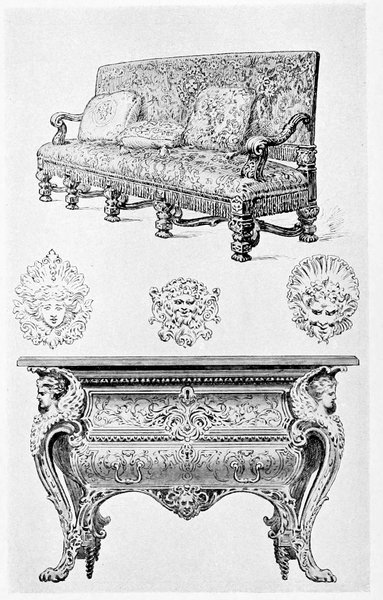
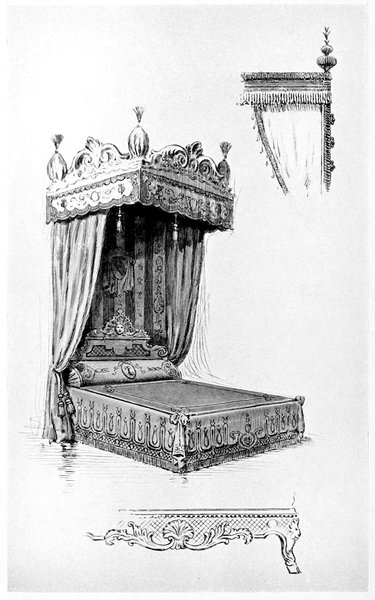
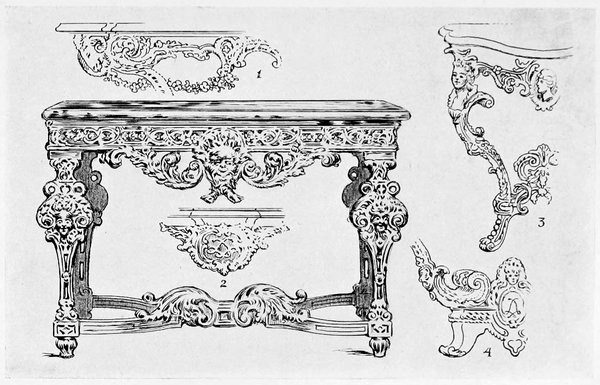
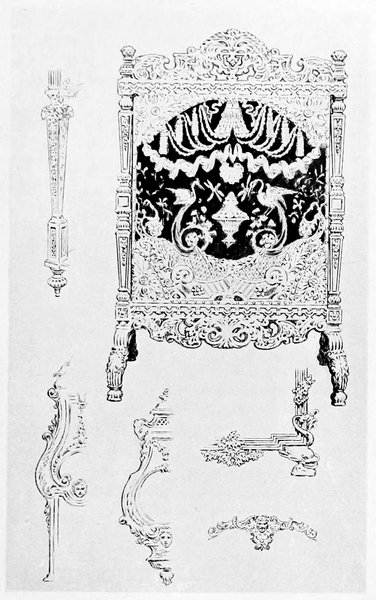
FRENCH AND ENGLISH FURNITURE DISTINCTIVE STYLES AND PERIODS DESCRIBED AND ILLUSTRATED
FRENCH AND ENGLISH FURNITURE
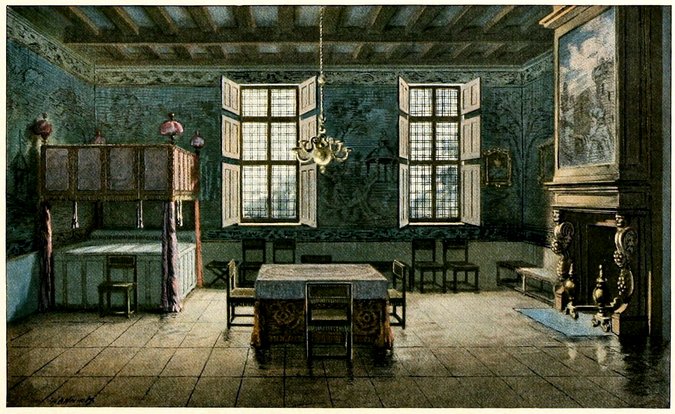
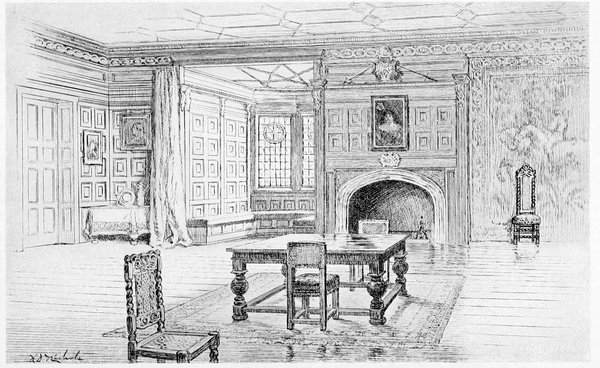
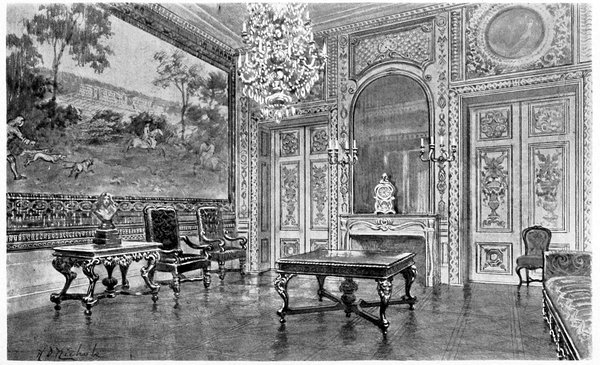
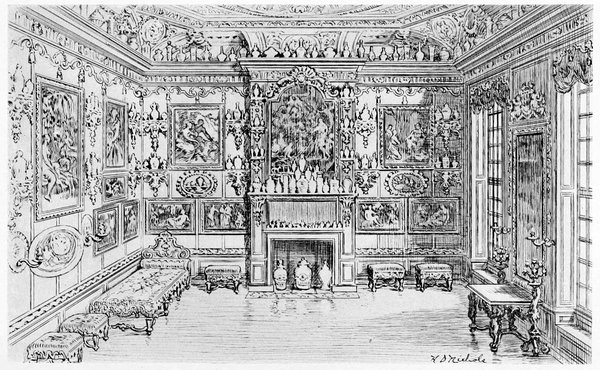
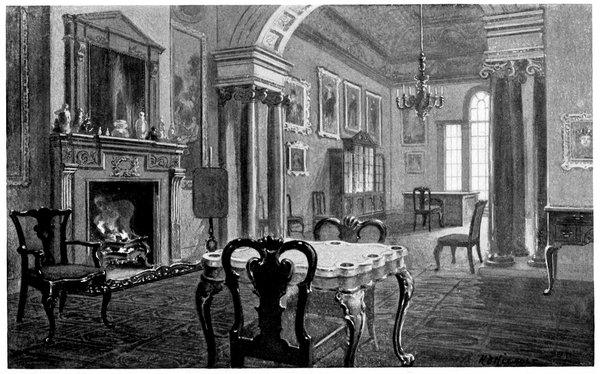
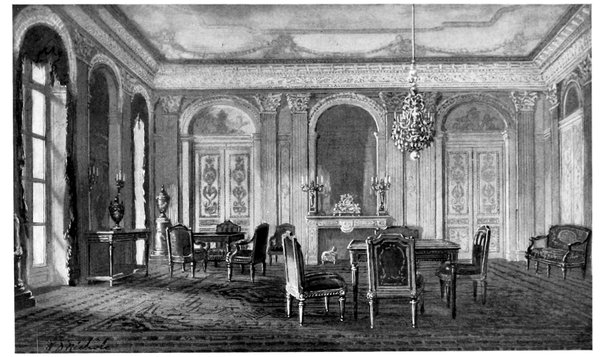
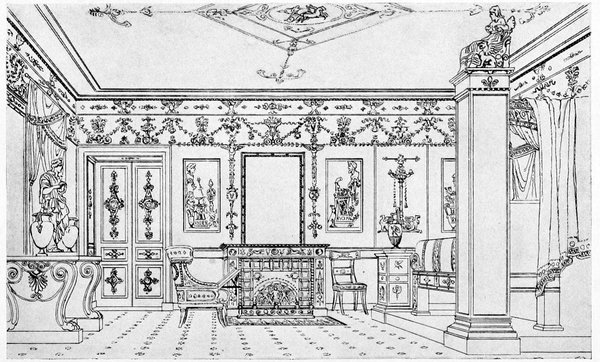
LOUIS XIII INTERIOR
BY
ESTHER SINGLETON
AUTHOR OF THE FURNITURE OF OUR FOREFATHERS
ILLUSTRATED FROM ORIGINAL SOURCES
BY
H. D. NICHOLS
NEW YORK
McCLURE PHILLIPS & CO
MCMIII
Copyright 1903
By McClure, Phillips & Co.
Published December, 1903. N
PREFACE
vii
PREFACE
The purpose of this work is to provide all
who are interested in French and English
furniture since the Renaissance period
with a comprehensive and detailed
view of the various periods or styles. A
chapter is devoted to each period, and the
chapters naturally vary in size, in accordance with the importance
and length of the different periods. So far as I have
been able to discover in my researches, there is no work precisely
of the same aim and scope as this one in existence.
Many books have been written about furniture as a whole,
and the history of furniture,—especially the French styles; but
I do not know of one that enables the student to learn with
slight expenditure of time and energy all that is necessary to
know in order to fit up a room in any given style. Anyone
who wants to furnish and decorate a Louis XV. boudoir properly,
or a Heppelwhite dining-room, or an Empire bedroom,
can find all about it in the following pages. The collector,
the student, the cabinet-maker, the upholsterer, and even the
viiiarchitect will find ready at hand valuable material gathered
from many sources. The ceilings, wall-decorations and
chimney-pieces proper to each period are described from contemporary
authorities and illustrated from contemporary pictures
and prints. The furniture is described from specimens
existing in many collections and museums; and frequently in
the words of the great makers and designers themselves.
In many instances the collector is forced to buy the survivals
of whatever period he fancies, instead of being able to
select for reproduction the more artistic specimens that have
perished, and his rooms are filled with anachronisms because
he cannot find articles to complete his set of furniture. The
reproduction of a beautiful model will give more pleasure to
a person of taste than a piece of furniture whose only recommendation
is that it is an “antique”; and I think many persons
will sympathize with me in my desire to see correct reproductions
of beautiful models of furniture multiplied, as well
as the textiles that accord with them.
In all periods people have given much thought not only to
beautifying their homes, but to achieving the correctness of style
that contributes elegance and dignity to an establishment, unconsciously
following the opinion that Sir Henry Wootton gave
about 1600: “Every man’s proper mansion house and home
being the Theatre of his Hospitality, the seat of his self-fruition,
the Comfortablest part of his own Life, the noblest
of his Son’s Inheritance, a kind of Private Princedom—nay,
the Possession thereof an Epitome of the whole World,
may well deserve by these attributes, according to the degree
of the Master, to be delightfully adorned.”
In order to give an even more thorough understanding of
the appearance of the rooms, I have included many partial
ixinventories of representative homes and many descriptions of
separate sumptuous beds and other pieces of furniture typical
of the style. Upholstery has received minute attention. Any
one can learn here how to drape a bed, or a window; what
valances, curtains, lambrequins, cords and tassels are appropriate,
and what materials, braids and nails may be used.
The characteristics of the decorative art of each period
are set forth with some detail, and the motives of carving of
the woodwork are clearly defined in the numerous line drawings
and details of the many plates.
I have carefully selected the illustrations from the designs
of the recognized representatives and leaders of the styles.
Besides going to these fountain-heads, I have not hesitated to
adopt the views and translate in many cases the words of the
recognized modern authorities on French furniture. These include
Alexandre, Jacquemart, Havard, Deville, and others.
In the Chippendale, Heppelwhite and Sheraton styles, these
writers speak for themselves.
I wish to express my thanks to Mr. Arthur Shadwell
Martin for his valuable assistance in my researches for both
pictures and text.
In decorative art, the form of Renaissance
known as Henri II., which owed
so much to the taste and influence
of Diana of Poitiers, lasted for three
quarters of a century. There was practically
no change till the regency of
Marie de’ Medici, when she invited Rubens to Paris. In
1625, he had completed his Luxembourg works, and the
commencement of his visit is generally regarded as the
date of the beginning of the pure Louis XIII. style.
Flemish influence, therefore, is the keynote of this modified
Renaissance style. Marie de’ Medici called many of
her own countrymen from Italy to design the new works,
and Rubens himself had spent eight years in Mantua, and
therefore Italian taste is often apparent in the Louis XIII.
style, but is quite secondary to that of Flanders. The great
fame that Rubens enjoyed and his splendid reception in
Paris gave his work unquestioned authority with the
contemporary French decorative artists. His painting
4affected furniture with its luxuriant, robust and somewhat
heavy qualities.
A period of magnificence and lavish expenditure by
art-lovers had begun. Richelieu at the beginning almost
rivalled in luxury Mazarin and Fouquet at the end of this
period. The Cardinal employed Simon Vouet and other
artists on the decoration of his magnificent Palais Royal
and the Castle of Rueil; and his expenditures in art collecting
attracted such undesirable public attention that
he presented a great part of his treasures to the King in
1636. Among these was a great silver buffet weighing
about 1625 pounds.
Vouet, during this period, occupied a somewhat similar
position to that held by Le Brun during the Louis
XIV. period. It is interesting to note the importance
now held by goldsmiths in decorative art. A great deal
of the furniture of the day was designed by them. Architects
also regarded furniture as an integral part of the
interior decoration of their apartments, and therefore designed
the important pieces. For instance, Crispin de
Passe (1570–1642) shows, besides his chimney-pieces
(which being the most important architectural feature in
the room, always received careful artistic treatment from
the architects), chairs and bedstead. The latter still retains
a good deal of Renaissance feeling, with carved posts,
open-carved colonnade in the high foot-board and bulb
feet. It is somewhat reminiscent of Du Cerceau’s design.
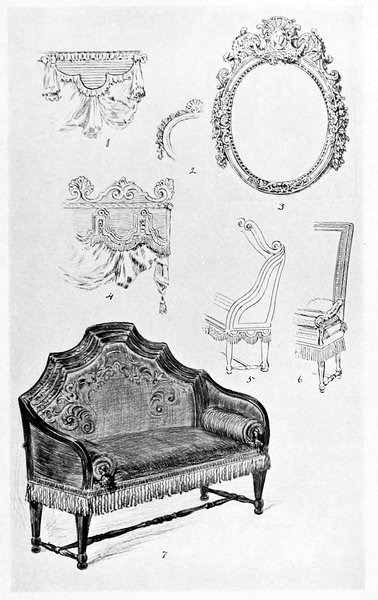
PLATE I
Besides the names already mentioned, the goldsmiths,
Gideon Legare and Carteron, the armorial designer, Jacquard,
and particularly Abraham Bosse, Picart, Stella,
and Lepautre’s master Adam Philippon have left stamps
5or engravings that how the Louis XIII. style in all its
details and characteristics. The goldsmiths, engravers
and designers of this period were Audran, Barbet, Berton,
Betin, Betou, Biard, Bignon, Blosset, Bouquet, Boutemie,
Boyceau, Brebiette, Brosse, Caillard, Callot, Carterson,
Chrestollien, Collot, Cotelle, Daubigny, David,
De la Barre, Dorigny, Faber, Firens, Francard, Fornazoris,
Gandin, Gautrel, Hedouyns, Heince, Hennequin,
Huret, Hurtu, Jacquard, Jardin, Jousse, La Fleur, La
Houe, Langlois, Le Clerc, Lefebvre, Le Mercier, Le
Rou, Le Roy, Levesville, Lionnais, Loriot, Lorris, Marchant,
Mellan, Menessier, Messager, Millot, Montcornet,
Moriet, Mortin, Nolin, Picart, Pierretz, Piquot,
Pompeus, Rabel, Rivart, Roussel, Sordot, Tavernier,
Testelin, Thomassin, Torner, Tortebat, Toutin, Vignon,
Vivot, Vouet and Vovert. Rabel’s ornaments are formed
by a species of rinceaux of quite a particular kind, which
look like the curves of an ear. Many artists of this period
were certainly inspired by this part of the human
body. It is impossible to imagine more strange productions;
the genre (auricular style) lasted only a short time
in France, and was carried to its apogee by the Germans
and Flemings.
The age of Louis XIII. saw the transformation of
Paris, and the application of the decorative arts to private
life. The new manners in this period finally break with
the Middle Ages and the Renaissance. It is a transitory,
but decisive, period with its own originality; a period
which announces the splendours of the age of Louis XIV.
Paris was so embellished, and so many houses were rebuilt
and new finer ones built, that rents rose greatly, and
6the authorities published five abortive ordinances regulating
the excessive rents between 1622 and 1649. The
new luxury had to be paid for. Under Marie de’ Medici
and Richelieu, a new city with characteristics of utility,
beauty and magnificence arose. Corneille’s le Menteur
(1642) notes the wonderful change:
“Paris semble à mes yeux un pays de romans;
J’y croyais ce matin voir une île enchantée;
Je la laissai deserte et la trouve habitée.
Quelque Amphion nouveau sans l’aide des maçons
En superbes palais a changé ces buissons.
* * * * *
Toute une ville entière avec pompe bâtie,
Semble d’un vieux fossé par miracle sortie.”
So Corneille tells us that the striking change in Paris
was one to pomp and grandeur.
Even more than the magnificence of the dwellings,
the change to comfort is to be observed. Far from increasing
during the reigns of the Valois kings, comfort
had suffered. Viollet le Duc says: “The excessively
laboured refinement of the Fourteenth and Fifteenth
Centuries and the internal luxury of the apartments of
the beginning of the Sixteenth had been lost or laid aside
during the long religious wars of the close of the Sixteenth
Century, and the furniture of a great lord under
Louis XIII. would have appeared barbarous and coarse
to one of Charles VII.’s vassals. Perhaps it was better to
live under the reign of Louis XIV. than under that of
Charles V.; but certainly Charles V. and the nobles and
middle classes of his time had better lodgings and were
7more comfortably furnished than the lords and common
people were under the reign of the Great King.”
However barbarous an interior of the Louis XIII. period
might have been in comparison with one of the age
of Charles VII., it certainly was changing for the better.
Convenience was being sacrificed less for magnificence.
There was an attempt to combine usefulness with elegance.
Mme. de Rambouillet was one of the heads of
this movement; and, according to Tallement des Réaux,
was the originator of it. She established her salon as early
as 1608. Tallement says that she was the first to arrange
suites of rooms through which guests could move
easily. “Being dissatisfied with the plans submitted to
her (it was in the Maréchal d’Ancre’s time) for at that
time they only knew how to make a hall on one side,
a chamber on the other, and a staircase in the middle,
one day, after long reflection, she cried: ‘Quick! some
paper! I have found how to do what I wanted.’ She
drew the plan, and it was followed exactly.... She it
was who taught people how to put the staircases to
one side, so as to have a large suite of rooms, to make
high windows from the floor up and to make high and
broad doorways opposite one another.”
The decorative motives and accessories characteristic
of this style are clearly defined. An analogy has been
traced between the general lines of the furniture and the
contemporary costume. In the latter, as shown in Abraham
Bosse’s engravings, the waist line is set unusually
high, giving an appearance of a short bust. This division
of the figure into two unequal parts, the upper one
being disproportionately short, is carried into the furniture.
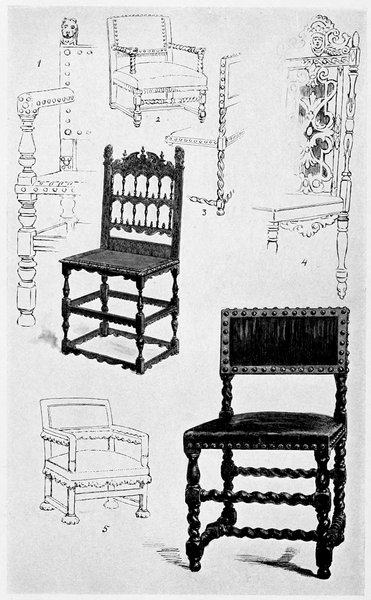
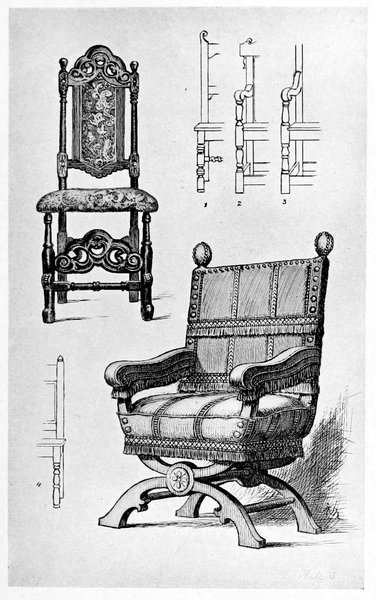
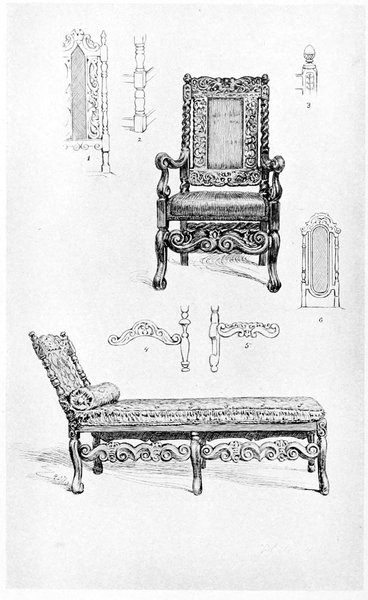
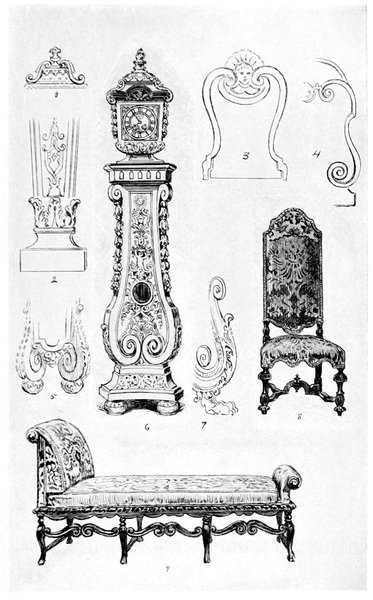
8The characteristic chair of the period (see Plate
I.) is short in the back. The larger pieces of furniture
follow the same general form, being divided into two
bodies by a horizontal cornice, shelf, or other line at
above half the total height of the piece of furniture.
The cabinets, architectural in form, have greater width
than height, and rest on a frame or table with legs
turned spirally and connected. This style of cabinet was
introduced early in the period.
One of the important decorative details and ornaments
is the cartouche which also follows the prevailing
taste: it is wider than it is high, and its field has
always a somewhat exaggerated convex curve. The
rounded form also predominates in the cut-work fringing
the frame, and protuberance is also a noticeable feature
of the balusters that are made use of in the various
parts of furniture that require columns or supports.
The vases also are very corpulent in form, which effect
is exaggerated by their very small bases. The faces of the
mascarons are very chubby, and are unusually lacking in
expression. The decorative garlands, which are composed
almost exclusively of leaves and fruits, very seldom
of flowers, are arranged in heavy swags, almost always
disposed in a semi-circle. Pears, and more especially
apples, are the fruits most frequently met with. They
are usually accompanied with short leaves without serrated
edges. The garlands are of uniform thickness
throughout; they are quite heavy. Cornucopias symmetrically
disposed are often found on the frontons. It is a
peculiarity of these cornucopias that notwithstanding the
considerable size and quantity of the fruits overflowing
9their mouths, they are so slender that they might almost
be taken for curved trumpets. Though rich and very
abundant in detail, this ornamentation does not show
much relief, because the composition, as a rule, does
not present any important or dominant motive. In the
decoration it is seldom that the living form plays more
than an entirely accessory part. The bold round mouldings
now dispense with the ornaments and details of preceding
styles. In many cases, these mouldings frame
panels in which the square form predominates. When
the square is extended into a rectangle, its dimensions
are always greater horizontally than vertically. The hexagon,
so much employed in the Henri II. style, is now
supplanted by the octagon, which is frequently to be
noticed.
Having now gone over the general characteristics
and decorative features of this period, we may proceed
to describe the separate pieces of furniture that are appropriate
for a room of the Louis XIII. style.
First let it be said, however, that it is a mistake to
suppose that a Louis XIII. room need be in any sense
bare, cheerless, or lacking in comfort or convenience.
The impression gained from the charming engravings
of Abraham Bosse is one of cosiness as well as elegance.
The only sense of severity of this period in the interiors
is produced by the massive chimney-pieces and the
somewhat monumental forms of wardrobes, presses, cabinets,
armoires, etc. These are usually in two tiers, the
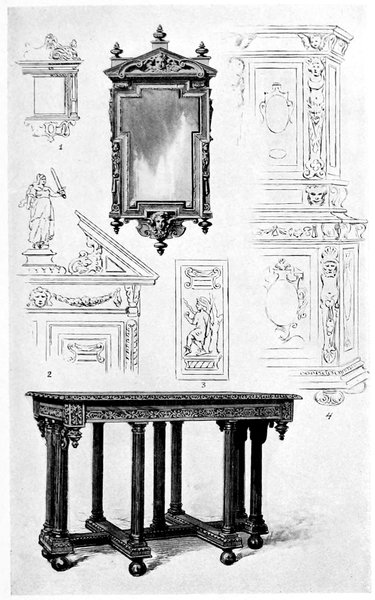
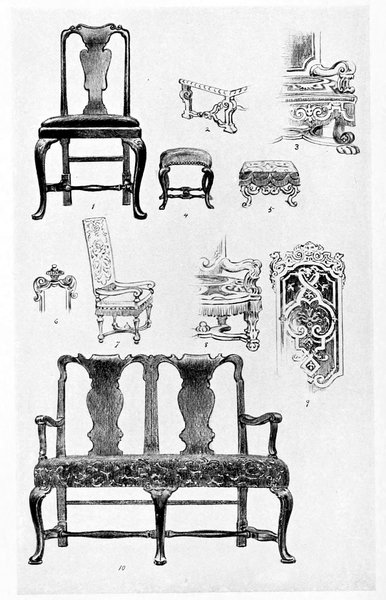
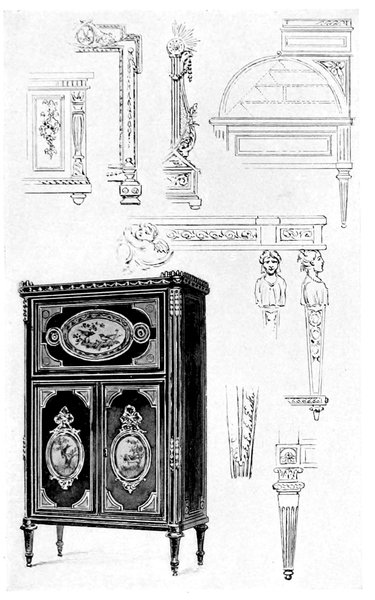
lower one usually being solid, as on Plate II., No. 4. The
frame, or open lower part, however, was winning its
way into favour. A good example of the latter appears
10on Plate III., No. 1, and the more curious and ornate
transitional form in No. 4 of the same plate. Another
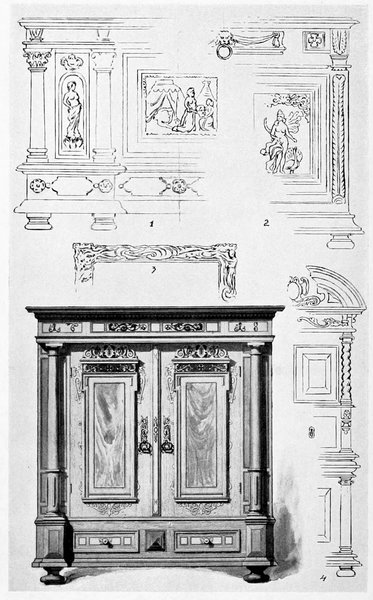
example of the armoire of this period, having drawers
between two compartments of doors is shown on Plate
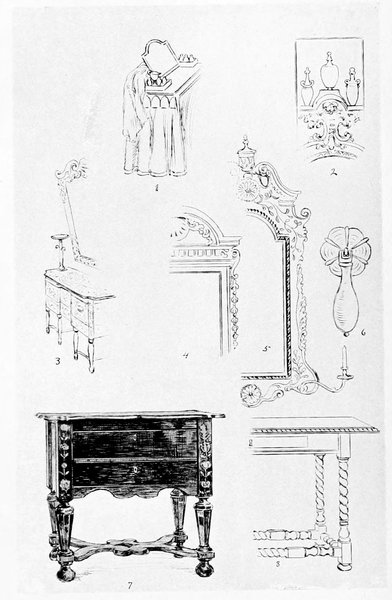
IV., No. 4, the details of which are purely characteristic
of this period. The full drawing on the same plate
shows a smaller cabinet with drawers beneath the two
doors. This is a very handsome example of marquetry
work. The patterns of the inlaid wood under the cornice
are very effective. It will be noticed that panelling
plays a most important part in the decoration of these
pieces of furniture. Many of them had pediments of an
architectural character. These pediments were frequently
broken, and in the centre on a pedestal stood an
allegorical figure, or similar ornament, such as that of
Justice shown in Plate II., No. 2. The panels were frequently
richly carved with characteristic Louis XIII.
ornaments, or with Biblical, allegorical or mythological
subjects, such as Juno and the peacock, Judith with the
head of Holofernes (Plate IV., Nos. 2 and 1), and Paris
with the golden apple (Plate II., No. 3). The important
part played by pillars, whether straight or twisted,
in the decorative scheme is readily seen by a glance at
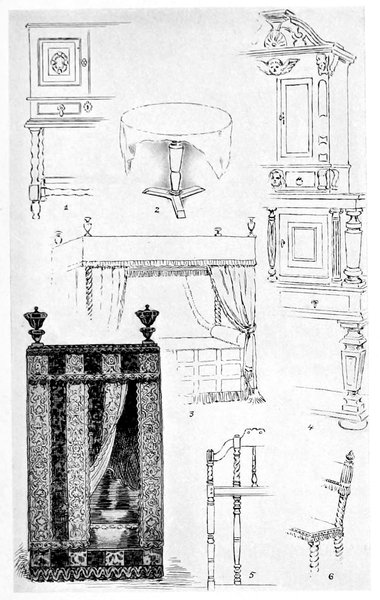
the pieces of furniture on Plates III. and IV. No. 4
(Plate III.), called a credence, has three varieties of columns
on the same tier. The flat bulb foot, plain or
carved, so typical of this period, is also shown on Plates
II., III. and IV. The buffet credence (Plate IV., No. 4)
shows a peculiar combination of straight and twisted
column. The shield in its broken pediment is flanked
by the peculiar ear decoration characteristic of this period
11which has already been referred to (page 5). The
winged cherub, which is so often found as a decorative
accessory, appears to splendid effect on the mirror on
Plate II., under the cornice of No. 4 on the same plate
and on Plate III., No. 4. Several varieties of mascarons
also appear on Plates II. and III.
The woods of which these massive cabinets, chests-of-drawers,
etc., were made were oak, walnut, chestnut
and sometimes ebony. The Dutch were bringing
great quantities of new exotic woods from the Far
East, and the Spaniards were also introducing beautiful
woods from the Central and South American forests
and the West Indies. Mahogany, however, was scarcely
known as yet in France, and was not generally used
till a century later. The French, Germans, and especially
Netherland cabinet-makers, however, were making
full use of the advantages offered by the beautiful
grains and tints of the new imported woods for the
purposes of marquetry. Ebony, of course, was also extensively
used for inlay and in the cheaper work blacked
pear-wood was substituted. Ebony was too costly except
for the richest kind of work. France was procuring it
from Madagascar; the most highly-prized varieties,
however, came from Ceylon, from which island green
and yellow varieties were brought as well as the black.
The workers of ebony gave their name to the whole
craft of cabinet-making; the word ébéniste becomes generally
used about this time.
In many of the larger pieces of furniture, the severe,
rectangular and geometric character, the antique columns,
pediments, broken pediments, garlands, pagan
12gods and goddesses, heroes, caryatides, grotesque figures,
arabesques, vegetable and animal forms, imaginary
beings half animal and half vegetable issuing from foliage,
terms, and heads are ornaments and characteristics
of the preceding reigns which have been carried over
into the Louis XIII. period. The importation of Florentine
and other Italian artists and workmen by Marie de
Medici is clearly discernible in the great cabinets of this
period. Not only were they inlaid with exotic woods,
but also incrusted with precious metals and semi-precious
stones. A cabinet of the Louis XIII. period made
by a Florentine artist frequently exhibits the most astonishing
prodigality of material as well as workmanship.
One of more than usual sumptuousness is described as
being composed of three tiers and being entirely covered
with shell, inside and outside. An aspect of extraordinary
richness is produced by pilasters of lapis-lazuli, cornaline
ornaments, plates of embossed silver, paintings and
miniatures, framings of delicately repoussé and gilded
copper and a top enriched with stones and silver figurines.
Such a cabinet by its elaborate workmanship required
the services of many craftsmen,—the cabinet-maker,
the smith, the engraver, the lapidary, the mosaic-worker,
the miniaturist, the sculptor and the ivory-worker.
PLATE II
We should naturally expect to find fine examples of
Italian-made Louis XIII. cabinets among the possessions
of the magnificent Cardinal Mazarin. In fact, the inventory
of his goods mentions many such. One is thus
described: “An ebony cabinet having a little moulding
on the sides, quite plain outside, the front being divided
13into three arcades, in the middle of which are six niches,
in four of which, in the lower row, are four virgins of
ebony bearing bouquets of silver, the said doors being
ornamented with eight columns of veined lapis-lazuli,
the bases and capitals of composite order in silver, the
fronts of the doors and the rest of the cabinet being ornamented
with various pieces, viz., cornalines, agate and
jasper, set with silver; and above the arcades are three
masks in jasper and twelve roses of the same mixed with
six oval cornalines; the remainder is ornamented with
silver let into the ebony in cartouche and leaf-work.”
Another cabinet owned by Cardinal Mazarin was of
ebony, the cornice ornamented with copper gilt, resting
on four copper lions silver gilt, the base of lapis-lazuli
with a dome between two pilasters ornamented with ten
miniatures. In the centre on the door, Apollo was represented;
on the front of the drawers, the Nine Muses;
and, on the four corners of each drawer, a medal showing
portraits of two ancient and two modern poets. These
were covered with Venetian crystal and enclosed in a
little cornice with festoons of copper, silver gilt. The
cabinet was of two sections and stood on eight columns
of pear-wood stained black. It was 3 feet, 1 inch high;
3 feet wide; and 1 foot, 2 inches deep.
Two other ebony cabinets, both known by the name
of “Cabinet de la Paix,” also belonged to the Cardinal.
One of these was made by Dominico Cussey. This was
of ebony inlaid with metal and was almost entirely covered
with jasper, lapis-lazuli and agates. In front, it was
enriched by four figures representing heroes, of bronze gilt
on a background of lapis-lazuli. In the centre, there was
14a portico supported by two columns of lapis-lazuli with
base and capitals of gilt bronze, having on the frontispiece
the arms of France crowned and supported by two
angels,—all in gilt bronze on a background of lapis-lazuli.
In the depth of the portico, there was a statue
of Louis XIII. seated and holding in his left hand a shield
with the device of His Majesty. Beneath his feet, there
were a carpet and a cushion,—all in gilt bronze. In the
top part of the cabinet there was a little niche which contained
the figure of Peace that gave the cabinet its name.
The cabinet stood upon a gilded wooden base supported
in front by two pilasters on an azure background, and
four figures representing “the four principal rivers of
the world.” The whole was 8 feet high; 5 feet, 3 inches
wide; and 19 inches deep.
The companion cabinet of the same dimensions and
proportions was likewise in two parts (à double corps);
and likewise incrusted with jasper, lapis-lazuli and agates.
In the large portico, the figure was that of Queen Marie
Thérèse of Austria dressed as Pallas, and above were the
arms of France and Spain supported by two angels. On
the sides were four figures of the Virtues in relief, standing
on a base of sculptured and gilded wood, which, instead
of rivers, as in the companion piece, represented
the four geographical divisions of the world.
Another of Mazarin’s cabinets that had formerly belonged
to his great predecessor, Richelieu, is described
as being decorated with wavy mouldings (guilloches)
and compartments ornamented with various flowers,
masques and half figures, the frieze bearing marine monsters
and the middle of the doors having an octagonal
15panel in which is an Amphion on a dolphin. It rested
on a base of four ebony columns united in front, and four
pear-wood pilasters behind; and between the columns
was a cartouche bearing the arms of the deceased Cardinal
Richelieu. This cabinet was 5 feet in length; 1 foot,
7 inches in depth; and 5 feet, 10 inches in height. This
was evidently an excellent typical specimen of pure
Louis XIII. work, since it was made for Richelieu.
These rare cabinets were undoubtedly the origin of
the Boulle furniture of the next reign, and they existed
in great numbers until destroyed during the Revolution.
The few that survived the ravages of the mob are
preserved in museums and private collections.
The cabinets à porte (cabinets with doors) were, as a
rule, more severe than the sumptuous articles just described.
They depend far more upon the architectural
form and talent displayed by the cabinet-maker and designer
than upon the skill and art of the decorator. The
first cabinets à porte date from the Renaissance, and received
their name at the moment when one kind of
bahut, placed on four feet, contested popularity with another
kind that stood on a base with doors, and foreshadowed
the form of those pieces of furniture called à
deux corps. The construction of these pieces, no matter
how fine the execution of their mouldings, panels, and
doors, was as a rule massive, and was the work of the
joiners and carvers instead of the ébénistes and marqueteurs.
One of these double cabinets is shown on Plates II.
and IV., the upper part appearing in No. 2 on Plate II.,
and the lower in No. 2 on Plate IV. A carved oak
16bahut is shown on Plate IV., No. 1. Another walnut
double cabinet is shown on Plate II., No. 4. A cabinet
of another variety appears on Plate III., No. 1. This is
made of oak and cedar inlaid with rosewood, and has
two doors in front with projecting panels, and an oval
moulding in the centre and one outside drawer with
brass drop handles.
The cabinet-makers of Southern Germany also excelled
in their art, and their Kunstschranken were sought
for presents to princes. The most famous piece of
furniture of this class is known as the “Pomeranian
Art Cabinet,” now in the Chamber of Arts in Berlin.
It was made between 1611 and 1617 for Philip II.,
Duke of Pomerania. Philip Heinhofer of Augsburg
designed it and it was made in that town by Baumgartner.
The elaborateness of this cabinet may be
appreciated from the great number of workmen employed
in its construction. These included three
painters, one sculptor, one painter in enamel, six goldsmiths,
two clock-makers, an organ-maker, a mechanician,
a modeller in wax, a cabinet-maker, an engraver
upon metal, an engraver of precious stones, a turner,
two locksmiths, a binder and two sheath-makers. This
cabinet is 4 feet, 10 inches high, 3 feet, 4 inches wide,
and 2 feet, 10 inches deep. It is made of ebony with
sandal-wood drawers lined with red morocco, and
mounted with silver and pietra dura work. It is supported
on four griffins with heads and manes of silver
gilt but the real weight is borne upon a large scroll.
The base is inlaid with small panels of lapis-lazuli, jasper,
cornelian and agate, with plates of chased silver between
17them. The upper and lower friezes are composed
of fruit, and other ornaments consist of female
figures and boys playing musical instruments. There
are also medallions of silver and Limoges enamel.
A fine example of a cabinet of the Seventeenth Century
was owned by Horace Walpole at Strawberry Hill.
This was 5 feet high and 3 feet wide, composed of
ebony, rosso antico columns, lapis-lazuli and bloodstone
panels, with settings of or moulu and precious stones.
Neptune was represented in the central niche and on
either side Tritons and sea nymphs sported. Beneath
these were serpents and shells, horses, griffins, lions,
bulls and dogs. In the panels above children were fishing
with nets and rods. The whole was supported on
four ebony legs ornamented with gold. Tables of the
period were also most ornate.
Vasari speaks of a “splendid library” table made by
Bernardo Buontalenti, at the order of Francesco de’
Medici. It was “of ebony veneered with ebony divided
into compartments by columns of heliotrope, oriental
jasper, and lapis-lazuli, which have the vases and capitals
of chased silver. The work is furthermore enriched
with jewels, beautiful ornaments of silver, and exquisite
little figures interspersed with miniatures and terminal
figures of silver and gold in full relief united in pairs.
There are besides other compartments formed of jasper,
agates, heliotropes, sardonyxes, carnelians, and other
precious stones.”
The armoire did not lose its importance until the end
of the Seventeenth Century, when it was relegated to
the Garde-Robes; but the armoires, called placards, hidden
18under the panels of the room, remained. Mazarin had
an armoire in his Garde-Robe 7 feet high and 5 feet 3
inches wide.
In the inventory of Madame de Mercœur, the garde-robe
contains armoires, a bed and seats, and gives a hint
of the dressing-table by “a table with drawer, having a
housse of red serge d’Aumalle.”
The feature of a Louis XIII. room that formed one of
its chief attractions was its tapestries and other hangings.
Wherever the furniture would admit of it, a gay cloth
was spread or hung. The parquet, boarded, or tiled floor
also was partly covered with rugs from the Levant.
It is an age of rich textiles: not only do we find tapestry
with its mythological, Biblical, allegorical, historical
and floral pictures, but damasks, silks, velvets, brocades,
serges and Oriental goods occur in bewildering
variety. Their designs have never been surpassed in
effect and elegance. When the materials were of one
solid colour, they were usually ornamented with embroidery,
braids, passementerie and gold and silver lace in addition
to fringes. The latter existed in great number.
They were of various widths and materials as well as
designs. Sometimes fringes of two widths were used
on the same drapery, and it was not infrequent that a
fringe of gold was placed directly above one of silver,
or the reverse. One of the most popular fringes was
the crespine, a very narrow fringe composed of slender
threads placed close together and sometimes tufted.
This was used for trimming the bed-curtains, tablecloths
and chairs (see Frontispiece). Another favourite
fringe was the Milanaise or Napolitaine, composed of two
19kinds of threads, frequently silver and a coloured silk
rolled together in the form of a spiral.
The window curtains and portières were also trimmed
with braid and fringe. They hung from cornices of oak
or walnut, carved to accord with the rest of the furniture.
The centre of the cornice was decorated with a
cartouche; or a figure of some kind, very frequently a
mascaron, and beneath this hung the curtain or the
lambrequin. The curtains were of tapestry, brocade,
brocatelle, lampas (a kind of brocade), Genoa velvet or
damask lined with silk or serge and bordered with braid,
lace and fringe of gold, silver or silk, or worsted. The
lambrequin used toward the end of the period consisted
of a series of denticulated scallops or square flaps, shaped
like those that bordered the tops of tents and pavilions,
or in the form of the housings on which the knights’
arms were emblazoned.
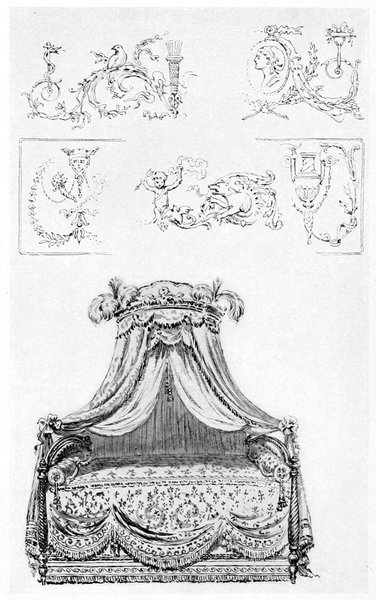
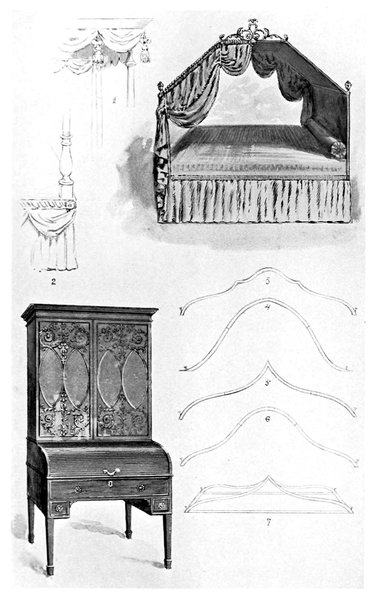
The bed is highly decorative. It is almost solely dependent
upon its furniture for its effect, as the wood is
seldom, or never, visible. The typical bed of the period
is known as the lit en housse. It is the one that appears in
Abraham Bosse’s engravings. We may note in passing
that the word housse has the some origin as the housse or
housings applied to the coverings of the horses in the
Middle Ages.
The wooden framework is of comparatively little importance,
after the correct proportions have been assured.
The ciel, or canopy, which is supported by four posts
must never quite touch the ceiling of the room. The
posts are covered with the same material as the curtains,
or painted in harmony, and occasionally they are left
20plain. Iron rods surround the canopy beneath the valance
for the support of the curtains, which may be drawn
up or down by means of cords and pullies. When closed,
the lit en housse has the appearance of a square box. The
lit en housse consists therefore of the four posts, the canopy
or ciel, the headboard and the base around which
the lower valance is fastened. The canopy is always lined
and surrounded by a valance, which is repeated around
the base. The straight curtains that hang from the canopy
in rigid lines behind the headboard (or bolster if
there is no headboard) are known as bonnes grâces. From
the canopy and underneath the valance hang the three
outside curtains. The counterpane, called courtepointe,
or couverture de parade, is generally of the same material
as the curtains or their linings. The bolster is always
long and round. Pillows never occur.
PLATE III
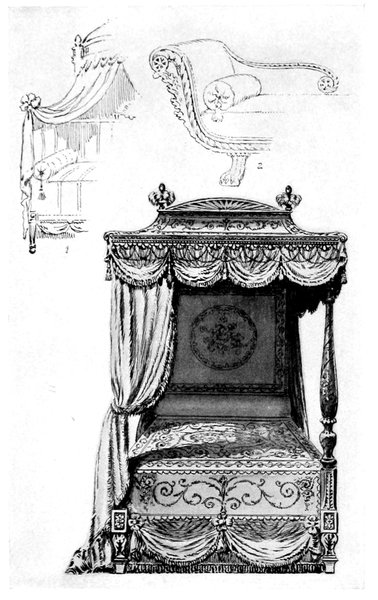
The lit en housse is particularly easy to reproduce. It
is merely necessary to be sure of the correct proportions
and the appropriate materials. As we have already remarked
in the days of Louis XIII., there was a great
variety of rich textiles. A lit en housse was covered with
any material from tapestry, brocade, damask, silk and
velvet, to serge, or cloth, or even linen, or East Indian
goods. The fringe, galloons, braids, laces, tassels, etc.,
for the ornamentation of the curtains and counterpanes
are legion. When tapestry or striped goods were not employed,
the silk, velvet, serge, or damask, etc., was usually
decorated with handsome braid put on in the form
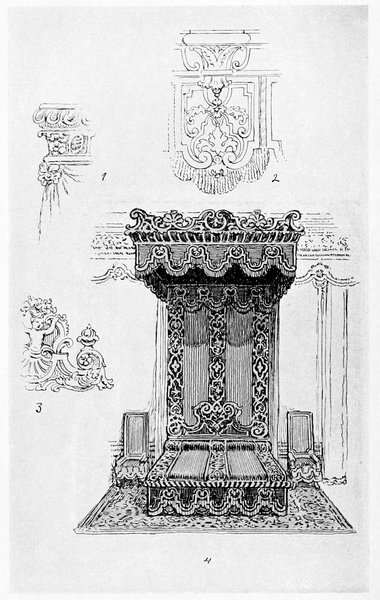
of stripes, or squares, as shown in our Frontispiece and
on Plate III., No. 3. The linings of the bed-curtains
were, as a rule, of different material, and frequently of
21different hue from the curtains. The valance was of the
same material as the curtains; but the lining of the canopy,
the covering of the headboard (if there was one)
and the bonne grâces matched the linings of the outside
curtains. The braids preferably were gold or silver lace
with gold or silver fringe to edge the curtains, the upper
and lower valances and the rich counterpane. The valance
and curtains may be arranged as shown on Plate III.,
No. 3, or as in the Frontispiece; but, in all cases, the four
corners must be decorated with a bunch of plumes or
panache, a “bouquet,” of silk ornaments, or a carved or
turned wooden knob, the “pomme.” The courtepointe, or
counterpane, must cover the entire mattress and fall to
the floor on the three sides. The beds, to which we have
just referred, also show the peculiar square and rigid
shape of the bed when made and the long round bolster
that always adorns the head of the lit en housse. The bed
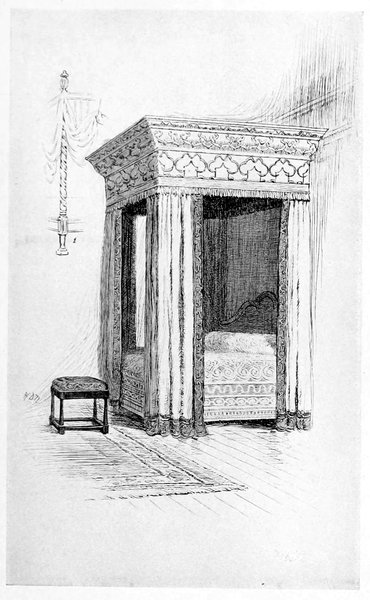
may stand lengthwise or “vu de pied.” A lit en housse of
later date appears as a full drawing on Plate III. This is
represented “vu de pied” and is furnished with a headboard.
The latter is upholstered.
For the sake of suggestions for those who might wish
to reproduce a lit en housse, we give a few descriptions
of beds taken from some French inventories of the day.
One of Cardinal Mazarin’s beds is described as a “green
taffeta bed” and fortunately the dimensions are given.
It was 6½ feet long and equally wide, so that it was
a perfect square. It was 7 feet, 3 inches high. The
housse was furnished with three curtains of cloth of
Holland green lined with taffeta and garnished at the
base with gold and silver fringe. A smaller fringe ornamented
22the sides. The head-board and the cases for
the bed-posts were of cloth of silver lined with green.
The four knobs decorating the tops of the bed-posts
were covered with velvet and trimmed with lace, and
each of these was surmounted by a “bouquet” of gold
and silk on wire.
Another bed of the period is exquisite. It was of old
rose velvet embroidered with grotesque figures of animals,
festoons and cartouches. On the ciel underneath
the “dais” were five oval medallions,—one at each corner
and one in the centre. In these the story of David
and Saul was embroidered in silk illuminated with gold
threads.
The Château de Turenne in 1615 contained two green
velvet beds, one of which had its posts covered with
green velvet; the other had a double valance of green
velvet trimmed with gold and silver lace, a fringe of
green silk and a fringe of gold and silver. The head
was ornamented with a fringe of green silk mixed with
gold and silver and a fringe of violet silk mixed with
gold and silver.
The Château de Chenonceau contained a number of
beds of this kind. One was a bed of green damask, en
housse, the bottom and the headboard trimmed with a
narrow fringe of green silk, while a deep fringe surrounded
the valance. The curtains were fastened at the
corners with shank buttons of green silk. Another was
of green Carize, or kersey, ornamented with green silk
lace and trimmed with a narrow fringe of green silk. A
third was of violet Carize trimmed with a narrow fringe
of violet silk; and a fourth of dun-coloured Carize
23trimmed with a fringe of dun-coloured silk. Then there
were four beds of black and white drugget, trimmed
with a fringe of black and white worsted. There were
also many hangings for beds en housse. One was of needlework
of many colours ornamented with a fringe of
red, yellow and green worsted. Two hangings of tapestry,
representing trees and flowers, were trimmed with
a deep fringe of red and yellow worsted.
Another tapestry for bed-hangings represented all
sorts of flowers. The fringe that ornamented it was of
red, green and yellow worsted. Another tapestry, representing
fountains and savages, had a deep fringe of
green and red worsted. Another depicted foliage, roses,
grapes and wild beasts, and was ornamented by a deep
fringe of green, red and yellow worsted. Another had
a greenish-brown background on which all kinds of
flowers were thrown, and it was ornamented with red,
white and green fringes. Another was of blue tapestry
sown with yellow fleur-de-lis. One of needlework was
composed of squares of blue, white and flesh colour;
the headboard and bottom valance were also like the
curtains. The worsted fringes were yellow, white, blue
and red.
A very handsome bed was entirely made of crimson
velvet lined with crimson taffeta. The canopy was also
of crimson velvet lined with crimson taffeta, and so
were the curtains, which were fastened down the sides
by forty-two buttons and buttonholes. The hangings,
the valance, the headboard, and the curtains were all
ornamented with gold and silver lace applied in the conventional
stripes. Deep and narrow fringes of crimson
24silk, crespines of gold and silver, and small fringes of
gold and silver contributed further decoration. The
fringe was put on double, that is to say, the crimson
silk fringe was covered by the smaller fringes of gold
and silver. The ornamental counterpane was of crimson
velvet lined with taffeta, and ornamented with a crespine
of gold and silver. It was fastened tightly to the base of
the bed by means of forty-four shank buttons and buttonholes,
and the whole length of the buttons there was
a little fringe of crimson silk covered with a fringe of
gold. Each curtain required five lengths of velvet.
Another bed with its valance on three sides, its valance
around the base and its bonnes grâces was of cloth-of-gold
mingled with blue, decorated with squares formed
of raised crimson velvet, and bordered with black velvet
ornamented with gold and silver and tinsel. The valance
was lined with white taffeta garnished with fringes
of blue silk with a gold crespine; the curtains were lined
with crimson taffeta and edged with little fringes of
gold and blue silk; and the lower valance was ornamented
with fringes of gold and blue silk. The ornamental
counterpane was made of squares of crimson
silk, trimmed with gold braid, ornamented with a deep
fringe of crimson silk, and headed by a gold crespine.
The outside curtains of crimson silk, each three lengths
and a half, were ornamented with gold braid and a narrow
fringe of crimson silk and gold.
The valances and curtains of another were of green
and gold velvet with bars of crimson satin bordered with
gold. The valances were lined with white satin, trimmed
with a fringe of crimson silk and a gold crespine. The
25bonnes grâces were of crimson taffeta with narrow fringes
of gold and crimson silk. The lower valance was garnished
with fringes of gold and silk.
Another, was of cloth-of-silver of Milan, damasked
with flesh-coloured silk, and trimmed with silver tinsel,
flesh-coloured silk, and a crespine of gold and silver. The
bed-posts were covered with the same. The curtains
and valances were of flesh-coloured and white damask,
trimmed on the seams with a fringe of flesh-coloured
silk, covered by a narrow fringe of silver.
Another, was formed of squares of cloth-of-gold (old
gold) and squares of cloth-of-gold and cloth-of-silver
and violet, separated by strips of crimson velvet covered
with a braid of gold and silver, and trimmed with a
small fringe of gold and white silk. The valances were
lined with white taffeta, garnished with a deep fringe of
white silk and a crespine of gold. The lining of the canopy
and curtains was of cloth-of-silver bordered with
cloth-of-gold; the headboard was covered with cloth-of-gold
and silver damasked with black. The three
curtains and the bonnes grâces of white damask were ornamented
down the seams with gold braid, but had no
fringe. The bed-posts were covered with cloth-of-gold
(old gold) ornamented with narrow gold and silver
braid. A tasteful bed was of violet velvet and violet
damask, the latter being used to cover the head-board
and for the bonnes grâces. The fringes were violet silk,
and the braid and crespines of violet silk also. The curtains
were of violet damask, each four lengths, trimmed
horizontally with violet silk lace and a narrow violet
silk fringe.
26A bed of dun-coloured serge was trimmed with silk
fringe of the same hue, its bonnes grâces being dun-coloured
taffeta. The counterpane was of dun-coloured
serge trimmed horizontally with a deep fringe of dun-coloured
silk and forty-eight silk buttons and buttonholes.
The four posts were covered with serge ornamented with
silk braid, and the four “pommes” were also covered
with serge ornamented with silk braid.
Another bed was of scarlet lined with red taffeta and
trimmed with gold braid and a deep fringe of common
silk covered with crespines of gold. The curtains were
decorated with gold braid and a narrow fringe of gold.
The four posts were covered with scarlet ornamented
with gold braid.
Another bed was of flesh-coloured satin with squares
of cloth-of-gold-and-silver. The ornamental fringe
was red.
Another, was of green satin embroidered in gold and
silver. The fringes were of green and white silk, both
deep and narrow. The curtains were of green damask.
Another, of violet velvet embroidered in gold and silver
flames, bordered with cloth of silver, was lined with
violet taffeta. The fringes were of violet silk.
Another, was of green velvet ornamented with gold
and silver lace and fringes of green silk covered with
crespines of gold and silver; the headboard was of cloth-of-gold-and-silver
ornamented with green silk fringe;
the lower valance was trimmed with gold and silver
braid and a fringe of violet silk covered with a fringe
of gold and silver. The curtains were green damask
trimmed with gold and silver braid and silk fringe, and
27the ornamental counterpane of green taffeta trimmed
with fringes of silk and gold.
Another bed was of cloth-of-gold striped with black
and crimson satin; the curtains were flesh-coloured taffeta
ornamented with crimson fringe.
The bed-posts, as we have noted, are always surmounted
by ornaments, known, no matter what their
form may be, as “pommes de lit.” The following kinds
are mentioned in the inventory of the Château de Turenne
in 1615:
“Four pommes de lit of wood covered with crimson
velvet ornamented with gold and silver braid and garnished
with bouquets of gold and silver and varied coloured
silks and little egrettes of gold and silver; four
wooden pommes de lit covered with cloth-of-silver and
green trimmed with gold lace, belonging to the bed of
green velvet on a gold background; four pommes de lit
covered with crimson velvet trimmed with gold and silver
lace and three grey plumes, belonging to the crimson
velvet bed; four pommes de lit of wood painted violet
and gold, belonging to the violet velvet bed; twenty-eight
pommes de lit of gilded wood belonging to various
beds, and twelve pommes de lit.”
Another bed that is characteristic of this period was
the lit de baldaquin. This is a bed with daïs of three
sides. Its framework was of natural wood, or wood carved
and gilded, or covered with some rich material. This bed
that dismisses the columns or posts, was introduced during
this reign and carried into the next one. The baldaquin,
which replaces the canopy supported by posts, must
be slightly smaller than the bed it overshadows. Sometimes
28it is equipped with an arch that is covered with
the same material as the general drapery of the bed, and
this arch, which may be found in the old designs, following
the curved movement of the baldaquin is sometimes
surmounted with a bunch of feathers. When this
arch contains a dome that surmounts the baldaquin, it
is called the “Lit Impérial.”
A lit à impériale of the period was one of green velvet
and gold and silver, trimmed with a gold and silver
crespine and a little green silk fringe covered with a gold
and silver fringe. The curtains were of green damask
trimmed with gold and silver braid. Another was of
cloth of gold and yellow damask in squares with bands
of white damask and a deep fringe of white and blue.
The valance was composed of squares, but the head-board
was in lengths.
This probably differed but slightly from the “pavillon”
bed, of which there are many descriptions in the
old inventories. Mazarin, for example, had two “pavillon”
beds in red serge. In the Château de Turenne
there was a pavilion of crimson damask ornamented on
the seams with a wide braid of gold and silver. A braid
of gold and silver also surrounded the base, as well as a
narrow fringe of crimson silk covered with a fringe of
gold and silver. The chapiteau was of crimson velvet
ornamented with the same braid on every seam and also
upon the bottom with a deep fringe of crimson silk covered
with a deep crespine of gold and silver. The chapiteau
was an ell in circumference. Upon the top was a
“pomme” painted red and silvered, to which was attached
a silk cord of red, yellow and white.
PLATE IV
29Another was of white gauze, upon the seams of which
little tufts, or tassels, of various colours were sewn. The
“pomme” painted in various colours, had attached to it
a green silk cord; another was of crimson and gold; and
another of violet velvet trimmed with silk fringe of the
same hue. The “pomme” of the latter was painted violet
and silver, and the cord was of violet silk.
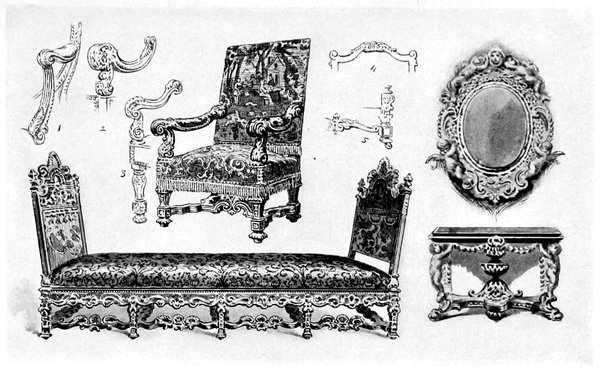
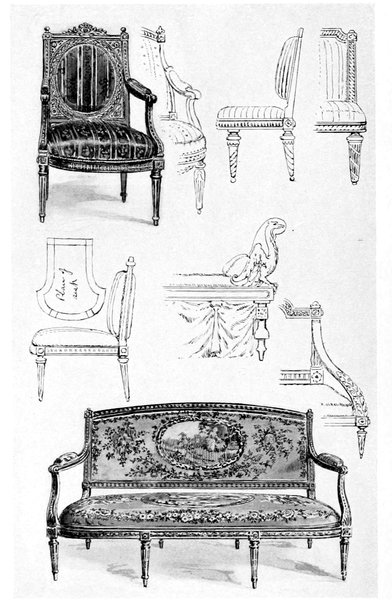
A glance at Plate I. will show that the general outlines
of the chairs are square. The usual set of seats
comprised fauteuils, or arm-chairs; chairs with backs;
folding-stools (pliants); and a lit de repos. In the ancient
inventories the term “chaises meublantes” is given to
chairs with covered backs, while the chairs with wooden
and open backs are called “chaises cacquetoires” and
“chaises perroquets.” The most characteristic chair of
the period is the short, square and rather squat, yet well-proportioned
chair that appears in nearly every one of
Abraham Bosse’s drawings, and which in England is
known as “the low leather,” or “Cromwell chair.”
This chair is shown in the Frontispiece and also on Plate
V., while variants appear on Plate I. as No. 3 and as a
full drawing. This chair may be covered with leather,
serge, silk, damask, brocade, velvet, tapestry, or needlework;
but in every case the material is fastened to the
woodwork by means of large brass, gold, or silver-headed
nails, and the back and seat are both usually ornamented
with a short fringe, as is shown in the Frontispiece. No.
2 and No. 5 on Plate I. are fauteuils of the period, No.
5 being an Italian chair decorated with a fringe. Many
of the fauteuils of the day were “in the Italian taste,”
that is to say entirely covered with velvet and trimmed
30with lace or fringe. The framework of the arm-chair
was sometimes visible, as shown on Plate I., No. 2. It
was of pear-wood stained to resemble ebony, walnut,
oak, or it was painted in a colour to harmonize with the
covering. Among Cardinal Mazarin’s many chairs were
two fauteuils and two chairs with backs, entirely covered
with velvet nailed on the wood. These were ornamented
with a braid of medium width, as were also the folding-stools,
or pliants. The wood of the latter was painted red.
We also hear of two fauteuils trimmed with lace and
fringe of medium width, the wood being entirely covered
with the velvet; at the bottom of the back there
was a double row of the crespine. The six folding-stools
that went with these arm-chairs were also garnished
with lace and fringe, but their frames were painted green
and picked out with gold. The seats were covered with
green serge. Another set of furniture consisted of six
fauteuils, six chairs with backs, six pliants and a lit de repos.
These were covered with needlework ornamented with
a silk fringe of many colours. The frames were of pear-wood
stained black, and they were decorated with twisted
columns.
The twisted column shown in the side-supports and
straining-rails of the chair in the lower right-hand corner
on Plate I., and also in No. 2 and No. 3 on the same
plate, is derived from Italy. It is a favourite ornamentation
of the day and occurs in bed-posts and wherever
pillars are used. Another form of the spiral leg is shown
on Plate III., No. 6. Still another form is shown in the
arm-chair with twisted and baluster arms that appears
as No. 5 on Plate III. A favourite shape for the leg of
31a chair was also the X that so often appears in the pictures
of the Dutch masters. These chairs were of Flemish
and Italian origin. (See Plate VII., lower right-hand
corner.) This X is also present in the pliant or folding-stool,
an example of which is shown under the window
in the Frontispiece.
The coverings for the fauteuils, folding-seats, etc. were,
as we have said, of damask, brocade, silk, serge, tapestry,
or needlework, but we must add that Genoa and Venetian
velvets with floral designs in high relief were extremely
popular.
Two other typical chairs are shown on Plate I. No.
1 is a handsome fauteuil of noble proportions. Its back
and seat are covered with two squares of material fastened
in the correct way with large nails. No. 4 is
a very fine specimen indeed with a carved back panel
of wood. The favourite mascaron decorates the top
rail.
On Plate I. is shown a typical chair of the period with
an open back of turned spindles. Deville says this was
the “chaise caquetoire” or “chaise perroquet,” a name that
was given to all kinds of chairs with open backs, whether
carved or turned, or simply of two, three, four or five
horizontal rails. If this was so, the chaise perroquet
meant a different kind of chair later in the century, for
Saint-Simon says: “Monseigneur himself and all who
were at the table had seats with backs of black leather
which could be folded up for carriage use and which
were called perroquets.” In the Château de Chenonceau
(1603), there were “more than two coverings for
the petites chaises cacquetoires of silk of several colours
32brightened with gold and silver also on canvas estimated
at forty sols, apiece.”
There were three other “chaises cacquetoires like the
three chairs just mentioned, estimated at four livres dix
sols apiece.”
In Cardinal Mazarin’s inventory, there was “an old
chaise à perroquet” covered with moquette (a kind of velvet
or woolen tapestry), and in the inventory of the Garde
Meuble, ten perroquets covered with “tripe” (a kind
of red panne velvet) occur.
Another kind of chair is the “chaise voyeuse.” The
seat of this is quite high and the top rail resting upon the
side supports (which are continuations of the back legs)
is supplied with a manchette (cushion), upon which one
may rest his elbows while watching the play at the card
table. The back of this chair is shaped like a violin, or
a bidet. These chairs are mentioned in many old inventories
such as Cardinal Mazarin’s Fontainebleau, Versailles,
etc. In Fontainebleau in the salons de jeux were
“four voyeuses en prie-dieu” and “two voyeuses en bidets.”
The lit de repos, or chaise longue (see Plate VIII.) is an
elongated seat. As a rule, this couch, or seat, is six feet
long, and upon it rests a mattress or cushion. It is also
furnished with a bolster, which should be covered with
the same material as the mattress and back. Being exactly
the width of the seat, it is placed below the back
at right angles to the mattress. Sometimes this piece of
furniture has elbows, and sometimes it has only turned
supports at the sides of the back.
Many of the handsome tables were of a fashion that
was continued through the succeeding reign, being of
33richly carved and gilded wood with hind’s feet or with
term legs with or without stretchers. Some of them
were enriched with gilded bronze, and incrustations and
marquetry work of shell, copper and other metal. The
tops, like those of the preceding reign, were frequently
of marble or marquetry. They were also covered with a
cloth and a housse of leather, serge, tapestry, etc. The
table-carpet, as a rule, reached to the floor and was garnished
with a narrow or wide fringe. This was the housse,
and above it was a second cloth (see Frontispiece).
These table-coverings were either simple or rich, according
to the purse or fancy of the owner. Cardinal
Mazarin, for example, had four table-coverings of crimson
damask flowered, bearing the arms of his Eminence;
four of “red crimson” Turkey leather trimmed with
gold fringe and gold tassels and lined with red taffeta,
and a green flowered damask table-carpet with four sides,
lined with green cloth and trimmed with gold fringe à
la Romaine. One of the handsomest varieties of table appears
as a full drawing on Plate II.
Although the console is known during the reigns of
Henri II. and III., it is in the reign of Louis XIII. that
the phrase table en console appears in the inventories.
The console was derived from the credence, and was
even in its earliest form a large table with a marble top,
jutting out like a bracket and serving to support a bust
or vase. The three visible faces of the console were in
the early days frequently supported with chimæras, fauns,
etc. The word table was gradually dropped and the article
was known as console.
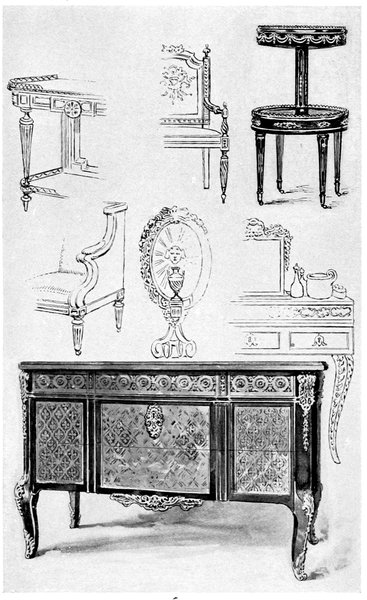
A variety of table, known as the guéridon, was also
34popular. This is a small round table mounted on a stem
or baluster that ends in three legs (Plate III., No. 2). It
was made of various woods, sometimes of pear-wood
stained black and sometimes painted. It was of great
convenience. Sometimes it was used for cards; but more
often it held a lamp, or candelabra, or a refreshment
tray.
The chandeliers were usually of brass and hung from
the centre of the room. Of course, candles were inserted
in the arms. Candelabra and small candlesticks
were also used to give light, and sconces were frequently
attached to the walls. Pictures were framed and hung
directly over the tapestries, as shown in the Frontispiece.
Their frames differed but slightly from the frames of
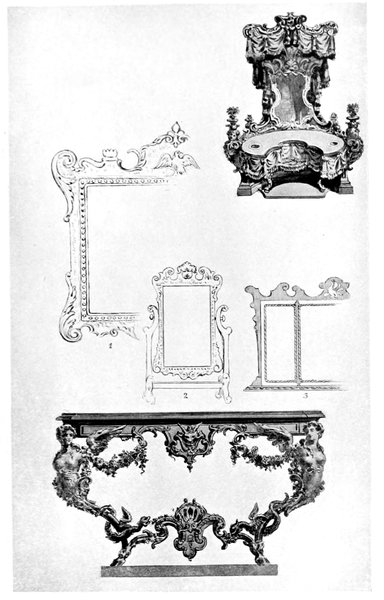
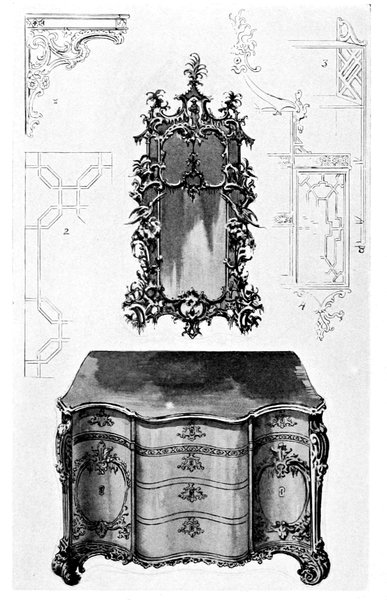
the mirrors, specimens of which appear on Plate II. as a
full drawing and as No. 1. Another frame appropriate
for either a picture or a mirror is seen on Plate IV.,
No. 3.
THE JACOBEAN PERIOD
35
PLATE V
37
THE JACOBEAN PERIOD
The Jacobean Period covers almost a
century (1603–1690). In its earlier
stages, therefore, it is still Elizabethan
in spirit, and in its old age it is largely
influenced by the taste of the dominant
French court. During the reign
of James I., the styles of furniture and interior decoration
are still strongly Tudor in character, but the intimate
connection with the Low Countries, and the friction
with Spain and her Western possessions have their
effect in making the wealthy classes of England thoroughly
acquainted with the best products of Spanish,
Dutch, and Flemish workmanship. The Tudor mixture
of Gothic and Renaissance styles was gradually modified
under the influence of Inigo Jones, “the English Palladio.”
The political ties between England and the
Low Countries, based on mutual interests of a mercantile
and religious nature, were still further strengthened
by dynastic alliances. In Norfolk and Suffolk, the population
38was largely composed of natives or descendants
of natives of the Low Countries. Flemish and Dutch
art and manufactures, therefore, were extremely influential
in forming what is known as the Jacobean style.
This period covers, of course, a portion of the reigns
of Louis XIII. and Louis XIV.; and much of the furniture
fashionable in France at this period was imported
into England; but with the exception of the wealthiest
homes sumptuous articles are not common. There is,
indeed, a massive set of superbly carved silver furniture
at Knole, Sevenoaks, Kent, but such luxury is rare.
Oak and walnut are the woods chiefly used at this
period, but we also find lime, cherry, and cypress (the
latter especially for chests). Sometimes, as even happened
in Tudor days, the carving was gilded, and, in
many instances, we find the wood painted. Pear-wood
stained black to imitate ebony is also popular. Mahogany
is almost unknown in these days; but exotic woods
are used in the construction of cabinets. Towards the
end of the Seventeenth Century a great deal of ebony
was imported, and even carved ebony furniture from India
and Ceylon found its way into many rich English homes.
Shakespeare gives us a hint of the generous use of rich
articles from various parts of the world, showing what a
cosmopolitan atmosphere a Tudor home presented:
It is not unfitting that we should first recall a few of
the distinguishing features of Elizabethan ornament, so
frequently met with in the Jacobean home.
The carving was characterized by bold and deep cuttings,
leaving the design in high relief. The panels of
the chests, cabinets, cupboards, beds, etc., present a rich
variety of subject. Figures taken from Biblical or mythological
lore, grotesque monsters, animals and floral
forms are met with; and of the latter we particularly
find the rose, vine, carnation, lily, marigold, sunflower
and tulip predominating. A typical floral panel is shown
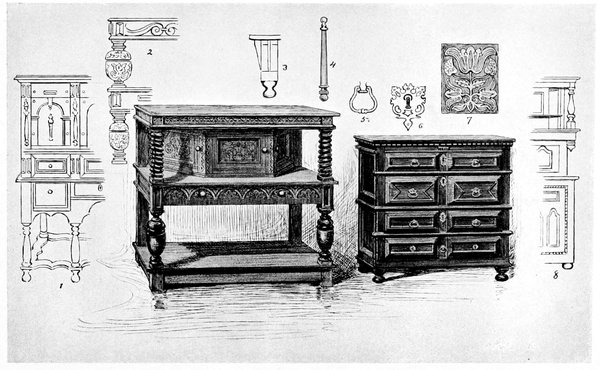
on Plate X., No. 7. Then we often see a diaper pattern,
and, occasionally, the “linen fold.”
The cornices of cabinets, bedsteads, etc., are often
adorned with the “egg and tongue” pattern; and the
backs of settees, cornices of overmantels, etc., are often
enriched with rather grotesque dolphins, placed back to
back, forming a kind of scroll the outline of which is
shown on the table on Plate X., No. 2.
Another typical ornament is the swelling acorn-bulb.
It appears on the legs of tables, posts of bedsteads, and
supports of cabinets, cupboards, etc., as shown on Plate
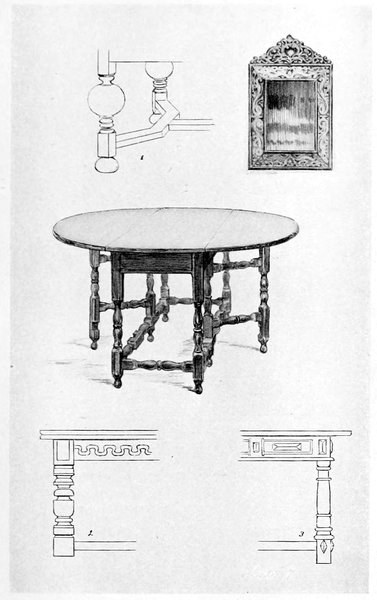
X., No. 2. A variety of this bulb occurs on Plate XI.,
No. 1, showing the black ebony balls connected by plain
40stretchers, or straining-rails. The bulb also appears, but
somewhat smaller and connected by straight stretchers,
on the table on Plate V. The baluster legs of the court
cupboard on Plate X. exhibit another kind of swelling
leg. This leg becomes slenderer until it dwindles into
the type shown on Plate X., No. 1.
Other ornamental devices consist of interlaced bands,
strapwork, shells, lyres, bell-flowers, the acanthus, arch
panels, branches and leaves in large flowing designs, besides
a great variety of mouldings, panels and pierced
scrolls. Turned work is rapidly superseding carving,
which, however, is never quite driven away.
The newest decoration is the “spindle” ornament
which seems to have been introduced from England
from the Low Countries about the middle of the Seventeenth
Century. This was made of ebony, or of pear-wood
stained black, turned, of course, cut in half and
applied. Eggs and lozenges were likewise made, stained
black and applied. These ornaments decorate the cabinet
on Plate X., No. 1, and the “spindle” is shown
separately as No. 4 on the same plate. The scroll is an
excessively popular device: it not only occurs upon
mouldings and cornices, but it also decorates the feet,
frames of panels and straining-rails of chairs and settees.
PLATE VII
During this period, the hall was the most important
room in the house. Guests were always received here,
and here meals were generally served. In the baronial
homes, therefore, of past generations, the hall was used
as both drawing-room and dining-room. The table was
set on a daïs, or platform, and a screen cut off the entrance
from the kitchen. At the other end of the hall
41was the minstrels’ gallery. In the course of time, a bay window
was added at the dais end of the hall, which
formed a private retiring-place for conversation while
the table was being cleared. This paved the way for the
small “privée parlour,” a little room built at the end,
or side of the hall. The next addition was the “Great
Chamber,” a larger room than the “parlour,” to which
the lord of the household often retired, leaving the hall
to his retainers and to such guests as were not of equal
rank with himself. The “Great Chamber” was used as a
bedroom by night and as a living-room by day. Here,
of course, there was a sumptuous bed; and a bed with rich
furniture also stood frequently in both parlour and hall.
The general impression of a Jacobean hall is elegance,—an
elegance not merely derived from the dignified
styles of the furniture contained in it; but from the rich
tapestries and hangings, the warm panels, the comparatively
low and beautifully ornamented ceiling, the stately
mantel-piece, the cosy bay window and the bright wood
fire crackling upon the great andirons.
Perhaps the first thing that attracts one’s attention is
the lavish use of the panel. The doors are panelled,
as well as the ceilings and wainscots,—a fashion very
popular in the days of Elizabeth. In some instances,
the room is panelled from floor to ceiling, and in others
only the wainscot and doors are panelled, in which case
the wall-space above the wainscot is completely covered
with tapestry. Tapestry is often hung over the[2] panels
42also, as shown in our illustration (Plate V.). English
people had been fond of tapestry ever since the days
King Alfred, fully appreciating the beauty derived from
Tapestry, which had become something of a lost art
during the Wars of the Roses, had been again brought
into favour by Henry VIII., and a fresh interest is now
given to it on account of the beautiful articles that
are being made at the Mortlake factory established by
James I.
Another hanging, not quite banished as yet, was
“painted cloth,” canvas painted in tempera, or oil, with
various devices, figures, mottoes, proverbs and wise sayings.
Falstaff’s comparison “Slaves as ragged as Lazarus
in the painted cloth,” shows us that Biblical subjects
were represented. The saucy Beatrice of Much Ado
about Nothing admits that she took her witty answers from
the painted cloth.[4]
PLATE VIII
Hangings of embossed leather from Spain, with figures
in gold, silver, and various colours, were also used,
43especially in the adornment of the small rooms. Another
novelty at this period was chintz, figured or flowered.
In 1663, Pepys notes in his Diary: “Bought my wife a
chint, that is a painted Indian calico for to line her
new study.”
The latter must have been a kind of boudoir, or, possibly,
a library. In some houses there was a special
room set apart for books. These “studies” had been
popular in England long before the time of Mrs. Pepys,
since Leland describes one that was called “Paradise,”
and which might be imitated with advantage in modern
homes, especially where there is a restricted space
for books. He writes:
“At Wressil Castle, Yorkshire, the seat of the Percies,
there was one thing I liked exceedingly in one of
the towers; that was a study called Paradise, wher was
a closett in the middle of eight squares lattised about;
and at the top of every square was a deske ledged to fit
bookes on and cofers within them, and these seemed as
joined hard to the top of this closett; and yet by pulling,
one or al would come down briste high in rabattes,
and serve for deskes to lay bookes on.”
In some houses, the ceiling is carved in elaborate fretwork,
ornamented with bosses and pendants,—a practice
afterwards imitated in plaster.
The windows are furnished with small diamond, or
square, panes, and frequently in the centre of each window
the armorial bearings of the family are displayed, as
shown in Plate V. Sometimes these are encircled with
floral, or other devices. The arms are also placed upon
the chimney-piece. In the bay windows we always find
44a low-cushioned seat bountifully supplied with soft,
movable cushions and pillows, covered with rich silks of
bright hues, and often beautifully embroidered. Indeed
the cushion[5] is one of the features of every room, being
a necessity as well as a decorative accessory to the heavy
chairs of the day.
The floor, of polished oak or inlaid wood, is occasionally
enriched with a “foot carpet.” In many of the
older houses, the floors are paved with tiles of various
colours, or laid with chequer-work.
The most important architectural feature of the room,
however, is the chimney-piece. The favourite Tudor
chimney-piece and overmantel was a mass of rich carving,
consisting of arch panels, mouldings, scrolls, coats-of-arms,
flowers, vines, columns, and interlaced strapwork,
supported by beautiful, or grotesque, terminal
figures. Simpler styles are now being introduced in sympathy
with the growing taste for Classic severity. The
fire-place still remains large enough to admit of big
logs, and the hearth is equipped with andirons, tongs,
bellows, and sometimes a fender,—all of great artistic
beauty. Behind the flames, there is usually an iron “chimney-back,”
stamped with a decorative device, or, occasionally,
the arms of the owner.
PLATE IX
45The illumination is obtained by means of lamps, lanterns
and candlesticks. The latter are very ornate. Some
of them are branched and hang from the ceiling. Others
have sconce-arms and are placed on the walls. Tall
standing candlesticks of metal are also used, and are
moved about the room at pleasure. The illumination is
also helped by means of small mirrors, with frames
carved and gilt, or else made of ebony or olive-wood.
The furniture consists of one large table, several small
round or oval tables, side tables, chairs, settee, couch,
stools, a “court,” or “livery cupboard” (and sometimes
both), a screen, cabinets, chests, and coffers; while
the decorations are pictures, antlers, armour, vases and
other ornaments of porcelain, gold, silver, or pewter,
and table-clocks.
There has been much discussion regarding the “court
cupboard” and the “livery cupboard,” mentioned above,
but it is now generally accepted that the “court cupboard,”
which may have derived its name from the
French word court (short), to distinguish it from the high
standing cupboards, corresponded to the French dressoir,
and was used for the display and keeping of plate, glass,
etc., etc. The “livery cupboard,” on the other hand, still
found in the farmers’ and labourers’ cottages in England,
where it is sometimes called the “bread-and-cheese cupboard,”
received its name from the French livrer (to deliver)
and was used both for service and as a receptacle for
broken victuals. The difference between them is well
defined in Janua Linguarum (London, 1673), as follows:
“Golden and gilded beakers, cruzes, great cups,
chrystal glasses, cans, tankards and two ear’d pots are
46brought forth out of the cupboard and glass case; and
being rins’d and rubb’d with a pot-brush are set on the
livery cupboard.”
The “court cupboard” corresponded, in a measure,
to the modern sideboard. It was a great feature at festivals
and it rose in several receding stages or shelves,
upon which the plate was displayed. The number of
stages varied according to the rank of the master or mistress
of the house. In Les Honneurs de la Cour, we learn
that two steps were allowed to the wife of a baronet,
three to a countess, four to a princess, and five to a
queen.
At Cardinal Wolsey’s entertainment to the French
Ambassadors at Hampton Court, Cavendish relates:
“There was a cupboard for the time in length of the
breadth of the nether end of the same chamber, six desks
high, full of gilt plate, very sumptuous and of the newest
fashions; and upon the nethermost desk garnished all
with plate of clean gold were two great candlesticks of
silver and gilt most curiously wrought.” When the same
Ambassadors were entertained by Henry VIII. at Greenwich,
there was a “cupborde seven stages high and thirteen
feet long, set with standing cuppes, bolles, flaggons
and great pottles all of fine golde, some garnished with
one stone, and some with other stones and pearles.”
When Queen Elizabeth was entertained at Hatfield
House (the present seat of the Salisburies) in 1556,
and there was a great and rich “maskinge in the great
halle at Hatfield,” at night “the cupboard in the halle
was of twelve stages, mainlie furnished with garnish of
gold and silver vessels and a banket of seventie dishes,
47and after a voide of spices and suttleties, with thirtie
spice plates, all at the charges of Sir Thomas Pope.”
PLATE X
A good example of a “court cupboard” with five
degrees of stages ornamented with plate is shown in a
picture printed in Laurea Austriaca (Frankfort, 1627),
representing an entertainment given by King James I.
of England to the Spanish Ambassadors during the negotiations
for the marriage of the Prince of Wales to
the Infanta of Spain. The stages rest upon a frame of
turned baluster legs connected by straining-rails. Below
the first stage there is a drawer. The “carpets” hang
over the front of the cupboard instead of over the sides,
as was more usual. This picture would seem to prove
that an ordinary side table of the period might be converted
into a court cupboard by simply placing the requisite
number of shelves above it. However, in the inventory
of Sir Thomas Kytson (1603) the following
occurs: “At ye Great Chamber Dore one little joined
boarde wt a fast frame to it, to sett on glassis. Itm, a
thing like stayres to set plate on.”
In the early days, before the “livery cupboard” was
brought from behind the screen into the hall, the “court
cupboard” was removed from the lower end of the hall.
The “livery cupboard” took its place. The “court cupboard”
was then placed on the daïs, at the “Lord’s borde
end,” or in a recess at the back of the high table. Sometimes
it was placed in front of the bay window at the
end of the daïs, where it acted as a kind of screen.
The “livery cupboard” was not only used for service,
but for “liveries” of food and drink, served at night and
in between meals. Smaller livery cupboards were sometimes
48found in the bedrooms, and these were usually furnished
with doors and locks. As food was kept in them,
the panels are frequently perforated for the sake of ventilation.
Occasionally, especially in later times, the uses of the
“court” and “livery” cupboards were combined. Between
these pieces of furniture, one difference long existed:
a portion of the court cupboard was enclosed at a
very early period, while the livery cupboard remained
with its open shelves.
If we may believe the old inventories, there were
many varieties of the cupboard, or many names for it.
We find cupboard and chest-of-drawers, great cupboard,
table and cupboard, table-cupboard, livery cupboard,
side cupboard, press cupboard, sideboard cupboard, half-headed
cupboard, standing cupboard, “cort” cupboard,
etc., etc.
PLATE XI
Its use was universal, as it was an article of convenience,
beauty and ceremony. On Plate X. a characteristic
specimen of a Seventeenth Century “court cupboard”
of oak is shown. This is preserved in the Vestry in Jamston
Church, Nottinghamshire. The lower part would
resemble the ordinary side table of the day, if the back
supports were like the two turned baluster legs in the
front. The long drawer with carved panels is appropriated
for linen, or cutlery. The enclosed cupboard is cut
in the form of half a hexagon,—a favourite device of the
period for cupboards, and has three doors enriched with
carved panels and mouldings. The top slab or “cupboard
head” is supported by spirally turned columns.
The proper way to adorn this piece of furniture is to
49place a cupboard cloth, or “carpet” (of damask with
fringed ends, or a strip of the same material as the hangings
of the room) upon the top, allowing the ends of the
scarf to fall over the sides (but not the front), and then
to arrange on it a few choice pieces of plate, or porcelain.
It is interesting to compare this example with No.
8 and No. 1 on the same plate. No. 8 is a portion of a
cupboard of later date. This has a “double head,” and
under the first stage the ornament is a pendant, instead
of a column or pillar. This stands on a ball foot, of an
older form than the foot of No. 1 or No. 3. This example,
moreover, has its lower portion enclosed with
panelled doors. The earlier specimens of the “court
cupboard” are generally (and often richly) carved.
Sometimes the pillars have Ionic capitals, sometimes
they are ornamented with the swelling bulb or acorn
enriched with the acanthus leaf, as exhibited in No. 2,
Plate X. The devices for the mouldings and panels open
to the carver were innumerable. Towards the close of
our period, cupboards were decorated with applied ornaments
of ebony (or an imitation of it) in the form of
eggs, spindles and lozenges, as shown in the cabinet
No. 1 on Plate X.
The cabinet is a development of the enclosed cupboard.
The characteristic cabinet of James I.’s time is
adorned with pillars, arch panels and spindle ornaments.
The specimen just referred to on Plate X., No. 1, has
these decorations. It stands on a frame of six legs,—a
frame that was also used for the lower part of the high
case-of-drawers that was coming into fashion towards
the end of our period.
50The cabinet was always a handsome piece of furniture
equipped with shelves, drawers, compartments, and
doors,—a repository for jewels, documents and curios.
It was sometimes defined as a set of boxes, or drawers
for curiosities, and from it the cabinet-maker, “one
whose business it is to make cabinets and the finer kind
of joiner’s work,” took his name.
The cabinet was known in England at an early date.
In 1550, we read of a “fayre large cabinett covered
with crimson velvet with the King’s arms crowned.”
In the Seventeenth Century, the cabinet was panelled and
carved, adorned with turned pillars, pendants or swelling
bulbs, or it was of the newer style with applied ornaments
and turned supports. Frequently also an imported
cabinet was to be seen in the English home of
this century,—a beautiful specimen of Dutch marquetry,
of Italian inlay, of Oriental lacquer, or, indeed, of
Boulle work, to say nothing of the splendid examples of
Flemish carving.
Some of these cabinets were very ornate specimens of
workmanship. Inlay or marquetry was the leading feature
of decoration for them. Natural flowers, birds, animals
and foliage in bright colours, or in the colours of
the exotic woods, undyed, were in use. Ivory and mother-of-pearl,
as well as shell were also employed. Even before
the days of William and Mary, when the Dutch
marquetry became universally popular, there was much
inlaid furniture.
In 1697, John Evelyn notes:
“Emblema, continued to this day by the Italians in
their Pietra Comessa.... St. Lawrence at Florence,
51where the pavement and all the walls are most richly
encrusted with all sorts of precious marbles, serpentine,
porhirie, ophitis, achat, rants, coral, cornelian, lazuli,
etc., of which one may number thirty sorts, cut and laid
into a fonds or ground of black marble (as our cabinet-makers
do their variegated woods) in the shape of birds,
flowers, landskips, grotesks, and other compartments.”
The above reference shows that the English cabinet-makers
were accustomed to work in inlay.
One of the designs of marquetry that came into vogue
in the Seventeenth Century was the “herring-bone”
pattern. A clock made by Daniel Quare late in the
Seventeenth Century, and preserved at Hampton Court
Palace, has its case inlaid with a border of herring-bone
pattern.
The characteristic table of Jacobean days is the
“drawing-table,” a solid piece of furniture with massive
legs, often carved, and connected with rails near the floor.
The top is a large slab of oak and beneath it are two
other slabs or leaves; when these are drawn out at each
end, the large slab falls into the space they occupied,
and the table is thus lengthened.
Another typical table, called either “round” or
“oval,” is shown on Plate XI. This is an eight-legged
table provided with flaps, or falling leaves, supported by
legs that can be pulled forward. When not in use, they
fold into the frame. Sometimes this variety of table has
six instead of eight legs. A popular modern name for
these is “the gate-legged” and “the thousand-legged
tables.” Frequently the legs were turned spirally. There
was another round, or oval table, whose falling leaf was
52supported by a bracket, shaped something like the wing
of a butterfly, from which it has received the modern
and popular name of “butterfly table.” The square
table was also in use. The table was always covered with
its “carpet”; indeed, in the inventories of the period,
the “table and carpet” are often mentioned together.
On Plate XI. are three specimen table legs. No. 1
shows legs that are ornamented with a round globe, which
like the round ball foot, is of ebony or wood stained
black in imitation. The stretchers and rest of the frame
are oak. Frequently the table leg was decorated with
the carved bulb or acorn, as is shown in No. 2, Plate X.
A similar leg to No. 1, Plate XI., occurs on the table in
Plate V., but the stretchers here are different. No. 2 and
No. 3 on Plate XI. are good types of the ornamentation
of the period and their legs are also connected by stretchers.
The latter would be used as side-tables or placed
in the centre of a room.
The furniture of the parlour in the late Tudor period
consisted of high-backed carved chairs, joined stools
with cushions covered with rich material and fringed,
foot-stools, turned chairs, “lyttle guilt chairs for the
women,” high folding screens with many leaves, long,
square and round tables with “carpets,” “conversation
stools” with ornamented ends and backs, chests, cabinets,
coffers and all the ornaments of the period. A wood
fire gives warmth, and silver candelabra and sconces light
to the room, while further comfort is added by the tapestries,
curtains and innumerable cushions. Often, indeed,
a bed occurs.
The Jacobean parlour differed but little; indeed, in
53some houses this exact room survived; but the new styles
were gradually driving out the heavy chairs and cabinets
for the lighter varieties with turned frames and cane
webbing or their upholstered backs and seats; and the old
carving was being rapidly supplanted by the newer decoration
of the black mouldings and applied ornaments.
The high-backed and richly carved settle had to give
place to the “couch and squab,” a handsome specimen
of which appears on Plate VIII. This is also called a settee
or a “chaise longue.” Our particular example is composed
of a walnut frame covered with cane, upon which
are placed a mattress or long cushion and a round bolster,
both of which are covered with green silk damask
bordered with a narrow fringe. The back, resembling
the back of a chair, is enclosed in an ornamental frame
of scroll-work, somewhat similar to that of No. 1 on
the same plate, and turned side pillars. The top rail is
surmounted by a pedimental scroll with a crown in the
middle. The six legs have projecting knees and feet
connected lengthwise by ornamental rails upon which
scrolls and crowns are carved. This piece of furniture
dates from 1660.
We have noted that the bed was generally met with
in every room in the house. There were, however, separate
bedrooms even in the Tudor age. Shakespeare’s
description of Imogen’s apartment gives a very charming
picture of a rich sleeping-room of the time:
It is interesting to compare the above with the room
that was prepared for the reception of James I. at Knole,
Sevenoaks, Kent, which is still intact. The walls are
covered with tapestry depicting the story of Nebuchadnezzar.
The state bed, which cost £8,000, is richly ornamented
and has a canopy top, while its furniture is of
gold and silver tissue, lined with rose-coloured satin,
and embroidered and fringed with gold and silver. The
chairs and stools in the room are covered to correspond
with the hangings and other furniture of the bed.
Another room in the same house, known as the “Venetian
Bedroom,” because the Venetian ambassador, Nicolo
55Molino, slept there, contains a fine state bed, said to
have been arranged for the entertainment of James II.
The canopy and headboard are carved and gilt and surmounted
by the royal arms. The hangings and other
furniture are of green cut velvet lined with lutestring,[7]
and the chairs and stools in the room are similarly upholstered.
Another room at Knole, known as the “Spangled
Bedroom,” on account of its ceiling, is hung with tapestry
and contains a handsome bed which is represented
on Plate IX. The stools and chairs in this room are covered
with crimson silk embroidered in the same pattern
as the bed-furniture.
The massive Elizabethan “four-posted” bed died
hard. Although in many homes the new styles were being
introduced, the “beddes of tymbre” were treasured
and still formed objects of special bequests. Oliver Cromwell’s
bed, which is still in existence, is similar in general
style to the “Great Bed of Ware,”[8] which was so
large that it could hold twelve persons. In 1598, Paul
Hentzer, visiting Windsor, notes the beds belonging to
princes of preceding reigns measured 11 feet square and
were covered with quilts shining with gold and silver.
The large Tudor bed was the richest piece of furniture.
Apart from the sheets of finest linen, the soft and
handsome blankets, the counterpane of marvellous needlework,
the quilts of silk and rugs of fur, and the curtains
56of tapestry, samite, silk or velvet, it was a mass of
superb carving luxuriantly expressed upon headboard,
canopy, tester, columns, and panels. The columns were
often carved to represent the “four gospellers,” or evangelists,
and angels: which explain the old rhyme:
“Matthew, Mark, Luke and John,
Bless the bed that I sleep on;
Two angels at my head,
Two angels round my bed,
Two to watch, and two to pray,
And two to carry my soul away.”
One of the popular decorations of the columns was the
acorn-shaped central bulb on the posts, and the arch
panel on the headboard. Even the under side of the
canopy is formed of carved panels. On either side of
the headboard, the terminal figures of men or women
or angels were not merely decorative, but formed supports
for looping back the curtains. Many of these
carved oak bedsteads were imported from Flanders, especially
those whose testers are carved with designs
suggested by drapery or fringe. Under this great bed,
which sometimes stood upon a low platform, the “trundle”
or “truckle” bed was rolled.
“In the best bed the Squire must lie,
And John in truckle bed hard by.”
The bed shown on Plate IX. is of the new style which
lingered with a few changes far into the reign of Queen
Anne. It is therefore a typical Jacobean or Stuart bed.
The proportion is entirely different to that of the Tudor
57four-poster. The pillars, or supports, for the tester are
taller, and the whole framework is of lighter build. This
interesting specimen is still preserved at Knole, the home
of the Sackvilles at Sevenoaks, Kent. Its hangings, tester,
valance and counterpane are of crimson silk lined with
satin and richly embroidered with gold and silver.
No. 1 on the same Plate shows the bed with light,
spiral column that was also in use. The post is surmounted
by an ornament, or knob, or bunch of feathers
which, in France are called “pomme.”
This is the kind of bed which appears on Plate III.,
No. 3.
It will be noticed that there is no carving on this bed
which depends for its elegance upon the richness of its
furniture. At this period, green, yellow and crimson were
the favourite colours for draping the bed. The materials
chosen were silk damask, worsted damask, plain satin,
silk, or serge, according to the wealth of the owner; and
when it is remembered that the windows were hung with
the same stuff, and the chairs, stools, cushions, table-carpets
and cupboard cloth and cushions were of similar
stuff, it will be admitted that a Jacobean bedroom is
lacking neither in beauty nor richness.
The rich materials mentioned above were often embroidered
in gold or silver as is the case in bed shown
on Plate IX.
Striped silk was another favourite for the hangings of
the bedroom. As a rule, when worsted materials were
used, the curtains of both bed and windows were lined
with silk. There was a great variety of silks, known variously
as lutestring, paduasoy, tabby, taffetas, sarcenet,
58chaney, cheney or China, etc.; while the woollen goods
included serge, darnick or dorneck, perpetuana, mohair,
camoca or camak, camlet, say, serge, rateen, watchet,
fustian, damask, and kitterminster or kidderminster,
some of which were mixed with camel’s hair or threads
of silk. There were also dimity, flowered chintz, and
callimanco (a glazed linen), as well as Turkey-work and
“wrought” (which, of course, was needlework). East
India goods, such as printed calico and seersucker, were
also used at the end of the period. White curtains for
the bed are rarely employed.
The modern upholsterer will have no difficulty in
finding suitable and equivalent materials for furnishing
a Jacobean bed and bedroom.
The valance hanging from the tester, as shown on
Plate IX., is adorned with fringe, as is also the stool
that stands at the foot of the bed.
Beside the bed, there was always laid a narrow strip
of carpet, or tapestry, or rug, always referred to as a
“bedside carpet.”[9]
In the bedroom, we always find a large “trussing
chest,” used as a receptacle for the bed clothes, and there
may be another chest for the preservation of wearing
apparel. The latter is more likely to be a chest-with-drawers,
consisting of the chest proper, below which are
two long drawers, appearing to the eye as four on account
of the panels, mouldings and knobs. On lifting
up the top, a deep well is revealed, at the side of which
there is a “till,” or compartment, for small articles, trinkets,
etc.
59At first, the chest was decorated with carved panels
and mouldings, and was usually rendered secure with
a lock and great iron hinges that were extremely decorative.
The date and the initials of the owner were
carved upon it, as well as a fanciful motto or legend. At
a later period, the chest was placed on a frame of short
square legs. The next development was the addition of
a long drawer below the chest. Another drawer was
added, and another, until this piece of furniture gradually
became, instead of a simple box or trunk, a “chest-of-drawers,”
a “chest-with-drawers,” a “nest-of-drawers,”
a “case-of-drawers,” a “press,” a “cupboard-press,”
etc., etc. The bureau, or desk, or “screetore,”
is another development; and, of course, the cabinet in its
simplest form is nothing but a chest-of-drawers with
shelves inside shut in by doors.
This development will be apparent by glancing at the
chest-of-drawers, or case-of-drawers, on Plate X. This
contains but four drawers, although at first sight it would
seem that there were eight. The panels of these drawers
are edged with a flat bevelled moulding stained black,
and within that is a sunk panel, in the centre of which
is the brass handle-plate. A moulding incised with cuts
edges the top slab. The chest-of-drawers stands on four
turned knobs or balls. A specimen handle and key-plate
of the period appropriate for chest, chest-of-drawers,
or cabinet are No. 5 and No. 6 on Plate X. The
case-of-drawers is also found in the bedroom, where the
other furniture includes a dressing-table and glass, tables,
chairs and stools, very often a cupboard, sometimes a
desk or “screetore,” and always plenty of cushions.
60The “drawing-table,” of course, has no place in the
bedroom; such a one as that shown on Plate XI., with
either a square or round top is the most usual. Its “carpet”
matches the hangings of the room. The cupboard,
chairs, stools, and couch and desk do not differ from
those already described. The dressing-table is merely a
simple table covered with drapery, and upon it or above
it stands or hangs a mirror, the frame of which in general
design is like the one shown on Plate XI. In very
rich homes, this is of solid silver, but more frequently it
is carved and gilt, or made of olive-wood, or ebony.
Sometimes it has merely a square and unornamented
frame, and again the frame may be inlaid.
Turning now to the chairs, we find the heavy wooden
chairs, such as are shown on Plate VII., Nos. 1, 2, 3, and
4, and No. 2 on Plate VIII., are giving place to newer
forms. One of the most typical is the “low leather”
chair, which we have already spoken of in the preceding
chapter. This was generally covered with leather
put on with large brass nails, and was sometimes also
decorated with fringe. Genoa velvet, silk, serge, needlework,
etc., were also used for covering this form of chair.
A square straining-rail usually connects the legs close to
the floor. It was popularly known as “the Cromwell,”
and is shown on Plate V. and in the Frontispiece.
Two good variants occur on Plate I., No. 3, and lower
right-hand corner. Another typical chair, which is also
reminiscent of Abraham Bosse, appears on Plate VII.
This shape is frequently met with in the pictures of the
old Dutch masters.
This particular specimen, which is preserved at
61Knole Park, is covered with rose-coloured velvet, divided
into squares by means of a braid of mixed gold and
silk threads, and adorned with a fringe of the same. The
nails that fasten the material are copper-gilt, and a large
quatrefoil ornament marks the intersection of the legs.
The oval finials on the back are also decorated with copper-gilt
nails. The woodwork is painted with red lacquer
ornamented with a floral design in gold.
All the styles shown on Plate I. are also known in England.
A very characteristic chair is the “high backed”
chair, known also to France and Flanders. It is very
slender and upright. Examples are shown on Plates
V. and VIII. The side-posts are either spiral, as in Plate
V., or spindle, as shown in No. 1 and No. 6 on Plate VIII.
The back panel and seat are of cane webbing, or stuffed
and upholstered. The frame of the panel may be rounded
as in No. 6 on Plate VIII., or square as No. 1 on the same
plate. The top is usually carved in some kind of scroll-work.
Sometimes the cane-webbing is framed with a simple
moulding, as shown in No. 6. Plate VIII. and again
it may have an ornate combination of scrolls and leaves,
as shown in No. 1 on the same Plate. Stretchers render
the legs firm. Sometimes there are two spiral front
rails as shown on Plate V., but more frequently the rail
is an elaborate arrangement of scrolls, as shown on the
chair in the upper left hand corner on Plate VII. or on
No. 4 and No. 5 on Plate VIII. The feet are often
made of a large and somewhat clumsy scroll turned outward,
as shown on No. 5, Plate VIII. Another variety
occurs on the arm-chair above. Another species of foot
is moulded into a kind of embryonic claw, known as
62“the Spanish foot.” The arm-chair on Plate VIII. is
one of the richest productions of the age. It is elaborately
carved and gilt. The border or frame surrounding
the panel of the back is beautifully carved with the
strawberry leaf, and Cupids and other figures enrich the
top. The side supports of the back are spirally turned,
ending in a decorative acorn (which is repeated in detail
on No. 3). The seat and back are upholstered in red
velvet. This valuable relic dates from 1660.
A simpler chair, also dating from 1660, occurs on
Plate VII. This is of walnut. The side-supports are continuations
of the back legs, the front legs curve outward,
and the front rail is a series of scrolls. The back
is surmounted by a carved and pierced pediment. The
stuffed seat and back are covered with needlework on
canvas.
Other typical seats of the day are shown on Plate VI.,
a settee or double chair, and stool, the frames of which
are painted black. The back of the settee is very high
with a curved or wavy top. The arms curve downward
with a bold sweep. The four short legs, curving outwards,
with projecting knees and feet, are connected by
heavy straining-rails formed of heavy scrolls. Both settee
and stool are upholstered in rich Mortlake tapestry
of the age, representing sprays of flowers.
2. “The usual manner,” says Percy in his preface to the Northumberland Household
Book, “of hanging the rooms in the old castles, was only to cover the naked
stone walls with tapestry or arras, hung upon tenter hooks from which they were
easily taken down upon every removal.” Afterwards it seems to have been hung
on projecting frames leaving a space between it and the wall, affording a convenient
hiding-place. It will be remembered that Hamlet killed Polonius behind the arras,
where the latter had concealed himself.
3. So called from the town of that name in Flanders.
5. The cushion was in favour at an early date; it is mentioned in Sir Gawain and
the Green Knight, “Whyssynes upon quelde-poyntes” (1340 c); in the Will of
Edward the Black Prince in Nichol’s Royal Wills, “74 curtyns quissyns” (1361);
Chaucer’s Troylus, “And down she sett here by hym upon a quysshon gold y-bete”
(1229); Isumbras, “Bryn a chayere an a qwyschene” (1400); Wyclif, “Seetis
of skynnes ethir cuyschuns” (1388) Wyclif, Ezek iii, “Woo to hem that sewen
tegider cusshens” (1382); Mallory, “And there was laid a cusshyn of gold that he
should knele upon” (1470–85); and Berners, Arth. Lyt. Bryt., “They set them
down on cosshyns of sylke” (1530).
8. “Taunt him with the license of ink; if thou thou’st him some thrice, it shall
not be amiss; and as many lies as will lie in thy sheet of paper, although the sheet
were big enough for the bed of Ware in England, set ’em down.”—Twelfth
Night, Act III, Scene II.
The culminating period of the long
reign of Louis XIV. (1643–1715) was
reached at the Treaty of Nimeguen in
1678. From this time forward, France
not only dominated Europe by force of
arms, but also by her taste and achievements
in art. Paris set the fashions for the whole Continent
and for the Court of Charles II. across the Channel.
The “Roi magnifique,” now able to indulge every fancy
and whim, makes the Palace of Versailles the symbol of
the time. Although the architect Mansart began the
improvements there in 1661, it was not until 1682 that
the residence of the Court was fixed at Versailles. Then
it became the expression of pomp, pleasure and magnificence.
Magnificent Versailles, with its water-works, its
statues, its groves, its gardens, its galleries, its pictures
and its furnishings, cost the King a fortune. The furniture
alone, not including either pictures or tapestries,
amounted to 13,000,000 livres.
66Anxious to exhibit a magnificence unknown since
the days of Rome and Byzantium, the “Sun King”
conceived the idea of entrusting the designing and manufacture
of carpets, tapestries, furniture, plate, etc., etc.,
to artists of the first rank. His first plan was to gather
around him a number of talented men, to each of whom
he granted apartments in the Louvre; but he found that
it would be well to subject all the various individual
works to one guiding spirit and thus to create harmony.
Therefore, in 1667, he established the “Manufacture
des Gobelins,” with the painter, Le Brun, at its head. This
manufactory of the crown became not only famous for
the superb tapestry that bears its name, but for cabinet
work (ébénisterie), goldsmith work (orfèvrerie), etc., etc.,
and was the special pride of Louis XIV., who, according
to a contemporary:
“Ne passe guère de semaine
Où toute sa cour il n’y mène.”
Among the famous artists and workers employed at
the Gobelins, were the ébéniste André Charles Boulle, the
goldsmiths Claude Ballin and Delaunay, the painters
and decorators Jean Bérain and Jean Lepautre, and the
engravers La Barre, Viaucourt, Debonnaire, and Guillaume
and Alexandre Loir. Nor must Colbert be forgotten,
the great minister of finance who aided the King
in founding this important establishment. Le Brun dominated
all productions with his taste, which was that of
Louis himself,—magnificent, splendid, heroic and pompous.
Here were produced not only the furnishings for
the homes of the wealthy, but those superb gifts that
67Louis lavished upon the ambassadors from foreign
courts.
Massive silver[10] furniture, which seems to have originated
in Spain, and to have crossed the Pyrenees with
Anne of Austria, the daughter of Philip III., became extremely
popular at court and with those of Louis’s courtiers
who could afford such a luxury. When Charles II.
ascended the English throne, and brought with him from
France all the styles of Louis XIV., silver furniture was
introduced into the country, some of which is still preserved.
Doubtless the richness and beauty of these rare articles
developed the taste for carved and gilded wood. Its
use was not confined to the wealthy; in comparatively
modest dwellings and hôtels the frames of the seats, mirrors,
tables, consoles, etc., were carved elaborately and
gilded. It is probably owing to this dazzling and glittering
effect of gilded wood that has caused critics to refer
to the preceding style of Louis XIII. as “sombre.”
The luxury and splendours of the court penetrated to the
middle classes, who adopted all the styles of the day. It
was not long before great changes in interior decorations
were sufficiently apparent to attract the notice of contemporary
writers. La Bruyère speaks of the preceding
reign when copper and pewter had not been supplanted
by silver. The enormous and monumental chimney-piece
68which reached to the cornice, a typical example of
which is shown in the frontispiece, was banished for the
“petite cheminée,” or little chimney-piece. Mirrors now
made at the Gobelin manufactory became far more common,
having been brought within the reach of many who
could not afford the hitherto unrivalled glasses made in
Venice. The flags and tiles were now superseded by
floors of inlaid woods, or parquetry, and the tapestries and
embossed leather that adorned the walls in the preceding
period were gradually succeeded by painted and
gilt panels. There was a tendency everywhere for lighter
hues. This taste had already reached high expression
in the Marquise de Rambouillet, who astonished everyone
with her “Blue Parlour,” which was decorated and
draped in the colour of the sky.
It must not be imagined, however, that tapestry was
rejected. The magnificent productions of the Gobelins
reproducing in their bold colours the pictures of Le Brun,
Van der Meulen, and others, made superb wall-decorations
for the homes of the wealthy; and those who
did not care for the hunting-scenes, war-scenes, mythological
subjects, or allegories, could select Bérain’s fine
“arabesques.” We notice, however, some new colours
that were extremely popular. These were particularly
the yellowish pink hue of dawn, called aurora, flame-colour,
flesh-colour, and amaranth, a purplish red such
as occurs in the common flowers, Love-lies-bleeding and
Prince’s Feather. These colours occur chiefly in the
sumptuous brocades and damasks from Lyons, Genoa and
Flanders that were used to line the walls, for covering the
seats, and draping the great beds.
PLATE XIII
69The influence of Le Brun cannot be over-estimated.
All the industries of the day that had any connection
with art passed into his control. For at least twenty-five
years, he regulated all the types and models, and was the
arbiter and judge of the productions. He furnished designs
for painters, sculptors, cabinet-makers, weavers,
etc., etc. Let us in confirmation of this turn to the Mercure
de France for 1692; “Although I have mentioned,”
says the writer, “many works, I have forgotten to speak
of those large and superb cabinets that they make at the
Gobelins from his designs and under his guidance; it
would seem that all the arts have contributed something
to them. Finally, M. Le Brun is so universal
that all the arts work under him, and he even goes so
far as to make designs for the locksmith. I have seen
very cultivated strangers gazing at the locks and bolts
of the doors and windows at Versailles and the Galerie
d’Apollon at the Louvre as if they were chefs-d’œuvre,
from whose beauty they could not tear themselves
away.”
Colbert’s industrial system was founded upon the idea
of useful luxury. Everything in common use had to be
beautiful, and the result was that, although the taste was
aristocratic, the result upon France was democratic. Silk
and velvet, tapestry and rugs, vases of porphyry and porcelain,
candelabra and andirons, clocks and articles of
silver, rich cabinets and armoires, in fact, all kinds of
useful and ornamental articles were soon to be found
in middle-class houses as well as in the homes of the
wealthy. A great progress was noted in the art of the
dyer; the tapestries became brighter, with the famous
70Gobelin scarlet, Lyons black, Rouen blue, Tours green,
the Nîmes yellow, etc.
To appreciate the general luxury of the day, let us recall
the magnificent entertainment that Fouquet gave
to Louis XIV. at the Castle of Vaux, when “he went so
far as to cause to be placed in the room of each courtier
of the King’s retinue a purse filled with gold to supply
at the play those who had not enough, or none at all;”
and the still more remarkable lottery that Cardinal Mazarin
held in his palace in 1660 (the year before his death),
for the benefit of the courtiers. The prizes given on this
occasion consisted of precious stones, jewels, textiles,
mirrors, tables, cabinets, and other furniture, crystal
candelabra, silverware, gloves, ribbons and fans, valued
altogether at half a million.
Again, when Louis received the Siamese Ambassador,
he was seated on a throne of silver, and his costume was
so heavy with gold and jewels that he was soon forced
to remove it.
It was an age of jewels. Travellers brought home
from the East many precious stones, particularly diamonds;
Tavernier, for instance, made six voyages to
India and Persia, and brought diamonds to the King.
Chardin, merchant to the King, publishes his voyage to
Persia. This contact with the East touches popular
fancy, and the Persian, the Turk and the Hindu appear
in court-ballets, and their art often inspires the art of the
day, as may be noted in some of the arabesques of Jean
Bérain.
The general impression of the Louis XIV. style is that
of imposing majesty,—a style that is more appropriate
71to ceremonial rooms than to familiar living. It is an age
of carved and gilded furniture; the period indeed has
been called “the triumph of gilded wood.” The carving,
however, is entrusted to sculptors who seem to find inspiration
in the work of the goldsmiths, for the complicated
ornamentation that appears on the frames of chairs
sofas, consoles, tables, etc., etc., suggests the chiselling of
metal. Dead gold and burnished gold are both used, and
the profusion of scrolls, leafy boughs, guilloches, heavy
foliage, lozenge-shaped imbrications embossed with
flowers in high relief, shells and flowers in high relief,
arranged as festoons, garlands, bouquets, and sheaves,
not to speak of the acanthus, the mascaron and the cartouche,
produce an appearance of luxury and brilliancy
that was unknown until the days of Louis XIV.
In the reign of Louis XIV., it was generally understood
that every piece of decorative work should consist
of a combination of the straight line and the curve. A
series of bars interlaced, or ending with scrolls, is a distinguishing
characteristic of this period. This combination
is found not only in the forms of the furniture, but
in the inlays of wood and brass and upon the walls of
rooms, both painted and carved.
A feeling of stoutness and width characterizes the
mouldings, the hollows of which never refuse to admit
light, and these architectural mouldings are usually rich
in classic ornaments (palm-leaves, ovolos, etc.). Sometimes
the mouldings are replaced by a torus enriched
with imbricated laurel-leaves.
The bases and supports of the furniture rest broadly
and firmly on the ground. There are broad surfaces and
72few projections of detailed ornamentation that would
cast shadows; the colours are bold and brilliant, the
cornices resemble Roman capitals, the straining-rails are,
as a rule, heavy and rectangular in section, and, with
the exception of armoires and beds, the furniture is not
high above the floor. Tables are supported by pilasters,
or massive columns.
The characteristic ornamentation of the first period
of the Louis XIV. style, which was dominated by Lepautre,
is Roman or heroic. The motives are, for the
most part, such as would appeal to a warrior or hero. We
find trophies of antiquity where the cuirass, surmounted
by a helmet, is accompanied by swords, and even by the
lictor’s fasces, and sometimes they are heaped up in a
mass, suggesting the spoils of war,—such as cuirasses,
casques with plumes, shields, fasces, laurel wreaths and
clubs. The winged Victory is also omnipresent, and
Victories blowing trumpets are used. We also find
allegorical figures, mythological divinities, river-gods
resting on their urns, great cornucopias much heavier
and with wider openings than those of Louis XIII., and
heavy garlands, or swags, of fruits and leaves, having
much longer and fuller leaves than the Louis XIII. style,
and these trails of foliage frequently display a wealth of
ample scrolls. The acanthus leaf, which is so popular,
becomes very broad, even bloated, and all the other
leaves in use are now strong and powerful. The mascaron,
typical examples of which are seen on Plate XIV.,
Nos. 1, 2, and 3, the fleur-de-lis, the double L (the King’s
cypher) represented on Plate XVI., Nos. 2 and 4, complete,
with the cartouche, the characteristic ornamentation.
73Upon the latter are displayed the coats-of-arms, the
fleur-de-lis and the double L, as represented on the
plate just referred to. The cartouche has a strongly
rounded and projecting field, and its form is either circular
or oval,—a real ellipse (quite different from the
egg-shaped oval of Louis XVI.). There is another peculiar
decoration, consisting of a strange combination of
the scroll and shell; the anthemion,[11] treated as a shell
(see Plate XV., central ornament on No. 2) and the
scroll mingled with the foliage of the acanthus.
The second period of the style Louis Quatorze is especially
characterized by Bérain, and is nothing more than
an attenuated Louis XIV., which forms a quite natural
transition to the style of the Regency.
The swelling curves and the heavy masses of decoration
gradually become finer, more delicate and more
refined, until at length they merge into the succeeding
period.
Another characteristic taste of the day was for the
Chinese style. One of the Trianon palaces exhibited in
high degree this taste for la chinoiserie in decoration. It
was called the palais de porcelaine. Four of its small pavilions
were ornamented with plaques of faïence in imitation
of porcelain. The interior was painted also in porcelain.
74The walls were covered with mirrors and the
furniture was extremely sumptuous. The flowers and
shrubs were planted in handsome porcelain pots.
One of the distinctive styles of furniture at this period
is that made by André Charles Boulle (also written Boule
and Bühl). He was the son of Jean and the nephew of
Pierre Boulle, both of whom were “menuisiers du roi”
and lived in the Louvre. Our Boulle, born in 1642, also
lived in the Louvre from 1672 until his death in 1732,
and when Louis XIV. established his manufactory at the
Gobelins he was made “ébéniste, ciseleur, et marqueteur
ordinaire du Roi.”
Boulle’s furniture is exclusively de luxe, or apparat,
and only harmonizes with rich surroundings. It consists
almost exclusively of consoles, armoires, commodes, cabinets,
tables, desks and clock cases,—forms that present
large surfaces for the decoration that he carried to such
perfection. His designs are very heavy. Occasionally
they take the curved, or bombé forms. This swelling
curve is especially found in the commodes tombeaux (tomb-commodes)
and commodes à panse (paunch chests).
Boulle’s furniture was an excuse for decoration, which
was carried so far that even the joinings of the panels
were lost beneath the clever designs of foliage, flower,
or scroll. Many pieces still exist that were merely intended
for show (apparat). Yet nothing could be richer
than Boulle’s work, with its marquetry of exotic woods,
its incrustations of tortoise-shell, its threads of copper or
pewter beautifully engraved, its scarlet lines and its splendid
gilt mascarons, handles, and bas-reliefs that form a
sort of frame for the beautiful marquetry-work. Particularly
75handsome are the console-tables, upon whose marble
slabs should stand rich vases of goldsmith work, jasper
or porphyry, perhaps, with gilt mouldings and garlands;
and, when these are reflected back by numerous
mirrors, the effect is dazzling.
“No one would refuse to admit,” says Havard, “that
the architecture is the least remarkable part of the creations
of this celebrated artist. His great merit independently
of the perfection of the work of his ébénisterie,
must be sought elsewhere. Boulle is a colourist in his
art more than a designer. The contours of his furniture
are often heavy, and he added nothing new. You
may find all the elements in the immense work of Le
Brun, the great master of decorative art under Louis XIV.
The superiority and the originality of this cabinet-maker
consists in the admirable combination of the bronze and
the copper with the background of the furniture which
he understood how to vary infinitely by the multiplicity
of incrustations and mosaics upon the groundwork
of oak and chestnut. This was his palette, from which
he drew his surprising effects and on which he played
with his consummate virtuosity; it is to this that he owes
his legitimate renown, greater even in England that it
is in France.”
Boulle’s furniture is now highly prized by collectors
and brings enormous prices. In 1882, two large armoires
by Boulle from the Duke of Hamilton’s collection
fetched £12,075 at Christie’s in London. In the famous
Jones collection at South Kensington there is an armoire
specially noted for its beautiful decoration. Mr.
Jones bought it from a house in Carlton Terrace, London,
76for a small sum many years ago, and it is now valued
at £10,000. It is supposed to have been designed
by Bérain and made by Boulle for Louis XIV.
In looking over the French inventories of Louis
XIV.’s time, we frequently come across the description
of a bed that belongs to an earlier period. It is not surprising
that these old beds, with their magnificent hangings
that are sometimes described as much faded, or as
lacking some of their decorations, should have been
valued and bequeathed from generation to generation.
In some of the castles, therefore, the beds were historic.
Sometimes they had special names by which they were
known. For instance, among the valuable beds owned
by the Crown was a bed mi-party of embroidered violet
velvet and cloth of gold that was known as “lit d’Angleterre,”
because the arms of England were embroidered
in the centre of the headboard with the device “Honi
soit qui mal y pense.” Another bed was anciently called
the “lit des satyres,” because upon its draperies were depicted
Diana and her nymphs and satyrs. Another was
known as the “lit de Melusine,” because that serpent-princess
was represented on the headboard as bathing in
a fountain. Such beds, belonging to a former age, were
frequently to be met with in luxurious and ancient
dwellings; yet we cannot associate them with the days
of Louis XIV. Nor was the lit en housse abandoned. It
is indeed quite frequently found. Even as late as 1708,
M. de Leger’s chamber contains a lit en housse (3½ feet
wide and 6 feet long) of violet and white damask trimmed
with a mixed silk fringe. The four folding-stools
in this room were covered with the same. On Plate XV.77(No. 1) a transitional bed is shown; this forms a link
between the lit en housse of the Louis XIII. period and
the lit d’ange of the Louis XIV. period. The latter, also
represented on Plate XV., is the characteristic bed of this
age, and is the model to be kept in view when reading
the descriptions of the beds in the following pages, and
the model that should be imitated when arranging a
bedroom of this period.
PLATE XIV
The position of the bed is always “vu de pied,”—standing
out in the room.
According to the Dictionnaire de Trévoux, a lit d’ange
was a bed without pillars or posts, and whose curtains
were looped back. To add to this, other authorities say
that the ciel, or canopy, while being the same width as
the bed, must not be as long. If it covers the entire bed,
then it is a lit à la duchesse, and if it lacks a carved or decorative
cornice, then it becomes simply a lit à pavillon.
Finally, according to Havard, the true difference between
a lit d’ange and a “lit vu de pieds” of to-day is
not to be determined by the dimensions of the canopy,
nor by the arrangement of the curtains or lambrequins,
which are the same, but that the foot of the bed is not
simply covered by a long courtepointe, or counterpane,
but should have the squares of drapery (cantonnières), hanging
from the mattress repeating the form and trimmings
of the upper valance and rest of the bed furniture.
An early lit d’ange recorded occurs in Cardinal Mazarin’s
inventory, dated 1653, and is described as a lit
d’ange of China gauze on a background of flame-coloured
silk, with flowers and syrens in gold. The counterpane
and six curtains were of this rich material
78adorned with gold fringe. The lit d’ange continued in
fashion for about a hundred years. It became as popular
as the lit en housse had been; and, if we may believe Des
mots à la mode, one of the merits of a courtier in 1692
was to “juger en dernier ressort du grand art de retrousser les
rideaux d’un lit d’ange.”
The lit d’ange was sometimes as high as 12 feet; but
it was generally 11 feet high, 6 feet wide, and nearly 7
feet long. Single beds were about 6 feet long, 6 feet
high, and 3 feet wide. They were evidently comfortable,
as the average number of mattresses was three, besides a
feather-bed, and the bolster was frequently of down.
Pillows never seem to have been used on the bed at all.
For instance, the furnishings of Madame de Maintenon’s
bed were: two woollen mattresses covered with
fustian, one feather-bed, one hair-bolster; and, in addition
to the sheets, she had a red blanket, a Marseilles
quilt, and a wadded white satin quilt, the reverse being
of white taffeta. Over the white Marseilles quilt, the
crimson damask counterpane was smoothly drawn, and
the valance neatly adjusted. Mademoiselle d’Aumale’s
bed had three mattresses and a feather-bed and a feather-bolster.
She had two white woollen blankets and a
white Marseilles quilt.
The various pieces of the bed were valances (upper
and lower), cantonnières (for definition, see note on page
85), straight curtains called bonnes grâces, outside curtains,
headboard, canopy, posts, and pommes, or knobs.
The four-post bedstead has nearly become extinct, and
now the beds have but two posts only at the head.
These are almost invariably covered with a kind of
79sheath, or case, made of brocade, silk, or velvet, matching,
or contrasting with, the curtains. Taffeta is a favourite
material for lining the curtains, and almost every
bed is decorated with some kind of braid and fringe,
usually gold, or gold and silver mixed. In addition to the
beds described in the preceding pages, we may note
here other typical beds that would serve as suggestions
for the designer of to-day. One is a bed of reddish
brown velvet, embroidered with gold, and trimmed with
a gold braid and fringe; the valances, headboard, posts,
and canopy were of this material, while the three curtains
were of a gold, silver, and violet brocade lined with
red taffeta. Another was of green and white muslin,
trimmed with a woollen braid and fringe of green and
white; a third, is a pavilion bed of red and white muslin,
trimmed with red and white fringe; and a fourth,
a “lit en dome” of striped gauze, the stripes being gold,
silver, and flame-colour. The ornamental fringe was a
narrow one of gold and silver. The draperies were arranged
in seven festoons. The counterpane was also of
this striped gauze.
Returning to the lit d’ange, one owned by the King
himself is of extraordinary elaborateness, being entirely
embroidered on a gold background, with flowers, quivers,
cartouches with the arms and cypher of the King,
and, moreover, ornamented with gold lace. On the ceiling,
there was painted a little picture representing Night;
and on the centre of the counterpane, a picture representing
Sleep. A heavy gold cord, tied in knots and
decorated with tassels, looped back the curtains. The
wood at the foot was visible. It was carved in the form
80of two pillars at the foot representing children on eagles,
each carrying on his head a perfume-vase. This frame
and all the rest of the visible wood was gilded. The
detail (No. 2) on Plate XV. represents the base of a less
ornate bed and one of a later period than this of the
King. Here there is a feeling that anticipates the coming
period of the Regency, although the cloven foot,
or hind’s foot has long been familiar, and is of frequent
occurrence in Boulle’s work. The mascaron, too,
above the foot, is not new, nor is the shell, or anthemion
ornament, in the centre. The general effect of the
curve is what announces the coming style.
Two beds belonging to Louis XIV. were described in
1718 after his death, and as having been made especially
for him. One was à la duchesse (demi ciel), and the
other was à l’Impériale (the dome surmounted by a
crown). The latter must have been very handsome, as it
was of yellow damask, embroidered in silver, the design
being foliage, leaves, berries, and seeds. The whole bed
was finished with a fringe of amaranth chenille. What
a charming combination! yellow and silver with a
touch of reddish purple!
In addition to the beds already mentioned the banc à
lit sometimes appears.
There were two in Madame de Maintenon’s apartments:
one was 5 feet, 10 inches long, and 2 feet, 2
inches wide. This was covered with moquette and furnished
with two bolsters and a pavilion of red serge. The
other was 3½ feet long and 2½ feet wide. It had a
cover of crimson damask and was surmounted by a pavilion
of red serge.
81In nearly every room of the period, a lit de repos is
found. Two varieties of this piece of furniture are
shown on Plate VIII. and on Plate XIII., one having
but one back and the other, two. It was always richly
upholstered and furnished with a round bolster at each
end and sometimes with two square cushions as well.
Although frequently called chaise longue, this couch is
more generally known in France at this period as lit
de repos. Toward the end of the reign of Louis XIV.
it was placed in the niche, lengthwise of course. Its
covering always agreed with the rest of the furnishings
of the room; but sometimes we come across one described
by itself; as for example, one in 1671 that had
a double back, that is to say, a back at each end, like
the one from the Château de Chenonceau on Plate
XIII. This was furnished with two round bolsters, two
square pillows and two mattresses, all upholstered in a
silk brocade of violet, aurora and white, trimmed with
a braid of the same colours and a fringe of gold, silver
and silk. The wood of the frame was carved and
painted violet and white and gold. The slip cover for
this beautiful couch was of changeable taffeta, of the
hue known as gorge de pigeon.
We may note here that all the sofas, chairs and folding-seats,
as well as couches, had separate housses or slip
covers that were made as a rule of taffeta. They were
used to protect the furniture.
The seats of the period consisted of fauteuils, or arm-chairs,
chairs with backs, folding-stools, tabourets, and
the sofa, or canapé. It is not necessary to describe the
court etiquette regarding the ceremonial use of the seats:
82the details regarding the tabouret would fill a chapter.
The fauteuil and the canapé were reserved for the highest
in rank; the characteristic fauteuil on Plate XIII. consisting
of a stuffed seat, a square back, scroll arms partly
upholstered, term legs and heavy straining-rails. Modifications
of the frame of this chair appear in No. 1, No. 2
and No. 3 on the same plate. The canapé on Plate XIV.
is of the same general form. The frames of the seats,
particularly those destined for ball-rooms and other extremely
luxurious apartments, were carved and gilt; but
many were painted in hues that harmonized with the
hangings of the rooms, and picked out with gold, silver,
white, or any other required thread of colour.
They were always richly upholstered in velvet, damask,
brocade or tapestry, as is shown on Plates XIII. and XIV.
The materials were fastened to the seats by means of
gold or silver-headed nails, as shown in No. 2 and No. 3
on Plate XIII.; and often, too, the nails were above
fringe, as shown in the arm-chair on Plate XIII. Sometimes
a braid or lace was used to hide the ordinary nails,
and sometimes, again, a small lambrequin, or valance
surrounded the frame of the seat, nearly reaching to the
floor (see Plate XXI., No. 3). The splendid list of chairs
at the Château de Turenne in 1700 gives a very excellent
idea of the chairs of the day. They include: fauteuils
of crimson velvet trimmed with gold braid and
gold fringe; of cloth-of-gold; of violet velvet and of
green velvet; many folding-stools; chairs covered with
serge, violet cloth, moquette, yellow moquette, black
leather, yellow leather, cloth-of-gold with designs of
crimson velvet, and chairs painted green and yellow and
83upholstered in green. We also learn of six folding-stools
covered with white satin, embroidered with Chinese figures
and trimmed with gold fringe; three fauteuils and
three cushions of Flanders brocatelle,—red, aurora and
white; twenty-four folding-stools and twelve square
cushions of blue velvet embroidered with gold and
silver, and two fauteuils, six folding-seats, two square
pillows and tabouret of flesh-coloured and silver brocade.
The fringes used for the chairs, stools and beds were
very elaborate, and there was an extremely large number
of them, in knots, twists, tassels, tufts, headed by
plaited and twisted braids of many kinds and known under
many names. So many specimens of these have been
preserved that one cannot go astray in upholstering any
article in the Louis XIV. style.
Towards the close of this period, a new fauteuil makes
its appearance. Its back is arched and slightly curved,
and its feet end in a carved leaf. This is one of the first
indications of the coming style of Louis XV. This is
also felt in the curving chair-back that appears on Plate
XIII. (No. 4) and on Plate XVIII. (No. 5).
The legs and feet of the chairs are usually cut in the
tapering form with four faces, and ornamented with
marquetry, paint or gilding. Many of them have straining-rails
that intersect in the form of an X, as is shown
on Plate XIII.; and these usually carry at their point of
intersection a little ornament such as a steeple, or a
rose. Some of them have a carved front rail, and others
have a wooden moulding below the seat instead of a
fringe. The arms nearly always end in the scrolled
84acanthus, and some of them are padded. Plate XIII.
gives several examples.
A piece of furniture that dates from this reign was
the Commode, a kind of desk or bureau, containing
drawers for the preservation of linen, or clothing or small
articles. Its top slab is usually of marble. The Dictionnaire
de Trévoux says, in 1771, the name was given to
it on account of its great commodity. It seems to have
been always a very handsome article. Although Littré
speaks of it, in 1760, as a “newly invented piece of furniture,”
the Inventaire du Garde Meuble of Versailles, in
1700, shows us that the Duc d’Orléans had a “bureau
de commode” of walnut. This was 3 feet, 5 inches
long and 25 inches wide. It contained two drawers
with iron rings. Among the Meubles de la Couronne,
Versailles (1720–1730), there were two “commodes de
marqueterie,” of many-coloured flowers on a background
of ebony. Upon the top, the ornament was a vase of
flowers standing on the end of a column with festoons
of flowers, birds, butterflies and two grotesque masques.
Six fleurs-de-lis ornamented the corners and the centre
of the sides. In front were three large drawers, and the
locks and rings were of gilt bronze. These commodes
were 4 feet, 2 inches long, 2 feet, 7 inches wide and 2
feet, 8 inches high. Another “commode” is described
as veneered with palissandre (violet-wood) with a marble
slab. This was bombé in front and contained three drawers,
the locks, handles and other ornaments of gilt bronze.
Its dimensions were 31 inches high; 3 feet, 8 inches
long; and 24 inches wide.
PLATE XV
Bérain and Lepautre designed many commodes of
85excessive richness, which even the magnificent examples
of Boulle, one of which is given on Plate XIV., did
not surpass.
The Duchess of Orleans owned a walnut commode
3 feet, 7 inches long, and 2 feet wide, containing three
drawers with iron rings. The Duke had a bureau en commode,
3 feet, 5 inches long, and 25 inches wide, containing
two large drawers with iron rings.
Madame de Gaudry (1708) had an oak bureau containing
three drawers with iron rings. It was 3 feet, 4
inches long, and 2 feet, 1 inch wide. It was covered
with a leather carpet lined with green serge. She also
had a pine bureau containing two large drawers with copper
rings. This measured 3 feet, 3 inches by 26 inches.
A red leather carpet lined with red serge covered it.
Madame de Maintenon owned a veneered walnut
bureau inlaid with threads of ebony. It had seven drawers
on each side with copper gilt key-plates. This piece
was 5 feet long and 2½ feet wide, supported by eight
small columns. It was covered with a carpet of red velvet
bordered with a narrow gold braid.
The Duchess of Orleans had a walnut table in the
form of a bureau with two large drawers. It was 3 feet,
4 inches long and 25 inches wide. There were two covers
for it: one of red leather and the other of red damask
and gold moiré. Both covers were trimmed with gold
braid and gold fringe.
The dressing-table as a separate piece of furniture
seems to have been unknown. All the contemporary illustrations
of ladies at their toilettes show them seated
before a rather low table which is covered with a cloth,
86sweeping the floor, over which is spread another cloth
probably of linen or leather. Upon it stand a small mirror
and all the vases, pots, cushions, and small articles
for paint, patches and perfumes. Sometimes the dressing-table
was arranged like the one on Plate XXIII., No.
1, or again a commode, or table with drawers, was placed
under a mirror, as shown in No. 3 and Nos. 5 and 8,
also on Plate XXIII.
The handsomest tables of the day were of marquetry,
ornamented with mascarons, or of carved and gilded wood.
Many of them have the hind’s foot, or the term leg, and
are connected with straining-rails. However, tables were
also made of violet-wood, walnut, pine, cherry, or other
woods, with simple turned feet. These were always covered
with a carpet, or cloth, that matched the hangings
of the room. The card-tables were sometimes three-cornered
and sometimes cut into five faces. The guéridon, the
shape of which was a stem, bearing a small round top
and ending in three feet, was often used for cards. Typical
tables are shown on Plates XIII and XVI.
Madame de Maintenon’s tables included two tables
of violet wood each 2 feet, 8 inches long, by 2 feet wide.
Their covers were black velvet trimmed with gold braid.
She also had a little table of cherry, 2 feet, 3 inches long,
and 17½ inches wide, with a drawer and compartments.
It was inlaid with ebony in a design of lozenges
and foliage and stood on four term-shaped pillars. The
Duke of Orleans had a walnut table inlaid with ebony.
It stood on four twisted legs and contained a drawer.
The dimensions were 2 feet, 11 inches long, by 23
inches wide.
87The console is somewhat squarer than that of the former
period, and stands frequently with its back against
a pier glass. The slab is of marble and sometimes of
rich mosaic. The hind’s feet here give place to the
termed legs, which are joined by straining-rails. Some
of them have eight feet, that is to say, four double feet.
Another form of the console is shown on Plate XVI.,
No. 1, the leg of which appears also on Plate XVI. as
No. 4. This is decorated with the ram’s head, heavy
swags of flowers, the cartouche with the double L and
the woman’s head. The curved scroll under the slab
proclaims the advent of the new style.
Cabinets, desks and armoires were sumptuous. A
typical marquetry desk, 3 feet, 10 inches long, and 2
feet, 4 inches wide, inlaid with many coloured woods
on a background of ebony, contained seven drawers
and a door on which a fleur-de-lis was represented. The
drawers were furnished with gilt bronze key-plates. On
the top of the desk, the design was a vase of flowers,
foliage, birds and butterflies, all surrounded by a border
of marquetry between two bands of violet wood and
threads of white. Each desk stood on eight termed pillars
with capitals and feet of gilt wood.
A marquetry cabinet inlaid with bright flowers on
ebony and ornamented with bands of violet-wood and
white was composed of two sections, each having three
doors with gilt copper locks.
The Duchess of Orleans owned a cabinet of marquetry
in two parts, containing three wings and three
drawers of marquetry of copper and pewter on ebony,
enriched with columns, pilasters, squares, bands and pyramids
88of lapis; in the centre of each of the three wings
were masques of men and women in copper-gilt carrying
on their heads baskets of flowers and fruits, also
copper-gilt. The feet were four consoles; on the two
central ones were two children of gilded wood, and on
the straining-rail a little child holding a blue shield in
a cartouche of gilded wood. The dimensions of the
whole were 5 feet, 4 inches long, 18 inches deep, and 4
feet, 3 inches high.
The favourite clock is Boulle’s. It stands on the mantel-piece,
or upon a pedestal, or term. The tall clock in
the long pedestal-shaped box was also in use.
Some of the frames of the clocks follow the designs
shown on Plate XVII., Nos. 2 and 3.
The pedestal that Boulle makes for his clocks have
almost an architectural form; they are like a kind of
small pavilion, at the top of which is the dial. The
legs are most frequently formed by a scroll of foliage
terminating in a clawed paw. The subject on top is
usually Time with his scythe, or some mythological
symbol.
On Plate XVI., No. 3, is shown a portion of a console
d’applique of carved wood painted in gray céladon,
dating from the end of the Louis XIV. period, the two
scroll feet joined by a stretcher, the side supports swelling
into the bust and head, the front curved rail having
in the centre a cartouche with a woman’s head enclosed
with the skeleton C (a broken scroll freely used
later), and the acanthus. The head at the side supports
is adorned with plumes and flowers.
The screen is met with in nearly every room. Sometimes
89it consists of several leaves, and again it is in the
form shown on Plate XVII. Sometimes the tapestry,
or the leather, or damask, or whatever material is used
for the covering, is garnished with gold braid and fringe,
or it is tacked to the frame by means of gold nails, as
shown in the above example.
The mirror is far more generally used than in the
former reign. It is seen in every home and in every
room. Its frame is carved and gilded and in a variety
of designs. A characteristic example is shown on Plate
XIII.
We may know what furniture was considered necessary
for a room by the following information from inventories
between 1675 and 1700: One set of furniture
consisted of a bed, four fauteuils, twenty-eight folding-stools,
a screen and a table-carpet of embroidery on a
gold background depicting the history of Moses.
Another set consisted of a bed, three fauteuils, eight
folding-stools, two table-carpets, two cushions, a screen,
a daïs and wall-hangings. The material for these decorations
was velvet branches of bright amaranth on a silver
background, combined with another material of cloth-of-silver
with little flowers of amaranth. The bed, which
was 6½ feet long and 7½ feet high, comprised three
valances, four curtains, four cantonnières[12] and three lower
90valances, all of the velvet; while the three outside valances,
the sheaths for the two bed-posts, and the couverture
de parade, and the linings of the curtains, were of the
cloth of silver with amaranth flowers. The whole bed
was trimmed with gold and silver braid, and on the top
of the canopy were four pommes with bunches of mixed
feathers, probably white and amaranth.
Another set of furniture was of red satin and white
taffeta in squares, and ornamented with gold braid and
gold fringe. The pieces comprised a bed, three fauteuils,
twelve folding-stools, a table-carpet, a screen and a square
cushion. The bed was 7 feet high and 6 feet wide; its
three valances, four cantonnières and three lower valances
were of the red and white taffeta embroidered with gold,
while its four curtains, head-board, interior hangings and
two posts were covered with gold brocade.
We also learn of a set comprising a bed, three fauteuils,
six chairs with backs, twelve folding-stools, a daïs
and a chaise de commodité of blue velvet, ornamented with
gold and silver braid and fringe.
Another set was of white damask trimmed with
fringes of gold, silver and green silk; another was of
white damask and gold; and another set consisting of
a bed, eleven folding-seats and four fauteuils, was of Spanish
leather, cut out, embroidered and edged with black,
and laid on blue damask. The carpet for the table and
the two square cushions were of the same.
In many rooms of the day, the alcove occurs. It was
introduced from Spain, and took its name from the Spanish
91alcoba and the Arabic Al Koba, the tent, or the place
where one sleeps, or rests. It was made fashionable by
its appearance in the Hôtel de Rambouillet, and, of
course, the home of every Précieuse had to have one.
Fouquet had rooms with alcoves at his Château de Vaux
and when “La grande Mademoiselle” took refuge at her
Château de Saint-Fargeau, during the troubles of La
Fronde, she at once conformed to the taste of the day.
“On the very day” (of her arrival) she writes: “I
wished to change the chimney-pieces and doors and to
make an alcove.”
The alcove became so fashionable that it soon supplanted
the ruelle; and the “coureurs de ruelles” were
known thenceforward as “coquets d’alcôvistes.”
But what they called alcove in the Seventeenth was
not what they called alcove in the Eighteenth Century.
At first, it was a part of the room set apart from the rest
by a railing or some columns of architectural pretensions.
In 1684, in the État du mobilier de la couronne there
is mentioned an alcove balustrade of chiselled silver of
fabulous price.
The alcove was in reality a little room within a large
room and here the bed and chairs for guests were placed.
Typical and luxurious alcoves are shown in the designs
by Marot and Lepautre.
Fouquet had an alcove hung with crimson satin enriched
with gold embroidery. At President Tubeuf’s
the hangings of the alcove were ornamented with bands
of black velvet alternating with bands of English tapestry.
Molière’s was hung with red taffeta garnished
with fringe and tassels of aurora silk.
92Madame de Maintenon’s apartments at Versailles, in
1708, consisted of the first antechamber, the second
antechamber, the chamber, the “garde-robe” behind
the bed, the “grand cabinet upon the arcade,” and “garde-robe
en suite.”
The walls of the first antechamber were hung with
red damask of small pattern trimmed with Venetian
brocatelle of white background ornamented with red
and green branches and flowers of various colours.
These same materials filled the space over the chimney-piece.
Twelve chairs with backs of turned walnut
wood were covered with tapestry on which birds figured.
The couch was covered with the same material
and was furnished with a pavilion of red serge.
A small table was covered by a green cloth trimmed
with green silk fringe. The window curtain was white
cotton.
The second antechamber was hung with crimson
damask, ornamented with gold braid and gold fringe.
The portières of the same, and lined with red taffeta,
were 2½ ells long, and comprised four lengths each.
The seats were six fauteuils, six large folding-stools and
two small folding-stools. The frames were painted red
picked out with gold. The two little stools were upholstered
in red velvet garnished with gold and silver fringe.
The other seats were covered with red damask, ornamented
with gold fringe. The couch in this room
was covered with crimson damask, trimmed with gold
braid and fringe, and overhung by a pavilion of red serge.
A pine desk was covered with a piece of red damask,
trimmed with gold braid and fringe. The one window
93curtain consisted of four lengths of red taffeta (3 ells
long), bordered with a narrow gold braid.
PLATE XVI
The chamber was hung with twenty-five lengths of
gold and green damask, and twenty-four lengths of crimson
damask of a large pattern (the length being 2½ ells).
These hangings were trimmed all around and on the
seams with gold braid. The bed was composed of three
outside valances, two bonnes grâces, two cantonnières, three
valances on the frame of the bed, three valances on the
courtepointe, and four pommes. All the interior hangings
were gold and green, and all the outside ones were of
crimson damask. The courtepointe was crimson damask.
These draperies were ornamented with a wide gold braid
and gold fringe. The pommes supported four bunches of
white feathers with aigrettes. The three window curtains,
each 11 feet long, contained three lengths each
of crimson taffeta, trimmed with gold fringe. There
were other hangings in this room: two portières, two alcove
curtains, and the interior draperies of the niche.
The portières were made of two lengths of gold and
green damask and one of red damask, trimmed with gold
braid. One was lined with red taffeta, the other with
green taffeta. The two alcove curtains[13] were 3¼ ells
long, each one being made of two lengths of gold and
green damask, and two lengths of crimson damask. This
large room contained three fauteuils, twelve folding-stools,
four lounges, a lit de repos, a chaise d’affaires of
crimson velvet, two tables, two little marquetry desks, a
screen, a writing-table, mirror and chandelier. The
94seats were all covered with red damask, bordered by a
band of gold and green damask, and finished with a narrow
gold braid and fringe. The lit de repos, 6 feet long
by 2 feet, 4 inches wide, was covered with the same
damasks as well as its four pillows. The latter were finished
with gold braid, fringe, and tassels at each corner.
Another lit de repos stood in the niche. The tables 4 feet
long by 4 feet, 4 inches wide, were of pine with walnut
feet. Their covers were made of the two damasks already
described (mi-party), the top being of red velvet.
These cloths were nailed to the table, and trailed on the
floor. They were ornamented with gold braid and
fringe. The screen consisted of five leaves 3½ feet
high. Three of its leaves were of gold and green damask,
and two of red damask. Gold braid brightened it. The
writing-table was of violet-wood, 4 feet, 8 inches long
by 20 inches wide. Over it was a green velvet cover,
edged with gold. The little desks of marqueterie d’étain
were probably Boulle’s. They were 2 feet 9½ inches
long, and 1 foot 9 inches wide. Each one contained
four drawers and a door in the front, behind which were
three interior drawers, and stood upon eight termed
pillars of marquetry the capitals and bases of which were
of silvered wood. The feet were pineapples silvered.
These were covered with a carpet of green taffetas, lined
with serge.
The niche[14] was of oak 5 feet, 10 inches long by 2
feet, 10 inches wide and 8½ feet high. It was hung inside
95with four lengths of red damask and three lengths
of the gold and green damask already described, the
seams being covered with narrow gold braid. The outside
was hung with three lengths of gold and green
damask and two lengths of red damask, the seams hidden
by gold braid.
The lit de repos placed lengthwise in the niche was
5½ feet long and 2½ feet wide, therefore nearly filling
up the niche. It was covered with a square of
green taffeta, to which were attached three valances of
gold and green damask ornamented with gold braid and
fringe. The two pillows and bolsters were covered with
the same damask, ornamented with gold braid, fringe
and tassels. A coverlet, crimson satin on one side and
green satin on the other, was invitingly ready for the
lounger.
The Garde-robe behind the bed was hung with crimson
damask of a small pattern, trimmed with gold braid.
The portière was of the same. Here stood a tabouret
covered with red velvet ornamented with gold and silver
fringe.
The hangings of the Grand Cabinet on the Arcade consisted
of thirty-one lengths of gold brocade with flowers
in gold thread, and thirty-one lengths of red damask of
small design. The length was 2¼ ells. This was also
used to decorate the space over the chimney. The frames
of the seats were painted red picked out with gold.
These comprised a fauteuil and eight tabourets covered
with crimson velvet ornamented with gold braid and
fringe, two small and twelve large folding-stools covered
with crimson damask. In this room stood also a
96large sofa with two backs of gilded wood, known in that
day as canapé à cremaillères (sofa with adjustable back).
It was furnished with a mattress, covered on both sides
with crimson velvet ornamented with gold braid, and
valances of red velvet ornamented with gold braid and
fringe. Its two round bolsters and two square pillows
were similarly covered and decorated with gold tassels.
The dimensions of this species of lit de repos were 7 feet,
2 inches long and 2½ feet wide. The window curtains
were of red taffeta. Red taffeta was also used to line a
handsome armoire here (7 feet, 9 inches high, 5 feet
wide, and 3 feet, 2 inches deep) in which there were
two shelves also draped with the said taffeta. The top
of the armoire and the spaces over the doors were also
covered with crimson taffeta. The two mirrors and the
chandelier were supplied with cords and tassels of gold.
In this sumptuous room were three superb pieces of
marquetry—two desks and a cabinet—a walnut bureau,
and about ten tables, most of which were card tables of
various kinds; and one, a little walnut table used for meals
in bed.
The Garde-robe en suite had a window curtain of white
cotton and a small curtain of white taffeta. It contained
a small upholstered bed, with a pavilion of red serge.
The two small folding-seats, the frames of which were
painted red picked out with gold, were covered with
red velvet trimmed with a narrow gold braid.
PLATE XVII
Mademoiselle d’Aumale’s chamber at Versailles
(1708) contained both a bed and a lit de repos, besides
two fauteuils, five folding-seats, a small chair, a screen,
two tables, the lower part of an armoire and a bureau.
97The bed 6 feet long, 3 feet wide, and 6 feet, 3 inches
high, was hung with crimson and white damask of small
pattern, and trimmed with a braid and fringe of red,
white, and black silk. One fauteuil and the five folding-stools,
the frames of which were painted red picked
out with white, were covered with the same crimson
and white damask, and the same fringe as the bed. The
same fringe decorated a small chair with a back that was
covered with red damask. The other fauteuil was covered
with red linen. Its frame was painted green picked
out with gold. The lit de repos was upholstered in crimson
damask; two of its pillows were of the same, and
two of red velvet, trimmed with gold braid. The window
curtains were of white damask, trimmed with a
braid and fringe of gold and silver. The screen, 3 feet
2 inches high, was of four leaves, and was covered with
red velvet, trimmed with gold and silver braid. One
of the tables, 3 feet, 3 inches long by 2 feet wide, was
of beech, and was covered with a carpet of red London
serge falling to the floor on all sides, the other was a
walnut table, 25 inches by 18 inches, with a folding leg.
The lower part of the armoire was also covered with a
cloth of red London serge. The bureau was of marquetry
of cherry-wood, inlaid with green ebony in foliage
design. It had compartments, four drawers, and a
door, and stood on eight legs of term-shaped pillars of
the same marquetry, the bases and capitals being of gilded
wood. This piece of furniture was 2 feet 9 inches long,
and 1 foot 9 inches wide.
The cabinet of Madame la Maréchale de Rochefort
(1708) contained a lit de repos, a fauteuil, four chairs
98with backs, two banquettes, and a table. The lounge
with its two round bolsters and two square pillows, and
the chairs were covered with aurora-coloured and blue
damask, trimmed with gold and silver braid, the wood
painted red picked out with aurora. The window curtains,
each containing six lengths (2⅓ ells each) were
of white damask, trimmed with a braid of gold and silver,
and there were also two small curtains of white taffetas,
and a portière of Venetian brocatelle of blue background
with flowers of aurora, white, and black, lined
with aurora-coloured serge. The table, 2 feet 7 inches
long by 23 inches wide, was of violet wood, inlaid with
ebony and white wood. It contained a drawer, and was
supported on four termed pillars with gilt bases and
capitals.
The chamber of Mlle. Gaudry (1708) had in it a bed,
a fauteuil de commodité, five folding-seats, and two bureaux.
The bed, composed of three outside hangings,
three large curtains, two bonnes grâces, valances, and
pommes, was draped in crimson Lyons damask, trimmed
with a braid of aurora-coloured silk. The seats were
upholstered in red velvet, trimmed with red and aurora-coloured
silk. One of the bureaux was covered with a
carpet of red leather, lined with red serge; the leather
carpet of the other was lined with green serge.
The apartments of the Duke of Orleans at Versailles
in 1708 consisted of an antechamber, a chamber, a cabinet
and a garde-robe beside the chamber.
The antechamber was hung with gold leather on a red
background, the designs representing branches and
masques of gold, and children and birds in natural hues.
99An eight-leaved screen, seven feet high, a form covered
with red moquette and the lower part of an armoire furnished
this room.
The chamber contained a bed, four fauteuils, three
chairs with backs, six folding-stools, two screens, a table,
a bureau en commode, two guéridons, a fauteuil de commodité
and six tabourets. The window-curtains were of
white damask, trimmed with gold fringe, but the room
was hung with red velvet of a design of small branches,
trimmed with gold braid. The portières, lined with taffeta,
were also of this material. The outside draperies of
the bed, which was 6½ feet long, 6 feet, 3 inches wide
and 10 feet, 10 inches high, were of the same red velvet,
trimmed with gold braid and fringe, but the inside curtains,
headboard, etc., were of gold watered silk. In the
centre of the headboard was a cypher and a fleur-de-lis.
The canopy was decorated with four red velvet pommes,
upon each of which was a bunch of white feathers. The
frames of all the seats were painted red picked out with
gold. One of the screens had a gilded frame and was covered
with red velvet; the other, covered with red damask
with a design of crowns and gold and silver flowers,
ornamented with gold braid and a double fringe of gold
and silver, was supported by a stem of gilded wood on
three console feet. The bureau en commode was of walnut,
as was also the small table. The latter was inlaid
with ebony, contained a drawer and stood on four twisted
columns. This had two table carpets, one of red velvet,
lined with taffeta and trimmed with gold braid and gold
fringe trailing over the floor; the other, of leather, lined
with serge and trimmed with gold braid. The bureau en
100commode had two large drawers with iron rings. The two
tables were of black Chinese lacquer ornamented with
gold. They were each 3 feet, 5 inches high, the leg of
each resting on three women’s heads of gilt bronze.
The fauteuil de commodité was of crimson damask, trimmed
with gold and silver fringe, and its frame painted
red picked out with gold. The wood of the six tabourets
was also red picked out with gold, the legs being term-shaped.
These were covered with red damask, having
a design of crowns and gold and silver flowers.
The cabinet contained a lit de repos, four fauteuils and
four folding-stools, all upholstered in red velvet ornamented
with gold braid and gold fringe. The window
curtains were of white damask, trimmed with gold
fringe. In this room were also two bureaux of marquetry,
and a small walnut table, 27 inches long by 17 wide,
standing on four turned pillars. The cover for this was
green serge bordered with an aurora-coloured braid.
Having seen the apartments of the Duke of Orleans
at Versailles, let us look at those of the Duchess there
in the same year (1708). The antechamber was rich
with a “set of tapestry hangings,”—gilt leather on a
white background; and here were also represented festoons
of fruits and garlands of flowers in red, green and
gold. It was, moreover, enriched with figures of Bacchus,
women, children, harpies and gold birds.
The entire room was hung with this (18⅓ ells being
required to cover the walls, and 3½ ells were required
for the space above the mantel). The furniture
included an eight-leaved screen 7 feet high, two forms
covered with red flowered moquette, a folding-stool
101with painted red frame and covered with red linen, and
a couch.
The chamber was furnished with a bed, four fauteuils,
four chairs with backs, six folding-seats, twelve tabourets,
a bureau-table, two tables and a screen. The
bed was superb. It was 6 feet wide, 6 feet, 9 inches long
and 11 feet high. It was mi-party (i. e., divided half
and half), of red damask and gold moiré, lined with white
moiré and trimmed on the seams and all around the base
and top of both valances and curtains with gold braid
and gold fringe. The three outside top valances, three
lower valances, two bonnes grâces, two cantonnières and
four curtains were of the red and gold moiré; the headboard,
four interior valances, courtepointe and sheaths of
the bed-posts were of silver moiré; the four pommes of red
damask and gold moiré carried bunches of white feathers
with aigrettes. The fauteuils, chairs and folding-seats
were of gilded wood, covered with gold moiré, trimmed
with a band of crimson damask, edged with gold braid
and gold fringe. The frames of the tabourets were painted
red; the covers were red velvet, trimmed with red silk
braid. There were two covers for the walnut bureau-table:
one of red damask and gold moiré, trimmed with
gold braid and fringe; the other of red leather, lined
with taffeta and trimmed with a gold braid and gold
fringe. The frame of the screen was gilded wood. It
was covered with red damask, ornamented with narrow
gold braid. The windows were draped in white damask,
trimmed with gold fringe. Each curtain was 4⅓ ells
long and contained six lengths of material. The cord
for the chandelier was of gold and silver and red silk.
102The cabine, or little chamber, had similar curtains at
the windows. Four fauteuils, four chairs with backs and
ten folding-stools were covered with green velvet,
trimmed with gold braid and fringe, the frames being
painted green, picked out with gold. There was also a
small folding-stool, the frame of which was painted red,
and the seat of red velvet trimmed with gold and silver
fringe. In this room stood a walnut commode, a card-table
and a large marquetry cabinet.
The prevalence of the fashionable hue of aurora is
to be noted at Val. The Salon was hung in Venetian
brocatelle, aurora-coloured background with trailing
branches of blue. The space over the chimney-piece
was also adorned with this rich textile, although the
spaces over the four doors were covered with aurora taffeta.
The nine tabourets in this room were upholstered
with the rich Venetian brocatelle and trimmed with a
silk fringe of aurora and blue. The frames were painted
blue picked out with gold. The stools had also coverings
of aurora taffeta.
The King’s Chamber was furnished in aurora and
white damask, containing the bed and customary seats.
The portières were lined with aurora taffeta and trimmed
with a braid and fringe of gold and silver.
The King’s Cabinet contained a lit de repos, six folding-stools,
and two square pillows. These were covered
to match the draperies in a rich damask of aurora-coloured
flowers on a blue background. The lit de repos was
somewhat unusual, as over it hung a kind of pavilion.
The mattresses, bolsters and pillows were upholstered
with the damask just described, but the pavilion was
103hung with a striped material of aurora, white, blue and
black arranged in three little curtains looped over a large
curtain which fell to the floor, but which was looped
back. The drapery was trimmed with a braid and fringe
of gold and silver.
The Passage was draped in a blue silk damask with
white woollen flowers trimmed with a blue silk Flanders
brocatelle with aurora and white flowers.
In the Guard-room, the hangings were of red Flanders
brocatelle with woollen flowers of aurora and white,
the borders of the hangings being green brocaded with
branches of aurora and white. There were six forms in
this room, covered with moquette of various colours
edged with braid and fastened to the frames with gold-headed
nails.
The Square room was draped in green Genoa damask,
which was also used for the portières, lined with green
taffeta, and the twelve tabourets. The frames of the latter
were painted green picked out with gold.
In the Oval room, the hangings were of Venetian
brocatelle with aurora background upon which large
green bunches were outlined with white. There were
four lounges in this room and eight oval tabourets. The
frames of the latter were painted green picked out with
gold. They were trimmed with gold fringe.
The Round room was adorned with a similar brocatelle,
but the branches on the aurora-coloured background
were red outlined in white. The four lounges here
were 4½ feet long, and their frames were painted red
picked out with gold.
The Octagon room was hung in crimson damask
104from Genoa. The seats were eight octagonal tabourets,
painted red picked out with gold, and covered with crimson
damask nailed to the wood.
In 1675, a little cabinet at Val was furnished with a
lit de repos with one back, two chairs, two fauteuils and
two tabourets. These were all covered to match the
hangings with a brocade of gold and silver on a green
satin background and trimmed with gold and silver
fringe. There was a curtain of green taffeta and a curtain
of white taffeta, and there were slip covers of green
taffeta for all the seats. The entire furnishings were
given by the King to Madame la Princesse de Conty.
The Salon (Plate XII.) is of fine proportions and gives
an idea of the rich frame required for the kind of furniture
we have been describing. The doors with two
wings are of great importance. Their panels may be
decorated with carved motives, or cartouches. The ornaments
may be painted, if preferred. The chimney-piece
is rarely of white marble: red marble, green marble
and breccia were the kinds most frequently employed
in Louis XIV.’s time. The slabs of the tables and
consoles should be of the same, unless they are of mosaic.
Upon the chimney-piece, a Boulle clock, or one
with a carved and gilded, or bronze frame, may stand.
The candelabra, on either side, containing several arms,
are carved and gilt. Andirons in the form of chimæra
complete the furnishings of the chimney-piece, where
a wood fire should blaze.
Torchères should also be placed in the corners of the
room, whose branching arms help to illuminate and
decorate the room. The chandelier, in the centre of the
105room, is crystal and gilt bronze. The walls are arranged
in panels for the reception of tapestry, or hangings of
some rich nature. The mouldings surrounding the materials
are often carved and covered with dull, or burnished
gold. The hangings are frequently pictures of
tapestry, as shown in Plate XII., or they are of damask,
brocade, velvet, or silk. The wall space below the hangings
should be wainscotted; it must never, however,
attract attention.
Over the chimney-piece a mirror is placed; and directly
opposite is another mirror of similar frame. Beneath
the latter, a console may stand.
The floor is of parquetry, and in winter is covered
with a large Persian or Smyrna rug, or it may have a
velvet Aubusson or Savonnerie rug of sober colour, so
as not to detract from the hangings.
The ceiling is usually made into caissons, or compartments,
painted to harmonize with the draperies. Sometimes,
however, these are painted white and gold, a deep
oak, aurora, or a lilac grey. The window curtains match
the hangings; sometimes they are of tapestry, sometimes
of brocade, or damask, or silk, and beneath these heavy
curtains white curtains of muslin or silk are hung. In
the evening, the heavy curtains are always drawn. They
are rarely suspended below a cornice. Sometimes the silk
or brocade curtains are trimmed with braid and fringe,
and sometimes with a wide border of silk or velvet forming
a kind of frame all around the hanging. If portières
are used they are usually like the rest of the draperies.
If lambrequins are used, they are cut and arranged in
the shapes shown on Plate XIX, No. 1 and No. 4.
10. 106Metal furniture, however, was known to the ancients. To quote a single example,
in the palace of King Ahasuerus, “the beds were of gold and silver upon a pavement
of red and blue and white and black marble.” The Assyrian furniture was of
gold, silver, and bronze, and splendid furniture of gold, silver, and bronze, likewise
adorned the Egyptian and Roman palaces and villas. The Romans d’aventure of the
Middle Ages contain descriptions of such rich furniture, inspired by Oriental luxury.
11. In the anthemion, the springing point is the base, and the units arrange themselves
on either side of a central member, and form a bi-symmetrical figure. This anthemion
type of form is met with in almost every style and period of art. The anthemion
is sometimes called the honeysuckle pattern. It is an old dogma that the decorative
form was suggested by this plant; but its more or less remote resemblance to
the buds of the honeysuckle is accidental, not incidental; and the charm, both in nature
and in art, is the inherent beauty of a mass of radiating and upspringing forms,
instinct with the suggestion of vitality and growth. Hulme, The Birth and Development
of Ornament. London, 1893.
12. “A cantonnière is a piece of material almost always of Gobelin or Aubusson
tapestry, which, hanging flat in the manner of a lambrequin, has two hangings or
tails falling down the sides and forming a kind of frame for the curtains beneath.
Sometimes these two hangings are held back by hooks which give the effect of curtains;
cantonnières for the decoration of beds are also made. The richness, the delicacy
and the good design of tapestry can give much value to this kind of decoration.
The narrow curtains of less fullness that are called bonnes grâces are an imitation
of the cantonnières, an imitation that is demanded by economy rather than the
principles of decoration.” Deville, Dictionnaire du Tapissier, Paris, 1878–1880.
13. In 1726, these curtains were used to upholster some furniture for the Queen’s
apartments at St. Cyr.
14. All of the draperies of this niche, like the alcove curtains already described,
were used in 1726 to cover a chair, a lit de repos and four folding-seats as well as
three portières for the Queen’s apartment at St. Cyr.
QUEEN ANNE PERIOD
107
109
QUEEN ANNE PERIOD
The Queen Anne period is interesting
on account of the favour in which it
has been held of late years, particularly
by a class that knows nothing at
all about it. Queen Anne furniture,
Queen Anne silver, Queen Anne cottages
have been in great demand, in England particularly.
When, however, the student asks the Queen
Anne devotee for a list of objects that may fitly be included
in an interior of that style, he usually meets with
a bewildering jumble. Charles II. oak-framed cane chairs
jostle others with cabriole legs and jar-shaped splats
made of mahogany; marquetry escritoires, spindle-legged
walnut tables, Frisian clocks, brass fenders, steel fire-irons
and four-posted bedsteads are all brought together
to produce the proper contemporary flavour. The result
is certainly unsatisfactory for the searcher after truth.
Looking only at the manifest transitional features of
the beginning and end of this short period, some scoffers
110have even gone so far as to deny that there is any Queen
Anne style at all, but this is an extreme and unjustifiable
view. The Queen Anne period, short as it was, possessed
special characteristics.
First let us recall the dates. The easy-going lady who
succeeded Dutch William occupied the throne for only
twelve years, dying in 1714,—one year before Louis
XIV. At this date, therefore, we are on the threshold
of the Regency, the characteristics of which in decorative
art are already established. For the beginnings of
the Queen Anne style, moreover, we must revert to a
date prior to her actual succession. This date is 1690,
when the Glorious Revolution placed the Prince of Orange
on the throne of England. William used England
as a weapon of defence of the Netherlands against the
aggression of Louis XIV., and on her accession Anne
carried on his policy. England, therefore, from 1690 to
the fall of Marlborough in 1711, might almost be regarded
as a Dutch province. Considering the close dynastic,
political, mercantile and religious ties between
the two countries, it would be strange if Dutch taste
did not predominate in England. It was a Dutch taste,
however, tempered with French art. The French forced
the highest development of the Louis XIV. style on
England and the Low Countries by the Revocation of
the Edict of Nantes in 1685. In consequence of that
edict, many thousands of the best workmen in the French
arts and crafts were forced to go into exile, taking refuge
in England, Germany and Holland. There they were
welcomed by their co-religionists, and their labours had
a great and immediate influence on the native styles.
111The artist who exerted the greatest influence in forming
the Queen Anne style was Daniel Marot, who left
France in 1686 and went to Holland. There he found
immediate employment in the service of the Stadtholder,
and when the latter became King of England in 1690,
he appointed Marot his chief architect and master of
works. Till his death in about 1718, Marot designed the
interior decorations and furniture for many mansions
and palaces in England and Holland. The names of
many joiners, carvers and goldsmiths (who at that day
designed many minor pieces of furniture) are to be found
in the lists of Huguenot refugees in London. In that
city, French artists and designers found ready employment.
Among others we find J. B. Monnoyer (Baptiste),
who died in London in 1699. Samuel Gribelin also
found much encouragement in England. He had published
three books of ornamental design before 1700.
Thus, what the French call “le style refugié,” crossed
the Channel.
Traffic with the Far East, however, was probably a
more important factor in the formation of the Queen
Anne style than any other influence. The Oriental taste
had reached Amsterdam and London before Paris felt it.
Throughout the Seventeenth Century, the English and
Dutch East Indiamen poured porcelain, lacquer, and
other products of Oriental art into their respective capitals,
and even the bitter trade rivalry between the two
did not arouse the French from their indifference till
the arrival of the Siamese embassy in 1690. Long before
this, however, Mazarin had tried to bring Oriental
goods into favour. The daughter of Gaston d’Orléans,
112La Grande Mademoiselle, notes in her diary (1658),
that the Cardinal “took the two queens (Anne of Austria
and Henrietta, wife of Charles I. of England), the
princess (Henrietta’s daughter) and myself, into a gallery
that was full of all imaginable kinds of stone-work,
jewelry, and all the beautiful things that came from
China, crystal chandeliers, mirrors, tables, cabinets of all
kinds, silver plate, etc.” All these Oriental wares were
given away by the magnificent Cardinal in a lottery in
which every guest drew a prize.
Twenty-five years later, the same adventurous lady
who wrote the above had a quarrel with her unrecognized
husband, the Comte de Lauzan. To patch up peace,
he sent her from England a cargo of Chinese wares.
Before the port L’Orient gained its name by its trade
with that quarter of the world, Paris received its Chinese
and Indian goods chiefly through London. Consignments
from the distant Jesuit missions to their headquarters
were largely instrumental in bringing Eastern
art to the notice of the public. There is an entry in
Evelyn’s Diary (March 22, 1664):
PLATE XVIII
“One Tomson, a Jesuite shewed me such a collection
of rarities, sent from ye Jesuites of Japan and China to
their order at Paris, as a present to be received in their
repository, but brought to London by the East India
ships for them, as in my life I had not seen. The chiefe
things were rhinoceros’s horns; glorious vests wrought
and embroidered on cloth-of-gold, but with such lively
colours, that for splendour and vividness we have nothing
in Europe that approaches it ... fanns like those
our ladies use, but much larger, and with long handles
113curiously carved and filled with Chinese characters; a
sort of paper very broad, thin and fine like abortive
parchment, and exquisitely polished, of an amber yellow,
exceedingly glorious and pretty to looke on; several
other sorts of paper, some written, other printed; prints
of landskips, their idols, saints, pagods, of most ugly serpentine
monstrous and hideous shapes, to which they
paid devotion; pictures of men and countries rarely
printed on a sort of gum’d calico transparent as glasse;
flowers, trees, beasts, birds, etc., excellently wrought in
a sort of sleve silk very naturall.”
In England, porcelain had been a comparatively rare
luxury confined to the tables and closets of rich collectors
until about 1630. Cromwell laid a heavy duty on
it. China-shops under the Restoration became one of
the favourite lounging-places of fops and curiosity hunters,
and the appointments made there caused them to
fall into bad repute. Later, emporiums of Oriental wares
were known as India houses. Queen Mary while only
the Princess of Orange in Holland, had developed quite
a craze for porcelain and Indian goods of all kinds.
When she became Queen of England, Sir Christopher
Wren designed cabinets and shelves for her china in
Hampton Court Palace.
Lord Nottingham in his news-letter descriptive of
Queen Mary’s movements (1689) says: “Her majesty
being disappointed of her second play, amused herself
with other diversions. She dined at Mrs. Graden’s, the famous
woman in the hall, that sells fine ribbons and headdresses.
From thence she went to Mrs. Ferguson’s to
de Vetts and other Indian houses.”
114With such tastes in high places, it is not astonishing
to find a popular furore for China and everything Oriental,
spurious and real. This Chinese taste affected
everything in architecture and interior decoration.
With regard to architecture, the ill-understood Gothic
had fallen into very bad odour. John Evelyn’s opinion
of it (1697) is worth quoting. He says: “A certain
fantastical and licencious manner of building which we
have since called Modern (or Gothic rather) congestions of
heavy, dark, melancholy and monkish piles without any
just proportion, use or beauty.... So when we meet
with the greatest industry and expensive carving, full of
fret and lamentable Imagery a judicious spectator is distracted
and quite confounded.... Not that there is not
something of solid and odly artificial too, after a sort;
but then the universal and unreasonable thickness of the
walls, clumsy buttresses, towers, sharp-pointed arches,
doors and other apertures without proportion; nonsense
insertions of various marbles impertinently placed; turrets
and pinnacles thickset with Munkies and chimæras
and abundance of busy work and other incongruities dissipate
and break the angles of the sight and so confound
it that one cannot consider it with any steadiness....
Vast and gigantic buildings indeed but not worthy the
name of architecture.”
Domestic architecture, however, was undergoing considerable
changes under the new influences. These
changes were in the direction of comfort and cosiness, to
the sacrifice of grandeur and magnificence. Of course,
novelty aroused opposition. Evelyn (1697) protests:
PLATE XIX
“As certain great masters invented certain new corbels,
115scrolls and modilions, which were brought into use;
so their followers animated by their example (but with
much less judgment) have presumed to introduce sundry
baubles and trifling decorations (as they fancy) in their
works.... And therefore, tho’ such devices and inventions
may seem pretty in cabinet-work, tables, frames
and other joyners-work for variety, to place china dishes
upon; one would by no means encourage or admit them
in great and noble buildings.”
The changes in domestic architecture are noticed by
Du Bois, who issued a new and sumptuous edition of
Palladio (the plates engraved by Picart) in 1715.
Among other things he says:
“We see so many bungled houses and so oddly contrived
that they seem to have been made only to be
admired by ignorant men and to raise the laughter of
those who are sensible of such imperfections. Most of
them are like bird cages, by reason of the largeness and
too great number of windows; or like prisons, because
of the darkness of the rooms, passages and stairs. Some
want the most essential part, I mean the Entablature
or cornice; and though it be the best fence against the
injuries of the weather, it is left out to save charges. In
some other houses, the rooms are so small and strait,
that one knows not where to place the most necessary
furniture. Others, through the oddness of some new and
insignificant ornaments, seem to exceed the wildest
Gothic. It were an endless thing to enumerate all the
absurdities which many of our builders introduce every
day into their way of building.”
The changes in interior decoration that contributed
116to form the Queen Anne style were largely due to the
requirements of the effective display and preservation of
porcelain. The chimney-piece, especially, was affected.
As early as 1691, D’Aviler says in his book on architecture:
“The height of the cornice (of the chimney-pieces)
should be raised six feet in order that the vases
with which they are ornamented may not be knocked
down.”
A glance through Marot’s book of designs will show
a most lavish use of china as an integral part of interior
decoration. He piles up his chimney-pieces with tier
on tier on shelves loaded with porcelain of all shapes and
sizes, arranged, however, with an eye to symmetry.
Brackets up the walls, in the corners, and between the
panels, all along the cornice, and over the door are
loaded with cups, bowls, and vases. The panels themselves
are sometimes painted with Chinese subjects, or
covered with real Oriental painted or embroidered fabrics.
A glance at Plate XVIII., the walls and chimney-piece
of which are reproduced closely from one of
Marot’s designs, will show one of the more formal
Queen Anne rooms, properly decorated in accordance
with the taste of the day. This is a modest specimen
of this style of decoration. One of Marot’s plates shows
more than 300 pieces of china on the chimney-piece
alone. The china craze was rapidly increasing. Addison
writes: “An old lady of fourscore shall be so busy in
cleaning an Indian mandarin as her great-grand-daughter
is in dressing her baby.” In 1711, also he gives the following
description of a lady’s library:
PLATE XX
“The very sound of a Lady’s Library gave me a great
117Curiosity to see it; and as it was some time before the
Lady came to me, I had an opportunity of turning over
a great many of her Books, which were ranged together
in very beautiful Order. At the End of her Folios
(which were very finely bound and gilt) were great jars
of China, placed one above another in a very noble piece
of Architecture. The Quartos were separated from the
Octavos by a Pile of smaller Vessels which rose in a delightful
Pyramid. The Octavos were bounded by Ten
dishes of all Shapes, Colours and Sizes, which were so
disposed on a wooden Frame, that they looked like one
continued Pillar indented with the finest Strokes of
Sculpture, and stained with the greatest variety of Dyes.
That Part of the Library which was designed for the
Reception of Plays and pamphlets and other loose Papers,
was enclosed in a kind of Square consisting of one
of the prettiest grotesque Works that I ever saw, and
made up of Scaramouches, Lions, Monkies, Mandarines,
Trees, Shells, and a thousand other odd Figures in China
Ware. In the midst of the Room was a little Japan Table
with a quire of gilt Paper upon it, and on the Paper a
Silver Snuff-box made in the shape of a little Book. I
found there were several Counterfeit Books upon the
upper Shelves, which were carved in wood, and several
only to fill up the number.”
As an example of the decorative use made of china
by arranging it on brackets even above mirror or panel,
the reader is referred to Plate XXIII., No. 2.
The Queen Anne room had its walls sometimes covered
with tapestry and sometimes decorated with painted
or carved panels. In accordance with the French and
118Dutch custom also, pictures were used with a conscious
decorative effect. Sometimes they were hung on the
tapestry, also, though not when the latter depicted a
story of itself. In 1710, D’Aviler defines the word picture
(tableau) as a subject of painting, usually in oil on
canvas or wood, and contained in a frame or border.
“Pictures greatly contribute to the decoration of the
interior of buildings. The big ones figure in churches,
drawing-rooms, galleries and other big places. Those
of medium size called easel-pictures are placed in the
spaces above the chimney-piece, above the doors and in
the panels of the walls, or else on the tapestry against
the walls. The small ones are symmetrically arranged
in the chambers and cabinets of the curious.”
In the ordinary house, in the reign of Queen Anne,
there was a strange jumble of the old and the new. The
late Jacobean carved oak, or walnut, cane-bottom chair
had not yet gone entirely out of use, but the new styles
were varieties of the chair and stool on Plate XXI., Nos.
1 and 4. These were usually of walnut, but mahogany
was just coming into fashion as a cabinet wood, and
Queen Anne chairs with the frames made of that wood
still exist. The characteristics of this chair consist of the
cabriole leg, with and sometimes even without stretchers,
the club foot, and solid curved splat which very frequently
assumes the jar shape. Later in the period, the
stretchers were discarded altogether. There was very
little carving except on the spring of the knee. The
claw-and-ball foot was rapidly coming into favour, and
the tendency was constantly towards increased lightness
of frame. Even where the characteristic square tapering
119leg of the Louis XIV. style is preserved, increased
lightness is noticeable. The turned stretchers, both of
chairs and settees, are shown on Plate XIX., Nos. 5, 6
and 7, and Plate XXI., Nos. 1, 4 and 10. Marot clung
to the flat curved stretchers of the Louis XIV. style, and
his chairs are very large and heavy. The reason of this
is that he paid great attention to the upholstery, and his
large and brilliant designs required a correspondingly
large surface for adequate display. Many of his plates
are devoted entirely to patterns for materials for upholstery,
and the geometrical flower-bed is the apparent inspiration
of much of his work of this nature. Some of
Marot’s chairs and stools are shown on Plate XXI., Nos.
2, 3, 5, 8 and 9. The chairs on either side of the bed
on Plate XXII. are also Marot’s. No. 7 on Plate No.
XXI. shows the lighter form of frame of this class of
chair. The settees, numbered 5, 6 and 7, on Plate XIX.
should also be carefully studied as types of this style.
They are taken from contemporary prints of court ladies.
On one of them, Anne herself is sitting in the original.
No. 6, Plate XXI., represents the top of a chair
back which is very characteristic of the Marot school.
One of the favourite ornaments of this period was the
urn in some form or other. The acorn was also largely
used for feet, and the flattened bulb was not entirely superseded.
The effect produced by the above-mentioned
detail is found in several other pieces of furniture of the
day, clocks and mirrors particularly. The urn is seen in
No. 5, Plate XXIII., and the effect is repeated in Nos.
1 and 6, Plate XX. Nos. 5 and 6 on that Plate also
show the combination acorn and flattened bulb employed
120as feet. No. 6 also shows another decorative
feature of the period in the heavy chutes of bell-flowers.
The handsome clock, No. 6, Plate XX., from Marot’s
design, shows many Louis XIV. features. The sun in
splendour is noticeable and the winged cherub above
the dial. The latter was made great use of in the Queen
Anne style. The mascaron also was largely adopted.
Another decorative feature which was carved on the centre
lower rim of so many chests-of-drawers, and dressing-tables
was the shell. The cabinet-makers were never
tired of using the latter, and its constant appearance
may perhaps be accounted for by the fact that it was
the principal charge in the arms of the English company
of cabinet-makers. It is seen on top of the mirror
in No. 2, Plate XIX., and the mascaron is used to beautiful
effect in the mirror No. 3 on the same plate. The
mascaron appears as the chief ornament in No. 3, Plate
XX. Strange to say, this is not a chair, as might be imagined,
but a fire-back, as is also No. 4. The shape of
this fire-back, however, is going to be that which will
dominate in chair-backs in many styles and even to the
present day holds its own. The chair No. 8, Plate XX.,
is transitional between Jacobean and Queen Anne. The
couch (No. 9 of the same plate) is a fine example of
the Queen Anne style with its scrolls, cabriole legs and
stretchers. The winged effect of the scrolls connecting
the legs is a very favourite feature of the day. This
should be compared with the couch by Marot in Plate
XVIII., which retains more of the Louis XIV. characteristics.
The bed on Plate XXII. is one of Marot’s designs
121and shows the Louis XIV. influence. The detail No.
3, on the same plate, exhibits another variety of head-board.
No. 1 is a detail of a bed cornice and its drapery;
and No. 2 shows the pattern of a valance. Specimens
of lambrequin drapery, both for beds and windows,
moreover, are shown in the details, Nos. 1 and 4 on
Plate XIX.
Typical contents of a fashionable home in England
during the reign of Queen Anne are to be gathered from
the will and inventory of La Marquise de Gouvernet, a
French Protestant refugee, who was naturalized at
Westminster in 1691, and lived for thirty years in English
aristocratic circles, dying in 1722. She was very
wealthy, and occupied a distinguished position in London
society. To her grandson and heir, she bequeathed
an immense quantity of jewels, furniture, pictures and
porcelain. The mere enumeration of the pieces of furniture
affords a good idea of a stylish interior of the
Queen Anne period.
One small calico bed, 3 foot wide and 8 foot high, for
the country, being stitched with coloured flowers,
with five armed chairs of the same.
One suit of chamber hangings of cloth, painted with
Indian figures, nine pieces, 7 foot high.
One other suit of chamber hangings of cloth painted
in the Indias, drawn in porticoes, eleven in number,
7 foot high, very old.
One suit of chamber hangings of white damask, pillows
of coloured stuff fixed thereon.
One blue gauze Indian bed, worked with gold straw
work, eight pieces of tapestry, and the chairs of
the same, very old.
122A furniture of Indian damask of four colours, with
the bed, 4 foot wide, the door curtains, the
window curtains and chairs of the same, all very
old.
One bundle of borders of old gold and silver brecard,
with coloured flowers embroidered thereon.
Two tapestry armed chairs.
Four pieces of blue damask hangings with borders
of cross-stitch, and three chairs.
Nine chairs of tent-stitch, the ground of gold colour.
Two couches, the ground violet with figures. Bottoms
of Hungarian Irish stitch chairs and two
door curtains.
Two large Marselian quilts, and one Indian quilt,
stitched in colour.
One Indian quilt, stitched in yellow silk, basses and
pillows of the same, all old.
Two satin quilts.
One large India lackerd cabinet with figures.
One small ditto.
Two Indian lackerd boards, with varnished boxes
and plates.
One table of Calambour wood, which encloses a toilette
of the same wood, ornamented with gold, containing
two dressing-boxes and looking-glass, one
pin cushion, one powder box, and two brushes of
the same.
Two ditto cabinets upon tables of the same.
One Indian quilt stitched with coloured flowers.
Six pieces of tent stitch with figures.
One cloth bed worked on both sides, containing
twelve pieces.
The lining of a bed of gold mohair, the counterpane,
the head cloth and the small valances.
One bundle of gold thread laces, very old.
123Two pieces of cloth embroidered with silver and
thirty-two pieces of Tent stitch.
Thirteen breadths of dove-coloured silk serge 2¾
yards high, embroidered in flowers with figures;
35 yards of the same in several pieces, some of
them drawn.
One four-leaf screen of the same damask, with the
furniture of four colours embroidered, and of the
same embroidered damask sufficient to make another
four leaves at least.
One twelve-leaf lackered Tonquin screen with figures.
One four-leaf folding low screen, tent stitch, with antique
figures, and four pieces of the same work to
add to it on occasion.
Two tables and two large stands of Calambour wood.
One small bureau of ditto wood, inlaid with rays of
Prince’s metal and one scrutoire of the same.
One little table and one glass cupboard of Calambour
wood.
One lackered Tonquin coffer with figures.
Two small glass cupboards.
Two large looking-glasses with green ebony frames,
and two other large looking-glasses.
One bed of Spanish point, with festoons of gold and
silver colour, fixed upon white damask, four curtain
valances and bases of the same lined with
white satin, the counterpane, headcloth and tester,
embroidered, five arm-chairs and two door
curtains of the same.
One suit of hangings, the ground white, half painted
and half worked, containing five pieces, one piece
without a border.
One brown damask bed with gold coloured flowers,
ten armed chairs, one couch, one door curtain,
124eight chair bottoms and four pieces of hangings
of the same.
Two carpets of India velvet, the ground with red
flowers.
One small tapestry carpet with gold ground.
One Indian carpet with gold ground and coloured
flowers.
One damask bed with a violet ground and flowers of
gold straw-work and with colours with borders of
velvet cut in Persian figures, six pieces of hangings
belonging to the bed, whereof the middle are Persian
carpets gold ground and the borders of gold
coloured silk serge, on which are fixed the same
figures with the bed, nine armed chairs, two door
curtains, six borders, with figures and birds.
Eight curtains of white damask and twelve yards of
white mohair.
30 silver plates weighing 531 oz.
1 large silver dish, 66 oz.
4 small do., 125 oz.
1 silver pan, 36 oz.
1 do. basin, one deep dish, 33 oz.
1 silver kettle and cover, 107 oz.
1 do. chafing-dish or lamp, 47 oz., 9 dwt.
1 do. water boiler, 42 oz., 10 dwt.
1 do. chocolate-pot, 24 oz.
1 do., do., 11 oz., 10 dwt.
1 do. sugar mustard and pepper castor, 41 oz.
2 silver salt-cellars.
12 forks and 12 spoons, 58 oz.
1 large soup-spoon, 10 oz., 10 dwt.
1 skimmer 7 oz., 19 dwt.
8 fruit knives, 8 forks and 8 spoons.
12 silver hafted knives, 22 oz.
2 German silver salvers, gilt, 21 oz., 7 dwt.
PLATE XXI
1258 German silver salvers, gilt, 118 oz.
6 goblets and 3 vases of silver gilt, 78 oz., 15 dwt.
2 large salt sellars, 2 goblets, with covers of silver
gilt, 91 oz.
1 silver teapott, gilt.
1 small silver skillet.
2 silver Indian teapotts, 30 oz.
2 pair silver branches, 138 oz.
1 pair Berlin silver candlesticks, 50 oz., 5 dwt.
3 pair small silver candlesticks, 26 oz.
2 pair silver candlesticks, gilt.
2 pair silver candlesticks, snuffers and snuff pan of
same.
1 silver tea-table, 133 oz., 5 dwt.
1 silver bason on pedestal in form of stand, 79 oz.,
8 dwt.
1 silver cistern pierced, supported by 4 dolphins.
1 small branched candlestick, silver gilt, 34 oz.
1 small German silver cistern, gilt, 33 oz.
2 Triangular German salt sellars, silver gilt.
1 small silver set half gilt, containing 3 small dishes,
4 plates, 1 goblet, 1 salt sellar, 1 knife, 1 spoon,
and 1 fork of same, 58 oz., 2 dwt.
2 silver knobs for a grate and 5 handles for tongues
fire shool, &c., and four hooks to support the
fire shool, etc., all of silver.
1 German silver pott for broach and cover gilt.
1 small German barrell ornamented with silver.
1 silver clock.
2 greenish bottles with white flowers.
1 marble veind urn.
2 great beakes with serpents.
1 large beaker with colored flowers.
6 green goblets.
2 marble veind ditto.
1261 large pott and cover and 2 small ones.
2 coruetts and covers.
2 coruetts without covers.
2 large coruetts.
3 large water pots.
2 bottles.
3 small bottles with colored flowers.
2 bottles, Phillimot with colored flowers.
1 pot, Phillimot and white.
8 urns.
1 large beaker.
2 small beakers.
2 beakers with figures.
2 bottles.
2 bottles of new China.
2 beakers of new China.
1 bottle all of one colour.
2 potts and covers of new China.
1 piece red china ware.
2 coruetts blew and white.
1 large dish.
2 Japan bowles.
2 green bottles.
2 coruetts and 2 beakers, blew and white.
4 green cupps.
2 small muggs.
1 small coffee colored urn with white flowers.
2 blew and white cisterns.
1 marble veind cisterns.
4 small marble veind cisterns.
1 large colored dish.
2 large green dishes.
17 green plates.
1 large blew and white dish.
6 dishes, white and colored.
PLATE XXII
12711 plates, white and colored.
1 bowle of the same sort.
1 blew and white bason, dragons at the bottom.
1 large blew and white pott and cover.
1 large blew and white urns.
2 blew and white bottles.
2 yellow cupps.
1 large brown tea pott, covered with a lyon.
1 other large brown tea pott.
2 colored tea potts.
2 colored sollet dishes.
2 colored beakers with roses.
2 cupps and covers of the same.
1 bowle of the same with roses.
2 black urns with colored flowers.
2 mustard potts.
2 potts and covers.
2 large blew and white urns.
1 blew and white bowle.
1 colored Japand dish.
20 plates, the ground green with colored flowers.
2 beakers, the ground white with circles.
1 bowle, the ground white, with colored circles.
1 teapot, the ground white, with colored circles.
2 other tea potts.
4 salvers with vine blossoms.
6 green dishes.
The above inventory deserves most careful study,
since it reveals so minutely the character of the objects
that were to be found in the house of a noble lady who
moved in the highest court circles during the reign of
Queen Anne. The list of pictures that she left to her
grandson has not been reproduced here; they were principally
family portraits, and other pictures by the celebrated
128French painters of the early part of the reign of
Louis XIV. These pictures, of course, had been brought
over to England when the Marquise was exiled. Considering,
however, that she had lived for thirty years
in London till her death in 1722, the great bulk of the
furniture in the above inventory must have been “Queen
Anne.”
A study of the items, however, shows that some of
them, especially those marked very old, were purely
Louis XIV. Others, especially the chairs that matched
the beds, were probably of the Marot school.
The Oriental goods are particularly noticeable, especially
the lacquer screens and Indian stuffs. The china also
shows that the Marquise followed the prevailing taste.
It is to be noted that there is no mention of mahogany,
and the wood that appears to be most in favour is the
Calembour. This is otherwise known as eagle wood, a
sweet-scented species of aloes that comes from the East.
The Dutch influence that prevailed during this period
naturally resulted in marquetry coming into very
high favour. The ordinary cabinet woods were inlaid
in geometrical, floral and animal patterns with the
warmer and more beautiful tints of the exotic woods.
Complete pictures were often formed on broad surfaces,
such as table tops, and narrower surfaces were also decorated
in this manner. Plate XXIII., No. 7, shows a
small chest-of-drawers, or dressing-table, of this period,
with inlaid floral ornamentation on the legs. This dates
from about the beginning of the Queen Anne period.
Typical objects of this class, dating between 1690 and
1710, are described as follows:
PLATE XXIII
129A dressing-table veneered with walnut containing
three drawers with brass handles has the faces of the
drawers inlaid with boxwood and ebony. A band of
inlay also ornaments the top. The four legs are cabriole
with web feet. A dressing-table, contains two deep drawers
and a central one with brass key-plates and handles.
On the lower side the front is cut into three cusps with
two pendants between them. A chest-of-drawers, veneered
with walnut, contains two short drawers and
three long ones, inlaid on their faces with narrow strips
of sycamore and rosewood. Around the top is a deep
cornice, below which is a deep rounded moulding forming
the face of a drawer in front. The chest is placed
on a stand, containing three drawers, upon short turned
legs. The front is cut into cusps and curves on the lower
side. Another chest-of-drawers veneered, contains three
long drawers below and two small drawers above, and
a shallow drawer in the stand upon which the chest
rests. The chest is surmounted by a cornice and the
stand by a moulding. The lower part is cut into three
circular arches, with a decorative beading. The feet are
four square piers resting upon turned discs. Each side
is cut into a flat arch without beading. Another chest-of-drawers
contains five drawers, with handles and key-plates
of or moulu, the whole of walnut decorated with
inlaid arabesque ornaments in oval medallions. A combination
dressing-table and secretary with a swinging glass,
the whole of walnut, decorated with beading and moulding.
The dressing-table stands on four cabriole legs carved
with a shell ornament. The looking-glass of walnut
slightly carved and gilt, the glass bevelled at the edges.
130Of cabinets, we may note a walnut cabinet supported
on four spirally turned legs with curved stretchers, opening
with two doors and furnished with brass lock-plates.
A cabinet of oak standing on large turned feet. It has
a flat top with a slightly overhanging moulded edge. At
the top is a drawer and below it two doors shutting in
six drawers. The drawers and doors are panelled and
moulded, with turned ebonized handles in the centre
of each panel. The sides of the cabinet are also panelled.
A cabinet of various kinds of wood, on a stand of
oak with four spirally turned legs and stretchers of the
same. The outside doors veneered with pollard oak, the
centre with hexagonal pieces of thorn acacia. Eleven
drawers are enclosed within. The cornice is of pear-wood
at the sides and walnut in front, the drawers at
the top below the cornice are of burr walnut.
Two dressing-tables from engravings of the day are
shown in Nos. 1 and 3, Plate XXIII. No. 1. is properly
draped with the toilet, usually muslin, but often of
richer material. On the same plate, Nos. 1, 2, 3, 4
and 5, are details both of simple and more ornate mirrors
of this style. No. 5 is especially good with its
carvings, gildings and inlaid leaf ornamentation. The
glasses in the mirrors were gradually increasing in size
as the manufacturers became more skillful. Nos. 2 and
3, Plate XIX., show two oval mirrors of different proportions.
No. 3 is a specially fine example, as it shows
so many of the contemporary decorative motives, including
the mascaron, shell, chute, swag, scroll and
wings.
The handles for cabinets, chests-of-drawers, etc.,
131were of various shapes, but the brass drop-handle was
the most usual. Its length for average drawers was two
inches. The ordinary model is reproduced in No. 6,
Plate XXIII.
The tables still retained the late Jacobean characteristics
shown in No. 8, Plate XXIII. Far more common,
however, were the so-called “thousand-legged”
tables with round or square leaves and horse legs. The
legs were becoming slimmer and still connected with
the centre frame by stretchers close to the ground.
The display of china had developed a new piece of
furniture. Dyche thus defines it in 1748: “Buffet, a
handsome open cupboard or repository for plate, glasses,
china, etc., which are put there either for ornament or
convenience of serving the table,” and Chambers, 1751:
“Beaufait, Buffet, or Bufet, was anciently a little
apartment separated from the rest of the room by slender
wooden columns, for the disposing china and glassware,
etc., also called a cabinet. It is now, properly, a
large table in a dining-room, called also a sideboard,
for the plate, glasses, bottles, basons, etc., to be placed,
as well for the service of the table as for magnificence.
The buffet, among the Italians, called credenza, within
a balustrade, elbow-high.”
Sometimes the “beaufait” consisted of a tier of shelves
built into a niche in the wall of the dining-room. Even
in the Queen Anne period, however, the word was
sometimes used to signify a table. Murray quotes (1718):
“The plate was placed upon a table or buffett.” The
word in the sense of sideboard as we know it to-day
came from France. In 1710 D’Aviler says: “Bufet;
132in a vestibule or a dining-room, a large table with
stages in the style of a credence upon which are displayed
the vases, the basins, and the cristal as much
for the service at the table as for magnificence. This
Bufet, which the Italians calls credence, is with them
usually placed in the great salon and closed in by a
balustrade breast high. Those belonging to princes and
cardinals stand under a daïs of cloth.”
THE EARLY GEORGIAN PERIOD
133
PLATE XXIV
135
THE EARLY GEORGIAN PERIOD
The Early Georgian Period covers an
interval of about forty years,—from
the accession of the House of Hanover
in 1714 to the appearance of
Chippendale’s The Gentleman and Cabinet-Maker’s
Director in 1754. During
this period, strange to say, the art of the Regency and
Louis XV., though not unfelt, has not so much influence
as a spurious Gothic revival, an equally spurious
“Chinese” furore and a fetish worship of Palladio and
Classic architecture.
The commanding figures in the taste of the day were
William Kent, Richard Boyle, third Earl of Burlington,
and John Talman. Kent and Talman studied in Rome
under the Chevalier Luti. When the Society of Antiquaries
was established in its present form in 1718,
Talman was appointed its first director. He died in
1726. Kent attracted the attention of the Earl of Burlington,
and from 1716 to 1748, when Kent died, he
136received the shelter and hospitality of the Earl’s town
house.
Kent’s charming personality, and the authority he assumed
in art matters in consequence of his foreign training,
enabled him to win a high position in fashionable
circles. He soon became the arbiter of taste. Horace
Walpole testifies: “He was not only consulted for furniture,
as frames of pictures, glasses, tables, chairs, etc.,
but for plate, for a barge, for a cradle. And so impetuous
was fashion that two great ladies prevailed on him
to make designs for their birthday gowns. The one he
dressed in a petticoat decorated with columns of the five
orders; the other, like a bronze, in a copper-coloured
satin with ornaments of gold.” Walpole also says:
“Kent’s style predominated during his life.” Besides
the numerous mansions he built for the nobility in the
Classic style, he also built a “Gothic” house for Henry
Pelham.
Pope says:
“Must bishops, lawyers, statesmen, have the skill
To build, to plan, judge paintings, what you will?
Kent was a painter, architect and general designer,
and nobody has been found to oppose Hogarth’s dictum
that neither England nor Italy ever produced a more
contemptible dauber. Hogarth satirizes him in two of
his prints: Masquerades and Operas (1724), and The
Man of Taste (1732). In the former, the statue of Kent
137surmounts Burlington Gate, and supported on a lower
level by the statues of Raphael and Michael Angelo; in
the latter, he again towers above the same two artists
over the gate (of taste), which is being whitewashed.
On a scaffolding Alexander Pope’s diminutive form is
wielding the brush and spattering passers-by with the
whitewash. The Duke of Chandos gets most of it. The
Earl of Burlington is mounting the ladder with more
material.
Burlington House, Piccadilly, was practically rebuilt
about 1716 from the Earl’s plans. It formed a striking
exception to the mixed and commonplace architecture
of the period, and aroused the enthusiasm of contemporary
writers. Gay writes: “Beauty within, without proportion
reigns.” Lord Hervey, however, sneers at its
lack of accommodation:
“Possessed of one great hall of state
Without a room to sleep or eat.”
This mordant wit also satirizes another residence at
Chiswick owned by Lord Burlington, which was built
about 1730 after the model of the celebrated villa of
the worshipped Palladio. According to Hervey’s, “It
was too small to live in and too large to hang to a watch.”
Burlington designed mansions for others also. One of
these, belonging to General Wade, in Cook Street, provoked
Walpole to say: “It is worse contrived in the inside
than is conceivable, all to humour the beauty in
front.” Lord Chesterfield also suggested: “As the general
could not live in it to his ease, he had better take
a house over against it and look at it.”
138The discomfort of the interior arrangement of even
the most magnificent houses built at the beginning of
this period is attested by more than one writer. Pope
sneers at Blenheim as follows:
“See, sir, here’s the grand approach,
This way is for his Grace’s coach;
There lies the bridge, and here’s the clock,
Observe the lion and the cock,
The spacious court, the colonnade!
The chimneys are so well designed,
They never smoke in any wind.
The gallery’s contrived for walking,
The windows to retire and talk in.
The council chamber for debate,
And all the rest are rooms of state.
Thanks, sir, cried I, ’tis very fine,
But where d’ye sleep, or where d’ye dine?
I find by all you have been telling
That ’tis a house but not a dwelling.”
How strong the fashionable taste of the day was for
Gothic, Chinese and French decorations is gathered
from the indignant writings of contemporaries who
could not bear to see their pet Classic neglected. We
learn that by the middle of the century the craze for
the French and Chinese had somewhat abated. In 1756,
Isaac Ware has much to say on the late tendencies. He
speaks bitterly of the degeneracy of modern taste, and
attacks those who “flew into every absurdity that the
scope of things could afford. Of this we see instances
in many expensive works which stand, and will stand
to disgrace our country: and we have models of them,
and of others as ridiculous, proposed for imitation....
139We have seen architecture, a science founded upon the
soundest principles, disgraced by ignorant caprice, and
fashion very lately attempted, and it would be well if we
could not say attempts now, to undermine and destroy it
by the caprice of France, and by the whims of China.
PLATE XXV
“How must a man of true taste frown to see in some
of the best buildings of that country, as it would pretend
for the encouragement of arts, Corinthian capitals
made of cocks’ heads. It is called the French (order)
and let them have the praise of it; the Gothic shafts
and Chinese bells are not below or beyond it in poorness
of imagination.
“It is our misfortune to see at this time (1756) an unmeaning
scrawl of (Cs) inverted, turned and hooked together
take place of Greek and Roman elegance, even
in our most expensive decorations. This is not because
the possessor thinks there is or can be elegance in such
fond, weak, ill-jointed and unmeaning figures: it is usually
because it is French; and fashion commands that
whatever is French is to be admired as fine.
“While these French decorations were driving out
from the inside of our houses those ceilings which a Burlington
had taught us to introduce from Roman temples,
and those ornaments of doors which a better taste
under Inigo Jones had formed upon the models of the
best Roman structures; the Goths seemed to have seized
upon pavilions, and the Chinese on rooms of pleasure.
The jointed columns rose without proportion for the
support of the thatched roof in some lower ground,
while bells dangled from every corner of the edifice
that caught the traveller’s eye upon an elevation.
140“True taste and good admonitions have got the better
of these; and they are left for cake-houses for Sunday
apprentices. The French are more difficult to conquer;
but let us rouse in every sense the natural spirit against
them; and no more permit them to deprave our taste
in this noble science, than to introduce among us miseries
of their government or fooleries of their religion.”
Again he says:
“The French have furnished us with abundance of
fanciful decorations for these purposes (ceilings and
panels) little less barbarous than the Gothic; and they
were, like that species of building (for we will not descend
to call it architecture) received with great readyness;
the art seemed upon the point of being lost in
England; but a better taste has now prevailed. We
should, in that danger, have declared for banishing
whatever came under the denomination of French ornament;
but, now we see it over, the art will be to receive
these ornaments with discretion, to adapt them to
the few uses for which they are proper, and to soften
their luxurious use, and blend them with better figures,
till we have reduced them into a more decent appearance.
“A ceiling straggled over with arched lines, twisted
curves, with X’s, C’s and tangled semi-circles, may
please the light eye of the French, who seldom carry
their observation farther than a casual glance; but this
alone is poor, fantastical and awkward; it is a strange
phrase to use for anything from France, but those who
have seen such ceilings as we here describe must acknowledge
it is just.”
141He then goes on to recommend a ceiling which the
plate shows to be Louis XV. in style.
Here then we have direct evidence of the favour in
which the styles of the Regency had been received in
England. The rocaille decoration and the excessive use
of Chinese subjects, and monkeys, arabesques and floral
devices, and particularly the broken curve, quickly overcame
the opposition encountered from conservative
members of the old school and strongly influenced Germany
and England.
The expensive French wall-painting and silken hangings
are imitated in wall-paper. The taste even spread to
America, for Mr. Hancock, of Boston, sent to London in
1736 for paper-hangings for one of the rooms of his new
house. He says about three or four years ago one of his
friends had a hanging like the sample he sends, but he
adds, “If they can make it more beautiful by adding
more birds flying here and there, with some landskips
at the bottom, should like it well. Let the ground be the
same colour of the pattern. At the top and bottom was
a narrow border of about 2 inches wide, which would
have to mine.... In the other part of these hangings
are great variety of different sorts of birds, peacocks,
macoys, squirril, monkys, fruit and flowers, etc.”
The macoys (which, of course, are macaws or parrots)
and the monkeys proclaim the Regency taste.
Some characteristics of the Regency style are as follows:
The legs of the furniture are slightly curved and
not so heavy as the Louis XIV. furniture. However,
they retain a look of solidity. Round the edge of the
table, under the top, is usually a frieze which forms a
142descending curve in the middle; it sometimes assumes
the form of a bow also. This has been called the contour
d’arbalète. At the top of the legs, and on the corners
of other pieces of furniture, are mountings of bronze
often showing acanthus motives with a head which is
more expressive than the antique mascarons of the preceding
style. Sometimes heads of animals also appear.
The scroll and shell-work is rapidly becoming ornate.
A fine example of Regency work is shown in the lower
screen on Plate XXX., in which the prevailing vogue of
the monkey is noticeable. Besides Watteau, Chinese
designs were also produced by Aubert (d. 1721), La
Joüe (d. 1752), Fraisse (d. 1735), and Mondon le fils
(d. 1738). Roumier (d. 1724) designed tables of this
period.
The French school, which Chippendale was going to
follow almost slavishly in his book of designs, had many
admirers in England long before. In 1740, Batty Langley
brought out The City and Country Builder’s and Workman’s
Treasury of Designs. In this and other works, he
gives several hundred designs for buffets, chimney-pieces,
cisterns, clocks, table-frames, etc. Some of these are
confessedly “after the French manner.” Of these, we
have the curious chest-of-drawers on Plate XXVIII.,
the dressing-table on Plate XXVI. and the clock and
bookcase on Plate XXV.
After examining Batty’s dressing-table and chest-of-drawers,
the latter of which he has even neglected to
supply with handles, we are astonished to come across
anything so graceful as the console-table on Plate XXVI.,
which also appears in his book. However, in our examination
143of French designs, we come across this very
table signed Picau, so that Mr. Langley has shamelessly
transferred a French design to his own book without
acknowledgment, as Picau considerably antedated Langley.
The influence of the French decoration is also
noticeable in the bookcase, No. 1, Plate XXV.
Langley thus catered to some extent to the tastes of
those who admired the French styles, but he did not approve
of them himself. He says:
“The great pleasure that builders and workmen of all
kinds (those called cabinet-makers, I think, only excepted)
have of late years taken in the study of architecture
has induced me to the compiling of this work.
And indeed I am very sorry that cabinet-makers should
have been supine therein; because of all small architectural
works none is more ornamental to buildings
than theirs, when well and justly executed, as being
generally made with such kinds of materials which Nature
has wantonly adorned with delightful textures of
colours that contribute very greatly to their beauty.
“The evil genius that so presides over cabinet-makers
as to direct them to persevere in such a pertinacious
and stupid manner that the rules of architecture, from
whence all beautiful proportions are deduced, are unworthy
of their regard, I am at a loss to discover; except
Murcea, the Goddess of Sloth, acts that part and
has thus influenced them to conceal their dronish, lowlife
incapacities and prompt them, with the fox in the
fable, to pronounce grapes sour that ripen out of their
reach.
“Cabinet-makers originally were no more than spurious
144indocile chips, expelled by joiners for the superfluity
of their sap, and also, by instilling stupid notions and
prejudice to architecture into the minds of youth educated
under them has been the cause that at this time
’tis a very great difficulty to find one in fifty of them
that can make a book-case, etc., indispensably true after
any of the Five Orders without being obliged to go to
a joiner for to set out the work and make his templets
to work by.
“But if these gentlemen persist much longer thus to
despise the study of this noble art, the very basis and soul
of their trade, which now to many joiners is well understood,
they will soon find the bad consequences of so
doing and have time enough on their hands to repent of
their folly—and more especially since that our nobility
and gentry delight themselves now more than ever in
the study of architecture, which enables them to distinguish
good work and workmen from assuming pretenders.”
On Plate XXV. are three of his eight designs of bookcases,
which, “if executed by a good joiner, and with
beautiful materials, will have good effects, or even if by
a cabinet-maker, provided that he understands how to
proportion and work the Five Orders, which at this
time, to the shame of that trade be it spoken, there is
not one in a hundred that ever employed a moment’s
thought thereon, or knows the Tuscan from the Doric,
or the Corinthian from the Composite Order, and more
especially if the Doric freeze hath its triglyphs and mutules
omitted. In short, the ultimate knowledge of these
sort of workmen is generally seen to finish with a monstrous
145Cove, on an Astragal, crowned with a Cima Reversa,
in an open pediment of stupid height.
PLATE XXVI
“When a Gentleman applies himself with a good design
of a book-case, etc., made by an able architect, to
most of the masters in this trade, they instantly condemn
it and allege that ’tis not possible to make cabinet works
look well that are proportioned by the Rules of Architecture;
because, they say, the members will be too large
and heavy, etc., whereas the real truth is that they do
not understand how to proportion and work the members
of these designs, and therefore advise the unwary
to accept of such stuff as their poor, crazy capacities
will enable them to make, and wherein ’tis always seen
that the magnitudes of their Coves and Cima Reversas
(their darling finishing) are much larger members than
any members of a regular cornice (even of the Tuscan
Order) of the same height, wherefore, ’tis evident that
all their assertions of this kind are used for nothing more
than to conceal an infinite fund of stubborn ignorance
which cannot be paralleled by any other set of mortals
in the world. This I mention that for the future Gentlemen
may have a more particular regard in the choice
of works and workmen, in this way, than any have heretofore
done. For I do affirm that a good joiner will not
only execute a design of this nature in much less time
than any of the common run of cabinet-makers can, but
will perform it in that masterly manner which is known
but to very few, if any, in the cabinet trade.”
Isaac Ware, who, as we have seen, was a determined
enemy to the French innovations, says: “We shall here
direct the eye of the student from the frivolous decorations
146which France has furnished us to those which
dignified the works of Greece and Rome, and have been
an honour to the names of some of our own architects
in times of better taste.” Though he prefers the nobler
style of Inigo Jones, he advises the architect “to consider
the other kind of richness. We consider the proprietor
dislikes the former kind; he thinks it too heavy,
or he has corrupted his taste in France so far as to dislike
the Grecian science. He desires to have a ceiling
as rich as that proposed to him, but more airy; and he
will have some of the French crooked figures introduced
into it.”
“A continued chimney-piece can only be proper
where there are ornaments of sculpture about the room;
for otherwise there will be nothing with which it can
correspond. Therefore, against all other considerations,
let him design at all times a simple chimney-piece for
a room that is hung, and a continued one for a room
that is finished any other way. No wainscot is or can
be made without panels; and it will be easy to make the
upper part of a continued chimney-piece correspond
with them, let them be of whatsoever kind.... No more
will be required than to form a regular design of an
upper part for the chimney-piece intended to be placed
there, and to execute it with the common mouldings
of the panels.... The purpose of the work is to raise an
ornament like that of the other parts of the room from
the chimney-piece to the ceiling; and in such manner
to adapt this to the chimney-piece itself that it shall
seem naturally to rise from it and be connected with it;
that it shall be a regular and proportioned part of the
147chimney work at the same time that it is also a regular
part of the ornament of the room....
“It is the first object that strikes the eye, on entrance
and the most conspicuous part of the room, and for that
reason, while he gives it the same air as the rest, let him
make it somewhat richer. When the common mouldings
of the wainscot have some sculpture, let those
which are continued over the chimney have more, as
well as be laid in greater number, and to whatever degree
the rest is carried, let this part exceed it.
“Rooms that are hung are debarred by the rules of
the science from the advantage of this ornament; but
for all other kinds whatsoever, it is very well adapted.
Where the walls are plain stucco, this upper part of the
chimney-piece must have very little ornament; but even
in that case, as the lower part will naturally be very
plain, a light representation of its most conspicuous parts
in the space above will be far from unpleasing.
“Let him (the student) not suppose this circumstance
of room finished with plain stucco to be a parallel case
with that of one hung with paper or damask, and in
which we limited him to the use of a simple chimney.
Here the space within the panel over the chimney being
plain as the rest of the wall, at the same time it
admits the grace of this addition, keeps up a similarity
with the rest, without anything improper in itself; but,
in the other case, the great contrast in the colour or
figures of the paper or silk would break in upon the
intended composure of the whole; and the mouldings,
whether in wood or stucco, would appear to be stuck
on the paper, not to rise from it, as they will certainly
148appear to do from the stucco-wall. The upper part of
the chimney-piece, which in the case of our plain stucco-wall
shews itself only what it is, that is, a light ornament
continued from the lower work of the chimney,
will, where there is paper or silk, have the aspect of a
frame; and these will appear as pictures in it. All know
how poor this must look, since, in the reality, what
could be so mean as the thought of framing a piece of
the hanging?”
Having now learned from contemporary authorities
the most approved styles of decoration of ceilings, walls
and chimney-pieces during the Early Georgian period,
we may proceed to say a few words concerning the
Gothic and Chinese influence. The Chinese fad, which
is often wrongly attributed to Sir William Chambers,
was no new thing, as we have already seen. In the
preface to his book of designs he had made in Canton,
he clearly states that his object is to correct the absurdities
that were daily produced for the public as “Chinese.”
He says:
“It was not my design to publish them, nor would
they now appear, were it not in compliance with the
desire of several lovers of the arts, who thought them
worthy of the perusal of the publick, and that they
might be of use in putting a stop to the extraordinary
fancies that daily appear under the name of Chinese,
though most of them are mere inventions, the rest copies
from the lame representations found on porcelain and
paper-hangings.”
PLATE XXVII
Towards the middle of the century, many books appeared
by Johnson, Edwards and Darly, Halfpenny and
149others, giving designs for Chinese temples, arches, garden-seats,
bridges, palings, etc. When Chippendale
brought out his book, as we shall see, he felt compelled
to bow to the prevailing taste, and give designs of Chinese
character.
Just as the Chinese fashion is attributed to Chambers,
so the Gothic revival is frequently erroneously attributed
to Horace Walpole. It is true that he greatly
liked to encourage that form of architecture, but the
taste was reviving before he had any influence.
In 1742, Langley published his Gothic Architecture.
He says it is “restored and improved by a great variety
of grand and useful designs entirely new in the Gothic
Mode for the ornamenting of buildings and gardens
exceeding everything that’s extant.” The subscribers to
this work included eighty-one of the nobility, two bishops,
nine judges, two ladies of title, sixteen gentlemen,
three carpenters, one smith and one mason.
This list shows that it was already fashionable to take
interest in “Gothic.” Horace Walpole was one of the
subscribers, but the claim made for him of having originated
revived interest in Gothic architecture is disposed
of by the fact that he was not yet in possession of Strawberry
Hill, and it was not till 1750 that he wrote: “I
am going to build a little Gothic castle.” In fact, in
1756, Isaac Ware calls it a “late taste” and implies that
it is already on the wane. He writes: “The Gothic is
distinguished from the antique architecture by its ornaments
being whimsical and its profiles incorrect. The
inventors of it probably thought they exceeded the
Grecian method, and some of late have seemed, by their
150fondness for Gothic edifices, to be of the same opinion;
but this was but a caprice, and, to the credit of our taste,
is going out of fashion again as hastily as it came in....
The error of the late taste has been in attempting
to bring the Gothic into use in smaller buildings, in
which it can never look well.”
The Englishmen of taste had adopted the French fondness
for ruins in decoration, and real and artificial ruins
in their gardens. It is said that some even dismantled
their castles to have respectable ruins of their own.
In Langley’s Principles of Gardening, published in 1728,
this taste is catered to. Among his plates is “an avenue
in perspective, terminated with the ruins of an ancient
building after the Roman manner”; and eight plates are
devoted to “views of ruins after the old Roman manner
for the termination of walks, avenues, etc.” These ruins,
some of which are of a false Gothic style, are to adorn
“such walks that end in disagreeable objects,” and “may
either be painted upon canvas, or actually built in that
manner with brick, and covered with plastering in imitation
of stone.”
We get a faint hint of the rococo also from the following
advice: “When figures of shell-work are erected
in the midst of fountains, we receive a double pleasure
of a fountain and cascade also by the waters agreeably
murmuring down the rocky shells.”
Langley was far more responsible for the “Gothic”
craze than Walpole was. Besides writing books on the
subject, his services were engaged by the latter, doubtless
on account of his being the authority of the day on
that subject. Walpole’s good sense, however, soon taught
151him dissatisfaction. When we look at the Gothic chimney-pieces
and other features that adorned the rooms of
Strawberry Hill, we cannot wonder at his dissatisfaction.
We learn from the Gentleman’s Magazine:
“Through the inability of his architects, particularly
of Langley (who, though esteemed capital in his day,
knew nothing of the art of constructing modern Gothic),
his ideas were never properly executed. Mr. Walpole
often complained they were rather Moorish than Gothic;
however he could not at that day procure better assistance.
He was always, however, among the first to depreciate
his own architecture.”
Mrs. Delany’s letters afford evidence of the prevailing
Gothic taste. In 1754, we hear: “I am working stools
in worsted chenille for the Gothic cell.” In 1756, she
mentions a great Gothic hall in her description of Lady
Oxford’s house. She also says:
“The chapel is to be new built in the same taste; the
alterations Lady Oxford made in this place cost above
40,000 pounds, and her apartment is the prettiest thing
I ever saw, consisting of a skylight antechamber or vestibule,
adorned in the Gothic way. The rooms that
encompass it are a library, a dressing-room, a room fitted
up with china and Japan of the rarest kinds, and a Gothic
room full of charming pictures, and embellished with
everything that can make it look gay and pleasant; it
is lighted by a window something of the Venetian kind,
but prettier, and the whole breadth of one side of the
room.” Then, in 1758:
“My closet is just hung with crimson paper, a small
pattern that looks like velvet; as soon as dry, I shall put
152up my pictures; and I am going to make a wreath to go
round the circular window in the chapel, of oak
branches, vines and corn; the benches for the servants
are fixed, the chairs for the upper part of the chapel are
a whim of mine, but I am not sure till I see a pattern
chair that I shall like it; it is to be in the shape and
ornamented like a Gothic arch.”
Hogarth should be a very valuable guide to the furniture
of this period. As a rule, however, he seems to
care very little about the delicate details and generalizes
the forms, giving an impression of excessive heaviness
and clumsiness. However, occasionally we get a
good hint, as in the bed in the scene of the countess’s
toilet in Marriage à la Mode. One of Hogarth’s tables
is shown on Plate XXVIII., No. 1. It will be noticed
how little trouble he has taken to indicate the
special kind of foot, whether hoof or ball-and-claw.
An escritoire from one of the plates of the Industrious
Apprentice is shown on Plate XXVIII., No. 2.
The ball-foot and drop-handles are clearly shown in
this. One of Hogarth’s chairs, which was a very common
pattern during this period, is that of No. 4, Plate
XXVII. The models also numbered 9, 10 and 11 are
generally known as Hogarth chairs. No. 7 is one of
Halfpenny’s designs for a Chinese chair. Nos. 1, 2, 3,
6 and 8 are also types of chairs in use before Chippendale
brought out his book. No. 5 is an early model of
the “Windsor chair,” which came into favour during
the reign of Queen Anne and maintained its place for
a century and a half. This chair dates from about 1710.
The central drawing represents a folding chair-bed.
153The frame is of mahogany and the back filled with cane.
The back is curved at the top and straight at the sides,
which have two curved pieces, or wings, projecting forward.
The arms are curved and the four cabriole legs
end in club feet. The backs of Nos. 9, 10 and 11 on
this plate curiously agree with the form of the fire-back
No. 3 on Plate XX. This general model appears in the
inventories as the “Crown-back chair.” With the exception
of the Windsor chair, which was very often
made of cheap wood, the chairs on this plate were
made of walnut or mahogany and upholstered with velvet,
cloth, leather, Turkey-work, leather, or haircloth
plain or figured.
The seat is movable, and no upholstery nails or braids
were used, the frame of the wood giving the necessary
finish. The dumb-waiter on Plate XXVIII. dates from
about 1740: it is of mahogany decorated with incised
floral pattern in outline. No. 2, Plate XXVI., shows a
toilet swinging-glass dating from about 1730 which exhibits
a little of the French influence. It has a wood
frame carved and gilt with flowers, foliage and scroll
ornament. Nos. 1 and 3 are other common forms of
mirrors of this period. The frames are frequently of
mahogany picked out with gold.
The general proportions of the room shown in Plate
XXIV. are taken from Hogarth’s Marriage à la Mode.
As a rule, the bed was the four-poster of oak, walnut
or mahogany draped with upper and lower valances
and curtains. The window curtains always matched
those of the bed, and unless the chairs were of cane, or
leather, they were also covered with the same material.
154These hangings were of silk or worsted damask, serge,
flowered or figured russell, harrateen, camlet, mohair,
or chintz. Numerous products in silks and cotton from
India were also used. The Early Georgian bedroom
was seldom draped in white: the different bedrooms frequently
are described as the “Blue,” the “Yellow,” the
“Red,” or the “Green Room.”
Sometimes a room contains an alcove and an alcove
bed after the French style, and the field-bed is not unfamiliar.
The latter, however, is chiefly reserved for
the unimportant bedrooms.
The furniture includes small chairs and easy chairs,
chests-of-drawers, cases-of-drawers, chests-upon-chests,
sometimes a press, a secretary, and almost invariably
two or three tables. One small table always stood by
the bed for such conveniences as a candlestick, etc.
The dressing-table was a case-of-drawers, such as is
seen to the right in Plate XXIV. Upon this is spread
a toilet and over it hangs a mirror. This is, of course,
a species of commode. This piece of furniture of late
years has been called improperly a “low-boy,” as the
high case-of-drawers that sometimes stands on cabriole
legs and sometimes on six spindle-shaped legs joined by
stretchers, has been called a “high-boy.” Another variety
is the chest-upon-chest consisting of a double case-of-drawers.
These pieces are made of mahogany, walnut, cherry,
or they are japanned, painted with Chinese or Japanese
subjects and lacquered, or painted and lacquered in
imitation of the French work of the day. The tall
clock is also frequently japanned and brightened with
155brass mounts. The frames of looking-glasses and pictures
are also frequently lacquered.
Engravings and mezzotints, which are very much in
vogue, are framed in this style, or in black. Although
the grate is rapidly gaining favour, the brass andirons
have not been banished. In either case the hearth furniture,
tongs, shovel, etc., is of brass, more or less ornate.
Two bedrooms described in 1738 will give an idea
of the appearance of the sleeping-rooms of the age. One
was a Green Room; the bed-curtains, window-curtains,
and chair coverings were of green harrateen. The floor
was covered with a Turkey carpet, and the chimney-piece
was bright with brass andirons and other hearth
furniture. A pier-glass was hung between the windows,
and the rest of the furniture consisted of twelve chairs
and a couch, a dressing-glass and drawers, a bureau-table
and three large sconces with arms.
The other room was furnished in yellow mohair.
There were six chairs, a large chair, two stools, a desk
and bookcase with glass doors, a dressing-table and glass,
a chimney-glass and sconce, a bed and brass andirons,
etc. The window curtains and window cushions matched
the bed, whose bolster and counterpane, as well as
draperies, were of yellow mohair.
PLATE XXVIII
15. 156Bridgman was a famous landscape gardener of the day, and Gibbs a noted
architect.
LOUIS XV. PERIOD
157
159
THE LOUIS XV. PERIOD
The gloom and solemnity of the last
years of Louis XIV., ruled by a morose
monarch and his bigoted, unacknowledged
wife, gave place to the license
of the Regency, and the exuberant
vitality of a young king, the influence
of which is fully reflected in decorative art. The
Regency saw a short period of inflated wealth such as
had never been dreamed of by any living man. Law’s
Mississippi Bubble, before it was pricked, enabled men
to get rich in a day, and some of the upstarts paid fabulous
sums for the best work that artists of all kinds
could produce. Architecture had to give up parade and
magnificence, and cater to comfort and convenience.
Paris saw mansions and pretty little houses rise by the
hundred. Their furniture and decoration bore the stamp
of gaiety and caprice. There was open rebellion against
the rigid rule of the last reign.
Le Brun’s divinities become gay and frisky and laugh
160at you. Fauns get very hairy about the snout, plants
climb and frolic along the limbs of the goddesses.
Olympus becomes human; partitions are built to break
up the too cold and imposing grand galleries and transform
them into cabinets particuliers. The pier invades
the walls, the chimney-piece assumes shell forms. In
fact, as the subtle “Advice to lovers of design,” which
heads Oppenord’s collection of engravings says, these
works are composed in a “taste after the antique,—but
richer.” Then, we are led on to the charming follies of
Meissonier, whom later we shall see go even further,
growing ever and ever more “rich,” but still thoroughly
under the illusory conviction that his style is “antique.”
Now we have arrived at what is perhaps the most
exquisite and perfect period of the history of furniture
in France. The workers of the Regency and of the
reign of Louis XV. united with an incomparable manual
dexterity a grace, fancy and caprice that is found nowhere
else except perhaps in the best art of Japan.
Perhaps the greatest furniture-maker of this time
was Charles Cressent (b. 1685). For the perfection of
his workmanship, he ranks as high as André Charles
Boulle, and perhaps surpasses the latter in the qualities
of seductiveness and elegance. He was an engraver as
well as a carver. Copper played a great part in the ornamentation
of his coloured marquetry works, and he
was able to set his own mark of taste and finesse directly
upon his productions.
PLATE XXIX
The Orient was exercising a powerful influence on
French as on Dutch and English taste. We have seen
that a liking for the contrast of richly coloured exotic
161woods was noticeable toward the end of the reign of
Louis XIV. The Siamese embassy with its rich offerings
of porcelain and lacquer had concentrated the eyes
of the Court for a moment on the art of the East.
French artists catered to the novelty, and from then till
the middle of the Eighteenth Century the lacquers of
China and Japan were actively though freely imitated.
First, the monkey was all the rage as a decorative
motive. Monkeys climb up piers, swing on garlands in
panels, and not only play their usual malicious tricks,
but musical instruments also. They appear in all attitudes
and combinations. Watteau, Huet, Gillot and
even Chardin, the realist, bowed to the demand for
Singerie. A good example of the use made of the monkey
in furniture decoration is the beautiful Regency
screen on Plate XXX., in which the characteristic scroll
and shell also appear.
The monkey, however, was not the sole motive of
decoration. Chinese and Japanese screens, jars and fans
soon asserted their rights; and “chinoiserie” was in full
swing. The walls and furniture for a time, as in England,
show strong evidence of the “Chinese” taste. In
France, however, it is followed at a greater distance
from the original, and artistically modified and developed.
The “chinoiserie” of Watteau and Gillot has
only a faint though delicate flavour of the real Far
East. This “chinoiserie” had some effect on furniture
in certain ornamental details, and Cressent’s work shows
traces of the prevailing taste.
The artist who perhaps had the greatest influence in
162producing the Louis XV. rocaille style was J. A. Meissonier
(b. 1695), who by his contemporaries was abused
for having broken up the straight line outrageously and
pushed the curve to extreme limits. He was the abomination
of all who held the angular and dry in reverence.
A very able designer, Cochin, in 1754, issues an
appeal to goldsmiths, chisellers, interior woodwork
carvers, engravers, etc. He begs them “when carving
an artichoke or celery head in natural size to be kind
enough not to set beside it a hare as big as a man’s finger,
a lark of natural size, and a pheasant one-fourth or
one-fifth size; children of the same size as a vine-leaf; or
figures of a supposed natural size supported by a decorative
flower that could scarcely support a little bird without
bending; trees with trunks slimmer than one of
their own leaves, and many other sensible things of
the same order. We should also be infinitely obliged
to them if they would be kind enough not to change the
uses of things, but to remember, for instance, that a
chandelier should be straight and perpendicular, in
order to carry the light, and not twisted as if it had
been wrenched; and that a socket-rim should be concave
to receive the running wax and not convex to
shed it back upon the chandelier; and a multitude of
equally unreasonable details that would take too long to
particularize. Similarly, carvers of interior decorations of
rooms are begged to be obliging enough, when executing
their trophies, not to make a scythe smaller than
an hour-glass, a hat or Basque drum larger than a bass-viol,
a man’s head smaller than a rose, nor a sickle as
big as a rake.”
163In reply we have the following protest: “It was
necessary to find another kind of architecture in which
every worker could distinguish himself and bring that
kind of skill within the reach of everybody; nevertheless,
accepted tastes should not be rudely shocked by
the sudden production of novelties too remote from
the reigning taste, thereby risking a hissing. At first the
famous Oppenord served us zealously.... He made
lavish use of our favourite ornaments and brought them
into favour. Even now he is useful to us, and there are
some of us who take him as a model.... We found
a stronger support in the talents of the great Meissonier.
It is true that the latter had studied in Italy, and consequently
was not one of us, but as he had wisely preferred
the taste of Boromini to the wearisome antique
taste, he had thereby come closer to us; for Boromini
rendered the same service to Italy that we have to
France, by introducing there an architecture gay and
independent of all those rules that anciently were called
good taste. Meissonier began by destroying all the
straight lines that were used of old; he curved the cornices
and made them bulge in every way; he curved them above
and below, before and behind, gave curves to all, even
to the mouldings that seemed least susceptible of them;
he invented contrasts;—that is to say, he banished symmetry,
and made no two sides of the panels alike. On the
contrary, these two sides seem to be trying which could
deviate most, and most oddly, from the straight line
that till then they had been subject to.”
As Oppenord may be said to have presided at the
opening of the Regency style, so Meissonier inaugurated
164that of Louis XV. His rocaille escaped the exaggerations
of the contemporary foreign masters, and kept
within the bounds of good taste.
Among other decorators, less inventive but of charming
taste, who followed in the traces of Meissonier
were Michel, René Stoldz or La Joüe, Chevillon, etc.
The Print Room of the Bibliothèque Nationale possesses a
collection of the beautiful designs of the two last-named
artists in water-colour and gouache. These designers
used many of the same motives as Meissonier, the shell,
the cabbage-leaf, the shrimp (of course, the forms derived
from these objects), but they added to their decorations
still more fleeting and vague elements, such as
falling water, the ostrich plume, etc. La Joüe is a real
past master in the art of introducing into a decorative
panel a cascade which sometimes falls from nowhere
and loses itself in pearly foam: for him everything serves
as a pretext for a cascade: neighing horses plunging in
the water, an open-jawed dragon clinging to the base of
a column, a hunted stag vomiting a jet of water into a
fount whose marble rim is full of twists and contortions.
The list of artists who contributed to interior decorations
during the Louis XV. period is a long one. It
includes: Boffrand, Le Roux, Oudry, Brisseux, Huquier,
Pineau, Mondon, Cuvilliés, Gravelot, Boucher,
Blondel, Babel, Germain, Marvye, Chedel, Jombert,
Babin, Cochin, Pillement, Peyrotte, Eisen, Demarteau
and Martinet. These are the great masters of the style.
The principal smaller ones are: Aubert, Crepy, Vassy,
Bachelier, Roumier, Vervien, Caylus, Lassurance, Lange,
La Collombe, Dubois, Bouchardon, Prevost, Le Grand,
165Fraisse, Blanchard, Marsenois, De La Cour, Canuc, Poulleau,
Mollet, Mansart, De Jouy, Perault, Dumont, Aveline,
Cornille, Chamblin, Bellay, Vanerve, Pelletier,
Paty, Chopart, Borch, La Datte, Lamour, Girard, Ballechou,
Herisset, Hubert, Metayer, Servandoni, Sloiste,
Caque, L’Hermitais, Roy, Duval, François, Charpentier,
Lebas, Radel, De Lorme, Courtelle, Viriclix,
Tessier, Lattre, De Laborde and Harpin.
PLATE XXX
One of the cabinet-makers who best produced the
ideas of Meissonier was Jacques Caffieri (b. 1678), who
was “sculpteur, fondeur et ciseleur du roi.” Even if he did
not himself manufacture, he directed the production of
splendid cabinet-work. His work is distinguished by
grace and aristocratic elegance. He executed a great
quantity of bronze for the famous cabinet-maker, Œben.
Many extant works bear the mark of a C surmounted
by a fleur-de-lis, and these are usually attributed to this
master, but the great inequality of excellence makes
many critics doubtful. Œben was a pupil of Boulle,
and devoted himself exclusively to the branch of marquetry
in cabinet-making, leaving the metal decoration
to his assistants, Caffieri and Duplessis. His work was
in the greatest favour with Madame de Pompadour, who
bought it through the merchant Duvaux, one of whose
best customers was the king himself. Œben died about
1756, and his works helped to furnish all the mansions
and castles of the Marquise and King in Paris, Fontainebleau,
Compiégne, Versailles, Bellevue, Crécy, Champs,
Saint-Ouen, and la Celle Saint-Cloud. His widow married
his foreman, J. Henri Riesener. The other great
cabinet-makers of this period whose works are to be
166found in the Rothschild, Wallace, South Kensington,
and other famous collections, are Bernard, Boudin,
Ollivier, Dubois and Cremer, who worked principally
in artificially coloured marquetry, and Gamier, Pafrat
and Roubo. The latter wrote a very valuable treatise
called L’Art du menuisier.
The taste for Chinese and Japanese art was very insistent,
but at the same time only skin-deep. There was
no true feeling for the profundity of the wonderful art
in the patient work that produced the Chinese and
Japanese lacquer. It was regarded as a toy. However,
progress is noticeable, and fashion gladly welcomed
the art products of the Far East. In Angola, a novel
within the period, we read: “Upon my word!” says
the Count to the Countess, “you have a splendid chimney-furnishing,
and those Chinese cabinets are charming.
Is this the rue du Roule?[16] I am simply crazy about
that little man. Everything that he sells is so expensive
and scarce.” “Oh,” says the Countess, “it is a pretty
good selection.” “Well,” replies the Marquis, “there
is simply a divine taste in everything there. There are
little divinities in the most wonderful forms. This one,
for instance; this and your fool of a husband are as like
as two peas.” Another description from the same work
and in the same tone tells us a “lit de repos, in a niche
of damask, coloured rose and silver, looked like an altar
consecrated to delight; an immense screen surrounded
it, and the rest of the furniture was in perfect accord
with it; consoles, jasper corner-shelves, China cabinets
loaded with the most rare pieces of porcelain, and the
167chimney-piece was decorated with corpulent gods of the
most wonderful and clownish shapes.”
These Chinese cabinets were principally of lacquer,
more or less adapted to French demand. Just as soon as
the French taste required Oriental goods, orders were
sent abroad and the “Heathen Chinee” was quick to
supply the foreign market. The native art was gladly
modified by the merchants in accordance with the
demands of foreign trade. Sometimes even French and
other goods were transported to China to have the finishing
touches added there. Of course, the time came
when native craftsmen tried to meet the demands of
fashion by imitations of the Eastern ware. The trouble
was that for a long time the home workmen could not
produce the proper varnish and make a satisfactory lacquer.
Some workmen boldly used native varnishes without
attempting to imitate the Chinese and Japanese, and
produced charming work of the most delicate finish; but
these, unfortunately, scarcely outlasted the special entertainment
for which they were manufactured. The undoubted
chiefs of these varnishers were the Martins. In
1744, a decree of the Council allowed “au Sieur Étienne
Martin le cadet exclusivement à tous autres, à l’exception du
Sieur Guillaume Martin,” the privilege of manufacturing
for twenty years all kinds of relief-work in the Japanese
and Chinese taste. In addition to the above-mentioned,
we must not forget the brothers Julien and Robert. The
number of panels, carriages, sedan-chairs, boxes and ceilings
and walls that they varnished is innumerable. The
rage for their work was such that the wonderful Boulle-work
in marquetry on the walls of Versailles that Louis
168XIV. had had executed for his son were destroyed and
replaced by Martin decorations on a green background.
They also did a lot of work for Madame de Pompadour
at Bellevue. Their fame spread, so that Frederick the
Great summoned Robert’s son, J. A. Martin, to decorate
Sans Souci. Voltaire even thought the Martin work
worth writing couplets in its praise.
Like all fads, the Vernis Martin aroused criticism and
enmity. Mirabeau indignantly denounces the “voitures
Vernis par Martin.” Notwithstanding jealousy and
abuse, the Vernis Martin held its own, and to-day is a
thing of great price. Good as it was, it could not compare
with the Japanese and Chinese lacquer, and the
specimens that have survived are relatively scarce. It
may be interesting to note that the old lacquers that
sunk in the shipwreck of the Nile, in 1874, near Yokohama,
were found practically uninjured a year afterwards.
At the same time, the modern products of Kioto
and Yeddo were entirely destroyed.
In the Louis XV. period, the word apartment means
a complete suite of living-rooms. There are three kinds
of apartments, large, medium and small. A large apartment
consists of a vestibule, a first ante-chamber, a second
ante-chamber, a principal chamber, a salon or company-room
(reception-room or drawing-room), a bedroom
and several cabinets (studies), and garde-robe (wardrobe
rooms). The medium apartment has fewer rooms
and the small apartment still fewer. However, to be
complete, the smallest apartments must comprise four
rooms,—an ante-chamber, a chamber, a cabinet (dressing-room)
and a garde-robe (a wardrobe), to which a
169small staircase leads. Each room has its own especial
decoration. First comes the vestibule. This is a passage
leading into the apartment. It is ornamented with columns,
or pilasters, and circular niches, in which statues
are placed. The ante-chamber comes next to the vestibule,
and is destined for the servants. This room is
ornamented in simple style: the woodwork of the doors
and windows gives it its chief decoration, but mirrors
and handsome paintings are often hung on the walls,
and sometimes the corners are rounded for the sake of
effect. This room frequently contains a stove, so that
the cold air from the vestibule may be tempered before
it reaches the inner apartments.
Next comes the second ante-chamber, where the servants
who are in direct attendance upon the master wait.
Sometimes this room is used for a dining-room, or a
drawing-room. If used as a drawing-room, the woodwork
is more or less richly carved, handsomely framing
mirrors and pictures. Console-tables with marble slabs
stand underneath the mirrors, contributing to the decoration
of the room and exhibiting handsome vases, ornaments,
etc. Sometimes the walls are adorned with
rich tapestries reaching to the wainscot, which is of the
same height as the slab of the chimney-piece. When
used as a dining-room, the buffet is the chief feature.
After indicating the place of the buffet, D’Aviler says:
“The buffet can be incrusted with marble or Portland
stone, or wainscotted with woodwork. This consists of
a recess which occupies one entire side of the room;
here you place a table of marble or stone supported on
consoles, beneath which you may stand a small stone
170basin for cooling the wine bottles. On each side of the
table is a deep niche, ornamented with aquatic attributes,
such as Tritons, dolphins and mascarons of gilded
lead, which throw water into the little basins below,
from which it escapes, as well as into the basin underneath
the table. The back of the buffet is ornamented
with a little gallery with consoles, above which
is hung a picture, usually representing fruits or flowers,
a concert of music, or other pleasant subjects. This one
(represented in D’Aviler’s book) represents upon a background
of foliage, grapes and birds, a bust of Comus’s
God of Festivity, upon which two little Satyrs are placing
a crown of flowers and grapes.”
The chamber is the principal room in an apartment.
Formerly it included all the rooms inhabited by the
master except the vestibules, salons, peristyles and galleries.
The bedroom is the sleeping-room where the bed is
placed. As a rule, this faces the windows. The decoration
cannot be too rich, but this does not mean an overloading
of ornament, as the best adornment consists of
panels, mirrors and pictures well distributed. The large
mirror is hung between the two windows opposite the
bed, and below it is placed a console-table of gilded
wood with a marble slab. Each window is furnished
with a seat and has glass panes and an outside railing.
On each side of the window, in the corners of the room,
are pilasters, like those that decorate the rest of the
room. Opposite the chimney-piece is another glass, beneath
which stands a rich commode. Pictures are placed
over the doors and mirrors.
171The bedroom may also be hung with tapestries of
silk like the hangings of the bed. The pattern should
be of large floral branches and leaves.
The chambre de parade demands the handsomest kind
of furniture. Here visits of ceremony are received. A
magnificent bed stands here in a rich alcove, or is separated
by a balustrade from the rest of the room. The
railing is quite high, gilded, and terminates in Corinthian
columns. Carved panels with pilasters, painted
white and brightened with gold, decorate the walls. A
rich cornice, ornamented with consoles, and whose
metopes are enriched with bas-reliefs and trophies, runs
around these panels. The ceiling should be tastefully
painted, and pictures, mirrors and handsome furniture
should complete the decoration.
White and gold, according to D’Aviler, is the most
elegant composition, especially if the wall behind the
balustrade, where the bed is placed, is covered with a
tapestry of blue silk, and the bed hung with blue and
white curtains, ornamented with gold braid. The form
of this room is important: (1) it must be deeper than
wide, so that, if the space occupied by the bed is excepted,
the room is square; (2) the windows must be
opposite the bed; (3) the chimney-piece must mark the
centre of the room and be exactly opposite the principal
entrance.
As a rule, the salon is rectangular. Its proportions are
4 to 3 or 2 to 1. There are square, round, oval and octagonal
salons. Sometimes Corinthian columns are used
for decoration and to frame the mirrors and pictures.
The decoration is left largely to the taste of the owner,
172but whatever is chosen must be of great richness and
charm, because the salon is supposed to be “a retreat
after a day spent in hunting or after a walk.” Here
the inmates and guests gather to enjoy the evening with
cards or conversation and light refreshments.
The cabinet is a little room in the apartment, consecrated
to study. It should be secluded and removed from
all noise. As a rule, it is between the ante-chamber and
the bedroom. The morning hours are usually passed
in the cabinet. The servants go into the bedroom
through the exits by the bed, and the master or mistress
is undisturbed in his cabinet, which is decorated
in the simplest kind of fashion so as not to take the
thought away from study. Sometimes the cabinet consists
of three little rooms, one arrière-cabinet where
books, etc., are kept and which is very private (cabinet
secret); the next is a serre-papier, where titles, contracts,
business papers and money are kept; while the
third is a kind of wardrobe and toilet-room, which
communicates with the bedroom, and has an exit for
the servants. The name cabinet is also given to the room
where the ladies make their toilette, have their oratory,
or take their noonday rest.
The garde-robe is the room where the clothes are
kept and where the body-servants sleep. Some architects
like a chimney-piece here, for the sake of an occasional
fire.
Such is the arrangement and decoration of the large
apartments. It will be noticed that carved panels, with
or without pilasters, and panelled doors surmounted
by paintings or panes of glass occur in nearly every
173room. The wall decorations are important. D’Aviler
says:
PLATE XXXI
“The paintings in the spaces above the doors or
other parts of the room should, especially in the first
rooms, show the qualities of the master, or his exploits,
so as to announce by these allegories the respect due to
the person who lives there.”
One of the favourite ways of arranging the bedroom,
particularly for the small apartment, was to place the
bed in a niche, from which circumstance the room received
the name of chambre en niche. D’Aviler describes
it as follows:
“As for the chambre en niche, the bed is viewed from
the front; an arm-chair may stand on either side, the
alcove being ten to eleven feet wide. If it is smaller,
the bed must be turned sideways, and the width of the
alcove must not be more than the length of the bed, its
depth also being restricted to the breadth of the bed.
(See Plate XXIX.) This will cause it to be called a
niche, and the room will also receive the same name.
In this case, for the sake of symmetry, a false bolster is
placed at the foot of the bed, which has caused it to be
called the two-bolster bed (lit à deux chevets). These
rooms are usually covered with carpentry, all the
mouldings and ornaments of which are gilded. Sometimes
people content themselves with varnish.”
D’Aviler, however, greatly prefers the chambre en alcove
to the chambre en niche, and goes on to explain that
the alcove is the part of the bedroom in which the
bed is placed. “Usually the top of it is formed by a
parallel headpiece of carpentry work, accompanied by
174two other panels vertical or perpendicular to it. Sometimes,
also, it is separated from the rest of the room by
an estrade, or by several columns or other architectural
ornaments. This makes quite a fine effect, and it is susceptible
of great decoration. Besides the magnificence
in sculpture, painting and gilding, of which the panels
are susceptible, the back of the alcoves may also be
adorned with mirrors; which light up the room and do
away with the deep shadows which a bed almost always
produces in a room. This kind of strengthening
has a peculiar usefulness when it is well placed or arranged
in a room; there is then enough space remaining
on both sides for small wardrobes, or at least entrances
into other wardrobes. The alcove is thus accompanied
by two doors with glass in them to admit light into
these little wardrobes, and they may be very richly
decorated.”
In Blondel’s Maisons de plaisance (1734), he gives
us a very clear insight into the arrangement and furnishing
of a fashionable, though somewhat modest,
house of the period. We cannot do better than paraphrase
his recommendations.
As the building is intended to receive only a few people
at a time, all the rooms, with the exception of the
Salon, in case of a reception, are not very large.
“The vestibule is graceful in form; in the four angles
are niches with statues. The four doors are symmetrically
arranged. The outside door faces that leading to
the Salon. This room is high in proportion to its size.
The decoration is of woodwork, painted white, without
gilding, because it is so situated as to serve as a passage
175to the outer rooms around it. However, the servants
having the vestibule for retirement and the Salon being
then able to be occupied by the masters, it is therefore
adorned with pictures, sculpture and mirrors. In cold
weather, there is a fire here for those who want to warm
themselves after their different amusements, the apartments
to the right and left being reserved for the relaxation
of the masters of the house.
“On the right of the Salon is a room for play. Opposite
the windows that light it, is a niche for a sofa, and in the
two angles are recesses for cabinets for holding the chess,
tric-trac, counters, etc. Opposite the chimney-piece, the
wall is panelled and carved, the ornaments being varnished
and gilded.
“All these small rooms being intended for recreation
of the mind, nothing should be neglected to render the
decoration fine and gay. It is here that genius may soar
and abandon itself to the vivacity of its caprices, whilst
in the apartments de parade it must restrict itself to the
most rigid rules of conduct and good taste, and not fall
into the unrestrained liberties of the carving of to-day,
which should be banished with all the more reason that
true architects scarcely tolerate them in the rooms we
are now describing.
“This play-room leads into another one where coffee
is served. Here Indian and Chinese plants and figures
have full licence to take part in the decoration: here
they are naturally befitting; and, in my opinion, this is
the sole place where they should be admitted.
“Next we enter a cabinet en niche, oval in form, which
is lighted by a glass door that leads into a little bosquet,
176which serves as a private promenade for this chamber.
Opposite this door is a chimney-piece in an arcade which
matches the arcade in which the lit en niche is contained,
and opposite which another of the same form is imitated,
or the door leading into this room. In this doorway is
a staircase leading up to the entresols that are over this
room and a little room behind it, which are intended
for the servants’ sleeping-rooms.
“From the coffee-room you enter a gallery that terminates
the right side of this building. This gallery is
symmetrically decorated, and the spaces between the
windows are enriched with mirrors and consoles on
which are placed various curios, such as bronzes, crystals,
porcelains, etc.
“From this gallery you enter the garden.
“To the right of the Salon is a billiard room of a shape
appropriate to its use. Ornaments, mirrors and pictures
rarely form part of the decoration of this kind of a room
on account of the accidents incidental to this game; and
the walls are simply covered with large panelling.
“This billiard room leads into a room which in turn
leads into a chambre en niche; it may be ornamented
with tapestries above a wainscot. As for the chambre
en niche, its walls should be covered with carpentry
work all the way up. This will preserve it from the
humidity it might have, being on the ground floor, and
which always attacks apartments that are not constantly
occupied. The decoration is perfectly symmetrical.
To combine pleasure and convenience, I have
arranged close to it a small garde-robe that is lighted
from and opens into a little court. On each side of the
177niche that contains the bed, there is a door; one serves
as a passage into the garde-robe, and the other opens into
a recess for keeping the linen in and keeping under key
whatever the master desires.
PLATE XXXII
“The little court communicates with the kitchens.
“The dining-room on the right of the vestibule is of
an irregular form. The chimney-piece faces the two
windows; the angles of the superfices on which it is
placed are rounded, and in them I have placed niches
for marble tables, on which can be set the silver, crystal
and dessert, during the repast, and afterwards be put
away in the closet next to this room.
“On the other side of the vestibule, is the common
room in which the servants dine. Next to it come the
kitchens.”
When the dining-room is separate from the suite, it
is usually situated on the ground floor, near the large
stairway. The architects of the day insisted that it
should be well lighted, and, if possible, open upon
a garden. The floor was of parquetry, and the walls
wainscotted in oak and sometimes carved; yet it was
not unusual to have the panels carved, painted white
and gilded. The buffet with its fountain and wine-cooler
was the centre of attraction. The curtains
were of silk, the chairs were upholstered and the
floor warmed by a carpet or rugs laid. On the mantel-piece
stood a clock and candelabra, and sconces and
chandelier holding many candles brightly illuminated
the rooms.
One of the changes of this reign was the appearance
of the petit salon and boudoir, smaller rooms beautifully
178and comfortably furnished, which were more adapted
for intimate social life.
“In order to find useful furniture,” says Jacquemart,
“we must pass to the reign of Louis XV., the king who
deserted the state apartments for by-places with secret
doors and back staircases.”
The Palais Soubise in Paris, the ancient home of the
Guises, and the home of the Prince de Soubise, a favourite
of Louis XV. and a devoted friend of Madame
de Pompadour, is happily extant. The Prince de Soubise
took for his second wife, his cousin, Anne Julie
Charbot de Rohan, so celebrated for her beauty and
her intrigues. The embellishments at the Hôtel de
Soubise were begun by them in 1704 and continued by
their son, the Duc de Rohan, who died in 1749, and
the decorations of this mansion are considered among the
triumphs of the “élégances raffinées” of the Eighteenth
Century. Germain Boffrand, a pupil of Mansart, is responsible
for the interior architecture.
The two floors in which the Prince and Princess had
their apartments were laid out identically. The Prince
occupied the rez-de-chaussée, or ground-floor, consisting
of a bedroom, a Salon oval and ante-chambers, etc.
The bedroom communicated directly with the Salon
oval and the many windows and glass doors of the
latter opened upon a formal French garden. The
decorations of these rooms were in the pale grey tone
known as gris de lin. There were no bright colours and
no mythological pictures of love and gallantry. The
panels were laden with beautiful wood carvings, and in
the upper part between the archivolts of the doors and
179windows were eight allegorical groups representing the
arts and sciences. Music, Justice, Painting and Poetry,
History and Fame were painted by Lambert Sigisbert
Adam; and Astronomy, Architecture, Comedy and the
Drama by Jean Baptiste Lemoine.
The Princess’s apartments above consisted likewise of
a bedroom, Salon oval, and an antechamber. The bedroom
was lighted by two windows that looked upon an
interior court. In the cornices and in the centre of the
panels were groups of figures inspired by the stories of
Greek mythology. On the piers, a skillful carver related
the amorous adventures of Venus and Adonis,
Semele and Jupiter, Europa and the Bull, and Argus
and Mercury. In the four corners of the ceilings, the
gilded medallions represented Diana, Leda, Ganymede
and Hebe; and, finally, in the cornice, stucco figures of
almost natural size stood out boldly. They formed four
groups. Between the windows, Bacchus and Ariadne
were represented; in the depth of the alcove, Diana and
Endymion, and at the side of the Salon Oval, Pallas
and Mercury,—opposite to Venus and Adonis. Innumerable
little Cupids, bearing attributes of sciences,
arts and letters were everywhere. Over each door was
a painted panel: one, by Boucher represented the
Graces presiding at Cupid’s Education, the other, signed
Trémolières and dated 1737, Minerva teaching a Young
Girl the Art of Making Tapestry. In the back of the
room, standing out from the red damask of the alcove,
were two pastorals by Boucher, with shepherds in satin
garments, and shepherdesses in panier-skirts, and beribboned
sheep. All the frames, so graceful in sweeping
180curves, were in delightful harmony with this subject,
adding as Jules Guiffrey says, “a fantastic piquancy
to these mythological gallantries.”
“The Oval room,” says the same art critic, “will
always remain one of the most artistic models of the
Eighteenth Century; and everybody knows that the
period of Louis XV. carried the science of decoration
to its last limit.” The chief paintings were done by
Charles Natoire in 1737–1739, and describe the story
of Cupid and Psyche in the most charming colours;
but, still quoting from M. Guiffrey, “the details of
the ornaments of the salon oval defy all description.
You must study in detail the entwinings of the rosace,
the little cupids clothed in a beautiful coating of gold,
all different in gesture, attitude and expression, to gain
an idea of the infinite resources of the designers and
sculptors of the time.”
The original chimney-piece was removed to the
Tuileries, where it was burned. The floor originally
was incrusted in the style of Boulle’s furniture, in
branches of copper and pewter.
PLATE XXXIII
The boudoir is generally smaller than the average
room of the period. The ceiling should be painted in
the style of Boucher, with a pale sky scattered with
clouds, garlands and Cupids. The cornices are white
and gold, and the cartouches flowered and gilt. The
doors are white and gold, and ornamented with painted
motives very light. The panels of the wall are covered
with silk, bearing flowers and birds on a pale rose, blue,
or lilac background. The nails are covered with a harmonious
braid. The alcove, or niche, is hung with the
181same material as the panels, and the cornice matches
the other woodwork. Opposite the alcove is the window,
the cornice of which repeats that of the alcove,
and from it fall the curtains, made of the same material
as the wall panels and alcove draperies, heavily wadded
and lined with silk. They are surmounted by a light
drapery, caught into festoons here and there, ornamented
with shells or knots of the same stuff, and tassels
or bell-shaped balls of silk. The under curtains are
white lace, and the heavy curtains are looped back by
means of light tassels of various hues. A scarf of drapery
falls on either side of the alcove, the cornice of which
sometimes is decorated with pommes. Below this is a
valance corresponding with the valance at the base of
the lit de repos that is placed within it. The chimney-piece
is white marble, surmounted by a mirror with a
frame of gilded wood carved richly in palms, flowers,
birds, shells, etc. Upon it should stand a clock and two
small candelabra of like design, or of Sèvres or Dresden
porcelain. Opposite the chimney is a similar mirror,
below which is a pier table or a commode. The carpet
is Aubusson of light colours, and the doors, if preferred,
can be hung with portières agreeing with the window
curtains.
Sofas, easy-chairs, arm-chairs, secretaries, small tables,
corner-cupboards and chiffonnières are all appropriate to the
boudoir, which may be heated with a wood fire on bright
andirons, or by a grate. The light is supplied by candles.
A book called La Petite Maison (1758) contains a
description of the furnishings of a wealthy home in the
height of the reign of Louis XV.
182Taking the dining-room first, we find that the walls
are in stucco of many colours, made by the famous Milanese
worker in stucco, Clerici, who made the Salon de
Neuilly for the Comte d’Argenson and the Rendez-vous
de chasse de Saint-Hubert for the King. In the compartments
were bas-reliefs of stucco, the work of the sculptor
Falconet. They represented the feasts of Comus and
Bacchus; and the King’s sculptor Vassé had adorned the
pilasters with twelve trophies, representing the pleasures
of the chase, fishing and good cheer. On each of
these trophies was fixed a torchère of gilded bronze,
bearing a six-branched girandole, which could make
this fine room as bright as day.
In the adjoining small cabinet, in which coffee was
served, the panels were painted of a sea-green hue with
picturesque subjects brightened with gold. In this room
were a number of baskets filled with fleurs d’Italie. The
furniture was covered with embroidered moiré. Next
came the cabinet de jeu. Here the walls were done in
Chinese lacquer; the furniture was also of lacquer, with
rich Oriental material finely embroidered. The girandoles
were of rock crystal, and upon finely carved and
gilded brackets were valuable porcelains from Saxony
and Japan. A thick-piled carpet was spread upon the
floor. This room communicated by two doors with the
dining-room and the boudoir. The door into the latter
was disguised by a portière of tapestry.
The salon, which opened out upon the garden, was
circular, arched en calotte and painted by Hallé, a French
painter, who much resembled Boucher. The panels
were painted in lilac and framed by very large mirrors.
183The space above the door was also painted by Hallé in
a mythological design. The lustre and the girandoles
were of Sèvres porcelain, with supports of gilded bronze
or moulu.
The bedroom, square in form and à pans, was lighted
by three windows that looked upon the garden,—an
“English garden” it was. It ended in an arch, and this
arch contained in a circular frame a picture representing
Hercules in the arms of Morpheus, awakened by Love,
painted by Pierre. The panels were imprinted with a
pale sulphur. The parquet was marquetry of the odorous
woods of amaranth and cedar. In the four corners
of the room were mirrors, and beneath them console-tables
with marble tops, upon which were arranged with
great taste fine porcelains, handsome bronzes and marbles.
The bed was draped in a material from Pekin, jonquil
colour, ornamented with the gayest hues; and was
enclosed in a niche or alcove, which communicated both
with the garde-robe and bath-room. The garde-robe was
hung with gourgouran (a kind of silk from India), gros
vert, on which were hung rare prints by Cochin, Lebas
and Cars. The furniture here consisted solely of ottomans,
sultanes and duchesses.
In the bath-room, marbles, porcelains and muslin
were not stinted. The panels were covered with arabesques
executed by Pérot after designs of Gillot, and
distributed in compartments with much taste. Marine
plants mounted in bronze by Caffieri, pagodas, crystals
and shells decorated the room. In it were two niches:
in one was a silver bathtub; in the other a bed draped
in Indian muslin, embroidered and adorned with tassels.
184This was a lit de repos, and at its side opened the dressing-room.
The panels here were painted by Huet, the designs
being medallions, garlands of flowers, birds, fruits,
and some gallant subject in the style of Boucher. The
upper part was finished with a cornice, surmounted by
architectural motives that also bordered a surbased
calotte containing a mosaic of gold, with bouquets of
flowers painted by Bachelier. Natural flowers filled
the bowls of porcelain gros bleu, ornamented with gold.
Furniture, gros bleu, the wood of which was aventurine,
had been finished by Martin. The toilet service was of
silver, made by the goldsmith Germain.
The boudoir was, perhaps, the most elaborate of all
the rooms. The walls were completely covered with
mirrors, whose joinings were masqued and disguised by
the trunks of artificial trees massed and arranged so that
they formed a quincunx that one might believe real.
These trees were loaded with flowers of porcelain and
gilded girandoles, which produced, with their rose-coloured
and blue candles, a soft and diaphanous light,
reflected, but moderated by the transparent gauze that
had been spread over the mirrors at the back of the
room, where there reigned a voluptuous twilight. In
the niche, also covered with mirrors, was a lit de repos
enriched with gold braid and accompanied with cushions
of all sizes. The parquet was of rosewood. All
the carpentry work and carving was painted by Dardillon,
who, in painting and gilding the panels, had mingled
with the colours some odorous ingredients for the
purpose of having them exhale a perfume. This boudoir
was thus a natural bouquet, exhaling from its paintings
185and gilding the combined perfume of violet, jasmin
and rose.
One wishing to furnish a room in the Louis XV. style
could hardly find a better model than the following that
dates from 1730. This had a furnishing of Lyons brocade
of jonquil-coloured background embossed with
silver flowers, designed by Lallié, and trimmed with
braid, lace, and silver fringe. The set consisted of a bed,
two fauteuils, two square cushions, six folding-stools, a
screen, a folding-screen, wall-hangings, and four portières.
The window-curtains were of plain jonquil taffeta,
trimmed at the sides and top with silver lace, and
at the bottom with a silver fringe. Each curtain was 13
feet, 10 inches long, divided into two parts, each part
containing two lengths. The four portières of jonquil and
silver brocade were lined with jonquil taffeta. Each was
in two parts, each of three lengths (2⅓ ells long), and
trimmed like the window-curtains. The wall-hangings
were trimmed with silver braid. They comprised 24
lengths, 10⅔ ells around the course, which was 3¼ ells
high. The fauteuils were of the typical style with wavy
top rail, curving arms with cushions on the elbows and
bombé fronts. The frames were richly carved and silvered.
These chairs were covered with jonquil brocade and
trimmed with silver braid and fringe. The square cushions
of the same brocade were trimmed with silver braid
and had a silver tassel at each corner. The frames of the
folding-stools were carved and gilt; the seats were covered
with jonquil brocade. The screens were also covered
with the same material, which was tacked on by
silver-headed nails upon silver braid. The bed was magnificent.
186It was 11 feet, 8 inches high, 6 feet long and
5½ feet wide. The draperies were exclusively of the
jonquil brocade lined with jonquil taffeta and trimmed
with silver braid and silver fringe. The draperies consisted
of three inside and four outside valances enriched
with embroidery. The latter were gracefully looped
in irregular festoons and trimmed with a silver braid.
Silver braid arranged in the form of shells fastened the
curtains back to the columns. The headboard was embroidered
in silver with designs of flowers and peacock
feathers in high relief. The Imperial, or canopy, to which
were attached the inside valances, was lined with jonquil
taffeta and trimmed with silver braid. Four “pommes”
in the shape of vases covered with jonquil brocade
trimmed with silver, supported by leaves and scrolls of
embroidery, held four “bouquets,” containing altogether
120 plumes and four aigrettes.
The furnishings of the bed were luxurious in the
extreme. It was supplied with four woollen mattresses
covered with some jonquil-hued material, a down bolster
covered with white taffeta, a scarlet ratteen blanket
of Holland manufacture, another blanket of white wool
bordered with jonquil ribbon, a counterpane of Marseille
piqué, and a quilted and wadded counterpane of
white satin. The outside ornamental counterpane was
of jonquil and silver brocade lined with jonquil taffeta
and trimmed with silver braid and fringe.
Another suggestion for furnishing may be gained from
a description of Madame de Pompadour’s room at the
Château de Saint-Hubert, which was furnished in 1762
with a rich damask from India of green and white
187stripes. The two fauteuils and six chairs with backs
were covered with this material, ornamented with a
braid of assorted silks. The wood of the frames was
carved and painted green and white. A small tabouret,
a little footstool, and a fauteuil en confessional[17] with its
cushion were similarly covered and had also carved
frames painted white and green. There was also a fauteuil
de toilette made of beech and cane, the cushion and
back of which were covered with green and white
damask. There was a folding-screen covered with the
same damask on both sides and ornamented with silk tassels.
The carved frame was also painted green and white.
The one portière in the room contained three lengths of
the same damask, two ells in length, and was lined
with white taffeta and trimmed with silk braid. The
toilet-table was covered with a piece of the same
damask, 7 feet, 4 inches long, lined with white taffeta
and ornamented at each corner with a tassel of green and
white silk. The window curtains were in two parts, each
part containing two lengths of white silk (gros de Tours),
2½ ells long, trimmed with a braid of green and white
silk.
The bed was completely draped in the same damask.
It had four columns, headboard and footboard, and “imperial”
or canopy (with four outside and four inside valances)
four curtains en cantonnières, containing altogether
twenty lengths, with four silk cords to attach them;
the counterpane, three lower valances, four sheaths for
the pillows, and four pommes were trimmed with silk
fringe.
188This bed stood on castors, and was 4½ feet wide; 6
feet, 3 inches long; and 8 feet high. Three mattresses,
a down-bed, two down bolsters, soft woollen blankets
bordered with ribbons, a piqué Marseilles counterpane,
and a white satin coverlet, were among its comfortable
furnishings.
In this room were also two commodes of rosewood
veneered and set with mosaics, the tops of violet breccia
marble. In front were two drawers. The length was
3½ feet; the width 20 inches; and the height 32 inches.
The mounts, trimmings and shoe of the leg were of
bronze gilt or moulu. The writing-table was of rosewood
inlaid with flowers of violet wood, with flap to
let down. This was covered with black leather. On the
right, it had a drawer that contained writing-materials.
All the mounts and feet were of bronze gilt. This
table was 26 inches high, 23 inches long and 15 inches
wide.
A night-table was also in this apartment. It was 20
inches long, 13 inches wide and 32 inches high. It was
of violet wood and rosewood, the top, a slab of breccia
marble from Aleppo, the height 32 inches; the length,
20 inches; and the width 13 inches. The shoes of
the feet and the ring-handles were of gilt bronze or
moulu.
The room was heated by means of a grate, on each
side of which was represented a child holding a bouquet.
The depth was 22 inches. The shovel and tongs
were gilded.
A peculiar feature was a niche en tabouret for two dogs,
covered with the same damask of white and green, the
189wood painted white and green. Within it were two
mattresses covered with white linen.
PLATE XXXIV
The furniture of Madame la Princesse de Talmont’s
apartment at the Château de Saint-Germain-en-Laye
in 1771 consisted of a bed, two settees, eight arm-chairs,
two banquettes, two screens, three commodes, four
writing-tables, a night-table, a bidet, three chairs, two
corner-cupboards, three mirrors and two portières. The
wall-hangings were white Chinese satin with figures,
flowers, and animals richly embroidered in coloured
silks. The same material was used for the bed, screens,
sofas and chairs, but the two portières (10 feet, 9 inches
long) were of white taffeta trimmed with a silk braid
of many colours. The bed, a lit à impériale et à la
duchesse, was composed of three outside valances of
green taffeta ornamented with a deep lace of gold arranged
in festoons; the four inside valances were trimmed
in the same style with a narrower gold lace, and
these, as well as the ceiling, back, headboard, bonnes
grâces, counterpane, and three lower valances were of
the white satin embroidered with figures and trimmed
with gold lace. There were also two curtains of white
taffeta lined with serge. The bed itself with its canopy
crosswise was 5 feet, 4 inches wide, 6½ feet long, and
12½ feet high and was equipped with three mattresses,
a feather bed and feather bolster. The spread
was a Marseilles piqué. The two sofas were each 6
feet long of sweeping and bombé curves, the arms also
rounded and adorned with the small cushion on top
(manchette). The material was fastened to the frames
with silver nails. Each had a mattress and two square
190pillows, also covered with the embroidered satin. The
eight arm-chairs, the two banquettes and one screen were
covered in the same style.
The folding-screen of six leaves, was 4 feet high. It
was also covered with the same material, and its frame,
like the wood of the rest of the furniture already described,
was carved and varnished.
One of the mirrors had a border of carved leaves
gilded. Its glass was 28 inches high and 21 inches
wide. The other two had a gilded border, 4 inches
wide; the glass of each was 26 inches high and 20
inches wide. The three commodes were à la Régence,
violet and rosewood veneered. Each was surmounted
by a slab of Flemish marble, and contained one large
and two small drawers. All the mounts, locks, friezes,
ornamental chutes, and feet were of bronze gilt. They
were 34 inches high, about 4½ feet long, and 22 inches
deep. Two of the writing-tables were of violet-wood
and rosewood veneered with cross-grained contrasts and
on the right side each had a drawer with lock, that
contained an inkstand and other writing materials.
One contained in front a little shelf or flap, 2½ feet
wide, covered with black leather and had gilt bronze
feet; the other was ornamented outside with flowers applied
and was 2 feet long, about 18 inches wide and 26
inches high. The other writing tables were 2 feet long,
15 inches wide, and 26 inches high. The night-table was
of cherry-wood inlaid with threads of amaranth wood
with a slab of Flemish marble. This was 27 inches high,
17 inches long and 11 inches deep. The bidet, 18 inches
long, 15 inches wide and 10 inches high, was of cherry.
191Its top was a tabouret colored with red leather put on
with gilt nails. The two corner cupboards were of various
Indian woods veneered, and had tops of Flemish
marble. In front were two doors that locked. The feet
and ornamental metal and key-plates were of bronze
gilt; these were about 30 inches high and were surmounted
by a series of four shelves, 28 inches high and
11 inches square.
In 1729, a complete set of “Persian” furniture consists
of hangings for the wall, a lit de repos, four
fauteuils à bergère, two chairs with backs, two portières
and a window-curtain. The “Persian” was a kind of
figured chintz with a white background. The lit de
repos en Ottoman was 10 feet long and 3 feet deep, and
was equipped with a mattress, 2 bolsters and 6 square
cushions, all covered with “Persian.” The two portières
were of two lengths, each 7 feet, and were trimmed
with a blue and white silk braid, and lined with
white English taffeta. The window-curtain of the same
was 7 feet, 10 inches long, containing three lengths.
The seats were all covered similarly.
In 1730, a furnishing for a cabinet described as “mi-party
of brocade of silver background on which are gold
branches outlined in musk-colour, and crimson damask
trimmed with gold,” consisted of wall-hangings, a niche,
two portières, two lits de repos, an arm-chair, twelve
folding-stools and six small and low folding-stools. The
two portières were in two parts each; each half containing
three half-lengths of brocade and two lengths of
damask (3 ells long), trimmed all around with a deep
gold braid and lined with crimson taffeta.
192“The niche, in the form of an armoire, serving as a
shelter for a lit de repos,” was hung outside with five
lengths of brocade and three of damask (8 feet, 7 inches
high), trimmed at the top, bottom and sides with a
golden braid. Inside were five lengths of brocade and
four of damask. Two curtains hung before the niche,
each containing three half-lengths of the brocade and
two lengths of damask (8 feet, 4 inches high). These
were trimmed with gold braid and fringe, and lined with
crimson taffeta. There were also two valances for the
niche, one outside and one inside. The outside one was
of the brocade and damask mi-party, the inside one of
crimson damask. They were bordered with gold braid
and fringe. Above the niche were four carved vases of
flowers to serve as “pommes.”
The lit de repos that was placed in the niche was 6
feet long and 2½ feet wide. It was furnished with two
mattresses, two bolsters and two square pillows. The
valances and coverings were of the brocade and damask,
trimmed with gold braid and fringe. The cushions were
ornamented with gold tassels. The other lit de repos, 7
feet long and 2½ feet wide, was similarly draped. The
fauteuil and folding-stools were covered with a square of
crimson damask, bordered with a band of the silver and
gold brocade. The frames were painted red, picked out
with gold.
A furnishing of 1730 was of lemon-coloured leather,
framed in red leather in large compartments, bordered
with a narrow braid and cord of silver. The furniture
included a sofa, two forms, twelve tabourets and
a folding-screen of six leaves. The sofa was 7 feet,
1938 inches long, 25 inches deep and 3 feet, 9 inches high
from top to floor. The frame was carved and lacquered,
and the leather was fastened to it by means of silver-headed
nails. The screen was covered in the same
fashion.
We also hear of a set of furnishings, dating from
1732, of white silk with a pattern of honeysuckle
branches, with other ornaments forming cartouches of
cut-out green taffeta. This was used for covering two
arm-chairs, two square pillows, twelve folding-seats,
and two screens, as well as for draping the bed and for
the wall-hangings. The latter were 3 ells high in 27
lengths. The arm-chairs were trimmed with green silk
braid, and the material was fastened by gilt-headed nails
to the frames, which were carved and gilt, with curving
arms and backs. They were furnished with square cushions,
which were adorned with green silk fringe and
green silk tassels. The bed was Impériale et à la Duchesse,
and stood lengthwise. It was 12 feet high, 6 feet,
10 inches long, and 5 feet, 8 inches wide. It was draped
with three outside valances, four inside valances, festooned,
a headboard with sweeping top, inside and outside
bonnes grâces, counterpane, three lower valances
and two curtains of 16 lengths each. All of these were
of the white silk with the honeysuckle pattern and
green cartouches. The bonnes grâces were looped back
and held by two ornamental hooks. On the top of the
bed there were four consoles for “pommes,” bearing altogether
eighty feathers.
This bed was equipped with four woollen mattresses,
a down bolster, a red blanket, a white English blanket,
194a Marseilles counterpane piqué, a wadded quilt and a
coverlet of white silk lined with taffeta.
The cabinet was furnished in the same material,
which was used for two portières, two window curtains,
a sofa, two arm-chairs, twelve folding-stools and two
screens. The sofa was 6 feet long, with curving wings
or cheeks, the frame carved and gilt. It had a mattress
and two square cushions. The portières, 9 feet, 7 inches
long, were lined with white silk, each containing three
lengths of material. The windows were 12 feet, 10
inches high, and the curtains contained each two
lengths.
The above detailed descriptions will enable anybody
to furnish a Louis XV. room in the most fashionable
and sumptuous style.
At no period in the history of art have the masters of
decoration given proof of more science and skill in the
technique of curves than during the Louis XV. period.
Some of the skeletonized curves with which Meissonier
and his school loved to adorn mouldings and the framework
of all kinds of furniture are shown on Plate XXXII.,
Nos. 2, 3, 4 and 5. These elements were elaborated in a
hundred various ways. This kind of curved ornament
used on large pieces of furniture is exemplified in the
sketch No. 1 on the same plate. This is a big china cupboard,
or double-bodied buffet-vitrine. It is far more
sober in its ornamentation than many objects of this class
of the Louis XV. period. It was made in Liège.
On the same plate is a beautiful bras de lumière in gilded
bronze by Caffieri, with arms for candles. The branches
twisted in moulded volutes, enriched with acanthus, palm
195and oak leaves, flowers and buds, spring with masterly
management from a central stem which is robust and
in entire harmony with the dimensions of the whole.
It is about 32 inches high.
The change from the Louis XV. to the Louis XVI.
style, though marked, was by no means violent or sudden.
Chairs and settees are often found with clearly defined
transitional features in the mouldings and ornamentation
of the framework. Some of the Fontainebleau
furniture covered with tapestry from Boucher’s
designs has the straight grooved leg and other Louis
XVI. characteristics. On Plate XXXVI., Nos. 3, 4, 5
and 7 are shown the details of a charming causeuse of
the transitional period. The general disposition preserves
the undulous flexions of the Louis XV. style, and the details
of the carving (bunches of flowers) obey the law
that proscribes those parts that are too prominent and
likely to form too sharp angles. The central cluster on
the top of the back, No. 3, soberly follows in its flowers
and leaves the Louis XVI. sweep, being in very low
relief like the cluster No. 4 that heads the middle leg.
The general interlacings that run round the entire framework
are also in very low relief. This motive, borrowed
from passementerie, harmonizes excellently with the surfaces
covered by the woven stuff. No. 5 shows the sections,
curves and deep grooves of the mouldings of the
arms.
Towards the end of the Louis XV. period, the feet and
general outlines of the chairs and other furniture become
more restrained and less curved. The straight line that
gradually asserts itself, and the knots of ribbon, shepherds’
196and shepherdesses’ hats, crowns and garlands that
appear as motives announce the coming style Louis Seize.
The bed was of many varieties. The great lit d’ange
is still met with, but alcove and sofa-beds are far more
popular. One of the new varieties of the latter was the
lit d’anglaise, which seems to have come into fashion
about 1750. This had three backs, or rather a back and
a headboard and footboard. In his Principes de l’art du
tapissier, Bimont says “the lit d’anglaise can be used as a
sofa at need. Care must be taken that the backs fold exactly
one over the other, which, of course, is a matter of
mechanical excellence.”
The lit à la polonaise had four columns and a canopy.
Sometimes the canopy was decorated with a little graceful
carving. A “pomme” or a bunch of feathers, ornamented
the centre and each corner of the canopy. Houdon,
the sculptor, had a lit à la polonaise draped in yellow
Indian damask trimmed with braid, the woodwork of
which was carved and painted white. One of these beds,
with a carved and gilt frame hung with crimson damask,
was sold for 3,000 livres in 1770; another, for
2,500 livres in 1777; and a third for 1,100 livres in
1782. Sometimes the frames were made entirely of iron
and draped.
The lit de duchesse was also popular. In 1743, when
the Queen’s bedroom was refurnished for Marie Leczinska,
a lit de duchesse was provided. The Duc de
Luynes says: “This bed is of white silk, embroidered
and painted. The bed is not composed of four posts,
as all the Queen’s beds have been up to the present. It
is what is called à la duchesse.”
PLATE XXXV
197Another favourite was the lit en ottamane which
dates from about 1765. One is described as a “lit en
ottomane” of 5 feet, the dome and the rest of the woodwork
carved and gilt and the counterpane, the curtains
and the interior of cherry-coloured Indian damask.
Another, in 1770, was of “blue and white moiré,
3½ feet wide, en ottomane, the wood carved and picked out
with blue.” The lit en ottomane was a variety of the lit
de repos.
The lit à romaine, which became popular about 1760,
had a canopy and four festooned curtains. The lit à tulipe
was similar to the lit à arc, or lit à flèche; only, instead of
an ornamental arrow fixed to its pavilion, its decoration
was a bronze, copper or gilded tulip from the hanging
bell of which the curtains seemed to fall. The lit à la
Turque, in fashion from 1755 to 1780, was a sort of
sofa with three backs; a variation was introduced about
1766. The lit à tombeau (see Plate XXXVI., No. 8) was
also a favourite. The two posts at its foot were shorter
than the two at the head, and the canopy had in consequence
a somewhat sharp slant. It much resembles
what in England was called a “single-headed couch or
field bed.” The lit à double tombeau had posts of equal
height and the curtains fell down the sides in equal
slants.
We also find among the beds of the day (1751) a lit
en baldaquin of crimson damask, composed of a little
canopy, two small and one large valances, a large headboard,
counterpane, two backs and two hooks. It was
3½ feet wide and 6 feet long, and was equipped with
two wool mattresses, a feather bed and two feather bolsters.
198Another lit en baldaquin had its canopy, two small
and one large valances and headboard hung in green
and white stripes while the two large curtains (5 lengths
each, 7½ feet long) were of green serge.
A lit à chassis (canopy bed) was draped entirely in a
green and white striped material. It was composed of
a canopy, four small and three large valances, two lower
valances, a headboard and a counterpane. The frame
was 9 feet, 8 inches high, and 4 feet wide.
Another lit en chassis en l’air had its four small valances,
headboard, counterpane, two large curtains and
two bonnes grâces of green serge and its three large valances
and three lower valances of green and white
stripes.
The lit de repos, a kind of chaise longue or couch, made
for lounging upon and of which examples have already
been given on Plates VIII., XIII., XVIII. and XX.,
becomes in this reign even of greater importance.
Sometimes two of them occur in a bedroom or boudoir.
One of these is represented in the niche or alcove on
Plate XXIX.
A suggestion for a beautiful alcove bed may be taken
from one dating from 1732. This was equipped with
a mattress, two bolsters and two square pillows, and
had three backs, all covered and draped with white satin
embroidered in poppies of natural hues, and ornamented
with a braid of silk embroidery. The feet of the bed
were in the form of consoles, carved and varnished.
The room in which this was placed, also contained
a fauteuil of beech, carved, upon the cane back and seat
of which was a cushion covered with the poppy-embroidered
199satin. Two similar cushions furnished a
chair of acacia and fine straw, and the same material was
used to cover two banquettes or forms, of beech, carved
and varnished, and having hinds’ feet.
The first alcove beds were called lits en niche, and they
were always lits de boudoir rather than beds for the
sleeping room. In many old designs, curtains are lacking
and the bed is adorned merely with a lambrequin,
or a drapery across the façade of the niche or alcove,
this drapery being similar to the covering of the bed
itself, which is sometimes in the form of a lit de repos
or a sofa.
Some alcoves under the reign of Louis XV. contained
a bed vu de pied that stood very low and whose feet
projected into the room. One of this kind was in the
Hôtel de Soubise; and the model may be seen in many
old designs.
An extreme example of the rococo decoration of a
bed is shown on Plate XXXIV. This is by J. J. Schübler,
who died in Nuremberg in 1741. Schübler, an
architect, painter, sculptor and mathematician, was also
one of the most famous masters of decorative design of
his day. His original drawings include French beds,
cabinets, alcoves, grates, mantel-pieces, writing-tables,
toilette-tables, clock-cases, commodes, chaises longues,
dining-room tables, candlestands, dressoirs, lustres, étagères,
consoles, jewel-cases, buffets, fountains, garden-ornaments
and grottoes. His collection of 150 plates
passed through twenty editions. His works often resemble
those of Paul Decker, another celebrated German
master, who died in Nuremberg in 1713; and,
200just as Decker is a German exponent of the late Louis
XIV. emerging from the influence of Bérain and Lepautre
into the style of the Regency, so Schübler exhibits
the transitional stage between the Regency and Louis
XV. as filtered through a German mind. Two of
Decker’s designs are shown on Plate XXXIII., Nos. 1
and 2.
A bed of the late Louis XV. period also appears on
Plate XXXIV., No. 2, showing the correct arrangement
of the canopy and draperies above the sofa.
Window-curtains were of great importance. They
hung from a cornice which was carved, more or less
ornately, in curves, scrolls and other characteristic motives.
Occasionally the curtains were of muslin or gauze,
but more frequently of silk, damask, brocatelle or
“Persian.” They were of a solid hue, or a mixture of
two or three colours. The designs of these rich materials
were much smaller in pattern, as a rule, than those
of the preceding reign and they were far gayer in colour,
for all the crimson, gros bleu, gros vert and other
dark shades gave place to the light hues of rose, pale
green, pale blue, jonquil, yellow, etc.
The shapes and folds into which the curtains were
cut and draped were spirited, fantastic, and even coquettish,
in order to harmonize with the general character of
the decorations and furniture, and it required the greatest
skill on the part of the decorators to loop and tie
them into the correct knots, shells, “choux,” “volants,”
etc., to give them the proper effect and light, half frivolous
air.
The lambrequin, which was extremely popular, differed
201from that in use in the reign of Louis XIV. It
was less severe and straight, being cut more freely in
order to accord with the cornice that surmounted it.
Instead of the rounded scallop, it often terminated in
points, to each of which a tassel was hung. Braids took
the place of lace in trimming, and the favourite fringe
consisted of twisted strands of mixed colours. The ravelled-out
fringe, long so popular, at last disappeared.
An example of the pointed drapery is shown in the
Schübler bed on Plate XXXIV.
The commode was universally used in the bedrooms
and boudoirs. It generally stood opposite the mantel-piece.
It is now a superb piece of furniture, being, as a
rule, richly decorated with gilt bronze or moulu and often
painted and lacquered in the Chinese taste,—in Vernis
Martin. It was the famous Cressent who made the Commode
à la Régence, à la Chartres, à la Bagnolet, à la Charolais,
à la Harant and à la Dauphine fashionable. One of
Cressent’s commodes, sold in 1761, was thus described by
himself: “A commode of a pleasing contour, made of
violet-wood, having four drawers and ornamented with
bronze gilt, or moulu. This commode is a work (with regard
to the bronzes) of an extraordinary richness; they
are very well executed and the distribution of them very
fine; among other things, you notice the bust of a Spanish
woman placed between the four drawers; two dragons,
whose tails turned up in relief form the handles for the
two upper drawers, and the stems of two great leaves of a
beautiful form are also turned up in relief to make handles
for the two lower ones: you must admit that this
commode is a veritable curiosity.”
202Another of Cressent’s commodes owned by the Baron
Rothschild in London “is of a most elegant form upon
which the bronzes of an extraordinary richness represent,
on the front, two children swinging a monkey.”
Jean Jacques Caffieri also made superb commodes. One
of his, ornamented with superb bronzes in the rocaille
style, is in the Wallace Collection which also owns a
commode by Cressent. Sometimes the commode was
ornamented with panels of rosewood, or violet-wood, or
some other exotic product, framed in spiky bronze
work, or again, it was of lacquer, the designs being flowers,
leaves, Chinese pagodas and landscapes.
Two commodes are represented on Plate XXXV.
The lower one is made of violet-wood with ornaments
of chiselled copper, Nos. 2a and 2b show the handles
and the end of another by Pinaud. This dates from
1750. The decorative details are of gilt copper and show
the mascaron and gracefully twining leaves. The handles
and key-plates are hidden by the ornaments. The key-plates
of the two drawers are different, as will be noted.
On the upper one, a woman’s head is represented, while
the lower one has a fine shell. The third ornament below
these is a shell with the favourite device of dripping
water. A commode dressing-table appears as No. 12 on
Plate XXXVI. The foot of a chest-of-drawers with beautiful
ornamentation of chased and gilded copper, is on
the same plate, No. 11. At this date the Cabinet de toilette
is often called the Cabinet à la Poudre, the name not needing
a definition when we recall the numerous pictures
and caricatures of the fashionable lady seated before her
glass, with her coiffeur, or femme de chambre, mounted on a
203stool, or ladder, busy working on the towering headdress.
The toilet table was a commode or a simple table spread
with linen, silk, or lace over silk, and above which was
hung a glass. Frequently lace, muslin, chintz, or silk, was
looped over the table and caught back by knots of ribbon,
artificial flowers, or gilded figures of Cupids, or dolphins,
or some favourite device of the day. The small
chiffonnier with drawers, made of marquetry, or Vernis
Martin, and ornamented with gilt bronze or moulu
mounts, dates from this period.
The armoire is still in use. In 1760, we hear of the
lower part of a large armoire in the form of a bookcase,
of violet-wood veneered in mosaics. It was 7½ feet
long, 4 feet high, and 26 inches deep. The interior
was divided into three compartments and a long shelf
covered with crimson watered silk. In front were three
doors, the middle one of which was enriched with a
large medallion, bronze gilt or moulu, representing Minerva
holding in her right hand a compass with which
she is measuring a globe, on a background of lapis lazuli
painted. The other doors were decorated with trophies
in bronze gilt or moulu representing mathematical
instruments. On the ends were cartouches of bronze gilt
or moulu of various Chinese plants. The bookcase was
ornamented with hasps and mouldings also of bronze gilt
or moulu and stood on six feet, the four front ones being
square and the two in the back round.
The form is still in use. In 1750, the archives of
Versailles mention: “seven formes de moquette with coloured
flowers on a white background, 5 or 6 feet long,
and from 2 to 4 feet, by 18 inches high, and 15 inches
204wide, nailed with gilded nails, to serve the Queen at the
grand couvert.”
These were also known as banquettes as early as 1732.
In 1770, there is mention for the service of the King,
of “nine banquettes covered with crimson plush 6 feet
long and 17 inches wide to be used at the grand couvert”
also, in the same year, to serve in the Salle de spectacle
amphithéâtre, four banquettes each having two elbows, covered
with blue velvet garnished with gold braid nailed
on with gilt nails, the wood painted blue picked out
with gold.
The frames of the chairs and arm-chairs of this period
were not only carved and gilt, but were painted or
lacquered as well. Sometimes one colour only was used,
which was brightened by threads of gold, or white, or
some gay hue harmonizing, or contrasting, with the
upholstery. Sometimes the wood was painted in several
colours, and often, too, another kind of painting, known
as camaïeux,[18] was used. Simpler arm-chairs, and chairs
that were met with in the drawing-room were of natural
oak, or beech, polished with an encaustic. In the
same room with the large arm-chairs smaller ones are
often found. These were known as cabriolets, probably
owing to the ease by which they were moved about, as
well as to their shape. In general design, the cabriolet was
like the large arm-chair, but it was even more curved,
more arched, and more exaggerated than its parent. The
elbows too were more wavy and were always of a most
205graceful sweep. At the beginning of this period, the
back was of the form of a violin, but later the medallion
form became more popular. The upholsterers studied
the proportions of the smaller chair as they did the
large one, and gave the seats less thickness and a more
square, or a rounder effect, according to the form and
proportions of the seat and back, as well as the curves
of the whole frame. The small arm-chair was placed
in front of, or at the side of, one of the great arm-chairs
in the drawing-room or boudoir. The cabriolet had to
agree with its large companion either in its frame, or
else its covering had to be of the same material.
PLATE XXXVI
The arm-chair (fauteuil) is represented on Plate No.
XIII.
These chairs and sofas were upholstered with many of
the textiles used in the reign of Louis XIV. One of the
most popular coverings was Gobelin or Aubusson tapestry
representing the graceful designs of Watteau, or Æsop’s
Fables. Utrecht velvet and Lyons damask with floral
designs were also popular, as well as silk brocaded with
coloured flowers. Sometimes a braid or lace (a very
favourite pattern being the rat-tooth, “dent de rat”) was
used to hide the nails; but the material was also tacked
to the frames by gilt-headed nails placed so close together
that they touched one another.
A typical pattern of the period is shown in the sofa
on Plate XXXII.
Turning now to special descriptions of chairs at Versailles,
we find in 1722, “two fauteuils of varnished
walnut and open-work cane; the manchettes (elbow-cushions)
and backs upholstered in lemon-coloured
206leather,” the backs curved; three fauteuils of varnished
walnut wood and cane with sweeping backs and console
feet, and carved with several ornaments; twelve chairs
with backs, of cherry wood and open-worked cane, the
backs having sweeping curves and feet in consoles,
carved with various ornaments, including shells. The
latter stood 39 inches high, including back, the seats
measured 16 inches. In 1729, “six fauteuils of cane
and cherry-wood carved with several ornaments and
varnished, the backs curved and the elbows cushioned.”
They were upholstered in red leather with a braid of
gold, nailed with gilt-headed nails. Also “four fauteuils
of beech-wood, varnished and cane, had curved
and carved backs ornamented with a carved border all
around the seat, the arms also carved at the ends.”
These were upholstered in lemon-coloured leather fastened
with silver-headed nails placed close together.
In 1730, there were “fourteen chaises à la Reine,
covered with crimson and gold damask, the frames
carved and gilt.” Also “three chaises à la Reine covered
with crimson and gold damask nailed to the frames
with gilt-headed nails, very close together, the frames
painted red and gold;” also “four fauteuils and two tabourets
of walnut covered with black leather;” and finally
a chaise d’affaires, the frame on a background of black
lacquer and “aventurine de Japon,” with landscapes
and birds in relief in colours and gilt in the borders, a
mosaic of mother-of-pearl and copper wire à la Chinoise.
The chair was lined with red lacquer, and the
cushion was green velvet. This remarkable chair was
19 x 15 inches wide and 19 inches deep. The chaise à
207la Reine, mentioned above, had a very low seat with a
very high back.
In the same year, there are two fauteuils, Chinese
style, painted at the Gobelins, with cartouches, representing
figures, birds, Chinese houses, etc. The border
was of carved and gilt wood, the feet hinds’ feet, the
backs ending in a shell, and the seats and backs covered
with crimson damask.
In 1736, two banquettes of beech-wood, delicately
carved and varnished, 24 inches long, 14 inches deep
and 15 inches high, have seats of cane, each supplied
with a hair cushion covered on both sides with crimson
damask, tufted. There were also three tabourets like the
above, only shorter,—16 inches long, 14 inches deep
and 16 inches high.
In 1737, a tall chair of beech lightly carved appears,
the curved back filled with cane, and the seat, lemon-coloured
velvet fastened with silver-headed nails, standing
on four hinds’ feet. Two little chairs of gilt cane,
the backs curved, the wood delicately carved and gilt
are also mentioned.
In 1751, six chairs of fine straw were made, each
with two cushions for the seat, the back of crimson
damask, tufted; and six folding-stools covered with
crimson damask garnished with a gold fringe, the wood
painted red picked out with gold, for M. le Dauphin.
Several arm-chairs of a new shape appear. One, usually
placed by the hearth near the fire, is of the “gondola”
form. The ornamentation, of course, followed
the general style of the room. This is the period at
which they began to take the name of fauteuil de bergère,
208or marquise (see Plate XXXVI., No. 1). The bergère,
or “burjair,” played a very important part in the
new styles put forth by Chippendale, Ince and Mayhew,
Heppelwhite and others. It was, as a general
rule, quite large, wider than it was deep, and the seat
was not very high from the floor. The bergère was
sometimes accompanied by a tabouret, which was placed
immediately in front of the chair, and made of it a kind
of chaise longue.
In this reign arm-chairs were also made, especially for
desks. Until this time, they always used any ordinary
chair, or arm-chair at the desk. The new arm-chair for
this purpose was of the “gondola” form, usually with
back and seat of cane, the elbows adorned with cushions
(manchette) and covered with leather. This chair
spread out even more generously, and the legs were
balanced as follows: one was placed directly under each
elbow, a third directly in front, and the fourth in the
centre of the back. Some of these arm-chairs were
equipped with a removable leather cushion.
The first chaises comfortables followed the model of the
gondola arm-chairs; the wood, or rather the moulding
of the back, served as a framework for more or less
simple garniture. The feet were either grooved, or of
sabre form.
Dining-room chairs were specially designed, and followed
the general form of the drawing-room chairs. As
a rule, they are covered with leather. Tapestry is met
with also, and “Persian.”
A fauteuil de commodité of the period is described as
having a little mahogany desk attached to the right of
209the chair by means of a gilded steel support nicely divided
into compartments for pens, ink, etc. On each
side of the chair, two sconce-arms for candles were adjusted.
The chair and cushion were covered with blue
leather.
Leather was quite popular for covering furniture. One
set, consisting of a sofa, two banquettes, twelve tabourets
and a six-leaved screen, were upholstered in red leather,
with applied ornaments of yellow leather edged with
a narrow gold cord.
Characteristic chairs are shown on Plate XXIX. and
Plate XXXIII., Nos. 3, 4, 5, 6, and 7. These are by
Meissonier.
The very handsome canapé shown on Plate XXXII.
is also one of Meissonier’s productions. This was designed
for Count Bielenski. The frame was gilt.
The canapé confident consisted of a sofa which had
from two to four places, and at each end by the elbows,
there was another seat at the corner rounded off. It was
supplied with an elbow at the other side. The effect was
as if an arm-chair had been placed at each end of the
sofa at right angles. It was a very popular piece of furniture.
The chaise longue is sometimes composed of two sections;
one, a kind of very deep fauteuil with two elbows;
the other, a kind of tabouret, which also had a small back
against which the lounger placed his feet.
The example on Plate XXXIII. is of carved wood
with cane seat and backs.
Another kind, with a “gondola” back, was known
as “duchesse.”
210Typical mirrors appear on Plates XXX., XXXIII.,
and XXXV. The full drawing on Plate XXXV. is the
earliest, being an example of late Louis XIV. It is surrounded
with an ornate border of carved and gilt wood,
showing leaves, branches, stems and an indented fronton,
surmounted by shells. It is interesting to compare this
mirror with Chippendale’s on Plate XLII., which also
has panels of glass. Nos. 1 and 2 on Plate XXXIII.
come next in chronological order. These are by the
German, Decker, to whom reference has been made on
page 199. Both are dated 1700. The lower one has the
mascaron, shell and chute of leaves, or husks, for its chief
ornaments, while the scroll somewhat timidly, although
strongly, asserts itself. This has no sconces. On the one
above it the scroll is more assertive. The mascaron surmounts
it, and the chute of leaves is much heavier and
shorter. The three sconces, two of which only are visible,
spring from the shell, but they have not become as yet
very branched. The sconces really belong to the whole
design in the example No. 1 on Plate XXXV., the chief
decorations of which are the mascaron, the shell and the
scroll. A still more elaborate specimen, by Pinaud,
appears on Plate XXX., No. 2. The curve here is delightfully
exhibited, almost as if the presiding genius in the
winged helmet had taken a mischievous pleasure in its
convolutions. Here we have not only the leafy scroll
playfully twined, but the old ear-motive known to the
decorators of the Louis XIII. age (see page 5) appears,
through which a winged serpent, or dragon, twists,—himself
a series of curves. Below the head of Mercury
is carved his emblem,—the Caduceus. Another “illuminary”
211appears on Plate XXXVI., No. 2. No. 3 on
Plate XXX. represents the frame of a large toilet mirror
by P. Germain.
Another finely carved and gilded frame is that of the
screen on Plate XXX., which dates from the Regency.
It is composed of shells and scrolls, and a monkey sits on
the top of each upright. Unfortunately, the feet have
been lost, and the screen is supported on ordinary blocks
of wood. The covering is of the same period as the frame.
It is brocaded silk, with flowers, leaves and peacock
feathers.
The mirror was not the only ornamental wall-decoration
that was made use of to carry candles. Sometimes
the bracket that held a china ornament, or ornaments,
was pressed into this service. The “console for porcelain,”
by Pinaud (No. 4, Plate XXX.), is furnished with
a sconce-arm on either side of the pedestal that supports
the handsome piece of china, or vase. Another “console
for porcelain,” also by Pinaud, appears on the same
plate as No. 6. This is purely for decoration and has no
branches for illumination. Upon it stand a beaker and
two small cups. The chief decorations are the mascaron,
which here seems to have horns, and a snake, which
twists himself around the two scrolls, placed back to back,
and threatens the mascaron with open jaws.
Another beautiful frame for a rich piece of porcelain
is shown on Plate XXX., No. 5. This is a species of
pier-table and is a fine example of Meissonier’s Regency
work. The straining-rails form a kind of bracket for a
china vase, while the shelves above afford opportunity
for the exhibition of smaller treasures.
212Another handsome piece of furniture for the display
of porcelain is the encoignure (No. 9, Plate XXXVI.),
made to stand in the corner.
The tall torchère, or standing-candlestand, on Plate
XXXI., No. 3, shows a well-balanced combination of
the mascaron, scroll, shell and leaf.
Two superb examples of console-tables occur on Plate
XXXIV. These are of carved and gilded wood. The
full drawing is one of Cuvilliés’s designs, and shows a
bewildering combination of scrolls as a background for
the beautiful carving of flowers and leaves. In the foreground
a dog attacks a very savage dragon, whose wings
bristle with anger and who darts forth his forked tongue.
The other frame, No. 1, is by Pinaud, and though far
simpler, is quite as effective. The scroll is most gracefully
combined with the shell, and here again we have
the ear (see page 210), through which a winged dragon,
with a most expressive face, has slipped himself. An
early console support is shown on Plate XXXVI., No. 6.
The bureau, or desk, assumed great importance in
the reign of Louis XV. The long bureau-table was still
made, and sometimes at one end of it was placed a tier
of ornamental shelves and pigeon-holes that was known
as serre-papiers. Also in this reign the cylinder-bureau,
with a roll top, came in to favour. It is sometimes said to
have been invented by Prince Kaunitz. In contemporary
writings, this special form of desk is frequently called
“bureau à la Kaunitz.” The most famous desk of this
period, however, is the “grand bureau secrétaire du roi
Louis XV.” that was made for the King from the design
of Œben, who died before it was finished. It was completed
213by Œben’s successor, Riesener, who had been his
apprentice. This appears on Plate XXXI.
It is made of rosewood and amaranth and richly decorated
with marquetry representing flowers, leaves and
the attributes of royalty and poetry. Above the cylinder
top that hides the pigeon-holes, is placed a horizontal
ornament composed of rods twined with ribbons, and
above this is an open-worked gallery, broken by figures
of Cupids playing above a little clock. On each side of
the cylinder, a figure of gilt bronze holds a girandole of
two branches, each terminating in a floral cup for the candle,
something like the bras de lumière on Plate XXXII.
One figure is Apollo and the other, Calliope. The
bronzes were modelled by Duplessis and Winant, and
chiselled by Hervieux; and in addition to the ornaments
already described, there are swags of leaves, knots of ribbon
and decorations on the legs and feet,—all of or
moulu. For many years these bronzes were attributed to
Caffieri. This work is signed “Risener fa, 1769.”
A very interesting example of a low glass book-case
and serre-papiers appears as No. 2 on Plate XXXI. The
serre-papiers, surmounted by a clock, stands upon a very
characteristic table. On either side of it is placed a low
bookcase with glass doors, the top moulding of which
suggests the shape of a wing, or bow. This is flanked by
a panel, above which is another panel. The wall space
above the bookcase and behind the serre-papiers is intended
to be hung with tapestry, or damask.
A table, similar in general form to the one on which
the serre-papiers just described stands, appears on Plate
XXXI. This is a Regency piece, with its slightly curving
214legs, hinds’ feet, and or moulu ornaments. The arrangement
of scrolls in the centre of the drawer is very
characteristic. No. 1 on the same plate gives details of
the ornamentation at the sides under the slab.
There were many varieties of desks, cabinets, jewel-cases,
etc., designed especially for the boudoir. Some of
these have already been described. A “petit-bureau,”
however, is shown on Plate XXXIII. This is known as
“bonheur du jour,” and is made of sycamore, ornamented
with chiselled copper appliques and plaques of Sèvres porcelain.
The foot is decorated with “leaf-shoe” of
gilded metal, also characteristic of the age.
One of the many varieties of card-tables appears on
Plate XXXVI., No. 10. This has the hollows for counters
and candlesticks.
Nothing more impressively decorative in its proper
surroundings can be imagined than the tall clock of
the Regency and Louis XV. period. In houses of the
present day, a tall clock is set up in some corner
entirely irrespective of the wall-decoration of the hall,
or room. The Regency clock was strictly in keeping
with the general decoration, and deserves something
better as a background than poor panelling, or vulgar
printed paper. It requires a wainscot with solid mouldings,
severe and well studied lines, and a high ceiling.
A somewhat plain specimen of the period, in carved
oak, is shown on Plate XXXII.
Two other clocks appear on Plate XXX. The full
drawing is a pendule d’applique, the frame of which is
most ornate. It stands on a console of carved and gilded
copper. The detail No. 1 on the same plate is a clock
215appropriate to stand on a bracket, chimney-piece or
table. Its frame consists of bold sweeps with a fine display
of scrolls, leaves and shells.
The Duc de Bourgogne owned a very fine clock of
black marquetry and copper, with ornaments of bronze
in colour. On the top of the case, a satyr was seated on
a rock, holding a pipe in his left hand. The base ended
in rock-work, brightened with coloured copper ornaments.
The dial was of copper, the hours were enamelled,
and the clock struck the hour and half hour, and
ran fifteen days. It was 2 feet, 11 inches high, and the
dimensions of the foot were 9½ inches high by 13 inches
wide. Juhel was the maker at Versailles.
Madame Henriette owned a clock in 1746 that was
made by Jean-Baptiste Baillon. It was 1 foot high and
6 inches wide. The case was of bronze gilt or moulu
and carved with leaves and ornaments. Among the latter
were a lion’s head and a Cupid. The feet were of
the console form. The dial was enamelled.
Another, by the same maker, is described in 1745
as “a beautiful gilt clock or moulu, the frame of which
is enamelled and the hands of bronze gilt, standing on
two consoles, ornamented with palms, in the centre of
which is a woman’s masque. Mosaic ornaments decorate
the sides, as well as two bouquets of flowers. The
top is surmounted by a Cupid holding a scythe in his
left hand. The foot is gilt bronze of rocaille work, flowers,
plumes, two dragons and the head of Boreas. Including
the foot, it is 4 feet high and 14 inches wide.”
About this time, two of the King’s daughters bought
a clock of bronze gilt and porcelain, 21 inches high,
216made by Godin. On the front was a shepherd with
his dog, and a parrot perched on a gold tree, from
which hung several cherries. The base was an irregularly
shaped cartouche framed in leaves. The dial was
enamelled and surmounted by a little carved Bacchus.
The list of new furniture of Versailles for 1752 mentions
a clock “in the form of a lyre of bronze gilt or
moulu, the lyre surmounted by a sun and flanked on each
side by two terms of women, ending in scrolls that united
at the base to form a sort of shield or cartouche of rocaille,
with festoons of leaves; the dial enamelled on copper
gilt; 2 feet, 10 inches high, and 17 inches wide.”
In 1763, the King owned two splendid clocks, the
cases of which were violet-wood and rosewood veneered.
One of the clocks was solar, ornamented with attributes
of Apollo in or moulu and surmounted by a perfume-box
and ornamented with garlands. The other was
lunar, with symbols of Diana. It was also surmounted
by a perfume-box, and was ornamented by a star. Each
clock was 7½ feet high and 21 inches wide.
In 1774, in Madame Sophie’s sleeping-room was a
clock by Tolleverk of Paris, which could run for 15
days and which struck hours, and half hours, besides containing
a chime of bells that played thirteen airs. The
dial was 4½ inches in diameter and the hands were of
gold. The case was surrounded by garlands of laurel held
at the top by ribbon. On the right of the base was a
celestial globe and the figure of a woman whose head
was encircled by stars. She held a trumpet in her right
hand, while her left rested on the clock; on the left, was a
T-square, a compass, and other mathematical and scientific
217instruments, and three volumes besides. The whole
was of bronze gilt or moulu and measured 16 inches in
height, 16 in length, and 17 in depth.
16. 218A street where Eastern goods were specially on sale.
18. “Camayeu is a kind of painting of a single colour where light and shadow are
seen on a background of gold or azure. A camaieu in grey is called grisaille, that in
yellow is cirage. The richest camaïeux are brightened with gold or bronze.... It is
what Pliny calls Monochrome.” (D’Aviler, 1755.)
THE CHIPPENDALE PERIOD
219
221
THE CHIPPENDALE PERIOD
All lovers of antique furniture are sufficiently
familiar with the name of
Thomas Chippendale, but this name
has been of late years used so carelessly
that it has become a generic
term for all the mahogany furniture
of the first half of the Eighteenth Century, and the
“Chippendale chair” that is recognized as typical is the
one with a pierced and carved back and claw-and-ball
foot. This is an erroneous interpretation of the Chippendale
style. Chippendale was a cabinet-maker, and
doubtless made furniture for his patrons in the old style
that had been in vogue since 1714; but the tastes for
the Chinese and Gothic, as well as the Louis XV. rock-and-shell
work had already been formed, and Chippendale
claims more originality than he is entitled to when
he says: “In executing many of the Drawings, my Pencil
has but faintly copied out those Images that my
Fancy suggested.”
222It is clear then that the only way to understand and
define Chippendale is to go directly to his book, there
to learn what kind of furniture he made and wanted to
make. The first edition of The Gentleman and Cabinet-Maker’s
Director was published in 1754. A third edition
appeared in 1762, when some of the patterns of the first
book were dropped and many new plates were added.
The title-page of the latter shows very plainly that Chippendale
had turned his attention to almost every object
for household use.
“The Gentleman and Cabinet-Maker’s Director
being a large collection of the most elegant and useful
designs of Household Furniture in the most Fashionable
Taste, including a great variety of Chairs, Sofas, Beds
and Couches; China-Tables, Dressing-Tables, Shaving-Tables,
Bason-Stands and Tea-Kettle Stands; Frames for
Marble Slabs, Bureau-Dressing-Tables and Commodes;
Writing-Tables and Library-Tables; Library Book-Cases,
Organ Cases for private Rooms or Churches,
Desks and Bookcases; Dressing and Writing Tables with
Book-Cases, Toilets, Cabinets and Cloaths-Presses;
China Cases, China-Shelves, and Book-Shelves; Candle-Stands,
Terms for Busts, Stands for China Jars and
Pedestals; Cisterns for Water, Lanthorns and Chandeliers;
Fire-Screens, Brackets, and Clock-cases; Pier-glasses
and Table-Frames; Girandoles, Chimney-Pieces,
and Picture Frames; Stove-Grates, Boarders, Frets,
Chinese-Railing and Brass-Work for Furniture, and
other Ornaments.... The whole comprehended in
Two Hundred Copper Plates, neatly engraved, calculated
to improve and refine the present taste, and suited
223to the Fancy and Circumstances of Persons in all degrees
of Life.” He ends his Preface to both editions as
follows: “Upon the whole, I have given no Design but
what may be executed with Advantage by the Hands of
a skilful Workman, though some of the Profession have
been diligent enough to represent them (especially those
after the Gothick and Chinese manner) as so many specious
Drawings, impossible to be worked off by any mechanick
whatsoever. I will not scruple to attribute this
to Malice, Ignorance and Inability; and I am confident
I can convince all Noblemen, Gentlemen, or others,
who will honour me with their Commands, that every
Design in the Book can be improved, both as to Beauty
and Enrichment, in the Execution of it, by Their Most
Obedient Servant, Thomas Chippendale.”
Our accurate knowledge of Chippendale and of his
work outside his own book is very meagre. He was evidently
at work during the reign of George I. and was
probably busiest when he published his book of designs
in 1754. An examination of the plates contained in this
collection of drawings shows that Chippendale cared
more about the carving and ornaments than the forms
themselves. He does not seem to have been an inventor
of a style. Sheraton shares this view. The latter writes
in 1791:
“I have seen one (book of design) which seems to
have been published before Chippendale’s. I infer this
from the antique appearance of the furniture, for there
is no date to it; but the title informs us that it was
composed by a society of Cabinet-makers in London.
“Chippendale’s book seems to be next in order to
224this, but the former is without comparison to it, either
as to size or real merit. Chippendale’s book has, it is
true, given us the proportions of the Five Orders, and
lines for two or three cases, which is all it pretends to
relative to rules for drawing; and, as for the designs,
themselves, they are now wholly antiquated and laid
aside, though possessed of great merit, according to the
times in which they were executed. After Chippendale’s
work, there appeared, in the year sixty-five, a
book of designs for chairs only, though it is called The
Cabinet-Maker’s real Friend and Companion, as well as
the Chair-maker’s. The succeeding publication to this
seems to be Ince and Mayhew’s Book of Designs in Cabinet
and Chair Work, with three plates containing some
examples of foliage ornaments, intended for the young
designer to copy from, but which can be of no service to
any learner now, as they are such kind of ornaments as
are wholly laid aside in the cabinet-branch, according
to the present taste. The designs in cabinets and chairs
are, of course, of the same cast, and therefore have suffered
the same fate; yet, in justice to the word, it may
be said to have been a book of merit in its day, though
much inferior to Chippendale’s, which was a real original,
as well as more extensive and masterly in its designs.”
Strange to say, the book Sheraton thinks the earlier,
came out six years after Chippendale’s and contains designs
that differ little in general form from those in the
Gentleman and Cabinet-Maker’s Director.
PLATE XXXVII
It cannot fail to strike any one who examines Chippendale’s
designs carefully that he was beyond everything
225else a carver and a decorator. Although he was
most particular about proportion and joinery, he took
the greatest delight in ornamentation, caring far more
for his ornate carving and swags of drapery than for his
wood, or his materials. Indeed, he nearly always desires
his handsome pieces to be gilded, or painted, or
japanned; and he says nothing whatever about textiles,
although his beds and sofas with canopies are so dependent
upon festoons and curtains for their effect. The
covers upon his “French chairs” often exhibit Chinese
subjects, flowers, Æsop’s fables, or the gallant Watteau-like
scenes; and we may conclude that the printed
silks and satins of the day were too familiar to need any
detailed description.
Ornate as his designs are, it will be noticed in the
above Preface that Chippendale thinks further “enrichment”
will add to the beauty of every design.
It will also be noticed that the descriptions of his
plates contain very few references to mahogany. He far
prefers furniture made of soft wood japanned in any
colour, with the ornamental parts heavily gilt, and carved
and gilt frames, to sombre walnut or mahogany. Rosewood
he likes very much, but brightens it with gilt ornaments.
Chippendale’s taste is very gay, even fantastic, and
a room furnished and decorated by him must have been
exceedingly brilliant.
Many of his plates were engraved by M. Darly, who
lived in Paris in the first half of the Eighteenth Century;
and some people think that Darly is responsible
for all of Chippendale’s designs.
Whether Chippendale was ever in Paris or not, makes
226little difference: he knew the contemporary designs and
he was saturated with the flavour of the Louis XV. taste.
For instance, he was so familiar with Meissonier, that
he quietly appropriated some of his designs and issued
them in his book with little change as his own conceptions,
without a word of acknowledgment. One of these,
Chippendale labels “French chair,” but this is really a
chair designed by Meissonier for Madame de Brezenval
in 1735, the only change being a little extra carving.
Another theft of Chippendale’s is a “sofa for a grand
apartment.” The original was a canapé designed by
Meissonier for the Grand Marshal of Poland, also in 1735.
Chippendale put cushions upon the arms and added a
little more carving,—and described it as follows:
“A Design of a Sofa for a grand Apartment, and will
require Great Care in the Execution, to make the several
Parts come in such a Manner that all the Ornaments
join without the least Fault; and if the Embossments
all along are rightly managed, and gilt with burnished
Gold, the whole will have a noble appearance.
The carving at the Top is the Emblem of Watchfulness,
Assiduity and Rest. The Pillows and Cushions must
not be omitted, though they are not in the Design. The
dimensions are 9 feet long without the scrolls; the broadest
part of the Seat from Front to Back 2 feet 6 inches;
the Height of the Back from the Seat, 3 feet, 6 inches,
and the Height of the Seat 1 foot 2 inches without
Casters. I would advise the workman to make a model
of it at large before he begins to execute it.” The massive
frame is carved with shells, and on the top rail in
a cloud is seated a Cupid with his arm in the strap of
227a buckler. Two large birds are carved below him on
either side in the centre of the sweeping curves and
near them are bunches of flowers. The arms are carved,
and upholstered in a silk or damask the pattern of which
is a combination of flowers and large scrolls. One of
the arms ends in a grotesque head,—a kind of gnome
with a long peaked beard.
PLATE XXXVIII
Neither does Chippendale scruple to avail himself of
one of Meissonier’s trophies consisting of a hunting-horn,
stag’s head, gun and net, designed for the King’s
portrait and the Royal Hunt; and Meissonier’s Livre de
Légumes and Livre d’Ornements have been attentively
studied for the shell-work, fountains, balconies, balustrades,
swags of bell-flowers and laurel, colonnades,
flowers, acanthus leaves, fruits, animals, birds, human
beings, dripping water, cascades, feathers, flags, scrolls,
musical instruments, fragmentary peristyle effects, implements,
weapons, vegetables, icicles and spiky effects.
The japanning and lacquering that Chippendale so frequently
recommends is doubtless inspired by the Vernis
Martin; and all the gilded ornaments, handles, shoes for
legs of his pieces, from the French or moulu work.
Let us first examine the beds. We find “Dome Beds,”
“Canopy Beds,” “Gothic beds,” “Chinese Beds,” “Field”
and “Tent Beds,” and “Couch” and “Sofa Beds,” besides
numerous designs for “Bed Posts” and “Cornices.”
His four-post bedsteads are, as a rule, 7 feet, 6 inches
high; 6 feet, 4 inches high; and 5 feet wide. The canopy
is generally surmounted by a carved cornice furnished
with an intricate arrangement of laths and pulleys
by which the curtains are drawn up. As the curtains
228and valances are sometimes required to fall in
symmetrical festoons and loops when drawn up, the mechanical
devices require detailed description. In one
“Gothic Bed with a drapery curtain,” the four posts of
which are “made into eight cants and indented,” has
pullies fixed at each corner to draw up the curtains.
This bed appears as No. 2 on Plate XXXVIII.
No. 3 on Plate XLVIII. is a favourite with Chippendale.
It appears in his first edition as Plate XXXI. and
in his third as Plate XXI. This is more than 6 feet
high, over 6 feet long, and 5 feet, 6 inches wide. He says
this “is a dome bed, the side of the dome and the cornice
I have form’d into an elliptical form, to take off
the seeming weight which a bed of this kind has when
the cornice runs straight. There are four dragons going
up from each corner; the curtains and vallens are all
in drapery. The head-board has a small Chinese Temple
with a joss, or Chinese God; on each side is a Chinese
man at worship; the outside of the dome is intended
to be japan’d and Mosaic work drawn upon it;
the other ornaments to be gilt; but that is left to the
will of those who shall please to have it executed.”
PLATE XXXIX
Of the full drawing on the same plate, Chippendale
gives no description. The dimensions that he gives are
6 feet, 4 inches for the length; 7 feet, 6 inches for the
height; and 5 feet for the width. The long and tightly
rolled and covered bolster below the ornamental head-board
is the style he required for all his beds. Pillows
never appear. This bed, as well as the Dome Bed just
described, is dated 1753. This bed can be greatly simplified
by substituting for the carved cornice and headboard
229plain ones following the same general outlines covered
with the same materials as the curtains, and plain
feet may be covered with a deep valance that touches
the floor. Chippendale himself suggests such treatment
when his beds are thought too difficult of execution.
However, he prefers the wood to show, as is natural to
a carver, because in his ten very handsome designs for
bed pillars he says “they are all designed with pedestals,
which must certainly look better than Bases of stuff
around the Bed, and the Pillars seem to be unsupported.”
Another bed has pillars “composed of reeds with a
palm branch twisting round,” the pillars being 8 feet,
6 inches high; and the bedstead 6 feet, 7 inches long
and 6 feet wide.
The “Field” or “Tent beds are heavily draped,
but the curtains and festoons are made to take off, and
the laths are hung with hinges for the convenience of
folding up.”
Another, is a “Chinese Bed,” the “curtains and vallens
are tied up in drapery, the tester is canted at each
corner, which makes a sort of an elliptical ornament or
arch, and if well executed will look very well.” Another
bed “may be gilt, or covered with the same stuff
as the curtains.”
Before dismissing the four-post beds, the question of
cornices must be considered. Chippendale gives numerous
designs for “Cornices for Beds or Windows.” These
are carved and are supposed to be gilt, or painted, or
japanned, brightened with gold. Such designs as the
scroll and leaf are frequent, as shown in No. 1 on Plate
XL. while other ornaments are the crown, the urn,
230the shell, the eagle, the draped urn, the grotesque dog
or monkey’s head holding the ends of two garlands in
his mouth, the long-tailed and open-beaked bird.
Turning now to the Canopy, Couch and Sofa beds,
we find Chippendale describing a “Couch with Canopy.
The Curtains must be made to draw up in Drapery,
or to let down, when it is occasionally converted
into a Bed. This sort of Couch is very fit for alcoves, or
such deep Recesses as are often seen in large Apartments.
It may also be placed at the end of a long gallery. If
the Curtains and Valances are adorned with a large gold
Fringe and Tassels, and the ornaments gilt with burnished
gold, it will look very grand. The Crane at the
top of the Canopy is the Emblem of Care and Watchfulness:
which I think it not unbecoming in a place of
rest. The length of the bed cannot be less than 6 feet in
the clear, but may be more if required. The Breadth is 3
feet or more, in proportion to the length. The height
may be determined by the place it is to stand in.”
Another “Couch bed,” he tells us, “was made for an
alcove in Lord Pembroke’s house, at Whitehall.” This
bed is a sofa of sweeping curve, three short cabriole legs
supporting it in front. A stiff rolled bolster is placed at
each end of the sofa crosswise. Four slender posts hold
a canopy draped and decorated with a Chinese feeling,
only tassels are used for ornaments instead of bells. The
drapery is arranged in four symmetrical festoons, caught
back gracefully at the sides and falling nearly to the short
leg of the sofa. This was really a kind of lit de repos
rather than a bed properly speaking; but there is one
that can be used either as a sofa or a bed. He describes
231it as follows: “A Chinese Canopy with Curtains and
Valances tied up in Drapery, and may be converted into
a Bed by making the front part of the seat to draw forward,
and the sides made to fold and turn in with strong
iron hinges and a proper stretcher to keep out and support
the sides when open. The curtains must be likewise
made to come forward, and when let down will
form a Tent.”
Another of his designs is a “Chinese Sopha with a
canopy over it, with its curtains and vallens all tied up
in drapery. This design may be converted into a bed,
by having the Sopha so made as to come forward, the
curtains to draw to the front of the Sopha, and hang
sloping, which will form a sort of a tent, and look very
grand. The ornaments are designed for burnished gold.”
Another “is a Chinese Sopha, intended for the same use
as the former; the design is different from the other, and
if well executed by an ingenious workman, it cannot
fail of giving content.”
Another “Chinese sopha” is represented on Plate
XLI., which is purely a sofa and not a bed. This has a
pagoda-shaped canopy decorated with bells and the drapery
arranged in formal festoons. At the back is a piece
of silk ornamented in the style of Boucher, and the sofa,
which is a French canapé, bears a design reminiscent of
Watteau,—a “gallant scene” showing a lady in a large
hat and flowing gown seated on a bank while her companion
is a gentleman in a cocked hat.
Specific directions accompany four designs of Sofas.
“When made large, they have a bolster and pillow at
each End,” and Cushions at the Back, which may be
232laid down occasionally and form a mattress. The upper
sofa is designed to have the Back Corners Circular,
which must look well. The Sizes differ greatly; but
commonly they are from 6 to 9 or 10 feet long; the
Depth of the Seat from Front to Back from 2 feet, 3
inches, to 3 feet; and the Height of the Seat 1 foot 2
inches with casters. The scrolls are 18 to 19 inches
high. Part of the carving may be left out, if required.
The chaise longue also appears, and of it the designer
says: “This is what the French call ‘Péché Mortel.’
They are sometimes made to take asunder in the middle:
one part makes a large easy chair and the other, a
stool, and the feet join in the middle, which looks
badly.” This, of course, is the duchesse, consisting of a
fauteuil and a tabouret (see pages 208 and 209). Chippendale
recommends for this a “thick mattress, 6 feet
long in the clear; and 2 feet, 6 inches to 2 feet
broad.”
Turning now to the chairs, a close examination will
show almost double the number actually represented;
because Chippendale often gives different motives for
carving on the two sides of the special chair. He draws
French chairs, Gothic chairs, Chinese chairs, Garden
chairs, Hall chairs and his favourite “Ribband Back
chairs.” The latter, one variety of which appears to the
reader’s left on Plate XXXVIII., is one of “three Ribband-back
Chairs, which, if I may speak without vanity,
are the best I have ever seen (or perhaps have ever been
made). The Chair on the left hand has been executed
from this Design, which had an excellent effect, and
gave satisfaction to all who saw it. I make no doubt
233but the other two will give the same content, if properly
handled in the execution.”
The length of the front leg is 19 inches; the rail of
the seat (upholstered with small nails touching one
another) is 22¾ inches; the seat is 18 inches square;
and the back from seat to top rail 22 or 23 inches high.
“If the seats are covered with red morocco,” Chippendale
assures us, “they will have a fine effect.”
Describing a series of eighteen chairs, Chippendale
says these “are various designs of Chairs for patterns.
The front feet are mostly different for the greater
choice. The seats look best when stuffed over the rails
and have a Brass Border neatly chased; but are most
commonly done with Brass Nails, in one or two Rows;
and sometimes the Nails are done to imitate Fretwork.
They are usually covered with the same stuff as the
Window Curtains. The Height of the Back seldom
exceeds twenty-two inches above the Seats.”
Another set is thus described:
“Eight designs of French chairs, which may be executed
to advantage. Some of them are intended to be
open at the Back; which makes them very light, without
having a bad effect.” (The Dimensions are the
same as those given above, “only that the highest Part
of the Back is 2 feet, 5 in.”) But sometimes these Dimensions
vary according to the Bigness of the Rooms
they are intended for. A skillful workman may also
lessen the carving without any Prejudice to the Design.
Both the Backs and Seats must be covered with Tapestry,
or other sort of Needlework.
We also find:
234“Four designs of French chairs with Elbows and
for the greater Variety, the Feet and Elbows are different.
The little moulding, round the Bottom of the
Edge of the Rails, has a good Effect.” The Backs and
Seats are stuffed, and covered with Spanish leather or
Damask, etc., and nailed with Brass Nails. The seat
is 27 Inches wide in front, 22 Inches from the Front to
the Back and 23 Inches wide behind; the Height of the
Back is 25 Inches, and the Height of the Seat 14½
including Casters.
The “French chair” is the fauteuil, and the designs
of the covers as represented in his third edition show
design, in the “Chinese taste,” flowers, birds, pagodas,
balustrades, mandarins and jars, or designs from Æsop.
For example, one dated 1759, shows the dog crossing
the brook with a bone in his mouth.
Of “Six Designs of Chairs for Halls, Passages, or
Summer Houses,” he says: “They may be made either
of Mahogany or any other Wood, and painted, and have
commonly wooden Seats. The Height of the Gothic
Back is two Feet, four Inches, and the others one Foot,
eleven Inches, and the Height of the Seat seventeen or
eighteen Inches. If you divide the Height of the Backs
in the Number of Inches given, you will have a Measure
to take off the Breadth of the circular Parts of each Back.
Arms, if required, may be put to these chairs.”
Again, he gives “two designs of Chairs for Gardens
and a long Seat.” One, considered “proper for Arbours,”
has a branch for a leg, garden tools crossed form the back,
which is surrounded by blades of grass bent in an oval
form. The seat, which “may be placed in Walks or at
235the Ends of Avenues,” is 7 feet and has in the centre a
leaf or shell. The second chair, “proper for grottoes,”
is composed of two shells, one forming the back, the other
the seat, the legs are dolphins standing on their tails,
the cabriole leg formed by the arch of the dolphin’s neck.
Four plates give “a variety of new pattern chairs,
which, if executed according to their designs, and by a
skillful workman, will have a very good effect. The
fore feet are all different for your better choice. If you
think they are too much ornamented they can be omitted
at pleasure. The proper dimensions of those chairs
are 1 foot, 10 inches in the front; 1 foot, 5½ inches behind;
and 1 foot 5 inches from the front of the back foot
to the front rail; the back, 1 foot, 10½ inches high;
the seat 1 foot, 5 inches high; but that is made lower
according as the seat is to be stuffed.”
Two plates present “six new designs of Gothic
Chairs; their feet are almost all different, and may be
of use to those that are unacquainted with this sort of
work. Most of the ornaments may be left out if required.
The sizes are the same as in the preceding chairs, and
may be lessened or enlarged, according to the fancy of
the skillful artist.”
“Three Gothic chairs” “are suitable to a library
and eating-parlours.”
“Nine Designs of Chairs after the Chinese Manner ...
are very proper for a Lady’s Dressing-Room: especially
if it is hung with India paper. They will likewise
suit Chinese Temples. They have commonly Cane-Bottoms,
with loose Cushions; but, if required, may
have slipped Seats and Brass Nails.”
236The backs and legs are of fret work. The seat is 19
inches deep, 17 inches long; the back, 20 inches high,
and the legs from floor to seat, 17 inches, and those made
of pierced fretwork are 2½ inches wide.
Three plates show “nine Chairs in the present
Chinese manner, which I hope will improve that taste,
or manner of work; it having yet never arrived to any
perfection; doubtless it might be lost without seeing its
beauty: as it admits of the greatest variety, I think it
the most useful of any other. The sizes are all specified
on the designs. The three last I hope will be well received,
as there has been none like them yet made.”
The width of the square leg was 2½ inches, seat front
rail, 1 foot, 10 inches; back of seat, 19 inches, depth,
17½; height of back, 19½ inches. Another leg, 1½
inches wide; 17 inches high; (or 2½ if carved in open-work
fret) front seat rail, 22½ inches; back of seat, 19
inches; depth, 17 inches; height of back from seat, 20
inches.
Four plates give “eight different designs of French
Elbow Chairs, of various patterns, which I hope will be
of great use, if properly applied. Some of those chairs
are design’d to be open below at the seat, which greatly
lightens them, and has no ill effect. The common
sizes are as follows: 2 foot, 3 inches in front, 1 foot, 11
inches over behind; 1 foot, 10 inches from the front of
the back to the front of the seat rail. The seat is 1 foot,
2½ inches high; the height of the back, from the seat,
is 2 feet, 3 inches; but those dimensions differ according
as the rooms are larger, or smaller: the ornaments
on the backs and seats are in imitation of tapestry, or
237needlework. The carving may be lessened by an ingenious
workman without detriment to the Chair.”
PLATE XL
The full drawing to the reader’s right on Plate
XXXVIII. shows a Gothic chair. Nos. 5, 6, 7 and 8 are
typical chair backs, No. 5 being “Chinese,” as is plainly
shown by its fret-work and mandarin hats. Nos. 3 and
4 are the legs of “Chinese chairs,” and No. 9 the leg
of a “French chair.”
In not one of Chippendale’s drawings of chairs does
the simple ball-and-claw foot occur. In one or two instances,
however, there is a lion’s claw, or paw.
We find the straight, square leg; the straight leg
carved with a chute of husks and resting on a square
base; the cabriole leg, ending in a kind of scroll and
resting upon a leaf; a leg resting upon a shell; a leg
formed of a bunch of reeds wrapped with a ribbon; a
leg ending in a hoof, with a ram’s head carved on the
spring of the cabriole knee, a lion’s claw holding a very
flat ball; and a leg upon which a curious sort of wingless
dragon is crawling. (See Plate XXXVIII., No. 9.)
Another leg shows a dolphin’s tail gracefully carved
upon a cabriole curve, while his head is used for the
foot. In another chair the dolphin’s tail is used for the
foot. Fret-work is used in the Gothic and Chinese designs.
The Chinamania had by no means subsided in Chippendale’s
day. The case or shelf full of choice bits of
porcelain was to be met with in many rooms, and always
in the lady’s boudoir and dressing-room. In Chippendale’s
first book, a number of china cases, Chinese
cases, Chinese hanging shelves and Chinese shelves standing
238on feet appear, and even one labelled “India cabinet”
shows the same style of treatment, which is, of
course, either fret-work or a conglomeration of pagodas,
mandarin hats, Chinese figures, bells and turned-up
edges mingled with leaves and scrolls and dripping water.
In the first edition of Chippendale’s book (Plates CV.,
CVI., CVII., CVIII. and CIX.) are china cases. “The
latter,” he says, “is a very neat china case upon a frame,
with glass doors in the front and ends; betwixt the
middle feet is a stretcher, with a little canopy which
will hold a small figure. This design must be executed
by the hands of an ingenious workman, and when neatly
japann’d will appear very beautiful.” This is the china
case that is shown on Plate XXXVIII., and is dated
1753. The glass doors are enriched with ornate vines
thick with leaves and flowers and dripping water. The
ornaments of the top and sides are decorated with little
bells, and there is a generous use of fret-work. Plate
CX. of the first edition also shows a “china case with
glass doors;” and Plate CXI. another, of which Chippendale
seems to be very proud. He says it is “not only the
richest and most magnificent in the whole, but perhaps
in all Europe. I had a particular pleasure in retouching
and finishing this design, but should have much more
in the execution of it, as I am confident I can make
the work more beautiful and striking than the drawing.
The proportion and harmony of the several parts will
then be view’d with advantage and reflect mutual beauty
upon each other. The ornaments will appear more natural
and graceful, and the whole construction will be
so much improv’d under the ingenious hand of a workman
239as to make it fit to adorn the most elegant apartment.”
PLATE XLI
China cases on which to place the china are most
elaborately carved; one of these in the Chinese style
“may be soft wood and japanned, or painted and partly
gilt.” A china case very proper for a lady’s dressing-room
may “be made of any soft wood and japanned
any colour.”
Hanging shelves for china are shown in Nos. 3 and
4 on Plate XLII. The latter is confessedly “in the Chinese
taste.” In some of his highly ornamental cabinets
the ornaments are intended to conceal the joining. He
says: “They may be brass or silver finely chased and
put on, or they may be cut in filligree work in wood,
brass or silver.”
Chippendale fills four plates with a variety of Chinese
railings, “very proper for gardens and other places,
and may be converted (by the ingenious workman) to
other uses.”
It is not likely that any confessed admirer of the French
would neglect the commode. Sometimes he labels them
“buroe dressing tables,” “commode bureau tables”
and “French commode tables.” This is what he calls
one design, dated 1753, which appears on Plate XLII.,
which has drawers at the top and in the middle and
doors at the ends. “The ornaments should be carved
very light,” he remarks, and these are a delicate kind
of fret-work below the three top drawers and a profuse
display of dripping water with leaves in the ovals of the
doors, while the bottom is ornamented with leaves and
the feet are leafy scrolls. Nos. 6 and 7 (Plate XLI.), are
240also portions of French commode tables, the former has
drawers at the side and is enriched with the rocaille work
of which Chippendale was so fond and the favourite
dripping water. No. 7 shows only the leg.
The lady’s dressing-table received much attention
from Chippendale. As a rule, he made it of rosewood
ornamented with rich brass-work, and further decorated
it with festoons of drapery. One, dated 1761, is
described as a kind of commode. On top was a glass
that came forward on hinges, on either side was a cupboard
plain or silvered (i. e. quick-silvered); inside were
drawers and pigeon-holes. “Two have been made of
rosewood, which have given entire satisfaction,” adds
Chippendale. All the ornaments were gilt and the
dressing-drawer was full of compartments for all the
little trinkets that are so necessary to women.
A Toilet, or Dressing-Table, for a lady is described
as follows: “The Dressing Drawer under the glass
should be divided. On the top is a large looking-glass
which comes to the front with joint hinges, and over
it a compartment, and on each side, and parts with doors
that represent drawers. The ornaments should be gilt in
burnished gold, or the whole work may be japanned
and the drapery may be silk damask with gold fringe
and tassels.”
PLATE XLII
Another toilet for a lady’s dressing-room is thus described:
“The glass, made to come forward with folding
Hinges, is in a carved frame, and stands in a compartment
that rests upon a plinth, between which are
small drawers. The drapery is supported by Cupids,
and the Petticoat goes behind the Feet of the Table,
241which looks better. The ornamental parts may be gilt
in burnished gold or Japanned. A China case in the
Chinese style, may be of soft wood and Japanned, or
painted and partly gilt.” A china case “very proper
for a lady’s dressing-room may be made of any soft wood
and Japanned any colour.” Chippendale’s convenient
shaving-tables, and basin-stands, dressing-boxes and all
other furniture for the dressing-room with their folding
glasses and compact arrangement of drawers and partitions,
prove that many years before Sheraton’s time there
was a demand in England for such articles. Clothes-presses,
wardrobes, chests, etc., also show that in Chippendale’s
book nearly every article of furniture for every
kind of a room is to be found.
One of his shaving-tables has rigid, simple lines,
very like Sheraton, with “a folding top and a glass to
rise out with a spring catch.” “There are places for
soap, razors, bottles,” and there is a device “to bring
the glass forward when the gentleman is shaving.”
With it is a bason stand with a glass to rise on the shaving
table. Three other bason stands are merely frames
for the bason to stand in.
The bookcase received a great deal of attention from
Chippendale. The “Gothic Library Bookcase,” a good
example of which is shown on Plate XXXIX., seems
to be one of his favourite types. Others he describes as
“a rich Gothic Library Book-Case, with Gothic columns
fix’d upon the doors to open with them; the
doors are different, but may be made alike if required.
This design is perhaps one of the best of its kind and
would give me great pleasure to see it executed, as I
242doubt not of its making an exceeding genteel and grand
appearance. The upper doors are to be glazed.”
Again we have “a Desk and Book Case in the Chinese
taste: the doors are intended for glass, and will
look extremely well. The small columns on the canopy
above the cornice project forwards. The fret-work
at the bottom of the Book-Case is for two small drawers.”
There is also “a small desk and Book Case in the
Gothic taste.”
For these he gives numerous designs of trimmings
for ornamental glass-doors, a specimen of which appears
on Plate XLII., No. 2. Other bookcases were
combinations of bookcases and writing-desks. Some of
them he calls “bureau desk and bookcase.” Two examples
of the desk and bookcase are shown as Nos. 2
and 3 on Plate XXXIX. One of these has many of the
so-called “Gothic” characteristics, with its pinnacles
and crockets, although the inverted C and shell-like
scroll is in evidence, while the other is quite “Chinese,”
with its fretwork and umbrella-shaped ornaments
despite the dripping-water decoration upon the
glass doors. Sometimes another combination appears
of a dressing-table with a bookcase, and a table and
bookcase is not uncommon either. A writing-table
and bookcase for a lady has “the middle feet come
out with the drawer, which hath a slider covered with
green cloth or Spanish leather for writing upon.”
Chippendale designed convenient library furniture,
the forms of which are solid and intended for comfort.
His “buroe tables” usually consist of two square tiers
of drawers hollowed out in the centre and covered by
243a large slab. Sometimes he makes a sweeping line as in
No. 1 on Plate XXXIX. On the same Plate, No. 5 exhibits
the knee-hole of another “buroe table” ornamented
with a little carving. No. 5 on Plate XLI.
shows one end of a “library table.” Other tables are
described as follows:
“A Gothic Table with different feet, the one solid,
the other cut thro.”
“A Gothic Writing-Table, with one long drawer
at the top, doors at each end, drawers in the inside,
and a recess for the knees.... The columns are fixed
to the doors and open with them.... This table has
been made more than once from this design, and has
a better appearance when executed than in the drawing.”
“A Gothic Library Table, the corners canted, and a
Gothic column is fixed at each corner; that fixed upon
the doors, and opens with them.”
Another writing-table “hath a writing Drawer which
draws out on one end and has Term feet to support it.”
The top “rises with a double horse to stand to read or
write upon.” Another plate shows a Library Table with
circular doors at each corner.
A writing-table in the Gothic taste has a “recess for
the knees, and the pillars are fixed to the Doors and
open with them.”
“A Library table” has “drawers and doors on both
sides with upright Partitions for Books and Drawers for
Works.”
Of another Library table he says: “The ends form
an oval with carved terms fixed to the Doors and which
244must be cut at the astragal, base mouldings to open
with the Doors.”
Another writing-table has drawers in the under part,
small drawers and “pigeon-holes” and a place for books
in the upper. In another writing-table “half of the front
feet come out with the Drawer,” and in one corner is a
“quadrant drawer for ink and sand.”
Another has a “flap on hinges in the top that rises
to write upon.”
Frames and brackets for marble slabs, picture frames
and frames for looking-glasses, girandoles, sconces, etc.,
etc., appealed very naturally to the carver. The very
charming bracket, No. 1 on Plate XLII. with its frets, its
scrolls, shells, roses, and leaves, which was, of course,
intended for gold leaf, is very simple when compared
with the girandoles and mirrors, of which Chippendale
has given so many examples. One frame for a marble
slab (really a console table) he evidently likes. It is
“supported by two piping Fauns, leaning against two
vines, intermingled with foliage, etc. It will have a grand
appearance,” he adds, “if executed with judgment and
neatly gilt.” Æsop and mythology and Chinese subjects
afford Chippendale plentiful suggestion for other consoles.
The pier glass on Plate XLII. shows Chippendale
when he is most himself. This is 44 inches high and
28 inches wide, and the frames fairly bristle with spiky
tufts of grass, scrolls, leaves, flowers, dripping water and
long-tailed, open-mouthed, excited birds, while at the
top under a small canopy stands a Chinese holding a
tray of fruit. The mirror is in three panels: a large central
one with a smaller one on each side.
245The girandole was also subject to the most fantastic
kind of carving, out of which the sconce arms emerged
in graceful sweeps. One of great interest is carved with
the fox and grapes from Æsop while another represents
a piece of ruins intermingled with various ornaments,
and another shows a squirrel eating nuts.
No sideboard nor buffet appears in any edition of
Chippendale’s designs. He gives a number of sideboard-tables,
however, which are long, heavy tables that stand
on four legs. These he carves ornately in either the
Gothic or Chinese style, and specimens are shown on
Plate XLI., Nos. 1, 2, 3 and 4.
“Chandeliers,” Chippendale says, “are generally
made of glass and sometimes of brass. But if neatly
done in wood and gilt in burnished gold, would look
better and come much cheaper.”
A standing-candlestand appears on Plate XLI. This
is delicately and gracefully carved in wreathing leaves
and scrolls, blossoming flowers and dripping water.
Other articles for illumination are “lanthorns” for halls,
passages and staircases; some of them are square, some
have six sides and others are egg-shaped. These he
directs to be “made of brass cast from wooden moulds.”
The chimney-piece afforded Chippendale the greatest
scope. He published many designs far more ornate
than the one that appears in Plate XXXVII. Indeed, it
is sometimes difficult to follow out all the details of
carving bestowed upon them. One very ornate example,
he says, “requires great care in the execution.
The Imbossments must be very bold and the Foliage
neatly laid down, and the whole properly relieved. The
246top may be gilt, as likewise some other ornamental
parts.”
Grates, ornamental parts of grates of wrought brass
and fire-screens also receive attention. The cornice,
wall decorations, borders for paper-hangings, designs for
frets that may be applied to various uses, patterns for
“handles and escutcheons for brass-work” appear among
all the miscellaneous articles. Chamber organs, book
shelves, china shelves, terms for busts, stands for tall
china vases and beakers and fire-screens are all included.
Among the latter we may note that those that stand
on four legs are commonly called “horse fire-screens.”
Some of them slide up and down, others stand on the
horse-leg, and others fold.
Clock-cases also appear; one is ornamented with
Gothic columns, and one with a serpent running around
the oval dial, “representing Time lasting to Eternity,
and the Wings on the sides show how swiftly it flies
away.” Table clock-cases also occur.
One of his handsome cisterns, or wine-coolers, which
always stood beneath the sideboard table, was cut in the
form of a shell supported by cherubs with tails that
rose out of the grass. This was to be executed in “wood
or marble and cut out of the solid.” The other designs
“may be made in parts and joined with the Brass-work.”
Tea-kettle stands of delicate proportions, tea-trays and
tea-chests received much attention. Some of them had
brass or silver ornaments and some were in the Gothic
or Chinese taste. The breakfast table and the china
table, intended both for use and the display of porcelain,
are represented.
247No. 1 on Plate XXXVII. is a breakfast table. Its
height is 28 inches and its leaves 45 inches. Its carved
straining-rails are interesting. No. 2 on the same plate
is a china table, the straining-rail of which drips profusely
with icicles or falling water.
From a careful study of the Gentleman’s and Cabinet-Maker’s
Director we find that Chippendale’s favourite
ornaments are the shell, the fret, the endive and acanthus
leaves, the dolphin, the wyvern, the ram’s head
holding swags, the squirrel, the crow, the fox, the long-tailed
and long-billed bird, the dog, the lion, the masque,
the quatrefoil, ribbons, flowers of various kinds, the spiky
thorn, bells, the Chinese mandarin, the Chinese pagoda,
the Chinese umbrella, the Chinese canopy with bells at
the corners, the monkey’s head, the cockatrice, the pine
cone, Cupids, satyrs, Bacchantes, boys blowing horns, the
rising sun, the two cɔ, the eagle, the horn, violin, pipes,
and the lion’s head. We also note an occasional use of
the fluttering ribbon, attributes of music, poetry, hunting,
emblems of war, the sea, the bull’s head, the serpent
among flowers, the caduceus, and Venus rising from the
sea in her shell.
In his Analysis of Beauty, Hogarth says: “There is
scarce a room in any house whatever where one does
not see the waving line employed in some way or other.
How inelegant would the shape of our movables be
without it! How very plain and unornamental the
mouldings of cornices and chimney-pieces without the
variety introduced by the ogee member, which is entirely
composed of waving lines!”
The above was printed in 1753, just at the height of
248the Louis XV. period and the year before Chippendale
published his designs. In a few years all that Hogarth
so justly admired was destined to pass away, for, as we
shall see in the following chapter, the reaction against
the graceful and fantastic curve had already begun.
LOUIS XVI. PERIOD
249
251
LOUIS XVI. PERIOD
The Louis XVI. style is easily recognizable.
In every kind of furniture
whether viewed from the full face or
profile, the straight line strikes the
eye. It is everywhere, in all the uprights,
in the leg and backs of tables
and chairs, and parallel lines are close together.
Another striking object is a peculiarly slender oval that
appears in medallions and vases and all kinds of ornaments.
Oval medallions are to be met with on panels
and wood marquetry in light tints. These medallions,
in which the favourite device is a basket of flowers, are
surrounded by a frame, or border, of a straight row of
eggs, itself bordered within by a row of pearls. At the
top of the medallion is a knot or bow of ribbon, from
which falls on either side a little bunch of flowers.
The indications of the coming Louis XVI. style really
began between 1745 and 1750, and developed at the
same time that the rococo was in full flower. The discoveries
252made in Pompeii and Herculaneum are responsible
for the enthusiasm of certain masters of decoration
for the straight line and the regular forms of Greek
art. Madame de Pompadour greatly favoured this new
style.
This period is characterized by a peculiar liking, or
pretended liking for everything relating to the fields
and to nature. Books of Idylles and Bergeries are multiplied;
l’homme de champs has appeared in literature;
and the word “sensible” is very fashionable. The works
of J. J. Rousseau, Berquin and Bernardin de Saint-Pierre
are now being widely read. Ornamentation includes
all the pastoral attributes (such as shepherds’
crooks, shepherds’ and shepherdesses’ hats, scythes, rakes,
spades, watering-pots, pipes, flutes, Basque drums, and
bird-cages), knots of ribbon, wreaths of roses, bunches
of flowers, baskets of flowers, falling garlands, sheaves
of wheat, architectural eggs and pearls, or beads, parallel
groovings, the thyrsus, quivers, torches, the lyre, the
broken column, the grooved shaft, the little open galleries
or rails on the tops of pieces of furniture (see Plates
XLVIII. No. 1; XLVII. and XLIV.) and round, oval,
elliptical, or long square medallions containing pastoral
subjects. Acanthus scrolls with slender stems support the
tablets; and the mouldings are almost invariably bordered
with pearl headings. The laurel leaf in the form
of a wreath, or a swag, is often used; and the husk, or
bell-flower, drops down the pilasters and legs of furniture.
(Typical legs appear as Nos. 6 and 7 on Plate
XLVII.) The vase is exceedingly prominent. Sometimes
it holds flowers, sometimes a pine cone or a flame;
253the shield is also evident; the woodwork is often oak
painted white; the walls are divided up by pilasters delicately
carved and painted in colours, and often the
mouldings are gilt. The chairs and sofas are covered
with rich silk or tapestry. Pastoral subjects, flowers and
trophies are worked for the backs and seats. Cabinets
and tables are inlaid with woods of various colours:
tulip-wood, rosewood, pear, holly and ebony are all in
use; and bright colours are obtained by chemical treatment.
A critic has asked: “How is this? Should a decorator
lose all sense of appropriateness and invite you to
sit down upon a pigeon, to obliterate a love scene, and
lean your back against a panier of fruit, or a basket of
flowers?” The answer was: “Is it not as absurd to eat
from a plate decorated with flowers which will mingle
with the sauces, or to drink from a cup decorated with
butterflies which might fly down your throat! If the
pigeons, baskets of flowers and pastoral scenes delight
the eye, that is sufficient.”
The materials used in this style are principally white
marble, bronzes covered with a soft burnished gold,
woods painted white, or in pale delicate hues, such as
grey, with which is mixed a little blue, green, or red.
To these numerous shades of grey the name “celadon”
was given.
“The effort was everywhere made to substitute straight
lines for curved and broken lines and unsymmetrical
forms, so that simultaneously a right principle of construction
was recognized and ornament was no longer required
to serve constructive ends. It recovered its place
254as mere decoration, and as such was added or applied to
furniture, though not always happily, for chairs and tables
were adorned with freely modelled festoon and floating
ribbons and garlands, which were too loosely connected
with the objects decorated, and stood in too slight connection
with them. Not only were the structural parts
of furniture once more made rectilinear, but their profiles
and dimensions were decidedly more delicate, and
the legs of chairs and tables tapered downward to a point.
Although this is essentially right in principle, as it gives
furniture a more portable appearance, still it can be carried
too far. This was so much the case with the furniture of
this period that tables, chairs, high-legged secretaries
and cabinets look poor and thin, stiff and stilted,—an
effect which is not condoned by their elegant prettiness.”
The above quotation is from Falk, who goes on to say:
“That which was new in the style of Louis XVI.
consisted in the employment of antique ornamental designs,
which, having lately been made known through
the excavations at Pompeii, had become fashionable; we
mean those flowery, conventional, and charming arabesques
interspersed with many graceful animal forms,
with which the decorators of the time skilfully and pleasingly
added an approach to the realistic use of natural
forms, quite opposed to the system of Rococo ornament.
Perfectly preserved examples of this style of ornament,
which was used at the Petit Trianon, still exist in the
above-mentioned boudoir of Marie Antoinette at Fontainebleau,
as well as in the palace at Haga,[19] both
255painted on and carved in the woodwork, although the
latter is not left in its natural colour, but is gilded in
various shades.”
Pollen describes the interior decoration of the rooms
of this period as follows:
“The panelling of rooms, usually in oak and painted
white, was designed in severe lines with straight moulding
and pilasters. The pilasters were decorated with well
designed, carved work, small, close and splendidly gilt.
The quills, that fill the fluted columns still seen round
so many interiors, were cut into beads or other subdivisions
with much care. Fine arabesque works in the style
of the Loggie of Raphael, partly carved in relief, partly
drawn and painted, or gilt, with gold of a yellow or a
green hue, the green being largely alloyed with silver,
and with silver leaf as well.... The houses built for
members of the brilliant court of Marie Antoinette at
Versailles and Paris, were filled with admirable work in
this style, or in the severer but still delicate carved panelling
in wood plainly painted. The royal factories of Gobelins
and of Sèvres turned out their most beautiful productions
to decorate the rooms, the furniture, and the table service
of the young Queen and her courtiers. The former
of these factories produced the tapestries for wall hangings....
Gobelins tapestry was used for chair backs and
seats, and for sofas. Rich silks from the looms of Lyons,
and from those of Lucca, Genoa and Venice were also
employed for this kind of furniture, both in France and
Flanders, Germany, Italy, and Spain, as well as in our
own country. But in all these matters France led the
fashions.”
256One of the specialties of this period is the great use
of porcelain applied to the front of furniture; these
placques are round or oval, and frequently a long rectangle.
This fashion had already become popular during
the former reign; but it was carried to excess in
the days of Louis XVI. Jacquemart says:
“We again repeat that no classification exists that is
not defective; between the end of the reign of Louis XV.
and the beginning of that of Louis XVI. there is certainly
no marked transition; the sobered furniture in the
style à la reine is still seen with its chequered marquetry
and delicately chased bronzes. Louis XV., the founder
of the Porcelain manufactory of France, no doubt
caused Sèvres plaques with bouquets, bordered with turquoise
blue to be inlaid in the furniture he had around
him, or which he offered as gifts. And yet it is more
particularly in the reign of Louis XVI. and at the time
when Amboyna wood and spotted mahogany were replacing
marquetry mosaic, that porcelain and Wedgwood
cameos were incrusted in panels, friezes, and the
drawers of furniture; it may be permitted, therefore,
for the sake of clearness, to call the overlaying of furniture
with china by the name of the sovereign who so
especially admired and patronized it. In fact, the period
of Louis XVI. is that in which cabinet-making employed
its resources most largely and multiplied its
styles.”
PLATE XLIII
Among the designers who are classed under the epoch
of Louis XVI., but whose works are a mixture of Louis
XV. and Louis XVI. styles, are Roubo, Lucotte, Watelet,
Jean Baptiste Pierre, Dumont, Demontigny, Charles
257de Wailly, Le Lorrain, Choffart and Neufforge. The
latter, a native of Liège, was one of the most prolific
designers of the age. His eight books of architecture
with supplement give examples of interior decorations.
The fifth volume, which appeared in 1763, is devoted
exclusively to mantel-pieces, ceilings, tables, stoves, commodes,
parquet floors, vases and other furniture; and
many designs of sofas, cabinets, buffets, armoires, clocks,
consoles and commodes are included in the eighth volume
published in 1768. Although Neufforge published
all his designs during the reign of Louis XV., they
form a complete illustration of both the exterior and
interior decoration of houses of the Louis XVI. style.
However, Neufforge did also produce some designs in
the style Louis XV. A mirror by Neufforge appears on
Plate XLVII., No. 2.
The most important designers of the Louis XVI.
period are: Delafosse, Ranson, Forty, De Lalonde, Salembier,
Fragonard, Boucher fils, de Cuvilliés fils, Marillier,
Moreau le jeune, Prieur, Petitot, Cauvet, Fay and
Le Canu. Others of reputation include: Boulanger,
Simon Challe, Houel, Bellicart, Saint Non, LePrince,
Bachelier, Liard, Robert, St. Aubin, Renard, Queverdo,
Fonlanieu, Pariset, Moreau, Houdan, Beauvais, Le Geay,
Bertren, Janel, LaRue, Parizeau, Bonnet, Duplessis
fils, Fossier, Huet, Demarteau, Percenet, Pouget, Tibesar,
Gardette Ponce, Moithey, Panseron, Desvoyes, Taraval,
Charton, Aubert Parent, and Normand.
Delafosse (b. 1721) designed every species of interior
decoration, and every kind of furniture and ornament in
use, besides innumerable trophies, pastoral attributes, and
258attributes of music, painting, science, hunting, fishing, etc.,
etc. His furniture includes sofas, canapés and fauteuils
in the picturesque taste, and chairs in the antique taste,
Turkey ottomans and beds, gondola sofas, French, Italian
and Chinese beds, and couches and settees in all the
novel forms of the day, as well as window-seats, secretaries,
corner-cupboards, candlestands, pedestals, stoves,
and chimney-pieces. In some of his designs there are reminiscences
of the Louis XV. style, but he is regarded
as one of the exponents of the Louis XVI. style and their
individuality has given them the name “genre de la Fosse.”
Fragonard (b. 1733; d. 1806) has among his designs
bas-reliefs gay with fauns and Bacchantes in luxuriant
foliage, panels and over-doors, and charming studies
for ceilings, especially adapted for boudoirs.
Forty, designer, engraver, carver, etc., worked in
Paris from 1775 to 1780; and in taste and execution
his works are perfect examples of the time. In addition
to books of vases, iron work for balconies, gratings,
stairways, and designs for goldsmiths, he published
eight books entitled Œuvres de Sculptures en bronze, in
which are designs for girandoles, lustres, clocks, candelabra,
dials, barometers, etc., and a “design for Two
Toilettes,” representing everything that is appropriate
to the use of a lady, and ornamented with the proper
figures and allegorical attributes. Jewel-boxes, powder-boxes,
comb-trays, etc., are included.
De Lalonde’s first publications, in the Louis XVI.
style, are addressed “to artists and persons who wish to
decorate with taste”; and he assures them that everything
is in the newest style. They include borders and frames,
259both square and round, feet for furniture, tables and
consoles, doors, cornices, entablatures, girandoles, lustres,
candelabra, trophies, soffits, vases, mantel-pieces,
over-doors, ceilings and rosettes for ceilings, fire-places,
locks and knobs for the use of doors and furniture,
chimney-pieces and sconces. His thirteen books of furniture
represent sofas, lits de repos, bergères, duchesses,
banquettes confidents, ottomans and other varieties of beds
and sofas, fauteuils of both the square and gondola form,
billiard and card-tables, desks of the cylinder and tomb
shapes and desks with hind’s feet, commode desks, commodes
of marquetry, square commodes and commodes
with hind’s feet, corner-cupboards, screens, chiffonniers,
bookcases with pilasters, little toilette commodes, demi-toilettes,
flower-stands, etc., etc. Other books show
numerous designs for the table service. The later publications
of De Lalonde approach the new Classic taste.
In these there are numerous plates for the decoration
of apartments, cornices, consoles, ceilings, doors, alcoves,
windows, chimney-pieces, girandoles, lustres, sofas, canapés,
fauteuils and beds, most of which are “in the antique
taste.” Among the chairs there is a chaise renversée
à bergère, a fauteuil à griffon, a chaise élastique, a
fauteuil à tête renversée, and a fauteuil à chimère antique.
De Lalonde’s designs were exceedingly popular. His
beds and sofas à la duchesse, à la polanaise, à colonnes,
à trois dossiers, à la turque, etc. are legion, and his chairs,
arm-chairs, bergères, screens, tabourets, consoles, etc. appeared
at Trianon and Fontainebleau, and many of them
survived the Revolution. De Lalonde continued his work
under the Directoire and so slavishly followed the fashion
260that his work leads directly into the style of the Empire
as expressed by Percier and Fontaine.
De Lalonde is fond of the ribboned leg (see No. 3,
Plate XLVI.) and the grooved leg; and his favourite ornaments
are the quiver, the urn, the lyre, the garland,
the burning torch, and, in his combinations of trophies,
the ribbon plays an important part. Specimens of De
Lalonde’s works are shown on Plate XLVI., Nos. 1, 2,
3, 5 and 7.
Ranson was particularly fond of trophies and flowers.
He composed many designs and motives for the
embroidery of arm-chairs. His books give all sorts of
trophies and floral designs for various kinds of decoration.
He also designed a great deal of furniture, particularly
beds. Among the varieties exhibited in his plates
are: Lit à Impériale à colonnes, lit à chaire à prêcher.
Lit à la Polonaise à tombeau, lit à l’antique, front and side
view, lit à la duchesse, lit à la chinoise, lit à la Romaine, lit à
la militaire, lit à la Panurge, lit à la Polonaise à tombeau
retroussé à la chinoise.
Ranson was particularly fond of the pastoral accessories;
and he groups large hats, shepherds’ crooks,
spades, trowels, and bird-cages, and throws around them
garlands and ribbons. The round or oval frames of his
chairs are generally surmounted by a garland of roses
wherein doves sometimes bill and coo, or a quiver of
arrows is set. An example of the latter design appears as
No. 3 on Plate XLIV. Two sofas by Ranson are shown
on Plate XLIV., Nos. 1 and 2. The first is a “sofa
with drapery and cushions,” the second is an “ottomane
à la reine.”
PLATE XLIV
261The cabinet-makers made a vast number of Ranson’s
designs.
Salembier’s publications are chiefly devoted to the
study of ornaments, particularly trailing foliage and arabesques,
the acanthus and the thistle leaf. He designed
no large pieces of furniture, but there are a few plates
of consoles, guéridons, sconces, chandeliers, clocks, feet
and corners of tables; friezes and panels for doors are
also included.
In Salembier’s designs, the foliage is not very luxuriant,
and the acanthus leaf takes the place of the shell.
The figures of Cupid that he uses are more like the
Greek in treatment; and although his ornaments are
plentiful, they grow slenderer. His arabesques are very
ornate, although they are composed of light elements,
mingled with branches, mosses and grass.
Petitot’s best book contains many views and studies
of a salon in the purest Louis XVI. taste. He also published
sets of vases.
Jules François Boucher (b. 1736, d. 1781), the son
of the famous painter, published various decorations for
panels, elevations for alcoves, windows, buffets, details
of armoires and commodes, libraries, drawing-rooms, cabinets,
bath-rooms, dressing-rooms, boudoirs, bedrooms,
dining-rooms, vestibules, etc. His work is particularly
valuable; for the decorations, like those of Neufforge,
give a more correct idea of the general ornamentation
of the Louis XVI. period than the very rich and elaborate
designs of Cauvet, Salembier and others.
Cuvilliés (b. 1734, d. 1805) was for a time architect
of the Bavarian court, and his stay in Germany greatly
262influenced his taste. His works deal chiefly with ornamentation,
but designs for stoves, terms, vases and fountains
are found among his drawings; and “niches in two
Gothic styles” were published about 1770.
Marillier (b. 1740, d. 1808) chiefly designed flowers,
trophies and cartouches. He also produced “new ornament
composed in the most modern taste to be made in
gold, silver, copper and other metals.” These include
trimmings for commodes, buffets and other pieces of furniture,
besides lamps, candelabras, sconces for mantel-pieces,
hearth furniture, etc. Marillier’s work shows the
best characteristics of the Louis XVI. style.
Prieur’s taste led him to arabesques, but, among his
large collection of designs, one book is devoted to the
decoration of apartments. Its six plates comprise a round
dining-room, drawing-room, bedroom, boudoir, vestibule
door and two ceilings.
A number of Beneman’s signed works exist, and are
of massive and severe form. His heavy commodes of
rigid lines are ornamented with handsome metal mounts;
and many of his pieces announce the coming Empire
style.
At Fontainebleau and the Louvre, are preserved many
articles by Dugourc, whose favourite ornament was the
quiver.
Cauvet (b. 1731, d. 1788) designed ornaments, chiefly
arabesques. Typical trophies and arabesques are shown
on Plate XLV. Nos. 1, 2, 3, 4 and 5.
A great number of painters, decorators and designers
devoted their attention to the urn and vase forms: innumerable
volumes entitled “vases composed in the antique
263taste or suite des vases,” were published by Vien,
Jacques, Saly, Watelet, Pierre, Wailly, La Live de
Juilly, Simon Challe, Saint Non, Petitot, Cauvet, Houdan,
Beauvais, Bertren, Gachet, La Rue, Bonnet, Joly,
Duplessis, fils, Percenet, Scheemakers, Moithey l’ainé,
Nicolet, Dupuis, Courture l’ainé, Marchand, Perault,
Pannier, Doré and Normand.
Others gave great attention to designing iron-work
for balconies, locks, bolts and mounts for furniture; and
even stoves received much consideration. Bosse, for instance,
gives eighteen models in his Collection des dessins
de Poêles de formes antiques et modernes, de l’invention et de
la manufacture du sieur Olivier, rue de la Roquette, faubourg
Saint-Antoine.
Other designers published books of arabesques, trophies,
flowers and other ornaments for the use of interior
decorators. Among the most interesting of these is
Charton’s Collection de douze cahiers de plantes étrangères
en fleurs, fruits, corail et coquillages, published in 1784.
One of the most prolific designers of textiles was
Pillement (b. 1728; d. 1808), and his plates show all
the popular motives and subjects of the day: branches,
ribbons, stripes mingled with flowers, and those patterns
of winding ribbons alternating with straight stripes bespangled
with flowers called Dauphines, which were introduced
at the time of the Dauphin’s marriage with
Marie Antoinette in 1770. From the time that the
Princesse de Lamballe assumed charge of the Queen’s
household, feathers were much used as a design for textiles;
and the affected pastoral life at Trianon gave rise
to the gayest sort of materials in which the winding
264stripes and interlacing ribbons are not only sprinkled
with flowers, but all the pastoral attributes. About
1780, the round medallions came in and lasted till the
beginning of the Nineteenth Century. Of course, the
growing taste for the antique had its effect upon the
decoration of materials, and the columns, volutes, lyres,
heads of Minerva and other Classic ornaments became
more and more popular. However, amidst all the
changes, one thing persisted. This was the stripe. At
first, it was hidden under ribbons and flowers, branches
and feathers, but all the scattered ornaments became
smaller and less noticeable until they disappeared altogether,
and left the dominating stripe. Mercier wrote
in 1788: “Everybody in the King’s cabinet looks like
a zebra.”
The Marquise de Pompadour, who favoured the new
styles, was fond of the stripe. Her bed at Marly was quite
in advance of the style associated with Marie Antoinette.
It was draped in a rich silk composed of blue
and white stripes sprinkled with bouquets of flowers.
Typical coverings of the day are shown on Plates
XLIV., XLV., and XLVI.
Fay was a famous designer of textiles, and wall paper
which imitated them in pattern and colour. The
material known as quinze seize, a kind of taffeta, whose
name was derived from its width was much used for
curtains, and also a heavy silk, called gros de Tours.
They remained fashionable during the Empire. Another
favourite material was the toile de Jouy, which was
a kind of printed linen or cretonne made at the factory
of Jouy in Josas, which Oberkampt established in 1759.
265His productions there became enormously popular, and
the designs were printed from the best talent that could
be engaged,—such as Huet, for instance.
It is singular that the two most famous cabinet-makers
of the Louis XVI. period were Germans,—Riesener
and Roentgen. Riesener (b. about 1730) came from
his native town near Cologne to Paris, and, as we have
seen, worked in Œben’s shop. When the latter died in
1768, Riesener carried on his business, and up to the
outbreak of the Revolution, produced a great deal of
furniture. He became “ébéniste du Roi” and worked for
the Royal family until they left Versailles. Of course
he began to work under Louis XV., his most important
production having been made for that King
himself (see page 213); but as the greater part of his
work was accomplished during the following reign, he is
always classed among artisans of the Louis XVI. period.
Many of his pieces are from designs by De Lalonde.
They include tables, chairs, cabinets, chests-of-drawers
and corner-cupboards that are now prized. Riesener is
particularly noted for his marquetry. He was fond of inserting
a panel of a single piece of wood bearing in its
centre a gay and graceful bunch of flowers, a wreath, or
trophy, and enriching the border with a diaper pattern
of three or four quiet colours. He often stamped his
name upon the panel itself. His favourite woods for inlaying
were: tulip, rosewood, holly, maple, laburnum,
and purple-wood (copaifera pubiflora). Riesener also
made furniture, particularly chests-of-drawers and cabinets
of snake-wood, or other brown woods in which
the grain is waved or curled, and also worked in plain
266mahogany and letter-wood, depending upon Gouthière’s
metal mounts for the decorative effect. Fashion also
forced Riesener to introduce, somewhat against his
will, painted porcelain into his furniture in place of
his inlaid panels. One of his productions of this class
appears on Plate XLVII. It is a chiffonnier-secrétaire of
mahogany with ornaments of chiselled copper, and
plaques of Sèvres porcelain. The subjects of the latter
are birds. The two lower plaques are apparently held
by knots of ribbon made of copper chased and gilt. A
little open-worked gallery runs around the back and
sides of the top, the front moulding of which is ornamented
with the festoon. The commode on Plate
XLVIII. is also one of Riesener’s works.
David Roentgen is often known as “David.” He
was born near Coblentz, and seems to have kept his
shop there, visiting Paris to dispose of his wares; and,
obtaining the interest of Marie Antoinette, he established
a shop in Paris. He introduced a new kind of
marquetry, in which the shadows and shading were
actually done by pieces of wood; and, as a journalist of
the period said, was done like “stone mosaic.” The
woods he used for his marquetry work were lighter
and gayer than Riesener’s. He employed various white
woods, such as pear, lime, and other light-coloured
woods, and frequently tinted them other shades by burning
them, or by chemical processes. Like Riesener, he
worked also in plain mahogany and letter-wood, and
also veneered furniture with these woods. His productions
were also brightened by Gouthière’s chased and
gilt handles and key-plates. Roentgen was particularly
267clever about introducing mechanical devices into his
furniture. His greatest period of activity was between
1780 and 1790.
Among other noted cabinet-makers were Leleu, Saunier,
Carlin (who made many articles for Marie Antoinette),
Levasseur, Avril, Pafrat (who worked with
Carlin), Philippe-Claude Montigny (who copied the
works of Boulle), Benman, Stockel, Weisweiler, and
Schwerdfeger. Quite a colony of German cabinet-makers,
attracted by the success of Riesener and Roentgen,
as well as the hope of gaining the interest of the young
Austrian Queen, settled in the faubourg Saint-Antoine.
Although some of the beds popular during the last
reign survived, particularly the alcove and niche beds,
many new varieties were introduced, and the books of
such designers as Ranson, Delafosse, and Salembier, contain
many drawings of beds. The canopy generally becomes
smaller and smaller, until it dwindles into a
crown or ring to hold the curtains, and is known as lit
à couronne,—a variety that continued popular throughout
the Empire. The great four-post bed and the lit
en housse, occasionally recorded in inventories and sales,
are survivals of the past; most of the new beds take
some form of the sofa. The favourite lit à l’anglaise is
really nothing but a square sofa. Indeed the dividing
line between the beds and sofas is not clearly marked,
for the “bed with three backs,” as they still defined it,
is draped and furnished with the customary two bolsters
and a decorative canopy and curtains. The distinction
was not very rigidly observed even at the time. For
example, in 1773 we read: “For sale at M. Carré’s,
268rue d’Enfer a lit à l’anglaise of yellow damask that forms
a sopha 5 feet wide and 6 feet long; the frame of
carved walnut.” In 1785, “a cane bed with three backs
that may serve as an ottoman in a summer drawing-room,”
is offered for sale.
Columns rarely appear now, and when they do, they
are usually light. Sometimes, indeed, they are of iron,
and covered with the same material as the curtains. It
is preferred to place the bed sideways (vu de face) against
the wall. In this case, the headboard and footboard are
of equal height and exactly alike. (See Plates XLIV.
and XLV.) Often the headboard and footboard are covered
with the curtain-material; they are also left plain
and printed, or lacquered or gilded. Natural wood ornamented
with bronze gilt or moulu decorations is used.
The use of veined woods gradually did away with the
practice of covering the head and footboards. When
the headboard was higher than the footboard, the head
was placed against the wall (vu de pied), or it stood in
the corner. Muslin, Persian, silk, and other materials
were used for draperies, and these were trimmed with
bows of ribbon, fringe, cords and tassels. The curtains
and counterpane were subject to a formal arrangement
of loops and festoons, and feathers still decorated the
canopy. Among the most popular varieties were lit à la
Polonaise, à la Turque, à la Chinoise, à tombeau, à double
tombeau, and à l’anglaise. There was another new bed
called à la dauphine, which did not long remain in
fashion. Ranson designed one in 1780. This was a
lit à impériale or à dôme, which was light and rather
graceful. Instead of being supported by columns the
269dome was held by an iron armature. The lit à l’Italienne,
so named on account of the draping of the curtains,
was very popular in 1775; and the lit à couronne had a
round or oval canopy, surmounted by a festoon drapery,
trimmed with ball fringe. Two curtains, similarly
trimmed, fell from the canopy on either side of the bed
to the floor.
PLATE XLV
The forms, colours, and styles of the beds in use
during the Louis XVI. period may be gathered from
the following list: lit à housse, crimson velvet, trimmed
and embroidered with gold, Maréchal Duc d’Estrées,
1771; lit à la polonaise, blue damask and moiré, Boucher
(the painter), 1771; lit à housse, green damask, Madame
Favart, 1772; bed of embroidered muslin, the
Duc de Bouillon, 1772; lit de Perse, white background
with various cut-out decorations, Duchesse de Brissac,
1773; bed of Indian damask, Chevalier d’Hestin, 1775;
crimson velvet with gold braid, Duke of Saint-Aignan,
1776; yellow satin embroidered with gold flowers,
Marquise de Courcillon, 1777; Indian damask, Mme.
le president Talon, 1779; bright yellow damask (worth
24,000 livres), unknown, 1779; crimson damask, Marquise
de Saint Georges, 1779; and crimson and white
moiré, la Comtesse de Bérulle, 1779. In 1780, crimson
seems to be the favourite hue, but there are also fine
beds of blue and white damask, crimson and white brocade,
and yellow damask, and in 1781–1782, yellow
and white damask, green damask, blue damask, blue and
white watered silk, blue and white brocade, Persian,
tapestry and blue satin embroidered with gold and silk.
Yellow camlet and damask in three colours occur in 1784,
270and in 1787 Oriental stuffs and imitations of them are
the rage. In 1787, the Marquis de Ménars had a beautiful
bed of embroidered blue moiré; the Duc d’Orléans,
a lit à la duchesse of flowered silver velvet, trimmed
with gold braid and fringes; and the financier, Beaujon,
a large canopy bed hung with Gobelin tapestries.
In addition to these, we may call attention to the following
folding-beds: a “lit d’ante-chambre in the form
of a secretary” was offered at the sale of the Marquise
de Vigean’s effects in 1783; and at the sale of Mme.
Le Gros’s articles in 1784 “a bed of crimson damask
enclosed in an armoire en secrétaire.” A French newspaper
also offered for sale in 1785 “a pretty bed enclosed
in a secretary made of mahogany with trimmings
of gilded or moulu, 7 feet high and 3½ feet wide, proper
for both city and country”; and four years earlier a
“bed in the form of a commode and garnished with
copper” was also offered for sale.
The lower drawing on Plate XLIV. represents a lit
de repos, or “causerie,” such as was used at Trianon. The
wood is walnut, gilded all over. A carved garland of
flowers decorated the top of the head and foot-board,
and the grooved columns are surmounted by a carved
pineapple. The drapery is a light Florentine silk, green
in hue, trimmed with cords and tassels and fringe of
white, green and pink.
The bed on Plate XLV. is from a water-colour design
by Rousseau de la Rottière.
The window-curtains and draperies have also changed,
to be in sympathy with the furniture. They are far
more studied than ever before, and it is the cutter whose
271abilities are required rather than the graceful draper.
Every bit of material must count, and the shape is determined
upon by the scissors. The straight line is insisted
upon, and festoon, scarf and lambrequin are combined
in a precise and formal manner. When a lambrequin
is cut in denticulated ornaments, sometimes
the teeth end in a point, and sometimes they are rounded.
The cantonnière has entirely disappeared, and the scarf
is now an obligatory accompaniment to bed curtains
and window-curtains. The curtains are heavily wadded
and lined, and beneath them thin muslin or taffeta curtains
hang. The draperies are trimmed with braids,
cords, fringes, small bell-shaped balls, and long or short
but rather slender tassels.
Gilded and lacquered cornices are used, and cornices
of white and gilt whose flowers and other ornaments
are painted in appropriate colours. The latter style was
known as camaïeux. On Plate XLIV., Nos. 3 and 4,
specimen cornices with the correct drapery are shown.
The central ornament of each is a composition of garlands,
quivers and burning torches. Another arrangement
of window drapery appears in Plate XLIII.
The lyre clock (No. 3, Plate XLVII.), and the screen
(No. 4, Plate XLVIII.), are also typical examples.
The commode becomes more popular than ever.
The bombé commode of the preceding reign is succeeded
by a piece of furniture in which the straight line predominates,
and which usually stands on grooved feet.
Some commodes have doors and others long drawers,
with two simple handles on either side of the key-plate.
When five drawers are placed one above the other, the
272feet naturally become lower than those of the Louis XV.
period. Commodes were made of plain mahogany, amaranth
and violet-wood. Marquetry work gradually
yielded to plain panels bordered with a delicately chased
bronze moulding, and the top was covered with a marble
slab. Doors and drawers, however, were sometimes
ornamented with inlays of flowers or trophies in the
centre of the panel. Very few lacquered commodes
were made. The commode on Plate XLVIII. is a transitional
piece by Riesener. It is of marquetry, ornamented
with chased gilt bronze mounts. The legs show
the Louis XV. influence. Above it, on the same Plate,
is another piece that retains sympathy with the former
period. This is a “demi-toilette.” Its curving hind’s
feet are ornamented with a bronze gilt acanthus, and
delicate metal-work decorates the moulding above the
three drawers. (See detail No. 5).
The chiffonnier, or tall case of drawers, occurs in the
inventories of this reign. It was used in the dressing
and bedrooms.
The console, or pier-table, still holds its place under
the mirror between the windows. It bears little resemblance
to the superbly carved and decorative console of
the former reign. It is composed of straight lines, a
straight grooved leg, or a leg grooved and tapered, as
shown on Plate XLVIII., No. 1. The ornaments are
slight, merely a little gilded metal gallery around the
top and base, a small ornament, a rosette or trophy, in
the centre under the slab, and sometimes a little decoration
on the legs. The straining-rails sometimes unite
to form a sort of basket or tray to hold flowers or a piece
273of porcelain, and sometimes the legs are united by a
solid piece of wood, as appears on Plate XLIII., which
also shows the favourite style of standing upon it a single
Sèvres vase. The console was not only made of mahogany
and brass work, but it was frequently painted in a
light colour. Grey or celadon was a favourite hue. At
the sale of the Versailles furniture, during the Terror,
“two consoles, painted in pearl-grey, elegantly ornamented
with carving and having very handsome slabs
of Carara marble,” were sold.
PLATE XLVI
A console in which the characteristics of the approaching
Empire style are evident is shown as No. 5 on Plate
XLVII. In the original, a double eagle sits upon the
straining-rail directly below the chubby cherub. The
eagle is accompanied by a branch of laurel. It will not
be long before the classic head of the term leg is succeeded
by the sphinx.
Typical drawing-room tables are shown on Plate
XLIII. It is very rarely that a table of gilded wood is
met with in a drawing-room or petit salon. Solid or
veneered tables of rosewood, amaranth, violet-wood or
mahogany, decorated with brass-work or gilded copper,
are the favourites. Sometimes the top consists of a marble
slab, and sometimes a square of velvet or cloth is
framed in a border of wood ornamented with a metal
moulding; but the table-cloth is rigorously avoided.
In the boudoir, tables painted and lacquered in the
Vernis Martin style are met with. In the boudoir as well
as in the drawing-room, the “flower table” also occurs.
This must have been a jardinière, because Percier uses
the word table à fleurs for his jardinières. Growing flowers
274were greatly preferred to cut flowers for decoration,
and were placed on tables or stands in vases and baskets
made of gilded metal or gilded osiers. The flower table,
however, was arranged purposely for growing plants.
It resembled the pier-table, and was often ornamented
with porcelain plaques. In 1777, a Parisian advertisement
reads: “For sale, a beautiful table à fleurs, now
being made, of satin-wood lined with lead, the four feet
in scrolls ornamented with shoes gilded or moulu, as also
the rings that form the handles; with a drawer also
lined with lead to drain the water.”
Writing-tables with desks that lift up and down at
pleasure to any height required, by means of mechanical
devices, were also placed in the boudoir. Work-tables
were sometimes combined with the writing-tables.
Numerous kinds of card-tables were in use and tables
called “de bouillote,” which were round, folding or
fixed, and stood on four feet.
The extension dining-table, mounted on four, six or
eight feet and opening at the middle, appears in this
period, and a very useful article is introduced into the
dining-room. This is the table servante, a species of dumb-waiter,
with drawers and shelves arranged in tiers and
supported on four feet. Some of the drawers are large
enough to hold bottles or a carafe, while others are intended
for corkscrews and small articles. The feet, which
are grooved, are mounted on casters. This piece of furniture
is represented in the caricatures by Charlet,
Grandville and H. Monnier.
A kindred article is represented in the upper right-hand
corner of Plate XLVIII. This is a breakfast table
275made by Carlin and Patrat. It is now in the South Kensington
Museum.
Desks or bureaux, like the commodes, became heavier
and approached the sarcophagus in shape. The rolltop
cylinder was the most popular design. One of these
is represented on Plate XLVII., No. 4. The cabinet
was also in use, and sometimes it was constructed especially
for the corner of a room. A corner cabinet is
shown on Plate XLVII., No. 1, with its panel inlaid
with a floral design, and its grooved column at the side
that is of the vase shape, and supports a small urn with
a burning torch. It was considered proper to place a
vase on the top of the cabinet. The tall vase was greatly
used as a decoration, and was placed not only on cabinet
and pier-table, but a pedestal was frequently provided
for it. (See Plate XLIII.)
Another specimen of a cylinder desk is represented
on Plate XLIV. It is in the style of Riesener, and is
made of mahogany with delicately chased metal trimmings.
The frieze is a combination of scrolls, griffins
and leaves; the panels of the doors and the cylinder
are also bordered with metal; the foot is encased in a
metal leaf; and the key-plates are ornately worked. The
legs and pilasters are grooved. The top is covered with
a marble slab surmounted by an open-worked metal
gallery.
The seats differ greatly from those of the former period.
In these, the curved outline entirely vanishes.
During the transitional period, the feet are of the console
outline, ending in a scroll or shell, or peg-top shape
that succeeded the leaf shoe; and before the medallion
276was used for the back of the chair frame, the violin
shape was employed. The next change was a sort of
projecting square, then the shape of the handle of a
basket, until the form is reached that shows a perfect
square between two straight columns, each ending in a
steeple ornament and making a kind of frame for the
covering. (See Plates XLVI. and XLVIII.) The small
arm-chairs were called cabriolets, but the frames of each
were similarly ornamented with beads, winding ribbons,
laurel leaves, etc. The richest chairs had a carved
and gilt ornament in the centre of the top rail, usually
a bow of ribbon, a bouquet of flowers, or a garland of
small blossoms or leaves.
Plain woods, such as mahogany, walnut, or amaranth,
are often used for the frames, but far more universal is
the use of wood carved and gilded, or carved and
painted according to fancy. Some mahogany and rosewood
arm-chairs are brightened by the application of
chased and gilded bronze ornaments. The upholsterers
of the day furnished the chairs with round, flattened
or half round cushions. The projection of the back
cushion was regulated by the material with which it
was covered, so that the latter should be exhibited to
its best advantage. Many arm-chairs had removable
cushions that fit into the frame of the chair. The cushions
were sometimes tufted.
PLATE XLVII
The old damask of the past used for furniture coverings
now gave place to figured and embroidered satin,
the designs representing birds, vases full of flowers,
Cupids, quivers smothered with garlands of flowers, a
bouquet held by a bunch of ribbon, and, finally, stripes.
277The tones were light: two colours, one of which in two
or three shades, were often employed, the favourites
being pale blue, rose, yellow, lilac and grey. The manufactories
of the Gobelins, of Beauvais and Aubusson
produced the same designs and pictures in their tapestries
which were in great vogue for chairs and sofas. Garlands,
shepherds and shepherdesses, subjects from Boucher
and Fragonard and trophies were reproduced most
exquisitely upon light backgrounds. Persian, Chinese
and Polish subjects witness how the decorators tried to
study the designs of foreign and Oriental countries. The
stamped velvets of Utrecht had smaller patterns and
very frequently were striped. Braids were of innumerable
varieties, and tassels and ball-fringe were universally
used for trimmings. Arm-chairs were ornamented also
with festoons of drapery, and were called fauteuils à la
polonaise, à la turque, à la chinoise, and in all probability
matched the beds and sofas of these names. Radel,
De Lalonde, Salembier, and others give many designs
of the draped arm-chair. Typical chairs are represented
on Plates XLVI. and XLVIII. The arm-chairs on
Plate XLVI. are by De Lalonde. Nos. 2 and 3 are
drawings of the same chair, No. 2, showing the correct
projection of the cushion of the back, which was a
subject of so much study. No. 5 is a “voyelle,” also by
De Lalonde. The plan of its seat appears as No. 4.
No. 2 on Plate XLVIII. is an arm-chair of walnut and
gold. The arm-chairs for the desk were made of mahogany,
or painted wood. They were of the gondola
form, and were supplied with cushions for the back and
seat, which were not unfrequently of cane. The third
278foot placed directly in front now seems to have been
given up. The fauteuil bergère still belongs to the drawing-room,
but its lines are straighter than its parent
(see Plate XXXVI., No. 1), and the elbow is more aggressive.
A typical Louis XVI. fauteuil bergère is shown
in No. 3 on Plate XLVIII. This is also called fauteuil
confessional. In this reign the cushions of seat and back
are often stuffed with hair instead of feathers, and tufted.
Like the specimen on Plate XXXVI., this fauteuil bergère
is often supplied with a separate cushion for the
seat, covered like the rest of the chair.
Another typical chair was the “voyeuse,” the back of
which was shaped like a lyre, and reached from the
seat to the top rail. The latter was stuffed. Men sat
astride the seat, and rested their arms upon the rail.
This chair was generally in the card-room.
The dining-room chairs usually had cane backs and
seats, or rush. The frames of oak or ebony followed
the forms of the dining-room chair, or had turned bars or
carved splats. Mahogany was also used, and often the
frames were painted. As a rule, the chairs were furnished
with removable cushions, but sometimes they
were covered with velvet or leather.
The form of the sofa, or canapé, was similar to that
of the chair, as will be noticed by an examination of
Plate XLV. Sofas were of the gondola, basket, or medallion
form, and were slightly lower and deeper of
seat than those of the former reign. Sometimes they
had high wings or cheeks at the ends, something after
the shape of No. 3, on Plate XLVIII., which gave
them a cosy, comfortable appearance. A typical canapé279is represented on Plate XLVI. The frame is of carved
and gilded wood, and it is covered with tapestry in the
style of Boucher. The central medallion represents a
pastoral subject,—a child with a dog, cock, and birdcage
with a border of roses and daisies, and on either
side are two trophies of musical instruments. The seat
is similarly covered. The sofa, No. 7, on the same plate,
is one of De Lalonde’s. This has a good deal of metal
work, and the familiar patera that is placed at the head
of the leg, and, in fact, wherever the wood is joined.
This “sopha” has four front legs. Like the model below
there is an open space under the arm. The omission
of the cushion stamps it of a later date.
The little rounded and low sofa was often called an
ottoman; but this name is also applied to large pieces.
For instance, No. 2, on Plate XLIV., is called “Ottoman
à la reine.” This is by Ranson, who is also responsible
for the sofa above it. The latter permits the square
pillow as well as the round bolster. The varieties of the
draped sofa, known variously as lit de repos, chaise longue,
duchesse, bergère, à la turque, à la polonaise, à la chinoise,
etc., are too numerous to mention, and merge into the
bed. It is hard to tell even from the contemporary
drawings what is a sofa and what is a bed, as both appear
with and without canopies. For example, No. 6,
on Plate XLVI., is called “sofa bed à l’antique.” The
frame is of plain mahogany, and the drapery is arranged
in scant festoons. This piece is very close in feeling to
the Empire sofas, and the scroll end sofas of the early
Nineteenth Century that exactly follow the outline produced
by the bird, cushion and roll of No. 6. The
280duchesse is still composed of the fauteuil and tabouret.
Sometimes it is made in three instead of two divisions.
The apartments of the Princesse de Lamballe consisted
of an ante-chamber, a dining-room, a dressing-room,
a billiard-room, a bedroom and a boudoir. They
display the Louis XVI. furniture in full flower (1785).
Some idea of the height of the rooms can, of course,
be gained from the length of the curtains.
The ante-chamber contained twelve square chairs
covered with yellow bazanne,[20] the frames painted
white; a six-leaved screen covered with red cloth, 6
feet high; and a sofa-bed.
The dining-room was furnished with twenty chairs,
three screens and a commode. The curtains, 14 feet, 6
inches high, were of heavy crimson silk trimmed with
gold braid. The woodwork of the chairs was painted
yellow, and they were covered with crimson panne velvet
fastened by gilt nails on a gold braid. Two of the
screens had six leaves and were 6 feet high. One was
covered with crimson panne fastened by gilt nails on a
gold braid; the other with crimson silk velvet, fluted
and nailed similarly. The third screen was covered with
crimson damask; its frame was carved and gilt. The
commode was à la Régence, 4 feet long, of veneered
wood with a marble slab on top, and two long drawers
with lock-plates, rosette handles, chutes and shoes of
copper gilt. The room was lighted by a splendid lustre
of Bohemian crystal, with eight gilded branches (2 feet,
7 inches high and 2 feet wide); and a pair of arms,
281each with three rocaille branches (22 inches high and
15 inches wide). The heat was supplied by a grate.
The drawing-room was hung with green and white
damask. It had a frieze of carved wood, partly gilt and
partly painted white. Two large square arm-chairs,
eighteen square chairs of gilded wood, four voyeuses, and
two little chairs were covered with the same green and
white damask as the hangings. The framework was
carved and painted white. There were also twenty-four
mahogany chairs with lyre backs, the seats of which
were covered with green leather fastened by gilt-headed
nails that touched one another. The window-curtains,
of two lengths each (9 feet, 8 inches long), were of
heavy green silk, trimmed with silk braid. A rich carpet
covered the floor. The light was obtained by means
of a Bohemian crystal lustre, over 3 feet high, with six
silver branches and three pairs of sconce-arms. The fire-place
was highly ornamental, and the tongs and shovel
had gilded knobs.
The billiard-room was hung with green damask, and
the curtains were of heavy green silk. Here were twelve
chairs and four voyeuses, and a banquette covered with
green Utrecht velvet, fastened with gilt-headed nails.
The framework of these seats was painted white. There
were also several stools and benches covered with green
morocco.
The bedroom had a moquette carpet (14 feet, 6
inches by 25 feet) of a white background on which were
ovals of green, upon which flowers tied with ribbons
were represented. A very ornamental grate furnished
the heat.
282The boudoir reflected the taste of the age. The hangings
and furniture coverings were of heavy silk with a
white background, on which a lozenge design was represented,
as well as bouquets of flowers tied with blue
ribbons framed in a kind of trellis-like border. The
frames of the furniture were carved and gilt. The seats
consisted of a settee, with a square cushion, two pillows
and two round bolsters; six square arm-chairs, a bergère
with a square cushion, and a screen. The niche (6 feet
wide and 9 feet, 9 inches high) was hung with the same
material as the rest of the boudoir, and was lined with
white silk. The window-curtains matched the alcove
and bed draperies. There was a handsome lustre of
rock-crystal with eight branches of copper gilt, a screen
of crimson damask with a beech frame; an “ottoman en
gondole” painted white, covered with crimson damask,
fastened with gold nails to the frame, and equipped with a
square hair pillow and two feather pillows with tassels;
seven crimson damask arm-chairs and a walnut writing-table
with drawer.
The apartments of Mlle. Guimard, the actress, in
1786, give excellent hints for furnishings of this period.
In the ante-chamber, on the ground floor, were
twelve chairs covered with green moquette, two buffets,
a fountain with a filter, a stove, a wooden coffer and figures
in the niches.
In the dining-room, there were three tables for ten,
fifteen, and thirty covers. The eighteen chairs were upholstered
in green and white Utrecht velvet.
The greenhouse contained five banquettes, or forms,
covered with green Utrecht velvet, and three girandoles
283carried by plaster figures standing on white marble pedestals.
In the passage to the boudoir was a banquette covered
with “Pekin.”
The boudoir was furnished with two settees, two
bergères, and two chairs covered with tapestry; and a
desk stood in a counterfeit doorway. The window-curtains
were of green taffeta, and a carpet covered the floor.
In the bedroom, two large pictures took the place of
hangings. A sofa-bed stood in the niche, draped with
crimson and white Genoa velvet. The niche was hung
with the same material. Two sofas, six square-backed
arm-chairs, and a two-leaved screen and two banquettes
were covered similarly, but the four cabriolets were upholstered
in brocade. Another screen was covered with
tapestry. There were also a foot carpet, an open fire-place
with rich hearth furniture, pictures, and two lily-shaped
girandoles of copper gilt, or moulu. A moquette
portière screened the passage to the garde-robe. The
“Baths” occupied three rooms. The bath-room and its
niche were hung with Persian; the window curtains were
white, and here stood a canapé and four cabriolets. The
cabinet next to the bath contained a settee, four cabriolets,
and two window-curtains, all in “painted Pekin.”
The furnishings of the fireplace were gilt or moulu. The
dressing-room was hung in damask paper, and its six
cabriolets were upholstered with crimson and white velvet.
Mlle. Grimard’s suite upstairs consisted of antechamber,
dining-room, drawing-room, dressing-room,
bedroom, writing-room, and garde-robe. The ante-chamber
284was furnished with six cane chairs and a faïence
fountain. The dining-room seats, covered with blue
and white velvet, comprised six chairs and two arm-chairs.
The salon, or drawing-room, contained five tables:
one stood in each corner and one in the centre. There
were six square arm-chairs, four chairs, and a settee of
green and white damask, and the one tabouret was covered
with tapestry. The walls were hung with watered
silk, and the curtains were green taffeta. The dressing-room
contained four arm-chairs, and four chairs covered
in blue and white damask; and the window-curtains
were of blue taffeta. The arm-chair used at the toilette
was upholstered in leather. The chimney-piece was
“à la Prussienne,” and the hearth furniture was gilt or
moulu. The bedroom was lighted by two windows, which
were hung with curtains of green taffeta. The lit en
niche and the alcove draperies were of Indian dimity.
The four arm-chairs and four chairs were covered with
toile de Jouy. (See page 264.) The fireplace furnishings
were gilt or moulu. In the writing-room, the two curtains
were of green taffeta; and the desk arm-chair was
covered with green velvet. Two china corner-cupboards
stood in the garde-robe.
The Cabinet des Modes from 1786 to 1790 gives
many examples of furniture and interior decorations that
are excellent records of the taste of the last years of the
Louis XVI. style. The volume for 1786 gives designs
for a clock and candelabra; bed in the form of a pulpit,
front and side view, lit de repos, or causeuse, arm-chairs
“in the latest fashion,” bergères, chaise à chapeau and
285chaise à resaut, “temple flambeaux and cassolettes for the
decoration of a mantel-piece,” bed “à la Turque,” and
decoration for a boudoir.
PLATE XLVIII
A lit à la Polonaise, a decoration for a bedroom with
alcove with columns, cabinet clock, sofa with three
backs, or “sofa pommier,” large arm-chair for a drawing-room,
two voyeuses for a card room, and a chair appear
in the second volumes. The third contains mantel-pieces,
girandoles, clocks, a cylinder desk, a console, and
the decoration for a salon. Another decoration for a salon
appears in the volume for 1789, also a clock, girandoles,
a Chinese lantern, pots pourris, or perfume-burners, a
sofa of three divisions, a fauteuil à chapeau et à colonnes,
a hearth and a settee. The volume for 1790 leads directly
into the Directoire style, as the plates for the
“lit à la fédération,” “new arm-chairs of antique form,”
“antique arm-chair,” “Etruscan chair,” candelabra, and
“salon nouveau” plainly show. Most of these designs are
by Charpentier.
19. 286Copy of the Little Trianon built by Gustavus III., of Sweden, in his park
at Haga near Stockholm.
Reaction from the rococo style
doubtless marched with the same
gradual and certain steps in England
as in France. The Louis XVI. style
crossed the channel and brought with
it all its bitter contempt for “rock and
shell,” its passion for the straight line, and its love for
mortuary urns and arabesque ornamentation. In English
decorative art, this style is known as “Adam.”
Although Robert and James Adam had great influence
in creating and strengthening the “taste for the
antique,” they were not the only ones who made war
upon the rococo, Gothic and Chinese. One of these
was George Richardson, who, like Adam, travelled in
Italy. He published A Book of Ceilings composed in the
style of the Antique Grotesque, in 1776; A New Collection
of Chimney-Pieces in the style of the Etruscan, Greek
and Roman Architecture, in 1781; and A Series of Original
Designs for Country Seats or Villas, containing Plans,
290Elevations, Sections of Principal Apartments, Ceilings, Chimney
Pieces, Capitals of Columns, Ornaments for Friezes,
and Other Interior Decorations in the Antique Style, in
1795.
Placido Columbani published A New Book of Ornaments,
in 1775; and A Variety of Capitals, Friezes, Cornices
and Chimney-pieces, in 1776. These are designs for
the interior decoration of rooms, chiefly of panels to be
made in wood, or stucco, or painting.
John Crunden was another. He issued Designs
for Ceilings, in 1765; Convenient and Ornamental
Architecture, in 1768; The Joiner and Cabinet-Maker’s
Darling, in 1770; and, with Thomas Milton and
Placido Columbani, The Chimney-Piece Maker’s Daily
Assistant, or a Treasury of New Designs for Chimney-Pieces.
N. Wallis published, in 1771, A Book of Ornaments
in the Palmyrene Taste, which was followed by The Carpenter’s
Treasure and The Complete Modern Joiner, which
contain designs for ceilings, panels, pateras, mouldings,
chimney-pieces, door-cases, friezes, tablets for the
centre ornaments, chimney-pieces, and door-cases
and ornaments for pilasters, bases and sub-bases. The
greater number were of allegorical subjects. Wallis was
fond of the “Raffle” leaf (indented foliage, such as
the acanthus). J. Carter was another designer in the
Adam taste. His ceilings greatly resembled Richardson’s.
The latter describes one of his own chimney-pieces
as follows: “The plain ground round the pilasters
and architrave may be of jasper, or antique
green; and the ornaments of the frieze and pilasters
291might be done of scagliola,[21] and should be executed
in wood; the ornaments will produce a fine effect if
painted in the Etruscan manner—in various colours.”
A Triumph of Venus is a tablet of another chimney-piece,
“suitable for an elegant gallery or Drawing-room.
She is sitting in a shell drawn by Dolphins
guided by Cupid, in the air and accompanied by a Triton
blowing his shell trumpet, and holding Neptune’s
trident. The plain ground round the pilasters with
termes may be of variegated colours, but all the rest
should be of plain white marble.” Of the ceiling for
a dressing-room he says: “The oval picture represents
Diana bathing attended by her Nymphs. The small
circles contain figures representing hunting-pieces and
sacrifices, which may be painted in chiaro-oscuro, or executed
in stucco in the manner of antique bas-reliefs.”
A chimney-piece, suitable for a Parlour or Dining-room,
is thus described: “The ornaments of the frieze may
be of white marble, laid on dark grounds. If the
cornice, with the frieze and back pilasters, be carved
in wood, the moldings of the architraves in marble,
might be quite plain.”
It will therefore be seen that the “Adam style” was
a fashion. Taste was running its natural course and the
reaction to the antique, from the curve in favour of the
straight line, had set in.
The social position of the Adam brothers helped
them greatly in towering above the other English designers
292and decorative artists of the day. Their father,
William Adam, was an architect of reputation in Scotland;
and sent his second son, Robert, to the University
of Edinburgh, where he formed important friendships.
In 1754, he went to Italy with a French architect and
made a careful study of the ruins of the Emperor Diocletian’s
palace at Spalatro in Dalmatia. He was made
F.R.S. and F.S.A. while abroad; and, on his return to
England, in 1762, become royal architect. His brother
James was closely identified with him in all his
work. The nobility and gentry not only patronized
them, but received them socially; and when Robert
died in 1792, and was buried in Westminster Abbey,
the state of his funeral and the high rank of the persons
who attended and officiated, prove the regard in which
he was held. Adam, therefore, is of a very different
class from Chippendale, Heppelwhite and Sheraton; and,
although he designed much furniture to accord with the
rooms that he altered and decorated, he never made
any. The Adam brothers were purely designers: they
employed special artists to work for them. These were
Angelica Kauffman, and her husband, Antonio Zucchi,
and Cipriani; also Pergolesi, whom they brought from
Italy, and who Mr. Heaton says “beyond doubt was
the unacknowledged author of most of the beautiful details
of Adam’s book.”
Among their most important works that include interior
decoration were: Sion House, the Duke of
Northumberland’s seat in Middlesex; Kenwood, Lord
Mansfield’s house near Hampstead; Osterley House,
near Brentford; Shelburne (now Lansdowne) House,
293Berkeley Square, London; Keddlestone, Derbyshire;
Luton House, Bedfordshire; and Compton Verney, Warwickshire.
PLATE L
“Whatever were the architectural defects of their
works, the brothers formed a style, which was marked
by a fine sense of proportion, and a very elegant taste in
the selection and disposition of niches, lunettes, reliefs,
festoons, and other classical ornaments. It was their custom
to design furniture in character with their apartments,
and their works of this kind are still highly
prized. Amongst them may be specially mentioned their
sideboards with elegant urn-shaped knife-boxes, but
they also designed bookcases and commodes, brackets and
pedestals, clock-cases and candelabra, mirror-frames and
console tables of singular and original merit, adapting
classical forms to modern uses with a success unrivalled by
any other designer of furniture in England. They designed
also carriages and plate, and a sedan-chair for
Queen Charlotte. Of their decorative work generally
it may be said that it was rich but neat, refined but not
effeminate, chaste but not severe, and that it will probably
have quite as lasting and beneficial effect upon
English taste as their architectural structures.”[22]
Like Chippendale, they claimed more originality than
they were entitled to when they wrote in their preface:
“We have not trod in the path of others, nor derived
aid from their labours. In the books which we
have had the honour to execute we have not only met
with the approbation of our employers, but even with
the imitation of other artists, to such a degree, as in some
294measure to have brought about in this country, a kind
of revolution in the whole system of this useful and
elegant art. These circumstances induced us to hope
that to collect and engrave our works would afford both
entertainment and instruction.”
They paid much attention to colour, and remark:
“We have thought it proper to colour with the tints
used in the execution, a few copies of each number, not
only that posterity might be enabled to judge with more
accuracy concerning the taste of the present age, and
that foreign connoisseurs might have it in their power
to indulge their curiosity with respect to our national
style of ornament; but that the public in general might
have an opportunity of cultivating the beautiful art of
decoration hitherto so little understood in most of the
countries of Europe.”
The Adams tell us they intended to prefix to their
book a dissertation regarding the rise and progress of
architecture in Great Britain, “to have pointed out the
various stages of its improvements from the time that
our ancestors relinquishing the Gothic style, began to
aim at an imitation of the Grecian manner, until it attained
that degree of perfection at which it has now
arrived.”
Thus the Gothic had no more admiration from the
Adams than it had when Evelyn denounced it.
It is interesting to let them exhibit their own taste
and rating of British architects.
“Michael Angelo, Raphael, and other Italian architects
of the Renaissance boldly aimed at restoring the
antique. But in their time the rage for painting became
295so prevalent, that instead of following these great examples,
they covered every ceiling with large fresco
compositions, which, though extremely fine and well
painted, were very much misplaced, and must necessarily,
from the attitude in which they are beheld, tire the
patience of every spectator. Great compositions should
be placed so as to be viewed with ease. Grotesque ornaments
and figures in any situation are perceived with
the glance of an eye, and require little examination.
Inigo Jones introduced them into England with as much
weight, but with little fancy and embellishment. Vanburgh,
Campbell, and Gibbs, followed too implicitly
the authority of this great name. Kent’s genius for the
picturesque, and the vast reputation he deservedly acquired,
made him in some measure withstand this prevalent
abuse; he has much merit in being the first who
began to lighten the compartments and to introduce
grotesque paintings with his ornament in stucco; his
works, however, are evidently those of a beginner. Mr.
Stuart, with his usual elegance and taste, has contributed
greatly towards introducing the true style of the antique
decoration; and it seems to have been reserved
for the present times to see compartment ceilings, and
those of every kind, carried to a degree of perfection in
Great Britain that far surpasses any of the former attempts
of other modern nations.
“Inigo Jones, who had long studied in Italy, rescued
this art (architecture) in a considerable degree from the
Gothicism of former times, and began to introduce into
his country a love of that elegance and refinement which
characterize the productions of Greece and Rome.
296“Instructed and encouraged by his example, Sir
Christopher Wren became more chaste; and having the
felicity to be employed in executing the most magnificent
work of English architecture, he was enabled to
display greater extent of genius.
“Vanburgh understood better than either the art of
living among the great. A commodious arrangement
of apartments was therefore his peculiar merit. But his
lively imagination scorned the restraint of any rule in
composition; and his passion for what was fancifully
magnificent, prevented him from discerning what was
truly simple, elegant, and sublime.
“Campbell, Gibbs, and Kent have each their peculiar
share of merit.”
From their own testimony we can, therefore, not
agree with them, when they write elsewhere:
“Inferior to our ancestors in science, we surpass them
in taste.” However, they insist that at the time they
write, “greater variety of form, greater beauty in design,
greater gaiety, and elegance of ornament are introduced
into interior decoration.”
They were greatly in demand, as we have seen, and
not only altered the interiors and exteriors of many English
mansions, but designed the decorations. Chimney-pieces,
ceilings, walls, niches, the handles of doors, locks,
key-plates, cornices, draperies, furniture, gold and silver
ware, and even damask for the table. Nothing seemed
too great, nor too slight for their hands. The attitude
they had towards their work may be appreciated by the
following words:
“If we have any claim to approbation, we found it
297on this alone. That we flatter ourselves we have been
able to seize, with some degree of success, the beautiful
spirit of antiquity, and to transfuse it, with novelty and
variety, through all our numerous works.”
The pictures on Plates L., LI., and LII. are taken
from the book by the Adams. No. 1, on Plate L., is the
curtain cornice of the Earl of Derby’s Etruscan Room;
No. 2 on the same plate is another cornice with drapery,
which, with the mirror below it, were made for
Sion House. No. 4 is the leg of a table and No. 5 is the
upper part of the frame of a pier-glass. The lower drawing
is a sideboard table, under which, in the original
drawing, a wine-cooler stands. No. 3 is a table, also
from Sion House.
The sofa appearing on Plate LI. is of mahogany, the
woodwork fluted and mounted with brass reliefs. The
legs are characteristic of Adam. The cover is woolen
work on canvas.
The table on the same plate is inlaid and has a border
of inlaid brass and wood around the top. The two
drawers under the top have borders of brass and are decorated
with brass lions. In the centre of each crosspiece
there is a decoration of leaves surrounding a rosette.
The legs are gilded at intervals, and are ornamented with
gilt lion’s heads and end in claw feet. This dates from
about 1780.
The screen on the same plate is supported on a stand
of wood fluted and gilded, out of which rises a brass rod.
The oval frame encloses a piece of silk embroidery said
to have been made by Queen Caroline. The little picture
in the centre is painted. No. 1 is a curtain cornice,
298of which Adam says: “These curtains were intended
as an attempt to banish absurd French compositions.”
No. 2 is a ewer, that also appears in the Adam
book. Plate XLIX. is a library after the Adam style.
The full drawing on Plate LII. is a commode from the
Countess of Derby’s dressing-room; it is richly decorated.
No. 2 is a detail. No. 3 on the same plate from
it is a girandole, made for a niche in the Earl of Derby’s
Etruscan Room. The full drawing is “a design of a
vase for candles to be fixed to the wainscoting of a
room”; the central vase is a perfume-burner. No. 1 is
a tripod of gilded wood, intended to support a base with
candles.
Among the ornaments used by the Adam brothers were
mythological subjects, lozenge-shaped panels, octagons,
ovals, hexagons, circles, wreaths, fans, husks, medallions,
draped medallions, medallions with figures, the
sphinx, the faun, goats, drapery, ribbons, eagle-headed
grotesques, griffins, sea-horses, the ram’s head, the patera,
the rosette, caryatides and other Classic motives.
The ornaments of the ceilings and walls were stucco
picked out with different tints, frequently pink and
green. In handsome rooms, the chimney-piece was of
statuary marble, the overmantel carved in wood and
gilt, or painted. The drawing-room ceiling was coved
and the compartments painted. Pilasters were often used
to divide the rooms and the ornaments of these, like the
arches and panels of the doors, were painted. The frieze
was stucco. Ornaments in the niches were frequently
gilt, as well as the girandoles and stucco ornaments of
the ceilings. The Adams also recommended ornaments
299printed on papier maché and “so highly japanned as to
appear like glass.” Damask and tapestry were used for
hanging the drawing-room, but not the dining-room.
They assert that within the past few years there has
been “a remarkable improvement in the form, convenience,
arrangement and relief of apartments; a greater
movement and variety, in the outside composition and
in the decoration of the inside, an almost total change.
The massive entablature, the ponderous compartment
ceiling, the tabernacle frame almost the only species of
ornament, formerly known in this country, are now
universally exploded, and in their place we have adopted
a beautiful variety of light mouldings, gracefully formed,
delicately enriched and arranged with propriety and
skill. We have introduced a great diversity of ceilings,
frieze and decorated pilasters, and have added grace and
beauty to the whole, by a mixture of grotesque[23] stucco
300and painted ornaments, together with the flowing rinceau,[24]
with its fanciful figures and winding foliage.
“A proper arrangement and relief of apartments are
branches of architecture in which the French have excelled
all other nations; these have united magnificence
with utility in the hôtels of their nobility, and have
rendered them objects of universal imitation.
PLATE LI
“To understand thoroughly the art of living, it is necessary,
perhaps, to have passed some time among the
French, and to have studied the customs of that social
and conversible people. In one particular, however,
our manners prevent us from imitating them. Their
eating-rooms seldom or never constitute a piece in their
great apartments, but lie out of the suite, and in fitting
them up, little attention is paid to beauty or decoration.
The reason of this is obvious; the French meet there
only at meals, when they trust to the display of the
table for show and magnificence, not to the decoration
301of the apartment; and as soon as the entertainment is
over, they immediately retire to the rooms of company.
Not so with us. Accustomed by habit, or induced by
the nature of our climate, we indulge more largely in the
enjoyment of the bottle. Every person of rank here is
either a member of the legislature, or entitled by his
condition to take part in the political arrangements of
his country, and to enter with ardour into those discussions
to which they give rise; these circumstances lead
men to live more with one another, and more detached
from the society of the ladies. The eating-rooms
are considered as the apartments of conversation, in
which we are to pass a great part of our time. This
renders it desirable to have them fitted up with elegance
and splendour, but in a style different from that of other
apartments. Instead of being hung with damask, tapestry,
etc., they are always finished with stucco, and
adorned with statues and paintings, that they may not
retain the smell of the victuals.”
The Adam brothers now describe what seems to
them a correct arrangement of a suite of apartments.
These they themselves planned and decorated for the
Duke of Northumberland’s estate, Sion House, near
London. “The hall, both in our homes and in those
of France, is a spacious apartment, intended as the room
of access where servants attend. It is here, a room of
great dimensions, is finished with stucco, as halls always
are, and formed with a recess at each end, one square
and the other circular, which have a noble effect and
increase the variety.
“The ante-rooms on each side are for the attendance
302of the servants out of livery, and also for that of the
tradesmen, etc. These are relieved by the back stairs
in the towers. That on the side of the great apartment
is square, and is decorated with columns of verd
antique marble, which serve to form the room and
heighten the scenery. The ante-room, on the side of
the private apartment, is formed into an oval, a figure
seldom or never used by the ancients, but has been sometimes
introduced by the moderns with success, and was
here in some respect necessary from the oblong shape
of the room.
“Next to the ante-rooms are the public and private
eating-rooms; the public one is a room of great extent,
finished with stucco and adorned with niches and statues
of marble; it is formed into a great circular recess at
each end and decorated with screens of columns. The
private one has also its recesses and stucco-finishing,
and is relieved by a back-stair for the use of the servants.
“Next to the great eating-room lies a splendid withdrawing
room, for the ladies, or salle de compagnie, as it
is called by the French; this is varied from the other
rooms by the form of its ceiling, which is coved and
painted in compartments. It gives access into a gallery
of great length, though rather too narrow and too low
to be in the just proportion we could have wished. It
is, however, finished in a style to afford great variety and
amusement, and is, for this reason, an admirable room
for the reception of company before dinner, or for the
ladies to retire to after it: For the withdrawing-room
lying between this and the eating-room, prevents the
303noise of the men from being troublesome; and for this
reason we would always recommend the intervention
of a room in great apartments to prevent such inconvenience.
“The little closets or cabinets, the circular one for
china, and the other square one for miniatures, at each
end of the gallery, serve only for an additional ornament.
The gallery itself, as well as the private apartments,
is relieved by the circular back stairs, and gives
access to the ranges of apartments on both sides.
“The great circular saloon is a noble room entering
from the hall, and leading into the gallery and great
stairs, relieves all the other apartments: this serves also
for a room of general rendez-vous, and for public entertainments,
with illuminations, dancing and music.
The form is new and singular; it is a circle within a
circle, the smaller opening into the larger, by eight
piercings adorned with columns and terminated with
niches and statues, so that the scenery, like the decorations
of a theatre, apparently increases the extent, and
leaves room for the imagination to play.
“The private apartments are now the only part of
the plan remaining undescribed; on one hand is the
Duchess’s bed-chamber, an ante-chamber for the attendance
of her maid; her toilet or dressing-room, her
powdering-room, water-closet and outer ante-room,
with a back stair leading to the intersols for the maids’
bedrooms and wardrobes, etc. On the other hand is a
dressing-room for the Duke, a powdering-room, writing-room,
with closet and stairs to intersols for His
Grace’s valet-de-chambre, and wardrobe, etc.”
304The Adams also made changes at Kenwood in 1774,
introducing their plans and decorations into an addition.
“The great room with its ante-room was begun
by Lord Mansfield’s orders in 1767, and was intended
both for a library and a room for receiving company.
The circular recesses were therefore fitted up for the
former purpose, and the square part or body of the
room was made suitable to the latter. The whole is
reckoned elegant in its proportions and decorations, and
the ceiling in particular, which is a segment of a circle,
has been greatly admired.”
This ceiling is in “imitation of a flat arch, which is
extremely beautiful and much more perfect than that
which is commonly called the coved ceiling,” and
Adam thus continues to describe it: “The stucco-work
of this ceiling and of the other decorations is
finely executed by Mr. Joseph Rose. The paintings
are elegantly performed by Mr. Antonio Zucchi, a Venetian
painter of great eminence; and the grounds of
the panels and friezes are coloured with light tints of
pink and green, so as to take off the glare of white, so
common in every ceiling till of late. This always appeared
to me so cold and unfinished, that I ventured to
introduce this variety of grounds, at once to relieve the
ornaments, remove the crudeness of the white, and
create a harmony between the ceiling and the side
walls with their hangings, pictures and other decorations.”
The Adams were very fond of this combination of
colour. Osterley Park, the seat of the Earl of Jersey
and one of the finest specimens of the Adam style extant,
305had its dining-room similarly painted by Zucchi.
It is thus described:
PLATE LII
“The dining-room at Osterley Park, owned by
the Earl of Jersey, was decorated by Zucchi in the
Adam style. The walls of this apartment are in tints
of the tenderest green and the very palest pinks, these
colours being panelled by delicate scroll-work and
artistic designs in the white composition which was
known only to the Adam brothers. Three large pictures
and several smaller ones, all being scenes and
landscapes by Zucchi, are framed in this white scroll-work,
while the same curving lines, with grapes and
vine leaves, outline the pink and green panels of the
ceilings, the design of which corresponds with the design
of the neutral-tinted carpet. The tiny scroll patterns
of the window mouldings are repeated in the ornamentation
of the mahogany doors with their artistic
brass locks and are again found in the designs of the
buffets and side tables, where the ram’s head is introduced,
which occurs more than once in both furniture
and ornaments. Even the tablecloths were made to
correspond in their woven pattern, and some are still
in use bearing the date 1779. This careful and minute
arrangement of detail is found only in an Adam
House.”[25]
W. Thomas was another designer in the Adam style;
but of far greater importance was Michael Angelo Pergolesi,
who was employed by the Adam brothers, and
whose designs are equal to theirs. Pergolesi also employed
Zucchi, Cipriani and Angelica Kauffman. His
306books of designs came out in parts from 1777 onward.
One of Pergolesi’s rooms “has a low dado rail, plain
plaster walls, panelled round with a moulding, a fine
mantel-piece and a narrow ornamental compo frieze
and plain ceiling.” Angelica Kauffman painted ceilings,
table-tops, and furniture-panels, which, like Cipriani’s
productions, represent cherubs, maidens, gods and
goddesses, and amorini.
21. Scagliola, mentioned above, was a kind of plaster made of gypsum and Flanders
glue. It was coloured to imitate marble. The Adam brothers made great use of
it, as well as plaster of Paris pressed in metal moulds.
23. “By grotesque is meant that beautiful light stile of ornament used by the ancient
Romans in the decoration of the palaces, baths and villas. It is also to be
seen in some of their amphitheatres, temples and tombs; the greatest part of which
being vaulted and covered with ruins, have been dug up and cleared by the modern
Italians, who, for these reasons, give them the name of grotte, which is perhaps a
corruption of the Latin Criptæ, a word borrowed from the Greeks, as the Romans
did most of their terms, in architecture; and hence the word grotesque, and the English
word signifying a cave.
“In the times of Raphael, Michael Angelo, Julio Romano, Polidoro, Giov.
d’Udine, Vasari, Zuchero and Algardi, there is no doubt but there was much greater
remains of the grotte, than what are now to be seen, and in imitation of them were
decorated the loggias of the Vatican, the villas Madama, Pamfili, Caprarola, the old
palace at Florence; and indeed whatever else is elegant and admirable in the finishings
of modern Italy. The French, who till of late never adopted the ornaments of the
ancients, and jealous as all mankind are of the reputation of their national taste,
have branded those ornaments with the vague and fantastical appellation of arabesque,
a stile which, though entirely distinct from the grotesque, has, notwithstanding, been
most absurdly and universally confounded with it by the ignorant.
“This classical stile of ornament, by far the most perfect that has ever appeared
for inside decorations, and which has stood the test of many ages, like other works
of genius, requires not only fancy and imagination in the composition, but taste and
judgment in the application; and when these are happily combined, this gay and
elegant mode is capable of inimitable beauties.
“Vitruvius with great reason condemns an over-licentiousness in compositions of
this kind, and blames the painters of his time for introducing monstrous extravagances.
We mean not to vindicate anything that deserves such appellations, but
surely in light and gay compositions, designed merely to amuse, it is not altogether
necessary to exclude the whimsical and bizarre.”
24. “Rainceau, apparently derived from rain, an old French word, signifying
the branch of a tree. This French term is also used by the artists of this country,
to express the winding and twisting of the stalk or stem of the acanthus plant, which
flowing round in many graceful turnings spreads its foliage with great beauty and
variety, and is often intermixed with human figures, animals and birds, imaginary or
real; also with flowers and fruits.
“This gay and fanciful diversity of agreeable objects, well composed and delicately
executed in stucco or painting, attains a wonderful power of pleasing.”
Quite different from the sumptuous
book by Robert and James Adam is
the one that was published in 1788
by the firm of “A. Heppelwhite &
Co., Cabinet-Makers.” This is a
collection of three hundred designs
by cabinet-makers for cabinet-makers and gentlemen.
The title-page, which is also a table of contents, reads
as follows:
“The Cabinet-Maker and Upholsterer’s Guide, or
Repository of Designs, for every article of Household
Furniture, in the Newest and most approved Taste, displaying
a great variety of patterns for Chairs, Stools,
Sofas, Confidante, Duchesse, Side Boards, Pedestal and
Vases, Cellerets, Knife-Cases, Desk and Book-Cases,
Secretary and Book-Cases, Library-Cases, Library-Tables,
Reading-Desks, Chests-of-Drawers, Urn-Stands,
Tea-Caddies, Tea-Trays, Card-Tables, Pier-Tables,
Pembroke-Tables, Tambour-Tables, Dressing-Glasses,
310Dressing-Tables and Drawers, Commodes, Rudd’s
Table, Bidets, Night-Tables, Bason-Stands, Wardrobes,
Pot-Cupboards, Brackets, Hanging-Shelves, Fire-Screens,
Beds, Field-Beds, Sweep Tops for Ditto, Bed-Pillars,
Candle-Stands, Lamps, Pier-Glasses, Terms for
Busts, Cornices for Library-Cases, Wardrobes, etc., at
large, Ornamented Tops for Pier-Tables, Pembroke-Tables,
Commodes, etc., etc., in the Plainest and most
Enriched Styles.”
In his preface, Heppelwhite explains his ideas as follows:
“To unite elegance and utility, and blend the useful
with the agreeable, has ever been considered a difficult,
but an honourable task.
“It may be allowable to say, we have exerted our
utmost endeavours to produce a work which shall be
useful to the mechanic, and serviceable to the gentleman.
With this view, after having fixed upon such articles as
were necessary to a complete suit of furniture, our judgment
was called forth in selecting such patterns as were
most likely to be of general use—in choosing such points
of view as would show them most distinctly—and in
exhibiting such fashions as were necessary to answer the
end proposed, and convey a just idea of English taste in
furniture for houses.
“English taste and workmanship have, of late years,
been much sought for by surrounding nations; and the
mutability of all things, but more especially of fashions,
has rendered the labours of our predecessors in this line
of little use: nay, at this day, they can only tend to mislead
those Foreigners, who seek a knowledge of the
311English taste in the various articles of household furniture.
PLATE LIV
“The same reason, in favour of this work, will apply
also to many of our own Countrymen and Artisans,
whose distance from the metropolis makes even an imperfect
knowledge of its improvements acquired with
much trouble and expense. Our labours will, we hope,
tend to remove this difficulty; and as our idea of the
useful was such articles as are generally serviceable in
genteel life, we flatter ourselves the labour and pains we
have bestowed on this work will not be considered as
time uselessly spent.
“To Residents in London, though our drawings are
all new, yet, as we designedly followed the latest or
most prevailing fashion only, purposely omitting such
articles whose recommendation was mere novelty, and
perhaps a violation of all established rule, the production
of whim at the instance of caprice, whose appetite
must ever suffer disappointment if any similar thing
had been previously thought of; we say, having regularly
avoided those fancies, and steadily adhered to such
articles only as are of general use and service, our principal
hope for favour and encouragement will be, in
having combined near three hundred different patterns
for furniture in so small a space, and at so small a price.
In this instance we hope for reward; and though we
lay no claim to extraordinary merit in our designs, we
flatter ourselves they will be found serviceable to young
workmen in general and occasionally to more experienced
ones.”
From the above quotation, it will be noticed that the
312firm of Heppelwhite and Company eschews extravagant
designs, and aims to represent at the same time what
is newest and most fashionable. We see, too, that previous
publications sold, such as Chippendale’s, Ince and
Mayhew’s, Edwards and Darly’s, and others that we
have mentioned, are considered entirely out of date.
As far as Heppelwhite is concerned, neither the Chinese
nor Gothic style ever existed. The straight line
is insisted upon, and he prefers to any other the tapering
and slender “term” leg ending in the “spade”
foot. (See full drawings on Plates LIV., LV., LVI., and
LVII., and Nos. 2 and 3 on Plate LIV.) The legs are
frequently inlaid with the husk, or bell-flower, in satin-wood.
His favourite ornamentations, whether carved,
inlaid, or painted and japanned, are the bell-flower in
swags and chutes, the lotus, the rosette, the acanthus, the
shell, the urn with and without drapery, and the three
feathers of the Prince of Wales’s crest. (See Plate LVI.,
Nos. 1, 3, 4, 6 and 8.) The brass-headed nail is always
used for fastening the material to the frames of his seats.
These are always placed close together, and are sometimes
arranged in the form of festoons, or scallops, around
the seat. The stripe is his favourite design for coverings.
The festoon and the ornamental tassel he greatly admires.
The Heppelwhite chair has attained great fame. Generally
speaking, its proportions are as follows: height,
3 feet, 1 inch; height to seat frame, 17 inches; depth
of seat, 17 inches; and width of seat in front, 20 inches.
Many chairs, however, are recommended to be made
“according to the size of the room or pleasure of the
purchaser.” For coverings of drawing-room chairs, such
313as Nos. 1, 5 and 8 on Plate LVI., silks and satins of
light colours with printed oval medallions, or floral designs
were used, and more particularly stripes, which
were becoming more and more fashionable in France.
Blue, or red, morocco leather, put on with ornamental
brass nails, is another popular method of upholstering
these articles. One of Heppelwhite’s instructions is that
“leather backs or seats should be tied down with tassels,
of silk or thread.” For the open back and carved chair,
such as Nos. 2, 3, 4, 6 and 7 on Plate LVI. silk, satin,
and leather are used, and horsehair, figured, checked,
plain, or striped, is also popular.
No. 7 on Plate LVI., which may be of mahogany,
or japanned, has a cane bottom in the original design,
and “should have a cushion of linen, leather, etc.”
Some of Heppelwhite’s carved chair-backs are square,
and anticipate those of Sheraton represented on Plate
LXII.; but he was fonder of the shield form. Backs of
this shape were covered as in No. 5, Plate LVI., or had
carved and open-backs, as the other examples shown on
the same Plate.
Of chairs he writes:
“Chairs in general are made of mahogany, with the
bar and frame sunk in a hollow, or rising in a round
projection with a band or list on the inner and outer
edges. Many of these designs are enriched with ornaments
proper to be carved in mahogany. Mahogany
chairs should have the seats of horsehair, plain, striped,
chequered, etc., at pleasure, or cane bottoms with cushions,
the cases of which should be covered with the
same as the curtains.
314“For chairs, a new and very elegant fashion has arisen
within these few years, of finishing them with painted
or japanned work, which gives a rich and splendid appearance
to the minuter parts of the ornaments, which
are generally thrown in by the painters. Several of
these designs are particularly adapted to this style, which
allows a framework less massy than is requisite for mahogany,
and by assorting the prevailing colour to the
furniture and light of the room, affords opportunity, by
the variety of grounds which may be introduced, to
make the whole accord in harmony, with a pleasing and
striking effect to the eye. Japanese chairs should have
cane bottoms, with linen or cotton cases over cushions
to accord with the general hue of the chairs.”
The full drawing on Plate LVI. is “an easy chair,”
which Heppelwhite calls also a “Saddle Check,” the
“construction and use of which is very apparent: they
may be covered with leather, horsehair, or have a
linen case to fit over the canvas stuffing, as is most usual
and convenient.”
Chairs with stuffed backs he called “cabriole.” No.
5, on Plate LVI., is labelled a “cabriole chair.” Heppelwhite
assures us that it “is of the newest fashion.”
It consists of a shield-shaped back; a little cushion upon
the arm, fastened by means of tiny nails; and a leg composed
of reeds bound with ribbon, surmounted by the
square patera that hides the joining.
PLATE LV
Twelve designs of chair backs, resembling chairs of
the Sheraton style, are “proper to be executed in mahogany
or japan; some of them applicable to the more
elegant kind of chairs with back and seats of red, or blue,
315morocco leather; in these backs, which are sometimes
made a little circular, are frequently inserted medallions,
printed or painted on silk of the natural colours;
when the backs and seats are of leather, they should be
tied down with tassels of silk or thread.”
“Stools,” he says, “should match the chairs, the
framework should be of mahogany, or japanned, and
of course should be covered like the chairs.” His “window
stools” are particularly graceful. They are intended
to be placed directly under the window, and their
“size must be regulated by the size of the place where
they are to stand; their heights should not exceed the
heights of the chairs.” Two of his designs, which he
considers “particularly adapted for an elegant drawing-room
of japanned furniture,” are covered in “taberray
or morine of pea-green or other light colour.” The one
represented on Plate LV. is of “carved mahogany with
furniture of an elegant pattern.” He assures us that
this “will produce a very pleasing effect.” Another one
he recommends to be “japanned and covered with
striped furniture;” and two others are “covered with
linen or cotton to match the chairs. One is tufted and
ornamented with buttons and the other has a scalloped
valance trimmed with fringe. A tiny tassel hangs in
the centre of each scallop.”
The general characteristics of the stuffed Heppelwhite
sofa appear in the full drawing on Plate LIV.,
which also shows the correct covering fastened to the
frame by a border of gilt nails. The dimensions of the
sofa vary according to the size of the room, but the
“proportion in general use” is as follows: length
316from 6 to 7 feet; depth about 30 inches; height of
the seat frame, 14 inches; and total in the back, 3 feet,
1 inch. “The woodwork should be either mahogany or
japanned, in accordance to the chairs, and the covering
also must be of the same.” A long square sofa he
calls “the newest fashion,” and recommends that “the
frame should be japanned, with green on a white
ground and the edges gilt; the covering of red morocco
leather.”
French forms and names were just as popular with
Heppelwhite as with Chippendale. On Plate LIV.,
No. 5, is shown a confidante of Heppelwhite’s design.
He writes:
“This piece of furniture is of French origin, and is
in pretty general request for large and spacious suits of
apartments. An elegant drawing-room, with modern
furniture is scarce complete without a Confidante, the
extent of which may be about nine feet, subject to
the same regulations as sofas. This piece of furniture
is sometimes so constructed that the ends take away
and leave a regular sofa; the ends may be used as
Barjier Chairs.” The last name refers to the bergère.
Heppelwhite writes of the duchesse:
“This piece of furniture also is derived from the
French. Two Barjier chairs of proper construction,
with a stool in the middle, form the Duchesse, which
is allotted to large and spacious ante-rooms; the covering
may be various, as also the framework, and made
from 6 to 8 feet long. The stuffing may be of the
round manner as shown in the drawing, or low-stuffed
with a loose squab, or bordered cushion, fitted to each
317part; with a duplicate linen cover to cover the whole,
or each part separately. Confidantes, sofas and chairs
may be stuffed in the same manner.”
PLATE LVI
Another variety is the “bar back,” which appears
as if four open-back chairs (similar to No. 7, Plate
LVI.) are placed side by side, the two end ones being
supplied with an elbow, the general outline of which
follows that of No. 8, or No. 5, on Plate LVI. We
are told that this kind of sofa is of modern invention;
and “the lightness of its appearance has procured it a
favourable reception in the first circles of fashion.
The pattern of the back must match the chairs; these
also will regulate the sort of framework and covering.”
Heppelwhite’s beds are much lighter in general appearance
than Chippendale’s, both with regard to framework
and the hangings. “Beds are an article of much
importance,” he thinks, “as well on account of the
great expense attending them as the variety of shapes
and the high degree of elegance which may be shown
in them. They may be executed of almost every stuff
the loom produces. White dimity, plain or corded, is
peculiarly applicable for the furniture, which, with a
fringe or gymp-head, produces an effect of elegance and
neatness truly agreeable. The Manchester stuffs have
been wrought into Bed-furniture with good success.
Printed cottons and linens are also very suitable, the
elegance and variety of patterns of which afford as much
scope for taste, elegance and simplicity as the most lively
fancy can wish. In general, the lining to these kinds of
furniture is a plain white cotton. To furniture of a dark
pattern, a green silk lining may be used with a good effect.”
318One of Heppelwhite’s beds on the general model
of the one represented as Nos. 1 and 2 on Plate LVII.
was hung with dove-coloured satin curtains with a lining
of green silk. “The Vallance to this bed,” he writes,
“is tied up in festoons. The cornice of mahogany may
come so low as to hide the curtain rods.” He also gives
designs of “Venetian, or waggon top beds,” “dome top
beds,” “square dome top beds,” “press beds” and
“field beds,” and gives the following instructions with
regard to the richest kinds:
“In staterooms where a high degree of elegance and
grandeur are wanted, beds are frequently made of silk
or satin figured or plain, also of velvet with gold fringe,
etc. The Vallance to elegant beds should always be gathered
full, which is called a Petticoat Vallance. The
Cornices may be either of mahogany carved, carved
or gilt, or painted and japanned. The ornaments over
the cornices may be in the same manner; and carved
and gilt, or japanned, will produce the most lively
effect.
“Arms or other ornaments to Stuffed Head Boards
should be carved in small relief, gilt and burnished.
The Pillars should be of mahogany, with the enrichments
carved.”
The field-bed, of which a design dated 1787 appears
on Plate LVII., is the French lit à tombeau and lit à double
tombeau. In England it was known as the single-headed
and double-headed field-bed. A single-headed bed of
this kind appears on Plate XXXVI., No. 8; and this Louis
XV. model was copied by Chippendale for his later
plates, in which many varieties of the field-bed appear.
319The bed represented on Plate LVII. needs no explanation.
The cornice, or “sweep,” is delicately carved.
Urns surmount the bed-posts. Below it, on Plate LVII.,
are “sweeps for field-bed tops” dated 1787 (Nos. 3, 4,
5, 6 and 7). Another design in Heppelwhite’s book for
a bed with a sweep top is intended to be made of plain
mahogany or with gilt ornaments. The headboard and
draperies are quite elaborate. “The drapery may be the
same as the furniture or the lining, the ornaments gilt,
the headboard is stuffed and projects like the back of a
sofa. The addition of stuffed headboards gives an elegant
and high finish to the appearance of beds.”
The “press bed” is nothing more or less than a folding-bed
in the shape of a wardrobe, with two big doors
beneath which are drawers. Heppelwhite says:
“Of these we have purposely omitted to give any designs:
their general appearance varying so little from
wardrobes, which pieces of furniture they are intended
to represent, that designs for them are not necessary.
“The upper drawers would be only sham and form
part of the door, which may be made to turn up all in
one piece, and form a tester; or may open in the middle,
and swing on each side; the under drawer is useful to
hold parts of the bed furniture; may be 5 feet 6 inches
high, 14 feet wide.
“Nine designs for Cornices which are suitable for
beds or windows are here shewn; these may be executed
in wood painted and japanned, or in gold. A mixture
of these two manners produces an elegant and grand
effect. The foliage may be gilt, and the groundwork
painted; or the reverse.” One of these appears as
320No. 4 on Plate LIV. This exhibits the curtain and
toothed lappets, or points, of the lambrequin below the
cornice.
The sideboard with Heppelwhite is quite different to
that of Chippendale. The latter merely designs a long
plain table with carved legs and no drawers. Heppelwhite’s
sideboard is a far more highly developed piece
of furniture. Sometimes the drawers were arranged in
compartments, for various uses, and the sideboard had a
cavity between the front legs to accommodate a wine-cooler.
Pieces of plate and knife-cases stood upon its
wide slab. The sideboard represented on Plate LIV.
has Heppelwhite’s characteristic inlay of the husk or
bell-flower done in satin-wood and the characteristic
“spade” foot. An inlaid floral ornament decorates the
corners below the front drawer.
Heppelwhite remarks:
“The great utility of this piece of furniture has procured
it a very general reception; and the conveniences
it affords render a dining-room incomplete without a
sideboard.” The one represented on Plate LIV. has several
drawers. The right-hand drawer “has partitions
for nine bottles. Behind this is a place for cloths or napkins,
occupying the whole depth of the drawer.”
“The drawer on the left hand has two divisions, the
hinder one lined with green cloth to hold plate, etc.,
under a cover; the front one is lined with lead for the
convenience of holding water to wash glasses, etc., there
must be a valve-cock, or plug, at the bottom, to let off
the dirty water; and also in the other drawer, to change
the water necessary to keep the wine, etc., cool; or
321they may be made to take out. The long drawer in the
middle is adapted for table linen, etc.
PLATE LVII
“They are often made to fit into a recess, but the
general custom is to make them from 5½ to 7 feet
long, 3 feet high, and 28 to 32 inches wide.”
He also gives designs for “sideboards without drawers;
the ornaments to the front of which may be carved,
painted, or inlaid with various coloured woods.” This
kind is merely the old sideboard table.
Of pedestals he writes:
“Pedestals and vases are much used in spacious dining-rooms,
where the last-described kind of sideboards
are chosen; at each end of which they are placed. One
pedestal serves as a plate-warmer, being provided with
racks and a stand for a heater; and is lined with a
strong tin; the other pedestal is used as a pot cupboard.
“The vases may be used to hold water for the use of
the butter, or iced water for drinking, which is inclosed
in an inner partition, the ice surrounding it; or it may
be used as knife-cases, in which case they are made of
wood, or of copper japanned. The height of the pedestal
is the same as the sideboard and 16 or 18 inches square;
the height of the vase about 2 feet, 3 inches.”
Of the knife-case, he says:
“The universality of this piece of furniture renders
a particular description not necessary. It may be made
of mahogany inlaid, or of satin or other wood at pleasure.”
Four designs of vase knife cases are given. “They are
usually made of satin, or other light-coloured wood, and
may be placed at each end on the sideboards, or on a
322pedestal; the knives, etc., fall into the body of the vase,
the top of which is kept up by a small spring which is
fixed to the stem, which supports the top; may be made
of copper, painted and japanned.”
“Cellerets,” he tells us, “called also gardes de vin, are
generally made of mahogany, and hooped with brass
hoops lacquered; the inner part is divided with partitions,
and lined with lead for bottles; may be made of
any shape. These are of general use where sideboards
are without drawers.”
Plate LIII. shows all of these articles except the celleret.
The sideboard is similar to that on Plate LIV.
and upon it stand knife boxes and a lustre. Pedestals supporting
the vases described above stand on either side.
Above is an ornate mirror.
“Candlestands are very useful in large suits of apartments,
as the light may be placed in any part at pleasure—in
drawing-rooms, in halls and on large staircases,
they are frequently used. These designs may be executed
in mahogany or wood japanned.” A very graceful example
appears as No. 6 on Plate LV. It has five branches,
three of which only are shown in the sketch here. This
is to be made in mahogany or japanned wood and the
branches are lacquered brass.
No. 1 on Plate LIV. represents a little urn-stand “to
set the teapot on.” This is about 26 inches high and
can be painted or varnished or inlaid with various coloured
woods.
The “Pole fire screen,” a specimen of which is shown
on Plate LV., No. 5, “may be ornamented variously,
323with maps, Chinese figures, needlework, etc. The screen
is suspended on the pole by means of a spring in the
eye, through which the pole goes.” These articles are
made of mahogany or japanned wood.
The Horse fire-screen is supported by uprights standing
on feet. The screen slides up and down in grooves
in these uprights. The framework is usually of mahogany
and the screen is covered with green silk needlework,
etc. Heppelwhite’s lamps are often ornamented with
brass work. He gives, however, a square one to be made
in mahogany. Of great importance are his mirrors with
sconce arms, which he calls “Girandoles,” and remarks:
“This kind of ornament admits of great variety
in pattern and elegance; they are usually executed of the
best carved work,—gilt and burnished in parts. They
may be carved and coloured suitable to the room.” A
very graceful example is shown as No. 3 on Plate LV.
The mirror fills the entire oval. Girandoles also hang
on the walls of the room shown as Plate LIII.
Pier-glass frames are “almost invariably of good
carved work, gilt and burnished.” The square shape is
most fashionable, Heppelwhite says, and directs that
“they should be made nearly to fill the pier. They
must be fixed very low, and the panels of the sides
are frequently made of various coloured glass.” What
he means by this will be understood by referring to the
large mirror over the sofa in Plate LIII.
Pier tables “are made to fit the pier and rise level
with, or above the dado of the room, nearly touching
the ornaments of the glass.”
“Tables in general,” we learn, “are made of the best
324mahogany. Their size is various but their height should
not exceed 28 inches.”
“Card-tables may be either square, circular or oval:
the inner part is lined with green cloth; the fronts may
be enriched with inlaid or painted ornaments; the tops
also admit of great elegance.”
Specimen card-tables are shown on Plate LIV., Nos.
2 and 3. Pembroke tables are the most useful of this
species of furniture; they may be of various shapes.
The long, square and oval are the most fashionable.
These articles admit of the greatest elegance in the
workmanship and ornaments. The tops “are inlaid,
painted or varnished.” A beautiful example is shown
on Plate LV. This table is supplied with a drawer below
the top, the leaves of which fall at the two sides of
the drawer.
Heppelwhite made a great variety of other tables,
such as “tambour writing tables,” “night-tables”
shaving-tables, and dressing-tables of all kinds. His
dressing-tables were the result of much thought. In them
we see the convenient mechanical and folding arrangements
that Sheraton carried so far in his various devices.
In one of Heppelwhite’s dressing-tables, the drawer
is divided into compartments for pins, combs, essences,
etc., and the looking-glass rises from the drawer on
hinges, or it can be made to lie flat. “Rudd’s Dressing
Table” also appears, which Heppelwhite says is “the
most complete dressing-table ever made, possessing every
convenience which can be wanted; or mechanism, or
ingenuity supply. It derives its name from a once
popular character, for whom it was reported it was
325invented.” Here the drawers can be made to swing
around in any desired position, and the looking-glasses
also swing on pins after they are elevated.
Another ladies’ dressing-table is a simple table, the
slab of which lifts up or can be opened out. In the
centre of it is the dressing-glass which can be made to
rise and stand. Around it are little compartments for
articles of the toilet. Then he makes also what he calls
dressing-drawers. This is an “ordinary chest-of-drawers,
one drawer of which is fitted up as a dressing-drawer.”
Some varieties have serpentine fronts. Two of his mahogany
bason-stands appear as Nos. 1 and 2 on Plate
LV. Hanging-shelves for books or china are made of
mahogany and are suitable for ladies’ rooms.
Commodes are often richly inlaid; some of them indeed
are made of satin-wood and are shaped like half
a drum. Chests-of-drawers, double chests-of-drawers and
wardrobes are of the plainest forms and made of plain
mahogany with a simple ring handle or knob.
The long bookcase of the type on Plate XXXIX. Heppelwhite
calls library case. Describing these, he says:
“They are usually made of the finest mahogany; the
doors of fine waved or curled wood. May be inlaid on
the panels, etc., with various coloured woods. The ornamental
sash bars are intended to be of metal which,
painted of a light colour, or gilt, will produce a light,
pleasing effect.” The dimensions are determined by
the place where it is to stand.
The dimensions of Heppelwhite’s desk and book-case
are length, 3 feet, 6 inches; depth, 22 inches; height of
desk, 3 feet, 2 inches, including 10 inches for the inside
326of the desk; total height about 6 feet; depth of bookcase,
about 12 inches. These are “usually made of good
mahogany. The drawers and internal conveniences admit
of much variation. The designs show three different
ways of making them: the patterns of the book-case
doors may also be very much varied. On the top,
when ornamented, is placed between a scroll of foliage,
a vase, bust, or other ornament which may be of mahogany,
or gilt, or of light-coloured wood.”
A tambour writing-table and bookcase appears on
Plate LVII. This requires little explanation except to
note that it has three drawers and a cylinder tambour
shutter that rolls back and reveals all the pigeon-holes,
nests of drawers and writing-table, while the upper part
consists of shelves enclosed by two doors.
Of the latter, Heppelwhite says: “Tambour writing-table
and bookcase, the doors to which are intended to
be made of and ornamented with metal frames; these
painted of a light, or various colours, produce a lively
and pleasing effect. The reeds are here drawn forward
to shew the appearance when shut.”
The library table is from 3 to 4 feet long and 3 feet
deep. It is of mahogany, and covered on top with leather
or green cloth. Some of them have cupboards in front
for books, papers, etc.
The room on Plate LIII. is an arrangement of Heppelwhite’s
own plan, regarding which he remarks:
“Having gone through a complete series or suit of
Household Furniture, we were strongly advised to draw
out a plan, which should shew the manner of properly
disposing of the same: with this intent, aided by the
327advice of some experienced friends, we here shew, at
one view, the necessary and proper furniture for a Drawing-room,
and also for a Dining-room or Parlour, subject
to the following variations: If the object of this plan
was a Drawing-room only, on each side of the chimney-piece
there should be a sofa, and on the opposite side,
instead of a sofa, should be a confidante: the sideboard
also should be removed, and an elegant commode substituted
in the place. The remaining space may be filled
up with chairs. For a dining-room, instead of the pier-tables,
should be a set of dining-tables. The rest of the
furniture, and the general ordonnance of the room is
equally proper, except the glass over the sofa, which
might be omitted; but this is mere opinion, many of
the Dining Parlours of our first nobility having full as
much glass as is here shewn.”
The proper furniture for a Drawing-room and for a
Dining-room or Parlour, being thus pointed out, it remains
only to observe, that the general appearance of the
latter should be plain and neat, while the former, being
considered as a State-room, should possess all the elegance
embellishments can give.”
The side of the room which the reader cannot see
contains four windows, furnished with window stools
and lambrequins; and, between each window, pier-glasses
and pier-tables stand. These semi-circular tables
were used, when necessary, to extend the square table in
the centre of the room: one being placed at each end,
for the extension table had not come into fashion.
THE SHERATON PERIOD
329
331
THE SHERATON PERIOD
Thomas Sheraton, an English
journeyman cabinet-maker, settled
in London about 1790. From that
date until his death in 1806, he seems
to have stopped working at his trade
and to have spent his time writing
practical books on furniture. His first publication, The
Cabinet-Maker and Upholsterer’s Drawing-Book, appeared
in 1791; but he had previously published eighty-four
Designs for Furniture. In 1803, he issued The Cabinet
Dictionary; and in 1804–7, The Cabinet-Maker, Upholsterer
and General Artist’s Encyclopædia appeared.
How many of the models in Sheraton’s books are his
own it is hard to tell. He claims very few of them, and
remarks in the Cabinet-Maker and Upholsterer’s Drawing-Book
that “it is intended to exhibit the present taste
of furniture and at the same time to give the workman
some assistance in the manufacture of it.” Sheraton,
like Chippendale, whose “designs,” he says, “are now
332wholly antiquated and laid aside, though possessed of
great merit according to the times in which they were
executed,” and like Heppelwhite also, therefore exhibits
the fashions of his time—fashions that came from
France. From what he himself writes, it would seem
that he gathered designs from various sources and worked
for popularity. He says:
“In conversing with cabinet-makers, I find no one
individual equally experienced in every job of work.
There are certain pieces made in one shop which are
not manufactured in another, on which account the best
of workmen are sometimes strangers to particular pieces
of furniture. For this reason, I have made it my business
to apply to the best workmen in different shops to obtain
their assistance in the explanation of such pieces
as they have been most acquainted with. And, in general,
my request has been complied with, from the generous
motive of making the book as generally useful as
possible.”
He then informs the reader of “the difficult task I
have had to please all.... I find some have expected
such designs as never were seen, heard of, nor conceived
in the imagination of man; whilst others have wanted
them to suit a broker’s shop, to save them the trouble
of borrowing a bason-stand to shew to a customer. Some
have expected it to furnish a country wareroom, to
avoid the expense of making up a good bureau and
double chest-of-drawers, with canted corners, etc., and
though it is difficult to conceive how these different
qualities could be united in a book of so small a compass,
yet, according to some reports, the broker himself
333may find his account in it, and the country master will
not be altogether disappointed; whilst others say many
of the designs are rather calculated to shew what may
be done, than to exhibit what is or has been done in the
trade. According to this, the designs turn out to be on a
more general plan than what I intended them, and
answer, beyond my expectation, the above various descriptions
of subscribers. However, to be serious, it was
my first plan, and has been my aim through the whole,
to make the book in general as permanently useful as I
could, and to unite with usefulness the taste of the
times.”
This taste changed gradually from the Louis XVI.
style to that of the Empire. Sheraton, consequently,
covers these two periods. Sheraton had his own tastes
and his own ideas, however, and his books are full of
his individual fancies and instructions. He was a great
admirer of carving. When we read: “Having possessed
a strong attachment and inclination for carving in my
youth, I was necessarily induced to make attempts in
this art, and on succeeding in some degree, I was employed
in the country occasionally in it,” this explains
the many graceful designs that he gives for carved splats
and bannisters of chairs. He was also fond of inlaid and
painted furniture, and greatly liked the new fashion of
inlaying with brass, especially for black woods. Satin
wood, too, particularly of a “fine straw colour,” which
has a “cool, light and pleasing effect in furniture,” he
also admired, and thought tulip-wood and zebra-wood
(of the “scarce brown and white streaked variety”),
beautiful for cross-banding.
334Mahogany he uses for dining-room, library and bedroom
furniture, and for chairs with carved backs. He
brightens much of his mahogany with such brass ornaments,
as handles, key-plates, columns, rails and claw-feet,
and often inlays it with a few small lines of brass, as
he does rosewood. Rosewood he recommends for choice
pieces, such as work-tables, secretaries, etc. Brass beads
is another form of ornament that he likes to use. The
straight line appears in the forms of the Sheraton furniture.
The chair leg is frequently reeded, or turned and
decorated with twisted flutes and fillets. The tambour
shutter Sheraton makes much use of, and he likes to introduce
all kinds of mechanical devices into his furniture.
Among his favourite ornaments are the husk, or bell-flower,
the swag, or festoon, the column, the lyre, the
lotus, the acanthus, the urn, the vase and the patera,
the latter being used especially to hide the screws of
beds and joining of chair-frames (see Plate LXIII. and
Nos. 10 and 11, Plate LXII.). Like Chippendale, he
gives an immense number of book-case doors composed
of panes arranged in ornamental designs, and behind
these he flutes green silk curtains. During his last period,
the wire door appears for commodes, cabinets and
other pieces.
Sheraton’s drawing-room furniture was of white and
gold, of satin-wood, wood painted and japanned, or of
rosewood. The coverings for the drawing-room chairs
were silk or satin, the designs being stripes or the oval
medallion. In 1803, he advocates cane.
Sheraton has very little to say about textiles or colours.
He speaks of printed cottons, and silks and taffeta
335of all colours, plain, striped, checked, flowered and
mixed with gold and silver. The only colour about
which he has any thing to say is blue: “Blue and white,
blue and black, very light blue and yellow will harmonize.
Blue kills some colours; and on which account
before any be used to join with another colour,
they should be compared together; and if the more
brilliant colour to which it is joined becomes therefore
less vivid, some other colour should be chosen.”
He gives many directions, however, regarding the
arrangement of rooms.
“As the entrance, or hall, of any well built house
ought always to be expressive of the dignity of its possessor,
so the furniture ought to be designed in a manner
adapted to inform the stranger, or visitant, where
they are, and what they may expect on a more general
survey of every apartment.
“As the hall is a general, or ought to be a general
opening to all the principal apartments, it should be
furnished so as not to be mistaken for the most superb
division of the structure, or where they may expect to
meet the nobler person who resides in it. The furniture
of a hall should therefore be bold, massive and
simple: yet noble in appearance and introductory to the
rest.”
It is interesting to note that the Adam stucco-work
has had its day and that there is a return to the Boucher
treatment of the ceiling. Sheraton remarks: “Plastered
ceilings are supposed to be more common in Britain
than in other countries. The manner of finishing ceilings
has been various, at different times, in this country.
336A sort of very heavy ornamented plaster work was
formerly introduced, together with pannelled work in
heavy mouldings. Within about thirty years since, this
kind of ceiling work has been composed in a much
lighter style, and variegated with painted panels, often
from the heathen mythology, or other poetical subjects.
At present some of the most elegant rooms have no
plastered ornaments in their ceilings, but are painted to
imitate an open sky, with some faint scattering of
clouds.”
The walls were hung with paper.
The window generally reached to the floor, with small
panes of glass, from four to eight in a sash. The window
was also furnished with a blind. “The most fashionable
blinds,” Sheraton assures us, “are of wood painted green
all except the frame which is of mahogany. The blind
part is either composed of upright or horizontal narrow
laths ⅛ of an inch thick painted a bright green and
which move by means of a lever to any position for admitting
more or less light.”
The cornice was painted and japanned, or carved and
gilded, and from it hung the draperies.
“Festoon window-curtains,” says Sheraton, “are
those which draw up by pullies, and hang down in a
swag. These curtains are still in use in bedrooms, not
withstanding the general introduction of the French rod
curtain in most genteel houses. A festoon window-curtain
consists generally of three pulls, but when a window
is extensive they have four or five.”
PLATE LVIII
An example of the French rod is shown on Plate
LIX., No. 1, dated 1803. Sheraton says: “The French
337window rod is made of brass about ¾ of an inch diameter,
having a pulley at the left end and two at the
right, one of which is fixed on a pin perpendicular to
the rod. At present, they frequently make the French
rods of satin wood two to a window to lap past each
other about three inches in the centre; so that the curtain
draws half on each side separately, or only half of
it may be drawn at once; and when they are both drawn
out they lap over each other.” The chimney is invariably
furnished with a glass. Sheraton says:
“In elegant rooms, the chimney-glass is usually carried
to the under side of the cornice of the ceiling; but
to reduce the expense of the plate, sometimes a broadish
panel is introduced at the top of the glass with a frieze
and cornice above all, included in the frame of the
glass.
“The most generally approved pilasters for chimney
and pier-glasses are those of 3, 5, or 7 reeds, worked
bold; but which, in my opinion, still look better by being
parted with a ground one-third of the width of the reed
which may be matted to relieve the burnished reeds.
It is not unusual to have a twisting branch of flowers,
or a ribband round the reeds rising upwards, and terminating
in some sort of Composite, Corinthian, or
Ionic capital. The panel above the glass is sometimes
made quite plain and covered with silk as a ground for
drapery, tacked under the cornice of the glass to match
that of the windows.”
“Glasses for chimney-pieces run various, according to
the size of the fire-place, and the height of the wall
above. To save expense, they are sometimes fitted up in
338three plates, and the joints of the glass covered with
small gilt mouldings or pilasters. At other times with
the naked joint only. When they are of one plate, the
frame in general is made bolder and more elegant.”
The floor is completely covered with a carpet having
a border which has to be neatly mitred at the corners.
“The kitchen, the hall, the dining-parlour, the ante-room,
the dining-room, the library, the breakfast-room,
the music-room, the gallery of paintings, the bedroom
and dressing apartments, ought to have their proper suits
of furniture, and to be finished in a style, that will at
once, show, to a competent judge, the place they are
destined for.
“The library should be finished in imitation of the
antiques; and such prints as are hung in the walls ought
to be memorials of learning, and portraits of men of
science and erudition.
“The music-room may be conducted in a more gay
style; and the paintings or prints of the muses and masters
of music may consistently make a part of furnishing;
and chairs and stools of a richer variety of colours
may be admitted with propriety.”
“The ante-room is an introduction to the drawing-room
and partakes of the elegance of the apartment to
which it leads, serving as a place of repose before the
general intercourse be effected in the whole company.
Here may be placed a number of sofas of a second order
with a pianoforte or harp or other matters of amusements
till the whole of the company be collected.
“The tea-room, or breakfast-room, may abound with
339beaufets, painted chairs, flower-pot stands, hanging bookshelves
or moving libraries and the walls may be adorned
with landscapes and pieces of drawings, etc., and all the
little things which are engaging to the juvenile mind.
“The lodging-room admits of furniture simply necessary,
but light in appearance, and should include such
pieces as are necessary for the accidental occasions of the
night. Here should be a small book-shelf with such
books as should tend to promote our pious resignation
of body and soul to the care of the great author of the
universe and divine superintendent of human happiness.
“The dressing-room exhibits the toilet-table and
commode with all the affairs requisite to dress as bason
stands, stools, glasses, and boxes with all the innocent
trifles of youth.
“The drawing-room is to concentrate the elegance
of the whole house, and is the highest display of richness
of furniture. It being appropriated to the formal
visits of the highest in rank, and nothing of a scientific
nature should be introduced to take up the attention of
any individual, from the general conversation that takes
place on such occasions. Hence, the walls should be free
of pictures, the tables not lined with books, nor the
angles of the room filled with globes; as the design of
such meetings are not that each visitant should turn to
his favourite study, but to contribute his part towards
the amusement of the whole company. The grandeur
then introduced into the drawing-room is not to be considered
as the ostentatious parade of its proprietor; but
the respect he pays to the rank of his visitants.” He
also informs us that:
340“The furniture used in a drawing-room are sofas,
chairs to match, a commode, pier-tables, elegant fire-screens,
large glasses, figures with lights in their hands
and bronzes with lights on the cap of the chimney-piece,
or on the pier-tables and commodes, and sometimes a
mirror with lights fixed at the end of the room, or the
side, as may best suit for the reflection or perspective
representation of the room, on the surface of the mirror.”
“A drawing-room is of that sort which admits of
the highest taste and elegance; in furnishing of which,
workmen in every nation exert the utmost efforts of
their genius. To assist me in what I have here shewn,
I had the opportunity of seeing the Prince of Wales’s,
the Duke of York’s, and other noblemen’s drawing-rooms.
I have not followed any one in particular, but
have furnished my ideas from the whole, with such
particulars as I thought best suited to give a display of
the present taste in fitting up such rooms.”
“In the drawing-room here (see Plate LVIII.), everything
will appear easily understood to a workman in
town, who is accustomed to see such apartments; but
for a stranger, and those workmen who reside in the
country, it will be proper to point out a few particulars.
“The pier tables have marble tops and gold frames
or white and gold. The glasses are often made to appear
to come down to the stretcher of the table; that
is, a piece of glass is fixed in behind the pier table,
separate from the upper glass, and by reflection makes
the table appear double. The small piece of glass may
be fixed either in the dado of the room, or on the
frame of the table.
PLATE LIX
341“The arches above the windows are merely artificial,
being only wooden frames put up, strained with
canvas; after which the same kind of stuff which the
curtains are made of is formed to appear like a fan, and
drapery tacked on to it.
“Panelling on the walls are done in paper with ornamental
borders of various colours.
“The figures above the glasses are paintings in clare-obscure.
The sofas are bordered off in three compartments,
and covered with figured silk or satin. The
ovals may be printed separately, and sewed on. These
sofas may have cushions to fill their backs, together
with bolsters at each end. In France, where their
drawing-rooms are fitted up in the most splendid manner,
they use a set of small and plainer chairs, reserving
the others merely for ornament.
“The commode opposite the fire-place has four
doors; its legs are intended to stand a little clear of
the wings; and the top is marble to match the pier
tables. In the frieze part of the commode is a tablet
in the centre made of an exquisite composition in imitation
of statuary marble. These are to be had of any
figure, or on any subject, at Mr. Wedgewood’s, near
Soho Square. They are let into the wood, and project
a little forward. The commode should be painted to
suit the furniture, and the legs and other parts in gold
to harmonize with the sofas, tables, and chairs.”
“The dining-room is one of the principal apartments
of a house, and ought always to be of a bold and
an accommodating proportion. In noblemen’s dining-rooms,
where the windows are all on the side opposite
342to the fires, there may then be a recess at each end of
the room in which a sideboard may stand, with columns
before it placed at the extremities, which produces
a very august appearance and renders the service
considerably more easy at dinner than where there is
but one sideboard. The furniture of a dining-room
ought to be bold, substantial and magnificent, in proportion
to its dimensions.
“The dining-parlour must be furnished with nothing
trifling, or which may seem unnecessary, it being
appropriated for the chief repast, and should not be
encumbered with any article that would seem to intrude
on the accommodation of the guests. The large
sideboard, inclosed or surrounded with Ionic pillars;
the handsome and extensive dining-table; the respectable
and substantial-looking chairs; the large face glass;
the family portraits; the marble fire-places; and the
Wilton carpet are the furniture that should supply the
dining-room.”
The Prince of Wales’s dining-parlour in Carlton
House is recommended as a good type.
“The Prince’s has five windows facing St. James’s
Park. His windows are made to come down to the
floor, which opens in two parts as a double door, leading
to a large grass plot to walk in. If I remember
right, there are pilasters between each window, but
this is intended to have grass. In his is a large glass
over the chimney-piece. To these glass frames are fixed
candle branches. At each end is a large sideboard, nearly
twelve feet in length, standing between a couple of
Ionic columns, worked in composition to imitate fine
343variegated marble, which have a most beautiful and
magnificent effect. In the middle are placed a large
range of dining-tables, standing on pillars with four
claws each, which is now the fashionable way of making
these tables. The chairs are of mahogany, made in
the style of the French, with broad top rails hanging
over each back foot; the legs are turned, and the seats
covered with red leather.”
PLATE LX
The curtains are “of the French kind.”
“Many dining-rooms of the first nobility have, however,
only two columns and one sideboard, and those of
less note have no columns.”
Correct drawing-room seats are shown on Plate
LXII. The central one is purely Louis XVI. in style,
painted in any colour and is covered with silk, but
Sheraton recommends that the chair-frame be “finished
in burnished gold, the seat and back covered with
printed silk. In the front rail is a tablet with a little
carving in its panels. The legs and stumps have twisted
flutes and fillets done in the turning, which produce a
good effect in the gold.”
Another parlour arm-chair, which he says can be
made of carved mahogany or of black rosewood and
gold, “will produce a lively effect,” particularly if “a
brass beading is put round the stuffing to hide the tacks.”
Specimen backs of chairs that may be of carved mahogany
or painted are shown on Plate LXII., Nos. 1
to 9. These are dated 1792, Nos. 10 and 11 are specimen
chair legs.
“It appears from some of the latest specimens of
French chairs, some of which we have been favoured
344with a view of, that they follow the antique taste, and
introduce into their arms and legs various heads of animals;
and that mahogany is the chief wood used in their
best chairs, into which they bring in portions of ornamental
brass; and, in my opinion, not without a proper
effect, when due restraint is laid on the quantity.”
Of the sofa shown on Plate LXII. Sheraton says it
may be “done in white and gold, or japanned. The
loose cushions at the back are generally made to fill the
whole length, which would have taken four; but I could
not make the design so striking with four, because they
would not have been distinguished from the back of the
sofa by a common observer. These cushions serve at
times for bolsters, being placed against the arms to loll
against. The seat is stuffed up in front about three inches
high above the rail, denoted by the figure of the sprig
running longways; all above that is a squab which may
be taken off occasionally. If the top rail be thought to
have too much work, it can be finished in a straight
rail, as the design shews.”
“Our sofas are never covered with a carpet, but with
various pattern cottons and silks.”
When the commode is decorated with wire-doors,
Sheraton insists that green, white or pink silk shall be
fluted behind them. The cabinet on Plate LX. is treated
in this way.
“As pier tables are merely for ornament under a glass,
they are generally made very light, and the style of finishing
them is rich and elegant. Sometimes the tops are
solid marble, but most commonly veneered in rich satin
or other valuable wood, with a cross band on the outside,
345a border about two inches richly japanned and a
narrow cross band beyond it, to go all round. The frames
are commonly gold or white or burnished gold. Stretching-rails
have of late been introduced to these tables,
and it must be owned that it is with good effect, as they
take off the long appearance of the legs and make the
under part appear more finished; besides they afford an
opportunity of fixing a vase or basket of flowers, which,
with their reflection when there is a glass behind, produce
a brilliant appearance.
“Some, in place of a stretcher, have a thin marble
shelf with a brass rim round it, supported by a light
frame; in which case the top ought to be of marble
also.”
There are horse fire-screens, pole screens and tripod
screens.
Pole Fire-Screens “may be ornamented variously,
with maps, Chinese figures, needlework, etc. The screen
is suspended on the pole by means of a spring in the
eye, through which the pole goes; the feet of the two
outer ones are loaded with lead to keep them steady;
may be made of mahogany, but more frequently of
wood japanned.”
The framework of Horse Fire-Screens should be of
mahogany; the screen may be covered with green silk,
needlework, etc., at pleasure.
Tripod Fire Screens he made in white and gold, mahogany
or japanned. “The rods of these screens are all
supposed to have a hole through them and a pulley let
in near the top on which the line passes, and a weight
being enclosed in the tassel, the screen is balanced to
346any height. The rods are often made square, which
indeed best suits those which have pulleys, while those
that are made round have only rings and springs.
“Such screens as have very fine prints or worked
satin, commonly have a glass before them. In which
case a frame is made, with a rabbet to receive the glass,
and another to receive the straining frame, to prevent
it from breaking the glass; and to enclose the straining
frame a bead is mitred round.”
There were various sorts of dining-tables in use.
“The common useful dining-tables are upon pillars and
claws, generally four claws to each pillar, with brass
castors. A dining-table of this kind may be made to
any size, by having a sufficient quantity of pillar and
claw parts, for between each of these there is a loose
flap, fixed by means of iron straps and buttons, so that
they are easily taken off and put aside; and the beds may
be joined to each other with brass fork or strap fastenings.”
“The sizes of dining-tables for certain numbers may
easily be calculated by allowing 2 feet to each person
sitting at table; less than this cannot with comfort be
dispensed with. A table 6 feet by 3, on a pillar and
claws, will admit of eight persons, one only at each end
and three on each side. By the addition of another bed,
twelve, with four times the room in the centre for dishes;
but if a third be joined, with the insertion of two flaps
of 30 inches each, there will be agreeable room for
twenty persons.” He recommends a “dining-table for
eight persons to be 5 feet by 4 at which two upon each
side may sit, but if reduced to 4 feet, 8½ inches long
347and 3 feet, 10 wide, it will dine the same number, and
take the same quantity of wood as a table 6 feet by 3.”
PLATE LXI
The cellaret sideboard and sideboard with drawers
which became fashionable under Heppelwhite are still
more developed in Sheraton’s early period; but in his
last period there seems to be a return to the old “sideboard
table” without drawers. The cellaret sideboard
was always supplied with a partitioned place for bottles
of wine. “In large circular sideboards,” Sheraton tells
us, “the left-hand drawer has sometimes been fitted up
as a plate-warmer, having a rack in the middle to stick
the plates in, and lined with strong tin all round, and
on the underside of the sideboard top, to prevent the
heat from injuring it. In this case the bottom of the
drawer is made partly open, under which is fixed a small
narrow drawer, to contain a heater, which gives warmth
to the plates, the same as in a pedestal.
“In spacious dining-rooms the sideboards are often
made without drawers of any sort, having simply a rail
a little ornamented, and pedestals with vases at each
end, which produce a grand effect. One pedestal is used
as a plate-warmer, and is lined with tin; the other is a
pot cupboard, and sometimes it contains a cellarette for
wine. The vases are used for water for the use of the
butler, and sometimes as knife-cases. They are sometimes
made of copper japanned, but generally of mahogany.
“There are other sideboards for small dining-rooms,
made without either drawers or pedestals; but have generally
a wine-cooler to stand under them, hooped with
brass, partitioned and lined with lead, for wine-bottles,
the same as the above-mentioned cellarette drawers.”
348On Plate LX., No. 3, is a pattern of a “sideboard
table” which has four marble shelves at each end.
“These shelves,” he explains, “are used in grand sideboards
to place the small silver ware on.”
“It is not usual to make sideboards hollow in front,
but if a sideboard be required 9 or 10 feet long, as in
some noblemen’s houses, and if the breadth of it be in
proportion to its length, it will not be easy for a butler
to reach across it.” A hollow front, Sheraton thinks,
would “obviate the difficulty and take off the appearance
of great length. Besides, if the sideboard be near
the entering door, the hollow front will sometimes secure
the butler from the jostles of the other servants.”
“The pedestal is used to signify that part in cabinet
furniture made nearly to the proportion and figure of a
pedestal in architecture. These are generally placed at
the end of sideboards, and are designed for holding plates
for dinner; for which purpose there are two wooden
racks, generally made of oak, in which the plates are
placed. The plinth part of these pedestals is generally
formed with a drawer, containing an iron stand and
heater, which diffuses a warm air to the plates and keeps
them in proper temperature at the time of dining. These
pedestals are lined with tin completely over on the inside
to prevent the heat from injuring the wood. And
it may be necessary further to observe, that when there
are two pedestals to a sideboard, one of them is generally
fitted up in the inside, either with plain drawers or as a
cupboard. On such pedestals is generally placed a vase.”
This vase is usually a knife or spoon case. On Plate
LXI. a sideboard with pedestals is shown. The pedestal
349parts are made separately and screwed to the sideboard,
and the top is one large piece screwed to the
pedestal. Under the long drawer of the front is a cupboard
enclosed by a tambour shutter. The ornament
at the back is of brass “intended as a stay for silver
plate, and has branches for three candles.” If preferred
the centre “may have a glass lustre hung within it as
an ornament.”
PLATE LXII
Sheraton gives two designs for knife-cases, one concave,
the other convex. In one of them the corner pilasters
have “small flutes of white holly or other coloured
wood let in, and the middle pilasters have very narrow
cross bands all round, with the panels japanned in small
flowers. The top is sometimes japanned, and sometimes
has only an inlaid pattern. The half-columns of the
right-hand case are sometimes fluted out, and sometimes
the flutes are let in. The feet may be turned and twisted
which will have a good effect.”
“Cellaret amongst cabinet-makers denotes a convenience
for wine, or a wine cistern.” These were mostly
in the form of a sarcophagus, “an imitation of the figure
of ancient stone coffins.” They are adapted to stand
under a sideboard, some of which have covers, and others
without. Sheraton gives one design supported by dolphins,
whose heads form the foot, while the tails curve
upwards. The other design is supported on lions’ paws,
and ornamented with lions’ heads. He recommends
rings at each end of the cellaret, so that the servants can
conveniently move these pieces about. “The rings and
heads should be cast in brass and lacquered, and also
the dolphins and lions’ paws.”
350“Buffet, anciently an apartment separated from the
rest of the room by small pillars or balusters. Their use
was for placing china and glass ware, with other articles
of a similar nature. In houses of persons of distinction
in France, the Buffet is a detached room, decorated with
pictures suitable to the use of such apartments, as fountains,
cisterns, vases, etc. These ancient buffets seem in
some measure superseded by the use of modern sideboards,
but not altogether, as china is seldom, if ever,
placed upon them: and we therefore think that a buffet
may, with some propriety, be restored to modern use,
and prove ornamental to a breakfast room, answering as
the repository of a tea equipage. Under this idea, we
have given a design of one intended to be executed in
the following style. The lower part is to be inclosed
with doors, having silk curtains, with worked brass or
wire before them. The upright border on the top of the
lower part is of brass, together with those round the
china shelves. These shelves are supported at each end
with four brass columns, made very light. The lights on
each side are of brass, and may be unscrewed and taken
away occasionally. As these buffets would suit well to
be placed one on each side of the fireplace of a breakfast
room, they might very conveniently hold such
branches with the addition of one on the top, which
may be screwed into a socket; or a small figure holding
a light may be placed upon it. Under the cornice is a
Gothic drapery and fringe above it.” This design, dated
1803, is represented on Plate LIX.
“There are three kinds of dumb waiters, but they
are all made of mahogany, and are intended for the use
351of the dining-parlour, on which to place glasses of wine
and plates, both clean, and such as have been used.” The
one represented on Plate LXI., No. 3, is “partly from
the French taste, on the top of which, where the glass is
represented, is a slab of thin marble, which not only
keeps cleaner, and looks neater than mahogany, but also
tends to keep the wine cool, when a bottle for present
use is placed upon it. The shelves below are for plates
and a knife tray. The holes for the decanters have cases
of tin fit into them, and are japanned white, which shows
through the front panel in the rail, and makes it look
lighter.”
Another dumb waiter that Sheraton recommends is a
table similar in general form to No. 1 on Plate LX. The
drawers are used for knives, etc. In the centre a shelf or
waiter rises on a stem, and below it are four trays for decanters,
glasses and small plates. The drawers are lined
with “a tin case to fit loose in and japanned white, to
have the plate trays with the balusters. These are easily
taken out, and may be cleaned and replaced when necessary.
And the workman must observe that the waiters
turn round on the pillars; for the under pillow has a
beechnut let into it, and the upper part screws itself home
into it, so as to admit the waiter to turn.
“The plate trays ought to be 11 inches in diameter
in the clear, and the opening for the hand 4½ inches.
There is a turned astragal for the top rail and the baluster.”
A supper tray called a “Canterbury,” Sheraton says
is “made to stand by a table at supper, with a circular
end, and three partitions crosswise, to hold knives, forks
352and plates at that end, which is made circular on purpose.”
An Archbishop of Canterbury is said to have invented
this piece of furniture.
Sheraton made a great variety of beds. They include
French beds, state beds, dome, canopy, alcove, and sofa
beds. The former are very intricate. He describes them
as follows: “Beds of this kind have been introduced of
late with great success in England. The dome is supported
by iron rods of about an inch in diameter, curved
regularly down to each pillar where they are fixed with
a strong screw and nut. These iron rods are covered and
entirely hid by a valance, which comes in a regular
sweep, and meets in a point at the vases on the pillars.
Behind this valance, which continues all round, the
drapery is drawn up by pulleys and tied up by a silken
cord and tassels at the head of the pillars. The headboards
of these beds are framed and stuffed, and covered
to suit the hangings, and the frame is white and gold,
if the pillars and cornice are. The bed-frame is sometimes
ornamented, and has drapery valances below.
Observe that grooves are made in the pillars to receive
the headboards, and screwed at the top, by which means
the whole is kept firm, and is easily taken to pieces.
Square bolsters are now often introduced, with margins
of various colours stitched all round. The counterpane
has also these margins; they are also fringed at bottom,
and have sometimes a drapery tied up in cords and
tassels on the side.”
“This design requires no explanation, except that
which relates to the tester. The cove of the tester is
353to be formed by the ribs; one at each mitre, and other
short ones joined to them with the rest about five inches
apart from each other. At the upper part of the cove
is a square tester into which the ribs are fixed. On the
edge of this tester, which is made very light, is fixed a
small moulding mitred all around. The cove being
formed, the ribs may be covered with strong board-paper,
both inside and out, which may either be japanned
to match the furniture, or it may be covered with the
furniture itself. The circular part above the cove is
nothing more than a straight board fixed on to the upper
tester. For the sake of easy conveyance, the cove
may be made in four parts, mitering at each corner, and
the ornament intended to be at each mitre on the outside
running entirely up to the feathers, will hide the joint.
“The swags of silk that appear on the drapery should
be fastened to the back part of the cornice in order that
they may hang easy. The pillars are to be japanned.
The panel that hides the screws are made to slip into
a groove at the bottom, and being bevelled off behind
at the top, when raised up a little from their place, by
pressing the finger on the front, can easily be taken
away to come at the screws. The valance and drapery
both together slip on to a lath as in common.” It may
be interesting to note that Sheraton preferred a “firm
bed” to the soft down or feather. He recommends first
a straw mattress covered with a flock mattress, upon
which are placed a feather bed and then a hair mattress.
“The alcove, or recess,” he writes, “is used in Spain
for seats and sometimes for beds of state. The English
have imitated these by sometimes fitting up the end of
354long rooms in this style; which may answer both for ornament
and to bring any apartment of undue length into
proportion. In forming such an alcove for a place of
retirement to rest on, a couple of Corinthian columns
may be placed on each side of the room, so as to leave a
spacious entrance into the alcove. The columns should
not be placed less than six feet from the end of the
room, nor more than nine, except in extraordinary
cases. The seats are made low to receive their cushions,
and drapery valances are fixed to the under edge of the
frame. From surbase height the walls are covered with
silk quilted, or disposed into uniform panels, in any
other manner to suit the rest of the room. In the space
between the surbase are placed back cushions, or a
stuffed back, framed to fit all round and screwed to.
From the frieze of the cornice below the ceiling is
fixed draperies, either with or without tails: such alcoves
when properly applied have a pleasing effect. When they
are fitted up for beds, it will add to the effect if the bed
be placed on a double plinth, in the form of two steps,
laid with a carpet to suit the rest, and the effect will
still be heightened, if a drapery be fixed, parting from
the centre of the entrance and flowing down each side
of the inner columns.
“There is a curtain under the drapery which slides on
a rod, and may be brought forward to cover the whole
bed. The other tied up may be considered as a fixed
drapery, but may be taken down occasionally. The
tester and cornice need not project more than twenty
inches, and the length of the bed, including the volutes,
about eight feet.”
355“Duchess, a kind of bed composed of three parts, or
a chair at each end and stool between them. They are
only intended for a single lady, and are therefore not
more than about 30 inches wide. The chair ends,
when apart, have the appearance of large arm or fauteuil
chairs, and the middle part may be used as a stool.”
The tester is made to fold. The arms of the chair part
are dolphins, and an acanthus spray ending in a scroll
ornaments the back. The duchess is covered with a
striped material, a square or round cushion is at each end,
and the drapery is composed of two curtains falling
from a kind of dome (ornamented by a pineapple or
pomme), while a scarf is slipped through rings and
forms a swag in front of the dome and two festoons
at each side. An illustration of Sheraton’s duchess is
given on Plate LIX., No. 2.
Of camp or field-bedsteads there is a great variety.
They all have folding tester laths, either hexagonal
or elliptical shaped, and hinged so as to fold close together.
In size they run about 6 feet long and 3 feet,
6 or 9 inches in width, and between 5 feet 6 inches
to 6 feet high to the crown of the tester. “Suitable for
low rooms for servants or children, they receive their
name on account of their being similar in size and
shape to those really used in camps.”
“A sofa-bed,” which is really the lit anglais that was
so fashionable in France, appears on Plate LXIII., No. 1.
Both of its ends are alike, and, of course, it is supplied
with two bolsters. Sheraton’s general directions regarding
the “sofa-bed” are as follows:
“The frames of these beds are sometimes painted in
356ornaments to suit the furniture. But when the furniture
is of very rich silk, they are done in white and gold, and
the ornaments carved. The tablets may each have a festoon
of flowers or foliage, and the cornice cut out in
leaves and gilt has a good effect. The drapery under the
cornice is of the French kind; it is fringed all round,
and laps on to each other like unto waves. The valance
serves as a ground, and is also fringed. The roses which
tuck up the curtains are formed by silk cord, etc., on
the wall, to suit the hangings; and observe that the centre
rose contains a brass hook and socket, which will unhook
so that the curtains will come forward and entirely
enclose the whole bed. The sofa part is sometimes
made without any back, in the manner of a couch. It
must also be observed that the best kind of these beds
have what the upholsterers call a fluting, which is done
by a slight frame of wood, fastened to the wall, on
which is strained in straight puckers, some of the same
stuff of which the curtains are made.”
On Plate LXIII. No. 2 appears what Sheraton calls a
“Grecian squab.” The frame is of white and gold or mahogany.
The end not visible in the sketch turns up with
a scroll. The back extends no further than shown. It
is a kind of chaise longue, which Sheraton calls “a long
chair, couch or squab.” The “chaise longue,” according
to him, “has a stuffed back and arm on each side with
a bolster and its use pretty much the same as the Grecian
squabs or couches.” In another place he says “their
use is to rest or loll upon after dinner.”
A novelty is the “Turkey sofa,” which has been “introduced
into the most fashionable homes.” They are
357“an imitation of the Turkish mode of sitting,” and are,
therefore, “made very low, scarcely exceeding a foot to
the upper side of the cushion. The frame may be made
of beech and must be webbed and strained with canvas
to support the cushions.”
Sheraton seems to have taken a particular pleasure in
all the convenient articles for the use of ladies, and these
comprehend everything from dressing and work tables
to tiny comb and pin trays. The work-table was generally
a writing-desk as well, with compartments of all
kinds arranged with the greatest economy of space. No.
2 on Plate LX. is a good specimen of a work-table dated
1793. The legs are lyre-shaped and the top rises for
writing. When let down it locks into the frame and
secures the bag where the work is kept. The work-bag
is hidden by a drapery that is tacked to a rabbet at the
under edge of the frame all around. The legs are lyre-shaped.
No. 4 on the same Plate is a “Pouch-table”
dated 1803. The work-bag is attached to a frame which
pulls forward. In this bag ladies “deposit their fancy
needlework.” “When required to be elegant,” Sheraton
remarks, “black rosewood is used; otherwise they may
be made very near of mahogany.” The example on
Plate LX. has a brass rail around each end. Sometimes
the top is finished as a chess-board. The “French work-table”
was generally made of satin-wood with a brass
moulding round the edge of the rim. The tambour shutter
is often introduced into the work-table.
The Lady’s Cabinet dressing-table on Plate LIX. is
composed of an ordinary commode, upon the top of
which is a case or nest of drawers “when the washing
358drawers is in, a slider which is above it may be drawn
out to write on occasionally. The ink and stand are in
the right-hand drawer under the centre dressing-glass.
Behind the drapery, which is tacked to a rabbet and
fringed or gimped to cover the nails, is a shelf on which
may stand any vessel to receive the dirty water. Above
the drapery are tambour cupboards, one at each end, and
one in the centre under the drawer. Above the tambour
at each end are real drawers, which are fitted up to
hold every article necessary in dressing. The drawers
in the cabinet part are intended to hold all the ornaments
of dress, as rings, drops, etc. Behind the centre
glass is drapery; it may be real to suit that below, or it
may only be painted in imitation of it. This swings to
any position, on centre pins fixed on the shelf above the
candle branches. The side glasses fold in behind the
doors, and the doors themselves, when shut, appear
solid, with ovals in the panels and ornamented to suit
the other parts.”
Sheraton devotes many plates to articles that appeal
to gentlemen. His shaving-stands and dressing-glasses
are marvels of convenience. The tambour shutter appears
in many of the night-tables, bason-stands, etc., etc.,
and when it is not employed, little silk curtains hang
down across the shelves or doors. No. 5 on Plate LX.
is a “corner bason stand.” The bowl or bason fits into
the hollow and the water-jug stands in the centre of the
straining-rails.
The Pembroke Table differed little from Heppelwhite’s.
It is “used for a gentleman or lady to breakfast
on. The style of finishing these tables is very neat,
359sometimes bordering upon elegance, being at times
made of satin wood, and having richly japanned borders
round their tops with ornamental drawer fronts.”
The Harlequin Pembroke Table “serves not only as
a breakfast table, but also as a writing table, very suitable
for a lady.” This was equipped with “ingenious
machinery,” and contained a “nest of drawers” that
could be “raised to any height.”
A design particularly associated with Sheraton is the
“kidney library table.” Of the one appearing as No. 3
on Plate LIX., Sheraton writes: “This piece is termed
a kidney-table on account of its resemblance to that intestine
part of animals so called. The drawers are strung
and cross-banded with mahogany laid up and down.
The pilasters are panelled or cross-banded, and the feet
are turned.” This is intended for a writing-table. The
French call this shape haricot. The secretary and book-case
was popular throughout the whole Sheraton period.
Two examples are shown on Plate LXI. One is a full
drawing, which needs no description, except to say that
silk, preferably green, is fluted behind the glass doors.
The other, appearing as Nos. 1 and 2, Sheraton thus describes.
“The use of this piece is to hold books in the upper
part, and in the lower it contains a writing-drawer and
clothes-press shelves. The design is intended to be executed
in satin-wood, and the ornaments japanned. It
may, however, be done in mahogany; and in place of
the ornaments in the friezes, flutes may be substituted.
The pediment is simply a segment of a circle, and it
may be cut in the form of a fan with leaves in the centre.
360The vases may be omitted to reduce the work; but
if they are introduced, the pedestal on which the centre
vase rests is merely a piece of thin wood, with a
necking and base moulding mitred round, and planted
on the pediment. The pilasters on the bookcase doors
are planted on the frame, and the door hinged as usual.
The tops of the pilasters are made to imitate the Ionic
capital.” The cylinder desk and bookcase was also in
use. “The style of finishing them is somewhat elegant,
being made of satin-wood, cross-banded and varnished.
This design shows green silk fluting behind the glass,
and drapery put on at the top before the fluting is tacked
to, which has a good look when properly managed.
The square figure of the door is much in fashion now.”
The rim around the top is brass.
No. 1 on Plate LX. Sheraton calls very modern
(1803). He recommends it to be made of mahogany.
“The toes and casters are of one piece cast in brass.
The nest of drawers in the centre rise, by two small
springs placed opposite to each other, which are constructed
on the model of baize door springs, which cannot
but be understood by any workman who is acquainted
with hanging a door of that kind. In this
table, there are four real drawers made with square
sides.” For card-tables, he says: “The ornaments may
be japanned on the frames and tongued in the legs.”
Turning now to smaller articles, we find that convex
and concave mirrors with gilt frames and branches for
candles and standing tripods bearing lights are very fashionable.
Brackets for lamps are made usually of brass
361and sometimes of mahogany. They are often screwed
to the handrail of the staircase. Brackets are also especially
designed for clocks. Clocks are also placed upon
the chimney-piece and upon the commode. In Sheraton’s
Cabinet-Maker and Upholsterers Drawing-Book there
are a number of tall clock-cases painted and japanned
with ovals and arabesques and fanciful pictures; but
in 1803 Sheraton writes that the tall clock-case is “almost
obsolete in London,” and from what he says we
gather that no fashionable person would think of having
one in his house. The footstool is stuffed with
hair and covered generally with needlework. Its frame
is oval, square, or octagon, with turned legs. Its height
without stuffing is 6 or 6½ inches; its length 9½ to a
foot, and its width 7 to 8 inches.
A group of three or four tables with very light frames
made to draw out and inclosed within each other when
not wanted are known as quartette and trio tables. These
are used at entertainments, like the “rout chairs,” which
are “small painted chairs with rush bottoms let out by
cabinet-makers for hire for routs and other entertainments,
whence their name.”
Among Sheraton’s latest chairs there is an arm-chair
with a movable desk, having branching candle-sconces,—useful
for the library; another is a “hunting-chair,”
with a square back and wings “stuffed all over except
the legs which are of mahogany and having a slide out
frame in front to make a resting-place for one that is
fatigued, as hunters usually are.” There is also a “tub
easy chair,” “stuffed all over and intended for sick persons,
being both easy and warm; for the side wings
362coming quite forward keep out the cold air.” Another
is a bergère with a caned back and seat, supplied with
loose cushions. “The stumps and legs are turned and
the frames are generally painted.”
This bergère is dated 1803, when Sheraton recommends
cane of “a fine light straw colour.” He writes:
“Caning cabinet work is now more in use than it was
ever known to be at any former period. About 30 years
since, it was gone quite out of fashion. But on the
revival of japanning furniture, it began to be brought
gradually into use, and to a state of improvement, so
that at present it is introduced into several pieces of
furniture, which it was not a few years past, as the ends
of beds framed in mahogany, and then caned for the
purpose of keeping in the bed clothes. Sometimes the
bottom of beds are caned. Small borders round the
backs of mahogany parlour chairs which look neat.
Bed steps are caned.
“The commonest kind made of one skain only is called
bead-work and runs open. The best work is termed
bordering and is of three skains, some of which is done
very fine and close with the skains less than a sixteenth
broad, so that it is worked as fine apparently as some
canvas.”
Two of Sheraton’s original designs show the Empire
influence. One is the curricle which appears on Plate
LXII., No. 12. Sheraton named these chairs “from
their being shaped like that kind of carriage. These
may claim entire originality, and are well adapted for
dining-parlours, being of a strong form easy and conveniently
low affording easier access to a dining-table
363than the commonest kind. The size of the front may
be two feet over all and nearly that from back to front.”
His other original design is the “Herculaneum,”
“which I have so named on account of their antique
style of composition.” They are for “rooms not only
fitted up in the antique taste, but where apartments are
appropriated for the purpose of exhibiting ancient or
modern curiosities; and we particularly recommend
them for the use of music-rooms.”
He also presents “conversation chairs,” which are
exactly the voyeuse. (See pages 32 and 278.)
THE EMPIRE PERIOD
365
367
THE EMPIRE PERIOD
We have already seen in the Louis XVI.
period indications of the approaching
Empire style; and noted that Lalonde
leads directly into the models of
Percier and Fontaine. There was,
however, a short transitional period
covering the years 1795 to 1799, when, after the Reign
of Terror, the Directoire endeavoured to restore order
in France. It was but natural that a society that held
in high reverence the memories of the ancient republics
of Greece and Rome should develop the “antique
taste” under the guidance of “philosophic artists.”
As early as 1790, a writer exclaims: “We have
changed everything; liberty, now consolidated in
France, has restored the pure taste of the antique, which
must not be confounded with the old Gothic taste. Hide
yourselves, Boulle marquetry, knots of ribbon and rosettes
of gilt bronze or moulu, bright and shining! Hide
yourselves, hide yourselves, marvels of Bernard! Now
368is the hour when objects must be made to harmonize
with circumstances!” “The boudoir,—the very sanctuary
of coquetry—became a political cabinet,” says de
Goncourt, who goes on to inform us that the charming
pictures of Boucher, Fragonard, Lawrence, and
Lagrenées had to give place to caricatures and revolting
prints of the hour, while pictures of the destroyed
Bastille supplanted graceful mythological subjects.
“France,” he continues, “wished to dwell in the
scenery of a tragedy, with a Spartan body, in Etruscan
chairs made of mahogany whose backs were in the form
of shovels, or two trumpets and a thyrsus bound together.
After these chairs she reclined in antique arm-chairs
whose framework was coloured bronze. She heard the
hours strike from that civic clock representing the federative
altar of the Champ de Mars with columns of
marble and gilded bronze, and attributes of liberty. She
slept in ‘patriotic beds.’ In the place of the bunches
of feathers, caps were now placed on top of the fasces
of lances that formed the bed-posts; beds represented
the triumphal arch erected in the Champ de Mars[26] on
the day of the Confederation. She also slept in the ‘lit
à la Fédération,’ of four columns in the form of fasces
grooved and painted in greyish white varnished, with
the stems of the fasces gilded, as well as the axes and
iron supports of the canopy.”
Caffieri no longer designed the lustres and sconce-arms
of or moulu; the candelabra were now of porcelain,
and represented Apollo and Daphne. These figures
were flesh-coloured. The body of Daphne was half
369covered with the bark of the laurel, her head with green
leaves, and her two hands turning into branches supported
two gilded sconces.
PLATE LXIV
The geometrical panels of the new drawing-rooms
were coloured that deep brown, mingled with several
other colours, which received the name genre étrusque.
Listen to these discords: “On the ceiling is a reddish-brown
rosette in the form of a parasol; a sky-blue frieze
is sprinkled with white cornucopiæ. On the sides of
the mirror, sky-blue pilasters are bordered with violet
and white grape-leaves for ornament. Large and small
light brown panels with violet borders are ornamented
with little green parasols, and cameos with blue background
with white figures and brown and red ornaments.
And in that loud chocolate colour where some reds and
greens try to recall to your mind the forsaken hues of
the past are mingled three shades of rose, amaranth, blue,
lilac, grey, emerald-green, moss-green, aventurine, citron,
straw and sulphur. That gentle scale that sang so sweetly
on the furniture and walls of by-gone days! that gentle
scale that miserable taste has forsaken for the tri-colour,
and for wall-paper printed with the distinctive signs of
equality and liberty, from Dugoure’s Republican Manufactory,
place du Carrousel at the so-called Hôtel de
Longueville. Then the taste of the Revolution runs
after the factory of the rue Saint Nicaise, place de la
Réunion, to find some pictures with the civic inscription
ready for each citizen to place above his door bearing
these words: ‘Unity, Indivisibility of the Républic,
Liberty, Fraternity or Death.’”[27]
370The Parisian hôtels that were remodeled and newly
furnished for the newly rich could not suggest the
slightest reminiscence of the aristocratic life that they
had witnessed. The artists, therefore, were forced to go
to Greece and Rome for their models and motives.
After Napoleon’s campaign in Egypt, the sphinx is frequent
as a decoration, although it had long been familiar.
The chairs, Nos. 1, 2, 3 and 5 on Plate LXVIII.,
are from a periodical of the Directoire period 1793 and
1796; also the couch No. 2, Plate LXV. These show
that the so-called Empire style was in process of formation
before Napoleon attained power.
The most important cabinet-maker of the period was
Jacob Desmalter. He was the son of Georges Jacob,
who, during the reign of Louis XVI., was famous for
his furniture of gilded wood. His two sons worked together
in the rue Meslée; and, in 1793, got the order
to make the furniture for the Convention. This brought
them into relation with Percier, who had been commissioned
to furnish the designs. About 1804, the
younger Jacob disappears from business and the elder
added the name Desmalter to his own, and soon removed
his workshop to the rue des Vinagriers. Desmalter’s
fame became wide-spread: he made furniture for the
courts of Spain and Russia, and many pieces found their
way also to England.
The famous workers in metal were Thomire, J. B.
C. Odiot and Biennais.
The Recueil de Décorations Intérieures, composed by C.
Percier and P. F. L. Fontaine (Paris, 1812), is the recognized
authority on the Empire style. The authors
371speak of the influence engraving has had in extending
an acquaintance with styles, and say they will make use
of it to exhibit “those of our works in the nature of
furniture, which, by the importance of the places they
were destined for, or the rank of those who ordered
them, may be regarded as appropriate to attest the correct
way of seeing things, composing them and ornamenting
them at the present period. This style does
not belong to us; it is entirely the property of the ancients
and as our only merit is to have understood how
to conform our inventions to it, our true aim in giving
these to the public is to do all that is within our power
to prevent innovations to corrupt and destroy the principles
which others will doubtless use better than we.
“The decoration and furnishing of houses are to
houses what clothes are to people: everything of this
nature becomes old, and in a very few years seems to be
superannuated and ridiculous. The industrial arts, which
concur with architecture in the embellishment of buildings,
receive the same impulse from the spirit of fashion,
and no kind of beauty or worth possessed by these articles
of taste can assure them any longer existence than
the interval of time necessary to find a new taste to replace
them. To do everything according to reason in
such a way that the reason may be perceived and
justifies the means used,—this is the first principle of
architecture. However, the first principle of fashion is
to do everything without reason and never to do otherwise.
The form and needs of the body give no reason
for the forms of clothes; because people do not dress to
cover themselves, but to adorn themselves. Furniture
372does not make a virtue of necessity with regard to the
forms. We pass from the straight line to the tortuous,
from the simple to the composite and vice versâ. This
is only too well exemplified in the history of modern
architecture and its vicissitudes.”
The true inspiration of this period was David, the
painter; and it has been aptly said that Desmalter did
little but “translate into furniture the Greco-Roman
dreams of the painter of the Sabines.” Prudhon was
another artist of influence. The most famous decorative
artists and designers were Percier and Fontaine.
The general characteristics of the Empire style are
stiffness, severity and coldness. The forms are cubic and
rectangular, without projections or carvings. Round
tables on tripod legs, sofas and beds with heavily-scrolled
ends, secretaries and desks with secret arrangements
of drawers, etc., and a great use of metal ornamentation
are among the prominent details of this style. The decorative
motives are rosettes, allegorical figures, mahogany
columns of cylindrical shafts, without flutings and
surmounted by the Doric capital (and often with a
bronze gilt bracket), fasces, sphinxes, wreaths of laurel,
and the swan used upon the arms of chairs and sofas, the
sides of beds and for the feet of tripods. No. 1 on Plate
LXV. is an interesting example of the use of the swan.
The sphinx was also used for decorating the arm of a
chair, as shown on Plate LXV., No. 3, and on the double
chair on Plate LXVIII. Its use as a table leg is exhibited
on Plate LXV., and as a support for candles on
Plate LXVII. Clocks and candelabra are decorated with
heroes from ancient history in preference to divinities
373and allegorical figures. A little clock supported by an
eagle appears on Plate LXV. This is one of Percier and
Fontaine’s designs.
PLATE LXV
The greater number of the designs on Plates LXV.,
LXVI., LXVII., and LXVIII. are taken from Percier
and Fontaine. Plate LXIV. is a reproduction of one of
Percier and Fontaine’s bedrooms. “The ornaments that
decorate this room,” they say, “are painted in oil upon
plaster; they fill, without being of any determined subjects,
various compartments; and among them are pictures
of fruit, fragments of ordinary objects, painted in
grisaille on a light background.” All the furniture—the
table opposite the bed, the tripod, the toilet, the bed
and the frame over the mantel-piece—is covered with
bronzes, enamelled paintings and incrustations of various
kinds of wood. The isolated pedestal at the head of
the bed is an armoire, which contains conveniences for
the night. On the top of the tall column is a winged
goddess under which statue the letters “La bonne déesse,”
appear. The bed is of the form of the large drawing
that is shown on Plate LXVI. The two chairs on either
side of the mantel-piece the designers tell us were made
by Jacob. The detail No. 3, on Plate LXVII. is an enlargement
of part of the mantel-piece, the fire-back of
which represents the forge of Vulcan. The open-worked
grate is copper gilt. The designs on Plates LXVI. and
LXVII. are all by Percier and Fontaine, No. 1. on
Plate LXVI., they say, is an arm-chair to stand in front
of a desk; No. 2. is a lustre made of rock-crystal and
bronze; No. 3 is a sofa-bed, and below it is a large sofa
bed that was designed for a patron who was fond of
374war and sport. The hangings and the decorations of the
wall behind the bed are therefore repeated here. The
frame of the mirror is of gilded bronze. The glass swings
forward. The rich commode with drawers on Plate
LXVII. is an excellent example of the Percier and Fontaine
work; above it, No. 2, is another commode and
above that No. 1 the end of a bureau. Of the secretary
on the same plate, they say: “This little piece of furniture,
designed to preserve books, papers and money, has
a clock in the upper part; below are secret drawers;
in the centre a rolling cylinder and writing table. Chimæras
on each side of the table support girandoles for
lights. The whole is made of different kinds of wood
ornamented with bronzes.”
The rich sofa, or “double chair,” and the sofa-bed,
on Plate LXVIII. are also by these designers. Of the tea-table
on Plate LXV., they tell us: “The design of this
table was sent to Russia so that it might be executed
there in porcelain and bronze; the compartments and
ornaments that decorate the table have to be painted in
colour with the background and the parts that stand
out in relief of gold. The principal subject is the birth
of Amphitrite, who is surrounded by Tritons and dolphins.”
PLATE LXVI
The cornice and lambrequin are unknown to the
Directoire period; a pole ending in an arrow, or thyrsus,
supports two curtains of calico, or silk. These curtains
are relieved by a Greek border. The Empire taste
demands a little more. Satins and velvets are added to
the above. The drapery becomes very ample and beneath
them are thin muslin curtains embroidered in
375dots, stars and squares. Sometimes two rods are used at
each window to support the inner and outer curtains.
A very fashionable method of furnishing the window
was to have two curtains of silk and two of muslin.
Decorative borders were used for these. The cornice
is restored, and consists of the palm, the thyrsus, a bow,
or a laurel wreath in gilded bronze, or painted wood.
The colours of these draperies are limited. There are
but five strong hues—crimson, green, blue, yellow and
white—and there are no shades of these.
There was a tendency for patterns to become smaller;
damask was ornamented with little figures, or stripes;
Gobelin tapestries were supplanted by designs in grisaille
on a red, blue, or green background. These many
printed stuffs had pictures derived from Greek, Egyptian,
or Roman subjects, or mythology, and appeared
as if printed on paper.
The bed used during the Directoire was larger than
the Louis XVI. bed.
Generally speaking, the beds were low; and were furnished
with one or two mattresses. Some of them had
head and footboards of equal height; others had only
one headboard. During the Empire, the beds, most frequently
of mahogany, were ornamented with gilded
bronze trimmings. The frames were also painted with
decorations painted in bronze effects. Some of the beds
were rounded, or scrolled at the ends, some had pans à
bateau and some had pilasters supporting vases, busts and
even statuettes. The curtain was used. For some styles of
beds, the curtains were cast negligently over an arrow.
Beds were also made in forms appropriate to the calling
376of their owners. Some of the shapes seem to have
been inspired by the models of Du Cerceau and Bérain
in the days of Louis XIV.; for instance, the boat and
shell. In 1792, we hear of a bed shaped like a shell,
with blue and white curtains. Lafayette had a bed like
this.
The beds often had ends of heavy scrolls and most
of them had the headboard and footboard of equal
height. The round bolster appears at each end, or a
cushion that follows the form of the scroll, as shown in
the full drawing on Plate LXVIII. The canopy was
frequently in the shape of a crown, and from it hung
the curtains. The heavy curtain was not unfrequently
accompanied with a thin diaphanous curtain that was
formally draped.
The dining-room is decorated in stucco, or painted
in imitation of marble. The furniture is mahogany.
The chairs are covered with leather. The window-curtains
are of “Persian” taffeta, cloth or cotton, trimmed
with ball fringe. The dining-table is round or oval, and
is often supported on the pillar-and-claw.
The dining-room table also is round, and stands on
four feet decorated with lions’ heads or chimæras; or
again it is supported by the pillar-and-claw. The drawing-room
table is frequently finished with a marble top,
or it is covered with a cloth. Upon it stands a lamp
with its shade.
A very ornate tea-table of porcelain brightened with
gold and bronze appears on Plate LXV. Above it is
shown the decorative top. This is by Percier and Fontaine.
No. 6, on the same plate is another table; No.
3777 is a tea-table; and No. 5 is another table. All of
these are by Percier and Fontaine. Another kind of
table designed by Percier was the table à fleurs, or jardinière.
Some of his models, which were made by Jacob
Desmalters, are quite ornate. One of these is in the
shape of a vase, supported by sphinxes, and filled with
growing plants. Upon this stands another basin for
growing flowers, or gold-fish, and above this again is a
decorative figure. Another design is a round basin or
vase for flowers supported by columns, on either side of
which are smaller vases.
The console was a large square table decorated with
sphinxes, or other ornaments in gilded bronze. Often
a mirror was placed at the back framed by the legs.
The commode, like all the rest of the furniture, became
more rigid in form and decoration. It was made
of walnut or mahogany; and during the Directoire few
were supplied with metal ornaments. Indeed, many of
them had neither rings nor handles on the drawers. The
form of the commode became still heavier during the
Empire; but it was enlivened by ornate metal trimmings.
A richly decorated commode by Percier and
Fontaine appears as No. 2 on Plate LXVII. The chiffonnière,
which had come into fashion during the last
years of the Louis XVI. period, increased in popularity.
It was generally a lady’s article containing drawers for
writing and needlework. The marble top was often
surrounded by a railing or gallery.
During the Empire, a set of drawing-room furniture
consisted of one or two sofas, six arm-chairs, six chairs,
two bergères and two tabourets. The sofas were placed
378on either side of the chimney-piece. One of the favourite
varieties of the sofa was the canapé pommier, introduced
during the Directoire. Its back was square and
quite low, and was extended around the sides to take
the place of arms. Sometimes the seat was garnished
with fringe, and sometimes the wood was left plain.
The many varieties of the draped sofa disappeared.
The Directoire and the Empire demanded that the
forms of the settee, sofa, and chaise longue should be
severe to accord with the arm-chairs. The back of the
sofa was stuffed, but not the sides or wings. At each end
was placed a feather pillow covered with the same material
as the sofa. The most popular sofa had a square
back that was carried around the seat, forming wings
at each side instead of the elbow or arm. The new
sofas were called Méridienne and canapé pommier. Tapestry,
figured satin, worsted damask or printed cloth,
put on with braid, were used for coverings. At the end
of the Empire period, the divan was introduced. This
seat was suggested by the Eastern travellers.
The banquette was covered with velvet trimmed with
gold or silk braid and fringe. The most fashionable
chaise longue was of the kind upon which Madame Récamier
is lounging in David’s celebrated portrait. Both
ends of this piece were alike. One end of a similar
piece of furniture appears as No. 2 on Plate LXV. The
bergère en gondole was also popular. Its back was lower
and more rounded than that of the bergère on Plate
XLVIII., No. 3. Gondola-shaped chairs and bar-backed
chairs and the heavy scrolled arm-chair were the favourites,
also the double arm-chair.
PLATE LXVII
379The framework of chairs was generally mahogany,
or painted and bronzed, and, for very rich homes, gilded
wood. The square form was preferred, especially for the
arm-chair, which rarely had cushions. Sometimes the
front feet were in the sabre, or glaive shape. The shield
shape too was used for the back and was ornamented
with military trophies and laurel wreaths. The back
and seat were stuffed, and braids and borders framed the
cushions. The material used for covering was generally
of a solid colour with a design printed on it. Silk
velvet, damask, or satin was used. The design was often
golden yellow. Sometimes back and seat were sprinkled
with rosettes or stars. Braids were used to hide the nails.
Printed cottons and worsted damasks were also used for
cheaper upholstery work. Ball fringe was much used to
go around the back.
Desk chairs kept somewhat to the rounded and gondola
form. The seats were often a half circle, the feet
turned or in the console shape. Sometimes they were
even carved in the shape of chimæra or lions whose
heads came up to the level of the arms. The back, too,
was frequently curved in the shape of a half circle. The
top rail was sometimes covered like the seat,—in leather.
Some of these turning up in the centre of the back like
a cocked hat gave to them the name fauteuils Bonaparte.
Mahogany was chiefly used for the frames, though oak
and walnut were sometimes employed.
During the Directoire, the legs of the arm-chair
were often X-shaped and the arms ended in a lion’s
head. The open-backed chair was very popular. The
one on Plate LXVIII., No. 2, is dated 1793; and Nos.
3801, 3, and 5 are of the year 1796. The “Trafalgar”
that persisted for so long was a development of No. 1.
The chairs No. 1 and 3 on Plate LXV. are by Ch. Normand
(b. 1765; d. 1830), who also designed the chaise
longue, No. 2, on the same plate. Normand’s earlier
work bridges the gulf between the styles Louis XVI.
and the Empire.