Transcriber’s Note:
Cover created by Transcriber and placed in the Public Domain.
Heroes of the Nations
A Series of Biographical Studies presenting the
lives and work of certain representative historical
characters, about whom have gathered the
traditions of the nations to which they belong,
and who have, in the majority of instances, been
accepted as types of the several national ideals.
EDITED BY H. W. Carless Davis FELLOW OF ALL SOULS COLLEGE, OXFORD
FACTA DUCIS VIVENT OPEROSAQUE
GLORIA RERUM.—OVID, IN LIVIAM, 266.
THE HERO’S DEEDS AND HARD-WON
FAME SHALL LIVE.
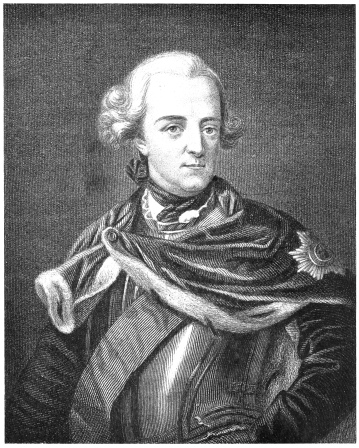
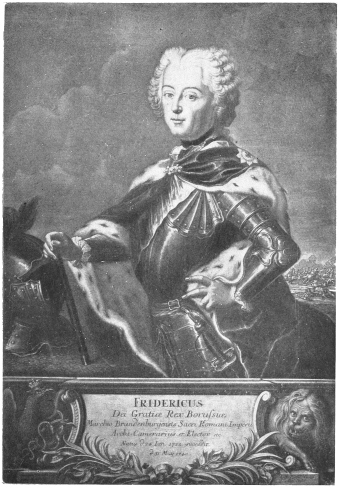
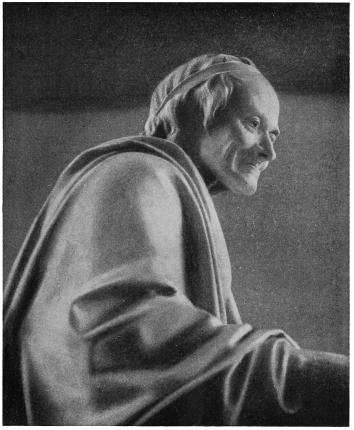
FREDERICK THE GREAT.
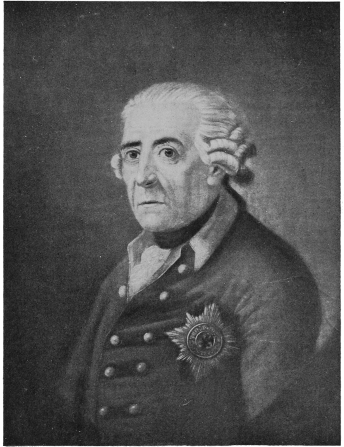
AFTER THE PAINTING BY CARLO VANLOO.
FREDERICK THE GREAT AND THE RISE OF PRUSSIA
BY W. F. REDDAWAY, M.A.
FELLOW AND LECTURER OF KING’S COLLEGE, CAMBRIDGE; LECTURER IN HISTORY
TO NON-COLLEGIATE STUDENTS; AUTHOR OF “THE MONROE
DOCTRINE” (CAMB. UNIV. PRESS)
G. P. PUTNAM’S SONS NEW YORK 27 WEST TWENTY-THIRD STREET
LONDON 24 BEDFORD STREET, STRAND The Knickerbocker Press
1904
Copyright, 1904 BY
G. P. PUTNAM’S SONS
Published, April, 1904
The Knickerbocker Press, New York
TO THE NON-COLLEGIATE STUDENTS
OF THE UNIVERSITY OF CAMBRIDGE
PREFACE
In attempting to sketch the career of Frederick
the Great and to define its relation to the
rise of Prussia, I have made free use of many
printed works, especially of Frederick’s own Œuvres
and of the elaborate Politische Correspondenz of his
reign. With these great “primary” authorities may
perhaps be ranked the face and voice of modern
Germany, rich in evidence of Frederick’s work,
which have doubtless influenced my opinions more
than I am aware of. Among “secondary” authorities
I owe most to the opulent treasure-house of
Carlyle’s Frederick the Great and to the more systematic
narrative of Professor Koser. His Friedrich
der Grosse als Kronprinz, which largely inspired the
work of Lavisse translated under the title The
Youth of Frederick the Great, forms my chief source
for much of Frederick’s early life, as does the last
volume of the König Friedrich der Grosse (1903), for
the domestic labours after 1763. Mr. Herbert Tuttle’s
judicious History of Prussia gave me much assistance
down to the outbreak of the Seven Years’
War, and I have often referred to Mr. Lodge’s Modern
Europe and Mr. Henderson’s Short History of
Germany.
At critical points in the record of the years 1712
to 1786 I was influenced successively by the Mémoires
de la Margravine de Baireuth, the trenchant
Frédéric II et Marie-Thérèse of the Duc de Broglie,
the Politische Staatsschriften, Schäfer’s Der Siebenjährige
Krieg, von Arneth’s Oesterreichische Geschichte,
and Sorel’s The Eastern Question in the
Eighteenth Century. Many of the battles in Saxony,
Brandenburg, Bohemia, and Silesia form the subject
of monographs which it was interesting to study
on the field, sometimes with the aid of collections
of maps and plans preserved in the neighbourhood.
It would be impossible without a false pretence
of erudition to name more than a small portion
of the books to which some reference must be
made in writing of the rise of Prussia. Students
will recognise the debt that I owe to such well-known
works as those of Ranke, Droysen, Philippson,
Förster, Seeley, Isaacsohn, Oncken, Vitzthum, Archenholtz,
and many more, as well as to the Essays
of Macaulay and Lord Mahon. My account of the
early history of Brandenburg is in part based on my
paper of April, 1901, in the Transactions of the
Royal Historical Society.
I offer my grateful thanks to Mr. G. H. Putnam
and to Mr. H. W. C. Davis for their counsel, to
Mr. G. H. M. Gray for minute scrutiny of the proof-sheets,
and to Messrs. Ernest and Harold Temperley,
my indulgent comrades in Silesia. To the latter
this book owes much at every stage.
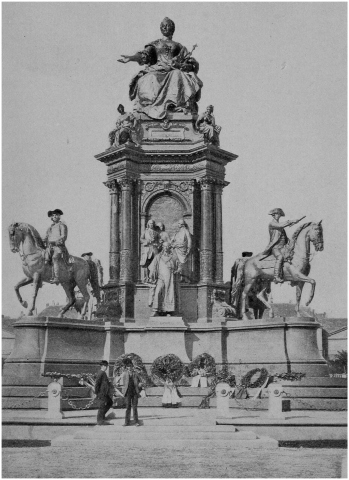
In the Austrian and Prussian capitals to-day the
traveller may mark the contrast between two
great statues, in each of which the meaning of a
reign is set forth with happy instinct. In the heart
of imperial Vienna is seated the colossal figure of
Maria Theresa, the Victoria of an age when a Pompadour
could sway the fate of nations. Her effigy
presents her as the mother of her people, displaying
rather than obscuring the scholars, statesmen, and
warriors who cluster round her feet, sharing harmoniously
the glory which neither Queen nor people
could have won without the other’s aid.
In Berlin the superb monument of the Great
Frederick is instinct with a different spirit. Raised
high above the throng, the King seems to gaze with
his inscrutable mask-face at the astounding works of
his successors. At the base of his lofty pedestal are
stationed generals and civilians of renown, numerous
enough almost to confute the Cassius who should infer
of Frederick’s Prussia that there was in it but one
only man. The statue none the less suggests the
truth. Between monarch and people there was
ever a great gulf fixed. Through all his life—in
his counsels, in his despair, in his triumph, and in
his death—Frederick, almost beyond parallel in the
record of human history, was alone.
CHAPTER I THE RISE OF PRUSSIA
The first task of the student of Frederick’s life-story
is to rid himself of the idea that the
solitary King was either wholly original or
wholly free. To seize Silesia, to quarter Poland, to
rival Austria, to humble France, each was no doubt
a feat which no Prussian ruler before him had dared
to attempt. Yet in each of these, as will presently
be shown, the hand of the living was at once nerved
and guided by the dead. From his House Frederick
inherited his might, to his House he turned for inspiration
in the use of it, and to it he dedicated his conquests.
He who would appreciate Frederick must
first survey the road trodden for three centuries before
him by the Hohenzollerns from whom he sprang.
“Why should I serve the Hohenzollerns?” Bismarck
is said to have exclaimed. “My family is as
good as theirs.” It was the complaint of the yeoman
against his fellow who has saved money and
bought the lordship of the manor.
The early history of the state now called Prussia
is chiefly the record of a thrifty family—the Hohenzollerns.
Since the year 1415, when the overlordship
of the sandy tract lying between the middle Elbe
and lower Oder and stretching across their banks was
conferred upon him by the Emperor for cash down,
Frederick of Hohenzollern and his descendants had
remained lords of Brandenburg. From Nuremberg,
where Frederick had been Burggrave, they had
brought with them the vital energy and business
ability of successful townsmen. So poor was their
new estate that for many generations relaxation
would have meant ruin. There was therefore no
temptation to depart from that policy of adding
field to field which is the natural law of the industrious
countryman. Whether from native superiority
or from greater need, the Hohenzollerns were usually
a little wiser than their neighbours. With the aid
of a family statute of 1473, which made primogeniture
the rule of succession for Brandenburg, they
avoided the consequences of that custom of equal
inheritance which has been the bane of Germany.
By careful watching of opportunities, by windfalls,
by purchase, and by covenants for mutual succession
on failure of heirs made with neighbours whose lines
died out, the domain of the rulers of Brandenburg
was in two centuries increased fourfold. When the
Thirty Years’ War broke out and the modern history
of Prussia began, the head of the Hohenzollern
family, who had long since become one of the seven
Electors of the Empire, held sway over an area almost
as great as that of Ireland.
Of the territories by which the original Mark of
Brandenburg had been augmented, two were of
special importance. In 1525 East Prussia had been
acquired. This province, which throughout this
book will be called by its German name of Ost-Preussen,
was richer by far than the Mark, the kernel
of the Hohenzollern possessions. It had an important
city, Königsberg, for its capital and a coast-line on
the Baltic. It constituted the domain of the old Order
of Teutonic Knights, permanent crusaders whose task
had been to spread the faith and civilisation of their
fatherland among the heathen Slavs. But the Baltic
lands had all submitted to the Cross, and the Knights
became in their turn the objects of a religious mission.
Early in the sixteenth century, the doctrines of the
Reformation penetrated the minds of their High
Master, Albert of Hohenzollern. He turned for
counsel to Luther himself. In a celibate Order
which had no more heathen to convert, the husband
of the nun Catherine Bora could see only a standing
defiance of the laws of nature and of God. By his
advice Ost-Preussen was “secularised,” that is, taken
from the service of religion to form a Hohenzollern
estate, and in time (1618), though still submissive to
the suzerainty of Poland, it was added to the main
body of the Electoral dominions. The Hohenzollerns
thus became distinguished from the mass of
German princes by ruling territories to which the
Empire had never possessed any claim. Ost-Preussen
was to them on a small scale what England
became in 1688 to the House of Orange, or in 1714
to the House of Hanover. Their policy acquired a
new breadth and a new weight. Hitherto provincial,
it became more and more cosmopolitan, and commerce
with the Baltic lands and England began to
hint to the lord of Pillau and Memel that his future
lay upon the water.
A makeweight to Ost-Preussen, which would prevent
the centre of gravity of the Hohenzollern lands
from shifting eastwards, was found in 1609, when the
family inherited Cleves, Mark, and Ravensberg in
Western Germany. This acquisition, made on the
very eve of the Thirty Years’ War, was accompanied
in 1613 by the conversion of the Elector, John Sigismund,
from the Lutheranism which his grandfather,
Joachim II., had established in 1539 to the sterner
and more militant creed of Calvin. This meant that
at the very moment when all Germany was taking
up arms for the greatest religious war of modern
times, the court and people of Brandenburg were
hopelessly at variance with one another. A Calvinist
prince ruled a Lutheran people, and the new
Elector, George William (1619–1640), “of Christ-mild
memory” but the weakest of his line, proved
to be a puppet in the hands of Schwarzenburg,
his Romanist prime-minister. Under such guidance
did Brandenburg, ill-knit and ill-armed, become the
battle-ground between Swede and Hapsburg in their
struggle for faith and empire.
What Brandenburg suffered in the terrible decade
1630–1640, between the landing of Gustavus
Adolphus in Germany and the accession of the Great
Elector, can never be fully calculated. The State was
rudderless, defenceless, and poor; the combatants
on both sides brigands, whom years of license had
habituated to every kind of cruelty. What passed
could be described by no more patently truthful eye-witness
than Andreas Rittner, the cheery burgomaster
of Tangermünde, a little town on the Elbe
with a royal history of its own. In his pages may
be traced the swift descent of the afflicted people
through every depth of misery down to despair or
even annihilation. The invaders—it mattered little
whether Swedes or Imperialists—exacted in endless
sequence contributions, lodging, forage, and loot,
drove off the cattle, broke up the coffins of the
dead, laid waste the land, and hunted down the
inhabitants. The mischief was only increased by
the feeble efforts of the home government to call
out and support a militia. The maddened peasants
turned guerilla. Food failed, for who could sow or
reap? Men fed on carrion, even, it was whispered,
on human flesh, and soon pestilence seized on persecutors
and persecuted alike.
Anarchy and degradation brought forth torture.
The name of the Swedish Drink attests the cruelty
of the degenerate deliverers of Germany. “They
laid men awhile upon the fire,” writes Rittner,
“baked them in ovens, flung them into wells, hung them
up by the feet, fastened thumb-screws upon them, drove
sharp spikes under their nails, bound round their heads so
tight that their eyes started out, gagged them and sealed
their mouths. Matrons and virgins were oft-times put to
shame. Husbands must often leave their wives and wives
their husbands, parents their children and children their
parents, even on the bed of sickness, for they were powerless
to save them from abuse, and sometimes when they
came back they found nought of them save some few
bones, for all else had the dogs mangled and eaten up.”
Not less graphic is the story told in stone in some
of the tormented cities. Round the giant church,
spared by the Swedes to uphold the Lutheran faith
of which it was then the temple and by the Imperialists
for the sake of the Roman faith which
they hoped to establish anew within its walls,
there may be seen the tombs of many generations
of citizens. Those of the sixteenth century are
covered with quaint adornment and graven with
artistic skill. Then, as war sweeps over the land,
the series is broken, to be resumed after many
decades with a rude clumsiness which shows that
wealth and art had fled from Brandenburg together.
Though it would be rash to assume that any
single part of the Mark may be regarded as typical
of the whole, there seems to be no reason to call in
question the dictum of Frederick the Great, that
his ancestors needed a century to repair the damage
of the Thirty Years’ War. This great task was
confided to a youth of twenty years, an only son,
yet no favourite of his father, the Elector George
William, whom he succeeded in 1640. Frederick
William, known to history as the Great Elector, was
the great-grandfather of Frederick the Great. By
common consent he is reputed the founder of the
glory of the House of Hohenzollern in modern
times. He found Brandenburg prostrate and threatened
with dissolution. It is from the low-water mark
of these earliest years, when he with reason bewailed
difficulties greater than those of David or Solomon,
that the progress of his State is to be measured and
his own achievement thereby understood.
He found his exchequer empty, his palace half-ruined,
the court seeking safety and even sustenance
at far-off Königsberg, the Austrian papist,
Schwarzenburg, supreme in the state, the Mark
trampled underfoot by alien hosts. How should
an open country like his, the highroad between
Sweden and Austria, be delivered from the endless
war? Even if, by miracle, a peace could be devised,
which Calvinists and Lutherans could both
accept, what prospect, nay what possibility existed
that territories so ill-compacted as his could be
welded into a single, solid state? All the needful
bonds of union seemed to be lacking. What common
tie of blood, of faith, of speech was there
strong enough to bind together Cleves and Brandenburg
and Ost-Preussen, units gathered by the chance
of recent history into one hand but dissevered by
hundreds of miles of alien soil and by chasms of
sentiment still harder to bridge over? The constituent
parts of Frederick William’s domain were
in 1640 dissimilar in race, in history, and in interest.
They had no desire for closer relations; they had
not even a uniform calendar; their only common
political aim seemed to be to flout the Elector,
who was the bugbear of them all.
Even were he to make himself master of the centre,
dangers clustered thick on either wing, while behind
the Polish problems of the East and the Netherlandish
problems of the West a seer might have discerned
the double peril that encompasses modern Germany.
Peter the Great and his Russia lay yet in the womb
of time, but Richelieu and his France were in the
full flood of successful ambition. Thus the organiser
of a North German power must work while
his horizon was already darkening. In grasping the
lands which formed his birthright the Great Elector
was defying, though as yet he knew it not, two of
the greatest forces of modern times. Hohenzollern
rule on the Niemen was to become a challenge to
Russia and to the Slavic advance, while the Hohenzollern
lord of Cleves must ultimately reckon with
the belief of Frenchmen that the Rhine is the
boundary designed by nature for their state.
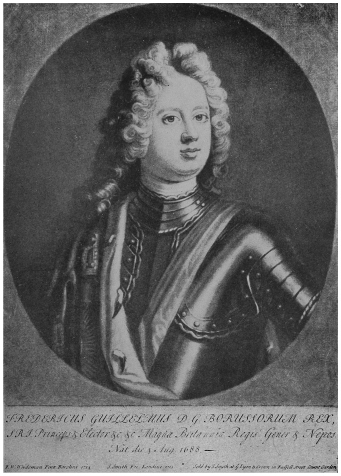
FREDERICK THE GREAT.
AFTER THE PAINTING BY CHRISTIAN WOLFFGANG.
During the first critical years of his rule, however,
the plans of the Great Elector were of the humblest.
Striving for existence rather than for empire, he
was not too proud to beg for help in every likely
quarter. Among our own State-papers are to be
seen his letters suing for petty favours which Charles
I., so long as diplomacy would serve, was very willing
to grant. The King of England marked the
small esteem in which he held the untried and obscure
Elector by pressing upon him the hand of his
niece, a princess of the fugitive and bankrupt House
of the Palatinate. Frederick William’s relations
with Poland, the suzerain of whom he held Ost-Preussen,
show yet more clearly how slight was his
power at his accession. When the Lutherans of
Königsberg threatened riot because a Calvinist was
chosen to preach the funeral sermon of George
William, the Elector did not blush to solicit the
Papist King, Wladislaus IV., to admonish these
unruly Protestants. To this end he bade his minister
at Warsaw “make humble request to His Majesty
that His Majesty would in friendly—cousinly
fashion let it please him to send a letter to our chief
Councillors (but as if His Majesty had been informed
of this from other quarters and not from us) and
thereby to order them to reprove and repress this
folly of the unquiet theologians.... It will
perhaps be best if you solicit this work only after the
departure of the Diet.” The request was made and
granted, and the minister instructs the Elector how
he may palm off the document as a mandate approved
by the Diet behind whose backs it had been
obtained.
Where charity was to be looked for, Frederick
William was not too proud to beg. But of all powers
the least likely to be charitable was Sweden,
whose armies had for nearly ten years been fighting
solely for material compensation. To Sweden
therefore the Elector offered money and was allowed
to purchase that deliverance from the war which
was essential to all his plans (1641). He could now
begin the task of his life—to reduce all his provinces
into dependence upon himself and to render Brandenburg,
augmented and centralised, a formidable
military power.
During forty-eight years (1640–1688) he pursued
the old Hohenzollern policy of family aggrandisement.
His success has earned him the title of the
Great Elector, and the place of the first hero of the
Prussian state. Yet he is remarkable chiefly for
his commercial instinct, imbibed perhaps during his
education among the Dutch, the neighbours to whom
he always looked for example and alliance. On
occasion he could display the soldierly instinct of
his race, but in time of peace he was hardly a heroic
figure. With domestic virtues specially to be praised
in a monarch of that time he combined a weakness
for strong drink which damaged his health and temper.
He took pride in being abreast of the times,
reverenced London and Amsterdam, and was ready
to haggle with foreigners for preferential rates. He
wrote a good commercial hand, planted cabbages in
his garden, and hammered out verses which with a
little doctoring might have graced the poet’s corner
of a provincial newspaper. He was a thrifty householder,
save when he deemed it necessary to
keep up his position by building a massive palace or
giving a pompous feast. A convinced Protestant,
he welcomed serviceable Huguenots to his capital
with more good-will than serviceable papists. It is
not impossible to believe that as a German patriot
he took favours from the Emperor with more inward
pleasure than from Louis XIV. In what Dr. Prothero
terms “the ocean of recognised mendacity which
we call diplomacy” he floundered without either
repugnance or great success. He spent his life in
unifying his dominions and made a will which if
carried into effect would have dismembered them
at his death. That a man of this stamp is designated
Great suggests that he was not only diligent
but that he was also fortunate in the conditions
under which he lived and worked.
In his early years he owed much to the weakness
and insignificance which have already been described.
What rival state was thrown into the shade if Brandenburg
was allowed to grow? Thus, at the close
of the Thirty Years’ War, the Hohenzollern line received
indulgent treatment. Their claim to Pomerania
was admitted for the eastern half of the
duchy. The western half was indispensable to
Sweden, but the rights of the Elector were bought
up at the price of more valuable ecclesiastical lands
scattered between the Mark and his possessions in
the West. The bishoprics of Halberstadt and Minden
and the reversion of the rich archbishopric of
Magdeburg were given to Brandenburg, whose part
in the war had been contemptible, by the great
Peace of Westphalia, the fundamental pact of modern
Europe. Yet its sacredness was so little appreciated
by the Elector that a few years later he
would have renewed the war, had not outraged Germany
held him in.
The Peace of Westphalia had bestowed upon
Brandenburg and other German states a gift of
more value than many bishoprics—the gift of independence.
In outward show Frederick William was
still a vassal of the Emperor. He continued to be
one of the seven Electors who chose the head of
the Holy Roman Empire and honoured him with
lowly homage. In virtue of his hereditary office of
Grand Chamberlain it was the duty of the Elector
of Brandenburg, prescribed by the Golden Bull of
1356, to appear at solemn courts “on horseback,
having in his hands a silver basin with water, and a
beautiful towel, and descending from his horse, to
present the water to the Emperor or King of the
Romans to wash his hands.” As a German prince,
moreover, he had still to look to the Emperor for
investiture, leadership, and advice. But his right to
determine the creed of his subjects, which the Peace
of Westphalia confirmed, and the right to choose
allies outside the Empire, which it expressly granted,
were inconsistent with real vassalage. The gift of
these admitted Brandenburg to a place in the commonwealth
of nations. The Elector had become
undisputed master in his own house. Soon his
horizon expanded far beyond the bounds of Germany.
Europe, nay more, as his colonial ventures
were to prove, the wide world lay open to the Hohenzollern.
Both at home and abroad he could strike
with a freer hand. But his power, though irresistible
in Brandenburg, was made respectable in Europe
only by years of toil. Hence the home policy of
the Great Elector was as straightforward as his
foreign policy was tortuous. To beat down all
competing authority, to establish an armed autocracy,
to develop to the utmost all the resources
of the State—such was the plan which the Great
Elector designed, which his son and grandson perfected,
and the fruits of which Frederick the Great
enjoyed.
By steady pressure, by force, and at times by
fraud, the Great Elector guarded the future of the
Hohenzollern power against the danger of obstructive
provincial parliaments. To make the men of
Cleves, Brandenburg, and Ost-Preussen feel themselves
brethren was indeed beyond his power. But
he ruthlessly suppressed the institutions which symbolised
their mutual independence of each other and
of himself. Carlyle, the great panegyrist of coups
d’état, thus describes one example of
“his measures, soft but strong, and ever stronger to the
needful pitch, with mutinous spirits. One Bürgermeister
of Königsberg, after much stroking on the back, was at
length seized in open Hall, by Electoral writ,—soldiers
having first gently barricaded the principal streets, and
brought cannon to bear upon them. This Bürgermeister,
seized in such brief way, lay prisoner for life;
refusing to ask his liberty, though it was thought he
might have had it on asking.”
The Great Elector’s chief legacy was, however,
the Prussian army. The ruler of mere patches of
the great northern plain, “a country by nature the
least defensible of all countries,” he girdled it laboriously
with a wall of men. In an age when France
alone possessed a large standing army, this obscure
German prince raised his force from a few garrisons
to a host some twenty-seven thousand strong, well
drilled and well appointed.
The lord of Brandenburg now became a condottiere
of ever-increasing reputation. His regiments
brought security to his dominions and gold to his
exchequer. In every European struggle their aid
was welcome. On the frozen lagoons by the Baltic
and on the shores of Torbay, on the torrid plain of
Warsaw, and in the vine-clad valley of the Rhine—everywhere
the men of the Mark approved themselves
good soldiers and punctual allies. In 1660
the Great Elector netted his profit from the Northern
war by receiving Ost-Preussen free from Polish
suzerainty. The heroic moment of the whole reign
came, however, in 1675, when all the threads of the
Elector’s policy—ambition, vengeance against the
Swedes, military creation, domestic organisation—guided
him to the stricken field of Fehrbellin.
While playing his part in the West as a member of
the coalition against France, he learned that the
Swedes, his hated neighbours in Pomerania, had
been hurled upon his domains by their patron
Louis XIV. He straightway turned his back upon
the Rhine and stalked silently across Germany to
rescue his helpless people. His troops had been
beaten by Turenne and exhausted by the long struggle
with rain and mud. Yet he dared to overrule
his generals and to strike straight at superior forces
trained in the school of Gustavus and posted with a
river in their rear.
The bold move succeeded. In a hand-to-hand
struggle, amid bogs and dunes, Brandenburg was
saved by its chief. At the crisis of the fight he put
himself at the head of a wavering squadron, and
with one wild charge shattered the Swedes and their
prestige together. The result of Fehrbellin was that
Brandenburg took rank as the first military power
of Northern Europe and that the land had rest for
many years.
Fehrbellin forms a conspicuous landmark on the
road to Hohenzollern greatness, but it is separated
by no great interval of time from a double demonstration
of the insignificance of Brandenburg when
confronted with states of the first order. The Emperor
flatly refused to admit the claim of the Elector
to portions of Silesia. The King of France dashed
from his lips the cup of triumph over the Swedes.
In an age when rivers were of even greater value
than at present, the great waterway of Brandenburg
was the Oder. Ere she could draw full profit from
the Oder, Stettin, with its splendid harbourage and
strong strategic position, must be wrested from
alien hands. At Fehrbellin hope sprang up that the
time was come. With all the tenacity of his nature
the Great Elector clung to the task. In 1677 Stettin
fell, after enduring one of the most desolating bombardments
in history. Before the close of 1678 the
Swedes were driven from all Western Pomerania.
They descended upon Ost-Preussen, but Frederick
William set at naught the winter cold and his own
infirmity, hurried from Cleves to the Vistula, put his
troops on sledges, and dashed at the enemy across
the frozen sea (January, 1679). The triumph of the
Elector was complete, but at the Peace of S. Germain
(1679) he was compelled to surrender all his conquests
at the behest of Louis XIV.
In spite of some failures, however, Frederick William
by dogged perseverance accomplished enough
to justify his reputation as the founder of the Prussian
State. He is still a force in Germany. Frederick
the Great and all the later Hohenzollerns of
renown have paid homage to his memory. William
II. embittered the downfall of Bismarck by applauding
a drama which represented the Great Elector
deposing Schwarzenburg, the hated counsellor of
his father. Throughout Prussia the imperious features
of the little hero of Fehrbellin are as familiar
to the people as his deeds.
With the death of the Great Elector in 1688 the
age of iron gave way to the age of tinsel. Frederick,
who ruled in his father’s place for a quarter
of a century (1688–1713), was a prince who prized
culture above character and strove to imitate in
his provincial court the splendours of Versailles.
From time to time, though less often than in
other royal lines, the business instinct of the Hohenzollerns
fails, and of such a lapse Frederick is an
example. Despising the domestic labours of the
Great Elector, he was captivated by those ceremonious
shadows which the German nation is always wont
to pursue. Frail, even maimed, since childhood, he
developed a passion for pageants, robes, and titles.
He could not endure the promotion of his equals to
rank higher than his own. If the Dutch Statthalter
rose to be William III. of England and the Duke
of Brunswick-Lüneburg to be Elector George of
Hanover, might not he himself, as master of the best
troops in Germany, also claim to rise? When in
1696 he was about to visit William of Orange at the
Hague he declared that he could not consent to sit
upon an ordinary seat while an armchair was placed
for the King. The interview therefore was accomplished
standing, and when William returned the
visit he found armchairs of equal dignity set for the
Elector and for himself.
Seldom has a ruler’s weakness done better service
to his State. Brandenburg was shielded by its
poverty from the ordinary fate of German states
whose rulers tried to copy the profusion of the kings
of France. Frederick, moreover, had not the force
of will to break with all the traditions of the Great
Elector. He continued to take part in every struggle
as an auxiliary, but in none as a principal. His
country thus enjoyed the glories of war without its
penalties. It was under the command of Prince
Eugene, Austria’s greatest general, that Brandenburgers
helped to overthrow the French before
Turin (1706). And since a large army is the most
splendid trapping of monarchy, Frederick made his
army very large. He inherited 27,000 men, he bequeathed
nearly 50,000 to his son.
The climax of his reign was reached in 1701, when
he prevailed upon the Emperor to make him King
of Prussia. In a double sense it may be said with
truth that he owed his crown to his weakness. It is
generally believed that the chief motive which
prompted him to sue for it was vanity. For months
he could think and speak of nothing else. When
at last the imperial license came, the enraptured
Elector quitted Berlin in midwinter and spent twelve
days in moving with a pompous train to Königsberg.
There, with every detail of ceremony that his imagination
could suggest, he placed the crown upon
his head. It is doubtful whether a more sober ruler
would have prized a throne as he did, and doubtful
too whether the Emperor would have consented to
the elevation of a prince less obviously feeble. But
Frederick had carried on without reserve the old
Hohenzollern tradition of standing well with the
head of the German world. He had even given back
to Austria the territory of Schwiebus, which the Emperor
had assigned to the Great Elector in settlement
of whatever claim the Hohenzollerns possessed to
portions of Silesia. Now he was prepared to uphold
the Hapsburg cause in the War of the Spanish
Succession. What harm could there be, the Emperor
may well have asked himself, in promoting a
vassal so devoted as this?
Forty years later, Austria had bitter cause to rue
the error of her chief. From the very first the crown
aggrandised the Hohenzollern dynasty. It consecrated
their ambition, enlarged their horizon, and
gave them, as the Lord’s anointed, a new claim upon
the devotion of their subjects. The Order of the
Black Eagle, which for two centuries has been the
coveted prize of service to their state, signalised
the coronation of Frederick I.
The Great Elector and the first king of Prussia have
this in common—that whatever may be thought
of their achievements it is difficult to mistake the
men themselves. Of the second king, Frederick
William I. (1713–1740), the father of Frederick the
Great, the exact opposite is true. His life-work, the
establishment of the royal power “like a rock of
bronze,” is patent to all. He himself, on the other
hand, was a mystery to his own children. His most
gifted admirer, Carlyle, sets out to paint a prophet
and ends by portraying something very like a madman.
His theory of his own sovereign office was as
mystical as his practice of ruling was simple. He
regarded himself, it has been said, as the servant of
an imaginary master—the King of Prussia—under
whose eye he lived and worked. Baser princes looked
on their royalty as a privilege to be enjoyed. To
Frederick William it was a duty calling for endless toil.
He struggled to check every detail of government with
his own hand, as though Prussia were a single manor
and he the squire. A French critic (Lavisse) thus portrays
him wrestling with his ever-multiplying tasks:
“Have we not too many officials,” the King enquires.
“Could not several places be merged into one? We
must see if some of the officials cannot be put down.
Why is not the beer so good everywhere as at Potsdam?
In order to have wool we must have sheep. Now in
Prussia there are nearly as many wolves as sheep. Quick,
let me have a minute upon the destruction of wolves.
How comes it that the salt tax has brought in less money
this year than last from the district of Halberstadt?
The number of officials has not diminished, has it?
They must have eaten as much salt as last year. There
must therefore be fraud or waste somewhere. The
Superintendent of the Salt Department must be warned
to manage matters better than he has done of late.
Can it be that my subjects buy salt in Hanover or
Poland? Every importer of salt must be hanged.”
His violence was and still is notorious. He flung
plates at his children, caned his son in public, cudgelled
the inhabitants of his capital, and flung the
judges down-stairs. He forced his queen, the sister
of the English King, to drink to the downfall of
England. He vilified everything French, and insulted
the British Ambassador so seriously that he
conceived himself bound to leave Berlin. Yet he
kept Prussia at peace steadily enough to earn for
himself the reputation of a mere bully whom the
Emperor could lead by the nose.
In spite of the contradictions of his character,
however, the broad principles of his reign are clear.
Having stripped the state of the veneer of luxury
with which Frederick I. had disguised its poverty,
he took up and developed further the ideals of the
Great Elector. He made the royal power absolute
in the state, and increased the army till a population
of about two and a half million souls supported the
unheard-of number of 83,000 men under arms. These
were drilled to such a pitch of perfection that Macaulay
could say that, placed beside them, the household
regiments of Versailles and St. James’s would
have appeared an awkward squad. Yet this mighty
force was used for little save to secure the frontiers
of Prussia and the rights of all German Protestants.
In territory the “Sergeant King” gained only from
the wreck of Sweden part of the prize which the
Great Elector had grudgingly relinquished at the behest
of Louis XIV.—the mouth of the Oder and
with it the islands of Usedom and Wollin, and Western
Pomerania as far as the river Peene (1720).
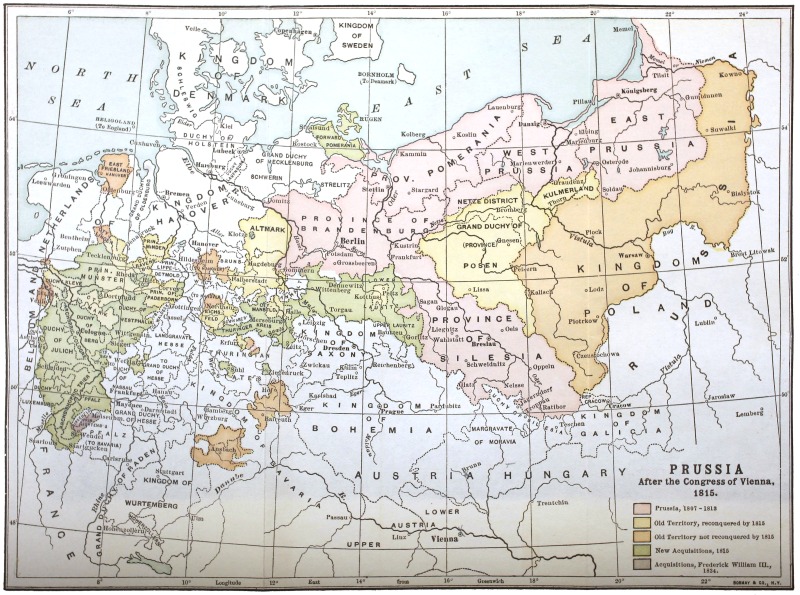
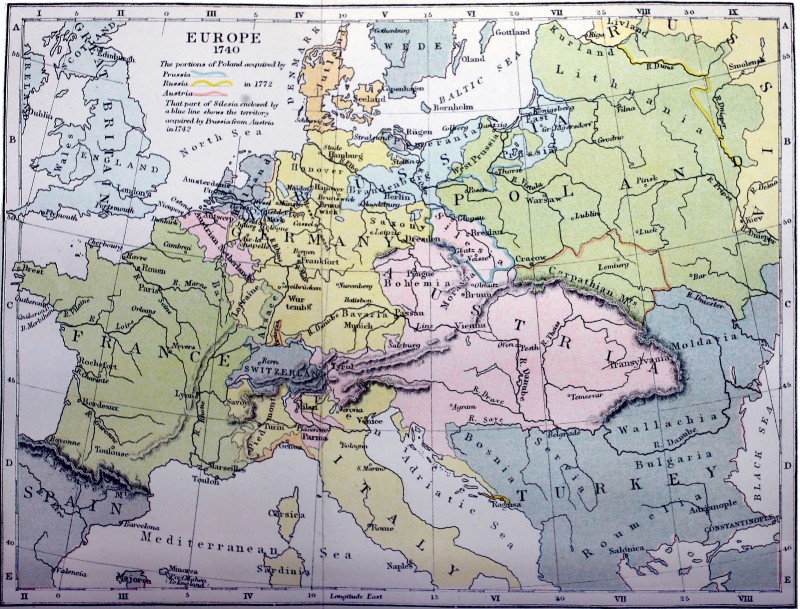
PRUSSIA
After the Congress of Vienna,
1815
In the home department, on the other hand, Frederick
William I. made a conspicuous advance from
the point reached by his grandfather. He showed
the same military zeal, the same practical insight, the
same determination to set to rights with his own
hand whatever in his dominion was governed amiss,
the same contempt for higher education, the same
benevolence towards the persecuted of other lands
who might be made useful to Prussia. But he
showed also a power of grasping and of simplifying
the whole system of administration such as few rulers
have ever possessed. His great Edict of 1723 removed
friction from the working of the Prussian
state. Thanks to this, his son Frederick found the
organisation described in the sixth chapter of this
book—a machine of government answering to every
touch of the royal hand. He found at the same
time a firm tradition in favour of thrift, diligence,
and activity in the steersman of the state. We
have traced the growth of Prussia to 1740; let us
now turn to the story of the prince who in that year
linked her fortunes with his own.
CHAPTER II FREDERICK AS CROWN PRINCE, 1712–1740
What manner of man was the first-born son
of Frederick William, known to history as
Frederick the Great, and what were the
causes that made him such as he was? To answer
either question is a task of uncommon difficulty.
Even to those who were regarded as his intimates
Frederick remained an enigma all his life. In his
early trials he acquired, as Carlyle happily expresses
it, “the art of wearing among his fellow-creatures
a polite cloak-of-darkness,” and became what he in
great measure still remains, “a man politely impregnable
to the intrusion of human curiosity.” And if
it passes our wit adequately to describe his personality,
how shall we determine and distinguish the
factors which created it? No adding together of influences
will suffice. Such enquiries lead us far beyond
the bounds of mere arithmetic. Of Frederick’s
nature, as of every man’s, a greater share was built up
in ages which have left no record than in the generations
whose history we can trace. If therefore we
next endeavour to indicate the influences of his parentage
and his surroundings, let us avoid the delusion
that these alone made him what he was. In Frederick’s
case, too, it is perhaps equally needful to beware
of the converse error. His personality, like his
policy, was not untouched by ordinary influences.
Parents, tutors, friends, nation, home, even religion—each
bestowed something upon one who might on
a too hasty scrutiny be pronounced a freak of nature—the
ugly duckling of the Hohenzollern brood.
Frederick’s birth, on January 24, 1712, remedied
the anxieties of a line which had gained too much
from the extinction of allied lines not to be keenly
sensitive to its own lack of heirs. His father, Frederick
William, gave vent to rude transports of joy at the
arrival of a male heir. Frederick I., the royal grandfather,
who had himself a third time plunged into
wedlock in the hope of safeguarding the succession
to the new Prussian crown, seized the opportunity
to astonish Berlin by the pomp of the infant’s christening.
The Prussian nation, living in tranquillity
under the Hohenzollerns, shared in their rejoicing.
The infant prince represented many noble lines,
and, it might almost be said, two separate civilisations.
Frederick William was a kind of Prussian
Squire Western. His wife, Sophia Dorothea, was a
princess of the rising House of Hanover, a lady soon
to be nicknamed Olympia from her majestic bearing
as queen. Through her and through his grandmother,
a clever daughter of Sophia of Hanover,
a thin strain of Stuart blood flowed in Frederick’s
veins. His great-grandmother, the wife of the Great
Elector, was a daughter of the House of Orange,
born at the moment of its triumph over Spain. A
generation farther back the Hohenzollerns had married
into the House of the Palatinate, which in 1618
threw for the Bohemian crown and lost. But the
virtues of every Protestant House in Europe could
not compensate for the infirm health which had
assailed both the father and the son of the Great
Elector, and which there seemed reason to fear had
descended to the offspring of his grandson Frederick
William. Two older sons had died in infancy,
a daughter, Wilhelmina, though she grew up and
married, was never robust, and Frederick himself
seems in his childhood to have been often ailing.
The home circle of this delicate prince was surely
the strangest in the world. The royal family of
Prussia in the reign of Frederick William I. was
hardly a family and hardly royal. The monarch
seemed to regard his sceptre chiefly as a superior
kind of cudgel. As Prussian King, and therefore ex
officio the father of his people, he could treat them
as children, could order them to be anything or to
build anything or to pay anything, with even less
risk of resistance than an Elector of Brandenburg
might have had to fear. He was, it is true, on a
footing of equality with foreign kings in negotiating
for a treaty or a province or a bride. But apart
from his acceptance of the perquisites of royalty,
his life was one long protest against all that the
world associated with the name of king. Intolerant
of state and ceremony, he agonised his chamberlains
by his behaviour. His recreations were such as
befitted a bargeman on the Havel or an overgrown
loafer kidnapped to serve in the King of Prussia’s
giant grenadiers. In that snuff-taking age, a king
whose hobby was to smoke pipes in a kind of glorified
tavern-circle known as the Tobacco Parliament
earned the reputation that would fall in our own
day to a king who should chew and spit.
Frederick William drank himself to death before
he was fifty-two. Though an artist, if not a scholar,
he drove Wolf, the philosopher, from his dominions
and made Gundling President of the Academy of
Letters because he amused the Tobacco Parliament
when in his cups. As a sportsman he slew wild swine
by the thousand and forced his subjects to buy their
carcasses at a fixed price. He ordered his officials to
spend only six thousand thalers on the entertainment
of Peter the Great, but to give out that it cost him
thirty or forty thousand. His mixture of fervent piety
and immorality suggests that he was hardly sane, and
his foreign policy does not discountenance the suggestion.
In some of his officials he placed complete
confidence, even when proofs that they were bribing
his envoys abroad to send home false news were in
his hands. He rushed upon others with his cudgel,
first breaking their heads and then cashiering them.
What he was to his children may be inferred from
the fact that his daughter became his bitter satirist
and his son his bitter foe.
Such was the father who directed Frederick’s education.
His talent for detail was always at the
service of the state. It could be devoted to no
worthier object than the training of the future king.
At the age of nine years, therefore, Frederick found
every hour of the day assigned to some part of the
scheme of education by which the crowned Podsnap
designed to make him such another as himself.
For all its minuteness, the scheme failed in its
main object. It failed because Frederick William
was not the sole factor in moulding and inspiring
his son. In the royal household were two trembling
conspirators against the tyrant—his wife and his
daughter. Sophia Dorothea and Wilhelmina formed
with Frederick a trio who sighed after the genteel.
Loathing the pipe-clayed Teutonism in which their
lord delighted, they longed for newer fashions and
society more polite, for the wit and gallantry of the
French court, and for the splendour of their own
opulent kinsfolk at Saint James’s. Their lines
had fallen in far less pleasant places. In Berlin,
a quiet country town with dull surroundings and a
trying climate, they had at least palaces, parties, and
scandal. In Wusterhausen, to this day a lonely village,
they were in exile; and Wusterhausen was the
favourite residence of the King. The Europe in
which they lived, it must be remembered, was a
Europe which believed with all its heart that whatever
Louis XIV. might have been in politics, he was
beyond doubt the Apollo of culture. German princes
prided themselves on speaking French, on dressing
à la française, on building palaces that might be
named in the same breath with Versailles. Frederick’s
mother spoke French so well that a Huguenot
refugee paid her the supreme compliment of enquiring
whether she understood German. His sister’s
memoirs, like his own, are French in language and
in inspiration. What sympathy, we may wonder,
could there be between these ladies and a boor who
hated everything French, whether language, literature,
art, cookery, or dress, and whose ideal of life was
to sleep on straw in a barn, wash at daybreak in a tub,
don a plain uniform, inspect farms, account-books,
and soldiers, gorge himself with rude German dishes
in the middle of the day, snore under a tree in the
afternoon, and devote the evening to tobacco, buffoonery,
and strong drink?
It is not surprising that, when the King’s scheme
of discipline outraged his son instead of moulding
him, mother and sister were at hand with ready
sympathy. The wayward boy never forgot their
kindness, nor the indulgence of the tutors who
connived at a more humane education than Frederick
William had commanded them to inflict.
Cordially as the King detested French culture, he
did not venture to exclude it from a leading
part in the education of his son. A French lady,
Madame de Roucoulle, was entrusted with the
oversight of his earliest years. Madame de Camas,
whom he called Mamma, was the wife of a Frenchman.
His tutor, Duhan, was a Huguenot. French
was at that time the universal language of the polite
and learned world. Frederick, who never learned
English and was forbidden to learn Latin, therefore
drew all his mental supplies from French originals
or French translations.
German he never spoke or wrote with ease. To
him it stood for whatever was dull in his education,—for
windy sermons every Sunday, lessons of nearly
two hours a day in the Christian religion, books
full of dismal pedantry, the speech of boors and
of his father. Thus he early acquired from France
ideas which he proclaimed throughout his life.
That literary creation is the highest achievement
of man, and that next to creation stand patronage
and culture; that religion is superstition; that the
enlightened man is he who views with calm not
only the rubs of fortune but also the frailties of
mankind—such were the abiding traces of Frederick’s
education. The King, as may readily be believed,
did not fail to remark something of this and
to loathe it. He leaped to the conclusion that a
boy who preferred French to German, and flute-playing
to parades, was a monster who would ruin
Prussia. It never occurred to him that his own
scheme could be imperfect, and life became one long
collision between father and son.
Yet Frederick’s most irritating delinquencies—his
delight in soft living and secret dissipation, his
distaste for the uniform and duty of a soldier,
his contempt for Germans and their tongue—may
fairly be ascribed in great part to mere youthful
squeamishness and to the tyranny of the King. Had
Frederick William been wise enough to trust to the
future and to the past, to reflect that in the long
line of Hohenzollerns none had been traitor to his
House, that a lad who could think for himself would
be more easily influenced than coerced, that at the
worst he himself was not twenty-four years older
than his son and might train the state to survive
Frederick II. as after the Great Elector it had survived
Frederick I.—had he in short been either a
sympathetic father or a man of real penetration,
then history might have heard nothing of either the
new Junius Brutus or the Ogre of Potsdam, and the
million victims of Frederick’s wars might have been
spared.
Unhappily for his son and for the world, Frederick
William was neither sensible nor sympathetic. His
aversion to an heir who refused to resemble himself
was doubled when the heir became the advocate of
a matrimonial policy which he came to regard with
loathing. From the hour of Frederick’s birth the
dearest wish of the Hanoverian House, and of Sophia
Dorothea most of all, had been to unite more
closely the royal lines of England and Prussia. At
length a double marriage was proposed. The Prince
of Wales was to marry Wilhelmina, and Frederick
his cousin Amelia, daughter of George II. In 1730,
however, England and Prussia were estranged, yet
Frederick William knew that his household had not
given up their darling project. Flouted as a father
and as a statesman, he treated his son so ill as to
lend colour to the suspicion that he wished him
dead. Not content with impounding his books,
forbidding him the flute, compelling him to see his
mother only by stealth, the tyrant actually rained
blows upon him in public, even in the camp of the
Saxon King. “Had I been so treated by my father,”
he is said to have exclaimed, “I would have blown
my brains out, but this fellow has no honour.”
Unfortunately for Frederick William, the youth
whom he thus outraged was Crown Prince of Prussia,
and as such by no means lacked friends. To
England, to Austria, and to his father’s ministers
he was an important pawn in the game of politics.
Some of the younger officers lent him countenance
in the hope of favours to come. But the dearest
friend of his life, Lieutenant von Katte, loved him
for himself rather than for what he might be able to
bestow. To Katte the prince confided his fixed
purpose to flee from a tyranny that was past endurance.
Together they planned to make use of the
opportunity of escape which might arise when Frederick
should approach the French frontier in the
course of a forthcoming tour with his father among
the German courts.
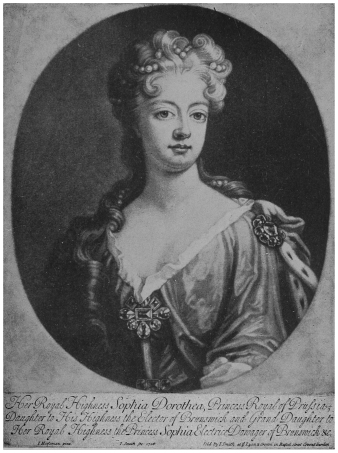
PRINCESS SOPHIA DOROTHEA, DAUGHTER OF KING GEORGE THE FIRST.
AFTER THE PAINTING BY HIRSEMAN.
On August 4, 1730, the attempt was made. The
confederates tried to steal from the royal camp at
dawn and to ride into France. Such a flight was not
without precedent in Hohenzollern history. Frederick’s
grandfather, sharing the general belief that
his stepmother had poisoned his brother and meant
to poison himself, had first sought shelter at Cassel
with his aunt and at a later date had quitted the
Great Elector’s court altogether. But for the heir
to a crown to flee beyond the bounds of Germany
was a still graver step. The youth of eighteen had
hardly calculated the probable consequences of success.
Where was Frederick William’s heir to find
a safe asylum? Louis XV. was not likely to be
to him what Louis XIV. had been to the Old Pretender.
George of England would hardly expose
Hanover to the vengeance of the King of Prussia.
His envoy had in fact refused to countenance the
scheme. Nor would the Emperor care to sacrifice
the Prussian alliance to mere sentiment. Even if
Frederick should succeed in finding a refuge for
himself, he would none the less have left two dear
hostages at the mercy of the King. “Your mother
would have got into the greatest misery,” declared
Frederick William a year later. “Your sister I
would have cast for life into a place where she
would never have seen sun and moon again.”
Thanks, however, to the vigilance of Colonel von
Rochow, his keeper, and to the panic of his page,
Frederick did not even mount the horse that was to
have borne him out of Germany. His abortive attempt
inaugurated one of the strangest tragedies in
history. From the very fact that he was the guest
of other princes Frederick William could not act in
haste. The scheme was betrayed to him at Mannheim
on August 6th, and he ordered von Rochow to
deliver his son to him at his own town of Wesel,
alive or dead. In this mood they continued the
tour of pleasure, sailing down the Rhine and visiting
the potentates upon its shores. At last, on the evening
of the 12th, they reached Wesel. Frederick
William at once interrogated his son, who lied and
protested his submission. The King replied by
despatching him to Spandau under the care of a
general, who was enjoined to frustrate any attempt
at rescue by killing his prisoner.
Spandau is the fortress near Berlin where to-day the
Prussian sentries guard some millions of the treasure
wrung from France. It was not deemed safe enough
to keep the Prince of Prussia. “He is very cunning,”
wrote the King, “and will have a hundred inventions
for making his escape.” A stronger gaol was sought
for. In a sombre plain east of the capital lies Cüstrin,
whose grim fortress marks the spot where the
sluggish Wartha gliding down from Poland silently
joins the Oder. There, on September 4th, Frederick
was imprisoned. On the way he had faced a tribunal
of soldiers and lawyers with a jaunty confidence
which showed that though he might cower before
the King he had not forgotten that he was still
Crown Prince of Prussia. It was rumoured that he
had poked fun at Grumbkow, his father’s most
trusted counsellor. For himself he asked no favours,
but avowed his responsibility for all that
Katte had done amiss.
A fortnight later, on September 16th, the commission
examined him again. In the meantime
he had begun to understand the nature of a gaol.
His father, who lived in such a state of frenzy
that he ordered that the tongue which spoke of
this affair should be cut out, had not scrupled to
condemn him to solitary confinement, a penalty
often destructive of health and not seldom of reason.
He was clad in brown prison dress, fed on
the humblest fare, and deprived of light at seven
o’clock in the evening. Thus prepared, he was subjected
to a merciless inquisition. After more than
one hundred and eighty questions of fact, came two
which the King had commanded the interrogators
to add. “Do you wish that your life should be
granted to you or not?” “I submit to the King’s
mercy,” answered Frederick, adding in pencil, when
the report was laid before him, “and to his will.”
“Since by violating your honour,” ran the last question
of all, “you have made yourself incapable of
succeeding to the throne, will you renounce the succession
by an abdication that shall be confirmed by
the whole Roman Empire—to save your life?”
“My life is not over-dear to me,” replied the Prince,
“but Your Majesty would surely not be so ungracious
to me”—and he added a prayer for pardon. The
King tore up the petition and applied his genius
for detail to a code of rules for the torment of his
heir. No one was to speak to the prisoner. Three
times a day the door of his room might be opened,
but within four minutes it must be made fast again.
Mute attendants were to set before Frederick food
which they had cut in pieces, since the royal command
deprived him of knife and fork. For Katte
Frederick William had ordered the rack, but on
the representations of Grumbkow the order was
cancelled. For his son he discovered a torture
which Grumbkow himself was to apply. “He must
be told,” decreed the King, “that no one thinks of
him any more; that my wife will not hear his name;
that his sister Wilhelmina has fallen under my displeasure,
that she is shut up in Berlin, and will very
soon be sent into the country.”
The problem before Frederick William, whose
wrath increased as he experienced the difficulty of
laying to his son’s account any definite crime, was to
crush his heir without imperilling Prussia. On October
11th Frederick declared to the commission that
he was ready to renounce the succession. On October
16th the King avowed in writing his desire to make
his second son his heir. But to do this while Frederick
lived was dangerous, and on what charge could
he be put to death? Assassination, though it might
rectify the succession to Philip of Spain or Peter
of Russia, was to a Hohenzollern simply impossible.
And Frederick William was not entirely sovereign
over his son. It was true that a Prussian subject
had no longer any right of appeal from the decrees
of the Prussian King. But the Prussian King was
also Elector of Brandenburg, and therefore a vassal
of the Emperor. The heir to the Electorate of
Brandenburg was equally a prince of the Empire
and as such could appeal unto Cæsar. Moreover,
no proof could be found that Frederick was a traitor.
He had neither acted nor tried to act in collusion
with any foreign Power. His father suspected that
England was at the bottom of the plot, but no evidence
of this could be found. By no severity could
his son be brought to confess more than a design
to run away. Foreign sovereigns protested against
violence which degraded the royal caste.
It is difficult to see with what hope the baffled
King insisted on a quibble which might make out
his son to be technically a criminal. Frederick, by
no choice of his own, was a colonel in the Prussian
army. On October 25th a military court met at the
King’s bidding to try him and his accomplices for
desertion.
The court consisted of fifteen officers, three from
each of five grades. The members of each grade,
after deliberating apart, handed their votes to a
president, the aged Lieutenant-Colonel von Schulenburg,
who summed up their verdicts and added a
sixth vote of his own. With regard to the Crown
Prince, all were unanimous. Declaring themselves
incompetent to pronounce upon affairs of state and
of the royal family, they commended the exalted
penitent to His Majesty’s supreme and paternal
mercy. Katte was condemned by three grades to
death, by two to lifelong imprisonment. Von Schulenburg
voted for the latter, which by military law
carried the day, since it was less severe. The King
denounced their criminal leniency and clamoured
for “justice,” but von Schulenburg stood firm, appealing
to a Higher Power. Thereupon Frederick
William decreed “that Katte, although in conformity
with the laws he has deserved to be torn with
red-hot pincers and hanged for the crime of high-treason
which he has committed, be removed from
life to eternity by the sword, out of consideration
for his family. In informing Katte of this sentence,
the Council will tell him that it grieves His Majesty,
but that it is better that he should die than that
justice should entirely leave the world.”
Under a sentence which no consensus of civilised
opinion, no high-placed appeal, no murmur of disaffection
could reduce, the doomed man journeyed
slowly to Cüstrin. Frederick, who believed that all
would go well with himself and his friend, was
cheerful still. At five o’clock on the morning of
November 6th he was awakened by two officers who
told him that Katte was that morning to be put to
death and that he must witness it. “What are
these ill tidings that you bring me?” he is said to
have exclaimed. “Lord Jesus! rather take my
life.” Before his judges he had steadfastly declared
that Katte’s guilt lay at his door. Now for two
terrible hours he wailed, wrung his hands, burst into
tears, sent to his friend to beg forgiveness, prayed
for a respite while a courier should lay at the King’s
feet whatever he might desire from his son—renunciation
of the succession, consent to lifelong imprisonment,
nay, his own life if Katte’s might be
spared. His honourable clamour moves the heart
of posterity, but it could vary no line upon the
parchment on which the King had set down even
the numbers of the soldiers who were to attend the
execution. Seven o’clock struck, and the dismal
procession filed into the courtyard which stretched
from the fortress-wall to the Oder. As the King
had commanded, Frederick was led to the window
of his cell. He saw his friend, who had received
the communion, standing calm and brave amid the
soldiers and awaiting with bared head the recital
of the sentence of death. The prince kissed his
hand to him and cried aloud for his forgiveness.
Katte laid his finger upon his lips, bowed respectfully,
and answered that there was nothing to forgive.
He then bade his comrades farewell, knelt to
receive the chaplain’s blessing, and with prayer upon
his lips submitted to the fatal stroke.
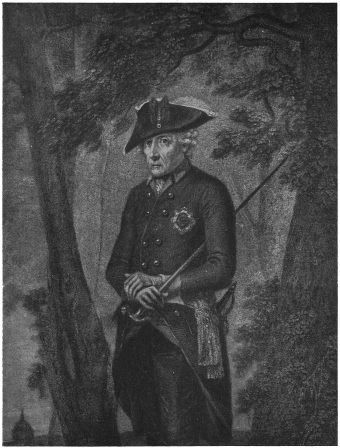
FREDERICK THE SECOND.
AFTER THE PAINTING BY CUNNINGHAM.
Frederick had fainted. It was the duty of the
chaplain to pass straight from the dead offender to
the living, and to exhort him to repent. But nature
made this royal order of none effect. The prince,
when he came to, could only stare dumbly at the
gloomy pall which draped the body of his friend.
At two o’clock some citizens brought a coffin and
bore away the corpse, but Frederick could not withdraw
his gaze from the place of execution. All that
day he took no food. At night he passed from delirium
into a second swoon—then fell to raving
anew. When morning broke he declared that Katte
was standing before him. But the very violence of
his emotion made the reaction swift. On the same
day he told the doctor that he was well and asked
him for a certain powder. Next day, after much talk
with the chaplain on matters of religion, he learned
from him that Katte’s fate was not to be his own.
Nine days later he made peace with Grumbkow,
who came at the head of yet another Commission to
exact an oath of strict obedience to the King, and to
open the prison doors a little wider. Before Christmas
he was reported to be “as merry as a lark.”
The conduct of father and son during this crisis is
peculiarly worthy of attention because each was his
own counsellor, and because Frederick never again
lay under a scrutiny so searching. In the summer
of 1730 the King reaped all that he had sown during
his son’s boyhood. He found in his heir a youth
whom he distrusted and despised but could not get
rid of. He therefore began the task anew and
inaugurated a second education sterner than the
first. He had slain his son’s friend, not, as he professed,
“that justice should not entirely leave the
world,” but that he might, in spite of past failures,
fashion an heir after his own heart. The loyal father
of the dead man found consolation in viewing his
loss as a sacrifice to this design. That this, which
he believed to be indispensable to the welfare of
Prussia, was the leading motive of the King’s policy,
grew clearer as his outbursts of wrath against his son
became less frequent and less fierce. It inspired
Frederick also with a leading motive—to beguile his
father into believing that he had his way.
His first education made him a rebel; his second, a
hypocrite. Katte’s death had taught him once and
for all that life would be tolerable only if he gained
his father’s confidence. To this end he applied every
art which a fertile brain could devise and an unscrupulous
actor could practise. He exhausted the
language of contrition for the past. He promised
full amendment for the future. He sent letters, as
many as his father would consent to receive, and the
burden of all was that he was indeed a new man,
a second Frederick William, adoring the things that
he had burned and burning those that he had adored.
The new Frederick is interested in tall soldiers, his
father’s hobby, and longs to put on the uniform
which he had been wont to call his winding-sheet.
He relishes theology and after argument abandons
what his father calls “the damned heresy” of predestination.
He professes to find pleasure in the work
of the estates committee and informs his father with
ecstasy that the rent of some royal domains can be
raised. He tries to propitiate the King of Prussia as
Philip of Spain tried to propitiate the English people,
by pretending to a taste for beer. Even his opinion
of his own family has swiftly changed. He now
pretends to realise that his mother is a mischievous
intriguer; to be content that his sister shall abjure
the throne of England and marry an obscure Hohenzollern
of Baireuth; to desire that his father may
live to see his children’s children grow up around
him. Finally he receives at the hands of Frederick
William a regiment and a wife and withdraws into
the marshy solitudes of Brandenburg to make the
best of both.
It is the duty of Frederick’s biographer to mark
from Frederick’s point of view the stages of this
second education. The first period lasted rather
more than two and a half years, from November,
1730, to June, 1733, and therefore roughly corresponds
with the period of residence at an English
university which is usually enjoyed at the age at
which the Crown Prince had then arrived. This
course began and ended with a crime. Katte was
done to death for a military offence which a tribunal
representing the most sternly disciplined army in
the world had declared not to be death-worthy—though
their commander-in-chief and king demanded
another verdict. A fortnight later, that is,
on November 20, 1730, Frederick was admitted as a
humble participant in the proceedings of the local
Chamber of War and Domains—to assist in duties
which he privately styled the work of brigands.
He was to study agriculture under the Director,
Hille, and in general to survey the foundations of
the Prussian State.
He was still a close prisoner living at Cüstrin
under the heavy cloud of the King’s displeasure.
At Christmas he fell ill and his father wrote on the
margin of a report which told him of it: “If there
were any good in him he would die, but I am certain
that he will not die, for weeds never disappear.”
He was forbidden all books save bible, hymn-book,
and Arndt’s True Christianity, a work of devotion
dear to humble believers in many lands. Geometry
and fortifications were classed as “amusement” and
forbidden, along with cards, music, dancing, summer-clothing,
and meals outside the house. Again, as
in the early days of August, Frederick William
entrusted him to the care of three nobles. These
were to refuse to converse with him on any subject
save “the Word of God, the constitution of the land,
manufactures, police, agriculture, accounts, leases,
and lawsuits.” Such a scheme of education, aimed
at compounding a king out of a recluse and an
attorney, it is hardly necessary to discuss. We
hardly know whether to think the King a simpleton
for imagining that he would be obeyed, or a fool
for continuing to issue minute directions if he
knew that he would not. What is certain is that
Frederick’s household revelled in forbidden gifts,
diverted itself as best it could, and pressed unceasingly
for further freedom. One pleasure, as Frederick
William knew in his heart, sweetened his son’s
captivity,—in exile he was at least safe from the
sight of his father.
The first dawn of forgiveness took place on August
15, 1731, the King’s forty-third birthday. Then
Frederick received his father in his shabby lodging,
kissed his feet, listened to his reproaches, confessed
once more that it was he who had led Katte astray,
and finally received the royal embrace before all the
people. Soon came permission to engage in the
practical study of agriculture, attended by an increase
of liberty and even of amusement. The King
still imposed restrictions upon Frederick’s reading
and ordered him to sing hymns. He was never to
be alone or to speak privately to anybody, especially
to any girl or woman. Within a fortnight of his
father’s visit he had begun his courtship of the young
wife of Colonel von Wreech.
The remaining months of the year 1731 brought
Frederick great pleasure and a heavy blow. He
grew in favour with his father, who in November
summoned him to appear for a short time at Berlin
and at last promised to restore to him his rank in
the army. But at the same time he lost his
sister. Wilhelmina was forced by her father into
an unhappy marriage with the Margrave of Baireuth,
a humble cousin whose title to the favour of his
bride was that by accepting him she propitiated her
father and freed herself from a still less bearable
suitor. Elated by the progress of his own fortunes,
Frederick seems for the moment to have been
insensible to her trouble and to his own loss. By
the King’s order he paid his sister a visit. But
he treated her coldly when they met, broke off
the conversation abruptly, and walked into the room
to which her husband had courteously withdrawn.
“He scanned him for some time from head to foot,”
writes Wilhelmina, “and after addressing to him a
few words of cold politeness he withdrew....
I could not recognise that dear brother who had cost
me so many tears and for whom I had sacrificed myself.”
Frederick’s standard of behaviour towards his
social inferiors was however revealed by other incidents
at this time. His tutor, Hille, was a man of
the middle classes. In his official position he received
reports from a Landrat, or Sheriff, who was
of noble birth. A reference by Hille to these reports
drew from the Crown Prince the remark that
it was singular that a nobleman should render account
to a man of the middle class. Next year he
wrote to Grumbkow that his daughter was “without
charms and without ancestors.”
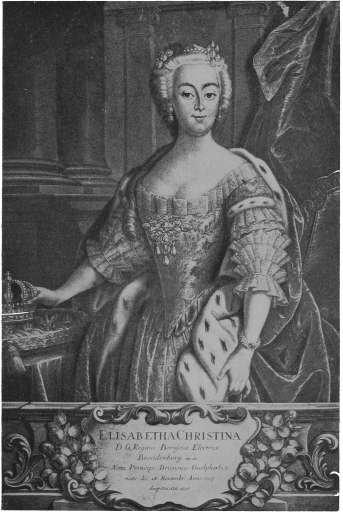
ELIZABETH CHRISTINA OF BRUNSWICK.
FROM AN OLD PRINT.
In 1732 Frederick experienced another pleasure
and a far severer blow. He was allowed to leave
Cüstrin, but he left it under sentence of marriage.
This had been decreed in consequence of a curious
chain of events. Frederick’s preceptors had remarked
that he scorned administrative detail but
displayed a taste for high politics. This was evident
in his suggestions for the disposal of his hand. Now
he would marry, if he must marry at all, Anne of
Russia; now the Archduchess Maria Theresa, renouncing
his succession in Prussia. This suggestion
was reported by Grumbkow to the Emperor’s great
minister, Eugene. The old diplomat scented danger
in such large ideas and urged that the Crown Prince
of Prussia should be bound to the car of Austria.
He might be encouraged to borrow money from the
Emperor, and married to Elizabeth of Brunswick-Bevern,
a niece of the Empress. Frederick William,
still hot against England, with whose Court his queen
continued to intrigue, cheerfully assented to the match.
In a honeyed letter of February 4, 1732, the King
broke the news to his son. “She is a creature who
fears God,” he wrote, “and that is everything.”
The bridegroom elect thought otherwise. He wrote
to Grumbkow that he hated severe virtue, and rather
than marry a fanatic, always grimacing and looking
shocked, he would prefer the worst character in
Berlin. “When all is said and done he cried, there
will be one more unhappy princess in the world.”
“I shall put her away as soon as I am master,” he
twice declared. “Am I of the wood out of which
they carve good husbands?” “I love the fair sex,
my love is very inconstant; I am for enjoyment,
afterwards I despise it. I will keep my word, I will
marry, but that is enough; Bonjour, Madame, et bon
chemin.”
Frederick’s marriage, by which he brought to an
end the sternest period of his second education, was
a crime, but the bridegroom was not guiltless. All
his outcry was made in secret. To the King, in
whose hands his fate lay, he showed himself all submission.
Frederick William had in his own young
days received the names of three princesses from
whom his father desired him to choose a bride. He
protested with success against such compulsion and
his marriage with Sophia Dorothea was something of
a love-match. Here was an argument to which he
could hardly shut his ears. His son preferred to
purchase greater liberty for himself by condemning
to a life of misery an innocent creature who had
never harmed him. At the same time, by making a
happy home-life impossible, he shut out what was
perhaps the last chance that he might become in
any sense of the words a good man.
For the moment, however, his submission brought
him freedom. On March 10, 1732, he went through
the formal ceremony of betrothal. Some of the
guests remarked that his eyes were filled with tears
and that he turned abruptly from his betrothed to a
lady who was supposed to be the mistress of his
heart. But a year’s respite was granted him. While
Austrian statesmen schemed to turn the timid,
ignorant Elizabeth of Brunswick-Bevern into a woman
of the world, who might make her husband a
Hapsburg partisan, Frederick was learning his work
as colonel not far from the field of Fehrbellin. It
was drudgery, but it was not Cüstrin. After a year
of it he wrote: “I have just drilled, I drill, I shall
drill. That is all the news. But it is delightful to
indulge in a few moments’ breathing-space, and I
would rather drill here from dawn to dusk than live
as a rich man at Berlin.”
June 12, 1733, was Frederick’s wedding-day. The
Austrian diplomats, who had made the match, went
far towards flinging away their advantage. At the
last moment they dared to suggest that Frederick
William should accommodate the Emperor by entering
into a new combination which assigned an English
bride to his son. The King was furious at the
slight, and the marriage was only another step
towards the alienation of the Hapsburgs and the
Hohenzollerns.
After his marriage Frederick’s father still dictated
his movements and kept him short of money. But
the period of dragooning was over, and it becomes
important to enquire what Frederick William had
achieved by this stage of the second education begun
with crime and carried on with cruelty. One
answer to this question must be mentioned because
it is supported by the authority of Carlyle. He
holds that the execution of Katte was just, that the
imprisonment of Frederick was salutary, that the
King was a father yearning to reconcile his son with
God and with himself, and that he was not only just
and affectionate but also successful. An opinion
more widely held is that the execution and imprisonment
were unjust but politic, that reasons of
state excused them, that their righteousness was
proved by their success, and that by them Prussia
gained a hero who made her great among the nations
of the earth as none but he was able.
On reflection we may think it strange that results
so great should have been achieved by a scheme of
education so stupid. The King owed the best features
of his plan to suggestions from outside. He had condemned
his son to tedious, nay, dangerous idleness:
it was Wolden who obtained for him a grudging
permission to work. He had set him to learn agriculture
by attending board meetings: it was Hille
who urged that he should be allowed to see how
farming was carried on. The united efforts of Hille
and Wolden could not convince him that the heir to
the throne needed any books save books of devotion.
These faults, though significant, were errors
of detail. But the King’s whole plan is open to
graver objections. It is in fact based on three of
the commonest yet most fatal errors with regard to
education. That boys are dough or putty to be
placed in a mould and beaten till they take the exact
shape of it, that a youth who is destined for a
given career will succeed best by trying to make
himself a facsimile of some one else who has been
successful in it, and that it is good to limit training
to the acquisition of professional aptitude—these
are errors which Frederick William held in common
with pedants and doctrinaires of every era.
From Frederick’s birth onwards he had laboured
to give him his own characteristics, even his own
vices, in the hope that as his son’s conduct grew
like his own, so also would his policy. This was
still the aim of all his measures. But the second
education is distinguished from the first by the
ghastly object-lesson with which it opens and by its
appearance of success. The death of Katte affords
the measure of Frederick William’s powers as a
teacher. It imperilled the health, even the reason
of his pupil, but assuredly it was not forgotten.
Are we then to infer that the King’s system atoned
for its faults by its triumph? That Frederick was
bullied into love for his father seems incredible. It
is true that in public he spoke little ill of him, either
before his death, when it would have been dangerous
to himself, or after it, when it would have been
detrimental to the office which he had inherited.
But neither his motto nor his conduct after 1730
betokened love. “Far from love, far from the
thunderbolt,” are not words of affection, nor is it
filial piety to cozen, to flatter, and to shun. He addressed
the King as “most all-gracious Father,”
while he secretly petitioned the foes of Prussia for
funds wherewith to play upon his weakness for tall
recruits. It was like a foretaste of death, he said,
when a hussar appeared to command his presence at
Berlin.
It may at once be granted that in conduct Frederick
was transformed. Before his disgrace he had
been a trifler, after it he worked hard till the day of
his death. What is doubtful is that this result
could not have been obtained at a less cost. There
is no evidence that the King had ever tried the
normal method of giving his son a fitting task and a
reasonable independence in performing it. Frederick,
moreover, was nearing the age at which many
triflers develop a new spirit. During his year of
exile his health improved. He became stouter in
body and firmer in gait, so that at first even Wilhelmina
did not recognise him. This change at least
was not designed by the father who wished him
dead, yet to this may be ascribed much of his novel
energy.
It is still less certain that his character had gained
from the second education. Many of the striking
traits of old reappear. Frederick is still before
all else brilliant—a gay and versatile young man
with elastic spirits and a passion for music, society,
and intellectual conversation. Despite his
father’s hatred of all things French, Frederick still
looked on Paris as the Mecca of civilisation. His literary
ambitions were more pronounced than ever. At
Cüstrin he had gone back to verses—verses always
Gallic, copious, and bad. A Prussian patriot lamented
that while he knew not whether his ancestors
had won Magdeburg at cards or in some other
way, he had Aristotle’s rules of composition by
heart. Yet, for all his perseverance, Lord Mahon
speaks with justice of “his two kinds of prose, the
rhymed and unrhymed.” In the darkest hours of
his struggle against all Europe, he sat down to
rhyme in French. “He does not really know the
Germans at all,” complained his tutors. Though
sometimes brutal, he prided himself on his ceremonious
politeness—a German version of Louis XIV.
All through his career he was wont at times to put
on the great monarch. “Hush, gentlemen,” once exclaimed
Voltaire when his royal host thus suddenly
stiffened, “the King of Prussia has just come in.”
His morals were no better after confronting death
than before. “The flesh is weak,” he writes to his
mother, “but I do not believe that Cato was Cato
when he was young.” It was said that the motive
of his amours was vainglory rather than the satisfaction
of vicious desires. No one, wrote harsh critics,
could rely upon his word, and few if any could tell
of a disinterested act that he had done.
Yet in some respects Frederick had gained. His
talent for diplomacy grew with the need for it.
His father’s schooling had this effect—that he
learned to outwit his father. The closing years of
Frederick William’s life were cheered by the mirage
of a good son and a good husband, which of all
Frederick’s fabrications was perhaps the cleverest.
Progress in diplomacy was attended by increase of
self-control. Frederick learned in a hard school to
disguise his true emotions and to feign what he did
not feel. Hence arises a difficulty which Carlyle
constantly encounters as he strives to approach his
hero with paternal sympathy and to penetrate into
his inner man. He is forced to speak of Frederick’s
“polished panoply,” and to describe him as “outwardly
a radiant but metallic object to mankind.”
The King’s handiwork may be discerned in the
increasing poverty of affection that his son displayed.
Frederick William had killed his friend,
proscribed his associates, banished his sister, placed
his mother under a cloud, and forced upon him a
wife whom he despised. It is not surprising that
Frederick’s heart, never of the tenderest, grew harder
year by year. He turned to the friendship of men,
always difficult for kings to win, and doubly difficult
for an autocrat who was not prone to self-sacrifice.
It was remarked of him in later life that he softened
only in illness, and that the sure sign of his recovery
was renewed harshness towards those about him.
His intimates were chiefly devotees of art and letters,
among whom Voltaire was chief. But the very
name of Voltaire, whom Frederick first adored and
then expelled, hints at the transient nature of these
ties. As his sister, his mother, and Madame de
Camas were one by one removed by death, he became
bankrupt of affection, and his old age was consoled
only by the fidelity of his servants and of his
dogs.
Such was Frederick at his marriage, but his very
defects contributed for a time to his social success.
An accomplished man, with great flashing eyes and
flexible, resonant voice, “musical even in cursing,”
he had a genuine relish for the circle of which
he was the centre. His schooling had given him
skill in seeming what he pleased, and whatever
affection he possessed was given to his friends. At
Rheinsberg, where he built himself a house and
lived from 1736 till 1740, he was gay, hospitable,
and refined, living in apparent amity with his wife
and fitting himself by study and by administration
to fill the throne in his turn.
The year after Frederick’s marriage, the year 1734,
was of high importance in his career. The war of
the Polish Succession had broken out between France
and the Empire, and Prussia fulfilled her obligations
by sending an auxiliary force of ten thousand
men to serve on the Rhine under Eugene. In this
campaign, which proved inglorious, Frederick played
the part of an eager novice, dogging the footsteps of
the aged hero and copying even his curt manner.
There he laid to heart several fruitful facts—that
the great commander never accepted praise to his
face, that the enemy feared him more than they
feared his army, and that other German troops cut
a sorry figure beside the men of Prussia. And—though
his father had ordered him to keep out of
harm’s way—he proved by his calm while cannon-balls
were splintering trees around him that the
traditional courage of the Hohenzollerns had descended
to him.
Next year (1735) he begged to go to the war again,
but the King, who had been near death from dropsy,
put him off with a journey to Ost-Preussen. This
was the first of those official tours of inspection
which later became one of the chief occupations of
Frederick’s years of peace. In 1736 he began a far
more agreeable pursuit. It was then that he established
himself at Rheinsberg, and, that, to quote his
own testimony, he began to live.
To live, in Frederick’s vocabulary, meant to read.
He plunged into books, comparing, annotating, analysing,
and learned by four days’ trial the lesson of
the zealous freshman—that man needs more than
two hours’ sleep a day. To the remonstrances of
the doctors he replied that he would rather suffer in
body than in mind. Books were supplemented by
conversation, the society of ladies, music, theatricals,
literary effort of every kind. His Anti-Machiavel,
a treatise on the duty of princes, attracted the attention
of Europe, and men of liberal mind awaited
with impatience the moment at which he would be
able to put his virtuous maxims into practice. Meanwhile
he revelled in intercourse with philosophers
and learned men. Frederick styled his house “the
temple of friendship,” and his guests rejoiced to find
that the palace of a Crown Prince could be Liberty
Hall.
Yet the hand of Frederick William was not entirely
invisible. Thrice every Sunday must the master
of the house tear himself from philosophy to
go to church, and he was also compelled to read the
sermons which his father’s favourite chaplains had
composed. His own select preacher was Voltaire,
with whom and with his intimates he “reasoned high
Of providence, fore-knowledge, will and fate, Passion
and apathy and glory and shame.” From history he
learned much for every department of life; from
philosophy chiefly contempt for religion and a
deep-rooted fatalism which sustained him at many
moments of disaster. He speaks of
“this Necessity, which orders all things, directs our
intercourse and determines our fate.” “I know too
well that we cannot escape from the inexorable laws of
fate ... and that it would be folly to desire to
oppose what is Necessity and was so arranged from all
eternity. I admit that consolation drawn from the impossibility
of avoiding an evil is not very well fitted to
make the evil lighter, but still there is something calming
in the thought that the bitter which we must taste is
not the result of our fault, but pertains to the design
and arrangement of Providence.”
In such discussions passed many hours of the
halcyon period, 1736–1740. Of perhaps higher value
was the insight into the possibilities of human providence
which Frederick gained during his visits to
Ost-Preussen. There he saw how the hand of his
father had turned a wilderness into the most blooming
of his provinces, so that a land which the King
had found swept bare of men by the plague now
contained half a million prosperous inhabitants.
When at last (May 31, 1740) he took the place of
the father whose last hours his presence had consoled,
it was with a conviction that if his foreign
policy had been contemptible, he had shown himself
heroic at home.
VOLTAIRE.
FROM THE STATUE BY HOUDON AT THE COMÉDIE FRANÇAIS.
The time had come when the domestic organisation
of Prussia was to acquire a new significance
in Europe. At Rheinsberg, while protesting that
he desired nothing more in life than to be left in
peace with his books and his friends, Frederick had
been steadily pursuing the study of politics. In
1738 he had set down on paper “Considerations”
which pointed to the need of a new champion
to defend the liberties of Europe against the
stealthy and menacing expansion of France. It
remained to be seen whether Prussian foreign policy
would in future be influenced by her singular constitution.
To appreciate the meaning and the value
of Frederick’s innovations in both systems we must
portray the situation that he found on his accession.
This demands in the first place a brief scrutiny of
Europe as it was at Frederick William’s death.
CHAPTER III THE PROBLEM OF 1740
In his instructions for the education of his successor,
Frederick prescribed a thorough course
of European history from the time of the Emperor
Charles V. (1519–1556) to his own reign. This
had been the favourite study of his own youth, so
that at his accession he realised to the full that modern
Europe owed little of its political contour to
chance, but much to the aspirations and struggles of
the several states during the last two centuries. For
modern Europe was no older than Charles V. Right
through the Middle Ages the Christian world maintained
that supreme authority, like truth, ought to be
one, and that every Christian should look up to the
Emperor in matters temporal as he looked up to
the Pope in matters spiritual. On the secular side,
however, this theory had crumbled beneath its own
weight. Even a Charlemagne could not really rule
the world. As the various races of mankind who
lived in England, France, Spain, and Scandinavia
gradually came under the sway of a few national
rulers, the Emperor dwindled into a dignified president
of German princes. His lordship of the world
survived only in distracting claims to rule more
widely and more exclusively than his attenuated
power could warrant. Two sharp shocks heralded
modern times. First Columbus bestowed upon his
masters, the Kings of Spain, a new world which had
never heard of Pope and Emperor and which the
Emperor at least did not pretend to sway. Then
Luther, wrestling blindly with the papacy, shattered
the central pillar of the mediæval world, and modern
history, the biography of a group of independent
states, began.
These states, however, did not enjoy unchallenged
independence. Each had to work out its own religious
settlement, and—if it embraced the Reformation—had
to repel, with whatever help it could find,
the rescue-work of the Pope and his allies. To the
end of the sixteenth century, through the careers of
Charles V., Elizabeth, William of Orange, Henry of
Navarre, Romanist and Protestant States always
tended to fall apart into two hostile camps. Even
in Frederick’s time religious affinity always counted
for something. He had laid history to heart and, as
we shall see, profited in his dealings with England
by the old cry of “Church in danger.” On his lips
the cry was a mere ruse. The day of crusades was
over. In the sixteenth century Spain, Austria, and
Italy rejected the Reformation; England established
its own Church; France came to terms with the
Huguenots. At the great Peace of Westphalia Germany
established parity between the warring creeds,
a boon tardily won by thirty years of desolation.
Thenceforward affairs of state came first in every
land. Louis XIV.’s revocation of the Edict of
Nantes in 1685 proved that religious aggression was
to be feared only as the sequel of undue political
preponderance. From the birth of modern
states down to our own time, the bugbear of the
nations has been world-rule and their watchword
equilibrium.
The first prince who threatened to restore in fact
if not in form the world-rule which had broken down
in the Middle Ages was Charles V., the scion and
pattern of the House of Hapsburg, whose career is
the narrative of European politics from 1519 to 1556.
France, which he threatened most, took the lead
against him, began the long duel between Bourbon
and Hapsburg, and thus guarded the liberties of
Europe till the close of the Thirty Years’ War
(1648). Then Louis XIV. threatened to make
France in her turn mistress of the world. The equilibrium
which he, as absolute ruler of the foremost
State of Europe, seemed to have overthrown, was
painfully re-established at Utrecht (1713). A new
and greater Thirty Years’ War was thus brought to
an end. It left the States weary and timid, dreading
France as a century earlier they had dreaded
Spain, clinging to peace lest the whole fabric of Europe
should collapse and with it the gains which
they had made or hoped to make should vanish.
France, conscious of weakness in spite of the glories
of Louis XIV., turned to diplomacy and won Lorraine.
England, ridden on a loose rein by Walpole,
followed her natural bent towards the sea. For
Austria and the Hapsburg Charles VI., the great
problem was to keep what had already been heaped
together. Only Spain was not afraid to break the
peace, and in the long run she gained parts of Italy
by her boldness.
Most of the territorial profits made by European
Powers during the years 1713–1740 were made
at the expense of Charles VI., either as head of
the Hapsburgs or as Emperor. As it became certain
that he would have no son, he grew more
and more reckless in sacrificing the welfare of the
Empire to that of his House. The future of his
heir was indeed precarious. For there was not
and never had been an Austria in the same sense
in which there was an England, a France, or a Spain;
that is, a well-knit nation, preferring ruin to dismemberment.
“Austria” meant the dominions of the
elder branch of the House of Hapsburg just as
“Prussia” under Frederick I. meant the dominions
of the elder branch of the House of Hohenzollern.
In the case of the Hapsburg agglomeration, however,
the subjects were too many, too miscellaneous,
and too rich for the work of a Frederick William to
be possible. Germans, Hungarians, and Italians
were only the chief among a motley crowd of races
which had come under the sceptre of Charles VI.’s
ancestors and which he strained every nerve to hand
down to his daughter undispersed.
The method which Charles selected was to proclaim
that his dominions were one and indivisible,
and descended to a female heir if no male were forthcoming.
This he did by the famous Pragmatic
Sanction, a document which for fifteen years, from
1725 to 1740, was the pivot of European politics.
From State after State Charles purchased a guarantee
of the Pragmatic Sanction, which amounted to
an undertaking to recognise his daughter, Maria
Theresa, as heir to the Hapsburg dominions. For
this he yielded to Spain broad lands in Italy, for
this he sacrificed commercial prospects to the sea-powers
England and Holland, for this he consented
that Lorraine should pass from Germany to
France, for this he followed Russia into a Turkish
war which cost him great tracts on either side the
Danube. For this, too, he committed what was perhaps
the most dangerous of all his blunders. He
played fast and loose with a time-honoured ally, and
estranged the King of Prussia.
Ever since the Peace of Westphalia had given
them freedom to make alliances where they would,
the policy of the Hohenzollerns had been to maintain
a good understanding with Austria. It might,
indeed, happen, as after 1679, when Louis XIV.
hired them, that some other course became so advantageous
that for the moment they adopted it. In
general however, the Emperor had most to give.
To him the German princes still looked for investiture,
for arbitration, and for promotion, and if a State
desired to exercise its troops, who was so likely as
the lord of the long Hapsburg frontiers to be at war?
King Frederick William might reasonably hope that
the Power which had given his father the crown,
which had led Prussians to victory before Turin, and
which had permitted him to keep conquests in
Swedish Pomerania (1720), would reward his devoted
service by favouring his pretensions to inheritance
on the Rhine.
Though a forceful squire, as a statesman the King
lacked imagination. He was master of the finest
soldiers in Europe, yet he dared not vindicate
his claims to Jülich-Berg without the help of the
Emperor, and he could not understand that the
Emperor might be reluctant to help the master of
the finest soldiers in Europe. Such was, however,
the truth. The rise of the Hohenzollerns had long
been watched at Vienna with not unnatural jealousy.
Even against the Turk Prussians were but sparingly
enlisted. The gift of the crown had been hotly
opposed and bitterly regretted. When Frederick
William cried, “The Emperor will have to spurn
me from him with his feet: I am his unto death,
faithful to the last drop of my blood,” it was already
a Hapsburg maxim that a new Vandal kingdom
must not arise on the shores of the Baltic.
The statesmen at Vienna valued the Prussian alliance
enough to employ Grumbkow and the Austrian
ministers at Berlin to hoodwink Frederick William.
As we have seen, they lavished pocket-money and
sacrificed a bride in the hope of securing ascendancy
over his son. But they blundered greatly when to
please England and thereby to further the Pragmatic
Sanction, they bade the King break off a marriage
which all the world knew was fixed for the very next
day, and they blundered still more when to please
France and Holland with the same end in view they
withdrew the promise of supporting him in Jülich-Berg.
In 1732 Frederick William, for the only time
in his life, met Charles VI. face to face and the truth
with regard to the relations between Hapsburg and
Hohenzollern began to dawn upon him. All his life
he had been the vassal of an Emperor whom he had
imagined as a German overlord, heir to the dignity
of the Cæsars, who when the time was ripe would
look with paternal complacency upon the Prussian
claims. The vision faded and revealed a rival monarch,
pompous, contemptuous, and shifty. The shock
of disillusionment was terrible, but before his death
he saw clearly. Once, it is said, he pointed to Frederick
with the words, “There stands one who will
avenge me.” It is certain that with failing breath he
warned his son against the policy of Vienna.
Thus, even supposing that Frederick’s view of
politics had been no wider than his father’s, that he
had come to the throne resolved merely to keep up
a great army and to win Jülich-Berg, he would none
the less have possessed remarkable freedom of action.
In foreign politics he was fettered by only one great
treaty, that of Berlin (December, 1728), by which
Prussia undertook to maintain the Pragmatic Sanction.
But it was possible to contend that this agreement,
which was made in secret to secure the
Emperor’s assistance in Jülich-Berg, became void in
1739, when Austria entered into conflicting engagements
with France.
Circumstances, too, were favourable to Frederick’s
liberty. The very existence of the Pragmatic
Sanction, a violent remedy against dissolution,
was a guarantee that Austria would be harmless
for years to come. If Charles VI. and his heir were
loath to uphold Prussia on the Rhine, they would
be very unlikely to risk their own existence by
taking up arms against her. In other quarters
Prussia had little to fear. Hanover, the parvenu
electorate which lay like a broad barrier across the
direct road from Berlin to the West, had become
a dependency of England in 1714, and therefore
was not dangerous. Whatever might be the wishes
of George II., it was certain that Walpole would
not spend blood and treasure to maintain the House
of Pfalz-Sulzbach, Prussia’s rival in Jülich-Berg, at
Düsseldorf. The Dutch, it is true, felt themselves
menaced by a Prussian garrison in Cleves, but
their course had by this time become that of a
mere cock-boat in the wake of Great Britain. France
alone remained to be considered, and France, with a
frontier fifty leagues from Berg, was guided by a
Walpole of her own, Cardinal Fleury, now nearing
the close of his eighty-seventh year. If then Frederick
elected to make Prussia more considerable
among the Powers of the West by pressing his claims
to Berg he could fling his sword into the scales of
justice without great fear that a stronger hand would
turn the balance against him.
Adventure in the Rhine countries had much to
commend it to the young King. His House undoubtedly
possessed some title to Berg, and it had been
the secular policy of the Hohenzollerns to forego no
claim without arguing to the death. The busy and
fertile Rhineland was a gold-mine in comparison
with the sterile Mark. Frederick, as an enthusiast
for the higher civilisation of the West, might well
feel drawn towards a duchy which lay more than
half-way along the direct line from his capital to
Paris. And, greatest merit of all in the eyes of a
dynasty of merchants, Berg was eminently salable.
The Rhenish duchies were like good accommodation-lands
in the midst of thriving farms. Many rulers
would always be glad of them and their price would
therefore be high.
But the arguments against staking all on Berg
were also strong. A statesman trained between
the Elbe and the Oder could hardly be unaware
that Prussia’s heritage in the West was a mere
windfall and that by interest as by situation she
belonged to the system of the North. Her natural
outlook was towards the Baltic, which formed the
only free road between her centre and her eastern
wing. It was by foregoing lands on the Baltic that
she had gained rich bishoprics to the westward
in 1648. Baltic Powers, Poland, Russia, and above
all Sweden, had steadily influenced her politics since
the advent of the Great Elector. History and geography
alike seemed to beckon young Frederick to
the sea. Let us therefore cast a glance at those
among his neighbours whom he had to take account
of, whatever plan he might devise.
FREDERICK WILLIAM THE FIRST.
AFTER THE PAINTING BY F. W. WEIDEMAN.
Just as the traditional enemy of the Bourbon was
the Hapsburg, so the traditional enemy of the Hohenzollern
was the Vasa. This gifted House had
ruled in Sweden since 1520 and had chosen for their
country a path which it was not strong enough to
follow to the end. They had striven to turn the
Baltic into a Swedish lake by conquering all its
coasts. Success seemed nearest when in 1630 Gustavus
landed in Germany, and at the point of the
sword compelled his kinsman of Brandenburg to favour
his adventure. The result of these bold steps
was for Sweden a swift blaze of glory; for Brandenburg
a decade of misery inflicted in great part by
Swedish hands. In 1648 the great treaty compensated
the Swedes for their work by driving the Great
Elector from the mouth of the Oder. Their ambition
to be masters of the Baltic shores, however,
remained, and the Great Elector suffered much at
their hands before the Peace of Oliva (1660) confirmed
his sovereignty over Ost-Preussen. What happened
at Fehrbellin and after it has been already
told. The meteoric career of Charles XII. (1697–1718),
who began by humbling Prussia, but ended by
losing Stettin to her, is no part of our story, except
in so far as it interested and influenced young Frederick.
It suffices that in 1740 Sweden was factious
and impotent, and that her aged King still held that
part of Pomerania which Prussia did not possess.
To acquire Western Pomerania was therefore a possible
object for Frederick’s ambition.
The central mass of the Hohenzollern dominions
touched along almost the whole of its eastern frontier
a Power whose decline was even more visible than
that of Sweden. The Polish Republic, which almost
encircled Ost-Preussen, formed perhaps the strangest
spectacle that Europe has ever seen. A vaster country
than any of the Western Powers, Poland remained
in the Middle Ages. Her constitution,
indeed, seemed to have no other end than to make
progress impossible. There were only two classes,
nobles and serfs, the free and the unfree. But where
every freeman was noble, many nobles were poor.
These served for hire, and were distinguished, it is
said, from men of lower birth by the privilege of
being flogged upon a Turkey carpet. The direction
of this vast country rested with a few thousand
feudal chiefs who elected a nominal King from
within their own body or outside it. They made
the laws themselves, but a single dissentient voice
could wreck the work of a whole Diet, as the annual
session of Parliament was termed, and of late years
this right had commonly been exercised. What
trade there was, was left to the despised class of
German burghers. The fighting force grew every
year more feeble. While Austria could boast a Eugene
and Russia a Peter, while the parade-ground at
Potsdam was trodden by ever-growing masses of
men who handled modern weapons with the precision
given by daily practice, the Poles were blindly
trusting in feudal levies generalled by a puppet King.
At Frederick’s accession, however, Poland still
possessed two elements of strength besides her vast
bulk and the knightly courage of her sons. These
were the Saxon connexion and the port of Danzig.
Two years earlier, at the price of war with France
(1733–1738) and loss of lands in Italy, Charles VI.
had secured the Polish crown for the son of the late
King, Augustus III., the Elector of Saxony. The
Emperor made this sacrifice to win support for the
Pragmatic Sanction and to propitiate Russia, who
looked upon Poland as her own if the French candidate
were expelled. And, as the road from Dresden
to Warsaw passed through the Hapsburg
province of Silesia, Augustus had good reason to be
faithful to the daughter of Charles VI.
Poland none the less promised much to a king of
Prussia who could wait. Her artificial connexion
with Saxony, established by foreign Powers against
the will of a majority of the Poles, could only weaken
the frail bonds which bound the State together.
Poland, all the world had long known, would one day
fall in pieces, and who should hinder Prussia from
gathering some of them? For the moment, however,
Augustus could defend his new dominions. A
king of Prussia in a fever to act at once could not
assail Poland without laying bare his flank to Saxony
and to her Imperial ally.
But could Prussia in 1740 afford to wait? If Augustus’s
dream were to be fulfilled would not she be
in jeopardy? The Elector hoped that the Emperor
would cede to him a part of Lower Silesia, so that
Prussia might be for ever divided and hemmed in by
a Saxon-Polish State. Had we no other guide than
the map, we might be tempted to guess that it was
to avert this peril that Frederick seized Silesia. If
it were true it were a grievous fault. Augustus,
who was no statesman, might dream of a hereditary
crown, but a firm Saxony-Poland was in fact impossible.
Dresden and Warsaw were centuries apart.
Out of two such halves no strong whole could be
compounded. The one was German, the other
Slav; the one industrial, the other primitive; the one
Lutheran, the other partly Romanist and partly
Orthodox. Compounds so discordant could have
found no abiding unity in a monarchy based on the
treason of their common head against the constitution
of each. Nor could such a State have barred
for a decade the path of the Muscovite Colossus
which Peter had already roused and which Catherine
and Alexander were soon to reinspire.
In weighing Frederick’s wisdom we must not forget
that the share of Poland which he might expect
that Prussia was destined to acquire, and which did,
in fact, fall to her during his own lifetime, would
change Ost-Preussen from an isolated province into
a strong limb of a well-knit State. It gave her the
lower waters of a third great arterial river—the Vistula.
But it came to her in 1774 shorn of its chief
glory, the old portal of the Vistula and strong tower
of Poland, the matchless town of Danzig. Frederick
had seen that fair city, a hearth of German
culture among the Slavs, with its giant Marienkirche
towering over a mass of battlements and
gates and churches of stately civic halls and mansions
hardly less stately, the whole forming a Venice
of the North beside which his capital was but a
market town. He must have taken note of the
foundation of all this grandeur, great warehouses on
busy wharves, canals crowded with masts and hulls
from many lands. And he cannot have been blind
to the fact that within a few miles of this prize lay
Ost-Preussen, and that, since Augustus had surrendered
Curland, within a few miles of Ost-Preussen
lay Russia. Seldom has a king had clearer warning
to look before he leaped.
Thus, without departing from the policy of the
men who had made Prussia what she was, the young
King had his choice between adventure on the
Rhine or across the Peene and a policy of expectant
watchfulness on the Vistula. But if he were
capable of building upon the foundations of his
forefathers the loftiest structure that they would
bear, then a still more glorious conquest might be
his. Lord of Stettin and of the ports of Ost-Preussen,
he might claim a share in what all the nations
coveted, the empire of the sea.
It is one of the most grotesque facts in history that
the Emperor William II., when he cried, “Our future
lies upon the water,” should have been uttering as
prophecy what ought to have been commonplace
for a century and a half. Even in 1740 the truth
that the New World offered a fairer career than the
Old was not hidden from statesmen less astute than
Frederick. Since the Armada foundered in 1588,
the nations of Europe had been realising it one by
one. Spain and Portugal, the first in the field, still
held a vast heritage across the ocean, but their
monopoly was not as unchallenged as of old. First
the Dutch, who as subjects of Spain had monopolised
that carrying-trade which seemed to be beneath the
dignity of an Iberian gentleman, enriched themselves
so rapidly that they were able to throw off
the yoke of Philip II. and to establish a colonial and
commercial empire of their own. Then England,
tardily comprehending the changing conditions of
life, grappled with their little republic in a long and
doubtful struggle. Finally weight told, and after
the Revolution of 1688 England under her Dutch
King led the way and Holland followed in a campaign
against a rival dangerous to both. For France
had been guided by Colbert into the path of greatness
beyond the seas, and it was by grasping at Spain
and the Indies that Louis XIV. aroused the keenest
apprehensions that he might become dictator of the
world. Only at the cost of two mighty wars had
the danger from France been averted for a generation.
By the Peace of Utrecht (1713) the Sea Powers
gained security for themselves and for their commerce,
but the prize of North America still remained
to be fought for between France and England.
In the early years of the eighteenth century other
competitors put to sea. Under Peter the Great, the
new land Power, Russia, struggled to become maritime,
though her horizon, as yet, hardly extended
beyond European waters. But in 1722 the Emperor
Charles VI. made his port of Ostend the
headquarters of a new Imperial East India Company,
and England, France, and Holland joined in
an outcry against German competition. Nine years
later they were appeased. The Hapsburg sacrificed
the future of his House to its past. To purchase
guarantees of the Pragmatic Sanction he withdrew
his support from the Company, which none the less
was able to maintain itself for more than sixty years.
If then the tide had set so strongly towards
distant continents that even conservative ill-knit
Austria was swept along with it, we may well ask,
what of Prussia? The history of our own time
makes the question more pertinent. North Germany
has shown beyond dispute not only that she can
now build ships, a fact which proves little or nothing
as to her powers in the past, but also that she can
fill them with brave and skilful seamen, whose character
only many generations of worthy forefathers
could create. These forefathers were the Prussians
of Frederick’s day, poor, fearless, and docile, living
on the borders of the Baltic, speeding and welcoming
its fleets at Memel, at Pillau, at Colberg, and
above all at Stettin. Why, it may be wondered,
was Frederick blind to the signs of the times?
Why did not he at the very outset of his reign
hasten to employ the power of the Crown, which
Frederick William had raised so high, to equip a
Prussian Baltic Company, a Prussian West Africa
Company, even a Prussian East India Company?
Never was the political situation more favourable
to such an enterprise than when Frederick grasped
the reins. No neighbour could enforce a veto upon
Prussian maritime enterprise. Poland was in the
last stage of impotence and decay. Russia, who
might form a good customer, was not yet equipped
for conquest. Austria could not afford to offend a
German ally. Sweden had lost her sting and her
province of Pomerania was a hostage at Frederick’s
mercy. The Sea Powers would view the enterprise
askance, but they too had given hostages to Prussia.
If England played foul, the master of eighty thousand
men could overrun Hanover in a fortnight and
the Dutch would think twice ere they provoked the
lord of Cleves. Of all Powers Denmark, the surly
janitor of the Baltic, was perhaps the best able to
injure Prussian commerce with impunity, but the
heir of the Great Elector might be trusted to find a
way with Denmark. Thus Europe seemed to invite
Prussia to follow the destiny which nature prescribed,
and which led to wealth. Firmly governed,
armed to the teeth, learned, Protestant, and rich, she
might have pursued her old opportunist policy on
the mainland with full confidence that the future
would bring her wider boundaries and yet greater
strength.
In an earlier generation and with smaller means
the Great Elector had perceived that the true path
for Prussia lay across the seas. Balked of Stettin,
he strove to make Pillau and Memel his London
and Amsterdam. His little Armada of ten frigates
attacked the Spaniards with success. In a humble
way there began to be Brandenburgish West Indies,
and in 1683 Fort Great-Fredericksburgh was built
upon the Brandenburgish Gold Coast. But the
Great Elector’s son and grandson lacked either his
firm hand or his imagination. While Frederick I. was
squabbling with the Dutch about armchairs, the
Dutch were driving his subjects from West Africa.
Frederick William, the apostle of domestic economy,
was impatient of flunkeys, universities, and colonies,
the several extravagances of his father and of his
grandfather. Would Frederick II. prove himself
more enlightened?
We see with amazement that he did not. A
prince who was accounted clever, who had spent
the first decade of manhood in pondering on high
politics, who revered the memory of the Great
Elector, and followed the fortunes of England with
keen interest—how could such an one ignore what
the movement of the times and the course of
after events seem to point out so clearly? Among
his first acts was the establishment of a new department
of manufactures. He commanded the head of
it to take measures for improving the condition of
existing industries, for introducing new ones, and
for bringing in foreign capital and foreign hands.
Why did he not at the same time establish a department
of marine? Why did he wait till East Frisia
fell to Prussia before making even a half-hearted
effort to win profit from the sea?
A partial explanation may lie in the fact that Frederick
lacked the inspiration drawn from travel. The
stupid fears of Frederick William that his son would
become too Frenchified in his life or too Austrian in
his politics had closed to Frederick the doors of the
best school of his time. Who knows how much profit
the Great Elector brought to his State from his education
in Holland, or Peter the Great from his journeys
in the West? Save at Danzig, Frederick had
hardly seen with his own eyes the dignity which
commerce might create. Save for two stolen days
in Strasburg in the first months of his reign, a secret
visit to Holland in 1755, and a meeting with the
Emperor in Moravia in 1770, he was fated never to
gain fresh knowledge of what would now be foreign
lands except at the head of his army.
Again, Frederick’s political economy was unfavourable
to Prussian commerce. At Cüstrin he
learned from Hille that the only trade by which a
country can profit is that which adds to its stock
of gold and silver. His father had carried this idea
to its logical conclusion. He had seized the precious
metals and locked them up. Like a timid
farmer who thinks that the bank will break, he had
hidden in his cellars the hoard which represented
the economies of a lifetime. Frederick therefore
found a treasure of more than twenty-six million
marks, at a time when the weekly wage of a common
soldier hardly exceeded one.
It seems clear that a policy of hoarding could be
wise only when war was in sight. In time of war
that Government would be happiest which had most
coined money with which to pay its troops. But in
time of peace not even Frederick William could
take a breed from barren metal by keeping it locked
up. Profit could be drawn from it in either of two
ways. The coined metal might be spent to advantage,
so that the State bought something, such
as a school, or a farm, or a flock of sheep, which
would in the future be worth more than the sum
laid out. Or it might be lent to citizens who would
pay for the use of it and establish with its aid some
business which might be taxed. By locking up the
surplus funds of the country, however, the King
stifled commerce at the birth. Frederick did not
detect the fallacy, and Germany waited till the
nineteenth century for her commercial rise.
Though nimble-witted and fond of philosophy,
the King was hardly profound. His lector, the
Swiss de Catt, tells a significant story of his first
discussion with a singular stranger on a Dutch
vessel, whom he did not suspect to be the lord of
Prussia. Frederick, he says,
“tried to prove that creation was impossible. At this
last point I stood out in opposition. ‘But how can
one create something out of nothing?’ said he.
‘That is not the question,’ answered I, ‘the question is,
whether such a Being as God can or cannot give existence
to what has yet none?’ He seemed embarrassed
and added, ‘But the Universe is eternal.’ ‘You
are in a circle,’ said I, ‘how will you get out of it?’ ‘I
skip over it,’ said he, laughing; and then began to speak
of other things.”
He wrote incessantly on history and politics,
always with the clearness and sprightliness that
seem inseparable from the French tongue which he
employed, and always with the confidence of a
journalist and of a king. Of his ancestor Joachim
I. he says: “He received the surname of Nestor
in the same way as Louis XIII. that of ‘the Just’;
that is, for no reason that any one can discover”—and
this is a very fair example of his style. Sense,
lucidity, concise statement, even wit, distinguish his
writings. He made so many confident generalisations
on political affairs that some have almost of
necessity proved correct. But of deep insight, still
less of great constructive power, there is little trace.
In freedom from illusions, however, Frederick surpassed
some rival statesmen. This was abundantly
illustrated at the very outset of his reign. He saw,
as Charles VI. could not, that the claim of the
Emperor to be lord of the world rested on no firm
basis. Early in 1737 he had written: “If the
Emperor dies to-day or to-morrow, what revolutions
will come to pass! Every one will wish to share his
estate, and we shall see as many factions as there
are sovereigns.” The discovery, indeed, was by no
means new. More than a century earlier Gustavus
Adolphus had told the Germans that their constitution
was rotten. But Frederick informs the
Emperor pointedly that he is only first among his
peers. He was equally clear-sighted in the choice
of means to spread his views. William the Silent
had perceived a fact dark to many statesmen since
his time—that the public opinion of Europe is
worth much and that it may be courted through
the Press. Frederick had already composed the
earliest of his many pamphlets, which he intended
to publish anonymously as the work of an Englishman,
to rouse the Sea Powers against France.
More significant than all else was the fact that
he viewed his own strength with clearer eyes than
his father’s. Frederick William had never been able
to convince himself that Prussia was a strong State:
Frederick wears no blinkers and with his accession
the day of half measures is over. Two years before
this he had written to Grumbkow words which
express his real opinion of the old policy of his
House. The affair of Berg, which he as Crown
Prince earnestly hoped would enable him to win
fame on the battle-field, had then entered upon a
phase adverse to Prussian expectations. Austria
had been prevailed on to join with France and the
Sea Powers in claiming that it should be referred to
the arbitration of a congress, and Frederick William,
though disgusted, had decided to give way. Of
this decision Grumbkow approved, writing, “I am
persuaded that a King of Prussia, like a King of
Sardinia, will always have more need of the fox’s
hide than of the lion’s.” Frederick replies (March,
1738):
“I confess that I perceive in the answer a conflict
between greatness and humiliation to which I can never
agree. The answer is like the declaration of a man who
has no stomach for fighting and yet wishes to seem as if
he had. There were only two solutions, either to reply
with noble pride, with no evasions in the shape of petty
negotiations whose real value will soon be recognised,
or to bow ourselves under the degrading yoke that they
wish to lay upon us. I am no subtle politician to couple
together a set of contradictory threats and submissions,
I am young, I would perhaps follow the impetuosity
of my nature; under no circumstances would I do anything
by halves.”
Close observers held that a change of king would
be followed by a change of policy and that Frederick
was likely to attempt great things. What
these would be no one, with the possible exception
of the young King himself, had the least idea.
What in the opinion of the present writer they
should have been is sufficiently indicated above.
What they were, will be shown in the following
chapter.
At first, for all his determination to lose no time,
the results of his accession seemed but small. No
human being could maintain that he was swayed
by his affections. Though Duhan, Keith, and
Katte’s father received some measure of compensation
for their sufferings, Frederick’s behaviour
towards those concerned in his early struggles emboldened
the wits to say that his memory was
excellent as far back as 1730. His Rheinsberg
friends expected to share the spoils of office. They
were disappointed in a way that has reminded
Macaulay of the treatment of Falstaff by Henry V.
Frederick was as masterful as his father. The aged
Prince of Anhalt-Dessau, who had created the
Prussian army, and the aged General von Schulenburg,
who had risked all rather than condemn Katte
to death, were humiliated by royal reprimands.
Grumbkow, with whom he had corresponded for
more than eight years in terms of affectionate
intimacy, might have caused him a moment’s embarrassment,
but he had just died—“for me the
greatest conceivable gain,” the King assured his
sister. He broke up his father’s useless and costly
regiment of giant grenadiers, a measure which Frederick
William had himself advised, but he increased
the effective strength of the army by nearly ten
thousand men. At the same time he sounded, more
clearly even than his ancestor George William, the
note of religious toleration for which Brandenburg
had been honourably distinguished in the time of
her greatest peril. “In this country,” he instructed
his officials, “every one shall get to heaven in his
own way.”
VIEW OF GLATZ IN THE EIGHTEENTH CENTURY.
FROM AN OLD PRINT.
The crowned philosopher always recognised the
difference between the things which were Cæsar’s
and the things which were God’s. The scion of
a Calvinist House, he began his reign by authorising
the Lutherans to restore their ritual, which had
been arbitrarily simplified by his father. He was
soon to court the favour of Breslau by supplying
her with Protestant preachers, and of Glatz by
bestowing vestments upon a statue of the Virgin.
When Romanist Europe expelled the Jesuits, he
seized the opportunity of picking up well-trained
teachers cheap. Some of his papist subjects had a
fancy for buying handkerchiefs which bore the
effigies of saints. Frederick, eager to encourage
the linen manufacture, bade his officials find out
which saints were the most popular and adjust the
supply to the demand.
A story cited by Carlyle illuminates Frederick’s
views upon the relations between Church and State.
He was questioning the monks of Cleve, to whom
the old dukes had assigned an income from the
royal forest-dues for masses to be said on their
behalf. “‘You still say those masses then?’ ‘Certainly,
your Majesty.’ ‘And what good does anybody
get out of them?’ ‘Your Majesty, those
old sovereigns are to obtain heavenly mercy by
them, to be delivered out of purgatory by them.’
‘Purgatory? It is a sore thing for the Forests, all this
while! And they are not yet out, those poor souls,
after so many hundred years of praying?’ Monks
have a fatal apprehension, No. ‘When will they
be out, and the thing complete?’ Monks cannot
say. ‘Send me a courier whenever it is complete!’
sneers the King,” and leaves them to finish the Te
Deum which they had begun to greet his arrival.
Lastly, the forms with which Frederick took up
the kingship showed that the fears of his father and
the hopes of enlightened men were alike without
foundation. It became clear that the philosopher-king,
though he relieved famine and tempted learned
foreigners to Berlin, would not revert to the ill-timed
pageantry of his grandfather. Nor—though he freed
the press and restricted to a few cases the use of
torture—would he anticipate the glory of some
Hohenzollern who is still unborn by fostering a spirit
of individual liberty among his people. Impatient
of coronation, which he classed among the “useless
and frivolous ceremonies which ignorance and superstition
have established,” he received the homage of
his subjects by proxy everywhere save in Ost-Preussen,
Brandenburg, and Cleve. At Königsberg he
paid homage to the memory of liberties which his
ancestors had crushed, and which he had no intention
of animating anew. The ceremony at Berlin
was made memorable by one of his rare displays of
feeling. When he appeared on the balcony of the
Castle and looked down upon the surging crowd in
the square below, he was so affected that he remained
standing many minutes, silent and buried in
thought. Then, recovering himself, he bowed to the
multitude, and rode off to attend a military review.
EUROPE 1740
G. P. Putnam’s Sons. London, & New York.
It is, however, on his journey to Wesel, his Rhenish
capital, that he reveals most clearly how the Crown
Prince has changed into the King. Wilhelmina had
found him of late so careless, even so uncivil, a correspondent
that the news of his coming to Baireuth
prostrated her with joy. He seemed to her so altered
in countenance and developed in form that, just as
after his imprisonment at Cüstrin, she hardly recognised
him. But a less welcome change was only
too perceptible. Wilhelmina found her brother’s
caresses forced, his conversation trivial, their sister,
the Margravine of Ansbach, more favoured than
herself. The remainder of the journey proved that
Frederick at least remained true to the French. At
Frankfort he disguised himself for a flying visit to
Strasburg. There his little party put up at an inn,
sent the landlord to invite officers to their table, and
visited the theatre. The mask was penetrated by a
runaway Prussian whose tall brother had been kidnapped
for the army and who recognised the son of
his former King. The greatest pleasure of all came
last. At Wesel, besides dealing with the affair of
Herstal, which will be described in the next chapter,
Frederick for the first time paid homage in person
to Voltaire.
At the end of October Wilhelmina visited Berlin,
but her brother welcomed her coldly. She found
abundant proofs that he had become inscrutable.
She describes in her Memoirs how the Queen
Mother had shut herself up, equally astonished and
mortified at her complete exclusion from affairs of
State. “Some complained of the little care he had
to reward those who had been attached to him as
prince royal; others, of his avarice, which they said
surpassed that of the late King; others of his passions;
others again of his suspicions, of his mistrust,
of his pride, and of his dissimulation.” This criticism
from an unwonted quarter may possibly be
explained away. It has been suggested that the
King’s treatment of his sister at Baireuth was due
to the same policy of repelling every possible claimant
to influence his policy, which may be held to
excuse the snubs inflicted upon Dessau and Schulenburg
and the dignified exile of Frederick’s mother
and wife. His conduct at Rheinsberg, whither Wilhelmina
followed him, does not admit of the same
excuse.
“The little spare time that he had,” she complains,
“was spent in the company of wits or men of letters.
Such were Voltaire, Maupertuis, Algarotti, and Jordan.
I saw the King but seldom. I had no ground for being
satisfied with our interviews. The greater part of them
was spent either in embarrassed words of politeness or
in outrageous witticisms on the bad state of the Margrave’s
finances; indeed he often ridiculed him and the
princes of the empire, which I felt very much.”
CHAPTER IV THE SILESIAN ADVENTURE, 1740–1742
The proceedings of Frederick in 1740, trivial as
some of them are, reveal him as a statesman,
just as the events of 1730 revealed him as
a man. They therefore possess an interest such as
hardly any other part of his reign can claim. For a
few months he is free to choose his own path in life,
guided only by instinct and education. Thus an
element of free-will is present which is to some extent
lacking in two notable crises of his fortunes—the
tragedy of 1730 and the miracle of 1757. This
year sums up, as it were, the eight and twenty
which had gone to make Frederick what he was: it
shapes his course in the six and forty that were to
follow.
In the story of Prussia, 1740 inevitably suggests
comparison with 1640, when the Great Elector likewise
stood at the parting of the ways. Then and
for years afterwards the choice had lain between
existence and ruin; now it was between increase by
natural growth and perhaps speedier increase by
speculation. For a century Prussia had seldom departed
from a policy of thrift and autocracy at home
and opportunism abroad. Would she now abandon
it? Frederick’s early measures showed that he intended
no sweeping changes in domestic politics.
We may therefore postpone an examination of the
system which he there pursued. For us he is at
present only the lord of ninety thousand of the best-drilled
troops in the world, entangled in no alliances
and hampered by no fears. What choice would be
for him the wisest?
Calm reflection on the situation of Europe in 1740
seems to show that Frederick’s strength was to sit
still. Signs were abundant that the peace which
had prevailed almost from his birth could not endure
much longer. Apart from the problem of Austria,
grave questions had arisen which not even a Walpole
and a Fleury could settle otherwise than by the
sword. France and England, it was felt, would soon
resume the duel which the Peace of Utrecht had
but interrupted, and would struggle for primacy in
America and in the world. Spain and England were
already at war, and Europe knew that the Bourbon
Kings of Spain and France, who were uncle and
nephew, were joined in close alliance. To strike at
King George without crossing the sea France must
aim at Hanover, and the sword of Frederick, the
neighbour of Hanover, would be bid for by both
sides. According to the convenient theory then
current, a prince could hire out an army without
committing his State to war, so that Frederick stood
to gain much,—money, military glory, experience
for his men, perhaps even territory for his House,—while
he need stake nothing save that which he had
long desired to hazard,—his own life and the lives
of his soldiers.
A Hohenzollern was the last man in the world to
undervalue what he might wish to sell. Frederick
strove to persuade Europe that in him a new and
greater Gustavus had appeared. He increased his
army ostentatiously and bade his representative at
Versailles speak of his active and impetuous way
of thinking.
“You can say,” he continues, “that it is to be feared
that this increase kindles a fire which may set all
Europe in a blaze; that it is the way of youth to be
adventurous, and that the alluring visions of heroic
fame may disturb and have disturbed the peace of
countless nations in the world.”
The prospect of acquisitions in the Rhineland
seemed first to engage his thoughts. In hopes of
winning Berg he not only made overtures to France,
but even invited the help of Russia. The fruit of
these negotiations was small. Their significance,
however, is great, since they showed that Frederick
intended to choose his allies without regard to the
tradition of his House in favour of Austria, and also
that he would not shrink from favouring Muscovite
development by employing Cossacks in Western
Germany.
At the same time that he bargained in this spirit
with foreign Powers, Frederick compelled his brother
Germans to mark the change of accent which he was
introducing into the old language of his House.
Brandenburg had taken up the informal protectorate
of the German Protestants when the Saxon Elector
by becoming Romanist (1697) resigned it. Frederick
William devised a safe but effective method
of checking Romanist aggression. If any German
prince persecuted Protestants, the King of Prussia
used forthwith to apply similar oppression to his
own papist subjects. Thus, without stirring from
Berlin, he stayed the hand of persecutors in the distant
valleys of the Neckar and the Salzach. His son
soon proved himself ready to go to greater lengths.
Claims and counter-claims as to territory had
arisen between one of the great Romanist princes,
the Archbishop of Mainz, and the Landgrave of
Hesse-Cassel, the heir of one of the earliest champions
of the Reformation. The former relied on
his own troops and on those of neighbouring bishops,
while he also possessed the support of the
Emperor, whose right to judge the case had been
challenged by his opponent. The Landgrave appealed
to the King of Prussia and to other princes
of the Empire. Frederick’s reply was immediate,
emphatic, and successful. “In case of need,” he
wrote to his brother-Elector of Mainz, “we should
not know how to refrain from affording to the
aforementioned His Dilection the Lord Landgrave
William the necessary protection and help against
unlawful force and disturbance.” At these words
the hostile coalition—Elector, bishops, and Emperor—melted
away. The young King, it was apparent,
had entered the field of German politics with éclat.
Equally peremptory and equally successful was
Frederick’s verdict for his own claims in a dispute
with the Bishop of Liège with regard to Herstal, a
tiny barony lying on the Meuse to the westward of
Aix-la-Chapelle. The inhabitants had resisted the
officers of his father, who would gladly have sold
Herstal to Liège, and the Bishop, who wished to
buy but could not come to terms, had egged them
on. Frederick, scorning the advice of his ministers,
resolved to use his strength as a giant. From Wesel
he sent the following ultimatum to the Bishop:
“Cousin! Knowing all the attacks that you have made
upon my unquestionable rights over my free barony of
Herstal, and how the seditious men of Herstal have been
supported for some years in their detestable disobedience
to me, I have ordered my privy-councillor Rambonnet
to visit you on my behalf, to demand from you
in my name a sincere and categorical explanation within
the space of two days, whether you wish to protect the
mutineers of Herstal in their abominable disorder and
disobedience. In case you refuse, or delay that just
reply which I demand of right, you will render yourself
solely responsible before all the world for the consequences
which your refusal will inevitably bring after
it. I am, etc.”
“This is strong, this is lively,” cried the ambassadors
at Berlin when they read it; “it is the language
of Louis XIV.; it is a beginning which shows what
we must expect some day from this prince.” Their
prophecy was to be fulfilled sooner than they anticipated.
In the meantime the new diplomacy won
another triumph. The Bishop made no reply to the
ultimatum and in a week’s time the Prussians, sowing
apologies broadcast over Europe, seized his
county of Hoorn. The apologies concluded with
the assertion: “His Majesty will never put from him
a just and reasonable arrangement with the said
prince, as the sole end which his justice and moderation
have in view in this affair, these two invariable
principles being the pole-star of all his actions.” The
“just and reasonable arrangement” proved to be
the payment of two hundred thousand thalers to
the King.
Frederick could therefore congratulate himself
that within five months of his accession he had
taught both Prussia and Europe that he was stronger
than his father. It was clear that he was resolved
not to be hoodwinked by man or woman. He had rejected
the advice of his cautious ministers with the
pleasantry that when they spoke of war they resembled
an Iroquois talking of astronomy. The
event had gone far towards silencing the taunt of
Europe that “the Prussians never shoot,” and towards
establishing the truth of Frederick’s well-known
simile, “The Emperor is an old phantom of
an idol and has no longer any nerves.”
A king of Prussia with such a spirit as Frederick
had already shown was not likely to rest long upon
his oars. But it was chance that determined the
course that he was next to steer. The Herstal
treaty, which confirmed his second diplomatic victory,
was signed on October 20th. Six days later a
swift courier brought to Rheinsberg the news that
on that same day the Emperor, Charles VI., had
died. Frederick lay ill of fever. He defied his
doctors, took quinine, and was well. He sent for
his cautious minister Podewils and for the dauntless
soldier Schwerin, and wrote to Voltaire:
“The least expected event in the world forbids me
this time to open my soul to yours as is my wont....
I believe that in June it will be powder, soldiers
and trenches rather than actresses, ballets and theatres....
This is the moment of the entire transformation
of the old system of politics: the stone is loosed which
Nebuchadnezzar beheld when it rolled upon the image
of four metals and destroyed it.”
Two days later he expressed himself with still greater
confidence: “I am not going to Berlin, a trifle like
the Emperor’s death does not demand great commotions.
All was foreseen, all was thought out in
advance. So it is only a question of carrying out
designs which I have long had in my mind.”
These designs were, in brief, so to use the political
situation created by the death of Charles VI. as to
add to Prussia the whole, or at least the north-western
part, of the Hapsburg province of Silesia—the
fertile basin of the upper Oder. In conception
and in execution the idea was Frederick’s own. It
is the pediment of his fame as a hero of his nation.
All the world knows that the capture of Silesia
converted Frederick the Second into Frederick the
Great. It is therefore imperative that at this point,
with judgment unclouded by the smoke of battle and
the incense of victory, we should address ourselves
to the double enquiry, Was it necessary? and Was
it right? postponing but not evading the further
question, Was it wise?
THE RATHHAUS IN BRESLAU.
FROM A STEEL ENGRAVING.
The plea that Silesia was necessary to Prussia, that
the existence of Prussia could only be prolonged or
her people safeguarded or fed if Silesia were hers,
may be dismissed at once. Necessity is the usual
pillar of a claim to extend the area of dominion over
lands lately rescued from barbarism. The Law of
Nations declares that, when under such conditions
two civilised states desire the same territory, one
may further its claim by showing that without this
addition the territory which it already has would be
rendered worthless. But what might give a good
title to Fashoda would be absurd if applied to Breslau.
Frederick had himself investigated the subject
nine years before when studying under Hille at
Cüstrin. He then concluded that Silesia did Prussia
commercial injury by exporting to her goods at lower
rates than the merchants of Brandenburg could afford
to take. This state of things, he and Hille thought,
demanded a protective tariff. It could not by any
stretch of imagination dictate or justify the annexation
of a province. Nor from a military point of
view was there imperative necessity for acquiring
Silesia. It was no doubt desirable for Prussia that
she should avert future danger by thrusting a wedge
between Saxony and Poland, and that more than
one-fifth of the road from Vienna to Berlin, by way
of Breslau, should be in Prussian hands. But no
Prussian could maintain in 1740 that if Glogau and
Breslau remained Austrian his state would be imperilled
in the same sense as the German Empire
would have been imperilled if Metz and Strasburg had
remained French in 1871, or as the British Empire
would be imperilled to-day if Pretoria and Johannesburg
were still in hostile hands. The plea of
hereditary right, not that of necessity, was put forward
by Frederick as the basis of his claims. In
1740 the latter would have seemed equally absurd in
law and in fact.
The second question, Was it right for Prussia to
attempt to acquire Silesia for her own profit? may
seem to have little claim to discussion by Frederick’s
biographers, because considerations of right and
wrong counted for little with Frederick himself.
There seems to be no evidence that Frederick either
in his public or private life practised the stale hypocrisies
of truth and morality. What it seemed to
him profitable to do, that he did; what it seemed to
him profitable to say, that he said. “If there is
anything to be gained by being honest, let us be
honest; if it is necessary to deceive, let us deceive,”
are his own words. In the case of Silesia, his avowal
to Podewils, who urged that some legal claim could
be furbished up, is sufficiently explicit. On November
7th the King writes: “The question of right
(droit) is the affair of the ministers; it is your affair;
it is time to work at it in secret, for the orders to
the troops are given.” Two days later he received
the news of the death of the Empress of Russia,
which was worth more to him than a thousand title-deeds.
Russia had no clear rule of succession, and
usually fell into anarchy at the demise of the Crown.
Frederick could therefore strike southward with confidence
that his flank was safe.
The question, Was it right? has, however, a deeper
historical interest than that involved in the biography
of a king of Prussia. Frederick’s indifference to all
right renders it unnecessary to reflect in his case
upon the spectacle of a good man cheerfully doing
evil in the service of the State—of Sir Henry Wotton
setting out with a jest “to lie abroad,” or of Cavour
exclaiming, “If we did for ourselves what we do for
Italy, what scoundrels we should be!” But it is to
be borne in mind that in 1740 it was impossible to
lay down with certainty the duty of a state towards
its neighbours. The standard of right and wrong
for states in their dealings with one another was not
yet fixed. Nearly a quarter of a century later it was
possible for Frederick to write, “The jurisprudence
of sovereigns is commonly the right of the stronger.”
But Maria Theresa was taught that sovereigns must
rule their peoples as branches of one Christian family.
Hitherto the old idea that a state was the property—the
estate—of the king had not lost all its influence.
Even in England, which was already the leader of
the world in politics, the dynasty elected by the nation
had great weight in determining foreign policy.
Without the knowledge of any Englishman, William
III. had committed England to the partition of
Spain, and in defiance of most Englishmen George
II. was soon to commit her to the defence of the
Pragmatic Sanction. But if England was not yet
wholly free from the ancient notion, much more did
Austria and Prussia, bundles of Hapsburg and Hohenzollern
lands, resemble the estates of their rulers.
From this two consequences followed, vital in that
day, almost incomprehensible in ours. It was, in the
first place, a maxim universally accepted among the
rulers of the Continent that the inhabitants of a
province had little or no share in choosing their
overlord. They might possess rights, even the right
not to be divided between several lords, but they
could be sold or exchanged or given away by one
overlord to another without their own desire or even
consent. This maxim was accepted to the full by
both Hapsburgs and Hohenzollerns, whose fortunes
had been made by the union of family estates, and
who never hesitated to barter those estates to advance
their own fortunes. Thus the fact that a province
would be happier under an overlord who
professed the same religion with itself would, according
to the ideas prevalent in 1740, afford no good
reason for change. Religious oppression by a ruler,
it was universally admitted, entitled other rulers to
interfere. But religious differences between ruler
and ruled gave no such right.
In so far, then, as States still resembled estates,
the relations between them varied according to the
personal character of their kings and princes. The
nation ruled by an honourable king observed its engagement
strictly, at whatever inconvenience to itself.
If a State evaded its engagements the king’s honour
was held to have been tarnished. Unfortunately for
Europe, this theory had been shaken, if not shattered,
by the reign of Louis XIV. The Apollo of
France, the cynosure of the Christian world, the
king who was the very fount of honour and in person
the very pattern of chivalry, had in his dealings
with the Dutch and the Germans shown himself a
kinsman of Machiavelli and of Bismarck. His conspicuous
severance of political from personal morality
shook the faith of the world, and in the corrupt generation
which followed Louis XIV. and nurtured
Frederick even the standard of personal morality
sank low.
At the death of Charles VI., therefore, men were
perplexed about the source of law as between State
and State. It seemed no longer sufficient to trust
in princes, and yet what new code could be set up?
Frederick’s attack upon Silesia struck a deadly blow
at the remnant of the old system. His whole career
was to influence the new profoundly.
In answer to our two first questions it would therefore
appear that the attack upon Silesia was not dictated
to Frederick by hard necessity, and that, tried
by the old standard of honour between princes, it
was clearly wrong. The third question—Was it
wise?—is of a different order, for it is far from certain
that the wisdom or folly of Frederick’s act has been
sufficiently tested by time. A safe step towards the
truth, indeed, is to examine the international situation
and calculate Frederick’s chances of success, as a
statesman would compute them from the facts which
lay before him in 1740. First of all, however, we
must account for the fact that Frederick, who was
only the third Hohenzollern to wear a crown, found
himself in a position to assail the dynasty which had
held for centuries the foremost place in Germany.
The House of Hapsburg, perhaps to a greater extent
than any other of the ruling families in Europe,
lay under the spell of its own past. This was due in
part to its native pride and sluggish blood, in part
to its long association with the oldest and most dignified
institution of the Christian world—the Holy
Roman Empire. From 1438 onwards the descendants
of Rudolf of Hapsburg had been chosen in
unbroken sequence to fill the office which entitled
its possessor to style himself Lord of the World.
The radiance of old Rome had gilded Vienna for so
long a time that it seemed to have transfigured the
race that reigned there. Thus the Hapsburgs grew
proud with a pride which no other House could
rival, and no Hapsburg was prouder than Charles
VI., the Anglo-Austrian candidate in the War of
the Spanish Succession. His pride was fatal, for it
banished him from the world of fact. He could
never comprehend how Europe could leave off fighting
to make him King of Spain, nor how the King
of Prussia, who served him with towel and basin as
Grand Chamberlain of the Empire, could cherish
aims and aspirations which conflicted with his own.
Pompous ceremonies and parchments made up so
large a part of his own life that he came to believe
that they expressed realities. Hence he made the
cardinal error of his life. He committed the future
of his House to the Pragmatic Sanction. Domestic
economy was beneath his notice. While Frederick
William was crying out because his son’s tutors
permitted an item “for the housemaids at Wusterhausen,”
to appear in the accounts, dishonest stewards
were debiting the Emperor with twelve buckets
of the best wine for the Emperor’s bath and two
casks of old Tokay for Her Majesty’s parrots. When
Charles VI. died the treasury was almost empty;
the army seemed to have passed away with Prince
Eugene; the ministers were blunderers of seventy
and the sovereign a woman of twenty-three.
Maria Theresa had, however, much in her favour.
Though untried in affairs of State, it was certain that
her birth, her beauty, her piety, her courage, her
wifely devotion, and her unfailing goodness of heart
would win the affection of her subjects. And the
realm of the Hapsburgs needed only loyalty to be
strong. Its broad and smiling provinces could furnish
inexhaustible supplies of men and food, and the
rank and file had proved their courage in a hundred
wars. Besides, after all the trouble and sacrifices of
Charles VI., in what quarter could immediate danger
arise? The rulers of Bavaria, Saxony, Spain, and
Sardinia had each a claim to some part of his inheritance,
but they could each and all be confuted or
bought off. A miscellaneous empire like that of the
Hapsburgs could never be wholly free from such disputes.
What might well give confidence for the
future was the fact that France, so long the moving
spirit of Europe and the implacable foe of Austria, had
in 1738 given to the Pragmatic Sanction the most
ample guarantee that the wit of man could devise.
What her king had then undertaken, her all-powerful
minister had lately confirmed. In January,
Fleury had written to the Emperor:
“The King will observe with the most exact and
inviolable fidelity the engagements which he has made
with you, and if I may speak of myself after a name so
worthy, I venture to flatter myself that my pacific intentions
are well enough known for it to be supposed that
I am very far from thinking of setting Europe on fire.”
Both King and Cardinal were sincere, and the best
proofs of their sincerity were the signs of coming
strife between them and England. It was clearly to
the interest of France that they should keep their
pledge.
If she had nothing to fear from France, Maria
Theresa had everything to hope from Prussia. It is
hardly necessary to say that Frederick William, the
devoted vassal of the Emperor, had been among the
first to guarantee the Pragmatic Sanction. His son,
so Austrian statesmen might argue, had to thank
the Emperor for protection when he lay in prison,
for secret supplies of money, for experience in the
field, above all for admission by way of marriage to
the outer circle of the Imperial family itself. Now
he expressed himself in terms which convinced the
consort of the Queen, Francis of Lorraine, that his
attitude towards the young couple was that of a
father. Francis even flattered himself with expectations
of Prussian support in his candidature for the
office of Emperor. Although the Austrian resident
at Berlin wrote towards the end of October, 1740,
that the gossips spoke of dangerous designs upon a
portion of Silesia, and although, on November 19th,
Maria Theresa gave utterance to a fear that the price
of Prussian protection would be a slice of her hereditary
dominions, still no one at Vienna had the least
suspicion of the blow that Frederick was preparing.
What was hidden from the victims was hidden
also from Europe and from Berlin. Till the end of
November, the only clear fact was that Prussia was
arming fast. Envoys besieged Podewils and the
King, and even Voltaire journeyed to Rheinsberg in
the hope of piercing the veil. All their efforts were
vain. The conviction that Silesia was in danger
gathered strength, but no one could be sure that
Frederick would move at all, or that if he moved
it would not be towards the Rhine. He astutely
feinted in the direction of Berg by strengthening the
garrisons in Cleves and repairing the roads to the
West. At the same time he toiled hard to baffle
official curiosity at home and abroad and to feel the
pulses of the Powers, especially that of France.
Wilhelmina, who saw her brother revelling in the
social pleasures of Rheinsberg, had no idea of what
was in the wind.
At last, when secrecy was no longer profitable, the
King’s design was allowed to appear. On November
29th, the English ambassador wrote from Berlin
that the project of invading Silesia was as good as
avowed. Frederick had yet to meet and to brave
the Marquis di Botta, who came from Vienna on a
special mission to the Prussian Court and encountered
the stream of troops flowing towards Silesia.
At their meeting the King dropped the mask of
friendship. “I am resolved,” he said in effect, “to
safeguard my rights over parts of Silesia by occupying
it. Yield it to me and I will support the throne
of Maria Theresa and procure the imperial crown
for her husband.” “Impossible for us,” urged the
Austrian, “and for you, criminal in the eyes of all
Europe.” Argument was plainly futile, and both fell
to threats. “The Prussian troops make a handsomer
show than the Austrian,” said Botta, “but ours
have smelt powder.” “The Prussian troops will
prove themselves as brave as they are handsome,”
replied the King. Three days later, on December
12th, he attended a masquerade in the apartments
of the Queen, questioned the French ambassador
with regard to the disposition of Fleury, and afterwards
supped in public. To the last moment the
routine of pleasure was performed.
Next morning Frederick set out for Silesia. He
had first to shake off two lads of fourteen and ten,
his brothers Henry and Ferdinand, the youngest
colonels in his army, who seized the skirts of his coat
and begged him to take them to the war. A day’s
drive brought him to Frankfurt-on-Oder, and between
Frankfurt and the frontier of Silesia was encamped
an army of 19,000 men with seventy-four guns. The
heart of the despot not yet twenty-nine years old
beat high with lust of adventure and with confidence
of success. On the evening of December 16th, he
wrote to Podewils from Silesian soil:
“I have crossed the Rubicon with waving banners and
resounding music; my troops are full of good-will, the
officers ambitious and our generals consumed with greed
for fame; all will go as we wish and I have reason to
promise myself all possible good from this undertaking....
I will either perish or have honour from it.”
Frederick’s next step was to issue to the world
a document, of which one thousand copies had been
printed in deepest secrecy exactly a month before.
This was designed to reassure the people of Silesia
as to the intentions of the King of Prussia. It was
dated December 1st and gave out that a general
war was threatening, in which Silesia, “our safeguard
and outwork,” would be involved and the security
of Prussia threatened. To avert this peril the King
saw himself compelled to despatch troops to Silesia.
“This is by no means intended to injure Her Majesty
of Hungary, with whom and with the worshipful House
of Austria we rather most eagerly desire to maintain the
strictest friendship and to promote their true interest
and maintenance according to the example of our glorious
forefathers in our realm and electorate. That such is
our sole intention in this affair, time will show clearly
enough, for we are actually in course of explanation and
agreement with Her Majesty.”
Commentary on this profession, if not sufficiently
supplied by Frederick’s interviews with Botta, was
afforded two days after his entry into Silesia. Then
for the first time a Prussian representative, Borcke,
informed the rulers of Austria of his master’s proceedings.
Shamefaced and without hope of success,
he began the unwelcome task by offering to the
Archduke Francis his master’s guarantee for the
Hapsburg lands in Germany, a place in the Prussian
alliance with England, Holland, and Russia, his vote
at the Imperial election, and a loan of two million
florins. Then he named the price—the cession of
all Silesia. “Rather the Turks before Vienna,” cried
the Archduke, “rather the Netherlands to France,
rather any concession to Bavaria and Saxony.”
And when he grew calmer and spoke of negotiation,
the door opened and Maria Theresa asked whether
her husband was there.
Next day the subject was broached anew by a
more Olympian plenipotentiary, Oberhofmarschall
Gotter, who had arrived after Borcke’s message was
made known. He found Vienna stirred to its depths
and the English ambassador declaring that if such a
thing were done Frederick would be excommunicated
from the society of Governments. None the less
he took the high tone and strove to intimidate the
pliable Archduke.
“‘I bear,’ he said, ‘in one hand safety for the House
of Austria and in the other, for Your Highness, the
Imperial crown. The treasures of the King my master
are at the service of the Queen, and he brings her the
succour of his allies, England, Holland and Russia.
As a return for these offers and as compensation for the
peril which he incurs by them, he asks for all Silesia,
and will take no less. The King’s resolve is immovable.
He has the will and the power to possess himself of
Silesia, and if it be not offered to him with a good grace
these same troops and treasures will be given to Saxony
and Bavaria, who are asking for them.’”
Gotter’s words seem to strike the keynote of the
Silesian adventure. His silence as to legal claim
throws into strange relief the preposterous character
of the moral claim which he advances. Saxony and
Bavaria had made no overtures to Frederick, and
Frederick, as soon became apparent, was willing to
accept much less than the whole of Silesia. The
spirit of Maria Theresa breathed in the calm and
dignified reply of the Archduke. Her high-minded
confidence in Providence, her allies, her people, and
herself blunted all the weapons of Prussia—the
threats and cajolings addressed to the sovereign and
the three hundred thousand thalers offered to the
ministers. Austria declared that the invasion must
cease or she would not even negotiate. Thereupon
Gotter and Borcke joined their voices to the loud
and unceasing chorus of remonstrance with which
Prussia and Europe assailed the ears of Frederick in
vain.
The young King’s firmness may be ascribed in
part to an overweening confidence in his own talents
and in part to the favourable progress of his enterprise.
He knew himself to be a cleverer man than
his father and he had boundless faith in prompt and
decided action. His success in the affairs of Mainz
and Herstal could not but have augmented his self-esteem.
The sight of the well-found and eager
army which a word from him had assembled filled
him with a sense of omnipotence. He declared that
it must not be said that the King of Prussia
marched with a tutor at his elbow. The minister
of France, who admitted his great power of becoming
what he wished, smiled maliciously at what he
wished to become.
“Fully convinced of his superiority in every department,
he already thinks himself a clever statesman and
a great general. Alert and masterful, he always decides
upon the spot and according to his own fancy. His
generals will never be anything but adjutants, his councillors
anything but clerks, his finance-ministers anything
but tax-gatherers, his allies among the German
princes anything but his slaves.”
Frederick’s whole career is a vindication of this
estimate.
Already, both in Silesia and in Europe, good
progress had been made. No Austrian armies disputed
Frederick’s advance, for Charles VI’s grandiose
projects had denuded his home provinces of
troops. The natural defences of Silesia, too, were all
on the wrong side. Mountains formidable though
by no means impassable screened it from loyal Bohemia
and loyal Moravia, and thus blocked the direct
paths to Vienna. Only a few hills and streams
barred an attack from the side of Saxony and no
natural obstacle intervened between Breslau and
Berlin. The strong portal looking towards Prussia
was Glogau, which closed the Oder, the great natural
highway of Silesia. Breslau, the capital, a city
which Frederick could praise as the finest in Germany,
was too big to be a fortress by nature and too
independent to be made one by art. In the main
Protestant, and therefore ill-disposed towards Austrian
rule, it stood firmly upon its right to provide for
its own defence and refused to receive a garrison.
Glogau was therefore the only formidable fortress in
Lower Silesia, the half of Silesia where Protestant
feeling was strongest and which was most exposed
to the Prussian invasion. The south-eastern half,
Upper Silesia, contained two other strong places of
high importance—Brieg, which commanded the upper
Oder, and Neisse, which secured the backdoor of
the province towards Austria. But Glogau, Brieg,
and Neisse were all ill-supplied and undermanned.
Without a field army to use them as bases and supports
they could not oppose a serious obstacle to
the army of the King.
THE BOARD OF FINANCES AT NEISSE.
FROM A STEEL ENGRAVING.
Frederick’s worst foe, indeed, was the weather,
which tested the endurance of the Prussians and
found it great. Torrents of rain fell from the
eighteenth of December to the twentieth.
“Waters all out,” says Carlyle of the latter day,
“bridges down, the country one wild lake of eddying
mud. Up to the knee for many miles together; up to
the middle for long spaces; sometimes even up to the
chin or deeper, where your bridge was washed away.
The Prussians marched through it, as if they had been
slate or iron.... Ten hours some of them were out,
their march being twenty or twenty-five miles; ten to
fifteen was the average distance come.”
Their unshaken discipline was the trophy of Frederick
William and the best omen for the adventure of
his son. On December 22d he knocked at the door
of Silesia and was not dismayed at finding it shut.
Wallis, the Governor of the province, had thrown
himself into Glogau, had worked manfully to make it
defensible, and now stood firm. Without siege-guns
Frederick could hardly hope to take the place, and
for a few days his own command was brought to a
standstill. He summoned the reserve under the
younger Prince of Anhalt-Dessau to join him at
Glogau and used the delay to organise a system by
which Silesia should feed his troops for the future,
but should feed them with the minimum of inconvenience
and waste. Meanwhile the enterprise continued
to be fortunate. On December 27th Schwerin
and the right wing surprised Liegnitz, an industrial
town within sight of the western wall of mountains,
and on the same day the Young Dessauer brought
the reserve to Glogau and set Frederick free.
“Thou wilt shortly see Silesia ranked in the list of
our provinces,” wrote the King. “Religion and our
brave soldiers will do the rest.”
In Silesia and in Europe alike the philosopher-king
counted much on religion. He cheerfully
accepted the rôle of Protestant hero assigned him
by the people, first of Berlin, then of Silesia, and
finally of England. Never was this rôle more serviceable
than in his dealings with Breslau. Leaving
the Young Dessauer to blockade Glogau, he pressed
on to the capital and, aided by the frost, accomplished
the journey of seventy miles in three days.
Much display of friendship and a little sharp practice
sufficed to win the city, and Frederick, gracious
and debonair, entered it in great state. Thus in
three weeks from his departure from Berlin the
King destroyed the Austrian civil government of
Silesia. Half the province lay almost passive in his
grasp, and he had secured a base for the conquest of
the other half.
The remainder of the month of January, 1741, was
spent in pressing home the advantage already won.
The smaller towns, Ohlau, which would be useful as
a base till Brieg could be acquired, Ottmachau, and
Namslau, capitulated one by one. It was true that
the activity of the young Austrian general, Browne,
produced an ever-increasing disposition to resist, and
that Glatz, hedged in by hills, defied the besiegers.
But the area under Prussian control was steadily
increased. Brieg was masked as Glogau had been,
and Neisse, after a futile bombardment of four days,
was treated in the same way. Schwerin was set
free to drive Browne through the mountains into
Moravia and to lead the army into winter quarters.
On the 29th of January, Frederick returned to Berlin
and plunged with zest into the whirlpool of
diplomacy which had been stirred to its depths by
his adventure.
Great as was his trust in resolute action and in
accomplished facts, he could not disguise from himself
the truth that on one side his calculations had
broken down. Austria, inspired by a Queen whose
high soul it was not in Frederick’s power to measure,
was not one whit nearer to compliance with his
demands. Russia, as he foresaw, was likely to do
little to help her, but the action of the Western Powers
was less easy to calculate. Frederick felt sure of
one thing above all else—that under no circumstances
would France and England be on the same side.
He therefore devoted himself to the task of winning
the alliance of one and the neutrality of the other.
Frederick’s simultaneous courtship of two Powers
whose latent enmity to each other was beginning to
reappear throws valuable light on his diplomatic
methods and upon his regard for the truth.
“A veracious man he was, at all points,” says Frederick’s
greatest biographer; “not even conscious of his
veracity; but had it in the blood of him; and never
looked upon ‘mendacity’ but from a very great height
indeed. He does not, except where suitable, at least he
never should, express his whole meaning, but you will
never find him expressing what is not his meaning.
Reticence, not dissimulation.... Facts are a kind
of divine thing to Frederick; much more so than to
common men; this is essentially what Religion I have
found in Frederick.”
By his verdict that Frederick was a “veracious”
man and his seizure of Silesia a righteous act, Carlyle
robs the story of his life of half its value. The
plain meaning of the facts which he adduces seems
to be that he was an astute man, careless of truth
and right. Hence we may enquire with keen interest,
How far can such means lead to lasting success?
In deference to a great name, however, two of
Frederick’s letters may be placed side by side. It
will then be unnecessary to recur to this ungracious
topic. From this time forward it will be assumed
that the reader has formed his own opinion of Frederick’s
truthfulness.
So soon as he realised that his negotiation with
Austria might break down, Frederick turned to
France. On January 5, 1741, he wrote to Fleury
from Breslau:
“My dear Cardinal, I am deeply impressed by all the
assurances of friendship which you give me and I will
always reply to them with the same sincerity. It depends
only upon you, by favouring the justice of my title
to Silesia, to make eternal the bonds which will unite
us. If I did not make you a sharer in my plans at first
it was through forgetfulness rather than for any other
reason. It is not everyone who is as unfettered amid his
work as yourself, and to Cardinal Fleury alone is it granted
to think of and to provide for everything.”
And in sending the letter he added:
“I ask nothing better than a close union with His Most
Christian Majesty, whose interests will always be dear to
me, and I flatter myself that he will have no less regard
for mine.”
At the same time he was making proposals for a
close union with the natural enemy of France. In
the same month, January, 1741, he addressed the
following sentences to George II.:
“My Brother! I am delighted to see that I have not
deceived myself in placing confidence in Your Majesty.
“As I have had no alliance with anyone I have not
been able to open my mind to anyone; but as I see Your
Majesty’s good intentions I regard you as already my
ally, from whom I ought in future to have nothing secret
or concealed. Far from desiring to disturb Europe, I
demand only that heed be paid to the justice of my uncontestable
rights. I place unbounded confidence in
Your Majesty’s friendship and in the common interests
of Protestant princes, which require that those oppressed
for their religion should be succoured. The tyranny
under which the Silesians have groaned is frightful, and
the barbarity of the Catholics towards them inexpressible.
If the Protestants lose me they have no other
resort.
“If Your Majesty desires to attach to yourself a faithful
ally of inviolable constancy, this is the time: our interests,
our religion, our blood is the same, and it would
be sad to see ourselves acting against each other: it
would be still more grievous to oblige me to concur in
the great plans of France, which I intend to do only if I
am compelled.”
The question of alliances was still unsettled on
February 19th, when Frederick again left Berlin
for the scene of war. Prussia might be doomed
to act alone; her safety lay in her own right hand.
New armies were set on foot, but a skirmish at
Baumgarten, in which he narrowly escaped capture,
proved to Frederick that the Austrians were moving
and that his own troops were not all that
could be desired. Nor was the Prussian strategy
above criticism. The Old Dessauer, the father of
the army, held up his hands in horror at the dispositions
of Schwerin. Weak detachments were cantoned
everywhere and the mountain-passes not
secured, although Neisse, Brieg, and Glogau were
still Austrian, and the Prussians would be at the
mercy of an army entering Silesia from the Bohemian
side.
But soon the King’s spirits, which had been depressed
by the danger of a European coalition
against him, were raised and the military situation
greatly improved by a brilliant feat of the Young
Dessauer. Glogau, Frederick had been pleased to
decree, must be taken. At midnight on March 8th-9th,
therefore, a combined assault was made with
that perfect organisation and cool courage which
already distinguished the Prussian infantry. In an
hour the work was done, at a speed which made
the loss on each side the merest trifle. Frederick
could congratulate his lieutenant on “the prettiest
military stroke that has been done in this century,”
and himself on the acquisition of an open highroad
to Breslau. The capital now became a safe
central storehouse for the Prussians, and its value
as a base of operations was greatly enhanced by the
gain of control over the Oder. So far as Glogau
itself was concerned, it may be convenient to remark
that the work had never to be done a second time.
In a wall near the northern portal may be seen a
stone inscribed F. R. 1741—a token of Prussian
sovereignty which from that day to this has suffered
no erasure.
The next task was to secure Neisse, the Glogau of
Upper Silesia. The problem was complicated by
the fact that the Austrians had succeeded in flinging
a thousand men into the fortress, and that a
relieving army under Marshal Neipperg was known
to be on its way from Vienna. Frederick therefore
determined to turn the blockade into an active siege,
while one covering army was established to the
westward., and Schwerin received orders to concentrate
another to the south-east. The detachments
were being called in for this purpose when the King
had to acknowledge a surprise which led to the first
pitched battle of the war and which might have
ruined his whole enterprise. While Schwerin was
carefully shutting the south-eastern gate of Silesia in
Neipperg’s face, the marshal passed him on his right
and, by a creditable march over roads supposed to be
impracticable, arrived at Neisse on April 5th. The
advantage of this bold move was soon apparent.
Frederick and Schwerin, who had been within an
ace of capture, were also marching northwards, but
they were separated from their friends by the river
Neisse and by a superior force of the enemy. Neipperg
was strong in cavalry and longed to follow up
his advantage by crushing the Prussians in detail.
Frederick was saved, however, by Neipperg’s
ignorance of the strength and position of his foes.
With a force of less than sixteen thousand men, the
marshal’s plain duty was to use his temporary superiority
in numbers by meeting the enemy in the
field and striving to destroy him. Failing in this,
he might make for Ohlau and the magazine. But
after crossing the Neisse, he lost touch with Frederick’s
force and believed himself to be between
hostile armies on the north and south-east. Snow
and rain hampered his movements and chilled his
men. He therefore abandoned the initiative, and
on April 9th sat down within sight of friendly Brieg
to await events. He was right in supposing that a
Prussian force lay to the south-east of him. It was
the army of Frederick and Schwerin, which had received
reinforcements from all sides. It was three
times as strong as he believed it could be, and it
was within five miles of his camp. He was wrong,
however, in supposing that a stronger force lay to
the north in Ohlau. Ohlau was weak and Frederick
was hastening thither to save his heavy artillery and
magazine. Neipperg lay right across his path and
a battle was inevitable. It would soon be proved
whether the Prussian troops were indeed as brave as
they were handsome, or whether Europe was right
in thinking that Prussia would pay dear for the presumption
of her King.
Frederick realised the importance of the crisis.
For two days, it is said, he could neither eat nor
sleep. On April 8th he wrote to his brother and heir,
Prince Augustus William, bidding him farewell if
the next day should be his last. In that event he
commended to his care four of his friends, “those
whom in life I have loved the most,” as well as two
of his servants. The next day, however, proved
tempestuous and the Prussian attack was postponed
till April 10th. Then the morning sun shone out
upon a plain hardened by frost and covered to a
depth of two feet with snow. The Prussian baggage
was packed at five o’clock, and by nine the whole
force had silently taken rank. An hour later, the
march northward began, the army pressing slowly
through the snow towards Ohlau, and feeling for
the enemy who lay across their path. At last the
vanguard surprised an Austrian outpost, captured
twenty men, and learned that Neipperg lay encamped
in and about Mollwitz, a village less than
two miles ahead.
How twenty-two thousand men could have approached
so close to the enemy unperceived, it
is hard to understand. Neipperg, it is true, did
not expect to be attacked. There was some screen
of woods between the Prussians and Mollwitz, and
the country-folk were Protestants who volunteered
information only to the Prussians. But the day
was clear and the scene as flat as the parade-ground
at Potsdam; the Austrians were particularly well
supplied with scouts and their general’s avowed
plan was to shape his course according to the movements
of his opponents. None the less it was in
fact not till after ten o’clock that he received the
alarm, and by that time the Prussians were methodically
ranking themselves for battle. Had the same
opportunity come to Frederick later in life, he would,
as he himself declares, have flung troops upon Mollwitz
and the neighbouring villages and put the
Austrians to flight before they could form. But in
this first fight every traditional precaution was
carefully observed, “the faithful apprentice-hand,”
says Carlyle, “still rigorous to the rules of the old
shop.”
While Neipperg was bustling and hurrying to
collect his army from three villages and to draw it
up in front of Mollwitz, the Prussians were manœuvring
into place as though they were on parade.
Two long lines were formed across the plain. These
were three hundred paces apart, so that if the front
were pierced, which was hardly supposed possible,
the rear could fire their flintlocks without massacring
their comrades. Heavy guns to the front, cavalry
on the wings, were the orders, and, as the enemy
were superior in cavalry, Frederick copied an expedient
of the great Gustavus by placing two regiments
of grenadiers between the squadrons of horse
on either wing. At length all was ready, and at
midday the Prussian cannonade began, galling the
Austrian cavalry and as yet unanswerable by the
Austrian guns.
Neipperg had ordered the cavalry to wait till a
general advance could be made. But the left wing,
refusing to be shot down like dogs, suddenly defied
their officers and dashed at the Prussian right. They
lost all formation, but they found a foe unschooled
in their tactics. First pistol-shot, then a stroke with
a sabre as sharp as a razor right at the head of the
enemy’s horse, finally, as horse and man went down,
a thrust from the rear at the rider—such an attack
was beyond the experience of the Prussian cavalry,
and they could not stand against it. As often as
Austrian horse met Prussian on the day of Mollwitz
they gained an easy victory. They captured some
of the guns, plundered the baggage, tore several
gaps in the line, and drove the King himself in headlong
flight from his first battle.
PLAN OF MOLWITZ, APRIL 10, 1741.
For some time Frederick was driven helplessly
here and there amid his ruined cavalry in a fight
which was unlike anything that he had ever seen
and which he was impotent to control. His generals
begged him to quit the field. To his inexperienced
eye all seemed lost, and at last Schwerin confirmed
his fears. “There is still hope,” said this tried captain
to his sovereign, “but in case of the worst it
would be well if your Majesty in person would
bring troops from Ohlau and Strehlen.” Bewildered
and despairing, the King turned his back on the
wreck of all his hopes and fled far to the south-east.
Distancing many of his attendants in a swift ride of
more than thirty miles, he arrived at Oppeln on the
Oder, only to be repulsed by the unexpected fire of
a party of Austrian hussars who had seized the
town and who captured some of his worse-mounted
companions. To this check, for he then doubled
back towards his army, he owed the fact that at the
close of a ride of nearly fifty miles he received the
news of victory without delay.
When Frederick left the field it was about four
o’clock. The havoc in the Prussian ranks had been
wrought by unsupported charges of horse. Schwerin
could still count upon his infantry, which in the
midst of the whirlwind had stood firm as a rock and
by sheer steadiness and speed of firing had tumbled
masses of cavalry into ruin. His first act was to
send to the Young Dessauer, who commanded the
second line, an exhortation to do his duty and to
keep his men from firing volleys into the backs of
their comrades. The Young Dessauer, who hated
Schwerin, replied that he needed no judge save the
King and that he would do his duty without any
reminders.
After this exchange of courtesies, Schwerin braced
himself to the task of retrieving the day. He assured
his infantry that the King was well, that no battle
could be won or lost by cavalry alone, and that he
placed his trust in them. He then ordered his right
wing forward against the Austrian infantry. These
were raw levies and gave signs of unsteadiness before
the Prussians came within range. Range, in
days of weak powder and clumsy muskets, was some
forty-five paces, and the sight of the enemy bearing
down upon them, shoulder to shoulder, was too much
for undisciplined men to face. Neipperg drew supports
from his right, but even his victorious cavalry
soon refused to face the fire which was poured in by
men perfectly trained and furnished with the iron
ramrods invented by the Old Dessauer. The Austrian
infantry, which was able at the best to fire less
than half as fast as the enemy, hid trembling one
behind another and tried to endure a torment to
which they could not reply. As the sun was sinking
Schwerin pressed his advantage home. With
sounding music and waving banners, in irresistible
advance, the Prussian left swept down upon the
weakened Austrian right. Neipperg saw that the
battle was lost. He retreated first behind Mollwitz
then, seeing that his men would not stand, round
the Prussian left and eventually to Neisse.
Except that his magazine was saved and that he
was soon able to capture Brieg, Frederick derived
little immediate military advantage from what he
describes as “one of the rudest battles fought within
the memory of man.” The chief profit of Neipperg’s
march had evaporated before the battle, at the
moment when Frederick and Schwerin became superior
in numbers. In spite of Mollwitz the Austrian
army remained on Silesian soil, and it was better
placed near Neisse than near Brieg. In killed and
wounded each side had lost about 4500 men, nearly
one-fourth of the combatants engaged. And in
spite of Frederick’s hoarded millions and well-filled
regiments, it was clear that, if the contest were to
remain a duel between himself and Maria Theresa
alone, the size and natural wealth of Austria must
tell in the long run. After Mollwitz, Frederick would
still have been glad to accept Lower Silesia as the
price of his alliance with Austria and a contribution
to her exchequer.
Prussia’s greatest gain from Mollwitz was increase
of prestige. Though her cavalry did not regain their
nerve for many a day, her infantry, the backbone of
the army, had proved that it was indeed as brave as
it was handsome. Frederick never alluded to his
own departure from the field. In later life he accustomed
himself to inaugurate the Prussian military
year by celebrating the anniversary of the triumph
which he had not seen. Every fifth of April the
Guards were twice ordered to the charge and dismissed
with the words, “Thus did your forefathers
at Mollwitz.” The traditional Austrian contempt
for Prussia had received its first signal rebuke. The
story survives among the villagers of Mollwitz that
when the call to arms disturbed one of Neipperg’s
officers at dinner he called to the landlord to keep
the dishes hot. “We will come back soon,” he
promised, “but we have to go and dust the Prussians’
jackets for them.”
Victory in the field reconciled Prussian opinion to
Frederick’s Silesian adventure, but this was a small
gain in comparison with its effect on opinion in Europe,
especially in France. At the Court of Louis
XV. the party opposed to Fleury and to peace had
been gathering strength day by day. Hot-headed
men and women, blind to the true interests of their
country, could see in Austria only the hereditary
enemy from whom lands and laurels were to be won.
Chief among them was Marshal Belleisle, a man who
conceived great schemes and advocated them with
eloquence and charm. His plan was that France
should ally herself with Prussia, procure the Imperial
crown for Charles Albert of Bavaria, and, in spite of
all her pledges to support the Pragmatic Sanction,
endow both the Bavarian and Saxon claimants with
Austrian lands. Having thus humbled Austria and
made the fortunes of Austria’s rivals, France might
gain the Netherlands and Luxemburg for herself
and dictate to a divided Germany for ever.
Before Mollwitz, Belleisle had progressed with this
policy so far as to be entrusted with a mission to the
Diet which assembled at Frankfort to elect an Emperor.
Frederick’s victory encouraged all the enemies
of the Hapsburgs and thus lightened the task
of Belleisle. In May, 1741, Charles Albert accepted
the rôle marked out for him, and early next month
the King of Prussia, despairing of an alliance with
England, came to terms with France. By a treaty
signed at Breslau in the deepest secrecy, he agreed
to renounce his claims to Jülich-Berg, and undertook
to vote for Charles Albert at the Diet. France in
return guaranteed him in the possession of Lower
Silesia, and undertook to safeguard Prussia by sending
an army to support Charles Albert within two
months and by stirring up Sweden to make war on
Russia. The coalition against Austria gathered
strength as it proceeded, and with the exception of
the English and the Dutch no nation hesitated to
desert the Pragmatic Sanction.
The idea with which Frederick began the Silesian
adventure was at length realised. He had, as he anticipated,
stirred up general confusion, amid which
the strong man who knew his own mind could hardly
fail to carry off some spoils. To France, as the
moving spirit, he was all gratitude and devotion.
But his real design henceforward was to leave his
confederates to subdue Austria, while he himself devoted
all his powers to grasping what Prussia could
hope to retain. What he gained from Belleisle’s
work was made manifest in the summer and autumn
of 1741. While the Bavarians and French were advancing
in triumph down the Danube towards Vienna,
the Austrians could take no thought for Silesia.
Frederick, therefore, had leisure to train his cavalry
and consolidate his conquest. He treacherously destroyed
the municipal independence of Breslau,
which he had bound himself to preserve, but did
little actual fighting. Neisse, protected by Neipperg’s
army, seemed still too strong to be attacked.
Meanwhile the extreme peril of Maria Theresa’s
throne forced the Queen to make trial of desperate
remedies. By throwing herself upon the generosity
of the Hungarians, the traditional rebels against her
House, she more than doubled the force at her disposal.
Her endeavour to purchase France was futile,
but a hint from Frederick was now enough to inaugurate
negotiations with Prussia. Early in October
these issued in the famous convention of Klein
Schnellendorf. In deep secrecy, for Fleury had
written that the King of Prussia was false in everything,
even in his caresses, and the French ambassador
kept a watchful eye upon his movements,
Frederick met Neipperg at a castle in the neighbourhood
of Neisse. Each was accompanied by one
companion, while the English ambassador, Lord
Hyndford, who had arranged the interview, acted as
clerk and witness. There Frederick, who had just
written to Belleisle a letter full of encouragement,
sold his allies for his own profit. It was agreed that
after a sham siege of Neisse the Austrians should
evacuate Silesia, and that Prussia should become neutral
in fact though not in show. To Neipperg, whose
army would now be free to act against the French in
Bohemia, Frederick gave wise counsel for the campaign.
“Unite all your troops, then strike home
before they can strike you.” If the Austrians should
succeed, Frederick might join them; if not, he would
be compelled to look to himself. To deceive the
French, the English ambassador was to report him
as deaf to all propositions. If any word of the convention
got abroad, the King declared he would deny
all and regard all as void.
This conspiracy against Frederick’s allies was
punctiliously carried into effect so long as it was
profitable to Prussia. For fifteen days Neisse submitted
to a bombardment and two hundred cannon-shot
were fired off by either side. After seven days
Neipperg’s army made off, attended by a Prussian
corps in seeming pursuit, and at the time appointed
the strong fortress was surrendered. On the very
same day the King accepted a treaty for the partition
of Austria. The Prussians then, as arranged,
went into winter quarters in Upper Silesia, which
Austria was eventually to retain, and from time to
time sham skirmishes took place to hoodwink the
French.
At the beginning of November the King left
Neisse for Berlin, pausing on his way to view the
scenes of all his triumphs. At Brieg and Glogau he
inspected the fortifications, but at Breslau he drove
in state to the grand old Rathaus and received the
homage of Lower Silesia, the province secretly ceded
to him at Klein Schnellendorf. The ceremony was
immediately followed by the reorganisation of the
Government in Church and State. The province
was simply made Prussian, with absolute religious
equality, heavy but not harsh taxation, and a regular
system of conscription.
At Klein Schnellendorf Frederick had hinted that
if the Austrians were not successful in Bohemia they
could not expect him to do more than stand neutral.
The event soon showed what he meant. Before the
end of November Prague was stormed in brilliant
fashion by the Bavarians, French, and Saxons.
Frederick’s allies had succeeded where he expected
them to fail. He at once proclaimed his intention
of standing by the winning side. “My fingers itch
for brilliant and useful action on behalf of my dear
Elector,” he wrote to Belleisle. He broke all the
provisions of the convention of Klein Schnellendorf
and derided the suggestion that such a pact could
ever have existed. “Should I be so foolish as to
patch up a peace with enemies who hate me in their
hearts, and in whose neighbourhood I could enjoy
no safety?” the King demanded. “The true principles
of the policy of my House demand a close
alliance with France.” Such was the substance of
the argument which Frederick addressed to Fleury.
Lord Hyndford, however, had witnessed all that
passed at Klein Schnellendorf, and would not allow
England to be duped by lies. Frederick therefore
told him frankly that he intended to set the convention
at defiance. The allies, he showed, had
150,000 men against Austria’s 70,000 and could do
with her what they would. If she published the
convention she would only expose her own folly, and
perhaps she would not be believed. Then, besides
treating Upper Silesia as his own and laying hands
on the adjoining county of Glatz, he ordered the
conquest of Moravia. Ere the year was out Schwerin
was in Olmütz, the chief town of the North, and
it seemed as though the allies would filch yet another
province from the Queen. “Alas!” wrote
the philosopher-king on one occasion to Voltaire,
“trickery, bad faith and double-dealing are the leading
feature of most of the men who are at the
head of the nations and who ought to set them an
example.”
Never was the fortitude of Maria Theresa more
needed or more illustrious than in these winter
months. The earlier gleams of light—Vienna spared
and Frederick bought off—only made yet more
black the clouds which now gathered over her
throne. Her father had flattered himself that he
bequeathed to her the support of united Europe.
Within a year of his death the greater part of Europe
was leagued to despoil her. France, Spain,
Bavaria, Prussia, Saxony, the Elector Palatine, the
Elector of Cologne formed the coalition, and the accession
of Sardinia was the prelude to a severe struggle
on the side of Italy. The loss of Bohemia almost
without a blow made the Queen well-nigh forgetful
of Silesia until the perfidy of Frederick opened the
former wound anew. At the same time a revolution
at St. Petersburg extinguished for the time being
the Austrian influence in Russia and thereby increased
the King’s security. Then came the attack
upon Moravia, and before the end of January, 1742,
the Imperial crown passed from the Hapsburg family
by the election of the head of a rival House—Charles
Albert of Bavaria.
Amid all these disasters, however, the courage of
the young Queen, rooted as it was in her belief that
right must triumph, remained unshaken. She organised
new armies and inspired them with her own
spirit. Before the resurgent might of Austria the
new-made Emperor sank into impotence. Within a
month of his election the Queen recovered her cities
on the Danube and overran the hereditary lands of
the Bavarian. Et Cæsar et nihil laughed the wags.
What would his allies, France, Prussia, and Saxony,
do to relieve him?
The position of affairs may be simply stated. Two
Austrian armies were in the field, one conquering
Bavaria, the other protecting it against an attack
from the side of Bohemia, where the allies were still
masters of Prague. If this second army were driven
back by a superior force, the first would be recalled
to support it. Thus Bavaria and Bohemia, the actual
and the pretended inheritance of Charles Albert,
would be freed from the Austrians together. At the
same time the French in Bohemia would be relieved
from the fear of being outnumbered and attacked,
and the Saxons would have the simplest march possible—straight
into Bohemia by the natural highroad
of the Elbe. Every military consideration thus
summoned Frederick to join in clearing the kingdom
of Austrian troops. But this plan promised
no special advantage for the King of Prussia and it
opened no market in which he might barter his
allies. With infinite labour he therefore secured the
adoption of another, in which these defects were
remedied. This was that he should lead the Saxon
army into Moravia to assist the Prussians in conquering
the province, and in thus creating a diversion
which, he maintained, would aid the Emperor
as well as any other.
The Saxons reluctantly left their country with no
force, save the French, to guard its frontier against
the Austrian army of Bohemia. Frederick was therefore
secure against treason on his flank and could
again stir the waters of politics in full confidence
that his House would gain some profit. Moravia
might become to Silesia what Silesia had now become
to Brandenburg—a dependency and an outwork.
Or if this was too much to hope for, he as
conqueror of Moravia might at least dictate to
Vienna the surrender of a Silesia augmented by
cuttings from the Bohemian kingdom, of which
Frederick regarded the Emperor or the Queen as
lawful sovereign exactly according to his convenience
at the moment. At the worst Moravia might
pass to the Saxon House, which was a weaker and
therefore a safer neighbour than the Hapsburg.
All these calculations were falsified by events.
The invasion of Moravia was a far more difficult
task than the invasion of Silesia. Instead of a level
and fertile country inhabited in part by Protestant
well-wishers, Frederick found a rugged desert whose
people hated the Prussians and did them every mischief
in their power. He devastated the land by
way of penalty, and dragged the grumbling Saxons
through clouds of guerillas to Brünn, the capital,
where he induced them to join him in a siege. As
leader of a composite army, however, he was no
longer served with the prompt and unquestioning
obedience which the unmixed Prussian forces had
displayed.
Brünn made a stout resistance and Prince Charles
was deputed to march to its relief. At this point
the heroism of the Queen seemed to be rewarded by
a sudden change of fortune. Frederick tried once
more to sacrifice his allies to his own profit, but in
vain. England, now guided by Carteret in place of
Walpole, was actively supporting Maria Theresa.
Sardinia deserted the coalition against her. At
Vienna, men regained a confidence which was heightened
by the news from the North. Prince Charles
feinted against the French in Bohemia and Frederick
dismissed the Saxons to help them. This was
but the first step towards the abandonment of the
whole venture. After a toilsome retreat and countless
skirmishes, the exhausted Prussians crossed
safely into Bohemia before the end of April and
again the negotiators were set to work. Once more
they failed and the Prussians found themselves between
Prague and the army of Prince Charles, which
was now making thither from Moravia.
A conflict was inevitable. It took place at
Chotusitz, near the Elbe, within three marches of
Prague, on May 17, 1742. This battle is remarkable
not only because seven thousand men fell in three
hours, but also because it is the first victory actually
won by Frederick himself. His imperious temper
had cost him the services of Schwerin, the hero of
Mollwitz, while the Old Dessauer had been rebuked
for disobedience and sent to the rear. But the
Prussian infantry were as steady as at Mollwitz,
the cavalry, who suffered terribly, much better, and
the King proved that he could seize the moment for
decisive action on the field as well as in the cabinet.
Four thousand Prussians fell, but casualties, captures,
and desertion reduced Prince Charles’s force of thirty
thousand by one-half.
The victory of Chotusitz assisted Frederick once
more to abandon his allies. It added force to the
diplomacy of England, whose policy was to help
Austria a great deal against the French, but not at
all against the Prussians. While the English ambassadors
were urging the Queen to submit to the
loss of Silesia, the Austrian troops pressed the
French hard in Bohemia and thus forced Frederick
to hurry on a peace. Within four weeks of Chotusitz,
victor and vanquished had come to terms.
Frederick withdrew from the war and received all
Silesia except a fringe on the south-west, as well as
the county of Glatz in full sovereignty for ever.
On July 28th these terms were embodied in the
Treaty of Berlin, which closed the First Silesian War.
In twenty months, at a cost of two pitched battles,
Frederick had added to Prussia sixteen thousand
square miles of fertile land and a million and a
quarter of inhabitants—a greater prize than any
that his ancestors had won. He was not yet thirty-one
years of age.
CHAPTER V THE SECOND STRUGGLE FOR SILESIA, 1742–1745
After following Frederick’s career through
many phases in a dozen years, we observe
him with interest as he quits the whirlpool
of foreign adventure for the calm of government
at home. We may well enquire how far three
crowded and strenuous campaigns have transformed
our hero. It is impossible that the deeds done at
Breslau, Mollwitz, Klein Schnellendorf, Olmütz, and
Chotusitz and the strenuous toil of twenty months
in departments new to him should have left no
mark upon himself. The story outlined in the
foregoing chapter suggests that he moved from place
to place and from task to task with great speed and
that his life, perhaps even his throne, were more
than once in danger. But it can convey no adequate
idea of the inundation of ambassadors, generals,
messengers, officials, and busybodies which
daily surged in upon the King. Frederick, it must
be remembered, was his own commander-in-chief
and his own prime minister at a time when, as he
himself confessed in later years, he had not the
least knowledge of war, when, owing to his father’s
jealous absolutism, he had had the briefest possible
experience of diplomacy, and when his powers both
in war and in diplomacy were taxed by the problems
of a newly-won province which must be conciliated
at all costs.
THE PARADE GROUND AT POTSDAM.
The strain was indeed severe. Under it Frederick
became more statesmanlike but not more
humane. After a course of the waters at Aix-la-Chapelle,
he diverted himself as of old with literature
and the society of wits. But he made no effort
to improve his domestic life. His queen had retired
to Schönhausen, a modest country-house in
the dreary plain which lies on the north side of
Berlin—a dwelling so remote that the swift expansion
of recent years has not yet brought it
within the city. The King’s thoughts ran already
upon a bachelor establishment at Potsdam, the Sans
Souci of later years, where he might escape from
the society of his relations to enjoy that of his
friends. For his subjects he attempted to provide
few benefits beyond a codification of the law—little
enough for one who had held out hope of a
revolution in the art of kingship. It is true that he
built the great Opera House at Berlin, that he
lavished money upon actors and musicians, and that
he endowed an Academy of Sciences. But he made
French the only vehicle of learned and literary
thought; and though Berlin might shine in Europe,
the Prussian people gained little benefit thereby.
The King even enjoyed for a time the society of
Voltaire, at that time the King of Letters. The
transaction is characteristic of the age. The brilliant
Frenchman, having quarrelled with his peers
at home, obtained from Louis XV. an informal
commission to pry into the secrets of Prussia. Before
leaving France, he vented his spleen in a parcel
of epigrams upon Louis and his subjects, which
he sent in all secrecy to his affectionate admirer,
Frederick. The latter, thinking to close the doors
of France to his guest and so to cage him at Berlin,
published them all at Paris. Both betrayals failed.
As a diplomat Voltaire extracted only banter from
his patron and disciple, while Frederick found that
Louis XV. was indeed what Voltaire had termed
him—“the most stupid of kings,” for the epigrams
did not sting him.
Frederick’s wider experience of life, it is clear,
had rather hardened his heart than softened it.
As a king he had developed, faster doubtless than
in time of peace, along the lines with which we are
already familiar. He was still conspicuously energetic,
imperious, and mercantile. His energy is
the more striking by contrast with the habit of
his contemporaries. Philip of Spain was sluggishly
obeying his wife. Louis of France, whom Frederick
termed a good man whose only fault was that he
was King, was toying with mistresses, patronising
sieges, and pointing out the faults in a policy which
he was too indolent to cheek. Augustus of Saxony
was sacrificing his armies lest he should be late for
the opera. The Czarina Elizabeth has been described
as “bobbing about in that unlovely whirlpool
of intrigues, amours, devotions, and strong
liquor, which her history is.” In a word, the
princes of Europe still in great part looked on their
office as an inheritance to be enjoyed. Meanwhile,
the King of Prussia was rising at dawn, reviewing
troops, inspecting fortresses, drafting and conning
despatches, superintending his players, and constituting
himself a judge of appeal for all his
kingdom.
Whether judge, general, or stage-manager, he
was always the King of Prussia, and his naturally
imperious temper mounted higher day by day.
His stern treatment of the Old Dessauer and the
alienation of Schwerin have already been mentioned.
In time of peace his ministers met with
no greater forbearance. They were treated at best
as clerks, and often as dogs. The faithful Podewils,
who had just rendered priceless services to
his master in the negotiations with Austria, presumed
to suggest that the King should remain for
a time in Silesia. “Attend to your own affairs,
Sir,” was the reply, “and do not presume to dictate
whether I ought or ought not to go. Negotiate
as I order you, and do not be the weak tool of
English and Austrian impudence.” With the same
imperious brutality Frederick wrote to the honourable
nobleman who represented him at Vienna. “Do
not forget, Sir, with what master you have to do,
and if you take heed of nothing else, take heed for
your head.”
As with his dependents, so with states weaker
than his own, Frederick always played the dictator.
To grace his new opera he had engaged the famous
dancer Barberina, who was then at Venice. Her
English lover persuaded her to break the contract
and remain there and the Doge and Senate professed
themselves powerless to interfere. Frederick therefore
seized a Venetian ambassador in Berlin and
held him as a hostage, until the Venetians in their
turn violated justice by sending Barberina a prisoner
to Berlin.
With an imperiousness equal to that of his father
Frederick combined the traditional Hohenzollern
willingness to buy and sell. He failed to buy
Silesia, but he succeeded in buying Glatz. The
county of Glatz belonged to Bohemia, and in 1741
Frederick recognised Charles Albert as King of
Bohemia. From him he purchased territory which
the Bavarian had never possessed and which he
could never hope to possess without foreign aid.
The Prussians conquered the country and in 1742
Maria Theresa offered to cede it. Thereupon the
King accepted from Austria what he had declared
to belong to Bavaria and announced that he was
no longer bound to pay the purchase money agreed
upon.
Frederick seems to be still in all essentials the
man whose development we have traced from his
birth to his accession. He is tougher, as it were,
in mind and body alike. He has thrown off the
feeble health of his earlier years and the lust for
mere adventure which possessed him in the twenties.
But experience has only added to his trust
in himself, to his belief that “negotiations without
arms are music without instruments,” that war determines
disputes, and that bravery and leadership
determine war. His faith in prompt and decided
action was never more conspicuous than in 1744,
when on the death of its prince without lineal heirs,
he seized Eastern Frisia. Hanover also had claims
to the land, but nothing could withstand the speed
with which the Prussians made this miniature Silesia
their own and thus acquired in Emden an outlet
on the North Sea.
Frederick’s schemes are, indeed, so daring, and
his acts so swift and decisive, that many have believed—as
he himself seems to have believed at the
time—that he was gifted with almost superhuman
insight and rose superior to human weakness. It
may, therefore, be well to cite the words in which
Professor Koser of Bonn, the greatest living authority
upon the subject, has set down his impression of the
King as he was at the end of the First Silesian War.
“To us he seems neither superhuman nor inhuman, a
man not ready made and complete, but still in process
of growth. The cold ‘satanic’ calculator shows himself
more than once a sanguine man, a man of impulse.
Sometimes insolent and sometimes almost faint-hearted,
he lets his bearing be easily decided by the impressions
of the moment. In his haste and heat and lack of experience
he makes plenty of mistakes, not only in war,
but also in politics. He does not look far into the future,
and sometimes, however near to his heart lies his good
repute, he takes no thought for it in time to come. And
as he himself later admits, he owes a great part of his
successes to fortune and to chance. In one word, we
grant plenty of what the King, grown more mature, has
described as the ‘giddiness’ of his younger years.”
When Frederick, pleading that in shipwreck each
must save himself, forsook his allies in the summer
of 1742, he did so with certain definite intentions.
He wished to give Prussia time to digest Silesia, and
Europe time to accustom herself to Prussia. “The
only question now,” he wrote to Podewils, “is to
accustom the cabinets of Europe to see us in the
position which this war has given us, and I believe
that much moderation and much good temper towards
all our neighbours will lead to that result.”
The words breathe peace, but peace only so long as
it was both safe and profitable for Prussia. “The
safety of our new possessions,” he had just pointed
out, “rests on a large and efficient army, a full treasury,
powerful fortresses and showy alliances which
easily impose upon the world.” For a time, it is
clear, the King intended to revert to the old policy
of drilling men and saving money. But it seems
equally clear that if all went well the question which
Frederick propounded in 1740 would in due course
present itself again. “When one has an advantage
is he to use it or not?” Is it reasonable to suppose
that the conqueror of Silesia would in future answer
No?
For the present, however, while the Prussian system
of government was being established in Silesia,
Frederick scanned every rise and fall of the political
barometer. What he saw made him at first congratulate
himself on having forsaken a losing cause
before it was too late. Early in September, 1742,
the Saxons quitted the war empty-handed, and it
was evident that France repented of her share in it.
Before the end of the year her troops had been
driven out of almost all Bohemia, and in January,
1743, the death of Fleury deprived her of what unity
in policy and administration she still possessed.
Worse than all else, the Sea Powers now entered
vigorously into the war. George II. was anxious to
protect Hanover; Carteret and the English people
longed to strike a blow at their natural enemy,
France; and the importunity of England at length
induced the Dutch to move.
Frederick, though he had arranged affairs in Russia
to his liking, had, therefore, every reason to fear lest
Austria should grow strong enough to turn against
himself. He was annoyed beyond measure by the
news of King George’s lucky victory over the French
at Dettingen on June 27, 1743. “The devil fly away
with my uncle,” he wrote to Podewils. He declared
that he would never hear the name of France again.
“Noailles is beaten, and by whom? By people who
do not understand how to draw up a line of battle,
and who, in fact, did not draw one up.” Frederick’s
disgust was only increased by the fact that his military
criticism was well founded. Owing to George’s
want of skill, Noailles had caught his army in a trap,
from which it escaped only by calm courage and
desperate fighting hand to hand. “I have tolerably
well foreseen everything that has passed in Europe
hitherto,” wrote the King of Prussia, “but for this
blow I was not prepared.”
Dettingen and the fear of worse to follow impelled
Frederick to take up arms anew. Early in
September, 1743, he visited Wilhelmina at Baireuth
and endeavoured in vain to organise a league of
German princes to rescue the Emperor. The Austrian
diplomats were more successful. In the same
month, by a treaty made at Worms, they secured
the definite alliance of England and Sardinia. Frederick
noticed with some alarm that the Treaty of
Berlin, which gave him Silesia, was not treated at
Worms as indispensable to the future of Germany.
In December a compact more distinctly menacing to
Prussia, should she again interfere in the war, was
concluded between Austria and Saxony.
Early in the new year (1744), therefore, Frederick
turned unabashed to France. He offered to join
her in a war which both parties should pledge themselves
to continue until Bohemia should have been
wrested from the Queen. The Emperor was to receive
the greater part of the kingdom, but Prussia, as
in 1742, claimed the four Bohemian circles east of the
Elbe and also that fringe of Silesia which the Treaty
of Berlin had left in Austrian hands. Early in June
all was arranged. By the so-called Union of Frankfort
some share in the undertaking was promised by
the Elector Palatine and the Landgrave of Hesse-Cassel.
But the substantial allies were, as in the
earlier war, France, Prussia, and Bavaria. The general
plan agreed upon was that France should cripple
the Sea Powers by attacking the Netherlands
and Hanover. If the result was to bring an Austrian
army into Alsace, Frederick promised in his
turn to cripple Austria by flinging eighty thousand
men into Bohemia. In that case the French undertook
to make another campaign in the East.
The motives which inspired Frederick to take
action are so clear that there is no need to seek
them in the solemn accusation against Austria which
he gave to the world in August. He deemed it expedient
to take up the attitude of a German patriot,
who, after exhausting the resources of negotiation,
was driven to repel by force the conspiracy of the
Queen of Hungary against the constitution of the
Empire.
“The race of those Germans of old, who for so many
centuries defended their fatherland and their liberties
against all the majesty of the Roman Empire, still survives,
and will make the same defence to-day against
those who dare to conspire against them.... In
one word, the King asks for nothing and with him there
is no question whatever of personal interests. His Majesty
has recourse to arms only to restore liberty to
the Empire, the sceptre to the Emperor and peace to
Europe.”
Such was the Prussian account of the origin of the
Second Silesian War.
Frederick again resorted to the method of simultaneous
parley and stroke which had served so well
when he seized Silesia. On the same day (August
7, 1744) that his ambassador at Vienna announced
his crusade to rescue the Emperor, he himself astonished
the Saxons by showing them the Emperor’s
order to permit the passage of Prussian troops. It
is characteristic of the tangled politics of the time
that Prussia and Saxony remained technically at
peace with each other while Frederick, as the Emperor’s
servant, led sixty thousand men up the Elbe
into Bohemia and Augustus, as the ally of the Queen
of Hungary, sent twenty thousand men to act against
him. For the moment Frederick profited by his
speed. At the beginning of September he lay before
Prague and joined forces with twenty thousand
men whom Schwerin had brought from Silesia.
Eighty thousand Prussians were thus assembled in
the heart of Bohemia, and on September 16th they
took the capital.
The appearance of success was, however, delusive.
Far from being panic-stricken by Frederick’s sudden
spring, the scrupulous Queen rejoiced to see
him break the treaty which gave him a title to
Silesia. From every point of the compass she summoned
forces to defend Bohemia. The army of
Alsace recrossed the Rhine with great skill and
marched eastwards. They were undisturbed by the
French, among whom Frederick’s treacheries were
passing into a proverb:—se battre pour le roi de
Prusse, to fight without reward. Clouds of irregular
horse issued from Hungary. The Saxons were
marching southwards. The people of Bohemia
showed themselves hostile to the Prussians and
assisted an Austrian army to maintain itself in the
kingdom. What course, we may ask, was the wisest
for a commander surrounded by so many dangers?
After the fall of Prague Frederick lay in the centre
of Bohemia, a kingdom walled in by a quadrilateral
of mountains. He held the north-eastern
gates which led into Silesia. The south-western
led into Bavaria, and through them the army of
Alsace was soon to enter. But at the head of nearly
80,000 men the King was vastly stronger than any
single force that could be brought against him and
his communications with Prussia were safe. There
was therefore much to be said for a simple defensive
policy. North-eastern Bohemia was the prize that
Frederick hoped to gain by the war, and this he
could have held like a second Silesia. Such a desertion
of his allies would, however, have shocked
public opinion, particularly in France, and Frederick
admits that he shrank from it on that account.
The next best course, if some offensive movement
must be made, would have been first to crush the
army of Bohemia and then to hold the south-western
gate against the army of Alsace. This course was
advised by Schwerin and favoured by the King.
But the fatal influence of Belleisle proved stronger
than the promptings of common-sense. France was
avenged for the treacheries of Klein Schnellendorf
and Berlin when Frederick allowed himself to be
persuaded to strike due south, in the hope of
conquering Bohemia, opening communications with
Bavaria, and cowing Vienna.
At first the plan prospered. Several towns were
captured for the Emperor, and by October 4, 1744,
the Prussians had almost reached the frontier of
Austria proper. Then they began to realise that
they were the dupes of a mirage. The armies of Bohemia
and of Alsace had united in their rear and lay
between them and Prague. They found themselves
isolated, ill fed, and worse informed. Swarms of
light horse enveloped them, cutting off convoys,
scouts, and messengers. Schwerin opened a line of
retreat, but their recent conquests were lost with the
garrisons which held them. The Austrians had
found a soldier, Field-marshal Traun, and at his
hands Frederick received painful lessons in the art
of war. The King had already begun to negotiate.
He thirsted for French co-operation and a pitched
battle, but could obtain neither boon. Traun, who
was now superior in numbers, had no need to fight.
He occupied unassailable positions to the north of
Frederick’s force and left hunger, disease, and irregulars
to do their work upon the enemy. Thus harassed,
the Prussian rank and file deserted by
thousands, and many offered their services to Traun.
Schwerin again took umbrage and withdrew from
the campaign.
FREDERICK THE SECOND, KING OF PRUSSIA.
AFTER THE PAINTING BY F. BOCK.
Step by step the reluctant King was driven
towards Silesia. Before the end of November it
was plain that his whole enterprise must be abandoned.
It was mid-December before the last detachments
of some 40,000 men, the remnant of
his 80,000, straggled across the mountains to the
friendly walls of Glatz. Thanks to the determination
of Maria Theresa, a postscript had yet to be
added to the history of the campaign. In the spirit
of her own Hungarians, who scorned to provide a
commissariat because their forefathers had journeyed
from Asia to the Land of the Five Rivers without
one, the Queen dictated a winter assault upon Silesia.
The Old Dessauer, whom Frederick had left
in command, at length succeeded in clearing the
province of anything like an Austrian army, but it
was not till February that the Prussians were able
to go into winter quarters. Thus a campaign which
had begun with the conquest of Bohemia came to an
end to the sound of Te Deums sung at Berlin for the
deliverance of Silesia. Europe began to suspect
that the sword of Traun had pricked the Prussian
bubble.
The anxiety with which Frederick awaited the
spring of 1745, when he must expect to have to
fight in earnest for Silesia, was rendered more intense
by a sudden change in the attitude of his
allies. He had joined in the struggle with the expectation
that Austria would be attacked by the
French and hampered both by the war in Italy and
by the forces of the Emperor. On January 20th,
however, Charles Albert died, and the youth who
succeeded him was soon beaten to his knees. By
the Treaty of Füssen, in April, Austria and Bavaria
agreed to ignore the past; and the latter for the first
time guaranteed the Pragmatic Sanction and promised
to vote for the husband of Maria Theresa at the
imperial election. The effect of this treaty upon
Frederick’s position will be appreciated when it is
borne in mind that the road from France to Austria
passed through Bavaria, while the Austrian Netherlands,
which France coveted, lay at her very door.
Thus it was easy to suspect that in the coming campaign
Prussia would receive little effective help from
France. Suspicion passed into certainty when Louis
XV. elected to accompany his army in person.
The campaign of 1745 might therefore be expected
to fall into two separate halves. In the Netherlands,
France would be pitted against the Sea Powers and an
Austrian contingent, while in Silesia Austria would
make a great effort against Prussia. At the same
time the secondary struggle of Austria with Spain
and France would go on in Italy, while French and
Austrian corps would guard the Rhine. It is
evident at a glance that the withdrawal of the French
and Bavarians must greatly improve the prospects of
Austria with regard to Silesia. And when (May, 1745)
she was joined by Saxony, whose help all parties
desired, in an undertaking to make no peace until
Frederick should resign Silesia and Glatz to the one
and part of his hereditary dominions to the other,
the Queen might well be sanguine. Much of her
advantage was, however, thrown away by an error
common to Hapsburg rulers, who are wont to believe
that no family is so fitted as their own for command.
The invasion of Silesia was entrusted to Prince
Charles of Lorraine, the nominal leader of the army
in the previous year, while Traun, the real author of
the Austrian success, was sent to watch the Imperial
election at Frankfort. The consequence was that
the Austrians did not move till May, and that they
were worse generalled than the Prussians.
Meanwhile Frederick had been assiduous in preparing
for war and in negotiating to avoid it.
He was ready to put 80,000 foot and 30,000
horse into the field: but he had sued in vain for
the alliance of Saxony and the aid of England
and of Russia. The King, who in 1740 had offered
millions to Maria Theresa and planned a partition
of her dominions, must in 1745 implore Louis XV.
for a subsidy to avert the partition of his own. But
the danger to Prussia, though real, was not yet as
overwhelming as her enemies believed. “Excellent
bearskin to be slit into straps,” chuckles Frederick’s
admirer, “only the bear is still on his feet.”
The King could still count upon two mighty allies,—upon
his army, whose spirit had been restored by
the successes of the Old Dessauer in the defence of
Silesia, and upon himself. Both grew year by year
more valuable. At this crisis, as events were soon to
prove, Frederick’s spirit was worthy of the Queen
herself. “I have made it a point of honour,” he
wrote to Podewils on April 27, 1745, “to contribute
more than any other to the aggrandisement of my
House. I have played a leading part among the
crowned heads of Europe. These are so many personal
engagements which I have taken and which I
am resolved to fulfil even at the cost of my fortune
and my life.” Since the middle of March he had been
making ready in Silesia, and in April he sent home
directions for carrying on the government if Berlin
should be in danger.
Next month he learned that his French allies, who
were bent on capturing Tournay, had gained a great
victory at Fontenoy (11th May, 1745). He received
the news with mixed feelings. He had been
striving to find words which might force into the
mind of Louis XV. the truth that victories in the
Netherlands would do nothing for the common
cause in Germany. “We beg the King of France,”
he wrote, “not to imagine that any efforts of his in
Flanders can procure the least relief for the King of
Prussia. If the Spaniards land in the Canary Islands,
if the King of France takes Tournay, or if Thamas
Kuli-Chan besieges Babylon it is all one,” since such
feats could not influence the war in Bohemia and
Moravia. Yet it was not disheartening to know that
Dettingen had been avenged and that other foes of
Austria could more than hold their own. With renewed
hope, Frederick bent all his energies to the
task of holding Silesia.
The King had learned much from Traun, and he
was no longer compelled to consult the interests of
his allies. He therefore avoided the mistakes of the
former year. In 1745 his clear gaze penetrated the
heart of the problem which he had to solve, and he
followed the right course with the coolest daring.
Silesia, he knew, was divided from the country of
the enemy by a mountain rampart more than three
hundred miles in length and pierced by many roads.
Veiled by clouds of light horse, Prince Charles
might choose any of these roads without betraying
his choice to the army of defence. What Neipperg
had accomplished when he entered Silesia in 1741
might be repeated by Prince Charles on a greater
scale, and with less favour from fortune the Prussians
might this time be crushed in detail. Frederick
therefore drove sentiment from his breast, abandoned
south-eastern Silesia to the Hungarians, and
concentrated all his force in the neighbourhood of
Neisse, a stronghold which the Prussians had made
impregnable. His design was to admit the invaders
to Silesia in the hope of catching them at a disadvantage
and of destroying their enterprise at a
blow.
The result was that, when the allies came, they
came in the highest spirits. Their progress had been
as fortunate as they could have hoped. First, as usual,
troops of wild riders poured into Silesia from the
south-east. They enjoyed the success which Frederick’s
plan assured to them, and treason among his
soldiers gave them Cosel, a fortress on the upper
Oder. Then Prince Charles moved northward from
Königgrätz into the mountains and 30,000 Saxons
joined him on the way. On June 3, 1745, the combined
army marched proudly down into the plain.
Breslau lay little more than two days’ march to the
north-east of them.
The fixed idea of Prince Charles was that Frederick
would behave in 1745 as he had behaved in
1744; that is to say, that he would retreat. This
delusion had been carefully fostered by the King.
Discovering that one of the spies whom he kept in
the Austrian camp was in fact selling Prussian secrets
to the enemy, Frederick cleverly hinted to him that
he was afraid of being cut off from Breslau. The
spy informed Prince Charles, who readily gave credit
to information which confirmed his previous belief.
Frederick then ordered some repairs on the roads
leading to the capital and supplied further proof of
his intention, if any were needed, by leaving the
passes unguarded. Prince Charles therefore emerged
from the mountains in entire ignorance of the fact
that he was to be attacked by a force of 70,000 men.
The invaders encamped upon a plain some five miles
broad and as flat as the field of Mollwitz, with the
little town of Hohenfriedberg on the edge of the
mountains to their rear, and Striegau, a place of
greater size, on the hills before them. The Saxon
vanguard, which had already been in contact with
the enemy, was instructed to seize Striegau next
morning, if the Prussians still ventured to hold
it. “There can be no God in heaven,” said Prince
Charles, “if we do not win this battle.”
Frederick’s camp lay almost at right angles to
the line of the allies between Hohenfriedberg and
Striegau. That night (June 3–4, 1745) the Prussians
stole silently from their stations, crossed a stream
which separated them from the enemy, and ranged
themselves before him in line of battle. At dawn
they began a general attack as furious as it was unexpected.
The Saxons, always unfortunate in war,
were the first to suffer, and their dogged resistance
only increased their loss. The Austrian infantry
stood firm, but their cavalry could no longer face
the Prussians. Thus the Austrian centre and right
wing, though favoured by the ground, could gain no
advantage sufficient to compensate for the disasters
of the Saxons on the left. Hohenfriedberg was a
soldiers’ battle, and the decisive stroke was an irresponsible
charge of the Baireuth dragoons, who
dashed at the enemy through a dangerous gap in
the Prussian line. The shock carried all before it.
More than sixty standards were captured by this
regiment alone. By eight o’clock in the morning
the Austrians were in retreat towards the mountains
and the invasion of Silesia was at an end.
The allied army fled so quickly, writes the historian
of the Evangelical church at Hohenfriedberg,
that little damage was done in the place, and the inhabitants
were soon able to bear what succour they
could to the wounded, who lay in thousands on the
plain below. In about four hours’ fighting the victors
had lost more than 4000 men killed or wounded,
and the vanquished about 10,000. These figures do
not, however, represent one tithe of the advantage
which Frederick gained at Hohenfriedberg. He had
reduced the allied army by some 25,000 men, of
whom 7000 were prisoners and many more deserters.
Every German army at that time included thousands
of professional soldiers who fought for either side
indifferently and preferred the victors’ pay to their
pursuit. Thousands more fought against their will,
and the retreat through mountains gave them an
opportunity to slip away. For a month the Prussians
hung in the rear of the allies and drove them
as far as Königgrätz. Instead of his defensive attitude
in Silesia, Frederick now took up a defensive-offensive
in Bohemia, a plan which was as creditable
to his strategy as the battle had been to his tactics.
Above all other advantages he had gained this at
Hohenfriedberg—that he could henceforth trust his
cavalry. Worthless at Mollwitz, respectable at Chotusitz,
at Hohenfriedberg they proved themselves superb.
The panel which commemorates the victory
in the Prussian Hall of Fame portrays the dragoons
swooping down upon the white-clad infantry of
Austria.
The triumph of Frederick the Warrior on this
bloody fourth of June revealed interesting glimpses
of Frederick the man. In his first transports of
delight he hugged the French ambassador and astonished
him by owning gratitude to God. “So decisive
a defeat,” he informed his mother, “has not been
since Blenheim.” He believed that the Queen would
now come to terms, and wrote to Podewils that it
must have softened the heart of Pharaoh. His delight
found vent in music, and he composed his
March of Hohenfriedberg. But soon the statesman
reappeared. None of these ebullitions clouded
his insight into the situation of affairs. He saw
clearly that his aims of the year before were still
impracticable, that what he needed was peace, and
that his victory must have brought peace nearer
by discouraging the enemy.
It is true that now, as so often before, Frederick
underrated the firmness of the Queen. He was
further disappointed by the unyielding attitude of
Augustus, who possessed a dangerous patron in
the Czarina. But England, the paymaster of the
coalition, had no stomach for a war of vengeance
against Prussia. To her the Austrian alliance was
merely an investment. It would be profitable only
if it produced hard fighting against her real foes,
the French. Fontenoy, where the Sea Powers had
been left to do their own fighting, shook her faith
in her Hapsburg ally, and the conduct of the
Eastern campaign showed that the Queen’s thoughts
centred on the recovery of the province which
England had induced her to give up. At this
juncture England herself was attacked. The invasion
of the Pretender compelled her to recall her
troops from the Continent and favoured the convention
which was concluded at Hanover towards the
end of August. By the Convention of Hanover,
signed on the 26th August, 1745, Frederick a third
time deserted the French. He promised to vote for
Francis at the Imperial election on condition that
Silesia should be guaranteed to him by all Europe,
while George II. undertook to induce Austria to
renew the Treaty of Berlin within six weeks.
The good offices of England, which as usual consisted
in pressing the Queen to buy off her enemies,
were entirely useless. At the end of August Austria
and Saxony drew closer together, and on September
13th the House of Hapsburg regained its
old prestige by the election of Francis as Emperor.
Soon afterwards Frederick perceived that he had
exhausted the supplies of north-eastern Bohemia
and began to retire towards Silesia. By the end of
September he had crossed the Elbe and encamped
with 18,000 men at the foot of the mountains near
the village of Soor. There something like his own
manœuvre of Hohenfriedberg was practised upon
him by Prince Charles with an army almost double
the size of Frederick’s. Under cover of darkness the
Austrians took up positions commanding the Prussian
camp. Only the King’s swift grasp of the situation
and the wonderful skill and speed of his troops
averted a great disaster. In a five hours’ fight the
Austrians were driven off, leaving more than 4000
men on the field and more than 3000 in the enemy’s
hands. The number of Prussian casualties exceeded
3000—a heavy price to pay for bad scouting. Frederick
was, moreover, put to great inconvenience by
the sack of his camp and the capture of his secretary,
the silent, assiduous Eichel.
At Soor, Frederick gained a safe retreat to Silesia
and a lesson to be careful in the future. But victory
made him inattentive to the lesson. The behaviour
of his men had been beyond all praise. They formed
under fire; the cavalry charged up-hill and routed
the enemy, and the infantry, though unsupported,
attacked superior numbers and captured batteries.
The King, not unnaturally, began to believe that
there was nothing which he and his soldiers could
not accomplish. The result, in a future as yet far
distant, was great glory mingled with great disaster.
During the winter months the Prussian rank and
file gathered fresh laurels. Once more Frederick
believed that he had tamed the Queen and once
more he found himself mistaken. As in every previous
year of the Silesian wars, Maria Theresa ordered
an attack upon her enemy in the winter.
This of 1745 was threefold and the goal was not
Breslau but Berlin. Prince Charles’s army was to
march from Bohemia into Saxony and to join with
the Saxons in a march to Frankfurt-on-Oder, while
10,000 men detached by Traun crossed Germany
and seized Berlin. Enough of this elaborate plan
was blabbed to the Swedish ambassador by the
Saxon Premier, Count Brühl, to put Frederick upon
his guard. His own army had gone into winter
quarters. A force under the Old Dessauer, which
had been stationed for some time at Halle in readiness
to spring at the throat of Saxony, was likewise
laid up for the winter. Podewils and the Old Dessauer
refused to credit a scheme at once so grandiose
and so dangerous to the Saxons, who in case
of failure would be left at the mercy of Prussia.
The King, however, overruled them, rushed into
Silesia, collected 35,000 men, marched for some days
parallel with the unsuspecting Prince Charles, and
on November 23, 1745, crushed his Saxon vanguard
at Hennersdorf. At this blow the whole enterprise
collapsed. The Austrians retired into Bohemia, followed
by Augustus and Count Brühl, who stubbornly
rejected the Prussian overtures for peace.
Meanwhile the Old Dessauer, who had captured
Leipzig, was making for Dresden under urgent orders
to attack the Saxon force wherever he might
find it. Four armies were at this time converging
upon the capital. The Saxons under Count Rutowski,
with whom were the Austrian contingent
from the West, formed a force of 35,000 men and lay
to the westward of the Elbe and of the city. The
Old Dessauer, having secured Meissen, had provided
a bridge across the river by which Frederick marching
from the East could join him in case of need.
But Prince Charles with 46,000 men was advancing
towards Dresden from the side of Bohemia, and
Frederick feverishly urged his veteran lieutenant to
strike a speedy blow. If the allies were to join
forces the war might be prolonged and it seemed
likely that Russia would attack Prussia in the
spring.
Prince Charles was in fact only five miles distant
when, on December 15th, the Old Dessauer came
upon Rutowski strongly posted at Kesselsdorf.
“Heavenly Father,” prayed the old man in the
hearing of his devoted soldiers, “graciously aid me
this day: but if Thou shouldest not be so disposed,
at least lend not Thy aid to those scoundrels the
enemy, but passively await the issue.” The task of
the infantry was even harder than that of capturing
the batteries at Soor. Twice they were repulsed
with a loss of nearly 1500 men out of 3600. But
the usual impetuosity of armies not perfectly trained
came to their aid. The Saxons in the intoxication
of victory charged from the entrenchments, only to
be routed by the Prussian horse. This proved the
turning-point in a battle which cost Rutowski 3000
men killed and wounded and twice as many taken
prisoner.
The Prussians lost some 4600 men, but they
gained peace. Prince Charles fled once more into
Bohemia and Dresden made no resistance. In the
hour of triumph Frederick’s bearing was admirable.
All through the winter campaign he had showered
insults upon the Old Dessauer, a prince born the year
after Fehrbellin and hero of well-nigh half a hundred
battles and sieges. “My field-marshal is the only
person who either cannot or will not understand my
plain commands.” “You go as slowly as though you
were determined to deprive me of my advantage.”
Such were the royal words which had goaded the
old man into attempting the impossible at Kesselsdorf,
where he exposed himself recklessly and received
three balls through his clothing. Now he
enjoyed as ample amends as Frederick’s conception
of the royal dignity permitted him to bestow. On
the day after the battle the King sprang from his
horse at sight of him, advanced to meet him with
doffed hat, embraced him, and accepted his guidance
over the field.
At Dresden Frederick stayed eight days and
showed himself anxious to please. He entered the
city, it is true, as a conqueror, in a carriage drawn
by eight horses, and he exacted a million thalers
from the land. But he visited and honoured the
children of Augustus, played a leading part in the
society of the place, attended church and opera
on Sunday, and in general acted with the utmost
moderation.
In the existing political situation, such conduct
was no less politic than humane. In spite of his
triumph over the Saxons, Frederick’s position was
far from secure. Augustus was only a recent recruit
in the phalanx of kings arrayed against Prussia.
Russia, his patron, had yet to be reckoned with.
The army of Prince Charles was unbroken. Southern
Silesia was flooded with Hungarians. Traun
might yet leave the Rhine and revive the painful
memories of 1744. In face of all these dangers
Frederick had no reserves. His treasury was empty
and the anger of the French at the Convention of
Hanover forbade him to expect assistance from
them. These considerations made him willing to
name a low price for peace. Even when fleeing
from Traun in 1744 he had demanded a part of
Bohemia. Now after four victories he stipulated
only that Austria should renew the Treaty of Berlin.
Maria Theresa was thus confronted with the
painful choice between abandoning, at least for the
present, all hope of recovering Silesia and resigning
the help of the Sea Powers, on which her hope of
retaining Italy depended. The Saxon alliance had
broken down, a negotiation with France was unsuccessful,
and the Queen wisely consented to accept
Frederick’s terms. At Dresden on Christmas Day,
1745, treaties were signed which restored peace to
a great part of Germany and closed the Second
Silesian War.
CHAPTER VI THE TEN YEARS’ PEACE, 1746–1756
Two Silesian wars, episodes in the eight years of
general turmoil produced by the Austrian
Succession question, had now been brought
by Frederick to a fortunate end. The Hapsburgs
once more possessed the Imperial crown, but the
Hohenzollerns were masters of Silesia and their days
of vassalage were over.
The course of history has shown that by gaining
Silesia Prussia enabled herself to become in time
the principal German state. From this time onward,
the Teutonic elements in the Hapsburg realm
became more and more outweighed by the rest,
until in 1866 Austria, as a Power whose political
centre was Buda-Pest, was finally expelled from Germany.
In 1745, it is true, the full significance of the
transfer of Silesia was felt rather than understood.
But it was felt strongly enough to prevent Frederick
from deluding himself with the vain belief that Austria
would be easily reconciled to her loss, or that
she regarded the Peace of Dresden as more sacred
than the Peace of Berlin. The Queen, it was said,
could not behold a Silesian without tears. Her
spirit was so high that she is believed to have
thought seriously of becoming her own commander-in-chief,
and her resources grew greater with every
year of peace.
Frederick’s task of holding what he had so lightly
seized in 1740 therefore grew no less difficult as time
went on. He had good reason for remaining constant
to the principle which he professed at Dresden:
“I would not henceforth attack a cat, except to defend
myself.” His policy, as he wrote in his Testament
of 1752, was to maintain peace as long as
might be possible without lowering the dignity of
Prussia. “We have drawn upon ourselves the envy
of Europe by the acquisition of Silesia,” he confessed.
“It has put all our neighbours on the alert; there is
none who does not distrust us.” The ink of the
Treaty of Dresden was hardly dry ere new plans
were mooted to blot it out. The attitude of Russia
towards the victor was menacing, that of Poland
defiant, and it was easy to see that Austria and
Saxony had an understanding with the Northern
Powers which boded him no good.
Frederick was, however, no longer a novice in
diplomacy and he knew his own mind. Evading all
efforts to tempt him back into the whirlpool of war,
he watched its successive phases till the Peace of
1748. He saw the Queen turn her energies to Italy,
while the Sea Powers, who could not maintain
themselves in the Netherlands without her aid,
hired troops in the only market open to them and
brought 35,000 Russians to the Rhine. But the
value of this new factor in the politics of Western
Europe had not been tested when the Peace of Aix-la-Chapelle
was patched up. Then the exhausted
combatants entered upon the task of reconstruction,
in which Frederick had more than two years’ start of
them. To him the peace brought a guarantee by
all Europe of the treaty by which he held Silesia.
Imperfect as it was, for it settled no great question,
the Peace of Aix-la-Chapelle gave pause to the
armed strife of Europe for eight years. Prussia
therefore enjoyed a full decade of rest before 1756,
when the third and greatest of her struggles for
Silesia began. She dared not put off her harness,
but she stood at ease. After the peace her army
still numbered 135,000 men. But the crowned commander-in-chief
had now a leisure unattainable in time
of war. His excuse for deserting his ally at Dresden
was that he wished to enjoy life and to labour
for the good of his subjects. Now his opportunity
had come. It would be strange if a reign of less
than six years had destroyed the ideal which Frederick
championed in his early treatise on kingcraft.
Prussia and Europe might well expect that he would
be, like the great-grandfather of whom he wrote the
words, “as great in peace as in the bosom of victory,”
and that he would apply his untrammelled power
to remedy whatever defects his enlightened insight
might still discover in the Prussian State. Frederick
the Warrior had cleared the way for Frederick the
Reformer. Ought not Prussian history in the fifties
to be a story of regeneration?
The King himself, however, practically omits the
record of this decade from his history of the reign.
He assigns as the reason that “political intrigues
which lead to nothing deserve no more notice than
teasing in society, and the particulars of the internal
administration do not afford sufficient material for
history.” His great English admirer holds that this
routine work in itself was eminent, that “one day
these things will deserve to be studied to the bottom;
and to be set forth, by writing hands that are
competent, for the instruction and example of Workers,”
but that “of Frederick’s success in his Law-Reforms,
in his Husbandries, Commerces and Furtherances,
conspicuously great as it was, there is no
possibility of making careless readers cognisant at
this day.” Carlyle then explains that the visit of
Voltaire to Frederick and their quarrel is one of the
few things perfectly knowable in this period and the
only thing which the populations care to hear.
The following chapter of this book is written in
the belief that readers of the story of Frederick may
well demand, above all else, whether he is justly
termed “The Great,” and if so, in virtue of what
achievements? Unless we are willing to answer that
the title is his of right because he seized Silesia and
held it against great odds, these questions compel
us to enquire into his home administration. We
know well that the ruler is strong only because he
wields the collective strength of his nation, and that
his chief task is to render the nation stronger and to
improve the machinery by which its strength is collected
and exerted. A great ruler is one who, when
the difficulties which he had to contend with are
taken into account, is perceived to have accomplished
much more in the performance of this task
than could be expected from an ordinary man. If
we find that Frederick improved the lot of his subjects
in a remarkable degree, or that he invented
beneficial institutions, or devised a system by which
the future of government in Prussia was assured and
progress made easy, then we shall have to concede
to him a right to the title of Great other than that
which conquest may confer.
It is of high importance to ascertain at the outset
of the enquiry how far Frederick was free to act as
he pleased and to what extent he was fettered by
constitutional or social ties. His whole manner of
life, indeed, was such as to suggest the most complete
freedom. From the moment of his father’s
death he was master of his people and of his policy
as few European potentates have ever been. Autocracy
as well as diligence is stamped upon even the
externals of his everyday existence. Though his
stature was not quite five feet seven inches, his ablutions,
when performed at all, slight and few, and his
dress of the shabbiest, no one ever suggested that
his presence lacked kingliness. He usually wore an
old grey hat of soft felt, a faded blue uniform smeared
with the snuff in which he indulged immoderately,
and boots which through neglect were of a reddish
colour. But his bearing, stern and caressing by
turns, his clarion voice, and his glance which, as a
contemporary owned, nothing could resist, made him
the cynosure of whatever company he was in. The
absence of the customary trappings of royalty rendered
the King of Prussia less formidable to the
poor, whom he patronised, while it marked his contempt
for the official and middle classes, whom he
sometimes allowed to kiss the skirts of his dirty coat.
Frederick, it need hardly be said, was fully conscious
of his own superiority to his subjects in birth,
address, and talent. During his incognito visit to
Strasburg in 1740, Marshal Broglie remarked the
contrast between Frederick and Algarotti on the
one hand and the awkward Germans of the party on
the other. The vivacity of the King’s circle was
almost all imported from abroad. Many years later
the French philosopher d’Alembert stated that Frederick
himself was the only man in Prussia with
whom it was possible to hold conversation as the
word was understood in France. The man who by
right of birth was absolute ruler of Prussia had some
reason to believe that he was also the greatest poet,
historian, philosopher, critic, administrator, legislator,
statesman, captain, and general in his dominions.
SANS-SOUCI. CARYTID FRONT.
There is perhaps no more conclusive proof of his
wisdom than that his consciousness of this unique
endowment did not cause his home policy to become
tyrannical and his foreign policy grandiose.
From the second fault he was saved by his keen eye
for realities, which taught him that, as he confessed,
Prussia was playing a part among the Great Powers
without being in fact the equal of the rest. That he
never became a tyrant, was probably due in part to
natural humanity and in part to the philosophy
which was his pride. He was often harsh towards
his subjects, but he proclaimed that his duty was to
make them happy and he never shed their blood.
His threats to execute his ministers were mere insults.
But philosophy did not check one evil to
which he was inclined by nature and impelled by
situation. Nothing short of human sympathy could
have mitigated his contempt for the populace, which
gathered strength with years. “My dear Sulzer,”
he replied to an educational theorist who urged that
men were naturally inclined to good, “you do not
know that curséd race as I do.” “It is more probable,”
he held, “that we sprang from evil spirits, if
such things could exist, than from a Being whose
nature is good.” As he rode through the streets of
his capital on one famous occasion, he came upon
a group of the discontented staring at a seditious
cartoon. “Hang it lower down,” was his scornful
order, “so that they need not strain their necks to
see it.”
To the service of those whom he termed the
rabble, none the less, Frederick devoted a great
share of a life of incessant labour. Every day, Sunday
and week-day alike, was parcelled out so as to
contain the greatest possible amount of work. “It
is not necessary that I should live,” wrote the King,
“but it is necessary that I should act.” He toiled
for the State and for himself, and, with the exception
of regular visits to his mother and Madame de Camas,
he admitted few social claims upon his time. His
Queen never even saw his favourite home, Sans
Souci, which he built in the park at Potsdam in
1747. She knew so little of his affairs that she gave
a party at Schönhausen while he was lying in extremis.
The consideration which he denied to her
he did not give to others whose title to it was less
strong. As he grew older, he curtailed even the
short time that he had been wont to spend in his
capital, and divided the bulk of the year between
seclusion at Potsdam and the inspection of his
provinces.
His habit was to rise at dawn or earlier. The
first three or four hours of the morning were allotted
to toilet, correspondence, a desultory breakfast of
strong coffee and fruit, preceded by a deep draught
of cold water flavoured with fennel leaves, and flute-playing
as an accompaniment to meditation on business.
Then came one or two hours of rapid work
with his secretaries, followed by parade, audiences,
and perhaps a little exercise. Punctually at noon
Frederick sat down to dinner, which was always the
chief social event of the day and in later life became
his only solid meal. He supervised his kitchen like
a department of State. He considered and often
amended the bill of fare, which contained the names
of the cooks responsible for every dish. After dinner
he marked with a cross the courses which had
merited his approval. He inspected his household
accounts with minute care and proved himself a
master of domestic economy. The result was
a dinner that Voltaire considered fairly good for a
country in which there was no game, no decent
meat, and no spring chickens.
Two hours, sometimes even four, were spent at
table. Occasionally the time was devoted to the
discussion of important business with high officials,
but in general Frederick used it to refresh himself
after his six or seven hours of toil. He ate freely,
preferring highly spiced dishes, drank claret mixed
with water, and talked incessantly. He was a
skilful and agreeable host, putting his guests instantly
at their ease, and, by Voltaire’s account,
calling forth wit in others. After dismissing the
company he returned to his flute, and then put
the final touches to the morning’s business. After
this he drank coffee and passed some two hours
in seclusion. During this period he nerved himself
for fresh grappling with affairs by plunging
into literature. In the year 1749 he produced no
less than forty works. About six o’clock he was
ready to receive his lector or to converse with
artists and learned men. At seven began a small
concert, in which Frederick himself used often to
perform. Supper followed, but was brief, unless
the conversation was of unusual interest. Otherwise
the King went to bed at about nine o’clock
and slept five or six hours. In later life he gave
up suppers, but continued to invite a few friends
for conversation. He then allowed himself rather
more sleep. In his last years he lost the power to
play his flute and with it, apparently, the desire
to hear music.
The sketch which has been given of Frederick’s
daily life suggests that whatever his power might
be, it was not subjected to the interference of
others. At Potsdam there was no place for the
ordinary influences which were brought to bear
upon Kings. Frederick would not endure the
presence of any woman, and, strictly speaking, he
had no courtiers. His intimates were not politicians,
but wits and men of letters, for the most
part of foreign birth. Even those who accused
him of hideous vices admitted that he never suffered
his accomplices to have the smallest influence
over him. Eichel and the two other secretaries
who worked with the King every day were slaves
rather than counsellors. They lived in such seclusion
that, according to the French ambassador,
Eichel was never seen by any human being. During
Frederick’s last illness, he forced their successors
to attend him at four o’clock in the morning,
so that the few weeks that might yet remain to
him should be serviceable to the State. One of
them fell to the ground in a fit, but the King
merely summoned another, and went on with the
business. Through their hands passed Frederick’s
correspondence with his ministers, whom he rarely
saw. “In his orders of two lines,” grumbled a
subordinate, “he announced no reasons.” He was
of course obliged to listen to the ambassadors of
foreign Powers. As though to avenge himself for
this, he tolerated no suggestions from his own. He
desired spies rather than advisers, and often chose
men of inferior intelligence to fill high diplomatic
posts. On every hand we find tokens that Frederick
looked to his own breast alone for inspiration
in the exercise of his power.
To realise how unfettered was the authority that
Frederick wielded we must consider the peculiar
structure of the society over which he ruled and
of the machinery by which he ruled it. Frederick’s
Prussia was a state which just a century of strong
monarchical rule had manufactured out of a number
of Hohenzollern fiefs. Its basis still remained
feudal. There were few social classes, and strong
barriers separated class from class. The career
open to a Prussian was strictly limited by his birth.
Between town and country the law reared a dividing
wall, unseen but impassable. Townsmen alone
were allowed to become manufacturers, merchants,
and civil servants. They paid a special tax, the
“Excise,” levied on the articles which they consumed.
They had magistrates of their own choosing,
a relic of the municipal independence which
the Great Elector had broken down.
To the countryfolk, on the other hand, the King
looked for his army. They were divided into two
great classes; the nobles, who alone might become
officers, and the peasants, who were still serfs tied
to the estates of their lords. The nobles enjoyed
exemption from ordinary taxes and paid only a
small feudal rent to the Crown. Upon the shoulders
of the peasants fell the heavy burden of the
“Contribution,” a direct payment in money. Neither
they nor the nobles might become craftsmen or
engage in commerce. The barrier which separated
the two classes of countryfolk was as firm as that
which separated both from the dwellers in towns.
New patents of nobility were rarely granted by the
King, but all the children of a noble were nobles.
Even the soil was divided into noble-lands and
peasant-lands, and neither class might acquire the
portion of the other.
It is easy to see that this system of rigid class
division was unlikely to ensure to every Prussian
the career for which he was best fitted. In Frederick’s
eyes, however, it possessed two supreme
merits, and for the sake of these he was willing to
make it eternal. It provided a gigantic army and
it contained no germ of opposition to the Crown.
Prussia under Frederick was practically one vast
camp. Every social class had a military function to
perform. The King was commander-in-chief and
paymaster-general. The nobles formed the corps of
officers. Some of the peasants were called on to
bear arms while the rest laboured in the fields to
produce the necessary supplies of food. The burghers,
who have been styled the commissariat department
of the army, armed and clothed the troops,
and helped to provide funds with which to hire the
foreigners of whom half the army was composed.
It was possible to entrust to foreigners so great a
share in Prussian wars because the framework of the
army was of iron. The native half of each regiment
was drawn from a particular locality. It consisted
of peasants led by the lords whom they had been
accustomed from infancy to obey. The regiment
was ruled in a fashion almost patriarchal by a commander
who gave it his own name. Under this system
esprit de corps became a passion, and none
knew better than Frederick how to turn it to good
account. To the army “Prussia” was a name which
within the memory of their fathers had been arbitrarily
assigned to the dominions of the elder branch
of the House of Hohenzollern. Where national
patriotism was in its infancy, local patriotism was all
the more intense, and it was by playing upon this
that Frederick, the Father of all his lands, called
forth many marvellous feats of arms.
But the King, though he fostered profitable sentiment,
was far too wary to trust to it over much. He
had other expedients for attracting nobles to the
colours and for keeping the ranks full. He withdrew
his royal favour from those of noble birth who
were so unpatriotic as either to avoid his service
or to leave it in a few years. The social arrangements
which have been outlined above were yet
more powerful in securing a supply of officers. The
nobles were numerous, poor, and brave. They must
find some career, and what other lay open to them?
When Frederick’s father began to impress cadets,
many parents even tried to prove that they were not
of noble birth. But with them, as with many other
classes of the discontented, firm government in the
long run brought cheerful obedience. “The King’s
bread is the best,” became their maxim. Frederick
marked his appreciation of their worth by rarely giving
commissions to men of lower rank. It was not
the least of his gains that he thus acquired military
authority over the most influential class in his
dominions.
He made sure of the common man by stern discipline.
Although the Prussian members of each
regiment were bound together by social and local
bonds, by no means all of them were willing to fight
for the King. They were conscripts, not volunteers,
and they were released only when they became unfit
to serve. Not a few deserted to the enemy under
stress of war. The foreigners who were their comrades
under arms were a varied host. Some were
mercenaries, some deserters from the enemy, some
keen fighting men who were glad to serve in the
finest army in the world. Many had been kidnapped
or pressed or tempted into the Prussian service
by false promises or admitted when their own
countries were too hot to hold them. Frederick’s
directions to Prussian commanders for the march are
based on the assumption that many of the men will
desire to run away. When in time of war some of
the peasants volunteered, the astonished King asked
what finer deed the Romans of old had performed.
His standing remedy against disintegration was
“to make the discipline so stern and the punishments
so severe that the men would learn to fear
their own superiors more than the enemy.”
“The punishments were barbarous,” writes Professor
Martin Philippson. “Thrashing was customary. Imprisonment,
sharpened by all kinds of chastisement and
torment, was not rare. The most terrible of all was running
the gauntlet, in which the offender was stripped to
the waist and forced to run from twenty to thirty times
through a living lane of hundreds of soldiers armed with
rods, while the officers looked to it that every man laid
on lustily. Hundreds of wretched men gave up the
ghost under these tortures.”
Yet of the rank and file it may be said with more
confidence than of any other section of Frederick’s
subjects that they loved the King.
Enough, perhaps, has been said to suggest that
where classes were so sharply divided there was
little likelihood of any national resistance to the
Crown and that the Prussian military system gave
Frederick a peculiar authority over two great sections
of his people. A further source of power
consisted in his enormous wealth. In every province
the Crown possessed vast domains amounting in all
to nearly one-third of the soil of Prussia. The result
was that Frederick was lord of innumerable peasants
and by far the greatest capitalist in his dominions.
To him the nobles looked for help in time of dearth,
while the townsmen expected him to bear the initial
loss of new industrial enterprises. His domestic
policy was directed towards the maintenance of this
position. For him the notion of taxes fructifying in
the pockets of the people had no charm. His ideal
was that of subjects paying the greatest possible
amount of taxes to be administered by the head of
the State. Under his father’s rule the limit of
profitable taxation had already been reached, but
Frederick was able to make the collectors stricter
than before. Though no spot in the Mark or Pomerania
or Magdeburg was more than twenty miles
from a border, the frontiers of his straggling dominions
were watched with a vigilance which became
proverbial. An Italian priest, whom he begged to
smuggle him through the gate of heaven under his
cassock, professed that he would be charmed to do
so, provided that the search for contraband were not
so keen as in Prussia. Liberty of commerce and
remission of taxes were not among the ideals of a
King who claimed to direct all the economic activities
of his people.
The Prussian clergy had less power than the
moneyed interest, and less desire than the landed
interest, to oppose or influence the will of the King.
His absolutism was favoured by the fact that in his
dominions several jealous churches existed side by
side, and that he alone could be the umpire in their
disputes. His own point of view was perfectly clear.
He valued pastors because they taught their people
to obey their superiors and not to rob and murder,
as, in the King’s opinion, they would do if unrestrained.
If the pastors accomplished this duty
with reasonable success they might, without fear of
his displeasure use any ritual or proclaim any doctrine
of which their congregations approved.
Frederick regarded the Protestant teaching as far
more useful than the Romanist, but was determined
to protect each in the enjoyment of its rights and
privileges. He professed himself willing to build
mosques for Turks and heathen if they would
people the land. He was the official head of the
Lutheran Church, whose clergy then, as always,
preached the divine right of Kings. The King for
his part usually jeered at their faith only in private.
At times, however, he allowed his contempt for
their observances to appear. When several congregations
appealed to him to condemn a new hymn-book
he despatched a refusal, and added with his
own hand, “Everyone is free to sing ‘Now all the
woods are resting’ and more of such stupid nonsense.”
In the same spirit he answered the clergy
of Potsdam who begged him not to block out the
light from their church, “Blessed are they which
have not seen and yet have believed.”
Frederick’s relations with his many papist subjects
ran all the smoother because the contemporary
Popes were as a rule too much engrossed by troubles
within their own flock to engage in unnecessary
aggressions. His treatment of the papists in his
hereditary dominions was always carried out in the
spirit of his answer to the monks of Cleves. Though
hardly meritorious in the eyes of the Holy Father,
it was too upright to give reasonable cause of
offence. Near the royal palace in Berlin rose the
Hedwigs-Kirche, a temple modelled on the Pantheon
at Rome and built by the heretic King for the use
of Romanists.
In the conquered provinces, however, a more difficult
problem confronted him. The Romanists, who
formed the bulk of the population of Upper Silesia
and were powerful even in Breslau, could not be expected
to accept with pleasure the head of an alien
church as their supreme lord. The Prussian confiscation
of one-half the net revenues of the conventual
houses and at a later date the disgrace of Cardinal
Schaffgotsch were measures dictated by needs of
State, but not on that account less unwelcome to
the Church. The papists of Silesia, particularly the
clergy and the Jesuits, long continued to hope for
the restoration of Hapsburg rule.
Even in Silesia, however, Frederick’s policy of impartial
firmness disarmed his religious opponents in
the end. While his neighbours were expelling the
Jesuits from their dominions and confiscating the estates
of the Church, his doors stood open to the fugitives
and the original settlement of the relations
between Church and State remained unvaried. It
must not be forgotten, too, that the King of Prussia
was the patron and paymaster of a vast number of
ecclesiastics of all creeds. This fact finds illustration
in one of the practical jokes which he played upon
his needy friend Pöllnitz. Although he had already
changed his religion in hope of a lucrative marriage,
Frederick tempted him by hinting that a rich canonry
in Silesia was vacant. Next day, as he expected,
Pöllnitz came to tell him that he had again recanted
and was now eligible for the post. The King replied
that the appointment was already made, but
that he had still a place of Rabbi to dispose of—“Turn
Jew and you shall have it.” With the same
cynicism he exhorted and often compelled the clergy
to practise apostolic poverty. “We free them from
the cares of this world,” he wrote to Voltaire after
a sweeping measure of confiscation, “so that they
may labour without distraction to win the Heavenly
Jerusalem which is their true home.” It is not surprising
if Carlyle is justified in stating that under
Frederick “the reverend men feel themselves to be
a body of Spiritual Sergeants, Corporals and Captains,
to whom obedience is the rule and discontent
a thing not to be indulged in by any means.”
If, then, it is vain to look either to any class of society
or to the military or ecclesiastical organisations
for a possible check upon Frederick’s absolutism, the
remainder of our quest must be confined within two
fields—the Judiciary and the Executive. It is idle
to imagine parliaments in Frederick’s Prussia. His
ancestors had freed themselves from the privileged
assemblies which grew up in the several provinces
under the feudal system. To this day his successors
upon the Prussian throne reject the claims of their
subjects to what William II. stigmatised as “the freedom
to govern themselves badly according to their
own desires.” Nor was the absence of parliament
atoned for by the influence of public opinion. Society
at Berlin occasionally ventured to mark its disapproval
of the King’s action. It was, however, a
narrow caste, which lacked even the wit to temper
despotism by epigram. The King, though he endowed
his capital with many handsome buildings,
took little pains to conciliate its inhabitants by living
in their midst, and on occasion did not scruple to
play upon their stupidity. “In 1767, the King found
the public at Berlin inclined to tattle on the chance
of another war. To turn their attention he immediately
composed and sent to the newspapers a full
account of a wonderful hail-storm stated, though
without the smallest foundation in fact, to have
taken place in Potsdam on the 27th of February in
that year. Not only did this imaginary narrative
engross for some time, as he desired, the public conversation,
but it gave rise to some grave philosophical
treatises on the supposed phenomenon.”
(Mahon.)
Many despotisms have, however, been tempered
by the judicial system of the nation or by the established
machinery of administration. We, therefore,
turn finally to the judges and civil officers of Prussia
for some check upon Frederick’s power. But we
find that in the department of law he was as absolute
as in any other. His subjects were no longer
entitled to carry their suits to the Imperial courts,
and the King at once supplied the deficiency, and
kept his judges under by making himself in person
an accessible and swift tribunal of final appeal (1744).
In this connexion the case of Miller Arnold is of
world-wide celebrity. A miller living near the Polish
border was condemned by his lord to be evicted for
persistent non-payment of rent. He appealed to the
chief court of the province for restitution, alleging
that another noble, who afterwards bought the mill,
had deprived him of water by restoring a fish-pond
higher up the stream. When the court decided
against him, he availed himself of the privilege of
petition which Frederick accorded to all his subjects.
The King deputed one of his colonels to investigate
the matter in company with a member of the provincial
court. The colonel reported in favour of
Arnold, but his colleague upheld the previous decision.
The King, convinced that his colonel was
in the right and that a poor man was being robbed
of his livelihood by a legal quibble, ordered the provincial
court to make a fresh enquiry. This second
investigation only served to confirm their previous
view of the case, though an expert in drainage was
of opinion that the fish-pond really restricted the
flow of water to the mill. They declined to alter
their verdict and Frederick ordered the judges at
Berlin to revise it.
The judges obeyed and revised the depositions
with great care. Once more sentence was pronounced
against Arnold. Thereupon the King determined
to make an example of those who in his
name oppressed the poor under form of law. He
summoned before him the Chancellor and the three
judges at whose door he supposed the guilt to lie.
To the Chancellor he addressed six words only:
“March, thy place is filled already.” The three
judges were first rated like malefactors and then
flung into the common gaol.
It would be tedious to recite all the items of the
King’s vengeance. His hand fell as heavily upon
the provincial court as upon the judges at Berlin.
When the Minister of Justice refused to pronounce
sentence against them, Frederick himself condemned
them to loss of office, a year’s imprisonment, and
the payment of all that Arnold had lost. Thus the
miller triumphed, though he had in truth suffered
no loss of water power. Not till the succeeding
reign was his knavery exposed and the royal decree
reversed.
These proceedings, which took place in the later
years of the reign, serve to show that Frederick was
strong enough to trample the law and its ministers
underfoot. In general, however, he proved himself
practical, impartial, and firm in all that pertained to
the judicial system. The story that a miller of Potsdam
refused to sell his wind-mill to the King and
answered his threats with a reference to the courts,
has been destroyed by modern criticism. “The laws
must speak and the sovereign be silent,” was, however,
one of his maxims. The distrust of lawyers
which caused him to prefer the verdict of one
colonel to that of many judges did much to inspire
the sweeping changes for which the years following
the Peace of Dresden are illustrious.
Frederick’s law-reforms were in great part achieved
by the aged jurist Cocceji, who, with the King’s
support, triumphed over all the interested opposition
of lawyers and of his rivals. In the course of the
years 1747 and 1748, he abolished superfluous courts,
raised the fees for litigation, quickened the procedure,
established satisfactory tests for judges and advocates,
reduced the numbers of these functionaries,
and did away at one stroke with the whole class of
solicitors. The violence of these reforms is a fresh
proof of the King’s omnipotence. He might by a
stroke of the pen have given binding force to the
Codex Fridericianus, a famous code of law which
Cocceji drew up on principles of his own choosing.
It is evident that in Prussia the judges were forced
to be “lions under the throne.” The civil service
gave less proof of courage and was equally impotent
to oppose the will of the King. Its structure might
have been designed for the very purpose of preventing
any official save the King from enjoying any
substantial power or prominence. The lower agents,
who could not be dangerous, had no colleagues, but
all the higher functions were performed by boards.
The villages were governed by the bailiffs of their
lords, and thus a vast number of petty local officers
were directly responsible to the representative of the
Crown. Above the bailiffs stood the Sheriff (Landrat),
who was nominated by the local nobles, but
appointed by the King and acted as his factotum.
One young Landrat strove to convince Frederick
that there were locusts in his country by sending
him some live specimens in a box. They escaped
in the palace, and the angry King straightway altered
the conditions of the office, decreeing that in future
no one should be eligible who was under thirty-five
years of age.
In the towns royal commissioners were charged
with the collection of the “Excise” and with duties
of general supervision. But at the next stage collegiate
administration begins. Landrat and commissioner
alike were responsible to the Provincial
Chamber for War and Domains—a body such as
that on which Frederick had served while a prisoner
at Cüstrin. The individual members of the Chamber
served the Crown as inspectors in their province and
as special commissioners to carry out the public
works which the King constantly initiated. The
Chamber as a whole reviewed the work of the lower
officials and reported to the General Directory, a
clumsy corporation of ministers, which in its turn
reported to the King. It is hardly necessary to observe
that Frederick conceded to no person or body
in this hierarchy the right to stand between himself
and any business with which he chose to interfere.
He, like his father, often preferred the evidence of
his own eyes and of his soldiers to the statements
of his civil servants.
The General Directory had been created by Frederick
William in 1723.
“We wish,” he frankly stated, “that any odium, however
undeserved, should fall not on us ... but on the
General-Ober-Finanz-Kriegs-und-Domänen-Directorium
[General Supreme Financial War and Domains Directory]
or on one or other of the members of the same,
unless it shall prove possible to make the public change
its bad opinion.”
The members were instructed to give such a turn
to the business that this aim might be realised, “because,”
as the King expressed it, “we wish to be
frugal as regards the love and affection of our subjects
and of the friendship of our neighbours.”
The new body, as its name implies, was primarily
concerned with finance, which lay at the root of all
Prussian government. It was called into being at
the moment when Frederick William amalgamated
two machines for collecting and expending revenue.
It presided over the administration of the old feudal
revenue which came from the Domains and over
that of the new national revenue which came from
the Contribution and Excise,—taxes imposed for
the support of the apparatus of war. Foreign affairs
and justice, each of which formed the charge of two
or three other ministers, lay outside the sphere of
the General Directory.
This consisted of four departments, each of which
supervised the general administration on one great
section of the soil of Prussia. The North-east, the
Centre, the West, and the districts lying between the
Centre and the West formed four distinct spheres of
government, each of which was the special charge
of a chief minister and several assistants. To these
sectional departments, however, were assigned various
minor charges extending over the whole kingdom.
Thus the second department, which governed
the Electoral Mark and Magdeburg, at one time also
fulfilled the functions of commissary-general for all
Prussia. It had in addition oversight over questions
of salt, millstones, cards, and stamps, in whatever
locality they might arise. If the chief of the department
had four or five assistants a certain specialisation
was possible, but he was obliged to reckon
with the contingency that one or more of them
might be commissioned to spend part of their time
in another department.
The General Directory, as Frederick found it, contained
four departments, but five chief ministers.
The fifth, whose functions were the general supervision
of justice and of finance, was in Frederick
William’s conception a royal spy upon his colleagues.
If they were idle, deceitful, or inharmonious, it was
his duty to report the facts to the King, “that His
Majesty may get no short measure anywhere and
may not be tricked.”
It is easy to see that this machine of government,
however cumbrous, was admirably designed to serve
a despotic king. An army of clerks and inspectors
was always at his disposal. If he desired to know
what was passing in the furthest corner of his dominions,
a curt note of enquiry to the General Directory
sufficed to set the machine in motion. The Directory
met five times a week, with no vacations. At
its bidding, commissioners were appointed by the
Provincial Chamber to ascertain the facts. In due
course the Chamber received, digested, and annotated
their report, and supplied the necessary information
to the Directory. There, in the department
which presided over the province in question, the
papers were again sifted and abstracted.
The Directory could not often be hoodwinked by
its subordinates, for Frederick William had furnished
it with an army of local spies. Check after check
was applied. When the member of the department
before whom the affair was brought had satisfied
himself, he procured the assent of his colleagues.
The department procured the assent of the Directory
as a whole. The Directory then reported to the
confidential servants of the King. Eventually the
most concise and accurate information obtainable,
together with a table of arguments for and against a
given course of action, was laid before the King by
Eichel and his colleagues in the Cabinet. Frederick
had only to glance at the paper and scrawl a few
words upon it in the morning and in the afternoon
to sign a royal order embodying his decision. Then
General Directory, Provincial Chamber, Sheriff, and
Bailiff set to work in turn to procure the execution
of his commands.
It was objected that little Prussia had thirteen or
fourteen ministers when France required no more
than five. But the multiplication of high officials
had this advantage—that it prevented them from
leaving the real conduct of affairs in the hands of
obscure subordinates. Not only must every State
paper be signed by one or more ministers, but every
signature implied actual knowledge of its contents.
The system, too, prevented the rise of any single
man or board that could challenge comparison with
the King by reason of its ascendancy in any great
function of government. Even Cocceji appeared to
the people merely as a royal commissioner appointed
to accomplish a definite mission.
Corruption on any great scale was impossible.
The public accounts passed under so many eyes that
the King of Prussia could never, like Charles VI., be
deprived of three-fourths of his revenue before it
reached the exchequer. It was useless to bribe
Frederick’s ministers to betray him, for they had not
the power. They were there to give him information
and to obey his behests. He seldom asked them for
advice. “Good counsel does not come from a great
number,” was his maxim. Newton, he maintained,
could not have discovered the law of gravitation if he
had been collaborating with Leibnitz and Descartes.
As Minerva sprang armed from the head of Jupiter,
so must a policy spring from the head of the prince.
Frederick, therefore, admitted no man or body
of men as his colleague, in the work of government.
The officers of the Directory, Justice, and
Foreign Affairs were not allowed to form a conclave
which might meddle with questions of general welfare.
As a body they were wont to appear before
the King only once a year. As individuals they
seldom communicated with him save in writing.
The ministers of Foreign Affairs had not even the
privilege of writing about all of the important
matters which fell within the scope of their department.
Their master kept the conduct of weighty
negotiations within his own Cabinet and corresponded
with his ambassadors direct. Eichel was
his sole familiar. Secrecy, which the King termed
the soul of public business, was thus preserved inviolable.
“To pry into my secrets,” he boasted,
“they must first corrupt me.”
This is not the place to marshal the disadvantages
to the State which the Prussian system of administration
involved. At this stage it is sufficient to
note that it placed absolute power in Frederick’s
hands and that he regarded it as a monument of
the highest wisdom. “If you depart from the
principles and the system that our father has introduced,”
ran his warning to his brother and heir,
“you will be the first to suffer by it.”
The ten years of peace were therefore not devoted
to structural reform. In the first year of his reign
Frederick had created a fifth department of the
General Directory. To it he entrusted first the
trade and manufactures of the whole kingdom and
later the posts and the settlement of immigrants
from other lands. In 1746 he established in like
manner a sixth department, that of Military Affairs.
These changes merely developed the system of
Frederick William a little further. By a new departure,
however, the Government of Silesia was
made independent of the General Directory. For
reasons which the King never stated, Münchow became
the only minister for the province, and he was
responsible to Frederick alone. With this addition
the whole framework of government was stereotyped
by an ordinance of 1748.
The years 1746–1756 are notable for Frederick’s
use of his machine rather than for the changes which
he made in it. He now displayed in action the
principles of domestic policy which were the fruit of
his early training and the guide of his later years.
His ideal is as simple to understand as it was difficult
to realise in practice. He allowed his subjects to
think as they pleased on condition that they acted
as he pleased. Neither in home nor in foreign policy
did the King recognise any bounds to the assistance
that he might demand from the dwellers within his
dominions.
The main object of his foreign policy was to extend
the borders of Prussia to the utmost limit consistent
with the safety of the State. His home policy was
to bring within those borders the greatest possible
number of men, to prevent them from falling below
a certain moderate level of righteousness, comfort,
and knowledge, to organise a huge army, to collect
a vast revenue, and to enable Prussia as far as possible
to supply all the needs of every one of her
people. Other states were useful to her because
they supplied recruits to her army, teachers for her
artisans, and gold and silver in exchange for her
surplus manufactures. The gold and silver were
drawn into the treasury by taxation and used to
build villages, to establish new manufactures, to
hire more soldiers, and to fill Frederick’s war-chest.
Then, by war or a display of force which made war
superfluous, a new province would be joined to
Prussia and the routine of development, taxation,
armament, and acquisition could begin anew.
It does not appear that Frederick regarded any
single part of this programme as weightier than the
rest. In spite of all his economies and accumulations
he was no miser, cherishing money for its own
sake. He hoarded treasure so that his army might
be sure of pay in time of war and his subjects sure
of help in case of devastating calamity. On the
same principle he maintained and added to the
huge Government granaries, which bought in years
of plenty and sold, at high but not exorbitant prices,
in years of dearth. Frederick did not refuse to
make some profit from the institution, but his main
object was to confer upon the State the inestimable
boon of freedom from famine. The establishment
of public warehouses for wool, silk, and cotton was
similarly designed to guard against glut and shortage.
It was merely a new adaptation of the policy
of the Staple, which England had discarded at the
end of the Middle Ages. But it secured a market
to the Prussian producer and an unfailing source of
supply to the Prussian manufacturer and placed the
whole traffic in raw materials under the supervision
and control of the State.
Frederick is as little open to the charge of megalomania
as to that of avarice. He was singularly free
from foibles. He frankly admits that the adventure
of 1740 was partly inspired by the desire to make
himself a name. But before the Peace of Dresden
his lust of mere conquest seems to have been extinguished.
Thenceforward his armaments and acquisitions
were strictly regulated by reasons of State,
and in his conception of statecraft domestic policy
stood on a par with foreign. He likened the Finances,
Foreign Policy, and the Army to three
steeds harnessed abreast to the car of State, and himself
to the charioteer who directed them and urged
them on.
Frederick’s most striking innovations in the department
of home affairs were made during his later
years. It will therefore be necessary in a subsequent
chapter to give further illustrations of the working
of his principles and to calculate the results which
he accomplished. All through his reign, however,
the process of internal improvement and interference
was carried on in conformity with these ideas. Agriculture,
as the basis of all, had the first claim upon
the King’s attention, and he made unceasing efforts
to render every acre of the land productive and to
provide it with a cultivator. If in the course of his
innumerable journeys he observed a waste place that
seemed capable of improvement he would commend
it to the Provincial Chamber as a site for a certain
number of new villages of a given size. If the suggestion
proved feasible it was carried out at the expense
of the State, which reaped its profit in course
of time from the new taxpayers, producers, and recruits,
who were thus included in the commonwealth.
The most signal of these victories in time of peace
was the reclaiming of huge swamps lying along
the Oder below Frankfurt, In July, 1747, the King
appointed commissioners, including the famous mathematician
Euler, and placed troops at their disposal.
The task demanded not only dams and
drainage works, but also in parts excavation of a new
bed for the great river. It was urged forward by
Frederick with all speed. He often inspected the
works and exacted a report of their progress week
by week. Boats were commandeered by force from
the reluctant villagers. Some of those whose fishing
rights were done away conjured the King, “falling
at his feet,” so ran their petition, “most submissively
in deepest woe and dejection as a most terrified
band fearing the fatal stroke,” that he would
lay to heart the ruin which his measures would
inevitably bring upon them. The King drily answered
that they might let him know when they had
suffered any actual harm and compensated them with
reclaimed land.
Early in 1753 Frederick was able to make arrangements
to people the new province which he had
thus conquered from the domain of Chaos. The
landowners, who had shared in the general opposition
to the enterprise, were compelled to resign to
the State their claim to a large percentage of the
reclaimed land and to provide a prescribed number
of peasants for the remainder. Born Prussians were
as a rule declared ineligible, for here was an opportunity
of tempting valuable fresh blood into the State.
Freedom from military service to the third generation,
exemption from taxes for some years, and at
first actual assistance were the terms offered to many
immigrants. The result was that Frederick secured
an influx of new subjects from far and wide.
The Rhineland, Würtemburg, Mecklenburg, Swedish
Pomerania, Saxony, Bohemia, Poland, and the
mountains of Austria—all sent contingents. He laid
out more than 500,000 thalers in all and secured a
rental of 20,000. More than 250 villages were created.
Thanks in great part to this policy of internal
colonisation, the numbers of the people steadily
rose. At his accession Frederick had ruled over
rather more than 2,200,000 people. Thirteen years
later the number in the old provinces had become
more than one-sixth greater, while East Frisia added
90,000 souls and Silesia some 1,200,000 more. In
1756 the total exceeded 4,000,000.
The decade which followed the Peace of Dresden,
though uneventful in comparison with the periods
of seven years which it divides, was thus by no
means barren. For Frederick it was indeed a period
of manifold activity. It was signalised by the establishment
of Sans Souci and by the memorable
visit of Voltaire. For three years (1750–1753) the
King enjoyed the constant exchange of homage
with the cynosure of the world of letters, who described
his new home, Potsdam, as “Sparta and
Athens joined in one, nothing but reviewing and
poetry day by day.” Each of the two friends revered
the genius and despised the character of the
other. The sequel was a desperate quarrel, and the
flight and arrest of Voltaire. When he was suffered
to pass beyond the reach of Frederick’s sceptre he
strove to avenge himself with the pen which had
lavished exquisite flattery upon the King for many
years and which was often to resume the old style
in the future.
Literary effort and witty company were, however,
only the King’s solace in a life of labour. Day by
day he scanned the political horizon, resolved to
take no action which would not serve the State, and
to shrink from nothing if Prussian interests were
threatened. Day by day, too, he urged forward the
labours of peace and the preparations for war.
While Silesia was being gradually assimilated and
the old Prussia developed, Frederick was making
use of his new possession, East Frisia, in a tardy
and only moderately successful endeavour to further
commerce overseas. Commerce in Frederick’s
opinion ranked far below agriculture and manufactures
in value to a state with ideals such as those
which he had chosen for Prussia. He therefore devoted
far more of his energy to the task of forwarding
Prussian industry, which he argued gave employment
to a thousand times as many men, brought
more gold and silver into the country, and remained
more amenable to State control. At the same time
he was steadily accumulating treasure and perfecting
his military force. In the fateful year 1756 he had
upwards of 14,000,000 thalers stored up for war.
The standing army then numbered more than 150,000
men.
CHAPTER VII THE SEVEN YEARS’ WAR TO THE BATTLE OF LEUTHEN
All the world knows that in 1756 the King of
Prussia embarked upon a struggle in comparison
with which his previous wars might
almost be called sham-fights. This was the Third
Silesian War, commonly known as the Seven Years’
War, which Macaulay’s lurid prose depicts as setting
almost the whole globe on fire. The true cause of
Austria’s new struggle, not merely to regain Silesia,
but also to curb the dangerous power of Prussia,
will be patent to all who have followed the story of
Frederick’s life. It was the memory of past wrong
quickened by apprehensions of worse to come.
Maria Theresa could not believe that Heaven would
suffer her despoiler to go unchastised, and she watched
the political horizon for signs that the day of vengeance
upon him was at hand. At the same time all
the neighbours of Prussia perceived with that instinct
which is the surest guide of states that the system to
which they belonged was jeopardised by an intruding
Power whose conduct had been such as to justify
a crusade against her.
In that age of unstable alliances and easy wars it
was certain that a conviction shared by so many
states would sooner or later lead to action. It was
equally certain that, while Frederick was king,
Prussia would strike back. Hence we may regard
with some indifference nice balancings of moral judgment
upon the great fact of 1756, when Frederick
suddenly made war upon Austria and treated Saxony
with almost greater violence. It seems idle to maintain
that because Austria had yielded up Silesia by
treaty she was debarred for ever from retaliating
upon Frederick in the fashion which he had set.
Who would apply such a rule to the problems of the
present? If it be lawful, in our own day, for France
to hope to recover Alsace and Lorraine, or for
Spain to hope to recover Gibraltar, it is not easy to
understand why, in 1756, Maria Theresa might not
lawfully hope to reverse the verdict of 1742 and
1745. And if she and her neighbours contemplated
something more than a recovery of lands actually
lost, if they sought to reduce the King of Prussia to
the harmless level of a Margrave of Brandenburg,
who can be indignant or even surprised? A new
coalition against Frederick would be merely the Austrian
answer to his own riddle, “If I have an advantage,
am I to use it or not?”
THE EQUESTRIAN STATUE OF MARIA THERESA IN THE VIENNA HOFFBURG.
REPRODUCED BY PERMISSION OF A. F. CZIHAKS NACHFLG, VIENNA.
But if, as seems undeniable, Austria and her
neighbours had good grounds for hoping to attack
Prussia, and if, as Frederick had reason to believe,
the danger was becoming imminent in 1756, what
could be more futile than the statement that none the
less he was not justified in striking the first blow? It
is true that for reasons of current politics the Austrian
Chancellor, Kaunitz, schemed with success to
shape events so as to make Prussia seem the aggressor,
and that he thus established the conditions
under which Austria could claim the fulfilment of a
treaty of defensive alliance. At a distance of a century
and a half, however, such subtleties can be
appraised at their true value. Though in 1756 war
emerges from as dense a cloud of diplomacy as ever
befogged the path of European history, our generation
may regard the Third Silesian War as the natural
result of the original aggression of Frederick and
of the abiding interests of other Powers.
Those interests, however, demand a brief explanation,
for they determined the time and the form of a
war which at some time and in some form was
inevitable from the very moment at which Austria
and Prussia laid down their arms at Dresden. In
an age when the true course of states was steered by
kings and statesmen of whom some were lazy, some
self-seeking, some timid, some honestly mistaken in
their designs, it was not to be expected that many
should, like Prussia, make straight for a definite goal.
Since the Peace of Utrecht, Europe had lived in an
atmosphere of general uncertainty. Nations formed
countless short-lived comradeships for the pursuit
of objects often transient. It was almost impossible
to forecast who, if war broke out, would be ranged
on one side or the other, and hardly less difficult to
forecast the side upon which those who had entered
the war as allies of one of the combatants would be
found at the end of it. What might, however, be
anticipated with confidence was that few Powers
would neglect the chance of profit which war
afforded. Walpole’s famous boast, “There are fifty
thousand men slain in Europe this year and not
one Englishman,” was called forth by his triumph in
keeping clear of the War of the Polish Succession,
which was not too remote to embroil every other
Great Power.
While there was then a tendency for every Power
to share in every war as an auxiliary if not as
a principal, two alliances had become traditional.
Ever since the undue predominance of France first
imperilled the liberties of Europe, England had
steadily supported Austria against her. And so
soon as the Great Elector showed that Prussia might
be a serviceable ally, France strove to employ her
with a view to the humiliation of Austria. Though
only occasionally successful in engaging Prussia, she
continued to regard her as a natural ally. Thus
each of the maritime and commercial rivals of the
West had its liaison with one of the German Land
Powers of the East.
More to be reckoned on than these connexions
were, however, three great antipathies which the
course of history had revealed. The clash of interest
between Austria and Prussia seemed destined
to distract Germany until one or other proved
supreme, and, so long as Maria Theresa confronted
Frederick, it would be made harsher by a duel
between the sovereigns. Russia, while Elizabeth
ruled, would go with Austria. The giant State
whose westward path had been marked out by Peter
the Great already discerned in Prussia the athlete
braced to dispute the way. Ost-Preussen was always
a tempting bait, and long ere this an ambassador at
Frederick’s Court reported that the King feared
Russia more than his God. None the less Frederick
had permitted his sharp tongue to goad the luxurious
Czarina into a fury which surpassed that of the
Queen whom he had robbed of Silesia. In April,
1756, the Austrian ambassador at St. Petersburg
was informed that Russia was ready to co-operate
in an immediate attack upon Prussia by sending
80,000 men, and that she would not lay down her
arms until Maria Theresa had recovered Silesia and
Glatz.
The jealousy of the rival states in Germany and
the wrath of the despot who swayed the policy of
Russia would count for much in the coming war.
Weightier still was the struggle between France and
England for the primacy in three continents and on
the seas. This great national duel had been begun
by William III. and brilliantly continued by Marlborough.
During the pacific rule of Walpole, when
the two countries were nominally in alliance, England
was gaining strength and taking up a position
in America and India which her rival could not
witness unmoved. The close league formed by
France with Spain, the monopolist of the New
World, rendered lasting peace with England impossible
and even Walpole was forced into war. This
war, known as the War of Jenkins’ Ear, began with
an attack on the Spaniards in 1739, and developed
into a world-wide struggle with the French in which
Dettingen and Fontenoy were incidents. The settlement
at Aix-la-Chapelle in 1748, which put an end
to it, was obviously a mere breathing-space. In the
early fifties hostilities broke out anew between the
English and French in India and North America,
and it could hardly be doubted that Europe would
soon catch fire.
In 1756, therefore, war between France and England
had already begun, and war between Frederick
and his two Imperial neighbours was imminent. The
custom of Europe and the precedent of the former
struggle made it in the highest degree unlikely that
these wars would be kept apart. What would be
the connexion between them? The answer was
determined by three accidents. The King of England
happened to be Elector of Hanover, the ruling
spirit at Vienna happened to be Kaunitz, and the
mistress of Louis XV. happened to be Madame de
Pompadour.
Hanover, argued George II., will certainly be attacked
by the French. It must be defended at all
costs. The only possible defenders are Austria,
Russia, and Prussia. Austria, the old patron of
Hanover, would be preferable. But the Queen has
grievances against England and is bent on attacking
Prussia. Alliance with her would therefore expose
Hanover to the Prussians as well as to the French,
and must therefore be regarded as out of the question.
Russia and Prussia remained to be considered.
Russia actually made a convention to hire out troops
for the defence of Hanover. But Russia, the King
found, also desired to attack Prussia, and was therefore
as ineligible an ally as Austria. Only the Prussian
alliance remained possible. In January, 1756,
by the Convention of Westminster, it was secured.
The Convention of Westminster, by which Frederick
bound himself to defend Hanover against
attack, helped on the far more difficult task of
Kaunitz. This was no less than to reverse the secular
policy of France and Austria and to bring Bourbon
and Hapsburg into alliance. Kaunitz based his
calculations on the assumption that France might
help Austria to recover Silesia, but that England
never would. This view of the political situation was
urged for seven years with great ability by a statesman
in whom the Queen reposed a confidence greater
than that with which our own Elizabeth honoured
Burleigh, and who treated her in return with a
haughtiness such as Essex would never have dared
to show. Kaunitz, whose life was spent in the endeavour
to exalt the power of his mistress, forced
her to shut her windows to humour his prejudice
against fresh air, and stalked out of her Council
when she interrupted him with a question. At
another meeting, it is said, she remonstrated with
him on his riotous living. He replied that he had
come there to discuss her affairs, not his own.
But the great, it is said, are known to the great,
and Maria Theresa’s confidence in Kaunitz seemed
to be justified when his visionary scheme proved
feasible. It was easy to form a league to despoil
Prussia. Kaunitz tempted Russia with parts of
Poland, Poland with an indemnity in Ost-Preussen,
Saxony with Magdeburg, Sweden with Prussian
Pomerania, the princes of the Empire with the
favours which the Emperor alone could bestow. But
it required great powers of imagination to conceive
that France might quit the beaten track of history,
which was at the same time plainly the path of self-interest,
in order to assist her hereditary foe in a
great land-war at a time when she needed all her
strength to meet England upon the seas.
Kaunitz had not only the strength to see this
vision, but also the fortune to realise it in fact. The
circumstance that favoured him the most was that
the Pompadour was now at the height of her
influence in France. The mistress of Louis XV.
furthered the plan of Kaunitz for selfish reasons,
but in the expectation that its result would be the
exact reverse of what it was. She desired to keep
the peace in Europe in order that she might continue
to live quietly at Versailles. The Minister of
Marine, moreover, was her friend; the minister who
might profit by a land-war was her enemy. She
therefore favoured a covenant of neutrality with
Austria in the hope that the two wars would thus be
kept apart.
The Convention of Westminster, however, made
it impossible that the affair should rest here. The
fact that Prussia had bound herself to resist a French
invasion of Hanover frustrated all Frederick’s efforts
to propitiate the Pompadour and to throw dust in
the eyes of the French.
“If the ministry of France will consider it well,”
wrote Frederick on January 24th, “... it should
find nothing to say in reason if I undertake such a convention,
by which, moreover, I flatter myself that I
render an essential service to France, seeing that I shall
certainly arrest 50,000 Russians by it, and shall hold in
check another 50,000 Austrians at least, who but for that
would all have acted against France.”
He further endeavoured to discount his alliance
with George II. by turning a sympathetic ear to the
French plans for assisting the Young Pretender, and
by advising her to strike in Ireland and on the south
coast of England at the same time. It was beyond
his art, however, to disguise what he had done, and
Kaunitz knew how to profit by it.
The labours of the diplomatists were immense,
but at last they were successful. On May 1, 1756,
by the Treaty of Versailles, both France and Austria
undertook for the future to defend the European
possessions of the other with 24,000 men. In the
war with England, Austria was to remain neutral,
but if in the course of it any province of France in
Europe were to be attacked by any ally or auxiliary
of England, Austria promised by a secret article to
provide the stipulated assistance and France offered
a similar guarantee. This might be interpreted as
binding Austria to join in the war if the French
were masters of Hanover and the Prussians marched
against them. It thus deprived the Convention of
Westminster of half its value, and at the same time
threatened to connect the war against England,
which France had begun brilliantly at Minorca, with
the war against Prussia, for which Elizabeth was
clamouring. Negotiations for a still closer union
between Austria and France were pressed on, and
Kaunitz hoped that in 1757 all would be ready.
Too much was, however, in the wind for Frederick’s
keen scent to be entirely baffled. Austria,
indeed, sincerely desired peace for the present. The
published articles of the Treaty of Versailles were
innocent. The English ministry disingenuously
tried to lull the protector of Hanover into false security
by assurances that they could answer for Russia.
But the King of Prussia had his own sources of
information as well as the most perfect faith in the
malevolence of his fellow-men. For three years and
a half one Menzel, a clerk in the Saxon Foreign
Office, had been furnishing him with copies of the
secret state-papers of Augustus. The whole truth
about the negotiations against Prussia was not known
at Dresden, but enough reached Frederick from this
source to impress upon him the desirability of anticipating
his foes. So early as June 23, 1756, he
sent to General Lehwaldt, in Königsberg, three sets
of instructions, military, economic, and secret, for
dealing with the anticipated Russian invasion, and
even for negotiations with a view to peace.
“You know already,” wrote the King, “how I have
allied myself with England, and that thereupon the Austrian
court, from hatred of my successful convention
with England, took the course of allying itself with
France. It is true that Russia has concluded a subsidy-treaty
with England, but I have every reason to believe
that it will be broken by Russia and that she has joined
the Austrian party and concerted with her a threatening
plan. But all this would not have caused me to move
if it had not been brought to my notice through many
channels and also by the march of Russian and Austrian
troops that this concert is directed against myself.”
Frederick probably told the truth to his commander-in-chief
in Ost-Preussen. On the same day
Sir Andrew Mitchell, the shrewd and honest Scotchman
who then represented England at the court of
Prussia, had an audience with the King. He reported
that, notwithstanding the great number of
enemies, the King seemed in no wise disconcerted,
and had already given orders everywhere. “In a
fortnight’s time he will be ready to act. His troops,
as I am informed, are complete, and the artillery in
excellent order.”
On the eve of war, then, Frederick’s sword was as
sharp as of old and his courage as high. He soon
showed that his pen had not lost its cunning. At
the end of June he indicted his enemy before the
judgment-seat of England. Austria regarded her
new connexions, so stated his clever memoir, as the
triumvirate of Augustus, Antony, and Lepidus. The
three courts, like the three Romans of old, had sacrificed
their friends to each other.
“The Empress abandoned England and Holland to
the resentment of France, and the court of Versailles
sacrificed Prussia to the ambition of the Empress. The
latter proposes to imitate the conduct of Augustus, who
used the power of his colleagues to aggrandise himself
and then overthrew them one by one. The court of
Vienna has three designs towards which her present
steps are tending—to establish her despotism in the Empire,
to ruin the Protestant cause, and to reconquer
Silesia. She regards the King of Prussia as the great
obstacle to her vast designs.”
Thus Frederick claimed to be the champion of the
balance of power and of Protestantism, and proposed
to solicit not only Denmark and Holland, but even
the Turk and the Empire for aid. His appeal to
England concluded with the assurance that Prussia
was not cast down. “Three things can restore the
equilibrium of Europe—a close and intimate connexion
between our two courts, earnest efforts to
form new alliances and to foil the schemes of the
enemy, and boldness to face the greatest dangers.”
A paper of this kind, brilliant, concise, astute, and
even eloquent, is worth many thousand lines of the
rhymed platitudes by which the author set greater
store. We might expect to hear that it was followed
at once by a spring at the throat of the enemy. It
is true that Kaunitz, who was not yet ready for war,
and who wished that if war must come Frederick
should be the aggressor, held the Russians back.
But he was pressing forward warlike preparations in
Bohemia and Moravia, and Frederick was not likely
to ignore the advantage of striking swiftly and of
waging war outside his own borders. The military
men, when they saw the evidence in the King’s
hands, were all for action. “Schwerin,” says Carlyle,
“much a Cincinnatus since we last saw him,
has laid down his plough again, a fervid ‘little Marlborough’
of seventy-two.” He urged the immediate
seizure of Saxony, as a base of operations against
Bohemia.
Cooler heads, indeed, counselled Frederick to have
patience. On behalf of England, a Power always
singularly dispassionate when the interests of a German
ally were at stake, Mitchell urged that many
chances of war and politics might swiftly change the
face of affairs, and that to attack Austria would give
unnecessary provocation to France. The faithful
Podewils ventured to spend a summer afternoon at
Potsdam in labouring to turn the King from his purpose.
In his letter of July 22, 1756, to Eichel, he
speaks of the “respectful freedom” with which he
begged the King not to drive France and Russia to
do what they had no desire to do that year if Austria
were not attacked. Let him rather use the ten
months’ grace before the next campaign in securing
allies within and without the Empire, in trying to
reconcile France and England, and in preparing an
imposing defence.
“But all this,” says the poor man, “was completely
rejected as arising from far too great timidity,
and at last I was dismissed coldly enough with
the words, ‘Adieu, Monsieur de la timide politique.’”
His concluding phrases, however, have in them so
much of prophecy that they may be cited here.
“That it was not doubtful that progress and success
might at first be brilliant, but that the complication of
enemies, at a time when the King was isolated and deprived
of all foreign help, which had never happened to
him yet, at least in regard to the diversions which had
been made in his favour in the two preceding wars,
would, perhaps, make him remember one day what I
took the respectful liberty of representing to him for the
last time.”
Such is the literal rendering of the French into
which Podewils, who writes the bulk of his letter in
a jargon of German, French, and Latin, forces his
tortuous German thoughts.
Frederick, indeed, seems already to have passed
the stage at which he could be influenced by argument.
An agile rather than a deep thinker, he
reached at times a point at which calculation became
agony and the only remedy was action. Now, as in
his earlier adventure, “pressed with many doubts, he
wakes the drumming guns that have no doubts.”
That a mere Prussian minister should combat his
plans seemed to him little short of lèse-majesté. Nor
could he be moved by those who were not so tightly
bound to the car of Prussia. Mitchell followed
Podewils with arguments, and Valori, the French
ambassador, followed Mitchell with threats. Frederick’s
answer was a series of blunt questions pressed
home twice over at Vienna—Have you a treaty with
Russia against me? Why are you arming? Will
you solemnly declare that you do not intend to attack
me this year or next? The final answer was
received on August 25, 1756. Next day the Prussians
invaded Saxony.
The Seven Years’ War had begun. Needless to
say, every movement of the Prussians had been
planned out long before. The army was under orders
which enforced the most perfect mobility. A
hundred supernumeraries had been added to every
regiment. On the 13th to 15th August Frederick
issued directions that the secret of their destination
was to be strictly kept from the troops. They were
to take with them provisions for nine days, every
cavalryman carrying three days’ supply of hay, and
every infantryman three days’ supply of bread, while
bread for six days was placed in the single baggage-cart
allowed to each company. None of this reserve
of food was, however, to be broken into save in the
utmost need, and no officer of any rank whatever
might have table utensils of nobler metal than tin.
A word would set all in swift motion, but the machine
had to be arrested until it should be known
that the Prussian ultimatum was rejected. Klinggräffen,
Frederick’s ambassador at Vienna, caused
some delay by asking for instructions. On the 24th
the King wrote to General Winterfeldt, the most impatient
advocate of war: “The cursed courier is
not yet here, so I have been compelled to stop the
regiments till the 28th. Klinggräffen deserves to be
made a porter by way of punishment. Such stupid
tricks are unpardonable and the prolonged uncertainty
is unbearable.” On the 26th, however, after
hearing from Vienna, the King was able to set all in
motion anew.
“The answer,” he wrote to his brother, the Prince of
Prussia, “is impertinent, high, and contemptuous, and
as for the assurances that I asked of them, not a word,
so that the sword alone can cut this Gordian knot....
At present, we must think only of making war in such a
fashion as to deprive our enemies of the desire to break
the peace too soon.”
While one royal messenger was bearing this message
from Potsdam to Berlin, others were on their
way to Vienna, to Dresden, and to every division
of the Prussian army. Klinggräffen was instructed
to return a third time to the charge, with the final
offer that if the Empress-Queen would declare definitely
that she would not attack Frederick that year
or the next, the troops now moving should be recalled.
More profit was, however, expected from
the message to the Saxon Court. King Augustus,
or Count Brühl, was to be informed, “with every expression
of my affection and of your respect that
good breeding can supply,” that Frederick was compelled
by the Court of Vienna to enter Saxony with
his army in order to pass into Bohemia.
“The estates of the King of Saxony,” continued the
royal missive, “will be spared as far as present circumstances
allow. My troops will behave there with perfect
order and discipline, but I am obliged to take precautions
so as not to fall again into the position in which
the Saxon Court placed me during the years 1744 and
1745.... I desire nothing more ardently than to
behold the happy moment of peace, so that I may prove
to this Prince the full extent of my friendship, and place
him once more in the tranquil possession of all his estates,
against which I have never had any hostile design.”
This declaration was addressed to a ruler who had
made no engagements hostile to Frederick, and who
now offered to observe perfect neutrality and to
allow his troops to pass. A commentary upon it is
supplied by a document which was probably drawn
up several days earlier, and which was soon to be
put in force. By this “instruction” for the administration
of Saxony during the war, “in order that
His Majesty may not leave a highly dangerous
enemy in his rear,” the Prussian minister von Borcke
is directed to suspend the native administration of
the land and to substitute a Prussian Directory of
War. The Saxon royal revenue, it is said, amounts
to about six million thalers, but Frederick “will be
contented with five million, so that the inhabitants
may be solaced thereby.” In other respects the
order and temperance which distinguished the Prussian
Government were to be applied to the subjects
of Augustus. Such was Frederick’s plan for the future
of Saxony, a would-be neutral, during the war.
The problem which the King set himself was to
cripple Austria before Russia or France could come
to her assistance. Austria had assembled forces in
Moravia and in Bohemia. If Frederick attacked the
former the Bohemian army might cut off his retreat.
He therefore directed Schwerin to guard Silesia
while he himself converted Saxony into a base for
the invasion of Bohemia. From the Saxons he expected
little or no opposition. He therefore proposed
to march in three columns upon Pirna, a
fortress situated at the point at which the Elbe
bursts through the mountain-wall of Bohemia to
enter the fertile plains of Saxony. Then, with a
granary and a highway behind him, he would follow
the river into Bohemia as far as Melnik, less than
twenty miles north of Prague, where it ceases to be
navigable. He would thus at the very least have
gained a commanding position on the further side of
the mountains.
“As he does not think that the Austrians will soon be
ready to attack him,” wrote Mitchell on August 27th,
“he imagines they will throw in a strong garrison into
Prague, that [sic] as the winter approaches, he can have
good quarters in Bohemia, which will disorder the finances
at Vienna and perhaps render that court more
reasonable.”
To the ambassador of England Frederick made
light of his enterprise and insisted that it would
permit him, if necessary, to defend Hanover. But it
is difficult not to surmise that he looked for a great
campaign. The capture of Prague, the rout of the
army of Bohemia, and the seizure of its magazines—all
this would be a fitting sequel to the coercion of
Saxony. It was not too grave a task for the main
host of Prussia.
Even the lesser scheme failed, however, because
Augustus, though a weakling, was a man of honour.
His army was less than twenty thousand strong, but
it sufficed to hold Pirna and to block the highway of
the Elbe. On September 9, 1756, Frederick entered
Dresden, but Augustus had fled to the army and lay
safe in the impregnable rock-fortress of Königstein.
While the invader was rifling his archives for proofs
of a great conspiracy against Prussia, he offered to
observe the most benevolent neutrality and begged
for an exact statement of what more could be expected
from him. He received the answer on September
14th from the lips of Frederick’s favourite,
Winterfeldt. It was nothing less than that he should
join Prussia in attacking Maria Theresa.
“How can I turn my arms against a Princess who
has given me no cause for complaint, and to whom,
in virtue of an old defensive alliance of which Your
Majesty is aware, I ought to furnish 6000 auxiliaries,
only that it is doubtful whether the present war is a
case of aggression?” Such was the old King’s reply
to the Prussian tempter, and he coupled with it
renewed assurances of neutrality. Frederick reiterated
his demands and expressed regret that he could
not extend complaisance further. By no effort of
diplomacy could he shake the honourable firmness
of Augustus, and it was therefore necessary to gain
the highroad into Bohemia by force.
Frederick had surrounded Pirna, but he did not
venture to assault it, though Napoleon declared at
first sight that there were nine points of attack. It
was clear, however, that hunger must soon force the
Saxons to move and that their only hope lay in
succour from the Austrians. Browne, the Irishman
who had proved himself to be one of the Queen’s
best generals, therefore led an army northward to
the foot of the mountains and was confronted by
Frederick in person at Lobositz. On October 1,
1756, a fierce fight of seven hours proved indecisive.
Early in the day the King sent twenty squadrons of
horse to meet disaster at the hands of the Austrian
gunners, and later the Prussian infantry showed that
they were still the men of Mollwitz and of Soor.
The Prussians kept the field of battle, but of nearly
6400 killed and wounded more than half were theirs.
The relief of Pirna was checked but not frustrated.
Lobositz is, however, chiefly memorable as the
day on which the Austrians first encountered the
Prussians at their best and were not beaten. It is no
more than Frederick’s due to remark that the troops
whom he had now to face were men who had learned
what his father’s army had to teach. They had
adopted the Old Dessauer’s iron ramrod, and the
swiftness of their fire was no longer less than the
half of their opponents’. Their artillery, thanks to
the labours of Prince Lichtenstein, was always good
and not seldom superior to the Prussian.
In little more than a fortnight after Lobositz the
campaign of 1756 was at an end. On October 11th,
Browne reached Schandau, on the right bank of the
Elbe, where he expected the starving Saxons to
join him. They were not ready, and after waiting
two days he was compelled to retreat. The failure
of the relieving expedition sealed the fate of Augustus’s
army. On October 17th, the rank and file
laid down their arms—only to be compelled, in defiance
of the terms of surrender, to take them up
again as soldiers of the King of Prussia.
Augustus, however, did not suffer martyrdom in
vain. He lost his army and his Electorate, but his
“ovine obstinacy” ruined the attack upon the Queen.
In the hour of triumph Frederick wrote to Schwerin:
“As for our stay in Bohemia, it is impossible for
either of us to establish a sure footing there this
year, for we have entered the province too late. We
must confine ourselves to covering Silesia and Saxony.”
Both Prussians and Austrians tacitly agreed
to postpone the decisive blow till the new campaign.
To balance the gain and loss which Frederick
owed to his preference of his own plan to the
“timid policy” of Podewils we must take into
account wider considerations of war and politics.
By treating Saxony in Hohenzollern fashion, without
scruple and without riot, the King undoubtedly
gained some advantages. He found in the archives
at Dresden the material for yet another manifesto
to Europe. He tested and inspired his army, which
only knew that under his leadership it had won a
battle, captured an army, and conquered a state.
He even increased its numbers by forcing the vanquished
Saxons into the ranks. Above all, he won
security for the western flank of Silesia and a safe
base from which to attack Bohemia.
But all this was purchased at a great price in
material and moral strength. Prussia was still a
Power which had to ask herself whether she could
bear a second or a third campaign. To raise new
taxes was difficult if not impossible. Frederick, it
might almost be said, paid for the war out of his
own pocket with the help of his allies and of the
enemy. Already he showed some signs of being
pressed for money. In the middle of September
he made secret arrangements for borrowing 300,000
thalers from a house of business in Berlin. Soon
the Saxon officials were told that their pay must
fall into arrear and Frederick observes with some
brutality that Augustus, who had retired to his
second capital at Warsaw, could support his queen
and her household in Saxony from the French and
Austrian subsidies. He thus denied to the victim
that courtesy for his family which he had ostentatiously
promised from the first.
It may be doubted whether 14,000 pressed men,
even though some of them might otherwise have
found their way to the enemy, compensated Prussia
for the loyal veterans who fell at Lobositz. Throughout
the war Frederick found no servants less reliable
than the Saxons whom he had impressed and no
foes more bitter than their countrymen who escaped.
As for Saxony itself, it is true that if war
must come, which Podewils regarded as dubious,
Prussia derived much strength from her possession
of it. But Frederick’s treatment of Saxony removed
all possibility of escaping not only from a
war, but from war upon the scale that he professed
to expect. The spectacle of the suffering King inflamed
all his enemies. As an exile in Warsaw
Augustus was a more valuable ally to Austria than
he could have been in Dresden. He made it
absurd for Frederick to pose as the defender of
German princes against the Hapsburg. In January,
1757, a majority of those princes, assembled in Diet
at Ratisbon, solemnly commissioned the Hapsburg
to marshal their corporate might against the Prussian
aggressor.
Frederick had treated the defensive alliance between
the two Empresses as a conspiracy against
himself. Early in February it became such; save
that what he might once have termed a conspiracy
now wore the aspect of a crusade. All the North
was summoned to unite with Austria in curbing
Prussia for ever, and Russia bound herself to keep
80,000 men in the field until the lost provinces
had been regained. Frederick had even performed
what Kaunitz and the Pompadour could not completely
accomplish. France now gave in her whole-hearted
adhesion to the league for the recovery
of Silesia and Glatz. She pledged herself to pay
Austria a heavy annual subsidy, to place 105,000
French troops in the field, and to enlist 10,000
Germans. The history of the negotiations, which
were prolonged till May 1, 1757, shows how real
were the difficulties to be overcome before Bourbon
and Hapsburg could unite.
In May, 1757, when the new campaign began,
Frederick thus stood face to face with what it is
hardly an exaggeration to term a world in arms.
He, and no other, had brought Prussia to this pass.
A coalition unprecedented in history was the result
of the aggressions of 1740 and 1756. All the world
believed that the hour of reckoning had struck and
that the Third Silesian War would bring the punishment
from which chance had delivered the King
who made the First.
To the biographer of Frederick, 1757 is welcome,
for Frederick now begins to be a hero. Had a chance
bullet at Lobositz struck him down, the world would
have known only a king who promised to bring in a
new era of government, but who owed to his father’s
work and methods the chief part of whatever success
he achieved. For creative power he would have
taken rank below the Great Elector and Frederick
William, for military renown below the Old Dessauer
and Schwerin; for the aggrandisement of his
House, who knows? for who can calculate what
havoc the Coalition of 1757 would have wrought
with his dominions? The Frederick who had bequeathed
to Prussia several volumes of prose and
verse in French and the memory of sixteen years’
tenure of Silesia would hardly be known to fame
as Frederick the Great.
In 1757, however, he takes his stand for the existence
of Prussia. At the moment that the military
balance turns against him the moral balance turns
in his favour. Courage, energy, resource, determination,
all displayed through a score of lifetimes,
if sensations rather than moments make up life,—Frederick
is the embodiment of these things during
the next six years. At first it is his daring that
seems to eclipse all else. If Frederick feared not
God, neither did he regard man. Far from being
dazzled by the array of sceptres marshalled against
him, he determined to strike before his foes could
form.
With the first breath of spring he despatched
three royal princes and the Duke of Bevern against
four several points in Bohemia. “If those false
attacks have so far succeeded as to cover the King
of Prussia’s real intention,” writes Mitchell on April
18th, “I may venture to say that His Prussian
Majesty is upon the point of executing one of the
boldest and one of the greatest designs that ever was
attempted by man.” Just at this juncture a plot
against his life was discovered. “I think upon the
whole His Prussian Majesty has had a very narrow
escape, which however seems to have made no
impression at all upon him, nor to have created
in him the least diffidence whatever of anybody.”
Such is his Scotch friend’s account of the King at
the outset of the chequered campaign to which he
owes the immensity of his fame.
Frederick’s courage was not foolhardiness, for the
very reason that he was one, and his enemies were
many. Every coalition must encounter the difficulty
of concerting a plan of campaign acceptable
to all and the still greater difficulty of securing
honest and punctual co-operation. The coalition
against Frederick had the advantage that several
of its members could serve the common cause by
following the course most profitable to themselves.
The Russians might be expected to overrun Ost-Preussen
and the Swedes to attack Prussian Pomerania
with the best will in the world, while the
Austrians had every incentive to be vigorous in
the conquest of Silesia. But France consented to
help to make Silesia and Glatz Austrian chiefly in
order that she might secure Austrian help nearer
to her own borders. The motley forces of the
Empire had little interest in the quarrel, and the
activity of Russia depended upon a czarina whose
health was bad. Speed and secrecy were alike
unattainable by a machine which could be set in
motion only after debate between the Board of
War at Vienna, the corrupt and factious Court at
St. Petersburg, and the inharmonious ministers of
France. Once set in motion, however, the gigantic
machine seemed irresistible. Kaunitz could launch
battalions against Prussia from every point of the
compass. Although a new English minister, William
Pitt, seemed disposed to stand by Frederick,
it might well be thought incredible that Prussia
could escape destruction at the hands of such a
multitude.
Frederick’s plain course was to make use of the
speed and secrecy for which the Prussian movements
were famous. The Queen was massing troops in
Bohemia. She had determined to raise 150,000
men, but with sisterly partiality she halved their
effectiveness by appointing Prince Charles to the
command. This appointment favoured the plan
which Mitchell admired so highly. Frederick was
devising a new form of the manœuvre by which he
decoyed the Austrians to Hohenfriedberg. He was
so successful that everyone on the Austrian side
believed that his one object was to maintain himself
in Saxony. To them the four sham-invasions of
Bohemia seemed to be designed to conceal the
King’s defensive operations and to paralyse their
own attack. The illusion was strengthened because
at the same time they learned that Torgau and
Dresden were being fortified in all haste and that
barricades were rising on the roads from Bohemia
into Saxony. The last thing that they could suspect
was that Frederick was on the eve of attacking.
LEOPOLD, COUNT VON DAUN.
FROM A COPPER PRINT.
The result was that the movement planned for the
previous autumn was now carried out in the face of
133,000 Austrians. Frederick’s three columns issued
from Saxony, Schwerin came from Silesia, and before
the end of April 117,000 Prussians were encamped
in Bohemia. In the face of such a force
the astonished Austrians abandoned the magazines
which they had stored for the conquest of Saxony
and fell back on Prague. Having occupied a strong
position to the east of the city, Prince Charles
awaited the arrival of Field-Marshal Daun, who was
advancing from the south.
Now the Prussians were to learn that a royal
command has drawbacks. Frederick was burning
to attack the enemy. He had staked the success
of the campaign on the chance of a pitched battle,
and the timid tactics of Prince Charles filled him
with impatience. At his back was the finest army
in the world. He was opposed by cavalry who had
never beaten their Prussian opponents since Mollwitz,
by infantry who had never beaten them at all,
and by a general whom he despised. Preferring, as
usual, the boldest course, he crossed to the eastern
side of the river Moldau, which runs through Prague,
and signalled to Schwerin to join him.
Prince Charles did not venture to oppose a movement
by which the enemy’s force was made almost
equal in number to his own. Such inertness could
be justified only if he believed either that he was
very weak or that his situation was impregnable
and that Daun’s arrival would make him sure of
victory. His position indeed was strong enough
to have given pause to a general less impatient
than the King of Prussia. All Frederick’s royal
authority had to be exerted before Schwerin would
consent that 64,000 men, of whom the half had been
marching since midnight, should attack a strongly
fortified position held by 60,000 of the enemy. But
the vanguard of Daun’s 30,000 was within ten miles
of the capital and Frederick had his way.
PLAN OF PRAGUE, MAY 6, 1757.
His forlorn hope at Prague on May 6, 1757, was
to cost more blood than had been spilled on any
field in Europe for nearly fifty years. The Prussians
began by marching with great skill round the Austrian
right. Browne, however, suggested an effective
counter-manœuvre, so that when Schwerin assailed
the flank at ten o’clock he did so under unsuspected
disadvantages of ground. “The cavalry began the
encounter, and after several fruitless attacks Zieten
with the reserve overthrew the Austrian cavalry.
In the pursuit, however, his troops came upon one
of the enemy’s camps and drank so deep that they
were of no more use that day.” Such is the statement
of Schäfer, the Prussian historian of the war.
At the same time the infantry of the first line
pressed forward, but found that the way to the
enemy lay through the treacherous slime of fishponds
coated with green, which Frederick in his
haste had taken to be meadow-land. They struggled
across unharmed, but the well-served Austrian
batteries began to destroy them at a range of 400
paces. Then their onslaught was shattered by the
Austrian grenadiers, and Schwerin, as he seized the
colours to rally his men, was slain by a blast of
grape-shot. The Austrian grenadiers began a triumphant
counter-charge, but they were unsupported,
for their army had now no leader. Browne had fallen
early in the charge, and Prince Charles collapsed
in wrestling with problems too great for his powers.
The Prussian second line was therefore able to repair
the disaster of the first, and, after a terrible
struggle at close quarters, they stormed the heights
and won the battle. Many of the Austrians fled
southwards across the river Sazawa, but the greater
number took refuge behind the walls of Prague.
In the battle itself Frederick played the part of a
brave and skilful leader. His first impression was
that he had gained a decisive victory. In the evening
he wrote to his mother:
“My brothers and I are well. The Austrians are in
danger of losing the whole campaign and I find myself
free with 150,000 men, and that we are masters of a
kingdom which must provide us with troops and money.
The Austrians are scattered like chaff before the wind.
I am going to send part of my troops to compliment
Messieurs les Français and to pursue the Austrians with
the rest.”
He informed Wilhelmina that about 5000 men had
been killed and wounded. To his ally, George II.,
he sent word that the battle had been “as decisive
as possible,” and to his Scotch friend, Field-Marshal
Keith, that he believed that the capture of Prague
would finish the war. Fuller knowledge showed
that these ideas were ill-conceived. The King’s
impatience had caused an attack across treacherous
ground with weary men. The pursuit therefore
failed, and the Austrian casualties did not greatly
exceed the Prussian. Frederick himself later computed
his loss at 18,000 men, “without counting
Marshal Schwerin, who alone was worth above
10,000.” The most moderate estimate states it at
12,500. The Austrians lost some 13,000, including
prisoners, but nearly 11,000 more fled across the
Sazawa, and the Prussians made an unwonted haul
of baggage and artillery. One of the musketeers
wrote home that 186,000 Prussians had beaten 295,000
Austrians and captured 200 guns. The army
and the people were jubilant, but the price was
great. “Schwerin’s death,” said the King, long after,
“withered the laurels of victory, which was bought
with too much precious blood. On this day fell the
pillars of the Prussian infantry ... and a bloody
and terrible war gave no time to rear them anew.”
The success of the campaign now hung on the fate
of Prague. If the capital and its defenders fell into
his hands without delay, the King might still execute
the remainder of his daring scheme. He might
sweep away Daun, enter Moravia, and dictate peace
at Vienna. Thence he might lead his army to the
western scene of war, to crush the forces of the Empire,
and drive the French across the Rhine. A
strong reinforcement, he believed, would enable
Lehwaldt to grapple with the Russians, whose soldierly
qualities he had not yet learned to appreciate.
The moral effect of his victory was felt by all Europe.
Frederick became the hero of the English
nation. At Vienna depression reigned, and Kaunitz
grew loud in his appeals to France and Russia.
Roving bands of Prussians spread terror through the
Empire by pretending to be the vanguard of the
King, and demanding contributions from the magistrates
of hostile towns with threats of stern measures
if their demands were not complied with.
Austria could not protect her German allies, and
Louis XV. feared that she might now desert him as
Prussia had deserted him in 1742 and 1745. If
Prague fell the coalition would be shaken if not
destroyed.
But however great the profit to be gained by the
fall of Prague, Frederick realised that he could not
hope to carry by storm a city which Browne had
previously undertaken to hold with 8000 men and
which now contained a garrison of 44,000. He
therefore detached the Duke of Bevern with a force
of 17,500 to observe Daun in the south, while he
himself set to work to reduce Prague by starvation. In
the hope of destroying the magazines he maintained
a severe bombardment, which put the inhabitants to
great suffering but brought little military advantage.
He even brought a notorious burglar out of gaol to
break into the city and procure information. Prince
Charles, who had plenty of meal though little meat,
did not risk his army in a sally en masse, but with
the approval of his Government simply waited for
Daun to set him free. This was an afflicting policy
for the impatient King. On May 24th, Frederick
hoped “at present more than ever that all this race
of Austrian princes and beggars will be obliged to
lay down their arms.” On May 29th, he informed
Wilhelmina that a week ought to see the end, but
before the week was over he began to admit the
possibility of failure. On June 11th he wrote to
Lehwaldt that it might be three or four weeks before
he would be free to move. Next day, after
hearing from Bevern that Daun could no longer be
kept at bay, he sounded the knell of the whole
enterprise:
“Who loses time in war,” runs Frederick’s broken
German, “cannot make it good again. Had you pressed
forward at once towards Czaslau, Daun would have retreated
further ... and I wager that if one flies at
his throat he will do it. To get together 10 battalions
now is impossible, but perhaps I will come myself to
make an end of the matter, so that what has been gained
by bravery be not lost by hesitation.... Daun
must be driven into Moravia be he weak or strong, else
we do not win Prague and cannot resist the other enemies
who come on, and the whole campaign, however
well begun, is lost.”
The cause of this note to Bevern was that with
less than 10,000 men he had at last fallen back before
the enemy. Daun, whose caution was to earn
him the nickname “Fabius Cunctator,” had assembled
an army some 54,000 strong and was advancing
under strict orders to venture a battle for the relief
of Prague. Frederick felt that the crisis called for
his own presence. For the issue he had no fear. In
order to risk nothing during his absence, he took
with him only some 14,000 men, so that by strict
count of heads he would attack against odds of
more than five to three. But if Schwerin were worth
10,000 men, the King may well have believed that his
own value was far greater. On June 16th he wrote
to his representative in London that he had joined
Bevern,
“in order to march straight on Field-Marshal Daun, to
fight him, and to drive him altogether out of Bohemia
into Moravia. I flatter myself that in a few days I shall
be able to give you good news of our success; and when
this expedition is happily over, I believe that the town of
Prague will fall of its own accord, and that then with
hands more free, I shall be able to send a detachment
against the French.”
The King’s confidence was in great part warranted
by what he had already seen in the present war. It
seemed that only a Browne would dare to attack
Prussian troops led by their King. Had not Prince
Charles been overruled by his generals, he would
have abandoned Prague to avoid a battle. Daun
had retreated before Bevern till he became overwhelmingly
superior in force, and he advanced only
when his Queen promised him gratitude for a victory
and her continued favour if he were beaten.
The most that could be expected from such commanders
as these was that they would stand on the
defensive in a strong position.
This very fact made the tactics of the Prussians
doubly formidable. Drilled to the last degree of
perfection, they could change their formation with
a speed which their enemies admired but could
not rival. Frederick could therefore veil his movement
till the last moment. Having chosen the
enemy’s most vulnerable wing, he could strengthen
the wing opposed to it without fear that the enemy
would either accomplish the countermove in time
or attack the section which he had weakened. It
was therefore of little consequence that the Austrians
greatly outnumbered the Prussians in the
part of the field where no fighting was likely to
take place. The battle was gained because the
Prussians swiftly overcame all that nature and art
could oppose to them at the spot selected by the
King for contact. The doomed wing would be
broken, the centre laid bare, and then the cautious
Austrian would make off, rejoicing that it was
not dishonourable to be beaten by the King of
Prussia, and that the attack demanded so much preliminary
marching that the weary victors were not
often terrible in pursuit.
Such were the tactics attempted in the battle of
June 18, 1757, when Frederick attacked Daun in his
camp overlooking the highroad between Vienna and
Prague, within sight of the town of Kolin. The
country undulates sufficiently to make it impossible
for the King to have ascertained every detail of the
problem with which he was confronted. But from
many points, and with especial clearness from an isolated
height across the highway, he could see that the
Austrian right wing held the crest of a gentle slope
south of the road and parallel with it, and that it was
at the further extremity of this wing that the ground
seemed most favourable to the attack.
PLAN OF KOLIN, JUNE 18, 1757.
The morning of the stifling summer’s day was spent
in marching along the line of the highroad towards
Kolin, and it was after midday that the Prussian left
turned upon the enemy. Zieten, the terrible hussar,
put to flight the Austrian horse, but an oak-wood
gave them shelter behind which to rally, and meanwhile
Daun made all haste to move up supports to
his right. But though the Austrians fought doggedly
and poured in a deadly artillery fire, the matchless
Prussian infantry pressed on. They captured point
after point of Daun’s position until the moment
came at which, although their cavalry had turned
tail, they needed only reinforcements to crush his
right. It was the duty of Prince Maurice, the son
of the Old Dessauer, to bring help from the centre.
The moment was critical. The Austrian musketeers,
seven times charged by the Prussians, had shot
away their last cartridge. “Four fresh battalions,”
wrote the King four days after, “and the battle was
won.” Daun had already begun to withdraw his
heavy guns and to issue orders for retreat. But by
a fatal misunderstanding, due, it is hinted, to the
impatience of the King in giving orders, Maurice
was attacking the enemy more than half a mile
further down the line. Still nearer to the Prussian
right General Manstein defied orders and dashed at
the enemy.
The Prussians were therefore involved in a frontal
attack, and their inferiority in numbers at once began
to tell against them. Yet still, though Frederick
had only the reserves of cavalry in hand and these,
even when he put himself at their head, refused to
pass through the fire to aid them, the dauntless
Prussian left achieved fresh triumphs. When the
deadly wrestle reached its fourth hour they still
maintained their hold upon the heights. Daun
hurled his light Saxon cavalry upon them, but with
a heroism worthy of Mollwitz field they formed
into groups and drove back the foe. But at this
moment the Count de Thiennes, colonel of a regiment
of young dragoons from the Netherlands,
begged for leave to attack. He won a grudging
assent, at first refused, “but,” said Daun, “you won’t
do much good with your beardless boys.” “You
will see,” answered Thiennes and galloped back to
his regiment. “Boys,” he cried, after repeating the
field-marshal’s taunt, “show that though you are
beardless you can bite.” Uniting with the Saxons,
the “boys” swept the enemy’s horse from the field,
then flung themselves on the grim square of tattered
heroes, broke it, and drove it from the heights. This
was the prelude to a general flight of the exhausted
remnants of the Prussian infantry. Almost beside
himself with rage and disappointment, Frederick
collected some forty men and led them against the
foe. But even the King could not persuade them to
suicide. One by one they slunk away till at last his
adjutant put the question, “Will your Majesty take
the battery alone?” Frederick once more gazed
at the enemy through his glass, then rode to Bevern
on the right and ordered retreat.
Of 31,000 Prussians little more than 17,000 were
left. As at Prague, it was the infantry whose loss
was the greatest. Of 18,000, more than two-thirds
were killed or captured. It was true that they had
inflicted upon the enemy a loss of more than 8000
men, and that Daun, “like a good Christian who
would not suffer the sun to go down on his wrath,”
did nothing by way of pursuit. But Frederick saw
at a glance that the conquest of Bohemia was now
beyond his strength. On June 20, 1757, the very
day on which Prince Charles had announced that
he would be compelled to surrender, the besiegers
quitted Prague.
Frederick’s plan was to retreat slowly through
north-eastern Bohemia into Saxony, exhausting the
country as he went. “My heart is torn in pieces,”
he wrote to Prince Maurice two days after the battle,
“but I am not cast down and will try on the first
opportunity to wipe out this disgrace.” Perhaps
because, in his own phrase, “a certain Hungarian
rabble has taken kennel on the highways,” his
letter to his sister makes light of Kolin. “I attacked
Daun on the 18th. In spite of all our efforts,
we found the country so difficult that I believed myself
bound to abandon the enterprise in order not
to lose my army.” For the information of Berlin,
Eichel magnified the gentle slopes which are all that
the battle-field can show into “a steep mountain, cut
by many ravines and defiles at its base.” But to
London the King sent a franker statement.
“After winning eight battles in succession, we have
for the first time been beaten, and that because the
enemy had three posts on a tolerably high hill fortified
by strong batteries one behind another. After taking
two of them, the attacking battalions and their supports
had suffered so much that they were too few to force
the third post, and so the battle ended for lack of
combatants.”
The transports of the Queen and the exaggerated
caution with which Daun and Prince Charles neglected
to follow up their advantage attested the
truth of Frederick’s assurance that his situation was
by no means desperate.
From day to day however, it altered for the worse.
Disaster in the field was followed by affliction in the
home. Within a fortnight of Kolin, Frederick suddenly
learned that his mother was no more. The
crushing news was blurted out by a letter from his
wife, whose thoughtless use of a red seal in place of
a black one frustrated the kindly machinery which
Podewils and Eichel had devised for preparing the
mind of the King. He had just written to Wilhelmina
a letter full of confidence.
“You have nothing to fear on my account, dear sister,
men are always in the hands of what is called destiny....
Germany is passing through a terrible crisis. I am
obliged to stand alone in defending her liberties and her
faith. If I fall, there will be an end of them. But I
have good hope. However great may be the number of
my enemies, I trust in the goodness of my cause, in the
admirable courage of my troops and in the goodwill
which exists from the marshals down to the humblest
soldier.”
Then the blow fell and for two days, even at such
a crisis, the flow of political correspondence is
checked. His grief finds utterance in an agonised
note to his sister Amelia.
“All kinds of misfortune are overwhelming me at
once.... I am more dead than alive.... Perhaps
Heaven has taken away our dear Mother that she may
not see the misfortunes of our House.” “Yesterday
and the day before,” writes Eichel on July 3d, “His
Majesty’s grief has been very great and violent, but today
it is somewhat lessened, because his Majesty has
taken into consideration his duty to his state, his army
and his faithful subjects at the present crisis, and the
necessary orders have somewhat relieved his depression,
though there is no lack of gloomy moments and
intervals.”
On the same day the King began to pour out his
soul to Mitchell, who owns himself “most sensibly
affected to see him indulging his grief and giving
way to the warmest filial affections.”
Calamity was, however, as impotent as success to
teach Frederick good faith towards his allies. Mitchell
had reported on June 30, 1757, that “he renewed
to me on this occasion his firm resolution to hearken
to no terms of peace without His Majesty’s privity
and approbation.” On July 9th he describes a further
interview in which “His Prussian Majesty said
that, as he resolved to continue firmly united with
His Majesty, it would be for their mutual interests
to think of terms of peace, honourable and safe for
both, and to concert together what terms they would
adopt, if a favourable opportunity occurred to propose
them.” Yet between these assurances of fidelity
to England Frederick accepted with enthusiasm an
offer made by Wilhelmina to send an envoy to procure
peace with France by bribing the Pompadour.
“I will willingly charge myself with his expenses,” he
writes on July 7th. “He may offer the favourite anything
up to 500,000 crowns for peace, and he may raise
his offers far higher if at the same time they would
promise to procure us some advantages. You see all
the nicety of which I have need in this affair and how
little I must be seen in it. If England should have the
least wind of it all would be lost.”
Job’s tidings continued to pour in upon the King.
In the sunshine of Kolin the crop sown by Kaunitz
was ripening fast. Before July was half over Frederick
learned that the French had seized East Frisia
and were striking east, that the Swedes were sending
17,000 men into Pomerania, and that the Russians
were likely to destroy Lehwaldt in Ost-Preussen.
Thus all his northern frontier was on fire and the
army of the Empire was about to join the Austrians
in kindling new conflagrations in the south. Bohemia,
of course, must soon be abandoned, and how
would it be possible to hold Saxony, Silesia, or even
Brandenburg against such a host of foes? Men
said that in Voltaire the King of Prussia had lost
his pen and in Schwerin his sword.
In the latter half of the month the situation altered
still further for the worse. While Frederick
lay motionless at Leitmeritz on the Elbe, intent on
devouring Bohemia till the last moment, but keeping
open his retreat into Saxony, his eldest brother,
Augustus William, was out-manœuvred by the Austrians
further east. Prince Charles, with inferior
numbers, seized one of his posts, outpaced him to
Zittau, burnt the magazine there, and finally compelled
him to flee far into Saxony. Nothing remained
but for the indignant King to rescue the
heir to the throne, who had thus opened to the
enemy the Lusatian door into both Saxony and
Silesia. On his way Frederick paused to garrison
Pirna, and there, on July 27, 1757, he received what
Mitchell terms “a draught of comfort to one who
has not had a single drop since the 18th June.”
So serious was the crisis that the King had sent
orders to Berlin that at the first news of further
disaster in Lusatia the archives and treasure should
be removed to Cüstrin. That very day he had
written a plain account of the situation to convince
his ally of England how desperate was his plight.
“If I except Spain, Denmark, Holland, and the
King of Sardinia, I have all Europe against me.
Even so, I fear not for the places where I can set
armies against them, but for those where he who
comes will find no one to oppose him.”
Such was the King’s mood when his friend, the
ambassador of England, laid before him with delight
the contents of as considerate a despatch as was
ever penned in Whitehall. Sympathy for Kolin,
approval of the new plan of campaign, “entire reliance
upon the King of Prussia’s great military
abilities,” a cheerful review of the forces still at
his disposal—all this might be expected from the
ministers of George II. But what followed might
well have heaped coals of fire upon Frederick’s head.
His ally, little suspecting the overtures to the Pompadour,
persisted in treating him as a man of honour.
“The hint his Prussian Majesty threw out to you, of
an inclination to peace, is agreeable to the language that
Prince has held from the very beginning of the present
troubles in Germany.... The King will at all
times be glad to contribute to a general pacification,
whenever equitable conditions can be had for himself,
the King of Prussia, and their allies ... the King being
determined to take no steps in an affair of this consequence
without his Prussian Majesty’s concurrence and
approbation.”
Then follow solid offers of co-operation with ships
and above all with gold, the latter “only meant as
the convenient and proper contingent of England to
her allies.”
Frederick, by Mitchell’s account, received the
message
“with a flow of gratitude not to be described. After a
short pause, he said, ‘I am deeply sensible of the King’s
and your nation’s generosity, but I do not wish to be a
burden to my allies; I would have you delay answering
this letter till affairs are ended in Lusatia; if I succeed,
I will then consult with you upon the different points
suggested in the letter and give my opinion freely upon
them. If I am beat, there will be no occasion to answer
it at all; it will be out of your power to save me,
and I would not willingly abuse the generosity of my
allies by drawing them into unnecessary and expensive
engagements that can answer no valuable purpose.’ I
was pleased, but not surprised,” the report continues,
“with the noble dignity of this answer, for I have seen
the King of Prussia great in prosperity but greater still
in adversity.”
There was, however, little of dignity or greatness
in the King’s treatment of his unlucky brother and
heir, whom he met on the road to Bautzen two days
later. It was in the early hours of the morning,
according to the narrative of an eye-witness, the
son of one of the chief delinquents, that Augustus
William saw the King and beside him Winterfeldt
and Goltz, two of his own generals, for whom he
had waited a full hour in vain. Each of the royal
brothers rode at the head of his staff, and in Frederick’s
train were Prince Henry and Ferdinand of
Brunswick. At a distance of about three hundred
paces the King stopped. Augustus William did the
like, and he and his party doffed hats. The King’s
party bowed to them, but Frederick turned his horse
round, dismounted, and lay down upon the ground
as though awaiting his vanguard. He made Winterfeldt
and Goltz sit by him. All his officers dismounted,
as did the Prince and his party. Soon
Goltz crossed over to the Prince and said a few
words to him, whereupon the Prince called his officers
together and requested him to repeat the King’s
message in their presence. This he did in the
following words:
“His Majesty bids me tell Your Royal Highness that
he has cause to be very dissatisfied with you. You
deserve that a court-martial should be held over you,
and then you and all the generals with you would lose
your heads. But His Majesty is not willing to carry the
matter so far, because in the General he would not
forget the Brother.”
Augustus William made answer like a brave man,
exculpating his generals, and requesting a strict enquiry
into his own conduct. But the King replied
only by putting himself at the head of his vanguard,
which had now come up, and riding on with his
staff past the Prince, always keeping from three to
four hundred paces away from him. At Bautzen he
encamped, but still kept at a distance from the
fugitives, lest, suggests Eichel, their fear should
contaminate his own officers. Augustus William,
treated like a leper, applied for permission to go to
Dresden. “The Prince may go where he will,” said
Frederick to the lieutenant who bore the letter.
He went to Berlin and died of a broken heart.
If anything could palliate brutality to the merely
unfortunate it would have been the situation in
which Frederick was placed by his brother’s blunder.
Despite all his efforts, the Austrians remained masters
of the pass into Lusatia. With French, Swedes,
Russians, and Imperialists all pressing on, it became
imperative to dispose of the Austrians by a second
Hohenfriedberg. But Prince Charles was not to be
tempted from the strong position which Daun had
chosen with his wonted skill. After three impatient
weeks Frederick decided that the peril from the
French was too acute to permit of further delay in
trying to force the Austrians to give battle. Early
in August he received the news of Cumberland’s
downfall at Hastenbeck. Hanover lay at the mercy
of the French under Richelieu, and when on August
25, 1757, the King turned his face towards the west,
Soubise with a second French force and the army of
the Empire was already at Erfurt. Frederick was
determined to maintain his hold on Saxony. Bevern,
he decided, must watch the Austrians, distance and
fortune must account for the Russians and Swedes,
while he himself undertook a march of two hundred
miles to muster 20,000 men and lead them against
Soubise.
It seemed at first as though the King did wrong
to trust in fortune. On August 30, 1757, the army
of Ost-Preussen was vanquished by the Russians at
Gross-Jägersdorf. Frederick, however, kept on his
way. In the middle of September he reached the
scene of action, only to suffer from the caution of
Soubise a month of the same torture that Prince
Charles had inflicted in Lusatia. Then he was suddenly
called upon to hurry a hundred miles towards
the north-east to drive the Austrians from his capital.
In his absence Prince Charles had moved eastwards
into Silesia and his rearguard of light cavalry, 15,000
strong, seized a favourable moment for a foray on
Berlin. They exacted a ransom of 200,000 thalers
from the town, and then made off by forced marches.
Frederick, who feared an invasion in force, was
greatly relieved at the news, which reached him on
October 18th. Next day, despairing of bringing the
French to book, he informed Prince Maurice that it
was time to think of chasing the Austrians from
Silesia, but on the 23rd he sent him word that Soubise
was after all leaving the hills and marching
straight for Leipzig.
“Here very much is altered in a day,” he added
with his own hand. It was in fact the turning-point
of the most marvellous and chequered year of Frederick’s
life. Full of hope, he ordered a concentration
between his own command and those of
Ferdinand, Keith, and Maurice. The sum-total was
not great, but the quality and temper of the troops
were incomparable. They were face to face with
Frenchmen, of old the scorners of the German race,
which they were wont to conquer by their arms and
to corrupt by their example. Now these invaders
were laden with the spoils of Thuringia. Insolent and
infatuated, they were too proud to see among themselves
defects which were patent to Prussian eyes.
It was little wonder that Frederick’s veterans shared
the ardour of their King. “The spirit of the soldiers
was remarkable,” noted Mitchell when they came to
Leipzig. “They did not complain of fatigue, notwithstanding
of the long marches, but desired to be
led out immediately, and murmured on being ordered
to quarters.”
Three days later their desire was gratified. On
the last day of October, 1757, Frederick was at
Weissenfels on the Saale, checked for the moment
because the enemy burned the bridge in his face and
held the line of the river against him. His road
from Leipzig had led him across the dismal plain
where Charles XII. held for a moment the fate of
Europe in his hand, past the granite slab which
marks the spot where a greater King of Sweden fell
at the head of his men. The region is memorable
in history, but the deed which would have been
most notable of all was averted. At Weissenfels,
tradition says, Frederick owed his life to the chivalry
of a French officer who forbade an artilleryman to
pick him off.
FREDERICK VIEWING THE BURNING BRIDGE AT WEISSENFELS.
FROM A RELIEF ON HIS STATUE AT WEISSENFELS.
The French and Imperialists gave up the line of
the Saale, joined forces, and took up a strong position
in the undulating country to the west. On
November 3rd, Frederick crossed the river and expected
that next day the intolerable tension would
be at an end. When, however, he came to reconnoitre
the enemy’s position in force he found that to
attack it against odds of two to one would be to
invite a second Kolin. To the exultation of the
allies, he drew back under a heavy cannonade and
encamped with his left wing resting on Rossbach.
On November 5th, Eichel, who was lodged at a safe
distance, sent word of this fiasco to the Government,
which had taken refuge in Magdeburg. “The whole
war,” wrote this most submissive of Frederick’s
slaves, “is of no avail. May Your Excellency soon
make a good peace.” He added a postscript: “At
the moment of closing this, about 2 o’clock in the
afternoon, we hear a very loud cannon-fire and, as it
seems, musketry also.” Frederick was being delivered
from his troubles by a game of hide-and-seek.
The King’s object in encamping near Rossbach
was to turn the allies’ position, or, failing this, to
hang upon their rear when hunger should compel
them to retreat. By the enemy, however, the movement
was attributed to fear. Hot-headed Frenchmen,
full of the martial traditions of their race, urged
Soubise to crush a foe whose stroke they had yet to
learn lest his little army should escape them. Vengeful
Saxon voices joined with theirs, while shivering
Imperialists, who for five days had subsisted on what
food they could pick up among the peasants, clamoured
for the break-up of the camp. Soubise at last
gave way and planned a second Soor, to be done
this time in broad daylight. Screened by the low
hills, the allies were to march round Frederick’s left
and to take him in flank and rear. Believing themselves
to be four times as strong as the King, they
feared only lest he should flee to Merseburg in time.
After a march of some three hours the allies
reached a point due south of Rossbach. With a
salutary access of caution, the French proposed to
encamp there, right on Frederick’s flank. But this
proposal was angrily resisted by the Imperialists
and Saxons, and at the critical moment the news
came that the Prussians were retreating. It was
evident that they could delay no longer without
permitting Frederick to escape. If, however, they
hastened round the eastern end of the long, low
ridge which hid his army from view, they might still
take it in flank as it fled along the road to Merseburg.
With this plan in mind, Soubise and his colleagues
cast prudence to the winds. From the first
they had omitted to name a place of retreat or a
formation to be adopted in case they should be attacked.
Now their army hurried along pell-mell,
with three generals at the head of the cavalry, the
infantry straggling after as best they might, the
French reserves pressing between the marching columns
and the artillery, and the whole flank exposed
on the left, where the low ridge still screened the
enemy from their sight.
PLAN OF ROSSBACH, NOVEMBER 5, 1757.
Behind that ridge Frederick was ranking his men
for battle. He, too, had believed his opponents to
be in retreat and received with coarse taunts and
disbelief the report of a lieutenant that they were
trying to outflank him. The sight of their infantry,
however, convinced him that they meant even more
than a reconnoissance. At a glance he saw his opportunity.
“In less than two minutes,” writes an
onlooker, “all the tents lay on the ground, as though
someone had pulled a string behind the scenes, and
the army was in full march.” At first, by great luck,
the heads of the Prussian columns pointed north-east
towards Merseburg, and thus the allies were deluded
into the belief that they were in retreat. Then,
hidden by the ridge, they moved east and finally
south-east, converging towards the enemy. In the
waning November afternoon they formed line and
waited unseen, cannon massed on the right, Prince
Henry with the infantry in the centre, on the extreme
left Seydlitz, the prince of dragoons, smoking
his short clay pipe till the King should order the
charge.
Little more than an hour after the Prussians
struck their tents they were dashing at the open
flank of the allies, and ere another hour had passed
Frederick’s western frontier was saved. The so-called
battle of Rossbach would be better named
the drove of Reichartswerben. But for the slaughter
inevitable when the best troops in the world swooped
down upon a mob, the encounter would have been
a pure farce. First Seydlitz by repeated charges
drove the cavalry of the allies off the field. Then,
to the accompaniment of a heavy cannonade, Prince
Henry led the infantry down the slope and poured
swift volleys into the medley out of which Soubise
was vainly struggling to form a line of battle.
Some of the French, Swiss, and West-German troops
showed fight, the rest fled. Finally Seydlitz fell
upon their rear and the butchery was checked only
by darkness. At the cost of about five hundred
men Frederick destroyed an army of nearly fifty
thousand and made himself the hero of the Teutonic
race. He jeered at the vanquished enemy in blasphemous
French verses and set to work to reap the
fruits of victory.
Everywhere save in Silesia the aspect of affairs
was changing in his favour. A report that Elizabeth
was dying caused the Russians to withdraw from
Ost-Preussen just when their victory had placed it
at their mercy. Lehwaldt was therefore set free
to undertake the defence of Pomerania against the
Swedes. England, inspired by Pitt, was proving herself
a worthy ally against France. A new army
was formed for the defence of Hanover. The command
was offered to Prince Ferdinand, and British
soldiers were to serve under him. For the present
year at least, the North and West might be accounted
safe. But from the Eastern theatre of war
the news was bad. Prince Charles had followed
Bevern into Silesia and now stood between him and
Schweidnitz. Not a moment was to be lost if the
King would save this important fortress.
Once more, however, Prussian speed was equal to
all demands. Two days after Rossbach Frederick
was already on his way. “I will leave you as strong
a corps as I can on this side,” he writes to Keith,
“and march unceasingly for Silesia. A toilsome year
for me!” In good heart after Rossbach, he strongly
approved of Bevern’s resolve to attack the Austrians.
“For God’s sake have no fear of a weak enemy,”
he wrote, “but trust to your own insight and experience.”
But the days of Schwerin and the Old
Dessauer were over. Except Henry and Ferdinand,
Frederick had now no general from whom he could
expect victories like his own. While he strode
swiftly through Saxony Silesia was lost. On November
18, 1757, at Königsbrück, he learned that
Schweidnitz had fallen without a blow. The confused
reproaches and threats which he poured out
upon Bevern and his generals were futile, for on the
22nd Prince Charles drove the Prussians from Breslau
across the Oder, and within the week the capital
was Austrian once more.
Before the news of Breslau reached him Frederick
had declared to Bevern that he was firmly resolved
to attack the enemy, but that it must be with
their united forces, “else I am too weak and not
much over 12,000 strong.” Next day, November
24th, at Naumburg on the Queiss the report reached
him that Bevern had gained a victory. He therefore
planned to catch Prince Charles in a net at Neumarkt
by marching from Liegnitz to meet Bevern
sallying forth from Breslau. He even hinted that
Keith might surprise Prague, and wrote to Ferdinand:
“With good fortune I flatter myself that I
shall finish this business in a fortnight.” “The
Almighty shows us one great mercy after another,”
wrote Eichel. Next day they learned part of the
truth, though rumour multiplied fourfold the Austrian
loss of 6000. “Defend Breslau to the last
man—on peril of your head,” was the sum of Frederick’s
orders to his brother-in-law, accompanied by
much military counsel and a promise of speedy aid.
But soon the news came that Bevern was a prisoner,
that his army had fled to Glogau, worst of all, that
Breslau had capitulated without firing a shot. Thousands
of the garrison voluntered to serve Maria Theresa.
It is said that one battalion quitted the capital
in a strength of nine officers and four men. After
sixteen years Silesia seemed to be welcoming home
its Queen.
For a fortnight Frederick’s army had struggled
along bad roads at the astonishing rate of nearly
sixteen miles a day. They drew rein at Parchwitz,
within two marches of Breslau. There on November
28th the King composed a short testament. “I
will be buried at Sans Souci without pomp or ceremony—and
by night,” was his decree. “... If
the battle be won, my brother must none the less
send a messenger to France with full powers to negotiate
for peace.” The words show how completely
he identified himself with Prussia amid circumstances
so gloomy that Eichel forbore, ever after,
to mention the document lest he should recall them
to the mind of the King. Yet on the same day
Frederick wrote one of his most characteristic letters
to Wilhelmina, who had expressed her fear that
the army vanquished at Rossbach would afflict Germany
anew. “This is now our task,” ran his reply:
“to put the Austrians to flight and to recover all that
we have lost; and it is no trifle. However, I am undertaking
it at the risk of what may follow. Neither Soubise
nor the Imperialists will come back this year: as for
the future, we must hope for peace, for indeed it seems
as though our enemies had determined to destroy the
human race.... I beg you to await the issue in
these parts with patience; neither our anxiety nor our
care make any difference to it, and nothing will happen
except what pleases His Sacred Majesty Chance....
If I reach winter quarters, I shall have the honour of
sending you a prodigious quantity of verse of every
kind.”
Needless to say, Frederick’s fatalism did not abate
his energy, nor against such odds did his courage
degenerate into rashness. He gave the command of
Bevern’s ruined army to Zieten, who had defeated
the enemy’s right in the battle of Breslau, and bade
him bring men and guns from Glogau. Then he
and his weary 14,000 waited four full days at Parchwitz,
with Prince Charles’s victorious army to their
front, the garrison of Liegnitz on their flank, and
Austrian slowness letting slip the opportunity to
attack.
On December 2nd, Zieten arrived at Parchwitz,
having rallied some 18,000 men. Frederick had now
an army about 32,000 strong, well furnished with
cavalry and artillery. His plan had from the first
been as clear as the task before him. He was resolved
to perish rather than abandon Silesia. The
Austrians held the province by means of an army
and two strong places, Breslau and Schweidnitz.
He must therefore first beat the army and then
capture the strong places. The advent of December
forbade long manœuvring in the hope of catching
Prince Charles at a disadvantage. To save
Silesia this year and Prussia next, he must lead his
army straight to the enemy. The problem that he
expected to find resembled the problem of Prague
and of Kolin—to destroy an army not inferior in
numbers posted in ground of its own choosing.
Prince Charles, he believed, had his back to Breslau
and his front protected by a stream of some size.
“He is in an advantageous camp,” wrote Eichel on
December 1st, “well furnished with artillery; he
lives on our magazines, and the possession of Breslau
gives him liberty to retire in any case across the
Oder, from which God preserve us!” The ejaculation
reminds us that if the Austrian force remained
in being, Frederick would be foiled.
The King was determined to venture all upon a
battle. That he appreciated the odds against him
is not entirely clear. Writing to his brother Henry
on November 30th, he declares himself hopeful of
pitting 36,000 men against the 39,000 at which he
estimates the Austrian force. Next day he alters
the former number to 39,000, and Eichel states that
“According to many letters from his officers which
we have intercepted, the enemy has lost more than
24,000 men, as well as 8000 at the siege of Schweidnitz;
he has suffered much from sickness; half of his cavalry
is ruined; yet notwithstanding all this he must be equal
if not superior in numbers to ourselves.”
On the other hand, Prussian tradition represents the
King as declaring on December 3rd that, contrary to
all the rules of war, he would attack Prince Charles’s
army wherever he found it, though it was nearly
thrice as strong as his own. But whatever be the
truth,—whether or no he would have done what he
had declined to do on the day before Rossbach,
whether or no he knew or guessed the truth that
Prince Charles had 80,000 men,—Frederick spared no
effort to fill every soldier with his own spirit. Rest
and food and drink, the story of Rossbach to chase
away the memory of Breslau, all these were showered
upon an army which since adversity had purged it
of its foreign elements responded with eager loyalty
to the touch of the Prussian King.
Stripping off his cherished French manners, he was
for a brief space the Father of his people. The news
flew round the army that the King had bandied
rough pleasantries with his grenadiers, that veterans
had called him “Thou” and “Fritz,” that he had
told the Pomeranians that without them he would
not dare to give battle. The effect was magical, and
the rank and file caught the glow which warmed the
breasts of their superiors. For Frederick had done
what he had perhaps never yet deigned to do, save
when he quitted his capital in 1740 to grasp Silesia.
He had called his officers together and appealed in
impassioned phrases to their honour, their loyalty,
and their patriotism. “Gentlemen,” he cried, “the
enemy stand in their entrenchments armed to the
teeth. We must attack them there, and conquer, or
remain every one of us on the field. If any of you
is unwilling, he may have his discharge at once and go
home.” Then he paused. The devoted men were
silent, many in tears, only one major cried out: “High
time for such wretched scoundrels to be off.” Frederick
smiled and declared that he was sure of their
faithful service and of victory. He then denounced
stern threats against the man or regiment who
should fail in the hour of battle. “Farewell, gentlemen,”
were his concluding words; “soon we beat the
enemy or we see one another no more.” More than
twenty years later the rough soldiers wept like children
as they told the tale, and those who heard it
could not keep back their tears.
On Sunday, December 4, 1757, King and army
set out for Breslau. From Parchwitz to the walls of
the city the distance is some thirty-two miles as the
crow flies. The road runs through Neumarkt, about
twenty-three miles from Breslau, and Lissa, a little
more than nine. That evening Neumarkt was in
Prussian hands, and besides the little town 80,000
Austrian rations of bread, welcome in themselves,
but far more welcome for the news which they conveyed.
“The fox,” cried Frederick, “has crept out
of his hole, now I will punish his presumption.”
On December 2nd, the day of Zieten’s junction
with the King, the Austrians had indeed determined
to attack. The reason for this fatal decision was by
no means over-confidence born of success. Prince
Charles was very far from despising the adversary
who had defeated him on four stricken fields. With
almost nervous anxiety, in spite of his 80,000 men,
he sought to be informed of every movement in Frederick’s
camp at Parchwitz. It is true that Austrian
policy would be best served if the Queen were to
regain Silesia without the armies of her allies. It is
false that she ordered the army of Silesia to give
battle at any cost. Before and after the fight Prince
Charles stated expressly that his generals were unanimous
in favour of marching on Neumarkt. The
object was to save Liegnitz from Frederick and to
prevent him from making his position too strong.
Both combatants, therefore, made for Neumarkt
on the same day, and the forward movement of the
Austrians was only quickened when they learned that
the Prussians had chased their vanguard from the
town. On the night of December 4th the armies
lay within a few miles of each other. The Prussians
were exulting in the news that Prince Charles had
crossed the two streams which rendered his old position
so formidable that Frederick had enrolled 800
volunteers for the first attack.
With an army tuned to the highest pitch and a
King who knew every rood of the ground on the
road to Breslau, the Prussians advanced to give
battle. Before five o’clock on the dismal morning
of December 5, 1757, they were on the march, Frederick
in the van, and only a single battalion left
in Neumarkt with the baggage. The exact position
of the Austrians was not known to them as they
hastened through the broken country east of Neumarkt
towards the champaign west of Leuthen. If
the enemy had placed this champaign at their back,
the attack would still be hampered by the ground.
The Prussians had espied watch-fires on a height
to the south of the great road a few miles east of
Neumarkt—a height from which in daylight both the
towers of Neumarkt and the farms and cottages of
Leuthen may be seen. Was this an Austrian wing?
To their delight it proved to be only a vanguard.
Three regiments of Saxon light horse, heroes of
Kolin, had been placed there with two of Imperial
hussars to collect the wreck of the Neumarkt garrison
and to watch the road to Breslau. They clung
too closely to their task and were crushed by
the Prussian vanguard. Eleven officers and 540
men were taken prisoner, many fell, and the rest
fled wildly to alarm the Austrian right. Frederick
could with difficulty check the mad pursuit of his
hussars, who drew bridle almost within cannon-shot
of the enemy.
The King’s spirits rose yet higher when he learned
from the prisoners that Prince Charles had left most
of his heavy guns in Breslau. He indulged his
advancing columns with the sight of the captured
troopers filing past them to Neumarkt and again
condescended to repartee. “Why did you forsake
me?” he asked a Frenchman who had previously
deserted from the Prussian army. “Indeed, your
Majesty,” the man replied, “our position is too hopeless.”
“Well,” said the King, “let us strike one
more blow to-day, and if I am beaten we will both
desert to-morrow.”
PLAN OF LEUTHEN, DECEMBER 5, 1757.
As the gathering daylight revealed Prince Charles’s
army Frederick’s confidence was more than ever
justified. The Austrian position, chosen perhaps to
cover three routes to Breslau, was far too extensive.
Their line, which stretched from Nippern due south
across the highroad, then on behind Leuthen village
as far as Sagschütz and the pine-clad hill
beyond, was not less than five miles long and unprotected
for the most part by the ground. Only the
right wing, where the Italian Luchesi was in command,
was defended in front and flank by hills and
woods and marshes. These made it practically impossible
for the Prussians to attack at any point
between Nippern and the highroad, and if they fell
upon the centre Luchesi might advance through
the wood and take them in flank.
Prince Charles, who knew something of Frederick’s
methods, would have done well to strengthen
his left. But on the day of Leuthen, Fortune
seemed resolved to favour the side which trusted
most to her help. By design or by accident, Frederick’s
movements were such as to convince Luchesi
that the Prussians were about to hurl all their
strength upon him. While the King reconnoitred,
the heads of his columns remained pointing in the
direction of their line of march and thus seemed to
threaten the Austrian right. In each of the great
battles of this year, at Prague, at Kolin, and in a
sense also at Rossbach, it was the right wing of the
allies upon which the Prussians fell. Now when he
saw Frederick diligently inspecting his own quarter
of the field Luchesi insisted on being reinforced.
His clamour prevailed and, at the moment when
Frederick began the movement towards Leuthen and
Sagschütz, Daun was galloping with cavalry from
the centre and left towards Nippern, the point most
distant from the danger.
The Prussian army this day surpassed itself in
the swift precision of its movements. No sooner
was the King’s plan formed than Maurice and Zieten
were ranking the eager veterans for their mysterious
march due south—parallel with the Austrian line of
battle and in part hidden from its view by the undulations
of the ground. Frederick rode along the
ridge between the armies and exulted as he marked
the mistake of Daun. For some two miles he might,
for all the Austrians knew, be in retreat. Then as
the ground sinks into a plain he drew nearer to the
enemy’s left and hurled all his strength upon it.
Frederick and his 32,000 men had only some
four hours of daylight in which to overthrow a
host nearly 80,000 strong. Despite the tension
the Prussian machine worked perfectly. The complicated
attack in oblique order was accomplished
as never before or after, and an invincible assault
began. By steady valour, not by desperate
onrush, the infantry cleared the height near Sagschütz
and in perhaps fifteen minutes they took the
battery which crowned it. The Austrians and Bavarians
made furious efforts to regain what the
flight of their comrades from Würtemburg had sacrificed.
Nothing, however, could now withstand the
disciplined onset of the Prussians, who swept before
them the shattered regiments and the breathless
supports who hurried to their aid. Hindered by
ditches, the Prussian cavalry had as yet been able
to give little help, but the irresistible advance of the
infantry brought them at length to better ground
and Zieten completed the ruin of the Austrian
left.
THE CHARGE OF THE WALLOON DRAGOONS AT KOLIN.
FROM A RELIEF ON THE MONUMENT OF VICTORY NEAR KŘEČHOŘ, UNVEILED 1898.
In numbers, however, Prince Charles was still
superior to his assailants. He might fairly ascribe
the disaster on his left to the blunder by which the
Würtembergers, mere auxiliaries, were entrusted
with the key of the position. Out of his unbroken
centre and right he formed a new line of battle of
which Leuthen village was the key. Leuthen, with
a wall of men and a hasty breastwork in front of it,
with its courtyards and churchyard packed with
men, and behind it men in thick masses with cannon,
might surely be held until Luchesi and his cavalry
could come to the rescue on the right.
The advanced guard was soon driven off by the
terrible fire of the Prussians, whose heavy guns now
and throughout the battle tore frightful gaps in the
crowded ranks of the enemy. But the village proved
a formidable obstacle to their progress. House after
house had to be stormed, and the churchyard was
most difficult of all. At last the Prussians carried
Leuthen. Then, however, they were exposed
to the batteries behind and for perhaps an hour a
furious conflict raged on something like equal terms.
Frederick sent his left wing into action, but still the
Austrians stood firm. But again, when already three
of the four hours of daylight were spent, Luchesi
proved to be the evil genius of his side. Coming
up with his cavalry, he took the Prussian infantry in
flank, only to be himself outflanked, crushed, and
killed by a concealed reserve of Prussian cavalry.
The panic produced by this sudden onslaught spread
to the infantry, and the Prussians pressed home their
advantage with a bayonet charge. At last the Austrians
were beaten. They flung away their muskets,
forsook their guns, and fled wildly towards Breslau.
A regiment which strove to cover their flight was
reduced to one officer and eight men.
As at Rossbach, darkness robbed the victors of
the full fruit of their success. The Prussian loss of
one man in five proved that Leuthen was no easy
triumph. But they struck down 10,000 men and
captured 12,000, they put to flight an army nearly
three times as great as their own, and they won
Silesia and undying fame.
CHAPTER VIII THE SEVEN YEARS’ WAR ( continued ) LEUTHEN TO MAXEN (DECEMBER, 1757, TO DECEMBER, 1759.)
What profit would Leuthen bring to Prussia?
was Frederick’s first thought after the glorious
fifth of December, and may well be
ours. He himself was worn and ill. In the excitement
of victory he had closed the long day of Leuthen
with a jest. Pressing on to the castle of Lissa,
he found it full of Austrian officers. “Bonjour,
Messieurs,” cried the King, suddenly appearing out
of the darkness, “can you find room for me?” But
reaction and depression followed the strain of 1757.
“If the year upon which I am entering,” he wrote
on his birthday (January 24, 1758), “is to be as cruel
as that which is at an end, I hope it will be my
last.”
Every kind of anxiety, public and private alike,
pressed at the same time upon the hero of Rossbach
and Leuthen. His brother, Augustus William, for
whom a chance bullet might at any moment clear
the throne, had not yet succumbed under the burden
of disgrace, and wearied Frederick with complaints
and acid congratulations. His brother-in-law, Ferdinand
of Brunswick, was stricken with fever, and the
King’s mind was full of vague fears which he confessed
but could not account for. Upon his sister,
Wilhelmina, who had more need of it, he lavished
sympathy and encouragement in a flood of tender
messages.
“I am delighted that you are having some music and
a little dissipation,” he writes, early in the new year;
“believe me, dear Sister, there is nothing in life that
can console us but a little philosophy and the fine arts....
I swear to give thanks to Heaven on the day
when I can descend from the tight-rope on which I am
forced to dance.”
If we must choose a simile from the circus to describe
Frederick during this war, he might be likened
to an acrobat juggling with five bomb-shells at once.
Of three, the Swedes, the Russians, and the Imperialists,
he had not yet felt the full weight, and with a
supreme effort he had flung the French and the
Austrians high into the air. What would be his task
in 1758?
While he harvested the fruits of Leuthen without
pause Frederick permitted himself to hope that his
victory would bring peace. After the fall of Breslau
on December 19, 1757, he estimated the Austrian
losses and found them overwhelming. He even
gave out that at a sacrifice of less than 4000 Prussians
killed and wounded, he had reduced the enemy’s
force by 47,707 men. He was still gathering in prisoners
and deserters every day. Before the year was
out he could assure Prince Henry that, according to
sound opinion, Prince Charles’s army consisted of
no more than 13,000 foot and 9000 horse. “If this
does not lead to peace,” writes Frederick on December
21st, “no success in war will ever pave the
way thither.” A week later he is still hopeful, “but
even if one were sure of it, we must none the less
labour to make our position formidable, since force
is the only argument that one can use with these
dogs of Kings and Emperors.” Leuthen indeed
gave Maria Theresa another opportunity to prove
her constancy and courage. Frederick made overtures
to her for peace, but she refused to engage in
any negotiation apart from her allies. Early in
January, 1758, the King became aware that Austria
whatever it might cost her, was determined on another
campaign.
Gradually the prospect grew clearer. Almost beyond
the hopes of the Queen her alliance with France
survived the double shock of Rossbach and Leuthen.
At the beginning of February Louis promised to
send 24,000 men into Bohemia. Since his encounter
with Soubise, Frederick regarded the French as brigands
rather than warriors, but their onset compelled
him to place a sturdy watch-dog in the West. This
part was played by Ferdinand of Brunswick, who
drove them across the Rhine before March was over.
Another foe, the Swedes, were even less considerable.
Frederick jeered at them as “cautious people
who run away eighty miles so as not to be taken,”
and assured his sister, the Queen of Sweden, of his
willingness to grant them peace. So long as France
was willing to pay subsidies, however, the Swedes
were willing to provide 30,000 men. They still occupied
their “bastion,” Pomerania, in force, and therefore
Lehwaldt must still act as the Ferdinand of the
North. The King himself proposed to astonish Europe
by his dealings with the Austrians and Imperialists.
From his ally he might look for the same
assistance as in the previous year. He laboured in
vain to persuade the Sea Powers that the Protestant
cause and their own interests demanded that they
should attack France with their own troops. But in
April Pitt undertook to furnish an annual subsidy
of £670,000, and for four years the money was
punctually paid.
Map for the SILESIAN AND SEVEN YEARS WARS
G. P. Putnam’s Sons, London & New York.
With Silesia at his back, the French and Swedes
held in check, and England in close alliance, Frederick’s
prospects for the campaign of 1758 might seem
almost brilliant. He had some 206,000 men under
arms. Ready money was not plentiful, but Frederick
procured it in a thoroughly Prussian fashion—unscrupulous
but practical. His own subjects he spared so
far as possible. At times indeed he treated even them
in the manner of his father. In January, 1758, the
merchants of Breslau answered “Impossible” to a
royal demand that they should advance 300,000
thalers to the Jews who had charge of the coinage.
Frederick’s minister reported the fact, adding that
the Jews enjoyed no credit in the mercantile world.
The King’s annotation, scrawled in German on the
back of the report, is still treasured in the archives
pf the General Staff at Berlin, It runs as follows:
“I will cook something for the President if he don’t
get the money out of those merchants at once without
arguing.”
In general, however, with the exception of a few
loans, no new demands were made upon the ill-lined
purses of the Prussians. Indirectly, of course, they
felt the burden of the war. The coin with which
the State supplied them was debased and therefore
purchased less goods. The pensions of those who
had served the King in the past, but could serve
him no longer, were left unpaid or paid only in
paper. But the chief granary of the Prussian army
was, whenever possible, the territory of the enemy.
The second great source of supplies consisted in
those countries which the fortune of war had placed
in their hands. “Mark well the contributions of
Mecklenburg,” was Frederick’s order to General
Dohna. “Take hostages, and threaten the Duke’s
bailiffs with fire and plundering to make them pay
promptly.” But by far the heaviest burden fell
upon the Saxons. Besides systematically draining
them of cash, Frederick resorted to what he termed
“reprisals” at their expense whenever “the allies of
the King of Poland” pillaged any of his dominions.
Men who were thus made scapegoats for the sins of
half Europe betrayed with seasonable treachery the
allegiance which the King of Prussia had compelled
them to swear against their will.
In 1758, however, Frederick allowed the notorious
disaffection of the Saxons to fetter him no more
than the armies of France and Sweden. He had a
great plan of campaign, and he began to execute it
with a speed and secrecy which no one in the world
could equal. On March 15th he left Breslau. Within
five weeks he had captured Schweidnitz, the sole
fortress in Silesia which remained Austrian, and was
making for Moravia in order to besiege Olmütz.
The Austrians, he argued, must relieve it and might
be vanquished in a battle in which he would have
choice of ground. Olmütz could then be taken and
Vienna threatened. This would compel the enemy
to concentrate in defence of the capital. Prince
Henry would thus be free to swoop down from
Dresden upon Bohemia and to erase the traces of
Kolin.
Frederick’s idea was brilliant, and for a time success
waited upon his arms. Daun, who, to the great
profit of the Austrians, had replaced Prince Charles
in the chief command, continued to fortify Bohemia
against the attack which he expected from the East.
On May 3rd Frederick reached Olmütz. Consternation
reigned at Vienna, but for eight weeks the
cautious Daun did not venture to disturb the siege.
Till the last day of June all went well. Then came
what the King frankly terms a terrible contretemps.
At Domstädtl a convoy of some 4000 waggons from
Neisse was destroyed by General Laudon, who made
himself a great name by a victory which cost Zieten’s
command at least 2400 men. The Prussians were
thus deprived of the supplies which were indispensable
to their success.
Frederick recognised at once that the siege must
be abandoned, and with it his whole enterprise. He
admitted that he had lost the superiority over the
Austrians which he had gained in 1757. Threatening
to imprison and cashier officers who should make
faces or say that all was lost, he slipped cleverly past
Daun’s left into Bohemia, and for a month remained
there at his ease. Then he sped swiftly northward.
On August 22, 1758, he was at Cüstrin dictating a
fresh testament on the eve of the encounter with a
new and gigantic foe.
In estimating Frederick’s prospects for the campaign
of 1758, no account has yet been taken of
Russia. The action of the Muscovite forces was
proverbially uncertain and of necessity slow. It
was possible that they would not influence the main
struggle at all, or that Frederick’s plan of aggression
in the South would be accomplished before they had
time to become formidable. Since the New Year,
however, storm-clouds had been massing to the north-eastward.
It is fortunately no part of our task to
peer behind them into the dark secrets of the Russian
court. Suffice it to say that Elizabeth still
lived, and that so long as she remained on the throne
peace with Prussia was impossible. Her armies
might be ill-found and her ministers corrupt, but it
would be strange if the mistress of Russia proved
too weak to wound Frederick in his ill-guarded flank
beyond the Oder.
Fermor received the chief command of an army
34,000 strong. In January, 1758, he overran Ost-Preussen
and forced the inhabitants to swear fealty
to the Czarina. In February Königsberg was illuminated
in honour of Russian royalty. Frederick
avenged the first offence by reprisals upon the
Saxons, the second by withdrawing his favour for
ever from the polluted province. His power of self-restraint
is attested by the fact that he attempted
nothing by way of rescue. He calculated dispassionately
that Fermor’s advance would at best be
slow, that a broad expanse of barren Polish territory
separated the invader from the rest of the Prussian
dominions, and that offensive action in the South
was more likely to be profitable than defensive in
the North. Königsberg had been a Russian city for
more than three months when Frederick dashed into
Moravia.
The danger, however, grew greater throughout the
summer months. The Muscovite tide rolled slowly
across Poland into Frederick’s dominions east of the
Oder. Europe now had an opportunity of learning
something of the nature of the society which Peter
the Great had brought within her pale. In the
Russian army, as in the nation, the highest classes
were men of honour when not too sorely tried, but
the lowest were filthy savages, who made the country
a desert and tortured and burned men and
women alike. What the rank and file might be,
Frederick had yet to learn. But that his trusted
field-marshal, Keith, gave him timely warning, he
might well have been pardoned for his belief that
Fermor’s unseasoned horde would not face the
heroes of Leuthen led by himself, the foremost captain
in the world.
As the King sped towards his old prison, Cüstrin,
the trembling peasants came in crowds to kiss the
hem of his coat. He found the fortress unharmed,
but the defenceless town reduced to ashes by Fermor’s
bombs. The Russians, more than 40,000
strong, lay on the eastern side of the Oder, having
an open road to Poland, but all others barred by
swamps and rivers. Before Frederick’s arrival,
Dohna, with perhaps a third of their numbers, the
waters of the Oder, and the walls of Cüstrin had
been the only defences of Berlin. Now, however,
the Prussians were some 36,000 strong and as much
superior to their foes in mobility as were Drake and
Hawkins to the Spanish Armada. Fermor was short
of supplies. He could not go forward and had hundreds
of miles of desert at his rear. Was the time
at the King’s disposal so scanty that he could not
starve, harry, and crush the enemy without the sacrifice
of more than a few hundred Prussian lives?
Frederick was, however, in no mood for a war
of strategy. He had published his fixed resolve to
conquer or die. He was impatient to return to
Silesia, where he had left 40,000 men under Charles
of Brandenburg-Schwedt. He was still more impatient
to annihilate the bloody vagabonds, who, he
wrote, were burning villages every day and committing
horrors which made Nature groan. In the spirit
of Leuthen, though perhaps without like need, he
resolved to attack Fermor without an hour’s delay.
Knowing every inch of the dismal country-side, he
swiftly planned a massacre that should avenge the
past and safeguard the future. The Russians had
abandoned the siege of Cüstrin and taken up a position
so sheltered by the Oder and its tributary, the
Mietzel, that Fermor believed it to be unassailable.
Frederick crossed the Oder some miles below Cüstrin,
marched right round their camp, and prepared
to hurl them into the waters in which they trusted
for defence.
The plan seems a sound one only on the supposition
that Keith’s opinion was ill-founded and that
the Russians would not show fight. They had much
in their favour. They were a national army, roused
to enthusiasm by the benedictions of a mob of
orthodox popes. They outnumbered the enemy
and were far better furnished with cannon. In cavalry,
it is true, Frederick had a great advantage, but
this was discounted by the Russian formation in
dense masses, which cavalry could hardly hope to
pierce. Above all, the King provided his opponents
with the best possible argument against running
away when he left them no road by which to run.
With no alternative save drowning or suffocation,
the Russians chose to die where they stood, but to
sell their lives dear.
PLAN OF ZORNDORF, AUGUST 25, 1758.
These conditions made the battle fought near
Zorndorf on August 25, 1758, one of the bloodiest of
the whole war. It was in great part a desperate
hand-to-hand struggle, kept up with mutual fury
until the Russians were cut to pieces. According
to the Prussian histories, Seydlitz, the matchless
dragoon, refused point-blank to obey Frederick’s
order to advance on the Russian guns. When and
where needed, he replied, he would be at hand with
his men. “After the battle,” came the King’s message,
“you will answer for it with your head.”
“After the battle,” answered the imperturbable
general, “my head will be at the service of the
King.” He justified his insubordination by twice
charging at the enemy on his own initiative. He
thereby saved the day, and, instead of being cashiered,
was embraced by his delighted master. But
when the issue had once been decided by sheer rage
maintained for ten hours, some of the Prussian infantry
showed themselves equally insubordinate and
less successful. It seems not the least strange feature
of this chaotic death-grapple that in an attack
upon an army strongly posted the cavalry should
have formed the chief factor in Frederick’s success.
Success, though much qualified, Frederick might
indeed fairly claim. Fermor, it is true, bivouacked on
the field, fought again, though languidly, next day,
sent off bulletins of victory, and retired unmolested a
week later. His troops had endured the Prussian
whirlwind with a steadfastness beyond all praise.
But of the 30,000 killed and wounded nearly two-thirds
were his, and Frederick had achieved, though
at a great cost, his prime object of securing his dominions
on the eastern side.
Against a new foe the King had displayed once
more those qualities which readers of his history have
by this time learned to regard as characteristic of him.
He had been brave, secret, and masterful, swift to
plan and to carry out, tireless in body and teeming
in brain. He had at the same time proved himself
exacting, overbearing, and rash, adroit at supplying
the need of the moment rather than far-sighted and
sagacious in providing for the future. Though he
accepted victory and defeat like a philosopher, there
was too much of the despot, both in what he exacted
from his troops and in what he expected from his
foes. In this, though in this alone, it seemed as
though the common infirmity of the overpowerful
had at last assailed a Hohenzollern, and that Frederick
had lost something of his power of seeing facts
as they are. All the torrents of Prussian blood
wasted at Prague, at Kolin, and at Zorndorf had
not swept away his belief that Prussians led by
himself could carry out any order that he chose
to give.
It is chiefly these virtues and foibles of the King
that shape the story of the remaining months of the
campaign. While he was on the banks of the Oder
the Austrians and Imperialists had begun the reconquest
of Saxony and Silesia. Frederick by speed
and cleverness saved both, but his conceit doomed
nearly nine thousand of his army to wounds, captivity,
or death.
First, by wonderful marches, he snatched Dresden
from the jaws of Daun. The cautious general took
up a strong position, which barred Frederick’s road
to Silesia, where the Austrians were besieging Neisse.
Having failed to tempt him to battle, Frederick next
stole round his army, but Daun retorted with a similar
manœuvre and encamped near Hochkirch with some
65,000 men. On October 10th, Frederick with less
than half the number actually insisted upon occupying
an untenable position hard by. His generals,
among whom were the Young Dessauer, Seydlitz, and
Zieten, remonstrated with him in vain. Next day
Keith arrived and spoke his mind quite frankly:
“If the Austrians leave us quiet in a position like
this, they deserve to be hanged.” “It is to be hoped
that they fear us more than the gallows,” rejoined
the King, and planned a flank attack on Daun, who,
he believed, was about to retreat into Bohemia.
The result was that before daybreak, on October
14, 1758, the Prussian camp was surprised.
Five generals, Keith among them, perished. Frederick’s
obstinate foolhardiness cost him more than
one-fourth of his army, with more than a hundred
guns and much material of war. Kolin, Domstädtl,
and Hochkirch, three victories over the King of
Prussia within sixteen months, formed a splendid
chaplet for a general whose forte was caution. The
Pope was said to have rewarded Daun with a consecrated
hat and sword.
“It may be safely reckoned,” so the King informed
the Berlin public a week later, “that our
loss does not exceed 3000 men.... These
disasters are sometimes inevitable in the great game
of chance which we call war.” The hour of disaster
had again proved Frederick superior to the
shrewdest blows of Fate. At the moment when the
Austrians, creeping through the darkness, began to
butcher his men in their tents, he proved himself once
more a hero. Disdaining to order a retreat, he extricated
his army from its terrible position and formed
a new line only half a league to the rear. Daun, who
had lost more than 6000 men, entrenched himself
on the field, and was soon plying his old trade of
circumspectly hanging upon the skirts of the foe.
Within ten days of the battle Frederick robbed him
of the fruits of victory by marching round him once
more. He flung himself between Daun and the besiegers
of Neisse, and Silesia was saved.
Daun’s counterstroke was, as was almost inevitable,
an invasion of Saxony while Frederick’s back
was turned. He alarmed Dresden, but was once
more frustrated by Prussian speed. Frederick hurried
back in time to save both Saxony and its capital.
In mid-December he went into winter quarters
at Breslau, master of dominions as broad as when
he had quitted the city nine months before.
PLAN OF HOCHKIRCH, OCTOBER 14, 1758.
In those months he had, however, lost much that
cannot be marked upon the map. Faithful officers
by hundreds, trained soldiers by thousands, hard-wrung
thalers by millions had been sacrificed, and
nothing but glory and a respite had been gained.
No lands outside Ost-Preussen were as yet conquered
by foreign kings, but many had been wasted
by foreign armies, and some, at the dictate of urgent
need, by their own defenders. These losses weighed
upon Frederick, whose task it was to gather men and
money for next year. But as a man he had cause
for more poignant grief, for Death had knocked
hard at the door of his own household. The loss of
his heir, Augustus William, once his father’s favourite,
now the victim of Frederick’s cruelty, probably
afflicted him only because Prince Henry avenged it
by refusing to see him except on business. But the
death of Wilhelmina, who died on the eve of Hochkirch,
was the most crushing calamity of his life.
“Great God, my Sister of Baireuth!” scrawled the
afflicted King as postscript to a brief despatch in
cipher to his brother Henry. The message is more
pregnant than much fine writing. “The death of
Her Highness the Margravine of Baireuth embarrasses
me with regard to His Majesty the King
more than all war matters,” wrote the faithful Eichel
from Dresden on the day after Frederick received
the news, “since I can judge how highly afflicting
and crushing it must be to him. Councillor Coeper
writes to me yesterday that although every care was
taken to prepare His Majesty gradually for sad tidings
it has none the less made an indescribably
great impression upon him, and he does not believe
that deeper woe is possible.” “If my head had
within it a lake of tears it would not be enough for
my grief,” sighed the King to another mourner,
Keith’s brother, when the hard fighting and marching
came to an end.
After three campaigns the war had now, at the
close of the year 1758, reached what may be called a
chronic state. Thrice had Frederick lunged at the
heart of his enemies and each time they had parried
the thrust. At Vienna alone could the coalition receive
a mortal wound. St. Petersburg, Stockholm,
and Paris were equally out of reach, and the States
of the Empire might be squeezed and harried for
ever without terminating the war. If the Prussians
failed to dictate peace at Vienna, their one hope
must be that they might defend themselves until
some of the hostile Powers should change their
minds. Their opponents, too, felt the strain of prolonged
and unprofitable war. It was true that they
had not to strain themselves like the nation whose
very existence was at stake, but neither Russia nor
Austria nor France knew the secret of Prussian
thrift. The time might come when even Elizabeth
and the Pompadour would confess that the game
was no longer worth the candle. The French, in
particular, were not all blind to the fact that they
were losing their Empire to England in order to
gratify the spite of the King’s mistress against the
King of Prussia. Would they hold to the Austrian
alliance even for another year?
The event falsified the hopes of Frederick. With
some relaxation of intimacy, the Austro-French
league was renewed, and the King perceived that
he must henceforward hold Prussia like a huge beleaguered
fortress. Five Powers were still encamped
upon his frontiers and ready to break in upon him.
Like all resolute garrisons, therefore, the Prussians
had recourse to sallies, and some of these met with
much success. By sudden forays Henry and Ferdinand
destroyed the magazines that were being
formed by the Austrians and Imperialists and so
retarded the invasion of Prussia, which could not
proceed without them. Mere partisan inroads like
these were, however, insufficient to prevent Daun
from taking up a strong position at Mark-Lissa, with
Bohemia at his back and Saxony and Silesia open on
either hand. There he menaced Frederick while the
Russian host once more drew near to the Oder, overthrowing
as it came a Prussian force which had been
sent into Poland to destroy its magazines and pen it
in the swamps of the Vistula.
The story of this Polish campaign throws much
light on the strength and weakness of the Prussian
army. Rightly neglecting the lesser danger in order
to make adequate head against the greater, the King
had sent against the Russians the force which usually
defended the North against the Swedes. The
rank and file were good, but without leadership they
could accomplish nothing. “Your Polish campaign
deserves to be printed as an eternal example of
what every intelligent officer must avoid. You have
done every silly thing which can be done in war and
nothing whatever that an intelligent man can approve.
I tremble to open my letters.” Such were
the concluding words of a long indictment which
Frederick addressed to their commander, General
Wobersnow.
Nothing but the royal presence, it seemed, could
save the situation. The King himself was not yet
free to leave Daun. He therefore invented a deputy-king,
and despatched General Wedell to Poland
“with the powers of a Dictator in Roman times.”
Twelve curt instructions were drafted for his guidance.
He was “(4) to forbid lamentation and depreciatory
talk among the officers on pain of dismissal.
(5) To disgrace also those who cry out on every
occasion that the enemy is too strong. (6) First to
check the enemy by occupying a good position.
(7) Then to attack in my own fashion.” From the
King’s own lips Wedell received the order to fight
the Russians whenever he should find them, and
officers and men alike were commanded to obey him
as though he were indeed the King. But Frederick
was never sanguine that these attempts to win a
Russian Leuthen by proxy would succeed. His instructions
were followed to the letter, and within
four days he was condoling with the Dictator upon
the disaster of Kay (July 23, 1759), where the Prussians
lost more than 8000 men killed and wounded.
Nothing could now hold back Soltykoff and his
Russians from the Oder, and across the Oder lay
Frederick’s helpless capital.
But worse was yet in store. The Russians, for
all their numbers and their greed, were ill-fed,
irresolute, and slow. They dreaded the victor of
Zorndorf and they were determined not to be the
catspaw of their allies. If only they could be kept
at a distance from the Austrians they might starve
before they could agree upon the next step in
advance. From Kay to Mark-Lissa is some ninety
miles as the crow flies, and the Oder and Frederick’s
army lay between. To strengthen the barrier the
King was prepared even to leave Saxony almost
without defence. He summoned Henry to observe
Daun while he himself made “cruel and terrible
marches” through the burning sand towards Wedell
in the North. So severe was the strain that
he passed six of the torrid nights without sleep.
But he was racing a fleet adversary—Laudon, the
hero of Domstädtl and probably the best partisan
soldier in the world. Knowing that he had served
ten years in the Russian army, Daun now detached
him with 36,000 men to allay Soltykoff’s suspicions
of the Austrians and to speed his coming. Frederick
disturbed the march, but started too late to
stop it altogether. When Laudon found the Russians
at Frankfurt he was still master of nearly
20,000 men.
This reinforcement vastly increased the effectiveness
of Soltykoff’s army as a fighting force. The
Russians were well furnished with guns, and their
infantry had proved its toughness at Zorndorf. But
their cavalry was bad and Laudon added to it some
6000 men, well-mounted and well-trained. None
the less he was received with extreme discourtesy.
The Russians abused him because he brought no
supplies. They refused to cross the Oder unless
Daun’s whole army should appear. Until fresh
orders from St. Petersburg produced some change
of tone, Laudon felt certain that they were on the
eve of retreat. Then came the news that the King
of Prussia was upon them and the voice of discord
was hushed.
Frederick had set himself a harder task than the
destruction of Fermor on the banks of the Oder
in 1758. Only overwhelming necessity made him
give battle. He suspected that an Austrian detachment
was threatening his capital. “I believe
that Hadik means Berlin,” he wrote, “and I am
obliged to make haste here to parry his blow in
time. A lost soul in purgatory is not in a more
wretched situation than I am.” In mere numbers,
it is true, the disparity between the combatants
was not much greater than at Zorndorf. Frederick
had now nearly 50,000 men against a composite
force of about 68,000, but of the enemy
nearly one-quarter were light horse, who in the
shock of battle counted for next to nothing.
In quality and in position, however, his army was
worse off than before, while the enemy was much
better. In the previous year he had led seasoned
troops whose ranks had been purged by incessant
marches under a scorching sun to join the army
of Dohna, which was at least unbeaten and unwearied.
Their meeting had provoked one of
Frederick’s best-remembered sayings: “Your men
have made themselves wonderfully smart; mine
look like grass-devils, but they can bite.” Now,
however, a great part of his command consisted
of troops mishandled by Wobersnow and decimated
by the Russians at Kay. It was unlikely that they
would fight like the victors of Leuthen.
PLAN OF KUNERSDORF, AUGUST 12, 1759.
Nor was Frederick favoured by the ground. The
most casual glance at the two fields is sufficient to
show that Kunersdorf, the scene of the bloody
drama of August 12, 1759, presented difficulties
such as the assailant at Zorndorf never had to overcome.
The allies were again encamped on the
right bank of the Oder, and were now separated by
the broad river from the town of Frankfurt. To
march round their position was far more arduous
than at Zorndorf. Their left wing was shielded by
impassable morasses, and the right by forest. Behind
them lay a fortress commanding a well-bridged
river, before them a tangled mass of sand-hills,
woods, and lakes which seemed to have been designed
by nature to impede an attacking force and which
was now made still more formidable by art. This
position, even if the 16,000 irregulars be ignored,
was held by some 40,000 Russians, now veterans in
western warfare, aided by 13,000 of the flower of
the Austrian army under a captain worthy to cross
swords with Frederick himself.
On the other hand, the King had still Seydlitz,
but such men as Wedell could ill supply the place
of Schwerin, the Old Dessauer, and Keith. Some
of his troops were men who had fled before the
Russians every year, at Gross-Jägersdorf, at Zorndorf,
and at Kay, and whom he could not even
trust. Owing to the difficulties of the ground and
the King’s impatience, most of the Prussians went
into action suffering under privations that would
have well-nigh killed ordinary men. They lacked
food and drink. After two nights without sleep
they must drag themselves and their accoutrements
through a manœuvre of nine hours’ duration, now
tugging cannon through pine-woods, now clambering
over sand-hills under the broiling August sun.
Then at noon they were ordered to attack an
enemy more numerous than themselves who was
resting quietly behind entrenchments in ground of
his own choosing.
That they accomplished what they did proves
that the Prussians were heroes. Frederick’s design
was, as at Zorndorf, to cross the Oder below
the Russian camp, to march round it, and then to
strike. But the barren waste east of Frankfurt
was to him unfamiliar country. At Leuthen and
at Zorndorf he had profited greatly by his knowledge
of the field. But at Kunersdorf he knew
neither the difficulties of the ground nor the extent
to which, in one most important particular, those
difficulties had been surmounted by the enemy.
When he scanned their position from the north-east
before completing his plan of attack, he could
discern Laudon’s force encamped in a seemingly
isolated peninsula in the great marsh which protected
the left. He was informed that Laudon and
Soltykoff could communicate only by a roundabout
way. Not till the issue of the day was dubious did
he learn that a new causeway connected the Austrians
with the main body of the enemy, and the
error proved fatal. Twice in his life Frederick paid
dear for imperfect information, but the price of the
blunder at Prague was a trifle by the side of the
price paid here.
The beginning of the fray was such as to make
the end a doubly crushing blow to the King. After
long and toilsome preparations it seemed as though
victory was assured. When the Prussian van went
into action they advanced like fresh men and turned
the Russians out of their entrenchments at the
point of the bayonet. A second onslaught, better
supported, took the enemy in flank and by two
o’clock the Russian left was beaten, with a loss of
seventy guns. Frederick sent off a courier to carry
the tidings of victory to Berlin. The third attack,
however, made on difficult ground in the face of
cannon at 800 yards and musketeers at fifty, did not
succeed until the Prussian infantry had been decimated
and its strength almost spent. At this point
Frederick’s generals cried “Enough”; but the King,
as at Hochkirch, preferred his own opinion. Once
more the Prussians stormed forward and for the
fourth time they annihilated the Russian line. If
one knoll more, the Spitzberg, and the battery
upon it were taken, the victory, it seemed, would
be complete.
But at this crisis Laudon intervened to save the
battery and the day. His grenadiers climbed the
knoll when the Prussians were still 150 paces from
the top, and drove them back with a volley of case-shot.
Frederick ordered up his artillery, but the
heavy guns stuck fast in the sand and light field-pieces
were of no avail. In the agony of the
moment the King lost his head and ordered the
cavalry to storm the Spitzberg. As at Zorndorf,
Seydlitz declined to sacrifice his troops to a blunder,
but this time Frederick was deaf to the voice of
reason. He repeated the order and was obeyed.
Seydlitz was wounded and his superb squadrons
shattered, without the smallest gain. A crushing
countercharge headed by Laudon completed the
ruin of the Prussian horse, and thenceforward the
allies were the attacking side.
Frederick, almost beside himself, continued to
demand victory from his men, and the infantry,
though it could not go forward, held its ground
against the Russians. Laudon, however, contrived
the coup de grâce. At about five o’clock he
suddenly hurled a fresh Austrian host upon the
heroes who had been fifteen hours under arms. The
overthrow was complete. Frederick, who sought
death in vain, was borne from the field by a party
of his own hussars. Amid the chaos he wrote a
terse note in French to inform his capital that the
game was up. “My coat is riddled with balls;
two horses were killed under me; it is my misfortune
to be still alive. Our loss is great; not
3000 men out of 48,000 are with me. At this
moment all are in flight and I am no longer master
of my troops.”
The King’s first thought was that he himself
was crushed and that therefore Prussia was ruined.
There was indeed good reason for his despair.
Even if Soltykoff should allow him to recross the
Oder and to rally the remnants of his army he
dared not hope to save Berlin. He had fought at
Kunersdorf in the belief that an Austrian force
under Hadik was advancing towards his capital
from the south. If he now attacked Hadik he must
expose his rear to the victors of Kunersdorf; if he
stood firm against them, Hadik would take him
in flank. “Only a miracle could save us,” wrote
the Secretary of State.
The downfall of his country seemed inevitable
and Frederick was resolved not to witness it. For
years he had carried poison. Before using it he spent
two days in arranging his affairs. On the plea of a
severe illness, he entrusted the army to General
Finck and gave directions that it should swear allegiance
to the son of Augustus William. He advised
the well-to-do citizens of Berlin to fly to Hamburg,
the Government to make Magdeburg their asylum,
and Schmettau, the commandant at Dresden, to surrender
on good terms if he saw no means of succour
when attacked.
Frederick’s life-drama, it seemed, was played out,
but the curtain did not fall. The allies, who had
bought victory dear, made no move, and on the
fourth day after the battle the King was himself
again. “All my troops have done wonders,” had
been his words when he gave up hope. Now he
sent a new version to the same correspondent, Finckenstein.
“The victory was ours, when suddenly my
wretched infantry lost courage. The silly fear of
being carried off to Siberia turned their head and
there was no stopping them.” His loss at Kunersdorf
amounted to at least 18,500 men, but he found
himself master of an army 20,000 strong. They
were, he said, not to be compared with the worst
troops of former years, but he prepared to sacrifice
them and himself for the defence of the capital, and
awaited Soltykoff on the river Spree.
A letter to Prince Henry written on August 16,
1759, shows the temper of the Prussian Leonidas.
“The moment that I sent you word of our mishap
everything seemed desperate. Do not think that the
danger is not still very great, but be assured that until
my eyes are closed I will sustain the State, as is my duty.
A case that I had in my pocket was smashed by a shot,
but saved my leg. We are all in tatters; there is hardly
anyone who has not had two or three balls through his
clothes or his hat. But we would cheerfully sacrifice
our wardrobe, if that were all.”
Despite these signs of reviving courage, Frederick
felt with tenfold intensity what he expressed years
afterwards when he said that after Kunersdorf the
enemy had only to give him the finishing stroke.
Yet it is highly characteristic of him that already his
thoughts ran upon another battle. To carry on defensive
warfare, he argued, the support of a fortress
was indispensable. But he had only Cüstrin and
Spandau to choose from, and to sit down near either
would be to sacrifice Berlin. Desperate evils, he
held, needed desperate remedies, and he would
court Fortune sword in hand. Eight days after Kunersdorf
he hoped soon to have 33,000 men in his
camp, but he protested that he feared them more
than the enemy. “I count on the firmness and honesty
of Pitt, and it is on him alone that we can at
this juncture base some hope.”
Frederick expected day by day the catastrophe
of Prussia. Yet the only direct result of Kunersdorf
was that for a time he lost a great part of
Saxony. Early in September Dresden was wrested
from him by the motley army of the Empire, which
was accounted the most despicable member of the
coalition. Schmettau had acted too mechanically
in following the King’s counsels of despair. But the
Swedes, though their opponents had withdrawn,
failed to strike south. The French, who had set
out in earnest to conquer Hanover, were routed at
Minden by Ferdinand of Brunswick on August 1,
1759. They were driven headlong through the narrow
gorge at the spot where the Weser cleaves the
bulwark of hills which guards the northern plain,
and thus before the day of Kunersdorf Frederick
knew that he had nothing to fear on the western side.
But how, it may well be wondered, could Daun and
Soltykoff, with 120,000 men at their disposal and
only half the number against them, neglect to follow
up their victory? The sequel even suggests that
Frederick’s desperate measures beyond the Oder
had been superfluous. Prussia was far weaker than
before, yet she did not fall. The King was crippled,
Austrians and Russians were now massed into one
unbroken force, triumph at Dresden followed triumph
at Kunersdorf, yet they accomplished nothing.
Their opponents, it is true, were tacticians of the
first rank. Prince Henry, by wonderful marches,
evaded Daun, and Frederick, returning to the Oder,
frustrated all Soltykoff’s efforts to gain Silesia. It
was, moreover, beyond the power of Daun to furnish
the Russians with supplies, and if their ally did not
supply them they refused point-blank to proceed.
But the chief cause of Prussia’s salvation was that
victory, though it united the armies of her enemies,
could not unite their interests. Russians and Austrians
remained as before separate armies with divergent
interests to consult. At no time did Frederick
draw greater profit than after Kunersdorf from the
fact that Prussia was one and her opponents many.
Soon Berlin breathed freely and even Breslau felt
safe. Before October was at an end Soltykoff was
marching home, while Daun was struggling to save
Dresden at least from Prince Henry’s reconquest of
Saxony. The Te Deums ceased at Vienna and dejection
reigned there. Daun’s sluggishness in aggressive
action extinguished the renown due to his
triumphs of defence. His wife dared not show herself
in public. At court the story ran that she
opened a package addressed to the Field-marshal,
and discovered that some wag had mocked his sluggishness
by sending him a night-cap.
At this juncture, however, it would have been
well for Prussia if her King’s activity had been less
superhuman. Flushed with the triumph of his
strategy and confident of the devotion of Pitt, he
had the audacity to demand that compensation for
Prussia should be the basis of negotiation for peace.
During the greater part of October, 1759, he was
tormented by gout and fever. He spent his enforced
leisure in writing an essay on Charles XII.,
the Madman of the North, a warrior who would
have prized the bloody afternoon of Kunersdorf far
more than the strategy which drove Soltykoff empty-handed
from Silesia. Then, when the Russian peril
had vanished, Frederick set out in a litter for Saxony.
“I am very weak, but although still a cripple, I will
do all that my feebleness allows me to attempt,” he
wrote on November 4th. His heart beat high with
the hope of repeating the miracles of 1757, and of
regaining, by a new Leuthen, all that had been lost
during the summer, and peace.
“I make them carry me like the relics of a saint,”
wrote the King after the first day’s journey. Though
sleepless and crippled, he concocted daily bulletins
to Prince Henry in the spirit of a schoolboy. Since
it had been noised abroad that Daun had received
the papal benediction he had more than ever been
the butt of Frederick’s jests. Now, to create “a favourable
impression on the mind of the blessed creature
and his council,” he bids his brother announce
his little escort as 4000 strong, and sends a list of
the regiments of which it may be said to consist.
“Daun and his Austrians shall not perceive that
I have the gout,” he boasted.
Two days later, on November 14th, he took over
the command. Pleased that Daun paid him the compliment
of retreating, he ordered Finck to pursue.
All the general’s objections were overruled, and he
took refuge in wooden obedience to the letter of the
King’s orders. “In a few days,” Frederick wrote
on the 17th, “we shall reap the fruit of this disposition.”
In four the royal prophecy was fulfilled, but
the harvester was Daun. Finck’s command, some
15,000 strong, with seventy guns, was entangled in
the hills south of Dresden. Believing themselves to
be surrounded by thrice their number, the Prussians
laid down their arms at Maxen (November 21,
1759).
The blow was more crushing than Kunersdorf, for
the whisper now sped through the world that the
Prussians were turning cowards. Eichel confessed
that his heart was so full of bitterness and chagrin
that it was quite out of his power that day to write
anything in cipher. The King, who had boasted to
Voltaire that he would despatch his next letter from
Dresden, complained bitterly that ill-luck pursued
him all his days. He strove to atone for his over-confidence
by exertion, and for many weeks kept
the field, defying the stern winter. He thereby
averted an Austrian reconquest of Saxony, but
the gates of Dresden never opened to him again. The
Prussian cause and the Prussian King, thought the
world, were failing together. “If you saw me, you
would scarcely know me again,” Frederick wrote to
Voltaire. “I am old, broken, grayheaded, wrinkled.
I am losing my teeth and my gaiety.” Yet this dejected
veteran alone kept together the Prussian army.
That army was the sole bulwark of the State. If
Frederick had in truth lost health, skill, and fortune,
what hope was left to Prussia?
CHAPTER IX THE END OF THE SEVEN YEARS’ WAR (1760–1763)
Between the spring of 1760, when the weary
Frederick braced himself to grapple anew
with a task which four campaigns seemed
only to have increased, and the moment when a
sudden stroke of fortune was to give him rest, there
intervenes a gap of time as great as that which separates
his first plunge into the war from his overthrow
at Kunersdorf. If we are compelled to be content
with a swift review of these final phases of the
struggle, we must by no means lose from sight the
tenacity and adroitness of the hero upon whom
every campaign laid a heavier burden than the last,
and to whom every year seemed endless. After
Kunersdorf and Maxen, we, who know that Frederick
and Prussia did not perish, may be impatient
to have done with their long agony. But Frederick
himself enjoyed no such comfortable prescience.
Hopes he had indeed in plenty. Denmark might
join him, the Tartars might rise, the Turks, he was
constantly assured, were on the very verge of attacking
Austria. Now the French, now the Russians,
he believed, were about to desert the coalition against
him. The event testified to his courage rather than
to his insight. Time brought only fresh disappointments
and prospects ever more black, but the King
neither flinched nor paused. Under the bludgeonings
of chance his head was bloody but unbowed.
“It was not the army,” said Napoleon, “that defended
Prussia, seven years through, against the
three greatest Powers of Europe, it was Frederick
the Great.”
Till near its close the campaign of 1760 seemed to
be merely the natural sequel to that of 1759. In
spite of all the chances of high politics, the same
combatants took the field on either side. France,
beaten by land and sea, had tempted England with
the offer of a separate peace. But Pitt displayed
anew the loyalty to his ally which was the consolation
of Frederick’s darkest hours. The English
minister recognised that his country’s triumphs over
France off Lagos, in the bay of Quiberon, and before
the walls of Quebec in the glorious campaign of
1759, had been due to the Prussian alliance almost
as directly as the victory of Minden. He braved
the taunt that he was more Prussian than the King
of Prussia and inflexibly refused to desert him in
his hour of misfortune. The Russians, on the other
hand, consented to serve Maria Theresa anew, but
at a high price. Ost-Preussen, which they had conquered,
was to be theirs for ever. Thus the Hapsburg,
though guardian and head of Germany, was
compelled to promise that if Prussia were crushed
the Muscovite should advance to the Vistula.
The labours of the diplomatists, from which Frederick
looked for great gains, had done nothing to
change the military situation in his favour. The
campaign of 1760 saw once more Ferdinand confronting
the French in the West, the Swedes paralysed
by their own incompetence in Pomerania, Daun
striving to reconquer Saxony, Laudon striving to
reconquer Silesia, and the Russians, as usual, advancing
towards the Oder. But, whereas in 1759 Frederick’s
own presence had more than once caused
disaster to his armies, in 1760 he became again the
hero of the strife. He was always most formidable
when the odds against him were heavy, and in 1760
none could doubt that the Prussians were at an overwhelming
disadvantage. Even the King regarded
the campaign as a gambler’s last throw. Failing
extraordinary good fortune, he predicted the collapse
of Prussia before the autumn.
For the first time in the war the enemy began a
campaign on Prussian soil. Laudon invaded Silesia,
and the King’s friend, Fouqué, believing himself too
weak to hold Landshut, fell back on Breslau. The
Silesians protested that they were being abandoned
to the mercy of the enemy and Frederick complained
that his generals did more mischief to
him than to the enemy. Under-estimating Laudon’s
talent for war, he ordered Fouqué to recover Landshut
at once, and promised to come to the rescue in
person as soon as he had beaten the enemy in Saxony.
Fouqué obeyed, but in Laudon he had an opponent
far more active than Daun. His force of less than
11,000 men was soon in as hopeless a plight as that
of Finck at Maxen. He, too, avenged the insults of
the King by following his orders to the letter, for
the more considerate counter-orders which Frederick
despatched never reached him. On June 23, 1760,
near Landshut, the Prussians maintained a hopeless
struggle for seven hours. It is believed that the
killed and wounded numbered more than 5000
men. It is certain that only some 1500 cavalry, perhaps
one-seventh of Fouqué’s whole force, succeeded
in cutting their way through the enemy.
At Landshut the Prussian regiments regained by
their valour the repute which they had lost at Maxen,
where they laid down their arms without a blow.
But the fruits of Laudon’s victory were great.
Silesia now lay defenceless before the Austrians,
and only Prince Henry’s weak force screened it
from the advancing Russians. Frederick, though
balked of a battle, was compelled to leave his work
in Saxony undone and to transfer the bulk of the
Prussian army to the eastern theatre of war. His
going was a proof of weakness, but the manner of it
paid a signal tribute to his fame. None dared to
stand in his way. The Austrians under Lacy were
so determined to be on the safe side that they left
Dresden bare, and Frederick was tempted by the
opportunity of a brilliant triumph to turn aside.
He hoped to take the Saxon capital in two or three
days, but the defenders were stout-hearted beyond
his calculation. After he had wasted more than a
fortnight before the walls, the news that Glatz had
fallen and that Breslau was in danger compelled him
to resume the dreary tramp towards Silesia. His
prestige and his position had suffered alike, and his
mood was more dejected than ever. Philosophy, he
professed, was his only consolation. Since nothing
worse could happen to him than what he looked for,
he could have no occasion for disappointment. He
was determined to hold fast to duty during the
brief space that might still separate him from the
abyss. It was no great matter, he told Finckenstein,
whether they were crushed a month sooner or a
month later. The death of his old servant, Podewils,
affected him little, for it seemed but a small
item in the general ruin of the State.
Thus began the month of August, 1760, in which
Frederick and his army dispelled by their own valiant
deeds some of the darkest clouds that hung over
Prussia. They were escorted into Silesia, where
Soltykoff’s Russians and Laudon’s Austrians awaited
them, by the armies of Daun and Lacy, which
marched, said the King, like the vanguard and rear-guard
of their own force. Thanks to the stout-heartedness
of the Prussian general Tauentzien, Laudon
had summoned Breslau in vain. Now, however, he
effected a junction with Daun, and the united Austrian
forces outnumbered Frederick by three to
one.
At no moment of his long career, not even when
he galloped from the field of Mollwitz nor when he
gathered round him the wreckage after Kunersdorf,
had the King’s plight seemed so desperate as
now. He himself upon whom all depended was in
the depths of dejection. He had with him only
some 30,000 men, and Kay, Kunersdorf, Maxen,
Landshut, Dresden formed an unbroken series of
disasters. Against him were some 90,000 Austrians,
commanded by Daun, to whom his royal mistress
had sent the most unequivocal instructions to fight,
and by Laudon, to whom military instinct no less
clearly dictated battle. They barred Frederick’s
path both to Breslau and to Schweidnitz, and
brought his force to the verge of starvation. Across
the Oder the Russians were masters of the land,
waiting only for the tidings of victory to pour a new
host over bridges which they had already built. To
retreat was to abandon Silesia, to stand still was to
be starved or crushed, to attack was beyond the
imagination even of a Frederick. Prussian officers
talked of a new and greater Maxen, and the British
ambassador, Mitchell, burned his papers.
PLAN OF LIEGNITZ, AUGUST 15, 1760.
At last Frederick moved. Having learned from
a drunken deserter that Daun was planning a surprise,
he resolved to march towards the Oder, preferring
the neighbourhood of the Russians on the
right bank to a situation which had plainly become
untenable. On the evening of August 14, 1760, the
Prussians stole away from their camp and occupied
a strong position to the north-east of Liegnitz. On
the western side, where Daun’s attack might be
looked for, the ground was admirable for defence.
Behind the stream of the Schwarzwasser rises a
steep and sudden bank, shaped like a natural bastion.
This was manned by the right wing, encamped on a
champaign so level that it forms the Liegnitz drill-ground
to this day. Further north-east a gentle
slope descended from the lines of the Prussian left
to the little village of Panten and so to the river
Katzbach. There through the moonlit night the
men lay under arms, forbidden to cheer themselves
with song, but filled with an expectancy that banished
sleep. The King, who shared all their privations,
wrapped himself in his cloak and snatched a
brief rest by a watch-fire after satisfying himself that
all was ordered aright.
Till dawn the stillness was unbroken. Then in a
moment blazed up one of the shortest and most
brilliant fights of the whole war. A breathless messenger
cried that the enemy—Laudon—was attacking
in force on the extreme left. Frederick hurried
off to oppose him. Had the attack been made fifteen
minutes earlier, he declared, the issue would
have been far different. But the Prussians profited
much by their stealthy change of camp. Laudon’s
march was a part of Daun’s concerted attack upon
the position that they had quitted seven hours
before. The result of their movement was that
Daun hardly reached them, while Laudon, who expected
to surprise their baggage, was himself surprised.
Marching without a vanguard, he found
himself committed to an uphill fight without support
from Daun. None the less he attacked with
such swing and dash that the Prussian left was well-nigh
cut in two, It was saved by the infantry, who
first valiantly held Panten and then set it on fire.
This checked the Austrian advance and enabled the
Prussians to make good use of their position. About
an hour and a half after the first onset Laudon retired
across the Katzbach unpursued. The Prussians
claimed to have killed or wounded 6000 men
and captured 4000—a total loss thrice as great as
their own. They had thus annihilated nearly one-third
of Laudon’s force, and—what was even more
important—they had rent the net that was closing
round them. Daun had appeared in sight of the
Prussians only to learn of Laudon’s disaster and to
retire. Henceforward it was beyond the power of
the Empress to induce her favoured field-marshal to
attack.
The moral gain was perhaps the greatest of all
the advantages that Frederick derived from Liegnitz.
“A second edition of Rossbach,” as he called
the battle, was the best proof that Prussian valour
and leadership and luck had none of them vanished
from the earth. The King, who had his coat torn
by one ball and his horse wounded by another,
ascribed the victory to the favour of fortune and the
bravery of his men. No other judge, whether Prussian,
Austrian, or Russian, could fail to ascribe a
great share in it to the King. The value of this
renewal of prestige was apparent almost every day
that the war had yet to run. However huge the
masses of Austrians and Russians might be, they
were usually content to watch Frederick at a respectful
distance. The initiative was thus often
abandoned to the weaker side and the value of
Frederick’s army enhanced threefold.
Yet nothing could demonstrate more clearly than
their movements after Liegnitz how weak the Prussians
were. Frederick’s departure from the field of
victory was in truth a flight, but a flight which covered
the fugitives with glory. Young Lieutenant
Archenholtz, who was among the victors, tells the
astounding tale of how
“this army, spent with bloody toil and girt by mighty
hosts, must press on without rest and without delay, and
yet must bear with it every gun and man that had been
taken and all the wounded as well. These last were
packed into meal-wagons and bread-wagons, into carriages
and carts, no matter whose they might be. Even
the King gave up his. King and generals gave up their
led horses to carry the wounded who could ride. The
empty meal-wagons were broken up and their horses
harnessed to the captured guns. Every horseman and
driver must take with him one of the enemy’s muskets.
Nothing was left behind, not a single wounded man,
Prussian or Austrian, and at nine o’clock, four hours
after the end of the battle, the army with its enormous
load was in full march.”
Twelve good miles were covered that day under
the August sun. Frederick was still between two
armies, each larger than his own. Neither Russians
nor Austrians, however, dared attack him and he
joined Prince Henry at Breslau without another
stroke of sword.
Of his brother Henry, Frederick said at a later
date, “There is but one of us that never made a
mistake in war.” But the King continually rejected
his counsel, though the event proved it to have
been wise, and his relations with the Prince often
became strained. A brilliant strategist, Henry
wished to husband Prussian powder and Prussian
blood by manœuvring more and fighting less. The
victor of Leuthen, on the other hand, was ready to
take great risks if he believed that his success would
be fatal to the chief army either of the Russians or
of the Austrians. “If you engage in small affairs
only,” he maintained, “you will always remain
mediocre, but if you engage in ten great undertakings
and are lucky in no more than two you make
your name immortal.”
Frederick’s habitual inclination to throw for high
stakes was increased by the events of September
and October, 1760. His task was to guard the
Silesian fortresses against Daun, but while he—like
the court of Vienna—yearned for a decisive action
Berlin fell into the hands of 40,000 Russians and
Austrians. The raiders occupied the city for four
days and exacted a contribution of two million
thalers, but the rumour of the King’s approach
sufficed to drive them off. Winter was drawing
nigh and the Russians vanished as was their wont.
There was thus less need to fear for Silesia, but the
enemy still held Saxony, and Saxony was to Frederick
a recruiting-ground, a treasure-house, and a
home. With added reasons for a battle, but with
little assurance of success, he therefore transferred
thither the seat of war.
“The close of my days is poisoned,” he wrote, “and
the evening of my life as hideous as its morning. Never
will I endure the moment that must force me to make a
dishonourable peace. No persuasion, no eloquence can
bring me to sign my shame. Either I will bury myself
under the ruins of my fatherland, or if this consolation
seem too sweet to the Misfortune that pursues me, I will
myself put an end to my woes.... After having
sacrificed my youth to my Father, and my ripe years to
my fatherland, I think I have acquired the right to dispose
of my old age as I please.... And so I will
finish this campaign, resolved to hazard all and to try
the most desperate measures, to conquer or to find a
glorious end.”
We who have seen Frederick resign his crown
after Kunersdorf are free to believe that he would
have taken his life after a new Kolin. His words
are in any event highly significant of the view which
he took of the limits of his duty to the State, whose
course he had steered according to his own will for
twenty years. Five days after they were written,
on November 3, 1760, he did in truth hazard all,
and try the most desperate measures. Daun, who
had followed him into Saxony, was encamped near
Torgau in a position reputed impregnable. He had
50,000 men with an enormous park of artillery, and
whatever his shortcomings in attack, none could impugn
his talent for defence. Yet Frederick, with
44,000 men, determined to attack, and to attack by
one of the most difficult operations in war, a simultaneous
onslaught on opposite sides of the enemy’s
position. The King himself proposed to lead half
the army through the forest, right round the Austrian
camp, so as to assail it from the north. The
other half was to attack from the south under
Zieten, the bravest of hussars but the youngest of
generals, who had commanded a wing at Liegnitz,
but had never handled an army, and who did not
know the ground.
It is hardly surprising, with such a plan as this,
that Torgau, like many battles, was fought not as
was designed but as best it might be. The history
of the day proved beyond dispute that Frederick
had ventured much. The weather, their own errors,
and the enemy’s guns ruined the Prussian simultaneous
attack. The King’s contingent fought a
desperate battle. Few of his attendants escaped
without a wound. His own life was saved as if by
miracle. Three horses were killed under him. A
spent ball struck him senseless, but his pelisse saved
him from serious hurt. He rallied both himself and
his men, but when evening came the Austrians had
the advantage. Daun felt that he might safely
leave the field to dress a wound and send news of
victory to Vienna.
Then, in the last hour of the fight, something like
a simultaneous attack was carried out and it succeeded.
After long indecision, Zieten stormed
the southern heights with desperate courage and the
confused struggle was taken up a third time by the
King’s forces on the north. By eight o’clock, thirteen
hours after the Prussians had left camp, the
Austrian resistance was at an end. Ere midnight
Daun was fleeing across the Elbe, while Frederick,
seated on the altar-step of a village church, scribbled
a note to Finckenstein, promising to send details of
the victory next day.
PLAN OF TORGAU, NOVEMBER 3, 1760.
Before dawn, he was once more among his troops
riding through the lines and embracing Zieten. At
Torgau he had frustrated the Austrian reconquest
of Saxony and reduced their forces by some 16,000
men. But when his own loss came to be counted
he strictly forbade his adjutants to reveal the sum.
Torgau was the bloodiest battle of the war and the
Prussians had suffered most. Their casualties exceeded
by nearly one thousand those of the beaten
side.
In spite of Liegnitz and Torgau the campaign of
1760 seemed to have changed Frederick’s situation
but little. Dresden was still beyond his reach, but
he was able to spend a pleasant winter at Leipzig,
surrounded by books and men of letters. Diplomacy,
as before, promised much and performed
little, but drilling and recruiting went on without
pause. Although the quality of the Prussian army
could not but deteriorate, the numbers were astonishingly
maintained. Commissions were given to mere
lads, freebooters were welcomed, and the lands of
the lesser German princes were scoured for men, till
in the spring of 1761 a hundred thousand soldiers
were ready to take the field. To furnish the necessary
funds no new taxes were laid upon the Prussians,
but Frederick issued great quantities of base
coin and Saxony, where the Austrians might otherwise
have found support, was harried to the verge
of devastation.
It was believed at Vienna that Frederick would
resort to his plan of the preceding year by pitting
himself against the army which covered Dresden.
The Empress therefore implored Daun once more to
take command. He consented, but only on the
astounding condition that he should not be expected
to make conquests. Then the King of Prussia transferred
himself to Silesia, which became the principal
scene of the events of 1761, perhaps the dreariest of
all campaigns.
For the third year in succession it was beyond
the power of the Prussians to prevent the armies
of the Empress and Czarina from joining hands in
Silesia. The King would have risked a battle
against either, but battle was not vouchsafed him.
Yet in face of an enemy who outnumbered his 55,000
men by more than two to one he had still a weapon
at his disposal and it proved effectual. The bold
offensive of his earlier campaigns had perforce given
place to defensive action only. Although Ferdinand
still gloriously held his own against the French,
Frederick knew that he himself was too weak to
meet the combined Austrian and Russian army in
the field. He therefore entrenched himself and defied
the allies either to destroy him where he stood
or to make lasting conquests while his army remained
undestroyed.
For five weeks, till near the end of September, he
thus inhabited the famous camp of Bunzelwitz, resting
upon Schweidnitz, the key of Lower Silesia.
Then, deeming the danger past, he moved southward
to seek fresh supplies. His absence woke the
foe to life and the campaign closed with disaster.
On October 1, 1761, Laudon astonished Europe by
storming Schweidnitz. A second reverse followed.
Before the year was out the Russians were masters
of Colberg, the Baltic gate of Prussian Pomerania.
For the first time, therefore, the armies of the
enemy could winter on Prussian soil. A huge crescent
of foes, French, Imperialists, Austrians, Russians,
Swedes, was at last enfolding Prussia. When
spring came would they not surely stifle her?
Frederick, moping through the winter at Breslau,
declared once more that Fortune alone could save
him. He likened himself to a fiddler from whose
instrument men tore away the strings one by one
till all were gone and still demanded music. Once
more he declared that philosophy alone could console
him in his “pilgrimage through this hell called
the world.” “I save myself,” he wrote, “by viewing
the world as though from a distant planet.
Then everything seems infinitely small, and I pity
my enemies for giving themselves so much trouble
about such a trifle.” Yet he never ceased to recruit,
to drill, and to make plans for the glorious offensive
campaign that he hoped to engage in with the aid
of the Tartars and the Turks.
In December, 1761, he professed indifference to
the course of events in England, though two months
earlier his champion Pitt had given place to men
who preferred the Austrian alliance to the Prussian,
and who desired that separate peace with France
which Pitt had rejected in 1758. The treaty then
made between England and Prussia forbade either
to make peace without the other till April 11th of
the following year. In 1759, 1760, and 1761 this
compact had been renewed. Now, however, Newcastle
and Bute began to clamour for what Pitt had
ventured only to suggest—that Frederick should
purchase peace by some concession conformable to
the course of the Continental war. The Prussian
envoys in London dared to advise their sovereign
to comply. He answered that they were in nowise
permitted to give him such foolish and impertinent
counsel. “Your father,” he wrote to one of them,
though the charge was baseless, “took bribes from
France and England; has he bequeathed the habit
to you?”
Frederick’s inflexible resolve to make no concession
was by no means the same as a resolve to
make no bargain. He often played with the fancy
that Saxony or a part of it might be left in his
hands at the peace. For this he would gladly surrender
any or all of his outlying provinces. But he
would rather forfeit the English subsidy and jeopardise
the very existence of the Prussian State than
sue for the peace which Kaunitz was more than
willing to conclude on terms of moderate profit for
the allies. Two weighty reasons of policy increased
his determination. The labours of the winter once
again filled the ranks and the war-chest of Prussia.
And Fortune, of whom the King said that she alone
could extricate him, now gave with one hand more
than she took away with the other. At the moment
when England left him, Russia ranged herself at his
side.
The cause of this marvellous revolution was the
accident that the Czarina died early in January, 1762,
and that her nephew and successor, Peter III., was
a worshipper of the King of Prussia. Elizabeth
had lived in debauchery and left upwards of 15,000
dresses to bear witness to her luxurious tastes. It
is possible that her chief motive in attacking Frederick
was a desire to chastise the man who had
spoken ill of her. But there can be no doubt that
her policy was suited to the interests of the State.
It was argued at a later date that her alliance with
the Queen had cost Russia countless lives and sixty
millions of money. But in 1762 it had already procured
Ost-Preussen and part of Pomerania, and there
seemed to be good hope that Prussia, the only Power
which could prevent a vast extension of Russian
influence in Poland, would be permanently crippled.
If the allies dared not attack the King of Prussia,
they were at least in a fair way to exhaust his
strength.
In a moment, however, the rash young Holsteiner
who now wielded the sceptre of his great namesake,
Peter, flung away all that his troops had purchased
with their blood in five campaigns—at Gross-Jägersdorf,
Zorndorf, Kay, Kunersdorf, and Colberg. In
the first hours of his reign he ordered his army to
take no step in advance. Before January was over,
Frederick knew that peace with Russia was assured.
The Czar’s one desire seemed to be to gratify his
brother of Prussia. He craved investiture with the
order of the Black Eagle, and declared that he would
stand by while Turks and Tartars attacked the Austrian
dominions. He resigned the Russian conquests
without indemnity, undertook to promote
peace with Sweden, and even offered Frederick his alliance.
Influenced by his withdrawal, the Swedes came
to terms of their own accord and concluded the Peace
of Hamburg (May 22, 1762), which re-established
the conditions of 1720. Frederick could therefore
face the remnants of the coalition without anxiety
for his rear. From Ost-Preussen he now drew 15,000
men. By undertaking to assist Peter in his
schemes for winning back the lands which the House
of Holstein had lost to Denmark forty years before,
he secured the immediate help of 20,000 Russians.
The situation was so completely transformed since
the days when Frederick lay motionless at Bunzelwitz
that in 1762 he determined once more to take
the aggressive. His first aim must be the recovery
of Schweidnitz. This could only be accomplished
by inducing Daun to give battle, for his army, which
had encamped near the fortress, was now playing the
part that had fallen to the Prussians in the previous
year. While the manœuvres were pursuing their
tedious course the news arrived that Peter III. had
been deposed. His wife, the German princess
Catherine II., who was thus placed in power, at once
recalled the 20,000 Russians from Silesia. Frederick,
however, calculating on the influence which
their presence would exercise upon the mind of
Daun, persuaded their commander to conceal the
order and to remain a few days longer as a spectator
of the war. Then on July 21, 1762, the Prussians
surprised Daun’s right wing and gained a clever
victory at Burkersdorf. At a sacrifice of some 1600
men they reduced the enemy’s force by nearly 10,000,
and the retreat of the Austrians enabled them
to begin the siege of Schweidnitz.
Thenceforward it was plain that the dragging war
would lead to no decisive issue. Frederick was so
sure of his cause that he had already sent a commissioner
to examine the civil needs of Pomerania. But
he could only undertake formidable aggressive movements
if the Turks and Tartars rose, and once again
they disappointed his hopes. Instead of new combatants
joining in the fray the old ones were quitting
it. Bute was eager to take the step which Pitt had
scorned to take in 1760. Before the year was out
France and England signed the preliminaries which
were embodied in the Peace of Paris in February,
1763. Immediately after Burkersdorf, the Russians
withdrew and it was not to be expected that the
Austrians and Imperialists could accomplish by
themselves a task which had baffled the unbroken
coalition. Daun, indeed, attempted to avenge Burkersdorf
by a counter-surprise. He failed and in
October, 1762, Schweidnitz fell. Before the month
was over Prince Henry, who was conducting the
campaign in Saxony, gained a great victory over the
Imperialist army at Freiberg. The campaign closed
with an armistice between Frederick and the Austrians
and a series of Prussian forays against the
hostile princes of the Empire.
At last the Queen realised that she had failed.
She promptly determined not to prolong a struggle
which could only add to the misery of mankind. So
vast a legacy of hate had, however, been left by the
war that it was difficult to find a single Power whose
good offices both sides could accept with a view to
peace. The Queen therefore brought herself to
approach “the wicked man” direct and sent an
envoy to the King of Prussia. For nearly seven
weeks negotiations went on at Hubertusburg, a
castle of the unfortunate Saxon monarch. Frederick
showed himself pliant in matters of etiquette and
unbending where any practical advantage was at
stake. He was willing to gratify Hapsburg pride
by sending his envoy more than half-way to meet
the envoy of the Queen, by allowing her name to
precede his in the documents, and by promising to
further the election of her son Joseph as Emperor.
But he insisted on the restoration of Glatz by the
Austrians, and on the payment by the Saxons of
his grinding taxes up to the very eve of peace.
On February 15, 1763, the Peace of Hubertusburg
was signed. After seven campaigns and an
incalculable loss of blood and treasure, Austria and
Prussia agreed to return to their situation before the
outbreak of the war.
CHAPTER X FREDERICK AND PRUSSIA AFTER THE WAR
The monarch who had borne the burden of seven
campaigns—a burden of which his ten great
battles formed but a trifling fraction—might
well have been pardoned for appropriating to himself
some share in the repose which his labours had
won for Prussia. Even if it is difficult to couple the
thought of Frederick with that of repose, it might
at least be expected that after a triumph of defence
hardly surpassed in human history he would delight
his army by praising their achievements and his
people by accepting their plaudits. Relaxation for
himself and courtesy towards others were, however,
equally distasteful to the King. He slunk into his
capital by back streets and thus frustrated the preparations
of the citizens to express their loyalty and
joy. Yet in the darkest moments of the war he had
been devising plans for the improvement of Prussia
and he hardly waited for the peace to be signed before
plunging into a rapid career of reform. After Kunersdorf,
while his despair was gradually giving place
to hope and hope to confidence, he was not too absorbed
in strategy to lay to heart the defects which
he observed in the schooling of the peasants near
the Spree. The weeks which passed while his envoy
at Hubertusburg was harvesting the fruits of the
war were spent by Frederick in planning reforms for
the army which had proved its matchless quality
through all the seven campaigns.
His first desire was to get rid of those helpers
whose services he had accepted only because of
pressing need. Twenty-one free battalions had been
raised and had proved immensely serviceable. Now
the King bade two-thirds of them go their ways
without reward. His learned friend and servant,
Colonel Guichard, upon whom in consequence of a
dispute about the battle of Pharsalia he had inflicted
the name Quintus Icilius, appealed to him to repay
to his officers part at least of the money which they
had spent from their own pockets in enlisting their
men. “Thy officers have stolen like ravens,” replied
the King; “they shall not have a farthing.” Still
more ungenerous was his treatment of a section of
his army whose only fault was their lack of noble
birth. During the long war many students and
schoolboys of the citizen class entered the army as
volunteers and received commissions. In the hour
of triumph they were ruthlessly sacrificed to Frederick’s
principle that his officers, save perhaps among
the garrison regiments, must belong to the caste of
nobles. Prussians who had served him in his extremity
must submit to be cashiered, while foreigners
of rank were enlisted to atone for the dearth of
natives whose pedigrees satisfied his requirements.
At the same time the army as a whole was
wounded by harsh criticism and harsh reforms. This,
like much of Frederick’s conduct, may be ascribed
to the contempt for mankind which experience only
increased, and to the almost inevitable effect upon
himself of the unbridled absolutism described in the
sixth chapter of this book. “Dogs, would ye live
for ever?” he shrieked at his men in the crisis of
one of his fights. He was forced to confess that, as
his strength became less and the number of his subjects
greater, he could not hope to look into all
affairs of government with his own eyes. Yet he
shrank more and more from creating an official or a
system in anywise independent of his own immediate
control. In 1763 he therefore appointed inspectors
of cavalry and of infantry in every province and
endowed them with wide powers of supervision of
the officers and all that they did. This measure, it
need hardly be said, roused the utmost bitterness
among the regimental staff, which had hitherto enjoyed
a great measure of independence on the sole
condition that the King was satisfied with the results
of its work. It was the more distasteful for the very
reason which made it acceptable to Frederick—that
the new inspectors were appointed at the royal pleasure
without regard to seniority. The chief officer
of a regiment, who had been wont to rule it like
a patriarch, was now subjected to the control of a
rival, perhaps his junior, who did not resign his own
command and could favour it as he pleased.
The captains, too, suffered in pocket from another
unpopular reform. They had hitherto received from
the treasury the full wages of every man on the
muster-roll of their company. In time of peace,
however, the native-born soldiers spent nine or ten
months of the year on furlough without pay. Each
captain defrayed the cost of recruiting foreigners for
his company out of what he received and pocketed
the balance. Now, at the moment when war ceased,
Frederick cut off this source of income. By retaining
regiments of special merit on the old footing he
insulted the rest, and by graduating according to his
opinion of the regiment’s efficiency the trifling allowances
paid by way of compensation he cast a slur
upon the professional honour of officers and men
alike. The King paid his officers ten thalers a month
and their pensions depended entirely upon his caprice.
Many captains were thenceforward unable to
resist the temptation to falsify the muster-rolls so as
to receive pay for soldiers who did not exist.
The King’s despotic power, however, enabled him
to make light of military discontent in time of peace.
He resolved to keep up an army of 150,000 men, to
drill it as it had never been drilled before, to educate
the officers, to review all the troops every year, to
build new fortresses, and to establish stores of money
and munitions sufficient to enable Prussia to enter
at a moment’s notice upon a war of eight campaigns.
It is a highly significant fact that in Frederick’s
secret estimates for the future struggle the annual
contribution of Prussia was set down at 4,700,000
thalers and the sum to be extorted from Saxony at
5,000,000. The balance of the 12,000,000 thalers,
which was the price of a campaign, must come from
the royal accumulations. Frederick’s own expenses
were only 220,000 thalers a year. At the close of
his reign, when the total revenue of the State was
not quite 22,000,000 thalers, the treasure amounted
to more than 51,000,000, a sum fully five times as
great as that which he had inherited from his father.
Frederick was compelled by his past to stand to
arms all his life through. With advancing years he
became more lonely and more subject to disease.
In 1765 he lost his sister, the Margravine of Schwedt,
and next year the aged Madame de Camas, whom he
always called Mamma. His old friends died one by
one and the French wits had vanished. His brothers,
Henry and Ferdinand, were often estranged from
him by his bitter words. Yet to the end of his life
he prided himself on his cheerfulness between the
attacks of gout and he permitted no disease to interrupt
his labours. These were devoted first, as we
have seen, to making the land secure from attack by
means of the army, and also to guarding it from
famine by methods which may next be considered.
Close on the heels of these essential duties came
tasks of fresh development and reform, the acquisition
of West-Preussen in 1772, and new endeavours
to uphold Prussian prestige against the House of
Hapsburg.
It is of course impossible to calculate exactly the
damage which a country suffers in time of war.
Moral gains and losses count in the long run for
more than material, and no statistics even of material
losses are truly satisfactory. As between one Prussian
province and another, however, a rough comparison
may be made by means of the growth or
decline of the population. Silesia and the lands
east of the Oder had naturally suffered most, since,
in addition to their quota of soldiers slain, they
had long endured the presence of invading armies.
In Silesia the numbers fell by 50,000, about one in
twenty-three, but further north, in the districts in
which the Russians had encamped, the proportion
was nearly five times as heavy. Frederick’s own
estimate was that one-ninth of his subjects had
perished.
The loss of property had undoubtedly been very
great. The conscience of the age forbade massacre,
but was lenient towards pillage and devastation.
But the King surpassed himself by what Carlyle
terms “the instantaneous practical alacrity with
which he set about repairing that immense miscellany
of ruin.” So far as the material losses sustained
by individual Prussians could be ascertained, they
were set down by the careful hands of royal commissioners
and mitigated by royal gifts. The King
had at his disposal depreciated coin to the amount
of nearly 30,000,000 thalers, the sum which had been
accumulated to pay for the eighth and ninth campaigns.
This more than sufficed for the needs of
the army and the repayment of the trifling loans,
less than five and a half million thalers in all, that
Frederick had contracted during the war. With the
residue and with the surplus revenues of the State
the King set to work to prevent a single one of his
subjects from falling into absolute ruin. His doles
were graduated not by any standard of abstract justice,
but by the rule that the minimum amount of
help should be given that would serve the purpose
of the State. Many towns had paid ransoms to the
enemy to avoid being sacked. That of Berlin, two
million thalers, was repaid out of the treasury, but
Halle received less than one-sixth of what it claimed,
and in the majority of cases the burghers were left
to bear the loss themselves.
In the country districts, however, there was less
power of recuperation than among the comparatively
wealthy towns. According to Frederick’s opinion,
it was therefore necessary that the State should
make it possible for nobles and peasants alike to
resume their normal duties. The spare horses from
the army, to the number of 35,000, and many rations
for man and beast from the magazines were at once
distributed to the most needy. Officials allotted to
the peasants wood to rebuild their houses and sums
of money to assist the work. Their rents were remitted
for a time, and oxen, cows, sheep, meal, and
seed-corn were supplied to them free of charge.
The State reaped its reward in the rents and taxes
which speedily flowed into the royal coffers, as well
as in the rapid growth of population.
While the King was thus doling out relief to a
great part of his subjects, he indulged in a singular
extravagance which has been the subject of much
criticism and conjecture. Though he inequitably
threw upon the people the expense of restoring the
coinage, though his subjects were sending him
sheaves of petitions for aid, though he was of all
monarchs the least addicted to pomp, none the less,
three months after peace had been signed he began
to build a third palace at Potsdam. The astonished
Prussians believed that the cost was 22,000,000
thalers. If no more than one-tenth of this was actually
expended, the King lavished on a superfluity
more than one-third of the sum that he assigned to
the restoration of the land.
Those who insist that he did nothing without a
motive of State may find it in his desire to convince
foreign Powers that it was dangerous to attack a
nation which could afford luxuries while its enemies
were deep in debt. Other conjectures are possible.
Frederick loved to indulge the hope that the Sciences,
which had visited Greece and Italy, France and
England, in turn, might settle for a while in Prussia,
and the new palace, like the salary paid to Voltaire,
might be regarded as a sacrifice at their altar. The
claims of the new Prussian industries, especially the
manufacture of silk, which was largely used in adorning
the interior, may have induced the King to
provide an artificial market in this way. Frederick’s
Versailles, however, remains to this day both a monument
to his absolutism and an enigma.
THE NEW PALACE AT POTSDAM.
Absolutism and diligence are still the hall-marks
of all his measures. The military reforms, the work
of restoration, and the attention paid to the arts
taxed him but lightly when compared with his labours
for the development of the agriculture, manufactures,
commerce, and finance of his dominions.
No sooner was the war at an end and the work
of restoration set on foot than Frederick began to
pour forth a flood of edicts for the regulation and
advance of every department of national life, and to
engage in incessant labours of inspection to see that
they were carried out.
In promoting agriculture he was guided by principles
with which we are already familiar. His prime
rule was still to increase the number of tillers of the
soil and to make them safe against starvation. He
therefore continued to bring in colonists from far
and near, to drain marshes, to reclaim wastes, and
to build new habitations. It is computed that at
the close of his reign one-fifth or one-sixth of his
subjects were immigrants or the descendants of immigrants.
Besides a knowledge of husbandry and
handicraft which in many cases surpassed that of the
Prussians, the aliens brought with them substantial
additions to the material wealth of the land. The
official inventory of their belongings, though incomplete,
shows that 6392 horses, 7875 head of cattle,
20,548 sheep, 3227 pigs, and upwards of 2,000,000
thalers in money were thus added to the capital
of the nation.
To provide for the accommodation of the recruits
to his army of agriculture, the King applied every
art of government to bring new land under cultivation
and to increase the fertility of the old. The
superior enlightenment of Prussia was attested by
the curt refusal of Brunswick and Hanover to co-operate
in works of drainage. No site for a farmstead
was to be left vacant and in the forests—so ran
the decree—“no place where a tree can stand, unplanted.”
The sterile nature of the soil challenged
the unwearied industry of the King. Many centuries
before blotting-paper came to be known,
Brandenburg was nicknamed “the sand-box of the
Holy Roman Empire.” Thousands of acres had to
be set with bushes to prevent its surface from being
blown over the neighbouring fields.
“I confess,” wrote Frederick to Voltaire, “that with
the exception of Libya few states can boast that they
equal us in the matter of sand. Yet we are bringing
76,000 acres under cultivation this year as pasture. This
pasture feeds 7,000 cows, whose dung will manure and
improve the land, and the crops will be of more value.”
The spectacle of the royal philosopher writing to
Voltaire about manure and walking almost daily
from Sans Souci to his turnip-field is a visible proof
of Frederick’s devotion to this branch of his stewardship.
He was wont to speak with authority as the
leading agriculturist of the realm. Here, as elsewhere,
his breadth of view often enabled him to
discern the best product or practice in other lands,
and his command of resources to transport it to his
own. Having once attained his object by teaching
his subjects to produce an article at home, he imperatively
forbade them to import it from abroad.
The full reward of his policy would be reaped when
Prussia began to supply it to other countries in
exchange for gold and silver.
A single instance of the minuteness and imperiousness
with which the King applied this policy to agriculture
may be cited from Professor Koser’s history
of the reign. The Berlin egg-market was still dependent
on foreign supply. In 1780 a royal hen-census
showed that there were 324,175 hens in the
Electoral Mark and that 36,300 more were required
to meet the demand for eggs. “What will it matter,”
asked the King, “if every peasant keep ten or twelve
more hens? Their food does not cost much; they
can pick up most of it in the straw and dung of the
farmyard.” Prohibition of the import of foreign
eggs followed. This caused the market price to rise
and the ministers expressed the fear that the supply
would not be sufficient. The King rejoined:
“It is all the fault of the farmers and peasants for
not setting about it. I have laboured forty years to
introduce things of this kind. If the ministers want to
eat eggs, let them take more trouble with the Chambers
to carry it through. The prohibition of foreign eggs
remains as before.”
Only a six months’ interval was allowed later to give
the new establishments time to develop.
All through his reign Frederick set his face firmly
against any attempt to bridge over the gulf which
divided the country from the town. The tobacco and
sugar with which the peasant solaced himself, the
clothes he wore, the plough and hoe which served him
to till the fields were all made more costly in order that
the towns might thrive. The vast majority of handicrafts
might be practised only within their walls.
On the other hand, the King’s ordinances against
artisans who meddled with farming were so severe
that they could not be strictly carried out. He also
tried many measures with a view to conferring upon
the peasant a secure position on the soil. He was
successful in preventing the nobles from buying up
the holdings of the class below them. He established
some three hundred new villages by breaking
up outlying farms. But in other directions even
his autocratic power failed to overcome the passive
resistance of the rural population.
In theory, Frederick was a champion of human
freedom. He condemned slavery in strong terms
and viewed askance the legal position of the Prussian
countryfolk whom their lords regarded as so
many head of labour. But he dared not shake the
pillars of his army and of his treasury by giving the
peasant leave to quit the soil. He desired to retain
serfdom, but only in its mildest form. He set his
heart on making every serf a hereditary tenant at a
money rent. This was, however, repugnant both to
the nobles, who feared that they would not be able to
secure labourers for hire, and to the peasants, who
feared that they would in future be obliged to bear
the loss when their cattle died and to pay their arrears
of taxation themselves. The proposed reform, as
well as an attempt to assign limits to the labour that
the lords might lawfully exact, had therefore to be
given up.
A change of still more unquestionable benefit, of
which England had enjoyed the fruits for fully two
centuries, likewise proved impracticable in Prussia,
even on the domains of the Crown. Each holder,
whether noble or peasant, had a number of scattered
strips of land in huge fields which were unenclosed
and were ploughed and sown in common by the
labour of the whole village. The abuses of such a
system were manifold. It stereotyped the succession
of crops, checked individual enterprise, prevented
the high cultivation which depended on the
aid of walls or hedges, and exposed the strips of the
industrious to the spreading tares of his slothful
neighbour. Frederick, once more guided by his
loftier outlook on affairs, ordered commissioners to
remedy this unprofitable system by a rearrangement
of all the holdings. Peasants, bailiffs, ministers, all
protested in vain, but Frederick in his turn commanded
in vain. All that he could accomplish in
his lifetime was the severance of noble from peasant
land. He was compelled to content himself with
abolishing practical slavery as distinguished from
serfdom, with codifying the services due from the
peasants, and with other minor reforms.
Whatever may have been its effect in the long
run, however, there can be little doubt that it was
Frederick’s deeds rather than his laws which conferred
the greatest immediate benefit upon Prussian
agriculture. His subjects were assured, as were
those of no other great monarch in Europe, that
there would be a market for their produce in years
of plenty, relief of their necessities in years of dearth,
and succour from the State where fire or flood or
pest would otherwise have ruined them. This sense
of security against starvation, though now so common
that it is difficult to appreciate it, was then so
rare that thousands of freemen left their native lands
for the despotism and sterile soil of Prussia.
In the sphere of industry Frederick was less hampered
than in that of agriculture by the inertia of his
people. He found Prussia making few commodities
save the simplest and exporting only three,—wool,
linen, and wood. Before he died his minister, Hertzberg,
could boast that every conceivable manufacture
found a home in his dominions.
The record of the steps by which the transformation
was effected is simply a further series of illustrations
of the autocracy and diligence of the King.
He strove with might and main to reanimate and
develop the old industries and to establish new ones.
This involved incessant contrivance and inspection
on his part, the free use of subsidies by the State,
and the constant imposition of vexatious restrictions
upon every form of trade.
One of the most conspicuous examples of Frederick’s
methods is the development of the porcelain
industry of Berlin. During the Prussian occupation
of Saxony the secret of the far-famed Dresden ware
was extorted from the employees of Augustus. The
King spared no effort to make the most of his prize.
He bought up the manufactory at Berlin, forbade all
purchase of rival goods from abroad, installed porcelain
at his own table in place of the gold and silver
associated with royal state, used porcelain snuffboxes,
and bestowed samples of the finest products
when convention prescribed a regal gift. To promote
the welfare of Prussia, Jews who wished to
marry were compelled to purchase a service of porcelain
and to dispose of it abroad.
With the same unflinching resolution the King
pursued his design of making Berlin a great industrial
centre, of establishing manufactures in all his
towns, and of forcing Prussia to provide for all her own
needs and for many of the needs of foreign lands.
Every industry, silk and satin, cloth and linen, shipbuilding
and mining, alike received the royal stimulus
and was compelled to submit to the royal interference.
Frederick’s success varied, for in some cases
it was more apparent than in others that precepts,
prohibitions, and subsidies could not make good
deficiencies of climate, skill, and enterprise. While
the production of porcelain was firmly established,
that of tobacco by no means fulfilled the expectations
of the King. He commissioned a Prussian
chemist to find out a sauce which would make the
home-grown leaf at least comparable with the Virginian.
The experiment, which occupied more than
two and a half years, was furthered by all the resources
of Government. No less than 1180 samples
were tested. The report of the General Tobacco
Administration, however, stated that only 34 of
these were in any way better for the treatment, and
that these 34, “notwithstanding they made a brave
show to outward seeming,” were too unsavoury even
to be mixed with the products of Virginia.
Twice a year the King with the aid of his ministers
was wont to take stock of his kingdom, and to
measure the progress of all his schemes. In the interval
he travelled through his provinces and issued
instructions for the amendment of all that he found
amiss. “Schweidnitz and Neisse are still very short
of tiled roofs, N. B., someone will have to look to
it” is one of fourteen points that he noted down in
the course of a visit to Silesia. No detail was too
trifling for his attention. At the time when a paper
manufactory was determined on, doubt was expressed
whether sufficient raw material in the shape
of fine rags would be forthcoming.
“The ill custom prevails among us,” rejoined the
King, “that both in town and country the servant-girls
make the best rags into tinder to light the fire. We
must try to break people of it, and therefore the rag-collectors
must be provided with touch-wood, which is
just as good as tinder for lighting a fire, to give to the
girls in exchange for rags.”
A king who took upon his own shoulders so vast
a share as did Frederick in regulating the agriculture
and industry of his subjects could not avoid concerning
himself also with their foreign trade. The general
principles of commercial policy which he followed
were simple. He was determined to see that Prussian
subjects sold as much as possible to foreigners
and bought as little as possible from them in return.
The latter part of his task could be, and was, accomplished
by prohibiting the importation of certain
commodities, such as salt, porcelain, and steel, and
by appointing a host of customs-officers to make the
prohibition effective. But to sell to foreigners goods
which were produced in Prussia chiefly because the
King willed that his subjects should forego the convenience
of buying them from foreigners was a feat
which taxed Frederick’s statecraft to the utmost.
In general it may be said that Prussian commerce
did not thrive. Thanks to the strenuous efforts of
King and ministers, who imported foreign artisans,
endowed them with implements and homes, compelled
natives to learn crafts, bought sheep in Spain,
forbade the export of raw material or the import
of finished goods, forced the monasteries to support
unprofitable industries, vetoed profitable industries
that threatened in any way to prejudice their favourites,
in short, exhausted the arts of government to
foster production,—thanks to all this the Silesian export
of cloth and linen rose to between five and six
million thalers a year.
This result was not achieved by domestic interference
only. The King did not shrink from tariff
wars with Austria and Saxony, nor from much toil
to procure commercial treaties. It often appeared,
however, that there were spheres in which statecraft,
even when practised by a Frederick, could accomplish
little.
“When at that time a new republic arose across the
ocean,” writes Professor Koser, “King Frederick made
haste to enter into commercial relations with it, in order
to exchange cloth, woollen stuffs, and linen, iron goods
and porcelain, for rice, indigo, and Virginian tobacco.
The ‘most favoured nation’ treaty of 10 September,
1785, between Prussia and the United States of America
fulfilled, it is true, few of the expectations which both
parties formed of it, for the English, who from a seafaring
and capitalist point of view were more competent,
long continued to be the commercial intermediaries between
those renegade colonies and the Old World.”
In the course of his efforts the King endeavoured
at different times to supplant Hamburg, to ruin
Danzig, and to make Silesia an impenetrable barrier
between Polish wool-growers and their customers in
Saxony. It was a peculiar feature of Prussia that
her straggling frontiers were crossed by many roads
and rivers which connected foreign states. The
Hohenzollern laboured to turn this fact to account
and to favour Prussian merchants by hampering
foreigners with enormous tolls. The result was that
commerce was compelled to avoid the borders of his
dominions.
Frederick was indefatigable in inciting his subjects
to take up new enterprises as well as in striving to
procure for them advantages abroad. As a rule,
however, the commercial companies which he formed
either decayed or relapsed into the position of State
undertakings. It may be surmised that what might
have been possible to the Frederick and the Prussia
of 1740 had been rendered well-nigh impossible by the
changes in both which a generation of militarism had
produced. The system of despotic command and
automatic obedience was fatal to the growth of a class
of self-reliant merchants, and the King complained
bitterly that neither individuals nor corporations
would act with enlightened patriotism in developing
the commerce of Prussia. Able advisers of the
Crown, indeed, did something to atone for this lack of
initiative. Thanks to the talent of Hagen, the Bank,
which was established in 1765, survived its early
perils and became serviceable to Prussian trade. The
Marine Commercial Company also outlived many
of Frederick’s semi-official creations.
It is perhaps in the sphere of taxation that Frederick’s
unflinching autocracy is most remarkably
displayed. He claimed not only to regulate the
consumption of his people according to his own
standard of propriety, but also to select agents to enforce
his rules without the smallest consideration for
their feelings. Frederick wished to make existence
easier for the poor, especially for the soldier. He
therefore abolished the tax on grain, but subjected
meat, beer, and wine to progressive imposts. Every
Prussian was forced to buy from the State a fixed
quantity of inferior salt at a price equal to four
times its cost of production. The King’s delight in
coffee did not make him blind to the fact that the
State would gain more profit if his subjects were
forced to abandon it in favour of Prussian beer.
Accordingly in 1781 coffee became, like salt and tobacco,
a monopoly of State and a tax of 250 per
cent. upon its value was imposed. Frederick strove
to refute the remonstrances of the Pomeranian gentry
with the words: “His Majesty’s high person was
reared in youth on beer-soup, therefore the people
in that part can equally well be reared on beer-soup;
it is much more wholesome than coffee.” The
people, however, seem to have mitigated the inconvenience
to which they were put by their King in
part by brewing decoctions of herbs, but chiefly by
smuggling. It has been estimated that no less than
two-thirds of the coffee which they used was contraband.
It boded ill for the State when to knock one
of the King’s spies on the head excited none of the
odium of murder.
The measure which most of all estranged the
hearts of the Prussians from their King dates,
however, from the year 1766, when Frederick resolved
to introduce the French system of farming out the
indirect taxes, or Regie. Not the system alone, but
also the chief agents who carried it into effect, were
brought from France. The lessee-in-chief, de Launay,
exercised great influence over the King, who accepted
his opinion as to the possibilities of taxation
in preference to that of his Prussian commissioners.
The people, as was natural, detested an innovation
which both wounded their Teutonic sensibilities and
raised the price of food. De Launay and his assistants
were caricatured as marching behind beasts
laden with rackets, foils, and fiddles, to avenge the
shame of Rossbach on the inhabitants of Berlin.
Patriots might well chafe at the thought that a new
and foreign department was introduced into the General
Directory itself, and that whereas a Prussian
minister was paid only 4000 thalers a year, each of
the four chief Frenchmen received 15,000. Less
than ten per cent. of the 2000 tax-gatherers were
foreigners, but the Germans were insulted at being
deemed fit for the lower grades alone.
Their murmurs, however, were powerless to alter
the purpose of the King. The innovation, indeed,
was not recommended by conspicuous success.
Though it simplified the fiscal administration, a large
proportion of the returns was still swallowed up by
expenses of collection. On a review of the twenty
years, 1766–1786, the proceeds of the Regie seem to
have been in no wise augmented by de Launay’s
hated invasion. Yet Frederick adhered to his plan,
kept the taxes high, administered the funds of the
State in secret, and crowned all by bringing coffee
under the control of the French. To his fiscal measures
more than to all else was it due that the State
which he had exalted drew a deep breath of relief
when he died.
CHAPTER XI FREDERICK AND EUROPE, 1763–1786
The chief significance of the Peace of Hubertusburg
for Prussia was not expressed in any of
its clauses. The signature of the treaty implied
that Europe renounced the endeavour to deprive
her of the rank among the Great Powers which
she had arrogated to herself in 1740. Their survival
of the great ordeal conferred a new consequence
upon Frederick and his State. “Frederick himself,”
Mr. James Sime happily says, “acquired both in
Germany and in Europe the indefinable influence
which springs from the recognition of great gifts
that have been proved by great deeds.” The brief
sketch of his domestic labours that has been given in
Chapter X. suggests that he was not lacking in the
energy which was needed to maintain this influence
and to derive full profit from it. The history of his
dealings with foreign Powers during the latter half
of his reign is the story of how this was done.
JOSEPH THE SECOND.
AFTER THE PAINTING BY LISTARD.
From the moment at which he signed the treaty
down to the day of his death, Frederick felt that
Austria was still his enemy. Joseph II., the eldest
son of the Queen, who was unanimously elected
Emperor in 1765, had learned politics from the King
of Prussia. He desired nothing so much as to restore
the immemorial pre-eminence of his House by a sudden
blow at its upstart rival. Frederick, who had
spies everywhere, was soon acquainted with the ambitions
of the restless youth. For the present he
could place some reliance on the pacific influence of
the Queen and more on the emptiness of the Austrian
treasury, but he was none the less compelled to make
it his foremost task to thwart successive Hapsburg
schemes of aggrandisement.
His security was the greater, however, because the
Peace of Paris of 1763 reconciled France and England
as little as the Peace of Hubertusburg reconciled
Austria and Prussia. Frederick, it is true, was
still treated with coldness by the French, who clung
to their alliance with the Queen, and he was resolved
never again to trust an English ministry.
With a rare access of spite, indeed, he condemned
the charger which he had named after Lord Bute
to be yoked with a mule and to perform humiliating
duties in his sight. But though neither of the
Great Powers of the West was his ally, their latent
hostility was still too incurable to permit them to
unite against him.
On the remaining Great Power, therefore, the well-being
of Prussia depended. The Seven Years’ War
of the future, which Frederick was always labouring
to avert by means of elaborate armaments, was improbable
if Russia stood neutral and impossible if she
became his ally. From 1763 onwards the Russian
alliance was the prize for which he strove. He had
to surmount the obstacle that as sovereign of Ost-Preussen
he was the natural enemy of the Russian
designs upon Poland. But Austria, on the other
hand, besides being interested in Poland, was the
natural enemy of the Russian designs upon the
Turk. Frederick might reasonably hope that by
humouring Russia to the extreme limit which the interests
of his State permitted, he might establish
a good understanding with her to the prejudice of
the more formidable empire in the south.
Catherine, whose throne was far from secure,
seemed at first resolved to shun a new connexion
with the ally of her murdered husband. Early in
October, 1763, however, her neighbour, Augustus,
died, and the stress of the election to the throne of
Poland compelled her to seek the aid of some foreign
Power. France, Austria, and finally the Russian
faction in Poland all disappointed her, and she feared
a hostile combination between Prussia and the Turk.
On April 11, 1764, therefore, Frederick’s desire was
gratified. He bound himself to aid Catherine in
upholding the existing constitutional anarchy in Poland
and in Sweden, and received in return the
coveted Russian guarantee for Silesia. Then, by
means of force and corruption, Stanislaus Poniatowski
was installed as King of Poland (September
7, 1764). “God said, let it be light, and it was
light,” was Frederick’s congratulation to Catherine.
“You speak and the world is silent before you.”
In accommodating himself without undue humility
to the flighty humours of his imperious ally, and in
appropriating for Prussia most of the benefits of
the compact, Frederick showed that experience had
taught him much. The state of Polish and Turkish
affairs gave to the Eastern Question of that day two
storm-centres which threatened wide and immediate
disturbance. Frederick, who was deep in his labours
of restoration and reform at home, desired above all
to keep the peace. This imposed upon him tasks of
the utmost delicacy. He had to prevent the formation
of a Northern league which Russia desired, to
cow Austria by means of the Russian alliance, to
follow with the closest attention the turbulent course
of politics in Poland, to keep Austria from acquiring
influence there, to check the military ardour of the
Turk, and to hinder a rapprochement between Austria
and Russia. During more than four years (April,
1764-October, 1768), he was able to stave off war,
and when at last France induced the Turks to attack
Russia, he found himself liable only to pay an annual
subsidy of less than half a million thalers. In 1769
the alliance was prolonged till 1780.
The war between Russia and the Turks seemed
to Frederick a pitiable display of incompetence.
“To form a correct idea of this war,” he wrote,
“you must figure a set of purblind people who, by
constantly beating a set of altogether blind, end by
gaining over them a complete mastery.” But the
triumph of Russia, however achieved, threatened to
kindle the general conflagration which he dreaded.
It was clear that if left to herself she would make
conquests, and Austria was on the alert for compensation.
The Hapsburg claims might possibly
be satisfied at the expense of the Turk, but this
resource was of no avail to furnish the compensation
which Prussia herself would not forego. Frederick
cast longing glances towards West-Preussen, but
could not bring himself to believe that Russia would
consent to an acquisition which would add immensely
to the power of a rival state. He therefore
feared that the knot would yield only to the sword.
At this crisis the King twice met Joseph II. face
to face. At Neisse, in August, 1769, little save a
personal introduction was effected. Frederick professed
to be charmed with the beautiful soul and
noble ambitions of the young Emperor, while Joseph
reported to his mother that the King talked admirably,
but betrayed the knave in every word he spoke.
At the second meeting, which took place in Moravia
in September, 1770, Frederick spared no effort to
captivate Joseph and Kaunitz. He donned the Austrian
uniform of white, though he smilingly confessed
that his mania for snuff made him too dirty to wear
it. He extolled the Imperial grenadiers as worthy
to guard the person of the God of War. He made
Laudon sit beside him, saying in graceful allusion to
Hochkirch and Kunersdorf, that he would rather
have General Laudon at his side than be obliged
to face him. After sacrificing to the vanity of the
Chancellor by listening for an hour to a monologue
on political affairs, he won his heart by posing as a
grateful convert to his views.
WENZEL ANTON, PRINCE VON KAUNITZ.
AFTER THE PAINTING BY STEINER.
The result was that Frederick was able to offer
Catherine the joint mediation of Austria and Prussia
to end the war. The offer was not accepted, but it
proved that the two foes were not irreconcilable.
The mere hint that Austria might compete for the
Prussian alliance was enough to raise its value at St.
Petersburg. It became clear, too, that only the fear
of Prussia was preventing Austria from interfering
on behalf of the Turk. Urged on by his brother
Henry, who had just returned from the Russian
capital, Frederick determined early in 1771 to take
the risk of offending Russia and provoking Austria
to war, in order to net his profit from this advantageous
situation ere it changed.
In the summer of 1770 Austria had drifted, half
involuntarily, into an occupation of Zips, a portion
of the territory of Poland which was almost surrounded
by her own, and of some of the adjacent
districts. Frederick now seized upon this, though
the Queen was willing to draw back, as an excuse
for pressing upon Russia a plan which he had promulgated
under an alias at an early stage in the war.
On February 1, 1769, he had suggested to his
ambassador at St. Petersburg
“that Russia should offer to the Court of Vienna
Lemberg and the surrounding country in return for
support against the Turks; that she should give us
Polish Preussen with Ermland and the protectorate over
Danzig; and that she should herself incorporate a suitable
part of Poland by way of indemnity for the expenses
of the war.”
The plan of dismembering Poland because the
Turks were defeated was, as Frederick knew full
well, distasteful to both of the Powers whose complicity
he desired. Russia was strongly opposed to
any aggrandisement of Prussia to the eastward.
Austria, besides being averse to the aggrandisement
of her rival in any quarter, preferred any lands to
the Polish and any method to that of naked force.
Yet the King, while professing that he was an old
man whose brain was worn out, secured the co-operation
of Russia within a year (15th January,
1772), and of Austria less than eight months later.
The triumph of his diplomacy was enhanced by
the fact that he would have been completely foiled
if Austria had consented to join Russia in dismembering
the Turk. As it was, he was permitted to
enjoy the spectacle of the Queen struggling with her
conscience and upbraiding herself, her Chancellor,
and her son. She complained that they had aimed
at two incompatible objects at once, “to act in the
Prussian fashion and at the same time to preserve
the semblance of honesty.” The prospective additions
to her domains were to her odious, since they
were “bought at the price of honour, at the price of
the glory of the monarchy, at the price of the good
faith and religion, which are our peculiar possession.”
“She is always weeping, but always annexing,”
sneered the triumphant King.
On August 5, 1772, Austria signed the Treaty of
Partition. By agreeing upon their demands the
three Powers had accomplished the hardest part of
their enterprise. The strength of Poland had been
wasted by the anarchy which Russia and Prussia
had studiously conserved. Since 1768, Romanists
and Dissidents had been engaged in a bloody and
desolating war in which Russia, the protector of the
Greek Church, played the decisive part. No party
among the Poles still retained sufficient energy to
oppose in arms the claims to Polish provinces which,
in order to save appearances, were formulated by
the Powers. Frederick even put forward a double
title to Pomerellen, alleging that it had been wrongfully
alienated by the Margrave of Brandenburg in
1311, and that if he as suzerain consented to overlook
this irregularity, he would still be entitled to
the province as heir, since 1637, to the elder branch
of the House of Pomerania. He claimed Great
Poland as heir of the Emperor Sigismund, who had
pawned it to the Teutonic Order, from which the
Poles had wrested it by force. The remainder of
his share was due to him as compensation for the
loss of the revenues of these two provinces for so
many centuries.
The Polish statesmen had no difficulty in refuting
such nonsense as this. But King Stanislaus was
convinced that true patriotism dictated obedience in
order to save what remained. France and England
were too intent on their own affairs to interfere by
force. Hence a mixture of persuasion, bribery, and
the presence of 30,000 soldiers was sufficient to procure
the unanimous acquiescence of the Diet after
six months’ negotiation (September 30, 1773). The
Austrian ambassador was astonished at the trifling
sums for which the nobles sold their votes. His
Saxon colleague lamented that they shamelessly laid
upon the gaming-tables the foreign gold with which
they had just been bribed.
Frederick’s share of the spoil amounted to more
than sixteen thousand square miles, and in 1774 he
was able quietly to filch two hundred additional villages
from Poland. Long before the Diet consented
to the cession he had inaugurated Prussian rule. In
June, 1772, he made a triumphal entry into his
new province. He gave out to all and sundry that
no one could envy his good fortune, for as he came
he had seen nothing but sand, pines, heath, and
Jews. “It is a very good and very profitable acquisition,”
he wrote to Prince Henry, “both for the
political situation of the State and for its finances.”
Men said that without Danzig, which along with
Thorn remained Polish, West-Preussen was but a
trunk without a head, but the King was full of
schemes for partitioning the trade of Danzig among
his own ports. Voltaire, finding him deaf to his
exhortations to free the Greeks, lamented that the
harbour of Danzig lay nearer his heart than the
Piræus.
Soon the poverty-stricken land echoed to the untiring
march of Hohenzollern progress. The contempt
which the King openly expressed for “this
perfectly imbecile set with names ending in ki”
was apparent in all his dealings with the privileged
classes. His treatment of private estates as well as
of provinces seemed to warrant the Poles who added
the word Rapuit to the Suum Cuique which they saw
inscribed beneath the Prussian eagle. The local officials
were simply dismissed from office, and their
lands appropriated at the cost of a trifling compensation.
Though Frederick bound himself to respect
the existing rights and property of the Roman
Catholics, the bishops and abbots likewise lost their
lands, but in their case an allowance amounting to
nearly half of their previous incomes was conceded.
Upon the nobles a tax of one-quarter of their net
revenues was imposed, but Protestants were entitled
to a discount of twenty per cent. In the hope of
cleansing West-Preussen of its Polish inhabitants,
the King went so far as to favour the purchase of
noble lands by German peasants. Strict watch was
kept on the frontier for Polish immigrants who might
try to enter the country.
The common people, however, could not but gain
from the introduction of that policy of developing
all the resources of the land which formed the Hohenzollern
ideal of domestic government. Slavery
was abolished and serfdom regulated. New waterways
were dug. Colonists were brought in by
thousands. Prussian soldiers scoured the country
in search of gipsies, tramps, and begging Jews.
Toleration, justice, and education were established
where all three had been far to seek. The peasants
and townsmen were subjected to the Prussian system
of taxation, which laid upon their shoulders a burden
heavy indeed, but steady and not beyond their
strength. Soon the royal revenue from West-Preussen
amounted to more than two million thalers a year.
But for a timely revival of energy in her royal
House, it is not impossible that Sweden, like Poland,
would have been the poorer for the Russo-Prussian
alliance. In 1769 Catherine and Frederick had
pledged themselves to maintain anarchy in Stockholm
as well as in Warsaw. Should the existing
constitution be modified, Russia would take up arms
and Frederick’s contribution to the war was to be
the invasion of Swedish Pomerania. It is easy to
imagine that with Russia and Prussia in cordial
agreement and France and England embroiled or
apathetic, a war with Sweden might have resulted
in the annexation of Finland and the remainder of
Pomerania by the allies. In 1772, however, young
Gustavus III., the son of Frederick’s sister Ulrica,
delivered Sweden from the trammels of her constitution
by an unlooked-for coup d’état. Russia, which
was still hampered by the Turkish war, was unable
to wage war against the revolution, and Frederick,
who for once was taken by surprise, grudgingly accepted
the apologies of his nephew.
The remainder of Frederick’s life was dedicated
to the defence of the position that he had already
attained. He was determined to do nothing that
could prejudice his cause in a future struggle with
Austria. He therefore looked on while Russia and
Austria despoiled the Turk in 1774, while England
and her Colonies fell to blows in the next year, and
while France joined in the fray in 1778. His private
opinion, indeed, was that the country which could
commit its destinies to a Bute could hardly fail to
be in the wrong. He blamed the English both for
political and military folly—for beginning a terrible
civil war with no settled plans or adequate preparations,
for underestimating the enemy’s force, for
dividing her own and for trampling upon the rights of
neutrals. But he avoided with the most scrupulous
care any action that could give offence to either
combatant, and declared to his ministers that he intended
to await the issue quietly and to throw in his
lot with the side which fortune favoured.
In the very year in which France allied herself
with the Colonies against England (1778) Frederick’s
long-expected struggle with Austria came to pass.
Joseph II., whose restless desire to imitate the
achievements of the King of Prussia was not satisfied
by his gains from Poland and the Turk, thought
that the moment had arrived for acquiring a portion
of Bavaria, the great geographical obstacle to the
consolidation of the Hapsburg lands. At the close
of the year 1777 the Elector of Bavaria died, and his
lands passed by right to the aged and childless
Elector Palatine. Austria, however, furbished up a
claim to a considerable portion of eastern Bavaria,
and on January 14, 1778, the Elector was half bribed,
half frightened into acquiescence. Two days later
10,000 Austrian troops occupied the ceded districts.
Joseph’s triumph seemed to be assured.
Frederick, however, had still to be reckoned with.
Though his health was indifferent and his desire was
all for peace, he took up the challenge without an
hour’s delay. Determined, as he said, “once for all
to humble Austrian ambition,” he assumed his ancient
pose as champion of the German princes
against an Emperor who was trampling upon their
constitutional rights. “I know very well,” he owned
to Prince Henry, “that it is only our own interest
which makes it our duty to act at this moment, but
we must be very careful not to say so.” Few volunteers,
however, declared themselves on his side.
The Elector’s cousin and heir, Duke Charles of
Zweibrücken, became a pawn in Frederick’s hands,
and the Elector of Saxony, who had claims on the
estate of the dead prince, promised 21,000 men.
But his only other ally was Bavarian public opinion,
which was shocked at the idea of partition. The
Bavarians, according to the current jest, left off their
pious invocation of “Jesu, Mary, Joseph,” and cried
to “Jesu, Mary, Frederick” to deliver them.
The Austrian statesmen were willing enough to
negotiate, but they clung to the gains which they
had made. Their preparations for war were not
complete, but they did not believe that Prussia
meant to fight. Both sides, indeed, hoped more
from negotiation than from battle. It became evident,
too, that Frederick was no longer the general
whose delight was in swift and resolute movements.
Not till April 6, 1778, did he march from Berlin, and
then he drew rein in southern Silesia, and spent
three months more in fruitless haggling. At last, on
July 3rd, he made a declaration of war, and two days
later completed his march across the mountains into
Bohemia. Even then the Queen brought herself to
beg for peace, so that, although hostilities continued,
August was half gone before the diplomatists finally
dispersed.
The War of the Bavarian Succession formally began,
however, when Frederick set out for Bohemia,
on July 3, 1778. He was attacking with two armies,
each about 80,000 strong. Earlier in the year he
had hoped that the main Austrian force would assemble
in Moravia. In that case his plan was to
lead his own army from Silesia against it, to win a
great victory, and thus to compel the enemy to call
back their troops from Bohemia. This would make
it easy for Prince Henry with a combined host of
Prussians and Saxons to advance on Prague while
the King made progress in Moravia. The two armies,
if all continued to go well, would then press
forward towards the Danube.
The plan was spoiled, however, because the Austrians
were bold enough to choose north-eastern
Bohemia for their place of concentration. There
they were indeed further from Vienna, but they
secured greater possibilities of offensive action. If
Frederick invaded Moravia they could overrun Silesia
behind his back or fall upon Prince Henry and
Saxony in overwhelming force. The King, therefore,
reluctantly turned aside into Bohemia by way
of Nachod in order to engage the enemy’s attention
until his brother, marching from Dresden, should
have established himself firmly in the north.
On his arrival in Bohemia, Frederick found the
Austrians some 250,000 strong. Joseph and Lacy
with the bulk of the troops confronted him in a
position on the Elbe nearly fifty miles in length and
as strong as water, earthworks, and cannon could
make it. Judging it impregnable, Frederick waited
impatiently for his brother to get the better of
Laudon, who was guarding the northern gate into
Bohemia. The army chafed at the enforced inaction,
but the King still hoped by sending repeated
detachments to Moravia to compel the enemy to
meet him there in the field.
Prince Henry, after hesitating for some time between
different routes, performed his task to perfection.
Early in August he led his army over the
mountains to the east of the Elbe by ways hitherto
reputed impassable. Laudon was at his wits’ end.
He fell back upon the line of the Iser, but on August
14th, Joseph himself admitted that he was too weak
to hold it. If Laudon were driven off, the great
position on the Elbe would be untenable, but Prince
Henry lacked the hardihood to venture the decisive
move. Dissensions between the royal brothers and
the failure of their efforts to effect a junction justified
the policy of their opponents, who, Frederick
sneered, seemed to be turned into stone. Soon the
movements of the Prussians were dictated largely
by hunger and the conflict earned its nickname of
the Potato War. Heavy rains completed their discomfiture.
By the middle of October the exultant
Austrians had seen the last of the invaders.
The campaign of 1778 cost the combatants some
20,000 men and 29,000,000 thalers in money. Frederick
had shown himself captious and irresolute.
His brother declared that he was more on his guard
against the treachery of the King than against the
enterprises of the enemy. The army had become
dejected, ill-disciplined, and disaffected. Frederick,
though he prepared to invade Moravia in the spring,
spent the winter in working his hardest for peace.
France and Russia lent their aid. In March, 1779,
a congress of the four Powers met at Teschen, and
on May 13th peace was signed.
The Peace of Teschen was in some degree a
triumph for Frederick. The chief points for which
he had taken up arms were secured at no great cost.
The Austrian acquisitions were limited to the Quarter
of the Inn, a strip of territory bounded on the
west by that river, while Bavaria was obliged to pay
4,000,000 thalers in settlement of the Saxon claims.
Prussia seemed thus to have maintained the rights
of two great German princes from motives of pure
patriotism. Her military prestige, on the other
hand, had suffered. She had not derived prompt
support from her intimacy with Russia and she had
failed to disturb the connexion between Austria
and France. No less than four royal marriages
now linked the Bourbons to their secular foes the
Hapsburgs. By accepting the guarantee of France
and Russia to a treaty in which the Peace of
Westphalia was once more confirmed, Prussia had
moreover paved the way for unwelcome foreign
intrusions into German affairs.
Frederick saw good reason to fear that the danger
from Austria would be renewed so soon as Joseph
should be emancipated from the restraining influence
of the aged Queen. For the time being, however,
he was free to resume his round of toil, to
mourn the loss of Voltaire, to correspond with the
philosopher d’Alembert, and to pursue reforms in
law and education. The Prussian judges were now
empowered to interrogate the parties to suits and
compelled to hear what they had to say. A codification
of the law and a Book of Rights which
should stereotype the existing feudal system of
society in Prussia were set on foot. And at the
moment when Romanist sovereigns drove out
the Jesuits, Frederick welcomed the fugitives as
harmless individuals, who could help to supply
one of the most pressing needs of the State by
instructing the common people.
The lack of qualified elementary teachers in Frederick’s
dominions was attested by the fact that in
1763 an edict of educational reform in Silesia permitted
them to continue such employments as tailoring,
but forbade them to eke out their incomes
by peddling, by selling beer or brandy, or by fiddling
in public-houses. A counsel of despair had
been to set the worn-out sergeants to keep school.
Out of 3443 of them, however, only 79 were reported
by the military officials as possibly fit to
serve, and investigation by the civil authorities still
further reduced the number. Under such conditions
as these the influx of members of an order
which had long been famous for its schools was
regarded by the King as a boon to Prussia. To
grant them an asylum gratified his real love of
toleration, without in his opinion involving the
smallest peril to the allegiance of his subjects.
From time to time, however, Frederick was unpleasantly
reminded of his insecurity. In the
summer of 1780, Austria secured a portion of the
Bavarian inheritance which it was beyond his power
to take away. In spite of all his diplomacy, the
mighty sees of Cologne and Münster fell into Hapsburg
hands. At this moment of triumph, Maria
Theresa died (November 29, 1780). “She has done
honour to her throne and to her sex,” wrote
the King to d’Alembert. “I have made war against
her, but I have never been her enemy.”
Though Frederick regarded his great antagonist
as bigoted and hypocritical, he mourned her sincerely,
for her death removed the most potent
check upon her son. Joseph seemed to have inherited
his mother’s energy, without her reverence
for existing institutions. He now plunged into a
medley of hasty and sweeping reforms, treating
the inhabitants of his miscellaneous provinces
as cavalierly as though he were a Frederick and
they submissive Prussians. The King could afford
to look on while Joseph and Kaunitz embroiled
themselves with the landowners, the Hungarians,
and the Church. It was not long, however, before
their foreign policy compelled him to active interference.
Since 1780 the Russian alliance had failed him.
He valued it as a means of preserving peace, but
the policy which now prevailed at St. Petersburg
looked towards war. Frederick, who was strangely
blind to this, declared in response to the blandishments
of the Czarina that the time was not ripe to
seize more of Poland (1779). He proposed the
admission of the Turk into the league at the
moment when Catherine was dreaming of a new
crusade. In Joseph, on the other hand, the Czarina
found a willing partner in a policy of adventure.
From the time when he visited her in the summer
of 1780, the alliance between Russia and Prussia
was practically dead. Frederick sacrificed to it in
May, 1781, by joining the Armed Neutrality which
Russia had organised in order to check the high-handed
treatment of neutral vessels by Great Britain.
But in the same month Catherine and Joseph
made a defensive alliance for eight years. Frederick
rightly divined that the ambitious Czarina had
won the Emperor’s countenance to the scheme of a
revival by Russia of the old Eastern Empire. Her
eldest grandson was destined to be Czar of all the
Russias. Her second was named after the founder
of Constantinople and suckled by six Greek nurses.
The third, sneered the King, when another was expected,
would presumably become Great Mogul.
But though Frederick regarded Catherine as pretentious,
saying that if she were corresponding with
God the Father she would claim at least equal rank,
none knew better than he the value of her alliance.
In 1762 Russia had turned the scale, and had she
been favourable to the plan, Joseph’s bold throw
for Bavaria might have been successful. It was no
light matter for Frederick that in his old age his
State was threatened by an Emperor whose thoughts
were still running on Silesia and who had succeeded
in seducing his sole ally. France and England
were beyond the range of his overtures, and when
the Russian armies moved in 1783 Europe believed
that the Turk was about to be finally expelled.
Frederick, it seemed, was doomed to perilous isolation.
UNTER DEN LINDEN IN 1780.
FROM AN ETCHING BY ROSENTAG.
One force indeed remained—a force difficult to
marshal, but as Charles V. had found, formidable
when marshalled—which Frederick might hope
to rally to his side. The tilted balance of Europe
might still be redressed in Germany. By his conduct
in the affair of the Bavarian Succession Frederick
had proved that it was not impossible for
Germans to trust him, and since that time Austria
by fresh aggressions had alienated from herself the
general body of Romanist opinion among them. It
appeared that the Empire which was a corporation
for the preservation of rights had acquired in Joseph
a head who set at naught all rights save those of
Austria. The inevitable result was that the princes
began to think of uniting in self-defence.
From the beginning of the year 1784, Frederick
devoted himself to the task of organising a confederacy
of German States to defend the existing
constitution. This was a far more arduous undertaking
than any negotiation with a single Great
Power. It was always difficult to induce a number
of naturally jealous neighbours to combine. In 1784
the difficulty was increased threefold. The danger
from Austria was general and prospective, rather
than specific and imminent. It might be averted,
indeed, by maintaining an equality of strength between
Prussia and Austria, but the princes would
beware of embarking upon a course which might
make Prussia the stronger of the two. Frederick,
moreover, was compelled to entrust a great share in
the negotiations to his ministers. His chief agent,
Hertzberg, had dared to form political ideas of his
own. In the hope that a rapprochement with Austria
would lead to further gains in Poland, he quietly
obstructed the measures of the aged King.
The inactivity of the Prussian ministers might
have delayed the confederation indefinitely had not
all Germany been shocked by the sudden revival of
the Emperor’s designs upon Bavaria. Again, just
as seven years earlier, Austria corrupted the Elector
Palatine without the privity of his heir and again
her acquisition of the Electorate was paraded before
the world as an accomplished fact. In the first days
of January, 1785, Rumianzow, the Russian agent at
the German Diet, suddenly presented to the Duke
of Zweibrücken a joint demand of Austria and
Russia for his acceptance of a bargain to which the
Elector Palatine had already consented. The substance
of this was that Bavaria was assigned to the
Emperor in return for the Austrian Netherlands, the
title of King, and handsome rewards in money.
“I, who am already more than half beyond this
world,” complained Frederick to his brother, “am
forced to double my wisdom and activity, and continually
keep in my head the detestable plans that
this curséd Joseph begets afresh with every fresh
day. I am condemned to enjoy no rest before my
bones are covered with a little earth.” His energy,
none the less, was as great as the crisis demanded.
Austria was always hampered in time of war because
the distant Netherlands were hers as much as because
the adjacent Bavaria was not. The exchange
was therefore most alluring, but the opposition of
Prussia to the scheme was so stout as to evoke disclaimers
from all the parties to it. Catherine protested
that she would countenance no violation of
the Peace of Teschen. Louis XVI., whom Frederick
believed to have been bribed by the offer of
Luxemburg, stated in answer to his protests that
the Emperor renounced the scheme. Before the
end of February, 1785, the danger was past.
To guard against its recurrence Frederick none
the less completed the Fürstenbund or League of
Princes. On July 23, Prussia, Saxony, and
Hanover entered into an alliance, with the object of
safeguarding the lands and rights of every member
of the Empire. By separate articles the three
Electors bound themselves to act together in Imperial
business. The accession of the Archbishop of
Mainz, who as president of the Electoral College
had a casting vote, both gave the League a majority
at the election of the Emperor, and prevented it
from being regarded as a mere clique of Protestants.
Frederick’s triumph was complete when, in spite of
the diplomatic opposition of the Emperor, a host of
German princes accepted the result of his work.
The rulers of Zweibrücken, Hesse-Cassel, Gotha,
Weimar, Brunswick, Ansbach, Baden, Anhalt, Mecklenburg,
and Osnabrück formed with the four protagonists
a great body of organised German conservatism
led by the King of Prussia. Frederick in
his old age had improvised with marvellous success
a temporary insurance against the greatest danger
that visibly threatened his State.
CHAPTER XII FREDERICK’S DEATH AND GREATNESS
The League of 1785 was Frederick’s last contribution
to the politics of Europe. He felt
that his days were numbered, but answered
the summons of Death only by quickening the step
with which he had long traversed the routine of
daily duty. In his last months he remained true to
his long-cherished ideal of life and still proved himself
diligent, imperious, stoical, and even gay.
The fatal shock to his health, which was already
shaken by gout and dyspepsia, seems to have been
given at a review in Silesia on August 24, 1785.
After the manœuvres of the previous year he had
written to the Infantry Inspector-General of the
province that he was more dissatisfied with his
troops than ever before. “Were I to make shoemakers
or tailors into generals, the regiments could
not be worse,” declared the King by way of prelude
to more particular strictures. He threatened court-martial
in the following year to whomsoever should
not then fulfil his duty.
DEATH-MASK OF FREDERICK THE GREAT.
FROM THE ORIGINAL IN THE HOHENZOLLERN MUSEUM, BERLIN.
When the time arrived for the visit of 1785 to
Silesia, no symptoms of disorder could keep the
King from his post. As he made his usual tour
of inspection, thousands of the country-folk flocked
in to see him pass and to utter their gratitude for
his subsidies. So he arrived at the review of August
22nd-25th, which was held in the plain that lies
south of Breslau, and which military Europe regarded
as one of the greatest tactical displays of the year.
On the third morning of the four, Frederick insisted
on teaching his men their duty by sitting his
horse for six hours in a deluge of rain without the
shelter of a cloak. In spite of the inevitable chill,
he then presided at dinner, at which the Duke of
York, Lafayette, and Cornwallis were among the
guests. Fever and ague followed, but he shook
them off in a night and completed the review, the
progress through Silesia, the journey to Potsdam,
and the inspection of artillery at Berlin. On September
10th, he left his capital for the last time.
At Potsdam, on the eve of the Grand Review,
the blow fell. Within a month of his indiscretion
in Silesia he was seized in the night with a fit of
apoplexy (September 18–19, 1785). Gout, asthma,
dropsy, and erysipelas set in, and after days of torment
he was compelled to spend his nights in fighting
for breath in an armchair. Yet no disease could
break his spirit. “There is traceable,” says Carlyle
with fine insight, “only a complete superiority to
Fear and Hope.”
Partly, perhaps, because Austrian troops might
menace the frontiers if his weakness were known,
but doubtless in part out of fortitude and pride,
he concealed his illness so far as possible from his
subjects and from his friends. He performed the
labours of the Cabinet with unclouded brain and
with a growing fever of energy. His mind was
full of plans for establishing new villages upon
the districts reclaimed from the sand, for providing
technical instruction in agriculture, and for arranging
the coming manœuvres in Silesia. He continued
to read history day by day, and to converse cheerfully
with his friends. Once he enquired of the
Duke of Courland whether he needed a good watchman,
maintaining that his sleeplessness at nights
qualified him to fill the post. After seven months of
suffering he entertained Mirabeau with lively conversation,
though his state was so pitiable as to
render the interview painful to his favoured guest.
Very early on the morning of April 17, 1786, he
left the palace in Potsdam town, where he had passed
the winter, and made a long, circuitous journey to
his favourite abode, Sans Souci. But the change
was powerless to bring relief. Some days he was
too weak to converse as usual with his guests.
On June 30th, however, he shocked his doctor by
taking a copious dinner of strong soup full of spices,
beef steeped in brandy, maize and cheese flavoured
with, garlic, and a whole plateful of pungent eel-pie.
Four days later he actually quitted his chair for a
short gallop on horseback, but the exertion left him
prostrate.
Again he rallied, and until the middle of August
disease and his inflexible determination to accomplish
the daily routine struggled for the mastery.
On August 10th, he sent a tender little note to his
widowed sister Charlotte of Brunswick. “The old,”
wrote the dying King, “must give place to the young,
that each generation may find room clear for it: and
life, if we examine strictly what its course is, consists
in seeing one’s fellow-creatures die and be
born.” By an almost pathetic chance his last letter,
written on August 14th, was to de Launay, demanding
more minute accounts of the hated excise.
Frederick, like his ancestors, died at his post.
The Great Elector, whose only fear was that dropsy
might unfit him to govern, held a Privy Council
within two days of the end. Frederick William
amid all his torments spent his last days in private
conference with his heir. Frederick, an older man
than either, began work at five o’clock on the
morning of Tuesday, August 15th. He made the
arrangements for a review at Potsdam and dictated
despatches of weight with all his wonted clearness.
On Wednesday he failed, struggling in vain to give
his weeping general the parole. All that day he lay
in his chair dying, attended by valets, ministers,
and physicians. In the evening he slept, and when
eleven o’clock struck he enquired the time and
declared that he would rise at four. Towards midnight
he asked for his favourite dog and bade them
cover it with a quilt. Then for more than two hours
his faithful valet Strützky knelt by his chair to keep
him upright, passing both his arms around the half-unconscious
King. At twenty minutes past two
in the morning of August 17th, Frederick passed
quietly away.
Hertzberg closed his eyes and led his nephew and
successor, Frederick William, to the corpse. The
King had willed to be buried on the terrace of
Sans Souci, but he could now command no longer.
Throughout one day, August 18th, he lay in state at
Potsdam. In the evening his coffin was borne to a
vault in the garish church of the Potsdam garrison,
where it rests by the side of his father’s.
Frederick’s fame, as was inevitable in the case of
one who died on the eve of the French Revolution,
has fluctuated with the current of subsequent events.
The world that he quitted paid to his memory the
homage due to one who had been for a generation
the foremost among its princes. Among his poorer
subjects traces of a warmer feeling may be discerned.
The legend of the Prussian soldier who
boasted all his life that Frederick had answered his
challenge with the words, “Dog, hold thy peace,” is
doubtless symbolic of the attitude of many of the
rank and file. It would be idle to imagine that multitudes
of humble serfs did not bewail the loss of the
Father whose charity succoured them in time of need
and whose equity they could always invoke against
oppression. It would be no less idle to imagine that
among his veteran servants no hearts beat in unison
with the heart of General Lentulus, who craved the
honour of following his great chief as rear-guard,
since Zieten, who died earlier in the year, had secured
the place of pride in the van.
COFFINS OF FREDERICK THE GREAT (RIGHT) AND FREDERICK WILLIAM I. (LEFT) IN THE GARRISON CHURCH
AT POTSDAM.
Berlin, however, rejoiced that Frederick was no
more. The cry of the hour was, Back to Frederick
William I! Led by a silly King (1786–1797) Prussia
plunged into a Teutonic reaction. Good-humour,
pomp, aggressive orthodoxy, the use of the German
speech, and a grandiose foreign policy marked the
royal condemnation of Frederick’s practices. Prussia
was tempted by profits in Poland and in Germany to
regard the convulsions of France with narrow selfishness.
On the field of Jena, twenty years after Frederick’s
death, she paid the price of all her errors (1806).
Next year her Russian ally agreed with Napoleon
that she should lose half her land, forego the right
to arm, and submit for the future to be hemmed in
by four hostile States.
Prussia was rescued from this plight by forces
which found no place in Frederick’s system. Great
ministers now gained ascendancy over the King.
The nation flung off the fetters of feudalism, all
classes joined in the War of Liberation, and the
final triumph in 1813–1815 was inspired by the spirit
not of autocracy but of German nationality. The
memory of Frederick faded into that of a ruler of
that old despotic type which the sovereigns, in defiance
of the claims of their people, were striving
to restore.
It was the spirit of nationality, however, that in
the long run revived Frederick’s renown. The German
people cried out for an organisation that should
be closer and more virile than the federation into
which they had been formed after the overthrow of
Napoleon. In 1848–49, while Austria was paralysed
by revolt, they turned hopefully to Prussia for leadership,
but the reigning King refused to accept an
Imperial crown at the hands of the mob. From
that time onwards, however, the theory gained wide
credence that it was the destiny of Prussia to unite
and to regenerate Germany.
When in 1866 she worked her will with Austria,
and when in 1871 the Imperial crown was handed
to her over the body of prostrate France, the
Hohenzollern legend grew. Results so glorious,
men thought, could have been achieved only because
a long series of national heroes had worked
towards a common goal. The Hohenzollerns, and
Frederick chief among them, were extolled by a
thousand pens as the pioneers of a solid and triumphant
Germany. A generation which salutes by
the title of “Great” the Emperor whom Bismarck
was wont to hoodwink and cajole is logically compelled
to regard Frederick as superhuman.
The student who reviews the life-work of Frederick
without either the sympathy or the bias of
German patriotism may return a calmer answer to
the question,—Is Frederick rightly termed “The
Great”? Having followed the main steps in his
long career, we may at its close sift out and set
down those qualities and achievements, if such exist,
which entitle him not merely to a place among the
great, but to a place in that small circle of the
world’s heroes whose memory is so illustrious that
greatness is always coupled with their names.
As a thinker, Frederick falls very far short of
greatness. Though he struggled all his life with
the problem of the World and its Maker, he convinced
himself only that nature furnished irresistible
proof of an intelligent Creator, but that the idea of
an act of creation was absurd. In no department
of thought was his range of vision long, but he saw
with wonderful clearness so far as his sight could
penetrate. The very fact that all objects within his
ken seemed so distinct prevented him from realising
that great forces might lie beyond. Thus the method
of progress which he followed was that of devising
ingenious improvements in a world that was settled
and known. Though he witnessed the American
Revolution and died within three years of the great
explosion in France, he seems to have had no suspicion
that the framework of the world might change.
This lack of sympathy with the deeper currents
of human progress reveals itself by many signs in
almost all the phases of Frederick’s activity. In the
art of war, indeed, he had witnessed too great an
advance during his own career not to suppose that
further advance was possible. He had himself given
the infantry a mobility then unrivalled. He had
introduced horse-artillery, and created the finest
cavalry in the world. In his old age he turned to
account the lessons of wars in both hemispheres, by
raising his artillery to the importance of a separate
arm and experimenting with the straggling tactics of
the Americans.
Literature and learning, however, he regarded with
a less open mind. While Voltaire lived, he viewed
him as the sole surviving man of letters. He treated
the work of young Goethe, his own fervent admirer,
with contempt and showed himself no less blind to
the latent possibilities of natural science and mathematics.
What he saw clearly was that these studies
claimed much devotion, but sometimes failed to
produce practical results. “Is it not true,” he demanded
of d’Alembert, “that electricity and all the
miracles that it reveals have only served to excite
our curiosity? Is it not true that the forces of attraction
and gravitation have only astonished our
imagination? Is it not true that all the operations
of chemistry are in the same case?” Euler himself
had failed to make the fountains at Sans Souci play
successfully, and the King jeered at geometricians
as the very type of the pig-headed. In the campaign
of 1778 an officer who trusted his theodolite
in preference to his eye was bidden to go to the
devil with his trigonometry.
None of Frederick’s opinions or whims can be
termed unimportant, for his power was so unfettered
that he could embody any of them in acts of State.
The building of the New Palace furnishes a hint of
how great might have been the consequences had he
given rein to a single enthusiasm in the sphere of
art. But with this reservation it is in the domain of
statecraft, especially in his system of foreign policy,
his economic doctrine, and his theory of the organisation
of the State, that we must seek the true measure
of his mind.
In his conception of the political world and of
Prussia’s place in it, acuteness and lack of profundity
are again apparent. The acuteness is indeed impaired
because of the existence of two political
factors, honesty and women, that Frederick never
understood. The former, it is true, was so rare that
his ignorance of its nature hampered him but little,
save when Augustus frustrated all his plans in 1756,
and when in the later stages of the Seven Years’
War Louis XV. fulfilled his unprofitable engagements
with the Queen. But during Frederick’s lifetime
women played an unusually prominent part in
Europe, and his misjudgment of them was a serious
political defect. Prussia suffered severely for his
belief that Maria Theresa was pliable, Elizabeth of
Russia incapable, the Pompadour insignificant, and
Catherine II. shallow.
In general, however, Frederick was as gifted a
tactician in politics as in war, and in both he knew
how to profit by experience. Compared with his
handling of France in his early years, his handling
of Russia from 1762 to 1779 shows an advance as
marked as that of his guardianship between Mollwitz
and Leuthen. The circumstances of the age favoured
a policy of opportunism for Prussia. Dexterity,
not depth, was profitable, and Frederick
therefore earned handsome rewards—Silesia, East
Frisia, and West-Preussen.
The pillars of his system, none the less, were built
of crumbling stone. The triumphs of his successors
have to this day shored up some among them—that
profit ranks before promises in affairs of State, that
morals are to be reserved for manifestoes, and that the
rectitude of an act is determined by its success.
Some, on the other hand, were swiftly demolished
by the course of subsequent events. That Austria
was Prussia’s most dangerous foe, that the German
princes were her least desirable allies, and that lasting
concord with Russia was expedient, may be regarded
as mistakes, natural enough but damaging
to Frederick’s reputation for profound statesmanship.
His economic errors have been discussed in earlier
chapters of this book. Where an original thinker
would have reflected and enquired, Frederick plunged
into ill-judged action. While he claimed for Prussia
a place among the Great Powers, he was bent on administering
her resources as despotically as though
she were a farm and he the steward. His thrift
and industry palliated but could not cure the evils
which flowed from this confusion. The birth of individual
enterprise was retarded, while by the concentration
of its attention upon petty cash the
hereditary tendency of the Prussian Government to
be sordid was intensified. The King, though admirably
acquainted with the details of the production
of material wealth, was insensible to the vastly
greater value of goods which cannot be seen or
handled. How, it may be wondered, could his
Government foster honour, initiative, or independence—qualities
which in the long run are the fundamentals
even of material success?
In foreign policy Frederick was successful, and in
economic practice his failure was qualified. But his
lack of true insight into the functions of government
was fraught with terrible consequences for
Prussia. Judged by the standard of the age, it is
true, Frederick’s administration was a pattern to the
world. The State, as the fashion then was, interfered
everywhere and with irresistible strength. Its
machinery, though cumbrous, ran smooth and true,
and the actual expense was small. “If Prussia
perishes,” wrote Mirabeau, “the art of government
will return to its infancy.”
From the same pen, however, came a verdict,
damning, indeed, yet unshaken by appeal to reason
or to the event. “If ever a foolish prince ascends
this throne we shall see the formidable giant suddenly
collapse, and Prussia will fall like Sweden.”
Frederick secured his own triumph by making it
impossible to succeed him.
Against this department of his statecraft a double
indictment must be brought. He was not profound
enough to see that the machine which he laboured
to render indissoluble was such that only an unbroken
series of monarchs as gifted as he could guide it. Nor
was he wise enough, though he knew that the next
steersman of the State would be a fool, to alter the
machine so as to give it some power of self-direction.
The folly of tacitly assuming that successors like
himself would be forthcoming was shared by Frederick
with many of the great autocrats of history.
Men abhor the thought of a vacuum created by their
own disappearance. The self-abnegation of a Washington
is as much rarer as it is wiser than the augmented
industry of an aged Louis XIV. Yet the
sketch that has been given in this book of the all-embracing
activity of the King, who nominated even the
sergeants and corporals in an army of 200,000 men,
and allowed no branch of his civil hierarchy the least
real independence, suffices to show how improbable
it was that an ordinary prince could put himself in
Frederick’s place, and how fatal it would be to the
Government if he did not.
Frederick himself stated clearly the ruin that
would ensue if a King of Prussia relaxed his grip on
the finances, embarked upon schemes of premature
aggression, or paused to enjoy his kingship. His
nephew and heir, to look no further into the future,
was a man whom he knew to be likely to commit all
these faults. The remedy was to call into existence
a body outside the throne and to entrust to its keeping
some share in the power which had grown too
great for the monarchy to wield. In the bureaucracy
Frederick possessed a body of loyal and upright
men who were not connected with any dangerous
caste. Yet so far from training them for partial independence,
he continued to treat them, from the
General Directory downwards, like schoolboys who
deserved to be flogged. His standing recipe was to
keep them between fear and hope. In 1780, to cite
only one instance from many, he wrote to the Chamber
for West-Preussen: “Ye are arch-rogues not
worth the bread that is given you, and all deserve to
be turned out. Just wait till I come to Preussen!”
It is not surprising that men of birth and capacity
hesitated to serve in the administration during Frederick’s
lifetime and that narrow-minded pedantry
soon became its distinguishing feature after he died.
The King bequeathed an impossible task to posterity
and the catastrophe of the Prussian State at Jena
was the result.
FREDERICK THE SECOND, KING OF PRUSSIA.
AFTER THE PAINTING BY CHODOWIECKI.
As a thinker, then, even in politics and administration,
Frederick falls very far short of greatness.
His powers were, in reality, those of a man of action.
The versatility with which he entered into every
department of government in turn is no more astounding
than the clearness with which he perceived the
immediate obstacles to be overcome in each, the
courage with which he faced them, and the force,
swift, steady, and irresistible, by which he triumphed.
The wonderful energy which prompted him to bear
on his own shoulders all the burden of the State in
war and peace, and to put forth all his strength at
every blow, was yet more marvellous because it was
susceptible of control. Frederick, as we have seen,
ceased from the labours of the Seven Years’ War,
only to undertake the reconstruction of the economic
life of a great kingdom. By mere overflow of force
he finished his History of the War early in the year
after that in which peace was made. Yet, with all
his energy, he was able to realise that not seldom
force needs the help of time. He was gratified
when some of his enterprises began to repay him
after twenty years, and he declined to aggrandise
Prussia beyond the limit which his statesmanlike instinct
taught him that her strength would warrant.
Among Frederick’s powers, then, energy alone is
truly great, but his energy was such that to him few
achievements were impossible. If we turn from his
powers to his performance, we find his name associated
with three great phenomena of history.
Under his guidance Prussia rose at one step from
the third to the highest grade among the Powers.
He was, moreover, the pattern of the monarchs of
his time, the type of the benevolent despots of the
later eighteenth century. Finally, in the great series
of events by which Germany has become a united
military Empire his life-work fills a conspicuous
place. How far, we may enquire, should his work
in any of these three fields compel the admiration of
succeeding ages?
That part of the Hohenzollern legend which portrays
Frederick as the conscious or semi-conscious
architect of the modern German Empire finds little
support in the record of his life. Sometimes, it is
true, he used the language of Teutonic patriotism
and posed as the indignant defender of German liberties
against the Hapsburg. But he posed with
equal indignation as the protector of Polish or Swedish
“liberties” against a reforming king or as the
champion of Protestantism against Powers who might
be represented as its foes. The whole course of his
life witnessed to his preference for French civilisation
over German, and to his indifference as to the race
of his subjects and assistants, if only they were serviceable
to the State. His point of view was invariably
and exclusively Prussian. It would never have
occurred to him to refuse to barter his Rhenish
provinces for parts of Bohemia or Poland because
the former were inhabited by Germans and the latter
by Slavs. He was far from being shocked at the
suggestion that he might one day partition the Empire
with the Hapsburgs. He struggled for equality
with Austria, never dreaming of the time when his
descendants should expel her from Germany and
assume the Imperial crown. Thus, though his work
was a step towards their triumph, it was unconscious.
He must be judged by viewing his achievements in
relation to his own designs.
Frederick’s influence upon his contemporaries was
enormous, and in many respects it cannot be overpraised.
He found what has been styled “Sultan
and harem economy” prevalent among his peers,
together with a tendency to regard the income of
the State as the pocket-money of the ruler. For
this he substituted in Europe a great measure of his
own ideal of royal duty. Fearing nothing and hoping
little from any future state, he was yet too proud
to flinch from an atom of the lifelong penance that
he believed was prescribed for kings by some law of
nature. Duty to his House and duty to his State
were to him the same, and they dictated a life of incessant
labour for his subjects’ good, and forbade
the appropriation of more than a living wage. Other
sovereigns followed the Prussian mode, and “benevolent
despotism” came to be regarded as the panacea
for the ills of Europe. Though it hardly survived
the storm of the Revolution, it was instrumental in
removing many abuses and in promoting during
several decades the comfort of the common people.
Thanks in great part to Frederick, irresponsible
monarchy became impossible for ever.
Frederick’s fame, none the less, finds its most
solid basis in the achievement to which all else in
his life was subordinate,—the successful aggrandisement
of Prussia. Though it may be true that
another and a better way lay open to him, that the
path which he marked out led straight to Jena, that
he owed much of his success to fortune, and that his
work was rescued by forces which he had not prized,
in spite of all it is to him that Prussia owes her place
among the nations. By his single will he shaped
the course of history. His rule completed the fusion
of provinces into a State, his victories gave it prestige,
and the success of his work of aggrandisement
was great enough to consecrate the very arts by
which it was accomplished. Two decades after his
death a king of Prussia entered his tomb by night,
seeking inspiration to confront Napoleon. The architects
of modern Germany declare that all that they
have built rests upon the foundations that he laid.
As long as the German Empire flourishes and the
world is swayed by the principles of its founders, so
long will the fame of Frederick the Great remain
secure.
Frederick William I., King of Prussia, 1713–40 (the “Sergeant King”), father of Frederick the Great, 20ff., 25ff., 45ff., 60ff., 76–78, 86, 97, 104, 167, 177–180, 182, 347
Frederick William II., King of Prussia (1786–1787), 274, 348, 349, 356
The Story of the Nations. — THE STORY OF THE NATIONS.
In the story form the current of each National life
is distinctly indicated, and its picturesque and noteworthy
periods and episodes are presented for the
reader in their philosophical relation to each other
as well as to universal history.
It is the plan of the writers of the different volumes
to enter into the real life of the peoples, and to bring
them before the reader as they actually lived, labored,
and struggled—as they studied and wrote, and as
they amused themselves. In carrying out this plan,
the myths, with which the history of all lands begins,
will not be overlooked, though these will be carefully
distinguished from the actual history, so far as the
labors of the accepted historical authorities have
resulted in definite conclusions.
The subjects of the different volumes have been
planned to cover connecting and, as far as possible,
consecutive epochs or periods, so that the set when
completed will present in a comprehensive narrative
the chief events in the great Story of the Nations;
but it is, of course, not always practicable to issue
the several volumes in their chronological order.
Nos. 1–61, each
$1.50
Half leather
1.75
Nos. 62 and following Nos., each
(by mail,
1.50
net
1.35
Half leather (by mail, $1.75)
net
1.60
For list of volumes see next page.
GREECE. Prof. Jas. A. Harrison.
ROME. Arthur Gilman.
THE JEWS. Prof. James K. Hosmer.
CHALDEA. Z. A. Ragozin.
GERMANY. S. Baring-Gould.
NORWAY. Hjalmar H. Boyesen.
SPAIN. Rev. E. E. and Susan Hale.
HUNGARY. Prof. A. Vámbéry.
CARTHAGE. Prof. Alfred J. Church.
THE SARACENS. Arthur Gilman.
THE MOORS IN SPAIN. Stanley Lane-Poole.
THE NORMANS. Sarah Orne Jewett.
PERSIA. S. G. W. Benjamin.
ANCIENT EGYPT. Prof. Geo. Rawlinson.
ALEXANDER’S EMPIRE. Prof. J. P. Mahaffy.
ASSYRIA. Z. A. Ragozin.
THE GOTHS. Henry Bradley.
IRELAND. Hon. Emily Lawless.
TURKEY. Stanley Lane-Poole.
MEDIA, BABYLON, AND PERSIA. Z. A. Ragozin.
MEDIÆVAL FRANCE. Prof. Gustave Masson.
HOLLAND. Prof. J. Thorold Rogers.
MEXICO. Susan Hale.
PHŒNICIA. George Rawlinson.
THE HANSA TOWNS. Helen Zimmern.
EARLY BRITAIN. Prof. Alfred J. Church.
THE BARBARY CORSAIRS. Stanley Lane-Poole.
RUSSIA. W. R. Morfill.
THE JEWS UNDER ROME. W. D. Morrison.
SCOTLAND. John Mackintosh.
SWITZERLAND. R. Stead and Mrs. A. Hug.
PORTUGAL. H. Morse-Stephens.
THE BYZANTINE EMPIRE. C. W. C. Oman.
SICILY. E. A. Freeman.
THE TUSCAN REPUBLICS. Bella Duffy.
POLAND. W. R. Morfill.
PARTHIA. Geo. Rawlinson.
JAPAN. David Murray.
THE CHRISTIAN RECOVERY OF SPAIN. H. E. Watts.
AUSTRALASIA. Greville Tregarthen.
SOUTHERN AFRICA. Geo. M. Theal.
VENICE. Alethea Wiel.
THE CRUSADES. T. S. Archer and C. L. Kingsford.
VEDIC INDIA. Z. A. Ragozin.
BOHEMIA. C. E. Maurice.
CANADA. J. G. Bourinot.
THE BALKAN STATES. William Miller.
BRITISH RULE IN INDIA. R. W. Frazer.
MODERN FRANCE. André Le Bon.
THE BRITISH EMPIRE. Alfred T. Story. Two vols.
THE FRANKS. Lewis Sergeant.
THE WEST INDIES. Amos K. Fiske.
THE PEOPLE OF ENGLAND. Justin MCCarthy, M.P. Two vols.
AUSTRIA. Sidney Whitman.
CHINA. Robt. K. Douglass.
MODERN SPAIN. Major Martin A. S. Hume.
MODERN ITALY. Pietro Orsi.
THE THIRTEEN COLONIES. Helen A. Smith. Two vols.
WALES AND CORNWALL. Owen M. Edwards. Net $1.35.
MEDIÆVAL ROME. Wm. Miller.
THE PAPAL MONARCHY. Wm. Barry.
MEDIÆVAL INDIA. Stanley Lane-Poole.
BUDDHIST INDIA. T. W. Rhys-Davids.
THE SOUTH AMERICAN REPUBLICS. Thomas C. Dawson. Two vols.
PARLIAMENTARY ENGLAND. Edward Jenks.
Heroes of the Nations. — HEROES OF THE NATIONS
A series of biographical studies of the lives and
work of a number of representative historical characters
about whom have gathered the great traditions
of the Nations to which they belonged, and who have
been accepted, in many instances, as types of the
several National ideals. With the life of each
typical character will be presented a picture of the
National conditions surrounding him during his
career.
The narratives are the work of writers who are
recognized authorities on their several subjects, and,
while thoroughly trustworthy as history, will present
picturesque and dramatic “stories” of the Men and
of the events connected with them.
To the Life of each “Hero” will be given one duodecimo
volume, handsomely printed in large type,
provided with maps and adequately illustrated according
to the special requirements of the several
subjects.
Nos. 1–32, each
$1.50
Half leather
1.75
No. 33 and following Nos., each
(by mail $1.50, net 1.35)
Half leather (by mail, $1.75)
net 1.60
For full list of volumes see next page.
NELSON. By W. Clark Russell.
GUSTAVUS ADOLPHUS. By C. R. L. Fletcher.
PERICLES. By Evelyn Abbott.
THEODORIC THE GOTH. By Thomas Hodgkin.
SIR PHILIP SIDNEY. By H. R. Fox-Bourne.
JULIUS CÆSAR. By W. Warde Fowler.
WYCLIF. By Lewis Sergeant.
NAPOLEON. By W. O’Connor Morris.
HENRY OF NAVARRE. By P. F. Willert.
CICERO. By J. L. Strachan-Davidson.
ABRAHAM LINCOLN. By Noah Brooks.
PRINCE HENRY (OF PORTUGAL) THE NAVIGATOR. By C. R. Beazley.
JULIAN THE PHILOSOPHER. By Alice Gardner.
LOUIS XIV. By Arthur Hassall.
CHARLES XII. By R. Nisbet Bain.
LORENZO DE’ MEDICI. By Edward Armstrong.
JEANNE D’ARC. By Mrs. Oliphant.
CHRISTOPHER COLUMBUS. By Washington Irving.
ROBERT THE BRUCE. By Sir Herbert Maxwell.
HANNIBAL. By W. O’Connor Morris.
ULYSSES S. GRANT. By William Conant Church.
ROBERT E. LEE. By Henry Alexander White.
THE CID CAMPEADOR. By H. Butler Clarke.
SALADIN. By Stanley Lane-Poole.
BISMARCK. By J. W. Headlam.
ALEXANDER THE GREAT. By Benjamin I. Wheeler.
CHARLEMAGNE. By H. W. C. Davis.
OLIVER CROMWELL. By Charles Firth.
RICHELIEU. By James B. Perkins.
DANIEL O’CONNELL. By Robert Dunlop.
SAINT LOUIS (Louis IX of France). By Frederick Perry.
LORD CHATHAM. By Walford Davis Green.
OWEN GLYNDWR. By Arthur G. Bradley. $1.35 net.
HENRY V. By Charles L. Kingsford. $1.35 net.
EDWARD I. By Edward Jenks. $1.35 net.
AUGUSTUS CÆSAR. By J. B. Firth. $1.35 net.
FREDERICK THE GREAT. By W. F. Reddaway.
WELLINGTON. By W. O’Connor Morris.
Other volumes in preparation are:
CONSTANTINE. By J. B. Firth.
MOLTKE. By Spencer Wilkinson.
JUDAS MACCABÆUS. By Israel Abrahams.
SOBIESKI. By F. A. Pollard.
ALFRED THE TRUTHTELLER. By Frederick Perry.
FREDERICK II. By A. L. Smith.
MARLBOROUGH. By C. W. C. Oman.
RICHARD THE LION-HEARTED. By T. A. Archer.
WILLIAM THE SILENT. By Ruth Putnam.
CHARLES THE BOLD. By Ruth Putnam.
GREGORY VII. By F. Urquhart.
MAHOMET. By D. S. Margoliouth.
Transcriber’s Notes
Punctuation and spelling were made consistent when a predominant
preference was found in this book; otherwise they were not changed.
Simple typographical errors were corrected; occasional unbalanced
quotation marks retained.
Ambiguous hyphens at the ends of lines were retained; occurrences
of inconsistent hyphenation have not been changed.
Index not checked for proper alphabetization or correct page references.
Illustrations at the beginning and end of chapters are
decorative headpieces and tailpieces.
Title page: “OVID, IN LIVIAM, 266” should be “265”.